CN101247821B - Improved human interferon molecules and uses thereof - Google Patents
Improved human interferon molecules and uses thereof Download PDFInfo
- Publication number
- CN101247821B CN101247821B CN2006800197297A CN200680019729A CN101247821B CN 101247821 B CN101247821 B CN 101247821B CN 2006800197297 A CN2006800197297 A CN 2006800197297A CN 200680019729 A CN200680019729 A CN 200680019729A CN 101247821 B CN101247821 B CN 101247821B
- Authority
- CN
- China
- Prior art keywords
- amino acid
- amino acids
- seq
- hifn
- naturally encoded
- Prior art date
- Legal status (The legal status is an assumption and is not a legal conclusion. Google has not performed a legal analysis and makes no representation as to the accuracy of the status listed.)
- Expired - Fee Related
Links
- ZXSBHXZKWRIEIA-UHFFFAOYSA-N CC(c1ccc(CC(C(O)=O)N)cc1)=O Chemical compound CC(c1ccc(CC(C(O)=O)N)cc1)=O ZXSBHXZKWRIEIA-UHFFFAOYSA-N 0.000 description 1
Images


Classifications
-
- C—CHEMISTRY; METALLURGY
- C07—ORGANIC CHEMISTRY
- C07K—PEPTIDES
- C07K14/00—Peptides having more than 20 amino acids; Gastrins; Somatostatins; Melanotropins; Derivatives thereof
- C07K14/435—Peptides having more than 20 amino acids; Gastrins; Somatostatins; Melanotropins; Derivatives thereof from animals; from humans
- C07K14/52—Cytokines; Lymphokines; Interferons
- C07K14/555—Interferons [IFN]
-
- A—HUMAN NECESSITIES
- A61—MEDICAL OR VETERINARY SCIENCE; HYGIENE
- A61K—PREPARATIONS FOR MEDICAL, DENTAL OR TOILETRY PURPOSES
- A61K38/00—Medicinal preparations containing peptides
- A61K38/16—Peptides having more than 20 amino acids; Gastrins; Somatostatins; Melanotropins; Derivatives thereof
- A61K38/17—Peptides having more than 20 amino acids; Gastrins; Somatostatins; Melanotropins; Derivatives thereof from animals; from humans
- A61K38/19—Cytokines; Lymphokines; Interferons
- A61K38/21—Interferons [IFN]
-
- A—HUMAN NECESSITIES
- A61—MEDICAL OR VETERINARY SCIENCE; HYGIENE
- A61P—SPECIFIC THERAPEUTIC ACTIVITY OF CHEMICAL COMPOUNDS OR MEDICINAL PREPARATIONS
- A61P13/00—Drugs for disorders of the urinary system
- A61P13/12—Drugs for disorders of the urinary system of the kidneys
-
- A—HUMAN NECESSITIES
- A61—MEDICAL OR VETERINARY SCIENCE; HYGIENE
- A61P—SPECIFIC THERAPEUTIC ACTIVITY OF CHEMICAL COMPOUNDS OR MEDICINAL PREPARATIONS
- A61P19/00—Drugs for skeletal disorders
- A61P19/02—Drugs for skeletal disorders for joint disorders, e.g. arthritis, arthrosis
-
- A—HUMAN NECESSITIES
- A61—MEDICAL OR VETERINARY SCIENCE; HYGIENE
- A61P—SPECIFIC THERAPEUTIC ACTIVITY OF CHEMICAL COMPOUNDS OR MEDICINAL PREPARATIONS
- A61P29/00—Non-central analgesic, antipyretic or antiinflammatory agents, e.g. antirheumatic agents; Non-steroidal antiinflammatory drugs [NSAID]
-
- A—HUMAN NECESSITIES
- A61—MEDICAL OR VETERINARY SCIENCE; HYGIENE
- A61P—SPECIFIC THERAPEUTIC ACTIVITY OF CHEMICAL COMPOUNDS OR MEDICINAL PREPARATIONS
- A61P31/00—Antiinfectives, i.e. antibiotics, antiseptics, chemotherapeutics
- A61P31/12—Antivirals
-
- A—HUMAN NECESSITIES
- A61—MEDICAL OR VETERINARY SCIENCE; HYGIENE
- A61P—SPECIFIC THERAPEUTIC ACTIVITY OF CHEMICAL COMPOUNDS OR MEDICINAL PREPARATIONS
- A61P31/00—Antiinfectives, i.e. antibiotics, antiseptics, chemotherapeutics
- A61P31/12—Antivirals
- A61P31/14—Antivirals for RNA viruses
- A61P31/18—Antivirals for RNA viruses for HIV
-
- A—HUMAN NECESSITIES
- A61—MEDICAL OR VETERINARY SCIENCE; HYGIENE
- A61P—SPECIFIC THERAPEUTIC ACTIVITY OF CHEMICAL COMPOUNDS OR MEDICINAL PREPARATIONS
- A61P35/00—Antineoplastic agents
-
- A—HUMAN NECESSITIES
- A61—MEDICAL OR VETERINARY SCIENCE; HYGIENE
- A61P—SPECIFIC THERAPEUTIC ACTIVITY OF CHEMICAL COMPOUNDS OR MEDICINAL PREPARATIONS
- A61P37/00—Drugs for immunological or allergic disorders
- A61P37/02—Immunomodulators
- A61P37/04—Immunostimulants
-
- A—HUMAN NECESSITIES
- A61—MEDICAL OR VETERINARY SCIENCE; HYGIENE
- A61P—SPECIFIC THERAPEUTIC ACTIVITY OF CHEMICAL COMPOUNDS OR MEDICINAL PREPARATIONS
- A61P37/00—Drugs for immunological or allergic disorders
- A61P37/08—Antiallergic agents
-
- A—HUMAN NECESSITIES
- A61—MEDICAL OR VETERINARY SCIENCE; HYGIENE
- A61P—SPECIFIC THERAPEUTIC ACTIVITY OF CHEMICAL COMPOUNDS OR MEDICINAL PREPARATIONS
- A61P9/00—Drugs for disorders of the cardiovascular system
-
- C—CHEMISTRY; METALLURGY
- C07—ORGANIC CHEMISTRY
- C07K—PEPTIDES
- C07K14/00—Peptides having more than 20 amino acids; Gastrins; Somatostatins; Melanotropins; Derivatives thereof
- C07K14/435—Peptides having more than 20 amino acids; Gastrins; Somatostatins; Melanotropins; Derivatives thereof from animals; from humans
- C07K14/52—Cytokines; Lymphokines; Interferons
- C07K14/555—Interferons [IFN]
- C07K14/56—IFN-alpha
-
- A—HUMAN NECESSITIES
- A61—MEDICAL OR VETERINARY SCIENCE; HYGIENE
- A61K—PREPARATIONS FOR MEDICAL, DENTAL OR TOILETRY PURPOSES
- A61K38/00—Medicinal preparations containing peptides
Landscapes
- Health & Medical Sciences (AREA)
- Chemical & Material Sciences (AREA)
- Life Sciences & Earth Sciences (AREA)
- Organic Chemistry (AREA)
- General Health & Medical Sciences (AREA)
- Medicinal Chemistry (AREA)
- Animal Behavior & Ethology (AREA)
- Pharmacology & Pharmacy (AREA)
- Public Health (AREA)
- Veterinary Medicine (AREA)
- Nuclear Medicine, Radiotherapy & Molecular Imaging (AREA)
- General Chemical & Material Sciences (AREA)
- Chemical Kinetics & Catalysis (AREA)
- Zoology (AREA)
- Engineering & Computer Science (AREA)
- Bioinformatics & Cheminformatics (AREA)
- Proteomics, Peptides & Aminoacids (AREA)
- Immunology (AREA)
- Gastroenterology & Hepatology (AREA)
- Molecular Biology (AREA)
- Biochemistry (AREA)
- Genetics & Genomics (AREA)
- Biophysics (AREA)
- Toxicology (AREA)
- Virology (AREA)
- Oncology (AREA)
- Communicable Diseases (AREA)
- Rheumatology (AREA)
- Heart & Thoracic Surgery (AREA)
- Pulmonology (AREA)
- Orthopedic Medicine & Surgery (AREA)
- Pain & Pain Management (AREA)
- Tropical Medicine & Parasitology (AREA)
- AIDS & HIV (AREA)
- Cardiology (AREA)
- Physical Education & Sports Medicine (AREA)
- Urology & Nephrology (AREA)
- Epidemiology (AREA)
- Peptides Or Proteins (AREA)
- Medicines That Contain Protein Lipid Enzymes And Other Medicines (AREA)
Abstract
本发明提供经改良人类干扰素多肽和其用途。The present invention provides improved human interferon polypeptides and uses thereof.
Description
相关申请案的交叉参考Cross References to Related Applications
本申请案主张2005年6月3日申请的名称为“Improved Human Interferon Moleculesand Their Uses”的美国临时专利申请案60/687,173和2005年12月21日申请的名称为“Improved Human Interferon Molecules and Their Uses”的美国临时专利申请案60/753,375的优先权,其说明书是以引用的方式全部并入本文中。This application asserts U.S.
技术领域 technical field
本发明涉及经至少一个非天然编码氨基酸修饰的干扰素多肽。The present invention relates to interferon polypeptides modified with at least one non-naturally encoded amino acid.
背景技术 Background technique
生长激素(GH)超基因家族(Bazan,F.Immunology Today 11:350-354(1990);Mott,H.R.和Campbell,I.D.Current Opinion in Structural Biology 5:114-121(1995);Silvennoinen,O.和Ihle,J.N.(1 996)Signaling by the Hematopoietic Cytokine Receptors)表示一组具有类似结构特征的蛋白质。这个蛋白质家族的每一成员包括4螺旋束。尽管仍有更多家族成员尚未经鉴别,但一些家族成员包含以下各物:生长激素、泌乳激素、胎盘催乳素、促红细胞生成素(EPO)、血小板生成素(TPO)、白细胞介素-2(IL-2)、IL-3、IL-4、IL-5、IL-6、IL-7、IL-9、IL-10、IL-11、IL-12(p35亚单位)、IL-13、IL-15、抑瘤素M、睫状神经营养因子、白血病抑制因子、α干扰素、β干扰素、γ干扰素、ω干扰素、τ干扰素、ε干扰素、粒细胞-集落刺激因子(G-CSF)、粒细胞-巨噬细胞集落刺激因子(GM-CSF)、巨噬细胞集落刺激因子(M-CSF)和心脏营养素-1(CT-1)(“GH超基因家族”)。GH超基因家族的成员具有类似的二级和三级结构,但其通常具有有限的氨基酸或DNA序列一致性。共有的结构特征使得基因家族的新成员易于鉴别。IFNα-2的通用结构展示于图1中。Growth hormone (GH) supergene family (Bazan, F. Immunology Today 11: 350-354 (1990); Mott, H.R. and Campbell, I.D. Current Opinion in Structural Biology 5: 114-121 (1995); Silvennoinen, O. and Ihle, J.N. (1 996) Signaling by the Hematopoietic Cytokine Receptors) represent a group of proteins with similar structural features. Each member of this protein family consists of 4-helical bundles. Although more family members have yet to be identified, some family members include the following: growth hormone, prolactin, placental lactogen, erythropoietin (EPO), thrombopoietin (TPO), interleukin-2 (IL-2), IL-3, IL-4, IL-5, IL-6, IL-7, IL-9, IL-10, IL-11, IL-12 (p35 subunit), IL-13 , IL-15, oncostatin M, ciliary neurotrophic factor, leukemia inhibitory factor, alpha interferon, beta interferon, gamma interferon, omega interferon, tau interferon, epsilon interferon, granulocyte-colony stimulating factor (G-CSF), granulocyte-macrophage colony-stimulating factor (GM-CSF), macrophage colony-stimulating factor (M-CSF), and cardiotrophin-1 (CT-1) (“GH supergene family”) . Members of the GH supergene family have similar secondary and tertiary structures, but they often have limited amino acid or DNA sequence identity. Shared structural features allow easy identification of new members of gene families. The general structure of IFNa-2 is shown in Figure 1 .
干扰素为由受病毒侵袭或暴露于某些其它物质的细胞释放的相对较小的单链糖蛋白。目前将干扰素分为三大类,其命名为:1)白细胞干扰素(干扰素-α、α-干扰素、IFN-α);2)成纤维细胞干扰素(干扰素-β、β-干扰素、IFN-β);和3)免疫干扰素(干扰素-γ、γ-干扰素、IFN-γ)。回应病毒感染,淋巴细胞主要合成α-干扰素(和ω干扰素、IFN-ω),而成纤维细胞的感染通常诱发β-干扰素的产生。IFNα和IFNβ共有约20%-30%的氨基酸序列同源性。人类IFN-β的基因缺乏内含子,且编码与人类IFN-α具有29%氨基酸序列一致性的蛋白,表明IFN-α与IFN-β基因是由共同祖先进化而来(Taniguchi等人,Nature285 547-549(1980))。相反,IFN-γ是由淋巴细胞回应有丝分裂原合成而来。已知IFNα、IFNβ和IFNω诱发MHC I类抗原表达且被称作I类干扰素,而IFNγ诱发MHC II类抗原表达且被称作II类干扰素。Pestka等人在Annu.Rev.Immunol.(2004)22:929-79(其是以引用的方式全部并入本文中)中描述2类α-螺旋细胞因子,其包含干扰素(IFN-α、IFN-β、IFN-ε、IFN-κ、IFN-ω、IFN-δ、IFN-τ和IFN-γ)以及类干扰素分子(诸如limitin、IL-28A、IL-28B和IL-29)以及配体、受体和这些分子所用的信号转导路径。干扰素具有不同种类和许多等位基因变体。另外,已从来自患有各种疾病的患者的细胞中分离出具有新颖活性和突变序列的干扰素。Interferons are relatively small single-chain glycoproteins released by cells attacked by viruses or exposed to certain other substances. At present, interferon is divided into three categories, which are named: 1) leukocyte interferon (interferon-α, α-interferon, IFN-α); 2) fibroblast interferon (interferon-β, β- interferon, IFN-beta); and 3) immune interferon (interferon-gamma, gamma-interferon, IFN-gamma). In response to viral infection, lymphocytes primarily synthesize alpha-interferon (and omega-interferon, IFN-omega), whereas infection of fibroblasts usually induces the production of beta-interferon. IFNα and IFNβ share approximately 20%-30% amino acid sequence homology. The human IFN-β gene lacks introns and encodes a protein with 29% amino acid sequence identity with human IFN-α, indicating that IFN-α and IFN-β genes evolved from a common ancestor (Taniguchi et al., Nature285 547-549 (1980)). In contrast, IFN-γ is synthesized by lymphocytes in response to mitogens. IFNα, IFNβ and IFNω are known to induce the expression of MHC class I antigens and are referred to as class I interferons, whereas IFNγ induces the expression of MHC class II antigens and are referred to as class II interferons. Pestka et al. in Annu. Rev. Immunol. (2004) 22:929-79 (which is incorporated herein by reference in its entirety) describe two classes of α-helical cytokines comprising interferons (IFN-α, IFN-β, IFN-ε, IFN-κ, IFN-ω, IFN-δ, IFN-τ, and IFN-γ) and interferon-like molecules (such as limitin, IL-28A, IL-28B, and IL-29) and Ligands, receptors, and the signal transduction pathways used by these molecules. Interferons come in different species and in many allelic variants. In addition, interferons with novel activities and mutated sequences have been isolated from cells from patients with various diseases.
已鉴别多种编码不同种类IFNα的独特基因。α干扰素分为两大类I和II,其各含有多个不连续蛋白质(Baron等人,Critical Reviews in Biotechnology 10,179-190(1990);Nagata等人,Nature 287,401-408(1980);Nagata等人,Nature 284,316-320(1980);Streuli等人,Science 209,1343-1347(1980);Goeddel等人,Nature 290,20-26(1981);Lawn等人,Science 212,1159-1162(1981);Ullrich等人,J.Mol.Biol.156,467-486(1982);Weissmann等人,Phil.Trans.R.Soc.Lond.B299,7-28(1982);Lund等人,Proc.Natl.Acad.Sci.81,2435-2439(1984);Capon等人,Mol.Cell.Biol.5,768(1985))。各种IFN-α种类包含IFN-αA(IFN-α2)、IFN-αB、IFN-αC、IFN-αC1、IFN-αD(IFN-α1)、IFN-αE、IFN-αF、IFN-αG、IFN-αH、IFN-αI、IFN-αJ1、IFN-αJ2、IFN-αK、IFN-αL、IFN-α4B、IFN-α5、IFN-α6、IFN-α74、IFN-α76(IFN-α4a)、IFN-α88和其等位基因。Trotta等人在″ApprovalStandards for Alfa Interferon Subtypes″Drug Information Journal 34:1231-1246(2000)(其是以引用的方式全部并入本文中)中描述人类IFNα基因家族的成员和这个家族的蛋白和生物活性(包含免疫调节、抗增殖、抗病毒和抗菌活性)。由Trotta等人提及的干扰素蛋白包含IFNα1(来自IFNA1基因)、IFNαD、IFNα2(IFNα2b)、IFNαA(IFNα2a)、IFNα2c、IFNα4a(IFNα76)、IFNα4b、IFNα5、IFNαG、IFNα61、IFNα6、IFNαK、IFNa54、IFNa7、IFNaJ、IFNαJ1、IFNα8、IFNαB2、IFNαB、IFNαC、ΨIFNα10、ΨIFNαL、IFNα6L、IFNα13、IFNα14、IFNαH、IFNαH1、IFNα16、IFNαWA、IFNαO、IFNα17、IFNα1(来自IFNA17基因)、IFNα88、IFNα1(来自IFNA21基因)、IFNαF和ΨIFNαE。Trotta等人也论述关于这个家族中的重组形式蛋白的产生、表征、质量保证、生物活性以及临床安全性和功效问题。也论述释放试验和物理化学表征试验。IFNα21、IFNα4、IFNα10和IFNα3为先前已经描述的其它干扰素蛋白。A number of unique genes encoding different classes of IFNα have been identified. Alpha interferons are divided into two major classes I and II, each containing multiple discrete proteins (Baron et al., Critical Reviews in Biotechnology 10, 179-190 (1990); Nagata et al., Nature 287, 401-408 (1980) ); Nagata et al., Nature 284, 316-320 (1980); Streuli et al., Science 209, 1343-1347 (1980); Goeddel et al., Nature 290, 20-26 (1981); Lawn et al., Science 212 , 1159-1162 (1981); Ullrich et al., J.Mol.Biol.156, 467-486 (1982); Weissmann et al., Phil.Trans.R.Soc.Lond.B299, 7-28 (1982); Lund et al., Proc. Natl. Acad. Sci. 81, 2435-2439 (1984); Capon et al., Mol. Cell. Biol. 5, 768 (1985)). Various IFN-α species include IFN-αA (IFN-α2), IFN-αB, IFN-αC, IFN-αC1, IFN-αD (IFN-α1), IFN-αE, IFN-αF, IFN-αG, IFN -αH, IFN-αI, IFN-αJ1, IFN-αJ2, IFN-αK, IFN-αL, IFN-α4B, IFN-α5, IFN-α6, IFN-α74, IFN-α76(IFN-α4a), IFN-α α88 and its alleles. Trotta et al. describe members of the human IFNα gene family and the proteins and organisms of this family in "Approval Standards for Alfa Interferon Subtypes" Drug Information Journal 34:1231-1246 (2000), which is incorporated herein by reference in its entirety. Activities (including immunomodulatory, antiproliferative, antiviral and antibacterial activities). The interferon proteins mentioned by Trotta et al. include IFNα 1 (from the IFN A1 gene), IFNα D , IFNα 2 (IFNα 2b ), IFNα A (IFNα 2a ), IFNα 2c , IFNα 4a (IFNα 76 ), IFNα 4b , IFNα 5 , IFNα G , IFNα 61 , IFNα 6 , IFNα K , IFNa 54 , IFNa 7 , IFNa J , IFNα J1 , IFNα 8 , IFNα B2 , IFNα B , IFNα C , ΨIFNα 10 , ΨIFNα L , IFNα 6L , IFNα 13 , IFNα 14 , IFNα H , IFNα H1 , IFNα 16 , IFNα WA , IFNα 0 , IFNα 17 , IFNα 1 (from IFNα 17 gene), IFNα 88 , IFNα 1 (from IFNA 21 gene), IFNα F and ΨIFNα E . Trotta et al. also discuss issues pertaining to the production, characterization, quality assurance, biological activity, and clinical safety and efficacy of recombinant forms of proteins in this family. Release tests and physicochemical characterization tests are also discussed. IFNα 21 , IFNα 4 , IFNα 10 and IFNα 3 are other interferon proteins that have been described previously.
干扰素最初源自天然存在来源,诸如血沉棕黄层白细胞和成纤维细胞,视情况使用诱发剂来增加干扰素产生。也通过重组DNA技术来制备干扰素。Interferons are originally derived from naturally occurring sources such as buffy coat leukocytes and fibroblasts, optionally using elicitors to increase interferon production. Interferons are also produced by recombinant DNA techniques.
Goeddel等人,Nature 287,411(1980)描述重组IFNαA(IFNαA,也被称作IFNα2)的克隆和表达。Pestka在Archiv.Biochem.Biophys.221,1(1983)中描述IFNαA、B、C、D、F、G、H、K和L的氨基酸序列以及编码核苷酸序列。Goeddel等人,Nucleic Acids Res.8,4057(1980)描述成熟IFNβ的克隆和表达。Gray等人,Nature 295,503(1982)描述成熟IFNγ的克隆和表达。Capon等人,Mol.Cell.Biol.5,768(1985)已描述IFNω。Whaley等人,J.Biol.Chem.269,10864-8(1994)已鉴别和揭示IFNτ。Goeddel et al., Nature 287, 411 (1980) describe the cloning and expression of recombinant IFNαA (IFNαA, also known as IFNα2). The amino acid sequences and the encoding nucleotide sequences of IFNα A, B, C, D, F, G, H, K and L are described by Pestka in Archiv. Biochem. Biophys. 221, 1 (1983). Goeddel et al., Nucleic Acids Res. 8, 4057 (1980) describe the cloning and expression of mature IFNβ. Gray et al., Nature 295, 503 (1982) describe the cloning and expression of mature IFNy. IFNomega has been described by Capon et al., Mol. Cell. Biol. 5, 768 (1985). IFNr has been identified and revealed by Whaley et al., J. Biol. Chem. 269, 10864-8 (1994).
干扰素具有多种生物活性(包含抗病毒、免疫调节和抗增殖特性)且已用作用于治疗诸如癌症和各种病毒疾病的疾病的治疗剂。已展示干扰素-α类别抑制各种类型的细胞增殖,且尤其适用于治疗通常与癌症相关的多种细胞增殖病症、尤其血液科恶性疾病(诸如白血病)。这些蛋白质已展示对多发性骨髓瘤、慢性淋巴细胞白血病、低恶度性淋巴瘤、卡波西肉瘤(Kaposi′s sarcoma)、慢性骨髓性白血病、肾细胞癌、膀胱肿瘤和卵巢癌的抗增殖活性(Bonnem,E.M.等人,(1984)J.Biol.Response Modifiers 3:580;Oldham,R.K.(1985)Hospital Practice 20:71)。Interferons have a variety of biological activities including antiviral, immunomodulatory and antiproliferative properties and have been used as therapeutic agents for the treatment of diseases such as cancer and various viral diseases. The interferon-alpha class has been shown to inhibit the proliferation of various types of cells and is particularly useful in the treatment of a variety of cell proliferative disorders often associated with cancer, especially hematological malignancies such as leukemias. These proteins have been shown to be antiproliferative in multiple myeloma, chronic lymphocytic leukemia, low grade lymphoma, Kaposi's sarcoma, chronic myelogenous leukemia, renal cell carcinoma, bladder tumors and ovarian cancer Activity (Bonnem, E.M. et al., (1984) J. Biol. Response Modifiers 3:580; Oldham, R.K. (1985) Hospital Practice 20:71).
另外,干扰素-α在CNS中可具有重要的神经调节功能。IFNα与内啡肽之间已展示结构和功能相似性。已报导IFNα分子含有介导免疫和鸦片样效应的独特区域且在IFNα的止痛作用中可涉及μ类鸦片受体。已描述干扰素-α的三级结构的止痛区域,其位于分子的第122个Tyr残基附近且包含Phe残基36、38和123(Wang等人,J.Neuroimmunol.(2000)108:64-67;和Wang等人,NeuroReport(2001)12(4):857-859,其是以引用的方式并入本文中)。特定来说,Wang等人发现在残基36处的干扰素-α突变体(F36S)使得止痛活性完全丧失且抗病毒活性降低。另一IFN-α突变体(F38S)使得止痛活性完全丧失且抗病毒活性几乎完全丧失。已研究的其它IFNα突变体包含F38L和Y129S。Wang等人描述在研究由人类IFNα诱发的发热的研究中的这两种突变体,且发现IFNα疗法的这种副作用是由IFNα与类鸦片受体的相互作用和前列腺素E2的随后诱发介导(J.ofNeuroimmunology(2004)156:107-112)。在开发预防涉及这个受体家族的副作用的新颖IFN治疗剂中,调节IFN与类鸦片受体之间的相互作用可为关键的。前列腺素调节CNS功能,所述CNS功能包含但不限于发热的产生、睡眠/醒来周期和对疼痛的感知。其是由环氧化酶COX-1和COX-2的酶活性产生。In addition, interferon-α may have important neuromodulatory functions in the CNS. Structural and functional similarities have been demonstrated between IFNα and endorphins. It has been reported that the IFNα molecule contains unique regions that mediate immune and opioid effects and that the mu opioid receptor may be involved in the analgesic action of IFNα. The analgesic region of the tertiary structure of interferon-α has been described, which is located near the 122nd Tyr residue of the molecule and contains Phe residues 36, 38 and 123 (Wang et al., J. Neuroimmunol. (2000) 108:64 -67; and Wang et al., NeuroReport (2001) 12(4):857-859, which is incorporated herein by reference). In particular, Wang et al. found that an interferon-alpha mutant at residue 36 (F36S) resulted in complete loss of analgesic activity and reduced antiviral activity. Another IFN-[alpha] mutant (F38S) resulted in complete loss of analgesic activity and almost complete loss of antiviral activity. Other IFNα mutants that have been studied include F38L and Y129S. Wang et al. describe these two mutants in a study investigating fever induced by human IFNα and found that this side effect of IFNα therapy is mediated by the interaction of IFNα with the opioid receptor and the subsequent induction of prostaglandin E2 (J. of Neuroimmunology (2004) 156:107-112). Modulating the interaction between IFN and opioid receptors can be critical in the development of novel IFN therapeutics that prevent side effects involving this receptor family. Prostaglandins regulate CNS functions including, but not limited to, generation of fever, sleep/wake cycle, and perception of pain. It is produced by the enzymatic activity of the cyclooxygenases COX-1 and COX-2.
IFN-α的投与也可产生多种神经精神副作用(包含抑郁)(Wichers和Maes,Rev.Psychiat.Neurosci.(2004)29(1):11-17)。Wichers和Maes指出涉及血清素(5-HT)脑神经传递和酶IDO(吲哚胺2,3-双加氧酶)的诱发。其它假设涉及一氧化氮和由IFN进行的可溶性ICAM-1诱发。在开发新颖IFN治疗剂中调节IFN产生这些副作用的机制可为关键的。Administration of IFN-[alpha] can also produce a variety of neuropsychiatric side effects, including depression (Wichers and Maes, Rev. Psychiat. Neurosci. (2004) 29(1): 11-17). Wichers and Maes point to the involvement of serotonin (5-HT) brain neurotransmission and the induction of the enzyme IDO (
市售IFN产品的特定实例包含IFNγ-1b


共价连接亲水性聚合物聚乙二醇(缩写为PEG)为众多生物活性分子(包含蛋白质、肽和尤其疏水性分子)增加水溶性和生物可用性、增加血清半衰期、增加治疗半衰期、调节免疫原性、调节生物活性或延长循环时间的方法。PEG已广泛用于药物中、人工植入物上,以及生物相容性、无毒性和无免疫原性至关重要的其它应用中。为最大化PEG的所需性质,一种或一种以上与生物活性分子连接的PEG聚合物的总分子量和水合状态应足够高以赋予通常与PEG聚合物连接相关的有利特征(诸如水溶性和循环半衰期增加),而不会不利地影响母体分子的生物活性。Covalently linking the hydrophilic polymer polyethylene glycol (abbreviated as PEG) increases water solubility and bioavailability, increases serum half-life, increases therapeutic half-life, modulates immune Methods of prototyping, modulating biological activity, or prolonging circulation time. PEG has been used extensively in pharmaceuticals, on artificial implants, and in other applications where biocompatibility, non-toxicity, and non-immunogenicity are critical. To maximize the desired properties of PEG, the overall molecular weight and state of hydration of the one or more PEG polymers attached to the bioactive molecule should be sufficiently high to confer the favorable characteristics normally associated with PEG polymer attachment, such as water solubility and increased circulating half-life) without adversely affecting the biological activity of the parent molecule.
PEG衍生物通常通过反应性化学官能团(诸如赖氨酸、半胱氨酸和组氨酸残基、N末端和碳水化合物部分)与生物活性分子键联。蛋白质和其它分子通常具有有限数目的可用于聚合物连接的反应性位点。通常,最适于经由聚合物连接来进行修饰的位点在受体结合中起重要作用,且对于保持分子的生物活性来说是必要的。因此,聚合物链与生物活性分子上的这些反应性位点的不加选择的连接通常使得经聚合物修饰的分子的生物活性显著降低乃至全部丧失。R.Clark等人,(1996),J.Biol.Chem.,271:21969-21977。为形成具有足够聚合物分子量以赋子靶分子所需优点的接合物,先前技术方法通常已涉及众多聚合物臂与分子的随机连接,从而增加母体分子的生物活性降低乃至完全丧失的风险。PEG derivatives are typically linked to biologically active molecules through reactive chemical functional groups such as lysine, cysteine and histidine residues, N-termini and carbohydrate moieties. Proteins and other molecules typically have a limited number of reactive sites available for polymer attachment. Often, the sites most suitable for modification via polymer attachment play an important role in receptor binding and are necessary to maintain the biological activity of the molecule. Thus, indiscriminate attachment of polymer chains to these reactive sites on biologically active molecules often results in a significant reduction or even complete loss of the biological activity of the polymer-modified molecule. R. Clark et al., (1996), J. Biol. Chem. , 271:21969-21977. To form conjugates with sufficient polymer molecular weight to confer the desired advantages on the daughter target molecule, prior art approaches have typically involved the random attachment of numerous polymer arms to the molecule, increasing the risk of reduced or even complete loss of biological activity of the parent molecule.
形成用于连接PEG衍生物与蛋白质的基因座的反应性位点受蛋白质的结构支配。蛋白质(包含酶)是由具有通用结构H2N--CHR--COOH的各种α-氨基酸序列组成。一个氨基酸的α氨基部分(H2N--)与相邻氨基酸的羧基部分(--COOH)连接形成酰胺键,其可表示为--(NH--CHR--CO)n--其中下标“n”可等于数百或数千。由R表示的片段可含有用于蛋白质生物活性且用于连接PEG衍生物的反应性位点。The reactive sites that form the loci for attachment of PEG derivatives to proteins are dictated by the structure of the protein. Proteins (including enzymes) are composed of various α-amino acid sequences with the general structure H2N —CHR—COOH. The α-amino moiety (H 2 N--) of an amino acid is connected with the carboxyl moiety (--COOH) of an adjacent amino acid to form an amide bond, which can be expressed as --(NH--CHR--CO) n -- where the following The label "n" can be equal to hundreds or thousands. The fragment represented by R may contain reactive sites for protein biological activity and for attachment of PEG derivatives.
举例来说,在氨基酸赖氨酸的情况下,在ε位置以及α位置中存在--NH2部分。在碱性pH值条件下ε--NH2不发生反应。在以PEG对蛋白质进行衍生的领域中的许多技术已针对开发用于连接蛋白质中存在的赖氨酸残基的ε--NH2部分的PEG衍生物。″Polyethylene Glycol and Derivatives for Advanced PEGylation″,Nektar MolecularEngineering Catalog,2003,第1-17页。然而,这些PEG衍生物都具有共同的局限,即其不能选择性地安装于蛋白质表面上存在的众多赖氨酸残基上。如在受体结合位点的情况下一样,在其中赖氨酸残基对于蛋白质活性来说重要(例如存在于酶活性位点中)的情况下,或在其中赖氨酸残基在介导蛋白质与其它生物分子的相互作用中起作用的情况下,此可为重要限制。For example, in the case of the amino acid lysine, there is a --NH2 moiety in the epsilon position as well as in the alpha position. ε--NH 2 does not react at alkaline pH. A number of techniques in the field of derivatization of proteins with PEG have been directed towards the development of PEG derivatives for linking the ε-- NH2 moieties of lysine residues present in proteins. "Polyethylene Glycol and Derivatives for Advanced PEGylation", Nektar Molecular Engineering Catalog, 2003, pp. 1-17. However, these PEG derivatives all have the common limitation that they cannot be selectively installed on numerous lysine residues present on the protein surface. As in the case of receptor binding sites, where lysine residues are important for protein activity (eg, present in enzyme active sites), or where lysine residues are important in mediating This can be an important limitation where proteins play a role in the interaction of other biomolecules.
用于蛋白质聚乙二醇化的现有方法的第二且同样重要的因素在于:除那些所需的反应之外,PEG衍生物可经历与残基的不需要的副反应。组氨酸含有反应性亚氨基部分(在结构上表示为--N(H)--),但与ε--NH2反应的许多化学反应性物质也可与--N(H)--反应。类似地,氨基酸半胱氨酸的侧链带有游离巯基,其在结构上表示为-SH。在一些情况下,对准赖氨酸的ε--NH2基团的PEG衍生物也可与半胱氨酸、组氨酸或其它残基反应。此可产生经PEG衍生的生物活性分子的复杂异质混合物,且有可能破坏所靶向生物活性分子的活性。希望开发允许在蛋白质内的单一位点处引入化学官能团的PEG衍生物,其随后会使一种或一种以上PEG聚合物与生物活性分子在蛋白质表面上经明确定义且可预测的特异性位点处选择性偶合。A second and equally important factor of existing methods for protein PEGylation is that, in addition to those desired reactions, PEG derivatives can undergo unwanted side reactions with residues. Histidine contains a reactive imino moiety (represented structurally as --N(H)--), but many chemically reactive species that react with ε-- NH2 also react with --N(H)-- reaction. Similarly, the side chain of the amino acid cysteine bears a free sulfhydryl group, which is represented structurally as -SH. In some cases, PEG derivatives aligned to the ε-- NH2 group of lysine can also react with cysteine, histidine or other residues. This can create complex heterogeneous mixtures of PEG-derivatized bioactive molecules and potentially disrupt the activity of the targeted bioactive molecule. It is desirable to develop PEG derivatives that allow for the introduction of chemical functional groups at a single site within a protein, which subsequently binds one or more PEG polymers to biologically active molecules in well-defined and predictable specific positions on the protein surface. Selective coupling at the point.
除赖氨酸残基之外,所属技术领域中已针对开发靶向其它氨基酸侧链(包含半胱氨酸、组氨酸和N末端)的活化PEG试剂作出相当大的努力。例如参看美国专利第6,610,281号,其是以引用的方式并入本文中;以及“Polyethylene Glycol and Derivatives forAdvanced PEGylation”,Nektar Molecular Engineering Catalog,2003,第1-17页。可使用定点突变诱发和所属技术领域中已知的其它技术将半胱氨酸残基位点选择性地引入蛋白质结构中,且所得游离巯基部分可与带有硫醇-反应性官能团的PEG衍生物反应。然而,这种方法为复杂的,原因在于引入游离巯基会使所得蛋白质的表达、折叠和稳定性复杂化。因此,希望具有一种将化学官能团引入生物活性分子中的方法,其能够使一种或一种以上PEG聚合物与蛋白质选择性偶合,而同时与巯基和蛋白质中通常发现的其它化学官能团相容(即,不与其进行不需要的副反应)。In addition to lysine residues, considerable effort has been directed in the art towards the development of activating PEG reagents targeting other amino acid side chains, including cysteine, histidine and the N-terminus. See, eg, U.S. Patent No. 6,610,281, which is incorporated herein by reference; and "Polyethylene Glycol and Derivatives for Advanced PEGylation," Nektar Molecular Engineering Catalog, 2003, pp. 1-17. Cysteine residues can be site-selectively introduced into the protein structure using site-directed mutagenesis and other techniques known in the art, and the resulting free sulfhydryl moieties can be derivatized with PEG bearing thiol-reactive functional groups. reaction. However, this approach is complicated because the introduction of free sulfhydryl groups complicates the expression, folding and stability of the resulting protein. Therefore, it would be desirable to have a method of introducing chemical functional groups into biologically active molecules that would enable the selective coupling of one or more PEG polymers to proteins while being compatible with thiols and other chemical functional groups commonly found in proteins (ie, without unwanted side reactions therewith).
自所属技术领域中的取样可见,已开发许多这些衍生物用于与蛋白质的侧链连接,特定来说,赖氨酸氨基酸侧链上的--NH2部分以及半胱氨酸侧链上的-SH部分在其合成和使用中已经证明有问题。一些衍生物与蛋白质形成不稳定键,其在水性环境中(诸如在血流中)经历水解且因此分解、降解或在其它方面不稳定。关于
近来,在蛋白质科学中已报导一种全新的技术,其有希望克服与蛋白质的位点特异性修饰相关的许多局限。特定来说,新组分已添加到原核生物大肠杆菌(Escherichia coli;E.coli)(例如,L.Wang等人,(2001),Science 292:498-500)和真核生物酿酒酵母(Sacchromyces cerevisiae;S.cerevisiae)(例如,J.Chin等人,Science 301:964-7(2003))的蛋白质生物合成机构中,其使得能够在活体内向蛋白质中并入非遗传编码氨基酸。使用这种方法,已经回应琥珀密码子TAG而将具有新颖化学、物理或生物性质的众多新颖氨基酸(包含光亲和性标记和可光异构化氨基酸、光交联氨基酸(例如参看Chin,J.W.等人,(2002)Proc.Natl.Acad.Sci.U.S.A.99:11020-11024;以及Chin,J.W.等人,(2002)J. Am.Chem.Soc.124:9026-9027)、酮基氨基酸、含重原子氨基酸和糖基化氨基酸)有效且高保真地并入大肠杆菌和酵母中的蛋白质中。例如参看J.W.Chin等人,(2002),Journal of the American Chemical Society 124:9026-9027;J.W.Chin和P.G.Schultz,(2002),ChemBioChem 3(11):1135-1137;J.W.Chin等人,(2002),PNAS United States of America99:11020-11024;以及L.Wang和P.G.Schultz,(2002),Chem.Comm..1:1-11。所有参考文献都是以引用的方式全部并入本文中。这些研究已证实有可能选择性且常规地引入诸如酮基、炔基和叠氮基部分的化学官能团,所述化学官能团在蛋白质中不存在,对20种常见遗传编码氨基酸中发现的所有官能团呈化学惰性并且可用于有效且选择性地反应以形成稳定共价键。Recently, an entirely new technique has been reported in protein science that promises to overcome many of the limitations associated with site-specific modification of proteins. Specifically, new components have been added to the prokaryote Escherichia coli (E. coli) (eg, L. Wang et al., (2001), Science 292:498-500) and the eukaryote Saccharomyces cerevisiae (Sacchromyces cerevisiae; S. cerevisiae) (eg, J. Chin et al., Science 301:964-7 (2003)), which enables the incorporation of non-genetically encoded amino acids into proteins in vivo. Using this approach, numerous novel amino acids (including photoaffinity tags and photoisomerizable amino acids, photocrosslinked amino acids (see e.g. Chin, JW et al., (2002) Proc.Natl.Acad.Sci.US A.99:11020-11024; and Chin, JW et al., (2002) J.Am.Chem.Soc . 124:9026-9027), Keto amino acids, heavy atom-containing amino acids, and glycosylated amino acids) efficiently and with high fidelity into proteins in E. coli and yeast. See, eg, JW Chin et al., (2002), Journal of the American Chemical Society 124:9026-9027; JW Chin and PGSchultz, (2002), ChemBioChem 3(11):1135-1137; JW Chin et al., (2002), PNAS United States of America 99:11020-11024; and L. Wang and PGSchultz, (2002), Chem.Comm.. 1:1-11. All references are incorporated herein by reference in their entirety. These studies have demonstrated that it is possible to selectively and routinely introduce chemical functional groups such as keto, alkynyl, and azido moieties, which are absent in proteins, to all functional groups found in the 20 common genetically encoded amino acids. Chemically inert and available for efficient and selective reactions to form stable covalent bonds.
将非遗传编码氨基酸并入蛋白质中的能力允许引入可提供天然存在官能团的有价值替代物的化学官能团,诸如赖氨酸的ε-NH2、半胱氨酸的巯基-SH、组氨酸的亚氨基等。已知某些化学官能团对20种常见遗传编码氨基酸中发现的官能团呈惰性,但可完全且有效地反应以形成稳定键。举例来说,在所属技术领域中已知叠氮基和乙炔在催化量的铜存在的情况下在水性条件中经历Huisgen[3+2]环加成反应。例如参看Tornoe等人,(2002) J.Org.Chem.67:3057-3064;以及Rostovtsev等人,(2002)Angew.Chem.Int.Ed.41:2596-2599。例如,通过向蛋白质结构中引入叠氮基部分,能够并入对蛋白质中发现的胺、巯基、羧酸、羟基呈化学惰性,但也与乙炔部分平稳且有效地反应以形成环加成产物的官能团。重要的是,在不存在乙炔部分的情况下,在其它蛋白质侧链存在的情况下且在生理条件下,叠氮基保持化学惰性且不起反应。The ability to incorporate non-genetically encoded amino acids into proteins allows the introduction of chemical functional groups that can provide valuable alternatives to naturally occurring functional groups, such as ε- NH2 for lysine, sulfhydryl-SH for cysteine, sulfhydryl-SH for histidine, imino, etc. Certain chemical functional groups are known to be inert to those found in 20 common genetically encoded amino acids, but react completely and efficiently to form stable bonds. For example, it is known in the art that azido and acetylene undergo Huisgen [3+2] cycloaddition in aqueous conditions in the presence of catalytic amounts of copper. See, eg, Tornoe et al., (2002) J. Org. Chem. 67:3057-3064; and Rostovtsev et al., (2002) Angew. Chem.Int.Ed. 41:2596-2599. For example, by introducing an azido moiety into the protein structure, it is possible to incorporate compounds that are chemically inert to amines, thiols, carboxylic acids, hydroxyl groups found in proteins, but also react smoothly and efficiently with acetylene moieties to form cycloaddition products. functional group. Importantly, in the absence of the acetylene moiety, the azido group remains chemically inert and unreactive in the presence of other protein side chains and under physiological conditions.
本发明尤其解决与干扰素多肽的活性和制备相关的问题,且也针对具有改良生物或药理学性质(诸如改良治疗半衰期和/或目前IFN治疗剂中所发现的一种或一种以上生物活性或副作用的调节)的干扰素多肽的制备。The present invention addresses inter alia the problems associated with the activity and preparation of interferon polypeptides, and is also directed to compounds with improved biological or pharmacological properties, such as improved therapeutic half-life and/or one or more of the biological activities found in current IFN therapeutics. or regulation of side effects) preparation of interferon polypeptides.
发明内容 Contents of the invention
本发明提供包括一个或一个以上非天然编码氨基酸的hIFN多肽。The invention provides hIFN polypeptides comprising one or more non-naturally encoded amino acids.
在一些实施例中,hIFN多肽包括一个或一个以上翻译后修饰。在一些实施例中,hIFN多肽与连接子、聚合物或生物活性分子键联。在一些实施例中,hIFN多肽与双官能聚合物、双官能连接子或至少一种其它hIFN多肽键联。In some embodiments, the hIFN polypeptide includes one or more post-translational modifications. In some embodiments, the hIFN polypeptide is linked to a linker, polymer, or biologically active molecule. In some embodiments, the hIFN polypeptide is linked to a bifunctional polymer, a bifunctional linker, or at least one other hIFN polypeptide.
在一些实施例中,非天然编码氨基酸与水溶性聚合物键联。在一些实施例中,水溶性聚合物包括聚乙二醇部分。在一些实施例中,非天然编码氨基酸与具有连接子的水溶性聚合物键联或与水溶性聚合物键结。在一些实施例中,聚乙二醇分子为双官能聚合物。在一些实施例中,双官能聚合物与第二多肽键联。在一些实施例中,第二多肽为hIFN多肽。在一些实施例中,hIFN多肽包括一个或一个以上天然编码氨基酸取代、添加或缺失。在一些实施例中,hIFN多肽包括一个或一个以上天然编码氨基酸取代。In some embodiments, the non-naturally encoded amino acid is linked to a water soluble polymer. In some embodiments, the water soluble polymer includes a polyethylene glycol moiety. In some embodiments, the non-naturally encoded amino acid is linked to or is linked to a water soluble polymer with a linker. In some embodiments, the polyethylene glycol molecule is a bifunctional polymer. In some embodiments, the bifunctional polymer is linked to a second polypeptide. In some embodiments, the second polypeptide is a hIFN polypeptide. In some embodiments, the hIFN polypeptide comprises one or more naturally encoded amino acid substitutions, additions or deletions. In some embodiments, the hIFN polypeptide comprises one or more naturally encoded amino acid substitutions.
在一些实施例中,hIFN多肽包括至少两个与包括聚乙二醇部分的水溶性聚合物键联的氨基酸。在一些实施例中,至少一个氨基酸为非天然编码氨基酸。In some embodiments, the hIFN polypeptide comprises at least two amino acids linked to a water soluble polymer comprising a polyethylene glycol moiety. In some embodiments, at least one amino acid is a non-naturally encoded amino acid.
在一些实施例中,一个或一个以上非天然编码氨基酸是在IFN中对应于二级结构的一个或一个以上下列区域中的任何位置处并入,这些区域如下所示:1-9(N末端)、10-21(A螺旋)、22-39(A螺旋与B螺旋之间的区域)、40-75(B螺旋)、76-77(B螺旋与C螺旋之间的区域)、78-100(C螺旋)、101-110(C螺旋与D螺旋之间的区域)、111-132(D螺旋)、133-136(D螺旋与E螺旋之间的区域)、137-155(E螺旋)、156-165(C末端)(SEQ ID NO:2,或在SEQ ID NO:1或SEQ ID NO:3中的相应氨基酸,其它干扰素或类干扰素细胞因子(诸如limitin))。在一些实施例中,一个或一个以上非天然编码氨基酸是在(但不限于)hIFN的一个或一个以上下列位置(如在SEQ ID NO:2中,或在SEQ ID NO:1、SEQ ID NO:3或任何其它IFN多肽中的相应氨基酸)处经取代:在位置1之前(即,在N末端)、1、2、3、4、5、6、7、8、9、10、11、12、13、14、15、16、17、18、19、20、21、22、23、24、25、26、27、28、29、30、31、32、33、34、35、36、37、38、39、40、41、42、43、44、45、46、47、48、49、50、51、52、53、54、55、56、57、58、59、60、61、62、63、64、65、66、61、68、69、70、71、72、73、74、75、76、77、78、79、80、81、82、83、84、85、86、87、88、89、90、91、92、93、94、95、96、97、98、99、100、101、102、103、104、105、106、107、108、109、110、111、112、113、114、115、116、117、118、119、120、121、122、123、124、125、126、127、128、129、130、131、132、133、134、135、136、137、138、139、140、141、142、143、144、145、146、147、148、149、150、151、152、153、154、155、156、157、158、159、160、161、162、163、164、165或166(即在羧基末端)。在一些实施例中,一个或一个以上非天然编码氨基酸是在IFN中的一个或一个以上下列位置中并入:在位置1之前(即在N末端)、1、2、3、4、5、6、7、8、9、12、13、16、19、20、22、23、24、25、26、27、28、30、31、32、33、34、35、40、41、42、45、46、48、49、50、51、58、61、64、65、68、69、70、71、73、74、77、78、79、80、81、82、83、85、86、89、90、93、94、96、97、100、101、103、105、106、107、108、109、110、111、112、113、114、117、118、120、121、124、125、127、128、129、131、132、133、134、135、136、137、148、149、152、153、156、158、159、160、161、162、163、164、165、166(即在蛋白质的羧基末端)(SEQ ID NO:2,或在SEQ ID NO:1或SEQ ID NO:3中的相应氨基酸)。在一些实施例中,一个或一个以上非天然编码氨基酸是在IFN中的一个或一个以上下列位置中并入:6、9、12、13、16、41、45、46、48、49、61、64、65、96、100、101、103、106、107、108、110、111、113、114、117、120、121、149、156、159、160、161和162(SEQ ID NO:2,或在SEQ ID NO:1或SEQID NO:3中的相应氨基酸)。在一些实施例中,本发明的IFN多肽包括在一个或一个以上下列位置处的一个或一个以上非天然编码氨基酸:100、106、107、108、111、113、114(SEQ ID NO:2,或在SEQ ID NO:1或SEQ ID NO:3中的相应氨基酸)。在一些实施例中,本发明的IFN多肽包括在一个或一个以上下列位置处的一个或一个以上非天然编码氨基酸:41、45、46、48、49(SEQ ID NO:2,或在SEQ ID NO:1或SEQ ID NO:3中的相应氨基酸)。在一些实施例中,本发明的IFN多肽包括在一个或一个以上下列位置处的一个或一个以上非天然编码氨基酸:61、64、65、101、103、110、117、120、121、149(SEQ ID NO:2,或在SEQ ID NO:1或SEQ ID NO:3中的相应氨基酸)。在一些实施例中,本发明的IFN多肽包括在一个或一个以上下列位置处的一个或一个以上非天然编码氨基酸:6、9、12、13、16、96、156、159、160、161、162(SEQ ID NO:2,或在SEQ ID NO:1或SEQ ID NO:3中的相应氨基酸)。在一些实施例中,本发明的IFN多肽包括在一个或一个以上下列位置处的一个或一个以上非天然编码氨基酸:2、3、4、5、7、8、16、19、20、40、42、50、51、58、68、69、70、71、73、97、105、109、112、118、148、149、152、153、158、163、164、165(SEQ ID NO:2,或在SEQ ID NO:1或SEQ ID NO:3中的相应氨基酸)。在一些实施例中,本发明的IFN多肽包括在一个或一个以上下列位置处的一个或一个以上非天然编码氨基酸:34、78、107(SEQ ID NO:2,或在SEQ ID NO:1、SEQ ID NO:3或任何其它IFN多肽中的相应氨基酸)。在一些实施例中,在一个或一个以上这些或其它位置中的非天然编码氨基酸是与水溶性聚合物键联,包含但不限于位置:在位置1之前(即,在N末端)、1、2、3、4、5、6、7、8、9、10、11、12、13、14、15、16、17、18、19、20、21、22、23、24、25、26、27、28、29、30、31、32、33、34、35、36、37、38、39、40、41、42、43、44、45、46、47、48、49、50、51、52、53、54、55、56、57、58、59、60、61、62、63、64、65、66、67、68、69、70、71、72、73、74、75、76、77、78、79、80、81、82、83、84、85、86、87、88、89、90、91、92、93、94、95、96、97、98、99、100、101、102、103、104、105、106、107、108、109、110、111、112、113、114、115、116、117、118、119、120、121、122、123、124、125、126、127、128、129、130、131、132、133、134、135、136、137、138、139、140、141、142、143、144、145、146、147、148、149、150、151、152、153、154、155、156、157、158、159、160、161、162、163、164、165或166(即在羧基末端)(SEQ ID NO:2,或在SEQ ID NO:1、SEQ ID NO:3或任何其它IFN多肽中的相应氨基酸)。在一些实施例中,在一个或一个以上这些位置中的非天然编码氨基酸是与水溶性聚合物键联,包含但不限于位置:在位置1之前(即,在N末端)、1、2、3、4、5、6、7、8、9、12、13、16、19、20、22、23、24、25、26、27、28、30、31、32、33、34、35、40、41、42、45、46、48、49、50、51、58、61、64、65、68、69、70、71、73、74、77、78、79、80、81、82、83、85、86、89、90、93、94、96、97、100、101、103、105、106、107、108、109、110、111、112、113、114、117、118、120、121、124、125、127、128、129、131、132、133、134、135、136、137、148、149、152、153、156、158、159、160、161、162、163、164、165、166(即在羧基末端)(SEQ ID NO:2,或在SEQ ID NO:1或SEQ ID NO:3中的相应氨基酸)。在一些实施例中,非天然编码氨基酸是在一个或一个以上下列位置处与水溶性聚合物键联:6、9、12、13、16、41、45、46、48、49、61、64、65、96、100、101、103、106、107、108、110、111、113、114、117、120、121、149、156、159、160、161和162(SEQ ID NO:2,或在SEQ ID NO:1或SEQ ID NO:3中的相应氨基酸)。在一些实施例中,非天然编码氨基酸是在一个或一个以上下列位置处与水溶性聚合物键联:100、106、107、108、111、113、114(SEQ ID NO:2,或在SEQ ID NO:1或SEQ ID NO:3中的相应氨基酸)。在一些实施例中,非天然编码氨基酸是在一个或一个以上下列位置处与水溶性聚合物键联:41、45、46、48、49(SEQ ID NO:2,或在SEQ ID NO:1或SEQ ID NO:3中的相应氨基酸)。在一些实施例中,非天然编码氨基酸是在一个或一个以上下列位置处与水溶性聚合物键联:61、64、65、101、103、110、117、120、121、149(SEQ ID NO:2,或在SEQ ID NO:1或SEQ ID NO:3中的相应氨基酸)。在一些实施例中,非天然编码氨基酸是在一个或一个以上下列位置处与水溶性聚合物键联:6、9、12、13、16、96、156、159、160、161、162(SEQ ID NO:2,或在SEQ ID NO:1或SEQID NO:3中的相应氨基酸)。In some embodiments, one or more non-naturally encoded amino acids are incorporated at any position in IFN corresponding to one or more of the following regions of secondary structure, which are shown below: 1-9 (N-terminal ), 10-21 (A helix), 22-39 (region between A and B helix), 40-75 (B helix), 76-77 (region between B and C helix), 78- 100 (C helix), 101-110 (region between C helix and D helix), 111-132 (D helix), 133-136 (region between D helix and E helix), 137-155 (E helix ), 156-165 (C-terminus) (SEQ ID NO: 2, or the corresponding amino acid in SEQ ID NO: 1 or SEQ ID NO: 3, other interferons or interferon-like cytokines (such as limitin)). In some embodiments, one or more non-naturally encoded amino acids are at, but not limited to, one or more of the following positions of hIFN (such as in SEQ ID NO: 2, or in SEQ ID NO: 1, SEQ ID NO : 3 or the corresponding amino acid in any other IFN polypeptide) are substituted at: before position 1 (i.e., at the N-terminus), 1, 2, 3, 4, 5, 6, 7, 8, 9, 10, 11, 12, 13, 14, 15, 16, 17, 18, 19, 20, 21, 22, 23, 24, 25, 26, 27, 28, 29, 30, 31, 32, 33, 34, 35, 36, 37, 38, 39, 40, 41, 42, 43, 44, 45, 46, 47, 48, 49, 50, 51, 52, 53, 54, 55, 56, 57, 58, 59, 60, 61, 62, 63, 64, 65, 66, 61, 68, 69, 70, 71, 72, 73, 74, 75, 76, 77, 78, 79, 80, 81, 82, 83, 84, 85, 86, 87, 88, 89, 90, 91, 92, 93, 94, 95, 96, 97, 98, 99, 100, 101, 102, 103, 104, 105, 106, 107, 108, 109, 110, 111, 112, 113, 114, 115, 116, 117, 118, 119, 120, 121, 122, 123, 124, 125, 126, 127, 128, 129, 130, 131, 132, 133, 134, 135, 136, 137, 138, 139, 140, 141, 142, 143, 144, 145, 146, 147, 148, 149, 150, 151, 152, 153, 154, 155, 156, 157, 158, 159, 160, 161, 162, 163, 164, 165 or 166 (ie at the carboxyl terminus). In some embodiments, one or more non-naturally encoded amino acids are incorporated in one or more of the following positions in the IFN: before position 1 (i.e., at the N-terminus), 1, 2, 3, 4, 5, 6, 7, 8, 9, 12, 13, 16, 19, 20, 22, 23, 24, 25, 26, 27, 28, 30, 31, 32, 33, 34, 35, 40, 41, 42, 45, 46, 48, 49, 50, 51, 58, 61, 64, 65, 68, 69, 70, 71, 73, 74, 77, 78, 79, 80, 81, 82, 83, 85, 86, 89, 90, 93, 94, 96, 97, 100, 101, 103, 105, 106, 107, 108, 109, 110, 111, 112, 113, 114, 117, 118, 120, 121, 124, 125, 127, 128, 129, 131, 132, 133, 134, 135, 136, 137, 148, 149, 152, 153, 156, 158, 159, 160, 161, 162, 163, 164, 165, 166 The carboxyl terminus of the protein) (SEQ ID NO: 2, or the corresponding amino acid in SEQ ID NO: 1 or SEQ ID NO: 3). In some embodiments, one or more non-naturally encoded amino acids are incorporated in IFN at one or more of the following positions: 6, 9, 12, 13, 16, 41, 45, 46, 48, 49, 61 , 64, 65, 96, 100, 101, 103, 106, 107, 108, 110, 111, 113, 114, 117, 120, 121, 149, 156, 159, 160, 161 and 162 (SEQ ID NO: 2 , or the corresponding amino acid in SEQ ID NO: 1 or SEQ ID NO: 3). In some embodiments, the IFN polypeptides of the invention include one or more non-naturally encoded amino acids at one or more of the following positions: 100, 106, 107, 108, 111, 113, 114 (SEQ ID NO: 2, or the corresponding amino acid in SEQ ID NO: 1 or SEQ ID NO: 3). In some embodiments, the IFN polypeptides of the invention include one or more non-naturally encoded amino acids at one or more of the following positions: 41, 45, 46, 48, 49 (SEQ ID NO: 2, or in SEQ ID NO: 1 or the corresponding amino acid in SEQ ID NO: 3). In some embodiments, an IFN polypeptide of the invention includes one or more non-naturally encoded amino acids at one or more of the following positions: 61, 64, 65, 101, 103, 110, 117, 120, 121, 149 ( SEQ ID NO: 2, or the corresponding amino acid in SEQ ID NO: 1 or SEQ ID NO: 3). In some embodiments, the IFN polypeptides of the invention comprise one or more non-naturally encoded amino acids at one or more of the following positions: 6, 9, 12, 13, 16, 96, 156, 159, 160, 161, 162 (SEQ ID NO: 2, or the corresponding amino acid in SEQ ID NO: 1 or SEQ ID NO: 3). In some embodiments, the IFN polypeptides of the invention comprise one or more non-naturally encoded amino acids at one or more of the following positions: 2, 3, 4, 5, 7, 8, 16, 19, 20, 40, 42, 50, 51, 58, 68, 69, 70, 71, 73, 97, 105, 109, 112, 118, 148, 149, 152, 153, 158, 163, 164, 165 (SEQ ID NO: 2, or the corresponding amino acid in SEQ ID NO: 1 or SEQ ID NO: 3). In some embodiments, the IFN polypeptides of the invention include one or more non-naturally encoded amino acids at one or more of the following positions: 34, 78, 107 (SEQ ID NO: 2, or at SEQ ID NO: 1, SEQ ID NO: 3 or the corresponding amino acid in any other IFN polypeptide). In some embodiments, the non-naturally encoded amino acid in one or more of these or other positions is linked to a water soluble polymer, including but not limited to positions: before position 1 (i.e., at the N-terminus), 1, 2, 3, 4, 5, 6, 7, 8, 9, 10, 11, 12, 13, 14, 15, 16, 17, 18, 19, 20, 21, 22, 23, 24, 25, 26, 27, 28, 29, 30, 31, 32, 33, 34, 35, 36, 37, 38, 39, 40, 41, 42, 43, 44, 45, 46, 47, 48, 49, 50, 51, 52, 53, 54, 55, 56, 57, 58, 59, 60, 61, 62, 63, 64, 65, 66, 67, 68, 69, 70, 71, 72, 73, 74, 75, 76, 77, 78, 79, 80, 81, 82, 83, 84, 85, 86, 87, 88, 89, 90, 91, 92, 93, 94, 95, 96, 97, 98, 99, 100, 101, 102, 103, 104, 105, 106, 107, 108, 109, 110, 111, 112, 113, 114, 115, 116, 117, 118, 119, 120, 121, 122, 123, 124, 125, 126, 127, 128, 129, 130, 131, 132, 133, 134, 135, 136, 137, 138, 139, 140, 141, 142, 143, 144, 145, 146, 147, 148, 149, 150, 151, 152, 153, 154, 155, 156, 157, 158, 159, 160, 161, 162, 163, 164, 165 or 166 (i.e. at the carboxy terminus) (SEQ ID NO: 2, or in SEQ ID NO: 1, SEQ ID NO: 3 or the corresponding amino acid in any other IFN polypeptide). In some embodiments, the non-naturally encoded amino acid in one or more of these positions is linked to a water soluble polymer, including but not limited to positions: before position 1 (i.e., at the N-terminus), 1, 2, 3, 4, 5, 6, 7, 8, 9, 12, 13, 16, 19, 20, 22, 23, 24, 25, 26, 27, 28, 30, 31, 32, 33, 34, 35, 40, 41, 42, 45, 46, 48, 49, 50, 51, 58, 61, 64, 65, 68, 69, 70, 71, 73, 74, 77, 78, 79, 80, 81, 82, 83, 85, 86, 89, 90, 93, 94, 96, 97, 100, 101, 103, 105, 106, 107, 108, 109, 110, 111, 112, 113, 114, 117, 118, 120, 121, 124, 125, 127, 128, 129, 131, 132, 133, 134, 135, 136, 137, 148, 149, 152, 153, 156, 158, 159, 160, 161, 162, 163, 164, 165, 166 (ie at the carboxyl terminus) (SEQ ID NO: 2, or the corresponding amino acid in SEQ ID NO: 1 or SEQ ID NO: 3). In some embodiments, the non-naturally encoded amino acid is linked to a water soluble polymer at one or more of the following positions: 6, 9, 12, 13, 16, 41, 45, 46, 48, 49, 61, 64 , 65, 96, 100, 101, 103, 106, 107, 108, 110, 111, 113, 114, 117, 120, 121, 149, 156, 159, 160, 161 and 162 (SEQ ID NO: 2, or The corresponding amino acid in SEQ ID NO: 1 or SEQ ID NO: 3). In some embodiments, the non-naturally encoded amino acid is linked to a water soluble polymer at one or more of the following positions: 100, 106, 107, 108, 111, 113, 114 (SEQ ID NO: 2, or in SEQ ID NO: 2, or ID NO: 1 or the corresponding amino acid in SEQ ID NO: 3). In some embodiments, the non-naturally encoded amino acid is linked to a water soluble polymer at one or more of the following positions: 41, 45, 46, 48, 49 (SEQ ID NO: 2, or at SEQ ID NO: 1 or the corresponding amino acid in SEQ ID NO: 3). In some embodiments, the non-naturally encoded amino acid is linked to a water soluble polymer at one or more of the following positions: 61, 64, 65, 101, 103, 110, 117, 120, 121, 149 (SEQ ID NO :2, or the corresponding amino acid in SEQ ID NO: 1 or SEQ ID NO: 3). In some embodiments, the non-naturally encoded amino acid is linked to a water soluble polymer at one or more of the following positions: 6, 9, 12, 13, 16, 96, 156, 159, 160, 161, 162 (SEQ ID NO: 2, or the corresponding amino acid in SEQ ID NO: 1 or SEQ ID NO: 3).
在一些实施例中,在一个或一个以上下列位置处的一个或一个以上非天然编码氨基酸与一个或一个以上水溶性聚合物键联:2、3、4、5、7、8、16、19、20、40、42、50、51、58、68、69、70、71、73、97、105、109、112、118、148、149、152、153、163、164、165(SEQ ID NO:2,或其中的相应氨基酸或在SEQ ID NO:1、SEQ ID NO:3或任何其它IFN多肽中的相应氨基酸)。在一些实施例中,在一个或一个以上下列位置处的一个或一个以上非天然编码氨基酸与一个或一个以上水溶性聚合物键联:34、78、107(SEQ ID NO:2,或在SEQ ID NO:1、SEQ ID NO:3或任何其它IFN多肽中的相应氨基酸)。在一些实施例中,水溶性聚合物是在一个或一个以上下列氨基酸位置处与IFN多肽的非天然编码氨基酸偶合:6、9、12、1 3、16、41、45、46、48、49、61、64、65、96、100、101、103、106、107、108、110、111、11 3、114、117、120、121、149、156、159、160、161和162(SEQ ID NO:2,或在SEQ ID NO:1、SEQ ID NO:3或任何其它IFN多肽中的相应氨基酸)。在一些实施例中,水溶性聚合物是在一个或一个以上下列氨基酸位置处与IFN多肽偶合:6、9、12、13、16、41、45、46、48、49、61、64、65、96、100、101、103、106、107、108、110、111、113、114、117、120、121、149、156、160、161和162(SEQ ID NO:2,或在SEQ ID NO:1、SEQ ID NO:3或任何其它IFN多肽中的相应氨基酸)。在一些实施例中,在一个或一个以上这些位置处的非天然编码氨基酸与一个或一个以上水溶性聚合物键联,位置为:34、78、107(SEQ ID NO:2,或其中的相应氨基酸或在SEQ ID NO:1、SEQ ID NO:3或任何其它IFN多肽中的相应氨基酸)。在一些实施例中,本发明的IFN多肽包括在一个或一个以上下列位置处的一个或一个以上非天然编码氨基酸从而提供拮抗剂:2、3、4、5、7、8、16、19、20、40、42、50、51、58、68、69、70、71、73、97、105、109、112、118、148、149、152、153、158、163、164、165(SEQ ID NO:2,或其中的相应氨基酸或在SEQ ID NO:1、SEQ ID NO:3或任何其它IFN多肽中的相应氨基酸);视所选预期位点和所需活性而定,包括这些取代中的一个的hIFN多肽可潜在地充当弱拮抗剂或弱激动剂。人类IFN拮抗剂包含但不限于在以下位置处具有一个或一个以上非天然编码氨基酸取代的hIFN多肽:22、23、24、25、26、27、28、30、31、32、33、34、35、74、77、78、79、80、82、83、85、86、89、90、93、94、124、125、127、128、129、131、132、133、134、135、136、137或其任何组合(hIFN;SEQ ID NO:2或在SEQ ID NO:1或SEQ ID NO:3或任何其它IFN多肽中的相应氨基酸)。In some embodiments, one or more non-naturally encoded amino acids are linked to one or more water soluble polymers at one or more of the following positions: 2, 3, 4, 5, 7, 8, 16, 19 , 20, 40, 42, 50, 51, 58, 68, 69, 70, 71, 73, 97, 105, 109, 112, 118, 148, 149, 152, 153, 163, 164, 165 (SEQ ID NO : 2, or the corresponding amino acid therein or in SEQ ID NO: 1, SEQ ID NO: 3 or the corresponding amino acid in any other IFN polypeptide). In some embodiments, one or more non-naturally encoded amino acids at one or more of the following positions are linked to one or more water soluble polymers: 34, 78, 107 (SEQ ID NO: 2, or in SEQ ID NO: 2, or ID NO: 1, SEQ ID NO: 3 or the corresponding amino acid in any other IFN polypeptide). In some embodiments, the water soluble polymer is coupled to a non-naturally encoded amino acid of the IFN polypeptide at one or more of the following amino acid positions: 6, 9, 12, 13, 16, 41, 45, 46, 48, 49 , 61, 64, 65, 96, 100, 101, 103, 106, 107, 108, 110, 111, 113, 114, 117, 120, 121, 149, 156, 159, 160, 161 and 162 (SEQ ID NO: 2, or the corresponding amino acid in SEQ ID NO: 1, SEQ ID NO: 3 or any other IFN polypeptide). In some embodiments, the water soluble polymer is coupled to the IFN polypeptide at one or more of the following amino acid positions: 6, 9, 12, 13, 16, 41, 45, 46, 48, 49, 61, 64, 65 , 96, 100, 101, 103, 106, 107, 108, 110, 111, 113, 114, 117, 120, 121, 149, 156, 160, 161 and 162 (SEQ ID NO: 2, or in SEQ ID NO : 1, the corresponding amino acid in SEQ ID NO: 3 or any other IFN polypeptide). In some embodiments, the non-naturally encoded amino acid at one or more of these positions is linked to one or more water soluble polymers at positions: 34, 78, 107 (SEQ ID NO: 2, or the corresponding amino acid or the corresponding amino acid in SEQ ID NO: 1, SEQ ID NO: 3 or any other IFN polypeptide). In some embodiments, the IFN polypeptides of the invention include one or more non-naturally encoded amino acids at one or more of the following positions to provide antagonists: 2, 3, 4, 5, 7, 8, 16, 19, 20, 40, 42, 50, 51, 58, 68, 69, 70, 71, 73, 97, 105, 109, 112, 118, 148, 149, 152, 153, 158, 163, 164, 165 (SEQ ID NO: 2, or the corresponding amino acid therein or in SEQ ID NO: 1, SEQ ID NO: 3 or the corresponding amino acid in any other IFN polypeptide); depending on the desired site selected and the desired activity, include these substitutions An hIFN polypeptide can potentially act as a weak antagonist or a weak agonist. Human IFN antagonists include, but are not limited to, hIFN polypeptides having one or more non-naturally encoded amino acid substitutions at the following positions: 22, 23, 24, 25, 26, 27, 28, 30, 31 , 32, 33, 34, 35, 74, 77, 78, 79, 80, 82, 83, 85, 86, 89, 90, 93, 94, 124, 125, 127, 128, 129, 131, 132, 133, 134, 135, 136, 137 or any combination thereof (hIFN; SEQ ID NO: 2 or the corresponding amino acid in SEQ ID NO: 1 or SEQ ID NO: 3 or any other IFN polypeptide).
在一些实施例中,一个或一个以上非天然编码氨基酸是在(但不限于)hIFN的一个或一个以上下列位置处(如在SEQ ID NO:2中,或在SEQ ID NO:1或SEQ ID NO:3或任何其它IFN多肽中的相应氨基酸)经取代:31、134、34、38、129、36、122、37、121、41、125、124、149、117、39、118、120、107、108、106、100、111、113、114、41、45、46、48、49、61、64、65、101、103、102、110、117、120、121、149、96、6、9、12、13、16、68、70、109、159、161、156、160、162、24、27、78、83、85、87、89、164。在一个实施例中,非天然编码氨基酸是在hIFN的位置38处(如在SEQ IDNO:2中,或在SEQ ID NO:1或SEQ ID NO:3或任何其它IFN多肽中的相应氨基酸)经取代。在一些实施例中,在一个或一个以上这些或其它位置处的非天然编码氨基酸与水溶性聚合物键联,其包含但不限于位置:31、134、34、38、129、36、122、37、121、41、125、124、149、117、39、118、120、107、108、106、100、111、113、114、41、45、46、48、49、61、64、65、101、103、102、110、117、120、121、149、96、6、9、12、13、16、68、70、109、159、161、156、160、162、24、27、78、83、85、87、89、164(如在SEQ ID NO:2中,或在SEQ ID NO:1或SEQ ID NO:3或任何其它IFN多肽中的相应氨基酸)。In some embodiments, the one or more non-naturally encoded amino acids are at, but not limited to, one or more of the following positions of hIFN (such as in SEQ ID NO: 2, or at SEQ ID NO: 1 or SEQ ID NO: 3 or the corresponding amino acid in any other IFN polypeptide) substituted: 31, 134, 34, 38, 129, 36, 122, 37, 121, 41, 125, 124, 149, 117, 39, 118, 120, 107, 108, 106, 100, 111, 113, 114, 41, 45, 46, 48, 49, 61, 64, 65, 101, 103, 102, 110, 117, 120, 121, 149, 96, 6, 9, 12, 13, 16, 68, 70, 109, 159, 161, 156, 160, 162, 24, 27, 78, 83, 85, 87, 89, 164. In one embodiment, the non-naturally encoded amino acid is at position 38 of hIFN (such as in SEQ ID NO: 2, or the corresponding amino acid in SEQ ID NO: 1 or SEQ ID NO: 3 or any other IFN polypeptide) via replace. In some embodiments, the non-naturally encoded amino acid at one or more of these or other positions is linked to a water soluble polymer, including but not limited to positions: 31, 134, 34, 38, 129, 36, 122, 37, 121, 41, 125, 124, 149, 117, 39, 118, 120, 107, 108, 106, 100, 111, 113, 114, 41, 45, 46, 48, 49, 61, 64, 65, 101, 103, 102, 110, 117, 120, 121, 149, 96, 6, 9, 12, 13, 16, 68, 70, 109, 159, 161, 156, 160, 162, 24, 27, 78, 83, 85, 87, 89, 164 (as in SEQ ID NO: 2, or the corresponding amino acid in SEQ ID NO: 1 or SEQ ID NO: 3 or any other IFN polypeptide).
在一些实施例中,一个或一个以上非天然编码氨基酸是在(但不限于)hIFN的一个或一个以上下列位置(SEQ ID NO:2或在SEQ ID NO:1或SEQ ID NO:3中的相应氨基酸)处经取代:在位置1之前(即,在N末端)、1、2、3、4、5、6、7、8、9、10、11、12、13、14、15、16、17、18、19、20、21、22、23、24、25、26、27、28、29、30、31、32、33、34、35、36、37、38、39、40、41、42、43、44、45、46、47、48、49、50、51、52、53、54、55、56、57、58、59、60、61、62、63、64、65、66、67、68、69、70、71、72、73、74、75、76、77、78、79、80、81、82、83、84、85、86、87、88、89、90、91、92、93、94、95、96、97、98、99、100、101、102、103、104、105、106、107、108、109、110、111、112、113、114、115、116、117、118、119、120、121、122、123、124、125、126、127、128、129、130、131、132、133、134、135、136、137、138、139、140、141、142、143、144、145、146、147、148、149、150、151、152、153、154、155、156、157、158、159、160、161、162、163、164、165或166(即在羧基末端)以及一个或一个以上天然氨基酸取代。在一些实施例中,一个或一个以上非天然编码氨基酸是与水溶性聚合物偶合。在一些实施例中,一个或一个以上非天然编码氨基酸是与PEG偶合。在一个实施例中,天然氨基酸取代为R149Y。在一些实施例中,天然氨基酸取代为R149E。在一些实施例中,天然氨基酸取代为R149S。在一个实施例中,非天然氨基酸取代在位置107处且天然氨基酸取代为R149Y。在一个实施例中,非天然氨基酸取代在位置106处且天然氨基酸取代为R149Y。在一些实施例中,一个或一个以上天然编码氨基酸取代在hIFN的一个或一个以上下列位置(SEQ ID NO:2或在SEQ ID NC:1或SEQ ID NO:3中的相应氨基酸)处,包含但不限于:10、16、13、79、83、85、86、87、90、91、93、94、96、120、121、124、125、128、149。在一些实施例中,一个或一个以上天然编码氨基酸取代为一个或一个以上下列取代(SEQ ID NO:2或在SEQ ID NO:1或SEQ ID NO:3中的相应氨基酸),其包含但不限于:G10E、M16R、R13E、T79R、K83Q、K83S、Y85L、T86S、E87S、Q90R、Q91E、N93Q、D94V、E96K、R120K、K121T、Q124R、R125G、L128R、R149Y、R149E、R149S。在一些实施例中,天然氨基酸取代在位置1(N末端)处。在一些实施例中,一个或一个以上非天然编码氨基酸是在hIFN的一个或一个以上下列位置(如在SEQ ID NO:2中,或其它IFN中的相应氨基酸)处经取代:107、78、34。在一些实施例中,在一个或一个以上这些位置处的非天然编码氨基酸与水溶性聚合物偶合:107、78、34。In some embodiments, the one or more non-naturally encoded amino acids are at, but not limited to, one or more of the following positions of hIFN (SEQ ID NO: 2 or in SEQ ID NO: 1 or SEQ ID NO: 3 substituted at the corresponding amino acid): before position 1 (i.e., at the N-terminus), 1, 2, 3, 4, 5, 6, 7, 8, 9, 10, 11, 12, 13, 14, 15, 16 , 17, 18, 19, 20, 21, 22, 23, 24, 25, 26, 27, 28, 29, 30, 31, 32, 33, 34, 35, 36, 37, 38, 39, 40, 41 , 42, 43, 44, 45, 46, 47, 48, 49, 50, 51, 52, 53, 54, 55, 56, 57, 58, 59, 60, 61, 62, 63, 64, 65, 66 , 67, 68, 69, 70, 71, 72, 73, 74, 75, 76, 77, 78, 79, 80, 81, 82, 83, 84, 85, 86, 87, 88, 89, 90, 91 ,92,93,94,95,96,97,98,99,100,101,102,103,104,105,106,107,108,109,110,111,112,113,114,115,116 ,117,118,119,120,121,122,123,124,125,126,127,128,129,130,131,132,133,134,135,136,137,138,139,140,141 ,142,143,144,145,146,147,148,149,150,151,152,153,154,155,156,157,158,159,160,161,162,163,164,165 or 166 (ie at the carboxyl terminus) and one or more natural amino acid substitutions. In some embodiments, one or more non-naturally encoded amino acids are coupled to a water soluble polymer. In some embodiments, one or more non-naturally encoded amino acids are coupled to PEG. In one embodiment, the natural amino acid substitution is R149Y. In some embodiments, the natural amino acid substitution is R149E. In some embodiments, the natural amino acid substitution is R149S. In one embodiment, the unnatural amino acid substitution is at position 107 and the natural amino acid substitution is R149Y. In one embodiment, the unnatural amino acid substitution is at position 106 and the natural amino acid substitution is R149Y. In some embodiments, one or more naturally encoded amino acid substitutions are at one or more of the following positions of hIFN (SEQ ID NO: 2 or the corresponding amino acid in SEQ ID NC: 1 or SEQ ID NO: 3), comprising But not limited to: 10, 16, 13, 79, 83, 85, 86, 87, 90, 91, 93, 94, 96, 120, 121, 124, 125, 128, 149. In some embodiments, one or more naturally encoded amino acid substitutions are one or more of the following substitutions (SEQ ID NO: 2 or the corresponding amino acid in SEQ ID NO: 1 or SEQ ID NO: 3) comprising but not Limited to: G10E, M16R, R13E, T79R, K83Q, K83S, Y85L, T86S, E87S, Q90R, Q91E, N93Q, D94V, E96K, R120K, K121T, Q124R, R125G, L128R, R149Y, R149E, R149S. In some embodiments, the natural amino acid substitution is at position 1 (N-terminal). In some embodiments, one or more non-naturally encoded amino acids are substituted at one or more of the following positions of hIFN (such as in SEQ ID NO: 2, or the corresponding amino acids in other IFNs): 107, 78, 34. In some embodiments, a non-naturally encoded amino acid at one or more of these positions is coupled to a water soluble polymer: 107, 78, 34.
在limitin序列中发现的一个或一个以上氨基酸可经取代入hIFN多肽(杂合limitin/hIFN多肽)中。实例包含但不限于在先前段落中描述的天然氨基酸取代。或者,在干扰素多肽中发现的一组氨基酸可经limitin序列中发现的一组氨基酸置换。一组氨基酸可包括连续氨基酸或在分子的不同部分中存在的氨基酸,但涉及在多肽的结构特征或生物活性中。与其它IFNα蛋白质相比,小鼠limitin分子具有经改良CFU-GM毒性概况。人类IFNα-2a与limitin蛋白质序列的比对展示30%氨基酸一致性。也观察到50%序列保守性。特定来说,观察到C螺旋与D螺旋之间(在C螺旋与D螺旋之间的环中)的limitin序列中的显著缺失。由在hIFNα-2a(SEQ ID NO:2)中的以下取代产生“HV”突变体:D77-D94经小鼠limitin序列HERALDQLLSSLWRELQV置换。由在hIFNα-2a(SEQ ID NO:2)中的以下取代产生“CD”突变体:V105-D114经GQSAPLP取代。发现具有来自经取代入人类IFNα-2a蛋白质(“CD”突变体)中的limitin的环区的此杂合分子具有与WHO IFN标准物相当的抗病毒活性。除一个或一个以上limitin氨基酸之外,hIFN多肽可在hIFN多肽的任何一个或一个以上位置处包括一个或一个以上非天然编码氨基酸。在一些实施例中,一个或一个以上非天然编码氨基酸可与诸如PEG的水溶性聚合物键联或与诸如PEG的水溶性聚合物直接键结。除在HV或CD突变体中的天然氨基酸取代之外,在hIFN多肽中可发现一个或一个以上其它天然氨基酸取代。One or more amino acids found in the limitin sequence may be substituted into the hIFN polypeptide (hybrid limitin/hIFN polypeptide). Examples include, but are not limited to, the natural amino acid substitutions described in the preceding paragraph. Alternatively, a set of amino acids found in an interferon polypeptide can be substituted with a set of amino acids found in a limitin sequence. A group of amino acids may include contiguous amino acids or amino acids that occur in different parts of a molecule, but are involved in a structural feature or biological activity of a polypeptide. The mouse limitin molecule has an improved CFU-GM toxicity profile compared to other IFNα proteins. Alignment of human IFNα-2a and limitin protein sequences showed 30% amino acid identity. A 50% sequence conservation was also observed. In particular, a significant deletion in the limitin sequence between the C and D helices (in the loop between the C and D helices) was observed. The "HV" mutant was generated by the following substitutions in hIFNα-2a (SEQ ID NO: 2): D77-D94 replaced by the mouse limitin sequence HERALDQLLSSLWRELQV. The "CD" mutant was generated by the following substitutions in hIFNα-2a (SEQ ID NO:2): V105-D114 replaced by GQSAPLP. This hybrid molecule with the loop region from limitin substituted into the human IFNα-2a protein ("CD" mutant) was found to have antiviral activity comparable to the WHO IFN standard. In addition to one or more limitin amino acids, a hIFN polypeptide may include one or more non-naturally encoded amino acids at any one or more positions of the hIFN polypeptide. In some embodiments, one or more non-naturally encoded amino acids may be linked to or directly linked to a water soluble polymer such as PEG. In addition to the natural amino acid substitutions in the HV or CD mutants, one or more other natural amino acid substitutions may be found in the hIFN polypeptide.
在一些实施例中,hIFN多肽包括在一个或一个以上下列位置处的一个或一个以上非天然编码氨基酸:6、16、34、39、45、46、64、65、68、78、85、87、101、107、108、111、114、118、124、125、145、146、153、156、96、149(SEQ ID NO:2,或其中的相应氨基酸或SEQ ID NO:1、SEQ ID NO:3或任何其它IFN多肽中的相应氨基酸)。在一些实施例中,hIFN多肽包括与一个或一个以上水溶性聚合物键联的在一个或一个以上下列位置处的一个或一个以上非天然编码氨基酸:6、16、34、39、45、46、64、65、68、78、85、87、101、107、108、111、114、118、124、125、145、146、153、156、96、149(SEQ ID NO:2,或其中的相应氨基酸或SEQ ID NO:1、SEQ ID NO:3或任何其它IFN多肽中的相应氨基酸)。在一些实施例中,hIFN多肽包括与一个或一个以上水溶性聚合物键联的在一个或一个以上下列位置处的一个或一个以上非天然编码氨基酸:6、16、34、39、45、46、64、65、68、78、85、87、101、107、108、111、114、118、124、125、145、146、153、156、96、149(SEQ ID NO:2,或其中的相应氨基酸或SEQID NO:1、SEQ ID NO:3或任何其它IFN多肽中的相应氨基酸)且包括一个或一个以上天然编码氨基酸取代。在一些实施例中,hIFN多肽包括与一个或一个以上水溶性聚合物键联的在一个或一个以上下列位置处的一个或一个以上非天然编码氨基酸:6、16、34、39、45、46、64、65、68、78、85、87、101、107、108、111、114、118、124、125、145、146、153、156、96、149(SEQ ID NO:2,或其中的相应氨基酸或SEQ ID NO:1、SEQ ID NO:3或任何其它IFN多肽中的相应氨基酸)且包括一个或一个以上下列天然编码氨基酸取代:G10E、M16R、R13E、T79R、K83Q、K83S、Y85L、T86S、E87S、Q90R、Q91E、N93Q、D94V、E96K、R120K、K121T、Q124R、R125G、L128R、R149Y、R149E、R149S。In some embodiments, the hIFN polypeptide comprises one or more non-naturally encoded amino acids at one or more of the following positions: 6, 16, 34, 39, 45, 46, 64, 65, 68, 78, 85, 87 , 101, 107, 108, 111, 114, 118, 124, 125, 145, 146, 153, 156, 96, 149 (SEQ ID NO: 2, or the corresponding amino acid or SEQ ID NO: 1, SEQ ID NO :3 or the corresponding amino acid in any other IFN polypeptide). In some embodiments, the hIFN polypeptide comprises one or more non-naturally encoded amino acids at one or more of the following positions linked to one or more water soluble polymers: 6, 16, 34, 39, 45, 46 , 64, 65, 68, 78, 85, 87, 101, 107, 108, 111, 114, 118, 124, 125, 145, 146, 153, 156, 96, 149 (SEQ ID NO: 2, or the the corresponding amino acid or the corresponding amino acid in SEQ ID NO: 1, SEQ ID NO: 3 or any other IFN polypeptide). In some embodiments, the hIFN polypeptide comprises one or more non-naturally encoded amino acids at one or more of the following positions linked to one or more water soluble polymers: 6, 16, 34, 39, 45, 46 , 64, 65, 68, 78, 85, 87, 101, 107, 108, 111, 114, 118, 124, 125, 145, 146, 153, 156, 96, 149 (SEQ ID NO: 2, or the or the corresponding amino acid in SEQ ID NO: 1, SEQ ID NO: 3, or any other IFN polypeptide) and include one or more naturally encoded amino acid substitutions. In some embodiments, the hIFN polypeptide comprises one or more non-naturally encoded amino acids at one or more of the following positions linked to one or more water soluble polymers: 6, 16, 34, 39, 45, 46 , 64, 65, 68, 78, 85, 87, 101, 107, 108, 111, 114, 118, 124, 125, 145, 146, 153, 156, 96, 149 (SEQ ID NO: 2, or the or the corresponding amino acid in SEQ ID NO: 1, SEQ ID NO: 3, or any other IFN polypeptide) and include one or more of the following naturally encoded amino acid substitutions: G10E, M16R, R13E, T79R, K83Q, K83S, Y85L, T86S, E87S, Q90R, Q91E, N93Q, D94V, E96K, R120K, K121T, Q124R, R125G, L128R, R149Y, R149E, R149S.
在一些实施例中,hIFN多肽包括在一个或一个以上下列位置处的一个或一个以上非天然编码氨基酸:6、16、37、45、46、78、87、89、107、108(SEQ ID NO:2或在SEQID NO:1或SEQ ID NO:3中的相应氨基酸)。在一些实施例中,hIFN多肽包括与水溶性聚合物键联的在一个或一个以上下列位置处的一个或一个以上非天然编码氨基酸:6、16、37、45、46、78、87、89、107、108(SEQ ID NO:2或在SEQ ID NO:1或SEQ IDNO:3中的相应氨基酸)。在一些实施例中,hIFN多肽包括与水溶性聚合物键结的在一个或一个以上下列位置处的一个或一个以上非天然编码氨基酸:6、16、37、45、46、78、87、89、107、108(SEQ ID NO:2或在SEQ ID NO:1或SEQ ID NO:3中的相应氨基酸)。In some embodiments, the hIFN polypeptide comprises one or more non-naturally encoded amino acids at one or more of the following positions: 6, 16, 37, 45, 46, 78, 87, 89, 107, 108 (SEQ ID NO : 2 or the corresponding amino acid in SEQ ID NO: 1 or SEQ ID NO: 3). In some embodiments, the hIFN polypeptide comprises one or more non-naturally encoded amino acids at one or more of the following positions: 6, 16, 37, 45, 46, 78, 87, 89 linked to a water soluble polymer , 107, 108 (SEQ ID NO: 2 or the corresponding amino acid in SEQ ID NO: 1 or SEQ ID NO: 3). In some embodiments, the hIFN polypeptide comprises one or more non-naturally encoded amino acids at one or more of the following positions: 6, 16, 37, 45, 46, 78, 87, 89 bound to a water soluble polymer , 107, 108 (SEQ ID NO: 2 or the corresponding amino acid in SEQ ID NO: 1 or SEQ ID NO: 3).
在一些实施例中,hIFN多肽包括在一个或一个以上下列位置处的一个或一个以上非天然编码氨基酸:6、16、37、45、46、78、87、89、107、108;以及一个或一个以上下列天然编码氨基酸取代:T79R、L80A、K83S、Y85L、Y85S、T86S、E87S、Q91E(SEQID NO:2或在SEQ ID NO:1或SEQ ID NO:3中的相应氨基酸)。在一些实施例中,hIFN多肽包括与水溶性聚合物键联的在一个或一个以上下列位置处的一个或一个以上非天然编码氨基酸:6、16、37、45、46、78、87、89、107、108且包括一个或一个以上下列天然编码氨基酸取代:T79R、L80A、K83S、Y85L、Y85S、T86S、E87S、Q91E(SEQID NO:2或在SEQ ID NO:1或SEQ ID NO:3中的相应氨基酸)。在一些实施例中,hIFN多肽包括与水溶性聚合物键结的在一个或一个以上下列位置处的一个或一个以上非天然编码氨基酸:6、16、37、45、46、78、87、89、107、108且包括一个或一个以上下列天然编码氨基酸取代:T79R、L80A、K83S、Y85L、Y85S、T86S、E87S、Q91E(SEQID NO:2或在SEQ ID NO:1或SEQ ID NO:3中的相应氨基酸)。In some embodiments, the hIFN polypeptide comprises one or more non-naturally encoded amino acids at one or more of the following positions: 6, 16, 37, 45, 46, 78, 87, 89, 107, 108; and one or One or more of the following naturally encoded amino acid substitutions: T79R, L80A, K83S, Y85L, Y85S, T86S, E87S, Q91E (SEQ ID NO: 2 or the corresponding amino acid in SEQ ID NO: 1 or SEQ ID NO: 3). In some embodiments, the hIFN polypeptide comprises one or more non-naturally encoded amino acids at one or more of the following positions: 6, 16, 37, 45, 46, 78, 87, 89 linked to a water soluble polymer , 107, 108 and include one or more of the following naturally encoded amino acid substitutions: T79R, L80A, K83S, Y85L, Y85S, T86S, E87S, Q91E (SEQ ID NO: 2 or in SEQ ID NO: 1 or SEQ ID NO: 3 corresponding amino acids). In some embodiments, the hIFN polypeptide comprises one or more non-naturally encoded amino acids at one or more of the following positions: 6, 16, 37, 45, 46, 78, 87, 89 bound to a water soluble polymer , 107, 108 and include one or more of the following naturally encoded amino acid substitutions: T79R, L80A, K83S, Y85L, Y85S, T86S, E87S, Q91E (SEQ ID NO: 2 or in SEQ ID NO: 1 or SEQ ID NO: 3 corresponding amino acids).
在一些实施例中,hIFN多肽包括在一个或一个以上下列位置处的一个或一个以上非天然编码氨基酸:6、16、37、45、46、78、87、107和108(SEQ ID NO:2或在SEQ IDNO:1或SEQ ID NO:3中的相应氨基酸)。在一些实施例中,hIFN多肽包括与水溶性聚合物键联的在一个或一个以上下列位置处的一个或一个以上非天然编码氨基酸:6、16、37、45、46、78、87、107和108(SEQ ID NO:2或在SEQ ID NO:1或SEQ ID NO:3中的相应氨基酸)。在一些实施例中,hIFN多肽包括与水溶性聚合物键结的在一个或一个以上下列位置处的一个或一个以上非天然编码氨基酸:6、16、37、45、46、78、87、107和108(SEQ ID NO:2或在SEQ ID NO:1或SEQ ID NO:3中的相应氨基酸)。In some embodiments, the hIFN polypeptide comprises one or more non-naturally encoded amino acids at one or more of the following positions: 6, 16, 37, 45, 46, 78, 87, 107, and 108 (SEQ ID NO: 2 or the corresponding amino acid in SEQ ID NO: 1 or SEQ ID NO: 3). In some embodiments, the hIFN polypeptide comprises one or more non-naturally encoded amino acids at one or more of the following positions: 6, 16, 37, 45, 46, 78, 87, 107 linked to a water soluble polymer and 108 (SEQ ID NO: 2 or the corresponding amino acid in SEQ ID NO: 1 or SEQ ID NO: 3). In some embodiments, the hIFN polypeptide comprises one or more non-naturally encoded amino acids at one or more of the following positions: 6, 16, 37, 45, 46, 78, 87, 107 bound to a water soluble polymer and 108 (SEQ ID NO: 2 or the corresponding amino acid in SEQ ID NO: 1 or SEQ ID NO: 3).
在一些实施例中,hIFN多肽包括在一个或一个以上下列位置处的一个或一个以上非天然编码氨基酸:6、16、37、45、46、78、87、107和108且包括一个或一个以上下列天然编码氨基酸取代:T79R、K83S、Y85L、T86S、E87S、Q91E(SEQ ID NO:2或在SEQ ID NO:1或SEQ ID NO:3中的相应氨基酸)。在一些实施例中,hIFN多肽包括与水溶性聚合物键联的在一个或一个以上下列位置处的一个或一个以上非天然编码氨基酸:6、16、37、45、46、78、87、107和108且包括一个或一个以上下列天然编码氨基酸取代:T79R、K83S、Y85L、T86S、E87S、Q91E(SEQ ID NO:2或在SEQ ID NO:1或SEQ ID NO:3中的相应氨基酸)。在一些实施例中,hIFN多肽包括与水溶性聚合物键结的在一个或一个以上下列位置处的一个或一个以上非天然编码氨基酸:6、16、37、45、46、78、87、107和108且包括一个或一个以上下列天然编码氨基酸取代:T79R、K83S、Y85L、T86S、E87S、Q91E(SEQ ID NO:2或在SEQ ID NO:1或SEQ ID NO:3中的相应氨基酸)。In some embodiments, the hIFN polypeptide includes one or more non-naturally encoded amino acids at one or more of the following positions: 6, 16, 37, 45, 46, 78, 87, 107, and 108 and includes one or more The following naturally encoded amino acid substitutions: T79R, K83S, Y85L, T86S, E87S, Q91E (SEQ ID NO: 2 or the corresponding amino acid in SEQ ID NO: 1 or SEQ ID NO: 3). In some embodiments, the hIFN polypeptide comprises one or more non-naturally encoded amino acids at one or more of the following positions: 6, 16, 37, 45, 46, 78, 87, 107 linked to a water soluble polymer and 108 and comprising one or more of the following naturally encoded amino acid substitutions: T79R, K83S, Y85L, T86S, E87S, Q91E (SEQ ID NO: 2 or the corresponding amino acid in SEQ ID NO: 1 or SEQ ID NO: 3). In some embodiments, the hIFN polypeptide comprises one or more non-naturally encoded amino acids at one or more of the following positions: 6, 16, 37, 45, 46, 78, 87, 107 bound to a water soluble polymer and 108 and comprising one or more of the following naturally encoded amino acid substitutions: T79R, K83S, Y85L, T86S, E87S, Q91E (SEQ ID NO: 2 or the corresponding amino acid in SEQ ID NO: 1 or SEQ ID NO: 3).
在一些实施例中,hIFN多肽包括在一个或一个以上下列位置处的一个或一个以上非天然编码氨基酸:37、45、46、89和107(SEQ ID NO:2或在SEQ ID NO:1或SEQ IDNO:3中的相应氨基酸)。在一些实施例中,hIFN多肽包括与水溶性聚合物键联的在一个或一个以上下列位置处的一个或一个以上非天然编码氨基酸:37、45、46、89和107(SEQ ID NO:2或在SEQ ID NO:1或SEQ ID NO:3中的相应氨基酸)。在一些实施例中,hIFN多肽包括与水溶性聚合物键结的在一个或一个以上下列位置处的一个或一个以上非天然编码氨基酸:37、45、46、89和107(SEQ ID NO:2或在SEQ ID NO:1或SEQ IDNO:3中的相应氨基酸)。In some embodiments, the hIFN polypeptide comprises one or more non-naturally encoded amino acids at one or more of the following positions: 37, 45, 46, 89, and 107 (SEQ ID NO: 2 or at SEQ ID NO: 1 or the corresponding amino acid in SEQ ID NO: 3). In some embodiments, the hIFN polypeptide comprises one or more non-naturally encoded amino acids at one or more of the following positions: 37, 45, 46, 89, and 107 (SEQ ID NO: 2) linked to a water soluble polymer or the corresponding amino acid in SEQ ID NO: 1 or SEQ ID NO: 3). In some embodiments, the hIFN polypeptide comprises one or more non-naturally encoded amino acids at one or more of the following positions: 37, 45, 46, 89, and 107 (SEQ ID NO: 2) bonded to a water soluble polymer or the corresponding amino acid in SEQ ID NO: 1 or SEQ ID NO: 3).
在一些实施例中,hIFN多肽包括在一个或一个以上下列位置处的一个或一个以上非天然编码氨基酸:37、45、46、89和107且包括一个或一个以上下列天然编码氨基酸取代:T79R、L80A、Y85L、Y85S、E87S(SEQ ID NO:2或在SEQ ID NO:1或SEQ ID NO:3中的相应氨基酸)。在一些实施例中,hIFN多肽包括与水溶性聚合物键联的在一个或一个以上下列位置处的一个或一个以上非天然编码氨基酸:37、45、46、89和107且包括一个或一个以上下列天然编码氨基酸取代:T79R、L80A、Y85L、Y85S、E87S(SEQID NO:2或在SEQ ID NO:1或SEQ ID NO:3中的相应氨基酸)。在一些实施例中,hIFN多肽包括与水溶性聚合物键结的在一个或一个以上下列位置处的一个或一个以上非天然编码氨基酸:37、45、46、89和107且包括一个或一个以上下列天然编码氨基酸取代:T79R、L80A、Y85L、Y85S、E87S(SEQ ID NO:2或在SEQ ID NO:1或SEQ ID NO:3中的相应氨基酸)。In some embodiments, the hIFN polypeptide comprises one or more non-naturally encoded amino acids at one or more of the following positions: 37, 45, 46, 89, and 107 and comprises one or more of the following naturally encoded amino acid substitutions: T79R, L80A, Y85L, Y85S, E87S (SEQ ID NO: 2 or the corresponding amino acid in SEQ ID NO: 1 or SEQ ID NO: 3). In some embodiments, the hIFN polypeptide comprises one or more non-naturally encoded amino acids at one or more of the following positions: 37, 45, 46, 89, and 107 linked to a water soluble polymer and includes one or more The following naturally encoded amino acid substitutions: T79R, L80A, Y85L, Y85S, E87S (SEQ ID NO: 2 or the corresponding amino acid in SEQ ID NO: 1 or SEQ ID NO: 3). In some embodiments, the hIFN polypeptide comprises one or more non-naturally encoded amino acids at one or more of the following positions: 37, 45, 46, 89, and 107 bound to a water-soluble polymer and includes one or more The following naturally encoded amino acid substitutions: T79R, L80A, Y85L, Y85S, E87S (SEQ ID NO: 2 or the corresponding amino acid in SEQ ID NO: 1 or SEQ ID NO: 3).
在一些实施例中,hIFN多肽包括在一个或一个以上下列位置处的一个或一个以上非天然编码氨基酸:23、24、25、26、27、28、30、31、32、33、128、129、131、132、133、134、135、136、137、158、159、160、161、162、163、164、165(SEQ ID NO:2或在SEQ ID NO:1或SEQ ID NO:3中的相应氨基酸)。在一些实施例中,hIFN多肽包括与水溶性聚合物键联或键结的在一个或一个以上下列位置处的一个或一个以上非天然编码氨基酸:23、24、25、26、27、28、30、31、32、33、128、129、131、132、133、134、135、136、137、158、159、160、161、162、163、164、165(SEQ ID NO:2或在SEQ ID NO:1或SEQ ID NO:3中的相应氨基酸)。在一些实施例中,hIFN多肽包括在一个或一个以上下列位置处的一个或一个以上非天然编码氨基酸:23、24、27、31、128、131、134、158(SEQ ID NO:2或在SEQ ID NO:1或SEQ ID NO:3中的相应氨基酸)。在一些实施例中,hIFN多肽包括与水溶性聚合物键联或键结的在一个或一个以上下列位置处的一个或一个以上非天然编码氨基酸:23、24、27、31、128、131、134、158(SEQID NO:2或在SEQ ID NO:1或SEQ ID NO:3中的相应氨基酸)。在一些实施例中,hIFN多肽包括在一个或一个以上下列位置处的一个或一个以上非天然编码氨基酸:24、27、31、128、131、134(SEQ ID NO:2或在SEQ ID NO:1或SEQ ID NO:3中的相应氨基酸)。在一些实施例中,hIFN多肽包括与水溶性聚合物键联或键结的在一个或一个以上下列位置处的一个或一个以上非天然编码氨基酸:24、27、31、128、131、134(SEQ IDNO:2或在SEQ ID NO:1或SEQ ID NO:3中的相应氨基酸)。In some embodiments, the hIFN polypeptide comprises one or more non-naturally encoded amino acids at one or more of the following positions: 23, 24, 25, 26, 27, 28, 30, 31, 32, 33, 128, 129 , 131, 132, 133, 134, 135, 136, 137, 158, 159, 160, 161, 162, 163, 164, 165 (SEQ ID NO: 2 or in SEQ ID NO: 1 or SEQ ID NO: 3 corresponding amino acids). In some embodiments, the hIFN polypeptide comprises one or more non-naturally encoded amino acids at one or more of the following positions linked or bonded to a water soluble polymer: 23, 24, 25, 26, 27, 28, 30, 31, 32, 33, 128, 129, 131, 132, 133, 134, 135, 136, 137, 158, 159, 160, 161, 162, 163, 164, 165 (SEQ ID NO: 2 or in SEQ ID NO: 2 or ID NO: 1 or the corresponding amino acid in SEQ ID NO: 3). In some embodiments, the hIFN polypeptide comprises one or more non-naturally encoded amino acids at one or more of the following positions: 23, 24, 27, 31, 128, 131, 134, 158 (SEQ ID NO: 2 or at SEQ ID NO: 1 or the corresponding amino acid in SEQ ID NO: 3). In some embodiments, the hIFN polypeptide comprises one or more non-naturally encoded amino acids at one or more of the following positions linked or bonded to a water soluble polymer: 23, 24, 27, 31, 128, 131, 134, 158 (SEQ ID NO: 2 or the corresponding amino acid in SEQ ID NO: 1 or SEQ ID NO: 3). In some embodiments, the hIFN polypeptide comprises one or more non-naturally encoded amino acids at one or more of the following positions: 24, 27, 31, 128, 131, 134 (SEQ ID NO: 2 or at SEQ ID NO: 1 or the corresponding amino acid in SEQ ID NO: 3). In some embodiments, the hIFN polypeptide comprises one or more non-naturally encoded amino acids at one or more of the following positions: 24, 27, 31, 128, 131, 134 ( SEQ ID NO: 2 or the corresponding amino acid in SEQ ID NO: 1 or SEQ ID NO: 3).
在一些实施例中,本发明的IFN多肽包括在一个或一个以上下列位置处的一个或一个以上非天然编码氨基酸从而提供拮抗剂:2、3、4、5、7、8、16、19、20、40、42、50、51、58、68、69、70、71、73、97、105、109、112、118、148、149、152、153、158、163、164、165或其任何组合(SEQ ID NO:2,或在SEQ ID NO:1或SEQ ID NO:3中的相应氨基酸);视所选位点和所需活性而定,包括这些取代中的一个的hIFN多肽可潜在地充当弱拮抗剂或弱激动剂。人类IFN拮抗剂包含但不限于在以下位置处具有一个或一个以上取代的那些人类IFN拮抗剂:22、23、24、25、26、27、28、30、31、32、33、34、35、74、77、78、79、80、82、83、85、86、89、90、93、94、124、125、127、128、129、131、132、133、134、135、136、137或其任何组合(hIFN;SEQ ID NO:2或在SEQ ID NO:1或SEQ ID NO:3中的相应氨基酸)。In some embodiments, the IFN polypeptides of the invention include one or more non-naturally encoded amino acids at one or more of the following positions to provide antagonists: 2, 3, 4, 5, 7, 8, 16, 19, 20,40,42,50,51,58,68,69,70,71,73,97,105,109,112,118,148,149,152,153,158,163,164,165 or any combination (SEQ ID NO: 2, or the corresponding amino acid in SEQ ID NO: 1 or SEQ ID NO: 3); depending on the chosen site and desired activity, hIFN polypeptides comprising one of these substitutions can potentially be act as weak antagonists or weak agonists. Human IFN antagonists include, but are not limited to, those human IFN antagonists having one or more substitutions at the following positions: 22, 23, 24, 25, 26, 27, 28, 30, 31, 32, 33, 34, 35 ,74,77,78,79,80,82,83,85,86,89,90,93,94,124,125,127,128,129,131,132,133,134,135,136,137 or any combination thereof (hIFN; SEQ ID NO: 2 or the corresponding amino acid in SEQ ID NO: 1 or SEQ ID NO: 3).
在一些实施例中,一个或一个以上非天然编码氨基酸是在(但不限于)hIFN的一个或一个以上下列位置(如在SEQ ID NO:2中或其它IFN中的相应氨基酸)处经取代:31、134、34、38、129、36、122、37、121、41、125、124、149、117、39、118、120、107、108、106、100、111、113、114、41、45、46、48、49、61、64、65、101、103、102、110、117、120、121、149、96、6、9、12、13、16、68、70、109、159、161、156、160、162、24、27、78、83、85、87、89、164。在一个实施例中,非天然编码氨基酸是在hIFN的位置38处(如在SEQ ID NO:2中或其它IFN中的相应氨基酸)经取代。在一些实施例中,在这些或其它位置处的非天然编码氨基酸与水溶性聚合物键联,其包含但不限于位置:31、134、34、38、129、36、122、37、121、41、125、124、149、117、39、118、120、107、108、106、100、111、113、114、41、45、46、48、49、61、64、65、101、103、102、110、117、120、121、149、96、6、9、12、13、16、68、70、109、159、161、156、160、162、24、27、78、83、85、87、89、164。In some embodiments, one or more non-naturally encoded amino acids are substituted at, but not limited to, one or more of the following positions of hIFN (such as in SEQ ID NO: 2 or the corresponding amino acids in other IFNs): 31, 134, 34, 38, 129, 36, 122, 37, 121, 41, 125, 124, 149, 117, 39, 118, 120, 107, 108, 106, 100, 111, 113, 114, 41, 45, 46, 48, 49, 61, 64, 65, 101, 103, 102, 110, 117, 120, 121, 149, 96, 6, 9, 12, 13, 16, 68, 70, 109, 159, 161, 156, 160, 162, 24, 27, 78, 83, 85, 87, 89, 164. In one embodiment, the non-naturally encoded amino acid is substituted at position 38 of hIFN (such as in SEQ ID NO: 2 or the corresponding amino acid in other IFNs). In some embodiments, the non-naturally encoded amino acid at these or other positions is linked to a water soluble polymer, including but not limited to positions: 31, 134, 34, 38, 129, 36, 122, 37, 121, 41, 125, 124, 149, 117, 39, 118, 120, 107, 108, 106, 100, 111, 113, 114, 41, 45, 46, 48, 49, 61, 64, 65, 101, 103, 102, 110, 117, 120, 121, 149, 96, 6, 9, 12, 13, 16, 68, 70, 109, 159, 161, 156, 160, 162, 24, 27, 78, 83, 85, 87, 89, 164.
在一些实施例中,hIFN多肽包括一个或一个以上非天然编码氨基酸和天然编码氨基酸取代。在一些实施例中,在hIFN多肽中存在的非天然编码氨基酸与水溶性聚合物键联且hIFN多肽包括一个或一个以上天然编码氨基酸取代。In some embodiments, the hIFN polypeptide includes one or more non-naturally encoded amino acid and naturally encoded amino acid substitutions. In some embodiments, the non-naturally encoded amino acid present in the hIFN polypeptide is linked to a water soluble polymer and the hIFN polypeptide includes one or more naturally encoded amino acid substitutions.
在一些实施例中,hIFN多肽包括调节hIFN多肽对hIFN多肽受体的亲和性的取代、添加或缺失。在一些实施例中,与不具有取代、添加或缺失的相应hIFN的稳定性相比,hIFN多肽包括增加hIFN多肽的稳定性的取代、添加或缺失。在一些实施例中,与不具有取代、添加或缺失的相应hIFN的免疫原性相比,hIFN多肽包括增加hIFN多肽的免疫原性的取代、添加或缺失。在一些实施例中,与不具有取代、添加或缺失的相应hIFN的血清半衰期或循环时间相比,hIFN多肽包括调节hIFN多肽的血清半衰期或循环时间的取代、添加或缺失。In some embodiments, the hIFN polypeptide comprises a substitution, addition or deletion that modulates the affinity of the hIFN polypeptide for the hIFN polypeptide receptor. In some embodiments, the hIFN polypeptide comprises a substitution, addition or deletion that increases the stability of the hIFN polypeptide compared to the stability of a corresponding hIFN without the substitution, addition or deletion. In some embodiments, the hIFN polypeptide comprises a substitution, addition or deletion that increases the immunogenicity of the hIFN polypeptide compared to the immunogenicity of a corresponding hIFN without the substitution, addition or deletion. In some embodiments, the hIFN polypeptide comprises a substitution, addition or deletion that modulates the serum half-life or circulation time of the hIFN polypeptide compared to the serum half-life or circulation time of a corresponding hIFN without the substitution, addition or deletion.
在一些实施例中,与具有不具有取代、添加或缺失的相应hIFN的hIFN多肽受体构象相比,hIFN多肽包括调节hIFN多肽受体构象的取代、添加或缺失。在一些实施例中,与具有不具有取代、添加或缺失的相应hIFN的hIFN多肽受体的下游信号转导事件相比,hIFN多肽包括调节hIFN多肽受体的一个或一个以上下游信号转导事件的取代、添加或缺失。在一些实施例中,与具有不具有取代、添加或缺失的相应hIFN的hIFN多肽受体结合动力学相比,hIFN多肽包括调节hIFN多肽受体结合动力学的取代、添加或缺失。In some embodiments, the hIFN polypeptide comprises a substitution, addition or deletion that modulates the conformation of the hIFN polypeptide receptor compared to a hIFN polypeptide receptor conformation having a corresponding hIFN without the substitution, addition or deletion. In some embodiments, the hIFN polypeptide comprises one or more downstream signaling events that modulate the hIFN polypeptide receptor compared to the downstream signaling events of the hIFN polypeptide receptor with the corresponding hIFN without the substitution, addition or deletion substitution, addition or deletion. In some embodiments, the hIFN polypeptide comprises a substitution, addition or deletion that modulates the receptor binding kinetics of the hIFN polypeptide compared to a hIFN polypeptide receptor binding kinetics with a corresponding hIFN without the substitution, addition or deletion.
在一些实施例中,与不具有取代、添加或缺失的相应hIFN的水溶性相比,hIFN多肽包括增加hIFN多肽的水溶性的取代、添加或缺失。在一些实施例中,与不具有取代、添加或缺失的相应hIFN的溶解度相比,hIFN多肽包括增加在宿主细胞中产生的hIFN多肽的溶解度的取代、添加或缺失。在一些实施例中,与不具有取代、添加或缺失的相应hIFN的表达或合成相比,hIFN多肽包括增加hIFN多肽在宿主细胞中的表达或增加活体外合成的取代、添加或缺失。在一些实施例中,与不具有取代、添加或缺失的相应hIFN的蛋白酶抗性相比,hIFN多肽包括增加hIFN多肽的蛋白酶抗性的取代、添加或缺失。在一些实施例中,hIFN多肽包括调节与一个或一个以上类鸦片受体家族成员的相互作用的取代、添加或缺失。在一些实施例中,hIFN多肽包括调节5-HT脑神经传递的取代、添加或缺失。在一些实施例中,hIFN多肽包括调节吲哚胺2,3-双加氧酶(IDO)的诱发的取代、添加或缺失。在一些实施例中,hIFN多肽包括调节IFN的一种或一种以上生物活性(包含但不限于伴随目前IFN治疗剂所发现的副作用)的取代、添加或缺失。在一些实施例中,与不具有取代、添加或缺失的相应hIFN的毒性相比,hIFN多肽包括调节毒性的取代、添加或缺失。在一些实施例中,hIFN多肽包括调节一种或一种以上伴随IFN所发现的副作用的与水溶性聚合物键联的非天然编码氨基酸。在一些实施例中,hIFN多肽包括与水溶性聚合物键联的非天然编码氨基酸且具有经调节毒性。在一些实施例中,与不具有取代、添加、缺失或非天然编码氨基酸的相应hIFN的抗病毒活性相比,hIFN多肽包括调节抗病毒活性的取代、添加、缺失或非天然编码氨基酸。在一些实施例中,与不具有取代、添加、缺失或非天然编码氨基酸的相应hIFN的免疫原性相比,hIFN多肽包括调节免疫原性的取代、添加、缺失或非天然编码氨基酸。在一些实施例中,与不具有取代、添加、缺失或非天然编码氨基酸的相应hIFN的抗肿瘤活性相比,hIFN多肽包括调节抗肿瘤活性的取代、添加、缺失或非天然编码氨基酸。在一些实施例中,与不具有取代、添加、缺失或非天然编码氨基酸的相应hIFN的抗感染活性相比,hIFN多肽包括调节抗感染活性的取代、添加、缺失或非天然编码氨基酸。在一些实施例中,与不具有取代、添加、缺失或非天然编码氨基酸的相应hIFN对感染剂的预防活性相比,hIFN多肽包括调节对感染剂的预防活性的取代、添加、缺失或非天然编码氨基酸。在一些实施例中,与不具有取代、添加、缺失或非天然编码氨基酸的相应hIFN的肿瘤预防活性相比,hIFN多肽包括调节肿瘤预防活性的取代、添加、缺失或非天然编码氨基酸。In some embodiments, the hIFN polypeptide comprises a substitution, addition or deletion that increases the water solubility of the hIFN polypeptide compared to the water solubility of a corresponding hIFN without the substitution, addition or deletion. In some embodiments, the hIFN polypeptide comprises a substitution, addition or deletion that increases the solubility of the hIFN polypeptide produced in the host cell compared to the solubility of the corresponding hIFN without the substitution, addition or deletion. In some embodiments, the hIFN polypeptide comprises a substitution, addition or deletion that increases expression of the hIFN polypeptide in a host cell or increases synthesis in vitro compared to expression or synthesis of a corresponding hIFN without the substitution, addition or deletion. In some embodiments, the hIFN polypeptide comprises a substitution, addition or deletion that increases the protease resistance of the hIFN polypeptide compared to the protease resistance of a corresponding hIFN without the substitution, addition or deletion. In some embodiments, the hIFN polypeptide comprises a substitution, addition or deletion that modulates an interaction with one or more opioid receptor family members. In some embodiments, the hIFN polypeptide comprises a substitution, addition or deletion that modulates 5-HT brain neurotransmission. In some embodiments, the hIFN polypeptide comprises a substitution, addition or deletion that modulates the induction of
在一些实施例中,hIFN多肽中的氨基酸可经天然存在或非天然存在氨基酸取代,条件是至少一个取代是经非天然编码氨基酸进行。In some embodiments, amino acids in a hIFN polypeptide may be substituted with naturally occurring or non-naturally occurring amino acids, provided that at least one substitution is with a non-naturally encoded amino acid.
在一些实施例中,非天然编码氨基酸包括羰基、乙酰基、氨氧基、肼基、酰肼基、氨基脲基、叠氮基或炔基。In some embodiments, the non-naturally encoded amino acid includes a carbonyl, acetyl, aminooxy, hydrazino, hydrazide, semicarbazide, azido, or alkynyl group.
在一些实施例中,非天然编码氨基酸包括羰基。在一些实施例中,非天然编码氨基酸具有以下结构:In some embodiments, the non-naturally encoded amino acid includes a carbonyl group. In some embodiments, the non-naturally encoded amino acid has the following structure:

其中n为0-10;R1为烷基、芳基、经取代烷基或经取代芳基;R2为H、烷基、芳基、经取代烷基和经取代芳基;且R3为H、氨基酸、多肽或氨基末端修饰基,且R4为H、氨基酸、多肽或羧基末端修饰基。wherein n is 0-10; R is alkyl , aryl, substituted alkyl, or substituted aryl; R is H, alkyl , aryl, substituted alkyl, and substituted aryl; and R is is H, an amino acid, a polypeptide, or an amino-terminal modification group, and R is H, an amino acid, a polypeptide, or a carboxy-terminal modification group.
在一些实施例中,非天然编码氨基酸包括氨氧基。在一些实施例中,非天然编码氨基酸包括酰肼基。在一些实施例中,非天然编码氨基酸包括肼基。在一些实施例中,非天然编码氨基酸残基包括氨基脲基。In some embodiments, the non-naturally encoded amino acid includes an aminooxy group. In some embodiments, the non-naturally encoded amino acid includes a hydrazide group. In some embodiments, the non-naturally encoded amino acid includes a hydrazine group. In some embodiments, the non-naturally encoded amino acid residue includes a semicarbazide group.
在一些实施例中,非天然编码氨基酸残基包括叠氮基。在一些实施例中,非天然编码氨基酸具有以下结构:In some embodiments, the non-naturally encoded amino acid residue includes an azide group. In some embodiments, the non-naturally encoded amino acid has the following structure:

其中n为0-10;R1为烷基、芳基、经取代烷基、经取代芳基或不存在;X为O、N、S或不存在;m为0-10;R2为H、氨基酸、多肽或氨基末端修饰基,且R3为H、氨基酸、多肽或羧基末端修饰基。wherein n is 0-10; R is alkyl , aryl, substituted alkyl, substituted aryl or absent; X is O, N, S or absent; m is 0-10 ; R is H , an amino acid, a polypeptide, or an amino-terminal modification group, and R 3 is H, an amino acid, a polypeptide, or a carboxy-terminal modification group.
在一些实施例中,非天然编码氨基酸包括炔基。在一些实施例中,非天然编码氨基酸具有以下结构:In some embodiments, the non-naturally encoded amino acid includes an alkynyl group. In some embodiments, the non-naturally encoded amino acid has the following structure:

其中n为0-10;R1为烷基、芳基、经取代烷基或经取代芳基;X为O、N、S或不存在;m为0-10,R2为H、氨基酸、多肽或氨基末端修饰基,且R3为H、氨基酸、多肽或羧基末端修饰基。wherein n is 0-10; R is alkyl , aryl, substituted alkyl or substituted aryl; X is O, N, S or absent; m is 0-10, R is H, amino acid, A polypeptide or an amino-terminal modification group, and R 3 is H, an amino acid, a polypeptide or a carboxy-terminal modification group.
在一些实施例中,多肽为hIFN多肽激动剂、部分激动剂、拮抗剂、部分拮抗剂或反向激动剂。在一些实施例中,hIFN多肽激动剂、部分激动剂、拮抗剂、部分拮抗剂或反向激动剂包括与水溶性聚合物键联的非天然编码氨基酸。在一些实施例中,水溶性聚合物包括聚乙二醇部分。在一些实施例中,hIFN多肽激动剂、部分激动剂、拮抗剂、部分拮抗剂或反向激动剂包括非天然编码氨基酸以及一个或一个以上翻译后修饰、连接子、聚合物或生物活性分子。在一些实施例中,与水溶性聚合物键联的非天然编码氨基酸是存在于hIFN多肽的位点II区域(涵盖AC螺旋束面、螺旋A的氨基末端区域和一部分螺旋C的蛋白质区域)中。在一些实施例中,包括与水溶性聚合物键联的非天然编码氨基酸的hIFN多肽通过防止hIFN多肽拮抗剂与第二hIFN多肽受体分子结合而防止hIFN多肽受体的二聚合。In some embodiments, the polypeptide is a hIFN polypeptide agonist, partial agonist, antagonist, partial antagonist, or inverse agonist. In some embodiments, the hIFN polypeptide agonist, partial agonist, antagonist, partial antagonist or inverse agonist comprises a non-naturally encoded amino acid linked to a water soluble polymer. In some embodiments, the water soluble polymer includes a polyethylene glycol moiety. In some embodiments, a hIFN polypeptide agonist, partial agonist, antagonist, partial antagonist, or inverse agonist comprises a non-naturally encoded amino acid and one or more post-translational modifications, linkers, polymers, or biologically active molecules. In some embodiments, the non-naturally encoded amino acid linked to the water soluble polymer is present in the site II region of the hIFN polypeptide (the protein region encompassing the AC helix bundle face, the amino terminal region of helix A, and a portion of helix C) . In some embodiments, a hIFN polypeptide comprising a non-naturally encoded amino acid linked to a water soluble polymer prevents dimerization of the hIFN polypeptide receptor by preventing the binding of the hIFN polypeptide antagonist to a second hIFN polypeptide receptor molecule.
本发明也提供包括在严格条件下与SEQ ID NO:21或22杂交的聚核苷酸的分离核酸,其中聚核苷酸包括至少一个选择密码子。在一些实施例中,选择密码子选自由琥珀密码子、赭石密码子、蛋白石密码子、独特密码子、稀有密码子、五碱基密码子和四碱基密码子组成的群组。The invention also provides isolated nucleic acids comprising a polynucleotide that hybridizes under stringent conditions to SEQ ID NO: 21 or 22, wherein the polynucleotide includes at least one selector codon. In some embodiments, the selector codon is selected from the group consisting of amber codons, ocher codons, opal codons, unique codons, rare codons, five base codons, and four base codons.
本发明也提供制造与水溶性聚合物键联的hIFN多肽的方法。在一些实施例中,所述方法包括将包括非天然编码氨基酸的分离hIFN多肽与包括与非天然编码氨基酸反应的部分的水溶性聚合物接触。在一些实施例中,并入hIFN多肽中的非天然编码氨基酸可与另外不与20种常见氨基酸中的任一种反应的水溶性聚合物反应。在一些实施例中,并入hIFN多肽中的非天然编码氨基酸可与另外不与20种常见氨基酸中的任一种反应的连接子、聚合物或生物活性分子反应。The invention also provides methods of making hIFN polypeptides linked to water-soluble polymers. In some embodiments, the method comprises contacting an isolated hIFN polypeptide comprising a non-naturally encoded amino acid with a water soluble polymer comprising a moiety reactive with the non-naturally encoded amino acid. In some embodiments, a non-naturally encoded amino acid incorporated into a hIFN polypeptide can be reacted with an otherwise water-soluble polymer that does not react with any of the 20 common amino acids. In some embodiments, non-naturally encoded amino acids incorporated into hIFN polypeptides are reactive with linkers, polymers, or biologically active molecules that otherwise do not react with any of the 20 common amino acids.
在一些实施例中,通过使包括含羰基氨基酸的hIFN多肽与包括氨氧基、肼、酰肼或氨基脲基的聚乙二醇分子反应来制备与水溶性聚合物键联的hIFN多肽。在一些实施例中,氨氧基、肼、酰肼或氨基脲基是通过酰胺键与聚乙二醇分子键联。In some embodiments, the hIFN polypeptide linked to a water soluble polymer is prepared by reacting a hIFN polypeptide comprising a carbonyl-containing amino acid with a polyethylene glycol molecule comprising an aminooxy, hydrazine, hydrazide, or semicarbazide group. In some embodiments, the aminooxy, hydrazine, hydrazide or semicarbazide group is linked to the polyethylene glycol molecule through an amide bond.
在一些实施例中,通过使包括羰基的聚乙二醇分子与包括包含氨氧基、肼、酰肼或氨基脲基的非天然编码氨基酸的多肽反应来制备与水溶性聚合物键联的hIFN多肽。In some embodiments, hIFN linked to a water soluble polymer is prepared by reacting a polyethylene glycol molecule comprising a carbonyl group with a polypeptide comprising a non-naturally encoded amino acid comprising an aminooxy, hydrazine, hydrazide, or semicarbazide group peptide.
在一些实施例中,通过使包括含炔氨基酸的hIFN多肽与包括叠氮基部分的聚乙二醇分子反应来制备与水溶性聚合物键联的hIFN多肽。在一些实施例中,叠氮基或炔基是通过酰胺键与聚乙二醇分子键联。In some embodiments, the hIFN polypeptide linked to a water soluble polymer is prepared by reacting a hIFN polypeptide comprising an alkyne-containing amino acid with a polyethylene glycol molecule comprising an azide moiety. In some embodiments, the azido or alkynyl group is linked to the polyethylene glycol molecule through an amide bond.
在一些实施例中,通过使包括含叠氮基氨基酸的hIFN多肽与包括炔部分的聚乙二醇分子反应来制备与水溶性聚合物键联的hIFN多肽。在一些实施例中,叠氮基或炔基是通过酰胺键与聚乙二醇分子键联。In some embodiments, the hIFN polypeptide linked to a water soluble polymer is prepared by reacting a hIFN polypeptide comprising an azide-containing amino acid with a polyethylene glycol molecule comprising an alkyne moiety. In some embodiments, the azido or alkynyl group is linked to the polyethylene glycol molecule through an amide bond.
在一些实施例中,聚乙二醇分子具有介于约0.1 kDa与约100 kDa之间的分子量。在一些实施例中,聚乙二醇分子具有介于0.1 kDa与50 kDa之间的分子量。In some embodiments, the polyethylene glycol molecule has a molecular weight between about 0.1 kDa and about 100 kDa. In some embodiments, the polyethylene glycol molecule has a molecular weight between 0.1 kDa and 50 kDa.
在一些实施例中,聚乙二醇分子为分枝聚合物。在一些实施例中,聚乙二醇分枝聚合物的各支链具有介于1 kDa与100 kDa之间或介于1 kDa与50 kDa之间的分子量。In some embodiments, the polyethylene glycol molecule is a branched polymer. In some embodiments, each branch of the polyethylene glycol branched polymer has a molecular weight of between 1 kDa and 100 kDa or between 1 kDa and 50 kDa.
在一些实施例中,与hIFN多肽键联的水溶性聚合物包括聚烷撑二醇部分。在一些实施例中,并入hIFN多肽中的非天然编码氨基酸残基包括羰基、氨氧基、酰肼基、肼、氨基脲基、叠氮基或炔基。在一些实施例中,并入hIFN多肽中的非天然编码氨基酸残基 包括羰基部分且水溶性聚合物包括氨氧基、酰肼、肼或氨基脲部分。在一些实施例中,并入hIFN多肽中的非天然编码氨基酸残基包括炔部分且水溶性聚合物包括叠氮基部分。在一些实施例中,并入hIFN多肽中的非天然编码氨基酸残基包括叠氮基部分且水溶性聚合物包括炔部分。In some embodiments, the water soluble polymer linked to the hIFN polypeptide includes a polyalkylene glycol moiety. In some embodiments, the non-naturally encoded amino acid residue incorporated into a hIFN polypeptide includes a carbonyl, aminooxy, hydrazide, hydrazine, semicarbazide, azido, or alkynyl group. In some embodiments, the non-naturally encoded amino acid residue incorporated into the hIFN polypeptide comprises a carbonyl moiety and the water soluble polymer comprises an aminooxy, hydrazide, hydrazine or semicarbazide moiety. In some embodiments, the non-naturally encoded amino acid residue incorporated into the hIFN polypeptide includes an alkyne moiety and the water soluble polymer includes an azide moiety. In some embodiments, the non-naturally encoded amino acid residue incorporated into the hIFN polypeptide includes an azide moiety and the water soluble polymer includes an alkyne moiety.
本发明也提供组合物,其包括包含非天然编码氨基酸的hIFN多肽和医药学上可接受的载剂。在一些实施例中,非天然编码氨基酸与水溶性聚合物键联。The invention also provides compositions comprising a hIFN polypeptide comprising a non-naturally encoded amino acid and a pharmaceutically acceptable carrier. In some embodiments, the non-naturally encoded amino acid is linked to a water soluble polymer.
本发明也提供包括编码包括选择密码子的hIFN多肽的聚核苷酸的细胞。在一些实施例中,细胞包括用于将非天然编码氨基酸取代入hIFN多肽中的正交RNA合成酶和/或正交tRNA。The invention also provides cells comprising a polynucleotide encoding a hIFN polypeptide including a selector codon. In some embodiments, the cells include an orthogonal RNA synthetase and/or an orthogonal tRNA for substituting a non-naturally encoded amino acid into a hIFN polypeptide.
本发明也提供制造包括非天然编码氨基酸的hIFN多肽的方法。在一些实施例中,所述方法包括在允许hIFN多肽表达的条件下培养包括一种或一种以上编码hIFN多肽的聚核苷酸、正交RNA合成酶和/或正交tRNA的细胞,和自细胞和/或培养基纯化hIFN多肽。The invention also provides methods of making hIFN polypeptides comprising non-naturally encoded amino acids. In some embodiments, the method comprises culturing a cell comprising one or more polynucleotides encoding a hIFN polypeptide, an orthogonal RNA synthetase, and/or an orthogonal tRNA under conditions that permit expression of the hIFN polypeptide, and The hIFN polypeptide is purified from cells and/or culture medium.
本发明也提供增加hIFN多肽的治疗半衰期、血清半衰期或循环时间的方法。本发明也提供调节hIFN多肽的免疫原性的方法。本发明也提供调节hIFN多肽的毒性的方法。本发明也提供调节目前IFN治疗剂的副作用的方法。在一些实施例中,所述方法包括用非天然编码氨基酸取代天然存在hIFN多肽中的任何一个或一个以上氨基酸和/或将hIFN多肽与连接子、聚合物、水溶性聚合物或生物活性分子键联。The invention also provides methods of increasing the therapeutic half-life, serum half-life, or circulation time of hIFN polypeptides. The invention also provides methods of modulating the immunogenicity of hIFN polypeptides. The invention also provides methods of modulating the toxicity of hIFN polypeptides. The invention also provides methods of modulating side effects of current IFN therapeutics. In some embodiments, the method comprises substituting a non-naturally encoded amino acid for any one or more amino acids in a naturally occurring hIFN polypeptide and/or bonding the hIFN polypeptide to a linker, polymer, water soluble polymer, or biologically active molecule couplet.
本发明也提供用有效量的本发明的hIFN分子来治疗需要这种治疗的患者的方法。在一些实施例中,所述方法包括向患者投与治疗有效量的医药组合物,所述医药组合物包括包含非天然编码氨基酸的hIFN多肽和医药学上可接受的载剂。在一些实施例中,非天然编码氨基酸与水溶性聚合物键联。The invention also provides methods of treating a patient in need of such treatment with an effective amount of a hIFN molecule of the invention. In some embodiments, the methods comprise administering to the patient a therapeutically effective amount of a pharmaceutical composition comprising a hIFN polypeptide comprising a non-naturally encoded amino acid and a pharmaceutically acceptable carrier. In some embodiments, the non-naturally encoded amino acid is linked to a water soluble polymer.
除至少一个氨基酸经非天然编码氨基酸取代之外,本发明也提供包括SEQ ID NO:1、SEQ ID NO:2、SEQ ID NO:3中展示的序列或任何其它hIFN多肽序列或类干扰素细胞因子(诸如limitin)的hIFN多肽。在一些实施例中,非天然编码氨基酸与水溶性聚合物键联。在一些实施例中,水溶性聚合物包括聚乙二醇部分。在一些实施例中,非天然编码氨基酸包括羰基、氨氧基、酰肼基、肼基、氨基脲基、叠氮基或炔基。In addition to the substitution of at least one amino acid by a non-naturally encoded amino acid, the invention also provides a sequence comprising the sequence shown in SEQ ID NO: 1, SEQ ID NO: 2, SEQ ID NO: 3 or any other hIFN polypeptide sequence or interferon-like cell hIFN polypeptides of factors such as limitin. In some embodiments, the non-naturally encoded amino acid is linked to a water soluble polymer. In some embodiments, the water soluble polymer includes a polyethylene glycol moiety. In some embodiments, the non-naturally encoded amino acid comprises a carbonyl, aminooxy, hydrazide, hydrazino, semicarbazide, azido, or alkynyl group.
本发明也提供医药组合物,其包括医药学上可接受的载剂和包括SEQ ID NO:1、SEQ ID NO:2、SEQ ID NO:3中展示的序列或任何其它IFN多肽序列或类干扰素细胞因子(诸如limitin)的hIFN多肽,其中至少一种氨基酸经非天然编码氨基酸取代。在一些实施例中,非天然编码氨基酸包括糖部分。在一些实施例中,水溶性聚合物通过糖部分与多肽键联。在一些实施例中,连接子、聚合物或生物活性分子通过糖部分与hIFN多肽键联。The present invention also provides pharmaceutical compositions comprising a pharmaceutically acceptable carrier and comprising the sequence shown in SEQ ID NO: 1, SEQ ID NO: 2, SEQ ID NO: 3 or any other IFN polypeptide sequence or class of interference A hIFN polypeptide of a cytokine such as limitin, wherein at least one amino acid is substituted with a non-naturally encoded amino acid. In some embodiments, the non-naturally encoded amino acid includes a sugar moiety. In some embodiments, the water soluble polymer is linked to the polypeptide through a sugar moiety. In some embodiments, the linker, polymer, or biologically active molecule is linked to the hIFN polypeptide through a sugar moiety.
本发明也提供包括在单一氨基酸处通过共价键与hIFN多肽键联的水溶性聚合物的hIFN多肽。在一些实施例中,水溶性聚合物包括聚乙二醇部分。在一些实施例中,与水溶性聚合物共价键联的氨基酸为多肽中存在的非天然编码氨基酸。The invention also provides hIFN polypeptides comprising a water-soluble polymer covalently linked to the hIFN polypeptide at a single amino acid. In some embodiments, the water soluble polymer includes a polyethylene glycol moiety. In some embodiments, the amino acid covalently linked to the water soluble polymer is a non-naturally encoded amino acid present in the polypeptide.
本发明提供包括至少一个连接子、聚合物或生物活性分子的hIFN多肽,其中所述连接子、聚合物或生物活性分子是通过经核糖体并入多肽中的非天然编码氨基酸的官能团与多肽连接。在一些实施例中,多肽经单聚乙二醇化。本发明也提供包括与一个或一个以上非天然编码氨基酸连接的连接子、聚合物或生物活性分子的hIFN多肽,其中所述非天然编码氨基酸是在预选位点处经核糖体并入多肽中。The invention provides hIFN polypeptides comprising at least one linker, polymer or biologically active molecule, wherein said linker, polymer or biologically active molecule is linked to the polypeptide via a functional group of a non-naturally encoded amino acid ribosomally incorporated into the polypeptide . In some embodiments, the polypeptide is monoPEGylated. The invention also provides hIFN polypeptides comprising a linker, polymer, or biologically active molecule linked to one or more non-naturally encoded amino acids, wherein the non-naturally encoded amino acids are ribosomally incorporated into the polypeptide at preselected sites.
在另一实施例中,由于用于接合非天然氨基酸的独特化学反应,包括一个或一个以上非天然存在氨基酸的hIFN多肽与另一分子(包含但不限于PEG)的接合提供实质上经纯化的hIFN。可用在接合步骤之前或之后进行的其它纯化技术来进行包括一个或一个以上非天然编码氨基酸的hIFN与另一分子(诸如PEG)的接合以提供实质上纯的hIFN。In another embodiment, conjugation of a hIFN polypeptide comprising one or more non-naturally occurring amino acids to another molecule, including but not limited to PEG, provides a substantially purified hIFN. Conjugation of hIFN comprising one or more non-naturally encoded amino acids to another molecule, such as PEG, can be performed to provide substantially pure hIFN using other purification techniques, either before or after the conjugation step.
定义definition
应了解本发明并不限于在本文中所述的特定方法、方案、细胞系、构筑体以及试剂且因此可改变。也应了解本文中所用的术语仅出于描述特定实施例的目的,且并不打算限制本发明的范围,本发明的范围将仅由随附权利要求来限定。It is to be understood that this invention is not limited to the particular methodology, protocols, cell lines, constructs and reagents described herein and as such may vary. It is also to be understood that the terminology used herein is for the purpose of describing particular embodiments only, and is not intended to limit the scope of the invention which will be defined only by the appended claims.
除非在上下文中另外明确指出,否则如本文中和随附权利要求中所用的单数形式“一”和“所述”包含复数个指示物。因此,举例来说,提及一“hIFN”为提及一种或一种以上这些蛋白质且包含所属领域的一般技术人员已知的其等价物等等。As used herein and in the appended claims, the singular forms "a", "an" and "the" include plural referents unless the context clearly dictates otherwise. Thus, for example, a reference to "hlFN" is a reference to one or more of these proteins and includes equivalents thereof known to those of ordinary skill in the art, and so on.
除非另外定义,否则在本文中所用的所有技术和科学术语都具有与本发明所属领域的一般技术人员通常所理解相同的含义。尽管与本文中所述类似或等效的任何方法、装置和材料可用于本发明的实施或测试中,但现在将描述优选方法、装置和材料。Unless defined otherwise, all technical and scientific terms used herein have the same meaning as commonly understood by one of ordinary skill in the art to which this invention belongs. Although any methods, devices and materials similar or equivalent to those described herein can be used in the practice or testing of the present invention, the preferred methods, devices and materials are now described.
在本文中提及的所有公开案和专利都是出于描述且揭示(例如)在所述公开案中描述的构筑体和方法的目的而以引用的方式并入本文中,所述构筑体和方法可结合本发明一起使用。仅提供本文所讨论的公开案在本发明申请日期之前的揭示内容。本文中没有内容将被解释为承认发明者因先前发明或任何其它原因而无权提前公开本发明。All publications and patents mentioned herein are hereby incorporated by reference for the purpose of describing and disclosing, for example, the constructs and methodologies described in the publications, the constructs and Methods can be used in conjunction with the present invention. Only the disclosure of the publications discussed herein prior to the filing date of the present application is presented. Nothing herein is to be construed as an admission that the inventors have no right to prior disclosure of the invention by reason of prior invention or for any other reason.
术语“实质上经纯化”指的是可实质上或基本上不含通常伴随在多肽天然存在环境(即天然细胞,或者在重组产生hIFN多肽的情况下为宿主细胞)中发现的蛋白或与在多肽天然存在环境中发现的蛋白相互作用的组分的hIFN多肽。可实质上不含细胞物质的hIFN多肽包含具有小于约30%、小于约25%、小于约20%、小于约15%、小于约10%、小于约5%、小于约4%、小于约3%、小于约2%或小于约1%(以干重计)的污染蛋白的蛋白制剂。当hIFN多肽或其变体是由宿主细胞重组产生时,蛋白可以细胞干重的约30%、约25%、约20%、约1 5%、约10%、约5%、约4%、约3%、约2%或约1%或更小存在。当hIFN多肽或其变体是由宿主细胞重组产生时,蛋白可以细胞干重计约5g/L、约4g/L、约3g/L、约2g/L、约1g/L、约750mg/L、约500mg/L、约250mg/L、约100mg/L、约50mg/L、约10mg/L或约1mg/L或更小存在于培养基中。因此,如由本发明的方法所产生的“实质上经纯化”hIFN多肽可具有如由适当方法(诸如SDS/PAGE分析、RP-HPLC、SEC和毛细管电泳)所测定至少约30%、至少约35%、至少约40%、至少约45%、至少约50%、至少约55%、至少约60%、至少约65%、至少约70%的纯度级别,特定来说至少约75%、80%、85%的纯度级别,且更特定来说至少约90%的纯度级别、至少约95%的纯度级别、至少约99%或更大的纯度级别。The term "substantially purified" refers to a protein that may be substantially or essentially free of or associated with the protein normally found in the environment in which the polypeptide naturally occurs (i.e., natural cells, or in the case of recombinantly produced hIFN polypeptides, host cells). Polypeptides hIFN polypeptides are protein-interacting components found in naturally occurring environments. A hIFN polypeptide that may be substantially free of cellular material comprises less than about 30%, less than about 25%, less than about 20%, less than about 15%, less than about 10%, less than about 5%, less than about 4%, less than about 3 %, less than about 2%, or less than about 1% (by dry weight) of contaminating protein. When the hIFN polypeptide or variant thereof is recombinantly produced by a host cell, the protein may be about 30%, about 25%, about 20%, about 15%, about 10%, about 5%, about 4%, About 3%, about 2%, or about 1% or less is present. When the hIFN polypeptide or its variant is recombinantly produced by host cells, the protein can be about 5 g/L, about 4 g/L, about 3 g/L, about 2 g/L, about 1 g/L, about 750 mg/L by dry cell weight , about 500 mg/L, about 250 mg/L, about 100 mg/L, about 50 mg/L, about 10 mg/L, or about 1 mg/L or less is present in the medium. Accordingly, a "substantially purified" hIFN polypeptide as produced by the methods of the invention may have at least about 30%, at least about 35%, as determined by appropriate methods, such as SDS/PAGE analysis, RP-HPLC, SEC, and capillary electrophoresis. %, at least about 40%, at least about 45%, at least about 50%, at least about 55%, at least about 60%, at least about 65%, at least about 70%, in particular at least about 75%, 80% , a purity grade of 85%, and more specifically a purity grade of at least about 90%, a purity grade of at least about 95%, a purity grade of at least about 99% or greater.
“重组宿主细胞”或“宿主细胞”指的是不管何种方法用于插入(例如,直接吸收、转导、f配对或所属技术领域中用于产生重组宿主细胞的其它方法),包含外源聚核苷酸的细胞。外源聚核苷酸可保持为非整合载体(例如,质粒)或者可整合入宿主基因组中。"Recombinant host cell" or "host cell" refers to whatever method is used for insertion (e.g., direct uptake, transduction, f pairing, or other methods used in the art to generate recombinant host cells), including exogenous polynucleotide cells. Exogenous polynucleotides can remain as non-integrating vectors (eg, plasmids) or can integrate into the host genome.
如本文中所用,术语“培养基”包含可支撑或容纳任何宿主细胞的任何培养基、溶液、固体、半固体或刚性支撑物,所述宿主细胞包含细菌宿主细胞、酵母宿主细胞、昆虫宿主细胞、植物宿主细胞、真核宿主细胞、哺乳动物宿主细胞、CHO细胞、原核宿主细胞、大肠杆菌或假单胞菌宿主细胞和细胞内含物。因此,所述术语可涵盖宿主细胞已生长于其中的培养基,例如,hIFN多肽已分泌入其中的培养基,其包含在增殖步骤之前或之后的培养基。所述术语也可涵盖含有宿主细胞溶菌液的缓冲液或试剂,诸如在hIFN多肽于细胞内产生且宿主细胞经溶解或破裂以释放hIFN多肽的情况下。As used herein, the term "medium" includes any medium, solution, solid, semi-solid or rigid support that can support or accommodate any host cell, including bacterial host cells, yeast host cells, insect host cells , plant host cells, eukaryotic host cells, mammalian host cells, CHO cells, prokaryotic host cells, E. coli or Pseudomonas host cells and cell contents. Thus, the term may encompass the medium in which the host cell has been grown, eg, the medium into which the hIFN polypeptide has been secreted, including the medium either before or after the proliferating step. The term may also encompass buffers or reagents containing host cell lysates, such as where the hIFN polypeptide is produced intracellularly and the host cells are lysed or disrupted to release the hIFN polypeptide.
如本文中关于蛋白质再折叠所用的“还原剂”经定义为将巯基保持在还原状态且还原分子内或分子间二硫键的任何化合物或物质。适合还原剂包含但不限于二硫苏糖醇(DTT)、2-巯基乙醇、二硫赤藓糖醇、半胱氨酸、半胱胺(2-氨基乙硫醇)以及还原谷胱甘肽。所属领域的一般技术人员易于了解多种还原剂适用于本发明的方法和组合物中。A "reducing agent" as used herein with respect to protein refolding is defined as any compound or substance that maintains sulfhydryl groups in a reduced state and reduces intramolecular or intermolecular disulfide bonds. Suitable reducing agents include, but are not limited to, dithiothreitol (DTT), 2-mercaptoethanol, dithioerythritol, cysteine, cysteamine (2-aminoethanethiol), and reduced glutathione . Those of ordinary skill in the art will readily recognize a wide variety of reducing agents suitable for use in the methods and compositions of the invention.
如本文中关于蛋白质再折叠所用的“氧化剂”经定义为能够自所氧化化合物移除电子的任何化合物或物质。适合氧化剂包含但不限于氧化谷胱甘肽、胱氨酸、胱胺、氧化二硫苏糖醇、氧化赤藓糖醇以及氧。所属领域的一般技术人员易于了解多种氧化剂适用于本发明的方法中。An "oxidizing agent" as used herein with respect to protein refolding is defined as any compound or substance capable of removing electrons from the compound being oxidized. Suitable oxidizing agents include, but are not limited to, oxidized glutathione, cystine, cystamine, oxidized dithiothreitol, oxidized erythritol, and oxygen. A wide variety of oxidizing agents are readily apparent to those of ordinary skill in the art for use in the methods of the invention.
如本文中所用的“变性剂”经定义为会造成蛋白质可逆展开的任何化合物或物质。变性剂的强度将由特定变性剂的性质和浓度决定。适合变性剂可为离液剂(chaotrope)、清洁剂、有机溶剂、水可混溶溶剂、磷脂或两种或两种以上这些试剂的组合。适合离液剂包含但不限于尿素、胍以及硫氰酸钠。有用清洁剂可包含但不限于强清洁剂,诸如十二烷基硫酸钠或聚氧乙烯醚(例如Tween或Triton清洁剂)、Sarkosyl;温和非离子型清洁剂(例如,毛地黄皂苷(digitonin));温和阳离子型清洁剂,诸如N->2,3-(二油烯基氧基)-丙基-N,N,N-三甲基铵;温和离子型清洁剂(例如胆酸钠或脱氧胆酸钠);或两性离子型清洁剂,其包含但不限于硫代甜菜碱(Zwittergent)、3-(3-氯酰胺基丙基)二甲基氨基-1-丙烷硫酸盐(CHAPS)以及3-(3-氯酰胺基丙基)二甲基氨基-2-羟基-1-丙烷磺酸盐(CHAPSO)。诸如乙腈、低碳烷醇(尤其C2-C4烷醇,诸如乙醇或异丙醇)或低碳烷二醇(尤其C2-C4烷二醇,诸如乙二醇)的有机、水可混溶溶剂可用作变性剂。适用于本发明中的磷脂可为天然存在磷脂,诸如磷脂酰乙醇胺、磷脂酰胆碱、磷脂酰丝氨酸以及磷脂酰肌醇;或合成磷脂衍生物或变体,诸如二己酰基磷脂酰胆碱或二庚酰基磷脂酰胆碱。A "denaturant" as used herein is defined as any compound or substance that causes reversible unfolding of a protein. The strength of the denaturant will be determined by the nature and concentration of the particular denaturant. Suitable denaturants may be chaotropes, detergents, organic solvents, water-miscible solvents, phospholipids, or a combination of two or more of these agents. Suitable chaotropic agents include, but are not limited to, urea, guanidine, and sodium thiocyanate. Useful cleansers may include, but are not limited to, strong cleansers such as sodium lauryl sulfate or polyoxyethylene ether (e.g. Tween or Triton cleanser), Sarkosyl; mild non-ionic cleansers (e.g. digitonin) ); mild cationic detergents such as N->2,3-(dioleyloxy)-propyl-N,N,N-trimethylammonium; mild ionic detergents (such as sodium cholate or deoxycholate); or zwitterionic detergents including, but not limited to, thiobetaine (Zwittergent), 3-(3-chloroamidopropyl)dimethylamino-1-propane sulfate (CHAPS) and 3-(3-chloroamidopropyl)dimethylamino-2-hydroxy-1-propanesulfonate (CHAPSO). Organic, water, such as acetonitrile, lower alkanols (especially C 2 -C 4 alkanols, such as ethanol or isopropanol) or lower alkanediols (especially C 2 -C 4 alkanediols, such as ethylene glycol) Miscible solvents can be used as denaturants. Phospholipids suitable for use in the present invention may be naturally occurring phospholipids, such as phosphatidylethanolamine, phosphatidylcholine, phosphatidylserine, and phosphatidylinositol; or synthetic phospholipid derivatives or variants, such as dicaproylphosphatidylcholine or Diheptanoylphosphatidylcholine.
如本文中所用的“再折叠”描述将含有二硫键的多肽自不当折叠或展开状态转化为二硫键的天然或适当折叠构象的任何过程、反应或方法。"Refolding" as used herein describes any process, reaction or method that converts a polypeptide containing disulfide bonds from an improperly folded or unfolded state to the native or properly folded conformation of the disulfide bonds.
如本文中所用的“共折叠”特定指的是使用至少两种彼此相互作用的多肽且使得展开或不当折叠多肽转化为天然、适当折叠多肽的再折叠过程、反应或方法。"Cofolding" as used herein refers specifically to a refolding process, reaction or method that employs at least two polypeptides that interact with each other and that converts an unfolded or improperly folded polypeptide into a native, properly folded polypeptide.
如本文中所用,“干扰素”或“IFN”应包含具有干扰素的至少一种生物活性的那些多肽和蛋白质,其包含但不限于IFNα、IFNβ、IFNγ、IFNω、IFNε或IFNτ或类干扰素细胞因子(诸如limitin)(诸如描述于以下文献中的那些:美国专利4,414,150;4,456,748;4,727,138;4,762,791;4,929,554;5,096,705;4,695,623;4,614,651;4,678,751;4,925,793;5,460,811;5,120,832;4,780,530;4,908,432;4,970,161;4,973,479;4,975,276;5,098,703;5,278,286;5,661,009;6,372,206;6,433,144;6,472,512;6,572,853;6,703,225;6,200,780;6,299,869;6,300,475;6,323,006;6,350,589;5,705,363;5,738,845;5,789,551;6,117,423;6,174,996;5,540,923;5,541,293;5,541,312;5,554,513;5,593,667,其是以引用的方式并入本文中),以及IFN类似物、IFN异形体、IFN模拟物、IFN片段、杂合IFN蛋白、其融合蛋白、寡聚体和多聚体、同源物、糖基化形式变体、变体、剪接变体和突变体,而不考虑生物活性是否相同,且此外不考虑其合成或制造方法,其包含但不限于重组(无论是自cDNA、基因组DNA、合成DNA制备还是自其它形式的核酸制备)、活体外、活体内、通过微注射核酸分子、合成、转基因和基因活化方法。IFN的特定实例包含但不限于IFNγ-1b


术语“人类IFN(hIFN)”或“hIFN多肽”指的是如上所述的干扰素或IFN,以及保留天然存在hIFN的至少一种生物活性的多肽。术语“hIFN多肽”或“hIFN”也包含其医药学上可接受的盐和前药,以及盐的前药、天然存在人类IFN的多晶型物、水合物、溶剂化物、生物活性片段、生物活性变体和立体异构体,以及天然存在人类IFN的激动剂、模拟物和拮抗剂变体和其多肽融合体。hIFN多肽的实例包含但不限于在以下文献中所述的那些:美国专利第4,604,284号;第5,582,824号;第6,531,122号;第6,204,022号;第6,120,762号;第6,046,034号;第6,036,956号;第5,939,286号;第5,908,626号;第5,780,027号;第5,770,191号;第5,723,125号;第5,594,107号;第5,378,823号;第4,898,931号;第4,892,743号,其是以引用的方式并入本文中。术语“hIFN多肽”涵盖在氨基末端、羧基末端或两者上包括其它氨基酸的融合体。例示性融合包含但不限于(例如)由缺乏分泌信号肽或其部分的成熟形式的hIFN的重组表达产生的其中甲硫氨酸与hIFN的N末端键联的甲硫氨酰基IFN、出于纯化目的的融合(包含但不限于与聚组氨酸或亲和性抗原决定基融合)、与血清白蛋白结合肽融合以及与血清蛋白(诸如血清白蛋白)融合。同样,术语“hIFN多肽”也包含来自limitin或其它类干扰素细胞因子的具有一个或一个以上氨基酸取代的杂合分子。美国专利第5,750,373号(其是以引用的方式并入本文中)描述一种选择对其各自的受体分子具有改变的结合性质的诸如生长激素和抗体片段变体的新颖蛋白质的方法。所述方法包括将编码所关注蛋白质的基因与纤维状噬菌体M13的基因III外壳蛋白的羧基末端区域融合。已知全长和成熟形式的天然存在hIFN核酸和氨基酸序列为变体(诸如单一氨基酸变体或剪接变体)。The term "human IFN (hIFN)" or "hIFN polypeptide" refers to interferon or IFN as described above, as well as polypeptides that retain at least one biological activity of naturally occurring hIFN. The term "hIFN polypeptide" or "hIFN" also includes pharmaceutically acceptable salts and prodrugs thereof, as well as prodrugs of salts, polymorphs, hydrates, solvates, biologically active fragments, biological Active variants and stereoisomers, as well as agonist, mimetic and antagonist variants of naturally occurring human IFN and polypeptide fusions thereof. Examples of hIFN polypeptides include, but are not limited to, those described in U.S. Patent Nos. 4,604,284; 5,582,824; 6,531,122; 6,204,022; 6,120,762; No. 5,908,626; No. 5,780,027; No. 5,770,191; No. 5,723,125; No. 5,594,107; No. 5,378,823; The term "hIFN polypeptide" encompasses fusions including other amino acids at the amino terminus, carboxy terminus, or both. Exemplary fusions include, but are not limited to, e.g., methionyl IFN in which a methionine is linked to the N-terminus of hIFN, produced by recombinant expression of a mature form of hIFN lacking a secretion signal peptide or a portion thereof, for purification Fusions of interest include, but are not limited to, fusions to polyhistidine or affinity epitopes, fusions to serum albumin binding peptides, and fusions to serum proteins such as serum albumin. Likewise, the term "hIFN polypeptide" also includes hybrid molecules from limitin or other interferon-like cytokines having one or more amino acid substitutions. US Patent No. 5,750,373, which is incorporated herein by reference, describes a method of selecting novel proteins, such as growth hormone and antibody fragment variants, that have altered binding properties to their respective receptor molecules. The method involves fusing a gene encoding a protein of interest to the carboxy-terminal region of the gene III coat protein of bacteriophage fibrillar M13. The naturally occurring hlFN nucleic acid and amino acid sequences of full-length and mature forms are known as variants (such as single amino acid variants or splice variants).
复合干扰素为含有166个氨基酸的重组1型干扰素。通过扫描若干天然α干扰素的序列且指定各相应位置中最常观察到的氨基酸而得到复合IFN。当在活体外检定中基于相同质量与IFNα-2a和α-2b相比时,复合IFN通常显示生物活性高5-10倍(Blatt等人,J.Interferon Cytokine Res.1996;16:489-99)。Conjugated interferon is a
经修饰hIFN多肽可展现在不同干扰素分子中所发现的一种或一种以上性质或生物活性。举例来说,自IFNα-2a氨基酸序列产生且包括一个或一个以上未经聚乙二醇化或聚乙二醇化的非天然编码氨基酸的hIFN多肽可展现在IFNβ中所发现的一种或一种以上生物活性。一种所述活性可为抗增殖活性。Modified hIFN polypeptides may exhibit one or more properties or biological activities found in different interferon molecules. For example, a hIFN polypeptide derived from the IFNα-2a amino acid sequence and comprising one or more non-pegylated or pegylated non-naturally encoded amino acids may exhibit one or more of the amino acids found in IFNβ. biological activity. One such activity may be antiproliferative activity.
关于完整全长天然存在IFNα-2a氨基酸序列以及成熟天然存在IFNα-2a氨基酸序列,在本文中分别参看SEQ ID NO:1和SEQ ID NO:2。在一些实施例中,本发明的hIFN多肽实质上和SEQ ID NO:1、SEQ ID NO:2、SEQ ID NO:3或干扰素多肽或类干扰素细胞因子(诸如limitin)的任何其它序列一致。编码hIFN突变体和突变hIFN多肽的核酸分子为人所众所周知且包含但不限于在以下文献中所揭示的那些:美国专利第6,331,525号;第6,069,133号;第5,955,307号;第5,869,293号;第5,831,062号;第5,081,022号;第5,004,689号;第4,738,931号;第4,686,191号;其是以引用的方式并入本文中。hIFN突变体的实例包含在美国专利第6,514,729号和第5,582,824号中所揭示的那些,所述文献是以引用的方式并入本文中。For the complete full-length naturally occurring IFNα-2a amino acid sequence and the mature naturally occurring IFNα-2a amino acid sequence, see herein SEQ ID NO: 1 and SEQ ID NO: 2, respectively. In some embodiments, a hIFN polypeptide of the invention is substantially identical to SEQ ID NO: 1, SEQ ID NO: 2, SEQ ID NO: 3, or any other sequence of an interferon polypeptide or interferon-like cytokine (such as limitin) . Nucleic acid molecules encoding hIFN mutants and mutant hIFN polypeptides are well known and include, but are not limited to, those disclosed in U.S. Patent Nos. 6,331,525; 6,069,133; 5,955,307; 5,869,293; 5,831,062; No. 5,081,022; No. 5,004,689; No. 4,738,931; No. 4,686,191; which are incorporated herein by reference. Examples of hIFN mutants include those disclosed in US Patent Nos. 6,514,729 and 5,582,824, which are incorporated herein by reference.
干扰素具有多种生物活性(包含抗病毒、免疫调节和抗增殖特性)且已用作用于治疗诸如癌症和各种病毒疾病的疾病的治疗剂。已展示干扰素-α抑制各种类型的细胞增殖,且尤其适用于治疗通常与癌症相关的多种细胞增殖病症、尤其血液科恶性疾病(诸如白血病)。这些蛋白质已展示对多发性骨髓瘤、慢性淋巴细胞白血病、低恶度性淋巴瘤、卡波西肉瘤、慢性骨髓性白血病、肾细胞癌、膀胱肿瘤和卵巢癌的抗增殖活性(Bonnem,E.M.等人,(1984)J.Biol.Response Modifiers 3:580;Oldham,R.K.(1985)HospitalPractice 20:71)。Interferons have a variety of biological activities including antiviral, immunomodulatory and antiproliferative properties and have been used as therapeutic agents for the treatment of diseases such as cancer and various viral diseases. Interferon-alpha has been shown to inhibit cell proliferation of various types and is particularly useful in the treatment of various cell proliferative disorders often associated with cancer, especially hematological malignancies such as leukemia. These proteins have demonstrated antiproliferative activity against multiple myeloma, chronic lymphocytic leukemia, low-grade lymphoma, Kaposi's sarcoma, chronic myelogenous leukemia, renal cell carcinoma, bladder tumors, and ovarian cancer (Bonnem, E.M. et al. Man, (1984) J. Biol. Response Modifiers 3:580; Oldham, R.K. (1985) Hospital Practice 20:71).
IFNα对各种类型的病毒感染有效(Finter,N.B.等人,(1991)Drugs 42(5):749)。干扰素-α已展示对抗人类乳头状瘤病毒感染、B型肝炎和C型肝炎感染的活性(Finter,N.B.等人,1991,同上文;Kashima,H.等人,(1988)Laryngoscope 98:334;Dusheiko,G.M.等人,(1986)J.Hematology 3(增刊2):S199;Davis,G L等人,(1989)N.England J.Med.321:1501)。也已研究干扰素和干扰素受体在某些自体免疫和发炎性疾病的发病机理中的作用(Benoit,P.等人,(1993)J.Immunol.150(3):707)。另外,已批准干扰素-α用于治疗以下疾病,诸如毛细胞白血病、肾细胞癌、基底细胞癌、恶性黑素瘤、AIDS相关卡波西肉瘤、多发性骨髓瘤、慢性骨髓性白血病、非霍奇金淋巴瘤(non-Hodgkin′s lymphoma)、喉乳头状瘤、蕈样肉芽肿、尖锐湿疣、慢性B型肝炎、C型肝炎、慢性D型肝炎和慢性非A、非B/C型肝炎。IFNα is effective against various types of viral infections (Finter, N.B. et al. (1991) Drugs 42(5):749). Interferon-alpha has demonstrated activity against human papillomavirus infection, hepatitis B and hepatitis C infection (Finter, N.B. et al., 1991, supra; Kashima, H. et al., (1988) Laryngoscope 98:334 ; Dusheiko, G.M. et al., (1986) J. Hematology 3 (Suppl. 2): S199; Davis, GL et al., (1989) N. England J. Med. 321: 1501). The role of interferons and interferon receptors in the pathogenesis of certain autoimmune and inflammatory diseases has also been studied (Benoit, P. et al. (1993) J. Immunol. 150(3):707). In addition, interferon-alpha has been approved for the treatment of diseases such as hairy cell leukemia, renal cell carcinoma, basal cell carcinoma, malignant melanoma, AIDS-related Kaposi's sarcoma, multiple myeloma, chronic myelogenous leukemia, non- Hodgkin's lymphoma (non-Hodgkin's lymphoma), laryngeal papilloma, mycosis fungoides, condyloma acuminatum, chronic hepatitis B, hepatitis C, chronic hepatitis D and chronic non-A, non-B/C hepatitis.
在各种自体免疫疾病(诸如诸如全身性红斑狼疮、白塞病(Behcet′s disease)和胰岛素依赖性糖尿病(IDDM,也被称作I型糖尿病))的发病机理中已涉及干扰素。在转基因小鼠模型中已证实IFN-α的β细胞表达可造成胰岛炎和IDDM,且已提议IFN-α拮抗剂(包含抗体)可用于治疗IDDM(WO 93/04699,公开于1993年3月18日)。在多发性硬化症(MS)患者中已观察到受损IFN-γ和IFN-α产生。在许多AIDS患者的血清中已检测到IFN-α,且已报导在来自AIDS患者的有丝分裂原刺激型单核细胞的悬浮液中IFN-γ的产生受到极大抑制。关于概述,例如参看Interferons and other RegulatoryCytokines,Edward de Maeyer(1988,John Wiley and Sons publishers)中的第16章,″ThePresence and Possible Pathogenic Role ofInterferons in Disease″。α和β干扰素已用于治疗急性病毒疾病带状疱疹(T.C.Merigan等人,N.Engl.J.Med.298,981-987(1978);E.Heidemann等人,Onkologie 7,210-212(1984));慢性病毒感染,例如C型肝炎和B型肝炎感染(R.L.Knobler等人,Neurology 34(10):1273-9(1984);M.A.Faerkkilae等人,Act.Neurol.Sci.69,184-185(1985))。rIFNα-2aRoche)为指定用于治疗毛细胞白血病和AIDS相关卡波西肉瘤的注射调配物。已批准重组IFNα-2b

在所属技术领域中已经揭示且已知I型IFN的生物活性,且可见于(例如)Pfeffer,Semin.Oncol.24(增刊9),S9-63-S9-69(1997)和美国专利第6,436,391号;第6,372,218号;第6,270,756号;第6,207,145号;第6,086,869号;第6,036,949号;第6,013,253号;第6,007,805号;第5,980,884号;第5,958,402号;第5,863,530号;第5,849,282号;第5,846,526号;第5,830,456号;第5,824,300号;第5,817,307号;第5,780,021号;第5,624,895号;第5,480,640号;第5,268,169号;第5,208,019号;第5,196,191号;第5,190,751号;第5,104,653号;第5,019,382号;第4,959,210号中;其是以引用的方式并入本文中。相关申请案为2005年10月6日公开为US 2005/0220762的名称为“Modified Human Interferon Polypeptides and Their Uses”的美国专利申请案,其是以引用的方式并入本文中。The biological activity of type I IFNs has been disclosed and known in the art and can be found, for example, in Pfeffer, Semin. Oncol. 24 (Suppl 9), S9-63-S9-69 (1997) and U.S. Pat. No. 6,372,218; No. 6,270,756; No. 6,207,145; No. 6,086,869; No. 6,036,949; No. 6,013,253;第5,830,456号;第5,824,300号;第5,817,307号;第5,780,021号;第5,624,895号;第5,480,640号;第5,268,169号;第5,208,019号;第5,196,191号;第5,190,751号;第5,104,653号;第5,019,382号;第4,959,210 number; it is incorporated herein by reference. A related application is US Patent Application entitled "Modified Human Interferon Polypeptides and Their Uses," published as US 2005/0220762 on October 6, 2005, which is incorporated herein by reference.
IFNα为细胞因子基因的不同螺旋束超家族的成员(Sprang,S.R.等人,(1993)Curr.Opin.Struct.Biol.3:815-827)。人类干扰素α是由在氨基酸水平上共有85-98%序列一致性的一族20种以上衔接复制的非等位基因编码(Henco,K.等人,(1985)J.Mol.Biol.185:227-260)。人类IFNβ为由166个氨基酸残基组成的具有约22 kDa的分子量的调节多肽。其可由体内大多数细胞(尤其成纤维细胞)回应病毒感染或暴露于其它试剂而产生。其与多聚细胞表面受体结合,且多产受体结合使得细胞内事件级联,引起IFNβ可诱发基因的表达,其转而产生可分为抗病毒、抗增殖和免疫调节型的效应。IFNa is a member of the distinct helical bundle superfamily of cytokine genes (Sprang, S.R. et al. (1993) Curr. Opin. Struct. Biol. 3:815-827). Human interferon alpha is encoded by a family of more than 20 contiguously duplicated non-allelic genes sharing 85-98% sequence identity at the amino acid level (Henco, K. et al., (1985) J.Mol.Biol.185: 227-260). Human IFNβ is a regulatory polypeptide consisting of 166 amino acid residues with a molecular weight of approximately 22 kDa. It can be produced by most cells in the body, especially fibroblasts, in response to viral infection or exposure to other agents. It binds to multimeric cell surface receptors, and prolific receptor binding enables a cascade of intracellular events leading to the expression of IFNβ-inducible genes, which in turn produce effects that can be classified as antiviral, antiproliferative, and immunomodulatory.
人类IFNβ的氨基酸序列为已知的且(例如)在Taniguchi,Gene 10:11-15,1980以及EP 83069、EP 41313和美国专利第4,686,191号中报导,这些文献是以引用的方式并入本文中。已分别报导人类和鼠科动物IFNβ的晶体结构(Proc.Natl.Acad.Sci.USA94:11813-11818,1997;J.Mol.Biol.253:187-207,1995;美国专利第5,602,232号;第5,460,956号;第5,441,734号;第4,672,108号;其是以引用的方式并入本文中)。其已在Cell Mol.Life Sci.54:1203-1206,1998中得到概述。已报导IFNβ的变体(WO 95/25170;美国专利第6,572,853号;美国专利第5,545,723号;美国专利第4,914,033号;EP 260350;美国专利第4,588,585号;美国专利第4,769,233号;Stewart等人,DNA第6卷第2期,1987第119-128页;Runkel等人,1998,J.Biol.Chem.273,第14期,第8003-8008页,其是以引用的方式并入本文中)。已报导IFNβ在CHO细胞中的表达(美国专利第4,966,843号、美国专利第5,376,567号和美国专利第5,795,779号,其是以引用的方式并入本文中)。已报导具有特定糖基化模式的IFNβ分子和其制备方法(EP 287075和EP 529300)。用于治疗患有多发性硬化症的患者的IFNβ的商业制剂是以名称

IFNβ1a与β1b关于结构和功能的比较已呈现于Pharmaceut.Res.15:641-649,1998中。已展示IFNβ可延迟多发性硬化症(中枢神经系统的复发性、随后进行性发炎退化性疾病)的进程。IFNβ可对白细胞增殖和抗原呈递具有抑制性作用。IFNβ可调节对抗发炎表型的细胞因子产生概况。IFNβ可通过抑制T细胞基质金属蛋白酶的活性来减少T细胞迁移。这些活性很可能协调作用以解释IFNβ在MS中的机理(Neurol.51:682-689,1998)。A comparison of IFN β1a and β1b with respect to structure and function has been presented in Pharmaceut. Res. 15:641-649,1998. IFNβ has been shown to delay the progression of multiple sclerosis, a relapsing followed by progressive inflammatory degenerative disease of the central nervous system. IFNβ can have inhibitory effects on leukocyte proliferation and antigen presentation. IFNβ regulates the cytokine production profile against the inflammatory phenotype. IFNβ can reduce T cell migration by inhibiting the activity of T cell matrix metalloproteinases. These activities are likely to act in concert to explain the mechanism of IFN[beta] in MS (Neurol. 51:682-689, 1998).
IFNβ可用于治疗骨肉瘤、基底细胞癌、子宫颈发育异常、神经胶质瘤、急性骨髓性白血病、多发性骨髓瘤、霍奇金病(Hodgkin′s disease)、乳癌、黑素瘤和病毒感染,诸如乳头状瘤病毒、病毒性肝炎、生殖器疱疹、带状疱疹、疱疹性角膜炎、单纯疱疹、病毒性脑炎、巨细胞病毒性肺炎和鼻病毒。多种副作用与目前IFNβ制剂的使用相关,其包含注射部位反应、发热、发冷、肌痛、关节痛和其它类流感症状(Clin.Therapeutics,19:883-893,1997)。IFNβ can be used to treat osteosarcoma, basal cell carcinoma, cervical dysplasia, glioma, acute myelogenous leukemia, multiple myeloma, Hodgkin's disease, breast cancer, melanoma and viral infection , such as papillomavirus, viral hepatitis, genital herpes, herpes zoster, herpetic keratitis, herpes simplex, viral encephalitis, cytomegalovirus pneumonia, and rhinovirus. A variety of side effects are associated with the use of current IFNβ preparations, including injection site reactions, fever, chills, myalgia, arthralgia, and other flu-like symptoms (Clin. Therapeutics, 19:883-893, 1997).
考虑到与目前IFNβ产品相关的众多副作用、其与频繁注射的相互关系、形成阻止IFNβ的所需治疗效应的中和抗体的风险以及获得具有伴随增强的治疗效应的更佳治疗性IFNβ含量的可能性,明显存在对于改良的类IFNβ分子的需求。Considering the numerous side effects associated with current IFNβ products, their interrelationship with frequent injections, the risk of developing neutralizing antibodies that prevent the desired therapeutic effect of IFNβ, and the potential for obtaining better therapeutic IFNβ levels with concomitant enhanced therapeutic effects Therefore, there is clearly a need for improved IFNβ-like molecules.
在接受干扰素疗法的患者中发现的其它副作用包含类流感症状,诸如疲乏、头痛和发热、厌食、骨髓抑制以及嗜中性白血球减少症。诸如这些的副作用可能需要停止治疗和减少剂量。参看Jonasch,E.Oncologist 2001;6:34-55,其是以引用的方式并入。IFNα2a疗法具有包含血小板减少症的其它相关毒性。IFNα目前疗法的最常见副作用为热病、头痛、寒战和肌痛。导致剂量减少的副作用为骨髓抑制的最常见血液学影响,其包含贫血和嗜中性白血球减少症。甚至由IFN/病毒唑(ribavirin)组合疗法产生的IFN的不利影响为难以解决的;聚乙二醇化干扰素α或

已描述其它干扰素(IFN-ε、IFN-κ、IFN-δ、IFN-τ)和四种类干扰素细胞因子(limitin、IL-28A、IL-28B、IL-29)。干扰素和类干扰素分子与受体分子的相互作用以及其生物活性和临床应用由Pestka,S.等人在“Interferons,interferon-like cytokines,and theirreceptors,”Immunol Rev.2004年12月;202:8-32中描述,所述文献是以引用的方式并入本文中。包含IFN-α、IFN-β和limitin的众多干扰素利用I型受体链IFNαR1和IFNαR2。编码IFNαR1序列的基因最初由Uze等人,Cell 1990;60:225克隆,所述文献是以引用的方式并入本文中。其为110 kDa蛋白质,而IFNαR2以两种不同形式存在。两种形式的IFNαR2是来自相同基因且作为不同剪接产物产生(Lutfalla等人,EMBO J 1995;14:5100;Domanski等人,J.Biol.Chem.1995;270:21606;以及Novick等人,Cell 1994;77:391,其是以引用的方式并入本文中)。短形式(IFNAR2b)具有51 kDa的分子质量且长形式(IFNAR2c)为90-100 kDa。因此,因此存在两种形式的受体复合物,其中IFNαR1与IFNAR2b或IFNAR2c缔合。Colamonici等人,J.Biol.Chem.1 994;269:5660(其是以引用的方式并入本文中)已展示两种受体类型均转导信号且介导干扰素的生物效应。除其它路径之外,IFN利用Jak-Stat信号转导路径。Other interferons (IFN-ε, IFN-κ, IFN-δ, IFN-τ) and four interferon-like cytokines (limitin, IL-28A, IL-28B, IL-29) have been described. The interaction of interferon and interferon-like molecules with receptor molecules and their biological activity and clinical applications by Pestka, S. et al. in "Interferons, interferon-like cytokines, and their receptors," Immunol Rev. 2004 Dec; 202 : 8-32, which are incorporated herein by reference. Numerous interferons including IFN-α, IFN-β and limitin utilize the type I receptor chains IFNαR1 and IFNαR2. The gene encoding the IFNαR1 sequence was originally cloned by Uze et al., Cell 1990;60:225, which is hereby incorporated by reference. It is a 110 kDa protein and IFNαR2 exists in two different forms. The two forms of IFNαR2 are derived from the same gene and are produced as distinct splicing products (Lutfalla et al., EMBO J 1995; 14:5100; Domanski et al., J. Biol. Chem. 1995; 270:21606; and Novick et al., Cell 1994;77:391, which is incorporated herein by reference). The short form (IFNAR2b) has a molecular mass of 51 kDa and the long form (IFNAR2c) is 90-100 kDa. Thus, there are therefore two forms of receptor complexes in which IFNαR1 is associated with IFNAR2b or IFNAR2c. Colamonici et al., J. Biol. Chem. 1994;269:5660 (which is incorporated herein by reference) have shown that both receptor types transduce signals and mediate the biological effects of interferons. IFN utilizes the Jak-Stat signaling pathway, among other pathways.
仅在小鼠中发现Limitin(干扰素-ξ)且其是基于其抑制骨髓单核细胞性白血病细胞系增殖的能力经分离(Oritani,K.等人,Nature Medicine 2000 6(6):659-666,其是以引用的方式并入本文中)。已展示Limitin(SEQ ID NO:23)杀死或抑制某些淋巴-造血细胞系的增殖(B淋巴细胞增殖),但其展示对红血球生成或骨髓组织生成无影响。对182个氨基酸蛋白的序列分析已展示与IFN-α和IFN-β同源(在166个重叠氨基酸中31.9%和25.9%一致)以及在氨基末端处的一组疏水性残基。Kawamoto等人,J Virol.2003年9月;77(17):9622-31(其是以引用的方式并入)描述具有脑心肌炎病毒(EMCV)和单纯疱疹病毒(HSV)感染细胞的limitin的抗病毒活性的研究,以及在小鼠肝炎病毒(MHV)感染细胞中的斑块形成。Limitin (Interferon-ξ) is only found in mice and was isolated based on its ability to inhibit the proliferation of myelomonocytic leukemia cell lines (Oritani, K. et al.,
已论述limitin与诸如IFNα的干扰素之间的差异,其包含但不限于抗病毒效应的信号转导路径、抗病毒效应自身以及骨髓抑制效应的差异。参看Kawamoto等人,J Virol.2003年9月;77(17):9622-3 1。Kawamoto等人,Experimental Hematology 2004;32:797-805(其是以引用的方式并入本文中)描述在测量抗病毒、免疫调节、抗肿瘤和骨髓抑制活性的检定中和在活体内研究中limitin与IFN-α之间存在的差异。发现Limitin分离抗病毒活性与骨髓毒性。Differences between limitin and interferons such as IFNα have been discussed, including but not limited to differences in the signaling pathways of antiviral effects, antiviral effects themselves, and myelosuppressive effects. See Kawamoto et al., J Virol. 2003 Sep;77(17):9622-31. Kawamoto et al., Experimental Hematology 2004; 32:797-805 (which is incorporated herein by reference) describe limitin in assays measuring antiviral, immunomodulatory, antitumor, and myelosuppressive activities and in in vivo studies. Differences exist between IFN-α. Limitin was found to separate antiviral activity from myelotoxicity.
13种不同α干扰素通过单一配对α/β双链受体复合物来传递不同信号。调节在通过相同受体复合物介导的一个或一个以上信号转导路径中涉及的组分可提供hIFN多肽的抗病毒效应的最优化,以及毒性副作用的调节。在下游信号转导路径中涉及多种分子。Platanias等人使用抑制这些分子的蛋白质表达的CrkL和CrkII的反义寡核苷酸,且发现其逆转IFNα或IFNγ对骨髓细胞(CFU-GM和BFU-E)增殖的抑制作用。已知IFNα活化STAT1路径,且基因剔除小鼠研究针对在抗击病毒感染时STAT1信号级联的重要性。Durbin等人(Cell.1996年2月,9;84(3):443-50)已展示除非STAT1基因剔除纯合小鼠在无菌环境中培育,否则其形成自发病毒感染。另外,通过STAT5和CrkL信号转导最终导致RAP1蛋白的活化,其对于产生生长抑制信号可为必要的。也可测量STAT3的磷酸化。Thirteen different α-interferons transmit different signals through a single paired α/β double-chain receptor complex. Modulation of components involved in one or more signal transduction pathways mediated through the same receptor complex can provide optimization of the antiviral effects of hIFN polypeptides, as well as modulation of toxic side effects. Various molecules are involved in downstream signal transduction pathways. Platanias et al. used antisense oligonucleotides of CrkL and CrkII that inhibited the protein expression of these molecules and found that they reversed the inhibitory effect of IFNα or IFNγ on the proliferation of myeloid cells (CFU-GM and BFU-E). IFNα is known to activate the STAT1 pathway, and knockout mouse studies have targeted the importance of the STAT1 signaling cascade in combating viral infection. Durbin et al. (Cell. 1996 Feb, 9;84(3):443-50) have shown that STAT1 knockout homozygous mice develop spontaneous viral infection unless they are bred in a sterile environment. In addition, signaling through STAT5 and CrkL ultimately leads to activation of the RAP1 protein, which may be necessary for the generation of growth inhibitory signals. Phosphorylation of STAT3 can also be measured.
各种参考文献揭示由聚合物接合或糖基化进行的多肽修饰。术语“hIFN多肽”包含与诸如PEG的聚合物接合的多肽且可包括半胱氨酸、赖氨酸或其它残基的一个或一个以上其它衍生。另外,hIFN多肽可包括连接子或聚合物,其中连接子或聚合物所接合的氨基酸可为根据本发明的非天然氨基酸,或可利用所属技术领域中已知的技术(诸如与赖氨酸或半胱氨酸偶合)与天然编码氨基酸接合。Various references disclose modification of polypeptides by polymer conjugation or glycosylation. The term "hIFN polypeptide" includes polypeptides conjugated to polymers such as PEG and may include one or more other derivatizations of cysteine, lysine, or other residues. In addition, hIFN polypeptides may include a linker or polymer, wherein the amino acid to which the linker or polymer is joined may be an unnatural amino acid according to the present invention, or may be obtained using techniques known in the art (such as combining with lysine or cysteine coupling) to a naturally encoded amino acid.
已报导天然IFNβ或其C17S变体的聚合物修饰(EP 229108;美国专利第5,382,657号;EP 593868;美国专利第4,917,888号以及WO 99/55377,其是以引用的方式并入本文中)。美国专利第4,904,584号揭示聚乙二醇化赖氨酸缺失多肽,其中至少一个赖氨酸残基缺失或经任何其它氨基酸残基置换。WO 99/67291揭示一种用PEG接合蛋白质的方法,其中蛋白质上的至少一个氨基酸残基缺失且蛋白质在足以实现与蛋白质接合的条件下与PEG接触。WO 99/03887揭示属于生长激素超家族的多肽的聚乙二醇化变体,其中半胱氨酸残基已经位于多肽的指定区中的非必需氨基酸残基取代。聚乙二醇化IFN分子的实例包含在以下文献中揭示的那些:美国专利第6,524,570号;第6,250,469号;第6,180,096号;第6,177,074号;第6,042,822号;第5,981,709号;第5,951,974号;第5,908,621号;第5,738,846号;第5,711,944号;第5,382,657号,其是以引用的方式并入本文中。提及IFNβ作为属于生长激素超家族的多肽的一个实例。WO 00/23114揭示经糖基化和聚乙二醇化IFNβ。WO 00/23472揭示IFNβ融合蛋白。WO 00/26354揭示一种制备糖基化多肽变体的方法,与包括至少一个其它糖基化位点的相应母体多肽相比,其具有降低的变应原性。揭示IFNβ为可根据美国专利第5,218,092号(其是以引用的方式并入本文中)中所述的技术经修饰的众多多肽中的一个实例。美国专利第5,218,092号(其是以引用的方式并入本文中)揭示粒细胞集落刺激因子(G-CSF)和其它多肽的修饰以引入至少一个其它碳水化合物链(与天然多肽相比)。Polymer modifications of native IFNβ or its C17S variant have been reported (EP 229108; US Patent No. 5,382,657; EP 593868; US Patent No. 4,917,888 and WO 99/55377, which are incorporated herein by reference). US Patent No. 4,904,584 discloses pegylated lysine deleted polypeptides in which at least one lysine residue is deleted or replaced with any other amino acid residue. WO 99/67291 discloses a method of conjugating proteins with PEG, wherein at least one amino acid residue on the protein is deleted and the protein is contacted with PEG under conditions sufficient to effect conjugation to the protein. WO 99/03887 discloses pegylated variants of polypeptides belonging to the growth hormone superfamily in which cysteine residues have been substituted with non-essential amino acid residues located in defined regions of the polypeptide. Examples of pegylated IFN molecules include those disclosed in U.S. Patent Nos. 6,524,570; 6,250,469; 6,180,096; 6,177,074; 6,042,822; ; No. 5,738,846; No. 5,711,944; No. 5,382,657, which are incorporated herein by reference. IFNβ is mentioned as an example of a polypeptide belonging to the growth hormone superfamily. WO 00/23114 discloses glycosylated and pegylated IFNβ. WO 00/23472 discloses IFNβ fusion proteins. WO 00/26354 discloses a method of preparing glycosylated polypeptide variants which are less allergenic than corresponding parent polypeptides comprising at least one other glycosylation site. IFNβ is disclosed as one example of many polypeptides that may be modified according to the techniques described in US Patent No. 5,218,092, which is incorporated herein by reference. US Patent No. 5,218,092, which is incorporated herein by reference, discloses the modification of granulocyte colony stimulating factor (G-CSF) and other polypeptides to introduce at least one other carbohydrate chain (compared to the native polypeptide).
术语“hIFN多肽”也包含糖基化hIFN,诸如(但不限于)在任何氨基酸位置处糖基化的多肽、N键联或O键联糖基化形式的多肽。这些形式包含但不限于在SEQ ID NO:1的位置129或SEQ ID NO:2或SEQ ID NO:3的相同位置处具有O键联糖基化位点的多肽,或任何其它IFN多肽(Adolf等人,Biochem.1276:511(1991))。The term "hlFN polypeptide" also encompasses glycosylated hIFN, such as, but not limited to, polypeptides glycosylated at any amino acid position, N-linked or O-linked glycosylated forms of the polypeptide. These forms include, but are not limited to, polypeptides having an O-linked glycosylation site at position 129 of SEQ ID NO: 1 or the same position of SEQ ID NO: 2 or SEQ ID NO: 3, or any other IFN polypeptide (Adolf et al., Biochem. 1276:511 (1991 )).
也认为含有单一核苷酸变化的变体为hIFN多肽的生物活性变体。另外,也包含剪接变体。术语“hIFN多肽”也包含由化学方式键联或表示为融合蛋白形式的任何一种或一种以上hIFN多肽或任何其它多肽、蛋白质、碳水化合物、聚合物、小分子、连接子、配体或任何类型的其它生物活性分子的hIFN多肽异二聚体、同二聚体、异多聚体或同多聚体,以及含有(例如)特定缺失或其它修饰而仍保持生物活性的多肽类似物。Variants containing single nucleotide changes are also considered biologically active variants of the hIFN polypeptide. Additionally, splice variants are also included. The term "hIFN polypeptide" also includes any one or more hIFN polypeptides or any other polypeptides, proteins, carbohydrates, polymers, small molecules, linkers, ligands or hIFN polypeptide heterodimers, homodimers, heteromultimers or homomultimers of any type of other biologically active molecules, as well as polypeptide analogs containing, for example, specific deletions or other modifications that retain biological activity.
除非另外说明(即,当说明比较是基于SEQ ID NO:1、SEQ ID NO:3或其它hIFN序列或类干扰素细胞因子(诸如limitin)时),否则对本文中所述的hIFN中氨基酸位置的所有提及是基于在SEQ ID NO:2中的位置。所属领域的技术人员应了解在任何其它hIFN分子或类干扰素细胞因子(诸如limitin)(诸如hIFN融合、变体、片段等)中可易于鉴别对应于SEQ ID NO:1、SEQ ID NO:2、SEQ ID NO:3或任何其它IFN序列或类干扰素细胞因子(诸如limitin)中位置的氨基酸位置。举例来说,诸如BLAST的序列比对程序可用于比对且鉴别符合SEQ ID NO:1、SEQ ID NO:2、SEQ ID NO:3或其它IFN序列或类干扰素细胞因子(诸如limitin)中位置的蛋白质中的特定位置。关于SEQ ID NO:1、SEQ ID NO:2、SEQ ID NO:3或其它IFN序列的本文中所述的氨基酸的取代、缺失或添加也意欲指本文中所述或所属技术领域中已知的hIFN融合、变体、片段、类干扰素细胞因子(诸如limitin)等的相应位置中的取代、缺失或添加且由本发明明确涵盖。Unless otherwise stated (i.e., when it is stated that the comparison is based on SEQ ID NO: 1, SEQ ID NO: 3, or other hIFN sequences or interferon-like cytokines such as limitin), the amino acid positions in hIFN described herein are All mentions of are based on position in SEQ ID NO:2. Those skilled in the art will appreciate that in any other hIFN molecule or interferon-like cytokine (such as limitin) (such as hIFN fusions, variants, fragments, etc.) can be easily identified corresponding to SEQ ID NO: 1, SEQ ID NO: 2 , SEQ ID NO: 3, or the amino acid position of a position in any other IFN sequence or interferon-like cytokine such as limitin. For example, sequence alignment programs such as BLAST can be used to compare and identify sequences corresponding to SEQ ID NO: 1, SEQ ID NO: 2, SEQ ID NO: 3, or other IFN sequences or interferon-like cytokines (such as limitin). A specific position in a protein. Substitutions, deletions or additions of amino acids described herein with respect to SEQ ID NO: 1, SEQ ID NO: 2, SEQ ID NO: 3 or other IFN sequences are also intended to refer to those described herein or known in the art. Substitutions, deletions or additions in corresponding positions of hIFN fusions, variants, fragments, interferon-like cytokines such as limitin etc. are expressly encompassed by the present invention.
术语“hIFN多肽”或“hIFN”涵盖包括一个或一个以上氨基酸取代、添加或缺失的hIFN多肽。本发明的hIFN多肽可包括经一个或一个以上天然氨基酸修饰以及一个或一个以上非天然氨基酸修饰。举例来说,hIFN多肽可包括非天然编码氨基酸取代以及天然氨基酸取代N末端处的第一氨基酸。已描述在天然存在hIFN多肽中的多种氨基酸位置中的例示性取代,其包含但不限于调节hIFN多肽的一种或一种以上生物活性(诸如(但不限于)增加激动剂活性、增加多肽的溶解性、降低蛋白酶敏感性、将多肽转变为拮抗剂等)的取代且由术语“hIFN多肽”涵盖。The term "hIFN polypeptide" or "hIFN" encompasses hIFN polypeptides comprising one or more amino acid substitutions, additions or deletions. The hIFN polypeptides of the invention may include modifications with one or more natural amino acids as well as one or more unnatural amino acid modifications. For example, hIFN polypeptides can include non-naturally encoded amino acid substitutions as well as natural amino acid substitutions for the first amino acid at the N-terminus. Exemplary substitutions in various amino acid positions in naturally occurring hIFN polypeptides have been described, including but not limited to modulating one or more biological activities of a hIFN polypeptide (such as, but not limited to, increasing agonist activity, increasing polypeptide solubility, reduce protease sensitivity, convert the polypeptide to an antagonist, etc.) and are encompassed by the term "hIFN polypeptide".
人类IFN拮抗剂包含但不限于在2、3、4、5、7、8、16、19、20、40、42、50、51、58、68、69、70、71、73、97、105、109、112、118、148、149、152、153、158、163、164、165或其任何组合(SEQ ID NO:2或在SEQ ID NO:1、SEQ ID NO:3中的相应氨基酸或任何其它IFN序列)处具有取代的那些IFN拮抗剂;视所选位点和所需活性而定,包括这些取代中的一种的hIFN多肽可潜在地充当弱拮抗剂或弱激动剂。人类IFN拮抗剂包含但不限于在以下位置处具有取代的那些IFN拮抗剂:22、23、24、25、26、27、28、30、31、32、33、34、35、74、77、78、79、80、82、83、85、86、89、90、93、94、124、125、127、128、129、131、132、133、134、135、136、137或其任何组合(hIFN;SEQ ID NO:2或在SEQ ID NO:1或SEQ ID NO:3中的相应氨基酸)。在一些实施例中,hIFN拮抗剂包括在区域1-9(N末端)、10-21(A螺旋)、22-39(介于A螺旋与B螺旋之间的区域)、40-75(B螺旋)、76-77(介于B螺旋与C螺旋之间的区域)、78-100(C螺旋)、101-110(介于C螺旋与D螺旋之间的区域)、111-132(D螺旋)、133-136(介于D螺旋与E螺旋之间的区域)、137-155(E螺旋)、156-165(C末端)中的至少一个取代,使得IFN充当拮抗剂。在其它实施例中,并入非天然编码氨基酸的例示性位点包含螺旋A的氨基末端区域和一部分螺旋C内的残基。在其它实施例中,上述取代是与其它取代组合,使得hIFN多肽为hIFN拮抗剂。在一些实施例中,hIFN拮抗剂包括存在于hIFN分子的受体结合区中的与水溶性聚合物键联的非天然编码氨基酸。Human IFN antagonists include, but are not limited to, the , 109, 112, 118, 148, 149, 152, 153, 158, 163, 164, 165 or any combination thereof (SEQ ID NO: 2 or the corresponding amino acid in SEQ ID NO: 1, SEQ ID NO: 3 or any other IFN sequence); hIFN polypeptides comprising one of these substitutions may potentially act as weak antagonists or weak agonists, depending on the site chosen and the desired activity. Human IFN antagonists include, but are not limited to, those with substitutions at the following positions: 22, 23, 24, 25, 26, 27, 28, 30, 31, 32, 33, 34, 35, 74, 77, 78, 79, 80, 82, 83, 85, 86, 89, 90, 93, 94, 124, 125, 127, 128, 129, 131, 132, 133, 134, 135, 136, 137 or any combination thereof ( hIFN; SEQ ID NO: 2 or the corresponding amino acid in SEQ ID NO: 1 or SEQ ID NO: 3). In some embodiments, the hIFN antagonist comprises regions 1-9 (N-terminal), 10-21 (A helix), 22-39 (region between A and B helices), 40-75 (B helix), helix), 76-77 (the region between the B helix and the C helix), 78-100 (the C helix), 101-110 (the region between the C helix and the D helix), 111-132 (the D helix helix), 133-136 (the region between the D-helix and the E-helix), 137-155 (the E-helix), 156-165 (the C-terminus), such that IFN acts as an antagonist. In other embodiments, exemplary sites for incorporation of non-naturally encoded amino acids include the amino-terminal region of helix A and a portion of residues within helix C. In other embodiments, the aforementioned substitutions are combined with other substitutions such that the hIFN polypeptide is a hIFN antagonist. In some embodiments, the hlFN antagonist comprises a non-naturally encoded amino acid present in the receptor binding region of the hlFN molecule linked to a water soluble polymer.
在一些实施例中,hIFN多肽进一步包括调节hIFN多肽的生物活性的添加、取代或缺失。举例来说,添加、取代或缺失可调节hIFN的一种或一种以上性质或活性。举例来说,添加、取代或缺失可调节hIFN多肽受体的亲和性,调节(包含但不限于增加或降低)受体二聚合,调节hIFN受体结合后的下游信号转导事件,稳定受体二聚体,调节循环半衰期,调节治疗半衰期,调节多肽的稳定性,调节由蛋白酶裂解,调节剂量,调节释放或生物可用性,调节目前IFN治疗剂所发现的一种或一种以上副作用,调节毒性,促进纯化,或改良或改变特定投药途径。类似地,hIFN多肽可包括蛋白酶裂解序列、反应性基团、抗体结合域(包含但不限于FLAG或poly-His)或其它基于亲和性的序列(包含但不限于FLAG、poly-His、GST等)或改良多肽的检测(包含但不限于GFP)、纯化或其它特性的键联分子(包含但不限于生物素)。术语“hIFN多肽”也涵盖键联的同二聚体、异二聚体、同多聚体和异多聚体,其包含但不限于通过非天然编码氨基酸侧链与相同或不同非天然编码氨基酸侧链、与天然编码氨基酸侧链直接键联或通过连接子间接键联的那些。例示性连接子包含但不限于小有机化合物、多种长度的水溶性聚合物(诸如聚乙二醇或葡萄聚糖)或各种长度的多肽。In some embodiments, the hIFN polypeptide further comprises additions, substitutions or deletions that modulate the biological activity of the hIFN polypeptide. For example, an addition, substitution or deletion can modulate one or more properties or activities of hIFN. For example, addition, substitution or deletion can regulate the affinity of hIFN polypeptide receptors, regulate (including but not limited to increase or decrease) receptor dimerization, regulate downstream signal transduction events after hIFN receptor binding, stabilize affected Body dimer, regulation of circulating half-life, regulation of therapeutic half-life, regulation of polypeptide stability, regulation of cleavage by proteases, regulation of dose, regulation of release or bioavailability, regulation of one or more side effects found in current IFN therapeutics, regulation of toxicity, facilitate purification, or modify or alter a particular route of administration. Similarly, hIFN polypeptides may include protease cleavage sequences, reactive groups, antibody binding domains (including but not limited to FLAG or poly-His), or other affinity-based sequences (including but not limited to FLAG, poly-His, GST etc.) or linker molecules (including but not limited to biotin) to improve the detection (including but not limited to GFP), purification or other properties of polypeptides. The term "hIFN polypeptide" also encompasses linked homodimers, heterodimers, homomultimers, and heteromultimers, including but not limited to those with the same or different non-naturally encoded amino acid through the side chain of the non-naturally encoded amino acid Side chains, those linked directly to the side chains of naturally encoded amino acids or indirectly via linkers. Exemplary linkers include, but are not limited to, small organic compounds, water soluble polymers of various lengths such as polyethylene glycol or dextran, or polypeptides of various lengths.
“非天然编码氨基酸”指的是并非20种常见氨基酸或焦赖氨酸或硒半胱氨酸中的一种的氨基酸。可与术语“非天然编码氨基酸”同义使用的其它术语为“非天然氨基酸”、“非天然编码氨基酸”、“非天然存在氨基酸”以及其各种带连字符和不带连字符形式。术语“非天然编码氨基酸”也包含但不限于通过修饰(例如翻译后修饰)天然编码氨基酸(包含但不限于20种常见氨基酸或焦赖氨酸和硒半胱氨酸)产生,但其自身并不通过翻译复合物天然并入生长多肽链中的氨基酸。这些非天然存在氨基酸的实例包含但不限于N-乙酰基葡糖胺基-L-丝氨酸、N-乙酰基葡糖胺基-L-苏氨酸以及O-磷酸酪氨酸。"Non-naturally encoded amino acid" refers to an amino acid that is not one of the 20 common amino acids or pyrolysine or selenocysteine. Other terms that may be used synonymously with the term "non-naturally encoded amino acid" are "non-natural amino acid," "non-naturally encoded amino acid," "non-naturally occurring amino acid," and various hyphenated and unhyphenated forms thereof. The term "non-naturally encoded amino acid" also includes, but is not limited to, production by modification (e.g., post-translational modification) of naturally encoded amino acids (including, but not limited to, the 20 common amino acids or pyrolysine and selenocysteine), but is not itself An amino acid that is not naturally incorporated into the growing polypeptide chain by the translation complex. Examples of such non-naturally occurring amino acids include, but are not limited to, N-acetylglucosaminyl-L-serine, N-acetylglucosaminyl-L-threonine, and O-phosphotyrosine.
“氨基末端修饰基”指的是可与多肽的氨基末端连接的任何分子。类似地,“羧基末端修饰基”指的是可与多肽的羧基末端连接的任何分子。末端修饰基包含但不限于各种水溶性聚合物、肽或蛋白质(诸如血清白蛋白),或增加肽的血清半衰期的其它部分。"Amino terminus modification group" refers to any molecule that can be attached to the amino terminus of a polypeptide. Similarly, a "carboxy-terminal modification" refers to any molecule that can be attached to the carboxy-terminus of a polypeptide. Terminal modification groups include, but are not limited to, various water soluble polymers, peptides or proteins such as serum albumin, or other moieties that increase the serum half-life of the peptide.
术语“官能团”、“活性部分”、“活化基团”、“离去基”、“反应活性位点”、“化学反应性基团”以及“化学反应部分”用于所属技术领域中和本文中是指分子的独特的可定义部分或单位。这些术语在化学技术中有些同义且用在本文中来指示实施一些功能或活性且可与其它分子反应的分子部分。The terms "functional group," "active moiety," "activating group," "leaving group," "reactive site," "chemically reactive group," and "chemically reactive moiety" are used in the art and herein Middle refers to a unique definable part or unit of a molecule. These terms are somewhat synonymous in the chemical arts and are used herein to denote portions of molecules that perform some function or activity and are reactive with other molecules.
术语“键”或“连接子”用在本文中是指通常由于化学反应形成且通常为共价键的基团或键。水解稳定键意谓键在水中实质上稳定且在有用pH值下(其包含但不限于在生理条件下)长时期地、或许甚至无限期地不与水反应。水解不稳定或可降解键意谓键可在水或水溶液(包含例如血液)中降解。酶促不稳定或可降解键意谓键可由一种或一种以上酶降解。如在所属技术领域中所理解,PEG和相关聚合物在聚合物主链中或在聚合物主链与聚合物分子的一个或一个以上末端官能团之间的连接基团中可包含可降解键。举例来说,由PEG羧酸或活化PEG羧酸与生物活性剂上的醇基反应所形成的酯键在生理条件下通常水解以释放药剂。其它可水解降解键包含但不限于碳酸酯键;由胺与醛反应所产生的亚胺键;由醇与磷酸酯基反应所形成的磷酸酯键;作为酰肼与醛的反应产物的腙键;作为醛与醇的反应产物的缩醛键;作为甲酸酯与醇的反应产物的原酸酯键;由胺基(包含但不限于在诸如PEG的聚合物末端处的胺基)与肽的羧基形成的肽键;以及由亚磷酰胺基(包含但不限于在聚合物末端处的亚磷酰胺基)与寡核苷酸的5′羟基形成的寡核苷酸键。The term "bond" or "linker" as used herein refers to a group or bond, usually formed as a result of a chemical reaction, and usually a covalent bond. A hydrolytically stable bond means that the bond is substantially stable in water and non-reactive with water at useful pH values, which includes but is not limited to physiological conditions, for prolonged periods, perhaps even indefinitely. A hydrolytically labile or degradable linkage means that the linkage degrades in water or an aqueous solution including, for example, blood. An enzymatically labile or degradable bond means that the bond can be degraded by one or more enzymes. As is understood in the art, PEG and related polymers may contain degradable linkages in the polymer backbone or in the linking group between the polymer backbone and one or more terminal functional groups of the polymer molecule. For example, ester linkages formed by the reaction of PEG carboxylic acids or activated PEG carboxylic acids with alcohol groups on bioactive agents typically hydrolyze under physiological conditions to release the agent. Other hydrolytically degradable linkages include, but are not limited to, carbonate linkages; imine linkages resulting from the reaction of amines with aldehydes; phosphate linkages formed from the reaction of alcohols with phosphate groups; hydrazone linkages as the reaction product of hydrazides with aldehydes ; an acetal linkage as a reaction product of an aldehyde with an alcohol; an orthoester linkage as a reaction product of a formate ester with an alcohol; a combination of an amine group (including but not limited to an amine group at the end of a polymer such as PEG) and a peptide and oligonucleotide bonds formed by phosphoramidite groups (including, but not limited to, phosphoramidite groups at polymer termini) and the 5' hydroxyl groups of oligonucleotides.
术语“生物活性分子”、“生物活性部分”或“生物活性剂”在用于本文中时意谓可影响与有机体(包含但不限于病毒、细菌、噬菌体、转座子、朊病毒、昆虫、真菌、植物、动物以及人类)有关的生物系统、路径、分子或相互作用的任何物理或生物化学性质的任何物质。特定来说,如本文中所用的生物活性分子包含但不限于打算用于诊断、治愈、缓解、治疗或预防人类或其它动物的疾病或用于以其它方式增强人类或动物的身体或精神良好状态的任何物质。生物活性分子的实例包含但不限于肽、蛋白质、酶、小分子药物、硬药(hard drug)、软药(soft drug)、碳水化合物、无机原子或分子、染料、脂质、核苷、放射性核素、寡核苷酸、毒素、细胞、病毒、脂质体、微粒以及胶团。适用于本发明的生物活性剂的种类包含但不限于药物、前药、放射性核素、显影剂、聚合物、抗生素、杀真菌剂、抗病毒剂、抗炎药、抗肿瘤药、心血管类药物、抗焦虑药、激素、生长因子、类固醇类药物、微生物产生的毒素等等。The term "bioactive molecule", "bioactive moiety" or "bioactive agent" as used herein means an agent capable of affecting interactions with organisms (including but not limited to viruses, bacteria, phages, transposons, prions, insects, Any substance of any physical or biochemical nature with respect to biological systems, pathways, molecules or interactions involving fungi, plants, animals and humans). In particular, biologically active molecules as used herein include, but are not limited to, those intended for use in the diagnosis, cure, mitigation, treatment or prevention of disease in humans or other animals or for otherwise enhancing the physical or mental well-being of humans or animals of any substance. Examples of bioactive molecules include, but are not limited to, peptides, proteins, enzymes, small molecule drugs, hard drugs, soft drugs, carbohydrates, inorganic atoms or molecules, dyes, lipids, nucleosides, radioactive Nuclides, oligonucleotides, toxins, cells, viruses, liposomes, microparticles, and micelles. Classes of bioactive agents suitable for use in the present invention include, but are not limited to, drugs, prodrugs, radionuclides, imaging agents, polymers, antibiotics, fungicides, antiviral agents, anti-inflammatory agents, antineoplastic agents, cardiovascular agents Drugs, anti-anxiety drugs, hormones, growth factors, steroids, toxins produced by microorganisms, etc.
“双官能聚合物”指的是包括两个能够与其它部分(包含但不限于氨基酸侧基)特异性反应以形成共价键或非共价键的不连续官能团的聚合物。具有一个可与特定生物活性组分上的基团反应的官能团和另一个可与第二生物组分上的基团反应的基团的双官能连接子可用于形成包含第一生物活性组分、双官能连接子以及第二生物活性组分的接合物。已知用于将各种化合物与肽连接的众多程序和连接子分子。例如参看欧洲专利申请案第188,256号、美国专利第4,671,958号、第4,659,839号、第4,414,148号、第4,699,784号、第4,680,338号和第4,569,789号,其是以引用的方式并入本文中。“多官能聚合物”指的是包括两个或两个以上能够与其它部分(包含但不限于氨基酸侧基)特异性反应以形成共价键或非共价键的不连续官能团的聚合物。双官能聚合物或多官能聚合物可具有任何所需长度或分子量,且可经选择以在与hIFN和其受体或hIFN所键联的一个或一个以上分子之间提供所需间隔或构象。"Bifunctional polymer" refers to a polymer comprising two discrete functional groups capable of reacting specifically with other moieties, including but not limited to amino acid side groups, to form covalent or non-covalent bonds. A bifunctional linker having one functional group reactive with a group on a particular bioactive component and another group reactive with a group on a second biological component can be used to form a complex comprising a first bioactive component, A conjugate of a bifunctional linker and a second biologically active component. Numerous procedures and linker molecules are known for linking various compounds to peptides. See, eg, European Patent Application No. 188,256, US Patent Nos. 4,671,958, 4,659,839, 4,414,148, 4,699,784, 4,680,338, and 4,569,789, which are incorporated herein by reference. "Multifunctional polymer" refers to a polymer comprising two or more discrete functional groups capable of reacting specifically with other moieties, including but not limited to amino acid side groups, to form covalent or non-covalent bonds. The bifunctional polymer or multifunctional polymer can be of any desired length or molecular weight and can be selected to provide a desired spacing or conformation between hIFN and its receptor or one or more molecules to which hIFN is linked.
如果取代基是由从左向右书写的其常规化学式表示,那么其同样涵盖从右向左书写结构所得到的化学上相同的取代基,例如,结构-CH2O-等同于结构-OCH2-。If a substituent is represented by its conventional formula written from left to right, it also covers chemically identical substituents resulting from writing the structure from right to left, for example, the structure -CH2O- is equivalent to the structure -OCH2 -.
术语“取代基”包含但不限于“无干扰取代基”。“无干扰取代基”为产生稳定化合物的那些基团。适合的无干扰取代基或基团包含但不限于卤基、C1-C10烷基、C2-C10烯基、C2-C10炔基、C1-C10烷氧基、C1-C12芳烷基、C1-C12烷芳基、C3-C12环烷基、C3-C12环烯基、苯基、经取代苯基、甲苯酰基、二甲苯基、联苯基、C2-C12烷氧基烷基、C2-C12烷氧基芳基、C7-C12芳氧基烷基、C7-C12氧基芳基、C1-C6烷基亚磺酰基、C1-C10烷基磺酰基、-(CH2)m-O-(C1-C10烷基)(其中m为1至8)、芳基、经取代芳基、经取代烷氧基、氟烷基、杂环基、经取代杂环基、硝基烷基、-NO2、-CN、-NRC(O)-(C1-C10烷基)、-C(O)-(C1-C10烷基)、C2-C10烷基硫烷基、-C(O)O-(C1-C10烷基)、-OH、-SO2、=S、-COOH、-NR2、羰基、-C(O)-(C1-C10烷基)-CF3、-C(O)-CF3、-C(O)NR2、-(C1-C10芳基)-S-(C6-C10芳基)、-C(O)-(C1-C10芳基)、-(CH2)m-O-(-(CH2)m-O-(C1-C10烷基)(其中各m为1至8)、-C(O)NR2、-C(S)NR2、-SO2NR2、-NRC(O)NR2、-NRC(S)NR2、其盐等等。如本文中所用的R各自为H、烷基或经取代烷基、芳基或经取代芳基、芳烷基或烷芳基。The term "substituent" includes, but is not limited to, "non-interfering substituent". "Non-interfering substituents" are those groups that result in stable compounds. Suitable non-interfering substituents or groups include, but are not limited to, halo, C 1 -C 10 alkyl, C 2 -C 10 alkenyl, C 2 -C 10 alkynyl, C 1 -C 10 alkoxy, C 1 -C 12 aralkyl, C 1 -C 12 alkaryl, C 3 -C 12 cycloalkyl, C 3 -C 12 cycloalkenyl, phenyl, substituted phenyl, toluoyl, xylyl, Biphenyl, C 2 -C 12 alkoxyalkyl, C 2 -C 12 alkoxyaryl, C 7 -C 12 aryloxyalkyl, C 7 -C 12 oxyaryl, C 1 - C 6 alkylsulfinyl, C 1 -C 10 alkylsulfonyl, -(CH 2 ) m -O-(C 1 -C 10 alkyl) (where m is 1 to 8), aryl, substituted Aryl, substituted alkoxy, fluoroalkyl, heterocyclyl, substituted heterocyclyl, nitroalkyl, -NO 2 , -CN, -NRC(O)-(C 1 -C 10 alkyl) , -C(O)-(C 1 -C 10 alkyl), C 2 -C 10 alkylsulfanyl, -C(O)O-(C 1 -C 10 alkyl), -OH, -SO 2 , =S, -COOH, -NR 2 , carbonyl, -C(O)-(C 1 -C 10 alkyl)-CF 3 , -C(O)-CF 3 , -C(O)NR 2 , -(C 1 -C 10 aryl)-S-(C 6 -C 10 aryl), -C(O)-(C 1 -C 10 aryl), -(CH 2 ) m -O-(- (CH 2 ) m -O-(C 1 -C 10 alkyl) (wherein each m is 1 to 8), -C(O)NR 2 , -C(S)NR 2 , -SO 2 NR 2 , - NRC(O)NR 2 , -NRC(S)NR 2 , salts thereof, etc. As used herein, each R is H, alkyl or substituted alkyl, aryl or substituted aryl, aralkyl or Alkaryl.
术语“卤素”包含氟、氯、碘以及溴。The term "halogen" includes fluorine, chlorine, iodine and bromine.
除非另外说明,否则自身或作为另一取代基的部分的术语“烷基”意谓直链或支链或环状烃基或其组合,其可为完全饱和、单不饱和或多不饱和且可包含具有指定数目碳原子(即C1-C10意谓1至10个碳)的二价基团和多价基团。饱和烃基的实例包含但不限于诸如以下各基的基团:甲基、乙基、正丙基、异丙基、正丁基、叔丁基、异丁基、仲丁基、环己基、(环己基)甲基、环丙基甲基;(例如)正戊基、正己基、正庚基、正辛基等的同系物和异构体。不饱和烷基为具有一个或一个以上双键或三键的烷基。不饱和烷基的实例包含但不限于乙烯基、2-丙烯基、巴豆基、2-异戊烯基、2-(丁二烯基)、2,4-戊二烯基、3-(1,4-戊二烯基)、乙炔基、1-丙炔基和3-丙炔基、3-丁炔基以及更高同系物和异构体。除非另外说明,否则术语“烷基”也打算包含在下文中更详细定义的那些烷基衍生物,诸如“杂烷基”。限于烃基的烷基被称作“均烷基”。The term "alkyl" by itself or as part of another substituent means, unless otherwise stated, a straight or branched or cyclic hydrocarbon group or combination thereof, which may be fully saturated, monounsaturated or polyunsaturated and may be Divalent and multivalent groups having the indicated number of carbon atoms (ie, C 1 -C 10 meaning 1 to 10 carbons) are encompassed. Examples of saturated hydrocarbon groups include, but are not limited to, groups such as methyl, ethyl, n-propyl, isopropyl, n-butyl, tert-butyl, isobutyl, sec-butyl, cyclohexyl, ( (cyclohexyl)methyl, cyclopropylmethyl; homologues and isomers of (for example) n-pentyl, n-hexyl, n-heptyl, n-octyl and the like. An unsaturated alkyl group is an alkyl group having one or more double or triple bonds. Examples of unsaturated alkyl groups include, but are not limited to, vinyl, 2-propenyl, crotyl, 2-isopentenyl, 2-(butadienyl), 2,4-pentadienyl, 3-(1 , 4-pentadienyl), ethynyl, 1-propynyl and 3-propynyl, 3-butynyl and higher homologues and isomers. Unless otherwise stated, the term "alkyl" is also intended to encompass those alkyl derivatives defined in more detail hereinafter, such as "heteroalkyl". Alkyl groups limited to hydrocarbyl groups are referred to as "homo-alkyl groups".
自身或作为另一取代基的部分的术语“亚烷基”意谓由烷烃衍生的二价基团,例如(但不限于)结构-CH2CH2-和-CH2CH2CH2CH2-,且进一步包含下文描述为“亚杂烷基”的那些基团。通常,烷基(或亚烷基)将具有1至24个碳原子,其中具有10个或更少碳原子的那些基团为本文中所述方法和组合物的特定实施例。“低碳烷基”或“低碳亚烷基”为通常具有8个或更少碳原子的较短链烷基或亚烷基。The term "alkylene" by itself or as part of another substituent means a divalent radical derived from an alkane, such as, but not limited to, the structures -CH2CH2- and -CH2CH2CH2CH2 -, and further includes those groups described hereinafter as "heteroalkylene". Typically, the alkyl (or alkylene) group will have from 1 to 24 carbon atoms, with those groups having 10 or fewer carbon atoms are particular embodiments of the methods and compositions described herein. "Lower alkyl" or "lower alkylene" is a shorter chain alkyl or alkylene group, usually having 8 or fewer carbon atoms.
术语“烷氧基”、“烷基氨基”以及“烷基硫基”(或硫烷氧基)是以其常规意义使用,且指的是分别通过氧原子、氨基或硫原子与分子的其余部分连接的那些烷基。The terms "alkoxy", "alkylamino" and "alkylthio" (or thioalkoxy) are used in their conventional sense, and refer to an Those alkyl groups that are partially attached.
除非另外说明,否则自身或与另一术语组合的术语“杂烷基”意谓由指定数目的碳原子以及至少一个选自由O、N、Si和S组成的群组的杂原子组成的稳定直链或支链或环状烃基或其组合,且其中氮和硫原子可视情况经氧化且氮杂原子可视情况经季铵化。一个或一个以上杂原子O、N和S以及Si可位于杂烷基的任何内部位置或烷基与分子的其余部分连接的位置。实例包含但不限于-CH2-CH2-O-CH3、-CH2-CH2-NH-CH3、-CH2-CH2-N(CH3)-CH3、-CH2-S-CH2-CH3、-CH2-CH2-S(O)-CH3、-CH2-CH2-S(O)2-CH3、-CH=CH-O-CH3、-Si(CH3)3、-CH2-CH=N-OCH3以及-CH=CH-N(CH3)-CH3。至多两个杂原子可为连续的,诸如,-CH2-NH-OCH3和-CH2-O-Si(CH3)3。类似地,自身或作为另一取代基的部分的术语“亚杂烷基”意谓由杂烷基衍生的二价基团,例如(但不限于)-CH2-CH2-S-CH2-CH2-和-CH2-S-CH2-CH2-NH-CH2-。对于亚杂烷基来说,相同或不同杂原子也可占据链末端的一端或两端(包含但不限于亚烷基氧基、亚烷基二氧基、亚烷基氨基、亚烷基二氨基、氨氧基亚烷基等等)。此外,对于亚烷基和亚杂烷基键联基团来说,由键联基团的化学式书写的方向来暗示键联基团的无方向性。举例来说,式-C(O)2R′-表示-C(O)2R′-与-R′C(O)2-。The term "heteroalkyl" by itself or in combination with another term means, unless otherwise stated, a stable linear group consisting of the indicated number of carbon atoms and at least one heteroatom selected from the group consisting of O, N, Si, and S. Chain or branched or cyclic hydrocarbon groups or combinations thereof, wherein the nitrogen and sulfur atoms are optionally oxidized and the nitrogen heteroatoms are optionally quaternized. One or more heteroatoms O, N and S and Si can be located at any internal position of the heteroalkyl or where the alkyl is attached to the rest of the molecule. Examples include but are not limited to -CH 2 -CH 2 -O-CH 3 , -CH 2 -CH 2 -NH-CH 3 , -CH 2 -CH 2 -N(CH 3 )-CH 3 , -CH 2 -S -CH 2 -CH 3 , -CH 2 -CH 2 -S(O)-CH 3 , -CH 2 -CH 2 -S(O) 2 -CH 3 , -CH=CH-O-CH 3 , -Si (CH 3 ) 3 , -CH 2 -CH=N-OCH 3 , and -CH=CH-N(CH 3 )-CH 3 . Up to two heteroatoms may be consecutive, such as -CH 2 -NH-OCH 3 and -CH 2 -O-Si(CH 3 ) 3 . Similarly, the term "heteroalkylene" by itself or as part of another substituent means a divalent radical derived from a heteroalkyl group, such as, but not limited to, -CH2 - CH2 -S- CH2 -CH2- and -CH2 -S- CH2 - CH2 -NH- CH2- . For heteroalkylenes, the same or different heteroatoms may also occupy one or both ends of the chain (including but not limited to alkyleneoxy, alkylenedioxy, alkyleneamino, alkylenedi amino, aminooxyalkylene, etc.). Furthermore, for alkylene and heteroalkylene linking groups, the direction in which the chemical formula of the linking group is written implies no directionality of the linking group. For example, the formula -C(O) 2 R'- represents -C(O) 2 R'- and -R'C(O) 2 -.
除非另外说明,否则自身或与其它术语组合的术语“环烷基”和“杂环烷基”分别表示“烷基”和“杂烷基”的环状形式。因此,环烷基或杂环烷基包含饱和、部分不饱和和完全不饱和环键。另外,对于杂环烷基来说,杂原子可占据杂环与分子的其余部分连接的位置。环烷基的实例包含但不限于环戊基、环己基、1-环己烯基、3-环己烯基、环庚基等等。杂环烷基的实例包含但不限于1-(1,2,5,6-四氢吡啶基)、1-哌啶基、2-哌啶基、3-哌啶基、4-吗啉基、3-吗啉基、四氢呋喃-2-基、四氢呋喃-3-基、四氢噻吩-2-基、四氢噻吩-3-基、1-哌嗪基、2-哌嗪基等等。另外,所述术语涵盖双环和三环环结构。类似地,自身或作为另一取代基的部分的术语“亚杂环烷基”意谓自杂环烷基衍生的二价基团,且自身或作为另一取代基的部分的术语“亚环烷基”意谓自环烷基衍生的二价基团。The terms "cycloalkyl" and "heterocycloalkyl" by themselves or in combination with other terms mean, unless otherwise stated, cyclic versions of "alkyl" and "heteroalkyl," respectively. Thus, cycloalkyl or heterocycloalkyl groups contain saturated, partially unsaturated, and fully unsaturated ring linkages. Additionally, for heterocycloalkyl, a heteroatom can occupy the position at which the heterocycle is attached to the remainder of the molecule. Examples of cycloalkyl include, but are not limited to, cyclopentyl, cyclohexyl, 1-cyclohexenyl, 3-cyclohexenyl, cycloheptyl, and the like. Examples of heterocycloalkyl include, but are not limited to, 1-(1,2,5,6-tetrahydropyridyl), 1-piperidinyl, 2-piperidinyl, 3-piperidinyl, 4-morpholinyl , 3-morpholinyl, tetrahydrofuran-2-yl, tetrahydrofuran-3-yl, tetrahydrothiophen-2-yl, tetrahydrothiophen-3-yl, 1-piperazinyl, 2-piperazinyl and the like. Additionally, the term encompasses bicyclic and tricyclic ring structures. Similarly, the term "heterocycloalkylene" by itself or as part of another substituent means a divalent radical derived from heterocycloalkyl, and the term "cycloalkylene" by itself or as part of another substituent "Alkyl" means a divalent radical derived from cycloalkyl.
如本文中所用,术语“水溶性聚合物”指的是可溶于水性溶剂中的任何聚合物。水溶性聚合物与hGH多肽的键联可产生以下改变,其包含但不限于相对于未经修饰形式增加或经调节的血清半衰期或增加或经调节的治疗半衰期、经调节的免疫原性、经调节的物理缔合特性(诸如聚集和多聚体形成)、改变的受体结合、改变的受体二聚合或多聚、经调节毒性以及包含目前IFN治疗剂中所发现的副作用的IFN的一种或一种以上生物活性的调节。水溶性聚合物可具有或可不具有其自身生物活性,且可用作用于连接hIFN与其它物质(包含但不限于一种或一种以上hIFN多肽或一种或一种以上生物活性分子)的连接子。适合聚合物包含但不限于聚乙二醇、聚乙二醇丙醛、其单C1-C10烷氧基或芳氧基衍生物(描述于美国专利第5,252,714号中,其是以引用的方式并入本文中)、单甲氧基-聚乙二醇、聚乙烯吡咯烷酮、聚乙烯醇、聚氨基酸、二乙烯醚马来酸酐、N-(2-羟基丙基)-甲基丙烯酰胺、葡聚糖、葡聚糖衍生物(包含硫酸葡聚糖)、聚丙二醇、聚氧化丙烯/氧化乙烯共聚物、聚氧乙烯化多元醇、肝素、肝素片段、多糖、寡糖、聚糖、纤维素和纤维素衍生物(包含但不限于甲基纤维素和羧甲基纤维素)、淀粉和淀粉衍生物、多肽、聚烷撑二醇和其衍生物、聚烷撑二醇和其衍生物的共聚物、聚乙烯基乙醚以及α-β-聚[(2-羟基乙基)-DL-天冬酰胺等等或其混合物。这些水溶性聚合物的实例包含但不限于聚乙二醇和血清白蛋白。As used herein, the term "water-soluble polymer" refers to any polymer that is soluble in an aqueous solvent. Linkage of water soluble polymers to hGH polypeptides can result in alterations including, but not limited to, increased or modulated serum half-life or increased or modulated therapeutic half-life relative to the unmodified form, modulated immunogenicity, Modulated physical association properties (such as aggregation and multimer formation), altered receptor binding, altered receptor dimerization or multimerization, modulated toxicity, and a combination of IFNs that include side effects found in current IFN therapeutics Modulation of one or more biological activities. The water-soluble polymer may or may not have its own biological activity, and can be used as a linker for connecting hIFN to other substances, including but not limited to one or more hIFN polypeptides or one or more biologically active molecules . Suitable polymers include, but are not limited to, polyethylene glycol, polyethylene glycol propionaldehyde, mono C 1 -C 10 alkoxy or aryloxy derivatives thereof (described in U.S. Patent No. 5,252,714, which is incorporated by reference methods incorporated herein), monomethoxy-polyethylene glycol, polyvinylpyrrolidone, polyvinyl alcohol, polyamino acid, divinyl ether maleic anhydride, N-(2-hydroxypropyl)-methacrylamide, Dextran, dextran derivatives (including dextran sulfate), polypropylene glycol, polyoxypropylene/ethylene oxide copolymer, polyoxyethylated polyols, heparin, heparin fragments, polysaccharides, oligosaccharides, polysaccharides, fibers Copolymerization of cellulose and cellulose derivatives (including but not limited to methylcellulose and carboxymethylcellulose), starch and starch derivatives, polypeptides, polyalkylene glycol and its derivatives, polyalkylene glycol and its derivatives substances, polyvinyl ether and α-β-poly[(2-hydroxyethyl)-DL-asparagine, etc. or their mixtures. Examples of such water soluble polymers include, but are not limited to, polyethylene glycol and serum albumin.
如本文中所用,术语“聚烷撑二醇”或“聚(烯烃二醇)”指的是聚乙二醇(聚(乙二醇))、聚丙二醇、聚丁二醇和其衍生物。术语“聚烷撑二醇”涵盖线性和分枝聚合物且平均分子量介于0.1 kDa与100 kDa之间。其它例示性实施例列于(例如)商业供应商目录中,诸如Shearwater Corporation的目录“Polyethylene Glycol and Derivatives forBiomedical Applications”(2001)。As used herein, the term "polyalkylene glycol" or "poly(olefin glycol)" refers to polyethylene glycol (poly(ethylene glycol)), polypropylene glycol, polytetramethylene glycol, and derivatives thereof. The term "polyalkylene glycol" covers linear and branched polymers with an average molecular weight between 0.1 kDa and 100 kDa. Other exemplary embodiments are listed, for example, in commercial supplier catalogs such as Shearwater Corporation's catalog "Polyethylene Glycol and Derivatives for Biomedical Applications" (2001).
除非另外说明,否则术语“芳基”意谓可为单环或稠合在一起或共价键联的多环(包含但不限于1至3个环)的多不饱和芳香族烃取代基。术语“杂芳基”指的是含有1至4个选自N、O和S的杂原子的芳基(或环),其中氮和硫原子视情况经氧化,且一个或一个以上氮原子视情况经季铵化。杂芳基可通过杂原子与分子的其余部分连接。芳基和杂芳基的非限制性实例包含苯基、1-萘基、2-萘基、4-联苯基、1-吡咯基、2-吡咯基、3-吡咯基、3-吡唑基、2-咪唑基、4-咪唑基、吡嗪基、2-噁唑基、4-噁唑基、2-苯基-4-噁唑基、5-噁唑基、3-异噁唑基、4-异噁唑基、5-异噁唑基、2-噻唑基、4-噻唑基、5-噻唑基、2-呋喃基、3-呋喃基、2-噻吩基、3-噻吩基、2-吡啶基、3-吡啶基、4-吡啶基、2-嘧啶基、4-嘧啶基、5-苯并噻唑基、嘌呤基、2-苯并咪唑基、5-吲哚基、1-异喹啉基、5-异喹啉基、2-喹喔啉基、5-喹喔啉基、3-喹啉基和6-喹啉基。上述芳基和杂芳基环系统中的每一者的取代基选自下文所述的可接受取代基的群组。Unless otherwise stated, the term "aryl" means a polyunsaturated aromatic hydrocarbon substituent which may be a single ring or multiple rings (including but not limited to 1 to 3 rings) fused together or linked covalently. The term "heteroaryl" refers to an aryl group (or ring) containing 1 to 4 heteroatoms selected from N, O, and S, wherein the nitrogen and sulfur atoms are optionally oxidized, and one or more nitrogen atoms are optionally The case is quaternized. A heteroaryl can be attached to the rest of the molecule through a heteroatom. Non-limiting examples of aryl and heteroaryl include phenyl, 1-naphthyl, 2-naphthyl, 4-biphenyl, 1-pyrrolyl, 2-pyrrolyl, 3-pyrrolyl, 3-pyrazole Base, 2-imidazolyl, 4-imidazolyl, pyrazinyl, 2-oxazolyl, 4-oxazolyl, 2-phenyl-4-oxazolyl, 5-oxazolyl, 3-isoxazole Base, 4-isoxazolyl, 5-isoxazolyl, 2-thiazolyl, 4-thiazolyl, 5-thiazolyl, 2-furyl, 3-furyl, 2-thienyl, 3-thienyl , 2-pyridyl, 3-pyridyl, 4-pyridyl, 2-pyrimidinyl, 4-pyrimidinyl, 5-benzothiazolyl, purinyl, 2-benzimidazolyl, 5-indolyl, 1 -isoquinolinyl, 5-isoquinolinyl, 2-quinoxalinyl, 5-quinoxalinyl, 3-quinolinyl and 6-quinolinyl. Substituents for each of the aforementioned aryl and heteroaryl ring systems are selected from the group of acceptable substituents described below.
为了简便起见,当与其它术语(包含但不限于芳氧基、芳基硫氧基、芳基烷基)组合使用时,术语“芳基”包含如上所定义的芳基与杂芳基环。因此,术语“芳基烷基”打算包含其中芳基与烷基连接的那些基团(包含但不限于苄基、苯乙基、吡啶基甲基等等),烷基包含其中碳原子(包含但不限于亚甲基)已经(例如)氧原子置换的那些烷基(包含但不限于苯氧基甲基、2-吡啶基氧基甲基、3-(1-萘基氧基)丙基等等)。For convenience, the term "aryl" when used in combination with other terms including, but not limited to, aryloxy, arylsulfoxy, arylalkyl includes both aryl and heteroaryl rings as defined above. Thus, the term "arylalkyl" is intended to include those groups (including but not limited to benzyl, phenethyl, pyridylmethyl, etc.) in which the aryl group is attached to an alkyl group in which carbon atoms (including but not limited to methylene) those alkyl groups (including but not limited to phenoxymethyl, 2-pyridyloxymethyl, 3-(1-naphthyloxy)propyl) that have been replaced by, for example, an oxygen atom etc).
以上术语(包含但不限于“烷基”、“杂烷基”、“芳基”以及“杂芳基”)各自打算包含指定基团的经取代与未经取代形式。每一类型基团的例示性取代基提供于下文。Each of the above terms (including, but not limited to, "alkyl," "heteroalkyl," "aryl," and "heteroaryl") is intended to encompass both substituted and unsubstituted forms of the indicated group. Exemplary substituents for each type of radical are provided below.
烷基和杂烷基(包含通常被称作亚烷基、烯基、亚杂烷基、杂烯基、炔基、环烷基、杂环烷基、环烯基以及杂环烯基的那些基团)的取代基可为选自(但不限于)以下各基的多种基团中的一种或一种以上:-OR′、=O、=NR′、=N-OR′、-NR′R″、-SR′、-卤素、-SiR′R″R″′、 -OC(O)R′、-C(O)R′、-CO2R′、-CONR′R″、-OC(O)NR′R″、-NR″C(O)R′、-NR′-C(O)NR″R″′、-NR″C(O)2R′、-NR-C(NR′R″R″′)=NR″″、-NR-C(NR′R″)=NR″′、-S(O)R′、S(O)2R′、-S(O)2NR′R″、-NRSO2R′、-CN以及-NO2,其数目在0至(2m′+1)的范围内,其中m′为此基团中碳原子的总数。R′、R″、R″′和 R″″各自独立地指代氢、经取代或未经取代杂烷基、经取代或未经取代芳基(其包含但不限于经1-3个卤素取代的芳基)、经取代或未经取代烷基、烷氧基或硫烷氧基或芳基烷基。当本发明的化合物包含一个以上R基团时,例如,各R基团是如当存在一个以上这些基团时各R′、R″、R″′和R″″基团一样独立地选择。当R′和R″与同一氮原子连接时,其可与氮原子组合形成5元、6元或7元环。举例来说,-NR′R″打算包含但不限于1-吡咯烷基和4-吗啉基。根据对取代基的上述论述,所属领域的技术人员应了解术语“烷基”打算包含包括与除氢基之外的基团结合的碳原子的基团,诸如卤烷基(包含但不限于-CF3和-CH2CF3)和酰基(包含但不限于-C(O)CH3、-C(O)CF3、-C(O)CH2OCH3等等)。Alkyl and heteroalkyl (including those commonly referred to as alkylene, alkenyl, heteroalkylene, heteroalkenyl, alkynyl, cycloalkyl, heterocycloalkyl, cycloalkenyl, and heterocycloalkenyl The substituent of the group) may be one or more than one of various groups selected from (but not limited to) the following groups: -OR', =O, =NR', =N-OR', - NR'R", -SR', -halogen, -SiR'R"R"', -OC(O)R', -C(O)R', -CO 2 R', -CONR'R", - OC(O)NR'R", -NR"C(O)R', -NR'-C(O)NR"R"', -NR"C(O) 2 R', -NR-C(NR 'R"R"')=NR"", -NR-C(NR'R")=NR"', -S(O)R', S(O) 2 R', -S(O) 2 NR 'R', -NRSO 2 R', -CN and -NO 2 , the number of which ranges from 0 to (2m'+1), where m' is the total number of carbon atoms in the group. R', R", R"', and R"" each independently represent hydrogen, substituted or unsubstituted heteroalkyl, substituted or unsubstituted aryl (including but not limited to 1-3 halogen substituted aryl), substituted or unsubstituted alkyl, alkoxy or thioalkoxy or arylalkyl. When a compound of the invention contains more than one R group, for example, each R group is independently selected as is each R', R", R"' and R"" group when more than one of these groups is present. When R' and R" are attached to the same nitrogen atom, they may combine with the nitrogen atom to form a 5-, 6-, or 7-membered ring. For example, -NR'R" is intended to include, but is not limited to, 1-pyrrolidinyl and 4-morpholinyl. Based on the above discussion of substituents, those skilled in the art will appreciate that the term "alkyl" is intended to include groups comprising carbon atoms bonded to groups other than hydrogen, such as haloalkyl (including but not limited to - CF 3 and -CH 2 CF 3 ) and acyl groups (including but not limited to -C(O)CH 3 , -C(O)CF 3 , -C(O)CH 2 OCH 3 , etc.).
与对于烷基所述的取代基类似,芳基和杂芳基的取代基经改变且选自(但不限于):卤素、-OR′、=O、=NR′、=N-OR′、-NR′R″、-SR′、-卤素、-SiR′R″R″′、-OC(O)R′、C(O)R′、-CO2R′、-CONR′R″、-OC(O)NR′R″、-NR″C(O)R′、-NR′-C(O)NR″R″′、-NR″C(O)2R′、-NR-C(NR′R″R″′)=NR″″、-NR-C(NR′R″)=NR′″、-S(O)R′、-S(O)2R′、-S(O)2NR′R″、-NRSO2R′、-CN和-NO2、-R′、-N3、-CH(Ph)2、氟(C1-C4)烷氧基和氟(C1-C4)烷基,其数目在0至芳香族环系统上开放价态的总数的范围内;且其中R′、R″、R″′和R″″独立地选自氢、烷基、杂烷基、芳基和杂芳基。当本发明的化合物包含一个以上R基团时,例如,各R基团是如当存在一个以上这些基团时各R′、R″、R″′和R″″基团一样独立地选择。Similar to the substituents described for alkyl groups, substituents for aryl and heteroaryl groups vary and are selected from (but not limited to): halogen, -OR', =O, =NR', =N-OR', -NR'R", -SR', -Halogen, -SiR'R"R"', -OC(O)R', C(O)R', -CO 2 R', -CONR'R", - OC(O)NR'R", -NR"C(O)R', -NR'-C(O)NR"R"', -NR"C(O) 2 R', -NR-C(NR 'R"R"')=NR"", -NR-C(NR'R")=NR'", -S(O)R', -S(O) 2 R', -S(O) 2 NR'R", -NRSO 2 R', -CN and -NO 2 , -R', -N 3 , -CH(Ph) 2 , fluoro(C 1 -C 4 )alkoxy and fluoro(C 1 - C4 ) alkyl, the number of which ranges from 0 to the total number of open valences on the aromatic ring system; and wherein R', R", R"' and R"" are independently selected from hydrogen, alkyl, hetero Alkyl, aryl and heteroaryl. When a compound of the invention contains more than one R group, for example, each R group is independently selected as is each R', R", R"' and R"" group when more than one of these groups is present.
如本文中所用,术语“经调节的血清半衰期”意谓经修饰hIFN相对于其未经修饰形式的循环半衰期的阳性或阴性变化。通过在投与hIFN后各个时间点取血样且测定每一样品中所述分子的浓度来测量血清半衰期。血清浓度与时间的相互关系允许计算血清半衰期。希望增加的血清半衰期具有至少约两倍的增加,但较小增加也可为有用的,例如当其能够促成令人满意的给药方案或避免毒性作用的情况。在一些实施例中,增加为至少约3倍、至少约5倍或至少约10倍。As used herein, the term "modulated serum half-life" means a positive or negative change in the circulating half-life of modified hIFN relative to its unmodified form. Serum half-life was measured by taking blood samples at various time points after hIFN administration and determining the concentration of the molecule in each sample. The correlation of serum concentration with time allows calculation of serum half-life. Increased serum half-life is desirably at least about a two-fold increase, although smaller increases may also be useful, for example where it enables a satisfactory dosing regimen or avoids toxic effects. In some embodiments, the increase is at least about 3-fold, at least about 5-fold, or at least about 10-fold.
如在本文中所用的术语“经调节的治疗半衰期”意谓治疗有效量的hIFN相对于其未经修饰形式的半衰期的阳性或阴性变化。通过在投与后各个时间点测量分子的药物动力学和/或药效性质来测量治疗半衰期。希望增加的治疗半衰期能够促成特定有益给药方案、特定有益总剂量或避免不需的效应。在一些实施例中,增加的治疗半衰期是由增加的效力、经修饰分子与其标靶的增加或降低的结合、由酶(诸如蛋白酶)对分子的增加或降低的分解或未经修饰分子的另一参数或作用机制的增加或降低而产生。The term "modulated therapeutic half-life" as used herein means a positive or negative change in the half-life of a therapeutically effective amount of hIFN relative to its unmodified form. Therapeutic half-life is measured by measuring the pharmacokinetic and/or pharmacodynamic properties of the molecule at various time points after administration. It is hoped that an increased therapeutic half-life will result in a particular beneficial dosing regimen, a particular beneficial total dose, or avoid undesired effects. In some embodiments, the increased therapeutic half-life is the result of increased potency, increased or decreased binding of the modified molecule to its target, increased or decreased breakdown of the molecule by an enzyme, such as a protease, or another degradation of the unmodified molecule. Produced by an increase or decrease in a parameter or mechanism of action.
当应用于核酸或蛋白质时,术语“经分离”表示核酸或蛋白质不含在天然状态下与其有关的至少一些细胞组分,或核酸或蛋白质已经浓缩至大于其在活体内或活体外产生时的浓度的含量。其可为均质状态。经分离物质可为干燥或半干燥状态,或为溶液(其包含但不限于水溶液)形式。其可为包括其它医药学上可接受的载剂和/或赋形剂的医药组合物的组分。通常使用诸如聚丙烯酰胺凝胶电泳或高效液相色谱的分析化学技术来测定纯度和均质性。作为制剂中存在的主要物质的蛋白质实质上经纯化。特定来说,经分离基因是自侧接基因且编码除所关注基因之外的蛋白质的开放阅读框分离。术语“经纯化”表示核酸或蛋白质在电泳凝胶中产生实质上一个条带。其尤其意谓核酸或蛋白质为至少85%纯、至少90%纯、至少95%纯、至少99%纯或更纯。When applied to a nucleic acid or protein, the term "isolated" means that the nucleic acid or protein is free of at least some of the cellular components with which it is naturally associated, or that the nucleic acid or protein has been concentrated to a greater extent than when it was produced in vivo or in vitro Concentration content. It may be in a homogeneous state. Isolated material may be in a dry or semi-dry state, or in solution, including but not limited to, an aqueous solution. It may be a component of a pharmaceutical composition including other pharmaceutically acceptable carriers and/or excipients. Purity and homogeneity are typically determined using analytical chemistry techniques such as polyacrylamide gel electrophoresis or high performance liquid chromatography. The protein, which is the major species present in the formulation, is substantially purified. In particular, an isolated gene is separated from open reading frames that flank the gene and encode a protein other than the gene of interest. The term "purified" means that the nucleic acid or protein produces substantially one band in an electrophoretic gel. It especially means that the nucleic acid or protein is at least 85% pure, at least 90% pure, at least 95% pure, at least 99% pure or more pure.
术语“核酸”指的是单链或双链形式的脱氧核糖核苷酸、脱氧核糖核苷、核糖核苷或核糖核苷酸以及其聚合物。除非特定限制,否则所述术语涵盖含有天然核苷酸的已知类似物的核酸,所述核酸具有与参考核酸相似的结合性质且是以类似于天然存在核苷酸的方式代谢。除非另外特定限制,否则所述术语也指寡核苷酸类似物,其包含PNA(肽核酸)、反义技术中使用的DNA类似物(硫逐磷酸酯、氨基磷酸酯等等)。除非另外说明,否则特定核酸序列也隐含地涵盖其保守修饰变体(包含但不限于简并密码子取代)和互补序列以及明确指示的序列。特定来说,通过产生其中一种或一种以上经选定(或所有)密码子的第三位置是经混合碱基和/或脱氧肌苷残基取代的序列来实现简并密码子取代(Batzer等人,Nucleic Acid Res.19:5081(1991);Ohtsuka等人,J.Biol.Chem.260:2605-2608(1985);Rossolini等人,Mol.Cell.Probes 8:91-98(1994))。The term "nucleic acid" refers to deoxyribonucleotides, deoxyribonucleosides, ribonucleosides or ribonucleotides and polymers thereof in either single- or double-stranded form. Unless specifically limited, the term encompasses nucleic acids that contain known analogs of natural nucleotides that have similar binding properties to the reference nucleic acid and are metabolized in a manner similar to naturally occurring nucleotides. Unless specifically limited otherwise, the term also refers to oligonucleotide analogs, including PNA (peptide nucleic acid), DNA analogs used in antisense technology (phosphorothioates, phosphoramidates, etc.). Unless otherwise stated, a particular nucleic acid sequence also implicitly encompasses conservatively modified variants thereof (including but not limited to degenerate codon substitutions) and complementary sequences as well as the sequence explicitly indicated. In particular, degenerate codon substitutions are achieved by generating sequences in which the third position of one or more selected (or all) codons is substituted with mixed bases and/or deoxyinosine residues ( People such as Batzer, Nucleic Acid Res.19:5081 (1991); People such as Ohtsuka, J.Biol.Chem.260:2605-2608 (1985); People such as Rossolini, Mol.Cell.Probes 8:91-98 (1994 )).
术语“多肽”、“肽”和“蛋白质”可在本文中互换使用来指代氨基酸残基的聚合物。也就是说,针对多肽的描述同样适用于对肽的描述以及对蛋白质的描述,且反之亦然。所述术语适用于天然存在氨基酸聚合物以及其中一个或一个以上氨基酸残基为非天然编码氨基酸的氨基酸聚合物。如在本文中所使用,所述术语涵盖任何长度的氨基酸链,其包括全长蛋白质,其中氨基酸残基是通过共价肽键键联。The terms "polypeptide", "peptide" and "protein" are used interchangeably herein to refer to a polymer of amino acid residues. That is, a description for a polypeptide applies equally to a description of a peptide as well as a description of a protein, and vice versa. The term applies to naturally occurring amino acid polymers as well as amino acid polymers in which one or more amino acid residues is a non-naturally encoded amino acid. As used herein, the term encompasses amino acid chains of any length, including full-length proteins, wherein the amino acid residues are linked by covalent peptide bonds.
术语“氨基酸”指的是天然存在和非天然存在氨基酸,以及以类似于天然存在氨基酸的方式起作用的氨基酸类似物和氨基酸模拟物。天然编码氨基酸为20种常见氨基酸(丙氨酸、精氨酸、天冬酰胺、天冬氨酸、半胱氨酸、谷氨酰胺、谷氨酸、甘氨酸、组氨酸、异亮氨酸、亮氨酸、赖氨酸、甲硫氨酸、苯丙氨酸、脯氨酸、丝氨酸、苏氨酸、色氨酸、酪氨酸和缬氨酸)以及焦赖氨酸和硒半胱氨酸。氨基酸类似物指的是具有与天然存在氨基酸相同的基本化学结构的化合物,即,与氢、羧基、氨基和R基团结合的α碳,诸如高丝氨酸、正亮氨酸、甲硫氨酸亚砜、甲硫氨酸甲基锍。这些类似物具有经修饰R基团(诸如,正亮氨酸)或经修饰肽主链,但保持与天然存在氨基酸相同的基本化学结构。The term "amino acid" refers to naturally occurring and non-naturally occurring amino acids, as well as amino acid analogs and amino acid mimetics that function in a manner similar to naturally occurring amino acids. Naturally encoded amino acids are the 20 common amino acids (alanine, arginine, asparagine, aspartic acid, cysteine, glutamine, glutamic acid, glycine, histidine, isoleucine, Leucine, Lysine, Methionine, Phenylalanine, Proline, Serine, Threonine, Tryptophan, Tyrosine, and Valine) and Pyrolysine and Selenocysteine acid. Amino acid analogs refer to compounds that have the same basic chemical structure as a naturally occurring amino acid, i.e., the alpha carbon bonded to a hydrogen, carboxyl, amino group, and R group, such as homoserine, norleucine, methionine Sulfone, methylsulfonium methionine. These analogs have modified R groups (such as norleucine) or modified peptide backbones, but retain the same basic chemical structure as a naturally occurring amino acid.
在本文中可由氨基酸的通常已知的三字母符号或由IUPAC-IUB生物化学命名委员会(IUPAC-IUB Biochemical Nomenclature Commission)推荐的单字母符号来指代氨基酸。同样,可由核苷酸的通常接受的单字母编码来指代核苷酸。Amino acids may be referred to herein by their commonly known three-letter symbols or by the one-letter symbols recommended by the IUPAC-IUB Biochemical Nomenclature Commission. Nucleotides, likewise, may be referred to by their commonly accepted single-letter codes for nucleotides.
“保守性修饰变体”适用于氨基酸与核酸序列。对于特定核酸序列来说,“保守性修饰变体”指的是编码一致或基本上一致氨基酸序列的那些核酸,或其中核酸不将氨基酸序列编码成基本上一致序列。由于遗传密码的简并性,大量功能相同的核酸编码任何给定蛋白质。举例来说,密码子GCA、GCC、GCG和GCU都编码氨基酸丙氨酸。因此,在由密码子表示丙氨酸的每一位置处,密码子可改变为所述相应密码子中的任一个而不会改变所编码多肽。这些核酸变异为“沉默变异”,其为保守性修饰变化的一种。编码多肽的本文中的每一核酸序列也描述核酸的每一可能沉默变异。所属领域的一般技术人员应认识到核酸中的每一密码子(除AUG和TGG之外,AUG通常为甲硫氨酸的独特密码子,且TGG通常为色氨酸的独特密码子)可经修饰以产生功能相同的分子。因此,编码多肽的核酸的每一沉默变异在每一所述序列中为隐含的。"Conservatively modified variants" applies to both amino acid and nucleic acid sequences. With respect to particular nucleic acid sequences, "conservatively modified variants" refers to those nucleic acids which encode identical or substantially identical amino acid sequences, or in which the nucleic acid does not encode an amino acid sequence to substantially identical sequence. Due to the degeneracy of the genetic code, a large number of functionally identical nucleic acids encode any given protein. For example, the codons GCA, GCC, GCG, and GCU all encode the amino acid alanine. Thus, at every position where alanine is represented by a codon, the codon can be changed to any of the corresponding codons without altering the encoded polypeptide. These nucleic acid variations are "silent variations," which are one type of conservatively modified variation. Every nucleic acid sequence herein which encodes a polypeptide also describes every possible silent variation of the nucleic acid. One of ordinary skill in the art will recognize that each codon in a nucleic acid (except AUG and TGG, which is typically unique to methionine and TGG is typically unique to tryptophan) can be modified by Modifications to produce functionally equivalent molecules. Accordingly, every silent variation of a nucleic acid which encodes a polypeptide is implicit in every stated sequence.
至于氨基酸序列,所属领域的一般技术人员应认识到改变、添加或缺失所编码序列中的单一氨基酸或小百分比氨基酸的对核酸、肽、多肽或蛋白质序列的个别取代、缺失或添加为“保守性修饰变体”,其中所述改变使得氨基酸缺失、氨基酸添加或氨基酸经化学上类似的氨基酸取代。所属领域的一般技术人员已知提供功能类似氨基酸的保守性取代列表。这些保守性修饰变体是在本发明的多态变体、种间同源物和等位基因的范围之外且不将其排除在外。With respect to amino acid sequences, those of ordinary skill in the art recognize that individual substitutions, deletions or additions to nucleic acid, peptide, polypeptide or protein sequences that alter, add or delete a single amino acid or a small percentage of amino acids in the encoded sequence are "conservative" "Modified variant", wherein the alteration is such that an amino acid is deleted, an amino acid is added, or an amino acid is substituted with a chemically similar amino acid. It is known to one of ordinary skill in the art to provide conservative substitution lists for functionally similar amino acids. These conservatively modified variants are outside the scope of polymorphic variants, interspecies homologues and alleles of the present invention and are not excluded.
所属领域的一般技术人员已知提供功能类似胺基酸的保守性取代列表。以下八组各自含有作为彼此的保守性取代的氨基酸:It is known to one of ordinary skill in the art to provide conservative substitution lists for functionally similar amino acids. The following eight groups each contain amino acids that are conservative substitutions for each other:
1)丙氨酸(A)、甘氨酸(G);1) Alanine (A), glycine (G);
2)天冬氨酸(D)、谷氨酸(E);2) Aspartic acid (D), glutamic acid (E);
3)天冬酰胺(N)、谷氨酰胺(Q);3) Asparagine (N), glutamine (Q);
4)精氨酸(R)、赖氨酸(K);4) Arginine (R), lysine (K);
5)异亮氨酸(I)、亮氨酸(L)、甲硫氨酸(M)、缬氨酸(V);5) Isoleucine (I), Leucine (L), Methionine (M), Valine (V);
6)苯丙氨酸(F)、酪氨酸(Y)、色氨酸(W);6) Phenylalanine (F), Tyrosine (Y), Tryptophan (W);
7)丝氨酸(S)、苏氨酸(T);以及7) serine (S), threonine (T); and
8)半胱氨酸(C)、甲硫氨酸(M)8) Cysteine (C), Methionine (M)
(例如参看Creighton,Proteins:Structures and Molecular Properties(W H Freeman &Co.;第2版(1993年12月))(See for example Creighton, Proteins: Structures and Molecular Properties (W H Freeman &Co.; 2nd Edition (December 1993))
在两个或两个以上核酸或多肽序列的上下文中,术语“一致”或“一致性”百分比指的是相同的两个或两个以上序列或子序列。当经比较窗比较且比对最大符合或如使用以下序列比较算法(或所属领域的一般技术人员可用的其它算法)中的一种或通过手工比对且目测检查所测量指定区域时,如果其具有相同(即,在指定区域上约60%一致性,视情况约65%、约70%、约75%、约80%、约85%、约90%或约95%一致性)的氨基酸残基或核苷酸百分比,那么序列为“实质上一致”。此定义也指测试序列的补体。一致性可存在于长度为至少约50个氨基酸或核苷酸的区域上,或长度为75-100个氨基酸或核苷酸的区域上,或(在未指定时)在整个序列或聚核苷酸或多肽上。The term "identity" or percent "identity" in the context of two or more nucleic acid or polypeptide sequences refers to two or more sequences or subsequences that are identical. When compared over a comparison window and aligned for maximum coincidence or designated regions as measured using one of the following sequence comparison algorithms (or other algorithms available to those of ordinary skill in the art) or by manual alignment and visual inspection, if its Amino acid residues that are identical (i.e., about 60% identity, optionally about 65%, about 70%, about 75%, about 80%, about 85%, about 90%, or about 95% identity over a specified region) bases or nucleotides, the sequences are "substantially identical". This definition also refers to the complement of the test sequence. Identity may exist over a region of at least about 50 amino acids or nucleotides in length, or over a region of 75-100 amino acids or nucleotides in length, or (when not specified) across the entire sequence or polynucleoside acid or peptide.
对于序列比较来说,通常一个序列充当与测试序列相比较的参考序列。在使用序列比较算法时,将测试序列与参考序列输入计算机中,必要时指定子序列坐标,且指定序列算法程序参数。可使用默认程序参数,或可指定替代参数。随后序列比较算法根据程序参数计算测试序列相对于参考序列的序列一致性百分比。For sequence comparison, typically one sequence acts as a reference sequence, to which test sequences are compared. In using a sequence comparison algorithm, test and reference sequences are entered into a computer, subsequence coordinates are designated, if necessary, and sequence algorithm program parameters are designated. Default program parameters can be used, or alternative parameters can be designated. The sequence comparison algorithm then calculates the percent sequence identities for the test sequences relative to the reference sequence, based on the program parameters.
如本文中所用,“比较窗”包含参考选自由20至600、通常约50至约200、更通常约100至约150组成的群组的连续位置数中的任一者的区段,其中在两个序列经最佳比对之后,序列可与具有相同数目的连续位置的参考序列进行比较。所属领域的一般技术人员已知用于比较的序列比对方法。可通过以下方法进行用于比较的最佳序列比对,这些方法包含但不限于Smith和Waterman(1970)Adv.Appl.Math.2:482c的局部同源算法;Needleman和Wunsch(1970)J.Mol.Biol.48:443的同源比对算法;Pearson和Lipman(1988)Proc.Nat′l.Acad.Sci.USA 85:2444的相似性搜索方法;这些算法的计算机化实施(Wisconsin Genetics Software Package,Genetics Computer Group,575 Science Dr.,Madison,WI中的GAP、BESTFIT、FASTA和TFASTA);或手工比对和目测检查(例如参看Ausubel等人,Current Protocols in Molecular Biology(1995年增刊))。As used herein, a "comparison window" comprises a segment that refers to any one of the number of consecutive positions selected from the group consisting of 20 to 600, typically from about 50 to about 200, more typically from about 100 to about 150, where in After two sequences are optimally aligned, the sequences can be compared to a reference sequence having the same number of contiguous positions. Methods of alignment of sequences for comparison are known to those of ordinary skill in the art. Optimal alignment of sequences for comparison can be performed by methods including, but not limited to, the local homology algorithm of Smith and Waterman (1970) Adv. Appl. Math. 2:482c; Needleman and Wunsch (1970) J. The homology comparison algorithm of Mol.Biol.48:443; The similarity search method of Pearson and Lipman (1988) Proc.Nat'l.Acad.Sci.USA 85:2444; Computerized implementation of these algorithms (Wisconsin Genetics Software Package, Genetics Computer Group, 575 Science Dr., Madison, WI GAP, BESTFIT, FASTA, and TFASTA); or manual alignment and visual inspection (see, for example, Ausubel et al., Current Protocols in Molecular Biology (1995 supplement)) .
适用于测定序列一致性百分比和序列相似性百分比的算法的一个实例为BLAST和BLAST 2.0算法,其分别描述于Altschul等人,(1997)Nuc.Acids Res.25:3389-3402和Altschul等人,(1990)J.Mol.Biol.215:403-410中。用于进行BLAST分析的软件可通过经由万维网在ncbi.nlm.nih.gov上访问的国家生物技术信息中心(National Center forBiotechnology Information)公开获得。BLAST算法参数W、T和X测定比对的灵敏性和速度。BLASTN程序(对于核苷酸序列来说)使用字长(W)11、期望值(E)10、M=5、N=-4以及两条链的比较作为默认值。对于氨基酸序列来说,BLASTP程序使用字长3和期望值(E)10作为默认值,且BLOSUM62得分矩阵(参看Henikoff和Henikoff(1992)Proc.Natl.Acad.Sci.USA 89:10915)使用比对数(B)50、期望值(E)10、M=5、N=-4以及两条链的比较作为默认值。通常在“低复杂性”过滤器关闭的情况下进行BLAST算法。An example of an algorithm suitable for determining percent sequence identity and percent sequence similarity is the BLAST and BLAST 2.0 algorithms, respectively described in Altschul et al., (1997) Nuc. Acids Res. 25:3389-3402 and Altschul et al., (1990) J. Mol. Biol. 215:403-410. Software for performing BLAST analyzes is publicly available through the National Center for Biotechnology Information accessed via the World Wide Web at ncbi.nlm.nih.gov. The BLAST algorithm parameters W, T, and X measure the sensitivity and speed of the alignment. The BLASTN program (for nucleotide sequences) uses as defaults a wordlength (W) of 11, an expectation (E) of 10, M=5, N=-4, and a comparison of both strands. For amino acid sequences, the BLASTP program uses a wordlength of 3 and an expectation (E) of 10 as defaults, and the BLOSUM62 scoring matrix (see Henikoff and Henikoff (1992) Proc. Natl. Acad. Sci. USA 89:10915) uses the alignment The number (B) 50, the expected value (E) 10, M=5, N=-4 and the comparison of the two chains are used as default values. BLAST algorithms are usually performed with the "low complexity" filter turned off.
BLAST算法也进行两个序列之间相似性的统计学分析(例如参看Karlin和Altschul(1993)Proc.Natl.Acad.Sci.USA 90:5873-5787)。由BLAST算法提供的相似性的一个量度为最小和概率(smallest sum probability,P(N)),其提供关于两个核苷酸或氨基酸序列之间偶然会发生匹配的概率的指标。举例来说,如果在测试核酸与参考核酸的比较中最小和概率小于约0.2、或小于约0.01,或小于约0.001,那么认为核酸类似于参考序列。The BLAST algorithm also performs a statistical analysis of the similarity between two sequences (see, eg, Karlin and Altschul (1993) Proc. Natl. Acad. Sci. USA 90:5873-5787). One measure of similarity provided by the BLAST algorithm is the smallest sum probability (P(N)), which provides an indication of the probability by which a match between two nucleotide or amino acid sequences would occur by chance. For example, a nucleic acid is considered similar to a reference sequence if the smallest sum probability in a comparison of the test nucleic acid to the reference nucleic acid is less than about 0.2, or less than about 0.01, or less than about 0.001.
短语“与……选择性(或特异性)杂交”指的是当复杂混合物(包含但不限于总细胞DNA或RNA或文库DNA或RNA)中存在特定核苷酸序列时,在严格杂交条件下分子仅与所述序列结合、二联或杂交。The phrase "selectively (or specifically) hybridizes to" means that when a specific nucleotide sequence is present in a complex mixture (including but not limited to, total cellular DNA or RNA or library DNA or RNA), under stringent hybridization conditions A molecule binds, duplexes or hybridizes only to that sequence.
短语“严格杂交条件”指的是在如所属技术领域中已知的低离子强度和高温条件下DNA、RNA、PNA或其它核酸模拟物或其组合的序列的杂交。通常,在严格条件下,探针会与核酸的复杂混合物(包含但不限于总细胞DNA或RNA或文库DNA或RNA)中的其靶子序列杂交,但不与复杂混合物中的其它序列杂交。严格条件具序列依赖性且在不同环境下会不同。较长序列在较高温度下特异性杂交。对核酸杂交的广泛指导见于Tijssen,Laboratory Techniques in Biochemistry and Molecular Biology-Hybridization withNucleic Probes,″Overview of principles of hybridization and the strategy of nucleic acidassays″(1993)中。对于在指定离子强度pH值下的特异性序列来说,严格条件通常经选定为低于热熔点(Tm)约5℃-10℃。Tm为与标靶互补的探针的50%与靶序列杂交处于平衡(因为靶序列过量存在,在Tm下,在平衡时占据50%的探针)时的温度(在指定离子强度、pH值以及核酸浓度下)。严格条件可为在pH值7.0至8.3下盐浓度小于约1.0M钠离子、通常约0.01M至1.0M钠离子浓度(或其它盐)且温度对于短探针(包含但不限于10至50个核苷酸)来说为至少约30℃且对于长探针(包含但不限于大于50个核苷酸)来说为至少约60℃的那些条件。也可通过添加诸如甲酰胺的去稳定剂来实现严格条件。对于选择性或特异性杂交来说,正信号可为至少两倍背景、视情况10倍背景杂交。例示性严格杂交条件可为如下:50%甲酰胺、5×SSC以及1%SDS,在42℃下培育;或5×SSC、1%SDS,在65℃下培育,其中在65℃下在0.2×SSC和0.1%SDS中洗涤。这些洗涤可进行5、15、30、60、120分钟或更长时间。The phrase "stringent hybridization conditions" refers to the hybridization of sequences of DNA, RNA, PNA or other nucleic acid mimics or combinations thereof under conditions of low ionic strength and high temperature as known in the art. Typically, under stringent conditions, a probe will hybridize to its target subsequence in a complex mixture of nucleic acids, including but not limited to, total cellular DNA or RNA or library DNA or RNA, but to no other sequences in the complex mixture. Stringent conditions are sequence-dependent and will be different in different circumstances. Longer sequences hybridize specifically at higher temperatures. Extensive guidance on nucleic acid hybridization is found in Tijssen, Laboratory Techniques in Biochemistry and Molecular Biology-Hybridization with Nucleic Probes, "Overview of principles of hybridization and the strategy of nucleic acid assays" (1993). Stringent conditions are generally selected to be about 5°C-10°C lower than the thermal melting point ( Tm ) for the specific sequence at a defined ionic strength pH. The Tm is the temperature at which 50% of the probes complementary to the target hybridize to the target sequence at equilibrium (because the target sequence is present in excess, at which 50% of the probes are at equilibrium) (at a specified ionic strength, pH value and nucleic acid concentration). Stringent conditions can be a salt concentration of less than about 1.0 M sodium ion, typically about 0.01 M to 1.0 M sodium ion concentration (or other salts) at a pH of 7.0 to 8.3 and a temperature suitable for short probes (including but not limited to 10 to 50 nucleotides) and at least about 60°C for long probes (including but not limited to greater than 50 nucleotides). Stringent conditions can also be achieved by the addition of destabilizing agents such as formamide. For selective or specific hybridization, a positive signal can be at least two times background, optionally 10 times background hybridization. Exemplary stringent hybridization conditions can be as follows: 50% formamide, 5×SSC and 1% SDS, incubated at 42°C; or 5×SSC, 1% SDS, incubated at 65°C, wherein at 65°C at 0.2 × Wash in SSC and 0.1% SDS. These washes can be performed for 5, 15, 30, 60, 120 minutes or longer.
如本文中所用,术语“真核生物”指的是属于系统发育真核领域的有机体,诸如动物(包含但不限于哺乳动物、昆虫、爬行动物、鸟类等)、纤毛虫、植物(包含但不限于单子叶植物、双子叶植物、藻类等)、真菌、酵母、鞭毛虫、微孢子虫、原生生物等。As used herein, the term "eukaryote" refers to organisms belonging to the phylogenetic eukaryotic domain, such as animals (including but not limited to mammals, insects, reptiles, birds, etc.), ciliates, plants (including but not limited to Not limited to monocots, dicots, algae, etc.), fungi, yeasts, flagellates, microsporidia, protists, etc.
如本文中所用,术语“非真核生物”指的是非真核有机体。举例来说,非真核有机体可属于真细菌(包含但不限于大肠杆菌、嗜热栖热菌(Thermus thermophilus)、嗜热脂肪芽孢杆菌(Bacillus stearothermophilus)、荧光假单胞菌(Pseudomonas fluorescens)、铜绿假单胞菌(Pseudomonas aeruginosa)、恶臭假单胞菌(Pseudomonas putida)等)系统发育领域,或古细菌(包含但不限于詹氏甲烷球菌(Methanococcus jannaschii)、嗜热自养甲烷杆菌(Methanobacterium thermoautotrophicum)、嗜盐杆菌(Halobacterium)(诸如嗜盐富饶菌(Haloferax volcanii)和嗜盐杆菌种NRC-1)、闪烁古生球菌(Archaeoglobusfulgidus)、嗜热古菌(Pyrococcus furiosus)、极端嗜热古菌(Pyrococcus horikoshii)、超嗜热需氧古生菌(Aeuropyrum pernix)等)系统发育领域。As used herein, the term "non-eukaryotic" refers to non-eukaryotic organisms. For example, the non-eukaryotic organism can be of the genus Eubacteria (including but not limited to Escherichia coli, Thermus thermophilus, Bacillus stearothermophilus, Pseudomonas fluorescens, Pseudomonas aeruginosa, Pseudomonas putida, etc.) phylogenetic field, or archaea (including but not limited to Methanococcus jannaschii, Methanobacterium thermoautotrophicum), Halobacterium (such as Haloferax volcanii and Halobacterium species NRC-1), Archaeoglobusfulgidus, Pyrococcus furiosus, hyperthermophilic Archaea Pyrococcus horikoshii, Aeuropyrum pernix, etc.) phylogenetic field.
如本文中所用,术语“个体”指的是动物,在一些实施例中为哺乳动物,且在其它实施例中为人类,其为治疗、观察或实验的对象。As used herein, the term "individual" refers to an animal, in some embodiments a mammal, and in other embodiments a human, that is the subject of treatment, observation or experimentation.
如本文中所用的术语“有效量”指的是所投与的经修饰非天然氨基酸多肽的量,所述量会在一定程度上减轻欲治疗的疾病、病状或病症的一种或一种以上症状。可投与含有本文中所述的经修饰非天然氨基酸多肽的组合物以进行预防性、增强性和/或治疗性治疗。The term "effective amount" as used herein refers to the amount of a modified non-natural amino acid polypeptide administered which alleviates to some extent one or more symptoms of the disease, condition or disorder to be treated . Compositions containing the modified non-natural amino acid polypeptides described herein can be administered for prophylactic, augmentative, and/or therapeutic treatment.
术语“增强”意谓所需效应的效力或持续时间增加或延长。因此,对于增强治疗剂的效应来说,术语“增强”指的是增加或延长其它治疗剂对系统的效应的效力或持续时间的能力。如本文中所用,“增强有效量”指的是足以增强另一治疗剂在所需系统中的效应的量。当用于患者中时,对于此用途有效的量将视以下因素而定:疾病、病症或病状的严重性和病程、先前疗法、患者的健康状况和对药物的反应以及主治医师的判断。The term "enhancing" means increasing or prolonging the potency or duration of a desired effect. Thus, in reference to enhancing the effect of a therapeutic agent, the term "enhancing" refers to the ability to increase or prolong the potency or duration of the effect of another therapeutic agent on a system. As used herein, "enhancing effective amount" refers to an amount sufficient to enhance the effect of another therapeutic agent in the desired system. When used in a patient, amounts effective for this use will depend on the severity and course of the disease, disorder or condition, previous therapy, the patient's health status and response to the drugs, and the judgment of the attending physician.
如本文中所用,术语“经修饰”指的是指的是对给定多肽作出的任何改变,诸如对多肽长度、胺基酸序列、化学结构、多肽的共翻译修饰或翻译后修饰的改变。形式“(经修饰)”术语意谓所述多肽视情况经修饰,也就是说,所讨论多肽可经修饰或未经修饰。As used herein, the term "modified" refers to any changes made to a given polypeptide, such as changes to polypeptide length, amino acid sequence, chemical structure, co-translational or post-translational modifications of the polypeptide. The form "(modified)" of the term means that the polypeptide in question is optionally modified, that is, the polypeptide in question may be modified or unmodified.
术语“经翻译后修饰”指的是在天然或非天然氨基酸已并入多肽链中之后,对所述氨基酸发生的天然或非天然氨基酸的任何修饰。仅举例来说,所述术语涵盖共翻译活体内修饰、共翻译活体外修饰(诸如在不含细胞的翻译系统中)、翻译后活体内修饰以及翻译后活体外修饰。The term "post-translationally modified" refers to any modification of a natural or unnatural amino acid that occurs to an amino acid after the amino acid has been incorporated into a polypeptide chain. By way of example only, the term encompasses co-translational in vivo modification, co-translational in vitro modification (such as in a cell-free translation system), post-translational in vivo modification, and post-translational in vitro modification.
在预防应用中,将含有经修饰非天然氨基酸多肽的组合物投与易患上特定疾病、病症或病状或以其它方式处于特定疾病、病症或病状的风险下的患者。所述量经定义为“预防有效量”。在此使用中,精确量也视患者的健康状况、体重等等而定。认为通过常规实验(例如,剂量递增临床试验)确定所述预防有效量是在所属领域的技能范围内。In prophylactic applications, compositions containing modified non-natural amino acid polypeptides are administered to a patient susceptible to or otherwise at risk of a particular disease, disorder or condition. Said amount is defined as a "prophylactically effective amount". In this use, the precise amount will also depend on the patient's state of health, weight, and the like. Determination of such prophylactically effective amounts by routine experimentation (eg, dose escalation clinical trials) is considered to be within the skill of the art.
术语“经保护”指的是存在防止化学反应性官能团在特定反应条件下发生反应的“保护基”或部分。保护基将视欲保护的化学反应性基团的类型而定。举例来说,如果化学反应性基团为胺或酰肼,那么保护基可选自叔丁氧羰基(t-Boc)和9-芴基甲氧基羰基(Fmoc)的群组。如果化学反应性基团为硫醇,那么保护基可为邻吡啶基二硫化物。如果化学反应性基团为羧酸(诸如丁酸或丙酸)或羟基,那么保护基可为苄基或诸如甲基、乙基或叔丁基的烷基。所属技术领域中已知的其它保护基也可用于本文中所述的方法和组合物中或与其一起使用,其包含诸如Nvoc和MeNvoc的光不稳定基团。所属技术领域中已知的其它保护基也可用于本文中所述的方法和组合物中或与其一起使用。The term "protected" refers to the presence of a "protecting group" or moiety that prevents a chemically reactive functional group from reacting under specified reaction conditions. The protecting group will depend on the type of chemically reactive group to be protected. For example, if the chemically reactive group is an amine or a hydrazide, the protecting group may be selected from the group of t-butoxycarbonyl (t-Boc) and 9-fluorenylmethoxycarbonyl (Fmoc). If the chemically reactive group is a thiol, the protecting group may be an ortho-pyridyl disulfide. If the chemically reactive group is a carboxylic acid (such as butyric acid or propionic acid) or a hydroxyl group, the protecting group may be benzyl or an alkyl group such as methyl, ethyl or tert-butyl. Other protecting groups known in the art may also be used in or with the methods and compositions described herein, including photolabile groups such as Nvoc and MeNvoc. Other protecting groups known in the art may also be used in or with the methods and compositions described herein.
仅举例来说,阻断/保护基团可选自:By way of example only, blocking/protecting groups may be selected from:

其它保护基描述于Greene和Wuts,Protective Groups in Organic Synthesis,第3版,John Wiley & Sons,New York,NY,1999中,其是以引用的方式全部并入本文中。Other protecting groups are described in Greene and Wuts, Protective Groups in Organic Synthesis, 3rd Edition, John Wiley & Sons, New York, NY, 1999, which is incorporated herein by reference in its entirety.
在治疗应用中,将足以治愈或至少部分抑制疾病、病症或病状的症状的量的含有经修饰非天然氨基酸多肽的组合物投与已罹患疾病、病状或病症的患者。所述量经定义为“治疗有效量”,且将视以下因素而定:疾病、病症或病状的严重性和病程、先前疗法、患者的健康状况和对药物的反应以及主治医师的判断。认为通过常规实验(例如,剂量递增临床试验)确定所述治疗有效量是在所属领域的技能范围内。In therapeutic applications, a composition comprising a modified non-natural amino acid polypeptide is administered to a patient already suffering from a disease, condition or disorder in an amount sufficient to cure or at least partially suppress the symptoms of the disease, disorder or condition. Such amount is defined as a "therapeutically effective amount" and will depend on the severity and course of the disease, disorder or condition, previous therapy, the patient's health status and response to the drugs, and the judgment of the treating physician. Determination of such therapeutically effective amounts by routine experimentation (eg, dose escalation clinical trials) is considered to be within the skill of the art.
术语“治疗”是用于指预防性和/或治疗性治疗。The term "treatment" is used to refer to prophylactic and/or therapeutic treatment.
在本文中呈现的非天然编码氨基酸多肽可包含其中一个或一个以上原子经具有不同于自然界中通常发现的原子质量或质量数的原子质量或质量数的原子置换的经同位素标记化合物。可并入本发明的化合物中的同位素的实例包含氢、碳、氮、氧、氟和氯的同位素,分别为诸如2H、3H、13C、14C、15N、18O、17O、35S、8F、36Cl。本文中所述的某些经同位素标记化合物(例如,诸如3H和14C的放射性同位素并入其中的那些化合物)可用于药物和/或底物组织分布检定中。此外,经诸如氘(即2H)的同位素取代可得到由更大代谢稳定性产生的某些治疗优点,例如增加的活体内半衰期或降低的剂量需求。The non-naturally encoded amino acid polypeptides presented herein may comprise isotopically labeled compounds in which one or more atoms are replaced by an atom having an atomic mass or mass number different from that normally found in nature. Examples of isotopes that may be incorporated into the compounds of the present invention include isotopes of hydrogen, carbon, nitrogen, oxygen, fluorine and chlorine such as 2 H, 3 H, 13 C, 14 C, 15 N, 18 O, 17 O, respectively , 35 S, 8 F, 36 Cl. Certain isotopically-labeled compounds described herein (eg, those into which radioactive isotopes such as3H and14C are incorporated) are useful in drug and/or substrate tissue distribution assays. Furthermore, substitution with isotopes such as deuterium (ie, 2H ) may yield certain therapeutic advantages resulting from greater metabolic stability, for example increased in vivo half-life or reduced dosage requirements.
认为所有异构体(包含但不限于非对映异构体、对映异构体和其混合物)为本文中所述组合物的部分。在额外或其它实施例中,非天然编码氨基酸多肽在向需要的有机体投与之后代谢以产生代谢物,其随后用于产生所需效应(包含所需治疗效应)。在其它或额外实施例中为非天然编码氨基酸多肽的活性代谢物。All isomers (including but not limited to diastereomers, enantiomers and mixtures thereof) are considered to be part of the compositions described herein. In additional or additional embodiments, non-naturally encoded amino acid polypeptides are metabolized following administration to an organism in need thereof to produce metabolites that are subsequently used to produce a desired effect, including a desired therapeutic effect. In other or additional embodiments are active metabolites of non-naturally encoded amino acid polypeptides.
在一些情况下,非天然编码氨基酸多肽可以互变异构体形式存在。另外,本文中所述的非天然编码氨基酸多肽可以未溶剂化形式以及与医药学上可接受的溶剂(诸如水、乙醇等等)形成的溶剂化形式存在。也认为在本文中揭示溶剂化形式。所属领域的一般技术人员应认识到本文中的一些化合物可以若干互变异构形式存在。认为所有这些互变异构形式是本文中所述组合物的部分。In some cases, non-naturally encoded amino acid polypeptides may exist as tautomers. Additionally, the non-naturally encoded amino acid polypeptides described herein can exist in unsolvated as well as solvated forms with pharmaceutically acceptable solvents such as water, ethanol, and the like. The solvated forms are also considered disclosed herein. Those of ordinary skill in the art will recognize that some of the compounds herein can exist in several tautomeric forms. All such tautomeric forms are considered part of the compositions described herein.
除非另外说明,否则使用在所属技术领域的技能范围内的质谱、NMR、HPLC、蛋白质化学、生物化学、重组DNA技术以及药理学的常规方法。Unless otherwise indicated, conventional methods of mass spectrometry, NMR, HPLC, protein chemistry, biochemistry, recombinant DNA techniques and pharmacology, within the skill of the art will be employed.
附图说明 Description of drawings
图1展示四螺旋束蛋白质干扰素α-2(IFNα-2)的通用结构的图;Figure 1 shows a diagram of the general structure of the four-helix bundle protein interferon alpha-2 (IFNa-2);
图2展示自pSTAT1检定获得的结果的图;Figure 2 shows a graph of the results obtained from the pSTAT1 assay;
图3展示显示pSTAT1检定的特异性的图;Figure 3 shows a graph showing the specificity of the pSTAT1 assay;
图4展示内毒素对pSTAT1检定的影响的图;Figure 4 is a graph showing the effect of endotoxin on the pSTAT1 assay;
图5展示自抗增殖检定获得的结果的图;Figure 5 shows a graph of the results obtained from the anti-proliferation assay;
图6展示内毒素对抗增殖检定的影响的图;Figure 6 shows a graph showing the effect of endotoxin on an anti-proliferation assay;
图7展示自测量HLA表达的诱发的检定获得的结果的图;Figure 7 shows a graph of the results obtained from an assay measuring induction of HLA expression;
图8展示U266细胞中的Tyk2磷酸化的图;Figure 8 shows a graph of Tyk2 phosphorylation in U266 cells;
图9展示由9种聚乙二醇化hIFN多肽和
图10展示
图11展示对IFNR2的抗病毒IC50和Kd的分析;Figure 11 shows the analysis of the antiviral IC50 and Kd of IFNR2;
图12展示造血毒性检定的结果;Figure 12 shows the results of the hematopoietic toxicity assay;
图13展示造血毒性检定的结果;Figure 13 shows the results of the hematopoietic toxicity assay;
图14展示造血毒性检定的结果;Figure 14 shows the results of the hematopoietic toxicity assay;
图15展示造血毒性检定的结果;Figure 15 shows the results of the hematopoietic toxicity assay;
图16展示造血毒性检定的结果;Figure 16 shows the results of the hematopoietic toxicity assay;
图17展示造血毒性检定的结果;Figure 17 shows the results of the hematopoietic toxicity assay;
图18展示由5种聚乙二醇化hIFN多肽和
图19展示线性30 kDa单甲氧基-聚(乙二醇)-2-氨氧基乙胺氨基甲酸酯盐酸盐的结构的图;Figure 19 shows a diagram of the structure of linear 30 kDa monomethoxy-poly(ethylene glycol)-2-aminooxyethylamine carbamate hydrochloride;
图20展示自mPEG(40K)对硝基苯酚碳酸酯合成mPEG(40K)氨基乙氧基胺盐酸盐的图。Figure 20 shows a scheme for the synthesis of mPEG(40K) aminoethoxylamine hydrochloride from mPEG(40K) p-nitrophenol carbonate.
具体实施方式 Detailed ways
I.引言I. Introduction
在本发明中提供包括至少一个非天然氨基酸的干扰素分子。在本发明的某些实施例中,具有至少一个非天然氨基酸的hIFN多肽包含至少一个翻译后修饰。在一个实施例中,所述至少一个翻译后修饰包括利用适用于特定反应性基团的所属领域的一般技术人员已知的化学方法,将包括第二反应性基团的分子与至少一个包括第一反应性基团的非天然氨基酸连接,所述包括第二反应性基团的分子包括但不限于标记、染料、聚合物、水溶性聚合物、聚乙二醇的衍生物、光交联剂、放射性核素、细胞毒性化合物、药物、亲和性标记、光亲和性标记、反应性化合物、树脂、第二蛋白质或多肽或多肽类似物、抗体或抗体片段、金属螯合剂、辅因子、脂肪酸、碳水化合物、聚核苷酸、DNA、RNA、反义聚核苷酸、糖、水溶性树枝状聚合物、环糊精、抑制性核糖核酸、生物材料、纳米粒子、自旋标记、荧光团、含金属的部分、放射性部分、新颖官能团、与其它分子共价或非共价相互作用的基团、光笼蔽部分、光化学辐射可激发部分、可光异构化部分、生物素、生物素衍生物、生物素类似物、结合有重原子的部分、可化学裂解的基团、可光裂解的基团、延长的侧链、碳键联的糖、氧化还原活性剂、氨基硫代酸、毒性部分、经同位素标记的部分、生物物理探针、磷光基团、化学发光基团、电子致密基团、磁性基团、插入基团、发色团、能量转移剂、生物活性剂、可检测标记、小分子、量子点、纳米传递素、放射性核苷酸、放射性传递素、中子俘获剂或上述物质的任何组合,或任何其它所需化合物或物质。举例来说,第一反应性基团为炔基部分(包含但不限于在非天然氨基酸对炔丙基氧基苯丙氨酸中,其中炔丙基有时也被称作乙炔部分),且第二反应性基团为叠氮基部分,且利用[3+2]环加成化学方法。在另一实例中,第一反应性基团为叠氮基部分(包含但不限于在非天然氨基酸对叠氮基-L-苯丙氨酸中)且第二反应性基团为炔基部分。在本发明的经修饰hIFN多肽的某些实施例中,使用至少一种包括至少一个翻译后修饰的非天然氨基酸(包含但不限于含有酮基官能团的非天然氨基酸),其中所述至少一个翻译后修饰包括糖部分。在某些实施例中,翻译后修饰是在真核细胞或非真核细胞中在活体内进行。连接子、聚合物、水溶性聚合物或其它分子可将所述分子与多肽连接。分子可与多肽直接键联。In the present invention there is provided an interferon molecule comprising at least one unnatural amino acid. In certain embodiments of the invention, the hIFN polypeptide having at least one unnatural amino acid comprises at least one post-translational modification. In one embodiment, said at least one post-translational modification comprises combining a molecule comprising a second reactive group with at least one comprising a second reactive group using chemistry known to those of ordinary skill in the art applicable to a particular reactive group Unnatural amino acid linkage of a reactive group, said molecules comprising a second reactive group include but are not limited to labels, dyes, polymers, water soluble polymers, derivatives of polyethylene glycol, photocrosslinkers , radionuclides, cytotoxic compounds, drugs, affinity labels, photoaffinity labels, reactive compounds, resins, second proteins or polypeptides or polypeptide analogs, antibodies or antibody fragments, metal chelators, cofactors, Fatty acids, carbohydrates, polynucleotides, DNA, RNA, antisense polynucleotides, sugars, water soluble dendrimers, cyclodextrins, inhibitory RNA, biomaterials, nanoparticles, spin labels, fluorescence moieties, metal-containing moieties, radioactive moieties, novel functional groups, groups that interact covalently or non-covalently with other molecules, photocaging moieties, actinic radiation excitable moieties, photoisomerizable moieties, biotin, biological Biotin derivatives, biotin analogs, moieties incorporating heavy atoms, chemically cleavable groups, photocleavable groups, extended side chains, carbon-linked sugars, redox active agents, aminothioacids , toxic moieties, isotope-labeled moieties, biophysical probes, phosphorescent groups, chemiluminescent groups, electron-dense groups, magnetic groups, intercalating groups, chromophores, energy transfer agents, bioactive agents, Detection labels, small molecules, quantum dots, nanotransmitters, radionucleotides, radiotransmitters, neutron capture agents, or any combination thereof, or any other desired compound or substance. For example, the first reactive group is an alkynyl moiety (including, but not limited to, in the unnatural amino acid p-propargyloxyphenylalanine, where propargyl is also sometimes referred to as an acetylene moiety), and the second reactive group is The di-reactive group is an azido moiety and utilizes [3+2] cycloaddition chemistry. In another example, the first reactive group is an azido moiety (including but not limited to in the unnatural amino acid p-azido-L-phenylalanine) and the second reactive group is an alkynyl moiety . In certain embodiments of the modified hIFN polypeptides of the invention, at least one unnatural amino acid comprising at least one post-translational modification (including but not limited to unnatural amino acids containing a keto functional group) is used, wherein said at least one translated Post-modifications include sugar moieties. In certain embodiments, post-translational modifications are performed in vivo in eukaryotic or non-eukaryotic cells. Linkers, polymers, water soluble polymers or other molecules can link the molecule to the polypeptide. Molecules can be directly linked to polypeptides.
在某些实施例中,蛋白质包含至少一个由一种宿主细胞在活体内进行的翻译后修饰,其中所述翻译后修饰通常不由另一宿主细胞类型进行。在某些实施例中,蛋白质包含至少一个由真核细胞在活体内进行的翻译后修饰,其中所述翻译后修饰通常不由非真核细胞进行。翻译后修饰的实例包含但不限于糖基化、乙酰化、酰化、脂质修饰、棕榈酰化、棕榈酸盐加成(palmitate addition)、磷酸化、糖脂键联修饰等等。在一个实施例中,翻译后修饰包括通过GlcNAc-天冬酰胺键联将寡糖与天冬酰胺连接(包含但不限于其中寡糖包括(GlcNAc-Man)2-Man-GlcNAc-GlcNAc等等)。在另一个实施例中,翻译后修饰包括通过GalNAc-丝氨酸、GalNAc-苏氨酸、GlcNAc-丝氨酸或GlcNAc-苏氨酸键联将寡糖(包含但不限于Gal-GalNAc、Gal-GlcNAc等)与丝氨酸或苏氨酸连接。在某些实施例中,本发明的蛋白质或多肽可包括分泌或定位序列、附加表位、FLAG标签、聚组氨酸标签、GST融合体等等。分泌信号序列的实例包含但不限于原核分泌信号序列、真核分泌信号序列、5′经最优化以进行细菌表达的真核分泌信号序列、新颖分泌信号序列、果胶裂解酶分泌信号序列、Omp A分泌信号序列和噬菌体分泌信号序列。分泌信号序列的实例包含但不限于STII(原核)、Fd GIII和M13(噬菌体)、Bgl2(酵母)和自转座子获得的信号序列bla。In certain embodiments, the protein comprises at least one post-translational modification that is performed in vivo by one host cell, wherein the post-translational modification is not normally performed by another host cell type. In certain embodiments, the protein comprises at least one post-translational modification made in vivo by a eukaryotic cell, wherein the post-translational modification is not normally made by a non-eukaryotic cell. Examples of post-translational modifications include, but are not limited to, glycosylation, acetylation, acylation, lipid modification, palmitoylation, palmitate addition, phosphorylation, glycolipid linkage modification, and the like. In one embodiment, the post-translational modification comprises linking an oligosaccharide to asparagine via a GlcNAc-asparagine linkage (including, but not limited to, wherein the oligosaccharide includes (GlcNAc-Man) 2 -Man-GlcNAc-GlcNAc, etc.) . In another embodiment, the post-translational modification comprises linking oligosaccharides (including but not limited to Gal-GalNAc, Gal-GlcNAc, etc.) Linked to serine or threonine. In certain embodiments, proteins or polypeptides of the invention may include secretory or localization sequences, epitope tags, FLAG tags, polyhistidine tags, GST fusions, and the like. Examples of secretion signal sequences include, but are not limited to, prokaryotic secretion signal sequences, eukaryotic secretion signal sequences, eukaryotic secretion signal sequences 5' optimized for bacterial expression, novel secretion signal sequences, pectin lyase secretion signal sequences, Omp A secretion signal sequence and phage secretion signal sequence. Examples of secretion signal sequences include, but are not limited to, STII (prokaryotic), Fd GIII and M13 (phage), Bgl2 (yeast), and the signal sequence bla derived from a transposon.
所关注的蛋白质或多肽可含有至少一个、至少两个、至少三个、至少四个、至少五个、至少六个、至少七个、至少八个、至少九个或十个或十个以上非天然氨基酸。非天然氨基酸可相同或不同,例如,在蛋白质中的1、2、3、4、5、6、7、8、9、10或10个以上不同位点可包括1、2、3、4、5、6、7、8、9、10或10个以上不同非天然氨基酸。在某些实施例中,蛋白质的天然存在形式中所存在的特定氨基酸中的至少一个但少于全部经非天然氨基酸取代。A protein or polypeptide of interest may contain at least one, at least two, at least three, at least four, at least five, at least six, at least seven, at least eight, at least nine, or ten or more non- Natural amino acids. Unnatural amino acids can be the same or different, for example, 1, 2, 3, 4, 5, 6, 7, 8, 9, 10 or more than 10 different positions in a protein can include 1, 2, 3, 4, 5, 6, 7, 8, 9, 10 or more different unnatural amino acids. In certain embodiments, at least one, but less than all, of a particular amino acid present in a naturally occurring form of the protein is substituted with an unnatural amino acid.
本发明提供基于包括至少一个非天然编码氨基酸的GH超基因家族成员(尤其hIFN)的方法和组合物。将至少一个非天然编码氨基酸引入hIFN中可允许应用涉及特定化学反应(其包含但不限于与一个或一个以上非天然编码氨基酸反应而不与通常存在的20种氨基酸反应)的接合化学。在一些实施例中,包括非天然编码氨基酸的hIFN是通过非天然编码氨基酸的侧链与水溶性聚合物(诸如聚乙二醇(PEG))键联。本发明提供一种用PEG衍生物选择性修饰蛋白质的高效方法,其涉及回应选择密码子而将非遗传编码氨基酸(包含但不限于含有在20种天然并入氨基酸中未发现的官能团或取代基(包含但不限于酮基、叠氮基或乙炔部分)的那些氨基酸)选择性并入蛋白质中,且随后用适合反应性PEG衍生物修饰那些氨基酸。一旦并入,随后就可通过利用所属领域的一般技术人员已知适用于非天然编码氨基酸中存在的特定官能团或取代基的化学方法来修饰氨基酸侧链。多种已知的化学方法适用于本发明中以将水溶性聚合物并入蛋白质中。这些方法包含但不限于分别与(包含但不限于)乙炔或叠氮基衍生物进行Huisgen[3+2]环加成反应(例如参看Padwa,A.在Comprehensive Organic Synthesis,第4卷,(1991)Trost,B.M.编,Pergamon,Oxford,第1069-1109页中;以及Huisgen,R.在1,3-Dipolar Cycloaddition Chemistry,(1984)Padwa,A.编,Wiley,New York,第1-176页中)。The present invention provides methods and compositions based on members of the GH supergene family, in particular hIFN, comprising at least one non-naturally encoded amino acid. Introduction of at least one non-naturally encoded amino acid into hIFN may allow the application of conjugation chemistries involving specific chemical reactions including, but not limited to, reactions with one or more non-naturally encoded amino acids but not with the commonly occurring 20 amino acids. In some embodiments, hIFN comprising a non-naturally encoded amino acid is linked to a water soluble polymer such as polyethylene glycol (PEG) through the side chain of the non-naturally encoded amino acid. The present invention provides a highly efficient method for the selective modification of proteins with PEG derivatives, which involves the introduction of non-genetically encoded amino acids (including but not limited to those containing functional groups or substituents not found in the 20 naturally incorporated amino acids) in response to a selector codon. (including, but not limited to, keto, azido, or acetylene moieties)) are selectively incorporated into proteins, and those amino acids are subsequently modified with suitable reactive PEG derivatives. Once incorporated, amino acid side chains can then be modified by utilizing chemistries known to those of ordinary skill in the art to be applicable to the particular functional groups or substituents present in the non-naturally encoded amino acid. A variety of known chemistries are suitable for use in the present invention to incorporate water soluble polymers into proteins. These methods include, but are not limited to, Huisgen [3+2] cycloaddition reactions with (including but not limited to) acetylene or azido derivatives, respectively (see for example Padwa, A. in Comprehensive Organic Synthesis, Vol. 4 , (1991 ) Trost, BM, ed., Pergamon, Oxford, pp. 1069-1109; and Huisgen, R. in 1,3-Dipolar Cycloaddition Chemistry , (1984) Padwa, A. ed., Wiley, New York, pp. 1-176 middle).
因为Huisgen[3+2]环加成方法涉及环加成而非亲核取代反应,所以蛋白质可在极高选择性下经修饰。通过向反应混合物中添加催化量的Cu(I)盐,可在室温下在水性条件下以出色的区域选择性(1,4>1,5)进行此反应。例如参看Tornoe等人,(2002)J.Org. Chem.67:3057-3064;和Rostovtsev等人,(2002)Angew.Chem.Int.Ed.41:2596-2599;以及WO 03/101972。可通过[3+2]环加成反应加成到本发明的蛋白质上的分子包含具有适合官能团或取代基(包含但不限于叠氮基或乙炔衍生物)的几乎任何分子,这些分子可分别加成到具有乙炔的非天然氨基酸(包含但不限于对炔丙基氧基苯丙氨酸)或具有叠氮基的非天然氨基酸(包含但不限于对叠氮基-苯丙氨酸)上。Because the Huisgen [3+2] cycloaddition method involves cycloaddition rather than nucleophilic substitution reactions, proteins can be modified with very high selectivity. This reaction can be performed under aqueous conditions at room temperature with excellent regioselectivity (1,4 > 1,5) by adding a catalytic amount of Cu(I) salt to the reaction mixture. See, eg, Tornoe et al., (2002) J.Org. Chem. 67:3057-3064; and Rostovtsev et al., (2002) Angew.Chem.Int.Ed. 41:2596-2599; and WO 03/101972. Molecules that can be added to proteins of the invention via a [3+2] cycloaddition include virtually any molecule with a suitable functional group or substituent, including but not limited to azido or acetylene derivatives, which can be respectively Addition to unnatural amino acids with acetylene (including but not limited to p-propargyloxyphenylalanine) or unnatural amino acids with azido group (including but not limited to p-azido-phenylalanine) .
由Huisgen[3+2]环加成得到的5元环在还原性环境中通常为不可逆的且在水性环境中于长时期内对水解是稳定的。因此,在苛刻水性条件下多种物质的物理和化学特征可经本发明的活性PEG衍生物修饰。更重要的是,因为叠氮基和乙炔部分彼此具有特异性(且(例如)不与20种常见遗传编码氨基酸中的任一种反应),所以可在一个或一个以上特异性位点以极高的选择性修饰蛋白。The 5-membered ring resulting from the Huisgen [3+2] cycloaddition is generally irreversible in reducing environments and stable against hydrolysis over long periods of time in aqueous environments. Thus, the physical and chemical characteristics of a variety of substances can be modified by the active PEG derivatives of the present invention under harsh aqueous conditions. More importantly, because the azido and acetylene moieties are specific for each other (and, for example, do not react with any of the 20 common genetically encoded amino acids), they can be used at one or more specific sites with extreme Highly selective protein modification.
本发明也提供PEG衍生物的水溶性和水解稳定衍生物以及具有一个或一个以上乙炔或叠氮基部分的相关亲水性聚合物。含有乙炔部分的PEG聚合物衍生物对于与已回应选择密码子而选择性地引入蛋白质中的叠氮基部分偶合来说具有极高选择性。类似地,含有叠氮基部分的PEG聚合物衍生物对于与已回应选择密码子而选择性地引入蛋白质中的乙炔部分偶合来说具有极高选择性。The invention also provides water-soluble and hydrolytically stable derivatives of PEG derivatives and related hydrophilic polymers having one or more acetylene or azido moieties. PEG polymer derivatives containing acetylene moieties are extremely selective for coupling with azido moieties that have been selectively introduced into proteins in response to selector codons. Similarly, PEG polymer derivatives containing azide moieties are extremely selective for coupling with acetylene moieties that have been selectively introduced into proteins in response to selector codons.
更特定来说,叠氮基部分包括但不限于烷基叠氮化物、芳基叠氮化物和这些叠氮化物的衍生物。烷基和芳基叠氮化物的衍生物可包含其它取代基,只要保持乙炔特异性反应性即可。乙炔部分包括烷基和芳基乙炔和各自的衍生物。烷基和芳基乙炔的衍生物可包含其它取代基,只要保持叠氮化物特异性反应性即可。More specifically, azido moieties include, but are not limited to, alkyl azides, aryl azides, and derivatives of these azides. The derivatives of the alkyl and aryl azides may contain other substituents as long as the acetylene-specific reactivity is maintained. Acetylene moieties include alkyl and aryl acetylenes and respective derivatives. The derivatives of alkyl and aryl acetylenes may contain other substituents as long as the azide-specific reactivity is maintained.
本发明提供具有多种官能团、取代基或部分的物质与其它物质的接合物,所述其它物质包含但不限于标记;染料;聚合物;水溶性聚合物;聚乙二醇的衍生物;光交联剂;放射性核素;细胞毒性化合物;药物;亲和性标记;光亲和性标记;反应性化合物;树脂;第二蛋白质或多肽或多肽类似物;抗体或抗体片段;金属螯合剂;辅因子;脂肪酸;碳水化合物;聚核苷酸;DNA;RNA;反义聚核苷酸;糖;水溶性树枝状聚合物;环糊精;抑制性核糖核酸;生物材料;纳米粒子;自旋标记;荧光团;含金属的部分;放射性部分;新颖官能团;与其它分子共价或非共价相互作用的基团;光笼蔽部分;光化学辐射可激发部分;可光异构化部分;生物素;生物素的衍生物;生物素类似物;结合有重原子的部分;可化学裂解的基团;可光裂解的基团;延长的侧链;碳键联的糖;氧化还原活性剂;氨基硫代酸;毒性部分;经同位素标记的部分;生物物理探针;磷光基团;化学发光基团;电子致密基团;磁性基团;插入基团;发色团;能量转移剂;生物活性剂;可检测标记;小分子;量子点;纳米传递素;放射性核苷酸;放射性传递素;中子俘获剂;或上述物质的任何组合,或任何其它所需化合物或物质。本发明也包含具有叠氮基或乙炔部分的物质与具有相应乙炔或叠氮基部分的PEG聚合物衍生物的接合物。举例来说,含有叠氮基部分的PEG聚合物可在含有带有乙炔官能团的非遗传编码氨基酸的蛋白质中的位置处与生物活性分子偶合。偶合PEG与生物活性分子的键包含但不限于Huisgen[3+2]环加成产物。The present invention provides conjugates of substances with various functional groups, substituents or moieties and other substances, including but not limited to labels; dyes; polymers; water-soluble polymers; derivatives of polyethylene glycol; Cross-linking agent; radionuclide; cytotoxic compound; drug; affinity label; photoaffinity label; reactive compound; resin; second protein or polypeptide or polypeptide analog; antibody or antibody fragment; metal chelator; Cofactors; fatty acids; carbohydrates; polynucleotides; DNA; RNA; antisense polynucleotides; sugars; water-soluble dendrimers; cyclodextrins; inhibitory ribonucleic acids; biomaterials; nanoparticles; spin Labels; fluorophores; metal-containing moieties; radioactive moieties; novel functional groups; groups that interact covalently or non-covalently with other molecules; photocaging moieties; actinic radiation excitable moieties; Biotin; biotin derivatives; biotin analogs; moieties incorporating heavy atoms; chemically cleavable groups; photocleavable groups; extended side chains; carbon-linked sugars; redox active agents; Aminothioacids; toxic moieties; isotope-labeled moieties; biophysical probes; phosphorescent groups; chemiluminescent groups; electron-dense groups; magnetic groups; intercalating groups; chromophores; energy transfer agents; biological Active agents; detectable labels; small molecules; quantum dots; nanotransmitters; radionucleotides; radiotransmitters; neutron capture agents; or any combination of the foregoing, or any other desired compound or substance. The invention also encompasses conjugates of substances having an azide or acetylene moiety with PEG polymer derivatives having the corresponding acetylene or azide moiety. For example, a PEG polymer containing an azide moiety can be coupled to a biologically active molecule at a position in a protein containing a non-genetically encoded amino acid with an acetylene functional group. Bonds coupling PEG to bioactive molecules include, but are not limited to, Huisgen [3+2] cycloaddition products.
在所属技术领域中已确定PEG可用于修饰生物材料的表面(例如参看美国专利6,610,281;Mehvar,R.,J.Pharm Pharm Sci.,3(1):125-136(2000),其是以引用的方式并入本文中)。本发明也包含包括具有一个或一个以上反应性叠氮基或乙炔位点的表面的生物材料和通过Huisgen[3+2]环加成键联与表面偶合的一种或一种以上本发明的含叠氮基或乙炔聚合物。生物材料和其它物质也可通过除叠氮基或乙炔键外的其它键联(诸如通过包括羧酸、胺、醇或硫醇部分的键联)与经叠氮基或乙炔活化的聚合物衍生物偶合以留下叠氮基或乙炔部分用于随后反应。It has been established in the art that PEG can be used to modify the surface of biological materials (see, e.g., U.S. Patent 6,610,281; Mehvar, R., J. Pharm Pharm Sci., 3(1):125-136 (2000), which is cited by reference incorporated into this article). The present invention also encompasses biomaterials comprising a surface with one or more reactive azido or acetylene sites and one or more of the present invention coupled to the surface via Huisgen [3+2] cycloaddition linkages. Containing azide or acetylene polymers. Biomaterials and other substances can also be derivatized with azido- or acetylene-activated polymers through linkages other than azido or acetylene linkages, such as through linkages involving carboxylic acid, amine, alcohol, or thiol moieties. The compound couples to leave an azido or acetylene moiety for subsequent reactions.
本发明包含一种合成本发明的含叠氮基聚合物和含乙炔聚合物的方法。在含叠氮基PEG衍生物的情况下,叠氮化物可与聚合物的碳原子直接键结。或者,可通过在一个末端处将具有叠氮基部分的键联剂与常规经活化聚合物连接来制备含叠氮基PEG衍生物,以使得所得聚合物在其末端具有叠氮基部分。在含乙炔PEG衍生物的情况下,乙炔可与聚合物的碳原子直接键结。或者,可通过在一个末端处将具有乙炔部分的键联剂与常规经活性聚合物连接来制备含乙炔PEG衍生物,以使得所得聚合物在其末端具有乙炔部分。The present invention includes a method of synthesizing the azide-containing polymers and acetylene-containing polymers of the present invention. In the case of azide-containing PEG derivatives, the azide can be directly bonded to the carbon atoms of the polymer. Alternatively, azide-containing PEG derivatives can be prepared by linking a linker having an azide moiety at one end to a conventional activated polymer such that the resulting polymer has an azide moiety at its end. In the case of acetylene-containing PEG derivatives, acetylene can be directly bonded to the carbon atoms of the polymer. Alternatively, acetylene-containing PEG derivatives can be prepared by linking a linker having an acetylene moiety at one end to a conventional reactive polymer such that the resulting polymer has an acetylene moiety at its end.
更特定来说,在含叠氮基PEG衍生物的情况下,具有至少一个活性羟基部分的水溶性聚合物经历反应以产生其上具有反应性更强部分(诸如甲磺酸根、三氟乙基磺酸根、甲苯磺酸根或卤素离去基)的经取代聚合物。所属领域的一般技术人员已知含有磺酰基卤、卤素原子以及其它离去基的PEG衍生物的制备和使用。所得经取代聚合物随后经历反应以在聚合物的末端处用叠氮基部分取代反应性更强的部分。或者,具有至少一个活性亲核或亲电子部分的水溶性聚合物与在一个末端处具有叠氮基的键联剂进行反应,以使得在PEG聚合物与键联剂之间形成共价键,且叠氮基部分位于聚合物的末端处。所属领域的一般技术人员已知亲核和亲电子部分,其包含胺、硫醇、酰肼、肼、醇、羧酸酯、醛、酮、硫酯等等。More specifically, in the case of azide-containing PEG derivatives, a water-soluble polymer having at least one reactive hydroxyl moiety undergoes a reaction to produce a more reactive moiety (such as mesylate, trifluoroethyl, etc.) thereon. sulfonate, tosylate, or halogen leaving group) substituted polymers. The preparation and use of PEG derivatives containing sulfonyl halides, halogen atoms, and other leaving groups is known to those of ordinary skill in the art. The resulting substituted polymer then undergoes a reaction to replace a more reactive moiety at the end of the polymer with an azido moiety. Alternatively, a water-soluble polymer having at least one reactive nucleophilic or electrophilic moiety is reacted with a linker having an azide group at one end such that a covalent bond is formed between the PEG polymer and the linker, And the azido moiety is located at the end of the polymer. Nucleophilic and electrophilic moieties are known to those of ordinary skill in the art and include amines, thiols, hydrazides, hydrazines, alcohols, carboxylates, aldehydes, ketones, thioesters, and the like.
更特定来说,在含乙炔PEG衍生物的情况下,具有至少一个活性羟基部分的水溶性聚合物经历反应以将卤素或其它经活化离去基自含有乙炔部分的前体置换。或者,具有至少一个活性亲核或亲电子部分的水溶性聚合物与在一个末端处具有乙炔的键联剂进行反应,以使得在PEG聚合物与键联剂之间形成共价键,且乙炔部分位于聚合物的末端处。所属技术领域的专业人员良好确定卤素部分、经活化离去基、亲核和亲电子部分在有机合成上下文中的使用以及PEG衍生物的制备和使用。More specifically, in the case of acetylene-containing PEG derivatives, a water-soluble polymer having at least one active hydroxyl moiety undergoes a reaction to displace a halogen or other activated leaving group from a precursor containing an acetylene moiety. Alternatively, a water-soluble polymer having at least one reactive nucleophilic or electrophilic moiety is reacted with a linker having acetylene at one end such that a covalent bond is formed between the PEG polymer and the linker, and the acetylene Some are located at the ends of the polymer. The use of halogen moieties, activated leaving groups, nucleophilic and electrophilic moieties in the context of organic synthesis and the preparation and use of PEG derivatives are well established by those skilled in the art.
本发明也提供一种选择性修饰蛋白质以将其它物质加成到经修饰蛋白质上的方法,所述其它物质包含但不限于水溶性聚合物,诸如PEG和含有叠氮基或乙炔部分的PEG衍生物。含叠氮基和含乙炔的PEG衍生物可用于改变其中生物相容性、稳定性、溶解性和缺乏免疫原性至关重要的表面和分子的性质,而同时提供一种比所属技术领域中先前已知更具选择性的将PEG衍生物与蛋白质连接的方法。The present invention also provides a method of selectively modifying proteins to add other substances to the modified protein, including but not limited to water-soluble polymers such as PEG and PEG derivatives containing azido or acetylene moieties. things. Azide-containing and acetylene-containing PEG derivatives can be used to alter the properties of surfaces and molecules where biocompatibility, stability, solubility and lack of immunogenicity are critical, while at the same time providing a More selective methods of attaching PEG derivatives to proteins are known previously.
II.生长激素超基因家族II. Growth Hormone Supergene Family
以下蛋白质包含由生长激素(GH)超基因家族的基因编码的那些(Bazan,F.,Immunology Today 11:350-354(1990);Bazan,J.F.Science 257:410-413(1992);Mott,H.R.和Campbell,I.D.,Current Opinion in Structural Biology 5:114-121(1995);Silvennoinen,O.和Ihle,J.N.,SIGNALLING BY THE HEMATOPOIETIC Cytokine Receptors(1996)):生长激素、泌乳激素、胎盘催乳素、促红细胞生成素(EPO)、血小板生成素(TPO)、白细胞介素-2(IL-2)、IL-3、IL-4、IL-5、IL-6、IL-7、IL-9、IL-10、IL-11、IL-12(p35亚单位)、IL-13、IL-15、抑瘤素M、睫状神经营养因子(CNTF)、白血病抑制因子(LIF)、α干扰素、β干扰素、ε干扰素、γ干扰素、ω干扰素、τ干扰素、粒细胞-集落刺激因子(G-CSF)、粒细胞-巨噬细胞集落刺激因子(GM-CSF)、巨噬细胞集落刺激因子(M-CSF)和心脏营养素-1(CT-1)(“GH超基因家族”)。预期在未来会通过基因克隆和测序来鉴别这个基因家族的其它成员。GH超基因家族的成员具有类似的二级和三级结构,但其通常具有有限的氨基酸或DNA序列一致性。共有的结构特征使得基因家族的新成员易于鉴别且在本文中所述的非天然氨基酸方法和组合物类似地适用。考虑到GH超基因家族成员之间的结构同源性程度,可使用本发明将非天然编码氨基酸并入GH超基因家族的任何成员中。这个蛋白质家族的各成员都包括四螺旋束。家族成员IFNα-2的通用结构展示于图1中。The following proteins include those encoded by genes of the growth hormone (GH) supergene family (Bazan, F., Immunology Today 11:350-354 (1990); Bazan, J.F. Science 257:410-413 (1992); Mott, H.R. and Campbell, I.D., Current Opinion in Structural Biology 5:114-121 (1995); Silvennoinen, O. and Ihle, J.N., SIGNALLING BY THE HEMATOPOIETIC Cytokine Receptors (1996)): growth hormone, prolactin, placental lactogen, Erythropoietin (EPO), Thrombopoietin (TPO), Interleukin-2 (IL-2), IL-3, IL-4, IL-5, IL-6, IL-7, IL-9, IL -10, IL-11, IL-12 (p35 subunit), IL-13, IL-15, Oncostatin M, Ciliary Neurotrophic Factor (CNTF), Leukemia Inhibitory Factor (LIF), Alpha Interferon, Beta Interferon, epsilon interferon, gamma interferon, omega interferon, tau interferon, granulocyte-colony stimulating factor (G-CSF), granulocyte-macrophage colony-stimulating factor (GM-CSF), macrophage colonies Stimulatory factor (M-CSF) and cardiotrophin-1 (CT-1) ("GH supergene family"). It is expected that other members of this gene family will be identified in the future by gene cloning and sequencing. Members of the GH supergene family have similar secondary and tertiary structures, but they often have limited amino acid or DNA sequence identity. Shared structural features allow easy identification of new members of gene families and are similarly applicable in the unnatural amino acid methods and compositions described herein. Given the degree of structural homology between members of the GH supergene family, non-naturally encoded amino acids may be incorporated into any member of the GH supergene family using the present invention. Each member of this protein family consists of a four-helix bundle. The general structure of family member IFNα-2 is shown in FIG. 1 .
包含G-CSF(Zink等人,FEBS Lett.314:435(1992);Zink等人,Biochemistry 33:8453(1994);Hill等人,Proc.Natl.Acad.Sci.USA 90:5167(1993))、GM-CSF(Diederichs,K.等人,Science 154:1779-1782(1991);Walter等人,J.Mol.Biol,224:1075-1085(1992))、IL-2(Bazan,J.F.和McKay,D.B.Science 257:410-413(1992))、IL-4(Redfield等人,Biochemistry 30:11029-11035(1991);Powers等人,Science 256:1673-1677(1992))和IL-5(Milburn等人,Nature 363:172-176(1993))的众多细胞因子的结构已由X射线衍射和NMR研究测定且展示GH结构的惊人保守性,但缺乏显著的一级序列同源性。根据建模和其它研究,认为IFN为这个家族的成员(Lee等人,J.Interferon Cytokine Res.15:341(1995);Murgolo等人,Proteins 17:62(1993);Radhakrishnan等人,Structure 4:1453(1996);Klaus等人,J.Mol.Biol.274:661(1997))。根据建模和突变诱发研究,认为EPO为这个家族的成员(Boissel等人,J.Biol.Chem.268:15983-15993(1993);Wen等人,J.Biol.Chem.269:22839-22846(1994))。现在认为所有上述细胞因子和生长因子组成一个大基因家族。Contains G-CSF (Zink et al., FEBS Lett. 314:435 (1992); Zink et al., Biochemistry 33:8453 (1994); Hill et al., Proc.Natl.Acad.Sci.USA 90:5167 (1993) ), GM-CSF (Diederichs, K. et al., Science 154:1779-1782 (1991); Walter et al., J.Mol.Biol, 224:1075-1085 (1992)), IL-2 (Bazan, J.F. and McKay, D.B.Science 257:410-413 (1992)), IL-4 (Redfield et al., Biochemistry 30:11029-11035 (1991); Powers et al., Science 256:1673-1677 (1992)) and IL-4 The structures of numerous cytokines of 5 (Milburn et al., Nature 363:172-176 (1993)) have been determined by X-ray diffraction and NMR studies and exhibit striking conservation of the GH structure, but lack significant primary sequence homology . Based on modeling and other studies, IFN is considered a member of this family (Lee et al., J. Interferon Cytokine Res. 15:341 (1995); Murgolo et al., Proteins 17:62 (1993); Radhakrishnan et al., Structure 4 : 1453 (1996); Klaus et al., J. Mol. Biol. 274: 661 (1997)). Based on modeling and mutagenesis studies, EPO is considered a member of this family (Boissel et al., J. Biol. Chem. 268: 15983-15993 (1993); Wen et al., J. Biol. Chem. 269: 22839-22846 (1994)). All of the aforementioned cytokines and growth factors are now thought to form one large gene family.
除共有类似的二级和三级结构之外,这个家族的成员共有以下性质:其应寡聚细胞表面受体以活化细胞内信号转导路径。一些GH家族成员(包含但不限于GH和EPO)与单一类型的受体结合且使其形成同二聚体。其它家族成员(包含但不限于IL-2、IL-4和IL-6)与一种以上类型的受体结合且使这些受体形成异二聚体或更高级聚集体(Davis等人,(1993),Science 260:1805-1808;Paonessa等人,(1995),EMBO J.14:1942-1951;Mott和Campbell,Current Opinion in Structural Biology 5:114-121(1995))。突变诱发研究已展示,如同GH一样,这些其它细胞因子和生长因子含有多个受体结合位点(通常两个)且依次与其同源受体结合(Mott和Campbell,Current Opinion in Structural Biology5:114-121(1995);Matthews等人,(1996)Proc.Natl.Acad.Sci.USA 93:9471-9476)。如同GH一样,这些其它家族成员的主要受体结合位点主要存在于四个α螺旋和A-B环中。不同家族成员中参与受体结合的螺旋束中的特定氨基酸不同。与GH超基因家族成员相互作用的大多数细胞表面受体在结构上是相关的且包括第二大的多基因家族。例如参看美国专利第6,608,183号,其是以引用的方式并入本文中。In addition to sharing similar secondary and tertiary structures, members of this family share the property that they oligomerize cell surface receptors to activate intracellular signal transduction pathways. Some GH family members, including but not limited to GH and EPO, bind to a single type of receptor and cause it to form homodimers. Other family members, including but not limited to IL-2, IL-4, and IL-6, bind to more than one type of receptor and cause these receptors to form heterodimers or higher order aggregates (Davis et al., ( 1993), Science 260:1805-1808; Paonessa et al., (1995), EMBO J.14:1942-1951; Mott and Campbell, Current Opinion in Structural Biology 5:114-121 (1995)). Mutagenesis studies have shown that, like GH, these other cytokines and growth factors contain multiple receptor binding sites (usually two) and bind sequentially to their cognate receptors (Mott and Campbell, Current Opinion in Structural Biology 5:114 -121 (1995); Matthews et al., (1996) Proc. Natl. Acad. Sci. USA 93:9471-9476). Like GH, the main receptor binding sites of these other family members are found mainly in the four alpha helices and the A-B loop. The specific amino acids in the helical bundles involved in receptor binding differ among different family members. Most cell surface receptors that interact with members of the GH supergene family are structurally related and comprise the second largest multigene family. See, eg, US Patent No. 6,608,183, which is incorporated herein by reference.
从GH超基因家族的各个成员的突变研究得到的一般结论为连接α螺旋的环通常倾向于不牵涉于受体结合中。特定来说,对于大多数(如果不是全部)家族成员中的受体结合来说,短B-C环似乎是非必需的。出于这个原因,在GH超基因家族成员中,B-C环可经如本文中所述的非天然编码氨基酸取代。A-B环、C-D环(以及干扰素/GH超家族的类IL-10成员的D-E环)也可经非天然存在氨基酸取代。最接近螺旋A且远离最后螺旋的氨基酸也倾向于不牵涉于受体结合中且也可为用于引入非天然存在氨基酸的位点。在一些实施例中,非天然编码氨基酸在环结构内的任何位置(包含但不限于A-B、B-C、C-D或D-E环的前1、2、3、4、5、6、7或7个以上氨基酸)处经取代。在一些实施例中,一个或一个以上非天然编码氨基酸在A-B、B-C、C-D或D-E环的后1、2、3、4、5、6、7或7个以上氨基酸内经取代。A general conclusion drawn from mutational studies of individual members of the GH supergene family is that the loops connecting the alpha helices generally tend not to be involved in receptor binding. In particular, the short B-C loop appears to be dispensable for receptor binding in most, if not all, family members. For this reason, in members of the GH supergene family, the B-C loop may be substituted with a non-naturally encoded amino acid as described herein. The A-B loop, C-D loop (and the D-E loop of IL-10-like members of the interferon/GH superfamily) may also be substituted with non-naturally occurring amino acids. Amino acids closest to helix A and farther from the last helix also tend not to be involved in receptor binding and may also be sites for the introduction of non-naturally occurring amino acids. In some embodiments, the non-naturally encoded amino acid is at any position within the loop structure (including but not limited to the first 1, 2, 3, 4, 5, 6, 7, or more than 7 amino acids of the A-B, B-C, C-D, or D-E loop ) is substituted. In some embodiments, one or more non-naturally encoded amino acids are substituted within the last 1, 2, 3, 4, 5, 6, 7 or more amino acids of the A-B, B-C, C-D or D-E loop.
GH家族的某些成员(包含但不限于EPO、IL-2、IL-3、IL-4、IL-6、G-CSF、GM-CSF、TPO、IL-10、IL-12 p35、IL-13、IL-15和β干扰素)含有N键联和/或O键联的糖。蛋白质中的糖基化位点几乎仅存在于环区域中且不在α螺旋束中。因为环区域通常不牵涉于受体结合中且因为其为用于共价连接糖基团的位点,所以其可为将非天然存在氨基酸取代引入蛋白质中的有用位点。在蛋白质中包括N键联和O键联的糖基化位点的氨基酸可为非天然存在氨基酸取代的位点,因为这些氨基酸为表面暴露的。因此,天然蛋白质可容许在这些位点处与蛋白质连接的庞大糖基且糖基化位点倾向于远离受体结合位点定位。Certain members of the GH family (including but not limited to EPO, IL-2, IL-3, IL-4, IL-6, G-CSF, GM-CSF, TPO, IL-10, IL-12 p35, IL- 13. IL-15 and beta interferon) contain N-linked and/or O-linked sugars. Glycosylation sites in proteins are found almost exclusively in loop regions and not in alpha-helical bundles. Because the loop region is not normally involved in receptor binding and because it is the site for covalent attachment of sugar groups, it can be a useful site for introducing non-naturally occurring amino acid substitutions into proteins. Amino acids in proteins, including N-linked and O-linked glycosylation sites, may be sites for non-naturally occurring amino acid substitutions because these amino acids are surface exposed. Thus, native proteins may tolerate bulky glycosyl groups attached to the protein at these sites and glycosylation sites tend to be located far from the receptor binding site.
未来可能发现GH超基因家族的其它成员。可通过预测蛋白质序列的计算机辅助式二级和三级结构分析且通过经设计以鉴别与特定标靶结合的分子的选择技术来鉴别GH超基因家族的新成员。GH超基因家族的成员通常具有4个或5个由非螺旋氨基酸连接的两性螺旋(环区域)。蛋白质可在其N末端含有疏水性信号序列以促进自细胞分泌。这些后来发现的GH超基因家族成员也包含于本发明内。相关申请案为2005年8月18日公开为WO 05/074650的名称为“Modified Four Helical Bundle Polypeptides and TheirUses”的国际专利申请案,其是以引用的方式并入本文中。Other members of the GH supergene family may be discovered in the future. New members of the GH supergene family can be identified by computer-aided secondary and tertiary structure analysis of predicted protein sequences and by selection techniques designed to identify molecules that bind to specific targets. Members of the GH supergene family typically have 4 or 5 amphipathic helices (loop regions) linked by non-helical amino acids. A protein may contain a hydrophobic signal sequence at its N-terminus to facilitate secretion from cells. These later discovered members of the GH supergene family are also encompassed by the present invention. A related application is International Patent Application entitled "Modified Four Helical Bundle Polypeptides and Their Uses" published as WO 05/074650 on 18 August 2005, which is incorporated herein by reference.
因此,提供对于生长激素超基因家族的描述仅为说明性目的且仅为举例且并不作为对本文中所述的方法、组合物、策略和技术的范围的限制。此外,在本申请案中提及GH和IFN多肽是打算使用一般术语作为GH超基因家族的任何成员的实例。因此,应了解在本文中关于hIFN多肽或蛋白质所述的修饰和化学可同样适用于GH超基因家族的任何成员(包含在本文中特定列出的那些)。Accordingly, the description of the growth hormone supergene family is provided for illustrative purposes only and by way of example only and not as a limitation on the scope of the methods, compositions, strategies and techniques described herein. Furthermore, references to GH and IFN polypeptides in this application are intended to use generic terms as examples of any member of the GH supergene family. Accordingly, it is understood that the modifications and chemistry described herein with respect to the hIFN polypeptide or protein are equally applicable to any member of the GH supergene family, including those specifically listed herein.
III.用于本发明的通用重组核酸方法III. General Recombinant Nucleic Acid Methods for Use in the Invention
在本发明的众多实施例中,将使用重组方法分离、克隆且通常改变编码所关注hIFN多肽的核酸。这些实施例用于(包含但不限于)蛋白质表达或用于自hIFN多肽获得的变体、衍生物、表达盒或其它序列的产生期间。在一些实施例中,编码本发明的多肽的序列是可操作地键联至异源启动子上。hIFN的分离和IFN在宿主细胞中的产生描述于(例如)美国专利第6,489,144号;第6,410,697号;第6,159,712号;第5,955,307号;第5,814,485号;第5,710,027号;第5,595,888号;第5,391,713号;第5,244,655号;第5,196,323号;第5,066,786号;第4,966,843号;第4,894,330号;第4,364,863号中,其是以引用的方式并入本文中。In many embodiments of the invention, nucleic acids encoding hIFN polypeptides of interest will be isolated, cloned, and often altered using recombinant methods. These embodiments are useful during, including but not limited to, protein expression or for the generation of variants, derivatives, expression cassettes or other sequences obtained from hIFN polypeptides. In some embodiments, a sequence encoding a polypeptide of the invention is operably linked to a heterologous promoter. Isolation of hIFN and production of IFN in host cells are described, for example, in US Patent Nos. 6,489,144; 6,410,697; 6,159,712; 5,955,307; 5,814,485; Nos. 5,244,655; 5,196,323; 5,066,786; 4,966,843; 4,894,330; 4,364,863, which are incorporated herein by reference.
可以母体多肽的氨基酸序列为基础来合成编码包括非天然编码氨基酸的hIFN多肽的核苷酸序列,其(包含但不限于)具有SEQ ID NO:2中所示的氨基酸序列(hIFN),且随后改变核苷酸序列以实现相关氨基酸残基的引入(即,并入或取代)或移除(即,缺失或取代)。可根据常规方法通过定点突变诱发来方便地修饰核苷酸序列。或者,核苷酸序列可由化学合成(包含但不限于通过使用寡核苷酸合成器,其中寡核苷酸是根据所需多肽的氨基酸序列来设计)来制备,且优先选择在将产生重组多肽的宿主细胞中有利的那些密码子。举例来说,可通过PCR、连接或连接链式反应来合成且组装编码所需多肽部分的若干小寡核苷酸。例如参看Barany等人,Proc.Natl.Acad.Sci.88:189-193(1991);美国专利6,521,427,其是以引用的方式并入本文中。A nucleotide sequence encoding a hIFN polypeptide comprising a non-naturally encoded amino acid can be synthesized based on the amino acid sequence of the parent polypeptide, including but not limited to, having the amino acid sequence (hIFN) shown in SEQ ID NO: 2, and then Nucleotide sequences are altered to effect the introduction (ie, incorporation or substitution) or removal (ie, deletion or substitution) of relevant amino acid residues. Nucleotide sequences can be conveniently modified by site-directed mutagenesis according to conventional methods. Alternatively, the nucleotide sequence can be prepared by chemical synthesis (including, but not limited to, by using an oligonucleotide synthesizer, in which oligonucleotides are designed based on the amino acid sequence of the desired polypeptide), and preferably selected in the sequence that will produce the recombinant polypeptide. those codons that are favorable in the host cell. For example, several small oligonucleotides encoding desired portions of a polypeptide can be synthesized and assembled by PCR, ligation, or ligation chain reaction. See, eg, Barany et al., Proc. Natl. Acad. Sci. 88:189-193 (1991); US Patent 6,521,427, which is incorporated herein by reference.
本发明利用重组遗传学领域中的常规技术。揭示用于本发明中的通用技术的基础文章包含Sambrook等人,Molecular Cloning,A Laboratory Manual(第3版,2001);Kriegler,Gene Transfer and Expression:A Laboratory Manual(1990);以及Current Protocols inMolecular Biology(Ausubel等人编,1994)。The present invention utilizes conventional techniques in the field of recombinant genetics. Basic articles disclosing the general techniques used in the present invention include Sambrook et al., Molecular Cloning, A Laboratory Manual (3rd Edition, 2001); Kriegler, Gene Transfer and Expression: A Laboratory Manual (1990); and Current Protocols in Molecular Biology (Ausubel et al. eds., 1994).
描述分子生物技术的一般文章包含Berger和Kimmel,Guide to Molecular Cloning Techniques,Methods in Enzvmology第152卷Academic Press,Inc.,San Diego,CA(Berger);Sambrook等人,Molecular Cloning-A Laboratory Manual(第2版),第1-3卷,Cold Spring Harbor Laboratory,Cold Spring Harbor,New York,1989(″Sambrook″)以及Current Protocols in Molecular Biology,F.M.Ausubel等人编,Current Protocols,GreenePublishing Associates,Inc.与John Wiley & Sons,Inc.的合资,(于1999年增补)(″Ausubel″))。这些文章描述突变诱发、载体和启动子的使用以及许多其它相关主题,其涉及(包含但不限于)包含用于制备包含非天然氨基酸、正交tRNA、正交合成酶以及其对的蛋白质的选择密码子的基因或聚核苷酸的产生。General articles describing molecular biotechnology include Berger and Kimmel, Guide to Molecular Cloning Techniques, Methods in Enzvmology Vol. 152 Academic Press, Inc., San Diego, CA (Berger); Sambrook et al., Molecular Cloning-A Laboratory Manual (pp. 2 editions), Vols 1-3 , Cold Spring Harbor Laboratory, Cold Spring Harbor, New York, 1989 ("Sambrook") and Current Protocols in Molecular Biology , eds. FMAusubel et al., Current Protocols, Greene Publishing Associates, Inc. with John A joint venture of Wiley & Sons, Inc., (added in 1999) ("Ausubel")). These articles describe mutagenesis, the use of vectors and promoters, and many other related topics involving, including but not limited to, selection for making proteins comprising unnatural amino acids, orthogonal tRNAs, orthogonal synthetases, and pairs thereof Codons for the production of genes or polynucleotides.
各种类型的突变诱发是出于多种目的用于本发明中,其包含但不限于为产生新颖合成酶或tRNA、为突变tRNA分子、为突变编码合成酶的聚核苷酸、为产生tRNA文库、为产生合成酶文库、为产生选择密码子、为在所关注蛋白质或多肽中插入编码非天然氨基酸的选择密码子。所述突变诱发包含但不限于定点突变诱发、随机点突变诱发、同源重组、DNA改组或其它递归突变诱发方法、嵌合建构、使用含尿嘧啶模板的突变诱发、寡核苷酸定向突变诱发、硫逐磷酸酯修饰DNA突变诱发、使用缺口双链DNA的突变诱发等等,或其任何组合。其它适合方法包含点错配修复、使用修复缺陷宿主菌株的突变诱发、限制选择和限制纯化、缺失突变诱发、通过总基因合成进行的突变诱发、双链断裂修复等等。(包含但不限于)涉及嵌合构筑体的突变诱发也包含在本发明中。在一个实施例中,可由天然存在分子或改变或突变的天然存在分子的已知信息(包含但不限于序列、序列比较、物理性质、三级或四级结构、晶体结构等等)来指导突变诱发。Various types of mutagenesis are used in the present invention for a variety of purposes including, but not limited to, for generating novel synthetases or tRNAs, for mutating tRNA molecules, for mutating polynucleotides encoding synthetases, for generating tRNA Libraries, for generating synthetase libraries, for generating selector codons, for inserting selector codons encoding unnatural amino acids in proteins or polypeptides of interest. The mutagenesis includes but not limited to site-directed mutagenesis, random point mutagenesis, homologous recombination, DNA shuffling or other recursive mutagenesis methods, chimeric construction, mutagenesis using uracil-containing templates, oligonucleotide-directed mutagenesis , phosphorothioate-modified DNA mutagenesis, mutagenesis using nicked double-stranded DNA, etc., or any combination thereof. Other suitable methods include point mismatch repair, mutagenesis using repair-deficient host strains, restriction selection and restriction purification, deletion mutagenesis, mutagenesis by total gene synthesis, double-strand break repair, and the like. Mutagenesis involving (including but not limited to) chimeric constructs is also encompassed by the invention. In one example, mutations can be guided by known information about the naturally occurring molecule or the altered or mutated naturally occurring molecule, including but not limited to sequence, sequence comparisons, physical properties, tertiary or quaternary structure, crystal structure, etc. induced.
在本文中出现的文章和实例描述这些程序。其它信息见于以下公开案和其中引用的参考文献中:Ling等人,Approaches to DNA mutagenesis:an overview,Anal Biochem.254(2):157-178(1997);Dale等人,Oligonucleotide-directed random mutagenesis using thephosphorothioate method,Methods Mol.Biol.57:369-374(1996);Smith,In vitromutagenesis,Ann.Rev.Genet.19:423-462(1985);Botstein和Shortle,Strategies andapplications of in vitro mutagenesis,Science 229:1193-1201(1985);Carter,Site-directedmutagenesis,Biochem.J.237:1-7(1986);Kunkel,The efficiency of oligonucleotide directedmutagenesis,在Nucleic Acids & Molecular Biology(Eckstein,F.和Lilley,D.M.J编,Springer Verlag,Berlin)(1987)中;Kunkel,Rapid and efficient site-specificmutagenesis-without phenotypic selection,Proc.Natl.Acad.Sci.USA 82:488-492 (1985);Kunkel等人,Rapid and efficient site-specific mutagenesis without phenotypic selection,Methods in Enzymol.154,367-382(1987);Bass等人,Mutant Trp repressors with newDNA-binding specificities,Science 242:240-245(1988);Zoller和Smith,Oligonucleotide-directed mutagenesis using M13-derived vectors:an efficient and generalprocedure for the production of point mutations in any DNA fragment,Nucleic Acids Res.10:6487-6500(1982);Zoller和Smith,Oligonucleotide-directed mutagenesis of DNAfragmnents cloned into M13 vectors,Methods in Enzymol.100:468-500(1983);Zoller和Smith,Oligonucleotide-directed mutagenesis:a simple method using two oligonucleotideprimers and a single-stranded DNA template,Methods in Enzymol.154:329-350(1987);Taylor等人,The use of phosphorothioate-modified DNA in restriction enzyme reactions toprepare nicked DNA,Nucl.Acids Res.13:8749-8764(1985);Taylor等人,The rapidgeneration of oligonucleotide-directed mutations at high frequency usingphosphorothioate-modified DNA,Nucl.Acids Res.13:8765-8785(1985);Nakamaye和Eckstein,Inhibition of restriction endonuclease Nci I cleavage by phosphorothioate groupsand its application to oligonucleotide-diected mnutagenesis,Nucl.Acids Res.14:9679-9698(1986);Sayers等人,5′-3′Exonucleases in phosphorothioate-based oligonucleotie-directedmutagenesis,Nucl.Acids Res.16:791-802 (1988);Sayers等人,Strand specific cleavage ofphosphor othioate-containing DNA by reaction with restriction endonucleases in thepresence ofethidum bromide,(1988) Nucl.Acids Res.16:803-814;Kramer等人,Thegapped duplex DNA approach to oligonucleotide-directed mutation construction,Nucl.Acids Res.12:9441-9456(1984);Kramer和Fritz Oligonucleotide-directed construction ofmutations via gapped duplex DNA,Methods in Enzymol.154:350-367(1987);Kramer等人,Improved enzymatic in vitro reactions in the gapped duplex DNA approach tooligonucleotide-directed construction of mutations,Nucl.Acids Res.16:7207(1988);Fritz等人,Oligonucleotide-directed construction of mutations:a gapped duplex DNA procedurewithout enzymatic reactions in vitro,Nucl.Acids Res.16:6987-6999(1988);Kramer等人,Different base/base mismatches are corrected with different efficiencies by themethyl-directed DNA mismatch-repair system of E.coli,Cell 38:879-887(1984);Carter等人,Improved oligonucleotide site-directed mutagenesis using M13 vectors,Nucl.Acids Res.13:4431-4443(1985);Carter,Improved oligonucleotide-directed mutagenesis using Ml3 vectors,Methods in Enzymol.154:382-403(1987);Eghtedarzadeh和Henikoff,Use ofoliglonucleotides to generate large deletions,Nucl.Acids Res.14:5115(1986);Wells等人,Importance of hydrogen-bond formation in stabilizing the transition state of subtilisin,Phil. Trans.R.Soc.Lond.A 317:415-423(1986);Nambiar等人,Total synthesis and cloning of agene coding for the ribonuclease S protein,Science 223:1299-1301(1984);Sakamar和Khorana,Total synthesis and expression of a gene for the alpha-subunit of bovine rod outersegment guanine nucleotide-binding protein(transducin),Nucl.Acids Res.14:6361-6372(1988);Wells等人,Cassette mutagenesis:an efficient method for generation of multiplemutations at defined sites,Gene 34:315-323(1985);Grundstrom等人,Oligonucleotide-directed mutagenesis by microscale′shot-gun′gene synthesis,Nucl.Acids Res.13:3305-3316(1985);Mandecki,Oligonucleotide-directed double-strand break repairin plasmids of Escherichia coli:a method for site-specific mutagenesis,Proc.Natl.Acad.Sci. USA,83:7177-7181(1986);Arnold,Protein engineering for unusual environments,Current Opinion in Biotechnology 4:450-455(1993);Sieber等人,Nature Biotechnology,19:456-460(2001);W.P.C.Stemmer,Nature 370,389-91(1994);以及I.A.Lorimer,I.Pastan,Nucleic Acids Res.23,3067-8(1995)。关于众多上述方法的其它细节可见于Methods in Enzymology第154卷中,其也描述对于各种突变诱发方法带来的故障检修问题的有用控制。The articles and examples that appear in this article describe these programs. Additional information is found in the following publications and references cited therein: Ling et al., Approaches to DNA mutagenesis: an overview, Anal Biochem. 254(2):157-178 (1997); Dale et al., Oligonucleotide-directed random mutagenesis using the phosphorothioate method, Methods Mol.Biol. 57:369-374 (1996); Smith, In vitromutagenesis, Ann.Rev.Genet. 19:423-462 (1985); Botstein and Shortle, Strategies and applications of in vitro mutagenesis, Science 229: 1193-1201 (1985); Carter, Site-directed mutagenesis, Biochem. J. 237: 1-7 (1986); Kunkel, The efficiency of oligonucleotide directed mutagenesis, in Nucleic Acids & Molecular Biology (Eckstein, F. and Lilley, DMJ eds., Springer Verlag, Berlin) (1987); Kunkel, Rapid and efficient site-specific mutagenesis-without phenotypic selection, Proc. Natl. Acad. Sci. USA 82:488-492 (1985); Kunkel et al., Rapid and efficient site-specific mutagenesis without phenotypic selection, Methods in Enzymol. 154, 367-382 (1987); Bass et al., Mutant Trp repressors with new DNA-binding specificities, Science 242: 240-245 (1988); Zoller and Smith, Oligonucleotide -directed mutagenesis using M13-derived ve ctors: an efficient and general procedure for the production of point mutations in any DNA fragment, Nucleic Acids Res. 10: 6487-6500 (1982); Zoller and Smith, Oligonucleotide-directed mutagenesis of DNA fragments cloned into M13 vectors, Methods in 10mol. Enzy : 468-500 (1983); Zoller and Smith, Oligonucleotide-directed mutagenesis: a simple method using two oligonucleotide primers and a single-stranded DNA template, Methods in Enzymol. 154: 329-350 (1987); Taylor et al., The use of phosphorothioate-modified DNA in restriction enzyme reactions to prepare nickeled DNA, Nucl . Acids Res. 13:8749-8764 (1985); Taylor et al., The rapid generation of oligonucleotide-directed mutations at high frequency using Resphosphorothioate-directed mutations at high frequency using phosphorothioate-modified. 13 :8765-8785 (1985); Nakamaye and Eckstein, Inhibition of restriction endonuclease Nci I cleavage by phosphorothioate groups and its application to oligonucleotide-directed mnutagenesis, Nucl. Acids Res. 14:9679-9698 (1986), Sayers et al. 5′-3′Exonucleases in phosphorothioate-based oligonucleotide-direct tedmutagenesis, Nucl.Acids Res. 16:791-802 (1988); Sayers et al., Strand specific cleavage of phosphor othioate-containing DNA by reaction with restriction endonucleases in the presence of ethidum bromide, (1988) Nucl.Acids Res. 16:803- 814; Kramer et al., The gapped duplex DNA approach to oligonucleotide-directed mutation construction, Nucl. Acids Res. 12:9441-9456 (1984); Kramer and Fritz Oligonucleotide-directed construction of mutations via gapped duplex DNA, Methods in 154 350-367 (1987); Kramer et al., Improved enzymatic in vitro reactions in the gapped duplex DNA approach tooligonucleotide-directed construction of mutations, Nucl. Acids Res. 16:7207 (1988); Fritz et al., Oligonucleotide-directed construction of Mutations: a gapped duplex DNA procedure without enzymatic reactions in vitro, Nucl. Acids Res. 16: 6987-6999 (1988); Kramer et al., Different base/base mismatches are corrected with different efficiencies by themethyl-directed DNA mismatch-repair system of E. coli, Cell 38:879-887 (1984); Carter et al., Improved oligonucleotides de site-directed mutagenesis using M13 vectors, Nucl. Acids Res. 13: 4431-4443 (1985); Carter, Improved oligonucleotide-directed mutagenesis using Ml3 vectors, Methods in Enzymol. 154: 382-403 (1987); Eghtenikoffah , Use of oliglinucleotides to generate large deletions, Nucl. Acids Res. 14:5115 (1986); Wells et al., Importance of hydrogen-bond formation in stabilizing the transition state of subtilisin, Phil. Trans. R. Soc. Lond. A 317 : 415-423 (1986); Nambiar et al., Total synthesis and cloning of agene coding for the ribonuclease S protein, Science 223: 1299-1301 (1984); Sakamar and Khorana, Total synthesis and expression of a gene for the alpha- subunit of bovine rod outersegment guanine nucleotide-binding protein (transducin), Nucl. Acids Res. 14: 6361-6372 (1988); Wells et al., Cassette mutagenesis: an efficient method for generation of multiple mutations at defined sites, Gene 34: 315 -323 (1985); Grundstrom et al., Oligonucleotide-directed mutagenesis by microscale'shot-gun'gene synthesis, Nucl.Acids Res. 13:3305-3316 (1985); Mandecki , Oligonucleotide-directed double-strand break repairin plasmads of Escherichia coli: a method for site-specific mutagenesis, Proc. Natl. Acad. Sci. USA , 83: 7177-7181 (1986); Arnold, Protein engineering for unusual environments, Current Opinion in Biotechnology 4:450-455 (1993); Sieber et al., Nature Biotechnology, 19:456-460 (2001); WPC Stemmer, Nature 370, 389-91 (1994); and IALorimer, I. Pastan, Nucleic Acids Res . 23, 3067-8 (1995). Additional details on many of the above methods can be found in Methods in Enzymology Volume 154, which also describes useful controls for troubleshooting problems posed by various mutagenesis methods.
通常根据由Beaucage和Caruthers,Tetrahedron Letts.22(20):1859-1862,(1981)所述的固相亚磷酰胺三酯法,使用如Needham-VanDevanter等人,Nucleic acids Res.,12:6159-6168(1984)中所述的自动合成器来化学合成用于本发明的突变诱发(例如,使合成酶文库突变或改变tRNA)中的寡核苷酸。Generally according to the solid-phase phosphoramidite triester method described by Beaucage and Caruthers, Tetrahedron Letts. 22(20): 1859-1862, (1981), using e.g. Needham-VanDevanter et al., Nucleic acids Res., 12: 6159 - An automated synthesizer as described in 6168 (1984) to chemically synthesize oligonucleotides for use in mutagenesis (eg, mutating synthetase libraries or altering tRNAs) of the present invention.
本发明也涉及通过正交tRNA/RS对在活体内并入非天然氨基酸的真核宿主细胞、非真核宿主细胞和有机体。宿主细胞经基因工程改造(包含但不限于转化、转导或转染)具有本发明的聚核苷酸或包含本发明的聚核苷酸的构筑体(其包含但不限于本发明的载体,其可为(例如)克隆载体或表达载体)。举例来说,正交tRNA、正交tRNA合成酶和欲衍生的蛋白质的编码区域是与在所需宿主细胞中起作用的基因表达控制元件可操作地键联。载体可为(例如)质粒、粘粒、噬菌体、细菌、病毒、裸聚核苷酸或接合聚核苷酸的形式。载体可通过标准方法引入细胞和/或微生物中,所述方法包含电穿孔(Fromm等人,Proc.Natl.Acad.Sci.USA 82,5824(1985))、通过病毒载体感染、在小珠粒或粒子基质内或存表面上由具有核酸的小粒子高速弹道渗诱(Klein等人,Nature 327,70-73(1987))等等。The invention also relates to eukaryotic host cells, non-eukaryotic host cells and organisms that incorporate unnatural amino acids in vivo via orthogonal tRNA/RS pairs. The host cell is genetically engineered (including but not limited to transformation, transduction or transfection) to have the polynucleotide of the present invention or a construct comprising the polynucleotide of the present invention (including but not limited to the vector of the present invention, It can be, for example, a cloning vector or an expression vector). For example, the coding regions of the orthogonal tRNA, the orthogonal tRNA synthetase, and the protein to be derived are operably linked to gene expression control elements that are functional in the desired host cell. Vectors can be in the form of, for example, plasmids, cosmids, phage, bacteria, viruses, naked polynucleotides, or conjugated polynucleotides. Vectors can be introduced into cells and/or microorganisms by standard methods including electroporation (Fromm et al., Proc. Natl. Acad. Sci. USA 82, 5824 (1985)), infection by viral vectors, on small beads Either in the particle matrix or on the storage surface by the high-speed ballistic infiltration of small particles with nucleic acid (Klein et al., Nature 327, 70-73 (1987)) and so on.
经改造宿主细胞可于经调节适用于诸如筛检步骤、活化启动子或选择转化株的活动的常规营养培养基中培养。这些细胞可视情况经培养为转基因有机体。(包含但不限于)关于细胞分离和培养(例如,关于随后的核酸分离)的其它有用参考文献包含Freshney(1994)Culture of Animal Cells,a Manual of Basic Technique,第3版,Wiley-Liss,NewYork以及其中引用的参考文献;Payne等人,(1992)Plant Cell and Tissue Culture in Liquid Systems John Wiley & Sons,Inc.New York,NY;Gamborg和Phillips(编)(1995)Plant Cell Tissue and Organ Culture;Fundamental Methods Springer Lab Manual,Springer-Verlag(Berlin Heidelberg New York)以及Atlas和Parks(编)The Handbook of Microbiological Media(1993)CRC Press,Boca Raton,FL。The engineered host cells can be cultured in conventional nutrient media adapted for activities such as screening procedures, activation of promoters, or selection of transformants. These cells can optionally be cultured as transgenic organisms. Other useful references, including but not limited to, on cell isolation and culture (e.g., on subsequent nucleic acid isolation) include Freshney (1994) Culture of Animal Cells, a Manual of Basic Technique , 3rd Edition, Wiley-Liss, New York and references cited therein; Payne et al., (1992) Plant Cell and Tissue Culture in Liquid Systems John Wiley & Sons, Inc. New York, NY; Gamborg and Phillips (eds.) (1995) Plant Cell Tissue and Organ Culture ; Fundamental Methods Springer Lab Manual, Springer-Verlag (Berlin Heidelberg New York) and Atlas and Parks (eds.) The Handbook of Microbiological Media (1993) CRC Press, Boca Raton, FL.
可使用将靶核酸引入细胞中的若干种众所周知的方法,其中任一种都可用于本发明中。这些方法包含:受体细胞与含有DNA的细菌原生质体融合、电穿孔、基因枪法以及经病毒载体(在下文中进一步论述)感染等。细菌细胞可用于扩增含有本发明的DNA构筑体的质粒的数目。使细菌生长至对数生长期且可通过所属技术领域中已知的多种方法分离细菌中的质粒(例如参看Sambrook)。另外,在市场上购得多种试剂盒以自细菌中纯化质粒(例如参看都来自Pharmacia Biotech的EasyPrepTM、FlexiPrepTM;来自Stratagene的StrataCleanTM;以及来自Qiagen的QIAprepTM)。随后进一步操作经分离且经纯化的质粒以产生其它质粒,所述质粒用于转染细胞或并入相关载体中以感染有机体。典型载体含有转录和翻译终止子、转录和翻译起始序列以及可用于调节特定靶核酸的表达的启动子。载体视情况包括通用表达盒,其含有至少一个独立终止子序列、允许表达盒在真核细胞或原核细胞或两者(包含但不限于穿梭载体)中复制的序列以及用于原核系统与真核系统的选择标记。载体适用于在原核细胞、真核细胞或两者中复制且整合。参看Giliman和Smith Gene 8:81(1979);Roberts等人,Nature.328:731(1987):Schneider,B.等人,Protein Expr.Purif.6435:10(1995);Ausubel,Sambrook,Berger(都同上文)。适用于克隆的细菌和噬菌体的目录由(例如)ATCC提供,例如,由ATCC出版的The ATCC Catalogue of Bacteria and Bacteriophage(1992)Gherna等人(编)。用于测序、克隆和分子生物学的其它方面的其它基本程序以及基础理论考虑也见于Watson等人(1992)Recombinant DNA第2版Scientific American Books,NY中。另外,基本上任何核酸(以及实际上任何标记核酸,无论标准或非标准)都可自多种商业来源中的任一种定制或标准定购,这些商业来源诸如Midland Certified Reagent Company(Midland,TX,可通过万维网在mcrc.com上获得)、The Great American Gene Company(Ramona,CA,可通过万维网在genco.com上获得)、ExpressGen Inc.(Chicago,IL,可通过万维网在expressgen.com上获得)、Operon Technologies Inc.(Alameda,CA)以及许多其它来源。Several well-known methods of introducing target nucleic acids into cells can be used, any of which can be used in the present invention. These methods include fusion of recipient cells with DNA-containing bacterial protoplasts, electroporation, biolistic methods, and infection with viral vectors (discussed further below), among others. Bacterial cells can be used to amplify the number of plasmids containing the DNA constructs of the invention. Bacteria are grown to logarithmic phase and plasmids can be isolated from bacteria by various methods known in the art (see, eg, Sambrook). In addition, various kits are commercially available to purify plasmids from bacteria (see eg EasyPrep ™ , FlexiPrep ™ , all from Pharmacia Biotech; StrataClean ™ from Stratagene; and QIAprep ™ from Qiagen). The isolated and purified plasmids are then further manipulated to generate other plasmids, which are used to transfect cells or incorporated into related vectors to infect organisms. Typical vectors contain transcriptional and translational terminators, transcriptional and translational initiation sequences, and promoters that can be used to regulate the expression of a particular target nucleic acid. Vectors optionally include a universal expression cassette containing at least one independent terminator sequence, a sequence that allows the expression cassette to replicate in eukaryotic cells or prokaryotic cells, or both (including but not limited to shuttle vectors) and for use in prokaryotic systems and eukaryotic System selection flags. Vectors are suitable for replication and integration in prokaryotic cells, eukaryotic cells, or both. See Giliman and Smith Gene 8:81 (1979); Roberts et al., Nature. 328:731 (1987): Schneider, B. et al., Protein Expr. Purif. 6435:10 (1995); Ausubel, Sambrook, Berger ( all the same as above). Catalogs of bacteria and phage suitable for cloning are provided, for example, by the ATCC, eg, The ATCC Catalog of Bacteria and Bacteriophage (1992) Gherna et al. (eds.), published by the ATCC. Additional basic procedures and underlying theoretical considerations for sequencing, cloning, and other aspects of molecular biology are also found in Watson et al. (1992) Recombinant DNA 2nd Edition Scientific American Books, NY. In addition, essentially any nucleic acid (and virtually any labeled nucleic acid, whether standard or non-standard) can be custom or standard ordered from any of a variety of commercial sources, such as the Midland Certified Reagent Company (Midland, TX, (Available on the World Wide Web at mcrc.com ), The Great American Gene Company (Ramona, CA, available on the World Wide Web at genco.com ), ExpressGen Inc. (Chicago, IL, available on the World Wide Web at expressgen.com ) , Operon Technologies Inc. (Alameda, CA), and many other sources.
选择密码子selector codon
本发明的选择密码子扩展蛋白质生物合成机构的遗传密码子框架。举例来说,选择密码子包含但不限于独特三碱基密码子、无义密码子(诸如终止密码子,其包含但不限于琥珀密码子(UAG)、赭石密码子或蛋白石密码子(UGA))、非天然密码子、四个或四个以上碱基密码子、稀有密码子等等。所属领域的一般技术人员易于了解可引入所需基因或多肽中的选择密码子的数目范围很广,其包含但不限于在编码至少一部分hIFN多肽的单一聚核苷酸中存在一个或一个以上、两个或两个以上、三个或三个以上、4个、5个、6个、7个、8个、9个、10个或10个以上。The selector codons of the present invention expand the genetic codon framework of the protein biosynthetic machinery. For example, selector codons include but are not limited to unique three base codons, nonsense codons such as stop codons including but not limited to amber codons (UAG), ocher codons or opal codons (UGA) ), unnatural codons, four or more base codons, rare codons, etc. Those of ordinary skill in the art will readily appreciate that the number of selector codons that can be introduced into a desired gene or polypeptide ranges widely, including but not limited to the presence of one or more than one, Two or more, three or more, 4, 5, 6, 7, 8, 9, 10 or more.
在一个实施例中,所述方法涉及使用作为用于在活体内并入一个或一个以上非天然氨基酸的终止密码子的选择密码子。举例来说,产生识别终止密码子(包含但不限于UAG)的O-tRNA,且通过具有所需非天然氨基酸的O-RS使其氨基酰基化。此O-tRNA并不由天然存在宿主的氨基酰基-tRNA合成酶识别。常规定点突变诱发可用于在所关注多肽中的所关注位点处引入终止密码子(包含但不限于TAG)。例如参看Sayers,J.R.等人,(1988),5′-3′Exonuclease in phosphorothioate-based oligonucleotide-directedmutagenesis.Nucleic Acids Res,16:791-802。当O-RS、O-tRNA和编码所关注多肽的核酸在活体内组合时,回应UAG密码子而并入非天然氨基酸以得到在指定位置处含有非天然氨基酸的多肽。In one embodiment, the method involves the use of a selector codon as a stop codon for incorporation of one or more unnatural amino acids in vivo. For example, an O-tRNA is generated that recognizes a stop codon, including but not limited to UAG, and is aminoacylated by an O-RS with the desired unnatural amino acid. This O-tRNA is not recognized by the naturally occurring host aminoacyl-tRNA synthetase. Conventional site-directed mutagenesis can be used to introduce a stop codon (including but not limited to TAG) at a site of interest in a polypeptide of interest. See, eg, Sayers, JR et al. (1988), 5'-3' Exonuclease in phosphorothioate-based oligonucleotide-directed mutagenesis. Nucleic Acids Res , 16:791-802. When the O-RS, O-tRNA, and nucleic acid encoding a polypeptide of interest are combined in vivo, the unnatural amino acid is incorporated in response to the UAG codon to result in a polypeptide containing the unnatural amino acid at the designated position.
可在真核宿主细胞无显著扰动的情况下在活体内进行非天然氨基酸的并入。举例来说,因为对于UAG密码子的抑制效率取决于O-tRNA(包含但不限于琥珀抑制tRNA)与真核释放因子(包括但不限于eRF)(其与终止密码子结合且启动核糖体释放生长肽)之间的竞争,所以可通过(包含但不限于)增加O-tRNA和/或抑制tRNA的表达水平来调节抑制效率。Incorporation of unnatural amino acids can be performed in vivo without significant perturbation of eukaryotic host cells. For example, since suppression efficiency for UAG codons depends on O-tRNAs (including but not limited to amber suppressor tRNAs) and eukaryotic release factors (including but not limited to eRFs) which bind to stop codons and initiate ribosome release Growth peptide), so the inhibition efficiency can be adjusted by (including but not limited to) increasing the expression level of O-tRNA and/or inhibiting tRNA.
非天然氨基酸也可由稀有密码子编码。举例来说,当在活体外蛋白质合成反应中精氨酸浓度降低时,已证明通过经丙氨酸酰化的合成tRNA可有效将Ala插入稀有精氨酸密码子AGG中。例如参看Ma等人,Biochemistry,32:7939(1993)。在这种情况下,合成tRNA与在大肠杆菌中作为次要种类存在的天然存在tRNA Arg竞争。一些有机体不使用所有三联密码子。藤黄微球菌(Micrococcus luteus)中的未指定密码子AGA已用于在活体外转录/翻译提取物中插入氨基酸。例如参看Kowal和Oliver,Nucl.Acid.Res.,25:4685(1997)。可产生本发明的组分以在活体内使用这些稀有密码子。Unnatural amino acids can also be encoded by unusual codons. For example, it has been demonstrated that Ala can be efficiently inserted into the rare arginine codon AGG by alanine acylated synthetic tRNAs when arginine concentrations are reduced in in vitro protein synthesis reactions. See, eg, Ma et al., Biochemistry , 32:7939 (1993). In this case, the synthetic tRNA competes with the naturally occurring tRNA Arg that exists as a minor species in E. coli. Some organisms do not use all triplet codons. The unassigned codon AGA in Micrococcus luteus has been used to insert amino acids in in vitro transcription/translation extracts. See, eg, Kowal and Oliver, Nucl. Acid. Res., 25:4685 (1997). Components of the invention can be produced to use these rare codons in vivo.
选择密码子也包括延长密码子,其包含但不限于四个或四个以上碱基密码子,诸如,四个、五个、六个或六个以上碱基密码子。四碱基密码子的实例包含但不限于AGGA、CUAG、UAGA、CCCU等等。五碱基密码子的实例包含但不限于AGGAC、CCCCU、CCCUC、CUAGA、CUACU、UAGGC等等。本发明的特征包含使用基于移码抑制的延长密码子。四个或四个以上碱基密码子可将(包含但不限于)一个或一个以上非天然氨基酸插入同一蛋白质中。举例来说,在突变O-tRNA(包含但不限于具有反密码子环(例如,具有至少8-10个核苷酸反密码子环)的特定移码抑制tRNA)存在的情况下,四个或四个以上碱基密码子被读成单一氨基酸。在其它实施例中,反密码子环可解码(包含但不限于)至少一个四碱基密码子、至少一个五碱基密码子或至少一个六碱基密码子或更多碱基密码子。因为存在256种可能的四碱基密码子,所以可使用四个或四个以上碱基密码子在同一细胞中编码多种非天然氨基酸。参看Anderson等人,(2002)Exploring theLimits of Codon and Anticodon Size,Chemistry and Biology,9:237-244;Magliery,(2001)Expanding the Genetic Code:Selection of Efficient Suppressors of Four-base Codons andIdentification of″Shifty″Four-base Codons with a Library Approach in Escherichia coli,J. Mol.Biol.307:755-769。Selector codons also include extended codons, which include, but are not limited to, four or more base codons, such as four, five, six or more base codons. Examples of four base codons include, but are not limited to, AGGA, CUAG, UAGA, CCCU, and the like. Examples of five base codons include, but are not limited to, AGGAC, CCCCU, CCCUC, CUAGA, CUACU, UAGGC, and the like. A feature of the invention involves the use of extended codons based on frameshift suppression. Four or more base codons can insert, including but not limited to, one or more unnatural amino acids into the same protein. For example, four Or four or more base codons are read as a single amino acid. In other embodiments, the anticodon loop can decode, including but not limited to, at least one four-base codon, at least one five-base codon, or at least one six-base codon or more. Because there are 256 possible four-base codons, multiple unnatural amino acids can be encoded in the same cell using four or more base codons. See Anderson et al., (2002) Exploring the Limits of Codon and Anticodon Size, Chemistry and Biology , 9: 237-244; Magliery, (2001) Expanding the Genetic Code: Selection of Efficient Suppressors of Four-base Codons and Identification of "Shifty" Four-base Codons with a Library Approach in Escherichia coli, J. Mol. Biol. 307:755-769.
举例来说,使用活体外生物合成方法,已经用四碱基密码子将非天然氨基酸并入蛋白质中。例如参看Ma等人,(1993)Biochemistry,32:7939;以及Hohsaka等人,(1999)J.Am. Chem.Soc.121:34。CGGG和AGGU用于在活体外通过两种化学酰化的移码抑制tRNA将2-萘基丙氨酸和赖氨酸的NBD衍生物同时并入抗生蛋白链菌素中。例如参看Hohsaka等人,(1999)J.Am.Chem.Soc,121:12194。在活体内研究中,Moore等人研究具有NCUA反密码子的tRNALeu衍生物抑制UAGN密码子(N可为U、A、G或C)的能力,并且发现四联UAGA可由具有UCUA反密码子的tRNALeu以13%至26%的效率解码,其中在0或-1框架中几乎无解码。参看Moore等人,(2000)J.Mol.Biol.,298:195。在一个实施例中,以稀有密码子或无义密码子为基础的延长密码子可用于本发明中,其可降低在其它不需位点处的错义通读和移码抑制。For example, using in vitro biosynthetic methods, unnatural amino acids have been incorporated into proteins using four-base codons. See, eg, Ma et al., (1993) Biochemistry , 32:7939; and Hohsaka et al., (1999) J. Am. Chem. Soc. 121:34. CGGG and AGGU were used to simultaneously incorporate NBD derivatives of 2-naphthylalanine and lysine into streptavidin in vitro by two chemically acylated frameshift suppressor tRNAs. See eg Hohsaka et al. (1999) J. Am. Chem. Soc , 121:12194. In an in vivo study, Moore et al. investigated the ability of tRNALeu derivatives with NCUA anticodons to suppress UAGN codons (N can be U, A, G, or C) and found that quadruple UAGA could be replaced by tRNALeu derivatives with UCUA anticodons. tRNALeu was decoded with efficiencies ranging from 13% to 26%, with almost no decoding in 0 or -1 frames. See Moore et al. (2000) J. Mol. Biol., 298:195. In one embodiment, extended codons based on rare codons or nonsense codons can be used in the present invention, which can reduce missense readthrough and frameshift suppression at otherwise undesired sites.
对于给定系统来说,选择密码子也可包含天然三碱基密码子中的一种,其中内源系统不使用(或很少使用)天然碱基密码子。举例来说,此包含缺乏识别天然三碱基密码子的tRNA的系统和/或其中三碱基密码子为稀有密码子的系统。For a given system, the selector codon may also comprise one of the natural three-base codons for which no (or very little) natural base codons are used by the endogenous system. For example, this includes systems lacking tRNAs that recognize natural three-base codons and/or systems in which three-base codons are rare codons.
选择密码子视情况包含非天然碱基对。这些非天然碱基对进一步扩展现有遗传代码。一个额外碱基对将三联密码子的数目从64增加到125。第三碱基对的性质包含稳定和选择性的碱基配对、通过聚合酶在高保真度下有效地酶促并入DNA中以及在合成初生非天然碱基对之后有效持续的引物延伸。可用于方法和组合物的非天然碱基对的描述包含(例如)Hirao等人,(2002)An unnatural base pair for incorporating amino acidanalogues into protein,Nature Biotechnology,20:177-182。也参看Wu,Y.等人,(2002)J.Am.Chem.Soc.124:14626-14630。其它相关公开案列于下文中。Selector codons optionally contain unnatural base pairs. These unnatural base pairs further extend the existing genetic code. One extra base pair increases the number of triplet codons from 64 to 125. Properties of the third base pair include stable and selective base pairing, efficient enzymatic incorporation into DNA by polymerases with high fidelity, and efficient sustained primer extension following synthesis of the nascent unnatural base pair. Descriptions of unnatural base pairs useful in the methods and compositions include, for example, Hirao et al., (2002) An unnatural base pair for incorporating amino acid analogues into protein, Nature Biotechnology , 20:177-182. See also Wu, Y. et al. (2002) J. Am. Chem. Soc. 124:14626-14630. Other relevant publications are listed below.
对于活体内使用来说,非天然核苷可透过膜且经磷酸化以形成相应三磷酸盐。另外,增加的遗传信息为稳定的且不受细胞酶破坏。Benner等人的先前努力利用不同于规范Watson-Crick对中的氢键合模式,其最值得注意的实例为iso-C:iso-G对。例如参看Switzer等人,(1989)J.Am.Chem.Soc 111:8322;以及Piccirilli等人,(1990)Nature,343:33;Kool,(2000)Curr.Opin.Chem.Biol.,4:602.。这些碱基通常在一定程度上与天然碱基错配且不能酶促复制。Kool和同事证实碱基之间的疏水填充相互作用可替代氢键合来驱动碱基对的形成。参看Kool,(2000)Curr.Opin.Chem.Biol.,4:602;以及Guckian和Kool,(1998)Angew.Chem.Int.Ed.Engl.,36,2825。在致力于开发满足所有上述要求的非天然碱基对的过程中,Schultz、Romesberg和同事已系统地合成且研究了一系列非天然疏水性碱基。发现PICS:PICS自身对比天然碱基对更稳定,且可通过大肠杆菌DNA聚合酶I的Klenow片段(KF)有效地并入DNA中。例如参看McMinn等人,(1999) J.Am.Chem.Soc,121:11585-6;以及Ogawa等人,(2000)J.Am.Chem.Soc,122:3274。可通过KF在对于生物功能来说足够的效率和选择性下合成3MN:3MN自身对。例如参看Ogawa等人,(2000)J.Am.Chem.Soc,122:8803。然而,两种碱基都充当进一步复制的链终止子。突变DNA聚合酶近来已得到发展,其可用于复制PICS自身对。另外,可复制7AI自身对。例如参看Tae等人,(2001)J.Am.Chem.Soc,123:7439。也已开发新颖金属碱基对Dipic:Py,其在结合Cu(II)后形成稳定对。参看Meggers等人,(2000) J.Am.Chem.Soc,122:10714。因为延长密码子和非天然密码子固有地与天然密码子正交,所以本发明的方法可利用此性质来产生它们的正交tRNA。For in vivo use, unnatural nucleosides are membrane permeable and phosphorylated to form the corresponding triphosphate. In addition, the increased genetic information is stable and not destroyed by cellular enzymes. Previous efforts by Benner et al. exploited different hydrogen-bonding patterns than in canonical Watson-Crick pairs, the most notable example of which is the iso-C:iso-G pair. See, eg, Switzer et al., (1989) J.Am.Chem.Soc 111:8322; and Piccirilli et al., (1990) Nature , 343:33; Kool, (2000) Curr.Opin.Chem.Biol., 4: 602.. These bases are usually mismatched to some extent with natural bases and cannot be enzymatically replicated. Kool and colleagues demonstrated that hydrophobic packing interactions between bases can replace hydrogen bonding to drive base pair formation. See Kool, (2000) Curr. Opin. Chem. Biol., 4:602; and Guckian and Kool, (1998) Angew. Chem. Int. Ed. Engl., 36, 2825. In an effort to develop unnatural base pairs that meet all of the above requirements, Schultz, Romesberg, and colleagues have systematically synthesized and investigated a series of unnatural hydrophobic bases. It was found that PICS: PICS by itself are more stable than natural base pairs and can be efficiently incorporated into DNA by the Klenow fragment (KF) of E. coli DNA polymerase I. See, eg, McMinn et al., (1999) J. Am. Chem. Soc, 121: 11585-6; and Ogawa et al., (2000) J. Am. Chem. Soc , 122: 3274. The 3MN:3MN self pair can be synthesized by KF with sufficient efficiency and selectivity for biological function. See eg Ogawa et al. (2000) J. Am. Chem. Soc, 122:8803. However, both bases act as chain terminators for further replication. Mutant DNA polymerases have recently been developed that can be used to replicate pairs of PICS themselves. In addition, 7AI self-pairs can be replicated. See, eg, Tae et al., (2001) J. Am. Chem. Soc , 123:7439. A novel metallobase pair, Dipic:Py, has also been developed that forms a stable pair upon binding Cu(II). See Meggers et al. (2000) J. Am. Chem. Soc, 122:10714. Because extended codons and unnatural codons are inherently orthogonal to natural codons, the methods of the invention can take advantage of this property to generate their orthogonal tRNAs.
翻译旁路系统(translational bypassing system)也可用于将非天然氨基酸并入所需多肽中。在翻译旁路系统中,将大序列并入基因中,但并不翻译入蛋白质中。所述序列含有充当诱发核糖体跃过序列的线索且继续插入下游的翻译的结构。Translational bypassing systems can also be used to incorporate unnatural amino acids into desired polypeptides. In translation bypass systems, large sequences are incorporated into genes but not translated into proteins. The sequence contains structures that serve as cues that induce the ribosome to skip the sequence and proceed with insertion downstream for translation.
在某些实施例中,在本发明的方法和/或组合物中的所关注蛋白质或多肽(或其部分)是由核酸编码。通常,核酸包括至少一个选择密码子、至少两个选择密码子、至少三个选择密码子、至少四个选择密码子、至少五个选择密码子、至少六个选择密码子、至少七个选择密码子、至少八个选择密码子、至少九个选择密码子、十个或十个以上选择密码子。In certain embodiments, the protein or polypeptide of interest (or portion thereof) in the methods and/or compositions of the invention is encoded by a nucleic acid. Typically, the nucleic acid includes at least one selector codon, at least two selector codons, at least three selector codons, at least four selector codons, at least five selector codons, at least six selector codons, at least seven selector codons selector codons, at least eight selector codons, at least nine selector codons, ten or more selector codons.
可使用所属领域的一般技术人员众所周知且在本文中所述的方法诱变编码所关注蛋白质或多肽的基因以包含(例如)一个或一个以上选择密码子以并入非天然氨基酸。举例来说,针对所关注蛋白质的核酸经诱变以包含一个或一个以上选择密码子,以提供一个或一个以上非天然氨基酸的并入。本发明包含(例如)包含至少一个非天然编码氨基酸的任何蛋白的任何此种变异(包含但不限于突变)形式。类似地,本发明也包含相应核酸,即,具有编码一个或一个以上非天然氨基酸的一个或一个以上选择密码子的任何核酸。A gene encoding a protein or polypeptide of interest can be mutagenized to include, for example, one or more selector codons to incorporate an unnatural amino acid using methods well known to those of ordinary skill in the art and described herein. For example, a nucleic acid for a protein of interest is mutagenized to include one or more selector codons to provide for the incorporation of one or more unnatural amino acids. Any such variant (including but not limited to mutated) forms of any protein comprising, for example, at least one non-naturally encoded amino acid are encompassed by the invention. Similarly, the invention also encompasses corresponding nucleic acids, ie, any nucleic acid having one or more selector codons encoding one or more unnatural amino acids.
编码所关注蛋白质(诸如hIFN多肽)的核酸分子可容易地突变以在多肽的任何所需位置处引入半胱氨酸。半胱氨酸广泛用于将反应性分子、水溶性聚合物、蛋白质或多种其它分子引入所关注蛋白质上。所属领域的一般技术人员已知适于将半胱氨酸并入多肽的所需位置处的方法,诸如在美国专利第6,608,183号(其是以引用的方式并入本文中)中所述的那些方法,以及标准突变诱发技术。Nucleic acid molecules encoding proteins of interest, such as hIFN polypeptides, can be readily mutated to introduce cysteines at any desired position in the polypeptide. Cysteine is widely used to introduce reactive molecules, water soluble polymers, proteins or a variety of other molecules onto proteins of interest. Methods suitable for incorporating cysteines into polypeptides at desired positions are known to those of ordinary skill in the art, such as those described in U.S. Patent No. 6,608,183 (which is incorporated herein by reference) methods, as well as standard mutagenesis techniques.
IV.非天然编码氨基酸IV. Non-naturally encoded amino acids
多种非天然编码氨基酸适用于本发明中。任何数目的非天然编码氨基酸可引入hIFN多肽中。一般来说,经引入的非天然编码氨基酸实质上对20种常见遗传编码氨基酸(即,丙氨酸、精氨酸、天冬酰胺、天冬氨酸、半胱氨酸、谷氨酰胺、谷氨酸、甘氨酸、组氨酸、异亮氨酸、亮氨酸、赖氨酸、甲硫氨酸、苯丙氨酸、脯氨酸、丝氨酸、苏氨酸、色氨酸、酪氨酸和缬氨酸)呈化学惰性。在一些实施例中,非天然编码氨基酸包含可与20种常见氨基酸中未发现的官能团(包含但不限于叠氮基、酮、醛以及氨氧基)有效且选择性地反应以形成稳定接合物的侧链官能团。举例来说,包含含有叠氮基官能团的非天然编码氨基酸的hIFN多肽可与聚合物(包含但不限于聚乙二醇)或者含有炔部分的第二多肽反应以形成稳定接合物,所述稳定接合物是由叠氮基与炔官能团的形成Huisgen[3+2]环加成产物的选择性反应形成。A variety of non-naturally encoded amino acids are suitable for use in the present invention. Any number of non-naturally encoded amino acids can be introduced into a hIFN polypeptide. In general, the introduced non-naturally encoded amino acid has substantial support for the 20 common genetically encoded amino acids (i.e., alanine, arginine, asparagine, aspartic acid, cysteine, glutamine, glutamine, amino acid, glycine, histidine, isoleucine, leucine, lysine, methionine, phenylalanine, proline, serine, threonine, tryptophan, tyrosine and Valine) is chemically inert. In some embodiments, the non-naturally encoded amino acid contains functional groups that can efficiently and selectively react with functional groups not found in the 20 common amino acids, including but not limited to azido, ketone, aldehyde, and aminooxy groups, to form stable conjugates side chain functional groups. For example, a hIFN polypeptide comprising a non-naturally encoded amino acid comprising an azide functional group can be reacted with a polymer, including but not limited to polyethylene glycol, or a second polypeptide comprising an alkyne moiety to form a stable conjugate, the Stable conjugates are formed by the selective reaction of azido groups with alkyne functional groups to form Huisgen [3+2] cycloaddition products.
α-氨基酸的一般结构说明如下(式I):The general structure of an α-amino acid is illustrated as follows (Formula I):

非天然编码氨基酸通常为具有上述式(其中R基团为除用于20种天然氨基酸中的取代基之外的任何取代基)的任何结构,且可适用于本发明中。因为本发明的非天然编码氨基酸通常仅在侧链结构上不同于天然氨基酸,所以非天然编码氨基酸以其形成于天然存在多肽中的相同方式与其它氨基酸(包含但不限于天然或非天然编码氨基酸)形成酰胺键。然而,非天然编码氨基酸具有将其区别于天然氨基酸的侧链基团。举例来说,R视情况包括烷基-、芳基-、酰基-、酮基-、叠氮基-、羟基-、肼、氰基-、卤基-、酰肼、烯基、炔基、醚、硫醇、硒基-、磺酰基-、硼酸酯基、
可适用于本发明中且适用于与水溶性聚合物反应的例示性非天然编码氨基酸包含但不限于具有羰基、氨氧基、肼、酰肼、氨基脲、叠氮化物以及炔反应性基团的那些非天然编码氨基酸。在一些实施例中,非天然编码氨基酸包括糖部分。这些氨基酸的实例包含N-乙酰基-L-葡糖胺基-L-丝氨酸、N-乙酰基-L-半乳糖胺基-L-丝氨酸、N-乙酰基-L-葡糖胺基-L-苏氨酸、N-乙酰基-L-葡糖胺基-L-天冬酰胺以及O-甘露糖胺基-L-丝氨酸。这些氨基酸的实例也包含其中氨基酸与糖之间的天然存在N或O键由在自然界中不常见的共价键(包含但不限于烯烃、肟、硫醚、酰胺等等)置换的实例。这些氨基酸的实例也包含在天然存在蛋白质中不常见的糖,诸如2-脱氧-葡萄糖、2-脱氧半乳糖等等。Exemplary non-naturally encoded amino acids that may be suitable for use in the present invention and for reaction with water soluble polymers include, but are not limited to, those having carbonyl, aminooxy, hydrazine, hydrazide, semicarbazide, azide, and alkyne reactive groups those non-naturally encoded amino acids. In some embodiments, the non-naturally encoded amino acid includes a sugar moiety. Examples of these amino acids include N-acetyl-L-glucosaminyl-L-serine, N-acetyl-L-galactosamidinyl-L-serine, N-acetyl-L-glucosaminyl-L -Threonine, N-acetyl-L-glucosaminyl-L-asparagine and O-mannosamido-L-serine. Examples of these amino acids also include those in which the naturally occurring N or O bond between the amino acid and the sugar is replaced by a covalent bond not commonly found in nature, including but not limited to alkenes, oximes, thioethers, amides, and the like. Examples of these amino acids also include sugars not commonly found in naturally occurring proteins, such as 2-deoxy-glucose, 2-deoxygalactose, and the like.
本文中提供的众多非天然编码氨基酸可购自(例如)Sigma-Aldrich(St.Louis,MO,USA)、Novabiochem(EMD Biosciences,Darmstadt,Germany的分公司)或Peptech(Burlington,MA,USA)。不可购得的那些非天然编码氨基酸是视情况如本文中所提供进行合成或使用所属领域的一般技术人员已知的标准方法进行合成。关于有机合成技术,例如参看Fessendon和Fessendon的Organic Chemistry,(1982,第2版,Willard Grant Press,Boston Mass.);March的Advanced Organic Chemistry(第3版,1985,Wiley and Sons,NewYork);以及Carey和Sundberg的Advanced Organic Chemistry(第3版,A及B部分,1990,Plenum Press,New York)。也参看美国专利第7,045,337号和美国专利申请公开案第2003/0108885号,其是以引用的方式并入本文中。除含有新颖侧链的非天然氨基酸之外,可适用于本发明中的非天然氨基酸也视情况包括(包含但不限于)如由式II和III的结构说明的经修饰主链结构:Many of the non-naturally encoded amino acids provided herein are commercially available, for example, from Sigma-Aldrich (St. Louis, MO, USA), Novabiochem (a division of EMD Biosciences, Darmstadt, Germany), or Peptech (Burlington, MA, USA). Those non-naturally encoded amino acids that are not commercially available are optionally synthesized as provided herein or using standard methods known to those of ordinary skill in the art. For organic synthesis techniques, see, for example, Fessendon and Fessendon, Organic Chemistry , (1982, 2nd ed., Willard Grant Press, Boston Mass.); March, Advanced Organic Chemistry (3rd ed., 1985, Wiley and Sons, New York); and Carey and Sundberg, Advanced Organic Chemistry (3rd Edition, Parts A and B, 1990, Plenum Press, New York). See also US Patent No. 7,045,337 and US Patent Application Publication No. 2003/0108885, which are incorporated herein by reference. In addition to unnatural amino acids containing novel side chains, unnatural amino acids suitable for use in the present invention also optionally include, including but not limited to, modified backbone structures as illustrated by the structures of Formulas II and III:

其中Z通常包括OH、NH2、SH、NH-R′或S-R′;X和Y(其可相同或不同)通常包括S或O,且R和R′(其视情况相同或不同)通常选自上文对于具有式I的非天然氨基酸所述的R基团的相同组分列表以及氢。举例来说,本发明的非天然氨基酸视情况包括在如式II和III所示的氨基或羧基中的取代。此类型的非天然氨基酸包含但不限于α-羟基酸、α-硫代酸、α-氨基硫代羧酸酯,包含但不限于具有对应于20种常见天然氨基酸的侧链或非天然侧链。另外,在α-碳上的取代视情况包含但不限于L、D或α-α-二取代氨基酸,诸如D-谷氨酸盐、D-丙氨酸、D-甲基-O-酪氨酸、氨基丁酸等等。其它结构替代物包含环状氨基酸,诸如脯氨酸类似物以及3、4、6、7、8和9元环脯氨酸类似物;β和γ氨基酸,诸如经取代β-丙氨酸和γ-氨基丁酸。where Z typically includes OH, NH2 , SH, NH-R' or SR'; X and Y (which may be the same or different) typically include S or O, and R and R' (which may be the same or different as appropriate) are typically selected from Same component list and hydrogen from the R group described above for the unnatural amino acid of formula I. For example, the unnatural amino acids of the invention optionally include substitutions in the amino or carboxyl groups as shown in Formulas II and III. Unnatural amino acids of this type include, but are not limited to, alpha-hydroxy acids, alpha-thioacids, alpha-aminothiocarboxylates, including but not limited to having side chains corresponding to the 20 common natural amino acids or unnatural side chains . Additionally, substitutions at the α-carbon optionally include, but are not limited to, L, D, or α-α-disubstituted amino acids such as D-glutamate, D-alanine, D-methyl-O-tyramine acid, GABA, etc. Other structural substitutions include cyclic amino acids such as proline analogs and 3, 4, 6, 7, 8 and 9 membered ring proline analogs; beta and gamma amino acids such as substituted beta-alanine and gamma - GABA.
许多非天然氨基酸是以诸如酪氨酸、谷氨酰胺、苯丙氨酸等天然氨基酸为基础且适用于本发明中。酪氨酸类似物包含但不限于对位取代酪氨酸、邻位取代酪氨酸以及间位取代酪氨酸,其中经取代酪氨酸包括(包含但不限于)酮基(包含但不限于乙酰基)、苯甲酰基、氨基、肼、羟胺、硫醇基、羧基、异丙基、甲基、C6-C20直链或支链烃、饱和或不饱和烃、O-甲基、聚醚基团、硝基、炔基等等。另外,也涵盖多取代芳基环。可适用于本发明中的谷氨酰胺类似物包含但不限于α-羟基衍生物、γ-取代衍生物、环状衍生物以及酰胺取代谷氨酰胺衍生物。可适用于本发明中的苯丙氨酸类似物的实例包含但不限于对位取代苯丙氨酸、邻位取代苯丙氨酸和间位取代苯丙氨酸,其中取代基包括(包含但不限于)羟基、甲氧基、甲基、烯丙基、醛、叠氮基、碘、溴、酮基(包含但不限于乙酰基)、苯甲酰基、炔基等等。可适用于本发明中的非天然氨基酸的特定实例包含但不限于对乙酰基-L-苯丙氨酸、O-甲基-L-酪氨酸、L-3-(2-萘基)丙氨酸、3-甲基-苯丙氨酸、O-4-烯丙基-L-酪氨酸、4-丙基-L-酪氨酸、三-O-乙酰基-GlcNAcβ-丝氨酸、L-多巴、氟化苯丙氨酸、异丙基-L-苯丙氨酸、对叠氮基-L-苯丙氨酸、对酰基-L-苯丙氨酸、对苯甲酰基-L-苯丙氨酸、L-磷酸丝氨酸、膦酰基丝氨酸、膦酰基酪氨酸、对碘-苯丙氨酸、对溴苯丙氨酸、对氨基-L-苯丙氨酸、异丙基-L-苯丙氨酸以及对炔丙基氧基-苯丙氨酸等等。可适用于本发明中的多种非天然氨基酸的结构的实例提供于(例如)名称为“In vivoincorporation of unnatural amino acids”的WO 2002/085923中。关于其它甲硫氨酸类似物也参看Kiick等人,(2002)Incorporation of azides into recombinant proteins forchemoselective modification by the Staudinger ligation,PNAS 99:19-24,其是以引用的方式并入本文中。Many unnatural amino acids are based on natural amino acids such as tyrosine, glutamine, phenylalanine, etc. and are suitable for use in the present invention. Tyrosine analogues include, but are not limited to, para-substituted tyrosine, ortho-substituted tyrosine, and meta-substituted tyrosine, wherein substituted tyrosines include, but are not limited to, keto groups (including, but not limited to) Acetyl), benzoyl, amino, hydrazine, hydroxylamine, thiol, carboxyl, isopropyl, methyl, C 6 -C 20 straight or branched chain hydrocarbons, saturated or unsaturated hydrocarbons, O-methyl, Polyether groups, nitro groups, alkynyl groups, etc. Additionally, multiple substituted aryl rings are contemplated. Glutamine analogues suitable for use in the present invention include, but are not limited to, α-hydroxy derivatives, γ-substituted derivatives, cyclic derivatives, and amide-substituted glutamine derivatives. Examples of phenylalanine analogs that may be suitable for use in the present invention include, but are not limited to, para-substituted phenylalanine, ortho-substituted phenylalanine, and meta-substituted phenylalanine, wherein the substituents include (including but without limitation) hydroxyl, methoxy, methyl, allyl, aldehyde, azido, iodine, bromine, keto (including but not limited to acetyl), benzoyl, alkynyl, and the like. Specific examples of unnatural amino acids that may be suitable for use in the present invention include, but are not limited to, p-acetyl-L-phenylalanine, O-methyl-L-tyrosine, L-3-(2-naphthyl)propane amino acid, 3-methyl-phenylalanine, O-4-allyl-L-tyrosine, 4-propyl-L-tyrosine, tri-O-acetyl-GlcNAcβ-serine, L -dopa, fluorinated phenylalanine, isopropyl-L-phenylalanine, p-azido-L-phenylalanine, p-acyl-L-phenylalanine, p-benzoyl-L -Phenylalanine, L-phosphoserine, phosphonoserine, phosphonotyrosine, p-iodo-phenylalanine, p-bromophenylalanine, p-amino-L-phenylalanine, isopropyl- L-phenylalanine and p-propargyloxy-phenylalanine, etc. Examples of the structures of various unnatural amino acids that may be suitable for use in the present invention are provided, for example, in WO 2002/085923 entitled "In vivoincorporation of unnatural amino acids". See also Kiick et al., (2002) Incorporation of azides into recombinant proteins for chemoselective modification by the Staudinger ligation, PNAS 99:19-24, which is incorporated herein by reference, for other methionine analogs.
在一个实施例中,提供包含非天然氨基酸(诸如对-(炔丙基氧基)-苯丙氨酸)的hIFN多肽的组合物。也提供包括对-(炔丙基氧基)-苯丙氨酸和(包含但不限于)蛋白质和/或细胞的各种组合物。在一方面中,包含对-(炔丙基氧基)-苯丙氨酸非天然氨基酸的组合物进一步包含正交tRNA。非天然氨基酸可与正交tRNA键结(包含但不限于共价键结),其包含但不限于通过氨基-酰基键与正交tRNA共价键结、与正交tRNA的末端核糖的3′OH或2′OH共价键结等。In one embodiment, compositions of hIFN polypeptides comprising an unnatural amino acid such as p-(propargyloxy)-phenylalanine are provided. Various compositions comprising p-(propargyloxy)-phenylalanine and, including but not limited to, proteins and/or cells are also provided. In one aspect, the composition comprising the p-(propargyloxy)-phenylalanine unnatural amino acid further comprises an orthogonal tRNA. The unnatural amino acid can be bonded (including but not limited to covalently) to the orthogonal tRNA, including but not limited to covalently bonded to the orthogonal tRNA through an amino-acyl bond, to the 3' of the terminal ribose sugar of the orthogonal tRNA OH or 2'OH covalently bonded, etc.
经由非天然氨基酸可并入蛋白质中的化学部分提供多种优点以及对蛋白质的操作。举例来说,酮基官能团的独特反应性允许蛋白质在活体外以及活体内由众多含肼或含羟胺试剂中的任一种进行选择性修饰。重原子非天然氨基酸(例如)可用于定相X射线结构数据。使用非天然编码氨基酸进行重原子的位点特异性引入在选择重原子的位置时也提供选择性和灵活性。光反应性非天然氨基酸(包含但不限于具有二苯甲酮和芳基叠氮化物(包含但不限于叠氮基苯)侧链的氨基酸)(例如)允许蛋白质的有效活体内和活体外光交联。光反应性非天然氨基酸的实例包含但不限于对叠氮基-苯丙氨酸以及对苯甲酰基-苯丙氨酸。随后可通过激发提供光反应性基团的时间控制使具有光反应性非天然氨基酸的蛋白质随意交联。在一个实例中,非天然氨基的甲基可通过使用(包含但不限于)核磁共振以及振动光谱经作为局部结构和动力学的探针的同位素标记(包含但不限于)甲基取代。炔基或叠氮基官能团(例如)允许通过[3+2]环加成反应由分子对蛋白质进行选择性修饰。Chemical moieties that can be incorporated into proteins via unnatural amino acids offer a variety of advantages and manipulations of proteins. For example, the unique reactivity of the keto functional group allows selective modification of proteins with any of a number of hydrazine- or hydroxylamine-containing reagents in vitro as well as in vivo. Heavy atom unnatural amino acids, for example, can be used for phased X-ray structure data. Site-specific introduction of heavy atoms using non-naturally encoded amino acids also provides selectivity and flexibility in choosing the position of the heavy atoms. Photoreactive unnatural amino acids (including but not limited to amino acids with benzophenone and aryl azide (including but not limited to azidobenzene) side chains) allow, for example, efficient in vivo and in vitro photocatalysis of proteins crosslinking. Examples of photoreactive unnatural amino acids include, but are not limited to, p-azido-phenylalanine and p-benzoyl-phenylalanine. Proteins with photoreactive unnatural amino acids can then be crosslinked at will by excitation providing temporal control of photoreactive groups. In one example, the methyl group of an unnatural amino group can be substituted with an isotopically labeled, including but not limited to, methyl group as a probe of local structure and dynamics by using, including but not limited to, nuclear magnetic resonance and vibrational spectroscopy. Alkynyl or azido functional groups, for example, allow selective modification of proteins by molecules via [3+2] cycloaddition reactions.
在氨基末端处并入多肽中的非天然氨基酸可由R基团(其为除用于20种天然氨基酸中的取代基之外的任何取代基)和不同于α-氨基酸(参看式I)中通常存在的NH2基团的第二反应性基团组成。具有不同于α-氨基酸(参看式I)中通常存在的COOH基团的第二反应性基团的类似非天然氨基酸可在羧基末端处并入。An unnatural amino acid incorporated into a polypeptide at the amino terminus can be composed of an R group (which is any substituent other than those used in the 20 natural amino acids) and a different amino acid than is usually found in α-amino acids (see Formula I). The second reactive group composition of the NH2 groups present. A similar unnatural amino acid with a second reactive group other than the COOH group normally present in α-amino acids (see Formula I) can be incorporated at the carboxyl terminus.
本发明的非天然氨基酸可经选择或设计以提供在20种天然氨基酸中不可获得的其它特性。举例来说,非天然氨基酸可视情况经设计或选择以改变(例如)其并入其中的蛋白质的生物性质。举例来说,可视情况通过将非天然氨基酸引入蛋白质中来改变以下性质:毒性、生物分布、溶解性、稳定性(例如,热稳定性、水解稳定性、氧化稳定性、抗酶促降解等等)、纯化和加工的便利性、结构性质、光谱性质、化学和/或光化学性质、催化活性、氧化还原电位、半衰期、与其它分子(例如)共价或非共价反应的能力等等。The non-natural amino acids of the invention can be selected or designed to provide additional properties not available in the 20 natural amino acids. For example, unnatural amino acids can optionally be designed or selected to alter, for example, the biological properties of the protein into which they are incorporated. For example, the following properties can optionally be altered by introducing unnatural amino acids into proteins: toxicity, biodistribution, solubility, stability (e.g., thermal stability, hydrolytic stability, oxidative stability, resistance to enzymatic degradation, etc. etc.), ease of purification and processing, structural properties, spectroscopic properties, chemical and/or photochemical properties, catalytic activity, redox potential, half-life, ability to react covalently or non-covalently with other molecules (for example), etc.
非天然氨基酸的化学合成Chemical Synthesis of Unnatural Amino Acids
适用于本发明中的许多非天然氨基酸是购自(例如)Sigma(USA)或Aldrich(Milwaukee,WI,USA)。不可购得的那些是视情况如本文中所提供进行合成或如各种公开案中所提供进行合成或使用所属领域的一般技术人员已知的标准方法进行合成。关于有机合成技术,例如参看Fessendon和Fessendon的Organic Chemistry,(1982,第2版,Willard Grant Press,Boston Mass.);March的Advanced Organic Chemistry(第3版,1985,Wiley and Sons,New York);以及Carey和Sundberg的Advanced Organic Chemistry(第3版,A及B部分,1990,Plenum Press,New York)。描述非天然氨基酸合成的其它公开案包含(例如)名称为“In vivo incorporation of Unnatural Amino Acids”的WO 2002/085923;Matsoukas等人,(1995)J.Med.Chem.,38,4660-4669;King,F.E.和Kidd,D.A.A.(1949)ANew Synthesis of Glutamine and of γ-Dipeptides of Glutamic Acid from PhthylatedIntermediates,J.Chem.Soc,3315-3319;Friedman,O.M.和Chatterrji,R.(1959)Synthesis ofDerivatives of Glutamine as Model Substrates for Anti-Tumor Agents.J.Am.Chem.Soc.81,3750-3752;Craig,J.C.等人(1988)Absolute Configuration of the Enantiomers of 7-Chloro-4[[4-(diethylamino)-l-methylbutyl]amino]quinoline(Chloroquine).J.Org.Chem.53,1167-1170;Azoulay,M.,Vilmont,M.和Frappier,F.(1991)Glutamine analogues asPotential Antimalarials,.Eur.J.Med.Chem.26,201-5;Koskinen,A.M.P.和Rapoport H(1989)Synthesis of 4-Substituted Prolines as Conformationally Constrained Amino AcidAnalogues.J.Org.Chem.54,1859-1866;Christie,B.D.和Rapoport H(1985)Synthesis ofOptically Pure Pipecolates from L-Asparagine.Application to the Total synthesis of(+)-Apovincamine through Amino Acid Decarbonylation and Iminium Ion Cyclization.J.Org. Chem.50:1239-1246;Barton等人,(1987)Synthesis of Noyel alpha-Amino-Acids andDerivatives Using Radical Chemistry:synthesis of L-and D-alpha-Amino-Adipic Acids,L-alpha-aminopimelic Acid and Appropriate Unsaturated Derivatives.Tetrahedron43:4297-4308;以及Subasinghe等人,(1992)Quisqualic acid analogues.synthesis ofbeta-heterocyclic 2-aminopropanoic acid derivatives and their activity at a novelquisqualate-sensitizedsite.J.Med.Chem.35:4602-7。也参看标题为“ProteinArrays”的美国专利公开案第US 2004/0198637号,其是以引用的方式并入本文中。Many unnatural amino acids suitable for use in the present invention are commercially available, for example, from Sigma (USA) or Aldrich (Milwaukee, WI, USA). Those that are not commercially available are optionally synthesized as provided herein or as provided in various publications or using standard methods known to those of ordinary skill in the art. For organic synthesis techniques, see, for example, Fessendon and Fessendon's Organic Chemistry , (1982, 2nd edition, Willard Grant Press, Boston Mass.); March's Advanced Organic Chemistry (3rd edition, 1985, Wiley and Sons, New York); and Carey and Sundberg, Advanced Organic Chemistry (3rd Edition, Parts A and B, 1990, Plenum Press, New York). Other publications describing the synthesis of unnatural amino acids include, for example, WO 2002/085923 entitled "In vivo incorporation of Unnatural Amino Acids"; Matsoukas et al., (1995) J. Med. Chem., 38, 4660-4669; King, FE and Kidd, DAA (1949) A New Synthesis of Glutamine and of γ-Dipeptides of Glutamic Acid from Phthylated Intermediates, J. Chem. Soc, 3315-3319; Friedman, OM and Chatterrji, R. (1959) Synthesis of Derivatives of Glutamine as Model Substrates for Anti-Tumor Agents. J.Am.Chem.Soc. 81,3750-3752; Craig, JC et al. (1988) Absolute Configuration of the Enantiomers of 7-Chloro-4[[4-(diethylamino)- l-methylbutyl]amino]quinoline (Chloroquine). J.Org.Chem .53, 1167-1170; Azoulay, M., Vilmont, M. and Frappier, F. (1991) Glutamine analogues as Potential Antimalarials,. Eur.J. Med.Chem. 26, 201-5; Koskinen, AMP and Rapoport H(1989) Synthesis of 4-Substituted Prolines as Conformationally Constrained Amino Acid Analogues. J.Org.Chem. 54, 1859-1866; Christie, BD and Rapoport H( 1985)Synthesis ofOptically Pure Pipecolates from L-Asparagine.Application to the Total synthesis of(+)-Apovincamine through Amino Acid Decarbonylation and Iminium Ion Cyclization. J.Org. Chem. 50:1239-1246; Barton et al., (1987) Synthesis of Noyel alpha-Amino-Acids and Derivatives Using Radical Chemistry: synthesis of L-and D-alpha-Amino-Adipic Acids , L-alpha-aminopimelic Acid and Appropriate Unsaturated Derivatives. Tetrahedron 43:4297-4308; and Subasinghe et al., ( 1992) Quisqualic acid analogues. synthesis of beta-heterocyclic 2-aminopropanoic acid derivatives and their activity late at a novelquisizes . Med. Chem. 35:4602-7. See also US Patent Publication No. US 2004/0198637, entitled "Protein Arrays," which is incorporated herein by reference.
A.羰基反应性基团A. Carbonyl Reactive Group
具有羰基反应性基团的氨基酸允许多种反应以通过亲核加成或醇醛缩合反应与分子(包含但不限于PEG或其它水溶性分子)键联。Amino acids with carbonyl-reactive groups allow for a variety of reactions to link to molecules, including but not limited to PEG or other water-soluble molecules, through nucleophilic addition or aldol condensation reactions.
例示性含羰基氨基酸可如下表示:Exemplary carbonyl-containing amino acids can be represented as follows:

其中n为0-10;R1为烷基、芳基、经取代烷基或经取代芳基;R2为H、烷基、芳基、经取代烷基和经取代芳基;且R3为H、氨基酸、多肽或氨基末端修饰基团,且R4为H、氨基酸、多肽或羧基末端修饰基团。在一些实施例中,n为1,R1为苯基且R2为简单烷基(即,甲基、乙基或丙基)且酮部分位于烷基侧链的对位。在一些实施例中,n为1,R1为苯基且R2为简单烷基(即,甲基、乙基或丙基)且酮部分位于烷基侧链的间位。wherein n is 0-10; R is alkyl, aryl, substituted alkyl, or substituted aryl; R is H, alkyl, aryl, substituted alkyl, and substituted aryl; and R is is H, an amino acid, a polypeptide, or an amino-terminal modification group, and R is H, an amino acid, a polypeptide, or a carboxy-terminal modification group. In some embodiments, n is 1 , R is phenyl and R is a simple alkyl (ie, methyl, ethyl, or propyl) and the ketone moiety is para to the side chain of the alkyl. In some embodiments, n is 1 , R is phenyl and R is simple alkyl (ie, methyl, ethyl, or propyl) and the ketone moiety is located meta to the alkyl side chain.
对乙酰基-(+/-)-苯丙氨酸和间乙酰基-(+/-)-苯丙氨酸的合成描述于Zhang,Z.等人,Biochemistry 42:6735-6746(2003)中,其是以引用的方式并入本文中。其它含羰基氨基酸可由所属领域的一般技术人员类似地制备。The synthesis of p-acetyl-(+/-)-phenylalanine and m-acetyl-(+/-)-phenylalanine is described in Zhang, Z. et al., Biochemistry 42:6735-6746 (2003) , which is incorporated herein by reference. Other carbonyl-containing amino acids can be similarly prepared by those of ordinary skill in the art.
在一些实施例中,包括非天然编码氨基酸的多肽经化学修饰以产生反应性羰基官能团。举例来说,可用于接合反应的醛官能团可由具有相邻氨基和羟基的官能团产生。如果生物活性分子为多肽,那么(例如)N末端丝氨酸或苏氨酸(其可通常存在或可通过化学或酶促消化暴露)可用于在温和氧化性裂解条件下使用高碘酸盐产生醛官能团。例如参看Gaertner等人,Bioconjug.Chem.3:262-268(1992);Geoghegan,K.和Stroh,J.,Bioconjug.Chem.3:138-146(1992);Gaertner等人,J.Biol.Chem.269:7224-7230(1994)。然而,在所属技术领域中已知的方法局限于在肽或蛋白质的N末端的氨基酸。In some embodiments, polypeptides comprising non-naturally encoded amino acids are chemically modified to generate reactive carbonyl functional groups. For example, aldehyde functional groups useful for conjugation reactions can be generated from functional groups having adjacent amino and hydroxyl groups. If the biologically active molecule is a polypeptide, then, for example, an N-terminal serine or threonine (which may normally be present or may be exposed by chemical or enzymatic digestion) can be used to generate aldehyde functional groups using periodate under mild oxidative cleavage conditions . See, eg, Gaertner et al., Bioconjug. Chem. 3: 262-268 (1992); Geoghegan, K. and Stroh, J., Bioconjug. Chem. 3: 138-146 (1992); Gaertner et al., J. Biol. Chem. 269: 7224-7230 (1994). However, methods known in the art are limited to amino acids at the N-terminus of peptides or proteins.
在本发明中,带有相邻羟基和氨基的非天然编码氨基酸可作为“掩蔽”醛官能团并入多肽中。举例来说,5-羟基赖氨酸带有与ε胺相邻的羟基。用于产生醛的反应条件通常涉及在温和条件下添加摩尔过量的偏高碘酸钠以避免在多肽内的其它位点处发生氧化。氧化反应的pH值通常为约7.0。典型反应涉及向多肽的缓冲溶液中添加约1.5摩尔过量的偏高碘酸钠,接着在黑暗中培育约10分钟。例如参看美国专利第6,423,685号,其是以引用的方式并入本文中。In the present invention, non-naturally encoded amino acids with adjacent hydroxyl and amino groups can be incorporated into polypeptides as "masked" aldehyde functional groups. For example, 5-hydroxylysine has a hydroxyl group adjacent to the epsilon amine. Reaction conditions for production of aldehydes generally involve the addition of a molar excess of sodium metaperiodate under mild conditions to avoid oxidation at other sites within the polypeptide. The pH of the oxidation reaction is typically about 7.0. A typical reaction involves the addition of about 1.5 molar excess of sodium metaperiodate to a buffered solution of the polypeptide, followed by incubation in the dark for about 10 minutes. See, eg, US Patent No. 6,423,685, which is incorporated herein by reference.
羰基官能团可在温和条件下在水溶液中与含肼、酰肼、羟胺或氨基脲的试剂选择性反应以分别形成在生理条件下稳定的相应腙、肟或缩氨基脲键。例如参看Jencks,W.P.,J.Am.Chem.Soc.81,475-481(1959);Shao,J.和Tam,J.P.,J.Am.Chem.Soc.117:3893-3899(1995)。此外,羰基的独特反应性允许在其它氨基酸侧链存在的情况下的选择性修饰。例如参看Comish,V.W.等人,J.Am.Chem.Soc.118:8150-8151(1996);Geoghegan,K.F.和Stroh,J.G.,Bioconjug.Chem.3:138-146(1992);Mahal,L.K.等人,Science276:1125-1128(1997)。Carbonyl functional groups can react selectively with hydrazine, hydrazide, hydroxylamine or semicarbazide-containing reagents in aqueous solution under mild conditions to form corresponding hydrazone, oxime or semicarbazone linkages, respectively, which are stable under physiological conditions. See, eg, Jencks, W.P., J. Am. Chem. Soc. 81, 475-481 (1959); Shao, J. and Tam, J.P., J. Am. Chem. Soc. 117:3893-3899 (1995). Furthermore, the unique reactivity of the carbonyl allows selective modification in the presence of other amino acid side chains. See, eg, Comish, V.W. et al., J.Am.Chem.Soc. 118:8150-8151 (1996); Geoghegan, K.F. and Stroh, J.G., Bioconjug.Chem. 3:138-146 (1992); Mahal, L.K. et al. Man, Science 276: 1125-1128 (1997).
B.肼、酰肼或氨基脲反应性基团B. Hydrazine, hydrazide or semicarbazide reactive groups
含有亲核基团(诸如肼、酰肼或氨基脲)的非天然编码氨基酸允许与多种亲电子基团反应以形成接合物(包含但不限于与PEG或其它水溶性聚合物反应)。Non-naturally encoded amino acids containing nucleophilic groups such as hydrazine, hydrazide, or semicarbazide allow reaction with a variety of electrophilic groups to form conjugates, including but not limited to reaction with PEG or other water-soluble polymers.
例示性含肼、酰肼或氨基脲的氨基酸可如下表示:Exemplary hydrazine, hydrazide or semicarbazide containing amino acids can be represented as follows:

其中n为0-10;R1为烷基、芳基、经取代烷基或经取代芳基或不存在;X为O、N或S或不存在;R2为H、氨基酸、多肽或氨基末端修饰基团,且R3为H、氨基酸、多肽或羧基末端修饰基团。wherein n is 0-10; R is alkyl , aryl, substituted alkyl or substituted aryl or absent; X is O, N or S or absent; R is H, amino acid, polypeptide or amino terminal modification group, and R3 is H, amino acid, polypeptide or carboxyl terminal modification group.
在一些实施例中,n为4,R1不存在且X为N。在一些实施例中,n为2,R1不存在且X不存在。在一些实施例中,n为1,R1为苯基,X为O,且氧原子位于芳基环上的脂肪族基团的对位。In some embodiments, n is 4, R is absent and X is N. In some embodiments, n is 2, R is absent and X is absent. In some embodiments, n is 1 , R is phenyl, X is O, and the oxygen atom is located para to the aliphatic group on the aryl ring.
含酰肼、肼和氨基脲的氨基酸是获自商业来源。举例来说,L-谷氨酸-γ-酰肼是获自Sigma Chemical(St.Louis,MO)。不可购得的其它氨基酸可由所属领域的一般技术人员制备。例如参看美国专利第6,281,211号,其是以引用的方式并入本文中。Amino acids containing hydrazides, hydrazines and semicarbazides were obtained from commercial sources. For example, L-glutamic acid-γ-hydrazide was obtained from Sigma Chemical (St. Louis, MO). Other amino acids that are not commercially available can be prepared by one of ordinary skill in the art. See, eg, US Patent No. 6,281,211, which is incorporated herein by reference.
含有带有酰肼、肼或氨基脲官能团的非天然编码氨基酸的多肽可与含有醛或具有类似化学反应性的其它官能团的多种分子有效且选择性地反应。例如参看Shao,J.和Tam,J.,J.Am.Chem.Soc.117:3893-3899(1995)。与20种常见氨基酸上存在的亲核基团(包含但不限于丝氨酸或苏氨酸的羟基或赖氨酸的氨基以及N末端)相比,酰肼、肼和氨基脲官能团的独特反应性使其对醛、酮和其它亲电子基团的反应性显著更强。Polypeptides containing non-naturally encoded amino acids with hydrazide, hydrazine, or semicarbazide functional groups can react efficiently and selectively with a variety of molecules containing aldehydes or other functional groups with similar chemical reactivity. See, eg, Shao, J. and Tam, J., J. Am. Chem. Soc. 117:3893-3899 (1995). The unique reactivity of the hydrazide, hydrazine, and semicarbazide functional groups compared to the nucleophilic groups present on 20 common amino acids (including but not limited to the hydroxyl group of serine or threonine or the amino group of lysine and the N-terminus) makes It is significantly more reactive toward aldehydes, ketones, and other electrophilic groups.
C.含氨氧基的氨基酸C. amino acid containing aminooxy group
含有氨氧基(也被称作羟胺)的非天然编码氨基酸允许与多种亲电子基团反应形成接合物(包含但不限于与PEG或其它水溶性聚合物反应)。如同肼、酰肼以及氨基脲一样,氨氧基的增强亲核性允许其与含有醛或具有类似化学反应性的其它官能团的多种分子有效且选择性地反应。例如参看Shao,J.和Tam,J.,J.Am.Chem.Soc.117:3893-3899(1995);H.Hang和C.Bertozzi,Acc.Chem.Res.34:727-736(2001)。尽管与肼基团反应的结果为相应腙,但氨氧基与含羰基的基团(诸如酮)的反应通常产生肟。Non-naturally encoded amino acids containing aminooxy groups (also known as hydroxylamines) allow reaction with a variety of electrophilic groups to form conjugates (including but not limited to reaction with PEG or other water-soluble polymers). Like hydrazines, hydrazides, and semicarbazides, the enhanced nucleophilicity of aminooxy groups allows them to react efficiently and selectively with a variety of molecules containing aldehydes or other functional groups with similar chemical reactivity. See, eg, Shao, J. and Tam, J., J. Am. Chem. Soc. 117:3893-3899 (1995); H. Hang and C. Bertozzi, Acc. Chem. Res. 34: 727-736 (2001 ). Reaction of aminooxy groups with carbonyl-containing groups such as ketones generally produces oximes, although reaction with hydrazine groups results in the corresponding hydrazones.
例示性含氨氧基的氨基酸可如下表示:Exemplary aminooxy-containing amino acids can be represented as follows:

其中n为0-10;R1为烷基、芳基、经取代烷基或经取代芳基或不存在;X为O、N、S或不存在;m为0-10;Y=C(O)或不存在;R2为H、氨基酸、多肽或氨基末端修饰基团,且R3为H、氨基酸、多肽或羧基末端修饰基团。在一些实施例中,n为1,R1为苯基,X为O,m为1,且Y存在。在一些实施例中,n为2,R1和X不存在,m为0,且Y不存在。wherein n is 0-10; R is alkyl , aryl, substituted alkyl or substituted aryl or absent; X is O, N, S or absent; m is 0-10; Y=C( O) or absent; R2 is H, an amino acid, a polypeptide, or an amino-terminal modification group, and R3 is H, an amino acid, a polypeptide, or a carboxy-terminal modification group. In some embodiments, n is 1 , R is phenyl, X is O, m is 1, and Y is present. In some embodiments, n is 2 , R and X are absent, m is 0, and Y is absent.
含氨氧基的氨基酸可由易于获得的氨基酸前体(高丝氨酸、丝氨酸以及苏氨酸)来制备。例如参看M.Carrasco和R.Brown,J.Org.Chem.68:8853-8858(2003)。某些含氨氧基的氨基酸(诸如L-2-氨基-4-(氨氧基)丁酸)已自天然来源分离(Rosenthal,G.,Life Sci.60:1635-1641(1997))。其它含氨氧基的氨基酸可由所属领域的一般技术人员来制备。Aminooxy-containing amino acids can be prepared from readily available amino acid precursors (homoserine, serine, and threonine). See, eg, M. Carrasco and R. Brown, J. Org. Chem. 68:8853-8858 (2003). Certain aminooxy-containing amino acids, such as L-2-amino-4-(aminooxy)butyric acid, have been isolated from natural sources (Rosenthal, G., Life Sci. 60:1635-1641 (1997)). Other aminooxy-containing amino acids can be prepared by one of ordinary skill in the art.
D.叠氮化物以及炔反应性基团D. Azide and Alkyne Reactive Groups
叠氮化物以及炔官能团的独特反应性使其尤其适用于多肽和其它生物分子的选择性修饰。有机叠氮化物(尤其是脂肪族叠氮化物)以及炔通常对常用反应性化学条件稳定。特定来说,叠氮化物与炔官能团对在天然存在多肽中发现的20种常见氨基酸的侧链(即,R基团)呈惰性。然而,当达到紧密接近时,显示出叠氮化物和炔基团的“弹簧负载(spring-loaded)”本质且其通过Huisgen[3+2]环加成反应选择性且有效地反应以产生相应三唑。例如参看Chin J.等人,Science 301:964-7(2003);Wang,Q.等人,J.Am.Chem.Soc.125,3192-3193(2003);Chin,J.W.等人,J.Am.Chem.Soc.124:9026-9027(2002)。The unique reactivity of azide and alkyne functional groups makes them particularly useful for the selective modification of peptides and other biomolecules. Organic azides, especially aliphatic azides, as well as alkynes are generally stable to common reactive chemical conditions. In particular, azide and alkyne functional groups are inert to the side chains (ie, R groups) of 20 common amino acids found in naturally occurring polypeptides. However, when brought into close proximity, the "spring-loaded" nature of the azide and alkyne groups is shown and they react selectively and efficiently via the Huisgen [3+2] cycloaddition reaction to give the corresponding triazole. See, eg, Chin J. et al., Science 301:964-7 (2003); Wang, Q. et al., J.Am.Chem.Soc. 125, 3192-3193 (2003); Chin, J.W. et al., J. Am. Chem. Soc. 124:9026-9027 (2002).
因为Huisgen环加成反应涉及选择性环加成反应(例如参看Padwa,A.,在COMPREHENSIVE ORGANIC SYNTHESIS,第4卷,(Trost,B.M.编,1991),第1069-1109页中;Huisgen,R.在1,3-Dipolar Cycloaddition Chemistry,(Padwa,A.编,1984),第1-176页中)而非亲核取代,所以并入带有含叠氮基和炔侧链的非天然编码氨基酸允许所得多肽在非天然编码氨基酸的位置处经选择性修饰。涉及含叠氮基或炔的hIFN多肽的环加成反应可在催化量的用于将Cu(II)原位还原为Cu(I)的还原剂存在的情况下通过添加Cu(II)(包含但不限于催化量的CuSO4的形式)在室温下在水性条件下进行。例如参看Wang,Q.等人,J.Am.Chem.Soc.125,3192-3193(2003);Tornoe,C.W.等人,J.Org.Chem.67:3057-3064(2002);Rostovtsev等人,Angew.Chem.Int.Ed.41:2596-2599(2002)。例示性还原剂包含(包含但不限于)抗坏血酸盐、金属铜、奎宁(quinine)、氢醌、维生素K、谷胱甘肽、半胱氨酸、Fe2+、Co2+以及所施加电势。Because Huisgen cycloadditions involve selective cycloadditions (see for example Padwa, A., in COMPREHENSIVE ORGANIC SYNTHESIS, Vol. 4, (Trost, BM Ed., 1991), pp. 1069-1109; Huisgen, R. In 1,3-Dipolar Cycloaddition Chemistry, (Padwa, A. ed., 1984), pp. 1-176) rather than nucleophilic substitution, so incorporation of non-naturally encoded amino acids with azido- and alkyne-containing side chains The resulting polypeptide is permitted to be selectively modified at the position of the non-naturally encoded amino acid. Cycloaddition reactions involving azide- or alkyne-containing hIFN polypeptides can be achieved by adding Cu(II) (comprising But not limited to the form of catalytic amounts of CuSO 4 ) at room temperature under aqueous conditions. See, eg, Wang, Q. et al., J.Am.Chem.Soc. 125, 3192-3193 (2003); Tornoe, CW et al., J.Org.Chem. 67:3057-3064 (2002); Rostovtsev et al. , Angew. Chem. Int. Ed. 41:2596-2599 (2002). Exemplary reducing agents include, including but not limited to, ascorbate, copper metal, quinine, hydroquinone, vitamin K, glutathione, cysteine, Fe 2+ , Co 2+ , and an applied potential .
在需要叠氮化物与炔之间的Huisgen[3+2]环加成反应的一些情况下,hIFN多肽包括包含炔部分的非天然编码氨基酸且欲与氨基酸连接的水溶性聚合物包括叠氮基部分。或者,逆向反应(即,在氨基酸上具有叠氮基部分且在水溶性聚合物上存在炔部分)也可进行。In some cases where a Huisgen [3+2] cycloaddition reaction between an azide and an alkyne is desired, the hIFN polypeptide comprises a non-naturally encoded amino acid comprising an alkyne moiety and the water soluble polymer to which the amino acid is to be attached comprises an azide group part. Alternatively, the reverse reaction (ie, with an azide moiety on the amino acid and an alkyne moiety on the water soluble polymer) can also be performed.
叠氮基官能团也可与含有芳基酯的水溶性聚合物选择性地反应且经芳基膦部分适当官能化以产生酰胺键。芳基膦基团原位还原叠氮基且所得胺随后与最接近的酯键有效反应以产生相应酰胺。例如参看E.Saxon和C.Bertozzi,Science 287,2007-2010(2000)。含叠氮基的氨基酸可为烷基叠氮化物(包含但不限于2-氨基-6-叠氮基-1-己酸)或芳基叠氮化物(对叠氮基-苯丙氨酸)。Azido functional groups can also be selectively reacted with aryl ester containing water soluble polymers and suitably functionalized with arylphosphine moieties to generate amide linkages. The arylphosphine group reduces the azido group in situ and the resulting amine then efficiently reacts with the nearest ester linkage to give the corresponding amide. See, eg, E. Saxon and C. Bertozzi, Science 287, 2007-2010 (2000). Azido-containing amino acids can be alkyl azides (including but not limited to 2-amino-6-azido-1-hexanoic acid) or aryl azides (p-azido-phenylalanine) .
例示性含有芳基酯和膦部分的水溶性聚合物可如下表示:Exemplary water soluble polymers containing aryl ester and phosphine moieties can be represented as follows:

其中X可为O、N、S或不存在,Ph为苯基,W为水溶性聚合物且R可为H、烷基、芳基、经取代烷基和经取代芳基。例示性R基团包含但不限于-CH2、-C(CH3)3、-OR′、-NR′R″、-SR′、-卤素、-C(O)R′、-CONR′R″、-S(O)2R′、-S(O)2NR′R″、-CN以及-NO2。R′、R″、R″′和R″″各自独立地指代氢、经取代或未经取代杂烷基、经取代或未经取代芳基(包含但不限于经1-3个卤素取代的芳基)、经取代或未经取代烷基、烷氧基或硫烷氧基或芳基烷基。当本发明的化合物包含一个以上R基团时,例如,各R基团是如当存在一个以上这些基团时各R′、R″、R″′和R″″基团一样独立地选择。当R′和R″与同一氮原子连接时,其可与氮原子组合以形成5元、6元或7元环。举例来说,-NR′R″打算包含但不限于1-吡咯烷基和4-吗啉基。根据关于取代基的上述论述,所属领域的技术人员应了解术语“烷基”打算包含包括与除氢基之外的基团结合的碳原子的基团,诸如卤烷基(包含但不限于-CF3和-CH2CF3)和酰基(包含但不限于-C(O)CH3、-C(O)CF3、-C(O)CH2OCH3等等)。Where X can be O, N, S or absent, Ph is phenyl, W is a water soluble polymer and R can be H, alkyl, aryl, substituted alkyl and substituted aryl. Exemplary R groups include, but are not limited to, -CH2 , -C( CH3 ) 3 , -OR', -NR'R", -SR', -halogen, -C(O)R', -CONR'R ", -S(O) 2 R', -S(O) 2 NR'R", -CN, and -NO 2 . R', R", R"' and R"" each independently represent hydrogen, Substituted or unsubstituted heteroalkyl, substituted or unsubstituted aryl (including but not limited to aryl substituted with 1-3 halogens), substituted or unsubstituted alkyl, alkoxy or thioalkoxy group or arylalkyl. When the compound of the present invention contains more than one R group, for example, each R group is each R', R", R"' and R"" such as when more than one of these groups are present The groups are also independently selected. When R' and R" are attached to the same nitrogen atom, they can combine with the nitrogen atom to form a 5-, 6-, or 7-membered ring. For example, -NR'R" is intended to include, but is not limited to, 1-pyrrolidinyl and 4-morpholinyl. Based on the above discussion of substituents, those skilled in the art will understand that the term "alkyl" is intended to include and include Groups of carbon atoms bonded to groups other than hydrogen groups, such as haloalkyl groups (including but not limited to -CF 3 and -CH 2 CF 3 ) and acyl groups (including but not limited to -C(O)CH 3 , -C(O) CF3 , -C(O) CH2OCH3 , etc.).
叠氮基官能团也可与含有硫酯的水溶性聚合物选择性反应且经芳基膦部分适当官能化以产生酰胺键。芳基膦基团原位还原叠氮基且所得胺随后与硫酯键有效反应以产生相应酰胺。含有硫酯和膦部分的例示性水溶性聚合物可如下表示:Azido functional groups can also be selectively reacted with thioester-containing water-soluble polymers and suitably functionalized with arylphosphine moieties to generate amide linkages. The arylphosphine group reduces the azido group in situ and the resulting amine then efficiently reacts with the thioester linkage to give the corresponding amide. Exemplary water soluble polymers containing thioester and phosphine moieties can be represented as follows:
其中n为1-10;X可为O、N、S或不存在,Ph为苯基,且W为水溶性聚合物。例示性含炔氨基酸可如下表示:wherein n is 1-10; X can be O, N, S or absent, Ph is phenyl, and W is a water-soluble polymer. Exemplary alkyne-containing amino acids can be represented as follows:

其中n为0-10;R1为烷基、芳基、经取代烷基或经取代芳基或不存在;X为O、N、S或不存在;m为0-10,R2为H、氨基酸、多肽或氨基末端修饰基团,且R3为H、氨基酸、多肽或羧基末端修饰基团。在一些实施例中,n为1,R1为苯基,X不存在,m为0且乙炔部分位于烷基侧链的对位。在一些实施例中,n为1,R1为苯基,X为O,m为1且炔丙基氧基位于烷基侧链的对位(即,O-炔丙基-酪氨酸)。在一些实施例中,n为1,R1和X不存在且m为0(即,炔丙基甘氨酸)。wherein n is 0-10; R is alkyl , aryl, substituted alkyl or substituted aryl or absent; X is O, N, S or absent; m is 0-10 , R is H , an amino acid, a polypeptide, or an amino-terminal modification group, and R 3 is H, an amino acid, a polypeptide, or a carboxy-terminal modification group. In some embodiments, n is 1 , R is phenyl, X is absent, m is 0 and the acetylene moiety is para to the alkyl side chain. In some embodiments, n is 1, R is phenyl, X is 0 , m is 1 and the propargyloxy group is in the para position of the alkyl side chain (i.e., O-propargyl-tyrosine) . In some embodiments, n is 1, R and X are absent and m is 0 (ie, propargylglycine) .
含炔氨基酸在市面上有售。举例来说,炔丙基甘氨酸是购自Peptech(Burlington,MA)。或者,可根据标准方法来制备含炔氨基酸。举例来说,可如(例如)Deiters,A.等人,J.Am.Chem.Soc.125:11782-11783(2003)中所述来合成对炔丙基氧基苯丙氨酸,且可如Kayser,B.等人,Tetrahedron 53(7):2475-2484(1997)中所述来合成4-炔基-L-苯丙氨酸。所属领域的一般技术人员可制备其它含炔氨基酸。Alkyne-containing amino acids are commercially available. For example, propargylglycine is commercially available from Peptech (Burlington, MA). Alternatively, alkyne-containing amino acids can be prepared according to standard methods. For example, p-propargyloxyphenylalanine can be synthesized as described, e.g., in Deiters, A. et al., J. Am. Chem. Soc. 125:11782-11783 (2003), and can be 4-Alkynyl-L-phenylalanine was synthesized as described in Kayser, B. et al., Tetrahedron 53(7):2475-2484 (1997). Other alkyne-containing amino acids can be prepared by one of ordinary skill in the art.
例示性含叠氮基的氨基酸可如下表示:Exemplary azide-containing amino acids can be represented as follows:
其中n为0-10;R1为烷基、芳基、经取代烷基、经取代芳基或不存在;X为O、N、S或不存在;m为0-10;R2为H、氨基酸、多肽或氨基末端修饰基团,且R3为H、氨基酸、多肽或羧基末端修饰基团。在一些实施例中,n为1,R1为苯基,X不存在,m为0且叠氮基部分位于烷基侧链的对位。在一些实施例中,n为0-4且R1和X不存在,且m=0。在一些实施例中,n为1,R1为苯基,X为O,m为2且对叠氮基乙氧基部分位于烷基侧链的对位。wherein n is 0-10; R is alkyl , aryl, substituted alkyl, substituted aryl or absent; X is O, N, S or absent; m is 0-10 ; R is H , an amino acid, a polypeptide, or an amino-terminal modification group, and R 3 is H, an amino acid, a polypeptide, or a carboxy-terminal modification group. In some embodiments, n is 1 , R is phenyl, X is absent, m is 0 and the azido moiety is para to the alkyl side chain. In some embodiments, n is 0-4 and R 1 and X are absent, and m=0. In some embodiments, n is 1, R 1 is phenyl, X is 0, m is 2 and the p-azidoethoxy moiety is at the para position of the alkyl side chain.
含叠氮基的氨基酸可获自商业来源。举例来说,4-叠氮基苯丙氨酸可获自Chem-Impex International,Inc.(Wood Dale,IL)。对于那些不可购得的含叠氮基的氨基酸来说,可相对容易地使用所属领域的一般技术人员已知的标准方法来制备叠氮基,所述方法包含但不限于通过适合离去基(包含但不限于卤离子、甲磺酸根、甲苯磺酸根)置换或通过打开经适当保护的内酯。例如参看March的Advanced Organic Chemistry(第3版,1985,Wiley and Sons,New York)。Azide-containing amino acids are available from commercial sources. For example, 4-azidophenylalanine is available from Chem-Impex International, Inc. (Wood Dale, IL). For those azido-containing amino acids that are not commercially available, the azido group can be prepared with relative ease using standard methods known to those of ordinary skill in the art, including but not limited to, via a suitable leaving group ( Including but not limited to halide, mesylate, tosylate) displacement or by opening of an appropriately protected lactone. See, eg, March, Advanced Organic Chemistry (3rd Ed., 1985, Wiley and Sons, New York).
E.氨基硫醇反应性基团E. Aminothiol Reactive Groups
β取代氨基硫醇官能团的独特反应性使其极其适用于通过形成噻唑烷来对含有醛基的多肽和其它生物分子进行选择性修饰。例如参看J.Shao和J.Tam,J.Am.Chem.Soc.1995,117(14)3893-3899。在一些实施例中,β取代氨基硫醇氨基酸可并入hIFN多肽中且随后与包括醛官能团的水溶性聚合物反应。在一些实施例中,水溶性聚合物、药物接合物或其它有效负载可通过形成噻唑烷而与包括β取代氨基硫醇氨基酸的hIFN多肽偶合。The unique reactivity of the β-substituted aminothiol functionality makes it ideally suited for the selective modification of aldehyde-containing polypeptides and other biomolecules through the formation of thiazolidines. See eg J. Shao and J. Tam, J. Am. Chem. Soc. 1995, 117(14) 3893-3899. In some embodiments, β-substituted aminothiol amino acids can be incorporated into hIFN polypeptides and subsequently reacted with a water-soluble polymer that includes an aldehyde functional group. In some embodiments, water soluble polymers, drug conjugates or other payloads can be coupled to hIFN polypeptides comprising β-substituted aminothiol amino acids by forming thiazolidines.
非天然氨基酸的细胞吸收Cellular uptake of unnatural amino acids
细胞对非天然氨基酸的吸收为设计且选择(包含但不限于)用于并入蛋白质中的非天然氨基酸时通常考虑的一个问题。举例来说,α-氨基酸的高电荷密度表明这些化合物未必可透过细胞。通过以蛋白质为基础的输送系统的集合将天然氨基酸吸收入真核细胞中。可进行迅速筛检,其评估哪种非天然氨基酸(如果存在)是由细胞吸收。例如参看名称为“Protein Arrays”的美国专利公开案第US 2004/0198637号,其是以引用的方式并入本文中;以及Liu,D.R.和Schultz,P.G.(1999)Progress toward the evolution of anorganism with an expanded genetic code PNAS United States 96:4780-4785中的毒性检定。尽管通过各种检定可容易地分析吸收,但设计适合于细胞吸收路径的非天然氨基酸的替代方案为提供在活体内产生氨基酸的生物合成路径。Cellular uptake of unnatural amino acids is a common consideration when designing and selecting, including but not limited to, unnatural amino acids for incorporation into proteins. For example, the high charge density of α-amino acids suggests that these compounds are not necessarily cell permeable. Uptake of natural amino acids into eukaryotic cells by an assembly of protein-based delivery systems. A rapid screen can be performed which assesses which unnatural amino acids, if present, are taken up by cells. See, for example, U.S. Patent Publication No. US 2004/0198637, entitled "Protein Arrays," which is incorporated herein by reference; and Liu, DR and Schultz, PG (1999) Progress toward the evolution of animalism with an Toxicity assay in expanded genetic code PNAS United States 96:4780-4785. Although absorption can be readily analyzed by various assays, an alternative to designing unnatural amino acids suitable for cellular uptake pathways is to provide biosynthetic pathways that produce amino acids in vivo.
非天然氨基酸的生物合成Biosynthesis of Unnatural Amino Acids
许多生物合成路径已存在于细胞中以用于产生氨基酸和其它化合物。尽管用于特定非天然氨基酸的生物合成方法在自然界中(包含但不限于在真核细胞中)可能不存在,但本发明提供这些方法。举例来说,非天然氨基酸的生物合成路径是通过添加新酶或改变现有宿主细胞路径视情况在宿主细胞中产生。其它新酶视情况为天然存在的酶或人工发展的酶。举例来说,对氨基苯丙氨酸的生物合成(如在名称为“In vivo incorporation ofunnatural amino acids”的WO 2002/085923中的实例中所呈现)依赖于添加来自其它有机体的已知酶的组合。针对这些酶的基因可通过用包括所述基因的质粒转化细胞而引入真核细胞中。当表达于细胞中时,基因提供合成所需化合物的酶促路径。视情况添加的酶的类型的实例提供于下文实例中。其它酶序列见于(例如)Genbank中。人工发展的酶也以相同方式视情况添加到细胞中。以此方式操纵细胞的细胞机构和资源以产生非天然氨基酸。Many biosynthetic pathways already exist in cells for the production of amino acids and other compounds. Although biosynthetic methods for particular unnatural amino acids may not exist in nature, including but not limited to eukaryotic cells, the present invention provides such methods. For example, biosynthetic pathways for unnatural amino acids are optionally created in host cells by adding new enzymes or altering existing host cell pathways. Other novel enzymes are optionally naturally occurring enzymes or artificially developed enzymes. For example, the biosynthesis of p-aminophenylalanine (as presented in the example in WO 2002/085923 entitled "In vivo incorporation of unnatural amino acids") relies on the addition of a combination of known enzymes from other organisms . Genes for these enzymes can be introduced into eukaryotic cells by transforming the cells with plasmids comprising the genes. When expressed in a cell, a gene provides an enzymatic pathway for the synthesis of a desired compound. Examples of the types of enzymes that are optionally added are provided in the Examples below. Additional enzyme sequences are found, eg, in Genbank. Artificially developed enzymes were also optionally added to cells in the same manner. In this way the cellular machinery and resources of the cell are manipulated to produce unnatural amino acids.
多种方法可用于产生用于生物合成路径中或用于发展现有路径的新颖酶。举例来说,如由(包含但不限于)Maxygen,Inc.(可通过万维网在maxygen.com上获得)开发的递归重组视情况用于开发新颖酶和路径。例如参看Stemmer(1994),Rapid evolution ofa protein in vitro by DNA shuffling,Nature 370(4):389-391;以及Stemmer,(1994),DNAshuffling by random fragmentation and reassembly:In vitro recombination for molecularevolution,Proc.Natl.Acad.Sci.USA.,91:10747-10751。类似地,由Genencor(可通过万维网在genencor.com上获得)开发的DesignPathTM视情况用于代谢路径改造,其包含但不限于改造在细胞中产生O-甲基-L-酪氨酸的路径。此技术使用(包含但不限于)经由功能基因组学以及分子发展和设计鉴别的那些新基因的组合在宿主有机体中重建现有路径。Diversa Corporation(可通过万维网在diversa.com上获得)也提供用于迅速筛检基因文库和基因路径的技术(包含但不限于)以产生新路径。A variety of methods are available to generate novel enzymes for use in biosynthetic pathways or for the development of existing pathways. For example, recursive recombination as developed by, including but not limited to, Maxygen, Inc. (available on the World Wide Web at maxygen.com) is optionally used to develop novel enzymes and pathways. See, eg, Stemmer (1994), Rapid evolution of a protein in vitro by DNA shuffling, Nature 370(4): 389-391; and Stemmer, (1994), DNA shuffling by random fragmentation and reassembly: In vitro recombination for molecular evolution, Proc. Natl .Acad.Sci.USA. , 91:10747-10751. Similarly, DesignPath ™ developed by Genencor (available on the World Wide Web at genencor.com) is optionally used for metabolic pathway engineering, including but not limited to engineering pathways that produce O-methyl-L-tyrosine in cells . This technique reconstructs existing pathways in a host organism using combinations of, including but not limited to, those novel genes identified through functional genomics and molecular development and design. Diversa Corporation (available on the World Wide Web at diversa.com) also provides technologies for rapidly screening gene libraries and gene pathways, including but not limited to, to generate new pathways.
通常,由本发明的经改造生物合成路径产生的非天然氨基酸是以足以进行有效蛋白质生物合成(包含但不限于天然细胞量),但未达到影响其它氨基酸的浓度或耗尽细胞资源的程度的浓度产生。以此方式在活体内产生的典型浓度为约10mM至约0.05mM。一旦细胞经包括用于产生特定路径所需的酶的基因的质粒转化且产生非天然氨基酸,那么活体内选择视情况用于进一步最优化用于核糖体蛋白质合成与细胞生长的非天然氨基酸的产生。Typically, unnatural amino acids produced by the engineered biosynthetic pathways of the invention are in concentrations sufficient for efficient protein biosynthesis (including but not limited to natural cellular amounts), but not to the extent that they affect the concentrations of other amino acids or deplete cellular resources produce. Typical concentrations produced in vivo in this manner are from about 10 mM to about 0.05 mM. Once cells are transformed with plasmids that include genes for the production of enzymes required for a particular pathway and unnatural amino acids are produced, in vivo selection is optionally used to further optimize the production of unnatural amino acids for ribosomal protein synthesis and cell growth .
具有非天然氨基酸的多肽Polypeptides with unnatural amino acids
可出于多种目的进行非天然氨基酸的并入,所述目的包含但不限于定制蛋白质结构和/或功能的改变;改变尺寸、酸度、亲核性、氢键合、疏水性、蛋白酶靶位点的可接近性;靶向部分(包含但不限于,对于蛋白质阵列来说);添加生物活性分子;连接聚合物;连接放射性核素;调节血清半衰期;调节组织渗透(例如肿瘤);调节活性输送;调节组织、细胞或器官特异性或分布(例如肝);调节免疫原性;调节蛋白酶抗性等。可通过hIFN的位点特异性聚乙二醇化来实现信号转导的改变。包含非天然氨基酸的蛋白质可具有增强或甚至全新的催化或生物物理性质。举例来说,视情况通过将非天然氨基酸包含于蛋白质中来改变以下性质:毒性、生物分布、结构性质、光谱性质、化学和/或光化学性质、催化能力、半衰期(包含但不限于血清半衰期)、与其它分子反应的能力(包含但不限于共价或非共价)等等。包含包括至少一个非天然氨基酸的蛋白质的组合物适用于(包含但不限于)新颖疗法、诊断学、催化酶、工业酶、结合蛋白(包含但不限于抗体)以及(包含但不限于)蛋白质结构和功能的研究。例如参看Dougherty,(2000)Unnatural Amino Acids as Probes of Protein Structure and Function,Current Opinion in Chemical Biology,4:645-652。Incorporation of unnatural amino acids can be performed for a variety of purposes including, but not limited to, changes to tailor protein structure and/or function; changes in size, acidity, nucleophilicity, hydrogen bonding, hydrophobicity, protease targeting Accessibility of spots; targeting moieties (including but not limited to, for protein arrays); addition of bioactive molecules; attachment of polymers; attachment of radionuclides; modulation of serum half-life; modulation of tissue penetration (e.g. tumors); modulation of activity delivery; modulating tissue, cell or organ specificity or distribution (eg liver); modulating immunogenicity; modulating protease resistance, etc. Alteration of signal transduction can be achieved by site-specific pegylation of hlFN. Proteins comprising unnatural amino acids can have enhanced or even novel catalytic or biophysical properties. For example, the following properties are optionally altered by including unnatural amino acids in proteins: toxicity, biodistribution, structural properties, spectroscopic properties, chemical and/or photochemical properties, catalytic ability, half-life (including but not limited to serum half-life) , the ability to react (including but not limited to covalently or non-covalently) with other molecules, and the like. Compositions comprising proteins comprising at least one unnatural amino acid are suitable for use in, including but not limited to, novel therapeutics, diagnostics, catalytic enzymes, industrial enzymes, binding proteins (including but not limited to antibodies), and protein structures including but not limited to and functional studies. See, eg, Dougherty, (2000) Unnatural Amino Acids as Probes of Protein Structure and Function, Current Opinion in Chemical Biology , 4:645-652.
在本发明的一个方面中,组合物包含至少一种具有至少一个(包含但不限于至少两个、至少三个、至少四个、至少五个、至少六个、至少七个、至少八个、至少九个或至少十个或十个以上)非天然氨基酸的蛋白质。非天然氨基酸可相同或不同,包含但不限于在蛋白质中的1、2、3、4、5、6、7、8、9或10或10个以上不同位点可包括1、2、3、4、5、6、7、8、9或10或10个以上不同非天然氨基酸。在另一方面中,组合物包含其中蛋白质中存在的特定氨基酸中的至少一个(但少于全部)经非天然氨基酸取代的蛋白质。对于具有一个以上非天然氨基酸的给定蛋白质来说,非天然氨基酸可相同或不同(包含但不限于所述蛋白质可包含两个或两个以上不同类型的非天然氨基酸,或可包含两个相同的非天然氨基酸)。对于具有两个以上非天然氨基酸的给定蛋白质来说,非天然氨基酸可相同、不同或为相同种类的多个非天然氨基酸与至少一个不同的非天然氨基酸的组合。In one aspect of the invention, the composition comprises at least one compound having at least one (including but not limited to at least two, at least three, at least four, at least five, at least six, at least seven, at least eight, Proteins with at least nine or at least ten or more) unnatural amino acids. Unnatural amino acids can be the same or different, including but not limited to 1, 2, 3, 4, 5, 6, 7, 8, 9 or 10 or more than 10 different positions in the protein can include 1, 2, 3, 4, 5, 6, 7, 8, 9 or 10 or more different unnatural amino acids. In another aspect, the composition comprises a protein in which at least one (but less than all) of the specified amino acids present in the protein is substituted with an unnatural amino acid. For a given protein with more than one unnatural amino acid, the unnatural amino acids may be the same or different (including, but not limited to, the protein may contain two or more unnatural amino acids of different types, or may contain two of the same unnatural amino acids). For a given protein with two or more unnatural amino acids, the unnatural amino acids can be the same, different, or a combination of multiple unnatural amino acids of the same kind with at least one different unnatural amino acid.
具有至少一个非天然氨基酸的所关注蛋白质或多肽为本发明的特征。本发明也包含使用本发明的组合物和方法产生的具有至少一个非天然氨基酸的多肽或蛋白质。赋形剂(包含但不限于医药学上可接受的赋形剂)也可与蛋白质一起存在。Proteins or polypeptides of interest having at least one unnatural amino acid are a feature of the invention. The invention also encompasses polypeptides or proteins having at least one unnatural amino acid produced using the compositions and methods of the invention. Excipients, including but not limited to pharmaceutically acceptable excipients, may also be present with the protein.
通过在真核细胞中由至少一个非天然氨基酸来产生所关注蛋白质或多肽,蛋白质或多肽通常应包含真核翻译后修饰。在某些实施例中,蛋白质包含至少一个非天然氨基酸和至少一个在活体内由真核细胞进行的翻译后修饰,其中所述翻译后修饰并非由原核细胞进行。举例来说,翻译后修饰包含(包含但不限于)乙酰化、酰化、脂质修饰、棕榈酰化、棕榈酸盐加成、磷酸化、糖脂键联修饰、糖基化等等。在一方面中,翻译后修饰包含通过 GlcNAc-天冬酰胺键联将寡糖 (包含但不限于(GlcNAc-Man)2-Man-GlcNAc-GlcNAc)与天冬酰胺连接。参看表1,其列出真核蛋白的N键联寡糖的一些实例(也可存在其它残基,其未显示)。在另一方面中,翻译后修饰包含通过GalNAc-丝氨酸或GalNAc-苏氨酸键联或GlcNAc-丝氨酸或GlcNAc-苏氨酸键联将寡糖(包含但不限于Gal-GalNAc、Gal-GlcNAc等)与丝氨酸或苏氨酸连接。By producing a protein or polypeptide of interest from at least one unnatural amino acid in a eukaryotic cell, the protein or polypeptide will typically contain a eukaryotic post-translational modification. In certain embodiments, the protein comprises at least one unnatural amino acid and at least one post-translational modification made by a eukaryotic cell in vivo, wherein the post-translational modification is not made by a prokaryotic cell. For example, post-translational modifications include, including but not limited to, acetylation, acylation, lipid modification, palmitoylation, palmitate addition, phosphorylation, glycolipid linkage modification, glycosylation, and the like. In one aspect, the post-translational modification comprises linking an oligosaccharide, including but not limited to (GlcNAc-Man) 2 -Man-GlcNAc-GlcNAc, to asparagine via a GlcNAc-asparagine linkage. See Table 1, which lists some examples of N-linked oligosaccharides of eukaryotic proteins (other residues may also be present, which are not shown). In another aspect, the post-translational modification comprises the addition of oligosaccharides (including but not limited to Gal-GalNAc, Gal-GlcNAc, etc. ) is linked to serine or threonine.
表1:通过GlcNAc键联的寡糖的实例Table 1: Examples of oligosaccharides linked via GlcNAc


在另一方面中,翻译后修饰包含前体(包含但不限于降血钙素前体、降血钙素基因相关肽前体、前甲状旁腺激素原、前胰岛素原、胰岛素原、前阿黑皮素原、阿黑皮素原等等)的蛋白水解处理、组装成多亚单位蛋白或大分子组装、翻译至细胞中的另一位点中(包含但不限于翻译至诸如内质网、高尔基体(Golgi apparatus)、核、溶酶体、过氧物酶体、线粒体、叶绿体、液泡等细胞器中,或通过分泌路径)。在某些实施例中,蛋白质包括分泌或定位序列、附加表位、FLAG标签、聚组氨酸标签、GST融合体等等。以引用的方式并入本文中的美国专利第4,963,495号和第6,436,674号详述经设计以改良hGH多肽分泌的构筑体。In another aspect, the post-translational modification comprises a precursor (including but not limited to precalcitonin, calcitonin gene-related peptide precursor, preproparathyroid hormone, preproinsulin, proinsulin, prealpha proteolytic processing of promelanocortin, proopiomelanocortin, etc.), assembly into multi-subunit proteins or macromolecular assemblies, translation into another site in the cell (including but not limited to translation into, for example, the endoplasmic reticulum , Golgi apparatus, nucleus, lysosome, peroxisome, mitochondria, chloroplast, vacuole and other organelles, or through the secretory pathway). In certain embodiments, proteins include secretory or localization sequences, epitope tags, FLAG tags, polyhistidine tags, GST fusions, and the like. US Patent Nos. 4,963,495 and 6,436,674, incorporated herein by reference, detail constructs designed to improve hGH polypeptide secretion.
非天然氨基酸的一个优点在于其呈现可用于添加其它分子的其它化学部分。这些修饰可在活体内在真核或非真核细胞中或在活体外进行。因此,在某些实施例中,翻译后修饰是通过非天然氨基酸进行。举例来说,翻译后修饰可通过亲核-亲电子反应进行。目前用于蛋白质的选择性修饰的大多数反应涉及亲核与亲电子反应搭配物之间的共价键形成,其包含但不限于α-卤酮与组氨酸或半胱氨酸侧链的反应。在这些情况下通过蛋白质中亲核残基的数目和可接近性来测定选择性。在本发明的蛋白质中,可使用其它选择性更大的反应,诸如在活体外以及活体内非天然酮基氨基酸与酰肼或氨氧基化合物的反应。例如参看Cornish等人,(1996)J.Am.Chem.Soc,118:8150-8151;Mahal等人,(1997)Science,276:1125-1128;Wang等人,(2001) Science 292:498-500;Chin等人,(2002)J.Am. Chem.Soc.124:9026-9027;Chin等人,(2002)Proc.Natl.Acad.Sci..99:11020-11024;Wang等人,(2003)Proc.Natl.Acad.Sci.,100:56-61;Zhang等人,(2003)Biochemistry,42:6735-6746;以及Chin等人,(2003)Science,301:964-7,其是以引用的方式并入本文中。此允许用包含荧光团、交联剂、糖衍生物以及细胞毒性分子的大量试剂选择性标记几乎任何蛋白质。也参看名称为“Glycoprotein synthesis”的美国专利第6,927,042号,其是以引用的方式并入本文中。翻译后修饰(包含但不限于通过叠氮基氨基酸进行)也可通过施陶丁格连接(Staudinger ligation)(包含但不限于用三芳基膦试剂)进行。例如参看Kiick等人,(2002)Incorporation of azides into recombinant proteins for chemoselectivemodification by the Staudinger ligation,PNAS 99:19-24。One advantage of unnatural amino acids is that they present other chemical moieties that can be used to add other molecules. These modifications can be made in vivo in eukaryotic or non-eukaryotic cells or in vitro. Thus, in certain embodiments, post-translational modifications are by unnatural amino acids. For example, post-translational modification can occur through nucleophilic-electrophilic reactions. Most reactions currently used for the selective modification of proteins involve the formation of covalent bonds between nucleophilic and electrophilic reaction partners, including but not limited to α-haloketones with histidine or cysteine side chains. reaction. Selectivity in these cases is measured by the number and accessibility of nucleophilic residues in the protein. In proteins of the invention, other more selective reactions can be used, such as the reaction of unnatural ketoamino acids with hydrazides or aminooxy compounds in vitro as well as in vivo. See eg Cornish et al., (1996) J.Am.Chem.Soc , 118:8150-8151; Mahal et al., (1997) Science , 276:1125-1128; Wang et al., (2001) Science 292:498- 500; Chin et al., (2002) J.Am.Chem.Soc.124 :9026-9027; Chin et al., ( 2002 ) Proc.Natl.Acad.Sci..99 :11020-11024; Wang et al., ( 2003) Proc.Natl.Acad.Sci ., 100:56-61; Zhang et al., (2003) Biochemistry , 42:6735-6746; and Chin et al., (2003) Science , 301:964-7, which is Incorporated herein by reference. This allows the selective labeling of virtually any protein with a wide range of reagents including fluorophores, cross-linkers, sugar derivatives, and cytotoxic molecules. See also US Patent No. 6,927,042, entitled "Glycoprotein synthesis," which is incorporated herein by reference. Post-translational modifications (including, but not limited to, via azido amino acids) can also be via Staudinger ligation (including, but not limited to, with triarylphosphine reagents). See eg Kiick et al., (2002) Incorporation of azides into recombinant proteins for chemoselective modification by the Staudinger ligation, PNAS 99: 19-24.
本发明提供用于选择性修饰蛋白质的另一高效方法,其涉及回应选择密码子而将非天然氨基酸(包含但不限于含有叠氮基或炔基部分)遗传并入蛋白质中。这些氨基酸侧链随后可通过(包含但不限于)分别与(包含但不限于)炔基或叠氮基衍生物的Huisgen[3+2]环加成反应(例如参看Padwa,A.Comprehensive Organic Synthesis,第4卷,(1991)Trost,B.M.编,Pergamon,Oxford,第1069-1109页;以及Huisgen,R.1.3-Dipolar Cycloaddition Chemistry,(1984)Padwa,A.编,Wiley,New York,第1-176页)而经修饰。因为此方法涉及环加成而非亲核取代,所以可在极高选择性下对蛋白质进行修饰。通过向反应混合物中添加催化量的Cu(I)盐,可在室温下在水性条件下以出色的区域选择性(1,4>1,5)进行此反应。例如参看Tornoe等人,(2002)J.Org.Chem.67:3057-3064;以及Rostovtsev等人,(2002)Angew.Chem.Int.Ed.41:2596-2599。可使用的另一方法为在双砷化合物上用四半胱氨酸基元进行配体交换,例如参看Griffin等人,(1998)Science281:269-272。The present invention provides another highly efficient method for the selective modification of proteins, which involves the genetic incorporation of unnatural amino acids (including but not limited to containing azido or alkynyl moieties) into proteins in response to a selector codon. These amino acid side chains can then be reacted by, including but not limited to, Huisgen [3+2] cycloaddition with (including but not limited to) alkynyl or azido derivatives respectively (see for example Padwa, A. Comprehensive Organic Synthesis , Vol. 4 , (1991) Trost, ed. BM, Pergamon, Oxford, pp. 1069-1109; and Huisgen, R. 1.3-Dipolar Cycloaddition Chemistry , (1984) Padwa, A. ed., Wiley, New York, pp. 1 -176) and modified. Because this method involves cycloaddition rather than nucleophilic substitution, proteins can be modified with very high selectivity. This reaction can be performed under aqueous conditions at room temperature with excellent regioselectivity (1,4 > 1,5) by adding a catalytic amount of Cu(I) salt to the reaction mixture. See, eg, Tornoe et al., (2002) J.Org.Chem . 67:3057-3064; and Rostovtsev et al., (2002) Angew.Chem.Int.Ed. 41:2596-2599. Another approach that can be used is ligand exchange with a tetracysteine motif on bisarsenides, see eg Griffin et al. (1998) Science 281:269-272.
可通过[3+2]环加成反应加成到本发明的蛋白质中的分子几乎包含具有叠氮基或炔基衍生物的任何分子。分子包含但不限于染料、荧光团、交联剂、糖衍生物、聚合物(包含但不限于聚乙二醇的衍生物)、光交联剂、化学毒性化合物、亲和性标记、生物素的衍生物、树脂、珠粒、第二蛋白质或多肽(或更多)、一种或一种以上聚核苷酸(包含但不限于DNA、RNA等)、金属螯合剂、辅因子、脂肪酸、碳水化合物等等。这些分子可分别加成到具有炔基的非天然氨基酸(包含但不限于对炔丙基氧基苯丙氨酸)或具有叠氮基的非天然氨基酸(包含但不限于对叠氮基-苯丙氨酸)中。Molecules that can be added to proteins of the present invention via a [3+2] cycloaddition include virtually any molecule with an azido or alkynyl derivative. Molecules include but are not limited to dyes, fluorophores, crosslinkers, sugar derivatives, polymers (including but not limited to derivatives of polyethylene glycol), photocrosslinkers, chemotoxic compounds, affinity tags, biotin derivatives, resins, beads, second protein or polypeptide (or more), one or more polynucleotides (including but not limited to DNA, RNA, etc.), metal chelators, cofactors, fatty acids, Carbohydrates and more. These molecules can be added to unnatural amino acids with alkynyl groups (including but not limited to p-propargyloxyphenylalanine) or unnatural amino acids with azido groups (including but not limited to p-azido-phenylalanine), respectively. alanine).
V.包含非遗传编码氨基酸的hIFN多肽的活体内产生V. In vivo production of hIFN polypeptides comprising non-genetically encoded amino acids
可使用经修饰tRNA和tRNA合成酶在活体内产生本发明的hIFN多肽以加成到在天然存在系统中未编码的氨基酸上或将其取代。The hIFN polypeptides of the invention can be produced in vivo using modified tRNAs and tRNA synthetases to add to or replace amino acids not encoded in naturally occurring systems.
使用在天然存在系统中未编码的氨基酸来产生tRNA和tRNA合成酶的方法描述于(例如)美国专利第7,045,337号(第10/126,927号)和美国专利申请公开案第2003/0108885号(第10/126,931号)中,其是以引用的方式并入本文中。这些方法涉及产生独立于翻译系统(且因此有时被称作“正交”)的内源性合成酶和tRNA起作用的翻译机构。通常,翻译系统包括正交tRNA(O-tRNA)以及正交氨基酰基tRNA合成酶(O-RS)。通常,O-RS优先在翻译系统中使具有至少一个非天然氨基酸的O-tRNA氨基酰基化且O-tRNA识别至少一种未由系统中的其它tRNA识别的选择密码子。因此翻译系统回应经编码的选择密码子而将非天然编码氨基酸插入在系统中产生的蛋白质中,从而将氨基酸“取代”入所编码多肽中的位置中。Methods for generating tRNAs and tRNA synthetases using amino acids not encoded in naturally occurring systems are described, for example, in U.S. Patent No. 7,045,337 (No. 10/126,927) and U.S. Patent Application Publication No. 2003/0108885 (No. 10 /126,931), which is incorporated herein by reference. These methods involve the creation of endogenous synthetases and tRNA translation machinery that function independently of the translation system (and thus are sometimes referred to as "orthogonal"). Typically, translation systems include orthogonal tRNAs (O-tRNAs) and orthogonal aminoacyl tRNA synthetases (O-RSs). Typically, an O-RS preferentially aminoacylates an O-tRNA with at least one unnatural amino acid in the translation system and the O-tRNA recognizes at least one selector codon not recognized by other tRNAs in the system. The translation system thus inserts the non-naturally encoded amino acid into the protein produced in the system in response to the encoded selector codon, thereby "substituting" the amino acid into its position in the encoded polypeptide.
在所属技术领域中已描述用于将特定合成氨基酸插入多肽中的多种正交tRNA和氨基酰基tRNA合成酶,且其通常适用于本发明中。举例来说,酮基特异性O-tRNA/氨基酰基-tRNA合成酶描述于Wang,L.等人,Proc.Natl.Acad.Sci.USA 100:56-61(2003)以及Zhang,Z.等人,Biochem.42(22):6735-6746(2003)中。例示性O-RS或其部分是由聚核苷酸序列编码且包含美国专利第7,045,337号以及美国专利申请公开案第2003/0108885号中所揭示的氨基酸序列,这些文献各自以引用的方式并入本文中。与O-RS一起使用的相应O-tRNA分子也描述于美国专利第7,045,337号(第10/126,927号)以及美国专利申请公开案第2003/0108885号(第10/126,931号)中,其是以引用的方式并入本文中。A variety of orthogonal tRNA and aminoacyl tRNA synthetases have been described in the art for the insertion of specific synthetic amino acids into polypeptides and are generally suitable for use in the present invention. For example, keto-specific O-tRNA/aminoacyl-tRNA synthetases are described in Wang, L. et al., Proc. Natl. Acad. Sci. USA 100:56-61 (2003) and Zhang, Z. et al. People, Biochem. 42(22):6735-6746 (2003). Exemplary O-RSs, or portions thereof, are encoded by polynucleotide sequences and comprise the amino acid sequences disclosed in U.S. Patent No. 7,045,337 and U.S. Patent Application Publication No. 2003/0108885, each of which is incorporated by reference In this article. Corresponding O-tRNA molecules for use with O-RS are also described in U.S. Patent No. 7,045,337 (Serial No. 10/126,927) and U.S. Patent Application Publication No. 2003/0108885 (Serial No. 10/126,931 ), which are listed as Incorporated herein by reference.
叠氮基特异性O-tRNA/氨基酰基-tRNA合成酶系统的实例描述于Chin,J.W.等人,J,Am.Chem.Soc.124:9026-9027(2002)中。对叠氮基-L-Phe的例示性O-RS序列包含但不限于如美国专利申请公开案第2003/0108885号(第10/126,931号)中所揭示的核苷酸序列SEQ IDNO:14-16和29-32以及氨基酸序列SEQ ID NO:46-48和61-64,所述文献是以引用的方式并入本文中。适用于本发明中的例示性O-tRNA序列包含但不限于如美国专利申请公开案第2003/0108885号(第10/126,931号)中所揭示的核苷酸序列SEQ ID NO:1-3,所述文献是以引用的方式并入本文中。对特定非天然编码氨基酸具特异性的O-tRNA/氨基酰基-tRNA合成酶对的其它实例描述于美国专利第7,045,337号(第10/126,927号)中,其是以引用的方式并入本文中。在酿酒酵母中并入含酮基与含叠氮基氨基酸的O-RS和O-tRNA描述于Chin,J.W.等人,Science 301:964-967(2003)中。An example of an azido-specific O-tRNA/aminoacyl-tRNA synthetase system is described in Chin, J.W. et al., J, Am. Chem. Soc. 124:9026-9027 (2002). Exemplary O-RS sequences for azido-L-Phe include, but are not limited to, the nucleotide sequence SEQ ID NO: 14- 16 and 29-32 and the amino acid sequences SEQ ID NO: 46-48 and 61-64, which are incorporated herein by reference. Exemplary O-tRNA sequences suitable for use in the present invention include, but are not limited to, the nucleotide sequences SEQ ID NOs: 1-3 as disclosed in U.S. Patent Application Publication No. 2003/0108885 (No. 10/126,931), Said documents are incorporated herein by reference. Additional examples of O-tRNA/aminoacyl-tRNA synthetase pairs specific for particular non-naturally encoded amino acids are described in U.S. Patent No. 7,045,337 (No. 10/126,927), which is incorporated herein by reference . O-RS and O-tRNA incorporating keto- and azide-containing amino acids in S. cerevisiae are described in Chin, J.W. et al., Science 301:964-967 (2003).
已报导若干种其它正交对。已描述来源于酿酒酵母tRNA和合成酶的谷氨酰胺酰基(例如参看Liu,D.R.和Schultz,P.G.(1999)Proc.Natl.Acad.Sci.U.S.A.96:4780-4785)、天冬氨酰基(例如参看Pastrnak,M.等人,(2000) Helv.Chim.Acta 83:2277-2286)和酪氨酰基(例如参看Ohno,S.等人,(1998)J.Biochem.(Tokyo,Jpn.)124:1065-1068;以及Kowal,A.K.等人,(2001)Proc.Natl.Acad.Sci.U.S.A.98:2268-2273)系统在大肠杆菌中用于潜在并入非天然氨基酸。已描述来源于大肠杆菌谷氨酰胺酰基(例如参看Kowal,A.K.等人,(2001)Proc.Natl.Acad.Sci.U.S.A.98:2268-2273)和酪氨酰基(例如参看Edwards,H.和Schimmel,P.(1990)Mol.Cell.Biol.10:1633-1641)合成酶的系统适用于酿酒酵母中。大肠杆菌酪氨酰基系统已用于在活体内在哺乳动物细胞中并入3-碘-L-酪氨酸。参看Sakamoto.K..等人,(2002)Nucleic Acids Res.30:4692-4699。Several other orthogonal pairs have been reported. Glutaminyl groups derived from Saccharomyces cerevisiae tRNAs and synthetases have been described (see, for example, Liu, DR and Schultz, PG (1999) Proc. Natl. Acad. Sci. USA 96:4780-4785), aspartyl groups (eg, See Pastrnak, M. et al., (2000) Helv. Chim. Acta 83:2277-2286) and tyrosyl (see for example Ohno, S. et al., (1998) J. Biochem. (Tokyo, Jpn. ) 124 : 1065-1068; and Kowal, AK et al., (2001) Proc. Natl. Acad. Sci. USA 98: 2268-2273) system in E. coli for the potential incorporation of unnatural amino acids. Glutaminyl groups derived from E. coli have been described (see for example Kowal, AK et al., (2001) Proc. Natl. Acad. Sci. USA 98:2268-2273) and tyrosyl groups (see for example Edwards, H. and Schimmel , P. (1990) Mol. Cell. Biol. 10: 1633-1641) the system of synthetase is applicable in Saccharomyces cerevisiae. The E. coli tyrosyl system has been used to incorporate 3-iodo-L-tyrosine in mammalian cells in vivo. See Sakamoto. K.. et al. (2002) Nucleic Acids Res. 30:4692-4699.
O-tRNA/氨基酰基-tRNA合成酶的用途涉及选择编码非天然编码氨基酸的特定密码子。尽管可使用任何密码子,但通常希望选择在O-tRNA/氨基酰基-tRNA合成酶表达于其中的细胞中很少或从未使用的密码子。举例来说,例示性密码子包含无义密码子(诸如终止密码子(琥珀、赭石以及蛋白石))、四个或四个以上碱基密码子以及很少或未使用的其它天然三碱基密码子。The use of O-tRNA/aminoacyl-tRNA synthetases involves the selection of specific codons encoding non-naturally encoded amino acids. Although any codon may be used, it is generally desirable to select codons that are rarely or never used in the cell in which the O-tRNA/aminoacyl-tRNA synthetase is expressed. Exemplary codons include, for example, nonsense codons such as stop codons (amber, ochre, and opal), four or more base codons, and other natural three-base codons that are rarely or unused son.
可使用所属技术领域中已知的突变诱发方法(包含但不限于位点特异性突变诱发、盒式突变诱发、限制选择突变诱发等)将特定选择密码子引入hIFN聚核苷酸编码序列中的适当位置中。A specific selector codon can be introduced into the hIFN polynucleotide coding sequence using mutagenesis methods known in the art (including but not limited to site-specific mutagenesis, cassette mutagenesis, restricted selection mutagenesis, etc.) in proper position.
用于产生可用于并入非天然编码氨基酸的蛋白质生物合成机构的组分(诸如O-RS、O-tRNA以及正交O-tRNA/O-RS对)的方法描述于Wang,L.等人,Science 292:498-500(2001);Chin,J.W.等人,J.Am.Chem.Soc.124:9026-9027(2002);Zhang,Z.等人,Biochemistry 42:6735-6746(2003)中。用于在活体内并入非天然编码氨基酸的方法和组合物描述于美国专利第7,045,337号(第10/126,927号)中,其是以引用的方式并入本文中。用于选择用于有机体的活体内翻译系统中的正交tRNA-tRNA合成酶对的方法也描述于美国专利第7,045,337号(第10/126,927号)和美国专利申请公开案第2003/0108885号(第10/126,931号)中,其是以引用的方式并入本文中。名称为“SiteSpecific Incorporation of Keto Amino Acids into Proteins”的PCT公开案第WO 04/035743号(其是以引用的方式全部并入本文中)描述用于并入酮基氨基酸的正交RS和tRNA对。名称为“Expanding the Eukaryotic Genetic Code”的PCT公开案第WO 04/094593号(其是以引用的方式全部并入本文中)描述在真核宿主细胞中并入非天然编码氨基酸的正交RS和tRNA对。Methods for generating components of the protein biosynthetic machinery (such as O-RS, O-tRNA, and orthogonal O-tRNA/O-RS pairs) that can be used to incorporate non-naturally encoded amino acids are described in Wang, L. et al. , Science 292:498-500 (2001); Chin, J.W. et al., J.Am.Chem.Soc.124:9026-9027 (2002); Zhang, Z. et al., Biochemistry 42:6735-6746 (2003) middle. Methods and compositions for incorporation of non-naturally encoded amino acids in vivo are described in US Patent No. 7,045,337 (Serial No. 10/126,927), which is incorporated herein by reference. Methods for selecting orthogonal tRNA-tRNA synthetase pairs for use in an organism's in vivo translation system are also described in U.S. Patent No. 7,045,337 (No. 10/126,927) and U.S. Patent Application Publication No. 2003/0108885 ( 10/126,931 ), which is incorporated herein by reference. PCT Publication No. WO 04/035743, entitled "Site Specific Incorporation of Keto Amino Acids into Proteins," which is incorporated herein by reference in its entirety, describes an orthogonal RS and tRNA pair for incorporation of keto amino acids. . PCT Publication No. WO 04/094593, entitled "Expanding the Eukaryotic Genetic Code," which is incorporated herein by reference in its entirety, describes the incorporation of an orthogonal RS and a non-naturally encoded amino acid in a eukaryotic host cell. tRNA pairs.
用于产生至少一种重组正交氨基酰基-tRNA合成酶(O-RS)的方法包括:(a)自第一有机体产生来源于至少一种氨基酰基-tRNA合成酶(RS)的(视情况突变)RS的文库,所述第一有机体包含但不限于原核有机体,诸如詹氏甲烷球菌、嗜热自养甲烷杆菌、嗜盐杆菌、大肠杆菌、闪烁古生球菌、嗜热古菌、极端嗜热古菌、超嗜热需氧古生菌、极端嗜热菌(T.thermophilus)等等;或真核有机体;(b)在RS(视情况突变RS)的文库中选择(和/或筛检)在非天然编码氨基酸和天然氨基酸存在的情况下使正交tRNA(O-tRNA)氨基酰基化的成员,从而提供活性(视情况突变)RS的集合;和/或(c)在所述集合中选择(视情况通过阴性选择)在不存在非天然编码氨基酸的情况下优先使O-tRNA氨基酰基化的活性RS(包含但不限于突变RS),从而提供至少一种重组O-RS;其中所述至少一种重组O-RS优先使具有非天然编码氨基酸的O-tRNA氨基酰基化。The method for producing at least one recombinant orthogonal aminoacyl-tRNA synthetase (O-RS) comprises: (a) producing from a first organism a protein derived from at least one aminoacyl-tRNA synthetase (RS) (optionally mutant) RS, said first organism comprising but not limited to prokaryotic organisms such as Methanococcus jannaschii, Methanobacterium thermoautotrophicum, Halobacterium halophilus, E. Thermoarchaea, hyperthermophilic aerobic archaea, T.thermophilus, etc.; or eukaryotic organisms; (b) select (and/or screen for) in a library of RS (mutated RS as appropriate) check) a member that aminoacylates an orthogonal tRNA (O-tRNA) in the presence of a non-naturally encoded amino acid and a natural amino acid, thereby providing a collection of active (optionally mutated) RSs; and/or (c) in the selecting (optionally by negative selection) in the pool active RSs (including but not limited to mutant RSs) that preferentially aminoacylate the O-tRNA in the absence of the non-naturally encoded amino acid, thereby providing at least one recombinant O-RS; wherein said at least one recombinant O-RS preferentially aminoacylates an O-tRNA with a non-naturally encoded amino acid.
在一个实施例中,RS为非活性RS。非活性RS可通过使活性RS突变而产生。举例来说,非活性RS可通过使至少约1个、至少约2个、至少约3个、至少约4个、至少约5个、至少约6个或至少约10个或10个以上氨基酸突变为不同氨基酸(包含但不限于丙氨酸)来产生。In one embodiment, the RS is an inactive RS. Inactive RSs can be produced by mutating active RSs. For example, an inactive RS can be obtained by mutating at least about 1, at least about 2, at least about 3, at least about 4, at least about 5, at least about 6, or at least about 10 or more amino acids Produced for different amino acids including but not limited to alanine.
可使用所属技术领域中已知的各种技术来产生突变RS的文库,这些技术包含但不限于以蛋白质三维RS结构为基础的理性设计或在随机或理性设计技术中RS核苷酸的突变诱发。举例来说,可通过位点特异性突变、随机突变、产生多样性的重组突变、嵌合构筑体、理性设计以及在本文中所述或所属技术领域中已知的其它方法产生突变RS。Libraries of mutant RS can be generated using various techniques known in the art, including but not limited to rational design based on the three-dimensional RS structure of a protein or mutagenesis of RS nucleotides in random or rational design techniques. . For example, mutant RS can be generated by site-specific mutagenesis, random mutagenesis, diversity-generating recombination mutagenesis, chimeric constructs, rational design, and other methods described herein or known in the art.
在一个实施例中,在RS(视情况突变RS)的文库中选择(和/或筛检)(包含但不限于)在非天然编码氨基酸和天然氨基酸存在的情况下使正交tRNA(O-tRNA)氨基酰基化的活性成员包含:将阳性选择或筛检标记(包含但不限于抗生素抗性基因等等)和(视情况突变)RS的文库引入多个细胞中,其中阳性选择和/或筛检标记包括至少一个选择密码子(包含但不限于琥珀、赭石或蛋白石密码子);使所述多个细胞在选择剂存在的情况下生长;通过抑制阳性选择或筛检标记中的至少一个选择密码子来鉴别在选择剂和/或筛检剂存在的情况下存活(或显示特异性反应)的细胞,从而提供含有活性(视情况突变)RS的集合的经阳性选择细胞的子集。视情况可改变选择剂和/或筛检剂浓度。In one embodiment, a library of RS (optionally mutated RS) is selected (and/or screened) including but not limited to making an orthogonal tRNA (O- tRNA) aminoacylated active members comprising: introducing a library of positive selection or screening markers (including but not limited to antibiotic resistance genes, etc.) and (optionally mutated) RSs into a plurality of cells, wherein positive selection and/or The screening marker comprises at least one selector codon (including but not limited to amber, ochre, or opal codon); growing the plurality of cells in the presence of the selection agent; by inhibiting at least one of the positive selection or screening markers Codons are selected to identify cells that survive (or exhibit a specific response) in the presence of the selection and/or screening agents, thereby providing a subset of positively selected cells that contain a collection of active (and optionally mutated) RSs. Selecting agent and/or screening agent concentrations can be varied as appropriate.
在一方面中,阳性选择标记为氯霉素(chloramphenicol)乙酰基转移酶(CAT)基因且在CAT基因中选择密码子为琥珀终止密码子。视情况,阳性选择标记为β-内酰胺酶基因且在β-内酰胺酶基因中选择密码子为琥珀终止密码子。在另一方面中,阳性筛检标记包括荧光或发光筛检标记或以亲和性为基础的筛检标记(包含但不限于细胞表面标记)。In one aspect, the positive selection marker is the chloramphenicol acetyltransferase (CAT) gene and the selector codon in the CAT gene is an amber stop codon. Optionally, the positive selection marker is the β-lactamase gene and the selector codon in the β-lactamase gene is an amber stop codon. In another aspect, positive screening markers include fluorescent or luminescent screening markers or affinity-based screening markers (including but not limited to cell surface markers).
在一个实施例中,在集合中阴性选择或筛检在不存在非天然编码氨基酸的情况下优先使O-tRNA氨基酰基化的活性RS(视情况突变)包含:将阴性选择或筛检标记与来自阳性选择或筛检的活性(视情况突变)RS的集合引入第二有机体的多个细胞中,其中阴性选择或筛检标记包括至少一个选择密码子(包含但不限于抗生素抗性基因,其包含但不限于氯霉素乙酰基转移酶(CAT)基因);以及鉴别在补充有非天然编码氨基酸和筛检剂或选择剂的第一培养基中存活或显示特异性筛检反应、但在未补充非天然编码氨基酸和选择剂或筛检剂的第二培养基中不能存活或显示特异性反应的细胞,从而提供具有至少一种重组O-RS的存活细胞或筛检细胞。举例来说,CAT鉴别方案在测定适当O-RS重组体时视情况充当阳性选择和/或阴性筛检。举例来说,视情况在一个或一个以上非天然编码氨基酸存在或不存在的情况下于含有CAT(其包括至少一个选择密码子)的生长板上复制克隆集合。因此认为仅在含有非天然编码氨基酸的平板上生长的菌落含有重组O-RS。在一方面中,改变选择(和/或筛检)剂的浓度。在一些方面中,第一与第二有机体不同。因此,第一和/或第二有机体视情况包括:原核生物、真核生物、哺乳动物、大肠杆菌、真菌、酵母、古细菌(archaebacterium)、真细菌(eubacterium)、植物、昆虫、原生生物等。在其它实施例中,筛检标记包括荧光或发光筛检标记或以亲和性为基础的筛检标记。In one embodiment, negatively selecting or screening the pool for active RSs (optionally mutated) that preferentially aminoacylate the O-tRNA in the absence of the non-naturally encoded amino acid comprises combining the negative selection or screening marker with The pool of active (optionally mutated) RS from positive selection or screening is introduced into a plurality of cells of the second organism, wherein the negative selection or screening marker includes at least one selector codon (including but not limited to antibiotic resistance genes, which including, but not limited to, the chloramphenicol acetyltransferase (CAT) gene); and to identify surviving or exhibiting a specific screening response in a first medium supplemented with a non-naturally encoded amino acid and a screening or selection agent, but not in Non-viable or specific responsive cells in the second medium not supplemented with the non-naturally encoded amino acid and the selection or screening agent, thereby providing viable cells or screening cells having at least one recombinant O-RS. For example, the CAT identification protocol serves as a positive selection and/or a negative screen, as appropriate, in determining appropriate O-RS recombinants. For example, pools of clones are replicated on growth plates containing CAT (which includes at least one selector codon), optionally in the presence or absence of one or more non-naturally encoded amino acids. It was therefore considered that only colonies grown on plates containing the non-naturally encoded amino acid contained recombinant O-RS. In one aspect, the concentration of the selection (and/or screening) agent is varied. In some aspects, the first and second organisms are different. Thus, the first and/or second organism optionally includes: prokaryotes, eukaryotes, mammals, Escherichia coli, fungi, yeast, archaebacterium, eubacterium, plants, insects, protists, etc. . In other embodiments, the screening marker comprises a fluorescent or luminescent screening marker or an affinity based screening marker.
在另一个实施例中,在集合中筛检或选择(包含但不限于阴性选择)活性(视情况突变)RS包含:自阳性选择步骤(b)分离活性突变RS的集合;将阴性选择或筛检标记和活性(视情况突变)RS的集合引入第二有机体的多个细胞中,其中阴性选择或筛检标记包括至少一个选择密码子(包含但不限于毒性标记基因,其包含但不限于包括至少一个选择密码子的核糖核酸酶barnase基因);以及鉴别在未补充非天然编码氨基酸的第一培养基中存活或显示特异性筛检反应、但在补充有非天然编码氨基酸的第二培养基中不能存活或显示特异性反应的细胞,从而提供具有至少一种重组O-RS的存活细胞或筛检细胞,其中所述至少一种重组O-RS对非天然编码氨基酸具特异性。在一方面中,所述至少一个选择密码子包括约两个或两个以上选择密码子。这些实施例视情况可包含其中所述至少一个选择密码子包括两个或两个以上选择密码子,且其中第一与第二有机体不同(包含但不限于各有机体视情况为(包含但不限于)原核生物、真核生物、哺乳动物、大肠杆菌、真菌、酵母、古细菌、真细菌、植物、昆虫、原生生物等)。同样,一些方面包含其中阴性选择标记包括核糖核酸酶barnase基因(其包括至少一个选择密码子)。其它方面包含其中筛检标记视情况包括荧光或发光筛检标记或以亲和性为基础的筛检标记。在本文中的实施例中,筛检和/或选择视情况包含筛检和/或选择严格度的变化。In another embodiment, screening or selecting (including but not limited to negative selection) among the pools for active (optionally mutated) RSs comprises: isolating the pool of active mutant RSs from positive selection step (b); negatively selecting or screening A set of detection markers and active (optionally mutated) RSs are introduced into a plurality of cells of the second organism, wherein the negative selection or screening markers include at least one selector codon (including but not limited to toxic marker genes including but not limited to including at least one selector codon ribonuclease barnase gene); and identification of a first medium that is not supplemented with a non-naturally encoded amino acid that survives or exhibits a specific screening response but that is not supplemented with a second medium that is supplemented with a non-naturally encoded amino acid Cells that are non-viable or that exhibit a specific response, thereby providing viable cells or screening cells having at least one recombinant O-RS, wherein the at least one recombinant O-RS is specific for a non-naturally encoded amino acid. In one aspect, the at least one selector codon comprises about two or more selector codons. These embodiments optionally include wherein the at least one selector codon comprises two or more selector codons, and wherein the first and second organisms are different (including but not limited to, each organism is optionally (including but not limited to) ) prokaryotes, eukaryotes, mammals, Escherichia coli, fungi, yeast, archaea, eubacteria, plants, insects, protists, etc.). Also, some aspects include wherein the negative selection marker comprises a ribonuclease barnase gene (which includes at least one selector codon). Other aspects include wherein the screening marker optionally comprises a fluorescent or luminescent screening marker or an affinity based screening marker. In the embodiments herein, screening and/or selection optionally includes variations in the stringency of the screening and/or selection.
在一个实施例中,用于产生至少一种重组正交氨基酰基-tRNA合成酶(O-RS)的方法可进一步包括:(d)分离所述至少一种重组O-RS;(e)产生来源于所述至少一种重组O-RS的第二组O-RS(视情况突变);以及(f)重复步骤(b)和(c)直至获得包括优先使O-tRNA氨基酰基化的能力的突变O-RS。视情况,将步骤(d)-(f)重复(包含但不限于)至少约两次。在一方面中,可通过突变诱发(包含但不限于随机突变诱发、位点特异性突变诱发、重组或其组合)产生来源于至少一种重组O-RS的第二组突变O-RS。In one embodiment, the method for producing at least one recombinant orthogonal aminoacyl-tRNA synthetase (O-RS) may further comprise: (d) isolating said at least one recombinant O-RS; (e) producing A second set of O-RSs (optionally mutated) derived from said at least one recombinant O-RS; and (f) repeating steps (b) and (c) until obtaining the ability to include preferentially aminoacylation of O-tRNA The mutant O-RS. Optionally, steps (d)-(f) are repeated, including but not limited to, at least about two times. In one aspect, a second set of mutant O-RS derived from at least one recombinant O-RS can be generated by mutagenesis, including but not limited to random mutagenesis, site-specific mutagenesis, recombination, or combinations thereof.
上述方法中选择/筛检步骤(包含但不限于阳性选择/筛检步骤(b)、阴性选择/筛检步骤(c)或阳性与阴性选择/筛检步骤(b)与(c))的严格度视情况包含改变选择/筛检严格度。在另一个实施例中,阳性选择/筛检步骤(b)、阴性选择/筛检步骤(c)或阳性与阴性选择/筛检步骤(b)与(c)包括使用报告基因,其中报告基因是由荧光活化细胞分选(FACS)检测或其中报告基因是由发光检测。视情况,报告基因是展示于细胞表面上、噬菌体展示上等等且根据涉及非天然编码氨基酸或类似物的亲和性或催化活性进行选择。在一个实施例中,突变合成酶是展示于细胞表面上、噬菌体展示上等等。The selection/screening step (including but not limited to positive selection/screening step (b), negative selection/screening step (c) or positive and negative selection/screening step (b) and (c)) in the above method Stringency includes changing selection/screening stringency as appropriate. In another embodiment, the positive selection/screening step (b), the negative selection/screening step (c) or the positive and negative selection/screening steps (b) and (c) comprise the use of a reporter gene, wherein the reporter gene is detected by fluorescence-activated cell sorting (FACS) or where the reporter gene is detected by luminescence. Optionally, reporter genes are displayed on the cell surface, on phage display, etc. and are selected for affinity or catalytic activity involving the non-naturally encoded amino acid or analog. In one embodiment, the mutant synthetase is displayed on the surface of a cell, on phage display, or the like.
用于产生重组正交tRNA(O-tRNA)的方法包含:(a)自第一有机体产生来源于至少一种tRNA(包含但不限于抑制tRNA)的突变tRNA文库;(b)在所述文库中选择(包含但不限于阴性选择)或筛检在来自第一有机体的RS不存在的情况下由来自第二有机体的氨基酰基-tRNA合成酶(RS)氨基酰基化的(视情况突变)tRNA,从而提供tRNA(视情况突变)的集合;以及(c)在所述tRNA(视情况突变)集合中选择或筛检由经引入正交RS(O-RS)氨基酰基化的成员,从而提供至少一种重组O-tRNA;其中所述至少一种重组O-tRNA识别选择密码子且并不由来自第二有机体的RS有效识别且由O-RS优先氨基酰基化。在一些实施例中,所述至少一种tRNA为抑制tRNA和/或包括具有天然和/或非天然碱基的独特三碱基密码子,或为无义密码子、稀有密码子、非天然密码子、包括至少4个碱基的密码子、琥珀密码子、赭石密码子或蛋白石终止密码子。在一个实施例中,重组O-tRNA具有正交性的改良。应了解在一些实施例中,O-tRNA无需修饰而视情况自第二有机体引入第一有机体中。在各种实施例中,第一与第二有机体相同或不同且视情况选自(包含但不限于)原核生物(包含但不限于詹氏甲烷球菌、嗜热自养甲烷杆菌、大肠杆菌、嗜盐杆菌等)、真核生物、哺乳动物、真菌、酵母、古细菌、真细菌、植物、昆虫、原生生物等。另外,重组tRNA是由非天然编码氨基酸视情况氨基酰基化,其中非天然编码氨基酸是在活体内天然生物合成或通过基因操作生物合成。非天然编码氨基酸视情况添加到至少第一或第二有机体的生长培养基中。A method for generating a recombinant orthogonal tRNA (O-tRNA) comprising: (a) generating a library of mutant tRNAs derived from at least one tRNA (including but not limited to a suppressor tRNA) from a first organism; Select (including but not limited to negative selection) or screen for tRNAs that are aminoacylated (optionally mutated) by an aminoacyl-tRNA synthetase (RS) from a second organism in the absence of RS from the first organism , thereby providing a collection of tRNAs (optionally mutated); and (c) selecting or screening among said collections of tRNAs (optionally mutated) for members aminoacylated by introducing an orthogonal RS (O-RS), thereby providing At least one recombinant O-tRNA; wherein the at least one recombinant O-tRNA recognizes a selector codon and is not efficiently recognized by an RS from a second organism and is preferentially aminoacylated by the O-RS. In some embodiments, the at least one tRNA is a suppressor tRNA and/or includes a unique three-base codon with natural and/or unnatural bases, or is a nonsense codon, a rare codon, an unnatural codon codons, codons comprising at least 4 bases, amber codons, ocher codons or opal stop codons. In one embodiment, the recombinant O-tRNA has improved orthogonality. It will be appreciated that in some embodiments the O-tRNA is optionally introduced from a second organism into a first organism without modification. In various embodiments, the first and second organisms are the same or different and are optionally selected from, including but not limited to, prokaryotes (including but not limited to, Methanococcus jannaschii, Methanobacterium thermoautotrophicum, Escherichia coli, Halobacteria, etc.), eukaryotes, mammals, fungi, yeasts, archaebacteria, eubacteria, plants, insects, protists, etc. In addition, recombinant tRNAs are optionally aminoacylated with non-naturally encoded amino acids that are biosynthesized naturally in vivo or by genetic manipulation. The non-naturally encoded amino acid is optionally added to the growth medium of at least the first or second organism.
在一方面中,在所述文库中选择(包含但不限于阴性选择)或筛检由氨基酰基-tRNA合成酶氨基酰基化的(视情况突变)tRNA(步骤(b))包含:将毒性标记基因和(视情况突变)tRNA文库引入来自第二有机体的多个细胞中,其中毒性标记基因包括至少一个选择密码子(或导致产生毒性剂或抑制剂(static agent)的基因或有机体必需的基因,其中所述标记基因包括至少一个选择密码子);以及选择存活细胞,其中存活细胞含有包括至少一个正交tRNA或非功能tRNA的(视情况突变)tRNA的集合。举例来说,可通过使用比较比率细胞密度检定来选择存活细胞。In one aspect, selecting (including but not limited to negative selection) or screening the library for tRNAs aminoacylated (optionally mutated) by an aminoacyl-tRNA synthetase (step (b)) comprises: A library of genes and (optionally mutated) tRNAs is introduced into a plurality of cells from a second organism, wherein the toxicity marker gene includes at least one selector codon (or gene resulting in the production of a toxic agent or static agent or a gene essential to the organism , wherein the marker gene comprises at least one selector codon); and selects for surviving cells, wherein the surviving cells contain a collection of (optionally mutated) tRNAs comprising at least one orthogonal tRNA or non-functional tRNA. For example, surviving cells can be selected by using a comparative ratio cell density assay.
在另一方面中,毒性标记基因可包含两个或两个以上选择密码子。在这些方法的另一个实施例中,毒性标记基因为核糖核酸酶barnase基因,其中核糖核酸酶barnase基因包括至少一个琥珀密码子。核糖核酸酶bamase基因视情况可包含两个或两个以上琥珀密码子。In another aspect, a toxic marker gene may comprise two or more selector codons. In another embodiment of these methods, the toxic marker gene is a ribonuclease barnase gene, wherein the ribonuclease barnase gene includes at least one amber codon. The ribonuclease bamase gene may contain two or more amber codons as appropriate.
在一个实施例中,在(视情况突变)tRNA的集合中选择或筛检由经引入正交RS(O-RS)氨基酰基化的成员可包含:将阳性选择或筛检标记基因以及O-RS和(视情况突变)tRNA的集合引入来自第二有机体的多个细胞中,其中阳性标记基因包括药物抗性基因(其包含但不限于β-内酰胺酶基因,其包括至少一个选择密码子,诸如至少一个琥珀终止密码子)或有机体必需的基因或使得毒性剂解毒的基因;以及鉴别在选择剂或筛检剂(包含但不限于抗生素)存在的情况下生长的存活或筛检细胞,从而提供具有至少一种重组tRNA的细胞集合,其中所述至少一种重组tRNA是由O-RS氨基酰基化且回应至少一个选择密码子而将氨基酸插入由阳性标记基因编码的翻译产物中。在另一个实施例中,改变选择剂和/或筛检剂的浓度。In one embodiment, selecting or screening a pool of (optionally mutated) tRNAs for members aminoacylated by an introduced orthogonal RS (O-RS) may comprise combining a positive selection or screening marker gene with an O-RS A collection of RS and (optionally mutated) tRNAs is introduced into a plurality of cells from a second organism, wherein positive marker genes include drug resistance genes (including but not limited to β-lactamase genes including at least one selector codon , such as at least one amber stop codon) or a gene essential to the organism or a gene that detoxifies a toxic agent; and identifying surviving or screening cells grown in the presence of a selection or screening agent, including but not limited to antibiotics, Thereby provided is a collection of cells having at least one recombinant tRNA that is aminoacylated by an O-RS and that inserts an amino acid into a translation product encoded by a positive marker gene in response to at least one selector codon. In another embodiment, the concentration of the selection and/or screening agent is varied.
提供用于产生特异性O-tRNA/O-RS对的方法。所述方法包含:(a)自第一有机体产生来源于至少一种tRNA的突变tRNA的文库;(b)在所述文库中阴性选择或筛检在来自第一有机体的RS不存在的情况下由来自第二有机体的氨基酰基-tRNA合成酶(RS)氨基酰基化的(视情况突变)tRNA,从而提供(视情况突变)tRNA的集合;(c)在(视情况突变)tRNA集合中选择或筛检由经引入正交RS(O-RS)氨基酰基化的成员,从而提供至少一种重组O-tRNA。所述至少一种重组O-tRNA识别选择密码子且并不由来自第二有机体的RS有效识别且由O-RS优先氨基酰基化。所述方法也包含(d)自第三有机体产生来源于至少一种氨基酰基-tRNA合成酶(RS)的(视情况突变)RS的文库;(e)在突变RS文库中选择或筛检在非天然编码氨基酸和天然氨基酸存在的情况下优先使至少一种重组O-tRNA氨基酰基化的成员,从而提供活性(视情况突变)RS的集合;以及(f)在所述集合中阴性选择或筛检在非天然编码氨基酸不存在的情况下优先使至少一种重组O-tRNA氨基酰基化的活性(视情况突变)RS,从而提供至少一种特异性O-tRNA/O-RS对,其中所述至少一种特异性O-tRNA/O-RS对包括至少一种对非天然编码氨基酸具特异性的重组O-RS和所述至少一种重组O-tRNA。包含由所述方法产生的特异性O-tRNA/O-RS对。举例来说,特异性O-tRNA/O-RS对可包含(包含但不限于)mutRNATyr-mutTyrRS对,诸如mutRNATyr-SS12TyrRS对、mutRNALeu-mutLeuRS对、mutRNAThr-mutThrRS对、mutRNAGlu-mutGluRS对等等。另外,这些方法包含其中第一与第三有机体相同(其包含但不限于詹氏甲烷球菌)。Methods for generating specific O-tRNA/O-RS pairs are provided. The method comprises: (a) generating from a first organism a library of mutant tRNAs derived from at least one tRNA; (b) negatively selecting or screening in the library in the absence of RS from the first organism Aminoacylated (optionally mutated) tRNAs by an aminoacyl-tRNA synthetase (RS) from a second organism, thereby providing a pool of (optionally mutated) tRNAs; (c) selecting among the pools of (optionally mutated) tRNAs Or screen for members aminoacylated by introducing an orthogonal RS (O-RS), thereby providing at least one recombinant O-tRNA. The at least one recombinant O-tRNA recognizes a selector codon and is not efficiently recognized by the RS from the second organism and is preferentially aminoacylated by the O-RS. The method also comprises (d) generating from a third organism a library of (optionally mutated) RSs derived from at least one aminoacyl-tRNA synthetase (RS); (e) selecting or screening among the mutant RS libraries at A member that preferentially aminoacylates at least one recombinant O-tRNA in the presence of a non-naturally encoded amino acid and a natural amino acid, thereby providing a collection of active (optionally mutated) RSs; and (f) negative selection in said collection or Screening for an active (optionally mutated) RS that preferentially aminoacylates at least one recombinant O-tRNA in the absence of the non-naturally encoded amino acid, thereby providing at least one specific O-tRNA/O-RS pair, wherein The at least one specific O-tRNA/O-RS pair includes at least one recombinant O-RS specific for a non-naturally encoded amino acid and the at least one recombinant O-tRNA. Specific O-tRNA/O-RS pairs generated by the method are included. For example, specific O-tRNA/O-RS pairs may comprise, including but not limited to, mutRNATyr-mutTyrRS pairs, such as mutRNATyr-SS12TyrRS pairs, mutRNALeu-mutLeuRS pairs, mutRNAThr-mutThrRS pairs, mutRNAGlu-mutGluRS pairs, and the like. Additionally, these methods include wherein the first and third organisms are the same (which include but are not limited to Methanococcus jannaschii).
在本发明中也包含用于选择用于第二有机体的活体内翻译系统中的正交tRNA-tRNA合成酶对的方法。这些方法包含:将标记基因、tRNA和自第一有机体分离或获得的氨基酰基-tRNA合成酶(RS)引入来自第二有机体的第一组细胞中;将标记基因和tRNA引入来自第二有机体的复制细胞组中;以及选择在复制细胞组中不能存活的第一组中的存活细胞或筛检显示特异性筛检反应但在复制细胞组中不能提供这种反应的细胞,其中第一组与复制细胞组是在选择剂或筛检剂存在的情况下生长,其中存活或筛检细胞包括用于第二有机体的活体内翻译系统中的正交tRNA-tRNA合成酶对。在一个实施例中,比较和选择或筛检包含活体内互补检定。可改变选择剂或筛检剂的浓度。Also included in the present invention are methods for selecting orthogonal tRNA-tRNA synthetase pairs for use in an in vivo translation system of a second organism. The methods comprise: introducing a marker gene, tRNA, and aminoacyl-tRNA synthetase (RS) isolated or obtained from a first organism into a first set of cells from a second organism; introducing the marker gene and tRNA into cells from the second organism in the group of replicating cells; and selecting surviving cells in the first group that were not viable in the group of replicating cells or cells that the screen exhibited a specific screening response but failed to provide such a response in the group of replicating cells, wherein the first group was incompatible with The set of replicating cells is grown in the presence of a selection or screening agent, wherein the surviving or screening cells include an orthogonal tRNA-tRNA synthetase pair for use in an in vivo translation system of a second organism. In one embodiment, the comparison and selection or screening comprises an in vivo complementation assay. The concentration of selection or screening agent can be varied.
本发明的有机体包括多种有机体和多种组合。举例来说,本发明的方法的第一与第二有机体可相同或不同。在一个实施例中,有机体视情况为原核有机体,其包含但不限于詹氏甲烷球菌、嗜热自养甲烷杆菌、嗜盐杆菌、大肠杆菌、闪烁古生球菌、嗜热古菌、极端嗜热古菌、超嗜热需氧古生菌、极端嗜热菌等等。或者,有机体视情况包括真核有机体,其包含但不限于植物(包含但不限于复杂植物,诸如单子叶植物或双子叶植物)、藻类、原生生物、真菌(包含但不限于酵母等)、动物(包含但不限于哺乳动物、昆虫、节肢动物等)等等。在另一个实施例中,第二有机体为原核有机体,其包含但不限于詹氏甲烷球菌、嗜热自养甲烷杆菌、嗜盐杆菌、大肠杆菌、闪烁古生球菌、嗜盐杆菌、嗜热古菌、极端嗜热古菌、超嗜热需氧古生菌、极端嗜热菌等等。或者,第二有机体可为真核有机体,其包含但不限于酵母、动物细胞、植物细胞、真菌、哺乳动物细胞等等。在各种实施例中,第一与第二有机体不同。The organisms of the invention include a variety of organisms and combinations. For example, the first and second organisms of the methods of the invention may be the same or different. In one embodiment, the organism is optionally a prokaryotic organism including, but not limited to, Methanococcus jannaschii, Methanobacterium thermoautotrophicum, Halobacterium halophilus, E. Archaea, hyperthermophilic aerobic archaea, extreme thermophiles, etc. Alternatively, organisms optionally include eukaryotic organisms, including but not limited to plants (including but not limited to complex plants such as monocots or dicots), algae, protists, fungi (including but not limited to yeast, etc.), animals (including but not limited to mammals, insects, arthropods, etc.) and so on. In another embodiment, the second organism is a prokaryotic organism including, but not limited to, Methanococcus jannaschii, Methanobacterium thermoautotrophicum, Halobacterium halophilus, E. bacteria, hyperthermophilic archaea, hyperthermophilic aerobic archaea, hyperthermophilic bacteria, etc. Alternatively, the second organism may be a eukaryotic organism including, but not limited to, yeast, animal cells, plant cells, fungi, mammalian cells, and the like. In various embodiments, the first and second organisms are different.
VI.非天然存在氨基酸在hIFN多肽中的位置VI. Location of Non-Naturally Occurring Amino Acids in hIFN Polypeptides
本发明涵盖将一个或一个以上非天然存在氨基酸并入hIFN多肽中。一个或一个以上非天然存在氨基酸可在不破坏多肽活性的特定位置处并入。此可通过进行“保守性”取代来实现,其包含但不限于用疏水性氨基酸取代疏水性氨基酸、用庞大氨基酸取代庞大氨基酸、用亲水性氨基酸取代亲水性氨基酸和/或在活性不需的位置中插入非天然存在氨基酸。The invention contemplates the incorporation of one or more non-naturally occurring amino acids into hIFN polypeptides. One or more non-naturally occurring amino acids can be incorporated at specific positions that do not disrupt the activity of the polypeptide. This can be achieved by making "conservative" substitutions, which include, but are not limited to, substituting hydrophobic amino acids for hydrophobic amino acids, bulky amino acids for bulky amino acids, hydrophilic amino acids for hydrophilic amino acids, and/or substitutions where the activity is not required. Insertion of a non-naturally occurring amino acid at the position.
hIFN的区域可说明如下,其中在hIFN中的氨基酸位置是根据SEQ ID NO:2:The regions of hIFN can be illustrated as follows, wherein the amino acid positions in hIFN are according to SEQ ID NO: 2:
1-9(N末端)、10-21(A螺旋)、22-39(介于A螺旋与B螺旋之间的区域)、40-75(B螺旋)、76-77(介于B螺旋与C螺旋之间的区域)、78-100(C螺旋)、101-110(介于C螺旋与D螺旋之间的区域)、111-132(D螺旋)、133-136(介于D螺旋与E螺旋之间的区域)、137-155(E螺旋)、156-165(C末端)。1-9 (N-terminal), 10-21 (A helix), 22-39 (region between A and B helix), 40-75 (B helix), 76-77 (between B helix and B helix Region between C helices), 78-100 (C helix), 101-110 (region between C helix and D helix), 111-132 (D helix), 133-136 (between D helix and D helix region between E helices), 137-155 (E helix), 156-165 (C terminus).
可使用多种生物化学和结构方法来选择用于在hIFN多肽内经非天然编码氨基酸取代的所需位点。所属领域的一般技术人员易于了解多肽链的任何位置适于选择以并入非天然编码氨基酸,且选择可基于理性设计或出于任何或无特定所需目的通过随机选择进行。所需位点的选择可用于产生具有任何所需性质或活性的hIFN分子(包含但不限于激动剂、超激动剂、反向激动剂、拮抗剂、受体结合调节剂、受体活性调节剂)、二聚体或多聚体形成、与天然分子相比不改变活性或性质或操纵多肽的任何物理或化学性质,诸如溶解性、聚集或稳定性。举例来说,可使用所属技术领域中已知的点突变分析、丙氨酸扫描或同源物扫描方法来鉴别hIFN多肽的生物活性所需的多肽中的位置。关于IFN,例如参看Di Marco等人,Biochem Biophys Res Com 202:1445(1994);Walter等人,Cancer Biotherapy & Radiopharm.13:143(1998);Runkel等人,J.B.C.273:8003(1998)。美国专利第5,580,723号、第5,834,250号、第6,013,478号、第6,428,954号和第6,451,561号(其是以引用的方式并入本文中)描述通过用靶物质鉴别影响多肽活性的活性域来系统分析多肽(诸如hGH)的结构和功能的方法。视多肽所追求的所需活性而定,除由丙氨酸或同源物扫描突变诱发鉴别为对生物活性关键的那些残基之外的残基可为用非天然编码氨基酸取代的良好候选者。或者,仍然视多肽所追求的所需活性而定,经鉴别对生物活性关键的位点也可为用非天然编码氨基酸取代的良好候选者。另一替代方法可为在多肽链上的各位置中用非天然编码氨基酸简单进行连续取代且观察对多肽活性的影响。或者,调节包含伴随目前IFN治疗剂所发现的副作用的IFN的一种或一种以上生物活性的残基可为用非天然编码氨基酸取代的良好候选者。这些副作用包含但不限于嗜中性白血球减少症。或者,调节毒性的残基可为用非天然编码氨基酸取代的良好候选者。这些残基可包含但不限于与类鸦片受体家族的一个或一个以上成员相互作用的残基和/或调节吲哚胺2,3-双加氧酶的诱发的残基。改良抗病毒活性的残基可为用非天然编码氨基酸取代的良好候选者。嵌合hIFN多肽可经设计以将来自limitin的区域或位点并入IFNα中以提供具有保留或改良抗病毒活性和/或经调节副作用和/或经调节毒性的改良hIFN多肽。hIFN中的一个或一个以上残基可经limitin中发现的一个或一个以上残基取代。C-D环中的一个或一个以上残基可为用非天然编码氨基酸取代或其它修饰(包含但不限于用limitin中发现的残基取代IFN中的残基)的良好候选者。hIFN的C-D环中的大多数残基可经limitin中发现的残基取代。可通过在limitin与hIFN的序列、三维结构、二级结构、一种或一种以上生物活性或受体结合之间进行比较来确定用于取代入hIFN中的来自limitin的适合残基。所属领域的一般技术人员易于了解用于选择用于经非天然氨基酸取代入任何多肽中的位置的任何方式、技术或方法适用于本发明中。A variety of biochemical and structural methods can be used to select desired sites for substitution with non-naturally encoded amino acids within hIFN polypeptides. It is readily apparent to those of ordinary skill in the art that any position in the polypeptide chain is suitable for selection to incorporate a non-naturally encoded amino acid, and that selection may be based on rational design or by random selection for any or no specific desired purpose. Selection of desired sites can be used to generate hIFN molecules having any desired property or activity (including but not limited to agonists, superagonists, inverse agonists, antagonists, receptor binding modulators, receptor activity modulators ), dimer or multimer formation, do not alter the activity or properties compared to the native molecule, or manipulate any physical or chemical property of the polypeptide, such as solubility, aggregation or stability. For example, positions in the polypeptide required for biological activity of the hIFN polypeptide can be identified using point mutation analysis, alanine scanning, or homolog scanning methods known in the art. For IFNs see, e.g., Di Marco et al., Biochem Biophys Res Com 202:1445 (1994); Walter et al., Cancer Biotherapy & Radiopharm. 13:143 (1998); Runkel et al., J.B.C. 273:8003 (1998). U.S. Patent Nos. 5,580,723, 5,834,250, 6,013,478, 6,428,954, and 6,451,561, which are incorporated herein by reference, describe the systematic analysis of polypeptides by using target substances to identify active domains that affect the activity of the polypeptide ( methods such as the structure and function of hGH). Residues other than those identified as critical to biological activity by alanine or homolog scanning mutagenesis may be good candidates for substitution with a non-naturally encoded amino acid, depending on the desired activity sought for the polypeptide . Alternatively, still depending on the desired activity sought for the polypeptide, positions identified as critical to biological activity may also be good candidates for substitution with non-naturally encoded amino acids. Another alternative could be to simply make serial substitutions with non-naturally encoded amino acids in various positions on the polypeptide chain and observe the effect on the activity of the polypeptide. Alternatively, residues that modulate one or more biological activities of IFN comprising side effects found with current IFN therapeutics may be good candidates for substitution with non-naturally encoded amino acids. These side effects include but are not limited to neutropenia. Alternatively, residues that modulate toxicity may be good candidates for substitution with non-naturally encoded amino acids. These residues may include, but are not limited to, residues that interact with one or more members of the opioid receptor family and/or residues that modulate the induction of
也可研究含有缺失的hIFN多肽的天然存在突变体的结构和活性以确定可能容许经非天然编码氨基酸取代的蛋白质区域。以类似方式,蛋白酶消化和单克隆抗体可用于鉴别负责结合hIFN受体的hIFN的区域。一旦消除可能不容许经非天然编码氨基酸取代的残基,就可从hIFN和其结合蛋白质的三维晶体结构来研究在每一剩余位置上的提议取代的影响。hIFN的X射线结晶和NMR结构也可获自蛋白质数据库(Protein Data Bank)(包含1RH2和1ITF)(PDB,通过万维网在rcsb.org上获得)(其为含有大分子蛋白质和核酸的三维结构数据的集中数据库)以及美国专利第5,602,232号;第5,460,956号;第5,441,734号;第4,672,108号中,其是以引用的方式并入本文中。如果不可获得三维结构数据,那么可建立研究多肽的二级和三级结构的模型。因此,所属领域的一般技术人员可容易地鉴别可经非天然编码氨基酸取代的氨基酸位置。The structure and activity of naturally occurring mutants containing deleted hIFN polypeptides can also be studied to identify regions of the protein that may tolerate substitution with non-naturally encoded amino acids. In a similar manner, protease digestion and monoclonal antibodies can be used to identify the region of hIFN responsible for binding to the hIFN receptor. Once the residues that might not tolerate substitution by non-naturally encoded amino acids were eliminated, the impact of proposed substitutions at each remaining position could be investigated from the three-dimensional crystal structures of hIFN and its binding proteins. The X-ray crystallographic and NMR structures of hIFN are also available from the Protein Data Bank (including 1RH2 and 1ITF) (PDB, available on the World Wide Web at rcsb.org) (which is a three-dimensional structure data set containing macromolecular proteins and nucleic acids centralized database) and US Patent Nos. 5,602,232; 5,460,956; 5,441,734; 4,672,108, which are incorporated herein by reference. If three-dimensional structural data are not available, models can be built to study the secondary and tertiary structure of the polypeptide. Thus, one of ordinary skill in the art can readily identify amino acid positions that may be substituted with a non-naturally encoded amino acid.
在一些实施例中,本发明的hIFN多肽包括位于不破坏多肽的螺旋或β折叠二级结构的蛋白质区域中的一个或一个以上非天然存在氨基酸。In some embodiments, hIFN polypeptides of the invention include one or more non-naturally occurring amino acids located in regions of the protein that do not disrupt the helical or beta-sheet secondary structure of the polypeptide.
并入非天然编码氨基酸的例示性残基可为不包含潜在受体结合区(包含但不限于位点I和位点II)的那些残基,其可完全或部分暴露在溶剂中,与附近残基具有最小或无氢键相互作用,可最小程度地暴露于附近反应性残基中且可在如由与其受体结合或未结合的hIFN多肽的三维晶体结构、二级、三级或四级结构所预测的高度可挠性(包含但不限于C-D环)或结构刚性(包含但不限于B螺旋)的区域中。并入非天然编码氨基酸的残基可为调节包含伴随目前IFN治疗剂所发现的副作用的IFN的一种或一种以上生物活性的那些残基。并入非天然编码氨基酸的残基可为调节毒性的那些残基。这些残基包含但不限于涉及与类鸦片受体家族的一个或一个以上成员结合的残基和/或调节吲哚胺2,3-双加氧酶的诱发的残基。Exemplary residues for incorporation of non-naturally encoded amino acids may be those that do not comprise a potential receptor binding region (including but not limited to Site I and Site II), which may be fully or partially solvent exposed, and adjacent Residues have minimal or no hydrogen-bonding interactions, are minimally exposed to nearby reactive residues, and can be found in, for example, three-dimensional crystal structures, secondary, tertiary, or quadratic structures of hIFN polypeptides bound or unbound to its receptor. In regions of high flexibility (including but not limited to C-D loops) or structural rigidity (including but not limited to B helices) predicted by secondary structure. The residues incorporated into the non-naturally encoded amino acid may be those that modulate one or more biological activities of IFN including side effects found with current IFN therapeutics. Residues incorporated into non-naturally encoded amino acids may be those that modulate toxicity. These residues include, but are not limited to, residues involved in binding to one or more members of the opioid receptor family and/or residues that modulate induction of
在一些实施例中,一个或一个以上非天然编码氨基酸是在一个或一个以上对应于IFN的二级结构的以下区域中并入或取代,其中hIFN中的氨基酸位置是根据SEQ ID NO:2:In some embodiments, one or more non-naturally encoded amino acids are incorporated or substituted in one or more of the following regions corresponding to the secondary structure of IFN, wherein the amino acid positions in hIFN are according to SEQ ID NO: 2:
1-9(N末端)、10-21(A螺旋)、22-39(A螺旋与B螺旋之间的区域)、40-75(B螺旋)、76-77(B螺旋与C螺旋之间的区域)、78-100(C螺旋)、101-110(C螺旋与D螺旋之间的区域)、111-132(D螺旋)、133-136(D螺旋与E螺旋之间的区域)、137-155(E螺旋)、156-165(C末端)。1-9 (N-terminal), 10-21 (A helix), 22-39 (region between A and B helix), 40-75 (B helix), 76-77 (between B and C helix region), 78-100 (C-helix), 101-110 (region between C-helix and D-helix), 111-132 (D-helix), 133-136 (region between D-helix and E-helix), 137-155 (E helix), 156-165 (C-terminus).
在一些实施例中,一个或一个以上非天然编码氨基酸是在(但不限于)hIFN的一个或一个以上下列位置处(如在SEQ ID NO:2中或在SEQ ID NO:1、SEQ ID NO:3或任何其它IFN多肽中的相应氨基酸)经取代:在位置1之前(即,在N末端)、1、2、3、4、5、6、7、8、9、10、11、12、13、14、15、16、17、18、19、20、21、22、23、24、25、26、27、28、29、30、31、32、33、34、35、36、37、38、39、40、41、42、43、44、45、46、47、48、49、50、51、52、53、54、55、56、57、58、59、60、61、62、63、64、65、66、67、68、69、70、71、72、73、74、75、76、77、78、79、80、81、82、83、84、85、86、87、88、89、90、91、92、93、94、95、96、97、98、99、100、101、102、103、104、105、106、107、108、109、110、111、112、113、114、115、116、117、118、119、120、121、122、123、124、125、126、127、128、129、130、131、132、133、134、135、136、137、138、139、140、141、142、143、144、145、146、147、148、149、150、151、152、153、154、155、156、157、158、159、160、161、162、163、164、165或166(即在羧基末端)。在一些实施例中,一个或一个以上非天然编码氨基酸是在IFN中的一个或一个以上下列位置处并入:在位置1之前(即在N末端)、1、2、3、4、5、6、7、8、9、12、13、16、1 9、20、22、23、24、25、26、27、28、30、31、32、33、34、35、40、41、42、45、46、48、49、50、51、58、61、64、65、68、69、70、71、73、74、77、78、79、80、81、82、83、85、86、89、90、93、94、96、97、100、101、103、105、106、107、108、109、110、111、112、113、114、117、118、120、121、124、125、127、128、129、131、132、133、134、135、136、137、148、149、152、153、156、158、159、160、161、162、163、164、165、166(即在蛋白质的羧基末端)(如在SEQ ID NO:2中或在其它IFN中的相应氨基酸)。在一些实施例中,一个或一个以上非天然编码氨基酸是在IFN中的一个或一个以上下列位置处并入:6、9、12、13、16、41、45、46、48、49、61、64、65、96、100、101、103、106、107、108、110、111、113、114、117、120、121、149、156、159、160、161和162(SEQ ID NO:2,或在SEQ ID NO:1或SEQ ID NO:3中的相应氨基酸)。在一些实施例中,本发明的IFN多肽包括在一个或一个以上下列位置处的一个或一个以上非天然编码氨基酸:100、106、107、108、111、113、114(SEQ ID NO:2,或其它IFN中的相应氨基酸)。在一些实施例中,本发明的IFN多肽包括在一个或一个以上下列位置处的一个或一个以上非天然编码氨基酸:41、45、46、48、49(SEQ ID NO:2,或其它IFN中的相应氨基酸)。在一些实施例中,本发明的IFN多肽包括在一个或一个以上下列位置处的一个或一个以上非天然编码氨基酸:61、64、65、101、103、110、117、120、121、149(SEQ ID NO:2,或其它IFN中的相应氨基酸)。在一些实施例中,本发明的IFN多肽包括在一个或一个以上下列位置处的一个或一个以上非天然编码氨基酸:6、9、12、13、16、96、156、159、160、161、162(SEQ ID NO:2,或其它IFN中的相应氨基酸)。在一些实施例中,本发明的IFN多肽包括在一个或一个以上下列位置处的一个或一个以上非天然存在氨基酸:2、3、4、5、7、8、16、19、20、40、42、50、51、58、68、69、70、71、73、97、105、109、112、118、148、149、152、153、158、163、164、165(SEQ ID NO:2,或其它IFN中的相应氨基酸)。在一些实施例中,本发明的IFN多肽包括在一个或一个以上下列位置处的一个或一个以上非天然编码氨基酸:34、78、107(SEQ ID NO:2,或在SEQ ID NO:1、SEQ ID NO:3或任何其它IFN多肽中的相应氨基酸)。在一些实施例中,在一个或一个以上这些或其它位置处的非天然编码氨基酸与水溶性聚合物键联,其包含但不限于以下位置:在位置1之前(即,在N末端)、1、2、3、4、5、6、7、8、9、10、11、12、13、14、15、16、17、18、19、20、21、22、23、24、25、26、27、28、29、30、31、32、33、34、35、36、37、38、39、40、41、42、43、44、45、46、47、48、49、50、51、52、53、54、55、56、57、58、59、60、61、62、63、64、65、66、67、68、69、70、71、72、73、74、75、76、77、78、79、80、81、82、83、84、85、86、87、88、89、90、91、92、93、94、95、96、97、98、99、100、101、102、103、104、105、106、107、108、109、110、111、112、113、114、115、116、117、118、119、120、121、122、123、124、125、126、127、128、129、130、131、132、133、134、135、136、137、138、139、140、141、142、143、144、145、146、147、148、149、150、151、152、153、154、155、156、157、158、159、160、161、162、163、164、165或166(即在羧基末端)(SEQ ID NO:2,或在SEQ ID NO:1、SEQID NO:3或任何其它IFN多肽中的相应氨基酸)。在一些实施例中,在这些或其它位置处的非天然编码氨基酸与水溶性聚合物键联,其包含但不限于以下位置:在位置1之前(即N末端)、1、2、3、4、5、6、7、8、9、12、13、16、19、20、22、23、24、25、26、27、28、30、31、32、33、34、35、40、41、42、45、46、48、49、50、51、58、61、64、65、68、69、70、71、73、74、77、78、79、80、81、82、83、85、86、89、90、93、94、96、97、100、101、103、105、106、107、108、109、110、111、112、113、114、117、118、120、121、124、125、127、128、129、131、132、133、134、135、136、137、148、149、152、153、156、158、159、160、161、162、163、164、165、166(即羧基末端)(SEQ ID NO:2,或其它IFN中的相应氨基酸)。在一些实施例中,水溶性聚合物是在一个或一个以上氨基酸位置处偶合:6、9、12、13、16、41、45、46、48、49、61、64、65、96、100、101、103、106、107、108、110、111、113、114、117、120、121、149、156、159、160、161和162(SEQ ID NO:2,或在SEQ ID NO:1、SEQID NO:3或任何其它IFN多肽中的相应氨基酸)。在一些实施例中,非天然编码氨基酸是在一个或一个以上下列位置处与水溶性聚合物键联:100、106、107、108、111、113、114(SEQ ID NO:2,或在SEQ ID NO:1或SEQ ID NO:3中的相应氨基酸)。在一些实施例中,非天然编码氨基酸是在一个或一个以上下列位置处与水溶性聚合物键联:41、45、46、48、49(SEQ ID NO:2,或在SEQ ID NO:1或SEQ ID NO:3中的相应氨基酸)。在一些实施例中,非天然编码氨基酸是在一个或一个以上下列位置处与水溶性聚合物键联:61、64、65、101、103、110、117、120、121、149(SEQ ID NO:2,或在SEQ ID NO:1或SEQ ID NO:3中的相应氨基酸)。在一些实施例中,非天然编码氨基酸是在一个或一个以上下列位置处与水溶性聚合物键联:6、9、12、13、16、96、156、159、160、161、162(SEQ ID NO:2,或在SEQ ID NO:1或SEQ ID NO:3中的相应氨基酸)。In some embodiments, the one or more non-naturally encoded amino acids are at, but not limited to, one or more of the following positions of hIFN (such as in SEQ ID NO: 2 or in SEQ ID NO: 1, SEQ ID NO : 3 or the corresponding amino acid in any other IFN polypeptide) substituted: before position 1 (i.e., at the N-terminus), 1, 2, 3, 4, 5, 6, 7, 8, 9, 10, 11, 12 , 13, 14, 15, 16, 17, 18, 19, 20, 21, 22, 23, 24, 25, 26, 27, 28, 29, 30, 31, 32, 33, 34, 35, 36, 37 , 38, 39, 40, 41, 42, 43, 44, 45, 46, 47, 48, 49, 50, 51, 52, 53, 54, 55, 56, 57, 58, 59, 60, 61, 62 , 63, 64, 65, 66, 67, 68, 69, 70, 71, 72, 73, 74, 75, 76, 77, 78, 79, 80, 81, 82, 83, 84, 85, 86, 87 ,88,89,90,91,92,93,94,95,96,97,98,99,100,101,102,103,104,105,106,107,108,109,110,111,112 ,113,114,115,116,117,118,119,120,121,122,123,124,125,126,127,128,129,130,131,132,133,134,135,136,137 ,138,139,140,141,142,143,144,145,146,147,148,149,150,151,152,153,154,155,156,157,158,159,160,161,162 , 163, 164, 165 or 166 (ie at the carboxy terminus). In some embodiments, one or more non-naturally encoded amino acids are incorporated in IFN at one or more of the following positions: before position 1 (i.e., at the N-terminus), 1, 2, 3, 4, 5, 6, 7, 8, 9, 12, 13, 16, 19, 20, 22, 23, 24, 25, 26, 27, 28, 30, 31, 32, 33, 34, 35, 40, 41, 42 , 45, 46, 48, 49, 50, 51, 58, 61, 64, 65, 68, 69, 70, 71, 73, 74, 77, 78, 79, 80, 81, 82, 83, 85, 86 ,89,90,93,94,96,97,100,101,103,105,106,107,108,109,110,111,112,113,114,117,118,120,121,124,125 , 127, 128, 129, 131, 132, 133, 134, 135, 136, 137, 148, 149, 152, 153, 156, 158, 159, 160, 161, 162, 163, 164, 165, 166 (ie at the carboxyl terminus of the protein) (as in SEQ ID NO: 2 or the corresponding amino acid in other IFNs). In some embodiments, one or more non-naturally encoded amino acids are incorporated in IFN at one or more of the following positions: 6, 9, 12, 13, 16, 41, 45, 46, 48, 49, 61 , 64, 65, 96, 100, 101, 103, 106, 107, 108, 110, 111, 113, 114, 117, 120, 121, 149, 156, 159, 160, 161 and 162 (SEQ ID NO: 2 , or the corresponding amino acid in SEQ ID NO: 1 or SEQ ID NO: 3). In some embodiments, the IFN polypeptides of the invention include one or more non-naturally encoded amino acids at one or more of the following positions: 100, 106, 107, 108, 111, 113, 114 (SEQ ID NO: 2, or the corresponding amino acids in other IFNs). In some embodiments, the IFN polypeptides of the invention include one or more non-naturally encoded amino acids at one or more of the following positions: 41, 45, 46, 48, 49 (SEQ ID NO: 2, or in other IFN corresponding amino acids). In some embodiments, an IFN polypeptide of the invention includes one or more non-naturally encoded amino acids at one or more of the following positions: 61, 64, 65, 101, 103, 110, 117, 120, 121, 149 ( SEQ ID NO: 2, or the corresponding amino acid in other IFNs). In some embodiments, the IFN polypeptides of the invention comprise one or more non-naturally encoded amino acids at one or more of the following positions: 6, 9, 12, 13, 16, 96, 156, 159, 160, 161, 162 (SEQ ID NO: 2, or the corresponding amino acid in other IFNs). In some embodiments, the IFN polypeptides of the invention comprise one or more non-naturally occurring amino acids at one or more of the following positions: 2, 3, 4, 5, 7, 8, 16, 19, 20, 40, 42, 50, 51, 58, 68, 69, 70, 71, 73, 97, 105, 109, 112, 118, 148, 149, 152, 153, 158, 163, 164, 165 (SEQ ID NO: 2, or the corresponding amino acids in other IFNs). In some embodiments, the IFN polypeptides of the invention include one or more non-naturally encoded amino acids at one or more of the following positions: 34, 78, 107 (SEQ ID NO: 2, or at SEQ ID NO: 1, SEQ ID NO: 3 or the corresponding amino acid in any other IFN polypeptide). In some embodiments, the non-naturally encoded amino acid at one or more of these or other positions is linked to a water soluble polymer, including but not limited to the following positions: before position 1 (i.e., at the N-terminus), 1 , 2, 3, 4, 5, 6, 7, 8, 9, 10, 11, 12, 13, 14, 15, 16, 17, 18, 19, 20, 21, 22, 23, 24, 25, 26 , 27, 28, 29, 30, 31, 32, 33, 34, 35, 36, 37, 38, 39, 40, 41, 42, 43, 44, 45, 46, 47, 48, 49, 50, 51 , 52, 53, 54, 55, 56, 57, 58, 59, 60, 61, 62, 63, 64, 65, 66, 67, 68, 69, 70, 71, 72, 73, 74, 75, 76 , 77, 78, 79, 80, 81, 82, 83, 84, 85, 86, 87, 88, 89, 90, 91, 92, 93, 94, 95, 96, 97, 98, 99, 100, 101 ,102,103,104,105,106,107,108,109,110,111,112,113,114,115,116,117,118,119,120,121,122,123,124,125,126 ,127,128,129,130,131,132,133,134,135,136,137,138,139,140,141,142,143,144,145,146,147,148,149,150,151 , 152, 153, 154, 155, 156, 157, 158, 159, 160, 161, 162, 163, 164, 165 or 166 (i.e. at the carboxy terminus) (SEQ ID NO: 2, or in SEQ ID NO: 1 , SEQ ID NO: 3 or the corresponding amino acid in any other IFN polypeptide). In some embodiments, the non-naturally encoded amino acid at these or other positions is linked to a water soluble polymer, including but not limited to the following positions: before position 1 (i.e., N-terminal), 1, 2, 3, 4 , 5, 6, 7, 8, 9, 12, 13, 16, 19, 20, 22, 23, 24, 25, 26, 27, 28, 30, 31, 32, 33, 34, 35, 40, 41 , 42, 45, 46, 48, 49, 50, 51, 58, 61, 64, 65, 68, 69, 70, 71, 73, 74, 77, 78, 79, 80, 81, 82, 83, 85 ,86,89,90,93,94,96,97,100,101,103,105,106,107,108,109,110,111,112,113,114,117,118,120,121,124 ,125,127,128,129,131,132,133,134,135,136,137,148,149,152,153,156,158,159,160,161,162,163,164,165,166 (i.e. the carboxyl terminus) (SEQ ID NO: 2, or the corresponding amino acid in other IFNs). In some embodiments, the water soluble polymer is coupled at one or more amino acid positions: 6, 9, 12, 13, 16, 41, 45, 46, 48, 49, 61, 64, 65, 96, 100 , 101, 103, 106, 107, 108, 110, 111, 113, 114, 117, 120, 121, 149, 156, 159, 160, 161 and 162 (SEQ ID NO: 2, or in SEQ ID NO: 1 , SEQ ID NO: 3 or the corresponding amino acid in any other IFN polypeptide). In some embodiments, the non-naturally encoded amino acid is linked to a water soluble polymer at one or more of the following positions: 100, 106, 107, 108, 111, 113, 114 (SEQ ID NO: 2, or in SEQ ID NO: 2, or ID NO: 1 or the corresponding amino acid in SEQ ID NO: 3). In some embodiments, the non-naturally encoded amino acid is linked to a water soluble polymer at one or more of the following positions: 41, 45, 46, 48, 49 (SEQ ID NO: 2, or at SEQ ID NO: 1 or the corresponding amino acid in SEQ ID NO: 3). In some embodiments, the non-naturally encoded amino acid is linked to a water soluble polymer at one or more of the following positions: 61, 64, 65, 101, 103, 110, 117, 120, 121, 149 (SEQ ID NO :2, or the corresponding amino acid in SEQ ID NO: 1 or SEQ ID NO: 3). In some embodiments, the non-naturally encoded amino acid is linked to a water soluble polymer at one or more of the following positions: 6, 9, 12, 13, 16, 96, 156, 159, 160, 161, 162 (SEQ ID NO: 2, or the corresponding amino acid in SEQ ID NO: 1 or SEQ ID NO: 3).
在一些实施例中,在一个或一个以上下列位置处的一个或一个以上非天然编码氨基酸与一个或一个以上水溶性聚合物键联:2、3、4、5、7、8、16、19、20、40、42、50、51、58、68、69、70、71、73、97、105、109、112、118、148、149、152、153、158、163、164、165(SEQ ID NO:2,或其中的相应氨基酸或SEQ ID NO:1、SEQ ID NO:3或任何其它IFN多肽中的相应氨基酸)。在一些实施例中,在一个或一个以上下列位置处的一个或一个以上非天然编码氨基酸与一个或一个以上水溶性聚合物键联:34、78、107(SEQ ID NO:2,或在SEQ ID NO:1、SEQ ID NO:3或任何其它IFN多肽中的相应氨基酸)。在一些实施例中,水溶性聚合物与IFN多肽的一个或一个以上下列氨基酸位置处的非天然编码氨基酸偶合:6、9、12、13、16、41、45、46、48、49、61、64、65、96、100、101、103、106、107、108、110、111、113、114、117、120、121、149、156、159、160、161和162(SEQ ID NO:2,或在SEQ ID NO:1、SEQ ID NO:3或任何其它IFN多肽中的相应氨基酸)。在一些实施例中,水溶性聚合物是在一个或一个以上下列氨基酸位置处与IFN多肽偶合:6、9、12、13、16、41、45、46、48、49、61、64、65、96、100、101、103、106、107、108、110、111、113、114、117、120、121、149、156、159、160、161和162(SEQ ID NO:2,或在SEQ ID NO:1、SEQ ID NO:3或任何其它IFN多肽中的相应氨基酸)。在一些实施例中,在一个或一个以上这些位置处的非天然编码氨基酸与一个或一个以上水溶性聚合物键联,其中位置为:34、78、107(SEQ ID NO:2,或其中的相应氨基酸或SEQ ID NO:1、SEQ ID NO:3或任何其它IFN多肽中的相应氨基酸)。在一些实施例中,本发明的IFN多肽包括在一个或一个以上下列位置处的一个或一个以上非天然编码氨基酸从而提供拮抗剂:2、3、4、5、7、8、16、19、20、40、42、50、51、58、68、69、70、71、73、97、105、109、112、118、148、149、152、153、158、163、164、165(SEQ ID NO:2,或其中的相应氨基酸或SEQ ID NO:1、SEQID NO:3或任何其它IFN多肽中的相应氨基酸);视所选预期位点和所需活性而定,包括这些取代中的一个的hIFN多肽可潜在地充当弱拮抗剂或弱激动剂。人类IFN拮抗剂包含但不限于在以下位置处具有一个或一个以上非天然编码氨基酸取代的hIFN多肽:22、23、24、25、26、27、28、30、31、32、33、34、35、74、77、78、79、80、82、83、85、86、89、90、93、94、124、125、127、128、129、131、132、133、134、135、136、137或其任何组合(hIFN;SEQ ID NO:2或在SEQ ID NO:1或SEQ ID NO:3或任何其它IFN多肽中的相应氨基酸)。In some embodiments, one or more non-naturally encoded amino acids are linked to one or more water soluble polymers at one or more of the following positions: 2, 3, 4, 5, 7, 8, 16, 19 , 20, 40, 42, 50, 51, 58, 68, 69, 70, 71, 73, 97, 105, 109, 112, 118, 148, 149, 152, 153, 158, 163, 164, 165 (SEQ ID NO: 2, or the corresponding amino acid therein or SEQ ID NO: 1, SEQ ID NO: 3 or the corresponding amino acid in any other IFN polypeptide). In some embodiments, one or more non-naturally encoded amino acids at one or more of the following positions are linked to one or more water soluble polymers: 34, 78, 107 (SEQ ID NO: 2, or in SEQ ID NO: 2, or ID NO: 1, SEQ ID NO: 3 or the corresponding amino acid in any other IFN polypeptide). In some embodiments, the water soluble polymer is coupled to a non-naturally encoded amino acid at one or more of the following amino acid positions of the IFN polypeptide: 6, 9, 12, 13, 16, 41, 45, 46, 48, 49, 61 , 64, 65, 96, 100, 101, 103, 106, 107, 108, 110, 111, 113, 114, 117, 120, 121, 149, 156, 159, 160, 161 and 162 (SEQ ID NO: 2 , or the corresponding amino acid in SEQ ID NO: 1, SEQ ID NO: 3 or any other IFN polypeptide). In some embodiments, the water soluble polymer is coupled to the IFN polypeptide at one or more of the following amino acid positions: 6, 9, 12, 13, 16, 41, 45, 46, 48, 49, 61, 64, 65 , 96, 100, 101, 103, 106, 107, 108, 110, 111, 113, 114, 117, 120, 121, 149, 156, 159, 160, 161 and 162 (SEQ ID NO: 2, or in SEQ ID NO: 2, or ID NO: 1, SEQ ID NO: 3 or the corresponding amino acid in any other IFN polypeptide). In some embodiments, the non-naturally encoded amino acid at one or more of these positions is linked to one or more water soluble polymers, wherein positions are: 34, 78, 107 (SEQ ID NO: 2, or the corresponding amino acid or the corresponding amino acid in SEQ ID NO: 1, SEQ ID NO: 3 or any other IFN polypeptide). In some embodiments, the IFN polypeptides of the invention include one or more non-naturally encoded amino acids at one or more of the following positions to provide antagonists: 2, 3, 4, 5, 7, 8, 16, 19, 20, 40, 42, 50, 51, 58, 68, 69, 70, 71, 73, 97, 105, 109, 112, 118, 148, 149, 152, 153, 158, 163, 164, 165 (SEQ ID NO: 2, or the corresponding amino acid therein or SEQ ID NO: 1, SEQ ID NO: 3, or the corresponding amino acid in any other IFN polypeptide); depending on the selected intended site and desired activity, include one of these substitutions The hIFN polypeptides can potentially act as weak antagonists or weak agonists. Human IFN antagonists include, but are not limited to, hIFN polypeptides having one or more non-naturally encoded amino acid substitutions at the following positions: 22, 23, 24, 25, 26, 27, 28, 30, 31 , 32, 33, 34, 35, 74, 77, 78, 79, 80, 82, 83, 85, 86, 89, 90, 93, 94, 124, 125, 127, 128, 129, 131, 132, 133, 134, 135, 136, 137 or any combination thereof (hIFN; SEQ ID NO: 2 or the corresponding amino acid in SEQ ID NO: 1 or SEQ ID NO: 3 or any other IFN polypeptide).
在一些实施例中,一个或一个以上非天然编码氨基酸是在(但不限于)hIFN的一个或一个以上下列位置处(如在SEQ ID NO:2中或在SEQ ID NO:1或SEQ ID NO:3或任何其它IFN多肽中的相应氨基酸)经取代:3 1、134、34、38、129、36、122、37、121、41、125、124、149、117、39、118、120、107、108、106、100、111、113、114、41、45、46、48、49、61、64、65、101、103、102、110、117、120、121、149、96、6、9、12、13、16、68、70、109、159、161、156、160、162、24、27、78、83、85、87、89、164。在一个实施例中,非天然编码氨基酸是在hIFN的位置38处(如在SEQ ID NO:2中或在SEQ ID NO:1或SEQ ID NO:3或任何其它IFN多肽中的相应氨基酸)经取代。在一些实施例中,在一个或一个以上这些或其它位置处的非天然编码氨基酸与水溶性聚合物键联,其包含但不限于以下位置:31、134、34、38、129、36、122、37、121,41、125、124、149、117、39、118、120、107、108、106、100、111、113、114、41、45、46、48、49、61、64、65、101、103、102、110、117、120、121、149、96、6、9、12、13、16、68、70、109、159、161、156、160、162、24、27、78、83、85、87、89、164(如在SEQ ID NO:2中或在SEQ ID NO:1或SEQ ID NO:3或任何其它IFN多肽中的相应氨基酸)。In some embodiments, the one or more non-naturally encoded amino acids are at, but not limited to, one or more of the following positions of hIFN (such as in SEQ ID NO: 2 or in SEQ ID NO: 1 or SEQ ID NO : 3 or the corresponding amino acid in any other IFN polypeptide) substituted by: 3 1, 134, 34, 38, 129, 36, 122, 37, 121, 41, 125, 124, 149, 117, 39, 118, 120, 107, 108, 106, 100, 111, 113, 114, 41, 45, 46, 48, 49, 61, 64, 65, 101, 103, 102, 110, 117, 120, 121, 149, 96, 6, 9, 12, 13, 16, 68, 70, 109, 159, 161, 156, 160, 162, 24, 27, 78, 83, 85, 87, 89, 164. In one embodiment, the non-naturally encoded amino acid is at position 38 of hIFN (such as in SEQ ID NO: 2 or the corresponding amino acid in SEQ ID NO: 1 or SEQ ID NO: 3 or any other IFN polypeptide) via replace. In some embodiments, the non-naturally encoded amino acid at one or more of these or other positions is linked to a water soluble polymer, including but not limited to the following positions: 31, 134, 34, 38, 129, 36, 122 ,37,121,41,125,124,149,117,39,118,120,107,108,106,100,111,113,114,41,45,46,48,49,61,64,65 ,101,103,102,110,117,120,121,149,96,6,9,12,13,16,68,70,109,159,161,156,160,162,24,27,78 , 83, 85, 87, 89, 164 (as in SEQ ID NO: 2 or in SEQ ID NO: 1 or SEQ ID NO: 3 or the corresponding amino acid in any other IFN polypeptide).
在一些实施例中,一个或一个以上非天然编码氨基酸是在(但不限于)hIFN的一个或一个以上下列位置处(SEQ ID NO:2或在SEQ ID NO:1或SEQ ID NO:3中的相应氨基酸)经取代:在位置1之前(即,在N末端)、1、2、3、4、5、6、7、8、9、10、11、12、13、14、15、16、17、18、19、20、21、22、23、24、25、26、27、28、29、30、31、32、33、34、35、36、37、38、39、40、41、42、43、44、45、46、47、48、49、50、51、52、53、54、55、56、57、58、59、60、61、62、63、64、65、66、67、68、69、70、71、72、73、74、75、76、77、78、79、80、81、82、83、84、85、86、87、88、89、90、91、92、93、94、95、96、97、98、99、100、101、102、103、104、105、106、107、108、109、110、111、112、113、114、115、116、117、118、119、120、121、122、123、124、125、126、127、128、129、130、13 1、132、133、134、135、136、137、138、139、140、141、142、143、144、145、146、147、148、149、150、151、152、153、154、155、156、157、158、159、160、161、162、163、164、165或166(即在羧基末端)以及一个或一个以上天然氨基酸取代。在一些实施例中,一个或一个以上非天然编码氨基酸是与水溶性聚合物偶合。在一些实施例中,一个或一个以上非天然编码氨基酸是与PEG偶合。在一个实施例中,天然氨基酸取代为R149Y。在一些实施例中,天然氨基酸取代为R149E。在一些实施例中,天然氨基酸取代为R149S。在一个实施例中,非天然氨基酸取代是在位置107处且天然氨基酸取代为R149Y。在一个实施例中,非天然氨基酸取代在位置106处且天然氨基酸取代为R149Y。在一些实施例中,一个或一个以上天然编码氨基酸取代是在hIFN的一个或一个以上下列位置(SEQ ID NO:2或在SEQ ID NO:1或SEQ ID NO:3中的相应氨基酸)处,包含但不限于:10、16、13、79、83、85、86、87、90、91、93、94、96、120、121、124、125、128、149。在一些实施例中,一个或一个以上天然编码氨基酸取代为一个或一个以上下列取代(SEQ ID NO:2或在SEQ ID NO:1或SEQ ID NO:3中的相应氨基酸),其包含但不限于:G10E、M16R、R13E、T79R、K83Q、K83S、Y85L、T86S、E87S、Q90R、Q91E、N93Q、D94V、E96K、R120K、K121T、Q124R、R125G、L128R、R149Y、R149E、R149S。在一些实施例中,天然氨基酸取代是在位置1(N末端)处。在一些实施例中,一个或一个以上非天然编码氨基酸是在hIFN的一个或一个以上下列位置(如在SEQ ID NO:2中,或在其它IFN中的相应氨基酸)处经取代:107、78、34。在一些实施例中,在一个或一个以上这些位置处的非天然编码氨基酸与水溶性聚合物偶合:107、78、34。In some embodiments, the one or more non-naturally encoded amino acids are at, but not limited to, one or more of the following positions of hIFN (SEQ ID NO: 2 or in SEQ ID NO: 1 or SEQ ID NO: 3 The corresponding amino acid of ) was substituted: before position 1 (i.e., at the N-terminus), 1, 2, 3, 4, 5, 6, 7, 8, 9, 10, 11, 12, 13, 14, 15, 16 , 17, 18, 19, 20, 21, 22, 23, 24, 25, 26, 27, 28, 29, 30, 31, 32, 33, 34, 35, 36, 37, 38, 39, 40, 41 , 42, 43, 44, 45, 46, 47, 48, 49, 50, 51, 52, 53, 54, 55, 56, 57, 58, 59, 60, 61, 62, 63, 64, 65, 66 , 67, 68, 69, 70, 71, 72, 73, 74, 75, 76, 77, 78, 79, 80, 81, 82, 83, 84, 85, 86, 87, 88, 89, 90, 91 ,92,93,94,95,96,97,98,99,100,101,102,103,104,105,106,107,108,109,110,111,112,113,114,115,116 ,117,118,119,120,121,122,123,124,125,126,127,128,129,130,13 1,132,133,134,135,136,137,138,139,140, or 166 (i.e. at the carboxyl terminus) and one or more natural amino acid substitutions. In some embodiments, one or more non-naturally encoded amino acids are coupled to a water soluble polymer. In some embodiments, one or more non-naturally encoded amino acids are coupled to PEG. In one embodiment, the natural amino acid substitution is R149Y. In some embodiments, the natural amino acid substitution is R149E. In some embodiments, the natural amino acid substitution is R149S. In one embodiment, the unnatural amino acid substitution is at position 107 and the natural amino acid substitution is R149Y. In one embodiment, the unnatural amino acid substitution is at position 106 and the natural amino acid substitution is R149Y. In some embodiments, the one or more naturally encoded amino acid substitutions are at one or more of the following positions of hIFN (SEQ ID NO: 2 or the corresponding amino acid in SEQ ID NO: 1 or SEQ ID NO: 3), Including but not limited to: 10, 16, 13, 79, 83, 85, 86, 87, 90, 91, 93, 94, 96, 120, 121, 124, 125, 128, 149. In some embodiments, one or more naturally encoded amino acid substitutions are one or more of the following substitutions (SEQ ID NO: 2 or the corresponding amino acid in SEQ ID NO: 1 or SEQ ID NO: 3) comprising but not Limited to: G10E, M16R, R13E, T79R, K83Q, K83S, Y85L, T86S, E87S, Q90R, Q91E, N93Q, D94V, E96K, R120K, K121T, Q124R, R125G, L128R, R149Y, R149E, R149S. In some embodiments, the natural amino acid substitution is at position 1 (N-terminal). In some embodiments, one or more non-naturally encoded amino acids are substituted at one or more of the following positions of hIFN (such as in SEQ ID NO: 2, or the corresponding amino acids in other IFNs): 107, 78 , 34. In some embodiments, a non-naturally encoded amino acid at one or more of these positions is coupled to a water soluble polymer: 107, 78, 34.
在limitin序列中发现的一个或一个以上氨基酸可经取代入hIFN多肽(杂合limitin/hIFN多肽)中。实例包含但不限于在先前段落中描述的天然氨基酸取代。或者,在干扰素多肽中发现的一组氨基酸可经limitin序列中发现的一组氨基酸置换。一组氨基酸可包括连续氨基酸或在分子的不同部分中存在的氨基酸,但涉及在多肽的结构特征或生物活性中。与其它IFNα蛋白质相比,小鼠limitin分子具有经改良CFU-GM毒性概况。人类IFNα-2a与limitin蛋白质序列的比对展示30%氨基酸一致性。也观察到50%序列保守性。特定来说,观察到C螺旋与D螺旋之间(在C螺旋与D螺旋之间的环中)的limitin序列中的显著缺失。由在hIFNα-2a(SEQ ID NO:2)中的以下取代产生“HV”突变体:D77-D94经小鼠limitin序列HERALDQLLSSLWRELQV置换。由在hIFNα-2a(SEQ ID NO:2)中的以下取代产生“CD”突变体:V105-D114经GQSAPLP取代。发现具有来自经取代入人类IFNα-2a蛋白质(“CD”突变体)中的limitin的环区的此杂合分子具有与WHO IFN标准物相当的抗病毒活性。除一个或一个以上limitin氨基酸之外,hIFN多肽可在hIFN多肽的任何一个或一个以上位置处包括一个或一个以上非天然编码氨基酸。在一些实施例中,一个或一个以上非天然编码氨基酸可与诸如PEG的水溶性聚合物键联或与诸如PEG的水溶性聚合物直接键结。除在HV或CD突变体中的天然氨基酸取代之外,在hIFN多肽中可发现一个或一个以上其它天然氨基酸取代。One or more amino acids found in the limitin sequence may be substituted into the hIFN polypeptide (hybrid limitin/hIFN polypeptide). Examples include, but are not limited to, the natural amino acid substitutions described in the preceding paragraph. Alternatively, a set of amino acids found in an interferon polypeptide can be substituted with a set of amino acids found in a limitin sequence. A group of amino acids may include contiguous amino acids or amino acids that occur in different parts of a molecule, but are involved in a structural feature or biological activity of a polypeptide. The mouse limitin molecule has an improved CFU-GM toxicity profile compared to other IFNα proteins. Alignment of human IFNα-2a and limitin protein sequences showed 30% amino acid identity. A 50% sequence conservation was also observed. In particular, a significant deletion in the limitin sequence between the C and D helices (in the loop between the C and D helices) was observed. The "HV" mutant was generated by the following substitutions in hIFNα-2a (SEQ ID NO: 2): D77-D94 replaced by the mouse limitin sequence HERALDQLLSSLWRELQV. The "CD" mutant was generated by the following substitutions in hIFNα-2a (SEQ ID NO:2): V105-D114 replaced by GQSAPLP. This hybrid molecule with the loop region from limitin substituted into the human IFNα-2a protein ("CD" mutant) was found to have antiviral activity comparable to the WHO IFN standard. In addition to one or more limitin amino acids, a hIFN polypeptide may include one or more non-naturally encoded amino acids at any one or more positions of the hIFN polypeptide. In some embodiments, one or more non-naturally encoded amino acids may be linked to or directly linked to a water soluble polymer such as PEG. In addition to the natural amino acid substitutions in the HV or CD mutants, one or more other natural amino acid substitutions may be found in the hIFN polypeptide.
在一些实施例中,hIFN多肽包括在一个或一个以上下列位置处的一个或一个以上非天然编码氨基酸:6、16、34、39、45、46、64、65、68、78、85、87、101、107、108、111、114、118、124、125、145、146、153、156、96、149(SEQ ID NO:2,或其中的相应氨基酸或SEQ ID NO:1、SEQ ID NO:3或任何其它IFN多肽中的相应氨基酸)。在一些实施例中,hIFN多肽包括与一个或一个以上水溶性聚合物键联的在一个或一个以上下列位置处的一个或一个以上非天然编码氨基酸:6、16、34、39、45、46、64、65、68、78、85、87、101、107、108、111、114、118、124、125、145、146、153、156、96、149(SEQ ID NO:2,或其中的相应氨基酸或SEQ ID NO:1、SEQ ID NO:3或任何其它IFN多肽中的相应氨基酸)。在一些实施例中,hIFN多肽包括与一个或一个以上水溶性聚合物键联的在一个或一个以上下列位置处的一个或一个以上非天然编码氨基酸:6、16、34、39、45、46、64、65、68、78、85、87、101、107、108、111、114、118、124、125、145、146、153、156、96、149(SEQ ID NO:2,或其中的相应氨基酸或SEQID NO:1、SEQ ID NO:3或任何其它IFN多肽中的相应氨基酸)且包括一个或一个以上天然编码氨基酸取代。在一些实施例中,hIFN多肽包括与一个或一个以上水溶性聚合物键联的在一个或一个以上下列位置处的一个或一个以上非天然编码氨基酸:6、16、34、39、45、46、64、65、68、78、85、87、101、107、108、111、114、118、124、125、145、146、153、156、96、149(SEQ ID NO:2,或其中的相应氨基酸或SEQ ID NO:1、SEQ ID NO:3或任何其它IFN多肽中的相应氨基酸)且包括一个或一个以上下列天然编码氨基酸取代:G10E、M16R、R13E、T79R、K83Q、K83S、Y85L、T86S、E87S、Q90R、Q91E、N93Q、D94V、E96K、R120K、K121T、Q124R、R125G、L128R、R149Y、R149E、R149S。In some embodiments, the hIFN polypeptide comprises one or more non-naturally encoded amino acids at one or more of the following positions: 6, 16, 34, 39, 45, 46, 64, 65, 68, 78, 85, 87 , 101, 107, 108, 111, 114, 118, 124, 125, 145, 146, 153, 156, 96, 149 (SEQ ID NO: 2, or the corresponding amino acid therein or SEQ ID NO: 1, SEQ ID NO :3 or the corresponding amino acid in any other IFN polypeptide). In some embodiments, the hIFN polypeptide comprises one or more non-naturally encoded amino acids at one or more of the following positions linked to one or more water soluble polymers: 6, 16, 34, 39, 45, 46 , 64, 65, 68, 78, 85, 87, 101, 107, 108, 111, 114, 118, 124, 125, 145, 146, 153, 156, 96, 149 (SEQ ID NO: 2, or the the corresponding amino acid or the corresponding amino acid in SEQ ID NO: 1, SEQ ID NO: 3 or any other IFN polypeptide). In some embodiments, the hIFN polypeptide comprises one or more non-naturally encoded amino acids at one or more of the following positions linked to one or more water soluble polymers: 6, 16, 34, 39, 45, 46 , 64, 65, 68, 78, 85, 87, 101, 107, 108, 111, 114, 118, 124, 125, 145, 146, 153, 156, 96, 149 (SEQ ID NO: 2, or the or the corresponding amino acid in SEQ ID NO: 1, SEQ ID NO: 3, or any other IFN polypeptide) and include one or more naturally encoded amino acid substitutions. In some embodiments, the hIFN polypeptide comprises one or more non-naturally encoded amino acids at one or more of the following positions linked to one or more water soluble polymers: 6, 16, 34, 39, 45, 46 , 64, 65, 68, 78, 85, 87, 101, 107, 108, 111, 114, 118, 124, 125, 145, 146, 153, 156, 96, 149 (SEQ ID NO: 2, or the or the corresponding amino acid in SEQ ID NO: 1, SEQ ID NO: 3, or any other IFN polypeptide) and include one or more of the following naturally encoded amino acid substitutions: G10E, M16R, R13E, T79R, K83Q, K83S, Y85L, T86S, E87S, Q90R, Q91E, N93Q, D94V, E96K, R120K, K121T, Q124R, R125G, L128R, R149Y, R149E, R149S.
在一些实施例中,hIFN多肽包括在一个或一个以上下列位置处的一个或一个以上非天然编码氨基酸:6、16、37、45、46、78、87、89、107、108(SEQ ID NO:2或在SEQID NO:1或SEQ ID NO:3中的相应氨基酸)。在一些实施例中,hIFN多肽包括与水溶性聚合物键联的在一个或一个以上下列位置处的一个或一个以上非天然编码氨基酸:6、16、37、45、46、78、87、89、107、108(SEQ ID NO:2或在SEQ ID NO:1或SEQ IDNO:3中的相应氨基酸)。在一些实施例中,hIFN多肽包括与水溶性聚合物键结的在一个或一个以上下列位置处的一个或一个以上非天然编码氨基酸:6、16、37、45、46、78、87、89、107、108(SEQ ID NO:2或在SEQ ID NO:1或SEQ ID NO:3中的相应氨基酸)。In some embodiments, the hIFN polypeptide comprises one or more non-naturally encoded amino acids at one or more of the following positions: 6, 16, 37, 45, 46, 78, 87, 89, 107, 108 (SEQ ID NO : 2 or the corresponding amino acid in SEQ ID NO: 1 or SEQ ID NO: 3). In some embodiments, the hIFN polypeptide comprises one or more non-naturally encoded amino acids at one or more of the following positions linked to a water soluble polymer: 6, 16, 37, 45, 46, 78, 87, 89 , 107, 108 (SEQ ID NO: 2 or the corresponding amino acid in SEQ ID NO: 1 or SEQ ID NO: 3). In some embodiments, the hIFN polypeptide comprises one or more non-naturally encoded amino acids at one or more of the following positions bonded to a water soluble polymer: 6, 16, 37, 45, 46, 78, 87, 89 , 107, 108 (SEQ ID NO: 2 or the corresponding amino acid in SEQ ID NO: 1 or SEQ ID NO: 3).
在一些实施例中,hIFN多肽包括在一个或一个以上下列位置处的一个或一个以上非天然编码氨基酸:6、16、37、45、46、78、87、89、107、108;以及一个或一个以上下列天然编码氨基酸取代:T79R、L80A、K83S、Y85L、Y85S、T86S、E87S、Q91E(SEQID NO:2或在SEQ ID NO:1或SEQ ID NO:3中的相应氨基酸)。在一些实施例中,hIFN多肽包括与水溶性聚合物键联的在一个或一个以上下列位置处的一个或一个以上非天然编码氨基酸:6、16、37、45、46、78、87、89、107、108且包括一个或一个以上下列天然编码氨基酸取代:T79R、L80A、K83S、Y85L、Y85S、T86S、E87S、Q91E(SEQID NO:2或在SEQ ID NO:1或SEQ ID NO:3中的相应氨基酸)。在一些实施例中,hIFN多肽包括与水溶性聚合物键结的在一个或一个以上下列位置处的一个或一个以上非天然编码氨基酸:6、16、37、45、46、78、87、89、107、108且包括一个或一个以上下列天然编码氨基酸取代:T79R、L80A、K83S、Y85L、Y85S、T86S、E87S、Q91E(SEQID NO:2或在SEQ ID NO:1或SEQ ID NO:3中的相应氨基酸)。In some embodiments, the hIFN polypeptide comprises one or more non-naturally encoded amino acids at one or more of the following positions: 6, 16, 37, 45, 46, 78, 87, 89, 107, 108; and one or One or more of the following naturally encoded amino acid substitutions: T79R, L80A, K83S, Y85L, Y85S, T86S, E87S, Q91E (SEQ ID NO: 2 or the corresponding amino acid in SEQ ID NO: 1 or SEQ ID NO: 3). In some embodiments, the hIFN polypeptide comprises one or more non-naturally encoded amino acids at one or more of the following positions linked to a water soluble polymer: 6, 16, 37, 45, 46, 78, 87, 89 , 107, 108 and include one or more of the following naturally encoded amino acid substitutions: T79R, L80A, K83S, Y85L, Y85S, T86S, E87S, Q91E (SEQ ID NO: 2 or in SEQ ID NO: 1 or SEQ ID NO: 3 corresponding amino acids). In some embodiments, the hIFN polypeptide comprises one or more non-naturally encoded amino acids at one or more of the following positions bonded to a water soluble polymer: 6, 16, 37, 45, 46, 78, 87, 89 , 107, 108 and include one or more of the following naturally encoded amino acid substitutions: T79R, L80A, K83S, Y85L, Y85S, T86S, E87S, Q91E (SEQ ID NO: 2 or in SEQ ID NO: 1 or SEQ ID NO: 3 corresponding amino acids).
在一些实施例中,hIFN多肽包括在一个或一个以上下列位置处的一个或一个以上非天然编码氨基酸:6、16、37、45、46、78、87、107和108(SEQ ID NO:2或在SEQ IDNO:1或SEQ ID NO:3中的相应氨基酸)。在一些实施例中,hIFN多肽包括与水溶性聚合物键联的在一个或一个以上下列位置处的一个或一个以上非天然编码氨基酸:6、16、37、45、46、78、87、107和108(SEQ ID NO:2或在SEQ ID NO:1或SEQ ID NO:3中的相应氨基酸)。在一些实施例中,hIFN多肽包括与水溶性聚合物键结的在一个或一个以上下列位置处的一个或一个以上非天然编码氨基酸:6、16、37、45、46、78、87、107和108(SEQ ID NO:2或在SEQ ID NO:1或SEQ ID NO:3中的相应氨基酸)。In some embodiments, the hIFN polypeptide comprises one or more non-naturally encoded amino acids at one or more of the following positions: 6, 16, 37, 45, 46, 78, 87, 107, and 108 (SEQ ID NO: 2 or the corresponding amino acid in SEQ ID NO: 1 or SEQ ID NO: 3). In some embodiments, the hIFN polypeptide comprises one or more non-naturally encoded amino acids at one or more of the following positions: 6, 16, 37, 45, 46, 78, 87, 107 linked to a water soluble polymer and 108 (SEQ ID NO: 2 or the corresponding amino acid in SEQ ID NO: 1 or SEQ ID NO: 3). In some embodiments, the hIFN polypeptide comprises one or more non-naturally encoded amino acids at one or more of the following positions: 6, 16, 37, 45, 46, 78, 87, 107 bound to a water soluble polymer and 108 (SEQ ID NO: 2 or the corresponding amino acid in SEQ ID NO: 1 or SEQ ID NO: 3).
在一些实施例中,hIFN多肽包括在一个或一个以上下列位置处的一个或一个以上非天然编码氨基酸:6、16、37、45、46、78、87、107和108且包括一个或一个以上下列天然编码氨基酸取代:T79R、K83S、Y85L、T86S、E87S、Q91E(SEQ ID NO:2或在SEQ ID NO:1或SEQ ID NO:3中的相应氨基酸)。在一些实施例中,hIFN多肽包括与水溶性聚合物键联的在一个或一个以上下列位置处的一个或一个以上非天然编码氨基酸:6、16、37、45、46、78、87、107和108且包括一个或一个以上下列天然编码氨基酸取代:T79R、K83S、Y85L、T86S、E87S、Q91E(SEQ ID NO:2或在SEQ ID NO:1或SEQ ID NO:3中的相应氨基酸)。在一些实施例中,hIFN多肽包括与水溶性聚合物键结的在一个或一个以上下列位置处的一个或一个以上非天然编码氨基酸:6、16、37、45、46、78、87、107和108且包括一个或一个以上下列天然编码氨基酸取代:T79R、K83S、Y85L、T86S、E87S、Q91E(SEQ ID NO:2或在SEQ ID NO:1或SEQ ID NO:3中的相应氨基酸)。In some embodiments, the hIFN polypeptide includes one or more non-naturally encoded amino acids at one or more of the following positions: 6, 16, 37, 45, 46, 78, 87, 107, and 108 and includes one or more The following naturally encoded amino acid substitutions: T79R, K83S, Y85L, T86S, E87S, Q91E (SEQ ID NO: 2 or the corresponding amino acid in SEQ ID NO: 1 or SEQ ID NO: 3). In some embodiments, the hIFN polypeptide comprises one or more non-naturally encoded amino acids at one or more of the following positions: 6, 16, 37, 45, 46, 78, 87, 107 linked to a water soluble polymer and 108 and comprising one or more of the following naturally encoded amino acid substitutions: T79R, K83S, Y85L, T86S, E87S, Q91E (SEQ ID NO: 2 or the corresponding amino acid in SEQ ID NO: 1 or SEQ ID NO: 3). In some embodiments, the hIFN polypeptide comprises one or more non-naturally encoded amino acids at one or more of the following positions: 6, 16, 37, 45, 46, 78, 87, 107 bound to a water soluble polymer and 108 and comprising one or more of the following naturally encoded amino acid substitutions: T79R, K83S, Y85L, T86S, E87S, Q91E (SEQ ID NO: 2 or the corresponding amino acid in SEQ ID NO: 1 or SEQ ID NO: 3).
在一些实施例中,hIFN多肽包括在一个或一个以上下列位置处的一个或一个以上非天然编码氨基酸:37、45、46、89和107(SEQ ID NO:2或在SEQ ID NO:1或SEQ IDNO:3中的相应氨基酸)。在一些实施例中,hIFN多肽包括与水溶性聚合物键联的在一个或一个以上下列位置处的一个或一个以上非天然编码氨基酸:37、45、46、89和107(SEQ ID NO:2或在SEQ ID NO:1或SEQ ID NO:3中的相应氨基酸)。在一些实施例中,hIFN多肽包括与水溶性聚合物键结的在一个或一个以上下列位置处的一个或一个以上非天然编码氨基酸:37、45、46、89和1 07(SEQ ID NO:2或在SEQ ID NO:1或SEQ IDNO:3中的相应氨基酸)。In some embodiments, the hIFN polypeptide comprises one or more non-naturally encoded amino acids at one or more of the following positions: 37, 45, 46, 89, and 107 (SEQ ID NO: 2 or at SEQ ID NO: 1 or the corresponding amino acid in SEQ ID NO: 3). In some embodiments, the hIFN polypeptide comprises one or more non-naturally encoded amino acids at one or more of the following positions: 37, 45, 46, 89, and 107 (SEQ ID NO: 2) linked to a water soluble polymer or the corresponding amino acid in SEQ ID NO: 1 or SEQ ID NO: 3). In some embodiments, the hIFN polypeptide comprises one or more non-naturally encoded amino acids at one or more of the following positions: 37, 45, 46, 89, and 107 bonded to a water soluble polymer (SEQ ID NO: 2 or the corresponding amino acid in SEQ ID NO: 1 or SEQ ID NO: 3).
在一些实施例中,hIFN多肽包括在一个或一个以上下列位置处的一个或一个以上非天然编码氨基酸:37、45、46、89和107且包括一个或一个以上下列天然编码氨基酸取代:T79R、L80A、Y85L、Y85S、E87S(SEQ ID NO:2或在SEQ ID NO:1或SEQ ID NO:3中的相应氨基酸)。在一些实施例中,hIFN多肽包括与水溶性聚合物键联的在一个或一个以上下列位置处的一个或一个以上非天然编码氨基酸:37、45、46、89和107且包括一个或一个以上下列天然编码氨基酸取代:T79R、L80A、Y85L、Y85S、E87S(SEQID NO:2或在SEQ ID NO:1或SEQ ID NO:3中的相应氨基酸)。在一些实施例中,hIFN多肽包括与水溶性聚合物键结的在一个或一个以上下列位置处的一个或一个以上非天然编码氨基酸:37、45、46、89和107且包括一个或一个以上下列天然编码氨基酸取代:T79R、L80A、Y85L、Y85S、E87S(SEQ ID NO:2或在SEQ ID NO:1或SEQ ID NO:3中的相应氨基酸)。In some embodiments, the hIFN polypeptide includes one or more non-naturally encoded amino acid at one or more of the following positions: 37, 45, 46, 89, and 107 and includes one or more of the following naturally encoded amino acid substitutions: T79R, L80A, Y85L, Y85S, E87S (SEQ ID NO: 2 or the corresponding amino acid in SEQ ID NO: 1 or SEQ ID NO: 3). In some embodiments, the hIFN polypeptide comprises one or more non-naturally encoded amino acids at one or more of the following positions: 37, 45, 46, 89, and 107 linked to a water soluble polymer and includes one or more The following naturally encoded amino acid substitutions: T79R, L80A, Y85L, Y85S, E87S (SEQ ID NO: 2 or the corresponding amino acid in SEQ ID NO: 1 or SEQ ID NO: 3). In some embodiments, the hIFN polypeptide comprises one or more non-naturally encoded amino acids at one or more of the following positions: 37, 45, 46, 89, and 107 bound to a water-soluble polymer and includes one or more The following naturally encoded amino acid substitutions: T79R, L80A, Y85L, Y85S, E87S (SEQ ID NO: 2 or the corresponding amino acid in SEQ ID NO: 1 or SEQ ID NO: 3).
在一些实施例中,hIFN多肽包括在一个或一个以上下列位置处的一个或一个以上非天然编码氨基酸:23、24、25、26、27、28、30、31、32、33、128、129、131、132、133、134、135、136、137、158、159、160、161、162、163、164、165(SEQ ID NO:2或在SEQ ID NO:1或SEQ ID NO:3中的相应氨基酸)。在一些实施例中,hIFN多肽包括与水溶性聚合物键联或键结的在一个或一个以上下列位置处的一个或一个以上非天然编码氨基酸:23、24、25、26、27、28、30、31、32、33、128、129、131、132、133、134、135、136、137、158、159、160、161、162、163、164、165(SEQ ID NO:2或在SEQ ID NO:1或SEQ ID NO:3中的相应氨基酸)。在一些实施例中,hIFN多肽包括在一个或一个以上下列位置处的一个或一个以上非天然编码氨基酸:23、24、27、31、128、131、134、158(SEQ ID NO:2或在SEQ ID NO:1或SEQ ID NO:3中的相应氨基酸)。在一些实施例中,hIFN多肽包括与水溶性聚合物键联或键结的在一个或一个以上下列位置处的一个或一个以上非天然编码氨基酸:23、24、27、31、128、131、134、158(SEQID NO:2或在SEQ ID NO:1或SEQ ID NO:3中的相应氨基酸)。在一些实施例中,hIFN多肽包括在一个或一个以上下列位置处的一个或一个以上非天然编码氨基酸:24、27、31、128、131、134(SEQ ID NO:2或在SEQ ID NO:1或SEQ ID NO:3中的相应氨基酸)。在一些实施例中,hIFN多肽包括与水溶性聚合物键联或键结的在一个或一个以上下列位置处的一个或一个以上非天然编码氨基酸:24、27、31、128、131、134(SEQ IDNO:2或在SEQ ID NO:1或SEQ ID NO:3中的相应氨基酸)。In some embodiments, the hIFN polypeptide comprises one or more non-naturally encoded amino acids at one or more of the following positions: 23, 24, 25, 26, 27, 28, 30, 31, 32, 33, 128, 129 , 131, 132, 133, 134, 135, 136, 137, 158, 159, 160, 161, 162, 163, 164, 165 (SEQ ID NO: 2 or in SEQ ID NO: 1 or SEQ ID NO: 3 corresponding amino acids). In some embodiments, the hIFN polypeptide comprises one or more non-naturally encoded amino acids at one or more of the following positions linked or bonded to a water soluble polymer: 23, 24, 25, 26, 27, 28, 30, 31, 32, 33, 128, 129, 131, 132, 133, 134, 135, 136, 137, 158, 159, 160, 161, 162, 163, 164, 165 (SEQ ID NO: 2 or in SEQ ID NO: 2 or ID NO: 1 or the corresponding amino acid in SEQ ID NO: 3). In some embodiments, the hIFN polypeptide comprises one or more non-naturally encoded amino acids at one or more of the following positions: 23, 24, 27, 31, 128, 131, 134, 158 (SEQ ID NO: 2 or at SEQ ID NO: 1 or the corresponding amino acid in SEQ ID NO: 3). In some embodiments, the hIFN polypeptide comprises one or more non-naturally encoded amino acids at one or more of the following positions linked or bonded to a water soluble polymer: 23, 24, 27, 31, 128, 131, 134, 158 (SEQ ID NO: 2 or the corresponding amino acid in SEQ ID NO: 1 or SEQ ID NO: 3). In some embodiments, the hIFN polypeptide comprises one or more non-naturally encoded amino acids at one or more of the following positions: 24, 27, 31, 128, 131, 134 (SEQ ID NO: 2 or at SEQ ID NO: 1 or the corresponding amino acid in SEQ ID NO: 3). In some embodiments, the hIFN polypeptide comprises one or more non-naturally encoded amino acids at one or more of the following positions: 24, 27, 31, 128, 131, 134 ( SEQ ID NO: 2 or the corresponding amino acid in SEQ ID NO: 1 or SEQ ID NO: 3).
在一些实施例中,本发明的IFN多肽包括在一个或一个以上下列位置处的一个或一个以上非天然编码氨基酸从而提供拮抗剂:2、3、4、5、7、8、16、19、20、40、42、50、51、58、68、69、70、71、73、97、105、109、112、118、148、149、152、153、158、163、164、165或其任何组合(SEQ ID NO:2,或在其它IFN中的相应氨基酸);视所选位点和所需活性而定,包括这些取代中的一个的hIFN多肽可潜在地充当弱拮抗剂或弱激动剂。人类IFN拮抗剂包含但不限于在以下位置处具有一个或一个以上取代的那些人类IFN拮抗剂:22、23、24、25、26、27、28、30、31、32、33、34、35、74、77、78、79、80、82、83、85、86、89、90、93、94、124、125、127、128、129、131、132、133、134、135、136、137或其任何组合(hIFN;SEQ ID NO:2或在SEQ ID NO:1或SEQ IINO:3中的相应氨基酸)。In some embodiments, the IFN polypeptides of the invention include one or more non-naturally encoded amino acids at one or more of the following positions to provide antagonists: 2, 3, 4, 5, 7, 8, 16, 19, 20,40,42,50,51,58,68,69,70,71,73,97,105,109,112,118,148,149,152,153,158,163,164,165 or any Combinations (SEQ ID NO: 2, or the corresponding amino acids in other IFNs); hIFN polypeptides comprising one of these substitutions can potentially act as weak antagonists or weak agonists, depending on the selected site and desired activity . Human IFN antagonists include, but are not limited to, those human IFN antagonists having one or more substitutions at the following positions: 22, 23, 24, 25, 26, 27, 28, 30, 31, 32, 33, 34, 35 ,74,77,78,79,80,82,83,85,86,89,90,93,94,124,125,127,128,129,131,132,133,134,135,136,137 or any combination thereof (hIFN; SEQ ID NO: 2 or the corresponding amino acid in SEQ ID NO: 1 or SEQ II NO: 3).
在一些实施例中,一个或一个以上非天然编码氨基酸是在(但不限于)hIFN的一个或一个以上下列位置(如在SEQ ID NO:2中或在其它IFN中的相应氨基酸)处经取代:31、134、34、38、129、36、122、37、121、41、125、124、149、117、39、118、120、107、108、106、100、111、113、114、41、45、46、48、49、61、64、65、101、103、102、110、117、120、121、149、96、6、9、12、13、16、68、70、109、159、161、156、160、162、12、13、24、27、78、83、85、87、89、164。在一个实施例中,非天然编码氨基酸是在hIFN的位置38处(如在SEQ ID NO:2中或在其它IFN中的相应氨基酸)经取代。在一些实施例中,在这些或其它位置处的非天然编码氨基酸与水溶性聚合物键联,其包含但不限于位置:31、134、34、38、129、36、122、37、121、41、125、124、149、117、39、118、120、107、108、106、100、111、113、114、41、45、46、48、49、61、64、65、101、103、102、110、117、120、121、149、96、6、9、12、13、16、68、70、109、159、161、156、160、162、24、27、78、83、85、87、89、164。In some embodiments, one or more non-naturally encoded amino acids are substituted at, but not limited to, one or more of the following positions of hIFN (such as in SEQ ID NO: 2 or the corresponding amino acid in other IFNs) : 31, 134, 34, 38, 129, 36, 122, 37, 121, 41, 125, 124, 149, 117, 39, 118, 120, 107, 108, 106, 100, 111, 113, 114, 41 , 45, 46, 48, 49, 61, 64, 65, 101, 103, 102, 110, 117, 120, 121, 149, 96, 6, 9, 12, 13, 16, 68, 70, 109, 159 , 161, 156, 160, 162, 12, 13, 24, 27, 78, 83, 85, 87, 89, 164. In one embodiment, the non-naturally encoded amino acid is substituted at position 38 of hIFN (such as in SEQ ID NO: 2 or the corresponding amino acid in other IFNs). In some embodiments, the non-naturally encoded amino acid at these or other positions is linked to a water soluble polymer, including but not limited to positions: 31, 134, 34, 38, 129, 36, 122, 37, 121, 41, 125, 124, 149, 117, 39, 118, 120, 107, 108, 106, 100, 111, 113, 114, 41, 45, 46, 48, 49, 61, 64, 65, 101, 103, 102, 110, 117, 120, 121, 149, 96, 6, 9, 12, 13, 16, 68, 70, 109, 159, 161, 156, 160, 162, 24, 27, 78, 83, 85, 87, 89, 164.
在一些实施例中,hIFN多肽包括一个或一个以上非天然编码氨基酸和天然编码氨基酸取代。在一些实施例中,在hIFN多肽中存在的非天然编码氨基酸是与水溶性聚合物键联且hIFN多肽包括一个或一个以上天然编码氨基酸取代。In some embodiments, the hIFN polypeptide includes one or more non-naturally encoded amino acid and naturally encoded amino acid substitutions. In some embodiments, the non-naturally encoded amino acid present in the hIFN polypeptide is linked to a water soluble polymer and the hIFN polypeptide includes one or more naturally encoded amino acid substitutions.
多种非天然编码氨基酸可经取代或并入hIFN多肽中的给定位置中。一般来说,根据对hIFN多肽与其受体的三维晶体结构的研究来选择用于并入的特定非天然编码氨基酸,优选保守性取代(即,基于芳基的非天然编码氨基酸,诸如对酰基苯丙氨酸或O-炔丙基酪氨酸取代Phe、Tyr或Trp),以及希望引入多肽中的特异性接合化学(例如,如果想实现与带有炔部分的水溶性聚合物的Huisgen[3+2]环加成或与带有(转而)结合膦部分的芳基酯的水溶性聚合物的酰胺键形成,那么引入4-叠氮基苯丙氨酸)。Various non-naturally encoded amino acids can be substituted or incorporated at a given position in the hIFN polypeptide. In general, the specific non-naturally encoded amino acid for incorporation is selected based on studies of the three-dimensional crystal structure of the hIFN polypeptide and its receptor, preferably conservative substitutions (i.e., aryl-based non-naturally encoded amino acids such as p-acylphenyl alanine or O-propargyltyrosine for Phe, Tyr, or Trp), and the specific conjugation chemistry one wishes to introduce into the polypeptide (for example, if one wants to achieve Huisgen[3 +2] Cycloaddition or amide bond formation with water-soluble polymers bearing (in turn) aryl esters bound to phosphine moieties, then introduction of 4-azidophenylalanine).
在一个实施例中,所述方法进一步包含向蛋白质中并入非天然编码氨基酸,其中非天然编码氨基酸包括第一反应性基团;以及使蛋白质与包括第二反应性基团的分子(包含但不限于标记、染料、聚合物、水溶性聚合物、聚乙二醇的衍生物、光交联剂、放射性核素、细胞毒性化合物、药物、亲和性标记、光亲和性标记、反应性化合物、树脂、第二蛋白质或多肽或多肽类似物、抗体或抗体片段、金属螯合剂、辅因子、脂肪酸、碳水化合物、聚核苷酸、DNA、RNA、反义聚核苷酸、糖、水溶性树枝状聚合物、环糊精、抑制性核糖核酸、生物材料、纳米粒子、自旋标记、荧光团、含金属的部分、放射性部分、新颖官能团、与其它分子共价或非共价相互作用的基团、光笼蔽部分、光化学辐射可激发部分、可光异构化部分、生物素、生物素衍生物、生物素类似物、结合有重原子的部分、可化学裂解的基团、可光裂解的基团、延长的侧链、碳键联的糖、氧化还原活性剂、氨基硫代酸、毒性部分、经同位素标记的部分、生物物理探针、磷光基团、化学发光基团、电子致密基团、磁性基团、插入基团、发色团、能量转移剂、生物活性剂、可检测标记、小分子、量子点、纳米传递素、放射性核苷酸、放射性传递素、中子俘获剂或上述物质的任何组合,或任何其它所需化合物或物质)接触。第一反应性基团与第二反应性基团反应以通过[3+2]环加成将分子与非天然编码氨基酸连接。在一个实施例中,第一反应性基团为炔基或叠氮基部分且第二反应性基团为叠氮基或炔基部分。举例来说,第一反应性基团为炔基部分(包含但不限于在非天然编码氨基酸对炔丙基氧基苯丙氨酸中)且第二反应性基团为叠氮基部分。在另一实例中,第一反应性基团为叠氮基部分(包含但不限于在非天然编码氨基酸对叠氮基-L-苯丙氨酸)且第二反应性基团为炔基部分。In one embodiment, the method further comprises incorporating a non-naturally encoded amino acid into a protein, wherein the non-naturally encoded amino acid comprises a first reactive group; and combining the protein with a molecule comprising a second reactive group (comprising but Not limited to labels, dyes, polymers, water soluble polymers, derivatives of polyethylene glycol, photocrosslinkers, radionuclides, cytotoxic compounds, drugs, affinity labels, photoaffinity labels, reactive Compounds, resins, second proteins or polypeptides or polypeptide analogs, antibodies or antibody fragments, metal chelators, cofactors, fatty acids, carbohydrates, polynucleotides, DNA, RNA, antisense polynucleotides, sugars, water soluble Dendrimers, cyclodextrins, inhibitory RNA, biomaterials, nanoparticles, spin labels, fluorophores, metal-containing moieties, radioactive moieties, novel functional groups, covalent or non-covalent interactions with other molecules groups, photocaged moieties, actinic radiation excitable moieties, photoisomerizable moieties, biotin, biotin derivatives, biotin analogs, heavy atom-bound moieties, chemically cleavable groups, Photocleavable groups, extended side chains, carbon-linked sugars, redox active agents, aminothioacids, toxic moieties, isotopically labeled moieties, biophysical probes, phosphorescent groups, chemiluminescent groups, Electron-dense groups, magnetic groups, intercalating groups, chromophores, energy transfer agents, bioactive agents, detectable labels, small molecules, quantum dots, nanotransmitters, radionucleotides, radiotransmitters, neutrons capture agent or any combination of the above substances, or any other desired compound or substance). The first reactive group reacts with the second reactive group to link the molecule to the non-naturally encoded amino acid via a [3+2] cycloaddition. In one embodiment, the first reactive group is an alkynyl or azido moiety and the second reactive group is an azido or alkynyl moiety. For example, the first reactive group is an alkynyl moiety (including but not limited to in the non-naturally encoded amino acid p-propargyloxyphenylalanine) and the second reactive group is an azido moiety. In another example, the first reactive group is an azido moiety (including but not limited to p-azido-L-phenylalanine in the non-naturally encoded amino acid) and the second reactive group is an alkynyl moiety .
在一些情况下,一个或一个以上非天然编码氨基酸取代将与hIFN多肽内的其它添加、取代或缺失组合以影响hIFN多肽的其它生物特性。在一些情况下,其它添加、取代或缺失可增加hIFN多肽的稳定性(包含但不限于耐蛋白水解降解)或增加hIFN多肽对其受体的亲和性。在一些情况下,其它添加、取代或缺失可增加hIFN多肽的溶解性(包含但不限于在表达于大肠杆菌或其它宿主细胞中时)。在一些实施例中,添加、取代或缺失可增加在大肠杆菌或其它重组宿主细胞中表达之后的多肽溶解性。在一些实施例中,选择除用于并入非天然氨基酸的另一位点之外的用于经天然编码或非天然氨基酸取代的位点,其使得在大肠杆菌重组宿主细胞中表达后多肽溶解性增加。在一些实施例中,hIFN多肽包括另一添加、取代或缺失,其调节对hIFN多肽受体的亲和性、调节(包含但不限于增加或降低)受体二聚合、在hIFN受体结合后调节下游信号转导事件、使受体二聚体稳定、调节循环半衰期、调节释放或生物可用性、促进纯化或改良或改变特定投药途径。本发明的hIFN多肽可调节包含在目前IFN治疗剂中所发现的副作用的IFN的一种或一种以上生物活性。本发明的hIFN多肽可调节目前IFN治疗剂中所发现的毒性。类似地,hIFN多肽可包括改良多肽的检测(包含但不限于GFP)、纯化、通过组织或膜输送、前药释放或活化、hIFN尺寸减小或其它特性的化学或酶裂解序列、蛋白酶裂解序列、反应性基团、抗体结合域(包含但不限于FLAG或poly-His)或其它以亲和性为基础的序列(包含但不限于FLAG、poly-His、GST等)或键联分子(包含但不限于生物素)。In some cases, one or more non-naturally encoded amino acid substitutions will be combined with other additions, substitutions or deletions within the hIFN polypeptide to affect other biological properties of the hIFN polypeptide. In some cases, other additions, substitutions or deletions may increase the stability of the hIFN polypeptide (including but not limited to resistance to proteolytic degradation) or increase the affinity of the hIFN polypeptide for its receptor. In some cases, other additions, substitutions or deletions may increase the solubility of the hIFN polypeptide (including but not limited to when expressed in E. coli or other host cells). In some embodiments, additions, substitutions or deletions increase the solubility of the polypeptide following expression in E. coli or other recombinant host cells. In some embodiments, a site for substitution with a naturally encoded or unnatural amino acid other than another site for incorporation of the unnatural amino acid is selected that renders the polypeptide soluble following expression in an E. coli recombinant host cell sex increased. In some embodiments, the hIFN polypeptide includes another addition, substitution or deletion that modulates affinity for the hIFN polypeptide receptor, modulates (including but not limited to increasing or decreasing) receptor dimerization, upon hIFN receptor binding, Modulating downstream signaling events, stabilizing receptor dimers, modulating circulating half-life, modulating release or bioavailability, facilitating purification or improving or altering a particular route of administration. The hlFN polypeptides of the invention can modulate one or more biological activities of IFN including the side effects found in current IFN therapeutics. The hIFN polypeptides of the invention can modulate the toxicity found in current IFN therapeutics. Similarly, hIFN polypeptides may include chemical or enzymatic cleavage sequences, protease cleavage sequences that improve detection of the polypeptide (including but not limited to GFP), purification, transport through tissues or membranes, prodrug release or activation, hIFN size reduction, or other properties , reactive groups, antibody binding domains (including but not limited to FLAG or poly-His) or other affinity-based sequences (including but not limited to FLAG, poly-His, GST, etc.) or linking molecules (including but not limited to biotin).
在一些实施例中,非天然编码氨基酸的取代产生hIFN拮抗剂。用于并入一个或一个以上非天然编码氨基酸的例示性位点的子集包含:2、3、4、5、7、8、16、19、20、40、42、50、51、58、68、69、70、71、73、97、105、109、112、118、148、149、152、153、158、163、164、165(如在SEQ ID NO:2中或在其它IFN中的相应氨基酸)。用于并入非天然编码氨基酸的例示性位点的另一子集包含:22、23、24、25、26、27、28、30、31、32、33、34、35、74、77、78、79、80、82、83、85、86、89、90、93、94、124、125、127、128、129、131、132、133、134、135、136、137(hIFN;SEQ ID NO:2或在SEQ ID NO:1或SEQ ID NO:3中的相应氨基酸)。在一些实施例中,hIFN拮抗剂包括在区域1-9(N末端)、10-21(A螺旋)、22-39(介于A螺旋与B螺旋之间的区域)、40-75(B螺旋)、76-77(介于B螺旋与C螺旋之间的区域)、78-100(C螺旋)、101-110(介于C螺旋与D螺旋之间的区域)、111-132(D螺旋)、133-136(介于D螺旋与E螺旋之间的区域)、137-155(E螺旋)、156-165(C末端)中的至少一个取代,其使得IFN充当拮抗剂。在其它实施例中,并入非天然编码氨基酸的例示性位点包含螺旋A的氨基末端区域和一部分螺旋C内的残基。在其它实施例中,上述取代是与其它取代组合,使得hIFN多肽为hIFN拮抗剂。在一些实施例中,hIFN拮抗剂包括存在于hIFN分子的受体结合区中的与水溶性聚合物键联的非天然编码氨基酸。In some embodiments, substitutions of non-naturally encoded amino acids result in hIFN antagonists. Exemplary subsets of positions for incorporation of one or more non-naturally encoded amino acids include: 2, 3, 4, 5, 7, 8, 16, 19, 20, 40, 42, 50, 51, 58, 68, 69, 70, 71, 73, 97, 105, 109, 112, 118, 148, 149, 152, 153, 158, 163, 164, 165 (as in SEQ ID NO: 2 or in other IFNs corresponding amino acids). Another subset of exemplary positions for incorporation of non-naturally encoded amino acids includes: 22, 23, 24, 25, 26, 27, 28, 30, 31, 32, 33, 34, 35, 74, 77, 78, 79, 80, 82, 83, 85, 86, 89, 90, 93, 94, 124, 125, 127, 128, 129, 131, 132, 133, 134, 135, 136, 137 (hIFN; SEQ ID NO NO: 2 or the corresponding amino acid in SEQ ID NO: 1 or SEQ ID NO: 3). In some embodiments, the hIFN antagonist comprises regions 1-9 (N-terminal), 10-21 (A helix), 22-39 (region between A and B helices), 40-75 (B helix), helix), 76-77 (the region between the B helix and the C helix), 78-100 (the C helix), 101-110 (the region between the C helix and the D helix), 111-132 (the D helix helix), 133-136 (region between D-helix and E-helix), 137-155 (E-helix), 156-165 (C-terminus), which allow IFN to act as an antagonist. In other embodiments, exemplary sites for incorporation of non-naturally encoded amino acids include the amino-terminal region of helix A and a portion of residues within helix C. In other embodiments, the aforementioned substitutions are combined with other substitutions such that the hIFN polypeptide is a hIFN antagonist. In some embodiments, the hlFN antagonist comprises a non-naturally encoded amino acid present in the receptor binding region of the hlFN molecule linked to a water soluble polymer.
在一些情况下,1、2、3、4、5、6、7、8、9、10或10个以上氨基酸经一个或一个以上非天然编码氨基酸取代。在一些情况下,hIFN多肽进一步包含一个或一个以上非天然编码氨基酸对天然存在氨基酸的1、2、3、4、5、6、7、8、9、10或10个以上取代。在一些实施例中,在hIFN的以下区域中的一个或一个以上残基经一个或一个以上非天然编码氨基酸取代:1-9(N末端)、10-21(A螺旋)、22-39(介于A螺旋与B螺旋之间的区域)、40-75(B螺旋)、76-77(介于B螺旋与C螺旋之间的区域)、78-100(C螺旋)、101-110(介于C螺旋与D螺旋之间的区域)、111-132(D螺旋)、133-136(介于D螺旋与E螺旋之间的区域)、137-155(E螺旋)、156-165(C末端)。在一些情况下,一个或一个以上非天然编码残基与一个或一个以上较低分子量线性或分枝PEG(质量为约5-20 kDa或更小)键联,从而相对于与单一较高分子量PEG连接的物质增强结合亲和性和相当的血清半衰期。In some instances, 1, 2, 3, 4, 5, 6, 7, 8, 9, 10, or more amino acids are substituted with one or more non-naturally encoded amino acids. In some instances, the hIFN polypeptide further comprises 1, 2, 3, 4, 5, 6, 7, 8, 9, 10, or more substitutions of one or more non-naturally encoded amino acids to naturally occurring amino acids. In some embodiments, one or more residues in the following regions of hIFN are substituted with one or more non-naturally encoded amino acids: 1-9 (N-terminal), 10-21 (A helix), 22-39 ( The region between the A helix and the B helix), 40-75 (the B helix), 76-77 (the region between the B helix and the C helix), 78-100 (the C helix), 101-110 ( region between C helix and D helix), 111-132 (D helix), 133-136 (region between D helix and E helix), 137-155 (E helix), 156-165 ( C terminus). In some cases, one or more non-naturally encoded residues are linked to one or more lower molecular weight linear or branched PEGs (mass of about 5-20 kDa or less), thereby relative to a single higher molecular weight PEG-linked substances have enhanced binding affinity and comparable serum half-life.
用于在hIFN中并入一个或一个以上非天然编码氨基酸的位点包含以下残基的组合(如在SEQ ID NO:2中或在其它IFN或类干扰素细胞因子中的相应氨基酸):在位置1之前(即在N末端)、1、2、3、4、5、6、7、8、9、12、1 3、16、19、20、22、23、24、25、26、27、28、30、31、32、33、34、35、40、41、42、45、46、48、49、50、51、58、61、64、65、68、69、70、71、73、74、77、78、79、80、81、82、83、85、86、89、90、93、94、96、97、100、101、103、105、106、107、108、109、110、111、112、113、114、117、118、120、121、124、125、127、128、129、131、132、133、134、135、136、137、148、149、152、153、156、158、159、160、161、162、163、164、165、166(即在蛋白质的羧基末端)或其任何组合。用于在hIFN中并入一个或一个以上非天然编码氨基酸的位点包含以下残基的组合(如在SEQ ID NO:2中或在其它IFN或类干扰素细胞因子中的相应氨基酸):31、134、34、38、129、36、122、37、121、41、125、124、149、117、39、118、120、107、108、106、100、111、113、114、41、45、46、48、49、61、64、65、101、103、102、110、117、120、121、149、96、6、9、16、68、70、109、159、161、156、160、162、12、13、24、27、78、83、85、87、89、164。Sites for incorporation of one or more non-naturally encoded amino acids in hIFN comprise combinations of the following residues (as in SEQ ID NO: 2 or the corresponding amino acids in other IFN or interferon-like cytokines): Before position 1 (i.e. at the N-terminus), 1, 2, 3, 4, 5, 6, 7, 8, 9, 12, 1 3, 16, 19, 20, 22, 23, 24, 25, 26, 27 , 28, 30, 31, 32, 33, 34, 35, 40, 41, 42, 45, 46, 48, 49, 50, 51, 58, 61, 64, 65, 68, 69, 70, 71, 73 , 74, 77, 78, 79, 80, 81, 82, 83, 85, 86, 89, 90, 93, 94, 96, 97, 100, 101, 103, 105, 106, 107, 108, 109, 110 ,111,112,113,114,117,118,120,121,124,125,127,128,129,131,132,133,134,135,136,137,148,149,152,153,156 , 158, 159, 160, 161, 162, 163, 164, 165, 166 (ie at the carboxyl terminus of the protein) or any combination thereof. Sites for incorporation of one or more non-naturally encoded amino acids in hIFN comprise combinations of the following residues (as in SEQ ID NO: 2 or the corresponding amino acids in other IFN or interferon-like cytokines): 31 ,134,34,38,129,36,122,37,121,41,125,124,149,117,39,118,120,107,108,106,100,111,113,114,41,45 ,46,48,49,61,64,65,101,103,102,110,117,120,121,149,96,6,9,16,68,70,109,159,161,156,160 , 162, 12, 13, 24, 27, 78, 83, 85, 87, 89, 164.
VII.在非真核细胞和真核细胞中表达VII. Expression in non-eukaryotic and eukaryotic cells
为获得克隆hIFN聚核苷酸的高水平表达,通常将编码本发明的hIFN多肽的聚核苷酸亚克隆入含有指导转录的强启动子、转录/翻译终止子以及(对于编码蛋白质的核酸来说)用于翻译起始的核糖体结合位点的表达载体中。所属领域的一般技术人员已知适合细菌启动子且其描述(例如)于Sambrook等人以及Ausubel等人中。To obtain high-level expression of cloned hIFN polynucleotides, polynucleotides encoding hIFN polypeptides of the invention are typically subcloned into genes containing a strong promoter directing transcription, a transcription/translation terminator, and (for protein-encoding nucleic acids, Said) in an expression vector for the ribosome binding site for translation initiation. Suitable bacterial promoters are known to those of ordinary skill in the art and are described, for example, in Sambrook et al. and Ausubel et al.
用于表达本发明的hIFN多肽的细菌表达系统可获自(包含但不限于)大肠杆菌、芽孢杆菌(Bacillus sp.)、荧光假单胞菌、铜绿假单胞菌、恶臭假单胞菌和沙门氏菌(Salmonella)(Palva等人,Gene 22:229-235(1983);Mosbach等人,Nature 302:543-545(1983))。用于这些表达系统的试剂盒在市面上有售。所属领域的一般技术人员已知用于哺乳动物细胞、酵母和昆虫细胞的真核表达系统且其也在市面上有售。在正交tRNA和氨基酰基tRNA合成酶(上述)用于表达本发明的hIFN多肽的情况下,用于表达的宿主细胞是根据其使用正交组分的能力进行选择。例示性宿主细胞包含革兰氏阳性细菌(包含但不限于短小芽孢杆菌(B.brevis)、枯草杆菌(B.subtilis)或链霉菌(Streptomyces)和革兰氏阴性细菌(大肠杆菌、荧光假单胞菌、铜绿假单胞菌、恶臭假单胞菌),以及酵母和其它真核细胞。如本文中所述可使用包括O-tRNA/O-RS对的细胞。Bacterial expression systems for expressing hIFN polypeptides of the invention can be obtained from, including but not limited to, Escherichia coli, Bacillus sp., Pseudomonas fluorescens, Pseudomonas aeruginosa, Pseudomonas putida and Salmonella (Palva et al., Gene 22:229-235 (1983); Mosbach et al., Nature 302:543-545 (1983)). Kits for these expression systems are commercially available. Eukaryotic expression systems for mammalian cells, yeast and insect cells are known to those of ordinary skill in the art and are also commercially available. Where orthogonal tRNAs and aminoacyl tRNA synthetases (described above) are used to express hIFN polypeptides of the invention, host cells for expression are selected for their ability to use the orthogonal components. Exemplary host cells include Gram-positive bacteria (including, but not limited to, B. brevis, B. subtilis, or Streptomyces) and Gram-negative bacteria (E. coli, Pseudomonas fluorescens, bacteria, Pseudomonas aeruginosa, Pseudomonas putida), as well as yeast and other eukaryotic cells. Cells comprising O-tRNA/O-RS pairs can be used as described herein.
本发明的真核宿主细胞或非真核宿主细胞提供合成大有用量的包括非天然氨基酸的蛋白质的能力。在一方面中,组合物视情况包含(包含但不限于)至少10微克、至少50微克、至少75微克、至少100微克、至少200微克、至少250微克、至少500微克、至少1毫克、至少10毫克、至少100毫克、至少1克或更多包括非天然氨基酸的蛋白质,或可通过活体内蛋白质制备方法实现的量(关于重组蛋白制备和纯化的细节提供于本文中)。在另一方面中,蛋白质视情况是以于(包含但不限于)细胞溶菌液、缓冲液、医药缓冲液或其它液体悬浮液(包含但不限于体积(包含但不限于)介于约1nl至约100 L或更多之间)中的(包含但不限于)每升至少10微克蛋白质、每升至少50微克蛋白质、每升至少75微克蛋白质、每升至少100微克蛋白质、每升至少200微克蛋白质、每升至少250微克蛋白质、每升至少500微克蛋白质、每升至少1毫克蛋白质、或每升至少10毫克蛋白质或更多的浓度存在于组合物中。在包含至少一个非天然氨基酸的真核细胞中产生大量(包含但不限于大于其它方法(包含但不限于活体外翻译)通常可能获得的量)蛋白质是本发明的特征。The eukaryotic or non-eukaryotic host cells of the invention provide the ability to synthesize proteins comprising unnatural amino acids in useful quantities. In one aspect, the composition optionally comprises (including but not limited to) at least 10 micrograms, at least 50 micrograms, at least 75 micrograms, at least 100 micrograms, at least 200 micrograms, at least 250 micrograms, at least 500 micrograms, at least 1 mg, at least 10 micrograms Milligrams, at least 100 milligrams, at least 1 gram or more of protein including unnatural amino acids, or amounts achievable by in vivo protein production methods (details on recombinant protein production and purification are provided herein). In another aspect, the protein is optionally present in, including but not limited to, cell lysates, buffers, pharmaceutical buffers, or other liquid suspensions in volumes including but not limited to between about 1 nl to Between about 100 L or more), including but not limited to, at least 10 micrograms per liter, at least 50 micrograms per liter, at least 75 micrograms per liter, at least 100 micrograms per liter, at least 200 micrograms per liter The protein is present in the composition at a concentration of at least 250 micrograms of protein per liter, at least 500 micrograms of protein per liter, at least 1 milligram of protein per liter, or at least 10 milligrams of protein per liter, or more. The production of proteins in eukaryotic cells comprising at least one unnatural amino acid in large quantities (including but not limited to amounts greater than is typically possible by other means, including but not limited to in vitro translation) is a feature of the invention.
本发明的真核宿主细胞或非真核宿主细胞提供生物合成大有用量的包括非天然氨基酸的蛋白质的能力。举例来说,包括非天然氨基酸的蛋白质可以于细胞提取物、细胞溶菌液、培养基、缓冲液等等中的(包含但不限于)至少10微克/升、至少50微克/升、至少75微克/升、至少100微克/升、至少200微克/升、至少250微克/升或至少500微克/升、至少1毫克/升、至少2毫克/升、至少3毫克/升、至少4毫克/升、至少5毫克/升、至少6毫克/升、至少7毫克/升、至少8毫克/升、至少9毫克/升、至少10毫克/升、至少20、30、40、50、60、70、80、90、100、200、300、400、500、600、700、800、900毫克/升、1克/升、5克/升、10克/升或更多的蛋白质的浓度制备。The eukaryotic or non-eukaryotic host cells of the invention provide the ability to biosynthesize proteins comprising unnatural amino acids in useful quantities. For example, proteins comprising unnatural amino acids can be present in cell extracts, cell lysates, media, buffers, etc. at least 10 μg/L, at least 50 μg/L, at least 75 μg /L, at least 100 μg/L, at least 200 μg/L, at least 250 μg/L or at least 500 μg/L, at least 1 mg/L, at least 2 mg/L, at least 3 mg/L, at least 4 mg/L , at least 5 mg/L, at least 6 mg/L, at least 7 mg/L, at least 8 mg/L, at least 9 mg/L, at least 10 mg/L, at least 20, 30, 40, 50, 60, 70, Protein concentrations of 80, 90, 100, 200, 300, 400, 500, 600, 700, 800, 900 mg/L, 1 g/L, 5 g/L, 10 g/L or more are prepared.
I.表达系统、培养和分离 I. Expression System, Culture and Isolation
hIFN多肽可表达于任何数目的适合表达系统(包含(例如)酵母、昆虫细胞、哺乳动物细胞和细菌)中。例示性表达系统的描述提供于下文中。hIFN polypeptides can be expressed in any number of suitable expression systems including, for example, yeast, insect cells, mammalian cells, and bacteria. A description of exemplary expression systems is provided below.
酵母 如本文中所用,术语“酵母”包含能够表达编码hIFN多肽的基因的各种酵母中的任一种。这些酵母包含但不限于产子囊酵母(ascosporogenous yeast)(内孢霉目(Endomycetales))、担孢子酵母(basidiosporogenous)和属于半知菌(芽孢纲(Blastomycetes))类的酵母。产子囊酵母分为两个科:蚀精霉科(Spermophthoraceae)和酵母菌科(Saccharomycetaceae)。后者由四个亚科组成,Schizosaccharomycoideae(例如,裂殖酵母属(Schizosaccharomyces))、拿逊酵母亚科(Nadsonioideae)、Lipomycoideae和Saccharomycoideae(例如,毕赤酵母属(Pichia)、克鲁维酵母属(Kluyveromyces)和酵母属(Saccharomyces)。担孢子酵母包含白冬孢酵母属(Leucosporidium)、红冬孢酵母属(Rhodosporidium)、锁掷酵母属(Sporidiobolus)、线黑粉酵母属(Filobasidium)和香灰拟锁担菌属(Filobasidiella)。属于半知菌(芽孢纲)类的酵母分为两个科:掷孢酵母科(Sporobolomycelaceae)(例如,掷孢酵母属(Sporoholomyces)和布勒掷孢酵母属(Bullera))和隐球酵母科(Cryptococcaceae)(例如,假丝酵母属(Candida))。 Yeast As used herein, the term "yeast" includes any of various yeasts capable of expressing a gene encoding a hIFN polypeptide. These yeasts include, but are not limited to, ascosporogenous yeasts (Endomycetales), basidiosporogenous yeasts, and yeasts belonging to the class of fungi (Blastomycetes). Ascomycetes are divided into two families: Spermophthoraceae and Saccharomycetaceae. The latter consists of four subfamilies, Schizosaccharomycoideae (e.g., Schizosaccharomyces), Nadsonioideae, Lipomycoideae and Saccharomycoideae (e.g., Pichia, Kluyveromyces (Kluyveromyces) and Saccharomyces. Basidiosporidium yeasts include Leucosporidium, Rhodosporidium, Sporidiobolus, Filobasidium and Ash Filobasidiella. Yeasts belonging to the genus Deuteromycetes (Bacillus) are divided into two families: Sporobolomyceae (eg, Sporoholomyces) and Sporobolomyceae ( Bullera)) and Cryptococcaceae (eg, Candida).
用于本发明的尤其关注者为毕赤酵母属、克鲁维酵母属、酵母菌属(Saccharomyces)、裂殖酵母属(Schizosaccharomyces)、汉逊酵母属(Hansenula)、球拟酵母属(Torulopsis)和假丝酵母属内的物种,其包含但不限于巴斯德毕赤酵母(P.pastoris)、谷勒氏酵母(P.guillerimondii)、酿酒酵母、卡尔斯伯酵母(S.carlsbergensis)、糖化酵母(S.diastaticus)、道格拉斯酵母(S.douglasii)、克鲁维酵母(S.kluyveri)、诺本酵母(S.norbensis)、卵形酵母(S.oviformis)、乳酸克鲁维酵母(K.lactis)、脆壁克鲁维酵母(K.fragilis)、白假丝酵母菌(C.albicans)、麦芽糖假丝酵母(C.maltosa)和汉森酵母(H.polymorpha)。Of particular interest for use in the present invention are Pichia, Kluyveromyces, Saccharomyces, Schizosaccharomyces, Hansenula, Torulopsis and species within the genus Candida, including but not limited to P. pastoris, P. guillerimondii, Saccharomyces cerevisiae, S. carlsbergensis, saccharification S. diastaticus, S. douglasii, S. kluyveri, S. norbensis, S. oviformis, K. lactis (K .lactis), K. fragilis, C. albicans, C. maltosa and H. polymorpha.
选择用于表达hIFN多肽的适合酵母是在所属领域的一般技术人员的技能范围内。在选择用于表达的酵母宿主时,适合宿主可包含显示具有(例如)良好分泌能力、低蛋白水解活性、良好分泌能力、良好可溶性蛋白质产生以及总体坚固性的那些酵母宿主。酵母通常可获自多种来源,其包含但不限于Yeast Genetic Stock Center,Department ofBiophysics and Medical Physics,University of California(Berkeley,CA)和American TypeCulture Collection(“ATCC”)(Manassas,VA)。Selection of suitable yeast for expressing hIFN polypeptides is within the skill of one of ordinary skill in the art. In selecting yeast hosts for expression, suitable hosts may include those yeast hosts shown to have, for example, good secretion capacity, low proteolytic activity, good secretion capacity, good soluble protein production, and overall robustness. Yeast is generally available from a variety of sources including, but not limited to, the Yeast Genetic Stock Center, Department of Biophysics and Medical Physics, University of California (Berkeley, CA), and American TypeCulture Collection ("ATCC") (Manassas, VA).
术语“酵母宿主”或“酵母宿主细胞”包含可用作或已用作重组载体或其它转移DNA的接受者的酵母。所述术语包含已接受重组载体或其它转移DNA的原始酵母宿主细胞的后代。应了解由于意外或故意突变,单一母体细胞的后代在形态或在与原始母体互补的基因组DNA或总DNA上可能未必完全相同。与由相关性质(诸如存在编码hIFN多肽的核苷酸序列)表征的母体充分类似的母体细胞的后代包含在由此定义意指的后代中。The term "yeast host" or "yeast host cell" includes yeast that can be used or has been used as a recipient of recombinant vectors or other transferred DNA. The term encompasses progeny of the original yeast host cell that have received the recombinant vector or other transferred DNA. It is understood that the progeny of a single parental cell may not necessarily be identical in morphology or in genomic or total DNA complementary to the original parent, due to accidental or deliberate mutation. Progeny of a parental cell that are sufficiently similar to the parental body as characterized by the relevant property, such as the presence of a nucleotide sequence encoding a hIFN polypeptide, are included in the progeny intended by this definition.
已开发包含染色体外复制子或整合载体的表达和转化载体以转化入许多酵母宿主中。举例来说,已开发用于以下酵母的表达载体:酿酒酵母(Sikorski等人,Genetics(1989)122:19;Ito等人,J.Bacteriol.(1983)153:163;Hinnen等人,Proc.Natl.Acad.Sci.USA(1978)75:1929);白假丝酵母菌(Kurtz等人,Mol.CELL.BIOL.(1986)6:142);麦芽糖假丝酵母(Kunze等人,J.Basic Microbiol.(1985)25:141);汉森酵母(Gleeson等人,J.Gen.Microbiol.(1986)132:3459;Roggenkamp等人,Mol.Genetics and genomics(1986)202:302);脆壁克鲁维酵母(Das等人,J.Bacteriol.(1984)158:1165);乳酸克鲁维酵母(De Louvencourt等人,J.Bacteriol.(1983)154:737;Van den Berg等人,Biotechnology(NY)(1990)8:135);谷勒氏酵母(Kunze等人,J.Basic Microbiol.(1985)25:141);巴斯德毕赤酵母(美国专利第5,324,639号;第4,929,555号;和第4,837,148号;Cregg等人,Mol.Cell.Biol.(1985)5:3376);粟酒裂殖酵母(Schizosaccharomyces pombe)(Beach等人,NATURE(1982)300:706);以及解脂耶氏酵母(Y.lipolytica);构巢曲霉(A.nidulans)(Ballance等人,Biochem.Biophys.Res.Commun.(1983)112:284-89;Tilburn等人,Gene(1983)26:205-221;和Yelton等人,Proc.Natl.Acad.Sci.USA(1984)81:1470-74);黑曲霉(A.niger)(Kelly和Hynes,EMBO J.(1985)4:475-479);T.reesia(EP 0 244 234);和诸如脉孢菌(Neurospora)、青霉(Penicillium)、木霉菌(Tolypocladium)(WO 91/00357)的丝状真菌,其中各文献是以引用的方式并入本文中。Expression and transformation vectors comprising extrachromosomal replicons or integrating vectors have been developed for transformation into many yeast hosts. For example, expression vectors have been developed for the following yeasts: Saccharomyces cerevisiae (Sikorski et al., Genetics (1989) 122:19; Ito et al., J. Bacteriol. (1983) 153:163; Hinnen et al., Proc. USA (1978) 75:1929); Candida albicans (Kurtz et al., Mol.CELL.BIOL. (1986) 6:142); Candida maltosa (Kunze et al., J. Basic Microbiol. (1985) 25: 141); Hansenula (Gleeson et al., J.Gen.Microbiol. (1986) 132: 3459; Roggenkamp et al., Mol. Genetics and genomics (1986) 202: 302); Kluyveromyces mica (Das et al., J.Bacteriol. (1984) 158:1165); Kluyveromyces lactis (De Louvencourt et al., J.Bacteriol. (1983) 154:737; Van den Berg et al., Biotechnology (NY) (1990) 8:135); Saccharomyces glutaria (Kunze et al., J.Basic Microbiol. (1985) 25:141); Pichia pastoris (US Patent No. 5,324,639; No. 4,929,555 and No. 4,837,148; Cregg et al., Mol. Cell. Biol. (1985) 5:3376); Schizosaccharomyces pombe (Beach et al., NATURE (1982) 300:706); and lipolytic Yarrowia (Y. lipolytica); Aspergillus nidulans (A. nidulans) (Ballance et al., Biochem. Biophys. Res. Commun. (1983) 112:284-89; Tilburn et al., Gene (1983) 26:205 -221; and Yelton et al., Proc.Natl.Acad.Sci.USA (1984) 81: 1470-74); Aspergillus niger (A. niger) (Kelly and Hynes, EMBO J. (1985) 4: 475-479 ); T.reesia (
所属领域的一般技术人员众所周知用于酵母载体的控制序列且其包含但不限于来自诸如以下基因的启动子区域:诸如醇脱氢酶(ADH)(EP 0 284 044);烯醇化酶;葡萄糖激酶;葡萄糖-6-磷酸异构酶;甘油醛-3-磷酸-脱氢酶(GAP或GAPDH);己糖激酶;磷酸果糖激酶;3-磷酸甘油酸变位酶;和丙酮酸激酶(PyK)(EP 0 329 203)。编码酸性磷酸酶的酵母PHO5基因也可提供有用启动子序列(Miyanohara等人,Proc.Natl.Acad.Sci.USA(1983)80:1)。用于酵母宿主的其它适合启动子序列可包含3-磷酸甘油酸激酶(Hitzeman等人,J.BIOL.Chem.(1980)255:12073)和其它糖解酶(诸如丙酮酸脱羧酶、磷酸丙糖异构酶和磷酸葡萄糖异构酶(Holland等人,Biochemistry(1978)17:4900;Hess等人,J.Adv.Enzyme Reg.(1969)7:149))的启动子。具有由生长条件控制的转录的其它优点的可诱发酵母启动子可包含醇脱氢酶2、异细胞色素C、酸性磷酸酶、金属硫蛋白、甘油醛-3-磷酸脱氢酶、与氮代谢相关的降解酶以及负责麦芽糖和半乳糖利用的酶的启动子区域。用于酵母表达中的适合载体和启动子进一步描述于EP 0 073 657中。Control sequences for yeast vectors are well known to those of ordinary skill in the art and include, but are not limited to, promoter regions from genes such as: alcohol dehydrogenase (ADH) (
酵母增强子也可与酵母启动子一起使用。另外,合成启动子也可充当酵母启动子。举例来说,酵母启动子的上游活化序列(UAS)可与另一酵母启动子的转录活化区域连接,产生合成杂合启动子。这些杂合启动子的实例包含与GAP转录活化区域键联的ADH调节序列。参看美国专利第4,880,734号和第4,876,197号,其是以引用的方式并入本文中。杂合启动子的其它实例包含与诸如GAP或PyK的糖解酶基因的转录活化区域组合的由ADH2、GAL4、GAL10或PHO5基因的调节序列组成的启动子。参看EP 0 164 556。此外,酵母启动子可包含具有与酵母RNA聚合酶结合且起始转录的能力的非酵母来源的天然存在启动子。Yeast enhancers can also be used with yeast promoters. In addition, synthetic promoters can also function as yeast promoters. For example, the upstream activating sequence (UAS) of a yeast promoter can be joined to the transcriptional activation region of another yeast promoter to create a synthetic hybrid promoter. Examples of these hybrid promoters include an ADH regulatory sequence linked to a GAP transcriptional activation region. See US Patent Nos. 4,880,734 and 4,876,197, which are incorporated herein by reference. Other examples of hybrid promoters include promoters consisting of the regulatory sequences of the ADH2, GAL4, GAL10 or PHO5 genes combined with the transcriptional activation regions of glycolytic enzyme genes such as GAP or PyK. See
可包括酵母表达载体的部分的其它控制元件包含(例如)来自GAPDH或烯醇酶基因的终止子(Holland等人,J.Biol.Chem.(1981)256:1385)。另外,来自2μ质粒来源的复制起点适用于酵母。用于酵母中的适合选择基因为酵母质粒中存在的trp1基因。参看Tschumper等人,Gene(1980)10:157;Kingsman等人,Gene(1979)7:141。trp1基因为缺乏在色氨酸中生长的能力的酵母的突变菌株提供选择标记。类似地,Leu2缺陷型酵母菌株(ATCC20,622或38,626)是由带有Leu2基因的已知质粒补充。Other control elements that may comprise part of yeast expression vectors include, for example, terminators from the GAPDH or enolase genes (Holland et al., J. Biol. Chem. (1981) 256:1385). Alternatively, origins of replication from 2μ plasmid sources are suitable for use in yeast. A suitable selection gene for use in yeast is the trp1 gene present in yeast plasmids. See Tschumper et al., Gene (1980) 10:157; Kingsman et al., Gene (1979) 7:141. The trp1 gene provides a selectable marker for mutant strains of yeast lacking the ability to grow in tryptophan. Similarly, Leu2-deficient yeast strains (ATCC 20,622 or 38,626) are complemented by known plasmids carrying the Leu2 gene.
所属领域的一般技术人员已知将外源DNA引入酵母宿主中的方法,且其通常包含但不限于转化原生质球状体或经碱性阳离子处理的完整酵母宿主细胞。举例来说,可根据Hsiao等人,Proc.Natl.Acad.Sci.USA(1979)76:3829和Van Solingen等人,J.Bact.(1977)130:946中所述的方法来进行酵母的转化。然而,也可如Sambrook等人,MolecularCloning:A Lab.Manual(2001)中通常所述使用将DNA引入细胞中的其它方法(诸如通过核注射、电穿孔或原生质体融合)。随后可使用所属领域的一般技术人员已知的标准技术来培养酵母宿主细胞。Methods for introducing exogenous DNA into yeast hosts are known to those of ordinary skill in the art and generally include, but are not limited to, transformation of spheroplasts or whole yeast host cells treated with basic cations. For example, fermentation of yeast can be carried out according to the methods described in Hsiao et al., Proc.Natl.Acad.Sci.USA (1979) 76:3829 and Van Solingen et al. transform. However, other methods of introducing DNA into cells (such as by nuclear injection, electroporation, or protoplast fusion) can also be used as generally described in Sambrook et al., Molecular Cloning: A Lab. Manual (2001). Yeast host cells can then be cultured using standard techniques known to those of ordinary skill in the art.
所属领域的一般技术人员已知用于在酵母宿主细胞中表达异源蛋白的其它方法。通常参看美国专利公开案第20020055169号;美国专利第6,361,969号;第6,312,923号;第6,183,985号;第6,083,723号;第6,017,731号;第5,674,706号;第5,629,203号;第5,602,034号;和第5,089,398号;美国复查专利第RE37,343号和第RE35,749号;PCT公开专利申请案WO 99/07862;WO 98/37208;和WO 98/26080;欧洲专利申请案EP 0 946736;EP 0 732 403;EP 0 480 480;WO 90/10277;EP 0 340 986;EP 0 329 203;EP 0 324274;和EP 0 164 556。也参看Gellissen等人,Antonie Van Leeuwenhoek(1992)62(1-2):79-93;Romanos等人,Yeast(1992)8(6):423-488;Goeddel,Methods in Enzymology(1990)185:3-7,其都是以引用的方式并入本文中。Other methods for expressing heterologous proteins in yeast host cells are known to those of ordinary skill in the art. See generally U.S. Patent Publication No. 20020055169; U.S. Patent Nos. 6,361,969; 6,312,923; 6,183,985; 6,083,723; Review Patent Nos. RE37,343 and RE35,749; PCT Published Patent Applications WO 99/07862; WO 98/37208; and WO 98/26080; European
在使用所属领域的一般技术人员已知的标准进料分批发酵方法的扩增阶段期间,酵母宿主菌株可在发酵罐中生长。发酵方法可经调节以适应特定酵母宿主的碳利用路径或表达控制模式的差异。举例来说,酵母菌酵母宿主的发酵可能需要单一葡萄糖进料、复杂氮源(例如,酪蛋白水解产物)和多种维生素补充。相反,甲基营养型酵母巴斯德毕赤酵母可能需要甘油、甲醇和痕量矿物进料,但仅需要简单铵(氮)盐以进行最佳生长和表达。例如参看美国专利第5,324,639号;Elliott等人,J.Protein Chem.(1990)9:95;和Fieschko等人,Biotech.Bioeng.(1987)29:1113,其是以引用的方式并入本文中。Yeast host strains can be grown in fermentors during the amplification phase using standard feed batch fermentation methods known to those of ordinary skill in the art. Fermentation methods can be adjusted to accommodate differences in carbon utilization pathways or expression control patterns of a particular yeast host. For example, fermentation of a Saccharomyces yeast host may require a single glucose feed, complex nitrogen sources (eg, casein hydrolysates), and multivitamin supplementation. In contrast, the methylotrophic yeast Pichia pastoris may require glycerol, methanol, and trace mineral feeds, but only simple ammonium (nitrogen) salts for optimal growth and expression. See, eg, U.S. Patent No. 5,324,639; Elliott et al., J. Protein Chem. (1990) 9:95; and Fieschko et al., Biotech. Bioeng. (1987) 29:1113, which are incorporated herein by reference .
然而,这些发酵方法可具有与所用酵母宿主菌株无关的某些常见特征。举例来说,在扩增期间,生长限制营养素(通常为碳)可添加到发酵罐中以允许最大生长。另外,发酵方法通常使用经设计含有足够量的碳、氮、基本盐、磷和其它微量营养素(维生素、痕量矿物和盐等)的发酵培养基。适于毕赤酵母使用的发酵培养基的实例描述于美国专利第5,324,639号和第5,231,178号中,其是以引用的方式并入本文中。However, these fermentation methods can have certain common features independent of the yeast host strain used. For example, during expansion, a growth-limiting nutrient (usually carbon) can be added to the fermentor to allow maximum growth. In addition, fermentation methods typically employ fermentation media designed to contain sufficient amounts of carbon, nitrogen, basic salts, phosphorus, and other micronutrients (vitamins, trace minerals, and salts, etc.). Examples of fermentation media suitable for use with Pichia pastoris are described in US Patent Nos. 5,324,639 and 5,231,178, which are incorporated herein by reference.
感染杆状病毒的昆虫细胞术语“昆虫宿主”或“昆虫宿主细胞”指的是可用作或已用作重组载体或其它转移DNA的接受者的昆虫。所述术语包含已经转染的原始昆虫宿主细胞的后代。应了解由于意外或故意突变,单一母体细胞的后代在形态或在与原始母体互补的基因组DNA或总DNA上可能未必完全相同。与由相关性质(诸如存在编码hIFN多肽的核苷酸序列)表征的母体充分类似的母体细胞的后代包含在由此定义意指的后代中。 Baculovirus Infected Insect Cells The term "insect host" or "insect host cell" refers to an insect that can be used or has been used as a recipient of recombinant vectors or other transferred DNA. The term encompasses progeny of the original insect host cell that has been transfected. It is understood that the progeny of a single parental cell may not necessarily be identical in morphology or in genomic or total DNA complementary to the original parent, due to accidental or deliberate mutation. Progeny of a parental cell that are sufficiently similar to the parental body as characterized by the relevant property, such as the presence of a nucleotide sequence encoding a hIFN polypeptide, are included in the progeny intended by this definition.
所属领域的一般技术人员已知用于表达hIFN多肽的适合昆虫细胞的选择。若干种昆虫物种在所属技术领域中充分描述且在市面上有售,其包含埃及伊蚊(Aedes aegypti)、桑蚕(Bombyx mori)、黑腹果蝇(Drosophila nelanogaster)、草地贪夜蛾(Spodopterafrugiperda)和粉纹夜蛾(Trichoplusia ni)。在选择用于表达的昆虫宿主时,适合宿主可包含显示尤其具有良好分泌能力、低蛋白水解活性和总体坚固性的那些宿主。昆虫通常可获自多种来源,其包含但不限于Insect Genetic Stock Center,Department of Biophysicsand Medical Physics,University of Califomia(Berkeley,CA);和American Type CultureCollection(“ATCC”)(Manassas,VA)。The selection of suitable insect cells for expressing hIFN polypeptides is known to those of ordinary skill in the art. Several insect species are well described in the art and commercially available, including Aedes aegypti, Bombyx mori, Drosophila nelanogaster, Spodoptera frugiperda ) and Trichoplusia ni. In selecting insect hosts for expression, suitable hosts may include those exhibiting, inter alia, good secretion capacity, low proteolytic activity, and overall robustness. Insects are generally available from a variety of sources including, but not limited to, the Insect Genetic Stock Center, Department of Biophysics and Medical Physics, University of California (Berkeley, CA); and the American Type Culture Collection ("ATCC") (Manassas, VA).
通常,感染杆状病毒的昆虫表达系统的组分包含:转移载体(通常为细菌质粒),其含有杆状病毒基因组的片段和用于插入欲表达异源基因的的方便限制位点;具有与转移载体中的杆状病毒特异性片段同源的序列的野生型杆状病毒(此允许异源基因同源重组入杆状病毒基因组中);以及适当昆虫宿主细胞和生长培养基。在所属技术领域中已知在建构载体、转染细胞、挑选斑块、使细胞在培养物中生长等等中所用的材料、方法和技术且可使用描述这些技术的手册。Typically, the components of a baculovirus-infected insect expression system include: a transfer vector (usually a bacterial plasmid) containing a segment of the baculovirus genome and convenient restriction sites for insertion of a heterologous gene to be expressed; A wild-type baculovirus of sequences homologous to the baculovirus-specific fragment in the transfer vector (this allows homologous recombination of heterologous genes into the baculovirus genome); and appropriate insect host cells and growth media. Materials, methods, and techniques for constructing vectors, transfecting cells, picking plaques, growing cells in culture, etc. are known in the art and manuals describing these techniques are available.
在将异源基因插入转移载体中之后,载体和野生型病毒基因组经转染入载体和病毒基因组重组于其中的昆虫宿主细胞中。经包裹重组病毒经表达且重组斑块经鉴别且纯化。呈试剂盒形式的杆状病毒/昆虫细胞表达系统的材料和方法可购自(例如)InvitrogenCorp.(Carlsbad,CA)。所属领域的一般技术人员通常已知这些技术且其充分描述于Summers and Smith,Texas Agricultural Experiment Station Bulletin第1555期(1987)中,其是以引用的方式并入本文中。也参看RICHARDSON,39 METHODS IN MOLECULARBiology:Baculovirus Expression Protocols(1995);Ausubel等人,Current Protocols inMolecular Biology 16.9-16.11(1994);King和Possee,The Baculovirus System:ALaboratory Guide(1992);以及O′Reilly等人,Baculovirus Expression Vectors:A LaboratoryManual(1992)。Following insertion of the heterologous gene into the transfer vector, the vector and wild-type viral genome are transfected into an insect host cell into which the vector and viral genome recombine. Encapsulated recombinant viruses were expressed and recombinant plaques were identified and purified. Materials and methods for baculovirus/insect cell expression systems in kit form are commercially available, eg, from Invitrogen Corp. (Carlsbad, CA). These techniques are generally known to those of ordinary skill in the art and are fully described in Summers and Smith, Texas Agricultural Experiment Station Bulletin No. 1555 (1987), which is incorporated herein by reference. See also RICHARDSON, 39 METHODS IN MOLECULARBiology: Baculovirus Expression Protocols (1995); Ausubel et al., Current Protocols in Molecular Biology 16.9-16.11 (1994); King and Possee, The Baculovirus System: A Laboratory Guide (1992); and O'Reilly People, Baculovirus Expression Vectors: A Laboratory Manual (1992).
实际上,所属领域的一般技术人员已知使用杆状病毒/昆虫细胞表达系统来制备各种异源蛋白质。例如参看美国专利第6,368,825号;第6,342,216号;第6,338,846号;第6,261,805号;第6,245,528号;第6,225,060号;第6,183,987号;第6,168,932号;第6,126,944号;第6,096,304号;第6,013,433号;第5,965,393号;第5,939,285号;第5,891,676号;第5,871,986号;第5,861,279号;第5,858,368号;第5,843,733号;第5,762,939号;第5,753,220号;第5,605,827号;第5,583,023号;第5,571,709号;第5,516,657号;第5,290,686号;WO 02/06305;WO 01/90390;WO 01/27301;WO 01/05956;WO 00/55345;WO 00/20032;WO 99/51721;WO 99/45130;WO 99/31257;WO 99/10515;WO 99/09193;WO 97/26332;WO 96/29400;WO 96/25496;WO 96/06161;WO 95/20672;WO 93/03173;WO 92/16619;WO 92/02628;WO 92/01801;WO 90/14428;WO 90/10078;WO 90/02566;WO 90/02186;WO 90/01556;WO 89/01038;WO 89/01037;WO 88/07082,其是以引用的方式并入本文中。Indeed, the use of baculovirus/insect cell expression systems to produce various heterologous proteins is known to those of ordinary skill in the art. See, eg, U.S. Patent Nos. 6,368,825; 6,342,216; 6,338,846; 6,261,805; 6,245,528; 6,225,060; No. 5,939,285; No. 5,891,676; No. 5,871,986; No. 5,861,279; No. 5,858,368; No. 5,843,733; No. 5,290,686; WO 02/06305; WO 01/90390; WO 01/27301; WO 01/05956; WO 00/55345; WO 00/20032; WO 99/51721; WO 99/10515; WO 99/09193; WO 97/26332; WO 96/29400; WO 96/25496; WO 96/06161; 92/01801; WO 90/14428; WO 90/10078; WO 90/02566; WO 90/02186; Incorporated into this article.
所属技术领域中已知适用于杆状病毒/昆虫细胞表达系统中的载体且其包含(例如)自杆状病毒苜蓿银纹夜蛾(Autographa californica)核型多角体病毒(AcNPV)获得的昆虫表达和转移载体,其为不依赖于辅助细胞的病毒表达载体。自此系统得到的病毒表达载体通常使用强病毒多角体蛋白基因启动子以驱动异源基因的表达。通常参看O′Reilly等人,Baculovirus Expression Vectors:A Laboratory Manual(1992)。Vectors suitable for use in baculovirus/insect cell expression systems are known in the art and comprise, for example, insect expression obtained from the baculovirus Autographa californica nuclear polyhedrosis virus (AcNPV). and transfer vectors, which are helper-independent viral expression vectors. Viral expression vectors derived from this system typically use the strong viral polyhedrin gene promoter to drive expression of the heterologous gene. See generally O'Reilly et al., Baculovirus Expression Vectors: A Laboratory Manual (1992).
在将外来基因插入杆状病毒基因组中之前,包括启动子、前导序列(必要时)、所关注编码序列和转录终止序列的上述组分通常组装入中间错位构筑体(转移载体)中。中间错位构筑体通常保持在能够稳定保持在宿主(诸如细菌)中的复制子(诸如染色体外元件(例如,质粒))中。复制子将具有复制系统,因此允许其保持在用于克隆和扩增的适合宿主中。更特定来说,质粒可含有多角体蛋白聚腺苷酸化信号(Miller,Ann.Rev.Microbiol.(1988)42:177)和用于在大肠杆菌中选择和繁殖的原核抗氨比西林(ampicillin)(amp)基因和复制起点。The above-mentioned components including promoter, leader sequence (if necessary), coding sequence of interest, and transcription termination sequence are usually assembled into an intermediate dislocation construct (transfer vector) before inserting the foreign gene into the baculovirus genome. Intermediate misplacement constructs are typically maintained in replicons, such as extrachromosomal elements (eg, plasmids), that are capable of being stably maintained in a host, such as a bacterium. A replicon will have a replication system, thus allowing it to be maintained in a suitable host for cloning and expansion. More specifically, the plasmid may contain a polyhedrin polyadenylation signal (Miller, Ann. Rev. Microbiol. (1988) 42:177) and a prokaryotic ampicillin-resistant ampicillin for selection and propagation in E. coli. )(amp) gene and origin of replication.
一种用于将外来基因引入AcNPV中的常用转移载体为pAc373。所属领域的技术人员已知的许多其它载体也已经设计,其包含(例如)pVL985,其将多角体蛋白起始密码子自ATG改变为ATT,且其在ATT下游32个碱基对处引入BamHI克隆位点。参看Luckow和Summers,Virology 170:31(1989)。其它市售载体包含(例如)PBlueBac4.5/V5-His;pBlueBacHis2;pMelBac;pBlueBac4.5(Invitrogen Corp.,Carlsbad,CA)。A commonly used transfer vector for introducing foreign genes into AcNPV is pAc373. Many other vectors known to those skilled in the art have also been designed comprising, for example, pVL985 which changes the polyhedrin start codon from ATG to ATT and which introduces BamHI 32 base pairs downstream of ATT Cloning site. See Luckow and Summers, Virology 170:31 (1989). Other commercially available vectors include, for example, PBlueBac4.5/V5-His; pBlueBacHis2; pMelBac; pBlueBac4.5 (Invitrogen Corp., Carlsbad, CA).
在插入异源基因之后,转移载体和野生型杆状病毒基因组经共转染入昆虫细胞宿主中。所属技术领域中已知将异源DNA引入杆状病毒中的所需位点中的方法。参看Summers和Smith,Texas Agricultural Experiment Station Bulletin第1555期(1987);Smith等人,Mol.Cell.Biol.(1983)3:2156;Luckow和Summers,Virology(1989)170:31。举例来说,可通过同源双交叉重组插入诸如多角体蛋白基因的基因中;也可将经改造限制酶位点插入所需杆状病毒基因中。参看Miller等人,Bioessays(1989)11(4):91。After insertion of the heterologous gene, the transfer vector and the wild-type baculovirus genome are co-transfected into insect cell hosts. Methods for introducing heterologous DNA into desired sites in baculovirus are known in the art. See Summers and Smith, Texas Agricultural Experiment Station Bulletin No. 1555 (1987); Smith et al., Mol. Cell. Biol. (1983) 3:2156; Luckow and Summers, Virology (1989) 170:31. For example, insertion into a gene such as the polyhedrin gene can be done by homologous double-crossover recombination; engineered restriction enzyme sites can also be inserted into the desired baculovirus gene. See Miller et al., Bioessays (1989) 11(4):91.
可通过电穿孔来实现转染。参看Trotter和Wood,39 Methods in Molecular Biology(1995);Mann和King,J.Gen.Virol.(1989)70:3501。或者,脂质体可用于以重组表达载体和杆状病毒转染昆虫细胞。例如参看Liebman等人,BIOTECHNIQUES(1999)26(1):36;Graves等人,Biochemistry(1998)37:6050;Nomura等人,J.Biol.Chem.(1998)273(22):13570;Schmidt等人,Protein Expression and Purification(1998)12:323;Siffert等人,Nature Genetics(1998)18:45;Tilkins等人,Cell Biology:A Laboratory Handbook145-154(1998);Cai等人,Protein Expression and Purification(1997)10:263;Dolphin等人,Nature Genetics(1997)17:491;Kost等人,Gene(1997)190:139;Jakobsson等人,J.Biol.Chem.(1996)271:22203;Rowles等人,J.Biol.chem.(1996)271(37):223/6;Reverey等人,J.Biol.Chem.(1996)271(39):23607-10;Stanley等人,J.Biol.Chem.(1995)270:4121;Sisk等人,J.Virol.(1994)68(2):766;以及Peng等人,BioTechniques(1993)14(2):274。市售脂质体包含(例如)
杆状病毒表达载体通常含有杆状病毒启动子。杆状病毒启动子为能够与杆状病毒RNA聚合酶结合且起始编码序列(例如,结构基因)的下游(3′)转录进入mRNA中的任何DNA序列。启动子将具有通常与编码序列的5′端最接近放置的转录起始区。此转录起始区通常包含RNA聚合酶结合位点和转录起始位点。杆状病毒启动子也可具有被称作增强子的第二区域,其在存在时通常在结构基因的末梢。此外,表达可经调节或为组成性。Baculovirus expression vectors usually contain a baculovirus promoter. A baculovirus promoter is any DNA sequence capable of binding to baculovirus RNA polymerase and initiating downstream (3') transcription of a coding sequence (eg, a structural gene) into mRNA. A promoter will have a transcription initiation region usually placed proximally to the 5' end of the coding sequence. This transcription initiation region typically contains an RNA polymerase binding site and a transcription initiation site. Baculovirus promoters may also have a second region called an enhancer, which, when present, is usually at the end of the structural gene. Furthermore, expression can be regulated or constitutive.
在感染周期末期大量转录的结构基因提供尤其有用的启动子序列。实例包含自编码病毒多面体蛋白的基因(Friesen等人,The Regulation of Baculovirus Gene Expression,在The Molecular Biology of Baculoviruses(1986)中;EP 0 127 839和0 155 476)和编码p10蛋白的基因(Vlak等人,J.GEN.VIROL.(1988)69:765)得到的序列。Structural genes that are abundantly transcribed late in the infection cycle provide particularly useful promoter sequences. Examples include genes encoding polyhedral proteins from viruses (Friesen et al., The Regulation of Baculovirus Gene Expression, in The Molecular Biology of Baculoviruses (1986);
新近形成的杆状病毒表达载体经包裹入感染性重组杆状病毒中且随后可通过所属领域的一般技术人员已知的技术来纯化所生长斑块。参看Miller等人,BIOESSAYS(1989)11(4):91;SUMMERS和Smith,Texas Agricultural Experiment Station Bulletin第1555期(1987)。The newly formed baculovirus expression vector is packaged into infectious recombinant baculovirus and the grown plaques can then be purified by techniques known to those of ordinary skill in the art. See Miller et al., BIOESSAYS (1989) 11(4):91; SUMMERS and Smith, Texas Agricultural Experiment Station Bulletin No. 1555 (1987).
已开发用于感染入若干种昆虫细胞中的重组杆状病毒表达载体。举例来说,已开发尤其用于埃及伊蚊(ATCC第CCL-125号)、桑蚕(ATCC第CRL-8910号)、黑腹果蝇(ATCC第1963号)、草地贪夜蛾和粉纹夜蛾的重组杆状病毒。参看Wright,Nature(1986)321:718;Carbonell等人,J.Virol.(1985)56:153;Smith等人,Mol.Cell.Biol.(1983)3:2156。通常参看Fraser等人,In Vitro Cell.Dev.Biol.(1989)25:225。更特定来说,用于杆状病毒表达载体系统的细胞系通常包含但不限于Sf9(草地贪夜蛾)(ATCC第CRL-1711号)、Sf21(草地贪夜蛾)(Invitrogen Corp.,目录号11497-013(Carlsbad,CA))、Tri-368(粉纹夜蛾)和High-FiveTM BTI-TN-5B1-4(粉纹夜蛾)。Recombinant baculovirus expression vectors have been developed for infection into several species of insect cells. For example, has been developed especially for Aedes aegypti (ATCC No. CCL-125), Bombyx mori (ATCC No. CRL-8910), Drosophila melanogaster (ATCC No. 1963), Spodoptera frugiperda and T. Recombinant baculovirus of the armyworm. See Wright, Nature (1986) 321:718; Carbonell et al., J. Virol. (1985) 56:153; Smith et al., Mol. Cell. Biol. (1983) 3:2156. See generally Fraser et al., In Vitro Cell. Dev. Biol. (1989) 25:225. More specifically, cell lines for use in baculovirus expression vector systems typically include, but are not limited to, Sf9 (Spodoptera frugiperda) (ATCC No. CRL-1711), Sf21 (Spodoptera frugiperda) (Invitrogen Corp., catalog No. 11497-013 (Carlsbad, CA)), Tri-368 (Trichoptera) and High-Five ™ BTI-TN-5B1-4 (Trichoptera).
用于异源多肽在杆状病毒表达载体中的直接表达和融合表达的细胞和培养基在市面上有售,且所属领域的一般技术人员通常已知细胞培养技术。Cells and media for direct and fusion expression of heterologous polypeptides in baculovirus expression vectors are commercially available, and cell culture techniques are generally known to those of ordinary skill in the art.
大肠杆菌、假单胞菌种和其它原核生物 所属领域的一般技术人员已知细菌表达技术。多种载体可用于细菌宿主中。载体可为单拷贝或低或高多拷贝载体。载体可用于克隆和/或表达。鉴于关于载体的丰富文献、许多载体的可购得以及甚至描述载体和其限制酶图谱以及特征的手册,在本文中无需详述。众所周知,载体通常涉及允许选择的标记,这些标记可提供细胞毒性剂抗性、原营养或免疫性。通常存在多个标记,其提供不同特征。Bacterial expression techniques are known to those of ordinary skill in the art of E. coli, Pseudomonas species, and other prokaryotes . A variety of vectors are available for use in bacterial hosts. Vectors can be single copy or low or high multiple copy vectors. Vectors can be used for cloning and/or expression. Given the rich literature on vectors, the commercial availability of many vectors, and even handbooks describing vectors and their restriction enzyme maps and characteristics, no detailed description is needed here. It is well known that vectors generally involve markers that allow selection, conferring resistance to cytotoxic agents, prototrophy or immunity. Often there are multiple markers, which provide different characteristics.
细菌启动子为能够结合细菌RNA聚合酶且起始编码序列(例如结构基因)的下游(3′)转录进入mRNA中的任何DNA序列。启动子将具有通常与编码序列的5′端最接近放置的转录起始区。此转录起始区通常包含RNA聚合酶结合位点和转录起始位点。细菌启动子也可具有被称作操纵子的第二区域,其可与RNA合成开始的相邻RNA聚合酶结合位点重叠。操纵子允许阴性调节(可诱导)转录,因为基因抑制蛋白可结合操纵子且从而抑制特定基因的转录。在不存在阴性调节元件(诸如操纵子)的情况下可发生组成性表达。另外,通过基因活化蛋白结合序列可实现阳性调节,所述序列在存在时通常最接近RNA聚合酶结合序列的(5′)。基因活化蛋白的实例为代谢产物活化蛋白(CAP),其有助于起始大肠杆菌中lac操纵子的转录[Raibaud等人,Annu.Rev.Genet.(1984)18:173]。调节表达因此可为阳性或阴性,从而增强或减弱转录。A bacterial promoter is any DNA sequence capable of binding bacterial RNA polymerase and initiating downstream (3') transcription of a coding sequence (eg, a structural gene) into mRNA. A promoter will have a transcription initiation region usually placed proximally to the 5' end of the coding sequence. This transcription initiation region typically contains an RNA polymerase binding site and a transcription initiation site. Bacterial promoters may also have a second region, called an operator, that may overlap the adjacent RNA polymerase binding site where RNA synthesis begins. Operators allow for the negative regulation (inducible) of transcription, since gene repressor proteins can bind to operators and thereby repress the transcription of specific genes. Constitutive expression can occur in the absence of negative regulatory elements, such as operators. Additionally, positive regulation can be achieved by the gene activator protein binding sequence, which, when present, is usually closest (5') to the RNA polymerase binding sequence. An example of a gene activator protein is the metabolite activator protein (CAP), which helps initiate transcription of the lac operon in E. coli [Raibaud et al., Annu. Rev. Genet. (1984) 18:173]. Regulating expression can thus be positive or negative, thereby enhancing or attenuating transcription.
编码代谢路径酶的序列提供尤其有用的启动子序列。实例包含来源于糖代谢酶(诸如半乳糖、乳糖(lac)[Chang等人,Nature(1977)198:1056]以及麦芽糖)的启动子序列。其它实例包含来源于生物合成酶(诸如色氨酸(trp))的启动子序列[Goeddel等人,Nuc.Acids Res.(1980)8:4057;Yelverton等人,Nucl.Acids Res.(1981)9:731;美国专利第4,738,921号;欧洲公开案第036 776号以及第121 775号,其是以引用的方式并入本文中]。β-半乳糖苷酶(bla)启动子系统[Weissmann(1981)″The cloning of interferon and othermistakes.″在Interferon 3(I.Gresser编)中]、噬菌体λPL[Shimatake等人,Nature(1981)292:128]以及T5[美国专利第4,689,406号,其是以引用的方式并入本文中]启动子系统也提供有用的启动子序列。本发明的优选方法利用强启动子(诸如T7启动子)以诱发高含量的hGH多肽。所属领域的一般技术人员已知这些载体的实例且其包含来自Novagen的pET29系列以及WO99/05297(其是以引用的方式并入本文中)中所述的pPOP载体。这些表达系统在宿主中产生高含量的hIFN多肽,而不损害宿主细胞生存能力或生长参数。pET19(Novagen)为所属技术领域中已知的另一种载体。Sequences encoding metabolic pathway enzymes provide particularly useful promoter sequences. Examples include promoter sequences derived from sugar metabolizing enzymes such as galactose, lactose (lac) [Chang et al., Nature (1977) 198:1056] and maltose. Other examples include promoter sequences derived from biosynthetic enzymes such as tryptophan (trp) [Goeddel et al., Nuc. Acids Res. (1980) 8:4057; Yelverton et al., Nucl. Acids Res. (1981) 9:731; U.S. Patent No. 4,738,921; European Publication Nos. 036 776 and 121 775, which are incorporated herein by reference]. β-galactosidase (bla) promoter system [Weissmann (1981) "The cloning of interferon and other mistakes." in Interferon 3 (ed. I.Gresser)], bacteriophage λPL [Shimatake et al., Nature (1981) 292 :128] and T5 [US Patent No. 4,689,406, which is incorporated herein by reference] promoter systems also provide useful promoter sequences. Preferred methods of the invention utilize a strong promoter, such as the T7 promoter, to induce high levels of hGH polypeptide. Examples of such vectors are known to those of ordinary skill in the art and include the pET29 series from Novagen as well as the pPOP vectors described in WO99/05297, which is incorporated herein by reference. These expression systems produce high levels of hIFN polypeptide in the host without compromising host cell viability or growth parameters. pET19 (Novagen) is another vector known in the art.
另外,在自然界中不存在的合成启动子也充当细菌启动子。举例来说,一个细菌或噬菌体启动子的转录活化序列可与另一细菌或噬菌体启动子的操纵子序列连接,从而产生合成杂合启动子[美国专利第4,551,433号,其是以引用的方式并入本文中]。举例来说,tac启动子为由trp启动子与lac操纵子序列组成的杂合trp-lac启动子,其由lac阻遏物调节[Amann等人,Gene(1983)25:167;de Boer等人,Proc.Natl.Acad.Sci.(1983)80:21]。此外,细菌启动子可包含非细菌来源的天然存在启动子,其具有与细菌RNA聚合酶结合且起始转录的能力。非细菌来源的天然存在启动子也可与相容性RNA聚合酶偶合以产生一些基因在原核生物中的高表达水平。噬菌体T7 RNA聚合酶/启动子系统为偶合启动子系统的实例[Studier等人,J.Mo1.BIOL.(1986)189:113;Tabor等人,Proc Natl.Acad.Sci.(1985)82:1074]。另外,杂合启动子也可由噬菌体启动子和大肠杆菌操纵子区域组成(欧洲公开案第267 851号)。In addition, synthetic promoters that do not occur in nature also function as bacterial promoters. For example, the transcriptional activation sequence of one bacterial or phage promoter can be joined to the operator sequence of another bacterial or phage promoter, resulting in a synthetic hybrid promoter [U.S. Patent No. 4,551,433, which is incorporated by reference into this article]. For example, the tac promoter is a hybrid trp-lac promoter consisting of the trp promoter and the lac operator sequence, which is regulated by the lac repressor [Amann et al., Gene (1983) 25:167; de Boer et al. , Proc. Natl. Acad. Sci. (1983) 80:21]. In addition, bacterial promoters may include naturally occurring promoters of non-bacterial origin that have the ability to bind bacterial RNA polymerase and initiate transcription. Naturally occurring promoters of non-bacterial origin can also be coupled with compatible RNA polymerases to produce high expression levels of some genes in prokaryotes. The phage T7 RNA polymerase/promoter system is an example of a coupled promoter system [Studier et al., J. Mo1. BIOL. (1986) 189:113; Tabor et al., Proc Natl. Acad. Sci. (1985) 82: 1074]. Alternatively, a hybrid promoter can also consist of a phage promoter and an E. coli operon region (European publication No. 267 851).
除功能启动子序列之外,有效核糖体结合位点也适用于在原核生物中表达外来基因。在大肠杆菌中,核糖体结合位点被称作Shine-Dalgarno(SD)序列且包含起始密码子(ATG)和位于起始密码子上游3-11个核苷酸处的长度为3-9个核苷酸的序列[Shine等人,Nature(1975)254:34]。认为SD序列通过SD序列与大肠杆菌16S rRNA的3′端之间的碱基配对来促进mRNA与核糖体的结合[Steitz等人,″Genetic signals and nucleotidesequences in messenger RNA″,在Biological Regulation and Development:GeneExpression(Ed.R.F.Goldberger,1979)中]。为表达具有弱核糖体结合位点的真核基因和原核基因[Sambrook等人,″Expression of cloned genes in Escherichia coli″,MolecularCloning:ALaboratory Manual,1989]。In addition to functional promoter sequences, efficient ribosome binding sites are also suitable for expressing foreign genes in prokaryotes. In E. coli, the ribosome binding site is called the Shine-Dalgarno (SD) sequence and contains the start codon (ATG) and a length of 3-9 nucleotides located 3-11 nucleotides upstream of the start codon. A sequence of nucleotides [Shine et al., Nature (1975) 254:34]. The SD sequence is thought to facilitate mRNA binding to the ribosome through base pairing between the SD sequence and the 3' end of E. coli 16S rRNA [Steitz et al., "Genetic signals and nucleotide sequences in messenger RNA", in Biological Regulation and Development: GeneExpression (Ed. R. F. Goldberger, 1979)]. For the expression of eukaryotic and prokaryotic genes with weak ribosome binding sites [Sambrook et al., "Expression of cloned genes in Escherichia coli", Molecular Cloning: A Laboratory Manual, 1989].
术语“细菌宿主”或“细菌宿主细胞”指的是可用作或已用作重组载体或其它转移DNA的接受者的细菌。所述术语包含已经转染的原始细菌宿主细胞的后代。应了解由于意外或故意突变,单一母体细胞的后代在形态或在与原始母体互补的基因组DNA或总DNA上可能未必完全相同。与由相关性质(诸如存在编码hIFN多肽的核苷酸序列)表征的母体充分类似的母体细胞的后代包含在由此定义意指的后代中。The term "bacterial host" or "bacterial host cell" refers to a bacterium that can be used or has been used as a recipient of recombinant vectors or other transferred DNA. The term encompasses progeny of the original bacterial host cell that has been transfected. It is understood that the progeny of a single parental cell may not necessarily be identical in morphology or in genomic or total DNA complementary to the original parent, due to accidental or deliberate mutation. Progeny of a parental cell that are sufficiently similar to the parental body as characterized by the relevant property, such as the presence of a nucleotide sequence encoding a hIFN polypeptide, are included in the progeny intended by this definition.
所属领域的一般技术人员已知用于表达hIFN多肽的适合宿主细菌的选择。在选择用于表达的细菌宿主时,适合宿主可包含显示尤其具有良好包涵体形成能力、低蛋白水解活性以及总体坚固性的那些宿主。细菌宿主通常可获自多种来源,其包含但不限于Bacterial Genetic Stock Center,Department of Biophysics and Medical Physics,Universityof California(Berkeley,CA);以及American Type Culture Collection(“ATCC”)(Manassas,VA)。工业/医药发酵通常使用来源于K菌株(例如W3110)的细菌或来源于B菌株(例如BL21)的细菌。这些菌株尤其有用,因为其生长参数众所周知且坚固。另外,这些菌株为非病原性的,出于安全性和环境原因,其在商业上为重要的。适合大肠杆菌宿主的其它实例包含但不限于BL21、DH10B或其衍生物的菌株。在本发明的方法的另一实施例中,大肠杆菌宿主为蛋白酶缺乏菌株,其包含但不限于OMP-和LON-。宿主细胞株可为假单胞菌种,包含但不限于荧光假单胞菌、铜绿假单胞菌以及恶臭假单胞菌。已知荧光假单胞菌生物型1(命名为菌株MB 101)适用于重组制备且可用于治疗性蛋白质的制备过程。假单胞菌表达系统的实例包含以宿主菌株形式获自Dow Chemical Company的系统(Midland,MI,可通过万维网在dow.com上获得)。美国专利第4,755,465号和第4,859,600号(其是以引用的方式并入本文中)描述假单胞菌菌株作为用于hGH制备的宿主细胞的用途。The selection of suitable host bacteria for expression of hIFN polypeptides is known to those of ordinary skill in the art. In selecting bacterial hosts for expression, suitable hosts may include those exhibiting, inter alia, good inclusion body forming ability, low proteolytic activity, and overall robustness. Bacterial hosts are generally available from a variety of sources including, but not limited to, the Bacterial Genetic Stock Center, Department of Biophysics and Medical Physics, University of California (Berkeley, CA); and the American Type Culture Collection ("ATCC") (Manassas, VA) . Industrial/pharmaceutical fermentations typically use bacteria derived from K strains (eg W3110) or bacteria derived from B strains (eg BL21). These strains are especially useful because their growth parameters are well known and robust. Additionally, these strains are non-pathogenic, which is commercially important for safety and environmental reasons. Other examples of suitable E. coli hosts include, but are not limited to, strains of BL21, DH10B, or derivatives thereof. In another embodiment of the method of the present invention, the E. coli host is a protease deficient strain, including but not limited to OMP- and LON-. The host cell strain may be a Pseudomonas species including, but not limited to, Pseudomonas fluorescens, Pseudomonas aeruginosa, and Pseudomonas putida. Pseudomonas fluorescens biotype 1 (designated strain MB 101) is known to be suitable for recombinant production and can be used in the production of therapeutic proteins. Examples of Pseudomonas expression systems include those available as host strains from the Dow Chemical Company (Midland, MI, available on the World Wide Web at dow.com). US Patent Nos. 4,755,465 and 4,859,600, which are incorporated herein by reference, describe the use of Pseudomonas strains as host cells for hGH production.
一旦形成重组宿主细胞株(即,表达构筑体已经引入宿主细胞中且分离具有合适表达构筑体的宿主细胞),那么重组宿主细胞株即在适于制备hIFN多肽的条件下培养。所属领域的技术人员将了解,重组宿主细胞株的培养方法将依赖于所利用的表达构筑体的性质以及宿主细胞的特点。通常使用所属领域的一般技术人员已知的方法来培养重组宿主菌株。重组宿主细胞通常是在含有可吸收的碳源、氮源以及无机盐源且视情况含有维生素、氨基酸、生长因子和所属领域的一般技术人员已知的其它蛋白质培养补充物的液体培养基中培养。用于培养宿主细胞的液体培养基可视情况含有抗生素或抗真菌剂以防止不需的微生物和/或化合物(包含但不限于用于选择含有表达载体的宿主细胞的抗生素)的生长。Once the recombinant host cell strain is established (ie, the expression construct has been introduced into the host cells and host cells with the appropriate expression construct are isolated), the recombinant host cell strain is cultured under conditions suitable for the production of hIFN polypeptides. Those skilled in the art will appreciate that methods for culturing recombinant host cell lines will depend on the nature of the expression construct utilized and the characteristics of the host cell. Recombinant host strains are typically grown using methods known to those of ordinary skill in the art. Recombinant host cells are typically cultured in liquid media containing absorbable carbon sources, nitrogen sources, and inorganic salt sources, and optionally vitamins, amino acids, growth factors, and other protein culture supplements known to those of ordinary skill in the art . Liquid media used for culturing host cells may optionally contain antibiotics or antifungal agents to prevent the growth of unwanted microorganisms and/or compounds including, but not limited to, antibiotics for selection of host cells containing the expression vector.
重组宿主细胞可以分批或连续模式培养,其中细胞收集(在hIFN多肽在细胞内积聚的情况下)或培养物上层清液的收集为分批或连续模式。对于在原核宿主细胞中的制备来说,优选分批培养和细胞收集。Recombinant host cells can be cultured in batch or continuous mode, with harvesting of cells (in the case of intracellular accumulation of hIFN polypeptide) or collection of culture supernatant in batch or continuous mode. For production in prokaryotic host cells, batch culture and cell harvesting are preferred.
本发明的hIFN多肽通常在于重组系统中表达之后纯化。Voss等人,Biochem J.(1994)298:719-725;Rosendahl等人,Bioconjugate Chem(2005)16:200-207;Swaminathan等人,Protein Expression and Purification(1999)15:236-242;以及Neves等人,Protein Expressionand Purification(2004)35:353-359(其是以引用的方式并入本文中)描述表达、纯化、分离和表征重组干扰素的方法。hIFN多肽可通过所属技术领域中已知的多种方法自宿主细胞或培养基纯化。在细菌宿主细胞中产生的hIFN多肽可溶性较差或不可溶(呈包涵体形式)。在本发明的一个实施例中,使用本文中揭示的方法以及所属技术领域中已知的那些方法,可容易地在为增加重组制备蛋白质的溶解性的目的而选择的hIFN多肽中进行氨基酸取代。在不溶性蛋白质的情况下,可通过离心自宿主细胞溶菌液收集蛋白质,且其后可接着进行细胞的均质化。在可溶性不良的蛋白质的情况下,可添加包含但不限于聚乙烯亚胺(PEI)的化合物以诱发部分可溶性蛋白质的沉淀。随后可通过离心方便地收集沉淀蛋白。使用所属领域的一般技术人员已知的多种方法,可使重组宿主细胞破裂或均质化以自细胞内释放包涵体。可使用众所周知技术来进行宿主细胞破裂或均质化,这些技术包含但不限于酶促细胞破裂、超声波降解法、杜恩斯均质化(douncehomogenization)或高压释放破裂。在本发明方法的一个实施例中,高压释放技术是用于使大肠杆菌宿主细胞破裂以释放hIFN多肽的包涵体。在处理hIFN多肽的包涵体时,最小化重复的均质化时间以最大化包涵体产率可为有利的,由于诸如溶解、机械剪切或蛋白质水解的因素,其不造成损失。The hIFN polypeptides of the invention are typically purified after expression in a recombinant system. Voss et al., Biochem J. (1994) 298:719-725; Rosendahl et al., Bioconjugate Chem (2005) 16:200-207; Swaminathan et al., Protein Expression and Purification (1999) 15:236-242; and Neves et al., Protein Expression and Purification (2004) 35:353-359 (which is incorporated herein by reference) describe methods of expressing, purifying, isolating and characterizing recombinant interferons. hIFN polypeptides can be purified from host cells or culture media by a variety of methods known in the art. hIFN polypeptides produced in bacterial host cells are poorly soluble or insoluble (in the form of inclusion bodies). In one embodiment of the invention, amino acid substitutions can be readily made in hIFN polypeptides selected for the purpose of increasing the solubility of recombinantly produced proteins using methods disclosed herein, as well as those known in the art. In the case of insoluble proteins, the protein can be collected from the host cell lysate by centrifugation, and homogenization of the cells can be followed thereafter. In the case of poorly soluble proteins, compounds including, but not limited to, polyethyleneimine (PEI) can be added to induce precipitation of a portion of the soluble protein. The precipitated protein can then be conveniently collected by centrifugation. Recombinant host cells can be disrupted or homogenized to release inclusion bodies from within the cells using a variety of methods known to those of ordinary skill in the art. Host cell disruption or homogenization can be performed using well known techniques including, but not limited to, enzymatic cell disruption, sonication, douncehomogenization, or high pressure release disruption. In one embodiment of the methods of the invention, high pressure release techniques are used to rupture E. coli host cells to release inclusion bodies of hIFN polypeptide. When processing inclusion bodies of hIFN polypeptides, it may be advantageous to minimize repeated homogenization times to maximize inclusion body yields, which do not result in losses due to factors such as dissolution, mechanical shear, or proteolysis.
随后可使用所属技术领域中已知的众多适合溶解剂中的任一种来溶解不溶性或沉淀hIFN多肽。hIFN多肽可经尿素或盐酸胍溶解。溶解hIFN多肽-BP的体积应最小化以使得可使用可方便操作的批量大小制备大批量。在其中重组宿主可以体积为数千升的批量生长的大规模商业装置中,这个因素可为重要的。另外,当在大规模商业装置中制造hIFN多肽时,特别是对于人类医药用途来说,如果可能的话,那么应避免可损害机器和容器的苛刻化学品或其蛋白质产物。在本发明的方法中已展示较温和变性剂尿素可代替较苛刻变性剂盐酸胍用于溶解hIFN多肽包涵体。尿素的使用显著降低损害在hIFN多肽的制造和纯化过程中使用的不锈钢设备的风险,同时有效溶解hIFN多肽包涵体。The insoluble or precipitated hIFN polypeptide can then be solubilized or precipitated using any of a number of suitable solubilizing agents known in the art. hIFN polypeptide can be dissolved by urea or guanidine hydrochloride. The volume in which hIFN polypeptide-BP is dissolved should be minimized so that large batches can be prepared using conveniently manipulable batch sizes. This factor can be important in large-scale commercial setups where recombinant hosts can be grown in batches of thousands of liters in volume. Additionally, when manufacturing hIFN polypeptides in large-scale commercial settings, especially for human pharmaceutical use, harsh chemicals or their protein products that could damage machinery and containers should be avoided if possible. It has been shown in the method of the present invention that the milder denaturant urea can replace the harsher denaturant guanidine hydrochloride for solubilizing hIFN polypeptide inclusion bodies. The use of urea significantly reduces the risk of damage to stainless steel equipment used in the manufacturing and purification process of hIFN polypeptide, while effectively solubilizing hIFN polypeptide inclusion bodies.
在可溶性hIFN蛋白的情况下,hIFN可分泌入周质空间或培养基中。另外,可溶性hIFN可存在于宿主细胞的细胞质中。可能需要在进行纯化步骤之前浓缩可溶性hIFN。所属领域的一般技术人员已知的标准技术可用于自(例如)细胞溶菌液或培养基浓缩可溶性hIFN。另外,所属领域的一般技术人员已知的标准技术可用于破裂宿主细胞且自宿主细胞的细胞质或周质空间释放可溶性hIFN。In the case of soluble hIFN proteins, hIFN can be secreted into the periplasmic space or into the culture medium. In addition, soluble hIFN can be present in the cytoplasm of the host cell. It may be necessary to concentrate soluble hIFN prior to performing the purification steps. Standard techniques known to those of ordinary skill in the art can be used to concentrate soluble hIFN from, for example, cell lysates or culture media. Additionally, standard techniques known to those of ordinary skill in the art can be used to disrupt the host cell and release soluble hlFN from the cytoplasmic or periplasmic space of the host cell.
当制备呈融合蛋白形式的hIFN多肽时,可移除融合序列。可通过酶促或化学裂解来实现融合序列的移除。可使用所属领域的一般技术人员已知的方法来实现融合序列的酶促移除。如所属领域的一般技术人员所了解,用于移除融合序列的酶的选择将由融合的特点决定,且反应条件将由酶的选择指定。可使用所属领域的一般技术人员已知的试剂(包含但不限于溴化氰、TEV蛋白酶和其它试剂)来实现化学裂解。可通过所属领域的一般技术人员已知的方法自裂解的融合序列来纯化裂解hIFN多肽。如所属领域的技术人员所了解,这些方法将由融合序列和hIFN多肽的特点和性质决定。纯化方法可包含但不限于尺寸排阻色谱、疏水相互作用色谱、离子交换色谱或透析或其任何组合。When preparing the hIFN polypeptide as a fusion protein, the fusion sequence can be removed. Removal of fusion sequences can be accomplished by enzymatic or chemical cleavage. Enzymatic removal of fusion sequences can be accomplished using methods known to those of ordinary skill in the art. As is understood by those of ordinary skill in the art, the choice of enzyme for removal of the fusion sequence will be determined by the characteristics of the fusion, and the reaction conditions will be dictated by the choice of enzyme. Chemical cleavage can be achieved using reagents known to those of ordinary skill in the art, including but not limited to cyanogen bromide, TEV protease, and others. The cleaved hIFN polypeptide can be purified from the cleaved fusion sequence by methods known to those of ordinary skill in the art. These methods will be determined by the characteristics and properties of the fusion sequence and hIFN polypeptide, as will be understood by those skilled in the art. Purification methods may include, but are not limited to, size exclusion chromatography, hydrophobic interaction chromatography, ion exchange chromatography, or dialysis, or any combination thereof.
hIFN多肽也可经纯化以自蛋白质溶液移除DNA。DNA可通过所属技术领域中已知的任何适合方法(诸如沉淀或离子交换色谱)来移除,但可通过用核酸沉淀剂(诸如(但不限于)硫酸鱼精蛋白)沉淀来移除。可使用包含但不限于离心或过滤的标准众所周知方法自沉淀DNA分离hIFN多肽。宿主核酸分子的移除在其中hIFN多肽欲用于治疗人类的装置中为重要因素且本发明的方法将宿主细胞DNA降至医药学上可接受的含量。hIFN polypeptides can also be purified to remove DNA from protein solutions. DNA may be removed by any suitable method known in the art, such as precipitation or ion exchange chromatography, but may be removed by precipitation with a nucleic acid precipitating agent such as, but not limited to, protamine sulfate. The hlFN polypeptide can be isolated from the precipitated DNA using standard well-known methods including, but not limited to, centrifugation or filtration. Removal of host nucleic acid molecules is an important factor in devices in which hIFN polypeptides are intended to be used in the treatment of humans and the methods of the invention reduce host cell DNA to pharmaceutically acceptable levels.
用于小规模或大规模发酵的方法也可用于蛋白质表达中,所述方法包含但不限于发酵罐、振荡烧瓶、流化床生物反应器、中空纤维生物反应器、滚瓶培养系统以及搅拌槽生物反应器系统。这些方法中的每一种都可以分批式、流加式或连续式模式过程进行。Methods for small-scale or large-scale fermentation can also be used in protein expression, including but not limited to fermentors, shaker flasks, fluidized bed bioreactors, hollow fiber bioreactors, roller bottle culture systems, and stirred tanks Bioreactor system. Each of these methods can be performed as a batch, fed-batch or continuous mode process.
通常可使用所属技术领域中的标准方法来回收本发明的人类hIFN多肽。举例来说,培养基或细胞溶菌液可经离心或过滤以移除细胞碎片。上层清液可经浓缩或稀释至所需体积或透滤入适合缓冲液中以适应用于进一步纯化的制剂。本发明的hIFN多肽的进一步纯化包含自完整形式分离脱酰氨化、剪短、乙酰化和氧化形式的hIFN多肽变体。The human hIFN polypeptides of the invention can generally be recovered using standard methods in the art. For example, culture medium or cell lysates can be centrifuged or filtered to remove cellular debris. The supernatant can be prepared for further purification by concentration or dilution to the desired volume or diafiltration into an appropriate buffer. Further purification of hIFN polypeptides of the invention comprises isolating deamidated, truncated, acetylated and oxidized forms of hIFN polypeptide variants from the intact form.
以下例示性程序中的任一种都可用于纯化本发明的hIFN多肽:亲和色谱;阴离子或阳离子交换色谱(使用(包含但不限于)DEAE SEPHAROSE);硅胶色谱;高效液相色谱(HPLC);反相HPLC;凝胶过滤(使用(包含但不限于)SEPHADEX G-75);疏水相互作用色谱;尺寸排阻色谱;金属螯合物色谱;超滤/透滤;乙醇沉淀;硫酸铵沉淀;色谱聚焦;置换色谱;电泳程序(包含但不限于制备型等电聚焦)、差示溶解度(包含但不限于硫酸铵沉淀)、SDS-PAGE或萃取。″Protein Purification″(1998)Janson et Ryden编(A.John Wiley and Sons,Inc.Publishers)描述各种色谱和电泳方法以及可在用于最优化纯化流程的各方法内进行的更改。Any of the following exemplary procedures can be used to purify hIFN polypeptides of the invention: affinity chromatography; anion or cation exchange chromatography (using, including but not limited to, DEAE SEPHAROSE); silica gel chromatography; high performance liquid chromatography (HPLC) Gel Filtration (using (including but not limited to) SEPHADEX G-75); Hydrophobic Interaction Chromatography; Size Exclusion Chromatography; Metal Chelate Chromatography; Ultrafiltration/Diafiltration; Ethanol Precipitation; Ammonium Sulfate Precipitation ; chromatographic focusing; displacement chromatography; electrophoretic procedures (including but not limited to preparative isoelectric focusing), differential solubility (including but not limited to ammonium sulfate precipitation), SDS-PAGE or extraction. "Protein Purification" (1998) Janson et Ryden, eds. (A. John Wiley and Sons, Inc. Publishers) describes various chromatographic and electrophoretic methods and the changes that can be made within each method to optimize the purification protocol.
根据所属领域的技术人员已知且所用的标准程序,本发明的蛋白质(包含但不限于包括非天然氨基酸的蛋白质)、包括非天然氨基酸的蛋白质的抗体、包括非天然氨基酸的蛋白质的结合搭配物等可部分或实质上经纯化至均质。因此,可通过所属领域的一般技术人员已知的众多方法中的任一种来回收和纯化本发明的多肽,这些方法包含但不限于硫酸铵或乙醇沉淀、酸或碱萃取、柱色谱、亲和柱色谱、阴离子或阳离子交换色谱、磷酸纤维素色谱、疏水相互作用色谱、羟基磷灰石色谱、外源凝集素色谱、凝胶电泳等等。必要时,在制备正确折叠成熟蛋白质时可使用蛋白质再折叠步骤。高效液相色谱(HPLC)、亲和色谱或其它适合方法可用于需要高纯度的最后纯化步骤中。在一个实施例中,将针对非天然氨基酸(或包括非天然氨基酸的蛋白质)形成的抗体用作纯化试剂(包含但不限于)以用于包括一个或一个以上非天然氨基酸的蛋白质的以亲和性为基础的纯化。必要时,一旦纯化(部分或至均质),多肽即视情况用于多种应用,其包含但不限于作为检定组分、治疗剂、预防剂、诊断剂、研究试剂和/或作为用于抗体产生的免疫原。Proteins of the invention (including but not limited to proteins comprising unnatural amino acids), antibodies to proteins comprising unnatural amino acids, binding partners of proteins comprising unnatural amino acids, according to standard procedures known and used by those skilled in the art etc. can be partially or substantially purified to homogeneity. Accordingly, polypeptides of the invention can be recovered and purified by any of numerous methods known to those of ordinary skill in the art, including but not limited to ammonium sulfate or ethanol precipitation, acid or base extraction, column chromatography, affinity And column chromatography, anion or cation exchange chromatography, phosphocellulose chromatography, hydrophobic interaction chromatography, hydroxyapatite chromatography, lectin chromatography, gel electrophoresis, etc. If necessary, protein refolding steps can be used in the preparation of properly folded mature proteins. High performance liquid chromatography (HPLC), affinity chromatography or other suitable methods can be used in final purification steps where high purity is desired. In one embodiment, antibodies raised against unnatural amino acids (or proteins comprising unnatural amino acids) are used as purification reagents, including but not limited to, for the affinity purification of proteins comprising one or more unnatural amino acids. Sex-based purification. If desired, once purified (partially or to homogeneity), the polypeptides are optionally used in a variety of applications including, but not limited to, as assay components, therapeutic agents, prophylactic agents, diagnostic agents, research reagents and/or as Antibody-produced immunogen.
除了本文中指出的其它参考文献之外,所属领域的一般技术人员已知多种纯化/蛋白质折叠方法,其包含但不限于在以下文献中列出的那些:R.Scopes,Protein Purification.Sprineer-Verlae,N.Y.(1982);Deutscher,Methods in Enzymoloey第182卷:Guide to Protein Purification,Academic Press,Inc.N.Y.(1990);Sandana,(1997)Bioseparation of Proteins.Academic Press,Inc.;Bollag等人,(1996)Protein Methods,第2版Wiley-Liss,NY;Walker,(1996)The Protein Protocols Handbook Humana Press,NJ;Harris和Angal,(1990)Protein Purification Applications:A Practical Approach IRL Press at Oxford,Oxford,England;Harris和Angal,Protein Purification Methods:A Practical Approach IRL Press atOxford,Oxford,England;Scopes,(1993)Protein Purification:Principles and Practice第3 版Springer Verlag,NY;Janson和Ryden,(1998)Protein Purification:Principles,High Resolution Methods and Applications,第2版Wiley-VCH,NY;以及Walker(1998),Protein Protocols on CD-ROM Humana Press,NJ;以及其中引用的参考文献。In addition to other references noted herein, a variety of purification/protein folding methods are known to those of ordinary skill in the art, including but not limited to those listed in: R. Scopes, Protein Purification . Sprineer-Verlae , NY (1982); Deutscher, Methods in Enzymoloey Vol. 182: Guide to Protein Purification , Academic Press, Inc. NY (1990); Sandana, (1997) Bioseparation of Proteins . Academic Press, Inc.; Bollag et al., ( 1996) Protein Methods , 2nd Edition Wiley-Liss, NY; Walker, (1996) The Protein Protocols Handbook Humana Press, NJ; Harris and Angal, (1990) Protein Purification Applications: A Practical Approach IRL Press at Oxford, Oxford, England ; Harris and Angal, Protein Purification Methods: A Practical Approach IRL Press at Oxford, Oxford, England; Scopes, (1993) Protein Purification: Principles and Practice 3rd Edition Springer Verlag, NY; Janson and Ryden, (1998) Protein Purification: Principles , High Resolution Methods and Applications, 2nd Edition Wiley-VCH, NY; and Walker (1998), Protein Protocols on CD-ROM Humana Press, NJ; and references cited therein.
在真核宿主细胞或非真核宿主细胞中用非天然氨基酸产生所关注蛋白质或多肽的一个优点在于通常蛋白质或多肽将折叠为其天然构象。然而,在本发明的某些实施例中,所属领域的技术人员应认识到,在合成、表达和/或纯化之后,蛋白质可具有与相关多肽的所需构象不同的构象。在本发明的一个方面中,经表达蛋白质或多肽视情况经变性且随后复性。这是利用所属技术领域中已知的方法来实现,所述方法包含但不限于通过向所关注蛋白质或多肽中添加伴侣蛋白(chaperonin)、通过将蛋白质溶解于诸如盐酸胍的离液剂中、利用蛋白质二硫化物异构酶等。One advantage of producing a protein or polypeptide of interest with an unnatural amino acid in a eukaryotic or non-eukaryotic host cell is that typically the protein or polypeptide will fold into its native conformation. However, in certain embodiments of the invention, those skilled in the art will recognize that, following synthesis, expression and/or purification, proteins may have a conformation that differs from the desired conformation of the associated polypeptide. In one aspect of the invention, the expressed protein or polypeptide is optionally denatured and subsequently renatured. This is accomplished using methods known in the art including, but not limited to, by adding chaperonin to the protein or polypeptide of interest, by dissolving the protein in a chaotropic agent such as guanidine hydrochloride, Using protein disulfide isomerase, etc.
一般来说,有时候需要变性且还原表达多肽且随后使多肽再折叠成优选构象。举例来说,胍、尿素、DTT、DTE和/或伴侣蛋白可添加到所关注的翻译产物中。所属领域的一般技术人员已知还原、变性和复性蛋白质的方法(参看上述参考文献以及Debinski等人,(1993)J.Biol.Chem.,268:14065-14070;Kreitman和Pastan(1993)Bioconjug.Chem.,4:581-585;以及Buchner等人,(1992)Anal.Biochem.,205:263-270)。例如,Debinski等人描述胍-DTE中包涵体蛋白质的变性和还原。蛋白质可再折叠入含有(包含但不限于)氧化谷胱甘肽和L-精氨酸的氧化还原缓冲液中。再折叠试剂可流动或以其它方式移动以与一种或一种以上多肽或其它表达产物接触,或反之亦然。In general, it is sometimes desirable to denature and reduce expression of a polypeptide and subsequently refold the polypeptide into a preferred conformation. For example, guanidine, urea, DTT, DTE and/or chaperones can be added to the translation product of interest. Methods for reducing, denaturing and renaturing proteins are known to those of ordinary skill in the art (see references above and Debinski et al., (1993) J. Biol. Chem. , 268:14065-14070; Kreitman and Pastan (1993) Bioconjug Chem ., 4:581-585; and Buchner et al., (1992) Anal. Biochem., 205:263-270). For example, Debinski et al. describe the denaturation and reduction of inclusion body proteins in guanidine-DTE. Proteins can be refolded into redox buffers containing, including but not limited to, oxidized glutathione and L-arginine. Refolding reagents can flow or otherwise move into contact with one or more polypeptides or other expression products, or vice versa.
在原核制备hIFN多肽的情况下,如此产生的hIFN多肽可能错折叠且因而缺乏生物活性或具有降低的生物活性。可通过“再折叠”来恢复蛋白质的生物活性。一般来说,通过使用(例如)一种或一种以上离液剂(例如尿素和/或胍)和能够还原二硫键的还原剂(例如二硫苏糖醇、DTT或2-巯基乙醇(2-ME))溶解(其中hIFN多肽也为不溶性的)、展开且还原多肽链而将错折叠hIFN多肽再折叠。在中等浓度的离液剂下,随后添加氧化剂(例如,氧、胱氨酸或胱胺),其允许再形成二硫键。可使用所属技术领域中已知的标准方法将hIFN多肽再折叠,这些方法为诸如在美国专利第4,511,502号、第4,511,503号和第4,512,922号中所述的那些方法,所述文献是以引用的方式并入本文中。hIFN多肽也可与其它蛋白质共折叠以形成异二聚体或异多聚体。In the case of prokaryotic production of hIFN polypeptides, the hIFN polypeptides so produced may misfold and thus lack or have reduced biological activity. The biological activity of proteins can be restored by "refolding". Generally, by using, for example, one or more chaotropic agents (such as urea and/or guanidine) and a reducing agent capable of reducing disulfide bonds (such as dithiothreitol, DTT or 2-mercaptoethanol ( 2-ME)) refolds the misfolded hIFN polypeptide by solubilizing (wherein the hIFN polypeptide is also insoluble), unfolding and reducing the polypeptide chain. At moderate concentrations of chaotropic agents, an oxidizing agent (eg, oxygen, cystine, or cystamine) is then added, which allows reformation of disulfide bonds. hIFN polypeptides can be refolded using standard methods known in the art, such as those described in U.S. Patent Nos. 4,511,502, 4,511,503, and 4,512,922, which are incorporated by reference incorporated into this article. hIFN polypeptides can also cofold with other proteins to form heterodimers or heteromultimers.
在再折叠之后,hIFN可经进一步纯化。可使用所属领域的一般技术人员已知的多种技术实现hIFN的纯化,这些技术包含疏水相互作用色谱、尺寸排阻色谱、离子交换色谱、反相高效液相色谱、亲和色谱等等或其任何组合。其它纯化也可包含经纯化蛋白质的干燥或沉淀步骤。After refolding, hIFN can be further purified. Purification of hIFN can be achieved using a variety of techniques known to those of ordinary skill in the art, including hydrophobic interaction chromatography, size exclusion chromatography, ion exchange chromatography, reversed-phase high performance liquid chromatography, affinity chromatography, etc., or their any combination. Other purifications may also involve drying or precipitation steps of the purified protein.
在纯化后,hIFN可交换入不同缓冲液中和/或通过所属技术领域中已知的多种方法(包含但不限于透滤和透析)中的任一种浓缩。以单一纯化蛋白质形式提供的hIFN可经历聚集和沉淀。After purification, hIFN can be exchanged into a different buffer and/or concentrated by any of a variety of methods known in the art, including but not limited to diafiltration and dialysis. hIFN provided as a single purified protein can undergo aggregation and precipitation.
经纯化hIFN可为至少90%纯(如由反相高效液相色谱(RP-HPLC)或十二烷基硫酸钠-聚丙烯酰胺凝胶电泳(SDS-PAGE)所测量)、或至少95%纯、或至少98%纯、或至少99%或更纯。不考虑hIFN的纯度的确切数值,hIFN足够纯以用作医药产品或用于进一步处理(诸如与诸如PEG的水溶性聚合物接合)。Purified hIFN can be at least 90% pure (as measured by reverse phase high performance liquid chromatography (RP-HPLC) or sodium dodecyl sulfate-polyacrylamide gel electrophoresis (SDS-PAGE)), or at least 95% Pure, or at least 98% pure, or at least 99% or more pure. Regardless of the exact value of the purity of hIFN, hIFN is sufficiently pure to be used as a pharmaceutical product or for further processing (such as conjugation with a water-soluble polymer such as PEG).
在不存在其它活性成分或蛋白质(除赋形剂、载剂和稳定剂、血清白蛋白等等之外)的情况下,某些hIFN分子可用作治疗剂,或其可与另一种蛋白质或聚合物复合。In the absence of other active ingredients or proteins (other than excipients, carriers and stabilizers, serum albumin, etc.), certain hIFN molecules can be used as therapeutic agents, or they can be combined with another protein or polymer composites.
通用纯化方法可对包括hIFN多肽的细胞溶菌液、提取物、培养基、包涵体、宿主细胞的周质空间、宿主细胞的细胞质或其它材料或由任何分离步骤得到的任何hIFN多肽混合物进行多种分离步骤中的任一种,所述任何分离步骤包含但不限于亲和色谱、离子交换色谱、疏水相互作用色谱、凝胶过滤色谱、高效液相色谱(“HPLC”)、反相-HPLC(“RP-HPLC”)、膨胀床吸附或其任何组合和/或重复且以任何适当次序。 General Purification Methods A variety of hIFN polypeptide mixtures can be performed on cell lysates, extracts, culture media, inclusion bodies, periplasmic space of host cells, cytoplasm or other material of host cells or any hIFN polypeptide mixture obtained by any isolation procedure including hIFN polypeptides. Any of the separation steps including, but not limited to, affinity chromatography, ion exchange chromatography, hydrophobic interaction chromatography, gel filtration chromatography, high performance liquid chromatography ("HPLC"), reverse phase-HPLC ( "RP-HPLC"), expanded bed adsorption, or any combination and/or repetition thereof and in any suitable order.
用于实施本文中所述技术的设备和其它必要材料在市面上有售。泵、馏分收集器、监控器、记录器以及整个系统可获自(例如)Applied Biosystems(Foster City,CA)、Bio-RadLaboratories,Inc.(Hercules,CA)以及Amersham Biosciences,Inc.(Piscataway,NJ)。包含但不限于交换基质材料、培养基以及缓冲液的色谱材料也可获自这些公司。Equipment and other necessary materials for practicing the techniques described herein are commercially available. Pumps, fraction collectors, monitors, recorders, and entire systems are available, for example, from Applied Biosystems (Foster City, CA), Bio-Rad Laboratories, Inc. (Hercules, CA), and Amersham Biosciences, Inc. (Piscataway, NJ ). Chromatographic materials including, but not limited to, exchange matrix materials, media, and buffers are also available from these companies.
使用专用设备(诸如泵)可更迅速地实现平衡以及在本文中所述的柱色谱过程中的其它步骤(诸如洗涤和洗提)。市售泵包含但不限于
馏分收集器的实例包含RediFrac馏分收集器、FRAC-100和FRAC-200馏分收集器以及
可使用任何市售监控器来监控色谱过程。这些监控器可用于收集如UV、pH值以及传导率的信息。检测器的实例包含监控器UV-1、

在本发明的一个实施例中,例如,可通过首先在尿素中使所得纯化hIFN多肽变性,接着在适合pH值下稀释于含有还原剂(诸如DTT)的TRIS缓冲液中来还原hIFN多肽且使其变性。在另一个实施例中,hIFN多肽是以约2 M至约9 M的浓度范围于尿素中变性,接着在约5.0至约8.0的范围内的pH值下于TRIS缓冲液中稀释。随后可培育这个实施例的再折叠混合物。在一个实施例中,再折叠混合物在室温下培育4小时至24小时。随后可将还原且变性hIFN多肽混合物进一步分离或纯化。In one embodiment of the invention, for example, the hIFN polypeptide can be reduced by first denaturing the resulting purified hIFN polypeptide in urea, followed by dilution in TRIS buffer containing a reducing agent such as DTT at a suitable pH and making its degeneration. In another embodiment, the hIFN polypeptide is denatured in urea at a concentration ranging from about 2 M to about 9 M, followed by dilution in TRIS buffer at a pH ranging from about 5.0 to about 8.0. The refolding mixture of this example can then be incubated. In one embodiment, the refolding mixture is incubated at room temperature for 4 hours to 24 hours. The reduced and denatured hIFN polypeptide mixture can then be further isolated or purified.
如本文中所述,在进行任何随后分离步骤之前,可调节第一hIFN多肽混合物的pH值。另外,可使用所属技术领域中已知的技术来浓缩第一hIFN多肽混合物或其任何随后混合物。此外,可使用所属领域的一般技术人员已知的技术将包括第一hIFN多肽混合物或其任何随后混合物的洗提缓冲液交换为适用于下个分离步骤的缓冲液。As described herein, the pH of the first hIFN polypeptide mixture can be adjusted prior to any subsequent isolation steps. Additionally, the first hIFN polypeptide mixture, or any subsequent mixture thereof, can be concentrated using techniques known in the art. In addition, the elution buffer comprising the first hIFN polypeptide mixture or any subsequent mixture thereof can be exchanged for a buffer suitable for the next isolation step using techniques known to those of ordinary skill in the art.
离子交换色谱在一个实施例中,且作为可选的额外步骤,可对第一hIFN多肽混合物进行离子交换色谱。通常参看Ion Exchange Chromatography:Principles and Methods(目录号18-1114-21,Amersham Biosciences(Piscataway,NJ))。市售离子交换柱包含


在hIFN多肽吸附于阳离子交换剂基质上之后,可通过使基质与具有足够高pH值或离子强度的缓冲液接触以自基质置换hIFN多肽来洗提实质上经纯化的多肽。用于实质上经纯化hIFN多肽的高pH值洗提中的适合缓冲液包含但不限于浓度在至少约5 mM至至少约100 mM的范围内的柠檬酸盐、磷酸盐、甲酸盐、乙酸盐、HEPES以及MES缓冲液。Following adsorption of the hIFN polypeptide to the cation exchanger matrix, the substantially purified polypeptide can be eluted by contacting the matrix with a buffer of sufficiently high pH or ionic strength to displace the hIFN polypeptide from the matrix. Suitable buffers for use in the high pH elution of substantially purified hIFN polypeptide include, but are not limited to, citrate, phosphate, formate, acetoxide at concentrations ranging from at least about 5 mM to at least about 100 mM. Salt, HEPES, and MES buffers.
反相色谱可根据所属领域的一般技术人员已知的适合方案进行RP-PIPLC以纯化蛋白质。例如参看Pearson等人,Anal BIOCHEM.(1982)124:217-230(1982);Rivier等人,J.Chrom.(1983)268:112-119;Kunitani等人,J.Chrom.(1986)359:391-402。可对hIFN多肽进行RP-HPLC以分离实质上经纯化的hIFN多肽。在这方面,可使用具有多种长度(包含但不限于至少约C3至至少约C30、至少约C3至至少约C20或至少约C3至至少约C18)的烷基官能团的二氧化硅衍生树脂。或者,可使用聚合物树脂。举例来说,可使用TosoHaas Amberchrome CG1000sd树脂,其为苯乙烯聚合物树脂。也可使用具有多种烷基链长度的氰基或聚合物树脂。此外,可用诸如乙醇的溶剂洗涤RP-HPLC柱。Source RP柱为RP-HPLC柱的另一个实例。 Reverse Phase Chromatography RP-PIPLC can be performed according to suitable protocols known to those of ordinary skill in the art to purify proteins. See, eg, Pearson et al., Anal BIOCHEM. (1982) 124:217-230 (1982); Rivier et al., J. Chrom. (1983) 268:112-119; Kunitani et al., J. Chrom. (1986) 359 : 391-402. RP-HPLC can be performed on hIFN polypeptides to isolate substantially purified hIFN polypeptides. In this regard, alkyl functional groups having various lengths including, but not limited to, at least about C 3 to at least about C 30 , at least about C 3 to at least about C 20 , or at least about C 3 to at least about C 18 can be used. Silica derived resin. Alternatively, polymeric resins may be used. For example, TosoHaas Amberchrome CG1000sd resin, which is a styrene polymer resin, can be used. Cyano or polymeric resins with various alkyl chain lengths can also be used. In addition, the RP-HPLC column can be washed with a solvent such as ethanol. Source RP columns are another example of RP-HPLC columns.
含有离子配对剂和有机改质剂(诸如甲醇、异丙醇、四氢呋喃、乙腈或乙醇)的适合洗提缓冲液可用于自RP-HPLC柱洗提hIFN多肽。最常用离子配对剂包含但不限于乙酸、甲酸、高氯酸、磷酸、三氟乙酸、七氟丁酸、三乙胺、四甲基铵、四丁基铵、乙酸三乙基铵。可使用一种或一种以上梯度或等度条件来进行洗提,其中优选减少分离时间且降低峰宽度的梯度条件。另一种方法涉及使用具有不同溶剂浓度范围的两种梯度。用于本文中的适合洗提缓冲液的实例可包含但不限于乙酸铵和乙腈溶液。A suitable elution buffer containing an ion pairing agent and an organic modifier such as methanol, isopropanol, tetrahydrofuran, acetonitrile or ethanol can be used to elute the hIFN polypeptide from the RP-HPLC column. The most commonly used ion pairing agents include, but are not limited to, acetic acid, formic acid, perchloric acid, phosphoric acid, trifluoroacetic acid, heptafluorobutyric acid, triethylamine, tetramethylammonium, tetrabutylammonium, triethylammonium acetate. Elution may be performed using one or more gradient or isocratic conditions, with gradient conditions that reduce separation time and reduce peak widths being preferred. Another approach involves the use of two gradients with different solvent concentration ranges. Examples of suitable elution buffers for use herein may include, but are not limited to, ammonium acetate and acetonitrile solutions.
疏水相互作用色谱纯化技术 可对hIFN多肽进行疏水相互作用色谱(HIC)。通常参看Hydrophobic Interaction Chromatography Handbook:Principles and Methods(目录号18-1020-90,Amersham Biosciences(Piscataway,NJ)),其是以引用的方式并入本文中。适合HIC基质可包含但不限于经烷基或芳基取代的基质,诸如经丁基、己基、辛基或苯基取代的基质,所述基质包含琼脂糖、交联琼脂糖、琼脂糖凝胶、纤维素、二氧化硅、葡聚糖、聚苯乙烯、聚(甲基丙烯酸酯)基质以及混合模式树脂(包含但不限于聚乙烯胺树脂或经丁基或苯基取代的聚(甲基丙烯酸酯)基质)。疏水相互作用柱色谱的市售来源包含但不限于


简单地说,在装载之前,可使用所属领域的一般技术人员已知的标准缓冲液(诸如乙酸/氯化钠溶液或含有硫酸铵的HEPES)来平衡HIC柱。硫酸铵可用作用于装载HIC柱的缓冲液。在装载hIFN多肽后,随后可使用标准缓冲液和条件来洗涤柱以移除不需要的物质,但将hIFN多肽留在HIC柱上。可用约3至约10倍柱体积的标准缓冲液(诸如含有EDTA和浓度低于平衡缓冲液的硫酸铵的HEPES缓冲液,或乙酸/氯化钠缓冲液)来洗提hIFN多肽。使用(例如)磷酸钾梯度的降低的线性盐梯度也可用于洗提hIFN分子。随后可(例如)通过过滤(诸如透滤或超滤)来浓缩洗出液。可使用透滤来移除用于洗提hIFN多肽的盐。Briefly, prior to loading, the HIC column can be equilibrated with standard buffers known to those of ordinary skill in the art, such as acetic acid/sodium chloride solution or HEPES with ammonium sulfate. Ammonium sulfate can be used as a buffer for loading the HIC column. After loading the hIFN polypeptide, the column can then be washed using standard buffers and conditions to remove unwanted material but leave the hIFN polypeptide on the HIC column. The hIFN polypeptide can be eluted with about 3 to about 10 column volumes of a standard buffer, such as a HEPES buffer containing EDTA and ammonium sulfate at a lower concentration than the equilibration buffer, or an acetic acid/sodium chloride buffer. A decreasing linear salt gradient using, for example, a potassium phosphate gradient can also be used to elute hIFN molecules. The eluate can then be concentrated, for example, by filtration such as diafiltration or ultrafiltration. Diafiltration can be used to remove salts used to elute the hIFN polypeptide.
其它纯化技术可对第一hIFN多肽混合物或其任何随后混合物进行使用(例如)凝胶过滤(Gel Filtration:Principles and Methods(目录号18-1022-18,Amersham Biosciences,Piscataway,NJ),其是以引用的方式并入本文中)、羟基磷灰石色谱(适合基质包含但不限于HA-Ultrogel、High Resolution(Calbiochem)、CHT陶瓷羟基磷灰石(BioRad)、Bio-Gel HTP羟基磷灰石(BioRad))、HPLC、膨胀床吸附、超滤、透滤、冻干等等的另一分离步骤,以移除任何过量盐且用适合缓冲液来代替所述缓冲液以用于下个分离步骤或甚至最后药物产品的调配。 Other purification techniques can be performed on the first hIFN polypeptide mixture or any subsequent mixture thereof using, for example, gel filtration (Gel Filtration: Principles and Methods (Cat. No. 18-1022-18, Amersham Biosciences, Piscataway, NJ), which is based on incorporated herein by reference), hydroxyapatite chromatography (suitable matrices include but are not limited to HA-Ultrogel, High Resolution (Calbiochem), CHT ceramic hydroxyapatite (BioRad), Bio-Gel HTP hydroxyapatite ( BioRad)), HPLC, expanded bed adsorption, ultrafiltration, diafiltration, lyophilization, etc., to remove any excess salt and replace the buffer with a suitable buffer for the next separation step Or even the formulation of final drug products.
在本文中所述的各步骤下可使用所属领域的一般技术人员已知的技术来监控hIFN多肽(包含实质上经纯化hIFN多肽)的产率。这些技术也可用于在最后分离步骤后评估实质上经纯化hIFN多肽的产率。举例来说,可使用具有多种烷基链长度的若干反相高压液相色谱柱(诸如氰基RP-HPLC、C18RP-HPLC以及阳离子交换HPLC和凝胶过滤HPLC)中的任一种来监控hIFN多肽的产率。The yield of hIFN polypeptides, including substantially purified hIFN polypeptides, can be monitored at each of the steps described herein using techniques known to those of ordinary skill in the art. These techniques can also be used to assess the yield of substantially purified hIFN polypeptide after the final isolation step. For example, any of several reverse phase high pressure liquid chromatography columns with various alkyl chain lengths such as cyano RP-HPLC, C18 RP-HPLC, and cation exchange HPLC and gel filtration HPLC can be used To monitor the yield of hIFN polypeptide.
在本发明的特定实施例中,在各纯化步骤后hIFN的产率可为至少约30%、至少约35%、至少约40%、至少约45%、至少约50%、至少约55%、至少约60%、至少约65%、至少约70%、至少约75%、至少约80%、至少约85%、至少约90%、至少约91%、至少约92%、至少约93%、至少约94%、至少约95%、至少约96%、至少约97%、至少约98%、至少约99%、至少约99.9%或至少约99.99%的各纯化步骤的起始物质中的hIFN。In particular embodiments of the invention, the yield of hIFN after each purification step may be at least about 30%, at least about 35%, at least about 40%, at least about 45%, at least about 50%, at least about 55%, at least about 60%, at least about 65%, at least about 70%, at least about 75%, at least about 80%, at least about 85%, at least about 90%, at least about 91%, at least about 92%, at least about 93%, At least about 94%, at least about 95%, at least about 96%, at least about 97%, at least about 98%, at least about 99%, at least about 99.9%, or at least about 99.99% hIFN in the starting material of each purification step .
可使用诸如SDS-PAGE的标准技术或通过使用Western印迹法和ELISA检定测量hIFN多肽来测定纯度。举例来说,可针对自阴性对照酵母发酵和阳离子交换回收分离的蛋白质产生多克隆抗体。抗体也可用于探测污染性宿主细胞蛋白质的存在。Purity can be determined using standard techniques such as SDS-PAGE or by measuring hIFN polypeptide using Western blotting and ELISA assays. For example, polyclonal antibodies can be raised against proteins isolated from negative control yeast fermentation and cation exchange recovery. Antibodies can also be used to detect the presence of contaminating host cell proteins.
RP-HPLC材料Vydac C4(Vydac)由硅胶粒子组成,其表面带有C4-烷基链。hIFN多肽与蛋白质杂质的分离是基于疏水相互作用强度的差别。用于稀三氟乙酸中的乙腈梯度进行洗提。使用不锈钢柱(填充2.8至3.2升Vydac C4硅胶)进行制备型HPLC。通过添加三氟乙酸来酸化羟基磷灰石Ultrogel洗出液且将其装载于Vydac C4柱上。对于洗涤和洗提来说,使用于稀三氟乙酸中的乙腈梯度。收集馏分且立即用磷酸盐缓冲液将其中和。汇集在IPC限度内的hIFN多肽馏分。The RP-HPLC material Vydac C4 (Vydac) consists of silica particles with C4-alkyl chains on their surface. The separation of hIFN peptides from protein impurities is based on the difference in the strength of hydrophobic interactions. Elution was performed with an acetonitrile gradient in dilute trifluoroacetic acid. Preparative HPLC was performed using a stainless steel column (packed with 2.8 to 3.2 liters of Vydac C4 silica gel). The hydroxyapatite Ultrogel eluate was acidified by addition of trifluoroacetic acid and loaded onto a Vydac C4 column. For washing and elution, a gradient of acetonitrile in dilute trifluoroacetic acid was used. Fractions were collected and immediately neutralized with phosphate buffer. Pool the hIFN polypeptide fractions within the IPC limits.
DEAE Sepharose(Pharmacia)材料由与琼脂糖凝胶珠粒的表面共价结合的二乙基氨基乙基(DEAE)基团组成。通过离子性相互作用来介导hIFN多肽与DEAE基团的结合。乙腈和三氟乙酸无滞留地通过柱。在这些物质经洗掉之后,通过用低pH值的乙酸盐缓冲液洗涤柱来移除痕量杂质。随后用中性磷酸盐缓冲液洗涤柱且用具有增加的离子强度的缓冲液洗提hIFN多肽。用DEAE Sepharose fast flow填充柱。调节柱体积以确保hIFN多肽装载量在每毫升凝胶3-10 mg hIFN多肽的范围内。用水和平衡缓冲液(磷酸钠/钾)洗涤柱。装填HPLC洗出液的汇集馏分且用平衡缓冲液洗涤柱。随后用洗涤缓冲液(乙酸钠缓冲液)洗涤柱,接着用平衡缓冲液洗涤。随后,根据标准洗提概况用洗提缓冲液(氯化钠、磷酸钠/钾)将hIFN多肽自柱洗提且收集于单一馏分中。将DEAE Sepharose柱的洗出液调节至指定传导率。将所得药物物质无菌过滤入铁氟隆(Teflon)瓶中且储存在-70℃下。DEAE Sepharose (Pharmacia) material consists of diethylaminoethyl (DEAE) groups covalently bound to the surface of Sepharose beads. The binding of the hIFN polypeptide to the DEAE group is mediated by ionic interactions. Acetonitrile and trifluoroacetic acid passed through the column without retention. After these were washed away, trace impurities were removed by washing the column with low pH acetate buffer. The column is then washed with neutral phosphate buffer and the hIFN polypeptide is eluted with a buffer of increasing ionic strength. Pack the column with DEAE Sepharose fast flow. Adjust the column volume to ensure that the hIFN peptide loading is in the range of 3-10 mg hIFN peptide per ml gel. The column was washed with water and equilibration buffer (sodium/potassium phosphate). The pooled fractions of the HPLC eluates were loaded and the column was washed with equilibration buffer. The column was then washed with wash buffer (sodium acetate buffer) followed by equilibration buffer. Subsequently, hIFN polypeptides are eluted from the column with elution buffer (sodium chloride, sodium/potassium phosphate) according to standard elution profiles and collected in a single fraction. Adjust the eluate from the DEAE Sepharose column to the specified conductivity. The resulting drug substance was sterile filtered into Teflon bottles and stored at -70°C.
可使用的其它方法包含但不限于移除内毒素的步骤。内毒素为位于革兰氏阴性宿主细胞(诸如,大肠杆菌)的外部膜上的脂多糖(LPS)。所属领域的一般技术人员已知用于降低内毒素含量的方法且其包含但不限于使用硅胶支撑物、玻璃粉末或羟基磷灰石的纯化技术、反相色谱、亲和色谱、尺寸排阻色谱、阴离子交换色谱、疏水相互作用色谱、这些方法的组合等等。可能需要修饰或其它方法以自所关注的多肽移除污染物(诸如共迁移蛋白质)。所属领域的一般技术人员已知用于测量内毒素含量的方法且其包含但不限于鲎试剂溶菌酶(Limulus Amebocyte Lysate;LAL)检定。EndosafeTM-PTS检定为利用预装载LAL试剂、显色基质和对照标准内毒素的料筒以及手持分光光度计的比色、单管系统。替代性方法包含但不限于测量浊度且使用96孔形式的动力学LAL方法。Other methods that may be used include but are not limited to endotoxin removal steps. Endotoxins are lipopolysaccharides (LPS) located on the outer membrane of Gram-negative host cells, such as E. coli. Methods for reducing endotoxin levels are known to those of ordinary skill in the art and include, but are not limited to, purification techniques using silica gel supports, glass powder or hydroxyapatite, reverse phase chromatography, affinity chromatography, size exclusion chromatography , anion exchange chromatography, hydrophobic interaction chromatography, combinations of these methods, etc. Modifications or other methods may be required to remove contaminants (such as co-migrating proteins) from the polypeptide of interest. Methods for measuring endotoxin levels are known to those of ordinary skill in the art and include, but are not limited to, the Limulus Amebocyte Lysate (LAL) assay. The EndosafeTM-PTS assay is a colorimetric, one-tube system utilizing cartridges preloaded with LAL reagent, chromogenic matrix and control standard endotoxin, and a handheld spectrophotometer. Alternative methods include, but are not limited to, measuring turbidity and using the kinetic LAL method in a 96-well format.
多种方法和程序可用于评估包括一个或一个以上非天然编码氨基酸的hIFN蛋白质的产率和纯度,其包含但不限于Bradford检定、SDS-PAGE、银染色SDS-PAGE、考马斯(coomassie)染色SDS-PAGE、质谱(包含但不限于MALDI-TOF)和所属领域的一般技术人员已知的用于表征蛋白质的其它方法。A variety of methods and procedures are available to assess the yield and purity of hIFN protein comprising one or more non-naturally encoded amino acids, including but not limited to Bradford assay, SDS-PAGE, silver stained SDS-PAGE, coomassie Stained SDS-PAGE, mass spectrometry (including but not limited to MALDI-TOF) and other methods known to those of ordinary skill in the art for characterizing proteins.
其它方法包含但不限于:与蛋白质染色方法组合的SDS-PAGE、免疫印迹法、基质辅助激光解吸附/离子化质谱(MALDI-MS)、液相色谱/质谱、等电聚焦、分析型阴离子交换、色谱聚焦和圆二色谱。Other methods include, but are not limited to: SDS-PAGE combined with protein staining methods, immunoblotting, matrix-assisted laser desorption/ionization mass spectrometry (MALDI-MS), liquid chromatography/mass spectrometry, isoelectric focusing, analytical anion exchange , chromatographic focusing and circular dichroism.
VIII.在替代系统中的表达VIII. Expression in Alternative Systems
已使用若干种策略以在非重组宿主细胞、突变宿主细胞或不含细胞的系统中将非天然氨基酸引入蛋白质中。这些系统也适用于制造本发明的hIFN多肽。氨基酸经诸如Lys、Cys和Tyr的反应性侧链衍生使得赖氨酸转化为N2-乙酰基-赖氨酸。化学合成也提供并入非天然氨基酸的直接方法。通过肽片段的酶促连接和天然化学连接的新近发展,有可能制造较大蛋白质。例如参看P.E.Dawson和S.B.H.Kent,Annu.Rev.Biochem,69:923(2000)。化学肽连接和天然化学连接描述于美国专利第6,184,344号、美国专利公开案第2004/0138412号、美国专利公开案第2003/0208046号、WO 02/098902和WO 03/042235中,其是以引用的方式并入本文中。能够支持蛋白质生物合成的其中经所需非天然氨基酸化学酰化的抑制tRNA添加到活体外提取物中的通用活体外生物合成方法已用于将100个以上非天然氨基酸位点特异性地并入几乎任何尺寸的多种蛋白质中。例如参看V.W.Cornish,D.Mendel和P.G.Schultz,Angew.Chem.Int.Ed.Engl.1995,34:621(1995);C.J.Noren,S.J.Anthony-Cahill,M.C.Griffith,P.G.Schultz,A general method forsite-specific incorporation of unnatural amino acids into proteins,Science 244:182-188(1989);以及J.D.Bain,C.G.Glabe,T.A.Dix,A.R.Chamberlin,E.S.Diala,Biosyntheticsite-specific incorporation of a unnatural amino acid into a polypeptide,J.Am.Chem.Soc.111:8013-8014(1989)。多种官能团已经引入用于蛋白质稳定性、蛋白质折叠、酶机理和信号转导的研究的蛋白质中。Several strategies have been used to introduce unnatural amino acids into proteins in non-recombinant host cells, mutant host cells, or cell-free systems. These systems are also suitable for use in the production of hIFN polypeptides of the invention. Amino acids are derivatized with reactive side chains such as Lys, Cys and Tyr allowing the conversion of lysine to N2 -acetyl-lysine. Chemical synthesis also provides a straightforward method for incorporation of unnatural amino acids. Through the recent development of enzymatic and native chemical ligation of peptide fragments, it is possible to make larger proteins. See, eg, PEDawson and SBHKent, Annu. Rev. Biochem , 69:923 (2000). Chemical peptide ligation and native chemical ligation are described in U.S. Patent No. 6,184,344, U.S. Patent Publication No. 2004/0138412, U.S. Patent Publication No. 2003/0208046, WO 02/098902, and WO 03/042235, which are incorporated by reference way incorporated into this article. A general in vitro biosynthetic approach capable of supporting protein biosynthesis in which suppressor tRNAs chemically acylated with desired unnatural amino acids are added to in vitro extracts has been used to site-specifically incorporate more than 100 unnatural amino acids In a wide variety of proteins of almost any size. See for example VW Cornish, D. Mendel and PGSchultz, Angew. Chem. Int. Ed. Engl. 1995, 34:621 (1995); CJ Noren, SJ Anthony-Cahill, MC Griffith, PGSchultz, A general method for site-specific incorporation of unnatural amino acids into proteins, Science 244:182-188 (1989); and JDBain, CGGlabe, TADix, ARChamberlin, ESDiala, Biosynthetic site-specific incorporation of an unnatural amino acid into a polypeptide, J.Am.Chem.Soc. 111:8013-8014 (1989). Various functional groups have been introduced into proteins for the study of protein stability, protein folding, enzyme mechanism and signal transduction.
已开发被称作选择性压力并入的活体内方法以使用野生型合成酶的杂乱性。例如参看N.Budisa,C.Minks,S.Alefelder,W.Wenger,F.M.Dong,L.Moroder和R.Huber,FASEB J.,13:41(1999)。其中向细胞供应特定天然氨基酸的相关代谢路径关闭的营养缺陷型菌株是生长于含有有限浓度的天然氨基酸的基本培养基中,而靶基因的转录受到抑制。在固定生长期开始时,天然氨基酸被耗尽且经非天然氨基酸类似物替换。重组蛋白表达的诱发使得含有非天然类似物的蛋白质积聚。举例来说,已使用这种策略将邻氟苯丙氨酸、间氟苯丙氨酸和对氟苯丙氨酸并入蛋白质中,且其在UV光谱中显示两个可容易地鉴别的特征性肩,例如参看C.Minks,R.Huber,L.Moroder和N.Budisa,Anal. Biochem.,284:29(2000);三氟甲硫氨酸已用于代替噬菌体T4溶菌酶中的甲硫氨酸以通过19F NMR研究其与壳寡糖配体的相互作用,例如参看H.Duewel,E.Daub,V.Robinson和J.F.Honek,Biochemistry,36:3404(1997);且三氟亮氨酸已代替亮氨酸并入,使得亮氨酸-拉链蛋白的热和化学稳定性增加。例如参看Y.Tang,G.Ghirlanda,W.A.Petka,T.Nakajima,W.F.DeGrado和D.A.Tirrell,Angew.Chem.Int.Ed.Engl.,40:1494 (2001)。此外,硒代甲硫氨酸和碲代甲硫氨酸经并入各种重组蛋白中以促进X射线结晶学中的相溶解。例如参看W.A.Hendrickson,J.R.Horton和D.M.Lemaster,EMBO J.,9:1665(1990);J.O.Boles,K.Lewinski,M.Kunkle,J.D.Odom,B.Dunlap,L,Lebioda和M.Hatada,Nat. Struct.Biol.,1:283(1994);N.Budisa,B.Steipe,P.Demange,C.Eckerskorn,J.Kellermann和R.Huber,Eur.J.Biochem.,230:788 (1995);以及N.Budisa,W.Karnbrock,S.Steinbacher,A.Humm,L.Prade,T.Neuefeind,L,Moroder和R.Huber,J.Mol.Biol.,270:616 (1997)。具有烯或炔官能团的甲硫氨酸类似物也已有效并入,其允许通过化学方式对蛋白质进行其它修饰。例如参看J.C.M.vanHest和D.A.Tirrell,FEBS Lett.,428:68 (1998);J.C.M.vanHest,K.L.Kiick和D.A.Tirrell,J.Am.Chem.Soc.122:1282(2000);以及K.L.Kiick和D.A.Tirrell,Tetrahedron,56:9487(2000);美国专利第6,586,207号;美国专利公开案第2002/0042097号,其是以引用的方式并入本文中。An in vivo approach called selective pressure incorporation has been developed to exploit the promiscuity of wild-type synthetases. See, eg, N. Budisa, C. Minks, S. Alefelder, W. Wenger, FM Dong, L. Moroder and R. Huber, FASEB J. , 13:41 (1999). Auxotrophic strains in which metabolic pathways involved in the supply of specific natural amino acids to cells are switched off are grown in minimal media containing limited concentrations of natural amino acids, while transcription of target genes is repressed. At the beginning of the stationary growth phase, natural amino acids are depleted and replaced by unnatural amino acid analogs. Induction of recombinant protein expression results in the accumulation of proteins containing non-natural analogues. For example, o-, m-, and p-fluorophenylalanine have been incorporated into proteins using this strategy, and they exhibit two easily identifiable features in the UV spectrum Sexuality, see e.g. C. Minks, R. Huber, L. Moroder and N. Budisa, Anal. Biochem., 284:29 (2000); trifluoromethionine has been used to replace formazan in phage T4 lysozyme Thiionine to study its interaction with chitooligosaccharide ligands by 19F NMR, see for example H.Duewel, E.Daub, V.Robinson and JFHonek, Biochemistry, 36:3404 (1997); and trifluoroleucine Incorporation instead of leucine has resulted in increased thermal and chemical stability of the leucine-zipper protein. See, eg, Y. Tang, G. Ghirlanda, WAPetka, T. Nakajima, WF DeGrado and DATirrell, Angew. Chem. Int. Ed. Engl., 40:1494 (2001). In addition, selenomethionine and telluromethionine have been incorporated into various recombinant proteins to facilitate phase dissolution in X-ray crystallography. See, eg, WA Hendrickson, JR Horton and DM Lemaster, EMBO J. , 9:1665 (1990); JOBoles, K. Lewinski, M. Kunkle, JDOdom, B. Dunlap, L, Lebioda and M. Hatada, Nat. Struct. Biol. , 1: 283 (1994); N. Budisa, B. Steipe, P. Demange, C. Eckerskorn, J. Kellermann and R. Huber, Eur. J. Biochem. , 230: 788 (1995); and N. Budisa, W. Karnbrock, S. Steinbacher, A. Humm, L. Prade, T. Neuefeind, L, Moroder and R. Huber, J. Mol. Biol., 270:616 (1997). Methionine analogs with alkene or alkyne functional groups have also been efficiently incorporated, allowing additional modifications to proteins by chemical means. See for example JCM vanHest and DATirrell, FEBS Lett. , 428:68 (1998); JCMvanHest, KL Kiick and DATirrell, J.Am.Chem.Soc . 122:1282 (2000); and KLKiick and DATirrell, Tetrahedron, 56:9487 (2000 ); US Patent No. 6,586,207; US Patent Publication No. 2002/0042097, which is incorporated herein by reference.
这种方法的成功取决于氨基酰基-tRNA合成酶对非天然氨基酸类似物的识别,所述合成酶通常需要高选择性以确保蛋白质翻译的保真度。扩展这种方法的范围的一种方式在于放宽氨基酰基-tRNA合成酶的底物特异性,其已在有限数目的情况下达成。举例来说,在大肠杆菌苯丙氨酰基-tRNA合成酶(PheRS)中由Gly置换Ala294可增加底物结合位点的尺寸,且导致对Cl-苯丙氨酸(p-Cl-Phe)对tRNAPhe的酰化。参看,M.Ibba,P.Kast和H.Hennecke,Biochemistry,33:7107(1994)。带有这种突变PheRS的大肠杆菌菌株允许对Cl-苯丙氨酸或对Br-苯丙氨酸代替苯丙氨酸并入。例如参看M.Ibba和H.Hennecke,FEBS Lett.,364:272 (1995);以及N.Sharma,R.Furter,P.Kast和D.A.Tirrell,FEBS Lett.,467:37(2000)。类似地,显示接近大肠杆菌酪氨酰基-tRNA合成酶的氨基酸结合位点的点突变Phe130Ser允许重氮酪氨酸比酪氨酸更有效地并入。参看F.Hamano-Takaku,T.Iwama,S.Saito-Yano,K.Takaku,Y.Monden,M.Kitabatake,D.Soil和S.Nishimura,J.Biol.Chem.,275:40324(2000)。The success of this approach depends on the recognition of unnatural amino acid analogs by aminoacyl-tRNA synthetases, which typically require high selectivity to ensure the fidelity of protein translation. One way to expand the scope of this approach is to relax the substrate specificity of aminoacyl-tRNA synthetases, which has been achieved in a limited number of cases. For example, replacement of Ala 294 by Gly in Escherichia coli phenylalanyl-tRNA synthetase (PheRS) increases the size of the substrate binding site and results in a higher response to Cl-phenylalanine (p-Cl-Phe). Acylation of tRNAPhe. See, M. Ibba, P. Kast and H. Hennecke, Biochemistry , 33:7107 (1994). E. coli strains harboring this mutant PheRS allow incorporation of either p-Cl-phenylalanine or p-Br-phenylalanine instead of phenylalanine. See, eg, M. Ibba and H. Hennecke, FEBS Lett. , 364:272 (1995); and N. Sharma, R. Furter, P. Kast and DATirrell, FEBS Lett ., 467:37 (2000). Similarly, the point mutation Phe130Ser, shown to be close to the amino acid binding site of E. coli tyrosyl-tRNA synthetase, allows more efficient incorporation of diazotyrosine than tyrosine. See F. Hamano-Takaku, T. Iwama, S. Saito-Yano, K. Takaku, Y. Monden, M. Kitabatake, D. Soil and S. Nishimura, J. Biol. Chem. , 275:40324 (2000) .
在活体内将非天然氨基酸并入蛋白质中的另一种策略为修饰具有校对机制的合成酶。这些合成酶不能区分在结构上与同源天然氨基酸类似的氨基酸且因此将其活化。此错误在单独位点上得到修正,使来自tRNA的错装配氨基酸去酰基化以保持蛋白质翻译的保真度。如果合成酶失去校对活性,那么错活化的结构类似物可避开编辑功能且经并入。目前已用缬氨酰基-tRNA合成酶(ValRS)证实这种方法。参看V.Doring,H.D.Mootz,L.A.Nangle,T.L.Hendrickson,V.de Crecy-Lagard,P.Schimmel和P.Marliere,Science,292:501(2001)。ValRS可使具有Cys、Thr或氨基丁酸根(Abu)的tRNAVal错氨基酰基化;随后通过编辑域水解这些非同源氨基酸。在大肠杆菌染色体的随机突变诱发之后,选择在ValRS的编辑位点中具有突变的突变大肠杆菌菌株。这种编辑缺陷型ValRS错误地用Cys装配tRNAVal。因为Abu与Cys在空间上类似(Cys的-SH基团是由Abu中的-CH3置换),所以当这种突变大肠杆菌菌株在Abu存在的情况下生长时,突变ValRS也将Abu并入蛋白质中。质谱分析显示在天然蛋白质中的各缬氨酸位置处约24%的缬氨酸由Abu置换。Another strategy for incorporating unnatural amino acids into proteins in vivo is to modify synthetases with proofreading mechanisms. These synthetases cannot distinguish amino acids that are structurally similar to the cognate natural amino acids and therefore activate them. This error is corrected at a single site, deacylating the misfit amino acid from the tRNA to preserve the fidelity of protein translation. If the synthetase loses proofreading activity, a misactivated structural analog can escape editing function and be incorporated. This approach has now been demonstrated with valyl-tRNA synthetase (ValRS). See V. Doring, HD Mootz, LANangle, TL Hendrickson, V. de Crecy-Lagard, P. Schimmel and P. Marliere, Science , 292:501 (2001). ValRS can misaminoacylate tRNAVal with Cys, Thr, or aminobutyrate (Abu); these noncognate amino acids are subsequently hydrolyzed by the editing domain. Following random mutagenesis of the E. coli chromosome, mutant E. coli strains with mutations in the editing site of ValRS were selected. This editing-deficient ValRS incorrectly assembles tRNAVal with Cys. Because Abu is sterically similar to Cys (the -SH group of Cys is replaced by -CH3 in Abu), when this mutant E. coli strain was grown in the presence of Abu, the mutant ValRS also incorporated Abu into the protein middle. Mass spectrometry analysis showed that about 24% of the valines were replaced by Abu at each valine position in the native protein.
固相合成和半合成方法也已允许合成含有新颖氨基酸的多种蛋白质。举例来说,参看以下公开案和其中引用的参考文献,其为如下:Crick,F.H.C.,Barrett,L.Brenner,S.Watts-Tobin,R.General nature of the genetic code for proteins.Nature,192:1227-1232(1961);Hofmann,K.,Bohn,H.Studies on polypeptides.XXXW,The effect ofpyrazole-imidazole replacements on the S-protein activating potency of an S-peptidefragment,J.Am Chem,88(24):5914-5919 (1966);Kaiser,E.T.Synthetic approaches tobiologically active peptides and proteins including enyzmes,Ace Chem Res,22:47-54(1989);Nakatsuka,T.,Sasaki,T.,Kaiser,E.T.Peptide segment coupling catalyzed by thesemisynthetic enzyme thiosubtilisin,J Am Chem Soc,109:3808-3810(1987);Schnolzer,M.,Kent,SBH.Constructing protein bt dovetailing unprotected synthettetic peptides:backbone-engineered HIV protease,Science,256(5054):221-225(1992);Chaiken,I.M.Semisyntheticp peptides and proteins,CRC Crit Rev Biochem,11(3):255-301(1981);Offord,R.E.Protein engineering by chemical means? Protein Eng.,1(3):151-157(1987);以及Jackson,D.Y.,Bumier,J.,Quan,C,Stanley,M.,Tom,J.,Wells,J.A.ADesigned PeptideLieasefor Total Synthesis ofRibonuclease A with Unnatural Catalytic Residues,Science,266(5183):243(1994)。Solid-phase synthetic and semi-synthetic methods have also allowed the synthesis of a variety of proteins containing novel amino acids. See, for example, the following publication and references cited therein: Crick, FHC, Barrett, L. Brenner, S. Watts-Tobin, R. General nature of the genetic code for proteins. Nature , 192: 1227-1232 (1961); Hofmann, K., Bohn, H. Studies on polypeptides. XXXW, The effect of pyrazole-imidazole replacements on the S-protein activating potency of an S-peptide fragment, J. Am Chem, 88(24) : 5914-5919 (1966); Kaiser, ETSynthetic approaches tobiologically active peptides and proteins including enyzmes, Ace Chem Res , 22:47-54 (1989); Nakatsuka, T., Sasaki, T., Kaiser, ETPeptide segment coupling catalyzed by thesemisynthetic enzyme thiosubtilisin, J Am Chem Soc , 109:3808-3810 (1987); Schnolzer, M. , Kent, SBH. Constructing protein bt dovetailing unprotected synthettetic peptides: backbone-engineered HIV protease, Science , 256(5054): 221-225 (1992); Chaiken, IMSemisyntheticp peptides and proteins, CRC Crit Rev Biochem , 11(3): 255-301 (1981); Offord, RE Protein engineering by chemical means? Protein Eng. , 1(3):151-157 (1987); and Jackson, DY, Bumier, J., Quan, C, Stanley, M., Tom, J., Wells, JAADesigned Peptide Liease for Total Synthesis of Ribonuclease A with Unnatural Catalytic Residues, Science , 266(5183):243(1994).
化学修饰已用于在活体外向蛋白质中引入多种包含辅因子、自旋标记和寡核苷酸的非天然侧链。例如参看Corey,D.R.,Schultz,P.G.Generation of a hybrid sequence-specificsingle-stranded deoxyribonuclease,Science,238(4832):1401-1403(1987);Kaiser,E.T.,Lawrence D.S.,Rokita,S.E.The chemical modification of enzymatic specificity,Annu Rev Biochem,54:565-595 (1985);Kaiser,E.T.,Lawrence,D.S.Chemical mutation of enyzmeactive sites,Science,226(4674):505-511(1984);Neet,K.E.,Nanci A,Koshland,D.E.Properties of thiol-subtilisin,J Biol.Chem,243(24):6392-6401(1968);Polgar,L.B.et M.L.Bender,Anew enzyme containing a synthetically formed active site.Thiol-subtilisin.J.Am Chem Soc,88:3153-3154 (1966);以及Pollack,S.J.,Nakayama,G.Schultz,P.G.Introductionofnucleophiles and spectroscopic probes into antibody combining sites,Science,242(4881):1038-1040(1988)。Chemical modification has been used to introduce a variety of unnatural side chains including cofactors, spin labels, and oligonucleotides into proteins in vitro. See, for example, Corey, DR, Schultz, PG Generation of a hybrid sequence-specific single-stranded deoxyribonuclease, Science , 238(4832): 1401-1403 (1987); Kaiser, ET, Lawrence DS, Rokita, SE The chemical modification of enzymatic specificity, Annu Rev Biochem , 54:565-595 (1985); Kaiser, ET, Lawrence, DS Chemical mutation of enyzmeactive sites, Science , 226(4674):505-511 (1984); Neet, KE, Nanci A, Koshland, DE Properties of thiol -subtilisin, J Biol.Chem , 243(24):6392-6401 (1968 ) ; Polgar, LBet MLBender, Anew enzyme containing a synthetically formed active site.Thiol-subtilisin.J.Am Chem Soc , 88:3153-3154 ( 1966); and Pollack, SJ, Nakayama, G. Schultz, PG Introduction of nucleophiles and spectroscopic probes into antibody combining sites, Science , 242(4881): 1038-1040 (1988).
或者,使用化学修饰氨基酰基-tRNA的生物合成方法已用于将若干种生物物理探针并入在活体外合成的蛋白质中。参看以下公开案和其中所引用的参考文献:Brunner,J.New Photolabeling and crosslinking methods,Annu.Rev Biochem,62:483-514 (1993);以及Krieg,U.C.,Walter,P.,Hohnson,A.E.Photocrosslinking of the signal sequence of nascentpreprolactin of the 54-kilodalton polypeptide of the signal recognition particle,Proc.Natl. Acad.Sci,83(22):8604-8608 (1986)。Alternatively, biosynthetic methods using chemically modified aminoacyl-tRNAs have been used to incorporate several biophysical probes into proteins synthesized in vitro. See the following publications and references cited therein: Brunner, J. New Photolabeling and crosslinking methods, Annu. Rev Biochem , 62:483-514 (1993); and Krieg, UC, Walter, P., Hohnson, AE Photocrosslinking of The signal sequence of nascent preprolactin of the 54-kilodalton polypeptide of the signal recognition particle, Proc. Natl. Acad. Sci , 83(22): 8604-8608 (1986).
先前已显示可通过向由含有所需琥珀无义突变的基因编程的蛋白质合成反应中添加化学氨基酰基化的抑制tRNA而在活体外将非天然氨基酸位点特异性地并入蛋白质中。使用这些方法,我们使用对特定氨基酸来说为营养缺陷型的菌株,可用接近的结构同源物代替多种20种常见氨基酸,例如,用氟苯丙氨酸代替苯丙氨酸。例如参看Noren,C.J.,Anthony-Cahill,Griffith,M.C.,Schultz,P.G.A general method for site-specificincorporation of unnatural amino acids into proteins,Science,244:182-188(1989);M.W.Nowak等人,Science 268:439-42(1995);Bain,J.D.,Glabe,C.G.,Dix,T.A.,Chamberlin,A.R.,Diala,E.S.Biosynthetic site-specific Incorporation of a non-natural amino acid into apolypeptide,J.Am Chem Soc,111:8013-8014 (1989);N.Budisa等人,FASEB J.13:41-51(1999);Ellman,J.A.,Mendel,D.,Anthony-Cahill,S.,Noren,C.J.,Schultz,P.G.Biosyntheticmethod for introducing unnatural amino acids site-specifically into proteins,Methods in Enz.,301-336(1992);以及Mendel,D.,Cornish,V.W.和Schultz,P.G.Site-Directed Mutagenesiswith an Expanded Genetic Code,Annu Rev Biophvs.Biomol Struct.24,435-62(1995)。It has previously been shown that unnatural amino acids can be site-specifically incorporated into proteins in vitro by adding chemically aminoacylated suppressor tRNAs to protein synthesis reactions programmed by genes containing desired amber nonsense mutations. Using these methods, we used strains that were auxotrophic for specific amino acids, replacing a variety of 20 common amino acids with close structural homologues, eg, fluorophenylalanine instead of phenylalanine. See, eg, Noren, CJ, Anthony-Cahill, Griffith, MC, Schultz, PGA general method for site-specific incorporation of unnatural amino acids into proteins, Science, 244:182-188 (1989); MW Nowak et al., Science 268:439- 42 (1995); Bain, JD, Glabe, CG, Dix, TA, Chamberlin, AR, Diala, ES Biosynthetic site-specific Incorporation of a non-natural amino acid into apolypeptide, J. Am Chem Soc , 111:8013-8014 ( 1989); N. Budisa et al., FASEB J. 13:41-51 (1999); Ellman, JA, Mendel, D., Anthony-Cahill, S., Noren, CJ, Schultz, PGBiosynthetic method for introducing unnatural amino acids site -specifically into proteins, Methods in Enz. , 301-336 (1992); and Mendel, D., Cornish, VW and Schultz, PGSite-Directed Mutagenesis with an Expanded Genetic Code, Annu Rev Biophvs. Biomol Struct .24, 435-62 (1995).
举例来说,制备识别终止密码子UAG的抑制tRNA且用非天然氨基酸使其化学氨基酰基化。常规定点突变诱发用于在蛋白质基因中的所关注位点处引入终止密码子TAG。例如参看Sayers,J.R.,Schmidt,W.Eckstein,F.5′-3′Exonuclease inphosphorothioate-based olignoucleotide-directed mutagensis,Nucleic Acids Res,16(3):791-802(1988)。当酰基化抑制tRNA和突变基因组合于活体外转录/翻译系统中时,回应UAG密码子而并入非天然氨基酸,得到在指定位置处含有所述氨基酸的蛋白质。使用[3H]-Phe的实验以及使用α-羟基酸的实验证实在由UAG密码子指定的位置处仅并入所需氨基酸且此氨基酸未在蛋白质中的任何其它位点处并入。例如参看Noren等人,同上文;Kobayashi等人,(2003)Nature Structural Biology 10(6):425-432;以及Ellman,J.A.,Mendel,D.,Schultz,P.G.Site-specific incorporation of novel backbone structures intoproteins,Science,255(5041):197-200(1992)。For example, a suppressor tRNA that recognizes the stop codon UAG is prepared and chemically aminoacylated with an unnatural amino acid. Conventional site-directed mutagenesis is used to introduce the stop codon TAG at the site of interest in the protein gene. See, eg, Sayers, JR, Schmidt, W. Eckstein, F. 5'-3' Exonuclease in phosphorothioate-based olignoucleotide-directed mutagensis, Nucleic Acids Res , 16(3):791-802 (1988). When an acylation suppressor tRNA and a mutated gene are combined in an in vitro transcription/translation system, an unnatural amino acid is incorporated in response to a UAG codon, resulting in a protein containing the amino acid at the indicated position. Experiments with [ 3 H]-Phe as well as experiments with α-hydroxy acids confirmed that only the desired amino acid was incorporated at the position specified by the UAG codon and that this amino acid was not incorporated at any other site in the protein. See, eg, Noren et al., supra; Kobayashi et al., (2003) Nature Structural Biology 10(6):425-432; and Ellman, JA, Mendel, D., Schultz, PGSite-specific incorporation of novel backbone structures into proteins, Science , 255(5041): 197-200 (1992).
tRNA可通过任何方法或技术(包含但不限于化学或酶促氨基酰基化)经所需氨基酸氨基酰基化。A tRNA can be aminoacylated with a desired amino acid by any method or technique, including but not limited to chemical or enzymatic aminoacylation.
可由氨基酰基tRNA合成酶或其它酶促分子(包含但不限于核糖酶)来实现氨基酰基化。术语“核糖酶”可与“催化性RNA”互换。Cech和同事(Cech,1987,Science,236:1532-1539;McCorkle等人,1987,Concepts Biochem.64:221-226)证实可充当催化剂(核糖酶)的天然存在RNA的存在。然而,尽管仅已展示这些天然RNA催化剂作用于核糖核酸底物上以进行裂解和剪接,但关于核糖酶的人工发展的新近发展已扩展对各种化学反应的催化清单。研究已鉴别可在其自身(2′)3′-末端上催化氨基酰基-RNA键的RNA分子(Illangakekare等人,1995 Science 267:643-647),以及可将氨基酸自一个RNA分子转移到另一个RNA分子的RNA分子(Lohse等人,1996,Nature 381:442-444)。Aminoacylation can be achieved by aminoacyl tRNA synthetases or other enzymatic molecules, including but not limited to ribozymes. The term "ribozyme" is interchangeable with "catalytic RNA". Cech and coworkers (Cech, 1987, Science, 236:1532-1539; McCorkle et al., 1987, Concepts Biochem. 64:221-226) demonstrated the presence of naturally occurring RNAs that can act as catalysts (ribozymes). However, although these natural RNA catalysts have only been shown to act on ribonucleic acid substrates for cleavage and splicing, recent developments in the artificial development of ribozymes have expanded the catalytic repertoire to various chemical reactions. Studies have identified RNA molecules that can catalyze aminoacyl-RNA bonds at their own (2') 3'-terminus (Illangakekare et al., 1995 Science 267:643-647), and that can transfer amino acids from one RNA molecule to another. An RNA molecule of an RNA molecule (Lohse et al., 1996, Nature 381:442-444).
美国专利申请公开案2003/0228593(其是以引用的方式并入本文中)描述建构核糖酶的方法和其在具有天然编码和非天然编码氨基酸的tRNA的氨基酰基化中的用途。可氨基酰基化tRNA的底物固定形式的酶性分子(包含但不限于核糖酶)可能够促成氨基酰基化产物的有效亲和性纯化。适合底物的实例包含琼脂糖、琼脂糖凝胶和磁性珠粒。用于氨基酰基化的底物固定形式的核糖酶的制备和使用描述于Chemistry and Biology2003,10:1077-1084以及美国专利申请公开案2003/0228593中,其是以引用的方式并入本文中。US Patent Application Publication 2003/0228593, which is incorporated herein by reference, describes methods of constructing ribozymes and their use in the aminoacylation of tRNAs with naturally encoded and non-naturally encoded amino acids. Substrate-immobilized forms of enzymatic molecules that can aminoacylate tRNAs, including but not limited to ribozymes, may be able to facilitate efficient affinity purification of aminoacylated products. Examples of suitable substrates include agarose, sepharose and magnetic beads. The preparation and use of substrate-immobilized forms of ribozymes for aminoacylation is described in Chemistry and Biology 2003, 10: 1077-1084 and in US Patent Application Publication 2003/0228593, which are incorporated herein by reference.
化学氨基酰基化方法包含但不限于由Hecht和同事(Hecht,S.M.Ace.Chem.Res.1992,25,545;Heckler,T.G.;Roesser,J.R.;Xu,C;Chang,P.;Hecht,S.M.Biochemistry1988,27,7254;Hecht,S.M.;Alford,B.L.;Kuroda,Y.;Kitano,S.J.Biol.Chem.1978,253,4517)以及由Schultz、Chamberlin、Dougherty和其它人(Cornish,V.W.;Mendel,D.;Schultz,P.G.Angew.Chem.Int.Ed.Engl.1995,34,621;Robertson,S.A.;Ellman,J.A.;Schultz,P.G.J.Am.Chem.Soc.1991,113,2722;Noren,C.J.;Anthony-Cahill,S.J.;Griffith,M.C;Schultz,P.G.Science 1989,244,182;Bain,J.D.;Glabe,C.G.;Dix,T.A.;Chamberlin,A.R.J.Am.Chem.Soc.1989,111,8013;Bain,J.D.等人,Nature 1992,356,537;Gallivan,J.P.;Lester,H.A.;Dougherty,D.A.Chem.Biol.1997,4,740;Turcatti等人,J.Biol.Chem.1996,271,19991;Nowak,M.W.等人,Science,1995,268,439;Saks,M.E.等人,J.Biol.Chem.1996,271,23169;Hohsaka,T.等人,J.Am.Chem.Soc.1999,121,34)(其是以引用的方式并入本文中)介绍的那些,以避免在氨基酰基化中使用合成酶。这些方法或其它化学氨基酰基化方法可用于氨基酰基化tRNA分子。Chemical aminoacylation methods include but are not limited to those described by Hecht and co-workers (Hecht, S.M.Ace.Chem.Res. 1992, 25, 545; Heckler, T.G.; Roesser, J.R.; Xu, C; Chang, P.; , 27, 7254; Hecht, S.M.; Alford, B.L.; Kuroda, Y.; Kitano, S.J.Biol.Chem.1978, 253, 4517) and by Schultz, Chamberlin, Dougherty and others (Cornish, V.W.; Mendel, D. ; Schultz, P.G.Angew.Chem.Int.Ed.Engl.1995, 34, 621; Robertson, S.A.; Ellman, J.A.; , S.J.; Griffith, M.C; Schultz, P.G. Science 1989, 244, 182; Bain, J.D.; Glabe, C.G.; Dix, T.A.; Nature 1992, 356, 537; Gallivan, J.P.; Lester, H.A.; Dougherty, D.A. Chem. Biol. 1997, 4, 740; Turcatti et al., J. Biol. Chem.1996, 271, 19991; Science, 1995,268,439; Saks, M.E. et al., J.Biol.Chem.1996,271,23169; Hohsaka, T. et al., J.Am.Chem.Soc.1999,121,34) (which is incorporated herein by reference) to avoid the use of synthetases in aminoacylation. These methods or other chemical aminoacylation methods can be used to aminoacylate tRNA molecules.
用于产生催化性RNA的方法可涉及产生随机化核糖酶序列的单独集合,对集合进行经指导发展,筛检集合的所需氨基酰基化活性,且选择显示所需氨基酰基化活性的那些核糖酶的序列。A method for producing catalytic RNA may involve generating a separate collection of randomized ribozyme sequences, performing directed development of the collection, screening the collection for the desired aminoacylation activity, and selecting those ribose sugars that exhibit the desired aminoacylation activity Enzyme sequence.
核糖酶可包括促进酰化活性的基元和/或区域,诸如GGU基元和富含U的区域。举例来说,已报导富含U的区域可促进氨基酸底物的识别,且GGU基元可与tRNA的3′末端形成碱基对。GGU基元和富含U的区域组合起来同时促进氨基酸与tRNA的同时识别,且从而促进tRNA的3′末端的氨基酰基化。Ribozymes may include motifs and/or regions that promote acylation activity, such as GGU motifs and U-rich regions. For example, U-rich regions have been reported to facilitate recognition of amino acid substrates, and GGU motifs can form base pairs with the 3' end of tRNAs. The combination of the GGU motif and the U-rich region simultaneously promotes the simultaneous recognition of amino acids and tRNAs, and thereby promotes aminoacylation of the 3' termini of tRNAs.
可通过使用与tRNAAsn CCCG接合的部分随机化r24mini进行活体外选择,接着系统性改造在活性克隆中发现的一致序列来产生核糖酶。由这种方法获得的例示性核糖酶被称作“Fx3核糖酶”且描述于美国公开申请案第2003/0228593号(其内容是以引用的方式并入本文中)中,其充当用于合成各种经装配同源非天然氨基酸的氨基酰基-tRNA的通用催化剂。Ribozymes can be generated by in vitro selection using partially randomized r24mini joined to tRNA Asn CCCG , followed by systematic engineering of the consensus sequence found in active clones. An exemplary ribozyme obtained by this method is called "Fx3 ribozyme" and is described in U.S. Published Application No. 2003/0228593 (the content of which is incorporated herein by reference), which serves as a synthetic A general catalyst for the assembly of various aminoacyl-tRNAs of cognate unnatural amino acids.
在底物上固定可用于促成氨基酰基化tRNA的有效亲和性纯化。适合底物的实例包含但不限于琼脂糖、琼脂糖凝胶和磁性珠粒。可利用RNA的化学结构将核糖酶固定于树脂上,诸如RNA的核糖上的3′-顺式二醇可经高碘酸盐氧化以产生相应二醛以促进RNA在树脂上的固定。可使用各种类型的树脂(包含廉价酰肼树脂),其中还原性胺化使树脂与核糖酶之间的相互作用产生不可逆键联。可由此柱上氨基酰基化技术显著促进氨基酰基-tRNA的合成。Kourouklis等人,Methods 2005;36:239-4描述以柱为基础的氨基酰基化系统。Immobilization on a substrate can be used to facilitate efficient affinity purification of aminoacylated tRNAs. Examples of suitable substrates include, but are not limited to, agarose, sepharose, and magnetic beads. The chemical structure of RNA can be used to immobilize ribozyme on the resin, such as the 3'-cis-diol on the ribose of RNA can be oxidized by periodate to produce the corresponding dialdehyde to promote the immobilization of RNA on the resin. Various types of resins can be used, including inexpensive hydrazide resins, where reductive amination results in an irreversible linkage between the resin and the ribozyme interaction. The synthesis of aminoacyl-tRNA can be significantly facilitated by this on-column aminoacylation technique. Kourouklis et al., Methods 2005;36:239-4 describe a column-based aminoacylation system.
可以多种方式实现氨基酰基化tRNA的分离。一种适合方法为自具有缓冲液的柱洗提氨基酰基化tRNA,其中所述缓冲液为诸如具有10mM EDTA的乙酸钠溶液、含有50mM N-(2-羟基乙基)哌嗪-N′-(3-丙烷磺酸)、12.5mM KCl(pH 7.0)、10mM EDTA的缓冲液或简单经EDTA缓冲的水(pH 7.0)。Isolation of aminoacylated tRNAs can be accomplished in a variety of ways. One suitable method is to elute the aminoacylated tRNA from a column with a buffer such as sodium acetate with 10 mM EDTA containing 50 mM N-(2-hydroxyethyl)piperazine-N'- (3-propanesulfonic acid), 12.5mM KCl (pH 7.0), 10mM EDTA buffer or simply EDTA buffered water (pH 7.0).
氨基酰基化tRNA可添加到翻译反应中以并入氨基酸,tRNA在由翻译反应产生的多肽中的所选位置中经其氨基酰基化。其中可使用本发明的氨基酰基化tRNA的翻译系统的实例包含但不限于细胞溶菌液。细胞溶菌液提供自所输入mRNA活体外翻译多肽所必需的反应组分。这些反应组分的实例包含但不限于核糖体蛋白、rRNA、氨基酸、tRNA、GTP、ATP、翻译起始和延伸因子以及与翻译相关的其它因子。另外,翻译系统可为分批翻译或间隔翻译。分批翻译系统将反应组分组合于单一隔室中,而间隔翻译系统将翻译反应组分与可展示翻译效率的反应产物隔开。这些翻译系统在市面上有售。Aminoacylated tRNAs can be added to translation reactions to incorporate amino acids by which the tRNAs are aminoacylated at selected positions in the polypeptide produced by the translation reactions. Examples of translation systems in which aminoacylated tRNAs of the invention can be used include, but are not limited to, cell lysates. Cell lysates provide the reaction components necessary for in vitro translation of polypeptides from input mRNA. Examples of such reaction components include, but are not limited to, ribosomal proteins, rRNA, amino acids, tRNA, GTP, ATP, translation initiation and elongation factors, and other factors associated with translation. Additionally, the translation system can be batch translation or interval translation. Batch translation systems combine reaction components in a single compartment, while compartmentalized translation systems separate translation reaction components from reaction products that exhibit translation efficiency. These translation systems are commercially available.
此外,可使用偶合转录/翻译系统。偶合转录/翻译系统允许将所输入DNA转录为相应mRNA,其转而由反应组分进行翻译。市售偶合转录/翻译的实例为Rapid TranslationSystem(RTS,Roche Inc.)。所述系统包含含有大肠杆菌溶菌液以提供诸如核糖体和翻译因子的翻译组分的混合物。另外,包含RNA聚合酶以将所输入DNA转录为用于翻译的mRNA模板。RTS可经由反应隔室(包含供应/消耗隔室和转录/翻译隔室)之间插入的膜使用反应组分的分隔化。In addition, coupled transcription/translation systems can be used. Coupled transcription/translation systems allow the transcription of input DNA into corresponding mRNA, which in turn is translated by the reaction components. An example of a commercially available coupled transcription/translation is the Rapid Translation System (RTS, Roche Inc.). The system comprises a mixture containing E. coli lysate to provide translational components such as ribosomes and translation factors. Additionally, an RNA polymerase is included to transcribe the input DNA into an mRNA template for translation. The RTS can use compartmentation of reaction components via membranes interposed between reaction compartments (comprising supply/consumption compartments and transcription/translation compartments).
可由其它试剂(包含但不限于转移酶、聚合酶、催化抗体、多官能蛋白质等等)进行tRNA的氨基酰基化。Aminoacylation of tRNAs can be performed by other reagents including, but not limited to, transferases, polymerases, catalytic antibodies, multifunctional proteins, and the like.
Lu等人在Mol Cell.2001年10月;8(4);759-69中描述其中蛋白质与含有非天然氨基酸的合成肽化学连接(经表达蛋白质连接)的方法。Lu et al. in Mol Cell. 2001 Oct;8(4);759-69 describe a method in which proteins are chemically linked (via expressed protein linkage) to synthetic peptides containing unnatural amino acids.
微注射技术也已用于将非天然氨基酸并入蛋白质中。例如参看M.W.Nowak,P.C.Kearney,J.R.Sampson,M.E.Saks,C.G.Labarca,S.K.Silverman,W.G.Zhong,J.Thorson,J.N.Abelson,N.Davidson,P.G.Schultz,D.A.Dougherty和H.A.Lester,Science,268:439(1995);以及D.A.Dougherty,Curr.Opin.Chem.Biol.,4:645(2000)。爪蟾卵母细胞与在活体外产生的以下两种RNA物质共同注射:在所关注氨基酸位置处具有UAG终止密码子的编码靶蛋白的mRNA和经所需非天然氨基酸氨基酰基化的琥珀抑制tRNA。卵母细胞的翻译机构随后在由UAG指定的位置处插入非天然氨基酸。这种方法已允许通常不适用于活体外表达系统的整体膜蛋白的活体内结构-功能研究。实例包含将荧光氨基酸并入速激肽神经激肽-2受体中以通过荧光共振能量转移测量距离,例如参看G.Turcatti,K.Nemeth,M.D.Edgerton,U.Meseth,F.Talabot,M.Peitsch,J.Knowles,H.Vogel和A.Chollet J.Biol Chem., 271:19991 (1996);并入生物素化氨基酸以鉴别离子通道中的表面暴露残基,例如参看J.P.Gallivan,H.A.Lester和D.A.Dougherty,Chem.Biol.,4:739(1997);使用笼蔽酪胺酸类似物以实时监控离子通道中的构象变化,例如参看J.C.Miller,S.K.Silverman,P.M.England,D.A.Dougherty和H.A.Lester,Neuron,20:619(1998);以及使用α羟基氨基酸以改变用于探究其选通机制的离子通道主干。例如参看P.M.England,Y.Zhang,D.A.Dougherty和H.A.Lester,Cell,96:89(1999);以及T.Lu,A.Y.Ting,J.Mainland,L.Y.Jan,P.G.Schultz和J.Yang,Nat.NeuroscL 4:239(2001)。Microinjection techniques have also been used to incorporate unnatural amino acids into proteins. See, e.g., MW Nowak, PC Kearney, JRSampson, MESaks, CG Labarca, SK Silverman, WG Zhong, J. Thorson, JNAbelson, N. Davidson, PGSchultz, DADougherty and HALester, Science , 268:439 (1995); and DADougherty, Curr. Opin. Chem. Biol ., 4:645 (2000). Xenopus oocytes were co-injected with two RNA species produced in vitro: mRNA encoding the target protein with a UAG stop codon at the amino acid position of interest and an amber suppressor tRNA aminoacylated with the desired unnatural amino acid . The translation machinery of the oocyte then inserts the unnatural amino acid at the position specified by the UAG. This approach has allowed in vivo structure-function studies of integral membrane proteins not normally amenable to in vitro expression systems. Examples include the incorporation of fluorescent amino acids into the tachykinin neurokinin-2 receptor to measure distance by fluorescence resonance energy transfer, see e.g. G. Turcatti, K. Nemeth, M. Edgerton, U. Meseth, F. Talabot, M. Peitsch , J. Knowles, H. Vogel and A. Chollet J. Biol Chem ., 271:19991 (1996); incorporation of biotinylated amino acids to identify surface-exposed residues in ion channels, see e.g. JPGallivan, HALester and DADougherty, Chem. Biol ., 4:739 (1997); use of caged tyrosine analogs to monitor conformational changes in ion channels in real time, see e.g. JCMiller, SK Silverman, PMEngland, DADougherty and HALester, Neuron, 20:619 (1998) and the use of alpha hydroxyamino acids to alter ion channel backbones to explore their gating mechanisms. See, eg, PM England, Y. Zhang, DADougherty and HALester, Cell , 96:89 (1999); and T. Lu, AY Ting, J. Mainland, LY Jan, PGSchultz and J. Yang, Nat. Neurosc L 4:239 (2001).
在活体内直接将非天然氨基酸并入蛋白质中的能力提供多种优点,其包含但不限于突变蛋白的高产率、技术简易性、在细胞中或可能在活有机体中研究突变蛋白的可能性以及这些突变蛋白在治疗性治疗和诊断性用途中的用途。将具有各种尺寸、酸度、亲核性、疏水性以及其它性质的非天然氨基酸包含入蛋白质中的能力可极大地扩展我们理性且系统性地操纵蛋白质结构的能力,以探究蛋白质功能且产生具有新颖性质的新蛋白质或有机体。The ability to directly incorporate unnatural amino acids into proteins in vivo offers several advantages including, but not limited to, high yields of mutant proteins, technical simplicity, the possibility to study mutant proteins in cells or possibly in living organisms, and Use of these muteins for therapeutic treatment and diagnostic use. The ability to incorporate unnatural amino acids of various sizes, acidities, nucleophilicities, hydrophobicities, and other properties into proteins can greatly expand our ability to rationally and systematically manipulate protein structure to probe protein function and generate A new protein or organism of novel properties.
在位点特异性地并入对F-Phe的一次尝试中,酵母琥珀抑制tRNAPheCUA/苯丙氨酰基-tRNA合成酶对用于对F-Phe抗性、Phe营养缺陷型大肠杆菌菌株中。例如参看R.Furter,protein Sci.,7:419(1998)。In one attempt to site-specifically incorporate F-Phe, the yeast amber inhibitor tRNAPheCUA/phenylalanyl-tRNA synthetase pair was used in an F-Phe-resistant, Phe auxotrophic E. coli strain. See, eg, R. Furter, Protein Sci., 7:419 (1998).
使用不含细胞的(活体外)翻译系统获得本发明的hIFN聚核苷酸的表达也为可能的。翻译系统可为细胞性或不含细胞,且可为原核或真核。细胞翻译系统包含但不限于其中所需核酸序列可经转录为mRNA且mRNA经翻译的全细胞制剂,诸如渗透细胞或细胞培养物。不含细胞的翻译系统在市面上有售且众所周知许多不同类型和系统。不含细胞的系统的实例包含但不限于原核溶菌液,诸如大肠杆菌溶菌液;以及真核溶菌液,诸如麦芽提取物、昆虫细胞溶菌液、兔网状细胞溶菌液、兔卵母细胞溶菌液和人类细胞溶菌液。当所得蛋白质经糖基化、磷酸化或以其它方式经修饰时,可优选真核提取物或溶菌液,因为许多这些修饰仅可能在真核系统中。一些这些提取物和溶菌液在市面上有售(Promega;Madison,Wis.;Stratagene;La Jolla,Calif.;Amersham;Arlington Heights,Ill.;GIBCO/BRL;Grand Island,N.Y.)。也可用膜提取物(诸如含有微粒体膜的犬胰腺提取物),其适于翻译分泌蛋白。在可包含mRNA作为模板(活体外翻译)或DNA作为模板(组合型活体外转录和翻译)的这些系统中,由核糖体指导活体外合成。对于开发不含细胞的蛋白质表达系统已作出相当大的努力。例如参看Kim,D.M.和J.R.Swartz,Biotechnology and Bioengineering,74:309-316(2001);Kim,D.M.和J.R.Swartz,Biotechnology Letters,22,1537-1542,(2000);Kim,D.M.和J.R.Swartz,BiotechnologyProgress,16,385-390,(2000);Kim,D.M.和J.R.Swartz,Biotechnology and Bioengineering,66,180-188,(1999);以及Patnaik,R.和J.R.Swartz,Biotechniques 24,862-868,(1998);美国专利第6,337,191号;美国专利公开案第2002/0081660号;WO 00/55353;WO 90/05785,其是以引用的方式并入本文中。可应用于包括非天然编码氨基酸的hIFN多肽表达的另一种方法包含mRNA-肽融合技术。例如参看R.Roberts和J.Szostak,Proc.NatlAcad.Sci.(USA)94:12297-12302(1997);A.Frankel等人,Chemistry & Biology 10:1043-1050(2003)。在这种方法中,在核糖体上将与嘌呤霉素(puromycin)键联的mRNA模板翻译为肽。如果一种或一种以上tRNA分子已经修饰,那么非天然氨基酸也可并入肽中。在已读取最后一个mRNA密码子之后,嘌呤霉素捕获肽的C末端。如果发现所得mRNA-肽接合物在活体外检定中具有引人关注的性质,那么易于自mRNA序列揭示其特性。用这种方式,可筛检包括一个或一个以上非天然编码氨基酸的hIFN多肽的文库以鉴别具有所需性质的多肽。最近,已报导利用经纯化组分的活体外核糖体翻译,其允许合成经非天然编码氨基酸取代的肽。例如参看A.Forster等人,Proc.Natl Acad.Sci.(USA)100:6353(2003)。It is also possible to obtain expression of the hlFN polynucleotides of the invention using cell-free (in vitro) translation systems. Translation systems can be cellular or cell-free, and can be prokaryotic or eukaryotic. Cellular translation systems include, but are not limited to, whole-cell preparations, such as permeabilized cells or cell cultures, in which a desired nucleic acid sequence can be transcribed into mRNA and the mRNA translated. Cell-free translation systems are commercially available and many different types and systems are well known. Examples of cell-free systems include, but are not limited to, prokaryotic lysates, such as E. coli lysates; and eukaryotic lysates, such as malt extract, insect cell lysates, rabbit reticulocyte lysates, rabbit oocyte lysates and human cell lysates. Eukaryotic extracts or lysates may be preferred when the resulting protein is glycosylated, phosphorylated or otherwise modified, since many of these modifications are only possible in eukaryotic systems. Some of these extracts and lysates are commercially available (Promega; Madison, Wis.; Stratagene; La Jolla, Calif.; Amersham; Arlington Heights, Ill.; GIBCO/BRL; Grand Island, N.Y.). Membrane extracts (such as extracts of canine pancreas containing microsomal membranes), which are suitable for translation of secreted proteins, may also be used. In these systems, which may contain mRNA as a template (in vitro translation) or DNA as a template (combinatorial in vitro transcription and translation), ribosomes direct synthesis in vitro. Considerable efforts have been made to develop cell-free protein expression systems. See, e.g., Kim, D.M. and J.R. Swartz, Biotechnology and Bioengineering, 74:309-316 (2001); Kim, D.M. and J.R. Swartz, Biotechnology Letters, 22, 1537-1542, (2000); Kim, D.M. and J.R. Swartz, Biotechnology Progress , 16, 385-390, (2000); Kim, D.M. and J.R.Swartz, Biotechnology and Bioengineering, 66, 180-188, (1999); and Patnaik, R. and J.R.Swartz, Biotechniques 24, 862-868, (1998 ); U.S. Patent No. 6,337,191; U.S. Patent Publication No. 2002/0081660; WO 00/55353; WO 90/05785, which are incorporated herein by reference. Another method applicable to the expression of hIFN polypeptides comprising non-naturally encoded amino acids involves mRNA-peptide fusion technology. See, eg, R. Roberts and J. Szostak, Proc. Natl Acad. Sci. (USA) 94: 12297-12302 (1997); A. Frankel et al., Chemistry & Biology 10: 1043-1050 (2003). In this method, an mRNA template linked to puromycin is translated into a peptide on the ribosome. If one or more tRNA molecules have been modified, unnatural amino acids can also be incorporated into the peptide. Puromycin captures the C-terminus of the peptide after the last mRNA codon has been read. If the resulting mRNA-peptide conjugates are found to have interesting properties in in vitro assays, their properties are readily revealed from the mRNA sequence. In this manner, libraries of hIFN polypeptides comprising one or more non-naturally encoded amino acids can be screened to identify polypeptides having desired properties. Recently, in vitro ribosomal translation using purified components has been reported, which allows the synthesis of peptides substituted with non-naturally encoded amino acids. See, eg, A. Forster et al., Proc. Natl Acad. Sci. (USA) 100:6353 (2003).
也可使用重构翻译系统。经纯化翻译因子的混合物也已成功地用于将mRNA翻译为蛋白质以及溶菌液或补充有经纯化翻译因子(诸如起始因子-1(IF-1)、IF-2、IF-3(α或β)、延伸因子T(EF-Tu)或终止因子)的溶菌液的组合。不含细胞的系统也可为偶合转录/翻译系统,其中DNA经引入系统中,转录为mRNA且mRNA经翻译,如CurrentProtocols in Molecular Biology(F.M.Ausubel等人编辑,Wiley Interscience,1993)中所述,其是以引用的方式特定地并入本文中。转录于真核转录系统中的RNA可为异核RNA(hnRNA)或5′-端帽(7-甲基鸟苷)和3′-端poly A尾成熟mRNA的形式,其在某些翻译系统中可为优点。举例来说,在网状细胞溶菌液系统中封端mRNA在高效率下经翻译。Refactoring translation systems can also be used. Mixtures of purified translation factors have also been successfully used to translate mRNA into protein as well as lysates or supplemented with purified translation factors such as initiation factor-1 (IF-1), IF-2, IF-3 (α or β), elongation factor T (EF-Tu) or termination factor) combination of lysates. The cell-free system can also be a coupled transcription/translation system, wherein DNA is introduced into the system, transcribed into mRNA and the mRNA translated, as described in Current Protocols in Molecular Biology (eds. F.M. Ausubel et al., Wiley Interscience, 1993), It is specifically incorporated herein by reference. RNA transcribed in eukaryotic transcription systems can be in the form of heterokaryotic RNA (hnRNA) or mature mRNA with a 5′-terminal cap (7-methylguanosine) and a 3′-terminal poly A tail, which in some translation systems Medium can be an advantage. For example, capped mRNAs are translated with high efficiency in the reticulocyte lysate system.
IX.与hIFN多肽偶合的大分子聚合物IX. Macromolecular Polymers Coupled with hIFN Polypeptides
可使用本文中所述的组合物、方法、技术和策略来实现对本文中所述的非天然氨基酸多肽的各种修饰。这些修饰包含将其它官能团并入到多肽的非天然氨基酸组分上,这些官能团包含但不限于标记;染料;聚合物;水溶性聚合物;聚乙二醇的衍生物;光交联剂;放射性核素;细胞毒性化合物;药物;亲和性标记;光亲和性标记;反应性化合物;树脂;第二蛋白质或多肽或多肽类似物;抗体或抗体片段;金属螯合剂;辅因子;脂肪酸;碳水化合物;聚核苷酸;DNA;RNA;反义聚核苷酸;糖;水溶性树枝状聚合物;环糊精;抑制性核糖核酸;生物材料;纳米粒子;自旋标记;荧光团;含金属的部分;放射性部分;新颖官能团;与其它分子共价或非共价相互作用的基团;光笼蔽部分;光化学辐射可激发部分;可光异构化部分;生物素;生物素的衍生物;生物素类似物;结合有重原子的部分;可化学裂解的基团;可光裂解的基团;延长的侧链;碳键联的糖;氧化还原活性剂;氨基硫代酸;毒性部分;经同位素标记的部分;生物物理探针;磷光基团;化学发光基团;电子致密基团;磁性基团;插入基团;发色团;能量转移剂;生物活性剂;可检测标记;小分子;量子点;纳米传递素;放射性核苷酸;放射性传递素;中子俘获剂;或上述物质的任何组合,或任何其它所需化合物或物质。作为本文中所述组合物、方法、技术和策略的说明性、非限制性实例,以下描述将集中于将大分子聚合物加成到非天然氨基酸多肽上,同时应理解,对其所述的组合物、方法、技术和策略也适用于(必要时经适当更改且所属领域的技术人员可用本文中的揭示内容进行)添加其它官能团(包含但不限于上文列出的那些官能团)。Various modifications to the non-natural amino acid polypeptides described herein can be accomplished using the compositions, methods, techniques and strategies described herein. These modifications include the incorporation of other functional groups onto the non-natural amino acid component of the polypeptide, including but not limited to labels; dyes; polymers; water-soluble polymers; derivatives of polyethylene glycol; photocrosslinkers; radioactive nuclides; cytotoxic compounds; drugs; affinity labels; photoaffinity labels; reactive compounds; resins; second proteins or polypeptides or polypeptide analogs; antibodies or antibody fragments; metal chelators; cofactors; fatty acids; Carbohydrates; polynucleotides; DNA; RNA; antisense polynucleotides; sugars; water-soluble dendrimers; cyclodextrins; inhibitory ribonucleic acids; biomaterials; nanoparticles; spin labels; fluorophores; Metal-containing moieties; radioactive moieties; novel functional groups; groups that interact covalently or noncovalently with other molecules; photocaging moieties; actinic radiation excitable moieties; photoisomerizable moieties; biotin; Derivatives; biotin analogs; moieties incorporating heavy atoms; chemically cleavable groups; photocleavable groups; extended side chains; carbon-linked sugars; redox-active agents; aminothioacids; Toxic moieties; isotope-labeled moieties; biophysical probes; phosphorescent groups; chemiluminescent groups; electron-dense groups; magnetic groups; intercalating groups; chromophores; energy transfer agents; bioactive agents; detectable Labels; small molecules; quantum dots; nanotransmitters; radionucleotides; radiotransmitters; neutron capture agents; or any combination of the foregoing, or any other desired compound or substance. As illustrative, non-limiting examples of the compositions, methods, techniques and strategies described herein, the following description will focus on the addition of macromolecular polymers to non-natural amino acid polypeptides, with the understanding that the described Compositions, methods, techniques, and strategies are also applicable (with appropriate modifications as necessary and by those skilled in the art using the disclosure herein) for the addition of other functional groups, including but not limited to those listed above.
多种大分子聚合物和其它分子可与本发明的hIFN多肽键联以调节hIFN多肽的生物性质和/或向hIFN分子提供新颖生物性质。这些大分子聚合物可通过天然编码氨基酸、通过非天然编码氨基酸或天然或非天然氨基酸的任何官能取代基或加成到天然或非天然氨基酸上的任何取代基或官能团与hIFN多肽键联。聚合物的分子量可为宽范围,其包含但不限于介于约100 Da与约100,000 Da或更大之间。聚合物的分子量可介于约100Da与约100,000 Da之间,其包含但不限于100,000 Da、95,000 Da、90,000 Da、85,000 Da、80,000 Da、75,000 Da、70,000 Da、65,000 Da、60,000 Da、55,000 Da、50,000 Da、45,000Da、40,000 Da、35,000 Da、30,000 Da、25,000 Da、20,000 Da、15,000 Da、10,000 Da、9,000 Da、8,000 Da、7,000 Da、6,000 Da、5,000 Da、4,000 Da、3,000 Da、2,000 Da、1,000 Da、900 Da、800 Da、700 Da、600 Da、500 Da、400 Da、300 Da、200 Da和100Da。在一些实施例中,聚合物的分子量介于约100 Da与50,000 Da之间。在一些实施例中,聚合物的分子量介于约100 Da与40,000 Da之间。在一些实施例中,聚合物的分子量介于约1,000 Da与40,000 Da之间。在一些实施例中,聚合物的分子量介于约5,000 Da与40,000 Da之间。在一些实施例中,聚合物的分子量介于约10,000 Da与40,000 Da之间。在一些实施例中,聚合物的分子量为30,000Da。在一些实施例中,在一些实施例中,聚合物的分子量为40,000Da。A variety of macromolecular polymers and other molecules can be linked to the hIFN polypeptides of the invention to modulate the biological properties of the hIFN polypeptides and/or to provide novel biological properties to the hIFN molecules. These macromolecular polymers can be linked to the hIFN polypeptide through a naturally encoded amino acid, through a non-naturally encoded amino acid or any functional substituent of a natural or non-natural amino acid, or any substituent or functional group added to a natural or non-natural amino acid. The molecular weight of the polymer can range widely including, but not limited to, between about 100 Da and about 100,000 Da or greater. The molecular weight of the polymer can be between about 100 Da and about 100,000 Da, including but not limited to 100,000 Da, 95,000 Da, 90,000 Da, 85,000 Da, 80,000 Da, 75,000 Da, 70,000 Da, 65,000 Da, 60,000 Da, 55,000 Da , 50,000 Da, 45,000 Da, 40,000 Da, 35,000 Da, 30,000 Da, 25,000 Da, 20,000 Da, 15,000 Da, 10,000 Da, 9,000 Da, 8,000 Da, 7,000 Da, 6,000 Da, 5,000
本发明提供实质上均质的聚合物:蛋白质接合物的制剂。如在本文中所用的“实质上均质”意谓观察到聚合物:蛋白质接合物分子大于总蛋白质的一半。所述聚合物:蛋白质接合物具有生物活性且本文中提供的本发明的“实质上均质”的聚乙二醇化hIFN多肽制剂为足够均质以显示均质制剂的优点(例如,在批次之间药物动力学的可预测性的临床应用中的简易性)的制剂。The present invention provides formulations of substantially homogeneous polymer:protein conjugates. "Substantially homogeneous" as used herein means that greater than half of the total protein molecules are observed as polymer:protein conjugates. The polymer:protein conjugates are biologically active and the "substantially homogeneous" PEGylated hIFN polypeptide formulations of the invention provided herein are sufficiently homogeneous to exhibit the benefits of homogeneous formulations (e.g., in batches) Pharmacokinetic predictability and ease in clinical application) formulations.
也可选择制备聚合物:蛋白质接合物分子的混合物,且本文中提供的优点在于可选择包含于混合物中的单聚合物:蛋白质接合物的比例。因此,必要时,可制备各种蛋白质与各种数目的所连接的聚合物部分(即,二-、三-、四-等)的混合物,且将所述接合物与所述使用本发明的方法制备的单聚合物:蛋白质接合物组合,并获得具有预定比例的单聚合物:蛋白质接合物的混合物。It is also an option to prepare mixtures of polymer:protein conjugate molecules, and the advantage provided herein is that the ratio of single polymer:protein conjugates included in the mixture can be selected. Thus, if desired, mixtures of various proteins with various numbers of attached polymer moieties (i.e., di-, tri-, tetra-, etc.) The method prepares single polymer:protein conjugate combinations and obtains a mixture of single polymer:protein conjugates with a predetermined ratio.
所选聚合物可为水溶性的以使得其所连接的蛋白质在水性环境(诸如生理环境)中不沉淀。聚合物可分枝或未分枝。对于最终产品制剂的治疗性用途来说,聚合物将为医药学上可接受的。The selected polymer may be water soluble so that the protein to which it is attached does not precipitate in an aqueous environment, such as a physiological environment. Polymers may be branched or unbranched. The polymer will be pharmaceutically acceptable for therapeutic use in the final product formulation.
聚合物的实例包含但不限于聚烷基醚和其烷氧基封端类似物(例如,聚乙二醇(polyoxyethylene glycol)、聚乙二醇/丙二醇以及其甲氧基或乙氧基封端类似物,尤其聚乙二醇,后者也被称作聚乙二醇(polyethyleneglycol)或PEG);聚乙烯吡咯烷酮;聚乙烯基烷基醚;聚噁唑啉、聚烷基噁唑啉和聚羟基烷基噁唑啉;聚丙烯酰胺、聚烷基丙烯酰胺和聚羟基烷基丙烯酰胺(例如,聚羟基丙基甲基丙烯酰胺和其衍生物);聚羟基烷基丙烯酸酯;聚唾液酸和其类似物;亲水性肽序列;聚糖和其衍生物,其包含葡聚糖和葡聚糖衍生物,例如,羧甲基葡聚糖、硫酸葡聚糖、氨基葡聚糖;纤维素和其衍生物,例如,羧甲基纤维素、羟基烷基纤维素;几丁质和其衍生物,例如,壳聚糖、琥珀酰基壳聚糖、羧甲基几丁质、羧甲基壳聚糖;透明质酸和其衍生物;淀粉;藻酸盐;硫酸软骨素;白蛋白;支链淀粉和羧甲基支链淀粉;聚氨基酸和其衍生物,例如,聚谷氨酸、聚赖氨酸、聚天冬氨酸、聚天冬酰胺;马来酸酐共聚物,诸如苯乙烯马来酸酐共聚物、二乙烯基乙醚马来酸酐共聚物;聚乙烯醇;其共聚物;其三聚物;其混合物;以及上述物质的衍生物。Examples of polymers include, but are not limited to, polyalkyl ethers and their alkoxy-terminated analogs (e.g., polyoxyethylene glycol, polyethylene glycol/propylene glycol, and their methoxy- or ethoxy-terminated Analogues, especially polyethylene glycol, which is also known as polyethylene glycol (polyethyleneglycol) or PEG); polyvinylpyrrolidone; polyvinyl alkyl ether; polyoxazoline, polyalkyloxazoline and poly Hydroxyalkyloxazolines; polyacrylamides, polyalkylacrylamides and polyhydroxyalkylacrylamides (for example, polyhydroxypropylmethacrylamide and its derivatives); polyhydroxyalkylacrylates; polysialic acids and their analogs; hydrophilic peptide sequences; glycans and their derivatives, including dextran and dextran derivatives, e.g., carboxymethyldextran, dextran sulfate, aminodextran; fibers Chitin and its derivatives, for example, carboxymethyl cellulose, hydroxyalkyl cellulose; chitin and its derivatives, for example, chitosan, succinyl chitosan, carboxymethyl chitin, carboxymethyl Chitosan; hyaluronic acid and its derivatives; starch; alginate; chondroitin sulfate; albumin; pullulan and carboxymethyl pullulan; polyamino acids and their derivatives, e.g. Polylysine, polyaspartic acid, polyasparagine; maleic anhydride copolymers, such as styrene maleic anhydride copolymers, divinyl ether maleic anhydride copolymers; polyvinyl alcohols; copolymers thereof; Trimers; mixtures thereof; and derivatives of the foregoing.
聚乙二醇分子与蛋白质分子的比例将改变,其在反应混合物中的浓度也将改变。一般来说,通过所选聚乙二醇的分子量和可提供的可用反应性基团的数目可确定最佳比率(就反应效率来说,因为存在最小过量的未反应蛋白质或聚合物)。当涉及分子量时,通常聚合物的分子量越高,可与蛋白质连接的聚合物分子的数目就越少。类似地,当最佳化这些参数时,应将聚合物的分枝考虑在内。通常,分子量越高(或支链越多),聚合物:蛋白质比率就越高。The ratio of polyethylene glycol molecules to protein molecules will change, as will its concentration in the reaction mixture. In general, the optimal ratio (in terms of reaction efficiency, since there is a minimal excess of unreacted protein or polymer) will be determined by the molecular weight of the polyethylene glycol chosen and the number of available reactive groups available. When it comes to molecular weight, generally the higher the molecular weight of the polymer, the fewer the number of polymer molecules that can be attached to the protein. Similarly, polymer branching should be taken into account when optimizing these parameters. In general, the higher the molecular weight (or more branching), the higher the polymer:protein ratio.
如本文中所用,且当涵盖PEG:hIFN多肽接合物时,术语“治疗有效量”指的是得到向患者提供益处的病毒量降低的量。所述量在不同个体之间将改变且将视多种因素而定,其包含患者的整体身体状况和病状的潜在原因。用于疗法的hIFN多肽的量提供病毒量的可接受的降低。所属领域的一般技术人员使用公开可用的材料和程序可容易地确定本发明的组合物的治疗有效量。As used herein, and when encompassing PEG:hlFN polypeptide conjugates, the term "therapeutically effective amount" refers to an amount that results in a reduction in viral load that provides a benefit to the patient. The amount will vary from individual to individual and will depend on a variety of factors including the patient's overall physical condition and the underlying cause of the condition. The amount of hIFN polypeptide used in therapy provides an acceptable reduction in viral load. Therapeutically effective amounts of the compositions of the invention can be readily determined by one of ordinary skill in the art using publicly available materials and procedures.
水溶性聚合物可为包含但不限于线性、分叉或分枝的任何结构形式。水溶性聚合物通常为聚(烷撑二醇)(诸如聚乙二醇(PEG)),但也可使用其它水溶性聚合物。举例来说,使用PEG来描述本发明的某些实施例。The water soluble polymer can be in any structural form including but not limited to linear, forked or branched. The water soluble polymer is typically a poly(alkylene glycol) such as polyethylene glycol (PEG), although other water soluble polymers may also be used. For example, PEG is used to describe certain embodiments of the invention.
PEG为众所周知的水溶性聚合物,其在市面上有售或可根据所属领域的一般技术人员已知的方法(Sandler和Karo,Polymer Synthesis,Academic Press,New York,第3卷,第138-161页)通过乙二醇的开环聚合来制备。术语“PEG”广泛用于涵盖任何聚乙二醇分子而不用考虑尺寸或在PEG末端处的修饰,且可由下式表示为与hIFN多肽键联:PEG is a well known water-soluble polymer that is commercially available or can be obtained according to methods known to those of ordinary skill in the art (Sandler and Karo, Polymer Synthesis, Academic Press, New York, Vol. 3, pp. 138-161 pg) prepared by ring-opening polymerization of ethylene glycol. The term "PEG" is used broadly to encompass any polyethylene glycol molecule regardless of size or modification at the PEG terminus, and can be represented as linked to a hIFN polypeptide by the following formula:
XO-(CH2CH2O)n-CH2CH2-YXO-(CH 2 CH 2 O) n -CH 2 CH 2 -Y
其中n为2至10,000且X为H或末端修饰,其包含但不限于C1-4烷基、保护基或末端官能团。wherein n is 2 to 10,000 and X is H or a terminal modification including but not limited to C 1-4 alkyl, protecting group or terminal functional group.
在一些情况下,在本发明中所用的PEG在一个末端上经羟基或甲氧基封端,即,X为H或CH3(“甲氧基PEG”)。或者,PEG可经反应性基团封端,从而形成双官能聚合物。典型反应性基团可包含通常用于与20种常见氨基酸中发现的官能团反应的那些反应性基团(包含但不限于马来酰亚胺基、活化碳酸酯(包含但不限于对硝基苯酯)、活化酯(包含但不限于N-羟基琥珀酰亚胺、对硝基苯酯)和醛)以及对20种常见氨基酸呈惰性、但与非天然编码氨基酸中存在的互补官能团特异性反应的官能团(包含但不限于叠氮基、炔基)。应注意,PEG的另一末端(在上式中由Y表示)将通过天然存在或非天然编码氨基酸与hIFN多肽直接或间接连接。举例来说,Y可为与多肽的胺基(包含但不限于赖氨酸的ε胺或N末端)键联的酰胺、氨基甲酸酯或尿素。或者,Y可为与硫醇基团(包含但不限于半胱氨酸的硫醇基团)键联的马来酰亚胺。或者,Y可为与通过20种常见氨基酸通常不可接近的残基的键。举例来说,PEG上的叠氮基可与hIFN多肽上的炔基反应以形成Huisgen[3+2]环加成产物。或者,PEG上的炔基可与非天然编码氨基酸中存在的叠氮基反应以形成类似产物。在一些实施例中,强亲核试剂(包含但不限于肼、酰肼、羟胺、氨基脲)可与非天然编码氨基酸中存在的醛或酮基反应以形成腙、肟或缩氨基脲,适当时,在一些情况下其可通过由适当还原剂处理而进一步还原。或者,强亲核试剂可通过非天然编码氨基酸并入hIFN多肽中且用于优先与水溶性聚合物中存在的酮或醛基反应。In some cases, the PEGs used in the invention are hydroxyl or methoxy terminated on one end, ie, X is H or CH3 ("methoxy PEG"). Alternatively, PEG can be capped with a reactive group, thereby forming a bifunctional polymer. Typical reactive groups may include those commonly used to react with functional groups found in the 20 common amino acids (including but not limited to maleimide groups, activated carbonates (including but not limited to p-nitrophenyl esters), activated esters (including but not limited to N-hydroxysuccinimide, p-nitrophenyl esters) and aldehydes) and inert to 20 common amino acids but specifically reactive with complementary functional groups present in non-naturally encoded amino acids functional groups (including but not limited to azido, alkynyl). It should be noted that the other end of the PEG (represented by Y in the above formula) will be directly or indirectly linked to the hIFN polypeptide via a naturally occurring or non-naturally encoded amino acid. For example, Y can be an amide, carbamate, or urea linked to an amine group of the polypeptide, including but not limited to the epsilon amine or N-terminus of lysine. Alternatively, Y may be a maleimide linked to a thiol group, including but not limited to that of cysteine. Alternatively, Y may be a bond to a residue not normally accessible through the 20 common amino acids. For example, an azido group on PEG can react with an alkyne group on a hIFN polypeptide to form a Huisgen [3+2] cycloaddition product. Alternatively, the alkynyl group on the PEG can react with the azido group present in the non-naturally encoded amino acid to form a similar product. In some embodiments, strong nucleophiles (including but not limited to hydrazines, hydrazides, hydroxylamines, semicarbazides) can react with aldehyde or ketone groups present in non-naturally encoded amino acids to form hydrazones, oximes, or semicarbazones, as appropriate. , in some cases it can be further reduced by treatment with a suitable reducing agent. Alternatively, strong nucleophiles can be incorporated into hIFN polypeptides via non-naturally encoded amino acids and used to preferentially react with ketone or aldehyde groups present in water-soluble polymers.
可按照实际需要使用任何分子质量的PEG,其必要时包含但不限于约100道尔顿(Dalton;Da)至100,000道尔顿或更大(包含但不限于有时为0.1-50 kDa或10-40 kDa)。PEG的分子量可为宽范围,其包含但不限于介于约100 Da与约100,000 Da或更大之间。PEG可介于约100 Da与约100,000 Da之间,其包含但不限于100,000 Da、95,000 Da、90,000 Da、85,000 Da、80,000 Da、75,000 Da、70,000 Da、65,000 Da、60,000 Da、55,000Da、50,000 Da、45,000 Da、40,000 Da、35,000 Da、30,000 Da、25,000 Da、20,000 Da、15,000 Da、10,000 Da、9,000 Da、8,000 Da、7,000 Da、6,000 Da、5,000 Da、4,000 Da、3,000 Da、2,000 Da、1,000 Da、900 Da、800 Da、700 Da、600 Da、500 Da、400 Da、300 Da、200 Da和100 Da。在一些实施例中,PEG介于约1 00 Da与50,000 Da之间。在一些实施例中,PEG介于约100 Da与40,000 Da之间。在一些实施例中,PEG介于约1,000 Da与40,000 Da之间。在一些实施例中,PEG介于约5,000 Da与40,000 Da之间。在一些实施例中,PEG介于约10,000 Da与40,000 Da之间。在一些实施例中,PEG的分子量为30,000 Da。在一些实施例中,PEG的分子量为40,000 Da。也可使用支链PEG,其包含但不限于各链具有在1-100 kDa(包含但不限于1-50 kDa或5-20 kDa)范围内的MW的PEG分子。支链PEG的各链的分子量可(包含但不限于)介于约1,000 Da与约100,000 Da或更大之间。支链PEG的各链的分子量可介于约1,000 Da与约100,000 Da之间,其包含但不限于100,000 Da、95,000 Da、90,000 Da、85,000 Da、80,000 Da、75,000Da、70,000 Da、65,000 Da、60,000 Da、55,000 Da、50,000 Da、45,000 Da、40,000 Da、35,000 Da、30,000 Da、25,000 Da、20,000 Da、15,000 Da、10,000 Da、9,000 Da、8,000Da、7,000 Da、6,000 Da、5,000 Da、4,000 Da、3,000 Da、2,000 Da和1,000 Da。在一些实施例中,支链PEG的各链的分子量介于约1,000 Da与50,000 Da之间。在一些实施例中,支链PEG的各链的分子量介于约1,000 Da与40,000 Da之间。在一些实施例中,支链PEG的各链的分子量介于约5,000 Da与40,000 Da之间。在一些实施例中,支链PEG的各链的分子量介于约5,000 Da与20,000 Da之间。多种PEG分子描述于(包含但不限于)Shearwater Polymers,Inc.目录、Nektar Therapeutics目录中,其以引用的方式并入本文中。PEG of any molecular mass can be used as practical, including but not limited to about 100 Daltons (Dalton; Da) to 100,000 Daltons or greater (including but not limited to sometimes 0.1-50 kDa or 10- 40 kDa). The molecular weight of PEG can range widely including, but not limited to, between about 100 Da and about 100,000 Da or greater. PEG can be between about 100 Da and about 100,000 Da, including but not limited to 100,000 Da, 95,000 Da, 90,000 Da, 85,000 Da, 80,000 Da, 75,000 Da, 70,000 Da, 65,000 Da, 60,000 Da, 55,000 Da, 50,000 Da Da, 45,000 Da, 40,000 Da, 35,000 Da, 30,000 Da, 25,000 Da, 20,000 Da, 15,000 Da, 10,000 Da, 9,000 Da, 8,000 Da, 7,000 Da, 6,000 Da, 5,000 Da, 4,000 0 Da, 0 Da, 3,0 1,000 Da, 900 Da, 800 Da, 700 Da, 600 Da, 500 Da, 400 Da, 300 Da, 200 Da, and 100 Da. In some embodiments, the PEG is between about 100 Da and 50,000 Da. In some embodiments, the PEG is between about 100 Da and 40,000 Da. In some embodiments, the PEG is between about 1,000 Da and 40,000 Da. In some embodiments, the PEG is between about 5,000 Da and 40,000 Da. In some embodiments, the PEG is between about 10,000 Da and 40,000 Da. In some embodiments, the PEG has a molecular weight of 30,000 Da. In some embodiments, the PEG has a molecular weight of 40,000 Da. Branched-chain PEGs can also be used, including but not limited to PEG molecules with each chain having a MW in the range of 1-100 kDa, including but not limited to 1-50 kDa or 5-20 kDa. Each chain of a branched PEG can have a molecular weight, including but not limited to, between about 1,000 Da and about 100,000 Da or greater. The molecular weight of each chain of the branched PEG can be between about 1,000 Da and about 100,000 Da, including but not limited to 100,000 Da, 95,000 Da, 90,000 Da, 85,000 Da, 80,000 Da, 75,000 Da, 70,000 Da, 65,000 Da, 60,000 Da, 55,000 Da, 50,000 Da, 45,000 Da, 40,000 Da, 35,000 Da, 30,000 Da, 25,000 Da, 20,000 Da, 15,000 Da, 10,000 Da, 9,000 Da, 8,000 Da, 7,000
通常,PEG分子的至少一个末端可用于与非天然编码氨基酸反应。举例来说,带有用于与氨基酸侧链反应的炔基和叠氮基部分的PEG衍生物可用于将PEG与如本文中所述的非天然编码氨基酸连接。如果非天然编码氨基酸包括叠氮基,那么PEG通常将含有实现[3+2]环加成产物形成的炔部分或实现酰胺键形成的含有膦基的活化PEG物质(即,酯、碳酸酯)。或者,如果非天然编码氨基酸包括炔,那么PEG通常将含有实现[3+2]Huisgen环加成产物形成的叠氮基部分。如果非天然编码氨基酸包括羰基,那么PEG通常将分别包括有效亲核试剂(包含但不限于酰肼、肼、羟胺或氨基脲官能团)以实现相应腙、肟和缩氨基脲键的形成。在其它替代物中,可使用上述反应性基团的相反定向,即,非天然编码氨基酸中的叠氮基部分可与含有炔的PEG衍生物反应。Typically, at least one terminus of the PEG molecule is available for reaction with the non-naturally encoded amino acid. For example, PEG derivatives bearing alkynyl and azido moieties for reaction with amino acid side chains can be used to link PEG to non-naturally encoded amino acids as described herein. If the non-naturally encoded amino acid includes an azide group, then the PEG will typically contain an alkyne moiety that enables formation of a [3+2] cycloaddition product or an activated PEG species (i.e., ester, carbonate) containing a phosphine group that enables amide bond formation . Alternatively, if the non-naturally encoded amino acid includes an alkyne, the PEG will generally contain an azido moiety to effect the formation of the [3+2] Huisgen cycloaddition product. If the non-naturally encoded amino acid includes a carbonyl group, the PEG will generally include effective nucleophiles (including but not limited to, hydrazide, hydrazine, hydroxylamine, or semicarbazide functional groups) to effect the formation of the corresponding hydrazone, oxime, and semicarbazone linkages, respectively. In other alternatives, the reverse orientation of the reactive groups described above can be used, ie, the azido moiety in the non-naturally encoded amino acid can be reacted with an alkyne-containing PEG derivative.
在一些实施例中,具有PEG衍生物的hIFN多肽变体含有可与非天然编码氨基酸的侧链上存在的化学官能团反应的化学官能团。In some embodiments, the hIFN polypeptide variant having a PEG derivative contains a chemical functional group that is reactive with a chemical functional group present on the side chain of the non-naturally encoded amino acid.
在一些实施例中,本发明提供含叠氮基和乙炔的聚合物衍生物,其包括具有约800Da至约100,000 Da的平均分子量的水溶性聚合物主链。水溶性聚合物的聚合物主链可为聚乙二醇。然而,应了解包含但不限于聚乙二醇和其它相关聚合物(包含聚(葡聚糖)和聚丙二醇)的多种水溶性聚合物也适用于实施本发明,且术语PEG或聚乙二醇的使用打算涵盖且包含所有这些分子。术语PEG包含但不限于其任何形式的聚乙二醇,包含双官能PEG、多臂PEG、衍生PEG、分叉PEG、支链PEG、侧接PEG(即具有一种或一种以上与聚合物主链侧接的官能团的PEG或相关聚合物)或其中具有可降解键的PEG。In some embodiments, the present invention provides azide- and acetylene-containing polymer derivatives comprising a water-soluble polymer backbone having an average molecular weight of from about 800 Da to about 100,000 Da. The polymer backbone of the water-soluble polymer may be polyethylene glycol. However, it should be understood that a wide variety of water-soluble polymers including, but not limited to, polyethylene glycol and other related polymers including poly(dextran) and polypropylene glycol are also suitable for use in the practice of the present invention, and that the terms PEG or polyethylene glycol The use of is intended to cover and encompass all such molecules. The term PEG includes, but is not limited to, polyethylene glycol in any form thereof, including bifunctional PEG, multiarm PEG, derivatized PEG, bifurcated PEG, branched PEG, pendant PEG (i.e., having one or more PEG with functional groups pendant to the main chain or related polymers) or PEG with degradable linkages therein.
PEG通常为透明、无色无味的,可溶于水中,对热稳定,对许多化学剂呈惰性,不水解或变质,且通常无毒。认为聚乙二醇为生物相容性的,也就是说PEG能够与活组织或有机体共存而不造成伤害。更特定来说,PEG实质上为非免疫原性的,也就是说PEG在体内不倾向于产生免疫反应。当与在体内具有一些所要功能的分子(诸如生物活性剂)连接时,PEG倾向于掩蔽所述药剂且可减少或消除任何免疫反应以使得有机体可耐受所述药剂的存在。PEG接合物倾向于不产生实质免疫反应或造成凝血或其它不需的效应。具有式--CH2CH2O-(CH2CH2O)n--CH2CH2--(其中n为约3至约4000,通常约20至约2000)的PEG适用于本发明中。在本发明的一些实施例中,具有约800 Da至约100,000 Da的分子量的PEG尤其适于用作聚合物主链。PEG的分子量可为宽范围,其包含但不限于介于约100 Da与约100,000 Da或更大之间。PEG的分子量可介于约100 Da与约100,000Da之间,其包含但不限于100,000 Da、95,000 Da、90,000 Da、85,000 Da、80,000 Da、75,000 Da、70,000 Da、65,000 Da、60,000 Da、55,000 Da、50,000 Da、45,000 Da、40,000Da、35,000 Da、30,000 Da、25,000 Da、20,000 Da、15,000 Da、10,000 Da、9,000 Da、8,000 Da、7,000 Da、6,000 Da、5,000 Da、4,000 Da、3,000 Da、2,000 Da、1,000 Da、900 Da、800 Da、700 Da、600 Da、500 Da、400 Da、300 Da、200 Da和100 Da。在一些实施例中,PEG的分子量介于约100 Da与50,000 Da之间。在一些实施例中,PEG的分子量介于约100 Da与40,000 Da之间。在一些实施例中,PEG的分子量介于约1,000 Da与40,000 Da之间。在一些实施例中,PEG的分子量介于约5,000 Da与40,000 Da之间。在一些实施例中,PEG的分子量介于约10,000 Da与40,000 Da之间。在一些实施例中,PEG的分子量为30,000 Da。在一些实施例中,PEG的分子量为40,000 Da。PEG is generally clear, colorless and odorless, soluble in water, stable to heat, inert to many chemical agents, does not hydrolyze or deteriorate, and is generally nontoxic. Polyethylene glycol is considered biocompatible, meaning that PEG is able to coexist with living tissue or organisms without causing harm. More specifically, PEG is non-immunogenic in nature, that is, PEG does not tend to produce an immune response in vivo. When linked to a molecule that has some desired function in vivo, such as a bioactive agent, PEG tends to mask the agent and can reduce or eliminate any immune response such that the organism can tolerate the presence of the agent. PEG conjugates tend not to produce a substantial immune response or cause clotting or other unwanted effects. PEGs having the formula --CH2CH2O- ( CH2CH2O ) n --CH2CH2-- (where n is from about 3 to about 4000 , typically from about 20 to about 2000) are suitable for use in the present invention . In some embodiments of the invention, PEG having a molecular weight of from about 800 Da to about 100,000 Da is particularly suitable for use as the polymer backbone. The molecular weight of PEG can range widely including, but not limited to, between about 100 Da and about 100,000 Da or greater. The molecular weight of PEG can be between about 100 Da and about 100,000 Da, including but not limited to 100,000 Da, 95,000 Da, 90,000 Da, 85,000 Da, 80,000 Da, 75,000 Da, 70,000 Da, 65,000 Da, 60,000 Da, 55,000 Da , 50,000 Da, 45,000 Da, 40,000 Da, 35,000 Da, 30,000 Da, 25,000 Da, 20,000 Da, 15,000 Da, 10,000 Da, 9,000 Da, 8,000 Da, 7,000 Da, 6,000 Da, 5,000
聚合物主链可为线性或分枝的。所属技术领域中通常已知分枝聚合物主链。通常,分枝聚合物具有中心分枝核心部分和多个与中心分枝核心键联的线性聚合物链。PEG通常以分枝形式使用,其可通过向各种多元醇(诸如甘油、甘油寡聚物、季戊四醇以及山梨糖醇)上加成环氧乙烷来制备。中心分枝部分也可自若干种氨基酸(诸如赖氨酸)衍生。分枝聚乙二醇可以通用形式表示为R(-PEG-OH)m,其中R是衍生自诸如甘油、甘油寡聚物或季戊四醇的核心部分,且m表示臂数目。多臂PEG分子(诸如在美国专利第5,932,462号;第5,643,575号;第5,229,490号;第4,289,872号;美国专利申请案2003/0143596;WO 96/21469;以及WO 93/21259中所述的那些,这些文献各自是以引用的方式全部并入本文中)也可用作聚合物主链。The polymer backbone can be linear or branched. Branched polymer backbones are generally known in the art. Typically, branched polymers have a central branched core portion and a plurality of linear polymer chains linked to the central branched core. PEG is commonly used in branched form, which can be prepared by the addition of ethylene oxide to various polyols such as glycerol, glycerol oligomers, pentaerythritol, and sorbitol. The central branch portion can also be derived from several amino acids such as lysine. Branched polyethylene glycols can be expressed in general form as R(-PEG-OH) m , where R is a core moiety derived from eg glycerol, glycerol oligomers or pentaerythritol, and m represents the number of arms. Multi-arm PEG molecules (such as those described in U.S. Patent Nos. 5,932,462; 5,643,575; 5,229,490; 4,289,872; U.S. Patent Application 2003/0143596; WO 96/21469; and WO 93/21259, which documents, each of which is incorporated herein by reference in its entirety) can also be used as the polymer backbone.
分枝PEG也可为由PEG(--YCHZ2)n表示的分叉PEG的形式,其中Y为键联基团且Z为通过规定长度的原子链与CH键联的活化末端基团。Branched PEGs can also be in the form of forked PEGs represented by PEG(-- YCHZ2 ) n , where Y is the linking group and Z is the activated end group linked to CH through a chain of atoms of specified length.
另一分枝形式侧接PEG沿PEG主链而不是在PEG链的末端上具有诸如羧基的反应性基团。Another branched form, pendant PEG, has reactive groups such as carboxyl groups along the PEG backbone rather than at the ends of the PEG chain.
除这些形式的PEG之外,也可制备在主链中具有弱键或可降解键的聚合物。举例来说,可制备在聚合物主链中具有受水解影响的酯键的PEG。如下文所示,此水解使聚合物裂解为较低分子量的片段:In addition to these forms of PEG, polymers can also be prepared with weak or degradable linkages in the backbone. For example, PEG can be prepared with hydrolysis-affected ester linkages in the polymer backbone. This hydrolysis cleaves the polymer into lower molecular weight fragments as shown below:
-PEG-CO2-PEG-+H2O→PEG-CO2H+HO-PEG-。-PEG-CO 2 -PEG-+H 2 O→PEG-CO 2 H+HO-PEG-.
所属领域的一般技术人员应了解,术语聚乙二醇或PEG表示或包含所属技术领域中已知的所有形式,其包含但不限于在本文中所揭示的那些形式。It will be appreciated by those of ordinary skill in the art that the term polyethylene glycol or PEG denotes or encompasses all forms known in the art, including but not limited to those disclosed herein.
许多其它聚合物也适用于本发明中。在一些实施例中,具有2至约300个末端的水溶性聚合物主链尤其适用于本发明中。适合聚合物的实例包含但不限于其它聚(烷撑二醇),诸如聚丙二醇(“PPG”)、其共聚物(包含但不限于乙二醇与丙二醇的共聚物)、其三聚物、其混合物等等。尽管聚合物主链的各链的分子量可改变,但其通常在约800 Da至约100,000 Da、通常约6,000 Da至约80,000 Da的范围内。聚合物主链的各链的分子量可介于约100 Da与约100,000 Da之间,其包含但不限于100,000 Da、95,000 Da、90,000Da、85,000 Da、80,000 Da、75,000 Da、70,000 Da、65,000 Da、60,000 Da、55,000 Da、50,000 Da、45,000 Da、40,000 Da、35,000 Da、30,000 Da、25,000 Da、20,000 Da、15,000Da、10,000 Da、9,000 Da、8,000 Da、7,000 Da、6,000 Da、5,000 Da、4,000 Da、3,000 Da、2,000 Da、1,000 Da、900 Da、800 Da、700 Da、600 Da、500 Da、400 Da、300 Da、200Da和100 Da。在一些实施例中,聚合物主链的各链的分子量介于约100 Da与50,000 Da之间。在一些实施例中,聚合物主链的各链的分子量介于约100 Da与40,000 Da之间。在一些实施例中,聚合物主链的各链的分子量介于约1,000 Da与40,000 Da之间。在一些实施例中,聚合物主链的各链的分子量介于约5,000 Da与40,000 Da之间。在一些实施例中,聚合物主链的各链的分子量介于约10,000 Da与40,000 Da之间。Many other polymers are also suitable for use in the present invention. In some embodiments, water soluble polymer backbones having 2 to about 300 ends are particularly suitable for use in the present invention. Examples of suitable polymers include, but are not limited to, other poly(alkylene glycols), such as polypropylene glycol ("PPG"), copolymers thereof (including but not limited to copolymers of ethylene glycol and propylene glycol), terpolymers thereof, its mixture etc. Although the molecular weight of the individual chains of the polymer backbone can vary, it typically ranges from about 800 Da to about 100,000 Da, typically from about 6,000 Da to about 80,000 Da. The molecular weight of each chain of the polymer backbone can be between about 100 Da and about 100,000 Da, including but not limited to 100,000 Da, 95,000 Da, 90,000 Da, 85,000 Da, 80,000 Da, 75,000 Da, 70,000 Da, 65,000 Da , 60,000 Da, 55,000 Da, 50,000 Da, 45,000 Da, 40,000 Da, 35,000 Da, 30,000 Da, 25,000 Da, 20,000 Da, 15,000 Da, 10,000 Da, 9,000 Da, 8,000 Da, 7,000 0,0,0 Da, 6, Da, 3,000 Da, 2,000 Da, 1,000 Da, 900 Da, 800 Da, 700 Da, 600 Da, 500 Da, 400 Da, 300 Da, 200 Da, and 100 Da. In some embodiments, the molecular weight of each chain of the polymer backbone is between about 100 Da and 50,000 Da. In some embodiments, the molecular weight of each chain of the polymer backbone is between about 100 Da and 40,000 Da. In some embodiments, the molecular weight of each chain of the polymer backbone is between about 1,000 Da and 40,000 Da. In some embodiments, the molecular weight of each chain of the polymer backbone is between about 5,000 Da and 40,000 Da. In some embodiments, the molecular weight of each chain of the polymer backbone is between about 10,000 Da and 40,000 Da.
所属领域的一般技术人员将认识到,实质上水溶性主链的上述列表绝非详尽的且仅为说明性的,且预期具有上述品质的所有聚合物材料都适用于本发明中。One of ordinary skill in the art will recognize that the above list of substantially water soluble backbones is by no means exhaustive and merely illustrative, and that all polymeric materials having the above qualities are expected to be suitable for use in the present invention.
在本发明的一些实施例中,聚合物衍生物为“多官能的”,意谓聚合物主链具有经官能团官能化或活化的至少两个末端且可能多达约300个末端。多官能聚合物衍生物包含但不限于具有两个末端的线性聚合物,其中每一末端与可相同或不同的官能团键结。In some embodiments of the invention, the polymer derivatives are "multifunctional", meaning that the polymer backbone has at least two ends and possibly as many as about 300 ends functionalized or activated with functional groups. Multifunctional polymer derivatives include, but are not limited to, linear polymers having two termini, each of which is bonded to a functional group which may be the same or different.
在一个实施例中,聚合物衍生物具有以下结构:In one embodiment, the polymer derivative has the following structure:
X-A-POLY-B-N=N=NX-A-POLY-B-N=N=N
其中:in:
N=N=N为叠氮基部分;N=N=N is an azido moiety;
B为键联部分,其可存在或不存在;B is a linking moiety, which may or may not be present;
POLY为水溶性非抗原聚合物;POLY is a water-soluble non-antigenic polymer;
A为键联部分,其可存在或不存在且其可与B相同或不同;且A is a linking moiety, which may or may not be present and which may be the same as or different from B; and
X为第二官能团。X is a second functional group.
关于A和B的键联部分的实例包含但不限于含有多达18个且可含有介于1-10个之间的碳原子的多官能化烷基。诸如氮、氧或硫的杂原子可包含于烷基链中。烷基链也可在杂原子上分枝。关于A和B的键联部分的其它实例包含但不限于含有多达10个且可含有5-6个碳原子的多官能化芳基。芳基可经一个或一个以上碳原子、氮、氧或硫原子取代。适合键联基团的其它实例包含在美国专利第5,932,462号;第5,643,575号;以及美国专利申请公开案2003/0143596中所述的那些键联基团,这些文献是以引用的方式并入本文中。所属领域的一般技术人员将认识到,键联部分的上述列表绝非详尽的且仅为说明性的,且预期具有上述品质的所有键联部分都适用于本发明中。Examples of linking moieties for A and B include, but are not limited to, multifunctional alkyl groups containing up to 18 carbon atoms and can contain between 1-10 carbon atoms. Heteroatoms such as nitrogen, oxygen or sulfur may be included in the alkyl chain. Alkyl chains may also be branched at heteroatoms. Other examples of linking moieties for A and B include, but are not limited to, polyfunctional aryl groups containing up to 10 and may contain 5-6 carbon atoms. Aryl groups may be substituted with one or more carbon atoms, nitrogen, oxygen or sulfur atoms. Other examples of suitable linking groups include those linking groups described in U.S. Patent Nos. 5,932,462; 5,643,575; and U.S. Patent Application Publication 2003/0143596, which are incorporated herein by reference . Those of ordinary skill in the art will recognize that the above list of linkage moieties is by no means exhaustive and illustrative only, and that all linkage moieties having the qualities described above are expected to be suitable for use in the present invention.
用作X的适合官能团的实例包含但不限于羟基、经保护羟基、烷氧基、活性酯(诸如N-羟基琥珀酰亚胺基酯以及1-苯并三唑基酯)、活性碳酸酯(诸如N-羟基琥珀酰亚胺基碳酸酯以及1-苯并三唑基碳酸酯)、缩醛、醛、水合醛、烯基、丙烯酸酯、甲基丙烯酸酯、丙烯酰胺、活性砜、胺、氨氧基、经保护胺、酰肼、经保护酰肼、经保护硫醇、羧酸、经保护羧酸、异氰酸酯、异硫氰酸酯、马来酰亚胺、乙烯基砜、二硫吡啶、乙烯基吡啶、碘乙酰胺、环氧化物、乙二醛、二酮、甲磺酸盐、甲苯磺酸盐、三氟乙基磺酸盐、烯烃、酮以及叠氮化物。如所属领域的一般技术人员所了解,所选X部分应与叠氮基相容以使得不与叠氮基发生反应。含叠氮基的聚合物衍生物可为同双官能的,意谓第二官能团(即,X)也是叠氮基部分,或异双官能的,意谓第二官能团为不同官能团。Examples of suitable functional groups for X include, but are not limited to, hydroxyl, protected hydroxyl, alkoxy, active esters (such as N-hydroxysuccinimidyl esters and 1-benzotriazolyl esters), activated carbonates ( Such as N-hydroxysuccinimidyl carbonate and 1-benzotriazolyl carbonate), acetal, aldehyde, aldehyde hydrate, alkenyl, acrylate, methacrylate, acrylamide, active sulfone, amine, Aminooxy, protected amine, hydrazide, protected hydrazide, protected thiol, carboxylic acid, protected carboxylic acid, isocyanate, isothiocyanate, maleimide, vinyl sulfone, dithiopyridine , vinylpyridine, iodoacetamide, epoxides, glyoxal, diketones, mesylate, tosylate, trifluoroethanesulfonate, alkenes, ketones, and azides. As is understood by those of ordinary skill in the art, the selected X moiety should be compatible with the azido group so as not to react with the azido group. The azide-containing polymer derivatives can be homobifunctional, meaning that the second functional group (ie, X) is also an azide moiety, or heterobifunctional, meaning that the second functional group is a different functional group.
术语“经保护”指的是存在防止在某些反应条件下化学反应性官能团的反应的保护基或部分。保护基应视待保护的化学反应性基团的类型而改变。举例来说,如果化学反应性基团为胺或酰肼,那么保护基可自叔丁氧羰基(t-Boc)和9-芴基甲氧基羰基(Fmoc)的群选出。如果化学反应性基团为硫醇,那么保护基可为邻吡啶基二硫化物。如果化学反应性基团为羧酸(诸如丁酸或丙酸)或羟基,那么保护基可为苄基或诸如甲基、乙基或叔丁基的烷基。所属技术领域中已知的其它保护基也可用于本发明中。The term "protected" refers to the presence of a protecting group or moiety that prevents the reaction of a chemically reactive functional group under certain reaction conditions. Protecting groups will vary depending on the type of chemically reactive group to be protected. For example, if the chemically reactive group is an amine or a hydrazide, the protecting group can be selected from the group of t-butoxycarbonyl (t-Boc) and 9-fluorenylmethoxycarbonyl (Fmoc). If the chemically reactive group is a thiol, the protecting group may be an ortho-pyridyl disulfide. If the chemically reactive group is a carboxylic acid (such as butyric acid or propionic acid) or a hydroxyl group, the protecting group may be benzyl or an alkyl group such as methyl, ethyl or tert-butyl. Other protecting groups known in the art may also be used in the present invention.
文献中末端官能团的特定实例包含但不限于N-琥珀酰亚胺基碳酸酯(例如参看美国专利第5,281,698号、第5,468,478号)、胺(例如参看Buckmann等人,Makromol.Chem.182:1379(1981);Zalipsky等人,Eur.Polym.J.19:1177(1983))、酰肼(例如参看Andresz等人,Makromol.Chem.179:301(1978))、琥珀酰亚胺基丙酸酯和琥珀酰亚胺基丁酸酯(例如参看Olson等人,Poly(ethylene glycol)Chemistry & Biological Applications,第170-181页,Harris和Zalipsky编,ACS,Washington,D.C.,1997;也参看美国专利第5,672,662号)、琥珀酰亚胺基琥珀酸酯(例如参看Abuchowski等人,Cancer Biochem.Biophys.7:175(1984)以及Joppich等人,Makromol.Chem.180:1381(1979))、琥珀酰亚胺基酯(例如参看美国专利第4,670,417号)、苯并三唑碳酸酯(例如参看美国专利第5,650,234号)、缩水甘油醚(例如参看Pitha等人,Eur.J Biochem.94:11(1979);Elling等人,Biotech.Appl.Biochem.13:354(1991))、氧基羰基咪唑(例如参看Beauchamp等人,Anal.Biochem.131:25(1983);Tondelli等人,J.Controlled Release 1:251(1985))、碳酸对硝基苯酯(例如参看Veronese等人,Appl.Biochem.Biotech.,11:141(1985);以及Sartore等人,Appl.Biochem.Biotech.,27:45(1991))、醛(例如参看Harris等人,J.Polym.Sci.Chem.Ed.22:341(1984);美国专利第5,824,784号、美国专利第5,252,714号)、马来酰亚胺(例如参看Goodson等人,Biotechnology(NY)8:343(1990);Romani等人,Chemistry of Peptidesand Proteins 2:29(1984));以及Kogan,Synthetic Comm.22:2417(1992))、邻吡啶基-二硫化物(例如参看Woghiren等人,Bioconj.Chem.4:314(1993))、丙烯醇(例如参看Sawhney等人,Macromolecules,26:581(1993))、乙烯基砜(例如参看美国专利第5,900,461号)。所有上述参考文献和专利都是以引用的方式并入本文中。Specific examples of terminal functional groups in the literature include, but are not limited to, N-succinimidyl carbonate (see, for example, U.S. Patent Nos. 5,281,698, 5,468,478), amines (see, for example, Buckmann et al., Makromol. 1981); Zalipsky et al., Eur.Polym.J.19: 1177 (1983)), hydrazide (see for example Andresz et al., Makromol. Chem. 179: 301 (1978)), succinimidyl propionate and succinimidyl butyrate (see, for example, Olson et al., Poly(ethylene glycol) Chemistry & Biological Applications, pp. 170-181, edited by Harris and Zalipsky, ACS, Washington, D.C., 1997; see also U.S. Patent No. 5,672,662), succinimidyl succinate (see, for example, Abuchowski et al., Cancer Biochem. Biophys.7: 175 (1984) and Joppich et al., Makromol. Chem. 180: 1381 (1979)), succinyl Amino esters (see, for example, U.S. Patent No. 4,670,417), benzotriazole carbonates (see, for example, U.S. Patent No. 5,650,234), glycidyl ethers (see, for example, Pitha et al., Eur. J Biochem. 94:11 (1979) ; Elling et al., Biotech.Appl.Biochem.13:354 (1991)), oxycarbonylimidazoles (see, for example, Beauchamp et al., Anal.Biochem.131:25 (1983); Tondelli et al., J.Controlled Release 1 : 251 (1985)), p-nitrophenyl carbonate (see, for example, Veronese et al., Appl. Biochem. Biotech., 11: 141 (1985); and Sartore et al., Appl. Biochem. Biotech., 27: 45 ( 1991)), aldehydes (see for example Harris et al., J.Polym.Sci.Chem.Ed.22:341 (1984); US Pat. Goodson et al., Biotechnology (NY) 8:343 (1990); Romani et al., Chemistry of Peptides and Proteins 2:29 (1984)); and Kogan, Syn thetic Comm. 22: 2417 (1992)), ortho-pyridyl-disulfide (see for example people such as Woghiren, Bioconj. Chem. 4: 314 (1993)), propenyl alcohol (see people such as Sawhney, Macromolecules, 26: 581 (1993)), vinyl sulfone (see eg US Patent No. 5,900,461). All of the above references and patents are incorporated herein by reference.
在本发明的某些实施例中,本发明的聚合物衍生物包括具有以下结构的聚合物主链:In certain embodiments of the invention, the polymer derivatives of the invention comprise a polymer backbone having the following structure:
X-CH2CH2O-(CH2CH2O)n-CH2CH2-N=N=NX-CH 2 CH 2 O-(CH 2 CH 2 O) n -CH 2 CH 2 -N=N=N
其中:in:
X为如上所述的官能团;且X is a functional group as described above; and
n为约20至约4000。n is from about 20 to about 4000.
在另一个实施例中,本发明的聚合物衍生物包括具有以下结构的聚合物主链:In another embodiment, the polymer derivatives of the present invention comprise a polymer backbone having the following structure:
X-CH2CH2O-(CH2CH2O)n-CH2CH2-O-(CH2)m-W-N=N=NX-CH 2 CH 2 O-(CH 2 CH 2 O) n -CH 2 CH 2 -O-(CH 2 ) m -WN=N=N
其中:in:
W为包括介于1-10个之间的碳原子的脂肪族或芳香族键联部分;W is an aliphatic or aromatic linking moiety comprising between 1-10 carbon atoms;
n为约20至约4000;且n is from about 20 to about 4000; and
X为如上所述的官能团,m介于1与10之间。X is a functional group as described above, and m is between 1 and 10.
可通过所属技术领域中已知和/或在本文中揭示的多种方法来制备本发明的含叠氮基的PEG衍生物。在下文展示的一种方法中,具有约800 Da至约100,000 Da的平均分子量的水溶性聚合物主链(所述聚合物主链具有与第一官能团键结的第一末端和与适合离去基键结的第二末端)与叠氮基阴离子(其可与众多适合抗衡离子(包含钠、钾、叔丁基铵等等)中的任一种配对)反应。离去基经历亲核置换且由叠氮基部分置换,得到所需含叠氮基的PEG聚合物。The azide-containing PEG derivatives of the present invention can be prepared by a variety of methods known in the art and/or disclosed herein. In one approach shown below, a water-soluble polymer backbone having an average molecular weight of about 800 Da to about 100,000 Da (the polymer backbone having a first end bonded to a first functional group and a The second end to which the group is bonded) is reacted with an azido anion (which can be paired with any of a number of suitable counterions including sodium, potassium, tert-butylammonium, etc.). The leaving group undergoes nucleophilic displacement and is partially displaced by the azide group, yielding the desired azide-containing PEG polymer.
X-PEG-L+N3 -→X-PEG-N3 X-PEG-L+N 3 - →X-PEG-N 3
如所示,用于本发明中的适合聚合物主链具有式X-PEG-L,其中PEG为聚乙二醇且X为不与叠氮基反应的官能团且L为适合离去基。适合官能团的实例包含但不限于羟基、经保护羟基、缩醛、烯基、胺、氨氧基、经保护胺、经保护酰肼、经保护硫醇、羧酸、经保护羧酸、马来酰亚胺、二硫吡啶和乙烯基吡啶以及酮。适合离去基的实例包含但不限于氯离子、溴离子、碘离子、甲磺酸根、三氟乙基磺酸根以及甲苯磺酸根。As indicated, a suitable polymer backbone for use in the present invention has the formula X-PEG-L, where PEG is polyethylene glycol and X is a functional group that is not reactive with an azide group and L is a suitable leaving group. Examples of suitable functional groups include, but are not limited to, hydroxyl, protected hydroxyl, acetal, alkenyl, amine, aminooxy, protected amine, protected hydrazide, protected thiol, carboxylic acid, protected carboxylic acid, maleic acid, imides, dithiopyridines and vinylpyridines, and ketones. Examples of suitable leaving groups include, but are not limited to, chloride, bromide, iodide, mesylate, trifluoroethanesulfonate, and tosylate.
在用于制备本发明的含叠氮基聚合物衍生物的另一种方法中,使带有叠氮基官能团的键联剂与具有约800 Da至约100,000 Da的平均分子量的水溶性聚合物主链接触,其中键联剂带有会与PEG聚合物上的化学官能团选择性反应的化学官能团,以形成含叠氮基聚合物衍生物产物,其中叠氮基是由键联基团与聚合物主链分离。In another method for preparing the azide-containing polymer derivatives of the present invention, a linker bearing an azide functional group is combined with a water-soluble polymer having an average molecular weight of from about 800 Da to about 100,000 Da. Main chain contacts, where the linker bears chemical functional groups that selectively react with chemical functional groups on the PEG polymer to form azide-containing polymer derivative products, where the azido group is formed by linking the group with the polymer main chain separation.
例示性反应流程展示如下:An exemplary reaction scheme is shown below:
X-PEG-M+N-键联剂-N=N=N→PG-X-PEG-键联剂-N=N=NX-PEG-M+N-linking agent-N=N=N→PG-X-PEG-linking agent-N=N=N
其中:in:
PEG为聚乙二醇且X为诸如烷氧基的封端基团或如在上文中所述的官能团;且PEG is polyethylene glycol and X is a capping group such as alkoxy or a functional group as described above; and
M为不可与叠氮基官能团反应、但可与N官能团有效且选择性反应的官能团。M is a functional group that does not react with the azido functional group but efficiently and selectively reacts with the N functional group.
适合官能团的实例包含但不限于:如果N为胺,那么M为羧酸、碳酸酯或活性酯;如果N为酰肼或氨氧基部分,那么M为酮;如果N为亲核基团,那么M为离去基。Examples of suitable functional groups include, but are not limited to: if N is an amine, then M is a carboxylic acid, carbonate, or active ester; if N is a hydrazide or aminooxy moiety, then M is a ketone; if N is a nucleophilic group, Then M is the leaving group.
可由已知方法(包含但不限于沉淀产物,必要时接着色谱)实现粗产物的纯化。Purification of the crude product can be achieved by known methods including but not limited to precipitation of the product followed by chromatography if necessary.
下文展示在PEG二胺的情况下的更特定实例,其中一个胺经诸如叔丁基-Boc的保护基部分保护且所得单保护PEG二胺与带有叠氮基官能团的键联部分反应:A more specific example is shown below in the case of PEG diamines, where one amine is partially protected with a protecting group such as tert-butyl-Boc and the resulting mono-protected PEG diamine is reacted with a linking moiety bearing an azido functionality:
BocHN-PEG-NH2+HO2C-(CH2)3-N=N=N。BocHN-PEG-NH 2 +HO 2 C-(CH 2 ) 3 -N=N=N.
在这种情况下,可使用多种活化剂(诸如亚硫酰氯)或碳化二亚胺试剂以及N-羟基琥珀酰亚胺或N-羟基苯并三唑使胺基与羧酸基团偶合以在单胺PEG衍生物与带有叠氮基的键联剂部分之间产生酰胺键。在酰胺键成功形成之后,所得经N-叔丁基-Boc-保护的含叠氮基衍生物可直接用于修饰生物活性分子或其可经进一步精制以安装其它有用官能团。举例来说,可通过用强酸处理使N-t-Boc基团水解以产生ω-氨基-PEG-叠氮化物。所得胺可用作安装其它有用官能团(诸如马来酰亚胺基团、活化二硫化物、活化酯等等)的合成把手(synthetic handle)以产生有价值的异双官能试剂。In this case, various activators such as thionyl chloride or carbodiimide reagents and N-hydroxysuccinimide or N-hydroxybenzotriazole can be used to couple the amine group to the carboxylic acid group to An amide bond is created between the monoamine PEG derivative and the linker moiety bearing the azide group. After successful amide bond formation, the resulting N-tert-butyl-Boc-protected azide-containing derivatives can be used directly to modify bioactive molecules or they can be further refined to install other useful functional groups. For example, the N-t-Boc group can be hydrolyzed by treatment with a strong acid to produce ω-amino-PEG-azide. The resulting amines can be used as synthetic handles for the installation of other useful functional groups such as maleimide groups, activated disulfides, activated esters, etc. to generate valuable heterobifunctional reagents.
当需要将不同分子与聚合物的每一末端连接时,异双官能衍生物尤其有用。举例来说,ω-N-氨基-N-叠氮基PEG会允许具有活化亲电子基团(诸如醛、酮、活化酯、活化碳酸酯等等)的分子与PEG的一个末端连接且具有乙炔的分子与PEG的另一个末端连接。Heterobifunctional derivatives are especially useful when it is desired to attach different molecules to each end of the polymer. For example, ω-N-amino-N-azido PEG would allow molecules with activated electrophilic groups (such as aldehydes, ketones, activated esters, activated carbonates, etc.) to be attached to one end of the PEG with acetylene The molecule is linked to the other end of PEG.
在本发明的另一个实施例中,聚合物衍生物具有以下结构:In another embodiment of the present invention, the polymer derivative has the following structure:
X-A-POLY-B-C≡C-RX-A-POLY-B-C≡C-R
其中:in:
R可为H或烷基、烯烃、烷氧基或芳基或经取代芳基;R can be H or an alkyl, alkene, alkoxy, or aryl or substituted aryl;
B为键联部分,其可存在或不存在;B is a linking moiety, which may or may not be present;
POLY为水溶性非抗原性聚合物;POLY is a water-soluble non-antigenic polymer;
A为键联部分,其可存在或不存在且其可与B相同或不同;且A is a linking moiety, which may or may not be present and which may be the same as or different from B; and
X为第二官能团。X is a second functional group.
A和B的键联部分的实例包含但不限于含有多达18个且可含有介于1-10个之间的碳原子的多官能化烷基。诸如氮、氧或硫的杂原子可包含于烷基链中。烷基链也可在杂原子上分枝。A和B的键联部分的其它实例包含但不限于含有多达10个且可含有5-6个碳原子的多官能化芳基。芳基可经一个或一个以上碳原子、氮、氧或硫原子取代。适合键联基团的其它实例包含在美国专利第5,932,462号和第5,643,575号以及美国专利申请公开案2003/0143596中所述的那些键联基团,这些文献是以引用的方式并入本文中。所属领域的一般技术人员将认识到,键联部分的上述列表绝非详尽的且仅为说明性的,且预期具有上述品质的多种键联部分适用于本发明中。Examples of linking moieties for A and B include, but are not limited to, multifunctional alkyl groups containing up to 18 carbon atoms and can contain between 1-10 carbon atoms. Heteroatoms such as nitrogen, oxygen or sulfur may be included in the alkyl chain. Alkyl chains may also be branched at heteroatoms. Other examples of linking moieties for A and B include, but are not limited to, polyfunctional aryl groups containing up to 10 and may contain 5-6 carbon atoms. Aryl groups may be substituted with one or more carbon atoms, nitrogen, oxygen or sulfur atoms. Other examples of suitable linking groups include those linking groups described in US Patent Nos. 5,932,462 and 5,643,575 and US Patent Application Publication 2003/0143596, which are incorporated herein by reference. Those of ordinary skill in the art will recognize that the above list of linkage moieties is by no means exhaustive and illustrative only, and that a wide variety of linkage moieties having the qualities described above are expected to be suitable for use in the present invention.
用作X的适合官能团的实例包含羟基、经保护羟基、烷氧基、活性酯(诸如N-羟基琥珀酰亚胺基酯以及1-苯并三唑基酯)、活性碳酸酯(诸如N-羟基琥珀酰亚胺基碳酸酯以及1-苯并三唑基碳酸酯)、缩醛、醛、水合醛、烯基、丙烯酸酯、甲基丙烯酸酯、丙烯酰胺、活性砜、胺、氨氧基、经保护胺、酰肼、经保护酰肼、经保护硫醇、羧酸、经保护羧酸、异氰酸酯、异硫氰酸酯、马来酰亚胺、乙烯基砜、二硫吡啶、乙烯基吡啶、碘乙酰胺、环氧化物、乙二醛、二酮、甲磺酸盐、甲苯磺酸盐和三氟乙基磺酸盐、烯烃、酮以及乙炔。如所属领域的技术人员所了解,所选X部分应与乙炔相容以使得不与乙炔发生反应。含乙炔的聚合物衍生物可为同双官能的,意谓第二官能团(即,X)也是乙炔部分,或异双官能的,意谓第二官能团为不同官能团。Examples of suitable functional groups for X include hydroxyl, protected hydroxyl, alkoxy, active esters (such as N-hydroxysuccinimidyl ester and 1-benzotriazolyl ester), activated carbonates (such as N- Hydroxysuccinimidyl carbonate and 1-benzotriazolyl carbonate), acetal, aldehyde, hydrated aldehyde, alkenyl, acrylate, methacrylate, acrylamide, activated sulfone, amine, aminooxy , protected amine, hydrazide, protected hydrazide, protected thiol, carboxylic acid, protected carboxylic acid, isocyanate, isothiocyanate, maleimide, vinyl sulfone, dithiopyridine, vinyl Pyridines, iodoacetamides, epoxides, glyoxals, diketones, mesylate, tosylate, and trifluoroethanesulfonates, alkenes, ketones, and acetylenes. As is understood by those skilled in the art, the selected X moiety should be compatible with acetylene so as not to react with acetylene. The acetylene-containing polymer derivative can be homobifunctional, meaning that the second functional group (ie, X) is also an acetylene moiety, or heterobifunctional, meaning that the second functional group is a different functional group.
在本发明的另一个实施例中,聚合物衍生物包括具有以下结构的聚合物主链:In another embodiment of the present invention, the polymer derivative comprises a polymer backbone having the following structure:
X-CH2CH2O-(CH2CH2O)n-CH2CH2-O-(CH2)m-C≡CHX-CH 2 CH 2 O-(CH 2 CH 2 O) n -CH 2 CH 2 -O-(CH 2 ) m -C≡CH
其中:in:
X为如上所述的官能团;X is a functional group as described above;
n为约20至约4000;且n is from about 20 to about 4000; and
m介于1与10之间。m is between 1 and 10.
各异双官能PEG聚合物的特定实例展示如下。Specific examples of various bifunctional PEG polymers are shown below.
可使用所属领域的一般技术人员已知和/或在本文中揭示的方法来制备本发明的含乙炔的PEG衍生物。在一种方法中,使具有约800 Da至约100,000 Da的平均分子量的水溶性聚合物主链(所述聚合物主链具有与第一官能团键结的第一末端和与适合亲核基团键结的第二末端)与适于与PEG上的亲核基团反应的带有乙炔官能团与离去基的化合物反应。当带有亲核部分的PEG聚合物与带有离去基的分子组合时,离去基经历亲核置换且由亲核部分置换,得到所需含乙炔的聚合物。The acetylene-containing PEG derivatives of the present invention can be prepared using methods known to those of ordinary skill in the art and/or disclosed herein. In one approach, a water-soluble polymer backbone having an average molecular weight of from about 800 Da to about 100,000 Da (the polymer backbone having a first end bonded to a first functional group and a suitable nucleophilic group The second end of the bond) is reacted with a compound bearing an acetylene functionality and a leaving group suitable for reacting with the nucleophilic group on the PEG. When a PEG polymer bearing a nucleophilic moiety is combined with a molecule bearing a leaving group, the leaving group undergoes nucleophilic displacement and is displaced by the nucleophilic moiety, yielding the desired acetylene-containing polymer.
X-PEG-Nu+L-A-C→X-PEG-Nu-A-C≡CR′X-PEG-Nu+L-A-C→X-PEG-Nu-A-C≡CR'
如所示,用于反应中的优选聚合物主链具有式X-PEG-Nu,其中PEG为聚乙二醇,Nu为亲核部分且X为不与Nu、L或乙炔官能团反应的官能团。As indicated, a preferred polymer backbone for use in the reaction has the formula X-PEG-Nu, where PEG is polyethylene glycol, Nu is a nucleophilic moiety and X is a functional group that does not react with Nu, L or acetylene functional groups.
Nu的实例包含但不限于主要通过SN2型机理反应的胺、烷氧基、芳氧基、巯基、亚氨基、羧酸酯、酰肼、氨氧基。Nu基团的其它实例包含主要通过亲核加成反应来反应的那些官能团。L基团的实例包含氯离子、溴离子、碘离子、甲磺酸根、三氟乙基磺酸根和甲苯磺酸根和预期经历亲核置换的其它基团,以及酮、醛、硫酯、烯烃、α-β不饱和羰基、碳酸酯和预期经历亲核试剂加成的其它亲电子基团。Examples of Nu include, but are not limited to, amines, alkoxy groups, aryloxy groups, mercapto groups, imino groups, carboxylates, hydrazides, aminooxy groups that react primarily through an SN2 type mechanism. Other examples of Nu groups include those functional groups that react primarily by nucleophilic addition reactions. Examples of L groups include chloride, bromide, iodide, mesylate, trifluoroethanesulfonate, and tosylate and other groups expected to undergo nucleophilic displacement, as well as ketones, aldehydes, thioesters, alkenes, Alpha-beta unsaturated carbonyls, carbonates, and other electrophilic groups expected to undergo nucleophile addition.
在本发明的另一个实施例中,A为具有介于1-10个之间的碳原子的脂肪族键联剂或具有介于6-14个之间的碳原子的经取代芳基环。X为不与叠氮基反应的官能团且L为适合离去基。In another embodiment of the present invention, A is an aliphatic linker having between 1-10 carbon atoms or a substituted aryl ring having between 6-14 carbon atoms. X is a functional group that is not reactive with an azido group and L is a suitable leaving group.
在用于制备本发明的含乙炔聚合物衍生物的另一种方法中,使具有约800 Da至约100,000 Da的平均分子量、在一个末端上带有经保护官能团或封端剂且在另一个末端上带有适合离去基的PEG聚合物与乙炔阴离子接触。In another method for preparing the acetylene-containing polymer derivatives of the present invention, having an average molecular weight of about 800 Da to about 100,000 Da, having a protected functional group or capping agent on one end and A PEG polymer with a suitable leaving group on the end is contacted with the acetylene anion.
例示性反应流程展示如下:An exemplary reaction scheme is shown below:
X-PEG-L+-C≡CR′→X-PEG-C≡CR′X-PEG-L+-C≡CR'→X-PEG-C≡CR'
其中:in:
PEG为聚乙二醇且X为诸如烷氧基的封端基团或如上所述的官能团;且PEG is polyethylene glycol and X is a capping group such as alkoxy or a functional group as described above; and
R′为H、烷基、烷氧基、芳基或芳氧基或经取代烷基、烷氧基、芳基或芳氧基。R' is H, alkyl, alkoxy, aryl or aryloxy or substituted alkyl, alkoxy, aryl or aryloxy.
在上文实例中,当与足够浓度的乙炔阴离子接触时,离去基L应充分反应以经历SN2型置换反应。所属领域的一般技术人员已知由乙炔阴离子实现离去基的SN2置换所需的反应条件。In the example above, the leaving group L should react sufficiently to undergo an SN2-type displacement reaction when contacted with a sufficient concentration of acetylene anion. The reaction conditions required to effect SN2 displacement of a leaving group by an acetylene anion are known to those of ordinary skill in the art.
通常可由所属技术领域中已知的方法(包含但不限于沉淀产物,必要时接着色谱)来实现粗产物的纯化。Purification of crude products can generally be achieved by methods known in the art, including but not limited to precipitation of the product, followed by chromatography if necessary.
水溶性聚合物可与本发明的hIFN多肽键联。水溶性聚合物可通过并入hIFN多肽中的非天然编码氨基酸或非天然编码或天然编码氨基酸的任何官能团或取代基,或加成到非天然编码或天然编码氨基酸上的任何官能团或取代基键联。或者,水溶性聚合物是通过天然存在氨基酸(包含但不限于半胱氨酸、赖氨酸或N末端残基的胺基)与并有非天然编码氨基酸的hIFN多肽键联。在一些情况下,本发明的hIFN多肽包括1、2、3、4、5、6、7、8、9、10个非天然氨基酸,其中一个或一个以上非天然编码氨基酸与一种或一种以上水溶性聚合物(包含但不限于PEG和/或寡糖)键联。在一些情况下,本发明的hIFN多肽包括与水溶性聚合物键联的1、2、3、4、5、6、7、8、9、10或10个以上天然编码氨基酸。在一些情况下,本发明的hIFN多肽包括一个或一个以上与水溶性聚合物键联的非天然编码氨基酸以及一个或一个以上与水溶性聚合物键联的天然存在氨基酸。在一些实施例中,相对于未接合形式,在本发明中所用的水溶性聚合物增强hIFN多肽的血清半衰期。Water-soluble polymers can be linked to hIFN polypeptides of the invention. The water soluble polymer may be bonded via any functional group or substituent of a non-naturally encoded amino acid or a non-naturally encoded or naturally encoded amino acid incorporated into, or added to, a non-naturally encoded or naturally encoded amino acid in a hIFN polypeptide. couplet. Alternatively, the water soluble polymer is linked via a naturally occurring amino acid (including but not limited to cysteine, lysine, or the amine group of the N-terminal residue) to the hIFN polypeptide incorporating a non-naturally encoded amino acid. In some cases, hIFN polypeptides of the invention include 1, 2, 3, 4, 5, 6, 7, 8, 9, 10 unnatural amino acids, wherein one or more unnaturally encoded amino acids are associated with one or more The above water-soluble polymers (including but not limited to PEG and/or oligosaccharides) are linked. In some instances, a hIFN polypeptide of the invention includes 1, 2, 3, 4, 5, 6, 7, 8, 9, 10, or more naturally encoded amino acids linked to a water soluble polymer. In some cases, hIFN polypeptides of the invention include one or more non-naturally encoded amino acids linked to a water soluble polymer and one or more naturally occurring amino acids linked to a water soluble polymer. In some embodiments, the water soluble polymers used in the invention enhance the serum half-life of the hIFN polypeptide relative to the unconjugated form.
与本发明的hIFN多肽键联的水溶性聚合物的数目(即,聚乙二醇化或糖基化程度)可经调节以提供改变(包含但不限于增加或降低)的药理学、药物动力学或药效特征,诸如活体内半衰期。在一些实施例中,hIFN的半衰期比未经修饰多肽增加至少约10%、20%、30%、40%、50%、60%、70%、80%、90%、2倍、3倍、4倍、5倍、6倍、7倍、8倍、9倍、10倍、11倍、12倍、13倍、14倍、1 5倍、16倍、17倍、1 8倍、19倍、20倍、25倍、30倍、35倍、40倍、45倍、50倍或至少约100倍。The number of water-soluble polymers linked to hIFN polypeptides of the invention (i.e., degree of pegylation or glycosylation) can be adjusted to provide altered (including but not limited to increased or decreased) pharmacology, pharmacokinetics Or pharmacodynamic characteristics, such as half-life in vivo. In some embodiments, the half-life of hIFN is increased by at least about 10%, 20%, 30%, 40%, 50%, 60%, 70%, 80%, 90%, 2-fold, 3-fold, 4 times, 5 times, 6 times, 7 times, 8 times, 9 times, 10 times, 11 times, 12 times, 13 times, 14 times, 1 5 times, 16 times, 17 times, 1 8 times, 19 times, 20 times, 25 times, 30 times, 35 times, 40 times, 45 times, 50 times or at least about 100 times.
含有强亲核基团(即,酰肼、肼、羟胺或氨基脲)的PEG衍生物PEG derivatives containing strong nucleophilic groups (i.e., hydrazide, hydrazine, hydroxylamine, or semicarbazide)
在本发明的一个实施例中,包括含羰基非天然编码氨基酸的hIFN多肽经含有与PEG主链直接键联的末端肼、羟胺、酰肼或氨基脲部分的PEG衍生物修饰。In one embodiment of the invention, a hIFN polypeptide comprising a carbonyl-containing non-naturally encoded amino acid is modified with a PEG derivative containing a terminal hydrazine, hydroxylamine, hydrazide or semicarbazide moiety directly linked to the PEG backbone.
在一些实施例中,羟胺末端PEG衍生物将具有以下结构:In some embodiments, the hydroxylamine terminated PEG derivative will have the following structure:
RO-(CH2CH2O)n-O-(CH2)m-O-NH2 RO-(CH 2 CH 2 O) n -O-(CH 2 ) m -O-NH 2
其中R为简单烷基(甲基、乙基、丙基等),m为2-10且n为100-1,000(即,平均分子量介于5-40 kDa之间)。wherein R is a simple alkyl group (methyl, ethyl, propyl, etc.), m is 2-10 and n is 100-1,000 (ie, average molecular weight between 5-40 kDa).
在一些实施例中,含肼或含酰肼PEG衍生物将具有以下结构:In some embodiments, the hydrazine- or hydrazide-containing PEG derivative will have the following structure:
RO-(CH2CH2O)n-O-(CH2)m-X-NH-NH2 RO-(CH 2 CH 2 O) n -O-(CH 2 ) m -X-NH-NH 2
其中R为简单烷基(甲基、乙基、丙基等),m为2-10且n为100-1,000且X视情况为可存在或不存在的羰基(C=O)。wherein R is a simple alkyl group (methyl, ethyl, propyl, etc.), m is 2-10 and n is 100-1,000 and X is optionally a carbonyl group (C=O) which may or may not exist.
在一些实施例中,含氨基脲PEG衍生物将具有以下结构:In some embodiments, the semicarbazide-containing PEG derivative will have the following structure:
RO-(CH2CH2O)n-O-(CH2)m-NH-C(O)-NH-NH2 RO-(CH 2 CH 2 O) n -O-(CH 2 ) m -NH-C(O)-NH-NH 2
其中R为简单烷基(甲基、乙基、丙基等),m为2-10且n为100-1,000。wherein R is a simple alkyl group (methyl, ethyl, propyl, etc.), m is 2-10 and n is 100-1,000.
在本发明的另一个实施例中,包括含羰基氨基酸的hIFN多肽经含有借助于酰胺键与PEG主链键联的末端羟胺、酰肼、肼或氨基脲部分的PEG衍生物修饰。In another embodiment of the invention, a hIFN polypeptide comprising a carbonyl-containing amino acid is modified with a PEG derivative comprising a terminal hydroxylamine, hydrazide, hydrazine or semicarbazide moiety linked to the PEG backbone via an amide bond.
在一些实施例中,羟胺末端PEG衍生物具有以下结构:In some embodiments, the hydroxylamine-terminated PEG derivative has the following structure:
RO-(CH2CH2O)n-O-(CH2)2-NH-C(O)(CH2)m-O-NH2 RO-(CH 2 CH 2 O) n -O-(CH 2 ) 2 -NH-C(O)(CH 2 ) m -O-NH 2
其中R为简单烷基(甲基、乙基、丙基等),m为2-10且n为100-1,000(即,平均分子量介于5-40 kDa之间)。wherein R is a simple alkyl group (methyl, ethyl, propyl, etc.), m is 2-10 and n is 100-1,000 (ie, average molecular weight between 5-40 kDa).
在一些实施例中,含肼或含酰肼PEG衍生物具有以下结构:In some embodiments, the hydrazine- or hydrazide-containing PEG derivative has the following structure:
RO-(CH2CH2O)n-O-(CH2)2-NH-C(O)(CH2)m-X-NH-NH2 RO-(CH 2 CH 2 O) n -O-(CH 2 ) 2 -NH-C(O)(CH 2 ) m -X-NH-NH 2
其中R为简单烷基(甲基、乙基、丙基等),m为2-10,n为100-1,000且X视情况为可存在或不存在的羰基(C=O)。wherein R is a simple alkyl group (methyl, ethyl, propyl, etc.), m is 2-10, n is 100-1,000 and X is optionally a carbonyl group (C=O) which may or may not exist.
在一些实施例中,含氨基脲PEG衍生物具有以下结构:In some embodiments, the semicarbazide-containing PEG derivative has the following structure:
RO-(CH2CH2O)n-O-(CH2)2-NH-C(O)(CH2)m-NH-C(O)-NH-NH2 RO-(CH 2 CH 2 O) n -O-(CH 2 ) 2 -NH-C(O)(CH 2 ) m -NH-C(O)-NH-NH 2
其中R为简单烷基(甲基、乙基、丙基等),m为2-10且n为100-1,000。wherein R is a simple alkyl group (methyl, ethyl, propyl, etc.), m is 2-10 and n is 100-1,000.
在本发明的另一个实施例中,包括含羰基氨基酸的hIFN多肽经含有末端肼、羟胺、酰肼或氨基脲部分的分枝PEG衍生物修饰,其中分枝PEG的各链具有在10-40 kDa且可为5-20 kDa的范围内的MW。In another embodiment of the invention, hIFN polypeptides comprising carbonyl-containing amino acids are modified with branched PEG derivatives containing terminal hydrazine, hydroxylamine, hydrazide or semicarbazide moieties, wherein each chain of the branched PEG has kDa and can be MW in the range of 5-20 kDa.
在本发明的另一个实施例中,包括非天然编码氨基酸的hIFN多肽经具有分枝结构的PEG衍生物修饰。举例来说,在一些实施例中,肼或酰肼末端PEG衍生物将具有以下结构:In another embodiment of the invention, hIFN polypeptides comprising non-naturally encoded amino acids are modified with PEG derivatives having a branched structure. For example, in some embodiments, a hydrazine or hydrazide terminated PEG derivative will have the following structure:
[RO-(CH2CH2O)n-O-(CH2)2-NH-C(O)]2CH(CH2)m-X-NH-NH2 [RO-(CH 2 CH 2 O) n -O-(CH 2 ) 2 -NH-C(O)] 2 CH(CH 2 ) m -X-NH-NH 2
其中R为简单烷基(甲基、乙基、丙基等),m为2-10且n为100-1,000,且X视情况为可存在或不存在的羰基(C=O)。wherein R is a simple alkyl group (methyl, ethyl, propyl, etc.), m is 2-10 and n is 100-1,000, and X is optionally a carbonyl group (C=O) which may or may not exist.
在一些实施例中,含有氨基脲基团的PEG衍生物将具有以下结构:In some embodiments, a PEG derivative containing a semicarbazide group will have the following structure:
[RO-(CH2CH2O)n-O-(CH2)2-C(O)-NH-CH2-CH2]2CH-X-(CH2)m-NH-C(O)-NH-NH2 [RO-(CH 2 CH 2 O) n -O-(CH 2 ) 2 -C(O)-NH-CH 2 -CH 2 ] 2 CH-X-(CH 2 ) m -NH-C(O) -NH-NH 2
其中R为简单烷基(甲基、乙基、丙基等),X视情况为NH、O、S、C(O)或不存在,m为2-10且n为100-1,000。wherein R is a simple alkyl group (methyl, ethyl, propyl, etc.), X is optionally NH, O, S, C(O) or absent, m is 2-10 and n is 100-1,000.
在一些实施例中,含有羟胺基团的PEG衍生物将具有以下结构:In some embodiments, PEG derivatives containing hydroxylamine groups will have the following structure:
[RO-(CH2CH2O)n-O-(CH2)2-C(O)-NH-CH2-CH2]2CH-X-(CH2)m-O-NH2 [RO-(CH 2 CH 2 O) n -O-(CH 2 ) 2 -C(O)-NH-CH 2 -CH 2 ] 2 CH-X-(CH 2 ) m -O-NH 2
其中R为简单烷基(甲基、乙基、丙基等),X视情况为NH、O、S、C(O)或不存在,m为2-10且n为100-1,000。wherein R is a simple alkyl group (methyl, ethyl, propyl, etc.), X is optionally NH, O, S, C(O) or absent, m is 2-10 and n is 100-1,000.
一种或一种以上水溶性聚合物与hIFN多肽键联的程度和位点可调节在位点1处hIFN多肽与hIFN多肽受体的结合。在一些实施例中,如由平衡结合检定(诸如在Spencer等人,J.Biol.Chem.,263:7862-7867(1988)中关于hGH所述)所测量,键联经排列以使得在位点1处hIFN多肽与hIFN多肽受体的结合具有约400 nM或更低的Kd,具有150 nM或更低的Kd,且在一些情况下具有100 nM或更低的Kd。The degree and location of one or more water soluble polymers linked to the hlFN polypeptide can modulate the binding of the hlFN polypeptide to the hlFN polypeptide receptor at
用于聚合物的活化以及肽的接合的方法和化学描述于文献中且在所属技术领域中已知。用于活化聚合物的常用方法包含但不限于用溴化氰、高碘酸盐、戊二醛、双环氧化物、表氯醇、二乙烯基砜、碳化二酰亚胺、磺酰卤、三氯三嗪等活化官能团。(参看R.F.Taylor,(1991),PROTEIN Immobilisation.Fundamental and Applications,MarcelDekker,N.Y.;S.S.Wong,(1992),Chemistry of Protein Conjugation and Crosslinking,CRCPress,Boca Raton;G.T.Hermanson等人,(1993),Immobilized Affinity Ligand Techniques,Academic Press,N.Y.;Dunn,R.L.等人编,POLYMERIC DRUGS AND DRUG DELIVERYSYSTEMS,ACS Symposium Series第469卷,American Chemical Society,Washington,D.C.1991)。Methods and chemistry for activation of polymers and conjugation of peptides are described in the literature and known in the art. Common methods used to activate polymers include, but are not limited to, cyanogen bromide, periodate, glutaraldehyde, diepoxide, epichlorohydrin, divinyl sulfone, carbodiimide, sulfonyl halide, tris Activating functional groups such as chlorotriazine. (see R.F.Taylor, (1991), PROTEIN Immobilisation. Fundamental and Applications, Marcel Dekker, N.Y.; S.S.Wong, (1992), Chemistry of Protein Conjugation and Crosslinking, CRCPress, Boca Raton; G.T.Hermanity et al., (1993), Immobilized Ligand Techniques, Academic Press, N.Y.; Dunn, R.L. et al. eds., POLYMERIC DRUGS AND DRUG DELIVERY SYSTEMS, ACS Symposium Series Vol. 469, American Chemical Society, Washington, D.C. 1991).
可获得关于PEG的官能化和接合的若干概述和专论。例如参看Harris,Macromol.Chem.Phys.C25:325-373(1985);Scouten,Methods in Enzymology 135:30-65(1987);Wong等人,Enzyme Microb.Technol 14:866-874(1992);Delgado等人,Critical Reviews inTherapeutic Drug Carrier Systems 9:249-304(1992);Zalipsky,Bioconjugate Chem.6:150-165(1995)。Several overviews and monographs are available on the functionalization and conjugation of PEGs. See, e.g., Harris, Macromol. Chem. Phys. C25:325-373 (1985); Scouten, Methods in Enzymology 135:30-65 (1987); Wong et al., Enzyme Microb. Technol 14:866-874 (1992); Delgado et al., Critical Reviews in Therapeutic Drug Carrier Systems 9:249-304 (1992); Zalipsky, Bioconjugate Chem. 6:150-165 (1995).
用于活化聚合物的方法也可见于WO 94/17039、美国专利第5,324,844号、WO94/18247、WO 94/04193、美国专利第5,219,564号、美国专利第5,122,614号、WO90/13540、美国专利第5,281,698号和WO 93/15189中,以及使活化聚合物与包含但不限于凝血因子VIII(WO 94/15625)、血红蛋白(WO 94/09027)、携氧分子(美国专利第4,412,989号)、核糖核酸酶和超氧化物歧化酶(Veronese等人,App.Biochem.Biotech.11:141-52(1985))的酶之间接合的方法。所引用的所有参考文献和专利都是以引用的方式并入本文中。Methods for activating polymers can also be found in WO 94/17039, U.S. Patent No. 5,324,844, WO 94/18247, WO 94/04193, U.S. Patent No. 5,219,564, U.S. Patent No. 5,122,614, WO90/13540, U.S. Patent No. 5,281,698 No. and WO 93/15189, and the combination of activated polymers including but not limited to coagulation factor VIII (WO 94/15625), hemoglobin (WO 94/09027), oxygen-carrying molecules (U.S. Patent No. 4,412,989), ribonuclease A method for enzymatic conjugation with superoxide dismutase (Veronese et al., App. Biochem. Biotech. 11:141-52 (1985)). All references and patents cited are hereby incorporated by reference.
通过任何便利方法进行含有非天然编码氨基酸(诸如对叠氮基-L-苯丙氨酸)的hIFN多肽的聚乙二醇化(即,添加任何水溶性聚合物)。举例来说,用经炔基封端的mPEG衍生物使hIFN多肽聚乙二醇化。简单地说,在室温下在搅拌下向含对叠氮基-L-Phe的hIFN多肽的水溶液中添加过量固体mPEG(5000)-O-CH2-C≡CH。通常用具有接近反应进行的pH值(通常pH值约为4-10)的pKa的缓冲液缓冲水溶液。用于在pH 7.5下聚乙二醇化的适合缓冲液的实例(例如)包含但不限于HEPES、磷酸盐、硼酸盐、TRIS-HCl、EPPS和TES。必要时连续监控且调节pH值。通常使反应持续进行约1-48小时之间。PEGylation (ie, addition of any water-soluble polymers) of hIFN polypeptides containing non-naturally encoded amino acids (such as p-azido-L-phenylalanine) is performed by any convenient method. For example, hIFN polypeptides are pegylated with alkyne-terminated mPEG derivatives. Briefly, an excess of solid mPEG(5000)-O- CH2 -C≡CH was added to an aqueous solution of hIFN polypeptide containing p-azido-L-Phe with stirring at room temperature. Aqueous solutions are typically buffered with a buffer having a pKa close to the pH at which the reaction proceeds (typically about pH 4-10). Examples of suitable buffers for PEGylation at pH 7.5 include, for example, but are not limited to, HEPES, phosphate, borate, TRIS-HCl, EPPS, and TES. The pH was continuously monitored and adjusted as necessary. Typically the reaction is allowed to proceed for between about 1-48 hours.
反应产物随后经历疏水相互作用色谱以将聚乙二醇化hIFN多肽变体与游离mPEG(5000)-O-CH2-C≡CH和当未封闭PEG在分子两端经活化从而使hIFN多肽变体分子交联时可形成的聚乙二醇化hIFN多肽的任何高分子量复合物分离开来。疏水相互作用色谱期间的条件应使得游离mPEG(5000)-O-CH2-C≡CH流过柱,而任何交联聚乙二醇化hIFN多肽变体复合物在所需形式后洗提出,其含有与一个或一个以上PEG基团接合的一种hIFN多肽变体分子。适合条件视交联复合物相对于所需接合物的相对尺寸而改变且易于由所属领域的一般技术人员确定。将含有所需接合物的洗出液通过超滤浓缩且通过透滤脱盐。The reaction products were then subjected to hydrophobic interaction chromatography to combine the PEGylated hIFN polypeptide variants with free mPEG(5000)-O-CH 2 -C≡CH and when the unblocked PEG was activated at both ends of the molecule to render the hIFN polypeptide variants Any high molecular weight complexes of PEGylated hIFN polypeptide that may form upon molecular cross-linking are isolated. Conditions during HIC should be such that free mPEG(5000)-O- CH2 -C≡CH flows through the column while any cross-linked PEGylated hIFN polypeptide variant complexes elute after the desired form, which Contains a hIFN polypeptide variant molecule conjugated to one or more PEG groups. Suitable conditions will vary depending on the relative size of the cross-linked complex relative to the desired conjugate and are readily determined by one of ordinary skill in the art. The eluate containing the desired conjugate was concentrated by ultrafiltration and desalted by diafiltration.
必要时,可由一种或一种以上所属领域的一般技术人员已知的程序进一步纯化获自疏水性色谱的聚乙二醇化hIFN多肽,这些程序包含但不限于亲和色谱;阴离子或阳离子交换色谱(使用(包含但不限于)DEAE SEPHAROSE);硅胶色谱;反相HPLC;凝胶过滤(使用(包含但不限于)SEPHADEX G-75);疏水相互作用色谱;尺寸排阻色谱;金属螯合物色谱;超滤/透滤;乙醇沉淀;硫酸铵沉淀;色谱聚集;置换色谱;电泳程序(包含但不限于制备型等电聚焦);差示溶解度(包含但不限于硫酸铵沉淀);或萃取。可通过与球状蛋白质标准物(Preneta,AZ,在Protein purification methods中,A practicalapproach(Harris和Angal编)IRL Press 1989,293-306)进行比较由GPC来估计表观分子量。可通过蛋白水解降解(包含但不限于胰蛋白酶裂解),接着质谱分析来评估hGH-PEG接合物的纯度。Pepinsky RB.等人,J.Pharncol.& Exp.Ther.297(3):1059-66(2001)。If desired, the PEGylated hIFN polypeptide obtained from hydrophobic chromatography can be further purified by one or more procedures known to those of ordinary skill in the art, including but not limited to affinity chromatography; anion or cation exchange chromatography (using (including but not limited to) DEAE SEPHAROSE); silica gel chromatography; reverse phase HPLC; gel filtration (using (including but not limited to) SEPHADEX G-75); hydrophobic interaction chromatography; size exclusion chromatography; metal chelates Chromatography; ultrafiltration/diafiltration; ethanol precipitation; ammonium sulfate precipitation; chromatographic aggregation; displacement chromatography; electrophoretic procedures (including but not limited to preparative isoelectric focusing); differential solubility (including but not limited to ammonium sulfate precipitation); or extraction . Apparent molecular weights can be estimated by GPC by comparison with globular protein standards (Preneta, AZ, in Protein purification methods, A practical approach (Harris and Angal eds.) IRL Press 1989, 293-306). The purity of hGH-PEG conjugates can be assessed by proteolytic degradation (including but not limited to trypsin cleavage) followed by mass spectrometry analysis. Pepinsky RB. et al., J. Pharncol. & Exp. Ther. 297(3):1059-66 (2001).
可不受限制地进一步衍生或取代与本发明的hIFN多肽的氨基酸键联的水溶性聚合物。The water soluble polymer linked to the amino acid of the hIFN polypeptide of the invention may be further derivatized or substituted without limitation.
含叠氮基的PEG衍生物Azido-containing PEG derivatives
在本发明的另一个实施例中,hIFN多肽是经含有可与非天然编码氨基酸的侧链上存在的炔基部分反应的叠氮基部分的PEG衍生物修饰。一般来说,PEG衍生物具有在1-100kDa且在一些实施例中10-40 kDa的范围内的平均分子量。In another embodiment of the invention, the hIFN polypeptide is modified with a PEG derivative containing an azide moiety that is reactive with an alkynyl moiety present on the side chain of the non-naturally encoded amino acid. Generally, PEG derivatives have an average molecular weight in the range of 1-100 kDa, and in some embodiments 10-40 kDa.
在一些实施例中,叠氮基末端PEG衍生物将具有以下结构:In some embodiments, the azido-terminated PEG derivative will have the following structure:
RO-(CH2CH2O)n-O-(CH2)m-N3 RO-(CH 2 CH 2 O) n -O-(CH 2 ) m -N 3
其中R为简单烷基(甲基、乙基、丙基等),m为2-10且n为100-1,000(即,平均分子量介于5-40 kDa之间)。wherein R is a simple alkyl group (methyl, ethyl, propyl, etc.), m is 2-10 and n is 100-1,000 (ie, average molecular weight between 5-40 kDa).
在另一实施例中,叠氮基末端PEG衍生物将具有以下结构:In another example, the azido terminated PEG derivative will have the following structure:
RO-(CH2CH2O)n-O-(CH2)m-NH-C(O)-(CH2)p-N3 RO-(CH 2 CH 2 O) n -O-(CH 2 ) m -NH-C(O)-(CH 2 ) p -N 3
其中R为简单烷基(甲基、乙基、丙基等),m为2-10,p为2-10且n为100-1,000(即,平均分子量介于5-40 kDa之间)。wherein R is a simple alkyl group (methyl, ethyl, propyl, etc.), m is 2-10, p is 2-10 and n is 100-1,000 (ie, average molecular weight between 5-40 kDa).
在本发明的另一个实施例中,包括含炔氨基酸的hIFN多肽是经含有末端叠氮基部分的分枝PEG衍生物修饰,其中分枝PEG的各链具有在10-40 kDa且可为5-20 kDa的范围内的MW。举例来说,在一些实施例中,叠氮基末端PEG衍生物将具有以下结构:In another embodiment of the invention, hIFN polypeptides comprising alkyne-containing amino acids are modified with branched PEG derivatives containing terminal azido moieties, wherein each chain of the branched PEG has a size between 10-40 kDa and can be 5 MW in the range of -20 kDa. For example, in some embodiments, an azido-terminated PEG derivative will have the following structure:
[RO-(CH2CH2O)n-O-(CH2)2-NH-C(O)]2CH(CH2)m-X-(CH2)pN3 [RO-(CH 2 CH 2 O) n -O-(CH 2 ) 2 -NH-C(O)] 2 CH(CH 2 ) m -X-(CH 2 ) p N 3
其中R为简单烷基(甲基、乙基、丙基等),m为2-10,p为2-10,且n为100-1,000,且X视情况为O、N、S或羰基(C=O),在每一情况下X可存在或不存在。Wherein R is a simple alkyl group (methyl, ethyl, propyl, etc.), m is 2-10, p is 2-10, and n is 100-1,000, and X is optionally O, N, S or carbonyl ( C=O), X may or may not be present in each case.
含炔PEG衍生物Alkyne-containing PEG derivatives
在本发明的另一个实施例中,hIFN多肽是经含有可与非天然编码氨基酸的侧链上存在的叠氮基部分反应的炔部分的PEG衍生物修饰。In another embodiment of the invention, the hIFN polypeptide is modified with a PEG derivative containing an alkyne moiety that is reactive with an azido moiety present on the side chain of the non-naturally encoded amino acid.
在一些实施例中,炔末端PEG衍生物将具有以下结构:In some embodiments, the alkyne-terminated PEG derivative will have the following structure:
RO-(CH2CH2O)n-O-(CH2)m-C≡CHRO-(CH 2 CH 2 O) n -O-(CH 2 ) m -C≡CH
其中R为简单烷基(甲基、乙基、丙基等),m为2-10且n为100-1,000(即,平均分子量介于5-40 kDa之间)。wherein R is a simple alkyl group (methyl, ethyl, propyl, etc.), m is 2-10 and n is 100-1,000 (ie, average molecular weight between 5-40 kDa).
在本发明的另一个实施例中,包括含炔非天然编码氨基酸的hIFN多肽是经含有借助于酰胺键与PEG主链键联的末端叠氮基或末端炔部分的PEG衍生物修饰。In another embodiment of the invention, hIFN polypeptides comprising alkyne-containing non-naturally encoded amino acids are modified with PEG derivatives containing a terminal azide or terminal alkyne moiety linked to the PEG backbone via an amide bond.
在一些实施例中,炔末端PEG衍生物将具有以下结构:In some embodiments, the alkyne-terminated PEG derivative will have the following structure:
RO-(CH2CH2O)n-O-(CH2)mNH-C(O)-(CH2)p-C≡CHRO-(CH 2 CH 2 O) n -O-(CH 2 ) m NH-C(O)-(CH 2 ) p -C≡CH
其中R为简单烷基(甲基、乙基、丙基等),m为2-10,p为2-10且n为100-1,000。wherein R is a simple alkyl group (methyl, ethyl, propyl, etc.), m is 2-10, p is 2-10 and n is 100-1,000.
在本发明的另一个实施例中,包括含叠氮基氨基酸的hIFN多肽是经含有末端炔部分的分枝PEG衍生物修饰,其中分枝PEG的各链具有在10-40 kDa且可为5-20 kDa的范围内的MW。举例来说,在一些实施例中,炔末端PEG衍生物将具有以下结构:In another embodiment of the invention, the hIFN polypeptide comprising an azide-containing amino acid is modified with a branched PEG derivative containing a terminal alkyne moiety, wherein each chain of the branched PEG has a size between 10-40 kDa and can be 5 MW in the range of -20 kDa. For example, in some embodiments, an alkyne-terminated PEG derivative will have the following structure:
[RO-(CH2CH2O)n-O-(CH2)2-NH-C(O)]2CH(CH2)m-X-(CH2)pC≡CH[RO-(CH 2 CH 2 O) n -O-(CH 2 ) 2 -NH-C(O)] 2 CH(CH 2 ) m -X-(CH 2 ) p C≡CH
其中R为简单烷基(甲基、乙基、丙基等),m为2-10,p为2-10,且n为100-1,000,且X视情况为O、N、S或羰基(C=O)或不存在。Wherein R is a simple alkyl group (methyl, ethyl, propyl, etc.), m is 2-10, p is 2-10, and n is 100-1,000, and X is optionally O, N, S or carbonyl ( C=O) or absent.
含膦PEG衍生物Phosphine-containing PEG derivatives
在本发明的另一个实施例中,hIFN多肽是经含有活化官能团(包含但不限于酯、碳酸酯)的PEG衍生物修饰,所述官能团进一步包括会与非天然编码氨基酸的侧链上存在的叠氮基部分反应的芳基膦基团。一般来说,PEG衍生物将具有在1-100 kDa且在一些实施例中10-40 kDa的范围内的平均分子量。In another embodiment of the present invention, the hIFN polypeptide is modified with PEG derivatives containing activated functional groups (including but not limited to esters, carbonates), said functional groups further include those present on the side chains of non-naturally encoded amino acids. Arylphosphine group with azido moiety reacted. Generally, PEG derivatives will have an average molecular weight in the range of 1-100 kDa, and in some embodiments 10-40 kDa.
在一些实施例中,PEG衍生物将具有以下结构:In some embodiments, the PEG derivative will have the following structure:

其中n为1-10;X可为O、N、S或不存在,Ph为苯基,且W为水溶性聚合物。wherein n is 1-10; X can be O, N, S or absent, Ph is phenyl, and W is a water-soluble polymer.
在一些实施例中,PEG衍生物将具有以下结构:In some embodiments, the PEG derivative will have the following structure:

其中X可为O、N、S或不存在,Ph为苯基,W为水溶性聚合物且R可为H、烷基、芳基、经取代烷基和经取代芳基。例示性R基团包含但不限于-CH2、-C(CH3)3、-OR′、-NR′R″、-SR′、-卤素、-C(O)R′、-CONR′R″、-S(O)2R′、-S(O)2NR′R″、-CN和-NO2。R′、R″、R″′和R″″各自独立地指氢、经取代或未经取代杂烷基、经取代或未经取代芳基(包含但不限于经1-3个卤素取代的芳基)、经取代或未经取代烷基、烷氧基或硫烷氧基或芳基烷基。当本发明的化合物包含一个以上R基团时,例如,各R基团是如当存在一个以上这些基团时各R′、R″、R″′和R″″基团一样独立地选择。当R′和R″与同一氮原子连接时,其可与氮原子组合以形成5元、6元或7元环。举例来说,-NR′R″打算包含但不限于1-吡咯烷基和4-吗啉基。根据关于取代基的上述论述,所属领域的技术人员应了解术语“烷基”打算包含包括与除氢基之外的基团结合的碳原子的基团,诸如卤烷基(包含但不限于-CF3和-CH2CF3)和酰基(包含但不限于-C(O)CH3、-C(O)CF3、-C(O)CH2OCH3等等)。Where X can be O, N, S or absent, Ph is phenyl, W is a water soluble polymer and R can be H, alkyl, aryl, substituted alkyl and substituted aryl. Exemplary R groups include, but are not limited to, -CH2 , -C( CH3 ) 3 , -OR', -NR'R", -SR', -halogen, -C(O)R', -CONR'R ", -S(O) 2R ', -S(O) 2NR'R ", -CN, and -NO2 . R', R", R"', and R"" each independently refer to hydrogen, substituted or unsubstituted heteroalkyl, substituted or unsubstituted aryl (including but not limited to aryl substituted with 1-3 halogens), substituted or unsubstituted alkyl, alkoxy or thioalkoxy Or arylalkyl. When the compound of the present invention contains more than one R group, for example, each R group is such as each R', R", R"' and R"" group when there is more than one of these groups are independently selected as groups. When R' and R" are attached to the same nitrogen atom, they can combine with the nitrogen atom to form a 5-, 6-, or 7-membered ring. For example, -NR'R" is intended to include, but is not limited to, 1-pyrrolidinyl and 4-morpholinyl. Based on the above discussion of substituents, those skilled in the art will understand that the term "alkyl" is intended to include and include Groups of carbon atoms bonded to groups other than hydrogen groups, such as haloalkyl groups (including but not limited to -CF 3 and -CH 2 CF 3 ) and acyl groups (including but not limited to -C(O)CH 3 , -C(O) CF3 , -C(O) CH2OCH3 , etc.).
其它PEG衍生物和通用聚乙二醇化技术Other PEG derivatives and general PEGylation techniques
可与hIFN多肽键联的其它例示性PEG分子以及聚乙二醇化方法包含在以下文献中所述的那些:例如,美国专利公开案第2004/0001838号;第2002/0052009号;第2003/0162949号;第2004/0013637号;第2003/0228274号;第2003/0220447号;第2003/0158333号;第2003/0143596号;第2003/0114647号;第2003/0105275号;第2003/0105224号;第2003/0023023号;第2002/0156047号;第2002/0099133号;第2002/0086939号;第2002/0082345号;第2002/0072573号;第2002/0052430号;第2002/0040076号;第2002/0037949号;第2002/0002250号;第2001/0056171号;第2001/0044526号;第2001/0021763号;美国专利第6,646,110号;第5,824,778号;第5,476,653号;第5,219,564号;第5,629,384号;第5,736,625号;第4,902,502号;第5,281,698号;第5,122,614号;第5,473,034号;第5,516,673号;第5,382,657号;第6,552,167号;第6,610,281号;第6,515,100号;第6,461,603号;第6,436,386号;第6,214,966号;第5,990,237号;第5,900,461号;第5,739,208号;第5,672,662号;第5,446,090号;第5,808,096号;第5,324,844号;第5,252,714号;第6,420,339号;第6,201,072号;第6,451,346号;第6,306,821号;第5,559,213号;第5,612,460号;第5,747,646号;第5,834,594号;第5,849,860号;第5,980,948号;第6,004,573号;第6,129,912;WO 97/32607、EP 229,108、EP 402,378、WO 92/16555、WO 94/04193、WO94/14758、WO 94/17039、WO 94/18247、WO 94/28024、WO 95/00162、WO 95/11924、WO 95/I3090、WO 95/33490、WO 96/00080、WO 97/18832、WO 98/41562、WO 98/48837、WO 99/32134、WO 99/32139、WO 99/32140、WO 96/40791、WO 98/32466、WO 95/06058、EP 439 508、WO 97/03106、WO 96/21469、WO 95/13312、EP 921 131、WO 98/05363、EP 809 996、WO 96/41813、WO 96/07670、EP 605 963、EP 510 356、EP 400 472、EP 183503和EP 154 316,其是以引用的方式并入本文中。本文中所述的任一种PEG分子可以任何形式使用,所述形式包含但不限于单链、分枝、多臂链、单官能、双官能、多官能或其任何组合。Other exemplary PEG molecules that can be linked to hIFN polypeptides and methods of pegylation include those described in, e.g., U.S. Patent Publication Nos. 2004/0001838; 2002/0052009; 2003/0162949 No. 2004/0013637; No. 2003/0228274; No. 2003/0220447; No. 2003/0158333; No. 2003/0143596; No. 2003/0023023; No. 2002/0156047; No. 2002/0099133; No. 2002/0086939; No. 2002/0082345; No. 2002/0002250; No. 2001/0056171; No. 2001/0044526; No. 2001/0021763;第5,736,625号;第4,902,502号;第5,281,698号;第5,122,614号;第5,473,034号;第5,516,673号;第5,382,657号;第6,552,167号;第6,610,281号;第6,515,100号;第6,461,603号;第6,436,386号;第6,214,966 No. 5,990,237; No. 5,900,461; No. 5,739,208; No. 5,672,662; No. 5,446,090; No. 5,808,096; No. 5,559,213; No. 5,612,460; No. 5,747,646; No. 5,834,594; 04193, WO 94/14758, WO 94/17039, WO 94/18247, WO 94/28024, WO 95/00162, WO 95/1192 4. WO 95/I3090, WO 95/33490, WO 96/00080, WO 97/18832, WO 98/41562, WO 98/48837, WO 99/32134, WO 99/32139, WO 99/32140, WO 96/ 40791, WO 98/32466, WO 95/06058, EP 439 508, WO 97/03106, WO 96/21469, WO 95/13312, EP 921 131, WO 98/05363, EP 809 996, WO 96/41813, WO 96/07670, EP 605 963, EP 510 356,
增强对血清白蛋白的亲和性Enhanced affinity for serum albumin
各种分子也可与本发明的hIFN多肽融合以调节hIFN多肽在血清中的半衰期。在一些实施例中,分子与本发明的hIFN多肽键联或融合以增强对动物中内源血清白蛋白的亲和性。Various molecules can also be fused to hIFN polypeptides of the invention to modulate the half-life of hIFN polypeptides in serum. In some embodiments, molecules are linked or fused to hIFN polypeptides of the invention to enhance affinity for endogenous serum albumin in the animal.
举例来说,在一些情况下,制造hIFN多肽与白蛋白结合序列的重组融合体。例示性白蛋白结合序列包含但不限于来自链球菌(streptococcal)蛋白G的白蛋白结合域(例如参看Makrides等人,J.Pharmacol.Exp.Ther.277:534-542(1996)和Sjolander等人,J,Immunol.Methods 201:115-123(1997)),或白蛋白结合肽(诸如在(例如)Dennis等人,J.Biol.Chem.277:35035-35043(2002)中所述的那些)。For example, in some cases, recombinant fusions of hIFN polypeptides and albumin binding sequences are made. Exemplary albumin binding sequences include, but are not limited to, the albumin binding domain from streptococcal protein G (see, e.g., Makrides et al., J. Pharmacol. Exp. Ther. 277:534-542 (1996) and Sjolander et al. , J, Immunol.Methods 201:115-123 (1997)), or albumin-binding peptides such as those described in (for example) Dennis et al., J.Biol.Chem. 277:35035-35043 (2002) ).
在其它实施例中,本发明的hIFN多肽经脂肪酸酰化。在一些情况下,脂肪酸促进与血清白蛋白的结合。例如参看Kurtzhals等人,Biochem.J.312:725-731(1995)。In other embodiments, hIFN polypeptides of the invention are acylated with fatty acids. In some instances, fatty acids facilitate binding to serum albumin. See, eg, Kurtzhals et al., Biochem. J. 312:725-731 (1995).
在其它实施例中,本发明的hIFN多肽是直接与血清白蛋白(包含但不限于人类血清白蛋白)融合。所属领域的技术人员将认识到多种其它分子也可与本发明的hIFN键联以调节与血清白蛋白或其它血清组分的结合。In other embodiments, hIFN polypeptides of the present invention are directly fused to serum albumin (including but not limited to human serum albumin). Those skilled in the art will recognize that a variety of other molecules can also be linked to hIFN of the invention to modulate binding to serum albumin or other serum components.
X.hIFN多肽的糖基化Glycosylation of X. hIFN polypeptide
本发明包含并有一种或一种以上带有糖残基的非天然编码氨基酸的hIFN多肽。糖残基可为天然(包含但不限于N-乙酰基葡糖胺)或非天然(包含但不限于3-氟半乳糖)。糖可通过N或O键联的糖苷键(包含但不限于N-乙酰基半乳糖-L-丝氨酸)或非天然键(包含但不限于肟或相应的C或S键联糖苷)与非天然编码氨基酸键联。The invention comprises hIFN polypeptides incorporating one or more non-naturally encoded amino acids with sugar residues. Sugar residues can be natural (including but not limited to N-acetylglucosamine) or unnatural (including but not limited to 3-fluorogalactose). Sugars can be linked to non-naturally occurring bonds via N- or O-linked glycosidic linkages (including but not limited to N-acetylgalactose-L-serine) or non-natural linkages (including but not limited to oximes or corresponding C- or S-linked glycosides). Encodes amino acid linkages.
糖(包含但不限于糖基)部分可在活体内或活体外添加到hIFN多肽中。在本发明的一些实施例中,包括含羰基非天然编码氨基酸的hIFN多肽是经以氨氧基衍生的糖修饰以通过肟键键联产生相应糖基化多肽。一旦与非天然编码氨基酸连接,糖即可通过用糖基转移酶和其它酶处理而进一步精制以产生与hIFN多肽结合的寡糖。例如参看H.Liu等人,J.Am.Chem.Soc.125:1702-1703(2003)。Sugar (including but not limited to glycosyl) moieties can be added to hIFN polypeptides in vivo or in vitro. In some embodiments of the invention, hIFN polypeptides comprising carbonyl-containing non-naturally encoded amino acids are modified with aminooxy-derivatized sugars to link via oxime linkages to generate corresponding glycosylated polypeptides. Once attached to the non-naturally encoded amino acid, the sugar can be further refined by treatment with glycosyltransferases and other enzymes to produce oligosaccharides that bind to the hIFN polypeptide. See, eg, H. Liu et al., J. Am. Chem. Soc. 125:1702-1703 (2003).
在本发明的一些实施例中,包括含羰基非天然编码氨基酸的hIFN多肽是经制备为氨氧基衍生物的具有规定结构的聚糖直接修饰。所属领域的技术人员将认识到,其它官能团(包含叠氮基、炔、酰肼、肼和氨基脲)可用于将糖与非天然编码氨基酸键联。In some embodiments of the invention, hIFN polypeptides comprising carbonyl-containing non-naturally encoded amino acids are directly modified with glycans of defined structure prepared as aminooxy derivatives. Those skilled in the art will recognize that other functional groups, including azido, alkyne, hydrazide, hydrazine, and semicarbazide, can be used to link sugars to non-naturally encoded amino acids.
在本发明的一些实施例中,包括含叠氮基或炔基非天然编码氨基酸的hIFN多肽随后可分别经(包含但不限于)炔基或叠氮基衍生物由(包含但不限于)Huisgen[3+2]环加成反应进行修饰。这种方法允许在极高选择性下修饰蛋白质。In some embodiments of the invention, hIFN polypeptides comprising azido- or alkynyl-containing non-naturally encoded amino acids can then be synthesized by, including but not limited to, Huisgen via, but not limited to, alkynyl or azido derivatives, respectively. [3+2] cycloaddition reaction for modification. This approach allows modification of proteins with very high selectivity.
XI.GH超基因家族成员二聚体和多聚体Dimers and multimers of XI.GH supergene family members
本发明也提供GH超基因家族成员组合(包含但不限于hIFN和hIFN类似物),诸如同二聚体、异二聚体、同多聚体或异多聚体(即,三聚体、四聚体等),其中含有一个或一个以上非天然编码氨基酸的GH超基因家族成员多肽(诸如hIFN)直接与多肽主链或通过连接子与另一GH超基因家族成员或其变体或作为非GH超基因家族成员或其变体的任何其它多肽结合。由于其与单体相比分子量增加,所以GH超基因家族成员(诸如hIFN)二聚体或多聚体接合物相对于单体GH超基因家族成员可显示新颖或所需性质(包含但不限于不同的药理学、药物动力学、药效性质)、经调节的治疗半衰期或经调节的血浆半衰期。在一些实施例中,本发明的GH超基因家族成员(诸如hIFN)二聚体将调节GH超基因家族成员受体的二聚合。在其它实施例中,本发明的GH超基因家族成员二聚体或多聚体将充当GH超基因家族成员受体的拮抗剂、激动剂或调节剂。The invention also provides combinations of GH supergene family members (including but not limited to hIFN and hIFN analogs), such as homodimers, heterodimers, homomultimers or heteromultimers (i.e., trimers, tetramers, Polymers, etc.), wherein a GH supergene family member polypeptide (such as hIFN) containing one or more non-naturally encoded amino acids is directly bonded to the polypeptide backbone or through a linker with another GH supergene family member or its variant or as a non-naturally encoded amino acid Any other polypeptide binding of a member of the GH supergene family or variants thereof. Dimeric or multimeric conjugates of GH supergene family members, such as hIFN, may exhibit novel or desirable properties relative to monomeric GH supergene family members due to their increased molecular weight compared to monomers, including but not limited to Different pharmacology, pharmacokinetics, pharmacodynamic properties), adjusted therapeutic half-life or adjusted plasma half-life. In some embodiments, dimers of GH supergene family members (such as hIFN) of the invention will modulate dimerization of GH supergene family member receptors. In other embodiments, a GH supergene family member dimer or multimer of the invention will act as an antagonist, agonist or modulator of a GH supergene family member receptor.
在一些实施例中,在含有二聚体或多聚体的hIFN中存在的一个或一个以上hIFN分子包括与位点II结合区内存在的水溶性聚合物键联的非天然编码氨基酸。同样,二聚体或多聚体的各hIFN分子可通过位点I界面与hIFN多肽受体结合,但不可通过位点II界面与第二hIFN多肽受体结合。因此,hIFN多肽二聚体或多聚体可进入两种不同hIFN多肽受体的每一者的位点I结合位点,但因为hIFN分子具有与位点II区域中存在的非遗传编码氨基酸连接的水溶性聚合物,所以hIFN多肽受体不能进入hIFN多肽配体的位点II区域且二聚体或多聚体充当hIFN多肽拮抗剂。在一些实施例中,在含有二聚体或多聚体的hIFN多肽中存在的一个或一个以上hIFN分子包括与存在于位点I结合区内的水溶性聚合物键联的非天然编码氨基酸,从而允许与位点II区域结合。或者,在一些实施例中,在含有二聚体或多聚体的hIFN多肽中存在的一个或一个以上hIFN分子包括与存在于不在位点I或位点II结合区内的位点处的水溶性聚合物键联的非天然编码氨基酸,以使得两者可用于结合。在一些实施例中,使用具有可用于结合的位点I、位点II或两者的hIFN分子的组合。其中至少一个分子具有可用于结合的位点I且至少一个分子具有可用于结合的位点II的hIFN分子的组合可提供具有所需活性或性质的分子。另外,具有可用于结合的位点I和位点II的hIFN分子的组合可产生超激动剂hIFN分子。In some embodiments, one or more hIFN molecules present in a dimer- or multimer-containing hIFN comprise a non-naturally encoded amino acid linked to a water-soluble polymer present within the Site II binding region. Likewise, each hIFN molecule of a dimer or multimer can bind to a hIFN polypeptide receptor through a site I interface, but cannot bind a second hIFN polypeptide receptor through a site II interface. Thus, hIFN polypeptide dimers or multimers can enter the site I binding site of each of the two different hIFN polypeptide receptors, but because the hIFN molecule has a linkage to a non-genetically encoded amino acid present in the site II region Therefore, the hIFN polypeptide receptor cannot enter the site II region of the hIFN polypeptide ligand and the dimer or multimer acts as a hIFN polypeptide antagonist. In some embodiments, one or more hIFN molecules present in the dimer- or multimer-containing hIFN polypeptide comprise a non-naturally encoded amino acid linked to a water-soluble polymer present within the
在一些实施例中,GH超基因家族成员多肽(包含但不限于)通过Asn-Lys酰胺键或Cys-Cys二硫键直接键联。在一些实施例中,经键联GH超基因家族成员多肽和/或经键联非GH超基因家族成员将包括不同的非天然编码氨基酸以促进二聚合,其包含但不限于第一hIFN多肽的一个非天然编码氨基酸中的炔基与第二GH超基因家族成员多肽的第二非天然编码氨基酸中的叠氮基将通过Huisgen[3+2]环加成接合。或者,第一GH超基因家族成员和/或经键联非GH超基因家族成员(即,包括含酮非天然编码氨基酸的多肽)可与包括含羟胺非天然编码氨基酸的第二GH超基因家族成员多肽接合且所述多肽是通过形成相应肟进行反应。In some embodiments, the GH supergene family member polypeptides (including but not limited to) are directly linked via an Asn-Lys amide bond or a Cys-Cys disulfide bond. In some embodiments, the linked GH supergene family member polypeptide and/or linked non-GH supergene family member will include a different non-naturally encoded amino acid to facilitate dimerization, including but not limited to that of the first hIFN polypeptide. The alkynyl group of one non-naturally encoded amino acid will be joined to the azido group of a second non-naturally encoded amino acid of a second GH supergene family member polypeptide by Huisgen [3+2] cycloaddition. Alternatively, a first GH supergene family member and/or a linked non-GH supergene family member (i.e., a polypeptide comprising a ketone-containing non-naturally encoded amino acid) can be associated with a second GH supergene family comprising a hydroxylamine-containing non-naturally encoded amino acid. The member polypeptides are joined and the polypeptides are reacted by forming the corresponding oximes.
或者,两种GH超基因家族成员多肽和/或经键联非GH超基因家族成员是通过连接子键联。任何异双官能连接子或同双官能连接子都可用于键联两种GH超基因家族成员和/或经键联非GH超基因家族成员多肽,其可具有相同或不同一级序列。在一些情况下,用于将GH超基因家族成员和/或经键联非GH超基因家族成员多肽连接在一起的连接子可为双官能PEG试剂。连接子可具有宽范围的分子量或分子长度。较大或较小分子量连接子可用于在GH超家族成员与键联实体之间提供所需空间关系或构象。具有较长或较短分子长度的连接子也可用于在GH超家族成员与键联实体之间提供所需空间或可挠性。类似地,在GH超家族成员到达其标靶之前或之后,具有特定形状或构象的连接子可用于赋予GH超家族成员或键联实体特定形状或构象。这种GH超家族成员与键联实体之间的空间关系的最优化可向分子提供新颖的、经调节的或所需的性质。Alternatively, two GH supergene family member polypeptides and/or linked non-GH supergene family members are linked via a linker. Any heterobifunctional linker or homobifunctional linker can be used to link two GH supergene family members and/or link non-GH supergene family member polypeptides, which may have the same or different primary sequences. In some cases, the linker used to link together the GH supergene family member and/or linked non-GH supergene family member polypeptides may be a bifunctional PEG reagent. Linkers can have a wide range of molecular weights or molecular lengths. Larger or smaller molecular weight linkers can be used to provide a desired spatial relationship or conformation between the GH superfamily member and the linking entity. Linkers with longer or shorter molecular lengths can also be used to provide the required space or flexibility between the GH superfamily member and the linking entity. Similarly, linkers having a specific shape or conformation can be used to impart a specific shape or conformation to a GH superfamily member or linking entity either before or after the GH superfamily member reaches its target. Optimization of the spatial relationship between such GH superfamily members and linked entities can provide novel, modulated or desired properties to the molecule.
在一些实施例中,本发明提供具有哑铃结构的水溶性双官能连接子,其包含:a)在聚合物主链的至少一个第一末端上的含有叠氮基、炔、肼、酰肼、羟胺或羰基的部分;以及b)在聚合物主链的第二末端上的至少一个第二官能团。第二官能团可与第一官能团相同或不同。在一些实施例中,第二官能团不与第一官能团反应。在一些实施例中,本发明提供包括分枝分子结构的至少一个臂的水溶性化合物。举例来说,分枝分子结构可为树枝状。In some embodiments, the present invention provides a water-soluble bifunctional linker having a dumbbell structure, comprising: a) a group containing azido, alkyne, hydrazine, hydrazide, a hydroxylamine or carbonyl moiety; and b) at least one second functional group on the second end of the polymer backbone. The second functional group may be the same as or different from the first functional group. In some embodiments, the second functional group does not react with the first functional group. In some embodiments, the present invention provides water-soluble compounds comprising at least one arm of a branched molecular structure. For example, a branched molecular structure can be dendritic.
在一些实施例中,本发明提供通过与水溶性活化聚合物反应而形成的包括一个或一个以上GH超基因家族成员(诸如hIFN)的多聚体,其中所述聚合物具有以下结构:In some embodiments, the invention provides multimers comprising one or more GH supergene family members, such as hIFN, formed by reaction with a water soluble activated polymer, wherein the polymer has the following structure:
R-(CH2CH20)n-O-(CH2)m-X,R-(CH 2 CH 2 0) n -O-(CH 2 ) m -X,
其中n为约5至3,000,m为2-10,X可为含有叠氮基、炔、肼、酰肼、氨氧基、羟胺、乙酰基或羰基的部分,且R为可与X相同或不同的封端基团、官能团或离去基。R可为(例如)选自由以下各官能团组成的群组的官能团:羟基、经保护羟基、烷氧基、N-羟基琥珀酰亚胺基酯、1-苯并三唑基酯、N-羟基琥珀酰亚胺基碳酸酯、1-苯并三唑基碳酸酯、乙缩醛、醛、水合醛、烯基、丙烯酸酯、甲基丙烯酸酯、丙烯酰胺、活性砜、胺、氨氧基、经保护胺、酰肼、经保护酰肼、经保护硫醇、羧酸、经保护羧酸、异氰酸酯、异硫氰酸酯、马来酰亚胺、乙烯基砜、二硫吡啶、乙烯基吡啶、碘乙酰胺、环氧化物、乙二醛、二酮、甲磺酸酯、甲苯磺酸酯和三氟乙磺酸酯、烯烃以及酮。wherein n is about 5 to 3,000, m is 2-10, X can be a moiety containing azido, alkyne, hydrazine, hydrazide, aminooxy, hydroxylamine, acetyl or carbonyl, and R can be the same as X or Different capping groups, functional groups or leaving groups. R can be, for example, a functional group selected from the group consisting of: hydroxyl, protected hydroxyl, alkoxy, N-hydroxysuccinimidyl ester, 1-benzotriazolyl ester, N-hydroxy Succinimidyl carbonate, 1-benzotriazolyl carbonate, acetal, aldehyde, aldehyde hydrate, alkenyl, acrylate, methacrylate, acrylamide, active sulfone, amine, aminooxy, Protected Amine, Hydrazide, Protected Hydrazide, Protected Thiol, Carboxylic Acid, Protected Carboxylic Acid, Isocyanate, Isothiocyanate, Maleimide, Vinyl Sulfone, Dithiopyridine, Vinylpyridine , iodoacetamide, epoxides, glyoxal, diketones, mesylate, tosylate and trifluoroethanesulfonate, alkenes and ketones.
XII.测量hIFN多肽活性和hIFN多肽对hIFN多肽受体的亲和性XII. Measurement of hIFN polypeptide activity and affinity of hIFN polypeptide to hIFN polypeptide receptor
可如美国专利第6,566,132号、第5,889,151号、第5,861,258号、第5,731,169号、第5,578,707号中所述来制备hIFN受体,所述文献是以引用的方式并入本文中。可使用标准或已知活体外或活体内检定来测定hIFN多肽活性。举例来说,回应hIFN来调节生长或MHC I类或II类抗原产生或结合hIFN的细胞或细胞系(包含但不限于含有活性IFN受体的细胞(诸如人类类淋巴母细胞Daudi细胞),或产生重组IFN受体的细胞)可用于监控hIFN受体结合。对于包括非天然氨基酸的非聚乙二醇化或聚乙二醇化hIFN多肽来说,可通过使用所属技术领域中已知的技术(诸如BIAcoreTM生物传感器(Pharmacia))来测量激素对其受体的亲和性。用于测试hIFN活性的活体内动物模型以及人类临床试验包含在例如以下文献中所述的那些:Kontsek等人,Acta Virol.43:63(1999);Youngster等人,Current Pharma Design 8:2139(2002);Kozlowski等人,BioDrugs 15:419(2001);美国专利第6,180,096号;第6,177,074号;第6,042,822号;第5,981,709号;第5,951,974号;第5,908,621号;第5,711,944号;第5,738,846号,其是以引用的方式并入本文中。hIFN receptors can be prepared as described in US Patent Nos. 6,566,132, 5,889,151, 5,861,258, 5,731,169, 5,578,707, which are incorporated herein by reference. hlFN polypeptide activity can be determined using standard or known in vitro or in vivo assays. For example, cells or cell lines that regulate growth or MHC class I or II antigen production in response to hIFN or that bind hIFN (including but not limited to cells containing active IFN receptors such as human lymphoblastoid Daudi cells), or Cells producing recombinant IFN receptors) can be used to monitor hlFN receptor binding. For non-pegylated or pegylated hIFN polypeptides that include unnatural amino acids, the response of the hormone to its receptor can be measured by using techniques known in the art, such as BIAcore ™ biosensors (Pharmacia). Affinity. In vivo animal models for testing hIFN activity as well as human clinical trials include those described in, for example, Kontsek et al., Acta Virol. 43:63 (1999); Youngster et al., Current Pharma Design 8:2139 ( 2002); Kozlowski et al., BioDrugs 15:419 (2001); U.S. Patent Nos. 6,180,096; 6,177,074; 6,042,822; 5,981,709; is incorporated herein by reference.
不管使用哪种方法产生本发明的hIFN类似物,类似物都经历对于生物活性的检定。可进行氚化胸苷检定以确定细胞分裂的程度。然而,其它生物检定也可用于确定所需活性。诸如检定抑制病毒复制的能力的生物检定也提供IFN活性的指标。参看Bailon等人,Bioconj.Chem.12:195(2001);Forti等人,Meth.Enzymol.119:533(1986);Walter等人,Cancer Biother.& Radiopharm.13:143(1998);DiMarco等人,BioChem.Biophys.Res.Com.202:1445(1994);Foser等人,Pharmacogenomics Journal 3:312-319(2003);以及美国专利第4,675,282号;第4,241,174号;第4,514,507号;第4,622,292号;第5,766,864号,其是以引用的方式并入本文中。诸如由Oritani等人,Nature Medicine 2000 6(6):659-666;Kawamoto等人,Experimental Hematology 2004 32:797-805;以及Kawamoto等人,J Virol.2003年9月;77(17):9622-31所述的那些检定也可用于评估本发明的hIFN多肽的生物活性和潜在副作用。Regardless of which method is used to generate the hlFN analogs of the invention, the analogs are subjected to assays for biological activity. A tritiated thymidine assay can be performed to determine the extent of cell division. However, other biological assays can also be used to determine the desired activity. Biological assays such as assays for the ability to inhibit viral replication also provide indicators of IFN activity. See Bailon et al., Bioconj. Chem. 12: 195 (2001); Forti et al., Meth. Enzymol. 119: 533 (1986); Walter et al., Cancer Biother. & Radiopharm. 13: 143 (1998); DiMarco et al. Foser et al., Pharmacogenomics Journal 3:312-319 (2003); and U.S. Patent Nos. 4,675,282; 4,241,174; 4,514,507; 4,622,292 ; No. 5,766,864, which is incorporated herein by reference. Such as by Oritani et al.,
Platanias等人在Experimental Hematology 1999;27:1583-1592(其是以引用的方式并入本文中)中论述由包含Jak-Stat路径、胰岛素受体底物(IRS)/PI-3′-激酶路径的干扰素活化的信号转导路径,以及CBL和Crk-信号转导路径的活化。论述Vav原癌基因的重要性和其在IFN依赖性生长抑制中的作用和酪胺酸磷酸酶在I型IFN信号转导中的作用,以及对由II型干扰素受体进行的信号级联至关重要的分子。评估信号转导和干扰素受体结合下游路径的检定可用于评估本发明的hIFN多肽,所述检定包含Platanias等人在Experimental Hematology 1999 27:1315-1321(其是以引用的方式并入本文中)中所述的研究,其研究蛋白质Crk家族的两个成员CrkL和CrkII。Platanias et al. in Experimental Hematology 1999; 27: 1583-1592 (which is incorporated herein by reference) discuss a pathway consisting of the Jak-Stat pathway, the insulin receptor substrate (IRS)/PI-3'-kinase pathway Interferon-activated signal transduction pathways, and activation of CBL and Crk-signal transduction pathways. Discusses the importance of the Vav proto-oncogene and its role in IFN-dependent growth inhibition and the role of tyrosine phosphatase in type I IFN signaling and on the signaling cascade by type II interferon receptors crucial molecule. Assays that assess pathways downstream of signal transduction and interferon receptor binding can be used to assess hIFN polypeptides of the invention, said assays comprising Platanias et al. in Experimental Hematology 1999 27:1315-1321 (which is incorporated herein by reference) ), which investigated two members of the Crk family of proteins, CrkL and CrkII.
为评估hIFN多肽对正常骨髓(CFU-GM)和红系祖细胞(BFU-E)的作用,可使用诸如由Kawamoto等人,Experimental Hematology 2004 32:797-805或Giron-Michel,Leukemia 2002 16:1135-1142所述的菌落形成检定,所述文献是以引用的方式并入本文中。也可进行巨核细胞的克隆增殖。在菌落形成检定与骨髓毒性之间存在相关性。可在(例如)经注射hIFN多肽后的小鼠的外周血或骨髓中测量对正常造血作用的活体内影响,或可如Kawamoto等人所述测量对小鼠体温的影响。寡腺苷酸合成酶mRNA也可用作抗病毒活性的生物标记(分枝DNA检定)。For assessing the effect of hIFN polypeptide on normal bone marrow (CFU-GM) and erythroid progenitor cells (BFU-E), can use such as by the people such as Kawamoto, Experimental Hematology 2004 32:797-805 or Giron-Michel, Leukemia 2002 16: 1135-1142, which is incorporated herein by reference. Clonal proliferation of megakaryocytes can also be performed. There was a correlation between the colony formation assay and myelotoxicity. Effects on normal hematopoiesis can be measured in vivo, for example, in the peripheral blood or bone marrow of mice injected with hIFN polypeptide, or effects on mouse body temperature can be measured as described by Kawamoto et al. Oligoadenylate synthase mRNA can also be used as a biomarker of antiviral activity (branched DNA assay).
可用本发明的hIFN多肽进行病毒复制检定或活体内研究以筛检抗病毒活性。所属领域的技术人员已知病毒复制检定且其可涉及HCV(C型肝炎病毒)、VSV(水疱性口腔炎病毒)或EMCV(脑心肌炎病毒)。可对由各种方法(包含但不限于RT-PCR、实时PCR或分枝DNA方法)测量的RNA表达进行涉及人类WISH或Huh-7细胞的HCV复制子检定。可使用不同HCV基因型,其包含但不限于HCV基因型1a和1b。也可通过hIFN多肽测量细胞(诸如感染VSV的幼仓鼠肾BHK21细胞)的细胞病理效应(CPE)的降低。各种细胞系和计算算法可用于测定CPE检定中的效能。与已知参考标准物进行比较且可计算国际单位。其它检定包含但不限于涉及在特定细胞系和感染EMCV的人类包皮成纤维细胞中的HCV复制的检定(Trotta等人,Drug Information Journal(2000);34:1231-1246),其是以引用的方式并入本文中。Viral replication assays or in vivo studies can be used to screen for antiviral activity using the hIFN polypeptides of the invention. Viral replication assays are known to those skilled in the art and may involve HCV (hepatitis C virus), VSV (vesicular stomatitis virus) or EMCV (encephalomyocarditis virus). HCV replicon assays involving human WISH or Huh-7 cells can be performed on RNA expression measured by various methods including but not limited to RT-PCR, real-time PCR or branched DNA methods. Different HCV genotypes can be used, including but not limited to HCV genotypes 1a and 1b. The reduction in cytopathic effect (CPE) of cells such as baby hamster kidney BHK21 cells infected with VSV can also be measured by hIFN polypeptide. Various cell lines and computational algorithms are available for determining potency in CPE assays. Comparisons are made to known reference standards and SI units can be calculated. Other assays include, but are not limited to, those involving HCV replication in specific cell lines and EMCV-infected human foreskin fibroblasts (Trotta et al., Drug Information Journal (2000); 34:1231-1246 ), which is cited in way incorporated into this article.
其它活体外检定可用于确定生物活性。一般来说,对于生物活性的测试应提供对于所需结果的分析,诸如生物活性增加或降低(与未改变IFN相比)、不同生物活性(与未改变IFN相比)、受体亲和性分析或血清半衰期分析。Other in vitro assays can be used to determine biological activity. In general, testing for biological activity should provide an analysis of desired results, such as increased or decreased biological activity (compared to unaltered IFN), different biological activity (compared to unaltered IFN), receptor affinity assay or serum half-life assay.
以前已报导Daudi细胞将与125I标记鼠科动物IFN结合且此结合可通过添加未经标记IFN而得到竞争(例如参看美国专利第5,516,515号;第5,632,988号)。测试天然IFN和hIFN竞争结合人类和鼠科动物白血病细胞的125I-IFN的能力。经高度纯化的天然IFN(大于95%纯;1μg)经碘化[Tejedor等人,Anal.Biochem.,127,143(1982)],且通过凝胶过滤和离子交换色谱与反应物分离。天然125I-IFN的比活性可为约100μCi/μg蛋白质。It has been previously reported that Daudi cells will bind125I -labeled murine IFN and that this binding can be competed by the addition of unlabeled IFN (see eg US Patent Nos. 5,516,515; 5,632,988). Native IFN and hIFN were tested for their ability to compete for125I -IFN binding to human and murine leukemia cells. Highly purified native IFN (>95% pure; 1 μg) was iodinated [Tejedor et al., Anal. Biochem., 127, 143 (1982)] and separated from the reactants by gel filtration and ion exchange chromatography. The specific activity of native 125 I-IFN can be about 100 μCi/μg protein.
Trotta等人,Drug Information Journal 2000;34:1231-1246(其是以引用的方式并入本文中)论述IFNα的众多生物活性,包含免疫调节、抗增殖、抗病毒和抗菌活性。尽管氨基酸序列具有高度同源性,但不同人类IFNα种类显示变化的生物活性的相对水平。所属领域的技术人员已知用于测量一种或一种以上IFNα种类的免疫调节、抗增殖、抗病毒和抗菌活性的检定可用于评估本发明的hIFN多肽。Trotta et al.,
可进行测量前列腺素(例如PGE2)的分泌的活体外检定来评估本发明的hIFN多肽。前列腺素调节多种CNS功能,诸如发热的产生和疼痛的感知,且目前IFN疗法的副作用的一种为发热。In vitro assays measuring the secretion of prostaglandins (eg, PGE2) can be performed to evaluate hIFN polypeptides of the invention. Prostaglandins regulate various CNS functions, such as the generation of fever and the perception of pain, and one of the side effects of current IFN therapy is fever.
使用寡核苷酸阵列转录物分析的单聚乙二醇化干扰素-α-2a异构体的转录活性描述于Foser等人,Pharmacogenomics Journal 2003;3:312-319中,其是以引用的方式全部并入本文中。可用本发明的hIFN多肽进行类似检定。可用于基因表达研究中的细胞系包含但不限于黑素瘤细胞系(诸如ME15)。ME15或类似细胞系也可用于研究本发明的hIFN多肽的功能性质。可用本发明的hIFN多肽进行DNA微阵列的替代性检定以提供mRNA分布数据、差示基因表达信息或改变的基因表达数据(转录或翻译产物含量的变化)。也可进行细胞阵列。DNA微阵列或DNA芯片研究涉及以高密度形式或阵列装配在固体表面上的基因组内的一组基因或所有基因的PCR产物。可使用关于阵列建构和使用的通用方法(参看Schena M,Shalon D,Davis R W Brown P O.,Quantitative monitoringof gene expression patterns with a complementary DNA microarray.Science.Oct.20,1995;270(5235):467-70)。DNA微阵列允许通过将包括这些基因或这些基因的PCR产物的DNA微阵列与由欲分析样品制备的cDNA探针杂交同时进行对许多基因的基因表达谱或概况的分析。DNA微阵列或“芯片”技术允许在基因组层面上研究基因表达,从而允许同时测量许多基因的转录水平。所属领域的一般技术人员已知用于各种阵列和类似分析的方法和材料。Transcriptional activity of mono-pegylated interferon-α-2a isoforms analyzed using oligonucleotide array transcripts is described in Foser et al., Pharmacogenomics Journal 2003; 3:312-319, which is incorporated by reference All are incorporated herein. Similar assays can be performed with hIFN polypeptides of the invention. Cell lines that can be used in gene expression studies include, but are not limited to, melanoma cell lines (such as ME15). ME15 or similar cell lines can also be used to study the functional properties of hIFN polypeptides of the invention. Alternative assays of DNA microarrays can be performed with hIFN polypeptides of the invention to provide mRNA distribution data, differential gene expression information, or altered gene expression data (changes in transcription or translation product levels). Cell arrays can also be performed. DNA microarray or DNA chip research involves the assembly of PCR products of a set of genes or all genes within a genome in a high density format or array on a solid surface. General methods for array construction and use can be used (see Schena M, Shalon D, Davis R W Brown P O., Quantitative monitoring of gene expression patterns with a complementary DNA microarray. Science. Oct. 20, 1995; 270(5235): 467-70). DNA microarrays allow simultaneous analysis of the gene expression profile or profile of many genes by hybridizing a DNA microarray comprising these genes or PCR products of these genes to cDNA probes prepared from the sample to be analyzed. DNA microarray or "chip" technology allows the study of gene expression at the genomic level, allowing simultaneous measurement of the transcriptional levels of many genes. Methods and materials for various arrays and similar assays are known to those of ordinary skill in the art.
关于检定方法的参考文献的上述编辑并非详尽的,且所属领域的技术人员将了解适用于测试所需最终结果的其它检定。所属领域的一般技术人员已知对这些检定的改变。The above compilation of references to assay methods is not exhaustive, and one skilled in the art will know of other assays suitable for testing the desired end result. Variations on these assays are known to those of ordinary skill in the art.
XIII.测量效能、功能性活体内半衰期、毒性和药物动力学参数XIII. Measuring Potency, Functional In Vivo Half-Life, Toxicity, and Pharmacokinetic Parameters
本发明的一个重要方面为通过在存在或不存在多肽与水溶性聚合物部分接合的情况下建构hIFN多肽而获得的延长的生物半衰期。hIFN多肽血清浓度的迅速减小已使其对于评估经接合和未接合hIFN多肽和其变体治疗的生物反应来说为重要的。在经皮下或静脉内投与后,本发明的接合和未接合hIFN多肽和其变体也可具有延长的血清半衰期,使其有可能通过(例如)ELISA方法或初步筛选检定来测量。可使用来自BioSourceInternational(Camarillo,CA)或Diagnostic Systems Laboratories(Webster,TX)的ELISA或RIA试剂盒。用于测量IFN或其变体的活体内半衰期的检定的另一个实例描述于Kozlowski等人,BioDrugs 15:419(2001);Bailon等人,Bioconj.Chem.12:195(2001);Youngster等人,Current Pharm.Design 8:2139(2002);美国专利第6,524,570号;第6,250,469号;第6,180,096号;第6,177,074号;第6,042,822号;第5,981,709号;第5,591,974号;第5,908,621号;第5,738,846号中,其是以引用的方式并入本文中。如本文中所述进行活体内生物半衰期的测量。An important aspect of the present invention is the extended biological half-life obtained by constructing hIFN polypeptides in the presence or absence of conjugation of the polypeptide with water soluble polymer moieties. The rapid decrease in serum concentrations of hIFN polypeptides has made it important for assessing biological responses to therapy with conjugated and nonconjugated hIFN polypeptides and variants thereof. Conjugated and unconjugated hIFN polypeptides of the invention and variants thereof may also have prolonged serum half-lives following subcutaneous or intravenous administration, making it possible to measure, for example, by ELISA methods or primary screening assays. ELISA or RIA kits from BioSource International (Camarillo, CA) or Diagnostic Systems Laboratories (Webster, TX) can be used. Another example of an assay for measuring the in vivo half-life of IFN or a variant thereof is described in Kozlowski et al., BioDrugs 15:419 (2001); Bailon et al., Bioconj.Chem. 12:195 (2001); Youngster et al. , Current Pharm. Design 8:2139 (2002); U.S. Patent Nos. 6,524,570; 6,250,469; 6,180,096; , which is incorporated herein by reference. In vivo biological half-life measurements were performed as described herein.
可根据美国专利第5,711,944号;第5,382,657号(其是以引用的方式并入本文中)中所述的方案来测定包括非天然编码氨基酸的hIFN多肽的效能和功能性活体内半衰期。The potency and functional in vivo half-life of hIFN polypeptides comprising non-naturally encoded amino acids can be determined according to the protocols described in US Patent Nos. 5,711,944; 5,382,657, which are incorporated herein by reference.
可在正常Sprague-Dawley雄性大鼠(N为每治疗组5只动物)中评估包括非天然编码氨基酸的hIFN多肽的药物动力学参数。动物将静脉内接受每只大鼠25μg的单剂量或经皮下接受每只大鼠50μg的单剂量,且将根据预定时程取约5-7个血样,对于未与水溶性聚合物接合的包括非天然编码氨基酸的hIFN多肽来说,通常历时约6小时;且对于包括非天然编码氨基酸且与水溶性聚合物接合的hIFN多肽来说,通常历时约4天。在若干种物种中良好研究hIFN多肽的药物动力学数据且其可与关于包括非天然编码氨基酸的hIFN多肽获得的数据直接进行比较。关于涉及hGH的研究,参看Mordenti J.等人,Pharm.Res.8(11):1351-59(1991)。Pharmacokinetic parameters of hIFN polypeptides comprising non-naturally encoded amino acids can be assessed in normal Sprague-Dawley male rats (N is 5 animals per treatment group). Animals will receive a single dose of 25 μg per rat intravenously or a single dose of 50 μg per rat subcutaneously and approximately 5-7 blood samples will be taken according to a predetermined schedule, for those not conjugated to water soluble polymers including For hIFN polypeptides with non-naturally encoded amino acids, typically about 6 hours; and for hIFN polypeptides that include non-naturally encoded amino acids conjugated to a water soluble polymer, typically about 4 days. Pharmacokinetic data for hIFN polypeptides are well studied in several species and are directly comparable to data obtained for hIFN polypeptides including non-naturally encoded amino acids. For studies involving hGH, see Mordenti J. et al., Pharm. Res. 8(11):1351-59 (1991).
也可在灵长类动物(例如,猕猴)中评估药物动力学参数。通常,经皮下或静脉内施用单次注射,且随时间监控血清hIFN含量。Pharmacokinetic parameters can also be assessed in primates (eg, rhesus monkeys). Typically, a single injection is administered subcutaneously or intravenously, and serum hIFN levels are monitored over time.
Uno等人(其是以引用的方式并入本文中)在J Interferon Cytokine Res.1998年12月;18(12):1011-8中描述回应IFN在THP-1细胞中诱发2′,5′寡腺苷酸合成酶。特定来说,所述检定对IFNα敏感且可用作对于血清干扰素的生物检定。Uno et al. (which is incorporated herein by reference) describe in J Interferon Cytokine Res. 1998 Dec;18(12):1011-8 the induction of 2',5' in THP-1 cells in response to IFN. oligoadenylate synthase. In particular, the assay is sensitive to IFN[alpha] and can be used as a bioassay for serum interferon.
用于研究hIFN多肽的抗病毒活性的动物模型包含但不限于黑猩猩HCV(Purcell RH,FEMS Microbiol Rev.1994年7月;14(3):181-91)、HCV-Trimera小鼠(Ilan E等人,J InfectDis.2002年1月15日;185(2):153-61)以及Alb-uPA转基因小鼠模型(Mercer DF等人,Nat Med.2001年8月;7(8):927-33;Kneteman,N等人,(2003)10th HCV Meeting KyotoJapan,P-187),所有文献都是以引用的方式并入本文中。其它动物模型可用于评估诸如发热、抑郁和痛阈的副作用。Animal models used to study the antiviral activity of hIFN polypeptides include, but are not limited to, chimpanzee HCV (Purcell RH, FEMS Microbiol Rev. July 1994; 14(3):181-91), HCV-Trimera mice (Ilan E et al. 2002
可使用人类骨髓NOD/SCID重建模型来评估本发明的hIFN多肽。所属领域的一般技术人员已知对这种方案的改变。使用这种模型,移植方案如下:在无菌条件下将NOD/SCID小鼠圈养于微隔离笼中。仅在全身照射之前和两个月之后使小鼠接受酸化H2O(pH=3)。使用137Csγ-辐射器(约1cGy/min)对NOD/SCID小鼠次致命照射325-350cGy。在照射当天通过静脉内注射用人类MNC(来自骨髓或脐血的单核细胞)移植细胞。对于重建分析来说,在注射6-8周后,通过尾静脉或眼窝后对小鼠放血,收集入肝素化真空管中。通过FACS使用抗人类CD45和抗小鼠CD45来分析外周血细胞以评估重建。认为在外周血中具有大于0.1%人类细胞的小鼠为阳性。The human bone marrow NOD/SCID reconstitution model can be used to evaluate hIFN polypeptides of the invention. Variations on this scheme are known to those of ordinary skill in the art. Using this model, the transplantation protocol is as follows: NOD/SCID mice are housed in microisolator cages under sterile conditions. Mice received acidified H2O (pH=3) only before and two months after whole body irradiation. NOD/SCID mice were sublethally irradiated with 325-350cGy using a 137Csγ-irradiator (about 1cGy/min). Cells were transplanted with human MNCs (monocytes from bone marrow or cord blood) by intravenous injection on the day of irradiation. For reconstitution analysis, 6-8 weeks after injection, mice were bled via the tail vein or retro-orbitally and collected into heparinized vacuum tubes. Peripheral blood cells were analyzed by FACS using anti-human CD45 and anti-mouse CD45 to assess reconstitution. Mice with greater than 0.1% human cells in peripheral blood were considered positive.
由给药方案用
使用猕猴来评估hIFN多肽的活体内活性和骨髓毒性。在猴中测量2′,5′-寡腺苷酸合成酶(2′5′-OAS)的诱发且其反映hIFN多肽的活性。通过测量循环血细胞(包含但不限于嗜中性粒细胞、RBC和血小板)以及潜在地收集和评估骨髓来评估骨髓毒性。Cynomolgus monkeys were used to assess the in vivo activity and bone marrow toxicity of hIFN polypeptides. Induction of 2',5'-oligoadenylate synthase (2'5'-OAS) was measured in monkeys and reflects the activity of the hIFN polypeptide. Bone marrow toxicity is assessed by measuring circulating blood cells (including but not limited to neutrophils, RBCs, and platelets) and potentially collecting and evaluating bone marrow.
用于评估本发明的hIFN多肽的其它动物模型包含研究抑郁症的动物模型。Capuron,L等人,Am.J.Psychiatry 2003;160:1342-1344呈现表明IFN-α、HPA轴与抑郁症之间的相互关系的临床数据。在前12周的IFN-α疗法期间,在投药之前和投药1小时、2小时和3小时后都测量患者中促肾上腺皮质激素(ACTH)、皮质醇和白细胞介素-6(IL-6)的血浆浓度。在研究过程中也对患者评估重症抑郁的症状。发现随后满足重症抑郁的症状标准的患者显示比不满足症状标准的患者更高的对初始投与IFN-α的ACTH和皮质醇反应(但并非IL-6反应)。Other animal models for evaluating hIFN polypeptides of the invention include animal models for studying depression. Capuron, L et al., Am. J. Psychiatry 2003; 160: 1342-1344 present clinical data suggesting a correlation between IFN-α, the HPA axis and depression. During the first 12 weeks of IFN-α therapy, levels of adrenocorticotropic hormone (ACTH), cortisol, and interleukin-6 (IL-6) were measured in patients before dosing and 1, 2, and 3 hours after dosing. Plasma concentration. Patients were also assessed for symptoms of major depression during the study. It was found that patients who subsequently met the symptom criteria for major depression showed higher ACTH and Cortisol responses (but not IL-6 responses) to initial administration of IFN-[alpha] than those who did not.
Yamano,M.等人,JPET 2000;292:181-187(其是以引用的方式并入本文中)论述噬菌抗原(Sumiferon)、人类IFN-α的类淋巴母细胞制剂(Sumitomo Pharmaceuticals)和YM643(IFN-alphacon-1;Amgen)以及其对小鼠的影响。在静脉内给药之后,如以剂量依赖性方式由悬尾试验(Tail Suspension Test;TST)所测量,两种化合物在小鼠中诱发不活动的类抑郁行为。通过皮下和侧脑室注射得到类似结果,但剂量和一般给药方案不同。发现丙咪嗪(Imipramine)(一种三环抗抑郁药和对HPA轴的下调剂)显著降低由IFN诱发的不活动性,而消炎痛(indomethacin)(环氧化酶抑制剂)和纳洛酮(naloxone)(类鸦片受体拮抗剂)不降低所观察到的由IFN诱发的不活动性。Yamano等人也展示CRF拮抗剂CP-154,526阻断由IFN诱发的不活动性且以剂量依赖方式也同样如此,表明在IFN-α诱发的抑郁中涉及HPA轴。Yamano, M. et al.,
悬尾试验为“行为绝望”和游泳试验(其中强迫动物在无法逃脱的特定区域中游泳)的替代试验。在悬尾试验中,将动物自尾部悬挂规定时间长度(例如,6分钟)且不能逃脱。在试验期间,进行各种测量,其包含但不限于每只动物作出逃脱行为(被称作事件)(例如挣扎事件)的次数、事件的持续时间和每次事件的平均强度。悬尾试验设备可获自(例如)Lafayette Instrument(Lafayette,Indiana)。The tail suspension test is an alternative to the "behavioral desperation" and the swim test (in which animals are forced to swim in a specific area from which they cannot escape). In the tail suspension test, animals are suspended from their tails for a specified length of time (eg, 6 minutes) without escape. During the test, various measurements are taken including, but not limited to, the number of times each animal engages in escape behaviors (referred to as events) (eg, struggle events), the duration of the events, and the average intensity of each event. Tail suspension test equipment is available, for example, from Lafayette Instrument (Lafayette, Indiana).
其它研究涉及在目前IFN疗法中所发现的其它副作用(诸如嗜中性白血球减少症)的动物模型。所进行的动物研究可与病毒唑(Ribavirin)和另一种化合物组合进行。Other studies have involved animal models of other side effects found in current IFN therapies, such as neutropenia. Animal studies were conducted with ribavirin and another compound.
可由所属技术领域中已知的各种检定来测定根据本发明的hIFN多肽的比活性。可由本文中所述或参考和所属领域的一般技术人员已知的方法来测试根据本发明获得且纯化的hIFN多肽突变型蛋白或其片段的生物活性。The specific activity of hIFN polypeptides according to the present invention can be determined by various assays known in the art. The biological activity of the hIFN polypeptide mutant protein or fragment thereof obtained and purified according to the present invention can be tested by methods described herein or referred to and known to those of ordinary skill in the art.
XIV.投药和医药组合物XIV. Administration and Pharmaceutical Compositions
本发明的多肽或蛋白质(包含但不限于包括一个或一个以上非天然氨基酸的hIFN、合成酶、蛋白质等)视情况(包含但不限于)与适合医药载剂组合用于治疗用途。这些组合物(例如)包括治疗有效量的化合物和医药学上可接受的载剂或赋形剂。所述载剂或赋形剂包含但不限于盐水、缓冲盐水、右旋糖、水、甘油、乙醇和/或其组合。制备适用于投药模式的调配物。一般来说,所属领域的一般技术人员已知投与蛋白质的方法且其可用于投与本发明的多肽。The polypeptide or protein of the present invention (including but not limited to hIFN, synthetase, protein, etc. including one or more unnatural amino acids) is optionally combined with a suitable pharmaceutical carrier for therapeutic use. These compositions, for example, include a therapeutically effective amount of a compound and a pharmaceutically acceptable carrier or excipient. The carrier or excipient includes, but is not limited to, saline, buffered saline, dextrose, water, glycerol, ethanol and/or combinations thereof. Formulations are prepared to suit the mode of administration. In general, methods of administering proteins are known to those of ordinary skill in the art and can be used to administer polypeptides of the invention.
根据所属领域的一般技术人员已知的方法,包括一种或一种以上本发明的多肽的治疗组合物视情况在一种或一种以上适当活体外和/或活体内患病动物模型中进行测试以确认功效、组织代谢且评估剂量。特定来说,可由本文中的非天然氨基酸与天然氨基酸同源物相比(包含但不限于经修饰以包含一个或一个以上非天然氨基酸的hIFN多肽与天然氨基酸hIFN多肽的比较)(即,在相关检定中)的活性、稳定性或其它适合量度来初始确定剂量。Therapeutic compositions comprising one or more polypeptides of the invention are optionally tested in one or more appropriate in vitro and/or in vivo animal models of disease according to methods known to those of ordinary skill in the art. Tested to confirm efficacy, tissue metabolism and to assess dosage. In particular, comparisons of unnatural amino acids herein with natural amino acid homologues (including, but not limited to, comparisons of hIFN polypeptides modified to include one or more unnatural amino acids with natural amino acid hIFN polypeptides) (i.e., in Dosages are initially determined by activity, stability, or other suitable measure in relevant assays.
通过通常用于引入分子以最终与血液或组织细胞接触的任何途径进行投药。本发明的非天然氨基酸多肽是视情况与一种或一种以上医药学上可接受的载剂以任何适合方式一起投与。可使用向患者投与本发明上下文中的这些多肽的适合方法,且尽管一种以上途径可用于投与特定组合物,但特定途径通常可提供比另一途径更即时且更有效的作用或反应。Administration is by any of the routes commonly used to introduce molecules for eventual contact with blood or tissue cells. The non-natural amino acid polypeptides of the invention are administered in any suitable manner, optionally with one or more pharmaceutically acceptable carriers. Suitable methods of administering these polypeptides in the context of the present invention to a patient may be used, and although more than one route may be used to administer a particular composition, a particular route may generally provide a more immediate and effective effect or response than another route.
医药学上可接受的载剂是部分由欲投与的特定组合物以及由用于投与组合物的特定方法决定。因此,存在多种本发明的医药组合物的适合调配物。The pharmaceutically acceptable carrier will be determined in part by the particular composition to be administered and by the particular method used to administer the composition. Accordingly, there are a wide variety of suitable formulations of the pharmaceutical compositions of the invention.
可由适用于蛋白质或肽的任何常规途径(包含但不限于非经肠,例如包含但不限于皮下或静脉内注射或任何其它形式的注射或输液)来投与本发明的hIFN多肽。可由包含但不限于口服、静脉内、腹膜内、肌肉内、经皮、皮下、局部、舌下或经直肠方式的多种途径投与多肽组合物。经修饰或未经修饰的包括非天然氨基酸多肽的组合物也可通过脂质体投与。所属领域的技术人员通常已知这些投药途径以及适当调配物。包括非天然编码氨基酸的hIFN多肽可单独使用或与其它适合组分(诸如医药载剂)组合使用。The hIFN polypeptides of the invention may be administered by any conventional route suitable for proteins or peptides, including but not limited to parenterally, eg including but not limited to subcutaneous or intravenous injection or any other form of injection or infusion. Polypeptide compositions can be administered by a variety of routes including, but not limited to, oral, intravenous, intraperitoneal, intramuscular, transdermal, subcutaneous, topical, sublingual, or rectal means. Modified or unmodified compositions comprising non-natural amino acid polypeptides can also be administered via liposomes. These routes of administration, as well as appropriate formulations, are generally known to those of ordinary skill in the art. hIFN polypeptides comprising non-naturally encoded amino acids may be used alone or in combination with other suitable components, such as pharmaceutical carriers.
单独或与其它适合组分组合的包括非天然氨基酸的hIFN多肽也可制成通过吸入投与的气溶胶调配物(即,其可“雾化”)。气溶胶调配物可置于加压的可接受推进剂(诸如二氯二氟甲烷、丙烷、氮气等等)中。hIFN polypeptides including unnatural amino acids, alone or in combination with other suitable components, can also be made into aerosol formulations for administration by inhalation (ie, they can be "nebulized"). Aerosol formulations can be placed into pressurized acceptable propellants such as dichlorodifluoromethane, propane, nitrogen, and the like.
适用于非经肠投药(诸如,通过关节内(在关节中)、静脉内、肌肉内、皮内、腹膜内和皮下途径)的调配物包含水性和非水性等张无菌注射溶液,其可含有抗氧化剂、缓冲剂、抑菌剂和使调配物与预期接受者的血液等张的溶质;以及水性和非水性无菌悬浮液,其可包含悬浮剂、增溶剂、增稠剂、稳定剂和防腐剂。hIFN的调配物可呈现于单位剂量或多剂量密封容器(诸如安瓿和小瓶)中。Formulations suitable for parenteral administration, such as by intraarticular (in a joint), intravenous, intramuscular, intradermal, intraperitoneal and subcutaneous routes, include aqueous and nonaqueous isotonic sterile injection solutions, which can be Containing antioxidants, buffers, bacteriostatic agents, and solutes to render the formulation isotonic with the blood of the intended recipient; and aqueous and nonaqueous sterile suspensions, which may contain suspending agents, solubilizers, thickening agents, stabilizers and preservatives. The formulations of hIFN can be presented in unit-dose or multi-dose sealed containers, such as ampoules and vials.
非经肠投药和静脉内投药为优选投药方法。特定来说,已用于天然氨基酸同源物治疗剂的投药途径(包含但不限于通常用于EPO、GH、G-CSF、GM-CSF、IFN、白细胞介素、抗体和/或任何其它医药递送蛋白的那些投药途径)以及目前使用的调配物一起提供优选投药途径和本发明的多肽的调配物。Parenteral and intravenous administration are preferred methods of administration. In particular, routes of administration that have been used for natural amino acid congener therapeutics (including but not limited to those commonly used for EPO, GH, G-CSF, GM-CSF, IFN, interleukins, antibodies, and/or any other pharmaceutical Those routes of administration that deliver the protein) together with currently used formulations provide preferred routes of administration and formulations of the polypeptides of the invention.
在本发明的上下文中,视应用而定,投与患者的剂量足以随时间在患者中产生有益治疗反应,或(包含但不限于)抑制病原体感染,或其它适当活性。剂量是由以下因素决定:特定载体或调配物的功效和所用非天然氨基酸多肽的活性、稳定性或血清半衰期和患者的状况,以及欲治疗的患者的体重或表面积。剂量大小也由特定患者中伴随特定载体、调配物等等的投与产生的任何有害副作用的存在、性质和程度决定。In the context of the present invention, the dosage administered to a patient is sufficient to produce a beneficial therapeutic response in the patient over time, or, including but not limited to, inhibition of pathogenic infection, or other suitable activity, depending on the application. Dosage is determined by the potency of the particular carrier or formulation and the activity, stability or serum half-life of the non-natural amino acid polypeptide employed and the condition of the patient, as well as the body weight or surface area of the patient to be treated. The size of the dose will also be dictated by the existence, nature and extent of any deleterious side effects in a particular patient that would accompany the administration of a particular carrier, formulation, etc.
在确定在治疗或预防疾病(包含但不限于癌症、遗传性疾病、糖尿病、AIDS等等)中欲投与的载体或调配物的有效量时,医师评估循环血浆含量、调配物毒性、疾病进程和/或(相关时)抗非天然氨基酸多肽抗体的产生。In determining an effective amount of a vector or formulation to be administered in the treatment or prevention of a disease (including but not limited to cancer, genetic disease, diabetes, AIDS, etc.), the physician evaluates circulating plasma levels, formulation toxicity, disease progression, and and/or (where relevant) the production of antibodies against non-natural amino acid polypeptides.
(例如)向70千克患者投与的剂量通常在相当于目前使用的治疗性蛋白的剂量的范围内,其是根据相关组合物的改变的活性或血清半衰期进行调节。本发明的载体或医药调配物可通过任何已知的常规疗法来补充治疗条件,这些常规疗法包含抗体投与、疫苗投与、投与细胞毒性剂、天然氨基酸多肽、核酸、核苷酸类似物、生物反应调节剂等等。Dosages administered to, eg, a 70 kg patient are generally in a range equivalent to that of therapeutic proteins currently used, adjusted for altered activity or serum half-life of the relevant composition. The vectors or pharmaceutical formulations of the invention can be used to supplement the therapeutic condition by any known conventional therapy, including antibody administration, vaccine administration, administration of cytotoxic agents, natural amino acid polypeptides, nucleic acids, nucleotide analogs, biological responses modifiers etc.
对于投药来说,本发明的调配物是在由相关调配物的LD-50或ED-50和/或对在各种浓度下非天然氨基酸多肽的任何副反应(包含但不限于当关系到患者的体重和整体健康时)的观测所确定的速率下投与。可通过单剂量或分剂量实现投药。For administration, the formulations of the present invention are determined by the LD-50 or ED-50 of the relevant formulation and/or any adverse reactions to the unnatural amino acid polypeptide at various concentrations (including but not limited to when relevant to the patient). Administer at a rate determined from observations of your body weight and overall health. Administration can be accomplished in single or divided doses.
如果经历调配物输液的患者出现发热、发冷或肌痛,那么他/她接受适当剂量的阿司匹林(aspirin)、布洛芬(ibuprofen)、醋氨酚(acetaminophen)或其它疼痛/发热控制药物。在即将输液前30分钟,用阿司匹林、醋氨酚或(包含但不限于)苯海拉明(diphenhydramine)对经历输液反应(诸如发热、肌痛和发冷)的患者进行前驱用药。度冷丁(meperidine)用于不能对退热剂和抗组胺剂迅速作出反应的更严重的发冷和肌痛。视反应的严重性而定减缓或中断细胞输液。If a patient undergoing an infusion of the formulation develops fever, chills, or myalgias, he/she receives appropriate doses of aspirin, ibuprofen, acetaminophen, or other pain/fever controlling medication. Patients experiencing infusion reactions such as fever, myalgia, and chills are premedicated with aspirin, acetaminophen, or, including but not limited to,
本发明的人类hIFN多肽可直接投与哺乳动物个体。通过通常用于向个体引入hIFN多肽的任何途径进行投药。根据本发明的实施例的hIFN多肽组合物包含适于口服、经直肠、局部、吸入(包含但不限于通过气溶胶)、经颊(包含但不限于舌下)、经阴道、非经肠(包含但不限于皮下、肌肉内、皮内、关节内、胸膜内、腹膜内、脑内、动脉内或静脉内)、局部(即,皮肤与粘膜表面,其包含气管表面)以及经皮投药的那些hIFN多肽组合物,但在任何给定情况下最适合途径将视欲治疗的病状的性质和严重性而定。投药可为局部或全身性投药。化合物的调配物可呈现于单位剂量或多剂量密封容器(诸如安瓿和小瓶)中。本发明的hIFN多肽可制备为单位剂量可注射形式(包含但不限于溶液、悬浮液或乳液)与医药学上可接受的载剂的混合物。也可通过连续输液(使用(包含但不限于)微型泵,诸如渗透泵)、团注或缓释储槽调配物来投与本发明的hIFN多肽。The human hIFN polypeptides of the present invention can be directly administered to mammalian subjects. Administration is by any of the routes commonly used to introduce hIFN polypeptides to an individual. The hIFN polypeptide composition according to the embodiments of the present invention comprises suitable for oral, rectal, topical, inhalation (including but not limited to by aerosol), buccal (including but not limited to sublingual), vaginal, parenteral ( Including but not limited to subcutaneous, intramuscular, intradermal, intraarticular, intrapleural, intraperitoneal, intracerebral, intraarterial or intravenous), topical (i.e., skin and mucosal surfaces, including tracheal surfaces), and transdermal administration Those hIFN polypeptide compositions, but the most suitable route in any given case will depend on the nature and severity of the condition to be treated. Administration can be local or systemic. The formulation of the compounds can be presented in unit-dose or multi-dose sealed containers, such as ampoules and vials. The hIFN polypeptide of the present invention can be prepared as a mixture of a unit dose injectable form (including but not limited to solution, suspension or emulsion) and a pharmaceutically acceptable carrier. The hIFN polypeptides of the invention can also be administered by continuous infusion (using, including but not limited to, minipumps such as osmotic pumps), bolus injection, or slow release depot formulations.
适于投药的调配物包含水性和非水性溶液(等张无菌溶液),其可含有抗氧化剂、缓冲剂、抑菌剂和使调配物等张的溶质;以及水性和非水性无菌悬浮液,其可包含悬浮剂、增溶剂、增稠剂、稳定剂和防腐剂。可由先前所述类型的无菌粉末、颗粒和片剂来制备溶液和悬浮液。Formulations suitable for administration include aqueous and nonaqueous solutions (isotonic sterile solutions), which may contain antioxidants, buffers, bacteriostats, and solutes to render the formulation isotonic; and aqueous and nonaqueous sterile suspensions. , which may contain suspending agents, solubilizers, thickeners, stabilizers and preservatives. Solutions and suspensions can be prepared from sterile powders, granules and tablets of the type previously described.
冷冻干燥为用于自所关注蛋白质制剂移除水的用于呈现蛋白质的常用技术。冷冻干燥或冻干为使欲干燥材料首先冷冻且随后通过在真空环境中升华来移除冰或冷冻溶剂的方法。在预冻干调配物中可包含赋形剂以增强在冷冻干燥过程中的稳定性和/或改良冻干产品在储存时的稳定性。Pikal,M.Biopharm.3(9)26-30(1990)和Arakawa等人,Pharm.Res.8(3):285-291(1991)。Freeze-drying is a common technique for rendering proteins used to remove water from protein preparations of interest. Freeze-drying, or freeze-drying, is a method in which the material to be dried is first frozen and then the ice or freezing solvent is removed by sublimation in a vacuum environment. Excipients may be included in pre-lyophilized formulations to enhance stability during lyophilization and/or to improve the stability of the lyophilized product upon storage. Pikal, M. Biopharm. 3(9) 26-30 (1990) and Arakawa et al., Pharm. Res. 8(3): 285-291 (1991).
所属领域的一般技术人员也已知药物的喷雾干燥。举例来说,参看Broadhead,J.等人,″The Spray Drying of Pharmaceuticals,″在Drug Dev.Ind.Pharm,18(11和12),1169-1206(1992)中。除小分子药物之外,多种生物材料也已经喷雾干燥且这些生物材料包含:酶、血清、血浆、微生物和酵母。喷雾干燥为有用的技术,因为其可将液体药物制剂在一步过程中转化为精细、无尘或凝聚的粉末。基本技术包括以下四个步骤:a)将进料溶液雾化成喷雾;b)喷雾-空气接触;c)干燥喷雾;和d)自干燥空气分离经干燥产物。美国专利第6,235,710号和第6,001,800号(其是以引用的方式并入本文中)描述通过喷雾干燥来制备重组促红细胞生成素。Spray drying of pharmaceuticals is also known to those of ordinary skill in the art. See, for example, Broadhead, J. et al., "The Spray Drying of Pharmaceuticals," in Drug Dev. Ind. Pharm, 18 (11 and 12), 1169-1206 (1992). In addition to small molecule drugs, a variety of biological materials have also been spray dried and these include: enzymes, serum, plasma, microorganisms and yeast. Spray drying is a useful technique because it converts liquid pharmaceutical formulations into fine, dust-free or agglomerated powders in a one-step process. The basic technique involves the following four steps: a) atomization of the feed solution into a spray; b) spray-air contact; c) drying of the spray; and d) separation of the dried product from the drying air. US Patent Nos. 6,235,710 and 6,001,800, which are incorporated herein by reference, describe the preparation of recombinant erythropoietin by spray drying.
本发明的医药组合物可包括医药学上可接受的载剂、赋形剂或稳定剂。医药学上可接受的载剂部分是由欲投与的特定组合物以及由用于投与组合物的特定方法决定。因此,存在多种本发明的医药组合物(包含可选的医药学上可接受的载剂、赋形剂或稳定剂)的适合调配物。(例如参看Remington′s Pharmaceutical Sciences,第17版,1985))。The pharmaceutical composition of the present invention may include a pharmaceutically acceptable carrier, excipient or stabilizer. The pharmaceutically acceptable carrier will be determined in part by the particular composition to be administered and by the particular method used to administer the composition. Accordingly, there are a variety of suitable formulations of the pharmaceutical compositions of the invention (comprising optional pharmaceutically acceptable carriers, excipients or stabilizers). (See, eg, Remington's Pharmaceutical Sciences, 17th ed., 1985)).
适合载剂包含但不限于:缓冲剂,其含有琥珀酸盐、磷酸盐、硼酸盐、HEPES、柠檬酸盐、组氨酸、咪唑、乙酸盐、重碳酸盐和其它有机酸;抗氧化剂,包含但不限于抗坏血酸;低分子量多肽,包含但不限于少于约10个残基的那些多肽;蛋白质,包含但不限于血清白蛋白、明胶或免疫球蛋白;亲水性聚合物,包含但不限于聚乙烯吡咯烷酮;氨基酸,包含但不限于甘氨酸、谷氨酰胺、天冬酰胺、精氨酸、组氨酸或组氨酸衍生物、甲硫氨酸、谷氨酸或赖氨酸;单糖、二糖和其它碳水化合物,包含但不限于海藻糖、蔗糖、葡萄糖、甘露糖或糊精;螯合剂,包含但不限于EDTA和乙二胺四乙酸二钠;二价金属离子,包含但不限于锌、钴或铜;糖醇,包含但不限于甘露糖醇或山梨糖醇;成盐抗衡离子,包含但不限于钠和氯化钠;和/或非离子型表面活性剂,包含但不限于TweenTM(包含但不限于Tween 80(聚山梨醇酯80)和Tween 20(聚山梨醇酯20))、PluronicsTM和其它泊洛尼克酸(pluronic acid)(包含但不限于泊洛尼克酸F68(poloxamer 188))或PEG。适合表面活性剂(例如)包含但不限于以聚(氧化乙烯)-聚(氧化丙烯)-聚(氧化乙烯)(即,(PEO-PPO-PEO))或聚(氧化丙烯)-聚(氧化乙烯)-聚(氧化丙烯)(即,(PPO-PEO-PPO))或其组合为基础的聚醚。PEO-PPO-PEO和PPO-PEO-PPO以商品名PluronicsTM、R-PluronicsTM、TetronicsTM和R-TetronicsTM(BASF Wyandotte Corp.,Wyandotte,Mich.)在市面上有售且进一步描述于美国专利第4,820,352号中,其是以引用的方式全部并入本文中。其它乙烯/聚丙烯嵌段聚合物可为适合的表面活性剂。表面活性剂或表面活性剂的组合可用于稳定聚乙二醇化hIFN以抵抗一种或一种以上应力(包含但不限于由搅拌产生的应力)。一些上述物质可被称作“膨松剂”。一些也可被称作“张力调节剂”。对于产物稳定性和抗菌有效性来说,也可应用抗菌防腐剂;适合防腐剂包含但不限于苄醇、苯扎氯铵(bezalkonium chloride)、间甲酚、对羟基苯甲酸甲酯/对羟基苯甲酸丙酯、甲酚和苯酚或其组合。Suitable carriers include, but are not limited to: buffers containing succinate, phosphate, borate, HEPES, citrate, histidine, imidazole, acetate, bicarbonate, and other organic acids; Oxidizing agents, including, but not limited to, ascorbic acid; low molecular weight polypeptides, including, but not limited to, those polypeptides of less than about 10 residues; proteins, including, but not limited to, serum albumin, gelatin, or immunoglobulins; hydrophilic polymers, including but not limited to polyvinylpyrrolidone; amino acids including but not limited to glycine, glutamine, asparagine, arginine, histidine or histidine derivatives, methionine, glutamic acid or lysine; Monosaccharides, disaccharides, and other carbohydrates, including but not limited to trehalose, sucrose, glucose, mannose, or dextrin; chelating agents, including but not limited to EDTA and disodium edetate; divalent metal ions, including Sugar alcohols, including, but not limited to, mannitol or sorbitol; salt-forming counterions, including, but not limited to, sodium and sodium chloride; and/or nonionic surfactants, including, but not limited to, zinc, cobalt, or copper; But not limited to Tween ™ (including but not limited to Tween 80 (polysorbate 80) and Tween 20 (polysorbate 20)), Pluronics ™ and other pluronic acids (including but not limited to polo Niacin F68 (poloxamer 188)) or PEG. Suitable surfactants include, for example, but are not limited to poly(ethylene oxide)-poly(propylene oxide)-poly(ethylene oxide) (i.e., (PEO-PPO-PEO)) or poly(propylene oxide)-poly(oxide Ethylene)-poly(propylene oxide) (ie, (PPO-PEO-PPO)) or combinations thereof based polyethers. PEO-PPO-PEO and PPO-PEO-PPO are commercially available under the tradenames Pluronics ™ , R-Pluronics ™ , Tetronics ™ , and R-Tetronics ™ (BASF Wyandotte Corp., Wyandotte, Mich.) and are further described in the U.S. in Patent No. 4,820,352, which is hereby incorporated by reference in its entirety. Other ethylene/polypropylene block polymers may be suitable surfactants. A surfactant or combination of surfactants can be used to stabilize PEGylated hlFN against one or more stresses including, but not limited to, stress induced by agitation. Some of the above substances may be referred to as "raising agents". Some may also be referred to as "tonicity modifiers." For product stability and antimicrobial effectiveness, antimicrobial preservatives may also be employed; suitable preservatives include, but are not limited to, benzyl alcohol, bezalkonium chloride, m-cresol, methylparaben/paraben Propyl benzoate, cresol and phenol or combinations thereof.
干扰素分子(包含但不限于干扰素α和干扰素α的聚乙二醇化形式)的调配物描述于美国专利第5,762,923号、第5,766,582号和第5,935,566号中,其是以引用的方式全部并入本文中。也描述用于制造干扰素分子和测试其稳定性的方法。Allen等人,International Journal of Pharmaeutics(1999)187:259-272也论述杂合干扰素-α分子的调配物和在各种条件(诸如高和低pH值)下发现的降解产物。Formulations of interferon molecules, including but not limited to interferon alpha and pegylated forms of interferon alpha, are described in U.S. Patent Nos. 5,762,923, 5,766,582 and 5,935,566, which are incorporated by reference in their entirety. into this article. Methods for making interferon molecules and testing their stability are also described. Allen et al., International Journal of Pharmaeutics (1999) 187:259-272 also discuss the formulation of hybrid interferon-alpha molecules and the degradation products found under various conditions such as high and low pH values.
本发明的hIFN多肽(包含与诸如PEG的水溶性聚合物键联的hIFN多肽)也可通过持续释放系统或作为其部分来投与。持续释放组合物包含(包含但不限于)呈定形物品(包含但不限于薄膜或微胶囊)形式的半渗透性聚合物基质。持续释放基质包含生物相容性材料,诸如聚(甲基丙烯酸2-羟基乙酯)(Langer等人,J.Biomed.Mater.Res.,15:167-277(1981);Langer,Chen.Tech.,12:98-105(1982))、乙烯乙酸乙烯酯(Langer等人,同上文)或聚-D-(-)-3-羟基丁酸(EP 133,988)、聚乳酸(polylactide;polylactic acid)(美国专利第3,773,919号;EP 58,481)、聚乙醇酸(乙醇酸的聚合物)、聚乳酸-共-乙醇酸(乳酸与乙醇酸的共聚物)、聚酐、L-谷氨酸与γ-乙基-L-谷氨酸酯的共聚物(Sidman等人,Biopolymers,22,547-556(1983))、聚(原酸)酯、多肽、透明质酸、胶原蛋白、硫酸软骨素、羧酸、脂肪酸、磷脂、多糖、核酸、聚氨基酸、氨基酸(诸如苯丙氨酸、酪氨酸、异亮氨酸)、聚核苷酸、聚乙烯丙烯、聚乙烯吡咯烷酮以及硅酮。持续释放组合物也包含脂质体捕获的化合物。含有化合物的脂质体是由本身已知的方法来制备:DE3,218,121;Epstein等人,Proc.Natl.Acad, Sci U.S.A.,82:3688-3692(1985);Hwang等人,Proc.Natl4cad.Sci U.S.A.,77:4030-4034(1980);EP 52,322;EP 36,676;美国专利第4,619,794号;EP 143,949;美国专利第5,021,234号;日本专利申请案83-118008;美国专利第4,485,045号和第4,544,545号;以及EP 102,324。所引用的所有参考文献和专利都是以引用的方式并入本文中。The hIFN polypeptides of the invention (comprising hIFN polypeptides linked to a water-soluble polymer such as PEG) can also be administered by or as part of a sustained release system. Sustained release compositions comprise, including but not limited to, semipermeable polymer matrices in the form of shaped articles, including but not limited to films or microcapsules. Sustained-release matrices comprise biocompatible materials such as poly(2-hydroxyethyl methacrylate) (Langer et al., J.Biomed.Mater.Res., 15:167-277 (1981); Langer, Chen.Tech ., 12:98-105 (1982)), ethylene vinyl acetate (Langer et al., supra) or poly-D-(-)-3-hydroxybutyric acid (EP 133,988), polylactic acid (polylactide; polylactic acid ) (US Patent No. 3,773,919; EP 58,481), polyglycolic acid (polymer of glycolic acid), polylactic-co-glycolic acid (copolymer of lactic acid and glycolic acid), polyanhydrides, L-glutamic acid and gamma - Copolymers of ethyl-L-glutamate (Sidman et al., Biopolymers, 22, 547-556 (1983)), poly(ortho)esters, polypeptides, hyaluronic acid, collagen, chondroitin sulfate, Carboxylic acids, fatty acids, phospholipids, polysaccharides, nucleic acids, polyamino acids, amino acids (such as phenylalanine, tyrosine, isoleucine), polynucleotides, polyethylene propylene, polyvinylpyrrolidone, and silicones. Sustained release compositions also contain liposomally entrapped compounds. Liposomes containing compounds are prepared by methods known per se: DE 3,218,121; Epstein et al., Proc. Natl. Acad, Sci U.S.A., 82:3688-3692 (1985); Hwang et al., Proc. Sci U.S.A., 77:4030-4034 (1980); EP 52,322; EP 36,676; U.S. Patent No. 4,619,794; EP 143,949; U.S. Patent No. 5,021,234; and EP 102,324. All references and patents cited are hereby incorporated by reference.
脂质体捕获的hIFN多肽可由以下方法来制备,其描述于(例如)DE 3,218,121;Epstein等人,Proc.Natl Acad.Sci.U.S.A.,82:3688-3692(1985);Hwang等人,Proc.Natl.Acad.Sci.U.S.A.,77:4030-4034(1980);EP 52,322;EP 36,676;美国专利第4,619,794号;EP 143,949;美国专利第5,021,234号;日本专利申请案83-118008;美国专利第4,485,045号和第4,544,545号;以及EP 102,324中。脂质体的组成和尺寸为众所周知的或能够由所属领域的一般技术人员根据经验容易地确定。脂质体的一些实例描述于(例如)ParkJW等人,Proc.Natl.Acad.Sci.USA 92:1327-1331(1995);Lasic D和Papahadjopoulos D(编):Medical Applications of Liposomes(1998);Drummond DC等人,Liposomal drugdelivery Systems for cancer therapy,在Teicher B(编):CANCER DRUG Discovery andDevelopment(2002)中;Park JW等人,Clin.Cancer Res.8:1172-1181(2002);Nielsen UB等人,Biochim.Biophys.Acta 1591(1-3):109-118(2002);Mamot C等人,Cancer Res.63:3154-3161(2003)中。所引用的所有参考文献和专利都是以引用的方式并入本文中。Liposome-entrapped hIFN polypeptides can be prepared by methods described, for example, in DE 3,218,121; Epstein et al., Proc. Natl Acad. Sci. U.S.A., 82:3688-3692 (1985); Hwang et al., Proc. Natl. Nos. and 4,544,545; and EP 102,324. The composition and size of liposomes are well known or can be readily determined empirically by one of ordinary skill in the art. Some examples of liposomes are described in, e.g., Park JW et al., Proc. Natl. Acad. Sci. USA 92: 1327-1331 (1995); Lasic D and Papahadjopoulos D (eds): Medical Applications of Liposomes (1998); Drummond DC et al, Liposomal drugdelivery Systems for cancer therapy, In Teicher B (ed): CANCER DRUG Discovery and Development (2002); Park JW et al, Clin. Cancer Res. 8: 1172-1181 (2002); Nielsen UB et al in Biochim. Biophys. Acta 1591(1-3):109-118 (2002); Mamot C et al., Cancer Res. 63:3154-3161 (2003). All references and patents cited are hereby incorporated by reference.
在本发明的上下文中,向患者投与的剂量应足以随时间在个体中产生有益反应。通常,每剂量非经肠投与的本发明的hIFN多肽的总医药学有效量在每天每千克患者体重约0.01μg至约100μg或约0.05 mg至约1mg的范围内,但此受治疗判断影响。给药频率也由治疗判断影响,且可比经批准用于人类的市售hIFN多肽产品的频率更大或更小。通常,本发明的聚乙二醇化hIFN多肽可通过上述任何投药途径投与。In the context of the present invention, the dosage administered to a patient should be sufficient to produce a beneficial response in the individual over time. Typically, the total pharmaceutically effective amount of hIFN polypeptides of the invention administered parenterally per dose is in the range of about 0.01 μg to about 100 μg or about 0.05 mg to about 1 mg per kilogram of patient body weight per day, but this is subject to therapeutic judgment. Dosing frequency is also influenced by therapeutic judgment and may be more or less frequent than that of commercially available hIFN polypeptide products approved for use in humans. In general, the pegylated hIFN polypeptides of the invention can be administered by any of the routes of administration described above.
XV.本发明的hIFN多肽的治疗用途XV. Therapeutic Uses of hIFN Polypeptides of the Invention
本发明的hIFN多肽适用于治疗多种病症。The hIFN polypeptides of the present invention are suitable for treating various diseases.
激动剂hIFN变体可通过增加免疫系统的免疫功能起作用以刺激哺乳动物的免疫系统,无论所述增加是由于抗体介导还是细胞介导,且无论免疫系统对经hIFN多肽治疗的宿主为内源性的还是自供体向提供hIFN多肽的宿主接受体移植(如在骨髓移植物中)。“免疫病症”包含其中个体的免疫系统具有低于正常值的对抗原的抗体或细胞反应的任何病状,包含由于药物(例如,化疗剂)治疗而具有降低的免疫性的小脾的那些个体。患有免疫病症的个体的实例包含(例如)老年患者、经历化疗或放射疗法的个体、从严重疾病恢复或即将经历手术的个体、患有AIDS的个体、患有先天性和后天性B细胞缺乏(诸如低丙球蛋白血症、通常改变无丙种球蛋白血症和选择性免疫球蛋白缺乏)的患者(例如,IgA缺乏、感染具有比患者的免疫反应更短的培育时间的病毒(诸如狂犬病)的患者;以及患有遗传性病症(诸如迪乔治综合症(diGeorge syndrome))的个体。IFNα显示许多免疫调节活性,参看Zoon等人,(1986)The Biology of the Interferon System.Cantell和Schellenkens编,Martinus Nyhoff Publishers,Amsterdam。Agonist hIFN variants can act to stimulate the immune system of a mammal by increasing the immune function of the immune system, whether the increase is due to antibody-mediated or cell-mediated, and whether the immune system is intrinsic to the hIFN polypeptide-treated host Derivative is also transplantation from a donor to a host recipient providing the hlFN polypeptide (eg, in a bone marrow transplant). An "immune disorder" includes any condition in which an individual's immune system has a subnormal antibody or cellular response to an antigen, including those individuals with a small spleen of reduced immunity due to drug (eg, chemotherapeutic) treatment. Examples of individuals with immune disorders include, for example, elderly patients, individuals undergoing chemotherapy or radiation therapy, individuals recovering from serious disease or about to undergo surgery, individuals with AIDS, individuals with congenital and acquired B cell deficiencies (such as hypogammaglobulinemia, often altered agammaglobulinemia, and selective immunoglobulin deficiency) (eg, IgA deficiency, infection with a virus (such as rabies) that has a shorter incubation time than the patient's immune response ) patients; and individuals with genetic disorders such as DiGeorge syndrome (diGeorge syndrome). IFNα exhibits many immunomodulatory activities, see Zoon et al., (1986) The Biology of the Interferon System. Cantell and Schellenkens eds. , Martinus Nyhoff Publishers, Amsterdam.
投与本发明的hIFN产品在人类中产生由市售IFN制剂展示的活性中的任一种。含有hIFN的医药组合物可以有效强度经调配以通过各种方式投与人类患者,其经历可由IFN激动剂或拮抗剂(诸如(但不限于)使用抗增殖药物、抗发炎药物或抗病毒药物)影响的单独或作为病状或疾病的部分的病症。Administration of the hIFN products of the invention produces any of the activities exhibited by commercially available IFN preparations in humans. Pharmaceutical compositions containing hIFN can be formulated in effective strengths for administration by various means to human patients, whose experiences can be affected by IFN agonists or antagonists such as, but not limited to, the use of anti-proliferative, anti-inflammatory, or antiviral drugs alone or as part of a condition or disease.
本发明的hIFN因此可用于中断或调节病毒复制周期、调节炎症或作为抗增殖剂。可由本发明治疗的病状包含HCV、HBV和其它病毒感染、肿瘤细胞生长或生存能力,以及多发性硬化症。本发明也提供投与治疗有效量的另一种活性剂,诸如抗癌化疗剂。所属领域的技术人员可根据利用hIFN的疗法容易地确定欲提供的量。The hlFNs of the invention are thus useful for interrupting or modulating the viral replication cycle, modulating inflammation, or as anti-proliferative agents. Conditions treatable by the present invention include HCV, HBV and other viral infections, tumor cell growth or viability, and multiple sclerosis. The invention also provides for the administration of a therapeutically effective amount of another active agent, such as an anticancer chemotherapeutic agent. Those skilled in the art can readily determine the amount to provide depending on the therapy utilizing hIFN.
尽管IFN首先由病毒学家发现,但其首次临床使用(在1979年)是作为骨髓瘤的治疗剂(Joshua等人,(1997)Blood Rev.11(4):191-200)。后来已展示IFNα可有效抵抗众多病毒性、恶性、血管生成性、过敏性、发炎性和纤维化来源的疾病(Tilg,(1997)Gastroenterology.112(3):1017-1021)。也已证实其可有效治疗转移性肾癌和慢性骨髓性白血病(Williams和Linch,(1997)B r.J.Hosp.Med.57(9):436-439)。IFN的临床使用概述于Gresser(1997)J.Leukoc.Biol.61(5):567-574和Pfeffer(1997)Semin.Oncol.24(3Suppl.9):S9-S63S969中,其是以引用的方式并入本文中。Although IFN was first discovered by virologists, its first clinical use (in 1979) was as a therapeutic agent for myeloma (Joshua et al. (1997) Blood Rev. 11(4):191-200). IFN[alpha] has subsequently been shown to be effective against numerous diseases of viral, malignant, angiogenic, allergic, inflammatory and fibrotic origin (Tilg, (1997) Gastroenterology. 112(3):1017-1021). It has also been shown to be effective in the treatment of metastatic renal cancer and chronic myelogenous leukemia (Williams and Linch, (1997) B r. J. Hosp. Med. 57(9):436-439). The clinical use of IFN is summarized in Gresser (1997) J.Leukoc.Biol.61(5):567-574 and Pfeffer (1997) Semin.Oncol.24(3Suppl.9):S9-S63S969, which are cited in way incorporated into this article.
hIFN的平均量可改变且尤其应根据合格医师的推荐和处方。hIFN的确切量优选受以下因素影响:欲治疗的病状的确切类型、欲治疗的患者的状况以及组合物中的其它成分。本发明也提供投与治疗有效量的另一种活性剂。所属领域的一般技术人员可根据利用hIFN的疗法容易地确定所提供的量。The average amount of hIFN can vary and should be based, inter alia, on the recommendation and prescription of a qualified physician. The exact amount of hIFN is preferably influenced by the exact type of condition to be treated, the condition of the patient to be treated, and the other ingredients in the composition. The invention also provides for the administration of a therapeutically effective amount of another active agent. One of ordinary skill in the art can readily determine the amount to provide depending on the therapy utilizing hIFN.
可以常规方式制备本发明的医药组合物。The pharmaceutical compositions of the invention may be prepared in conventional manner.
实例example
提供以下实例以说明而不是限制本发明。The following examples are offered to illustrate, not limit, the invention.
实例1Example 1
本实例描述用于选择将非天然编码氨基酸并入hIFN中的优选位点的多组潜在标准中的一种。This example describes one of multiple sets of potential criteria for selecting preferred sites for incorporation of non-naturally encoded amino acids into hIFN.
本实例展示如何选择用于引入非天然编码氨基酸的hIFN多肽内的优选位点。使用具有PDB ID 1RH2的晶体结构和NMR结构1ITF(24种不同NMR结构)来确定可引入一个或一个以上非天然编码氨基酸的优选位置。这些结构的坐标是获自蛋白质数据库(Protein Data Bank;PDB)或通过在万维网rcsb.org上可访问的The Research Collaboratoryfor Structural Bioinformatics PDB获得。This example shows how to choose a preferred site within the hIFN polypeptide for introducing a non-naturally encoded amino acid. The crystal structure with PDB ID 1RH2 and the NMR structure 1ITF (24 different NMR structures) were used to determine the preferred positions where one or more non-naturally encoded amino acids could be introduced. Coordinates for these structures were obtained from the Protein Data Bank (PDB) or through The Research Collaboratory for Structural Bioinformatics PDB accessible on the World Wide Web at rcsb.org.
在本实例中所用的序列编号是根据SEQ ID NO:2中所示的成熟hIFN的氨基酸序列。以下标准用于评估用于引入非天然编码氨基酸的各hIFN位置:(a)根据对与hIFN受体接合的hIFN的结晶结构的结构分析,残基不应干扰hIFN的结合;(b)残基不应受丙氨酸扫描突变诱发影响;(c)残基应为表面暴露的且呈现与周围残基的最小范德华或氢键合相互作用;(d)残基应在hIFN变体中缺失或可变;(e)残基在经非天然编码氨基酸取代后会产生保守性变化;且(f)残基可见于高可挠性区域(包含(但不限于)CD环)或结构刚性区域(包含(但不限于)螺旋B)中。在位点评估中所用的公开案包含:Bioconj.Chemistry 2001(12)195-202;Current Pharmaceutical Design 2002(8)2139-2157;Neuroreport 2001(12),857-859;BBRC 1994(202)1445-1451;Cancer Biotherapy +Radiopharmaceuticals 1998(第13卷)143-153;Structure 1996(14)1453-1463;JMB 1997(274)661-675。另外,利用Cx程序(Pintar等人Bioinformatics,18,第980页)对hIFN分子进行进一步计算以评估各蛋白质原子突出的程度。在一些实施例中,一个或一个以上非天然编码氨基酸是在(但不限于)hIFN的一个或一个以上下列位置处(如在SEQ IDNO:2中或在SEQ ID NO:1、SEQ ID NO:3或任何其它IFN多肽中的相应胺基酸)经取代:在位置1之前(即在N末端)、1、2、3、4、5、6、7、8、9、10、11、12、13、14、15、16、17、18、19、20、21、22、23、24、25、26、27、28、29、30、31、32、33、34、35、36、37、38、39、40、41、42、43、44、45、46、47、48、49、50、51、52、53、54、55、56、57、58、59、60、61、62、63、64、65、66、67、68、69、70、71、72、73、74、75、76、77、78、79、80、81、82、83、84、85、86、87、88、89、90、91、92、93、94、95、96、97、98、99、100、101、102、103、104、105、106、107、108、109、110、111、112、113、114、115、116、117、118、119、120、121、122、123、124、125、126、127、128、129、130、131、132、133、134、135、136、137、138、139、140、141、142、143、144、145、146、147、148、149、150、151、152、153、154、155、156、157、158、159、160、161、162、163、164、165或166(即在羧基末端)。在一些实施例中,一个或一个以上非天然编码氨基酸是在(但不限于)hIFN的一个或一个以上下列位置处(如在SEQ ID NO:2中或在SEQ ID NO:1、SEQ ID NO:3或任何其它IFN多肽中的相应胺基酸)经取代:在位置1之前(即在N末端)、1、2、3、4、5、6、7、8、9、12、13、16、19、20、22、23、24、25、26、27、28、30、31、32、33、34、35、40、41、42、45、46、48、49、50、51、58、61、64、65、68、69、70、71、73、74、77、78、79、80、81、82、83、85、86、89、90、93、94、96、97、100、101、103、105、106、107、108、109、110、111、112、113、114、117、118、120、121、124、125、127、128、129、131、132、133、134、135、136、137、148、149、152、153、156、158、159、160、161、162、163、164、165或166(即在羧基末端)。在一些实施例中,一个或一个以上非天然编码氨基酸是并入IFN中的一个或一个以上下列位置中:6、9、12、13、16、41、45、46、48、49、61、64、65、96、100、101、1 03、106、107、108、110、111、113、114、117、120、121、149、156、159、160、161和1 62(SEQ ID NO:2或在SEQ ID NO:1或SEQ ID NO:3中的相应氨基酸)。在一些实施例中,本发明的IFN多肽包括在一个或一个以上下列位置处的一个或一个以上非天然编码氨基酸:100、106、107、108、111、113、114(SEQ ID NO:2,或其中的相应氨基酸或在SEQ ID NO:1或SEQ ID NO:3或任何其它IFN多肽中的相应氨基酸)。在一些实施例中,本发明的IFN多肽包括在一个或一个以上下列位置处的一个或一个以上非天然编码氨基酸:41、45、46、48、49(SEQ ID NO:2,或其中的相应氨基酸或在SEQ ID NO:1或SEQ ID NO:3或任何其它IFN多肽中的相应氨基酸)。在一些实施例中,本发明的IFN多肽包括在一个或一个以上下列位置处的一个或一个以上非天然编码氨基酸:61、64、65、101、103、110、117、120、121、149(SEQ ID NO:2,或其中的相应氨基酸或在SEQ ID NO:1或SEQ ID NO:3或任何其它IFN多肽中的相应氨基酸)。在一些实施例中,本发明的IFN多肽包括在一个或一个以上下列位置处的一个或一个以上非天然编码氨基酸:6、9、12、13、16、96、156、159、160、161、162(SEQ ID NO:2,或其中的相应氨基酸或在SEQ ID NO:1或SEQ ID NO:3或任何其它IFN多肽中的相应氨基酸)。在一些实施例中,本发明的IFN多肽包括在一个或一个以上下列位置处的一个或一个以上非天然编码氨基酸:2、3、4、5、7、8、16、19、20、40、42、50、51、58、68、69、70、71、73、97、105、109、112、118、148、149、152、153、158、163、164、165(SEQ ID NO:2,或其中的相应氨基酸或在SEQ ID NO:1或SEQ ID NO:3或任何其它IFN多肽中的相应氨基酸)。在一些实施例中,本发明的IFN多肽包括在一个或一个以上下列位置处的一个或一个以上非天然编码氨基酸:34、78、107(SEQ ID NO:2,或在SEQ ID NO:1或SEQ ID NO:3或任何其它IFN多肽中的相应氨基酸)。在一些实施例中,在一个或一个以上这些或其它位置中的非天然编码氨基酸是与水溶性聚合物键联,包含但不限于位置:在位置1之前(即,在N末端)、1、2、3、4、5、6、7、8、9、10、11、12、13、14、15、16、17、18、19、20、21、22、23、24、25、26、27、28、29、30、31、32、33、34、35、36、37、38、39、40、41、42、43、44、45、46、47、48、49、50、51、52、53、54、55、56、57、58、59、60、61、62、63、64、65、66、67、68、69、70、71、72、73、74、75、76、77、78、79、80、81、82、83、84、85、86、87、88、89、90、91、92、93、94、95、96、97、98、99、100、101、102、103、104、105、106、107、108、109、110、111、112、113、114、115、116、117、118、119、120、121、122、123、124、125、126、127、128、129、130、131、132、133、134、135、136、137、138、139、140、141、142、143、144、145、146、147、148、149、150、151、152、153、154、155、156、157、158、159、160、161、162、163、164、165或166(即在羧基末端)(SEQ ID NO:2,或在SEQ ID NO:1或SEQ ID NO:3或任何其它IFN多肽中的相应氨基酸)。在一些实施例中,在一个或一个以上这些位置处的非天然编码氨基酸与一个或一个以上水溶性聚合物键联,包含但不限于位置:在位置1之前(即,在N末端)、1、2、3、4、5、6、7、8、9、12、13、16、19、20、22、23、24、25、26、27、28、30、31、32、33、34、35、40、41、42、45、46、48、49、50、51、58、61、64、65、68、69、70、71、73、74、77、78、79、80、81、82、83、85、86、89、90、93、94、96、97、100、101、103、105、106、107、108、109、110、111、112、113、114、117、118、120、121、124、125、127、128、129、131、132、133、134、135、136、137、148、149、152、153、156、158、159、160、161、162、163、164、165、166(即在羧基末端)(SEQ ID NO:2,或其中的相应氨基酸或在SEQ ID NO:1或SEQ ID NO:3或任何其它IFN多肽中的相应氨基酸)。在一些实施例中,非天然编码氨基酸是在一个或一个以上下列位置处与水溶性聚合物键联:6、9、12、13、16、41、45、46、48、49、61、64、65、96、100、101、103、106、107、108、110、111、113、114、117、120、121、149、156、159、160、161和162(SEQ ID NO:2,或在SEQ ID NO:1或SEQ ID NO:3中的相应氨基酸)。在一些实施例中,在一个或一个以上下列位置处的一个或一个以上非天然编码氨基酸与一个或一个以上水溶性聚合物键联:100、106、107、108、111、113、114(SEQ ID NO:2,或其中的相应氨基酸或在SEQ ID NO:1或SEQ IDNO:3或任何其它IFN多肽中的相应氨基酸)。在一些实施例中,在一个或一个以上下列位置处的一个或一个以上非天然编码氨基酸与一个或一个以上水溶性聚合物键联:41、45、46、48、49(SEQ ID NO:2,或其中的相应氨基酸或在SEQ ID NO:1或SEQ ID NO:3或任何其它IFN多肽中的相应氨基酸)。在一些实施例中,在一个或一个以上下列位置处的一个或一个以上非天然编码氨基酸与一个或一个以上水溶性聚合物键联:61、64、65、101、103、110、117、120、121、149(SEQ ID NO:2,或其中的相应氨基酸或在SEQ ID NO:1或SEQ ID NO:3或任何其它IFN多肽中的相应氨基酸)。在一些实施例中,在一个或一个以上下列位置处的一个或一个以上非天然编码氨基酸与一个或一个以上水溶性聚合物键联:6、9、12、13、16、96、156、159、160、161、162(SEQ ID NO:2,或其中的相应氨基酸或在SEQ ID NO:1或SEQ ID NO:3或任何其它IFN多肽中的相应氨基酸)。在一些实施例中,在一个或一个以上下列位置处的一个或一个以上非天然编码氨基酸与一个或一个以上水溶性聚合物键联:2、3、4、5、7、8、16、19、20、40、42、50、51、58、68、69、70、71、73、97、105、109、112、118、148、149、152、153、158、163、164、165(SEQ ID NO:2,或其中的相应氨基酸或在SEQ ID NO:1或SEQ ID NO:3或任何其它IFN多肽中的相应氨基酸)。在一些实施例中,在一个或一个以上下列位置处的一个或一个以上非天然编码氨基酸与一个或一个以上水溶性聚合物键联:34、78、107(SEQ ID NO:2,或在SEQ ID NO:1或SEQ ID NO:3或任何其它IFN多肽中的相应氨基酸)。在一些实施例中,水溶性聚合物在一个或一个以上下列氨基酸位置处与IFN多肽的非天然编码氨基酸偶合:6、9、12、13、16、41、45、46、48、49、61、64、65、96、100、101、103、106、107、108、110、111、113、114、117、120、121、149、156、159、160、161和162(SEQ ID NO:2,或在SEQ ID NO:1或SEQ ID NO:3或任何其它IFN多肽中的相应氨基酸)。在一些实施例中,水溶性聚合物在一个或一个以上下列氨基酸位置处与IFN多肽偶合:6、9、12、13、16、41、45、46、48、49、61、64、65、96、100、101、103、106、107、108、110、111、113、114、117、120、121、149、156、159、160、161和162(SEQ ID NO:2,或在SEQ ID NO:1或SEQ ID NO:3或任何其它IFN多肽中的相应氨基酸)。在一些实施例中,在一个或一个以上这些位置处的非天然编码氨基酸与一个或一个以上水溶性聚合物键联,位置为:34、78、107(SEQID NO:2,或其中的相应氨基酸或在SEQ ID NO:1或SEQ ID NO:3或任何其它IFN多肽中的相应氨基酸)。在一些实施例中,本发明的IFN多肽包括在一个或一个以上下列位置处的一个或一个以上非天然编码氨基酸从而提供拮抗剂:2、3、4、5、7、8、16、19、20、40、42、50、51、58、68、69、70、71、73、97、105、109、112、118、148、149、152、153、158、163、164、165(SEQ ID NO:2,或其中的相应氨基酸或在SEQ IDNO:1或SEQ ID NO:3或任何其它IFN多肽中的相应氨基酸);视所选预期位点和所需活性而定,包括这些取代中的一个的hIFN多肽可潜在地充当弱拮抗剂或弱激动剂。人类IFN拮抗剂包含但不限于在以下位置处具有一个或一个以上非天然编码氨基酸取代的hIFN多肽:22、23、24、25、26、27、28、30、31、32、33、34、35、74、77、78、79、80、82、83、85、86、89、90、93、94、124、125、127、128、129、131、132、133、134、135、136、137或其任何组合(hIFN;SEQ ID NO:2或在SEQ ID NO:1或SEQ IDNO:3或任何其它IFN多肽中的相应氨基酸)。The sequence numbering used in this example is based on the amino acid sequence of mature hIFN shown in SEQ ID NO:2. The following criteria were used to evaluate each hIFN position for the introduction of a non-naturally encoded amino acid: (a) the residue should not interfere with the binding of hIFN according to structural analysis of the crystal structure of hIFN engaged with the hIFN receptor; (b) the residue should not be affected by alanine scanning mutagenesis; (c) the residue should be surface exposed and exhibit minimal van der Waals or hydrogen bonding interactions with surrounding residues; (d) the residue should be absent in the hIFN variant or variable; (e) residues are conservatively varied when substituted with non-naturally encoded amino acids; and (f) residues can be found in regions of high flexibility (including, but not limited to, CD loops) or regions of structural rigidity ( Included (but not limited to) in helix B). Publications used in site evaluation include: Bioconj.Chemistry 2001(12)195-202; Current Pharmaceutical Design 2002(8)2139-2157; Neuroreport 2001(12), 857-859; BBRC 1994(202)1445- 1451; Cancer Biotherapy + Radiopharmaceuticals 1998 (vol. 13) 143-153; Structure 1996(14) 1453-1463; JMB 1997(274) 661-675. In addition, further calculations were performed on the hIFN molecule using the Cx program (Pintar et al. Bioinformatics, 18, p. 980) to assess the degree of protrusion of each protein atom. In some embodiments, the one or more non-naturally encoded amino acids are at, but not limited to, one or more of the following positions of hIFN (such as in SEQ ID NO: 2 or in SEQ ID NO: 1, SEQ ID NO: 3 or the corresponding amino acid in any other IFN polypeptide) substituted: before position 1 (i.e. at the N-terminus), 1, 2, 3, 4, 5, 6, 7, 8, 9, 10, 11, 12 , 13, 14, 15, 16, 17, 18, 19, 20, 21, 22, 23, 24, 25, 26, 27, 28, 29, 30, 31, 32, 33, 34, 35, 36, 37 , 38, 39, 40, 41, 42, 43, 44, 45, 46, 47, 48, 49, 50, 51, 52, 53, 54, 55, 56, 57, 58, 59, 60, 61, 62 , 63, 64, 65, 66, 67, 68, 69, 70, 71, 72, 73, 74, 75, 76, 77, 78, 79, 80, 81, 82, 83, 84, 85, 86, 87 ,88,89,90,91,92,93,94,95,96,97,98,99,100,101,102,103,104,105,106,107,108,109,110,111,112 ,113,114,115,116,117,118,119,120,121,122,123,124,125,126,127,128,129,130,131,132,133,134,135,136,137 ,138,139,140,141,142,143,144,145,146,147,148,149,150,151,152,153,154,155,156,157,158,159,160,161,162 , 163, 164, 165 or 166 (ie at the carboxyl terminus). In some embodiments, the one or more non-naturally encoded amino acids are at, but not limited to, one or more of the following positions of hIFN (such as in SEQ ID NO: 2 or in SEQ ID NO: 1, SEQ ID NO : 3 or the corresponding amino acid in any other IFN polypeptide) substituted: before position 1 (i.e. at the N-terminus), 1, 2, 3, 4, 5, 6, 7, 8, 9, 12, 13, 16, 19, 20, 22, 23, 24, 25, 26, 27, 28, 30, 31, 32, 33, 34, 35, 40, 41, 42, 45, 46, 48, 49, 50, 51, 58, 61, 64, 65, 68, 69, 70, 71, 73, 74, 77, 78, 79, 80, 81, 82, 83, 85, 86, 89, 90, 93, 94, 96, 97, 100, 101, 103, 105, 106, 107, 108, 109, 110, 111, 112, 113, 114, 117, 118, 120, 121, 124, 125, 127, 128, 129, 131, 132, 133, 134, 135, 136, 137, 148, 149, 152, 153, 156, 158, 159, 160, 161, 162, 163, 164, 165 or 166 (ie at the carboxyl terminus). In some embodiments, one or more non-naturally encoded amino acids are incorporated into IFN at one or more of the following positions: 6, 9, 12, 13, 16, 41, 45, 46, 48, 49, 61, 64, 65, 96, 100, 101, 103, 106, 107, 108, 110, 111, 113, 114, 117, 120, 121, 149, 156, 159, 160, 161 and 162 (SEQ ID NO: 2 or the corresponding amino acid in SEQ ID NO: 1 or SEQ ID NO: 3). In some embodiments, the IFN polypeptides of the invention include one or more non-naturally encoded amino acids at one or more of the following positions: 100, 106, 107, 108, 111, 113, 114 (SEQ ID NO: 2, or the corresponding amino acid therein or in SEQ ID NO: 1 or SEQ ID NO: 3 or any other IFN polypeptide). In some embodiments, the IFN polypeptides of the invention include one or more non-naturally encoded amino acids at one or more of the following positions: 41, 45, 46, 48, 49 (SEQ ID NO: 2, or the corresponding amino acid or the corresponding amino acid in SEQ ID NO: 1 or SEQ ID NO: 3 or any other IFN polypeptide). In some embodiments, an IFN polypeptide of the invention includes one or more non-naturally encoded amino acids at one or more of the following positions: 61, 64, 65, 101, 103, 110, 117, 120, 121, 149 ( SEQ ID NO: 2, or the corresponding amino acid therein or in SEQ ID NO: 1 or SEQ ID NO: 3 or the corresponding amino acid in any other IFN polypeptide). In some embodiments, the IFN polypeptides of the invention comprise one or more non-naturally encoded amino acids at one or more of the following positions: 6, 9, 12, 13, 16, 96, 156, 159, 160, 161, 162 (SEQ ID NO: 2, or the corresponding amino acid therein or in SEQ ID NO: 1 or SEQ ID NO: 3 or any other IFN polypeptide). In some embodiments, the IFN polypeptides of the invention comprise one or more non-naturally encoded amino acids at one or more of the following positions: 2, 3, 4, 5, 7, 8, 16, 19, 20, 40, 42, 50, 51, 58, 68, 69, 70, 71, 73, 97, 105, 109, 112, 118, 148, 149, 152, 153, 158, 163, 164, 165 (SEQ ID NO: 2, or the corresponding amino acid therein or in SEQ ID NO: 1 or SEQ ID NO: 3 or any other IFN polypeptide). In some embodiments, the IFN polypeptides of the invention include one or more non-naturally encoded amino acids at one or more of the following positions: 34, 78, 107 (SEQ ID NO: 2, or at SEQ ID NO: 1 or SEQ ID NO: 3 or the corresponding amino acid in any other IFN polypeptide). In some embodiments, the non-naturally encoded amino acid in one or more of these or other positions is linked to a water soluble polymer, including but not limited to positions: before position 1 (i.e., at the N-terminus), 1, 2, 3, 4, 5, 6, 7, 8, 9, 10, 11, 12, 13, 14, 15, 16, 17, 18, 19, 20, 21, 22, 23, 24, 25, 26, 27, 28, 29, 30, 31, 32, 33, 34, 35, 36, 37, 38, 39, 40, 41, 42, 43, 44, 45, 46, 47, 48, 49, 50, 51, 52, 53, 54, 55, 56, 57, 58, 59, 60, 61, 62, 63, 64, 65, 66, 67, 68, 69, 70, 71, 72, 73, 74, 75, 76, 77, 78, 79, 80, 81, 82, 83, 84, 85, 86, 87, 88, 89, 90, 91, 92, 93, 94, 95, 96, 97, 98, 99, 100, 101, 102, 103, 104, 105, 106, 107, 108, 109, 110, 111, 112, 113, 114, 115, 116, 117, 118, 119, 120, 121, 122, 123, 124, 125, 126, 127, 128, 129, 130, 131, 132, 133, 134, 135, 136, 137, 138, 139, 140, 141, 142, 143, 144, 145, 146, 147, 148, 149, 150, 151, 152, 153, 154, 155, 156, 157, 158, 159, 160, 161, 162, 163, 164, 165 or 166 (i.e. at the carboxy terminus) (SEQ ID NO: 2, or in SEQ ID NO: 1 or SEQ ID NO: 3 or the corresponding amino acid in any other IFN polypeptide). In some embodiments, the non-naturally encoded amino acid at one or more of these positions is linked to one or more water soluble polymers, including but not limited to positions: before position 1 (i.e., at the N-terminus), 1 , 2, 3, 4, 5, 6, 7, 8, 9, 12, 13, 16, 19, 20, 22, 23, 24, 25, 26, 27, 28, 30, 31, 32, 33, 34 , 35, 40, 41, 42, 45, 46, 48, 49, 50, 51, 58, 61, 64, 65, 68, 69, 70, 71, 73, 74, 77, 78, 79, 80, 81 ,82,83,85,86,89,90,93,94,96,97,100,101,103,105,106,107,108,109,110,111,112,113,114,117,118 ,120,121,124,125,127,128,129,131,132,133,134,135,136,137,148,149,152,153,156,158,159,160,161,162,163 , 164, 165, 166 (i.e. at the carboxyl terminus) (SEQ ID NO: 2, or the corresponding amino acid therein or in SEQ ID NO: 1 or SEQ ID NO: 3 or the corresponding amino acid in any other IFN polypeptide). In some embodiments, the non-naturally encoded amino acid is linked to a water soluble polymer at one or more of the following positions: 6, 9, 12, 13, 16, 41, 45, 46, 48, 49, 61, 64 , 65, 96, 100, 101, 103, 106, 107, 108, 110, 111, 113, 114, 117, 120, 121, 149, 156, 159, 160, 161 and 162 (SEQ ID NO: 2, or The corresponding amino acid in SEQ ID NO: 1 or SEQ ID NO: 3). In some embodiments, one or more non-naturally encoded amino acids at one or more of the following positions are linked to one or more water soluble polymers: 100, 106, 107, 108, 111, 113, 114 (SEQ ID NO: 2, or the corresponding amino acid therein or in SEQ ID NO: 1 or SEQ ID NO: 3 or any other IFN polypeptide). In some embodiments, one or more non-naturally encoded amino acids at one or more of the following positions are linked to one or more water soluble polymers: 41, 45, 46, 48, 49 (SEQ ID NO: 2 , or the corresponding amino acid therein or in SEQ ID NO: 1 or SEQ ID NO: 3 or any other IFN polypeptide). In some embodiments, one or more non-naturally encoded amino acids are linked to one or more water soluble polymers at one or more of the following positions: 61, 64, 65, 101, 103, 110, 117, 120 , 121, 149 (SEQ ID NO: 2, or the corresponding amino acid therein or in SEQ ID NO: 1 or SEQ ID NO: 3 or any other IFN polypeptide). In some embodiments, one or more non-naturally encoded amino acids are linked to one or more water soluble polymers at one or more of the following positions: 6, 9, 12, 13, 16, 96, 156, 159 , 160, 161, 162 (SEQ ID NO: 2, or the corresponding amino acid therein or in SEQ ID NO: 1 or SEQ ID NO: 3 or the corresponding amino acid in any other IFN polypeptide). In some embodiments, one or more non-naturally encoded amino acids are linked to one or more water soluble polymers at one or more of the following positions: 2, 3, 4, 5, 7, 8, 16, 19 , 20, 40, 42, 50, 51, 58, 68, 69, 70, 71, 73, 97, 105, 109, 112, 118, 148, 149, 152, 153, 158, 163, 164, 165 (SEQ ID NO: 2, or the corresponding amino acid therein or in SEQ ID NO: 1 or SEQ ID NO: 3 or any other IFN polypeptide). In some embodiments, one or more non-naturally encoded amino acids at one or more of the following positions are linked to one or more water soluble polymers: 34, 78, 107 (SEQ ID NO: 2, or in SEQ ID NO: 2, or ID NO: 1 or SEQ ID NO: 3 or the corresponding amino acid in any other IFN polypeptide). In some embodiments, the water soluble polymer is coupled to a non-naturally encoded amino acid of the IFN polypeptide at one or more of the following amino acid positions: 6, 9, 12, 13, 16, 41, 45, 46, 48, 49, 61 , 64, 65, 96, 100, 101, 103, 106, 107, 108, 110, 111, 113, 114, 117, 120, 121, 149, 156, 159, 160, 161 and 162 (SEQ ID NO: 2 , or the corresponding amino acid in SEQ ID NO: 1 or SEQ ID NO: 3 or any other IFN polypeptide). In some embodiments, the water soluble polymer is coupled to the IFN polypeptide at one or more of the following amino acid positions: 6, 9, 12, 13, 16, 41, 45, 46, 48, 49, 61, 64, 65, 96, 100, 101, 103, 106, 107, 108, 110, 111, 113, 114, 117, 120, 121, 149, 156, 159, 160, 161 and 162 (SEQ ID NO: 2, or in SEQ ID NO: 1 or SEQ ID NO: 3 or the corresponding amino acid in any other IFN polypeptide). In some embodiments, the non-naturally encoded amino acid at one or more of these positions is linked to one or more water soluble polymers at positions: 34, 78, 107 (SEQ ID NO: 2, or the corresponding amino acid therein or the corresponding amino acid in SEQ ID NO: 1 or SEQ ID NO: 3 or any other IFN polypeptide). In some embodiments, the IFN polypeptides of the invention include one or more non-naturally encoded amino acids at one or more of the following positions to provide antagonists: 2, 3, 4, 5, 7, 8, 16, 19, 20, 40, 42, 50, 51, 58, 68, 69, 70, 71, 73, 97, 105, 109, 112, 118, 148, 149, 152, 153, 158, 163, 164, 165 (SEQ ID NO: 2, or the corresponding amino acid therein or in SEQ ID NO: 1 or SEQ ID NO: 3 or the corresponding amino acid in any other IFN polypeptide); depending on the desired site selected and the desired activity, include these substitutions A hIFN polypeptide can potentially act as a weak antagonist or a weak agonist. Human IFN antagonists include, but are not limited to, hIFN polypeptides having one or more non-naturally encoded amino acid substitutions at the following positions: 22, 23, 24, 25, 26, 27, 28, 30, 31 , 32, 33, 34, 35, 74, 77, 78, 79, 80, 82, 83, 85, 86, 89, 90, 93, 94, 124, 125, 127, 128, 129, 131, 132, 133, 134, 135, 136, 137 or any combination thereof (hIFN; SEQ ID NO: 2 or the corresponding amino acid in SEQ ID NO: 1 or SEQ ID NO: 3 or any other IFN polypeptide).
在一些实施例中,一个或一个以上非天然编码氨基酸是在(但不限于)hIFN的一个或一个以上下列位置处(如在SEQ ID NO:2中,或在SEQ ID NO:1或SEQ ID NO:3或任何其它IFN多肽中的相应氨基酸)经取代:3 1、134、34、38、129、36、122、37、121、41、125、124、149、117、39、118、120、107、108、106、100、111、113、114、41、45、46、48、49、61、64、65、101、103、102、110、117、120、121、149、96、6、9、12、13、16、68、70、109、159、161、156、160、162、24、27、78、83、85、87、89、164。在一个实施例中,非天然编码氨基酸是在hIFN的位置38处(如在SEQ IDNO:2中,或在SEQ ID NO:1或SEQ ID NO:3或任何其它IFN多肽中的相应氨基酸)经取代。在一些实施例中,在一个或一个以上这些或其它位置处的非天然编码氨基酸与水溶性聚合物键联,其包含但不限于位置:31、134、34、38、129、36、122、37、121、41、125、124、149、117、39、118、120、107、108、106、100、111、113、114、41、45、46、48、49、61、64、65、101、103、102、110、117、120、121、149、96、6、9、12、13、16、68、70、109、159、161、156、160、162、24、27、78、83、85、87、89、164(如在SEQ ID NO:2中或在SEQ ID NO:1或SEQ ID NO:3或任何其它IFN多肽中的相应氨基酸)。In some embodiments, the one or more non-naturally encoded amino acids are at, but not limited to, one or more of the following positions of hIFN (such as in SEQ ID NO: 2, or at SEQ ID NO: 1 or SEQ ID NO: 3 or the corresponding amino acid in any other IFN polypeptide) substituted: 3 1, 134, 34, 38, 129, 36, 122, 37, 121, 41, 125, 124, 149, 117, 39, 118, 120 , 107, 108, 106, 100, 111, 113, 114, 41, 45, 46, 48, 49, 61, 64, 65, 101, 103, 102, 110, 117, 120, 121, 149, 96, 6 , 9, 12, 13, 16, 68, 70, 109, 159, 161, 156, 160, 162, 24, 27, 78, 83, 85, 87, 89, 164. In one embodiment, the non-naturally encoded amino acid is at position 38 of hIFN (such as in SEQ ID NO: 2, or the corresponding amino acid in SEQ ID NO: 1 or SEQ ID NO: 3 or any other IFN polypeptide) via replace. In some embodiments, the non-naturally encoded amino acid at one or more of these or other positions is linked to a water soluble polymer, including but not limited to positions: 31, 134, 34, 38, 129, 36, 122, 37, 121, 41, 125, 124, 149, 117, 39, 118, 120, 107, 108, 106, 100, 111, 113, 114, 41, 45, 46, 48, 49, 61, 64, 65, 101, 103, 102, 110, 117, 120, 121, 149, 96, 6, 9, 12, 13, 16, 68, 70, 109, 159, 161, 156, 160, 162, 24, 27, 78, 83, 85, 87, 89, 164 (as in SEQ ID NO: 2 or the corresponding amino acid in SEQ ID NO: 1 or SEQ ID NO: 3 or any other IFN polypeptide).
在一些实施例中,一个或一个以上非天然编码氨基酸是在(但不限于)hIFN的一个或一个以上下列位置(SEQ ID NO:2或在SEQ ID NO:1或SEQ ID NO:3中的相应氨基酸)处经取代:在位置1之前(即,在N末端)、1、2、3、4、5、6、7、8、9、10、11、12、13、14、15、16、17、18、19、20、21、22、23、24、25、26、27、28、29、30、31、32、33、34、35、36、37、38、39、40、41、42、43、44、45、46、47、48、49、50、51、52、53、54、55、56、57、58、59、60、61、62、63、64、65、66、67、68、69、70、71、72、73、74、75、76、77、78、79、80、81、82、83、84、85、86、87、88、89、90、91、92、93、94、95、96、97、98、99、100、101、 102、103、104、105、106、107、108、109、110、111、112、113、114、115、116、117、118、119、120、121、122、123、124、125、126、127、128、129、130、131、132、133、134、135、136、137、138、139、140、141、142、143、144、145、146、147、148、149、150、151、152、153、154、155、156、157、158、159、160、161、162、163、164、165或166(即在羧基末端)以及一个或一个以上天然氨基酸取代。在一些实施例中,一个或一个以上非天然编码氨基酸是与水溶性聚合物偶合。在一些实施例中,一个或一个以上非天然编码氨基酸是与PEG偶合。在一个实施例中,天然氨基酸取代为R149Y。在一些实施例中,天然氨基酸取代为R149E。在一些实施例中,天然氨基酸取代为R149S。在一个实施例中,非天然氨基酸取代在位置107处且天然氨基酸取代为R149Y。在一个实施例中,非天然氨基酸取代在位置106处且天然氨基酸取代为R149Y。在一些实施例中,一个或一个以上天然编码氨基酸取代在hIFN的一个或一个以上下列位置(SEQ ID NO:2或在SEQ ID NO:1或SEQ ID NO:3中的相应氨基酸)处,包含但不限于:10、16、1 3、79、83、85、86、87、90、91、93、94、96、120、121、124、125、128、149。在一些实施例中,一个或一个以上天然编码氨基酸取代为一个或一个以上下列取代(SEQ ID NO:2或在SEQ ID NO:1或SEQ ID NO:3中的相应氨基酸),其包含但不限于:G10E、M16R、R13E、T79R、K83Q、K83S、Y85L、T86S、E87S、Q90R、Q91E、N93Q、D94V、E96K、R120K、K121T、Q124R、R125G、L128R、R149Y、R149E、R149S。在一些实施例中,天然氨基酸取代在位置1(N末端)处。在一些实施例中,一个或一个以上非天然编码氨基酸是在hIFN的一个或一个以上下列位置(如在SEQ ID NO:2中,或在其它IFN中的相应氨基酸)处经取代:107、78、34。在一些实施例中,在一个或一个以上这些位置处的非天然编码氨基酸与水溶性聚合物偶合:107、78、34。In some embodiments, the one or more non-naturally encoded amino acids are at, but not limited to, one or more of the following positions of hIFN (SEQ ID NO: 2 or in SEQ ID NO: 1 or SEQ ID NO: 3 substituted at the corresponding amino acid): before position 1 (i.e., at the N-terminus), 1, 2, 3, 4, 5, 6, 7, 8, 9, 10, 11, 12, 13, 14, 15, 16 , 17, 18, 19, 20, 21, 22, 23, 24, 25, 26, 27, 28, 29, 30, 31, 32, 33, 34, 35, 36, 37, 38, 39, 40, 41 , 42, 43, 44, 45, 46, 47, 48, 49, 50, 51, 52, 53, 54, 55, 56, 57, 58, 59, 60, 61, 62, 63, 64, 65, 66 , 67, 68, 69, 70, 71, 72, 73, 74, 75, 76, 77, 78, 79, 80, 81, 82, 83, 84, 85, 86, 87, 88, 89, 90, 91 ,92,93,94,95,96,97,98,99,100,101, 102,103,104,105,106,107,108,109,110,111,112,113,114,115,116 ,117,118,119,120,121,122,123,124,125,126,127,128,129,130,131,132,133,134,135,136,137,138,139,140,141 ,142,143,144,145,146,147,148,149,150,151,152,153,154,155,156,157,158,159,160,161,162,163,164,165 or 166 (ie at the carboxyl terminus) and one or more natural amino acid substitutions. In some embodiments, one or more non-naturally encoded amino acids are coupled to a water soluble polymer. In some embodiments, one or more non-naturally encoded amino acids are coupled to PEG. In one embodiment, the natural amino acid substitution is R149Y. In some embodiments, the natural amino acid substitution is R149E. In some embodiments, the natural amino acid substitution is R149S. In one embodiment, the unnatural amino acid substitution is at position 107 and the natural amino acid substitution is R149Y. In one embodiment, the unnatural amino acid substitution is at position 106 and the natural amino acid substitution is R149Y. In some embodiments, one or more naturally encoded amino acid substitutions are at one or more of the following positions of hIFN (SEQ ID NO: 2 or the corresponding amino acid in SEQ ID NO: 1 or SEQ ID NO: 3), comprising But not limited to: 10, 16, 13, 79, 83, 85, 86, 87, 90, 91, 93, 94, 96, 120, 121, 124, 125, 128, 149. In some embodiments, one or more naturally encoded amino acid substitutions are one or more of the following substitutions (SEQ ID NO: 2 or the corresponding amino acid in SEQ ID NO: 1 or SEQ ID NO: 3) comprising but not Limited to: G10E, M16R, R13E, T79R, K83Q, K83S, Y85L, T86S, E87S, Q90R, Q91E, N93Q, D94V, E96K, R120K, K121T, Q124R, R125G, L128R, R149Y, R149E, R149S. In some embodiments, the natural amino acid substitution is at position 1 (N-terminal). In some embodiments, one or more non-naturally encoded amino acids are substituted at one or more of the following positions of hIFN (such as in SEQ ID NO: 2, or the corresponding amino acids in other IFNs): 107, 78 , 34. In some embodiments, a non-naturally encoded amino acid at one or more of these positions is coupled to a water soluble polymer: 107, 78, 34.
在limitin序列中存在的一个或一个以上氨基酸可经取代入hIFN多肽(杂合limitin/hIFN多肽)中。实例包含但不限于在先前段落中描述的天然氨基酸取代。或者,在干扰素多肽中发现的一组氨基酸可经limitin序列中发现的一组氨基酸置换。一组氨基酸可包括连续氨基酸或在分子的不同部分中存在的氨基酸,但涉及在多肽的结构特征或生物活性中。与其它IFNα蛋白质相比,小鼠limitin分子具有经改良CFU-GM毒性概况。人类IFNα-2a与limitin蛋白质序列的比对展示30%氨基酸一致性。也观察到50%序列保守性。特定来说,观察到C螺旋与D螺旋之间(在C螺旋与D螺旋之间的环中)的limitin序列中的显著缺失。由在hIFNα-2a(SEQ ID NO:2)中的以下取代产生“HV”突变体:D77-D94经小鼠limitin序列HERALDQLLSSLWRELQV取代。由在hIFNα-2a(SEQ ID NO:2)中的以下取代产生“CD”突变体:V105-D114经GQSAPLP取代。发现具有来自经取代入人类IFNα-2a蛋白质(“CD”突变体)中的limitin的环区的此杂合分子具有与WHO IFN标准物相当的抗病毒活性。除一个或一个以上limitin氨基酸之外,hIFN多肽可在hIFN多肽的任何一个或一个以上位置处包括一个或一个以上非天然编码氨基酸。在一些实施例中,一个或一个以上非天然编码氨基酸可与诸如PEG的水溶性聚合物键联或与诸如PEG的水溶性聚合物直接键结。除在HV或CD突变体中的天然氨基酸取代之外,在hIFN多肽中可发现一个或一个以上其它天然氨基酸取代。One or more amino acids present in the limitin sequence may be substituted into the hIFN polypeptide (hybrid limitin/hIFN polypeptide). Examples include, but are not limited to, the natural amino acid substitutions described in the preceding paragraph. Alternatively, a set of amino acids found in an interferon polypeptide can be substituted with a set of amino acids found in a limitin sequence. A group of amino acids may include contiguous amino acids or amino acids that occur in different parts of a molecule, but are involved in a structural feature or biological activity of a polypeptide. The mouse limitin molecule has an improved CFU-GM toxicity profile compared to other IFNα proteins. Alignment of human IFNα-2a and limitin protein sequences showed 30% amino acid identity. A 50% sequence conservation was also observed. In particular, a significant deletion in the limitin sequence between the C and D helices (in the loop between the C and D helices) was observed. The "HV" mutant was generated by the following substitutions in hIFNα-2a (SEQ ID NO: 2): D77-D94 were substituted by the mouse limitin sequence HERALDQLLSSLWRELQV. The "CD" mutant was generated by the following substitutions in hIFNα-2a (SEQ ID NO:2): V105-D114 replaced by GQSAPLP. This hybrid molecule with the loop region from limitin substituted into the human IFNα-2a protein ("CD" mutant) was found to have antiviral activity comparable to the WHO IFN standard. In addition to one or more limitin amino acids, a hIFN polypeptide may include one or more non-naturally encoded amino acids at any one or more positions of the hIFN polypeptide. In some embodiments, one or more non-naturally encoded amino acids may be linked to or directly linked to a water soluble polymer such as PEG. In addition to the natural amino acid substitutions in the HV or CD mutants, one or more other natural amino acid substitutions may be found in the hIFN polypeptide.
在一些实施例中,hIFN多肽包括在一个或一个以上下列位置处的一个或一个以上非天然编码氨基酸:6、16、34、39、45、46、64、65、68、78、85、87、101、107、108、111、114、118、124、125、145、146、153、156、96、149(SEQ ID NO:2,或其中的相应氨基酸或在SEQ ID NO:1或SEQ ID NO:3或任何其它IFN多肽中的相应氨基酸)。在一些实施例中,hIFN多肽包括与一个或一个以上水溶性聚合物键联的在一个或一个以上下列位置处的一个或一个以上非天然编码氨基酸:6、16、34、39、45、46、64、65、68、78、85、87、101、107、108、111、114、118、124、125、145、146、153、156、96、149(SEQ ID NO:2,或其中的相应氨基酸或在SEQ ID NO:1或SEQ ID NO:3或任何其它IFN多肽中的相应氨基酸)。在一些实施例中,hIFN多肽包括与一个或一个以上水溶性聚合物键联的在一个或一个以上下列位置处的一个或一个以上非天然编码氨基酸:6、16、34、39、45、46、64、65、68、78、85、87、101、107、108、111、114、118、124、125、145、146、153、156、96、149(SEQ ID NO:2,或其中的相应氨基酸或在SEQ ID NO:1或SEQ ID NO:3或任何其它IFN多肽中的相应氨基酸)且包括一个或一个以上天然编码氨基酸取代。在一些实施例中,hIFN多肽包括与一个或一个以上水溶性聚合物键联的在一个或一个以上下列位置处的一个或一个以上非天然编码氨基酸:6、16、34、39、45、46、64、65、68、78、85、87、101、107、108、111、114、118、124、125、145、146、153、156、96、149(SEQ ID NO:2,或其中的相应氨基酸或在SEQ ID NO:1或SEQ ID NO:3或任何其它IFN多肽中的相应氨基酸)且包括一个或一个以上下列天然编码氨基酸取代:G10E、M16R、R13E、T79R、K83Q、K83S、Y85L、T86S、E87S、Q90R、Q91E、N93Q、D94V、E96K、R120K、K121T、Q124R、R125G、L128R、R149Y、R149E、R149S。In some embodiments, the hIFN polypeptide comprises one or more non-naturally encoded amino acids at one or more of the following positions: 6, 16, 34, 39, 45, 46, 64, 65, 68, 78, 85, 87 , 101, 107, 108, 111, 114, 118, 124, 125, 145, 146, 153, 156, 96, 149 (SEQ ID NO: 2, or the corresponding amino acid therein or in SEQ ID NO: 1 or SEQ ID NO: 3 or the corresponding amino acid in any other IFN polypeptide). In some embodiments, the hIFN polypeptide comprises one or more non-naturally encoded amino acids at one or more of the following positions linked to one or more water soluble polymers: 6, 16, 34, 39, 45, 46 , 64, 65, 68, 78, 85, 87, 101, 107, 108, 111, 114, 118, 124, 125, 145, 146, 153, 156, 96, 149 (SEQ ID NO: 2, or the corresponding amino acid or the corresponding amino acid in SEQ ID NO: 1 or SEQ ID NO: 3 or any other IFN polypeptide). In some embodiments, the hIFN polypeptide comprises one or more non-naturally encoded amino acids at one or more of the following positions linked to one or more water soluble polymers: 6, 16, 34, 39, 45, 46 , 64, 65, 68, 78, 85, 87, 101, 107, 108, 111, 114, 118, 124, 125, 145, 146, 153, 156, 96, 149 (SEQ ID NO: 2, or the or the corresponding amino acid in SEQ ID NO: 1 or SEQ ID NO: 3 or any other IFN polypeptide) and include one or more naturally encoded amino acid substitutions. In some embodiments, the hIFN polypeptide comprises one or more non-naturally encoded amino acids at one or more of the following positions linked to one or more water soluble polymers: 6, 16, 34, 39, 45, 46 , 64, 65, 68, 78, 85, 87, 101, 107, 108, 111, 114, 118, 124, 125, 145, 146, 153, 156, 96, 149 (SEQ ID NO: 2, or the or the corresponding amino acid in SEQ ID NO: 1 or SEQ ID NO: 3 or any other IFN polypeptide) and include one or more of the following naturally encoded amino acid substitutions: G10E, M16R, R13E, T79R, K83Q, K83S, Y85L , T86S, E87S, Q90R, Q91E, N93Q, D94V, E96K, R120K, K121T, Q124R, R125G, L128R, R149Y, R149E, R149S.
在一些实施例中,hIFN多肽包括在一个或一个以上下列位置处的一个或一个以上非天然编码氨基酸:6、16、37、45、46、78、87、89、107、108(SEQ ID NO:2或在SEQID NO:1或SEQ ID NO:3中的相应氨基酸)。在一些实施例中,hIFN多肽包括与水溶性聚合物键联的在一个或一个以上下列位置处的一个或一个以上非天然编码氨基酸:6、16、37、45、46、78、87、89、107、108(SEQ ID NO:2或在SEQ ID NO:1或SEQ IDNO:3中的相应氨基酸)。在一些实施例中,hIFN多肽包括与水溶性聚合物键结的在一个或一个以上下列位置处的一个或一个以上非天然编码氨基酸:6、16、37、45、46、78、87、89、107、108(SEQ ID NO:2或在SEQ ID NO:1或SEQ ID NO:3中的相应氨基酸)。In some embodiments, the hIFN polypeptide comprises one or more non-naturally encoded amino acids at one or more of the following positions: 6, 16, 37, 45, 46, 78, 87, 89, 107, 108 (SEQ ID NO : 2 or the corresponding amino acid in SEQ ID NO: 1 or SEQ ID NO: 3). In some embodiments, the hIFN polypeptide comprises one or more non-naturally encoded amino acids at one or more of the following positions: 6, 16, 37, 45, 46, 78, 87, 89 linked to a water soluble polymer , 107, 108 (SEQ ID NO: 2 or the corresponding amino acid in SEQ ID NO: 1 or SEQ ID NO: 3). In some embodiments, the hIFN polypeptide comprises one or more non-naturally encoded amino acids at one or more of the following positions: 6, 16, 37, 45, 46, 78, 87, 89 bound to a water soluble polymer , 107, 108 (SEQ ID NO: 2 or the corresponding amino acid in SEQ ID NO: 1 or SEQ ID NO: 3).
在一些实施例中,hIFN多肽包括在一个或一个以上下列位置处的一个或一个以上非天然编码氨基酸:6、16、37、45、46、78、87、89、107、108;以及一个或一个以上下列天然编码氨基酸取代:T79R、L80A、K83S、Y85L、Y85S、T86S、E87S、Q91E(SEQID NO:2或在SEQ ID NO:1或SEQ ID NO:3中的相应氨基酸)。在一些实施例中,hIFN多肽包括与水溶性聚合物键联的在一个或一个以上下列位置处的一个或一个以上非天然编码氨基酸:6、16、37、45、46、78、87、89、107、108且包括一个或一个以上下列天然编码氨基酸取代:T79R、L80A、K83S、Y85L、Y85S、T86S、E87S、Q91E(SEQID NO:2或在SEQ ID NO:1或SEQ ID NO:3中的相应氨基酸)。在一些实施例中,hIFN多肽包括与水溶性聚合物键结的在一个或一个以上下列位置处的一个或一个以上非天然编码氨基酸:6、16、37、45、46、78、87、89、107、108且包括一个或一个以上下列天然编码氨基酸取代:T79R、L80A、K83S、Y85L、Y85S、T86S、E87S、Q91E(SEQID NO:2或在SEQ ID NO:1或SEQ ID NO:3中的相应氨基酸)。In some embodiments, the hIFN polypeptide comprises one or more non-naturally encoded amino acids at one or more of the following positions: 6, 16, 37, 45, 46, 78, 87, 89, 107, 108; and one or One or more of the following naturally encoded amino acid substitutions: T79R, L80A, K83S, Y85L, Y85S, T86S, E87S, Q91E (SEQ ID NO: 2 or the corresponding amino acid in SEQ ID NO: 1 or SEQ ID NO: 3). In some embodiments, the hIFN polypeptide comprises one or more non-naturally encoded amino acids at one or more of the following positions: 6, 16, 37, 45, 46, 78, 87, 89 linked to a water soluble polymer , 107, 108 and include one or more of the following naturally encoded amino acid substitutions: T79R, L80A, K83S, Y85L, Y85S, T86S, E87S, Q91E (SEQ ID NO: 2 or in SEQ ID NO: 1 or SEQ ID NO: 3 corresponding amino acids). In some embodiments, the hIFN polypeptide comprises one or more non-naturally encoded amino acids at one or more of the following positions: 6, 16, 37, 45, 46, 78, 87, 89 bound to a water soluble polymer , 107, 108 and include one or more of the following naturally encoded amino acid substitutions: T79R, L80A, K83S, Y85L, Y85S, T86S, E87S, Q91E (SEQ ID NO: 2 or in SEQ ID NO: 1 or SEQ ID NO: 3 corresponding amino acids).
在一些实施例中,hIFN多肽包括在一个或一个以上下列位置处的一个或一个以上非天然编码氨基酸:6、16、37、45、46、78、87、107和108(SEQ ID NO:2或在SEQ IDNO:1或SEQ ID NO:3中的相应氨基酸)。在一些实施例中,hIFN多肽包括与水溶性聚合物键联的在一个或一个以上下列位置处的一个或一个以上非天然编码氨基酸:6、16、37、45、46、78、87、107和108(SEQ ID NO:2或在SEQ ID NO:1或SEQ ID NO:3中的相应氨基酸)。在一些实施例中,hIFN多肽包括与水溶性聚合物键结的在一个或一个以上下列位置处的一个或一个以上非天然编码氨基酸:6、16、37、45、46、78、87、107和108(SEQ ID NO:2或在SEQ ID NO:1或SEQ ID NO:3中的相应氨基酸)。In some embodiments, the hIFN polypeptide comprises one or more non-naturally encoded amino acids at one or more of the following positions: 6, 16, 37, 45, 46, 78, 87, 107, and 108 (SEQ ID NO: 2 or the corresponding amino acid in SEQ ID NO: 1 or SEQ ID NO: 3). In some embodiments, the hIFN polypeptide comprises one or more non-naturally encoded amino acids at one or more of the following positions: 6, 16, 37, 45, 46, 78, 87, 107 linked to a water soluble polymer and 108 (SEQ ID NO: 2 or the corresponding amino acid in SEQ ID NO: 1 or SEQ ID NO: 3). In some embodiments, the hIFN polypeptide comprises one or more non-naturally encoded amino acids at one or more of the following positions: 6, 16, 37, 45, 46, 78, 87, 107 bound to a water soluble polymer and 108 (SEQ ID NO: 2 or the corresponding amino acid in SEQ ID NO: 1 or SEQ ID NO: 3).
在一些实施例中,hIFN多肽包括在一个或一个以上下列位置处的一个或一个以上非天然编码氨基酸:6、16、37、45、46、78、87、107和108且包括一个或一个以上下列天然编码氨基酸取代:T79R、K83S、Y85L、T86S、E87S、Q91E(SEQ ID NO:2或在SEQ ID NO:1或SEQ ID NO:3中的相应氨基酸)。在一些实施例中,hIFN多肽包括与水溶性聚合物键联的在一个或一个以上下列位置处的一个或一个以上非天然编码氨基酸:6、16、37、45、46、78、87、107和108且包括一个或一个以上下列天然编码氨基酸取代:T79R、K83S、Y85L、T86S、E87S、Q91E(SEQ ID NO:2或在SEQ ID NO:1或SEQ IDNO:3中的相应氨基酸)。在一些实施例中,hIFN多肽包括与水溶性聚合物键结的在一个或一个以上下列位置处的一个或一个以上非天然编码氨基酸:6、16、37、45、46、78、87、107和108且包括一个或一个以上下列天然编码氨基酸取代:T79R、K83S、Y85L、T86S、E87S、Q91E(SEQ ID NO:2或在SEQ ID NO:1或SEQ ID NO:3中的相应氨基酸)。In some embodiments, the hIFN polypeptide includes one or more non-naturally encoded amino acids at one or more of the following positions: 6, 16, 37, 45, 46, 78, 87, 107, and 108 and includes one or more The following naturally encoded amino acid substitutions: T79R, K83S, Y85L, T86S, E87S, Q91E (SEQ ID NO: 2 or the corresponding amino acid in SEQ ID NO: 1 or SEQ ID NO: 3). In some embodiments, the hIFN polypeptide comprises one or more non-naturally encoded amino acids at one or more of the following positions: 6, 16, 37, 45, 46, 78, 87, 107 linked to a water soluble polymer and 108 and comprising one or more of the following naturally encoded amino acid substitutions: T79R, K83S, Y85L, T86S, E87S, Q91E (SEQ ID NO: 2 or the corresponding amino acid in SEQ ID NO: 1 or SEQ ID NO: 3). In some embodiments, the hIFN polypeptide comprises one or more non-naturally encoded amino acids at one or more of the following positions: 6, 16, 37, 45, 46, 78, 87, 107 bound to a water soluble polymer and 108 and comprising one or more of the following naturally encoded amino acid substitutions: T79R, K83S, Y85L, T86S, E87S, Q91E (SEQ ID NO: 2 or the corresponding amino acid in SEQ ID NO: 1 or SEQ ID NO: 3).
在一些实施例中,hIFN多肽包括在一个或一个以上下列位置处的一个或一个以上非天然编码氨基酸:37、45、46、89和107(SEQ ID NO:2或在SEQ ID NO:1或SEQ IDNO:3中的相应氨基酸)。在一些实施例中,hIFN多肽包括与水溶性聚合物键联的在一个或一个以上下列位置处的一个或一个以上非天然编码氨基酸:37、45、46、89和107(SEQ ID NO:2或在SEQ ID NO:1或SEQ ID NO:3中的相应氨基酸)。在一些实施例中,hIFN多肽包括与水溶性聚合物键结的在一个或一个以上下列位置处的一个或一个以上非天然编码氨基酸:37、45、46、89和1 07(SEQ ID NO:2或在SEQ ID NO:1或SEQ IDNO:3中的相应氨基酸)。In some embodiments, the hIFN polypeptide comprises one or more non-naturally encoded amino acids at one or more of the following positions: 37, 45, 46, 89, and 107 (SEQ ID NO: 2 or at SEQ ID NO: 1 or the corresponding amino acid in SEQ ID NO: 3). In some embodiments, the hIFN polypeptide comprises one or more non-naturally encoded amino acids at one or more of the following positions: 37, 45, 46, 89, and 107 (SEQ ID NO: 2) linked to a water soluble polymer or the corresponding amino acid in SEQ ID NO: 1 or SEQ ID NO: 3). In some embodiments, the hIFN polypeptide comprises one or more non-naturally encoded amino acids at one or more of the following positions: 37, 45, 46, 89, and 107 bonded to a water soluble polymer (SEQ ID NO: 2 or the corresponding amino acid in SEQ ID NO: 1 or SEQ ID NO: 3).
在一些实施例中,hIFN多肽包括在一个或一个以上下列位置处的一个或一个以上非天然编码氨基酸:37、45、46、89和107且包括一个或一个以上下列天然编码氨基酸取代:T79R、L80A、Y85L、Y85S、E87S(SEQ ID NO:2或在SEQ ID NO:1或SEQ ID NO:3中的相应氨基酸)。在一些实施例中,hIFN多肽包括与水溶性聚合物键联的在一个或一个以上下列位置处的一个或一个以上非天然编码氨基酸:37、45、46、89和107且包括一个或一个以上下列天然编码氨基酸取代:T79R、L80A、Y85L、Y85S、E87S(SEQID NO:2或在SEQ ID NO:1或SEQ ID NO:3中的相应氨基酸)。在一些实施例中,hIFN多肽包括与水溶性聚合物键结的在一个或一个以上下列位置处的一个或一个以上非天然编码氨基酸:37、45、46、89和107且包括一个或一个以上下列天然编码氨基酸取代:T79R、L80A、Y85L、Y85S、E87S(SEQ ID NO:2或在SEQ ID NO:1或SEQ ID NO:3中的相应氨基酸)。In some embodiments, the hIFN polypeptide comprises one or more non-naturally encoded amino acids at one or more of the following positions: 37, 45, 46, 89, and 107 and comprises one or more of the following naturally encoded amino acid substitutions: T79R, L80A, Y85L, Y85S, E87S (SEQ ID NO: 2 or the corresponding amino acid in SEQ ID NO: 1 or SEQ ID NO: 3). In some embodiments, the hIFN polypeptide comprises one or more non-naturally encoded amino acids at one or more of the following positions: 37, 45, 46, 89, and 107 linked to a water soluble polymer and includes one or more The following naturally encoded amino acid substitutions: T79R, L80A, Y85L, Y85S, E87S (SEQ ID NO: 2 or the corresponding amino acid in SEQ ID NO: 1 or SEQ ID NO: 3). In some embodiments, the hIFN polypeptide comprises one or more non-naturally encoded amino acids at one or more of the following positions: 37, 45, 46, 89, and 107 bound to a water-soluble polymer and includes one or more The following naturally encoded amino acid substitutions: T79R, L80A, Y85L, Y85S, E87S (SEQ ID NO: 2 or the corresponding amino acid in SEQ ID NO: 1 or SEQ ID NO: 3).
在一些实施例中,hIFN多肽包括在一个或一个以上下列位置处的一个或一个以上非天然编码氨基酸:23、24、25、26、27、28、30、31、32、33、128、129、131、132、133、134、135、136、137、158、159、160、161、162、163、164、165(SEQ ID NO:2或在SEQ ID NO:1或SEQ ID NO:3中的相应氨基酸)。在一些实施例中,hIFN多肽包括与水溶性聚合物键联或键结的在一个或一个以上下列位置处的一个或一个以上非天然编码氨基酸:23、24、25、26、27、28、30、31、32、33、128、129、131、132、133、134、135、136、137、158、159、160、161、162、163、164、165(SEQ ID NO:2或在SEQ ID NO:1或SEQ ID NO:3中的相应氨基酸)。在一些实施例中,hIFN多肽包括在一个或一个以上下列位置处的一个或一个以上非天然编码氨基酸:23、24、27、31、128、131、134、158(SEQ ID NO:2或在SEQ ID NO:1或SEQ ID NO:3中的相应氨基酸)。在一些实施例中,hIFN多肽包括与水溶性聚合物键联或键结的在一个或一个以上下列位置处的一个或一个以上非天然编码氨基酸:23、24、27、31、128、131、134、158(SEQID NO:2或在SEQ ID NO:1或SEQ ID NO:3中的相应氨基酸)。在一些实施例中,hIFN多肽包括在一个或一个以上下列位置处的一个或一个以上非天然编码氨基酸:24、27、31、128、131、134(SEQ ID NO:2或在SEQ ID NO:1或SEQ ID NO:3中的相应氨基酸)。在一些实施例中,hIFN多肽包括与水溶性聚合物键联或键结的在一个或一个以上下列位置处的一个或一个以上非天然编码氨基酸:24、27、31、128、131、134(SEQ IDNO:2或在SEQ ID NO:1或SEQ ID NO:3中的相应氨基酸)。In some embodiments, the hIFN polypeptide comprises one or more non-naturally encoded amino acids at one or more of the following positions: 23, 24, 25, 26, 27, 28, 30, 31, 32, 33, 128, 129 , 131, 132, 133, 134, 135, 136, 137, 158, 159, 160, 161, 162, 163, 164, 165 (SEQ ID NO: 2 or in SEQ ID NO: 1 or SEQ ID NO: 3 corresponding amino acids). In some embodiments, the hIFN polypeptide comprises one or more non-naturally encoded amino acids at one or more of the following positions linked or bonded to a water soluble polymer: 23, 24, 25, 26, 27, 28, 30, 31, 32, 33, 128, 129, 131, 132, 133, 134, 135, 136, 137, 158, 159, 160, 161, 162, 163, 164, 165 (SEQ ID NO: 2 or in SEQ ID NO: 2 or ID NO: 1 or the corresponding amino acid in SEQ ID NO: 3). In some embodiments, the hIFN polypeptide comprises one or more non-naturally encoded amino acids at one or more of the following positions: 23, 24, 27, 31, 128, 131, 134, 158 (SEQ ID NO: 2 or at SEQ ID NO: 1 or the corresponding amino acid in SEQ ID NO: 3). In some embodiments, the hIFN polypeptide comprises one or more non-naturally encoded amino acids at one or more of the following positions linked or bonded to a water soluble polymer: 23, 24, 27, 31, 128, 131, 134, 158 (SEQ ID NO: 2 or the corresponding amino acid in SEQ ID NO: 1 or SEQ ID NO: 3). In some embodiments, the hIFN polypeptide comprises one or more non-naturally encoded amino acids at one or more of the following positions: 24, 27, 31, 128, 131, 134 (SEQ ID NO: 2 or at SEQ ID NO: 1 or the corresponding amino acid in SEQ ID NO: 3). In some embodiments, the hIFN polypeptide comprises one or more non-naturally encoded amino acids at one or more of the following positions: 24, 27, 31, 128, 131, 134 ( SEQ ID NO: 2 or the corresponding amino acid in SEQ ID NO: 1 or SEQ ID NO: 3).
实例2Example 2
本实例详述经修饰hIFN多肽在大肠杆菌中的克隆和表达。This example details the cloning and expression of modified hIFN polypeptides in E. coli.
本实例展示包含非天然编码氨基酸的hIFN多肽可如何表达于大肠杆菌中。参看Nagata等人,Nature,第284卷,316-320(1980)和美国专利第4,364,863号,其是以引用的方式并入。编码全长hIFN和成熟形式的缺乏N末端信号序列的hIFN的cDNA分别展示于SEQ ID NO:21和SEQ ID NO:22中。在不改变氨基酸序列的情况下最优化用于克隆和表达的序列之后,将全长和成熟hIFN编码cDNA插入pBAD HISc、pET20b和pET19b表达载体中。This example shows how hIFN polypeptides comprising non-naturally encoded amino acids can be expressed in E. coli. See Nagata et al., Nature, Vol. 284, 316-320 (1980) and US Patent No. 4,364,863, which are incorporated by reference. The cDNAs encoding full-length hIFN and the mature form of hIFN lacking the N-terminal signal sequence are shown in SEQ ID NO: 21 and SEQ ID NO: 22, respectively. After optimizing the sequences for cloning and expression without changing the amino acid sequence, the full-length and mature hIFN-encoding cDNAs were inserted into pBAD HISc, pET20b, and pET19b expression vectors.
包括正交tRNA(O-tRNA)和正交氨基酰基tRNA合成酶(O-RS)的经引入翻译系统用于表达含有非天然编码氨基酸的hIFN。O-RS优先使具有非天然编码氨基酸的O-tRNA氨基酰基化。翻译系统转而回应经编码选择密码子而将非天然编码氨基酸插入hIFN中。An introduced translation system comprising an orthogonal tRNA (O-tRNA) and an orthogonal aminoacyl tRNA synthetase (O-RS) was used to express hIFN containing a non-naturally encoded amino acid. O-RS preferentially aminoacylates O-tRNAs with non-naturally encoded amino acids. The translation system, in turn, inserts the non-naturally encoded amino acid into hIFN in response to the encoded selector codon.
表2:O-RS和O-tRNA序列。Table 2: O-RS and O-tRNA sequences.
用含有经修饰hIFH基因和正交氨基酰基tRNA合成酶/tRNA对(对所需非天然编码氨基酸具特异性)的质粒转化大肠杆菌允许将非天然编码氨基酸位点特异性地并入hIFN多肽中。在37℃下在含有介于0.01-100mM之间的特定非天然编码氨基酸的培养基中生长的经转化大肠杆菌在高保真度和高效率下表达经修饰hIFN。含有非天然编码氨基酸的His标记hIFN是由大肠杆菌宿主细胞以包涵体或聚集体形式产生。在6M盐酸胍中在变性条件下将聚集体溶解且进行亲和纯化。在4℃下在50mM TRIS-HCl(pH 8.0)、40μMCuSO4和2%(w/v)Sarkosyl中通过透析进行再折叠整夜。随后将物质对20mM TRIS-HCl(pH 8.0)、100mM NaCl、2mM CaCl2透析,接着移除His标签。参看Boissel等人,(1993)268:15983-93。用于纯化hIFN的方法在所属技术领域中众所周知且由SDS-PAGE、Western印迹分析或电喷雾-电离离子阱质谱等等证实。Transformation of E. coli with a plasmid containing a modified hIFH gene and an orthogonal aminoacyl tRNA synthetase/tRNA pair specific for the desired non-naturally encoded amino acid allows site-specific incorporation of the non-naturally encoded amino acid into the hIFN polypeptide . Transformed E. coli grown at 37°C in media containing between 0.01-100 mM of the specific non-naturally encoded amino acid expressed the modified hIFN with high fidelity and efficiency. His-tagged hIFN containing non-naturally encoded amino acids is produced by E. coli host cells as inclusion bodies or aggregates. Aggregates were solubilized and affinity purified in 6M guanidine hydrochloride under denaturing conditions. Refolding was performed overnight at 4°C by dialysis in 50 mM TRIS-HCl (pH 8.0), 40 μM CuSO 4 and 2% (w/v) Sarkosyl. The material was then dialyzed against 20 mM TRIS-HCl (pH 8.0), 100 mM NaCl, 2 mM CaCl 2 , followed by removal of the His-tag. See Boissel et al. (1993) 268:15983-93. Methods for purifying hIFN are well known in the art and confirmed by SDS-PAGE, Western blot analysis or electrospray-ionization ion trap mass spectrometry, among others.
为产生在N末端具有6个His标签的hIFN多肽,将hIFN核苷酸序列克隆在标签下游。用含有hIFN聚核苷酸序列和正交氨基酰基tRNA合成酶/tRNA对(对所需非天然编码氨基酸具特异性)的构筑体转化大肠杆菌(BL21(DE3))允许将非天然编码氨基酸(对乙酰基-苯丙氨酸)位点特异性地并入hIFN多肽中。To generate hIFN polypeptides with 6 His tags at the N-terminus, the hIFN nucleotide sequence was cloned downstream of the tag. Transformation of Escherichia coli (BL21(DE3)) with a construct containing the hIFN polynucleotide sequence and an orthogonal aminoacyl tRNA synthetase/tRNA pair specific for the desired non-naturally encoded amino acid allows the conversion of the non-naturally encoded amino acid ( p-acetyl-phenylalanine) is site-specifically incorporated into the hIFN polypeptide.
实例3Example 3
本实例详述含羰基氨基酸的引入以及其与含氨氧基PEG的随后反应。This example details the introduction of a carbonyl-containing amino acid and its subsequent reaction with an aminooxy-containing PEG.
本实例展示用于产生结合有含酮非天然编码氨基酸的hIFN多肽的方法,所述氨基酸随后与约5,000MW的含氨氧基PEG反应。根据实例1的标准鉴别的各残基(包含但不限于100、106、107、108、111、113、114(hIFN))经具有以下结构的非天然编码氨基酸单独取代:This example demonstrates methods for generating hIFN polypeptides incorporating a ketone-containing non-naturally encoded amino acid that is subsequently reacted with an approximately 5,000 MW aminooxy-containing PEG. Each residue identified according to the criteria of Example 1, including but not limited to 100, 106, 107, 108, 111, 113, 114 (hIFN), was individually substituted with a non-naturally encoded amino acid having the following structure:

用于将对乙酰基-苯丙氨酸位点特异性地并入hIFN中的序列为SEQ ID NO:2(hIFN)和SEQ IDNO:4(muttRNA),以及在上述实例2中所述的16、17或18(TyrRS LW1、5或6)。The sequences used to site-specifically incorporate p-acetyl-phenylalanine into hIFN are SEQ ID NO: 2 (hIFN) and SEQ ID NO: 4 (muttRNA), and 16 as described in Example 2 above. , 17 or 18 (TyrRS LW1, 5 or 6).
一旦经修饰,包括含羰基氨基酸的hIFN多肽变体就与以下形式的含氨氧基PEG衍生物反应:Once modified, hIFN polypeptide variants comprising carbonyl-containing amino acids are reacted with aminooxy-containing PEG derivatives of the form:
R-PEG(N)-O-(CH2)n-O-NH2 R-PEG(N)-O-(CH 2 ) n -O-NH 2
其中R为甲基,n为3且N为约5,000MW。将含有对乙酰基苯丙氨酸的经纯化hIFN以10mg/mL的浓度溶解于25mM MES(Sigma Chemical,St.Louis,MO)(pH 6.0)、25mM Hepes(Sigma Chemical,St.Louis,MO)(pH 7.0)或10mM乙酸钠(Sigma Chemical,St.Louis,MO)(pH 4.5)中,与10至100倍过量的含氨氧基PEG反应,且随后在室温下搅拌10-16小时(Jencks,W.J.Am.Chem,Soc.1959,81,第475页)。PEG-hIFN随后经稀释于适当缓冲液中以进行立即纯化和分析。wherein R is methyl, n is 3 and N is about 5,000 MW. Purified hIFN containing p-acetylphenylalanine was dissolved at a concentration of 10 mg/mL in 25 mM MES (Sigma Chemical, St. Louis, MO) (pH 6.0), 25 mM Hepes (Sigma Chemical, St. Louis, MO) (pH 7.0) or 10mM sodium acetate (Sigma Chemical, St.Louis, MO) (pH 4.5), react with a 10 to 100-fold excess of aminooxy-containing PEG, and then stir at room temperature for 10-16 hours (Jencks , W.J.Am.Chem, Soc.1959, 81, p. 475). PEG-hlFN was then diluted in appropriate buffer for immediate purification and analysis.
实例4Example 4
与由通过酰胺键与PEG键联的羟胺基组成的PEG接合。Conjugated with PEG consisting of a hydroxylamine group linked to PEG via an amide bond.
具有以下结构的PEG试剂是使用实例3中所述的程序与含酮非天然编码氨基酸偶合:A PEG reagent having the following structure was coupled to a ketone-containing non-naturally encoded amino acid using the procedure described in Example 3:
R-PEG(N)-O-(CH2)2-NH-C(O)(CH2)n-O-NH2 R-PEG(N)-O-(CH 2 ) 2 -NH-C(O)(CH 2 ) n -O-NH 2
其中R为甲基,n=4且N为约20,000MW。反应、纯化和分析条件如实例3中所述。Where R is methyl, n=4 and N is about 20,000 MW. Reaction, purification and analysis conditions were as described in Example 3.
实例5Example 5
本实例详述将两种不同非天然编码氨基酸引入hIFN多肽中。This example details the introduction of two different non-naturally encoded amino acids into hIFN polypeptides.
本实例展示用于产生结合有在根据实例1鉴别的残基中的两个位置上包括酮官能团的非天然编码氨基酸的hIFN多肽的方法,其中X*表示非天然编码氨基酸。除选择密码子是在核酸内的两个不同位点处引入之外,如实例1和实例2中所述来制备hIFN多肽。This example demonstrates methods for producing hIFN polypeptides incorporating a non-naturally encoded amino acid that includes a ketone functionality at two positions among the residues identified according to Example 1, where X * represents the non-naturally encoded amino acid. hIFN polypeptides were prepared as described in Example 1 and Example 2, except that selector codons were introduced at two different sites within the nucleic acid.
实例6Example 6
本实例详述hIFN多肽与含酰肼PEG的接合以及随后的原位还原。This example details the conjugation of hIFN polypeptides to hydrazide-containing PEG and subsequent in situ reduction.
结合有含羰基氨基酸的hIFN多肽是根据实例2和3中所述的程序来制备。一旦经修饰,具有以下结构的含酰肼PEG就与hIFN多肽接合:hIFN polypeptides incorporating carbonyl-containing amino acids were prepared according to the procedures described in Examples 2 and 3. Once modified, a hydrazide-containing PEG with the following structure is conjugated to the hIFN polypeptide:
R-PEG(N)-O-(CH2)2-NH-C(O)(CH2)n-X-NH-NH2 R-PEG(N)-O-(CH 2 ) 2 -NH-C(O)(CH 2 ) n -X-NH-NH 2
其中R为甲基,n=2且N=10,000MW且X为羰基(C=O)。将含有对乙酰基苯丙氨酸的经纯化hIFN在介于0.1-10mg/mL之间的浓度下溶解于25mM MES(SigmaChemical,St.Louis,MO)(pH 6.0)、25mM Hepes(Sigma Chemical,St.Louis,MO)(pH7.0)或10mM乙酸钠(Sigma Chemical,St.Louis,MO)(pH 4.5)中,与1至100倍过量的含酰肼PEG反应,且通过添加溶解于H2O中至最终浓度为10-50mM的储备液1MNaCNBH3(Sigma Chemical,St.Louis,MO)原位还原相应腙。在黑暗中在4℃至室温下进行反应18-24小时。通过添加约pH 7.6的1M Tris(Sigma Chemical,St.Louis,MO)至最终Tris浓度为50mM来终止反应或将反应稀释于适当缓冲液中以进行立即纯化。Where R is methyl, n=2 and N=10,000MW and X is carbonyl (C=O). Purified hIFN containing p-acetylphenylalanine was dissolved in 25 mM MES (Sigma Chemical, St. Louis, MO) (pH 6.0), 25 mM Hepes (Sigma Chemical, St.Louis, MO) (pH7.0) or 10mM sodium acetate (Sigma Chemical, St.Louis, MO) (pH 4.5), reacted with 1 to 100-fold excess of hydrazide-containing PEG, and dissolved in H The corresponding hydrazones were reduced in situ by a stock solution of 1 M NaCNBH 3 (Sigma Chemical, St. Louis, MO) in 2 O to a final concentration of 10-50 mM. The reaction was carried out at 4°C to room temperature for 18-24 hours in the dark. Reactions were stopped by the addition of 1 M Tris (Sigma Chemical, St. Louis, MO) at approximately pH 7.6 (Sigma Chemical, St. Louis, MO) to a final Tris concentration of 50 mM or diluted in appropriate buffer for immediate purification.
实例7Example 7
本实例详述将含炔氨基酸引入hIFN多肽中以及用mPEG-叠氮化物进行衍生。This example details the introduction of alkyne-containing amino acids into hIFN polypeptides and derivatization with mPEG-azide.
根据实例1鉴别的hIFN的残基中的任一个(包含但不限于100、106、107、108、111、113、114)经此非天然编码氨基酸取代:Any of the residues of hIFN identified according to Example 1 (including but not limited to 100, 106, 107, 108, 111, 113, 114) were substituted with this non-naturally encoded amino acid:

用于将对炔丙基-酪氨酸位点特异性地并入hIFN中的序列为SEQ ID NO:2(hIFN)、SEQ ID NO:4(muttRNA,詹氏甲烷球菌mtRNACUA Tyr),以及在上文实例2中所述的9、10或11。将含有炔丙基酪氨酸的hIFN多肽表达于大肠杆菌中且使用实例3中所述的条件进行纯化。The sequences used to site-specifically incorporate propargyl-tyrosine into hIFN are SEQ ID NO: 2 (hIFN), SEQ ID NO: 4 (muttRNA, Methanococcus jannaschii mtRNA CUA Tyr ), and 9, 10 or 11 as described in Example 2 above. The hIFN polypeptide containing propargyltyrosine was expressed in E. coli and purified using the conditions described in Example 3.
将含有炔丙基-酪氨酸的经纯化hIFN在介于0.1-10mg/mL的浓度下溶解于PB缓冲液(100mM磷酸钠,0.15M NaCl,pH=8)中且向反应混合物中添加10至1000倍过量的含叠氮基PEG。随后将催化量的CuSO4和铜丝添加到反应混合物中。在混合物经培育(包含但不限于在室温或37℃下约4小时,或在4℃下整夜)后,添加H2O且将混合物经透析膜过滤。可对样品分析加成。Purified hIFN containing propargyl-tyrosine was dissolved in PB buffer (100 mM sodium phosphate, 0.15 M NaCl, pH=8) at a concentration between 0.1-10 mg/mL and 10 to a 1000-fold excess of azide-containing PEG. Catalytic amounts of CuSO 4 and copper wire were subsequently added to the reaction mixture. After the mixture was incubated (including but not limited to about 4 hours at room temperature or 37°C, or overnight at 4°C), H2O was added and the mixture was filtered through a dialysis membrane. Additions can be analyzed on samples.
在本实例中,PEG具有以下结构:In this instance, the PEG has the following structure:
R-PEG(N)-O-(CH2)2-NH-C(O)(CH2)n-N3 R-PEG(N)-O-(CH 2 ) 2 -NH-C(O)(CH 2 ) n -N 3
其中R为甲基,n为4且N为10,000MW。wherein R is methyl, n is 4 and N is 10,000 MW.
实例8Example 8
本实例详述hIFN多肽中的大疏水性氨基酸经炔丙基酪氨酸的取代。This example details the substitution of bulky hydrophobic amino acids with propargyl tyrosine in hIFN polypeptides.
在hIFN的以下区域:1-9(N末端)、10-21(A螺旋)、22-39(A螺旋与B螺旋之间的区域)、40-75(B螺旋)、76-77(B螺旋与C螺旋之间的区域)、78-100(C螺旋)、101-110(C螺旋与D螺旋之间的区域)、111-132(D螺旋)、133-136(D螺旋与E螺旋之间的区域)、137-155(E螺旋)、156-165(C末端)(如在SEQ ID NO:2中或其它IFN多肽的相应氨基酸)中的一个内所存在的Phe、Trp或Tyr残基是经如实例7中所述的以下非天然编码氨基酸取代:In the following regions of hIFN: 1-9 (N-terminal), 10-21 (A helix), 22-39 (region between A and B helices), 40-75 (B helix), 76-77 (B helix region between helix and C helix), 78-100 (helix C), 101-110 (region between helix C and helix D), 111-132 (helix D), 133-136 (helix D and helix E Phe, Trp or Tyr present in one of 137-155 (E helix), 156-165 (C-terminus) (as in SEQ ID NO: 2 or the corresponding amino acid of other IFN polypeptides) Residues were substituted with the following non-naturally encoded amino acids as described in Example 7:

一旦经修饰,PEG就连接到包括含炔氨基酸的hIFN多肽变体上。PEG将具有以下结构:Once modified, PEG is attached to hIFN polypeptide variants that include alkyne-containing amino acids. PEG will have the following structure:
Me-PEG(N)-O-(CH2)2-N3 Me-PEG(N)-O-(CH 2 ) 2 -N 3
且偶合程序将遵循实例7中的程序。这个过程会产生hIFN多肽变体,其包括大致与一种天然存在的大疏水性氨基酸等比容的非天然编码氨基酸且在多肽内的不同位点处经PEG衍生物修饰。And the coupling procedure will follow the procedure in Example 7. This process results in hIFN polypeptide variants comprising a non-naturally encoded amino acid approximately isotropic to a naturally occurring large hydrophobic amino acid and modified with PEG derivatives at various sites within the polypeptide.
实例9Example 9
本实例详述由一个或一个以上PEG连接子分隔的hIFN多肽同二聚体、异二聚体、同多聚体或异多聚体的产生。This example details the generation of hIFN polypeptide homodimers, heterodimers, homomultimers or heteromultimers separated by one or more PEG linkers.
在实例7中产生的含炔hIFN多肽变体与以下形式的双官能PEG衍生物反应:The alkyne-containing hIFN polypeptide variants produced in Example 7 were reacted with bifunctional PEG derivatives of the form:
N3-(CH2)n-C(O)-NH-(CH2)2-O-PEG(N)-O-(CH2)2-NH-C(O)-(CH2)n-N3 N 3 -(CH 2 ) n -C(O)-NH-(CH 2 ) 2 -O-PEG(N)-O-(CH 2 ) 2 -NH-C(O)-(CH 2 ) n - N 3
其中n为4且PEG具有约5,000的平均MW,以产生其中两个hIFN分子由PEG物理隔开的相应hIFN多肽同二聚体。hIFN多肽可以类似方式与一种或一种以上其它多肽偶合以形成异二聚体、同多聚体或异多聚体。将按照实例7和实例3中进行偶合、纯化和分析。where n is 4 and PEG has an average MW of about 5,000, to generate a corresponding hIFN polypeptide homodimer in which two hIFN molecules are physically separated by PEG. A hIFN polypeptide can be coupled in a similar manner with one or more other polypeptides to form heterodimers, homomultimers, or heteromultimers. Coupling, purification and analysis will be performed as in Example 7 and Example 3.
实例10Example 10
本实例详述糖部分与hIFN多肽的偶合。This example details the coupling of sugar moieties to hIFN polypeptides.
以下的一个残基经下文的非天然编码氨基酸取代:1、2、3、4、5、6、7、8、9、12、13、16、19、20、22、23、24、25、26、27、28、30、31、32、33、34、35、40、41,42、45、46、48、49、50、51、58、61、64、65、68、69、70、71、73、74、77、78、79、80、81、82、83、85、86、89、90、93、94、96、97、100、101、103、105、106、107、108、109、110、111、112、113、114、117、118、120、121、124、125、127、128、129、131、132、133、134、135、136、137、148、149、152、153、156、158、159、160、161、162、163、164、165(如在SEQ ID NO:2中或其它IFN多肽的相应氨基酸)。One of the following residues was substituted with the following non-naturally encoded amino acid: 1, 2, 3, 4, 5, 6, 7, 8, 9, 12, 13, 16, 19, 20, 22, 23, 24, 25, 26, 27, 28, 30, 31, 32, 33, 34, 35, 40, 41, 42, 45, 46, 48, 49, 50, 51, 58, 61, 64, 65, 68, 69, 70, 71, 73, 74, 77, 78, 79, 80, 81, 82, 83, 85, 86, 89, 90, 93, 94, 96, 97, 100, 101, 103, 105, 106, 107, 108, 109, 110, 111, 112, 113, 114, 117, 118, 120, 121, 124, 125, 127, 128, 129, 131, 132, 133, 134, 135, 136, 137, 148, 149, 152, 153, 156, 158, 159, 160, 161, 162, 163, 164, 165 (as in SEQ ID NO: 2 or the corresponding amino acids of other IFN polypeptides).
一旦经修饰,包括含羰基氨基酸的hIFN多肽变体就与N-乙酰基葡糖胺(GlcNAc)的β-键联氨氧基类似物反应。将hIFN多肽变体(10mg/mL)与氨氧基糖(21mM)混合于100mM水性乙酸钠缓冲液(pH 5.5)中且在37℃下培育7小时至26小时。通过在周围温度下将接合糖的hIFN多肽(5mg/mL)与UDP-半乳糖(16mM)和β-1,4-半乳糖基转移酶(0.4单位/毫升)在150mM HEPES缓冲液(pH 7.4)中培育48小时而将第二种糖与第一种糖酶促偶合(Schanbacher等人,J.Biol.Chem.1970,245,5057-5061)。Once modified, hIFN polypeptide variants comprising carbonyl-containing amino acids are reacted with the β-linked aminooxy analog of N-acetylglucosamine (GlcNAc). hIFN polypeptide variants (10 mg/mL) were mixed with aminooxysugars (21 mM) in 100 mM aqueous sodium acetate buffer (pH 5.5) and incubated at 37°C for 7 hours to 26 hours. By mixing sugar-conjugated hIFN polypeptide (5 mg/mL) with UDP-galactose (16 mM) and β-1,4-galactosyltransferase (0.4 units/ml) in 150 mM HEPES buffer (pH 7.4) at ambient temperature ) for 48 hours to enzymatically couple the second sugar to the first sugar (Schanbacher et al., J. Biol. Chem. 1970, 245, 5057-5061).
实例11Example 11
本实例详述聚乙二醇化hIFN多肽拮抗剂的产生。This example details the generation of pegylated hIFN polypeptide antagonists.
以下残基2、3、4、5、7、8、16、19、20、40、42、50、51、58、68、69、70、71、73、97、105、109、112、118、148、149、152、153、158、163、164、165(hIFN;SEQID NO:2或在SEQ ID NO:1或SEQ ID NO:3中的相应氨基酸)中的一个是如实例3中所述经以下非天然编码氨基酸取代;视所选位点和所需活性而定,包括这些取代中的一个的hIFN多肽可潜在地充当弱拮抗剂或弱激动剂。以下残基22、23、24、25、26、27、28、30、31、32、33、34、35、74、77、78、79、80、82、83、85、86、89、90、93、94、124、125、127、128、129、131、132、133、134、135、136、137(hIFN;SEQ IDNO:2或在SEQ ID NO:1或SEQ ID NO:3中的相应氨基酸)中的一个是如实例3中所述经以下非天然编码氨基酸取代。The following

一旦经修饰,包括含羰基氨基酸的hIFN多肽变体将与以下形式的含氨氧基PEG衍生物反应:Once modified, hIFN polypeptide variants comprising carbonyl-containing amino acids will react with aminooxy-containing PEG derivatives of the form:
R-PEG(N)-O-(CH2)n-O-NH2 R-PEG(N)-O-(CH 2 ) n -O-NH 2
其中R为甲基,n为4且N为20,000MW,以产生在多肽内的单一位点处经PEG衍生物修饰的包括非天然编码氨基酸的hIFN多肽拮抗剂。如实例3中所述进行偶合、纯化和分析。wherein R is methyl, n is 4 and N is 20,000 MW, to generate hIFN polypeptide antagonists modified with PEG derivatives at a single site within the polypeptide to include non-naturally encoded amino acids. Coupling, purification and analysis were performed as described in Example 3.
实例12Example 12
其中hIFN分子是直接键联的hIFN多肽同二聚体、异二聚体、同多聚体或异多聚体的产生Wherein the hIFN molecule is directly linked hIFN polypeptide homodimer, heterodimer, homomultimer or heteromultimer production
包括含炔氨基酸的hIFN多肽变体可与包括含叠氮基氨基酸的另一种hIFN多肽变体直接偶合,其各自包括在(但不限于)实例10中所述位点处的非天然编码氨基酸取代。这会产生其中两个hIFN多肽变体经物理连接的相应hIFN多肽同二聚体。hIFN多肽可以类似方式与一种或一种以上其它多肽偶合以形成异二聚体、同多聚体或异多聚体。按照实例3、实例6以及实例7中进行偶合、纯化和分析。A hIFN polypeptide variant comprising an alkyne-containing amino acid can be directly coupled to another hIFN polypeptide variant comprising an azide-containing amino acid, each comprising a non-naturally encoded amino acid at the positions described in Example 10 replace. This results in a corresponding hIFN polypeptide homodimer in which the two hIFN polypeptide variants are physically linked. A hIFN polypeptide can be coupled in a similar manner with one or more other polypeptides to form heterodimers, homomultimers, or heteromultimers. Coupling, purification and analysis were performed as in Example 3, Example 6 and Example 7.
实例13Example 13
PEG-OH+Br-(CH2)n-C≡CR′→PEG-O-(CH2)n-C≡CR′PEG-OH+Br-(CH 2 ) n -C≡CR′→PEG-O-(CH 2 ) n -C≡CR′
A BA B
聚烷撑二醇(P-OH)与烷基卤化物(A)反应以形成醚(B)。在这些化合物中,n为1至9的整数且R′可为直链或支链、饱和或不饱和C1至C20烷基或杂烷基。R′也可为C3至C7饱和或不饱和环状烷基或环状杂烷基、经取代或未经取代芳基或杂芳基或经取代或未经取代烷芳基(烷基为C1至C20饱和或不饱和烷基)或杂烷芳基。通常,PEG-OH为具有800至40,000道尔顿(Da)的分子量的聚乙二醇(PEG)或单甲氧基聚乙二醇(mPEG)。Polyalkylene glycol (P-OH) reacts with alkyl halide (A) to form ether (B). In these compounds, n is an integer of 1 to 9 and R' may be linear or branched, saturated or unsaturated C1 to C20 alkyl or heteroalkyl. R' can also be C3 to C7 saturated or unsaturated cyclic alkyl or cyclic heteroalkyl, substituted or unsubstituted aryl or heteroaryl or substituted or unsubstituted alkaryl (alkyl is C1 to C20 saturated or unsaturated alkyl) or heteroalkaryl. Typically, PEG-OH is polyethylene glycol (PEG) or monomethoxypolyethylene glycol (mPEG) having a molecular weight of 800 to 40,000 Daltons (Da).
实例14Example 14
mPEG-OH+Br-CH2-C≡CH→mPEG-O-CH2-C≡CHmPEG-OH+Br-CH 2 -C≡CH→mPEG-O-CH 2 -C≡CH
将具有20,000Da的分子量的mPEG-OH(mPEG-OH 20kDa;2.0g,0.1mmol,Sunbio)用THF(35mL)中的NaH(12mg,0.5mmol)处理。随后将呈溶解于二甲苯(0.56mL,5mmol,50当量,Aldrich)中的80重量%溶液形式的炔丙基溴溶液和催化量的KI添加到溶液中且将所得混合物加热至回流历时2小时。随后添加水(1mL)且在真空下移除溶剂。向残余物中添加CH2Cl2(25mL)且将有机层分离,经无水Na2SO4干燥,且将体积缩减到约2mL。将此CH2Cl2溶液逐滴添加到乙醚(150mL)中。将所得沉淀物收集,用若干份冷乙醚洗涤且干燥以得到炔丙基-O-PEG。mPEG-OH with a molecular weight of 20,000 Da (mPEG-
实例15Example 15
mPEG-OH+Br-(CH2)3-C≡CH→mPEG-O-(CH2)3-C≡CHmPEG-OH+Br-(CH 2 ) 3 -C≡CH→mPEG-O-(CH 2 ) 3 -C≡CH
将具有20,000Da的分子量的mPEG-OH(mPEG-OH 20kDa;2.0g,0.1mmol,Sunbio)用THF(35mL)中的NaH(12mg,0.5mmol)处理。随后将50当量的5-溴-1-戊炔(0.53mL,5mmol,Aldrich)和催化量的KI添加到混合物中。将所得混合物加热至回流历时16小时。随后添加水(1mL)且在真空下移除溶剂。向残余物中添加CH2Cl2(25mL)且将有机层分离,经无水Na2SO4干燥,且将体积缩减到约2mL。将此CH2Cl2溶液逐滴添加到乙醚(150mL)中。将所得沉淀物收集,用若干份冷乙醚洗涤且干燥以得到相应炔。5-氯-1-戊炔可用于类似反应中。mPEG-OH with a molecular weight of 20,000 Da (mPEG-
实例16Example 16
(1)m-HOCH2C6H4OH+NaOH+Br-CH2-C≡CH→m-HOCH2C6H4O-CH2-C≡CH(1) m-HOCH 2 C 6 H 4 OH+NaOH+Br-CH 2 -C≡CH→m-HOCH 2 C 6 H 4 O-CH 2 -C≡CH
(2)m-HOCH2C6H4O-CH2-C≡CH+MsCl+N(Et)3→m-MsOCH2C6H4O-CH2-C≡CH(2) m-HOCH 2 C 6 H 4 O-CH 2 -C≡CH+MsCl+N(Et) 3 →m-MsOCH 2 C 6 H 4 O-CH 2 -C≡CH
(3)m-MsOCH2C6H4O-CH2-C≡CH+LiBr→m-Br-CH2C6H4O-CH2-C≡CH(3) m-MsOCH 2 C 6 H 4 O-CH 2 -C≡CH+LiBr→m-Br-CH 2 C 6 H 4 O-CH 2 -C≡CH
(4)mPEG-OH+m-Br-CH2C6H4O-CH2-C≡CH→mPEG-O-CH2-C6H4O-CH2-C≡CH(4) mPEG-OH+m-Br-CH 2 C 6 H 4 O-CH 2 -C≡CH→mPEG-O-CH 2 -C 6 H 4 O-CH 2 -C≡CH
向3-羟基苄醇(2.4g,20mmol)于THF(50mL)和水(2.5mL)中的溶液中首先添加粉末状氢氧化钠(1.5g,37.5mmol)且随后添加呈溶解于二甲苯(3.36mL,30mmol)中的80重量%溶液形式的炔丙基溴溶液。将反应混合物在回流下加热6小时。向混合物中添加10%柠檬酸(2.5mL)且在真空下移除溶剂。将残余物用乙酸乙酯(3×15mL)萃取且将经合并有机层用饱和NaCl溶液(10mL)洗涤,经MgSO4干燥且浓缩以得到3-炔丙基氧基苄醇。To a solution of 3-hydroxybenzyl alcohol (2.4 g, 20 mmol) in THF (50 mL) and water (2.5 mL) was added first powdered sodium hydroxide (1.5 g, 37.5 mmol) and then dissolved in xylene ( Propargyl bromide solution as an 80 wt% solution in 3.36 mL, 30 mmol). The reaction mixture was heated at reflux for 6 hours. To the mixture was added 10% citric acid (2.5 mL) and the solvent was removed under vacuum. The residue was extracted with ethyl acetate (3 x 15 mL) and the combined organic layers were washed with saturated NaCl solution (10 mL), dried over MgSO 4 and concentrated to give 3-propargyloxybenzyl alcohol.
在0℃下将甲烷磺酰氯(2.5g,15.7mmol)和三乙胺(2.8mL,20mmol)添加到化合物3(2.0g,11.0mmol)于CH2Cl2中的溶液中,且将反应置于冰箱中16小时。常用处理得到呈浅黄色油状的甲磺酸酯。将所述油状物(2.4g,9.2mmol)溶解于THF(20mL)中且添加LiBr(2.0g,23.0mmol)。将反应混合物加热至回流历时1小时且随后冷却到室温。向混合物中添加水(2.5mL)且在真空下移除溶剂。将残余物用乙酸乙酯(3×15mL)萃取且将经合并有机层用饱和NaCl溶液(10mL)洗涤,经无水Na2SO4干燥且浓缩以得到所需溴化物。Methanesulfonyl chloride (2.5 g, 15.7 mmol) and triethylamine (2.8 mL, 20 mmol) were added to a solution of compound 3 (2.0 g, 11.0 mmol) in CH2Cl2 at 0 °C, and the reaction was placed in 16 hours in the refrigerator. Common workup affords the mesylate as a pale yellow oil. The oil (2.4 g, 9.2 mmol) was dissolved in THF (20 mL) and LiBr (2.0 g, 23.0 mmol) was added. The reaction mixture was heated to reflux for 1 hour and then cooled to room temperature. Water (2.5 mL) was added to the mixture and the solvent was removed under vacuum. The residue was extracted with ethyl acetate (3 x 15 mL) and the combined organic layers were washed with saturated NaCl solution (10 mL), dried over anhydrous Na 2 SO 4 and concentrated to give the desired bromide.
将mPEG-OH 20kDa(1.0g,0.05mmol,Sunbio)溶解于THF(20mL)中且将溶液在冰浴中冷却。在强烈搅拌下经一段若干分钟的时期添加NaH(6mg,0.25mmol),接着添加上文获得的溴化物(2.55g,11.4mmol)和催化量的KI。移除冷却浴且将所得混合物加热至回流历时12小时。向混合物中添加水(1.0mL)且在真空下移除溶剂。向残余物中添加CH2Cl2(25mL)且将有机层分离,经无水Na2SO4干燥,且将体积缩减到约2mL。逐滴添加到乙醚溶液(150mL)中产生白色沉淀物,将其收集得到PEG衍生物。mPEG-OH 20kDa (1.0 g, 0.05 mmol, Sunbio) was dissolved in THF (20 mL) and the solution was cooled in an ice bath. NaH (6 mg, 0.25 mmol) was added under vigorous stirring over a period of several minutes, followed by the bromide obtained above (2.55 g, 11.4 mmol) and a catalytic amount of KI. The cooling bath was removed and the resulting mixture was heated to reflux for 12 hours. Water (1.0 mL) was added to the mixture and the solvent was removed under vacuum. To the residue was added CH 2 Cl 2 (25 mL) and the organic layer was separated, dried over anhydrous Na 2 SO 4 , and the volume was reduced to about 2 mL. Addition dropwise to ether solution (150 mL) produced a white precipitate which was collected to give the PEG derivative.
实例17Example 17
mPEG-NH2+X-C(O)-(CH2)n-C≡CR′→mPEG-NH-C(O)-(CH2)n-C≡CR′mPEG-NH 2 +XC(O)-(CH 2 ) n -C≡CR′→mPEG-NH-C(O)-(CH 2 ) n -C≡CR′
如上所示,也可通过将含有末端官能团的聚乙二醇聚合物与含有炔官能团的反应性分子偶合来获得末端含炔的聚乙二醇聚合物。n介于1与10之间。R′可为H或C1至C4小烷基。Alkyne-terminated polyethylene glycol polymers can also be obtained by coupling terminal functional group-containing polyethylene glycol polymers with reactive molecules containing alkyne functional groups, as indicated above. n is between 1 and 10. R' can be H or a C1 to C4 small alkyl group.
实例18Example 18
(1)HO2C-(CH2)2-C≡CH+NHS+DCC→NHSO-C(O)-(CH2)2-C≡CH(1) HO 2 C-(CH 2 ) 2 -C≡CH+NHS+DCC→NHSO-C(O)-(CH 2 ) 2 -C≡CH
(2)mPEG-NH2+NHSO-C(O)-(CH2)2-C≡CH→mPEG-NH-C(O)-(CH2)2-C≡CH(2) mPEG-NH 2 +NHSO-C(O)-(CH 2 ) 2 -C≡CH→mPEG-NH-C(O)-(CH 2 ) 2 -C≡CH
将4-戊炔酸(2.943g,3.0mmol)溶解于CH2Cl2(25mL)中。添加N-羟基琥珀酰亚胺(3.80g,3.3mmol)和DCC(4.66g,3.0mmol)且在室温下将溶液搅拌整夜。所得粗NHS酯7未经进一步纯化即用于下个反应中。4-Pentynoic acid (2.943 g, 3.0 mmol) was dissolved in CH2Cl2 (25 mL ). N-Hydroxysuccinimide (3.80 g, 3.3 mmol) and DCC (4.66 g, 3.0 mmol) were added and the solution was stirred overnight at room temperature. The resulting
将具有5,000Da的分子量的mPEG-NH2(mPEG-NH2,1g,Sunbio)溶解于THF(50mL)中且将混合物冷却到4℃。在强烈搅拌下逐份添加NHS酯7(400mg,0.4mmol)。将混合物搅拌3小时,同时温至室温。随后添加水(2mL)且在真空下移除溶剂。向残余物中添加CH2Cl2(50mL)且将有机层分离,经无水Na2SO4干燥,且将体积缩减到约2mL。将此CH2Cl2溶液逐滴添加到乙醚(150mL)中。将所得沉淀物收集且在真空中干燥。mPEG- NH2 having a molecular weight of 5,000 Da (mPEG- NH2 , 1 g, Sunbio) was dissolved in THF (50 mL) and the mixture was cooled to 4°C. NHS ester 7 (400 mg, 0.4 mmol) was added portionwise with vigorous stirring. The mixture was stirred for 3 hours while warming to room temperature. Water (2 mL) was then added and the solvent was removed under vacuum. To the residue was added CH 2 Cl 2 (50 mL) and the organic layer was separated, dried over anhydrous Na 2 SO 4 , and the volume was reduced to about 2 mL. This CH2Cl2 solution was added dropwise to diethyl ether (150 mL). The resulting precipitate was collected and dried in vacuo.
实例19Example 19
本实例表示聚乙二醇的甲烷磺酰基酯(其也可被称作聚乙二醇的甲烷磺酸酯或甲磺酸酯)的制备。可通过类似程序来制备相应甲苯磺酸酯和卤化物。This example represents the preparation of a methanesulfonyl ester of polyethylene glycol (which may also be referred to as a methanesulfonate or mesylate ester of polyethylene glycol). The corresponding tosylate and halides can be prepared by similar procedures.
mPEG-OH+CH3SO2Cl+N(Et)3→mPEG-O-SO2CH3→mPEG-N3 mPEG-OH + CH3SO2Cl + N(Et) 3 →mPEG-O- SO2CH3 →mPEG- N3
在氮气下将于150mL甲苯中的mPEG-OH(MW=3,400,25g,10mmol)共沸蒸馏2小时且将溶液冷却至室温。将40mL无水CH2Cl2和2.1mL无水三乙胺(15mmol)添加到溶液中。将溶液在冰浴中冷却且逐滴添加1.2mL经蒸馏甲烷磺酰氯(15mmol)。在氮气下在室温下将溶液搅拌整夜,且通过添加2mL无水乙醇来中止反应。将混合物在真空下蒸发以移除溶剂(主要是除甲苯之外的溶剂),过滤,再次真空浓缩且随后沉淀于100mL乙醚中。将滤液用若干份冷乙醚洗涤且在真空下干燥以得到甲磺酸酯。mPEG-OH (MW = 3,400, 25 g, 10 mmol) in 150 mL of toluene was azeotroped under nitrogen for 2 hours and the solution was cooled to room temperature. 40 mL of anhydrous CH2Cl2 and 2.1 mL of anhydrous triethylamine (15 mmol) were added to the solution. The solution was cooled in an ice bath and 1.2 mL of distilled methanesulfonyl chloride (15 mmol) was added dropwise. The solution was stirred overnight at room temperature under nitrogen and quenched by adding 2 mL of absolute ethanol. The mixture was evaporated under vacuum to remove solvents (mainly solvents except toluene), filtered, concentrated in vacuo again and then precipitated into 100 mL diethyl ether. The filtrate was washed with several portions of cold diethyl ether and dried under vacuum to give the mesylate.
将甲磺酸酯(20g,8mmol)溶解于75ml THF中且将溶液冷却到4℃。向冷却溶液中添加叠氮化钠(1.56g,24mmol)。在氮气下将反应加热至回流历时2小时。随后蒸发溶剂且用CH2Cl2(50mL)稀释残余物。将有机馏分用NaCl溶液洗涤且经无水MgSO4干燥。将体积缩减至20ml且通过添加到150ml冷无水乙醚中来沉淀产物。The mesylate (20 g, 8 mmol) was dissolved in 75 ml THF and the solution was cooled to 4°C. Sodium azide (1.56 g, 24 mmol) was added to the cooled solution. The reaction was heated to reflux under nitrogen for 2 hours. The solvent was then evaporated and the residue was diluted with CH2Cl2 ( 50 mL). The organic fractions were washed with NaCl solution and dried over anhydrous MgSO 4 . The volume was reduced to 20ml and the product was precipitated by adding to 150ml of cold anhydrous diethyl ether.
实例20Example 20
(1)N3-C6H4-CO2H→N3-C6H4CH2OH(1) N 3 -C 6 H 4 -CO 2 H→N 3 -C 6 H 4 CH 2 OH
(2)N3-C6H4CH2OH→Br-CH2-C6H4-N3 (2) N 3 -C 6 H 4 CH 2 OH→Br-CH 2 -C 6 H 4 -N 3
(3)mPEG-OH+Br-CH2-C6H4-N3→mPEG-O-CH2-C6H4-N3 (3) mPEG-OH+Br-CH 2 -C 6 H 4 -N 3 →mPEG-O-CH 2 -C 6 H 4 -N 3
可使用美国专利第5,998,595号中所述的方法来制备4-叠氮基苄醇,所述文献是以引用的方式并入本文中。在0℃下将甲烷磺酰氯(2.5g,15.7mmol)和三乙胺(2.8mL,20mmol)添加到4-叠氮基苄醇(1.75g,11.0mmol)于CH2Cl2中的溶液中且将反应置于冰箱中16小时。常用处理得到呈浅黄色油状的甲磺酸酯。将所述油状物(9.2mmol)溶解于THF(20mL)中且添加LiBr(2.0g,23.0mmol)。将反应混合物加热至回流历时1小时且随后冷却至室温。向混合物中添加水(2.5mL)且在真空下移除溶剂。将残余物用乙酸乙酯(3×15mL)萃取且将经合并有机层用饱和NaCl溶液(10mL)洗涤,经无水Na2SO4干燥且浓缩以得到所需溴化物。4-Azidobenzyl alcohol can be prepared using the methods described in US Patent No. 5,998,595, which is incorporated herein by reference. Methanesulfonyl chloride (2.5 g, 15.7 mmol) and triethylamine (2.8 mL, 20 mmol) were added to a solution of 4-azidobenzyl alcohol (1.75 g, 11.0 mmol) in CH2Cl2 at 0 °C And the reaction was placed in the refrigerator for 16 hours. Common workup affords the mesylate as a pale yellow oil. The oil (9.2 mmol) was dissolved in THF (20 mL) and LiBr (2.0 g, 23.0 mmol) was added. The reaction mixture was heated to reflux for 1 hour and then cooled to room temperature. Water (2.5 mL) was added to the mixture and the solvent was removed under vacuum. The residue was extracted with ethyl acetate (3 x 15 mL) and the combined organic layers were washed with saturated NaCl solution (10 mL), dried over anhydrous Na 2 SO 4 and concentrated to give the desired bromide.
将mPEG-OH 20kDa(2.0g,0.1mmol,Sunbio)用THF(35mL)中的NaH(12mg,0.5mmol)处理且向混合物中添加溴化物(3.32g,15mmol)和催化量的KI。将所得混合物加热至回流历时12小时。将水(1.0mL)添加到混合物中且在真空下移除溶剂。向残余物中添加CH2Cl2(25mL)且将有机层分离,经无水Na2SO4干燥,且将体积缩减到约2mL。逐滴添加到乙醚溶液(150mL)中产生沉淀物,将其收集得到mPEG-O-CH2-C6H4-N3。mPEG-OH 20kDa (2.0 g, 0.1 mmol, Sunbio) was treated with NaH (12 mg, 0.5 mmol) in THF (35 mL) and bromide (3.32 g, 15 mmol) and a catalytic amount of KI were added to the mixture. The resulting mixture was heated to reflux for 12 hours. Water (1.0 mL) was added to the mixture and the solvent was removed under vacuum. To the residue was added CH 2 Cl 2 (25 mL) and the organic layer was separated, dried over anhydrous Na 2 SO 4 , and the volume was reduced to about 2 mL. Addition dropwise to ether solution (150 mL) produced a precipitate which was collected to give mPEG- O - CH2 - C6H4 - N3 .
实例21Example 21
NH2-PEG-O-CH2CH2CO2H+N3-CH2CH2CO2-NHS→N3-CH2CH2-C(O)NH-PEG-O-CH2CH2CO2HNH 2 -PEG-O-CH 2 CH 2 CO 2 H+N 3 -CH 2 CH 2 CO 2 -NHS→N 3 -CH 2 CH 2 -C(O)NH-PEG-O-CH 2 CH 2 CO 2 h
将NH2-PEG-O-CH2CH2CO2H(MW 3,400Da,2.0g)溶解于NaHCO3饱和水溶液(10mL)中且将溶液冷却到0℃。在强烈搅拌下添加3-叠氮基-1-N-羟基琥珀酰亚胺基丙酸酯(5当量)。3小时后,添加20mL H2O且在室温下将混合物另外搅拌45分钟。用0.5N H2SO4将pH值调节到3且添加NaCl至浓度为约15重量%。将反应混合物用CH2Cl2(100mL×3)萃取,经Na2SO4干燥且浓缩。在用冷乙醚沉淀后,将产物通过过滤收集且在真空下干燥以得到ω-羧基-叠氮化物PEG衍生物。 NH2- PEG-O- CH2CH2CO2H (MW 3,400 Da, 2.0 g) was dissolved in saturated aqueous NaHCO3 (10 mL) and the solution was cooled to 0 °C. 3-Azido-1-N-hydroxysuccinimidyl propionate (5 equiv.) was added under vigorous stirring. After 3 hours, 20 mL of H2O was added and the mixture was stirred for another 45 minutes at room temperature. The pH was adjusted to 3 with 0.5N H2SO4 and NaCl was added to a concentration of about 15% by weight. The reaction mixture was extracted with CH 2 Cl 2 (100 mL×3), dried over Na 2 SO 4 and concentrated. After precipitation with cold diethyl ether, the product was collected by filtration and dried under vacuum to give the ω-carboxy-azide PEG derivative.
实例22Example 22
mPEG-OMs+HC≡CLi→mPEG-O-CH2-CH2-C≡C-HmPEG-OMs+HC≡CLi→mPEG-O-CH 2 -CH 2 -C≡CH
在强烈搅拌下向如所属技术领域中已知所制备且冷却到-78℃的乙炔锂(4当量)于THF中的溶液中逐滴添加溶解于THF中的mPEG-OMs溶液。3小时后,使反应温至室温且通过添加1mL丁醇中止反应。随后添加20mL H2O且在室温下将混合物另外搅拌45分钟。用0.5N H2SO4将pH值调节到3且添加NaCl至浓度为约15重量%。将反应混合物用CH2Cl2(100mL×3)萃取,经Na2SO4干燥且浓缩。在用冷乙醚沉淀后,将产物通过过滤收集且在真空下干燥以得到1-(丁-3-炔基氧基)-甲氧基聚乙二醇(mPEG)。To a solution of lithium acetylene (4 equiv) in THF prepared as known in the art and cooled to -78°C, a solution of mPEG-OMs dissolved in THF was added dropwise under vigorous stirring. After 3 hours, the reaction was allowed to warm to room temperature and quenched by adding 1 mL of butanol. Then 20 mL of H2O was added and the mixture was stirred for another 45 minutes at room temperature. The pH was adjusted to 3 with 0.5N H2SO4 and NaCl was added to a concentration of about 15% by weight. The reaction mixture was extracted with CH 2 Cl 2 (100 mL×3), dried over Na 2 SO 4 and concentrated. After precipitation with cold diethyl ether, the product was collected by filtration and dried under vacuum to give 1-(but-3-ynyloxy)-methoxypolyethylene glycol (mPEG).
实例23Example 23
使用以下文献中描述的方法将含叠氮基氨基酸和含乙炔氨基酸位点选择性地并入蛋白质中:L.Wang等人,(2001),Science 292:498-500;J.W.Chin等人,Science 301:964-7(2003);J.W.Chin等人,(2002),Journal of the American Chemical Society 124:9026-9027:J.W.Chin和P.G.Schultz,(2002),Chem Bio Chem 11:1135-1137;J.W.Chin等人,(2002),PNAS United States of America 99:11020-11024;和L.Wang和P.G.Schultz,(2002),Chem. Comm.1-10。一旦并入氨基酸,就在37℃下在2mM PEG衍生物、1mM CuSO4和约1mg铜丝存在的情况下用磷酸盐缓冲液(PB)(pH 8)中的0.01mM蛋白质进行环加成反应4小时。Azido- and acetylene-containing amino acids were site-selectively incorporated into proteins using methods described in: L. Wang et al., (2001), Science 292:498-500; JW Chin et al., Science 301 JW Chin et al., (2002), Journal of the American Chemical Society 124:9026-9027: JW Chin and PGSchultz, (2002), Chem Bio Chem 11:1135-1137; JW Chin et al., ( 2002), PNAS United States of America 99: 11020-11024; and L. Wang and PGSchultz, (2002), Chem. Comm. 1-10. Once the amino acid is incorporated, the cycloaddition reaction is performed with 0.01 mM protein in phosphate buffer (PB) (pH 8) at 37 °C in the presence of 2 mM PEG derivative, 1 mM CuSO4 , and approximately 1 mg copper wire4 Hour.
如下文中所述进行对乙酰基-D,L-苯丙氨酸(pAF)和间-PEG-羟胺衍生物的合成。使用在Zhang,Z.,Smith,B.A.C,Wang,L.,Brock,A.,Cho,C.和Schultz,P.G.,Biochemistry,(2003)42,6735-6746中先前所述的程序来合成外消旋pAF。为合成间-PEG-羟胺衍生物,完成以下程序。向在室温(RT)下搅拌1小时的(N-t-Boc-氨氧基)乙酸(0.382g,2.0mmol)和1,3-二异丙基碳化二酰亚胺(0.16mL,1.0mmol)于二氯甲烷(DCM,70mL)中的溶液中添加甲氧基-聚乙二醇胺(m-PEG-NH2,7.5g,0.25mmol,Mt.30K,来自BioVectra)和二异丙基乙胺(0.1mL,0.5mmol)。将反应在室温下搅拌48小时,且随后浓缩至约100mL。将混合物逐滴添加到冷乙醚(800mL)中。经t-Boc保护的产物沉淀出且通过过滤收集,用乙醚(3×100mL)洗涤。通过再溶解于DCM(100mL)中且于乙醚(800mL)中沉淀两次将其进一步纯化。将产物在真空下干燥,其由NMR和Nihydrin试验得以证实。Synthesis of p-acetyl-D,L-phenylalanine (pAF) and m-PEG-hydroxylamine derivatives was performed as described below. Use the procedure described previously in Zhang, Z., Smith, BAC, Wang, L., Brock, A., Cho, C. and Schultz, PG, Biochemistry, (2003) 42, 6735-6746 to synthesize racemic Spin pAF. For the synthesis of m-PEG-hydroxylamine derivatives, the following procedure was performed. To (Nt-Boc-aminooxy)acetic acid (0.382 g, 2.0 mmol) and 1,3-diisopropylcarbodiimide (0.16 mL, 1.0 mmol) stirred at room temperature (RT) for 1 h in To a solution in dichloromethane (DCM, 70 mL) were added methoxy-polyethylene glycol amine (m-PEG-NH 2 , 7.5 g, 0.25 mmol, Mt. 30K from BioVectra) and diisopropylethylamine (0.1 mL, 0.5 mmol). The reaction was stirred at room temperature for 48 hours, and then concentrated to about 100 mL. The mixture was added dropwise to cold diethyl ether (800 mL). The t-Boc protected product precipitated and was collected by filtration, washing with diethyl ether (3 x 100 mL). It was further purified by redissolving in DCM (100 mL) and precipitating twice in diethyl ether (800 mL). The product was dried under vacuum, which was confirmed by NMR and Nihydrin tests.
在50%TFA/DCM(40mL)中在0℃下进行上文获得的经保护产物(7.0g)的去叔丁氧羰基作用1小时且随后在室温下进行1.5小时。在真空中移除大多数TFA之后,通过向残余物中添加于二噁烷(1mL)中的4N HCl而将羟胺衍生物的TFA盐转化为HCl盐。将沉淀物溶解于DCM(50mL)中且再沉淀于乙醚(800mL)中。将最终产物通过过滤收集,用乙醚(3×100mL)洗涤,在真空中干燥,储存在氮下。使用相同程序来合成其它PEG(5K、20K)羟胺衍生物。Des-tert-butoxycarbonylation of the protected product obtained above (7.0 g) was performed in 50% TFA/DCM (40 mL) at 0° C. for 1 hour and then at room temperature for 1.5 hours. After removing most of the TFA in vacuo, the TFA salt of the hydroxylamine derivative was converted to the HCl salt by adding 4N HCl in dioxane (1 mL) to the residue. The precipitate was dissolved in DCM (50 mL) and reprecipitated in diethyl ether (800 mL). The final product was collected by filtration, washed with diethyl ether (3 x 100 mL), dried in vacuo and stored under nitrogen. The same procedure was used to synthesize other PEG(5K, 20K) hydroxylamine derivatives.
实例24Example 24
根据以下方案来分离hIFN多肽。也已对再折叠方法进行改变以分离本发明的hIFN多肽,从而调节接收溶解IFN的缓冲液的组成。可进行其它更改,诸如在程序过程中或之后添加Cu++或其它温和氧化剂、改变变性剂或还原剂、改变pH值以评估在各种pH值下的再折叠效率。使用HIC、以染料为基础、尺寸排阻或离子交换树脂的柱基再折叠方法可用于再折叠。所属领域的一般技术人员已知对这些方法的其它更改。The hIFN polypeptide was isolated according to the following protocol. Modifications to the refolding method have also been made to isolate hIFN polypeptides of the invention, thereby adjusting the composition of the buffer receiving the solubilized IFN. Other changes can be made, such as adding Cu++ or other mild oxidizing agents, changing denaturants or reducing agents, changing pH during or after the procedure to assess refolding efficiency at various pH values. Column based refolding methods using HIC, dye-based, size exclusion or ion exchange resins can be used for refolding. Other modifications to these methods are known to those of ordinary skill in the art.
为产生在N末端具有6个His标签的hIFN多肽,将hIFN核苷酸序列克隆在标签下游。用含有hIFN聚核苷酸序列和正交氨基酰基tRNA合成酶/tRNA对(对所需非天然编码氨基酸具特异性)的构筑体转化大肠杆菌(BL21(DE3))允许将非天然编码氨基酸(对乙酰基-苯丙氨酸)位点特异性地并入hIFN多肽中。To generate hIFN polypeptides with 6 His tags at the N-terminus, the hIFN nucleotide sequence was cloned downstream of the tag. Transformation of Escherichia coli (BL21(DE3)) with a construct containing the hIFN polynucleotide sequence and an orthogonal aminoacyl tRNA synthetase/tRNA pair specific for the desired non-naturally encoded amino acid allows the conversion of the non-naturally encoded amino acid ( p-acetyl-phenylalanine) is site-specifically incorporated into the hIFN polypeptide.
包涵体制备和再折叠Inclusion body preparation and refolding
将新鲜或冷冻大肠杆菌宿主细胞丸粒再悬浮于约10mL/g的20mM Tris(pH 7.5)、200mM NaCl、1mM EDTA中。将丸粒超声波降解6次历时30秒,在每次超声波降解之间在冰上培育1分钟。将1mg/mL溶菌酶和脱氧核糖核酸酶I添加到各超声波降解样品中,且在室温下将样品培育30分钟。Resuspend fresh or frozen E. coli host cell pellets in approximately 10 mL/g of 20mM Tris (pH 7.5), 200mM NaCl, 1mM EDTA. The pellets were sonicated 6 times for 30 seconds with 1 minute incubation on ice between each sonication. 1 mg/mL lysozyme and DNase I were added to each sonicated sample, and the samples were incubated at room temperature for 30 minutes.
在4℃下将样品以12,000rpm离心10分钟,且移出各样品的上层清液以进行分析。通过将其自管侧分离且由超声波降解将丸粒再悬浮30秒而将丸粒用40ml冷冻IB洗涤缓冲液1(20mM Tris(pH 7.5)、100mM NaCl、1mM EDTA、1%Triton)洗涤三次。在每次洗涤之间,在4℃下将样品以12,000rpm离心5分钟。随后用40ml冷IB洗涤缓冲液2(20mM Tris(pH 7.5)、100mM NaCl、1mM EDTA)将丸粒再悬浮/洗涤两次。在每次洗涤之间,在4℃下将样品以12,000rpm离心5分钟。Samples were centrifuged at 12,000 rpm for 10 minutes at 4°C, and the supernatant from each sample was removed for analysis. The pellet was washed three times with 40 ml of chilled IB Wash Buffer 1 (20 mM Tris (pH 7.5), 100 mM NaCl, 1 mM EDTA, 1% Triton) by detaching it from the side of the tube and resuspending the pellet for 30 seconds by sonication . Between each wash, samples were centrifuged at 12,000 rpm for 5 min at 4 °C. The pellet was then resuspended/washed twice with 40 ml of cold IB wash buffer 2 (20 mM Tris (pH 7.5), 100 mM NaCl, 1 mM EDTA). Between each wash, samples were centrifuged at 12,000 rpm for 5 min at 4 °C.
在两组洗涤之后,通过在5-20ml溶解缓冲液(50mM Tris(pH 7.5)、8M Gdn-HCl)中杜恩斯均质化而将丸粒溶解。使用完全溶解各丸粒所必需的最小量缓冲液。随后在4℃下将样品以12,000离心15分钟来移除任何不溶性粒子,且将上层清液转移到新鲜管中。After two sets of washes, the pellet was lysed by Dawn homogenization in 5-20 ml lysis buffer (50 mM Tris (pH 7.5), 8M Gdn-HCl). The minimum amount of buffer necessary to completely dissolve each pellet was used. Samples were then centrifuged at 12,000 for 15 minutes at 4°C to remove any insoluble particles, and the supernatant was transferred to a fresh tube.
自每一样品取等分试样,且将所述等分试样于溶解缓冲液中稀释20倍,且测量每一样品的OD280以测定蛋白质浓度。在280nm下的消光系数为22,500M-1或1.17mg/ml-1。An aliquot was taken from each sample and diluted 20-fold in lysis buffer, and the OD280 of each sample was measured to determine protein concentration. The extinction coefficient at 280 nm is 22,500 M-1 or 1.17 mg/ml-1.
将包涵体等分为3-5ml等分试样且储存在-80℃下。在4C下将0.15mg/ml IFN最终物质(于6-8M GndHCl中的5mg/mL溶液,pH 8)以三个等分试样注射入快速搅拌缓冲液(20-50mM Tris HCl(pH 8.2)、0.5M L-精氨酸、10%甘油或蔗糖)(加上来自经溶解IFN的200-250mM Gnd)中。在溶液表面下进行注射以避免起泡。在注射后,在4℃下使用缓慢搅拌约16-24小时。在再折叠反应完成后,进一步处理样品。Inclusion bodies were aliquoted into 3-5 ml aliquots and stored at -80°C. Inject 0.15 mg/ml IFN final material (5 mg/mL solution in 6-8M GndHCl, pH 8) in three aliquots into rapid stirring buffer (20-50 mM Tris HCl (pH 8.2) at 4C , 0.5M L-arginine, 10% glycerol or sucrose) (plus 200-250mM Gnd from dissolved IFN). Injections were made just below the surface of the solution to avoid foaming. After injection, use slow stirring for about 16-24 hours at 4°C. After the refolding reaction is complete, the sample is further processed.
用Amicon搅拌单元(YM-10膜)将样品浓缩至约1-1.5mg/ml(15-30ml)。随后在4℃下将样品对30mM Tris(pH 7.8)、20mM NaCl、5%甘油透析整夜。用Q HP缓冲液A(10mM Tris,pH 7.5)将样品稀释到50ml,且使用大于15倍柱体积的0-30%B(10mM Tris(pH 7.5)、1M NaCl)的梯度于5ml Q HP AKTA柱上进行纯化。用2.5M NaCl、接着1M NaCl/1M NaOH洗涤柱。对柱馏分进行SDS-PAGE分析,且将含有单体再折叠hIFN多肽的馏分汇集。通过添加1/20体积的1M NaAc(pH 4.5)来调节各集合的pH值,且将各集合对20mM NaAc(pH 4)、20mM NaCl、5%甘油透析整夜。将hIFN多肽浓缩至大于1mg/ml以进行聚乙二醇化。Samples were concentrated to about 1-1.5 mg/ml (15-30 ml) using an Amicon stirring unit (YM-10 membrane). Samples were then dialyzed against 30 mM Tris (pH 7.8), 20 mM NaCl, 5% glycerol overnight at 4°C. Dilute the sample to 50ml with Q HP buffer A (10mM Tris, pH 7.5), and use a gradient of 0-30% B (10mM Tris (pH 7.5), 1M NaCl) greater than 15 times the column volume in 5ml Q HP AKTA purification on the column. The column was washed with 2.5M NaCl followed by 1M NaCl/1M NaOH. Column fractions were subjected to SDS-PAGE analysis and fractions containing monomeric refolded hIFN polypeptide were pooled. The pH of each pool was adjusted by adding 1/20 volume of 1 M NaAc, pH 4.5, and each pool was dialyzed overnight against 20 mM NaAc,
聚乙二醇化Pegylation
以1∶12摩尔比率(30mg/mg IFN/ml)将氧基氨基衍生30K PEG添加到hIFN多肽中,且将混合物在28℃下培育16-48小时。图19展示在接合中所用的30K PEG。Oxyamino derivatized 30K PEG was added to hIFN polypeptide at a 1:12 molar ratio (30mg/mg IFN/ml) and the mixture was incubated at 28°C for 16-48 hours. Figure 19 shows the 30K PEG used in ligation.
聚乙二醇化hIFN多肽的分离Isolation of PEGylated hIFN Polypeptide
使用Source Q 30柱来分离聚乙二醇化hIFN多肽。在所述柱中所用的缓冲液为缓冲液A(10mM Tris,pH 8.0);缓冲液B(10mM Tris,pH 8.0;1M NaCl);以及清洗缓冲液(1M NaOH;1M NaCl)。将聚乙二醇化hIFN的馏分汇集,对以下储存缓冲液透析:20mM乙酸钠(pH 6)、0.005%Tween、125mM NaCl。随后将样品浓缩到大于8mM且储存在4℃下。A
将缓冲液管道灌注且用适当缓冲液洗涤,且用30-40mL清洗缓冲液清洗柱和样品管道。用缓冲液A冲洗样品管道以移除任何痕量清洗缓冲液,且灌注管道以进行样品添加。用5-10倍柱体积的缓冲液A平衡柱,直至诸如UV和传导率的参数达到稳定。The buffer lines were primed and washed with the appropriate buffer, and the column and sample lines were washed with 30-40 mL of wash buffer. The sample tubing was flushed with buffer A to remove any traces of wash buffer, and the tubing was primed for sample addition. Equilibrate the column with 5-10 column volumes of buffer A until parameters such as UV and conductivity are stabilized.
将聚乙二醇化hIFN多肽样品注射于柱上,且用4倍柱体积的缓冲液A洗涤柱。所用梯度如下:对于20倍体积柱来说为0-20%缓冲液B;对于4倍体积柱来说为100%缓冲液B。自柱收集1-1.5mL馏分且由SDS-PAGE进行分析以确定用于汇集的馏分。将PEG单体馏分汇集。通过用30-40mL清洗缓冲液清洗柱和样品管道来准备用于下个样品的柱。A sample of PEGylated hlFN polypeptide was injected onto the column, and the column was washed with 4 column volumes of buffer A. The gradient used was as follows: 0-20% buffer B for a 20 volume column; 100% buffer B for a 4 volume column. Fractions 1-1.5 mL were collected from the column and analyzed by SDS-PAGE to determine the fractions used for pooling. Pool the PEG monomer fractions. Prepare the column for the next sample by washing the column and sample tubing with 30-40 mL of wash buffer.
实例25Example 25
本实例详述hIFN活性和hIFN多肽对hIFN受体的亲和性的测量。This example details the measurement of hIFN activity and the affinity of hIFN polypeptides for the hIFN receptor.
Biacore研究(受体结合亲和性)Biacore study (receptor binding affinity)
自纯系MHS1011-61064(OpenBiosystems,Huntsville,AL)扩增IFNAR2胞外域的序列(由以序列LLPPGQ结束的206个氨基酸组成)。将此插入物克隆入在T7启动子下游的pET20表达载体(Novagen)中。在BL21(DE3)细胞(Novagen)中用0.4mM IPTG诱发蛋白质表达。The sequence of the IFNAR2 extracellular domain (consisting of 206 amino acids ending with the sequence LLPPGQ) was amplified from the clone MHS1011-61064 (OpenBiosystems, Huntsville, AL). This insert was cloned into the pET20 expression vector (Novagen) downstream of the T7 promoter. Protein expression was induced with 0.4 mM IPTG in BL21(DE3) cells (Novagen).
因为经表达蛋白质为不溶性的,所以将包涵体自溶解细胞纯化且溶解于6M GndCl中。在37℃下用10mM DTT将5ml等分试样(50mg量)还原45分钟。随后在4℃下将混合物注射入200ml由50mM Tris pH 8、20mM NaCl、0.5M精氨酸、10%甘油组成的再折叠缓冲液中且在轻微搅拌下培育整夜。Since the expressed protein is insoluble, inclusion bodies were purified from lysed cells and dissolved in 6M GndCl. A 5 ml aliquot (50 mg amount) was reduced with 10 mM DTT for 45 minutes at 37°C. The mixture was then injected into 200ml of refolding buffer consisting of
随后使用Amicon搅拌单元将再折叠反应物浓缩到25ml,且对20mM Tris(pH 8)、20mM NaCl、10%甘油透析整夜。使用AKTA FPLC系统(Amersham)用HP Q Sepharose纯化单体再折叠IFNAR ECD。使用由制造商推荐的赖氨酸特异性偶合程序将经纯化IFNAR2ECD固定于CM5 Biacore芯片上。约200RU的功能性蛋白质经固定。以每分钟50mcl的流动速率将于HBS-EP缓冲液(Biacore)中的各种浓度的IFN变体注射于含有经固定IFNAR2的流动池和含有经固定牛血清白蛋白的对照流动池上。使用BiaEvaluation软件(Biacore)将产生的Sensogram拟合为1∶1相互作用模式以计算kon、koff和Kd值。在经由实例25中所述的方法分离后,测试包括非天然编码氨基酸对乙酰基-苯丙氨酸(pAF)的N末端6-His hIFN多肽,以及包括pAF的聚乙二醇化hIFN多肽。在这些研究中利用的对照物包含获自Sigma的IFNαA、N-6His标记野生型IFN和
表3:如由SPR所测定的IFNα-2a:IFNAR2相互作用的结合参数Table 3: Binding parameters of IFNα-2a:IFNAR2 interaction as determined by SPR

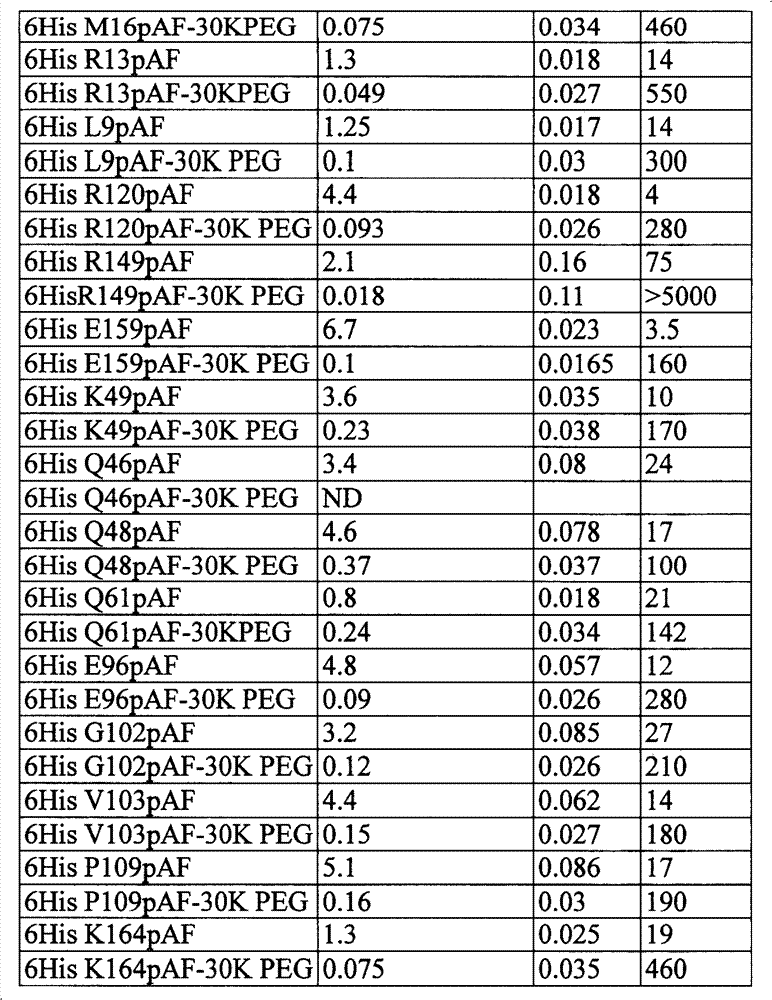
测量磷酸化STAT1Measuring phosphorylated STAT1
为评估经修饰hIFNα2a多肽的生物活性,使用人类单核细胞白血病THP-1细胞进行测量STAT1(信号转导子和转录活化因子家族成员)的磷酸化的检定。已展示STAT1的活化对于IFN的抗病毒活性为必要的(Durbin JE等人,Cell 199684:443-450)。人类单核细胞系THP-1是购自ATCC(Manassas,VA)且常规在RPMI 1640、丙酮酸钠、青霉素(penicillin)、链霉素(streptomycin)、10%热灭活胎牛血清和50μM 2-巯基乙醇中传代。在37℃下将细胞保持在5%CO2的潮湿气氛中。To assess the biological activity of modified hlFNα2a polypeptides, an assay measuring phosphorylation of STAT1, a member of the Signal Transducers and Activators of Transcription family, was performed using human monocytic leukemia THP-1 cells. Activation of STAT1 has been shown to be essential for the antiviral activity of IFNs (Durbin JE et al., Cell 199684:443-450). The human monocytic cell line THP-1 was purchased from ATCC (Manassas, VA) and routinely prepared in RPMI 1640, sodium pyruvate, penicillin, streptomycin, 10% heat-inactivated fetal calf serum, and 50 μM 2 - Passaging in mercaptoethanol. Cells were maintained at 37 °C in a humidified atmosphere of 5% CO2 .
将THP-1细胞在含有经1%热灭活木炭/葡聚糖处理的胎牛血清的检定培养基中饥饿整夜,随后在37℃下用增加浓度的hIFN多肽刺激30分钟。按照制造商(Cell SignalingTechnology,Beverly,MA)建议,将所有经刺激细胞固定以进行渗透且用适当磷酸基抗体染色。在FACS阵列上进行样品获取,其中所获取的数据是在Flowjo软件(Tree StarInc.,Ashland,OR)上分析。自使用SigmaPlot以平均荧光强度对蛋白质浓度绘制的剂量反应曲线得到EC50值(图2)。THP-1 cells were starved overnight in assay medium containing 1% heat-inactivated charcoal/dextran-treated fetal calf serum and subsequently stimulated with increasing concentrations of hIFN polypeptide for 30 minutes at 37°C. All stimulated cells were fixed for permeabilization and stained with appropriate phospho-based antibodies following manufacturer's (Cell Signaling Technology, Beverly, MA) recommendations. Sample acquisition was performed on a FACS array, with acquired data analyzed on Flowjo software (Tree Star Inc., Ashland, OR). EC50 values were obtained from dose response curves plotted as mean fluorescence intensity versus protein concentration using SigmaPlot (Figure 2).
进行其它对照以证实由IFN诱发的STAT1的磷酸化对IFNα受体2(IFNAR2)具有选择性。在37℃下用增加浓度的IFNAR2胞外域(ECDR2)将血清饥饿THP-1进行预培育15分钟,随后添加EC80剂量的IFN。发现IFNα受体2的胞外域与IFNαA刺激的STAT1磷酸化有效竞争,表明由IFNαA诱发的STAT1的磷酸化对IFNAR2有选择性。图3展示ECDR2与IFNαA诱发的pSTAT活性竞争。Additional controls were performed to demonstrate that IFN-induced phosphorylation of STAT1 is selective for IFNα receptor 2 (IFNAR2). Serum starved THP-1 was pre-incubated with increasing concentrations of IFNAR2 extracellular domain (ECDR2) for 15 minutes at 37°C, followed by the addition of an EC 80 dose of IFN. The extracellular domain of
在纯化hIFN多肽后的潜在污染物为内毒素。为测定内毒素是否影响STAT1的磷酸化,在此细胞检定中测试多种内毒素含量。图4展示在所测试的含量下内毒素对检定不具有实质影响。所测试的内毒素浓度范围(如所示)提供与不含内毒素的对照样品相当的MFI(PE)。A potential contaminant after purification of hIFN polypeptide is endotoxin. To determine whether endotoxin affects the phosphorylation of STAT1, various endotoxin levels were tested in this cellular assay. Figure 4 demonstrates that endotoxin had no substantial effect on the assay at the levels tested. The range of endotoxin concentrations tested (as indicated) provided MFI(PE) comparable to endotoxin-free control samples.
或者,可用
测量抗增殖活性Measuring antiproliferative activity
也检定hIFN多肽的抗增殖活性。IFNα的显著影响在于其抑制细胞生长的能力,其在测定抗肿瘤作用时尤其重要。已证实人类类淋巴母细胞Daudi细胞系对IFNα尤其敏感,且其已用于测量许多IFNα和衍生杂合多肽中的抗增殖活性(Meister等人,J Gen Virol.(1986)8月;67(Pt 8):1633-43)。通过其在悬浮液培养物中生长的能力已促进这种细胞系的使用(Evinger和Pestka,(1981)Methods Enzymol.79:362-368)。The antiproliferative activity of hIFN polypeptides was also assayed. A significant effect of IFN[alpha] is its ability to inhibit cell growth, which is especially important when measuring antitumor effects. The human lymphoblastoid Daudi cell line has been shown to be particularly sensitive to IFNα, and it has been used to measure antiproliferative activity in a number of IFNα and derived hybrid polypeptides (Meister et al., J Gen Virol. (1986) Aug; 67( Pt 8): 1633-43). The use of this cell line has been facilitated by its ability to grow in suspension culture (Evinger and Pestka, (1981) Methods Enzymol. 79:362-368).
人类Daudi B细胞系是购自ATCC(Manassas,VA)且生长于补充有丙酮酸钠、青霉素、链霉素(Invitrogen,Carlsbad,San Diego)和10%热灭活胎牛血清(Hyclone,Logan,UT)的RPMI 1640中。在37℃下将细胞培养物保持在5%CO2的潮湿气氛中。The human Daudi B cell line was purchased from ATCC (Manassas, VA) and was grown in supplemented with sodium pyruvate, penicillin, streptomycin (Invitrogen, Carlsbad, San Diego) and 10% heat-inactivated fetal bovine serum (Hyclone, Logan, UT) in RPMI 1640. Cell cultures were maintained at 37 °C in a humidified atmosphere of 5% CO2 .
以每孔1×10⁴个细胞的密度将Daudi细胞接种于平底96孔板中。用每个剂量浓度三份增加浓度的IFNα2A来活化细胞。在37℃下在5%CO2下4天培育时期之后,将40μlCellTiter 96 Aqueous One溶液试剂(Promega Corporation,Madison,WI)添加到每一孔中,且将培养物另外培育3小时。使用Spectromax在490nm下读取吸光度。自用SigmaPlot以OD490nm(三份的平均值)对蛋白质浓度绘制的剂量反应曲线获得EC50S。参看图5。Daudi cells were seeded in flat-bottom 96-well plates at a density of 1 × 10⁴ cells per well. Cells were activated with triplicate increasing concentrations of IFNα2A per dose concentration. After a 4-day incubation period at 37°C under 5% CO 2 , 40 μl of CellTiter 96 Aqueous One solution reagent (Promega Corporation, Madison, WI) was added to each well and the cultures were incubated for an additional 3 hours. Absorbance was read at 490 nm using a Spectromax. EC50S were obtained from dose response curves plotted as OD490nm (mean of triplicate) versus protein concentration using SigmaPlot. See Figure 5.
因为在纯化hIFN多肽后的潜在污染物为内毒素,所以在抗增殖检定中测试多种内毒素含量。图6展示在所测试的含量下内毒素对检定不具有实质影响。Since a potential contaminant after purification of hIFN polypeptides is endotoxin, various endotoxin levels were tested in the antiproliferative assay. Figure 6 shows that endotoxin had no substantial effect on the assay at the levels tested.
测量磷酸化Tyk2Measurement of phosphorylated Tyk2
Kawamoto等人在Experimental Hematology 2004 32:797-805以及Ishida等人Experimental Hematology 2005 33:495-503(其是以引用的方式并入本文中)中论述limitin与涉及Tyk2、CrkL、CrkII和Daxx的IFN-α之间的信号转导差异以及IFN的副作用。测量CrkL、CrkII和Tyk2的磷酸化的检定可用于评估本发明的hIFN多肽。可如Platanias等人在Experimental Hematology 1999;27:1315-1321(其是以引用的方式并入本文中)中所述进行评估CrkII在U-266中的磷酸化。为测量Tyk2的磷酸化,将人类U266B1细胞(ATCC,Manassas,VA)保持在补充有丙酮酸钠、青霉素、链霉素(Invitrogen,Carlsbad,SanDiego)和15%热灭活胎牛血清的RPMI 1640中。在37℃下将细胞培养物保持在5%CO2的潮湿气氛中。在测量Tyk2时,在37℃下用IFNα2A将血清饥饿U266细胞活化5分钟。按照制造商(Cell Signaling Technology,Beverly,MA)所建议,将所有刺激细胞固定、渗透且用适当磷酸基抗体染色。在FACS阵列上进行样品获取,其中所获取的数据是在Flowjo软件(Tree Star Inc.,Ashland,OR)上分析。自使用SigmaPlot以平均荧光强度对蛋白质浓度绘制的剂量反应曲线得到EC50值。IFNAR2的胞外域的竞争检定适用于测定特异性。关于Tyk2参看图8。Kawamoto et al. in Experimental Hematology 2004 32:797-805 and Ishida et al. Experimental Hematology 2005 33:495-503 (which are incorporated herein by reference) discuss limitin and IFN involving Tyk2, CrkL, CrkII and Daxx Differences in signaling between -alpha and side effects of IFN. Assays that measure phosphorylation of CrkL, CrkII, and Tyk2 can be used to assess hIFN polypeptides of the invention. Phosphorylation of CrkII at U-266 can be assessed as described in Platanias et al., Experimental Hematology 1999; 27: 1315-1321, which is incorporated herein by reference. To measure phosphorylation of Tyk2, human U266B1 cells (ATCC, Manassas, VA) were maintained at RPMI 1640 supplemented with sodium pyruvate, penicillin, streptomycin (Invitrogen, Carlsbad, San Diego) and 15% heat-inactivated fetal calf serum. middle. Cell cultures were maintained at 37 °C in a humidified atmosphere of 5% CO2 . Serum-starved U266 cells were activated with IFNα2A for 5 min at 37°C for the measurement of Tyk2. All stimulator cells were fixed, permeabilized, and stained with appropriate phospho-based antibodies as recommended by the manufacturer (Cell Signaling Technology, Beverly, MA). Sample acquisition was performed on a FACS array, with acquired data analyzed on Flowjo software (Tree Star Inc., Ashland, OR). EC50 values were obtained from dose response curves plotted as mean fluorescence intensity versus protein concentration using SigmaPlot. A competition assay for the extracellular domain of IFNAR2 was suitable for determining specificity. See Figure 8 for Tyk2.
表4和表5概述由作为IFNα2a变体的hIFN多肽所获得的数据。展示自IFNAR2的胞外域的亲和性研究获得的pSTAT1数据、抗增殖数据、Kd值。测试包括非天然编码氨基酸对乙酰基-苯丙氨酸(pAF)的hIFN多肽以及包括pAF的聚乙二醇化hIFN多肽。在这些研究中所用的对照物包含WHO IFNα2A、获自Sigma的IFNαA以及
表4Table 4


表5展示固定为100%的


菌落形成检定Colony Formation Assay
诸如由Giron-Michel,J.在Leukemia 2002 16:1135-1142中所述的菌落形成检定可用于通过本发明的hIFN多肽评估祖细胞的增殖。在菌落形成检定中可使用脐血。Colony formation assays such as those described by Giron-Michel, J. in Leukemia 2002 16: 1135-1142 can be used to assess proliferation of progenitor cells by hIFN polypeptides of the invention. Cord blood can be used in colony formation assays.
评估hIFN多肽对人类骨髓和红系祖细胞的毒性Evaluation of the Toxicity of hIFN Peptides on Human Myeloid and Erythroid Progenitor Cells
使用以甲基纤维素为基础的活体外菌落形成检定来测试10种化合物(9种hIFN多肽和的造血毒性。Ten compounds (9 hIFN polypeptides and hematopoietic toxicity.
细胞:将正常人类骨髓光密度细胞(Poietics Inc.,Maryland)储存在-152℃下直至检定需要。在实验当天,将细胞在37℃下迅速解冻,将小瓶内含物稀释于10ml含有2%胎牛血清的Iscove氏培养基中且通过离心洗涤。丢弃上层清液,且将细胞丸粒再悬浮于已知体积的含有2%FBS的Iscove氏培养基中。通过台盼蓝排除法进行细胞计数(3%冰乙酸)和生存能力评估。Cells: Normal human bone marrow densitometric cells (Poietics Inc., Maryland) were stored at -152°C until required for assay. On the day of the experiment, cells were rapidly thawed at 37°C, the contents of the vials were diluted in 10 ml of Iscove's medium containing 2% fetal bovine serum and washed by centrifugation. The supernatant was discarded, and the cell pellet was resuspended in a known volume of Iscove's medium containing 2% FBS. Cell counts (3% glacial acetic acid) and viability assessments were performed by trypan blue exclusion.
测试样品:化合物为于20mM NaAc、50mM NaCl、5%甘油的缓冲液(pH 6.0)中的40×储备液。用相同缓冲液制备每一化合物的稀释液以产生浓度为144、72、36、18和9μg/ml的储备液。当添加到甲基纤维素中时,缓冲液为2.5%的最终浓度且化合物浓度在3.6-0.225μg/ml范围内。用相同缓冲液将在20mM NaAc、50mM NaCl、5%甘油的缓冲液(pH 6.0)中含有50EU/ml内毒素的对照物1∶40稀释于甲基纤维素中以研究相似含量的内毒素的影响。Test samples: Compounds were 40× stock solutions in buffer (pH 6.0) of 20 mM NaAc, 50 mM NaCl, 5% glycerol. Dilutions of each compound were prepared in the same buffer to generate stock solutions at concentrations of 144, 72, 36, 18 and 9 μg/ml. When added to methylcellulose, buffer was at a final concentration of 2.5% and compound concentrations ranged from 3.6-0.225 μg/ml. A control containing 50 EU/ml endotoxin in a buffer (pH 6.0) of 20 mM NaAc, 50 mM NaCl, 5% glycerol was diluted 1:40 in methylcellulose with the same buffer to study similar levels of endotoxin. Influence.
方法:在含有饱和浓度的细胞因子SCF(干细胞因子;50ng/mL)、GM-CSF(粒细胞巨噬细胞集落刺激因子;10ng/mL)、IL-3(白细胞介素3;10ng/mL)和EPO(促红细胞生成素;3U/mL)的以甲基纤维素为基础的培养基(MethoCultTM 4434)中评估克隆源性红系祖细胞(CFU-E和BFU-E)、粒细胞-单核细胞(CFU-GM)和多潜能(CFU-GEMM)谱系。CFU-E为来源于最成熟红血球系菌落形成细胞的小红血球系菌落。其含有一至两个具有总数为8-200个成红血球细胞的丛集。BFU-E为来源于更原始细胞的较大红血球系菌落。其含有多于200个成红血球细胞。CFU-GM为来源于能够产生具有40个或40个以上粒细胞-单核细胞和/或巨噬细胞的菌落的菌落形成细胞的菌落。CFU-GEMM为含有来自一个以上谱系的细胞的菌落。其来源于最原始菌落形成细胞且含有红血球系细胞以及20个或20个以上粒细胞、巨噬细胞和巨核细胞。作为对照,也设立含有媒剂(20mM NaAc、50mM NaCl、5%甘油,pH 6.0)、含内毒素的媒剂和各种浓度的5-氟尿嘧啶(已知骨髓抑制性化合物)的培养物。也建立不含缓冲液或化合物的标准培养物。Methods: In the presence of saturated concentrations of cytokines SCF (stem cell factor; 50 ng/mL), GM-CSF (granulocyte macrophage colony-stimulating factor; 10 ng/mL), IL-3 (interleukin-3; 10 ng/mL) Clonogenic erythroid progenitors (CFU- E and BFU-E), granulocyte- Monocyte (CFU-GM) and multipotent (CFU-GEMM) lineages. CFU-E are small erythroid colonies derived from the most mature erythroid colony forming cells. It contains one to two clusters with a total of 8-200 erythroblasts. BFU-E are larger erythroid colonies derived from more primitive cells. It contains more than 200 erythroblasts. CFU-GM are colonies derived from colony forming cells capable of producing colonies with 40 or more granulocyte-monocytes and/or macrophages. CFU-GEMMs are colonies containing cells from more than one lineage. It is derived from the most primitive colony-forming cells and contains cells of the erythroid lineage as well as 20 or more granulocytes, macrophages, and megakaryocytes. As controls, cultures containing vehicle (20 mM NaAc, 50 mM NaCl, 5% glycerol, pH 6.0), endotoxin-containing vehicle and various concentrations of 5-fluorouracil (a known myelosuppressive compound) were also set up. Standard cultures were also established without buffers or compounds.
在所述以甲基纤维素为基础的培养基中设立克隆源性红系祖细胞(CFU-E和BFU-E)、粒细胞-单核细胞/骨髓(CFU-GM)和多潜能(CFU-GEMM)谱系。将化合物添加到MethoCultTM中以得到最终浓度为3.6、1.8、0.9、0.45和0.225μg/ml。也起始不含化合物但浓度与媒剂缓冲液相当的媒剂对照培养物、不含化合物但浓度与内毒素相当的内毒素对照培养物以及不含化合物或媒剂缓冲液的标准对照物。另外,用浓度为5、1、0.5和0.1μg/ml的5-氟尿嘧啶(5-FU)起始培养物以充当毒性的阳性对照物。以每个培养物1×104个细胞的浓度分三份设立所有培养物。在培养物中历时14天之后,对菌落进行评估且计分。根据尺寸和形态,将菌落分为以下种类:CFU-E、BFU-E、CFU-GM和CFU-GEMM。Clonogenic erythroid progenitors (CFU-E and BFU-E), granulocyte-monocyte/myeloid (CFU-GM) and multipotent (CFU-GM) were established in the methylcellulose-based medium described -GEMM) pedigree. Compounds were added to the MethoCult ™ to give final concentrations of 3.6, 1.8, 0.9, 0.45 and 0.225 μg/ml. Vehicle control cultures without compound but at concentrations comparable to vehicle buffer, endotoxin control cultures without compound but at concentrations comparable to endotoxin, and standard controls without compound or vehicle buffer were also initiated. Additionally, cultures were initiated with 5-fluorouracil (5-FU) at concentrations of 5, 1, 0.5 and 0.1 μg/ml to serve as a positive control for toxicity. All cultures were set up in triplicate at a concentration of 1 x 10⁴ cells per culture. After 14 days in culture, colonies were assessed and scored. Based on size and morphology, colonies were classified into the following species: CFU-E, BFU-E, CFU-GM, and CFU-GEMM.
结果和分析:对CFU-E、BFU-E、CFU-GM和CFU-GEMM的三重复培养物计数。另外,分析菌落类型的分布以及一般菌落和细胞形态。在复本培养物中所检测的菌落数的变化表示菌落计数的变化系数。结果展示于表6中。对于统计学分析来说,将所有化合物与媒剂对照物进行比较。进行标准t检验以评估在由对照物与经处理培养物产生的菌落数之间是否存在差异。由于菌落计数的潜在主观性,认为小于0.01的p值为显著的。Results and Analysis: Triplicate cultures of CFU-E, BFU-E, CFU-GM and CFU-GEMM were counted. Additionally, the distribution of colony types and general colony and cell morphology were analyzed. The change in the number of colonies detected in duplicate cultures represents the coefficient of variation of the colony count. The results are shown in Table 6. For statistical analysis, all compounds were compared to vehicle control. A standard t-test was performed to assess whether there was a difference between the number of colonies produced by control and treated cultures. Due to the potential subjectivity of colony counts, p values less than 0.01 were considered significant.


ND=未检测到ND = not detected
总红血球系=CFU-E+BFU-ETotal erythrocytes=CFU-E+BFU-E
总CFC=总红血球系+CFU-GM+CFU-GEMMTotal CFC = total erythrocytes + CFU-GM + CFU-GEMM
$p<0.01$p<0.01
*p<0.005 * p<0.005
#p<0.001#p<0.001
**p<0.0005 ** p<0.0005
在媒剂和内毒素对照物中检测的菌落数目和分布与标准对照物(不含化合物与媒剂缓冲液)没有区别。在用5-氟尿嘧啶培育的培养基中可见剂量依赖性毒性效应(对红血球系和骨髓祖细胞增殖的抑制性作用)。在5μg/ml的最高浓度下可见生长的完全抑制。在1μg/ml(对于红血球系和骨髓生长来说)下且在0.5μg/ml(仅对于骨髓生长来说)下也可见自对照物数目的显著减少,表明5-FU对骨髓细胞谱系毒性更大。在0.1μg/ml下菌落数目恢复至接近对照物含量。The number and distribution of colonies detected in the vehicle and endotoxin controls were indistinguishable from the standard control (no compound and vehicle buffer). A dose-dependent toxic effect (inhibitory effect on the proliferation of erythroid and myeloid progenitor cells) was seen in culture media incubated with 5-fluorouracil. Complete inhibition of growth was seen at the highest concentration of 5 μg/ml. A significant reduction in the number of controls was also seen at 1 μg/ml (for erythroid and myeloid growth) and at 0.5 μg/ml (for myeloid growth only), indicating that 5-FU is more toxic to the myeloid lineage big. Colony numbers recovered to near control levels at 0.1 μg/ml.
在各hIFN多肽或


如图10展示CFU-GM菌落计数(Y轴)的进一步分析,其中抗病毒活性的国际单位在X轴上。在抗病毒检定中

所有hIFN多肽展示对CFU-GM计数的浓度依赖性影响。以每单位计,在此检定中hIFN多肽6HisI24pAF-30K PEG和6HisN65pAF-30K PEG似乎比

表7展示由和病毒唑所获得的造血毒性数据。是在20mM乙酸钠、137mM NaCl、0.005%聚山梨酸酯80的缓冲液(pH 6.0)中且具有180μg/ml的起始浓度。病毒唑(Calbiochem目录号555580)在PBS中的起始浓度为7.63mg/ml。如表7中所示,测试每一样品的稀释液。Table 7 shows the Hematopoietic toxicity data obtained with ribavirin. was in 20 mM sodium acetate, 137 mM NaCl, 0.005
对于各化合物绘制BFU-E、CFU-GM或总CFC对浓度(μg/ml)产生的图展示于图12-17中。Graphs resulting from plotting BFU-E, CFU-GM or total CFC versus concentration (μg/ml) for each compound are shown in Figures 12-17.
抗病毒检定antiviral test
可由多种检定来测量hIFN多肽的抗病毒活性。一种此检定涉及研究经水疱性口腔炎病毒(VSV)感染的细胞的细胞病理效应(CPE)的降低。通过感染幼仓鼠肾细胞系BHK21(ATCC)产生VSV(ATCC)。简单来说,将细胞经各种量的病毒感染,且在感染24小时后收集含有病毒的上层清液。通过在1,200rpm下将上层清液离心5分钟来消除细胞碎片。在-80℃下将病毒储备液以1ml等分试样储存。通过使用斑块检定来计算病毒滴度。由PFU/ml(斑块形成单位)来表示滴定。用于测试本发明的hIFN多肽的抗病毒活性的其它检定包含但不限于以HCV复制子为基础的检定(Dr.Brent Korba,Department of Microbiology and Immunology,Georgetown University Medical Center)。在稳定HCV RNA-复制细胞系AVA5中检定多种hIFN多肽;此细胞系是人类肝母细胞瘤Huh7的衍生物。在添加最后剂量的hIFN多肽24小时后测量细胞内HCV RNA含量。使用标准印迹杂交技术来测量RNA含量。测试HCV复制子的两种菌株,HCV菌株1a和1b。另一种HCV检定是基于在支持HCV复制的特异性人类细胞中HCV复制的测量(Dr.Brent E.Korba或Dr.Thomas I.Michalak,M.D.,Ph.D.(Faculty of Medicine HealthScience Centre Memorial University St.John′s,Canada))。评估hIFN多肽的生物活性的另一种检定利用旱獭肝细胞。人类IFN-α上调在此类型细胞中的I类MHC抗原表达和2′-5-OAS mRNA(Dr.Thomas I.Michalak,M.D.,Ph.D)。在肝细胞中测量本发明的hIFN多肽对I类MHC表达和/或2′-5′-OAS含量的影响。Antiviral activity of hIFN polypeptides can be measured by a variety of assays. One such assay involves studying the reduction in cytopathic effect (CPE) of cells infected with vesicular stomatitis virus (VSV). VSV (ATCC) was produced by infecting the baby hamster kidney cell line BHK21 (ATCC). Briefly, cells were infected with various amounts of virus, and virus-containing supernatants were collected 24 hours after infection. Cell debris was eliminated by centrifuging the supernatant at 1,200 rpm for 5 minutes. Virus stocks were stored in 1 ml aliquots at -80 °C. Virus titers were calculated by using a plaque assay. Titrations were expressed in PFU/ml (plaque forming units). Other assays for testing the antiviral activity of hIFN polypeptides of the invention include, but are not limited to, HCV replicon-based assays (Dr. Brent Korba, Department of Microbiology and Immunology, Georgetown University Medical Center). Multiple hIFN polypeptides were assayed in the stable HCV RNA-replicating cell line AVA5; this cell line is a derivative of the human hepatoblastoma Huh7. Intracellular HCV RNA levels were measured 24 hours after addition of the last dose of hIFN polypeptide. RNA content was measured using standard blot hybridization techniques. Two strains of the HCV replicon, HCV strains 1a and 1b, were tested. Another HCV assay is based on the measurement of HCV replication in specific human cells that support HCV replication (Dr. Brent E. Korba or Dr. Thomas I. Michalak, M.D., Ph.D. (Faculty of Medicine HealthScience Center Memorial University St. John's, Canada)). Another assay to assess the biological activity of hIFN polypeptides utilizes woodchuck hepatocytes. Human IFN-α upregulates MHC class I antigen expression and 2′-5-OAS mRNA in this cell type (Dr. Thomas I. Michalak, M.D., Ph.D). The effect of hIFN polypeptides of the invention on MHC class I expression and/or 2'-5'-OAS content was measured in hepatocytes.
为评估hIFN多肽活性,将3×10⁴个人类WISH细胞(ATCC)于96孔板中接种且随后经每孔10,000PFU的VSV感染。在感染时,添加不同量的hIFN多肽。在感染后48小时,评估CPE;42-48小时为获得100%CPE所需的最少时间。通过用0.1ml的1mg/ml溴化3-(4,5-二甲基噻唑-2-基)2,5-二苯基四唑鎓(MTT)将细胞染色,接着在570nm下分光光度读数(其中690nm作为参考波长)来鉴别CPE。在线粒体中MTT测量代谢降低。To assess hIFN polypeptide activity, 3×10 4 human WISH cells (ATCC) were seeded in 96-well plates and subsequently infected with 10,000 PFU per well of VSV. At the time of infection, varying amounts of hIFN polypeptides were added. At 48 hours post-infection, CPE was assessed; 42-48 hours was the minimum time required to obtain 100% CPE. Cells were stained by 0.1 ml of 1 mg/ml 3-(4,5-dimethylthiazol-2-yl)2,5-diphenyltetrazolium bromide (MTT), followed by spectrophotometric reading at 570 nm (where 690nm is used as a reference wavelength) to identify CPE. MTT measures metabolic reduction in mitochondria.
表8概述由


发现位点特异性聚乙二醇化改变IFN的活性且可分离蛋白质的各种生物化学性质。如图11中所示,发现这种位点特异性聚乙二醇化的效应是由于用各hIFN多肽对高亲和性IFN受体IFNR2的Kd对抗病毒IC50数据进行分析产生。气泡的尺寸表示各hIFN多肽对IFNR2的经测量Kd。在以细胞为基础的抗病毒检定中,两种IFN多肽6HisI24pAF-30K PEG和6HisE107pAF-30K PEG比
实例26Example 26
其它检定other checks
HLA-A,B,C表达的测量Measurement of HLA-A, B, C expression
测量THP-1细胞中细胞表面MHC I类表达增加的检定也可用于测试hIFN多肽的活性。如上文所指示来培养人类单核细胞系THP-1。首先在5nM佛波醇(phorbol)12-肉豆蔻酸酯13-乙酸酯(Sigma,St Louis,MO)存在的情况下使细胞浓度为每毫升5×10⁵个细胞的THP-1细胞分化。随后在37℃下将分化THP-1细胞用增加浓度的IFNα2A刺激24小时。随后将IFNα2A活化细胞收集、洗涤且染色以进行表面HLA表达。在碘化丙啶(BD Biosciences,San Diego,CA)存在的情况下用APC接合抗-HLA-A,B,C抗体进行免疫荧光染色能够促成在FACS阵列上进行样品分析,其中所获取的数据是在Flowjo软件上分析。自利用SigmaPlot用平均荧光强度对蛋白质浓度绘制的剂量反应曲线来估计EC50值。参看图7。Assays that measure increased cell surface MHC class I expression in THP-1 cells can also be used to test the activity of hIFN polypeptides. The human monocytic cell line THP-1 was cultured as indicated above. THP-1 cells were first differentiated at a cell concentration of 5 x 10⁵ cells per ml in the presence of 5 nM phorbol 12-
PGE2和cAMP检定PGE2 and cAMP assay
用于评估hIFN多肽的活体外检定的实例包含但不限于检测前列腺素E2(PGE2)增加或cAMP降低的检定,如(例如)Wang等人,J.of Neuroimmunology 2004 156:107-112和Jiang等人,Neurochemistry 2000 36:193-196中所述,其是以引用的方式并入本文中。描述PGE2分泌检定的其它引用包含但不限于Mazzucco等人,J.Leukoc Biol 1996;60(2):271-7;Hoozemans等人,Exp.Gerontol.2001年3月;36(3):559-70;Fiebich等人,JNeurochem.2000年11月;75(5):2020-8;Schwende等人,J Leukoc Biol 1996;59(4):555-61;以及Hoozemans等人,Acta Neuropathol(Berl.)2001年1月;101(1):2-8,其是以引用的方式并入本文中。所属领域的一般技术人员已知对这些方法的更改。Examples of in vitro assays for assessing hIFN polypeptides include, but are not limited to, assays that detect increases in prostaglandin E2 (PGE2) or decreases in cAMP, such as, for example, Wang et al., J. of Neuroimmunology 2004 156:107-112 and Jiang et al. et al,
进行以细胞为基础的检定,例如,将本发明的hIFN多肽与调节PGE2或cAMP含量的对照物或目前IFN治疗剂进行比较。测量PGE2分泌的这些检定涉及诸如人类THP-1白血病细胞和人类成神经细胞瘤细胞(SK-N-SH)的细胞系。经脂多糖(LPS)攻毒的分化THP-1细胞展示PGE2的分泌增加。在SK-N-SH细胞中,IL-1β增加PGE2分泌。这些检定可用于研究由目前IFN疗法所发现的发热诱发和/或止痛作用与前列腺素E2(PGE2)或cAMP含量的经调节分泌的相关性。Cell-based assays are performed, eg, comparing hIFN polypeptides of the invention to controls or current IFN therapeutics that modulate PGE2 or cAMP levels. These assays measuring PGE2 secretion involve cell lines such as human THP-1 leukemia cells and human neuroblastoma cells (SK-N-SH). Differentiated THP-1 cells challenged with lipopolysaccharide (LPS) exhibit increased secretion of PGE2. IL-1β increases PGE2 secretion in SK-N-SH cells. These assays can be used to study the correlation of the pyrexogenic and/or analgesic effects found by current IFN therapies with the regulated secretion of prostaglandin E2 (PGE2) or cAMP levels.
如下检测cAMP含量:使5×10⁴个SK-N-SH成神经细胞瘤细胞(ATCC)粘附于96孔检测板(Applied Biosystems,Foster City,CA)上整夜。随后在37℃下用以下物质刺激细胞15分钟:(a)单独10μM佛司可林(forskolin);(b)10μM佛司可林加hIFN多肽(对于非PEG形式为60pM且对于PEG形式为600pM)和(c)10μM佛司可林加hIFN多肽加20μM纳洛酮(类鸦片受体拮抗剂)。随后将细胞溶解,且在室温下用cAMP-碱性磷酸酶接合物和抗-cAMP抗体将溶菌酶培育1小时。随后添加化学发光底物且在Topcount发光读取器上测量发光量。根据cAMP标准曲线来定量溶菌酶中存在的cAMP的量。cAMP content was determined by allowing 5 x 10⁴ SK-N-SH neuroblastoma cells (ATCC) to adhere to 96-well assay plates (Applied Biosystems, Foster City, CA) overnight. Cells were then stimulated for 15 minutes at 37°C with: (a) 10 μM forskolin alone; (b) 10 μM forskolin plus hIFN polypeptide (60 pM for the non-PEG form and 600 pM for the PEG form ) and (c) 10 μM forskolin plus hIFN polypeptide plus 20 μM naloxone (opioid receptor antagonist). Cells were then lysed and lysozyme was incubated with cAMP-alkaline phosphatase conjugate and anti-cAMP antibody for 1 hour at room temperature. Chemiluminescence substrate was then added and the amount of luminescence was measured on a Topcount luminescence reader. The amount of cAMP present in lysozyme was quantified according to the cAMP standard curve.
基因表达概况Gene Expression Profile
使用寡核苷酸阵列转录分析的单聚乙二醇化干扰素-α-2a异构体的转录活性描述于Foser等人,Pharmacogenomics Journal 2003;3:312-319中。可用于表达研究中的细胞系包含但不限于黑素瘤细胞系(诸如ME15)。可对本发明的hIFN多肽进行DNA阵列的替代性检定以提供mRNA概况或差示基因表达信息。Transcriptional activity of mono-pegylated interferon-alpha-2a isoforms using oligonucleotide array transcriptional analysis is described in Foser et al., Pharmacogenomics Journal 2003;3:312-319. Cell lines that can be used in expression studies include, but are not limited to, melanoma cell lines (such as ME15). Alternative assays of DNA arrays can be performed on hIFN polypeptides of the invention to provide mRNA profiling or differential gene expression information.
其它检定other checks
支持初步调配物研究的检定包含对于蛋白质脱酰胺化、聚集、氧化、乙酰化的检定和其它指示稳定性的检定。其它检定包含但不限于研究其它潜在降解产物(包含但不限于二硫化物重排和蛋白水解降解产物)的检定。Assays to support preliminary formulation studies include assays for protein deamidation, aggregation, oxidation, acetylation and other assays indicative of stability. Other assays include, but are not limited to, assays to study other potential degradation products, including but not limited to disulfide rearrangements and proteolytic degradation products.
实例27Example 27
本实例描述用于克隆、表达和纯化本发明的hIFN多肽的替代性系统。这种替代性系统的可能优点包含但不限于取消一个或一个以上涉及hIFN多肽的再折叠的步骤。NusA融合蛋白和TEV论述于Davis等人,Biotechnol Bioeng(1999);65:382-388;Shih等人,Protein Science 2005;14:936-941;以及美国专利第5,162,601号;第5,532,142号;第5,766,885号;和第5,989,868号中,所有文献都是以引用的方式并入本文中。This example describes an alternative system for cloning, expressing and purifying hIFN polypeptides of the invention. Possible advantages of this alternative system include, but are not limited to, elimination of one or more steps involved in the refolding of the hIFN polypeptide. NusA fusion proteins and TEV are discussed in Davis et al., Biotechnol Bioeng (1999); 65:382-388; Shih et al., Protein Science 2005; 14:936-941; and U.S. Patent Nos. 5,162,601; 5,532,142; 5,766,885 No. 5,989,868, all of which are incorporated herein by reference.
Nus-hIFN多肽融合体的克隆和构筑体Cloning and construction of Nus-hIFN polypeptide fusion
为产生NusA-hIFN融合体,在由序列GSGENLYFQ(其包含GSG连接子和TEV的识别序列)隔开的Spel和Kpnl限制位点之间的NusA下游克隆hIFN核苷酸序列。使用Novagen的pET44载体完成所有初始克隆步骤,且随后将整个Nus-IFN融合体盒转移到另一载体中,其允许由T71ac启动子控制的hIFN的表达以及蛋白质经1mM IPTG诱发。用含有经修饰hIFN聚核苷酸序列和正交氨基酰基tRNA合成酶/tRNA对(对所需非天然编码氨基酸具特异性)的构筑体转化大肠杆菌(Origami 2)允许将非天然编码氨基酸位点特异性地并入hIFN多肽中。To generate the NusA-hIFN fusion, the hIFN nucleotide sequence was cloned downstream of NusA between the Spel and Kpnl restriction sites separated by the sequence GSGENLYFQ (which contains the GSG linker and the recognition sequence for TEV). All initial cloning steps were done using Novagen's pET44 vector, and the entire Nus-IFN fusion cassette was subsequently transferred into another vector, which allows expression of hIFN controlled by the T7lac promoter and protein induction with 1 mM IPTG. Transformation of Escherichia coli (Origami 2) with a construct containing a modified hIFN polynucleotide sequence and an orthogonal aminoacyl tRNA synthetase/tRNA pair specific for the desired non-naturally encoded amino acid allows incorporation of the non-naturally encoded amino acid at the position Site-specific incorporation into hIFN polypeptides.
Nus-hIFN融合体的纯化和裂解Purification and lysis of Nus-hIFN fusion
将5ml LB培养物自经编码NusA-hIFN融合体的构筑体转化的单一大肠杆菌菌落生长。将0.5升具有氨比西林LB接种,且将非天然编码氨基酸对乙酰基-苯丙氨酸添加到培养物中。在28℃-32℃下使培养物生长整夜。当培养物的OD大于0.8-1时,将培养物转移至30℃,且用1mM IPTG进行诱发。培养物在30℃下持续生长4小时,且收集样品用于SDS-PAGE分析。通过离心收集细胞且将其冷冻在-80℃下。A 5 ml LB culture was grown from a single E. coli colony transformed with a construct encoding the NusA-hIFN fusion. 0.5 liters of LB with ampicillin were inoculated and the non-naturally encoded amino acid p-acetyl-phenylalanine was added to the culture. Cultures were grown overnight at 28°C-32°C. When the OD of the culture was greater than 0.8-1, the culture was transferred to 30°C and induced with 1 mM IPTG. Cultures were grown for 4 hours at 30°C and samples were collected for SDS-PAGE analysis. Cells were collected by centrifugation and frozen at -80°C.
将细胞溶解于25-30ml的50mM Tris(pH 8)、200mM NaCl、5%甘油中。将样品在玻璃烧杯中超声波降解25秒5-6次,同时将样品保持在冰上。在室温下将细胞用10μL脱氧核糖核酸酶培育30分钟。随后将样品旋转且移除上层清液。将5mM咪唑添加到上层清液中。Cells were lysed in 25-30ml of 50mM Tris (pH 8), 200mM NaCl, 5% glycerol. Sonicate the sample 5-6 times for 25 s in a glass beaker while keeping the sample on ice. Incubate cells with 10 μL of DNase for 30 min at room temperature. The samples were then spun and the supernatant removed. 5 mM imidazole was added to the supernatant.
随后以3ml/min将上层清液装载于5ml HisTrap柱上。在装载上层清液之前,用20mM TrispH8、300mM NaCl、0.005%Tween80、10mM咪唑(缓冲液A)平衡HisTrap柱。在用缓冲液A洗涤柱之后,用以下步骤梯度进行洗提:4柱体积的8%缓冲液B(20mM Tris pH 8、300mM NaCl、0.005%Tween80、0.5M咪唑);5柱体积的30%缓冲液B;以及100%缓冲液B洗涤液。在30%缓冲液B步骤期间洗提NusA-hIFN融合体。将柱用1M NaOH/1M NaCl洗涤且在5次操作后汽提且再进料(或替换)。The supernatant was then loaded onto a 5ml HisTrap column at 3ml/min. The HisTrap column was equilibrated with 20 mM Tris pH8, 300 mM NaCl, 0.005% Tween80, 10 mM imidazole (buffer A) before loading the supernatant. After washing the column with buffer A, elution was carried out with a gradient of 4 column volumes of 8% buffer B (
由SDS-PAGE分析来自步骤梯度的样品,且将具有融合体的馏分(约75kDa)汇集且在4℃下对20mM Tris(pH 8)、20mM NaCl、5%甘油透析整夜。用透析缓冲液将样品稀释至30μM蛋白质。将以下物质添加到样品中:半胱胺至0.2mM,EDTA至1mM,且TEV至0.8μM。随后将样品在4℃下培育24-48小时,或在室温下培育整夜。Samples from the step gradient were analyzed by SDS-PAGE and fractions with fusions (approximately 75 kDa) were pooled and dialyzed against 20 mM Tris (pH 8), 20 mM NaCl, 5% glycerol overnight at 4°C. Samples were diluted to 30 μM protein with dialysis buffer. The following were added to the samples: cysteamine to 0.2 mM, EDTA to 1 mM, and TEV to 0.8 μΜ. Samples were then incubated for 24-48 hours at 4°C, or overnight at room temperature.
在培育之后,将样品用ddH2O 1∶3稀释且装载于5ml Q HP柱上。用0-40%梯度的10mM Tris(pH 8)(缓冲液A′)进行洗提进入大于18倍柱体积的缓冲液B′(10mM Tris(pH 8)、1M NaCl)中。HFN多肽在约100mM NaCl下洗提;TEV在250mM NaCl下,且NusA在400mM NaCl下。用2.5mM NaCl、接着1M NaCl/1M NaOH洗涤柱。After incubation, samples were diluted 1 :3 with ddH2O and loaded onto a 5 ml Q HP column. Elution was performed with a 0-40% gradient of 10 mM Tris, pH 8 (buffer A') into >18 column volumes of buffer B' (10 mM Tris,
由SDS-PAGE分析洗提级分。将hIFN多肽级分汇集,且通过添加1/20体积的1MNaAc(pH 4.5)来调节集合的pH值,且随后将hIFN集合对20mM NaAc(pH 4)、20mMNaCl、5%甘油透析整夜。随后将样品浓缩至大于1mg/ml,保持体积大于300mcl。在280nm下的消光系数为22,500M-1或1.17mg/ml-1。Eluted fractions were analyzed by SDS-PAGE. The hIFN polypeptide fractions were pooled, and the pH of the pool was adjusted by adding 1/20 volume of 1M NaAc, pH 4.5, and then the hIFN pool was dialyzed against 20 mM NaAc,
聚乙二醇化Pegylation
以1∶12摩尔比率(30mg/mg IFN/ml)将氧基氨基衍生30K PEG添加到hIFN多肽中,且将混合物在28℃下培育16-48小时。图19展示在接合中所用的30K PEG。用SP缓冲液A(50mM乙酸钠,pH 5)将样品稀释10倍。为纯化聚乙二醇化hIFN多肽,5mlSP HPAKTA柱使用大于10倍柱体积的梯度为0-50%的SP缓冲液B(50mM乙酸钠(pH5)、0.5M NaCl、10%乙二醇)。聚乙二醇化IFN洗提约100mM盐、接着未经聚乙二醇化单体(基线分离)。将聚乙二醇化hIFN的级分汇集,对以下储存缓冲液透析:20mM乙酸钠(pH6)、0.005%Tween、125mM NaCl。随后将样品浓缩到大于8mM且储存在4℃下。Oxyamino derivatized 30K PEG was added to hIFN polypeptide at a 1:12 molar ratio (30mg/mg IFN/ml) and the mixture was incubated at 28°C for 16-48 hours. Figure 19 shows the 30K PEG used in ligation. Samples were diluted 10-fold with SP buffer A (50 mM sodium acetate, pH 5). For the purification of PEGylated hIFN polypeptides, a 5ml SP HPAKTA column was used with a gradient of 0-50% SP buffer B (50mM sodium acetate (pH5), 0.5M NaCl, 10% ethylene glycol) over 10 column volumes. PEGylated IFN elutes at approximately 100 mM salt followed by unpegylated monomer (baseline separation). Fractions of pegylated hlFN were pooled and dialyzed against the following storage buffer: 20 mM sodium acetate,
TEV的纯化Purification of TEV
用以下方案产生经纯化TEV。在30℃下用pRK793-TEV(S219V)质粒(来自NCI)转化0.5-2升BL21(DE3)RIL细胞(Stratagene)的培养物。当OD600为0.8-1.2时进行诱发,且在30℃下持续生长4-5小时。将细胞再悬浮于20-30ml的NTA缓冲液(50mMTris(pH 7)、300mM NaCl)中。随后将样品在冰上超声波降解30秒5次,在室温下培育30分钟,且在12,000rpm下离心20分钟。将上层清液移除,且添加咪唑至15mM。Purified TEVs were generated using the following protocol. A 0.5-2 liter culture of BL21(DE3) RIL cells (Stratagene) was transformed with the pRK793-TEV(S219V) plasmid (from NCI) at 30°C. Induction was performed when OD600 was 0.8-1.2, and growth was continued at 30°C for 4-5 hours. Cells were resuspended in 20-30 ml of NTA buffer (50 mM Tris (pH 7), 300 mM NaCl). Samples were then sonicated 5 times for 30 seconds on ice, incubated at room temperature for 30 minutes, and centrifuged at 12,000 rpm for 20 minutes. The supernatant was removed and imidazole was added to 15 mM.
将上层清液装载于在补充有15mM咪唑的NTA缓冲液中平衡的5mL HisTrap柱上。用大于18倍柱体积的梯度为0-100%的B(具有0.5M咪唑的NTA缓冲液)进行洗提。TEV洗提为起始200mM咪唑的宽峰。由SDS-PAGE分析洗提级分,且将含有洁净TEV的级分汇集。将经汇集级分对以下缓冲液(30mM Tris(pH 7.2)、200mM NaCl、0.5mMEDTA、1mM DTT)透析整夜。将经透析样品离心以移除任何沉淀物。The supernatant was loaded onto a 5 mL HisTrap column equilibrated in NTA buffer supplemented with 15 mM imidazole. Elution was performed with a gradient of 0-100% B (NTA buffer with 0.5M imidazole) over 18 column volumes. TEV elutes as a broad peak starting at 200 mM imidazole. Eluted fractions were analyzed by SDS-PAGE, and fractions containing clean TEVs were pooled. Pooled fractions were dialyzed overnight against the following buffer (30 mM Tris (pH 7.2), 200 mM NaCl, 0.5 mM EDTA, 1 mM DTT). Dialyzed samples were centrifuged to remove any precipitate.
随后将旋转物质用ddH2O透析四倍且装载于用缓冲液A(10mM Tris pH 7、50mMNaCl)平衡的5ml SP FF AKTA柱上。将柱用大于18倍柱体积的线性梯度为0-100%的B(10mM Tris(pH 7)、0.SM NaCl)洗提。将经洗提TEV级分汇集,且将以下物质添加到集合中:1mM DTT、1mM EDTA、20%甘油。将样品浓缩到大于20μM(消光系数32,500,pI为9.6),等分为每管500mcl,且储存在-20℃下。The spun material was then dialyzed fourfold against ddH2O and loaded onto a 5 ml SP FF AKTA column equilibrated with buffer A (10
抗病毒活性antiviral activity
为评估通过本实例中所述的方法产生的hIFN多肽的活性,将3×10⁴个人类WISH细胞(ATCC)接种于96孔板中且随后经每孔10,000PFU的VSV感染。在感染时,添加不同量的hIFN多肽。在感染后48小时评估CPE;42-48小时为获得100%CPE所需的最少时间。通过用0.1ml的1mg/ml溴化3-(4,5-二甲基噻唑-2-基)2,5-二苯基四唑鎓(MTT)将细胞染色,接着在570nm下分光光度读数(其中690nm作为参考波长)来鉴别CPE。在线粒体中MTT测量代谢降低。5种聚乙二醇化hIFN多肽和
实例28Example 28
本实例描述测量本发明的hIFN多肽的活体外和活体内活性的方法。This example describes methods for measuring the in vitro and in vivo activity of hIFN polypeptides of the invention.
细胞结合检定cell binding assay
在0℃下在各种浓度(体积:10μl)的未经标记IFN、hIFN或GM-CSF不存在或存在的情况下且在I-IFN(约100,000cpm或1ng)存在的情况下将细胞(3×10⁶个)在PBS/1%BSA(100μl)中双份培育90分钟(总体积:120μl)。随后将细胞再悬浮且成层于350μl塑料离心管中的200μl冰冷FCS上且离心(1000g;1分钟)。通过切断管的末端来收集丸粒且以γ计数器(Packard)对丸粒和上层清液分别计数。Cells ( 3×10 6 ) were incubated in PBS/1% BSA (100 μl) in duplicate for 90 minutes (total volume: 120 μl). Cells were then resuspended and layered on 200 μl ice-cold FCS in a 350 μl plastic centrifuge tube and centrifuged (1000 g; 1 min). The pellet was collected by cutting off the end of the tube and the pellet and supernatant were counted separately with a gamma counter (Packard).
特异性结合(cpm)经确定为在不存在竞争试剂的情况下的总结合(复本的平均值)减去在100倍过量的未标记IFN存在的情况下的结合(cpm)(非特异性结合)。对所用各细胞类型测量非特异性结合。实验是使用相同125I-IFN制剂不在同一天进行且应显示内部一致性。125I-IFN证实与Daudi细胞结合。所述结合是以剂量依赖性方式受到未经标记天然IFN或hIFN抑制,但并不受GM-CSF或其它阴性对照物抑制。hIFN竞争结合天然125I-IFN的能力与天然IFN类似,表明受体同样良好地识别两种形式。Specific binding (cpm) was determined as total binding (average of replicates) in the absence of competing reagent minus binding (cpm) in the presence of 100-fold excess of unlabeled IFN (non-specific binding ). Non-specific binding was measured for each cell type used. Experiments were performed on different days using the same125I -IFN preparation and should show internal consistency. 125 I-IFN was confirmed to bind to Daudi cells. The binding was inhibited in a dose-dependent manner by unlabeled native IFN or hIFN, but not by GM-CSF or other negative controls. The ability of hIFN to compete for binding to native125I -IFN was similar to native IFN, suggesting that the receptor recognizes both forms equally well.
根据聚乙二醇化IFN的活体内研究In vivo studies based on PEGylated IFN
将PEG-hIFN、未经修饰hIFN和缓冲溶液投与小鼠或大鼠。与未经修饰hIFN相比,结果将展示本发明的聚乙二醇化hIFN的出色活性和延长的半衰期,其是由使用每只小鼠或大鼠相同剂量的显著增加的病毒复制抑制作用来表明。PEG-hIFN, unmodified hIFN and buffer solution are administered to mice or rats. The results will demonstrate the superior activity and prolonged half-life of the PEGylated hIFNs of the invention compared to unmodified hIFN, as evidenced by the significantly increased inhibition of viral replication using the same dose per mouse or rat .
测量接合和未接合hIFN和其变体的活体内半衰期Measurement of the in vivo half-life of engaged and unconjugated hIFN and its variants
使用雄性Sprague Dawley大鼠(约7周龄)。在投药当天,测量每只动物的体重。将每千克体重100μg的未接合和接合hIFN样品各自经静脉内注射入三只大鼠的尾静脉内。在注射后1分钟、30分钟、1小时、2小时、4小时、6小时和24小时时,在CO2麻醉下自每只大鼠取500μl血液。通过离心(4℃,18000×g,5分钟)自血液样品分离血清。将血清样品储存在-80℃下,直至分析时。在解冻冰上的样品后,由IFN活体外活性检定来定量血清样品中的活性IFN的量。Male Sprague Dawley rats (about 7 weeks old) were used. On the day of dosing, the body weight of each animal was measured. Unconjugated and conjugated hIFN samples were each injected intravenously at 100 μg/kg body weight into the tail vein of three rats. At 1 min, 30 min, 1 h, 2 h, 4 h, 6 h and 24 h after injection, 500 μl of blood was taken from each rat under CO2 anesthesia. Serum was separated from blood samples by centrifugation (4°C, 18000 xg, 5 minutes). Serum samples were stored at -80°C until analysis. The amount of active IFN in the serum samples was quantified by the IFN in vitro activity assay after thawing the samples on ice.
抗病毒活性antiviral activity
存在许多测量细胞对病毒的抵抗程度的所属领域的技术人员已知的检定(McNeillTA,J Immunol Methods.(1981)46(2):121-7)。这些检定通常可分为三类:抑制细胞病理效应;病毒斑块形成;和降低病毒产量。病毒细胞病理效应检定测量在经IFN预处理且随后感染病毒的细胞培养物中诱发的保护程度。举例来说,水疱性口腔炎病毒为用于此检定的适当病毒。这种类型的检定可方便地筛检众多不同的IFN,因为其可在96孔板中进行。细胞病理效应降低检定的实例详述于Wang等人,NeuroReport(2001)12(4):857-859中。斑块减少检定测量经IFN处理的细胞培养物对斑块形成病毒(举例来说,麻疹病毒)的抗性。这种检定的一个益处在于其允许精确测量斑块形成的50%减少。最后,病毒产量检定测量在(例如)单一生长周期期间自细胞释放的病毒量。这些检定适用于测试IFN对不产生细胞病理效应或在靶细胞培养物中不形成斑块的病毒的抗病毒活性。病毒感染剂量(感染多重度)为使用斑块减少或病毒产量检定时应考虑的重要因素。There are a number of assays known to those of skill in the art that measure the degree of cellular resistance to viruses (McNeill TA, J Immunol Methods. (1981) 46(2):121-7). These assays generally fall into three categories: inhibition of cytopathic effects; viral plaque formation; and reduction of virus yield. The viral cytopathic effect assay measures the degree of protection induced in cell cultures pretreated with IFN and subsequently infected with virus. For example, vesicular stomatitis virus is a suitable virus for this assay. This type of assay can conveniently screen for many different IFNs because it can be performed in 96-well plates. An example of a cytopathic effect reduction assay is detailed in Wang et al., NeuroReport (2001) 12(4):857-859. The plaque reduction assay measures the resistance of IFN-treated cell cultures to plaque-forming viruses (eg, measles virus). One benefit of this assay is that it allows accurate measurement of a 50% reduction in plaque formation. Finally, virus yield assays measure the amount of virus released from cells during, for example, a single growth cycle. These assays are suitable for testing the antiviral activity of IFNs against viruses that do not produce cytopathic effects or form plaques in target cell cultures. Virus infection dose (multiplicity of infection) is an important factor to consider when using plaque reduction or virus yield assays.
在实验室装置中也易于检定其它临床上重要的干扰素特征。一个此种特征为干扰素多肽与特异性细胞表面受体结合的能力。举例来说,一些IFNα-2a显示与IFNα-2b(在临床试验中最广泛使用的IFN)相比不同的细胞表面性质。尽管IFNα-2b为有效抗病毒剂,但其产生显著不利的副作用。显示与IFNα-2b不同结合性质的干扰素可能不产生相同不利作用。因此,在细胞上与IFNα-2b不良竞争结合位点的干扰素受到临床关注。所属技术领域中众所周知竞争性干扰素结合检定(Hu等人,J Biol Chem.(1993)6月15日;268(17):12591-5;Di Marco等人,(1994)Biochem.Biophys.Res.Comm.202:1445-1451,其是以引用的方式并入本文中)。一般来说,这些检定涉及用经125I标记的IFNα-2b和所关注的未经标记干扰素的混合物来培育细胞培养物细胞。随后移除未经结合干扰素,且测量结合标记(且补充来说,结合经125I标记的IFNα-2b)的量。通过比较在竞争干扰素存在或不存在的情况下与细胞结合的标记的量,可计算相对结合亲和性。Other clinically important interferon signatures are also readily assayable in laboratory settings. One such characteristic is the ability of the interferon polypeptide to bind to specific cell surface receptors. For example, some IFNα-2a show different cell surface properties compared to IFNα-2b (the most widely used IFN in clinical trials). Although IFNα-2b is a potent antiviral agent, it produces significant adverse side effects. Interferons that exhibit different binding properties to IFNα-2b may not produce the same adverse effects. Therefore, interferons that poorly compete with IFNα-2b for binding sites on cells are of clinical interest. Competitive interferon binding assays are well known in the art (Hu et al., J Biol Chem. (1993)
IFNα的另一个显著作用在于其抑制细胞生长的能力,其在测定抗肿瘤作用时尤其重要。生长抑制检定已良好形成,且通常视氚化胸苷([3H]胸苷)或另一种放射性标记的细胞计数或吸收而定。已证实人类类淋巴母细胞Daudi细胞系对IFNα尤其敏感,且其已用于测量许多IFNα和衍生杂合多肽的抗增殖活性(Meister等人,J Gen Viro1.(1986)8月;67(Pt 8):1633-43)。通过其在悬浮液培养物中生长的能力已促进这种细胞系的使用(Evinger和Pestka,(1981)Methods Enzymol.79:362-368)。IFNα也显示许多免疫调节活性(Zoon等人,(1986)在The Biology of the Interferon System.Cantell和Schellenkens编,Martinus Nyhoff Publishers,Amsterdam中)。Another significant effect of IFN[alpha] is its ability to inhibit cell growth, which is especially important when measuring antitumor effects. Growth inhibition assays are well established and are usually based on cell counts or uptake of tritiated thymidine ([ 3H ]thymidine) or another radiolabel. The human lymphoblastoid Daudi cell line has been shown to be particularly sensitive to IFNα, and it has been used to measure the antiproliferative activity of a number of IFNα and derived hybrid polypeptides (Meister et al., J Gen Virol. (1986) Aug; 67 (Pt 8): 1633-43). The use of this cell line has been facilitated by its ability to grow in suspension culture (Evinger and Pestka, (1981) Methods Enzymol. 79:362-368). IFNα also exhibits numerous immunomodulatory activities (Zoon et al. (1986) in The Biology of the Interferon System. Cantell and Schellenkens eds. Martinus Nyhoff Publishers, Amsterdam).
尽管IFN首先由病毒学家发现,但其首次临床使用(在1979年)是作为骨髓瘤的治疗剂(Joshua等人,(1997)Blood Rev.11(4):191-200)。后来已展示IFNα可有效抵抗众多病毒性、恶性、血管生成性、过敏性、发炎性和纤维化来源的疾病(Tilg,(1997)Gastroenterology.112(3):1017-1021)。也已证实其可有效治疗转移性肾癌和慢性骨髓性白血病(Williams和Linch,(1997)Br.J.Hosp.Med.57(9):436-439)。IFN的临床使用概述于Gresser(1997)J.Leukoc.Biol.61(5):567-574和Pfeffer(1997)Semin.Oncol.24(3增刊9):S9-S63S969中。Although IFN was first discovered by virologists, its first clinical use (in 1979) was as a therapeutic agent for myeloma (Joshua et al. (1997) Blood Rev. 11(4):191-200). IFN[alpha] has subsequently been shown to be effective against numerous diseases of viral, malignant, angiogenic, allergic, inflammatory and fibrotic origin (Tilg, (1997) Gastroenterology. 112(3):1017-1021). It has also been shown to be effective in the treatment of metastatic renal cancer and chronic myelogenous leukemia (Williams and Linch, (1997) Br. J. Hosp. Med. 57(9):436-439). The clinical use of IFN is reviewed in Gresser (1997) J. Leukoc. Biol. 61(5): 567-574 and Pfeffer (1997) Semin. Oncol. 24(3 Suppl. 9): S9-S63S969.
镇痛检定Analgesia Check
可用hIFN多肽进行痛阈研究以研究这些化合物的止痛作用。一种此镇痛检定描述于Wang等人,NeuroReport(2001)12(4):857-859中,其是以引用的方式并入本文中。Pain threshold studies can be performed with hIFN polypeptides to investigate the analgesic effects of these compounds. One such analgesic assay is described in Wang et al., NeuroReport (2001) 12(4):857-859, which is incorporated herein by reference.
实例29Example 29
本实例描述测量本发明的hIFN多肽的活体内活性和毒性的方法。This example describes methods for measuring the in vivo activity and toxicity of hIFN polypeptides of the invention.
用于研究hIFN多肽的抗病毒活性的动物模型包含但不限于黑猩猩HCV(Purcell RH,FEMS Microbiol Rev.1994年7月;14(3):181-91)、HCV-Trimera小鼠(Ilan E等人,J InfectDis.2002年1月15日;185(2):153-61)以及Alb-uPA转基因小鼠模型(Mercer DF等人,Nat Med.2001年8月;7(8):927-33;Kneteman,N等人,(2003)10th HCV Meeting KyotoJapan,P-187),所有文献都是以引用的方式并入本文中。旱獭中的旱獭肝炎病毒(WHV)感染为研究HBV感染的发病机理、预防和治疗的有用模型(Berraondo,P.等人,J.Med.Virology 2002;68,424-432)。在产前暴露于WHV中的旱獭的病状类似于HBV感染。在旱獭肝炎模型中评估化合物,即聚乙二醇化人类干扰素多肽、聚乙二醇化旱獭干扰素化合物类似物或以一些方式经修饰以增加其对旱獭的物种交叉反应性足以进行抗病毒功效聚乙二醇化人类干扰素多肽。Animal models used to study the antiviral activity of hIFN polypeptides include, but are not limited to, chimpanzee HCV (Purcell RH, FEMS Microbiol Rev. July 1994; 14(3):181-91), HCV-Trimera mice (Ilan E et al. 2002
也使用猕猴来研究活体内活性和骨髓毒性。通过测量与诸如

用以下临床前计划进行本发明的hIFN多肽的评估。在研究1中,在雌性猕猴中起始剂量范围发现药物动力学(PK)、药效学(PD)和安全性研究且其涉及安慰剂和四个剂量的(0、1.5、15、50和150μg/kg)。使猴适应两周。在第1天和第5天投与15μg/kg、50μg/kg和150μg/kg的

在已从第一研究中选择一个或两个剂量后,研究2涉及在一个或两个剂量下比较本发明的hIFN多肽与

将骨髓自暴露于本发明的hIFN多肽的动物收集且评估。举例来说,从组织学上研究来自经治疗动物(例如,来自灵长类动物)的骨髓穿刺和/或穿刺活检,且估计骨髓细胞与有核红血球系细胞的比率(M∶E比)。低M∶E比结合嗜中性白血球减少症可表明具有降低的嗜中性粒细胞产生的粒细胞减少症。对来自经治疗动物的分离骨髓细胞检定造血祖细胞。也就是说,使细胞分离物经受CFU-GM或BFU-E菌落检定。结果(即造血祖细胞的数目)会展示(如果存在的话)治疗对骨髓和/或红血球系祖细胞的影响。Bone marrow is collected from animals exposed to hIFN polypeptides of the invention and assessed. For example, a bone marrow aspirate and/or needle biopsy from a treated animal (eg, from a primate) is studied histologically and the ratio of bone marrow cells to cells of the nucleated erythroid lineage (M:E ratio) is estimated. A low M:E ratio combined with neutropenia may indicate neutropenia with decreased neutrophil production. Hematopoietic progenitor cells were assayed on isolated bone marrow cells from treated animals. That is, cell isolates were subjected to CFU-GM or BFU-E colony assays. The outcome (ie, the number of hematopoietic progenitor cells) will demonstrate the effect, if any, of the treatment on myeloid and/or erythroid progenitor cells.
这些骨髓毒性研究可涉及通过不同途径(包含但不限于经皮下和静脉内)投与的hIFN多肽。静脉内投药可允许比皮下投药更长的给药方案和更好的骨髓毒性评估。这些改进可由调节免疫原性或对经投与化合物的抗体反应而产生。毒性研究包含评估每毫升血浆或血清的嗜中性粒细胞和血小板数目。These myelotoxicity studies may involve hIFN polypeptides administered by different routes including, but not limited to, subcutaneous and intravenous. Intravenous administration may allow longer dosing regimens and better bone marrow toxicity assessment than subcutaneous administration. These improvements may result from modulation of immunogenicity or antibody responses to administered compounds. Toxicity studies included assessment of neutrophil and platelet numbers per milliliter of plasma or serum.
其它动物模型包含但不限于抑郁症模型。一个小鼠模型涉及悬尾试验。也进行在投与hIFN多肽后测量小鼠中皮质醇和ACTH的含量的检定。皮质醇与ACTH都是HPA轴的组分且已暗示其在患者中在干扰素治疗诱发的抑郁症中起作用。Other animal models include but are not limited to models of depression. One mouse model involves the tail suspension test. Assays measuring the levels of Cortisol and ACTH in mice following administration of hIFN polypeptides were also performed. Both Cortisol and ACTH are components of the HPA axis and have been implicated to play a role in interferon treatment-induced depression in patients.
实例30Example 30
本实例详述hIFN多肽的分离以及hIFN活性和这些hIFN多肽对hIFN受体的亲和性的测量。This example details the isolation of hIFN polypeptides and the measurement of hIFN activity and the affinity of these hIFN polypeptides for the hIFN receptor.
由铜柱进行纯化Purification by copper column
500ml LB振荡烧瓶表达:500ml LB shaking flask expression:
对于每一种hIFN多肽来说,将经具有突变hIFN聚核苷酸的编码正交tRNA(美国专利公开案第20030108885号中所述的J17)和正交氨基酰基tRNA合成酶(在名称为“Compositions of Aminoacyl-tRNA Synthetase and Uses Thereof”的美国专利申请案第11/292,903中所述的E9)的构筑体转化的大肠杆菌划线于平板上以获得菌落。用来自新鲜转化平板的单一菌落接种2mL含有抗生素的LB。在37℃下在恒定搅拌(250rpm)下培育培养物直至培养物达到约0.05-0.3的OD600(约5-6小时)。用所有或部分2mL培养物接种500mL LB(含有抗生素和4mM pAF),从而将接种规范化以同步培养物。在37℃下在恒定搅拌(250rpm)下培育培养物直至培养物达到约1.0的OD600(约4-5小时)。随后用1mM IPTG诱发培养物,且在37℃下将培养物培育整夜。通过在4℃下在8000rpm/12000g下离心15分钟来收集细胞。将细胞糊状物刮出且储存在40mL OakRidge管中。随后将细胞丸粒冷冻在-80℃下直至起始包涵体制备。For each hIFN polypeptide, an orthogonal aminoacyl tRNA synthetase (J17 described in U.S. Patent Publication No. 20030108885) and an orthogonal aminoacyl tRNA synthetase (under the name " E. coli transformed with the construct E9) described in U.S. Patent Application No. 11/292,903 of "Compositions of Aminoacyl-tRNA Synthetase and Uses Thereof" were streaked on plates to obtain colonies.
自500mL振荡烧瓶制备包涵体:Preparation of inclusion bodies from a 500 mL shaker flask:
缓冲液1为50mM NaAc pH 6.0;100mM NaCl;1mM EDTA;1.0%Triton X-100。
缓冲液2为50mM NaAc pH 6.0;100mM NaCl;1mM EDTA。表9展示用于包涵体制备的程序。

对于溶解步骤来说,通过在4℃下振荡1小时将细胞再悬浮于23mL冷缓冲液1中。用100mL水以及随后30mL缓冲液1来清洁且冲洗Avestin C3。随后用以下方式在4℃下在冷却下在15,000-20,000psi下将细胞在Avestin中均质化两个回合:1)添加样品。2)将样品处理一次直至Avestin储槽几乎为空;将样品收集于原始管中(在随后步骤中也进行)。3)将所收集样品添加回至Avestin储槽中且再均质化。4)通过均质化12mL缓冲液1将样品洗出;将此添加到样品中。5)将样品转移到40mL Oak Ridge离心管中。6)将样品储存且使100mL水流经Avestin,在流动以冲洗系统时将其缓慢添加。7)随后将30mL缓冲液1添加到储槽中且均质化以制备下个样品。8)随后重复步骤以处理下个样品。For the lysis step, cells were resuspended in 23 mL of
对于洗涤和冲洗步骤来说,在自最后洗涤液倒出上层清液且倒入新鲜缓冲液中之后,使用刮刀使丸粒离开管。在75%功率下用正常尖端而不是微尖端来进行超声波降解。在不同样品之间用水冲洗且用Kimwipe擦拭尖端。For the wash and rinse steps, after decanting the supernatant from the last wash and pouring into fresh buffer, use a scraper to get the pellet out of the tube. Sonication was performed at 75% power with normal tips instead of microtips. Rinse with water between samples and wipe the tip with a Kimwipe.
在前4个步骤期间,将样品于用于储存细胞丸粒的40mL Oak Ridge管中旋转。通过将每个样品分到2个15mL圆锥形管中而旋转冲洗2。During the first 4 steps, samples were spun down in the 40 mL Oak Ridge tube used to store the cell pellet.
溶解和再折叠:Dissolving and refolding:
使用50mM NaAc或Tris用pH值介于5.5-8.5之间的8M GndHCl来进行溶解。将包涵体溶解至最终浓度在5-10mg/mL之间。将物质再折叠或储存于-80℃下以进行长期储存。Dissolution was performed using 50mM NaAc or Tris with 8M GndHCl pH between 5.5-8.5. Dissolve the inclusion bodies to a final concentration between 5-10 mg/mL. Material was refolded or stored at -80°C for long-term storage.
通过在4℃再折叠缓冲液(100mM NaAc(pH 6.0)或50mM Tris(pH 8.0);0.1%Tween 20)中将溶解物质稀释到最终总蛋白质浓度为0.5mg/mL来进行再折叠。将再折叠混合物储存在4℃下历时24小时至72小时。Refolding was performed by diluting the solubilized material to a final total protein concentration of 0.5 mg/mL in refolding buffer (100 mM NaAc (pH 6.0) or 50 mM Tris (pH 8.0); 0.1% Tween 20) at 4°C. The refolding mixture was stored at 4°C for 24 hours to 72 hours.
Cu纯化:Cu purification:
使再折叠样品温至室温。将最终浓度为50μM的CuCl添加到再折叠样品中,且在室温下将样品培育10-30分钟。将样品用0.22μm PES过滤器过滤且装载于装有Cu且经Cu缓冲液A(50mM NaAc,pH 5.0;150mM NaCl;0.1%Tween 20)平衡的螯合琼脂糖凝胶HP柱(GE Healthcare)上。流过大于18倍柱体积的达到100%Cu缓冲液B(100mM NaAc,pH 3.5;150mM NaCl;0.1%Tween 20)的线性梯度,且将样品收集于含有1mM EDTA的管中。Allow the refolded sample to warm to room temperature. CuCl at a final concentration of 50 μΜ was added to the refolded samples and the samples were incubated at room temperature for 10-30 minutes. Samples were filtered through a 0.22 μm PES filter and loaded onto a chelating Sepharose HP column (GE Healthcare) loaded with Cu and equilibrated with Cu buffer A (50 mM NaAc, pH 5.0; 150 mM NaCl; 0.1% Tween 20) superior. A linear gradient over 18 column volumes to 100% Cu buffer B (100 mM NaAc, pH 3.5; 150 mM NaCl; 0.1% Tween 20) was run through and samples collected in tubes containing 1 mM EDTA.
Cu集合的SP HP纯化:SP HP purification of Cu aggregates:
将hIFN多肽峰自Cu柱收集且直接装载于在SP缓冲液A(50mM NaAc,pH 5.0;1mM EDTA)中平衡的SP HP柱(GE Healthcare)上。流过大于15倍柱体积的达到50%SP缓冲液B(50mM NaAc,pH 5.0;0.5M NaCl;10%乙二醇;1mM EDTA)的线性梯度。The hIFN polypeptide peak was collected from the Cu column and loaded directly onto a SP HP column (GE Healthcare) equilibrated in SP Buffer A (50 mM NaAc, pH 5.0; 1 mM EDTA). A linear gradient to 50% SP Buffer B (50 mM NaAc, pH 5.0; 0.5 M NaCl; 10% ethylene glycol; 1 mM EDTA) was run through greater than 15 column volumes.
聚乙二醇化和纯化:PEGylation and purification:
将hIFN多肽样品自SP HP柱汇集且浓缩到1.0-2.0mg/mL。将10%乙酸添加到样品中以使pH值降至4.0。以1∶12摩尔比率(30mg/mg IFN/ml)将氧基氨基衍生30K PEG添加到hIFN多肽中,且将混合物在28℃下培育48-72小时。图19展示在接合中所用的30K PEG。将在位置107处包括非天然氨基酸对乙酰基苯丙氨酸的一种hIFN多肽与分枝40K PEG接合。此PEG作为化合物IV(mPEG(40K)氨基乙氧基胺盐酸盐)展示于图20中,且所述图展示自mPEG(40K)对硝基苯酚碳酸盐的合成流程。用于40K聚乙二醇化产物的摩尔比率和接合条件以及纯化方法与30K聚乙二醇化产物相同。用SP缓冲液A(50mM乙酸钠,pH 5;1mM EDTA)将样品稀释10倍。为纯化聚乙二醇化hIFN,SP HP柱(GE Healthcare)使用大于15倍柱体积的梯度为0-50%的SP缓冲液B(50mM乙酸钠(pH 5)、0.5M NaCl、10%乙二醇;1mM EDTA)。聚乙二醇化IFN洗提约100mM盐、接着未经聚乙二醇化单体(基线分离)。将聚乙二醇化hIFN的级分汇集,对以下储存缓冲液透析:20mM乙酸钠(pH 6)、0.005%Tween、125mM NaCl。将样品浓缩到1.0-2.0mg/mL且储存在-80℃下。The hIFN polypeptide samples were pooled from the SP HP column and concentrated to 1.0-2.0 mg/mL. 10% acetic acid was added to the samples to bring the pH down to 4.0. Oxyamino derivatized 30K PEG was added to hIFN polypeptide at a 1:12 molar ratio (30mg/mg IFN/ml) and the mixture was incubated at 28°C for 48-72 hours. Figure 19 shows the 30K PEG used in ligation. A hIFN polypeptide comprising the unnatural amino acid p-acetylphenylalanine at position 107 was conjugated to branched 40K PEG. This PEG is shown in Figure 20 as compound IV (mPEG(40K) aminoethoxyamine hydrochloride), and the figure shows a synthetic scheme from mPEG(40K) p-nitrophenol carbonate. The molar ratios and conjugation conditions and purification methods used for the 40K PEGylated product were the same as for the 30K PEGylated product. Samples were diluted 10-fold with SP buffer A (50 mM sodium acetate,
用于官能化甘油基分枝40K PEG的方法展示于下(图20)。向mPEG(40K)对硝基苯酚碳酸盐I(20g,0.5mmol)和N-氨基乙氧基邻苯二甲酰亚胺盐酸盐II(0.6g,2.5mmol)于N,N-二甲基甲酰胺-二氯甲烷(1∶2,150mL)中的混合物中添加二异丙基乙胺(DIEA,0.27mL,1.5mmol)和4-二甲基氨基吡啶(DMAP,催化剂)。在室温下将所得混合物搅拌20小时。添加乙酸乙酯-己烷(1∶1,1L)。将沉淀物过滤,用乙酸乙酯-己烷(1L)洗涤且在真空中干燥以得到呈白色粉末状的产物III。The method used to functionalize glyceryl-branched 40K PEG is shown below (Figure 20). To mPEG (40K) p-nitrophenol carbonate I (20g, 0.5mmol) and N-aminoethoxyphthalimide hydrochloride II (0.6g, 2.5mmol) in N, N-di To a mixture in methylformamide-dichloromethane (1:2, 150 mL) was added diisopropylethylamine (DIEA, 0.27 mL, 1.5 mmol) and 4-dimethylaminopyridine (DMAP, catalyst). The resulting mixture was stirred at room temperature for 20 hours. Ethyl acetate-hexane (1:1, 1 L) was added. The precipitate was filtered, washed with ethyl acetate-hexane (1 L) and dried in vacuo to give product III as a white powder.
将来自上个步骤的mPEG(40K)N-氨基乙氧基邻苯二甲酰亚胺III溶解于肼于二氯甲烷-甲醇(1∶1,100mL)中的0.5M溶液中。将所得混合物在室温下搅拌1.0小时且随后用HCl水溶液(0.5N,300mL)洗涤。将有机层经无水Na2SO4干燥、过滤且浓缩。将残余物溶解于CH2Cl2(100mL)中。添加乙酸乙酯-己烷(1∶1,1L)以沉淀呈白色粉末状的mPEG(40K)氨基乙氧基胺盐酸盐产物IV(17.6g,I的88%)。The mPEG (40K) N-aminoethoxyphthalimide III from the previous step was dissolved in a 0.5 M solution of hydrazine in dichloromethane-methanol (1:1, 100 mL). The resulting mixture was stirred at room temperature for 1.0 h and then washed with aqueous HCl (0.5 N, 300 mL). The organic layer was dried over anhydrous Na2SO4 , filtered and concentrated. The residue was dissolved in CH2Cl2 ( 100 mL). Ethyl acetate-hexane (1:1, 1 L) was added to precipitate mPEG (40K) aminoethoxylamine hydrochloride product IV (17.6 g, 88% of I) as a white powder.
Biacore研究(受体结合亲和性)Biacore study (receptor binding affinity)
自纯系MHS1011-61064(OpenBiosystems,Huntsville,AL)扩增IFNAR2胞外域的序列(由以序列LLPPGQ结束的206个氨基酸组成)。将此插入物克隆入在T7启动子下游的pET20表达载体(Novagen)中。在BL21(DE3)细胞(Novagen)中用0.4mM IPTG诱发蛋白质表达。The sequence of the IFNAR2 extracellular domain (consisting of 206 amino acids ending with the sequence LLPPGQ) was amplified from the clone MHS1011-61064 (OpenBiosystems, Huntsville, AL). This insert was cloned into the pET20 expression vector (Novagen) downstream of the T7 promoter. Protein expression was induced with 0.4 mM IPTG in BL21(DE3) cells (Novagen).
因为经表达蛋白质为不溶性的,所以将包涵体自溶解细胞纯化且溶解于6M GndCl中。在37℃下用10mM DTT将5ml等分试样(50mg量)还原45分钟。随后在4℃下将混合物注射入200ml由50mM Tris pH 8、20mM NaCl、0.5M精氨酸、10%甘油组成的再折叠缓冲液中且在轻微搅拌下培育整夜。Since the expressed protein is insoluble, inclusion bodies were purified from lysed cells and dissolved in 6M GndCl. A 5 ml aliquot (50 mg amount) was reduced with 10 mM DTT for 45 minutes at 37°C. The mixture was then injected into 200ml of refolding buffer consisting of
随后使用Amicon搅拌单元将再折叠反应物浓缩到25ml,且对20mM Tris(pH 8)、20mM NaCl、10%甘油透析整夜。使用AKTA FPLC系统(Amersham)用HP Q Sepharose纯化单体再折叠IFNAR ECD。使用由制造商推荐的赖氨酸特异性偶合程序将经纯化IFNAR2ECD固定于CM5Biacore芯片上。约200RU的功能性蛋白质经固定。以每分钟50mcl的流动速率将于HBS-EP缓冲液(Biacore)中的各种浓度的IFN变体注射于含有经固定IFNAR2的流动池和含有经固定牛血清白蛋白的对照流动池上。使用BiaEvaluation软件(Biacore)将产生的Sensogram拟合为1∶1相互作用模式以计算kon、koff和Kd值。观测在非天然编码氨基酸(对乙酰基苯丙氨酸;pAF)处聚乙二醇化的hIFN多肽的受体结合亲和性。测试在pAF处聚乙二醇化且在位置149处具有天然编码氨基酸取代的其它突变体。包含甲硫氨酰基野生型干扰素(M-WT)作为对照样品。表10展示所获得的kon、koff和Kd。所展示hIFN多肽不具有6-His标签且如本实例中所述经再折叠。The refolding reaction was then concentrated to 25 ml using an Amicon stirring unit and dialyzed overnight against 20 mM Tris (pH 8), 20 mM NaCl, 10% glycerol. Monomeric refolded IFNAR ECD was purified with HP Q Sepharose using an AKTA FPLC system (Amersham). Purified IFNAR2 ECD was immobilized on a CM5 Biacore chip using the lysine-specific coupling procedure recommended by the manufacturer. About 200RU of functional protein was immobilized. Various concentrations of IFN variants in HBS-EP buffer (Biacore) were injected at a flow rate of 50 mcl per minute over the flow cell containing immobilized IFNAR2 and a control flow cell containing immobilized bovine serum albumin. The resulting Sensogram was fitted to a 1:1 interaction model using BiaEvaluation software (Biacore) to calculate k on , k off and K d values. The receptor binding affinity of hIFN polypeptide pegylated at the non-naturally encoded amino acid (p-acetylphenylalanine; pAF) was observed. Additional mutants pegylated at pAF with a naturally encoded amino acid substitution at position 149 were tested. Methionyl wild-type interferon (M-WT) was included as a control sample. Table 10 shows the obtained k on , k off and K d . The hIFN polypeptides shown do not have a 6-His tag and were refolded as described in this example.
表10:如由SPR所测定的IFNα2A:IFNAR2相互作用的结合参数Table 10: Binding parameters of IFNα2A:IFNAR2 interaction as determined by SPR

抗病毒检定antiviral test
为评估hIFN多肽抗病毒活性,将3×10⁴个人类WISH细胞(ATCC)接种于96孔板中且随后经每孔10,000 PFU的VSV感染。在感染时,添加不同量的hIFN多肽。在感染后48小时评估CPE;42-48小时为获得100%CPE所需的最少时间。通过用0.1ml的1mg/ml溴化3-(4,5-二甲基噻唑-2-基)2,5-二苯基四唑鎓(MTT)将细胞染色,接着在570nm下分光光度读数(其中690nm作为参考波长)来鉴别CPE。在线粒体中MTT测量代谢降低。To evaluate hIFN polypeptide antiviral activity, 3×10 4 human WISH cells (ATCC) were seeded in 96-well plates and then infected with 10,000 PFU per well of VSV. At the time of infection, varying amounts of hIFN polypeptides were added. CPE was assessed 48 hours post-infection; 42-48 hours was the minimum time required to obtain 100% CPE. Cells were stained by 0.1 ml of 1 mg/ml 3-(4,5-dimethylthiazol-2-yl)2,5-diphenyltetrazolium bromide (MTT), followed by spectrophotometric reading at 570 nm (where 690nm is used as a reference wavelength) to identify CPE. MTT measures metabolic reduction in mitochondria.
表11和表12展示基于由在指定位点处具有非天然氨基取代(对乙酰基苯丙氨酸,pAF)且在所述位点处经聚乙二醇化的hIFN多肽获得的IC50值的相对抗病毒活性%。少数hIFN多肽在位置149处也具有天然氨基酸取代。使用实例27中所述的NusA系统制造一对突变体且其在N末端含有甲硫氨酸(由“M-”指示)。用作对照物。Table 11 and Table 12 show relative comparisons based on IC50 values obtained from hIFN polypeptides having unnatural amino substitutions (p-acetylphenylalanine, pAF) at indicated positions and pegylated at said positions. Antiviral activity %. A few hIFN polypeptides also had a natural amino acid substitution at position 149. A pair of mutants were made using the NusA system described in Example 27 and contained a methionine at the N-terminus (indicated by "M-"). Used as a control.

实例31Example 31
本实例详述hIFN活性和hIFN多肽对hIFN受体的亲和性的测量。使用实例27中的NusA系统来产生本实例中所述的hIFN多肽。基于limitin与IFNα2a之间的序列比较对IFNα2a多肽序列(SEQ ID NO:2)进行天然氨基酸取代。“M-”指示甲硫氨酸为多肽中的第一氨基酸。由在hIFNα-2a(SEQ ID NO:2)中的以下取代产生M-IFN“HV”或“HV”突变体:D77-D94经小鼠limitin序列HERALDQLLSSLWRELQV取代。由在hIFNα-2a(SEQ ID NO:2)中的以下取代产生M-IFN“CD”或“CD”突变体:V105-D114经GQSAPLP取代。This example details the measurement of hIFN activity and the affinity of hIFN polypeptides for the hIFN receptor. The NusA system in Example 27 was used to generate the hIFN polypeptides described in this example. Natural amino acid substitutions were made to the IFNα2a polypeptide sequence (SEQ ID NO: 2) based on the sequence comparison between limitin and IFNα2a. "M-" indicates that methionine is the first amino acid in the polypeptide. M-IFN "HV" or "HV" mutants were generated by the following substitutions in hIFNα-2a (SEQ ID NO: 2): D77-D94 were substituted by the mouse limitin sequence HERALDQLLSSLWRELQV. M-IFN "CD" or "CD" mutants were generated by the following substitutions in hIFNα-2a (SEQ ID NO: 2): V105-D114 replaced by GQSAPLP.
Biacore研究(受体结合亲和性)Biacore study (receptor binding affinity)
自纯系MHS1011-61064(OpenBiosystems,Huntsville,AL)扩增IFNAR2胞外域的序列(由以序列LLPPGQ结束的206个氨基酸组成)。将此插入物克隆入在T7启动子下游的pET20表达载体(Novagen)中。在BL21(DE3)细胞(Novagen)中用0.4mM IPTG诱发蛋白质表达。The sequence of the IFNAR2 extracellular domain (consisting of 206 amino acids ending with the sequence LLPPGQ) was amplified from the clone MHS1011-61064 (OpenBiosystems, Huntsville, AL). This insert was cloned into the pET20 expression vector (Novagen) downstream of the T7 promoter. Protein expression was induced with 0.4 mM IPTG in BL21(DE3) cells (Novagen).
因为经表达蛋白质为不溶性的,所以将包涵体自溶解细胞纯化且溶解于6M GndCl中。在37℃下用10mM DTT将5ml等分试样(50mg量)还原45分钟。随后在4℃下将混合物注射入200ml由50mM Tris pH 8、20mM NaCl、0.5M精氨酸、10%甘油组成的再折叠缓冲液中且在轻微搅拌下培育整夜。Since the expressed protein is insoluble, inclusion bodies were purified from lysed cells and dissolved in 6M GndCl. A 5 ml aliquot (50 mg amount) was reduced with 10 mM DTT for 45 minutes at 37°C. The mixture was then injected into 200ml of refolding buffer consisting of
随后使用Amicon搅拌单元将再折叠反应物浓缩到25ml,且对20mM Tris(pH 8)、20mM NaCl、10%甘油透析整夜。使用AKTA FPLC系统(Amersham)用HP Q Sepharose纯化单体再折叠IFNAR ECD。使用由制造商推荐的赖氨酸特异性偶合程序将经纯化IFNAR2ECD固定于CM5Biacore芯片上。约200RU的功能性蛋白质经固定。以每分钟50mcl的流动速率将于HBS-EP缓冲液(Biacore)中的各种浓度的IFN变体注射于含有经固定IFNAR2的流动池和含有经固定牛血清白蛋白的对照流动池上。使用BiaEvaluation软件(Biacore)将产生的Sensogram拟合为1∶1相互作用模式以计算kon、koff和Kd值。包含甲硫氨酰基野生型干扰素(M-WT)作为对照样品。The refolding reaction was then concentrated to 25 ml using an Amicon stirring unit and dialyzed overnight against 20 mM Tris (pH 8), 20 mM NaCl, 10% glycerol. Monomeric refolded IFNAR ECD was purified with HP Q Sepharose using an AKTA FPLC system (Amersham). Purified IFNAR2 ECD was immobilized on a CM5 Biacore chip using the lysine-specific coupling procedure recommended by the manufacturer. About 200RU of functional protein was immobilized. Various concentrations of IFN variants in HBS-EP buffer (Biacore) were injected at a flow rate of 50 mcl per minute over the flow cell containing immobilized IFNAR2 and a control flow cell containing immobilized bovine serum albumin. The resulting Sensogram was fitted to a 1:1 interaction model using BiaEvaluation software (Biacore) to calculate k on , k off and K d values. Methionyl wild-type interferon (M-WT) was included as a control sample.
表13展示由包括一个或一个以上天然氨基酸取代的hIFN多肽所获得的kon、koff和Kd。这些突变体是使用实例27中所述的NusA系统制造且其在N末端含有甲硫氨酸(由“M-”指示)。基于IFNα2a与limitin之间所发现的氨基酸差异来产生突变体序列。Table 13 shows k on , k off and K d obtained from hIFN polypeptides comprising one or more natural amino acid substitutions. These mutants were made using the NusA system described in Example 27 and contained a methionine at the N-terminus (indicated by "M-"). Mutant sequences were generated based on the amino acid differences found between IFNα2a and limitin.
表14展示由图19中所示的线性30K PEG聚乙二醇化的包括非天然氨基酸取代(对乙酰基苯丙氨酸)的hIFN多肽所获得的kon、koff和Kd。这些突变体是使用上述NusA系统制造且其在N末端含有甲硫氨酸(由“M-”指示)。Table 14 shows the k on , k off and K d obtained from the linear 30K PEG PEGylated hIFN polypeptides shown in FIG. 19 including unnatural amino acid substitutions (p-acetylphenylalanine). These mutants were made using the NusA system described above and contain a methionine at the N-terminus (indicated by "M-").
表13:如由SPR所测定的IFNα2A:IFNAR2相互作用的结合参数Table 13: Binding parameters of IFNα2A:IFNAR2 interaction as determined by SPR
表14:如由SPR所测定的IFNα2A:IFNAR2相互作用的结合参数Table 14: Binding parameters of IFNα2A:IFNAR2 interaction as determined by SPR
抗病毒检定antiviral test
为评估hIFN多肽抗病毒活性,将3×10⁴个人类WISH细胞(ATCC)接种于96孔板中且随后经每孔10,000PFU的VSV感染。在感染时,添加不同量的hIFN多肽。在感染后48小时评估CPE;42-48小时为获得100%CPE所需的最少时间。通过用0.1ml的1mg/ml溴化3-(4,5-二甲基噻唑-2-基)2,5-二苯基四唑鎓(MTT)将细胞染色,接着在570nm下分光光度读数(其中690nm作为参考波长)来鉴别CPE。在线粒体中MTT测量代谢降低。To evaluate hIFN polypeptide antiviral activity, 3×10 4 human WISH cells (ATCC) were seeded in 96-well plates and then infected with 10,000 PFU per well of VSV. At the time of infection, varying amounts of hIFN polypeptides were added. CPE was assessed 48 hours post-infection; 42-48 hours was the minimum time required to obtain 100% CPE. Cells were stained by 0.1 ml of 1 mg/ml 3-(4,5-dimethylthiazol-2-yl)2,5-diphenyltetrazolium bromide (MTT), followed by spectrophotometric reading at 570 nm (where 690nm is used as a reference wavelength) to identify CPE. MTT measures metabolic reduction in mitochondria.
表15展示基于由包括一个或一个以上天然氨基取代的hIFN多肽获得的IC50值的相对抗病毒活性%。Table 15 shows the relative % antiviral activity based on IC50 values obtained for hIFN polypeptides comprising one or more natural amino substitutions.

实例32Example 32
本实例详述hIFN活性和hIFN多肽对hIFN受体的亲和性的测量。在本实例中所述的hIFN多肽是使用以下方法产生。This example details the measurement of hIFN activity and the affinity of hIFN polypeptides for the hIFN receptor. The hIFN polypeptides described in this example were produced using the following method.
由HIC柱纯化Purified by HIC column
500ml LB振荡烧瓶表达:500ml LB shaking flask expression:
对于每一种hIFN多肽来说,将经具有突变hIFN聚核苷酸的编码正交tRNA(美国专利公开案第20030108885号中所述的J17)和正交氨基酰基tRNA合成酶(在名称为“Compositions of Aminoacyl-tRNA Synthetase and Uses Thereof”的美国专利申请案第11/292,903中所述的E9)的构筑体转化的大肠杆菌划线于平板上以获得菌落。用来自新鲜转化平板的单一菌落接种2mL含有抗生素的LB。在37℃下在恒定搅拌(250rpm)下培育培养物直至培养物达到约0.05-0.3的OD600(约5-6小时)。用所有或部分2mL培养物接种500mL LB(含有抗生素和4mM pAF),从而将接种规范化以同步培养物。在37℃下在恒定搅拌(250rpm)下培育培养物直至培养物达到约1.0的OD600(约4-5小时)。随后用1mM IPTG诱发培养物,且在37℃下将培养物培育整夜。通过在4℃下在8000rpm/12000g下离心15分钟来收集细胞。将细胞糊状物刮出且储存在40mL OakRidge管中。随后将细胞丸粒冷冻在-80℃下直至起始包涵体制备。For each hIFN polypeptide, an orthogonal aminoacyl tRNA synthetase (J17 described in U.S. Patent Publication No. 20030108885) and an orthogonal aminoacyl tRNA synthetase (under the name " E. coli transformed with the construct E9) described in U.S. Patent Application No. 11/292,903 of "Compositions of Aminoacyl-tRNA Synthetase and Uses Thereof" were streaked on plates to obtain colonies.
自500mL振荡烧瓶制备包涵体:Preparation of inclusion bodies from a 500 mL shaker flask:
缓冲液1为50mM NaAc pH 6.0;100mM NaCl;1mM EDTA;1.0%Triton X-100。缓冲液2为50mM NaAc pH 6.0;100mM NaCl;1mM EDTA。表16展示用于包涵体制备的程序。
对于溶解步骤来说,通过在4℃下振荡1小时将细胞再悬浮于23mL冷冻缓冲液1中。用100mL水以及随后30mL缓冲液1来清洁且冲洗Avestin C3。随后用以下方式在4℃下在冷却下在15,000-20,000psi下将细胞在Avestin中均质化两个回合:1)添加样品。2)将样品处理一次直至Avestin储槽几乎为空;将样品收集于原始管中(在随后步骤中也进行)。3)将所收集样品添加回至Avestin储槽中且再均质化。4)通过均质化12mL缓冲液1将样品洗出;将此添加到样品中。5)将样品转移到40mL Oak Ridge离心管中。6)将样品储存且使100mL水流经Avestin,在流动以冲洗系统时将其缓慢添加。7)随后将30mL缓冲液1添加到储槽中且均质化以制备下个样品。8)随后重复步骤以处理下个样品。For the lysis step, cells were resuspended in 23 mL of
对于洗涤和冲洗步骤来说,在自最后洗涤液倒出上层清液且倒入新鲜缓冲液之后,使用刮刀使丸粒离开管。在75%功率下用正常尖端而不是微尖端来进行超声波降解。在不同样品之间用水冲洗且用Kimwipe擦拭尖端。For the wash and rinse steps, after decanting the supernatant from the last wash and pouring in fresh buffer, use a scraper to get the pellet out of the tube. Sonication was performed at 75% power with normal tips instead of microtips. Rinse with water between samples and wipe the tip with a Kimwipe.
在前4个步骤期间,将样品于用于储存细胞丸粒的40mL Oak Ridge管中旋转。通过将每个样品分于2个15mL圆锥形管中而旋转冲洗2。During the first 4 steps, samples were spun down in the 40 mL Oak Ridge tube used to store the cell pellet.
溶解和再折叠:Dissolving and refolding:
使用50mM NaAc或Tris用pH值介于5.5-8.5之间的8M GndHCl来进行溶解。将包涵体溶解至最终浓度在5-10mg/mL之间。添加最终浓度为10mM的β-巯基乙醇,且在室温下将样品培育30-60分钟。将物质再折叠或储存于-80℃下以进行长期储存。Dissolution was performed using 50mM NaAc or Tris with 8M GndHCl pH between 5.5-8.5. Dissolve the inclusion bodies to a final concentration between 5-10 mg/mL. β-Mercaptoethanol was added at a final concentration of 10 mM, and the samples were incubated for 30-60 minutes at room temperature. Material was refolded or stored at -80°C for long-term storage.
通过在4℃再折叠缓冲液(50mM Tris,pH 8.3;0.5M精氨酸)中将溶解物质稀释到最终总蛋白质浓度为0.5mg/mL来进行再折叠。将再折叠混合物储存在4℃下2-4天。Refolding was performed by diluting the dissolved material to a final total protein concentration of 0.5 mg/mL in refolding buffer (50 mM Tris, pH 8.3; 0.5 M arginine) at 4°C. Store the refolding mixture at 4 °C for 2-4 days.
HIC纯化:HIC purification:
使hIFN多肽再折叠样品温至室温。将最终浓度为1.5M的NaCl添加到样品中,且在室温下将样品培育30-60分钟。将样品用0.22μm PES过滤器过滤且装载于在HIC缓冲液A(20mM磷酸钠,pH 7.0;1.5M NaCl;2M尿素)中平衡的Butyl 650M柱(Tosoh)上。流过大于20倍柱体积的达到100%HIC缓冲液B(20mM磷酸钠,pH 7.0;2M尿素)的线性梯度。The hlFN polypeptide refolding samples were allowed to warm to room temperature. NaCl was added to the samples at a final concentration of 1.5M and the samples were incubated at room temperature for 30-60 minutes. Samples were filtered through a 0.22 μm PES filter and loaded onto a Butyl 650M column (Tosoh) equilibrated in HIC buffer A (20 mM sodium phosphate, pH 7.0; 1.5M NaCl; 2M urea). A linear gradient to 100% HIC buffer B (20 mM sodium phosphate, pH 7.0; 2M urea) was run through greater than 20 column volumes.
HIC集合的SP HP纯化:SP HP purification of HIC pools:
将IFN多肽峰自Butyl柱收集且用水稀释至小于30m/S。用HCl将样品的pH值调节到3.0且将其装载于在SP缓冲液A1(50mM NaAc,pH 3.0;1mM EDTA)中平衡的SP HP柱(GE Healthcare)上。在样品经装载后,用2柱体积的SP缓冲液A以及随后4柱体积的SP缓冲液A2(50mM NaAc,pH 5.0;1mM EDTA)洗涤柱。流过大于15倍柱体积的100%SP缓冲液A2至50%SP B缓冲液(50mM NaAc,pH 5.0;0.5M NaCl;10%乙二醇;1mM EDTA)的线性梯度。The IFN polypeptide peak was collected from the Butyl column and diluted with water to less than 30 m/S. The pH of the sample was adjusted to 3.0 with HCl and loaded onto a SP HP column (GE Healthcare) equilibrated in SP buffer Al (50 mM NaAc, pH 3.0; 1 mM EDTA). After the samples were loaded, the column was washed with 2 column volumes of SP Buffer A followed by 4 column volumes of SP Buffer A2 (50 mM NaAc, pH 5.0; 1 mM EDTA). A linear gradient of 100% SP buffer A2 to 50% SP B buffer (50 mM NaAc, pH 5.0; 0.5 M NaCl; 10% ethylene glycol; 1 mM EDTA) was flowed through greater than 15 column volumes.
聚乙二醇化和纯化:PEGylation and purification:
将hIFN多肽样品自SP HP柱汇集且浓缩到1.0-2.0mg/mL。将10%乙酸添加到样品中以使pH值降至4.0。以1∶12摩尔比率(30mg/mg IFN/ml)将氧基氨基衍生30K PEG添加到hIFN多肽中,且将混合物在28℃下培育48-72小时。图19展示在接合中所用的30K PEG。用SP缓冲液A(50mM乙酸钠,pH 5;1mM EDTA)将样品稀释10倍。为纯化聚乙二醇化hIFN,SP HP柱(GE Healthcare)使用大于15倍柱体积的梯度为0-50%的SP缓冲液B(50mM乙酸钠(pH 5)、0.5M NaCl、10%乙二醇;1mM EDTA)。聚乙二醇化IFN洗提约100mM盐、接着未经聚乙二醇化单体(基线分离)。将聚乙二醇化hIFN的级分汇集,对以下储存缓冲液透析:20mM乙酸钠(pH 6)、0.005%Tween、125mM NaCl。将样品浓缩到1.0-2.0mg/mL且储存在-80℃下。The hIFN polypeptide samples were pooled from the SP HP column and concentrated to 1.0-2.0 mg/mL. 10% acetic acid was added to the samples to bring the pH down to 4.0. Oxyamino derivatized 30K PEG was added to hIFN polypeptide at a 1:12 molar ratio (30mg/mg IFN/ml) and the mixture was incubated at 28°C for 48-72 hours. Figure 19 shows the 30K PEG used in ligation. Samples were diluted 10-fold with SP buffer A (50 mM sodium acetate,
Biacore研究(受体结合亲和性)Biacore study (receptor binding affinity)
自纯系MHSl011-61064(OpenBiosystems,Huntsville,AL)扩增IFNAR2胞外域的序列(由以序列LLPPGQ结束的206个氨基酸组成)。将此插入物克隆入在T7启动子下游的pET20表达载体(Novagen)中。在BL21(DE3)细胞(Novagen)中用0.4mM IPTG诱发蛋白质表达。The sequence of the IFNAR2 ectodomain (consisting of 206 amino acids ending with the sequence LLPPGQ) was amplified from the clone MHS1011-61064 (OpenBiosystems, Huntsville, AL). This insert was cloned into the pET20 expression vector (Novagen) downstream of the T7 promoter. Protein expression was induced with 0.4 mM IPTG in BL21(DE3) cells (Novagen).
因为经表达蛋白质为不溶性的,所以将包涵体自溶解细胞纯化且溶解于6M GndCl中。在37℃下用10mM DTT将5ml等分试样(50mg量)还原45分钟。随后在4℃下将混合物注射入200ml由50mM Tris pH 8、20mM NaCl、0.5M精氨酸、10%甘油组成的再折叠缓冲液中且在轻微搅拌下培育整夜。Since the expressed protein is insoluble, inclusion bodies were purified from lysed cells and dissolved in 6M GndCl. A 5 ml aliquot (50 mg amount) was reduced with 10 mM DTT for 45 minutes at 37°C. The mixture was then injected into 200ml of refolding buffer consisting of
随后使用Amicon搅拌单元将再折叠反应物浓缩到25ml,且对20mM Tris(pH 8)、20mM NaCl、10%甘油透析整夜。使用AKTA FPLC系统(Amersham)用HP Q Sepharose纯化单体再折叠IFNAR ECD。使用由制造商推荐的赖氨酸特异性偶合程序将经纯化IFNAR2ECD固定于CM5Biacore芯片上。约200RU的功能性蛋白质经固定。以每分钟50mcl的流动速率将于HBS-EP缓冲液(Biacore)中的各种浓度的IFN变体注射于含有经固定IFNAR2的流动池和含有经固定牛血清白蛋白的对照流动池上。使用BiaEvaluation软件(Biacore)将产生的Sensogram拟合为1∶1相互作用模式以计算kon、koff和Kd值。观测在非天然编码氨基酸(对乙酰基苯丙氨酸;pAF)处聚乙二醇化的hIFN多肽的受体结合亲和性。包含甲硫氨酰基野生型干扰素(M-WT)和
表17展示由包括非天然编码氨基酸pAF且在所述非天然编码氨基酸处经如图19中所示的线性30K PEG聚乙二醇化的hIFN多肽所获得的kon,koff和Kd。另外,一些所测试hIlFN多肽具有天然氨基酸取代。举例来说,通过取代SEQ ID NO:2的位置45处的非天然氨基酸pAF来产生T79R/N45pAcF-30K PEG且在位置79处的苏氨酸氨基酸是经天然编码氨基酸精氨酸取代。Table 17 shows the k on , k off and K d obtained from hIFN polypeptides comprising the non-naturally encoded amino acid pAF and PEGylated with linear 30K PEG as shown in FIG. 19 at the non-naturally encoded amino acid pAF. Additionally, some of the hIIFN polypeptides tested had natural amino acid substitutions. For example, T79R/N45pAcF-30K PEG was generated by substituting the unnatural amino acid pAF at position 45 of SEQ ID NO: 2 and the threonine amino acid at position 79 was substituted with the naturally encoded amino acid arginine.
表17:如由SPR所测定的IFNα2A:IFNAR2相互作用的结合参数Table 17: Binding parameters of IFNα2A:IFNAR2 interaction as determined by SPR


抗病毒检定antiviral test
为评估hIFN多肽抗病毒活性,将3×10⁴个人类WISH细胞(ATCC)接种于96孔板中且随后经每孔10,000PFU的VSV感染。在感染时,添加不同量的hIFN多肽。在感染后48小时评估CPE;42-48小时为获得100%CPE所需的最少时间。通过用0.1ml的1mg/ml溴化3-(4,5-二甲基噻唑-2-基)2,5-二苯基四唑鎓(MTT)将细胞染色,接着在570nm下分光光度读数(其中690nm作为参考波长)来鉴别CPE。在线粒体中MTT测量代谢降低。To evaluate hIFN polypeptide antiviral activity, 3×10 4 human WISH cells (ATCC) were seeded in 96-well plates and then infected with 10,000 PFU per well of VSV. At the time of infection, varying amounts of hIFN polypeptides were added. CPE was assessed 48 hours post-infection; 42-48 hours was the minimum time required to obtain 100% CPE. Cells were stained by 0.1 ml of 1 mg/ml 3-(4,5-dimethylthiazol-2-yl)2,5-diphenyltetrazolium bromide (MTT), followed by spectrophotometric reading at 570 nm (where 690nm is used as a reference wavelength) to identify CPE. MTT measures metabolic reduction in mitochondria.
表18展示基于由在指定位点处具有非天然氨基取代且在所述位点处经聚乙二醇化的hIFN多肽获得的IC50值的相对抗病毒活性%。具有较低IC50值的hIFN多肽展示较高相对活性%。另外一些聚乙二醇化hIFN多肽具有天然编码氨基酸取代(T79R;Y85L;E87S;Y85S)。Table 18 shows the relative % antiviral activity based on IC50 values obtained from hIFN polypeptides having unnatural amino substitutions at the indicated positions and pegylated at said positions. hIFN polypeptides with lower IC50 values exhibited higher relative activity %. Other pegylated hIFN polypeptides have naturally encoded amino acid substitutions (T79R; Y85L; E87S; Y85S).
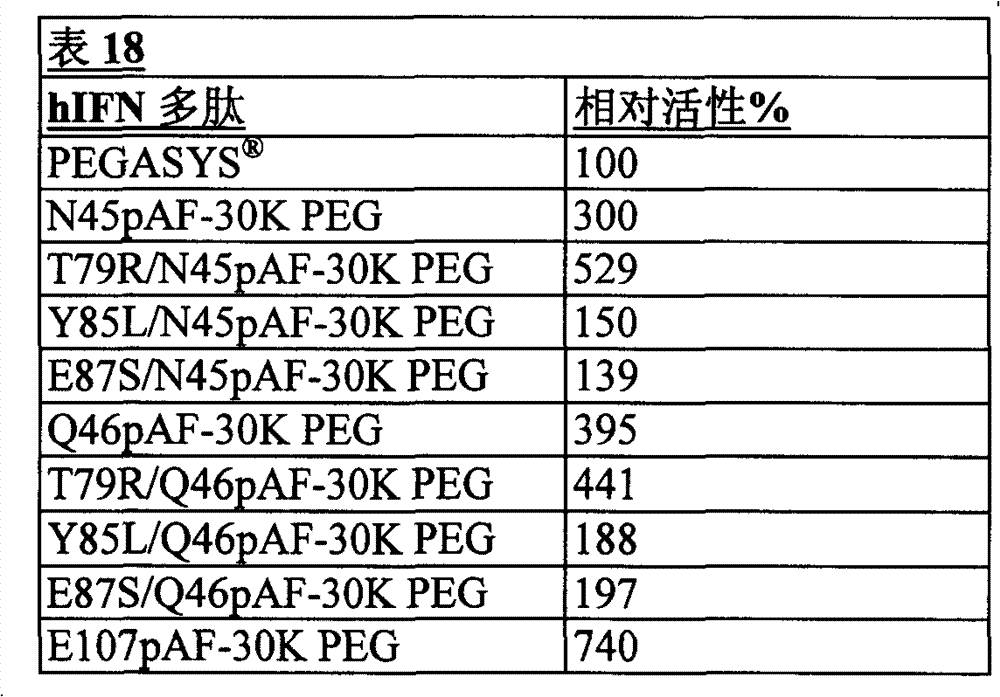
实例33Example 33
测量抗增殖活性Measuring antiproliferative activity
也检定在先前实例(实例30-32)中所述hIFN多肽的抗增殖活性。IFNα的显著影响在于其抑制细胞生长的能力,其在测定抗肿瘤作用时尤其重要。已证实人类类淋巴母细胞Daudi细胞系对IFNα尤其敏感,且其已用于测量许多IFNα和衍生杂合多肽的抗增殖活性(Meister等人,J Gen Virol.(1986)8月;67(Pt 8):1633-43)。通过其在悬浮液培养物中生长的能力已促进这种细胞系的使用(Evinger和Pestka,(1981)Methods Enzymol.79:362-368)。The antiproliferative activity of hIFN polypeptides described in previous examples (Examples 30-32) was also assayed. A significant effect of IFN[alpha] is its ability to inhibit cell growth, which is especially important when measuring antitumor effects. The human lymphoblastoid Daudi cell line has been shown to be particularly sensitive to IFNα, and it has been used to measure the antiproliferative activity of a number of IFNα and derivative hybrid polypeptides (Meister et al., J Gen Virol. (1986) Aug; 67 (Pt 8): 1633-43). The use of this cell line has been facilitated by its ability to grow in suspension culture (Evinger and Pestka, (1981) Methods Enzymol. 79:362-368).
人类Daudi B细胞系是购自ATCC(Manassas,VA)且生长于补充有10%热灭活胎牛血清(Hyclone,Logan,UT)的RPMI 1640中。在37℃下将细胞培养物保持在5%CO2的潮湿气氛中。The human Daudi B cell line was purchased from ATCC (Manassas, VA) and grown in RPMI 1640 supplemented with 10% heat-inactivated fetal bovine serum (Hyclone, Logan, UT). Cell cultures were maintained at 37 °C in a humidified atmosphere of 5% CO2 .
以每孔1×10⁴个细胞的密度将Daudi细胞接种于平底96孔板中。用最终体积为200μl的每个剂量浓度三份增加浓度的IFNα2A来处理细胞。在37℃下在5%CO2下4天培育时期之后,将20μl WST-1溶液试剂(Roche目录号1644807)添加到每一孔中,且将培养物另外培育6小时。使用Spectromax在440nm下读取吸光度。自用SigmaPlot以OD 440nm(三份的平均值)对蛋白质浓度绘制的剂量反应曲线获得IC50。Daudi cells were seeded in flat-bottom 96-well plates at a density of 1 × 10⁴ cells per well. Cells were treated with triplicate increasing concentrations of IFNα2A per dose concentration in a final volume of 200 μl. After a 4 day incubation period at 37°C under 5% CO 2 , 20 μl of WST-1 solution reagent (Roche cat. no. 1644807) was added to each well and the culture was incubated for an additional 6 hours. Absorbance was read at 440 nm using a Spectromax. IC50 was obtained from dose response curves plotted as OD440nm (mean of triplicate) versus protein concentration using SigmaPlot.
表19展示由未经聚乙二醇化和经聚乙二醇化的不同hIFN分子获得的结果。“Cu”指示使用如实例30中所述的铜柱制备的多肽。“HIC”指示使用如实例32中所述的HIC方法制备的多肽。Table 19 shows the results obtained with different hIFN molecules without and with pegylation. "Cu" indicates polypeptides prepared using copper pillars as described in Example 30. "HIC" indicates a polypeptide prepared using the HIC method as described in Example 32.


实例34Example 34
菌落形成检定Colony Formation Assay
诸如由Giron-Michel,J.在Leukemia 200216:1135-1142中所述的菌落形成检定可用于评估本发明的hIFN多肽的祖细胞的增殖。在菌落形成检定中可使用脐血。Colony formation assays such as those described by Giron-Michel, J. in Leukemia 2002 16:1135-1142 can be used to assess the proliferation of progenitor cells of hIFN polypeptides of the invention. Cord blood can be used in colony formation assays.
评估hIFN多肽对人类骨髓和红系祖细胞的毒性Evaluation of the Toxicity of hIFN Peptides on Human Myeloid and Erythroid Progenitor Cells
使用以甲基纤维素为基础的活体外菌落形成检定来测试21种未经聚乙二醇化化合物(20种hIFN多肽,其中

细胞:将正常人类骨髓轻密度细胞(Poietics Inc.,Maryland)储存在-152℃下直至检定需要。在实验当天,将细胞在37℃下迅速解冻,且将小瓶内含物稀释于10ml含有2%胎牛血清的Iscove氏培养基中且通过离心洗涤。丢弃上层清液,且将细胞丸粒再悬浮于已知体积的含有2%FBS的Iscove氏培养基中。通过台盼蓝排除法进行细胞计数(3%冰乙酸)和生存能力评估。Cells: Normal human bone marrow light density cells (Poietics Inc., Maryland) were stored at -152°C until required for assay. On the day of the experiment, cells were rapidly thawed at 37°C, and the contents of the vials were diluted in 10 ml of Iscove's medium containing 2% fetal bovine serum and washed by centrifugation. The supernatant was discarded, and the cell pellet was resuspended in a known volume of Iscove's medium containing 2% FBS. Cell counts (3% glacial acetic acid) and viability assessments were performed by trypan blue exclusion.
测试样品:化合物处于20mM NaAc、125mM NaCl、0.005%Tween 80(pH 6.0)的缓冲液中。以连续5倍稀释的10个测试浓度测试每一化合物。在每一剂量浓度下进行三份。用相同缓冲液制备每一化合物的稀释液以产生所需稀释液。当添加到甲基纤维素中时,缓冲液为6.7%的最终浓度且对于未经聚乙二醇化hIFN测试多肽来说化合物浓度在5-0.00000256μg/ml范围内且对于30K聚乙二醇化hIFN测试多肽来说化合物浓度在26-0.0000133μg/ml范围内。在初始30K聚乙二醇化hIFN测试多肽浓度较低的情况下,代替采用14-0.000007168μg/ml的浓度范围。Test samples: Compounds were in a buffer of 20mM NaAc, 125mM NaCl, 0.005% Tween 80 (pH 6.0). Each compound was tested at 10 test concentrations in serial 5-fold dilutions. Each dose concentration was performed in triplicate. Dilutions of each compound were prepared in the same buffer to yield the desired dilution. When added to methylcellulose, buffer was at a final concentration of 6.7% and compound concentrations ranged from 5-0.00000256 μg/ml for non-pegylated hIFN test polypeptides and for 30K pegylated hIFN Compound concentrations ranged from 26-0.0000133 μg/ml for the peptides tested. Where the initial 30K PEGylated hIFN test polypeptide concentration was low, a concentration range of 14-0.000007168 μg/ml was used instead.
方法:在含有饱和浓度的细胞因子SCF(干细胞因子;50ng/mL)、GM-CSF(粒细胞巨噬细胞集落刺激因子;10ng/mL)、IL-3(白细胞介素3;10ng/mL)和EPO(促红细胞生成素;3U/mL)的以甲基纤维素为基础的培养基(MethoCultTM 4434)中评估克隆源性红系祖细胞(CFU-E和BFU-E)、粒细胞-单核细胞(CFU-GM)和多潜能(CFU-GEMM)谱系。CFU-E为来源于最成熟红血球系菌落形成细胞的小红血球系菌落。其含有一至两个具有总数为8-200个成红血球细胞的丛集。BFU-E为来源于更原始细胞的较大红血球系菌落。其含有多于200个成红血球细胞。CFU-GM为来源于能够产生具有40个或40个以上粒细胞-单核细胞和/或巨噬细胞的菌落的菌落形成细胞的菌落。CFU-GEMM为含有来自一个以上谱系的细胞的菌落。其来源于最原始菌落形成细胞且含有红血球系细胞以及20个或20个以上粒细胞、巨噬细胞和巨核细胞。在每次检定时设立含有MethoCultTM 4434、细胞和培养基的标准对照物以及含有MethoCultTM 4434、细胞和等量缓冲液、但不含化合物的缓冲液对照物以形成其中不应观测到毒性的状况。Methods: In the presence of saturated concentrations of cytokines SCF (stem cell factor; 50 ng/mL), GM-CSF (granulocyte macrophage colony-stimulating factor; 10 ng/mL), IL-3 (interleukin-3; 10 ng/mL) Clonogenic erythroid progenitors (CFU- E and BFU-E), granulocyte- Monocyte (CFU-GM) and multipotent (CFU-GEMM) lineages. CFU-E are small erythroid colonies derived from the most mature erythroid colony forming cells. It contains one to two clusters with a total of 8-200 erythroblasts. BFU-E are larger erythroid colonies derived from more primitive cells. It contains more than 200 erythroblasts. CFU-GM are colonies derived from colony forming cells capable of producing colonies with 40 or more granulocyte-monocytes and/or macrophages. CFU-GEMMs are colonies containing cells from more than one lineage. It is derived from the most primitive colony-forming cells and contains cells of the erythroid lineage as well as 20 or more granulocytes, macrophages, and megakaryocytes. A standard control containing MethoCult ™ 4434, cells, and medium, and a buffer control containing MethoCult ™ 4434, cells, and an equal amount of buffer but no compound were set up at each assay to create a sample in which no toxicity should be observed. situation.
在所述以甲基纤维素为基础的培养基中设立克隆源性红系祖细胞(CFU-E和BFU-E)、粒细胞-单核细胞/骨髓(CFU-GM)和多潜能(CFU-GEMM)谱系。将化合物添加到MethoCultTM中以得到如上所述的最终浓度。也起始不含化合物但浓度与媒剂缓冲液相当的媒剂对照培养物,以及不含化合物或媒剂缓冲液但仅含培养基的标准对照物。以每个培养物1×104个细胞的浓度分三份设立所有培养物。在培养物中历时14天之后,对菌落进行评估且计分。根据尺寸和形态,将菌落分为以下种类:CFU-E、BFU-E、CFU-GM和CFU-GEMM。Clonogenic erythroid progenitors (CFU-E and BFU-E), granulocyte-monocyte/myeloid (CFU-GM) and multipotent (CFU-GM) were established in the methylcellulose-based medium described -GEMM) pedigree. Compounds were added to the MethoCult ™ to obtain final concentrations as described above. Vehicle control cultures were also started without compound but at concentrations comparable to vehicle buffer, as well as standard controls containing no compound or vehicle buffer but medium only. All cultures were set up in triplicate at a concentration of 1 x 10⁴ cells per culture. After 14 days in culture, colonies were assessed and scored. Based on size and morphology, colonies were classified into the following species: CFU-E, BFU-E, CFU-GM, and CFU-GEMM.
结果和分析:对CFU-E、BFU-E、CFU-GM和CFU-GEMM的三重复培养物计数。另外,分析菌落类型的分布以及一般菌落和细胞形态。在所有经设定测试中,未观测到与缓冲液对照物相比在标准培养物中所产生的菌落数之间的差异。然而,在各未经聚乙二醇化或聚乙二醇化hIFN多肽存在的情况下,当与标准和缓冲液检定对照物相比时,骨髓与红血球谱系的菌落数以及菌落尺寸受到干扰。然而,所得红血球系和骨髓菌落的形态未受影响。对于包含化合物对照物

对测试化合物进行其它分析以标准化在化合物之间所观测到的抗病毒活性的差异。将在菌落形成检定中所用的hIFN多肽的质量浓度除以在VSV复制检定中所测量的抗病毒IC50值。随后将骨髓和红血球系菌落计数相对于对数x轴上的标准化蛋白质浓度绘制于Y轴上。与适当化合物对照物相比各测试多肽的相对毒性由因子rho决定,其中rho表示两个曲线之间x轴的移位。当rho>1时,测试化合物最有效且因此比对照物毒性更大。当rho>1时,改良倍数表示为负数,其具有rho的值(-rho)(参看表22和表23)。当rho<1时,测试化合物比化合物对照物的毒性更小。当rho<1时,改良倍数表示为正数,其具有1/rho的值(1/rho)(参看表20和表21)。对于未经聚乙二醇化hIFN多肽来说,


实例34Example 34
hIFN多肽的比较Comparison of hIFN polypeptides
对于VSV检定来说,活性较大的分子具有较低IC50值。如果测试化合物的VSV IC50小于M-WT(在N末端处具有甲硫氨酸的野生型干扰素)的VSV IC50,那么改良倍数表示为VSV IC50M-WT/VSV IC50测试化合物。如果测试化合物的VSV IC50大于M-WT的VSV IC50,那么改良倍数表示为-(VSV IC50测试化合物/VSV IC50M-WT)。表22展示也在实例33中所述的一组hIFN多肽的改良倍数数据。For the VSV assay, more active molecules have lower IC50 values. If the VSV IC 50 of the test compound is less than that of M-WT (wild-type interferon with methionine at the N-terminus), the fold improvement is expressed as VSV IC 50 M -WT/VSV IC 50 test compound. If the VSV IC50 of the test compound is greater than that of M-WT, the fold improvement is expressed as -(VSV IC50 test compound/VSV IC50 M-WT). Table 22 shows the fold improvement data for a set of hIFN polypeptides also described in Example 33.

对于VSV检定来说,活性较大的分子具有较低IC50值。如果测试化合物的VSV IC50小于


表24展示具有改良毒性的候选物以及其相关抗病毒活性改良倍数的列表。Table 24 shows a list of candidates with improved toxicity and their associated fold improvement in antiviral activity.

实例35Example 35
包括非天然编码氨基酸的聚乙二醇化hIFN的安全性和/或功效的人类临床试验。A human clinical trial of the safety and/or efficacy of PEGylated hIFN including non-naturally encoded amino acids.
进行0阶段研究以研究本发明的hIFN多肽的微量给药。此研究涉及小数目的个体。这些研究涉及测量由于投与一部分治疗性剂量而产生的分子标记变化。当药物投与受感染个体时,这些相同标记与治疗性反应相关。所获得的药物-反应信息适用于I阶段和II阶段试验设计。A
目的为了比较经皮下投与的包括非天然编码氨基酸的聚乙二醇化重组人类hIFN与市售hIFN产品

患者在研究中招收18名年龄介于20-40岁且体重介于60-90kg之间的范围内的健康志愿者。所述个体应对血液学或血清化学以及阴性尿毒物学筛检、HIV筛检和B型肝炎表面抗原不具有临床显著异常实验值。其不应具有任何以下迹象:高血压;任何原发性血液疾病史;严重肝、肾、心血管、胃肠、泌尿生殖器、代谢、神经疾病史;贫血或抽搐病症史;对细菌或哺乳动物来源产品、PEG或人类血清白蛋白的已知过敏性;对含咖啡因饮料的习惯性和重度消费者;在进入研究的30天内参与任何其它临床试验或经输血或献血;在进入研究的3个月内曾接触hIFN;在进入研究的7天内患有疾病;且在进入研究的14天内在研究前身体检查或临床实验室评估时具有显著异常。可对所有个体评估安全性且按照预定时间收集用于药物动力学分析的所有血液收集物。所有研究都是在机构伦理委员会批准和患者同意下进行。 Patients Eighteen healthy volunteers aged between 20-40 years and weighing between 60-90 kg were enrolled in the study. The individual should have no clinically significant abnormal laboratory values for hematology or serum chemistry and negative urine toxicology screen, HIV screen, and hepatitis B surface antigen. They should not have any evidence of: hypertension; history of any primary blood disorder; history of severe hepatic, renal, cardiovascular, gastrointestinal, genitourinary, metabolic, neurological disorders; history of anemia or convulsive disorders; Known allergies to the source product, PEG, or human serum albumin; habitual and heavy consumers of caffeinated beverages; participation in any other clinical trial or blood transfusion or donation within 30 days of entry into the study; Have been exposed to hIFN within 1 month; have disease within 7 days of study entry; and have significant abnormalities on pre-study physical examination or clinical laboratory assessment within 14 days of study entry. All subjects will be assessed for safety and all blood collections for pharmacokinetic analysis will be collected at scheduled times. All studies were performed with institutional ethics committee approval and patient consent.
研究设计此将为在健康男性志愿者中的I阶段、单一中心、开放标记、随机性、两个时期交叉研究。将18名个体随机指定为两个治疗序列组(每组9名个体)中的一个。使用相等剂量的包括非天然编码氨基酸的聚乙二醇化hIFN和所选市售产品在大腿上部经两个分开的给药期以皮下团注形式投与IFN。市售产品的剂量和投药频率是按照包装标签中所指示。必要时,通过包含其它组个体可将使用市售产品的其它剂量、给药频率或其它参数添加到研究中。各给药期由14天洗脱期分隔。对于两个给药期的每一个来说,个体在给药之前至少12小时以及给药后72小时被限制在研究中心,但在给药期之间不必如此。如果也存在欲对聚乙二醇化hIFN测试的其它剂量、频率或其它参数,那么可添加其它组个体。在这个研究中可使用经批准用于人类用途的多种IFN调配物。

血液取样在投与hIFN之前和之后通过直接静脉刺孔来连续取血。在给药之前约30分钟、20分钟和10分钟时(3个基线样品)以及在给药后大致以下时间:30分钟和1小时、2小时、5小时、8小时、12小时、15小时、18小时、24小时、30小时、36小时、48小时、60小时和72小时时获得用于测定血清IFN浓度的静脉血液样品(5mL)。将各血清样品分为两个等分试样。将所有血清样品储存在-20℃下。在干冰上运输血清样品。在第1天初始给药前不久、第4天早晨、第16天给药前不久以及第19天早晨进行快速临床实验测试(血液学、血清化学和尿分析)。 Blood Sampling Blood was drawn serially by direct venipuncture before and after hIFN administration. At approximately 30 minutes, 20 minutes, and 10 minutes prior to dosing (3 baseline samples) and at approximately the following times after dosing: 30 minutes and 1 hour, 2 hours, 5 hours, 8 hours, 12 hours, 15 hours, Venous blood samples (5 mL) for determination of serum IFN concentrations were obtained at 18 hours, 24 hours, 30 hours, 36 hours, 48 hours, 60 hours and 72 hours. Each serum sample was divided into two aliquots. All serum samples were stored at -20°C. Transport serum samples on dry ice. Rapid clinical laboratory tests (hematology, serum chemistry, and urinalysis) were performed shortly before the initial dose on
生物分析方法使用ELISA试剂盒程序(BioSource International(Camarillo,CA))来测定血清IFN浓度。 Bioanalytical Methods Serum IFN concentrations were determined using an ELISA kit procedure (BioSource International (Camarillo, CA)).
安全性测定在每次给药(第1天和第16天)前不久且在每次给药后6小时、24小时、48小时和72小时时记录生命特征。安全性测定是基于不利事件的发生率和类型以及临床实验测试自基线的变化。另外,评估生命特征(包含血压和身体检查结果)测量自研究前的变化。 Safety Assays Vital signs were recorded shortly before each dose (
数据分析通过自各给药后值减去由在给药前30分钟、20分钟和10分钟时收集的三个样品的IFN含量取平均值测定的平均基线IFN浓度而将给药后血清浓度值对给药前基线IFN浓度进行修正。如果给药前血清IFN浓度低于检定的定量含量,那么其不包含在平均值的计算中。自对基线IFN浓度修正的血清浓度数据来测定药物动力学参数。通过模型独立性方法在Digital Equipment Corporation VAX 8600计算机系统上使用最新版本BIOAVL软件来计算药物动力学参数。测定以下药物动力学参数:峰血清浓度(Cmax);出现峰血清浓度的时间(tmax);通过使用线性梯形规则计算的从时间零时到最后血液取样时间(AUC0-72)的浓度-时间曲线(AUC)下的面积;以及自清除速率常数计算的末期清除半衰期(t1/2)。清除速率常数是由对数线性浓度-时间曲线的末期线性区域中的连续数据点的线性回归估计。对于每一次治疗计算药物动力学参数的平均标准偏差(SD)和变化系数(CV)。计算参数平均值的比率(经保存调配物/未经保存调配物)。 Data Analysis Post-dose serum concentration values were compared to post-dose serum concentration values by subtracting from each post-dose value the mean baseline IFN concentration determined by averaging the IFN content of three samples collected at 30 minutes, 20 minutes, and 10 minutes prior to dosing. Baseline IFN concentrations were corrected before dosing. If the pre-dose serum IFN concentration was lower than the assayed quantitative level, it was not included in the calculation of the mean. Pharmacokinetic parameters were determined from serum concentration data corrected for baseline IFN concentrations. Pharmacokinetic parameters were calculated by the model independence method on a Digital Equipment Corporation VAX 8600 computer system using the latest version of BIOAVL software. The following pharmacokinetic parameters were determined: peak serum concentration (C max ); time to peak serum concentration (t max ); concentration from time zero to time of last blood sampling (AUC 0-72 ) calculated by using the linear trapezoidal rule - Area under the time curve (AUC); and terminal elimination half-life (t 1/2 ) calculated from the clearance rate constant. Clearance rate constants were estimated by linear regression of consecutive data points in the terminal linear region of the log-linear concentration-time curve. The mean standard deviation (SD) and coefficient of variation (CV) of pharmacokinetic parameters were calculated for each treatment. The ratio (preserved formulation/non-preserved formulation) of the parameter mean was calculated.
安全性结果不利事件的发生率在治疗组之间平均分布。与基线或研究前临床实验测试或血压无临床显著变化,且身体检查结果和生命特征测量与研究前无显著变化。两个治疗组的安全性概况似乎应类似。 Safety Outcomes The incidence of adverse events was evenly distributed between the treatment groups. No clinically significant changes from baseline or pre-study clinical laboratory tests or blood pressure, and no significant changes from pre-study in physical examination results and vital sign measurements. The safety profiles of the two treatment groups appeared to be similar.
药物动力学结果在所测量的每一时间点下将接受单一剂量的市售hIFN(例如

尽管本发明的研究是在健康男性个体中进行,但预期将在其它患者群体中出现类似吸收特征和安全性概况;诸如患有癌症或慢性肾衰竭的男性或女性患者、儿童肾衰竭患者、预存自体程序中的患者或计划进行选择性手术的患者。或者,在HCV个体中进行I阶段研究以评估聚乙二醇化hIFN多肽。Although the studies of the present invention were performed in healthy male individuals, it is expected that similar absorption profiles and safety profiles will occur in other patient populations; such as male or female patients with cancer or chronic renal failure, pediatric patients with renal failure, pre-existing Patients in autologous procedures or patients scheduled for elective surgery. Alternatively, a phase I study was conducted to evaluate pegylated hIFN polypeptides in HCV individuals.
总之,经皮下投与的单一剂量的包括非天然编码氨基酸的聚乙二醇化hIFN应为安全的且由健康男性个体或HCV个体良好耐受。根据不利事件的比较性发生率、临床实验值、生命特征和身体检查结果,hIFN(例如
实例36Example 36
本实例详述用于产生包括非天然编码氨基酸的hIFN多肽的方法。经纯化再折叠hIFN多肽是根据下文中所述的方法与聚乙二醇接合。所属领域的一般技术人员已知对于用于再折叠多肽(诸如hIFN多肽)的下文中所述方法以及替代性方法的更改。对所述方法的更改包含但不限于一个或一个以上下文中所述步骤的添加、替换或删减。可使用的潜在方法或对所述方法的一个或一个以上更改包含但不限于用降低潜在地与hIFN多肽相互作用的污染蛋白质的量的试剂洗涤包涵体,这些试剂包含但不限于尿素和脱氧胆酸;向再折叠反应中添加试剂,这些试剂包含但不限于变性剂、盐酸胍、尿素、胱氨酸和催化量的还原剂。可使用除所述柱之外的柱以分离或纯化包括非天然编码氨基酸的hIFN多肽。这些柱包含但不限于疏水相互作用色谱(HIC)柱,诸如丁基、辛基或苯基HIC柱。替代性条件和溶液可用于hIFN多肽的分离或纯化,其包含但不限于使用诸如硫酸铵、柠檬酸钠和其它盐的替代性盐;缓冲液组分的调节包含但不限于调节盐浓度以促进与纯化/分离中使用的柱结合;改变pH值;替换一种或一种以上试剂;且包含一种或一种以上试剂(包含但不限于精氨酸)。This example details methods for producing hIFN polypeptides comprising non-naturally encoded amino acids. The purified refolded hIFN polypeptide was conjugated to polyethylene glycol according to the method described hereinafter. Modifications to the methods described below, as well as alternative methods, for refolding polypeptides such as hIFN polypeptides are known to those of ordinary skill in the art. Modifications to a described method include, but are not limited to, the addition, substitution or deletion of one or one of the steps described above and below the context. Potential methods or one or more modifications to the methods that may be used include, but are not limited to, washing the inclusion bodies with reagents that reduce the amount of contaminating proteins that potentially interact with the hIFN polypeptide, such reagents include but are not limited to urea and deoxycholate Acids; reagents are added to the refolding reaction, including but not limited to denaturants, guanidine hydrochloride, urea, cystine, and catalytic amounts of reducing agents. Columns other than those described may be used to isolate or purify hIFN polypeptides comprising non-naturally encoded amino acids. These columns include but are not limited to hydrophobic interaction chromatography (HIC) columns such as butyl, octyl or phenyl HIC columns. Alternative conditions and solutions can be used for the isolation or purification of hIFN polypeptides, which include, but are not limited to, the use of alternative salts such as ammonium sulfate, sodium citrate, and other salts; adjustments to buffer components include, but are not limited to, adjustments to salt concentrations to facilitate Binding to a column used in purification/separation; altering the pH; replacing one or more reagents; and including one or more reagents (including but not limited to arginine).
替代方法包含但不限于用胍溶解细胞丸粒以及所属领域的一般技术人员已知的其它方法。不同细菌菌株也可用于表达hIFN多肽。Alternative methods include, but are not limited to, lysis of cell pellets with guanidine and other methods known to those of ordinary skill in the art. Different bacterial strains can also be used to express hIFN polypeptides.
IFN包涵体的纯化Purification of IFN inclusion bodies
对于各hIFN多肽来说,大肠杆菌菌株BL21(A1)、BL21(DE3)或W3110(B2)经具有突变hIFN聚核苷酸的编码正交tRNA(美国专利公开案第20030108885号中所述的J17)和正交氨基酰基tRNA合成酶(在名称为“Compositions of Aminoacyl-tRNA Synthetaseand Uses Thereof”的美国专利申请案第11/292,903中所述的E9)的构筑体转化。将细菌接种于具有氨比西林的LB Agar平板上且在37℃下培育整夜。将菌落选择且生长于培养物中以制备甘油储备液。For each hIFN polypeptide, E. coli strains BL21(A1), BL21(DE3) or W3110(B2) were encoded with an orthogonal tRNA (J17 described in U.S. Patent Publication No. 20030108885) with mutant hIFN polynucleotides. ) and an orthogonal aminoacyl-tRNA synthetase (E9 described in U.S. Patent Application No. 11/292,903 entitled "Compositions of Aminoacyl-tRNA Synthetase and Uses Thereof"). Bacteria were inoculated on LB Agar plates with ampicillin and incubated overnight at 37°C. Colonies were selected and grown in culture to prepare glycerol stocks.
早晨使用甘油储备液的5μl等分试样来制备5ml发酵剂培养物。早晨将发酵剂培养物添加到含有对乙酰基苯丙氨酸(pAF)的LB培养基(1×LB;4mM pAF;1×AMP)中,且在晚上或当培养物具有大于1.0的OD时诱发细胞。在以250rpm振荡的情况下在37℃下使培养物生长/诱发整夜。A 5 μl aliquot of the glycerol stock was used in the morning to prepare a 5 ml starter culture. Add the starter culture to LB medium (1×LB; 4 mM pAF; 1×AMP) containing p-acetylphenylalanine (pAF) in the morning and in the evening or when the culture has an OD greater than 1.0 induced cells. Cultures were grown/induced overnight at 37°C with shaking at 250 rpm.
次日早晨测量培养物的OD,且使细胞形成丸粒。培养物的OD测量值介于约3与约8之间。将细胞丸粒在-80℃下冷冻或立即自丸粒来制备包涵体。用考马斯染色剂由SDS-PAGE分析等分试样以检查表达和所产生产物的长度。将细菌丸粒再悬浮于35mlIB1缓冲液(50mM NaAc,pH 6.0;100mM NaCl;1mM EDTA;0.1%Triton X)中。随后将样品超声波降解6次以再悬浮且溶解细胞。经历30秒超声波降解脉冲后,接着在冰上进行1分钟培育。在4℃下将细菌溶菌液在50ml Oakridge管中在13,000rpm下离心20分钟,且丢弃上层清液。用IB1缓冲液将丸粒洗涤4次,使用超声波降解以再悬浮。将包涵体旋转,且丢弃上层清液。用IB2缓冲液(50mM NaAc,pH 6.0;100mMNaCl;1mM EDTA)将丸粒洗涤两次,且丢弃上层清液。将丸粒再悬浮于5-15ml的8M盐酸胍(8M GnHCl;50mM NaAc pH 6.0)中且使用杜恩斯均化器(douncer)再悬浮。使用100倍稀释液测定样品浓度,且在280nm下测量OD。IFN消光系数为22800或1.17。样品浓度经标准化至5.0mg/ml蛋白质。用考马斯染色剂由SDS PAGE凝胶来测定包涵体的纯度。27种具有对乙酰基苯丙氨酸取代的hIFN多肽得到抑制,且27种突变体的包涵体得以分离。所产生的27种突变体中的每一种都具有一个非天然编码氨基酸取代,其中对乙酰基苯丙氨酸置换hIFN(SEQ ID NO:2)中的天然编码氨基酸。所产生的27种hIFN多肽在一个以下位置处具有取代:23、24、25、26、27、28、30、31、32、33、128、129、131、132、133、134、135、136、137、158、159、160、161、162、163、164和165。The next morning the OD of the culture was measured and the cells were pelleted. The OD measurements of the cultures were between about 3 and about 8. Inclusion bodies were prepared from pellets either frozen at -80°C or immediately. Aliquots were analyzed by SDS-PAGE with Coomassie stain to check expression and the length of the product produced. The bacterial pellet was resuspended in 35 ml IB1 buffer (50 mM NaAc, pH 6.0; 100 mM NaCl; 1 mM EDTA; 0.1% Triton X). Samples were then sonicated 6 times to resuspend and lyse cells. A 30 second sonication pulse was followed by a 1 minute incubation on ice. Bacterial lysates were centrifuged at 13,000 rpm in 50 ml Oakridge tubes for 20 minutes at 4°C, and the supernatant was discarded. The pellet was washed 4 times with IB1 buffer and resuspended using sonication. The inclusion bodies were spun down and the supernatant discarded. The pellet was washed twice with IB2 buffer (50 mM NaAc, pH 6.0; 100 mM NaCl; 1 mM EDTA), and the supernatant was discarded. The pellet was resuspended in 5-15 ml of 8M guanidine hydrochloride (8M GnHCl; 50mM NaAc pH 6.0) and resuspended using a douncer. Sample concentrations were determined using 100-fold dilutions and OD was measured at 280nm. The IFN extinction coefficient is 22800 or 1.17. Sample concentrations were normalized to 5.0 mg/ml protein. The purity of inclusion bodies was determined by SDS PAGE gel with Coomassie stain. Twenty-seven hIFN polypeptides with p-acetylphenylalanine substitutions were inhibited, and inclusion bodies of 27 mutants were isolated. Each of the 27 mutants generated had a non-naturally encoded amino acid substitution in which p-acetylphenylalanine replaced the naturally encoded amino acid in hIFN (SEQ ID NO: 2). The 27 hIFN polypeptides generated had substitutions at one of the following positions: 23, 24, 25, 26, 27, 28, 30, 31, 32, 33, 128, 129, 131, 132, 133, 134, 135, 136 , 137, 158, 159, 160, 161, 162, 163, 164 and 165.
使用经纯化包涵体使hIFN再折叠Refolding of hIFN using purified inclusion bodies
将100mg 5.0mg/ml hIFN添加到400ml再折叠缓冲液(50mM NaAc pH 6.0;0.1%Tween 20)中,同时在4℃下缓慢旋转。再折叠进行24小时至48小时。随后使再折叠混合物升到室温。随后添加50μM CuCl,且将样品混合。在室温下将样品培育15分钟。100 mg of 5.0 mg/ml hIFN was added to 400 ml of refolding buffer (50 mM NaAc pH 6.0; 0.1% Tween 20) while rotating slowly at 4°C. Refolding is performed for 24 hours to 48 hours. The refolding mixture was then allowed to warm to room temperature. Then 50 μM CuCl was added and the samples were mixed. Samples were incubated for 15 minutes at room temperature.
蛋白质纯化和聚乙二醇化Protein purification and pegylation
将在再折叠期间形成的任何沉淀物旋转或过滤,且使用铜螯合物柱将正确折叠hIFN多肽纯化。铜柱缓冲液A为50mM NaAc,pH 5.0;0.15M NaCl;0.1%Tween 20。铜柱缓冲液B为100mM NaAc,pH 3.5;0.15M NaCl;0.1%Tween 20。Any precipitate formed during refolding was spun or filtered, and the correctly folded hIFN polypeptide was purified using a copper chelate column. Copper column buffer A is 50mM NaAc, pH 5.0; 0.15M NaCl; 0.1
此时用考马斯染色剂由SDS-PAGE检查等分试样。将来自铜柱的汇集馏分装载于5ml SP HP阳离子交换柱上。5ml SP HP缓冲液A为50mM NaAc pH 6.0;1mM EDTA。5ml SP HP缓冲液B为50mM NaAc pH 6.0;1mM EDTA;500mM NaCl;10%乙二醇。此时通过在280nm下测量OD来测量总蛋白质的量,且也用考马斯染色剂实施SDS-PAGE。At this point aliquots were checked by SDS-PAGE with Coomassie stain. Pooled fractions from the copper column were loaded onto a 5 ml SP HP cation exchange column. 5ml SP HP Buffer A is 50mM NaAc pH 6.0; 1mM EDTA. 5ml SP HP buffer B is 50mM NaAc pH 6.0; 1mM EDTA; 500mM NaCl; 10% ethylene glycol. At this point the amount of total protein was measured by measuring OD at 280 nm, and SDS-PAGE was also performed with Coomassie stain.
将来自铜螯合物柱的馏分汇集且浓缩到大于1.0mg/ml且将10%乙酸添加到各样品中以使pH值达到4.0。以12∶1摩尔比率添加在图19中所示的线性30K PEG。将样品在28℃下培育24小时至48小时。随后用Milli-Q水将样品稀释10倍,且用5ml SP HP柱纯化聚乙二醇化hIFN多肽。用考马斯染色剂实施SDS-PAGE以分析样品且测定较高分子量物质和未经聚乙二醇化的污染物的含量。收集来自SP柱的馏分,且随后将集合对储存缓冲液(25mM NaAc,pH 6.0;120mM NaCl;0.005%Tween 80)透析。随后由SDS-PAGE来分析最终产物的等分试样。将最终产物浓缩到180μg/ml,且将等分试样储存在-80℃下。Fractions from the copper chelate column were pooled and concentrated to greater than 1.0 mg/ml and 10% acetic acid was added to each sample to bring the pH to 4.0. The linear 30K PEG shown in Figure 19 was added at a 12:1 molar ratio. Samples were incubated at 28°C for 24 hours to 48 hours. The sample was then diluted 10-fold with Milli-Q water, and the PEGylated hIFN polypeptide was purified with a 5 ml SP HP column. SDS-PAGE was performed with Coomassie stain to analyze the samples and determine the content of higher molecular weight species and non-pegylated contaminants. Fractions from the SP column were collected and the pool was then dialyzed against storage buffer (25mM NaAc, pH 6.0; 120mM NaCl; 0.005% Tween 80). An aliquot of the final product was subsequently analyzed by SDS-PAGE. The final product was concentrated to 180 μg/ml and aliquots were stored at -80°C.
实例37Example 37
VSV抗病毒检定VSV Antiviral Assay
可由多种检定测量hIFN多肽的抗病毒活性。使用水疱性口腔炎病毒(VSV)测定聚乙二醇化hIFN多肽的抗病毒活性。用于此检定的培养基为DMEM、10%FBS、1%青霉素/链霉素、5ml HEPES。其它试剂包含不含FBS和酚红的RPMI。在PBS中所用MTT储备液的浓度为5mg/mL。在4℃下仅将此储备溶液储存两周。Antiviral activity of hIFN polypeptides can be measured by a variety of assays. The antiviral activity of pegylated hIFN polypeptides was determined using vesicular stomatitis virus (VSV). The medium used for this assay was DMEM, 10% FBS, 1% Penicillin/Streptomycin, 5ml HEPES. Other reagents included RPMI without FBS and phenol red. The MTT stock solution used was at a concentration of 5 mg/mL in PBS. Store this stock solution at 4 °C for only two weeks.
以每孔30,000个细胞的密度将人类WISH细胞接种于50μL培养基中。第二天,在培养基中进行hIFN多肽的2倍连续稀释。在这些实验中使用
以三份进行,将100μl经稀释hIFN多肽添加到WISH细胞中使最终孔体积为150μl。在37℃下在CO2恒温箱中将细胞和hIFN多肽培育6小时。在此6小时培育之后,于体积为50μL的培养基中每孔添加10,000PFU的VSV;将20μL VSV稀释于每96孔/平板的5ml培养基中。通过在感染后吸气45小时来移除培养基。将平板在纸巾上轻轻敲击以移除残余培养基。In triplicate, 100 μl of diluted hIFN polypeptide was added to WISH cells to a final well volume of 150 μl. Cells and hIFN polypeptides were incubated for 6 hours at 37 °C in a CO incubator. After this 6 hour incubation, 10,000 PFU of VSV per well was added in a volume of 50 μL of medium; 20 μL of VSV was diluted in 5 ml of medium per 96 wells/plate. Media was removed by aspiration 45 h post-infection. Tap the plate gently on a paper towel to remove residual medium.
自5mg/mL MTT储备溶液添加50μl在不含酚红和FBS的RPMI中制备的1mg/mLMTT(溴化3-(4,5-二甲基噻唑-2-二基)2,5-二苯基四唑鎓)。对于每一次检定来说,通常新鲜制备1mg/mL MTT。随后,将平板在37℃下在CO2恒温箱中培育3小时。通过吸气小心地移除MTT。每孔添加50μl异丙醇。将平板置于平板振荡器上30秒至40秒以完成MTT的形成。在560nm下读取平板,其中690nm作为参考波长。绘制数据且使用Sigma-Plot程序来计算IC50。From the 5 mg/mL MTT stock solution add 50 μl of 1 mg/mL MTT (3-(4,5-dimethylthiazol-2-diyl) bromide) prepared in RPMI without phenol red and FBS base tetrazolium). Typically 1 mg/mL MTT is freshly prepared for each assay. Subsequently, the plates were incubated for 3 h at 37 °C in a CO incubator. Carefully remove the MTT by aspiration. Add 50 μl of isopropanol per well. Place the plate on a plate shaker for 30 to 40 seconds to complete the formation of the MTT. Plates were read at 560nm with 690nm as reference wavelength. Data were plotted and IC50 calculated using the Sigma-Plot program.
表25概述通过多肽中的对乙酰基苯丙氨酸取代与30K PEG接合的20种hIFN多肽的抗病毒活性。第二列列出多个抗病毒活性实验中每一化合物的平均IC50值。第三列为相对于在第二列中发现的平均IC50值的功效%。Table 25 summarizes the antiviral activity of 20 hIFN polypeptides conjugated to 30K PEG via p-acetylphenylalanine substitutions in the polypeptides. The second column lists the average IC50 value for each compound in multiple antiviral activity experiments. The third column is the % efficacy relative to the mean IC50 value found in the second column.
第四列为平均功效%。对于此数据来说,通过比较个别实验中IC50与
表25:Table 25:

实例38Example 38
本实例详述hIFN活性和hIFN多肽对hIFN受体的亲和性的测量。This example details the measurement of hIFN activity and the affinity of hIFN polypeptides for the hIFN receptor.
Biacore研究(受体结合亲和性)Biacore study (receptor binding affinity)
自纯系MHS1011-61064(OpenBiosystems,Huntsville,AL)扩增IFNAR2胞外域的序列(由以序列LLPPGQ结束的206个氨基酸组成)。将此插入物克隆入在T7启动子下游的pET20表达载体(Novagen)中。在BL21(DE3)细胞(Novagen)中用0.4mM IPTG诱发蛋白质表达。The sequence of the IFNAR2 extracellular domain (consisting of 206 amino acids ending with the sequence LLPPGQ) was amplified from the clone MHS1011-61064 (OpenBiosystems, Huntsville, AL). This insert was cloned into the pET20 expression vector (Novagen) downstream of the T7 promoter. Protein expression was induced with 0.4 mM IPTG in BL21(DE3) cells (Novagen).
因为经表达蛋白质为不溶性的,所以将包涵体自溶解细胞纯化且溶解于6M GndCl中。在37℃下用10mM DTT将5ml等分试样(50mg量)还原45分钟。随后在4℃下将混合物注射入200ml由50mM Tris pH 8、20mM NaCl、0.5M精氨酸、10%甘油组成的再折叠缓冲液中且在轻微搅拌下培育整夜。Since the expressed protein is insoluble, inclusion bodies were purified from lysed cells and dissolved in 6M GndCl. A 5 ml aliquot (50 mg amount) was reduced with 10 mM DTT for 45 minutes at 37°C. The mixture was then injected into 200ml of refolding buffer consisting of
随后使用Amicon搅拌单元将再折叠反应物浓缩到25ml,且对20mM Tris(pH 8)、20mM NaCl、10%甘油透析整夜。使用AKTA FPLC系统(Amersham)用HP Q Sepharose纯化单体再折叠IFNAR ECD。使用由制造商推荐的赖氨酸特异性偶合程序将经纯化IFNAR2ECD固定于CM5Biacore芯片上。约200RU的功能性蛋白质经固定。以每分钟50mcl的流动速率将于HBS-EP缓冲液(Biacore)中的各种浓度的IFN变体注射于含有经固定IFNAR2的流动池和含有经固定牛血清白蛋白的对照流动池上。使用BiaEvaluation软件(Biacore)将产生的Sensogram拟合为1∶1相互作用模式以计算kon、koff和Kd值。包含
表26:Table 26:


实例39Example 39
可由多种不同检定来评估本发明的hIFN多肽。潜在检定包含但不限于mRNA基因表达概况、CFU检定(包含但不限于CFU-GM和CFU-MK检定)、测量CrkL/STAT磷酸化的检定、MHC I类表达检定和mRNA概况以及动物研究(诸如在大鼠中的药物动力学研究、使用NOD/SCID重建模型的研究和在猴中的药物动力学/药效学)。诸如由Giron-Michel,J.在Leukemia 200216:1135-1142中所述或在本文中所述的那些菌落形成检定可用于评估由本发明的hIFN多肽进行的祖细胞增殖。骨髓或脐血可用于菌落形成检定中。The hIFN polypeptides of the invention can be assessed by a variety of different assays. Potential assays include but are not limited to mRNA gene expression profiles, CFU assays (including but not limited to CFU-GM and CFU-MK assays), assays measuring CrkL/STAT phosphorylation, MHC class I expression assays and mRNA profiles, and animal studies such as Pharmacokinetic studies in rats, studies using NOD/SCID remodeling and pharmacokinetics/pharmacodynamics in monkeys). Colony formation assays such as those described by Giron-Michel, J. in Leukemia 2002 16:1135-1142 or herein can be used to assess progenitor cell proliferation by hIFN polypeptides of the invention. Bone marrow or cord blood can be used in colony formation assays.
为评估本发明的经修饰hIFN多肽的生物活性,使用人类腺癌HeLa细胞系进行测量STAT3(信号转导子和转录活化因子家族成员)的磷酸化的检定。人类细胞系HeLa是购自ATCC(Manassas,VA)且常规在DMEM加10%热灭活胎牛血清中传代。将细胞保持在37℃下5%CO2的潮湿气氛中。将HeLa细胞在不具有胎牛血清的检定培养基中饥饿整夜,随后在37℃下用增加浓度的hIFN多肽刺激10分钟。可用PathScanTo assess the biological activity of the modified hlFN polypeptides of the invention, an assay measuring phosphorylation of STAT3, a member of the Signal Transducers and Activators of Transcription family, was performed using a human adenocarcinoma HeLa cell line. The human cell line HeLa was purchased from ATCC (Manassas, VA) and routinely passaged in DMEM plus 10% heat-inactivated fetal calf serum. Cells were maintained at 37 °C in a humidified atmosphere of 5% CO2 . HeLa cells were starved overnight in assay medium without fetal bovine serum and subsequently stimulated with increasing concentrations of hIFN polypeptide for 10 minutes at 37°C. Available PathScan
Phospho-STAT3(Tyr705)ELISA试剂盒(Cell Signaling Technology)测量STAT3的磷酸化。用此试剂盒,在96孔板中进行检定且其具有可由分光光度平板读取器测量的比色读数。Phospho-STAT3(Tyr705) ELISA kit (Cell Signaling Technology) measures phosphorylation of STAT3. With this kit, the assay is performed in a 96-well plate and has a colorimetric readout measurable by a spectrophotometric plate reader.
可使用NOD/SCID重建模型来评估本发明的hIFN多肽。可如先前所述在猴中进行PK/PD研究。猕猴也用于研究活体内活性和骨髓毒性。通过测量本发明的hIFN多肽对下游标记(包含但不限于2′,5′-OAS)的诱发来检定活性。在投与hIFN多肽后,在骨髓毒性研究中评估循环血细胞(包含但不限于嗜中性粒细胞、RBC和血小板)。将骨髓自暴露于本发明的hIFN多肽的动物收集且评估。举例来说,从组织学上研究来自经治疗动物(例如,来自灵长类动物)的骨髓穿刺和/或穿刺活检,且估计骨髓细胞与有核红血球系细胞的比率(M∶E比)。低M∶E比结合嗜中性白血球减少症可表明具有降低的嗜中性粒细胞产生的粒细胞减少症。对来自经治疗动物的分离骨髓细胞检定造血祖细胞。也就是说,使细胞分离物经受CFU-GM或BFU-E菌落检定。结果(即造血祖细胞的数目)会展示(如果存在的话)治疗对骨髓和/或红血球系祖细胞的影响。这些骨髓毒性研究可涉及通过不同途径(包含但不限于经皮下和静脉内)投与的hIFN多肽。静脉内投药可允许比皮下投药更长的给药方案和更好的骨髓毒性评估。这些改进可由调节免疫原性或对经投与化合物的抗体反应而产生。毒性研究包含评估每毫升血浆或血清的嗜中性粒细胞和血小板数目。The hIFN polypeptides of the invention can be evaluated using the NOD/SCID reconstruction model. PK/PD studies in monkeys can be performed as previously described. Cynomolgus monkeys are also used to study in vivo activity and bone marrow toxicity. Activity is assayed by measuring the induction of downstream markers (including but not limited to 2',5'-OAS) by hIFN polypeptides of the invention. Following administration of hIFN polypeptides, circulating blood cells (including but not limited to neutrophils, RBCs, and platelets) are assessed in myelotoxicity studies. Bone marrow is collected from animals exposed to hIFN polypeptides of the invention and assessed. For example, a bone marrow aspirate and/or needle biopsy from a treated animal (eg, from a primate) is studied histologically and the ratio of bone marrow cells to cells of the nucleated erythroid lineage (M:E ratio) is estimated. A low M:E ratio combined with neutropenia may indicate neutropenia with decreased neutrophil production. Hematopoietic progenitor cells were assayed on isolated bone marrow cells from treated animals. That is, cell isolates were subjected to CFU-GM or BFU-E colony assays. The outcome (ie, the number of hematopoietic progenitor cells) will demonstrate the effect, if any, of the treatment on myeloid and/or erythroid progenitor cells. These myelotoxicity studies may involve hIFN polypeptides administered by different routes including, but not limited to, subcutaneous and intravenous. Intravenous administration may allow longer dosing regimens and better bone marrow toxicity assessment than subcutaneous administration. These improvements may result from modulation of immunogenicity or antibody responses to administered compounds. Toxicity studies included assessment of neutrophil and platelet numbers per milliliter of plasma or serum.
可进行支持初步调配物研究的检定,其包含但不限于对于蛋白质脱酰胺化、聚集、氧化、乙酰化的检定和其它指示稳定性的检定。可使用研究其它潜在降解产物(包含但不限于二硫键重排物和蛋白水解降解产物)的其它检定。Assays to support preliminary formulation studies may be performed including, but not limited to, assays for protein deamidation, aggregation, oxidation, acetylation, and other assays indicative of stability. Other assays to study other potential degradation products, including but not limited to disulfide bond rearrangements and proteolytic degradation products, can be used.
应了解在本文中所述的实例和实施例仅为说明性目的且对其进行的各种更改或变化将建议给所属领域的技术人员且包含在本申请案的精神和范围内以及随附申请专利范围的范围内。在本文中所引用的所有公开案、专利和专利申请案因此是出于所有目的以引用的方式全部并入本文中。It should be understood that the examples and embodiments described herein are for illustrative purposes only and that various modifications or changes thereto will be suggested to those skilled in the art and are included within the spirit and scope of this application and the accompanying application within the scope of the patent. All publications, patents, and patent applications cited herein are hereby incorporated by reference in their entirety for all purposes.
表27:所引用的hIFN序列。Table 27: Cited hIFN sequences.
序列表sequence listing
<110>Hays,Anna-Maria<110> Hays, Anna-Maria
Kimmel,Bruce E.Kimmel, Bruce E.
Cho,Ho S.Cho, Ho S.
Sim,Bee-ChengSim, Bee-Cheng
Litzinger,David C.Litzinger, David C.
Mariani,RobertoMariani, Roberto
Kraynov,VadimKraynov, Vadim
Knudsen,NickKnudsen, Nick
Daniel,Thomas O.Daniel, Thomas O.
Koder,AlanKoder, Alan
Bussell,StuartBussell, Stuart
Liu,JunjieLiu, Junjie
Miao,ZhenweiMiao, Zhenwei
Morrow,TheresaMorrow, Theresa
<120>经改良人类干扰素分子和其用途<120> Improved human interferon molecule and use thereof
<130>AMBX-0092.00PCT<130>AMBX-0092.00PCT
<150>60/687,173<150>60/687,173
<151>2005-06-03<151>2005-06-03
<150>60/753,375<150>60/753,375
<151>2005-12-21<151>2005-12-21
<160>23<160>23
<170>PatentIn version 3.3<170>PatentIn version 3.3
<210>1<210>1
<211>188<211>188
<212>PRT<212>PRT
<213>智人<213> Homo sapiens
<400>1<400>1
Met Ala Leu Thr Phe Ala Leu Leu Val Ala Leu Leu Val Leu Ser CysMet Ala Leu Thr Phe Ala Leu Leu Val Ala Leu Leu Val Leu Ser Cys
1 5 10 151 5 10 15
Lys Ser Ser Cys Ser Val Gly Cys Asp Leu Pro Gln Thr His Ser LeuLys Ser Ser Cys Ser Val Gly Cys Asp Leu Pro Gln Thr His Ser Leu
20 25 3020 25 30
Gly Ser Arg Arg Thr Leu Met Leu Leu Ala Gln Met Arg Arg Ile SerGly Ser Arg Arg Thr Leu Met Leu Leu Ala Gln Met Arg Arg Ile Ser
35 40 4535 40 45
Leu Phe Ser Cys Leu Lys Asp Arg His Asp Phe Gly Phe Pro Gln GluLeu Phe Ser Cys Leu Lys Asp Arg His Asp Phe Gly Phe Pro Gln Glu
50 55 6050 55 60
Glu Phe Gly Asn Gln Phe Gln Lys Ala Glu Thr Ile Pro Val Leu HisGlu Phe Gly Asn Gln Phe Gln Lys Ala Glu Thr Ile Pro Val Leu His
65 70 75 8065 70 75 80
Glu Met Ile Gln Gln Ile Phe Asn Leu Phe Ser Thr Lys Asp Ser SerGlu Met Ile Gln Gln Ile Phe Asn Leu Phe Ser Thr Lys Asp Ser Ser
85 90 9585 90 95
Ala Ala Trp Asp Glu Thr Leu Leu Asp Lys Phe Tyr Thr Glu Leu TyrAla Ala Trp Asp Glu Thr Leu Leu Asp Lys Phe Tyr Thr Glu Leu Tyr
100 105 110100 105 110
Gln Gln Leu Asn Asp Leu Glu Ala Cys Val Ile Gln Gly Val Gly ValGln Gln Leu Asn Asp Leu Glu Ala Cys Val Ile Gln Gly Val Gly Val
115 120 125115 120 125
Thr Glu Thr Pro Leu Met Lys Glu Asp Ser Ile Leu Ala Val Arg LysThr Glu Thr Pro Leu Met Lys Glu Asp Ser Ile Leu Ala Val Arg Lys
130 135 140130 135 140
Tyr Phe Gln Arg Ile Thr Leu Tyr Leu Lys Glu Lys Lys Tyr Ser ProTyr Phe Gln Arg Ile Thr Leu Tyr Leu Lys Glu Lys Lys Tyr Ser Pro
145 150 155 160145 150 155 160
Cys Ala Trp Glu Val Val Arg Ala Glu Ile Met Arg Ser Phe Ser LeuCys Ala Trp Glu Val Val Arg Ala Glu Ile Met Arg Ser Phe Ser Leu
165 170 175165 170 175
Ser Thr Asn Leu Gln Glu Ser Leu Arg Ser Lys GluSer Thr Asn Leu Gln Glu Ser Leu Arg Ser Lys Glu
180 185180 185
<210>2<210>2
<211>165<211>165
<212>PRT<212>PRT
<213>智人<213> Homo sapiens
<400>2<400>2
Cys Asp Leu Pro Gln Thr His Ser Leu Gly Ser Arg Arg Thr Leu MetCys Asp Leu Pro Gln Thr His Ser Leu Gly Ser Arg Arg Thr Leu Met
1 5 10 151 5 10 15
Leu Leu Ala Gln Met Arg Arg Ile Ser Leu Phe Ser Cys Leu Lys AspLeu Leu Ala Gln Met Arg Arg Ile Ser Leu Phe Ser Cys Leu Lys Asp
20 25 3020 25 30
Arg His Asp Phe Gly Phe Pro Gln Glu Glu Phe Gly Asn Gln Phe GlnArg His Asp Phe Gly Phe Pro Gln Glu Glu Phe Gly Asn Gln Phe Gln
35 40 4535 40 45
Lys Ala Glu Thr Ile Pro Val Leu His Glu Met Ile Gln Gln Ile PheLys Ala Glu Thr Ile Pro Val Leu His Glu Met Ile Gln Gln Ile Phe
50 55 6050 55 60
Asn Leu Phe Ser Thr Lys Asp Ser Ser Ala Ala Trp Asp Glu Thr LeuAsn Leu Phe Ser Thr Lys Asp Ser Ser Ala Ala Trp Asp Glu Thr Leu
65 70 75 8065 70 75 80
Leu Asp Lys Phe Tyr Thr Glu Leu Tyr Gln Gln Leu Asn Asp Leu GluLeu Asp Lys Phe Tyr Thr Glu Leu Tyr Gln Gln Leu Asn Asp Leu Glu
85 90 9585 90 95
Ala Cys Val Ile Gln Gly Val Gly Val Thr Glu Thr Pro Leu Met LysAla Cys Val Ile Gln Gly Val Gly Val Thr Glu Thr Pro Leu Met Lys
100 105 110100 105 110
Glu Asp Ser Ile Leu Ala Val Arg Lys Tyr Phe Gln Arg Ile Thr LeuGlu Asp Ser Ile Leu Ala Val Arg Lys Tyr Phe Gln Arg Ile Thr Leu
115 120 125115 120 125
Tyr Leu Lys Glu Lys Lys Tyr Ser Pro Cys Ala Trp Glu Val Val ArgTyr Leu Lys Glu Lys Lys Tyr Ser Pro Cys Ala Trp Glu Val Val Arg
130 135 140130 135 140
Ala Glu Ile Met Arg Ser Phe Ser Leu Ser Thr Asn Leu Gln Glu SerAla Glu Ile Met Arg Ser Phe Ser Leu Ser Thr Asn Leu Gln Glu Ser
145 150 155 160145 150 155 160
Leu Arg Ser Lys GluLeu Arg Ser Lys Glu
165165
<210>3<210>3
<211>166<211>166
<212>PRT<212>PRT
<213>智人<213> Homo sapiens
<400>3<400>3
Cys Asp Leu Pro Gln Thr His Ser Leu Gly Asn Arg Arg Ala Leu IleCys Asp Leu Pro Gln Thr His Ser Leu Gly Asn Arg Arg Ala Leu Ile
1 5 10 151 5 10 15
Leu Leu Ala Gln Met Arg Arg Ile Ser Pro Phe Ser Cys Leu Lys AspLeu Leu Ala Gln Met Arg Arg Ile Ser Pro Phe Ser Cys Leu Lys Asp
20 25 3020 25 30
Arg His Asp Phe Gly Phe Pro Gln Glu Glu Phe Asp Gly Asn Gln PheArg His Asp Phe Gly Phe Pro Gln Glu Glu Phe Asp Gly Asn Gln Phe
35 40 4535 40 45
Gln Lys Ala Gln Ala Ile Ser Val Leu His Glu Met Ile Gln Gln ThrGln Lys Ala Gln Ala Ile Ser Val Leu His Glu Met Ile Gln Gln Thr
50 55 6050 55 60
Phe Asn Leu Phe Ser Thr Lys Asp Ser Ser Ala Ala Trp Asp Glu SerPhe Asn Leu Phe Ser Thr Lys Asp Ser Ser Ala Ala Trp Asp Glu Ser
65 70 75 8065 70 75 80
Leu Leu Glu Lys Phe Tyr Thr Glu Leu Tyr Gln Gln Leu Asn Asp LeuLeu Leu Glu Lys Phe Tyr Thr Glu Leu Tyr Gln Gln Leu Asn Asp Leu
85 90 9585 90 95
Glu Ala Cys Val Ile Gln Glu Val Gly Val Glu Glu Thr Pro Leu MetGlu Ala Cys Val Ile Gln Glu Val Gly Val Glu Glu Thr Pro Leu Met
100 105 110100 105 110
Asn Val Asp Ser Ile Leu Ala Val Lys Lys Tyr Phe Gln Arg Ile ThrAsn Val Asp Ser Ile Leu Ala Val Lys Lys Tyr Phe Gln Arg Ile Thr
115 120 125115 120 125
Leu Tyr Leu Thr Glu Lys Lys Tyr Ser Pro Cys Ala Trp Glu Val ValLeu Tyr Leu Thr Glu Lys Lys Tyr Ser Pro Cys Ala Trp Glu Val Val
130 135 140130 135 140
Arg Ala Glu Ile Met Arg Ser Phe Ser Leu Ser Thr Asn Leu Gln GluArg Ala Glu Ile Met Arg Ser Phe Ser Leu Ser Thr Asn Leu Gln Glu
145 150 155 160145 150 155 160
Arg Leu Arg Arg Lys GluArg Leu Arg Arg Lys Glu
165165
<210>4<210>4
<211>77<211>77
<212>DNA<212>DNA
<213>詹氏甲烷球菌<213> Methanococcus jannazii
<400>4<400>4
ccggcggtag ttcagcaggg cagaacggcg gactctaaat ccgcatggcg ctggttcaaa 60ccggcggtag ttcagcaggg cagaacggcg gactctaaat ccgcatggcg ctggttcaaa 60
tccggcccgc cggacca 77tccggcccgc cggacca 77
<210>5<210>5
<211>88<211>88
<212>DNA<212>DNA
<213>嗜盐杆菌属NRC-1<213> Halobacterium NRC-1
<400>5<400>5
cccagggtag ccaagctcgg ccaacggcga cggactctaa atccgttctc gtaggagttc 60cccagggtag ccaagctcgg ccaacggcga cggactctaa atccgttctc gtaggagttc 60
gagggttcga atcccttccc tgggacca 88gagggttcga atcccttccc tgggacca 88
<210>6<210>6
<211>89<211>89
<212>DNA<212>DNA
<213>嗜盐杆菌属NRC-1<213> Halobacterium NRC-1
<400>6<400>6
gcgagggtag ccaagctcgg ccaacggcga cggacttcct aatccgttct cgtaggagtt 60gcgagggtag ccaagctcgg ccaacggcga cggacttcct aatccgttct cgtagggagtt 60
cgagggttcg aatccctccc ctcgcacca 89cgagggttcg aatccctccc ctcgcacca 89
<210>7<210>7
<211>306<211>306
<212>PRT<212>PRT
<213>詹氏甲烷球菌<213> Methanococcus jannazii
<400>7<400>7
Met Asp Glu Phe Glu Met Ile Lys Arg Asn Thr Ser G1u Ile Ile SerMet Asp Glu Phe Glu Met Ile Lys Arg Asn Thr Ser G1u Ile Ile Ser
1 5 10 151 5 10 15
Glu Glu Glu Leu Arg Glu Val Leu Lys Lys Asp Glu Lys Ser Ala GlyGlu Glu Glu Leu Arg Glu Val Leu Lys Lys Asp Glu Lys Ser Ala Gly
20 25 3020 25 30
Ile Gly Phe Glu Pro Ser Gly Lys Ile His Leu Gly His Tyr Leu GlnIle Gly Phe Glu Pro Ser Gly Lys Ile His Leu Gly His Tyr Leu Gln
35 40 4535 40 45
Ile Lys Lys Met Ile Asp Leu Gln Asn Ala Gly Phe Asp Ile Ile IleIle Lys Lys Met Ile Asp Leu Gln Asn Ala Gly Phe Asp Ile Ile Ile
50 55 6050 55 60
Leu Leu Ala Asp Leu His Ala Tyr Leu Asn Gln Lys Gly Glu Leu AspLeu Leu Ala Asp Leu His Ala Tyr Leu Asn Gln Lys Gly Glu Leu Asp
65 70 75 8065 70 75 80
Glu Ile Arg Lys Ile Gly Asp Tyr Asn Lys Lys Val Phe Glu Ala MetGlu Ile Arg Lys Ile Gly Asp Tyr Asn Lys Lys Val Phe Glu Ala Met
85 90 9585 90 95
Gly Leu Lys Ala Lys Tyr Val Tyr Gly Ser Thr Phe Gln Leu Asp LysGly Leu Lys Ala Lys Tyr Val Tyr Gly Ser Thr Phe Gln Leu Asp Lys
100 105 110100 105 110
Asp Tyr Thr Leu Asn Val Tyr Arg Leu Ala Leu Lys Thr Thr Leu LysAsp Tyr Thr Leu Asn Val Tyr Arg Leu Ala Leu Lys Thr Thr Leu Lys
115 120 125115 120 125
Arg Ala Arg Arg Ser Met Glu Leu Ile Ala Arg Glu Asp Glu Asn ProArg Ala Arg Arg Ser Met Glu Leu Ile Ala Arg Glu Asp Glu Asn Pro
130 135 140130 135 140
Lys Val Ala Glu Val Ile Tyr Pro Ile Met Gln Val Asn Thr Tyr TyrLys Val Ala Glu Val Ile Tyr Pro Ile Met Gln Val Asn Thr Tyr Tyr
145 150 155 160145 150 155 160
Tyr Leu Gly Val Asp Val Ala Val Gly Gly Met Glu Gln Arg Lys IleTyr Leu Gly Val Asp Val Ala Val Gly Gly Met Glu Gln Arg Lys Ile
165 170 175165 170 175
His Met Leu Ala Arg Glu Leu Leu Pro Lys Lys Val Val Cys Ile HisHis Met Leu Ala Arg Glu Leu Leu Pro Lys Lys Val Val Cys Ile His
180 185 190180 185 190
Asn Pro Val Leu Thr Gly Leu Asp Gly Glu Gly Lys Met Ser Ser SerAsn Pro Val Leu Thr Gly Leu Asp Gly Glu Gly Lys Met Ser Ser Ser
195 200 205195 200 205
Lys Gly Asn Phe Ile Ala Val Asp Asp Ser Pro Glu Glu Ile Arg AlaLys Gly Asn Phe Ile Ala Val Asp Asp Ser Pro Glu Glu Ile Arg Ala
210 215 220210 215 220
Lys Ile Lys Lys Ala Tyr Cys Pro Ala Gly Val Val Glu Gly Asn ProLys Ile Lys Lys Ala Tyr Cys Pro Ala Gly Val Val Glu Gly Asn Pro
225 230 235 240225 230 235 240
Ile Met Glu Ile Ala Lys Tyr Phe Leu Glu Tyr Pro Leu Thr Ile LysIle Met Glu Ile Ala Lys Tyr Phe Leu Glu Tyr Pro Leu Thr Ile Lys
245 250 255245 250 255
Arg Pro Glu Lys Phe Gly Gly Asp Leu Thr Val Asn Ser Tyr Glu GluArg Pro Glu Lys Phe Gly Gly Asp Leu Thr Val Asn Ser Tyr Glu Glu
260 265 270260 265 270
Leu Glu Ser Leu Phe Lys Asn Lys Glu Leu His Pro Met Asp Leu LysLeu Glu Ser Leu Phe Lys Asn Lys Glu Leu His Pro Met Asp Leu Lys
275 280 285275 280 285
Asn Ala Val Ala Glu Glu Leu Ile Lys Ile Leu Glu Pro Ile Arg LysAsn Ala Val Ala Glu Glu Leu Ile Lys Ile Leu Glu Pro Ile Arg Lys
290 295 300290 295 300
Arg LeuArg Leu
305305
<210>8<210>8
<211>306<211>306
<212>PRT<212>PRT
<213>詹氏甲烷球菌<213> Methanococcus jannazii
<400>8<400>8
Met Asp Glu Phe Glu Met Ile Lys Arg Asn Thr Ser Glu Ile Ile SerMet Asp Glu Phe Glu Met Ile Lys Arg Asn Thr Ser Glu Ile Ile Ser
1 5 10 151 5 10 15
Glu Glu Glu Leu Arg Glu Val Leu Lys Lys Asp Glu Lys Ser Ala GlyGlu Glu Glu Leu Arg Glu Val Leu Lys Lys Asp Glu Lys Ser Ala Gly
20 25 3020 25 30
Ile Gly Phe Glu Pro Ser Gly Lys Ile His Leu Gly His Tyr Leu GlnIle Gly Phe Glu Pro Ser Gly Lys Ile His Leu Gly His Tyr Leu Gln
35 40 4535 40 45
Ile Lys Lys Met Ile Asp Leu Gln Asn Ala Gly Phe Asp Ile Ile IleIle Lys Lys Met Ile Asp Leu Gln Asn Ala Gly Phe Asp Ile Ile Ile
50 55 6050 55 60
Leu Leu Ala Asp Leu His Ala Tyr Leu Asn Gln Lys Gly Glu Leu AspLeu Leu Ala Asp Leu His Ala Tyr Leu Asn Gln Lys Gly Glu Leu Asp
65 70 75 8065 70 75 80
Glu Ile Arg Lys Ile Gly Asp Tyr Asn Lys Lys Val Phe Glu Ala MetGlu Ile Arg Lys Ile Gly Asp Tyr Asn Lys Lys Val Phe Glu Ala Met
85 90 9585 90 95
Gly Leu Lys Ala Lys Tyr Val Tyr Gly Ser Ser Phe Gln Leu Asp LysGly Leu Lys Ala Lys Tyr Val Tyr Gly Ser Ser Phe Gln Leu Asp Lys
100 105 110100 105 110
Asp Tyr Thr Leu Asn Val Tyr Arg Leu Ala Leu Lys Thr Thr Leu LysAsp Tyr Thr Leu Asn Val Tyr Arg Leu Ala Leu Lys Thr Thr Leu Lys
115 120 125115 120 125
Arg Ala Arg Arg Ser Met Glu Leu Ile Ala Arg Glu Asp Glu Asn ProArg Ala Arg Arg Ser Met Glu Leu Ile Ala Arg Glu Asp Glu Asn Pro
130 135 140130 135 140
Lys Val Ala Glu Val Ile Tyr Pro Ile Met Gln Val Asn Thr Ser HisLys Val Ala Glu Val Ile Tyr Pro Ile Met Gln Val Asn Thr Ser His
145 150 155 160145 150 155 160
Tyr Leu Gly Val Asp Val Ala Val Gly Gly Met Glu Gln Arg Lys IleTyr Leu Gly Val Asp Val Ala Val Gly Gly Met Glu Gln Arg Lys Ile
165 170 175165 170 175
His Met Leu Ala Arg Glu Leu Leu Pro Lys Lys Val Val Cys Ile HisHis Met Leu Ala Arg Glu Leu Leu Pro Lys Lys Val Val Cys Ile His
180 185 190180 185 190
Asn Pro Val Leu Thr Gly Leu Asp Gly Glu Gly Lys Met Ser Ser SerAsn Pro Val Leu Thr Gly Leu Asp Gly Glu Gly Lys Met Ser Ser Ser
195 200 205195 200 205
Lys Gly Asn Phe Ile Ala Val Asp Asp Ser Pro Glu Glu Ile Arg AlaLys Gly Asn Phe Ile Ala Val Asp Asp Ser Pro Glu Glu Ile Arg Ala
210 215 220210 215 220
Lys Ile Lys Lys Ala Tyr Cys Pro Ala Gly Val Val Glu Gly Asn ProLys Ile Lys Lys Ala Tyr Cys Pro Ala Gly Val Val Glu Gly Asn Pro
225 230 235 240225 230 235 240
Ile Met Glu Ile Ala Lys Tyr Phe Leu Glu Tyr Pro Leu Thr Ile LysIle Met Glu Ile Ala Lys Tyr Phe Leu Glu Tyr Pro Leu Thr Ile Lys
245 250 255245 250 255
Arg Pro Glu Lys Phe Gly Gly Asp Leu Thr Val Asn Ser Tyr Glu GluArg Pro Glu Lys Phe Gly Gly Asp Leu Thr Val Asn Ser Tyr Glu Glu
260 265 270260 265 270
Leu Glu Ser Leu Phe Lys Asn Lys Glu Leu His Pro Met Asp Leu LysLeu Glu Ser Leu Phe Lys Asn Lys Glu Leu His Pro Met Asp Leu Lys
275 280 285275 280 285
Asn Ala Val Ala Glu Glu Leu Ile Lys Ile Leu Glu Pro Ile Arg LysAsn Ala Val Ala Glu Glu Leu Ile Lys Ile Leu Glu Pro Ile Arg Lys
290 295 300290 295 300
Arg LeuArg Leu
305305
<210>9<210>9
<211>305<211>305
<212>PRT<212>PRT
<213>詹氏甲烷球菌<213> Methanococcus jannazii
<400>9<400>9
Met Asp Glu Phe Glu Met Ile Lys Arg Asn Thr Ser Glu Ile Ile SerMet Asp Glu Phe Glu Met Ile Lys Arg Asn Thr Ser Glu Ile Ile Ser
1 5 10 151 5 10 15
Glu Glu Glu Leu Arg Glu Val Leu Lys Lys Asp Glu Lys Ser Ala AlaGlu Glu Glu Leu Arg Glu Val Leu Lys Lys Asp Glu Lys Ser Ala Ala
20 25 3020 25 30
Ile Gly Phe Glu Pro Ser Gly Lys Ile His Leu Gly His Tyr Leu GlnIle Gly Phe Glu Pro Ser Gly Lys Ile His Leu Gly His Tyr Leu Gln
35 40 4535 40 45
Ile Lys Lys Met Ile Asp Leu Gln Asn Ala Gly Phe Asp Ile Ile IleIle Lys Lys Met Ile Asp Leu Gln Asn Ala Gly Phe Asp Ile Ile Ile
50 55 6050 55 60
Leu Leu Ala Asp Leu His Ala Tyr Leu Asn Gln Lys Gly Glu Leu AspLeu Leu Ala Asp Leu His Ala Tyr Leu Asn Gln Lys Gly Glu Leu Asp
65 70 75 8065 70 75 80
Glu Ile Arg Lys Ile Gly Asp Tyr Asn Lys Lys Val Phe Glu Ala MetGlu Ile Arg Lys Ile Gly Asp Tyr Asn Lys Lys Val Phe Glu Ala Met
85 90 9585 90 95
Gly Leu Lys Ala Lys Tyr Val Tyr Gly Ser Pro Phe Gln Leu Asp LysGly Leu Lys Ala Lys Tyr Val Tyr Gly Ser Pro Phe Gln Leu Asp Lys
100 105 110100 105 110
Asp Tyr Thr Leu Asn Val Tyr Arg Leu Ala Leu Lys Thr Thr Leu LysAsp Tyr Thr Leu Asn Val Tyr Arg Leu Ala Leu Lys Thr Thr Leu Lys
115 120 125115 120 125
Arg Ala Arg Arg Ser Met Glu Leu Ile Ala Arg Glu Asp Glu Asn ProArg Ala Arg Arg Ser Met Glu Leu Ile Ala Arg Glu Asp Glu Asn Pro
130 135 140130 135 140
Lys Val Ala Glu Val Ile Tyr Pro Ile Met Gln Val Asn Ala Ile TyrLys Val Ala Glu Val Ile Tyr Pro Ile Met Gln Val Asn Ala Ile Tyr
145 150 155 160145 150 155 160
Leu Ala Val Asp Val Ala Val Gly Gly Met Glu Gln Arg Lys Ile HisLeu Ala Val Asp Val Ala Val Gly Gly Met Glu Gln Arg Lys Ile His
165 170 175165 170 175
Met Leu Ala Arg Glu Leu Leu Pro Lys Lys Val Val Cys Ile His AsnMet Leu Ala Arg Glu Leu Leu Pro Lys Lys Val Val Cys Ile His Asn
180 185 190180 185 190
Pro Val Leu Thr Gly Leu Asp Gly Glu Gly Lys Met Ser Ser Ser LysPro Val Leu Thr Gly Leu Asp Gly Glu Gly Lys Met Ser Ser Ser Lys
195 200 205195 200 205
Gly Asn Phe Ile Ala Val Asp Asp Ser Pro Glu Glu Ile Arg Ala LysGly Asn Phe Ile Ala Val Asp Asp Ser Pro Glu Glu Ile Arg Ala Lys
210 215 220210 215 220
Ile Lys Lys Ala Tyr Cys Pro Ala Gly Val Val Glu Gly Asn Pro IleIle Lys Lys Ala Tyr Cys Pro Ala Gly Val Val Glu Gly Asn Pro Ile
225 230 235 240225 230 235 240
Met Glu Ile Ala Lys Tyr Phe Leu Glu Tyr Pro Leu Thr Ile Lys ArgMet Glu Ile Ala Lys Tyr Phe Leu Glu Tyr Pro Leu Thr Ile Lys Arg
245 250 255245 250 255
Pro Glu Lys Phe Gly Gly Asp Leu Thr Val Asn Ser Tyr Glu Glu LeuPro Glu Lys Phe Gly Gly Asp Leu Thr Val Asn Ser Tyr Glu Glu Leu
260 265 270260 265 270
Glu Ser Leu Phe Lys Asn Lys Glu Leu His Pro Met Asp Leu Lys AsnGlu Ser Leu Phe Lys Asn Lys Glu Leu His Pro Met Asp Leu Lys Asn
275 280 285275 280 285
Ala Val Ala Glu Glu Leu Ile Lys Ile Leu Glu Pro Ile Arg Lys ArgAla Val Ala Glu Glu Leu Ile Lys Ile Leu Glu Pro Ile Arg Lys Arg
290 295 300290 295 300
LeuLeu
305305
<210>10<210>10
<211>305<211>305
<212>PRT<212>PRT
<213>詹氏甲烷球菌<213> Methanococcus jannazii
<400>10<400>10
Met Asp Glu Phe Glu Met Ile Lys Arg Asn Thr Ser Glu Ile Ile SerMet Asp Glu Phe Glu Met Ile Lys Arg Asn Thr Ser Glu Ile Ile Ser
1 5 10 151 5 10 15
Glu Glu Glu Leu Arg Glu Val Leu Lys Lys Asp Glu Lys Ser Ala AlaGlu Glu Glu Leu Arg Glu Val Leu Lys Lys Asp Glu Lys Ser Ala Ala
20 25 3020 25 30
Ile Gly Phe Glu Pro Ser Gly Lys Ile His Leu Gly His Tyr Leu GlnIle Gly Phe Glu Pro Ser Gly Lys Ile His Leu Gly His Tyr Leu Gln
35 40 4535 40 45
Ile Lys Lys Met Ile Asp Leu Gln Asn Ala Gly Phe Asp Ile Ile IleIle Lys Lys Met Ile Asp Leu Gln Asn Ala Gly Phe Asp Ile Ile Ile
50 55 6050 55 60
Leu Leu Ala Asp Leu His Ala Tyr Leu Asn Gln Lys Gly Glu Leu AspLeu Leu Ala Asp Leu His Ala Tyr Leu Asn Gln Lys Gly Glu Leu Asp
65 70 75 8065 70 75 80
Glu Ile Arg Lys Ile Gly Asp Tyr Asn Lys Lys Val Phe Glu Ala MetGlu Ile Arg Lys Ile Gly Asp Tyr Asn Lys Lys Val Phe Glu Ala Met
85 90 9585 90 95
Gly Leu Lys Ala Lys Tyr Val Tyr Gly Ser Pro Phe Gln Leu Asp LysGly Leu Lys Ala Lys Tyr Val Tyr Gly Ser Pro Phe Gln Leu Asp Lys
100 105 110100 105 110
Asp Tyr Thr Leu Asn Val Tyr Arg Leu Ala Leu Lys Thr Thr Leu LysAsp Tyr Thr Leu Asn Val Tyr Arg Leu Ala Leu Lys Thr Thr Leu Lys
115 120 125115 120 125
Arg Ala Arg Arg Ser Met Glu Leu Ile Ala Arg Glu Asp Glu Asn ProArg Ala Arg Arg Ser Met Glu Leu Ile Ala Arg Glu Asp Glu Asn Pro
130 135 140130 135 140
Lys Val Ala Glu Val Ile Tyr Pro Ile Met Gln Val Asn Ile Pro TyrLys Val Ala Glu Val Ile Tyr Pro Ile Met Gln Val Asn Ile Pro Tyr
145 150 155 160145 150 155 160
Leu Pro Val Asp Val Ala Val Gly Gly Met Glu Gln Arg Lys Ile HisLeu Pro Val Asp Val Ala Val Gly Gly Met Glu Gln Arg Lys Ile His
165 170 175165 170 175
Met Leu Ala Arg Glu Leu Leu Pro Lys Lys Val Val Cys Ile His AsnMet Leu Ala Arg Glu Leu Leu Pro Lys Lys Val Val Cys Ile His Asn
180 185 190180 185 190
Pro Val Leu Thr Gly Leu Asp Gly Glu Gly Lys Met Ser Ser Ser LysPro Val Leu Thr Gly Leu Asp Gly Glu Gly Lys Met Ser Ser Ser Lys
195 200 205195 200 205
Gly Asn Phe Ile Ala Val Asp Asp Ser Pro Glu Glu Ile Arg Ala LysGly Asn Phe Ile Ala Val Asp Asp Ser Pro Glu Glu Ile Arg Ala Lys
210 215 220210 215 220
Ile Lys Lys Ala Tyr Cys Pro Ala Gly Val Val Glu Gly Asn Pro IleIle Lys Lys Ala Tyr Cys Pro Ala Gly Val Val Glu Gly Asn Pro Ile
225 230 235 240225 230 235 240
Met Glu Ile Ala Lys Tyr Phe Leu Glu Tyr Pro Leu Thr Ile Lys ArgMet Glu Ile Ala Lys Tyr Phe Leu Glu Tyr Pro Leu Thr Ile Lys Arg
245 250 255245 250 255
Pro Glu Lys Phe Gly Gly Asp Leu Thr Val Asn Ser Tyr Glu Glu LeuPro Glu Lys Phe Gly Gly Asp Leu Thr Val Asn Ser Tyr Glu Glu Leu
260 265 270260 265 270
Glu Ser Leu Phe Lys Asn Lys Glu Leu His Pro Met Asp Leu Lys AsnGlu Ser Leu Phe Lys Asn Lys Glu Leu His Pro Met Asp Leu Lys Asn
275 280 285275 280 285
Ala Val Ala Glu Glu Leu Ile Lys Ile Leu Glu Pro Ile Arg Lys ArgAla Val Ala Glu Glu Leu Ile Lys Ile Leu Glu Pro Ile Arg Lys Arg
290 295 300290 295 300
LeuLeu
305305
<210>11<210>11
<211>305<211>305
<212>PRT<212>PRT
<213>詹氏甲烷球菌<213> Methanococcus jannazii
<400>11<400>11
Met Asp Glu Phe Glu Met Ile Lys Arg Asn Thr Ser Glu Ile Ile SerMet Asp Glu Phe Glu Met Ile Lys Arg Asn Thr Ser Glu Ile Ile Ser
1 5 10 151 5 10 15
Glu Glu Glu Leu Arg Glu Val Leu Lys Lys Asp Glu Lys Ser Ala AlaGlu Glu Glu Leu Arg Glu Val Leu Lys Lys Asp Glu Lys Ser Ala Ala
20 25 3020 25 30
Ile Gly Phe Glu Pro Ser Gly Lys Ile His Leu Gly His Tyr Leu GlnIle Gly Phe Glu Pro Ser Gly Lys Ile His Leu Gly His Tyr Leu Gln
35 40 4535 40 45
Ile Lys Lys Met Ile Asp Leu Gln Asn Ala Gly Phe Asp Ile Ile IleIle Lys Lys Met Ile Asp Leu Gln Asn Ala Gly Phe Asp Ile Ile Ile
50 55 6050 55 60
Leu Leu Ala Asp Leu His Ala Tyr Leu Asn Gln Lys Gly Glu Leu AspLeu Leu Ala Asp Leu His Ala Tyr Leu Asn Gln Lys Gly Glu Leu Asp
65 70 75 8065 70 75 80
Glu Ile Arg Lys Ile Gly Asp Tyr Asn Lys Lys Val Phe Glu Ala MetGlu Ile Arg Lys Ile Gly Asp Tyr Asn Lys Lys Val Phe Glu Ala Met
85 90 9585 90 95
Gly Leu Lys Ala Lys Tyr Val Tyr Gly Ser Lys Phe Gln Leu Asp LysGly Leu Lys Ala Lys Tyr Val Tyr Gly Ser Lys Phe Gln Leu Asp Lys
100 105 110100 105 110
Asp Tyr Thr Leu Asn Val Tyr Arg Leu Ala Leu Lys Thr Thr Leu LysAsp Tyr Thr Leu Asn Val Tyr Arg Leu Ala Leu Lys Thr Thr Leu Lys
115 120 125115 120 125
Arg Ala Arg Arg Ser Met Glu Leu Ile Ala Arg Glu Asp Glu Asn ProArg Ala Arg Arg Ser Met Glu Leu Ile Ala Arg Glu Asp Glu Asn Pro
130 135 140130 135 140
Lys Val Ala Glu Val Ile Tyr Pro Ile Met Gln Val Asn Ala Ile TyrLys Val Ala Glu Val Ile Tyr Pro Ile Met Gln Val Asn Ala Ile Tyr
145 150 155 160145 150 155 160
Leu Ala Val Asp Val Ala Val Gly Gly Met Glu Gln Arg Lys Ile HisLeu Ala Val Asp Val Ala Val Gly Gly Met Glu Gln Arg Lys Ile His
165 170 175165 170 175
Met Leu Ala Arg Glu Leu Leu Pro Lys Lys Val Val Cys Ile His AsnMet Leu Ala Arg Glu Leu Leu Pro Lys Lys Val Val Cys Ile His Asn
180 185 190180 185 190
Pro Val Leu Thr Gly Leu Asp Gly Glu Gly Lys Met Ser Ser Ser LysPro Val Leu Thr Gly Leu Asp Gly Glu Gly Lys Met Ser Ser Ser Lys
195 200 205195 200 205
Gly Asn Phe Ile Ala Val Asp Asp Ser Pro Glu Glu Ile Arg Ala LysGly Asn Phe Ile Ala Val Asp Asp Ser Pro Glu Glu Ile Arg Ala Lys
210 215 220210 215 220
Ile Lys Lys Ala Tyr Cys Pro Ala Gly Val Val Glu Gly Asn Pro IleIle Lys Lys Ala Tyr Cys Pro Ala Gly Val Val Glu Gly Asn Pro Ile
225 230 235 240225 230 235 240
Met Glu Ile Ala Lys Tyr Phe Leu Glu Tyr Pro Leu Thr Ile Lys ArgMet Glu Ile Ala Lys Tyr Phe Leu Glu Tyr Pro Leu Thr Ile Lys Arg
245 250 255245 250 255
Pro Glu Lys Phe Gly Gly Asp Leu Thr Val Asn Ser Tyr Glu Glu LeuPro Glu Lys Phe Gly Gly Asp Leu Thr Val Asn Ser Tyr Glu Glu Leu
260 265 270260 265 270
Glu Ser Leu Phe Lys Asn Lys Glu Leu His Pro Met Asp Leu Lys AsnGlu Ser Leu Phe Lys Asn Lys Glu Leu His Pro Met Asp Leu Lys Asn
275 280 285275 280 285
Ala Val Ala Glu Glu Leu Ile Lys Ile Leu Glu Pro Ile Arg Lys ArgAla Val Ala Glu Glu Leu Ile Lys Ile Leu Glu Pro Ile Arg Lys Arg
290 295 300290 295 300
LeuLeu
305305
<210>12<210>12
<211>306<211>306
<212>PRT<212>PRT
<213>詹氏甲烷球菌<213> Methanococcus jannazii
<400>12<400>12
Met Asp Glu Phe Glu Met Ile Lys Arg Asn Thr Ser Glu Ile Ile SerMet Asp Glu Phe Glu Met Ile Lys Arg Asn Thr Ser Glu Ile Ile Ser
1 5 10 151 5 10 15
Glu Glu Glu Leu Arg Glu Val Leu Lys Lys Asp Glu Lys Ser Ala ThrGlu Glu Glu Leu Arg Glu Val Leu Lys Lys Asp Glu Lys Ser Ala Thr
20 25 3020 25 30
Ile Gly Phe Glu Pro Ser Gly Lys Ile His Leu Gly His Tyr Leu GlnIle Gly Phe Glu Pro Ser Gly Lys Ile His Leu Gly His Tyr Leu Gln
35 40 4535 40 45
Ile Lys Lys Met Ile Asp Leu Gln Asn Ala Gly Phe Asp Ile Ile IleIle Lys Lys Met Ile Asp Leu Gln Asn Ala Gly Phe Asp Ile Ile Ile
50 55 6050 55 60
Leu Leu Ala Asp Leu His Ala Tyr Leu Asn Gln Lys Gly Glu Leu AspLeu Leu Ala Asp Leu His Ala Tyr Leu Asn Gln Lys Gly Glu Leu Asp
65 70 75 8065 70 75 80
Glu Ile Arg Lys Ile Gly Asp Tyr Asn Lys Lys Val Phe Glu Ala MetGlu Ile Arg Lys Ile Gly Asp Tyr Asn Lys Lys Val Phe Glu Ala Met
85 90 9585 90 95
Gly Leu Lys Ala Lys Tyr Val Tyr Gly Ser Asn Phe Gln Leu Asp LysGly Leu Lys Ala Lys Tyr Val Tyr Gly Ser Asn Phe Gln Leu Asp Lys
100 105 110100 105 110
Asp Tyr Thr Leu Asn Val Tyr Arg Leu Ala Leu Lys Thr Thr Leu LysAsp Tyr Thr Leu Asn Val Tyr Arg Leu Ala Leu Lys Thr Thr Leu Lys
115 120 125115 120 125
Arg Ala Arg Arg Ser Met Glu Leu Ile Ala Arg Glu Asp Glu Asn ProArg Ala Arg Arg Ser Met Glu Leu Ile Ala Arg Glu Asp Glu Asn Pro
130 135 140130 135 140
Lys Val Ala Glu Val Ile Tyr Pro Ile Met Gln Val Asn Pro Leu HisLys Val Ala Glu Val Ile Tyr Pro Ile Met Gln Val Asn Pro Leu His
145 150 155 160145 150 155 160
Tyr Gln Gly Val Asp Val Ala Val Gly Gly Met Glu Gln Arg Lys IleTyr Gln Gly Val Asp Val Ala Val Gly Gly Met Glu Gln Arg Lys Ile
165 170 175165 170 175
His Met Leu Ala Arg Glu Leu Leu Pro Lys Lys Val Val Cys Ile HisHis Met Leu Ala Arg Glu Leu Leu Pro Lys Lys Val Val Cys Ile His
180 185 190180 185 190
Asn Pro Val Leu Thr Gly Leu Asp Gly Glu Gly Lys Met Ser Ser SerAsn Pro Val Leu Thr Gly Leu Asp Gly Glu Gly Lys Met Ser Ser Ser
195 200 205195 200 205
Lys Gly Asn Phe Ile Ala Val Asp Asp Ser Pro Glu Glu Ile Arg AlaLys Gly Asn Phe Ile Ala Val Asp Asp Ser Pro Glu Glu Ile Arg Ala
210 215 220210 215 220
Lys Ile Lys Lys Ala Tyr Cys Pro Ala Gly Val Val Glu Gly Asn ProLys Ile Lys Lys Ala Tyr Cys Pro Ala Gly Val Val Glu Gly Asn Pro
225 230 235 240225 230 235 240
Ile Met Glu Ile Ala Lys Tyr Phe Leu Glu Tyr Pro Leu Thr Ile LysIle Met Glu Ile Ala Lys Tyr Phe Leu Glu Tyr Pro Leu Thr Ile Lys
245 250 255245 250 255
Arg Pro Glu Lys Phe Gly Gly Asp Leu Thr Val Asn Ser Tyr Glu GluArg Pro Glu Lys Phe Gly Gly Asp Leu Thr Val Asn Ser Tyr Glu Glu
260 265 270260 265 270
Leu Glu Ser Leu Phe Lys Asn Lys Glu Leu His Pro Met Asp Leu LysLeu Glu Ser Leu Phe Lys Asn Lys Glu Leu His Pro Met Asp Leu Lys
275 280 285275 280 285
Asn Ala Val Ala Glu Glu Leu Ile Lys Ile Leu Glu Pro Ile Arg LysAsn Ala Val Ala Glu Glu Leu Ile Lys Ile Leu Glu Pro Ile Arg Lys
290 295 300290 295 300
Arg LeuArg Leu
305305
<210>13<210>13
<211>306<211>306
<212>PRT<212>PRT
<213>詹氏甲烷球菌<213> Methanococcus jannazii
<400>13<400>13
Met Asp Glu Phe Glu Met Ile Lys Arg Asn Thr Ser Glu Ile Ile SerMet Asp Glu Phe Glu Met Ile Lys Arg Asn Thr Ser Glu Ile Ile Ser
1 5 10 151 5 10 15
Glu Glu Glu Leu Arg Glu Val Leu Lys Lys Asp Glu Lys Ser Ala ThrGlu Glu Glu Leu Arg Glu Val Leu Lys Lys Asp Glu Lys Ser Ala Thr
20 25 3020 25 30
Ile Gly Phe Glu Pro Ser Gly Lys Ile His Leu Gly His Tyr Leu GlnIle Gly Phe Glu Pro Ser Gly Lys Ile His Leu Gly His Tyr Leu Gln
35 40 4535 40 45
Ile Lys Lys Met Ile Asp Leu Gln Asn Ala Gly Phe Asp Ile Ile IleIle Lys Lys Met Ile Asp Leu Gln Asn Ala Gly Phe Asp Ile Ile Ile
50 55 6050 55 60
Leu Leu Ala Asp Leu His Ala Tyr Leu Asn Gln Lys Gly Glu Leu AspLeu Leu Ala Asp Leu His Ala Tyr Leu Asn Gln Lys Gly Glu Leu Asp
65 70 75 8065 70 75 80
Glu Ile Arg Lys Ile Gly Asp Tyr Asn Lys Lys Val Phe Glu Ala MetGlu Ile Arg Lys Ile Gly Asp Tyr Asn Lys Lys Val Phe Glu Ala Met
85 90 9585 90 95
Gly Leu Lys Ala Lys Tyr Val Tyr Gly Ser Ser Phe Gln Leu Asp LysGly Leu Lys Ala Lys Tyr Val Tyr Gly Ser Ser Phe Gln Leu Asp Lys
100 105 110100 105 110
Asp Tyr Thr Leu Asn Val Tyr Arg Leu Ala Leu Lys Thr Thr Leu LysAsp Tyr Thr Leu Asn Val Tyr Arg Leu Ala Leu Lys Thr Thr Leu Lys
115 120 125115 120 125
Arg Ala Arg Arg Ser Met Glu Leu Ile Ala Arg Glu Asp Glu Asn ProArg Ala Arg Arg Ser Met Glu Leu Ile Ala Arg Glu Asp Glu Asn Pro
130 135 140130 135 140
Lys Val Ala Glu Val Ile Tyr Pro Ile Met Gln Val Asn Pro Leu HisLys Val Ala Glu Val Ile Tyr Pro Ile Met Gln Val Asn Pro Leu His
145 150 155 160145 150 155 160
Tyr Gln Gly Val Asp Val Ala Val Gly Gly Met Glu Gln Arg Lys IleTyr Gln Gly Val Asp Val Ala Val Gly Gly Met Glu Gln Arg Lys Ile
165 170 175165 170 175
His Met Leu Ala Arg Glu Leu Leu Pro Lys Lys Val Val Cys Ile HisHis Met Leu Ala Arg Glu Leu Leu Pro Lys Lys Val Val Cys Ile His
180 185 190180 185 190
Asn Pro Val Leu Thr Gly Leu Asp Gly Glu Gly Lys Met Ser Ser SerAsn Pro Val Leu Thr Gly Leu Asp Gly Glu Gly Lys Met Ser Ser Ser
195 200 205195 200 205
Lys Gly Asn Phe Ile Ala Val Asp Asp Ser Pro Glu Glu Ile Arg AlaLys Gly Asn Phe Ile Ala Val Asp Asp Ser Pro Glu Glu Ile Arg Ala
210 215 220210 215 220
Lys Ile Lys Lys Ala Tyr Cys Pro Ala Gly Val Val Glu Gly Asn ProLys Ile Lys Lys Ala Tyr Cys Pro Ala Gly Val Val Glu Gly Asn Pro
225 230 235 240225 230 235 240
Ile Met Glu Ile Ala Lys Tyr Phe Leu Glu Tyr Pro Leu Thr Ile LysIle Met Glu Ile Ala Lys Tyr Phe Leu Glu Tyr Pro Leu Thr Ile Lys
245 250 255245 250 255
Arg Pro Glu Lys Phe Gly Gly Asp Leu Thr Val Asn Ser Tyr Glu GluArg Pro Glu Lys Phe Gly Gly Asp Leu Thr Val Asn Ser Tyr Glu Glu
260 265 270260 265 270
Leu Glu Ser Leu Phe Lys Asn Lys Glu Leu His Pro Met Asp Leu LysLeu Glu Ser Leu Phe Lys Asn Lys Glu Leu His Pro Met Asp Leu Lys
275 280 285275 280 285
Asn Ala Val Ala Glu Glu Leu Ile Lys Ile Leu Glu Pro Ile Arg LysAsn Ala Val Ala Glu Glu Leu Ile Lys Ile Leu Glu Pro Ile Arg Lys
290 295 300290 295 300
Arg LeuArg Leu
305305
<210>14<210>14
<211>306<211>306
<212>PRT<212>PRT
<213>詹氏甲烷球菌<213> Methanococcus jannazii
<400>14<400>14
Met Asp Glu Phe Glu Met Ile Lys Arg Asn Thr Ser Glu Ile Ile SerMet Asp Glu Phe Glu Met Ile Lys Arg Asn Thr Ser Glu Ile Ile Ser
1 5 10 151 5 10 15
Glu Glu Glu Leu Arg Glu Val Leu Lys Lys Asp Glu Lys Ser Ala LeuGlu Glu Glu Leu Arg Glu Val Leu Lys Lys Asp Glu Lys Ser Ala Leu
20 25 3020 25 30
Ile Gly Phe Glu Pro Ser Gly Lys Ile His Leu Gly His Tyr Leu GlnIle Gly Phe Glu Pro Ser Gly Lys Ile His Leu Gly His Tyr Leu Gln
35 40 4535 40 45
Ile Lys Lys Met Ile Asp Leu Gln Asn Ala Gly Phe Asp Ile Ile IleIle Lys Lys Met Ile Asp Leu Gln Asn Ala Gly Phe Asp Ile Ile Ile
50 55 6050 55 60
Leu Leu Ala Asp Leu His Ala Tyr Leu Asn Gln Lys Gly Glu Leu AspLeu Leu Ala Asp Leu His Ala Tyr Leu Asn Gln Lys Gly Glu Leu Asp
65 70 75 8065 70 75 80
Glu Ile Arg Lys Ile Gly Asp Tyr Asn Lys Lys Val Phe Glu Ala MetGlu Ile Arg Lys Ile Gly Asp Tyr Asn Lys Lys Val Phe Glu Ala Met
85 90 9585 90 95
Gly Leu Lys Ala Lys Tyr Val Tyr Gly Ser Thr Phe Gln Leu Asp LysGly Leu Lys Ala Lys Tyr Val Tyr Gly Ser Thr Phe Gln Leu Asp Lys
100 105 110100 105 110
Asp Tyr Thr Leu Asn Val Tyr Arg Leu Ala Leu Lys Thr Thr Leu LysAsp Tyr Thr Leu Asn Val Tyr Arg Leu Ala Leu Lys Thr Thr Leu Lys
115 120 125115 120 125
Arg Ala Arg Arg Ser Met Glu Leu Ile Ala Arg Glu Asp Glu Asn ProArg Ala Arg Arg Ser Met Glu Leu Ile Ala Arg Glu Asp Glu Asn Pro
130 135 140130 135 140
Lys Val Ala Glu Val Ile Tyr Pro Ile Met Gln Val Asn Pro Val HisLys Val Ala Glu Val Ile Tyr Pro Ile Met Gln Val Asn Pro Val His
145 150 155 160145 150 155 160
Tyr Gln Gly Val Asp Val Ala Val Gly Gly Met Glu Gln Arg Lys IleTyr Gln Gly Val Asp Val Ala Val Gly Gly Met Glu Gln Arg Lys Ile
165 170 175165 170 175
His Met Leu Ala Arg Glu Leu Leu Pro Lys Lys Val Val Cys Ile HisHis Met Leu Ala Arg Glu Leu Leu Pro Lys Lys Val Val Cys Ile His
180 185 190180 185 190
Asn Pro Val Leu Thr Gly Leu Asp Gly Glu Gly Lys Met Ser Ser SerAsn Pro Val Leu Thr Gly Leu Asp Gly Glu Gly Lys Met Ser Ser Ser
195 200 205195 200 205
Lys Gly Asn Phe Ile Ala Val Asp Asp Ser Pro Glu Glu Ile Arg AlaLys Gly Asn Phe Ile Ala Val Asp Asp Ser Pro Glu Glu Ile Arg Ala
210 215 220210 215 220
Lys Ile Lys Lys Ala Tyr Cys Pro Ala Gly Val Val Glu Gly Asn ProLys Ile Lys Lys Ala Tyr Cys Pro Ala Gly Val Val Glu Gly Asn Pro
225 230 235 240225 230 235 240
Ile Met Glu Ile Ala Lys Tyr Phe Leu Glu Tyr Pro Leu Thr Ile LysIle Met Glu Ile Ala Lys Tyr Phe Leu Glu Tyr Pro Leu Thr Ile Lys
245 250 255245 250 255
Arg Pro Glu Lys Phe Gly Gly Asp Leu Thr Val Asn Ser Tyr Glu GluArg Pro Glu Lys Phe Gly Gly Asp Leu Thr Val Asn Ser Tyr Glu Glu
260 265 270260 265 270
Leu Glu Ser Leu Phe Lys Asn Lys Glu Leu His Pro Met Asp Leu LysLeu Glu Ser Leu Phe Lys Asn Lys Glu Leu His Pro Met Asp Leu Lys
275 280 285275 280 285
Asn Ala Val Ala Glu Glu Leu Ile Lys Ile Leu Glu Pro Ile Arg LysAsn Ala Val Ala Glu Glu Leu Ile Lys Ile Leu Glu Pro Ile Arg Lys
290 295 300290 295 300
Arg LeuArg Leu
305305
<210>15<210>15
<211>306<211>306
<212>PRT<212>PRT
<213>詹氏甲烷球菌<213> Methanococcus jannazii
<400>15<400>15
Met Asp Glu Phe Glu Met Ile Lys Arg Asn Thr Ser Glu Ile Ile SerMet Asp Glu Phe Glu Met Ile Lys Arg Asn Thr Ser Glu Ile Ile Ser
1 5 10 151 5 10 15
Glu Glu Glu Leu Arg Glu Val Leu Lys Lys Asp Glu Lys Ser Ala ThrGlu Glu Glu Leu Arg Glu Val Leu Lys Lys Asp Glu Lys Ser Ala Thr
20 25 3020 25 30
Ile Gly Phe Glu Pro Ser Gly Lys Ile His Leu Gly His Tyr Leu GlnIle Gly Phe Glu Pro Ser Gly Lys Ile His Leu Gly His Tyr Leu Gln
35 40 4535 40 45
Ile Lys Lys Met Ile Asp Leu Gln Asn Ala Gly Phe Asp Ile Ile IleIle Lys Lys Met Ile Asp Leu Gln Asn Ala Gly Phe Asp Ile Ile Ile
50 55 6050 55 60
Leu Leu Ala Asp Leu His Ala Tyr Leu Asn Gln Lys Gly Glu Leu AspLeu Leu Ala Asp Leu His Ala Tyr Leu Asn Gln Lys Gly Glu Leu Asp
65 70 75 8065 70 75 80
Glu Ile Arg Lys Ile Gly Asp Tyr Asn Lys Lys Val Phe Glu Ala MetGlu Ile Arg Lys Ile Gly Asp Tyr Asn Lys Lys Val Phe Glu Ala Met
85 90 9585 90 95
Gly Leu Lys Ala Lys Tyr Val Tyr Gly Ser Ser Phe Gln Leu Asp LysGly Leu Lys Ala Lys Tyr Val Tyr Gly Ser Ser Phe Gln Leu Asp Lys
100 105 110100 105 110
Asp Tyr Thr Leu Asn Val Tyr Arg Leu Ala Leu Lys Thr Thr Leu LysAsp Tyr Thr Leu Asn Val Tyr Arg Leu Ala Leu Lys Thr Thr Leu Lys
115 120 125115 120 125
Arg Ala Arg Arg Ser Met Glu Leu Ile Ala Arg Glu Asp Glu Asn ProArg Ala Arg Arg Ser Met Glu Leu Ile Ala Arg Glu Asp Glu Asn Pro
130 135 140130 135 140
Lys Val Ala Glu Val Ile Tyr Pro Ile Met Gln Val Asn Pro Ser HisLys Val Ala Glu Val Ile Tyr Pro Ile Met Gln Val Asn Pro Ser His
145 150 155 160145 150 155 160
Tyr Gln Gly Val Asp Val Ala Val Gly Gly Met Glu Gln Arg Lys IleTyr Gln Gly Val Asp Val Ala Val Gly Gly Met Glu Gln Arg Lys Ile
165 170 175165 170 175
His Met Leu Ala Arg Glu Leu Leu Pro Lys Lys Val Val Cys Ile HisHis Met Leu Ala Arg Glu Leu Leu Pro Lys Lys Val Val Cys Ile His
180 185 190180 185 190
Asn Pro Val Leu Thr Gly Leu Asp Gly Glu Gly Lys Met Ser Ser SerAsn Pro Val Leu Thr Gly Leu Asp Gly Glu Gly Lys Met Ser Ser Ser
195 200 205195 200 205
Lys Gly Asn Phe Ile Ala Val Asp Asp Ser Pro Glu Glu Ile Arg AlaLys Gly Asn Phe Ile Ala Val Asp Asp Ser Pro Glu Glu Ile Arg Ala
210 215 220210 215 220
Lys Ile Lys Lys Ala Tyr Cys Pro Ala Gly Val Val Glu Gly Asn ProLys Ile Lys Lys Ala Tyr Cys Pro Ala Gly Val Val Glu Gly Asn Pro
225 230 235 240225 230 235 240
Ile Met Glu Ile Ala Lys Tyr Phe Leu Glu Tyr Pro Leu Thr Ile LysIle Met Glu Ile Ala Lys Tyr Phe Leu Glu Tyr Pro Leu Thr Ile Lys
245 250 255245 250 255
Arg Pro Glu Lys Phe Gly Gly Asp Leu Thr Val Asn Ser Tyr Glu GluArg Pro Glu Lys Phe Gly Gly Asp Leu Thr Val Asn Ser Tyr Glu Glu
260 265 270260 265 270
Leu Glu Ser Leu Phe Lys Asn Lys Glu Leu His Pro Met Asp Leu LysLeu Glu Ser Leu Phe Lys Asn Lys Glu Leu His Pro Met Asp Leu Lys
275 280 285275 280 285
Asn Ala Val Ala Glu Glu Leu Ile Lys Ile Leu Glu Pro Ile Arg LysAsn Ala Val Ala Glu Glu Leu Ile Lys Ile Leu Glu Pro Ile Arg Lys
290 295 300290 295 300
Arg LeuArg Leu
305305
<210>16<210>16
<211>306<211>306
<212>PRT<212>PRT
<213>詹氏甲烷球菌<213> Methanococcus jannazii
<400>16<400>16
Met Asp Glu Phe Glu Met Ile Lys Arg Asn Thr Ser Glu Ile Ile SerMet Asp Glu Phe Glu Met Ile Lys Arg Asn Thr Ser Glu Ile Ile Ser
1 5 10 151 5 10 15
Glu Glu Glu Leu Arg Glu Val Leu Lys Lys Asp Glu Lys Ser Ala LeuGlu Glu Glu Leu Arg Glu Val Leu Lys Lys Asp Glu Lys Ser Ala Leu
20 25 3020 25 30
Ile Gly Phe Glu Pro Ser Gly Lys Ile His Leu Gly His Tyr Leu GlnIle Gly Phe Glu Pro Ser Gly Lys Ile His Leu Gly His Tyr Leu Gln
35 40 4535 40 45
Ile Lys Lys Met Ile Asp Leu Gln Asn Ala Gly Phe Asp Ile Ile IleIle Lys Lys Met Ile Asp Leu Gln Asn Ala Gly Phe Asp Ile Ile Ile
50 55 6050 55 60
Leu Leu Ala Asp Leu His Ala Tyr Leu Asn Gln Lys Gly Glu Lsu AspLeu Leu Ala Asp Leu His Ala Tyr Leu Asn Gln Lys Gly Glu Lsu Asp
65 70 75 8065 70 75 80
Glu Ile Arg Lys Ile Gly Asp Tyr Asn Lys Lys Val Phe Glu Ala MetGlu Ile Arg Lys Ile Gly Asp Tyr Asn Lys Lys Val Phe Glu Ala Met
85 90 9585 90 95
Gly Leu Lys Ala Lys Tyr Val Tyr Gly Ser Glu Phe Gln Leu Asp LysGly Leu Lys Ala Lys Tyr Val Tyr Gly Ser Glu Phe Gln Leu Asp Lys
100 105 110100 105 110
Asp Tyr Thr Leu Asn Val Tyr Arg Leu Ala Leu Lys Thr Thr Leu LysAsp Tyr Thr Leu Asn Val Tyr Arg Leu Ala Leu Lys Thr Thr Leu Lys
115 120 125115 120 125
Arg Ala Arg Arg Ser Met Glu Leu Ile Ala Arg Glu Asp Glu Asn ProArg Ala Arg Arg Ser Met Glu Leu Ile Ala Arg Glu Asp Glu Asn Pro
130 135 140130 135 140
Lys Val Ala Glu Val Ile Tyr Pro Ile Met Gln Val Asn Gly Cys HisLys Val Ala Glu Val Ile Tyr Pro Ile Met Gln Val Asn Gly Cys His
145 150 155 160145 150 155 160
Tyr Arg Gly Val Asp Val Ala Val Gly Gly Met Glu Gln Arg Lys IleTyr Arg Gly Val Asp Val Ala Val Gly Gly Met Glu Gln Arg Lys Ile
165 170 175165 170 175
His Met Leu Ala Arg Glu Leu Leu Pro Lys Lys Val Val Cys Ile HisHis Met Leu Ala Arg Glu Leu Leu Pro Lys Lys Val Val Cys Ile His
180 185 190180 185 190
Asn Pro Val Leu Thr Gly Leu Asp Gly Glu Gly Lys Met Ser Ser SerAsn Pro Val Leu Thr Gly Leu Asp Gly Glu Gly Lys Met Ser Ser Ser
195 200 205195 200 205
Lys Gly Asn Phe Ile Ala Val Asp Asp Ser Pro Glu Glu Ile Arg AlaLys Gly Asn Phe Ile Ala Val Asp Asp Ser Pro Glu Glu Ile Arg Ala
210 215 220210 215 220
Lys Ile Lys Lys Ala Tyr Cys Pro Ala Gly Val Val Glu Gly Asn ProLys Ile Lys Lys Ala Tyr Cys Pro Ala Gly Val Val Glu Gly Asn Pro
225 230 235 240225 230 235 240
Ile Met Glu Ile Ala Lys Tyr Phe Leu Glu Tyr Pro Leu Thr Ile LysIle Met Glu Ile Ala Lys Tyr Phe Leu Glu Tyr Pro Leu Thr Ile Lys
245 250 255245 250 255
Arg Pro Glu Lys Phe Gly Gly Asp Leu Thr Val Asn Ser Tyr Glu GluArg Pro Glu Lys Phe Gly Gly Asp Leu Thr Val Asn Ser Tyr Glu Glu
260 265 270260 265 270
Leu Glu Ser Leu Phe Lys Asn Lys Glu Leu His Pro Met Asp Leu LysLeu Glu Ser Leu Phe Lys Asn Lys Glu Leu His Pro Met Asp Leu Lys
275 280 285275 280 285
Asn Ala Val Ala Glu Glu Leu Ile Lys Ile Leu Glu Pro Ile Arg LysAsn Ala Val Ala Glu Glu Leu Ile Lys Ile Leu Glu Pro Ile Arg Lys
290 295 300290 295 300
Arg LeuArg Leu
305305
<210>17<210>17
<211>306<211>306
<212>PRT<212>PRT
<213>詹氏甲烷球菌<213> Methanococcus jannazii
<400>17<400>17
Met Asp Glu Phe Glu Met Ile Lys Arg Asn Thr Ser Glu Ile Ile SerMet Asp Glu Phe Glu Met Ile Lys Arg Asn Thr Ser Glu Ile Ile Ser
1 5 10 151 5 10 15
Glu Glu Glu Leu Arg Glu Val Leu Lys Lys Asp Glu Lys Ser Ala LeuGlu Glu Glu Leu Arg Glu Val Leu Lys Lys Asp Glu Lys Ser Ala Leu
20 25 3020 25 30
Ile Gly Phe Glu Pro Ser Gly Lys Ile His Leu Gly His Tyr Leu GlnIle Gly Phe Glu Pro Ser Gly Lys Ile His Leu Gly His Tyr Leu Gln
35 40 4535 40 45
Ile Lys Lys Met Ile Asp Leu Gln Asn Ala Gly Phe Asp Ile Ile IleIle Lys Lys Met Ile Asp Leu Gln Asn Ala Gly Phe Asp Ile Ile Ile
50 55 6050 55 60
Leu Leu Ala Asp Leu His Ala Tyr Leu Asn Gln Lys Gly Glu Leu AspLeu Leu Ala Asp Leu His Ala Tyr Leu Asn Gln Lys Gly Glu Leu Asp
65 70 75 8065 70 75 80
Glu Ile Arg Lys Ile Gly Asp Tyr Asn Lys Lys Val Phe Glu Ala MetGlu Ile Arg Lys Ile Gly Asp Tyr Asn Lys Lys Val Phe Glu Ala Met
85 90 9585 90 95
Gly Leu Lys Ala Lys Tyr Val Tyr Gly Ser Glu Phe Gln Leu Asp LysGly Leu Lys Ala Lys Tyr Val Tyr Gly Ser Glu Phe Gln Leu Asp Lys
100 105 110100 105 110
Asp Tyr Thr Leu Asn Val Tyr Arg Leu Ala Leu Lys Thr Thr Leu LysAsp Tyr Thr Leu Asn Val Tyr Arg Leu Ala Leu Lys Thr Thr Leu Lys
115 120 125115 120 125
Arg Ala Arg Arg Ser Met Glu Leu Ile Ala Arg Glu Asp Glu Asn ProArg Ala Arg Arg Ser Met Glu Leu Ile Ala Arg Glu Asp Glu Asn Pro
130 135 140130 135 140
Lys Val Ala Glu Val Ile Tyr Pro Ile Met Gln Val Asn Gly Thr HisLys Val Ala Glu Val Ile Tyr Pro Ile Met Gln Val Asn Gly Thr His
145 150 155 160145 150 155 160
Tyr Arg Gly Val Asp Val Ala Val Gly Gly Met Glu Gln Arg Lys IleTyr Arg Gly Val Asp Val Ala Val Gly Gly Met Glu Gln Arg Lys Ile
165 170 175165 170 175
His Met Leu Ala Arg Glu Leu Leu Pro Lys Lys Val Val Cys Ile HisHis Met Leu Ala Arg Glu Leu Leu Pro Lys Lys Val Val Cys Ile His
180 185 190180 185 190
Asn Pro Val Leu Thr Gly Leu Asp Gly Glu Gly Lys Met Ser Ser SerAsn Pro Val Leu Thr Gly Leu Asp Gly Glu Gly Lys Met Ser Ser Ser
195 200 205195 200 205
Lys Gly Asn Phe Ile Ala Val Asp Asp Ser Pro Glu Glu Ile Arg AlaLys Gly Asn Phe Ile Ala Val Asp Asp Ser Pro Glu Glu Ile Arg Ala
210 215 220210 215 220
Lys Ile Lys Lys Ala Tyr Cys Pro Ala Gly Val Val Glu Gly Asn ProLys Ile Lys Lys Ala Tyr Cys Pro Ala Gly Val Val Glu Gly Asn Pro
225 230 235 240225 230 235 240
Ile Met Glu Ile Ala Lys Tyr Phe Leu Glu Tyr Pro Leu Thr Ile LysIle Met Glu Ile Ala Lys Tyr Phe Leu Glu Tyr Pro Leu Thr Ile Lys
245 250 255245 250 255
Arg Pro Glu Lys Phe Gly Gly Asp Leu Thr Val Asn Ser Tyr Glu GluArg Pro Glu Lys Phe Gly Gly Asp Leu Thr Val Asn Ser Tyr Glu Glu
260 265 270260 265 270
Leu Glu Ser Leu Phe Lys Asn Lys Glu Leu His Pro Met Asp Leu LysLeu Glu Ser Leu Phe Lys Asn Lys Glu Leu His Pro Met Asp Leu Lys
275 280 285275 280 285
Asn Ala Val Ala Glu Glu Leu Ile Lys Ile Leu Glu Pro Ile Arg LysAsn Ala Val Ala Glu Glu Leu Ile Lys Ile Leu Glu Pro Ile Arg Lys
290 295 300290 295 300
Arg LeuArg Leu
305305
<210>18<210>18
<211>306<211>306
<212>PRT<212>PRT
<213>詹氏甲烷球菌<213> Methanococcus jannazii
<400>18<400>18
Met Asp Glu Phe Glu Met Ile Lys Arg Asn Thr Ser Glu Ile Ile SerMet Asp Glu Phe Glu Met Ile Lys Arg Asn Thr Ser Glu Ile Ile Ser
1 5 10 151 5 10 15
Glu Glu Glu Leu Arg Glu Val Leu Lys Lys Asp Glu Lys Ser Ala AlaGlu Glu Glu Leu Arg Glu Val Leu Lys Lys Asp Glu Lys Ser Ala Ala
20 25 3020 25 30
Ile Gly Phe Glu Pro Ser Gly Lys Ile His Leu Gly His Tyr Leu GlnIle Gly Phe Glu Pro Ser Gly Lys Ile His Leu Gly His Tyr Leu Gln
35 40 4535 40 45
Ile Lys Lys Met Ile Asp Leu Gln Asn Ala Gly Phe Asp Ile Ile IleIle Lys Lys Met Ile Asp Leu Gln Asn Ala Gly Phe Asp Ile Ile Ile
50 55 6050 55 60
Leu Leu Ala Asp Leu His Ala Tyr Leu Asn Gln Lys Gly Glu Leu AspLeu Leu Ala Asp Leu His Ala Tyr Leu Asn Gln Lys Gly Glu Leu Asp
65 70 75 8065 70 75 80
Glu Ile Arg Lys Ile Gly Asp Tyr Asn Lys Lys Val Phe Glu Ala MetGlu Ile Arg Lys Ile Gly Asp Tyr Asn Lys Lys Val Phe Glu Ala Met
85 90 9585 90 95
Gly Leu Lys Ala Lys Tyr Val Tyr Gly Ser Glu Phe Gln Leu Asp LysGly Leu Lys Ala Lys Tyr Val Tyr Gly Ser Glu Phe Gln Leu Asp Lys
100 105 110100 105 110
Asp Tyr Thr Leu Asn Val Tyr Arg Leu Ala Leu Lys Thr Thr Leu LysAsp Tyr Thr Leu Asn Val Tyr Arg Leu Ala Leu Lys Thr Thr Leu Lys
115 120 125115 120 125
Arg Ala Arg Arg Ser Met Glu Leu Ile Ala Arg Glu Asp Glu Asn ProArg Ala Arg Arg Ser Met Glu Leu Ile Ala Arg Glu Asp Glu Asn Pro
130 135 140130 135 140
Lys Val Ala Glu Val Ile Tyr Pro Ile Met Gln Val Asn Gly Gly HisLys Val Ala Glu Val Ile Tyr Pro Ile Met Gln Val Asn Gly Gly His
145 150 155 160145 150 155 160
Tyr Leu Gly Val Asp Val Ile Val Gly Gly Met Glu Gln Arg Lys IleTyr Leu Gly Val Asp Val Ile Val Gly Gly Met Glu Gln Arg Lys Ile
165 170 175165 170 175
His Met Leu Ala Arg Glu Leu Leu Pro Lys Lys Val Val Cys Ile HisHis Met Leu Ala Arg Glu Leu Leu Pro Lys Lys Val Val Cys Ile His
180 185 190180 185 190
Asn Pro Val Leu Thr Gly Leu Asp Gly Glu Gly Lys Met Ser Ser SerAsn Pro Val Leu Thr Gly Leu Asp Gly Glu Gly Lys Met Ser Ser Ser
195 200 205195 200 205
Lys Gly Asn Phe Ile Ala Val Asp Asp Ser Pro Glu Glu Ile Arg AlaLys Gly Asn Phe Ile Ala Val Asp Asp Ser Pro Glu Glu Ile Arg Ala
210 215 220210 215 220
Lys Ile Lys Lys Ala Tyr Cys Pro Ala Gly Val Val Glu Gly Asn ProLys Ile Lys Lys Ala Tyr Cys Pro Ala Gly Val Val Glu Gly Asn Pro
225 230 235 240225 230 235 240
Ile Met Glu Ile Ala Lys Tyr Phe Leu Glu Tyr Pro Leu Thr Ile LysIle Met Glu Ile Ala Lys Tyr Phe Leu Glu Tyr Pro Leu Thr Ile Lys
245 250 255245 250 255
Arg Pro Glu Lys Phe Gly Gly Asp Leu Thr Val Asn Ser Tyr Glu GluArg Pro Glu Lys Phe Gly Gly Asp Leu Thr Val Asn Ser Tyr Glu Glu
260 265 270260 265 270
Leu Glu Ser Leu Phe Lys Asn Lys Glu Leu His Pro Met Asp Leu LysLeu Glu Ser Leu Phe Lys Asn Lys Glu Leu His Pro Met Asp Leu Lys
275 280 285275 280 285
Asn Ala Val Ala Glu Glu Leu Ile Lys Ile Leu Glu Pro Ile Arg LysAsn Ala Val Ala Glu Glu Leu Ile Lys Ile Leu Glu Pro Ile Arg Lys
290 295 300290 295 300
Arg LeuArg Leu
305305
<210>19<210>19
<211>306<211>306
<212>PRT<212>PRT
<213>詹氏甲烷球菌<213> Methanococcus jannazii
<400>19<400>19
Met Asp Glu Phe Glu Met Ile Lys Arg Asn Thr Ser Glu Ile Ile SerMet Asp Glu Phe Glu Met Ile Lys Arg Asn Thr Ser Glu Ile Ile Ser
1 5 10 151 5 10 15
Glu Glu Glu Leu Arg Glu Val Leu Lys Lys Asp Glu Lys Ser Ala AlaGlu Glu Glu Leu Arg Glu Val Leu Lys Lys Asp Glu Lys Ser Ala Ala
20 25 3020 25 30
Ile Gly Phe Glu Pro Ser Gly Lys Ile His Leu Gly His Tyr Leu GlnIle Gly Phe Glu Pro Ser Gly Lys Ile His Leu Gly His Tyr Leu Gln
35 40 4535 40 45
Ile Lys Lys Met Ile Asp Leu Gln Asn Ala Gly Phe Asp Ile Ile IleIle Lys Lys Met Ile Asp Leu Gln Asn Ala Gly Phe Asp Ile Ile Ile
50 55 6050 55 60
Leu Leu Ala Asp Leu His Ala Tyr Leu Asn Gln Lys Gly Glu Leu AspLeu Leu Ala Asp Leu His Ala Tyr Leu Asn Gln Lys Gly Glu Leu Asp
65 70 75 8065 70 75 80
Glu Ile Arg Lys Ile Gly Asp Tyr Asn Lys Lys Val Phe Glu Ala MetGlu Ile Arg Lys Ile Gly Asp Tyr Asn Lys Lys Val Phe Glu Ala Met
85 90 9585 90 95
Gly Leu Lys Ala Lys Tyr Val Tyr Gly Ser Arg Phe Gln Leu Asp LysGly Leu Lys Ala Lys Tyr Val Tyr Gly Ser Arg Phe Gln Leu Asp Lys
100 105 110100 105 110
Asp Tyr Thr Leu Asn Val Tyr Arg Leu Ala Leu Lys Thr Thr Leu LysAsp Tyr Thr Leu Asn Val Tyr Arg Leu Ala Leu Lys Thr Thr Leu Lys
115 120 125115 120 125
Arg Ala Arg Arg Ser Met Glu Leu Ile Ala Arg Glu Asp Glu Asn ProArg Ala Arg Arg Ser Met Glu Leu Ile Ala Arg Glu Asp Glu Asn Pro
130 135 140130 135 140
Lys Val Ala Glu Val Ile Tyr Pro Ile Met Gln Val Asn Val Ile HisLys Val Ala Glu Val Ile Tyr Pro Ile Met Gln Val Asn Val Ile His
145 150 155 160145 150 155 160
Tyr Asp Gly Val Asp Val Ala Val Gly Gly Met Glu Gln Arg Lys IleTyr Asp Gly Val Asp Val Ala Val Gly Gly Met Glu Gln Arg Lys Ile
165 170 175165 170 175
His Met Leu Ala Arg Glu Leu Leu Pro Lys Lys Val Val Cys Ile HisHis Met Leu Ala Arg Glu Leu Leu Pro Lys Lys Val Val Cys Ile His
180 185 190180 185 190
Asn Pro Val Leu Thr Gly Leu Asp Gly Glu Gly Lys Met Ser Ser SerAsn Pro Val Leu Thr Gly Leu Asp Gly Glu Gly Lys Met Ser Ser Ser
195 200 205195 200 205
Lys Gly Asn Phe Ile Ala Val Asp Asp Ser Pro Glu Glu Ile Arg AlaLys Gly Asn Phe Ile Ala Val Asp Asp Ser Pro Glu Glu Ile Arg Ala
210 215 220210 215 220
Lys Ile Lys Lys Ala Tyr Cys Pro Ala Gly Val Val Glu Gly Asn ProLys Ile Lys Lys Ala Tyr Cys Pro Ala Gly Val Val Glu Gly Asn Pro
225 230 235 240225 230 235 240
Ile Met Glu Ile Ala Lys Tyr Phe Leu Glu Tyr Pro Leu Thr Ile LysIle Met Glu Ile Ala Lys Tyr Phe Leu Glu Tyr Pro Leu Thr Ile Lys
245 250 255245 250 255
Arg Pro Glu Lys Phe Gly Gly Asp Leu Thr Val Asn Ser Tyr Glu GluArg Pro Glu Lys Phe Gly Gly Asp Leu Thr Val Asn Ser Tyr Glu Glu
260 265 270260 265 270
Leu Glu Ser Leu Phe Lys Asn Lys Glu Leu His Pro Met Asp Leu LysLeu Glu Ser Leu Phe Lys Asn Lys Glu Leu His Pro Met Asp Leu Lys
275 280 285275 280 285
Asn Ala Val Ala Glu Glu Leu Ile Lys Ile Leu Glu Pro Ile Arg LysAsn Ala Val Ala Glu Glu Leu Ile Lys Ile Leu Glu Pro Ile Arg Lys
290 295 300290 295 300
Arg LeuArg Leu
305305
<210>20<210>20
<211>306<211>306
<212>PRT<212>PRT
<213>詹氏甲烷球菌<213> Methanococcus jannazii
<400>20<400>20
Met Asp Glu Phe Glu Met Ile Lys Arg Asn Thr Ser Glu Ile Ile SerMet Asp Glu Phe Glu Met Ile Lys Arg Asn Thr Ser Glu Ile Ile Ser
1 5 10 151 5 10 15
Glu Glu Glu Leu Arg Glu Val Leu Lys Lys Asp Glu Lys Ser Ala GlyGlu Glu Glu Leu Arg Glu Val Leu Lys Lys Asp Glu Lys Ser Ala Gly
20 25 3020 25 30
Ile Gly Phe Glu Pro Ser Gly Lys Ile His Leu Gly His Tyr Leu GlnIle Gly Phe Glu Pro Ser Gly Lys Ile His Leu Gly His Tyr Leu Gln
35 40 4535 40 45
Ile Lys Lys Met Ile Asp Leu Gln Asn Ala Gly Phe Asp Ile Ile IleIle Lys Lys Met Ile Asp Leu Gln Asn Ala Gly Phe Asp Ile Ile Ile
50 55 6050 55 60
Leu Leu Ala Asp Leu His Ala Tyr Leu Asn Gln Lys Gly Glu Leu AspLeu Leu Ala Asp Leu His Ala Tyr Leu Asn Gln Lys Gly Glu Leu Asp
65 70 75 8065 70 75 80
Glu Ile Arg Lys Ile Gly Asp Tyr Asn Lys Lys Val Phe Glu Ala MetGlu Ile Arg Lys Ile Gly Asp Tyr Asn Lys Lys Val Phe Glu Ala Met
85 90 9585 90 95
Gly Leu Lys Ala Lys Tyr Val Tyr Gly Ser Thr Phe Gln Leu Asp LysGly Leu Lys Ala Lys Tyr Val Tyr Gly Ser Thr Phe Gln Leu Asp Lys
100 105 110100 105 110
Asp Tyr Thr Leu Asn Val Tyr Arg Leu Ala Leu Lys Thr Thr Leu LysAsp Tyr Thr Leu Asn Val Tyr Arg Leu Ala Leu Lys Thr Thr Leu Lys
115 120 125115 120 125
Arg Ala Arg Arg Ser Met Glu Leu Ile Ala Arg Glu Asp Glu Asn ProArg Ala Arg Arg Ser Met Glu Leu Ile Ala Arg Glu Asp Glu Asn Pro
130 135 140130 135 140
Lys Val Ala Glu Val Ile Tyr Pro Ile Met Gln Val Asn Thr Tyr TyrLys Val Ala Glu Val Ile Tyr Pro Ile Met Gln Val Asn Thr Tyr Tyr
145 150 155 160145 150 155 160
Tyr Leu Gly Val Asp Val Ala Val Gly Gly Met Glu Gln Arg Lys IleTyr Leu Gly Val Asp Val Ala Val Gly Gly Met Glu Gln Arg Lys Ile
165 170 175165 170 175
His Met Leu Ala Arg Glu Leu Leu Pro Lys Lys Val Val Cys Ile HisHis Met Leu Ala Arg Glu Leu Leu Pro Lys Lys Val Val Cys Ile His
180 185 190180 185 190
Asn Pro Val Leu Thr Gly Leu Asp Gly Glu Gly Lys Met Ser Ser SerAsn Pro Val Leu Thr Gly Leu Asp Gly Glu Gly Lys Met Ser Ser Ser
195 200 205195 200 205
Lys Gly Asn Phe Ile Ala Val Asp Asp Ser Pro Glu Glu Ile Arg AlaLys Gly Asn Phe Ile Ala Val Asp Asp Ser Pro Glu Glu Ile Arg Ala
210 215 220210 215 220
Lys Ile Lys Lys Ala Tyr Cys Pro Ala Gly Val Val Glu Gly Asn ProLys Ile Lys Lys Ala Tyr Cys Pro Ala Gly Val Val Glu Gly Asn Pro
225 230 235 240225 230 235 240
Ile Met Glu Ile Ala Lys Tyr Phe Leu Glu Tyr Pro Leu Thr Ile LysIle Met Glu Ile Ala Lys Tyr Phe Leu Glu Tyr Pro Leu Thr Ile Lys
245 250 255245 250 255
Arg Pro Glu Lys Phe Gly Gly Asp Leu Thr Val Asn Ser Tyr Glu GluArg Pro Glu Lys Phe Gly Gly Asp Leu Thr Val Asn Ser Tyr Glu Glu
260 265 270260 265 270
Leu Glu Ser Leu Phe Lys Asn Lys Glu Leu His Pro Met Asp Leu LysLeu Glu Ser Leu Phe Lys Asn Lys Glu Leu His Pro Met Asp Leu Lys
275 280 285275 280 285
Asn Ala Val Ala Glu Glu Leu Ile Lys Ile Leu Glu Pro Ile Arg LysAsn Ala Val Ala Glu Glu Leu Ile Lys Ile Leu Glu Pro Ile Arg Lys
290 295 300290 295 300
Arg LeuArg Leu
305305
<210>21<210>21
<211>567<211>567
<212>DNA<212>DNA
<213>智人<213> Homo sapiens
<400>21<400>21
atggccttga cctttgcttt actggtggcc ctcctggtgc tcagctgcaa gtcaagctgc 60atggccttga cctttgcttt actggtggcc ctcctggtgc tcagctgcaa gtcaagctgc 60
tctgtgggct gtgatctgcc tcaaacccac agcctgggta gcaggaggac cttgatgctc 120tctgtgggct gtgatctgcc tcaaacccac agcctgggta gcaggaggac cttgatgctc 120
ctggcacaga tgaggagaat ctctcttttc tcctgcttga aggacagaca tgactttgga 180ctggcacaga tgaggagaat ctctcttttc tcctgcttga aggacagaca tgactttgga 180
tttccccagg aggagtttgg caaccagttc caaaaggctg aaaccatccc tgtcctccat 240tttccccagg aggagtttgg caaccagttc caaaaggctg aaaccatccc tgtcctccat 240
gagatgatcc agcagatctt caatctcttc agcacaaagg actcatctgc tgcttgggat 300gagatgatcc agcagatctt caatctcttc agcacaaagg actcatctgc tgcttgggat 300
gagaccctcc tagacaaatt ctacactgaa ctctaccagc agctgaatga cctggaagcc 360gagaccctcc tagacaaatt ctacactgaa ctctaccagc agctgaatga cctggaagcc 360
tgtgtgatac agggggtggg ggtgacagag actcccctga tgaaggagga ctccattctg 420tgtgtgatac aggggtggg ggtgacagag actcccctga tgaaggagga ctccattctg 420
gctgtgagga aatacttcca aagaatcact ctctatctga aagagaagaa atacagccct 480gctgtgagga aatacttcca aagaatcact ctctatctga aagagaagaa atacagccct 480
tgtgcctggg aggttgtcag agcagaaatc atgagatctt tttctttgtc aacaaacttg 540tgtgcctggg aggttgtcag agcagaaatc atgagatctt tttctttgtc aacaaacttg 540
caagaaagtt taagaagtaa ggaatga 567caagaaagtt taagaagtaa ggaatga 567
<210>22<210>22
<211>498<211>498
<212>DNA<212>DNA
<213>智人<213> Homo sapiens
<400>22<400>22
tgtgatctgc ctcaaaccca cagcctgggt agcaggagga ccttgatgct cctggcacag 60tgtgatctgc ctcaaaccca cagcctgggt agcaggagga ccttgatgct cctggcacag 60
atgaggagaa tctctctttt ctcctgcttg aaggacagac atgactttgg atttccccag 120atgaggagaa tctctctttt ctcctgcttg aaggacagac atgactttgg atttccccag 120
gaggagtttg gcaaccagtt ccaaaaggct gaaaccatcc ctgtcctcca tgagatgatc 180gaggagtttg gcaaccagtt ccaaaaggct gaaaccatcc ctgtcctcca tgagatgatc 180
cagcagatct tcaatctctt cagcacaaag gactcatctg ctgcttggga tgagaccctc 240cagcagatct tcaatctctt cagcacaaag gactcatctg ctgcttggga tgagaccctc 240
ctagacaaat tctacactga actctaccag cagctgaatg acctggaagc ctgtgtgata 300ctagacaaat tctacactga actctaccag cagctgaatg acctggaagc ctgtgtgata 300
cagggggtgg gggtgacaga gactcccctg atgaaggagg actccattct ggctgtgagg 360cagggggtgg gggtgacaga gactcccctg atgaaggagg actccatctct ggctgtgagg 360
aaatacttcc aaagaatcac tctctatctg aaagagaaga aatacagccc ttgtgcctgg 420aaatacttcc aaagaatcac tctctatctg aaagagaaga aatacagccc ttgtgcctgg 420
gaggttgtca gagcagaaat catgagatct ttttctttgt caacaaactt gcaagaaagt 480gaggttgtca gagcagaaat catgagatct ttttctttgt caacaaactt gcaagaaagt 480
ttaagaagta aggaatga 498ttaagaagta aggaatga 498
<210>23<210>23
<211>182<211>182
<212>PRT<212>PRT
<213>小家鼠<213> Mus musculus
<400>23<400>23
Met Leu Pro Val His Leu Phe Leu Val Gly Gly Val Met Leu Ser CysMet Leu Pro Val His Leu Phe Leu Val Gly Gly Val Met Leu Ser Cys
1 5 10 151 5 10 15
Ser Pro Ala Ser Ser Leu Asp Ser Gly Lys Ser Gly Ser Leu His LeuSer Pro Ala Ser Ser Leu Asp Ser Gly Lys Ser Gly Ser Leu His Leu
20 25 3020 25 30
Glu Arg Ser Glu Thr Ala Arg Phe Leu Ala Glu Leu Arg Ser Val ProGlu Arg Ser Glu Thr Ala Arg Phe Leu Ala Glu Leu Arg Ser Val Pro
35 40 4535 40 45
Gly His Gln Cys Leu Arg Asp Arg Thr Asp Phe Pro Cys Pro Trp LysGly His Gln Cys Leu Arg Asp Arg Thr Asp Phe Pro Cys Pro Trp Lys
50 55 6050 55 60
Glu Gly Thr Asn Ile Thr Pro Met Thr Leu Gly Glu Thr Thr Ser CysGlu Gly Thr Asn Ile Thr Pro Met Thr Leu Gly Glu Thr Thr Ser Cys
65 70 75 8065 70 75 80
Tyr Ser Gln Thr Leu Lys Gln Val Leu His Leu Phe Asp Thr Glu AlaTyr Ser Gln Thr Leu Lys Gln Val Leu His Leu Phe Asp Thr Glu Ala
85 90 9585 90 95
Ser Arg Ala Ala Trp His Glu Arg Ala Leu Asp Gln Leu Leu Ser SerSer Arg Ala Ala Trp His Glu Arg Ala Leu Asp Gln Leu Leu Ser Ser
100 105 110100 105 110
Leu Trp Arg Glu Leu Gln Val Leu Lys Arg Pro Arg Glu Gln Gly GlnLeu Trp Arg Glu Leu Gln Val Leu Lys Arg Pro Arg Glu Gln Gly Gln
115 120 125115 120 125
Ser Cys Pro Leu Pro Phe Ala Leu Ala Ile Arg Thr Tyr Phe Arg GlySer Cys Pro Leu Pro Phe Ala Leu Ala Ile Arg Thr Tyr Phe Arg Gly
130 135 140130 135 140
Phe Phe Arg Tyr Leu Lys Ala Lys Ala Tyr Ser Ala Cys Ser Trp GluPhe Phe Arg Tyr Leu Lys Ala Lys Ala Tyr Ser Ala Cys Ser Trp Glu
145 150 155 160145 150 155 160
Ile Val Arg Val Gln Leu Gln Val Asp Leu Pro Ala Phe Pro Leu SerIle Val Arg Val Gln Leu Gln Val Asp Leu Pro Ala Phe Pro Leu Ser
165 170 175165 170 175
Ala Arg Arg Gly Pro ArgAla Arg Arg Gly Pro Arg
180180
Claims (1)
Applications Claiming Priority (5)
| Application Number | Priority Date | Filing Date | Title |
|---|---|---|---|
| US68717305P | 2005-06-03 | 2005-06-03 | |
| US60/687,173 | 2005-06-03 | ||
| US60/753,375 | 2005-12-21 | ||
| US75337505P | 2005-12-22 | 2005-12-22 | |
| PCT/US2006/021738 WO2006133089A2 (en) | 2005-06-03 | 2006-06-02 | Improved human interferon molecules and their uses |
Related Child Applications (1)
| Application Number | Title | Priority Date | Filing Date |
|---|---|---|---|
| CN2012104967109A Division CN103030690A (en) | 2005-06-03 | 2006-06-02 | Improved human interferon molecules and their uses |
Publications (2)
| Publication Number | Publication Date |
|---|---|
| CN101247821A CN101247821A (en) | 2008-08-20 |
| CN101247821B true CN101247821B (en) | 2013-01-23 |
Family
ID=37499001
Family Applications (2)
| Application Number | Title | Priority Date | Filing Date |
|---|---|---|---|
| CN2006800197297A Expired - Fee Related CN101247821B (en) | 2005-06-03 | 2006-06-02 | Improved human interferon molecules and uses thereof |
| CN2012104967109A Pending CN103030690A (en) | 2005-06-03 | 2006-06-02 | Improved human interferon molecules and their uses |
Family Applications After (1)
| Application Number | Title | Priority Date | Filing Date |
|---|---|---|---|
| CN2012104967109A Pending CN103030690A (en) | 2005-06-03 | 2006-06-02 | Improved human interferon molecules and their uses |
Country Status (12)
| Country | Link |
|---|---|
| US (4) | US20100135959A1 (en) |
| EP (1) | EP1893229B1 (en) |
| JP (1) | JP2008541769A (en) |
| KR (1) | KR20080026135A (en) |
| CN (2) | CN101247821B (en) |
| AT (1) | ATE529442T1 (en) |
| AU (1) | AU2006255122B2 (en) |
| CA (1) | CA2609205A1 (en) |
| IL (1) | IL187188A0 (en) |
| MX (1) | MX2007015058A (en) |
| SG (1) | SG165353A1 (en) |
| WO (2) | WO2006133089A2 (en) |
Families Citing this family (39)
| Publication number | Priority date | Publication date | Assignee | Title |
|---|---|---|---|---|
| US8551469B2 (en) | 2001-02-28 | 2013-10-08 | Superlab Far East Limited | Treatment of tumors and viral diseases with recombinant interferon alpha |
| KR20080069993A (en) * | 2005-10-12 | 2008-07-29 | 더 스크립스 리서치 인스티튜트 | Selective Post-Translational Modification of Phage-Displayed Polypeptides |
| AU2007248680C1 (en) | 2006-05-02 | 2014-01-23 | Allozyne, Inc. | Non-natural amino acid substituted polypeptides |
| US20080096819A1 (en) * | 2006-05-02 | 2008-04-24 | Allozyne, Inc. | Amino acid substituted molecules |
| MX2009011870A (en) * | 2007-05-02 | 2009-11-12 | Ambrx Inc | Modified interferon beta polypeptides and their uses. |
| CA2707840A1 (en) | 2007-08-20 | 2009-02-26 | Allozyne, Inc. | Amino acid substituted molecules |
| WO2009030066A1 (en) * | 2007-09-04 | 2009-03-12 | Biosteed Gene Expression Tech. Co., Ltd. | Polyethylene glycol modified interferon alpha 2b and preparation method and applicatioins thereof |
| BRPI0819092A2 (en) * | 2007-11-02 | 2014-10-14 | Scripps Research Inst | DIRECTED EVOLUTION USING PROTEINS UNDERSTANDING UNNATURAL AMINO ACIDS. |
| US9238878B2 (en) | 2009-02-17 | 2016-01-19 | Redwood Bioscience, Inc. | Aldehyde-tagged protein-based drug carriers and methods of use |
| CN102869767B (en) * | 2010-02-01 | 2016-03-09 | 迪格纳生物技术公司 | The preparation method of interferon α5 |
| AU2011291943B2 (en) | 2010-08-17 | 2015-01-22 | Ambrx, Inc. | Modified relaxin polypeptides and their uses |
| US9567386B2 (en) | 2010-08-17 | 2017-02-14 | Ambrx, Inc. | Therapeutic uses of modified relaxin polypeptides |
| KR101248427B1 (en) | 2010-09-02 | 2013-03-28 | 서울대학교산학협력단 | A Diagnostic Kit for HBeAg-Negative Chronic Hepatitis B Using Mutated HBV Core Antigen |
| CA2824143C (en) | 2011-01-14 | 2018-12-18 | Redwood Bioscience, Inc. | Aldehyde-tagged immunoglobulin polypeptides and method of use thereof |
| US20130184437A9 (en) * | 2011-06-08 | 2013-07-18 | Guangwen Wei | Design and use of new recombinant interferons with altered spatial configuration and three-dimensional structure |
| JP2014525939A (en) * | 2011-08-25 | 2014-10-02 | ナノジェン・ファーマシューティカル・バイオテクノロジー | Pegylated interferon λ1 complex |
| EP2819702A4 (en) * | 2012-02-29 | 2015-05-20 | Ambrx Inc | Novel prodrug containing molecule compostions and their uses |
| US8454947B1 (en) | 2012-03-01 | 2013-06-04 | Nanogen Pharmaceutical Biotechnology | PEG-interferon lambda 1 conjugates |
| TWI718086B (en) | 2013-01-07 | 2021-02-11 | 英屬維爾京群島商遠東超級實驗室有限公司 | Methods and compositions for treatment of bone, skin, subcutaneous, mucosal and/or submucosal cancer by percutaneous and/or transmucosal administration of interferon |
| CN104099360A (en) * | 2013-04-12 | 2014-10-15 | 北京大学 | Preparation for protein or peptide labeled by unnatural amino acid |
| GB201307267D0 (en) * | 2013-04-23 | 2013-05-29 | Proteinlogic Ltd | Novel biomarkers |
| CN104693300B (en) * | 2013-12-05 | 2021-07-20 | 北京大学 | Modified pegylated recombinant human interferon α2b |
| EP3122776B1 (en) | 2014-03-25 | 2021-04-28 | Regeneron Pharmaceuticals, Inc. | Fgf21 receptor agonists and uses thereof |
| US10676723B2 (en) | 2015-05-11 | 2020-06-09 | David Gordon Bermudes | Chimeric protein toxins for expression by therapeutic bacteria |
| EP3448885A4 (en) | 2016-04-26 | 2020-01-08 | R.P. Scherer Technologies, LLC | ANTIBODY CONJUGATES AND METHODS OF MAKING AND USING SAME |
| KR102409470B1 (en) * | 2016-06-20 | 2022-06-16 | 엘랑코 유에스 인코포레이티드 | PEGylated porcine interferon and methods of use thereof |
| JP2018033320A (en) * | 2016-08-29 | 2018-03-08 | Aof株式会社 | Determination system and determination method |
| US11129906B1 (en) | 2016-12-07 | 2021-09-28 | David Gordon Bermudes | Chimeric protein toxins for expression by therapeutic bacteria |
| KR102670432B1 (en) | 2017-02-08 | 2024-05-28 | 브리스톨-마이어스 스큅 컴퍼니 | Modified relaxin polypeptides containing pharmacokinetic enhancers and uses thereof |
| JP7495420B2 (en) | 2019-02-20 | 2024-06-04 | ノヴォ ノルディスク アー/エス | Aminoacyl-tRNA synthetases and uses thereof |
| WO2020214690A1 (en) | 2019-04-15 | 2020-10-22 | Qwixel Therapeutics | Fusion protein composition(s) comprising targeted masked type i interferons (ifna and ifnb) and an antibody against tumor antigen, for use in the treatment of cancer |
| CA3163358A1 (en) | 2019-12-03 | 2021-06-10 | Evotec International Gmbh | Interferon-associated antigen binding proteins and uses thereof |
| AR117715A1 (en) | 2019-12-17 | 2021-08-25 | Univ Nacional Del Litoral Unl | HYPERGLYCOSILATED INTERFERON WITH REDUCED IMMUNOGENICITY |
| CN113398902B (en) * | 2021-05-28 | 2022-11-11 | 广西大学 | Preparation method and application of biomass cellulose-based detection material |
| US20250145680A1 (en) * | 2021-08-18 | 2025-05-08 | Remd Biotherapeutics, Inc. | Novel interferon variants and bifunctional fusion molecules thereof |
| CN117417429A (en) * | 2022-07-18 | 2024-01-19 | 亚飞(上海)生物医药科技有限公司 | Cytokines activated by tumor microenvironment and their applications |
| CN115851653B (en) * | 2022-09-23 | 2024-05-24 | 重庆工商大学 | Protein SUS1, gene SUS1, recombinant expression vector, transformant and pharmaceutical application thereof |
| CN115927236B (en) * | 2022-09-23 | 2024-05-24 | 重庆工商大学 | Protein SUS2, gene sus2, recombinant expression vector, transformant and pharmaceutical use thereof |
| WO2024098023A2 (en) * | 2022-11-04 | 2024-05-10 | Sutro Biopharma, Inc. | Interferon alpha polypeptides and conjugates |
Citations (1)
| Publication number | Priority date | Publication date | Assignee | Title |
|---|---|---|---|---|
| US6608183B1 (en) * | 1997-07-14 | 2003-08-19 | Bolder Biotechnology, Inc. | Derivatives of growth hormone and related proteins |
Family Cites Families (193)
| Publication number | Priority date | Publication date | Assignee | Title |
|---|---|---|---|---|
| US3773919A (en) * | 1969-10-23 | 1973-11-20 | Du Pont | Polylactide-drug mixtures |
| US4289872A (en) * | 1979-04-06 | 1981-09-15 | Allied Corporation | Macromolecular highly branched homogeneous compound based on lysine units |
| US6610830B1 (en) * | 1980-07-01 | 2003-08-26 | Hoffman-La Roche Inc. | Microbial production of mature human leukocyte interferons |
| FR2504010B1 (en) * | 1981-04-15 | 1985-10-25 | Sanofi Sa | ANTI-CANCER MEDICINAL PRODUCTS CONTAINING THE RICIN-ASSOCIATED CHAIN ASSOCIATED WITH ANTIMELANOMA ANTIBODY AND PROCESS FOR THEIR PREPARATION |
| US4551433A (en) * | 1981-05-18 | 1985-11-05 | Genentech, Inc. | Microbial hybrid promoters |
| JPS57206622A (en) * | 1981-06-10 | 1982-12-18 | Ajinomoto Co Inc | Blood substitute |
| US4485045A (en) * | 1981-07-06 | 1984-11-27 | Research Corporation | Synthetic phosphatidyl cholines useful in forming liposomes |
| EP0088046B1 (en) * | 1982-02-17 | 1987-12-09 | Ciba-Geigy Ag | Lipids in the aqueous phase |
| US4671958A (en) * | 1982-03-09 | 1987-06-09 | Cytogen Corporation | Antibody conjugates for the delivery of compounds to target sites |
| DE3218121A1 (en) | 1982-05-14 | 1983-11-17 | Leskovar, Peter, Dr.-Ing., 8000 München | Pharmaceutical compositions for tumour treatment |
| US4511502A (en) * | 1982-12-22 | 1985-04-16 | Genentech, Inc. | Purification and activity assurance of precipitated heterologous proteins |
| US4512922A (en) * | 1982-12-22 | 1985-04-23 | Genentech, Inc. | Purification and activity assurance of precipitated heterologous proteins |
| US4511503A (en) * | 1982-12-22 | 1985-04-16 | Genentech, Inc. | Purification and activity assurance of precipitated heterologous proteins |
| US5089398A (en) * | 1983-02-22 | 1992-02-18 | Chiron Corporation | Enhanced yeast transcription employing hybrid GAPDH promoter region constructs |
| US4876197A (en) * | 1983-02-22 | 1989-10-24 | Chiron Corporation | Eukaryotic regulatable transcription |
| US4755465A (en) * | 1983-04-25 | 1988-07-05 | Genentech, Inc. | Secretion of correctly processed human growth hormone in E. coli and Pseudomonas |
| US4859600A (en) * | 1983-04-25 | 1989-08-22 | Genentech, Inc. | Recombinant procaryotic cell containing correctly processed human growth hormone |
| US4544545A (en) * | 1983-06-20 | 1985-10-01 | Trustees University Of Massachusetts | Liposomes containing modified cholesterol for organ targeting |
| US4689406A (en) * | 1983-08-10 | 1987-08-25 | Amgen | Enhancement of microbial expression of polypeptides |
| ATE159858T1 (en) * | 1983-09-26 | 1997-11-15 | Ehrenfeld Udo | AGENT AND PRODUCT FOR THE DIAGNOSIS AND THERAPY OF TUMORS AND FOR THE TREATMENT OF WEAKNESSES OF THE CELLULAR AND HUMORAL IMMUNE DEFENSE |
| US4880734A (en) * | 1984-05-11 | 1989-11-14 | Chiron Corporation | Eukaryotic regulatable transcription |
| JPS6124599A (en) * | 1984-07-11 | 1986-02-03 | Kyowa Hakko Kogyo Co Ltd | Novel human interferon-gamma polypeptide derivative |
| US4542225A (en) * | 1984-08-29 | 1985-09-17 | Dana-Farber Cancer Institute, Inc. | Acid-cleavable compound |
| US4738921A (en) * | 1984-09-27 | 1988-04-19 | Eli Lilly And Company | Derivative of the tryptophan operon for expression of fused gene products |
| US4659839A (en) * | 1984-10-10 | 1987-04-21 | Mallinckrodt, Inc. | Coupling agents for radiolabeled antibody fragments |
| US4837148A (en) * | 1984-10-30 | 1989-06-06 | Phillips Petroleum Company | Autonomous replication sequences for yeast strains of the genus pichia |
| DE3675588D1 (en) * | 1985-06-19 | 1990-12-20 | Ajinomoto Kk | HAEMOGLOBIN TIED TO A POLY (ALKENYLENE OXIDE). |
| US4680338A (en) * | 1985-10-17 | 1987-07-14 | Immunomedics, Inc. | Bifunctional linker |
| US4699784A (en) * | 1986-02-25 | 1987-10-13 | Center For Molecular Medicine & Immunology | Tumoricidal methotrexate-antibody conjugate |
| US5186933A (en) * | 1986-12-30 | 1993-02-16 | Baylor College Of Medicine | Synthesis and immunogenicity of rotavirus genes using a baculovirus expression system |
| AU1717688A (en) | 1987-03-16 | 1988-10-10 | American Biogenetic Sciences, Inc. | Recombinant baculovirus occlusion bodies in vaccines and biological insecticides |
| US5229490A (en) * | 1987-05-06 | 1993-07-20 | The Rockefeller University | Multiple antigen peptide system |
| WO1989001037A1 (en) | 1987-07-24 | 1989-02-09 | Cetus Corporation | Production of ricin toxins in a baculovirus-insect cell expression system |
| WO1989001038A1 (en) | 1987-07-24 | 1989-02-09 | Cetus Corporation | PRODUCTION OF BIOLOGICALLY ACTIVE FORMS OF CSF USING A BACULOVIRUS (AcNPV)-INSECT CELL EXPRESSION SYSTEM |
| US5080891A (en) * | 1987-08-03 | 1992-01-14 | Ddi Pharmaceuticals, Inc. | Conjugates of superoxide dismutase coupled to high molecular weight polyalkylene glycols |
| US4929555A (en) * | 1987-10-19 | 1990-05-29 | Phillips Petroleum Company | Pichia transformation |
| US4904584A (en) * | 1987-12-23 | 1990-02-27 | Genetics Institute, Inc. | Site-specific homogeneous modification of polypeptides |
| CA1340772C (en) | 1987-12-30 | 1999-09-28 | Patricia Tekamp-Olson | Expression and secretion of heterologous protiens in yeast employing truncated alpha-factor leader sequences |
| CA1324969C (en) * | 1988-05-06 | 1993-12-07 | Jeffrey R. Shuster | High level expression of proteins in yeast |
| US5674706A (en) * | 1988-05-06 | 1997-10-07 | Chiron Corporation | High level expression of proteins in yeast |
| FR2631974B1 (en) * | 1988-05-31 | 1992-12-11 | Agronomique Inst Nat Rech | MODIFIED BACULOVIRUS, ITS PREPARATION METHOD AND ITS APPLICATION AS A GENE EXPRESSION VECTOR |
| WO1990001556A1 (en) | 1988-08-05 | 1990-02-22 | Mount Sinai School Of Medicine Of The City University Of New York | In vivo infection of live insects with a recombinant baculovirus |
| GB8819453D0 (en) | 1988-08-16 | 1988-09-21 | Roy P | Production of bluetongue virus non-structural proteins using baculovirus expression vector |
| NZ230425A (en) | 1988-09-02 | 1992-07-28 | Molecular Eng Ass | Production of paramyxovirus fusion (f) protein using recombinant baculovirus expression vector |
| US6780613B1 (en) * | 1988-10-28 | 2004-08-24 | Genentech, Inc. | Growth hormone variants |
| CA2345497A1 (en) | 1988-10-28 | 1990-04-28 | Genentech, Inc. | Growth hormone variants and method for forming growth hormone variants |
| WO1990005785A1 (en) | 1988-11-18 | 1990-05-31 | The Regents Of The University Of California | Method for site-specifically incorporating unnatural amino acids into proteins |
| CA2006596C (en) * | 1988-12-22 | 2000-09-05 | Rika Ishikawa | Chemically-modified g-csf |
| US4902502A (en) * | 1989-01-23 | 1990-02-20 | Cetus Corporation | Preparation of a polymer/interleukin-2 conjugate |
| WO1990010078A1 (en) | 1989-02-23 | 1990-09-07 | University Of Ottawa | Improved baculovirus expression system capable of producing foreign gene proteins at high levels |
| CA2045614C (en) | 1989-02-24 | 1997-09-30 | James W. Bacus | Method and apparatus for determining a proliferation index of a cell sample |
| WO1990013540A1 (en) | 1989-04-19 | 1990-11-15 | Enzon, Inc. | Active carbonates of polyalkylene oxides for modification of polypeptides |
| US5324844A (en) * | 1989-04-19 | 1994-06-28 | Enzon, Inc. | Active carbonates of polyalkylene oxides for modification of polypeptides |
| US5122614A (en) * | 1989-04-19 | 1992-06-16 | Enzon, Inc. | Active carbonates of polyalkylene oxides for modification of polypeptides |
| JPH04501065A (en) | 1989-05-17 | 1992-02-27 | ユニバーシティ オブ ジョージア リサーチ ファウンデーション インコーポレイテッド | Improved baculovirus expression vector |
| FR2649120B1 (en) | 1989-06-30 | 1994-01-28 | Cayla | NOVEL STRAIN AND ITS MUTANTS OF FILAMENTOUS MUSHROOMS, PROCESS FOR PRODUCING RECOMBINANT PROTEINS USING SAID STRAIN, AND STRAINS AND PROTEINS OBTAINED BY SAID METHOD |
| US5162601A (en) * | 1989-11-22 | 1992-11-10 | The Upjohn Company | Plant potyvirus expression vector with a gene for protease |
| US5312808A (en) | 1989-11-22 | 1994-05-17 | Enzon, Inc. | Fractionation of polyalkylene oxide-conjugated hemoglobin solutions |
| US5219564A (en) * | 1990-07-06 | 1993-06-15 | Enzon, Inc. | Poly(alkylene oxide) amino acid copolymers and drug carriers and charged copolymers based thereon |
| FR2664905B1 (en) | 1990-07-18 | 1994-08-12 | Agronomique Inst Nat Rech | MODIFIED BACULOVIRUS, PROCESS FOR OBTAINING SAME, AND EXPRESSION VECTORS OBTAINED FROM SAID BACULOVIRUS. |
| WO1992001800A1 (en) * | 1990-07-20 | 1992-02-06 | Chiron Corporation | Method for integrative transformation of yeast using dispersed repetitive elements |
| EP0541721A4 (en) | 1990-08-02 | 1993-12-29 | Chiron Corporation | Expression of human cmv glycoprotein-h using the baculovirus-insect cell expression system |
| JPH06500470A (en) * | 1990-09-04 | 1994-01-20 | メルク エンド カンパニー インコーポレーテッド | Production of insulin-like growth factors in methylotrophic yeast cells |
| CA2073511A1 (en) * | 1990-11-14 | 1992-05-29 | Matthew R. Callstrom | Conjugates of poly(vinylsaccharide) with proteins for the stabilization of proteins |
| US5252714A (en) * | 1990-11-28 | 1993-10-12 | The University Of Alabama In Huntsville | Preparation and use of polyethylene glycol propionaldehyde |
| DE69129154T2 (en) * | 1990-12-03 | 1998-08-20 | Genentech, Inc., South San Francisco, Calif. | METHOD FOR ENRICHING PROTEIN VARIANTS WITH CHANGED BINDING PROPERTIES |
| US5231178A (en) * | 1991-01-16 | 1993-07-27 | The Salk Institute Biotechnology/Industrial Associates, Inc. | Method for the purification of intact, correctly-folded insulin-like growth factor-1 |
| AU1676992A (en) | 1991-03-18 | 1992-10-21 | Enzon, Inc. | Hydrazine containing conjugates of polypeptides and glycopolypeptides with polymers |
| WO1992016619A1 (en) | 1991-03-19 | 1992-10-01 | Us Army | Expression of influenza nucleoprotein antigens in baculovirus |
| US5595732A (en) * | 1991-03-25 | 1997-01-21 | Hoffmann-La Roche Inc. | Polyethylene-protein conjugates |
| US6126944A (en) * | 1991-04-26 | 2000-10-03 | The United States Of America As Represented By The Department Of Health And Human Services | Baculovirus expression vectors and recombinant antigens for detecting type-specific antibodies to herpes simplex virus |
| US5281698A (en) * | 1991-07-23 | 1994-01-25 | Cetus Oncology Corporation | Preparation of an activated polymer ester for protein conjugation |
| US5290686A (en) | 1991-07-31 | 1994-03-01 | The United States Of America As Represented By The Department Of Health And Human Services | Expression of influenza a M2 protein in baculovirus |
| IT1260468B (en) | 1992-01-29 | 1996-04-09 | METHOD FOR MAINTAINING THE ACTIVITY OF PROTEOLYTIC ENZYMES MODIFIED WITH POLYETHYLENGLYCOL | |
| EP0636156B1 (en) | 1992-04-14 | 1997-07-30 | Cornell Research Foundation, Inc. | Dendritic based macromolecules and method of production |
| US5516657A (en) * | 1992-05-11 | 1996-05-14 | Cambridge Biotech Corporation | Baculovirus vectors for expression of secretory and membrane-bound proteins |
| ZA933926B (en) * | 1992-06-17 | 1994-01-03 | Amgen Inc | Polyoxymethylene-oxyethylene copolymers in conjuction with blomolecules |
| AU5006993A (en) | 1992-08-21 | 1994-03-15 | Enzon, Inc. | Novel attachment of polyalkylene oxides to bio-effecting substances |
| US5382657A (en) * | 1992-08-26 | 1995-01-17 | Hoffmann-La Roche Inc. | Peg-interferon conjugates |
| US5298643A (en) | 1992-12-22 | 1994-03-29 | Enzon, Inc. | Aryl imidate activated polyalkylene oxides |
| WO1994015625A1 (en) | 1993-01-15 | 1994-07-21 | Enzon, Inc. | Factor viii - polymeric conjugates |
| US5349001A (en) | 1993-01-19 | 1994-09-20 | Enzon, Inc. | Cyclic imide thione activated polyalkylene oxides |
| US5321095A (en) | 1993-02-02 | 1994-06-14 | Enzon, Inc. | Azlactone activated polyalkylene oxides |
| US5532142A (en) * | 1993-02-12 | 1996-07-02 | Board Of Regents, The University Of Texas System | Method of isolation and purification of fusion polypeptides |
| IL104734A0 (en) * | 1993-02-15 | 1993-06-10 | Univ Bar Ilan | Bioactive conjugates of cellulose with amino compounds |
| WO1994028024A1 (en) | 1993-06-01 | 1994-12-08 | Enzon, Inc. | Carbohydrate-modified polymer conjugates with erythropoietic activity |
| WO1995000162A1 (en) | 1993-06-21 | 1995-01-05 | Enzon, Inc. | Site specific synthesis of conjugated peptides |
| GB9317618D0 (en) | 1993-08-24 | 1993-10-06 | Royal Free Hosp School Med | Polymer modifications |
| US5762939A (en) * | 1993-09-13 | 1998-06-09 | Mg-Pmc, Llc | Method for producing influenza hemagglutinin multivalent vaccines using baculovirus |
| US5643575A (en) * | 1993-10-27 | 1997-07-01 | Enzon, Inc. | Non-antigenic branched polymer conjugates |
| US5919455A (en) | 1993-10-27 | 1999-07-06 | Enzon, Inc. | Non-antigenic branched polymer conjugates |
| US5491076A (en) * | 1993-11-01 | 1996-02-13 | The Texas A&M University System | Expression of foreign genes using a replicating polyprotein producing virus vector |
| US5605792A (en) * | 1993-11-04 | 1997-02-25 | The Ohio State University Research Foundation | Infectious bursal disease virus VP2 fusion protein expressed by baculovirus, use as diagnostic |
| CA2176229C (en) | 1993-11-10 | 2003-05-27 | Carl W. Gilbert | Improved interferon polymer conjugates |
| US5951974A (en) | 1993-11-10 | 1999-09-14 | Enzon, Inc. | Interferon polymer conjugates |
| US5446090A (en) | 1993-11-12 | 1995-08-29 | Shearwater Polymers, Inc. | Isolatable, water soluble, and hydrolytically stable active sulfones of poly(ethylene glycol) and related polymers for modification of surfaces and molecules |
| FR2715664B1 (en) | 1994-01-31 | 1996-04-12 | Proteine Performance Sa | Recombinant baculovirus and its use for the production of monoclonal antibodies. |
| JP3090586B2 (en) * | 1994-03-15 | 2000-09-25 | 片倉工業株式会社 | Baculovirus deficient in cysteine protease gene, method for producing the same, and method for producing useful protein using the same |
| US5473034A (en) * | 1994-03-18 | 1995-12-05 | Hyogo Prefectural Government | Method for producing protein-synthetic polymer conjugate and said conjugate produced thereby |
| US5629384A (en) * | 1994-05-17 | 1997-05-13 | Consiglio Nazionale Delle Ricerche | Polymers of N-acryloylmorpholine activated at one end and conjugates with bioactive materials and surfaces |
| WO1995033490A1 (en) | 1994-06-02 | 1995-12-14 | Enzon, Inc. | Method of solubilizing substantially water insoluble materials |
| US5730990A (en) | 1994-06-24 | 1998-03-24 | Enzon, Inc. | Non-antigenic amine derived polymers and polymer conjugates |
| US6403375B1 (en) | 1994-08-24 | 2002-06-11 | Boyce Thompson Institute For Plant Research, Inc. | Establishment of Trichoplusia ni cell lines in serum-free medium for recombinant protein and baculovirus production |
| US5650234A (en) | 1994-09-09 | 1997-07-22 | Surface Engineering Technologies, Division Of Innerdyne, Inc. | Electrophilic polyethylene oxides for the modification of polysaccharides, polypeptides (proteins) and surfaces |
| US5871986A (en) | 1994-09-23 | 1999-02-16 | The General Hospital Corporation | Use of a baculovirus to express and exogenous gene in a mammalian cell |
| US5824784A (en) * | 1994-10-12 | 1998-10-20 | Amgen Inc. | N-terminally chemically modified protein compositions and methods |
| EP0788375A2 (en) | 1994-11-09 | 1997-08-13 | Robin Ewart Offord | Functionalized polymers for site-specific attachment |
| US5738846A (en) | 1994-11-10 | 1998-04-14 | Enzon, Inc. | Interferon polymer conjugates and process for preparing the same |
| US5932462A (en) | 1995-01-10 | 1999-08-03 | Shearwater Polymers, Inc. | Multiarmed, monofunctional, polymer for coupling to molecules and surfaces |
| AU720337B2 (en) | 1995-02-17 | 2000-05-25 | Stichting Dienst Landbouwkundig Onderzoek | Production of biologically active recombinant bovine follicle stimulating hormone (REC bFSH) in the baculovirus expression system |
| FR2732035B1 (en) * | 1995-03-23 | 1997-05-30 | Agronomique Inst Nat Rech | METHOD FOR REGULATING THE EXPRESSION OF A GENE IN A BACULOVIRUS, BY A FIXATION SITE OF A RETINOIC ACID RECEPTOR, AND VECTOR FOR CARRYING OUT SAID METHOD |
| NZ308772A (en) * | 1995-05-17 | 1999-04-29 | Du Pont | Recombinant baculovirus insecticides |
| WO1996040791A1 (en) | 1995-06-07 | 1996-12-19 | Novo Nordisk A/S | Modification of polypeptides |
| US5672662A (en) | 1995-07-07 | 1997-09-30 | Shearwater Polymers, Inc. | Poly(ethylene glycol) and related polymers monosubstituted with propionic or butanoic acids and functional derivatives thereof for biotechnical applications |
| AU1690697A (en) | 1996-01-17 | 1997-08-11 | Schering Corporation | Baculovirus expression system for human interleukin 5 receptor and method of screening for interleukin antagonists |
| US5861279A (en) * | 1996-01-17 | 1999-01-19 | Schering Corporation | Baculovirus expression system for human interleukin 5 receptor and method of screening for interleukin 5 antagonists |
| US5747639A (en) | 1996-03-06 | 1998-05-05 | Amgen Boulder Inc. | Use of hydrophobic interaction chromatography to purify polyethylene glycols |
| ATE341344T1 (en) | 1996-08-02 | 2006-10-15 | Ortho Mcneil Pharm Inc | POLYPEPTIDES WITH SINGLE COVALENTLY BONDED N-TERMINAL WATER SOLUBLE POLYMER |
| US5980948A (en) * | 1996-08-16 | 1999-11-09 | Osteotech, Inc. | Polyetherester copolymers as drug delivery matrices |
| US6214966B1 (en) | 1996-09-26 | 2001-04-10 | Shearwater Corporation | Soluble, degradable poly(ethylene glycol) derivatives for controllable release of bound molecules into solution |
| WO1998025963A1 (en) | 1996-12-13 | 1998-06-18 | Chiron Corporation | Analysis and separation of platelet-derived growth factor proteins |
| DE69800640T2 (en) | 1997-01-29 | 2001-07-05 | Polymasc Pharmaceuticals Plc, London | PEGYLATION PROCEDURE |
| GB9703406D0 (en) | 1997-02-19 | 1997-04-09 | Chiron Spa | Expression of heterologous proteins |
| JP2002505574A (en) | 1997-04-30 | 2002-02-19 | エンゾン,インコーポレイテッド | Polyalkylene oxide-modified single-chain polypeptides |
| US5990237A (en) * | 1997-05-21 | 1999-11-23 | Shearwater Polymers, Inc. | Poly(ethylene glycol) aldehyde hydrates and related polymers and applications in modifying amines |
| US5965393A (en) * | 1997-07-01 | 1999-10-12 | National Institute Of Immunology | Method for enhancing foreign gene expression in baculovirus expression vector system |
| US7270809B2 (en) * | 1997-07-14 | 2007-09-18 | Bolder Biotechnology, Inc. | Cysteine variants of alpha interferon-2 |
| GB9715660D0 (en) | 1997-07-25 | 1997-10-01 | Zeneca Ltd | Proteins |
| WO1999007862A1 (en) | 1997-08-05 | 1999-02-18 | Chiron Corporation | Novel pichia pastoris gene sequences and methods for their use |
| DE19735593C2 (en) | 1997-08-15 | 1999-08-26 | Hepavec Ag Fuer Gentherapie | Coat protein-modified baculovirus vector for gene therapy |
| US6090584A (en) | 1997-08-21 | 2000-07-18 | University Technologies International Inc. | Baculovirus artificial chromosomes and methods of use |
| US5989868A (en) * | 1997-09-12 | 1999-11-23 | The Board Of Regents Of The University Of Oklahoma | Fusion protein systems designed to increase soluble cytoplasmic expression of heterologous proteins in esherichia coli |
| ATE294860T1 (en) | 1997-09-16 | 2005-05-15 | Egea Biosciences Llc | METHODS FOR COMPLETE CHEMICAL SYNTHESIS AND ASSEMBLY OF GENES AND GENOMES |
| AU752037B2 (en) * | 1997-09-26 | 2002-09-05 | Uab Research Foundation | Reduced antigenic cells and uses therefor |
| US6004573A (en) * | 1997-10-03 | 1999-12-21 | Macromed, Inc. | Biodegradable low molecular weight triblock poly(lactide-co-glycolide) polyethylene glycol copolymers having reverse thermal gelation properties |
| US6201072B1 (en) * | 1997-10-03 | 2001-03-13 | Macromed, Inc. | Biodegradable low molecular weight triblock poly(lactide-co- glycolide) polyethylene glycol copolymers having reverse thermal gelation properties |
| DE19748489A1 (en) | 1997-11-03 | 1999-05-06 | Roche Diagnostics Gmbh | Polyethylene glycol-derivatized biomolecules and their use in heterogeneous detection methods |
| US6448369B1 (en) | 1997-11-06 | 2002-09-10 | Shearwater Corporation | Heterobifunctional poly(ethylene glycol) derivatives and methods for their preparation |
| EP0924298A1 (en) | 1997-12-18 | 1999-06-23 | Stichting Instituut voor Dierhouderij en Diergezondheid (ID-DLO) | Protein expression in baculovirus vector expression systems |
| US5981709A (en) | 1997-12-19 | 1999-11-09 | Enzon, Inc. | α-interferon-polymer-conjugates having enhanced biological activity and methods of preparing the same |
| US5985263A (en) | 1997-12-19 | 1999-11-16 | Enzon, Inc. | Substantially pure histidine-linked protein polymer conjugates |
| AU2898299A (en) | 1998-03-04 | 1999-09-20 | Onyx Pharmaceuticals, Inc. | Baculovirus expression system and method for high throughput expression of genetic material |
| US6423685B1 (en) | 1998-03-05 | 2002-07-23 | Chiron Corporation | Method for increasing the serum half-life of a biologically active molecule |
| ES2222689T3 (en) | 1998-03-12 | 2005-02-01 | Nektar Therapeutics Al, Corporation | DERIVATIVES OF POLYETHYLENE GLYCOL WITH PROXIMAL REACTIVE GROUPS. |
| KR100264953B1 (en) | 1998-04-03 | 2001-03-02 | 박현우 | Recombinant baculovirus, process for preparing thereof and microbial insecticides containing same |
| US6451986B1 (en) | 1998-06-22 | 2002-09-17 | Immunex Corporation | Site specific protein modification |
| US6168932B1 (en) * | 1998-07-13 | 2001-01-02 | Parker Hughes Institute | Recombinant DTctGMCSF fusion toxin in a baculovirus expression vector system |
| US6245528B1 (en) | 1998-07-28 | 2001-06-12 | Academia Sinica | Latent baculovirus expression system |
| US6368825B1 (en) | 1998-08-10 | 2002-04-09 | Academia Sinica | Baculovirus containing minimal CMV promoter |
| KR20010085742A (en) | 1998-08-28 | 2001-09-07 | 추후제출 | Polyamide chains of precise length, methods to manufacture them and their conjugates with proteins |
| WO2000020032A1 (en) | 1998-10-06 | 2000-04-13 | Trustees Of Dartmouth College | RECOMBINANT CAT ALLERGEN, Fel dI, EXPRESSED IN BACULOVIRUS FOR DIAGNOSIS AND TREATMENT OF CAT ALLERGY |
| US6420339B1 (en) | 1998-10-14 | 2002-07-16 | Amgen Inc. | Site-directed dual pegylation of proteins for improved bioactivity and biocompatibility |
| CN1325443A (en) | 1998-10-30 | 2001-12-05 | 诺沃奇梅兹有限公司 | Glycosylated proteins with reduced allergenicity |
| US6451346B1 (en) | 1998-12-23 | 2002-09-17 | Amgen Inc | Biodegradable pH/thermosensitive hydrogels for sustained delivery of biologically active agents |
| US6281211B1 (en) | 1999-02-04 | 2001-08-28 | Euro-Celtique S.A. | Substituted semicarbazides and the use thereof |
| US6342216B1 (en) | 1999-03-17 | 2002-01-29 | The Board Of Regents, The University Of Texas System | Therapy of cancer by insect cells containing recombinant baculovirus encoding genes |
| US6994986B2 (en) | 1999-03-17 | 2006-02-07 | The Board Of Trustees Of The Leland Stanford University | In vitro synthesis of polypeptides by optimizing amino acid metabolism |
| WO2000055353A1 (en) | 1999-03-17 | 2000-09-21 | The Board Of Trustees Of The Leland Stanford Junior University | In vitro macromolecule biosynthesis methods using exogenous amino acids and a novel atp regeneration system |
| US6337191B1 (en) | 1999-03-22 | 2002-01-08 | The Board Of Trustees Of The Leland Stanford Junior University | Vitro protein synthesis using glycolytic intermediates as an energy source |
| DE60034045T2 (en) | 1999-04-16 | 2007-11-22 | WM. Marsh Rice University, Houston | Biodegradable polypropylene fumarate networks crosslinked with polypropylene fumarate diacrylate macromers |
| US6261805B1 (en) | 1999-07-15 | 2001-07-17 | Boyce Thompson Institute For Plant Research, Inc. | Sialyiation of N-linked glycoproteins in the baculovirus expression vector system |
| AU2039501A (en) | 1999-10-15 | 2001-04-23 | Rockefeller University, The | System for rapid generation of recombinant baculovirus-based expression vectors for silkworm larvae |
| US6348558B1 (en) | 1999-12-10 | 2002-02-19 | Shearwater Corporation | Hydrolytically degradable polymers and hydrogels made therefrom |
| KR100729977B1 (en) | 1999-12-22 | 2007-06-20 | 넥타르 테라퓨틱스 에이엘, 코포레이션 | Process for preparing 1-benzotriazolyl carbonate ester of poly (ethylene glycol) |
| ATE317868T1 (en) | 1999-12-22 | 2006-03-15 | Nektar Therapeutics Al Corp | STERICALLY HINDERED DERIVATIVES OF WATER SOLUBLE POLYMERS |
| US6413507B1 (en) | 1999-12-23 | 2002-07-02 | Shearwater Corporation | Hydrolytically degradable carbamate derivatives of poly (ethylene glycol) |
| US6646110B2 (en) | 2000-01-10 | 2003-11-11 | Maxygen Holdings Ltd. | G-CSF polypeptides and conjugates |
| WO2001062827A2 (en) | 2000-02-22 | 2001-08-30 | Shearwater Corporation | N-maleimidyl polymer derivatives |
| WO2001062299A2 (en) | 2000-02-28 | 2001-08-30 | Shearwater Corporation | Water-soluble polymer conjugates of artelinic acid |
| GB0012997D0 (en) | 2000-05-26 | 2000-07-19 | Eurogene Limited | Gene delivery |
| US6586207B2 (en) | 2000-05-26 | 2003-07-01 | California Institute Of Technology | Overexpression of aminoacyl-tRNA synthetases for efficient production of engineered proteins containing amino acid analogues |
| JP2002030098A (en) | 2000-07-17 | 2002-01-29 | Institute Of Immunology Co Ltd | Method for recovering virus envelope from budding virus of baculovirus |
| US7118737B2 (en) * | 2000-09-08 | 2006-10-10 | Amylin Pharmaceuticals, Inc. | Polymer-modified synthetic proteins |
| US20020142964A1 (en) * | 2000-11-02 | 2002-10-03 | Nissen Torben Lauesgaard | Single-chain polypeptides |
| US6436386B1 (en) | 2000-11-14 | 2002-08-20 | Shearwater Corporation | Hydroxyapatite-targeting poly (ethylene glycol) and related polymers |
| TW593427B (en) | 2000-12-18 | 2004-06-21 | Nektar Therapeutics Al Corp | Synthesis of high molecular weight non-peptidic polymer derivatives |
| TWI246524B (en) | 2001-01-19 | 2006-01-01 | Shearwater Corp | Multi-arm block copolymers as drug delivery vehicles |
| MXPA03009566A (en) | 2001-04-19 | 2004-12-06 | Scripps Research Inst | Methods and composition for the production of orthoganal trna-aminoacyltrna synthetase pairs. |
| US6908963B2 (en) | 2001-10-09 | 2005-06-21 | Nektar Therapeutics Al, Corporation | Thioester polymer derivatives and method of modifying the N-terminus of a polypeptide therewith |
| MXPA04004336A (en) | 2001-11-07 | 2005-05-16 | Nektar Therapeutics Al Corp | Branched polymers and their conjugates. |
| US6716821B2 (en) | 2001-12-21 | 2004-04-06 | Immunogen Inc. | Cytotoxic agents bearing a reactive polyethylene glycol moiety, cytotoxic conjugates comprising polyethylene glycol linking groups, and methods of making and using the same |
| EP2226316B1 (en) | 2002-05-30 | 2016-01-13 | The Scripps Research Institute | Copper-catalysed ligation of azides and acetylenes |
| US20050054053A1 (en) * | 2002-10-01 | 2005-03-10 | Xencor, Inc. | Interferon variants with improved properties |
| DE60327369D1 (en) | 2002-10-16 | 2009-06-04 | Scripps Research Inst | LOCATION-SPECIFIC INSTALLATION OF KETOAMINO ACIDS IN PROTEINS |
| DE60329700D1 (en) | 2002-10-16 | 2009-11-26 | Scripps Research Inst | Glycoproteinsynthese |
| US7314613B2 (en) * | 2002-11-18 | 2008-01-01 | Maxygen, Inc. | Interferon-alpha polypeptides and conjugates |
| MXPA05006836A (en) | 2002-12-22 | 2005-08-16 | Scripps Research Inst | Protein arrays. |
| CN103289960B (en) * | 2003-04-17 | 2017-04-26 | 斯克利普斯研究院 | Expanding the eukaryotic genetic code |
| US20060160175A1 (en) | 2003-07-07 | 2006-07-20 | The Scripps Research Institute | Compositions of orthogonal leucyl-trna and aminoacyl-trna synthetase pairs and uses thereof |
| US7527943B2 (en) | 2003-07-07 | 2009-05-05 | The Scripps Research Institute | Compositions of orthogonal glutamyl-tRNA and aminoacyl-tRNA synthetase pairs and uses thereof |
| SI1666604T1 (en) | 2003-07-07 | 2008-08-31 | Scripps Research Inst | Compositions of orthogonal lysyl-tRNA and aminoacyl-tRNA synthetase pairs and uses thereof |
| SG176455A1 (en) | 2003-10-09 | 2011-12-29 | Ambrx Inc | Polymer derivatives |
| SG135176A1 (en) * | 2004-02-02 | 2007-09-28 | Ambrx Inc | Modified human four helical bundle polypeptides and their uses |
-
2006
- 2006-06-02 CN CN2006800197297A patent/CN101247821B/en not_active Expired - Fee Related
- 2006-06-02 EP EP06772153A patent/EP1893229B1/en not_active Not-in-force
- 2006-06-02 SG SG201006531-6A patent/SG165353A1/en unknown
- 2006-06-02 KR KR1020077030991A patent/KR20080026135A/en not_active Ceased
- 2006-06-02 AU AU2006255122A patent/AU2006255122B2/en not_active Ceased
- 2006-06-02 AT AT06772153T patent/ATE529442T1/en not_active IP Right Cessation
- 2006-06-02 JP JP2008514959A patent/JP2008541769A/en active Pending
- 2006-06-02 CN CN2012104967109A patent/CN103030690A/en active Pending
- 2006-06-02 WO PCT/US2006/021738 patent/WO2006133089A2/en not_active Ceased
- 2006-06-02 MX MX2007015058A patent/MX2007015058A/en active IP Right Grant
- 2006-06-02 CA CA002609205A patent/CA2609205A1/en not_active Abandoned
- 2006-06-02 US US11/916,026 patent/US20100135959A1/en not_active Abandoned
- 2006-06-02 WO PCT/US2006/021737 patent/WO2006133088A2/en not_active Ceased
-
2007
- 2007-10-26 US US11/925,275 patent/US20080119640A1/en not_active Abandoned
- 2007-10-26 US US11/925,050 patent/US20080108792A1/en not_active Abandoned
- 2007-10-26 US US11/925,337 patent/US8093356B2/en not_active Expired - Fee Related
- 2007-11-06 IL IL187188A patent/IL187188A0/en unknown
Patent Citations (1)
| Publication number | Priority date | Publication date | Assignee | Title |
|---|---|---|---|---|
| US6608183B1 (en) * | 1997-07-14 | 2003-08-19 | Bolder Biotechnology, Inc. | Derivatives of growth hormone and related proteins |
Non-Patent Citations (2)
| Title |
|---|
| Wang Y X et al.Analgesic domains of interferon-alpha.《Neuroreport》.2001,第12卷(第4期),857-859. * |
| Wang Y X et al.Distinct domains of IFNalpha mediate immune and analgesic effects respectively.《Journal of Neuroimmunology》.2000,第108卷(第1-2期),64-67. * |
Also Published As
| Publication number | Publication date |
|---|---|
| MX2007015058A (en) | 2008-01-28 |
| AU2006255122B2 (en) | 2010-10-21 |
| JP2008541769A (en) | 2008-11-27 |
| US8093356B2 (en) | 2012-01-10 |
| US20080108792A1 (en) | 2008-05-08 |
| WO2006133088A2 (en) | 2006-12-14 |
| SG165353A1 (en) | 2010-10-28 |
| EP1893229B1 (en) | 2011-10-19 |
| WO2006133089A3 (en) | 2007-05-24 |
| WO2006133088A3 (en) | 2007-05-31 |
| CN103030690A (en) | 2013-04-10 |
| AU2006255122A1 (en) | 2006-12-14 |
| US20080119640A1 (en) | 2008-05-22 |
| US20100135959A1 (en) | 2010-06-03 |
| CN101247821A (en) | 2008-08-20 |
| ATE529442T1 (en) | 2011-11-15 |
| WO2006133089A2 (en) | 2006-12-14 |
| IL187188A0 (en) | 2008-02-09 |
| CA2609205A1 (en) | 2006-12-14 |
| EP1893229A2 (en) | 2008-03-05 |
| KR20080026135A (en) | 2008-03-24 |
| EP1893229A4 (en) | 2008-08-13 |
| US20080132681A1 (en) | 2008-06-05 |
Similar Documents
| Publication | Publication Date | Title |
|---|---|---|
| CN101247821B (en) | Improved human interferon molecules and uses thereof | |
| US8329869B2 (en) | Modified interferon beta polypeptides and their uses | |
| JP4896745B2 (en) | Modified human interferon polypeptides and uses thereof | |
| CN101939443B (en) | Modified leptin polypeptides and uses thereof | |
| US20150038678A1 (en) | Interleukin-10 Polypeptide Conjugates and Their Uses | |
| KR20070090023A (en) | Modified human growth hormone | |
| CN101384711A (en) | Non-natural amino acid polypeptides with modulated immunogenicity | |
| CN101663046B (en) | Modified FGF-21 polypeptides and uses thereof | |
| CN102666578A (en) | Modified porcine somatotropin polypeptide and use thereof | |
| CN101001866A (en) | Modified human interferon polypeptides and their uses | |
| CN101090980A (en) | Modified human growth hormone | |
| HK1134822B (en) | Modified interferon beta polypeptides and their uses |
Legal Events
| Date | Code | Title | Description |
|---|---|---|---|
| C06 | Publication | ||
| PB01 | Publication | ||
| C10 | Entry into substantive examination | ||
| SE01 | Entry into force of request for substantive examination | ||
| C14 | Grant of patent or utility model | ||
| GR01 | Patent grant | ||
| CF01 | Termination of patent right due to non-payment of annual fee | ||
| CF01 | Termination of patent right due to non-payment of annual fee |
Granted publication date: 20130123 Termination date: 20170602 |