DE60022313T2 - ALTERNATE CASE CODING NUCLEIC ACID MOLECULES - Google Patents
ALTERNATE CASE CODING NUCLEIC ACID MOLECULES Download PDFInfo
- Publication number
- DE60022313T2 DE60022313T2 DE60022313T DE60022313T DE60022313T2 DE 60022313 T2 DE60022313 T2 DE 60022313T2 DE 60022313 T DE60022313 T DE 60022313T DE 60022313 T DE60022313 T DE 60022313T DE 60022313 T2 DE60022313 T2 DE 60022313T2
- Authority
- DE
- Germany
- Prior art keywords
- nucleic acid
- protein
- alternan
- alternansucrase
- acid molecules
- Prior art date
- Legal status (The legal status is an assumption and is not a legal conclusion. Google has not performed a legal analysis and makes no representation as to the accuracy of the status listed.)
- Expired - Lifetime
Links
Classifications
-
- C—CHEMISTRY; METALLURGY
- C12—BIOCHEMISTRY; BEER; SPIRITS; WINE; VINEGAR; MICROBIOLOGY; ENZYMOLOGY; MUTATION OR GENETIC ENGINEERING
- C12N—MICROORGANISMS OR ENZYMES; COMPOSITIONS THEREOF; PROPAGATING, PRESERVING, OR MAINTAINING MICROORGANISMS; MUTATION OR GENETIC ENGINEERING; CULTURE MEDIA
- C12N9/00—Enzymes; Proenzymes; Compositions thereof; Processes for preparing, activating, inhibiting, separating or purifying enzymes
- C12N9/10—Transferases (2.)
- C12N9/1048—Glycosyltransferases (2.4)
- C12N9/1051—Hexosyltransferases (2.4.1)
-
- A—HUMAN NECESSITIES
- A61—MEDICAL OR VETERINARY SCIENCE; HYGIENE
- A61K—PREPARATIONS FOR MEDICAL, DENTAL OR TOILETRY PURPOSES
- A61K8/00—Cosmetics or similar toiletry preparations
- A61K8/18—Cosmetics or similar toiletry preparations characterised by the composition
- A61K8/30—Cosmetics or similar toiletry preparations characterised by the composition containing organic compounds
- A61K8/60—Sugars; Derivatives thereof
- A61K8/606—Nucleosides; Nucleotides; Nucleic acids
-
- A—HUMAN NECESSITIES
- A61—MEDICAL OR VETERINARY SCIENCE; HYGIENE
- A61Q—SPECIFIC USE OF COSMETICS OR SIMILAR TOILETRY PREPARATIONS
- A61Q19/00—Preparations for care of the skin
-
- C—CHEMISTRY; METALLURGY
- C12—BIOCHEMISTRY; BEER; SPIRITS; WINE; VINEGAR; MICROBIOLOGY; ENZYMOLOGY; MUTATION OR GENETIC ENGINEERING
- C12P—FERMENTATION OR ENZYME-USING PROCESSES TO SYNTHESISE A DESIRED CHEMICAL COMPOUND OR COMPOSITION OR TO SEPARATE OPTICAL ISOMERS FROM A RACEMIC MIXTURE
- C12P19/00—Preparation of compounds containing saccharide radicals
- C12P19/04—Polysaccharides, i.e. compounds containing more than five saccharide radicals attached to each other by glycosidic bonds
- C12P19/08—Dextran
-
- C—CHEMISTRY; METALLURGY
- C12—BIOCHEMISTRY; BEER; SPIRITS; WINE; VINEGAR; MICROBIOLOGY; ENZYMOLOGY; MUTATION OR GENETIC ENGINEERING
- C12P—FERMENTATION OR ENZYME-USING PROCESSES TO SYNTHESISE A DESIRED CHEMICAL COMPOUND OR COMPOSITION OR TO SEPARATE OPTICAL ISOMERS FROM A RACEMIC MIXTURE
- C12P19/00—Preparation of compounds containing saccharide radicals
- C12P19/18—Preparation of compounds containing saccharide radicals produced by the action of a glycosyl transferase, e.g. alpha-, beta- or gamma-cyclodextrins
-
- A—HUMAN NECESSITIES
- A61—MEDICAL OR VETERINARY SCIENCE; HYGIENE
- A61K—PREPARATIONS FOR MEDICAL, DENTAL OR TOILETRY PURPOSES
- A61K2800/00—Properties of cosmetic compositions or active ingredients thereof or formulation aids used therein and process related aspects
- A61K2800/80—Process related aspects concerning the preparation of the cosmetic composition or the storage or application thereof
- A61K2800/86—Products or compounds obtained by genetic engineering
Landscapes
- Life Sciences & Earth Sciences (AREA)
- Chemical & Material Sciences (AREA)
- Health & Medical Sciences (AREA)
- Organic Chemistry (AREA)
- Engineering & Computer Science (AREA)
- Zoology (AREA)
- Wood Science & Technology (AREA)
- General Health & Medical Sciences (AREA)
- Biochemistry (AREA)
- Genetics & Genomics (AREA)
- Bioinformatics & Cheminformatics (AREA)
- Microbiology (AREA)
- General Engineering & Computer Science (AREA)
- Biotechnology (AREA)
- Veterinary Medicine (AREA)
- Molecular Biology (AREA)
- General Chemical & Material Sciences (AREA)
- Public Health (AREA)
- Animal Behavior & Ethology (AREA)
- Chemical Kinetics & Catalysis (AREA)
- Birds (AREA)
- Epidemiology (AREA)
- Medicinal Chemistry (AREA)
- Dermatology (AREA)
- Biomedical Technology (AREA)
- Micro-Organisms Or Cultivation Processes Thereof (AREA)
- Enzymes And Modification Thereof (AREA)
- Preparation Of Compounds By Using Micro-Organisms (AREA)
- Medicines That Contain Protein Lipid Enzymes And Other Medicines (AREA)
- Pharmaceuticals Containing Other Organic And Inorganic Compounds (AREA)
- Paper (AREA)
- Jellies, Jams, And Syrups (AREA)
- Cosmetics (AREA)
- Polysaccharides And Polysaccharide Derivatives (AREA)
- Inks, Pencil-Leads, Or Crayons (AREA)
- Saccharide Compounds (AREA)
- Breeding Of Plants And Reproduction By Means Of Culturing (AREA)
- Heat Treatment Of Sheet Steel (AREA)
- Chemical Or Physical Treatment Of Fibers (AREA)
- Immobilizing And Processing Of Enzymes And Microorganisms (AREA)
Abstract
Description
Die vorliegende Erfindung betrifft Nucleinsäuremoleküle, die eine Alternansucrase codieren. Weiterhin betrifft diese Erfindung Vektoren, Wirtszellen sowie mit den beschriebenen Nucleinsäuremolekülen transformierte Pflanzenzellen und diese Zellen enthaltende Pflanzen. Ferner werden Verfahren zur Herstellung transgener Pflanzen beschrieben, die aufgrund der Einführung von DNA-Molekülen, die eine Alternansucrase codieren, das Kohlenhydrat Alternan synthetisieren. Ferner werden Verfahren zur Herstellung von Alternan beschrieben.The The present invention relates to nucleic acid molecules comprising an alternansucrase encode. Furthermore, this invention relates to vectors, host cells and plant cells transformed with the described nucleic acid molecules and plants containing these cells. Furthermore, methods for Production of transgenic plants described due to the introduction of DNA molecules that encode an alternansucrase that synthesize carbohydrate alternan. Furthermore, processes for the preparation of alternan are described.
Nachfolgend werden Dokumente aus dem Stand der Technik zitiert, deren Offenbarungsgehalt hiermit durch Bezugnahme in dieser Anmeldung enthalten ist.following Documents cited from the prior art, the disclosure of which is hereby incorporated by reference in this application.
Alternan ist ein aus Glucoseeinheiten aufgebautes Polysaccharid. Die Glucoseeinheiten sind durch α-1,3 und α-1,6-glycosidische Bindungen miteinander verknüpft, wobei diese beiden Bindungstypen vorwiegend alternierend auftreten. Alternan ist jedoch kein lineares Polysaccharid, sondern kann Verzweigungen enthalten (Seymour et al., Carbohydrate Research 74, (1979); 41–62). Aufgrund seiner physikalisch-chemischen Eigenschaften wurden Anwendungsmöglichkeiten für Alternan sowohl in der Pharmaindustrie, z.B. als Träger von Arzneimittelwirkstoffen, sowie als Zusatzstoff in der Textil-, Kosmetik- und Nahrungsmittelindustrie diskutiert (Lopez-Munguia et al., Enzyme Microb. Technol. 15, (1993), 77–85; Leathers et al., Journal of Industrial Microbiology & Biotechnology 18, (1997), 278–283). Darüberhinaus kann man es als Ersatzstoff für Gummiarabikum einsetzen (Coté, Carbohydate Polymers 19, (1992), 249–252).alternan is a polysaccharide made up of glucose units. The glucose units are by α-1,3 and α-1,6-glycosidic Bindings linked together, these two types of bonds predominantly occur alternately. Alternan, however, is not a linear polysaccharide but can branch (Seymour et al., Carbohydrate Research 74, (1979); 41-62). by virtue of Its physicochemical properties have become possible applications for alternan both in the pharmaceutical industry, e.g. as a carrier of active pharmaceutical ingredients, and as an additive in the textile, cosmetics and food industries discussed (Lopez-Munguia et al., Enzyme Microb., Technol. 15, (1993), 77-85; Leathers et al., Journal of Industrial Microbiology & Biotechnology 18, (1997), 278-283). Furthermore Can it be used as a substitute for Use gum arabic (Coté, Carbohydate Polymers 19, (1992), 249-252).
Das Interesse der Industrie an biotechnologischen Verfahren zur Herstellung von Oligo- und Polysacchariden, insbesondere von Alternan, das mit klassischer organischer Synthese nur sehr schwer oder überhaupt nicht zugänglich ist, ist groß. Gegenüber dem klassischen Weg der organischen Synthesechemie bieten biotechnologische Verfahren Vorteile. So verlaufen zum Beispiel enzymatisch katalysierte Reaktionen in der Regel mit viel höheren Spezifitäten (Regiospezifität, Stereospezifität), mit höheren Reaktionsgeschwindigkeiten, unter milderen Reaktionsbedingungen und führen zu höheren Ausbeuten. Diese Faktoren sind bei der Herstellung neuer Oligo- und Polysaccharide von herausragender Bedeutung. Die Herstellung von Alternan erfolgt enzymatisch unter Verwendung von Enzymen mit der biologischen Aktivität von Alternansucrasen. Alternansucrasen gehören zur Gruppe der Glucosyltransferasen, die ausgehend von Saccharose die Bildung von Alternan und Fructose katalysieren können. Alternansucrasen konnten bisher nur im Bakterium Streptococcus mutans (Mukasa et al., (J. Gen. Microbiol. 135 (1989), 2055–2063); Tsumori et al. (J. Gen. Microbiol. 131 (1985) 3347–3353)) und in bestimmten Stämmen des Gram-positiven Bakteriums Leuconostoc mesenteroides nachgewiesen werden, wo sie in der Regel in Verbindung mit anderen Polysaccharid bildenen Enzymen, wie z.B. Dextran bildenden Dextransucrasen, oder mit Polysaccharid abbauenden Enzymen, wie z.B. Alternanasen, vorliegen. Die natürlicherweise auftretenden Stämme produzieren daher neben Alternan auch Dextran.The Industry interest in biotechnological manufacturing processes of oligo- and polysaccharides, especially of alternan, with classical organic synthesis very difficult or at all inaccessible is big. Across from The classic pathway of organic synthetic chemistry offers biotechnological Procedure advantages. For example, enzymatically catalyzed Reactions usually with much higher specificities (regiospecificity, stereospecificity), with higher Reaction rates, under milder reaction conditions and lead to higher Exploit. These factors are important in the production of new oligo- and polysaccharides of outstanding importance. The production of alternan is enzymatically using enzymes with the biological activity of alternansucrases. Alternansucrases belong to the group of glucosyltransferases, starting from sucrose the formation of alternan and fructose can catalyze. Alternansucrasen could so far only in the bacterium Streptococcus mutans (Mukasa et al., J. Gen. Microbiol 135 (1989), 2055-2063); Tsumori et al. (J. Gen. Microbiol., 131 (1985) 3347-3353)) and in certain tribes of the Gram-positive bacterium Leuconostoc mesenteroides where they are usually associated with other polysaccharide form enzymes, e.g. Dextran-forming dextransulcrases, or with polysaccharide degrading enzymes, e.g. Alternanases present. The natural way occurring strains Therefore, besides alternan, they also produce dextran.
Die Herstellung von Alternan erfolgte bisher im zellfreien System unter Verwendung partiell aufgereinigten Proteins oder fermentativ unter Verwendung Alternansucrase-produzierender Stämme von Leuconostoc mesenteroides.The Production of alternan has hitherto been carried out in a cell-free system Use of partially purified protein or fermentative under Use of alternansucrase-producing strains of Leuconostoc mesenteroides.
Verschiedene Reinigungsverfahren für die Aufreinigung von Alternansucrasen sind beschrieben worden (Lopez-Munguia et al., Enzyme Microb. Technol. 15, (1993), 77–85; Lopez-Munguia et al., Annals New York Academy of Sciences 613, (1990), 717–722; Coté und Robyt, Carbohydrate Research 101, (1982), 57–74). Es handelt sich dabei um komplexe Verfahren, die relativ kostenintensiv sind und in der Regel zu geringen Ausbeuten an Protein führen (Leathers et al., Journal of Industrial Microbiology & Biotechnology 18, (1997), 278–283). Durch keine dieser Verfahren ist es möglich, hochreines Alternansucraseprotein zu erzeugen, so dass eine Sequenzierung des Proteins und die Isolierung der entsprechenden DNA-Sequenzen bisher nicht erfolgreich gewesen sind. Verwendet man das nach diesen Verfahren aufgereinigte Alternansucraseprotein zur in-vitro-Herstellung von Alternan, so verursachen die in der Alternansucrasepräparation enthaltenen Reste von Dextransucraseprotein Verunreinigungen des erzeugten Alternans durch Dextran. Die Trennung von Alternan und Dextran ist relativ zeitaufwendig und kostenintensiv (Leathers et al., Journal of Industrial Microbiology & Biotechnology 18, (1997), 278–283). Ein weiterer Nachteil der in der Enzympräparation von Alternansucraseprotein enthaltenen Verunreinigungen mit Dexransucraseprotein ist, dass ein Teil des Substrats Saccharose in Dextran statt in Alternan umgesetzt wird, was eine Verringerung der Ausbeute an Alternan zur Folge hat.Various Cleaning procedure for the purification of alternansucrases has been described (Lopez-Munguia et al., Enzymes Microb. Technol. 15, (1993), 77-85; Lopez-Munguia et al. Annals New York Academy of Sciences 613, (1990), 717-722; Coté and Robyt, Carbohydrate Research 101, (1982), 57-74). These are to complex procedures that are relatively costly and in the Usually lead to low yields of protein (Leathers et al., Journal of Industrial Microbiology & Biotechnology 18, (1997), 278-283). By none of these methods is it possible to produce high purity alternansucrase protein to generate, allowing sequencing of the protein and isolation the corresponding DNA sequences have not been successful so far. If you use it after these Method of purified alternansucrase protein for in vitro production of alternan, so cause those in the alternansucrase preparation contained residues of dextransucrase protein impurities of the produced alternans by dextran. The separation of alternan and Dextran is relatively time consuming and expensive (Leathers et al., Journal of Industrial Microbiology & Biotechnology 18, (1997), 278-283). One Another disadvantage of in the enzyme preparation of Alternansucraseprotein Contaminants containing dextrancrase protein is that a portion of the substrate sucrose is converted into dextran rather than alternan which results in a reduction in the yield of alternan.
Auch die fermentative Herstellung mittels Leuconostoc führt zur Bildung von Produktgemischen aus Alternan und Dextran. Um die Menge an Alternansucrase aus Leuconostoc-Stämmen zu erhöhen, wurden Mutanten isoliert, wie z.B. die Mutante NRRL B-21138, die Alternansucrase sekretieren und die zu einem größeren Verhältnis der Menge an gebildeter Alternansucrase zu Dextransucrase führen. Fermentiert man jedoch solche Mutanten mit Sucrose, so weist das erhaltene Alternan weiterhin Verunreinigungen mit Dextran auf (Leathers et al., Journal of Industrial Microbiology & Biotechnology 18, (1997), 278–283).The fermentative production by means of Leuconostoc leads to the formation of product mixtures Alternan and dextran. In order to increase the amount of alternansucrase from Leuconostoc strains, mutants were isolated, such as the mutant NRRL B-21138, which secrete alternansucrase and which result in a greater ratio of the amount of alternansucrase formed to dextransucrase. However, when fermenting such mutants with sucrose, the resulting alternan also has impurities with dextran (Leathers et al., Journal of Industrial Microbiology & Biotechnology 18, (1997), 278-283).
Wie aus dem oben diskutierten Stand der Technik ersichtlich, ist es bisher nicht gelungen, hochreines Alternansucraseprotein zur Verfügung zu stellen.As It is apparent from the prior art discussed above so far failed to provide high purity alternansucrase protein put.
Der vorliegenden Erfindung liegt somit die Aufgabe zugrunde, Mittel und Verfahren bereitzustellen, die eine zeit- und kostengünstige Herstellung von Alternan ermöglichen.Of the The present invention is therefore based on the object, means and to provide methods which are time and cost effective to manufacture of alternan.
Diese Aufgabe wird durch die Bereitstellung der in den Patentansprüchen gekennzeichneten Ausführungsformen gelöst.These The object is achieved by the provision of the patent claims embodiments solved.
Somit betrifft die vorliegende Erfindung ein Nucleinsäuremolekül, das ein Protein mit der biologischen Aktivität einer Alternansucrase codiert, ausgewählt aus der Gruppe bestehend aus
- (a) Nucleinsäuremolekülen, die mindestens die reife Form eines Proteins codieren, das die unter SEQ ID NO:2 angegebene Aminosäuresequenz oder die Aminosäuresequenz, die von der im Plasmid DSM 12666 enthaltenen cDNA codiert wird, umfasst;
- (b) Nucleinsäuremolekülen, die die unter SEQ ID NO:1 dargestellte Nucleotidsequenz oder die Nucleotidsequenz der im Plasmid DSM 12666 enthaltenen cDNA oder eine korrespondierende Ribonucleotidsequenz umfassen;
- (c) Nucleinsäuremolekülen, die ein Protein codieren, dessen Aminosäuresequenz eine Homologie von mindestens 40 % zu der unter SEQ ID NO:2 angegebenen Aminosäuresequenz aufweist;
- (d) Nucleinsäuremolekülen, von denen ein Strang mit den unter (a) oder (b) genannten Nucleinsäuremolekülen hybridisiert;
- (e) Nucleinsäuremolekülen, die eine Nucleotidsequenz umfassen, die ein biologisch aktives Fragment des Proteins codieren, das von einem der unter (a), (b), (c) oder (d) genannten Nucleinsäuremoleküle codiert wird; und
- (f) Nucleinsäuremolekülen, deren Nucleotidsequenz aufgrund der Degeneration des genetisches Codes von der Sequenz der unter (a), (b), (c), (d) oder (e) genannten Nucleinsäuremoleküle abweicht.
- (a) nucleic acid molecules encoding at least the mature form of a protein comprising the amino acid sequence set forth under SEQ ID NO: 2 or the amino acid sequence encoded by the cDNA contained in plasmid DSM 12666;
- (b) nucleic acid molecules comprising the nucleotide sequence shown under SEQ ID NO: 1 or the nucleotide sequence of the cDNA contained in the plasmid DSM 12666 or a corresponding ribonucleotide sequence;
- (c) nucleic acid molecules which encode a protein whose amino acid sequence has a homology of at least 40% to the amino acid sequence given under SEQ ID NO: 2;
- (d) nucleic acid molecules one strand of which hybridizes with the nucleic acid molecules mentioned under (a) or (b);
- (e) nucleic acid molecules comprising a nucleotide sequence encoding a biologically active fragment of the protein encoded by any of the nucleic acid molecules of (a), (b), (c) or (d); and
- (f) nucleic acid molecules whose nucleotide sequence deviates from the sequence of the nucleic acid molecules mentioned under (a), (b), (c), (d) or (e) due to the degeneracy of the genetic code.
Die vorliegende Erfindung betrifft daher Nucleinsäuremoleküle, die Proteine mit der biologischen Aktivität einer Alternansucrase codieren, wobei derartige Moleküle vorzugsweise Proteine codieren, die die unter SEQ ID NO:2 angegebene Aminosäuresequenz umfassen.The The present invention therefore relates to nucleic acid molecules which are proteins having the biological activity an alternansucrase, such molecules preferably Encode proteins having the amino acid sequence given under SEQ ID NO: 2 include.
Unter einem Enzym mit der enzymatischen oder biologischen Aktivität einer Alternansucrase (E.C. 2.4.1.140) wird ein Enzym verstanden, das die Umsetzung von Saccharose in Alternan und Fructose katalysieren kann. Diese Umsetzung kann dabei sowohl in Gegewart als auch in Abwesenheit externer Akzeptoren (z. B. Maltose, Isomaltose, Isomaltotriose etc.) erfolgen. In Abwesenheit externer Akzeptoren katalysieren Alternansucrasen ausgehend von Saccharose die Freisetzung von Fructose und hochmolekularem Alternan, einem aus Glucoseeinheiten aufgebauten Polysaccharid, dessen Rückgrat aus Glucoseeinheiten besteht, die vorwiegend in alternierender Weise durch α-1,3- und α-1,6-glycosidische Bindungen miteinander verknüpft sind. Bezüglich des Prozentsatzes an α-1,3- und α-1,6-verknüpften Gluscoseeinheiten sind in der Literatur verschiedene Werte angegeben. Gemäß Mukasa et al. (J. Gen. Microbiol. 135 (1989), 2055–2063), besteht Alternan aus 76 Mol-% α-1,3-verknüpfter Glucose und 24 Mol-% α-1,6-verknüpfter Glucose. Tsumori et al. (J. Gen. Microbiol. 131 (1985), 3347–3353) beschreiben Alternan als Polyglucan, das 49,1 Mol-% α-1,6-verknüpfter Glucose und 33,9 Mol-% α-1,3-verknüpfter Glucose mit 13,6 Mol-% endständiger Glucose und 3,3 Mol% α-1,3,6-verzweigter Glucose enthält. In Anwesenheit externer Akzeptoren, wie z. B. Maltose, Isomaltose, Isomaltotriose und Methyl-α-D-Glucan, kann die Alternansucrase an diesen Polysaccharidakzeptoren die Synthese von α-D-Glucanketten, in denen die Glucosereste vorwiegend alternierend α-1,6- und α-1,3-glycosidisch verbunden sind, und von Fructose katalysieren. Je nach eingesetztem Akzeptor weisen die entstehenden Produkte verschiedene Strukturen auf. Die enzymatische Aktivität einer Alternansucrase kann z. B. nachgewiesen werden, wie bei Lopez-Munguia (Annals New York Academy of Sciences 613 (1990), 717–722) oder wie in den Beispielen der vorliegenden Anmeldung beschrieben.Under an enzyme having the enzymatic or biological activity of a Alternansucrase (E.C. 2.4.1.140) is understood to mean an enzyme which catalyze the conversion of sucrose into alternan and fructose can. This implementation can be both in Gegewart and in Absence of external acceptors (eg maltose, isomaltose, isomaltotriose etc.). Catalyze in the absence of external acceptors Alternansucrasen starting from sucrose, the release of fructose and high molecular weight alternan, one composed of glucose units Polysaccharide, its backbone consists of glucose units, mainly in an alternating manner by α-1,3- and α-1,6-glycosidic Bindings are linked together. In terms of the percentage of α-1,3- and α-1,6 linked glucose units different values are given in the literature. According to Mukasa et al. (J. Gen. Microbiol 135 (1989), 2055-2063), alternan consists of 76 mole percent α-1,3 linked glucose and 24 mole percent α-1,6 linked glucose. Tsumori et al. (J. Gen. Microbiol 131 (1985), 3347-3353) Alternan as polyglucan containing 49.1 mol% of α-1,6 linked glucose and 33.9 mol% of α-1,3 linked glucose with 13.6 mol% terminal Glucose and 3.3 mole% α-1,3,6-branched one Contains glucose. In the presence of external acceptors such. B. maltose, isomaltose, Isomaltotriose and methyl-α-D-glucan, The alternansucrase at these polysaccharide acceptors may be the synthesis of α-D-glucan chains, in which the glucose residues predominantly alternately α-1,6- and α-1,3-glycosidically linked are, and catalyze fructose. Depending on the acceptor used the resulting products have different structures. The enzymatic activity an alternansucrase can e.g. B. be detected, as in Lopez-Munguia (Annals New York Academy of Sciences 613 (1990), 717-722) or as described in the examples of the present application.
Insbesondere betrifft die Erfindung Nucleinsäuremoleküle, die die unter SEQ ID NO:1 angegebene Nucleotidsequenz oder einen Teil davon enthalten, bevorzugt Moleküle, die die in SEQ ID NO:1 angegebene codierende Region umfassen bzw. entsprechende Ribonucleotidsequenzen.Especially The invention relates to nucleic acid molecules which the nucleotide sequence given under SEQ ID NO: 1 or a part thereof, preferably molecules, comprising the coding region indicated in SEQ ID NO: 1 corresponding ribonucleotide sequences.
Ferner betrifft die vorliegende Erfindung Nucleinsäuremoleküle, die eine Alternansucrase codieren und von denen ein Strang mit einem der oben beschriebenen Moleküle hybridisiert.Further For example, the present invention relates to nucleic acid molecules that have an alternansucrase encode and of which one strand with one of those described above molecules hybridized.
Die vorliegende Erfindung betrifft auch Nucleinsäuremoleküle, die ein Protein codieren, das eine Homologie, d. h. Identität, von mindestens 40 %, vorzugsweise von mindestens 60 %, bevorzugt von mindestens 70 %, besonders bevorzugt von mindestents 80 % und insbesondere von mindestens 90 % zu der gesamten unter SEQ ID NO:2 angegebenen Aminosäuresequenz aufweist, wobei das Protein die biologische Aktivität einer Alternansucrase besitzt.The present invention also relates to nucleic acid molecules encoding a protein, that a homology, d. H. Identity, of at least 40%, preferably of at least 60%, preferably of at least 70%, more preferably of at least 80% and in particular of at least 90% of that total amino acid sequence given under SEQ ID NO: 2, wherein the protein has the biological activity of an alternansucrase.
Gegenstand der Erfindung sind ebenfalls Nucleinsäuremoleküle, die eine Alternansucrase codieren und deren Sequenz aufgrund der Degeneration des genetischen Codes von den Nucleotidsequenzen der oben beschriebenen Nucleinsäuremoleküle abweicht.object The invention also relates to nucleic acid molecules which have an alternansucrase encode and sequence due to the degeneration of the genetic Codes differ from the nucleotide sequences of the nucleic acid molecules described above.
Die Erfindung betrifft auch Nucleinsäuremoleküle, die eine Sequenz aufweisen, die zu der gesamten oder einem Teil einer der obengenannten Sequenzen komplementär ist.The The invention also relates to nucleic acid molecules which have a sequence that belongs to the whole or a part of a the above sequences is complementary.
Die unter SEQ ID NO:1 angegebene Nucleinsäuresequenz codiert beispielsweise eine extrazelluläre Alternansucrase. Die Sekretion wird gewährleistet durch eine Signalsequenz, die die ersten ca. 39 N-terminalen Aminosäurereste der SEQ ID NO:2 umfasst. Unter bestimmten Umständen ist es wünschenswert, dass lediglich das reife Protein ohne natürlicherweise vorkommende Signalsequenzen und/oder mit anderen Signalsequenzen exprimiert wird. Daher codieren die vorstehend beschriebenen Nucleinsäuremoleküle mindestens die reife Form eines Proteins mit der biologischen Aktivität einer Alternansucrase.The For example, SEQ ID NO: 1 encodes the nucleic acid sequence an extracellular alternansucrase. The secretion is guaranteed by a signal sequence containing the first ca. 39 N-terminal amino acid residues SEQ ID NO: 2. In certain circumstances, it is desirable that only the mature protein without naturally occurring signal sequences and / or expressed with other signal sequences. Therefore code the above-described nucleic acid molecules have at least the mature form a protein with the biological activity of an alternansucrase.
Der
Begriff "Hybridisierung" bedeutet im Rahmen
dieser Erfindung eine Hybridisierung unter konventionellen Hybridisierungsbedingungen,
vorzugsweise unter stringenten Bedingungen, wie sie beispielsweise
in Sambrook et al., Molecular Cloning, A Laboratory Manual, 2. Aufl.
(1989) Cold Spring Harbor Laboratory Press, Cold Spring Harbor,
NY, beschrieben sind. Besonders bevorzugt bedeutet "Hybridisierung", dass eine Hybridisierung
unter den folgenden Bedingungen auftritt:
Nucleinsäuremoleküle, die mit den erfindungsgemäßen Nucleinsäuremolekülen hybridisieren, können prinzipiell Alternansucrasen aus jedem beliebigen Organismus codieren, der derartige Proteine exprimiert.Nucleic acid molecules, the hybridize with the nucleic acid molecules of the invention, can in principle Encode alternansucrases from any organism, such Proteins expressed.
Nucleinsäuremoleküle, die mit den erfindungsgemäßen Molekülen hybridisieren, können z.B. aus genomischen Bibliotheken von Mikroorganismen isoliert werden. Alternativ können sie durch gentechnische Verfahren oder durch chemische Synthese hergestellt sein.Nucleic acid molecules, the can hybridize with the molecules of the invention, e.g. be isolated from genomic libraries of microorganisms. Alternatively you can by genetic engineering or by chemical synthesis be prepared.
Die Identifizierung und Isolierung derartiger Nucleinsäuremoleküle kann dabei unter Verwendung der erfindungsgemäßen Moleküle oder Teile dieser Moleküle bzw. der reversen Komplemente dieser Moleküle erfolgen, z.B. mittels Hybridisierung nach Standardverfahren (siehe z.B. Sambrook et al., 1989, Molecular Cloning, A Laboratory Manual, 2. Aufl. Cold Spring Harbor Laboratory Press, Cold Spring Harbor, NY). Als Hybridisierungssonden können z.B. Nucleinsäuremoleküle verwendet werden, die exakt die oder im Wesentlichen die unter SEQ ID NO:1 angegebene Nucleotidsequenz oder Teile dieser Sequenz aufweisen. Bei den als Hybridisierungssonden verwendeten Fragmenten kann es sich auch um synthetische Fragmente handeln, die mit Hilfe der gängigen Synthesetechniken hergestellt werden und deren Sequenz im Wesentlichen mit der eines erfindungsgemäßen Nucleinsäuremoleküls übereinstimmt.The Identification and isolation of such nucleic acid molecules can doing using the molecules of the invention or parts of these molecules or the reverse complements of these molecules, e.g. by hybridization by standard methods (see, e.g., Sambrook et al., 1989, Molecular Cloning, A Laboratory Manual, 2nd Ed. Cold Spring Harbor Laboratory Press, Cold Spring Harbor, NY). As hybridization probes, e.g. Used nucleic acid molecules which are exactly or substantially the same as in SEQ ID NO: 1 have indicated nucleotide sequence or parts of this sequence. It may be in the fragments used as hybridization probes They are also synthetic fragments, which are synthesized using common synthesis techniques are prepared and whose sequence substantially coincides with that of a nucleic acid molecule according to the invention.
Die mit den erfindungsgemäßen Nucleinsäuremolekülen hybridisierenden Moleküle umfassen auch Fragmente, Derivate und allelische Varianten der oben beschriebenen Nucleinsäuremoleküle, die eine erfindungsgemäße Alternansucrase codieren. Unter Fragmenten werden dabei Teile der Nucleinsäuremoleküle verstanden, die lang genug sind, um eines der beschriebenen Proteine zu codieren und bevorzugterweise die biologische Aktivität einer Alternansucrase zeigen: Der Ausdruck Derivat bedeutet in diesem Zusammenhang, dass die Sequenzen dieser Moleküle sich von den Sequenzen der oben beschriebenen Nucleinsäuremoleküle an einer oder mehreren Positionen unterscheiden und einen hohen Grad an Homologie zu diesen Sequenzen aufweisen. Homologie bedeutet dabei eine Sequenzidentität von mindestens 40 %, insbesondere eine Identität von mindestens 60 %, vorzugsweise über 80 % und besonders bevorzugt über 90 %. Die Abweichungen zu den oben beschriebenen Nucleinsäuremolekülen können dabei durch Deletion, Substitution, Insertion und/oder Rekombination entstanden sein.The molecules hybridizing with the nucleic acid molecules according to the invention also comprise fragments, derivatives and allelic variants of the nucleic acid molecules described above which code for an alternansucrase according to the invention. In this context, fragments are understood as meaning parts of the nucleic acid molecules which are long enough to code for one of the described proteins and preferably the biological activity of an alternansucrase: The term derivative in this context means that the sequences of these molecules differ from the sequences of the nucleic acid molecules described above at one or more positions and have a high degree of homology to these sequences. Homology means a sequence identity of at least 40%, in particular an identity of at least 60%, preferably more than 80% and particularly preferably more than 90%. The deviations from the nucleic acid molecules described above can be caused by deletion, substitution, insertion and / or recombination.
Vorzugsweise wird der Grad an Homolgie bestimmt, indem man entsprechende Sequenzen mit der Nucleotidsequenz der codierenden Region von SEQ ID NO:1 vergleicht. Wenn die verglichenen Sequenzen nicht dieselbe Länge aufweisen, bezieht sich der Grad an Homologie vorzugsweise auf den Prozentsatz von Nucleotidresten in der kürzeren Sequenz, die identisch sind mit den Nucleotidresten in der längeren Sequenz. Der Grad an Homologie kann konventionell besimmt werden, indem man bekannte Computerprogramme wie zum Beispiel das ClustalW Programm (Thompson et al., Nucleic Acids Research 22 (1994), 4673–4680 verwendet), vertrieben von Julie Thompson (Thompson@EMBL-Heidelberg.DE) und Toby Gibson (Gibson@EMBL-Heidelberg.DE) beim European Molecular Biology Laboratory, Meyerhofstrasse 1, D 69117 Heidelberg, Deutschland). ClustalW kann aus von verschiedenen Websites heruntergeladen werden, einschließlich IGBMC (Institut de Genetique et de Biologie Moléculaire et Cellulaire, B.P.163, 67404 Illkirch Cedex, Frankreich; ftp://ftp-igbmc.u-strasbg.fr/pub/) und EBI (ftp://ftp.ebi.ac.uk/pub/software/) und allen Sites, die dem EBI entsprechen (European Bioinformatics Institute, Wellcome Trust Genome Campus, Hinxton, Cambridge CB10 1SD, UK).Preferably The degree of homology is determined by using appropriate sequences with the nucleotide sequence of the coding region of SEQ ID NO: 1. If the compared sequences do not have the same length, then the degree of homology preferably to the percentage of nucleotide residues in the shorter Sequence identical to the nucleotide residues in the longer sequence. Of the Degree of homology can be conventionally made by acquaintances Computer programs such as the ClustalW program (Thompson et al., Nucleic Acids Research 22 (1994), 4673-4680) by Julie Thompson (Thompson@EMBL-Heidelberg.DE) and Toby Gibson (Gibson@EMBL-Heidelberg.DE) at the European Molecular Biology Laboratory, Meyerhofstrasse 1, D 69117 Heidelberg, Germany). ClustalW can take off from different Websites are downloaded, including IGBMC (Institut de Genetique et de Biologie Moléculaire et Cellulaire, B.P.163, 67404 Illkirch Cedex, France; ftp://ftp-igbmc.u-strasbg.fr/pub/) and EBI (ftp://ftp.ebi.ac.uk/pub/software/) and all sites that comply with the EBI (European Bioinformatics Institute, Wellcome Trust Genome Campus, Hinxton, Cambridge CB10 1SD, UK).
Bei
der Verwendung der Version 1.8 des ClustalW Programms zur Bestimmung,
ob eine bestimmte Sequenz zum Beispiel zu 90 % identisch ist zu
einer Referenzsequenz gemäß der vorliegenden
Erfindung, werden die folgenden Bedingungen für die DNA-Sequenzalignments
geschaffen:
KTUPLE = 2, TOPDIAGS = 4, PAIRGAP = 5, DNAMATRIX:IUB,
GAPOPEN = 10, GAPEXT = 5, MAXDIV = 40, TRANSITIONS: nicht berücksichtigt.When using version 1.8 of the ClustalW program to determine whether a particular sequence is, for example, 90% identical to a reference sequence according to the present invention, the following conditions are provided for the DNA sequence alignments:
KTUPLE = 2, TOPDIAGS = 4, PAIRGAP = 5, DNAMATRIX: IUB, GAPOPEN = 10, GAPEXT = 5, MAXDIV = 40, TRANSITIONS: not considered.
Für das Proteinsequenzalignment unter Verwendung des ClustalW Programms, Version 1.8 sind die Bedinungen wie folgt: KTUPLE = 1, TOPDIAG = 5, WINDOW = 5, PAIRGAP = 3, GAPOPEN = 10, GAPEXTEND = 0,05, GAPDIST = 8, MAXDIV=40, MATRIX = GONNET, ENDGAPS(OFF), NOPGAP, NOHGAP.For the protein sequence alignment using the ClustalW program, version 1.8 are the conditions as follows: KTUPLE = 1, TOPDIAG = 5, WINDOW = 5, PAIRGAP = 3, GAPOPEN = 10, GAPEXTEND = 0.05, GAPDIST = 8, MAXDIV = 40, MATRIX = GONNET, ENDGAPS (OFF), NOPGAP, NOHGAP.
Außerdem bedeutet Homologie vorzugsweise, dass das codierte Protein eine Sequenzidentität von mindestens 40 %, mehr bevorzugt von mindestens 60 %, noch mehr bevorzugt von mindestens 80 %, im Besonderen von mindestens 90 % und besonders bevorzugt von mindestens 95 % zu der Aminosäuresequenz zeigt, wie in SEQ ID NO:2 gezeigt.It also means Homology preferably, that the encoded protein has a sequence identity of at least 40%, more preferably at least 60%, even more preferably from at least 80%, in particular of at least 90% and especially preferably at least 95% to the amino acid sequence as shown in SEQ ID NO: 2 shown.
Homologie bedeutet ferner, dass eine funktionelle und/oder strukturelle Äquivalenz zwischen den betreffenden Nucleinsäuremolekülen oder den durch sie codierten Proteinen besteht. Bei den Nucleinsäuremolekülen, die homolog zu den oben beschriebenen Molekülen sind und Derivate dieser Moleküle darstellen, handelt es sich in der Regel um Variationen dieser Moleküle, die Modifikationen darstellen, die dieselbe biologische Funktion ausüben. Es kann sich dabei sowohl um natürlicherweise auftretende Variationen handeln, beispielsweise um Sequenzen aus anderen Mikroorganismen, oder um Mutationen, wobei sich diese Mutationen auf natürliche Weise gebildet haben können oder durch gezielte Mutagenese gebildet wurden. Ferner kann es sich bei den Variationen um synthetisch hergestellte Sequenzen handeln. Bei den allelischen Varianten kann es sich sowohl um natürlich auftretende Varianten handeln als auch um synthetisch hergestellte oder durch rekombinante DNA-Techniken erzeugte Varianten.homology means further that a functional and / or structural equivalence between the respective nucleic acid molecules or the coded by them Proteins exists. For the nucleic acid molecules homologous to those described above molecules are and derivatives of these molecules These are usually variations of these molecules that Represent modifications that perform the same biological function. It can be both natural occurring variations act, for example sequences other microorganisms, or mutations, with these mutations occurring natural May have formed way or were formed by targeted mutagenesis. It can also be in the variations to synthetically produced sequences. The allelic variants can be both naturally occurring Variants act as well as synthetically produced or by recombinant DNA techniques generated variants.
In einer weiteren Ausführungsform umfasst der Begriff "Derivat" ein Nucleinsäuremolekül, das ein Protein codiert, das mindestens ein, mehr bevorzugt mindestens drei und noch mehr bevorzugt mindestens fünf, insbesondere mindestens zehn und besonders bevorzugt mindestens 20 der Peptidmotive umfasst, die ausgewählt sind aus der Gruppe, bestehend aus
- a) MKQQE (SEQ ID NO:22),
- b) KKVPV (SEQ ID NO:23),
- c) KDDEN (SEQ ID NO:24)
- d) IDGNL (SEQ ID NO:25)
- e) YVADS (SEQ ID NO:26)
- f) HLRKN (SEQ ID NO:27)
- g) NENTP (SEQ ID NO:28)
- h) NVDGY (SEQ ID NO:29)
- i) NPDLK (SEQ ID NO:30)
- j) SNDSG (SEQ ID NO:31)
- k) NTFVK (SEQ ID NO:32)
- l) ISGYL (SEQ ID NO:33)
- m) SNAAL (SEQ ID NO:34)
- n) RQYTD (SEQ ID NO:35)
- o) QLYRA (SEQ ID NO:36)
- p) DDKAP (SEQ ID NO:37)
- q) TRQYT (SEQ ID NO:38)
- r) ITFAG (SEQ ID NO:39)
- s) NQYKG (SEQ ID NO:40)
- t) LFLNA (SEQ ID NO:41)
- u) QVSDT (SEQ ID NO:42)
- v) LITLN (SEQ ID NO:43)
- w) GRYVH (SEQ ID NO:44)
- x) TAPYG (SEQ ID NO:45)
- y) VVDYQ (SEQ ID NO:46)
- z) LSGQE (SEQ ID NO:47).
- a) MKQQE (SEQ ID NO: 22),
- b) KKVPV (SEQ ID NO: 23),
- c) KDDEN (SEQ ID NO: 24)
- d) IDGNL (SEQ ID NO: 25)
- e) YVADS (SEQ ID NO: 26)
- f) HLRKN (SEQ ID NO: 27)
- g) NENTP (SEQ ID NO: 28)
- h) NVDGY (SEQ ID NO: 29)
- i) NPDLK (SEQ ID NO: 30)
- j) SNDSG (SEQ ID NO: 31)
- k) NTFVK (SEQ ID NO: 32)
- I) ISGYL (SEQ ID NO: 33)
- m) SNAAL (SEQ ID NO: 34)
- n) RQYTD (SEQ ID NO: 35)
- o) QLYRA (SEQ ID NO: 36)
- p) DDKAP (SEQ ID NO: 37)
- q) TRQYT (SEQ ID NO: 38)
- r) ITFAG (SEQ ID NO: 39)
- s) NQYKG (SEQ ID NO: 40)
- t) LFLNA (SEQ ID NO: 41)
- u) QVSDT (SEQ ID NO: 42)
- v) LITLN (SEQ ID NO: 43)
- w) GRYVH (SEQ ID NO: 44)
- x) TAPYG (SEQ ID NO: 45)
- y) VVDYQ (SEQ ID NO: 46)
- z) LSGQE (SEQ ID NO: 47).
Die von den verschiedenen Varianten der erfindungsgemäßen Nucleinsäuremoleküle codierten Proteine weisen bestimmte gemeinsame Charakteristika auf. Dazu gehören z.B. Enzymaktivität, Molekulargewicht, immunologische Reaktivität, Konformation, etc. sowie physikalische Eigenschaften, wie z.B. das Laufverhalten in Gelelektrophoresen, chromatographisches Verhalten, Sedimentationskoeffizienten, Löslichkeit, spektroskopische Eigenschaften, Stabilität; pH-Optimum, Temperatur-Optimum etc.The coded by the different variants of the nucleic acid molecules of the invention Proteins have certain common characteristics. These include e.g. Enzyme activity, Molecular weight, immunological reactivity, conformation, etc. as well physical properties, e.g. the running behavior in gel electrophoreses, chromatographic behavior, sedimentation coefficients, solubility, spectroscopic properties, stability; pH optimum, temperature optimum Etc.
Die Alternansucrase (E.C. 2.4.1.140) ist ein Enzym, das zur Gruppe der Glucosyltransferasen gehört. Alternansucraseaktivität konnte bisher nicht in Pflanzen, sondern nur in dem Bakterium Streptococcus mutans (Mukasa et al. (J. Gen. Microbiol. 135 (1989), 2055–2063); Tsumori et al. (J. Gen. Microbiol. 131 (1985), 3347–3353)) und für bestimmte Stämme des Bakteriums Leuconostoc mesenteroides, wie z.B. NRRL B-1355, NRRL B-1498 und NRRL B-1501, nachgewiesen werden. Diese Stämme enthalten in der Regel verschiedene Glucosyltransferasen und sekretieren, wenn man sie auf saccharosehaltigen Medien wachsen lässt, neben Alternansucrasen auch Dextransucrasen. Diese beiden Sucrasen weisen in der Regel eine hohe Bindungsaffinität zu den von ihnen synthetisierten Polysacchariden auf (Lopez-Munguia et al., Annals New York Academy of Sciences 613, (1990), 717–722), mit dem Ergebnis, dass bei einer Aufreinigung der Enzyme aus auf saccharosehaltigem Medium gewachsenen Stämmen von Leuconostoc mesenteroides diese Polysaccharide vom Protein getrennt werden müssen (Lopez-Munguia et al., Enzyme Microb. Technol. 15, (1993), 77–85; Leathers et al., Journal of Industrial Microbiology & Biotechnology 18, (1997), 278–283).The Alternansucrase (E.C. 2.4.1.140) is an enzyme belonging to the group of Glucosyltransferases heard. Alternansucraseaktivität could so far not in plants, but only in the bacterium Streptococcus mutans (Mukasa et al., J. Gen. Microbiol 135 (1989), 2055-2063); Tsumori et al. (J. Gen. Microbiol 131 (1985), 3347-3353)) and for certain strains of the bacterium Leuconostoc mesenteroides, e.g. NRRL B-1355, NRRL B-1498 and NRRL B-1501. These strains contain usually different glucosyltransferases and secrete, if you let them grow on sucrose-containing media, next to Alternansucrasen also Dextransucrasen. These two sucrases exhibit usually a high binding affinity to those synthesized by them Polysaccharides (Lopez-Munguia et al., Annals New York Academy of Sciences 613, (1990), 717-722), with the result that when purifying the enzymes out on sucrose-containing medium grown strains of Leuconostoc mesenteroides these polysaccharides must be separated from the protein (Lopez-Munguia et al., Enzymes Microb. Technol. 15, (1993), 77-85; Leathers et al., Journal of Industrial Microbiology & Biotechnology 18, (1997), 278-283).
In Abwesenheit externer Akzeptoren katalysieren Alternansucrasen, ausgehend von Saccharose, die Freisetzung von Fructose und hochmolekularem Alternan, einem aus Glucoseeinheiten aufgebauten Polysaccharid, wobei das Rückgrat aus Glucoseeinheiten besteht, die vorwiegend in alternierender Weise durch α-1,3- und α-1,6-glycosidische Bindungen miteinander verknüpft sind, und das nach Daten von Lichtstreuungsmessungen ein Molekulargewicht von > 107 aufweisen soll (Cote, Carbohydrate Polymer 19, (1992), 249–252). Bisher gab es keinen Bericht über Alternan, das einen endständigen Fructoserest besitzt. Nichtsdestotrotz kann die Existenz einer endständigen Fructoseeinheit bei Alternan nicht ausgeschlossen werden. Lopez-Munguia et al. (Enzyme Microb. Technol. 15, (1993), 77–85) beschreiben, dass Alternan resistent gegenüber dem Abbau durch Dextranasen ist. Es lässt sich jedoch durch sogenannte Alternanasen abbauen, wodurch ringförmige Oligomere von Alternan unterschiedlichen Polymerisationsgrades erzeugt werden können (Biely et al., Eur. J. Biochem. 226, (1994), 633–639). Durch Behandlung von hochmolekularem Alternan mit Ultraschall kann das Molekulargewicht des Alternans auf < 106 erniedrigt werden (Cote, Carbohydate Polymers 19, (1992), 249–252). Stellt man von diesem mit Ultraschall behandelten Alternan wässrige Lösungen her, so zeigen diese Lösungen rheologische Eigenschaften, die mit wäßrigen Lösungen von Gummiarabikum vergleichbar sind. Sogenanntes "Limit Alternan" mit einem Molekulargewicht von ca. 3500 kann durch enzymatischen Abbau durch eine Isomaltodextranase aus Arthrobacter globiformis (NRRL B-4425) erzeugt werden (Cote, Carbohydrate Polymers 19, (1992), 249–252).In the absence of external acceptors, alternansucrases, starting from sucrose, catalyze the release of fructose and high molecular weight alternan, a polysaccharide composed of glucose units, the backbone consisting of glucose units consisting predominantly of α-1,3 and α-1,6 Glycosidic bonds are linked together, and which should have a molecular weight of> 10 7 according to data from light scattering measurements (Cote, Carbohydrate Polymer 19, (1992), 249-252). So far there has been no report on alternan having a terminal fructose residue. Nevertheless, the existence of a terminal fructose moiety in alternans can not be excluded. Lopez-Munguia et al. (Enzymes Microb. Technol. 15, (1993), 77-85) disclose that alternan is resistant to degradation by dextranases. However, it can be degraded by so-called alternanases, whereby ring-shaped oligomers of alternans of different degrees of polymerization can be produced (Biely et al., Eur. J. Biochem., 226, (1994), 633-639). By treating high molecular weight alternan with ultrasound, the molecular weight of the alternan can be reduced to <10 6 (Cote, Carbohydate Polymers 19, (1992), 249-252). When aqueous solutions are prepared from this sonicated alternan, these solutions exhibit rheological properties comparable to aqueous solutions of gum arabic. So-called "limit alternan" having a molecular weight of about 3500 can be produced by enzymatic degradation by an Arthrobacter globiformis isomaltodextranase (NRRL B-4425) (Cote, Carbohydrate Polymers 19, (1992), 249-252).
In Anwesenheit externer Akzeptoren, wie z.B. Maltose, Isomaltose, Isomaltotriose und Methyl-α-D-Glucan, katalysiert die Alternansucrase an diesen Saccharidakzeptoren die Synthese von α-D-Glucanketten, in denen die Glucosereste vorwiegend alternierend α-1,6- und α-1,3-glycosidisch verbunden sind, und von Fructose. Je nach eingesetztem Akzeptor weisen die entstehenden Produkte verschiedene Strukturen und ein im Vergleich zu hochmolekularem Alternan veringertes Molekulargewicht und einen Polymerisationsgrad von < 15 auf. Wegen des Polymerisationsgrades werden diese Produkte oft auch als Oligoalternane bezeichnet (Pelenc et al., Sciences Des Aliments 11, (1991), 465– 476). Im Rahmen der vorliegenden Erfindung sollen jedoch auch diese niedermolekularen Produkte, die in Gegenwart von externen Akzeptoren hergestellt werden können, als Alternan bezeichnet werden.In the presence of external acceptors, such as maltose, isomaltose, isomaltotriose and methyl-α-D-glucan, the alternansucrase at these saccharide acceptors catalyzes the synthesis of α-D-glucan chains in which the glucose residues predominantly alternate α-1,6 and α -1,3-glycosidically linked, and fructose. Depending on the acceptor used, the resulting products have different structures and a reduced molecular weight and a degree of polymerization of <15 compared to high molecular weight alternan. Because of the degree of polymerization, these products are often referred to as oligoalternans (Pelenc et al., Sciences Des Aliments 11, (1991), 465-476). In the context of the present invention, however, these low molecular weight products which can be prepared in the presence of external acceptors should also be referred to as alternans.
Bei der Herstellung von Oligoalternanen mit Hilfe von partiell aufgereinigtem Alternansucraseprotein ist Maltose ein Akzeptor (Lopez-Munguia et al., Enzyme Microb. Technol. 15, (1993), 77–85), der zu hohen Ausbeuten an Oligoalternan führt. Panose (Polymerisationsgrad (d.p) von 3) ist das erste Akzeptorprodukt, das ausgehend von Maltose durch die Bildung einer α-1,6-glycosidischen Bindung gebildet wird.at the production of oligoalternanes by means of partially purified Alternansucraseprotein maltose is an acceptor (Lopez-Munguia et al., Enzymes Microb. Technol. 15, (1993), 77-85), which yields in high yields to Oligoalternan leads. Panose (degree of polymerization (d.p) of 3) is the first acceptor product, that starting from maltose by the formation of an α-1,6-glycosidic Bond is formed.
Im Gegensatz hierzu ist Isomaltose ein weniger effektiver Akzeptor, der zu geringeren Ausbeuten an Oligoalternan führt (Lopez-Munguia et al., Enzyme Microb. Technol. 15, (1993), 77–85).in the In contrast, isomaltose is a less effective acceptor, which leads to lower yields of oligoalternan (Lopez-Munguia et al., Enzyme Microb. Technol. 15, (1993), 77-85).
Die Alternansucrase ist relativ stabil und weist bei 40° C in 50 mM Acetatpuffer, pH 5.4, eine Halbwertszeit von 2 Tagen auf (Lopez-Munguia et al., Enzyme Microb. Technol. 15, (1993), 77–85). Maximale Aktivität zeigt das Enzym bei einer Temperatur von 40°C und bei einem pH-Wert von 5.6 (Lopez-Munguia et al., Enzyme Microb. Technol. 15, (1993), 77–85).The Alternansucrase is relatively stable and has 50 at 40 ° C mM acetate buffer, pH 5.4, a half-life of 2 days (Lopez-Munguia et al., Enzymes Microb. Technol. 15, (1993), 77-85). Maximum activity shows the enzyme at a temperature of 40 ° C and at a pH of 5.6 (Lopez-Munguia et al., Enzyme Microb. Technol. 15, (1993), 77-85).
In der Abwesenheit des Substrats Saccharose katalysiert die Alternansucrase Disproportionierungsreaktionen, die zu einem (teilweisen) Umbau von Alternan führen. Insbesondere bei Verwendung partiell aufgereinigter Alternansucrasepräparationen, die Kontaminationen mit Dextransucrase enthalten, zur Herstellung von Oligoalternanen konnten hohe Disproportionierungsraten beobachtet werden, die zu einem kompletten Umbau von Oligoalternan führten (Lopez-Munguia et al., Enzyme Microb. Technol. 15, (1993), 77–85).In The absence of the substrate sucrose catalyzes the alternansucrase Disproportionation reactions leading to a (partial) remodeling lead by alternan. Especially when using partially purified Alternansucrasepräparationen, Contain the contaminations with dextransucrase, for the production of Oligoalternans were able to observe high disproportionation rates that led to a complete rebuilding of Oligoalternan (Lopez-Munguia et al., Enzymes Microb. Technol. 15, (1993), 77-85).
Für die Größe des Molekulargewicht der Alternansucrase nach SDS-PAGE-Bestimmung sind unterschiedliche Zahlenangaben von 135 kDa, 145 kDa, 173 kDa bzw. 196 kDa zu finden (Leathers et al., Journal of Industrial Microbiology & Biotechnology 18, (1997), 278–283; Kim & Robyt, Enzyme Microb. Technol. 16, (1994) 659–664; Zhanley & Smith, Applied and Environmental Microbiology 61 (3), (1995), 1120–1123.)For the size of the molecular weight Alternansucrase after SDS-PAGE determination are different numbers of 135 kDa, 145 kDa, 173 kDa and 196 kDa, respectively (Leathers et al., Journal of Industrial Microbiology & Biotechnology 18, (1997), 278-283; Kim & Robyt, enzymes Microb. Technol. 16, (1994) 659-664; Zhanley & Smith, Applied and Environmental Microbiology 61 (3), (1995), 1120-1123.)
Die enzymatische Aktivität einer Alternansucrase kann z.B. nachgewiesen werden, wie bei Lopez-Munguia et al. (Annals New York Academy of Sciences 613, (1990), 717–722) oder wie in den Beispielen der vorliegenden Anmeldung beschrieben.The enzymatic activity an alternansucrase can e.g. be detected, as in Lopez-Munguia et al. (Annals New York Academy of Sciences 613, (1990), 717-722) or as described in the examples of the present application.
Eine Aktivitätseinheit (1 u) kann dabei definiert werden als die Enzymmenge, die innerhalb von einer Minute zu einer Freisetzung von 1 μmol Fructose führt.A activity unit (1 u) can be defined as the amount of enzyme within of one minute leads to a release of 1 μmol fructose.
Bei den erfindungsgemäßen Nucleinsäuremolekülen kann es sich um DNA-Moleküle handeln, insbesondere um genomische Moleküle. Ferner können die erfindungsgemäßen Nucleinsäuremoleküle RNA-Moleküle sein. Die erfindungsgemäßen Nucleinsäuremoleküle können z. B. aus natürlichen Quellen gewonnen sein, oder synthetisch oder durch rekombinante Techniken hergestellt sein.at the nucleic acid molecules of the invention can they are DNA molecules, especially genomic molecules. Furthermore, can the nucleic acid molecules according to the invention are RNA molecules. The nucleic acid molecules of the invention may, for. B. natural Sources may be obtained, or synthetically or by recombinant Be made techniques.
Mit Hilfe der erfindungsgemäßen Nucleinsäuremoleküle ist es nun möglich, Wirtszellen herzustellen, die rekombinantes Alternansucraseprotein von hoher Reinheit und/oder in ausreichenden Mengen produzieren, sowie gentechnisch veränderte Pflanzen herzustellen, die eine Aktivität dieser Enzyme aufweisen, wodurch es in planta zur Bildung von Alternan kommt: Im Zusammenhang der vorliegenden Erfindung bedeutet der Begriff "hohe Reinheit", dass das Protein gemäß der Erfindung einen Reinheitsgrad von mindestens 80 %, vorzugsweise von mindestens 90 % und noch mehr bevorzugt von mindestens 95 % hat. Darüber hinaus werden Mittel und Verfahren bereitgestellt, die zur Herstellung von Alternan unter Verwendung von Wirtszellen und/oder zur Herstellung von rekombinantem Alternansucraseprotein genutzt werden können. Somit wird durch die Bereitstellung der erfindungsgemäßen Nucleinsäuremoleküle die Herstellung von Alternan von hoher Reinheit mit Hilfe von relativ zeit- und kostengünstigen Verfahren möglich.With It is the help of the nucleic acid molecules of the invention now possible, Producing host cells, the recombinant alternansucrase protein produce of high purity and / or in sufficient quantities, as well as genetically modified To produce plants having an activity of these enzymes, which causes the formation of alternan in planta: Related In the present invention, the term "high purity" means that the protein according to the invention a purity of at least 80%, preferably at least 90% and more preferably of at least 95%. Furthermore Means and methods are provided for the production of alternan using host cells and / or for production can be used by recombinant alternansucraseprotein. Consequently the preparation is provided by the provision of the nucleic acid molecules according to the invention of alternan of high purity with the help of relatively timely and inexpensive Procedure possible.
In einer bevorzugten Ausführungsform stammen die erfindungsmäßen Nucleinsäuremoleküle aus Mikroorganismen, bevorzugt aus Bakterien, stärker bevorzugt aus Gram-positiven Bakterien und besonders bevorzugt aus Bakterien der Gattung Leuconostoc. Insbesondere bevorzugt sind Nucleinsäuremoleküle aus Bakterien der Spezies Leuconostoc mesenteroides.In a preferred embodiment the nucleic acid molecules according to the invention come from microorganisms, preferably from bacteria, stronger preferably from Gram-positive bacteria and more preferably from Bacteria of the genus Leuconostoc. Especially preferred are nucleic acid molecules from bacteria of the species Leuconostoc mesenteroides.
Gegenstand der Erfindung sind auch Oligonucleotide, die spezifisch mit einem erfindungsgemäßen Nucleinsäuremolekül hybridisieren. Derartige Oligonucleotide haben vorzugsweise eine Länge von mindestens 10, insbesondere von mindestens 15 und besonders bevorzugt von mindestens 50 Nucleotiden. Sie sind dadurch gekennzeichnet, dass sie spezifisch mit erfindungsgemäßen Nucleinsäuremolekülen hybridisieren, d.h. nicht oder nur in sehr geringem Ausmaß mit Nucleinsäuresequenzen, die andere Proteine, insbesondere andere Glucosyltransferasen, codieren. Die erfindungsgemäßen Oligonucleotide können beispielsweise als Primer für Amplifikationstechniken wie PCR-Reaktion verwendet werden oder als Hybridisierungssonde für die Isolierung verwandter Gene.The invention also relates to oligonucleotides which hybridize specifically with a nucleic acid molecule according to the invention. Such oligonucleotides preferably have a length of at least at least 10, in particular of at least 15 and more preferably of at least 50 nucleotides. They are characterized in that they hybridize specifically with nucleic acid molecules of the invention, ie, not or only to a very limited extent with nucleic acid sequences encoding other proteins, in particular other glucosyltransferases. The oligonucleotides of the invention can be used, for example, as primers for amplification techniques such as PCR reaction or as a hybridization probe for the isolation of related genes.
Ferner betrifft die Erfindung Vektoren, insbesondere Plasmide, Cosmide, Viren, Bacteriophagen und andere in der Gentechnik gängige Vektoren, die die oben beschriebenen erfindungsgemäßen Nucleinsäuremoleküle enthalten. In einer bevorzugten Ausführungsform der Erfindung sind die erfindungsgemäßen Vektoren zur Transformation von pilzlichen Zellen oder von Zellen von Mikroorganismen geeignet. Vorzugsweise sind derartige Vektoren zur Transformation pflanzlicher Zellen geeignet. Besonders bevorzugt erlauben diese Vektoren die Integration der erfindungsgemäßen Nucleinsäuremoleküle, gegebenenfalls zusammen mit flankierenden regulatorischen Regionen, in das Genom der Pflanzenzelle. Beispiele hierfür sind binäre Vektoren, die bei dem Agrobakterium-vermittelten Gentransfer eingesetzt werden können und die zum Teil bereits kommerziell erhältlich sind.Further the invention relates to vectors, in particular plasmids, cosmids, Viruses, bacteriophages and other vectors commonly used in genetic engineering, containing the nucleic acid molecules of the invention described above. In a preferred embodiment The invention relates to the vectors according to the invention for transformation of fungal cells or cells of microorganisms. Preferably, such vectors are for plant transformation Cells suitable. Particularly preferably, these vectors allow the Integration of the nucleic acid molecules of the invention, optionally along with flanking regulatory regions, into the genome the plant cell. Examples of these are binary vectors that are mediated in the Agrobacterium Gene transfer can be used and some of which are already commercially available.
In einer weiteren bevorzugten Ausführungsform sind die in den Vektoren enthaltenen Nucleinsäuremoleküle mit regulatorischen Elementen verknüpft, die die Transkription und Synthese einer translatierbaren RNA in prokaryontischen oder eukaryontischen Zellen gewährleisten.In a further preferred embodiment are the nucleic acid molecules with regulatory elements contained in the vectors connected, the transcription and synthesis of a translatable RNA in ensure prokaryotic or eukaryotic cells.
Die Expression der erfindungsgemäßen Nucleinsäuremoleküle in prokaryontischen oder eukaryotischen Zellen, beispielsweise in Escherichia coli, ist insofern interessant, da dadurch eine genauere Charakterisierung der enzymatischen Aktivitäten der Enzyme, die vom diesen Molekülen codiert werden, ermöglicht wird. Darüberhinaus ist es möglich, diese Enzyme in solchen prokaryontischen oder eukaryotischen Zellen zu exprimieren, die frei von störenden Enzymen sind, wie z.B. Dextransucrasen oder andere Polysaccharide bildende oder abbauende Enzymen. Darüberhinaus ist es möglich, mittels gängiger molekularbiologischer Techniken (siehe z.B. Sambrook et al., 1989, Molecular Cloning, A Laboratory Manual, 2. Aufl. Cold Spring Harbor Laboratory Press, Cold Spring Harbor, NY) verschiedenartige Mutationen in die Nucleinsäuremoleküle einzuführen, wodurch es zur Synthese von Proteinen mit eventuell veränderten biologischen Eigenschaften kommt. Hierbei ist zum einen die Erzeugung von Deletionsmutanten möglich, bei denen durch fortschreitende Deletionen vom 5'- oder vom 3'- Ende der codierenden DNA-Sequenz Nucleinsäuremoleküle erzeugt werden, die zur Synthese entsprechend verkürzter Proteine führen. Durch derartige Deletionen am 5'-Ende der Nucleotidsequenz ist es beispielsweise möglich, Aminosäuresequenzen zu identifizieren, die für die Sekretion des Enzyms in Mikroorganismen verantwortlich sind (Transitpeptide).The Expression of the Nucleic Acid Molecules of the Invention in Prokaryotic or eukaryotic cells, for example in Escherichia coli, is interesting in this respect, as it gives a more accurate characterization the enzymatic activities the enzymes that are derived from these molecules be encoded. Furthermore Is it possible, these enzymes in such prokaryotic or eukaryotic cells to express that is free from disturbing Enzymes are such as e.g. Dextransulcrases or other polysaccharides forming or degrading enzymes. Moreover, it is possible by means of common molecular biology techniques (see, e.g., Sambrook et al., 1989, Molecular Cloning, A Laboratory Manual, 2nd Ed. Cold Spring Harbor Laboratory Press, Cold Spring Harbor, NY) various mutations in the Introduce nucleic acid molecules, thereby for the synthesis of proteins with possibly altered biological properties comes. On the one hand, this involves the generation of deletion mutants possible, in which nucleic acid molecules are produced by progressive deletions from the 5 'or the 3' end of the coding DNA sequence which lead to the synthesis of correspondingly shortened proteins. By such deletions at the 5'-end For example, it is possible for the nucleotide sequence to be amino acid sequences to identify for the secretion of the enzyme in microorganisms are responsible (Transit peptides).
Dies erlaubt es, gezielt Enzyme herzustellen, die durch Entfernen der entsprechenden Sequenzen nicht mehr sekretiert werden, sondern innerhalb der Zelle des betreffenden Wirtsorganismus verbleiben oder aufgrund der Addition von anderen Signalsequenzen in anderen Kompartimenten, wie z.B. den Plastiden, den Mitochondrien, der Vakuole, lokalisiert sind.This allows to selectively produce enzymes by removing the corresponding sequences are no longer secreted, but within the cell of the host organism concerned or due the addition of other signal sequences in other compartments, such as. plastids, mitochondria, vacuoles are.
Andererseits ist auch die Einführung von Punktmutationen an Positionen denkbar, bei denen eine Veränderung der Aminosäuresequenz einen Einfluß beispielweise auf die Enzymaktivität oder die Regulierung des Enzyms hat. Auf diese Weise können z.B. Mutanten hergestellt werden, die eine veränderte Stereo- und Regioselektivität oder einen veränderten Km-Wert besitzen oder nicht mehr den normalerweise in der Zelle vorliegenden Regulationsmechanismen, die über allosterische Regulation oder kovalente Modifizierung wirken, unterliegen.on the other hand is also the introduction from point mutations to positions conceivable in which a change the amino acid sequence an influence, for example on the enzyme activity or the regulation of the enzyme has. In this way, e.g. Mutants are produced which have a modified stereo- and regioselectivity or a changed Km value or no longer the one normally present in the cell Regulatory mechanisms over allosteric regulation or covalent modification are subject.
Des Weiteren können Mutanten hergestellt werden, die eine veränderte Substrat- oder Produktspezifität aufweisen. Weiterhin können Mutanten hergestellt werden, die ein verändertes Aktivitäts-Temperatur-Profil aufweisen.Of Further can Mutants are produced which have an altered substrate or product specificity. Furthermore you can Mutants are produced that have a modified activity-temperature profile exhibit.
Durch das Einführen von Mutationen in die erfindungsgemäßen Nucleinsäuremoleküle ist es darüber hinaus möglich bei Expression in Pflanzen die Genexpressionsrate und/oder die Aktivität der durch die erfindungsgemäßen Nucleinsäuremoleküle codierten Proteine zu erhöhen.By the introduction it is mutations in the nucleic acid molecules of the invention Furthermore possible when expressed in plants, the gene expression rate and / or the activity of encoded the nucleic acid molecules of the invention Increase proteins.
Für die gentechnische Manipulation in prokaryontischen Zellen können die erfindungsgemäßen Nucleinsäuremoleküle oder Teile dieser Moleküle in Plasmide eingebracht werden, die eine Mutagenese oder eine Sequenzveränderung durch Rekombination von DNA-Sequenzen erlauben. Mit Hilfe von Standardverfahren (vgl. Sambrook et al., 1989, Molecular Cloning: A laboratory manual, 2. Aufl., Cold Spring Harbor Laboratory Press, NY, USA) können Basenaustausche vorgenommen oder natürliche oder synthetische Sequenzen hinzugefügt werden. Für die Verbindung der DNA-Fragmente untereinander können an die Fragmente Adaptoren oder Linker angesetzt werden. Ferner können Manipulationen, die passende Restriktionsschnittstellen zur Verfügung stellen oder die überflüssige DNA oder Restriktionsschnittstellen entfernen, eingesetzt werden. Wo Insertionen, Deletionen oder Substitutionen in Frage kommen, können in vitro-Mutagenese, "Primerreparatur", Restriktion oder Ligierung verwendet werden. Als Analysemethode werden im Allgemeinen eine Sequenzanalyse, eine Restriktionsanalyse und weitere biochemisch-molekularbiologische Verfahren durchgeführt.For genetic manipulation in prokaryotic cells, the nucleic acid molecules according to the invention or parts of these molecules can be introduced into plasmids which allow a mutagenesis or a sequence change by recombination of DNA sequences. By standard procedures (see Sambrook et al., 1989, Molecular Cloning: A laboratory manual, 2nd ed., Cold Spring Harbor Laboratory Press, NY, USA), base changes can be made or natural or synthetic sequences can be added. For the connection of the DNA fragments with one another adapters or linkers can be attached to the fragments. Furthermore, manipulations that provide appropriate restriction sites or remove the excess DNA or restriction sites may be employed. Where insertions, deletions or substitutions are contemplated, in vitro mutagenesis, "primer repair", restriction or ligation may be used. As an analytical method, a sequence analysis, a restriction analysis and other biochemical-molecular biological methods are generally performed.
Ferner
betrifft die Erfindung das Plasmid pAlsu-pSK (siehe
In einer weiteren Ausführungsform betrifft die Erfindung Wirtszellen, insbesondere prokaryontische oder eukaryontische Zellen, die mit einem oben beschriebenen erfindungsgemäßen Nucleinsäuremolekül oder einem erfindungsgemäßen Vektor transformiert sind, sowie Zellen, die von derart transformierten Zellen abstammen und ein erfindungsgemäßes Nucleinsäuremolekül oder einen erfindungsgemäßen Vektor enthalten.In a further embodiment the invention relates to host cells, in particular prokaryotic or eukaryotic cells which have been treated with a nucleic acid molecule of the invention described above or a vector of the invention and cells transformed from such Derived cells and a nucleic acid molecule according to the invention or a vector of the invention contain.
In einer weiteren bevorzugten Ausführungsform sind die Wirtszellen Zellen von Mikroorganismen. Im Zusammenhang mit der vorliegenden Erfindung umfasst der Begriff "Mikroorganismus" Bakterien und alle Protisten (z.B. Pilze, insbesondere Hefen, Algen), wie in Schlegel "Allgemeine Mikrobiologie" (Georg Thieme Verlag, 1985, 1–2) definiert. In einer bevorzugten Ausführungsform betrifft die Erfindung Zellen von Algen und Wirtszellen der Gattungen Aspergillus, Bacillus, Saccharomyces oder Pichia (Rodriguez, Journal of Biotechnology 33 (1994), 135– 146, Romanos, Vaccine, Bd. 9 (1991), 901ff). In einer besonders bevorzugten Ausführungsform betrifft die Erfindung E. coli-Zellen. Besonders bevorzugt wird die Alternansucrase von der Wirtszelle sekretiert. Die Herstellung derartiger Wirtszellen zur Produktion einer rekombinanten Alternansucrase kann nach dem Fachmann bekannten Verfahren erfolgen.In a further preferred embodiment the host cells are cells of microorganisms. In connection With the present invention, the term "microorganism" includes bacteria and all Protists (for example fungi, in particular yeasts, algae), as described in Schlegel "General Microbiology" (Georg Thieme Verlag, 1985, 1-2) Are defined. In a preferred embodiment, the invention relates Cells of algae and host cells of the genera Aspergillus, Bacillus, Saccharomyces or Pichia (Rodriguez, Journal of Biotechnology 33 (1994), 135-146, Romanos, Vaccine, Vol. 9 (1991), 901ff). In a particularly preferred embodiment The invention relates to E. coli cells. Particularly preferred secretes the alternansucrase from the host cell. The production of such host cells for the production of a recombinant alternansucrase can be done by methods known in the art.
In einer bevorzugten Ausführungsform der Erfindung weisen die erfindungsgemäßen Wirtszellen keine störenden Enzymaktivitäten, wie z.B. von Polysaccharid bildenden und/oder abbauenden Enzymen auf.In a preferred embodiment According to the invention, the host cells according to the invention have no interfering enzyme activities, such as e.g. of polysaccharide-forming and / or degrading enzymes.
Eine Übersicht über verschiedene Expressionssysteme findet man z.B. in Methods in Enzymology 153 (1987), 385–516, in Bitter et al. (Methods in Enzymology 153 (1987), 516–544), sowie bei Sawers et al. (Applied Microbiology and Biotechnology 46 (1996), 1–9), Billman-Jacobe (Current Opinion in Biotechnology 7 (1996), 500–4), Hockney (Trends in Biotechnology 12, (1994), 456–463), Griffiths et al., Methods in Molecular Biology 75 (1997), 427–440). Eine Übersicht über Hefe-Expressionssysteme ist beispielsweise zu finden bei Hensing et al. (Antonie van Leuwenhoek 67 (1995), 261–279), Bussineau et al. (Developments in Biological Standardization 83 (1994), 13–19), Gellissen et al. (Antonie van Leuwenhoek 62 (1992), 79–93), Fleer (Current Opinion in Biotechnology 3 (1992), 486–496), Vedvick (Current Opinion in Biotechnology 2 (1991), 742–745) und Buckholz (Bio/Technology 9 (1991), 1067–1072).An overview of different Expression systems can be found e.g. in Methods in Enzymology 153 (1987), 385-516, in Bitter et al. (Methods in Enzymology 153 (1987), 516-544), as well as in Sawers et al. (Applied Microbiology and Biotechnology 46 (1996), 1-9) Billman-Jacobe (Current Opinion in Biotechnology 7 (1996), 500-4), Hockney (Trends in Biotechnology 12, (1994), 456-463), Griffiths et al., Methods in Molecular Biology 75 (1997), 427-440). An overview of yeast expression systems For example, see Hensing et al. (Antonie van Leuwenhoek 67 (1995), 261-279), Bussineau et al. (Developments in Biological Standardization 83 (1994), 13-19), Gellissen et al. (Antonie van Leuwenhoek 62 (1992), 79-93), Fleer (Current Opinion in Biotechnology 3 (1992), 486-496), Vedvick (Current Opinion in Biotechnology 2 (1991), 742-745) and Buckholz (Bio / Technology 9 (1991), 1067-1072).
Expressionsvektoren sind in großem Umfang in der Literatur beschrieben. Sie enthalten neben einem Selektionsmarkergen und einem die Replikation in dem gewählten Wirt sicherstellenden Replikationsursprung in der Regel auch einen bakteriellen oder viralen Promotor sowie meist ein Terminationssignal für die Transkription. Zwischen Promotor und Terminationssignal befindet sich mindestens eine Restriktionsschnittstelle oder ein Polylinker, die/der die Insertion einer codierenden DNA-Sequenz ermöglicht. Als Promotorsequenz kann, sofern sie in dem gewählten Wirtsorganismus aktiv ist, die natürlicherweise die Transkription des entsprechenden Gens steuernde DNA-Sequenz verwendet werden. Diese Sequenz kann aber auch gegen andere Promotorsequenzen ausgetauscht werden. Es können sowohl Promotoren verwendet werden, die eine konstitutive Expression des Gens bewirken, als auch induzierbare Promotoren, die eine gezielte Regulation der Expression des nachgeschalteten Gens erlauben. Bakterielle und virale Promotorsequenzen mit diesen Eigenschaften sind in der Literatur ausführlich beschrieben. Regulatorische Sequenzen zur Expression in Mikroorganismen (z.B. E. coli, S. cerevisiae) sind ausreichend in der Literatur beschrieben. Promotoren, die eine besonders starke Expression des nachgeschalteten Gens erlauben, sind z.B. der T7-Promotor (Studier et al., Methods in Enzymology 185 (1990), 60–89), lacUV5, trp, trp-lacUV5 (DeBoer et al., in Rodriguez and Chamberlin (Hrsg.), Promotors, Structure and Function; Praeger, New York, (1982), 462–481; DeBoer et al. Proc. Natl. Acad. Sci. USA (1983), 21–25), lp1, rac (Boros et al., Gene 42 (1986), 97–100). In der Regel erreichen die Proteinmengen von der Mitte bis gegen Ende der logarithmischen Phase des Wachstumszyklus der Mikroorganismen ihren Höhepunkt. Zur Synthese von Proteinen werden daher bevorzugt induzierbare Promotoren verwendet. Diese Promotoren führen oft zu höheren Ausbeuten an Protein als konstitutive Promotoren. Die Verwendung stark konstitutiver Promotoren führt über die ständige Transkription und Translation eines clonierten Gens oft dazu, dass Energie für andere wesentliche Zellfunktionen verloren geht und dadurch das Zellwachstum verlangsamt wird (Bernard R. Glick/Jack J. Pasternak, Molekulare Biotechnologie (1995), Spektrum Akademischer Verlag GmbH, Heidelberg, Berlin, Oxford, S. 342). Um ein Optimum an Proteinmenge zu erreichen, wird daher oft ein zweistufiges Verfahren angewendet. Zuerst werden die Wirtszellen unter optimalen Bedingungen bis zu einer relativ hohen Zelldichte kultiviert. Im zweiten Schritt wird dann die Transkription je nach Art des eingesetzten Promotors induziert. Besonders geeignet ist in diesem Zusammenhang ein durch Lactose- oder IPTG (=Isopropyl-β-D-thiogalactopyranosid) induzierbarer tac-Promotor (DeBoer et al., Proc. Natl. Acad. Sci. USA 80 (1983), 21–25). Terminationssignale für die Transkription sind ebenfalls in der Literatur beschrieben.Expression vectors are widely described in the literature. In addition to a selection marker gene and an origin of replication ensuring replication in the selected host, they generally also contain a bacterial or viral promoter and usually a termination signal for transcription. Between promoter and termination signal is at least one restriction site or polylinker that allows the insertion of a coding DNA sequence. As the promoter sequence, if it is active in the selected host organism, the DNA sequence that naturally controls the transcription of the corresponding gene can be used. However, this sequence can also be exchanged for other promoter sequences. It is possible to use both promoters which bring about constitutive expression of the gene and also inducible promoters which permit targeted regulation of the expression of the downstream gene. Bacterial and viral promoter sequences with these properties are described in detail in the literature. Regulatory sequences for expression in microorganisms (eg E. coli, S. cerevisiae) are well described in the literature. Promoters containing a be particularly strong expression of the downstream gene are, for example, the T7 promoter (Studier et al., Methods in Enzymology 185 (1990), 60-89), lacUV5, trp, trp-lacUV5 (DeBoer et al., in Rodriguez and Chamberlin (Ed.), Promotors, Structure and Function; Praeger, New York, (1982), 462-481; DeBoer et al., Proc. Natl. Acad Sci., USA (1983), 21-25), lp1, rac. Boros et al., Gene 42 (1986), 97-100). Typically, protein levels peak from the middle to near the end of the logarithmic phase of the microbial growth cycle. For the synthesis of proteins therefore preferably inducible promoters are used. These promoters often lead to higher yields of protein than constitutive promoters. The use of highly constitutive promoters, through the constant transcription and translation of a cloned gene, often results in the loss of energy for other essential cell functions, thereby slowing down cell growth (Bernard R. Glick / Jack J. Pasternak, Molecular Biotechnology (1995), Spectrum Akademischer Verlag GmbH, Heidelberg, Berlin, Oxford, p. 342). Therefore, to achieve an optimum amount of protein, a two-step process is often used. First, the host cells are cultured under optimal conditions to a relatively high cell density. In the second step, the transcription is then induced depending on the type of promoter used. Particularly suitable in this connection is a tac promoter which can be induced by lactose or IPTG (= isopropyl-β-D-thiogalactopyranoside) (DeBoer et al., Proc. Natl. Acad Sci., USA 80 (1983), 21-25). , Termination signals for transcription are also described in the literature.
Die Transformation der Wirtszelle mit der eine Alternansucrase codierenden DNA kann in der Regel nach Standardverfahren durchgeführt werden, wie z.B. beschrieben in Sambrook et al. (Molecular Cloning: A Laboratory Course Manual, 2. Ausgabe (1989), Cold Spring Harbor Press, New York; Methods in Yeast Genetics, A Laboratory Course Manual, Cold Spring Harbor Laboratory Press, 1990). Die Kultivierung der Wirtszelle erfolgt in Nährmedien, die den Bedürfnissen der jeweils verwendeten, besonderen Wirtszelle entsprechen, insbesondere unter Berücksichtigung von pH-Wert, Temperatur, Salzkonzentration, Belüftung, Antibiotika, Vitaminen, Spurenelementen usw.The Transformation of the host cell with the one encoding alternansucrase DNA can usually be carried out according to standard procedures, such as. described in Sambrook et al. (Molecular Cloning: A Laboratory Course Manual, 2nd Edition (1989), Cold Spring Harbor Press, New York; Methods in Yeast Genetics, A Laboratory Course Manual, Cold Spring Harbor Laboratory Press, 1990). The cultivation of the host cell takes place in culture media, the needs correspond to the particular host cell used, in particular considering of pH, temperature, salt concentration, aeration, antibiotics, vitamins, Trace elements etc.
Gegenstand der Erfindung sind ferner Proteine und biologisch aktive Fragmente davon, die durch die erfindungsgemäßen Nucleinsäuremoleküle codiert werden, sowie Verfahren zu deren Herstellung, wobei eine erfindungsgemäße Wirtszelle unter Bedingungen kultiviert wird, die die Synthese des Proteins erlauben, und anschließend das Protein aus den kultivierten Zellen und/oder dem Kulturmedium isoliert wird.object The invention further includes proteins and biologically active fragments thereof, which codes by the nucleic acid molecules according to the invention and methods for their production, wherein a host cell according to the invention is cultured under conditions that facilitate the synthesis of the protein allow, and then the protein from the cultured cells and / or the culture medium is isolated.
In einer bevorzugten Ausführungsform der Erfindung ist die Alternansucrase ein rekombinant hergestelltes Protein. Darunter wird im Rahmen der vorliegenden Erfindung ein Protein verstanden, das dadurch hergestellt wurde, dass eine das Protein codierende DNA-Sequenz in eine Wirtszelle eingebracht und dort zur Expression gebracht wird. Das Protein kann dann anschließend aus der Wirtszelle und/oder aus dem Kulturmedium gewonnen werden.In a preferred embodiment In the invention, the alternansucrase is a recombinantly produced one Protein. Including in the context of the present invention a Understood protein, which was prepared by the one Protein coding DNA sequence introduced into a host cell and There is brought to expression. The protein can then be subsequently removed the host cell and / or be recovered from the culture medium.
Mit Hilfe der erfindungsgemäßen Nucleinsäuremoleküle ist es nun möglich, Wirtszellen herzustellen, die rekombinantes Alternansucraseprotein von hoher Reinheit und/oder in ausreichenden Mengen produzieren. Im Zusammenhang der vorliegenden Erfindung bedeutet der Begriff "hohe Reinheit", dass das Protein gemäß der Erfindung einen Reinheitsgrad von mindestens 80 %, vorzugsweise von mindestens 90 % und noch mehr bevorzugt von mindestens 95 % hat. Die bereits oben erwähnten zeitaufwendigen- und kostenintensiven Verfahren, wobei das Alternansucraseprotein, das bisher ausschließlich aus bestimmten Leuconostoc-Stämmen gewonnen werden kann, von anderen Bestandteilen, wie z.B. Dextransucrasen, Polysacchariden gereinigt werden kann, entfallen, weil die Alternansucrase in solchen Wirtszellen produziert werden kann, die keine störenden Polysaccharid synthetisierenden Aktivitäten aufweisen. Darüberhinaus können auch solche Wirtszellen und Vektoren verwendet werden, die eine Produktion des Alternansucraseproteins in Abwesenheit von Saccharose erlauben, so dass eine zusätzliche Trennung des Alternansucraseproteins von Polysacchariden nicht mehr erforderlich ist. Durch die Wahl geeigneter Wirtszellen und Vektoren ist es ferner möglich, Alternansucraseprotein in ausreichenden Mengen zur Verfügung zu stellen, was mit Hilfe der bisher beschriebenen Systeme nicht möglich gewesen ist.With It is the help of the nucleic acid molecules of the invention now possible, host cells to produce the recombinant alternansucrase protein of high Produce purity and / or in sufficient quantities. In connection In the present invention, the term "high purity" means that the protein according to the invention a purity of at least 80%, preferably at least 90% and more preferably of at least 95%. The already mentioned above time-consuming and costly procedures, where the alternansucrase protein, so far exclusively from certain Leuconostoc strains can be recovered from other ingredients, such as e.g. dextransucrases, Polysaccharides can be purified, eliminated because of the alternansucrase can be produced in such host cells that do not interfere with polysaccharide synthesizing activities exhibit. Furthermore can Also, such host cells and vectors are used which have a Production of the alternansucrase protein in the absence of sucrose allow, so an extra Separation of the Alternansucraseproteins of polysaccharides no longer is required. By the choice of suitable host cells and vectors is it also possible Alternansucraseprotein in sufficient quantities available which was not possible with the help of the systems described so far is.
Die Reinigung der von den Wirtszellen produzierten Alternansucrase kann nach herkömmlichen Reinigungsverfahren, wie Fällung, Ionenaustausch-Chromatographie, Affinitäts-Chromatographie, Gelfiltration, HPLC-Umkehrphasenchromatographie, usw., erfolgen.The Purification of the alternansucrase produced by the host cells can according to conventional Cleaning methods, such as precipitation, Ion exchange chromatography, Affinity chromatography, Gel filtration, HPLC reverse phase chromatography, etc., take place.
Durch Modifikation der in den Wirtszellen exprimierten, eine Alternansucrase codierenden erfindungsgemäßen Nucleinsäuremoleküle lässt sich in der Wirtszelle ein Polypeptid herstellen, das aufgrund bestimmter Eigenschaften leichter aus dem Kulturmedium isoliert werden kann. So besteht die Möglichkeit, das zu exprimierende Protein als Fusionsprotein mit einer weiteren Polypeptidsequenz zu exprimieren, deren spezifische Bindungseigenschaften die Isolierung des Fusionsproteins über Affinitätschromatographie ermöglichen (z.B. Hopp et al., Bio/Technology 6 (1988), 1204–1210; Sassenfeld, Trends Biotechnol. 8 (1990), 88–93).By modifying the nucleic acid molecules encoding an alternansucrase expressed in the host cells according to the invention, it is possible in the host cell to produce a polypeptide which, owing to certain properties, can be isolated more easily from the culture medium. Thus, it is possible to express the protein to be expressed as a fusion protein with another polypeptide sequence whose specific binding properties enable the isolation of the fusion protein via affinity chromatography (eg Hopp et al., Bio / Technology 6 (1988), 1204-1210; Sassenfeld, Trends Biotechnol. 8 (1990), 88-93).
In einer weiteren Ausführungsform betrifft die Erfindung Proteine mit der enzymatischen Aktivität einer Alternansucrase, insbesondere solche aus Mikroorganismen, vorzugsweise aus Gram-positiven Mikroorganismen, speziell aus Mikroorganismen der Gattung Leuconostoc und besonders bevorzugt aus Leuconostoc mesenteroides. Das berechnete Molekulargewicht des in SEQ ID No.2 angegebenen Proteins beträgt 228.96 kDa. Gegenstand der Erfindung sind ferner Alternansucrasen, die ein Molekulargewicht von 229 kDa ± 120 kDa besitzen, vorzugsweise von 229 kDa ± 50 kDa und besonders bevorzugt von 230 kDa ± 25 kDa. Das berechnete Molekulargewicht des reifen Proteins beträgt 224.77 KDa.In a further embodiment the invention relates to proteins having the enzymatic activity of an alternansucrase, especially those from microorganisms, preferably Gram-positive Microorganisms, especially of microorganisms of the genus Leuconostoc and more preferably from Leuconostoc mesenteroides. The calculated Molecular weight of the protein given in SEQ ID No.2 is 228.96 kDa. The invention furthermore relates to alternansucrases which have a molecular weight from 229 kDa ± 120 kDa , preferably of 229 kDa ± 50 kDa, and more preferably from 230 kDa ± 25 kDa. The calculated molecular weight of the mature protein is 224.77 KDa.
Durch die Bereitstellung der erfindungsgemäßen Nucleinsäuremoleküle ist es zum ersten Mal möglich, mit Hilfe gentechnischer Verfahren Alternansucraseexprimierende Pflanzenzellen zu erzeugen, was bisher nicht möglich war, weil auf klassisch züchterischem Wege bakterielle und pilzliche Gene in Pflanzen nicht zur Expression gebracht werden können.By it is the provision of the nucleic acid molecules of the invention possible for the first time, with Help Genetics Alternansucrase expressing plant cells to produce what was previously not possible was because of classic breeding Pathways bacterial and fungal genes in plants are not for expression can be brought.
Die Erfindung betrifft daher auch transgene Pflanzenzellen, die mit einem erfindungsgemäßen Nucleinsäuremolekül oder einem erfindungsgemäßen Vektor transformiert wurden oder die von solchen Zellen abstammen, wobei das Nucleinsäuremolekül, das das Protein mit der biologischen Aktivität einer Alternansucrase codiert, unter der Kontrolle regulatorischer Elemente steht, die die Transkription einer translatierbaren mRNA in pflanzlichen Zellen erlauben.The The invention therefore also relates to transgenic plant cells which are associated with a nucleic acid molecule of the invention or a vector of the invention were transformed or derived from such cells, wherein the nucleic acid molecule containing the Protein encoded with the biological activity of an alternansucrase, Under the control of regulatory elements, the transcription allow a translatable mRNA in plant cells.
Durch das Einbringen der Aktivität der erfindungsgemäßen Proteine, beispielsweise durch Expression entsprechender Nucleinsäuremoleküle, besteht die Möglichkeit der Produktion von Alternan in entsprechend gentechnisch veränderten Pflanzenzellen. Möglich ist somit die Expression der erfindungsgemäßen Nucleinsäuremoleküle in pflanzlichen Zellen, wodurch eine zusätzliche, im Wildtyp nicht vorhandene Aktivität der entsprechenden Alternansucrase eingebracht werden kann. Ferner ist es möglich, die erfindungsgemäßen Nucleinsäuremoleküle nach dem Fachmann bekannten Verfahren zu modifizieren, um erfindungsgemäße Alternansucrasen zu erhalten, die beispielsweise veränderte Temperaturabhängigkeiten oder Substrat- bzw. Produktspezifitäten aufweisen. Solche Verfahren wurden bereits oben in anderem Zusammenhang näher beschrieben.By the introduction of the activity the proteins according to the invention, for example by expression of corresponding nucleic acid molecules the possibility the production of alternan in accordance with genetically modified Plant cells. Possible is thus the expression of the nucleic acid molecules of the invention in plant Cells, creating an additional, no activity of the corresponding alternansucrase present in the wild type can be introduced. Furthermore, it is possible to after the nucleic acid molecules of the invention to modify the method known in the art to Alternansucrasen invention to receive, for example, changed temperature dependencies or substrate or product specificities. Such procedures have already been described in detail in another context.
Für die Einführung von DNA in eine pflanzliche Wirtszelle stehen eine Vielzahl von Techniken zur Verfügung. Diese Techniken umfassen die Transformation pflanzlicher Zellen mit T-DNA unter Verwendung von Agrobacterium tumefaciens oder Agrobacterium rhizogenes als Transformationsmittel, die Fusion von Protoplasten, die Injektion, die Elektroporation von DNA, die Einbringung der DNA mittels des biolistischen Ansatzes sowie weitere Möglichkeiten.For the introduction of DNA in a plant host cell are a variety of techniques to disposal. These techniques include the transformation of plant cells with T-DNA using Agrobacterium tumefaciens or Agrobacterium rhizogenes as a transformation agent, the fusion of protoplasts, the injection, the electroporation of DNA, the introduction of the DNA using the biolistic approach and other options.
Die
Verwendung der Agrobakterium-vermittelten Transformation von Pflanzenzellen
ist intensiv untersucht und ausreichend in
Auch
die Transformation monokotyler Pflanzen mittels Agrobakterium basierender
Vektoren wurde beschrieben (Chan et al., Plant Mol. Biol. 22, (1993),
491–506;
Hiei et al., Plant J. 6, (1994) 271–282; Deng et al, Science in
China 33, (1990), 28–34;
Wilmink et al., Plant Cell Reports 11, (1992), 76–80; May
et al., Bio/Technology 13, (1995), 486–492; Conner und Dormisse,
Int. J. Plant Sci. 153 (1992), 550–555; Ritchie et al., Transgenic
Res. 2, (1993), 252–265).
Ein alternatives System zur Transformation von monokotylen Pflanzen
ist die Transformation mittels des biolistischen Ansatzes (Wan und
Lemaux, Plant Physiol. 104, (1994), 37–48; Vasil et al., Bio/Technology
11 (1993), 1553–1558;
Ritala et al., Plant Mol. Biol. 24, (1994), 317–325; Spencer et al., Theor.
Appl. Genet. 79, (1990), 625–631),
die Protoplastentransformation, die Elektroporation von partiell
permeabilisierten Zellen, die Einbringung von DNA mittels Glasfasern.
Insbesondere die Transformation von Mais wurde in der Literatur
mehrfach beschrieben (vgl. z. B. WO 95/06128,
Auch die erfolgreiche Transformation anderer Getreidearten wurde bereits beschrieben, z.B. für Gerste (Wan und Lemaux, s.o.; Ritala et al., s.o.; Krens et al., Nature 296, (1982), 72–74) und für Weizen (Nehra et al., Plant J. 5, (1994), 285–297). Generell kommt für die Expression der Nucleinsäuremoleküle in Pflanzenzellen jeder in pflanzlichen Zellen aktive Promotor in Frage. Der Promotor kann dabei so gewählt sein, dass die Expression in den erfindungsgemäßen Pflanzen konstitutiv erfolgt oder nur in einem bestimmten Gewebe, zu einem bestimmten Zeitpunkt der Pflanzenentwicklung oder zu einem durch äußere Einflüsse bestimmten Zeitpunkt. In Bezug auf die Pflanze kann der Promotor homolog oder heterolog sein.The successful transformation of other cereals has also been described, for example, for barley (Wan and Lemaux, supra; Ritala et al., Supra; Krens et al., Nature 296, (1982), 72-74) and for wheat (Nehra et al , Plant J. 5, (1994), 285-297). In general, any promoter active in plant cells is suitable for the expression of the nucleic acid molecules in plant cells. The promoter can be chosen so that the Expression in the plants according to the invention constitutively carried out or only in a certain tissue, at a certain time of plant development or at a time determined by external influences. With respect to the plant, the promoter may be homologous or heterologous.
Sinnvolle Promotoren sind z.B. der Promotor der 35S-RNA des Blumenkohlmosaik-Virus (siehe beispielsweise US-A-5,352,605) und der Ubiquitin-Promotor (siehe beispielsweise US-A-5,614,399) für eine konstitutive Expression, der Patatingen-Promotor B33 (Rocha-Sosa et al., EMBO J. 8 (1989), 23–29) für eine knollenspezifische Expression in Kartoffeln oder ein Promotor, der eine Expression lediglich in photosynthetisch aktiven Geweben sicherstellt, z.B. der ST-LS1-Promotor (Stockhaus et al., Proc. Natl. Acad. Sci. USA 84 (1987), 7943–7947; Stockhaus et al., EMBO J. 8 (1989), 2445–2451), der Ca/b-Promotor (s. beispielsweise US-A-5,656,496, US-A-5,639,952, Bansal et al., Proc. Natl. Acad. Sci. USA 89, (1992), 3654–3658) und der Rubisco SSU-Promotor (s. beispielsweise US-A-5,034,322; US-A-4,962,028) oder für eine Endospermspezifische Expression der Glutelin-Promotor aus Weizen (HMW-Promotor) (Anderson, Theoretical and Applied Genetics 96, (1998), 568–576, Thomas, Plant Cell 2 (12), (1990), 1171–1180), der Glutelinpromotor aus Reis (Takaiwa, Plant Mol. Biol. 30(6) (1996), 1207–1221, Yoshihara, FEBS Lett. 383 (1996), 213–218, Yoshihara, Plant and Cell Physiology 37 (1996), 107–111), der Shrunkenpromotor aus Mais (Maas, EMBO J. 8 (11) (1990), 3447–3452, Werr, Mol. Gen. Genet. 202(3) (1986), 471–475, Werr, Mol. Gen. Genet. 212(2) (1988), 342–350), der USP-Promotor, der Phaseolinpromotor (Sengupta-Gopalan, Proc. Natl. Acad. Sci. USA 82 (1985), 3320–3324, Bustos, Plant Cell 1 (9) (1989), 839–853) oder Promotoren von Zein-Genen aus Mais (Pedersen et al., Cell 29, (1982), 1015–1026; Quatroccio et al., Plant Mol. Biol. 15 (1990), 81–93). Es können jedoch auch Promotoren verwendet werden, die nur zu einem durch äußere Einflüsse bestimmten Zeitpunkt aktiviert werden (siehe beispielsweise WO 93/07279). Von besonderem Interesse können hierbei Promotoren von Hitzeschock-Proteinen sein, die eine einfache Induktion erlauben. Ferner können samenspezifische Promotoren verwendet werden, wie z.B. der USP-Promoter aus Vicia faba, der eine samenspezifische Expression in Vicia faba und anderen Pflanzen gewährleistet (Fiedler et al., Plant Mol. Biol. 22, (1993), 669–679; Bäumlein et al., Mol. Gen. Genet. 225, (1991), 459–467). Ferner können auch fruchtspezifische Promotoren eingesetzt werden, wie z.B. in WO 91/01373 beschrieben.meaningful Promoters are e.g. the promoter of the cauliflower mosaic virus 35S RNA (See, for example, US-A-5,352,605) and the ubiquitin promoter (see, for example, US-A-5,614,399) for constitutive expression, Patatingen promoter B33 (Rocha-Sosa et al., EMBO J. 8 (1989), 23-29) for one tuber-specific expression in potatoes or a promoter, the ensures expression only in photosynthetically active tissues, e.g. the ST-LS1 promoter (Stockhaus et al., Proc. Natl. Acad Sci. USA 84 (1987), 7943-7947; Stockhaus et al., EMBO J. 8 (1989), 2445-2451), the Ca / b promoter (s. For example, US-A-5,656,496, US-A-5,639,952, Bansal et al., Proc. Natl. Acad. Sci. USA 89, (1992), 3654-3658) and the Rubisco SSU promoter (see, for example, US-A-5,034,322; US-A-4,962,028) or for an endosperm-specific one Expression of the glutelin promoter from wheat (HMW promoter) (Anderson, Theoretical and Applied Genetics 96, (1998), 568-576, Thomas, Plant Cell 2 (12), (1990), 1171-1180), the glutelin promoter from rice (Takaiwa, Plant Mol. Biol. 30 (6) (1996), 1207-1221, Yoshihara, FEBS Lett. 383 (1996), 213-218, Yoshihara, Plant and Cell Physiology 37 (1996), 107-111), the Shrunken Promoter from Maize (Maas, EMBO J. 8 (11) (1990), 3447-3452, Werr, Mol. Gen. Genet. 202 (3) (1986), 471-475, Werr, Mol. Genet. 212 (2) (1988), 342-350), the USP promoter, the phaseolin promoter (Sengupta-Gopalan, Proc. Natl. Acad. Sci. USA 82 (1985), 3320-3324, Bustos, Plant Cell 1 (9) (1989), 839-853) or promoters of zein genes from maize (Pedersen et al., Cell 29, (1982), 1015-1026; Quatroccio et al., Plant Mol. Biol. 15 (1990), 81-93). It can However, promoters are also used which are only intended for one by external influences Time are activated (see for example WO 93/07279). From of particular interest Here are promoters of heat shock proteins, which is a simple Allow induction. Furthermore, can seed specific promoters are used, e.g. the USP promoter from Vicia faba, which has a seed-specific expression in Vicia faba and other plants (Fiedler et al., Plant Mol. Biol. 22, (1993), 669-679; Bäumlein et al., Mol. Gen. Genet. 225, (1991), 459-467). Further, you can also fruit specific promoters are used, e.g. in WO 91/01373 described.
Ferner kann eine Terminationssequenz vorhanden sein, die der korrekten Beendigung der Transkription sowie der Addition eines Poly-A-Schwanzes an das Transkript dient, dem eine Funktion bei der Stabilisierung der Transkripte beigemessen wird. Derartige Elemente sind in der Literatur beschrieben (vgl. z.B. Gielen et al., EMBO J. 8 (1989), 23–29) und sind beliebig austauschbar.Further There may be a termination sequence that is the correct one Termination of transcription and addition of a poly A tail serves to the transcript, which has a function in stabilization the transcripts is attributed. Such elements are in the Literature (see, e.g., Gielen et al., EMBO J. 8 (1989), 23-29) and are interchangeable.
Derartige Zellen lassen sich von natürlicherweise vorkommenden Pflanzenzellen unter anderem dadurch unterscheiden, dass sie ein erfindungsgemäßes Nucleinsäuremolekül enthalten, das natürlicherweise in diesen Zellen nicht vorkommt. Ferner lassen sich derartige erfindungsgemäße transgene Pflanzenzellen von natürlicherweise vorkommenden Pflanzenzellen dadurch unterscheiden, dass sie mindestens eine Kopie des erfindungsgemäßen Nucleinsäuremoleküls stabil in ihr Genom integriert enthalten.such Cells leave naturally distinguish occurring plant cells among other things by that they contain a nucleic acid molecule according to the invention, that naturally does not occur in these cells. Furthermore, such transgenic invention can be Plant cells of course distinguished plant cells by having at least a copy of the nucleic acid molecule according to the invention stable included in their genome.
Weiterhin lassen sich die erfindungsgemäßen Pflanzenzellen von natürlicherweise vorkommenden Pflanzenzellen vorzugsweise durch mindestens eines der folgenden Merkmale unterscheiden: ist das eingeführte erfindungsgemäße Nucleinsäuremolekül heterolog in Bezug auf die Pflanzenzelle, so weisen die transgenen Pflanzenzellen Transkripte der eingeführten erfindungsgemäßen Nucleinsäuremoleküle auf. Diese lassen sich z.B. durch Northern-Blot-Analyse nachweisen. Vorzugsweise enthalten die erfindungsgemäßen Pflanzenzellen ein Protein, das durch ein eingeführtes erfindungsgemäßes Nucleinsäuremolekül codiert wird. Dies kann z. B. durch immunologische Verfahren, insbesondere durch eine Western-Blot-Analyse nachgewiesen werden.Farther let the plant cells according to the invention of course occurring plant cells preferably by at least one differ from the following features: is the introduced nucleic acid molecule of the invention heterologous in relation to the plant cell, so have the transgenic plant cells Transcripts of imported Nucleic acid molecules of the invention. These can be e.g. by Northern blot analysis. Preferably contain the plant cells according to the invention a protein encoding an introduced nucleic acid molecule of the invention becomes. This can be z. B. by immunological methods, in particular be detected by Western blot analysis.
Die transgenen Pflanzenzellen können nach dem Fachmann bekannten Techniken zu ganzen Pflanzen regeneriert werden.The transgenic plant cells can regenerated to whole plants according to techniques known in the art become.
Die durch Regeneration der erfindungsgemäßen transgenen Pflanzenzellen erhältlichen Pflanzen sind ebenfalls Gegenstand der vorliegenden Erfindung.The by regeneration of the transgenic plant cells according to the invention available Plants are also the subject of the present invention.
Ferner sind Pflanzen Gegenstand der Erfindung, die die oben beschriebenen transgenen Pflanzenzellen enthalten.Further plants are the subject of the invention, those described above contain transgenic plant cells.
Bei den meisten Pflanzen werden die im Verlaufe der Photosynthese innerhalb einer Pflanze in Form von Zuckern gebildeten Photoassimilate, und zwar vorwiegend in der Form der Saccharose, zu den jeweiligen Zielorganen transportiert. Da das Substrat für die Polymerisationsreaktion der Alternansucrase Saccharose ist, können mit Hilfe des erfindungsgemäßen Nucleinsäuremoleküls im Prinzip alle Pflanzen, sowohl monokotyle als auch dikotyle, im Hinblick auf die Alternansucrase-Expression verändert werden.In most plants, the photoassimilates formed in the course of photosynthesis within a plant in the form of sugars, mainly in the form of sucrose, are transported to the respective target organs. Since the substrate for the polymerization reaction of the alternansucrase is sucrose, In principle, all plants, both monocotyledonous and dicotyledonous, can be altered with regard to the expression of alternansucrase with the aid of the nucleic acid molecule according to the invention.
Die Expression in Pflanzen der erfindungsgemäßen Nucleinsäuremoleküle, die für ein Protein mit der enzymatischen Aktivität einer Alternansucrase codieren, kann beispielsweise verwendet werden, um eine Viskositätsänderung von gegebenenfalls aus den Pflanzen gewonnenen Extrakten zu erreichen, wobei die Änderung durch die Synthese von Alternan erreicht wird. In diesem Zusammenhang ist beispielsweise die Tomate von Interesse. Durch Expression einer Alternansucrase in der Tomatenfrucht kommt es zur Synthese von Alternan und zu einer Änderung der Viskosität von Extrakten, die aus diesen Früchten gewonnen werden, z.B. zur Herstellung von Tomatenmark oder Tomatenketchup. Die Expression der erfindungsgemäßen Nucleinsäuremoleküle ist insbesondere in solchen Organen der Pflanze von Vorteil, die einen höheren Gehalt an Saccharose aufweisen oder Saccharose speichern. Solche Organe sind z.B. die Rübe der Zuckerrübe oder der Stamm des Zuckerrohrs. Da diese Pflanzen normalerweise keine nennenswerten Mengen an Stärke speichern, ließen sich aus diesen Pflanzen die durch die Alternansucrase synthetisierten Alternane in reiner Form isolieren.The Expression in plants of the nucleic acid molecules of the invention, the for a Encode protein with the enzymatic activity of an alternansucrase, For example, it can be used to change the viscosity to obtain extracts from plants, if any, the change achieved by the synthesis of alternan. In this context For example, the tomato is of interest. By expressing a Alternansucrase in the tomato fruit, it comes to the synthesis of alternan and to a change the viscosity of extracts from these fruits be recovered, e.g. for making tomato paste or tomato ketchup. The expression of the nucleic acid molecules according to the invention is in particular in such organs of the plant of advantage, the higher content have sucrose or store sucrose. Such organs are e.g. the carrot the sugar beet or the stem of the sugar cane. Because these plants normally no significant amounts of starch save, let from these plants synthesized by alternansucrase Isolate alternans in pure form.
Der Ort der Biosynthese der Saccharose in pflanzlichen Zellen ist das Cytosol. Der Ort der Speicherung hingegen ist die Vakuole. Beim Transport in das Speichergewebe der Zuckerrübe bzw. der Kartoffel oder beim Transport in das Endosperm von Samen muss die Saccharose den Apoplasten durchqueren. Für die Expression der erfindungsgemäßen Nucleinsäuremoleküle zur Synthese von Alternan kommen somit alle drei Kompartimente in Betracht, d.h. das Cytosol, die Vakuole, der Apoplast. Darüberhinaus kommen auch die Plastiden in Betracht, wie z.B. durch die amyloplastidäre Expression bakterieller Fructosyltransferasen gezeigt werden konnte. Diese Fructosyltransferasen, die ebenfalls das Substrat Saccharose benötigen, konnten die Bildung von "Amylofructan" in Amyloplasten vermitteln (Smeekens, Trends in Plant Science Bd. 2, Nr. 8, (1997), 286–288).Of the The place of biosynthesis of sucrose in plant cells is the Cytosol. The place of storage, however, is the vacuole. At the Transport into the storage tissue of the sugar beet or the potato or the Transport into the endosperm of semen requires sucrose to the apoplast traverse. For the expression of the nucleic acid molecules of the invention for synthesis thus, all three compartments are contemplated by alternan, i. cytosol, vacuole, apoplast. In addition, the plastids also come into consideration, such as by the amyloplastic expression of bacterial Fructosyltransferases could be shown. These fructosyltransferases, which also require the substrate sucrose, could the formation of "amylofructan" in amyloplasts (Smeekens, Trends in Plant Science Vol. 2, No. 8, (1997), 286-288).
Bei Stärke produzierenden Pflanzen, wie z.B. Kartoffel und Mais, bei denen die Stärkebiosynthese und Stärkespeicherung normalerweise in den Amyloplasten erfolgt, würde eine Expression der Alternansucrase im Apoplasten, im Cytosol oder in der Vakuole zu einer zusätzlichen Synthese von Oligo- und/oder Polysacchariden in diesen Kompartimenten führen, was insgesamt eine Steigerung des Ertrags bedeuten kann.at Strength producing plants, e.g. Potato and corn, in which starch biosynthesis and starch storage normally occurring in the amyloplasts, would be an expression of alternansucrase in the apoplast, in the cytosol or in the vacuole to an additional Synthesis of oligo- and / or polysaccharides in these compartments to lead, which can mean an overall increase in yield.
Da es bei der Kartoffel möglich ist, die in den Amyloplasten synthetisierte Stärke von dem im Apoplasten, im Cytosol oder in der Vakuole synthetisiertem Alternan zu trennen, kann dieselbe Pflanze zur Gewinnung von Stärke und von Alternan verwendet werden.There it is possible with the potato is the starch synthesized in the amyloplasts from that in the apoplast, to separate alternan synthesized in the cytosol or vacuole, can use the same plant for the production of starch and alternan become.
Weiterhin sind transgene Kartoffel- und Maispflanzen bekannt, bei denen es infolge der Inhibierung der ADP-Glucose-Pyrophosphorylase durch ein Antisense-Konstrukt zur völligen Inhibierung der Stärkesynthese in den Knollen bzw. in den Körnern kommt. Statt dessen tritt bei Kartoffeln eine Akkumulation von löslichen Zuckern, insbesondere Saccharose und Glucose, z.B. in den Knollen auf (Müller-Röber et al., EMBO J. 11, (1992), 1229–1238). Durch die Expression einer Alternansucrase, die die Saccharose als Substrat verwendet, kann im Cytosol, der Vakuole oder im Apoplasten dieser Pflanzen Alternan hergestellt werden.Farther Transgenic potato and maize plants are known in which it due to the inhibition of ADP-glucose pyrophosphorylase an antisense construct to the utter Inhibition of starch synthesis in the tubers or in the grains comes. Instead, an accumulation of soluble sugars occurs in potatoes, in particular sucrose and glucose, e.g. in the tubers (Müller-Röber et al., EMBO J. 11, (1992), 1229 to 1238). By expressing an alternansucrase containing the sucrose as a Substrate used in cytosol, vacuole or apoplast of these plants alternan are produced.
Deshalb sind die erfindungsgemäßen Pflanzenzellen in einer anderen Ausführungsform der Erfindung, verglichen mit entsprechenden Zellen von Wildtyp-Pflanzen, außerdem durch eine reduzierte ADP-Glucosepyrophosphorylase-(AGPase)-Aktivität gekennzeichnet.Therefore are the plant cells according to the invention in another embodiment of the invention compared to corresponding cells of wild-type plants, Furthermore characterized by a reduced ADP-glucose pyrophosphorylase (AGPase) activity.
DNA-Moleküle, die AGPase codieren, sind dem Fachmann gut bekannt und zum Beispiel in Müller-Röber et al. (Mol. Gen. Genet. 224 (1) (1990), 136–146) beschrieben. Durch die Verwendung von AGPase codierenden DNA-Molekülen ist es möglich, Pflanzen mit rekombinanten DNA-Techniken (z.B. durch einen Antisense-, einen Ribozym- oder einen Cosuppresionsansatz) herzustellen, die eine verminderte AGPase-Aktivität aufweisen. Außerdem sind dem Fachmann AGPase-Mutanten, z.B. aus Mais (brittle-2 und shrunken-2), mit verminderter AGPase-Aktivität bekannt.DNA molecules that AGPase are well known to those skilled in the art and, for example in Müller-Röber et al. (Mol. Gen. Genet., 224 (1) (1990), 136-146). By the Using AGPase-encoding DNA molecules, it is possible to plants with recombinant DNA techniques (e.g., by an antisense, a Ribozyme or Cosuppresionsansatz) to produce a have decreased AGPase activity. Furthermore to the skilled person AGPase mutants, e.g. from corn (brittle-2 and shrunken-2), with reduced AGPase activity.
Der Begriff "reduziert oder vermindert" bedeutet vorzugsweise eine Reduktion der AGPase-Aktivität von mindestens 10 %, mehr bevorzugt von mindestens 50 % und noch mehr bevorzugt von mindestens 80 % verglichen mit den entsprechenden Wildtyp-Zellen.Of the Term "reduced or diminished "means preferably a reduction in AGPase activity of at least 10%, more preferably at least 50% and even more preferably at least 80% compared to the corresponding wild-type cells.
Die Aktivität einer AGPase kann gemäß Müller-Röber et al. (Mol. Gen. Genet. 224 (1) (1990) 136–146) oder gemäß dem Fachmann bekannter Verfahren bestimmt werden.The activity an AGPase can according to Müller-Röber et al. (Mol.Gen. Genet. 224 (1) (1990) 136-146) or according to the person skilled in the art be determined known method.
Die Reaktion, die durch Alternansucrase katalysiert wird, zeichnet sich dadurch aus, dass ein Glucoserest direkt von Saccharose auf einen bestehenden Kohlenhydratakzeptor übertragen wird. Dagegen wird in Pflanzen bei der Biosynthese von linearen Glucanen aus Saccharose, die Saccharose erst in Glucose und Fructose gespalten, die dann jeweils in die aktivierte Zwischenstufe ADP-Glucose umgewandelt werden. Von der ADP-Glucose wird der Glucoserest durch das Enzym Stärkesynthase auf ein bereits vorhandenes Glucan übertragen, wobei ADP freigesetzt wird. Die Umwandlung der Saccharose in zwei ADP-Glucose-Moleküle erfordert dabei mehrere energieverbrauchende Reaktionen. Daher ist der Energieverbrauch der durch die Alternansucrase katalysierten Reaktion im Vergleich zum Energieverbrauch der Synthese von Polysacchariden aus Saccharose in pflanzlichen Zellen wesentlich geringer, was zu einer erhöhten Ausbeute an synthetisiertem Oligo- und/oder Polysaccharid in Pflanzen, die die erfindungsgemäßen Nucleinsäuremoleküle enthalten, führen kann.The Reaction catalyzed by alternansucrase is emerging characterized in that a glucose residue directly from sucrose to a existing carbohydrate acceptor is transferred. On the other hand in plants in the biosynthesis of linear glucans from sucrose, the sucrose first split into glucose and fructose, which then each converted to the activated intermediate ADP-glucose become. Of the ADP-glucose, the glucose residue is converted by the enzyme starch transferred to an existing glucan, with ADP released becomes. The conversion of sucrose into two ADP-glucose molecules requires several energy consuming reactions. Therefore, the energy consumption the reaction catalyzed by the alternansucrase in comparison on the energy consumption of the synthesis of polysaccharides from sucrose significantly lower in plant cells, resulting in an increased yield of synthesized oligo- and / or polysaccharide in plants which contain the nucleic acid molecules of the invention, can lead.
Bei der Expression der erfindungsgemäßen Nucleinsäuremoleküle in Pflanzen besteht grundsätzlich die Möglichkeit, dass das synthetisierte Protein in jedem beliebigen Kompartiment der pflanzlichen Zelle (z.B. Cytosol, Plastiden, Vakuole, Mitochondrien) oder der Pflanze (z.B. Apoplast) lokalisiert sein kann. Um die Lokalisation in einem bestimmten Kompartiment zu erreichen, muss die codierende Region gegebenenfalls mit DNA-Sequenzen verknüpft werden, die die Lokalisierung in dem jeweiligen Kompartiment gewährleisten. Die verwendeten Signalsequenzen müssen jeweils im selben Leserahmen wie die das Enzym codierende DNA-Sequenz angeordnet sein.at the expression of the nucleic acid molecules of the invention in plants is basically the Possibility, that the synthesized protein in any compartment the plant cell (e.g., cytosol, plastids, vacuole, mitochondria) or the plant (e.g., apoplast). To the localization To achieve in a particular compartment, the coding must Region optionally linked to DNA sequences that localize in the respective compartment. The used Signal sequences must each in the same reading frame as the DNA sequence encoding the enzyme be arranged.
Um die Lokalisation in den Plastiden zu gewährleisten, ist es denkbar, eines der folgenden Transitpeptide zu verwenden: die plastidische Ferredoxin: NADP+-Oxidoreductase (FNR) von Spinat, die in Jansen et al. (Current Genetics 13 (1988), 517–522) mit eingeschlossen ist. Insbesondere kann die dort offenbarte Sequenz, die von den Nucleotiden –171 bis 165 der cDNA-Sequenz reicht, verwendet werden, die die nicht-translatierte 5'-Region und die das Transitpeptid codierende Sequenz umfasst. Ein weiteres Beispiel ist das Transitpeptid Wachsprotein von Mais, einschließlich der ersten 34 Aminosäurereste des reifen Wachsproteins (Klösgen et al., Mol. Gen. Genet. 217 (1989), 155–161). Es ist auch möglich dieses Transitprotein ohne die ersten 34 Aminosäuren des reifen Proteins zu verwenden. Außerdem können die Signalpeptide der kleineren Untereinheit Ribulosebisphosphatcarboxylase (Wolter et al., Proc. Natl. Acad. Sci. USA 85 (1988), 846–850; Nawrath et al., Proc. Natl. Acad. Aci. USA 91 (1994), 12760–12764), der NADP-Malatdehydrogenase (Gallardo et al., Planta 197 (1995), 324–332), der Glutathionreduktase (Creissen et al., Plant J. 8 (1995), 167–175) oder des R1-Proteins (Lorberth et al., Nature Biotechnology 16 (1998), 473–477) verwendet werden.Around to ensure the localization in the plastids, it is conceivable to use one of the following transit peptides: the plastidic Ferredoxin: NADP + oxidoreductase (FNR) of spinach described in Jansen et al. (Current Genetics 13 (1988), 517-522) is included. In particular, the sequence disclosed there, that of nucleotides -171 until 165 of the cDNA sequence is enough to be used, which is the untranslated one 5'-region and the comprising the transit peptide coding sequence. Another example is the transit peptide waxy protein of maize, including the first 34 amino acid residues of the mature waxy protein (Klösgen et al., Mol. Gen. Genet. 217 (1989), 155-161). It is also possible this Transit protein without the first 34 amino acids of the mature protein use. Furthermore can the signal peptides of the smaller subunit ribulose bisphosphate carboxylase (Wolter et al., Proc. Natl. Acad Sci., USA 85: 846-850 (1988); Nawrath et al., Proc. Natl. Acad. Aci. USA 91 (1994), 12760-12764), NADP malate dehydrogenase (Gallardo et al., Planta 197 (1995), 324-332) glutathione reductase (Creissen et al., Plant J. 8 (1995), 167-175) or of the R1 protein (Lorberth et al., Nature Biotechnology 16 (1998), 473-477) be used.
Um die Lokalisation in der Vakuole zu gewährleisten ist es denkbar, eines der folgenden Transitproteine zu verwenden: die N-terminale Sequenz (146 Aminosäuren) des Patatinproteins (Sonnewald et al., Plant J. 1 (1991), 95–106) oder die Signalsequenzen, die in Matsuoka und Neuhaus, Journal of Experimental Botany 50 (1999), 165–174; Chrispeels und Raikhel, Cell 68 (1992), 613–616; Matsuoka und Nakamura, Proc. Natl. Acad. Sci. USA 88 (1991), 834–838; Bednarek und Raikhel, Plant Cell 3 (1991), 1195–1206; Nakamura und Matsuoka; Plant Phys. 101 (1993), 1–5 beschrieben sind.Around It is conceivable to ensure the localization in the vacuole of the following transit proteins: the N-terminal sequence (146 amino acids) the patatin protein (Sonnewald et al., Plant J. 1 (1991), 95-106) or the signal sequences used in Matsuoka and Neuhaus, Journal of Experimental Botany 50 (1999), 165-174; Chrispeels and Raikhel, Cell 68 (1992), 613-616; Matsuoka and Nakamura, Proc. Natl. Acad. Sci. USA 88 (1991), 834-838; Bednarek and Raikhel, Plant Cell 3 (1991), 1195-1206; Nakamura and Matsuoka; Plant Phys. 101 (1993), 1-5.
Um die Lokalisation im Mitochondrium zu gewährleisten ist es beispielsweise denkbar, das Transitpeptid zu verwenden, das von Braun et al. (EMBO J. 11, (1992), 3219–3227) beschrieben wird.Around For example, to ensure localization in the mitochondrion conceivable to use the transit peptide described by Braun et al. (EMBO J. 11, (1992), 3219-3227) is described.
Um die Lokalisation im Apoplast zu gewährleisten ist es denkbar, eines der folgenden Transitpeptide zu verwenden: Signalsequenz des Proteinase-Inhibitor-II-Gens (Keil et al., Nucleic Acid Res. 14 (1986), 5641–5650; von Schaewen et al., EMBO J. 9 (1990), 30–33), des Lävansucrasegens von Erwinia amylovora (Geier and Geider, Phys. Mol. Plant Pathol. 42 (1993), 387–404), eines Fragments des Patatingens B33 aus Solanum tuberosum, das die ersten 33 Aminosäuren codiert (Rosahl et al., Mol Gen. Genet. 203 (1986), 214–220), oder des von Oshima et al. (Nucleic Acid Res. 18 (1990), 181) beschriebenen.Around To ensure the localization in the apoplast, it is conceivable, one the following transit peptides to use: signal sequence of the proteinase inhibitor II gene (Keil et al., Nucleic Acid Res. 14 (1986), 5641-5650; by Schaewen et al. EMBO J. 9 (1990), 30-33), of the levansucrase gene by Erwinia amylovora (Geier and Geider, Phys. Mol. Plant Pathol. 42 (1993), 387-404), of a fragment of patanone B33 from Solanum tuberosum containing the first 33 amino acids Coded (Rosahl et al., Mol Gen. Genet. 203 (1986), 214-220), or of Oshima et al. (Nucleic Acid Res. 18 (1990), 181).
Die unter SEQ ID NO:1 angegebene Nucleinsäuresequenz codiert für eine extrazelluläre Alternansucrase. Die Sekretion wird gewährleistet durch eine Signalsequenz, die die ersten ca. 39 N-terminalen Aminosäurereste der SEQ ID NO:2 umfasst.The SEQ ID NO: 1 indicated nucleic acid sequence encodes an extracellular alternansucrase. The secretion is guaranteed by a signal sequence containing the first ca. 39 N-terminal amino acid residues SEQ ID NO: 2.
Bei den transgenen Pflanzen kann es sich prinzipiell um Pflanzen jeder beliebigen Pflanzenspezies handeln, d.h. sowohl monokotyle als auch dikotyle Pflanzen. Bevorzugt handelt es sich um Nutzpflanzen, d.h. Pflanzen, die vom Menschen kultiviert werden für Zwecke der Ernährung oder für technische, insbesondere industrielle Zwecke. Vorzugsweise sind dies stärkespeichernde Pflanzen, wie z.B. Getreidearten (Roggen, Gerste, Hafer, Weizen, Hirse, Sago etc.), Reis, Erbse, Markerbse, Maniok und Kartoffel, Tomate, Raps, Sojabohne, Hanf, Flachs, Sonnenblume, Kuherbse oder Arrowroot, faserbildende Pflanzen (z.B. Flachs, Hanf, Baumwolle), ölspeichernde Pflanzen (z.B. Raps, Sonnenblume, Sojabohne) und proteinspeichernde Pflanzen (z.B. Leguminosen, Getreide, Sojabohne). Die Erfindung betrifft auch Obstbäume und Palmen. Ferner betrifft die Erfindung Futterpflanzen (z.B. Futter- und Weidegräser, wie z.B. Alfalfa, Klee, Raigras) und Gemüsepflanzen (z.B. Tomate, Salat, Chicoree) und Zierpflanzen (z.B. Tulpen, Hyazinthen). Bevorzugt sind zuckerspeichernde und/oder stärkespeichernde Pflanzen. Besonders bevorzugt sind Zuckerrohr und Zuckerrübe sowie Kartoffelpflanzen, Mais, Reis, Weizen und Tomatenpflanzen.The transgenic plants may in principle be plants of any plant species, ie both monocotyledonous and dicotyledonous plants. Preference is given to useful plants, ie plants which are cultivated by humans for purposes of nutrition or for technical, in particular industrial purposes. Preferably, these are starch-storing plants, such as cereals (rye, barley, oats, wheat, millet, sago, etc.), rice, pea, marrow, manioc and potato, tomato, rapeseed, soybean, hemp, flax, sunflower, cowpea or arrowroot , fiber-forming plants (eg flax, hemp, Cotton), oil-storing plants (eg rapeseed, sunflower, soybean) and protein-storing plants (eg legumes, cereals, soybean). The invention also relates to fruit trees and palm trees. Furthermore, the invention relates to fodder plants (eg forage and pasture grass, such as alfalfa, clover, ryegrass) and vegetables (eg tomato, lettuce, chicory) and ornamental plants (eg tulips, hyacinths). Preference is given to sugar-storing and / or starch-storing plants. Particularly preferred are sugar cane and sugar beet and potato plants, corn, rice, wheat and tomato plants.
Die Erfindung betrifft ebenfalls ein Verfahren zur Herstellung von transgenen Pflanzenzellen und transgenen Pflanzen, die verglichen mit den nicht-transformierten Wildtypzellen/nicht-transformierten Wildtyp-Pflanzen Alternan synthetisieren. Bei diesem Verfahren ist die Expression und/oder die Aktivität der Proteine, die von den Nucleinsäuremolekülen der Erfindung codiert werden, im Vergleich zu entsprechenden Wildtyp-Zellen/Wildtyp-Plfanzen, die keinerlei Alternansucrase-Expression und/oder -aktivität aufweisen, erhöht. Insbesondere umfasst ein solches Verfahren die Expression eines erfindungsgemäßen Nucleinsäuremoleküls in Pflanzenzellen. Das Nucleinsäuremolekül der Erfindung ist vorzugsweise an einen Promotor gekoppelt, der die Expression in Pflanzenzellen gewährleistet. In einer besonders bevorzugten Ausführungsform umfasst das Verfahren das Einbringen eines erfindungsgemäßen Nucleinsäuremoleküls in eine Pflanzenzelle und die Regeneration einer Pflanze aus dieser Zelle.The The invention also relates to a process for the production of transgenic Plant cells and transgenic plants compared to non-transformed wild-type / non-transformed cells Wild-type plants synthesize alternan. In this method is the expression and / or the activity of the proteins released by the Nucleic Acid Molecules of Invention compared to corresponding wild-type cells / wild-type plants, which have no alternansucrase expression and / or activity, elevated. Especially Such a method comprises the expression of a nucleic acid molecule according to the invention in plant cells. The nucleic acid molecule of the invention is preferably coupled to a promoter which inhibits expression guaranteed in plant cells. In a particularly preferred embodiment, the method comprises the introduction of a nucleic acid molecule according to the invention into a Plant cell and the regeneration of a plant from this cell.
Eine solche Zunahme der Expression kann z.B. mittels Northern-Blot-Analyse nachgewiesen werden. Die Zunahme der Aktivität kann nachgewiesen werden, indem man Proteinextrakte auf ihre von Pflanzenzellen abgeleitete Alternansucraseaktivität hin testet. Die enzymatische Aktivität einer Alternansucrase kann, z.B. wie in Lopez-Munguia et al. (Annals New York Academy of Sciences 613, (1990), 717–722) beschrieben oder wie in den Beispielen der vorliegenden Erfindung geschrieben, gemessen werden.A such increase in expression can be e.g. by Northern blot analysis be detected. The increase in activity can be demonstrated by applying protein extracts to their derived from plant cells Alternansucraseaktivität tests out. The enzymatic activity of an alternansucrase can e.g. as in Lopez-Munguia et al. (Annals New York Academy of Sciences 613, (1990), 717-722) described or as in the examples of the present invention written, measured.
Die Erfindung betrifft ebenfalls Vermehrungsmaterial der erfindungsgemäßen Pflanzen. Der Begriff "Vermehrungsmaterial" umfasst dabei jene Bestandteile der Pflanze, die zur Erzeugung von Nachkommen auf vegetativem oder generativem Weg geeignet sind. Für die vegetative Vermehrung eignen sich beispielsweise Stecklinge, Calluskulturen, Rhizome oder Knollen. Anderes Vermehrungsmaterial umfasst beispielsweise Früchte, Samen, Sämlinge, Protoplasten, Zellkulturen etc. Vorzugsweise handelt es sich bei dem Vermehrungsmaterial um Knollen und Samen. Die Erfindung betrifft auch erfindungsgemäße Pflanzenteile, die geerntet werden können, wie zum Beispiel Früchte, Samen, Knollen oder Wurzelstöcke.The The invention also relates to propagation material of the plants according to the invention. The term "propagating material" includes those Ingredients of the plant used to produce offspring on vegetative or generative route are suitable. For vegetative propagation For example, cuttings, callus cultures, rhizomes or Tubers. Other propagation material includes, for example, fruits, seeds, seedlings Protoplasts, cell cultures, etc. Preferably the propagating material around tubers and seeds. The invention relates also plant parts according to the invention, which can be harvested, such as fruits, Seeds, tubers or rhizomes.
In einer weiteren Ausführungsform betrifft die vorliegende Erfindung Verfahren zur Herstellung von Alternan, umfassend den Schritt der Extraktion und der Isolierung des Alternans aus einer erfindungsgemäßen Pflanze.In a further embodiment The present invention relates to processes for the production of Alternan, comprising the step of extraction and isolation of alternans from a plant according to the invention.
Die Extraktion und Isolierung des Alternans aus einer erfindungsgemäßen Pflanze kann mittels Standardverfahren, wie z.B. Fällung, Extraktion und chromatographische Verfahren, erfolgen.The Extraction and isolation of alternans from a plant according to the invention can be determined by standard methods, e.g. Precipitation, extraction and chromatographic Procedure, done.
Ferner betrifft die vorliegende Erfindung Alternan, erhältlich aus einer erfindungsgemäßen Pflanze oder aus erfindungsgemäßen Vermehrungsmaterial.Further relates to the present invention alternan, obtainable from a plant according to the invention or from propagation material according to the invention.
Darüber hinaus betrifft die vorliegende Erfindung ein Verfahren zur Herstellung von Alternan und/oder Fructose, wobei eine erfindungsgemäße Wirtszelle eine Alternansucrase in ein Saccharose enthaltendes Kulturmedium sekretiert und aus dem Kulturmedium Alternan und/oder Fructose isoliert wird/werden.Furthermore The present invention relates to a process for the preparation of alternan and / or fructose, wherein a host cell according to the invention an alternansucrase into a sucrose-containing culture medium secreted and isolated from the culture medium alternan and / or fructose will be.
In einer bevorzugten Ausführungsform des erfindungsgemäßen Verfahrens wird eine Alternansucrase verwendet, die rekombinant hergestellt ist und von der Wirtszelle in das Nährmedium sekretiert wurde, so dass kein Aufschluß von Zellen und keine weitere Aufreinigung des Proteins erforderlich ist, weil das sekretierte Protein aus dem Überstand gewonnen werden kann. Zur Entfernung von Restbestandteilen des Kulturmediums können in der Verfahrenstechnik gängige Verfahren, wie z.B. Dialyse, reverse Osmose, chromatographische Verfahren, etc., eingesetzt werden. Gleiches gilt auch für die Aufkonzentrierung des in das Kulturmedium sekretierten Proteins. Die Sekretion von Proteinen durch Mikroorganismen wird normalerweise durch N-terminale Signalpeptide (Signalsequenz, Leader-Peptid, Transitpeptid) vermittelt. Proteine mit dieser Signalsequenz können die Zellmembran des Mikroorganismus durchdringen. Eine Sekretion von Proteinen kann dadurch erreicht werden, dass die DNA-Sequenz, die dieses Signalpeptid codiert, an die entsprechende, die Alternansucrase codierende Region angefügt wird.In a preferred embodiment the method according to the invention An alternansucrase is used which is produced recombinantly and was secreted by the host cell into the nutrient medium, so that no digestion of Cells and no further purification of the protein required is because the secreted protein can be recovered from the supernatant. In order to remove residual components of the culture medium, in the process technology common Methods, e.g. Dialysis, reverse osmosis, chromatographic procedures, etc., are used. The same applies to the concentration of the protein secreted into the culture medium. The secretion of proteins by microorganisms is usually by N-terminal signal peptides (Signal sequence, leader peptide, transit peptide). proteins can with this signal sequence penetrate the cell membrane of the microorganism. A secretion of proteins can be achieved by using the DNA sequence, which encodes this signal peptide, to the corresponding, the alternansucrase coding region added becomes.
Bevorzugt ist das natürliche Signalpeptid der exprimierten Alternansucrase, besonders bevorzugt das der Alternansucrase aus Leuconostoc mesenteroides NRRL B 1355 (s. die ersten ca. 25–45 N-terminalen Aminosäurereste der SEQ ID NO:2).Preference is given to the natural signal peptide of the expressed alternansucrase, particularly that of the alternan sucrase from Leuconostoc mesenteroides NRRL B 1355 (see the first approximately 25-45 N-terminal Ami Nosäurereste of SEQ ID NO: 2).
Ganz besonders bevorzugt ist das Signalpeptid der α-CGTase aus Klebsiella oxytoca M5A1 (Fiedler et al., J. Mol. Biol. 256 (1996), 279–291) oder ein Signalpeptid, wie es von den Nucleotiden 11529–11618 der unter der Zugriffsnummer X86014 in der GenBank zugänglichen Sequenz codiert wird.All particularly preferred is the signal peptide of the α-CGTase from Klebsiella oxytoca M5A1 (Fiedler et al., J. Mol. Biol. 256 (1996), 279-291) or a signal peptide as described by nucleotides 11529-11618 of Accession number X86014 is encoded in the GenBank accessible sequence.
Zur Herstellung von Alternan und/oder Fructose werden weder aktivierte Glucosederivate noch Cofaktoren benötigt, wie bei den meisten Synthesewegen für Polysaccharide, die innerhalb der Zelle ablaufen. Es besteht daher die Möglichkeit, Alternansucrase sekretierende Mikroorganismen in saccharosehaltigem Medium zu kultivieren, wobei die sekretierte Alternansucrase im Kulturmedium zu einer Synthese von Alternan und Fructose führt.to Preparation of alternan and / or fructose are neither activated Glucose derivatives or cofactors, as in most synthetic pathways for polysaccharides, that run inside the cell. There is therefore the possibility Alternansucrase secreting microorganisms in sucrose-containing Medium to be cultivated, with the secreted alternansucrase in the Culture medium leads to a synthesis of alternan and fructose.
Im Gegensatz zu Wirtszellen aus Leuconostoc mesenteroides, die natürlicherweise Alternansucrase sekretieren, weisen die verwendeten erfindungsgemäßen Wirtszellen den Vorteil auf, dass sie keine Proteine mit störenden Polysaccharid synthetisierenden Nebenaktivitäten, wie z.B. von Dextransucrase, sekretieren, so dass außerhalb der Wirtszelle, abgesehen vom Alternan, keine anderen Polysaccharide, die in der Regel nur durch kosten- und zeitintensive Verfahren vom Alternan zu trennen sind, gebildet werden können. Darüberhinaus weisen die erfindungsgemäßen Wirtszellen in einer bevorzugten Ausführungsform keine störenden Polysaccharid abbauenden Nebenaktivitäten auf, die sonst zu Ausbeuteverlusten an produziertem Alternan führen könnten.in the Unlike host cells from Leuconostoc mesenteroides, naturally To secrete alternansucrase, the host cells used according to the invention have have the advantage of not synthesizing proteins with interfering polysaccharide In addition to activities, such as. of dextransucrase, secrete, leaving outside the host cell, apart from alternan, no other polysaccharides, which usually only by cost and time-consuming procedures of Alternan to be separated can be formed. In addition, the host cells according to the invention in a preferred embodiment no disturbing Polysaccharide degrading side activities, otherwise to yield losses could lead to produced alternan.
Neben Alternan entsteht bei dem erfindungsgemäßen Verfahren Fructose. Diese kann zur kostengünstigen Isolierung von sogenannten "high-fructose-containing-syrups" (Sirupe mit einem hohen Fructoseanteil) (HFCS) verwendet werden. Herkömmliche Verfahren zur Herstellung von Fructose sehen zum einen die enzymatische Spaltung von Saccharose mit Hilfe einer Invertase vor oder die Spaltung von Stärke in Glucoseeinheiten, meist durch Säurehydrolyse, und anschließende enzymatische Umwandlung der Glucose in Fructose durch Glucoseisomerasen. Beide Verfahren führen jedoch zu Gemischen aus Glucose und Fructose. Die beiden Komponenten müssen anschließend durch chromatographische Verfahren voneinander getrennt werden.Next Alternan arises in the process according to the invention fructose. These can be cost effective Isolation of so-called "high-fructose-containing-syrups" (syrups with a high fructose content) (HFCS). conventional Process for the production of fructose see firstly the enzymatic Cleavage of sucrose by means of an invertase before or cleavage of strength in glucose units, mostly by acid hydrolysis, and subsequent enzymatic Conversion of glucose into fructose by glucose isomerases. Both Lead procedure however, to mixtures of glucose and fructose. The two components have to subsequently separated by chromatographic methods.
Die Trennung der beiden Reaktionsprodukte des erfindungsgemäßen Verfahrens bzw. die Trennung der Reaktionsprodukte vom Substrat Saccharose kann beispielsweise durch Verwendung von Membranen erreicht werden, die den Durchtritt von Fructose, aber nicht von Saccharose und/oder von Alternanen erlauben. Wird für das kontinuierliche Entfernen der Fructose über eine derartige Membran gesorgt, kommt es zu einer mehr oder weniger vollständigen Umsetzung der Saccharose.The Separation of the two reaction products of the process according to the invention or the separation of the reaction products from the substrate sucrose can be achieved for example by using membranes, the passage of fructose, but not of sucrose and / or of alternans. Is for the continuous removal of fructose via such a membrane taken care of, it comes to a more or less complete implementation the sucrose.
Die Isolierung von Alternan und Fructose erfolgt mittels Standardverfahren oder kann beispielsweise, wie in den Ausführungsbeispielen beschrieben, durchgeführt werden.The Isolation of alternan and fructose is by standard methods or, for example, as described in the exemplary embodiments, carried out become.
In einer Ausführungsform des Verfahrens stammen die Wirtszellen von Mikroorganismen, bevorzugt von Escherichia coli.In an embodiment In the process, the host cells are derived from microorganisms, preferably from Escherichia coli.
In einer weiteren Ausführungsform werden im erfindungsgemäßen Verfahren pilzliche Wirtszellen, insbesondere Zellen von Hefen, wie z.B. Saccharomyces cerevisiae, verwendet. Die Verwendung von Hefezellen, die aufgrund der enzymatischen Aktivität einer Alternansucrase in saccharosehaltigem Medium Alternan produzieren, ist nicht ohne weiteres möglich, da Hefen eine Invertase sezernieren, die extrazelluläre Saccharose spaltet. Die Hefen nehmen die entstehenden Hexosen über einen Hexosetransporter auf. Es wurde jedoch ein Hefestamm beschrieben (Riesmeier et al., EMBO J. 11 (1992), 4705–4713), der ein defektes suc2-Gen trägt und daher keine Invertase sezernieren kann. Darüberhinaus enthalten diese Hefezellen auch kein Transportsystem, das Saccharose in die Zellen importieren kann. Wird ein derartiger Stamm mit Hilfe der erfindungsgemäßen Nucleinsäuremoleküle dahingehend verändert, dass er eine Alternansucrase in das Kulturmedium sezerniert, so erfolgt in einem saccharosehaltigem Kulturmedium die Synthese von Fructose und Alternan. Die entstehende Fructose kann anschließend von den Hefezellen aufgenommen werden.In a further embodiment be in the process of the invention fungal host cells, in particular cells of yeasts, e.g. Saccharomyces cerevisiae, used. The use of yeast cells due to the enzymatic activity an alternansucrase in sucrose-containing medium to produce alternan, is not easily possible because yeasts secrete an invertase that cleaves extracellular sucrose. The yeasts take the resulting hexoses via a hexose transporter on. However, a yeast strain has been described (Riesmeier et al., EMBO J. 11 (1992), 4705-4713), which carries a defective suc2 gene and therefore can not secrete invertase. In addition, these contain yeast cells also no transport system that imports sucrose into the cells can. If such a strain with the help of the nucleic acid molecules of the invention to the effect changed that it secretes an alternansucrase into the culture medium, so takes place in a sucrose-containing culture medium, the synthesis of Fructose and alternan. The resulting fructose can subsequently be used by be absorbed into the yeast cells.
In einer weiteren bevorzugten Ausführungsform dieses Verfahrens liegt die erfindungsgemäße Wirtszelle immobilisiert vor.In a further preferred embodiment In this method, the host cell of the invention is immobilized in front.
Die Immobilisierung von Wirtszellen erfolgt in der Regel durch Einschluss der Zellen in ein geeignetes Material, wie z.B. Alginat, Polyacrylamid, Gelatine, Cellulose oder Chitosan. Möglich ist aber auch die Adsorption oder die kovalente Bindung der Zellen an ein Trägermaterial (Brodelius and Mosbach, Methods in Enzymology Bd. 135, (1987), 222–230). Ein Vorteil der Immobilisierung von Zellen ist, dass dadurch wesentlich höhere Zeltdichten erreicht werden können, als bei einer Kultivierung in Flüssigkultur. Daraus resultiert eine erhöhte Produktiviät.The immobilization of host cells is usually carried out by enclosing the cells in a suitable material, such as alginate, polyacrylamide, gelatin, cellulose or chitosan. However, it is also possible to adsorb or covalently bind the cells to a support material (Brodelius and Mosbach, Methods in Enzy mology Vol. 135, (1987), 222-230). An advantage of the immobilization of cells is that it allows much higher tent densities to be achieved than when culturing in liquid culture. This results in an increased productivity.
Weiterhin verringern sich die Kosten für Agitation und Belüftung der Kultur, sowie für Maßnahmen zur Aufrechterhaltung der Sterilität. Ein anderer wichtiger Gesichtspunkt ist, dass eine kontinuierliche Produktion von Alternan möglich ist, so dass unproduktive Phasen, die regelmäßig bei Fermentationsprozessen auftreten, vermieden oder zumindest stark reduziert werden können.Farther reduce the cost of Agitation and ventilation the culture, as well as for activities to maintain sterility. Another important point of view is that continuous production of alternan is possible so that unproductive phases occur regularly during fermentation processes occur, avoided or at least greatly reduced.
In einer weiteren Ausführungsform betrifft die Erfindung ein Verfahren zur Herstellung von Alternan und/oder Fructose, wobei
- a) eine Saccharose enthaltende Lösung mit einem erfindungsgemäßen Protein in Kontakt gebracht wird unter Bedingungen, die die Umsetzung von Saccharose zu Alternan und/oder Fructose ermöglichen; und
- b) aus der Lösung Alternan und/oder Fructose isoliert wird/werden.
- a) contacting a sucrose-containing solution with a protein of the invention under conditions permitting the conversion of sucrose to alternan and / or fructose; and
- b) isolated from the alternan and / or fructose solution.
In dieser Ausführungsform betrifft die Erfindung somit ein Verfahren zur Herstellung von Alternan und/oder Fructose in vitro mit Hilfe einer zellfreien Enzympräparation. In diesem Falle werden beispielsweise Alternansucrase sekretierende Mikroorganismen in einem saccharosefreiem Medium, das die Bildung von Alternansucraseprotein erlaubt, bis zum Erreichen der stationären Phase kultiviert. Nach Abzentrifugieren der Zellen aus dem Kulturmedium kann das sekretierte Enzym aus dem Überstand gewonnen werden. Das Enzym kann anschließend saccharosehaltigen Lösungen zur Synthese von Alternan und/oder Fructose zugesetzt werden. Im Vergleich zu der oben beschriebenen Synthese von Alternan in einem nicht zellfreien System bietet dieses Verfahren den Vorteil, dass sich die Reaktionsbedingungen besser kontrollieren lassen und die Reaktionsprodukte wesentlich reiner sind und sich leichter aufreinigen lassen. Die Reinigung des Proteins kann, wie bereits oben beschrieben, erfolgen.In this embodiment The invention thus relates to a process for the preparation of alternan and / or Fructose in vitro with the help of a cell-free enzyme preparation. In this case, for example, alternansucrase secreting Microorganisms in a sucrose-free medium that inhibit the formation of alternansucrase protein until reaching the stationary phase cultured. After centrifuging the cells from the culture medium the secreted enzyme can be recovered from the supernatant. The Enzyme can subsequently sucrose-containing solutions be added for the synthesis of alternan and / or fructose. in the Comparison to the above-described synthesis of alternan in one not cell-free system, this method offers the advantage that the reaction conditions can be better controlled and the Reaction products are much purer and easier to purify to let. The purification of the protein can, as already described above, respectively.
In einer bevorzugten Ausführungsform des erfindungsgemäßen Verfahrens wird eine gereinigte Alternansucrase eingesetzt. Unter einer gereinigten Alternansucrase wird dabei ein Enzym verstanden, das weitgehend frei ist von Zellbestandteilen der Zellen, in denen das Protein synthetisiert wird, und keine Verunreinigungen mit Proteinen, die Polysaccharid-synthetisierende (z.B. Dextransucrasen) oder abbauende Aktivitäten aufweisen, und/oder keine Verunreinigung mit (Polysaccharid)-Akzeptoren enthält. Vorzugsweise bedeutet der Begriff "gereinigte Alternansucrase" eine Alternansucrase, die einen Reinheitsgrad von mindestens 70 %, bevorzugt von mindestens 85 % und besonders bevorzugt von mindestens 95 % aufweist.In a preferred embodiment the method according to the invention a purified alternansucrase is used. Under a cleaned Alternansucrase is understood to mean an enzyme that is largely is free of cellular components of the cells in which the protein is synthesized, and no contamination with proteins that Polysaccharide-synthesizing (e.g., dextran crepes) or degrading Have activities, and / or does not contain contamination with (polysaccharide) acceptors. Preferably means the term "purified Alternansucrase "one Alternansucrase, a purity of at least 70%, preferred of at least 85%, and more preferably of at least 95% having.
Der Einsatz eines gereinigten Proteins zur Herstellung von Alternan und/oder Fructose bietet verschiedene Vorteile. Im Vergleich zu Verfahren, die mit partiell aufgereinigten Proteinextrakten arbeiten, enthält das Reaktionsmedium des erfindungsgemäßen Verfahrens keine Reste des Produktionsstammes (Mikroorganismus), der verwendet wird, um das Protein zu reinigen oder gentechnisch herzustellen.Of the Use of a purified protein for the production of alternan and / or fructose offers several benefits. Compared to Methods Using Partially Purified Protein Extracts contains the reaction medium of the process according to the invention no residues of the production strain (microorganism) used to to purify or genetically engineer the protein.
Des Weiteren sind durch den Einsatz des gereinigten Proteins, Vorteile für die Anwendung in der Lebensmittel- und Pharmaindustrie zu sehen. Durch das hinsichtlich seiner Zusammensetzung definierte und von allen unnötigen Bestandteilen befreite Reaktionsmedium ist auch das Produkt in seinen Bestandteilen genauer definiert. Folglich erfordert das Zulassungsverfahren für diese gentechnisch erzeugten Produkte in der Lebensmittel- und Pharmaindustrie eine wesentlich geringere Dokumentation, insbesondere deshalb, weil diese Produkte keine Spuren eines transgenen Mikroorganismus aufweisen sollten.Of Further, by the use of the purified protein, advantages for the Application in the food and pharmaceutical industry. By that defined in terms of its composition and of all unnecessary Components liberated reaction medium is also the product in his Ingredients defined more precisely. Consequently, this requires the admission procedure for this genetically engineered products in the food and pharmaceutical industries much less documentation, especially because these products have no trace of a transgenic microorganism should.
Darüberhinaus bietet das erfindungsgemäße Verfahren unter Verwendung einer gereinigten Alternansucrase den Vorteil, dass es im Gegensatz zu den bisher beschriebenen in vitro-Verfahren im zellfreien System unter Verwendung partiell aufgereinigter Alternansucrasepräparationen aufgrund der hohen Reinheit des erfindungsgemäßen Proteins hochreines Alternan hergestellt werden kann, ohne dass Verunreinigungen mit Dextransucrase und Dextran auftreten. Darüberhinaus ist es mit Hilfe dieses erfindungsgemäßen Verfahrens möglich, Alternan in hohen Ausbeuten herzustellen, ohne Verluste durch z.B. die störende Nebenaktivität einer Dextransucrase, die einen Teil des Substrats Saccharose in nicht gewünschtes Dextran umsetzen würde, das anschließend nur mittels zeitaufwendiger und kostenintensiver Verfahren vom Alternan getrennt werden könnte.Furthermore offers the method according to the invention using a purified alternansucrase has the advantage that it is in contrast to the previously described in vitro method in the cell-free system using partially purified alternansucrase preparations high purity alternan due to the high purity of the protein of the invention can be prepared without impurities with dextransucrase and dextran occur. Furthermore it is possible with the aid of this method according to the invention, alternan in high yields, without losses due to e.g. the interfering side activity of a dextransucrase, the one part of the substrate sucrose into unwanted Dextran would implement that afterwards only by the time-consuming and cost-intensive procedure of alternan could be separated.
Neben Alternan entsteht bei dem erfindungsgemäßen Verfahren Fructose. Diese kann zur kostengünstigen Gewinnung von sogenannten "high-fructose-containing-syrups" (HFCS) verwendet werden. Das erfindungsgemäße Verfahren führt aufgrund des Einsatzes einer gereinigten Alternansucrase zu Produkten hoher Reinheit. Beim erfindungsgemäßen Verfahren ist daher eine kostenintensive Reinigung der Fructose im Gegensatz zu herkömmlichen Verfahren zur HFCS-Herstellung aus Maisstärke, die kostenaufwendige Verfahrensschritte zur Entfernung der Puffersalze durch Ionenaustausch umfassen (Crabb and Mitchinson, TIBTECH 15 (1997), 349–352), nicht erforderlich.Besides alternan, fructose is produced in the process according to the invention. This can be used for the cost-effective production of so-called "high-fructose-containing syrups" (HFCS). The process according to the invention leads to products of high purity because of the use of a purified alternansucrase. In the method according to the invention is therefore a costly purification of the fructose in Unlike conventional methods for HFCS production from corn starch, which involve costly process steps to remove the buffer salts by ion exchange (Crabb and Mitchinson, TIBTECH 15 (1997), 349-352), not required.
In einer weiteren bevorzugten Ausführungsform des erfindungsgemäßen Verfahrens wird eine rekombinant hergestellte Alternansucrase verwendet.In a further preferred embodiment the method according to the invention a recombinantly produced alternansucrase is used.
In einer weiteren bevorzugten Ausführungsform ist das Enzym mit der enzymatischen Aktivität einer Alternansucrase an einem Trägermaterial immobilisiert.In a further preferred embodiment is the enzyme with the enzymatic activity of an alternansucrase a carrier material immobilized.
Eine Immobilisierung der Alternansucrase bietet den Vorteil, dass das Enzym als Katalysator der Synthesereaktion auf einfache Weise aus dem Reaktionsgemisch gewonnen und mehrfach verwendet werden kann. Da die Aufreinigung von Enzymen in der Regel kosten- und zeitintensiv ist, ermöglicht eine Immobilisierung und Wiederverwertung des Enzyms eine erhebliche Kosteneinsparung. Ein weiterer Vorteil ist der Reinheitsgrad der Reaktionsprodukte, die keine Reste an Protein enthalten.A Immobilization of alternansucrase offers the advantage that the Enzyme as a catalyst of the synthesis reaction in a simple manner recovered from the reaction mixture and can be used several times. As the purification of enzymes usually costly and time-consuming is possible immobilization and recycling of the enzyme a significant Cost saving. Another advantage is the degree of purity of the Reaction products that do not contain any residues of protein.
Für die Immobilisierung von Proteinen stehen eine Vielzahl von Trägermaterialien zur Verfügung, wobei die Kopplung an das Trägermaterial über kovalente oder nichtkovalente Bindungen erfolgen kann (für eine Übersicht siehe: Methods in Enzymology 135, 136, 137). Weite Verbreitung als Trägermaterial haben z.B. Agarose, Alginat, Cellulose, Polyacrylamid, Silica oder Nylon.For immobilization of proteins are available a variety of support materials, wherein the coupling to the carrier material via covalent or noncovalent bonds can be made (for a review see: Methods in Enzymology 135, 136, 137). Widely used as a carrier material have e.g. Agarose, alginate, cellulose, polyacrylamide, silica or Nylon.
In einer weiteren Ausführungsform der Erfindung liegt die Alternansucrase (an einem Trägermaterial immobilisiert) zwischen zwei Membranen vor, von denen die eine das Durchdringen von Fructose, aber nicht von Saccharose und Alternan erlaubt, und die andere das Durchdringen von Saccharose, aber nicht von Alternan erlaubt. Die Versorgung mit Substrat erfolgt durch die Membran, die das Durchdringen von Saccharose erlaubt. Das synthetisierte Alternan verbleibt in dem Raum zwischen den beiden Membranen, und die freigesetzte Fructose kann durch die Membran, die lediglich das Durchdringen von Fructose erlaubt, kontinuierlich aus dem Reaktionsgleichgewicht entfernt werden. Durch eine derartige Anordnung ist eine effiziente Trennung der Reaktionsprodukte und somit die Herstellung reiner Fructose möglich.In a further embodiment The invention relates to the alternansucrase (immobilized on a carrier material) between two membranes, one of which penetrating of fructose, but not of sucrose and alternan, and the other the penetration of sucrose, but not of alternan allowed. The substrate is supplied by the membrane, which allows the penetration of sucrose. The synthesized Alternan remains in the space between the two membranes, and The released fructose can pass through the membrane, which only the permeation of fructose allowed, continuously from the reaction equilibrium be removed. By such an arrangement is an efficient Separation of the reaction products and thus the production of pure Fructose possible.
Darüberhinaus ist die Trennung von Fructose über Ionenaustausch-Chromatographie beschrieben worden ("Starch Hydrolysis Products, Worldwide Technology, Production, and Application", Herausgegeben von F. W. Schenck, R. E. Hebeda, (1992), VCH Publishers, Inc., New York).Furthermore is the separation of fructose over Ion exchange chromatography been described ("Starch Hydrolysis Products, Worldwide Technology, Production, and Application ", Published by F.W. Schenck, R.E. Hebeda, (1992), VCH Publishers, Inc., New York).
Die Verwendung von Alternansucrasen zur Herstellung von reiner Fructose besitzt daher zum einen den Vorteil, dass das vergleichsweise preisgünstige Substrat Saccharose als Ausgangssubstanz verwendet werden kann, und zum anderen die Fructose auf einfache Art und Weise ohne zusätzliche enzymatische Umwandlungen oder chromatographische Verfahren aus dem Reaktionsgemisch isoliert werden kann.The Use of alternansucrases for the production of pure fructose Therefore, on the one hand has the advantage that the relatively inexpensive substrate Sucrose can be used as the starting material, and on the other the fructose in a simple way without additional enzymatic transformations or chromatographic processes isolated from the reaction mixture can be.
Ferner betrifft die Erfindung Verfahren zur Herstellung von Alternan und/oder Fructose, wobei
- a) eine Saccharose enthaltende Lösung mit einem erfindungsgemäßen Protein und mit Akzeptormolekülen in Kontakt gebracht wird unter Bedingungen, die die Umsetzung von Saccharose zu Alternan und/oder Fructose ermöglichen; und
- b) aus der Lösung Alternan und/oder Fructose isoliert wird/werden. Im Rahmen der vorliegenden Erfindung wird unter einem Akzeptormolekül ein Molekül verstanden, an dem eine Alternansucrase eine kettenverlängernde Reaktion katalysieren kann. Bevorzugt ist der Akzeptor, der dem Reaktionsgemisch zu Beginn der Umsetzung zugesetzt werden kann, ein Kohlenhydrat oder ein Kohlenhydratderivat. Der Einsatz externer Akzeptoren führt zur Herstellung von niedermolekularen Produkten, die im Zusammenhang mit der Erfindung als Alternan bezeichnet werden sollen. Der Kohlenhydratakzeptor ist vorzugsweise ein Oligo- oder Polysaccharid, insbesondere ein verzweigtes Polysaccharid, wie z.B. Dextrin, Glycogen oder Amylopektin, bevorzugt ein lineares Polysaccharid, und besonders bevorzugt ein Saccharid, ausgewählt aus der Gruppe, bestehend aus Maltose, Isomaltose, Isomaltotriose und Methyl-α-D-Glucan. Findet an diesen Akzeptoren eine Alternan-Kettenverlängerung statt, so entstehenden Produkte, die im Vergleich zum Edukt ein höheres Molekulargewicht aufweisen. Bei Verwendung von Maltose, Isomaltose, Isomaltotriose und Methyl- α-D-Glucan erhält man Produkte, die im Vergleich zum Alternan, das in Abwesenheit externer Kohlenhydratakzeptoren hergestellt werden kann, ein verringertes Molekulargewicht aufweisen.
- a) contacting a solution containing sucrose with a protein according to the invention and with acceptor molecules under conditions which allow the conversion of sucrose to alternan and / or fructose; and
- b) isolated from the alternan and / or fructose solution. In the context of the present invention, an acceptor molecule is understood as meaning a molecule on which an alternansucrase can catalyze a chain-lengthening reaction. Preferably, the acceptor, which may be added to the reaction mixture at the beginning of the reaction, is a carbohydrate or a carbohydrate derivative. The use of external acceptors leads to the production of low molecular weight products which are to be referred to as alternan in connection with the invention. The carbohydrate acceptor is preferably an oligo- or polysaccharide, especially a branched polysaccharide such as dextrin, glycogen or amylopectin, preferably a linear polysaccharide, and most preferably a saccharide selected from the group consisting of maltose, isomaltose, isomaltotriose and methyl-α D-glucan. If an alternan chain extension takes place at these acceptors, the resulting products have a higher molecular weight than the educt. When maltose, isomaltose, isomaltotriose and methyl-α-D-glucan are used, products are reduced in molecular weight as compared to alternan, which can be prepared in the absence of external carbohydrate acceptors.
Die Größe des Molekulargewichts der hergestellten Oligoalternane ist vom eingesetzen Verhältnis von Saccharose zu Akzeptor abhängig. So steigt beispielsweise der Polymerisationsgrad der Produkte bei zunehmendem Verhältnis von Saccharose zu Isomaltose.The Size of molecular weight the produced oligoalternane is of the used ratio of sucrose dependent on acceptor. For example, the degree of polymerization of the products increases increasing relationship from sucrose to isomaltose.
Das Verhältnis von Saccharose zu Akzeptor hat darüber hinaus einen Einfluss auf die Ausbeute an Oligoalternan. So steigt die Ausbeute an Oligoalternanen mit sinkendem Verhältnis von Saccharose zu Isomaltose.The relationship from sucrose to acceptor also has an impact on the yield of oligoalternan. Thus, the yield of oligoalternans increases with decreasing ratio from sucrose to isomaltose.
Bei dem bisher beschriebenen Verfahren zur Herstellung von Oligoalternan unter Verwendung von Alternansucrasen, die von den Autoren als gereinigt bezeichnet werden (Pelenc et al., Sciences Des Aliments 11, (1991), 465–476), konnten in Anwesenheit des Kohlenhydratakzeptors Maltose nur Produktgemische aus Oligoalternan und Oligodextran erhalten werden. Die Synthese von Oligodextran ist hier vermutlich auf Verunreinigungen der Alternansucrasepräparation mit Dextransucrase zurückzuführen. Gegenüber diesem Verfahren bietet das erfindungsgemäße Verfahren den Vorteil, dass der Einsatz von rekombinant hergestelltem Alternansucraseprotein, das keine Verunreinigungen mit Dextransucrase enthält, die Herstellung von Oligoalternan erlaubt, ohne dass gleichzeitig Oligodextran gebildet wird. Mit Hilfe des erfindungsgemäßen Verfahrens ist es somit möglich, Oligoalternan zur Verfügung zu stellen, ohne dass zusätzliche kostenaufwendige Reinigungsschritte zur Trennung von Oligodextran erforderlich sind.at the previously described process for the preparation of Oligoalternan using alternansucrases as purified by the authors Pelenc et al., Sciences Des Aliments 11, (1991), 465-476) In the presence of the carbohydrate acceptor maltose, only product mixtures were possible from oligoalternan and oligodextran. The synthesis of oligodextran is probably due to impurities of the alternansucrase preparation attributed to dextransucrase. Opposite this Method, the inventive method offers the advantage that the use of recombinantly produced alternansucrase protein, which contains no impurities with dextransucrase, the Oligoalternan allowed without simultaneously oligodextran is formed. It is thus with the aid of the method according to the invention possible, Oligoalternan available to ask without any additional costly purification steps to separate oligodextran required are.
In einer weiteren bevorzugten Ausführungsform ist das Enzym mit der enzymatischen Aktivität einer Alternansucrase an einem Trägermaterial immobilisiert.In a further preferred embodiment is the enzyme with the enzymatic activity of an alternansucrase a carrier material immobilized.
In einer weiteren bevorzugten Ausführungsform des erfindungsgemäßen Verfahrens wird eine rekombinant hergestellte Alternansucrase verwendet.In a further preferred embodiment the method according to the invention a recombinantly produced alternansucrase is used.
Schließlich betrifft die vorliegende Erfindung ein Verfahren zur Herstellung von Kosmetikprodukten oder Nahrungsmitteln, umfassend eine der oben beschriebenen erfindungsgemäßen Alternan-Herstellungsverfahren und die Formulierung des so gewonnenen Alternans in eine Form, die für eine der vorgenannten Anwendungen des entsprechenden Produkts geeignet ist.Finally, concerns the present invention a process for the preparation of cosmetic products or Food comprising one of the above-described alternan production methods of the invention and the formulation of the thus obtained alternans into a form that for one the aforementioned applications of the corresponding product is.
Diese und andere Ausführungsformen sind dem Fachmann offenbart und offensichtlich und umfasst durch die Beschreibung und die Beispiele der vorliegenden Erfindung. Weiterführende Literatur zu einer der oben angeführten Verfahren, Mittel und Verwendungen, die im Sinne der vorliegenden Erfindung angewendet werden können, kann dem Stand der Technik entnommen werden, z. B. aus öffentlichen Bibliotheken unter z. B. der Benutzung elektronischer Hilfsmittel. Zu diesem Zweck bieten sich unter anderem öffentliche Datenbanken, wie die "Medline" an, die über Internet zur Verfügung steht, z.B. unter der Adresse http://www.ncbi.nlm.nih.gov/PubMed/medline.html. Weitere Datenbanken und Adressen sind dem Fachmann geläufig und können aus dem Internet entnommen werden, z. B. unter der Adresse http://www.lycos.com. Eine Übersicht über Quellen und Informationen zu Patenten bzw. Patentanmeldungen in der Biotechnologie ist in Berks, TIBTECH 12 (1994), 352–364 gegeben.These and other embodiments are disclosed and apparent to those skilled in the art and encompassed by the description and examples of the present invention. further reading to one of the above Methods, means and uses, as defined in the present Invention can be applied can be taken from the prior art, for. B. from public Libraries under z. B. the use of electronic aids. Among others, public databases, such as the "Medline", which is accessible via internet to disposal stands, e.g. at the address http://www.ncbi.nlm.nih.gov/PubMed/medline.html. Further databases and addresses are familiar to the person skilled in the art and can be used taken from the Internet, z. At the address http://www.lycos.com. An overview of sources and information on patents or patent applications in biotechnology is given in Berks, TIBTECH 12 (1994), 352-364.
Beschreibung der Abbildungen:description of the pictures:
1
+ 2) E. coli BL21(DE3), enthaltend pAlsu-pET24a-3
3 + 4) E.
coli BL21(DE3), enthaltend pAlsu-pET24a-7
5 + 6) E. coli BL21(DE3),
enthaltend pAlsu-pET24a-21
7 + 8) E. coli BL21(DE3), enthaltend
pET24a
1, 3, 5, 7) Kultur vor der Induktion mit IPTG
2,
4, 6, 8) Kultur am Ende der Kultivierung
1 + 2) E. coli BL21 (DE3) containing pAlsu-pET24a-3
3 + 4) E. coli BL21 (DE3) containing pAlsu-pET24a-7
5 + 6) E. coli BL21 (DE3) containing pAlsu-pET24a-21
7 + 8) E. coli BL21 (DE3) containing pET24a
1, 3, 5, 7) culture before induction with IPTG
2, 4, 6, 8) culture at the end of cultivation
BeispieleExamples
In den Beispielen verwendete Vektoren:In vectors used in the examples:
1. pBinAR-N1. pBinAR-N
Mit
den üblichen
Standardverfahren (Sambrook et al., Molecular cloning: A laboratory
manual, 2. Auflage; Cold Spring Harbor Laboratory Press, NY, USA
(1989)) wurden verschiedene Polylinker (cf.
2. pBinAR-Hyg-N2. pBinAR-Hyg-N
Mit Standardverfahren (Sambrook et al., Molecular cloning: A laboratory manual, 2. Auflage; Cold Spring Harbor Laboratory Press, NY, USA (1989)) wurde ein EcoRI/HindIII-Fragment aus pBinAR-N isoliert, das den 35S-Promotor, den Polylinker und den OCS-Terminator enthielt. Dieses Fragment wurde dann in die gleichen Restriktionsstellen des Plasmids pBIB-Hyg (Becker, Nucleic Acids Research 18 (1990), 203) ligiert. Das resultierende Plasmid wurde pBinAR-Hyg-N genannt.With Standard method (Sambrook et al., Molecular cloning: A laboratory manual, 2nd edition; Cold Spring Harbor Laboratory Press, NY, USA (1989)) isolated an EcoRI / HindIII fragment from pBinAR-N, which the 35S promoter, the polylinker and the OCS terminator. This fragment was then placed in the same restriction sites of the Plasmids pBIB-Hyg (Becker, Nucleic Acids Research 18 (1990), 203) ligated. The resulting plasmid was named pBinAR-Hyg-N.
3. pBinAR-pat-Hyg3. pBinAR-pat-Hyg
Durch
Verwendung der Oligonucleotide Sp-pat-5' und Sp-pat-3' (cf. SEQ ID NO:48 und SEQ ID NO:49) wurden
DNA-Moleküle,
die das Leaderpeptid des Patatinproteins aus Kartoffel codieren,
(cf. SEQ ID NO:50, die sich von der von Sonnewald et al. Plant J.
1 (1991), 95–106
verwendeten Sequenz unterscheidet) mit dem PCR-Ansatz unter Verwendung
des Plamids pgT5 (Rosahl et al., Mol. Gen. Genet. 203 (1986), 214–220; Sonnewald
et al., Plant J. 1 (1991), 95–106)
als Matrize amplifiziert. Die resultierenden PCR-Produkte wurden
von den Restriktionsenzymen XbaI und SalI geschnitten und dann in
das Plasmid pBinAR- Hyg-N
ligiert, das vorher durch die Verwendung der Restriktionsenzyme
Spel und SalI linearisiert wurde. Das resultierende Plasmid wurde
pBinAR-pat-Hyg genannt. PCR-Bedingungen: Puffer
und Polymerase von Boehringer Mannheim (Pwo-Polymerase No. 1644947)
Reaktionsbedingungen: 
Die Schritte 2 bis 4 wurden 35-mal zyklisch wiederholt.The Steps 2 to 4 were repeated cyclically 35 times.
4. pBinAR-FNR-Hyg4. pBinAR-FNR-Hyg
Durch
Verwendung der Oligonucleotide Sp-fnr-5' und Sp-fnr-3 (cf. SEQ ID NO:51 und
52) wurden die DNA-Moleküle,
die das Transitpeptid FNR-Protein von Spinat codieren, mit dem PCR-Ansatz
unter Verwendung des Plasmids p6SocFNR-15 (Jansen et al., Current
Genetics 13, (1988), 517–522)
als Matrize amplifizert. Die resultierenden PCR-Produkte wurden
mit XbaI und SalI geschnitten und dann in das SpeI/SalI-geöffnete pBinAR-Hyg-N
cloniert. Das resultierende Plasmid wurde pBinAR-fnr-Hyg genannt. PCR-Bedingungen: Puffer
und Polymerase von Gibco BRL (Platinum Taq DNA Polymerase High Fidelity
Nr. 1304-011)
Reaktionsbedingungen: 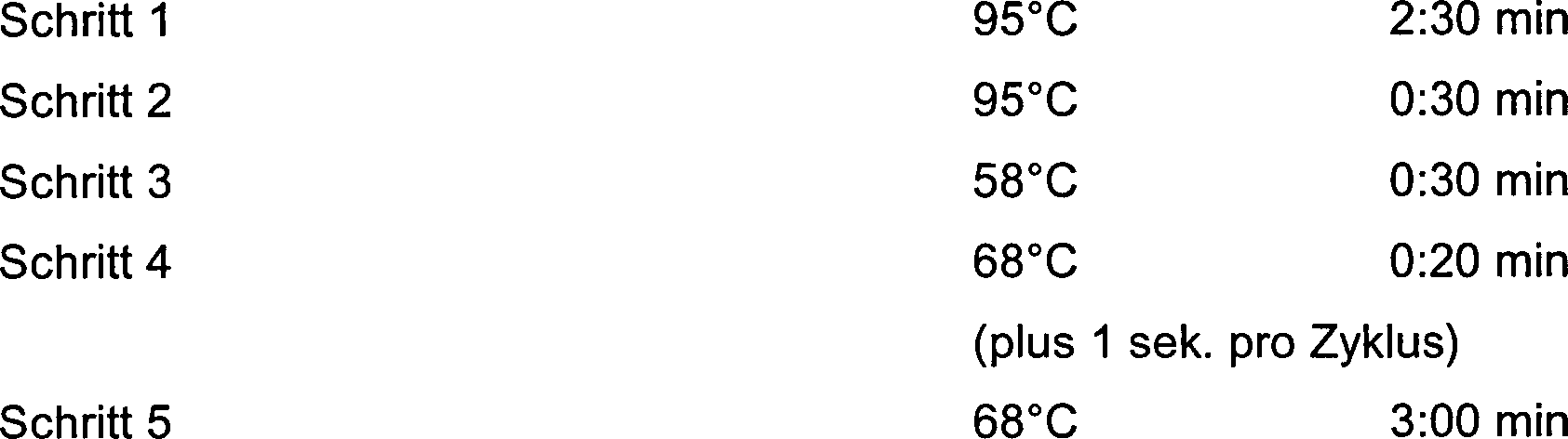
Die Schritte 2 bis 4 wurden 35-mal zyklisch wiederholt.The Steps 2 to 4 were repeated cyclically 35 times.
Beispiel 1: Clonierung der Alternansucrase aus Leuconostoc mesenteroides NRRL-B1355Example 1: Cloning the alternansucrase from Leuconostoc mesenteroides NRRL-B1355
Isolierung und Sequenzierung der AlternansucraseIsolation and sequencing the alternansucrase
Der Stamm Leuconostoc mesenteroides NRRL-B1355 wurde in 1 Liter Lactobacilli MRS Broth (Difco), komplementiert mit 5 % Saccharose, zwei Tage bei 28°C kultiviert. Nach anschließender Zentrifugation der Kultur bei 20.000 × g für 30 Minuten wurde der Überstand mit gleichem Volumen 10%iger Trichloressigsäure versetzt und bei 4°C für 16 Stunden gerührt. Es folgte eine Zentrifugation dieser Lösung bei 10.000 × g für 30 Minuten. Das dadurch erhaltene Präzipitat wurde in 4,5 ml 40 mM Tris-HCl pH 8,8 gelöst und anschließend mit (ca. 0,5 ml) 2 M Tris- Base neutralisiert. Diese Proteinlösung wurde der Firma Toplab Gesellschaft für angewandte Biotechnologie mbH, Martinsried, Deutschland, zur Proteinsequenzierung übergeben. Dort wurde die Proteinlösung elektrophoretisch im SDS-Polyacrylamidgel aufgetrennt, das Gel mit Coomassie-Blue gefärbt und anschließend mit 10 % Essigsäure entfärbt. Zum enzymatischen Verdau des Proteins wurden die Proteinbande aus dem Gel ausgeschnitten, durch ein Sieb gedrückt und zerkleinert (Poren 30 μm × 100 μm). Das zerquetschte Gel wurde dann mit halb konzentriertem Inkubationspuffer (12,5 mM Tris, 0,5 mM EDTA pH 8,5) 2 min gewaschen. Anschließend wurde abzentrifugiert, der Puffer entfernt und 1 h in der "Speedvac" angetrocknet (ca. 5 % Restwasser, gummiartig). Danach wurde eine Lösung aus Endoproteinase LysC in 400 μl 12,5 mM Tris/HCl, pH 8,5 (Enzym:Protein = 1:10) und 0,1 % Laurylmaltosit hergestellt. 200 μl dieser Lösung wurden zur Probe gegeben und über Nacht bei 37°C im Heizblockschüttler inkubiert. Zur Elution der Peptidfragmente wurde für zweimal eine Stunde mit 1 TFA inkubiert, abzentrifugiert und anschließend für 3 h mit 10 % Ameisensäure, 20 % Isopropanol, 60 % Acetonitril eluiert. Die erhaltenen Peptidfragmente wurden dann über HPLC voneinander getrennt (Säule: Superspher 60 RP select B (Merck, Darmstadt), 2 mm × 125 mm; Puffer A 0,1 % Trifluoressigsäure, Puffer B: 0,085 % TFA in Acetonitril; Flußrate: 0,2 ml/min; Gradient: 5–60% in 60 min; Detektion bei 206 nm. Die erhaltenen Peptidfragmente wurden anschließend in einem automatischen Sequenziergerät Procise 492 (Applied Biosystems, PE) sequenziert, und zwar nach dem Verfahren des schrittweisen Edman-Abbaus in einer Modifikation nach Hunkapiller (Hunkapiller et al., Meth. Enzymol. 91, (1983), 399–413).Strain Leuconostoc mesenteroides NRRL-B1355 was cultured in 1 liter of Lactobacilli MRS Broth (Difco) supplemented with 5% sucrose for two days at 28 ° C. After subsequent centrifugation of the culture at 20,000 × g for 30 minutes, the supernatant was treated with the same volume of 10% trichloroacetic acid and stirred at 4 ° C for 16 hours. This solution was then centrifuged at 10,000 × g for 30 minutes. The resulting precipitate was dissolved in 4.5 ml of 40 mM Tris-HCl pH 8.8 and then neutralized with (about 0.5 ml) 2 M Tris base. This protein solution was handed over to the company Toplab Gesellschaft für angewandte Biotechnologie mbH, Martinsried, Germany, for protein sequencing. There was the Separated protein solution electrophoretically in SDS-polyacrylamide gel, the gel stained with Coomassie Blue and then decolorized with 10% acetic acid. For enzymatic digestion of the protein, the protein band was cut out of the gel, forced through a sieve and crushed (pores 30 .mu.m.times.100 .mu.m). The crushed gel was then washed with half-concentrated incubation buffer (12.5 mM Tris, 0.5 mM EDTA pH 8.5) for 2 min. It was then centrifuged off, the buffer was removed and dried for 1 h in the "Speedvac" (about 5% residual water, rubbery). Thereafter, a solution of endoproteinase LysC in 400 μl of 12.5 mM Tris / HCl, pH 8.5 (enzyme: protein = 1:10) and 0.1% lauryl maltitol was prepared. 200 μl of this solution was added to the sample and incubated overnight at 37 ° C. in a hot block shaker. To elute the peptide fragments was incubated for two hours with 1 TFA, centrifuged and then eluted for 3 h with 10% formic acid, 20% isopropanol, 60% acetonitrile. The peptide fragments obtained were then separated from one another by HPLC (column: Superspher 60 RP select B (Merck, Darmstadt), 2 mm × 125 mm, Buffer A 0.1% trifluoroacetic acid, Buffer B: 0.085% TFA in acetonitrile, flow rate: 0, Gradient: 5-60% in 60 min; detection at 206 nm. The peptide fragments obtained were then sequenced in a Procise 492 automatic sequencer (Applied Biosystems, PE) according to the stepwise Edman degradation method a modification according to Hunkapiller (Hunkapiller et al., Meth. Enzymol. 91, (1983), 399-413).
Es wurden sechs verschiedene Peptidsequenzen (s. SEQ ID NO:5 bis 9, SEQ ID NO:21) identifiziert, die als lysC-66, lysC-67, lysC-82, lysC-83, lysC-88 und "N-Terminus" bezeichnet wurden.It were six different peptide sequences (see SEQ ID NO: 5 to 9, SEQ ID NO: 21) identified as lysC-66, lysC-67, lysC-82, lysC-83, lysC-88 and "N-terminus".
Herstellung einer genomischen DNA-Bibliothek aus Leuconostoc mesenteroides NRRL-B1355Producing a genomic DNA library from Leuconostoc mesenteroides NRRL-B1355
Leuconostoc mesenteroides NRRL-B1355 (bezogen von der ATCC) wurde in 100 ml YT-Medium (Sambrook et al, a.a.O.), zusätzlich enthaltend 2 % (Gew./Vol.) Glucose und 50 mM Natriumphosphatpuffer pH 7,0 für 36 h bei 28°C kultiviert.Leuconostoc mesenteroides NRRL-B1355 (purchased from the ATCC) was dissolved in 100 ml YT medium (Sambrook et al., Supra), in addition containing 2% (w / v) Glucose and 50 mM sodium phosphate buffer pH 7.0 for 36 h at 28 ° C.
Nach Ernte der Zellen durch Zentrifugation folgte die Isolierung genomischer DNA nach Ausubel et al. (Current Protocols in Molecular Biology, Band 1, Greene and John Wiley & Sons (1994), USA).To Cropping the cells by centrifugation followed the isolation of genomic DNA according to Ausubel et al. (Current Protocols in Molecular Biology, Volume 1, Greene and John Wiley & Sons (1994), USA).
100 μg genomischer DNA aus Leuconostoc mesenteroides NRRL-B1355 wurden für 30 min mit 0,001 Einheiten des Restriktionsenzyms Sau3A partiell verdaut, anschließend mit Phenol:Chloroform:Isoamylalkohol (25:24:1) extrahiert und mit Ethanol präzipitiert. 2,5 μg der erhaltenen, partiell verdauten DNA aus Leuconostoc mesenteroides NRRL-B1355 wurden mit 1 μg des BamHI geschnittenen und dephosphorylierten Vektors pBKCMVBamHI (Stratagene) mit T4 DNA Ligase unter den vom Hersteller angegebenen Bedingungen (Stratagene, pBK-Phagemidvektoren-Instructions Handbuch & T4-DNA-Ligase-Ligierungskit) ligiert. 2 μl des Ligierungsansatzes wurden mit Gigapack III Gold (Stratagene) nach den Angaben des Herstellers verpackt und nach Ermittlung der Menge an enthaltenen Phagen gelagert.100 μg genomic DNA from Leuconostoc mesenteroides NRRL-B1355 was added for 30 min partially digested with 0.001 units of the restriction enzyme Sau3A, subsequently with phenol: chloroform: isoamyl alcohol (25: 24: 1) and extracted with Ethanol precipitated. 2.5 μg of obtained, partially digested DNA from Leuconostoc mesenteroides NRRL-B1355 were mixed with 1 μg of the BamHI cut and dephosphorylated vector pBKCMVBamHI (Stratagene) with T4 DNA ligase below that indicated by the manufacturer Conditions (Stratagene, pBK-phagemid vectors-Instructions manual & T4 DNA ligase ligation kit) ligated. 2 μl Ligation Approach Using Gigapack III Gold (Stratagene) packed according to the manufacturer's instructions and after determination of the Amount of contained phage stored.
Herstellung der Sonde zur Isolierung des Alternansucrase-GensPreparation of the probe for the isolation of the alternansucrase gene
Aus den nach tryptischem Verdau des gereinigten Alternansucrase-Proteins (siehe oben) erhaltenen Peptidsequenzen lysC-66 (Seq. ID No. 5), lysC-67 (Seq. ID No. 6), lysC-82 (Seq. ID No. 7), lysC-83 (Seq. ID No. 8) und lysC-88 (Seq. ID No. 9) wurden die Peptide lysC-82 und lysC-83 nach reverser Translation für die Synthese von degenerierten Oligonucleotiden (Seq. ID No. 10, SEQ ID NO:11) ausgewählt. Diese Oligonucleotide dienten als Primer in einer PCR-Reaktion bei genomischer DNA von NRRL-B1355. Bei der Primersynthese wurden alle als N dargestellten Positionen in Oligonucleotiden durch Inosin ersetzt.Out after tryptic digestion of the purified alternansucrase protein (see above) obtained peptide sequences lysC-66 (SEQ ID NO: 5), lysC-67 (SEQ ID NO: 6), lysC-82 (SEQ ID NO: 7), lysC-83 (Seq. ID No. 8) and lysC-88 (SEQ ID NO: 9), the peptides were lysC-82 and lysC-83 after reverse translation for the synthesis of degenerate Oligonucleotides (SEQ ID NO: 10, SEQ ID NO: 11). These Oligonucleotides served as primers in a PCR reaction at genomic DNA from NRRL-B1355. In primer synthesis, all were shown as N. Positions in oligonucleotides replaced by inosine.
Reaktionsbedingungen der PCRReaction conditions of PCR
Der Reaktionsansatz wurde mit den zur Taq-Polymerase gelieferten Puffern durchgeführt (Firma Gibco BRL).Of the Reaction batch was reacted with the buffers added to the Taq polymerase carried out (Gibco BRL company).
Reaktionsansatz: Taq-Polymerase
(Gibco) 

40 Wiederholungen der Schritte 2 bis 4.40 Repetitions of steps 2 to 4.
Ein aus dieser PCR-Reaktion resultierendes Fragment von 837 bp Länge (Seq. ID No.12) wurde nach dem Glätten der Enden mit Hilfe von T4-DNA-Polymerase in den Smal geschnittenen pBlueSkript Vektor (Stratagene) cloniert. Das resultierende Plasmid wurde als pAlsu-PCR-lysc82/83 bezeichnet. Nach Sequenzierung des Inserts und computergestützter Translation in die korrespondierenden Proteinsequenzen wurde ein Datenbankvergleich in der Swiss Prot-Datenbank durchgeführt. Dieser Vergleich ergab Homologien zu bekannten Glycosyltransferasen (P49331, P11001, P68987, P13470, P27470, P29336).One fragment of 837 bp length resulting from this PCR reaction (Seq. ID No.12) was after smoothing the ends were cut into the SmaI using T4 DNA polymerase pBlueSkript vector (Stratagene) cloned. The resulting plasmid was referred to as pAlsu-PCR-lysc82 / 83. After sequencing the Inserts and computer-aided Translation into the corresponding protein sequences was performed Database comparison performed in the Swiss Prot database. This Comparison revealed homologies to known glycosyltransferases (P49331, P11001, P68987, P13470, P27470, P29336).
Ca. 5000 Phagen der genomischen DNA-Bibliothek aus Leuconostoc mesenteroides NRRL-B1355 wurden unter Verwendung der vom Hersteller (Stratagene) angegebenen Bakterienstämme und Nährlösungen ausplattiert und nach Inkubation bei 37°C für 12 Stunden auf Nitrocellulosefilter übertragen. Anschließend folgten die Denaturierung der Phagen durch Eintauchen der Nitrozellulosefilter in 1,5 M Natriumchlorid, 0,5 M Natronlauge für 2 Min und die Neutralisierung der Filter durch Eintauchen in 1,5 M Natriumchlorid, 0,5 M Tris-HCl, pH 8,0 für 5 Min. Nach Spülen der Filter in 0,2 M Tris-HCl, 2 × SSC erfolgte die Bindung der Phagen-DNA an die Membranen durch UV-Quervernetzung (Stratalinker der Firma Stratagene, 120000 μJ für 30 sec). Die Filter wurden für 6 h in Prähybridsierungslösung (5 × SSC, 0,5 % BSA, 5 × Denhardt, 1 % SDS, 40 mM Natriumphosphatpuffer, pH 7,2, 100 mg/l Heringssperma-DNA, 25 % Formamid) bei 42°C inkubiert. 30 ng des isolierten Inserts aus dem Plasmid pAlsu-PCR-lysc82/83 wurde mit Hilfe eines Multiprime-Kits (Boehringer Mannheim) unter Einsatz von α-32P-dCTP (ICN Biomedicals) radioaktiv markiert. Diese radioaktive Sonde wurde zu dem Prähybridisierungsgemisch gegeben und die Filter wurden in diesem Hybridisierungsgemisch über Nacht bei 42°C inkubiert. Nach Entfernen des Hybridisierungsgemisch wurden die Filter je dreimal in Waschlösung (0,1 × SSC, 0,5% SDS) bei 55°C für 15 Min gewaschen. Anschließend wurde ein Röntgenfilm (Kodak) für 18 h auf die Filter aufgelegt. Phagenkolonien, die Hybridisierungssignale erzeugten, wurden identifiziert, isoliert, in SM-Medium resuspendiert und anschließend nochmals in solch einer Verdünnung ausplattiert, dass sie als singulär vorliegende Plaques zu erkennen waren. Nach Transfer dieser Phagen auf Nitrocellulosefilter und weiterer Behandlung und Hybridisierung unter wie oben bereits beschriebenen Bedingungen wurden mit Hilfe der verwendeten radioaktiven Gensonde hybridisierende Phagen als Einzelisolate erhalten. Nach in vivo-Excision der isolierten Phagen nach Herstellerangaben (Stratagene) konnten die Clone AS-19B1 und AS-19B2 als Plasmid isoliert werden. Nach der vollständigen Sequenzierung beider Clone (Agowa) (Seq. ID No. 13, SEQ ID NO:14) zeigte sich eine Überlappung dieser beiden Sequenzen von 1008 bp. Durch Aneinanderfügen der SEQ ID NO:13 und 14 konnte nach computergestützter Translation aller möglichen Leserahmen ein durchgehender Leserahmen, beginnend mit dem Codon ATG (entspricht in SEQ ID NO: 1 den Basen 678 bis 680), identifiziert werden. Da in diesem zusammengesetzten Leserahmen kein Stop-Codon zu finden war, wurden, um die codierende Sequenz der Alternansucrase vollständig zu erhalten, weitere Clone isoliert.Approximately 5000 phages of the genomic DNA library from Leuconostoc mesenteroides NRRL-B1355 were plated out using the bacterial strains and nutrient solutions indicated by the manufacturer (Stratagene) and transferred to nitrocellulose filters after incubation at 37 ° C. for 12 hours. Then the denaturation of the phages was followed by immersion of the nitrocellulose filters in 1.5 M sodium chloride, 0.5 M sodium hydroxide solution for 2 min and neutralization of the filters by immersion in 1.5 M sodium chloride, 0.5 M Tris-HCl, pH 8, 0 for 5 min. After rinsing the filters in 0.2 M Tris-HCl, 2 × SSC, the binding of the phage DNA to the membranes was carried out by UV cross-linking (Stratalinker from Stratagene, 120000 μJ for 30 sec). The filters were incubated for 42 hr in pre-hybridization solution (5 x SSC, 0.5% BSA, 5 x Denhardt, 1% SDS, 40 mM sodium phosphate buffer, pH 7.2, 100 mg / l herring sperm DNA, 25% formamide) at 42 ° C incubated. 30 ng of the isolated insert from plasmid pAlsu-PCR-lysc82 / 83 was radiolabeled using a multiprime kit (Boehringer Mannheim) using α- 32 P-dCTP (ICN Biomedicals). This radioactive probe was added to the prehybridization mixture and the filters were incubated in this hybridization mixture overnight at 42 ° C. After removal of the hybridization mixture, filters were washed three times each in wash solution (0.1X SSC, 0.5% SDS) at 55 ° C for 15 min. Subsequently, an X-ray film (Kodak) was placed on the filters for 18 hours. Phage colonies that generated hybridization signals were identified, isolated, resuspended in SM medium and then plated out again in such a dilution that they were recognizable as singular plaques. After transfer of these phages to nitrocellulose filters and further treatment and hybridization under conditions as described above, hybridizing phage were obtained as single isolates using the radioactive gene probe used. After in vivo excision of the isolated phage according to the manufacturer (Stratagene), the clones AS-19B1 and AS-19B2 were isolated as a plasmid. After complete sequencing of both clones (Agowa) (SEQ ID NO: 13, SEQ ID NO: 14), there was an overlap of these two sequences of 1008 bp. By joining the SEQ ID NO: 13 and 14, a continuous reading frame, starting with the codon ATG (corresponding to bases 678 to 680 in SEQ ID NO: 1) could be identified after computer-assisted translation of all possible reading frames. Since no stop codon was found in this composite reading frame, additional clones were isolated to fully preserve the coding sequence of alternansucrase.
Daher
wurden nochmals, wie bereits oben beschrieben, ca. 5000 Phagen der
genomischen DNA-Bibliothek aus L. mesenteroides NRRL-B1355 auf Hybridisierung
mit einem mittels Multiprime-Kit (Boehringer Mannheim) radioaktiv
markierten Subfragment des Clons AS-19B2 hin untersucht. Für die Herstellung
der Hybridisierungssonde wurde das HindIII (Schnittstelle im Insert
von AS-19B2)/SalI-(schneidet
im Polylinker des Phagmidvektors pBKCMV)-Fragment aus AS-19B2 eingesetzt.
Dieses Fragment enthält
372 Basen des 3'-Endes
der für
den oben beschriebenen Leserahmen codierenden Sequenzen. Die Durchmusterung
der Phagenbibliothek, die Vereinzelung sowie die Überführung der
Phagen in Plasmide erfolgte unter den oben beschriebenen Bedingungen.
Nach vollständiger
Sequenzanalyse der so isolierten Clone AS-28B (s. SEQ ID NO:15) und
AS-29Ba (SEQ ID NO:16) konnte zwischen den Clonen AS-19B2 (SEQ ID
NO:14) und AS-28B
eine Überlappung
von 960 identischen Basen (entspricht in SEQ ID NO:1 den Basen 4863
bis 5823) und zwischen den Clonen AS-19B2 und AS-29Ba (SEQ ID NO:16)
von 567 identische Basen (entspricht in SEQ ID NO:1 den Basen 5256
bis 5823) identifiziert werden. Die Clone AS-28B und AS-29Ba weisen
zueinander 1523 identische Basen (entspricht in SEQ ID NO:1 den
Basen 5256 bis 6779) auf. Nach computergestütztem Zusammenfügen der
Clone AS-19B1, AS19-B2 und AS-28B zeigte sich ein durchgehender
Leserahmen, beginnend mit dem Codon ATG (Basen 678 bis 680 der kompletten
Sequenz). Dieser Leserahmen enthält
ebenfalls kein Stop-Codon. Nach Zusammenfügen der Clone AS-19B1, AS-19B2,
AS-28B und AS-29Ba konnte ein mit dem Codon "ATG" (entspricht
in SEQ ID NO:1 den Basen 678 bis 680) beginnender und mit "TAA" (entspricht in SEQ
ID NO:1 den Basen 6849 bis 6851) endender Leserahmen, codierend
für 2057
Aminosäuren
identifiziert werden. Zusätzlich
zu der codierenden Region enthält
die gesamte isolierte und identifizierte DNA-Sequenz der zusammengesetzten
Clone (SEQ ID No. 13–16)
677 Basen im 5'-Bereich
und 2469 Basen im 3'-Bereich,
die nicht für Alternansucrase
codierende Sequenzen darstellen (s.
Beispiel 2: Konstruktion des Plasmids pAlsu-pSK zur Transformation von E. coli und Test der Proteinextrakte auf enzymatische AktivitätExample 2: Construction of the plasmid pAlsu-pSK for the transformation of E. coli and test of Protein extracts for enzymatic activity
Die
Plasmide AS-19B1, AS-19B2, AS-28B und AS-29Ba (s. Beispiel 1) wurden
in folgender Weise zusammengefügt:
es wurde ein NotI-(Restriktionsschnittstelle im Polylinker des Vektors
pBK CMV, Firma Novagen)/ClaI-Fragment des Clons AS-19B1 in den Vektor
pBluescript SK (Firma Stratagene) in gleiche Schnittstellen eingefügt (= erster
Clonierungsschritt). Durch aufeinanderfolgende Insertion des ClaI/XhoI-Fragmentes aus
AS-19B2, des XhoI/MluI-Fragmentes aus AS-28B und des MluI/BsaB1-(BsaBi-geschnittenes
Fragment in die geglätteten
Enden der ApaI-Schnittstelle des Vektors cloniert)Fragmentes aus
AS-28B in den aus dem ersten Clonierungsschritt erhaltenen Clon
wurde das Plasmid pAlsu-pSK (s.
Anschließend wurde das Plasmid pAlsu-pSK in E. coli (DH5α Firma Fermentas) transformiert: die Bakterien wurden dann für 2 Tage bei 27° C in 50 ml "Teriffic broth" (Zusammensetzung beschrieben in Sambrook et al., Molecular Cloning, A Laboratory Manual, 2. Aufl. (1989) Cold Spring Harbor Laboratory Press, Cold Spring Harbor, NY (ergänzt mit 0,5% Glucose)) oder in einem Fermentationsmedium folgender Zusammensetzung kultiviert: KH2PO4 1,5 g/l, (NHa)2SO4 5,0 g, NaCl 0,5 g/l, Na-Citrat 1,0 g/l, Fe2+SO4 × 7 H2O 0,075 g/l, Hefeextrakt 0,5 g/l, Trypton 1,0 g/l, Glucose 15,0 g/l, MgSO4 × 7, H2O 0,3 g/l, CaCl2 × 2 H2O 0,014 g/l, Mineralsalze 10 ml/l, H3BO3 2,5 g/l, CoCl2 × 6 H2O 0,7 g/l, CuSO4 × 5 H2O 0,25 g/l, MnCl2 × 4 H2O 1,6 g/l, ZnSO4 × 7 H2O 0,3 g/l, Na2MoO4 × 2 H2O 0,15 g/l, Vitamin B1 (Thiamin) 0,005 g/l.Subsequently, the plasmid pAlsu-pSK was transformed into E. coli (DH5α company Fermentas): the bacteria were then incubated for 2 days at 27 ° C in 50 ml of "Teriffic broth" (composition described in Sambrook et al., Molecular Cloning, A Laboratory Manual, 2nd Ed. (1989) Cold Spring Harbor Laboratory Press, Cold Spring Harbor, NY (supplemented with 0.5% glucose)) or cultured in a fermentation medium of the following composition: KH 2 PO 4 1.5 g / l, ( NHa) 2 SO 4 5.0 g, NaCl 0.5 g / l, Na citrate 1.0 g / l, Fe 2+ SO 4 × 7 H 2 O 0.075 g / l, yeast extract 0.5 g / l , Tryptone 1.0 g / l, glucose 15.0 g / l, MgSO 4 × 7, H 2 O 0.3 g / l, CaCl 2 × 2 H 2 O 0.014 g / l, mineral salts 10 ml / l, H 3 BO 3 2.5 g / l, CoCl 2 × 6 H 2 O 0.7 g / l, CuSO 4 × 5 H 2 O 0.25 g / l, MnCl 2 × 4 H 2 O 1.6 g / l, ZnSO 4 × 7 H 2 O 0.3 g / l, Na 2 MoO 4 × 2 H 2 O 0.15 g / l, vitamin B1 (thiamine) 0.005 g / l.
Alle Kulturen enthielten 100 mg/l Ampicillin. Danach wurden die Zellen durch Zentrifugation geerntet, in 2 ml 50 mM Na-Phosphatpuffer pH 7,2 resuspendiert und mit Hilfe einer French-Press aufgeschlossen. Durch anschließende erneute Zentrifugation wurden feste Bestandteile der aufgeschlossenen Zellen abgetrennt, und der Überstand (im Folgenden als (Protein) extrakt bezeichnet, nach Sterilfiltration (Sterivex GV 0,2 μm, Millipore) für weitere Analysen verwendet.All Cultures contained 100 mg / l ampicillin. After that, the cells were harvested by centrifugation, in 2 ml of 50 mM Na phosphate buffer pH 7.2 resuspended and unlocked with the help of a French press. By subsequent re-centrifugation became solid components of the digested Cells separated, and the supernatant (hereinafter referred to as (protein) extract, after sterile filtration (Sterivex GV 0.2 μm, Millipore) for used further analyzes.
In vitro-Herstellung von Alternan mittels ProteinextraktenIn vitro production of Alternan using protein extracts
Je
200 μl der
erhaltenen Extrakte wurden zur in-vitro-Herstellung von Alternan
in jeweils 2 ml 100 mM Na-Citrat-Puffer pH 6,5 und 20 % (Gew./Vol.)
Saccharose in An- bzw. in Abwesenheit von 100 μl 10 mM Maltose auf Aktivität hin untersucht.
Das Reaktionsgemisch wurde 24 h bei 37°C inkubiert. Bei anschließender Fällung mit
einem gleichen Volumen Ethanol konnte in Abwesenheit von Maltose
kein präzipitierbares
Polymer nachgewiesen werden. In dem Ansatz, der Maltose enthielt,
konnte mittels HPLC-Chromatographie (Dione-PA-100-Säule, Laufpuffer
150 mM NaOH, Elutionspuffer 150 mM NaOH + 3 M-Natriumacetat-Puffer-Gradient) die Bildung
von Oligomeren (s.
Aktivitätsgelactivity gel
Je 20 ml der einzelnen Proteinextrakte wurden auf ein 6%iges SDS-PAA-Gel aufgetragen und bei einer Stromstärke von 20 mA je Gel aufgetrennt. (Vor dem Beladen der Gele wurden die Extrakte nicht bei 95°C inkubiert). Anschließend wurden die Extrakte nach der Methode von Miller und Robyt (Analytical Biochemistry 156,(1986), 357–363) auf Sucrase-Aktivität hin untersucht.Each 20 ml of the individual protein extracts were applied to a 6% SDS-PAA gel and separated at a current of 20 mA per gel. (Before loading the gels, the extracts did not reach 95 ° C incubated). Subsequently, the extracts were assayed for sucrase activity by the method of Miller and Robyt (Analytical Biochemistry 156, (1986), 357-363).
Die Kontrolle (Dextransucrase NRRL-B-512F, Herstellung siehe Beispiel 3) zeigte polymerisierende Aktivität. Die Proteinextrakte der oben beschriebenen E. coli-Zellen, die das Plasmid pAlsu-pSK enthalten, zeigten keine polymerbildende Aktivität.The Control (dextransucrase NRRL-B-512F, preparation see example 3) showed polymerizing activity. The protein extracts of E. coli cells described above, containing the plasmid pAlsu-pSK showed no polymer-forming Activity.
Beispiel 3: Clonierung und Expression der Dextransucrase aus Leuconostoc mesenteroides NRRL-B512FExample 3: Cloning and expression of dextransucrase from Leuconostoc mesenteroides NRRL-B512F
Isolierung genomischer DNAIsolation of genomic DNA
Leuconostoc mesenteroides NRRL-B512F (bezogen von ATCC) wurde in YT-Medium (Sambrook et al., Molecular Cloning: A Laboratory Course Manual, 2. Ausgabe (1989), Cold Spring Harbor Press, New York), enthaltend zusätzlich 1 % Saccharose und 50 mM Natriumphosphatpuffer pH 7,0, bei 28°C für 48 h kultiviert. Nach Ernte der Zellen durch Zentrifugation wurde genomische DNA nach Ausubel et al. (Current Protocols In Molecular Biology, Band 1, Greene and John Wiley & Sons (1994), USA) isoliert.Leuconostoc mesenteroides NRRL-B512F (purchased from ATCC) was purified in YT medium (Sambrook et al., Molecular Cloning: A Laboratory Course Manual, 2nd Edition (1989), Cold Spring Harbor Press, New York), containing in addition 1 % Sucrose and 50 mM sodium phosphate buffer pH 7.0, cultured at 28 ° C for 48 h. To Cropping the cells by centrifugation was after genomic DNA Ausubel et al. (Current Protocols In Molecular Biology, Volume 1, Greene and John Wiley & Sons (1994), USA).
PCR-Amplifikation des Dextransucrase-Gens und Clonierung in pET24aPCR amplification of the Dextransucrase gene and cloning in pET24a
Für die rekombinante Expression der Dextransucrase in E. coli wurde das die Dextransucrase codierende Gen nach Amplifikation mittels PCR in den Expressionsvektor pET24a (Novagen) cloniert. Dazu wurde mit den verwendeten PCR Primern (5'b512-1: 5'-ACTgCggCCgCATgCCATTTACAgAAAAAg-3'; SEQ ID NO: 3 und 3'b512: 5'-ACTgCTCgAgTTATgCTgACACAgCATTTC-3'; SEQ ID NO: 4), abgeleitet von der Sequenz aus WO 89/12386 am 5'-Ende der für die Dextransucrase codierenden Sequenzen eine EagI-Restriktionsschnittstelle und am 3'-Ende eine XhoI-Restriktionsschnittstelle eingeführt. Die anschließende Clonierung erfolgte in entsprechende Restriktionsschnittstellen des Polylinkers von pET24a. Das resultierende Plasmid wurde mit UL5-20 bezeichnet.For the recombinant Expression of Dextransucrase in E. coli became the dextransucrase encoding gene after amplification by PCR in the expression vector pET24a (Novagen). This was done with the PCR primers used (5'b512-1: 5'-ACTgCggCCgCATgCCATTTACAgAAAAg-3 '; SEQ ID NO: 3 and 3'b512: 5'-ACTgCTCgAgTTATgCTgACACAgCATTTC-3 '; SEQ ID NO: 4), derived from the sequence of WO 89/12386 at the 5'-end of the dextransucrase coding Sequences an EagI restriction site and at the 3 'end an XhoI restriction site introduced. The subsequent Cloning took place in appropriate restriction sites of the polylinker of pET24a. The resulting plasmid was washed with Designated UL5-20.
Reaktionsbedingungen der PCRReaction conditions of PCR
Es
wurden Puffer und Polymerase der Firma Gibco BRL verwendet: 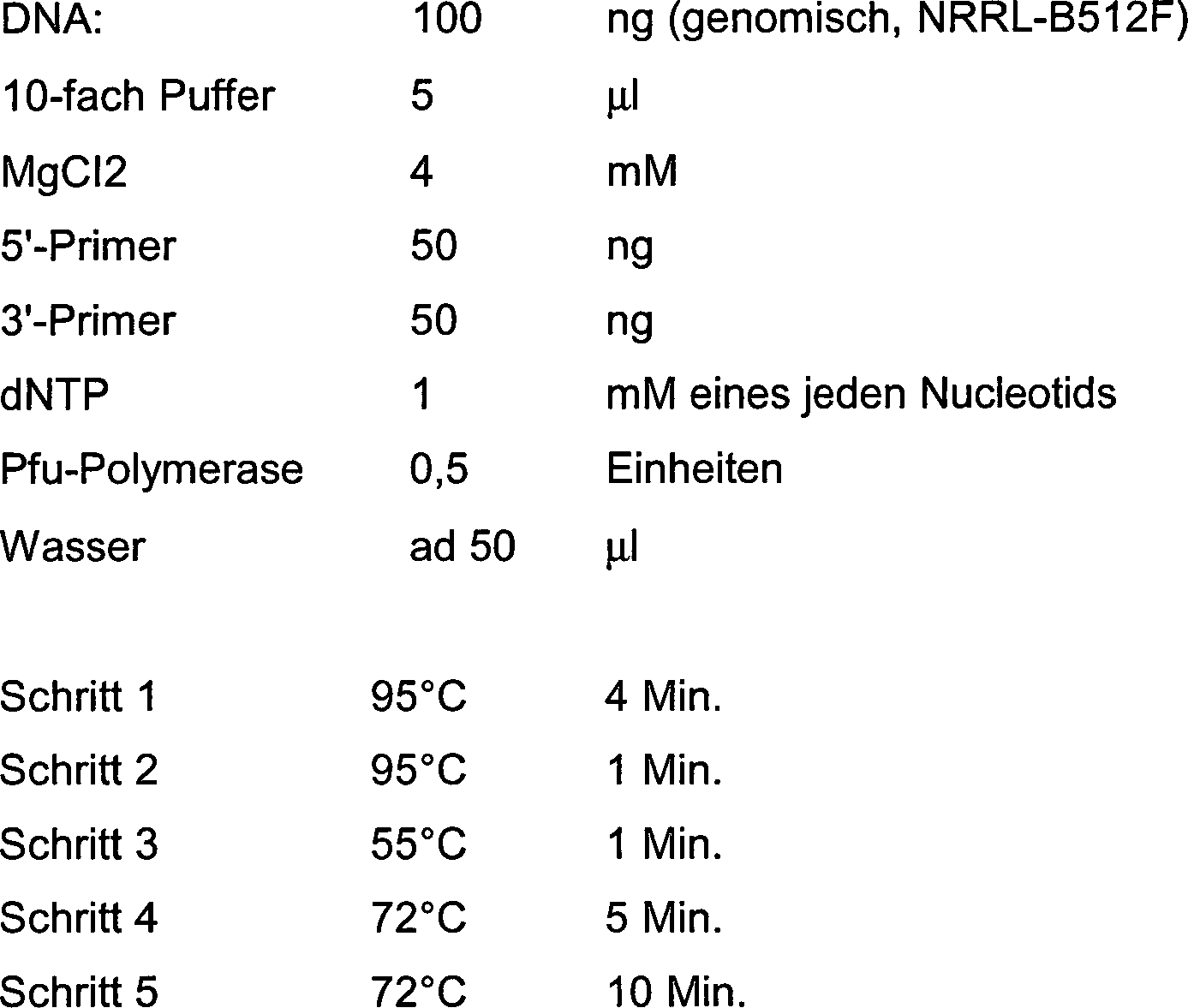
Es wurden 40 Wiederholungen zwischen Schritt 2 und 4 durchgeführt.It 40 repetitions were performed between steps 2 and 4.
Herstellung rekombinanter DextransucraseProduction of recombinant dextransucrase
BL21(DE3)-E. coli-Zellen, enthaltend das Plasmid UL5-20, wurden in YT-Medium (s.o.) bei 37°C bis zu einer OD600 = 0,8 kultiviert. Anschließend erfolgte die Induktion der Zellen mit 0,2 mM IPTG und weitere Kultivierung für 24 h bei 18°C. Nach der Ernte der Zellen durch Zentrifugation und Resuspension in Natriumphosphatpuffer pH 5.2 folgte der Aufschluss der Zellen in einer French-Presse. Die erhaltene Lösung wurde durch Zentrifugation von unlöslichen Bestandteilen befreit und der Überstand, der die Dextransucrase enthält und im folgenden als Extrakt bezeichnet wird, gewonnen.BL21 (DE3) E. coli cells containing the plasmid UL5-20 were cultured in YT medium (see above) at 37 ° C to an OD 600 = 0.8. Subsequently, the cells were induced with 0.2 mM IPTG and further cultivation for 24 h at 18 ° C. After harvesting the cells by centrifugation and resuspension in sodium phosphate buffer pH 5.2, the cells were disrupted in a French press. The resulting solution was freed of insoluble matter by centrifugation, and the supernatant containing the dextran caster, hereinafter referred to as extract, was recovered.
Beispiel 4: PCR-Amplifikation der codierenden Region der Alternansucrase und Clonierung in pET24aExample 4: PCR amplification the coding region of the alternansucrase and cloning in pET24a
Die
codierende Region der Alternansucrase wurde in einer PCR-Reaktion
(Reaktionsbedingugen: siehe unten) mit genomischer DNA aus dem Leuconostoc
mesenteroides-Stamm NRRL B-1355 als Matrize amplifiziert. Über die
Primer A1-4 (SEQ
ID NO:18) wurde am 5'-Ende
eine NheI-Restriktionsschnittstelle, über den Primer A1-5 (SEQ ID
NO:19) am 3'-Ende
eine SalI-Restriktionsschnittstelle eingefügt. Es wurde ein ca. 6200 bp
großes
Fragment isoliert.
AI-4: 5'-GGG
CCC GCT AGC ATG AAA CAA CAA GAA ACA GT
AI-5: 5'-CCC GGG GTC GAC
CTT TGT CGA ATC CTT CCC Reaktionsbedingungen
der PCR (Kit der Firma Gibco BRL):
AI-4: 5'-GGG CCC GCT AGC ATG AAA CAA CAA GAA ACA GT
AI-5: 5'-CCC GGG GTC GAC CTT TGT CGA ATC CTT CCC PCR reaction conditions (Kit from Gibco BRL):
Vor der Durchführung von Schritt 5 wurden die Schritte 2 bis 4 insgesamt 35-mal wiederholt.In front the implementation from step 5, steps 2 through 4 were repeated a total of 35 times.
Das
erhaltene PCR-Fragment wurde nach Standardverfahren aufgereinigt,
mit den Restriktionsendonukleasen NheI und SalI behandelt, in einen
ebenfalls mit diesen Enzymen geschnittenen pET24a-Vektor (Firma
Novagen) ligiert und das Ligierungsprodukt in E. coli transformiert.
Nach Plasmidpräparation
und Restriktionsverdau wurden drei positive Clone selektiert. Diese
erhielten die Bezeichnungen pAlsu-pET24a-3, pAlsu-pET24a-7 bzw.
pAlsu-pET24a-21 (s.
Beispiel 5: Expression der rekombinanten Alternansucrase in E. coli in Schüttelkolbenkulturen und im FermenterExample 5: Expression recombinant alternansucrase in E. coli in shake flask cultures and in the fermenter
Schüttelkolbenkulturshake flask
Die Plasmide pAlsu-pET24a-3, pAlsu-pET24a-7, pAlsu-pET24a-21 und pET24a wurden in E. coli BL21(DE3), Firma Novagen, transformiert und nach anfänglicher Anzucht in 3 ml YT-Medium (Sambrook et al., Molecular Cloning, A Laboratory Manual, 2. Ausgabe (1989) Cold Spring Harbor Laboratory Press, Cold Spring Harbor, NY) für 3 Stunden bei 37°C im Schüttelkolben jeweils in 2 Replika-Ansätzen in je 50 ml Davis-Minimalmedium (DIFCO Manual, Dehydrated Culture Media and Reagents for Microbiology, 10. Ausgabe, Detroit Michigan, USA (1984)), enthaltend 0,2% Glucose statt Dextrose als Kohlenstoffquelle, bei 37°C bis zu einer OD600 von ca. 0,8 kultiviert. Nach Zentrifugation und Resuspension folgte die Kultivierung einer der beiden Replikakulturen in Davis Minimal Medium (DMA), enthaltend 1 % Lactose als Kohlenstoffquelle und Induktor, für weitere 16 h bei 27°C. Die Zellen der einzelnen Kulturen wurden nach Zentrifugation geerntet, in 50 mM Natriumacetatpuffer pH 5,3 resuspendiert und ein Proteinextrakt wurde, wie in Beispiel 2 beschrieben, hergestellt.The plasmids pAlsu-pET24a-3, pAlsu-pET24a-7, pAlsu-pET24a-21 and pET24a were transformed into E. coli BL21 (DE3), Novagen, and after initial culture in 3 ml of YT medium (Sambrook et al. , Molecular Cloning, A Laboratory Manual, 2nd Ed. (1989) Cold Spring Harbor Laboratory Press, Cold Spring Harbor, NY) for 3 hours at 37 ° C in a shake flask in each case in 2 replicate batches in 50 ml Davis minimal medium (DIFCO Manual, Dehydrated Culture Media and Reagents for Microbiology, 10th edition, Detroit Michigan, USA (1984)) containing 0.2% glucose instead of dextrose as a carbon source, cultured at 37 ° C to an OD 600 of about 0.8 , Centrifugation and resuspension were followed by cultivation of one of the two replica cultures in Davis Minimal Medium (DMA) containing 1% lactose as carbon source and inducer for a further 16 h at 27 ° C. The cells of the individual cultures were harvested after centrifugation, resuspended in 50 mM sodium acetate buffer pH 5.3, and a protein extract was prepared as described in Example 2.
Fermenterfermenter
Der Clon pAlsu-pET24a-21, transformiert in E. coli BL21(DE3), wurde in einem 2 l-Fermenter (Biostad B; B. Braun, Melsungen) unter folgenden Bedingungen kultiviert:Of the Clone pAlsu-pET24a-21 transformed in E. coli BL21 (DE3) in a 2 l fermenter (Biostad B, B. Braun, Melsungen) under the following conditions:
Medium:Medium:
- Fermentationsmedium: KH2PO4 1,5 g/l, (NH4)2SO4 5,0 g/l, NaCl 0,5 g/l, Na-Citrat 1,0 g/l, Fe2+SO4 × 7 H2O 0,075 g/l, Hefeextrakt 0,5 g/l, Trypton 1,0 g/l, Glucose 15,0 g/l, MgSO4 × 7 H2O 0,3 g/l, CaCl2 × 2 H2O 0,014 g/l, Mineralsalze 10 ml/l, H3BO3 2,5 g/l, CoCl2 × 6 H2O 0,7 g/l, CuSO4 × 5 H2O 0,25 g/l, MnCl2 × 4 H2O 1,6 g/l, ZnSO4 × 7 H2O 0,3 g/l, Na2MoO4 × 2 H2O 0,15 g/l, Vitamin B1 (Thiamin) 0,005 g/lFermentation medium: KH 2 PO 4 1.5 g / l, (NH 4 ) 2 SO 4 5.0 g / l, NaCl 0.5 g / l, Na citrate 1.0 g / l, Fe 2 + SO 4 × 7 H 2 O 0.075 g / l, yeast extract 0.5 g / l, tryptone 1.0 g / l, glucose 15.0 g / l, MgSO 4 × 7 H 2 O 0.3 g / l, CaCl 2 × 2 H 2 O 0.014 g / l, mineral salts 10 ml / l, H 3 BO 3 2.5 g / l, CoCl 2 × 6 H 2 O 0.7 g / l, CuSO 4 × 5 H 2 O 0, 25 g / l, MnCl 2 × 4 H 2 O 1.6 g / l, ZnSO 4 × 7 H 2 O 0.3 g / l, Na 2 MoO 4 × 2 H 2 O 0.15 g / l, vitamin B1 (thiamine) 0.005 g / l
- Kohlenstoffquelle: Glucose (1,5% (Gew./Vol.)) im Medium vorgelegt, 70% (Gew./Vol.) Glucoselösung wird zugefüttert.Carbon source: glucose (1.5% (w / v)) in the medium, 70% (w / v) glucose solution is fed.
Automatische pH-Kontrolle mit Ammoniak und Phosphorsäure bei pH 7,0 +/– 0,1 Über die Kontrolle des Rührers wird eine pO2-Konzentration im Medium von 20 % eingestellt.Automatic pH control with ammonia and phosphoric acid at pH 7.0 +/- 0.1 The control of the stirrer sets a pO 2 concentration in the medium of 20%.
Bedingungen:Conditions:
1,5 l-Fermentationsmedium wurden mit 50 ml Vorkultur angeimpft.1.5 L fermentation medium was inoculated with 50 ml of preculture.
Die Zellen wurden zunächst bei 37°C kultiviert, bis die vorgelegte Glucose aufgebraucht war. Danach erfolgte Kultivierung bei gleicher Temperatur bei einer Fütterungsrate von 9 g Glucose × I–1 × h–1, bis eine OD600 = 40 erreicht war. Zu diesem Zeitpunkt wurde die Temperatur der Kulturbrühe auf 20°C und die Fütterungsmenge an Glucose auf 2 g × I–1 × h–1 gesenkt. Bei einer Temperatur von 20°C erfolgte in der Kultur die Induktion der Kultur mit 0,2 mM IPTG (Isopropyl-β-D-Thiogalactopyranosid (Sigma)). Nach Kultivierung für weitere 18 h bei 20°C wurden die Zellen nach Zentrifugation geerntet, in 50 mM Natriumphosphatpuffer pH 5,3 resuspendiert und ein Extrakt wurde, wie in Beispiel 2 beschrieben, hergestellt.The cells were first cultured at 37 ° C until the charge of glucose was exhausted. Thereafter, cultivation was carried out at the same temperature at a feeding rate of 9 g glucose × I -1 × h -1 until an OD 600 = 40 was reached. At this time, the temperature of the culture broth was lowered to 20 ° C and the feeding amount of glucose to 2 g × I -1 × h -1 . At a temperature of 20 ° C culture was induced to induce culture with 0.2 mM IPTG (isopropyl-β-D-thiogalactopyranoside (Sigma)). After culturing for a further 18 h at 20 ° C, the cells were harvested after centrifugation, resuspended in 50 mM sodium phosphate buffer pH 5.3, and an extract prepared as described in Example 2.
Beispiel 6: Nachweis der Aktivität der rekombinanten Alternansucrase mittels SDS-PAGE, Periodsäureoxidation und Färbung nach SchiffExample 6: Evidence of activity recombinant alternansucrase by SDS-PAGE, periodic acid oxidation and coloring after ship
Es wurden Proteinextrakte aus E. coli-Schüttelkolbenkulturen (Stamm BL21(DE3)), enthaltend die Plasmide pAlsu-pET24a-3, pAlsu-pET24a-7, pAlsu-pET24a-21 bzw. pET24a (Kontrolle), hergestellt. Von den mit den verschiedenen Extrakten transformierten Zellen wurden jeweils zwei verschiedene Extrakte präpariert, wobei der eine vor der Induktion mit IPTG und der andere nach der Induktion mit IPTG am Ende der Kultivierung hergestellt wurde. Die Aktivität dieser Extrakte aus Schüttelkolbenkulturen (s. Beispiel 5) wurde nach Auftrennung der Proteine durch SDS-PAGE, anschließendem Entfernen des SDS durch Waschen mit 50 mM Natriumacetatpuffer pH 5,3 und Inkubation der Gele in 50 mM Natriumacetat pH 5,3, 5% (Gew./Vol.) Saccharose für 16 h bei 37°C, gefolgt von einer Periodsäureoxidation des gebildeten Polymers und einer Anfärbung mittels saurem Schiff-Reagenz nachgewiesen (Miller und Robyt, Analytical Biochemistry 156, (1986), 357–363).It were protein extracts from E. coli shake flask cultures (strain BL21 (DE3)), containing the plasmids pAlsu-pET24a-3, pAlsu-pET24a-7, pAlsu-pET24a-21 and pET24a, respectively (Control). From the ones with the different extracts transformed cells were each two different extracts prepared, wherein one before induction with IPTG and the other after induction was prepared with IPTG at the end of the cultivation. The activity of this Extracts from shake flask cultures (see Example 5) after separation of the proteins by SDS-PAGE, followed by Remove the SDS by washing with 50 mM sodium acetate buffer pH 5.3 and incubation of the gels in 50 mM sodium acetate pH 5.3, 5% (w / v) Sucrose for 16 h at 37 ° C, followed by periodic acid oxidation the polymer formed and staining by acid Schiff reagent demonstrated (Miller and Robyt, Analytical Biochemistry 156, (1986), 357-363).
Vor der Induktion mit IPTG wurden solche Aktivitätsbanden nicht gefunden.In front induction with IPTG, such activity bands were not found.
Da das im Gel gebildete Polymer mit den oben beschriebenen Methoden mittels saurem Schiff-Reagenz angefärbt werden kann, ist zu vermuten, dass das Polymer nicht aus reinen -1,3-verknüpften Einheiten, die zu keiner Färbung führen würden, bestehen kann.There the polymer formed in the gel by the methods described above can be stained by acid Schiff reagent, it can be assumed that the polymer does not consist of pure -1,3-linked units that are not coloring to lead would can exist.
Da das in den Vektoren pAlsu-pET24a-3, pAlsu-pET24a-7 bzw. pAlsu-pET24a-21 enthaltene Gen aus dem Leuconostoc mesenteroides-Stamm NRRL B-1355 isoliert worden ist, der neben der Alternansucrase mindestens eine Dextransucrase exprimiert, konnte mit Hilfe dieser Färbemethode nicht eindeutig bestimmt werden, ob die im Plasmid enthaltene Nucleinsäuresequenz tatsächlich für eine Alternansucrase codiert. Sowohl Dextrane als auch Alternane sind mit dieser Methode nachweisbar, weil beide Polymere α-1,6-Verknüpfungen enthalten.There that in the vectors pAlsu-pET24a-3, pAlsu-pET24a-7 and pAlsu-pET24a-21, respectively contained gene from the Leuconostoc mesenteroides strain NRRL B-1355 has been isolated, in addition to the Alternansucrase at least one Dextransucrase could be expressed by this staining method not clearly determine whether the nucleic acid sequence contained in the plasmid indeed for one Alternansucrase encoded. Both dextrans and alternans are detectable with this method because both polymers have α-1,6 linkages contain.
Beispiel 7: Untersuchungen zur enzymatischen Aktivität rekombinant hergestellter Alternansucrasen nach Wärmebehandlung und zur Spezifität der AlternansucraseExample 7: Studies for enzymatic activity recombinantly produced alternansucrases after heat treatment and to specificity the alternansucrase
Um polymerisierende Aktivitäten nachzuweisen, wurden Extrakte aus Schüttelkolbenkulturen eingesetzt (vgl. Beispiel 5). 100 μl Extrakt wurden zu jeweils 2 ml Reaktionspuffer (50 mM Natriumacetat pH 5,3, 20 % Saccharose) gegeben und bei 37°C für 24 h inkubiert. Zum Vergleich wurde ein durch Behandlung für 10 Min. bei 95°C inaktivierter Extrakt und ein Extrakt aus E. coli BL21(DE3), enthaltend den Vektor pET24a, verwendet. Polymerbildung konnte nur im nicht inaktivierten Ansatz beobachtet werden, wohingegen der für 10 Minuten bei 95°C behandelte Ansatz und der Ansatz mit Extrakt aus BL21(DE3), enthaltend pET24a, zu keiner Polymerbildung führte. Nach Zugabe des gleichen Volumens Ethanol abs. zu allen Ansätzen konnten nur im nicht inaktivierten Ansatz Polymere ausgefällt werden. Diese Beobachtung ist ein deutlicher Hinweis auf die Aktivität der Alternansucrase, da die in NRRL B-1355 vorhandene Dextransucrase durch Behandlung für 30 Min. bei 45°C inaktiviert wird, die Alternansucrase hingegen unter diesen Bedingungen aktiv bleibt. (Lopez-Munguia et al., Enzyme Microb. Technol. 15 (1993), 77–85). Durch enzymatische Bestimmung der freigesetzten Glucose und Fructose bzw. der noch im Reaktionsgemisch enthaltenen Saccharose nach 24 h mittels gekoppeltem enzymatischem Test konnte nur im nicht inaktivierten Extrakt Fructose nachgewiesen werden.Around polymerizing activities To detect, extracts of shake flask cultures were used (see Example 5). 100 μl Extract was added to each 2 ml of reaction buffer (50 mM sodium acetate pH 5.3, 20% sucrose) and incubated at 37 ° C for 24 h. For comparison became a through treatment for 10 min. At 95 ° C inactivated extract and an extract of E. coli BL21 (DE3) containing the vector pET24a, used. Polymer formation could only in the not inactivated approach, whereas that for 10 minutes at 95 ° C treated approach and the extract with extract of BL21 (DE3), containing pET24a, did not lead to polymer formation. After adding the same Volume of ethanol abs. to all approaches could only in not inactivated Approach polymers precipitated become. This observation is a clear indication of the activity of alternansucrase, since the dextransucrase present in NRRL B-1355 can be treated by treatment for 30 minutes at 45 ° C In contrast, the alternansucrase is inactivated under these conditions remains active. (Lopez-Munguia et al., Enzyme Microb. Technol. 15 (1993), 77-85). By enzymatic determination of the released glucose and fructose or the sucrose still contained in the reaction mixture after 24 h by coupled enzymatic test could only in the non-inactivated Extract fructose be detected.
Zur Durchführung des enzymatischen Tests wird entweder aufgereinigtes Protein oder Proteinrohextrakt in unterschiedlichen Verdünnungen in 1 ml-Ansätzen, enthaltend 5 % Saccharose und 50 mM Acetat pH 5,5 zugegeben und bei 37°C inkubiert. Nach 5 min., 10 min., 15 Min., 20 Min., 25 Min. und 30 Min. werden diesem Ansatz je 10 μl entnommen und durch sofortiges Erhitzen auf 95°C wird die enzymatische Aktivität der Alternansucarse beendet. Im gekoppelten photometrischen Test wird anschließend der Anteil der durch die Alternansucrase freigesetzten Fructose, Glucose bzw. der verbrauchten Saccharose bestimmt. Dazu werden 1 μl bis 10 μl der inaktivierten Probe in 1 ml 50 mM Imidazolpuffer pH 6,9, 2 mM MgCl2, 1 mM ATP, 0,4 mM NAD und 0,5 U/ml Hexokinase gegeben. Nach sequentieller Zugabe von ca. 1 U Glucose-6-Phosphat Dehydrogenase (aus Leuconostoc mesenteroides), ca. 1 U Phosphoglucose-Isomerase und ca. 5 U Invertase wird die Absorptionsänderung bei 340 nm gemessen. Anschließend wird mit Hilfe des Lambert-Beerschen-Gesetzes die Menge an freigesetzter Fructose, und Glucose bzw. an verbrauchter Saccharose berechnet.To carry out the enzymatic test, either purified protein or crude protein extract is added at different dilutions in 1 ml batches containing 5% sucrose and 50 mM acetate pH 5.5 and incubated at 37 ° C. After 5 min., 10 min., 15 min., 20 min., 25 min. And 30 min., 10 μl each are taken from this batch, and the enzymatic activity of alternansucarse is stopped by immediate heating to 95 ° C. In the coupled photometric test, the proportion of fructose, glucose or the consumed sucrose released by the alternansucrase is subsequently determined. For this purpose, 1 μl to 10 μl of the inactivated sample are added to 1 ml of 50 mM imidazole buffer pH 6.9, 2 mM MgCl 2 , 1 mM ATP, 0.4 mM NAD and 0.5 U / ml hexokinase. After sequential addition of about 1 U glucose-6-phosphate dehydrogenase (from Leuconostoc mesenteroides), about 1 U phosphoglucose isomerase and about 5 U invertase, the absorption change is measured at 340 nm. Subsequently, the amount of released fructose, and glucose or consumed sucrose is calculated using the Lambert-Beerschen law.
In den Kontrollansätzen (Inaktivierung des Extraktes durch Behandlung mit 95°C und Extrakt aus E. coli, enthaltend pET24a) konnte keine signifikante Freisetzung von Fructose bzw. keine Abnahme der Saccharose im Reaktionsansatz nach 24 h nachgewiesen werden.In the control approaches (Inactivation of the extract by treatment with 95 ° C and extract from E. coli containing pET24a) was unable to release significantly of fructose or no decrease in sucrose in the reaction mixture be detected after 24 h.
Diese Ergebnisse bestätigen, dass die Spezifität der durch die Plasmide pAlsu-pET24a-3, pAlsu-pET24a-7 bzw. pAlsu-pET24a-21 codierten Sucrase die einer Glucosyltransferase ist. Die Spezifität einer Fructosyltransferase, deren Vorhandensein für einige Stämme der Gattung Leuconostoc beschrieben wurde, ist auszuschließen, weil sonst Glucose nachzuweisen sein müsste.These Confirm results, that specificity by the plasmids pAlsu-pET24a-3, pAlsu-pET24a-7 and pAlsu-pET24a-21 encoded Sucrase the one Glucosyltransferase is. The specificity of a fructosyltransferase, their presence for some tribes The genus Leuconostoc has been described is excluded because otherwise glucose would have to be detected.
Beispiel 8: Produktion von Alternan mittels in E. coli hergestellter AlternansucraseExample 8: Production of alternan by means of alternansucrase produced in E. coli
100 ml Extrakt, gewonnen aus einer Fermentation von E. coli BL21(DE3), enthaltend das Plasmid pAlsu-pET24a-3 (s. Beispiel 4), wurde zu 900 ml Reaktionspuffer (50 mM Natriumacetat pH 5,3, 20 % Sacharose) gegeben und für 24 h bei 37°C inkubiert. Durch Zugabe der gleichen Menge absoluten Ethanols zum Reaktionsgemisch wurde das gebildete Alternan ausgefällt. Nach zweimaligem Waschen des Niederschlags mit 50 % Ethanol erfolgte die Trocknung durch Lyophillisieren. Die Ausbeute des getrockneten Polymers bezogen auf die Menge eingesetzter Saccharose in der Reaktion betrug 60 %.100 ml extract obtained from a fermentation of E. coli BL21 (DE3), containing the plasmid pAlsu-pET24a-3 (see Example 4), became 900 ml of reaction buffer (50 mM sodium acetate pH 5.3, 20% sucrose) and for 24 h at 37 ° C incubated. By adding the same amount of absolute ethanol to Reaction mixture, the formed alternan was precipitated. To twice the precipitate was washed with 50% ethanol drying by lyophilization. The yield of the dried Polymers based on the amount of sucrose used in the reaction was 60%.
Beispiel 9: HPLC-Analyse von Alternan und Dextran nach Dextranase-VerdauExample 9: HPLC analysis of alternan and dextran after dextranase digestion
Sowohl
100 mg des wie in Beispiel 7 hergestellten Polymers als auch 100
mg Dextran T10 (Pharmacia) wurden in 1 ml Wasser gelöst. 40 μl dieser
Lösungen
wurden jeweils zu 700 μl
Reaktionspuffer (50 mM Kaliumphosphat pH 5,7, 8 Einheiten Dextranase,
ICN Biomedicals Inc. No. 190097) gegeben und 16 h bei 37°C inkubiert.
50 μl der
nicht (s.
Beim Dextran T10 ist deutlich die Spaltung des Polymers in verschiedene Moleküle mit kleineren Molekulargewichten zu erkennen. Das gesamte hochmolekulare Dextran wird durch Dextranase in kleinere Einheiten (hautsächlich Isomaltose) überführt. Beim Alternan hingegen treten nach Dextranase-Inkubation nur geringe Mengen an kurzkettigen Oligosacchariden auf. Der überwiegende Anteil des Alternans ist nicht durch Dextranase verdaubar. Diese Beobachtung deutet darauf hin, dass es sich bei dem mittels rekombinanter Alternansucrase hergestellten Produktes nicht um Dextran, sondern um Alternan handelt, von dem bekannt ist, dass es einem enzymatischen Abbau durch Dextranase kaum zugänglich ist (Lopez-Munguia et al., Enzyme Microb. Technol. 15, (1993), 77–85).The dextran T10 clearly shows the cleavage of the polymer into different molecules with smaller molecular weights. The entire high molecular weight dextran is converted by dextranase into smaller units (mainly isomaltose). In the case of alternan, on the other hand, only small amounts of short-chain oligosaccharides occur after dextranase incubation. The vast majority of alternans is not through Dextranase digestible. This observation suggests that the product produced by recombinant alternansucrase is not dextran but alternan, which is known to be barely accessible to enzymatic degradation by dextranase (Lopez-Munguia et al., Enzyme Microb Technol. 15, (1993), 77-85).
Beispiel 10: In vitro-Herstellung von Alternan in Anwesenheit von DextranaseExample 10: In Vitro Production of alternan in the presence of dextranase
100 μl Extrakt aus Schüttelkolbenkulturen (vgl. Beispiel 5) wurden zu 2 ml Reaktionspuffer (50 mM Natriumacetat pH 5,3, 20 % Saccharose) gegeben. Einem weiteren Ansatz wurden zusätzlich 50 Einheiten Dextranase (Biomedicals Inc. No. 190097) zugesetzt. Als Kontrolle dienten zwei entsprechende Ansätze, die anstelle des Enzymextraktes Dextransucrase aus Leuconostoc mesenteroides NRRL B-512F enthielten, wobei einem dieser beiden Ansätze zusätzlich Dextranase zugesetzt wurde.100 μl extract from shake flask cultures (see Example 5) were added to 2 ml of reaction buffer (50 mM sodium acetate pH 5.3, 20% sucrose). Another approach was an additional 50 Units of dextranase (Biomedicals Inc. No. 190097). When Control served two similar approaches, replacing the enzyme extract Dextransucrase from Leuconostoc mesenteroides contained NRRL B-512F, taking one of these two approaches additionally Dextranase was added.
Für den Reaktionsansatz mit Dextransucrase und Dextranase konnte nach Fällung mit Ethanol keine Polymerbildung beobachtet werden. Für alle anderen Ansätze konnte Polymerbindung beobachtet werden.For the reaction mixture with dextrancrase and dextranase, no polymer formation was possible after precipitation with ethanol to be watched. For all other approaches polymer bond could be observed.
Beispiel 11: In vitro-Herstellung von Oligoalternan und HPLC-AnalyseExample 11: In Vitro Production of oligoalternan and HPLC analysis
Oligoalternan
wurde, wie in Beispiel 2 beschrieben, mit Hilfe eines Proteinextrakts
in Anwesenheit von Maltose hergestellt und anschließend mittels
HPLC-Chromatographie
(s. Beispiel 2) nachgewiesen (s.
Beispiel 12: Methylierungsanalyse von AlternanExample 12: Methylation analysis from Alternan
Um das in vitro hergestellte Alternan weiter zu untersuchen, wurde eine Methylierungsanalyse durchgeführt:Around the in vitro produced alternan was further investigated carried out a methylation analysis:
Permethylierung:permethylating:
Die Permethylierung wurde, wie von Ciucanu und Kerek (Carbohydr. Res. 131 (1984), 209–218) beschrieben unter Verwendung von NaOH/MeI in DMSO durchgeführt oder unter Verwendung eines abgewandelten Verfahrens nach Hakomori (Journal of Biochemistry 55 (1964 FEB), 205–208) durchgeführt, das auf der Verwendung von frisch hergestelltem Li-Dimsyl/MeI (Dimsyl = Methylsulfinylcarbanion) in DMSO bei Raumtemperatur beruht.The Permethylation was performed as described by Ciucanu and Kerek (Carbohydr. 131 (1984), 209-218) described using NaOH / MeI in DMSO or using a modified method of Hakomori (Journal of Biochemistry 55 (1964 FEB), 205-208), the on the use of freshly prepared Li-Dimsyl / MeI (Dimsyl = Methylsulfinylcarbanion) in DMSO at room temperature.
Alle Reaktionen wurden in einer Stickstoffatmosphäre durchgeführt. Die Permethylierungsprodukte wurden durch Extraktion des überschüssigen Methyliodids unter Verwendung von Dichlormethan isoliert. DMSO und Salze wurden am Schluß ausgewaschen.All Reactions were carried out in a nitrogen atmosphere. The permethylation products were by extraction of the excess methyl iodide isolated using dichloromethane. DMSO and salts were Washed out at the end.
Abbau in teilweise methylierte Sorbitacetate (Methylierungsanalyse)Degradation in partially methylated Sorbitol acetates (methylation analysis)
Die permethylierten Glucane wurden bei 120°C 1 bis 3 Stunden mit 2 N Trifluoressigsäure hydrolisiert. Nach Kühlen der Säure wurde der Stickstoff entfernt. Dann wurden die resultierenden Glucane zusammen mit einer geringen Menge Toluol distilliert, danach mit NaBD4 in 1 N Ammoniak reduziert und schließlich mit Pyridin/Acetanhyrid (3 Stunden, 90°C) acetyliert. Die Produkte wurden mit Dichlormethan extrahiert und mit NaHCO3 gewaschen. Die Produkte in der organischen Phase wurden durch Gas-Chromatographie analysiert.The permethylated glucans were hydrolyzed at 120 ° C for 1 to 3 hours with 2 N trifluoroacetic acid. After cooling the acid, the nitrogen was removed. Then, the resulting glucans were distilled together with a small amount of toluene, then reduced with NaBD 4 in 1N ammonia, and finally acetylated with pyridine / acetanhyride (3 hours, 90 ° C). The products were extracted with dichloromethane and washed with NaHCO 3 . The products in the organic phase were analyzed by gas chromatography.
Analyse der acetylierten ProdukteAnalysis of the acetylated Products
Die acetylierten Produkte wurden mit Gas-Chromatographie analysiert, die mit einem Chromatographen vom Modell GC 6000 Vega der Firma Carlo-Erba durchgeführt wurde, der mit einem Kaltaufgabegerät, einem 25 m CPSolCB und einem FID-Detektor ausgerüstet war. Als Trägergas wurde Wasserstoff (80 kPa) verwendet.The acetylated products were analyzed by gas chromatography performed on a GC 6000 Vega chromatograph from Carlo-Erba equipped with a cold-dispenser, a 25 m CPSolCB and a FID detector. The carrier gas was hydrogen (80 kPa) used.
Die Identifizierung und Integration der Peaks wurde, wie von Sweet et al. (Carbohydr. Res. 40 (1975), 217) beschrieben, durchgeführt.The Identification and integration of the peaks was as described by Sweet et al. (Carbohydr. Res. 40 (1975), 217).
ErgebnisseResults
Die folgenden Hauptbestandteile wurden mit der Gas-Chromatographie identifiziert: The The following main components were identified by gas chromatography:

Außerdem wurden auch kleine Mengen (relative Menge 0,2–0,4 Mol.-%) der folgenden Bestandteile gefunden: 1, 4, 5- und 1, 3, 4, 5-Sorbit und ein anderer Tetraacetylbestandteil (1,5,x,y). Es wird angenommen, dass diese Bestandteile auf die nicht vollständig durchgeführte Methylierung zurückzuführen sind.In addition, were also small amounts (relative amount 0.2-0.4 mol%) of the following Ingredients found: 1, 4, 5 and 1, 3, 4, 5 sorbitol and another Tetraacetyl component (1,5, x, y). It is believed that this Components of the not fully performed methylation are attributed.
Die
folgenden Mengen wurden für
die obengenannten Bestandteile in verschiedenen Experimenten gefunden,
die durchgeführt
wurden, indem die Dauer der Hydrolyse verändert wurde (durch die Anzahl
der Stunden in fetter Schrift angegeben) (MA = Methylierungsanalyse
1; MA-b = Methylierungsanalyse 2):
Werte in Mol.-% 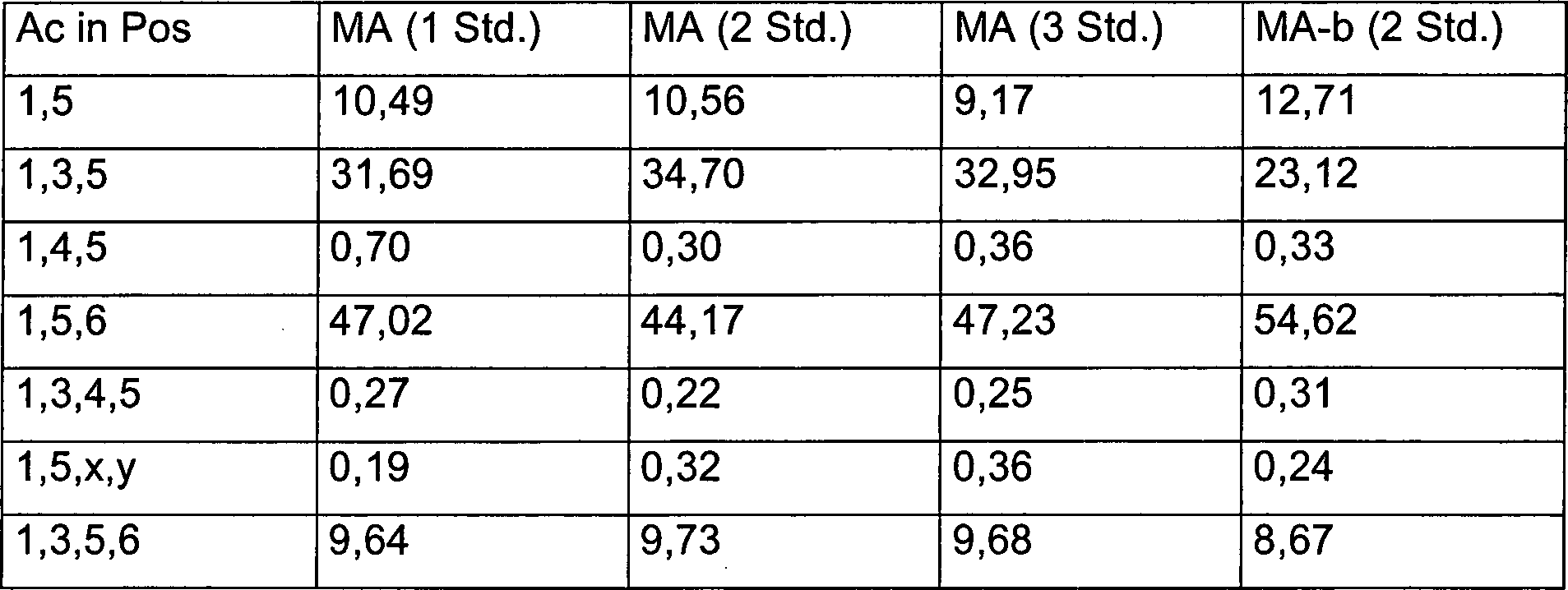
Values in mol .-%
Beispiel 13: Konstruktion einer Expressionskassette für Pflanzen: Vakuolen- und Plastidenexpression einer Alternansucrase.Example 13: Construction an expression cassette for Plants: vacuolene and Plastidene expression of an alternansucrase.
Unter Verwendung des Plasmids Alsu-pET24a als Matrize und der PCR-Primer A1-5'-1.2 und A1-3'-2.2 (cf. SEQ ID NOs:53 und 54) wurde die codierende Region der Alternansucrase aus Leuconostoc mesenteroides amplifiziert, die dann durch die Restriktionsenzyme SalI und PstI geschnitten wurde. Dann wurden die resultierenden Fragmente in SalI- und SdaI-verdaute Plasmide a) pBinAR-pat-Hyg und b) pBinAR-fnr-Hyg cloniert.Under Using the plasmid Alsu-pET24a as template and the PCR primer A1-5'-1.2 and A1-3'-2.2 (cf. SEQ ID NOs: 53 and 54), the coding region of alternansucrase became Leuconostoc mesenteroides then amplified by the restriction enzymes SalI and PstI was cut. Then the resulting Fragments in SalI and SdaI digested plasmids a) pBinAR-pat-Hyg and b) pBinAR-fnr-Hyg cloned.
Die
resultierenden Plasmide wurden a) pat-Alsu-Hyg (cf.
Anmerkung:
Das bakterielle Sekretionssignalpeptid wurde durch die Auswahl der
PCR-Primer aus der cds (coding sequence; codierende Sequenz) entfernt. PCR-Bedingungen: Puffer
und Polymerase von Boehringer Mannheim (Pwo-Polymerase Nr. 1644947)
Reaktionsbedingungen: 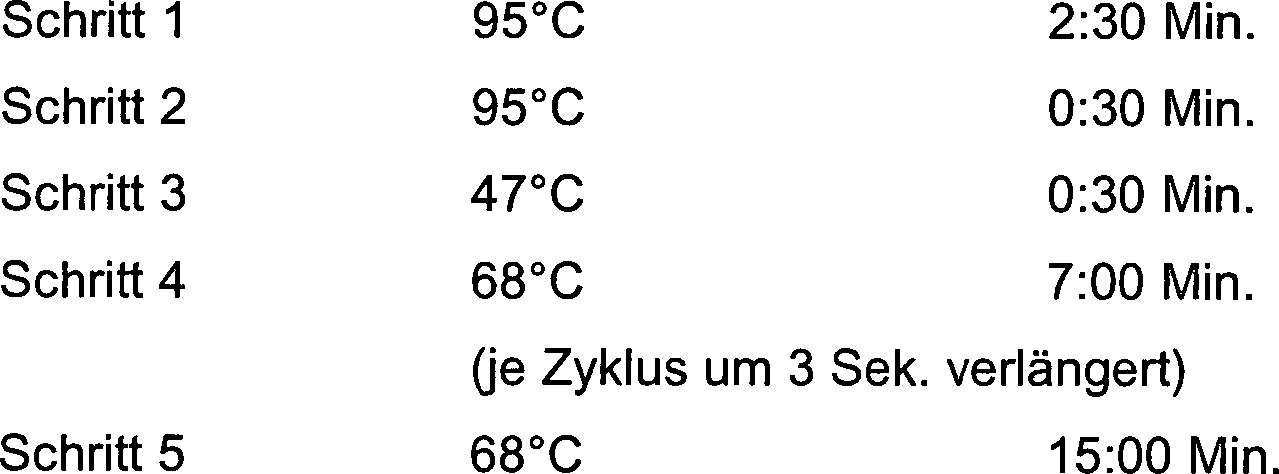
Die Schritte 2 bis 4 wurden insgesamt 35 mal zyklisch wiederholt.The Steps 2 to 4 were repeated cyclically a total of 35 times.
Beispiel 14: Northern-Blot-Analyse zur Expression von Alternansucrase in transgenen PflanzenExample 14: Northern blot analysis for the expression of alternansucrase in transgenic plants
Blätter oder Knollen von Kartoffelpflanzen, die mit Agrobakterien mit den Plasmiden pat-Alsu-Hyg bzw. fnr-Alsu-Hyg transformiert wurden, wurden in einer Mühle, Typ MM 200, (Retsch GmbH & Co. KG, 42781 Haan, Deutschland) bei 30 Hz 50 Sek. pulverisiert. Die RNA wurde gemäß Logemann et al. (Anal. Biochem. 163 (1987), 16–20) extrahiert. Pro Probe wurden 50 μg RNA auf Formaldehyd enthaltende 1%-Agarosegele aufgetragen. Nach der Elektrophorese wurde die RNA auf Nylonmembranen (Hybond N. Amersham, UK) durch das Capillar-Transfer-Verfahren übertragen (Sambrook et al., Molecular cloning: A laboratory manual, 2. Ausgabe; Cold Spring Harbor Laboratory Press, NY, USA (1989)). Die Fixierung der Nucleinsäuren auf der Membran wurde durch UV-Quervernetzung erreicht (Stratalinker von Stratagene).Leaves or Tubers of potato plants, those with agrobacteria with the plasmids pat-Alsu-Hyg or fnr-Alsu-Hyg were in a Mill, Type MM 200, (Retsch GmbH & Co. KG, 42781 Haan, Germany) at 30 Hz for 50 seconds. The RNA became according to Logemann et al. (Anal Biochem., 163: 16-20 (1987)). Per sample were 50 μg RNA applied to formaldehyde containing 1% agarose gels. To electrophoresis, RNA was purified on nylon membranes (Hybond N. Amersham, UK) by the capillary transfer method (Sambrook et al., Molecular cloning: A laboratory manual, 2nd Edition; Cold Spring Harbor Laboratory Press, NY, USA (1989)). The fixation the nucleic acids on the membrane was achieved by UV cross-linking (Stratalinker from Stratagene).
Membranen wurden bei 42°C in einem Hybridisierungspuffer (25% (Vol./Vol.) Formamid, 250 mM Natriumphosphat, pH 7,2, 250 mM Natriumchlorid, 1 mM EDTA, 7% (Gew./Vol.) SDS, 25% (Gew./Vol.) Polyethyleneglycol 6000, 0,25 mg/ml gescherte Lachssperma-DNA) 6 Stunden vorhybridisiert. Danach wurde über Nacht bei 42°C mit einem zusätzlich eine radioaktiv markierte Sonde enhaltenden Hybridisierungspuffer eine Hybridisierung durchgeführt. Die radioaktive Sonde wurde unter Verwendung des Random Primed DNA Labelling Kit (Boehringer Mannheim, 1004760) hergestellt und das ungefähr 4 kb KpnI/XhoI-Fragment aus dem Plasmid p-Alsu-pSK gemäß dem Handbuch des Herstellers. Membranen wurden einmal bei 50°C 20 Min. in 3 × SSC (Sambrook et al., Molecular cloning: A laboratory manual, 2. Ausgabe; Cold Spring Harbor Laboratory Press, NY, USA (1989)) gewaschen und danach einmal 20 Min. in 0,5 × SSC gewaschen, bevor die Membran über Nacht einem Röntgenfilm ausgesetzt wurde.membranes were at 42 ° C in a hybridization buffer (25% (v / v) formamide, 250mM Sodium phosphate, pH 7.2, 250 mM sodium chloride, 1 mM EDTA, 7% (w / v) SDS, 25% (w / v) polyethylene glycol 6000, 0.25 mg / ml sheared Salmon sperm DNA) prehybridized for 6 hours. After that was over night at 42 ° C with an additional a hybridization buffer containing radiolabelled probe performed a hybridization. The radioactive probe was primed using the Random DNA Labeling Kit (Boehringer Mannheim, 1004760) and the approximately 4 kb KpnI / XhoI fragment from the plasmid p-Alsu-pSK according to the manual of the manufacturer. Membranes were washed once at 50 ° C for 20 min in 3x SSC (Sambrook et al., Molecular cloning: A laboratory manual, 2nd edition; Cold Spring Harbor Laboratory Press, NY, USA (1989)) and then once 20 minutes in 0.5 × SSC washed before the membrane over Night an x-ray film was suspended.
Sequenzprotokoll 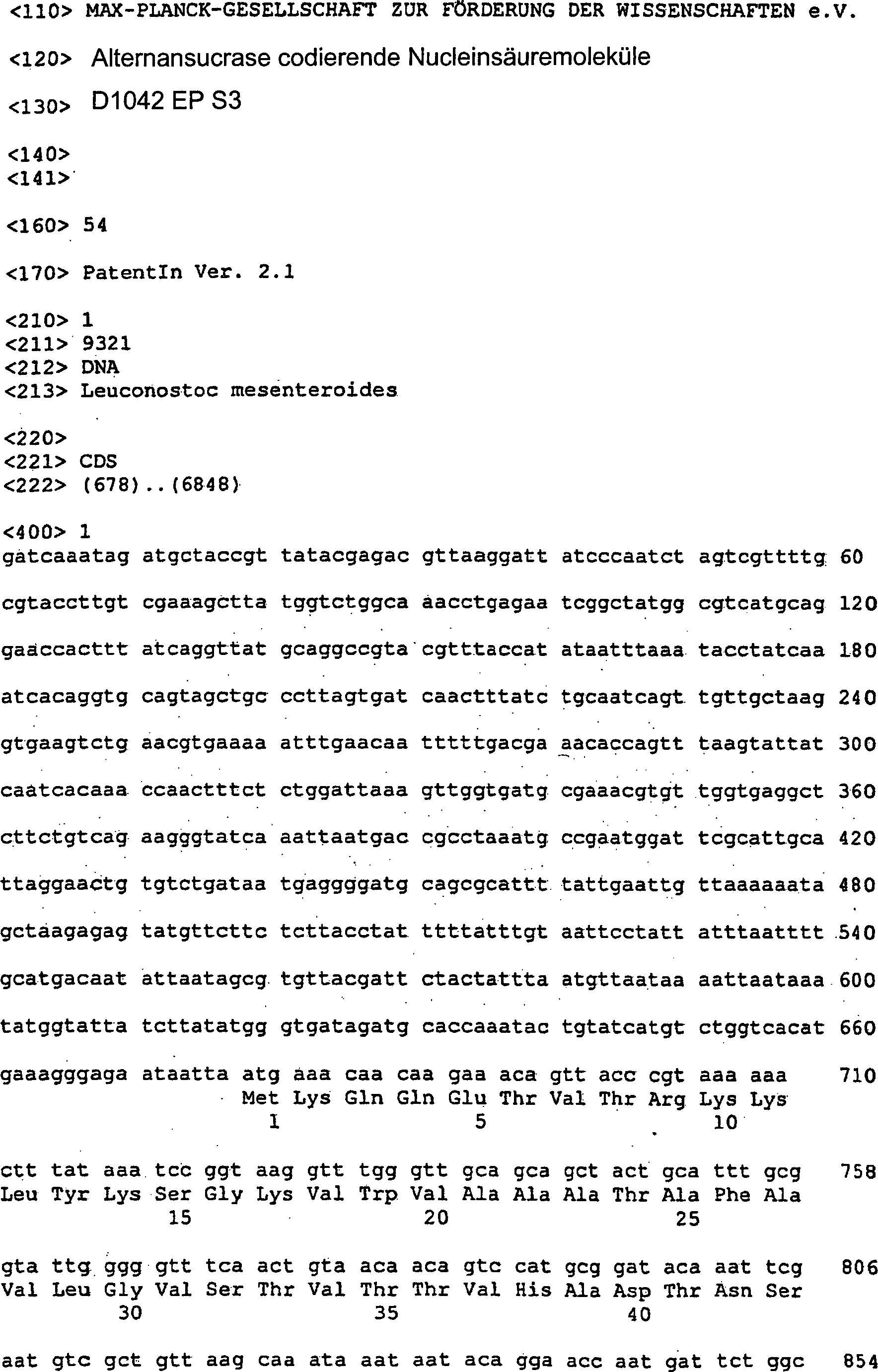
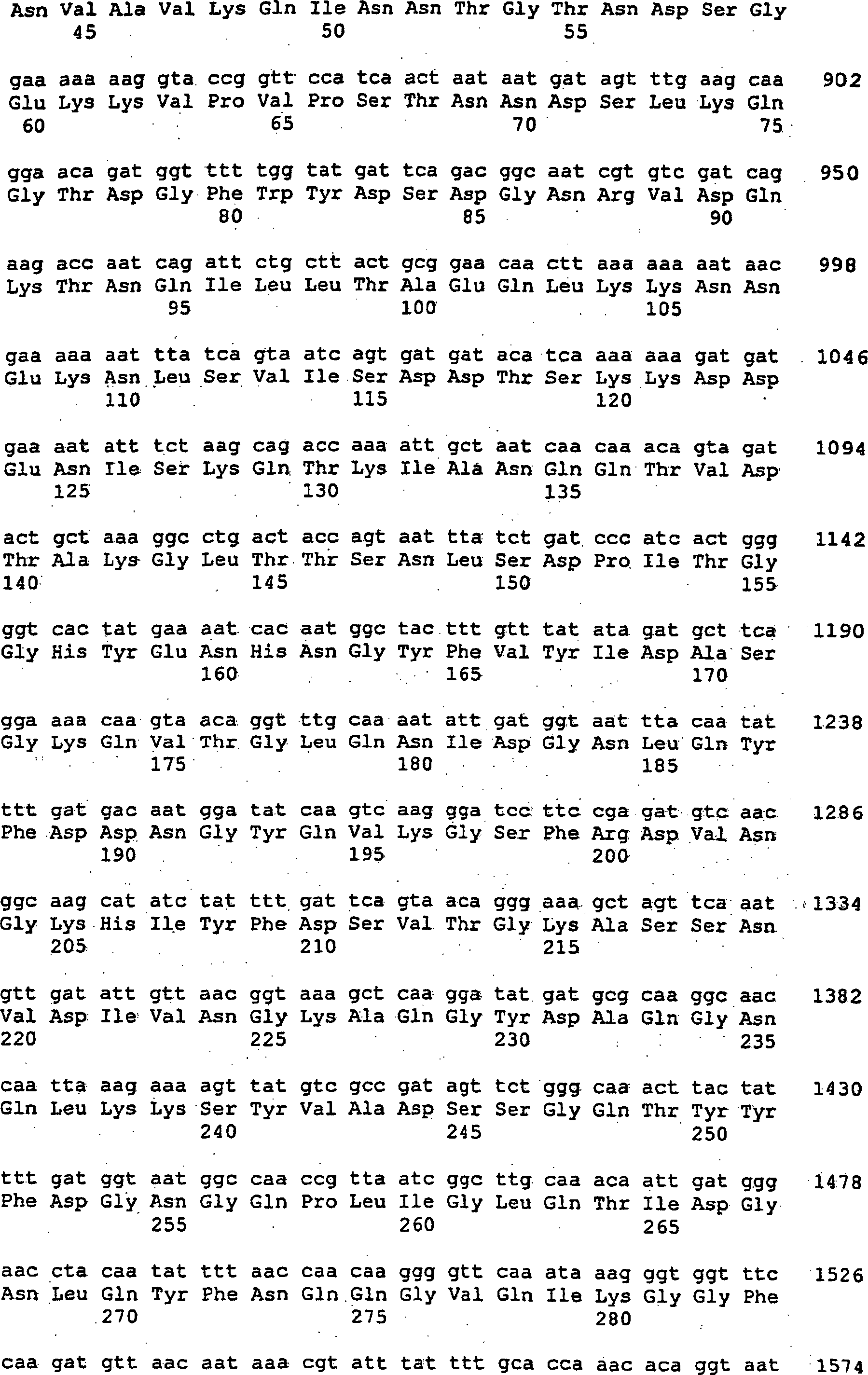

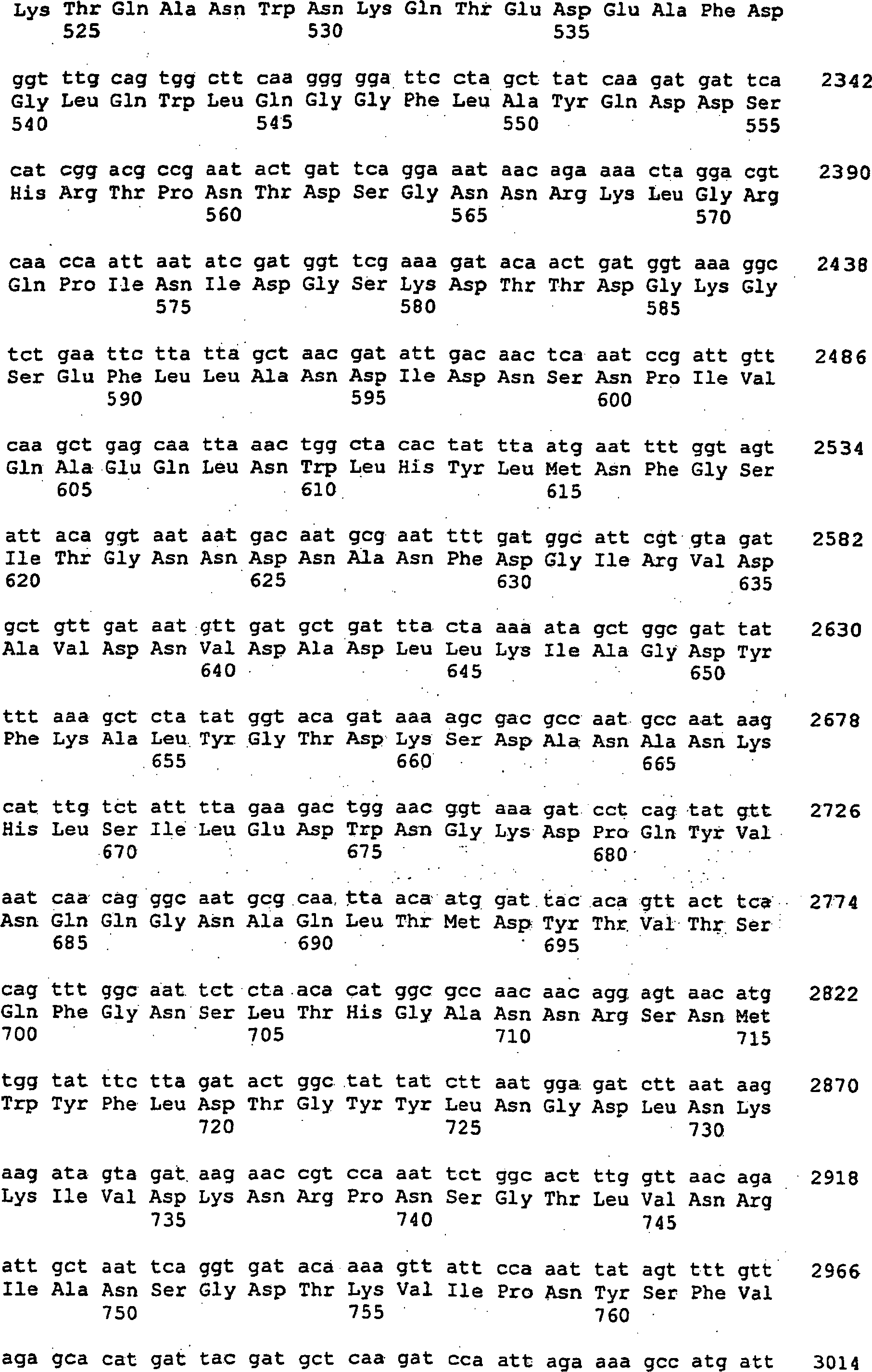
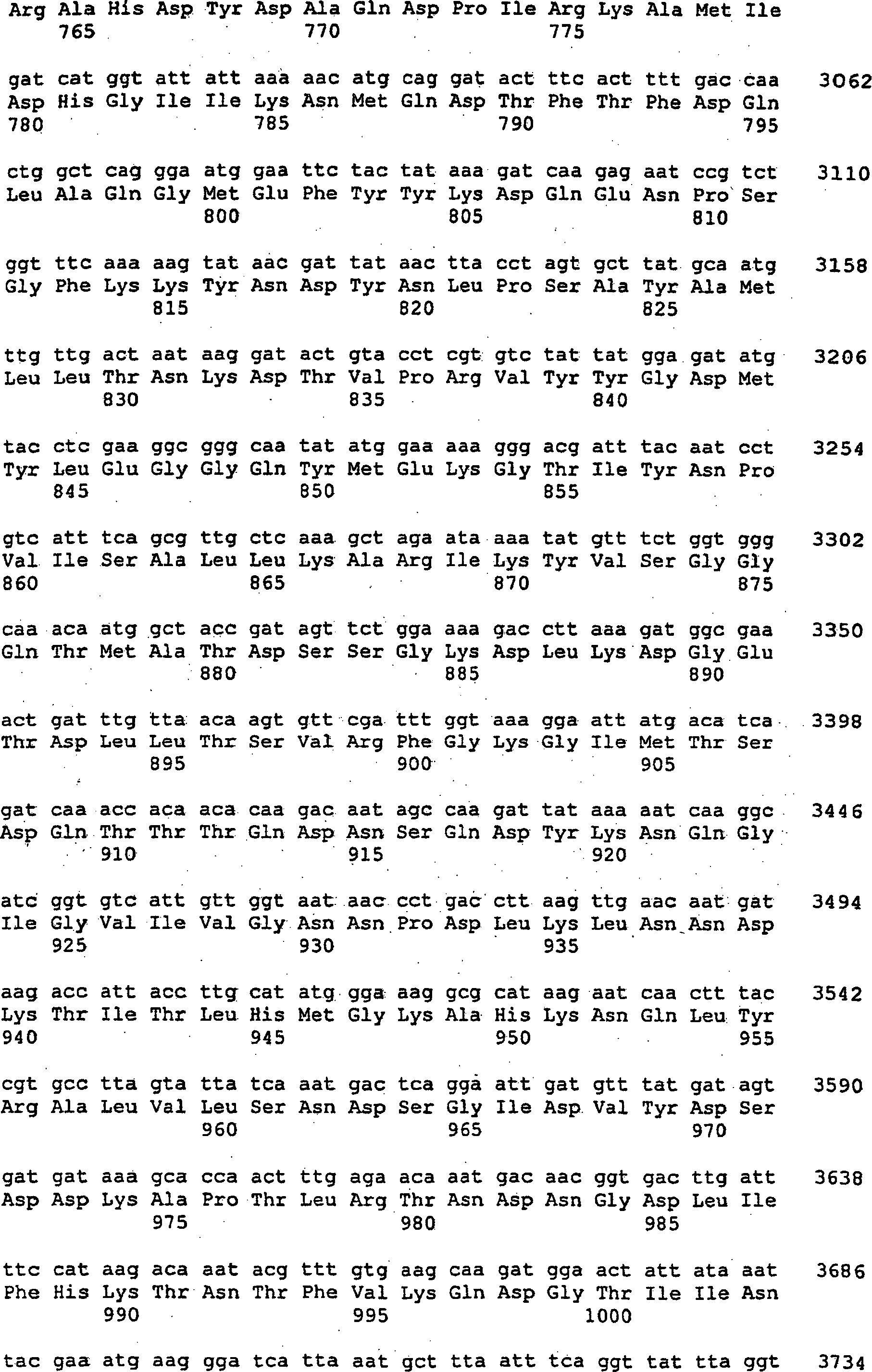

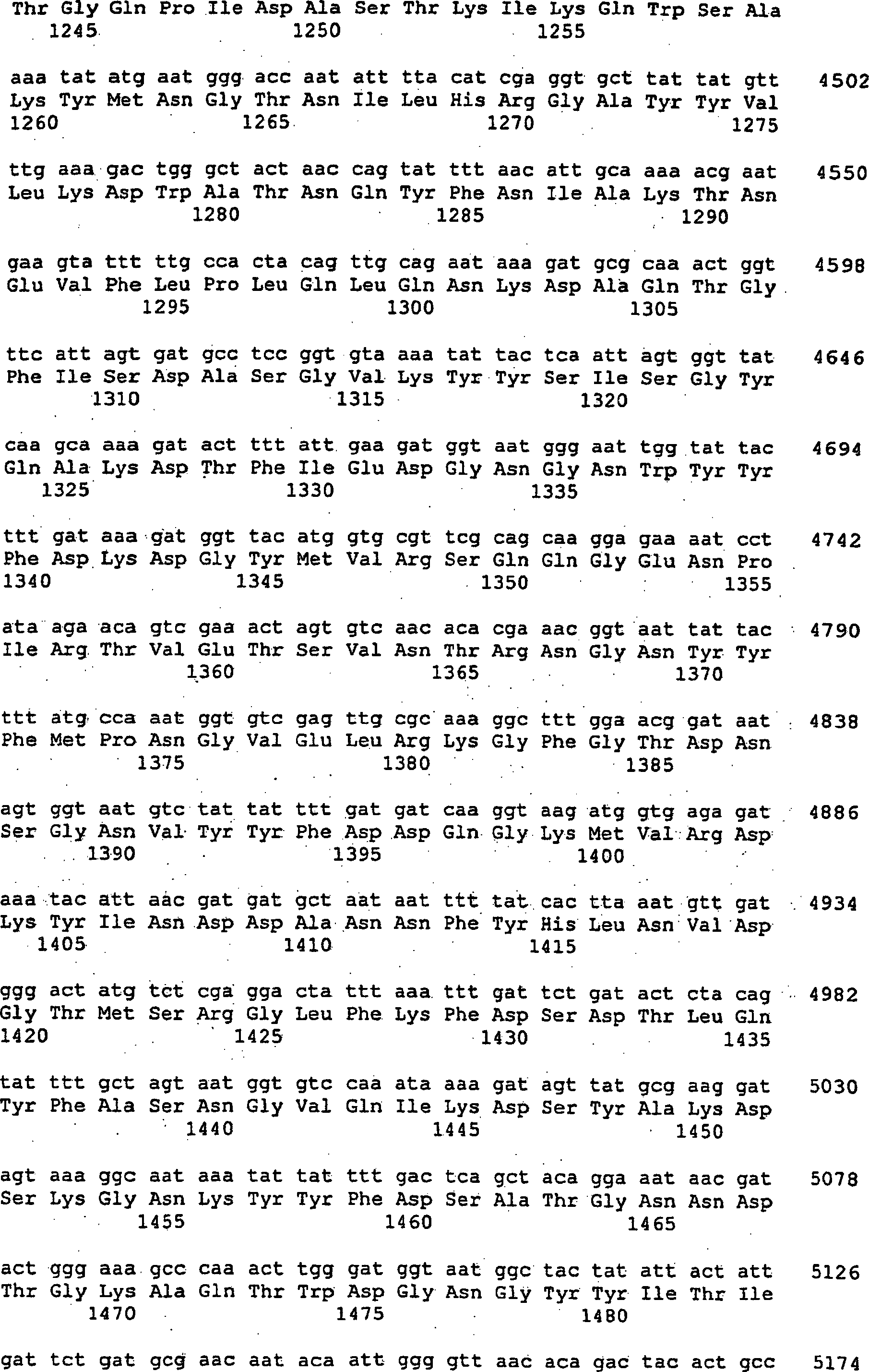

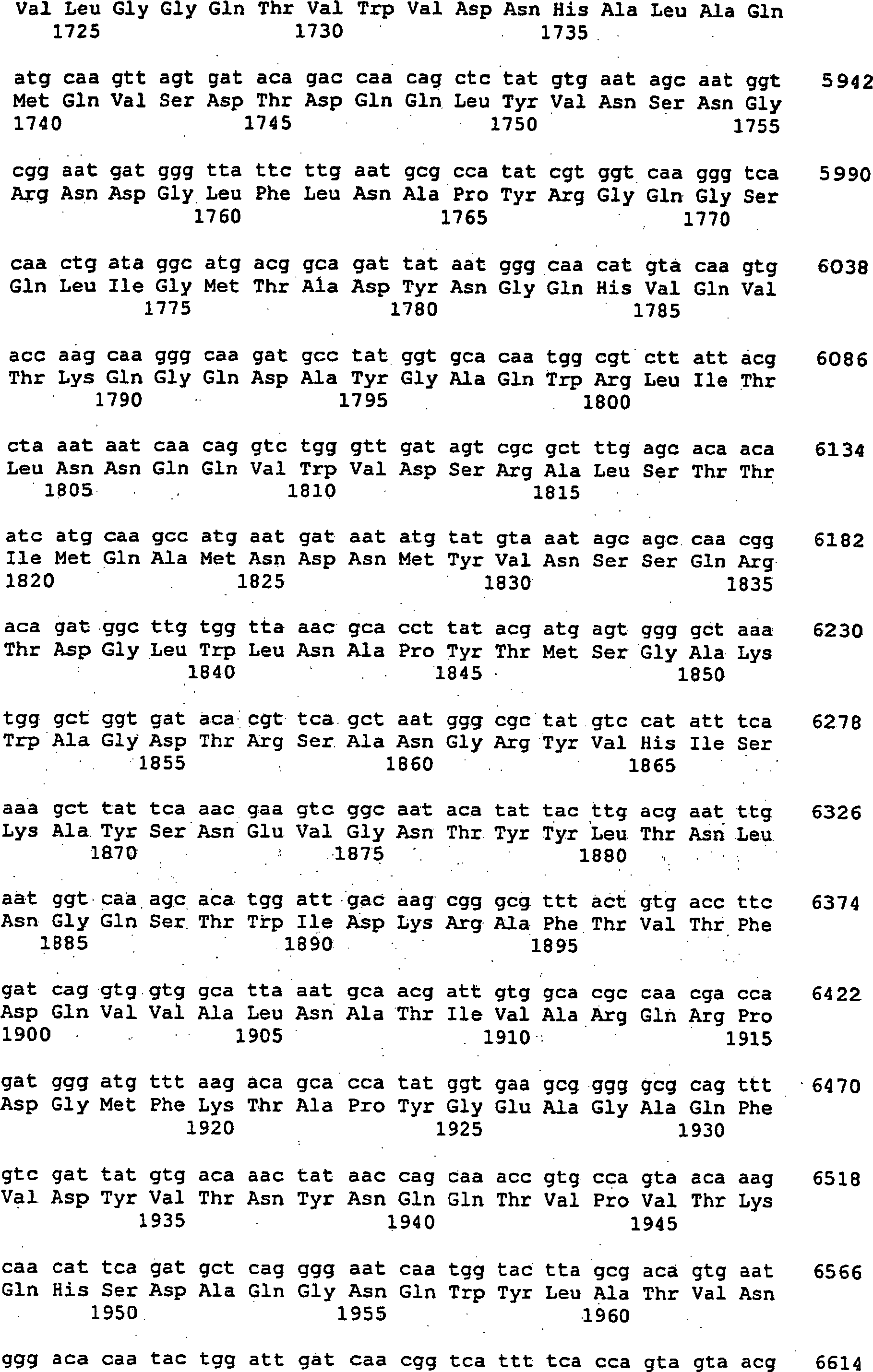
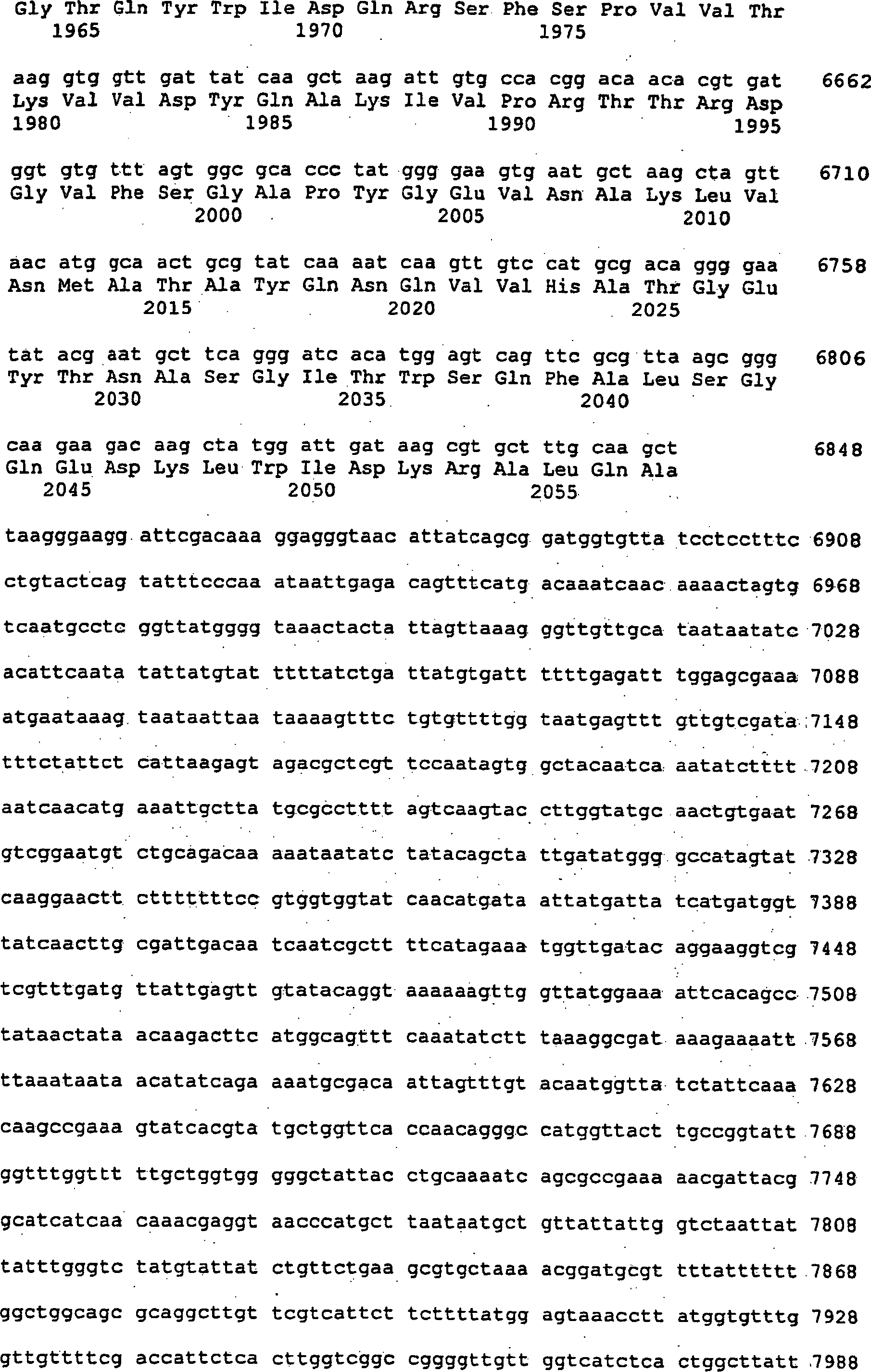
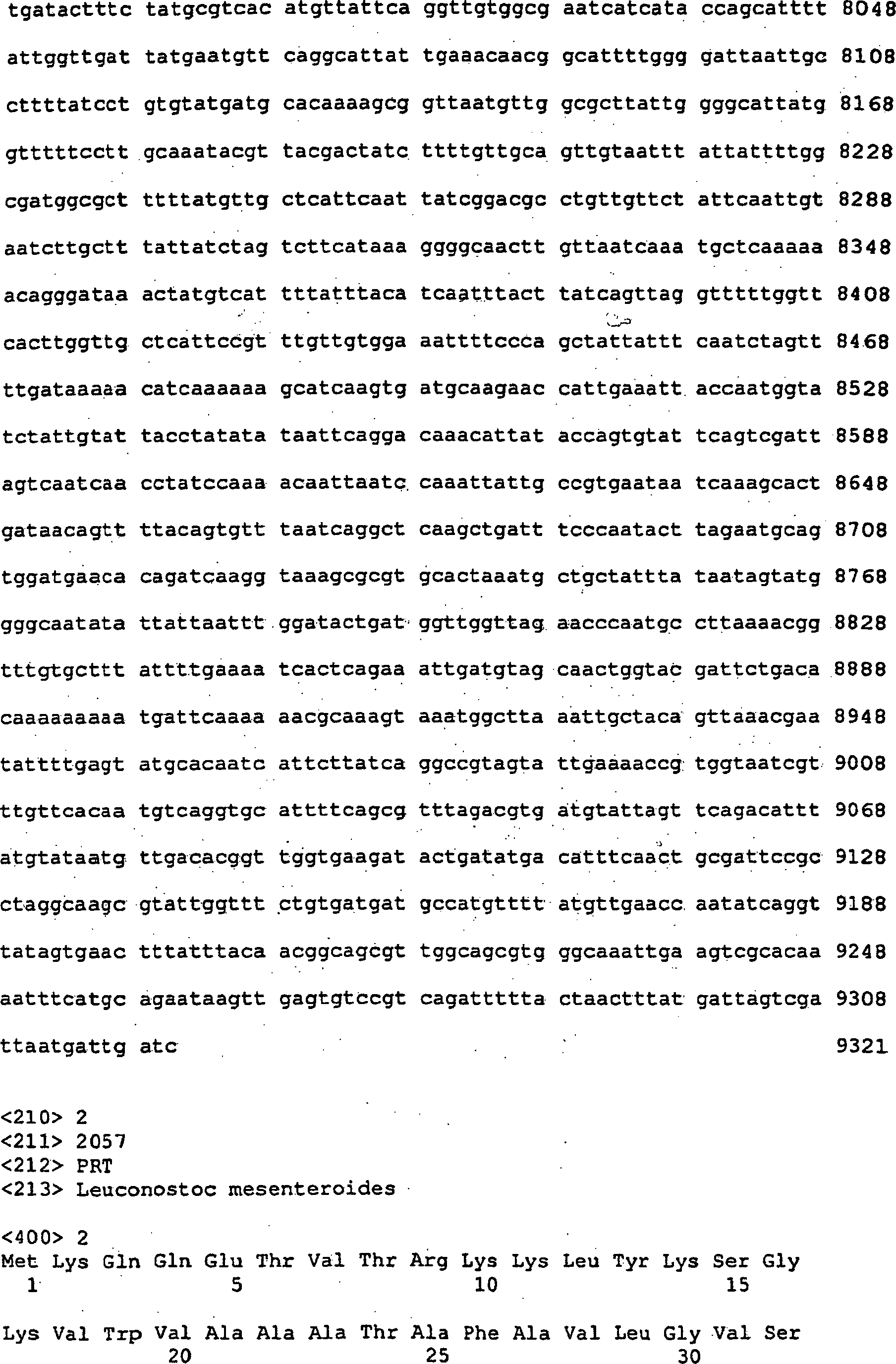
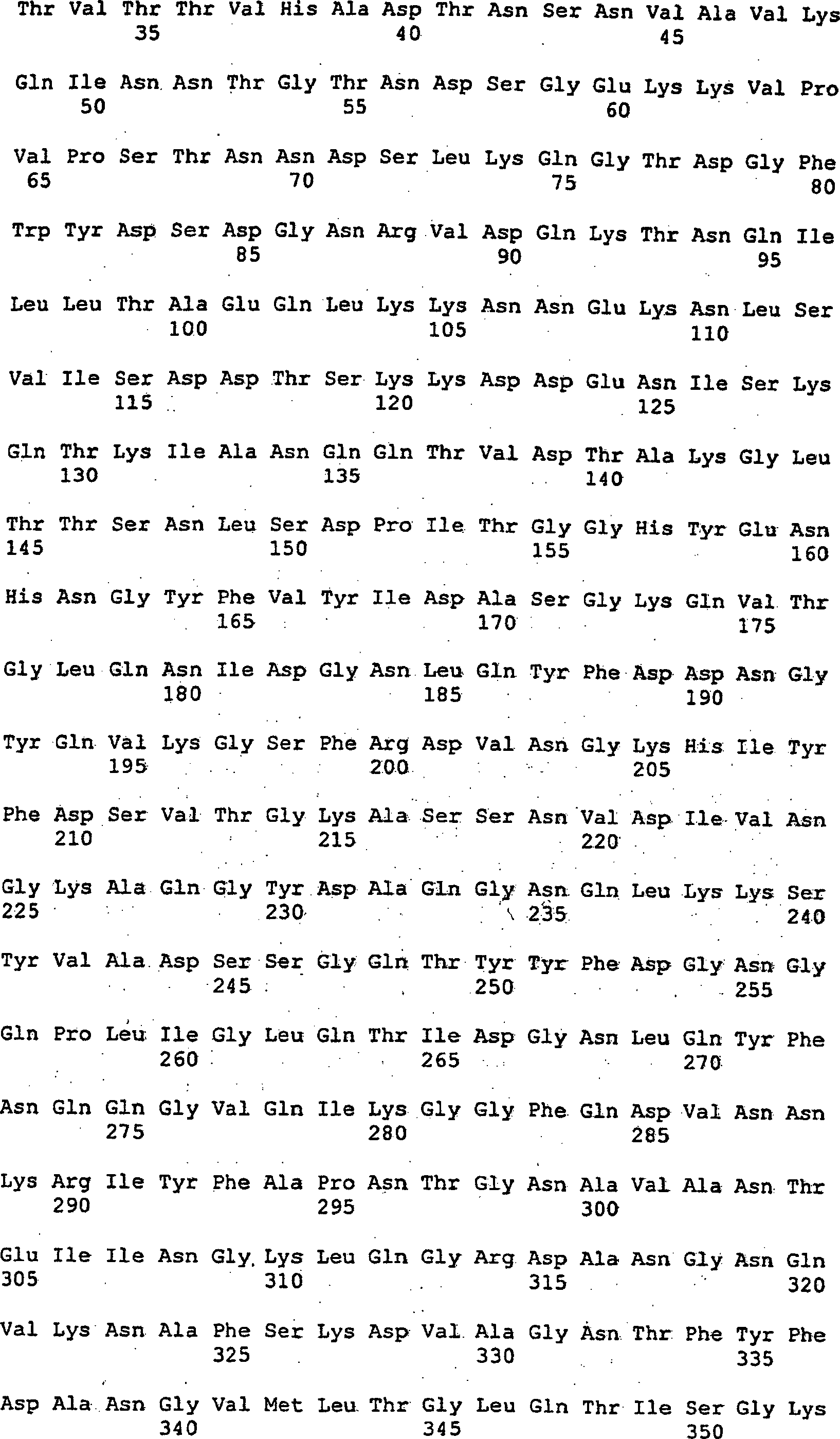

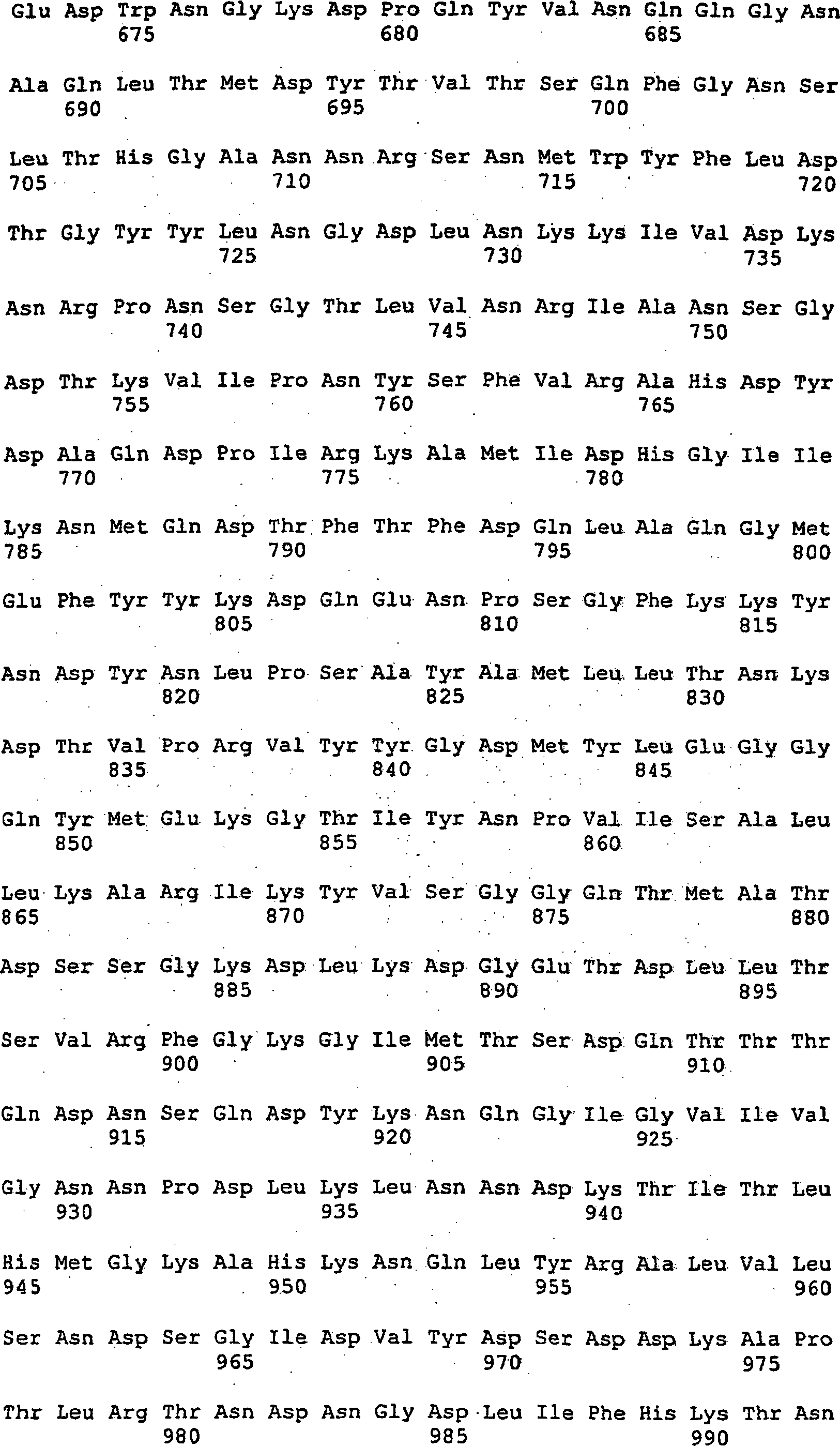
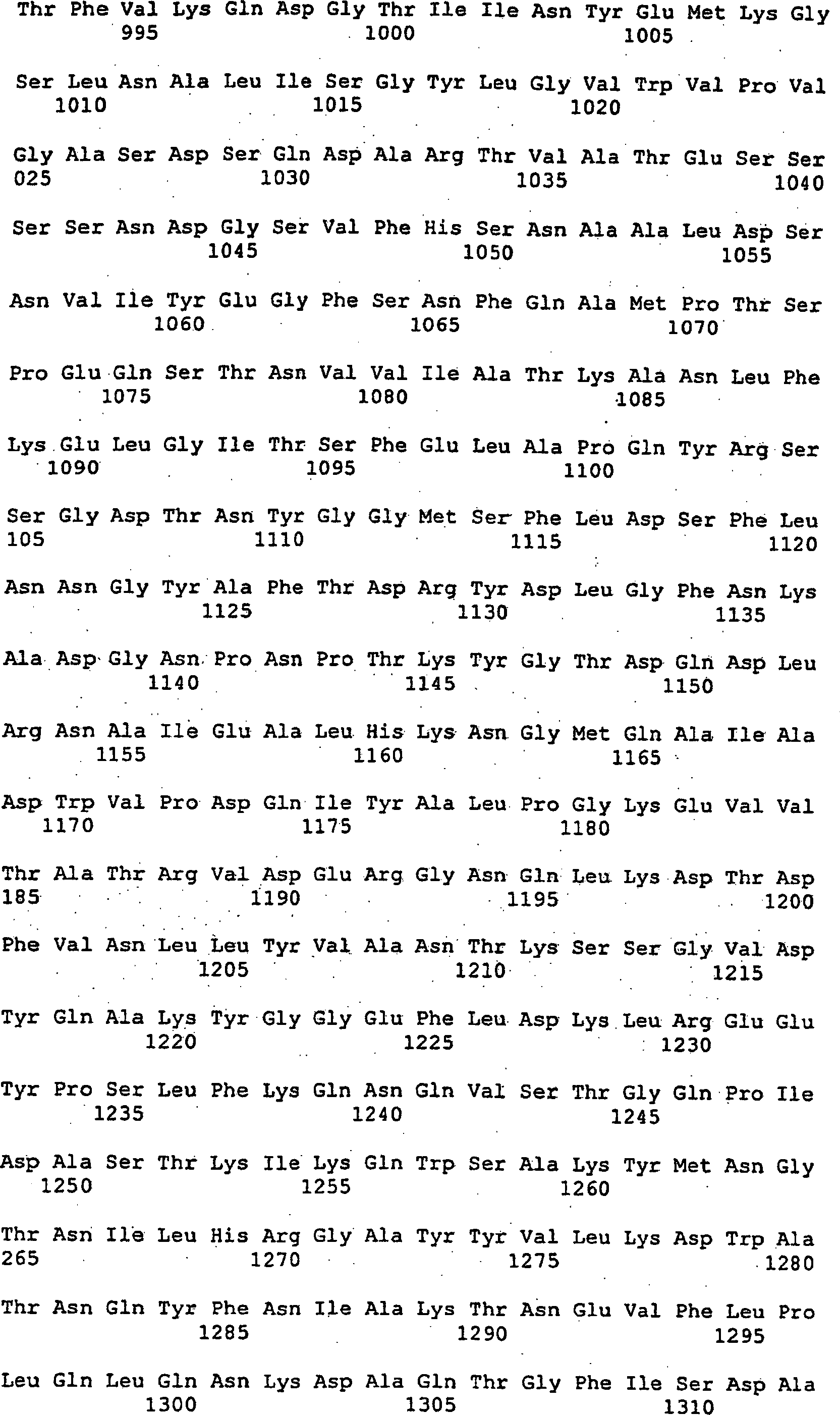

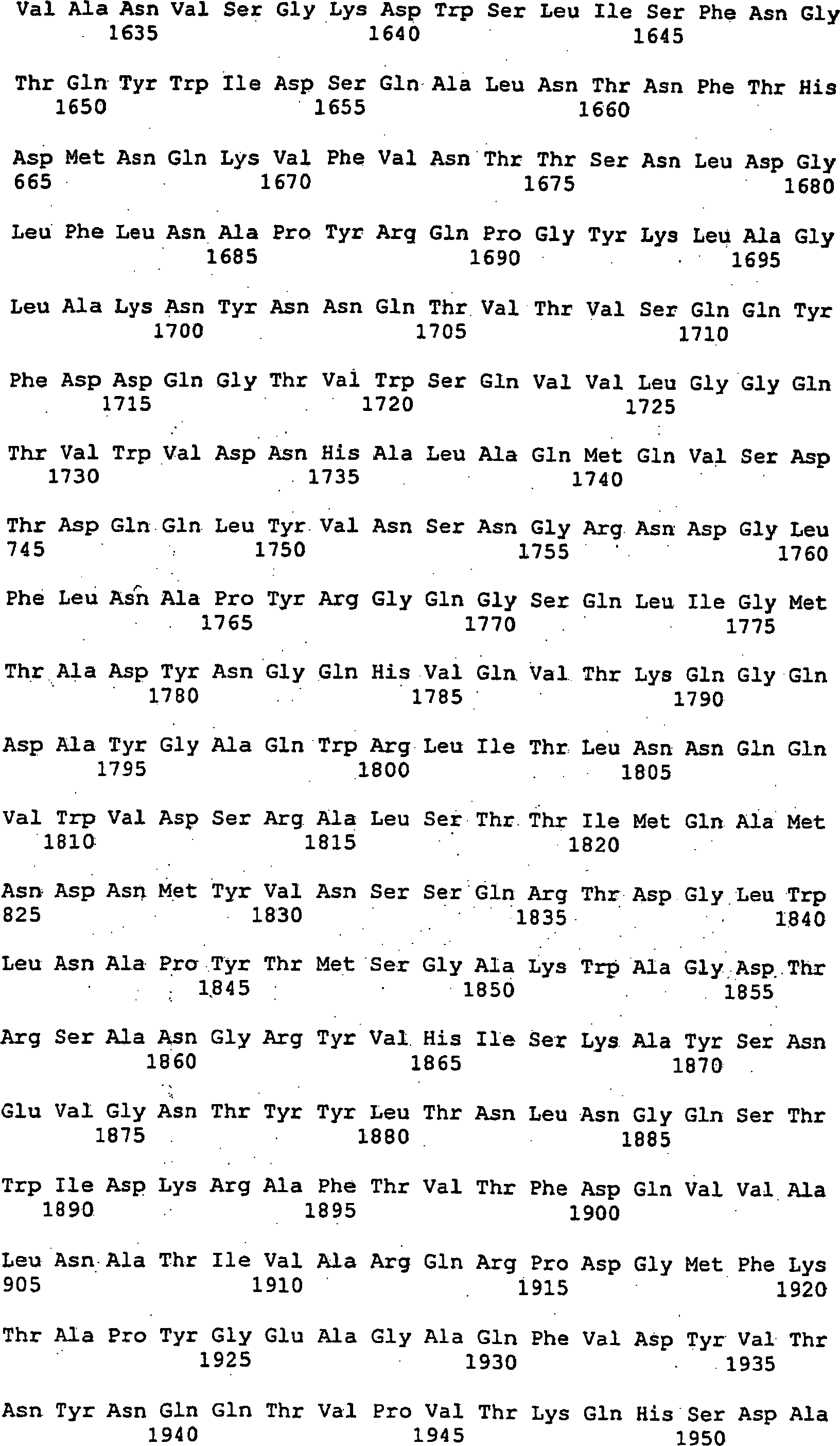
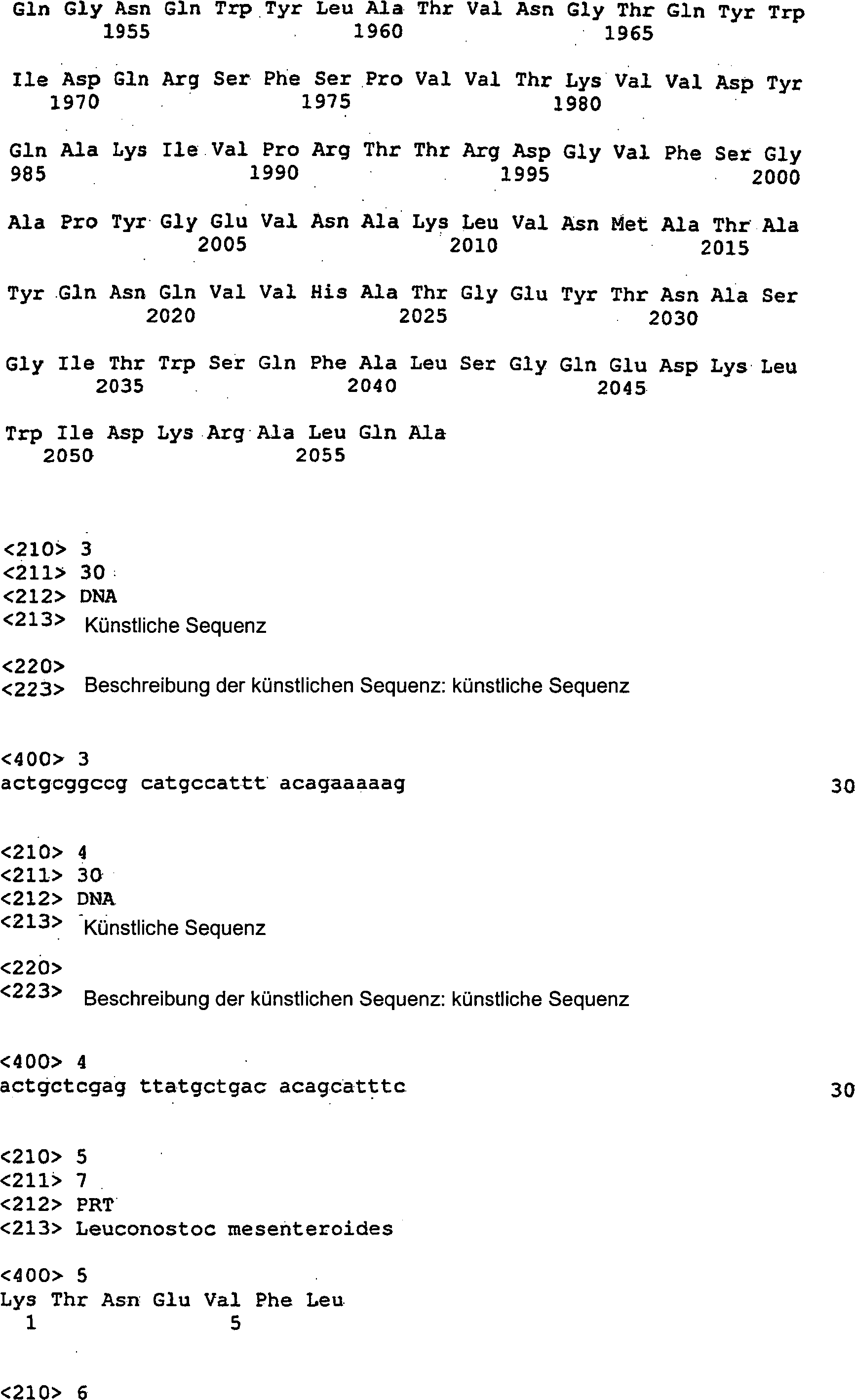
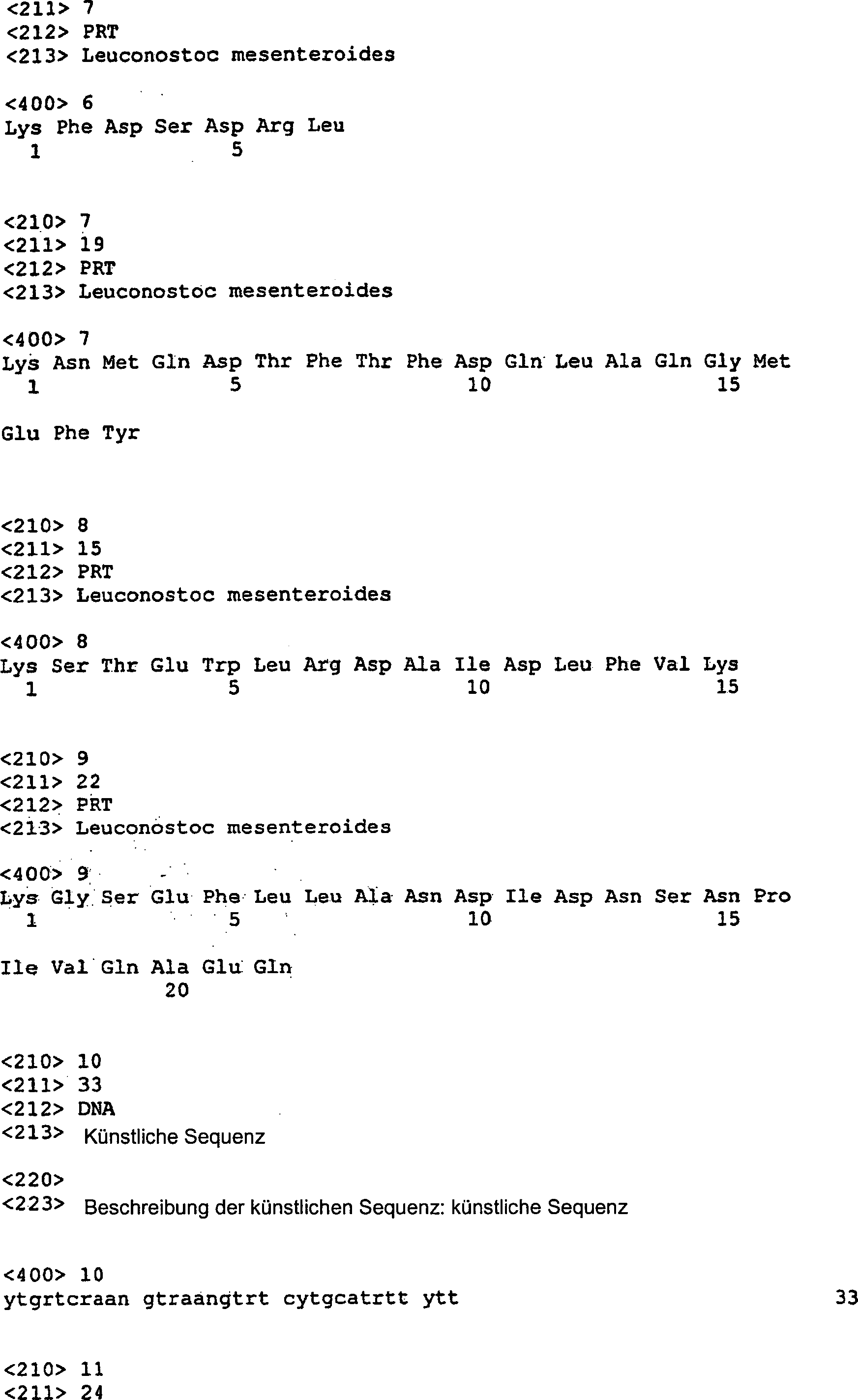

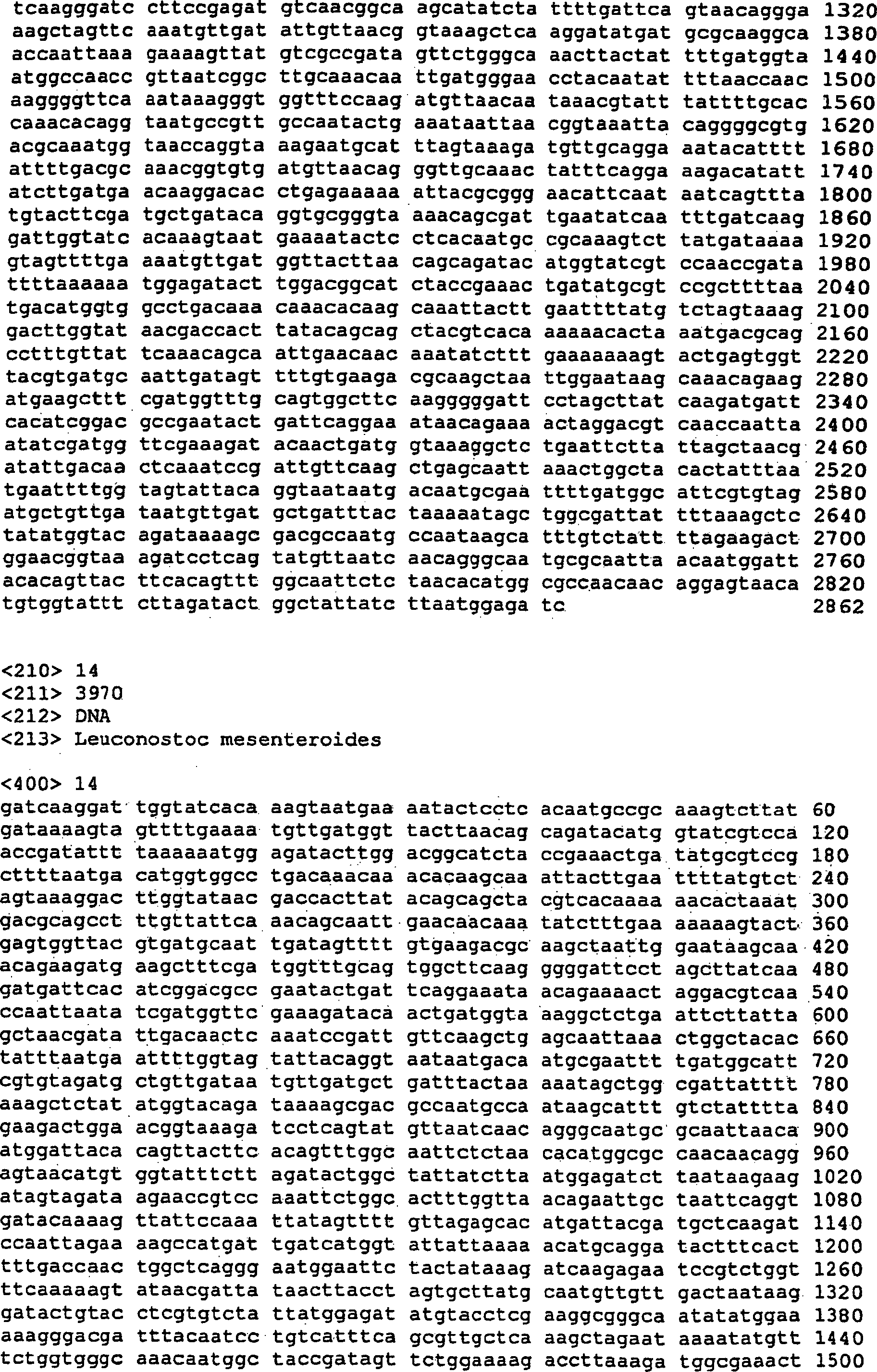
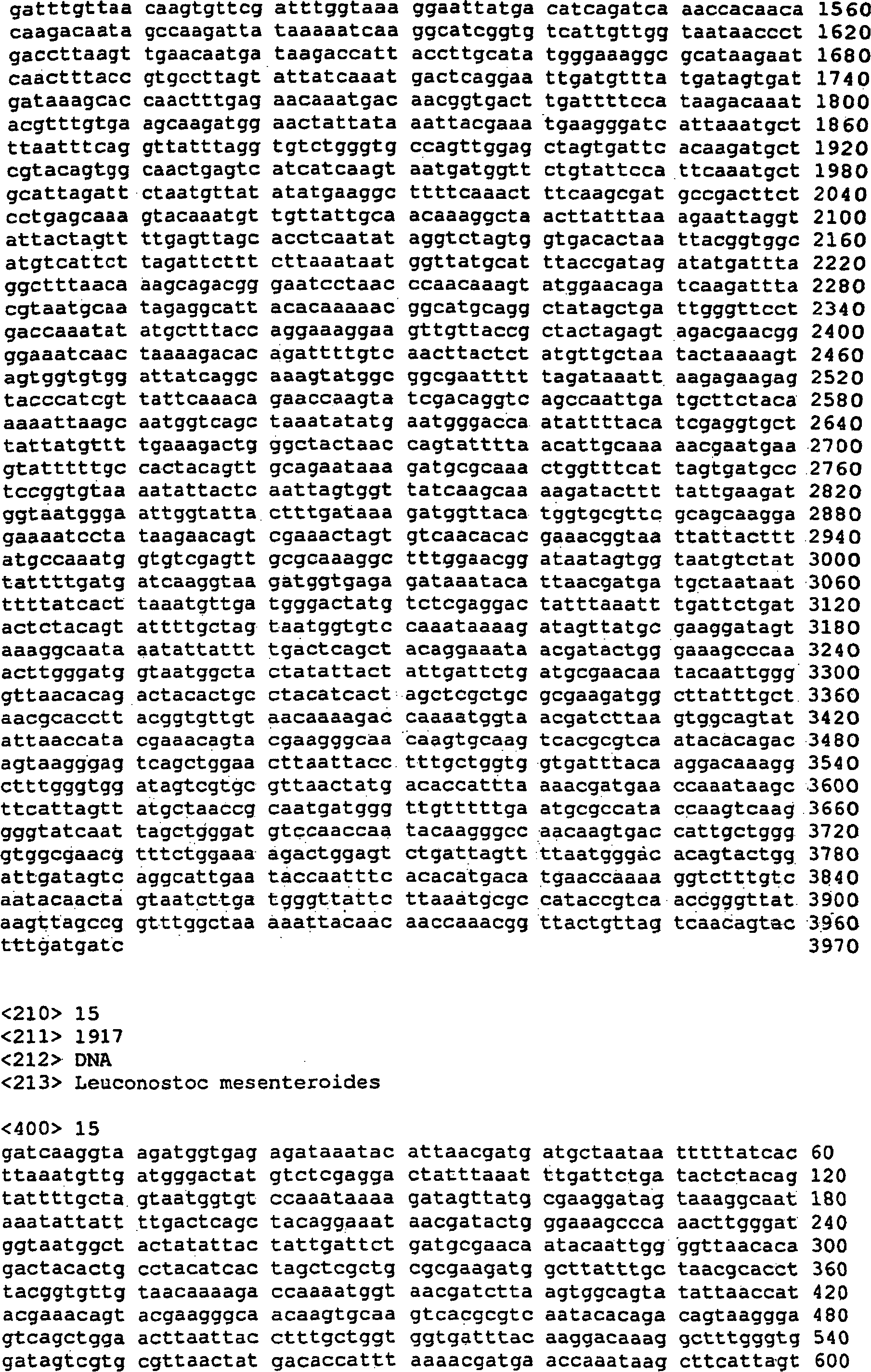
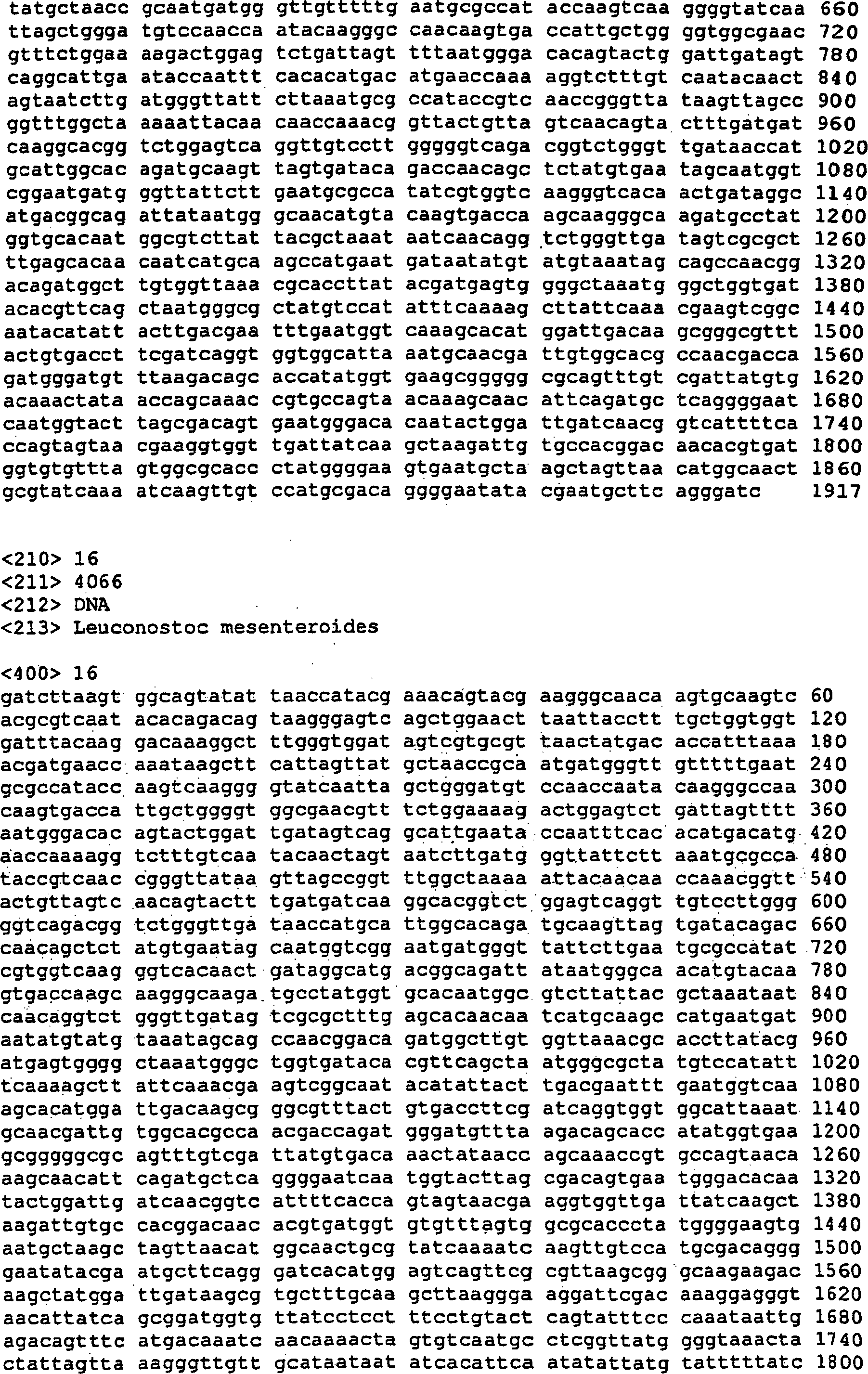
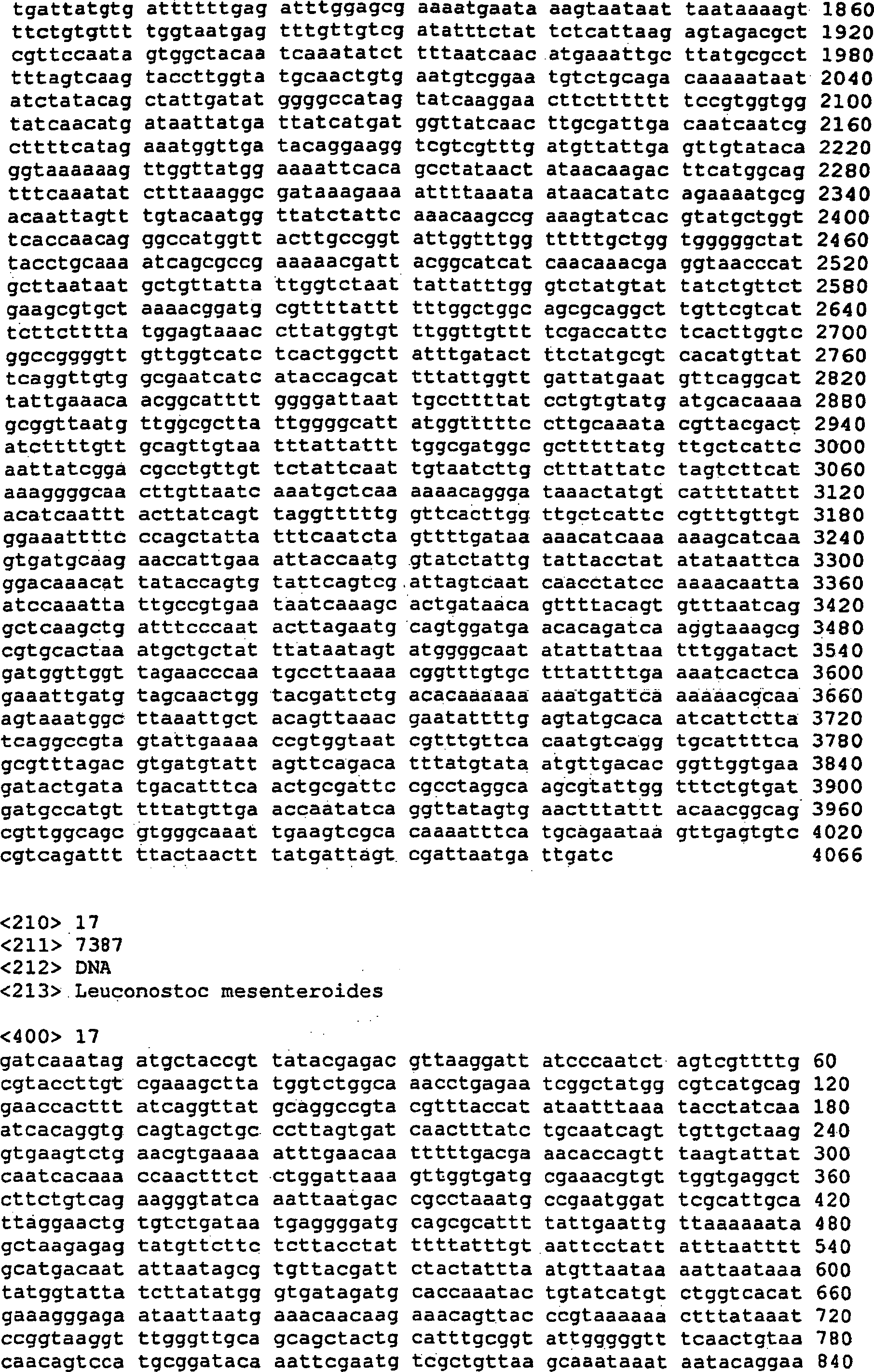
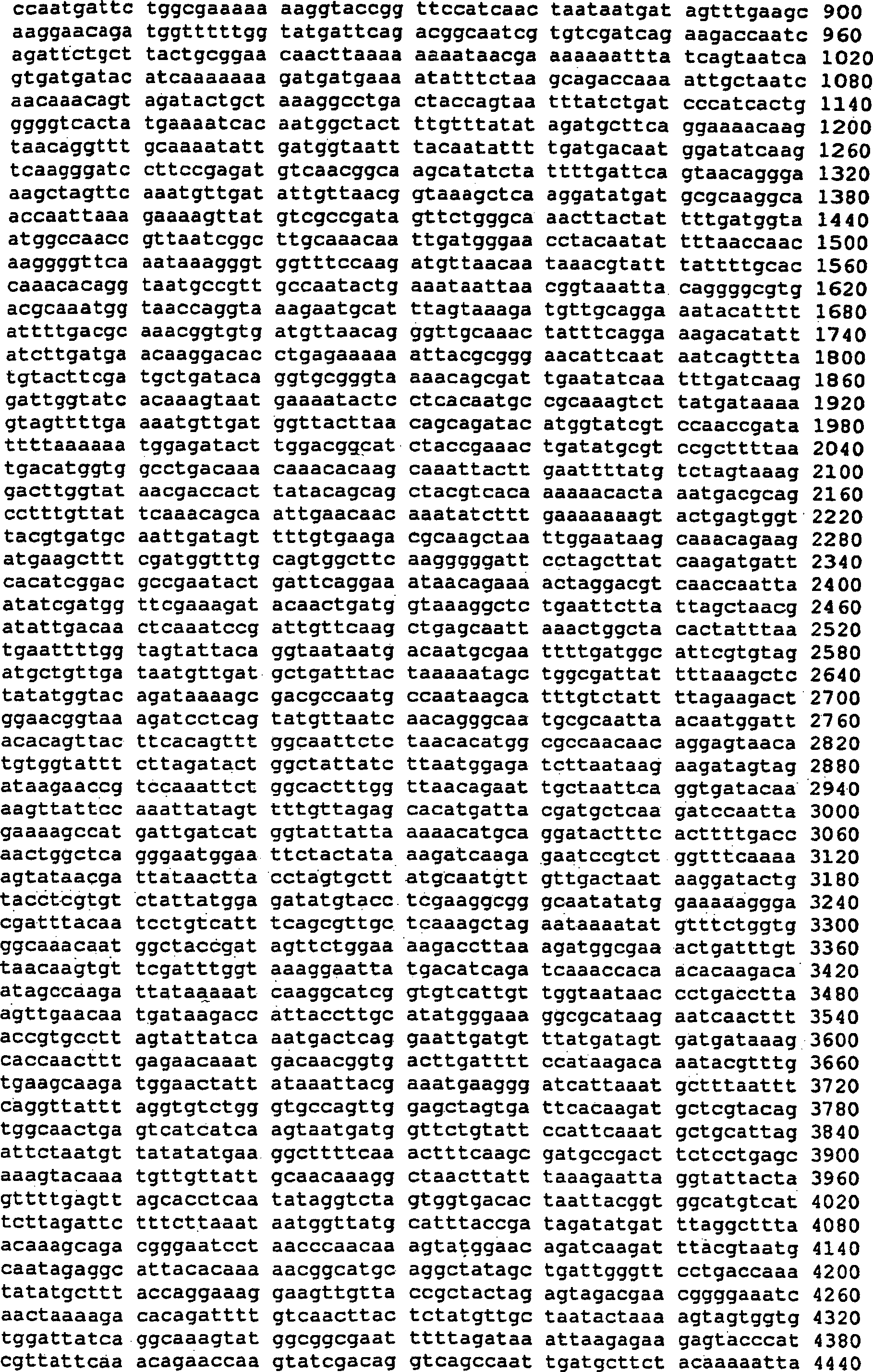


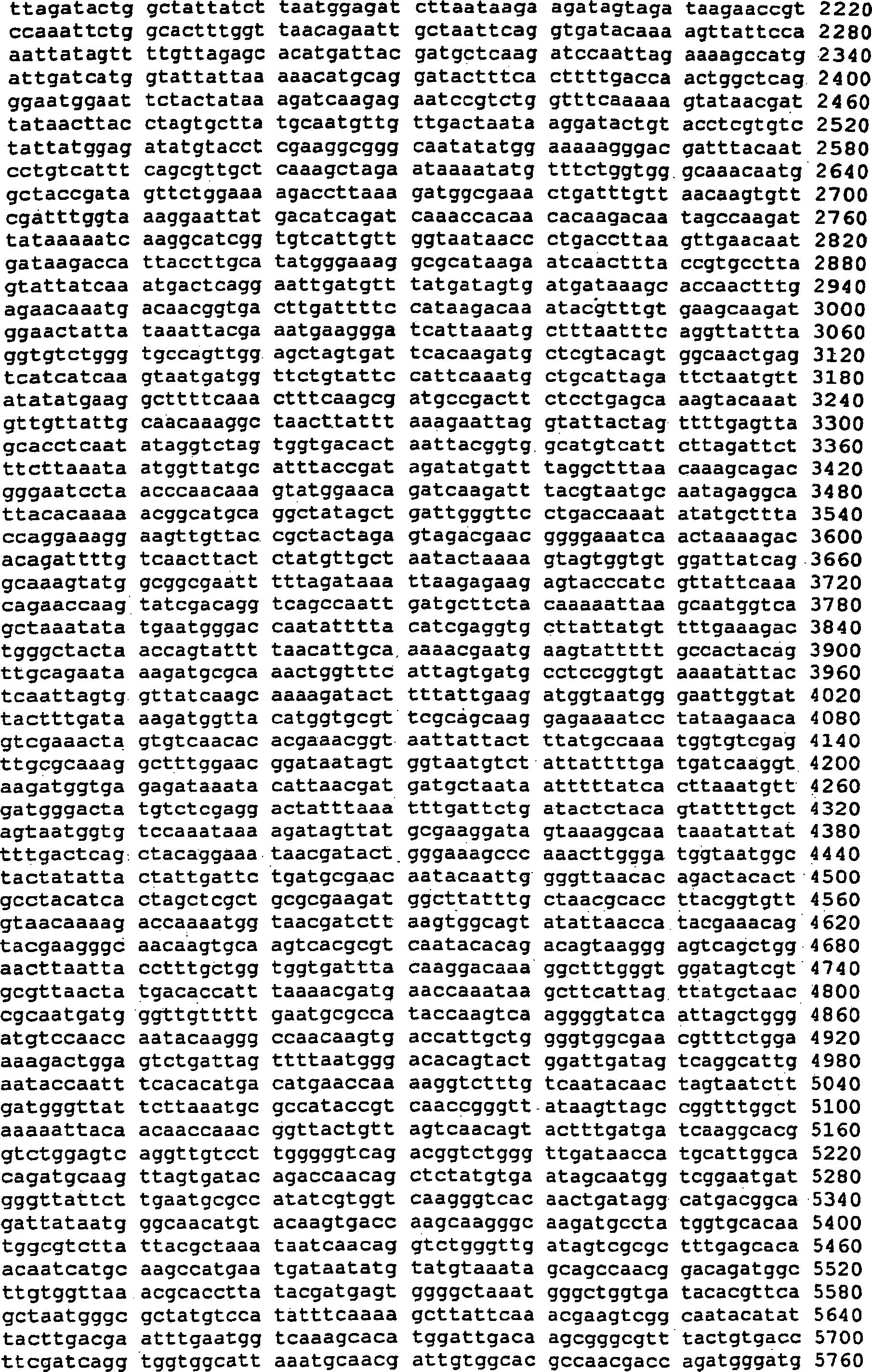

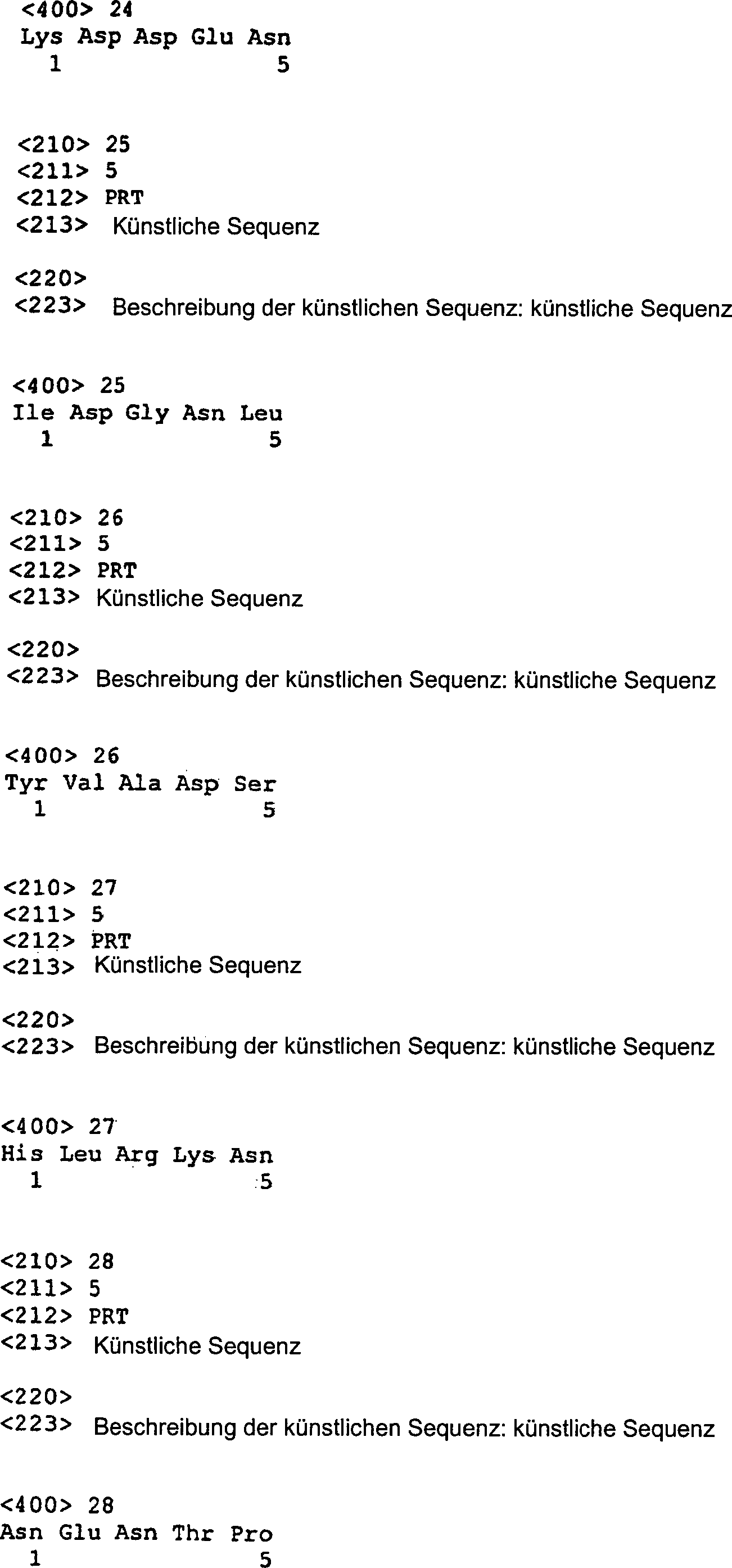
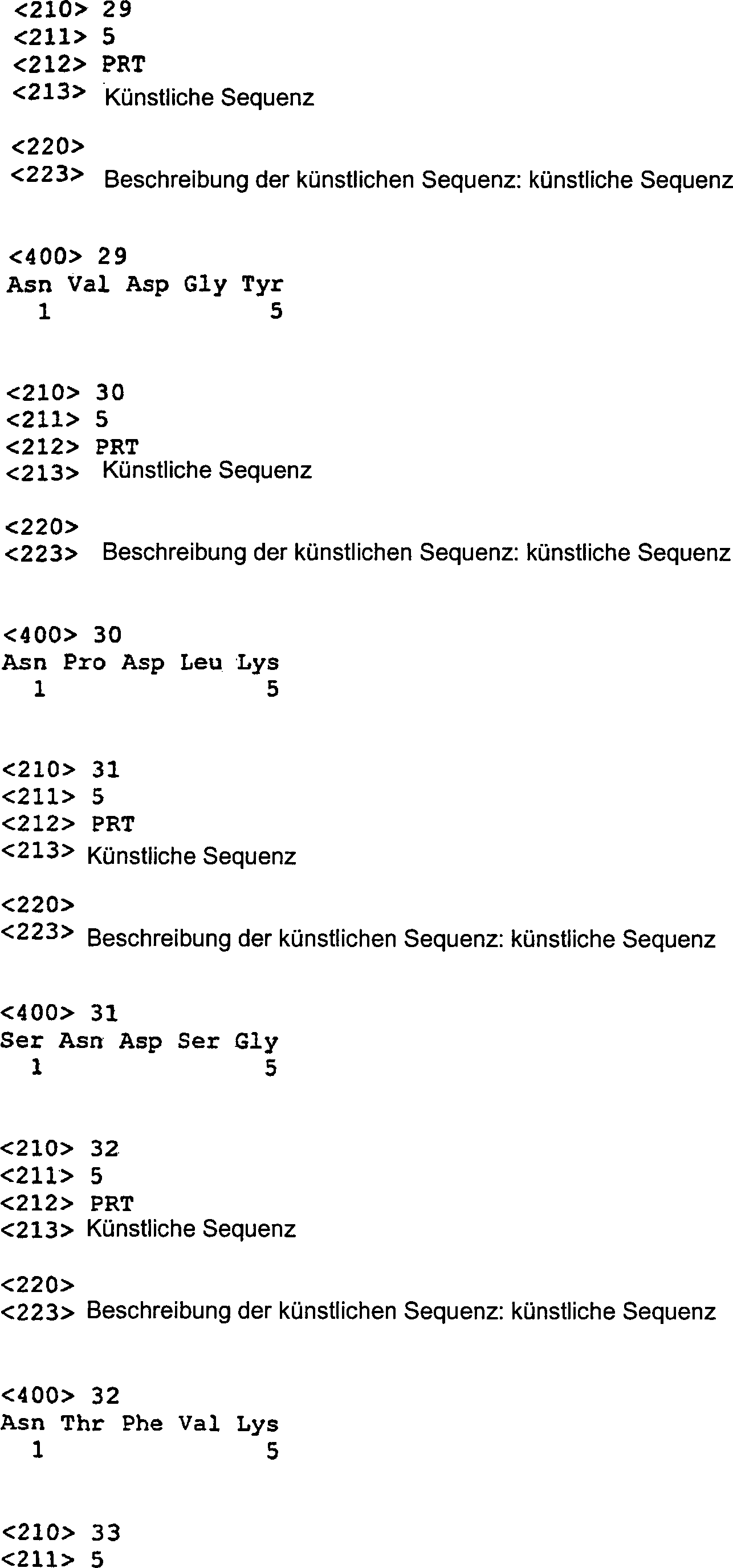
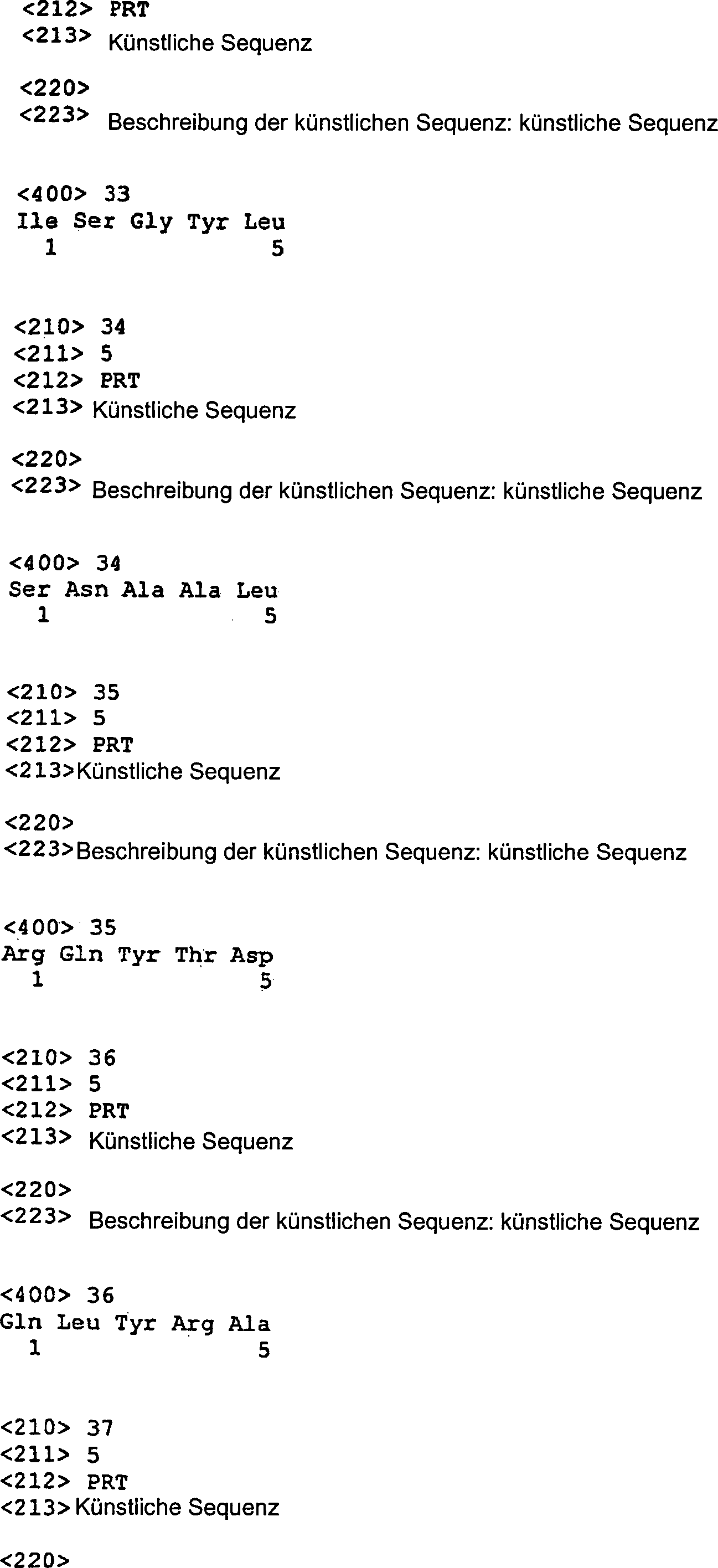

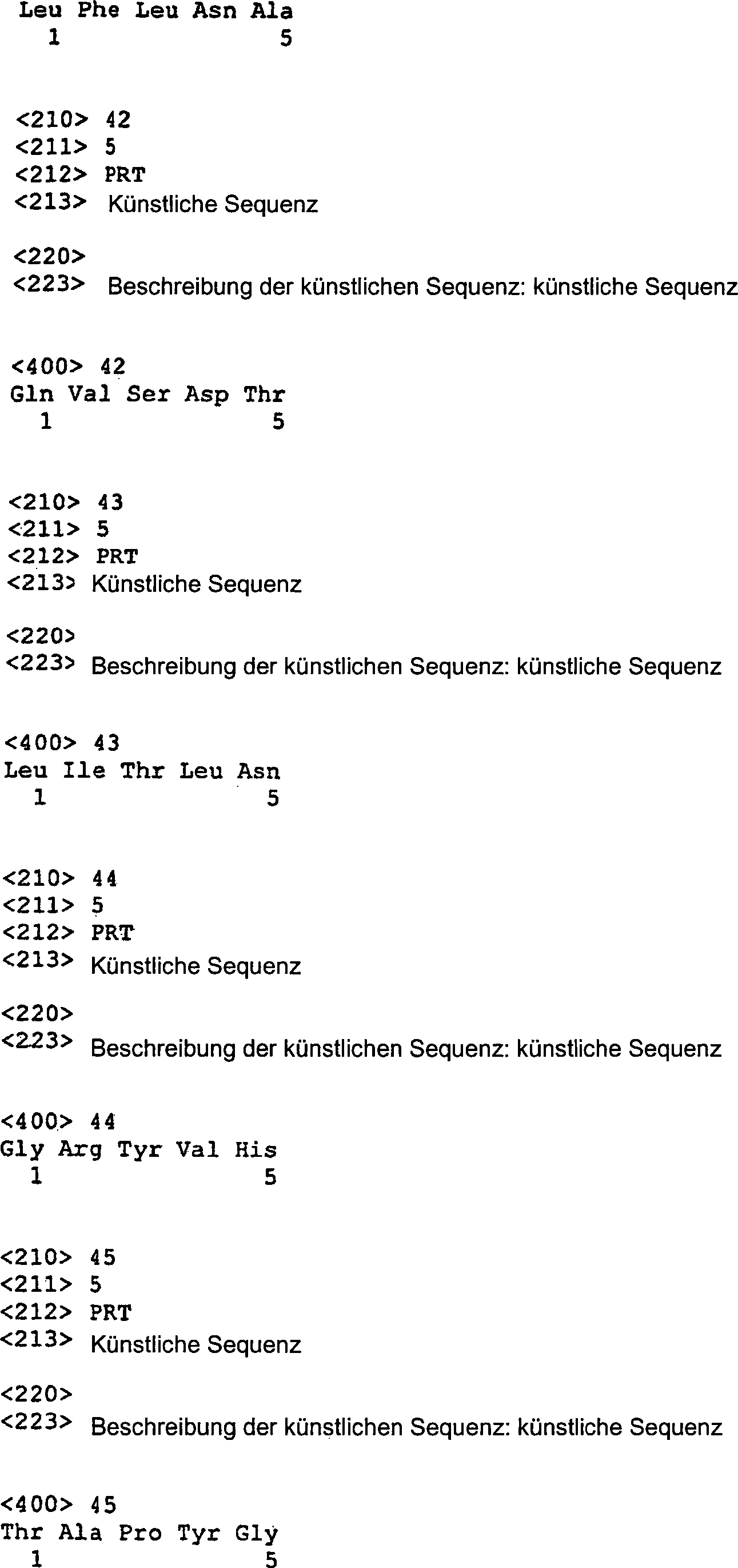

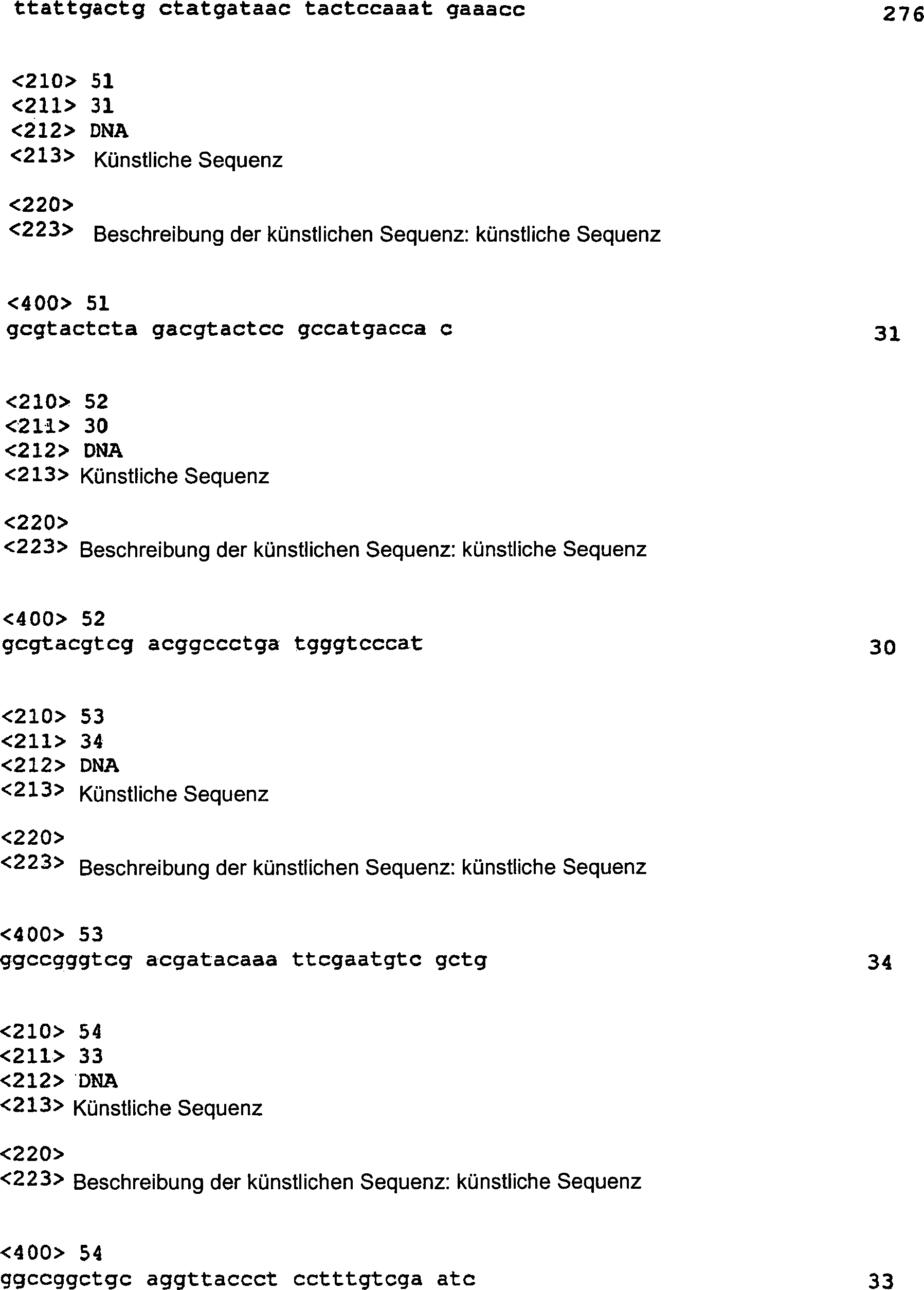
Claims (24)
Applications Claiming Priority (4)
| Application Number | Priority Date | Filing Date | Title |
|---|---|---|---|
| DE19905069 | 1999-02-08 | ||
| DE19905069A DE19905069A1 (en) | 1999-02-08 | 1999-02-08 | Alternansucrase encoding nucleic acid molecules |
| PCT/EP2000/000954 WO2000047727A2 (en) | 1999-02-08 | 2000-02-07 | Nucleic acid molecules encoding alternansucrase |
| EP00910648.5A EP1151085B8 (en) | 1999-02-08 | 2000-02-07 | Nucleic acid molecules encoding alternansucrase |
Publications (3)
| Publication Number | Publication Date |
|---|---|
| DE60022313D1 DE60022313D1 (en) | 2005-10-06 |
| DE60022313T2 true DE60022313T2 (en) | 2006-06-22 |
| DE60022313T3 DE60022313T3 (en) | 2014-02-27 |
Family
ID=7896779
Family Applications (2)
| Application Number | Title | Priority Date | Filing Date |
|---|---|---|---|
| DE19905069A Withdrawn DE19905069A1 (en) | 1999-02-08 | 1999-02-08 | Alternansucrase encoding nucleic acid molecules |
| DE60022313.2T Expired - Lifetime DE60022313T3 (en) | 1999-02-08 | 2000-02-07 | ALTERNATE CASE CODING NUCLEIC ACID MOLECULES |
Family Applications Before (1)
| Application Number | Title | Priority Date | Filing Date |
|---|---|---|---|
| DE19905069A Withdrawn DE19905069A1 (en) | 1999-02-08 | 1999-02-08 | Alternansucrase encoding nucleic acid molecules |
Country Status (12)
| Country | Link |
|---|---|
| US (3) | US6570065B1 (en) |
| EP (1) | EP1151085B8 (en) |
| JP (1) | JP4554083B2 (en) |
| CN (2) | CN1341148B (en) |
| AT (1) | ATE303435T1 (en) |
| AU (1) | AU776021B2 (en) |
| CA (1) | CA2352492C (en) |
| DE (2) | DE19905069A1 (en) |
| DK (1) | DK1151085T4 (en) |
| ES (1) | ES2246227T5 (en) |
| WO (1) | WO2000047727A2 (en) |
| ZA (1) | ZA200106474B (en) |
Families Citing this family (219)
| Publication number | Priority date | Publication date | Assignee | Title |
|---|---|---|---|---|
| FR2822163B3 (en) | 2001-03-16 | 2003-06-13 | Centre Nat Rech Scient | NUCLEIC ACID MOLECULES ENCODING DEXTRANE SACCHARASE CATALYZING DEXTRANE SYNTHESIS CARRYING ALPHA-1,2 OSIDIC BRANCHES |
| FR2822162B1 (en) * | 2001-03-16 | 2003-06-27 | Inst Nat Sciences Appliq | NUCLEIC ACID MOLECULES ENCODING DEXTRANE-SACCHARASE CALATALYSING DEXTRANE SYNTHESIS CARRYING ALPHA-1.2 OSIDIC-TYPE RAMIFICATIONS |
| JP2005534315A (en) * | 2002-08-06 | 2005-11-17 | ダニスコ エイ/エス | Use of lactobacilli producing extracellular polysaccharides in food and pharmaceutical compositions |
| US20040052915A1 (en) * | 2002-09-13 | 2004-03-18 | Carlson Ting L. | Use of low glycemic index sweeteners in food and beverage compositions |
| WO2005089483A2 (en) * | 2004-03-17 | 2005-09-29 | Cargill, Incorporated | Low glycemic sweeteners and products made using the same |
| US20080032420A1 (en) * | 2004-03-30 | 2008-02-07 | Lambert James L | Surface Enhanced Raman Scattering and Multiplexed Diagnostic Assays |
| US7524645B2 (en) * | 2004-12-14 | 2009-04-28 | Centre National De La Recherche Scientifique (Cnrs) | Fully active alternansucrases partially deleted in its carboxy-terminal and amino-terminal domains and mutants thereof |
| EP1672075A1 (en) * | 2004-12-17 | 2006-06-21 | Bayer CropScience GmbH | Transformed plant expressing a dextransucrase and synthesizing a modified starch |
| EP1679374A1 (en) * | 2005-01-10 | 2006-07-12 | Bayer CropScience GmbH | Transformed plant expressing a mutansucrase and synthesizing a modified starch |
| CA2597886C (en) * | 2005-02-15 | 2016-01-26 | Cargill, Incorporated | Methods of making syrups |
| CL2007003743A1 (en) * | 2006-12-22 | 2008-07-11 | Bayer Cropscience Ag | COMPOSITION THAT INCLUDES FENAMIDONA AND AN INSECTICIDE COMPOUND; AND METHOD TO CONTROL FITOPATOGENOS CULTURES AND INSECTS FACING OR PREVENTIVELY. |
| CL2007003744A1 (en) | 2006-12-22 | 2008-07-11 | Bayer Cropscience Ag | COMPOSITION THAT INCLUDES A 2-PYRIDILMETILBENZAMIDE DERIVATIVE AND AN INSECTICIDE COMPOUND; AND METHOD TO CONTROL FITOPATOGENOS CULTURES AND INSECTS FACING OR PREVENTIVELY. |
| EP1950303A1 (en) | 2007-01-26 | 2008-07-30 | Bayer CropScience AG | Genetically modified plants which synthesise a starch with low amylase content and higher swelling ability |
| CA2677469C (en) * | 2007-02-14 | 2016-08-16 | Bayer Cropscience Ag | Truncated alternan sucrase coding nucleic acid molecules |
| JP2010520899A (en) | 2007-03-12 | 2010-06-17 | バイエル・クロツプサイエンス・アクチエンゲゼルシヤフト | Dihalophenoxyphenylamidine and its use as a fungicide |
| EP1969929A1 (en) | 2007-03-12 | 2008-09-17 | Bayer CropScience AG | Substituted phenylamidines and their use as fungicides |
| BRPI0808798A2 (en) * | 2007-03-12 | 2014-10-07 | Bayer Cropscience Ag | 3,5-DISSUBSTITUTED PHENOXYPHENYLAMIDINS AND THEIR USE AS FUNGICIDES |
| EP1969934A1 (en) | 2007-03-12 | 2008-09-17 | Bayer CropScience AG | 4-cycloalkyl or 4-aryl substituted phenoxy phenylamidines and their use as fungicides |
| EP1969931A1 (en) * | 2007-03-12 | 2008-09-17 | Bayer CropScience Aktiengesellschaft | Fluoroalkyl phenylamidines and their use as fungicides |
| BRPI0808846A2 (en) | 2007-03-12 | 2019-09-24 | Bayer Cropscience Ag | 3-substituted phenoxyphenylamidines and their use as fungicides |
| US8168567B2 (en) | 2007-04-19 | 2012-05-01 | Bayer Cropscience Ag | Thiadiazolyl oxyphenyl amidines and the use thereof as a fungicide |
| DE102007045922A1 (en) | 2007-09-26 | 2009-04-02 | Bayer Cropscience Ag | Drug combinations with insecticidal and acaricidal properties |
| DE102007045920B4 (en) | 2007-09-26 | 2018-07-05 | Bayer Intellectual Property Gmbh | Synergistic drug combinations |
| DE102007045953B4 (en) | 2007-09-26 | 2018-07-05 | Bayer Intellectual Property Gmbh | Drug combinations with insecticidal and acaricidal properties |
| DE102007045956A1 (en) | 2007-09-26 | 2009-04-09 | Bayer Cropscience Ag | Combination of active ingredients with insecticidal and acaricidal properties |
| DE102007045919B4 (en) | 2007-09-26 | 2018-07-05 | Bayer Intellectual Property Gmbh | Drug combinations with insecticidal and acaricidal properties |
| EP2090168A1 (en) | 2008-02-12 | 2009-08-19 | Bayer CropScience AG | Method for improving plant growth |
| EP2072506A1 (en) | 2007-12-21 | 2009-06-24 | Bayer CropScience AG | Thiazolyloxyphenylamidine or thiadiazolyloxyphenylamidine und its use as fungicide |
| CA2712410C (en) | 2008-01-31 | 2017-01-03 | Bayer Cropscience Ag | The use of alternan as ingredient for certain foodstuffs |
| EP2098127A1 (en) | 2008-03-07 | 2009-09-09 | Bayer CropScience AG | The use of alternan as ingredient for acidic foodstuffs |
| EP2084974A1 (en) | 2008-01-31 | 2009-08-05 | Bayer CropScience AG | The use of alternan-oligosaccharide as a degradation-resistant ingredient for acidic beverages |
| EP2098128A1 (en) | 2008-03-07 | 2009-09-09 | Bayer CropScience AG | The use of alternan as a heat-stable ingredient for a foodstuff |
| EP2100517A1 (en) | 2008-03-07 | 2009-09-16 | Bayer CropScience Aktiengesellschaft | Use of alternan as texturizing agent in foodstuffs and cosmetics |
| EP2098123A1 (en) | 2008-03-07 | 2009-09-09 | Bayer CropScience AG | The use of alternan as thickener and thickener compositions comprising alternan and a further thickener |
| EP2168434A1 (en) | 2008-08-02 | 2010-03-31 | Bayer CropScience AG | Use of azols to increase resistance of plants of parts of plants to abiotic stress |
| EP2374791A1 (en) | 2008-08-14 | 2011-10-12 | Bayer CropScience Aktiengesellschaft | Insecticidal 4-phenyl-1H pyrazoles |
| DE102008041695A1 (en) * | 2008-08-29 | 2010-03-04 | Bayer Cropscience Ag | Methods for improving plant growth |
| US9920138B2 (en) | 2008-10-17 | 2018-03-20 | Bayer Intellectual Property Gmbh | Alternan derivatives |
| EP2201838A1 (en) | 2008-12-05 | 2010-06-30 | Bayer CropScience AG | Active ingredient-beneficial organism combinations with insecticide and acaricide properties |
| EP2198709A1 (en) | 2008-12-19 | 2010-06-23 | Bayer CropScience AG | Method for treating resistant animal pests |
| EP2223602A1 (en) | 2009-02-23 | 2010-09-01 | Bayer CropScience AG | Method for improved utilisation of the production potential of genetically modified plants |
| EP2204094A1 (en) | 2008-12-29 | 2010-07-07 | Bayer CropScience AG | Method for improved utilization of the production potential of transgenic plants Introduction |
| EP2381781B1 (en) | 2008-12-29 | 2016-06-08 | Bayer Intellectual Property GmbH | Method for improved use of the production potential of genetically modified plants |
| EP2039772A2 (en) | 2009-01-06 | 2009-03-25 | Bayer CropScience AG | Method for improved utilization of the production potential of transgenic plants introduction |
| EP2039770A2 (en) | 2009-01-06 | 2009-03-25 | Bayer CropScience AG | Method for improved utilization of the production potential of transgenic plants |
| EP2039771A2 (en) | 2009-01-06 | 2009-03-25 | Bayer CropScience AG | Method for improved utilization of the production potential of transgenic plants |
| WO2010081689A2 (en) | 2009-01-19 | 2010-07-22 | Bayer Cropscience Ag | Cyclic diones and their use as insecticides, acaricides and/or fungicides |
| EP2227951A1 (en) | 2009-01-23 | 2010-09-15 | Bayer CropScience AG | Application of enaminocarbonyl compounds for combating viruses transmitted by insects |
| WO2010086311A1 (en) | 2009-01-28 | 2010-08-05 | Bayer Cropscience Ag | Fungicide n-cycloalkyl-n-bicyclicmethylene-carboxamide derivatives |
| AR075126A1 (en) | 2009-01-29 | 2011-03-09 | Bayer Cropscience Ag | METHOD FOR THE BEST USE OF THE TRANSGENIC PLANTS PRODUCTION POTENTIAL |
| EP2398770B1 (en) | 2009-02-17 | 2016-12-28 | Bayer Intellectual Property GmbH | Fungicidal n-(phenylcycloalkyl)carboxamide, n-(benzylcycloalkyl)carboxamide and thiocarboxamide derivatives |
| EP2218717A1 (en) | 2009-02-17 | 2010-08-18 | Bayer CropScience AG | Fungicidal N-((HET)Arylethyl)thiocarboxamide derivatives |
| TW201031331A (en) | 2009-02-19 | 2010-09-01 | Bayer Cropscience Ag | Pesticide composition comprising a tetrazolyloxime derivative and a fungicide or an insecticide active substance |
| EP2232995A1 (en) | 2009-03-25 | 2010-09-29 | Bayer CropScience AG | Method for improved utilisation of the production potential of transgenic plants |
| UA104887C2 (en) | 2009-03-25 | 2014-03-25 | Баєр Кропсаєнс Аг | Synergic combinations of active ingredients |
| NZ595345A (en) | 2009-03-25 | 2014-01-31 | Bayer Cropscience Ag | Active ingredient combinations with insecticidal and acaricidal properties |
| CN102448304B (en) | 2009-03-25 | 2015-03-11 | 拜尔农作物科学股份公司 | Active ingredient combinations having insecticidal and acaricidal properties |
| EP2410849A1 (en) | 2009-03-25 | 2012-02-01 | Bayer CropScience AG | Active ingredient combinations having insecticidal and acaricidal properties |
| BRPI0924451B1 (en) | 2009-03-25 | 2017-12-26 | Bayer Intellectual Property Gmbh | Combinations of active substances and their uses, as well as methods for the control of animal pests and method for the manufacture of insecticides and acaricides |
| EP2239331A1 (en) | 2009-04-07 | 2010-10-13 | Bayer CropScience AG | Method for improved utilization of the production potential of transgenic plants |
| BRPI1015543A8 (en) | 2009-05-06 | 2016-05-24 | Bayer Cropscience Ag | CYCLOPENTANEDIONE COMPOUNDS AND THEIR USE AS INSECTICIDES, ACARICIDES AND/OR FUNGICIDES. |
| AR076839A1 (en) | 2009-05-15 | 2011-07-13 | Bayer Cropscience Ag | FUNGICIDE DERIVATIVES OF PIRAZOL CARBOXAMIDAS |
| EP2251331A1 (en) | 2009-05-15 | 2010-11-17 | Bayer CropScience AG | Fungicide pyrazole carboxamides derivatives |
| EP2255626A1 (en) | 2009-05-27 | 2010-12-01 | Bayer CropScience AG | Use of succinate dehydrogenase inhibitors to increase resistance of plants or parts of plants to abiotic stress |
| CN105165832B (en) | 2009-06-02 | 2019-08-13 | 拜耳知识产权有限责任公司 | Application of the succinate dehydrogenase inhibitors in control Sclerotinia fungi |
| WO2011006603A2 (en) | 2009-07-16 | 2011-01-20 | Bayer Cropscience Ag | Synergistic active substance combinations containing phenyl triazoles |
| WO2011015524A2 (en) | 2009-08-03 | 2011-02-10 | Bayer Cropscience Ag | Fungicide heterocycles derivatives |
| EP2292094A1 (en) | 2009-09-02 | 2011-03-09 | Bayer CropScience AG | Active compound combinations |
| EP2343280A1 (en) | 2009-12-10 | 2011-07-13 | Bayer CropScience AG | Fungicide quinoline derivatives |
| MX336392B (en) | 2009-12-28 | 2016-01-18 | Bayer Cropscience Ag | Fungicide hydroximoyl-heterocycles derivatives. |
| BR112012012107B1 (en) | 2009-12-28 | 2019-08-20 | Bayer Cropscience Ag | Compound, fungicidal composition and method for controlling plant pathogenic fungi |
| US20130012546A1 (en) | 2009-12-28 | 2013-01-10 | Christian Beier | Fungicide hydroximoyl-tetrazole derivatives |
| MA33933B1 (en) | 2010-01-22 | 2013-01-02 | Bayer Ip Gmbh | COMBINATIONS OF ACARICIDAL AND / OR INSECTICIDAL ACTIVE INGREDIENTS |
| CN102884054B (en) | 2010-03-04 | 2015-01-14 | 拜耳知识产权有限责任公司 | Fluoroalkyl-substituted 2-amidobenzimidazoles and the use thereof for boosting stress tolerance in plants |
| AR080827A1 (en) | 2010-04-06 | 2012-05-09 | Bayer Cropscience Ag | USE OF ACID 4- PHENYL-BUTIRICO AND / OR ITS SALTS FOR THE INCREASE OF STRESS TOLERANCE IN PLANTS |
| WO2011124553A2 (en) | 2010-04-09 | 2011-10-13 | Bayer Cropscience Ag | Use of derivatives of the (1-cyanocyclopropyl)phenylphosphinic acid, the esters thereof and/or the salts thereof for enhancing the tolerance of plants to abiotic stress |
| BR112012027558A2 (en) | 2010-04-28 | 2015-09-15 | Bayer Cropscience Ag | '' Compound of formula (I), fungicidal composition and method for the control of crop phytogenic fungi '' |
| WO2011134911A2 (en) | 2010-04-28 | 2011-11-03 | Bayer Cropscience Ag | Fungicide hydroximoyl-tetrazole derivatives |
| US20130116287A1 (en) | 2010-04-28 | 2013-05-09 | Christian Beier | Fungicide hydroximoyl-heterocycles derivatives |
| UA110703C2 (en) | 2010-06-03 | 2016-02-10 | Байєр Кропсайнс Аг | Fungicidal n-[(trisubstitutedsilyl)methyl]carboxamide |
| EP2576516B1 (en) | 2010-06-03 | 2014-12-17 | Bayer Intellectual Property GmbH | N-[(het)arylethyl)]pyrazole(thio)carboxamides and their heterosubstituted analogues |
| MX2012013896A (en) | 2010-06-03 | 2012-12-17 | Bayer Cropscience Ag | N-[(het)arylalkyl)] pyrazole (thio)carboxamides and their heterosubstituted analogues. |
| AU2011264075B2 (en) | 2010-06-09 | 2015-01-29 | Bayer Cropscience Nv | Methods and means to modify a plant genome at a nucleotide sequence commonly used in plant genome engineering |
| AU2011264074B2 (en) | 2010-06-09 | 2015-01-22 | Bayer Cropscience Nv | Methods and means to modify a plant genome at a nucleotide sequence commonly used in plant genome engineering |
| RU2013107369A (en) | 2010-07-20 | 2014-08-27 | Байер Кропсайенс Аг | Benzocycloalkenes as an anti-fungal agent |
| PL2611300T3 (en) | 2010-09-03 | 2016-10-31 | Substituted annelated dihydropyrimidinone compounds | |
| WO2012038480A2 (en) | 2010-09-22 | 2012-03-29 | Bayer Cropscience Ag | Use of biological or chemical control agents for controlling insects and nematodes in resistant crops |
| EP2460406A1 (en) | 2010-12-01 | 2012-06-06 | Bayer CropScience AG | Use of fluopyram for controlling nematodes in nematode resistant crops |
| WO2012045798A1 (en) | 2010-10-07 | 2012-04-12 | Bayer Cropscience Ag | Fungicide composition comprising a tetrazolyloxime derivative and a thiazolylpiperidine derivative |
| JP2013541554A (en) | 2010-10-21 | 2013-11-14 | バイエル・インテレクチユアル・プロパテイー・ゲー・エム・ベー・ハー | N-benzyl heterocyclic carboxamides |
| EP2630135B1 (en) | 2010-10-21 | 2020-03-04 | Bayer Intellectual Property GmbH | 1-(heterocyclic carbonyl) piperidines |
| EP2635564B1 (en) | 2010-11-02 | 2017-04-26 | Bayer Intellectual Property GmbH | N-hetarylmethyl pyrazolylcarboxamides |
| WO2012065947A1 (en) | 2010-11-15 | 2012-05-24 | Bayer Cropscience Ag | 5-halogenopyrazolecarboxamides |
| CN103313971B (en) | 2010-11-15 | 2015-12-02 | 拜耳知识产权有限责任公司 | N-Arylpyrazole(thio)carboxamides |
| US20130231303A1 (en) | 2010-11-15 | 2013-09-05 | Bayer Intellectual Property Gmbh | 5-halogenopyrazole(thio)carboxamides |
| AU2011334989A1 (en) | 2010-12-01 | 2013-06-13 | Bayer Intellectual Property Gmbh | Use of fluopyram for controlling nematodes in crops and for increasing yield |
| EP2460407A1 (en) | 2010-12-01 | 2012-06-06 | Bayer CropScience AG | Agent combinations comprising pyridylethyl benzamides and other agents |
| EP2474542A1 (en) | 2010-12-29 | 2012-07-11 | Bayer CropScience AG | Fungicide hydroximoyl-tetrazole derivatives |
| JP2014502611A (en) | 2010-12-29 | 2014-02-03 | バイエル・インテレクチユアル・プロパテイー・ゲー・エム・ベー・ハー | Fungicide hydroxymoyl-tetrazole derivative |
| EP2471363A1 (en) | 2010-12-30 | 2012-07-04 | Bayer CropScience AG | Use of aryl-, heteroaryl- and benzylsulfonamide carboxylic acids, -carboxylic acid esters, -carboxylic acid amides and -carbonitriles and/or its salts for increasing stress tolerance in plants |
| EP2494867A1 (en) | 2011-03-01 | 2012-09-05 | Bayer CropScience AG | Halogen-substituted compounds in combination with fungicides |
| EP2683239A1 (en) | 2011-03-10 | 2014-01-15 | Bayer Intellectual Property GmbH | Use of lipochito-oligosaccharide compounds for safeguarding seed safety of treated seeds |
| JP2014509599A (en) | 2011-03-14 | 2014-04-21 | バイエル・インテレクチユアル・プロパテイー・ゲー・エム・ベー・ハー | Fungicide hydroxymoyl-tetrazole derivative |
| US20140051575A1 (en) | 2011-04-08 | 2014-02-20 | Juergen Benting | Fungicide hydroximoyl-tetrazole derivatives |
| AR090010A1 (en) | 2011-04-15 | 2014-10-15 | Bayer Cropscience Ag | 5- (CICLOHEX-2-EN-1-IL) -PENTA-2,4-DIENOS AND 5- (CICLOHEX-2-EN-1-IL) -PENT-2-EN-4-INOS REPLACED AS ACTIVE PRINCIPLES AGAINST THE ABIOTIC STRESS OF PLANTS, USES AND TREATMENT METHODS |
| AR085568A1 (en) | 2011-04-15 | 2013-10-09 | Bayer Cropscience Ag | 5- (BICYCLE [4.1.0] HEPT-3-EN-2-IL) -PENTA-2,4-DIENOS AND 5- (BICYCLE [4.1.0] HEPT-3-EN-2-IL) -PENT- 2-IN-4-INOS REPLACED AS ACTIVE PRINCIPLES AGAINST ABIOTIC STRESS OF PLANTS |
| EP2511255A1 (en) | 2011-04-15 | 2012-10-17 | Bayer CropScience AG | Substituted prop-2-in-1-ol and prop-2-en-1-ol derivatives |
| AR085585A1 (en) | 2011-04-15 | 2013-10-09 | Bayer Cropscience Ag | VINIL- AND ALQUINILCICLOHEXANOLES SUBSTITUTED AS ACTIVE PRINCIPLES AGAINST STRIPS ABIOTIQUE OF PLANTS |
| JP5870186B2 (en) | 2011-04-22 | 2016-02-24 | バイエル・インテレクチュアル・プロパティ・ゲゼルシャフト・ミット・ベシュレンクテル・ハフツングBayer Intellectual Property GmbH | Active compound combination comprising (thio) carboxamide derivative and fungicidal active compound |
| CN103597082B (en) | 2011-06-06 | 2017-09-15 | 拜尔作物科学公司 | For the ways and means in preselected site modified plant genome |
| US9173395B2 (en) | 2011-07-04 | 2015-11-03 | Bayer Intellectual Property Gmbh | Use of substituted isoquinolinones, isoquinolindiones, isoquinolintriones and dihydroisoquinolinones or in each case salts thereof as active agents against abiotic stress in plants |
| CN103717076B (en) | 2011-08-10 | 2016-04-13 | 拜耳知识产权股份有限公司 | Active compound combinations containing specific tetramic acid derivatives |
| CN103981149A (en) | 2011-08-22 | 2014-08-13 | 拜尔作物科学公司 | Methods and means to modify a plant genome |
| EP2748161A1 (en) | 2011-08-22 | 2014-07-02 | Bayer Intellectual Property GmbH | Fungicide hydroximoyl-tetrazole derivatives |
| EP2561759A1 (en) | 2011-08-26 | 2013-02-27 | Bayer Cropscience AG | Fluoroalkyl-substituted 2-amidobenzimidazoles and their effect on plant growth |
| RU2014113760A (en) | 2011-09-09 | 2015-10-20 | Байер Интеллекчуал Проперти Гмбх | Acyl-homoserine lactone derivatives for increasing crop yields |
| BR112014005471A2 (en) | 2011-09-12 | 2017-03-28 | Bayer Ip Gmbh | compounds of formula (i), (v), (vii), fungicidal composition, method for the control of crop phytopathogenic fungi, use of the compounds of formula (i) and process for the production of compositions for the control of phytopathogenic harmful fungi |
| AU2012307324A1 (en) | 2011-09-16 | 2014-03-06 | Bayer Intellectual Property Gmbh | Use of phenylpyrazolin-3-carboxylates for improving plant yield |
| PH12014500563A1 (en) | 2011-09-16 | 2022-05-02 | Bayer Ip Gmbh | Use of 5-phenyl-or 5-benzyl-2 isoxazoline-3 carboxylates for improving plant yield |
| CA2848620C (en) | 2011-09-16 | 2020-03-10 | Bayer Intellectual Property Gmbh | Use of cyprosulfamide for inducing a growth regulating response in useful plants and increasing the yield of harvested plant organs therefrom |
| US9226505B2 (en) | 2011-09-23 | 2016-01-05 | Bayer Intellectual Property Gmbh | 4-substituted 1-phenylpyrazole-3-carboxylic acid derivatives as agents against abiotic plant stress |
| ES2628436T3 (en) | 2011-10-04 | 2017-08-02 | Bayer Intellectual Property Gmbh | RNAi for the control of fungi and oomycetes by the inhibition of the sacropin dehydrogenase gene |
| WO2013050324A1 (en) | 2011-10-06 | 2013-04-11 | Bayer Intellectual Property Gmbh | Combination, containing 4-phenylbutyric acid (4-pba) or a salt thereof (component (a)) and one or more selected additional agronomically active compounds (component(s) (b)), that reduces abiotic plant stress |
| CN103958531B (en) | 2011-11-21 | 2016-12-28 | 拜耳知识产权有限责任公司 | Antifungal N [(trisubstituted silicyl) methyl] carboxamide derivative |
| BR112014013031A2 (en) | 2011-11-30 | 2017-06-13 | Bayer Ip Gmbh | compost, fungicidal composition and method for fungal control |
| CA2859467C (en) | 2011-12-19 | 2019-10-01 | Bayer Cropscience Ag | Use of anthranilic acid diamide derivatives for pest control in transgenic crops |
| CN102492644B (en) * | 2011-12-28 | 2012-12-05 | 江南大学 | Bacterial strain capable of producing alternan and method of applying same in fermentation production of alternan |
| CN102492673B (en) * | 2011-12-28 | 2013-01-23 | 江南大学 | Method for producing alternan sucrase by fermenting Leuconostoccitreum and its application |
| US9556158B2 (en) | 2011-12-29 | 2017-01-31 | Bayer Intellectual Property Gmbh | Fungicidal 3-[(pyridin-2-ylmethoxyimino)(phenyl)methyl]-2-substituted-1,2,4-oxadiazol-5(2H)-one derivatives |
| JP5976837B2 (en) | 2011-12-29 | 2016-08-24 | バイエル・インテレクチュアル・プロパティ・ゲゼルシャフト・ミット・ベシュレンクテル・ハフツングBayer Intellectual Property GmbH | Bactericidal 3-[(1,3-thiazol-4-ylmethoxyimino) (phenyl) methyl] -2-substituted-1,2,4-oxadiazol-5 (2H) -one derivatives |
| CN104244714B (en) | 2012-02-22 | 2018-02-06 | 拜耳农作物科学股份公司 | Use of succinate dehydrogenase inhibitors (SDHI) for controlling wood diseases in grapes |
| UA113198C2 (en) | 2012-02-27 | 2016-12-26 | COMBINATIONS OF ACTIVE COMPOUNDS | |
| WO2013139949A1 (en) | 2012-03-23 | 2013-09-26 | Bayer Intellectual Property Gmbh | Compositions comprising a strigolactame compound for enhanced plant growth and yield |
| JP2015517996A (en) | 2012-04-12 | 2015-06-25 | バイエル・クロップサイエンス・アーゲーBayer Cropscience Ag | N-acyl-2- (cyclo) alkylpyrrolidines and piperidines useful as fungicides |
| WO2013156560A1 (en) | 2012-04-20 | 2013-10-24 | Bayer Cropscience Ag | N-cycloalkyl-n-[(trisubstitutedsilylphenyl)methylene]-(thio)carboxamide derivatives |
| EP2838893B1 (en) | 2012-04-20 | 2019-03-13 | Bayer Cropscience AG | N-cycloalkyl-n-[(heterocyclylphenyl)methylene]-(thio)carboxamide derivatives |
| BR112014026203A2 (en) | 2012-04-23 | 2017-07-18 | Bayer Cropscience Nv | plant-directed genome engineering |
| EP2662361A1 (en) | 2012-05-09 | 2013-11-13 | Bayer CropScience AG | Pyrazol indanyl carboxamides |
| EP2662370A1 (en) | 2012-05-09 | 2013-11-13 | Bayer CropScience AG | 5-Halogenopyrazole benzofuranyl carboxamides |
| BR112014027643B1 (en) | 2012-05-09 | 2019-04-24 | Bayer Cropscience Ag | PIRAZOLE-INDANIL-CARBOXAMIDES. |
| EP2662362A1 (en) | 2012-05-09 | 2013-11-13 | Bayer CropScience AG | Pyrazole indanyl carboxamides |
| EP2662363A1 (en) | 2012-05-09 | 2013-11-13 | Bayer CropScience AG | 5-Halogenopyrazole biphenylcarboxamides |
| EP2662360A1 (en) | 2012-05-09 | 2013-11-13 | Bayer CropScience AG | 5-Halogenopyrazole indanyl carboxamides |
| US9375005B2 (en) | 2012-05-09 | 2016-06-28 | Bayer Cropscience Ag | 5-halogenopyrazole indanyl carboxamides |
| EP2662364A1 (en) | 2012-05-09 | 2013-11-13 | Bayer CropScience AG | Pyrazole tetrahydronaphthyl carboxamides |
| AR091104A1 (en) | 2012-05-22 | 2015-01-14 | Bayer Cropscience Ag | COMBINATIONS OF ACTIVE COMPOUNDS THAT INCLUDE A LIPO-CHYTOOLIGOSACARIDE DERIVATIVE AND A NEMATICIDE, INSECTICIDE OR FUNGICIDE COMPOUND |
| CN102676610B (en) * | 2012-06-01 | 2013-07-17 | 江南大学 | Method for improving yield of alternan prepared through fermentation by controlling sucrose concentration by supplementing material |
| AU2013289301A1 (en) | 2012-07-11 | 2015-01-22 | Bayer Cropscience Ag | Use of fungicidal combinations for increasing the tolerance of a plant towards abiotic stress |
| EP2700657A1 (en) | 2012-08-24 | 2014-02-26 | aevotis GmbH | Alternan-polysaccharide functionalised with protonisable nitrogen groups or permanently positively charged nitrogen groups |
| EP2700656A1 (en) | 2012-08-24 | 2014-02-26 | aevotis GmbH | Carboxyl functionalised alternan |
| US20150216168A1 (en) | 2012-09-05 | 2015-08-06 | Bayer Cropscience Ag | Use of substituted 2-amidobenzimidazoles, 2-amidobenzoxazoles and 2-amidobenzothiazoles or salts thereof as active substances against abiotic plant stress |
| EP2908639A1 (en) | 2012-10-19 | 2015-08-26 | Bayer Cropscience AG | Active compound combinations comprising carboxamide derivatives |
| AU2013333845B2 (en) | 2012-10-19 | 2017-06-08 | Bayer Cropscience Ag | Method of plant growth promotion using carboxamide derivatives |
| HRP20180540T1 (en) | 2012-10-19 | 2018-05-04 | Bayer Cropscience Ag | Method for treating plants against fungi resistant to fungicides using carboxamide or thiocarboxamide derivatives |
| CA2888559C (en) | 2012-10-19 | 2021-03-02 | Bayer Cropscience Ag | Method for enhancing tolerance to abiotic stress in plants using carboxamide or thiocarboxamide derivatives |
| EP2735231A1 (en) | 2012-11-23 | 2014-05-28 | Bayer CropScience AG | Active compound combinations |
| WO2014079957A1 (en) | 2012-11-23 | 2014-05-30 | Bayer Cropscience Ag | Selective inhibition of ethylene signal transduction |
| CN104837351A (en) | 2012-11-30 | 2015-08-12 | 拜耳作物科学股份公司 | Binary fungicidal or pesticidal mixture |
| UA116223C2 (en) | 2012-11-30 | 2018-02-26 | Байєр Кропсайєнс Акцієнгезелльшафт | Binary fungicidal mixtures |
| EP2925134B1 (en) | 2012-11-30 | 2019-12-25 | Bayer CropScience AG | Ternary fungicidal mixtures |
| WO2014083031A2 (en) | 2012-11-30 | 2014-06-05 | Bayer Cropscience Ag | Binary pesticidal and fungicidal mixtures |
| EA030236B1 (en) | 2012-11-30 | 2018-07-31 | Байер Кропсайенс Акциенгезельшафт | Ternary fungicidal and pesticidal mixtures |
| EP2928296A1 (en) | 2012-12-05 | 2015-10-14 | Bayer CropScience AG | Use of substituted 1-(aryl ethynyl)-, 1-(heteroaryl ethynyl)-, 1-(heterocyclyl ethynyl)- and 1-(cyloalkenyl ethynyl)-cyclohexanols as active agents against abiotic plant stress |
| EP2740356A1 (en) | 2012-12-05 | 2014-06-11 | Bayer CropScience AG | Substituted (2Z)-5(1-Hydroxycyclohexyl)pent-2-en-4-inic acid derivatives |
| EP2740720A1 (en) | 2012-12-05 | 2014-06-11 | Bayer CropScience AG | Substituted bicyclic and tricyclic pent-2-en-4-inic acid derivatives and their use for enhancing the stress tolerance in plants |
| AR093909A1 (en) | 2012-12-12 | 2015-06-24 | Bayer Cropscience Ag | USE OF ACTIVE INGREDIENTS TO CONTROL NEMATODES IN CULTURES RESISTANT TO NEMATODES |
| AR093996A1 (en) | 2012-12-18 | 2015-07-01 | Bayer Cropscience Ag | BACTERICIDAL COMBINATIONS AND BINARY FUNGICIDES |
| BR112015014307A2 (en) | 2012-12-19 | 2017-07-11 | Bayer Cropscience Ag | difluoromethyl nicotinic tetrahydronaphthyl carboxamides |
| US11464482B2 (en) * | 2013-03-04 | 2022-10-11 | Sunnybrook Research Institute | System and method for measuring and correcting ultrasound phase distortions induced by aberrating media |
| US20160016944A1 (en) | 2013-03-07 | 2016-01-21 | Bayer Cropscience Aktiengesellschaft | Fungicidal 3--heterocycle derivatives |
| CN105121650A (en) | 2013-04-02 | 2015-12-02 | 拜尔作物科学公司 | Targeted genome engineering in eukaryotes |
| EP2984081B1 (en) | 2013-04-12 | 2017-08-09 | Bayer CropScience Aktiengesellschaft | Novel triazole derivatives |
| BR112015025331A2 (en) | 2013-04-12 | 2017-07-18 | Bayer Cropscience Ag | new triazolintiona derivatives |
| US20160058001A1 (en) | 2013-04-19 | 2016-03-03 | Bayer Cropscience Aktiengesellschaft | Method for improved utilization of the production potential of transgenic plants |
| BR112015025907A2 (en) | 2013-04-19 | 2017-07-25 | Bayer Cropscience Ag | binary insecticide or pesticide mixture |
| TW201507722A (en) | 2013-04-30 | 2015-03-01 | Bayer Cropscience Ag | N-(2-halogen-2-phenethyl)carboxamides as nematicides and endoparasiticides |
| WO2014177514A1 (en) | 2013-04-30 | 2014-11-06 | Bayer Cropscience Ag | Nematicidal n-substituted phenethylcarboxamides |
| US9770022B2 (en) | 2013-06-26 | 2017-09-26 | Bayer Cropscience Ag | N-cycloalkyl-N-[(bicyclylphenyl)methylene]-(thio)carboxamide derivatives |
| US20160150782A1 (en) | 2013-07-09 | 2016-06-02 | Bayer Cropscience Aktiengesellschaft | Use of selected pyridone carboxamides or salts thereof as active substances against abiotic plant stress |
| ES2705577T3 (en) | 2013-12-05 | 2019-03-26 | Bayer Cropscience Ag | Derivatives of N-cyclopropyl-N - {[2- (1-cyclopropyl substituted) phenyl] methylene} - (thio) carboxamide |
| US10071967B2 (en) | 2013-12-05 | 2018-09-11 | Bayer Cropscience Aktiengesellschaft | N-cycloalkyl-N-{[2-(1-substitutedcycloalkyl)phenyl]methylene}-(thio)carboxamide derivatives |
| EP3104717B1 (en) * | 2014-02-13 | 2020-05-27 | Danisco US Inc. | Sucrose reduction and generation of insoluble fiber in juices |
| MX2016015703A (en) | 2014-05-29 | 2017-03-16 | Du Pont | Enzymatic synthesis of soluble glucan fiber. |
| CA2949278A1 (en) | 2014-05-29 | 2015-12-03 | E. I. Du Pont De Nemours And Company | Enzymatic synthesis of soluble glucan fiber |
| CA2949276A1 (en) | 2014-05-29 | 2015-12-03 | Qiong Cheng | Enzymatic synthesis of soluble glucan fiber |
| BR112016027867A2 (en) | 2014-05-29 | 2017-10-24 | Du Pont | fiber and carbohydrate compositions, food product, methods for producing a fiber, carbohydrate composition, to reduce glycemic index and to inhibit sugar elevation, cosmetic composition, use of fiber composition and composition |
| US10351633B2 (en) | 2014-05-29 | 2019-07-16 | E I Du Pont De Nemours And Company | Enzymatic synthesis of soluble glucan fiber |
| WO2015183722A1 (en) | 2014-05-29 | 2015-12-03 | E. I. Du Pont De Nemours And Company | Enzymatic synthesis of soluble glucan fiber |
| AR101214A1 (en) | 2014-07-22 | 2016-11-30 | Bayer Cropscience Ag | CIANO-CICLOALQUILPENTA-2,4-DIENOS, CIANO-CICLOALQUILPENT-2-EN-4-INAS, CIANO-HETEROCICLILPENTA-2,4-DIENOS AND CYANO-HETEROCICLILPENT-2-EN-4-INAS REPLACED AS ACTIVE PRINCIPLES PLANTS ABIOTIC |
| AR103024A1 (en) | 2014-12-18 | 2017-04-12 | Bayer Cropscience Ag | SELECTED PYRIDONCARBOXAMIDS OR ITS SALTS AS ACTIVE SUBSTANCES AGAINST ABIOTIC PLANTS STRESS |
| BR112017022000A2 (en) | 2015-04-13 | 2018-07-03 | Bayer Cropscience Ag | n-cycloalkyl-n- (biheterocyclylethylene) - (thio) carboxamide derivatives. |
| AU2016279062A1 (en) | 2015-06-18 | 2019-03-28 | Omar O. Abudayyeh | Novel CRISPR enzymes and systems |
| US11634470B2 (en) * | 2015-10-23 | 2023-04-25 | Jai Prakash | Integrin binding peptides and uses thereof |
| EP3374400B1 (en) | 2015-11-13 | 2022-04-13 | Nutrition & Biosciences USA 4, Inc. | Glucan fiber compositions for use in laundry care and fabric care |
| JP2019504932A (en) | 2015-11-13 | 2019-02-21 | イー・アイ・デュポン・ドウ・ヌムール・アンド・カンパニーE.I.Du Pont De Nemours And Company | Glucan fiber composition for use in laundry and textile care |
| WO2017083226A1 (en) | 2015-11-13 | 2017-05-18 | E. I. Du Pont De Nemours And Company | Glucan fiber compositions for use in laundry care and fabric care |
| CN108289494B (en) | 2015-11-26 | 2022-06-14 | 营养与生物科学美国4公司 | Polypeptide capable of producing alpha-1,2 branched glucan and use thereof |
| CN109688816A (en) | 2016-07-29 | 2019-04-26 | 拜耳作物科学股份公司 | Active compound combinations and methods for protecting plant propagation material |
| EP3515906A1 (en) | 2016-09-22 | 2019-07-31 | Bayer CropScience Aktiengesellschaft | Novel triazole derivatives and their use as fungicides |
| WO2018054832A1 (en) | 2016-09-22 | 2018-03-29 | Bayer Cropscience Aktiengesellschaft | Novel triazole derivatives |
| US20190225974A1 (en) | 2016-09-23 | 2019-07-25 | BASF Agricultural Solutions Seed US LLC | Targeted genome optimization in plants |
| WO2018064208A1 (en) | 2016-09-28 | 2018-04-05 | The Broad Institute, Inc. | Systematic screening and mapping of regulatory elements in non-coding genomic regions, methods, compositions, and applications thereof |
| EP3531833A2 (en) | 2016-10-26 | 2019-09-04 | Bayer CropScience Aktiengesellschaft | Use of pyraziflumid for controlling sclerotinia spp in seed treatment applications |
| CA3046145A1 (en) | 2016-12-08 | 2018-06-14 | Bayer Cropscience Aktiengesellschaft | Use of insecticides for controlling wireworms |
| WO2018108627A1 (en) | 2016-12-12 | 2018-06-21 | Bayer Cropscience Aktiengesellschaft | Use of substituted indolinylmethyl sulfonamides, or the salts thereof for increasing the stress tolerance of plants |
| EP3332645A1 (en) | 2016-12-12 | 2018-06-13 | Bayer Cropscience AG | Use of substituted pyrimidine diones or their salts as agents to combat abiotic plant stress |
| US11591601B2 (en) | 2017-05-05 | 2023-02-28 | The Broad Institute, Inc. | Methods for identification and modification of lncRNA associated with target genotypes and phenotypes |
| WO2018213726A1 (en) | 2017-05-18 | 2018-11-22 | The Broad Institute, Inc. | Systems, methods, and compositions for targeted nucleic acid editing |
| WO2019025153A1 (en) | 2017-07-31 | 2019-02-07 | Bayer Cropscience Aktiengesellschaft | USE OF SUBSTITUTED N-SULFONYL-N'-ARYLDIAMINOALKANES AND N-SULFONYL-N'-HETEROARYL DIAMINOALKANES OR THEIR SALTS TO INCREASE STRESSTOLERANCE IN PLANTS |
| WO2019060746A1 (en) | 2017-09-21 | 2019-03-28 | The Broad Institute, Inc. | Systems, methods, and compositions for targeted nucleic acid editing |
| EP3728575A4 (en) | 2017-12-22 | 2021-11-24 | The Broad Institute, Inc. | CAS12B SYSTEMS, METHODS AND COMPOSITIONS FOR TARGETED DNA BASE EDITING |
| US10968257B2 (en) | 2018-04-03 | 2021-04-06 | The Broad Institute, Inc. | Target recognition motifs and uses thereof |
| BR112020024615A2 (en) | 2018-06-04 | 2021-03-02 | Bayer Aktiengesellschaft | herbicidal bicyclic benzoylpyrazoles |
| CA3124110A1 (en) | 2018-12-17 | 2020-06-25 | The Broad Institute, Inc. | Crispr-associated transposase systems and methods of use thereof |
| JP6739602B1 (en) * | 2019-07-24 | 2020-08-12 | 雪印メグミルク株式会社 | Compositions for maintaining and/or improving memory/learning ability and foods, pharmaceuticals, feeds containing the compositions |
| EP3848470A1 (en) * | 2020-01-09 | 2021-07-14 | EVOXX Technologies GmbH | A process for producing alternan-oligosaccharide |
| AU2021206554A1 (en) | 2020-01-09 | 2022-06-02 | Société des Produits Nestlé S.A. | Fully caloric, slowly digestible carbohydrate composition |
| CN112342232B (en) * | 2020-11-09 | 2022-04-19 | 合肥工业大学 | A kind of construction method of recombinant dextran sucrase Escherichia coli suitable for diglycosidation function |
| CN112852842B (en) * | 2021-01-22 | 2023-06-13 | 江南大学 | Alternan sucrase expression and method for preparing alternan by using same |
Family Cites Families (3)
| Publication number | Priority date | Publication date | Assignee | Title |
|---|---|---|---|---|
| EP0728213B2 (en) * | 1993-11-09 | 2008-12-10 | E.I. Du Pont De Nemours And Company | Transgenic fructan accumulating crops and methods for their production |
| US5702942A (en) * | 1994-08-02 | 1997-12-30 | The United States Of America As Represented By The Secretary Of Agriculture | Microorganism strains that produce a high proportion of alternan to dextran |
| US6127602A (en) * | 1995-06-07 | 2000-10-03 | Pioneer Hi-Bred International, Inc. | Plant cells and plants transformed with streptococcus mutans genes encoding wild-type or mutant glucosyltransferase D enzymes |
-
1999
- 1999-02-08 DE DE19905069A patent/DE19905069A1/en not_active Withdrawn
-
2000
- 2000-02-07 DK DK00910648.5T patent/DK1151085T4/en active
- 2000-02-07 DE DE60022313.2T patent/DE60022313T3/en not_active Expired - Lifetime
- 2000-02-07 AT AT00910648T patent/ATE303435T1/en active
- 2000-02-07 JP JP2000598627A patent/JP4554083B2/en not_active Expired - Lifetime
- 2000-02-07 AU AU32787/00A patent/AU776021B2/en not_active Expired
- 2000-02-07 CN CN008026629A patent/CN1341148B/en not_active Expired - Lifetime
- 2000-02-07 CN CN200910004536A patent/CN101665794A/en active Pending
- 2000-02-07 WO PCT/EP2000/000954 patent/WO2000047727A2/en not_active Ceased
- 2000-02-07 ES ES00910648T patent/ES2246227T5/en not_active Expired - Lifetime
- 2000-02-07 EP EP00910648.5A patent/EP1151085B8/en not_active Expired - Lifetime
- 2000-02-07 CA CA2352492A patent/CA2352492C/en not_active Expired - Lifetime
- 2000-02-08 US US09/499,203 patent/US6570065B1/en not_active Expired - Lifetime
-
2001
- 2001-08-07 ZA ZA200106474A patent/ZA200106474B/en unknown
-
2003
- 2003-04-15 US US10/417,280 patent/US7402420B2/en not_active Expired - Lifetime
-
2007
- 2007-10-30 US US11/929,915 patent/US7666632B2/en not_active Expired - Fee Related
Also Published As
| Publication number | Publication date |
|---|---|
| DK1151085T4 (en) | 2013-08-26 |
| WO2000047727A2 (en) | 2000-08-17 |
| ES2246227T5 (en) | 2013-10-02 |
| JP2003522520A (en) | 2003-07-29 |
| CN1341148A (en) | 2002-03-20 |
| EP1151085A2 (en) | 2001-11-07 |
| US7666632B2 (en) | 2010-02-23 |
| CA2352492A1 (en) | 2000-08-17 |
| JP4554083B2 (en) | 2010-09-29 |
| ES2246227T8 (en) | 2014-09-08 |
| US20030229923A1 (en) | 2003-12-11 |
| DE60022313T3 (en) | 2014-02-27 |
| WO2000047727A3 (en) | 2000-12-07 |
| AU776021B2 (en) | 2004-08-26 |
| CA2352492C (en) | 2012-05-15 |
| EP1151085B8 (en) | 2014-07-30 |
| CN1341148B (en) | 2011-12-14 |
| ATE303435T1 (en) | 2005-09-15 |
| DE60022313D1 (en) | 2005-10-06 |
| CN101665794A (en) | 2010-03-10 |
| US20100009413A1 (en) | 2010-01-14 |
| DE19905069A1 (en) | 2000-08-10 |
| ZA200106474B (en) | 2002-02-13 |
| EP1151085B2 (en) | 2013-07-31 |
| AU3278700A (en) | 2000-08-29 |
| US7402420B2 (en) | 2008-07-22 |
| US6570065B1 (en) | 2003-05-27 |
| ES2246227T3 (en) | 2006-02-16 |
| EP1151085B1 (en) | 2005-08-31 |
| DK1151085T3 (en) | 2005-10-31 |
Similar Documents
| Publication | Publication Date | Title |
|---|---|---|
| DE60022313T2 (en) | ALTERNATE CASE CODING NUCLEIC ACID MOLECULES | |
| EP1117802B1 (en) | Nucleic acid molecules which code a branching enzyme from bacteria of the genus neisseria, and a method for producing alpha-1,6-branched alpha-1,4-glucans | |
| DE60037191T2 (en) | GENETICALLY MODIFIED PLANT CELLS AND PLANTS WITH INCREASED ACTIVITY OF AN AMYLOSUCRASE PROTEIN AND A BRANCHING SYSTEM | |
| DE69535543T2 (en) | FOR ENZYMES WHO HAVE THE ABILITY TO SYNTHESIZE LINEAR ALPHA 1,4-GLUCANE IN PLANTS, MUSHROOMS, AND MICROORGANISMS, ENCODING DNA SEQUENCES | |
| EP0791066B1 (en) | Dna molecules that code for enzymes involved in starch synthesis, vectors, bacteria, transgenic plant cells and plants containing said molecules | |
| DE19749122A1 (en) | Enzymes encoding nucleic acid molecules that have fructosyl transferase activity | |
| EP0900277A1 (en) | Nucleic acid molecules which code the potato debranching enzyme | |
| DE19836099A1 (en) | Nucleic acid molecules coding for a β-amylase, plants which synthesize a modified starch, process for the preparation of the plants, their use and the modified starch | |
| EP1108037B1 (en) | Nucleic acid molecules which code for enzymes with fructosyltransferase activity and use thereof | |
| EP2036983A1 (en) | Plants synthesizing increased amounts of glucosaminglycans | |
| EP1640457A1 (en) | Process and means for the production of hyaluronan | |
| DE4417879A1 (en) | New DNA sequence encoding amylo:sucrase of Neisseria | |
| DE4447388A1 (en) | DNA encoding amylo:sucrase from Neisseria polysaccharea | |
| DE19846635A1 (en) | New nucleic acid encoding a branching enzyme, useful for in vitro synthesis of branched glucans and to prepare transgenic plants producing modified starch | |
| EP1772052A1 (en) | Improved methods and means for production of hyaluronic acid |
Legal Events
| Date | Code | Title | Description |
|---|---|---|---|
| 8363 | Opposition against the patent |