CN116334143A - Optimized lentiviral transfer vectors and uses thereof - Google Patents
Optimized lentiviral transfer vectors and uses thereof Download PDFInfo
- Publication number
- CN116334143A CN116334143A CN202210859203.0A CN202210859203A CN116334143A CN 116334143 A CN116334143 A CN 116334143A CN 202210859203 A CN202210859203 A CN 202210859203A CN 116334143 A CN116334143 A CN 116334143A
- Authority
- CN
- China
- Prior art keywords
- cells
- cell
- sequence
- antigen
- transfer vector
- Prior art date
- Legal status (The legal status is an assumption and is not a legal conclusion. Google has not performed a legal analysis and makes no representation as to the accuracy of the status listed.)
- Pending
Links
- 239000013598 vector Substances 0.000 title claims abstract description 264
- 238000012546 transfer Methods 0.000 title claims abstract description 162
- 150000007523 nucleic acids Chemical class 0.000 claims abstract description 112
- 230000002401 inhibitory effect Effects 0.000 claims abstract description 34
- 102000040430 polynucleotide Human genes 0.000 claims abstract description 22
- 108091033319 polynucleotide Proteins 0.000 claims abstract description 22
- 239000002157 polynucleotide Substances 0.000 claims abstract description 22
- 241000701022 Cytomegalovirus Species 0.000 claims abstract description 20
- 101710177291 Gag polyprotein Proteins 0.000 claims abstract description 20
- 101710125418 Major capsid protein Proteins 0.000 claims abstract description 20
- 101100397598 Saccharomyces cerevisiae (strain ATCC 204508 / S288c) JNM1 gene Proteins 0.000 claims abstract description 16
- 101100397001 Xenopus laevis ins-a gene Proteins 0.000 claims abstract description 16
- 101150032953 ins1 gene Proteins 0.000 claims abstract description 16
- 230000010076 replication Effects 0.000 claims abstract description 15
- 230000035772 mutation Effects 0.000 claims abstract description 11
- 101100179596 Caenorhabditis elegans ins-3 gene Proteins 0.000 claims abstract description 8
- 101100179594 Caenorhabditis elegans ins-4 gene Proteins 0.000 claims abstract description 8
- 101150089655 Ins2 gene Proteins 0.000 claims abstract description 8
- 101100072652 Xenopus laevis ins-b gene Proteins 0.000 claims abstract description 8
- 230000030147 nuclear export Effects 0.000 claims abstract description 8
- 108091032973 (ribonucleotides)n+m Proteins 0.000 claims abstract 3
- 210000004027 cell Anatomy 0.000 claims description 446
- 108091007433 antigens Proteins 0.000 claims description 372
- 102000036639 antigens Human genes 0.000 claims description 372
- 239000000427 antigen Substances 0.000 claims description 371
- 108010019670 Chimeric Antigen Receptors Proteins 0.000 claims description 218
- 210000001744 T-lymphocyte Anatomy 0.000 claims description 140
- 108090000623 proteins and genes Proteins 0.000 claims description 128
- 206010028980 Neoplasm Diseases 0.000 claims description 106
- 230000011664 signaling Effects 0.000 claims description 73
- 108091028043 Nucleic acid sequence Proteins 0.000 claims description 69
- 201000011510 cancer Diseases 0.000 claims description 68
- 238000000034 method Methods 0.000 claims description 67
- 108020005067 RNA Splice Sites Proteins 0.000 claims description 60
- 238000004806 packaging method and process Methods 0.000 claims description 53
- 102000004169 proteins and genes Human genes 0.000 claims description 50
- 239000002773 nucleotide Substances 0.000 claims description 48
- 125000003729 nucleotide group Chemical group 0.000 claims description 48
- 239000012634 fragment Substances 0.000 claims description 44
- 230000036961 partial effect Effects 0.000 claims description 35
- 101000914514 Homo sapiens T-cell-specific surface glycoprotein CD28 Proteins 0.000 claims description 31
- 102100027213 T-cell-specific surface glycoprotein CD28 Human genes 0.000 claims description 31
- 230000000139 costimulatory effect Effects 0.000 claims description 30
- 239000000203 mixture Substances 0.000 claims description 26
- 230000003834 intracellular effect Effects 0.000 claims description 25
- 241000713666 Lentivirus Species 0.000 claims description 24
- 230000001105 regulatory effect Effects 0.000 claims description 24
- -1 4- 1BB (CD137) Proteins 0.000 claims description 19
- 101000851370 Homo sapiens Tumor necrosis factor receptor superfamily member 9 Proteins 0.000 claims description 19
- 102100036856 Tumor necrosis factor receptor superfamily member 9 Human genes 0.000 claims description 19
- 230000000638 stimulation Effects 0.000 claims description 19
- 102100024263 CD160 antigen Human genes 0.000 claims description 17
- 101000761938 Homo sapiens CD160 antigen Proteins 0.000 claims description 17
- 239000003446 ligand Substances 0.000 claims description 17
- 230000001124 posttranscriptional effect Effects 0.000 claims description 16
- 102100027207 CD27 antigen Human genes 0.000 claims description 15
- 101000914511 Homo sapiens CD27 antigen Proteins 0.000 claims description 15
- 108010064548 Lymphocyte Function-Associated Antigen-1 Proteins 0.000 claims description 15
- 101100118093 Drosophila melanogaster eEF1alpha2 gene Proteins 0.000 claims description 14
- 102100020943 Leukocyte-associated immunoglobulin-like receptor 1 Human genes 0.000 claims description 14
- 101710086987 X protein Proteins 0.000 claims description 13
- 108010025001 leukocyte-associated immunoglobulin-like receptor 1 Proteins 0.000 claims description 13
- 201000001441 melanoma Diseases 0.000 claims description 13
- 239000013612 plasmid Substances 0.000 claims description 12
- 102100037086 Bone marrow stromal antigen 2 Human genes 0.000 claims description 11
- 108010051118 Bone Marrow Stromal Antigen 2 Proteins 0.000 claims description 10
- 102100026094 C-type lectin domain family 12 member A Human genes 0.000 claims description 10
- 102100038083 Endosialin Human genes 0.000 claims description 10
- 241000713772 Human immunodeficiency virus 1 Species 0.000 claims description 10
- 108091027981 Response element Proteins 0.000 claims description 10
- 108010017842 Telomerase Proteins 0.000 claims description 10
- 108010048367 enhanced green fluorescent protein Proteins 0.000 claims description 10
- 102000005962 receptors Human genes 0.000 claims description 10
- 108020003175 receptors Proteins 0.000 claims description 10
- 101710145634 Antigen 1 Proteins 0.000 claims description 9
- 102100024222 B-lymphocyte antigen CD19 Human genes 0.000 claims description 9
- 102000001301 EGF receptor Human genes 0.000 claims description 9
- 108060006698 EGF receptor Proteins 0.000 claims description 9
- 101000980825 Homo sapiens B-lymphocyte antigen CD19 Proteins 0.000 claims description 9
- 101000878602 Homo sapiens Immunoglobulin alpha Fc receptor Proteins 0.000 claims description 9
- 101000971538 Homo sapiens Killer cell lectin-like receptor subfamily F member 1 Proteins 0.000 claims description 9
- 102100038005 Immunoglobulin alpha Fc receptor Human genes 0.000 claims description 9
- 102100021458 Killer cell lectin-like receptor subfamily F member 1 Human genes 0.000 claims description 9
- 102100028785 Tumor necrosis factor receptor superfamily member 14 Human genes 0.000 claims description 9
- 102100025064 Cellular tumor antigen p53 Human genes 0.000 claims description 8
- 101000721661 Homo sapiens Cellular tumor antigen p53 Proteins 0.000 claims description 8
- 101000934338 Homo sapiens Myeloid cell surface antigen CD33 Proteins 0.000 claims description 8
- 101000655352 Homo sapiens Telomerase reverse transcriptase Proteins 0.000 claims description 8
- 101000851376 Homo sapiens Tumor necrosis factor receptor superfamily member 8 Proteins 0.000 claims description 8
- 102100025243 Myeloid cell surface antigen CD33 Human genes 0.000 claims description 8
- 102100022153 Tumor necrosis factor receptor superfamily member 4 Human genes 0.000 claims description 8
- 102100036857 Tumor necrosis factor receptor superfamily member 8 Human genes 0.000 claims description 8
- 102100038078 CD276 antigen Human genes 0.000 claims description 7
- 102100031507 Fc receptor-like protein 5 Human genes 0.000 claims description 7
- 102000010956 Glypican Human genes 0.000 claims description 7
- 108050001154 Glypican Proteins 0.000 claims description 7
- 108050007237 Glypican-3 Proteins 0.000 claims description 7
- 101000884275 Homo sapiens Endosialin Proteins 0.000 claims description 7
- 208000015914 Non-Hodgkin lymphomas Diseases 0.000 claims description 7
- 206010039491 Sarcoma Diseases 0.000 claims description 7
- 102100029337 Thyrotropin receptor Human genes 0.000 claims description 7
- 101710165473 Tumor necrosis factor receptor superfamily member 4 Proteins 0.000 claims description 7
- 108010067390 Viral Proteins Proteins 0.000 claims description 7
- 230000002829 reductive effect Effects 0.000 claims description 7
- RJBDSRWGVYNDHL-XNJNKMBASA-N (2S,4R,5S,6S)-2-[(2S,3R,4R,5S,6R)-5-[(2S,3R,4R,5R,6R)-3-acetamido-4,5-dihydroxy-6-(hydroxymethyl)oxan-2-yl]oxy-2-[(2R,3S,4R,5R,6R)-4,5-dihydroxy-2-(hydroxymethyl)-6-[(E,2R,3S)-3-hydroxy-2-(octadecanoylamino)octadec-4-enoxy]oxan-3-yl]oxy-3-hydroxy-6-(hydroxymethyl)oxan-4-yl]oxy-5-amino-6-[(1S,2R)-2-[(2S,4R,5S,6S)-5-amino-2-carboxy-4-hydroxy-6-[(1R,2R)-1,2,3-trihydroxypropyl]oxan-2-yl]oxy-1,3-dihydroxypropyl]-4-hydroxyoxane-2-carboxylic acid Chemical compound CCCCCCCCCCCCCCCCCC(=O)N[C@H](CO[C@@H]1O[C@H](CO)[C@@H](O[C@@H]2O[C@H](CO)[C@H](O[C@@H]3O[C@H](CO)[C@H](O)[C@H](O)[C@H]3NC(C)=O)[C@H](O[C@@]3(C[C@@H](O)[C@H](N)[C@H](O3)[C@H](O)[C@@H](CO)O[C@@]3(C[C@@H](O)[C@H](N)[C@H](O3)[C@H](O)[C@H](O)CO)C(O)=O)C(O)=O)[C@H]2O)[C@H](O)[C@H]1O)[C@@H](O)\C=C\CCCCCCCCCCCCC RJBDSRWGVYNDHL-XNJNKMBASA-N 0.000 claims description 6
- LTHJXDSHSVNJKG-UHFFFAOYSA-N 2-[2-[2-[2-(2-methylprop-2-enoyloxy)ethoxy]ethoxy]ethoxy]ethyl 2-methylprop-2-enoate Chemical compound CC(=C)C(=O)OCCOCCOCCOCCOC(=O)C(C)=C LTHJXDSHSVNJKG-UHFFFAOYSA-N 0.000 claims description 6
- 108700012439 CA9 Proteins 0.000 claims description 6
- 102100029390 CMRF35-like molecule 1 Human genes 0.000 claims description 6
- 102100025570 Cancer/testis antigen 1 Human genes 0.000 claims description 6
- 102100039510 Cancer/testis antigen 2 Human genes 0.000 claims description 6
- 102100024423 Carbonic anhydrase 9 Human genes 0.000 claims description 6
- 108010022366 Carcinoembryonic Antigen Proteins 0.000 claims description 6
- 102100025475 Carcinoembryonic antigen-related cell adhesion molecule 5 Human genes 0.000 claims description 6
- 102100038449 Claudin-6 Human genes 0.000 claims description 6
- 108090000229 Claudin-6 Proteins 0.000 claims description 6
- 102000012466 Cytochrome P450 1B1 Human genes 0.000 claims description 6
- 108050002014 Cytochrome P450 1B1 Proteins 0.000 claims description 6
- 102100030340 Ephrin type-A receptor 2 Human genes 0.000 claims description 6
- 101710116743 Ephrin type-A receptor 2 Proteins 0.000 claims description 6
- 108010066687 Epithelial Cell Adhesion Molecule Proteins 0.000 claims description 6
- 102000018651 Epithelial Cell Adhesion Molecule Human genes 0.000 claims description 6
- 102100036939 G-protein coupled receptor 20 Human genes 0.000 claims description 6
- 101710108873 G-protein coupled receptor 20 Proteins 0.000 claims description 6
- 102100041003 Glutamate carboxypeptidase 2 Human genes 0.000 claims description 6
- 241000700721 Hepatitis B virus Species 0.000 claims description 6
- 101000990055 Homo sapiens CMRF35-like molecule 1 Proteins 0.000 claims description 6
- 101000846908 Homo sapiens Fc receptor-like protein 5 Proteins 0.000 claims description 6
- 101000892862 Homo sapiens Glutamate carboxypeptidase 2 Proteins 0.000 claims description 6
- 101000971605 Homo sapiens Kita-kyushu lung cancer antigen 1 Proteins 0.000 claims description 6
- 101001109503 Homo sapiens NKG2-C type II integral membrane protein Proteins 0.000 claims description 6
- 101001109501 Homo sapiens NKG2-D type II integral membrane protein Proteins 0.000 claims description 6
- 101000589305 Homo sapiens Natural cytotoxicity triggering receptor 2 Proteins 0.000 claims description 6
- 101001136981 Homo sapiens Proteasome subunit beta type-9 Proteins 0.000 claims description 6
- 101000633784 Homo sapiens SLAM family member 7 Proteins 0.000 claims description 6
- 101000795169 Homo sapiens Tumor necrosis factor receptor superfamily member 13C Proteins 0.000 claims description 6
- 101000801234 Homo sapiens Tumor necrosis factor receptor superfamily member 18 Proteins 0.000 claims description 6
- 101001047681 Homo sapiens Tyrosine-protein kinase Lck Proteins 0.000 claims description 6
- 101000814512 Homo sapiens X antigen family member 1 Proteins 0.000 claims description 6
- 241000701806 Human papillomavirus Species 0.000 claims description 6
- 102100039688 Insulin-like growth factor 1 receptor Human genes 0.000 claims description 6
- 108010064593 Intercellular Adhesion Molecule-1 Proteins 0.000 claims description 6
- 102100037877 Intercellular adhesion molecule 1 Human genes 0.000 claims description 6
- 102100021533 Kita-kyushu lung cancer antigen 1 Human genes 0.000 claims description 6
- 102100032129 Lymphocyte antigen 6K Human genes 0.000 claims description 6
- 102100033486 Lymphocyte antigen 75 Human genes 0.000 claims description 6
- 101710157884 Lymphocyte antigen 75 Proteins 0.000 claims description 6
- 108010061593 Member 14 Tumor Necrosis Factor Receptors Proteins 0.000 claims description 6
- 102100022683 NKG2-C type II integral membrane protein Human genes 0.000 claims description 6
- 102100022680 NKG2-D type II integral membrane protein Human genes 0.000 claims description 6
- 108010004217 Natural Cytotoxicity Triggering Receptor 1 Proteins 0.000 claims description 6
- 108010004222 Natural Cytotoxicity Triggering Receptor 3 Proteins 0.000 claims description 6
- 102100032870 Natural cytotoxicity triggering receptor 1 Human genes 0.000 claims description 6
- 102100032851 Natural cytotoxicity triggering receptor 2 Human genes 0.000 claims description 6
- 102100032852 Natural cytotoxicity triggering receptor 3 Human genes 0.000 claims description 6
- 108010069196 Neural Cell Adhesion Molecules Proteins 0.000 claims description 6
- 102100023616 Neural cell adhesion molecule L1-like protein Human genes 0.000 claims description 6
- 102100025128 Olfactory receptor 51E2 Human genes 0.000 claims description 6
- 101710187841 Olfactory receptor 51E2 Proteins 0.000 claims description 6
- 108700020796 Oncogene Proteins 0.000 claims description 6
- 102100032364 Pannexin-3 Human genes 0.000 claims description 6
- 101710165197 Pannexin-3 Proteins 0.000 claims description 6
- 102100026547 Platelet-derived growth factor receptor beta Human genes 0.000 claims description 6
- 101710120463 Prostate stem cell antigen Proteins 0.000 claims description 6
- 102100036735 Prostate stem cell antigen Human genes 0.000 claims description 6
- 102100035703 Prostatic acid phosphatase Human genes 0.000 claims description 6
- 102100035764 Proteasome subunit beta type-9 Human genes 0.000 claims description 6
- 102100038098 Protein-glutamine gamma-glutamyltransferase 5 Human genes 0.000 claims description 6
- 102100020718 Receptor-type tyrosine-protein kinase FLT3 Human genes 0.000 claims description 6
- 102100027610 Rho-related GTP-binding protein RhoC Human genes 0.000 claims description 6
- 102100029198 SLAM family member 7 Human genes 0.000 claims description 6
- 101800001271 Surface protein Proteins 0.000 claims description 6
- 102100031989 Transmembrane protease serine 2 Human genes 0.000 claims description 6
- 102100029690 Tumor necrosis factor receptor superfamily member 13C Human genes 0.000 claims description 6
- 102100033728 Tumor necrosis factor receptor superfamily member 18 Human genes 0.000 claims description 6
- 102100024036 Tyrosine-protein kinase Lck Human genes 0.000 claims description 6
- 108010053099 Vascular Endothelial Growth Factor Receptor-2 Proteins 0.000 claims description 6
- 102100033177 Vascular endothelial growth factor receptor 2 Human genes 0.000 claims description 6
- 102100022748 Wilms tumor protein Human genes 0.000 claims description 6
- 101710127857 Wilms tumor protein Proteins 0.000 claims description 6
- 241001492404 Woodchuck hepatitis virus Species 0.000 claims description 6
- 102100039490 X antigen family member 1 Human genes 0.000 claims description 6
- 210000003719 b-lymphocyte Anatomy 0.000 claims description 6
- 108010003374 fms-Like Tyrosine Kinase 3 Proteins 0.000 claims description 6
- 108010043671 prostatic acid phosphatase Proteins 0.000 claims description 6
- 108010073531 rhoC GTP-Binding Protein Proteins 0.000 claims description 6
- 210000001550 testis Anatomy 0.000 claims description 6
- 108010058721 transglutaminase 5 Proteins 0.000 claims description 6
- 230000005945 translocation Effects 0.000 claims description 6
- 102100038080 B-cell receptor CD22 Human genes 0.000 claims description 5
- 102100022005 B-lymphocyte antigen CD20 Human genes 0.000 claims description 5
- 101150013553 CD40 gene Proteins 0.000 claims description 5
- 102100035793 CD83 antigen Human genes 0.000 claims description 5
- 102100021197 G-protein coupled receptor family C group 5 member D Human genes 0.000 claims description 5
- 101000884305 Homo sapiens B-cell receptor CD22 Proteins 0.000 claims description 5
- 101000897405 Homo sapiens B-lymphocyte antigen CD20 Proteins 0.000 claims description 5
- 101000946856 Homo sapiens CD83 antigen Proteins 0.000 claims description 5
- 101001040713 Homo sapiens G-protein coupled receptor family C group 5 member D Proteins 0.000 claims description 5
- 101000998120 Homo sapiens Interleukin-3 receptor subunit alpha Proteins 0.000 claims description 5
- 102100029616 Immunoglobulin lambda-like polypeptide 1 Human genes 0.000 claims description 5
- 102100033493 Interleukin-3 receptor subunit alpha Human genes 0.000 claims description 5
- 101100288095 Klebsiella pneumoniae neo gene Proteins 0.000 claims description 5
- 102100031413 L-dopachrome tautomerase Human genes 0.000 claims description 5
- MTCFGRXMJLQNBG-UHFFFAOYSA-N Serine Natural products OCC(N)C(O)=O MTCFGRXMJLQNBG-UHFFFAOYSA-N 0.000 claims description 5
- 102100025237 T-cell surface antigen CD2 Human genes 0.000 claims description 5
- 108060008683 Tumor Necrosis Factor Receptor Proteins 0.000 claims description 5
- 102100040245 Tumor necrosis factor receptor superfamily member 5 Human genes 0.000 claims description 5
- 108010051081 dopachrome isomerase Proteins 0.000 claims description 5
- 238000003780 insertion Methods 0.000 claims description 5
- 230000037431 insertion Effects 0.000 claims description 5
- 229930027917 kanamycin Natural products 0.000 claims description 5
- 229960000318 kanamycin Drugs 0.000 claims description 5
- SBUJHOSQTJFQJX-NOAMYHISSA-N kanamycin Chemical compound O[C@@H]1[C@@H](O)[C@H](O)[C@@H](CN)O[C@@H]1O[C@H]1[C@H](O)[C@@H](O[C@@H]2[C@@H]([C@@H](N)[C@H](O)[C@@H](CO)O2)O)[C@H](N)C[C@@H]1N SBUJHOSQTJFQJX-NOAMYHISSA-N 0.000 claims description 5
- 229930182823 kanamycin A Natural products 0.000 claims description 5
- 102000003298 tumor necrosis factor receptor Human genes 0.000 claims description 5
- 102100031585 ADP-ribosyl cyclase/cyclic ADP-ribose hydrolase 1 Human genes 0.000 claims description 4
- 102100033793 ALK tyrosine kinase receptor Human genes 0.000 claims description 4
- 102100026402 Adhesion G protein-coupled receptor E2 Human genes 0.000 claims description 4
- 101710188619 C-type lectin domain family 12 member A Proteins 0.000 claims description 4
- 101710185679 CD276 antigen Proteins 0.000 claims description 4
- 101150029707 ERBB2 gene Proteins 0.000 claims description 4
- 101000777636 Homo sapiens ADP-ribosyl cyclase/cyclic ADP-ribose hydrolase 1 Proteins 0.000 claims description 4
- 101000718211 Homo sapiens Adhesion G protein-coupled receptor E2 Proteins 0.000 claims description 4
- 102100022430 Melanocyte protein PMEL Human genes 0.000 claims description 4
- 108091000080 Phosphotransferase Proteins 0.000 claims description 4
- 108090000848 Ubiquitin Proteins 0.000 claims description 4
- 102000044159 Ubiquitin Human genes 0.000 claims description 4
- 229940088597 hormone Drugs 0.000 claims description 4
- 239000005556 hormone Substances 0.000 claims description 4
- 230000000415 inactivating effect Effects 0.000 claims description 4
- 210000003125 jurkat cell Anatomy 0.000 claims description 4
- 102000020233 phosphotransferase Human genes 0.000 claims description 4
- 229940048914 protamine Drugs 0.000 claims description 4
- KZMAWJRXKGLWGS-UHFFFAOYSA-N 2-chloro-n-[4-(4-methoxyphenyl)-1,3-thiazol-2-yl]-n-(3-methoxypropyl)acetamide Chemical compound S1C(N(C(=O)CCl)CCCOC)=NC(C=2C=CC(OC)=CC=2)=C1 KZMAWJRXKGLWGS-UHFFFAOYSA-N 0.000 claims description 3
- WEVYNIUIFUYDGI-UHFFFAOYSA-N 3-[6-[4-(trifluoromethoxy)anilino]-4-pyrimidinyl]benzamide Chemical compound NC(=O)C1=CC=CC(C=2N=CN=C(NC=3C=CC(OC(F)(F)F)=CC=3)C=2)=C1 WEVYNIUIFUYDGI-UHFFFAOYSA-N 0.000 claims description 3
- 241000714175 Abelson murine leukemia virus Species 0.000 claims description 3
- 102100026423 Adhesion G protein-coupled receptor E5 Human genes 0.000 claims description 3
- 102000009840 Angiopoietins Human genes 0.000 claims description 3
- 108010009906 Angiopoietins Proteins 0.000 claims description 3
- 102100023003 Ankyrin repeat domain-containing protein 30A Human genes 0.000 claims description 3
- 102000030431 Asparaginyl endopeptidase Human genes 0.000 claims description 3
- 102100025218 B-cell differentiation antigen CD72 Human genes 0.000 claims description 3
- 102100021663 Baculoviral IAP repeat-containing protein 5 Human genes 0.000 claims description 3
- 108010058905 CD44v6 antigen Proteins 0.000 claims description 3
- 101100518995 Caenorhabditis elegans pax-3 gene Proteins 0.000 claims description 3
- 101710120600 Cancer/testis antigen 1 Proteins 0.000 claims description 3
- 101710120595 Cancer/testis antigen 2 Proteins 0.000 claims description 3
- 102000000844 Cell Surface Receptors Human genes 0.000 claims description 3
- 108010001857 Cell Surface Receptors Proteins 0.000 claims description 3
- 101710181340 Chaperone protein DnaK2 Proteins 0.000 claims description 3
- 108010060385 Cyclin B1 Proteins 0.000 claims description 3
- 101100481408 Danio rerio tie2 gene Proteins 0.000 claims description 3
- 102100031334 Elongation factor 2 Human genes 0.000 claims description 3
- 101710144543 Endosialin Proteins 0.000 claims description 3
- 102000010451 Folate receptor alpha Human genes 0.000 claims description 3
- 108050001931 Folate receptor alpha Proteins 0.000 claims description 3
- 102000010449 Folate receptor beta Human genes 0.000 claims description 3
- 108050001930 Folate receptor beta Proteins 0.000 claims description 3
- 108010084795 Fusion Oncogene Proteins Proteins 0.000 claims description 3
- 102000005668 Fusion Oncogene Proteins Human genes 0.000 claims description 3
- 102100032340 G2/mitotic-specific cyclin-B1 Human genes 0.000 claims description 3
- 101710178419 Heat shock protein 70 2 Proteins 0.000 claims description 3
- 101000718243 Homo sapiens Adhesion G protein-coupled receptor E5 Proteins 0.000 claims description 3
- 101000757191 Homo sapiens Ankyrin repeat domain-containing protein 30A Proteins 0.000 claims description 3
- 101000934359 Homo sapiens B-cell differentiation antigen CD72 Proteins 0.000 claims description 3
- 101000884279 Homo sapiens CD276 antigen Proteins 0.000 claims description 3
- 101000856237 Homo sapiens Cancer/testis antigen 1 Proteins 0.000 claims description 3
- 101000889345 Homo sapiens Cancer/testis antigen 2 Proteins 0.000 claims description 3
- 101001065550 Homo sapiens Lymphocyte antigen 6K Proteins 0.000 claims description 3
- 101000824971 Homo sapiens Sperm surface protein Sp17 Proteins 0.000 claims description 3
- 101000894428 Homo sapiens Transcriptional repressor CTCFL Proteins 0.000 claims description 3
- 101000638154 Homo sapiens Transmembrane protease serine 2 Proteins 0.000 claims description 3
- 108010031794 IGF Type 1 Receptor Proteins 0.000 claims description 3
- 101710184277 Insulin-like growth factor 1 receptor Proteins 0.000 claims description 3
- 102000004553 Interleukin-11 Receptors Human genes 0.000 claims description 3
- 108010017521 Interleukin-11 Receptors Proteins 0.000 claims description 3
- 102100034872 Kallikrein-4 Human genes 0.000 claims description 3
- 101710158212 Lymphocyte antigen 6K Proteins 0.000 claims description 3
- 102000000440 Melanoma-associated antigen Human genes 0.000 claims description 3
- 108050008953 Melanoma-associated antigen Proteins 0.000 claims description 3
- 102000008840 Melanoma-associated antigen 1 Human genes 0.000 claims description 3
- 108050000731 Melanoma-associated antigen 1 Proteins 0.000 claims description 3
- 102000003735 Mesothelin Human genes 0.000 claims description 3
- 108090000015 Mesothelin Proteins 0.000 claims description 3
- 102100034256 Mucin-1 Human genes 0.000 claims description 3
- 108010008707 Mucin-1 Proteins 0.000 claims description 3
- 101100518997 Mus musculus Pax3 gene Proteins 0.000 claims description 3
- 101100351020 Mus musculus Pax5 gene Proteins 0.000 claims description 3
- 101100481410 Mus musculus Tek gene Proteins 0.000 claims description 3
- OVRNDRQMDRJTHS-UHFFFAOYSA-N N-acelyl-D-glucosamine Natural products CC(=O)NC1C(O)OC(CO)C(O)C1O OVRNDRQMDRJTHS-UHFFFAOYSA-N 0.000 claims description 3
- MBLBDJOUHNCFQT-LXGUWJNJSA-N N-acetylglucosamine Natural products CC(=O)N[C@@H](C=O)[C@@H](O)[C@H](O)[C@H](O)CO MBLBDJOUHNCFQT-LXGUWJNJSA-N 0.000 claims description 3
- 102100024964 Neural cell adhesion molecule L1 Human genes 0.000 claims description 3
- 206010029260 Neuroblastoma Diseases 0.000 claims description 3
- KUIFHYPNNRVEKZ-VIJRYAKMSA-N O-(N-acetyl-alpha-D-galactosaminyl)-L-threonine Chemical compound OC(=O)[C@@H](N)[C@@H](C)O[C@H]1O[C@H](CO)[C@H](O)[C@H](O)[C@H]1NC(C)=O KUIFHYPNNRVEKZ-VIJRYAKMSA-N 0.000 claims description 3
- 102100040891 Paired box protein Pax-3 Human genes 0.000 claims description 3
- 101710149060 Paired box protein Pax-3 Proteins 0.000 claims description 3
- 102100037504 Paired box protein Pax-5 Human genes 0.000 claims description 3
- 101710149067 Paired box protein Pax-5 Proteins 0.000 claims description 3
- 108091005804 Peptidases Proteins 0.000 claims description 3
- 108010077519 Peptide Elongation Factor 2 Proteins 0.000 claims description 3
- 101710164680 Platelet-derived growth factor receptor beta Proteins 0.000 claims description 3
- 102100037891 Plexin domain-containing protein 1 Human genes 0.000 claims description 3
- 108050009432 Plexin domain-containing protein 1 Proteins 0.000 claims description 3
- 206010060862 Prostate cancer Diseases 0.000 claims description 3
- 208000000236 Prostatic Neoplasms Diseases 0.000 claims description 3
- 102000007327 Protamines Human genes 0.000 claims description 3
- 108010007568 Protamines Proteins 0.000 claims description 3
- 102100037686 Protein SSX2 Human genes 0.000 claims description 3
- 101710149284 Protein SSX2 Proteins 0.000 claims description 3
- 108010006700 Receptor Tyrosine Kinase-like Orphan Receptors Proteins 0.000 claims description 3
- 102100030086 Receptor tyrosine-protein kinase erbB-2 Human genes 0.000 claims description 3
- 101710100968 Receptor tyrosine-protein kinase erbB-2 Proteins 0.000 claims description 3
- 102100037253 Solute carrier family 45 member 3 Human genes 0.000 claims description 3
- 102100022441 Sperm surface protein Sp17 Human genes 0.000 claims description 3
- 108010002687 Survivin Proteins 0.000 claims description 3
- 102100021393 Transcriptional repressor CTCFL Human genes 0.000 claims description 3
- 102000004357 Transferases Human genes 0.000 claims description 3
- 108090000992 Transferases Proteins 0.000 claims description 3
- 101710081844 Transmembrane protease serine 2 Proteins 0.000 claims description 3
- 102000003425 Tyrosinase Human genes 0.000 claims description 3
- 108060008724 Tyrosinase Proteins 0.000 claims description 3
- 101710101493 Viral myc transforming protein Proteins 0.000 claims description 3
- 101100351021 Xenopus laevis pax5 gene Proteins 0.000 claims description 3
- 108010055066 asparaginylendopeptidase Proteins 0.000 claims description 3
- 210000000349 chromosome Anatomy 0.000 claims description 3
- 230000004069 differentiation Effects 0.000 claims description 3
- 230000037433 frameshift Effects 0.000 claims description 3
- 230000004927 fusion Effects 0.000 claims description 3
- PFJKOHUKELZMLE-VEUXDRLPSA-N ganglioside GM3 Chemical compound O[C@@H]1[C@@H](O)[C@H](OC[C@@H]([C@H](O)/C=C/CCCCCCCCCCCCC)NC(=O)CCCCCCCCCCCCC\C=C/CCCCCCCC)O[C@H](CO)[C@H]1O[C@H]1[C@H](O)[C@@H](O[C@]2(O[C@H]([C@H](NC(C)=O)[C@@H](O)C2)[C@H](O)[C@H](O)CO)C(O)=O)[C@@H](O)[C@@H](CO)O1 PFJKOHUKELZMLE-VEUXDRLPSA-N 0.000 claims description 3
- 150000002270 gangliosides Chemical class 0.000 claims description 3
- 108010024383 kallikrein 4 Proteins 0.000 claims description 3
- 229950006780 n-acetylglucosamine Drugs 0.000 claims description 3
- 101710135378 pH 6 antigen Proteins 0.000 claims description 3
- 230000002028 premature Effects 0.000 claims description 3
- 108010079891 prostein Proteins 0.000 claims description 3
- 108010088201 squamous cell carcinoma-related antigen Proteins 0.000 claims description 3
- 229940088872 Apoptosis inhibitor Drugs 0.000 claims description 2
- 108091026890 Coding region Proteins 0.000 claims description 2
- 102000004190 Enzymes Human genes 0.000 claims description 2
- 108090000790 Enzymes Proteins 0.000 claims description 2
- 239000004365 Protease Substances 0.000 claims description 2
- 239000000158 apoptosis inhibitor Substances 0.000 claims description 2
- 210000004899 c-terminal region Anatomy 0.000 claims description 2
- 108040006218 thyroid-stimulating hormone receptor activity proteins Proteins 0.000 claims description 2
- 230000002485 urinary effect Effects 0.000 claims description 2
- 102000004245 Proteasome Endopeptidase Complex Human genes 0.000 claims 3
- 108090000708 Proteasome Endopeptidase Complex Proteins 0.000 claims 3
- LKKMLIBUAXYLOY-UHFFFAOYSA-N 3-Amino-1-methyl-5H-pyrido[4,3-b]indole Chemical compound N1C2=CC=CC=C2C2=C1C=C(N)N=C2C LKKMLIBUAXYLOY-UHFFFAOYSA-N 0.000 claims 1
- 102000017918 ADRB3 Human genes 0.000 claims 1
- 108060003355 ADRB3 Proteins 0.000 claims 1
- 241000713836 Avian myelocytomatosis virus Species 0.000 claims 1
- 102100027522 Baculoviral IAP repeat-containing protein 7 Human genes 0.000 claims 1
- 102000003688 G-Protein-Coupled Receptors Human genes 0.000 claims 1
- 108090000045 G-Protein-Coupled Receptors Proteins 0.000 claims 1
- 241000709721 Hepatovirus A Species 0.000 claims 1
- 101000936083 Homo sapiens Baculoviral IAP repeat-containing protein 7 Proteins 0.000 claims 1
- 101000840267 Homo sapiens Immunoglobulin lambda-like polypeptide 1 Proteins 0.000 claims 1
- 101000984197 Homo sapiens Leukocyte immunoglobulin-like receptor subfamily A member 2 Proteins 0.000 claims 1
- 101000692455 Homo sapiens Platelet-derived growth factor receptor beta Proteins 0.000 claims 1
- 101000884271 Homo sapiens Signal transducer CD24 Proteins 0.000 claims 1
- 101000772267 Homo sapiens Thyrotropin receptor Proteins 0.000 claims 1
- 101000808105 Homo sapiens Uroplakin-2 Proteins 0.000 claims 1
- 102100039615 Inactive tyrosine-protein kinase transmembrane receptor ROR1 Human genes 0.000 claims 1
- 102100025586 Leukocyte immunoglobulin-like receptor subfamily A member 2 Human genes 0.000 claims 1
- 102100037486 Reverse transcriptase/ribonuclease H Human genes 0.000 claims 1
- 102100038081 Signal transducer CD24 Human genes 0.000 claims 1
- 102000015098 Tumor Suppressor Protein p53 Human genes 0.000 claims 1
- 108010078814 Tumor Suppressor Protein p53 Proteins 0.000 claims 1
- 102100038851 Uroplakin-2 Human genes 0.000 claims 1
- SQVRNKJHWKZAKO-UHFFFAOYSA-N beta-N-Acetyl-D-neuraminic acid Natural products CC(=O)NC1C(O)CC(O)(C(O)=O)OC1C(O)C(O)CO SQVRNKJHWKZAKO-UHFFFAOYSA-N 0.000 claims 1
- 125000000625 hexosyl group Chemical group 0.000 claims 1
- 210000005075 mammary gland Anatomy 0.000 claims 1
- 230000035800 maturation Effects 0.000 claims 1
- SQVRNKJHWKZAKO-OQPLDHBCSA-N sialic acid Chemical compound CC(=O)N[C@@H]1[C@@H](O)C[C@@](O)(C(O)=O)OC1[C@H](O)[C@H](O)CO SQVRNKJHWKZAKO-OQPLDHBCSA-N 0.000 claims 1
- 101150047061 tag-72 gene Proteins 0.000 claims 1
- 230000009261 transgenic effect Effects 0.000 claims 1
- 102000039446 nucleic acids Human genes 0.000 abstract description 41
- 108020004707 nucleic acids Proteins 0.000 abstract description 41
- 101710188315 Protein X Proteins 0.000 abstract description 2
- 108091081024 Start codon Proteins 0.000 abstract description 2
- 208000002672 hepatitis B Diseases 0.000 abstract description 2
- 101710173438 Late L2 mu core protein Proteins 0.000 abstract 1
- 108090000765 processed proteins & peptides Proteins 0.000 description 67
- 102000004196 processed proteins & peptides Human genes 0.000 description 57
- 229920001184 polypeptide Polymers 0.000 description 51
- 230000004068 intracellular signaling Effects 0.000 description 45
- 230000014509 gene expression Effects 0.000 description 44
- 239000011324 bead Substances 0.000 description 41
- 235000018102 proteins Nutrition 0.000 description 41
- 239000012642 immune effector Substances 0.000 description 39
- 229940121354 immunomodulator Drugs 0.000 description 39
- 230000003612 virological effect Effects 0.000 description 36
- 238000009826 distribution Methods 0.000 description 33
- 101001057504 Homo sapiens Interferon-stimulated gene 20 kDa protein Proteins 0.000 description 31
- 101001055144 Homo sapiens Interleukin-2 receptor subunit alpha Proteins 0.000 description 31
- 102100027268 Interferon-stimulated gene 20 kDa protein Human genes 0.000 description 31
- 239000002245 particle Substances 0.000 description 31
- 102000008394 Immunoglobulin Fragments Human genes 0.000 description 28
- 108010021625 Immunoglobulin Fragments Proteins 0.000 description 26
- 125000003275 alpha amino acid group Chemical group 0.000 description 26
- 108700019146 Transgenes Proteins 0.000 description 25
- 239000000047 product Substances 0.000 description 23
- 208000037265 diseases, disorders, signs and symptoms Diseases 0.000 description 22
- 201000010099 disease Diseases 0.000 description 21
- 238000011282 treatment Methods 0.000 description 21
- 101000946843 Homo sapiens T-cell surface glycoprotein CD8 alpha chain Proteins 0.000 description 20
- 102100034922 T-cell surface glycoprotein CD8 alpha chain Human genes 0.000 description 20
- 235000001014 amino acid Nutrition 0.000 description 19
- 230000000694 effects Effects 0.000 description 19
- 229940024606 amino acid Drugs 0.000 description 18
- 150000001413 amino acids Chemical class 0.000 description 18
- 238000010586 diagram Methods 0.000 description 18
- 210000004369 blood Anatomy 0.000 description 17
- 239000008280 blood Substances 0.000 description 17
- 102000017420 CD3 protein, epsilon/gamma/delta subunit Human genes 0.000 description 16
- 108050005493 CD3 protein, epsilon/gamma/delta subunit Proteins 0.000 description 16
- 108091008874 T cell receptors Proteins 0.000 description 16
- 238000001994 activation Methods 0.000 description 16
- 239000013543 active substance Substances 0.000 description 16
- 239000003795 chemical substances by application Substances 0.000 description 16
- 230000007717 exclusion Effects 0.000 description 16
- 229920002477 rna polymer Polymers 0.000 description 16
- 101000716102 Homo sapiens T-cell surface glycoprotein CD4 Proteins 0.000 description 15
- 108060003951 Immunoglobulin Proteins 0.000 description 15
- 241000699670 Mus sp. Species 0.000 description 15
- 102100040678 Programmed cell death protein 1 Human genes 0.000 description 15
- 102000016266 T-Cell Antigen Receptors Human genes 0.000 description 15
- 102100036011 T-cell surface glycoprotein CD4 Human genes 0.000 description 15
- 230000004913 activation Effects 0.000 description 15
- 102000018358 immunoglobulin Human genes 0.000 description 15
- 108020004999 messenger RNA Proteins 0.000 description 15
- 230000004936 stimulating effect Effects 0.000 description 15
- 102000003812 Interleukin-15 Human genes 0.000 description 13
- 108090000172 Interleukin-15 Proteins 0.000 description 13
- 241000699666 Mus <mouse, genus> Species 0.000 description 13
- 210000003289 regulatory T cell Anatomy 0.000 description 13
- 230000008685 targeting Effects 0.000 description 13
- 102000017182 Ikaros Transcription Factor Human genes 0.000 description 12
- 108010013958 Ikaros Transcription Factor Proteins 0.000 description 12
- 102100029215 Signaling lymphocytic activation molecule Human genes 0.000 description 12
- 230000010261 cell growth Effects 0.000 description 12
- 230000002950 deficient Effects 0.000 description 12
- 238000002360 preparation method Methods 0.000 description 12
- 102000053602 DNA Human genes 0.000 description 11
- 108020004414 DNA Proteins 0.000 description 11
- 101000611936 Homo sapiens Programmed cell death protein 1 Proteins 0.000 description 11
- 102100022338 Integrin alpha-M Human genes 0.000 description 11
- 241000700605 Viruses Species 0.000 description 11
- 239000001963 growth medium Substances 0.000 description 11
- 108020004705 Codon Proteins 0.000 description 10
- DHMQDGOQFOQNFH-UHFFFAOYSA-N Glycine Chemical compound NCC(O)=O DHMQDGOQFOQNFH-UHFFFAOYSA-N 0.000 description 10
- 230000003213 activating effect Effects 0.000 description 10
- 230000001086 cytosolic effect Effects 0.000 description 10
- 239000000243 solution Substances 0.000 description 10
- 238000011144 upstream manufacturing Methods 0.000 description 10
- IAZDPXIOMUYVGZ-UHFFFAOYSA-N Dimethylsulphoxide Chemical compound CS(C)=O IAZDPXIOMUYVGZ-UHFFFAOYSA-N 0.000 description 9
- 101000633786 Homo sapiens SLAM family member 6 Proteins 0.000 description 9
- 102100032816 Integrin alpha-6 Human genes 0.000 description 9
- 201000003793 Myelodysplastic syndrome Diseases 0.000 description 9
- 102100029197 SLAM family member 6 Human genes 0.000 description 9
- 238000000684 flow cytometry Methods 0.000 description 9
- 230000001965 increasing effect Effects 0.000 description 9
- 125000006850 spacer group Chemical group 0.000 description 9
- 208000024893 Acute lymphoblastic leukemia Diseases 0.000 description 8
- 208000014697 Acute lymphocytic leukaemia Diseases 0.000 description 8
- 101000994375 Homo sapiens Integrin alpha-4 Proteins 0.000 description 8
- 101001046686 Homo sapiens Integrin alpha-M Proteins 0.000 description 8
- 101000935040 Homo sapiens Integrin beta-2 Proteins 0.000 description 8
- 229940076838 Immune checkpoint inhibitor Drugs 0.000 description 8
- 102100032818 Integrin alpha-4 Human genes 0.000 description 8
- 102100025390 Integrin beta-2 Human genes 0.000 description 8
- 108700026244 Open Reading Frames Proteins 0.000 description 8
- 208000006664 Precursor Cell Lymphoblastic Leukemia-Lymphoma Diseases 0.000 description 8
- 239000000306 component Substances 0.000 description 8
- 108020001507 fusion proteins Proteins 0.000 description 8
- 102000037865 fusion proteins Human genes 0.000 description 8
- 230000028993 immune response Effects 0.000 description 8
- 239000012274 immune-checkpoint protein inhibitor Substances 0.000 description 8
- 239000003550 marker Substances 0.000 description 8
- 238000009126 molecular therapy Methods 0.000 description 8
- 239000000523 sample Substances 0.000 description 8
- MTCFGRXMJLQNBG-REOHCLBHSA-N (2S)-2-Amino-3-hydroxypropansäure Chemical compound OC[C@H](N)C(O)=O MTCFGRXMJLQNBG-REOHCLBHSA-N 0.000 description 7
- 102100034458 Hepatitis A virus cellular receptor 2 Human genes 0.000 description 7
- 101001078158 Homo sapiens Integrin alpha-1 Proteins 0.000 description 7
- 102100025323 Integrin alpha-1 Human genes 0.000 description 7
- 102000017578 LAG3 Human genes 0.000 description 7
- 108010074687 Signaling Lymphocytic Activation Molecule Family Member 1 Proteins 0.000 description 7
- 108010003723 Single-Domain Antibodies Proteins 0.000 description 7
- 230000008014 freezing Effects 0.000 description 7
- 238000007710 freezing Methods 0.000 description 7
- 230000006870 function Effects 0.000 description 7
- 208000032839 leukemia Diseases 0.000 description 7
- 238000004519 manufacturing process Methods 0.000 description 7
- 230000008488 polyadenylation Effects 0.000 description 7
- 102100029822 B- and T-lymphocyte attenuator Human genes 0.000 description 6
- 208000025324 B-cell acute lymphoblastic leukemia Diseases 0.000 description 6
- 102100038077 CD226 antigen Human genes 0.000 description 6
- 102000004127 Cytokines Human genes 0.000 description 6
- 108090000695 Cytokines Proteins 0.000 description 6
- 101000864344 Homo sapiens B- and T-lymphocyte attenuator Proteins 0.000 description 6
- 101000912622 Homo sapiens C-type lectin domain family 12 member A Proteins 0.000 description 6
- 101000884298 Homo sapiens CD226 antigen Proteins 0.000 description 6
- 101000994365 Homo sapiens Integrin alpha-6 Proteins 0.000 description 6
- 101001035237 Homo sapiens Integrin alpha-D Proteins 0.000 description 6
- 101001046687 Homo sapiens Integrin alpha-E Proteins 0.000 description 6
- 101000935043 Homo sapiens Integrin beta-1 Proteins 0.000 description 6
- 101000633780 Homo sapiens Signaling lymphocytic activation molecule Proteins 0.000 description 6
- 102100039904 Integrin alpha-D Human genes 0.000 description 6
- 102100022341 Integrin alpha-E Human genes 0.000 description 6
- 102100022297 Integrin alpha-X Human genes 0.000 description 6
- 102100025304 Integrin beta-1 Human genes 0.000 description 6
- 108010053727 Interleukin-15 Receptor alpha Subunit Proteins 0.000 description 6
- 108010002350 Interleukin-2 Proteins 0.000 description 6
- 102000000588 Interleukin-2 Human genes 0.000 description 6
- 102100038082 Natural killer cell receptor 2B4 Human genes 0.000 description 6
- 102100027744 Semaphorin-4D Human genes 0.000 description 6
- 238000002617 apheresis Methods 0.000 description 6
- 238000003556 assay Methods 0.000 description 6
- 238000005516 engineering process Methods 0.000 description 6
- 201000005787 hematologic cancer Diseases 0.000 description 6
- 208000024200 hematopoietic and lymphoid system neoplasm Diseases 0.000 description 6
- 230000001939 inductive effect Effects 0.000 description 6
- 239000000463 material Substances 0.000 description 6
- 230000004048 modification Effects 0.000 description 6
- 238000012986 modification Methods 0.000 description 6
- 210000000822 natural killer cell Anatomy 0.000 description 6
- 230000035755 proliferation Effects 0.000 description 6
- 230000001225 therapeutic effect Effects 0.000 description 6
- 238000010361 transduction Methods 0.000 description 6
- 230000026683 transduction Effects 0.000 description 6
- 230000014616 translation Effects 0.000 description 6
- 238000005406 washing Methods 0.000 description 6
- 108010021064 CTLA-4 Antigen Proteins 0.000 description 5
- 229940045513 CTLA4 antagonist Drugs 0.000 description 5
- 102100035932 Cocaine- and amphetamine-regulated transcript protein Human genes 0.000 description 5
- CMSMOCZEIVJLDB-UHFFFAOYSA-N Cyclophosphamide Chemical compound ClCCN(CCCl)P1(=O)NCCCO1 CMSMOCZEIVJLDB-UHFFFAOYSA-N 0.000 description 5
- 102100039498 Cytotoxic T-lymphocyte protein 4 Human genes 0.000 description 5
- 108010017213 Granulocyte-Macrophage Colony-Stimulating Factor Proteins 0.000 description 5
- 102100039620 Granulocyte-macrophage colony-stimulating factor Human genes 0.000 description 5
- 101000715592 Homo sapiens Cocaine- and amphetamine-regulated transcript protein Proteins 0.000 description 5
- 101000831007 Homo sapiens T-cell immunoreceptor with Ig and ITIM domains Proteins 0.000 description 5
- 108010002586 Interleukin-7 Proteins 0.000 description 5
- 102100021592 Interleukin-7 Human genes 0.000 description 5
- 241001465754 Metazoa Species 0.000 description 5
- 102100024216 Programmed cell death 1 ligand 1 Human genes 0.000 description 5
- 102100024834 T-cell immunoreceptor with Ig and ITIM domains Human genes 0.000 description 5
- 229940049595 antibody-drug conjugate Drugs 0.000 description 5
- 230000015572 biosynthetic process Effects 0.000 description 5
- 229960004397 cyclophosphamide Drugs 0.000 description 5
- 210000002865 immune cell Anatomy 0.000 description 5
- 230000001976 improved effect Effects 0.000 description 5
- 238000002347 injection Methods 0.000 description 5
- 239000007924 injection Substances 0.000 description 5
- 238000005457 optimization Methods 0.000 description 5
- 239000008188 pellet Substances 0.000 description 5
- 210000002966 serum Anatomy 0.000 description 5
- 210000001519 tissue Anatomy 0.000 description 5
- 238000013518 transcription Methods 0.000 description 5
- 230000035897 transcription Effects 0.000 description 5
- 238000001890 transfection Methods 0.000 description 5
- 238000013519 translation Methods 0.000 description 5
- IJGRMHOSHXDMSA-UHFFFAOYSA-N Atomic nitrogen Chemical compound N#N IJGRMHOSHXDMSA-UHFFFAOYSA-N 0.000 description 4
- 108010074708 B7-H1 Antigen Proteins 0.000 description 4
- 208000032791 BCR-ABL1 positive chronic myelogenous leukemia Diseases 0.000 description 4
- 241000282836 Camelus dromedarius Species 0.000 description 4
- 241000282693 Cercopithecidae Species 0.000 description 4
- 208000010833 Chronic myeloid leukaemia Diseases 0.000 description 4
- 108010007712 Hepatitis A Virus Cellular Receptor 1 Proteins 0.000 description 4
- 102100034459 Hepatitis A virus cellular receptor 1 Human genes 0.000 description 4
- 101710083479 Hepatitis A virus cellular receptor 2 homolog Proteins 0.000 description 4
- 101000890604 Homo sapiens A-kinase anchor protein 4 Proteins 0.000 description 4
- 101000934346 Homo sapiens T-cell surface antigen CD2 Proteins 0.000 description 4
- 101000666896 Homo sapiens V-type immunoglobulin domain-containing suppressor of T-cell activation Proteins 0.000 description 4
- 101710107067 Immunoglobulin lambda-like polypeptide 1 Proteins 0.000 description 4
- 102100037850 Interferon gamma Human genes 0.000 description 4
- 108010074328 Interferon-gamma Proteins 0.000 description 4
- 101150030213 Lag3 gene Proteins 0.000 description 4
- 208000033761 Myelogenous Chronic BCR-ABL Positive Leukemia Diseases 0.000 description 4
- 108010038807 Oligopeptides Proteins 0.000 description 4
- 102000015636 Oligopeptides Human genes 0.000 description 4
- 102100026181 Placenta-specific protein 1 Human genes 0.000 description 4
- 108050005093 Placenta-specific protein 1 Proteins 0.000 description 4
- 101710089372 Programmed cell death protein 1 Proteins 0.000 description 4
- 108010024221 Proto-Oncogene Proteins c-bcr Proteins 0.000 description 4
- 102000015690 Proto-Oncogene Proteins c-bcr Human genes 0.000 description 4
- 102000014128 RANK Ligand Human genes 0.000 description 4
- 108010025832 RANK Ligand Proteins 0.000 description 4
- 102000005622 Receptor for Advanced Glycation End Products Human genes 0.000 description 4
- 108010045108 Receptor for Advanced Glycation End Products Proteins 0.000 description 4
- 241000283984 Rodentia Species 0.000 description 4
- 230000006052 T cell proliferation Effects 0.000 description 4
- 229940126547 T-cell immunoglobulin mucin-3 Drugs 0.000 description 4
- 210000000662 T-lymphocyte subset Anatomy 0.000 description 4
- 108090000253 Thyrotropin Receptors Proteins 0.000 description 4
- 102100038282 V-type immunoglobulin domain-containing suppressor of T-cell activation Human genes 0.000 description 4
- 125000000539 amino acid group Chemical group 0.000 description 4
- 239000000611 antibody drug conjugate Substances 0.000 description 4
- 239000012503 blood component Substances 0.000 description 4
- 239000000872 buffer Substances 0.000 description 4
- 238000002659 cell therapy Methods 0.000 description 4
- 239000003153 chemical reaction reagent Substances 0.000 description 4
- 238000003776 cleavage reaction Methods 0.000 description 4
- 239000002299 complementary DNA Substances 0.000 description 4
- 230000016396 cytokine production Effects 0.000 description 4
- 239000003814 drug Substances 0.000 description 4
- IJJVMEJXYNJXOJ-UHFFFAOYSA-N fluquinconazole Chemical compound C=1C=C(Cl)C=C(Cl)C=1N1C(=O)C2=CC(F)=CC=C2N=C1N1C=NC=N1 IJJVMEJXYNJXOJ-UHFFFAOYSA-N 0.000 description 4
- 201000003444 follicular lymphoma Diseases 0.000 description 4
- 210000000265 leukocyte Anatomy 0.000 description 4
- 230000005291 magnetic effect Effects 0.000 description 4
- 210000004985 myeloid-derived suppressor cell Anatomy 0.000 description 4
- 210000005259 peripheral blood Anatomy 0.000 description 4
- 239000011886 peripheral blood Substances 0.000 description 4
- 238000012545 processing Methods 0.000 description 4
- 230000004044 response Effects 0.000 description 4
- 230000007017 scission Effects 0.000 description 4
- 229950008684 sibrotuzumab Drugs 0.000 description 4
- 238000006467 substitution reaction Methods 0.000 description 4
- 239000000758 substrate Substances 0.000 description 4
- 230000004083 survival effect Effects 0.000 description 4
- 208000031261 Acute myeloid leukaemia Diseases 0.000 description 3
- 102100035248 Alpha-(1,3)-fucosyltransferase 4 Human genes 0.000 description 3
- 108010056102 CD100 antigen Proteins 0.000 description 3
- 108010017009 CD11b Antigen Proteins 0.000 description 3
- 108010062802 CD66 antigens Proteins 0.000 description 3
- 102100027217 CD82 antigen Human genes 0.000 description 3
- 101710139831 CD82 antigen Proteins 0.000 description 3
- OYPRJOBELJOOCE-UHFFFAOYSA-N Calcium Chemical compound [Ca] OYPRJOBELJOOCE-UHFFFAOYSA-N 0.000 description 3
- 102000013392 Carboxylesterase Human genes 0.000 description 3
- 108010051152 Carboxylesterase Proteins 0.000 description 3
- 102100024533 Carcinoembryonic antigen-related cell adhesion molecule 1 Human genes 0.000 description 3
- 102100027816 Cytotoxic and regulatory T-cell molecule Human genes 0.000 description 3
- 108090000331 Firefly luciferases Proteins 0.000 description 3
- WQZGKKKJIJFFOK-GASJEMHNSA-N Glucose Natural products OC[C@H]1OC(O)[C@H](O)[C@@H](O)[C@@H]1O WQZGKKKJIJFFOK-GASJEMHNSA-N 0.000 description 3
- 239000004471 Glycine Substances 0.000 description 3
- 101001022185 Homo sapiens Alpha-(1,3)-fucosyltransferase 4 Proteins 0.000 description 3
- 101001068133 Homo sapiens Hepatitis A virus cellular receptor 2 Proteins 0.000 description 3
- 101001046668 Homo sapiens Integrin alpha-X Proteins 0.000 description 3
- 101001015037 Homo sapiens Integrin beta-7 Proteins 0.000 description 3
- 101001137987 Homo sapiens Lymphocyte activation gene 3 protein Proteins 0.000 description 3
- 101000946889 Homo sapiens Monocyte differentiation antigen CD14 Proteins 0.000 description 3
- 101000873418 Homo sapiens P-selectin glycoprotein ligand 1 Proteins 0.000 description 3
- 101001124867 Homo sapiens Peroxiredoxin-1 Proteins 0.000 description 3
- 101000692259 Homo sapiens Phosphoprotein associated with glycosphingolipid-enriched microdomains 1 Proteins 0.000 description 3
- 101000633778 Homo sapiens SLAM family member 5 Proteins 0.000 description 3
- 101000946860 Homo sapiens T-cell surface glycoprotein CD3 epsilon chain Proteins 0.000 description 3
- 101000596234 Homo sapiens T-cell surface protein tactile Proteins 0.000 description 3
- 101000648507 Homo sapiens Tumor necrosis factor receptor superfamily member 14 Proteins 0.000 description 3
- 101000679857 Homo sapiens Tumor necrosis factor receptor superfamily member 3 Proteins 0.000 description 3
- 108091006905 Human Serum Albumin Proteins 0.000 description 3
- 102000008100 Human Serum Albumin Human genes 0.000 description 3
- 102100023915 Insulin Human genes 0.000 description 3
- 108010041100 Integrin alpha6 Proteins 0.000 description 3
- 108010030465 Integrin alpha6beta1 Proteins 0.000 description 3
- 102100033016 Integrin beta-7 Human genes 0.000 description 3
- 102100029204 Low affinity immunoglobulin gamma Fc region receptor II-a Human genes 0.000 description 3
- 108010010995 MART-1 Antigen Proteins 0.000 description 3
- 108700018351 Major Histocompatibility Complex Proteins 0.000 description 3
- 102100028389 Melanoma antigen recognized by T-cells 1 Human genes 0.000 description 3
- 108010052285 Membrane Proteins Proteins 0.000 description 3
- 102100035877 Monocyte differentiation antigen CD14 Human genes 0.000 description 3
- 208000034578 Multiple myelomas Diseases 0.000 description 3
- 101100236305 Mus musculus Ly9 gene Proteins 0.000 description 3
- 101710141230 Natural killer cell receptor 2B4 Proteins 0.000 description 3
- 102100034925 P-selectin glycoprotein ligand 1 Human genes 0.000 description 3
- 102100026066 Phosphoprotein associated with glycosphingolipid-enriched microdomains 1 Human genes 0.000 description 3
- 206010035226 Plasma cell myeloma Diseases 0.000 description 3
- 108091036407 Polyadenylation Proteins 0.000 description 3
- 208000006994 Precancerous Conditions Diseases 0.000 description 3
- 208000007541 Preleukemia Diseases 0.000 description 3
- 238000011529 RT qPCR Methods 0.000 description 3
- 108020004511 Recombinant DNA Proteins 0.000 description 3
- 239000006146 Roswell Park Memorial Institute medium Substances 0.000 description 3
- 102100029216 SLAM family member 5 Human genes 0.000 description 3
- FAPWRFPIFSIZLT-UHFFFAOYSA-M Sodium chloride Chemical compound [Na+].[Cl-] FAPWRFPIFSIZLT-UHFFFAOYSA-M 0.000 description 3
- 230000006044 T cell activation Effects 0.000 description 3
- 208000029052 T-cell acute lymphoblastic leukemia Diseases 0.000 description 3
- 102100035794 T-cell surface glycoprotein CD3 epsilon chain Human genes 0.000 description 3
- 102100035268 T-cell surface protein tactile Human genes 0.000 description 3
- 102100033733 Tumor necrosis factor receptor superfamily member 1B Human genes 0.000 description 3
- 101710187830 Tumor necrosis factor receptor superfamily member 1B Proteins 0.000 description 3
- 102100022156 Tumor necrosis factor receptor superfamily member 3 Human genes 0.000 description 3
- 102000013532 Uroplakin II Human genes 0.000 description 3
- 108010065940 Uroplakin II Proteins 0.000 description 3
- 239000002253 acid Substances 0.000 description 3
- GFFGJBXGBJISGV-UHFFFAOYSA-N adenyl group Chemical class N1=CN=C2N=CNC2=C1N GFFGJBXGBJISGV-UHFFFAOYSA-N 0.000 description 3
- 238000010171 animal model Methods 0.000 description 3
- 230000008901 benefit Effects 0.000 description 3
- 230000033228 biological regulation Effects 0.000 description 3
- 239000011575 calcium Substances 0.000 description 3
- 229910052791 calcium Inorganic materials 0.000 description 3
- 230000020411 cell activation Effects 0.000 description 3
- 238000004113 cell culture Methods 0.000 description 3
- 230000005754 cellular signaling Effects 0.000 description 3
- 108010072917 class-I restricted T cell-associated molecule Proteins 0.000 description 3
- 150000001875 compounds Chemical class 0.000 description 3
- 230000009089 cytolysis Effects 0.000 description 3
- 238000012217 deletion Methods 0.000 description 3
- 230000037430 deletion Effects 0.000 description 3
- 238000006471 dimerization reaction Methods 0.000 description 3
- 229940079593 drug Drugs 0.000 description 3
- 238000001943 fluorescence-activated cell sorting Methods 0.000 description 3
- 230000002068 genetic effect Effects 0.000 description 3
- 239000008103 glucose Substances 0.000 description 3
- 238000000338 in vitro Methods 0.000 description 3
- 238000011534 incubation Methods 0.000 description 3
- 239000003112 inhibitor Substances 0.000 description 3
- 230000010354 integration Effects 0.000 description 3
- 230000003993 interaction Effects 0.000 description 3
- 201000007270 liver cancer Diseases 0.000 description 3
- 208000014018 liver neoplasm Diseases 0.000 description 3
- 229940124302 mTOR inhibitor Drugs 0.000 description 3
- 229920002521 macromolecule Polymers 0.000 description 3
- FVVLHONNBARESJ-NTOWJWGLSA-H magnesium;potassium;trisodium;(2r,3s,4r,5r)-2,3,4,5,6-pentahydroxyhexanoate;acetate;tetrachloride;nonahydrate Chemical compound O.O.O.O.O.O.O.O.O.[Na+].[Na+].[Na+].[Mg+2].[Cl-].[Cl-].[Cl-].[Cl-].[K+].CC([O-])=O.OC[C@@H](O)[C@@H](O)[C@H](O)[C@@H](O)C([O-])=O FVVLHONNBARESJ-NTOWJWGLSA-H 0.000 description 3
- 230000036210 malignancy Effects 0.000 description 3
- 210000004962 mammalian cell Anatomy 0.000 description 3
- 239000003628 mammalian target of rapamycin inhibitor Substances 0.000 description 3
- 239000007758 minimum essential medium Substances 0.000 description 3
- 210000001616 monocyte Anatomy 0.000 description 3
- 208000007525 plasmablastic lymphoma Diseases 0.000 description 3
- 230000008569 process Effects 0.000 description 3
- 230000002062 proliferating effect Effects 0.000 description 3
- 210000002536 stromal cell Anatomy 0.000 description 3
- 230000020382 suppression by virus of host antigen processing and presentation of peptide antigen via MHC class I Effects 0.000 description 3
- 102000035160 transmembrane proteins Human genes 0.000 description 3
- 108091005703 transmembrane proteins Proteins 0.000 description 3
- 210000004881 tumor cell Anatomy 0.000 description 3
- 238000001262 western blot Methods 0.000 description 3
- 206010000830 Acute leukaemia Diseases 0.000 description 2
- 108060003345 Adrenergic Receptor Proteins 0.000 description 2
- 102000017910 Adrenergic receptor Human genes 0.000 description 2
- 102100032187 Androgen receptor Human genes 0.000 description 2
- 241000271566 Aves Species 0.000 description 2
- 208000036170 B-Cell Marginal Zone Lymphoma Diseases 0.000 description 2
- 208000010839 B-cell chronic lymphocytic leukemia Diseases 0.000 description 2
- 208000032568 B-cell prolymphocytic leukaemia Diseases 0.000 description 2
- 208000019838 Blood disease Diseases 0.000 description 2
- 208000011691 Burkitt lymphomas Diseases 0.000 description 2
- 208000016778 CD4+/CD56+ hematodermic neoplasm Diseases 0.000 description 2
- 102100025470 Carcinoembryonic antigen-related cell adhesion molecule 8 Human genes 0.000 description 2
- 108091062157 Cis-regulatory element Proteins 0.000 description 2
- PMATZTZNYRCHOR-CGLBZJNRSA-N Cyclosporin A Chemical compound CC[C@@H]1NC(=O)[C@H]([C@H](O)[C@H](C)C\C=C\C)N(C)C(=O)[C@H](C(C)C)N(C)C(=O)[C@H](CC(C)C)N(C)C(=O)[C@H](CC(C)C)N(C)C(=O)[C@@H](C)NC(=O)[C@H](C)NC(=O)[C@H](CC(C)C)N(C)C(=O)[C@H](C(C)C)NC(=O)[C@H](CC(C)C)N(C)C(=O)CN(C)C1=O PMATZTZNYRCHOR-CGLBZJNRSA-N 0.000 description 2
- 108010036949 Cyclosporine Proteins 0.000 description 2
- 102100025137 Early activation antigen CD69 Human genes 0.000 description 2
- 102100030801 Elongation factor 1-alpha 1 Human genes 0.000 description 2
- 102100023721 Ephrin-B2 Human genes 0.000 description 2
- 108010044090 Ephrin-B2 Proteins 0.000 description 2
- 101000585551 Equus caballus Pregnancy-associated glycoprotein Proteins 0.000 description 2
- 241000206602 Eukaryota Species 0.000 description 2
- 206010061850 Extranodal marginal zone B-cell lymphoma (MALT type) Diseases 0.000 description 2
- 108010021468 Fc gamma receptor IIA Proteins 0.000 description 2
- 102100037362 Fibronectin Human genes 0.000 description 2
- 108010067306 Fibronectins Proteins 0.000 description 2
- 102000003817 Fos-related antigen 1 Human genes 0.000 description 2
- 108090000123 Fos-related antigen 1 Proteins 0.000 description 2
- 102100022086 GRB2-related adapter protein 2 Human genes 0.000 description 2
- BCCRXDTUTZHDEU-VKHMYHEASA-N Gly-Ser Chemical compound NCC(=O)N[C@@H](CO)C(O)=O BCCRXDTUTZHDEU-VKHMYHEASA-N 0.000 description 2
- 102000003886 Glycoproteins Human genes 0.000 description 2
- 108090000288 Glycoproteins Proteins 0.000 description 2
- 102100029360 Hematopoietic cell signal transducer Human genes 0.000 description 2
- 102100022132 High affinity immunoglobulin epsilon receptor subunit gamma Human genes 0.000 description 2
- 208000017604 Hodgkin disease Diseases 0.000 description 2
- 208000021519 Hodgkin lymphoma Diseases 0.000 description 2
- 208000010747 Hodgkins lymphoma Diseases 0.000 description 2
- 101100118545 Holotrichia diomphalia EGF-like gene Proteins 0.000 description 2
- 241001272567 Hominoidea Species 0.000 description 2
- 241000282412 Homo Species 0.000 description 2
- 101000834898 Homo sapiens Alpha-synuclein Proteins 0.000 description 2
- 101000914320 Homo sapiens Carcinoembryonic antigen-related cell adhesion molecule 8 Proteins 0.000 description 2
- 101000934374 Homo sapiens Early activation antigen CD69 Proteins 0.000 description 2
- 101000920078 Homo sapiens Elongation factor 1-alpha 1 Proteins 0.000 description 2
- 101000900690 Homo sapiens GRB2-related adapter protein 2 Proteins 0.000 description 2
- 101000990188 Homo sapiens Hematopoietic cell signal transducer Proteins 0.000 description 2
- 101000824104 Homo sapiens High affinity immunoglobulin epsilon receptor subunit gamma Proteins 0.000 description 2
- 101001046683 Homo sapiens Integrin alpha-L Proteins 0.000 description 2
- 101000945339 Homo sapiens Killer cell immunoglobulin-like receptor 2DS2 Proteins 0.000 description 2
- 101001047640 Homo sapiens Linker for activation of T-cells family member 1 Proteins 0.000 description 2
- 101000917858 Homo sapiens Low affinity immunoglobulin gamma Fc region receptor III-A Proteins 0.000 description 2
- 101000917839 Homo sapiens Low affinity immunoglobulin gamma Fc region receptor III-B Proteins 0.000 description 2
- 101001090688 Homo sapiens Lymphocyte cytosolic protein 2 Proteins 0.000 description 2
- 101000702132 Homo sapiens Protein spinster homolog 1 Proteins 0.000 description 2
- 101000652359 Homo sapiens Spermatogenesis-associated protein 2 Proteins 0.000 description 2
- 101000873927 Homo sapiens Squamous cell carcinoma antigen recognized by T-cells 3 Proteins 0.000 description 2
- 101000809875 Homo sapiens TYRO protein tyrosine kinase-binding protein Proteins 0.000 description 2
- 108010042653 IgA receptor Proteins 0.000 description 2
- 108010091135 Immunoglobulin Fc Fragments Proteins 0.000 description 2
- 102000018071 Immunoglobulin Fc Fragments Human genes 0.000 description 2
- 102100022339 Integrin alpha-L Human genes 0.000 description 2
- 102000003814 Interleukin-10 Human genes 0.000 description 2
- 108090000174 Interleukin-10 Proteins 0.000 description 2
- 102100020793 Interleukin-13 receptor subunit alpha-2 Human genes 0.000 description 2
- 101710112634 Interleukin-13 receptor subunit alpha-2 Proteins 0.000 description 2
- 102000004388 Interleukin-4 Human genes 0.000 description 2
- 108090000978 Interleukin-4 Proteins 0.000 description 2
- 102100033630 Killer cell immunoglobulin-like receptor 2DS2 Human genes 0.000 description 2
- OUYCCCASQSFEME-QMMMGPOBSA-N L-tyrosine Chemical compound OC(=O)[C@@H](N)CC1=CC=C(O)C=C1 OUYCCCASQSFEME-QMMMGPOBSA-N 0.000 description 2
- KZSNJWFQEVHDMF-BYPYZUCNSA-N L-valine Chemical compound CC(C)[C@H](N)C(O)=O KZSNJWFQEVHDMF-BYPYZUCNSA-N 0.000 description 2
- 208000031671 Large B-Cell Diffuse Lymphoma Diseases 0.000 description 2
- 102100024032 Linker for activation of T-cells family member 1 Human genes 0.000 description 2
- 102100029185 Low affinity immunoglobulin gamma Fc region receptor III-B Human genes 0.000 description 2
- 102100034709 Lymphocyte cytosolic protein 2 Human genes 0.000 description 2
- 208000031422 Lymphocytic Chronic B-Cell Leukemia Diseases 0.000 description 2
- 206010025323 Lymphomas Diseases 0.000 description 2
- 208000030289 Lymphoproliferative disease Diseases 0.000 description 2
- 201000003791 MALT lymphoma Diseases 0.000 description 2
- FYYHWMGAXLPEAU-UHFFFAOYSA-N Magnesium Chemical compound [Mg] FYYHWMGAXLPEAU-UHFFFAOYSA-N 0.000 description 2
- 208000025205 Mantle-Cell Lymphoma Diseases 0.000 description 2
- 102000018697 Membrane Proteins Human genes 0.000 description 2
- 102000035195 Peptidases Human genes 0.000 description 2
- 108010051742 Platelet-Derived Growth Factor beta Receptor Proteins 0.000 description 2
- 208000009052 Precursor T-Cell Lymphoblastic Leukemia-Lymphoma Diseases 0.000 description 2
- 102100023832 Prolyl endopeptidase FAP Human genes 0.000 description 2
- 208000035416 Prolymphocytic B-Cell Leukemia Diseases 0.000 description 2
- 101710149951 Protein Tat Proteins 0.000 description 2
- 108091034057 RNA (poly(A)) Proteins 0.000 description 2
- 102000005435 Receptor Tyrosine Kinase-like Orphan Receptors Human genes 0.000 description 2
- 208000015634 Rectal Neoplasms Diseases 0.000 description 2
- 108020005091 Replication Origin Proteins 0.000 description 2
- 108700008625 Reporter Genes Proteins 0.000 description 2
- 108091027967 Small hairpin RNA Proteins 0.000 description 2
- 108020004459 Small interfering RNA Proteins 0.000 description 2
- 102100035748 Squamous cell carcinoma antigen recognized by T-cells 3 Human genes 0.000 description 2
- 108091027544 Subgenomic mRNA Proteins 0.000 description 2
- 102100038717 TYRO protein tyrosine kinase-binding protein Human genes 0.000 description 2
- QJJXYPPXXYFBGM-LFZNUXCKSA-N Tacrolimus Chemical compound C1C[C@@H](O)[C@H](OC)C[C@@H]1\C=C(/C)[C@@H]1[C@H](C)[C@@H](O)CC(=O)[C@H](CC=C)/C=C(C)/C[C@H](C)C[C@H](OC)[C@H]([C@H](C[C@H]2C)OC)O[C@@]2(O)C(=O)C(=O)N2CCCC[C@H]2C(=O)O1 QJJXYPPXXYFBGM-LFZNUXCKSA-N 0.000 description 2
- 102100038126 Tenascin Human genes 0.000 description 2
- 108010008125 Tenascin Proteins 0.000 description 2
- 108060008682 Tumor Necrosis Factor Proteins 0.000 description 2
- KZSNJWFQEVHDMF-UHFFFAOYSA-N Valine Natural products CC(C)C(N)C(O)=O KZSNJWFQEVHDMF-UHFFFAOYSA-N 0.000 description 2
- 108020000999 Viral RNA Proteins 0.000 description 2
- 208000016025 Waldenstroem macroglobulinemia Diseases 0.000 description 2
- 208000033559 Waldenström macroglobulinemia Diseases 0.000 description 2
- 101001038499 Yarrowia lipolytica (strain CLIB 122 / E 150) Lysine acetyltransferase Proteins 0.000 description 2
- 239000000654 additive Substances 0.000 description 2
- 229950009084 adecatumumab Drugs 0.000 description 2
- 230000003321 amplification Effects 0.000 description 2
- 108010080146 androgen receptors Proteins 0.000 description 2
- 230000000781 anti-lymphocytic effect Effects 0.000 description 2
- 230000000259 anti-tumor effect Effects 0.000 description 2
- 230000009286 beneficial effect Effects 0.000 description 2
- 239000012472 biological sample Substances 0.000 description 2
- 229960000074 biopharmaceutical Drugs 0.000 description 2
- 210000000601 blood cell Anatomy 0.000 description 2
- 210000001772 blood platelet Anatomy 0.000 description 2
- 210000000481 breast Anatomy 0.000 description 2
- 230000003197 catalytic effect Effects 0.000 description 2
- 150000001768 cations Chemical class 0.000 description 2
- 230000022534 cell killing Effects 0.000 description 2
- 230000011748 cell maturation Effects 0.000 description 2
- 208000032852 chronic lymphocytic leukemia Diseases 0.000 description 2
- 229960001265 ciclosporin Drugs 0.000 description 2
- 238000012761 co-transfection Methods 0.000 description 2
- 229930182912 cyclosporin Natural products 0.000 description 2
- 230000003013 cytotoxicity Effects 0.000 description 2
- 231100000135 cytotoxicity Toxicity 0.000 description 2
- 230000002354 daily effect Effects 0.000 description 2
- 210000004443 dendritic cell Anatomy 0.000 description 2
- 238000001514 detection method Methods 0.000 description 2
- 238000011161 development Methods 0.000 description 2
- 230000018109 developmental process Effects 0.000 description 2
- 229940119744 dextran 40 Drugs 0.000 description 2
- 206010012818 diffuse large B-cell lymphoma Diseases 0.000 description 2
- 239000012636 effector Substances 0.000 description 2
- 210000003743 erythrocyte Anatomy 0.000 description 2
- 238000011156 evaluation Methods 0.000 description 2
- 210000002950 fibroblast Anatomy 0.000 description 2
- 108010072257 fibroblast activation protein alpha Proteins 0.000 description 2
- 125000002446 fucosyl group Chemical group C1([C@@H](O)[C@H](O)[C@H](O)[C@@H](O1)C)* 0.000 description 2
- 238000001415 gene therapy Methods 0.000 description 2
- 210000003714 granulocyte Anatomy 0.000 description 2
- 201000009277 hairy cell leukemia Diseases 0.000 description 2
- 208000014829 head and neck neoplasm Diseases 0.000 description 2
- 208000014951 hematologic disease Diseases 0.000 description 2
- 208000018706 hematopoietic system disease Diseases 0.000 description 2
- 150000002402 hexoses Chemical group 0.000 description 2
- 238000003384 imaging method Methods 0.000 description 2
- 210000000987 immune system Anatomy 0.000 description 2
- 208000015181 infectious disease Diseases 0.000 description 2
- 230000005764 inhibitory process Effects 0.000 description 2
- 230000000977 initiatory effect Effects 0.000 description 2
- NOESYZHRGYRDHS-UHFFFAOYSA-N insulin Chemical compound N1C(=O)C(NC(=O)C(CCC(N)=O)NC(=O)C(CCC(O)=O)NC(=O)C(C(C)C)NC(=O)C(NC(=O)CN)C(C)CC)CSSCC(C(NC(CO)C(=O)NC(CC(C)C)C(=O)NC(CC=2C=CC(O)=CC=2)C(=O)NC(CCC(N)=O)C(=O)NC(CC(C)C)C(=O)NC(CCC(O)=O)C(=O)NC(CC(N)=O)C(=O)NC(CC=2C=CC(O)=CC=2)C(=O)NC(CSSCC(NC(=O)C(C(C)C)NC(=O)C(CC(C)C)NC(=O)C(CC=2C=CC(O)=CC=2)NC(=O)C(CC(C)C)NC(=O)C(C)NC(=O)C(CCC(O)=O)NC(=O)C(C(C)C)NC(=O)C(CC(C)C)NC(=O)C(CC=2NC=NC=2)NC(=O)C(CO)NC(=O)CNC2=O)C(=O)NCC(=O)NC(CCC(O)=O)C(=O)NC(CCCNC(N)=N)C(=O)NCC(=O)NC(CC=3C=CC=CC=3)C(=O)NC(CC=3C=CC=CC=3)C(=O)NC(CC=3C=CC(O)=CC=3)C(=O)NC(C(C)O)C(=O)N3C(CCC3)C(=O)NC(CCCCN)C(=O)NC(C)C(O)=O)C(=O)NC(CC(N)=O)C(O)=O)=O)NC(=O)C(C(C)CC)NC(=O)C(CO)NC(=O)C(C(C)O)NC(=O)C1CSSCC2NC(=O)C(CC(C)C)NC(=O)C(NC(=O)C(CCC(N)=O)NC(=O)C(CC(N)=O)NC(=O)C(NC(=O)C(N)CC=1C=CC=CC=1)C(C)C)CC1=CN=CN1 NOESYZHRGYRDHS-UHFFFAOYSA-N 0.000 description 2
- 230000000968 intestinal effect Effects 0.000 description 2
- FZWBNHMXJMCXLU-BLAUPYHCSA-N isomaltotriose Chemical compound O[C@@H]1[C@@H](O)[C@H](O)[C@@H](CO)O[C@@H]1OC[C@@H]1[C@@H](O)[C@H](O)[C@@H](O)[C@@H](OC[C@@H](O)[C@@H](O)[C@H](O)[C@@H](O)C=O)O1 FZWBNHMXJMCXLU-BLAUPYHCSA-N 0.000 description 2
- 239000007788 liquid Substances 0.000 description 2
- 230000004807 localization Effects 0.000 description 2
- 238000001325 log-rank test Methods 0.000 description 2
- 210000004698 lymphocyte Anatomy 0.000 description 2
- 239000011777 magnesium Substances 0.000 description 2
- 229910052749 magnesium Inorganic materials 0.000 description 2
- 230000003211 malignant effect Effects 0.000 description 2
- 201000007924 marginal zone B-cell lymphoma Diseases 0.000 description 2
- 208000021937 marginal zone lymphoma Diseases 0.000 description 2
- 108091070501 miRNA Proteins 0.000 description 2
- 239000002679 microRNA Substances 0.000 description 2
- 229910052757 nitrogen Inorganic materials 0.000 description 2
- 238000003199 nucleic acid amplification method Methods 0.000 description 2
- 210000004940 nucleus Anatomy 0.000 description 2
- 230000005298 paramagnetic effect Effects 0.000 description 2
- 230000002688 persistence Effects 0.000 description 2
- 108010079892 phosphoglycerol kinase Proteins 0.000 description 2
- 210000005134 plasmacytoid dendritic cell Anatomy 0.000 description 2
- 229920000642 polymer Polymers 0.000 description 2
- 210000004986 primary T-cell Anatomy 0.000 description 2
- 230000000770 proinflammatory effect Effects 0.000 description 2
- 230000005855 radiation Effects 0.000 description 2
- 206010038038 rectal cancer Diseases 0.000 description 2
- 201000001275 rectum cancer Diseases 0.000 description 2
- 238000011160 research Methods 0.000 description 2
- 125000005630 sialyl group Chemical group 0.000 description 2
- 239000002924 silencing RNA Substances 0.000 description 2
- 239000004055 small Interfering RNA Substances 0.000 description 2
- 239000011780 sodium chloride Substances 0.000 description 2
- 238000002415 sodium dodecyl sulfate polyacrylamide gel electrophoresis Methods 0.000 description 2
- DAEPDZWVDSPTHF-UHFFFAOYSA-M sodium pyruvate Chemical compound [Na+].CC(=O)C([O-])=O DAEPDZWVDSPTHF-UHFFFAOYSA-M 0.000 description 2
- 241000894007 species Species 0.000 description 2
- UCSJYZPVAKXKNQ-HZYVHMACSA-N streptomycin Chemical compound CN[C@H]1[C@H](O)[C@@H](O)[C@H](CO)O[C@H]1O[C@@H]1[C@](C=O)(O)[C@H](C)O[C@H]1O[C@@H]1[C@@H](NC(N)=N)[C@H](O)[C@@H](NC(N)=N)[C@H](O)[C@H]1O UCSJYZPVAKXKNQ-HZYVHMACSA-N 0.000 description 2
- 239000006228 supernatant Substances 0.000 description 2
- 230000002194 synthesizing effect Effects 0.000 description 2
- QJJXYPPXXYFBGM-SHYZHZOCSA-N tacrolimus Natural products CO[C@H]1C[C@H](CC[C@@H]1O)C=C(C)[C@H]2OC(=O)[C@H]3CCCCN3C(=O)C(=O)[C@@]4(O)O[C@@H]([C@H](C[C@H]4C)OC)[C@@H](C[C@H](C)CC(=C[C@@H](CC=C)C(=O)C[C@H](O)[C@H]2C)C)OC QJJXYPPXXYFBGM-SHYZHZOCSA-N 0.000 description 2
- 102000055501 telomere Human genes 0.000 description 2
- 108091035539 telomere Proteins 0.000 description 2
- 210000003411 telomere Anatomy 0.000 description 2
- 210000003171 tumor-infiltrating lymphocyte Anatomy 0.000 description 2
- OUYCCCASQSFEME-UHFFFAOYSA-N tyrosine Natural products OC(=O)C(N)CC1=CC=C(O)C=C1 OUYCCCASQSFEME-UHFFFAOYSA-N 0.000 description 2
- 239000004474 valine Substances 0.000 description 2
- 230000006648 viral gene expression Effects 0.000 description 2
- DGVVWUTYPXICAM-UHFFFAOYSA-N β‐Mercaptoethanol Chemical compound OCCS DGVVWUTYPXICAM-UHFFFAOYSA-N 0.000 description 2
- MZOFCQQQCNRIBI-VMXHOPILSA-N (3s)-4-[[(2s)-1-[[(2s)-1-[[(1s)-1-carboxy-2-hydroxyethyl]amino]-4-methyl-1-oxopentan-2-yl]amino]-5-(diaminomethylideneamino)-1-oxopentan-2-yl]amino]-3-[[2-[[(2s)-2,6-diaminohexanoyl]amino]acetyl]amino]-4-oxobutanoic acid Chemical compound OC[C@@H](C(O)=O)NC(=O)[C@H](CC(C)C)NC(=O)[C@H](CCCN=C(N)N)NC(=O)[C@H](CC(O)=O)NC(=O)CNC(=O)[C@@H](N)CCCCN MZOFCQQQCNRIBI-VMXHOPILSA-N 0.000 description 1
- ZOHXWSHGANNQGO-DSIKUUPMSA-N 1-amino-4-[[5-[[(2S)-1-[[(1S,2R,3S,5S,6S,16E,18E,20R,21S)-11-chloro-21-hydroxy-12,20-dimethoxy-2,5,9,16-tetramethyl-8,23-dioxo-4,24-dioxa-9,22-diazatetracyclo[19.3.1.110,14.03,5]hexacosa-10,12,14(26),16,18-pentaen-6-yl]oxy]-1-oxopropan-2-yl]-methylamino]-2-methyl-5-oxopentan-2-yl]disulfanyl]-1-oxobutane-2-sulfonic acid Chemical compound CO[C@@H]([C@@]1(O)C[C@H](OC(=O)N1)[C@@H](C)[C@@H]1O[C@@]1(C)[C@@H](OC(=O)[C@H](C)N(C)C(=O)CCC(C)(C)SSCCC(C(N)=O)S(O)(=O)=O)CC(=O)N1C)\C=C\C=C(C)\CC2=CC(OC)=C(Cl)C1=C2 ZOHXWSHGANNQGO-DSIKUUPMSA-N 0.000 description 1
- NFGXHKASABOEEW-UHFFFAOYSA-N 1-methylethyl 11-methoxy-3,7,11-trimethyl-2,4-dodecadienoate Chemical compound COC(C)(C)CCCC(C)CC=CC(C)=CC(=O)OC(C)C NFGXHKASABOEEW-UHFFFAOYSA-N 0.000 description 1
- VGONTNSXDCQUGY-RRKCRQDMSA-N 2'-deoxyinosine Chemical group C1[C@H](O)[C@@H](CO)O[C@H]1N1C(N=CNC2=O)=C2N=C1 VGONTNSXDCQUGY-RRKCRQDMSA-N 0.000 description 1
- 108010082808 4-1BB Ligand Proteins 0.000 description 1
- 102100022907 Acrosin-binding protein Human genes 0.000 description 1
- 101710107749 Acrosin-binding protein Proteins 0.000 description 1
- 108700028369 Alleles Proteins 0.000 description 1
- 102000006306 Antigen Receptors Human genes 0.000 description 1
- 108010083359 Antigen Receptors Proteins 0.000 description 1
- 208000023275 Autoimmune disease Diseases 0.000 description 1
- 102100027205 B-cell antigen receptor complex-associated protein alpha chain Human genes 0.000 description 1
- 108091007065 BIRCs Proteins 0.000 description 1
- 102000004506 Blood Proteins Human genes 0.000 description 1
- 108010017384 Blood Proteins Proteins 0.000 description 1
- 206010005949 Bone cancer Diseases 0.000 description 1
- 208000018084 Bone neoplasm Diseases 0.000 description 1
- 108091003079 Bovine Serum Albumin Proteins 0.000 description 1
- 102100032937 CD40 ligand Human genes 0.000 description 1
- 210000001266 CD8-positive T-lymphocyte Anatomy 0.000 description 1
- 102100037904 CD9 antigen Human genes 0.000 description 1
- 101100400624 Caenorhabditis elegans mbr-1 gene Proteins 0.000 description 1
- BHPQYMZQTOCNFJ-UHFFFAOYSA-N Calcium cation Chemical group [Ca+2] BHPQYMZQTOCNFJ-UHFFFAOYSA-N 0.000 description 1
- 108091007741 Chimeric antigen receptor T cells Proteins 0.000 description 1
- 241000251730 Chondrichthyes Species 0.000 description 1
- 206010009944 Colon cancer Diseases 0.000 description 1
- 102000004163 DNA-directed RNA polymerases Human genes 0.000 description 1
- 108090000626 DNA-directed RNA polymerases Proteins 0.000 description 1
- 208000017815 Dendritic cell tumor Diseases 0.000 description 1
- 241000702421 Dependoparvovirus Species 0.000 description 1
- BWGNESOTFCXPMA-UHFFFAOYSA-N Dihydrogen disulfide Chemical compound SS BWGNESOTFCXPMA-UHFFFAOYSA-N 0.000 description 1
- 239000006144 Dulbecco’s modified Eagle's medium Substances 0.000 description 1
- 206010058314 Dysplasia Diseases 0.000 description 1
- 102100031780 Endonuclease Human genes 0.000 description 1
- 108010042407 Endonucleases Proteins 0.000 description 1
- 101710091045 Envelope protein Proteins 0.000 description 1
- 208000000461 Esophageal Neoplasms Diseases 0.000 description 1
- 108060002716 Exonuclease Proteins 0.000 description 1
- 101710120217 Fc receptor-like protein 5 Proteins 0.000 description 1
- 108010087819 Fc receptors Proteins 0.000 description 1
- 102000009109 Fc receptors Human genes 0.000 description 1
- 108010008177 Fd immunoglobulins Proteins 0.000 description 1
- 229920001917 Ficoll Polymers 0.000 description 1
- 238000012413 Fluorescence activated cell sorting analysis Methods 0.000 description 1
- 241000126130 Ganymedes Species 0.000 description 1
- 108700028146 Genetic Enhancer Elements Proteins 0.000 description 1
- 102000001398 Granzyme Human genes 0.000 description 1
- 108060005986 Granzyme Proteins 0.000 description 1
- 102000006354 HLA-DR Antigens Human genes 0.000 description 1
- 108010058597 HLA-DR Antigens Proteins 0.000 description 1
- 102100026122 High affinity immunoglobulin gamma Fc receptor I Human genes 0.000 description 1
- 102000008949 Histocompatibility Antigens Class I Human genes 0.000 description 1
- 101000914489 Homo sapiens B-cell antigen receptor complex-associated protein alpha chain Proteins 0.000 description 1
- 101000738354 Homo sapiens CD9 antigen Proteins 0.000 description 1
- 101000913074 Homo sapiens High affinity immunoglobulin gamma Fc receptor I Proteins 0.000 description 1
- 101000777628 Homo sapiens Leukocyte antigen CD37 Proteins 0.000 description 1
- 101000917826 Homo sapiens Low affinity immunoglobulin gamma Fc region receptor II-a Proteins 0.000 description 1
- 101000917824 Homo sapiens Low affinity immunoglobulin gamma Fc region receptor II-b Proteins 0.000 description 1
- 101000620359 Homo sapiens Melanocyte protein PMEL Proteins 0.000 description 1
- 101000578784 Homo sapiens Melanoma antigen recognized by T-cells 1 Proteins 0.000 description 1
- 101000738771 Homo sapiens Receptor-type tyrosine-protein phosphatase C Proteins 0.000 description 1
- 101001094545 Homo sapiens Retrotransposon-like protein 1 Proteins 0.000 description 1
- 101000980827 Homo sapiens T-cell surface glycoprotein CD1a Proteins 0.000 description 1
- 101000716149 Homo sapiens T-cell surface glycoprotein CD1b Proteins 0.000 description 1
- 101000716124 Homo sapiens T-cell surface glycoprotein CD1c Proteins 0.000 description 1
- 101000934341 Homo sapiens T-cell surface glycoprotein CD5 Proteins 0.000 description 1
- 101000914484 Homo sapiens T-lymphocyte activation antigen CD80 Proteins 0.000 description 1
- 101000714168 Homo sapiens Testisin Proteins 0.000 description 1
- 101000802734 Homo sapiens eIF5-mimic protein 2 Proteins 0.000 description 1
- 102000003839 Human Proteins Human genes 0.000 description 1
- 108090000144 Human Proteins Proteins 0.000 description 1
- 241000725303 Human immunodeficiency virus Species 0.000 description 1
- 229920001612 Hydroxyethyl starch Polymers 0.000 description 1
- 241000235789 Hyperoartia Species 0.000 description 1
- 101150102264 IE gene Proteins 0.000 description 1
- 108010054477 Immunoglobulin Fab Fragments Proteins 0.000 description 1
- 102000001706 Immunoglobulin Fab Fragments Human genes 0.000 description 1
- 108010067060 Immunoglobulin Variable Region Proteins 0.000 description 1
- 102000017727 Immunoglobulin Variable Region Human genes 0.000 description 1
- 102000055031 Inhibitor of Apoptosis Proteins Human genes 0.000 description 1
- 108090000191 Inhibitor of growth protein 1 Proteins 0.000 description 1
- 102000003781 Inhibitor of growth protein 1 Human genes 0.000 description 1
- 102000004877 Insulin Human genes 0.000 description 1
- 108090001061 Insulin Proteins 0.000 description 1
- 102100034349 Integrase Human genes 0.000 description 1
- 102100034353 Integrase Human genes 0.000 description 1
- 102000013462 Interleukin-12 Human genes 0.000 description 1
- 108010065805 Interleukin-12 Proteins 0.000 description 1
- 102000003816 Interleukin-13 Human genes 0.000 description 1
- 108090000176 Interleukin-13 Proteins 0.000 description 1
- 108050003558 Interleukin-17 Proteins 0.000 description 1
- 102000013691 Interleukin-17 Human genes 0.000 description 1
- 108010002386 Interleukin-3 Proteins 0.000 description 1
- 102000000646 Interleukin-3 Human genes 0.000 description 1
- 102000015696 Interleukins Human genes 0.000 description 1
- 108010063738 Interleukins Proteins 0.000 description 1
- PWKSKIMOESPYIA-BYPYZUCNSA-N L-N-acetyl-Cysteine Chemical compound CC(=O)N[C@@H](CS)C(O)=O PWKSKIMOESPYIA-BYPYZUCNSA-N 0.000 description 1
- QNAYBMKLOCPYGJ-REOHCLBHSA-N L-alanine Chemical compound C[C@H](N)C(O)=O QNAYBMKLOCPYGJ-REOHCLBHSA-N 0.000 description 1
- ROHFNLRQFUQHCH-YFKPBYRVSA-N L-leucine Chemical compound CC(C)C[C@H](N)C(O)=O ROHFNLRQFUQHCH-YFKPBYRVSA-N 0.000 description 1
- FBOZXECLQNJBKD-ZDUSSCGKSA-N L-methotrexate Chemical compound C=1N=C2N=C(N)N=C(N)C2=NC=1CN(C)C1=CC=C(C(=O)N[C@@H](CCC(O)=O)C(O)=O)C=C1 FBOZXECLQNJBKD-ZDUSSCGKSA-N 0.000 description 1
- COLNVLDHVKWLRT-QMMMGPOBSA-N L-phenylalanine Chemical compound OC(=O)[C@@H](N)CC1=CC=CC=C1 COLNVLDHVKWLRT-QMMMGPOBSA-N 0.000 description 1
- QIVBCDIJIAJPQS-VIFPVBQESA-N L-tryptophane Chemical compound C1=CC=C2C(C[C@H](N)C(O)=O)=CNC2=C1 QIVBCDIJIAJPQS-VIFPVBQESA-N 0.000 description 1
- 101710128836 Large T antigen Proteins 0.000 description 1
- ROHFNLRQFUQHCH-UHFFFAOYSA-N Leucine Natural products CC(C)CC(N)C(O)=O ROHFNLRQFUQHCH-UHFFFAOYSA-N 0.000 description 1
- 102100031586 Leukocyte antigen CD37 Human genes 0.000 description 1
- 102000016200 MART-1 Antigen Human genes 0.000 description 1
- 108091054437 MHC class I family Proteins 0.000 description 1
- 241000124008 Mammalia Species 0.000 description 1
- 241001436793 Meru Species 0.000 description 1
- 241001529936 Murinae Species 0.000 description 1
- 101100341510 Mus musculus Itgal gene Proteins 0.000 description 1
- 208000033776 Myeloid Acute Leukemia Diseases 0.000 description 1
- 102000027581 NK cell receptors Human genes 0.000 description 1
- 108091008877 NK cell receptors Proteins 0.000 description 1
- 102000048850 Neoplasm Genes Human genes 0.000 description 1
- 108700019961 Neoplasm Genes Proteins 0.000 description 1
- 208000012902 Nervous system disease Diseases 0.000 description 1
- 208000025966 Neurological disease Diseases 0.000 description 1
- 108091005461 Nucleic proteins Proteins 0.000 description 1
- 206010030155 Oesophageal carcinoma Diseases 0.000 description 1
- 241000283973 Oryctolagus cuniculus Species 0.000 description 1
- 206010033128 Ovarian cancer Diseases 0.000 description 1
- 206010061535 Ovarian neoplasm Diseases 0.000 description 1
- 206010061902 Pancreatic neoplasm Diseases 0.000 description 1
- 229930182555 Penicillin Natural products 0.000 description 1
- JGSARLDLIJGVTE-MBNYWOFBSA-N Penicillin G Chemical compound N([C@H]1[C@H]2SC([C@@H](N2C1=O)C(O)=O)(C)C)C(=O)CC1=CC=CC=C1 JGSARLDLIJGVTE-MBNYWOFBSA-N 0.000 description 1
- 108010077524 Peptide Elongation Factor 1 Proteins 0.000 description 1
- 102000010292 Peptide Elongation Factor 1 Human genes 0.000 description 1
- 102000004503 Perforin Human genes 0.000 description 1
- 108010056995 Perforin Proteins 0.000 description 1
- KHGNFPUMBJSZSM-UHFFFAOYSA-N Perforine Natural products COC1=C2CCC(O)C(CCC(C)(C)O)(OC)C2=NC2=C1C=CO2 KHGNFPUMBJSZSM-UHFFFAOYSA-N 0.000 description 1
- 101710124239 Poly(A) polymerase Proteins 0.000 description 1
- 102100037935 Polyubiquitin-C Human genes 0.000 description 1
- 208000008691 Precursor B-Cell Lymphoblastic Leukemia-Lymphoma Diseases 0.000 description 1
- 102000003923 Protein Kinase C Human genes 0.000 description 1
- 108090000315 Protein Kinase C Proteins 0.000 description 1
- 101710192141 Protein Nef Proteins 0.000 description 1
- 101710150344 Protein Rev Proteins 0.000 description 1
- 101710149136 Protein Vpr Proteins 0.000 description 1
- 238000012228 RNA interference-mediated gene silencing Methods 0.000 description 1
- 239000012980 RPMI-1640 medium Substances 0.000 description 1
- 102100037422 Receptor-type tyrosine-protein phosphatase C Human genes 0.000 description 1
- 208000006265 Renal cell carcinoma Diseases 0.000 description 1
- 241000712907 Retroviridae Species 0.000 description 1
- 240000004808 Saccharomyces cerevisiae Species 0.000 description 1
- 102000008115 Signaling Lymphocytic Activation Molecule Family Member 1 Human genes 0.000 description 1
- 208000000453 Skin Neoplasms Diseases 0.000 description 1
- 238000002105 Southern blotting Methods 0.000 description 1
- 102100024219 T-cell surface glycoprotein CD1a Human genes 0.000 description 1
- 102100025244 T-cell surface glycoprotein CD5 Human genes 0.000 description 1
- 102100027222 T-lymphocyte activation antigen CD80 Human genes 0.000 description 1
- 102100032938 Telomerase reverse transcriptase Human genes 0.000 description 1
- 102100036494 Testisin Human genes 0.000 description 1
- 108090001012 Transforming Growth Factor beta Proteins 0.000 description 1
- 102000004887 Transforming Growth Factor beta Human genes 0.000 description 1
- QIVBCDIJIAJPQS-UHFFFAOYSA-N Tryptophan Natural products C1=CC=C2C(CC(N)C(O)=O)=CNC2=C1 QIVBCDIJIAJPQS-UHFFFAOYSA-N 0.000 description 1
- 102000000852 Tumor Necrosis Factor-alpha Human genes 0.000 description 1
- 102100040247 Tumor necrosis factor Human genes 0.000 description 1
- 102100032101 Tumor necrosis factor ligand superfamily member 9 Human genes 0.000 description 1
- 108010056354 Ubiquitin C Proteins 0.000 description 1
- 208000002495 Uterine Neoplasms Diseases 0.000 description 1
- 108700005077 Viral Genes Proteins 0.000 description 1
- 108010052104 Viral Regulatory and Accessory Proteins Proteins 0.000 description 1
- 229960004308 acetylcysteine Drugs 0.000 description 1
- 230000009471 action Effects 0.000 description 1
- 239000012190 activator Substances 0.000 description 1
- 101150063416 add gene Proteins 0.000 description 1
- 235000004279 alanine Nutrition 0.000 description 1
- 125000003295 alanine group Chemical group N[C@@H](C)C(=O)* 0.000 description 1
- SRHNADOZAAWYLV-XLMUYGLTSA-N alpha-L-Fucp-(1->2)-beta-D-Galp-(1->4)-[alpha-L-Fucp-(1->3)]-beta-D-GlcpNAc Chemical compound O[C@H]1[C@H](O)[C@H](O)[C@H](C)O[C@H]1O[C@H]1[C@H](O[C@H]2[C@@H]([C@@H](NC(C)=O)[C@H](O)O[C@@H]2CO)O[C@H]2[C@H]([C@H](O)[C@H](O)[C@H](C)O2)O)O[C@H](CO)[C@H](O)[C@@H]1O SRHNADOZAAWYLV-XLMUYGLTSA-N 0.000 description 1
- 229960000723 ampicillin Drugs 0.000 description 1
- AVKUERGKIZMTKX-NJBDSQKTSA-N ampicillin Chemical compound C1([C@@H](N)C(=O)N[C@H]2[C@H]3SC([C@@H](N3C2=O)C(O)=O)(C)C)=CC=CC=C1 AVKUERGKIZMTKX-NJBDSQKTSA-N 0.000 description 1
- 239000003242 anti bacterial agent Substances 0.000 description 1
- 230000001093 anti-cancer Effects 0.000 description 1
- 230000002494 anti-cea effect Effects 0.000 description 1
- 230000003432 anti-folate effect Effects 0.000 description 1
- 229940088710 antibiotic agent Drugs 0.000 description 1
- 229940127074 antifolate Drugs 0.000 description 1
- 210000000612 antigen-presenting cell Anatomy 0.000 description 1
- 230000000890 antigenic effect Effects 0.000 description 1
- 239000002246 antineoplastic agent Substances 0.000 description 1
- 229940041181 antineoplastic drug Drugs 0.000 description 1
- 239000003443 antiviral agent Substances 0.000 description 1
- VJBCNMFKFZIXHC-UHFFFAOYSA-N azanium;2-(4-methyl-5-oxo-4-propan-2-yl-1h-imidazol-2-yl)quinoline-3-carboxylate Chemical compound N.N1C(=O)C(C(C)C)(C)N=C1C1=NC2=CC=CC=C2C=C1C(O)=O VJBCNMFKFZIXHC-UHFFFAOYSA-N 0.000 description 1
- LMEKQMALGUDUQG-UHFFFAOYSA-N azathioprine Chemical compound CN1C=NC([N+]([O-])=O)=C1SC1=NC=NC2=C1NC=N2 LMEKQMALGUDUQG-UHFFFAOYSA-N 0.000 description 1
- 229960002170 azathioprine Drugs 0.000 description 1
- 230000001588 bifunctional effect Effects 0.000 description 1
- 239000011230 binding agent Substances 0.000 description 1
- 230000004071 biological effect Effects 0.000 description 1
- 230000031018 biological processes and functions Effects 0.000 description 1
- 230000008512 biological response Effects 0.000 description 1
- 210000001185 bone marrow Anatomy 0.000 description 1
- 229960005520 bryostatin Drugs 0.000 description 1
- MJQUEDHRCUIRLF-TVIXENOKSA-N bryostatin 1 Chemical compound C([C@@H]1CC(/[C@@H]([C@@](C(C)(C)/C=C/2)(O)O1)OC(=O)/C=C/C=C/CCC)=C\C(=O)OC)[C@H]([C@@H](C)O)OC(=O)C[C@H](O)C[C@@H](O1)C[C@H](OC(C)=O)C(C)(C)[C@]1(O)C[C@@H]1C\C(=C\C(=O)OC)C[C@H]\2O1 MJQUEDHRCUIRLF-TVIXENOKSA-N 0.000 description 1
- MUIWQCKLQMOUAT-AKUNNTHJSA-N bryostatin 20 Natural products COC(=O)C=C1C[C@@]2(C)C[C@]3(O)O[C@](C)(C[C@@H](O)CC(=O)O[C@](C)(C[C@@]4(C)O[C@](O)(CC5=CC(=O)O[C@]45C)C(C)(C)C=C[C@@](C)(C1)O2)[C@@H](C)O)C[C@H](OC(=O)C(C)(C)C)C3(C)C MUIWQCKLQMOUAT-AKUNNTHJSA-N 0.000 description 1
- 229910001424 calcium ion Inorganic materials 0.000 description 1
- 229940112129 campath Drugs 0.000 description 1
- 208000035269 cancer or benign tumor Diseases 0.000 description 1
- 101150058049 car gene Proteins 0.000 description 1
- 230000015556 catabolic process Effects 0.000 description 1
- 230000032823 cell division Effects 0.000 description 1
- 230000003915 cell function Effects 0.000 description 1
- 210000000170 cell membrane Anatomy 0.000 description 1
- 230000004663 cell proliferation Effects 0.000 description 1
- 239000002458 cell surface marker Substances 0.000 description 1
- 230000001413 cellular effect Effects 0.000 description 1
- 238000005119 centrifugation Methods 0.000 description 1
- 229960005395 cetuximab Drugs 0.000 description 1
- 238000012512 characterization method Methods 0.000 description 1
- 238000010382 chemical cross-linking Methods 0.000 description 1
- 239000003638 chemical reducing agent Substances 0.000 description 1
- 238000002512 chemotherapy Methods 0.000 description 1
- 229960005091 chloramphenicol Drugs 0.000 description 1
- WIIZWVCIJKGZOK-RKDXNWHRSA-N chloramphenicol Chemical compound ClC(Cl)C(=O)N[C@H](CO)[C@H](O)C1=CC=C([N+]([O-])=O)C=C1 WIIZWVCIJKGZOK-RKDXNWHRSA-N 0.000 description 1
- 208000024207 chronic leukemia Diseases 0.000 description 1
- 208000029742 colonic neoplasm Diseases 0.000 description 1
- 238000002648 combination therapy Methods 0.000 description 1
- 230000000295 complement effect Effects 0.000 description 1
- 230000003750 conditioning effect Effects 0.000 description 1
- 239000000562 conjugate Substances 0.000 description 1
- 230000001268 conjugating effect Effects 0.000 description 1
- 230000001276 controlling effect Effects 0.000 description 1
- 239000013632 covalent dimer Substances 0.000 description 1
- 208000035250 cutaneous malignant susceptibility to 1 melanoma Diseases 0.000 description 1
- 102000003675 cytokine receptors Human genes 0.000 description 1
- 108010057085 cytokine receptors Proteins 0.000 description 1
- 230000001461 cytolytic effect Effects 0.000 description 1
- 210000000805 cytoplasm Anatomy 0.000 description 1
- 230000006378 damage Effects 0.000 description 1
- 229960002204 daratumumab Drugs 0.000 description 1
- 230000007423 decrease Effects 0.000 description 1
- 230000003247 decreasing effect Effects 0.000 description 1
- 238000006731 degradation reaction Methods 0.000 description 1
- 230000001419 dependent effect Effects 0.000 description 1
- 230000000779 depleting effect Effects 0.000 description 1
- 230000001687 destabilization Effects 0.000 description 1
- 239000003599 detergent Substances 0.000 description 1
- 150000001982 diacylglycerols Chemical class 0.000 description 1
- 238000007865 diluting Methods 0.000 description 1
- 239000000539 dimer Substances 0.000 description 1
- LOKCTEFSRHRXRJ-UHFFFAOYSA-I dipotassium trisodium dihydrogen phosphate hydrogen phosphate dichloride Chemical compound P(=O)(O)(O)[O-].[K+].P(=O)(O)([O-])[O-].[Na+].[Na+].[Cl-].[K+].[Cl-].[Na+] LOKCTEFSRHRXRJ-UHFFFAOYSA-I 0.000 description 1
- 208000035475 disorder Diseases 0.000 description 1
- 231100000673 dose–response relationship Toxicity 0.000 description 1
- 102100035859 eIF5-mimic protein 2 Human genes 0.000 description 1
- 229960001776 edrecolomab Drugs 0.000 description 1
- 229960000284 efalizumab Drugs 0.000 description 1
- 210000003162 effector t lymphocyte Anatomy 0.000 description 1
- 238000004520 electroporation Methods 0.000 description 1
- 229960004137 elotuzumab Drugs 0.000 description 1
- 108010078428 env Gene Products Proteins 0.000 description 1
- 201000004101 esophageal cancer Diseases 0.000 description 1
- 210000003527 eukaryotic cell Anatomy 0.000 description 1
- 230000003203 everyday effect Effects 0.000 description 1
- 102000013165 exonuclease Human genes 0.000 description 1
- 238000002474 experimental method Methods 0.000 description 1
- 239000012091 fetal bovine serum Substances 0.000 description 1
- 239000012530 fluid Substances 0.000 description 1
- 108091006047 fluorescent proteins Proteins 0.000 description 1
- 102000034287 fluorescent proteins Human genes 0.000 description 1
- 239000004052 folic acid antagonist Substances 0.000 description 1
- 229960003297 gemtuzumab ozogamicin Drugs 0.000 description 1
- 238000001476 gene delivery Methods 0.000 description 1
- 230000009368 gene silencing by RNA Effects 0.000 description 1
- 102000034356 gene-regulatory proteins Human genes 0.000 description 1
- 230000007274 generation of a signal involved in cell-cell signaling Effects 0.000 description 1
- 125000003630 glycyl group Chemical group [H]N([H])C([H])([H])C(*)=O 0.000 description 1
- 230000012010 growth Effects 0.000 description 1
- 239000003102 growth factor Substances 0.000 description 1
- 230000036541 health Effects 0.000 description 1
- 210000002443 helper t lymphocyte Anatomy 0.000 description 1
- 210000000777 hematopoietic system Anatomy 0.000 description 1
- 210000005260 human cell Anatomy 0.000 description 1
- 125000001165 hydrophobic group Chemical group 0.000 description 1
- 229940050526 hydroxyethylstarch Drugs 0.000 description 1
- 230000001900 immune effect Effects 0.000 description 1
- 230000016784 immunoglobulin production Effects 0.000 description 1
- 229940072221 immunoglobulins Drugs 0.000 description 1
- 230000001506 immunosuppresive effect Effects 0.000 description 1
- 229960003444 immunosuppressant agent Drugs 0.000 description 1
- 239000003018 immunosuppressive agent Substances 0.000 description 1
- 210000005008 immunosuppressive cell Anatomy 0.000 description 1
- 238000009169 immunotherapy Methods 0.000 description 1
- 230000002637 immunotoxin Effects 0.000 description 1
- 229940051026 immunotoxin Drugs 0.000 description 1
- 239000002596 immunotoxin Substances 0.000 description 1
- 231100000608 immunotoxin Toxicity 0.000 description 1
- 238000002513 implantation Methods 0.000 description 1
- 238000010874 in vitro model Methods 0.000 description 1
- 238000001727 in vivo Methods 0.000 description 1
- 230000002458 infectious effect Effects 0.000 description 1
- 238000001802 infusion Methods 0.000 description 1
- 229940125396 insulin Drugs 0.000 description 1
- 102000006495 integrins Human genes 0.000 description 1
- 108010044426 integrins Proteins 0.000 description 1
- 230000002452 interceptive effect Effects 0.000 description 1
- 229940047122 interleukins Drugs 0.000 description 1
- 230000031146 intracellular signal transduction Effects 0.000 description 1
- 238000011835 investigation Methods 0.000 description 1
- 229940043355 kinase inhibitor Drugs 0.000 description 1
- 229960004942 lenalidomide Drugs 0.000 description 1
- GOTYRUGSSMKFNF-UHFFFAOYSA-N lenalidomide Chemical compound C1C=2C(N)=CC=CC=2C(=O)N1C1CCC(=O)NC1=O GOTYRUGSSMKFNF-UHFFFAOYSA-N 0.000 description 1
- 230000000670 limiting effect Effects 0.000 description 1
- 229950002950 lintuzumab Drugs 0.000 description 1
- 230000007774 longterm Effects 0.000 description 1
- 210000000207 lymphocyte subset Anatomy 0.000 description 1
- 201000001268 lymphoproliferative syndrome Diseases 0.000 description 1
- 230000002934 lysing effect Effects 0.000 description 1
- 208000015486 malignant pancreatic neoplasm Diseases 0.000 description 1
- 208000026037 malignant tumor of neck Diseases 0.000 description 1
- 229950008001 matuzumab Drugs 0.000 description 1
- 238000005259 measurement Methods 0.000 description 1
- 230000001404 mediated effect Effects 0.000 description 1
- MYWUZJCMWCOHBA-VIFPVBQESA-N methamphetamine Chemical compound CN[C@@H](C)CC1=CC=CC=C1 MYWUZJCMWCOHBA-VIFPVBQESA-N 0.000 description 1
- 229960000485 methotrexate Drugs 0.000 description 1
- HPNSFSBZBAHARI-UHFFFAOYSA-N micophenolic acid Natural products OC1=C(CC=C(C)CCC(O)=O)C(OC)=C(C)C2=C1C(=O)OC2 HPNSFSBZBAHARI-UHFFFAOYSA-N 0.000 description 1
- 230000005012 migration Effects 0.000 description 1
- 238000013508 migration Methods 0.000 description 1
- 238000002156 mixing Methods 0.000 description 1
- 239000000178 monomer Substances 0.000 description 1
- RTGDFNSFWBGLEC-SYZQJQIISA-N mycophenolate mofetil Chemical compound COC1=C(C)C=2COC(=O)C=2C(O)=C1C\C=C(/C)CCC(=O)OCCN1CCOCC1 RTGDFNSFWBGLEC-SYZQJQIISA-N 0.000 description 1
- 229960004866 mycophenolate mofetil Drugs 0.000 description 1
- 229960000951 mycophenolic acid Drugs 0.000 description 1
- HPNSFSBZBAHARI-RUDMXATFSA-N mycophenolic acid Chemical compound OC1=C(C\C=C(/C)CCC(O)=O)C(OC)=C(C)C2=C1C(=O)OC2 HPNSFSBZBAHARI-RUDMXATFSA-N 0.000 description 1
- 229960005027 natalizumab Drugs 0.000 description 1
- 108010069768 negative elongation factor Proteins 0.000 description 1
- 230000011234 negative regulation of signal transduction Effects 0.000 description 1
- 239000002547 new drug Substances 0.000 description 1
- 229950010203 nimotuzumab Drugs 0.000 description 1
- 208000037916 non-allergic rhinitis Diseases 0.000 description 1
- 108091027963 non-coding RNA Proteins 0.000 description 1
- 102000042567 non-coding RNA Human genes 0.000 description 1
- 208000002154 non-small cell lung carcinoma Diseases 0.000 description 1
- 229960003347 obinutuzumab Drugs 0.000 description 1
- 229950005751 ocrelizumab Drugs 0.000 description 1
- 229920002113 octoxynol Polymers 0.000 description 1
- 229960002450 ofatumumab Drugs 0.000 description 1
- 201000002528 pancreatic cancer Diseases 0.000 description 1
- 208000008443 pancreatic carcinoma Diseases 0.000 description 1
- 229960001972 panitumumab Drugs 0.000 description 1
- 238000001408 paramagnetic relaxation enhancement Methods 0.000 description 1
- 244000052769 pathogen Species 0.000 description 1
- 230000001717 pathogenic effect Effects 0.000 description 1
- 229940049954 penicillin Drugs 0.000 description 1
- 229930192851 perforin Natural products 0.000 description 1
- 210000005105 peripheral blood lymphocyte Anatomy 0.000 description 1
- 210000003819 peripheral blood mononuclear cell Anatomy 0.000 description 1
- 229960002087 pertuzumab Drugs 0.000 description 1
- RLZZZVKAURTHCP-UHFFFAOYSA-N phenanthrene-3,4-diol Chemical compound C1=CC=C2C3=C(O)C(O)=CC=C3C=CC2=C1 RLZZZVKAURTHCP-UHFFFAOYSA-N 0.000 description 1
- COLNVLDHVKWLRT-UHFFFAOYSA-N phenylalanine Natural products OC(=O)C(N)CC1=CC=CC=C1 COLNVLDHVKWLRT-UHFFFAOYSA-N 0.000 description 1
- 239000002953 phosphate buffered saline Substances 0.000 description 1
- 150000003904 phospholipids Chemical class 0.000 description 1
- 239000003934 phosphoprotein phosphatase inhibitor Substances 0.000 description 1
- 239000003757 phosphotransferase inhibitor Substances 0.000 description 1
- 229940081858 plasmalyte a Drugs 0.000 description 1
- 108010089520 pol Gene Products Proteins 0.000 description 1
- 229950009416 polatuzumab vedotin Drugs 0.000 description 1
- 229920001481 poly(stearyl methacrylate) Polymers 0.000 description 1
- 239000013641 positive control Substances 0.000 description 1
- 239000000843 powder Substances 0.000 description 1
- 125000002924 primary amino group Chemical group [H]N([H])* 0.000 description 1
- 210000001948 pro-b lymphocyte Anatomy 0.000 description 1
- 230000001566 pro-viral effect Effects 0.000 description 1
- 210000002307 prostate Anatomy 0.000 description 1
- 235000019833 protease Nutrition 0.000 description 1
- 235000019419 proteases Nutrition 0.000 description 1
- 102000021127 protein binding proteins Human genes 0.000 description 1
- 108091011138 protein binding proteins Proteins 0.000 description 1
- 230000005180 public health Effects 0.000 description 1
- ZAHRKKWIAAJSAO-UHFFFAOYSA-N rapamycin Natural products COCC(O)C(=C/C(C)C(=O)CC(OC(=O)C1CCCCN1C(=O)C(=O)C2(O)OC(CC(OC)C(=CC=CC=CC(C)CC(C)C(=O)C)C)CCC2C)C(C)CC3CCC(O)C(C3)OC)C ZAHRKKWIAAJSAO-UHFFFAOYSA-N 0.000 description 1
- 238000011084 recovery Methods 0.000 description 1
- 230000009467 reduction Effects 0.000 description 1
- 230000008929 regeneration Effects 0.000 description 1
- 238000011069 regeneration method Methods 0.000 description 1
- 230000003362 replicative effect Effects 0.000 description 1
- 210000003705 ribosome Anatomy 0.000 description 1
- 229960004641 rituximab Drugs 0.000 description 1
- 229960003452 romidepsin Drugs 0.000 description 1
- OHRURASPPZQGQM-GCCNXGTGSA-N romidepsin Chemical compound O1C(=O)[C@H](C(C)C)NC(=O)C(=C/C)/NC(=O)[C@H]2CSSCC\C=C\[C@@H]1CC(=O)N[C@H](C(C)C)C(=O)N2 OHRURASPPZQGQM-GCCNXGTGSA-N 0.000 description 1
- 102200140686 rs771939956 Human genes 0.000 description 1
- 238000012216 screening Methods 0.000 description 1
- 230000028327 secretion Effects 0.000 description 1
- 238000000926 separation method Methods 0.000 description 1
- 238000002864 sequence alignment Methods 0.000 description 1
- 238000004904 shortening Methods 0.000 description 1
- 102000034285 signal transducing proteins Human genes 0.000 description 1
- 108091006024 signal transducing proteins Proteins 0.000 description 1
- 230000019491 signal transduction Effects 0.000 description 1
- 229960002930 sirolimus Drugs 0.000 description 1
- QFJCIRLUMZQUOT-HPLJOQBZSA-N sirolimus Chemical compound C1C[C@@H](O)[C@H](OC)C[C@@H]1C[C@@H](C)[C@H]1OC(=O)[C@@H]2CCCCN2C(=O)C(=O)[C@](O)(O2)[C@H](C)CC[C@H]2C[C@H](OC)/C(C)=C/C=C/C=C/[C@@H](C)C[C@@H](C)C(=O)[C@H](OC)[C@H](O)/C(C)=C/[C@@H](C)C(=O)C1 QFJCIRLUMZQUOT-HPLJOQBZSA-N 0.000 description 1
- 201000000849 skin cancer Diseases 0.000 description 1
- 201000002314 small intestine cancer Diseases 0.000 description 1
- 229940054269 sodium pyruvate Drugs 0.000 description 1
- UNFWWIHTNXNPBV-WXKVUWSESA-N spectinomycin Chemical compound O([C@@H]1[C@@H](NC)[C@@H](O)[C@H]([C@@H]([C@H]1O1)O)NC)[C@]2(O)[C@H]1O[C@H](C)CC2=O UNFWWIHTNXNPBV-WXKVUWSESA-N 0.000 description 1
- 210000000952 spleen Anatomy 0.000 description 1
- 230000037436 splice-site mutation Effects 0.000 description 1
- 230000002269 spontaneous effect Effects 0.000 description 1
- 230000006641 stabilisation Effects 0.000 description 1
- 238000011105 stabilization Methods 0.000 description 1
- 210000000130 stem cell Anatomy 0.000 description 1
- 150000003431 steroids Chemical class 0.000 description 1
- 238000003756 stirring Methods 0.000 description 1
- 238000003860 storage Methods 0.000 description 1
- 229960005322 streptomycin Drugs 0.000 description 1
- 230000002311 subsequent effect Effects 0.000 description 1
- 239000013589 supplement Substances 0.000 description 1
- 239000004094 surface-active agent Substances 0.000 description 1
- 230000002459 sustained effect Effects 0.000 description 1
- 206010042863 synovial sarcoma Diseases 0.000 description 1
- 238000010257 thawing Methods 0.000 description 1
- 238000002560 therapeutic procedure Methods 0.000 description 1
- 230000009258 tissue cross reactivity Effects 0.000 description 1
- 238000004448 titration Methods 0.000 description 1
- 231100000419 toxicity Toxicity 0.000 description 1
- 230000001988 toxicity Effects 0.000 description 1
- 230000005030 transcription termination Effects 0.000 description 1
- 238000003151 transfection method Methods 0.000 description 1
- 230000009466 transformation Effects 0.000 description 1
- 230000010474 transient expression Effects 0.000 description 1
- 230000032258 transport Effects 0.000 description 1
- 229960000575 trastuzumab Drugs 0.000 description 1
- 238000011277 treatment modality Methods 0.000 description 1
- 230000004614 tumor growth Effects 0.000 description 1
- 239000000439 tumor marker Substances 0.000 description 1
- 208000029729 tumor suppressor gene on chromosome 11 Diseases 0.000 description 1
- 241000701161 unidentified adenovirus Species 0.000 description 1
- 241001430294 unidentified retrovirus Species 0.000 description 1
- 206010046766 uterine cancer Diseases 0.000 description 1
- 239000012808 vapor phase Substances 0.000 description 1
- 210000003462 vein Anatomy 0.000 description 1
- 229950000815 veltuzumab Drugs 0.000 description 1
- 230000035899 viability Effects 0.000 description 1
- 239000011782 vitamin Substances 0.000 description 1
- 229940088594 vitamin Drugs 0.000 description 1
- 235000013343 vitamin Nutrition 0.000 description 1
- 229930003231 vitamin Natural products 0.000 description 1
- 230000003442 weekly effect Effects 0.000 description 1
- 229950008250 zalutumumab Drugs 0.000 description 1
Images


Classifications
-
- C—CHEMISTRY; METALLURGY
- C12—BIOCHEMISTRY; BEER; SPIRITS; WINE; VINEGAR; MICROBIOLOGY; ENZYMOLOGY; MUTATION OR GENETIC ENGINEERING
- C12N—MICROORGANISMS OR ENZYMES; COMPOSITIONS THEREOF; PROPAGATING, PRESERVING, OR MAINTAINING MICROORGANISMS; MUTATION OR GENETIC ENGINEERING; CULTURE MEDIA
- C12N15/00—Mutation or genetic engineering; DNA or RNA concerning genetic engineering, vectors, e.g. plasmids, or their isolation, preparation or purification; Use of hosts therefor
- C12N15/09—Recombinant DNA-technology
- C12N15/63—Introduction of foreign genetic material using vectors; Vectors; Use of hosts therefor; Regulation of expression
- C12N15/79—Vectors or expression systems specially adapted for eukaryotic hosts
- C12N15/85—Vectors or expression systems specially adapted for eukaryotic hosts for animal cells
- C12N15/86—Viral vectors
-
- C—CHEMISTRY; METALLURGY
- C07—ORGANIC CHEMISTRY
- C07K—PEPTIDES
- C07K14/00—Peptides having more than 20 amino acids; Gastrins; Somatostatins; Melanotropins; Derivatives thereof
- C07K14/435—Peptides having more than 20 amino acids; Gastrins; Somatostatins; Melanotropins; Derivatives thereof from animals; from humans
- C07K14/705—Receptors; Cell surface antigens; Cell surface determinants
- C07K14/70503—Immunoglobulin superfamily
- C07K14/7051—T-cell receptor (TcR)-CD3 complex
-
- C—CHEMISTRY; METALLURGY
- C07—ORGANIC CHEMISTRY
- C07K—PEPTIDES
- C07K14/00—Peptides having more than 20 amino acids; Gastrins; Somatostatins; Melanotropins; Derivatives thereof
- C07K14/435—Peptides having more than 20 amino acids; Gastrins; Somatostatins; Melanotropins; Derivatives thereof from animals; from humans
- C07K14/705—Receptors; Cell surface antigens; Cell surface determinants
- C07K14/70578—NGF-receptor/TNF-receptor superfamily, e.g. CD27, CD30, CD40, CD95
-
- C—CHEMISTRY; METALLURGY
- C07—ORGANIC CHEMISTRY
- C07K—PEPTIDES
- C07K16/00—Immunoglobulins [IGs], e.g. monoclonal or polyclonal antibodies
- C07K16/18—Immunoglobulins [IGs], e.g. monoclonal or polyclonal antibodies against material from animals or humans
- C07K16/28—Immunoglobulins [IGs], e.g. monoclonal or polyclonal antibodies against material from animals or humans against receptors, cell surface antigens or cell surface determinants
- C07K16/2803—Immunoglobulins [IGs], e.g. monoclonal or polyclonal antibodies against material from animals or humans against receptors, cell surface antigens or cell surface determinants against the immunoglobulin superfamily
-
- C—CHEMISTRY; METALLURGY
- C07—ORGANIC CHEMISTRY
- C07K—PEPTIDES
- C07K2317/00—Immunoglobulins specific features
- C07K2317/60—Immunoglobulins specific features characterized by non-natural combinations of immunoglobulin fragments
- C07K2317/62—Immunoglobulins specific features characterized by non-natural combinations of immunoglobulin fragments comprising only variable region components
- C07K2317/622—Single chain antibody (scFv)
-
- C—CHEMISTRY; METALLURGY
- C07—ORGANIC CHEMISTRY
- C07K—PEPTIDES
- C07K2319/00—Fusion polypeptide
- C07K2319/01—Fusion polypeptide containing a localisation/targetting motif
- C07K2319/02—Fusion polypeptide containing a localisation/targetting motif containing a signal sequence
-
- C—CHEMISTRY; METALLURGY
- C07—ORGANIC CHEMISTRY
- C07K—PEPTIDES
- C07K2319/00—Fusion polypeptide
- C07K2319/01—Fusion polypeptide containing a localisation/targetting motif
- C07K2319/03—Fusion polypeptide containing a localisation/targetting motif containing a transmembrane segment
-
- C—CHEMISTRY; METALLURGY
- C12—BIOCHEMISTRY; BEER; SPIRITS; WINE; VINEGAR; MICROBIOLOGY; ENZYMOLOGY; MUTATION OR GENETIC ENGINEERING
- C12N—MICROORGANISMS OR ENZYMES; COMPOSITIONS THEREOF; PROPAGATING, PRESERVING, OR MAINTAINING MICROORGANISMS; MUTATION OR GENETIC ENGINEERING; CULTURE MEDIA
- C12N2740/00—Reverse transcribing RNA viruses
- C12N2740/00011—Details
- C12N2740/10011—Retroviridae
- C12N2740/15011—Lentivirus, not HIV, e.g. FIV, SIV
- C12N2740/15041—Use of virus, viral particle or viral elements as a vector
- C12N2740/15043—Use of virus, viral particle or viral elements as a vector viral genome or elements thereof as genetic vector
-
- C—CHEMISTRY; METALLURGY
- C12—BIOCHEMISTRY; BEER; SPIRITS; WINE; VINEGAR; MICROBIOLOGY; ENZYMOLOGY; MUTATION OR GENETIC ENGINEERING
- C12N—MICROORGANISMS OR ENZYMES; COMPOSITIONS THEREOF; PROPAGATING, PRESERVING, OR MAINTAINING MICROORGANISMS; MUTATION OR GENETIC ENGINEERING; CULTURE MEDIA
- C12N2740/00—Reverse transcribing RNA viruses
- C12N2740/00011—Details
- C12N2740/10011—Retroviridae
- C12N2740/16011—Human Immunodeficiency Virus, HIV
- C12N2740/16041—Use of virus, viral particle or viral elements as a vector
- C12N2740/16043—Use of virus, viral particle or viral elements as a vector viral genome or elements thereof as genetic vector
Landscapes
- Health & Medical Sciences (AREA)
- Life Sciences & Earth Sciences (AREA)
- Chemical & Material Sciences (AREA)
- Organic Chemistry (AREA)
- Genetics & Genomics (AREA)
- Immunology (AREA)
- Zoology (AREA)
- Biochemistry (AREA)
- Molecular Biology (AREA)
- Biophysics (AREA)
- General Health & Medical Sciences (AREA)
- Engineering & Computer Science (AREA)
- Medicinal Chemistry (AREA)
- Proteomics, Peptides & Aminoacids (AREA)
- Wood Science & Technology (AREA)
- Bioinformatics & Cheminformatics (AREA)
- Biomedical Technology (AREA)
- Biotechnology (AREA)
- General Engineering & Computer Science (AREA)
- Gastroenterology & Hepatology (AREA)
- Toxicology (AREA)
- Cell Biology (AREA)
- Physics & Mathematics (AREA)
- Plant Pathology (AREA)
- Microbiology (AREA)
- Virology (AREA)
- Micro-Organisms Or Cultivation Processes Thereof (AREA)
- Peptides Or Proteins (AREA)
- Medicines That Contain Protein Lipid Enzymes And Other Medicines (AREA)
- Medicines Containing Material From Animals Or Micro-Organisms (AREA)
Abstract
本发明涉及包含待引入细胞的异源核酸的慢病毒转移载体。该慢病毒转移载体可以表征为以下特征:(a)包含巨细胞病毒(CMV)启动子;(b)包含含有减少RNA核输出限制的突变INS1抑制序列的编码部分gag蛋白质的多核苷酸;(c)不包含编码gag的INS2、INS3和INS4抑制序列的多核苷酸;(d)不包含SV40复制起点和/或f1复制起点;(e)包含含有剪接位点的cPPT序列;(f)包含具有完整剪接供体和受体位点的EF1α启动子;和(g)包含在X蛋白质ORF的起始密码子中含有突变的乙型肝炎PRE。The present invention relates to lentiviral transfer vectors comprising heterologous nucleic acids to be introduced into cells. The lentiviral transfer vector can be characterized by the following features: (a) comprising a cytomegalovirus (CMV) promoter; (b) comprising a polynucleotide encoding part of the gag protein containing a mutant INS1 inhibitory sequence that reduces RNA nuclear export restriction; ( c) polynucleotides that do not contain the INS2, INS3, and INS4 inhibitory sequences encoding gag; (d) that do not contain the SV40 origin of replication and/or the f1 origin of replication; (e) that contain a cPPT sequence that contains a splice site; (f) that contain EF1α promoter with intact splice donor and acceptor sites; and (g) Hepatitis B PRE containing a mutation in the start codon of the protein X ORF.
Description
本申请是申请日为2016年11月23日、发明名称为“优化的慢病毒转移载体及其用途”的中国专利申请201680079587.7(国际申请号PCT/US2016/063700)的分案申请。This application is a divisional application of Chinese patent application 201680079587.7 (International Application No. PCT/US2016/063700), whose application date is November 23, 2016 and whose invention name is “Optimized lentiviral transfer vector and its use”.
技术领域Technical Field
本发明涉及慢病毒转移载体及使用这类载体的方法。The present invention relates to lentiviral transfer vectors and methods of using such vectors.
背景技术Background Art
对许多治疗相关应用而言,异源基因在细胞中的表达是希望的。将异源基因引入细胞的一种方法涉及使用在引入宿主细胞时诱导宿主细胞产生包含异源基因的病毒颗粒的转移载体。然后可以用病毒颗粒感染靶细胞,从而诱导靶细胞表达异源基因。用于这类方法的病毒包括慢病毒、腺病毒和腺相关病毒。一些现有的慢病毒载体显示低基因表达水平且可以非常大。此外,就这类载体而言可存在生物安全和毒性考虑。因此,使用这类载体的转染和病毒产生可能是慢的、效率低的、费力的和昂贵的。因此,存在对适合用于快速和有效地产生用于在靶细胞中诱导异源基因表达的病毒的改善的慢病毒载体的需要。For many treatment-related applications, the expression of heterologous genes in cells is desirable. A method of introducing heterologous genes into cells involves the use of a transfer vector that induces host cells to produce viral particles containing heterologous genes when introduced into host cells. The target cells can then be infected with viral particles, thereby inducing the target cells to express the heterologous genes. Viruses used for such methods include slow viruses, adenoviruses, and adeno-associated viruses. Some existing slow virus vectors show low gene expression levels and can be very large. In addition, there may be biosafety and toxicity considerations for such vectors. Therefore, transfection and virus production using such vectors may be slow, inefficient, laborious, and expensive. Therefore, there is a need for improved slow virus vectors suitable for quickly and effectively producing viruses for inducing heterologous gene expression in target cells.
发明概述SUMMARY OF THE INVENTION
在第一方面,本发明提供慢病毒转移载体,其可选地包含一个或多个异源核酸序列(其可选地处于Kozak序列下游),其表征为以下特征中的至少两个:(a)包含巨细胞病毒(CMV)启动子,(b)包含含有相对于野生型INS1减少RNA核输出限制的突变INS1抑制序列的编码至少部分gag蛋白质的多核苷酸,(c)不包含编码gag的INS2、INS3和INS4抑制序列的多核苷酸,和(d)不包含SV40复制起点和/或f1复制起点。在多种实施方案中,慢病毒转移载体表征为特征(a)-(d)中的至少三个或全部四个。In a first aspect, the present invention provides a lentiviral transfer vector, optionally comprising one or more heterologous nucleic acid sequences (optionally downstream of a Kozak sequence), characterized by at least two of the following features: (a) comprising a cytomegalovirus (CMV) promoter, (b) comprising a polynucleotide encoding at least a portion of a gag protein comprising a mutant INS1 inhibitory sequence that reduces RNA nuclear export restriction relative to wild-type INS1, (c) not comprising a polynucleotide encoding INS2, INS3, and INS4 inhibitory sequences of gag, and (d) not comprising an SV40 origin of replication and/or an f1 origin of replication. In various embodiments, the lentiviral transfer vector is characterized by at least three or all four of features (a)-(d).
在多种实例中,该慢病毒载体包含编码gag蛋白质的150-250(例如168)核苷酸部分的多核苷酸,其(i)包含相对于野生型INS1减少RNA核输出限制的突变INS1抑制序列,(ii)包含两个导致移码和提前终止的核苷酸插入,和/或(iii)不包含gag的INS2、INS3和INS4抑制序列。In various embodiments, the lentiviral vector comprises a polynucleotide encoding a 150-250 (e.g., 168) nucleotide portion of a gag protein, which (i) comprises a mutant INS1 inhibitory sequence that reduces RNA nuclear export restriction relative to wild-type INS1, (ii) comprises two nucleotide insertions that cause a frameshift and premature termination, and/or (iii) does not comprise the INS2, INS3, and INS4 inhibitory sequences of gag.
在其他实例中,该慢病毒转移载体进一步包含选自以下的一个或多个元件:包装信号(psi)、与psi相邻或部分重叠的部分gag序列、rev反应元件、部分env序列和来自pol的cPPT序列(其序列可选地源自HIV-1分离株NL4-3或SF3)。在多种实例中,该cPPT序列包含约150-250(例如171-181)个核苷酸,且包含剪接受体SA1序列。In other examples, the lentiviral transfer vector further comprises one or more elements selected from the following: a packaging signal (psi), a partial gag sequence adjacent to or partially overlapping with psi, a rev response element, a partial env sequence, and a cPPT sequence from pol (whose sequence is optionally derived from HIV-1 isolate NL4-3 or SF3). In various examples, the cPPT sequence comprises about 150-250 (e.g., 171-181) nucleotides and comprises a splice acceptor SA1 sequence.
该慢病毒转移载体可以可选地包含一个或多个位于载体元件之间(示例性位置参见例如下文表3-5)的限制位点。The lentiviral transfer vector may optionally contain one or more restriction sites located between the vector elements (see, e.g., Tables 3-5 below for exemplary locations).
此外,该慢病毒转移载体可以可选地包含转录后调节元件(PRE)。例如,土拨鼠肝炎病毒PRE(WPRE;与SEQ ID NO:78具有例如至少95%、96%、97%、98%、99%或100%序列同一性)或乙型肝炎病毒分离株bba6PRE(HPRE;与SEQ ID NO:79具有例如至少95%、96%、97%、98%、99%或100%序列同一性),可选地,其中HPRE在X蛋白编码序列中包含失活突变。In addition, the lentiviral transfer vector may optionally comprise a post-transcriptional regulatory element (PRE), for example, a woodchuck hepatitis virus PRE (WPRE; having, for example, at least 95%, 96%, 97%, 98%, 99%, or 100% sequence identity to SEQ ID NO: 78) or a hepatitis B virus isolate bba6 PRE (HPRE; having, for example, at least 95%, 96%, 97%, 98%, 99%, or 100% sequence identity to SEQ ID NO: 79), optionally wherein the HPRE comprises an inactivating mutation in the X protein coding sequence.
该慢病毒转移载体可进一步包含可用于驱动转基因表达的亚基因组启动子。在一个实例中,该启动子是EF1a启动子(例如具有与SEQ ID NO:71具有至少95%、96%、97%、98%、99%或100%同一性的核酸序列的EF1a启动子)。该EF1a启动子可选地是全长,且包含完整的剪接供体和剪接受体序列(分别为SEQ ID NOs:72和73)(参见例如SEQ ID NO:95)。The lentiviral transfer vector may further comprise a subgenomic promoter that can be used to drive transgene expression. In one example, the promoter is an EF1a promoter (e.g., an EF1a promoter having a nucleic acid sequence that is at least 95%, 96%, 97%, 98%, 99%, or 100% identical to SEQ ID NO: 71). The EF1a promoter is optionally full-length and comprises complete splice donor and splice acceptor sequences (SEQ ID NOs: 72 and 73, respectively) (see, e.g., SEQ ID NO: 95).
该慢病毒转移载体的慢病毒成分可以可选地源自HIV-1(例如HIV-1毒株NL4-3或SF3)。在多种实施方案中,在该慢病毒转移载体中,编码该部分gag蛋白质的序列与由与该慢病毒转移载体一起使用的包装质粒(例如pMDLgpRRE包装质粒)编码的相应gag蛋白质区域具有不到90%序列同一性。The lentiviral component of the lentiviral transfer vector may optionally be derived from HIV-1 (e.g., HIV-1 strain NL4-3 or SF3). In various embodiments, in the lentiviral transfer vector, the sequence encoding the portion of the gag protein has less than 90% sequence identity with the corresponding gag protein region encoded by the packaging plasmid (e.g., pMDLgpRRE packaging plasmid) used with the lentiviral transfer vector.
在另一方面,本发明包含包括以下特征中的一个或多个(例如2、3、4、5、6、7、8、9、10、11、12、13、14、15、16、17、18、19、20、21或22个)的慢病毒转移载体:(i)包含与SEQ IDNO:52具有至少95%同一性的核酸序列的CMV启动子,(ii)包含与SEQ ID NO:53具有至少95%同一性的核酸序列的LTR R区,(iii)包含与SEQ ID NO:54具有至少95%同一性的核酸序列的LTR U5区,(iv)包含与SEQ ID NO:55具有至少95%同一性的核酸序列的引物结合位点,(v)包含与SEQ ID NO:56具有至少95%同一性的核酸序列的包装信号,(vi)处于包装信号内的包含与SEQ ID NO:57具有至少95%同一性的核酸序列的主要剪接供体位点,(vii)包含与SEQ ID NO:58具有至少95%同一性的核酸序列的部分gag序列,(viii)包含与SEQID NO:60具有至少95%同一性的核酸序列的部分env序列,(ix)包含与SEQ ID NO:62具有至少95%同一性的核酸序列的rev反应元件,(x)包含与SEQ ID NO:64具有至少95%同一性的核酸序列的部分env序列,(xi)处于(x)部分的部分env序列内的包含与SEQ ID NO:65具有至少95%同一性的核酸序列的剪接受体位点,(xii)包含与SEQ ID NO:67、92或93具有至少95%同一性的核酸序列的中央多聚嘌呤带(tract),(xiii)处于中央多聚嘌呤带内的包含与SEQ ID NO:68或94具有至少95%同一性的核酸序列的剪接受体位点,(xiv)与SEQ IDNO:71或95具有至少95%序列同一性的EF1α启动子,(xv)处于EF1α启动子内的包含与SEQID NO:72具有至少95%同一性的核酸序列的组成型剪接供体(CD)位点,(xvi)处于EF1α启动子内的包含与SEQ ID NO:73具有至少95%同一性的核酸序列的组成型剪接受体(CA)位点,(xvii)包含与SEQ ID NO:76具有至少95%同一性的核酸序列的编码EGFP的多核苷酸和/或转基因序列,(xviii)包含与SEQ ID NO:78或79具有至少95%序列同一性的核酸序列的PRE序列,(xix)包含与SEQ ID NO:83具有至少95%序列同一性的核酸序列的部分nef序列,(xx)包含与SEQ ID NO:84具有至少95%序列同一性的核酸序列的dU3序列,(xxi)包含与SEQ ID NO:85具有至少95%同一性的核酸序列的LTR R区,和(xxii)包含与SEQ ID NO:86具有至少95%同一性的核酸序列的LTR U5区。这些成分的序列同一性可以可选地是96%、97%、98%、99%或100%。组合的实例包括含有以下的那些:i、vii、viii、ix、x、xii、xiv和xviii;其中x可选地包含xi,xii可选地包含xiii,xiv可选地包含xv和xvi。此外,该组合还可以包括ii、iii、iv、v、xix、xx、xxi和/或xxv,可选地,其中v包含vi。此外,任意这些组合还可以包括xvii。In another aspect, the invention comprises a lentiviral transfer vector comprising one or more (e.g., 2, 3, 4, 5, 6, 7, 8, 9, 10, 11, 12, 13, 14, 15, 16, 17, 18, 19, 20, 21, or 22) of the following features: (i) a CMV promoter comprising a nucleic acid sequence at least 95% identical to SEQ ID NO:52, (ii) an LTR R region comprising a nucleic acid sequence at least 95% identical to SEQ ID NO:53, (iii) an LTR U5 region comprising a nucleic acid sequence at least 95% identical to SEQ ID NO:54, (iv) a primer binding site comprising a nucleic acid sequence at least 95% identical to SEQ ID NO:55, (v) a packaging signal comprising a nucleic acid sequence at least 95% identical to SEQ ID NO:56, (vi) a major splice donor site within the packaging signal comprising a nucleic acid sequence at least 95% identical to SEQ ID NO:57, (vii) a nucleic acid sequence at least 95% identical to SEQ ID NO:58, NO:58, (viii) a partial gag sequence comprising a nucleic acid sequence at least 95% identical to SEQ ID NO:60, (ix) a rev response element comprising a nucleic acid sequence at least 95% identical to SEQ ID NO:62, (x) a partial env sequence comprising a nucleic acid sequence at least 95% identical to SEQ ID NO:64, (xi) a splice acceptor site comprising a nucleic acid sequence at least 95% identical to SEQ ID NO:65 within the partial env sequence of (x), (xii) a central polypurine tract comprising a nucleic acid sequence at least 95% identical to SEQ ID NO:67, 92 or 93, (xiii) a splice acceptor site within the central polypurine tract comprising a nucleic acid sequence at least 95% identical to SEQ ID NO:68 or 94, (xiv) an EF1α promoter having at least 95% sequence identity to SEQ ID NO:71 or 95, (xv) a EF1α promoter comprising a nucleic acid sequence at least 95% identical to SEQ ID NO:71 or 95 within the EF1α promoter NO:72, a constitutive splice donor (CD) site comprising a nucleic acid sequence at least 95% identical to SEQ ID NO:72, (xvi) a constitutive splice acceptor (CA) site within the EF1α promoter comprising a nucleic acid sequence at least 95% identical to SEQ ID NO:73, (xvii) a polynucleotide and/or transgene sequence encoding EGFP comprising a nucleic acid sequence at least 95% identical to SEQ ID NO:76, (xviii) a PRE sequence comprising a nucleic acid sequence at least 95% identical to SEQ ID NO:78 or 79, (xix) a partial nef sequence comprising a nucleic acid sequence at least 95% identical to SEQ ID NO:83, (xx) a dU3 sequence comprising a nucleic acid sequence at least 95% identical to SEQ ID NO:84, (xxi) an LTR R region comprising a nucleic acid sequence at least 95% identical to SEQ ID NO:85, and (xxii) an LTR U5 region comprising a nucleic acid sequence at least 95% identical to SEQ ID NO:86. The sequence identity of these components may optionally be 96%, 97%, 98%, 99% or 100%. Examples of combinations include those containing the following: i, vii, viii, ix, x, xii, xiv and xviii; wherein x optionally comprises xi, xii optionally comprises xiii, xiv optionally comprises xv and xvi. In addition, the combination may also include ii, iii, iv, v, xix, xx, xxi and/or xxv, optionally, wherein v comprises vi. In addition, any of these combinations may also include xvii.
本发明的慢病毒转移载体可以可选地包含编码蛋白质(例如EGFP和/或嵌合抗原受体(CAR))的异源核酸序列。在CAR的情况下,该CAR可以可选地按N端至C端方向包含抗原结合结构域(例如scFv)、跨膜结构域和一个或多个信号发放结构域(例如一个或多个主信号发放结构域(例如CD3-ζ刺激结构域))和/或一个或多个共刺激信号发放结构域(例如选自选自CD27、CD28、4-1BB(CD137)、OX40、GITR、CD30、CD40、ICOS、BAFFR、HVEM、ICAM-1、淋巴细胞功能相关抗原-1(LFA-1)、CD2、CDS、CD7、CD287、LIGHT、NKG2C、NKG2D、SLAMF7、NKp80、NKp30、NKp44、NKp46、CD160、B7-H3和特异性结合CD83的配体的共刺激蛋白质的胞内结构域)。The lentiviral transfer vectors of the present invention may optionally comprise a heterologous nucleic acid sequence encoding a protein, such as EGFP and/or a chimeric antigen receptor (CAR). In the case of a CAR, the CAR may optionally comprise an antigen binding domain (e.g., scFv), a transmembrane domain, and one or more signaling domains (e.g., one or more primary signaling domains (e.g., a CD3-ζ stimulatory domain)) and/or one or more co-stimulatory signaling domains (e.g., an intracellular domain of a co-stimulatory protein selected from CD27, CD28, 4-1BB (CD137), OX40, GITR, CD30, CD40, ICOS, BAFFR, HVEM, ICAM-1, lymphocyte function-associated antigen-1 (LFA-1), CD2, CDS, CD7, CD287, LIGHT, NKG2C, NKG2D, SLAMF7, NKp80, NKp30, NKp44, NKp46, CD160, B7-H3, and a ligand that specifically binds to CD83) in an N-terminal to C-terminal direction.
在多种实例中,该抗原结合结构域结合选自以下的抗原:CD19;CD123;CD22;CD30;CD171;CS-1;C型凝集素样分子-1,CD33;表皮生长因子受体变体III(EGFRvIII);神经节苷脂G2(GD2);神经节苷脂GD3;TNF受体家族成员B细胞成熟(BCMA);Tn抗原((Tn Ag)或(GalNAcα-Ser/Thr));前列腺特异性膜抗原(PSMA);受体酪氨酸激酶样孤儿受体1(ROR1);Fms样酪氨酸激酶3(FLT3);肿瘤相关糖蛋白72(TAG72);CD38;CD44v6;癌胚抗原(CEA);上皮细胞黏附分子(EPCAM);B7H3(CD276);KIT(CD117);白介素-13受体亚基α-2;间皮素(mesothelin);白介素11受体α(IL-11Ra);前列腺干细胞抗原(PSCA);蛋白酶丝氨酸21;血管内皮生长因子受体2(VEGFR2);Lewis(Y)抗原;CD24;血小板衍生生长因子受体β(PDGFR-β);阶段特异性胚胎抗原-4(SSEA-4);CD20;叶酸受体α;受体酪氨酸蛋白激酶ERBB2(Her2/neu);黏蛋白1,细胞表面结合(MUC1);表皮生长因子受体(EGFR);神经细胞黏附分子(NCAM);Prostase;前列腺酸性磷酸酶(PAP);突变的延伸因子2(ELF2M);肝配蛋白B2;成纤维细胞激活蛋白α(FAP);胰岛素样生长因子1受体(IGF-I受体),碳酸酐酶IX(CAIX);蛋白酶体(Prosome,Macropain)亚基,β型,9(LMP2);糖蛋白100(gp100);由断点簇区(BCR)和Abelson鼠白血病病毒癌基因同源物1(Abl)组成的癌基因融合蛋白(bcr-abl);酪氨酸酶;肝配蛋白A型受体2(EphA2);岩藻糖基GM1;唾液酸Lewis黏附分子(sLe);神经节苷脂GM3;转谷氨酰胺酶5(TGS5);高分子量黑色素瘤相关抗原(HMWMAA);o-乙酰-GD2神经节苷脂(OAcGD2);叶酸受体β;肿瘤内皮标志1(TEM1/CD248);肿瘤内皮标志7相关(TEM7R);密蛋白6(CLDN6);促甲状腺素受体(TSHR);G蛋白偶联受体C类5组成员D(GPRC5D);染色体X可读框61(CXORF61);CD97;CD179a;大细胞非霍奇金淋巴瘤激酶(ALK);多聚唾液酸;胎盘特异性1(PLAC1);globoH糖神经酰胺(glycoceramide)(GloboH)的己糖部分;乳腺分化抗原(NY-BR-1);尿路斑块蛋白(uroplakin)2(UPK2);甲型肝炎病毒细胞受体1(HAVCR1);肾上腺素受体β3(ADRB3);泛连接蛋白(pannexin)3(PANX3);G蛋白偶联受体20(GPR20);淋巴细胞抗原6复合物,基因座K 9(LY6K);嗅感受器51E2(OR51E2);TCRγ交替可读框蛋白质(TARP);Wilms肿瘤蛋白质(WT1);癌症/睾丸抗原1(NY-ESO-1);癌症/睾丸抗原2(LAGE-1a);黑色素瘤相关抗原1(MAGE-A1);ETS易位变体基因6,定位于染色体12p(ETV6-AML);精蛋白17(SPA17);X抗原家族成员1A(XAGE1);血管生成素结合细胞表面受体2(Tie 2);黑色素瘤癌症睾丸抗原-1(MAD-CT-1);黑色素瘤癌症睾丸抗原-2(MAD-CT-2);Fos相关抗原1;肿瘤蛋白p53(p53);p53突变体;prostein;存活蛋白(surviving);端粒末端转移酶;前列腺癌肿瘤抗原-1,T细胞识别的黑色素瘤抗原1;大鼠肉瘤(Ras)突变体;人端粒末端转移酶反转录酶(hTERT);肉瘤易位断点;黑色素瘤凋亡抑制物(ML-IAP);ERG(跨膜蛋白酶,丝氨酸2(TMPRSS2)ETS融合基因);N-乙酰葡糖胺转移酶V(NA17);配对盒蛋白Pax-3(PAX3);雄激素受体;细胞周期蛋白B1;v-myc禽骨髓细胞瘤病病毒癌基因神经母细胞瘤衍生同源物(MYCN);Ras同源物家族成员C(RhoC);酪氨酸酶相关蛋白2(TRP-2);细胞色素P450 1B1(CYP1B1);T细胞识别的CCCTC结合因子(锌指蛋白)样鳞状细胞癌抗原3(SART3);配对盒蛋白Pax-5(PAX5);前顶体蛋白(proacrosin)结合蛋白sp32(OY-TES1);淋巴细胞特异性蛋白酪氨酸激酶(LCK);A激酶锚定蛋白4(AKAP-4);滑膜肉瘤,X断点2(SSX2);晚期糖化终产物受体(RAGE-1);肾遍在蛋白(renal ubiquitous)1(RU1);肾遍在蛋白2(RU2);legumain;人乳头瘤病毒E6(HPV E6);人乳头瘤病毒E7(HPV E7);肠羧基酯酶;突变的热休克蛋白70-2(mut hsp70-2);CD79a;CD79b;CD72;白细胞相关免疫球蛋白样受体1(LAIR1);IgA受体的Fc片段(FCAR或CD89);白细胞免疫球蛋白样受体亚家族A成员2(LILRA2);CD300分子样家族成员f(CD300LF);C型凝集素结构域家族12成员A(CLEC12A);骨髓基质细胞抗原2(BST2);含EGF样模块的黏蛋白样激素受体样2(EMR2);淋巴细胞抗原75(LY75);磷脂酰肌醇聚糖-3(GPC3);Fc受体样5(FCRL5);及免疫球蛋白λ样多肽1(IGLL1)。In various embodiments, the antigen binding domain binds to an antigen selected from the group consisting of: CD19; CD123; CD22; CD30; CD171; CS-1; C-type lectin-like molecule-1, CD33; epidermal growth factor receptor variant III (EGFRvIII); ganglioside G2 (GD2); ganglioside GD3; TNF receptor family member B cell maturation (BCMA); Tn antigen (Tn Ag) or (GalNAcα-Ser/Thr)); prostate-specific membrane antigen (PSMA); receptor tyrosine kinase-like orphan receptor 1 (ROR1); Fms-like tyrosine kinase 3 (FLT3); tumor-associated glycoprotein 72 (TAG72); CD38; CD44v6; carcinoembryonic antigen (CEA); epithelial cell adhesion molecule (EPCAM); B7H3 (CD276); KIT (CD117); interleukin-13 receptor subunit α-2; mesothelin; interleukin-11 receptor α (IL-11Ra); prostate stem cell antigen (PSCA); proteinase serine 21; vascular endothelial growth factor receptor 2 (VEGFR2); Lewis (Y) antigen; CD 24; platelet-derived growth factor receptor beta (PDGFR-β); stage-specific embryonic antigen-4 (SSEA-4); CD20; folate receptor alpha; receptor tyrosine-protein kinase ERBB2 (Her2/neu);
在具体实例中,该CAR包含抗CD19抗体或其片段、4-1BB(CD137)跨膜结构域和CD3ζ信号发放结构域。In a specific example, the CAR comprises an anti-CD19 antibody or a fragment thereof, a 4-1BB (CD137) transmembrane domain, and a CD3ζ signaling domain.
在另一方面,本发明包括慢病毒转移载体,其从5’至3’包含处于可操作结合的一个或多个(例如全部)以下元件:启动子、包含主要剪接供体位点(SD)的包装信号(psi)、部分gag序列、部分env序列、Rev反应元件(RRE)、包含剪接受体位点(SA7)的部分env序列、包含剪接受体位点(SA1)的中央多聚嘌呤带(cPPT)、包含组成型剪接供体位点(CD)和组成型剪接受体位点(CD)的EF1a启动子、可选的编码EGFP的基因和/或异源核酸序列、及转录后调节元件。In another aspect, the present invention includes a lentiviral transfer vector comprising, from 5' to 3', one or more (e.g., all) of the following elements in operable association: a promoter, a packaging signal (psi) comprising a major splice donor site (SD), a partial gag sequence, a partial env sequence, a Rev response element (RRE), a partial env sequence comprising a splice acceptor site (SA7), a central polypurine band (cPPT) comprising a splice acceptor site (SA1), an EF1a promoter comprising a constitutive splice donor site (CD) and a constitutive splice acceptor site (CD), an optional gene encoding EGFP and/or a heterologous nucleic acid sequence, and post-transcriptional regulatory elements.
在一个实例中,本发明包括慢病毒转移载体,其从5’至3’包含处于可操作结合的一个或多个以下元件:CMV启动子、LTR R区、LTR U5区、引物结合位点(PBS)、包含主要剪接供体位点(SD)的包装信号(psi)、部分gag序列、部分env序列、Rev反应元件(RRE)、包含剪接受体位点(SA7)的部分env序列、包含剪接受体位点(SA1)的中央多聚嘌呤带(cPPT)、EF1a启动子、可选的编码EGFP的基因和/或异源核酸序列、转录后调节元件、LTR R区、LTR U5区、SV40 polyA尾、卡那霉素抗性基因(nptII)和pUC复制起点。In one example, the present invention includes a lentiviral transfer vector comprising, from 5' to 3', one or more of the following elements in operable association: a CMV promoter, an LTR R region, an LTR U5 region, a primer binding site (PBS), a packaging signal (psi) comprising a major splice donor site (SD), a partial gag sequence, a partial env sequence, a Rev response element (RRE), a partial env sequence comprising a splice acceptor site (SA7), a central polypurine band (cPPT) comprising a splice acceptor site (SA1), an EF1a promoter, an optional gene encoding EGFP and/or a heterologous nucleic acid sequence, a post-transcriptional regulatory element, an LTR R region, an LTR U5 region, an SV40 polyA tail, a kanamycin resistance gene (nptII), and a pUC origin of replication.
在多种实例中,该转录后调节元件是本文所述土拨鼠肝炎病毒PRE(WPRE)或乙型肝炎病毒分离株bba6 PRE(HPRE)。In various examples, the post-transcriptional regulatory element is a woodchuck hepatitis virus PRE (WPRE) or a hepatitis B virus isolate bba6 PRE (HPRE) described herein.
在其他实例中,该异源核酸序列编码本文所述嵌合抗原受体(CAR)。在一个实例中,该CAR可包含抗CD19抗体或其片段、4-1BB(CD137)跨膜结构域和CD3ζ信号发放结构域。In other examples, the heterologous nucleic acid sequence encodes a chimeric antigen receptor (CAR) described herein. In one example, the CAR may include an anti-CD19 antibody or a fragment thereof, a 4-1BB (CD137) transmembrane domain, and a CD3 ζ signaling domain.
在另一方面,本发明包括含有本文所述慢病毒转移载体的宿主细胞(例如293T细胞、Jurkat T细胞或原代人T细胞)。可选地,该宿主细胞可进一步包含一种或多种慢病毒包装载体。In another aspect, the present invention includes host cells (eg, 293T cells, Jurkat T cells, or primary human T cells) containing the lentiviral transfer vectors described herein. Optionally, the host cells may further comprise one or more lentiviral packaging vectors.
在另一方面,本发明包括含有本文所述慢病毒转移载体和一种或多种包装载体的组合物。In another aspect, the invention includes compositions comprising a lentiviral transfer vector described herein and one or more packaging vectors.
在另一方面,本发明包括产生能够表达异源核酸序列的慢病毒的方法。这些方法可以可选地包括:(a)将(i)本文所述慢病毒转移载体和(ii)一种或多种慢病毒包装载体引入细胞(例如293T细胞、Jurkat T细胞或原代人T细胞);和(b)在细胞中表达由慢病毒转移载体和/或包装载体编码的病毒蛋白质,从而产生含有慢病毒转移载体的异源核酸序列的慢病毒。In another aspect, the present invention includes methods for producing lentiviruses capable of expressing heterologous nucleic acid sequences. These methods may optionally include: (a) introducing (i) a lentiviral transfer vector described herein and (ii) one or more lentiviral packaging vectors into cells (e.g., 293T cells, Jurkat T cells, or primary human T cells); and (b) expressing viral proteins encoded by the lentiviral transfer vector and/or packaging vector in the cell, thereby producing a lentivirus containing the heterologous nucleic acid sequence of the lentiviral transfer vector.
定义definition
术语“嵌合抗原受体”或备选地“CAR”指一组多肽,在最简单的实施方案中通常为两条多肽,在处于免疫效应细胞中时,其为该细胞提供对靶细胞(通常为癌细胞)的特异性和胞内信号产生。在一些实施方案中,CAR至少包含胞外抗原结合结构域、跨膜结构域及含有源自下文定义的刺激分子和/或共刺激分子的功能性信号发放结构域的胞质信号发放结构域(本文中也称为“胞内信号发放结构域”)。在一些方面,该组多肽相互连接。在一些实施方案中,该组多肽包含二聚化开关,在存在二聚化分子时,该二聚化开关可以使多肽相互偶联,例如可以使抗原结合结构域与胞内信号发放结构域偶联。在一方面,该刺激分子是与T细胞受体复合物结合的ζ链。在一方面,该胞质信号发放结构域进一步包含源自下文定义的至少一个共刺激分子的一个或多个功能性信号发放结构域。在一方面,该共刺激分子选自本文所述的共刺激分子,例如4-1BB(即CD137)、CD27和/或CD28。在一方面,该CAR包含嵌合融合蛋白质,该嵌合融合蛋白质包含胞外抗原结合结构域、跨膜结构域及含有源自刺激分子的功能性信号发放结构域的胞内信号发放结构域。在一方面,该CAR包含嵌合融合蛋白质,该嵌合融合蛋白质包含胞外抗原结合结构域、跨膜结构域及含有源自共刺激分子的功能性信号发放结构域和源自刺激分子的功能性信号发放结构域的胞内信号发放结构域。在一方面,该CAR包含嵌合融合蛋白质,该嵌合融合蛋白质包含胞外抗原结合结构域、跨膜结构域及含有源自一个或多个共刺激分子的两个功能性信号发放结构域和源自刺激分子的功能性信号发放结构域的胞内信号发放结构域。在一方面,该CAR包含嵌合融合蛋白质,该嵌合融合蛋白质包含胞外抗原结合结构域、跨膜结构域及含有源自一个或多个共刺激分子的至少两个功能性信号发放结构域和源自刺激分子的功能性信号发放结构域的胞内信号发放结构域。在一方面,该CAR在CAR融合蛋白质氨基端(N端)包含可选的前导序列。在一方面,该CAR进一步在胞外抗原结合结构域N端包含前导序列,其中该前导序列在细胞加工和CAR定位至细胞膜期间可选地从抗原结合结构域(例如scFv)切割。The term "chimeric antigen receptor" or alternatively "CAR" refers to a group of polypeptides, which are usually two polypeptides in the simplest embodiment, and when in an immune effector cell, it provides the cell with specificity and intracellular signal generation for target cells (usually cancer cells). In some embodiments, CAR at least includes an extracellular antigen binding domain, a transmembrane domain, and a cytoplasmic signal distribution domain containing a functional signal distribution domain derived from a stimulatory molecule and/or a co-stimulatory molecule defined below (also referred to herein as "intracellular signal distribution domain"). In some aspects, the group of polypeptides is interconnected. In some embodiments, the group of polypeptides includes a dimerization switch, and when there is a dimerization molecule, the dimerization switch can couple polypeptides to each other, for example, the antigen binding domain can be coupled to the intracellular signal distribution domain. On the one hand, the stimulatory molecule is a ζ chain bound to a T cell receptor complex. On the one hand, the cytoplasmic signal distribution domain further includes one or more functional signal distribution domains derived from at least one co-stimulatory molecule defined below. On the one hand, the costimulatory molecule is selected from the costimulatory molecules described herein, such as 4-1BB (i.e., CD137), CD27 and/or CD28. On the one hand, the CAR comprises a chimeric fusion protein, which comprises an extracellular antigen binding domain, a transmembrane domain, and an intracellular signal distribution domain containing a functional signal distribution domain derived from a stimulatory molecule. On the one hand, the CAR comprises a chimeric fusion protein, which comprises an extracellular antigen binding domain, a transmembrane domain, and an intracellular signal distribution domain containing a functional signal distribution domain derived from a costimulatory molecule and a functional signal distribution domain derived from a stimulatory molecule. On the one hand, the CAR comprises a chimeric fusion protein, which comprises an extracellular antigen binding domain, a transmembrane domain, and an intracellular signal distribution domain containing two functional signal distribution domains derived from one or more costimulatory molecules and a functional signal distribution domain derived from a stimulatory molecule. On the one hand, the CAR comprises a chimeric fusion protein, which comprises an extracellular antigen binding domain, a transmembrane domain, and an intracellular signaling domain containing at least two functional signaling domains derived from one or more costimulatory molecules and a functional signaling domain derived from a stimulatory molecule. On the one hand, the CAR comprises an optional leader sequence at the amino terminus (N terminus) of the CAR fusion protein. On the one hand, the CAR further comprises a leader sequence at the N terminus of the extracellular antigen binding domain, wherein the leader sequence is optionally cut from an antigen binding domain (e.g., scFv) during cell processing and CAR localization to the cell membrane.
包含靶向特异性肿瘤标志X(如本文所述的那些)的抗原结合结构域(例如scFv或TCR)的CAR也称为XCAR。例如,包含靶向CD19的抗原结合结构域的CAR称为CD19CAR。A CAR comprising an antigen binding domain (e.g., scFv or TCR) targeting a specific tumor marker X (such as those described herein) is also referred to as an XCAR. For example, a CAR comprising an antigen binding domain targeting CD19 is referred to as a CD19CAR.
术语“信号发放结构域”指蛋白质的功能性部分,其通过在细胞内传递信息发挥作用,以通过产生第二信使或通过响应这类信使作为效应物发挥作用来经确定的信号传导途径调节细胞活动。The term "signaling domain" refers to a functional portion of a protein that acts by transmitting information within the cell to regulate cellular activities via defined signaling pathways, either by generating second messengers or by acting as an effector in response to such messengers.
本文所用的术语“抗体”指源自特异性结合抗原的免疫球蛋白分子的蛋白质或多肽序列。抗体可以是多克隆或单克隆、多链或单链、或完整免球蛋白,且可以源自天然来源或源自重组来源。抗体可以是免疫球蛋白分子的四聚体。The term "antibody" as used herein refers to a protein or polypeptide sequence derived from an immunoglobulin molecule that specifically binds to an antigen. Antibodies can be polyclonal or monoclonal, multi-chain or single-chain, or complete immunoglobulins, and can be derived from natural sources or from recombinant sources. Antibodies can be tetramers of immunoglobulin molecules.
术语“抗体片段”指抗体的至少一个部分,其保留与抗原表位特异性相互作用(例如通过结合、空间位阻、稳定化/去稳定化、空间分布)的能力。抗体片段的实例包括但不限于Fab,Fab',F(ab')2,Fv片段,scFv抗体片段,二硫键连接的Fv(sdFv),由VH和CH1结构域组成的Fd片段,线性抗体,单结构域抗体如sdAb(VL或VH),骆驼VHH结构域,形成自抗体片段的多特异性抗体如包含在铰链区通过二硫键连接的两个Fab片段的二价片段,及分离的CDR或抗体的其他表位结合片段。抗原结合片段也可掺入到单结构域抗体、巨型抗体(maxibody)、微型抗体(minibody)、纳米抗体(nanobody)、胞内抗体、双抗体、三抗体、四抗体、v-NAR和bis-scFv中(参见例如Hollinger和Hudson,Nature Biotechnology 23:1126-1136,2005)。还可将抗原结合片段移植入基于诸如III型纤连蛋白(Fn3)的多肽的支架(参见美国专利号6,703,199,其描述纤连蛋白多肽微型抗体)。The term "antibody fragment" refers to at least a portion of an antibody that retains the ability to specifically interact with an antigenic epitope (e.g., by binding, steric hindrance, stabilization/destabilization, spatial distribution). Examples of antibody fragments include, but are not limited to, Fab, Fab', F(ab') 2 , Fv fragments, scFv antibody fragments, disulfide-linked Fv (sdFv), Fd fragments consisting of VH and CH1 domains, linear antibodies, single domain antibodies such as sdAb (VL or VH), camelid VHH domains, multispecific antibodies formed from antibody fragments such as a bivalent fragment comprising two Fab fragments linked by a disulfide bond at the hinge region, and isolated CDRs or other epitope-binding fragments of antibodies. Antigen binding fragments can also be incorporated into single domain antibodies, maxibodies, minibodies, nanobodies, intrabodies, diabodies, triabodies, tetrabodies, v-NARs and bis-scFvs (see, e.g., Hollinger and Hudson, Nature Biotechnology 23: 1126-1136, 2005). Antigen binding fragments can also be grafted into scaffolds based on polypeptides such as type III fibronectin (Fn3) (see U.S. Pat. No. 6,703,199, which describes fibronectin polypeptide minibodies).
术语“scFv”指包含至少一个含有轻链可变区的抗体片段和至少一个含有重链可变区的抗体片段的融合蛋白质,其中轻链和重链可变区例如通过合成接头(例如短的柔性多肽接头)连续连接,且能够表达为单链多肽,其中scFv保留它所衍生自的完整抗体的特异性。除非另有说明,本文所用的scFv可以具有任一顺序的VL和VH可变区,例如就多肽的N端和C端而言,scFv可包含VL-接头-VH或可包含VH-接头-VL。The term "scFv" refers to a fusion protein comprising at least one antibody fragment containing a light chain variable region and at least one antibody fragment containing a heavy chain variable region, wherein the light chain and heavy chain variable regions are continuously connected, for example, by a synthetic linker (e.g., a short flexible polypeptide linker), and can be expressed as a single-chain polypeptide, wherein the scFv retains the specificity of the intact antibody from which it is derived. Unless otherwise specified, the scFv used herein can have VL and VH variable regions in either order, for example, with respect to the N-terminus and C-terminus of the polypeptide, the scFv can comprise VL-linker-VH or can comprise VH-linker-VL.
本发明的CAR的包含抗体或其抗体片段的部分可以以多种形式存在,其中抗原结合结构域表达为连续多肽链的部分,该连续多肽链包含例如单结构域抗体片段(sdAb)、单链抗体(scFv)、人源化抗体或双特异性抗体(Harlow等,1999,In:Using Antibodies:ALaboratory Manual,Cold Spring Harbor Laboratory Press,NY;Harlow等,1989,In:Antibodies:ALaboratory Manual,Cold Spring Harbor,New York;Houston等,1988,Proc.Natl.Acad.Sci.USA85:5879-5883;Bird等,1988,Science 242:423-426)。在一方面,本发明的CAR组合物的抗原结合结构域包含抗体片段。在另一方面,该CAR包含含有scFv的抗体片段。可以用许多众所周知的方案(包括Kabat等(1991),“Sequences of Proteins ofImmunological Interest,”第5版Public Health Service,National Institutes ofHealth,Bethesda,MD(“Kabat”编号方案);Al-Lazikani等,(1997)JMB 273,927-948(“Chothia”编号方案)中所述的那些)中的任一种或其组合来确定给定CDR的确切氨基酸序列边界。The part of the CAR of the present invention comprising an antibody or its antibody fragment can exist in various forms, wherein the antigen binding domain is expressed as part of a continuous polypeptide chain, the continuous polypeptide chain comprising, for example, a single domain antibody fragment (sdAb), a single chain antibody (scFv), a humanized antibody or a bispecific antibody (Harlow et al., 1999, In: Using Antibodies: A Laboratory Manual, Cold Spring Harbor Laboratory Press, NY; Harlow et al., 1989, In: Antibodies: A Laboratory Manual, Cold Spring Harbor, New York; Houston et al., 1988, Proc. Natl. Acad. Sci. USA 85: 5879-5883; Bird et al., 1988, Science 242: 423-426). On the one hand, the antigen binding domain of the CAR composition of the present invention comprises an antibody fragment. On the other hand, the CAR comprises an antibody fragment containing scFv. The exact amino acid sequence boundaries of a given CDR can be determined by any one or a combination of a number of well-known schemes, including those described in Kabat et al. (1991), "Sequences of Proteins of Immunological Interest," 5th Ed. Public Health Service, National Institutes of Health, Bethesda, MD ("Kabat" numbering scheme); Al-Lazikani et al., (1997) JMB 273, 927-948 ("Chothia" numbering scheme).
本文所用的术语“结合结构域”或“抗体分子”指包含至少一个免疫球蛋白可变结构域序列的蛋白质,例如免疫球蛋白链或其片段。术语“结合结构域”或“抗体分子”涵盖抗体和抗体片段。在一个实施方案中,抗体分子是多特异性抗体分子,例如它包含多个免疫球蛋白可变结构域序列,其中该多个免疫球蛋白可变结构域序列中的第一免疫球蛋白可变结构域序列对第一表位具有结合特异性,该多个免疫球蛋白可变结构域序列中的第二免疫球蛋白可变结构域序列对第二表位具有结合特异性。在一个实施方案中,多特异性抗体分子是双特异性抗体分子。双特异性抗体对不超过两种抗原具有特异性。双特异性抗体分子的特征在于对第一表位具有结合特异性的第一免疫球蛋白可变结构域序列和对第二表位具有结合特异性的第二免疫球蛋白可变结构域序列。The term "binding domain" or "antibody molecule" as used herein refers to a protein comprising at least one immunoglobulin variable domain sequence, such as an immunoglobulin chain or a fragment thereof. The term "binding domain" or "antibody molecule" encompasses antibodies and antibody fragments. In one embodiment, the antibody molecule is a multispecific antibody molecule, for example, it comprises a plurality of immunoglobulin variable domain sequences, wherein a first immunoglobulin variable domain sequence in the plurality of immunoglobulin variable domain sequences has binding specificity to a first epitope, and a second immunoglobulin variable domain sequence in the plurality of immunoglobulin variable domain sequences has binding specificity to a second epitope. In one embodiment, the multispecific antibody molecule is a bispecific antibody molecule. Bispecific antibodies have specificity for no more than two antigens. The bispecific antibody molecule is characterized in that a first immunoglobulin variable domain sequence has binding specificity to a first epitope and a second immunoglobulin variable domain sequence has binding specificity to a second epitope.
本发明的CAR的包含抗体或其抗体片段的部分可以以多种形式存在,其中抗原结合结构域表达为连续多肽链的部分,该连续多肽链包含例如单结构域抗体片段(sdAb)、单链抗体(scFv)、人源化抗体或双特异性抗体(Harlow等,1999,In:Using Antibodies:ALaboratory Manual,Cold Spring Harbor Laboratory Press,NY;Harlow等,1989,In:Antibodies:A Laboratory Manual,Cold Spring Harbor,New York;Houston等,1988,Proc.Natl.Acad.Sci.USA85:5879-5883;Bird等,1988,Science 242:423-426)。在一方面,本发明的CAR组合物的抗原结合结构域包含抗体片段。在另一方面,该CAR包含含有scFv的抗体片段。The part of the CAR of the present invention comprising an antibody or its antibody fragment can exist in various forms, wherein the antigen binding domain is expressed as part of a continuous polypeptide chain, the continuous polypeptide chain comprising, for example, a single domain antibody fragment (sdAb), a single chain antibody (scFv), a humanized antibody or a bispecific antibody (Harlow et al., 1999, In: Using Antibodies: A Laboratory Manual, Cold Spring Harbor Laboratory Press, NY; Harlow et al., 1989, In: Antibodies: A Laboratory Manual, Cold Spring Harbor, New York; Houston et al., 1988, Proc. Natl. Acad. Sci. USA 85: 5879-5883; Bird et al., 1988, Science 242: 423-426). On the one hand, the antigen binding domain of the CAR composition of the present invention comprises an antibody fragment. On the other hand, the CAR comprises an antibody fragment containing scFv.
术语“抗体重链”指以其天然存在的构象存在于抗体分子中的两类多肽链中的较大者,其通常决定该抗体所属种类。The term "antibody heavy chain" refers to the larger of the two types of polypeptide chains present in an antibody molecule in its naturally occurring conformation, and generally determines the class to which the antibody belongs.
术语“抗体轻链”指以其天然存在的构象存在于抗体分子中的两类多肽链中的较小者。κ和λ轻链指两种主要的抗体轻链同种型。The term "antibody light chain" refers to the smaller of the two types of polypeptide chains present in antibody molecules in their naturally occurring conformations. Kappa and lambda light chains refer to the two major antibody light chain isotypes.
术语“重组抗体”指用重组DNA技术产生的抗体,例如通过噬菌体或酵母表达系统表达的抗体。该术语还应解释为指通过合成编码抗体的DNA分子产生的抗体,该DNA分子表达抗体蛋白质或指定该抗体的氨基酸序列,其中用本领域可用和公知的重组DNA或氨基酸序列技术获得该DNA或氨基酸序列。The term "recombinant antibody" refers to an antibody produced using recombinant DNA technology, such as antibodies expressed by phage or yeast expression systems. The term should also be interpreted as referring to an antibody produced by synthesizing a DNA molecule encoding the antibody, which expresses the antibody protein or specifies the amino acid sequence of the antibody, wherein the DNA or amino acid sequence is obtained using recombinant DNA or amino acid sequence technology available and known in the art.
术语“抗原”或“Ag”指引起免疫反应的分子。此免疫反应可以涉及抗体产生,或特异性免疫活性细胞活化,或二者。技术人员将理解,任何大分子(包括几乎所有蛋白质或肽)都可作为抗原。此外,抗原可以源自重组DNA或基因组DNA。技术人员将理解,本文中使用包含编码引出免疫反应的蛋白质从而编码如该术语的“抗原”的核苷酸序列或部分核苷酸序列的任意DNA。此外,本领域技术人员将理解,抗原无需仅由基因的全长核苷酸序列编码。显而易见的是,本发明包括但不限于使用一个以上基因的部分核苷酸序列,这些核苷酸序列以多种组合排列以编码引出所希望的免疫反应的多肽。此外,技术人员将理解,抗原无需完全由“基因”编码。显而易见的是,抗原可以合成产生或可以源自生物样品,或可以是除多肽外的大分子。这种生物样品可以包括但不限于组织样品、肿瘤样品、细胞或具有其他生物成分的流体。The term "antigen" or "Ag" refers to a molecule that causes an immune response. This immune response may involve antibody production, or specific immune active cell activation, or both. It will be understood by the technician that any macromolecule (including almost all proteins or peptides) can serve as an antigen. In addition, antigens can be derived from recombinant DNA or genomic DNA. It will be understood by the technician that any DNA containing a nucleotide sequence or a partial nucleotide sequence encoding a protein that encodes an "antigen" as the term is used herein. In addition, it will be understood by those skilled in the art that antigens do not need to be encoded only by the full-length nucleotide sequence of a gene. It is obvious that the present invention includes but is not limited to the use of partial nucleotide sequences of more than one gene, which are arranged in a variety of combinations to encode polypeptides that elicit a desired immune response. In addition, it will be understood by the technician that antigens do not need to be completely encoded by "genes". It is obvious that antigens can be synthesized or can be derived from biological samples, or can be macromolecules other than polypeptides. Such biological samples can include but are not limited to tissue samples, tumor samples, cells, or fluids with other biological components.
术语“自体的”指源自与随后将它重新引入的个体相同的个体(例如细胞或生物体)的任何材料。术语“异源的”可以指源自与引入该材料的个体不同的个体(例如细胞或生物体)的任何材料。在一些情况下,术语“异源的”可以指源自与引入该材料的个体不同物种的个体(例如细胞或生物体)的任何材料。The term "autologous" refers to any material derived from the same individual (e.g., cell or organism) as the individual into which it is subsequently reintroduced. The term "heterologous" may refer to any material derived from an individual (e.g., cell or organism) different from the individual into which the material is introduced. In some cases, the term "heterologous" may refer to any material derived from an individual (e.g., cell or organism) of a different species than the individual into which the material is introduced.
本文所用的术语“胞内信号发放结构域”指分子的胞内部分。胞内信号发放结构域产生促进包含CAR的细胞(例如CART细胞)的免疫效应子功能的信号。例如CART细胞中的免疫效应子功能的实例包括溶细胞活性和辅助活性,包括细胞因子分泌。The term "intracellular signaling domain" used herein refers to the intracellular portion of a molecule. The intracellular signaling domain produces a signal that promotes the immune effector function of cells (eg, CART cells) containing CAR. Examples of immune effector functions in, for example, CART cells include cytolytic activity and auxiliary activity, including cytokine secretion.
在一个实施方案中,该胞内信号发放结构域可以包含主胞内信号发放结构域。示例性主胞内信号发放结构域包括源自负责主要刺激或抗原依赖性刺激的分子的那些。在一个实施方案中,该胞内信号发放结构域可以包含共刺激胞内结构域。示例性共刺激胞内信号发放结构域包括源自负责共刺激信号或不依赖抗原的刺激的分子的那些。例如,在CART的情况下,主胞内信号发放结构域可以包含T细胞受体的胞质序列,共刺激胞内信号发放结构域可以包含来自辅助受体或共刺激分子的胞质序列。In one embodiment, the intracellular signaling domain may include a main intracellular signaling domain. Exemplary main intracellular signaling domains include those derived from molecules responsible for primary stimulation or antigen-dependent stimulation. In one embodiment, the intracellular signaling domain may include a costimulatory intracellular domain. Exemplary costimulatory intracellular signaling domains include those derived from molecules responsible for costimulatory signals or antigen-independent stimulation. For example, in the case of CART, the main intracellular signaling domain may include the cytoplasmic sequence of a T cell receptor, and the costimulatory intracellular signaling domain may include a cytoplasmic sequence from an auxiliary receptor or a costimulatory molecule.
主胞内信号发放结构域可以包含称为基于免疫受体酪氨酸的活化基序或ITAM的信号发放基序。包含ITAM的胞质信号发放序列的实例包括但不限于源自CD3ζ、常见FcRγ(FCER1G)、FcγRIIa、FcRβ(FcεR1b)、CD3γ、CD3δ、CD3ε、CD79a、CD79b、DAP10和DAP12的那些。The primary intracellular signaling domain may comprise a signaling motif known as an immunoreceptor tyrosine-based activation motif or ITAM. Examples of cytoplasmic signaling sequences comprising ITAMs include, but are not limited to, those derived from CD3ζ, common FcRγ (FCER1G), FcγRIIa, FcRβ (FcεR1b), CD3γ, CD3δ, CD3ε, CD79a, CD79b, DAP10, and DAP12.
术语“ζ”或备选地“ζ链”、“CD3ζ”或“TCRζ”定义为GenBan检索号BAG36664.1所提供的蛋白质,或来自非人物种例如小鼠、啮齿动物、猴、猿等的等同残基,术语“ζ刺激结构域”或备选地“CD3ζ刺激结构域”或“TCRζ刺激结构域”定义为来自ζ链胞质结构域的氨基酸残基或其功能性衍生物,其足以在功能上传递T细胞活化所必需的起始信号。在一方面,ζ的胞质结构域包含GenBank检索号BAG36664.1的残基52至164或来自非人物种例如小鼠、啮齿动物、猴、猿等的等同残基,该等同残基是其功能直向同源物。The term "ζ" or alternatively "ζ chain", "CD3ζ" or "TCRζ" is defined as the protein provided by GenBank Accession No. BAG36664.1, or equivalent residues from non-human species such as mouse, rodent, monkey, ape, etc., and the term "ζ stimulatory domain" or alternatively "CD3ζ stimulatory domain" or "TCRζ stimulatory domain" is defined as the amino acid residues from the cytoplasmic domain of the ζ chain, or a functional derivative thereof, which is sufficient to functionally transmit the initiation signal necessary for T cell activation. In one aspect, the cytoplasmic domain of ζ comprises residues 52 to 164 of GenBank Accession No. BAG36664.1 or equivalent residues from non-human species such as mouse, rodent, monkey, ape, etc., which equivalent residues are functional orthologs thereof.
术语“共刺激分子”指T细胞上的关联结合配偶体,其与共刺激配体特异性结合,从而通过T细胞介导共刺激反应,如但不限于增殖。共刺激分子是除促成有效免疫反应的抗原受体或其配体外的细胞表面分子。共刺激分子包括但不限于MHC I类分子,BTLA和Toll配体受体,以及OX40、CD27、CD28、CDS、ICAM-1、LFA-1(CD11a/CD18)、ICOS(CD278)和4-1BB(CD137)。这类共刺激分子的其他实例包括CDS、ICAM-1、GITR、BAFFR、HVEM(LIGHTR)、SLAMF7、NKp80(KLRF1)、NKp44、NKp30、NKp46、CD160、CD19、CD4、CD8α、CD8β、IL2Rβ、IL2Rγ、IL7Rα、ITGA4、VLA1、CD49a、ITGA4、IA4、CD49D、ITGA6、VLA-6、CD49f、ITGAD、CD11d、ITGAE、CD103、ITGAL、CD11a、LFA-1、ITGAM、CD11b、ITGAX、CD11c、ITGB1、CD29、ITGB2、CD18、LFA-1、ITGB7、NKG2D、NKG2C、TNFR2、TRANCE/RANKL、DNAM1(CD226)、SLAMF4(CD244、2B4)、CD84、CD96(Tactile)、CEACAM1、CRTAM、Ly9(CD229)、CD160(BY55)、PSGL1、CD100(SEMA4D)、CD69、SLAMF6(NTB-A、Ly108)、SLAM(SLAMF1、CD150、IPO-3)、BLAME(SLAMF8)、SELPLG(CD162)、LTBR、LAT、GADS、SLP-76、PAG/Cbp、CD19a和与CD83特异性结合的配体。The term "costimulatory molecule" refers to an associated binding partner on a T cell that specifically binds to a costimulatory ligand, thereby mediating a costimulatory response by a T cell, such as but not limited to proliferation. Costimulatory molecules are cell surface molecules other than antigen receptors or their ligands that contribute to an effective immune response. Costimulatory molecules include but are not limited to MHC class I molecules, BTLA and Toll ligand receptors, as well as OX40, CD27, CD28, CDS, ICAM-1, LFA-1 (CD11a/CD18), ICOS (CD278) and 4-1BB (CD137). Other examples of such co-stimulatory molecules include CDS, ICAM-1, GITR, BAFFR, HVEM (LIGHTR), SLAMF7, NKp80 (KLRF1), NKp44, NKp30, NKp46, CD160, CD19, CD4, CD8α, CD8β, IL2Rβ, IL2Rγ, IL7Rα, ITGA4, VLA1, CD49a, ITGA4, IA4, CD49D, ITGA6, VLA-6, CD49f, ITGAD, CD11d, ITGAE, CD103, ITGAL, CD11a, LFA-1, ITGAM, CD11b, ITGAX, CD11c, ITGB1, CD29, ITGB2, CD18, LFA- 1. ITGB7, NKG2D, NKG2C, TNFR2, TRANCE/RANKL, DNAM1 (CD226), SLAMF4 (CD244, 2B4), CD84, CD96 (Tactile), CEACAM1, CRTAM, Ly9 (CD229), CD160 (BY55), PSGL1, CD100 (SEMA4D), CD69, SLAMF6 (NTB-A, Ly108), SLAM (SLAMF1, CD150, IPO-3), BLAME (SLAMF8), SELPLG (CD162), LTBR, LAT, GADS, SLP-76, PAG/Cbp, CD19a and ligands that specifically bind to CD83.
共刺激胞内信号发放结构域可以是共刺激分子的胞内部分。共刺激分子可以出现在以下蛋白质家族中:TNF受体蛋白质、免疫球蛋白样蛋白质、细胞因子受体、整联蛋白、信号发放淋巴细胞活化分子(SLAM蛋白质)和活化NK细胞受体。这类分子的实例包括CD27、CD28、4-1BB(CD137)、OX40、GITR、CD30、CD40、ICOS、BAFFR、HVEM、ICAM-1、淋巴细胞功能相关抗原-1(LFA-1)、CD2、CDS、CD7、CD287、LIGHT、NKG2C、NKG2D、SLAMF7、NKp80、NKp30、NKp44、NKp46、CD160、B7-H3和与CD83特异性结合的配体。The co-stimulatory intracellular signaling domain can be the intracellular part of co-stimulatory molecules.Co-stimulatory molecules can appear in the following protein families: TNF receptor proteins, immunoglobulin-like proteins, cytokine receptors, integrins, signaling lymphocyte activation molecules (SLAM proteins) and activated NK cell receptors. Examples of such molecules include CD27, CD28, 4-1BB (CD137), OX40, GITR, CD30, CD40, ICOS, BAFFR, HVEM, ICAM-1, lymphocyte function-associated antigen-1 (LFA-1), CD2, CDS, CD7, CD287, LIGHT, NKG2C, NKG2D, SLAMF7, NKp80, NKp30, NKp44, NKp46, CD160, B7-H3 and the ligand specifically bound to CD83.
胞内信号发放结构域可以包含它所衍生自的分子的整个胞内部分或整个天然胞内信号发放结构域,或其功能性片段或衍生物。An intracellular signaling domain may comprise the entire intracellular portion of the molecule from which it is derived or the entire native intracellular signaling domain, or a functional fragment or derivative thereof.
术语“4-1BB”指具有GenBank检索号AAA62478.2所提供的氨基酸序列或来自非人物种例如小鼠、啮齿动物、猴、猿等的等同残基的TNFR超家族成员;“4-1BB共刺激结构域”定义为GenBank检索号AAA62478.2的氨基酸残基214-255,或来自非人物种例如小鼠、啮齿动物、猴、猿等的等同残基。The term "4-1BB" refers to a TNFR superfamily member having an amino acid sequence provided by GenBank Accession No. AAA62478.2, or equivalent residues from non-human species such as mice, rodents, monkeys, apes, etc.; "4-1BB co-stimulatory domain" is defined as amino acid residues 214-255 of GenBank Accession No. AAA62478.2, or equivalent residues from non-human species such as mice, rodents, monkeys, apes, etc.
术语“编码”指多核苷酸(如基因、cDNA或mRNA)中的特异性核苷酸序列的内在特性,其作为用于在生物学过程中合成具有确定核苷酸序列(例如rRNA、tRNA和mRNA)或确定氨基酸序列和源自其的生物学特性的其他聚合物和大分子的模板。因此,如果对应于该基因的mRNA的转录和翻译在细胞或其他生物系统中产生蛋白质,则该基因、cDNA或RNA编码蛋白质。编码链(其核苷酸序列与mRNA序列相同,且通常在序列表中提供)和非编码链(用作基因或cDNA的转录模板)都可以称为编码该基因或cDNA的蛋白质或其他产物。The term "coding" refers to the intrinsic properties of a specific nucleotide sequence in a polynucleotide (such as a gene, cDNA or mRNA), which is used as a template for synthesizing other polymers and macromolecules with a determined nucleotide sequence (such as rRNA, tRNA and mRNA) or determining an amino acid sequence and a biological property derived therefrom in a biological process. Therefore, if the transcription and translation of the mRNA corresponding to the gene produce a protein in a cell or other biological system, the gene, cDNA or RNA encodes a protein. Coding strands (whose nucleotide sequence is identical to the mRNA sequence, and are generally provided in a sequence table) and non-coding strands (used as a transcription template for a gene or cDNA) can be referred to as proteins or other products encoding the gene or cDNA.
术语“表达”指启动子驱动的具体核苷酸序列的转录和/或翻译。The term "expression" refers to the transcription and/or translation of a specific nucleotide sequence driven by a promoter.
术语“转移载体”指包含分离的核酸且可以用来将该分离的核酸递送入细胞内部的物质的组成。许多载体为本领域已知,包括但不限于线性多核苷酸、与离子或两性分子化合物结合的多核苷酸、质粒和病毒。因此,术语“转移载体”包括自主复制质粒。该术语还应解释为进一步包括便于将转基因转入细胞的非质粒和非病毒化合物。在一些情况下,转移载体是编码转基因及包装和插入宿主基因组所需的慢病毒顺式作用元件的质粒DNA构建体。The term "transfer vector" refers to a composition of matter that contains an isolated nucleic acid and can be used to deliver the isolated nucleic acid into the interior of a cell. Many vectors are known in the art, including but not limited to linear polynucleotides, polynucleotides bound to ionic or amphiphilic compounds, plasmids and viruses. Therefore, the term "transfer vector" includes autonomously replicating plasmids. The term should also be interpreted as further including non-plasmid and non-viral compounds that facilitate the transfer of transgenes into cells. In some cases, the transfer vector is a plasmid DNA construct encoding a transgene and a lentiviral cis-acting element required for packaging and insertion into the host genome.
术语“慢病毒”指逆转录病毒科(Retroviridae)的属。慢病毒在逆转录病毒中的独特性在于能够感染非分裂细胞;它们可以将显著量的遗传信息递送入宿主细胞的DNA,所以它们是基因递送载体的最有效方法之一。HIV、SIV和FIV都是慢病毒的实例。The term "lentivirus" refers to the genus of the Retroviridae family. Lentiviruses are unique among retroviruses in being able to infect non-dividing cells; they can deliver significant amounts of genetic information into the host cell's DNA, so they are one of the most effective methods of gene delivery vectors. HIV, SIV, and FIV are all examples of lentiviruses.
术语“慢病毒载体”指包含源自至少部分慢病毒基因组的一个或多个核酸序列的载体。慢病毒载体可以包含来自慢病毒(例如HIV-1)的一种或多种蛋白质的非编码序列。“慢病毒转移载体”可以包含例如待转移入细胞的异源核酸序列,且可进一步包含例如一个或多个慢病毒基因或其部分。“慢病毒包装载体”可以包含一个或多个编码慢病毒蛋白质或其部分的基因。例如,慢病毒包膜蛋白可以包含编码env蛋白或其部分的基因。可以用转移载体和一个或多个包装载体对宿主细胞进行转染,以产生病毒,该病毒转而用于感染靶细胞来在该靶细胞内表达包含在异源核酸序列内的一个或多个转基因。“转基因”因此指例如用本发明的慢病毒转移载体转移入靶细胞的异源基因。在本文所述的某些实例中,转基因是编码嵌合抗原受体(如本文所述的那些)的基因。The term "lentiviral vector" refers to a vector comprising one or more nucleic acid sequences derived from at least part of a lentiviral genome. A lentiviral vector may comprise non-coding sequences of one or more proteins from a lentivirus (e.g., HIV-1). A "lentiviral transfer vector" may comprise, for example, a heterologous nucleic acid sequence to be transferred into a cell, and may further comprise, for example, one or more lentiviral genes or portions thereof. A "lentiviral packaging vector" may comprise one or more genes encoding lentiviral proteins or portions thereof. For example, a lentiviral envelope protein may comprise a gene encoding an env protein or a portion thereof. A host cell may be transfected with a transfer vector and one or more packaging vectors to produce a virus, which in turn is used to infect a target cell to express one or more transgenes contained in a heterologous nucleic acid sequence in the target cell. "Transgene" therefore refers to, for example, a heterologous gene transferred into a target cell using a lentiviral transfer vector of the present invention. In certain examples described herein, a transgene is a gene encoding a chimeric antigen receptor (such as those described herein).
术语“分离的”指从天然状态改变或取出。例如,天然存在于活体动物中的核酸或肽不是“分离的”,但从其天然状态的共存物质部分或完全分开的同一核酸或肽是“分离的”。分离的核酸或蛋白质可以基本纯的形式存在,或可以存在于非天然环境例如宿主细胞中。The term "isolated" means changed or removed from its natural state. For example, a nucleic acid or peptide naturally present in a living animal is not "isolated", but the same nucleic acid or peptide partially or completely separated from the coexisting materials in its natural state is "isolated". An isolated nucleic acid or protein may exist in a substantially pure form, or may exist in a non-natural environment such as a host cell.
术语“核酸”或“多核苷酸”指单链或双链形式的脱氧核糖核酸(DNA)或核糖核酸(RNA)及其聚合物。除非另有明确限制,该术语涵盖包含天然核苷酸的已知类似物的核酸,该核酸具有与参考核酸相似的结合特性,且以类似于天然存在的核苷酸的方式代谢。除非另有说明,具体的核酸序列还暗含其保守修饰变体(例如简并密码子取代)、等位基因、直向同源物、SNP和互补序列以及明确显示的序列。具体而言,可通过产生其中用混合碱基和/或脱氧肌苷残基取代一个或多个选定(或全部)密码子的第三位的序列来达到简并密码子取代(Batzer等,Nucleic Acid Res.19:5081(1991);Ohtsuka等,J.Biol.Chem.260:2605-2608(1985);及Rossolini等,Mol.Cell.Probes 8:91-98(1994))。The term "nucleic acid" or "polynucleotide" refers to deoxyribonucleic acid (DNA) or ribonucleic acid (RNA) and polymers thereof in single-stranded or double-stranded form. Unless otherwise expressly limited, the term encompasses nucleic acids containing known analogs of natural nucleotides, which have similar binding properties to the reference nucleic acid and are metabolized in a manner similar to naturally occurring nucleotides. Unless otherwise indicated, a specific nucleic acid sequence also implies conservatively modified variants thereof (e.g., degenerate codon substitutions), alleles, orthologs, SNPs, and complementary sequences as well as sequences explicitly shown. Specifically, degenerate codon substitutions can be achieved by generating sequences in which the third position of one or more selected (or all) codons is substituted with mixed-base and/or deoxyinosine residues (Batzer et al., Nucleic Acid Res. 19:5081 (1991); Ohtsuka et al., J. Biol. Chem. 260:2605-2608 (1985); and Rossolini et al., Mol. Cell. Probes 8:91-98 (1994)).
术语“肽”、“多肽”和“蛋白质”可互换使用,指由通过肽键共价连接的氨基酸残基组成的化合物。蛋白质或肽必须包含至少两个氨基酸,蛋白质或肽的序列可包含的最大氨基酸数目不设限制。多肽包括含有两个或多个通过肽键相互连接的氨基酸的任意肽或蛋白质。如本文所使用,该术语指短链(其在本领域中还常称为例如肽、寡肽和寡聚物)和更长的链(其在本领域中通常称为蛋白质,其中存在许多类型)二者。“多肽”包括例如生物活性片段、基本同源的多肽、寡肽、同二聚体、异二聚体、多肽变体、经修饰的多肽、衍生物、类似物、融合蛋白质等。多肽包括天然肽、重组肽或其组合。The terms "peptide", "polypeptide" and "protein" are used interchangeably and refer to compounds consisting of amino acid residues covalently linked by peptide bonds. A protein or peptide must contain at least two amino acids, and there is no limit to the maximum number of amino acids that a protein or peptide sequence can contain. Polypeptides include any peptide or protein containing two or more amino acids interconnected by peptide bonds. As used herein, the term refers to both short chains (which are also commonly referred to in the art as, for example, peptides, oligopeptides and oligomers) and longer chains (which are generally referred to in the art as proteins, of which there are many types). "Polypeptides" include, for example, biologically active fragments, substantially homologous polypeptides, oligopeptides, homodimers, heterodimers, polypeptide variants, modified polypeptides, derivatives, analogs, fusion proteins, and the like. Polypeptides include natural peptides, recombinant peptides, or a combination thereof.
术语“启动子”指细胞的合成装置(synthetic machinery)或细胞中所引入的合成装置识别、起始多核苷酸序列的特异性转录所需的DNA序列。The term "promoter" refers to a DNA sequence that is recognized by the synthetic machinery of a cell or introduced into a cell and is required to initiate specific transcription of a polynucleotide sequence.
术语“启动子/调节序列”指表达与该启动子/调节序列有效连接的基因产物所需的核酸序列。在一些情况下,此序列可以是核心启动子序列,在其他情况下,此序列还可以包含表达基因产物所需的增强子序列和其他调节元件。启动子/调节序列可以是例如以组织特异性方式表达基因产物的启动子/调节序列。The term "promoter/regulatory sequence" refers to a nucleic acid sequence required for the expression of a gene product operatively linked to the promoter/regulatory sequence. In some cases, this sequence may be a core promoter sequence, in other cases, this sequence may also include enhancer sequences and other regulatory elements required for the expression of the gene product. The promoter/regulatory sequence may be, for example, a promoter/regulatory sequence that expresses a gene product in a tissue-specific manner.
本文所用的“poly(A)”是通过聚腺苷酸化附着至mRNA的一系列腺嘌呤。在用于瞬时表达的构建体的优选实施方案中,polyA长度在50至5000个核苷酸之间,优选大于64个核苷酸,更优选大于100个核苷酸,最优选大于300或400个核苷酸。poly(A)序列可以化学修饰或酶促修饰,以调节mRNA功能性,如定位、稳定性或翻译效率。As used herein, "poly(A)" is a series of adenines attached to mRNA by polyadenylation. In preferred embodiments of constructs for transient expression, the polyA length is between 50 and 5000 nucleotides, preferably greater than 64 nucleotides, more preferably greater than 100 nucleotides, and most preferably greater than 300 or 400 nucleotides. The poly(A) sequence can be chemically or enzymatically modified to modulate mRNA functionality, such as localization, stability, or translation efficiency.
本文所用的“聚腺苷酸化”指聚腺苷酰部分或其修饰变体与信使RNA分子的共价连接。在真核生物中,大多数信使RNA(mRNA)分子都在3’端聚腺苷酸化。3'poly(A)尾是通过酶(聚腺苷酸聚合酶)的作用添加至前mRNA的腺嘌呤核苷酸(通常为数百个)的长序列。在高级真核生物中,poly(A)尾添加至包含特异性序列聚腺苷酸化信号的转录物上。poly(A)尾和与它结合的蛋白质帮助保护mRNA免受外切核酸酶降解。聚腺苷酸化对转录终止、mRNA从细胞核输出和翻译也很重要。聚腺苷酸化在DNA转录为RNA后很快发生在细胞核中,但也可以随后发生在细胞质中。转录终止后,通过与RNA聚合酶结合的内切核酸酶复合物切割mRNA链。切割位点的特征通常在于在切割位点附近存在碱基序列AAUAAA。切割mRNA后,在切割位点游离的3’端添加腺嘌呤残基。As used herein, "polyadenylation" refers to the covalent attachment of a polyadenylated moiety or its modified variants to a messenger RNA molecule. In eukaryotes, most messenger RNA (mRNA) molecules are polyadenylated at the 3' end. The 3' poly (A) tail is a long sequence of adenine nucleotides (usually hundreds) added to the pre-mRNA by the action of an enzyme (poly (A) polymerase). In higher eukaryotes, the poly (A) tail is added to a transcript containing a specific sequence polyadenylation signal. The poly (A) tail and the proteins bound to it help protect the mRNA from exonuclease degradation. Polyadenylation is also important for transcription termination, mRNA export from the nucleus, and translation. Polyadenylation occurs in the nucleus soon after DNA is transcribed into RNA, but can also occur subsequently in the cytoplasm. After transcription is terminated, the mRNA chain is cut by an endonuclease complex bound to RNA polymerase. The cleavage site is usually characterized by the presence of the base sequence AAUAAA near the cleavage site. After mRNA cleavage, an adenine residue is added to the free 3' end of the cleavage site.
术语“个体”旨在包括活生物体(例如哺乳动物、人)。在一些情况下,个体可以是可以在其中引出免疫反应的个体。The term "subject" is intended to include living organisms (eg, mammals, humans). In some cases, the subject may be one in which an immune response can be elicited.
术语“转染”或“转化”或“转导”指通过其来将外源核酸转移入或引入宿主细胞的方法。“转染”或“转化”或“转导”细胞是已用外源核酸转染、转化或转导的细胞。细胞包括原代个体细胞及其后代。“感染”细胞是已用病原体例如病毒(例如慢病毒)转染、转化或转导的细胞。在一些情况下,可将一个或多个病毒核酸元件整合入感染细胞的基因组。The term "transfection" or "transformation" or "transduction" refers to a method by which exogenous nucleic acid is transferred into or introduced into a host cell. A "transfected" or "transformed" or "transduced" cell is a cell that has been transfected, transformed or transduced with an exogenous nucleic acid. Cells include primary individual cells and their progeny. An "infected" cell is a cell that has been transfected, transformed or transduced with a pathogen, such as a virus (e.g., a lentivirus). In some cases, one or more viral nucleic acid elements can be integrated into the genome of an infected cell.
本发明提供若干优势。例如,本发明的病毒转移载体可用于达到提高包装细胞中病毒基因组RNA的产生、提高RNA的核输出和提高病毒效价。此外,该病毒转移载体可以具有与现有载体相比相对小的尺寸,这便于容易地使用,并允许插入更大的异源序列。The present invention provides several advantages. For example, the viral transfer vector of the present invention can be used to achieve increased production of viral genomic RNA in packaging cells, increased nuclear export of RNA, and increased viral titer. In addition, the viral transfer vector can have a relatively small size compared to existing vectors, which facilitates easy use and allows insertion of larger heterologous sequences.
本发明的其他特征和优势将从以下发明详述、附图和权利要求显而易见。Other features and advantages of the invention will be apparent from the following detailed description, the drawings, and the claims.
附图简述BRIEF DESCRIPTION OF THE DRAWINGS
图1是显示pCINS慢病毒转移载体特征图谱的示意图。P-CMV=巨细胞病毒(CMV)启动子;R=LTR R区,U5=LTR U5区,PBS=引物结合位点;SD=主要剪接供体位点;psi=包装信号;RRE=Rev反应元件;SA7=剪接受体位点;cPPT=中央多聚嘌呤带;SA1=剪接受体位点;EF1A=人EF1α启动子;EGFP=GFP报告基因可读框(ORF);WPRE=土拨鼠肝炎病毒转录后调节元件;SV40 polyA=SV40聚腺苷酸化序列;nptII=卡那霉素抗性基因;pUC ori=来自pUC的复制起点。Figure 1 is a schematic diagram showing the characteristic map of the pCINS lentiviral transfer vector. P-CMV = cytomegalovirus (CMV) promoter; R = LTR R region, U5 = LTR U5 region, PBS = primer binding site; SD = major splice donor site; psi = packaging signal; RRE = Rev response element; SA7 = splice acceptor site; cPPT = central polypurine band; SA1 = splice acceptor site; EF1A = human EF1α promoter; EGFP = GFP reporter gene open reading frame (ORF); WPRE = woodchuck hepatitis virus posttranscriptional regulatory element; SV40 polyA = SV40 polyadenylation sequence; nptII = kanamycin resistance gene; pUC ori = replication origin from pUC.
图2是显示pCINS慢病毒转移载体限制图谱的示意图,包括每个限制位点在载体序列中的位置。FIG. 2 is a schematic diagram showing the restriction map of the pCINS lentiviral transfer vector, including the location of each restriction site in the vector sequence.
图3是显示pNOX慢病毒转移载体特征图谱的示意图。P-CMV=巨细胞病毒(CMV)启动子;R=LTR R区,U5=LTR U5区,PBS=引物结合位点;SD=主要剪接供体位点;psi=包装信号;RRE=Rev反应元件;SA7=剪接受体位点;cPPT=中央多聚嘌呤带;SA1=剪接受体位点;EF1A=人EF1α启动子;EGFP=GFP报告基因可读框(ORF);HPRE-NoX=乙型肝炎转录后调节元件,不含编码X蛋白质的ORF;dU3=截短的LTR U3区;SV40polyA=SV40聚腺苷酸化序列;nptII=卡那霉素抗性基因;pUC ori=来自pUC的复制起点。Figure 3 is a schematic diagram showing the characteristics of the pNOX lentiviral transfer vector. P-CMV = cytomegalovirus (CMV) promoter; R = LTR R region, U5 = LTR U5 region, PBS = primer binding site; SD = major splice donor site; psi = packaging signal; RRE = Rev response element; SA7 = splice acceptor site; cPPT = central polypurine band; SA1 = splice acceptor site; EF1A = human EF1α promoter; EGFP = GFP reporter gene open reading frame (ORF); HPRE-NoX = hepatitis B posttranscriptional regulatory element, without the ORF encoding the X protein; dU3 = truncated LTR U3 region; SV40polyA = SV40 polyadenylation sequence; nptII = kanamycin resistance gene; pUC ori = replication origin from pUC.
图4是显示pNOX慢病毒转移载体限制图谱的示意图,包括每个限制位点在载体序列中的位置。FIG. 4 is a schematic diagram showing the restriction map of the pNOX lentiviral transfer vector, including the location of each restriction site in the vector sequence.
图5是显示编码GFP的pCINS和pNOX载体相对于彼此及与其他慢病毒载体相比的表现的一系列图表。在这些实验中使用以下包装载体:pNVS-MDG-VSVG-Kan;pNVS-MDLgp-RRE;pNVS RSV Rev-Kan。(A)pCINS转移载体的使用导致病毒效价比用优化前的亲本转移载体产生的病毒效价高若干倍。(B)pCINS和pNOX载体在293T细胞中产生相似的病毒效价。(C)与pCINS相比,pNOX在Jurkat细胞中产生更高的病毒效价。(D)pCINS或pNOX转导原代人T细胞导致产生相似百分比的表达GFP的T细胞,表明pCINS和pNOX在原代人T细胞中产生相似的感染效价。(E)与用包含WPRE转录后调节元件的pCINS转导的T细胞群体相比,用包含HPRE转录后调节元件的pNOX转导的T细胞群体在慢病毒载体序列整合后显示相似量的GFP+细胞。Figure 5 is a series of graphs showing the performance of pCINS and pNOX vectors encoding GFP relative to each other and to other lentiviral vectors. The following packaging vectors were used in these experiments: pNVS-MDG-VSVG-Kan; pNVS-MDLgp-RRE; pNVS RSV Rev-Kan. (A) Use of the pCINS transfer vector resulted in viral titers several fold higher than those produced with the parental transfer vector prior to optimization. (B) pCINS and pNOX vectors produced similar viral titers in 293T cells. (C) pNOX produced higher viral titers in Jurkat cells compared to pCINS. (D) Transduction of primary human T cells with pCINS or pNOX resulted in similar percentages of T cells expressing GFP, indicating that pCINS and pNOX produced similar infectious titers in primary human T cells. (E) T cell populations transduced with pNOX containing the HPRE post-transcriptional regulatory element show similar amounts of GFP+ cells after integration of the lentiviral vector sequences compared to T cell populations transduced with pCINS containing the WPRE post-transcriptional regulatory element.
图6是显示在用于优化慢病毒产生系统的策略中修饰的某些特征的示意图。FIG. 6 is a schematic diagram showing certain features modified in the strategy for optimizing the lentiviral production system.
图7是显示亲本转移载体和pNLV转移载体相对于彼此的表现的一组图表。(A)如用Lenti-X qRT-PCR Titration Kit(Clontech)通过qRT-PCR测量,pNLV慢病毒骨架的使用产生比对照GFP载体慢病毒骨架更多的包装慢病毒基因组RNA。(B)如用qPCR通过前病毒整合测定测量,与对照转移载体相比,用pNLV载体转导293T细胞产生了更高的病毒效价。Figure 7 is a set of graphs showing the performance of the parental transfer vector and the pNLV transfer vector relative to each other. (A) Use of the pNLV lentiviral backbone produced more packaged lentiviral genomic RNA than the control GFP vector lentiviral backbone as measured by qRT-PCR using the Lenti-X qRT-PCR Titration Kit (Clontech). (B) Transduction of 293T cells with the pNLV vector produced higher viral titers compared to the control transfer vector as measured by proviral integration assay using qPCR.
图8是显示用表达转基因(例如CAR)的pCINS或pNLV慢病毒载体转导的SupT1细胞中的转基因表达的FACS测量结果的一系列图。(A)用含有转基因的pCINS慢病毒载体转导的细胞的FACS图,用PE缀合抗体作为表面转基因的检测试剂。(B)用含有转基因的pNLV慢病毒载体转导的细胞的FACS图,用PE缀合抗体作为转基因的检测试剂。(C)比较(A-B)的FACS分析中测量的MFI的图,显示pNLV转移载体转导的细胞中转基因的表面表达更高。Figure 8 is a series of graphs showing the results of FACS measurements of transgene expression in SupT1 cells transduced with pCINS or pNLV lentiviral vectors expressing a transgene (e.g., CAR). (A) FACS graph of cells transduced with a pCINS lentiviral vector containing a transgene, using a PE-conjugated antibody as a detection reagent for surface transgenes. (B) FACS graph of cells transduced with a pNLV lentiviral vector containing a transgene, using a PE-conjugated antibody as a detection reagent for transgenes. (C) Graph comparing the MFI measured in the FACS analysis of (A-B), showing higher surface expression of the transgene in cells transduced with the pNLV transfer vector.
图9是将市售转移载体的病毒效价与对照载体(其是优化前的编码GFP的SIN转移载体)及与pCINS和pNLV转移载体相比较的一系列图表。(A)用Tat表达构建体产生第二代pLVX(Clontech)慢病毒载体并转导入293T细胞,并发现具有略高于对照转移载体的病毒效价。(B)将pLenti6.2(Life Technologies)慢病毒载体转导入细胞并发现与对照转移载体相比病毒效价大幅降低。(C)将pD2109(DNA2.0)慢病毒载体转导入细胞并发现与对照转移载体相比病毒效价小幅降低。(D)将pCINS慢病毒载体转导入细胞并发现病毒效价比对照转移载体高得多。(E)将pNLV慢病毒载体转导入细胞并发现病毒效价比pCINS转移载体高。FIG9 is a series of graphs comparing the viral titers of commercially available transfer vectors to a control vector (which is a SIN transfer vector encoding GFP prior to optimization) and to pCINS and pNLV transfer vectors. (A) A second generation pLVX (Clontech) lentiviral vector was generated with a Tat expression construct and transduced into 293T cells and found to have a slightly higher viral titer than the control transfer vector. (B) pLenti6.2 (Life Technologies) lentiviral vector was transduced into cells and found to have a substantially reduced viral titer compared to the control transfer vector. (C) pD2109 (DNA2.0) lentiviral vector was transduced into cells and found to have a slightly reduced viral titer compared to the control transfer vector. (D) pCINS lentiviral vector was transduced into cells and found to have a much higher viral titer than the control transfer vector. (E) pNLV lentiviral vector was transduced into cells and found to have a higher viral titer than the pCINS transfer vector.
图10是比较对照非优化转移构建体中不同剪接位点突变对病毒效价的影响的示意图和图表。(A)图A显示显示慢病毒骨架的示意图,标记的箭头表示突变进行后续病毒效价测定的剪接供体和剪接受体位点的位置。(B)将所示转移载体的多种剪接供体和剪接受体位点突变体转导入细胞,并将一系列突变体与对照转移载体进行病毒效价比较。所有突变都导致病毒效价大幅降低,SA7mut和E-SAmut转移载体具有略微改善的效价。Figure 10 is a schematic diagram and graph comparing the effects of different splice site mutations on viral titer in a control non-optimized transfer construct. (A) Figure A shows a schematic diagram of a lentiviral backbone, with labeled arrows indicating the locations of splice donor and splice acceptor sites that were mutated for subsequent viral titer determination. (B) Various splice donor and splice acceptor site mutants of the indicated transfer vectors were transduced into cells, and the viral titer of the series of mutants was compared to that of a control transfer vector. All mutations resulted in a substantial reduction in viral titer, with the SA7mut and E-SAmut transfer vectors having slightly improved titers.
图11是包含gag和/或env衍生序列缺失和比较随后对病毒效价的影响的转移载体骨架的示意图和图表。(A)图A显示慢病毒骨架示意图,注释表示gag和/或env缺失的大致位置。(B)将在env和/或gag区中具有缺失的转移载体骨架转导入细胞并测定病毒效价。与对照转移载体相比,–env3’和–gag3’-env5’突变体病毒效价降低,而–env5’和–gag3’显示病毒效价几乎无差异。FIG11 is a schematic diagram and graph of transfer vector backbones containing deletions of gag and/or env derived sequences and comparing the subsequent effects on viral titer. (A) Panel A shows a schematic diagram of a lentiviral backbone with annotations indicating the approximate location of the gag and/or env deletions. (B) Transfer vector backbones with deletions in the env and/or gag regions were transduced into cells and viral titers were determined. Compared to the control transfer vector, the –env3’ and –gag3’-env5’ mutants had reduced viral titers, while –env5’ and –gag3’ showed little difference in viral titer.
图12是显示pNLV转移载体和pRRLSIN转移载体间跨越关键病毒顺式作用元件的若干序列比对的一系列示意图。(A)图A显示两个载体的psi区之间的比对的示意图,阴影区域表示序列变异的区域。(B)图B显示两个载体的gag区之间的比对的示意图,阴影区域表示序列变异的区域。(C)图C显示两个载体的env区之间的比对的示意图,阴影区域表示序列变异的区域。(D)图D显示两个载体的RRE区之间的比对的示意图,阴影区域表示序列变异的区域。(E)图E显示两个载体的env(含主要剪接受体位点7)区之间的比对的示意图,阴影区域表示序列变异的区域。(F)图F显示两个载体的pol(含cPPT和主要剪接受体位点1)区之间的比对的示意图,阴影区域表示序列变异的区域。#=单核苷酸取代。上行=pNLV;下行=pRRLSIN。pRRLSIN序列对应于pRRLSIN.cPPT.PGK-GFP.WPRE载体(Addgene质粒#12252)的序列。pNLV cPPT序列是SEQ ID NO:92的序列。FIG12 is a series of schematic diagrams showing several sequence alignments spanning key viral cis-acting elements between the pNLV transfer vector and the pRRLSIN transfer vector. (A) Panel A shows a schematic diagram of the alignment between the psi regions of the two vectors, with the shaded areas indicating regions of sequence variation. (B) Panel B shows a schematic diagram of the alignment between the gag regions of the two vectors, with the shaded areas indicating regions of sequence variation. (C) Panel C shows a schematic diagram of the alignment between the env regions of the two vectors, with the shaded areas indicating regions of sequence variation. (D) Panel D shows a schematic diagram of the alignment between the RRE regions of the two vectors, with the shaded areas indicating regions of sequence variation. (E) Panel E shows a schematic diagram of the alignment between the env (containing major splice acceptor site 7) regions of the two vectors, with the shaded areas indicating regions of sequence variation. (F) Panel F shows a schematic diagram of the alignment between the pol (containing cPPT and major splice acceptor site 1) regions of the two vectors, with the shaded areas indicating regions of sequence variation. # = single nucleotide substitution. Top row = pNLV; bottom row = pRRLSIN. The pRRLSIN sequence corresponds to the sequence of the pRRLSIN.cPPT.PGK-GFP.WPRE vector (Addgene plasmid #12252). The pNLV cPPT sequence is the sequence of SEQ ID NO:92.
图13是显示pNLV慢病毒转移载体特征图谱的示意图。FIG. 13 is a schematic diagram showing the characteristic profile of the pNLV lentiviral transfer vector.
图14是显示pNLV慢病毒转移载体限制图谱的示意图,包括每个限制位点在载体序列中的位置。FIG. 14 is a schematic diagram showing the restriction map of the pNLV lentiviral transfer vector, including the location of each restriction site within the vector sequence.
发明详述DETAILED DESCRIPTION OF THE INVENTION
本发明提供慢病毒转移载体及其用途。通常,本发明的慢病毒转移载体包含异源核酸序列,例如编码转基因的序列(例如编码嵌合抗原受体(CAR)的基因;参见下文)。该慢病毒转移载体进一步包含下文所述两种或多种希望得到的特征的组合。The present invention provides lentiviral transfer vectors and uses thereof. Typically, the lentiviral transfer vectors of the present invention comprise heterologous nucleic acid sequences, such as sequences encoding transgenes (e.g., genes encoding chimeric antigen receptors (CARs); see below). The lentiviral transfer vectors further comprise a combination of two or more desired features described below.
本发明的慢病毒转移载体可以用于例如为宿主细胞提供异源核酸序列用于包装入病毒,该病毒转而可用于在所希望的靶细胞中表达异源核酸序列内的转基因。例如,可将慢病毒转移载体与例如一种或多种包装载体组合引入宿主细胞,使得宿主细胞产生慢病毒。慢病毒然后可用于例如感染所希望的靶细胞。在某些情况下,慢病毒感染所希望的靶细胞可以导致来自慢病毒转移载体的一个或多个核酸序列(例如编码转基因的异源核酸)整合入所希望的靶细胞(例如T细胞)的基因组。因此,转导的细胞可以能够表达存在于异源核酸和/或病毒元件中的一个或多个基因(例如CAR基因),此能力可以传递给转导细胞的后代。The lentiviral transfer vector of the present invention can be used, for example, to provide a heterologous nucleic acid sequence for packaging into a virus to a host cell, which in turn can be used to express a transgene in a heterologous nucleic acid sequence in a desired target cell. For example, a lentiviral transfer vector can be introduced into a host cell in combination with, for example, one or more packaging vectors, so that the host cell produces a lentivirus. The lentivirus can then be used, for example, to infect a desired target cell. In some cases, lentiviral infection of a desired target cell can result in one or more nucleic acid sequences (e.g., heterologous nucleic acids encoding transgenes) from a lentiviral transfer vector being integrated into the genome of a desired target cell (e.g., a T cell). Therefore, the transduced cells may be able to express one or more genes (e.g., CAR genes) present in heterologous nucleic acids and/or viral elements, and this ability can be passed to the offspring of the transduced cells.
通过在宿主细胞中产生的慢病毒将来自本发明的慢病毒转移载体的核酸序列引入靶细胞可使得能够通过该靶细胞表达来自慢病毒转移载体的元件(例如编码转基因的异源核酸)。Introduction of nucleic acid sequences from a lentiviral transfer vector of the invention into a target cell via a lentivirus produced in a host cell can enable expression of elements from the lentiviral transfer vector (eg, a heterologous nucleic acid encoding a transgene) by the target cell.
转移载体元件Transfer vector elements
本发明的慢病毒转移载体包含适合用于使得能够将存在于该慢病毒转移载体中的异源核酸转移入细胞(例如,用慢病毒转移载体和可选的一种或多种其他载体(如包装载体)转染的细胞)的元件。具体而言,本发明的慢病毒转移载体通常表征为以下特征中的至少两个:(a)包含巨细胞病毒(CMV)启动子;(b)包含含有相对于野生型INS1减少RNA核输出限制的突变INS1抑制序列的编码至少部分gag蛋白质的多核苷酸,(c)不包含编码gag的INS2、INS3和INS4抑制序列的多核苷酸,和(d)不包含SV40复制起点和/或f1复制起点。在一些情况下,本发明的慢病毒转移载体包含具有约178个核苷酸(例如约100、110、120、125、130、140、150、160、170、175、178、180、190、200、225或250个核苷酸)的长度的cPPT元件。在一种情况下,cPPT元件具有178个核苷酸的长度。在某些情况下,载体包含位于待转移入宿主细胞的异源核酸或转基因上游(例如紧靠上游)的Kozak序列。The lentiviral transfer vectors of the present invention comprise elements suitable for enabling transfer of a heterologous nucleic acid present in the lentiviral transfer vector into a cell (e.g., a cell transfected with the lentiviral transfer vector and optionally one or more other vectors (e.g., a packaging vector). In particular, the lentiviral transfer vectors of the present invention are generally characterized by at least two of the following features: (a) comprising a cytomegalovirus (CMV) promoter; (b) comprising a polynucleotide encoding at least a portion of a gag protein comprising a mutant INS1 inhibitory sequence that reduces RNA nuclear export restriction relative to wild-type INS1, (c) not comprising a polynucleotide encoding INS2, INS3, and INS4 inhibitory sequences encoding gag, and (d) not comprising an SV40 origin of replication and/or an f1 origin of replication. In some cases, the lentiviral transfer vectors of the invention comprise a cPPT element having a length of about 178 nucleotides (e.g., about 100, 110, 120, 125, 130, 140, 150, 160, 170, 175, 178, 180, 190, 200, 225, or 250 nucleotides). In one case, the cPPT element has a length of 178 nucleotides. In some cases, the vector comprises a Kozak sequence located upstream (e.g., immediately upstream) of a heterologous nucleic acid or transgene to be transferred into a host cell.
在一些情况下,慢病毒转移载体可以包含以下中的一个或多个:驱动一个或多个病毒序列表达的启动子(例如CMV、RSV或EF1a启动子)、长末端重复(LTR)区(例如R区或U5区)、引物结合位点(PBS)、包装信号(psi)(例如包含主要剪接供体位点(SD)的包装信号)、部分gag序列(例如,如本文所述)、部分env序列、Rev反应元件(RRE)、可选地包含剪接受体位点(例如SA7剪接受体)的另一部分env序列、包含中央多聚嘌呤带(cPPT)(例如包含剪接受体位点例如SA1的cPPT)的部分pol序列、亚基因组启动子(例如P-EF1a)、异源核酸(例如包含编码EGFP的基因和/或目的转基因(例如CAR基因)的异源核酸)、转录后调节元件(例如可选地包含X蛋白质突变的WPRE或HPRE)、polyA序列(例如SV40 polyA尾)、选择标记(例如卡那霉素抗性基因(nptII)、氨苄青霉素(ampicilin)抗性基因、或氯霉素抗性基因)和复制起点(例如pUC复制起点、SV40复制起点、或f1复制起点)。如上文所指出,慢病毒转移载体可以包含EF1a启动子,其可用于驱动转基因表达。在具体情况下,EF1a启动子包含具有核酸序列SEQ ID NO:95的野生型EF1a启动子序列。在一些情况下,用本发明的慢病毒转移载体和/或本文所述包装载体转染的细胞产生主要剪接的慢病毒RNA。本发明的慢病毒载体还可以包含如本领域公知的附加序列(例如载体骨架序列)。在某些情况下,本发明的慢病毒载体可以包含或掺入来自本文所述载体(例如pNOX、pCINS和/或pNLV)的序列。在具体情况下,本发明的慢病毒载体可以包含或掺入来自本文所述载体(例如pNOX、pCINS和/或pNLV)的载体骨架序列或其部分。在一个实例中,本发明的慢病毒载体掺入来自pNLV的载体骨架序列或其部分。In some cases, the lentiviral transfer vector can include one or more of the following: a promoter driving expression of one or more viral sequences (e.g., a CMV, RSV, or EF1a promoter), a long terminal repeat (LTR) region (e.g., an R region or a U5 region), a primer binding site (PBS), a packaging signal (psi) (e.g., a packaging signal comprising a major splice donor site (SD)), a portion of a gag sequence (e.g., as described herein), a portion of an env sequence, a Rev response element (RRE), another portion of an env sequence optionally comprising a splice acceptor site (e.g., an SA7 splice acceptor), a portion of a pol sequence comprising a central polypurine band (cPPT) (e.g., a cPPT comprising a splice acceptor site such as SA1), a subgenomic promoter (e.g., P-EF1a), a heterologous nucleic acid (e.g., a heterologous nucleic acid comprising a gene encoding EGFP and/or a transgene of interest (e.g., a CAR gene)), a post-transcriptional regulatory element (e.g., a WPRE or HPRE optionally comprising an X protein mutation), a polyA sequence (e.g., an SV40 polyA tail), a selection marker (e.g., a kanamycin resistance gene (nptII), an ampicillin resistance gene, or a chloramphenicol resistance gene) and an origin of replication (e.g., a pUC origin of replication, an SV40 origin of replication, or an f1 origin of replication). As noted above, the lentiviral transfer vector may comprise an EF1a promoter, which may be used to drive transgene expression. In specific instances, the EF1a promoter comprises a wild-type EF1a promoter sequence having a nucleic acid sequence of SEQ ID NO: 95. In some cases, cells transfected with the lentiviral transfer vector of the present invention and/or the packaging vector described herein produce a predominantly spliced lentiviral RNA. The lentiviral vector of the present invention may also comprise additional sequences (e.g., vector backbone sequences) as are well known in the art. In some cases, the lentiviral vector of the present invention may comprise or incorporate sequences from vectors described herein (e.g., pNOX, pCINS, and/or pNLV). In specific instances, the lentiviral vector of the present invention may comprise or incorporate vector backbone sequences or portions thereof from vectors described herein (e.g., pNOX, pCINS, and/or pNLV). In one example, the lentiviral vector of the present invention incorporates a vector backbone sequence or a portion thereof from pNLV.
慢病毒转移载体还可以包含适合用于在细胞中驱动异源蛋白质表达的元件。在某些情况下,Kozak序列位于异源蛋白质可读框的上游。例如,慢病毒转移载体可以包含控制异源核酸表达的启动子(例如CMV、RSV或EF1a启动子)。其他适合用于慢病毒转移载体的启动子包括例如组成型启动子或组织/细胞类型特异性启动子。在一些情况下,慢病毒转移载体包含选择性标记由至少部分异源核酸编码的基因产物(例如多肽或RNA)(例如目的基因产物)的手段。例如,慢病毒转移载体可以包含标记基因(例如编码选择标记如荧光蛋白质(例如GFP、YFP、RFP、dsRed、mCherry或其任意衍生物)的基因)。标记基因可以独立于目的基因产物表达。备选地,标记基因可以与目的基因产物共表达。例如,标记基因可以处于与目的基因产物相同或不同的启动子控制下。在另一个实例中,标记基因可以与目的基因产物融合。本发明的慢病毒转移载体的元件通常相互处于可操作结合中,以确保转移载体与一种或多种包装载体在转染细胞中参与慢病毒的形成。The lentiviral transfer vector may also include an element suitable for driving heterologous protein expression in a cell. In some cases, the Kozak sequence is located upstream of the heterologous protein open reading frame. For example, the lentiviral transfer vector may include a promoter (e.g., CMV, RSV, or EF1a promoter) for controlling heterologous nucleic acid expression. Other promoters suitable for lentiviral transfer vectors include, for example, constitutive promoters or tissue/cell type-specific promoters. In some cases, the lentiviral transfer vector includes a means for selectively marking a gene product (e.g., a polypeptide or RNA) (e.g., a target gene product) encoded by at least part of a heterologous nucleic acid. For example, the lentiviral transfer vector may include a marker gene (e.g., a gene encoding a selection marker such as a fluorescent protein (e.g., GFP, YFP, RFP, dsRed, mCherry, or any derivative thereof). The marker gene may be expressed independently of the target gene product. Alternatively, the marker gene may be co-expressed with the target gene product. For example, the marker gene may be under the control of a promoter identical or different to the target gene product. In another example, the marker gene may be fused to the target gene product. The elements of the lentiviral transfer vectors of the invention are typically in operable association with one another to ensure that the transfer vector participates in the formation of a lentivirus with one or more packaging vectors in a transfected cell.
病毒蛋白质Viral proteins
在一些情况下,本发明的慢病毒转移载体可以包含一个或多个编码病毒蛋白质或其部分的基因。例如,慢病毒转移载体可以包含编码至少部分gag蛋白质(例如HIV-1gag蛋白质)的多核苷酸。在多种实例中,编码gag蛋白质的序列包含250个核苷酸或更少,例如200个核苷酸或更少、175个核苷酸或更少、或150个核苷酸或更少。在一个实例中,编码gag蛋白质的序列包含168个核苷酸或由168个核苷酸组成。编码gag的核苷酸序列可以包含INS1序列(例如含有上文指出的突变),但缺乏INS2、INS3和INS4序列。编码gag蛋白质或其部分的多核苷酸可以包含例如本文所述的失活一个或多个抑制序列的突变。可以包含INS1区的以下核苷酸的一个或多个(例如全部)中的突变:G989,G992,C995,G998,C999,G1004,C1007T和C1010(用图12B的pNLV序列作为参考(pNLV))。在具体实例中,这些突变如下:G989A,G992A,C995T,G998A,C999T,G1004A,C1007T和C1010A。此外,编码gag的序列可以包含导致不希望产生的gag蛋白质的移码和提前终止(参见例如下文图12B)的插入。在某些情况下,慢病毒转移载体可以包含部分gag序列(例如与慢病毒转移载体中的包装信号邻近和/或重叠定位的部分gag序列)、部分env序列、和/或部分pol序列(例如来自pol的中央多聚嘌呤带)。在某些情况下,部分gag、部分env和/或部分pol序列可以源自HIV-1(例如HIV-1分离株NL4-3或SF3)。在一个实例中,慢病毒转移载体可以包含处于CMV启动子控制下的部分gag序列。In some cases, the lentiviral transfer vector of the present invention may include one or more genes encoding viral proteins or portions thereof. For example, the lentiviral transfer vector may include a polynucleotide encoding at least a portion of a gag protein (e.g., an HIV-1 gag protein). In various examples, the sequence encoding the gag protein comprises 250 nucleotides or less, such as 200 nucleotides or less, 175 nucleotides or less, or 150 nucleotides or less. In one example, the sequence encoding the gag protein comprises 168 nucleotides or consists of 168 nucleotides. The nucleotide sequence encoding gag may include an INS1 sequence (e.g., containing the mutations noted above), but lacks INS2, INS3, and INS4 sequences. The polynucleotide encoding the gag protein or a portion thereof may include, for example, a mutation that inactivates one or more inhibitory sequences as described herein. Mutations in one or more (e.g., all) of the following nucleotides in the INS1 region may be included: G989, G992, C995, G998, C999, G1004, C1007T, and C1010 (using the pNLV sequence of FIG. 12B as a reference (pNLV)). In a specific example, these mutations are as follows: G989A, G992A, C995T, G998A, C999T, G1004A, C1007T, and C1010A. In addition, the sequence encoding gag may include insertions that result in frameshifts and premature terminations (see, e.g., FIG. 12B below) that result in unwanted gag protein production. In some cases, the lentiviral transfer vector may include a partial gag sequence (e.g., a partial gag sequence that is positioned adjacent to and/or overlapping a packaging signal in the lentiviral transfer vector), a partial env sequence, and/or a partial pol sequence (e.g., a central polypurine band from pol). In some cases, the partial gag, partial env and/or partial pol sequence can be derived from HIV-1 (eg, HIV-1 isolates NL4-3 or SF3). In one example, a lentiviral transfer vector can comprise a partial gag sequence under the control of a CMV promoter.
转录后调节元件(PRE)Posttranscriptional regulatory element (PRE)
本发明的慢病毒转移载体可以包含转录后调节元件(PRE)。PRE是有助于调节PRE定位于其内的DNA序列表达的核酸序列。例如,PRE可随同DNA序列的其余部分转录。得到的mRNA分子的从PRE转录的部分可以形成增强基因产物表达的三级结构。在一些情况下,PRE可包含三种成分(α、β和γ)。PRE的活性可取决于存在多少成分。例如,全三部分PRE可比单独α成分更具活性。适合包含在本发明的慢病毒转移载体中的PRE包括例如土拨鼠肝炎病毒PRE(WPRE)和/或乙型肝炎病毒PRE(HPRE)。在某些情况下,HPRE可包含天然HPRE序列(例如源自乙型肝炎病毒分离株bba6完整基因组的天然HPRE序列;GenBank:KP341007.1)。在一些情况下,可以修饰本发明的慢病毒转移载体中的PRE以失活本文所述X蛋白质。The lentiviral transfer vector of the present invention may comprise a post-transcriptional regulatory element (PRE). A PRE is a nucleic acid sequence that helps regulate the expression of a DNA sequence in which the PRE is located. For example, the PRE may be transcribed along with the rest of the DNA sequence. The portion of the resulting mRNA molecule transcribed from the PRE may form a tertiary structure that enhances the expression of the gene product. In some cases, the PRE may comprise three components (α, β, and γ). The activity of the PRE may depend on how many components are present. For example, a full three-part PRE may be more active than the α component alone. PREs suitable for inclusion in the lentiviral transfer vector of the present invention include, for example, woodchuck hepatitis virus PRE (WPRE) and/or hepatitis B virus PRE (HPRE). In some cases, the HPRE may comprise a natural HPRE sequence (e.g., a natural HPRE sequence derived from the complete genome of the hepatitis B virus isolate bba6; GenBank: KP341007.1). In some cases, the PRE in the lentiviral transfer vector of the present invention may be modified to inactivate the X protein described herein.
删去的元件Deleted components
本发明涉及已在现有载体基础上优化的慢病毒转移载体。在一些情况下,希望减小载体如本发明的慢病毒转移载体的大小。例如,可以从载体去除冗余序列或元件以减小其大小。在某些情况下,可以从慢病毒载体去除不需要的复制起点(例如SV40 ori序列和/或f1 ori序列)。因此,在多种实例中,本发明的慢病毒转移载体长度可以小于8000个核苷酸,例如长度小于7900、7800或7700个核苷酸。The present invention relates to a lentiviral transfer vector that has been optimized based on an existing vector. In some cases, it is desirable to reduce the size of a vector such as the lentiviral transfer vector of the present invention. For example, redundant sequences or elements can be removed from the vector to reduce its size. In some cases, unwanted origins of replication (e.g., SV40 ori sequences and/or f1 ori sequences) can be removed from the lentiviral vector. Therefore, in various examples, the lentiviral transfer vector of the present invention can be less than 8000 nucleotides in length, for example, less than 7900, 7800, or 7700 nucleotides in length.
在一些情况下,可以从载体删除载体编码的元件或基因的部分。例如,蛋白质编码基因可以包含抑制序列。这类抑制序列可以抑制基因的表达、加工和/或功能。例如,HIV-1gag蛋白质包含一系列称为INS元件的抑制性RNA元件(例如INS1、INS2、INS3和INS4)。这类INS元件描述于例如J.Virol.71(7):4892-4903,1997;J.Virol.66(12):7176-7182,1992;和J.Virol.68(6):3784-3793,1994中;每篇文献在此引入作为参考。在一个实例中,INS1涉及限制未剪接的病毒RNA的核输出(参见例如J.Virol.66(12):7176-7182,1992)。从基因(例如编码gag蛋白质或其部分的基因)去除或突变一个或多个(例如1、2、3或4个)这些抑制序列(例如通过突变形成具体INS元件的核苷酸;参见例如上文)因此可以提高基因或其基因产物的表达、加工和/或功能。在一个实例中,突变编码gag蛋白质或其部分的基因中的INS1元件导致未剪接的病毒RNA的核输出增加。In some cases, the vector-encoded elements or parts of the genes can be deleted from the vector. For example, a protein-coding gene can include an inhibitory sequence. Such inhibitory sequences can inhibit the expression, processing and/or function of a gene. For example, the HIV-1 gag protein includes a series of inhibitory RNA elements (e.g., INS1, INS2, INS3, and INS4) called INS elements. Such INS elements are described in, for example, J. Virol. 71 (7): 4892-4903, 1997; J. Virol. 66 (12): 7176-7182, 1992; and J. Virol. 68 (6): 3784-3793, 1994; each document is hereby incorporated by reference. In one example, INS1 is involved in limiting the nuclear export of unspliced viral RNA (see, for example, J. Virol. 66 (12): 7176-7182, 1992). Removing or mutating one or more (e.g., 1, 2, 3, or 4) of these inhibitory sequences from a gene (e.g., a gene encoding a gag protein or a portion thereof) (e.g., by mutating the nucleotides that form a specific INS element; see, e.g., above) can thus increase the expression, processing, and/or function of the gene or its gene product. In one example, mutating the INS1 element in a gene encoding a gag protein or a portion thereof results in increased nuclear export of unspliced viral RNA.
在一些情况下,可以从载体删除载体编码的整个元件或基因。例如,一些转录后调节元件(如WPRE)包含编码X蛋白质或其部分的多核苷酸。X蛋白质涉及肝癌的产生(参见例如Gene Ther.12(1):3-4,2005;在此引入作为参考)。因此,从生物安全性角度出发,阻止来自本发明的慢病毒转移载体的PRE的X蛋白质活性、功能和/或表达可以是有益的。例如,可以从载体删除X蛋白质编码基因。备选地,可以突变X蛋白质编码基因的起始密码子(例如从ATG至AGG),从而阻止X蛋白质的翻译。在另一种备选中,可在X蛋白质氨基酸序列中引入一个或多个阻止其功能的失活突变。用于失活X蛋白质的其他方法包括本领域公知的突变方法。In some cases, the entire element or gene encoded by the vector can be deleted from the vector. For example, some post-transcriptional regulatory elements (such as WPRE) contain a polynucleotide encoding an X protein or a portion thereof. The X protein is involved in the development of liver cancer (see, e.g., Gene Ther. 12(1):3-4, 2005; incorporated herein by reference). Therefore, from a biosafety perspective, it may be beneficial to prevent the activity, function and/or expression of the X protein from the PRE of the lentiviral transfer vector of the present invention. For example, the X protein encoding gene can be deleted from the vector. Alternatively, the start codon of the X protein encoding gene can be mutated (e.g., from ATG to AGG), thereby preventing the translation of the X protein. In another alternative, one or more inactivating mutations that prevent its function can be introduced into the amino acid sequence of the X protein. Other methods for inactivating the X protein include mutation methods known in the art.
包装载体Packaging carrier
本发明的慢病毒转移载体可以与一种或多种附加载体一起共转染入细胞。在一些情况下,该一种或多种附加载体可以包含慢病毒包装载体。在某些情况下,该一种或多种附加质粒可以包含包膜质粒(例如编码VSV-G的包膜质粒,如pMD.G)。通常,包装载体包含一个或多个编码慢病毒蛋白质(例如gag、pol、env、tat、rev、vif、vpu、vpr和/或nef蛋白质、或其衍生物、组合或部分)的多核苷酸序列。待与本发明的慢病毒转移载体共转染入细胞的包装载体可以包含编码一种或多种不由慢病毒转移载体编码的慢病毒蛋白质的序列。例如,慢病毒转移载体可以与编码gag和pol的第一包装载体及编码rev的第二包装载体共转染。因此,慢病毒转移载体与这种(类)包装载体的共转染可以导致引入在细胞中形成病毒颗粒所需的全部基因,从而使得细胞能够产生可以分离的病毒颗粒。适用于本发明的包装载体可以由本领域技术人员根据例如选择用于本发明的慢病毒转移载体的特征的考虑来选择。可用于或修改用于本发明的包装载体的实例参见例如WO 03/064665、WO 2009/153563、美国专利号7,419,829、WO 2004/022761、美国专利号5,817,491、WO 99/41397、美国专利号6,924,123、美国专利号7,056,699、WO 99/32646、WO 98/51810和WO 98/17815。在一些情况下,包装质粒可编码gag和/或pol蛋白质,且可以可选地包含RRE序列(例如pMDLgpRRE载体;参见例如Dull等,J.Virol.72(11):8463-8471,1998)。在某些情况下,包装载体可以编码rev蛋白质(例如pRSV-Rev载体)。The lentiviral transfer vector of the present invention can be co-transfected into cells with one or more additional vectors. In some cases, the one or more additional vectors may include a lentiviral packaging vector. In some cases, the one or more additional plasmids may include an envelope plasmid (e.g., an envelope plasmid encoding VSV-G, such as pMD.G). Typically, the packaging vector comprises one or more polynucleotide sequences encoding lentiviral proteins (e.g., gag, pol, env, tat, rev, vif, vpu, vpr and/or nef proteins, or derivatives, combinations or portions thereof). The packaging vector to be co-transfected into cells with the lentiviral transfer vector of the present invention may include sequences encoding one or more lentiviral proteins not encoded by the lentiviral transfer vector. For example, the lentiviral transfer vector may be co-transfected with a first packaging vector encoding gag and pol and a second packaging vector encoding rev. Therefore, the co-transfection of the lentiviral transfer vector with this (class) packaging vector can result in the introduction of all genes required to form viral particles in the cell, thereby enabling the cell to produce viral particles that can be separated. The packaging vector suitable for the present invention can be selected by a person skilled in the art based on, for example, considerations of the characteristics of the lentiviral transfer vector selected for the present invention. Examples of packaging vectors that can be used or modified for use in the present invention are described in, for example, WO 03/064665, WO 2009/153563, U.S. Pat. No. 7,419,829, WO 2004/022761, U.S. Pat. No. 5,817,491, WO 99/41397, U.S. Pat. No. 6,924,123, U.S. Pat. No. 7,056,699, WO 99/32646, WO 98/51810, and WO 98/17815. In some cases, the packaging plasmid may encode gag and/or pol proteins, and may optionally include an RRE sequence (e.g., pMDLgpRRE vector; see, e.g., Dull et al., J. Virol. 72 (11): 8463-8471, 1998). In some cases, the packaging vector may encode a rev protein (e.g., a pRSV-Rev vector).
用于慢病毒产生的宿主细胞Host cells for lentiviral production
本发明的慢病毒转移载体可以引入宿主细胞(包装细胞)。慢病毒转移载体通常与一种或多种附加载体(例如一种或多种包装载体)一起共转染入宿主细胞。该一种或多种附加载体可以编码病毒蛋白质和/或调节蛋白质。慢病毒转移载体和一种或多种附加载体的共转染使得宿主细胞能够产生慢病毒(例如编码来自慢病毒转移载体的异源核酸序列的慢病毒)。通过本文所述宿主细胞产生的慢病毒可以用于感染另一细胞。异源核酸和/或一种或多种附加元件(例如启动子和病毒元件)可以整合入感染细胞的基因组,从而允许细胞及其后代表达源自慢病毒转移载体的一个或多个基因。The lentiviral transfer vector of the present invention can be introduced into a host cell (packaging cell). The lentiviral transfer vector is usually co-transfected into the host cell together with one or more additional vectors (e.g., one or more packaging vectors). The one or more additional vectors can encode viral proteins and/or regulatory proteins. The co-transfection of the lentiviral transfer vector and one or more additional vectors enables the host cell to produce a lentivirus (e.g., a lentivirus encoding a heterologous nucleic acid sequence from a lentiviral transfer vector). The lentivirus produced by the host cells described herein can be used to infect another cell. Heterologous nucleic acids and/or one or more additional elements (e.g., promoters and viral elements) can be integrated into the genome of the infected cell, thereby allowing the cell and its progeny to express one or more genes derived from the lentiviral transfer vector.
适合用慢病毒转移载体(和一种或多种包装载体)转染的包装细胞可以是真核细胞,如哺乳动物细胞。宿主细胞可以源自细胞系(例如永生化细胞系)。例如,宿主细胞可以是HEK 293细胞(例如包含SV40大T抗原的293T细胞)。下文提供关于通过慢病毒转导的细胞的信息。Packaging cells suitable for transfection with a lentiviral transfer vector (and one or more packaging vectors) can be eukaryotic cells, such as mammalian cells. The host cell can be derived from a cell line (e.g., an immortalized cell line). For example, the host cell can be a HEK 293 cell (e.g., a 293T cell containing SV40 large T antigen). Information about cells transduced by lentivirus is provided below.
靶细胞是用编码目的转基因的慢病毒载体(慢病毒)感染(转导)的细胞。转导后,目的转基因稳定插入靶细胞基因组,且可以通过诸如PCR和Southern印迹的分子生物学方法检测。转基因可以在靶细胞中表达,并通过流式细胞术或Western印迹检测。在一些情况下,靶细胞是人细胞。在某些情况下,宿主细胞是特定的目的细胞类型,例如原代T细胞、SupT1细胞、Jurkat细胞或293T细胞。The target cell is a cell infected (transduced) with a lentiviral vector (lentivirus) encoding the target transgene. After transduction, the target transgene is stably inserted into the target cell genome and can be detected by molecular biology methods such as PCR and Southern blotting. The transgene can be expressed in the target cell and detected by flow cytometry or Western blotting. In some cases, the target cell is a human cell. In some cases, the host cell is a specific target cell type, such as a primary T cell, SupT1 cell, Jurkat cell or 293T cell.
产生慢病毒的方法Methods for producing lentivirus
本发明的慢病毒转移载体可以用于在细胞(例如本文所述宿主细胞)中产生慢病毒。用本文所述慢病毒转移载体产生慢病毒的方法通常将涉及将慢病毒转移载体和一种或多种附加载体(例如慢病毒包装载体)引入细胞。载体可以用本领域公知的转染方法引入细胞。转染后,可以允许细胞表达由慢病毒转移载体和/或一种或多种附加载体编码的病毒蛋白质(例如通过在本领域已知用于诱导病毒基因表达的标准条件下孵育细胞)。在一些情况下,病毒基因在组成型或诱导型启动子控制下表达。在后一种情况下,可以通过在适合用于激活诱导型启动子的条件下孵育细胞来选择性诱导病毒基因表达。细胞产生的病毒蛋白质随后可形成病毒颗粒,该病毒颗粒从细胞表面出芽,且可以从溶液分离(例如按照本领域公知的方法)。病毒形成期间,包含异源核酸序列的多核苷酸可以掺入病毒颗粒。因此,此过程产生包含源自慢病毒转移载体的异源核酸的慢病毒。The lentiviral transfer vector of the present invention can be used to produce lentivirus in cells (e.g., host cells described herein). The method of producing lentivirus with the lentiviral transfer vector described herein will generally involve introducing the lentiviral transfer vector and one or more additional vectors (e.g., lentiviral packaging vector) into cells. The vector can be introduced into cells using transfection methods known in the art. After transfection, the cells can be allowed to express viral proteins encoded by the lentiviral transfer vector and/or one or more additional vectors (e.g., by incubating cells under standard conditions known in the art for inducing viral gene expression). In some cases, viral genes are expressed under the control of constitutive or inducible promoters. In the latter case, viral gene expression can be selectively induced by incubating cells under conditions suitable for activating inducible promoters. The viral proteins produced by the cells can then form viral particles that bud from the cell surface and can be separated from the solution (e.g., according to methods known in the art). During virus formation, polynucleotides comprising heterologous nucleic acid sequences can be incorporated into viral particles. Therefore, this process produces a lentivirus comprising a heterologous nucleic acid derived from a lentiviral transfer vector.
异源核酸Heterologous Nucleic Acid
本发明涉及包含异源核酸的慢病毒转移载体。异源核酸可以包含待在细胞中表达的目的转基因(例如编码多肽的基因或非编码RNA的基因)。在一些情况下,异源蛋白质ORF位于Kozak序列下游。在某些情况下,目的基因可以与本文所述标记基因结合(例如融合)。在一些情况下,慢病毒转移载体的异源核酸将存在于在用慢病毒载体和可选的一种或多种附加载体(例如包装载体)转染的细胞中产生的慢病毒中。在某些情况下,异源核酸可以整合入慢病毒感染的细胞的基因组。异源核酸整合入这种细胞的基因组可允许细胞及其后代表达目的基因。目的基因可以是本领域已知的任何基因。示例性目的基因非限制性地包括编码嵌合抗原受体(CAR)、结合部分(例如抗体和抗体片段)、信号发放蛋白质、细胞表面蛋白质(例如T细胞受体)、涉及疾病(例如癌症、自身免疫病、神经障碍、或本领域已知的任意其他疾病)的蛋白质、或其任意衍生物或组合的基因。The present invention relates to a lentiviral transfer vector comprising a heterologous nucleic acid. Heterologous nucleic acids may include a transgene of interest to be expressed in a cell (e.g., a gene encoding a polypeptide or a gene of a non-coding RNA). In some cases, the heterologous protein ORF is located downstream of the Kozak sequence. In some cases, the target gene may be combined with (e.g., fused to) a marker gene described herein. In some cases, the heterologous nucleic acid of the lentiviral transfer vector will be present in a lentivirus produced in a cell transfected with a lentiviral vector and one or more optional additional vectors (e.g., a packaging vector). In some cases, heterologous nucleic acids may be integrated into the genome of cells infected with lentiviruses. Integration of heterologous nucleic acids into the genome of such cells may allow cells and their offspring to express the target gene. The target gene may be any gene known in the art. Exemplary target genes include, but are not limited to, genes encoding chimeric antigen receptors (CARs), binding moieties (e.g., antibodies and antibody fragments), signaling proteins, cell surface proteins (e.g., T cell receptors), proteins involving diseases (e.g., cancer, autoimmune diseases, neurological disorders, or any other diseases known in the art), or any derivatives or combinations thereof.
嵌合抗原受体Chimeric Antigen Receptor
本发明的慢病毒转移载体可以用于在细胞中诱导嵌合抗原受体(CAR)的产生。CAR可以是包含以下的跨膜蛋白质:(i)胞外抗原结合结构域;(ii)跨膜结构域;和(iii)胞内信号发放结构域。本发明的慢病毒转移载体编码的CAR可以是本领域已知的任意CAR。在一个实施方案中,该CAR包含抗CD19抗体或其片段、4-1BB(CD137)跨膜结构域和CD3ζ信号发放结构域。The lentiviral transfer vector of the present invention can be used to induce the production of a chimeric antigen receptor (CAR) in a cell. CAR can be a transmembrane protein comprising the following: (i) an extracellular antigen binding domain; (ii) a transmembrane domain; and (iii) an intracellular signaling domain. The CAR encoded by the lentiviral transfer vector of the present invention can be any CAR known in the art. In one embodiment, the CAR comprises an anti-CD19 antibody or a fragment thereof, a 4-1BB (CD137) transmembrane domain, and a CD3ζ signaling domain.
抗原结合结构域Antigen binding domain
本发明可以用于制备改造为包含指导免疫效应细胞至不希望得到的细胞(例如癌细胞)的一种或多种CAR的免疫效应细胞(例如T细胞、NK细胞)。这是通过CAR上对癌症相关抗原特异的抗原结合结构域来达到。存在两类本发明的CAR可以靶向的癌症相关抗原(肿瘤抗原):(1)表达在癌细胞表面上的癌症相关抗原;和(2)本身在胞内但这种抗原(肽)的片段通过MHC(主要组织相容性复合物)呈递在癌细胞表面上的癌症相关抗原。The present invention can be used to prepare immune effector cells (e.g., T cells, NK cells) modified to include one or more CARs that direct immune effector cells to undesirable cells (e.g., cancer cells). This is achieved by antigen binding domains specific to cancer-associated antigens on CAR. There are two types of cancer-associated antigens (tumor antigens) that can be targeted by CAR of the present invention: (1) cancer-associated antigens expressed on the surface of cancer cells; and (2) cancer-associated antigens that are intracellular but fragments of such antigens (peptides) are presented on the surface of cancer cells by MHC (major histocompatibility complex).
在一些情况下,该抗原结合结构域能够特异性结合选自以下的抗原:CD19;CD123;CD22;CD30;CD171;CS-1;C型凝集素样分子-1,CD33;表皮生长因子受体变体III(EGFRvIII);神经节苷脂G2(GD2);神经节苷脂GD3;TNF受体家族成员B细胞成熟(BCMA);Tn抗原((Tn Ag)或(GalNAcα-Ser/Thr));前列腺特异性膜抗原(PSMA);受体酪氨酸激酶样孤儿受体1(ROR1);Fms样酪氨酸激酶3(FLT3);肿瘤相关糖蛋白72(TAG72);CD38;CD44v6;癌胚抗原(CEA);上皮细胞黏附分子(EPCAM);B7H3(CD276);KIT(CD117);白介素-13受体亚基α-2;间皮素;白介素11受体α(IL-11Ra);前列腺干细胞抗原(PSCA);蛋白酶丝氨酸21;血管内皮生长因子受体2(VEGFR2);Lewis(Y)抗原;CD24;血小板衍生生长因子受体β(PDGFR-β);阶段特异性胚胎抗原-4(SSEA-4);CD20;叶酸受体α;受体酪氨酸蛋白激酶ERBB2(Her2/neu);黏蛋白1,细胞表面结合(MUC1);表皮生长因子受体(EGFR);神经细胞黏附分子(NCAM);Prostase;前列腺酸性磷酸酶(PAP);突变的延伸因子2(ELF2M);肝配蛋白B2;成纤维细胞激活蛋白α(FAP);胰岛素样生长因子1受体(IGF-I受体),碳酸酐酶IX(CAIX);蛋白酶体(Prosome,Macropain)亚基,β型,9(LMP2);糖蛋白100(gp100);由断点簇区(BCR)和Abelson鼠白血病病毒癌基因同源物1(Abl)组成的癌基因融合蛋白(bcr-abl);酪氨酸酶;肝配蛋白A型受体2(EphA2);岩藻糖基GM1;唾液酸Lewis黏附分子(sLe);神经节苷脂GM3;转谷氨酰胺酶5(TGS5);高分子量黑色素瘤相关抗原(HMWMAA);o-乙酰-GD2神经节苷脂(OAcGD2);叶酸受体β;肿瘤内皮标志1(TEM1/CD248);肿瘤内皮标志7相关(TEM7R);密蛋白6(CLDN6);促甲状腺素受体(TSHR);G蛋白偶联受体C类5组成员D(GPRC5D);染色体X可读框61(CXORF61);CD97;CD179a;大细胞非霍奇金淋巴瘤激酶(ALK);多聚唾液酸;胎盘特异性1(PLAC1);globoH糖神经酰胺(GloboH)的己糖部分;乳腺分化抗原(NY-BR-1);尿路斑块蛋白2(UPK2);甲型肝炎病毒细胞受体1(HAVCR1);肾上腺素受体β3(ADRB3);泛连接蛋白3(PANX3);G蛋白偶联受体20(GPR20);淋巴细胞抗原6复合物,基因座K 9(LY6K);嗅感受器51E2(OR51E2);TCRγ交替可读框蛋白质(TARP);Wilms肿瘤蛋白质(WT1);癌症/睾丸抗原1(NY-ESO-1);癌症/睾丸抗原2(LAGE-1a);黑色素瘤相关抗原1(MAGE-A1);ETS易位变体基因6,定位于染色体12p(ETV6-AML);精蛋白17(SPA17);X抗原家族成员1A(XAGE1);血管生成素结合细胞表面受体2(Tie 2);黑色素瘤癌症睾丸抗原-1(MAD-CT-1);黑色素瘤癌症睾丸抗原-2(MAD-CT-2);Fos相关抗原1;肿瘤蛋白p53(p53);p53突变体;prostein;存活蛋白;端粒末端转移酶;前列腺癌肿瘤抗原-1,T细胞识别的黑色素瘤抗原1;大鼠肉瘤(Ras)突变体;人端粒末端转移酶反转录酶(hTERT);肉瘤易位断点;黑色素瘤凋亡抑制物(ML-IAP);ERG(跨膜蛋白酶,丝氨酸2(TMPRSS2)ETS融合基因);N-乙酰葡糖胺转移酶V(NA17);配对盒蛋白Pax-3(PAX3);雄激素受体;细胞周期蛋白B1;v-myc禽骨髓细胞瘤病病毒癌基因神经母细胞瘤衍生同源物(MYCN);Ras同源物家族成员C(RhoC);酪氨酸酶相关蛋白2(TRP-2);细胞色素P450 1B1(CYP1B1);T细胞识别的CCCTC结合因子(锌指蛋白)样鳞状细胞癌抗原3(SART3);配对盒蛋白Pax-5(PAX5);前顶体蛋白结合蛋白sp32(OY-TES1);淋巴细胞特异性蛋白酪氨酸激酶(LCK);A激酶锚定蛋白4(AKAP-4);滑膜肉瘤,X断点2(SSX2);晚期糖化终产物受体(RAGE-1);肾遍在蛋白1(RU1);肾遍在蛋白2(RU2);legumain;人乳头瘤病毒E6(HPV E6);人乳头瘤病毒E7(HPV E7);肠羧基酯酶;突变的热休克蛋白70-2(mut hsp70-2);CD79a;CD79b;CD72;白细胞相关免疫球蛋白样受体1(LAIR1);IgA受体的Fc片段(FCAR或CD89);白细胞免疫球蛋白样受体亚家族A成员2(LILRA2);CD300分子样家族成员f(CD300LF);C型凝集素结构域家族12成员A(CLEC12A);骨髓基质细胞抗原2(BST2);含EGF样模块的黏蛋白样激素受体样2(EMR2);淋巴细胞抗原75(LY75);磷脂酰肌醇聚糖-3(GPC3);Fc受体样5(FCRL5);及免疫球蛋白λ样多肽1(IGLL1)。In some cases, the antigen binding domain can specifically bind to an antigen selected from the group consisting of: CD19; CD123; CD22; CD30; CD171; CS-1; C-type lectin-like molecule-1, CD33; epidermal growth factor receptor variant III (EGFRvIII); ganglioside G2 (GD2); ganglioside GD3; TNF receptor family member B cell maturation (BCMA); Tn antigen ((Tn Ag) or (GalNAcα-Ser/Thr)); prostate-specific membrane antigen (PSMA); receptor tyrosine kinase-like orphan receptor 1 (ROR1); Fms-like tyrosine kinase 3 (FLT3); tumor-associated glycoprotein 72 (TAG72); CD38; CD44v6; carcinoembryonic antigen (CEA); epithelial cell adhesion molecule (EPCAM); B7H3 (CD276); KIT (CD117); interleukin-13 receptor subunit alpha-2; mesothelin; interleukin 11 receptor alpha (IL-11Ra); prostate stem cell antigen (PSCA); protease serine 21; vascular endothelial growth factor receptor 2 (VEGFR2); Lewis (Y) antigen; CD 24; Platelet-derived growth factor receptor beta (PDGFR-β); stage-specific embryonic antigen-4 (SSEA-4); CD20; folate receptor alpha; receptor tyrosine protein kinase ERBB2 (Her2/neu); mucin 1, cell surface bound (MUC1); epidermal growth factor receptor (EGFR); neural cell adhesion molecule (NCAM); prostase; prostatic acid phosphatase (PAP); mutated elongation factor 2 (ELF2M); ephrin B2; fibroblast activation protein alpha (FAP); insulin-like growth factor 1 receptor (IGF-I receptor), carbonic anhydrase IX (CAIX); proteasome (Prosome, Macropain) Subunit, beta type, 9 (LMP2); glycoprotein 100 (gp100); oncogene fusion protein composed of breakpoint cluster region (BCR) and Abelson murine leukemia virus oncogene homolog 1 (Abl) (bcr-abl); tyrosinase; ephrin type A receptor 2 (EphA2); fucosyl GM1; sialyl Lewis adhesion molecule (sLe); ganglioside GM3; transglutaminase 5 (TGS5); high molecular weight melanoma-associated antigen (HMWMAA); o-acetyl-GD2 ganglioside (OAcGD2); folate receptor beta; tumor endothelial marker 1 (TEM1/CD248); tumor endothelial marker 7-related (TEM7R); claudin 6 (CL DN6); thyrotropin receptor (TSHR); G protein-coupled receptor class C group 5 member D (GPRC5D); chromosome X open reading frame 61 (CXORF61); CD97; CD179a; large cell non-Hodgkin lymphoma kinase (ALK); polysialic acid; placenta-specific 1 (PLAC1); hexose moiety of globoH glycoceramide (GloboH); breast differentiation antigen (NY-BR-1); urinary plaque protein 2 (UPK2); hepatitis A virus cellular receptor 1 (HAVCR1); adrenergic receptor beta 3 (ADRB3); pan-nexin 3 (PANX3); G protein-coupled receptor 20 (GPR20); lymphocyte antigen 6 complex, locus K 9 (LY6K); olfactory receptor 51E2 (OR51E2); TCRγ alternate open reading frame protein (TARP); Wilms tumor protein (WT1); cancer/testis antigen 1 (NY-ESO-1); cancer/testis antigen 2 (LAGE-1a); melanoma-associated antigen 1 (MAGE-A1); ETS translocation variant gene 6, located on chromosome 12p (ETV6-AML); protamine 17 (SPA17); X antigen family member 1A (XAGE1); angiopoietin binding cell surface receptor 2 (Tie 2); melanoma cancer testis antigen-1 (MAD-CT-1); melanoma cancer testis antigen-2 (MAD-CT-2); Fos-related antigen 1; tumor protein p53 (p53); p53 mutants; prostein; survivin; telomerase; prostate cancer tumor antigen-1, melanoma antigen recognized by T cells 1; rat sarcoma (Ras) mutants; human telomerase reverse transcriptase (hTERT); sarcoma translocation breakpoints; melanoma apoptosis inhibitor (ML-IAP); ERG (transmembrane protease, serine 2 (TMPRSS2) ETS fusion gene); N-acetylglucosamine transferase V (NA17); paired box protein Pax-3 (PAX3); androgen receptor; cyclin B1; v-myc avian myelocytogenes viral oncogene neuroblastoma-derived homolog (MYCN); Ras homolog family member C (RhoC); tyrosinase-related protein 2 (TRP-2); cytochrome P450 1B1 (CYP1B1); CCCTC-binding factor (zinc finger protein)-like squamous cell carcinoma antigen 3 recognized by T cells (SART3); paired box protein Pax-5 (PAX5); pre-acrosomal protein binding protein sp32 (OY-TES1); lymphocyte-specific protein tyrosine kinase (LCK); A kinase anchoring protein 4 (AKAP-4); synovial sarcoma, X breakpoint 2 (SSX2); receptor for advanced glycation end products (RAGE-1); renal ubiquitin 1 (RU1); renal ubiquitin 2 (RU2); legumain; human papillomavirus E6 (HPV E6); human papillomavirus E7 (HPV E7); intestinal carboxylesterase; mutated heat shock protein 70-2 (mut hsp70-2); CD79a; CD79b; CD72; leukocyte-associated immunoglobulin-like receptor 1 (LAIR1); Fc fragment of the IgA receptor (FCAR or CD89); leukocyte immunoglobulin-like receptor subfamily A, member 2 (LILRA2); CD300 molecule-like family member f (CD300LF); C-type lectin domain family 12, member A (CLEC12A); bone marrow stromal cell antigen 2 (BST2); mucin-like hormone receptor-like 2 with an EGF-like module (EMR2); lymphocyte antigen 75 (LY75); glypican-3 (GPC3); Fc receptor-like 5 (FCRL5); and immunoglobulin lambda-like polypeptide 1 (IGLL1).
本文所述的CAR可以包含结合肿瘤支持抗原(例如本文所述肿瘤支持抗原)的抗原结合结构域(例如抗体或抗体片段、TCR或TCR片段)。在一些实施方案中,该肿瘤支持抗原是存在于基质细胞或骨髓来源抑制细胞(MDSC)上的抗原。基质细胞可以在微环境中分泌生长因子来促进细胞分裂。MDSC细胞可以抑制T细胞增殖和活化。不希望受限于理论,在一些实施方案中,该表达CAR的细胞破坏肿瘤支持细胞,从而直接抑制肿瘤生长或存活。CAR described herein may include an antigen binding domain (e.g., an antibody or antibody fragment, TCR or TCR fragment) that binds to a tumor-supporting antigen (e.g., a tumor-supporting antigen described herein). In some embodiments, the tumor-supporting antigen is an antigen present on a stromal cell or a myeloid-derived suppressor cell (MDSC). Stromal cells can secrete growth factors in a microenvironment to promote cell division. MDSC cells can inhibit T cell proliferation and activation. Without wishing to be limited by theory, in some embodiments, the cell expressing CAR destroys tumor-supporting cells, thereby directly inhibiting tumor growth or survival.
在一些实施方案中,该基质细胞抗原选自以下一种或多种:骨髓基质细胞抗原2(BST2)、成纤维细胞激活蛋白(FAP)和生腱蛋白。在一个实施方案中,该FAP特异性抗体是sibrotuzumab、与sibrotuzumab竞争结合、或具有与sibrotuzumab相同的CDR。在一些实施方案中,该MDSC抗原选自以下一种或多种:CD33、CD11b、C14、CD15和CD66b。因此,在一些实施方案中,该肿瘤支持抗原选自以下一种或多种:骨髓基质细胞抗原2(BST2)、成纤维细胞激活蛋白(FAP)或生腱蛋白、CD33、CD11b、C14、CD15和CD66b。In some embodiments, the stromal cell antigen is selected from one or more of the following: bone marrow stromal cell antigen 2 (BST2), fibroblast activation protein (FAP), and tenascin. In one embodiment, the FAP-specific antibody is sibrotuzumab, competes for binding with sibrotuzumab, or has the same CDRs as sibrotuzumab. In some embodiments, the MDSC antigen is selected from one or more of the following: CD33, CD11b, C14, CD15, and CD66b. Thus, in some embodiments, the tumor-supporting antigen is selected from one or more of the following: bone marrow stromal cell antigen 2 (BST2), fibroblast activation protein (FAP) or tenascin, CD33, CD11b, C14, CD15, and CD66b.
抗原结合结构域结构Antigen binding domain structure
CAR的抗原结合结构域可以包含例如本领域已知的任意多肽结合部分。例如,抗原结合结构域可以包含抗体或抗体片段(例如scFv、Fv、Fab、(Fab’)2、单结构域抗体(SDAB)、VH或VL结构域、骆驼VHH结构域或双功能(例如双特异性)杂合抗体)。在优选的情况下,抗原结合结构域包含scFv。在一些情况下,抗原结合结构域可以包含是T细胞受体(TCR)或其片段(例如单链TCR(scTCR))的抗原结合结构域。在某些情况下,抗原结合结构域是双或多特异性分子(例如多特异性抗体分子)。在一些情况下,抗原结合结构域识别一种或多种具体的目的靶分子。目的靶分子可以例如与疾病或其发展相关。The antigen binding domain of CAR may include any polypeptide binding moiety known in the art, for example. For example, the antigen binding domain may include an antibody or antibody fragment (e.g., scFv, Fv, Fab, (Fab')2, single domain antibody (SDAB), VH or VL domain, camel VHH domain or bifunctional (e.g., bispecific) hybrid antibody). In preferred cases, the antigen binding domain includes scFv. In some cases, the antigen binding domain may include an antigen binding domain that is a T cell receptor (TCR) or a fragment thereof (e.g., a single-chain TCR (scTCR)). In some cases, the antigen binding domain is a bi- or multi-specific molecule (e.g., a multi-specific antibody molecule). In some cases, the antigen binding domain recognizes one or more specific target molecules of interest. The target molecule of interest may be, for example, related to a disease or its development.
在一些情况下,可以按照本领域已知的方法(参见例如Bird等,(1988)Science242:423-426和Huston等,(1988)Proc.Natl.Acad.Sci.USA85:5879-5883)制备scFv。可以通过用柔性多肽接头连接VH和VL区来产生scFv分子。scFv分子包含具有优化的长度和/或氨基酸组成的接头(例如Ser-Gly接头)。接头长度可极大地影响scFv的可变区如何折叠和相互作用。事实上,如果利用短的多肽接头(例如5-10个氨基酸之间),则阻止了链内折叠。还需要链间折叠来将两个可变区带到一起形成功能性表位结合部位。接头取向和大小的实例参见例如Hollinger等1993Proc Natl Acad.Sci.U.S.A.90:6444-6448,美国专利申请公开号2005/0100543、2005/0175606、2007/0014794,及PCT公开号WO2006/020258和WO2007/024715,在此引入作为参考。In some cases, scFv can be prepared according to methods known in the art (see, for example, Bird et al., (1988) Science 242:423-426 and Huston et al., (1988) Proc. Natl. Acad. Sci. USA 85:5879-5883). scFv molecules can be produced by connecting the VH and VL regions with a flexible polypeptide linker. The scFv molecule comprises a linker (e.g., a Ser-Gly linker) with an optimized length and/or amino acid composition. The linker length can greatly affect how the variable regions of the scFv fold and interact. In fact, if a short polypeptide linker (e.g., between 5-10 amino acids) is used, intrachain folding is prevented. Interchain folding is also required to bring the two variable regions together to form a functional epitope binding site. Examples of linker orientation and size are described, e.g., in Hollinger et al. 1993 Proc Natl Acad. Sci. U.S.A. 90:6444-6448, U.S. Patent Application Publication Nos. 2005/0100543, 2005/0175606, 2007/0014794, and PCT Publication Nos. WO 2006/020258 and WO 2007/024715, which are incorporated herein by reference.
scFv在其VL和VH区之间包含至少1、2、3、4、5、6、7、8、9、10、11、12、13、14、15、16、17、18、19、20、25、30、35、40、45、50或更多个氨基酸残基的接头。接头序列可以包含任何天然存在的氨基酸。在一些实施方案中,接头序列包含氨基酸甘氨酸和丝氨酸。在另一实施方案中,接头序列包含甘氨酸和丝氨酸重复组,如(Gly4Ser)n,其中n是等于或大于1的正整数(SEQ ID NO:22)。在一个实施方案中,接头可以是(Gly4Ser)4(SEQ ID NO:29)或(Gly4Ser)3(SEQ ID NO:30)。接头长度的变异可保留或增强活性,在活性研究中产生更优的功效。scFv comprises at least 1, 2, 3, 4, 5, 6, 7, 8, 9, 10, 11, 12, 13, 14, 15, 16, 17, 18, 19, 20, 25, 30, 35, 40, 45, 50 or more amino acid residues between its VL and VH regions. The linker sequence can comprise any naturally occurring amino acid. In some embodiments, the linker sequence comprises amino acids glycine and serine. In another embodiment, the linker sequence comprises glycine and serine repeating groups, such as (Gly 4 Ser) n, wherein n is a positive integer equal to or greater than 1 (SEQ ID NO: 22). In one embodiment, the linker can be (Gly 4 Ser) 4 (SEQ ID NO: 29) or (Gly 4 Ser) 3 (SEQ ID NO: 30). The variation of the linker length can retain or enhance activity, resulting in better efficacy in activity studies.
在另一方面,该抗原结合结构域是T细胞受体(“TCR”)或其片段,例如单链TCR(scTCR)。制备这类TCR的方法为本领域已知,参见例如Willemsen RA等,Gene Therapy 7:1369–1377(2000);Zhang T等,Cancer Gene Ther 11:487–496(2004);Aggen等,GeneTher.19(4):365-74(2012)(参考文献在此以其整体引入)。例如,可以改造包含通过接头(例如柔性接头)连接的来自T细胞克隆的Vα和Vβ基因的scTCR。此方法对本身在胞内但这种抗原(肽)的片段通过MHC呈递在癌细胞表面的癌症相关靶标非常有用。In another aspect, the antigen binding domain is a T cell receptor ("TCR") or a fragment thereof, such as a single-chain TCR (scTCR). Methods for preparing such TCRs are known in the art, see, for example, Willemsen RA et al., Gene Therapy 7:1369-1377 (2000); Zhang T et al., Cancer Gene Ther 11:487-496 (2004); Aggen et al., Gene Ther. 19(4):365-74 (2012) (references are hereby incorporated in their entirety). For example, a scTCR comprising Vα and Vβ genes from a T cell clone connected by a linker (e.g., a flexible linker) can be engineered. This method is very useful for cancer-associated targets that are intracellular in nature but fragments of such antigens (peptides) are presented on the surface of cancer cells via MHC.
在某些实施方案中,所编码的抗原结合结构域具有10-4M至10-8M的结合亲和力KD。In certain embodiments, the encoded antigen binding domain has a binding affinity KD of 10 " 4M to 10 " 8M.
在一个实施方案中,所编码的CAR分子包含对靶抗原具有10-4M至10-8M,例如10-5M至10-7M,例如10-6M或10-7M的结合亲和力KD的抗原结合结构域。在一个实施方案中,该抗原结合结构域具有比参考抗体(例如本文所述抗体)低至少5倍、10倍、20倍、30倍、50倍、100倍或1000倍的结合亲和力。在一个实施方案中,所编码的抗原结合结构域具有比参考抗体(例如该抗原结合结构域所衍生自的抗体)低至少5倍的结合亲和力。在一方面,这类抗体片段是功能性的,因为它们提供可包括但不限于技术人员可理解的免疫反应的激活、源自其靶抗原的信号转导的抑制、激活活性的抑制等的生物学反应。In one embodiment, the encoded CAR molecule comprises an antigen binding domain with a binding affinity KD of 10-4 M to 10-8 M, such as 10-5 M to 10-7 M, such as 10-6 M or 10-7 M to the target antigen. In one embodiment, the antigen binding domain has a binding affinity that is at least 5 times, 10 times, 20 times, 30 times, 50 times, 100 times, or 1000 times lower than a reference antibody (e.g., an antibody described herein). In one embodiment, the encoded antigen binding domain has a binding affinity that is at least 5 times lower than a reference antibody (e.g., an antibody derived from the antigen binding domain). On the one hand, such antibody fragments are functional because they provide biological responses that may include, but are not limited to, activation of an immune response that can be understood by a technician, inhibition of signal transduction from its target antigen, inhibition of activation activity, etc.
在一方面,该CAR的抗原结合结构域是scFv抗体片段,其与它所衍生自的scFv的鼠序列相比进行了人源化。In one aspect, the antigen binding domain of the CAR is a scFv antibody fragment that is humanized compared to the murine sequence of the scFv from which it is derived.
在一方面,本发明的CAR的抗原结合结构域(例如scFv)由核酸分子编码,该核酸分子的序列针对在哺乳动物细胞中表达进行了密码子优化。在一方面,本发明的整个CAR构建体由核酸分子编码,该核酸分子的序列针对在哺乳动物细胞中表达进行了密码子优化。密码子优化指同义密码子(即编码同一氨基酸的密码子)在编码DNA中出现的频率在不同物种中有偏差的发现。这种密码子简并性允许通过多种核苷酸序列编码相同的多肽。多种密码子优化方法为本领域已知,包括例如至少美国专利号5,786,464和6,114,148中公开的方法。On the one hand, the antigen binding domains (e.g., scFv) of the CAR of the present invention are encoded by nucleic acid molecules, and the sequence of the nucleic acid molecules is codon optimized for expression in mammalian cells. On the one hand, the entire CAR construct of the present invention is encoded by nucleic acid molecules, and the sequence of the nucleic acid molecules is codon optimized for expression in mammalian cells. Codon optimization refers to the discovery that the frequency of occurrence of synonymous codons (i.e., codons encoding the same amino acid) in coding DNA is biased in different species. This codon degeneracy allows the same polypeptide to be encoded by a variety of nucleotide sequences. Various codon optimization methods are known in the art, including, for example, at least the methods disclosed in U.S. Patent Nos. 5,786,464 and 6,114,148.
具体的抗原抗体对Specific antigen-antibody pairs
在一个实施方案中,抗CD22的抗原结合结构域是例如Haso等,Blood,121(7):1165-1174(2013);Wayne等,Clin Cancer Res 16(6):1894-1903(2010);Kato等,Leuk Res37(1):83-88(2013);Creative BioMart(creativebiomart.net):MOM-18047-S(P)中所述的抗体的抗原结合部分,例如CDR。In one embodiment, the anti-CD22 antigen binding domain is an antigen binding portion, such as a CDR, of an antibody described in, for example, Haso et al., Blood, 121(7): 1165-1174 (2013); Wayne et al., Clin Cancer Res 16(6): 1894-1903 (2010); Kato et al., Leuk Res 37(1): 83-88 (2013); Creative BioMart (creativebiomart.net): MOM-18047-S(P).
在一个实施方案中,抗CS-1的抗原结合结构域是Elotuzumab(BMS)的抗原结合部分,例如CDR。参见例如Tai等,2008,Blood 112(4):1329-37;Tai等,2007,Blood.110(5):1656-63。In one embodiment, the antigen binding domain of anti-CS-1 is an antigen binding portion, such as a CDR, of Elotuzumab (BMS). See, for example, Tai et al., 2008, Blood 112(4):1329-37; Tai et al., 2007, Blood. 110(5):1656-63.
在一个实施方案中,抗CLL-1的抗原结合结构域是可从R&D,ebiosciences,Abcam获得的抗体(例如PE-CLL1-hu目录号353604(BioLegend)和PE-CLL1(CLEC12A)目录号562566(BD))的抗原结合部分,例如CDR。In one embodiment, the antigen binding domain of anti-CLL-1 is an antigen binding portion, e.g., CDRs, of an antibody available from R&D, ebiosciences, Abcam (e.g., PE-CLL1-hu Catalog No. 353604 (BioLegend) and PE-CLL1 (CLEC12A) Catalog No. 562566 (BD)).
在一个实施方案中,抗CD33的抗原结合结构域是例如Bross等,Clin Cancer Res7(6):1490-1496(2001)(Gemtuzumab Ozogamicin,hP67.6),Caron等,Cancer Res 52(24):6761-6767(1992)(Lintuzumab,HuM195),Lapusan等,Invest New Drugs 30(3):1121-1131(2012)(AVE9633),Aigner等,Leukemia 27(5):1107-1115(2013)(AMG330,CD33 BiTE),Dutour等,Adv hematol 2012:683065(2012),和Pizzitola等,Leukemia doi:10.1038/Lue.2014.62(2014)中所述的抗体的抗原结合部分,例如CDR。In one embodiment, the anti-CD33 antigen binding domain is, for example, Bross et al., Clin Cancer Res 7(6):1490-1496 (2001) (Gemtuzumab Ozogamicin, hP67.6), Caron et al., Cancer Res 52(24):6761-6767 (1992) (Lintuzumab, HuM195), Lapusan et al., Invest New Drugs 30(3):1121-1131 (2012) (AVE9633), Aigner et al., Leukemia 27(5):1107-1115 (2013) (AMG330, CD33 BiTE), Dutour et al., Adv hematol 2012:683065 (2012), and Pizzitola et al., Leukemia doi:10.1038/Lue.2014.62(2014), such as CDRs.
在一个实施方案中,抗GD2的抗原结合结构域是例如Mujoo等,Cancer Res.47(4):1098-1104(1987);Cheung等,Cancer Res 45(6):2642-2649(1985),Cheung等,J ClinOncol 5(9):1430-1440(1987),Cheung等,J Clin Oncol 16(9):3053-3060(1998),Handgretinger等,Cancer Immunol Immunother 35(3):199-204(1992)中所述的抗体的抗原结合部分,例如CDR。在一些实施方案中,抗GD2的抗原结合结构域是选自mAb 14.18、14G2a、ch14.18、hu14.18、3F8、hu3F8、3G6、8B6、60C3、10B8、ME36.1和8H9的抗体的抗原结合部分,参见例如WO2012033885、WO2013040371、WO2013192294、WO2013061273、WO2013123061、WO2013074916和WO201385552。在一些实施方案中,抗GD2的抗原结合结构域是美国专利号20100150910或PCT公开号WO 2011160119中所述抗体的抗原结合部分。In one embodiment, the anti-GD2 antigen binding domain is an antigen binding portion, such as a CDR, of an antibody described in, e.g., Mujoo et al., Cancer Res. 47(4):1098-1104 (1987); Cheung et al., Cancer Res 45(6):2642-2649 (1985), Cheung et al., J Clin Oncol 5(9):1430-1440 (1987), Cheung et al., J Clin Oncol 16(9):3053-3060 (1998), Handgretinger et al., Cancer Immunol Immunother 35(3):199-204 (1992). In some embodiments, the anti-GD2 antigen binding domain is an antigen binding portion of an antibody selected from mAb 14.18, 14G2a, ch14.18, hu14.18, 3F8, hu3F8, 3G6, 8B6, 60C3, 10B8, ME36.1, and 8H9, see, e.g., WO2012033885, WO2013040371, WO2013192294, WO2013061273, WO2013123061, WO2013074916, and WO201385552. In some embodiments, the anti-GD2 antigen binding domain is an antigen binding portion of an antibody described in U.S. Patent No. 20100150910 or PCT Publication No. WO 2011160119.
在一个实施方案中,抗BCMA的抗原结合结构域是例如WO2012163805、WO200112812和WO2003062401中所述抗体的抗原结合部分,例如CDR。In one embodiment, the anti-BCMA antigen binding domain is an antigen binding portion, e.g., CDRs, of an antibody described in, e.g., WO2012163805, WO200112812, and WO2003062401.
在一个实施方案中,抗Tn的抗原结合结构域是例如US8,440,798,Brooks等,PNAS107(22):10056-10061(2010),和Stone等,OncoImmunology 1(6):863-873(2012)中所述抗体的抗原结合部分,例如CDR。In one embodiment, the anti-Tn antigen binding domain is an antigen binding portion, such as a CDR, of an antibody described in, for example, US 8,440,798, Brooks et al., PNAS 107(22):10056-10061 (2010), and Stone et al., OncoImmunology 1(6):863-873 (2012).
在一个实施方案中,抗PSMA的抗原结合结构域是例如Parker等,Protein ExprPurif 89(2):136-145(2013),US 20110268656(J591 ScFv);Frigerio等,European JCancer 49(9):2223-2232(2013)(scFvD2B);WO 2006125481(mAbs 3/A12、3/E7和3/F11及单链抗体片段(scFv A5和D7))中所述抗体的抗原结合部分,例如CDR。In one embodiment, the anti-PSMA antigen binding domain is an antigen binding portion, such as CDRs, of an antibody described in, for example, Parker et al., Protein Expr Purif 89(2):136-145 (2013), US 20110268656 (J591 ScFv); Frigerio et al., European J Cancer 49(9):2223-2232 (2013) (scFv D2B); WO 2006125481 (mAbs 3/A12, 3/E7 and 3/F11 and single-chain antibody fragments (scFv A5 and D7)).
在一个实施方案中,抗ROR1的抗原结合结构域是例如Hudecek等,Clin CancerRes 19(12):3153-3164(2013);WO 2011159847;和US20130101607中所述抗体的抗原结合部分,例如CDR。In one embodiment, the antigen binding domain of anti-ROR1 is an antigen binding portion, such as CDRs, of an antibody described in, for example, Hudecek et al., Clin Cancer Res 19(12):3153-3164 (2013); WO 2011159847; and US20130101607.
在一个实施方案中,抗FLT3的抗原结合结构域是例如WO2011076922、US5777084、EP0754230、US20090297529中所述抗体和几种市售目录抗体(R&D,ebiosciences,Abcam)的抗原结合部分,例如CDR。In one embodiment, the antigen binding domain of anti-FLT3 is an antigen binding portion, such as CDRs, of the antibodies described in, for example, WO2011076922, US5777084, EP0754230, US20090297529, and several commercial catalog antibodies (R&D, ebiosciences, Abcam).
在一个实施方案中,抗TAG72的抗原结合结构域是例如Hombach等,Gastroenterology 113(4):1163-1170(1997)中所述抗体和Abcam ab691的抗原结合部分,例如CDR。In one embodiment, the antigen binding domain against TAG72 is an antigen binding portion, such as a CDR, of an antibody described in, for example, Hombach et al., Gastroenterology 113(4): 1163-1170 (1997) and Abeam ab691.
在一个实施方案中,抗FAP的抗原结合结构域是例如Ostermann等,ClinicalCancer Research 14:4584-4592(2008)(FAP5)、美国专利公开号2009/0304718中所述抗体和sibrotuzumab(参见例如Hofheinz等,Oncology Research and Treatment 26(1),2003;和Tran等,J Exp Med 210(6):1125-1135(2013))的抗原结合部分,例如CDR。In one embodiment, the anti-FAP antigen binding domain is an antigen binding portion, e.g., CDRs, of, e.g., Ostermann et al., Clinical Cancer Research 14:4584-4592 (2008) (FAP5), the antibodies described in U.S. Patent Publication No. 2009/0304718, and sibrotuzumab (see, e.g., Hofheinz et al., Oncology Research and Treatment 26(1), 2003; and Tran et al., J Exp Med 210(6):1125-1135 (2013)).
在一个实施方案中,抗CD38的抗原结合结构域是daratumumab(参见例如Groen等,Blood 116(21):1261-1262(2010))、MOR202(参见例如US8,263,746)、或US 8,362,211中所述抗体的抗原结合部分,例如CDR。In one embodiment, the anti-CD38 antigen binding domain is an antigen binding portion, such as a CDR, of daratumumab (see, e.g., Groen et al., Blood 116(21):1261-1262 (2010)), MOR202 (see, e.g., US 8,263,746), or an antibody described in US 8,362,211.
在一个实施方案中,抗CD44v6的抗原结合结构域是例如Casucci等,Blood 122(20):3461-3472(2013)中所述的抗原结合部分,例如CDR。In one embodiment, the antigen binding domain of anti-CD44v6 is an antigen binding portion, such as a CDR, as described in Casucci et al., Blood 122(20):3461-3472 (2013).
在一个实施方案中,抗CEA的抗原结合结构域是例如Chmielewski等,Gastoenterology 143(4):1095-1107(2012)中所述抗体的抗原结合部分,例如CDR。In one embodiment, the anti-CEA antigen binding domain is an antigen binding portion, such as a CDR, of an antibody described in, for example, Chmielewski et al., Gastoenterology 143(4): 1095-1107 (2012).
在一个实施方案中,抗EPCAM的抗原结合结构域是选自MT110、EpCAM-CD3双特异性Ab(参见例如clinicaltrials.gov/ct2/show/NCT00635596)、Edrecolomab、3622W94、ING-1和adecatumumab(MT201)的抗体的抗原结合部分,例如CDR。In one embodiment, the anti-EPCAM antigen binding domain is an antigen binding portion, e.g., CDRs, of an antibody selected from MT110, EpCAM-CD3 bispecific Ab (see, e.g., clinicaltrials.gov/ct2/show/NCT00635596), Edrecolomab, 3622W94, ING-1, and adecatumumab (MT201).
在一个实施方案中,抗PRSS21的抗原结合结构域是美国专利号8,080,650中所述抗体的抗原结合部分,例如CDR。In one embodiment, the antigen binding domain against PRSS21 is an antigen binding portion, such as a CDR, of an antibody described in US Pat. No. 8,080,650.
在一个实施方案中,抗B7H3的抗原结合结构域是抗体MGA271(Macrogenics)的抗原结合部分,例如CDR。In one embodiment, the antigen binding domain of anti-B7H3 is an antigen binding portion, such as a CDR, of the antibody MGA271 (Macrogenics).
在一个实施方案中,抗KIT的抗原结合结构域是例如US7915391、US20120288506中所述抗体和几种市售目录抗体的抗原结合部分,例如CDR。In one embodiment, the antigen binding domain of anti-KIT is an antigen binding portion, such as CDRs, of the antibodies described in, for example, US7915391, US20120288506, and several commercially available catalog antibodies.
在一个实施方案中,抗IL-13Ra2的抗原结合结构域是例如WO2008/146911、WO2004087758、几种市售目录抗体和WO2004087758中所述抗体的抗原结合部分,例如CDR。In one embodiment, the antigen binding domain of anti-IL-13Ra2 is an antigen binding portion, such as CDRs, of an antibody described in, for example, WO2008/146911, WO2004087758, several commercial catalog antibodies, and WO2004087758.
在一个实施方案中,抗CD30的抗原结合结构域是例如US7090843 B1和EP0805871中所述抗体的抗原结合部分,例如CDR。In one embodiment, the antigen binding domain of anti-CD30 is an antigen binding portion, such as CDRs, of an antibody described in, for example, US7090843 B1 and EP0805871.
在一个实施方案中,抗GD3的抗原结合结构域是例如US7253263、US 8,207,308、US20120276046、EP1013761、WO2005035577和US6437098中所述抗体的抗原结合部分,例如CDR。In one embodiment, the antigen binding domain of anti-GD3 is an antigen binding portion, such as CDRs, of an antibody described in, for example, US7253263, US 8,207,308, US20120276046, EP1013761, WO2005035577, and US6437098.
在一个实施方案中,抗CD171的抗原结合结构域是例如Hong等,J Immunother 37(2):93-104(2014)中所述抗体的抗原结合部分,例如CDR。In one embodiment, the anti-CD171 antigen binding domain is an antigen binding portion, such as a CDR, of an antibody described in, for example, Hong et al., J Immunother 37(2):93-104 (2014).
在一个实施方案中,抗IL-11Ra的抗原结合结构域是可从Abcam(目录号ab55262)或Novus Biologicals(目录号EPR5446)获得的抗体的抗原结合部分,例如CDR。在另一实施方案中,抗IL-11Ra的抗原结合结构域是肽,参见例如Huang等,Cancer Res 72(1):271-281(2012)。In one embodiment, the antigen binding domain of anti-IL-11Ra is an antigen binding portion, such as a CDR, of an antibody available from Abeam (Catalog No. ab55262) or Novus Biologicals (Catalog No. EPR5446). In another embodiment, the antigen binding domain of anti-IL-11Ra is a peptide, see, e.g., Huang et al., Cancer Res 72(1):271-281 (2012).
在一个实施方案中,抗PSCA的抗原结合结构域是例如Morgenroth等,Prostate 67(10):1121-1131(2007)(scFv 7F5);Nejatollahi等,J of Oncology 2013(2013),articleID 839831(scFv C5-II);和美国专利公开号20090311181中所述抗体的抗原结合部分,例如CDR。In one embodiment, the anti-PSCA antigen binding domain is an antigen binding portion, e.g., CDRs, of an antibody described in, e.g., Morgenroth et al., Prostate 67(10):1121-1131 (2007) (scFv 7F5); Nejatollahi et al., J of Oncology 2013 (2013), article ID 839831 (scFv C5-II); and U.S. Patent Publication No. 20090311181.
在一个实施方案中,抗VEGFR2的抗原结合结构域是例如Chinnasamy等,J ClinInvest 120(11):3953-3968(2010)中所述抗体的抗原结合部分,例如CDR。In one embodiment, the anti-VEGFR2 antigen binding domain is an antigen binding portion, such as a CDR, of an antibody described in, for example, Chinnasamy et al., J Clin Invest 120(11):3953-3968 (2010).
在一个实施方案中,抗LewisY的抗原结合结构域是例如Kelly等,Cancer BiotherRadiopharm 23(4):411-423(2008)(hu3S193 Ab(scFvs));Dolezal等,ProteinEngineering 16(1):47-56(2003)(NC10 scFv)中所述抗体的抗原结合部分,例如CDR。In one embodiment, the anti-LewisY antigen binding domain is an antigen binding portion, such as CDRs, of an antibody described in, for example, Kelly et al., Cancer Biother Radiopharm 23(4):411-423 (2008) (hu3S193 Ab (scFvs)); Dolezal et al., Protein Engineering 16(1):47-56 (2003) (NC10 scFv).
在一个实施方案中,抗CD24的抗原结合结构域是例如Maliar等,Gastroenterology 143(5):1375-1384(2012)中所述抗体的抗原结合部分,例如CDR。In one embodiment, the anti-CD24 antigen binding domain is an antigen binding portion, such as a CDR, of an antibody described in Maliar et al., Gastroenterology 143(5):1375-1384 (2012).
在一个实施方案中,抗PDGFR-β的抗原结合结构域是抗体Abcam ab32570的抗原结合部分,例如CDR。In one embodiment, the antigen binding domain of anti-PDGFR-β is an antigen binding portion, such as CDRs, of the antibody Abeam ab32570.
在一个实施方案中,抗SSEA-4的抗原结合结构域是抗体(Cell Signaling)或其他市售抗体的抗原结合部分,例如CDR。In one embodiment, the antigen binding domain of anti-SSEA-4 is an antigen binding portion, such as a CDR, of an antibody (Cell Signaling) or other commercially available antibody.
在一个实施方案中,抗CD20的抗原结合结构域是抗体Rituximab、Ofatumumab、Ocrelizumab、Veltuzumab或GA101的抗原结合部分,例如CDR。In one embodiment, the anti-CD20 antigen binding domain is an antigen binding portion, such as a CDR, of the antibody Rituximab, Ofatumumab, Ocrelizumab, Veltuzumab, or GA101.
在一个实施方案中,抗叶酸受体α的抗原结合结构域是抗体IMGN853或US20120009181、US4851332、LK26:US5952484中所述抗体的抗原结合部分,例如CDR。In one embodiment, the antigen binding domain of anti-folate receptor alpha is the antigen binding portion, such as CDR, of antibody IMGN853 or an antibody described in US20120009181, US4851332, LK26:US5952484.
在一个实施方案中,抗ERBB2(Her2/neu)的抗原结合结构域是抗体trastuzumab或pertuzumab的抗原结合部分,例如CDR。In one embodiment, the anti-ERBB2 (Her2/neu) antigen binding domain is an antigen binding portion, such as a CDR, of the antibody trastuzumab or pertuzumab.
在一个实施方案中,抗MUC1的抗原结合结构域是抗体SAR566658的抗原结合部分,例如CDR。In one embodiment, the anti-MUCl antigen binding domain is an antigen binding portion, eg, CDRs, of antibody SAR566658.
在一个实施方案中,抗EGFR的抗原结合结构域是抗体cetuximab、panitumumab、zalutumumab、nimotuzumab或matuzumab的抗原结合部分,例如CDR。In one embodiment, the anti-EGFR antigen binding domain is an antigen binding portion, such as a CDR, of the antibody cetuximab, panitumumab, zalutumumab, nimotuzumab, or matuzumab.
在一个实施方案中,抗NCAM的抗原结合结构域是抗体克隆2-2B:MAB5324(EMDMillipore)的抗原结合部分,例如CDR。In one embodiment, the antigen binding domain of anti-NCAM is an antigen binding portion, such as CDRs, of antibody clone 2-2B: MAB5324 (EMD Millipore).
在一个实施方案中,抗肝配蛋白B2的抗原结合结构域是例如Abengozar等,Blood119(19):4565-4576(2012)中所述抗体的抗原结合部分,例如CDR。In one embodiment, the anti-ephrin B2 antigen binding domain is an antigen binding portion, such as a CDR, of an antibody described in, for example, Abengozar et al., Blood 119(19):4565-4576 (2012).
在一个实施方案中,抗IGF-I受体的抗原结合结构域是例如US8344112B2、EP2322550A1、WO 2006/138315或PCT/US2006/022995中所述抗体的抗原结合部分,例如CDR。In one embodiment, the antigen binding domain of the anti-IGF-I receptor is an antigen binding portion, such as a CDR, of an antibody described in, for example, US8344112B2, EP2322550A1, WO 2006/138315, or PCT/US2006/022995.
在一个实施方案中,抗CAIX的抗原结合结构域是抗体克隆303123(R&D Systems)的抗原结合部分,例如CDR。In one embodiment, the antigen binding domain of anti-CAIX is an antigen binding portion, such as CDRs, of antibody clone 303123 (R&D Systems).
在一个实施方案中,抗LMP2的抗原结合结构域是例如US7,410,640或US20050129701中所述抗体的抗原结合部分,例如CDR。In one embodiment, the antigen binding domain against LMP2 is an antigen binding portion, such as a CDR, of an antibody described in, for example, US7,410,640 or US20050129701.
在一个实施方案中,抗gp100的抗原结合结构域是抗体HMB45、NKIbetaB或WO2013165940或US20130295007中所述抗体的抗原结合部分,例如CDR。In one embodiment, the anti-gp100 antigen binding domain is an antigen binding portion, such as a CDR, of antibody HMB45, NKIbetaB, or an antibody described in WO2013165940 or US20130295007.
在一个实施方案中,抗酪氨酸酶的抗原结合结构域是例如US5843674或US19950504048中所述抗体的抗原结合部分,例如CDR。In one embodiment, the anti-tyrosinase antigen binding domain is an antigen binding portion, such as a CDR, of an antibody described, for example, in US5843674 or US19950504048.
在一个实施方案中,抗EphA2的抗原结合结构域是例如Yu等,Mol Ther 22(1):102-111(2014)中所述抗体的抗原结合部分,例如CDR。In one embodiment, the anti-EphA2 antigen binding domain is an antigen binding portion, such as a CDR, of an antibody described in, for example, Yu et al., Mol Ther 22(1): 102-111 (2014).
在一个实施方案中,抗GD3的抗原结合结构域是例如US7253263、US 8,207,308、US20120276046、EP1013761 A3、20120276046、WO2005035577或US6437098中所述抗体的抗原结合部分,例如CDR。In one embodiment, the antigen binding domain of anti-GD3 is an antigen binding portion, such as CDRs, of an antibody described in, for example, US7253263, US 8,207,308, US20120276046, EP1013761 A3, 20120276046, WO2005035577, or US6437098.
在一个实施方案中,抗岩藻糖基GM1的抗原结合结构域是例如US20100297138或WO2007/067992中所述抗体的抗原结合部分,例如CDR。In one embodiment, the antigen binding domain of anti-Fucosyl GM1 is an antigen binding portion, such as CDRs, of an antibody described, for example, in US20100297138 or WO2007/067992.
在一个实施方案中,抗sLe的抗原结合结构域是抗体G193(对于lewis Y)的抗原结合部分,例如CDR,参见Scott AM等,Cancer Res 60:3254-61(2000),还如Neeson等,JImmunol May 2013 190(Meeting Abstract Supplement)177.10中所述。In one embodiment, the antigen binding domain of anti-sLe is an antigen binding portion, e.g., CDRs, of antibody G193 (for lewis Y), see Scott AM et al., Cancer Res 60:3254-61 (2000), and as described in Neeson et al., J Immunol May 2013 190 (Meeting Abstract Supplement) 177.10.
在一个实施方案中,抗GM3的抗原结合结构域是抗体CA 2523449(mAb 14F7)的抗原结合部分,例如CDR。In one embodiment, the anti-GM3 antigen binding domain is an antigen binding portion, such as a CDR, of antibody CA 2523449 (mAb 14F7).
在一个实施方案中,抗HMWMAA的抗原结合结构域是例如Kmiecik等,Oncoimmunology 3(1):e27185(2014)(PMID:24575382)(mAb9.2.27)、US6528481、WO2010033866或US 20140004124中所述抗体的抗原结合部分,例如CDR。In one embodiment, the antigen binding domain of anti-HMWMAA is an antigen binding portion, such as CDRs, of an antibody described in, for example, Kmiecik et al., Oncoimmunology 3(1):e27185 (2014) (PMID: 24575382) (mAb9.2.27), US6528481, WO2010033866, or US 20140004124.
在一个实施方案中,抗o-乙酰-GD2的抗原结合结构域是抗体8B6的抗原结合部分,例如CDR。In one embodiment, the antigen binding domain of anti-o-acetyl-GD2 is an antigen binding portion, such as a CDR, of antibody 8B6.
在一个实施方案中,抗TEM1/CD248的抗原结合结构域是例如Marty等,CancerLett 235(2):298-308(2006);Zhao等,J Immunol Methods 363(2):221-232(2011)中所述抗体的抗原结合部分,例如CDR。In one embodiment, the antigen binding domain of anti-TEM1/CD248 is an antigen binding portion, such as a CDR, of an antibody described in, for example, Marty et al., Cancer Lett 235(2):298-308 (2006); Zhao et al., J Immunol Methods 363(2):221-232 (2011).
在一个实施方案中,抗CLDN6的抗原结合结构域是抗体IMAB027(GanymedPharmaceuticals)的抗原结合部分,例如CDR,参见例如clinicaltrial.gov/show/NCT02054351。In one embodiment, the antigen binding domain against CLDN6 is an antigen binding portion, eg, CDRs, of the antibody IMAB027 (Ganymed Pharmaceuticals), see, eg, clinicaltrial.gov/show/NCT02054351.
在一个实施方案中,抗TSHR的抗原结合结构域是例如US8,603,466、US8,501,415或US8,309,693中所述抗体的抗原结合部分,例如CDR。In one embodiment, the antigen binding domain against TSHR is an antigen binding portion, eg, CDRs, of an antibody described in, eg, US8,603,466, US8,501,415, or US8,309,693.
在一个实施方案中,抗GPRC5D的抗原结合结构域是抗体FAB6300A(R&D Systems)或LS-A4180(Lifespan Biosciences)的抗原结合部分,例如CDR。In one embodiment, the antigen binding domain of anti-GPRC5D is an antigen binding portion, such as CDRs, of antibody FAB6300A (R&D Systems) or LS-A4180 (Lifespan Biosciences).
在一个实施方案中,抗CD97的抗原结合结构域是例如US6,846,911;de Groot等,JImmunol 183(6):4127-4134(2009)中所述抗体或来自R&D的抗体MAB3734的抗原结合部分,例如CDR。In one embodiment, the anti-CD97 antigen binding domain is an antigen binding portion, such as CDRs, of an antibody described in, for example, US 6,846,911; de Groot et al., J Immunol 183(6):4127-4134 (2009) or antibody MAB3734 from R&D.
在一个实施方案中,抗ALK的抗原结合结构域是例如Mino-Kenudson等,ClinCancer Res 16(5):1561-1571(2010)中所述抗体的抗原结合部分,例如CDR。In one embodiment, the antigen binding domain against ALK is an antigen binding portion, such as a CDR, of an antibody described in, for example, Mino-Kenudson et al., Clin Cancer Res 16(5):1561-1571 (2010).
在一个实施方案中,抗多聚唾液酸的抗原结合结构域是例如Nagae等,J BiolChem 288(47):33784-33796(2013)中所述抗体的抗原结合部分,例如CDR。In one embodiment, the anti-polysialic acid antigen binding domain is an antigen binding portion, such as a CDR, of an antibody described in, for example, Nagae et al., J Biol Chem 288(47):33784-33796 (2013).
在一个实施方案中,抗PLAC1的抗原结合结构域是例如Ghods等,Biotechnol ApplBiochem 2013doi:10.1002/bab.1177中所述抗体的抗原结合部分,例如CDR。In one embodiment, the anti-PLAC1 antigen binding domain is an antigen binding portion, such as a CDR, of an antibody described in, for example, Ghods et al.,
在一个实施方案中,抗GloboH的抗原结合结构域是抗体VK9或例如Kudryashov V等,Glycoconj J.15(3):243-9(1998),Lou等,Proc Natl Acad Sci USA 111(7):2482-2487(2014);MBr1:Bremer E-G等J Biol Chem 259:14773–14777(1984)中所述抗体的抗原结合部分。In one embodiment, the antigen binding domain of anti-GloboH is the antigen binding portion of the antibody VK9 or, for example, Kudryashov V et al., Glycoconj J. 15(3):243-9 (1998), Lou et al., Proc Natl Acad Sci USA 111(7):2482-2487 (2014); MBr1: Bremer E-G et al., J Biol Chem 259:14773–14777 (1984).
在一个实施方案中,抗NY-BR-1的抗原结合结构域是例如Jager等,ApplImmunohistochem Mol Morphol 15(1):77-83(2007)中所述抗体的抗原结合部分,例如CDR。In one embodiment, the antigen binding domain of anti-NY-BR-1 is an antigen binding portion, eg, CDRs, of an antibody described in, eg, Jager et al., Appl Immunohistochem Mol Morphol 15(1):77-83 (2007).
在一个实施方案中,抗WT-1的抗原结合结构域是例如Dao等,Sci Transl Med 5(176):176ra33(2013);或WO2012/135854中所述抗体的抗原结合部分,例如CDR。In one embodiment, the antigen binding domain of anti-WT-1 is an antigen binding portion, such as CDRs, of an antibody described in, for example, Dao et al., Sci Transl Med 5(176):176ra33 (2013); or WO2012/135854.
在一个实施方案中,抗MAGE-A1的抗原结合结构域是例如Willemsen等,J Immunol174(12):7853-7858(2005)(TCR样scFv)中所述抗体的抗原结合部分,例如CDR。In one embodiment, the antigen binding domain of anti-MAGE-A1 is an antigen binding portion, eg, CDRs, of an antibody described in, eg, Willemsen et al., J Immunol 174(12):7853-7858 (2005) (TCR-like scFv).
在一个实施方案中,抗精蛋白17的抗原结合结构域是例如Song等,Target Oncol2013年8月14日(PMID:23943313);Song等,Med Oncol 29(4):2923-2931(2012)中所述抗体的抗原结合部分,例如CDR。In one embodiment, the antigen binding domain of anti-protamine 17 is an antigen binding portion, such as a CDR, of an antibody described in, for example, Song et al.,
在一个实施方案中,抗Tie 2的抗原结合结构域是抗体AB33(Cell SignalingTechnology)的抗原结合部分,例如CDR。In one embodiment, the antigen binding domain of anti-Tie 2 is an antigen binding portion, such as CDRs, of antibody AB33 (Cell Signaling Technology).
在一个实施方案中,抗MAD-CT-2的抗原结合结构域是例如PMID:2450952;US7635753中所述抗体的抗原结合部分,例如CDR。In one embodiment, the antigen binding domain of anti-MAD-CT-2 is an antigen binding portion, such as CDRs, of an antibody described in, for example, PMID: 2450952; US7635753.
在一个实施方案中,抗Fos相关抗原1的抗原结合结构域是抗体12F9(NovusBiologicals)的抗原结合部分,例如CDR。In one embodiment, the antigen binding domain of anti-Fos-related
在一个实施方案中,抗MelanA/MART1的抗原结合结构域是例如EP2514766A2或US7,749,719中所述抗体的抗原结合部分,例如CDR。In one embodiment, the antigen binding domain against MelanA/MART1 is an antigen binding portion, such as a CDR, of an antibody described, for example, in EP2514766A2 or US7,749,719.
在一个实施方案中,抗肉瘤易位断点的抗原结合结构域是例如Luo等,EMBOMol.Med.4(6):453-461(2012)中所述抗体的抗原结合部分,例如CDR。In one embodiment, the antigen binding domain against a sarcoma translocation breakpoint is an antigen binding portion, such as a CDR, of an antibody described in, for example, Luo et al., EMBO Mol. Med. 4(6):453-461 (2012).
在一个实施方案中,抗TRP-2的抗原结合结构域是例如Wang等,J Exp Med.184(6):2207-16(1996)中所述抗体的抗原结合部分,例如CDR。In one embodiment, the antigen binding domain of an anti-TRP-2 is an antigen binding portion, such as a CDR, of an antibody described in, for example, Wang et al., J Exp Med. 184(6):2207-16 (1996).
在一个实施方案中,抗CYP1B1的抗原结合结构域是例如Maecker等,Blood 102(9):3287-3294(2003)中所述抗体的抗原结合部分,例如CDR。In one embodiment, the anti-CYP1B1 antigen binding domain is an antigen binding portion, such as a CDR, of an antibody described in, for example, Maecker et al., Blood 102(9):3287-3294 (2003).
在一个实施方案中,抗RAGE-1的抗原结合结构域是抗体MAB5328(EMD Millipore)的抗原结合部分,例如CDR。In one embodiment, the antigen binding domain of anti-RAGE-1 is an antigen binding portion, such as a CDR, of antibody MAB5328 (EMD Millipore).
在一个实施方案中,抗人端粒末端转移酶逆转录酶的抗原结合结构域是目录号LS-B95-100(Lifespan Biosciences)的抗体的抗原结合部分,例如CDR。In one embodiment, the antigen binding domain of anti-human telomerase reverse transcriptase is an antigen binding portion, such as a CDR, of the antibody Catalog No. LS-B95-100 (Lifespan Biosciences).
在一个实施方案中,抗肠羧基酯酶的抗原结合结构域是目录号LS-B6190-50(Lifespan Biosciences)的抗体4F12的抗原结合部分,例如CDR。In one embodiment, the anti-intestinal carboxylesterase antigen binding domain is an antigen binding portion, such as a CDR, of antibody 4F12, catalog number LS-B6190-50 (Lifespan Biosciences).
在一个实施方案中,抗mut hsp70-2的抗原结合结构域是Lifespan Biosciences单克隆目录号LS-C133261-100(Lifespan Biosciences)的抗体的抗原结合部分,例如CDR。In one embodiment, the antigen binding domain of anti-mut hsp70-2 is an antigen binding portion, such as a CDR, of the antibody Lifespan Biosciences Monoclonal Catalog No. LS-C133261-100 (Lifespan Biosciences).
在一个实施方案中,抗CD79a的抗原结合结构域是可从Abcam获得的抗体抗CD79a抗体[HM47/A9](ab3121)、可从Cell Signalling Technology获得的抗体CD79A抗体#3351或可从Sigma Aldrich获得的在兔中产生的抗体HPA017748-抗CD79A抗体的抗原结合部分,例如CDR。In one embodiment, the antigen binding domain of anti-CD79a is an antigen binding portion, e.g., CDRs, of the antibody anti-CD79a antibody [HM47/A9] (ab3121) available from Abeam, the antibody CD79A antibody #3351 available from Cell Signalling Technology, or the antibody HPA017748-anti-CD79A antibody raised in rabbit available from Sigma Aldrich.
在一个实施方案中,抗CD79b的抗原结合结构域是抗体polatuzumab vedotin、Dornan等,“Therapeutic potential of an anti-CD79b antibody-drug conjugate,anti-CD79b-vc-MMAE,for the treatment of non-Hodgkin lymphoma”Blood.2009年9月24日;114(13):2721-9.doi:10.1182/blood-2009-02-205500.Epub 2009年7月24日中所述抗CD79b、或“4507Pre-Clinical Characterization of T Cell-Dependent BispecificAntibody Anti-CD79b/CD3 As a Potential Therapy for B Cell Malignancies”Abstracts of 56th ASH Annual Meeting and Exposition,San Francisco,CA December6-9 2014中所述双特异性抗体抗CD79b/CD3的抗原结合部分,例如CDR。In one embodiment, the antigen binding domain of anti-CD79b is the antibody polatuzumab vedotin, the anti-CD79b described in Dornan et al., "Therapeutic potential of an anti-CD79b antibody-drug conjugate, anti-CD79b-vc-MMAE, for the treatment of non-Hodgkin lymphoma" Blood. 2009 Sep 24; 114(13):2721-9. doi:10.1182/blood-2009-02-205500. Epub 2009 Jul 24, or "4507 Pre-Clinical Characterization of T Cell-Dependent Bispecific Antibody Anti-CD79b/CD3 As a Potential Therapy for B Cell Malignancies" Abstracts of 56 th ASH Annual Meeting and Exposition, San Francisco, CA December 6-9, 2009. The antigen-binding portion of the bispecific antibody anti-CD79b/CD3 described in 2014, such as CDR.
在一个实施方案中,抗CD72的抗原结合结构域是Myers和Uckun,“An anti-CD72immunotoxin against therapy-refractory B-lineage acute lymphoblasticleukemia.”Leuk Lymphoma.1995年6月;18(1-2):119-22中所述抗体J3-109或Polson等,“Antibody-Drug Conjugates for the Treatment of Non–Hodgkin's Lymphoma:Targetand Linker-Drug Selection”Cancer Res March 15,2009 69;2358中所述抗CD72(10D6.8.1,mIgG1)的抗原结合部分,例如CDR。In one embodiment, the antigen binding domain of anti-CD72 is the antigen binding portion, e.g., CDRs, of antibody J3-109 described in Myers and Uckun, “An anti-CD72 immunotoxin against therapy-refractory B-lineage acute lymphoblastic leukemia.” Leuk Lymphoma. 1995 Jun; 18(1-2): 119-22 or Polson et al., “Antibody-Drug Conjugates for the Treatment of Non–Hodgkin's Lymphoma: Target and Linker-Drug Selection” Cancer Res March 15, 2009 69; 2358.
在一个实施方案中,抗LAIR1的抗原结合结构域是可从ProSpec获得的抗体ANT-301LAIR1抗体或可从BioLegend获得的抗人CD305(LAIR1)抗体的抗原结合部分,例如CDR。In one embodiment, the anti-LAIR1 antigen binding domain is an antigen binding portion, such as a CDR, of the antibody ANT-301 LAIR1 antibody available from ProSpec or the anti-human CD305 (LAIR1) antibody available from BioLegend.
在一个实施方案中,抗FCAR的抗原结合结构域是可从Sino Biological Inc获得的抗体CD89/FCAR抗体(Catalog#10414-H08H)的抗原结合部分,例如CDR。In one embodiment, the anti-FCAR antigen binding domain is an antigen binding portion, such as a CDR, of the antibody CD89/FCAR antibody available from Sino Biological Inc (Catalog #10414-H08H).
在一个实施方案中,抗LILRA2的抗原结合结构域是可从Abnova获得的抗体LILRA2单克隆抗体(M17)克隆3C7或可从Lifespan Biosciences获得的小鼠抗LILRA2抗体单克隆(2D7)的抗原结合部分,例如CDR。In one embodiment, the anti-LILRA2 antigen binding domain is an antigen binding portion, e.g., CDRs, of the antibody LILRA2 monoclonal antibody (M17) clone 3C7 available from Abnova or the mouse anti-LILRA2 antibody monoclonal (2D7) available from Lifespan Biosciences.
在一个实施方案中,抗CD300LF的抗原结合结构域是可从BioLegend获得的抗体小鼠抗CMRF35样分子1抗体单克隆[UP-D2]或可从R&D Systems获得的大鼠抗CMRF35样分子1抗体单克隆[234903]的抗原结合部分,例如CDR。In one embodiment, the antigen binding domain of anti-CD300LF is an antigen binding portion, such as a CDR, of the antibody mouse anti-CMRF35-
在一个实施方案中,抗CLEC12A的抗原结合结构域是Noordhuis等,“Targeting ofCLEC12A In Acute Myeloid Leukemia by Antibody-Drug-Conjugates and BispecificCLL-1xCD3 BiTE Antibody”53rd ASH Annual Meeting and Exposition,2011年12月10-13日中所述抗体双特异性T细胞衔接物(BiTE)scFv抗体和ADC及MCLA-117(Merus)的抗原结合部分,例如CDR。In one embodiment, the antigen binding domain of anti-CLEC12A is an antigen binding portion, such as CDRs, of an antibody bispecific T cell engager (BiTE) scFv antibody and ADC described in Noordhuis et al., "Targeting of CLEC12A In Acute Myeloid Leukemia by Antibody-Drug-Conjugates and Bispecific CLL-1xCD3 BiTE Antibody" 53rd ASH Annual Meeting and Exposition, December 10-13, 2011, and MCLA-117 (Merus).
在一个实施方案中,抗BST2(也称为CD317)的抗原结合结构域是可从Antibodies-Online获得的抗体小鼠抗CD317抗体单克隆[3H4]或可从R&D Systems获得的小鼠抗CD317抗体单克隆[696739]的抗原结合部分,例如CDR。In one embodiment, the antigen binding domain of anti-BST2 (also known as CD317) is an antigen binding portion, e.g., CDRs, of the antibody mouse anti-CD317 antibody monoclonal [3H4] available from Antibodies-Online or mouse anti-CD317 antibody monoclonal [696739] available from R&D Systems.
在一个实施方案中,抗EMR2(也称为CD312)的抗原结合结构域是可从LifespanBiosciences获得的抗体小鼠抗CD312抗体单克隆[LS-B8033]或可从R&D Systems获得的小鼠抗CD312抗体单克隆[494025]的抗原结合部分,例如CDR。In one embodiment, the antigen binding domain of anti-EMR2 (also known as CD312) is an antigen binding portion, e.g., CDRs, of the antibody mouse anti-CD312 antibody monoclonal [LS-B8033] available from Lifespan Biosciences or mouse anti-CD312 antibody monoclonal [494025] available from R&D Systems.
在一个实施方案中,抗LY75的抗原结合结构域是可从EMD Millipore获得的抗体小鼠抗淋巴细胞抗原75抗体单克隆[HD30]或可从Life Technologies获得的小鼠抗淋巴细胞抗原75抗体单克隆[A15797]的抗原结合部分,例如CDR。In one embodiment, the antigen binding domain of anti-LY75 is an antigen binding portion, e.g., CDRs, of the antibody mouse anti-lymphocyte antigen 75 antibody monoclonal [HD30] available from EMD Millipore or mouse anti-lymphocyte antigen 75 antibody monoclonal [A15797] available from Life Technologies.
在一个实施方案中,抗GPC3的抗原结合结构域是Nakano K,Ishiguro T,KonishiH等Generation of a humanized anti-glypican 3antibody by CDR grafting andstability optimization.Anticancer Drugs.2010年11月;21(10):907–916中所述抗体hGC33、或MDX-1414、HN3或YP7(三者都描述于Feng等,“Glypican-3antibodies:a newtherapeutic target for liver cancer.”FEBS Lett.2014年1月21日;588(2):377-82中)的抗原结合部分,例如CDR。In one embodiment, the anti-GPC3 antigen binding domain is an antigen binding portion, such as a CDR, of the antibody hGC33 described in Nakano K, Ishiguro T, Konishi H, et al., Generation of a humanized anti-glypican 3 antibody by CDR grafting and stability optimization. Anticancer Drugs. 2010 Nov; 21(10): 907–916, or MDX-1414, HN3, or YP7 (all three described in Feng et al., “Glypican-3 antibodies: a new therapeutic target for liver cancer.” FEBS Lett. 2014 Jan 21; 588(2): 377-82).
在一个实施方案中,抗FCRL5的抗原结合结构域是Elkins等,“FcRL5 as a targetof antibody-drug conjugates for the treatment of multiple myeloma”Mol CancerTher.2012年10月;11(10):2222-32中所述抗FcRL5抗体的抗原结合部分,例如CDR。In one embodiment, the antigen binding domain of anti-FCRL5 is an antigen binding portion, such as a CDR, of an anti-FcRL5 antibody described in Elkins et al., "FcRL5 as a target of antibody-drug conjugates for the treatment of multiple myeloma" Mol Cancer Ther. 2012 Oct; 11(10):2222-32.
在一个实施方案中,抗IGLL1的抗原结合结构域是可从Lifespan Biosciences获得的抗体小鼠抗免疫球蛋白λ样多肽I抗体单克隆[AT1G4]、可从BioLegend获得的小鼠抗免疫球蛋白λ样多肽I抗体单克隆[HSL11]的抗原结合部分,例如CDR。In one embodiment, the antigen binding domain of anti-IGLL1 is an antigen binding portion, such as a CDR, of the antibody mouse anti-immunoglobulin lambda-like polypeptide I antibody monoclonal [AT1G4] available from Lifespan Biosciences, mouse anti-immunoglobulin lambda-like polypeptide I antibody monoclonal [HSL11] available from BioLegend.
在一个实施方案中,该抗原结合结构域包含来自上文所列抗体的一个、两个、三个(例如全部三个)重链CDR:HC CDR1、HC CDR2和HC CDR3,和/或来自上文所列抗体的一个、两个、三个(例如全部三个)轻链CDR:LC CDR1、LC CDR2和LC CDR3。在一个实施方案中,该抗原结合结构域包含上文所列抗体的重链可变区和/或可变轻链区。In one embodiment, the antigen binding domain comprises one, two, three (e.g., all three) heavy chain CDRs from the antibodies listed above: HC CDR1, HC CDR2, and HC CDR3, and/or one, two, three (e.g., all three) light chain CDRs from the antibodies listed above: LC CDR1, LC CDR2, and LC CDR3. In one embodiment, the antigen binding domain comprises a heavy chain variable region and/or a variable light chain region of an antibody listed above.
在另一方面,该抗原结合结构域包含人源化抗体或抗体片段。在一些方面,非人抗体是人源化的,其中修饰该抗体的特定序列或区域来提高与人中天然产生的抗体或其片段的相似性。在一个方面,该抗原结合结构域是人源化的。On the other hand, the antigen binding domain comprises a humanized antibody or antibody fragment. In some aspects, a non-human antibody is humanized, wherein a specific sequence or region of the antibody is modified to improve the similarity to a naturally occurring antibody or its fragment in humans. In one aspect, the antigen binding domain is humanized.
双特异性CARBispecific CAR
在某些实施方案中,抗原结合结构域是双或多特异性分子(例如多特异性抗体分子)。在一个实施方案中,多特异性抗体是双特异性抗体分子。双特异性抗体对不超过两种抗原具有特异性。双特异性抗体分子表征为对第一表位具有结合特异性的第一免疫球蛋白可变结构域序列和对第二表位具有结合特异性的第二免疫球蛋白可变结构域序列。在一个实施方案中,该第一和第二表位在同一抗原(例如同一蛋白质(或多聚体蛋白质的亚基))上。在一个实施方案中,该第一和第二表位重叠。在一个实施方案中,该第一和第二表位不重叠。在一个实施方案中,该第一和第二表位在不同抗原(例如不同蛋白质(或多聚体蛋白质的不同亚基))上。在一个实施方案中,双特异性抗体分子包含对第一表位具有结合特异性的重链可变结构域序列和轻链可变结构域序列,及对第二表位具有结合特异性的重链可变结构域序列和轻链可变结构域序列。在一个实施方案中,双特异性抗体分子包含对第一表位具有结合特异性的半抗体和对第二表位具有结合特异性的半抗体。在一个实施方案中,双特异性抗体分子包含对第一表位具有结合特异性的半抗体或其片段,及对第二表位具有结合特异性的半抗体或其片段。在一个实施方案中,双特异性抗体分子包含对第一表位具有结合特异性的scFv或其片段,及对第二表位具有结合特异性的scFv或其片段。In certain embodiments, the antigen binding domain is a bi- or multi-specific molecule (e.g., a multi-specific antibody molecule). In one embodiment, a multi-specific antibody is a bi-specific antibody molecule. Bi-specific antibodies are specific for no more than two antigens. Bi-specific antibody molecules are characterized by a first immunoglobulin variable domain sequence with binding specificity to a first epitope and a second immunoglobulin variable domain sequence with binding specificity to a second epitope. In one embodiment, the first and second epitopes are on the same antigen (e.g., the same protein (or subunit of a multimeric protein)). In one embodiment, the first and second epitopes overlap. In one embodiment, the first and second epitopes do not overlap. In one embodiment, the first and second epitopes are on different antigens (e.g., different proteins (or different subunits of a multimeric protein)). In one embodiment, the bi-specific antibody molecule comprises a heavy chain variable domain sequence and a light chain variable domain sequence with binding specificity to a first epitope, and a heavy chain variable domain sequence and a light chain variable domain sequence with binding specificity to a second epitope. In one embodiment, the bi-specific antibody molecule comprises a half antibody with binding specificity to a first epitope and a half antibody with binding specificity to a second epitope. In one embodiment, the bispecific antibody molecule comprises a half antibody or fragment thereof having binding specificity for a first epitope, and a half antibody or fragment thereof having binding specificity for a second epitope. In one embodiment, the bispecific antibody molecule comprises a scFv or fragment thereof having binding specificity for a first epitope, and a scFv or fragment thereof having binding specificity for a second epitope.
在某些实施方案中,该抗体分子是多特异性(例如双特异性或三特异性)抗体分子。这类分子包括例如US5637481中所述双特异性融合蛋白,例如包含两个其间具有亲水性螺旋肽接头的scFv和全长恒定区的表达构建体;例如US5837821中所述连接在一起的VL和VH链进一步以肽间隔区连接至抗体铰链区和CH3区的微型抗体构建,其可以二聚化形成双特异性/多价分子;例如US5864019中所述在C端通过肽键与可交联基团连接的VH结构域(或家族成员中的VL结构域)串(string)进一步与VL结构域结合形成一系列Fv(或scFv);及如例如US5869620中所述,使用scFv或双抗体类型的型式,将含有通过肽接头连接的VH和VL结构域二者的单链结合多肽通过非共价或化学交联组合为多价结构以形成例如同二价、异二价、三价和四价结构。上文引用的申请的内容在此以其整体引入作为参考。In certain embodiments, the antibody molecule is a multispecific (eg, bispecific or trispecific) antibody molecule. Such molecules include, for example, bispecific fusion proteins as described in US5637481, such as expression constructs comprising two scFvs and full-length constant regions with a hydrophilic helical peptide linker between them; miniantibody constructs such as those described in US5837821, where the VL and VH chains linked together are further linked to the antibody hinge and CH3 regions with a peptide spacer, which can dimerize to form bispecific/multivalent molecules; strings of VH domains (or VL domains in family members) linked to crosslinkable groups at the C-terminus by peptide bonds as described in US5864019, further linked to VL domains to form a series of Fvs (or scFvs); and single-chain binding polypeptides containing both VH and VL domains linked by peptide linkers are combined into multivalent structures by non-covalent or chemical crosslinking to form, for example, homobivalent, heterobivalent, trivalent, and tetravalent structures, using scFv or diabody-type formats as described in, for example, US5869620. The contents of the above-referenced applications are hereby incorporated by reference in their entirety.
在双特异性抗体分子的每个抗体或抗体片段(例如scFv)内,VH可以在VL的上游或下游。在一些实施方案中,上游抗体或抗体片段(例如scFv)按其VH(VH1)在其VL(VL1)上游排列,下游抗体或抗体片段(例如scFv)按其VL(VL2)在其VH(VH2)上游排列,使得整个双特异性抗体分子具有排列VH1-VL1-VL2-VH2。在其他实施方案中,上游抗体或抗体片段(例如scFv)按其VL(VL1)在其VH(VH1)上游排列,下游抗体或抗体片段(例如scFv)按其VH(VH2)在其VL(VL2)上游排列,使得整个双特异性抗体分子具有排列VL1-VH1-VH2-VL2。可选地,将接头放置在两个抗体或抗体片段(例如scFv)之间,例如,如果构建体排列为VH1-VL1-VL2-VH2,则放置在VL1和VL2之间,或者如果构建体排列为VL1-VH1-VH2-VL2,则放置在VH1和VH2之间。接头可以是本文所述接头,例如(Gly4-Ser)n接头,其中n为1、2、3、4、5或6,优选4(SEQ ID NO:29)。通常,两个scFv之间的接头应足够长,以避免两个scFv的结构域之间的错配。可选地,将接头放置在第一scFv的VL和VH之间。可选地,将接头放置在第二scFv的VL和VH之间。在具有多个接头的构建体中,任意两个或多个接头可以相同或不同。因此,在一些实施方案中,双特异性CAR包含按本文所述排列的VL、VH和可选的一个或多个接头。In each antibody or antibody fragment (e.g., scFv) of the bispecific antibody molecule, VH can be upstream or downstream of VL. In some embodiments, the upstream antibody or antibody fragment (e.g., scFv) is arranged with its VH (VH 1 ) upstream of its VL (VL 1 ), and the downstream antibody or antibody fragment (e.g., scFv) is arranged with its VL (VL 2 ) upstream of its VH (VH 2 ), so that the entire bispecific antibody molecule has the arrangement VH 1 -VL 1 -VL 2 -VH 2. In other embodiments, the upstream antibody or antibody fragment (e.g., scFv) is arranged with its VL (VL 1 ) upstream of its VH (VH 1 ), and the downstream antibody or antibody fragment (e.g., scFv) is arranged with its VH (VH 2 ) upstream of its VL (VL 2 ), so that the entire bispecific antibody molecule has the arrangement VL 1 -VH 1 -VH 2 -VL 2 . Alternatively, a linker is placed between two antibodies or antibody fragments (e.g., scFvs), for example, between VL 1 and VL 2 if the construct is arranged as VH 1 -VL 1 -VL 2 -VH 2 , or between VH 1 and VH 2 if the construct is arranged as VL 1 -VH 1 -VH 2 -VL 2. The linker can be a linker as described herein, such as a (Gly 4 -Ser) n linker, wherein n is 1, 2, 3, 4, 5 or 6, preferably 4 (SEQ ID NO: 29). Typically, the linker between the two scFvs should be long enough to avoid mismatching between the domains of the two scFvs. Alternatively, a linker is placed between the VL and VH of the first scFv. Alternatively, a linker is placed between the VL and VH of the second scFv. In a construct having multiple linkers, any two or more linkers may be the same or different. Thus, in some embodiments, the bispecific CAR comprises a VL, a VH, and optionally one or more linkers arranged as described herein.
跨膜结构域Transmembrane domain
CAR的跨膜结构域可以是任意多肽结构域,其能够横跨磷脂双层,使得结构域的一端附着于例如胞外抗原结合结构域,另一端例如附着于胞内信号发放结构域。跨膜结构域可以包含与跨膜区相邻的一个或多个附加氨基酸,例如与衍生该跨膜蛋白质的蛋白质的胞外区结合的一个或多个氨基酸(例如胞外区的1、2、3、4、5、6、7、8、9、10、至多15个氨基酸)和/或与衍生该跨膜蛋白质的蛋白质的胞内区结合的一个或多个附加氨基酸(例如胞内区的1、2、3、4、5、6、7、8、9、10、至多15个氨基酸)。跨膜结构域可以与CAR的其他结构域之一结合。在一些情况下,可以选择或通过氨基酸取代来修饰该跨膜结构域,以避免这类结构域与相同或不同表面膜蛋白质的跨膜结构域结合,例如以最小化与受体复合物的其他成员的相互作用。在一方面,该跨膜结构域能够与表达CAR的细胞的表面上的另一CAR异二聚化。在不同方面,可以修饰或取代该跨膜结构域的氨基酸序列,以最小化与存在于同一表达CAR的细胞中的天然结合配偶体的结合结构域的相互作用。在本发明中尤其使用的跨膜结构域可以至少包含例如以下的一个或多个跨膜区:T细胞受体的α、β或ζ链、CD28、CD27、CD3ε、CD45、CD4、CD5、CD8、CD9、CD16、CD22、CD33、CD37、CD64、CD80、CD86、CD134、CD137、CD154。在一些实施方案中,跨膜结构域可以至少包含例如以下的一个或多个跨膜区:KIRDS2、OX40、CD2、CD27、LFA-1(CD11a、CD18)、ICOS(CD278)、4-1BB(CD137)、GITR、CD40、BAFFR、HVEM(LIGHTR)、SLAMF7、NKp80(KLRF1)、NKp44、NKp30、NKp46、CD160、CD19、IL2Rβ、IL2Rγ、IL7Rα、ITGA1、VLA1、CD49a、ITGA4、IA4、CD49D、ITGA6、VLA-6、CD49f、ITGAD、CD11d、ITGAE、CD103、ITGAL、CD11a、LFA-1、ITGAM、CD11b、ITGAX、CD11c、ITGB1、CD29、ITGB2、CD18、LFA-1、ITGB7、TNFR2、DNAM1(CD226)、SLAMF4(CD244、2B4)、CD84、CD96(Tactile)、CEACAM1、CRTAM、Ly9(CD229)、CD160(BY55)、PSGL1、CD100(SEMA4D)、SLAMF6(NTB-A、Ly108)、SLAM(SLAMF1、CD150、IPO-3)、BLAME(SLAMF8)、SELPLG(CD162)、LTBR、PAG/Cbp、NKG2D、NKG2C。The transmembrane domain of CAR can be any polypeptide domain, which can span across the phospholipid bilayer so that one end of the domain is attached to, for example, an extracellular antigen binding domain, and the other end is attached to, for example, an intracellular signaling domain. The transmembrane domain may include one or more additional amino acids adjacent to the transmembrane region, such as one or more amino acids bound to the extracellular region of the protein derived from the transmembrane protein (e.g., 1, 2, 3, 4, 5, 6, 7, 8, 9, 10, up to 15 amino acids in the extracellular region) and/or one or more additional amino acids bound to the intracellular region of the protein derived from the transmembrane protein (e.g., 1, 2, 3, 4, 5, 6, 7, 8, 9, 10, up to 15 amino acids in the intracellular region). The transmembrane domain can be combined with one of the other domains of CAR. In some cases, the transmembrane domain can be selected or modified by amino acid substitution to avoid such domains from binding to the transmembrane domains of the same or different surface membrane proteins, such as to minimize interactions with other members of the receptor complex. On the one hand, the transmembrane domain can heterodimerize with another CAR on the surface of the cell expressing CAR. In different aspects, the amino acid sequence of the transmembrane domain can be modified or replaced to minimize the interaction with the binding domain of the natural binding partner present in the same cell expressing CAR. The transmembrane domain used in the present invention can at least include one or more transmembrane regions such as: α, β or ζ chain of T cell receptor, CD28, CD27, CD3ε, CD45, CD4, CD5, CD8, CD9, CD16, CD22, CD33, CD37, CD64, CD80, CD86, CD134, CD137, CD154. In some embodiments, the transmembrane domain may at least include one or more transmembrane regions, such as KIRDS2, OX40, CD2, CD27, LFA-1 (CD11a, CD18), ICOS (CD278), 4-1BB (CD137), GITR, CD40, BAFFR, HVEM (LIGHTR), SLAMF7, NKp80 (KLRF1), NKp44, NKp30, NKp46, CD160, CD19, IL2Rβ, IL2Rγ, IL7Rα, ITGA1, VLA1, CD49a, ITGA4, IA4, CD49D, ITGA6, VLA-6, CD49f, ITGAD, CD11d, ITGAE, CD103, ITGAL, and CD1 1a, LFA-1, ITGAM, CD11b, ITGAX, CD11c, ITGB1, CD29, ITGB2, CD18, LFA-1, ITGB7, TNFR2, DNAM1(CD226), SLAMF4(CD244, 2B4), CD84, CD96(Tactile), CEACAM1, CRTAM, Ly9(CD229), CD160(BY55) , PSGL1, CD100(SEMA4D), SLAMF6(NTB-A, Ly108), SLAM(SLAMF1, CD150, IPO-3), BLAME(SLAMF8), SELPLG(CD162), LTBR, PAG/Cbp, NKG2D, NKG2C.
在一些情况下,该跨膜结构域可以通过铰链(例如来自人蛋白质的铰链)附着至CAR的胞外域,例如CAR的抗原结合结构域。例如,在一个实施方案中,该铰链可以是人Ig(免疫球蛋白)铰链(例如IgG4铰链、IgD铰链)、GS接头(例如本文所述GS接头)、KIR2DS2铰链或CD8a铰链。在一个实施方案中,该铰链或间隔区包含(例如由其组成)氨基酸序列SEQ IDNO:4。在一方面,该跨膜结构域包含(例如由其组成)SEQ ID NO:12的跨膜结构域。In some cases, the transmembrane domain can be attached to the extracellular domain of CAR, such as the antigen binding domain of CAR, by a hinge (e.g., a hinge from a human protein). For example, in one embodiment, the hinge can be a human Ig (immunoglobulin) hinge (e.g., an IgG4 hinge, an IgD hinge), a GS linker (e.g., a GS linker described herein), a KIR2DS2 hinge, or a CD8a hinge. In one embodiment, the hinge or spacer comprises (e.g., consisting of) an amino acid sequence SEQ ID NO: 4. On the one hand, the transmembrane domain comprises (e.g., consisting of) a transmembrane domain of SEQ ID NO: 12.
在某些实施方案中,所编码的跨膜结构域包含具有氨基酸序列SEQ ID NO:12的至少一个、两个或三个修饰但不超过20、10或5个修饰的CD8跨膜结构域的氨基酸序列,或与氨基酸序列SEQ ID NO:12具有95-99%同一性的序列。在一个实施方案中,所编码的跨膜结构域包含序列SEQ ID NO:12。In certain embodiments, the encoded transmembrane domain comprises an amino acid sequence of a CD8 transmembrane domain having at least one, two or three modifications but not more than 20, 10 or 5 modifications of the amino acid sequence SEQ ID NO: 12, or a sequence with 95-99% identity to the amino acid sequence SEQ ID NO: 12. In one embodiment, the encoded transmembrane domain comprises the sequence SEQ ID NO: 12.
在其他实施方案中,编码CAR的核酸分子包含例如含有序列SEQ ID NO:13或其具有95-99%同一性的序列的CD8跨膜结构域的核苷酸序列。In other embodiments, the nucleic acid molecule encoding the CAR comprises a nucleotide sequence of a CD8 transmembrane domain, e.g., comprising the sequence SEQ ID NO: 13 or a sequence having 95-99% identity thereof.
在某些实施方案中,所编码的抗原结合结构域通过铰链区与跨膜结构域连接。在一个实施方案中,所编码的铰链区包含CD8铰链的氨基酸序列,例如SEQ ID NO:4;或IgG4铰链的氨基酸序列,例如SEQ ID NO:6;或与SEQ ID NO:4或6具有95-99%同一性的序列。在其他实施方案中,编码铰链区的核酸序列包含分别对应于CD8铰链或IgG4铰链的序列SEQ IDNO:5或SEQ ID NO:7,或与SEQ ID NO:5或7具有95-99%同一性的序列。In certain embodiments, the encoded antigen binding domain is connected to the transmembrane domain by a hinge region. In one embodiment, the encoded hinge region comprises the amino acid sequence of a CD8 hinge, such as SEQ ID NO: 4; or the amino acid sequence of an IgG4 hinge, such as SEQ ID NO: 6; or a sequence with 95-99% identity to SEQ ID NO: 4 or 6. In other embodiments, the nucleic acid sequence encoding the hinge region comprises a sequence corresponding to a CD8 hinge or an IgG4 hinge, SEQ ID NO: 5 or SEQ ID NO: 7, or a sequence with 95-99% identity to SEQ ID NO: 5 or 7, respectively.
在一方面,该铰链或间隔区包含IgG4铰链。例如,在一个实施方案中,该铰链或间隔区包含氨基酸序列ESKYGPPCPPCPAPEFLGGPSVFLFPPKPKDTLMISRTPEVTCVVVDVSQEDPEVQFNWYVDGVEVHNAKTKPREEQFNSTYRVVSVLTVLHQDWLNGKEYKCKVSNKGLPSSIEKTISKAKGQPREPQVYTLPPSQEEMTKNQVSLTCLVKGFYPSDIAVEWESNGQPENNYKTTPPVLDSDGSFFLYSRLTVDKSRWQEGNVFSCSVMHEALHNHYTQKSLSLSLGKM(SEQ ID NO:6)的铰链。在一些实施方案中,该铰链或间隔区包含由下述核苷酸序列编码的铰链:In one aspect, the hinge or spacer comprises an IgG4 hinge. For example, in one embodiment, the hinge or spacer comprises a hinge of the amino acid sequence ESKYGPPCPPCPAPEFLGGPSVFLFPPKPKDTLMISRTPEVTCVVVDVSQEDPEVQFNWYVDGVEVHNAKTKPREEQFNSTYRVVSVLTVLHQDWLNGKEYKCKVSNKGLPSSIEKTISKAKGQPREPQVYTLPPSQEEMTKNQVSLTCLVKGFYPSDIAVEWESNGQPENNYKTTPPVLDSDGSFFLYSRLTVDKSRWQEGNVFSCSVMHEALHNHYTQKSLSLSLGKM (SEQ ID NO: 6). In some embodiments, the hinge or spacer comprises a hinge encoded by the following nucleotide sequence:

在一方面,该铰链或间隔区包含IgD铰链。例如,在一个实施方案中,该铰链或间隔区包含下述氨基酸序列RWPESPKAQASSVPTAQPQAEGSLAKATTAPATTRNTGRGGEEKKKEKEKEEQEERETKTPECPSHTQPLGVYLLTPAVQDLWLRDKATFTCFVVGSDLKDAHLTWEVAGKVPTGGVEEGLLERHSNGSQSQHSRLTLPRSLWNAGTSVTCTLNHPSLPPQRLMALREPAAQAPVKLSLNLLASSDPPEAASWLLCEVSGFSPPNILLMWLEDQREVNTSGFAPARPPPQPGSTTFWAWSVLRVPAPPSPQPATYTCVVSHEDSRTLLNASRSLEVSYVTDH(SEQ ID NO:8)的铰链。在一些实施方案中,该铰链或间隔区包含由下述核苷酸序列编码的铰链:In one aspect, the hinge or spacer comprises an IgD hinge. For example, in one embodiment, the hinge or spacer comprises a hinge of the following amino acid sequence RWPESPKAQASSVPTAQPQAEGSLAKATTAPATTRNTGRGGEEKKKEKEKEEQEERETKTPECPSHTQPLGVYLLTPAVQDLWLRDKATFTCFVVGSDLKDAHLTWEVAGKVPTGGVEEGLLERHSNGSQSQHSRLTLPRSLWNAGTSVTCTLNHPSLPPQRLMALREPAAQAPVKLSLNLLASSDPPEAASWLLCEVSGFSPPNILLMWLEDQREVNTSGFAPARPPPQPGSTTFWAWSVLRVPAPPSPQPATYTCVVSHEDSRTLLNASRSLEVSYVTDH (SEQ ID NO: 8). In some embodiments, the hinge or spacer comprises a hinge encoded by the following nucleotide sequence:

在一方面,该跨膜结构域可以是重组的,在这种情况下,它将主要包含疏水残基,如亮氨酸和缬氨酸。在一方面,苯丙氨酸、色氨酸和缬氨酸三联体可见于重组跨膜结构域的每一端。In one aspect, the transmembrane domain may be recombinant, in which case it will comprise primarily hydrophobic residues such as leucine and valine. In one aspect, a triplet of phenylalanine, tryptophan and valine may be found at each end of the recombinant transmembrane domain.
可选地,长度2至10个氨基酸之间的短的寡肽或多肽接头可以形成CAR的跨膜结构域和胞质区之间的连接。甘氨酸-丝氨酸双联体提供了尤其适合的接头。例如,在一方面,该接头包含氨基酸序列GGGGSGGGGS(SEQ ID NO:10)。在一些实施方案中,该接头由核苷酸序列GGTGGCGGAGGTTCTGGAGGTGGAGGTTCC(SEQ ID NO:11)编码。Alternatively, a short oligopeptide or polypeptide linker between 2 and 10 amino acids in length can form a connection between the transmembrane domain and the cytoplasmic region of the CAR. Glycine-serine doublets provide particularly suitable linkers. For example, on the one hand, the linker comprises the amino acid sequence GGGGSGGGGS (SEQ ID NO: 10). In some embodiments, the linker is encoded by the nucleotide sequence GGTGGCGGAGGTTCTGGAGGTGGAGGTTCC (SEQ ID NO: 11).
在一方面,该铰链或间隔区包含KIR2DS2铰链。In one aspect, the hinge or spacer comprises a KIR2DS2 hinge.
信号发放结构域Signaling domain
CAR可以包含一个或多个胞内信号发放结构域,其可以响应胞外抗原结合结构域与配体的结合而激活和/或抑制一条或多条胞内信号传导途径。在一些情况下,胞内信号发放结构域可以能够诱导免疫反应。例如,T细胞表达的CAR的胞内信号发放结构域可以在抗原结合结构域与其关联目的靶分子结合时诱导T细胞激活。CAR may include one or more intracellular signaling domains, which may activate and/or inhibit one or more intracellular signaling pathways in response to the binding of an extracellular antigen binding domain to a ligand. In some cases, the intracellular signaling domain may be able to induce an immune response. For example, the intracellular signaling domain of a CAR expressed by a T cell may induce T cell activation when the antigen binding domain binds to its associated target molecule of interest.
在本发明的具有胞内信号发放结构域的实施方案中,这种结构域可以包含例如一个或多个主信号发放结构域和/或共刺激信号发放结构域。在一些实施方案中,胞内信号发放结构域包含编码主信号发放结构域的序列。在一些实施方案中,胞内信号发放结构域包含共刺激信号发放结构域。在一些实施方案中,胞内信号发放结构域包含主信号发放结构域和共刺激信号发放结构域。In the embodiments of the present invention having an intracellular signaling domain, such a domain may include, for example, one or more primary signaling domains and/or co-stimulatory signaling domains. In some embodiments, the intracellular signaling domain includes a sequence encoding a primary signaling domain. In some embodiments, the intracellular signaling domain includes a co-stimulatory signaling domain. In some embodiments, the intracellular signaling domain includes a primary signaling domain and a co-stimulatory signaling domain.
本发明的CAR的胞质部分内的胞内信号发放序列可以按随机或指定的顺序相互连接。可选地,长度例如2至10个氨基酸(例如2、3、4、5、6、7、8、9或10个氨基酸)之间的短的寡肽或多肽接头可以形成胞内信号发放序列之间的连接。在一个实施方案中,可以用甘氨酸-丝氨酸双联体作为适宜的接头。在一个实施方案中,可以用单个氨基酸(例如丙氨酸、甘氨酸)作为适宜的接头。The intracellular signaling sequences in the cytoplasmic portion of the CAR of the present invention can be connected to each other in a random or specified order. Alternatively, a short oligopeptide or polypeptide linker of a length of, for example, 2 to 10 amino acids (e.g., 2, 3, 4, 5, 6, 7, 8, 9 or 10 amino acids) can form a connection between intracellular signaling sequences. In one embodiment, a glycine-serine doublet can be used as a suitable linker. In one embodiment, a single amino acid (e.g., alanine, glycine) can be used as a suitable linker.
在一方面,将胞内信号发放结构域设计为包含两个或多个(例如2、3、4、5或更多个)共刺激信号发放结构域。在一个实施方案中,该两个或多个(例如2、3、4、5或更多个)共刺激信号发放结构域由接头分子(例如本文所述接头分子)分隔开。在一个实施方案中,该胞内信号发放结构域包含两个共刺激信号发放结构域。在一些实施方案中,该接头分子是甘氨酸残基。在一些实施方案中,该接头是丙氨酸残基。On the one hand, the intracellular signaling domain is designed to include two or more (e.g., 2, 3, 4, 5 or more) costimulatory signaling domains. In one embodiment, the two or more (e.g., 2, 3, 4, 5 or more) costimulatory signaling domains are separated by a linker molecule (e.g., a linker molecule described herein). In one embodiment, the intracellular signaling domain includes two costimulatory signaling domains. In some embodiments, the linker molecule is a glycine residue. In some embodiments, the linker is an alanine residue.
主信号发放结构域primary signaling domain
主信号发放结构域以刺激方式或以抑制方式调节TCR复合物的主激活。以刺激方式发挥作用的主胞内信号发放结构域可以包含称为基于免疫受体酪氨酸的激活基序或ITAM的信号发放基序。The primary signaling domain regulates the primary activation of the TCR complex in a stimulatory or inhibitory manner. The primary intracellular signaling domain that acts in a stimulatory manner may contain a signaling motif known as an immunoreceptor tyrosine-based activation motif or ITAM.
尤其用于本发明的包含ITAM的主胞内信号发放结构域的实例包括CD3ζ、常见FcRγ(FCER1G)、FcγRIIa、FcRβ(FcεR1b)、CD3γ、CD3δ、CD3ε、CD79a、CD79b、DAP10和DAP12的那些。在一个实施方案中,本发明的CAR包含胞内信号发放结构域,例如CD3ζ的主信号发放结构域。Examples of ITAM-containing primary intracellular signaling domains particularly useful in the present invention include CD3ζ, common FcRγ (FCER1G), FcγRIIa, FcRβ (FcεR1b), CD3γ, CD3δ, CD3ε, CD79a, CD79b, DAP10, and DAP12. In one embodiment, the CAR of the present invention comprises an intracellular signaling domain, such as a primary signaling domain of CD3ζ.
在一个实施方案中,所编码的主信号发放结构域包含CD3ζ的功能性信号发放结构域。所编码的CD3ζ主信号发放结构域可以包含具有氨基酸序列SEQ ID NO:18或SEQ ID NO:20的至少一个、两个或三个修饰但不超过20个、10个或5个修饰的氨基酸序列,或与氨基酸序列SEQ ID NO:18或SEQ ID NO:20具有95-99%同一性的序列。在一些实施方案中,所编码的主信号发放结构域包含序列SEQ ID NO:18或SEQ ID NO:20。在其他实施方案中,编码主信号发放结构域的核酸序列包含序列SEQ ID NO:19或SEQ ID NO:21,或其具有95-99%同一性的序列。In one embodiment, the encoded primary signaling domain comprises a functional signaling domain of CD3ζ. The encoded CD3ζ primary signaling domain may comprise an amino acid sequence having at least one, two or three modifications but no more than 20, 10 or 5 modifications of the amino acid sequence SEQ ID NO: 18 or SEQ ID NO: 20, or a sequence having 95-99% identity with the amino acid sequence SEQ ID NO: 18 or SEQ ID NO: 20. In some embodiments, the encoded primary signaling domain comprises the sequence SEQ ID NO: 18 or SEQ ID NO: 20. In other embodiments, the nucleic acid sequence encoding the primary signaling domain comprises the sequence SEQ ID NO: 19 or SEQ ID NO: 21, or a sequence having 95-99% identity thereof.
共刺激信号发放结构域co-stimulatory signaling domain
在一些实施方案中,所编码的胞内信号发放结构域包含共刺激信号发放结构域。例如,胞内信号发放结构域可包含主信号发放结构域和共刺激信号发放结构域。在一些实施方案中,所编码的共刺激信号发放结构域包含选自以下一种或多种的蛋白质的功能性信号发放结构域:CD27、CD28、4-1BB(CD137)、OX40、CD30、CD40、PD-1、ICOS、淋巴细胞功能相关抗原-1(LFA-1)、CD2、CD7、LIGHT、NKG2C、B7-H3、特异性结合CD83的配体、CDS、ICAM-1、GITR、BAFFR、HVEM(LIGHTR)、SLAMF7、NKp80(KLRF1)、CD160、CD19、CD4、CD8α、CD8β、IL2Rβ、IL2Rγ、IL7Rα、ITGA4、VLA1、CD49a、ITGA4、IA4、CD49D、ITGA6、VLA-6、CD49f、ITGAD、CD11d、ITGAE、CD103、ITGAL、CD11a、LFA-1、ITGAM、CD11b、ITGAX、CD11c、ITGB1、CD29、ITGB2、CD18、LFA-1、ITGB7、TNFR2、TRANCE/RANKL、DNAM1(CD226)、SLAMF4(CD244、2B4)、CD84、CD96(Tactile)、CEACAM1、CRTAM、Ly9(CD229)、CD160(BY55)、PSGL1、CD100(SEMA4D)、CD69、SLAMF6(NTB-A、Ly108)、SLAM(SLAMF1、CD150、IPO-3)、BLAME(SLAMF8)、SELPLG(CD162)、LTBR、LAT、GADS、SLP-76、PAG/Cbp、NKp44、NKp30、NKp46或NKG2D。In some embodiments, the encoded intracellular signaling domain comprises a co-stimulatory signaling domain. For example, the intracellular signaling domain can comprise a primary signaling domain and a co-stimulatory signaling domain. In some embodiments, the encoded co-stimulatory signaling domain comprises a functional signaling domain of a protein selected from one or more of the following: CD27, CD28, 4-1BB (CD137), OX40, CD30, CD40, PD-1, ICOS, lymphocyte function-associated antigen-1 (LFA-1), CD2, CD7, LIGHT, NKG2C, B7-H3, a ligand that specifically binds to CD83, CDS, ICAM-1, GITR, BAFFR, HVEM (LIGHTR), SLAMF7, NKp80 (KLRF1), CD160, CD19, CD4, CD8α, CD8β, IL2Rβ, IL2Rγ, IL7Rα, ITGA4, VLA1, CD49a, ITGA4, IA4, CD49D, ITGA6, VLA-6, CD49f, ITGAD, CD11d, ITGAE, CD103, I TGAL, CD11a, LFA-1, ITGAM, CD11b, ITGAX, CD11c, ITGB1, CD29, ITGB2, CD18, LFA-1, ITGB7, TNFR2, TRANCE/RANKL, DNAM1(CD226), SLAMF4(CD244, 2B4), CD84, CD96(Tactile), CEACAM1, CRTAM, Ly9(CD22 9), CD160(BY55), PSGL1, CD100(SEMA4D), CD69, SLAMF6(NTB-A, Ly108), SLAM(SLAMF1, CD150, IPO-3), BLAME(SLAMF8), SELPLG(CD162), LTBR, LAT, GADS, SLP-76, PAG/Cbp, NKp44, NKp30, NKp46 Or NKG2D.
在某些实施方案中,所编码的共刺激信号发放结构域包含具有氨基酸序列SEQ IDNO:14或SEQ ID NO:16的至少一个、两个或三个修饰但不超过20个、10个或5个修饰的氨基酸序列,或与氨基酸序列SEQ ID NO:14或SEQ ID NO:16具有95-99%同一性的序列。在一个实施方案中,所编码的共刺激信号发放结构域包含序列SEQ ID NO:14或SEQ ID NO:16。在其他实施方案中,编码共刺激信号发放结构域的核酸序列包含序列SEQ ID NO:15或SEQ IDNO:17,或其具有95-99%同一性的序列。In certain embodiments, the encoded costimulatory signaling domain comprises an amino acid sequence having at least one, two or three modifications but not more than 20, 10 or 5 modifications of the amino acid sequence SEQ ID NO: 14 or SEQ ID NO: 16, or a sequence having 95-99% identity to the amino acid sequence SEQ ID NO: 14 or SEQ ID NO: 16. In one embodiment, the encoded costimulatory signaling domain comprises the sequence SEQ ID NO: 14 or SEQ ID NO: 16. In other embodiments, the nucleic acid sequence encoding the costimulatory signaling domain comprises the sequence SEQ ID NO: 15 or SEQ ID NO: 17, or a sequence having 95-99% identity thereof.
在其他实施方案中,所编码的胞内结构域包含序列SEQ ID NO:14或SEQ ID NO:16和序列SEQ ID NO:18或SEQ ID NO:20,其中包含胞内信号发放结构域的序列在同一可读框内表达并表达为单条多肽链。In other embodiments, the encoded intracellular domain comprises the sequence of SEQ ID NO: 14 or SEQ ID NO: 16 and the sequence of SEQ ID NO: 18 or SEQ ID NO: 20, wherein the sequences comprising the intracellular signaling domain are expressed in the same reading frame and as a single polypeptide chain.
在某些实施方案中,编码胞内信号发放结构域的核酸序列包含序列SEQ ID NO:15或SEQ ID NO:17或其具有95-99%同一性的序列,和序列SEQ ID NO:19或SEQ ID NO:21或其具有95-99%同一性的序列。In certain embodiments, the nucleic acid sequence encoding the intracellular signaling domain comprises the sequence of SEQ ID NO: 15 or SEQ ID NO: 17, or a sequence with 95-99% identity thereof, and the sequence of SEQ ID NO: 19 or SEQ ID NO: 21, or a sequence with 95-99% identity thereof.
在一些实施方案中,该核酸分子进一步编码前导序列。在一个实施方案中,该前导序列包含序列SEQ ID NO:2。In some embodiments, the nucleic acid molecule further encodes a leader sequence. In one embodiment, the leader sequence comprises the sequence SEQ ID NO:2.
在一方面,将胞内信号发放结构域设计为包含CD3ζ的信号发放结构域和CD28的信号发放结构域。在一方面,将胞内信号发放结构域设计为包含CD3ζ的信号发放结构域和4-1BB的信号发放结构域。在一方面,4-1BB的信号发放结构域是SEQ ID NO:14的信号发放结构域。在一方面,CD3ζ的信号发放结构域是SEQ ID NO:18的信号发放结构域。On the one hand, the intracellular signaling domain is designed to include the signaling domain of CD3ζ and the signaling domain of CD28. On the one hand, the intracellular signaling domain is designed to include the signaling domain of CD3ζ and the signaling domain of 4-1BB. On the one hand, the signaling domain of 4-1BB is the signaling domain of SEQ ID NO: 14. On the one hand, the signaling domain of CD3ζ is the signaling domain of SEQ ID NO: 18.
在一方面,将胞内信号发放结构域设计为包含CD3ζ的信号发放结构域和CD27的信号发放结构域。在一方面,CD27的信号发放结构域包含氨基酸序列QRRKYRSNKGESPVEPAEPCRYSCPREEEGSTIPIQED YRKPEPACSP(SEQ ID NO:16)。在一方面,CD27的信号发放结构域由核酸序列AGGAGTAAGAGGAGCAGGCTCCTGCACAGTGACTACATGAACATGACTCCCCGCCGCCCCGGGCCCACCCGCAAGCATTACCAGCCCTATGCCCCACCACGCGACTTCGCAGCCTATCGCTCC(SEQ ID NO:17)编码。In one aspect, the intracellular signaling domain is designed to include the signaling domain of CD3ζ and the signaling domain of CD27. In one aspect, the signaling domain of CD27 includes the amino acid sequence QRRKYRSNKGESPVEPAEPCRYSCPREEEGSTIPIQED YRKPEPACSP (SEQ ID NO: 16). In one aspect, the signaling domain of CD27 is encoded by the nucleic acid sequence AGGAGTAAGAGGAGCAGGCTCCTGCACAGTGACTACATGAACATGACTCCCCGCCGCCCCGGGCCCACCCGCAAGCATTACCAGCCCTATGCCCCACCACGCGACTTCGCAGCCTATCGCTCC (SEQ ID NO: 17).
用于CAR表达的宿主细胞Host cells for CAR expression
如上文所指出,在一些方面,本发明涉及包含本文所述核酸分子、CAR多肽分子或载体的细胞,例如免疫效应细胞(例如细胞群体,例如免疫效应细胞群体)。As noted above, in some aspects, the present invention relates to cells, such as immune effector cells (e.g., cell populations, such as immune effector cell populations), comprising a nucleic acid molecule, a CAR polypeptide molecule or a vector described herein.
在本公开的某些方面,免疫效应细胞(例如T细胞)可获自用技术人员已知的任意数目的技术(如FicollTM分离)从个体采集的血液单位。在一个优选实施方案中,通过单采血液成分术获得来自个体循环血的细胞。单采血液成分术产物通常包含淋巴细胞,包括T细胞、单核细胞、粒细胞、B细胞、其他有核白细胞、红细胞和血小板。在一方面,可以洗涤通过单采血液成分术采集的细胞,以去除血浆级分,可选地将细胞置于适当缓冲液或介质中进行后续处理步骤。在一个实施方案中,用磷酸缓冲盐溶液(PBS)洗涤细胞。在备选实施方案中,洗涤溶液缺乏钙,且可以缺乏镁,或可以缺乏许多(如果不是全部)二价阳离子。In certain aspects of the present disclosure, immune effector cells (e.g., T cells) can be obtained from blood units collected from individuals using any number of techniques known to the technician (e.g., Ficoll TM separation). In a preferred embodiment, cells from individual circulating blood are obtained by apheresis. Apheresis products typically include lymphocytes, including T cells, monocytes, granulocytes, B cells, other nucleated leukocytes, erythrocytes, and platelets. On the one hand, cells collected by apheresis can be washed to remove plasma fractions, and cells are optionally placed in appropriate buffers or media for subsequent processing steps. In one embodiment, cells are washed with phosphate buffered saline (PBS). In alternative embodiments, the washing solution lacks calcium, and can lack magnesium, or can lack many (if not all) divalent cations.
缺乏钙情况下的初始激活步骤可导致放大的激活。如本领域普通技术人员可容易地理解,洗涤步骤可通过本领域技术人员已知的方法达到,如通过按照厂家说明书使用半自动“无逆流”离心机(“flow-through”centrifuge,例如Cobe 2991细胞处理器、BaxterCytoMate或Haemonetics Cell Saver 5)。洗涤后,可将细胞重悬在多种生物相容缓冲液中,例如无钙无镁PBS、PlasmaLyte A、或其他含或不含缓冲剂的盐溶液。备选地,可以去除单采血液成分术样品的不希望得到的成分,将细胞直接重悬在培养基中。The initial activation step in the absence of calcium can lead to amplified activation. As can be readily appreciated by those of ordinary skill in the art, the washing step can be achieved by methods known to those of skill in the art, such as by using a semi-automatic "flow-through" centrifuge (e.g., Cobe 2991 cell processor, Baxter CytoMate, or Haemonetics Cell Saver 5) in accordance with the manufacturer's instructions. After washing, the cells can be resuspended in a variety of biocompatible buffers, such as calcium-free and magnesium-free PBS, PlasmaLyte A, or other saline solutions containing or not containing buffers. Alternatively, the undesirable components of the apheresis sample can be removed and the cells can be directly resuspended in culture medium.
认为本申请的方法可以利用包含5%或更少(例如2%)人AB血清的培养基条件,且利用已知的培养基条件和组合物,例如Smith等,“Ex vivo expansion of human T cellsfor adoptive immunotherapy using the novel Xeno-free CTS Immune Cell SerumReplacement”Clinical&Translational Immunology(2015)4,e31;doi:10.1038/cti.2014.31中所述的那些。It is believed that the methods of the present application can utilize culture medium conditions containing 5% or less (e.g., 2%) human AB serum, and utilize known culture medium conditions and compositions, such as those described in Smith et al., "Ex vivo expansion of human T cells for adoptive immunotherapy using the novel Xeno-free CTS Immune Cell Serum Replacement" Clinical & Translational Immunology (2015) 4, e31; doi: 10.1038/cti.2014.31.
在一方面,通过裂解红细胞和排除单核细胞(例如通过PERCOLLTM梯度离心或通过对流离心淘析)来从外周血淋巴细胞分离T细胞。In one aspect, T cells are isolated from peripheral blood lymphocytes by lysing erythrocytes and depleting monocytes (eg, by PERCOLL ™ gradient centrifugation or by counter-flow centrifugal elutriation).
本文所述方法可以包括例如使用例如本文所述负选择技术,例如选择特定亚群的免疫效应细胞,例如T细胞,其是T调节细胞排除的群体,CD25+排除的细胞。优选地,T调节排除细胞群体包含不到30%、25%、20%、15%、10%、5%、4%、3%、2%、1%的CD25+细胞。Methods described herein can include, for example, using, for example, negative selection techniques described herein, for example, selecting a specific subset of immune effector cells, such as T cells, which are T regulatory cell-excluded populations, CD25+ excluded cells. Preferably, the T regulatory-excluded cell population comprises less than 30%, 25%, 20%, 15%, 10%, 5%, 4%, 3%, 2%, 1% of CD25+ cells.
在一个实施方案中,用抗CD25抗体或其片段、或CD25结合配体IL-2从该群体去除T调节细胞,例如CD25+细胞。在一个实施方案中,该抗CD25抗体或其片段或CD25结合配体与底物(例如小球)缀合,或以其他方式包被在底物(例如小球)上。在一个实施方案中,该抗CD25抗体或其片段与本文所述底物缀合。In one embodiment, T regulatory cells, such as CD25+ cells, are removed from the population using an anti-CD25 antibody or fragment thereof, or a CD25 binding ligand IL-2. In one embodiment, the anti-CD25 antibody or fragment thereof or the CD25 binding ligand is conjugated to a substrate (e.g., a bead) or otherwise coated on a substrate (e.g., a bead). In one embodiment, the anti-CD25 antibody or fragment thereof is conjugated to a substrate described herein.
在一个实施方案中,用来自MiltenyiTM的CD25排除试剂从该群体去除T调节细胞,例如CD25+T细胞。在一个实施方案中,细胞与CD25排除试剂的比例为1e7细胞:20uL、或1e7细胞:15uL、或1e7细胞:10uL、或1e7细胞:5uL、或1e7细胞:2.5uL、或1e7细胞:1.25uL。在一个实施方案中,例如对于T调节细胞,例如CD25+排除,使用大于500x106细胞/ml。在另一方面,使用600、700、800或900x106细胞/ml的细胞浓度。In one embodiment, T regulatory cells, such as CD25+T cells, are removed from the colony using CD25 exclusion reagents from Miltenyi TM . In one embodiment, the ratio of cells to CD25 exclusion reagents is 1e7 cells: 20uL or 1e7 cells: 15uL or 1e7 cells: 10uL or 1e7 cells: 5uL or 1e7 cells: 2.5uL or 1e7 cells: 1.25uL. In one embodiment, for example, for T regulatory cells, such as CD25+ exclusion, greater than 500x10 6 cells/ml are used. On the other hand, a cell concentration of 600, 700, 800 or 900x10 6 cells/ml is used.
在一个实施方案中,待排除的免疫效应细胞群体包含约6x10⁹CD25+T细胞。在其他方面,待排除的免疫效应细胞群体包含约1x10⁹至1x10¹⁰及其间任意整数值的CD25+T细胞。在一个实施方案中,所得到的T调节排除细胞群体具有2x10⁹T调节细胞,例如CD25+细胞,或更少(例如1x10⁹、5x10⁸、1x10⁸、5x10⁷、1x10⁷或更少CD25+细胞)。In one embodiment, the immune effector cell colony to be excluded comprises about 6x10 9 CD25+T cells. In other aspects, the immune effector cell colony to be excluded comprises CD25+T cells of about 1x10 9 to 1x10 10 and any integer value therebetween. In one embodiment, the resulting T regulatory exclusion cell colony has 2x10 9 T regulatory cells, such as CD25+ cells, or less (e.g., 1x10 9 , 5x10 8 , 1x10 8 , 5x10 7 , 1x10 7 or less CD25+ cells).
在一方面,用具有排除管组(例如162-01管)的CliniMAC系统从该群体去除T调节细胞,例如CD25+细胞。在一个实施方案中,在排除设置(例如DEPLETION2.1)上运行CliniMAC系统。In one aspect, T regulatory cells, such as CD25+ cells, are removed from the population using a CliniMAC system with a depletion tube set (e.g., 162-01 tubes). In one embodiment, the CliniMAC system is run on a depletion setting (e.g., DEPLETION 2.1).
不希望受限于具体理论,在单采血液成分术之前或在制备表达CAR的细胞产品期间降低个体中免疫细胞负调节物的水平(例如减少不想要的免疫细胞(例如TREG细胞)的数目)可降低个体复发的风险。例如,排除TREG细胞的方法为本领域已知。减少TREG细胞的方法包括但不限于环磷酰胺、抗GITR抗体(本文所述抗GITR抗体)、CD25排除及其组合。Without wishing to be limited to a specific theory, reducing the level of negative regulators of immune cells in individuals (e.g., reducing the number of unwanted immune cells (e.g., T REG cells)) prior to apheresis or during the preparation of a cell product expressing CAR can reduce the risk of individual relapse. For example, methods for excluding T REG cells are known in the art. Methods for reducing T REG cells include, but are not limited to, cyclophosphamide, anti-GITR antibodies (anti-GITR antibodies described herein), CD25 exclusion, and combinations thereof.
在一些实施方案中,该制备方法包括在制备表达CAR的细胞之前减少TREG细胞的数目(例如排除)。例如,制备方法包括使样品(例如单采血液成分术样品)与抗GITR抗体和/或抗CD25抗体(或其片段,或CD25结合配体)接触,例如以在制备表达CAR的细胞(例如T细胞、NK细胞)产品之前排除TREG细胞。In some embodiments, the preparation method includes reducing the number of T REG cells (e.g., excluding) before preparing cells expressing CAR. For example, the preparation method includes contacting a sample (e.g., a single blood collection sample) with an anti-GITR antibody and/or an anti-CD25 antibody (or a fragment thereof, or a CD25 binding ligand), for example, to exclude T REG cells before preparing a cell (e.g., T cell, NK cell) product expressing CAR.
在一个实施方案中,在采集用于表达CAR的细胞产品制备的细胞之前用一种或多种减少TREG细胞的治疗预处理个体,从而降低个体在表达CAR的细胞治疗后复发的风险。在一个实施方案中,减少TREG细胞的方法包括但不限于对个体施用环磷酰胺、抗GITR抗体、CD25排除或其组合中的一种或多种。环磷酰胺、抗GITR抗体、CD25排除或其组合中的一种或多种的施用可以发生在输注表达CAR的细胞产品之前、期间或之后。In one embodiment, the individual is pretreated with one or more treatments to reduce T REG cells before collecting cells for the preparation of CAR-expressing cell products, thereby reducing the risk of relapse in the individual after CAR-expressing cell therapy. In one embodiment, the method of reducing T REG cells includes but is not limited to administering cyclophosphamide, anti-GITR antibodies, CD25 exclusion, or one or more of a combination thereof to the individual. The administration of one or more of cyclophosphamide, anti-GITR antibodies, CD25 exclusion, or a combination thereof may occur before, during, or after the infusion of a CAR-expressing cell product.
在一个实施方案中,在采集用于表达CAR的细胞产品制备的细胞之前用环磷酰胺预处理个体,从而降低个体在表达CAR的细胞治疗后复发的风险。在一个实施方案中,在采集用于表达CAR的细胞产品制备的细胞之前用抗GITR抗体预处理个体,从而降低个体在表达CAR的细胞治疗后复发的风险。In one embodiment, the individual is pretreated with cyclophosphamide before collecting cells for the preparation of a cell product expressing CAR, thereby reducing the risk of relapse in the individual after treatment with cells expressing CAR. In one embodiment, the individual is pretreated with an anti-GITR antibody before collecting cells for the preparation of a cell product expressing CAR, thereby reducing the risk of relapse in the individual after treatment with cells expressing CAR.
在一个实施方案中,待去除的细胞群体不是调节T细胞也不是肿瘤细胞,而是以其他方式负面影响CART细胞的扩增和/或功能的细胞,例如表达CD14、CD11b、CD33、CD15或潜在免疫抑制细胞所表达的其他标志的细胞。在一个实施方案中,考虑与调节T细胞和/或肿瘤细胞同时、或在该排除之后、或以另一顺序去除这类细胞。In one embodiment, the cell population to be removed is neither a regulatory T cell nor a tumor cell, but a cell that otherwise negatively affects the expansion and/or function of CART cells, such as cells expressing CD14, CD11b, CD33, CD15, or other markers expressed by potential immunosuppressive cells. In one embodiment, it is considered to remove such cells simultaneously with regulatory T cells and/or tumor cells, or after the exclusion, or in another order.
本文所述方法可以包括一个以上选择步骤,例如一个以上排除步骤。可以例如用抗负选择细胞的独特表面标志的抗体的组合达到通过负选择富集T细胞群体。一种方法是通过负磁免疫黏附或流式细胞术进行细胞分选和/或选择,其使用抗存在于负选择细胞上的细胞表面标志的单克隆抗体的混合物。例如,为了通过负选择富集CD4+,单克隆抗体混合物可以包含抗CD14、CD20、CD11b、CD16、HLA-DR和CD8的抗体。The methods described herein may include more than one selection step, such as more than one exclusion step. Enrichment of T cell populations by negative selection can be achieved, for example, with a combination of antibodies against unique surface markers of negatively selected cells. One method is to sort and/or select cells by negative magnetic immunoadhesion or flow cytometry, using a mixture of monoclonal antibodies against cell surface markers present on negatively selected cells. For example, in order to enrich CD4+ by negative selection, the monoclonal antibody mixture can include antibodies against CD14, CD20, CD11b, CD16, HLA-DR and CD8.
本文所述方法可以进一步包括从该群体去除表达肿瘤抗原(例如不包含CD25的肿瘤抗原,例如CD19、CD30、CD38、CD123、CD20、CD14或CD11b)的细胞,从而提供适合用于表达CAR(例如本文所述CAR)的T调节排除(例如CD25+排除)和肿瘤抗原排除的细胞群体。在一个实施方案中,表达肿瘤抗原的细胞与T调节(例如CD25+)细胞同时去除。例如,可以使抗CD25抗体或其片段和抗肿瘤抗原抗体或其片段附着于同一底物,例如小球,该小球可用于去除该细胞,或者可以使抗CD25抗体或其片段或抗肿瘤抗原抗体或其片段附着于分开的小球,该小球的混合物可用于去除该细胞。在其他实施方案中,T调节细胞(例如CD25+细胞)的去除和表达肿瘤抗原的细胞的去除顺次且可以例如按任一顺序发生。The method described herein may further include removing cells expressing tumor antigens (e.g., tumor antigens not comprising CD25, such as CD19, CD30, CD38, CD123, CD20, CD14, or CD11b) from the population, thereby providing a cell population suitable for expressing CAR (e.g., CAR described herein) T regulation exclusion (e.g., CD25+ exclusion) and tumor antigen exclusion. In one embodiment, cells expressing tumor antigens are removed simultaneously with T regulatory (e.g., CD25+) cells. For example, anti-CD25 antibodies or fragments thereof and anti-tumor antigen antibodies or fragments thereof may be attached to the same substrate, such as a pellet, which may be used to remove the cell, or anti-CD25 antibodies or fragments thereof or anti-tumor antigen antibodies or fragments thereof may be attached to separate pellets, and a mixture of the pellets may be used to remove the cell. In other embodiments, the removal of T regulatory cells (e.g., CD25+ cells) and the removal of cells expressing tumor antigens are sequential and may occur, for example, in any order.
还提供这样的方法,该方法包括从该群体去除表达检验点抑制剂(例如本文所述检验点抑制剂)的细胞,例如PD1+细胞、LAG3+细胞和TIM3+细胞中的一种或多种,从而提供T调节排除(例如CD25+排除)细胞和检验点抑制剂排除细胞(例如PD1+、LAG3+和/或TIM3+排除细胞)群体。示例性检验点抑制剂包括B7-H1、B7-1、CD160、P1H、2B4、PD1、TIM3、CEACAM(例如CEACAM-1、CEACAM-3和/或CEACAM-5)、LAG3、TIGIT、CTLA-4、BTLA和LAIR1。在一个实施方案中,表达检验点抑制剂的细胞与T调节(例如CD25+)细胞同时去除。例如,可以使抗CD25抗体或其片段和抗检验点抑制剂抗体或其片段附着于同一小球,该小球可用于去除该细胞,或者可以使抗CD25抗体或其片段或抗检验点抑制剂抗体或其片段附着于分开的小球,该小球的混合物可用于去除该细胞。在其他实施方案中,T调节细胞(例如CD25+细胞)的去除和表达检验点抑制剂的细胞的去除顺次且可以例如按任一顺序发生。Such a method is also provided, the method includes removing cells expressing check point inhibitors (such as check point inhibitors described herein) from the colony, such as one or more of PD1+ cells, LAG3+ cells and TIM3+ cells, so as to provide T regulation exclusion (such as CD25+ exclusion) cells and check point inhibitor exclusion cells (such as PD1+, LAG3+ and/or TIM3+ exclusion cells) colonies. Exemplary check point inhibitors include B7-H1, B7-1, CD160, P1H, 2B4, PD1, TIM3, CEACAM (such as CEACAM-1, CEACAM-3 and/or CEACAM-5), LAG3, TIGIT, CTLA-4, BTLA and LAIR1. In one embodiment, cells expressing check point inhibitors are removed simultaneously with T regulation (such as CD25+) cells. For example, an anti-CD25 antibody or fragment thereof and an anti-check point inhibitor antibody or fragment thereof can be attached to the same pellet, which can be used to remove the cell, or an anti-CD25 antibody or fragment thereof or an anti-check point inhibitor antibody or fragment thereof can be attached to separate pellets, a mixture of which can be used to remove the cell. In other embodiments, removal of T regulatory cells (e.g., CD25+ cells) and removal of cells expressing check point inhibitors are sequential and can occur, for example, in either order.
本文所述方法可以包括正选择步骤。例如,通过与抗CD3/抗CD28(例如3x28)缀合小球(如
在一个实施方案中,可以选择表达IFN-γ、TNFα、IL-17A、IL-2、IL-3、IL-4、GM-CSF、IL-10、IL-13、粒酶B和穿孔素中的一种或多种或其他适当的分子(例如其他细胞因子)的T细胞群体。可以例如通过PCT公开号WO 2013/126712中所述的方法来确定用于针对细胞表达进行筛选的方法。In one embodiment, a T cell population expressing one or more of IFN-γ, TNFα, IL-17A, IL-2, IL-3, IL-4, GM-CSF, IL-10, IL-13, granzyme B, and perforin or other appropriate molecules (e.g., other cytokines) can be selected. The method for screening for cell expression can be determined, for example, by the method described in PCT Publication No. WO 2013/126712.
为了通过正或负选择分离希望得到的细胞群体,可以改变细胞浓度和表面(例如颗粒,如小球)。在某些方面,可希望显著减小小球和细胞混合物在一起的体积(例如提高细胞浓度),以确保细胞和小球的最大接触。例如,在一方面,使用10x1010细胞/ml、9x1010/ml、8x1010/ml、7x1010/ml、6x1010/ml或5x1010/ml的浓度。在一方面,使用1x1010细胞/ml的浓度。还在一方面,使用75、80、85、90、95或100x106细胞/ml的细胞浓度。在其他方面,使用125或150x106细胞/ml的浓度。In order to separate the cell colony that is desired to be obtained by positive or negative selection, cell concentration and surface (e.g., particles, such as beads) can be changed. In some aspects, it is desirable to significantly reduce the volume of beads and cell mixtures together (e.g., increase cell concentration) to ensure the maximum contact of cells and beads. For example, on the one hand, 10x10 10 cells/ml, 9x10 10 10 /ml, 8x10 10 10 /ml, 7x10 10 /ml, 6x10 10 /ml or 5x10 10 /ml concentration are used. On the one hand, 1x10 10 cells/ml concentration is used. Also on the one hand, 75, 80, 85, 90, 95 or 100x10 6 cells/ml cell concentration is used. In other aspects, 125 or 150x10 6 cells/ml concentration is used.
使用高浓度可导致提高的细胞产率、细胞活化和细胞扩增。此外,使用高细胞浓度允许更有效地捕获可弱表达目的靶抗原(如CD28阴性T细胞)或来自其中存在许多肿瘤细胞的样品(例如白血病血液、肿瘤组织等)的细胞。这类细胞群体可具有治疗价值,且可希望获得。例如,使用高浓度细胞允许更有效地选择通常具有较弱CD28表达的CD8+T细胞。The use of high concentrations can result in increased cell yields, cell activation, and cell expansion. In addition, the use of high cell concentrations allows for more efficient capture of cells that may weakly express the target antigen of interest (e.g., CD28 negative T cells) or from samples in which there are many tumor cells (e.g., leukemic blood, tumor tissue, etc.). Such cell populations may have therapeutic value and may be desirable to obtain. For example, the use of high concentration cells allows for more efficient selection of CD8+T cells that typically have weaker CD28 expression.
在相关方面,可以希望使用较低浓度的细胞。通过显著稀释T细胞和表面(例如颗粒,如小球)的混合物,使颗粒和细胞间的相互作用最小化。这选择出了高量表达所希望的将要结合于颗粒的抗原的细胞。例如,CD4+T细胞表达更高水平的CD28,在稀释浓度中比CD8+T细胞更容易捕获。在一方面,所使用的细胞浓度为5x10⁶/ml。在其他方面,所使用的浓度可以从约1x105/ml至1x106/ml,及其间的任意整数值。In a related aspect, it may be desirable to use a lower concentration of cells. By significantly diluting the mixture of T cells and a surface (e.g., a particle, such as a bead), the interaction between the particle and the cell is minimized. This selects for cells that express a high amount of the desired antigen to be bound to the particle. For example, CD4+ T cells express higher levels of CD28 and are more easily captured than CD8+ T cells in a diluted concentration. In one aspect, the cell concentration used is 5x10 6 /ml. In other aspects, the concentration used can be from about 1x10 5 /ml to 1x10 6 /ml, and any integer value therebetween.
在其他方面,细胞可以在2-10℃或在室温下在旋转器上按不同速度孵育不同时长。In other aspects, cells can be incubated at 2-10°C or at room temperature on a rotator at different speeds for different lengths of time.
用于刺激的T细胞还可以在洗涤步骤后冷冻。不希望受限于理论,冷冻和随后的融化步骤通过去除细胞群体中的粒细胞和某种程度上去除单核细胞提供了更均一的产品。在去除血浆和血小板的洗涤步骤之后,可将细胞重悬在冷冻溶液中。虽然许多冷冻溶液和参数为本领域已知并将在此背景中使用,但一种方法涉及使用包含20%DMSO和8%人血清白蛋白的PBS,或包含10%葡聚糖40和5%葡萄糖、20%人血清白蛋白和7.5%DMSO,或31.25%Plasmalyte-A、31.25%葡萄糖5%、0.45%NaCl、10%葡聚糖40和5%葡萄糖、20%人血清白蛋白和7.5%DMSO的培养基,或包含例如羟乙基淀粉和PlasmaLyte A的其他适宜的细胞冷冻培养基,然后将细胞按每分钟1℃的速率冷冻至-80℃,并保存在液氮保存罐的蒸汽相中。可以使用其他受控冷冻方法,以及立即在-20℃或液氮中的不受控冷冻。The T cells used for stimulation can also be frozen after the washing step. Without wishing to be bound by theory, the freezing and subsequent thawing steps provide a more uniform product by removing granulocytes and, to some extent, monocytes from the cell population. After the washing steps to remove plasma and platelets, the cells can be resuspended in a freezing solution. Although many freezing solutions and parameters are known in the art and will be used in this context, one method involves using PBS containing 20% DMSO and 8% human serum albumin, or a culture medium containing 10% dextran 40 and 5% glucose, 20% human serum albumin and 7.5% DMSO, or 31.25% Plasmalyte-A, 31.25% glucose 5%, 0.45% NaCl, 10% dextran 40 and 5% glucose, 20% human serum albumin and 7.5% DMSO, or other suitable cell freezing culture medium containing, for example, hydroxyethyl starch and PlasmaLyte A, and then freezing the cells to -80°C at a rate of 1°C per minute and storing them in the vapor phase of a liquid nitrogen storage tank. Other controlled freezing methods may be used, as well as immediate uncontrolled freezing at -20 °C or in liquid nitrogen.
在某些方面,按本文所述融化和洗涤冷藏的细胞,使其在室温静置1小时,然后用本发明的方法活化。In certain aspects, cryopreserved cells are thawed and washed as described herein, allowed to stand at room temperature for 1 hour, and then activated using the methods of the invention.
本发明的背景中还考虑在可能需要本文所述扩增细胞之前的时期从个体采集血液样品或单采血液成分术产品。因此,可以在任何必要时间点采集待扩增细胞的来源,并分离和冷冻所希望得到的细胞(例如T细胞),随后用于针对可从免疫效应细胞治疗受益的任意数目的疾病或病症(如本文所述的那些)的免疫效应细胞治疗。在一方面,从一般健康个体采集血液样品或单采血液成分。在某些方面,从处于发展疾病风险但尚未发展疾病的一般健康个体采集血液样品或单采血液成分,分离和冷冻目的细胞用于后续使用。在某些实施方案中,可在随后时间扩增、冷冻和使用T细胞。在某些实施方案中,在诊断本文所述具体疾病之后马上但在任何治疗之前从患者采集样品。在另一方面,从来自任何数目的相关治疗方式之前的个体的血液样品或单采血液成分分离细胞,该治疗方式包括但不限于用药物治疗,如natalizumab、efalizumab、抗病毒剂、化疗、放射、免疫抑制剂(如环孢菌素、硫唑嘌呤、氨甲喋呤、霉酚酸酯和FK506)、抗体、或其他免疫消融剂(如CAMPATH、抗CD3抗体、环磷酰胺、福达拉滨、环孢菌素、FK506、雷帕霉素、霉酚酸、类固醇、FR901228和辐射)。It is also contemplated in the context of the present invention that blood samples or single blood component products may be collected from individuals in the period before the amplified cells described herein may be needed. Therefore, the source of cells to be amplified can be collected at any necessary time point, and the cells (e.g., T cells) desired to be obtained can be separated and frozen, and then used for immune effector cell therapy for any number of diseases or conditions (such as those described herein) that can benefit from immune effector cell therapy. On the one hand, blood samples or single blood components are collected from generally healthy individuals. In some aspects, blood samples or single blood components are collected from generally healthy individuals who are at risk of developing diseases but have not yet developed diseases, and target cells are separated and frozen for subsequent use. In certain embodiments, T cells can be amplified, frozen and used at a later time. In certain embodiments, samples are collected from patients immediately after diagnosing a specific disease described herein but before any treatment. In another aspect, cells are isolated from a blood sample or apheresis from an individual prior to any number of relevant treatment modalities, including but not limited to treatment with drugs such as natalizumab, efalizumab, antiviral agents, chemotherapy, radiation, immunosuppressants (such as cyclosporine, azathioprine, methotrexate, mycophenolate mofetil, and FK506), antibodies, or other immunoablative agents (such as CAMPATH, anti-CD3 antibodies, cyclophosphamide, fudarabine, cyclosporine, FK506, rapamycin, mycophenolic acid, steroids, FR901228, and radiation).
在本发明的另一方面,在使个体保留功能性T细胞的治疗之后直接从患者获得T细胞。在这方面,已观察到,在某些癌症治疗尤其是损伤免疫系统的药物治疗之后,治疗后很短时间,在正常情况下患者将从治疗恢复的短时期内,可以针对其离体扩增的能力优化或改善所获得的T细胞的质量。同样,用本文所述方法离体操作后,这些细胞可以处于增强植入和体内扩增的优选状态。因此,在本发明的背景内考虑在此恢复期期间采集血细胞,包括T细胞、树突细胞、或造血系的其他细胞。另外,在某些方面,尤其是在治疗后确定的时间窗口期间,可以用动员(例如用GM-CSF动员)和调理方案来在个体中创造有利于特定细胞类型的再繁殖、再循环、再生和/或扩增的条件。说明性细胞类型包括T细胞、B细胞、树突细胞和免疫系统的其他细胞。In another aspect of the present invention, T cells are obtained directly from patients after treatment that makes individuals retain functional T cells. In this regard, it has been observed that after certain cancer treatments, especially drug treatments that damage the immune system, a short time after treatment, in a short period of time when the patient will recover from treatment under normal circumstances, the quality of the T cells obtained can be optimized or improved for the ability of its ex vivo expansion. Similarly, after ex vivo operation with the methods described herein, these cells can be in a preferred state of enhanced implantation and in vivo expansion. Therefore, it is considered in the context of the present invention to collect blood cells during this recovery period, including T cells, dendritic cells, or other cells of the hematopoietic system. In addition, in some aspects, especially during the time window determined after treatment, mobilization (e.g., mobilization with GM-CSF) and conditioning schemes can be used to create conditions that are conducive to the re-propagation, recirculation, regeneration and/or expansion of specific cell types in individuals. Illustrative cell types include T cells, B cells, dendritic cells and other cells of the immune system.
在一个实施方案中,从已接受低免疫增强剂量mTOR抑制剂的个体获得表达CAR分子(例如本文所述CAR分子)的免疫效应细胞。在一个实施方案中,在足够时间或足够给药的低免疫增强剂量mTOR抑制剂使得个体中PD1阴性免疫效应细胞(例如T细胞)水平或PD1阴性免疫效应细胞(例如T细胞)/PD1阳性免疫效应细胞(例如T细胞)比值提高之后、或从已至少瞬时提高的个体收集待改造为表达CAR的免疫效应细胞(例如T细胞)群体。In one embodiment, the immune effector cells expressing CAR molecules (such as CAR molecules described herein) are obtained from individuals who have received low immune enhancement dose mTOR inhibitors. In one embodiment, after sufficient time or sufficient administration of low immune enhancement dose mTOR inhibitors to make PD1 negative immune effector cells (such as T cells) levels or PD1 negative immune effector cells (such as T cells)/PD1 positive immune effector cells (such as T cells) ratios in individuals improve, or from individuals who have been at least transiently improved, collect immune effector cells (such as T cells) colonies to be transformed into expression CAR.
在其他实施方案中,可以通过与提高PD1阴性免疫效应细胞(例如T细胞)数目或提高PD1阴性免疫效应细胞(例如T细胞)/PD1阳性免疫效应细胞(例如T细胞)比值的量的mTOR抑制剂接触来离体处理已或将改造为表达CAR的免疫效应细胞(例如T细胞)群体。In other embodiments, a population of immune effector cells (e.g., T cells) that have been or will be engineered to express a CAR can be treated ex vivo by contacting with an mTOR inhibitor that increases the number of PD1-negative immune effector cells (e.g., T cells) or increases the ratio of PD1-negative immune effector cells (e.g., T cells) / PD1-positive immune effector cells (e.g., T cells).
在一个实施方案中,T细胞群体为二酰基甘油(diaglycerol)激酶(DGK)缺陷。DGK缺陷细胞包括不表达DGK RNA或蛋白质或DGK活性降低或抑制的细胞。DGK缺陷细胞可以通过遗传方法产生,例如施用RNA干扰剂,例如siRNA、shRNA、miRNA,以减少或阻止DGK表达。备选地,DGK缺陷细胞可以通过用本文所述DGK抑制剂处理产生。In one embodiment, the T cell population is diacylglycerol (diaglycerol) kinase (DGK) defective. DGK defective cells include cells that do not express DGK RNA or protein or DGK activity is reduced or inhibited. DGK defective cells can be produced by genetic methods, such as administering RNA interference agents, such as siRNA, shRNA, miRNA, to reduce or prevent DGK expression. Alternatively, DGK defective cells can be produced by treating with DGK inhibitors described herein.
在一个实施方案中,T细胞群体为Ikaros缺陷。Ikaros缺陷细胞包括不表达IkarosRNA或蛋白质或Ikaros活性降低或抑制的细胞。Ikaros缺陷细胞可以通过遗传方法产生,例如施用RNA干扰剂,例如siRNA、shRNA、miRNA,以减少或阻止Ikaros表达。备选地,Ikaros缺陷细胞可以通过用Ikaros抑制剂(例如来那度胺(lenalidomide))处理产生。In one embodiment, the T cell colony is Ikaros defective. Ikaros defective cells include cells that do not express Ikaros RNA or protein or that have reduced or inhibited Ikaros activity. Ikaros defective cells can be produced by genetic methods, such as administering RNA interfering agents, such as siRNA, shRNA, miRNA, to reduce or prevent Ikaros expression. Alternatively, Ikaros defective cells can be produced by treating with an Ikaros inhibitor (e.g., lenalidomide).
在一些实施方案中,T细胞群体为DGK缺陷和Ikaros缺陷,例如不表达DGK和Ikaros,或DGK和Ikaros活性降低或抑制。这类DGK和Ikaros缺陷细胞可以通过本文所述任意方法产生。In some embodiments, the T cell population is DGK-deficient and Ikaros-deficient, for example, does not express DGK and Ikaros, or has reduced or inhibited DGK and Ikaros activity. Such DGK-deficient and Ikaros-deficient cells can be generated by any method described herein.
在一个实施方案中,从个体获得NK细胞。在另一实施方案中,该NK细胞是NK细胞系,例如NK-92细胞系(Conkwest)。In one embodiment, the NK cells are obtained from an individual. In another embodiment, the NK cells are a NK cell line, such as the NK-92 cell line (Conkwest).
其他表达的活性剂(agent)Other expressed agents
在另一实施方案中,本文所述表达CAR的免疫效应细胞可进一步表达另一活性剂,例如增强表达CAR的细胞的活性的活性剂。例如,在一个实施方案中,该活性剂可以是抑制抑制性分子的活性剂。抑制性分子的实例包括例如本文所述的PD-1、PD-L1、CTLA-4、TIM-3、CEACAM(例如CEACAM-1、CEACAM-3和/或CEACAM-5)、LAG-3、VISTA、BTLA、TIGIT、LAIR1、CD160、2B4或TGFRβ。在一个实施方案中,抑制抑制性分子的活性剂包含与为细胞提供正信号的第二多肽(例如本文所述胞内信号发放结构域)结合的第一多肽(例如抑制性分子)。在一个实施方案中,该活性剂包含例如抑制性分子(如PD-1、PD-L1、CTLA-4、TIM-3、CEACAM(例如CEACAM-1、CEACAM-3和/或CEACAM-5)、LAG-3、VISTA、BTLA、TIGIT、LAIR1、CD160、2B4和TGFRβ、或这些中任一个的片段)的第一多肽,及是本文所述胞内信号发放结构域(例如包含共刺激结构域(例如,例如本文所述的41BB、CD27或CD28)和/或主信号发放结构域(例如本文所述CD3ζ信号发放结构域)的第二多肽。在一个实施方案中,该活性剂包含PD-1或其片段的第一多肽,及本文所述胞内信号发放结构域(例如本文所述CD28、CD27、OX40或4-IBB信号发放结构域和/或本文所述CD3ζ信号发放结构域)的第二多肽。In another embodiment, the immune effector cells expressing CAR described herein may further express another active agent, such as an active agent that enhances the activity of cells expressing CAR. For example, in one embodiment, the active agent may be an active agent that inhibits inhibitory molecules. Examples of inhibitory molecules include, for example, PD-1, PD-L1, CTLA-4, TIM-3, CEACAM (eg, CEACAM-1, CEACAM-3 and/or CEACAM-5), LAG-3, VISTA, BTLA, TIGIT, LAIR1, CD160, 2B4 or TGFRβ described herein. In one embodiment, the active agent that inhibits inhibitory molecules includes a first polypeptide (eg, inhibitory molecule) that is combined with a second polypeptide (eg, intracellular signaling domain described herein) that provides a positive signal to the cell. In one embodiment, the active agent comprises a first polypeptide, e.g., an inhibitory molecule (e.g., PD-1, PD-L1, CTLA-4, TIM-3, CEACAM (e.g., CEACAM-1, CEACAM-3 and/or CEACAM-5), LAG-3, VISTA, BTLA, TIGIT, LAIR1, CD160, 2B4 and TGFRβ, or a fragment of any of these), and a second polypeptide that is an intracellular signaling domain described herein (e.g., comprising a co-stimulatory domain (e.g., 41BB, CD27 or CD28 described herein) and/or a primary signaling domain (e.g., a CD3ζ signaling domain described herein). In one embodiment, the active agent comprises a first polypeptide of PD-1 or a fragment thereof, and a second polypeptide that is an intracellular signaling domain described herein (e.g., a CD28, CD27, OX40 or 4-IBB signaling domain described herein and/or a CD3ζ signaling domain described herein).
在一个实施方案中,本文所述表达CAR的免疫效应细胞可进一步包含第二CAR,例如包含例如抗同一靶标(例如上文所述靶标)或不同靶标的不同抗原结合结构域的第二CAR。在一个实施方案中,该第二CAR包含抗与第一CAR的靶标表达在同一癌细胞类型上的靶标的抗原结合结构域。在一个实施方案中,该表达CAR的免疫效应细胞包含靶向第一抗原且含有具有共刺激信号发放结构域但不具有主信号发放结构域的胞内信号发放结构域的第一CAR,及靶向第二不同抗原且含有具有主信号发放结构域但不具有共刺激信号发放结构域的胞内信号发放结构域的第二CAR。In one embodiment, the immune effector cell expressing CAR described herein may further include a second CAR, for example, a second CAR comprising different antigen binding domains such as anti-same target (such as target described above) or different targets. In one embodiment, the second CAR includes an antigen binding domain of a target expressed on the same cancer cell type as the target of the first CAR. In one embodiment, the immune effector cell expressing CAR includes targeting a first antigen and containing a first CAR with a co-stimulatory signal distribution domain but not having an intracellular signal distribution domain with a main signal distribution domain, and targeting a second different antigen and containing a second CAR with an intracellular signal distribution domain with a main signal distribution domain but not having a co-stimulatory signal distribution domain.
不希望受限于理论,将共刺激信号发放结构域(例如4-1BB、CD28、CD27或OX-40)放置在第一CAR上和将主信号发放结构域(例如CD3ζ)放置在第二CAR上可以限制CAR对表达两种靶标的细胞的活性。在一个实施方案中,表达CAR的免疫效应细胞包含含有靶向例如上文所述靶标的抗原结合结构域、跨膜结构域和共刺激结构域的第一CAR,及靶向第一CAR所靶向的抗原之外的抗原(例如与第一靶标表达在相同癌细胞类型上的抗原)且含有抗原结合结构域、跨膜结构域和主信号发放结构域的第二CAR。在另一实施方案中,表达CAR的免疫效应细胞包含含有靶向例如上文所述靶标的抗原结合结构域、跨膜结构域和主信号发放结构域的第一CAR,及靶向第一CAR所靶向的抗原之外的抗原(例如与第一靶标表达在相同癌细胞类型上的抗原)且含有抗该抗原的抗原结合结构域、跨膜结构域和共刺激信号发放结构域的第二CAR。It is not desirable to be limited to theory, placing a co-stimulatory signal distribution domain (such as 4-1BB, CD28, CD27 or OX-40) on the first CAR and placing a main signal distribution domain (such as CD3 ζ) on the second CAR can limit the activity of CAR to cells expressing two targets. In one embodiment, the immune effector cell expressing CAR includes a first CAR containing an antigen binding domain, a transmembrane domain and a co-stimulatory domain containing targeting such as the target described above, and targeting the first CAR outside the antigen targeted by the antigen (such as the antigen expressed on the same cancer cell type with the first target) and containing antigen binding domain, transmembrane domain and the second CAR of the main signal distribution domain. In another embodiment, the immune effector cell expressing CAR includes a first CAR containing an antigen binding domain, a transmembrane domain and a main signal distribution domain containing targeting such as the target described above, and targeting the first CAR outside the antigen targeted by the antigen (such as the antigen expressed on the same cancer cell type with the first target) and containing the antigen binding domain, transmembrane domain and the second CAR of the co-stimulatory signal distribution domain of the antigen-binding domain, transmembrane domain and the co-stimulatory signal distribution domain.
在一个实施方案中,表达CAR的免疫效应细胞包含本文所述CAR(例如抗上文所述靶标的CAR)和抑制性CAR。在一个实施方案中,该抑制性CAR包含结合见于正常细胞(例如也表达该靶标的正常细胞)上但不见于癌细胞上的抗原的抗原结合结构域。在一个实施方案中,该抑制性CAR包含抗原结合结构域、跨膜结构域和抑制性分子的胞内结构域。例如,抑制性CAR的胞内结构域可以是PD1、PD-L1、CTLA-4、TIM-3、CEACAM(例如CEACAM-1、CEACAM-3和/或CEACAM-5)、LAG-3、VISTA、BTLA、TIGIT、LAIR1、CD160、2B4或TGFRβ的胞内结构域。In one embodiment, the immune effector cell expressing CAR includes CAR described herein (e.g., CAR against the target described above) and inhibitory CAR. In one embodiment, the inhibitory CAR includes an antigen binding domain that is found in normal cells (e.g., normal cells that also express the target) but not in cancer cells. In one embodiment, the inhibitory CAR includes an antigen binding domain, a transmembrane domain, and an intracellular domain of an inhibitory molecule. For example, the intracellular domain of inhibitory CAR can be PD1, PD-L1, CTLA-4, TIM-3, CEACAM (e.g., CEACAM-1, CEACAM-3 and/or CEACAM-5), LAG-3, VISTA, BTLA, TIGIT, LAIR1, CD160, 2B4 or TGFRβ intracellular domain.
在一个实施方案中,免疫效应细胞(例如T细胞、NK细胞)包含含有结合本文所述肿瘤抗原的抗原结合结构域的第一CAR,及含有PD1胞外结构域或其片段的第二CAR。In one embodiment, the immune effector cell (e.g., T cell, NK cell) comprises a first CAR comprising an antigen binding domain that binds to a tumor antigen described herein, and a second CAR comprising the extracellular domain of PD1 or a fragment thereof.
在一个实施方案中,该细胞进一步包含上文所述抑制性分子。In one embodiment, the cell further comprises an inhibitory molecule as described above.
在一个实施方案中,细胞中的第二CAR是抑制性CAR,其中抑制性CAR包含抗原结合结构域、跨膜结构域和抑制性分子的胞内结构域。该抑制性分子可以选自以下一种或多种:PD1、PD-L1、CTLA-4、TIM-3、LAG-3、VISTA、BTLA、TIGIT、LAIR1、CD160、2B4、TGFRβ、CEACAM-1、CEACAM-3和CEACAM-5。在一个实施方案中,该第二CAR分子包含PD1的胞外结构域或其片段。In one embodiment, the second CAR in the cell is an inhibitory CAR, wherein the inhibitory CAR comprises an antigen binding domain, a transmembrane domain, and an intracellular domain of an inhibitory molecule. The inhibitory molecule may be selected from one or more of the following: PD1, PD-L1, CTLA-4, TIM-3, LAG-3, VISTA, BTLA, TIGIT, LAIR1, CD160, 2B4, TGFRβ, CEACAM-1, CEACAM-3, and CEACAM-5. In one embodiment, the second CAR molecule comprises an extracellular domain or a fragment thereof of PD1.
在一些实施方案中,细胞中的第二CAR分子进一步包含含有主信号发放结构域和/或胞内信号发放结构域的胞内信号发放结构域。In some embodiments, the second CAR molecule in the cell further comprises an intracellular signaling domain comprising a primary signaling domain and/or an intracellular signaling domain.
在其他实施方案中,细胞中的胞内信号发放结构域包含含有CD3ζ的功能性结构域的主信号发放结构域和含有4-1BB的功能性结构域的共刺激信号发放结构域。In other embodiments, the intracellular signaling domain in the cell comprises a primary signaling domain comprising a functional domain of CD3ζ and a co-stimulatory signaling domain comprising a functional domain of 4-1BB.
在一个实施方案中,细胞中的第二CAR分子包含氨基酸序列SEQ ID NO:26。In one embodiment, the second CAR molecule in the cell comprises the amino acid sequence of SEQ ID NO:26.
在某些实施方案中,第一CAR分子的抗原结合结构域包含scFv,第二CAR分子的抗原结合结构域不包含scFv。例如,第一CAR分子的抗原结合结构域包含scFv,第二CAR分子的抗原结合结构域包含骆驼VHH结构域。In certain embodiments, the antigen binding domain of the first CAR molecule comprises scFv, and the antigen binding domain of the second CAR molecule does not comprise scFv. For example, the antigen binding domain of the first CAR molecule comprises scFv, and the antigen binding domain of the second CAR molecule comprises a camel VHH domain.
分裂CARSplit CAR
在一些实施方案中,表达CAR的细胞使用分裂CAR。分裂CAR方法更详细地描述于公开WO2014/055442和WO2014/055657中。简言之,分裂CAR系统包含表达具有第一抗原结合结构域和共刺激结构域(例如41BB)的第一CAR的细胞,且该细胞还表达具有第二抗原结合结构域和胞内信号发放结构域(例如CD3ζ)的第二CAR。在细胞遇到第一抗原时,共刺激结构域激活,细胞增殖。在细胞遇到第二抗原时,胞内信号发放结构域激活,细胞杀伤活性开始。因此,表达CAR的细胞仅在存在两种抗原时完全激活。In some embodiments, cells expressing CAR use split CAR. The split CAR method is described in more detail in the disclosure WO2014/055442 and WO2014/055657. In short, the split CAR system comprises a cell expressing a first CAR having a first antigen binding domain and a costimulatory domain (eg, 41BB), and the cell also expresses a second CAR having a second antigen binding domain and an intracellular signaling domain (eg, CD3ζ). When the cell encounters the first antigen, the costimulatory domain is activated and the cell proliferates. When the cell encounters the second antigen, the intracellular signaling domain is activated, and the cell killing activity begins. Therefore, cells expressing CAR are fully activated only when two antigens are present.
多CAR表达Multiple CAR expression
在一方面,本文所述表达CAR的细胞可进一步包含第二CAR,例如包含例如抗同一靶标或不同靶标(例如本文所述癌症相关抗原之外的靶标或不同的本文所述癌症相关抗原)的不同抗原结合结构域的第二CAR。在一个实施方案中,该第二CAR包含抗与癌症相关抗原表达在同一癌细胞类型上的靶标的抗原结合结构域。在一个实施方案中,该表达CAR的细胞包含靶向第一抗原且含有具有共刺激信号发放结构域但不具有主信号发放结构域的胞内信号发放结构域的第一CAR,及靶向第二不同抗原且含有具有主信号发放结构域但不具有共刺激信号发放结构域的胞内信号发放结构域的第二CAR。不希望受限于理论,将共刺激信号发放结构域(例如4-1BB、CD28、CD27或OX-40)放置在第一CAR上和将主信号发放结构域(例如CD3ζ)放置在第二CAR上可以限制CAR对表达两种靶标的细胞的活性。在一个实施方案中,表达CAR的细胞包含含有结合本文所述靶抗原的抗原结合结构域、跨膜结构域和共刺激结构域的第一癌症相关抗原CAR,及靶向不同靶抗原(例如与第一靶抗原表达在相同癌细胞类型上的抗原)且含有抗原结合结构域、跨膜结构域和主信号发放结构域的第二CAR。在另一实施方案中,表达CAR的细胞包含含有结合本文所述靶抗原的抗原结合结构域、跨膜结构域和主信号发放结构域的第一CAR,及靶向除第一靶抗原之外的抗原(例如与第一靶抗原表达在相同癌细胞类型上的抗原)且含有抗该抗原的抗原结合结构域、跨膜结构域和共刺激信号发放结构域的第二CAR。On the one hand, the cell expressing CAR described herein may further include a second CAR, such as a second CAR comprising different antigen binding domains such as anti-same target or different targets (such as targets other than cancer-associated antigens described herein or different cancer-associated antigens described herein). In one embodiment, the second CAR includes an antigen binding domain of a target expressed on the same cancer cell type as a cancer-associated antigen. In one embodiment, the cell expressing CAR includes a first CAR targeting a first antigen and containing a co-stimulatory signal distribution domain but not having a main signal distribution domain, and a second CAR targeting a second different antigen and containing a main signal distribution domain but not having a co-stimulatory signal distribution domain. It is not desirable to be limited to theory, placing a co-stimulatory signal distribution domain (such as 4-1BB, CD28, CD27 or OX-40) on the first CAR and placing a main signal distribution domain (such as CD3ζ) on the second CAR can limit the activity of CAR to cells expressing two targets. In one embodiment, the cell expressing CAR comprises a first cancer-associated antigen CAR containing an antigen binding domain, a transmembrane domain, and a co-stimulatory domain that binds to a target antigen described herein, and a second CAR targeting a different target antigen (e.g., an antigen expressed on the same cancer cell type as the first target antigen) and containing an antigen binding domain, a transmembrane domain, and a main signaling domain. In another embodiment, the cell expressing CAR comprises a first CAR containing an antigen binding domain, a transmembrane domain, and a main signaling domain that binds to a target antigen described herein, and a second CAR targeting an antigen other than the first target antigen (e.g., an antigen expressed on the same cancer cell type as the first target antigen) and containing an antigen binding domain, a transmembrane domain, and a co-stimulatory signaling domain against the antigen.
在一些实施方案中,所要求发明包含第一和第二CAR,其中该第一和第二CAR之一的抗原结合结构域不包含可变轻链结构域和可变重链结构域。在一些实施方案中,该第一和第二CAR之一的抗原结合结构域是scFv,另一个的抗原结合结构域不是scFv。在一些实施方案中,该第一和第二CAR之一的抗原结合结构域包含单VH结构域,例如骆驼、鲨鱼或七鳃鳗单VH结构域或源自人或小鼠序列的单VH结构域。在一些实施方案中,该第一和第二CAR之一的抗原结合结构域包含纳米抗体。在一些实施方案中,该第一和第二CAR之一的抗原结合结构域包含骆驼VHH结构域。In some embodiments, the claimed invention comprises a first and a second CAR, wherein the antigen binding domain of one of the first and second CARs does not include a variable light chain domain and a variable heavy chain domain. In some embodiments, the antigen binding domain of one of the first and second CARs is a scFv, and the antigen binding domain of the other is not a scFv. In some embodiments, the antigen binding domain of one of the first and second CARs comprises a single VH domain, such as a single VH domain of a camel, a shark or a lamprey, or a single VH domain derived from a human or mouse sequence. In some embodiments, the antigen binding domain of one of the first and second CARs comprises a nanobody. In some embodiments, the antigen binding domain of one of the first and second CARs comprises a camel VHH domain.
端粒末端转移酶表达Telomerase expression
不希望受限于任何具体理论,在一些实施方案中,由于T细胞中缩短的端粒,治疗性T细胞在患者中具有短期持续存在;因此,用端粒末端转移酶基因转染可以延长T细胞的端粒,改善T细胞在患者中的持续存在。参见Carl June,“Adoptive T cell therapy forcancer in the clinic”,Journal of Clinical Investigation,117:1466-1476(2007)。因此,在一个实施方案中,免疫效应细胞(例如T细胞)异位表达端粒末端转移酶亚基,例如端粒末端转移酶的催化亚基,例如TERT,例如hTERT。在一些方面,本公开提供产生表达CAR的细胞的方法,其包括使细胞与编码端粒末端转移酶亚基(例如端粒末端转移酶的催化亚基,例如TERT,例如hTERT)的核酸接触。可以使细胞在与编码CAR的构建体接触之前、与之同时或之后与该核酸接触。Without wishing to be limited to any specific theory, in some embodiments, due to the shortened telomeres in T cells, therapeutic T cells have a short-term persistence in patients; therefore, transfection with telomerase gene can extend the telomeres of T cells and improve the persistence of T cells in patients. See Carl June, "Adoptive T cell therapy for cancer in the clinic", Journal of Clinical Investigation, 117: 1466-1476 (2007). Therefore, in one embodiment, immune effector cells (eg, T cells) ectopically express telomerase subunits, such as catalytic subunits of telomerase, such as TERT, such as hTERT. In some aspects, the present disclosure provides a method for producing cells expressing CAR, comprising contacting cells with nucleic acids encoding telomerase subunits (eg, catalytic subunits of telomerase, such as TERT, such as hTERT). Cells can be contacted with the nucleic acid before, simultaneously with, or after contact with a construct encoding CAR.
扩增和激活Amplification and activation
免疫效应细胞(如T细胞)通常可用例如美国专利6,352,694;6,534,055;6,905,680;6,692,964;5,858,358;6,887,466;6,905,681;7,144,575;7,067,318;7,172,869;7,232,566;7,175,843;5,883,223;6,905,874;6,797,514;6,867,041;及美国专利申请公开号20060121005中所述的方法活化和扩增,每个专利在此以其整体引入作为参考。Immune effector cells (such as T cells) can generally be activated and expanded using methods described in, for example, U.S. Patents 6,352,694; 6,534,055; 6,905,680; 6,692,964; 5,858,358; 6,887,466; 6,905,681; 7,144,575; 7,067,318; 7,172,869; 7,232,566; 7,175,843; 5,883,223; 6,905,874; 6,797,514; 6,867,041; and U.S. Patent Application Publication No. 20060121005, each of which is incorporated herein by reference in its entirety.
通常,可以通过与具有附着于其上的刺激CD3/TCR复合物相关信号的活性剂和刺激T细胞表面共刺激分子的配体的表面接触来扩增免疫效应细胞(例如T调节细胞排除的细胞)群体。具体而言,可以按本文所述刺激T细胞群体,如通过与固定在表面上的抗CD3抗体、或其抗原结合片段、或抗CD2抗体接触,或通过与与钙离子载体结合的蛋白激酶C激活物(例如苔藓抑素)接触。为了共刺激T细胞表面上的辅助分子,使用结合该辅助分子的配体。例如,可以在适合用于刺激T细胞增殖的条件下使T细胞群体与抗CD3抗体和抗CD28抗体接触。为了刺激CD4+T细胞或CD8+T细胞增殖,可以使用抗CD3抗体和抗CD28抗体。抗CD28抗体的实例包括9.3、B-T3、XR-CD28(Diaclone,
在某些方面,可通过不同流程提供T细胞的主刺激信号和共刺激信号。例如,提供各信号的活性剂可以在溶液中或偶联至表面。在偶联至表面时,该活性剂可以偶联至同一表面(即“顺式”形成)或分开的表面(即“反式”形成)。备选地,可使一种活性剂偶联至表面,另一种活性剂在溶液中。在一方面,可使提供共刺激信号的活性剂结合于细胞表面,提供主激活信号的活性剂在溶液中或偶联至表面。在某些方面,两种活性剂都在溶液中。在一方面,该活性剂可以处于可溶形式,然后交联至表面,如表达Fc受体的细胞或可结合该活性剂的抗体或其他结合剂。在这方面,本发明中考虑用于活化和扩增T细胞的人工抗原呈递细胞(aAPC)参见例如美国专利申请公开号20040101519和20060034810。In some aspects, the main stimulation signal and costimulatory signal of T cell can be provided by different processes.For example, the activating agent providing each signal can be in solution or coupled to the surface.When coupled to the surface, the activating agent can be coupled to the same surface (i.e., "cis" formation) or a separate surface (i.e., "trans" formation).Alternatively, one activating agent can be coupled to the surface, and another activating agent is in solution.On the one hand, the activating agent providing costimulatory signal can be bound to the cell surface, and the activating agent providing the main activation signal is in solution or coupled to the surface.In some aspects, both activating agents are in solution.On the one hand, the activating agent can be in soluble form, then cross-linked to the surface, such as cells expressing Fc receptors or antibodies or other binding agents that can be combined with the activating agent.In this regard, artificial antigen presenting cells (aAPC) for activation and amplification of T cells are considered in the present invention, see, for example, U.S. Patent Application Publication Nos. 20040101519 and 20060034810.
在一方面,将两种活性剂固定在小球上(固定在同一小球上,即“顺式”,或固定在分开的小球上,即“反式”)。作为实例,提供主活化信号的活性剂是抗CD3抗体或其抗原结合片段,提供共刺激信号的活性剂是抗CD28抗体或其抗原结合片段;两种活性剂以等分子量共同固定至同一小球。在一方面,用1:1比值的各抗体结合于小球用于CD4+T细胞扩增和T细胞生长。在本发明的某些方面,这样使用结合于小球的抗CD3:CD28抗体比值,使得与用1:1比值观察到的扩增相比观察到T细胞扩增增加。在一个具体方面,与用1:1比值观察到的扩增相比,观察到约1倍至约3倍的增加。在一方面,结合于小球的CD3:CD28抗体比值在100:1至1:100范围内,及其间所有整数值。在一方面,比抗CD3抗体多的抗CD28抗体结合于颗粒,即CD3:CD28的比值小于1。在某些方面,结合于小球的抗CD28抗体与抗CD3抗体的比值大于2:1。在一个具体方面,使用1:100CD3:CD28比值的结合于小球的抗体。在一方面,使用1:75CD3:CD28比值的结合于小球的抗体。在另一方面,使用1:50CD3:CD28比值的结合于小球的抗体。在一方面,使用1:30CD3:CD28比值的结合于小球的抗体。在一个优选方面,使用1:10CD3:CD28比值的结合于小球的抗体。在一方面,使用1:3CD3:CD28比值的结合于小球的抗体。还在一方面,使用3:1CD3:CD28比值的结合于小球的抗体。On the one hand, two active agents are fixed on the beads (fixed on the same bead, i.e., "cis", or fixed on separate beads, i.e., "trans"). As an example, the active agent providing the main activation signal is an anti-CD3 antibody or an antigen-binding fragment thereof, and the active agent providing the co-stimulatory signal is an anti-CD28 antibody or an antigen-binding fragment thereof; the two active agents are co-fixed to the same bead with equal molecular weight. On the one hand, each antibody with a 1:1 ratio is bound to the bead for CD4+T cell expansion and T cell growth. In certain aspects of the invention, the anti-CD3:CD28 antibody ratio bound to the bead is used so that an increase in T cell expansion is observed compared to the expansion observed with a 1:1 ratio. In a specific aspect, an increase of about 1 to about 3 times is observed compared to the expansion observed with a 1:1 ratio. On the one hand, the CD3:CD28 antibody ratio bound to the bead is in the range of 100:1 to 1:100, and all integer values therebetween. In one aspect, more anti-CD28 antibodies are bound to the particles than anti-CD3 antibodies, i.e., the ratio of CD3:CD28 is less than 1. In certain aspects, the ratio of anti-CD28 antibodies to anti-CD3 antibodies bound to the beads is greater than 2:1. In a specific aspect, a 1:100 CD3:CD28 ratio of antibodies bound to the beads is used. In one aspect, a 1:75 CD3:CD28 ratio of antibodies bound to the beads is used. In another aspect, a 1:50 CD3:CD28 ratio of antibodies bound to the beads is used. In one aspect, a 1:30 CD3:CD28 ratio of antibodies bound to the beads is used. In a preferred aspect, a 1:10 CD3:CD28 ratio of antibodies bound to the beads is used. In one aspect, a 1:3 CD3:CD28 ratio of antibodies bound to the beads is used. In another aspect, a 3:1 CD3:CD28 ratio of antibodies bound to the beads is used.
可以用1:500至500:1及其间任意整数值的颗粒与细胞的比值来刺激T细胞或其他靶细胞。如本领域普通技术人员可容易地理解,颗粒与细胞的比值可取决于颗粒相对于靶细胞的大小。例如,小尺寸小球仅可结合很少细胞,而较大的小球可以结合许多细胞。在某些方面,细胞与颗粒的比值为1:100至100:1及其间任意整数值,在其他方面,该比值包含1:9至9:1及其间任意整数值,也可以用于刺激T细胞。如上文所指出,导致T细胞刺激的抗CD3和抗CD8偶联的颗粒与T细胞的比值可以变动,但是某些优选的值包括1:100、1:50、1:40、1:30、1:20、1:10、1:9、1:8、1:7、1:6、1:5、1:4、1:3、1:2、1:1、2:1、3:1、4:1、5:1、6:1、7:1、8:1、9:1、10:1和15:1,一个优选的比值是每个T细胞至少一个(1:1)颗粒。在一方面,使用1:1或更小的颗粒与细胞的比值。在一个具体方面,优选的颗粒:细胞比值为1:5。在其他方面,取决于刺激的天数,颗粒与细胞的比值可以改变。例如,在一个实施方案中,在第一天,颗粒与细胞的比值为1:1至10:1,然后按1:1至1:10(根据加入当天的细胞计数)的最终比值每天或每两天向细胞中加入附加的颗粒至多10天。在一个具体方面,颗粒与细胞的比值在刺激第一天为1:1,在刺激第三和第五天调整至1:5。在一方面,以每天或每两天为基础加入颗粒至最终比值在第一天为1:1,在刺激第三和第五天为1:5。在一方面,颗粒与细胞的比值在刺激第一天为2:1,在刺激第三和第五天调整至1:10。在一方面,以每天或每两天为基础加入颗粒至最终比值在第一天为1:1,在刺激第三和第五天为1:10。本领域技术人员将理解,多种其他比值可适合用于本发明。具体而言,比值将取决于颗粒大小及细胞大小和类型而变。在一方面,所使用的最典型的比值在第一天在1:1、2:1和3:1附近。T cells or other target cells can be stimulated with a particle to cell ratio of 1:500 to 500:1 and any integer value therebetween. As one of ordinary skill in the art can readily appreciate, the particle to cell ratio can depend on the size of the particle relative to the target cell. For example, a small sized bead can bind only a few cells, while a larger bead can bind many cells. In some aspects, a cell to particle ratio of 1:100 to 100:1 and any integer value therebetween, and in other aspects, a ratio of 1:9 to 9:1 and any integer value therebetween, can also be used to stimulate T cells. As noted above, the ratio of anti-CD3 and anti-CD8 conjugated particles to T cells resulting in T cell stimulation can vary, but certain preferred values include 1:100, 1:50, 1:40, 1:30, 1:20, 1:10, 1:9, 1:8, 1:7, 1:6, 1:5, 1:4, 1:3, 1:2, 1:1, 2:1, 3:1, 4:1, 5:1, 6:1, 7:1, 8:1, 9:1, 10:1, and 15:1, with a preferred ratio being at least one (1:1) particle per T cell. In one aspect, a particle to cell ratio of 1:1 or less is used. In a specific aspect, a preferred particle:cell ratio is 1:5. In other aspects, the particle to cell ratio can vary depending on the day of stimulation. For example, in one embodiment, on the first day, the ratio of particles to cells is 1:1 to 10:1, and then additional particles are added to the cells every day or every two days for up to 10 days at a final ratio of 1:1 to 1:10 (based on the cell count on the day of addition). In a specific aspect, the ratio of particles to cells is 1:1 on the first day of stimulation and is adjusted to 1:5 on the third and fifth days of stimulation. In one aspect, particles are added on a daily or every two days basis to a final ratio of 1:1 on the first day and 1:5 on the third and fifth days of stimulation. In one aspect, the ratio of particles to cells is 2:1 on the first day of stimulation and is adjusted to 1:10 on the third and fifth days of stimulation. In one aspect, particles are added on a daily or every two days basis to a final ratio of 1:1 on the first day and 1:10 on the third and fifth days of stimulation. Those skilled in the art will appreciate that a variety of other ratios may be suitable for use in the present invention. Specifically, the ratio will vary depending on the particle size and the cell size and type. In one aspect, the most typical ratios used are around 1:1, 2:1 and 3:1 on the first day.
在其他方面,将细胞(如T细胞)与活性剂包被的小球组合,随后将小球和细胞分开,然后培养细胞。在备选方面,在培养之前,不将活性剂包被的小球和细胞分开,而是一起培养。在其他方面,首先通过用力(例如磁力)来浓缩小球和细胞,导致细胞表面标志连接增加,从而诱导细胞刺激。In other aspects, cells (such as T cells) are combined with beads coated with active agents, beads and cells are subsequently separated, and cells are then cultured. In alternative aspects, beads and cells coated with active agents are not separated before culture, but cultured together. In other aspects, beads and cells are first concentrated by force (e.g., magnetic force), resulting in increased cell surface marker attachment, thereby inducing cell stimulation.
作为实例,可通过使附着了抗CD3和抗CD28的顺磁小球(3x28小球)与T细胞接触来连接细胞表面蛋白质。在一方面,将细胞(例如104至109T细胞)和小球(例如比值为1:1的
在一个实施方案中,例如通过本文所述方法扩增用编码CAR(例如本文所述CAR)的核酸转导的细胞。在一个实施方案中,该细胞在培养物中扩增几个小时(例如约2、3、4、5、6、7、8、9、10、15、18、21小时)至约14天(例如1、2、3、4、5、6、7、8、9、10、11、12、13或14天)的时期。在一个实施方案中,该细胞扩增4至9天的时期。在一个实施方案中,该细胞扩增8天或更短(例如7、6或5天)的时期。在一个实施方案中,该细胞在培养物中扩增5天,所得到的细胞比在相同培养条件下在培养物中扩增9天的相同细胞更有效。功效可定义为例如多种T细胞功能,例如增殖、靶细胞杀伤、细胞因子产生、活化、迁移或其组合。在一个实施方案中,与在相同培养条件下在培养物中扩增9天的相同细胞相比,扩增5天的细胞在抗原刺激时显示细胞倍增提高至少一、二、三或四倍。在一个实施方案中,该细胞在培养物中扩增5天,与在相同培养条件下在培养物中扩增9天的相同细胞相比,所得到的细胞显示更高的促炎症细胞因子产生,例如IFN-γ和/或GM-CSF水平。在一个实施方案中,与在相同培养条件下在培养物中扩增9天的相同细胞相比,扩增5天的细胞显示以pg/ml计的促炎症细胞因子产生(例如IFN-γ和/或GM-CSF水平)提高至少一、二、三、四、五、十倍或更多。In one embodiment, cells transduced with nucleic acids encoding CAR (e.g., CAR described herein) are expanded, for example, by the methods described herein. In one embodiment, the cell is expanded in culture for several hours (e.g., about 2, 3, 4, 5, 6, 7, 8, 9, 10, 15, 18, 21 hours) to about 14 days (e.g., 1, 2, 3, 4, 5, 6, 7, 8, 9, 10, 11, 12, 13 or 14 days) period. In one embodiment, the cell expands for a period of 4 to 9 days. In one embodiment, the cell expands for a period of 8 days or less (e.g., 7, 6 or 5 days). In one embodiment, the cell is expanded in culture for 5 days, and the resulting cell is more effective than the same cell expanded in culture for 9 days under the same culture conditions. Efficacy can be defined as, for example, a variety of T cell functions, such as proliferation, target cell killing, cytokine production, activation, migration, or a combination thereof. In one embodiment, the cells expanded for 5 days show an increase in cell doubling by at least one, two, three or four times when stimulated by an antigen compared to the same cells expanded for 9 days in culture under the same culture conditions. In one embodiment, the cells are expanded for 5 days in culture, and the resulting cells show higher pro-inflammatory cytokine production, such as IFN-γ and/or GM-CSF levels, compared to the same cells expanded for 9 days in culture under the same culture conditions. In one embodiment, the cells expanded for 5 days show an increase in pro-inflammatory cytokine production (e.g., IFN-γ and/or GM-CSF levels) in pg/ml compared to the same cells expanded for 9 days in culture under the same culture conditions. At least one, two, three, four, five, ten times or more.
还可以希望进行几个循环的刺激,使得T细胞培养时间可以是60天或更长。适合用于T细胞培养的条件包括可含有增殖和活率所必需的因子的适当培养基(例如最低必需培养基或RPMI培养基1640或X-vivo 15(Lonza)),该因子包括血清(例如胎牛血清或人血清)、白介素-2(IL-2)、胰岛素、IFN-γ、IL-4、IL-7、GM-CSF、IL-10、IL-12、IL-15、TGFβ和TNF-α,或技术人员已知的任何其他用于细胞生长的添加剂。其他用于细胞生长的添加剂包括但不限于表面活性剂、人血浆蛋白粉和还原剂,如N-乙酰-半胱氨酸和2-巯基乙醇。培养基可以包括RPMI 1640、AIM-V、DMEM、MEM、α-MEM、F-12、X-Vivo 15、X-Vivo 20、Optimizer,其添加了氨基酸、丙酮酸钠和维生素,无血清或补充了适量血清(或血浆)或确定的激素组,和/或对T细胞生长和扩增足够量的一种或多种细胞因子。仅在实验性培养物中包含抗生素(例如青霉素和链霉素),在将输注入个体的细胞培养物中不包含。将靶细胞维持在支持生长所必需的条件下,例如适当的温度(例如37℃)和空气(例如空气加5%CO2)。It is also desirable to stimulate several cycles so that the T cell culture time can be 60 days or longer. Conditions suitable for T cell culture include appropriate culture media (e.g., minimum essential medium or RPMI culture media 1640 or X-vivo 15 (Lonza)) containing factors necessary for proliferation and viability, including serum (e.g., fetal bovine serum or human serum), interleukin-2 (IL-2), insulin, IFN-γ, IL-4, IL-7, GM-CSF, IL-10, IL-12, IL-15, TGFβ and TNF-α, or any other additives known to the technician for cell growth. Other additives for cell growth include, but are not limited to, surfactants, human plasma protein powders and reducing agents, such as N-acetyl-cysteine and 2-mercaptoethanol. The culture medium may include RPMI 1640, AIM-V, DMEM, MEM, α-MEM, F-12, X-Vivo 15, X-Vivo 20, Optimizer, supplemented with amino acids, sodium pyruvate, and vitamins, serum-free or supplemented with an appropriate amount of serum (or plasma) or a defined hormone panel, and/or one or more cytokines in sufficient amounts for T cell growth and expansion. Antibiotics (e.g., penicillin and streptomycin) are included only in experimental cultures and not in cell cultures that will be infused into an individual. The target cells are maintained under conditions necessary to support growth, such as an appropriate temperature (e.g., 37° C.) and air (e.g., air plus 5% CO 2 ).
在一个实施方案中,在包含一种或多种白介素的适当培养基(例如本文所述培养基)中扩增细胞,如例如通过本文所述方法(如流式细胞术)测量,其导致细胞在14天扩增期内增加至少200倍(例如200倍、250倍、300倍、350倍)。在一个实施方案中,在IL-15和/或IL-7(例如IL-15和IL-7)存在下扩增细胞。In one embodiment, cells are expanded in an appropriate culture medium (e.g., a culture medium described herein) comprising one or more interleukins, such as, for example, measured by a method described herein (e.g., flow cytometry), which results in an increase of at least 200-fold (e.g., 200-fold, 250-fold, 300-fold, 350-fold) in the 14-day expansion period. In one embodiment, cells are expanded in the presence of IL-15 and/or IL-7 (e.g., IL-15 and IL-7).
在一些实施方案中,本文所述方法(例如表达CAR的细胞制备方法)包括例如用抗CD25抗体或其片段或CD25结合配体IL-2从细胞群体去除T调节细胞,例如CD25+T细胞。本文描述了从细胞群体去除T调节细胞(例如CD25+T细胞)的方法。在一些实施方案中,该方法(例如制备方法)进一步包括使细胞群体(例如已排除其中T调节细胞(如CD25+T细胞)的细胞群体;或之前已使其与抗CD25抗体或其片段或CD25结合配体接触的细胞群体)与IL-15和/或IL-7接触。例如,在IL-15和/或IL-7存在下扩增细胞群体(例如之前已使其与抗CD25抗体或其片段或CD25结合配体接触)。In some embodiments, the methods described herein (e.g., methods for preparing cells expressing CAR) include, for example, removing T regulatory cells, such as CD25+T cells, from a cell population with an anti-CD25 antibody or fragment thereof or a CD25 binding ligand IL-2. A method for removing T regulatory cells (e.g., CD25+T cells) from a cell population is described herein. In some embodiments, the method (e.g., a preparation method) further includes contacting a cell population (e.g., a cell population in which T regulatory cells (e.g., CD25+T cells) have been excluded; or a cell population previously contacted with an anti-CD25 antibody or fragment thereof or a CD25 binding ligand) with IL-15 and/or IL-7. For example, a cell population is amplified in the presence of IL-15 and/or IL-7 (e.g., previously contacted with an anti-CD25 antibody or fragment thereof or a CD25 binding ligand).
在一些实施方案中,在例如离体制备表达CAR的细胞期间,使本文所述表达CAR的细胞与包含白介素-15(IL-15)、白介素-15受体α(IL-15Ra)多肽或IL-15多肽和IL-15Ra多肽(例如hetIL-15)二者的组合的组合物接触。在一些实施方案中,在例如离体制备表达CAR的细胞期间,使本文所述表达CAR的细胞与包含IL-15多肽的组合物接触。在一些实施方案中,在例如离体制备表达CAR的细胞期间,使本文所述表达CAR的细胞与包含IL-15多肽和IL-15Ra多肽二者的组合的组合物接触。在一些实施方案中,在例如离体制备表达CAR的细胞期间,使本文所述表达CAR的细胞与包含hetIL-15的组合物接触。In some embodiments, during, for example, ex vivo preparation of cells expressing CAR, cells expressing CAR described herein are contacted with a composition comprising a combination of interleukin-15 (IL-15), interleukin-15 receptor alpha (IL-15Ra) polypeptides or IL-15 polypeptides and IL-15Ra polypeptides (eg, hetIL-15). In some embodiments, during, for example, ex vivo preparation of cells expressing CAR, cells expressing CAR described herein are contacted with a composition comprising an IL-15 polypeptide. In some embodiments, during, for example, ex vivo preparation of cells expressing CAR, cells expressing CAR described herein are contacted with a composition comprising a combination of an IL-15 polypeptide and an IL-15Ra polypeptide. In some embodiments, during, for example, ex vivo preparation of cells expressing CAR, cells expressing CAR described herein are contacted with a composition comprising a combination of an IL-15 polypeptide and an IL-15Ra polypeptide. In some embodiments, during, for example, ex vivo preparation of cells expressing CAR, cells expressing CAR described herein are contacted with a composition comprising hetIL-15.
在一个实施方案中,在离体扩增期间使本文所述表达CAR的细胞与包含hetIL-15的组合物接触。在一个实施方案中,在离体扩增期间使本文所述表达CAR的细胞与包含IL-15多肽的组合物接触。在一个实施方案中,在离体扩增期间使本文所述表达CAR的细胞与包含IL-15多肽和IL-15Ra多肽二者的组合物接触。在一个实施方案中,该接触导致淋巴细胞亚群(例如CD8+T细胞)的存活和增殖。In one embodiment, during ex vivo expansion, cells expressing CAR as described herein are contacted with a composition comprising hetIL-15. In one embodiment, cells expressing CAR as described herein are contacted with a composition comprising IL-15 polypeptides during ex vivo expansion. In one embodiment, cells expressing CAR as described herein are contacted with a composition comprising both IL-15 polypeptides and IL-15Ra polypeptides during ex vivo expansion. In one embodiment, the contact results in the survival and proliferation of lymphocyte subsets (eg, CD8+T cells).
暴露于不同刺激时间的T细胞可以显示不同特征。例如,典型血液或单采血液成分外周血单核细胞产品具有大于细胞毒性或抑制T细胞群体(TC,CD8+)的辅助T细胞群体(TH,CD4+)。通过刺激CD3和CD28受体离体扩增T细胞产生T细胞群体,在约8-9天之前,该T细胞群体主要由TH细胞组成,而在约8-9天之后,该T细胞群体包含逐渐增大的TC细胞群体。因此,取决于处理的目的,用主要包含TH细胞的T细胞群体输注个体可以是有利的。类似地,如果已分离抗原特异性TC细胞亚群,则扩增此亚群至更大程度可以是有益的。T cells exposed to different stimulation times can show different characteristics.For example, typical blood or single blood component peripheral blood mononuclear cell products have a helper T cell population (TH, CD4+) greater than cytotoxicity or inhibition of T cell population (TC, CD8+). T cell populations are produced by stimulating CD3 and CD28 receptors to amplify T cells in vitro. Before about 8-9 days, the T cell population is mainly composed of TH cells, and after about 8-9 days, the T cell population includes a gradually increasing TC cell population. Therefore, depending on the purpose of treatment, it can be advantageous to infuse an individual with a T cell population mainly comprising TH cells. Similarly, if antigen-specific TC cell subsets have been separated, it can be beneficial to amplify this subset to a greater extent.
此外,除CD4和CD8标记外,其他表型标记变化显著,但在很大程度上可在细胞扩增方法过程中重现。因此,这种重现性使得能够为具体目的量身定制活化T细胞产品。Furthermore, with the exception of the CD4 and CD8 markers, other phenotypic markers vary significantly but are largely reproducible during the cell expansion method. Therefore, this reproducibility enables the tailoring of activated T cell products for specific purposes.
一旦构建本文所述CAR,即可用多种测定来评价该分子的活性,如但不限于在抗原刺激后扩增T细胞、在缺乏再刺激的情况下维持T细胞扩增的能力,及在适当的体外模型和动物模型中的抗癌活性。下文进一步详述评价本发明的CAR的效应的测定。Once the CAR described herein is constructed, a variety of assays can be used to evaluate the activity of the molecule, such as but not limited to the ability to expand T cells after antigen stimulation, maintain T cell expansion in the absence of restimulation, and anti-cancer activity in appropriate in vitro models and animal models. The assays for evaluating the effects of the CAR of the present invention are further described in detail below.
可用原代T细胞中CAR表达的Western印迹分析来检测单体和二聚体的存在。参见例如Milone等,Molecular Therapy 17(8):1453-1464(2009)。简言之,在体外扩增表达CAR的T细胞(CD4+和CD8+T细胞的1:1混合物)10天以上,然后进行裂解和还原条件下的SDS-PAGE。用抗TCR-ζ链的抗体通过Western印迹检测包含全长TCR-ζ胞质结构域的CAR和内源TCR-ζ链。用同一T细胞亚群进行非还原条件下的SDS-PAGE分子,以允许评价共价二聚体形成。The presence of monomers and dimers can be detected by Western blot analysis of CAR expression in primary T cells. See, for example, Milone et al., Molecular Therapy 17 (8): 1453-1464 (2009). In short, T cells expressing CAR (a 1: 1 mixture of CD4 + and CD8 + T cells) were amplified in vitro for more than 10 days, followed by lysis and SDS-PAGE under reducing conditions. CAR and endogenous TCR-ζ chains containing full-length TCR-ζ cytoplasmic domains were detected by Western blot with antibodies against TCR-ζ chains. SDS-PAGE molecules under non-reducing conditions were performed with the same T cell subset to allow evaluation of covalent dimer formation.
抗原刺激后CAR+T细胞的体外扩增可通过流式细胞术测量。例如,用αCD3/αCD28aAPC刺激CD4+和CD8+T细胞的混合物,然后用在待分析的启动子控制下表达GFP的慢病毒载体转导。示例性启动子包括CMV IE基因、EF-1α、泛素C或磷酸甘油激酶(PGK)启动子。在培养第6天通过流式细胞术评价CD4+和/或CD8+T细胞亚群中的GFP荧光。参见例如Milone等,Molecular Therapy 17(8):1453-1464(2009)。备选地,在0天用αCD3/αCD28包被的磁性小球刺激CD4+和CD8+T细胞的混合物,在第1天用CAR转导,使用用2A核糖体跳跃序列(ribosomal skipping sequence)表达CAR连同eGFP的双顺反子慢病毒载体。洗涤后,在抗CD3和抗CD28抗体存在下,用本文所述癌症相关抗原+K562细胞(表达本文所述癌症相关抗原的K562)、野生型K562细胞(K562野生型)或表达hCD32和4-1BBL的K562细胞(K562-BBL-3/28)再刺激培养物。每两天按100IU/ml向培养物中加入外源IL-2。通过使用基于小球的计数的流式细胞术计数GFP+T细胞。参见例如Milone等,Molecular Therapy 17(8):1453-1464(2009)。The in vitro expansion of CAR + T cells after antigen stimulation can be measured by flow cytometry. For example, a mixture of CD4 + and CD8 + T cells is stimulated with αCD3/αCD28aAPC, and then transduced with a lentiviral vector expressing GFP under the control of the promoter to be analyzed. Exemplary promoters include CMV IE gene, EF-1α, ubiquitin C or phosphoglycerol kinase (PGK) promoter. GFP fluorescence in CD4 + and/or CD8 + T cell subsets was evaluated by flow cytometry on the 6th day of culture. See, for example, Milone et al., Molecular Therapy 17(8): 1453-1464(2009). Alternatively, a mixture of CD4 + and CD8 + T cells is stimulated with αCD3/αCD28-coated magnetic beads at
还可以测量缺乏再刺激情况下的持续CAR+T细胞扩增。参见例如Milone等,Molecular Therapy 17(8):1453-1464(2009)。简言之,在第0天用αCD3/αCD28包被的磁性小球刺激并在第1天用所示CAR转导后,在培养第8天用Coulter Multisizer III颗粒计数仪、Nexcelom Cellometer Vision或Millipore Scepter测量平均T细胞体积(fl)。Sustained CAR + T cell expansion in the absence of restimulation can also be measured. See, for example, Milone et al., Molecular Therapy 17(8): 1453-1464 (2009). Briefly, after stimulation with αCD3/αCD28-coated magnetic beads on
还可以用动物模型来测量CART活性。例如,可以使用用本文所述人癌症相关抗原特异性CAR+T细胞来在免疫缺陷小鼠中治疗原发性人前体B细胞性ALL(pre-B ALL)的异种移植模型。参见例如Milone等,Molecular Therapy 17(8):1453-1464(2009)。简言之,建立ALL后,将小鼠随机化至治疗组。将不同数目的癌症相关抗原特异性CAR改造T细胞按1:1比值共同注射入具有B-ALL的NOD-SCID-γ-/-小鼠。在T细胞注射后多种时间点评价来自小鼠的脾DNA中癌症相关抗原特异性CAR载体的拷贝数。按每周的间隔对动物进行白血病评估。在本文所述癌症相关抗原-ζCAR+T细胞或模拟转导T细胞注射的小鼠中测量外周血本文所述癌症相关抗原+B-ALL母细胞计数。用对数秩检验比较组存活曲线。此外,还可以分析NOD-SCID-γ-/-小鼠中T细胞注射4周后的绝对外周血CD4+和CD8+T细胞计数。用白血病细胞注射小鼠,3周后用通过编码连接至eGFP的CAR的双顺反子慢病毒载体改造为表达CAR的T细胞注射。通过在注射前与模拟转导细胞混合来将T细胞归一化至45-50%输入GFP+T细胞,并通过流式细胞术确认。按1周的间隔对动物进行白血病评估。用对数秩检验比较CAR+T细胞组存活曲线。Animal models can also be used to measure CART activity. For example, human cancer-associated antigen-specific CAR + T cells described herein can be used to treat primary human precursor B cell ALL (pre-B ALL) xenograft models in immunodeficient mice. See, for example, Milone et al., Molecular Therapy 17 (8): 1453-1464 (2009). In short, after ALL is established, mice are randomized to treatment groups. Different numbers of cancer-associated antigen-specific CAR-modified T cells are co-injected into NOD-SCID-γ -/- mice with B-ALL at a ratio of 1: 1. The number of copies of cancer-associated antigen-specific CAR vectors in spleen DNA from mice is evaluated at various time points after T cell injection. Animals are evaluated for leukemia at weekly intervals. Peripheral blood cancer-associated antigens described herein + B-ALL mother cell counts are measured in mice injected with cancer-associated antigens-ζCAR + T cells or simulated transduction T cells described herein. The group survival curves are compared using the log-rank test. In addition, absolute peripheral blood CD4 + and CD8 + T cell counts 4 weeks after T cell injection in NOD-SCID-γ -/- mice were analyzed. Mice were injected with leukemic cells and injected 3 weeks later with T cells engineered to express CAR via a bicistronic lentiviral vector encoding CAR linked to eGFP. T cells were normalized to 45-50% input GFP + T cells by mixing with mock-transduced cells before injection and confirmed by flow cytometry. Animals were evaluated for leukemia at 1-week intervals. CAR + T cell group survival curves were compared using the log-rank test.
可以评价剂量依赖性CAR治疗反应。参见例如Milone等,Molecular Therapy 17(8):1453-1464(2009)。例如,在第21天注射CAR T细胞、等量模拟转导T细胞或不注射T细胞的小鼠中建立白血病后35-70天获得外周血。在第35和49天对来自各组的小鼠随机采血用于测定外周血本文所述癌症相关抗原+ALL母细胞计数,然后处死。剩余动物在第57和70天评价。Dose-dependent CAR treatment responses can be evaluated. See, for example, Milone et al., Molecular Therapy 17(8): 1453-1464 (2009). For example, peripheral blood was obtained 35-70 days after leukemia was established in mice injected with CAR T cells, equal amounts of simulated transduced T cells, or no T cells on day 21. Mice from each group were randomly bled on days 35 and 49 for determination of peripheral blood cancer-associated antigens described herein + ALL blast counts, and then killed. The remaining animals were evaluated on days 57 and 70.
细胞增殖和细胞因子产生的评估之前已描述于例如Milone等,MolecularTherapy 17(8):1453-1464(2009)中。简言之,通过将经洗涤的T细胞与表达本文所述癌症相关抗原(K19)或CD32和CD137(KT32-BBL)的K562细胞按最终T细胞:K562比值为2:1混合,在微量滴定板中进行CAR介导的增殖的评估。K562细胞在使用前用γ射线照射。向含KT32-BBL细胞的培养物中加入抗CD3(克隆OKT3)和抗CD28(克隆9.3)单克隆抗体作为刺激T细胞增殖的阳性对照,因为这些信号支持CD8+T细胞长期离体扩增。按厂家所述用CountBrightTM荧光小球(Invitrogen,Carlsbad,CA)和流式细胞术计数培养物中的T细胞。使用用表达eGFP-2A连接的CAR的慢病毒载体改造的T细胞,通过GFP表达鉴定CAR+T细胞。对于不表达GFP的CAR+T细胞,用生物素化重组本文所述癌症相关抗原蛋白质和第二亲和素-PE缀合物检测CAR+T细胞。还同时用特异性单克隆抗体(BD Biosciences)检测T细胞上的CD4+和CD8+表达。按照厂家说明书用人TH1/TH2细胞因子流式细胞术小球阵列试剂盒(BDBiosciences,San Diego,CA)对再刺激后24小时收集的上清进行细胞因子测量。按照厂家说明书用FACScalibur流式细胞仪评估荧光并分析数据。Evaluation of cell proliferation and cytokine production has been previously described in, for example, Milone et al., Molecular Therapy 17 (8): 1453-1464 (2009). In brief, washed T cells were mixed with K562 cells expressing cancer-associated antigens (K19) or CD32 and CD137 (KT32-BBL) described herein at a final T cell: K562 ratio of 2: 1, and CAR-mediated proliferation was evaluated in microtiter plates. K562 cells were irradiated with gamma rays before use. Anti-CD3 (clone OKT3) and anti-CD28 (clone 9.3) monoclonal antibodies were added to cultures containing KT32-BBL cells as positive controls for stimulating T cell proliferation, because these signals support long-term ex vivo expansion of CD8 + T cells. T cells in culture were counted using CountBright TM fluorescent beads (Invitrogen, Carlsbad, CA) and flow cytometry as described by the manufacturer. T cells transformed with a lentiviral vector expressing a CAR connected to eGFP-2A were used to identify CAR + T cells by GFP expression. For CAR + T cells that do not express GFP, CAR + T cells were detected with biotinylated recombinant cancer-associated antigen proteins described herein and a second avidin-PE conjugate. CD4 + and CD8 + expression on T cells were also detected simultaneously with specific monoclonal antibodies (BD Biosciences). The supernatant collected 24 hours after restimulation was measured for cytokines using a human TH1 / TH2 cytokine flow cytometry bead array kit (BD Biosciences, San Diego, CA) according to the manufacturer's instructions. Fluorescence was evaluated and data were analyzed using a FACScalibur flow cytometer according to the manufacturer's instructions.
可通过标准51Cr释放测定评估细胞毒性。参见例如Milone等,Molecular Therapy17(8):1453-1464(2009)。简言之,用51Cr(作为NaCrO4,New England Nuclear,Boston,MA)在37℃频繁搅拌加载靶细胞(K562细胞系和原代前体-B-ALL细胞)2小时,在完全RPMI中洗涤两次,接种入微量滴定板。效应T细胞按不同的效应细胞:靶细胞(E:T)比值在完全RPMI中在孔中与靶细胞混合。还制备仅包含培养基(自发释放,SR)或1%triton-X 100去垢剂溶液(总释放,TR)的附加孔。37℃孵育4小时后,收集来自每个孔的上清。然后用γ颗粒计数器(Packard Instrument Co.,Waltham,MA)测量所释放的51Cr。每个条件按至少一式三份进行,用以下公式计算百分比裂解:%裂解=(ER-SR)/(TR–SR),其中ER代表每个实验条件的平均51Cr释放。Cytotoxicity can be assessed by standard 51Cr release assay. See, for example, Milone et al., Molecular Therapy 17 (8): 1453-1464 (2009). In brief, target cells (K562 cell line and primary precursor-B-ALL cells) were loaded with 51Cr (as NaCrO4, New England Nuclear, Boston, MA) at 37°C with frequent stirring for 2 hours, washed twice in complete RPMI, and inoculated into microtiter plates. Effector T cells were mixed with target cells in holes in complete RPMI at different effector cell: target cell (E: T) ratios. Additional wells containing only culture medium (spontaneous release, SR) or 1% triton-
可用成像技术来评价CAR在具有肿瘤的动物模型中的运输和增殖。这类测定已描述于例如Barrett等,Human Gene Therapy 22:1575-1586(2011)中。简言之,NOD/SCID/γc–/–(NSG)小鼠IV注射Nalm-6细胞,7天后注射用CAR构建体电穿孔后4小时的T细胞。T细胞用慢病毒构建体稳定转染以表达萤火虫荧光素酶,对小鼠进行生物发光成像。备选地,可以按以下测量单次注射的CAR+T细胞在Nalm-6异种移植模型中的治疗功效和特异性:用转导为稳定表达萤火虫荧光素酶的Nalm-6注射NSG小鼠,7天后单次尾静脉注射用本发明的CAR电穿孔的T细胞。在注射后多种时间点对动物进行成像。例如,可以产生第5天(治疗前2天)和第8天(CAR+PBL后24小时)的代表性小鼠中萤火虫荧光素酶阳性白血病的光子密度热图。Imaging techniques can be used to evaluate the transport and proliferation of CAR in animal models with tumors. Such assays have been described in, for example, Barrett et al., Human Gene Therapy 22: 1575-1586 (2011). In short, NOD/SCID/γc –/– (NSG) mice were injected with Nalm-6 cells IV, and T cells 4 hours after electroporation with CAR constructs were injected 7 days later. T cells were stably transfected with lentiviral constructs to express firefly luciferase, and mice were subjected to bioluminescent imaging. Alternatively, the therapeutic efficacy and specificity of a single injection of CAR + T cells in a Nalm-6 xenograft model can be measured as follows: NSG mice were injected with Nalm-6 transduced to stably express firefly luciferase, and T cells electroporated with the CAR of the present invention were injected with a single tail vein 7 days later. Animals were imaged at various time points after injection. For example, photon density heatmaps of firefly luciferase-positive leukemias in representative mice at day 5 (2 days before treatment) and day 8 (24 hours after CAR + PBL) can be generated.
也可以用其他测定(包括本文实施例章节中所述的那些,以及本领域已知的那些)来评价本文所述的CAR。Other assays, including those described in the Examples section herein, and those known in the art, can also be used to evaluate the CARs described herein.
治疗方法/联合治疗Treatment methods/combination therapy
在另一方面,本发明提供包括施用CAR分子(例如本文所述CAR分子)或包含编码CAR分子(例如本文所述CAR分子)的核酸的细胞的方法。在一个实施方案中,该个体患有本文所述障碍,例如,该个体患有癌症,例如该个体患有表达本文所述靶抗原的癌症。在一个实施方案中,该个体是人。On the other hand, the present invention provides methods including administering a CAR molecule (e.g., a CAR molecule described herein) or a cell comprising a nucleic acid encoding a CAR molecule (e.g., a CAR molecule described herein). In one embodiment, the individual suffers from an obstacle described herein, for example, the individual suffers from cancer, for example, the individual suffers from a cancer expressing a target antigen described herein. In one embodiment, the individual is a person.
在另一方面,本发明涉及治疗患有与本文所述癌症相关抗原的表达相关的疾病的个体的方法,其包括对该个体施用有效量的包含CAR分子(例如本文所述CAR分子)的细胞。In another aspect, the invention relates to a method for treating an individual having a disease associated with the expression of a cancer associated antigen described herein, comprising administering to the individual an effective amount of cells comprising a CAR molecule (e.g., a CAR molecule described herein).
还在另一方面,本发明涉及治疗患有与肿瘤抗原(例如本文所述抗原)的表达相关的疾病的个体的方法,其包括对该个体施用有效量的包含CAR分子的细胞,例如免疫效应细胞(例如免疫效应细胞群体),其中CAR分子包含抗原结合结构域、跨膜结构域和胞内结构域,该胞内结构域包含共刺激结构域和/或主信号发放结构域,其中该抗原结合结构域结合与该疾病相关的肿瘤抗原,例如本文所述肿瘤抗原。In yet another aspect, the present invention relates to a method for treating an individual having a disease associated with the expression of a tumor antigen (e.g., an antigen described herein), comprising administering to the individual an effective amount of cells comprising a CAR molecule, e.g., an immune effector cell (e.g., an immune effector cell population), wherein the CAR molecule comprises an antigen binding domain, a transmembrane domain, and an intracellular domain, the intracellular domain comprising a co-stimulatory domain and/or a primary signaling domain, wherein the antigen binding domain binds to a tumor antigen associated with the disease, e.g., a tumor antigen described herein.
在相关方面,本发明涉及治疗患有与肿瘤抗原的表达相关的疾病的个体的方法。该方法包括与提高免疫细胞功效的活性剂组合,对该个体施用有效量的包含CAR分子的细胞,例如免疫效应细胞(例如免疫效应细胞群体),其中:In a related aspect, the present invention relates to a method for treating an individual with a disease associated with the expression of a tumor antigen. The method includes combining an active agent that improves the efficacy of immune cells, administering an effective amount of cells comprising CAR molecules, such as immune effector cells (e.g., immune effector cell populations), to the individual, wherein:
提高免疫细胞功效的活性剂选自以下一种或多种:The active agent that improves the efficacy of immune cells is selected from one or more of the following:
(i)蛋白磷酸酶抑制剂;(i) protein phosphatase inhibitors;
(ii)激酶抑制剂;(ii) kinase inhibitors;
(iii)细胞因子;(iii) cytokines;
(iv)免疫抑制分子的抑制剂;或(iv) an inhibitor of an immunosuppressive molecule; or
(v)降低TREG细胞的水平或活性的活性剂。(v) An agent that decreases the level or activity of T REG cells.
在另一方面,本发明涉及包含含有CAR分子(例如本文所述CAR分子)的免疫效应细胞(例如免疫效应细胞群体)的组合物,其用于治疗患有与肿瘤抗原的表达相关的疾病(例如本文所述障碍)的个体。In another aspect, the invention relates to a composition comprising an immune effector cell (e.g., a population of immune effector cells) containing a CAR molecule (e.g., a CAR molecule described herein) for use in treating an individual suffering from a disease associated with expression of a tumor antigen (e.g., a disorder described herein).
在任意前述方法或用途的某些实施方案中,与肿瘤抗原(例如本文所述肿瘤抗原)相关的疾病选自增生性疾病,如癌症或恶性肿瘤或癌前病症,如脊髓发育不良、脊髓发育不良综合征或白血病前期,或是与本文所述肿瘤抗原的表达相关的非癌症相关适应症。在一个实施方案中,该疾病是本文所述癌症,例如本文描述为与本文所述靶标相关的癌症。在一个实施方案中,该疾病是血液癌症。在一个实施方案中,该血液癌症是白血病。在一个实施方案中,该癌症选自一种或多种急性白血病,包括但不限于B细胞急性淋巴细胞白血病(“BALL”)、T细胞急性淋巴细胞白血病(“TALL”)、急性淋巴细胞白血病(ALL);一种或多种慢性白血病,包括但不限于慢性髓细胞白血病(CML)、慢性淋巴细胞白血病(CLL);其他血液癌症或血液病症,包括但不限于B细胞幼淋巴细胞白血病、母细胞性浆细胞样树突细胞肿瘤、伯基特淋巴瘤、弥漫性大B细胞淋巴瘤、滤泡性淋巴瘤、多毛细胞白血病、小细胞或大细胞滤泡性淋巴瘤、恶性淋巴增生性病症、MALT淋巴瘤、套细胞淋巴瘤、边缘区淋巴瘤、多发性骨髓瘤、脊髓发育不良和脊髓发育不良综合征、非霍奇金淋巴瘤、霍奇金淋巴瘤、浆母细胞淋巴瘤、浆细胞样树突细胞肿瘤、Waldenstrom巨球蛋白血症和“白血病前期”(其是通过低效骨髓血细胞产生(或发育不良)联合的各种各样的血液病症);及与本文所述肿瘤抗原的表达相关的疾病,包括但不限于表达本文所述肿瘤抗原的非典型和/或非经典癌症、恶性肿瘤、癌前病症或增生性疾病;及其组合。在另一实施方案中,与本文所述肿瘤抗原相关的疾病是实体瘤。In certain embodiments of any of the foregoing methods or uses, the disease associated with a tumor antigen (e.g., a tumor antigen described herein) is selected from a proliferative disease, such as a cancer or a malignancy or a precancerous condition, such as myelodysplasia, myelodysplastic syndrome, or preleukemia, or is a non-cancer related indication associated with the expression of a tumor antigen described herein. In one embodiment, the disease is a cancer described herein, e.g., a cancer described herein as being associated with a target described herein. In one embodiment, the disease is a blood cancer. In one embodiment, the blood cancer is a leukemia. In one embodiment, the cancer is selected from one or more acute leukemias, including but not limited to B-cell acute lymphoblastic leukemia ("BALL"), T-cell acute lymphoblastic leukemia ("TALL"), acute lymphocytic leukemia (ALL); one or more chronic leukemias, including but not limited to chronic myeloid leukemia (CML), chronic lymphocytic leukemia (CLL); other blood cancers or blood disorders, including but not limited to B-cell prolymphocytic leukemia, blastic plasmacytoid dendritic cell neoplasm, Burkitt's lymphoma, diffuse large B-cell lymphoma, follicular lymphoma, hairy cell leukemia, small cell or large cell follicular lymphoma, Lymphoma, malignant lymphoproliferative disorder, MALT lymphoma, mantle cell lymphoma, marginal zone lymphoma, multiple myeloma, myelodysplasia and myelodysplastic syndrome, non-Hodgkin's lymphoma, Hodgkin's lymphoma, plasmablastic lymphoma, plasmacytoid dendritic cell tumor, Waldenstrom macroglobulinemia and "preleukemia" (a variety of blood disorders associated with inefficient bone marrow blood cell production (or dysplasia)); and diseases associated with the expression of tumor antigens described herein, including but not limited to atypical and/or non-classical cancers, malignancies, precancerous conditions or proliferative diseases expressing tumor antigens described herein; and combinations thereof. In another embodiment, the disease associated with a tumor antigen described herein is a solid tumor.
在某些实施方案中,该方法或用途与提高免疫效应细胞功效的活性剂(例如本文所述活性剂)组合进行。In certain embodiments, the method or use is performed in combination with an agent that enhances the efficacy of immune effector cells, such as an agent described herein.
在任意前述方法或用途中,与肿瘤抗原的表达相关的疾病选自增生性疾病、癌前病症、癌症和与肿瘤抗原的表达相关的非癌症相关适应症。In any of the aforementioned methods or uses, the disease associated with expression of a tumor antigen is selected from the group consisting of a proliferative disease, a precancerous condition, a cancer, and a non-cancer related indication associated with expression of a tumor antigen.
该癌症可以是血液癌症,例如选自以下一种或多种的癌症:慢性淋巴细胞白血病(CLL)、急性白血病,急性淋巴细胞白血病(ALL)、B细胞急性淋巴细胞白血病(B-ALL)、T细胞急性淋巴细胞白血病(T-ALL)、慢性髓细胞白血病(CML)、B细胞幼淋巴细胞白血病、母细胞性浆细胞样树突细胞肿瘤、伯基特淋巴瘤、弥漫性大B细胞淋巴瘤、滤泡性淋巴瘤、多毛细胞白血病、小细胞或大细胞滤泡性淋巴瘤、恶性淋巴增生性病症、MALT淋巴瘤、套细胞淋巴瘤、边缘区淋巴瘤、多发性骨髓瘤、脊髓发育不良和脊髓发育不良综合征、非霍奇金淋巴瘤、霍奇金淋巴瘤、浆母细胞淋巴瘤、浆细胞样树突细胞肿瘤、Waldenstrom巨球蛋白血症或白血病前期。The cancer can be a blood cancer, such as a cancer selected from one or more of the following: chronic lymphocytic leukemia (CLL), acute leukemia, acute lymphocytic leukemia (ALL), B-cell acute lymphocytic leukemia (B-ALL), T-cell acute lymphocytic leukemia (T-ALL), chronic myeloid leukemia (CML), B-cell prolymphocytic leukemia, blastic plasmacytoid dendritic cell neoplasm, Burkitt lymphoma, diffuse large B-cell lymphoma, follicular lymphoma, hairy cell leukemia, small cell or large cell follicular lymphoma, malignant lymphoproliferative disorders, MALT lymphoma, mantle cell lymphoma, marginal zone lymphoma, multiple myeloma, myelodysplasia and myelodysplastic syndrome, non-Hodgkin lymphoma, Hodgkin lymphoma, plasmablastic lymphoma, plasmacytoid dendritic cell neoplasm, Waldenstrom macroglobulinemia, or preleukemia.
该癌症还可以选自结肠癌、直肠癌、肾细胞癌、肝癌、非小细胞肺癌、小肠癌、食管癌、黑色素瘤、骨癌、胰腺癌、皮肤癌、头或颈癌、皮肤或眼内恶性黑色素瘤、子宫癌、卵巢癌、直肠癌、肛区癌、胃癌、睾丸癌、子宫癌、输卵管癌、子宫内膜癌、宫颈癌、阴道癌、外阴癌、霍奇金病、非霍奇金淋巴瘤、内分泌系统癌症、甲状腺癌、甲状旁腺癌、肾上腺癌、软组织肉瘤、尿道癌、阴茎癌、儿童期实体瘤、膀胱癌、肾或输尿管癌、肾盂癌、中枢神经系统(CNS)肿瘤、原发性CNS淋巴瘤、肿瘤血管发生、脊髓肿瘤、脑干胶质瘤、垂体腺瘤、卡波西肉瘤、表皮样癌、鳞状细胞癌、T细胞淋巴瘤、环境诱发癌症、该癌症的组合及该癌症的转移灶。The cancer can also be selected from colon cancer, rectal cancer, renal cell carcinoma, liver cancer, non-small cell lung cancer, small intestine cancer, esophageal cancer, melanoma, bone cancer, pancreatic cancer, skin cancer, head or neck cancer, cutaneous or intraocular malignant melanoma, uterine cancer, ovarian cancer, rectal cancer, cancer of the anal region, stomach cancer, testicular cancer, uterine cancer, fallopian tube cancer, endometrial cancer, cervical cancer, vaginal cancer, vulvar cancer, Hodgkin's disease, non-Hodgkin's lymphoma, cancer of the endocrine system, thyroid cancer, parathyroid cancer, adrenal cancer, soft tissue sarcoma, urethral cancer, penile cancer, solid tumors of childhood, bladder cancer, kidney or ureter cancer, renal pelvis cancer, central nervous system (CNS) tumors, primary CNS lymphoma, tumor angiogenesis, spinal cord tumors, brain stem gliomas, pituitary adenomas, Kaposi's sarcoma, epidermoid carcinoma, squamous cell carcinoma, T-cell lymphoma, environmentally induced cancers, combinations of such cancers, and metastases of such cancers.
在本文所述方法或用途的某些实施方案中,该CAR分子与提高免疫效应细胞功效的活性剂(例如蛋白磷酸酶抑制剂、激酶抑制剂、细胞因子、免疫抑制分子的抑制剂或降低TREG细胞的水平或活性的活性剂)组合施用。In certain embodiments of the methods or uses described herein, the CAR molecule is administered in combination with an agent that enhances the efficacy of immune effector cells (e.g., a protein phosphatase inhibitor, a kinase inhibitor, a cytokine, an inhibitor of an immunosuppressive molecule, or an agent that reduces the level or activity of T REG cells).
在本文所述方法或用途的某些实施方案中,该蛋白磷酸酶抑制剂是SHP-1抑制剂和/或SHP-2抑制剂。In certain embodiments of the methods or uses described herein, the protein phosphatase inhibitor is a SHP-1 inhibitor and/or a SHP-2 inhibitor.
在本文所述方法或用途的其他实施方案中,激酶抑制剂选自以下一种或多种:CDK4抑制剂、CDK4/6抑制剂(例如palbociclib)、BTK抑制剂(例如ibrutinib或RN-486)、mTOR抑制剂(例如雷帕霉素或依维莫司(everolimus)(RAD001))、MNK抑制剂或双重作用P13K/mTOR抑制剂。在一个实施方案中,该BTK抑制剂不降低或抑制白介素-2诱导激酶(ITK)的激酶活性。In other embodiments of the methods or uses described herein, the kinase inhibitor is selected from one or more of the following: a CDK4 inhibitor, a CDK4/6 inhibitor (e.g., palbociclib), a BTK inhibitor (e.g., ibrutinib or RN-486), an mTOR inhibitor (e.g., rapamycin or everolimus (RAD001)), a MNK inhibitor, or a dual-acting P13K/mTOR inhibitor. In one embodiment, the BTK inhibitor does not reduce or inhibit the kinase activity of interleukin-2-induced kinase (ITK).
在本文所述方法或用途的其他实施方案中,抑制免疫抑制分子的活性剂包含抑制抑制性分子的表达的抗体或抗体片段、抑制性核酸、规律成簇间隔短回文重复(CRISPR)、转录激活因子样效应核酸酶(TALEN)、或锌指内切核酸酶(ZFN)。In other embodiments of the methods or uses described herein, the active agent that inhibits an immunosuppressive molecule comprises an antibody or antibody fragment, an inhibitory nucleic acid, a clustered regularly interspaced short palindromic repeat (CRISPR), a transcription activator-like effector nuclease (TALEN), or a zinc finger endonuclease (ZFN) that inhibits the expression of the inhibitory molecule.
在本文所述方法或用途的其他实施方案中,降低TREG细胞的水平或活性的活性剂选自环磷酰胺、抗GITR抗体、CD25排除、或其组合。In other embodiments of the methods or uses described herein, the agent that decreases the level or activity of T REG cells is selected from cyclophosphamide, anti-GITR antibodies, CD25 depletion, or a combination thereof.
在本文所述方法或用途的某些实施方案中,免疫抑制分子选自PD1、PD-L1、CTLA-4、TIM-3、LAG-3、VISTA、BTLA、TIGIT、LAIR1、CD160、2B4、TGFRβ、CEACAM-1、CEACAM-3和CEACAM-5。In certain embodiments of the methods or uses described herein, the immunosuppressive molecule is selected from PD1, PD-L1, CTLA-4, TIM-3, LAG-3, VISTA, BTLA, TIGIT, LAIR1, CD160, 2B4, TGFRβ, CEACAM-1, CEACAM-3 and CEACAM-5.
在其他实施方案中,抑制抑制性分子的活性剂包含含有抑制性分子或其片段的第一多肽和为细胞提供正信号的第二多肽,其中第一和第二多肽表达在含有CAR的免疫细胞上,其中(i)第一多肽包含PD1、PD-L1、CTLA-4、TIM-3、LAG3、VISTA、BTLA、TIGIT、LAIR1、CD160、2B4、TGFRβ、CEACAM-1、CEACAM-3和CEACAM-5或其片段;和/或(ii)第二多肽包含含有主信号发放结构域和/或共刺激信号发放结构域的胞内信号发放结构域。在一个实施方案中,主信号发放结构域包含CD3ζ的功能性结构域;和/或共刺激信号发放结构域包含选自41BB、CD27和CD28的蛋白质的功能性结构域。In other embodiments, the active agent that inhibits the inhibitory molecule comprises a first polypeptide containing an inhibitory molecule or a fragment thereof and a second polypeptide that provides a positive signal to the cell, wherein the first and second polypeptides are expressed on immune cells containing CAR, wherein (i) the first polypeptide comprises PD1, PD-L1, CTLA-4, TIM-3, LAG3, VISTA, BTLA, TIGIT, LAIR1, CD160, 2B4, TGFRβ, CEACAM-1, CEACAM-3 and CEACAM-5 or a fragment thereof; and/or (ii) the second polypeptide comprises an intracellular signaling domain containing a main signaling domain and/or a costimulatory signaling domain. In one embodiment, the main signaling domain comprises a functional domain of CD3ζ; and/or the costimulatory signaling domain comprises a functional domain of a protein selected from 41BB, CD27 and CD28.
在其他实施方案中,细胞因子选自IL-7、IL-15或IL-21、或二者。In other embodiments, the cytokine is selected from IL-7, IL-15, or IL-21, or both.
在其他实施方案中,包含CAR分子的免疫效应细胞和第二活性剂例如本文公开的联合治疗中的任一种(例如提高免疫效应细胞功效的活性剂)基本同时或顺次施用。In other embodiments, the immune effector cell comprising a CAR molecule and a second active agent, such as any of the combination therapies disclosed herein (e.g., an agent that enhances the efficacy of the immune effector cell), are administered substantially simultaneously or sequentially.
在其他实施方案中,包含CAR分子的免疫细胞与靶向GITR和/或调节GITR功能的分子组合施用。在某些实施方案中,靶向GITR和/或调节GITR功能的分子在表达CAR的细胞或细胞群体之前或在单采血液成分之前施用。In other embodiments, immune cells comprising CAR molecules are administered in combination with molecules targeting GITR and/or regulating GITR function. In certain embodiments, molecules targeting GITR and/or regulating GITR function are administered before cells or cell colonies expressing CAR or before single blood collection components.
在一个实施方案中,将淋巴细胞输注例如同种异基因淋巴细胞输注用于癌症的治疗,其中淋巴细胞输注包含至少一种本发明的表达CAR的细胞。在一个实施方案中,将自体淋巴细胞输注用于癌症的治疗,其中自体淋巴细胞输注包含至少一种本文所述表达CAR的细胞。In one embodiment, lymphocyte infusion, such as allogeneic lymphocyte infusion, is used for the treatment of cancer, wherein lymphocyte infusion comprises at least one cell expressing CAR of the present invention.In one embodiment, autologous lymphocyte infusion is used for the treatment of cancer, wherein autologous lymphocyte infusion comprises at least one cell expressing CAR described herein.
在一个实施方案中,该细胞是T细胞,且该T细胞为diaglycerol激酶(DGK)缺陷。在一个实施方案中,该细胞是T细胞,且该T细胞为Ikaros缺陷。在一个实施方案中,该细胞是T细胞,且该T细胞为DGK和Ikaros二者缺陷。In one embodiment, the cell is a T cell, and the T cell is deficient in diaglycerol kinase (DGK). In one embodiment, the cell is a T cell, and the T cell is deficient in Ikaros. In one embodiment, the cell is a T cell, and the T cell is deficient in both DGK and Ikaros.
在一个实施方案中,该方法包括与增强表达CAR的细胞活性的活性剂组合施用本文所述表达CAR分子的细胞,其中活性剂是细胞因子,例如IL-7、IL-15、IL-18、IL-21或其组合。细胞因子可以例如与施用表达CAR的细胞同时或在施用表达CAR的细胞后马上组合递送。备选地,细胞因子可以在施用表达CAR的细胞后延长的时期,例如在评估个体对表达CAR的细胞的反应后递送。在一个实施方案中,细胞因子与权利要求61-80中任一项的细胞或细胞群体同时(例如在同一天施用)或在施用权利要求61-80中任一项的细胞或细胞群体后马上(例如在施用后1天、2天、3天、4天、5天、6天或7天施用)对个体施用。在其他实施方案中,细胞因子在施用权利要求61-80中任一项的细胞或细胞群体后延长的时期(例如至少2周、3周、4周、6周、8周、10周或更长)或在评估个体对细胞的反应后对个体施用。In one embodiment, the method includes combining the cells expressing CAR molecules described herein with an active agent for enhancing the activity of cells expressing CAR, wherein the active agent is a cytokine, such as IL-7, IL-15, IL-18, IL-21, or a combination thereof. Cytokines can be delivered in combination, for example, with cells expressing CAR or immediately after applying cells expressing CAR. Alternatively, cytokines can be delivered after the cells expressing CAR are applied for a period of time, such as after assessing the response of an individual to cells expressing CAR. In one embodiment, cytokines are applied to individuals at the same time as any one of claims 61-80 cells or cell colonies (e.g., applied on the same day) or immediately after applying any one of claims 61-80 cells or cell colonies (e.g., applied 1 day, 2 days, 3 days, 4 days, 5 days, 6 days, or 7 days after application). In other embodiments, cytokines are applied to individuals after applying any one of claims 61-80 cells or cell colonies for a period of time (e.g., at least 2 weeks, 3 weeks, 4 weeks, 6 weeks, 8 weeks, 10 weeks, or longer) or after assessing the response of an individual to cells.
在其他实施方案中,表达CAR分子的细胞与改善一种或多种与表达CAR分子的细胞的施用相关的副作用的活性剂组合施用。与表达CAR的细胞相关的副作用可以选自细胞因子释放综合征(CRS)或噬血细胞淋巴组织细胞增生症(HLH)In other embodiments, cells expressing CAR molecules are administered in combination with active agents that improve one or more side effects associated with the administration of cells expressing CAR molecules. Side effects associated with cells expressing CAR can be selected from cytokine release syndrome (CRS) or hemophagocytic lymphohistiocytosis (HLH).
在任意前述方法或用途的实施方案中,表达CAR分子的细胞与治疗与肿瘤抗原的表达相关的疾病的活性剂(例如本文公开的任意第二或第三治疗)组合施用。其他示例性组合包括以下一种或多种。In the embodiment of any of the foregoing methods or uses, the cell expressing the CAR molecule is administered in combination with an agent (e.g., any second or third treatment disclosed herein) for treating a disease associated with the expression of a tumor antigen. Other exemplary combinations include one or more of the following.
在另一实施方案中,表达CAR分子的细胞(例如本文所述)可以与另一活性剂(例如本文所述激酶抑制剂和/或检验点抑制剂)组合施用。在一个实施方案中,表达CAR分子的细胞可进一步表达另一活性剂,例如增强表达CAR的细胞活性的活性剂。In another embodiment, the cell expressing CAR molecule (such as described herein) can be combined with another active agent (such as kinase inhibitors and/or checkpoint inhibitors described herein) for administration. In one embodiment, the cell expressing CAR molecule can further express another active agent, such as an active agent that enhances the activity of the cell expressing CAR.
例如,在一个实施方案中,增强表达CAR的细胞活性的活性剂可以是抑制抑制性分子(例如免疫抑制分子)的活性剂。抑制性分子的实例包括PD1、PD-L1、CTLA-4、TIM-3、CEACAM(例如CEACAM-1、CEACAM-3和/或CEACAM-5)、LAG-3、VISTA、BTLA、TIGIT、LAIR1、CD160、2B4和TGFRβ。For example, in one embodiment, the activating agent for enhancing the cell activity of expressing CAR can be an activating agent that inhibits inhibitory molecules (e.g., immunosuppressive molecules). Examples of inhibitory molecules include PD1, PD-L1, CTLA-4, TIM-3, CEACAM (e.g., CEACAM-1, CEACAM-3 and/or CEACAM-5), LAG-3, VISTA, BTLA, TIGIT, LAIR1, CD160, 2B4, and TGFRβ.
在一个实施方案中,抑制抑制性分子的活性剂是抑制性核酸dsRNA、siRNA或shRNA。在一些实施方案中,抑制性核酸与编码CAR分子成分的核酸连接。例如,抑制性分子可以表达在表达CAR的细胞上。In one embodiment, the active agent that inhibits the inhibitory molecule is an inhibitory nucleic acid dsRNA, siRNA or shRNA. In some embodiments, the inhibitory nucleic acid is connected to the nucleic acid encoding the CAR molecule component. For example, the inhibitory molecule can be expressed on the cell expressing CAR.
在另一实施方案中,抑制抑制性分子的活性剂例如是本文所述分子,例如包含与为细胞提供正信号的第二多肽(例如本文所述胞内信号发放结构域)结合的第一多肽(例如抑制性分子)的活性剂。在一个实施方案中,该活性剂包含例如抑制性分子(如PD-1、PD-L1、CTLA-4、TIM-3、CEACAM(例如CEACAM-1、CEACAM-3和/或CEACAM-5)、LAG-3、VISTA、BTLA、TIGIT、LAIR1、CD160、2B4或TGFRβ、或这些中任一个的片段(例如这些中任一个的至少部分胞外结构域))的第一多肽,及是本文所述胞内信号发放结构域(例如包含共刺激结构域(例如,例如本文所述的41BB、CD27或CD28)和/或主信号发放结构域(例如本文所述CD3ζ信号发放结构域)的第二多肽。在一个实施方案中,该活性剂包含PD-1或其片段(例如PD1的至少部分胞外结构域)的第一多肽,及本文所述胞内信号发放结构域(例如本文所述CD28信号发放结构域和/或本文所述CD3ζ信号发放结构域)的第二多肽。In another embodiment, the agent that inhibits an inhibitory molecule is, for example, a molecule described herein, such as an agent comprising a first polypeptide (e.g., an inhibitory molecule) bound to a second polypeptide (e.g., an intracellular signaling domain described herein) that provides a positive signal to the cell. In one embodiment, the active agent comprises a first polypeptide, such as an inhibitory molecule (such as PD-1, PD-L1, CTLA-4, TIM-3, CEACAM (such as CEACAM-1, CEACAM-3 and/or CEACAM-5), LAG-3, VISTA, BTLA, TIGIT, LAIR1, CD160, 2B4 or TGFRβ, or a fragment of any of these (such as at least a portion of the extracellular domain of any of these)), and a second polypeptide that is an intracellular signaling domain described herein (e.g., comprising a co-stimulatory domain (e.g., 41BB, CD27 or CD28 described herein) and/or a primary signaling domain (e.g., a CD3ζ signaling domain described herein). In one embodiment, the active agent comprises a first polypeptide of PD-1 or a fragment thereof (e.g., at least a portion of the extracellular domain of PD1), and a second polypeptide of an intracellular signaling domain described herein (e.g., a CD28 signaling domain described herein and/or a CD3ζ signaling domain described herein).
在一个实施方案中,对接受过之前的干细胞移植(例如自体干细胞移植)的个体施用本发明的表达CAR的免疫效应细胞(例如T细胞或NK细胞)。In one embodiment, a CAR-expressing immune effector cell (eg, T cell or NK cell) of the invention is administered to an individual who has received a previous stem cell transplant (eg, an autologous stem cell transplant).
在一个实施方案中,对接受过之前的苯丙氨酸氮芥(melphalan)剂量的个体施用本发明的表达CAR的免疫效应细胞(例如T细胞或NK细胞)。In one embodiment, a CAR-expressing immune effector cell (eg, T cell or NK cell) of the invention is administered to an individual who has received a previous dose of melphalan.
在一个实施方案中,表达CAR分子(例如本文所述CAR分子)的细胞与提高表达CAR分子的细胞功效的活性剂(例如本文所述活性剂)组合施用。In one embodiment, a cell expressing a CAR molecule (e.g., a CAR molecule described herein) is administered in combination with an agent that increases the efficacy of the cell expressing the CAR molecule (e.g., an agent described herein).
在一个实施方案中,表达CAR分子(例如本文所述CAR分子)的细胞与低免疫增强剂量的mTOR抑制剂组合施用。虽然不希望受限于理论,但认为低免疫增强剂量治疗(例如不足以完全抑制免疫系统但足以改善免疫功能的剂量)伴随着PD-1阳性T细胞的减少或PD-1阴性细胞的增加。PD-1阳性T细胞而不是PD-1阴性T细胞可以通过与表达PD-1配体(例如PD-L1或PD-L2)的细胞衔接来耗尽。In one embodiment, cells expressing CAR molecules (such as CAR molecules described herein) are administered in combination with mTOR inhibitors at low immune enhancement doses. Although it is not desired to be limited to theory, it is believed that low immune enhancement dose treatment (such as a dose that is not enough to completely suppress the immune system but is sufficient to improve immune function) is accompanied by a reduction in PD-1 positive T cells or an increase in PD-1 negative cells. PD-1 positive T cells rather than PD-1 negative T cells can be exhausted by engaging with cells expressing PD-1 ligands (such as PD-L1 or PD-L2).
在一个实施方案中,此方法可用于优化本文所述CAR细胞在个体中的表现。虽然不希望受限于理论,但在一个实施方案中,认为内源未修饰的免疫效应细胞(例如T细胞或NK细胞)的表型得到改善。虽然不希望受限于理论,但在一个实施方案中,认为表达靶抗原CAR的细胞改善。在其他实施方案中,已或将改造为表达CAR的细胞(例如T细胞或NK细胞)可以通过与一定量的mTOR抑制剂接触来进行离体处理,该量的mTOR抑制剂增加PD1阴性免疫效应细胞(例如T细胞)数目或提高PD1阴性免疫效应细胞(例如T细胞)/PD1阳性免疫效应细胞(例如T细胞)比值。In one embodiment, this method can be used to optimize the performance of CAR cells described herein in individuals. Although it is not desired to be limited to theory, in one embodiment, it is believed that the phenotype of endogenous unmodified immune effector cells (such as T cells or NK cells) is improved. Although it is not desired to be limited to theory, in one embodiment, it is believed that cells expressing target antigen CAR improve. In other embodiments, cells (such as T cells or NK cells) that have been or will be transformed to express CAR can be treated in vitro by contacting with a certain amount of mTOR inhibitors, and the mTOR inhibitors of this amount increase the number of PD1 negative immune effector cells (such as T cells) or improve PD1 negative immune effector cells (such as T cells)/PD1 positive immune effector cells (such as T cells) ratio.
在一个实施方案中,在施用本文所述表达CAR的细胞(例如T细胞或NK细胞)之前起始低免疫增强剂量mTOR抑制剂(例如别构抑制剂例如RAD001,或催化抑制剂)的施用。在一个实施方案中,CAR细胞在足够时间或足够给药的mTOR抑制剂之后施用,使得PD1阴性免疫效应细胞(例如T细胞或NK细胞)的水平或PD1阴性免疫效应细胞(例如T细胞)/PD1阳性免疫效应细胞(例如T细胞)的比值至少瞬时提高。In one embodiment, the administration of low immune enhancement dose mTOR inhibitor (e.g., allosteric inhibitors such as RAD001, or catalytic inhibitors) is initiated before the cells (e.g., T cells or NK cells) expressing CAR described herein are administered. In one embodiment, CAR cells are administered after sufficient time or sufficient administration of mTOR inhibitors, so that the level of PD1 negative immune effector cells (e.g., T cells or NK cells) or PD1 negative immune effector cells (e.g., T cells)/PD1 positive immune effector cells (e.g., T cells) ratios are at least instantaneously increased.
在一个实施方案中,在足够时间或足够给药的低免疫增强剂量的mTOR抑制剂之后收集待改造为表达CAR的细胞(例如T细胞或NK细胞),使得个体中或从个体收集的PD1阴性免疫效应细胞(例如T细胞)的水平或PD1阴性免疫效应细胞(例如T细胞)/PD1阳性免疫效应细胞(例如T细胞)的比值至少瞬时提高。In one embodiment, cells to be engineered to express CAR (e.g., T cells or NK cells) are collected after a sufficient time or sufficient administration of a low immune-enhancing dose of an mTOR inhibitor such that the level of PD1-negative immune effector cells (e.g., T cells) in or collected from an individual or the ratio of PD1-negative immune effector cells (e.g., T cells)/PD1-positive immune effector cells (e.g., T cells) is at least transiently increased.
在一个实施方案中,表达CAR分子(例如本文所述CAR分子)的细胞与改善一种或多种与表达CAR分子的细胞的施用相关的副作用的活性剂(例如本文所述活性剂)组合施用。In one embodiment, a cell expressing a CAR molecule (e.g., a CAR molecule described herein) is administered in combination with an agent (e.g., an agent described herein) that improves one or more side effects associated with the administration of a cell expressing a CAR molecule.
在一个实施方案中,表达CAR分子(例如本文所述CAR分子)的细胞与治疗与本文所述癌症相关抗原相关的疾病的活性剂(例如本文所述活性剂)组合施用。In one embodiment, a cell expressing a CAR molecule (e.g., a CAR molecule described herein) is administered in combination with an agent (e.g., an agent described herein) that treats a disease associated with a cancer associated antigen described herein.
在一个实施方案中,对有需要的个体施用例如本文所述表达两种或多种CAR分子的细胞来治疗癌症。在一个实施方案中,对有需要的个体施用包含例如本文所述表达CAR的细胞的细胞群体来治疗癌症。In one embodiment, a cell expressing two or more CAR molecules is administered to an individual in need, such as described herein, to treat cancer. In one embodiment, a cell colony comprising a cell expressing CAR as described herein is administered to an individual in need to treat cancer.
在一个实施方案中,按本文所述剂量和/或给药方案施用表达CAR分子(例如本文所述CAR分子)的细胞。In one embodiment, cells expressing a CAR molecule, e.g., a CAR molecule described herein, are administered at a dose and/or dosing regimen described herein.
在一个实施方案中,例如用体外转录将CAR分子引入免疫效应细胞(例如T细胞、NK细胞),个体(例如人)接受包含CAR分子的细胞的初次施用,及包含CAR分子的细胞的一次或多次后续施用,其中该一次或多次后续施用在前一次施用后不到15天(例如14、13、12、11、10、9、8、7、6、5、4、3或2天)施用。在一个实施方案中,每周对个体(例如人)施用一次以上包含CAR分子的细胞的施用,例如每周施用2、3或4次包含CAR分子的细胞的施用。在一个实施方案中,个体(例如人个体)每周接受一次以上包含CAR分子的细胞的施用(例如每周2、3或4次施用)(本文中也称为周期),然后一周无包含CAR分子的细胞的施用,然后对个体施用一次或多次附加的包含CAR分子的细胞的施用(例如每周一次以上包含CAR分子的细胞的施用)。在另一实施方案中,个体(例如人个体)接受一个以上周期的包含CAR分子的细胞,每个周期之间的时间少于10、9、8、7、6、5、4或3天。在一个实施方案中,包含CAR分子的细胞每两天施用,每周3次施用。在一个实施方案中,包含CAR分子的细胞施用至少2、3、4、5、6、7、8或更多周。In one embodiment, for example, CAR molecules are introduced into immune effector cells (such as T cells, NK cells) using in vitro transcription, and individuals (such as people) receive the initial administration of cells comprising CAR molecules, and one or more subsequent administrations of cells comprising CAR molecules, wherein the one or more subsequent administrations are less than 15 days (such as 14, 13, 12, 11, 10, 9, 8, 7, 6, 5, 4, 3 or 2 days) after the previous administration. In one embodiment, the administration of cells comprising CAR molecules is applied to individuals (such as people) more than once a week, for example, 2, 3 or 4 times a week, including the administration of cells of CAR molecules. In one embodiment, individuals (such as human individuals) receive more than one application of cells comprising CAR molecules (such as 2, 3 or 4 applications per week) (also referred to herein as cycles), and then one week without the administration of cells comprising CAR molecules, and then one or more additional applications of cells comprising CAR molecules are applied to individuals (such as more than one application of cells comprising CAR molecules per week). In another embodiment, an individual (eg, a human individual) receives more than one cycle of cells comprising CAR molecules, with the time between each cycle being less than 10, 9, 8, 7, 6, 5, 4 or 3 days. In one embodiment, cells comprising CAR molecules are administered every two days and 3 times a week. In one embodiment, cells comprising CAR molecules are administered for at least 2, 3, 4, 5, 6, 7, 8 or more weeks.
在一个实施方案中,表达CAR分子(例如本文所述CAR分子)的细胞作为疾病例如癌症(例如本文所述癌症)的一线治疗施用。在另一实施方案中,表达CAR分子(例如本文所述CAR分子)的细胞作为疾病例如癌症(例如本文所述癌症)的二线、三线、四线治疗施用。In one embodiment, cells expressing CAR molecules (e.g., CAR molecules described herein) are administered as a first-line treatment for a disease such as cancer (e.g., cancer described herein). In another embodiment, cells expressing CAR molecules (e.g., CAR molecules described herein) are administered as second-line, third-line, fourth-line treatments for a disease such as cancer (e.g., cancer described herein).
在一个实施方案中,施用本文所述细胞群体。In one embodiment, a cell population described herein is administered.
在另一方面,本发明涉及编码本发明的CAR的分离的核酸分子、本发明的CAR的分离的多肽分子、包含本发明的CAR的载体、及包含本发明的CAR的细胞,其用作药物。In another aspect, the present invention relates to an isolated nucleic acid molecule encoding the CAR of the present invention, an isolated polypeptide molecule of the CAR of the present invention, a vector comprising the CAR of the present invention, and a cell comprising the CAR of the present invention, for use as a medicament.
在另一方面,本发明涉及编码本发明的CAR的分离的核酸分子、本发明的CAR的分离的多肽分子、包含本发明的CAR的载体、及包含本发明的CAR的细胞,其用于治疗表达本文所述癌症相关抗原的疾病。On the other hand, the present invention relates to an isolated nucleic acid molecule encoding the CAR of the present invention, an isolated polypeptide molecule of the CAR of the present invention, a vector comprising the CAR of the present invention, and a cell comprising the CAR of the present invention, which are used to treat a disease expressing the cancer-associated antigen described herein.
在另一方面,本发明涉及表达本文所述CAR分子的细胞与本文所述细胞因子(例如本文所述IL-7、IL-15和/或IL-21)组合用作药物。在另一方面,本发明涉及本文所述细胞因子与表达本文所述CAR分子的细胞组合用作药物。On the other hand, the present invention relates to cells expressing CAR molecules described herein and cytokines described herein (eg, IL-7, IL-15 and/or IL-21 described herein) combined as a drug. On the other hand, the present invention relates to cells expressing CAR molecules described herein and combined as a drug.
在另一方面,本发明涉及表达本文所述CAR分子的细胞与本文所述激酶抑制剂和/或检验点抑制剂组合用作药物。在另一方面,本发明涉及本文所述激酶抑制剂和/或检验点抑制剂与表达本文所述CAR分子的细胞组合用作药物。On the other hand, the present invention relates to cells expressing CAR molecules described herein and kinase inhibitors and/or checkpoint inhibitors described herein in combination as drugs. On the other hand, the present invention relates to kinase inhibitors and/or checkpoint inhibitors described herein and cells expressing CAR molecules described herein in combination as drugs.
在另一方面,本发明涉及表达本文所述CAR分子的细胞与细胞因子(例如本文所述IL-7、IL-15和/或IL-21)组合用于治疗表达CAR所靶向的肿瘤抗原的疾病。在另一方面,本发明涉及本文所述细胞因子与表达本文所述CAR分子的细胞组合用于治疗表达CAR所靶向的肿瘤抗原的疾病。On the other hand, the present invention relates to cells expressing CAR molecules described herein and cytokines (e.g., IL-7, IL-15 and/or IL-21 described herein) for treating diseases of tumor antigens targeted by expression CAR. On the other hand, the present invention relates to cells expressing CAR molecules described herein and cytokines described herein for treating diseases of tumor antigens targeted by expression CAR.
在另一方面,本发明涉及表达本文所述CAR分子的细胞与本文所述激酶抑制剂和/或检验点抑制剂组合用于治疗表达CAR所靶向的肿瘤抗原的疾病。在另一方面,本发明涉及本文所述激酶抑制剂和/或检验点抑制剂与表达本文所述CAR分子的细胞组合用于治疗表达CAR所靶向的肿瘤抗原的疾病。On the other hand, the present invention relates to cells expressing CAR molecules described herein in combination with kinase inhibitors and/or checkpoint inhibitors described herein for treating diseases expressing tumor antigens targeted by CAR. On the other hand, the present invention relates to kinase inhibitors and/or checkpoint inhibitors described herein in combination with cells expressing CAR molecules described herein for treating diseases expressing tumor antigens targeted by CAR.
在另一方面,本发明提供包括施用CAR分子(例如本文所述CAR分子)或包含编码CAR分子(例如本文所述CAR分子)的核酸的细胞的方法。在一个实施方案中,该个体患有本文所述障碍,例如,该个体患有癌症,例如该个体患有癌症且具有表达本文所述肿瘤支持抗原的肿瘤支持细胞。在一个实施方案中,该个体是人。On the other hand, the present invention provides methods including administering a CAR molecule (e.g., a CAR molecule described herein) or a cell comprising a nucleic acid encoding a CAR molecule (e.g., a CAR molecule described herein). In one embodiment, the individual suffers from an obstacle as described herein, for example, the individual suffers from cancer, for example, the individual suffers from cancer and has a tumor-supporting cell expressing a tumor-supporting antigen as described herein. In one embodiment, the individual is a person.
在另一方面,本发明涉及治疗患有与本文所述肿瘤支持抗原的表达相关的疾病的个体的方法,其包括对该个体施用有效量的包含CAR分子(例如本文所述CAR分子)的细胞。In another aspect, the invention relates to a method of treating an individual having a disease associated with the expression of a tumor-supporting antigen described herein, comprising administering to the individual an effective amount of cells comprising a CAR molecule (e.g., a CAR molecule described herein).
还在另一方面,本发明涉及治疗患有与肿瘤支持抗原的表达相关的疾病的个体的方法,其包括对该个体施用有效量的包含CAR分子的细胞,例如免疫效应细胞(例如免疫效应细胞群体),其中CAR分子包含抗原结合结构域、跨膜结构域和胞内结构域,该胞内结构域包含共刺激结构域和/或主信号发放结构域,其中该抗原结合结构域结合与该疾病相关的肿瘤支持抗原,例如本文所述肿瘤支持抗原。In yet another aspect, the present invention relates to a method for treating an individual having a disease associated with the expression of a tumor-supporting antigen, comprising administering to the individual an effective amount of cells, e.g., immune effector cells (e.g., a population of immune effector cells), comprising a CAR molecule, wherein the CAR molecule comprises an antigen binding domain, a transmembrane domain, and an intracellular domain, the intracellular domain comprising a co-stimulatory domain and/or a primary signaling domain, wherein the antigen binding domain binds to a tumor-supporting antigen associated with the disease, e.g., a tumor-supporting antigen described herein.
在另一方面,本发明涉及包含含有CAR分子(例如本文所述CAR分子)的免疫效应细胞(例如免疫效应细胞群体)的组合物,其用于治疗患有与肿瘤支持抗原的表达相关的疾病(例如本文所述障碍)的个体。In another aspect, the invention relates to a composition comprising immune effector cells (e.g., a population of immune effector cells) containing a CAR molecule (e.g., a CAR molecule described herein) for use in treating an individual suffering from a disease associated with the expression of a tumor-supporting antigen (e.g., a disorder described herein).
在任意前述方法或用途中,与肿瘤支持抗原的表达相关的疾病选自增生性疾病、癌前病症、癌症和与肿瘤支持抗原的表达相关的非癌症相关适应症。在一个实施方案中,与本文所述肿瘤支持抗原相关的疾病是实体瘤。In any of the aforementioned methods or uses, the disease associated with expression of a tumor-supporting antigen is selected from a proliferative disease, a precancerous condition, a cancer, and a non-cancer related indication associated with expression of a tumor-supporting antigen. In one embodiment, the disease associated with a tumor-supporting antigen as described herein is a solid tumor.
在本文所述方法或用途的一个实施方案中,CAR分子与另一活性剂组合施用。在一个实施方案中,该活性剂可以是激酶抑制剂,例如CDK4/6抑制剂、BTK抑制剂、mTOR抑制剂、MNK抑制剂或双重作用PI3K/mTOR抑制剂及其组合。在一个实施方案中,该激酶抑制剂是CDK4抑制剂,例如本文所述CDK4抑制剂,例如CD4/6抑制剂,例如6-乙酰基-8-环戊基-5-甲基-2-(5-哌嗪-1-基-吡啶-2-基氨基)-8H-吡啶并[2,3-d]嘧啶-7-酮,盐酸(也称为palbociclib或PD0332991)。在一个实施方案中,该激酶抑制剂是BTK抑制剂,例如本文所述BTK抑制剂,例如ibrutinib。在一个实施方案中,该激酶抑制剂是mTOR抑制剂,例如本文所述mTOR抑制剂,如雷帕霉素、雷帕霉素类似物、OSI-027。该mTOR抑制剂可以是例如mTORC1抑制剂和/或mTORC2抑制剂,例如本文所述mTORC1抑制剂和/或mTORC2抑制剂。在一个实施方案中,该激酶抑制剂是MNK抑制剂,例如本文所述MNK抑制剂,如4-氨基-5-(4-氟苯胺基)-吡唑并[3,4-d]嘧啶。该MNK抑制剂可以是例如MNK1a、MNK1b、MNK2a和/或MNK2b抑制剂。该双重作用PI3K/mTOR抑制剂可以是例如PF-04695102。In one embodiment of the methods or uses described herein, the CAR molecule is administered in combination with another active agent. In one embodiment, the active agent can be a kinase inhibitor, such as a CDK4/6 inhibitor, a BTK inhibitor, an mTOR inhibitor, an MNK inhibitor, or a dual-acting PI3K/mTOR inhibitor and a combination thereof. In one embodiment, the kinase inhibitor is a CDK4 inhibitor, such as a CDK4 inhibitor described herein, such as a CD4/6 inhibitor, such as 6-acetyl-8-cyclopentyl-5-methyl-2-(5-piperazine-1-yl-pyridin-2-ylamino)-8H-pyrido [2,3-d] pyrimidine-7-one, hydrochloric acid (also referred to as palbociclib or PD0332991). In one embodiment, the kinase inhibitor is a BTK inhibitor, such as a BTK inhibitor described herein, such as ibrutinib. In one embodiment, the kinase inhibitor is an mTOR inhibitor, such as an mTOR inhibitor described herein, such as rapamycin, rapamycin analogs, OSI-027. The mTOR inhibitor can be, for example, an mTORC1 inhibitor and/or an mTORC2 inhibitor, such as an mTORC1 inhibitor and/or an mTORC2 inhibitor described herein. In one embodiment, the kinase inhibitor is an MNK inhibitor, such as an MNK inhibitor described herein, such as 4-amino-5-(4-fluoroanilino)-pyrazolo[3,4-d]pyrimidine. The MNK inhibitor can be, for example, an MNK1a, MNK1b, MNK2a and/or MNK2b inhibitor. The dual-acting PI3K/mTOR inhibitor can be, for example, PF-04695102.
在本文所述方法或用途的一个实施方案中,该激酶抑制剂是选自以下的CDK4抑制剂:aloisine A;flavopiridol或HMR-1275,2-(2-氯苯基)-5,7-二羟基-8-[(3S,4R)-3-羟基-1-甲基-4-哌啶基]-4-chromenone;crizotinib(PF-02341066;2-(2-氯苯基)-5,7-二羟基-8-[(2R,3S)-2-(羟甲基)-1-甲基-3-吡咯烷基]-4H-1-苯并吡喃-4-酮,盐酸(P276-00);1-甲基-5-[[2-[5-(三氟甲基)-1H-咪唑-2-基]-4-吡啶基]氧]-N-[4-(三氟甲基)苯基]-1H-苯并咪唑-2-胺(RAF265);indisulam(E7070);roscovitine(CYC202);palbociclib(PD0332991);dinaciclib(SCH727965);N-[5-[[(5-叔-丁基噁唑-2-基)甲基]硫]噻唑-2-基]哌啶-4-羧酰胺(BMS 387032);4-[[9-氯-7-(2,6-二氟苯基)-5H-嘧啶并[5,4-d][2]苯并氮杂-2-基]氨基]-苯甲酸(MLN8054);5-[3-(4,6-二氟-1H-苯并咪唑-2-基)-1H-吲哚-5-基]-N-乙基-4-甲基-3-吡啶甲烷胺(AG-024322);4-(2,6-二氯苯甲酰胺基)-1H-吡唑-3-羧酸N-(哌啶-4-基)酰胺(AT7519);4-[2-甲基-1-(1-甲基乙基)-1H-咪唑-5-基]-N-[4-(甲磺酰基)苯基]-2-嘧啶胺(AZD5438);和XL281(BMS908662)。In one embodiment of the methods or uses described herein, the kinase inhibitor is a CDK4 inhibitor selected from the group consisting of aloisine A; flavopiridol or HMR-1275, 2-(2-chlorophenyl)-5,7-dihydroxy-8-[(3S,4R)-3-hydroxy-1-methyl-4-piperidinyl]-4-chromenone; crizotinib (PF-02341066; 2-(2-chlorophenyl)-5,7-dihydroxy-8-[(2R,3S)-2-(hydroxymethyl)-1-methyl-3-pyrrolidinyl]-4H-1-benzopyran-4-one, hydrochloric acid (P276-00); 1-methyl-5-[[2 -[5-(trifluoromethyl)-1H-imidazol-2-yl]-4-pyridinyl]oxy]-N-[4-(trifluoromethyl)phenyl]-1H-benzimidazol-2-amine (RAF265); indisulam (E7070); roscovitine (CYC202); palbociclib (PD0332991); dinaciclib (SCH727965); N-[5-[[(5-tert-butyloxazol-2-yl)methyl]thio]thiazol-2-yl]piperidine-4-carboxamide (BMS 387032); 4-[[9-chloro-7-(2,6-difluorophenyl)-5H-pyrimido[5,4-d][2]benzazepin-2-yl]amino]-benzoic acid (MLN8054); 5-[3-(4,6-difluoro-1H-benzimidazol-2-yl)-1H-indol-5-yl]-N-ethyl-4-methyl-3-pyridinemethaneamine (AG-024322); 4-(2,6-dichlorobenzamido)-1H-pyrazole-3-carboxylic acid N-(piperidin-4-yl)amide (AT7519); 4-[2-methyl-1-(1-methylethyl)-1H-imidazol-5-yl]-N-[4-(methylsulfonyl)phenyl]-2-pyrimidinamine (AZD5438); and XL281 (BMS908662).
在本文所述方法或用途的一个实施方案中,该激酶抑制剂是CDK4抑制剂,例如palbociclib(PD0332991),palbociclib按约每天50mg、60mg、70mg、75mg、80mg、90mg、100mg、105mg、110mg、115mg、120mg、125mg、130mg、135mg(例如75mg、100mg或125mg)的剂量施用一定时期,例如,28天周期中的14-21天每天施用,或21天周期中的7-12天每天施用。在一个实施方案中,施用1、2、3、4、5、6、7、8、9、10、11、12或更多个周期的palbociclib。In one embodiment of the methods or uses described herein, the kinase inhibitor is a CDK4 inhibitor, such as palbociclib (PD0332991), and palbociclib is administered at a dose of about 50 mg, 60 mg, 70 mg, 75 mg, 80 mg, 90 mg, 100 mg, 105 mg, 110 mg, 115 mg, 120 mg, 125 mg, 130 mg, 135 mg (e.g., 75 mg, 100 mg, or 125 mg) per day for a period of time, for example, daily administration on days 14-21 of a 28-day cycle, or daily administration on days 7-12 of a 21-day cycle. In one embodiment, 1, 2, 3, 4, 5, 6, 7, 8, 9, 10, 11, 12 or more cycles of palbociclib are administered.
在本文所述方法或用途的一个实施方案中,该激酶抑制剂是选自ibrutinib(PCI-32765)、GDC-0834、RN-486、CGI-560、CGI-1764、HM-71224、CC-292、ONO-4059、CNX-774和LFM-A13的BTK抑制剂。在一个实施方案中,该BTK抑制剂不降低或抑制白介素-2诱导性激酶(ITK)的激酶活性,且选自GDC-0834、RN-486、CGI-560、CGI-1764、HM-71224、CC-292、ONO-4059、CNX-774和LFM-A13。In one embodiment of the methods or uses described herein, the kinase inhibitor is a BTK inhibitor selected from ibrutinib (PCI-32765), GDC-0834, RN-486, CGI-560, CGI-1764, HM-71224, CC-292, ONO-4059, CNX-774 and LFM-A13. In one embodiment, the BTK inhibitor does not reduce or inhibit the kinase activity of interleukin-2 inducible kinase (ITK) and is selected from GDC-0834, RN-486, CGI-560, CGI-1764, HM-71224, CC-292, ONO-4059, CNX-774 and LFM-A13.
在本文所述方法或用途的一个实施方案中,该激酶抑制剂是BTK抑制剂,例如ibrutinib(PCI-32765),且ibrutinib按约每天250mg、300mg、350mg、400mg、420mg、440mg、460mg、480mg、500mg、520mg、540mg、560mg、580mg、600mg(例如250mg、420mg或560mg)的剂量施用一定时期,例如,21天周期每天施用,或28天周期每天施用。在一个实施方案中,施用1、2、3、4、5、6、7、8、9、10、11、12或更多个周期的ibrutinib。In one embodiment of the methods or uses described herein, the kinase inhibitor is a BTK inhibitor, such as ibrutinib (PCI-32765), and ibrutinib is administered at a dose of about 250 mg, 300 mg, 350 mg, 400 mg, 420 mg, 440 mg, 460 mg, 480 mg, 500 mg, 520 mg, 540 mg, 560 mg, 580 mg, 600 mg (e.g., 250 mg, 420 mg, or 560 mg) per day for a period of time, for example, daily administration for a 21-day cycle, or daily administration for a 28-day cycle. In one embodiment, 1, 2, 3, 4, 5, 6, 7, 8, 9, 10, 11, 12 or more cycles of ibrutinib are administered.
在本文所述方法或用途的一个实施方案中,该激酶抑制剂是不抑制ITK激酶活性的BTK抑制剂,如RN-486,RN-486按每天约100mg、110mg、120mg、130mg、140mg、150mg、160mg、170mg、180mg、190mg、200mg、210mg、220mg、230mg、240mg、250mg(例如150mg、200mg或250mg)的剂量施用一定时期,例如28天周期每天施用。在一个实施方案中,施用1、2、3、4、5、6、7或更多个周期的RN-486。In one embodiment of the methods or uses described herein, the kinase inhibitor is a BTK inhibitor that does not inhibit ITK kinase activity, such as RN-486, which is administered at a dose of about 100 mg, 110 mg, 120 mg, 130 mg, 140 mg, 150 mg, 160 mg, 170 mg, 180 mg, 190 mg, 200 mg, 210 mg, 220 mg, 230 mg, 240 mg, 250 mg (e.g., 150 mg, 200 mg, or 250 mg) per day for a period of time, such as daily administration for a 28-day cycle. In one embodiment, 1, 2, 3, 4, 5, 6, 7 or more cycles of RN-486 are administered.
在本文所述方法或用途的一个实施方案中,该激酶抑制剂是选自以下的mTOR抑制剂:temsirolimus;ridaforolimus(1R,2R,4S)-4-[(2R)-2[(1R,9S,12S,15R,16E,18R,19R,21R,23S,24E,26E,28Z,30S,32S,35R)-1,18-二羟基-19,30-二甲氧基-15,17,21,23,29,35-六甲基-2,3,10,14,20-五氧-11,36-二噁-4-氮杂三环[30.3.1.04,9]三十六碳-16,24,26,28-四烯-12-基]丙基]-2-甲氧环己基二甲基亚磷酸盐,也称为AP23573和MK8669;依维莫司(RAD001);雷帕霉素(AY22989);simapimod;(5-{2,4-双[(3S)-3-甲基吗啉-4-基]吡啶并[2,3-d]嘧啶-7-基}-2-甲氧苯基)甲醇(AZD8055);2-氨基-8-[反式-4-(2-羟乙氧基)环己基]-6-(6-甲氧基-3-吡啶基)-4-甲基-吡啶并[2,3-d]嘧啶-7(8H)-酮(PF04691502);及N2-[1,4-二氧-4-[[4-(4-氧-8-苯基-4H-1-苯并吡喃-2-基)吗啉-4-基]甲氧基]丁基]-L-精氨酰甘氨酰-L-α-天冬氨酰L-丝氨酸-,内盐(SF1126);和XL765。In one embodiment of the methods or uses described herein, the kinase inhibitor is an mTOR inhibitor selected from the group consisting of temsirolimus; ridaforolimus (1R, 2R, 4S)-4-[(2R)-2[(1R, 9S, 12S, 15R, 16E, 18R, 19R, 21R, 23S, 24E, 26E, 28Z, 30S, 32S, 35R)-1,18-dihydroxy-19,30-dimethoxy-15,17,21,23,29,35-hexamethyl-2,3,10,14,20-pentaoxo-11,36-dioxa-4-azatricyclo[30.3.1.0 4,9 ]triacontria-16,24,26,28-tetraen-12-yl]propyl]-2-methoxycyclohexyl dimethylphosphite, also known as AP23573 and MK8669; everolimus (RAD001); rapamycin (AY22989); simapimod; (5-{2,4-bis[(3S)-3-methylmorpholin-4-yl]pyrido[2,3-d]pyrimidin-7-yl}-2-methoxyphenyl)methanol (AZD8055); 2-amino-8-[trans-4-(2-hydroxyethoxy)cyclohexyl]-6-(6-methoxy-3-pyridinyl)-4-methyl-pyrido[2,3-d]pyrimidin-7(8H)-one (PF04691502); and N 2 -[1,4-dioxo-4-[[4-(4-oxo-8-phenyl-4H-1-benzopyran-2-yl)morpholin-4-yl]methoxy]butyl]-L-arginylglycyl-L-α-aspartyl-L-serine-, inner salt (SF1126); and XL765.
在本文所述方法或用途的一个实施方案中,该激酶抑制剂是mTOR抑制剂,例如雷帕霉素,且雷帕霉素按约每天3mg、4mg、5mg、6mg、7mg、8mg、9mg、10mg(例如6mg)的剂量施用一定时期,例如21天周期每天施用,或28天周期每天施用。在一个实施方案中,施用1、2、3、4、5、6、7、8、9、10、11、12或更多个周期的雷帕霉素。在一个实施方案中,该激酶抑制剂是mTOR抑制剂,例如依维莫司,且依维莫司按约每天2mg、2.5mg、3mg、4mg、5mg、6mg、7mg、8mg、9mg、10mg、11mg、12mg、13mg、14mg、15mg(例如10mg)的剂量施用一定时期,例如28天周期每天施用。在一个实施方案中,施用1、2、3、4、5、6、7、8、9、10、11、12或更多个周期的依维莫司。In one embodiment of the methods or uses described herein, the kinase inhibitor is an mTOR inhibitor, such as rapamycin, and rapamycin is administered at a dose of about 3 mg, 4 mg, 5 mg, 6 mg, 7 mg, 8 mg, 9 mg, 10 mg (e.g., 6 mg) per day for a period of time, such as daily administration for a 21-day cycle, or daily administration for a 28-day cycle. In one embodiment, 1, 2, 3, 4, 5, 6, 7, 8, 9, 10, 11, 12 or more cycles of rapamycin are administered. In one embodiment, the kinase inhibitor is an mTOR inhibitor, such as everolimus, and everolimus is administered at a dose of about 2 mg, 2.5 mg, 3 mg, 4 mg, 5 mg, 6 mg, 7 mg, 8 mg, 9 mg, 10 mg, 11 mg, 12 mg, 13 mg, 14 mg, 15 mg (e.g., 10 mg) per day for a period of time, such as daily administration for a 28-day cycle. In one embodiment, 1, 2, 3, 4, 5, 6, 7, 8, 9, 10, 11, 12 or more cycles of everolimus are administered.
在本文所述方法或用途的一个实施方案中,该激酶抑制剂是选自CGP052088、4-氨基-3-(p-氟苯胺基)-吡唑并[3,4-d]嘧啶(CGP57380)、cercosporamide、ETC-1780445-2和4-氨基-5-(4-氟苯胺基)-吡唑并[3,4-d]嘧啶的MNK抑制剂。In one embodiment of the methods or uses described herein, the kinase inhibitor is a MNK inhibitor selected from CGP052088, 4-amino-3-(p-fluoroanilino)-pyrazolo[3,4-d]pyrimidine (CGP57380), cercosporamide, ETC-1780445-2 and 4-amino-5-(4-fluoroanilino)-pyrazolo[3,4-d]pyrimidine.
在本文所述方法或用途的一个实施方案中,该激酶抑制剂是选自以下的双重磷脂酰肌醇3激酶(PI3K)和mTOR抑制剂:2-氨基-8-[反式-4-(2-羟乙氧基)环己基]-6-(6-甲氧基-3-吡啶基)-4-甲基-吡啶并[2,3-d]嘧啶-7(8H)-酮(PF-04691502);N-[4-[[4-(二甲基氨基)-1-哌啶基]羰基]苯基]-N'-[4-(4,6-二-4-吗啉基-1,3,5-三嗪-2-基)苯基]脲(PF-05212384,PKI-587);2-甲基-2-{4-[3-甲基-2-氧-8-(喹啉-3-基)-2,3-二氢-1H-咪唑并[4,5-c]喹啉-1-基]苯基}丙腈(BEZ-235);apitolisib(GDC-0980,RG7422);2,4-二氟-N-{2-(甲氧基)-5-[4-(4-哒嗪基)-6-喹啉基]-3-吡啶基}苯磺酰胺(GSK2126458);8-(6-甲氧吡啶-3-基)-3-甲基-1-(4-(哌嗪-1-基)-3-(三氟甲基)苯基)-1H-咪唑并[4,5-c]喹啉-2(3H)-酮马来酸(NVP-BGT226);3-[4-(4-吗啉基吡啶并[3',2':4,5]氟[3,2-d]嘧啶-2-基]苯酚(PI-103);5-(9-异丙基-8-甲基-2-吗啉代-9H-嘌呤-6-基)嘧啶-2-胺(VS-5584,SB2343);和N-[2-[(3,5-二甲氧苯基)氨基]喹噁啉-3-基]-4-[(4-甲基-3-甲氧苯基)羰基]氨基苯磺酰胺(XL765)。In one embodiment of the methods or uses described herein, the kinase inhibitor is a dual phosphatidylinositol 3-kinase (PI3K) and mTOR inhibitor selected from the group consisting of 2-amino-8-[trans-4-(2-hydroxyethoxy)cyclohexyl]-6-(6-methoxy-3-pyridinyl)-4-methyl-pyrido[2,3-d]pyrimidin-7(8H)-one (PF-04691502); N-[4-[[4-(dimethylamino)-1-piperidinyl ]carbonyl]phenyl]-N'-[4-(4,6-di-4-morpholinyl-1,3,5-triazin-2-yl)phenyl]urea (PF-05212384,PKI-587); 2-methyl-2-{4-[3-methyl-2-oxo-8-(quinolin-3-yl)-2,3-dihydro-1H-imidazo[4,5-c]quinolin-1-yl]phenyl}propionitrile (BEZ-235); apitolisib (GDC-0980,R G7422); 2,4-difluoro-N-{2-(methoxy)-5-[4-(4-pyridazinyl)-6-quinolyl]-3-pyridyl}benzenesulfonamide (GSK2126458); 8-(6-methoxypyridin-3-yl)-3-methyl-1-(4-(piperazin-1-yl)-3-(trifluoromethyl)phenyl)-1H-imidazo[4,5-c]quinolin-2(3H)-one maleate (NVP-BGT226); 3-[4-(4 -morpholinylpyrido[3',2':4,5]fluoro[3,2-d]pyrimidin-2-yl]phenol (PI-103); 5-(9-isopropyl-8-methyl-2-morpholino-9H-purin-6-yl)pyrimidin-2-amine (VS-5584, SB2343); and N-[2-[(3,5-dimethoxyphenyl)amino]quinoxaline-3-yl]-4-[(4-methyl-3-methoxyphenyl)carbonyl]aminobenzenesulfonamide (XL765).
在本文所述方法或用途的一个实施方案中,本文所述表达CAR的免疫效应细胞与蛋白质酪氨酸磷酸酶抑制剂(例如本文所述蛋白质酪氨酸磷酸酶抑制剂)组合对个体施用。在一个实施方案中,该蛋白质酪氨酸磷酸酶抑制剂是SHP-1抑制剂,例如本文所述SHP-1抑制剂,例如葡萄糖酸锑钠。在一个实施方案中,该蛋白质酪氨酸磷酸酶抑制剂是SHP-2抑制剂。In one embodiment of the methods or uses described herein, the immune effector cells expressing CAR described herein are administered to individuals in combination with a protein tyrosine phosphatase inhibitor (e.g., a protein tyrosine phosphatase inhibitor described herein). In one embodiment, the protein tyrosine phosphatase inhibitor is a SHP-1 inhibitor, such as a SHP-1 inhibitor described herein, such as sodium antimony gluconate. In one embodiment, the protein tyrosine phosphatase inhibitor is a SHP-2 inhibitor.
在本文所述方法或用途的一个实施方案中,CAR分子与另一活性剂组合施用,且该活性剂是细胞因子。该细胞因子可以是例如IL-7、IL-15、IL-21或其组合。在另一实施方案中,CAR分子与检验点抑制剂(例如本文所述检验点抑制剂)组合施用。例如,在一个实施方案中,该检验点抑制剂是选自PD-1、PD-L1、CTLA-4、TIM-3、CEACAM(例如CEACAM-1、CEACAM-3和/或CEACAM-5)、LAG-3、VISTA、BTLA、TIGIT、LAIR1、CD160、2B4和TGFRβ的抑制性分子。In one embodiment of the methods or uses described herein, the CAR molecule is administered in combination with another active agent, and the active agent is a cytokine. The cytokine can be, for example, IL-7, IL-15, IL-21, or a combination thereof. In another embodiment, the CAR molecule is administered in combination with a checkpoint inhibitor (eg, a checkpoint inhibitor described herein). For example, in one embodiment, the checkpoint inhibitor is an inhibitory molecule selected from PD-1, PD-L1, CTLA-4, TIM-3, CEACAM (eg, CEACAM-1, CEACAM-3 and/or CEACAM-5), LAG-3, VISTA, BTLA, TIGIT, LAIR1, CD160, 2B4, and TGFRβ.
在一个实施方案中,本发明的CAR可用于消除表达本文所述肿瘤抗原的正常细胞,从而适于用作细胞移植前的细胞调理治疗。在一方面,该表达本文所述肿瘤抗原的正常细胞是正常干细胞,该细胞移植是干细胞移植。In one embodiment, the CAR of the present invention can be used to eliminate normal cells expressing tumor antigens described herein, thereby being suitable for use as cell conditioning therapy before cell transplantation. On the one hand, the normal cells expressing tumor antigens described herein are normal stem cells, and the cell transplantation is stem cell transplantation.
治疗应用Therapeutic applications
在另一方面,提供在个体中治疗(例如减轻或改善)过度增生性病症或障碍(例如癌症)(例如实体瘤、软组织肿瘤或转移性病灶)的方法。本文所用的术语“癌症”意在包括所有类型的癌性生长或致癌过程、转移性组织或恶性转化细胞、组织或器官,无论属于哪种组织病理学类型或处于哪个侵染阶段。实体瘤的实例包括多种器官系统的恶性肿瘤(例如肉瘤、腺癌和癌),如影响肝、肺、乳腺、淋巴、胃肠、泌尿生殖道(例如肾、泌尿道上皮细胞)、前列腺和咽的那些。腺癌包括恶性肿瘤,如大多数结肠癌、直肠癌、肾细胞癌、肝癌、非小细胞肺癌、小肠癌和食管癌。在一个实施方案中,该癌症是黑色素瘤,例如晚期黑色素瘤。前述癌症的转移性病灶也可以用本发明的方法和组合物治疗或预防。可以治疗的其他癌症的实例包括骨癌、胰腺癌、皮肤癌、头或颈癌、皮肤或眼内恶性黑色素瘤、子宫癌、卵巢癌、直肠癌、肛区癌、胃癌、睾丸癌、子宫癌、输卵管癌、子宫内膜癌、宫颈癌、阴道癌、外阴癌、霍奇金病、非霍奇金淋巴瘤、食管癌、小肠癌、内分泌系统癌症、甲状腺癌、甲状旁腺癌、肾上腺癌、软组织肉瘤、尿道癌、阴茎癌、慢性或急性白血病(包括急性髓细胞白血病、慢性髓细胞白血病、急性淋巴母细胞白血病、慢性淋巴细胞白血病)、儿童期实体瘤、淋巴细胞性淋巴瘤、膀胱癌、肾或输尿管癌、肾盂癌、中枢神经系统(CNS)肿瘤、原发性CNS淋巴瘤、肿瘤血管发生、脊髓肿瘤、脑干胶质瘤、垂体腺瘤、卡波西肉瘤、表皮样癌、鳞状细胞癌、T细胞淋巴瘤、环境诱发癌症(包括石棉诱发的那些)及该癌症的组合。转移性癌症(例如表达PD-L1的转移性癌症)(Iwai等(2005)Int.Immunol.17:133-144)的治疗可以用本文所述抗体分子进行。On the other hand, a method for treating (e.g., alleviating or improving) a hyperproliferative disorder or disorder (e.g., cancer) (e.g., solid tumors, soft tissue tumors, or metastatic lesions) in an individual is provided. The term "cancer" as used herein is intended to include all types of cancerous growths or carcinogenic processes, metastatic tissues, or malignantly transformed cells, tissues, or organs, regardless of the histopathological type or stage of infection. Examples of solid tumors include malignant tumors (e.g., sarcomas, adenocarcinomas, and carcinomas) of various organ systems, such as those affecting the liver, lungs, breasts, lymph nodes, gastrointestinal tract, urogenital tract (e.g., kidneys, urothelial cells), prostate, and pharynx. Adenocarcinomas include malignant tumors, such as most colon cancers, rectal cancers, renal cell carcinomas, liver cancers, non-small cell lung cancers, small intestinal cancers, and esophageal cancers. In one embodiment, the cancer is a melanoma, such as an advanced melanoma. The metastatic lesions of the aforementioned cancers can also be treated or prevented with the methods and compositions of the present invention. Examples of other cancers that may be treated include bone cancer, pancreatic cancer, skin cancer, cancer of the head or neck, malignant melanoma of the skin or inside the eye, uterine cancer, ovarian cancer, rectal cancer, cancer of the anal region, stomach cancer, testicular cancer, uterine cancer, fallopian tube cancer, endometrial cancer, cervical cancer, vaginal cancer, vulvar cancer, Hodgkin's disease, non-Hodgkin's lymphoma, esophageal cancer, small intestine cancer, cancer of the endocrine system, thyroid cancer, parathyroid cancer, adrenal cancer, soft tissue sarcoma, urethral cancer, penile cancer, chronic or acute leukemia (including acute Myeloid leukemia, chronic myeloid leukemia, acute lymphoblastic leukemia, chronic lymphocytic leukemia), childhood solid tumors, lymphocytic lymphoma, bladder cancer, kidney or ureteral cancer, renal pelvic cancer, central nervous system (CNS) tumors, primary CNS lymphoma, tumor angiogenesis, spinal cord tumors, brain stem gliomas, pituitary adenomas, Kaposi's sarcoma, epidermoid carcinoma, squamous cell carcinoma, T-cell lymphoma, environmentally induced cancers (including those induced by asbestos) and combinations of such cancers. Treatment of metastatic cancers (e.g., metastatic cancers expressing PD-L1) (Iwai et al. (2005) Int. Immunol. 17: 133-144) can be performed using the antibody molecules described herein.
可抑制其生长的示例性癌症包括通常对免疫治疗有反应的癌症。进行治疗的癌症的非限制性实例包括黑色素瘤(例如转移性恶性黑色素瘤)、肾癌(例如透明细胞癌)、前列腺癌(例如激素难治性前列腺腺癌)、乳腺癌、结肠癌和肺癌(例如非小细胞肺癌)。此外,可以用本文所述分子治疗难治性或复发性恶性肿瘤。Exemplary cancers whose growth can be inhibited include cancers that are generally responsive to immunotherapy. Non-limiting examples of cancers to be treated include melanoma (e.g., metastatic malignant melanoma), renal cancer (e.g., clear cell carcinoma), prostate cancer (e.g., hormone-refractory prostate adenocarcinoma), breast cancer, colon cancer, and lung cancer (e.g., non-small cell lung cancer). In addition, refractory or recurrent malignancies can be treated with the molecules described herein.
在一方面,本发明涉及用于在哺乳动物免疫效应细胞(例如T细胞、NK细胞)中表达的包含与启动子有效连接的CAR的载体。在一方面,本发明提供用于治疗表达本文所述癌症相关抗原的癌症的表达本发明的CAR的重组免疫效应细胞。在一方面,本发明的表达CAR的细胞能够以表达在其表面的至少一种癌症相关抗原结合肿瘤细胞,使得表达CAR的细胞靶向癌细胞并抑制癌症生长。On the one hand, the present invention relates to a vector for a CAR effectively connected to a promoter for expression in mammalian immune effector cells (e.g., T cells, NK cells). On the one hand, the present invention provides a recombinant immune effector cell for the expression of a CAR of the present invention for treating a cancer expressing a cancer-associated antigen described herein. On the one hand, the cell expressing CAR of the present invention can bind to a tumor cell with at least one cancer-associated antigen expressed on its surface, so that the cell expressing CAR targets cancer cells and inhibits cancer growth.
在一方面,本发明涉及抑制癌症生长的方法,其包括使癌症与本发明的表达CAR的细胞接触,使得CART响应抗原而活化,并靶向癌细胞,其中肿瘤生长被抑制。In one aspect, the present invention relates to a method of inhibiting cancer growth, comprising contacting the cancer with a CAR-expressing cell of the present invention, such that the CART is activated in response to an antigen and targets the cancer cell, wherein tumor growth is inhibited.
在一方面,本发明涉及在个体中治疗癌症的方法。该方法包括对该个体施用本发明的表达CAR的细胞,使得在该个体中治疗癌症。在一方面,与本文所述癌症相关抗原的表达相关的癌症是血液癌症。在一方面,该血液癌症是白血病或淋巴瘤。在一方面,与本文所述癌症相关抗原的表达相关的癌症包括癌症和恶性肿瘤,包括但不限于例如:一种或多种急性白血病,包括但不限于例如B细胞急性淋巴细胞白血病(“BALL”)、T细胞急性淋巴细胞白血病(“TALL”)、急性淋巴细胞白血病(ALL);一种或多种慢性白血病,包括但不限于例如慢性髓细胞白血病(CML)、慢性淋巴细胞白血病(CLL)。与本文所述癌症相关抗原的表达相关的其他癌症或血液病症包括但不限于例如B细胞幼淋巴细胞白血病、母细胞性浆细胞样树突细胞肿瘤、伯基特淋巴瘤、弥漫性大B细胞淋巴瘤、滤泡性淋巴瘤、多毛细胞白血病、小细胞或大细胞滤泡性淋巴瘤、恶性淋巴增生性病症、MALT淋巴瘤、套细胞淋巴瘤、边缘区淋巴瘤、多发性骨髓瘤、脊髓发育不良和脊髓发育不良综合征、非霍奇金淋巴瘤、浆母细胞淋巴瘤、浆细胞样树突细胞肿瘤、Waldenstrom巨球蛋白血症和“白血病前期”(其是通过低效骨髓血细胞产生(或发育不良)联合的各种各样的血液病症)等。此外,与本文所述癌症相关抗原表达相关的疾病包括但不限于例如与本文所述癌症相关抗原的表达相关的非典型和/或非经典癌症、恶性肿瘤、癌前病症或增生性疾病。On the one hand, the present invention relates to a method for treating cancer in an individual. The method includes administering to the individual a cell expressing CAR of the present invention, so that cancer is treated in the individual. On the one hand, the cancer associated with the expression of cancer-associated antigens described herein is a blood cancer. On the one hand, the blood cancer is a leukemia or lymphoma. On the one hand, the cancer associated with the expression of cancer-associated antigens described herein includes cancer and malignancies, including but not limited to, for example: one or more acute leukemias, including but not limited to, for example, B cell acute lymphoblastic leukemia ("BALL"), T cell acute lymphoblastic leukemia ("TALL"), acute lymphoblastic leukemia (ALL); one or more chronic leukemias, including but not limited to, for example, chronic myeloid leukemia (CML), chronic lymphocytic leukemia (CLL). Other cancers or blood disorders associated with the expression of cancer associated antigens described herein include, but are not limited to, for example, B-cell prolymphocytic leukemia, blastic plasmacytoid dendritic cell tumor, Burkitt's lymphoma, diffuse large B-cell lymphoma, follicular lymphoma, hairy cell leukemia, small cell or large cell follicular lymphoma, malignant lymphoproliferative disorders, MALT lymphoma, mantle cell lymphoma, marginal zone lymphoma, multiple myeloma, myelodysplasia and myelodysplastic syndrome, non-Hodgkin's lymphoma, plasmablastic lymphoma, plasmacytoid dendritic cell tumor, Waldenstrom macroglobulinemia, and "preleukemia" (a variety of blood disorders associated with inefficient bone marrow blood cell production (or dysplasia), etc. In addition, diseases associated with the expression of cancer associated antigens described herein include, but are not limited to, for example, atypical and/or non-classical cancers, malignancies, precancerous conditions or proliferative diseases associated with the expression of cancer associated antigens described herein.
在一些实施方案中,可以用本发明的表达CAR的细胞治疗的癌症是多发性骨髓瘤。通常,通过流式细胞术分析认为骨髓瘤细胞为本文所述癌症相关抗原表达阴性。因此,在一些实施方案中,可以用例如本文所述CD19 CAR来靶向骨髓瘤细胞。在一些实施方案中,本发明的CAR治疗可以与一种或多种附加治疗(例如来那度胺治疗)组合。In some embodiments, the cancer that can be treated with the cell expressing CAR of the present invention is multiple myeloma. Generally, myeloma cells are considered to be negative for cancer-associated antigen expression as described herein by flow cytometry analysis. Therefore, in some embodiments, myeloma cells can be targeted with, for example, CD19 CAR as described herein. In some embodiments, the CAR treatment of the present invention can be combined with one or more additional treatments (e.g., lenalidomide treatment).
本发明包括这样一类细胞治疗,其中将免疫效应细胞(例如T细胞、NK细胞)遗传修饰为表达嵌合抗原受体(CAR),并将表达CAR的T细胞或NK细胞输注给有需要的受体。所输注的细胞能够杀死受体中的肿瘤细胞。与抗体治疗不一样,CAR修饰的免疫效应细胞(例如T细胞、NK细胞)能够在体内复制,产生可导致持续肿瘤控制的长期持续存在。在多种方面,对患者施用的免疫效应细胞(例如T细胞、NK细胞)或其后代在对患者施用该T细胞或NK细胞后在患者中持续存在至少4个月、5个月、6个月、7个月、8个月、9个月、10个月、11个月、12个月、13个月、14个月、15个月、16个月、17个月、18个月、19个月、20个月、21个月、22个月、23个月、2年、3年、4年或5年。The present invention includes such a class of cell therapy, wherein immune effector cells (such as T cells, NK cells) are genetically modified to express chimeric antigen receptors (CAR), and T cells or NK cells expressing CAR are infused to receptors in need. The infused cells can kill tumor cells in the receptor. Unlike antibody therapy, CAR-modified immune effector cells (such as T cells, NK cells) can replicate in vivo, producing long-term persistence that can lead to continuous tumor control. In many aspects, the immune effector cells (such as T cells, NK cells) or their offspring administered to the patient continue to exist in the patient for at least 4 months, 5 months, 6 months, 7 months, 8 months, 9 months, 10 months, 11 months, 12 months, 13 months, 14 months, 15 months, 16 months, 17 months, 18 months, 19 months, 20 months, 21 months, 22 months, 23 months, 2 years, 3 years, 4 years or 5 years after the T cells or NK cells are administered to the patient.
本发明还包括一类细胞治疗,其中例如通过体外转录的RNA将免疫效应细胞(例如T细胞、NK细胞)修饰为瞬时表达嵌合抗原受体(CAR),并将CAR T细胞或NK细胞输注给有需要的受体。所输注的细胞能够杀死受体中的肿瘤细胞。因此,在多种方面,对患者施用的免疫效应细胞(例如T细胞、NK细胞)在对患者施用该T细胞或NK细胞后存在至少1个月,例如3周、2周、1周。The present invention also includes a class of cell therapy, in which immune effector cells (such as T cells, NK cells) are modified to transiently express chimeric antigen receptors (CAR) by in vitro transcribed RNA, and CAR T cells or NK cells are infused to receptors in need. The infused cells can kill tumor cells in the receptor. Therefore, in many aspects, the immune effector cells (such as T cells, NK cells) administered to the patient exist for at least 1 month after the T cells or NK cells are administered to the patient, such as 3 weeks, 2 weeks, 1 week.
不希望受限于任何具体理论,CAR修饰的免疫效应细胞(例如T细胞、NK细胞)所引出的抗肿瘤免疫反应可以是主动或被动免疫反应,或备选地,可以由直接对间接的免疫反应引起。在一方面,CAR转导的免疫效应细胞(例如T细胞、NK细胞)响应表达本文所述癌症相关抗原的人癌细胞而显示特异性促炎症细胞因子分泌和有效的溶细胞活性,抵抗可溶性本文所述癌症相关抗原抑制,介导旁观者杀伤,并介导已建立的人肿瘤的消退。例如,表达本文所述癌症相关抗原的肿瘤的异源区域内的无抗原肿瘤细胞可易于由本文所述癌症相关抗原重定向的免疫效应细胞(例如T细胞、NK细胞)间接破坏,该免疫效应细胞之前对邻近抗原阳性癌细胞反应。It is not wished to be limited to any specific theory, the anti-tumor immune response elicited by the immune effector cells (e.g., T cells, NK cells) modified by CAR can be an active or passive immune response, or alternatively, can be caused by a direct to indirect immune response.On the one hand, the immune effector cells (e.g., T cells, NK cells) transduced by CAR respond to human cancer cells expressing cancer-associated antigens described herein and show specific pro-inflammatory cytokine secretion and effective cytolytic activity, resist soluble cancer-associated antigens described herein to suppress, mediate bystander killing, and mediate the regression of established human tumors.For example, antigen-free tumor cells in the heterologous region of tumors expressing cancer-associated antigens described herein can be easily indirectly destroyed by immune effector cells (e.g., T cells, NK cells) redirected by cancer-associated antigens described herein, which are previously reacted to adjacent antigen-positive cancer cells.
在一方面,本发明的全人CAR修饰的免疫效应细胞(例如T细胞、NK细胞)可以是用于哺乳动物中的离体免疫和/或体内治疗的一类疫苗。在一方面,该哺乳动物是人。On the one hand, the immune effector cells (eg, T cells, NK cells) modified by the full human CAR of the present invention can be a type of vaccine for ex vivo immunity and/or in vivo treatment in mammals. On the one hand, the mammal is a human.
对于离体免疫,在将该细胞施用入哺乳动物之前在体外发生以下中的至少一项:i)扩增该细胞;ii)将编码CAR的核酸引入该细胞;或iii)冷冻保存该细胞。For ex vivo immunization, at least one of the following occurs in vitro prior to administering the cell into a mammal: i) expanding the cell; ii) introducing a nucleic acid encoding a CAR into the cell; or iii) cryopreserving the cell.
离体方法为本领域公知,并在下文中更充分地讨论。简言之,从哺乳动物(例如人)分离细胞,并用表达本文公开的CAR的载体遗传修饰(即体外转导或转染)。然后可对哺乳动物受体施用CAR修饰的细胞来提供治疗益处。哺乳动物受体可以是人,CAR修饰的细胞对受体而言可以是自体的。备选地,细胞对受体而言可以是同种异基因的、同种同基因的或异种异基因的。Ex vivo methods are well known in the art and are discussed more fully below. In short, cells are isolated from mammals (eg, humans) and genetically modified (ie, in vitro transduction or transfection) with vectors expressing CAR disclosed herein. CAR-modified cells can then be administered to mammalian receptors to provide therapeutic benefits. The mammalian receptor can be a human, and the CAR-modified cells can be autologous to the receptor. Alternatively, the cells can be allogeneic, isogenic, or heterogeneous to the receptor.
用于离体扩增造血干细胞和祖细胞的方法描述于美国专利号5,199,942中,在此引入作为参考,可应用于本发明的细胞。其他适宜的方法为本领域已知,因此本发明不限于离体扩增细胞的任何具体方法。简言之,免疫效应细胞(例如T细胞、NK细胞)的离体培养和扩增包括:(1)从外周血收获物或骨髓外植体收集来自哺乳动物的CD34+造血干细胞和祖细胞;和(2)离体扩增这类细胞。除美国专利号5,199,942中所述的细胞生长因子外,可以将其他诸如flt3-L、IL-1、IL-3和c-kit配体的因子用于细胞的培养和扩增。Methods for ex vivo expansion of hematopoietic stem cells and progenitor cells are described in U.S. Pat. No. 5,199,942, which is incorporated herein by reference and can be applied to the cells of the present invention. Other suitable methods are known in the art, and therefore the present invention is not limited to any specific method for ex vivo expansion of cells. In brief, the ex vivo culture and expansion of immune effector cells (e.g., T cells, NK cells) include: (1) collecting CD34+ hematopoietic stem cells and progenitor cells from mammals from peripheral blood harvests or bone marrow explants; and (2) ex vivo expansion of such cells. In addition to the cell growth factors described in U.S. Pat. No. 5,199,942, other factors such as flt3-L, IL-1, IL-3, and c-kit ligands can be used for the culture and expansion of cells.
就离体免疫而言,除使用基于细胞的疫苗外,本发明还提供用于离体免疫来在患者中引出针对抗原的免疫反应的组合物和方法。With respect to ex vivo immunization, in addition to the use of cell-based vaccines, the present invention also provides compositions and methods for ex vivo immunization to elicit an immune response in a patient against an antigen.
通常,按本文所述活化和扩增的细胞可用于治疗和预防无免疫应答的个体中产生的疾病。具体而言,本发明的CAR修饰免疫效应细胞(例如T细胞、NK细胞)用于治疗与本文所述癌症相关抗原的表达相关的疾病、障碍和病症。在某些方面,本发明的细胞用于治疗处于发展与本文所述癌症相关抗原的表达相关的疾病、障碍和病症风险的患者。因此,本发明提供用于治疗或预防与本文所述癌症相关抗原的表达相关的疾病、障碍和病症的方法,其包括对有需要的个体施用治疗有效量的本发明的CAR修饰免疫效应细胞(例如T细胞、NK细胞)。Typically, cells activated and amplified as described herein can be used to treat and prevent diseases produced in individuals without immune responses. Specifically, the CAR modified immune effector cells (eg, T cells, NK cells) of the present invention are used to treat diseases, disorders and conditions related to the expression of cancer-associated antigens described herein. In some aspects, the cells of the present invention are used to treat patients at risk of developing diseases, disorders and conditions related to the expression of cancer-associated antigens described herein. Therefore, the present invention provides a method for treating or preventing diseases, disorders and conditions related to the expression of cancer-associated antigens described herein, including administering a therapeutically effective amount of CAR modified immune effector cells (eg, T cells, NK cells) of the present invention to individuals in need.
在一方面,本发明的表达CAR的细胞可以用于治疗增生性疾病,如癌症或恶性肿瘤,或癌前病症,如脊髓发育不良、脊髓发育不良综合征或白血病前期。此外,与本文所述癌症相关抗原表达相关的疾病包括但不限于例如表达本文所述癌症相关抗原的非典型和/或非经典癌症、恶性肿瘤、癌前病症或增生性疾病。与本文所述癌症相关抗原的表达相关的非癌症相关适应症包括但不限于自身免疫病(例如狼疮)、炎性障碍(变态反应和哮喘)和移植。On the one hand, the cells expressing CAR of the present invention can be used to treat proliferative diseases, such as cancer or malignant tumors, or precancerous conditions, such as myelodysplasia, myelodysplastic syndrome or preleukemia. In addition, diseases related to the expression of cancer-associated antigens described herein include, but are not limited to, for example, atypical and/or non-classical cancers, malignancies, precancerous conditions or proliferative diseases expressing cancer-associated antigens described herein. Non-cancer-related indications related to the expression of cancer-associated antigens described herein include, but are not limited to, autoimmune diseases (eg, lupus), inflammatory disorders (allergies and asthma) and transplantation.
本发明的CAR修饰免疫效应细胞(例如T细胞、NK细胞)可以单独施用,或作为与稀释剂和/或与其他成分(如IL-1或其他细胞因子或细胞群体)组合的药物组合物施用。The CAR-modified immune effector cells (e.g., T cells, NK cells) of the present invention can be administered alone or as a pharmaceutical composition in combination with a diluent and/or with other ingredients (e.g., IL-1 or other cytokines or cell populations).
血液癌症Blood cancer
血液癌症病症是一类影响血液、骨髓和淋巴系统的癌症,如白血病、淋巴瘤和恶性淋巴增生性病症。Hematologic cancer disorders are a group of cancers that affect the blood, bone marrow, and lymphatic system, such as leukemias, lymphomas, and malignant lymphoproliferative disorders.
白血病可分类为急性白血病和慢性白血病。急性白血病可进一步分类为急性髓细胞白血病(AML)和急性淋巴细胞白血病(ALL)。慢性白血病包括慢性髓细胞白血病(CML)和慢性淋巴细胞白血病(CLL)。其他相关病症包括脊髓发育不良综合征(MDS,之前称为“白血病前期”),其是通过低效骨髓血细胞产生(或发育不良)和转化为AML的风险联合的各种各样的血液病症。Leukemia can be classified into acute leukemia and chronic leukemia. Acute leukemia can be further classified into acute myeloid leukemia (AML) and acute lymphocytic leukemia (ALL). Chronic leukemia includes chronic myeloid leukemia (CML) and chronic lymphocytic leukemia (CLL). Other related conditions include myelodysplastic syndrome (MDS, previously known as "preleukemia"), which is a variety of blood disorders combined by inefficient bone marrow blood cell production (or dysplasia) and the risk of conversion to AML.
淋巴瘤是从淋巴细胞发展的一组血细胞肿瘤。示例性淋巴瘤包括非霍奇金淋巴瘤和霍奇金淋巴瘤。Lymphoma is a group of blood cell tumors that develop from lymphocytes. Exemplary lymphomas include non-Hodgkin lymphoma and Hodgkin lymphoma.
本发明还提供用于抑制表达本文所述癌症相关抗原的细胞群体增殖或减少表达本文所述癌症相关抗原的细胞群体的方法,该方法包括使包含表达本文所述癌症相关抗原的细胞的细胞群体与结合表达本文所述癌症相关抗原的细胞的本发明的表达CAR的T细胞或NK细胞接触。在具体方面,本发明提供用于抑制表达本文所述癌症相关抗原的癌细胞群体增殖或减少表达本文所述癌症相关抗原的癌细胞群体的方法,该方法包括使表达本文所述癌症相关抗原的癌细胞群体与结合表达本文所述癌症相关抗原的细胞的本发明的表达CAR的T细胞或NK细胞接触。在一方面,本发明提供用于抑制表达本文所述癌症相关抗原的癌细胞群体增殖或减少表达本文所述癌症相关抗原的癌细胞群体的方法,该方法包括使表达本文所述癌症相关抗原的癌细胞群体与结合表达本文所述癌症相关抗原的细胞的本发明的表达CAR的T细胞或NK细胞接触。在某些方面,相对于阴性对照,本发明的表达CAR的T细胞或NK细胞使患有髓细胞白血病或与表达本文所述癌症相关抗原的细胞相关的另一癌症的个体或其动物模型中的细胞和/或癌细胞的数量、数目、量或百分比减少至少25%、至少30%、至少40%、至少50%、至少65%、至少75%、至少85%、至少95%或至少99%。在一方面,该个体是人。The present invention also provides a method for suppressing the proliferation of cell colonies expressing cancer-associated antigens described herein or reducing the cell colonies expressing cancer-associated antigens described herein, the method comprising contacting a cell colony comprising a cell expressing a cancer-associated antigen described herein with a cell expressing a CAR T cell or NK cell of the present invention in combination with a cell expressing a cancer-associated antigen described herein. In a specific aspect, the present invention provides a method for suppressing the proliferation of cancer cell colonies expressing cancer-associated antigens described herein or reducing the cancer cell colonies expressing cancer-associated antigens described herein, the method comprising contacting a cancer cell colony expressing a cancer-associated antigen described herein with a cell expressing a CAR T cell or NK cell of the present invention in combination with a cell expressing a cancer-associated antigen described herein. On the one hand, the present invention provides a method for suppressing the proliferation of cancer cell colonies expressing cancer-associated antigens described herein or reducing the cancer cell colonies expressing cancer-associated antigens described herein, the method comprising contacting a cancer cell colony expressing a cancer-associated antigen described herein with a cell expressing a CAR T cell or NK cell of the present invention in combination with a cell expressing a cancer-associated antigen described herein. In certain aspects, relative to a negative control, the CAR-expressing T cells or NK cells of the present invention reduce the number, number, amount or percentage of cells and/or cancer cells in an individual or animal model thereof with myeloid leukemia or another cancer associated with cells expressing a cancer-associated antigen described herein by at least 25%, at least 30%, at least 40%, at least 50%, at least 65%, at least 75%, at least 85%, at least 95% or at least 99%. In one aspect, the individual is a human.
本发明还提供用于预防、治疗和/或管理与表达本文所述癌症相关抗原的细胞相关的疾病(例如表达本文所述癌症相关抗原的血液癌症或非典型癌症)的方法,该方法包括对有需要的个体施用结合表达本文所述癌症相关抗原的细胞的本发明的CAR T细胞或NK细胞。在一方面,该个体是人。与表达本文所述癌症相关抗原的细胞相关的障碍的非限制性实例包括自身免疫障碍(例如狼疮)、炎性障碍(如变态反应和哮喘)和癌症(如表达本文所述癌症相关抗原的血液癌症或非典型癌症)。The present invention also provides a method for preventing, treating and/or managing a disease associated with cells expressing cancer-associated antigens described herein (e.g., blood cancers or atypical cancers expressing cancer-associated antigens described herein), the method comprising administering to an individual in need thereof a CAR T cell or NK cell of the present invention in combination with cells expressing cancer-associated antigens described herein. In one aspect, the individual is a human. Non-limiting examples of disorders associated with cells expressing cancer-associated antigens described herein include autoimmune disorders (e.g., lupus), inflammatory disorders (e.g., allergies and asthma), and cancer (e.g., blood cancers or atypical cancers expressing cancer-associated antigens described herein).
本发明还提供用于预防、治疗和/或管理与表达本文所述癌症相关抗原的细胞相关的疾病的方法,该方法包括对有需要的个体施用结合表达本文所述癌症相关抗原的细胞的本发明的CAR T细胞或NK细胞。在一方面,该个体是人。The present invention also provides a method for preventing, treating and/or managing a disease associated with a cell expressing a cancer-associated antigen described herein, the method comprising administering to an individual in need thereof a CAR T cell or NK cell of the present invention that binds to a cell expressing a cancer-associated antigen described herein. In one aspect, the individual is a human.
本发明提供用于预防与表达本文所述癌症相关抗原的细胞相关的癌症复发的方法,该方法包括对有需要的个体施用结合表达本文所述癌症相关抗原的细胞的本发明的CAR T细胞或NK细胞。在一方面,该方法包括,与有效量的另一治疗组合,对有需要的个体施用有效量的结合表达本文所述癌症相关抗原的细胞的本文所述表达CAR的T细胞或NK细胞。The present invention provides a method for preventing the recurrence of cancer associated with cells expressing cancer associated antigens described herein, the method comprising administering to an individual in need thereof a CAR T cell or NK cell of the present invention that binds to cells expressing cancer associated antigens described herein. In one aspect, the method comprises administering to an individual in need thereof an effective amount of a T cell or NK cell expressing a CAR described herein that binds to a cell expressing a cancer associated antigen described herein in combination with an effective amount of another treatment.
药物组合物和治疗Pharmaceutical compositions and treatments
本发明的药物组合物可以包含与一种或多种药物或生理可接受的载体、稀释剂或赋形剂组合的本文所述表达CAR的细胞,例如多个表达CAR的细胞。这类组合物可以包含缓冲液,如中性缓冲盐溶液、磷酸缓冲盐溶液等;糖类,如葡萄糖、甘露糖、蔗糖或葡聚糖、甘露醇;多肽或氨基酸,如甘氨酸;抗氧化剂;螯合剂,如EDTA或谷胱甘肽;佐剂(例如氢氧化铝);及防腐剂。在一方面,本发明的组合物配制用于静脉内施用。The pharmaceutical composition of the present invention may include cells expressing CAR described herein in combination with one or more drugs or physiologically acceptable carriers, diluents or excipients, such as multiple cells expressing CAR. Such compositions may include buffers, such as neutral buffered saline, phosphate buffered saline, etc.; sugars, such as glucose, mannose, sucrose or dextran, mannitol; polypeptides or amino acids, such as glycine; antioxidants; chelating agents, such as EDTA or glutathione; adjuvants (eg, aluminum hydroxide); and preservatives. On the one hand, the composition of the present invention is formulated for intravenous administration.
本发明的药物组合物可以以适合于待治疗(预防)的疾病的方式施用。施用的量和频率将取决于诸如患者的病症、患者疾病的类型和严重度的因素,但适当的剂量可通过临床试验确定。The pharmaceutical composition of the present invention can be administered in a manner suitable for the disease to be treated (prevented). The amount and frequency of administration will depend on factors such as the patient's condition, the type and severity of the patient's disease, but the appropriate dose can be determined by clinical trials.
在一个实施方案中,该药物组合物基本不含(例如无可检测水平的)例如选自以下的污染物:内毒素、支原体、有复制能力的慢病毒(RCL)、p24、VSV-G核酸、HIV gag、残留抗CD3/抗CD28包被小球、小鼠抗体、合并人血清、牛血清白蛋白、牛血清、培养基成分、载体包装细胞或质粒成分、细菌和真菌。在一个实施方案中,该细菌是选自以下的至少一种:粪产碱菌(Alcaligenes faecalis)、白假丝酵母(Candida albicans)、大肠杆菌、流感嗜血杆菌(Haemophilus influenza)、脑膜炎奈瑟氏菌(Neisseria meningitides)、铜绿假单胞菌(Pseudomonas aeruginosa)、金黄色葡萄球菌(Staphylococcus aureus)、肺炎链球菌(Streptococcus pneumonia)和酿脓链球菌A组(Streptococcus pyogenes group A)。In one embodiment, the pharmaceutical composition is substantially free (e.g., free of detectable levels) of contaminants such as endotoxins, mycoplasmas, replication-competent lentivirus (RCL), p24, VSV-G nucleic acid, HIV gag, residual anti-CD3/anti-CD28 coated beads, mouse antibodies, pooled human serum, bovine serum albumin, bovine serum, culture medium components, vector packaging cells or plasmid components, bacteria, and fungi. In one embodiment, the bacteria is at least one selected from the group consisting of Alcaligenes faecalis, Candida albicans, Escherichia coli, Haemophilus influenza, Neisseria meningitides, Pseudomonas aeruginosa, Staphylococcus aureus, Streptococcus pneumonia, and Streptococcus pyogenes group A.
在指出“治疗有效量”、“抗肿瘤有效量”、“肿瘤抑制有效量”或“治疗量”时,本发明的组合物的精确量可以由医生考虑年龄、体重、肿瘤大小、感染或转移程度和患者(个体)病症的个体差异来确定。一般可以说,包含本文所述免疫效应细胞(例如T细胞、NK细胞)的药物组合物可以按104至109细胞/kg体重(在一些情况下为105至106细胞/kg体重,包括那些范围内的所有整数值)的剂量施用。T细胞组合物还可以按这些剂量施用多次。该细胞可以通过使用免疫治疗中公知的输注技术来施用(参见例如Rosenberg等,New Eng.J.ofMed.319:1676,1988)。When indicating a "therapeutically effective amount", "anti-tumor effective amount", "tumor suppression effective amount" or "therapeutic amount", the exact amount of the composition of the present invention can be determined by the doctor taking into account individual differences in age, weight, tumor size, degree of infection or metastasis, and patient (individual) conditions. In general, it can be said that the pharmaceutical composition comprising immune effector cells (e.g., T cells, NK cells) described herein can be administered at a dose of 10 4 to 10 9 cells/kg body weight (in some
在某些方面,可以希望对个体施用活化免疫效应细胞(例如T细胞、NK细胞),然后再次抽血(或进行单采血液成分术),按照本发明活化从其获得的免疫效应细胞(例如T细胞、NK细胞),用这些活化和扩增免疫效应细胞(例如T细胞、NK细胞)再次输注患者。此过程可以每几周进行多次。在某些方面,可以从10cc至400cc的抽血活化免疫效应细胞(例如T细胞、NK细胞)。在某些方面,从20cc、30cc、40cc、50cc、60cc、70cc、80cc、90cc或100cc的抽血活化免疫效应细胞(例如T细胞、NK细胞)。In some aspects, it is desirable to use activated immune effector cells (such as T cells, NK cells) to an individual, then draw blood again (or perform apheresis), activate the immune effector cells (such as T cells, NK cells) obtained therefrom according to the present invention, and infuse the patient again with these activation and amplification immune effector cells (such as T cells, NK cells). This process can be performed repeatedly every few weeks. In some aspects, activated immune effector cells (such as T cells, NK cells) can be drawn blood from 10cc to 400cc. In some aspects, activated immune effector cells (such as T cells, NK cells) can be drawn blood from 20cc, 30cc, 40cc, 50cc, 60cc, 70cc, 80cc, 90cc or 100cc.
对个体施用组合物可以以任意方便的方式进行,例如通过气雾剂吸入、注射、摄入、输液、植入或移植。本文所述组合物可以经动脉、皮下、皮内、肿瘤内、结节内、髓内、肌内、通过静脉(i.v.)注射、或腹腔内对患者施用。在一方面,本发明的T细胞组合物通过皮内或皮下注射对患者施用。在一方面,本发明的T细胞组合物通过静脉注射施用。免疫效应细胞(例如T细胞、NK细胞)的组合物可以直接注射入肿瘤、淋巴结或感染部位。Administration of the composition to an individual can be performed in any convenient manner, such as by aerosol inhalation, injection, ingestion, infusion, implantation or transplantation. The compositions described herein can be administered to a patient via an artery, subcutaneously, intradermally, intratumorally, intranodally, intramedullary, intramuscularly, by intravenous (i.v.) injection, or intraperitoneally. On the one hand, the T cell composition of the present invention is administered to a patient by intradermal or subcutaneous injection. On the one hand, the T cell composition of the present invention is administered by intravenous injection. Compositions of immune effector cells (e.g., T cells, NK cells) can be injected directly into a tumor, lymph node, or site of infection.
在一个具体的实例性方面,患者可以进行白细胞去除,其中离体收集、富集或排除白细胞,已选择和/或分离目的细胞,例如T细胞。这些T细胞分离物可以通过本领域已知的方法扩增,并这样处理,使得可以引入本发明的一个或多个CAR构建体,从而产生本发明的CAR T细胞。有需要的个体随后可以进行高剂量化疗的标准治疗,然后移植外周血干细胞。在某些方面,移植后或与移植同时,个体接受本发明的扩增的CAR T细胞输注。在另一方面,扩增的细胞在手术之前或之后施用。In a specific exemplary aspect, the patient can undergo leukoreduction, wherein leukocytes are collected, enriched or excluded in vitro, and target cells, such as T cells, have been selected and/or separated. These T cell isolates can be amplified by methods known in the art and treated in such a way that one or more CAR constructs of the present invention can be introduced to produce the CAR T cells of the present invention. Individuals in need can then undergo standard treatment with high-dose chemotherapy and then transplant peripheral blood stem cells. In some aspects, after or at the same time as the transplant, the individual receives an infusion of the amplified CAR T cells of the present invention. On the other hand, the amplified cells are administered before or after surgery.
待对患者施用的以上治疗的剂量将随所治疗的病症的治疗的受体的确切性质而变。可以按照本领域接受的实践进行用于人施用的剂量的缩放。对于成分患者,CAMPATH的剂量例如通常将在1至约100mg的范围内,通常在1至30天的时期内每天施用。优选的日剂量为每天1至10mg,但在一些情况下,可以使用每天至多40mg的更大剂量(描述于美国专利号6,120,766中)The dosage of the above treatment to be administered to the patient will vary with the exact nature of the receptor for the treatment of the condition being treated. The scaling of the dosage for human administration can be performed according to practices accepted in the art. For constituent patients, the dosage of CAMPATH, for example, will typically be in the range of 1 to about 100 mg, typically administered daily over a period of 1 to 30 days. The preferred daily dosage is 1 to 10 mg per day, but in some cases, a larger dosage of up to 40 mg per day can be used (described in U.S. Pat. No. 6,120,766).
在一个实施方案中,例如用体外转录将CAR引入免疫效应细胞(例如T细胞、NK细胞),个体(例如人)接受本发明的CAR免疫效应细胞(例如T细胞、NK细胞)的初次施用,及本发明的CAR免疫效应细胞(例如T细胞、NK细胞)的一次或多次后续施用,其中该一次或多次后续施用在前一次施用后不到15天(例如14、13、12、11、10、9、8、7、6、5、4、3或2天)施用。在一个实施方案中,每周对个体(例如人)施用一次以上本发明的CAR免疫效应细胞(例如T细胞、NK细胞)的施用,例如每周施用2、3或4次本发明的CAR免疫效应细胞(例如T细胞、NK细胞)的施用。在一个实施方案中,个体(例如人个体)每周接受一次以上CAR免疫效应细胞(例如T细胞、NK细胞)施用(例如每周2、3或4次施用)(本文中也称为周期),然后一周无CAR免疫效应细胞(例如T细胞、NK细胞)施用,然后对个体施用一次或多次附加的CAR免疫效应细胞(例如T细胞、NK细胞)施用(例如每周一次以上CAR免疫效应细胞(例如T细胞、NK细胞)施用)。在另一实施方案中,个体(例如人个体)接受一个以上周期的CAR免疫效应细胞(例如T细胞、NK细胞),每个周期之间的时间少于10、9、8、7、6、5、4或3天。在一个实施方案中,CAR免疫效应细胞(例如T细胞、NK细胞)每两天施用,每周3次施用。在一个实施方案中,本发明的CAR免疫效应细胞(例如T细胞、NK细胞)施用至少2、3、4、5、6、7、8或更多周。In one embodiment, CAR is introduced into immune effector cells (such as T cells, NK cells) by in vitro transcription, for example, individuals (such as people) accept the first administration of the CAR immune effector cells (such as T cells, NK cells) of the present invention, and the CAR immune effector cells (such as T cells, NK cells) of the present invention One or more subsequent administrations, wherein the one or more subsequent administrations are less than 15 days (such as 14,13,12,11,10,9,8,7,6,5,4,3 or 2 days) after the previous administration. In one embodiment, the CAR immune effector cells (such as T cells, NK cells) of the present invention are applied more than once per week to individuals (such as people), for example, 2,3 or 4 times of the present invention CAR immune effector cells (such as T cells, NK cells) are applied weekly. In one embodiment, an individual (e.g., a human individual) receives more than one CAR immune effector cell (e.g., T cell, NK cell) administration (e.g., 2, 3 or 4 administrations per week) (also referred to herein as a cycle), and then one week without CAR immune effector cells (e.g., T cells, NK cells) administration, and then one or more additional CAR immune effector cells (e.g., T cells, NK cells) administration (e.g., more than one CAR immune effector cell (e.g., T cell, NK cell) administration) are administered to the individual. In another embodiment, an individual (e.g., a human individual) receives more than one cycle of CAR immune effector cells (e.g., T cells, NK cells), and the time between each cycle is less than 10, 9, 8, 7, 6, 5, 4 or 3 days. In one embodiment, CAR immune effector cells (e.g., T cells, NK cells) are administered every two days and 3 times per week. In one embodiment, the CAR immune effector cells (e.g., T cells, NK cells) of the present invention are administered for at least 2, 3, 4, 5, 6, 7, 8 or more weeks.
在一方面,本发明的表达CAR的细胞用慢病毒载体(如慢病毒)产生。这样产生的细胞(例如CART)将具有稳定的CAR表达。On the one hand, the cells expressing CAR of the present invention are produced with lentiviral vectors (such as lentivirus). The cells (such as CART) produced in this way will have stable CAR expression.
在一方面,表达CAR的细胞(例如CART)用病毒载体(如γ反转录病毒载体,例如本文所述γ反转录病毒载体)产生。用这些载体产生的CART可具有稳定的CAR表达。On the one hand, cells expressing CAR (e.g., CART) are produced with viral vectors (e.g., γ retrovirus vectors, e.g., γ retrovirus vectors described herein). CART produced with these vectors can have stable CAR expression.
在一方面,CART在转导后瞬时表达CAR载体4、5、6、7、8、9、10、11、12、13、14、15天。CAR的瞬时表达可通过RNA CAR载体递送来达到。在一方面,该CAR RNA通过电穿孔转导入T细胞。On the one hand, CART transiently expresses
使用瞬时表达CAR免疫效应细胞(例如T细胞、NK细胞)(尤其是对于具有鼠scFv的CART)可在所治疗的患者中产生的潜在问题是多次施用后的过敏反应。A potential problem that may arise in treated patients using immune effector cells (e.g., T cells, NK cells) that transiently express CAR, especially for CARTs with murine scFvs, is allergic reactions after multiple administrations.
不受限于此理论,认为这种过敏反应可由患者发展体液抗CAR反应(即具有抗IgE同种型的抗CAR抗体)引起。认为在暴露于抗原间断10至14天时,患者的产抗体细胞经历了从IgG同种型(不引起过敏反应)至IgE同种型的种类转换。Without being limited to this theory, it is believed that this allergic reaction may be caused by the patient developing a humoral anti-CAR response (i.e., anti-CAR antibodies with an anti-IgE isotype). It is believed that when exposure to the antigen is interrupted for 10 to 14 days, the patient's antibody-producing cells undergo a class switch from an IgG isotype (which does not cause an allergic reaction) to an IgE isotype.
如果患者在瞬时CAR治疗(如通过RNA转导产生的那些)过程期间处于产生抗CAR抗体反应的高风险,则CART输注间断不应持续超过10至14天。If a patient is at high risk for developing an anti-CAR antibody response during a course of transient CAR therapy (such as those generated by RNA transduction), CART infusion interruptions should not last more than 10 to 14 days.
制备表达CAR的细胞的方法Methods for preparing cells expressing CAR
在另一方面,本发明涉及制备细胞(例如免疫效应细胞或其群体)的方法,其包括将包含编码CAR(例如本文所述CAR)的核酸的载体或编码CAR分子(例如本文所述CAR)的核酸引入(例如转导)细胞(例如本文所述T细胞或NK细胞)。On the other hand, the present invention relates to a method for preparing a cell (e.g., an immune effector cell or a population thereof), which comprises introducing (e.g., transducing) a vector comprising a nucleic acid encoding a CAR (e.g., a CAR described herein) or a nucleic acid encoding a CAR molecule (e.g., a CAR described herein) into a cell (e.g., a T cell or NK cell described herein).
该方法中的细胞是免疫效应细胞(例如T细胞或NK细胞或其组合)。在一些实施方案中,该方法中的细胞为diaglycerol激酶(DGK)和/或Ikaros缺陷。The cell in the method is an immune effector cell (eg, a T cell or a NK cell or a combination thereof). In some embodiments, the cell in the method is deficient in diaglycerol kinase (DGK) and/or Ikaros.
在一些实施方案中,引入编码CAR的核酸分子包括转导包含编码CAR的核酸分子的载体,或转染编码CAR的核酸分子,其中核酸分子是体外转录的RNA。In some embodiments, introducing a nucleic acid molecule encoding a CAR comprises transducing a vector comprising a nucleic acid molecule encoding a CAR, or transfecting a nucleic acid molecule encoding a CAR, wherein the nucleic acid molecule is an in vitro transcribed RNA.
在一些实施方案中,该方法进一步包括:In some embodiments, the method further comprises:
a.提供免疫效应细胞(例如T细胞或NK细胞)群体;和a. providing a population of immune effector cells (eg, T cells or NK cells); and
b.从该群体去除T调节细胞,从而提供T调节排除细胞群体;b. removing T regulatory cells from the population, thereby providing a population of T regulatory depleted cells;
其中步骤a)和b)在将编码CAR的核酸引入该群体之前进行。Wherein steps a) and b) are performed before introducing the nucleic acid encoding CAR into the population.
在该方法的实施方案中,T调节细胞包含CD25+T细胞,用抗CD25抗体或其片段从细胞群体去除。抗CD25抗体或其片段可以缀合至底物,例如小球。In an embodiment of the method, the T regulatory cells comprise CD25+ T cells, which are removed from the cell population using an anti-CD25 antibody or fragment thereof. The anti-CD25 antibody or fragment thereof may be conjugated to a substrate, such as a bead.
在其他实施方案中,从步骤(b)提供的T调节排除细胞群体包含不到30%、25%、20%、15%、10%、5%、4%、3%、2%、1%的CD25+细胞。In other embodiments, the T regulatory depleted cell population provided from step (b) comprises less than 30%, 25%, 20%, 15%, 10%, 5%, 4%, 3%, 2%, 1% CD25+ cells.
还在其他实施方案中,该方法进一步包括在将编码CAR的核酸引入该群体之前从该群体去除表达不包含CD25的肿瘤抗原的细胞,以提供T调节排除和肿瘤抗原排除细胞群体。该肿瘤抗原可以选自CD19、CD30、CD38、CD123、CD20、CD14或CD11b或其组合。In other embodiments, the method further includes removing cells expressing tumor antigens that do not include CD25 from the population before introducing the nucleic acid encoding CAR into the population to provide T regulatory exclusion and tumor antigen exclusion cell populations. The tumor antigen can be selected from CD19, CD30, CD38, CD123, CD20, CD14 or CD11b or a combination thereof.
在其他实施方案中,该方法进一步包括在将编码CAR的核酸引入该群体之前从该群体去除表达检验点抑制剂的细胞,以提供T调节排除和抑制性分子排除细胞群体。该检验点抑制剂可以选自PD-1、LAG-3、TIM3、B7-H1、CD160、P1H、2B4、CEACAM(例如CEACAM-1、CEACAM-3和/或CEACAM-5)、TIGIT、CTLA-4、BTLA和LAIR1。In other embodiments, the method further includes removing cells expressing checkpoint inhibitors from the colony before the nucleic acid encoding CAR is introduced into the colony, so as to provide T regulatory exclusion and inhibitory molecule exclusion cell colonies. The checkpoint inhibitor can be selected from PD-1, LAG-3, TIM3, B7-H1, CD160, P1H, 2B4, CEACAM (eg, CEACAM-1, CEACAM-3 and/or CEACAM-5), TIGIT, CTLA-4, BTLA and LAIR1.
本文公开的其他实施方案涵盖提供免疫效应细胞群体。所提供的免疫效应细胞群体可以根据CD3、CD28、CD4、CD8、CD45RA和/或CD45RO中一种或多种的表达来选择。在某些实施方案中,所提供的免疫效应细胞群体是CD3+和/或CD28+。Other embodiments disclosed herein encompass providing an immune effector cell colony. The immune effector cell colony provided can be selected based on the expression of one or more of CD3, CD28, CD4, CD8, CD45RA and/or CD45RO. In certain embodiments, the immune effector cell colony provided is CD3+ and/or CD28+.
在该方法的某些实施方案中,该方法进一步包括在引入编码CAR的核酸分子后扩增细胞群体。In certain embodiments of the method, the method further comprises expanding the cell population after introducing the nucleic acid molecule encoding the CAR.
在一些实施方案中,使该细胞群体扩增8天或更短时间。In some embodiments, the cell population is expanded for 8 days or less.
在某些实施方案中,使该细胞群体在培养物中扩增5天,所得到的细胞比在相同培养条件下在培养物中扩增9天的同一细胞更有效。In certain embodiments, expanding the cell population in culture for 5 days results in cells that are more potent than the same cells expanded in culture for 9 days under the same culture conditions.
在其他实施方案中,与在相同培养条件下在培养物中扩增9天的同一细胞相比,在培养物中扩增5天的细胞群体在抗原刺激时显示细胞倍增提高至少一、二、三或四倍。In other embodiments, a population of cells expanded in culture for 5 days exhibits at least a one, two, three, or four-fold increase in cell doublings upon antigen stimulation compared to the same cells expanded in culture for 9 days under the same culture conditions.
还在其他实施方案中,使该细胞群体在培养物中扩增5天,与在相同培养条件下在培养物中扩增9天的同一细胞相比,所得到的细胞显示更高的促炎症IFN-γ和/或GM-CSF水平。In still other embodiments, the cell population is expanded in culture for 5 days and the resulting cells exhibit higher levels of pro-inflammatory IFN-γ and/or GM-CSF compared to the same cells expanded in culture for 9 days under the same culture conditions.
在其他实施方案中,通过在刺激CD3/TCR复合物相关信号的活性剂和/或刺激细胞表面共刺激分子的配体存在下培养细胞来扩增细胞群体。该活性剂可以是与抗CD3抗体或其片段和/或抗CD28抗体或其片段缀合的小球。In other embodiments, the cell population is expanded by culturing cells in the presence of an agent that stimulates CD3/TCR complex-related signals and/or a ligand that stimulates cell surface co-stimulatory molecules. The agent can be a bead conjugated to an anti-CD3 antibody or fragment thereof and/or an anti-CD28 antibody or fragment thereof.
在其他实施方案中,在包含一种或多种白介素的适当培养基中扩增细胞群体,如通过流式细胞术测量,其导致细胞在14天扩增期内增加至少200倍、250倍、300倍或350倍。In other embodiments, a cell population is expanded in an appropriate culture medium comprising one or more interleukins, which results in at least a 200-fold, 250-fold, 300-fold, or 350-fold increase in cells over a 14-day expansion period as measured by flow cytometry.
在其他实施方案中,在IL-15和/或IL-17存在下扩增细胞群体。In other embodiments, the cell population is expanded in the presence of IL-15 and/or IL-17.
在某些实施方案中,该方法进一步包括在适当扩增期后冷冻保存细胞群体。In certain embodiments, the method further comprises cryopreserving the cell population after a suitable expansion period.
还在其他实施方案中,本文公开的制备方法进一步包括使免疫效应细胞群体与编码端粒末端转移酶亚基(例如hTERT)的核酸接触。编码端粒末端转移酶亚基的核酸可以是DNA。In yet other embodiments, the preparation method disclosed herein further comprises contacting the immune effector cell population with a nucleic acid encoding a telomerase subunit (eg, hTERT). The nucleic acid encoding the telomerase subunit may be DNA.
本发明还提供产生瞬时表达外源RNA的RNA改造细胞(例如本文所述细胞,例如免疫效应细胞(例如T细胞、NK细胞))群体的方法。该方法包括将体外转录的RNA或合成RNA引入细胞,其中RNA包含编码本文所述CAR分子的核酸。The present invention also provides a method for producing a population of RNA-modified cells (e.g., cells described herein, such as immune effector cells (e.g., T cells, NK cells)) that transiently express exogenous RNA. The method includes introducing in vitro transcribed RNA or synthetic RNA into cells, wherein RNA includes nucleic acids encoding CAR molecules described herein.
在另一方面,本发明涉及在个体中提供抗肿瘤免疫的方法,其包括对该个体施用有效量的包含CAR分子的细胞,例如表达本文所述CAR分子的细胞。在一个实施方案中,该细胞是自体T细胞或NK细胞。在一个实施方案中,该细胞是同种异基因T细胞或NK细胞。在一个实施方案中,该个体是人。On the other hand, the present invention relates to a method for providing anti-tumor immunity in an individual, comprising administering to the individual an effective amount of cells comprising CAR molecules, such as cells expressing CAR molecules described herein. In one embodiment, the cell is an autologous T cell or NK cell. In one embodiment, the cell is an allogeneic T cell or NK cell. In one embodiment, the individual is a human.
在一方面,本发明提供用包含编码例如本文所述CAR分子的核酸分子的载体转染或转导的自体细胞群体。在一个实施方案中,该载体是反转录病毒载体。在一个实施方案中,该载体是本文中其他地方所述的自失活慢病毒载体。在一个实施方案中,将该载体递送(例如通过转染或电穿孔)至细胞,例如T细胞或NK细胞,其中载体包含编码本文所述本发明的CAR的核酸分子,该核酸分子转录为mRNA分子,从该RNA分子翻译本发明的CAR,并表达在细胞表面。On the one hand, the present invention provides autologous cell colonies transfected or transduced with a vector comprising a nucleic acid molecule encoding a CAR molecule such as described herein. In one embodiment, the vector is a retroviral vector. In one embodiment, the vector is a self-inactivating lentiviral vector described elsewhere herein. In one embodiment, the vector is delivered (e.g., by transfection or electroporation) to a cell, such as a T cell or a NK cell, wherein the vector comprises a nucleic acid molecule encoding the CAR of the present invention as described herein, and the nucleic acid molecule is transcribed into an mRNA molecule, and the CAR of the present invention is translated from the RNA molecule, and expressed on the cell surface.
在另一方面,本发明提供表达CAR的细胞(例如表达CAR的免疫效应细胞(例如T细胞或NK细胞))群体。在一些实施方案中,表达CAR的细胞群体包含表达不同CAR的细胞的混合物。例如,在一个实施方案中,表达CAR的免疫效应细胞(例如T细胞或NK细胞)群体可以包含表达具有结合本文所述第一肿瘤抗原的抗原结合结构域的CAR的第一细胞,及表达具有结合本文所述第二肿瘤抗原的不同抗原结合结构域的CAR的第二细胞。作为另一实例,表达CAR的细胞群体可以包含表达含有结合本文所述肿瘤抗原的抗原结合结构域的CAR的第一细胞,及表达含有抗本文所述肿瘤抗原之外的靶标的抗原结合结构域的CAR的第二细胞。在一个实施方案中,表达CAR的细胞群体包含例如表达含有主胞内信号发放结构域的CAR的第一细胞,及表达含有第二信号发放结构域(例如共刺激信号发放结构域)的CAR的第二细胞。On the other hand, the present invention provides a cell expressing CAR (e.g., an immune effector cell expressing CAR (e.g., a T cell or NK cell)) population. In some embodiments, a cell population expressing CAR includes a mixture of cells expressing different CARs. For example, in one embodiment, a population of immune effector cells (e.g., T cells or NK cells) expressing CAR may include a first cell expressing a CAR with an antigen binding domain binding to the first tumor antigen described herein, and a second cell expressing a CAR with different antigen binding domains binding to the second tumor antigen described herein. As another example, a cell population expressing CAR may include a first cell expressing a CAR containing an antigen binding domain binding to a tumor antigen described herein, and a second cell expressing a CAR containing an antigen binding domain of a target other than a tumor antigen described herein. In one embodiment, a cell population expressing CAR includes, for example, a first cell expressing a CAR containing a primary intracellular signaling domain, and a second cell expressing a CAR containing a second signaling domain (e.g., a co-stimulatory signaling domain).
在另一方面,本发明提供细胞群体,其中该群体中的至少一个细胞表达具有结合本文所述肿瘤抗原的抗原结合结构域的CAR,第二细胞表达另一活性剂,例如增强表达CAR的细胞活性的活性剂。例如,在一个实施方案中,该活性剂可以是抑制抑制性分子的活性剂。抑制性分子的实例包括PD-1、PD-L1、CTLA-4、TIM-3、CEACAM(例如CEACAM-1、CEACAM-3和/或CEACAM-5)、LAG-3、VISTA、BTLA、TIGIT、LAIR1、CD160、2B4和TGFRβ。在一个实施方案中,抑制抑制性分子的活性剂例如是本文所述分子,例如包含与为细胞提供正信号的第二多肽(例如本文所述胞内信号发放结构域)结合的第一多肽(例如抑制性分子)的活性剂。在一个实施方案中,该活性剂包含例如抑制性分子(如PD-1、LAG-3、CTLA-4、CD160、BTLA、LAIR1、TIM-3、CEACAM(例如CEACAM-1、CEACAM-3和/或CEACAM-5)、2B4和TIGIT、或这些中任一个的片段)的第一多肽,及是本文所述胞内信号发放结构域(例如包含共刺激结构域(例如,例如本文所述的41BB、CD27或CD28)和/或主信号发放结构域(例如本文所述CD3ζ信号发放结构域)的第二多肽。在一个实施方案中,该活性剂包含PD-1或其片段的第一多肽,及本文所述胞内信号发放结构域(例如本文所述CD28、CD27、OX40或4-IBB信号发放结构域和/或本文所述CD3ζ信号发放结构域)的第二多肽。On the other hand, the present invention provides a cell population, wherein at least one cell in the population expresses a CAR having an antigen binding domain that binds to a tumor antigen described herein, and a second cell expresses another active agent, such as an active agent that enhances the activity of cells expressing CAR. For example, in one embodiment, the active agent may be an active agent that inhibits inhibitory molecules. Examples of inhibitory molecules include PD-1, PD-L1, CTLA-4, TIM-3, CEACAM (eg, CEACAM-1, CEACAM-3 and/or CEACAM-5), LAG-3, VISTA, BTLA, TIGIT, LAIR1, CD160, 2B4, and TGFRβ. In one embodiment, an active agent that inhibits inhibitory molecules is, for example, a molecule described herein, such as an active agent comprising a first polypeptide (eg, an inhibitory molecule) that is bound to a second polypeptide (eg, an intracellular signaling domain described herein) that provides a positive signal to a cell. In one embodiment, the agent comprises a first polypeptide, e.g., an inhibitory molecule (e.g., PD-1, LAG-3, CTLA-4, CD160, BTLA, LAIR1, TIM-3, CEACAM (e.g., CEACAM-1, CEACAM-3 and/or CEACAM-5), 2B4 and TIGIT, or a fragment of any of these), and a second polypeptide that is an intracellular signaling domain described herein (e.g., comprising a co-stimulatory domain (e.g., 41BB, CD27 or CD28 described herein) and/or a primary signaling domain (e.g., a CD3ζ signaling domain described herein). In one embodiment, the agent comprises a first polypeptide of PD-1 or a fragment thereof, and a second polypeptide that is an intracellular signaling domain described herein (e.g., a CD28, CD27, OX40 or 4-IBB signaling domain described herein and/or a CD3ζ signaling domain described herein).
在一个实施方案中,编码例如本文所述本发明的CAR分子的核酸分子表达为mRNA分子。在一个实施方案中,可以通过将编码希望得到的CAR的RNA分子(例如无载体序列)转染或电穿孔入细胞来产生表达本发明的遗传修饰CAR的细胞,例如免疫效应细胞(例如T细胞、NK细胞)。在一个实施方案中,一旦掺入即从该RNA分子翻译本发明的CAR分子,并表达在重组细胞表面。In one embodiment, the nucleic acid molecules encoding the CAR molecules of the present invention described herein are expressed as mRNA molecules. In one embodiment, the RNA molecules (e.g., no vector sequence) encoding the CAR desired to be obtained can be transfected or electroporated into cells to produce cells expressing the genetically modified CAR of the present invention, such as immune effector cells (e.g., T cells, NK cells). In one embodiment, once incorporated, the CAR molecules of the present invention are translated from the RNA molecules and expressed on the surface of recombinant cells.
用于产生用于转染的mRNA的方法涉及用特别设计的引物体外转录(IVT)模板,然后加入polyA,以产生长度通常为50-2000碱基的含有3’和5’非翻译序列(“UTR”)(例如本文所述3’和/或5’UTR)、5’帽(例如本文所述5’帽)和/或内部核糖体进入位点(IRES)(例如本文所述IRES)、待表达的核酸和polyA尾的构建体。这样产生的RNA可以有效转染不同种类的细胞。在一个实施方案中,该模板包含CAR的序列。在一个实施方案中,通过电穿孔将RNACAR载体转导入细胞,例如T细胞或NK细胞。The method for producing mRNA for transfection involves in vitro transcription (IVT) of the template with specially designed primers, followed by the addition of polyA to produce a construct containing 3' and 5' untranslated sequences ("UTR") (e.g., 3' and/or 5'UTR described herein), 5' caps (e.g., 5' caps described herein) and/or internal ribosome entry sites (IRES) (e.g., IRES described herein), nucleic acids to be expressed, and polyA tails, typically 50-2000 bases in length. The RNA produced in this way can effectively transfect different types of cells. In one embodiment, the template comprises the sequence of CAR. In one embodiment, the RNACAR vector is transduced into cells, such as T cells or NK cells, by electroporation.
表1中列出本发明的CAR的多种成分的一些实例的序列,其中aa代表氨基酸,na代表编码相应肽的核酸。Table 1 lists the sequences of some examples of various components of the CAR of the present invention, wherein aa represents an amino acid and na represents a nucleic acid encoding a corresponding peptide.
表1.CAR的多种成分的序列(aa-氨基酸,na-编码相应蛋白质的核酸)Table 1. Sequences of various components of CAR (aa-amino acid, na-nucleic acid encoding the corresponding protein)


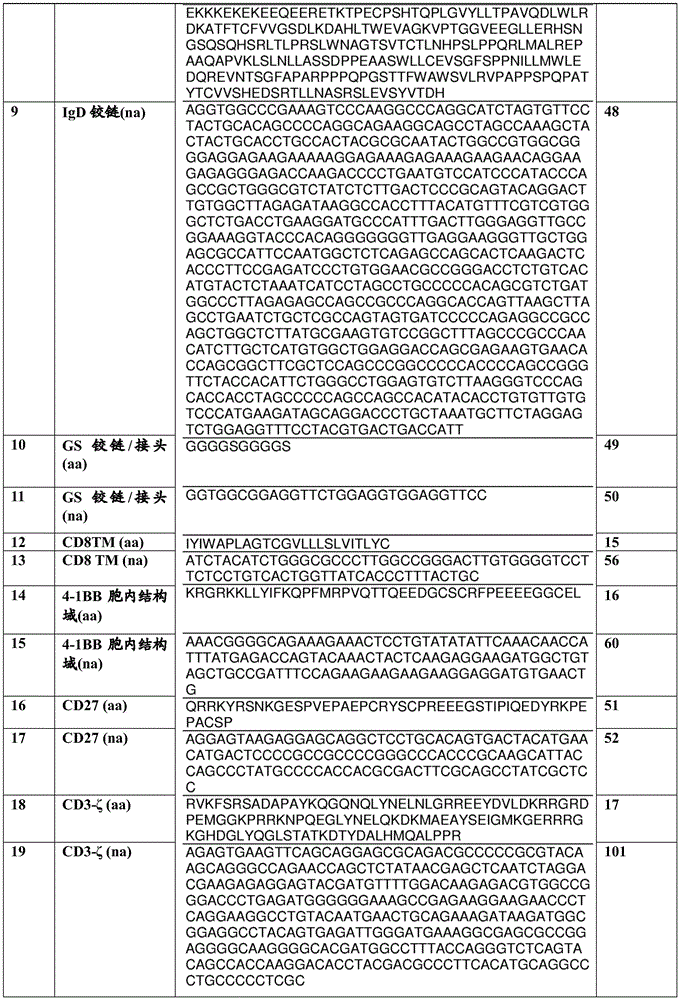


表2.结合B细胞抗原的抗原结合结构域Table 2. Antigen binding domains that bind to B cell antigens


以下实施例旨在说明而非限制本发明。The following examples are intended to illustrate but not to limit the present invention.
实施例Example
实施例1.pCINS载体的产生Example 1. Generation of pCINS vector
使用源自Dull等(J.Virol.72:8463-8471,1998;在此引入作为参考)制备的pRRL.SIN载体骨架的序列,通过DNA2.0从头合成亲本慢病毒转移载体pRRL.SIN.cPPT.EF1a.EGFP.WPRE。图1中显示pCINS的特征图谱,而图2中显示该载体的限制图谱。The parental lentiviral transfer vector pRRL.SIN.cPPT.EF1a.EGFP.WPRE was synthesized de novo by DNA2.0 using a sequence derived from the pRRL.SIN vector backbone prepared by Dull et al. (J. Virol. 72:8463-8471, 1998; incorporated herein by reference). The characteristic map of pCINS is shown in Figure 1, and the restriction map of the vector is shown in Figure 2.
在产生pCINS载体中,对亲本载体进行了以下修饰:In generating the pCINS vector, the following modifications were made to the parental vector:
1.用来自HIV-1分离株NL4-3的相应天然序列替换了5’顺式作用元件。所替换的5’顺式作用元件包括:包装信号(psi)、与psi相邻的部分gag序列、Rev反应元件(RRE)和围绕它的部分env序列及来自pol的中央多聚嘌呤带(cPPT)序列。1. The 5' cis-acting elements were replaced with the corresponding natural sequences from HIV-1 isolate NL4-3. The replaced 5' cis-acting elements include: packaging signal (psi), part of the gag sequence adjacent to psi, Rev response element (RRE) and part of the env sequence surrounding it, and the central polypurine band (cPPT) sequence from pol.
2.SV40和f1复制起点作为冗余部分去除以减小质粒大小。2. The SV40 and f1 origins of replication were removed as redundant parts to reduce the size of the plasmid.
3.在顺式作用元件间引入若干限制位点以便于DNA改造。3. Introduce several restriction sites between cis-acting elements to facilitate DNA modification.
4.突变gag中限制未剪接的病毒RNA核输出的INS1抑制序列(J.Virol.71(7):4892-4903,1997;J.Virol.66(12):7176-7182,1992;每篇文献在此引入作为参考),从而减少该载体编码的病毒RNA核输出的限制。4. Mutate the INS1 inhibitory sequence in gag that limits the nuclear export of unspliced viral RNA (J. Virol. 71(7):4892-4903, 1997; J. Virol. 66(12):7176-7182, 1992; each document is incorporated herein by reference), thereby reducing the restriction of nuclear export of viral RNA encoded by the vector.
5.去除gag序列的核苷酸168之后的部分,其包含抑制序列INS2、INS3和INS4(J.Virol.68(6):3784-3793,1994;在此引入作为参考)。5. The portion after nucleotide 168 of the gag sequence is removed, which contains the inhibitory sequences INS2, INS3, and INS4 (J. Virol. 68(6):3784-3793, 1994; incorporated herein by reference).
6.用CMV启动子替换RSV启动子,因为RSV和CMV启动子都可以用于SIN LV表达(Science 272(5259):263-267,1996;J.Virol.72(11):8463-8471,1998;每篇文献在此引入作为参考)6. Replace the RSV promoter with the CMV promoter, because both RSV and CMV promoters can be used for SIN LV expression (Science 272(5259):263-267, 1996; J. Virol. 72(11):8463-8471, 1998; each document is incorporated herein by reference)
pCINS-EGFP序列在下文显示并在表3中详述。如果希望,可以可选地用本领域的标准方法用另一转基因(例如编码CAR的基因)的序列替换EGFP序列。The pCINS-EGFP sequence is shown below and detailed in Table 3. If desired, the EGFP sequence can alternatively be replaced with the sequence of another transgene (eg, a gene encoding a CAR) using standard methods in the art.
pCINS-EGFP序列(SEQ ID NO:50)pCINS-EGFP sequence (SEQ ID NO:50)



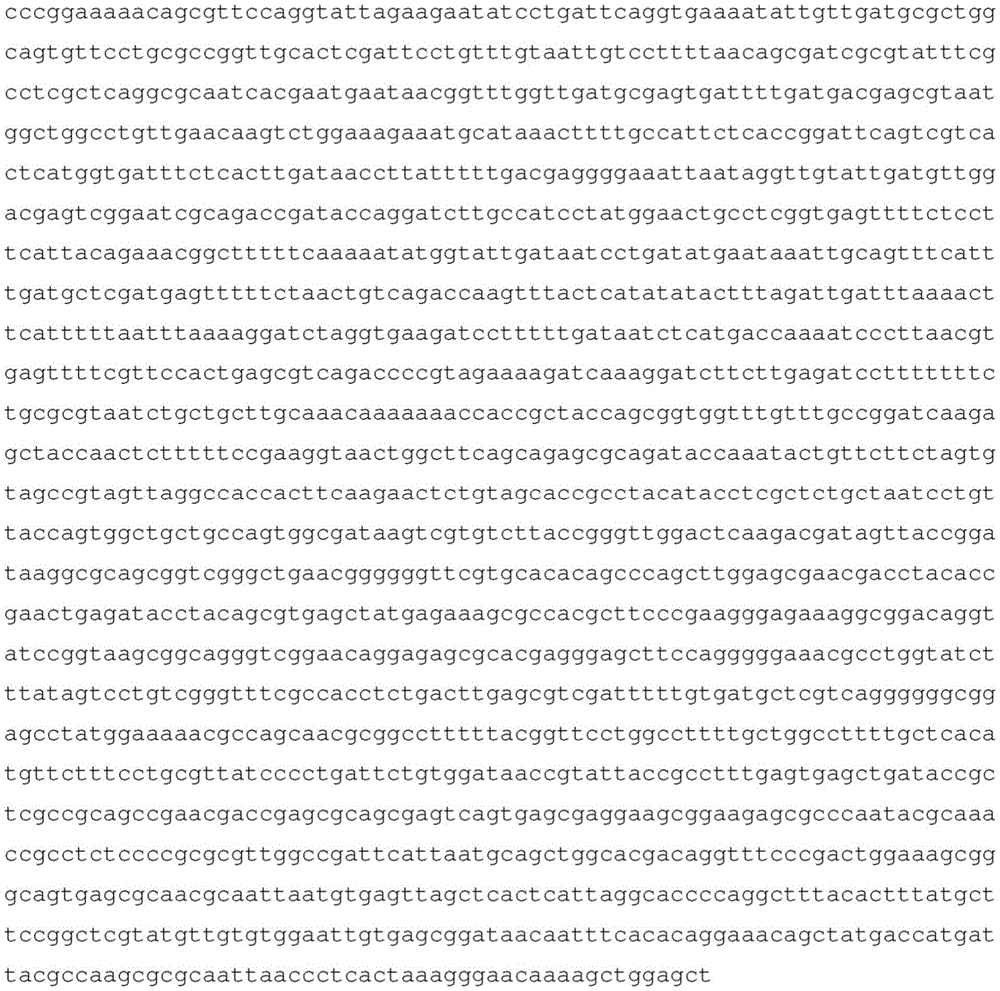
实施例2.pNOX载体的产生Example 2. Production of pNOX vector
进一步修饰实施例1中产生的pCINS载体来产生pNOX载体。具体而言,用来自乙型肝炎病毒的PRE(HPRE)替换pCINS中存在的土拨鼠肝炎病毒转录后调节元件(PRE)(WPRE),HPRE包含乙型肝炎病毒分离株bba6完整基因组(GenBank:KP341007.1)的天然序列。WPRE存在于亲本载体中以确保转基因有效表达。但是,WPRE包含X蛋白质编码序列。X蛋白质ORF在WPRE中的存在为整合慢病毒载体提出了安全性问题。例如,X蛋白质涉及肝癌的产生(GeneTher.12(1):3-4,2005;在此引入作为参考)。在pNOX载体中,在X蛋白质的起始密码子中引入点突变(ATG->AGG)。因此,重组HPRE不包含X蛋白质ORF。图13中显示pNOX的特征图谱,而图14中显示该载体的限制图谱。The pCINS vector produced in Example 1 was further modified to produce the pNOX vector. Specifically, the woodchuck hepatitis virus post-transcriptional regulatory element (PRE) (WPRE) present in pCINS was replaced with a PRE from hepatitis B virus (HPRE), which contains the native sequence of the complete genome of the hepatitis B virus isolate bba6 (GenBank: KP341007.1). The WPRE is present in the parent vector to ensure efficient expression of the transgene. However, the WPRE contains the X protein coding sequence. The presence of the X protein ORF in the WPRE raises safety issues for integrating lentiviral vectors. For example, the X protein has been implicated in the development of liver cancer (Gene Ther. 12(1):3-4, 2005; incorporated herein by reference). In the pNOX vector, a point mutation (ATG->AGG) was introduced in the start codon of the X protein. Therefore, the recombinant HPRE does not contain the X protein ORF. The characteristic map of pNOX is shown in Figure 13, while the restriction map of the vector is shown in Figure 14.
pNOX-EGFP序列在下文显示并在表4中详述。如果希望,可以可选地用本领域的标准方法用另一转基因(例如编码CAR的基因)的序列替换EGFP序列。The pNOX-EGFP sequence is shown below and detailed in Table 4. If desired, the EGFP sequence can optionally be replaced with the sequence of another transgene (eg, a gene encoding a CAR) using standard methods in the art.
pNOX-EGFP序列(SEQ ID NO:51)pNOX-EGFP sequence (SEQ ID NO:51)


实施例3.用pCINS和pNOX载体产生的病毒效价Example 3. Virus titers produced using pCINS and pNOX vectors
为了测定pCINS和pNOX慢病毒转移载体的功效,进行了一系列实验,其中用包装细胞的瞬时转染将转移载体之一引入细胞。简言之,将Expi293TM细胞(ThermoFischer)按5x10⁶/ml(5mln/ml)的浓度200转/分钟、37℃和8%CO2、80%湿度培养在5ml Freestyle(FS)培养基中。使用3μg pNVS-MDLgp-RRE、3μg pNVS RSV Rev-Kan、0.75μg pNVS-MDG-VSVG-Kan和6μg转移载体(pCINS或pNOX),用PEIPro Transfer Reagent(PolyPlus)进行转染。转染48小时后收集病毒上清,并进行效价分析(即测量感染效价)。To determine the efficacy of the pCINS and pNOX lentiviral transfer vectors, a series of experiments were performed in which one of the transfer vectors was introduced into the cells using transient transfection of packaging cells. Briefly, Expi293 TM cells (ThermoFischer) were cultured at a concentration of 5x10 6 /ml (5mln/ml) at 200 rpm, 37°C and 8% CO 2 , 80% humidity in 5 ml Freestyle (FS) medium. Transfection was performed using 3 μg pNVS-MDLgp-RRE, 3 μg pNVS RSV Rev-Kan, 0.75 μg pNVS-MDG-VSVG-Kan and 6 μg transfer vector (pCINS or pNOX) using PEIPro Transfer Reagent (PolyPlus). Viral supernatants were collected 48 hours after transfection and titer analysis (i.e., measuring the infectious titer) was performed.
在293T细胞中,pCINS质粒转移载体产生比亲本载体产生的病毒效价高约五倍的病毒效价(图5A)。基于GFP阳性细胞的百分比评价效价。这种意料之外的强烈病毒产生可以是由于CMV启动子介导的转录在包装细胞中产生更高量的慢病毒基因组RNA(通过qRT-PCR测量),及未剪接的LV RNA由于缺乏细胞核滞留而更有效地从细胞核输出。In 293T cells, the pCINS plasmid transfer vector produced a viral titer about five times higher than that produced by the parental vector (Fig. 5A). Titer was evaluated based on the percentage of GFP-positive cells. This unexpectedly strong viral production can be due to CMV promoter-mediated transcription producing higher amounts of lentiviral genomic RNA (measured by qRT-PCR) in packaging cells, and unspliced LV RNA is more effectively exported from the nucleus due to lack of nuclear retention.
与pCINS相比,pNOX转移载体能够产生相似或更高的载体效价(图5B-5D)。通过转导的293T细胞、Jurkat T细胞和原代人T细胞中的GFP表达来测量感染效价。具体而言,pNOX在293T细胞中(图5B)和在原代人T细胞中(图5D)产生与pCINS相似水平的GFP表达,但实际上相对于pCINS产生实质性更大量的表达GFP的Jurkat细胞(图5C)。Compared to pCINS, the pNOX transfer vector was able to produce similar or higher vector titers (Figures 5B-5D). Infection titers were measured by GFP expression in transduced 293T cells, Jurkat T cells, and primary human T cells. Specifically, pNOX produced similar levels of GFP expression as pCINS in 293T cells (Figure 5B) and in primary human T cells (Figure 5D), but actually produced substantially more GFP-expressing Jurkat cells relative to pCINS (Figure 5C).
还检查了来自慢病毒转移载体的元件基因组整合后的转基因表达水平。用pNOX或pCINS转移载体产生的病毒感染T细胞,使得病毒元件整合入T细胞基因组。与包含WPRE的慢病毒载体pCINS相比,包含HPRE的慢病毒载体pNOX产生相似水平的转基因表达(图5E)。基于之前WPRE(在pCINS中)比HPRE更有效的报道(参见例如J.Virol.72:5085–5092,1998;GeneTherapy 14,1298–1304,2007;每篇文献在此引入作为参考),这些结果令人惊奇。The transgene expression level after genomic integration of the elements from the lentiviral transfer vector was also examined. T cells were infected with viruses produced by pNOX or pCINS transfer vectors so that the viral elements were integrated into the T cell genome. Compared with the lentiviral vector pCINS containing WPRE, the lentiviral vector pNOX containing HPRE produced similar levels of transgene expression (Figure 5E). Based on previous reports that WPRE (in pCINS) is more effective than HPRE (see, e.g., J.Virol.72:5085–5092, 1998; GeneTherapy 14, 1298–1304, 2007; each document is incorporated herein by reference), these results are surprising.
本发明包括pCINS载体,以及包含pCINS载体的部分和/或与pCINS的一个或多个序列具有同一性(例如与pCINS具有至少90%、95%、96%、97%、98%、99%或100%同一性)的序列的相关载体。可以包含在这类相关载体中的序列包括所有pCINS序列,或亚组,包括例如病毒启动子(即驱动病毒蛋白质表达的启动子)、部分gag(例如缺乏INS2、3和4,和/或包含本文所述INS1突变)、部分env、RRE、cPPT、亚基因组启动子(例如本文所述可选地包含组成型剪接供体和剪接受体位点的EF1α启动子)和PRE(可选地含有本文所述X蛋白质失活突变)(这些序列各可选地具有上文所述序列识别号)的多种组合。这类载体可以包含转基因(例如本文所述编码CAR或EGFP的基因)。The present invention includes pCINS vectors, and related vectors comprising portions of pCINS vectors and/or sequences that are identical to one or more sequences of pCINS (e.g., at least 90%, 95%, 96%, 97%, 98%, 99% or 100% identical to pCINS). The sequences that may be included in such related vectors include all pCINS sequences, or subsets, including, for example, viral promoters (i.e., promoters that drive viral protein expression), partial gags (e.g., lacking INS2, 3, and 4, and/or comprising INS1 mutations described herein), partial env, RRE, cPPT, subgenomic promoters (e.g., EF1α promoters described herein that optionally comprise constitutive splicing donor and splicing acceptor sites), and PREs (optionally containing X protein inactivation mutations described herein) (each of these sequences optionally having the sequence identification numbers described above). Such vectors may include transgenes (e.g., genes encoding CAR or EGFP described herein).
表3.pCINS特征Table 3. pCINS characteristics


本发明包括pNOX载体,以及包含pNOX载体的部分和/或与pNOX的一个或多个序列具有同一性(例如与pNOX具有至少90%、95%、96%、97%、98%、99%或100%同一性)的序列的相关载体。可以包含在这类相关载体中的序列包括所有pNOX序列,或亚组,包括例如病毒启动子(即驱动病毒蛋白质表达的启动子)、部分gag(例如缺乏INS2、3和4,和/或包含本文所述INS1突变)、部分env、RRE、cPPT、亚基因组启动子(例如本文所述可选地包含组成型剪接供体和剪接受体位点的EF1α启动子)和PRE(可选地含有本文所述X蛋白质失活突变)(这些序列各可选地具有上文所述序列识别号)的多种组合。这类载体可以包含转基因(例如本文所述编码CAR或EGFP的基因)。The present invention includes pNOX vectors, and related vectors comprising portions of pNOX vectors and/or sequences identical to one or more sequences of pNOX (e.g., at least 90%, 95%, 96%, 97%, 98%, 99% or 100% identical to pNOX). The sequences that may be included in such related vectors include all pNOX sequences, or subsets, including, for example, viral promoters (i.e., promoters that drive viral protein expression), partial gags (e.g., lacking INS2, 3, and 4, and/or comprising INS1 mutations described herein), partial env, RRE, cPPT, subgenomic promoters (e.g., EF1α promoters optionally comprising constitutive splice donor and splice acceptor sites as described herein), and PREs (optionally containing X protein inactivation mutations as described herein) (each of these sequences optionally having the sequence identification numbers described above). Such vectors may include transgenes (e.g., genes encoding CAR or EGFP as described herein).
表4.pNOX特征Table 4. pNOX characteristics


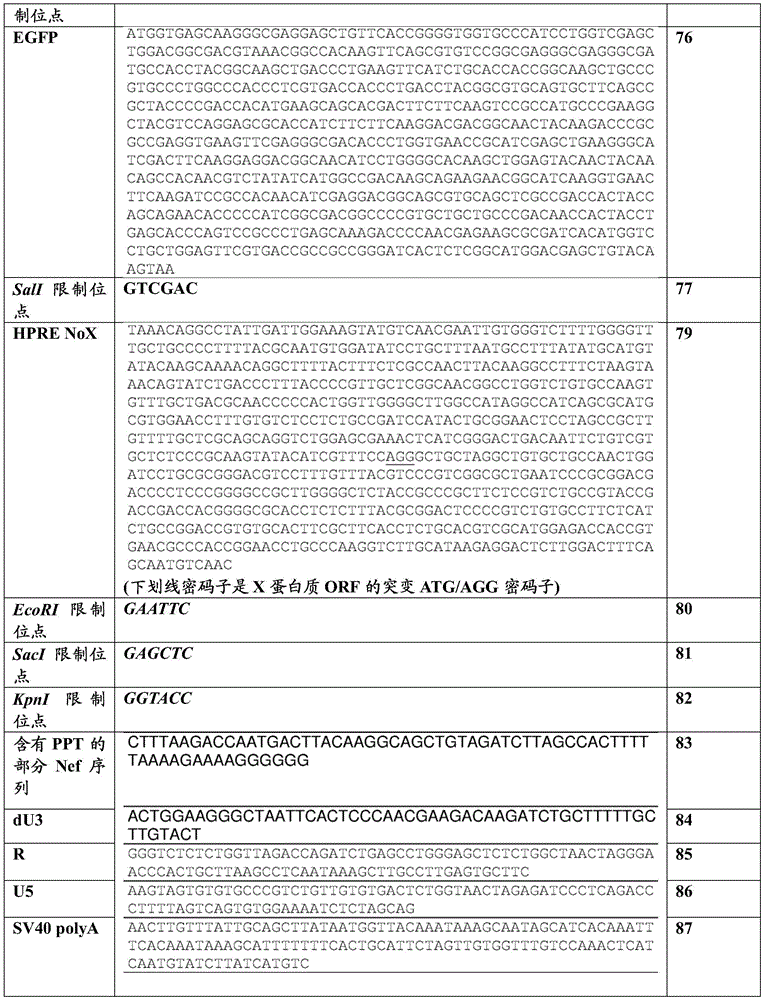
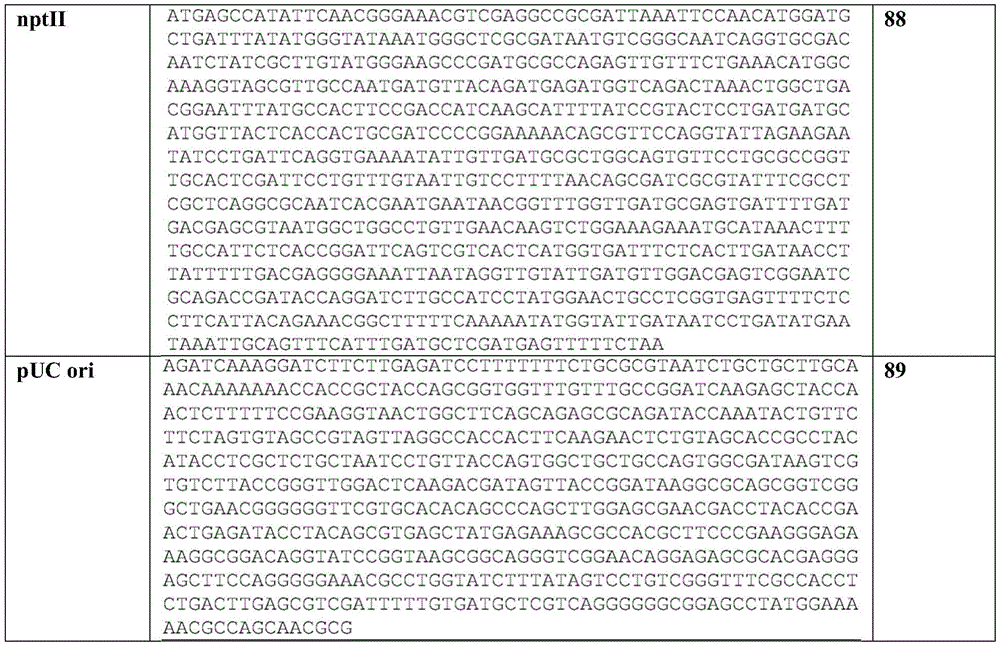
实施例4.pNLV转移载体的产生Example 4. Generation of pNLV transfer vector
进一步修饰实施例2中产生的pNOX载体以产生pNLV载体。图13和14中分别显示pNLV的特征和限制图谱。用SEQ ID NO:92中所示cPPT序列替换pNOX的cPPT元件。cPPT代表pol序列位置2698-2850(参见SEQ ID NO:92和93)。在紧靠编码转基因(例如EGFP,如表5中所示)的基因上游包含Kozak序列。最后,利用SEQ ID NO:95的野生型EF1a启动子(P-EF1a)。pNLV载体具有提高的病毒效价和改善的生物安全性特征。The pNOX vector generated in Example 2 was further modified to generate the pNLV vector. The characteristics and restriction map of pNLV are shown in Figures 13 and 14, respectively. The cPPT element of pNOX was replaced with the cPPT sequence shown in SEQ ID NO:92. The cPPT represents pol sequence positions 2698-2850 (see SEQ ID NOs:92 and 93). A Kozak sequence was included just upstream of the gene encoding the transgene (e.g., EGFP, as shown in Table 5). Finally, the wild-type EF1a promoter (P-EF1a) of SEQ ID NO:95 was utilized. The pNLV vector has increased viral titer and improved biosafety characteristics.
下文显示pNLV载体的序列和pNLV载体中元件的序列。在一些情况下,pNLV载体中所包含的载体骨架和元件及其部分可以用于本文所述的任意载体中。可按照本领域公知的克隆方法将载体骨架序列和功能性元件插入另一载体和/或替换另一载体的部分。The sequence of the pNLV vector and the sequence of the elements in the pNLV vector are shown below. In some cases, the vector backbone and elements contained in the pNLV vector and parts thereof can be used in any vector described herein. The vector backbone sequence and functional elements can be inserted into another vector and/or replace part of another vector according to cloning methods known in the art.
pNLV-EGFP序列在下文显示并在表5中详述。如果希望,可以可选地用本领域的标准方法用另一转基因(例如编码CAR的基因)的序列替换EGFP序列。The pNLV-EGFP sequence is shown below and detailed in Table 5. If desired, the EGFP sequence can optionally be replaced with the sequence of another transgene (e.g., a gene encoding a CAR) using standard methods in the art.
pNLV-EGFP序列(SEQ ID NO:90)pNLV-EGFP sequence (SEQ ID NO:90)

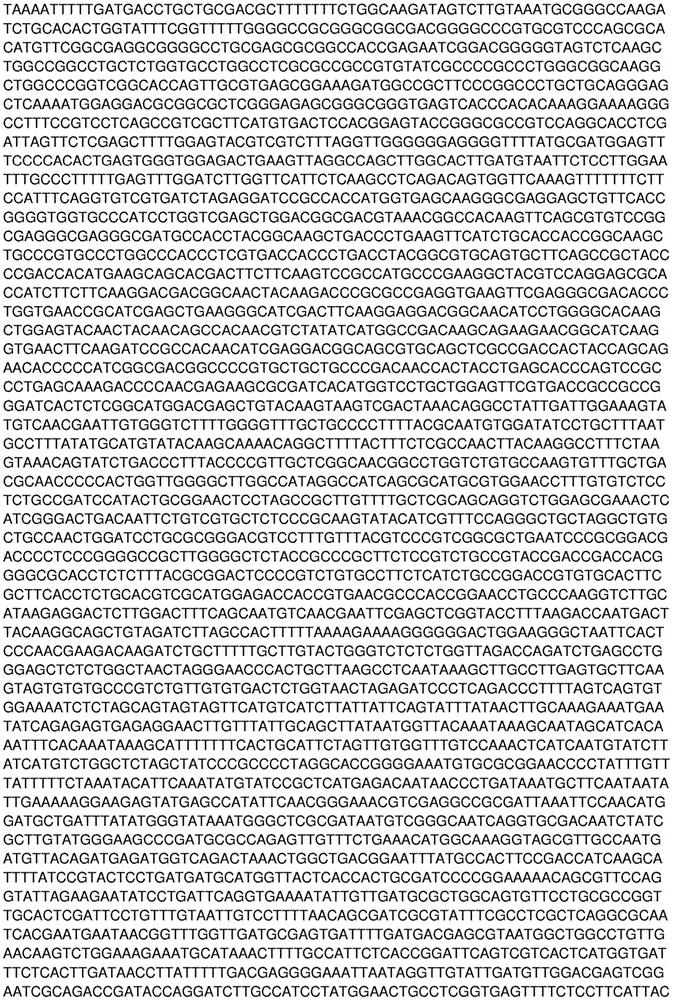
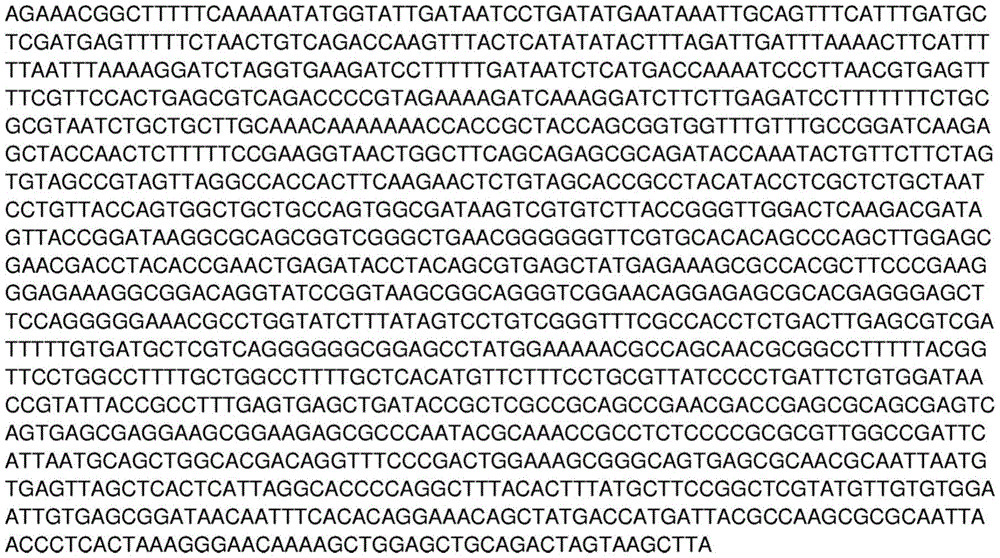
下文表4中显示存在于pNLV载体内的功能性元件。全pNLV序列的部分可以包含载体骨架序列。这类载体骨架序列可以用作和/或替换本文所述任意载体(例如pCINS、pNOX和pNLV)中的载体骨架序列或其部分。The functional elements present in the pNLV vector are shown below in Table 4. Portions of the full pNLV sequence may include a vector backbone sequence. Such vector backbone sequences may be used as and/or replace the vector backbone sequence or portion thereof in any of the vectors described herein (e.g., pCINS, pNOX, and pNLV).
本发明包括pNLV载体,以及包含pNLV载体的部分和/或与pNLV的一个或多个序列具有同一性(例如与pNLV具有至少90%、95%、96%、97%、98%、99%或100%同一性)的序列的相关载体。可以包含在这类相关载体中的序列包括所有pNLV序列,或亚组,包括例如病毒启动子(即驱动病毒蛋白质表达的启动子)、部分gag(例如缺乏INS2、3和4,和/或包含本文所述INS1突变)、部分env、RRE、cPPT、亚基因组启动子(例如本文所述可选地包含组成型剪接供体和剪接受体位点的EF1α启动子)和PRE(可选地含有本文所述X蛋白质失活突变)(这些序列各可选地具有上文所述序列识别号)的多种组合。这类载体可以包含转基因(例如本文所述编码CAR或EGFP的基因)。The present invention includes pNLV vectors, and related vectors comprising portions of pNLV vectors and/or sequences that are identical to one or more sequences of pNLV (e.g., at least 90%, 95%, 96%, 97%, 98%, 99% or 100% identical to pNLV). The sequences that may be included in such related vectors include all pNLV sequences, or subgroups, including, for example, viral promoters (i.e., promoters that drive viral protein expression), partial gags (e.g., lacking INS2, 3, and 4, and/or comprising INS1 mutations described herein), partial env, RRE, cPPT, subgenomic promoters (e.g., EF1α promoters that optionally comprise constitutive splicing donor and splicing acceptor sites as described herein), and PREs (optionally containing X protein inactivation mutations as described herein) (each of these sequences optionally has a sequence identification number as described above). Such vectors may include transgenes (e.g., genes encoding CAR or EGFP as described herein).
表5.pNLV特征Table 5. pNLV characteristics


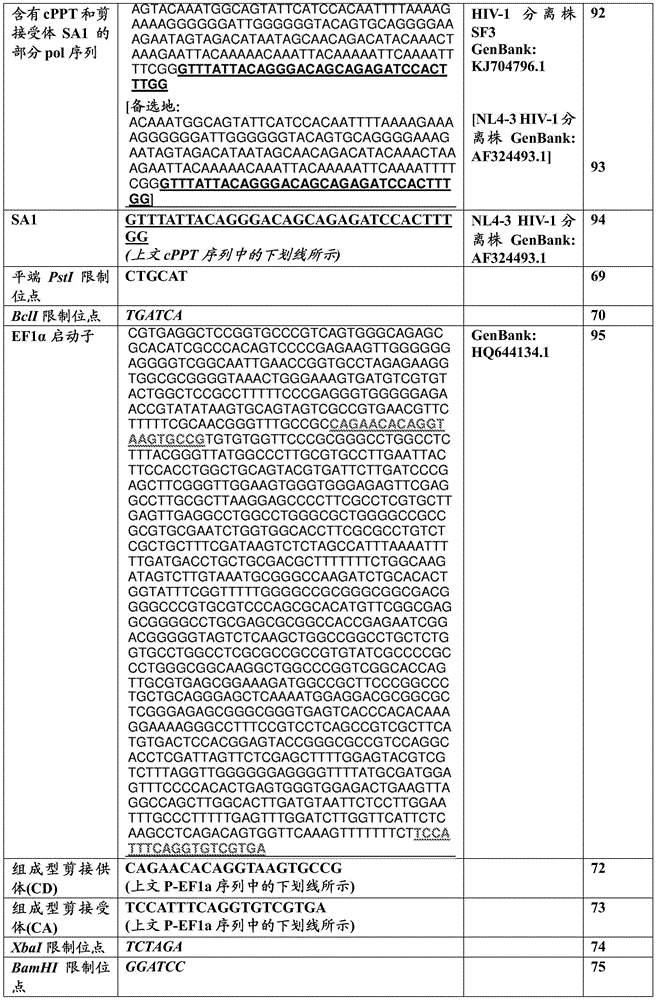
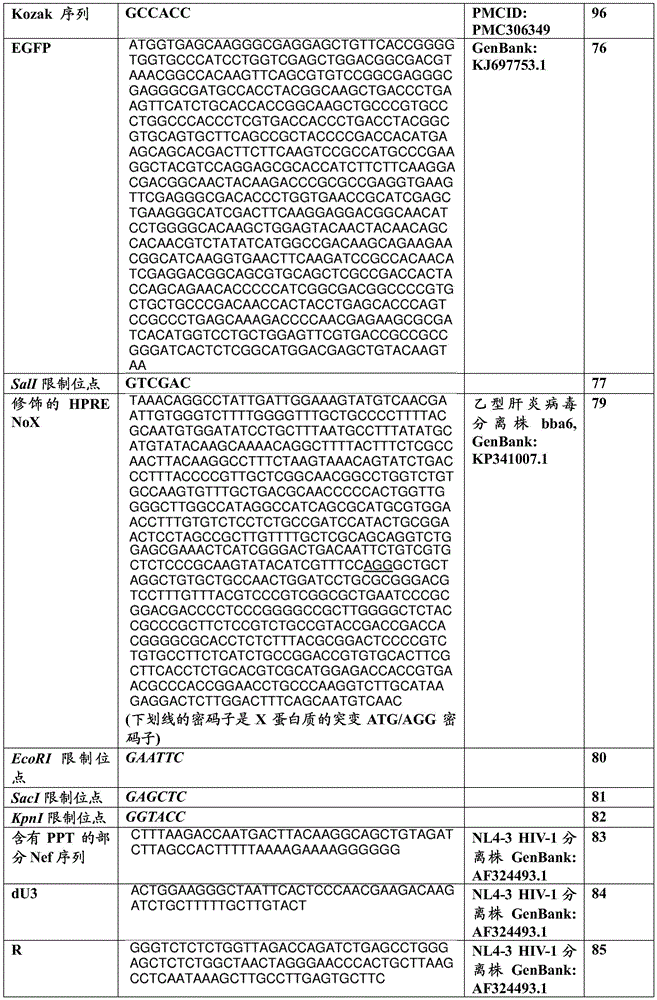

实施例5.用于慢病毒产生的转移载体的优化Example 5. Optimization of transfer vectors for lentiviral production
发展了具有更高病毒效价、增强的生物安全性特征、提高的转导效率和持久的转基因表达的改善的慢病毒转移载体系统。重新改造了许多顺式作用元件以产生pNLV转移载体骨架(图6)。为了测定编码GFP的pNLV慢病毒转移载体与编码GFP的pCINS转移载体相比的功效,进行了一系列实验,其中通过包装细胞的瞬时转染将转移载体之一引入细胞。简言之,将Expi293TM细胞(ThermoFischer)按5x10⁶/ml的浓度200转/分钟、37℃和8%CO2、80%湿度培养在5ml Freestyle(FS)培养基中。使用3μg pNVS-MDLgp-RRE、3μg pNVS 20RSVRev-Kan、0.75μg pNVS-MDG-VSVG-Kan和6μg转移质粒,用PEIPro Transfer Reagent(PolyPlus)进行转染。转染48小时后收集病毒上清,并进行效价分析(即测量感染效价)。An improved lentiviral transfer vector system with higher viral titer, enhanced biosafety characteristics, improved transduction efficiency and durable transgene expression was developed. Many cis-acting elements were reengineered to generate the pNLV transfer vector backbone (Figure 6). In order to determine the efficacy of the pNLV lentiviral transfer vector encoding GFP compared to the pCINS transfer vector encoding GFP, a series of experiments were performed in which one of the transfer vectors was introduced into the cells by transient transfection of packaging cells. Briefly, Expi293 TM cells (ThermoFischer) were cultured at a concentration of 5x10 6 /ml at 200 rpm, 37°C and 8% CO 2 , 80% humidity in 5 ml Freestyle (FS) medium. Transfection was performed using 3 μg pNVS-MDLgp-RRE, 3 μg pNVS 20RSVRev-Kan, 0.75 μg pNVS-MDG-VSVG-Kan and 6 μg transfer plasmid with PEIPro Transfer Reagent (PolyPlus). Virus supernatants were collected 48 hours after transfection and subjected to titer analysis (ie, measuring the infectious titer).
pNLV转移载体产生了比对照亲本(即优化前)载体产生的病毒效价高约二至三倍的病毒效价(图7A)。基于病毒RNA拷贝数评价物理效价(例如通过qRT-PCR测量),基于通过前病毒整合效价测定检测的感染单位确定感染效价(图7B)。The pNLV transfer vector produced a viral titer that was approximately two to three times higher than the viral titer produced by the control parental (i.e., before optimization) vector ( FIG. 7A ). Physical titers were evaluated based on viral RNA copy number (e.g., measured by qRT-PCR), and infectious titers were determined based on infectious units detected by a proviral integration titer assay ( FIG. 7B ).
然后,与pCINS转移载体相比,检查了来自pNLV载体的元件基因组整合后的转基因表达水平。用pCINS或pNLV慢病毒载体产生的病毒感染T细胞,使得病毒元件整合入T细胞基因组。发现pNLV载体与pCINS相比具有更高水平的转基因表达(如通过FACS测量)(如8A-8C)。Then, compared with the pCINS transfer vector, the transgenic expression level after the element genome integration from the pNLV vector was checked. Virus infection T cells produced with pCINS or pNLV lentiviral vectors allow the viral elements to be integrated into the T cell genome. It was found that the pNLV vector had a higher level of transgenic expression (as measured by FACS) than pCINS (e.g., 8A-8C).
还就它们的相对感染效价将pNLV和pCINS载体与若干市售转移载体相比较。将每种市售载体和pCINS载体与编码GFP的对照(亲本)载体分开比较,并进一步将pCINS载体与pNLV比较。将pLVX(Clontech)转移载体转导入293T细胞并发现具有比对照载体略高的病毒效价(图9A)。将pLenti6.2(Life Technologies)转移载体转导入细胞并发现与对照载体相比病毒效价大幅降低(图9B)。将pD2109(DNA2.0)转移载体转导入细胞并发现与对照载体相比病毒效价小幅降低(图9C)。将pCINS转移载体转导入细胞并发现病毒效价比对照载体实质性高(图9D)。还将pNLV转移载体转导入细胞并发现病毒效价比pCINS载体高(图9E)。这些结果表明,用pCINS和pNLV二者制备的病毒总体上比用市售慢病毒转移载体制备的那些显著更具感染性,用pNLV载体制备的病毒显示最高病毒效价。pNLV and pCINS vectors were also compared with several commercially available transfer vectors with regard to their relative infection titers. Each commercially available vector and pCINS vector were separately compared with the control (parent) vector encoding GFP, and the pCINS vector was further compared with pNLV. pLVX (Clontech) transfer vector was transduced into 293T cells and found to have a slightly higher viral titer than the control vector (Fig. 9A). pLenti6.2 (Life Technologies) transfer vector was transduced into cells and found to have a significantly lower viral titer than the control vector (Fig. 9B). pD2109 (DNA2.0) transfer vector was transduced into cells and found to have a slightly lower viral titer than the control vector (Fig. 9C). pCINS transfer vector was transduced into cells and found to have a substantially higher viral titer than the control vector (Fig. 9D). pNLV transfer vector was also transduced into cells and found to have a higher viral titer than the pCINS vector (Fig. 9E). These results indicate that viruses prepared with both pCINS and pNLV were overall significantly more infectious than those prepared with commercially available lentiviral transfer vectors, with viruses prepared with the pNLV vector showing the highest viral titers.
为了探究剪接对感染效价的影响,突变了一系列剪接供体和剪接受体位点用于后续病毒效价测定(图10A)。将pCINS转移载体的多种剪接供体和剪接受体位点突变体转染入包装细胞,并将一系列突变体与对照转移载体进行病毒效价比较(图10B)。所有突变都导致病毒效价大幅降低,表明剪接位点在转移载体骨架中的存在为最大病毒效价所需。这些观察结果表明,剪接位点的存在对慢病毒RNA核输出很重要。基因组慢病毒RNA从细胞核转运可需要与剪接体和Rev蛋白质的相互作用。从包装载体表达的高水平Rev蛋白质可确保保护全尺寸慢病毒RNA免受剪接并转运用于包装。In order to explore the effect of splicing on the infection titer, a series of splicing donor and splicing acceptor sites were mutated for subsequent viral titer determination (Figure 10A). A variety of splicing donor and splicing acceptor site mutants of the pCINS transfer vector were transfected into packaging cells, and a series of mutants were compared with the control transfer vector for viral titer (Figure 10B). All mutations resulted in a significant reduction in viral titer, indicating that the presence of splicing sites in the transfer vector backbone is required for maximum viral titer. These observations indicate that the presence of splicing sites is important for nuclear export of lentiviral RNA. Genomic lentiviral RNA transport from the nucleus may require interaction with the spliceosome and Rev protein. High levels of Rev protein expressed from the packaging vector ensure that the full-size lentiviral RNA is protected from splicing and transported for packaging.
最后,在一系列新改造的转移载体构建体中去除转移载体骨架的gag和env区,以确定gag和env元件对感染病毒效价的重要性。制备了含有3’和5’gag和env缺失的转移载体(即–gag3’、–gag5’、–env3’和–env5’突变体)(图11A),然后将每种载体转导入分开的细胞组。测定每种gag和/或env缺失突变体的病毒效价,并与对照慢病毒转移载体相比较(图11B)。发现–env3’和–gag3’-env5’突变体相对于对照载体显示病毒效价降低,而–env5’和–gag3’显示病毒效价几乎无差异。这些结果表明,可以单独改变3’gag和5’env区,对病毒效价仅有轻微影响,但其他gag和env截短有害于转移载体功效。Finally, the gag and env regions of the transfer vector backbone were removed in a series of newly engineered transfer vector constructs to determine the importance of gag and env elements for infectious virus titers. Transfer vectors containing 3' and 5' gag and env deletions (i.e., -gag3', -gag5', -env3', and -env5' mutants) were prepared (Figure 11A), and each vector was then transduced into separate groups of cells. The viral titer of each gag and/or env deletion mutant was determined and compared to a control lentiviral transfer vector (Figure 11B). It was found that the -env3' and -gag3'-env5' mutants showed reduced viral titers relative to the control vector, while -env5' and -gag3' showed almost no difference in viral titers. These results indicate that the 3' gag and 5' env regions can be altered individually with only a slight effect on viral titers, but that other gag and env truncations are detrimental to transfer vector efficacy.
实施例6.pNLV和pRRLSIN间的序列差异Example 6. Sequence Differences between pNLV and pRRLSIN
修饰pRRLSIN转移载体以产生pNLV载体。引入这些核苷酸取代和插入来改善慢病毒转移载体的功效和生物安全性特征。在一个实例中,pNLV psi序列与pRRLSIN序列相比具有以下序列差异(图12A):T771C、T784G、A785G、G788A、多核苷酸序列“GAG”(792-794)的插入、A798C和G924A。pNLV具有从907位至1074位的部分gag序列。此外,pNLV与pRRLSIN相比具有以下序列差异(图12B):以下核苷酸的插入:A968和A969(产生终止密码子),以及以下取代:G924A、A949C、A950G、G989A、G992A、C995T、G998A、C999T、G1004A、C1007T、C1010A、T1058G和G1064A。pNLV还具有从1083位至1228位的部分env序列。在此区域中,pNLV与pRRLSIN相比具有以下序列差异(图12C):C1105A。The pRRLSIN transfer vector was modified to generate the pNLV vector. These nucleotide substitutions and insertions were introduced to improve the efficacy and biosafety characteristics of the lentiviral transfer vector. In one example, the pNLV psi sequence has the following sequence differences compared to the pRRLSIN sequence ( FIG. 12A ): T771C, T784G, A785G, G788A, insertion of the polynucleotide sequence "GAG" (792-794), A798C, and G924A. pNLV has a partial gag sequence from position 907 to
与pRRLSIN相比,pNLV RRE区域具有以下序列差异(图12D):G1291C、A1332G和A1414G。pNLV具有从1479位至1961位的部分env区域(包含主要剪接受体7位点)。此外,pNLV与pRRLSIN相比在此部分env区域中具有以下序列差异(图12E):A1571C、T1575C和T1866C。Compared with pRRLSIN, the pNLV RRE region has the following sequence differences ( FIG. 12D ): G1291C, A1332G, and A1414G. pNLV has a partial env region from position 1479 to position 1961 (including the major splice acceptor 7 site). In addition, pNLV has the following sequence differences in this partial env region compared with pRRLSIN ( FIG. 12E ): A1571C, T1575C, and T1866C.
pNLV具有1971位至2118位的cPPT区域,及1974位至2151位的部分pol序列(包含主要剪接受体1位点)(图12F)。在一些情况下,cPPT区包含178个核苷酸的序列。在一些情况下,与亲本载体相比,部分gag、部分env和/或部分pol序列显示与野生型病毒序列的同源性降低,从而改善生物安全性特征。此外,pNLV与pRRLSIN相比在cPPT和部分pol区域内具有以下序列差异插入:+A1971、+ACAAATGGCAG(1974-1984)、+TTCATCC(1987-1993)、+A1996、+A1997和+CGGGTTTATTACAGGGACAGCAGAGATCCACTTTGG(2116-2151)。pNLV has a cPPT region from position 1971 to position 2118, and a portion of the pol sequence from position 1974 to position 2151 (including the
除cPPT区差异外,上述pNLV和pRLLSIN间的序列差异各适用于pCINS和pNOX与pRLLSIN相比。pCINS或pNOX相对于pRLLSIN间的差异的确切核苷酸位置可以通过比对本文提供的相关序列来鉴定。The sequence differences described above between pNLV and pRLLSIN apply to each of pCINS and pNOX compared to pRLLSIN, except for differences in the cPPT region. The exact nucleotide positions of differences between pCINS or pNOX relative to pRLLSIN can be identified by aligning the relevant sequences provided herein.
其他实施方案Other Implementations
以上说明书中提到的所有出版物、专利和专利申请在此以相同的程度引入作为参考,就如同明确和单独地说明以其整体引入每一单个出版物、专利或专利申请作为参考一样。本发明的所述方法、药物组合物和试剂盒的多种修改和变形对本领域技术人员而言显而易见而不背离本发明的范围和精神。虽然已结合具体实施方案描述了本发明,但应理解它能够进一步修改,所要求的发明不应不适当地限于这类具体实施方案。实际上,对本领域技术人员而言显而易见的是,所述用于实施本发明的方式的多种修改旨在处于本发明的范围之内。本申请旨在涵盖本发明的任何变形、用途或改编,其通常遵循本发明的原理,且包括处于本发明所属领域内的已知惯例内,且可应用于前文所示基本特征的这类对本公开的偏离。All publications, patents and patent applications mentioned in the above specification are hereby incorporated by reference to the same extent as if each individual publication, patent or patent application was expressly and individually stated to be incorporated by reference in its entirety. Various modifications and variations of the methods, pharmaceutical compositions and kits of the present invention will be apparent to those skilled in the art without departing from the scope and spirit of the present invention. Although the present invention has been described in conjunction with specific embodiments, it should be understood that it is capable of further modification, and the claimed invention should not be unduly limited to such specific embodiments. In fact, it will be apparent to those skilled in the art that various modifications of the modes for implementing the present invention are intended to be within the scope of the present invention. This application is intended to cover any variation, use or adaptation of the present invention, which generally follows the principles of the present invention, and includes such deviations from the present disclosure that are within the known practices in the field to which the present invention belongs, and can be applied to the basic features shown above.
Claims (41)
Applications Claiming Priority (4)
| Application Number | Priority Date | Filing Date | Title |
|---|---|---|---|
| US201562258798P | 2015-11-23 | 2015-11-23 | |
| US62/258,798 | 2015-11-23 | ||
| PCT/US2016/063700 WO2017091786A1 (en) | 2015-11-23 | 2016-11-23 | Optimized lentiviral transfer vectors and uses thereof |
| CN201680079587.7A CN108603200B (en) | 2015-11-23 | 2016-11-23 | Optimized lentiviral transfer vectors and uses thereof |
Related Parent Applications (1)
| Application Number | Title | Priority Date | Filing Date |
|---|---|---|---|
| CN201680079587.7A Division CN108603200B (en) | 2015-11-23 | 2016-11-23 | Optimized lentiviral transfer vectors and uses thereof |
Publications (1)
| Publication Number | Publication Date |
|---|---|
| CN116334143A true CN116334143A (en) | 2023-06-27 |
Family
ID=57543217
Family Applications (2)
| Application Number | Title | Priority Date | Filing Date |
|---|---|---|---|
| CN202210859203.0A Pending CN116334143A (en) | 2015-11-23 | 2016-11-23 | Optimized lentiviral transfer vectors and uses thereof |
| CN201680079587.7A Active CN108603200B (en) | 2015-11-23 | 2016-11-23 | Optimized lentiviral transfer vectors and uses thereof |
Family Applications After (1)
| Application Number | Title | Priority Date | Filing Date |
|---|---|---|---|
| CN201680079587.7A Active CN108603200B (en) | 2015-11-23 | 2016-11-23 | Optimized lentiviral transfer vectors and uses thereof |
Country Status (14)
| Country | Link |
|---|---|
| US (3) | US10711282B2 (en) |
| EP (2) | EP3380620B1 (en) |
| JP (3) | JP7118887B2 (en) |
| CN (2) | CN116334143A (en) |
| DK (1) | DK3380620T3 (en) |
| ES (1) | ES2987957T3 (en) |
| FI (1) | FI3380620T3 (en) |
| HR (1) | HRP20241245T1 (en) |
| HU (1) | HUE068340T2 (en) |
| LT (1) | LT3380620T (en) |
| PL (1) | PL3380620T3 (en) |
| PT (1) | PT3380620T (en) |
| SI (1) | SI3380620T1 (en) |
| WO (1) | WO2017091786A1 (en) |
Families Citing this family (20)
| Publication number | Priority date | Publication date | Assignee | Title |
|---|---|---|---|---|
| SG10202109752XA (en) * | 2014-04-07 | 2021-10-28 | Novartis Ag | Treatment of cancer using anti-cd19 chimeric antigen receptor |
| CN116334143A (en) | 2015-11-23 | 2023-06-27 | 诺华股份有限公司 | Optimized lentiviral transfer vectors and uses thereof |
| WO2017180587A2 (en) | 2016-04-11 | 2017-10-19 | Obsidian Therapeutics, Inc. | Regulated biocircuit systems |
| WO2019056015A2 (en) * | 2017-09-18 | 2019-03-21 | Children's Hospital Medical Center | A strong insulator and uses thereof in gene delivery |
| WO2019138354A1 (en) | 2018-01-12 | 2019-07-18 | Curocell Inc. | Enhanced immune cells using dual shrna and composition including the same |
| US12419913B2 (en) | 2019-02-08 | 2025-09-23 | Dna Twopointo, Inc. | Modification of CAR-T cells |
| CN110054678B (en) * | 2019-05-16 | 2023-04-18 | 中国医学科学院血液病医院(血液学研究所) | Membrane-bound mFLT3LG protein and application thereof |
| AU2020286471B2 (en) * | 2019-06-07 | 2025-07-31 | The Trustees Of The University Of Pennsylvania | Dual CAR expressing T cells individually linked to CD28 and 4-1BB |
| JP7640538B2 (en) | 2019-10-08 | 2025-03-05 | トラスティーズ オブ ボストン カレッジ | Proteins containing multiple different unnatural amino acids and methods of making and using such proteins |
| KR20220150353A (en) | 2020-03-05 | 2022-11-10 | 네오티엑스 테라퓨틱스 엘티디. | Methods and compositions for treating cancer using immune cells |
| DE102020111571A1 (en) | 2020-03-11 | 2021-09-16 | Immatics US, Inc. | WPRE MUTANT CONSTRUCTS, COMPOSITIONS, AND RELATED PROCEDURES |
| GB202005096D0 (en) * | 2020-04-07 | 2020-05-20 | Glaxosmithkline | Modified vectors for production of retrovirus |
| WO2021212279A1 (en) * | 2020-04-20 | 2021-10-28 | 广东东阳光药业有限公司 | Titer improved transfer plasmid for lentivirus |
| CN116209676A (en) | 2020-06-22 | 2023-06-02 | 恩格姆生物制药公司 | LAIR-1 binders and methods of use thereof |
| CN113652451B (en) * | 2020-10-28 | 2023-04-11 | 和元生物技术(上海)股份有限公司 | Lentiviral vector, construction method and application thereof |
| CN112852746A (en) * | 2021-02-04 | 2021-05-28 | 中吉智药(南京)生物技术有限公司 | Large-scale lentivirus gene medicine preparation system and method based on Cre recombinase induction |
| WO2023023467A1 (en) * | 2021-08-17 | 2023-02-23 | Interius Biotherapeutics, Inc. | Nucleic acid molecules and methods of using the same |
| CN114456270B (en) * | 2022-03-02 | 2023-12-22 | 北京美康基免生物科技有限公司 | GD2 chimeric antigen receptor and application thereof |
| CN116057186A (en) * | 2022-10-26 | 2023-05-02 | 科士华(南京)生物技术有限公司 | Plasmid targets, primer probes, kits and methods for detecting host DNA residues in cell preparations or virus preparations |
| CN116064622B (en) * | 2023-02-13 | 2023-10-13 | 优睿赛思(武汉)生物科技有限公司 | Preparation and application of Claudin6-mCherry reporter gene CHO-K1 stable transgenic cell strain |
Family Cites Families (104)
| Publication number | Priority date | Publication date | Assignee | Title |
|---|---|---|---|---|
| US504048A (en) | 1893-08-29 | Sulky | ||
| FR901228A (en) | 1943-01-16 | 1945-07-20 | Deutsche Edelstahlwerke Ag | Ring gap magnet system |
| US4851332A (en) | 1985-04-01 | 1989-07-25 | Sloan-Kettering Institute For Cancer Research | Choriocarcinoma monoclonal antibodies and antibody panels |
| US5869620A (en) | 1986-09-02 | 1999-02-09 | Enzon, Inc. | Multivalent antigen-binding proteins |
| US6352694B1 (en) | 1994-06-03 | 2002-03-05 | Genetics Institute, Inc. | Methods for inducing a population of T cells to proliferate using agents which recognize TCR/CD3 and ligands which stimulate an accessory molecule on the surface of the T cells |
| US5858358A (en) | 1992-04-07 | 1999-01-12 | The United States Of America As Represented By The Secretary Of The Navy | Methods for selectively stimulating proliferation of T cells |
| US6534055B1 (en) | 1988-11-23 | 2003-03-18 | Genetics Institute, Inc. | Methods for selectively stimulating proliferation of T cells |
| US6905680B2 (en) | 1988-11-23 | 2005-06-14 | Genetics Institute, Inc. | Methods of treating HIV infected subjects |
| GB9012995D0 (en) | 1990-06-11 | 1990-08-01 | Celltech Ltd | Multivalent antigen-binding proteins |
| US5817491A (en) | 1990-09-21 | 1998-10-06 | The Regents Of The University Of California | VSV G pseusdotyped retroviral vectors |
| US5199942A (en) | 1991-06-07 | 1993-04-06 | Immunex Corporation | Method for improving autologous transplantation |
| US5637481A (en) | 1993-02-01 | 1997-06-10 | Bristol-Myers Squibb Company | Expression vectors encoding bispecific fusion proteins and methods of producing biologically active bispecific fusion proteins in a mammalian cell |
| CA2078539C (en) | 1991-09-18 | 2005-08-02 | Kenya Shitara | Process for producing humanized chimera antibody |
| GB9125768D0 (en) | 1991-12-04 | 1992-02-05 | Hale Geoffrey | Therapeutic method |
| US6174666B1 (en) | 1992-03-27 | 2001-01-16 | The United States Of America As Represented By The Department Of Health And Human Services | Method of eliminating inhibitory/instability regions from mRNA |
| US5646253A (en) | 1994-03-08 | 1997-07-08 | Memorial Sloan-Kettering Cancer Center | Recombinant human anti-LK26 antibodies |
| US5837821A (en) | 1992-11-04 | 1998-11-17 | City Of Hope | Antibody construct |
| US5504048A (en) | 1993-06-02 | 1996-04-02 | Fina Technology, Inc. | Addition of lithium compounds to Ziegler-Natta catalysts for increased molecular weight in polyolefins |
| AU7863794A (en) | 1993-11-16 | 1995-06-06 | Pola Chemical Industries Inc. | Antihuman tyrosinase monoclonal antibody |
| US5635388A (en) | 1994-04-04 | 1997-06-03 | Genentech, Inc. | Agonist antibodies against the flk2/flt3 receptor and uses thereof |
| WO1995029193A2 (en) | 1994-04-22 | 1995-11-02 | The Government Of The United States Of America Represented By The Secretary, Department Of Health And Human Services | Melanoma antigens |
| US7175843B2 (en) | 1994-06-03 | 2007-02-13 | Genetics Institute, Llc | Methods for selectively stimulating proliferation of T cells |
| US5786464C1 (en) | 1994-09-19 | 2012-04-24 | Gen Hospital Corp | Overexpression of mammalian and viral proteins |
| CA2210620C (en) | 1995-01-18 | 2004-06-22 | Boehringer Mannheim Gmbh | Anti-cd 30 antibodies preventing proteolytic cleavage and release of membrane-bound cd 30 antigen |
| US5731168A (en) | 1995-03-01 | 1998-03-24 | Genentech, Inc. | Method for making heteromultimeric polypeptides |
| US6692964B1 (en) | 1995-05-04 | 2004-02-17 | The United States Of America As Represented By The Secretary Of The Navy | Methods for transfecting T cells |
| US7067318B2 (en) | 1995-06-07 | 2006-06-27 | The Regents Of The University Of Michigan | Methods for transfecting T cells |
| DE19608769C1 (en) | 1996-03-07 | 1997-04-10 | Univ Eberhard Karls | Monoclonal antibody BV10A4H2 specific for human FLT3/FLK2 receptor |
| US6114148C1 (en) | 1996-09-20 | 2012-05-01 | Gen Hospital Corp | High level expression of proteins |
| DE69703974T2 (en) | 1996-10-17 | 2001-07-19 | Oxford Biomedica (Uk) Ltd., Oxford | RETROVIRAL VECTORS |
| EP0938557B1 (en) | 1996-10-25 | 2000-09-13 | THE GOVERNMENT OF THE UNITED STATES OF AMERICA as represented by the SECRETARY OF THE DEPARTMENT OF HEALTH AND HUMAN SERVICES | Methods and compositions for inhibiting inflammation and angiogenesis comprising a mammalian cd97 alpha subunit |
| US6924123B2 (en) | 1996-10-29 | 2005-08-02 | Oxford Biomedica (Uk) Limited | Lentiviral LTR-deleted vector |
| WO1998051810A1 (en) | 1997-05-13 | 1998-11-19 | University Of North Carolina At Chapel Hill | Lentivirus-based gene transfer vectors |
| DE69839147T2 (en) | 1997-06-12 | 2009-02-19 | Novartis International Pharmaceutical Ltd. | ARTIFICIAL ANTIBODY POLYPEPTIDE |
| AU760287B2 (en) | 1997-12-22 | 2003-05-08 | Oxford Biomedica (Uk) Limited | Equine infectious anaemia virus (EIAV) based |
| GB9803351D0 (en) | 1998-02-17 | 1998-04-15 | Oxford Biomedica Ltd | Anti-viral vectors |
| US6803448B1 (en) | 1998-07-22 | 2004-10-12 | Vanderbilt University | GBS toxin receptor |
| US6528481B1 (en) | 1999-02-16 | 2003-03-04 | The Burnam Institute | NG2/HM proteoglycan-binding peptides that home to angiogenic vasculature and related methods |
| GEP20053685B (en) | 1999-08-17 | 2005-12-12 | Biogen Inc | BAFF Receptor (BCMA), an Immunoregulatory Agent |
| JP4689124B2 (en) | 1999-09-30 | 2011-05-25 | 協和発酵キリン株式会社 | Human-type complementarity-determining region-grafted antibody against ganglioside GD3 and derivative of antibody against ganglioside GD3 |
| US6867041B2 (en) | 2000-02-24 | 2005-03-15 | Xcyte Therapies, Inc. | Simultaneous stimulation and concentration of cells |
| ES2302726T3 (en) | 2000-02-24 | 2008-08-01 | Invitrogen Corporation | STIMULATION AND SIMULTANEOUS CONCENTRATION OF CELLS. |
| US6797514B2 (en) | 2000-02-24 | 2004-09-28 | Xcyte Therapies, Inc. | Simultaneous stimulation and concentration of cells |
| US7572631B2 (en) | 2000-02-24 | 2009-08-11 | Invitrogen Corporation | Activation and expansion of T cells |
| US20040002068A1 (en) | 2000-03-01 | 2004-01-01 | Corixa Corporation | Compositions and methods for the detection, diagnosis and therapy of hematological malignancies |
| US7419829B2 (en) | 2000-10-06 | 2008-09-02 | Oxford Biomedica (Uk) Limited | Vector system |
| US7090843B1 (en) | 2000-11-28 | 2006-08-15 | Seattle Genetics, Inc. | Recombinant anti-CD30 antibodies and uses thereof |
| CN1294148C (en) | 2001-04-11 | 2007-01-10 | 中国科学院遗传与发育生物学研究所 | Single-stranded cyctic trispecific antibody |
| CN101799476B (en) | 2001-08-23 | 2013-01-02 | Rsr有限公司 | Reagent box for sieving autoantibody for tsh receptor |
| CA2468259C (en) | 2001-12-04 | 2015-11-24 | Dana-Farber Cancer Institute, Inc. | Antibody to latent membrane proteins and uses thereof |
| US7745140B2 (en) | 2002-01-03 | 2010-06-29 | The Trustees Of The University Of Pennsylvania | Activation and expansion of T-cells using an engineered multivalent signaling platform as a research tool |
| WO2003064665A2 (en) | 2002-02-01 | 2003-08-07 | Oxford Biomedica (Uk) Limited | Viral vector |
| EP1534847B1 (en) | 2002-09-03 | 2015-10-28 | Oxford Biomedica (UK) Limited | Retroviral vector and stable packaging cell lines |
| DE50306067D1 (en) | 2002-11-26 | 2007-02-01 | Brahms Ag | DETECTION OF TSH RECEPTOR AUTOANTIC BODIES WITH AFFINITY-CLEANED ANTIBODIES |
| WO2004087758A2 (en) | 2003-03-26 | 2004-10-14 | Neopharm, Inc. | Il 13 receptor alpha 2 antibody and methods of use |
| CU23403A1 (en) | 2003-04-23 | 2009-08-04 | Centro Inmunologia Molecular | RECOMBINANT ANTIBODIES AND FRAGMENTS RECOGNIZING GANGLIOSIDE N-GLICOLIL GM3 AND ITS USE FOR DIAGNOSIS AND TUMOR TREATMENT |
| AU2004289172A1 (en) | 2003-06-27 | 2005-05-26 | Diadexus, Inc. | Pro 104 antibody compositions and methods of use |
| WO2005004809A2 (en) | 2003-07-01 | 2005-01-20 | Immunomedics, Inc. | Multivalent carriers of bi-specific antibodies |
| JPWO2005035577A1 (en) | 2003-10-08 | 2007-11-22 | 協和醗酵工業株式会社 | Antibody composition that specifically binds to ganglioside GD3 |
| MXPA06008700A (en) | 2004-02-06 | 2007-01-19 | Morphosys Ag | Anti-cd38 human antibodies and uses therefor. |
| WO2005118788A2 (en) | 2004-05-27 | 2005-12-15 | The Trustees Of The University Of Pennsylvania | Novel artificial antigen presenting cells and uses therefor |
| EP1786918A4 (en) | 2004-07-17 | 2009-02-11 | Imclone Systems Inc | Novel tetravalent bispecific antibody |
| MY146381A (en) | 2004-12-22 | 2012-08-15 | Amgen Inc | Compositions and methods relating relating to anti-igf-1 receptor antibodies |
| EP1726650A1 (en) | 2005-05-27 | 2006-11-29 | Universitätsklinikum Freiburg | Monoclonal antibodies and single chain antibody fragments against cell-surface prostate specific membrane antigen |
| EP1896505A2 (en) | 2005-06-15 | 2008-03-12 | Schering Corporation | Anti-igf1r antibody formulations |
| MY169746A (en) | 2005-08-19 | 2019-05-14 | Abbvie Inc | Dual variable domain immunoglobulin and uses thereof |
| PL1960434T3 (en) | 2005-12-08 | 2012-12-31 | Squibb & Sons Llc | Human monoclonal antibodies to fucosyl-gm1 and methods for using anti-fucosyl-gm1 |
| EP1806365A1 (en) | 2006-01-05 | 2007-07-11 | Boehringer Ingelheim International GmbH | Antibody molecules specific for fibroblast activation protein and immunoconjugates containing them |
| JP2009531324A (en) | 2006-03-20 | 2009-09-03 | ザ リージェンツ オブ ザ ユニバーシティ オブ カリフォルニア | Engineered anti-prostatic stem cell antigen (PSCA) antibody for cancer targeting |
| US8603466B2 (en) | 2006-03-29 | 2013-12-10 | King's College London | Agonist antibodies against TSHR |
| TWI395754B (en) | 2006-04-24 | 2013-05-11 | Amgen Inc | Humanized c-kit antibody |
| US8440798B2 (en) | 2006-10-04 | 2013-05-14 | Københavns Universitet | Generation of a cancer-specific immune response toward MUC1 and cancer specific MUC1 antibodies |
| FR2906808B1 (en) | 2006-10-10 | 2012-10-05 | Univ Nantes | USE OF MONOCLONAL ANTIBODIES SPECIFIC TO THE O-ACETYLATED FORMS OF GANGLIOSIDE GD2 IN THE TREATMENT OF CERTAIN CANCERS |
| WO2008101234A2 (en) | 2007-02-16 | 2008-08-21 | Sloan-Kettering Institute For Cancer Research | Anti ganglioside gd3 antibodies and uses thereof |
| WO2008103645A2 (en) | 2007-02-19 | 2008-08-28 | Wisconsin Alumni Research Foundation | Prostate cancer and melanoma antigens |
| CA2682093A1 (en) | 2007-03-29 | 2008-10-09 | Technion Research & Development Foundation Ltd. | Antibodies, methods and kits for diagnosing and treating melanoma |
| JP2010190572A (en) | 2007-06-01 | 2010-09-02 | Sapporo Medical Univ | Antibody directed against il13ra2, and diagnostic/therapeutic agent comprising the antibody |
| CA2694990A1 (en) | 2007-07-31 | 2009-02-05 | Merck Sharp & Dohme Corp. | Igf-1r specific antibodies useful in the detection and diagnosis of cellular proliferative disorders |
| AR071891A1 (en) | 2008-05-30 | 2010-07-21 | Imclone Llc | ANTI-FLT3 HUMAN ANTIBODIES (THIROSINE KINASE 3 RECEPTOR HUMAN FMS TYPE) |
| JP5615271B2 (en) | 2008-06-18 | 2014-10-29 | オックスフォード バイオメディカ(ユーケー)リミテッド | Virus purification method |
| EP2338055A4 (en) | 2008-09-19 | 2012-10-31 | Univ Pittsburgh | MONOCLONAL CSPG4 ANTIBODIES FOR THE DIAGNOSIS AND TREATMENT OF BASAL-TYPE MAMMARY CARCINOMA |
| JP6251477B2 (en) | 2009-12-02 | 2017-12-20 | イマジナブ・インコーポレーテッド | J591 minibody and CYS diabody targeting human prostate specific membrane antigen (PSMA) and methods for using them |
| US9023996B2 (en) | 2009-12-23 | 2015-05-05 | Synimmune Gmbh | Anti-FLT3 antibodies |
| CA3014767C (en) | 2010-02-24 | 2023-08-29 | Immunogen, Inc. | Folate receptor 1 antibodies and immunoconjugates and uses thereof |
| US9242014B2 (en) | 2010-06-15 | 2016-01-26 | The Regents Of The University Of California | Receptor tyrosine kinase-like orphan receptor 1 (ROR1) single chain Fv antibody fragment conjugates and methods of use thereof |
| CA2801210C (en) | 2010-06-19 | 2020-07-21 | Memorial Sloan-Kettering Cancer Center | Anti-gd2 antibodies |
| EP2614143B1 (en) | 2010-09-08 | 2018-11-07 | Baylor College Of Medicine | Immunotherapy of non-small lung cancer using genetically engineered gd2-specific t cells |
| JOP20210044A1 (en) | 2010-12-30 | 2017-06-16 | Takeda Pharmaceuticals Co | Anti-CD38 . antibody |
| EP2694553B1 (en) | 2011-04-01 | 2017-10-11 | Memorial Sloan-Kettering Cancer Center | T cell receptor-like antibodies specific for a wt1 peptide presented by hla-a2 |
| AR086044A1 (en) | 2011-05-12 | 2013-11-13 | Imclone Llc | ANTIBODIES THAT SPECIFICALLY JOIN A C-KIT EXTRACELLULAR DOMAIN AND USES OF THE SAME |
| HUE063461T2 (en) | 2011-05-27 | 2024-01-28 | Glaxo Group Ltd | BCMA (CD269/TNFRSF17)-binding proteins |
| ES2795023T3 (en) | 2011-09-16 | 2020-11-20 | Baylor College Medicine | Specific recognition of the tumor microenvironment using engineered NKT cells |
| ITMO20110270A1 (en) | 2011-10-25 | 2013-04-26 | Sara Caldrer | A MODELED EFFECTIVE CELL FOR THE TREATMENT OF NEOPLASIES EXPRESSING THE DISIALONGANGLIOSIDE GD2 |
| WO2013074916A1 (en) | 2011-11-18 | 2013-05-23 | Board Of Regents, The University Of Texas System | Car+ t cells genetically modified to eliminate expression of t- cell receptor and/or hla |
| US9439768B2 (en) | 2011-12-08 | 2016-09-13 | Imds Llc | Glenoid vault fixation |
| JP6850528B2 (en) * | 2012-02-13 | 2021-03-31 | シアトル チルドレンズ ホスピタル ドゥーイング ビジネス アズ シアトル チルドレンズ リサーチ インスティテュート | Bispecific chimeric antigen receptor and its therapeutic use |
| BR112014020499A2 (en) | 2012-02-22 | 2019-09-24 | Univ Pennsylvania | isolated nucleic acid sequence, t-cell, vector, and persistent t-cell population |
| AU2013256596A1 (en) | 2012-05-01 | 2014-10-09 | Genentech, Inc. | Anti-PMEL17 antibodies and immunoconjugates |
| WO2013192294A1 (en) | 2012-06-20 | 2013-12-27 | Boston 3T Biotechnologies, Inc. | Cellular therapies for treating and preventing cancers and other immune system disorders |
| AR092745A1 (en) | 2012-10-01 | 2015-04-29 | Univ Pennsylvania | COMPOSITIONS THAT INCLUDE AN ANTI-FAP UNION DOMAIN AND METHODS TO MAKE WHITE IN STROMAL CELLS FOR THE TREATMENT OF CANCER |
| US10117896B2 (en) | 2012-10-05 | 2018-11-06 | The Trustees Of The University Of Pennsylvania | Use of a trans-signaling approach in chimeric antigen receptors |
| PH12016502010B1 (en) * | 2014-04-10 | 2023-08-16 | Seattle Childrens Hospital Dba Seattle Childrens Res Inst | Drug related transgene expression |
| SI3689899T1 (en) * | 2014-04-25 | 2022-01-31 | 2Seventy Bio, Inc. | MND promoter of chimeric antigen receptors |
| CN116334143A (en) | 2015-11-23 | 2023-06-27 | 诺华股份有限公司 | Optimized lentiviral transfer vectors and uses thereof |
-
2016
- 2016-11-23 CN CN202210859203.0A patent/CN116334143A/en active Pending
- 2016-11-23 DK DK16810200.2T patent/DK3380620T3/en active
- 2016-11-23 WO PCT/US2016/063700 patent/WO2017091786A1/en not_active Ceased
- 2016-11-23 ES ES16810200T patent/ES2987957T3/en active Active
- 2016-11-23 LT LTEPPCT/US2016/063700T patent/LT3380620T/en unknown
- 2016-11-23 HU HUE16810200A patent/HUE068340T2/en unknown
- 2016-11-23 EP EP16810200.2A patent/EP3380620B1/en active Active
- 2016-11-23 SI SI201631841T patent/SI3380620T1/en unknown
- 2016-11-23 JP JP2018526655A patent/JP7118887B2/en active Active
- 2016-11-23 HR HRP20241245TT patent/HRP20241245T1/en unknown
- 2016-11-23 US US15/778,046 patent/US10711282B2/en active Active
- 2016-11-23 CN CN201680079587.7A patent/CN108603200B/en active Active
- 2016-11-23 PL PL16810200.2T patent/PL3380620T3/en unknown
- 2016-11-23 EP EP24185321.7A patent/EP4458957A3/en active Pending
- 2016-11-23 FI FIEP16810200.2T patent/FI3380620T3/en active
- 2016-11-23 PT PT168102002T patent/PT3380620T/en unknown
-
2020
- 2020-05-22 US US16/881,523 patent/US20200399655A1/en not_active Abandoned
-
2021
- 2021-11-23 US US17/534,032 patent/US11866725B2/en active Active
-
2022
- 2022-08-03 JP JP2022124173A patent/JP7488302B2/en active Active
-
2024
- 2024-05-09 JP JP2024076443A patent/JP2024116121A/en active Pending
Also Published As
| Publication number | Publication date |
|---|---|
| JP2018533968A (en) | 2018-11-22 |
| EP3380620B1 (en) | 2024-07-03 |
| EP3380620A1 (en) | 2018-10-03 |
| US20200399655A1 (en) | 2020-12-24 |
| JP7488302B2 (en) | 2024-05-21 |
| JP2024116121A (en) | 2024-08-27 |
| SI3380620T1 (en) | 2024-09-30 |
| US20190062783A1 (en) | 2019-02-28 |
| US11866725B2 (en) | 2024-01-09 |
| FI3380620T3 (en) | 2024-08-01 |
| US20220145326A1 (en) | 2022-05-12 |
| US10711282B2 (en) | 2020-07-14 |
| WO2017091786A1 (en) | 2017-06-01 |
| DK3380620T3 (en) | 2024-09-23 |
| LT3380620T (en) | 2024-09-10 |
| EP4458957A2 (en) | 2024-11-06 |
| ES2987957T3 (en) | 2024-11-18 |
| PL3380620T3 (en) | 2024-11-12 |
| HUE068340T2 (en) | 2024-12-28 |
| CN108603200B (en) | 2022-08-19 |
| JP7118887B2 (en) | 2022-08-16 |
| EP4458957A3 (en) | 2025-03-05 |
| PT3380620T (en) | 2024-09-03 |
| CN108603200A (en) | 2018-09-28 |
| JP2022169574A (en) | 2022-11-09 |
| HRP20241245T1 (en) | 2024-12-06 |
Similar Documents
| Publication | Publication Date | Title |
|---|---|---|
| JP7488302B2 (en) | Optimized lentiviral transfer vectors and uses thereof | |
| US20240083968A1 (en) | Treatment of cancer using chimeric cd3 receptor proteins | |
| US20250230217A1 (en) | Methods for improving the efficacy and expansion of immune cells | |
| US20190375815A1 (en) | Treatment of cancer using chimeric t cell receptor proteins having multiple specificities | |
| JP7497955B6 (en) | Compositions and methods for selective protein expression | |
| US20200283729A1 (en) | Treatment of cancer using chimeric antigen receptor | |
| US11459390B2 (en) | Phosphoglycerate kinase 1 (PGK) promoters and methods of use for expressing chimeric antigen receptor | |
| WO2018059549A1 (en) | Immune effector cell therapies with enhanced efficacy | |
| WO2016126608A1 (en) | Car-expressing cells against multiple tumor antigens and uses thereof | |
| EP3283619A1 (en) | Methods for improving the efficacy and expansion of chimeric antigen receptor-expressing cells | |
| EP3286211A1 (en) | Treatment of cancer using chimeric antigen receptor and protein kinase a blocker | |
| WO2018111340A1 (en) | Methods for determining potency and proliferative function of chimeric antigen receptor (car)-t cells |
Legal Events
| Date | Code | Title | Description |
|---|---|---|---|
| PB01 | Publication | ||
| PB01 | Publication | ||
| SE01 | Entry into force of request for substantive examination | ||
| SE01 | Entry into force of request for substantive examination |