CN111149046B - Optical Items - Google Patents
Optical Items Download PDFInfo
- Publication number
- CN111149046B CN111149046B CN201980004760.0A CN201980004760A CN111149046B CN 111149046 B CN111149046 B CN 111149046B CN 201980004760 A CN201980004760 A CN 201980004760A CN 111149046 B CN111149046 B CN 111149046B
- Authority
- CN
- China
- Prior art keywords
- hardness
- optical article
- film thickness
- light
- film
- Prior art date
- Legal status (The legal status is an assumption and is not a legal conclusion. Google has not performed a legal analysis and makes no representation as to the accuracy of the status listed.)
- Active
Links
Images


Classifications
-
- G—PHYSICS
- G02—OPTICS
- G02B—OPTICAL ELEMENTS, SYSTEMS OR APPARATUS
- G02B7/00—Mountings, adjusting means, or light-tight connections, for optical elements
- G02B7/02—Mountings, adjusting means, or light-tight connections, for optical elements for lenses
- G02B7/04—Mountings, adjusting means, or light-tight connections, for optical elements for lenses with mechanism for focusing or varying magnification
- G02B7/10—Mountings, adjusting means, or light-tight connections, for optical elements for lenses with mechanism for focusing or varying magnification by relative axial movement of several lenses, e.g. of varifocal objective lens
-
- G—PHYSICS
- G02—OPTICS
- G02B—OPTICAL ELEMENTS, SYSTEMS OR APPARATUS
- G02B1/00—Optical elements characterised by the material of which they are made; Optical coatings for optical elements
- G02B1/10—Optical coatings produced by application to, or surface treatment of, optical elements
- G02B1/14—Protective coatings, e.g. hard coatings
-
- G—PHYSICS
- G02—OPTICS
- G02B—OPTICAL ELEMENTS, SYSTEMS OR APPARATUS
- G02B5/00—Optical elements other than lenses
- G02B5/20—Filters
- G02B5/22—Absorbing filters
- G02B5/23—Photochromic filters
-
- G—PHYSICS
- G02—OPTICS
- G02C—SPECTACLES; SUNGLASSES OR GOGGLES INSOFAR AS THEY HAVE THE SAME FEATURES AS SPECTACLES; CONTACT LENSES
- G02C7/00—Optical parts
- G02C7/10—Filters, e.g. for facilitating adaptation of the eyes to the dark; Sunglasses
- G02C7/102—Photochromic filters
Landscapes
- Physics & Mathematics (AREA)
- General Physics & Mathematics (AREA)
- Optics & Photonics (AREA)
- Eyeglasses (AREA)
- Optical Filters (AREA)
- Health & Medical Sciences (AREA)
- Ophthalmology & Optometry (AREA)
- General Health & Medical Sciences (AREA)
- Surface Treatment Of Optical Elements (AREA)
Abstract
The invention provides an optical article such as a spectacle lens which can improve the fading speed of a light-adjusting layer having photochromic property and can satisfy both the lens strength and the lens strength. An optical article such as a spectacle lens of the present invention has a light control layer containing a photochromic dye and a resin component and a protective film on a base material, wherein the indentation hardness of the light control layer in the film thickness direction is equal to or less than the indentation hardness of the base material surface, and a value defined by the indentation hardness of the protective film in the film thickness direction x the film thickness is equal to or greater than 0.05 times or greater and equal to or less than 1 time the value defined by the indentation hardness of the light control layer in the film thickness direction x the film thickness.
Description
Technical Field
The present invention relates to an optical article such as a spectacle lens provided with a light control layer having photochromic properties.
Background
In recent years, photochromic properties of organic photochromic dyes have been utilized in plastic spectacle lenses. This is by means of a reversible action as follows: the organic photochromic dye develops color by reacting with light containing ultraviolet rays such as sunlight in a bright outdoor environment, and returns to its original color (colorless state) and high transmittance when the dye is in a state without ultraviolet rays, for example, when the dye is moved indoors. This effect is called photochromism. Further, glare of sunlight can be reduced by such photochromic properties.
Examples of a method for producing a spectacle lens having such photochromic properties include: a method of forming a photochromic film containing a photochromic compound on a surface of a lens by coating; a method of allowing a photochromic compound to penetrate to the surface of a lens having no photochromic property; and a method of directly obtaining a photochromic lens by dissolving a photochromic compound in a lens monomer and polymerizing the same. In particular, a coating method, which is a method of forming a photochromic film on a lens surface by coating, is an effective method because it can be applied to various conventional plastic lenses (for example, see patent document 1).
Documents of the prior art
Patent document
Patent document 1: international publication No. 2003/011967
Patent document 2: japanese patent laid-open No. 2008-58932
Patent document 3: international publication No. 2008/001578
Disclosure of Invention
Problems to be solved by the invention
For the above-mentioned photochromic film, it is required that a given light is rapidly responsive upon incidence and develops color at a high concentration, and that the film is rapidly discolored when placed in an environment without the given light. Conventionally, the reaction rate and color density of the photochromic film for color development and color fading are considered to depend on the inherent characteristics of the photochromic dye due to the molecular structure. Therefore, it has been studied to improve the responsiveness (reaction rate and color development concentration) of the photochromic film to light by using a photochromic dye having a specific molecular structure.
However, the response (reaction rate and color development concentration) of the conventional photochromic film to light is unsatisfactory, and further improvement of the light response is required.
Patent document 2 describes: if the photochromic film is not completely cured and has flexibility (fluidity), the dye is easily moved in the film, and the reaction speed of color development and color fading and the color development concentration are greatly improved; the photoresponsiveness in the photochromic lens is mainly exhibited in the object side (incident surface side) surface layer portion on which light is incident, and therefore, if at least the dye present in the object side surface layer portion of the photochromic film is made in a state of being easily moved, high photoresponsiveness can be obtained.
Further, patent document 3 discloses: the surface hardness of the photochromic film is soft, thereby improving the photoresponsiveness.
However, in the methods disclosed in patent documents 2 and 3, although the photoresponsiveness can be improved by softening the photochromic film, there is a problem that sufficient film strength cannot be obtained due to the soft hardness of the photochromic film, and the scratch resistance and the adhesiveness are deteriorated. That is, in the conventional technology, improvement of the light responsiveness of the photochromic film and the lens strength cannot be achieved at the same time.
In view of the above-described conventional problems, an object of the present invention is to provide an optical article represented by a spectacle lens or the like which achieves both improvement of the light responsiveness (particularly improvement of the fading speed) of a light control layer having photochromic properties and lens strength.
Means for solving the problems
The present inventors have conducted intensive studies to solve the above problems and reached the following conclusions: there is a limit to improvement of the light responsiveness by improvement of the composition of a photochromic film (light modulation layer) or the like, and in order to further improve the light responsiveness of the light modulation layer, it is necessary to make the light modulation layer soft and make the dye easily move in the layer. In order to secure the lens strength and improve the light responsiveness of the light control layer, particularly the fading speed, it is preferable to define the three-dimensional hardness of the light control layer by using an index of the three-dimensional hardness in consideration of the film thickness of the layer. It has also been found that when a protective film such as a hard coat film or an antireflection film is introduced on the soft light control layer, the strength of the light control layer and the protective film as a whole can be secured, and in this case, the three-dimensional hardness ratio of the light control layer and the protective film is preferably within a predetermined range in order to achieve both improvement in the light responsiveness of the light control layer, particularly improvement in the fading speed, and lens strength.
The present invention is based on the above findings. That is, in order to solve the above problem, the present invention has the following configuration.
(constitution 1)
An optical article comprising a light-adjusting layer and a protective film on a substrate, the light-adjusting layer containing a photochromic pigment and a resin component,
the indentation hardness of the light modulation layer in the film thickness direction is equal to or less than the indentation hardness of the substrate surface, and the value defined by the indentation hardness of the protective film in the film thickness direction x the film thickness is equal to or more than 0.05 times and equal to or less than 1 times the value defined by the indentation hardness of the light modulation layer in the film thickness direction x the film thickness.
(constitution 2)
The optical article according to constitution 1, wherein,
the value defined by the indentation hardness of the light modulation layer in the film thickness direction x the film thickness is 0.5-3200 mgf/mum.
(constitution 3)
The optical article according to constitution 1 or 2, wherein,
the indentation hardness of the light-adjusting layer in the film thickness direction is 0.1-40 mgf/mum2The range of (1).
(constitution 4)
The optical article according to any one of constitutions 1 to 3, wherein,
the thickness of the light modulation layer is in the range of 5-80 μm.
(constitution 5)
The optical article according to any one of constitutions 1 to 4, wherein,
the protective film is a hard coat film and/or an antireflection film.
(constitution 6)
The optical article according to any one of constitutions 1 to 5, wherein,
the protective film has an indentation hardness of 10 to 200 mgf/mum in the film thickness direction2The range of (1).
(constitution 7)
The optical article according to any one of constitutions 1 to 6, wherein,
the thickness of the protective film is in the range of 0.5 to 10 μm.
(constitution 8)
The optical article according to any one of constitutions 1 to 7, wherein,
the resin component of the light control layer contains a cured resin formed by curing the ultraviolet-curable component and an uncured curable component.
(constitution 9)
The optical article according to configuration 8, wherein,
the curable component contains a high-hardness monomer and a low-hardness monomer.
(constitution 10)
The optical article according to any one of constitutions 1 to 9, wherein,
the optical article is a spectacle lens with power or a spectacle lens without power.
(constitution 11)
The optical article according to any one of constitutions 1 to 9, wherein,
the optical article is a lens for a goggle.
(constitution 12)
The optical article according to any one of constitutions 1 to 9, wherein,
the optical article is a visor portion of the sun visor cap.
(constitution 13)
The optical article according to any one of constitutions 1 to 9, wherein,
the optical article is a shielding member of a helmet.
ADVANTAGEOUS EFFECTS OF INVENTION
According to the present invention, it is possible to provide an optical article represented by a spectacle lens or the like, which can achieve both improvement of the light responsiveness (particularly improvement of the fading speed) of a light control layer having photochromic properties and lens strength.
Drawings
Fig. 1 is a cross-sectional view showing one embodiment of an eyeglass lens of the present invention.
Fig. 2 is a schematic diagram for explaining the measurement method of indentation hardness in the present invention.
Fig. 3 is a schematic diagram for explaining the measurement method of indentation hardness in the present invention.
Fig. 4 is a schematic diagram for explaining the measurement method of indentation hardness in the present invention.
Fig. 5 shows an example of a curve plotting the indentation hardness of a cross section per depth in the film thickness direction in a lens sample.
Description of the symbols
10 lens base material
20 light modulation layer
30 protective film
40 sample table
50 sample for measurement
100 light modulation lens (glasses lens)
Detailed Description
Hereinafter, modes for carrying out the present invention will be described in detail with reference to the accompanying drawings. In the following embodiments, description will be given mainly on the case where the present invention is applied to a configuration of a spectacle lens (with power, without power) as a representative example of an optical article of the present invention.
Fig. 1 is a cross-sectional view showing one embodiment of an eyeglass lens of the present invention.
The eyeglass lens shown in fig. 1 has a configuration in which at least a light control layer 20 and a protective film 30 are sequentially laminated on a lens base material 10, and the light control layer 20 contains a photochromic dye and a resin component. The protective film 30 is made of, for example, a hard coat film, an antireflection film, or the like. In the present specification, the eyeglass lens of the present invention is sometimes referred to as a "light control lens".
The spectacle lens of the present invention can be produced, for example, as described below, but is not limited to the following production method.
First, a light control layer coating liquid containing at least a photochromic dye and a photocurable component is applied to one surface of the lens base material 10 by a spin coating method or the like to form a light control layer coating film. Next, the light control layer coating film is irradiated with light from the side of the lens base material at least through the lens base material, and at least a part of the photocurable component is cured, thereby forming the light control layer 20 having a predetermined hardness.
Next, a hard coat film is applied and formed on the surface of the light control layer 20 formed on the lens base 10 by a spin coating method or the like, and an antireflection film is further formed thereon by a sputtering method or the like, whereby the protective film 30 composed of the hard coat film and the antireflection film is formed on the light control layer 20.
The details of the components of the above-described light control layer coating liquid are described later.
As described in the invention of the above configuration 1, the spectacle lens of the present invention has a light modulation layer and a protective film on a lens base material, wherein the light modulation layer contains a photochromic dye and a resin component, and wherein an indentation hardness of the light modulation layer in a film thickness direction is equal to or less than an indentation hardness of a surface of the lens base material, and a value defined by an indentation hardness of the protective film in the film thickness direction × a film thickness is equal to or more than 0.05 times and equal to or less than a value defined by an indentation hardness of the light modulation layer in the film thickness direction × a film thickness.
The indentation hardness here refers to a value determined from a displacement-load curve from the measurement of the applied load to the release of the load of the indenter, which is specified in ISO 14577.
Next, the measurement method of indentation hardness in the present invention will be described with reference to fig. 2, 3, and 4.
Fig. 2, 3 and 4 are schematic views for explaining the measurement method of indentation hardness in the present invention.
1. Preparation of sample for measurement
A light control lens (eyeglass lens) 100 shown in fig. 2 has a structure in which a light control layer 20 and a protective film 30 are sequentially laminated on a lens base 10. The upper surface of the actual dimming lens is convex in shape but is shown schematically here.
As shown in fig. 2, the light control lens 100 was sliced into a thickness of 5mm using a slicing jig, and the sliced surface was smoothed as necessary to prepare a measurement sample 50. The measurement sample 50 thus produced has a configuration in which the light modulation layer 20 and the protective film 30 are provided on the lens base material 10, which is a cross section of the lens. Then, the measurement sample 50 is fixed by being stuck to the sample stage 40 with an adhesive or the like so that the cross section thereof faces upward.
2. Cross section observation of sample
The film thickness of each layer (film) cross section of the measurement sample 50 is measured for length by, for example, a Scanning Electron Microscope (SEM) or a Transmission Electron Microscope (TEM). The length measurement method used is not limited to the SEM and TEM. In the cross-sectional observation, the light control layer, the protective layer, and the boundary surface thereof were determined by irradiating commercially available UV light and confirming the colored region. The boundary surface between the lens base material and the lens base material is defined as a light modulation layer, and the surface side of the lens base material is defined as a protective layer.
3. Measurement of hardness
Indentation hardness in the film thickness direction (depth direction) of each layer of the measurement sample 50 was measured.
In the present invention, a P-h curve was prepared by continuously measuring the indentation depth h (nm) corresponding to the indentation load P (mgf) throughout the period from the start of the load at the measurement position to the release of the load using an ultra-small indentation hardness tester ENT-2100 manufactured by Elionix corporation. From the prepared P-H curve, the indentation hardness H can be determined by the following equation.
H(mgf/μm2)=Pmax/A
(wherein Pmax: maximum load (mgf), A: projected area of indenter (. mu.m)2))
The indentation hardness measured as described above is per unit area (μm) at the measurement position (measurement point) in the film thickness direction (depth direction)2) Hardness (see fig. 3). In the present specification, for convenience of explanation, the area per unit area (μm) measured in the film thickness direction (cross-sectional direction) will be described2) Is also referred to as "section hardness".
Regarding the measurement position (measurement point), in the present invention, as shown in fig. 4, the lens surface is set to "0 (zero)" and the lens base material side is set to the depth direction, and the indentation hardness, that is, the section hardness is measured at 1 point at a pitch of 5 μm from the lens surface side or the lens base material side at the measurement point of the number of points corresponding to all layers or more by the above-described hardness measurement method. The same measurement was performed 20 times at other positions, and the upper 4 points and the lower 4 points were removed from the obtained data of 20 points, and the average value of each depth was calculated from the remaining 12 points.
4. Section hardness Curve preparation
The average value of the sectional hardness calculated as described above is plotted for each depth (distance from the edge (lens surface)), and a sectional hardness curve is obtained. Here, each plot point is associated with each layer from the lens base material side by comparing with the film thickness data measured in the above 2. In this case, layers that cannot be related to each other because they have no measurement points or the like because of their thin film thickness (less than 5 μm) are excluded.
Fig. 5 shows an example of a curve plotting the sectional hardness based on the depth in the film thickness direction in the lens sample. The graph shows a graph in example 1 described later.
5. Average section hardness specification
In the sectional hardness curve created as described above, the average sectional hardness is calculated as follows from the number of plotted points (N) in each layer.
When N is 1, that is, when the plotted point in the layer is 1 point, the measured value is taken as the sectional hardness in the layer.
When N is 2, the average value of 2 points is defined as the average sectional hardness.
When N is 3, the average value of 3 points is defined as the average sectional hardness.
When N > 4 (even number), the average value of 2 points before and after the center is defined as the average sectional hardness.
When N > 5 (odd number), the average value of 3 points including the center value was defined as the average sectional hardness.
In the graph of fig. 5, for example, in the case of the light control layer, the average value of 2 points before and after the center is set as the average sectional hardness, and in the case of the protective film, the plotted point in the layer is 1 point, and therefore, the measured value thereof is set as the sectional hardness.
In the present invention, the above-mentioned value of the average sectional hardness is used as the sectional hardness in the layer.
6. Three dimensional hardness specification
In the present invention, for example, a value defined by indentation hardness of the light control layer in the film thickness direction × film thickness is used as one of the indexes of hardnessHowever, the average sectional hardness x the film thickness may be defined as described above. For convenience of explanation, a value defined by the indentation hardness x the film thickness of each layer in the film thickness direction may be referred to as "three-dimensional hardness". The three-dimensional hardness defined as above means a hardness per unit area (μm)2) The hardness of the entire layer (2).
For example, in the graph of fig. 5, the three-dimensional hardness of each layer (film) can be obtained from the data of the average sectional hardness and the film thickness of each layer (film). In the case of the dimming lens having the curve of fig. 5, the average sectional hardness of the dimming layer was 10.86mgf/μm2The film thickness was 45 μm, and the three-dimensional hardness was 488.7mgf/μm. Further, the average sectional hardness of the protective film was 85.24 mgf/. mu.m2The film thickness was 5.5 μm, and the three-dimensional hardness was 468.8mgf/μm. In addition, the three-dimensional hardness ratio of the protective film to the light modulation layer (three-dimensional hardness of protective film/three-dimensional hardness of light modulation layer) was 0.96.
In the spectacle lens of the present invention, the indentation hardness of the light modulation layer in the film thickness direction needs to be equal to or less than the indentation hardness of the surface of the lens base material. That is, the following equation is satisfied.
The indentation hardness of the inner part of the light adjusting layer in the film thickness direction is less than or equal to that of the surface of the lens substrate
In the present invention, the light control layer cannot be harder than the lens base material from the viewpoint of making the light control layer soft.
The indentation hardness of the surface of the lens base material can be represented by the sectional hardness in the surface layer portion on the side of the lens base material adjacent to the light control layer.
In the spectacle lens according to the present invention, in the configuration having the protective film on the light modulation layer, it is important that a value (three-dimensional hardness) defined by an indentation hardness of the protective film in a film thickness direction x a film thickness is 0.05 times or more and 1 time or less of a value (three-dimensional hardness) defined by an indentation hardness of the light modulation layer in a film thickness direction x a film thickness. That is, the following equation must be satisfied.
0.05 ≦ 1 [ three-dimensional hardness of protective film (indentation hardness × film thickness)/three-dimensional hardness of light control layer (indentation hardness × film thickness) ]
The protective film is composed of, for example, a hard coat film and/or an antireflection film. Details of the hard coat film and the antireflection film will be described later.
When the three-dimensional hardness ratio is greater than 1, the three-dimensional hardness of the light control layer is weak and the adhesiveness is deteriorated if the three-dimensional hardness of the protective film is constant. On the other hand, if the three-dimensional hardness ratio is less than 0.05, the three-dimensional hardness of the protective film is insufficient and the scratch resistance is poor when the three-dimensional hardness of the light control layer is constant, and the protective film cannot function as a protective film.
The three-dimensional hardness in the present invention means that the hardness per unit area (μm)2) The hardness of the entire layer of (2) is adjusted to the above-mentioned range by using such an index that also takes into account the three-dimensional hardness of the film thickness of each layer, so that the improvement of the light responsiveness of the light modulation layer, particularly the improvement of the fading speed and the lens strength can be achieved at the same time.
In the present invention, a more preferable range of the three-dimensional hardness ratio is 0.35 to 0.7.
In the present invention, the value (three-dimensional hardness) defined by the indentation hardness x the film thickness of the light control layer in the film thickness direction is preferably in the range of 0.5 to 3200mgf/μm.
When the three-dimensional hardness of the light control layer is within the above range, the three-dimensional hardness and flexibility of the light control layer can be compatible, and the light responsiveness, particularly the fading speed, can be improved while the film strength required as a lens is ensured.
The three-dimensional hardness of the light-adjusting layer is more preferably in the range of 2 to 660mgf/μm.
The light control lens of the present invention may be configured without particularly providing a protective film as an upper layer of the light control layer. In this case, the three-dimensional hardness of the light control layer is also preferably within the above range.
In the present invention, the indentation hardness (cross-sectional hardness) of the light control layer in the film thickness direction is preferably 0.1 to 40 mgf/. mu.m2The range of (1).
Thus, the light control layer has flexibility (flexibility) in which the dye in the layer is easily moved, and the light responsiveness, particularly the fading speed, of the light control layer having photochromic properties can be further improved.
In the present invention, the indentation hardness (cross-sectional hardness) of the light control layer in the film thickness direction is more preferably 0.1 to 11 mgf/. mu.m2The range of (1).
In the present invention, the film thickness of the light modulation layer is preferably in the range of 5 μm to 80 μm. When the film thickness of the light modulation layer is larger than 80 μm, the film strength and refractive index change, and the transmittance is too small (the concentration is too high). On the other hand, when the film thickness of the light control layer is thinner than 5 μm, it is difficult to secure transmittance during coloring. The thickness of the light modulation layer is more preferably in the range of 20 to 60 μm.
In the present invention, when the protective film is provided, indentation hardness (cross-sectional hardness) of the protective film in the film thickness direction is preferably 10 to 200 mgf/[ mu ] m2The range of (1).
By setting the sectional hardness of the protective film within the above range, sufficient strength can be secured in the entire light control layer and the protective film even if the light control layer is made flexible.
In the present invention, the thickness of the protective film is preferably in the range of 0.5 μm to 10 μm. When the thickness of the protective film is larger than 10 μm, the refractive index changes, which affects the optical characteristics of the lens. On the other hand, when the film thickness of the protective film is thinner than 0.5 μm, the strength due to the provision of the protective film on the light modulation layer cannot be secured, and the protective film does not function as a protective film. The thickness of the protective film is more preferably in the range of 2.5 to 5 μm.
The features relating to the hardness in the eyeglass lens (light control lens) according to the present invention are as described above, and each element constituting the light control lens will be described in detail below.
[ dimming layer ]
The light control layer can be formed by applying a light control layer coating liquid (light control layer forming coating liquid) containing a photochromic dye and a curable component on a lens base material and curing the coating film.
The hardness (flexibility) of the light control layer can be controlled by adjusting the curing state of the light control layer. The cured state of the light control layer can be controlled by the composition of the light control layer coating liquid, the curing treatment conditions, the thickness of the light control layer, and the like. The following description will be made in order.
1. Coating liquid for light control layer
The coating liquid for a light control layer contains a curable component, a photochromic dye, a polymerization initiator, and other additives.
(1) Curable component
The curable component that can be used to form the light control layer is not particularly limited, and known photopolymerizable monomers, oligomers, and prepolymers thereof having a radical polymerizable group such as a (meth) acryloyl group, a (meth) acryloyloxy group, a vinyl group, an allyl group, or a styryl group can be used. Among these, compounds having a (meth) acryloyl group or a (meth) acryloyloxy group as a radical polymerizable group are preferable in view of easiness of obtaining and good curability. The (meth) acryloyl group means both an acryloyl group and a methacryloyl group.
In order to prevent mixing at the interface between the light-controlling layer and the lens base material and to improve the hardness adjustment, the cured product properties such as solvent resistance, hardness, and heat resistance after film formation, and the photochromic properties such as color development concentration and fading speed, it is preferable to use a combination of a monomer having a homopolymer with an L rockwell hardness of 60 or more (hereinafter, sometimes referred to as a high-hardness monomer) and a monomer having a homopolymer with an L rockwell hardness of 40 or less (hereinafter, sometimes referred to as a low-hardness monomer).
The L Rockwell hardness is a hardness measured in accordance with JIS-B7726.
The high-hardness monomer has an effect of improving the solvent resistance, hardness, heat resistance, and the like of a cured product after curing. Such a high-hardness monomer is a compound having usually 2 to 15, preferably 2 to 6 radical polymerizable groups, and preferable examples thereof include compounds represented by the following general formulae (1) to (5).
[ chemical formula 1]

In the formula, R13Is a hydrogen atom or a methyl group, R14Is a hydrogen atom, a methyl or ethyl group, R15Is an organic group having a valence of 3 to 6, f is an integer in the range of 0 to 3, f' is an integer in the range of 0 to 3, and g is an integer in the range of 3 to 6.
[ chemical formula 2]
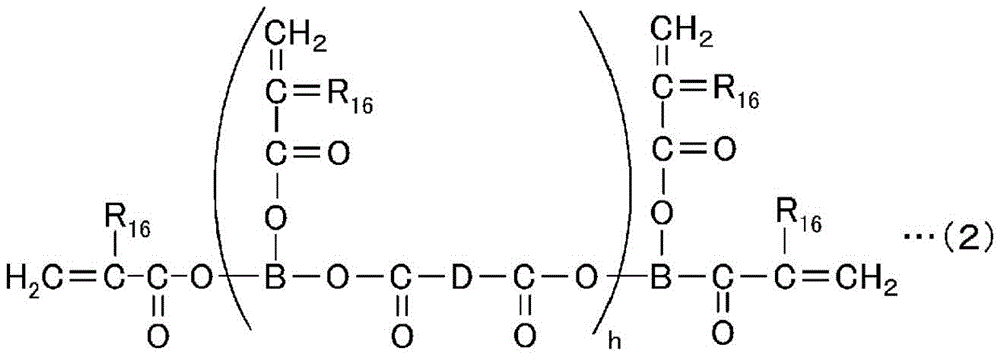
In the formula, R16Is a hydrogen atom or a methyl group, B is a 3-valent organic group, D is a 2-valent organic group, and h is an integer in the range of 1 to 10.
[ chemical formula 3]

In the formula, R17Is a hydrogen atom or a methyl group, R18Is a hydrogen atom, a methyl group, an ethyl group or a hydroxyl group, E is a 2-valent organic group containing a cyclic group, and i and j are positive integers having an average value of i + j of 0 to 6.
[ chemical formula 4]

In the formula, R19Is a hydrogen atom or a methyl group, and F is an alkylene group having 2 to 9 carbon atoms in the main chain and optionally having a side chain.
[ chemical formula 5]
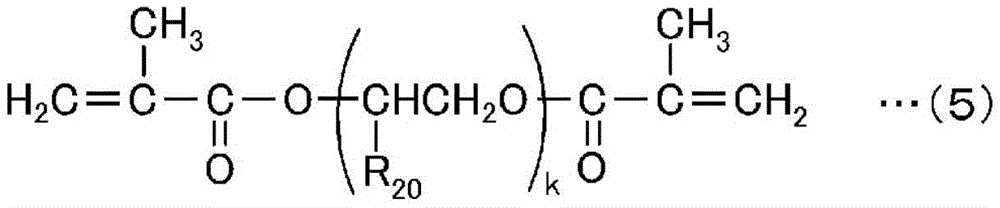
In the formula, R20Is a hydrogen atom, a methyl group or an ethyl group, and k is an integer in the range of 1 to 6.
R in the above general formulae (1) to (4)13~R19Are each a hydrogen atom or a methyl group, and therefore,the compounds represented by the general formulae (1) to (4) are compounds having 2 to 6 (meth) acryloyloxy groups.
Specific examples of the high-hardness monomer represented by the above general formula (1) include trimethylolpropane trimethacrylate, trimethylolpropane triacrylate, tetramethylolmethane trimethacrylate, tetramethylolmethane triacrylate, trimethylolpropane trimethacrylate, tetramethylolmethane tetramethacrylate, tetramethylolmethane tetraacrylate, trimethylolpropane triethylene glycol trimethacrylate, trimethylolpropane triethylene glycol triacrylate, ethoxylated pentaerythritol tetraacrylate, ethoxylated pentaerythritol tetramethacrylate, pentaerythritol trimethacrylate, pentaerythritol tetramethacrylate, dipentaerythritol hexaacrylate, urethane oligomer tetraacrylate, urethane oligomer hexamethacrylate, urethane oligomer hexaacrylate, and the like, Polyester oligomer hexaacrylate, caprolactone-modified dipentaerythritol hexaacrylate, ditrimethylolpropane tetraacrylate, and the like.
Specific examples of the high-hardness monomer represented by the general formula (2) include 4-functional polyester oligomers having a molecular weight of 2500 to 3500 (xylonite-UBC corporation, EB80, etc.), 4-functional polyester oligomers having a molecular weight of 6000 to 8000 (xylonite-UBC corporation, EB450, etc.), 6-functional polyester oligomers having a molecular weight of 45000 to 55000 (xylonite-UBC corporation, EB1830, etc.), 4-functional polyester oligomers having a molecular weight of 10000 (first industrial pharmaceutical company, GX8488B, etc.), and the like.
Specific examples of the high-hardness monomer represented by the above general formula (3) include bisphenol A dimethacrylate, 2-bis (4-methacryloyloxyethoxyphenyl) propane, 2-bis (3, 5-dibromo-4-methacryloyloxyethoxyphenyl) propane and the like.
Specific examples of the high-hardness monomer represented by the above general formula (4) include ethylene glycol diacrylate, ethylene glycol dimethacrylate, 1, 4-butanediol dimethacrylate, 1, 9-nonanediol dimethacrylate, neopentyl glycol dimethacrylate, and neopentyl glycol diacrylate.
Specific examples of the high-hardness monomer represented by the above general formula (5) include diethylene glycol dimethacrylate, triethylene glycol dimethacrylate, tetraethylene glycol dimethacrylate, tripropylene glycol dimethacrylate, tetrapropylene glycol dimethacrylate and the like.
There are also high-hardness monomers not represented by the above general formulae (1) to (5), and representative compounds thereof include tricyclodecane dimethanol dimethacrylate, bisphenol A bisglycidyl methacrylate, ethylene glycol bisglycidyl methacrylate, glycidyl methacrylate and the like.
In addition, the low-hardness monomer has an effect of making a cured product tough and increasing the fading rate of the photochromic compound.
Examples of such a low-hardness monomer include a 2-functional monomer represented by the following general formula (6) or (7), and a monofunctional monomer represented by the following general formula (8) or (9).
[ chemical formula 6]

In the formula, R23Is a hydrogen atom or a methyl group, R24And R25Each independently is a hydrogen atom, a methyl group or an ethyl group, Z is an oxygen atom or a sulfur atom, and m is represented by R23An integer of 1 to 70 in the case of a hydrogen atom, in R23When the group is a methyl group, the number is an integer of 7 to 70, and m' is an integer in the range of 0 to 70.
[ chemical formula 7]

In the formula, R26Is a hydrogen atom or a methyl group, R27And R28Independently represents a hydrogen atom, a methyl group, an ethyl group or a hydroxyl group, I represents a 2-valent organic group containing a cyclic group, and I 'and j' represent integers having an average value of I '+ j' of 8 to 40.
[ chemical formula 8]

In the formula, R29Is a hydrogen atom or a methyl group, R30And R31Each independently is a hydrogen atom, a methyl or ethyl group, R32Is a hydrogen atom, an alkyl group having 1 to 25 carbon atoms, an alkenyl group, an alkoxyalkyl group or a haloalkyl group, an aryl group having 6 to 25 carbon atoms, or an acyl group other than a (meth) acryloyl group having 2 to 25 carbon atoms, Z is an oxygen atom or a sulfur atom, and m' is represented by R29An integer of 1 to 70 in the case of a hydrogen atom, in R29When the group is a methyl group, the number is an integer of 4 to 70, and m' is an integer in the range of 0 to 70.
[ chemical formula 9]

In the formula, R33Is a hydrogen atom or a methyl group, R34At R33An alkyl group having 1 to 20 carbon atoms in the case of a hydrogen atom, in the case of R33When the alkyl group is a methyl group, the alkyl group has 8 to 40 carbon atoms.
In the above general formulae (6) to (9), R23、R26、R29And R33Is a hydrogen atom or a methyl group. That is, the low-hardness monomer generally has 2 or less (meth) acryloyloxy groups or (meth) acryloylthio groups as polymerizable groups.
Specific examples of the low-hardness monomer represented by the general formula (6) include alkylene glycol di (meth) acrylates such as trialkylene glycol diacrylate, tetraalkylene glycol diacrylate, nonylalkylene glycol diacrylate and nonylalkylene glycol dimethacrylate.
Specific examples of the low-hardness monomer represented by the general formula (7) include 2,2, 2-bis (4-acryloyloxypolyethylene glycol phenyl) propane having an average molecular weight of 776.
Specific examples of the low-hardness monomer represented by the above general formula (8) include polyethylene glycol methacrylate having an average molecular weight of 526, polyethylene glycol methacrylate having an average molecular weight of 360, polyethylene glycol monomethyl ether methacrylate having an average molecular weight of 475, polyethylene glycol monomethyl ether methacrylate having an average molecular weight of 1000, polypropylene glycol methacrylate having an average molecular weight of 375, polypropylene glycol methacrylate having an average molecular weight of 430, polypropylene glycol monomethyl ether methacrylate having an average molecular weight of 622, polytetramethylene glycol methacrylate having an average molecular weight of 566, polyethylene glycol monooctylphenyl ether methacrylate having an average molecular weight of 2034, polyethylene glycol monononylether methacrylate having an average molecular weight of 610, polyethylene glycol monomethylether methacrylate having an average molecular weight of 640, polyethylene glycol monomethylether methacrylate having an average molecular weight of 375, polyethylene glycol monomethylether methacrylate having an average molecular weight of 430, polyethylene glycol monomethylether methacrylate having an average molecular weight of 640, polyethylene glycol monomethylether, Polyalkylene glycol (meth) acrylates such as perfluorobutylethylene glycol methacrylate having an average molecular weight of 498. The average molecular weight of the low-hardness monomer represented by the general formula (8) is preferably 200 to 2500, more preferably 300 to 700. In the present invention, the average molecular weight is a weight average molecular weight.
Specific examples of the low-hardness monomer represented by the general formula (9) include stearyl methacrylate, lauryl methacrylate, ethylhexyl methacrylate, methyl acrylate, ethyl acrylate, butyl acrylate, and lauryl acrylate.
Among the low-hardness monomers represented by the general formulae (6) to (9), polyethylene glycol monomethyl ether methacrylate having an average molecular weight of 475, polyethylene glycol monomethyl ether methacrylate having an average molecular weight of 1000, trialkylene glycol diacrylate, tetraalkylene glycol diacrylate, nonylalkylene glycol diacrylate, methyl acrylate, ethyl acrylate, butyl acrylate, and lauryl acrylate are particularly preferable.
Examples of the monomer which is neither the high-hardness monomer nor the low-hardness monomer, i.e., the monomer in which the homopolymer exhibits an L rockwell hardness of more than 40 and less than 60 (sometimes referred to as a medium-hardness monomer) include 2-functional (meth) acrylates such as polytetramethylene glycol dimethacrylate having an average molecular weight of 650, polytetramethylene glycol dimethacrylate having an average molecular weight of 1400, bis (2-methacryloyloxyethylthioethyl) sulfide; polyvalent allyl compounds such as diallyl phthalate, diallyl isophthalate, diallyl tartrate, diallyl epoxysuccinate, diallyl fumarate, diallyl chlorendate, diallyl hexaphthalate, and allyl diglycol dicarbonate; polyvalent thioacrylic and polyvalent thiomethacrylate compounds such as 1, 2-bis (methacryloylthio) ethane, bis (2-acryloylthioethyl) ether, 1, 4-bis (methacryloylthiomethyl) benzene, and the like; unsaturated carboxylic acids such as acrylic acid, methacrylic acid, and maleic anhydride; acrylic acid and methacrylic acid ester compounds such as methyl methacrylate, butyl methacrylate, benzyl methacrylate, phenyl methacrylate, 2-hydroxyethyl methacrylate and biphenyl methacrylate; fumarate compounds such as diethyl fumarate and diphenyl fumarate; thioacrylic acid and thiomethacrylate compounds such as methyl thioacrylate, benzyl thioacrylate and benzyl thiomethacrylate; vinyl compounds such as styrene, chlorostyrene, methylstyrene, vinylnaphthalene, α -methylstyrene dimer, bromostyrene, divinylbenzene, and vinylpyrrolidone; and (meth) acrylates having an unsaturated bond in the molecule and having a hydrocarbon chain of 6 to 25 carbon atoms, such as oleyl methacrylate, nerol methacrylate, geraniol methacrylate, linalool methacrylate, and farnesol methacrylate.
These medium-hardness monomers can be suitably mixed with the high-hardness monomers and the low-hardness monomers. In order to achieve a good balance between the cured product properties such as solvent resistance, hardness, and heat resistance of the cured product and the photochromic properties such as color development concentration and fading speed, the low-hardness monomer is preferably 5 to 70% by mass and the high-hardness monomer is preferably 5 to 95% by mass among the radical polymerizable monomers.
In addition to the above components, it is preferable to blend, as the curable component, a radical polymerizable monomer having at least an epoxy group and a radical polymerizable group in a molecule, for example, glycidyl acrylate, glycidyl methacrylate, polyethylene glycol glycidyl ether methacrylate, or the like.
(2) Photochromic pigments
As the photochromic dye, known photochromic dyes can be used, and examples thereof include: fulgimide (Fulgimide) compound, spiro Photochromic compounds such as oxazine compounds and chromene compounds, which can be used in the present invention, are not particularly limited.
The above fulgimide compound and spiro As the oxazine compound and chromene compound, those described in, for example, Japanese patent application laid-open No. 2-28154, Japanese patent application laid-open No. 62-288830, WO94/22850, WO96/14596, and the like can be suitably used.
Further, as the compound having excellent photochromic properties, Japanese patent laid-open Nos. 2001-114775, 2001-031670, 2001-011067, 2001-011066, 2000-347346, 2000-34476, 2000-3044761, 2000-327676, 2000-327675, 2000-256347, 2000-229976, 2000-229975, 2000-229974, 2000-229973, 2000-229972, 2000-219687, 2000-19686, 2000-219685, Compounds disclosed in, for example, Japanese patent application laid-open Nos. 11-322739, 11-286484, 11-279171, 10-298176, 09-218301, 09-124645, 08-295690, 08-176139, and 08-157467. The entire disclosures of the above publications are specifically incorporated herein by reference as if fully set forth.
Among these photochromic compounds, chromene photochromic compounds are particularly excellent in photochromic properties such as color development density and fading speed, and can be preferably used.
Further, as the chromene compound having particularly good photochromic properties such as color development density, fading speed, durability and the like, a chromene compound represented by the following general formula (10) is preferable.
[ chemical formula 10]

Wherein the group represented by the following general formula (11) is a substituted or unsubstituted aromatic hydrocarbon group or a substituted or unsubstituted unsaturated heterocyclic group, R43、R44And R45Each independently represents a hydrogen atom, an alkyl group, an alkoxy group, an aralkyloxy group, an amino group, a substituted amino group, a cyano group, a substituted or unsubstituted aryl group, a halogen atom, an aralkyl group, a hydroxyl group, a substituted or unsubstituted alkynyl group, a substituted or unsubstituted heterocyclic group having a nitrogen atom as a hetero atom and bonded to a pyran ring or a ring of a group represented by the following general formula (13), or a condensed heterocyclic group in which an aromatic hydrocarbon ring or an aromatic heterocyclic ring is condensed to the heterocyclic group, and o is an integer in the range of 0 to 6.
[ chemical formula 11]
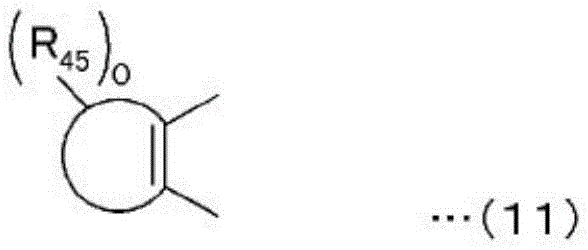
In addition, R41And R42Each independently represents a group represented by the following general formula (12), a group represented by the following general formula (13), a substituted or unsubstituted aryl group, a substituted or unsubstituted heteroaryl group, or an alkyl group, or R41And R42Together form an aliphatic hydrocarbon ring or an aromatic hydrocarbon ring.
[ chemical formula 12]

(in the formula, R46Is a substituted or unsubstituted aryl, or a substituted or unsubstituted heteroaryl, R47Is a hydrogen atom, an alkyl group or a halogen atom, and p is an integer of 1 to 3. )
[ chemical formula 13]

(in the formula, R48Is substituted or unsubstituted aryl or substituted or unsubstituted heteroaryl, and p' is an integer of 1-3. ).
The above general formulae (12) and (13) and R41And R42The substituents in the substituted aryl and substituted heteroaryl groups mentioned in (1) above are exemplified by the same groups as those mentioned for R above43、R44The same groups.
Among the chromene compounds represented by the above general formula (10), compounds represented by the following general formulae (14) to (19) are particularly preferable in view of photochromic properties such as color development density and fading speed.
[ chemical formula 14]

In the formula, R49And R50Are each independently substituted with R of the above general formula (10)41And R42Likewise, R51And R52Are each independently substituted with R of the above general formula (10)45Similarly, q and q' are each 1 or 2.
[ chemical formula 15]

In the formula, R53And R54Are each independently substituted with R of the above general formula (10)41And R42Likewise, R55And R56Are each independently substituted with R of the above general formula (10)45Similarly, L is an arbitrary group represented by the following formula, and r' are each 1 or 2.
[ chemical formula 16]

(wherein P is an oxygen atom or a sulfur atom, R57Is an alkylene group having 1 to 6 carbon atoms, and s, s 'and s' are integers of 1 to 4. )
[ chemical formula 17]
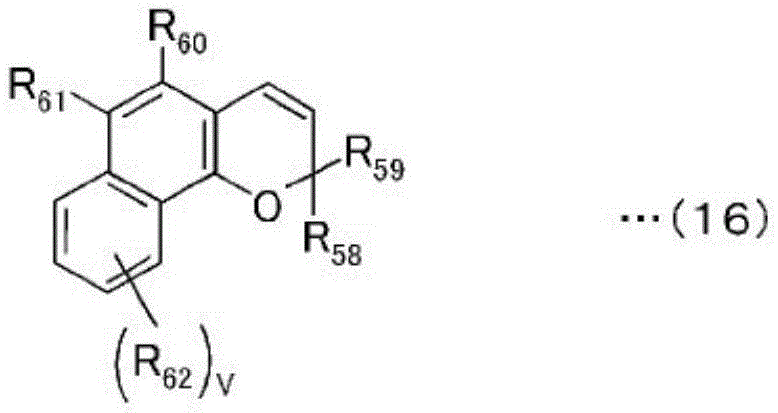
In the formula, R58And R59Are each independently substituted with R of the above formula (10)41And R42Likewise, R60、R61And R62Are each independently substituted with R of the above formula (10)45Likewise, v is 1 or 2.
[ chemical formula 18]

In the formula, R63And R64Are each independently substituted with R of the above formula (10)41And R42Likewise, R65And R66Are each independently substituted with R of the above formula (10)45Similarly, w and w' are 1 or 2, respectively.
[ chemical formula 19]

In the formula, R67And R68Are each independently substituted with R of the above formula (10)41And R42Likewise, R69、R70、R71And R72Are each independently substituted with R of the above formula (10)45Similarly, x and x' are 1 or 2, respectively.
[ chemical formula 20]
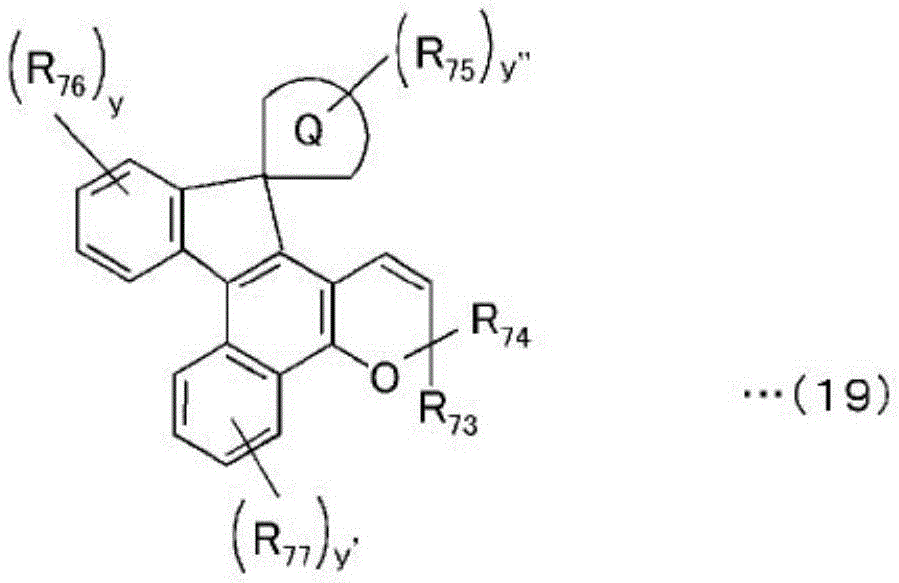
In the formula, R73And R74Are each independently substituted with R of the above formula (10)41And R42Likewise, R75、R76And R77Are each independently substituted with R of the above formula (10)45Also, wherein the formula is an aliphatic hydrocarbon ring optionally having at least 1 substituent, and y, y 'and y' are each 1 or 2.
[ chemical formula 21]

Among the chromene compounds represented by the above general formulae (14) to (19), chromene compounds having the following structures (exemplified compounds (a) to (F)) are particularly preferable.
[ chemical formula 22]
[ exemplary Compounds ]

These photochromic compounds exhibit appropriate color development, and therefore, can be suitably mixed in a plurality of kinds for use.
(3) Polymerization initiator
The polymerization initiator added to the light control layer coating liquid may be appropriately selected from known photopolymerization initiators and thermal polymerization initiators according to the polymerization method. Examples of the photopolymerization initiator include: benzoin, benzoin butyl ether, benzoin methyl ether, benzophenone, acetophenone, 4' -dichlorobenzophenone, diethoxyacetophenone, 2-hydroxy-2-methyl-1-phenylpropan-1-one, 1-hydroxycyclohexyl phenyl ketone, bis (2,4, 6-trimethylbenzoyl) phenylphosphine oxide, and the like. Examples of the thermal polymerization initiator include: diacyl peroxides such as benzoyl peroxide and p-chlorobenzoyl peroxide, percarbonates such as tert-butyl 2-ethylhexanoate peroxide and tert-butyl dicarbonate peroxide, and azo compounds such as 2, 2-azobisisobutyronitrile.
(4) Other additives
Further, additives such as a surfactant, an antioxidant, a radical scavenger, an ultraviolet stabilizer, an ultraviolet absorber, an anti-coloring agent, an antistatic agent, a fluorescent dye, a pigment, a perfume, and a plasticizer may be appropriately added to the light control layer coating liquid for the purpose of improving durability, color development rate, fading rate, and moldability of the photochromic dye. As these additives, known compounds can be used without particular limitation. For example, hindered amine light stabilizers, hindered phenol antioxidants, phenol radical scavengers, sulfur-containing antioxidants, benzotriazole compounds, benzophenone compounds, and the like can be suitably used.
2. Curing conditions
By adjusting the curing state of the light control layer, a light control layer containing a cured resin formed by curing the curable component and an uncured curable component can be obtained. The curing state of the light control layer can be adjusted by the curing conditions of the curable component, for example, the light irradiation conditions. Specifically, it is preferable to appropriately adjust the light source wavelength and the light irradiation amount (irradiation energy, irradiation time, and the like).
3. Thickness of the light modulation layer
The curing state of the light modulation layer can also be adjusted by the thickness of the light modulation layer. When the thickness of the light modulation layer is too thin, polymerization of the entire film proceeds, and thus it is difficult to impart appropriate flexibility to the light modulation layer, and the dye is less likely to move, and therefore, it is difficult to improve photochromic performance. In addition, the three-dimensional hardness of the light modulation layer can be adjusted by the thickness of the light modulation layer. From the above points, the thickness of the light control layer is preferably 5 to 80 μm, and particularly preferably 20 to 60 μm, as described above.
In addition, an undercoat layer may be provided between the lens base material and the light control layer for the purpose of improving the adhesion of the light control layer to the lens base material. Such a primer layer is different depending on the material of the lens base material and the light control layer, but a urethane resin or the like is generally used.
[ lens base Material ]
Various base materials generally used as plastic lenses can be used as the lens base material in the spectacle lens (light control lens) of the present invention. The lens base material can be produced by injecting a lens monomer into a lens-forming mold and performing a curing treatment.
The lens monomer is not particularly limited, and various monomers generally used for producing plastic lenses can be used. For example, monomers having a benzene ring, a naphthalene ring, an ester bond, a carbonate bond, a urethane bond in the molecule, and the like can be used. In addition, compounds containing sulfur and halogen elements, particularly, compounds having an aromatic ring substituted with a nuclear halogen element may also be used. By using 1 or 2 or more monomers having the above functional group, a lens monomer can be produced. Examples thereof include: polyfunctional isocyanate reactants such as styrene, divinylbenzene, (phenyl (meth) acrylate, benzyl (meth) acrylate, naphthyl (meth) acrylate, methyl (meth) acrylate, diethylene glycol bisallyl carbonate, diallyl (m) phthalate, dibenzyl itaconate, dibenzyl fumarate, chlorostyrene, nuclear halogen-substituted styrene, nuclear halogen-substituted phenyl (meth) acrylate, nuclear halogen-substituted benzyl (meth) acrylate, (di) (meth) acrylate of tetrabromobisphenol A derivative, diallyl carbonate of tetrabromobisphenol A derivative, diorthochlorobenzyl itaconate, diorthochlorobenzyl fumarate, diethylene glycol bis (ortho-chlorobenzyl) fumarate, (di) ethylene glycol di (meth) acrylate, glycidyl methacrylate, xylylene diisocyanate, and hexamethylene diisocyanate, and the like, Reactants of monohydroxyacrylates of nuclear halogen-substituted phenol derivatives and polyfunctional isocyanates, reactants of monohydroxyacrylates of nuclear halogen-substituted biphenyl derivatives and polyfunctional isocyanates, reactants of xylene diisocyanates and polyfunctional thiols, reactants of glycidyl methacrylate and polyfunctional methacrylates, and the like, and mixtures thereof.
The lens base material may be a lens base material with power or a lens base material without power. That is, the present invention can be applied to spectacle lenses with power for correcting ametropia of eyes, and can also be applied to spectacle lenses without power such as sunglasses.
[ protective film ]
The spectacle lens (light control lens) of the present invention may be further provided with a hard coat film, an antireflection film, or the like as a protective film for the purpose of impact resistance, abrasion resistance, antireflection, or the like.
The hard coat film may be provided for the purpose of imparting impact resistance and abrasion resistance to the plastic lens. In addition, since the adhesion of the antireflection film to the plastic lens is generally poor, the hard coat film may be interposed between the plastic lens and the antireflection film to improve the adhesion of the antireflection film and to prevent peeling.
As a method for forming a hard coat film, a method of applying a curable composition to the surface of a plastic lens by a spin coating method or the like and curing the coating film is generally used. The curing treatment is performed by heating, light irradiation, or the like depending on the type of the curable composition. Examples of such a curable composition include: a photocurable silicone composition containing, as main components, an organosilicon compound which generates a silanol group upon irradiation with ultraviolet light, and an organopolysiloxane having a reactive group such as a halogen atom or an amino group which undergoes a condensation reaction with the silanol group; an acrylic ultraviolet-curable monomer composition; mixing SiO2、TiO2And inorganic fine particles dispersed in a silane compound or a silane coupling agent having a polymerizable group such as a vinyl group, an allyl group, an acryloyl group or a methacryloyl group and a hydrolyzable group such as a methoxy group.
The antireflection film is composed of a single layer or a plurality of layers of an inorganic film and an organic film. As the material of the inorganic coating, SiO is exemplified2、SiO、ZrO2、TiO2、TiO、Ti2O3、Ti2O5、Al2O3、Ta2O5、CeO2、MgO、Y2O3、SnO2、MgF2、WO3And the like, and 2 or more kinds thereof may be used alone or in combination. In the case of plastic lenses, SiO which can be vacuum-deposited at low temperature is preferred2、ZrO2、TiO2、Ta2O5. In the case of a multilayer film structure, the outermost layer is preferably SiO2。
As a method for forming the inorganic film, for example, vacuum deposition, ion plating, sputtering, CVD, a method of depositing by a chemical reaction in a saturated solution, or the like can be used.
The above description has been focused on the case where the optical article of the present invention is applied to a configuration of a spectacle lens (with power, without power), but the present invention is not limited to this embodiment. For example, the configuration of the present invention can be applied to a lens for goggles which is configured as a so-called goggle, and which is configured by 1 lens, typically 2 lenses on the left and right, and covers the periphery of the eyes. The configuration of the present invention can also be applied to a configuration of a member of a visor (visor) portion in a case where the visor (visor) portion of a so-called sun visor cap has photochromic properties, unlike a lens shape in a general eyeglass lens. The structure of the present invention can be applied to the structure of a shield member of a helmet. The visor portion member and the shade member may be made of a plastic base material or may be made of polycarbonate.
Examples
The present invention will be described more specifically with reference to examples.
(example 1)
(1) Lens base material
As the plastic lens base material, a lens manufactured by HOYA corporation under the trade name EYAS (center wall thickness: 2.0mm, radius: 75mm, S-4.00) was used. The lens base material was immersed in a 10 mass% aqueous solution of sodium hydroxide at 60 ℃ for 5 minutes, and then sufficiently washed with pure water and dried.
(2) Formation of the primer layer
As the primer coating liquid, an aqueous polyurethane resin liquid (polycarbonate polyol-based polyurethane emulsion, viscosity 100CPS, solid content concentration 38%) was used.
Then, the undercoat coating liquid is applied by spin coating on the convex surface side of the lens base material of (1) to form a film. Then, the undercoat layer was formed by natural drying at 25 ℃ and 50% RH for 15 minutes. The film thickness of the undercoat layer was 5.5 μm.
(3) Preparation of coating liquid for light-adjusting layer
In a plastic container, a radical polymerizable composition was prepared, which was composed of 20 parts by mass of trimethylolpropane trimethacrylate, 35 parts by mass of BPE oligomer (2, 2-bis (4-methacryloxypolyethoxyphenyl) propane), 10 parts by mass of EB6A (polyester oligomer hexaacrylate), 10 parts by mass of polyethylene glycol diacrylate having an average molecular weight of 532, and 10 parts by mass of glycidyl methacrylate. To 100 parts by mass of the radical polymerizable composition, 3 parts by mass of the chromene compound (a) exemplified above as a photochromic dye, a light stabilizer LS765 ((bis (1,2,2,6, 6-hexamethyl-4-piperidyl) sebacate, 5 parts by mass of methyl (1,2,2,6, 6-hexamethyl-4-piperidyl) sebacate), 5 parts by mass of a hindered phenol antioxidant (Irgacure 245, Ciba Specialty Chemicals), and 0.6 part by mass of CGI-1870(Ciba Specialty Chemicals) as an ultraviolet polymerization initiator were added, and sufficiently stirred and mixed, and then 6 parts by mass of γ -methacryloxypropyltrimethoxysilane (KBM 503, manufactured by shin-Etsu chemical Co., Ltd.) were added dropwise to the resultant composition while stirring, followed by defoaming with a rotation and revolution type stirring defoaming apparatus for 2 minutes, a curable composition having photochromic properties was obtained.
(4) Formation of a dimming layer
The curable composition prepared in (3) above was coated on the primer layer on the lens substrate by spin coating. Spin coating is performed by the method described in japanese patent application laid-open No. 2005-218994 (method using a coating apparatus that uses a rotating holder that holds a lens material and a dispenser that supplies a coating liquid).
Then, the user can use the device to perform the operation,the lens was irradiated with 2.2J/cm of ultraviolet ray accumulated light having a wavelength of 405nm by a UV lamp (D bulb) made by Fusion in a nitrogen atmosphere (oxygen concentration: 500ppm or less)2(220mW/cm 210 seconds), a dimming layer was formed. The thickness of the light-adjusting layer was 45 μm.
(5) Preparation of hard coating liquid
45 parts by mass of modified tin oxide-zirconium oxide-tungsten oxide-silicon oxide composite methanol sol, 15 parts by mass of gamma-glycidoxypropyltrimethoxysilane and 3 parts by mass of tetraethoxysilane were mixed in an atmosphere of 5 ℃ and stirred for 1 hour. Then, 4.5 parts by mass of hydrochloric acid having a concentration of 0.001 mol/L was added thereto, and the mixture was stirred for 50 hours. Then, 25 parts by mass of propylene glycol monomethyl ether (PGM), 9 parts by mass of diacetone alcohol (DAA), 1.8 parts by mass of aluminum triacetylacetonate (AL-AA) as component (C), and 0.05 part by mass of aluminum perchlorate were added in this order as a solvent, and stirred for 150 hours. The resulting solution was filtered using a 0.5 μm filter to obtain a coating composition.
(6) Formation of hard coat film
The plastic lens formed in (4) above was dipped in a 10 mass% aqueous solution of sodium hydroxide at 60 ℃ for 5 minutes, sufficiently washed and dried with pure water, and then coated with the hard coating composition prepared in (5) above by a dip coating method (pick-up speed 20 cm/min) and heat-cured at 100 ℃ for 60 minutes to form a hard coating film having a thickness of 5 μm.
(7) Formation of antireflection film
The plastic lens having the hard coat film formed in the above (6) was put into a deposition apparatus, heated to 85 ℃ while exhausting air, and exhausted to 2.7mPa (2X 10)-5torr), the deposition material is deposited by electron beam heating to form a film containing SiO2A base layer having a film thickness of 0.6 lambda, and Ta-containing layers formed on the base layer2O5、ZrO2、Y2O3Mixed layer (nd 2.05, n λ 0.075 λ) of (a) and SiO2A first refractive layer comprising a layer (nd 1.46, n λ 0.056 λ) containing Ta2O5、ZrO2、Y2O3Mixed layer (nd 2.05, n λ 0.075 λ) of (a) and SiO2The 2 nd low refractive index layer (nd 1.46, n λ 0.25 λ) was formed into an antireflection film having a thickness of 0.5 μm.
Through the above steps, a light control lens having a light control layer and a protective film composed of a hard coat film and an antireflection film in this order on the convex surface of the lens base material was obtained.
(example 2)
A light-controlling lens was obtained in the same manner as in example 1, except that a hard coat film was not formed (the hard coat film was omitted) in example 1.
(example 3)
A light-adjusting lens was obtained in the same manner as in example 1, except that the primer layer was not formed in example 1 (the primer layer was omitted).
Comparative example 1
A light control lens was obtained by forming a light control layer, a protective film, and the like in the same manner as in example 1, except that the ultraviolet irradiation time in the light control layer forming step was set to 10 seconds in example 1.
The indentation hardness (cross-sectional hardness) of the light control layer in the film thickness direction and the ratio of the value defined by the indentation hardness of the protective layer in the film thickness direction x the film thickness (three-dimensional hardness) to the value defined by the indentation hardness of the light control layer in the film thickness direction x the film thickness (three-dimensional hardness) (three-dimensional hardness ratio of the light control layer to the protective layer) in each of the light control lenses of the examples and comparative examples obtained as described above were measured by the measurement method described based on fig. 2 to 4. Fig. 5 shows a hardness curve in example 1.
The light control lenses of the examples and comparative examples obtained as described above were evaluated for the following photochromic performance (fading speed).
[ evaluation of photochromic Properties ]
< fading speed >
Photochromic properties were evaluated by the following method in accordance with JIS T7333.
The surface of the light control layer (the surface opposite to the surface facing the lens base material) on each of the light control lenses obtained in examples and comparative examples was irradiated with light for 15 minutes (900 seconds) through a gas filter using a xenon lamp, and the light control layer was developed. The transmittance at 550nm was measured for the color rendering concentration at this time by a spectrophotometer manufactured by the gaku electronics industry. The light irradiation was performed so that the difference between the irradiation illuminance and the allowable irradiation illuminance was the value shown in table 1 below, in accordance with the regulations of JIS T7333. The fading speed was determined by irradiating light for 15 minutes (900 seconds) as described above and measuring the change in transmittance (550nm) from the time when the irradiation was stopped. The higher the fading speed, that is, the time (speed) at which the transmittance is restored to the original value with time, the more excellent the photochromic property.
[ Table 1]
| Wavelength region (nm) | Irradiance (W/m)2) | Allowable difference of radiation illuminance (W/m)2) |
| 300~340 | <2.5 | - |
| 340~380 | 5.6 | ±1.5 |
| 380~420 | 12 | ±3.0 |
| 420~460 | 12 | ±3.0 |
| 460~500 | 26 | ±2.6 |
The following scratch resistance test and adhesion test were performed on each of the light control lenses of the examples and comparative examples obtained as described above, and the strength and the like were evaluated.
[ scratch resistance test ]
One side of the steel wool was treated with steel wool (specification #0000, manufactured by Nippon Steel wool Co., Ltd.) at a ratio of 1kgf/cm2The surface of the lens is rubbed while pressing the surface of the light adjusting lens, and the scratch easiness is judged by naked eyes. The judgment criteria are as follows.
UA: there were few scars.
A: there were several shallow scars, or about 2 deep but thin scars.
B: there were about 20 shallow scars, or about 10 fine, deep scars.
C: a plurality of deep (regardless of width) scars, a state close to haze, or a state in which scars are shallow but not covered (weak film) are generated.
[ test for adhesion (lattice test) ]
The surface of the light control lens was cut into 100 grids at 1mm intervals, and a commercially available adhesive sheet was firmly stuck and rapidly peeled off from the lens directly above to examine the presence or absence of peeling of the cured coating.
The sample that did not peel off at all was designated 100/100, and the sample that completely peeled off was designated 0/100.
The above evaluation results are summarized in table 2 below.
[ Table 2]

As is clear from the results of table 2, when the sectional hardness of the light control layer is smaller than the sectional hardness of the lens base material surface and the three-dimensional hardness ratio of the light control layer and the protective film is within the range of the present invention, a light control lens (eyeglass lens) can be provided which achieves both improvement of the light responsiveness, particularly improvement of the fading speed, of the light control layer having photochromic properties and lens strength. On the other hand, as in comparative example 1, when the light control layer becomes excessively soft due to the shortage of the ultraviolet irradiation time and the three-dimensional hardness ratio of the light control layer and the protective film is out of the range of the present invention, the scratch resistance and the adhesion are remarkably deteriorated, and the improvement of the fading speed of the light control layer and the lens strength cannot be achieved at the same time.
Claims (13)
Applications Claiming Priority (3)
| Application Number | Priority Date | Filing Date | Title |
|---|---|---|---|
| JP2018-068998 | 2018-03-30 | ||
| JP2018068998 | 2018-03-30 | ||
| PCT/JP2019/014326 WO2019189875A1 (en) | 2018-03-30 | 2019-03-29 | Optical component |
Publications (2)
| Publication Number | Publication Date |
|---|---|
| CN111149046A CN111149046A (en) | 2020-05-12 |
| CN111149046B true CN111149046B (en) | 2021-10-22 |
Family
ID=68060311
Family Applications (1)
| Application Number | Title | Priority Date | Filing Date |
|---|---|---|---|
| CN201980004760.0A Active CN111149046B (en) | 2018-03-30 | 2019-03-29 | Optical Items |
Country Status (4)
| Country | Link |
|---|---|
| US (1) | US11709337B2 (en) |
| JP (1) | JPWO2019189875A1 (en) |
| CN (1) | CN111149046B (en) |
| WO (1) | WO2019189875A1 (en) |
Families Citing this family (3)
| Publication number | Priority date | Publication date | Assignee | Title |
|---|---|---|---|---|
| JP7377285B2 (en) | 2019-12-27 | 2023-11-09 | ホヤ レンズ タイランド リミテッド | Optical article and method for manufacturing optical article |
| EP4270067B1 (en) * | 2020-12-24 | 2025-12-03 | Hoya Lens Thailand Ltd. | Photochromic composition, photochromic article, and glasses |
| JP7731623B1 (en) * | 2024-12-11 | 2025-09-01 | 株式会社タレックス | eyeglass lenses |
Family Cites Families (40)
| Publication number | Priority date | Publication date | Assignee | Title |
|---|---|---|---|---|
| GB8610709D0 (en) | 1986-05-01 | 1986-06-04 | Plinkington Bros Plc | Photochromic lenses |
| JPH0745502B2 (en) | 1987-11-10 | 1995-05-17 | 株式会社トクヤマ | Novel compound and composition containing the same |
| GB9306587D0 (en) | 1993-03-30 | 1993-05-26 | Pilkington Plc | Photochromic compounds |
| IL115803A (en) | 1994-11-03 | 2000-02-17 | Ppg Industries Inc | Indeno-naphthopyran derivatives useful for photochromic articles |
| JPH08157467A (en) | 1994-12-02 | 1996-06-18 | Tokuyama Corp | Chromene compounds and photochromic materials |
| JPH08176139A (en) | 1994-12-20 | 1996-07-09 | Tokuyama Corp | Chromene compound |
| JPH08295690A (en) | 1995-04-26 | 1996-11-12 | Tokuyama Corp | Chromene compound |
| JPH09124645A (en) | 1995-11-02 | 1997-05-13 | Tokuyama Corp | Chromene compound |
| JPH09218301A (en) | 1995-12-06 | 1997-08-19 | Tokuyama Corp | Chromene compound |
| JP3982770B2 (en) | 1997-04-30 | 2007-09-26 | 株式会社トクヤマ | Chromene compounds |
| JPH11279171A (en) | 1998-03-30 | 1999-10-12 | Tokuyama Corp | Chromene compound |
| JPH11286484A (en) | 1998-03-31 | 1999-10-19 | Tokuyama Corp | Chromene compounds |
| JP3817957B2 (en) | 1998-05-12 | 2006-09-06 | 住友化学株式会社 | Organic fluorescent material and organic electroluminescence device |
| JPH11322739A (en) | 1998-05-14 | 1999-11-24 | Tokuyama Corp | Chromene compounds |
| JP2000219687A (en) | 1999-01-29 | 2000-08-08 | Tokuyama Corp | Chromene compounds |
| JP4301621B2 (en) | 1999-01-29 | 2009-07-22 | 株式会社トクヤマ | Chromene compounds |
| JP2000219686A (en) | 1999-01-29 | 2000-08-08 | Tokuyama Corp | Chromene compounds |
| JP2000229973A (en) | 1999-02-04 | 2000-08-22 | Tokuyama Corp | Chromene compounds |
| JP2000229974A (en) | 1999-02-04 | 2000-08-22 | Tokuyama Corp | Chromene compounds |
| JP2000229972A (en) | 1999-02-04 | 2000-08-22 | Tokuyama Corp | Chromene compounds |
| JP2000229975A (en) | 1999-02-04 | 2000-08-22 | Tokuyama Corp | Chromene compounds |
| JP2000229976A (en) | 1999-02-05 | 2000-08-22 | Tokuyama Corp | Chromene compounds |
| JP2000256347A (en) | 1999-03-12 | 2000-09-19 | Tokuyama Corp | Chromene compounds |
| JP4157225B2 (en) | 1999-05-24 | 2008-10-01 | 株式会社トクヤマ | Chromene compounds |
| JP4256985B2 (en) | 1999-05-24 | 2009-04-22 | 株式会社トクヤマ | Chromene compounds |
| JP3801386B2 (en) | 1999-06-03 | 2006-07-26 | 株式会社トクヤマ | Chromene compounds |
| JP2001031670A (en) | 1999-07-19 | 2001-02-06 | Tokuyama Corp | Chromene compound |
| JP2001011067A (en) | 1999-07-01 | 2001-01-16 | Tokuyama Corp | Chromene compounds |
| JP4118458B2 (en) | 1999-07-02 | 2008-07-16 | 株式会社トクヤマ | Chromene compounds |
| JP4157239B2 (en) | 1999-10-19 | 2008-10-01 | 株式会社トクヤマ | Chromene compounds |
| KR20040023682A (en) | 2001-07-27 | 2004-03-18 | 가부시끼가이샤 도꾸야마 | Curable composition, cured article obtained thereform, and photochromic optical material and process for producing the same |
| JP2003044761A (en) | 2001-08-01 | 2003-02-14 | Sony Corp | Vehicle rental system |
| US7811482B2 (en) * | 2001-09-18 | 2010-10-12 | Alphamicron, Inc. | Curved optical device and method for making the same |
| JP4229853B2 (en) | 2004-02-06 | 2009-02-25 | Hoya株式会社 | Application method and spectacle lens manufacturing method |
| USRE46357E1 (en) * | 2006-06-30 | 2017-04-04 | Hoya Corporation | Photochromic film, photochromic lens comprising the same, and method of manufacturing photochromic lens |
| JP4921998B2 (en) * | 2006-07-31 | 2012-04-25 | Hoya株式会社 | Manufacturing method of photochromic lens |
| EP2177942B1 (en) | 2007-07-27 | 2013-02-20 | Hoya Corporation | Process for producing spectacle lens |
| ES2768345T3 (en) * | 2011-07-11 | 2020-06-22 | Tokuyama Corp | CURABLE PHOTOCHROMATIC COMPOSITION |
| EP3136138A4 (en) | 2014-04-24 | 2017-10-11 | Hoya Lens Thailand Ltd. | Spectacle lens |
| JP2019066501A (en) * | 2016-02-23 | 2019-04-25 | 三井化学株式会社 | Thermoplastic resin composition for optical material and application thereof |
-
2019
- 2019-03-29 CN CN201980004760.0A patent/CN111149046B/en active Active
- 2019-03-29 JP JP2020509350A patent/JPWO2019189875A1/en active Pending
- 2019-03-29 WO PCT/JP2019/014326 patent/WO2019189875A1/en not_active Ceased
- 2019-12-27 US US16/728,311 patent/US11709337B2/en active Active
Also Published As
| Publication number | Publication date |
|---|---|
| US20200142221A1 (en) | 2020-05-07 |
| EP3779571A1 (en) | 2021-02-17 |
| US11709337B2 (en) | 2023-07-25 |
| JPWO2019189875A1 (en) | 2021-05-13 |
| CN111149046A (en) | 2020-05-12 |
| WO2019189875A1 (en) | 2019-10-03 |
Similar Documents
| Publication | Publication Date | Title |
|---|---|---|
| CN111149045B (en) | Optical article | |
| KR102246589B1 (en) | Optical article with gradient photochromism | |
| AU2002340430B2 (en) | Photochromic optical article | |
| WO2008001578A1 (en) | Photochromic film, photochromic lens having the same, and process for producing photochromic lens | |
| US5882556A (en) | Method of preparing photochromic article | |
| AU2017287530B2 (en) | Spectacle lens and spectacles | |
| US12428576B2 (en) | Coating composition for optical article, spectacle lens, spectacles, and method for producing spectacle lens, and optical article and method for producing optical article | |
| AU2017287528B2 (en) | Method for manufacturing spectacle lens | |
| JP2010026183A (en) | Plastic lens and manufacturing method thereof | |
| CN111149046B (en) | Optical Items | |
| JP2008030439A (en) | Method for manufacturing photochromic lens | |
| US8012596B2 (en) | Photochromic lens substrate | |
| JP2021107909A (en) | Polymerizable composition for forming protective layer of photochromic article, photochromic article and spectacles | |
| WO2017001902A1 (en) | Anti-scratch and photochromic coating, respective method of application and use | |
| JP2008033223A (en) | Photochromic film and photochromic lens having the same | |
| JP4890326B2 (en) | Manufacturing method of photochromic lens | |
| WO2021132049A1 (en) | Polymerizable composition for forming protective layer on photochromic article, photochromic article and eyeglasses | |
| JP2023076677A (en) | Spectacle lens | |
| JP2011180461A (en) | Plastic lens | |
| CN113614622A (en) | Spectacle lens and spectacles |
Legal Events
| Date | Code | Title | Description |
|---|---|---|---|
| PB01 | Publication | ||
| PB01 | Publication | ||
| SE01 | Entry into force of request for substantive examination | ||
| SE01 | Entry into force of request for substantive examination | ||
| GR01 | Patent grant | ||
| GR01 | Patent grant |