CN105916880B - Fc region variants with improved protein A binding - Google Patents
Fc region variants with improved protein A binding Download PDFInfo
- Publication number
- CN105916880B CN105916880B CN201580004548.6A CN201580004548A CN105916880B CN 105916880 B CN105916880 B CN 105916880B CN 201580004548 A CN201580004548 A CN 201580004548A CN 105916880 B CN105916880 B CN 105916880B
- Authority
- CN
- China
- Prior art keywords
- polypeptide
- antibody
- mutations
- region
- amino acid
- Prior art date
- Legal status (The legal status is an assumption and is not a legal conclusion. Google has not performed a legal analysis and makes no representation as to the accuracy of the status listed.)
- Active
Links
Images


Classifications
-
- A—HUMAN NECESSITIES
- A61—MEDICAL OR VETERINARY SCIENCE; HYGIENE
- A61K—PREPARATIONS FOR MEDICAL, DENTAL OR TOILETRY PURPOSES
- A61K9/00—Medicinal preparations characterised by special physical form
- A61K9/0012—Galenical forms characterised by the site of application
- A61K9/0019—Injectable compositions; Intramuscular, intravenous, arterial, subcutaneous administration; Compositions to be administered through the skin in an invasive manner
-
- A—HUMAN NECESSITIES
- A61—MEDICAL OR VETERINARY SCIENCE; HYGIENE
- A61K—PREPARATIONS FOR MEDICAL, DENTAL OR TOILETRY PURPOSES
- A61K39/00—Medicinal preparations containing antigens or antibodies
- A61K39/395—Antibodies; Immunoglobulins; Immune serum, e.g. antilymphocytic serum
-
- A—HUMAN NECESSITIES
- A61—MEDICAL OR VETERINARY SCIENCE; HYGIENE
- A61K—PREPARATIONS FOR MEDICAL, DENTAL OR TOILETRY PURPOSES
- A61K39/00—Medicinal preparations containing antigens or antibodies
- A61K39/395—Antibodies; Immunoglobulins; Immune serum, e.g. antilymphocytic serum
- A61K39/39533—Antibodies; Immunoglobulins; Immune serum, e.g. antilymphocytic serum against materials from animals
- A61K39/3955—Antibodies; Immunoglobulins; Immune serum, e.g. antilymphocytic serum against materials from animals against proteinaceous materials, e.g. enzymes, hormones, lymphokines
-
- A—HUMAN NECESSITIES
- A61—MEDICAL OR VETERINARY SCIENCE; HYGIENE
- A61K—PREPARATIONS FOR MEDICAL, DENTAL OR TOILETRY PURPOSES
- A61K39/00—Medicinal preparations containing antigens or antibodies
- A61K39/395—Antibodies; Immunoglobulins; Immune serum, e.g. antilymphocytic serum
- A61K39/40—Antibodies; Immunoglobulins; Immune serum, e.g. antilymphocytic serum bacterial
-
- A—HUMAN NECESSITIES
- A61—MEDICAL OR VETERINARY SCIENCE; HYGIENE
- A61K—PREPARATIONS FOR MEDICAL, DENTAL OR TOILETRY PURPOSES
- A61K45/00—Medicinal preparations containing active ingredients not provided for in groups A61K31/00 - A61K41/00
- A61K45/06—Mixtures of active ingredients without chemical characterisation, e.g. antiphlogistics and cardiaca
-
- A—HUMAN NECESSITIES
- A61—MEDICAL OR VETERINARY SCIENCE; HYGIENE
- A61K—PREPARATIONS FOR MEDICAL, DENTAL OR TOILETRY PURPOSES
- A61K9/00—Medicinal preparations characterised by special physical form
- A61K9/0012—Galenical forms characterised by the site of application
- A61K9/0048—Eye, e.g. artificial tears
-
- A—HUMAN NECESSITIES
- A61—MEDICAL OR VETERINARY SCIENCE; HYGIENE
- A61P—SPECIFIC THERAPEUTIC ACTIVITY OF CHEMICAL COMPOUNDS OR MEDICINAL PREPARATIONS
- A61P27/00—Drugs for disorders of the senses
- A61P27/02—Ophthalmic agents
-
- A—HUMAN NECESSITIES
- A61—MEDICAL OR VETERINARY SCIENCE; HYGIENE
- A61P—SPECIFIC THERAPEUTIC ACTIVITY OF CHEMICAL COMPOUNDS OR MEDICINAL PREPARATIONS
- A61P27/00—Drugs for disorders of the senses
- A61P27/02—Ophthalmic agents
- A61P27/06—Antiglaucoma agents or miotics
-
- C—CHEMISTRY; METALLURGY
- C07—ORGANIC CHEMISTRY
- C07K—PEPTIDES
- C07K16/00—Immunoglobulins [IGs], e.g. monoclonal or polyclonal antibodies
- C07K16/12—Immunoglobulins [IGs], e.g. monoclonal or polyclonal antibodies against material from bacteria
- C07K16/1267—Immunoglobulins [IGs], e.g. monoclonal or polyclonal antibodies against material from bacteria from Gram-positive bacteria
- C07K16/1271—Immunoglobulins [IGs], e.g. monoclonal or polyclonal antibodies against material from bacteria from Gram-positive bacteria from Micrococcaceae (F), e.g. Staphylococcus
-
- C—CHEMISTRY; METALLURGY
- C07—ORGANIC CHEMISTRY
- C07K—PEPTIDES
- C07K16/00—Immunoglobulins [IGs], e.g. monoclonal or polyclonal antibodies
- C07K16/18—Immunoglobulins [IGs], e.g. monoclonal or polyclonal antibodies against material from animals or humans
- C07K16/22—Immunoglobulins [IGs], e.g. monoclonal or polyclonal antibodies against material from animals or humans against growth factors ; against growth regulators
-
- A—HUMAN NECESSITIES
- A61—MEDICAL OR VETERINARY SCIENCE; HYGIENE
- A61K—PREPARATIONS FOR MEDICAL, DENTAL OR TOILETRY PURPOSES
- A61K39/00—Medicinal preparations containing antigens or antibodies
- A61K2039/505—Medicinal preparations containing antigens or antibodies comprising antibodies
-
- C—CHEMISTRY; METALLURGY
- C07—ORGANIC CHEMISTRY
- C07K—PEPTIDES
- C07K2317/00—Immunoglobulins specific features
- C07K2317/30—Immunoglobulins specific features characterized by aspects of specificity or valency
- C07K2317/31—Immunoglobulins specific features characterized by aspects of specificity or valency multispecific
-
- C—CHEMISTRY; METALLURGY
- C07—ORGANIC CHEMISTRY
- C07K—PEPTIDES
- C07K2317/00—Immunoglobulins specific features
- C07K2317/30—Immunoglobulins specific features characterized by aspects of specificity or valency
- C07K2317/33—Crossreactivity, e.g. for species or epitope, or lack of said crossreactivity
-
- C—CHEMISTRY; METALLURGY
- C07—ORGANIC CHEMISTRY
- C07K—PEPTIDES
- C07K2317/00—Immunoglobulins specific features
- C07K2317/50—Immunoglobulins specific features characterized by immunoglobulin fragments
- C07K2317/52—Constant or Fc region; Isotype
- C07K2317/524—CH2 domain
-
- C—CHEMISTRY; METALLURGY
- C07—ORGANIC CHEMISTRY
- C07K—PEPTIDES
- C07K2317/00—Immunoglobulins specific features
- C07K2317/50—Immunoglobulins specific features characterized by immunoglobulin fragments
- C07K2317/52—Constant or Fc region; Isotype
- C07K2317/526—CH3 domain
-
- C—CHEMISTRY; METALLURGY
- C07—ORGANIC CHEMISTRY
- C07K—PEPTIDES
- C07K2317/00—Immunoglobulins specific features
- C07K2317/50—Immunoglobulins specific features characterized by immunoglobulin fragments
- C07K2317/52—Constant or Fc region; Isotype
- C07K2317/53—Hinge
-
- C—CHEMISTRY; METALLURGY
- C07—ORGANIC CHEMISTRY
- C07K—PEPTIDES
- C07K2317/00—Immunoglobulins specific features
- C07K2317/50—Immunoglobulins specific features characterized by immunoglobulin fragments
- C07K2317/54—F(ab')2
-
- C—CHEMISTRY; METALLURGY
- C07—ORGANIC CHEMISTRY
- C07K—PEPTIDES
- C07K2317/00—Immunoglobulins specific features
- C07K2317/60—Immunoglobulins specific features characterized by non-natural combinations of immunoglobulin fragments
- C07K2317/64—Immunoglobulins specific features characterized by non-natural combinations of immunoglobulin fragments comprising a combination of variable region and constant region components
-
- C—CHEMISTRY; METALLURGY
- C07—ORGANIC CHEMISTRY
- C07K—PEPTIDES
- C07K2317/00—Immunoglobulins specific features
- C07K2317/70—Immunoglobulins specific features characterized by effect upon binding to a cell or to an antigen
- C07K2317/71—Decreased effector function due to an Fc-modification
-
- C—CHEMISTRY; METALLURGY
- C07—ORGANIC CHEMISTRY
- C07K—PEPTIDES
- C07K2317/00—Immunoglobulins specific features
- C07K2317/90—Immunoglobulins specific features characterized by (pharmaco)kinetic aspects or by stability of the immunoglobulin
- C07K2317/92—Affinity (KD), association rate (Ka), dissociation rate (Kd) or EC50 value
-
- C—CHEMISTRY; METALLURGY
- C07—ORGANIC CHEMISTRY
- C07K—PEPTIDES
- C07K2317/00—Immunoglobulins specific features
- C07K2317/90—Immunoglobulins specific features characterized by (pharmaco)kinetic aspects or by stability of the immunoglobulin
- C07K2317/94—Stability, e.g. half-life, pH, temperature or enzyme-resistance
Landscapes
- Health & Medical Sciences (AREA)
- Chemical & Material Sciences (AREA)
- Life Sciences & Earth Sciences (AREA)
- Medicinal Chemistry (AREA)
- General Health & Medical Sciences (AREA)
- Organic Chemistry (AREA)
- Pharmacology & Pharmacy (AREA)
- Animal Behavior & Ethology (AREA)
- Public Health (AREA)
- Veterinary Medicine (AREA)
- Epidemiology (AREA)
- Immunology (AREA)
- Engineering & Computer Science (AREA)
- Bioinformatics & Cheminformatics (AREA)
- Genetics & Genomics (AREA)
- Molecular Biology (AREA)
- Biochemistry (AREA)
- Biophysics (AREA)
- Proteomics, Peptides & Aminoacids (AREA)
- Mycology (AREA)
- Microbiology (AREA)
- Ophthalmology & Optometry (AREA)
- Dermatology (AREA)
- Endocrinology (AREA)
- General Chemical & Material Sciences (AREA)
- Chemical Kinetics & Catalysis (AREA)
- Nuclear Medicine, Radiotherapy & Molecular Imaging (AREA)
- Peptides Or Proteins (AREA)
- Medicines Containing Antibodies Or Antigens For Use As Internal Diagnostic Agents (AREA)
- Medicines That Contain Protein Lipid Enzymes And Other Medicines (AREA)
Abstract
本文中报道了包含第一多肽和第二多肽的多肽,所述第一多肽和第二多肽各自按N末端至C端方向包含含有一个或多个半胱氨酸残基的至少一部分免疫球蛋白铰链区、免疫球蛋白CH2结构域和免疫球蛋白CH3结构域,其中第一多肽、第二多肽或者第一和第二多肽包含突变Y436A(根据EU索引编号)。
Herein are reported polypeptides comprising a first polypeptide and a second polypeptide, each comprising in N-terminal to C-terminal direction at least a portion of an immunoglobulin hinge region comprising one or more cysteine residues, an immunoglobulin CH2 domain and an immunoglobulin CH3 domain, wherein the first polypeptide, the second polypeptide or the first and second polypeptide comprise the mutation Y436A (numbering according to the EU index).
Description
本文中报道了已经就其纯化特性方面修饰的IgG Fc区。IgG Fc regions that have been modified with respect to their purification properties are reported herein.
发明背景Background of the Invention
需要有成本效率的生产过程已经导致优化下游纯化过程(包括一个或多个亲和色谱步骤)的必要性。较大的待加工体积和更严格的就地清洗(CIP)方案要求了需要解决的某些特征(Hober,S.,J.Chrom.B.848(2007)40-47)。The need for cost-effective production processes has led to the need to optimize downstream purification processes, including one or more affinity chromatography steps. Larger volumes to be processed and more stringent clean-in-place (CIP) protocols require certain features that need to be addressed (Hober, S., J. Chrom. B. 848 (2007) 40-47).
借助选择性Fc区亲和配体纯化单克隆抗体是大规模生产治疗性单克隆抗体的最有前景方法学。实际上,这种方法不需要建立与抗体的抗原特异性部分,即Fab结构域的任何相互作用,所述抗原特异性部分因此完整并且可以保留其特性(参见Salvalaglio,M.等人,J.Chrom.A 1216(2009)8678-8686)。Purification of monoclonal antibodies with selective Fc region affinity ligands is the most promising methodology for large-scale production of therapeutic monoclonal antibodies. Indeed, this approach does not require the establishment of any interaction with the antigen-specific part of the antibody, the Fab domain, which is thus intact and can retain its properties (see Salvalaglio, M. et al., J. Chrom. A 1216 (2009) 8678-8686).
归因于其选择性,在纯化链中早期使用亲和力-纯化步骤并且因而能减少连续单元操作的数目(参见Hober上文;MacLennan,J.,Biotechnol.13(1995)1180;Harakas,N.K.,Bioprocess Technol.18(1994)259)。Due to its selectivity, affinity-purification steps are used early in the purification chain and thus can reduce the number of consecutive unit operations (see Hober above; MacLennan, J., Biotechnol. 13 (1995) 1180; Harakas, N.K., Bioprocess Technol. 18 (1994) 259).
采用最多以选择性结合IgG的配体是葡萄球菌蛋白A和蛋白G,它们能够建立与大部分IgG的Fc区在称作"共有结合位点(CBS)”的区域高度选择性相互作用(DeLano,W.L.等人,Science 287(2000)1279),所述共有结合位点位于Fc区的CH2结构域和CH3结构域之间的铰链区处。The most commonly used ligands for selective binding to IgG are Staphylococcus protein A and protein G, which are able to establish highly selective interactions with the Fc region of most IgG in a region called the "consensus binding site (CBS)" (DeLano , W.L. et al., Science 287 (2000) 1279), the consensus binding site is located at the hinge region between the CH2 and CH3 domains of the Fc region.
葡萄球菌蛋白A(SPA)是暴露于革兰氏阳性细菌金黄色葡萄球菌(Staphylococcusaureus)表面上的细胞壁缔合的蛋白质结构域。SPA对来自多种物种的IgG例如人、兔和豚鼠IgG具有高亲和力,但是仅与牛IgG和小鼠IgG微弱相互作用(参见下表)(参见Hober上文;Duhamel,R.C.等人,J.Immunol.Methods 31(1979)211;
++:强结合/+:中等结合/-:弱或无相互作用++: strong binding / +: moderate binding / -: weak or no interaction
IgG的CH2结构域和CH3结构域之间的重链铰链区能够结合除蛋白A之外的几种蛋白质,如新生儿Fc受体(FcRn)(参见DeLano和Salvalaglio,上文)。The heavy chain hinge region between the CH2 and CH3 domains of IgG is capable of binding several proteins other than protein A, such as the neonatal Fc receptor (FcRn) (see DeLano and Salvalaglio, supra).
SPA CBS包括抗体表面上的疏水性口袋。组成IgG CBS的残基是Ile253、Ser254、Met252、Met423、Tyr326、His435、Asn434、His433、Arg255和Glu380(根据Kabat EU索引编号体系对IgG重链残基编号)。带电荷氨基酸(Arg255、Glu380)位于Ile253和Ser254形成的疏水性结周围。这(能)导致建立极性和亲水性相互作用(参见Salvalaglio上文)。SPA CBS includes hydrophobic pockets on the surface of the antibody. The residues that make up the IgG CBS are Ile253, Ser254, Met252, Met423, Tyr326, His435, Asn434, His433, Arg255 and Glu380 (IgG heavy chain residues are numbered according to the Kabat EU index numbering system). Charged amino acids (Arg255, Glu380) are located around the hydrophobic junction formed by Ile253 and Ser254. This (can) lead to the establishment of polar and hydrophilic interactions (see Salvalaglio above).
通常而言,蛋白A-IgG相互作用可以使用两个主要结合位点来描述:第一个位点位于重链CH2结构域中并且以(蛋白A的)Phe132、Leu136、Ile150与Ile253和Ser254构成的IgG疏水性结之间的疏水相互作用为特征并且以Lys154(蛋白A)和Thr256(IgG)之间的一个静电相互作用为特征。第二个位点位于重链CH3结构域中并且特征是Gln129和Tyr133(蛋白A)与His433、Asn434和His435(IgG)之间的静电相互作用(参见Salvalaglio上文)。In general, Protein A-IgG interactions can be described using two main binding sites: the first is located in the heavy chain CH2 domain and consists of Phe132, Leu136, Ile150 and Ile253 and Ser254 (of Protein A) The IgG hydrophobic junctions are characterized by hydrophobic interactions and an electrostatic interaction between Lys154 (Protein A) and Thr256 (IgG). The second site is located in the heavy chain CH3 domain and is characterized by electrostatic interactions between Gln129 and Tyr133 (Protein A) and His433, Asn434 and His435 (IgG) (see Salvalaglio above).
Lindhofer,H.等人(J.Immunol.155(1995)219-225)报道了大鼠/小鼠四合瘤(quadroma)中物种限制的优选性重链/轻链配对。Lindhofer, H. et al. (J. Immunol. 155 (1995) 219-225) report species-restricted preferred heavy/light chain pairings in rat/mouse quadroma.
Jedenberg,L.等人(J.Immunol.Meth.201(1997)25-34)报道,两个Fc变体(Fc13和Fc31,各自含有来自另一个相应同种型的同种型二肽置换)的SPA结合作用分析显示Fc1和Fc31与SPA相互作用,而Fc3和Fc13缺少可检测的SPA结合作用。得出以下结论:Fc区变体Fc31所致SPA结合作用因引入的二肽置换R435H和F436Y所致。Jedenberg, L. et al. (J. Immunol. Meth. 201 (1997) 25-34) report that two Fc variants (Fcl3 and Fc31, each containing isotype dipeptide substitutions from the other corresponding isotype) The SPA binding analysis of Fc1 and Fc31 showed that Fc1 and Fc31 interacted with SPA, whereas Fc3 and Fc13 lacked detectable SPA binding. It was concluded that the SPA binding by the Fc region variant Fc31 was due to the replacement of R435H and F436Y by the introduced dipeptide.
如今,关于治疗性单克隆抗体的重点在于产生和使用与两种或更多种靶(抗原)特异性结合的双特异性抗体或甚至多特异性抗体。Today, the emphasis on therapeutic monoclonal antibodies is on the generation and use of bispecific or even multispecific antibodies that bind specifically to two or more targets (antigens).
在一个表达细胞系中从四条抗体链(两条不同的重链和两条不同的轻链)产生多特异性异二聚体IgG抗体的基础挑战是所谓的链缔合问题(参见Klein,C.等人,mAbs 4(2012)653-663)。要求使用不同链作为多特异性抗体的左臂和右臂导致在一个细胞中表达时抗体混合物:两条重链能够(理论上)按四种不同的组合方式缔合(其中两种相同),并且这些重链中每一者均可以按随机方式与轻链缔合,产生24(=总计16)种理论上可能的链组合。16种理论上可能的组合当中,发现存在10种组合,但其中仅一种组合对应于所需功能性双特异性抗体(De Lau,W.B.,等人,J.Immunol.146(1991)906-914)。难以从复杂混合物分离出这种所需的双特异性抗体和理论上最大12.5%的内在不良产率致使在一个表达细胞系中产生双特异性抗体极端富有挑战性。A fundamental challenge in the production of multispecific heterodimeric IgG antibodies from four antibody chains (two distinct heavy chains and two distinct light chains) in one expression cell line is the so-called chain association problem (see Klein, C. . et al, mAbs 4 (2012) 653-663). The requirement to use different chains as the left and right arms of a multispecific antibody results in a mixture of antibodies when expressed in one cell: the two heavy chains can (theoretically) associate in four different combinations (two of which are identical), And each of these heavy chains can associate with a light chain in a random fashion, resulting in 24 (=16 total) theoretically possible chain combinations. Of the 16 theoretically possible combinations, 10 were found to exist, but only one of them corresponds to the desired functional bispecific antibody (De Lau, WB, et al., J. Immunol. 146 (1991) 906- 914). Difficulty in isolating this desired bispecific antibody from complex mixtures and inherently poor yields of theoretically a maximum of 12.5% make the production of bispecific antibodies in one expressing cell line extremely challenging.
为了克服链缔合问题并且迫使两条不同的重链正确缔合,二十世纪九十年代后期,来自Genentech的Carter等人发明了一项方案,称作"结入扣”(KiH)法(参见Carter,P.,J.Immunol.Meth.248(2001)7-15;Merchant,A.M.等人,Nat.Biotechnol.16(1998)677-681;Zhu,Z.等人,Prot.Sci.6(1997)781-788;Ridgway,J.B.等人,Prot.Eng.9(1996)617-621;Atwell,S.等人,J.Mol.Biol.270(1997)26-35;和US 7,183,076)。基本上,这个构思依赖于修饰抗体两条重链的两个CH3结构域之间其中发生大部分相互作用的界面。将大体积残基引入一条抗体重链的CH3结构域中并且它类似地充当钥匙("结”)。在另一条重链中,形成能够容纳这个大体积残基的"扣”,从而模拟锁。所得到的异二聚Fc区可以通过引入/形成人工二硫键进一步稳定化。值得注意地,全部KiH突变均埋入CH3结构域内部并且是免疫系统不"可见”的。此外,具有KiH突变的抗体的特性如(热)稳定性、FcγR结合作用和效应子功能(例如,ADCC、FcRn结合作用)和药代动力学(PK)行为不受影响。To overcome the chain association problem and force the correct association of two different heavy chains, in the late 1990s Carter et al. from Genentech invented a protocol called the "knot-in-knot" (KiH) method ( See Carter, P., J. Immunol. Meth. 248 (2001) 7-15; Merchant, A. M. et al., Nat. Biotechnol. 16 (1998) 677-681; Zhu, Z. et al., Prot. Sci. 6 (1997) 781-788; Ridgway, J.B. et al., Prot. Eng. 9(1996) 617-621; Atwell, S. et al., J. Mol. Biol. 270 (1997) 26-35; and US 7,183,076) . Basically, this concept relies on modifying the interface between the two CH3 domains of the two heavy chains of an antibody where most of the interaction occurs. A bulky residue is introduced into the CH3 domain of an antibody heavy chain and it similarly acts as a key ("knot"). In the other heavy chain, a "buckle" is formed that can accommodate this bulky residue, thus simulating a lock. The resulting heterodimeric Fc region can be further stabilized by introducing/forming artificial disulfide bonds. Notably, all KiH mutations are embedded within the CH3 domain and are not "visible" by the immune system. Furthermore, the properties of antibodies with KiH mutations such as (thermal) stability, FcγR binding and effector functions (eg, ADCC, FcRn binding) and pharmacokinetic (PK) behavior are not affected.
可以通过引入以下六个突变实现正确的重链缔合,同时异二聚化产率高于97%:"结”重链中的S354C、T366W和"扣”重链中的Y349C、T366S、L368A、Y407V(参见Carter上文;根据Kabat EU索引编号体系对残基编号)。尽管可能存在扣-扣同型二聚体,但一般观察不到结-结同型二聚体。扣-扣二聚体可以因选择性纯化程序或因如下概述的程序耗尽。Correct heavy chain association can be achieved with greater than 97% heterodimerization yield by introducing the following six mutations: S354C, T366W in the "knot" heavy chain and Y349C, T366S, L368A in the "button" heavy chain , Y407V (see Carter above; residues are numbered according to the Kabat EU index numbering system). Knot-knot homodimers are generally not observed, although button-knot homodimers may be present. Buck-buck dimers can be depleted by selective purification procedures or by procedures outlined below.
尽管已经解决随机重链缔合问题,然而还必需确保正确的轻链缔合。类似于KiHCH3结构域法,已经作出努力以研究可能最终导致完整双特异性IgG的非对称轻链-重链相互作用。Although the problem of random heavy chain association has been addressed, it is still necessary to ensure correct light chain association. Similar to the KiHCH3 domain approach, efforts have been made to investigate asymmetric light chain-heavy chain interactions that may ultimately lead to intact bispecific IgGs.
作为一种可能,Roche最近开发了CrossMab方案在用KiH技术组合轻链时迫使轻链在双特异性异二聚IgG抗体中正确配对(参见Klein上文;Schaefer.W.等人,Proc.Natl.Acad.Sci.USA 108(2011)11187-11192;Cain,C.,SciBX 4(2011)1-4)。这允许以类属方式产生双特异性抗体或甚至多特异性抗体。在这种样式中,想要的双特异性抗体的一条臂保持不变。在第二条臂中,完整Fab区或VH-VL结构域或CH1-CL结构域在重链和轻链之间通过结构域交叉互换来交换。作为结果,新形成的"交叉”轻链不再与双特异性抗体的另一条臂的(正常,即不交叉的)重链Fab区缔合。因此,可以通过结构域搭配的这种最小变化迫使正确的"轻链”缔合(参见Schaefer上文)。As a possibility, Roche recently developed the CrossMab protocol to force the correct pairing of light chains in bispecific heterodimeric IgG antibodies when combining light chains with KiH technology (see Klein above; Schaefer. W. et al., Proc. Natl . Acad. Sci. USA 108 (2011) 11187-11192; Cain, C., SciBX 4 (2011) 1-4). This allows for the production of bispecific or even multispecific antibodies in a generic manner. In this format, one arm of the desired bispecific antibody remains unchanged. In the second arm, complete Fab regions or VH-VL domains or CH1-CL domains are exchanged between the heavy and light chains by domain cross swaps. As a result, the newly formed "crossover" light chain is no longer associated with the (normal, ie uncrossed) heavy chain Fab region of the other arm of the bispecific antibody. Thus, correct "light chain" association can be forced by this minimal change in domain collocation (see Schaefer supra).
Zhu等人在双体抗体(diabody)变体的两个VL/VH界面中引入几个空间上互补的突变以及二硫键。向抗p185HER2VL/VH界面中引入突变VL Y87A/F98M和VH V37F/L45W时,与亲本双体抗体相比,异二聚双体抗体以>90%产率回收,同时维持总产率和亲和力(参见Zhu上文)。Zhu et al. introduced several sterically complementary mutations as well as disulfide bridges in the two VL/VH interfaces of diabody variants. When the mutations VL Y87A/F98M and VH V37F/L45W were introduced into the anti-p185HER2 VL/VH interface, the heterodimeric diabody was recovered in >90% yield compared to the parental diabody while maintaining overall yield and affinity ( See Zhu above).
来自Chugai的研究者已经类似地通过向VH-VL界面中引入强化轻链缔合的突变(主要将VH中的Q39和VL中的Q38转化成带电荷残基),设计双特异性双体抗体(WO 2006/106905;Igawa,T.等人,Prot.Eng.Des.Sel.23(2010)667-677)。Investigators from Chugai have similarly designed bispecific diabodies by introducing mutations into the VH-VL interface that enhance light chain association (mainly converting Q39 in VH and Q38 in VL to charged residues) (WO 2006/106905; Igawa, T. et al., Prot. Eng. Des. Sel. 23 (2010) 667-677).
在WO 2011097603中,报道了常见轻链小鼠。In WO 2011097603, common light chain mice are reported.
在WO 2010151792中,提供了引起易于分离的双特异性抗体样式,其包含在CH3结构域中差异性修饰(即异二聚)的免疫球蛋白重链可变结构域,其中差异性修饰相对于CH3修饰是无免疫原性或基本上无免疫原性,并且至少一种修饰导致双特异性抗体对亲和试剂如蛋白A的差异性亲和力,并且双特异性抗体基于其对蛋白A的亲和力,从破碎的细胞、从培养基或从抗体的混合物可分离。In WO 2010151792, there is provided a format of bispecific antibodies resulting in an easy separation comprising immunoglobulin heavy chain variable domains that are differentially modified (ie heterodimeric) in the CH3 domain, wherein the differential modifications are relative to CH3 modifications are non-immunogenic or substantially non-immunogenic, and at least one modification results in a differential affinity of the bispecific antibody for an affinity reagent such as protein A, and the bispecific antibody is based on its affinity for protein A, Separable from disrupted cells, from culture medium, or from a mixture of antibodies.
新生儿Fc-受体(FcRn)对IgG类抗体体内的代谢命运重要。FcRn起到利用来自溶酶体降解途径的IgG的作用,导致清除率降低和半寿期增加。它是由两条多肽:50kDa主要组织相容性复合体样蛋白I类(α-FcRn)和15kDaβ2-微球蛋白(β2m)组成的异二聚体蛋白。FcRn以高亲和力与IgG类抗体的Fc区的CH2-CH3部分结合。在IgG类抗体和FcRn之间的相互作用依赖pH并且以1:2化学计量发生,即一个IgG抗体分子可以通过其两条重链Fc区多肽与两个FcRn分子相互作用(参见,例如Huber,A.H.等人,J.Mol.Biol.230(1993)1077-1083)。The neonatal Fc-receptor (FcRn) is important for the metabolic fate of IgG class antibodies in vivo. FcRn functions to utilize IgG from the lysosomal degradation pathway, resulting in decreased clearance and increased half-life. It is a heterodimeric protein composed of two polypeptides: 50 kDa major histocompatibility complex-like protein class I (α-FcRn) and 15 kDa β2-microglobulin (β2m). FcRn binds with high affinity to the CH2-CH3 portion of the Fc region of IgG class antibodies. The interaction between IgG class antibodies and FcRn is pH-dependent and occurs at 1:2 stoichiometry, ie one IgG antibody molecule can interact with two FcRn molecules via its two heavy chain Fc region polypeptides (see, e.g., Huber, A.H. et al., J. Mol. Biol. 230 (1993) 1077-1083).
因此,IgG体外FcRn结合特性/特征指示其在血液循环中的体内药代动力学特性。Thus, the in vitro FcRn binding properties/characteristics of IgG are indicative of their in vivo pharmacokinetic properties in the blood circulation.
重链CH2结构域和CH3结构域的不同氨基酸残基参与FcRn和IgG类抗体Fc区之间的相互作用。Different amino acid residues of the heavy chain CH2 domain and CH3 domain are involved in the interaction between FcRn and the Fc region of IgG class antibodies.
影响FcRn结合并且影响血液循环中半寿期的不同突变是已知的。已经通过位点定向诱变鉴定了对小鼠Fc区-小鼠FcRn相互作用至关重要的Fc区残基(参见例如Dall’Acqua,W.F.等人,J.Immunol 169(2002)5171-5180)。残基I253、H310、H433、N434和H435(根据KabatEU索引编号体系编号)参与这种相互作用(Medesan,C.等人,Eur.J.Immunol.26(1996)2533-2536;Firan,M.等人,Int.Immunol.13(2001)993-1002;Kim,J.K.等人,Eur.J.Immunol.24(1994)542-548)。发现残基I253、H310和H435对人Fc区与鼠FcRn的相互作用至关重要(Kim,J.K.等人,Eur.J.Immunol.29(1999)2819-2885)。Different mutations affecting FcRn binding and affecting half-life in the blood circulation are known. Fc region residues critical for mouse Fc region-mouse FcRn interaction have been identified by site-directed mutagenesis (see eg Dall'Acqua, W.F. et al., J. Immunol 169 (2002) 5171-5180) . Residues I253, H310, H433, N434 and H435 (numbered according to the Kabat EU index numbering system) are involved in this interaction (Medesan, C. et al., Eur. J. Immunol. 26 (1996) 2533-2536; Firan, M. et al, Int. Immunol. 13 (2001) 993-1002; Kim, J.K. et al, Eur. J. Immunol. 24 (1994) 542-548). Residues 1253, H310 and H435 were found to be critical for the interaction of the human Fc region with murine FcRn (Kim, J.K. et al., Eur. J. Immunol. 29 (1999) 2819-2885).
已经通过突变Fc区中多个氨基酸残基:Thr 250、Met 252、Ser 254、Thr 256、Thr307、Glu 380、Met 428、His 433和Asn 434,实施增加Fc区(并且同样地增加IgG)与FcRn结合的方法(参见Kuo,T.T.等人,J.Clin.Immunol.30(2010)777-789;Ropeenian,D.C.等人,Nat.Rev.Immunol.7(2007)715-725)。Increasing the Fc region (and likewise increasing IgG) has been performed by mutating multiple amino acid residues in the Fc region:
通过蛋白质-蛋白质相互作用研究,Dall’Acqua等人已经描述组合M252Y、S254T、T256E的突变改善FcRn结合(Dall'Acqua,W.F.等人,J.Biol.Chem.281(2006)23514-23524)。人Fc区-人FcRn复合物的研究已经显示残基I253、S254、H435和Y436对这种相互作用至关重要(Firan,M.等人,Int.Immunol.13(2001)993-1002;Shields,R.L.等人,J.Biol.Chem.276(2001)6591-6604)。在Yeung,Y.A.等人(J.Immunol.182(2009)7667-7671)中,已经报道并研究了残基248至259和301至317和376至382和424至437的各种突变体。Mutations combining M252Y, S254T, T256E have been described by Dall'Acqua et al. to improve FcRn binding through protein-protein interaction studies (Dall'Acqua, W.F. et al., J. Biol. Chem. 281 (2006) 23514-23524). Studies of the human Fc region-human FcRn complex have shown that residues I253, S254, H435 and Y436 are critical for this interaction (Firan, M. et al., Int. Immunol. 13 (2001) 993-1002; Shields , R.L. et al., J. Biol. Chem. 276 (2001) 6591-6604). In Yeung, Y.A. et al. (J. Immunol. 182 (2009) 7667-7671), various mutants of residues 248 to 259 and 301 to 317 and 376 to 382 and 424 to 437 have been reported and studied.
在WO 2014/006217中,报道了具有三重突变的二聚体蛋白。关于pH依赖性结合作用机理的FcRn/异二聚Fc复合物2.8埃晶体结构由Martin,W.等人,(Mol.Cell.7(2001)867-877报告。在US 6,277,375中,WO 2013/004842报道了半寿期增加的免疫球蛋白样结构域。Shields,R.L.等人报道了人IgG1上FcγRI、FcγRII、FcγRIII和FcRn的结合位点的高分辨定位及FcγR结合作用改善的IgG1变体的设计(Biochem.Mol.Biol.276(2001)6591-6604)。Medesan,C.等人(J.Immunol.158(1997)2211-2217)阐释了参与转胞吞作用和分解代谢的小鼠IgG1氨基酸残基。在US 2010/0272720中,报道了FcRn结合位点修饰的抗体融合蛋白。在WO 2013/060867中报道了异二聚体蛋白的产生。Qiao,S.-W.等人报道了抗体介导的抗原呈递依赖FcRn(Proc.Natl.Acad.Sci.USA 105(2008)9337-9342)。In WO 2014/006217, dimeric proteins with triple mutations are reported. The 2.8 Angstrom crystal structure of the FcRn/heterodimeric Fc complex on the pH-dependent binding mechanism of action is reported by Martin, W. et al., (Mol. Cell. 7(2001) 867-877. In US 6,277,375, WO 2013/ Immunoglobulin-like domains with increased half-life are reported in 004842. Shields, R.L. et al. report high-resolution localization of binding sites for FcyRI, FcyRII, FcyRIII and FcRn on human IgG1 and IgG1 variants with improved FcyR binding Design (Biochem. Mol. Biol. 276 (2001) 6591-6604). Medesan, C. et al. (J. Immunol. 158 (1997) 2211-2217) elucidated mouse IgG1 involved in transcytosis and catabolism Amino acid residues. In US 2010/0272720, an antibody fusion protein modified with an FcRn binding site was reported. The production of a heterodimeric protein was reported in WO 2013/060867. Qiao, S.-W. et al. reported Antibody-mediated antigen presentation is dependent on FcRn (Proc. Natl. Acad. Sci. USA 105 (2008) 9337-9342).
发明概述SUMMARY OF THE INVENTION
本文中报道了与葡萄球菌(Staphylococcus)蛋白A特异性结合且不与人FcRn结合的变体Fc区。这些变体Fc区在CH2结构域和CH3结构域中含有特定氨基酸突变。已经发现在异二聚Fc区的扣链或结链中使用时,这些突变允许纯化异二聚Fc区,即异二聚Fc区与同型二聚Fc区分离。Variant Fc regions that specifically bind to Staphylococcus protein A and do not bind to human FcRn are reported herein. These variant Fc regions contain specific amino acid mutations in the CH2 and CH3 domains. These mutations have been found to allow purification of the heterodimeric Fc region, ie the separation of the heterodimeric Fc region from the homodimeric Fc region, when used in the buckle or knot of the heterodimeric Fc region.
如本文中报道的一个方面是使用突变Y436A增加(二聚体)Fc区多肽与蛋白A的结合。One aspect as reported herein is the use of the mutation Y436A to increase the binding of a (dimeric) Fc region polypeptide to Protein A.
如本文中报道的一个方面是一种(二聚体)多肽,其包含One aspect as reported herein is a (dimeric) polypeptide comprising
第一多肽和第二多肽,所述第一多肽按N末端至C端方向包含含有一个或多个半胱氨酸残基的至少一部分免疫球蛋白铰链区、免疫球蛋白CH2结构域和免疫球蛋白CH3结构域,所述第二多肽按N末端至C端方向包含含有一个或多个半胱氨酸残基的至少一部分免疫球蛋白铰链区、免疫球蛋白CH2结构域和免疫球蛋白CH3结构域,A first polypeptide and a second polypeptide, the first polypeptide comprising at least a portion of an immunoglobulin hinge region, an immunoglobulin CH2 domain containing one or more cysteine residues in the N-terminal to C-terminal direction and an immunoglobulin CH3 domain, the second polypeptide comprising in an N-terminal to C-terminal direction at least a portion of an immunoglobulin hinge region containing one or more cysteine residues, an immunoglobulin CH2 domain, and an immunoglobulin globulin CH3 domain,
其中第一多肽、第二多肽或者第一和第二多肽包含突变Y436A(根据Kabat EU索引编号体系编号),和wherein the first polypeptide, the second polypeptide, or the first and second polypeptides comprise the mutation Y436A (numbered according to the Kabat EU index numbering system), and
其中第一多肽和第二多肽由免疫球蛋白铰链区的至少一部分中的一个或多个二硫键连接。wherein the first polypeptide and the second polypeptide are linked by one or more disulfide bonds in at least a portion of the immunoglobulin hinge region.
在一个实施方案中,第一和第二多肽包含突变Y436A。In one embodiment, the first and second polypeptides comprise mutation Y436A.
在一个实施方案中,(二聚体)多肽不与人FcRn特异性结合并且与葡萄球菌蛋白A特异性结合。In one embodiment, the (dimeric) polypeptide does not specifically bind to human FcRn and specifically binds to Staphylococcus protein A.
在一个实施方案中,(二聚体)多肽是同型二聚多肽。In one embodiment, the (dimeric) polypeptide is a homodimeric polypeptide.
在一个实施方案中,(二聚体)多肽是异二聚多肽。In one embodiment, the (dimeric) polypeptide is a heterodimeric polypeptide.
在一个实施方案中,第一多肽还包含突变Y349C、T366S、L368A和Y407V("扣")并且第二多肽包含突变S354C和T366W("结")。In one embodiment, the first polypeptide further comprises the mutations Y349C, T366S, L368A and Y407V ("button") and the second polypeptide comprises the mutations S354C and T366W ("knot").
在一个实施方案中,第一多肽还包含突变S354C、T366S、L368A和Y407V("扣")并且第二多肽包含突变Y349C和T366W("结")。In one embodiment, the first polypeptide further comprises the mutations S354C, T366S, L368A and Y407V ("button") and the second polypeptide comprises the mutations Y349C and T366W ("knot").
在一个实施方案中in one embodiment
i)第一和第二多肽各自包含突变H310A,H433A和Y436A,或i) the first and second polypeptides each comprise the mutations H310A, H433A and Y436A, or
ii)第一和第二多肽各自还包含突变L251D,L314D和L432D,或ii) each of the first and second polypeptides further comprises the mutations L251D, L314D and L432D, or
iii)第一和第二多肽各自还包含突变L251S,L314S和L432S,或iii) each of the first and second polypeptides further comprises the mutations L251S, L314S and L432S, or
iv)第一多肽包含突变I253A,H310A和H435A并且第二多肽包含突变H310A,H433A和Y436A,或iv) the first polypeptide comprises the mutations I253A, H310A and H435A and the second polypeptide comprises the mutations H310A, H433A and Y436A, or
v)第一多肽包含突变I253A,H310A和H435A并且第二多肽包含突变L251D,L314D和L432D,或v) the first polypeptide comprises the mutations I253A, H310A and H435A and the second polypeptide comprises the mutations L251D, L314D and L432D, or
vi)第一多肽包含突变I253A,H310A和H435A并且第二多肽包含突变L251S,L314S和L432S。vi) The first polypeptide comprises the mutations I253A, H310A and H435A and the second polypeptide comprises the mutations L251S, L314S and L432S.
在一个实施方案中,第一和第二多肽的免疫球蛋白铰链区、免疫球蛋白CH2结构域和免疫球蛋白CH3结构域属于人IgG1亚类。在一个实施方案中,第一多肽和第二多肽各自还包含突变L234A和L235A。在一个实施方案中,第一多肽和第二多肽各自还包含突变P329G。在一个实施方案中,第一多肽和第二多肽各自还包含突变L234A、L235A和P329G。In one embodiment, the immunoglobulin hinge region, the immunoglobulin CH2 domain, and the immunoglobulin CH3 domain of the first and second polypeptides belong to the human IgGl subclass. In one embodiment, the first polypeptide and the second polypeptide each further comprise mutations L234A and L235A. In one embodiment, the first polypeptide and the second polypeptide each further comprise the mutation P329G. In one embodiment, the first polypeptide and the second polypeptide each further comprise the mutations L234A, L235A and P329G.
在一个实施方案中,第一和第二多肽的免疫球蛋白铰链区、免疫球蛋白CH2结构域和免疫球蛋白CH3结构域属于人IgG2亚类。在一个实施方案中,第一多肽和第二多肽各自还包含突变H268Q、V309L、A330S和P331S。In one embodiment, the immunoglobulin hinge region, the immunoglobulin CH2 domain, and the immunoglobulin CH3 domain of the first and second polypeptides belong to the human IgG2 subclass. In one embodiment, the first polypeptide and the second polypeptide each further comprise the mutations H268Q, V309L, A330S and P331S.
在一个实施方案中,第一和第二多肽的免疫球蛋白铰链区、免疫球蛋白CH2结构域和免疫球蛋白CH3结构域属于人IgG2亚类。在一个实施方案中,第一多肽和第二多肽各自还包含突变V234A、G237A、P238S、H268A、V309L、A330S和P331S。In one embodiment, the immunoglobulin hinge region, the immunoglobulin CH2 domain, and the immunoglobulin CH3 domain of the first and second polypeptides belong to the human IgG2 subclass. In one embodiment, the first polypeptide and the second polypeptide each further comprise the mutations V234A, G237A, P238S, H268A, V309L, A330S and P331S.
在一个实施方案中,第一和第二多肽的免疫球蛋白铰链区、免疫球蛋白CH2结构域和免疫球蛋白CH3结构域属于人IgG4亚类。在一个实施方案中,第一多肽和第二多肽各自还包含突变S228P和L235EA。在一个实施方案中,第一多肽和第二多肽各自还包含突变P329G。在一个实施方案中,第一多肽和第二多肽各自还包含突变S228P、L235E和P329G。In one embodiment, the immunoglobulin hinge region, the immunoglobulin CH2 domain and the immunoglobulin CH3 domain of the first and second polypeptides belong to the human IgG4 subclass. In one embodiment, the first polypeptide and the second polypeptide each further comprise the mutations S228P and L235EA. In one embodiment, the first polypeptide and the second polypeptide each further comprise the mutation P329G. In one embodiment, the first polypeptide and the second polypeptide each further comprise the mutations S228P, L235E and P329G.
在一个实施方案中,第一和第二多肽的免疫球蛋白铰链区、免疫球蛋白CH2结构域和免疫球蛋白CH3结构域属于人IgG4亚类。在一个实施方案中,第一多肽和第二多肽各自还包含突变S228P、L234A和L235A。在一个实施方案中,第一多肽和第二多肽各自还包含突变P329G。在一个实施方案中,第一多肽和第二多肽各自还包含突变S228P、L234A、L235A和P329G。In one embodiment, the immunoglobulin hinge region, the immunoglobulin CH2 domain and the immunoglobulin CH3 domain of the first and second polypeptides belong to the human IgG4 subclass. In one embodiment, the first polypeptide and the second polypeptide each further comprise the mutations S228P, L234A and L235A. In one embodiment, the first polypeptide and the second polypeptide each further comprise the mutation P329G. In one embodiment, the first polypeptide and the second polypeptide each further comprise the mutations S228P, L234A, L235A and P329G.
在一个实施方案中,(二聚体)多肽是Fc区融合多肽。In one embodiment, the (dimeric) polypeptide is an Fc region fusion polypeptide.
在一个实施方案中,(二聚体)多肽是(全长)抗体。In one embodiment, the (dimeric) polypeptide is a (full length) antibody.
在一个实施方案中,(全长)抗体是单特异性抗体。在一个实施方案中,单特异性抗体是单价单特异性抗体。在一个实施方案中,单特异性抗体是双价单特异性抗体。In one embodiment, the (full length) antibody is a monospecific antibody. In one embodiment, the monospecific antibody is a monovalent monospecific antibody. In one embodiment, the monospecific antibody is a bivalent monospecific antibody.
在一个实施方案中,(全长)抗体是双特异性抗体。在一个实施方案中,双特异性抗体是双价双特异性抗体。在一个实施方案中,双特异性抗体是四价双特异性抗体。In one embodiment, the (full length) antibody is a bispecific antibody. In one embodiment, the bispecific antibody is a bivalent bispecific antibody. In one embodiment, the bispecific antibody is a tetravalent bispecific antibody.
在一个实施方案中,(全长)抗体是三特异性抗体。在一个实施方案中,三特异性抗体是三价三特异性抗体。在一个实施方案中,三特异性抗体是四价三特异性抗体。In one embodiment, the (full length) antibody is a trispecific antibody. In one embodiment, the trispecific antibody is a trivalent trispecific antibody. In one embodiment, the trispecific antibody is a tetravalent trispecific antibody.
如本文中报道的一个方面是通过以下方式治疗患有眼血管疾病的患者的方法:向需要这种治疗的患者施用如本文中报道的(二聚体)多肽或抗体。One aspect as reported herein is a method of treating a patient suffering from ocular vascular disease by administering to a patient in need of such treatment a (dimeric) polypeptide or antibody as reported herein.
如本文中报道的一个方面是用于玻璃体内施加的如本文中报道的(二聚体)多肽或抗体。One aspect as reported herein is a (dimeric) polypeptide or antibody as reported herein for intravitreal administration.
如本文中报道的一个方面是用作药物的如本文中报道的(二聚体)多肽或抗体。One aspect as reported herein is a (dimeric) polypeptide or antibody as reported herein for use as a medicament.
如本文中报道的一个方面是用于治疗眼血管疾病的如本文中报道的(二聚体)多肽或抗体。One aspect as reported herein is a (dimeric) polypeptide or antibody as reported herein for use in the treatment of ocular vascular disease.
如本文中报道的一个方面是包含如本文中报道的(二聚体)多肽或抗体和任选地可药用载体的药物制剂。One aspect as reported herein is a pharmaceutical formulation comprising a (dimeric) polypeptide or antibody as reported herein and optionally a pharmaceutically acceptable carrier.
为了使用靶向在眼中和身体其余部分中存在的抗原/与之结合的抗体,从眼通过血-眼屏障后进入血液的全身性半寿期短是有益的,旨在避免全身性副作用。In order to use antibodies that target/bind to antigens present in the eye and the rest of the body, a short systemic half-life into the blood after crossing the blood-eye barrier from the eye is beneficial in order to avoid systemic side effects.
另外,如果从眼移出抗体-抗原复合物,则与受体的配体特异性结合的抗体仅在治疗眼疾病时有效,即抗体作为受体配体的转运载体在眼外部发挥作用并且因而抑制受体信号传导。In addition, if the antibody-antigen complex is removed from the eye, the antibody that specifically binds to the ligand of the receptor is only effective in treating ocular diseases, ie the antibody acts outside the eye as a transporter for the receptor ligand and thus inhibits receptor signaling.
本发明人已经发现,包含不与人新生儿Fc-受体结合的Fc区的抗体(即,如本文中报道的(二聚体)多肽)跨血-眼屏障转运。这令人惊讶,因为抗体不与人FcRn结合,尽管认为跨血-眼屏障转运需要与FcRn结合。The inventors have discovered that an antibody comprising an Fc region that does not bind to the human neonatal Fc-receptor (ie, a (dimeric) polypeptide as reported herein) is transported across the blood-ocular barrier. This was surprising since the antibody did not bind to human FcRn, although binding to FcRn is thought to be required for transport across the blood-eye barrier.
如本文中报道的一个方面是如本文中报道的(二聚体)多肽或抗体从眼转运可溶性受体配体经血-眼屏障至血液循环中的用途。One aspect as reported herein is the use of a (dimeric) polypeptide or antibody as reported herein to transport a soluble receptor ligand from the eye across the blood-ocular barrier into the blood circulation.
如本文中报道的一个方面是如本文中报道的(二聚体)多肽或抗体从眼移除一种或多种可溶性受体配体的用途。One aspect as reported herein is the use of a (dimeric) polypeptide or antibody as reported herein to remove one or more soluble receptor ligands from the eye.
如本文中报道的一个方面是如本文中报道的(二聚体)多肽或抗体治疗眼病、尤其眼血管疾病的用途。One aspect as reported herein is the use of a (dimeric) polypeptide or antibody as reported herein for the treatment of eye disease, especially eye vascular disease.
如本文中报道的一个方面是如本文中报道的(二聚体)多肽或抗体从玻璃体内腔转运一种或多种可溶性受体配体至血液循环的用途。One aspect as reported herein is the use of a (dimeric) polypeptide or antibody as reported herein to transport one or more soluble receptor ligands from the vitreous cavity to the blood circulation.
如本文中报道的一个方面是用于治疗眼病的如本文中报道的(二聚体)多肽或抗体。One aspect as reported herein is a (dimeric) polypeptide or antibody as reported herein for use in the treatment of eye diseases.
如本文中报道的一个方面是用于从眼转运可溶性受体配体经血-眼屏障至血液循环中的如本文中报道的(二聚体)多肽或抗体。One aspect as reported herein is a (dimeric) polypeptide or antibody as reported herein for use in transporting soluble receptor ligands from the eye across the blood-ocular barrier into the blood circulation.
如本文中报道的一个方面是用于从眼移除一种或多种可溶性受体配体的如本文中报道的(二聚体)多肽或抗体。One aspect as reported herein is a (dimeric) polypeptide or antibody as reported herein for use in removing one or more soluble receptor ligands from the eye.
如本文中报道的一个方面是用于治疗眼病、尤其眼血管疾病的如本文中报道的(二聚体)多肽或抗体。One aspect as reported herein is a (dimeric) polypeptide or antibody as reported herein for use in the treatment of eye disease, especially eye vascular disease.
如本文中报道的一个方面是用于从玻璃体内腔转运一种或多种可溶性受体配体至血液循中的如本文中报道的(二聚体)多肽或抗体。One aspect as reported herein is a (dimeric) polypeptide or antibody as reported herein for use in transporting one or more soluble receptor ligands from the vitreous cavity into the blood circulation.
如本文中报道的一个方面是一种治疗患有眼血管疾病的个体的方法,所述方法包括向该个体施用有效量的如本文中报道的(二聚体)多肽或抗体。One aspect as reported herein is a method of treating an individual suffering from ocular vascular disease, the method comprising administering to the individual an effective amount of a (dimeric) polypeptide or antibody as reported herein.
如本文中报道的一个方面是一种在个体中从眼转运可溶性受体配体经血-眼屏障至血液循环中的方法,所述方法包括向该个体施用有效量的如本文中报道的(二聚体)多肽或抗体以从眼转运可溶性受体配体经血-眼屏障至血液循环中。One aspect as reported herein is a method of transporting a soluble receptor ligand from the eye across the blood-ocular barrier into the blood circulation in an individual, the method comprising administering to the individual an effective amount of (II) as reported herein polymers) polypeptides or antibodies to transport soluble receptor ligands from the eye across the blood-ocular barrier into the blood circulation.
如本文中报道的一个方面是一种在个体中从眼移除一种或多种可溶性受体配体的方法,所述方法包括向该个体施用有效量的如本文中报道的(二聚体)多肽或抗体以从眼移除一种或多种可溶性受体配体。One aspect as reported herein is a method of removing one or more soluble receptor ligands from the eye in an individual, the method comprising administering to the individual an effective amount of (dimer as reported herein) ) polypeptides or antibodies to remove one or more soluble receptor ligands from the eye.
如本文中报道的一个方面是一种在个体中从玻璃体内腔转运一种或多种可溶性受体配体至血液循环中的方法,所述方法包括向该个体施用有效量的如本文中报道的(二聚体)多肽或抗体以从玻璃体内腔转运一种或多种可溶性受体配体至血液循环中。One aspect as reported herein is a method of transporting one or more soluble receptor ligands from the vitreous cavity into the blood circulation in an individual, the method comprising administering to the individual an effective amount of as reported herein (dimeric) polypeptides or antibodies to transport one or more soluble receptor ligands from the vitreous cavity into the blood circulation.
如本文中报道的一个方面是一种在个体中从玻璃体内腔或眼转运可溶性受体配体经血-眼屏障至血液循环中的方法,所述方法包括向该个体施用有效量的如本文中报道的(二聚体)多肽或抗体以从眼转运可溶性受体配体经血-眼屏障至血液循环中。One aspect as reported herein is a method of transporting a soluble receptor ligand from the vitreous cavity or eye across the blood-ocular barrier into the blood circulation in an individual, the method comprising administering to the individual an effective amount of a Reported (dimeric) polypeptides or antibodies to transport soluble receptor ligands from the eye across the blood-ocular barrier into the blood circulation.
在一个实施方案中,(二聚体)多肽是双特异性抗体。在一个实施方案中,双特异性抗体是双价双特异性抗体。在一个实施方案中,双特异性抗体是四价双特异性抗体。In one embodiment, the (dimeric) polypeptide is a bispecific antibody. In one embodiment, the bispecific antibody is a bivalent bispecific antibody. In one embodiment, the bispecific antibody is a tetravalent bispecific antibody.
在一个实施方案中,(二聚体)多肽是三特异性抗体。在一个实施方案中,三特异性抗体是三价三特异性抗体。在一个实施方案中,三特异性抗体是四价三特异性抗体。In one embodiment, the (dimeric) polypeptide is a trispecific antibody. In one embodiment, the trispecific antibody is a trivalent trispecific antibody. In one embodiment, the trispecific antibody is a tetravalent trispecific antibody.
在一个实施方案中,第一多肽还包含突变Y349C、T366S、L368A和Y407V并且第二多肽还包含突变S354C和T366W。In one embodiment, the first polypeptide further comprises the mutations Y349C, T366S, L368A and Y407V and the second polypeptide further comprises the mutations S354C and T366W.
在一个实施方案中,第一多肽还包含突变S354C、T366S、L368A和Y407V并且第二多肽还包含突变Y349C和T366W。In one embodiment, the first polypeptide further comprises the mutations S354C, T366S, L368A and Y407V and the second polypeptide further comprises the mutations Y349C and T366W.
在一个实施方案中in one embodiment
i)第一和第二多肽包含突变H310A,H433A和Y436A,或i) the first and second polypeptides comprise the mutations H310A, H433A and Y436A, or
ii)第一和第二多肽还包含突变L251D,L314D和L432D,或ii) the first and second polypeptides further comprise the mutations L251D, L314D and L432D, or
iii)第一和第二多肽还包含突变L251S,L314S和L432S,或iii) the first and second polypeptides further comprise the mutations L251S, L314S and L432S, or
iv)第一多肽包含突变I253A,H310A和H435A并且第二多肽包含突变H310A,H433A和Y436A,或iv) the first polypeptide comprises the mutations I253A, H310A and H435A and the second polypeptide comprises the mutations H310A, H433A and Y436A, or
v)第一多肽还包含突变I253A,H310A和H435A并且第二多肽还包含突变L251D,L314D和L432D,或v) the first polypeptide further comprises the mutations I253A, H310A and H435A and the second polypeptide further comprises the mutations L251D, L314D and L432D, or
vi)第一多肽还包含突变I253A,H310A和H435A并且第二多肽还包含突变L251S,L314S和L432S。vi) The first polypeptide further comprises the mutations I253A, H310A and H435A and the second polypeptide further comprises the mutations L251S, L314S and L432S.
在一个实施方案中,(二聚体)多肽是CrossMab。In one embodiment, the (dimeric) polypeptide is a CrossMab.
在一个实施方案中,(二聚体)多肽是Fc区融合多肽。In one embodiment, the (dimeric) polypeptide is an Fc region fusion polypeptide.
在一个实施方案中,抗体或Fc区融合多肽属于亚类IgG1。在一个实施方案中,抗体或Fc区融合多肽还包含突变L234A和L235A。在一个实施方案中,抗体或Fc区融合多肽还包含突变P329G。In one embodiment, the antibody or Fc region fusion polypeptide is of subclass IgGl. In one embodiment, the antibody or Fc region fusion polypeptide further comprises the mutations L234A and L235A. In one embodiment, the antibody or Fc region fusion polypeptide further comprises the mutation P329G.
在一个实施方案中,抗体或Fc区融合多肽属于亚类IgG2。在一个实施方案中,抗体或Fc区融合多肽还包含突变V234A、G237A、P238S、H268A、V309L、A330S和P331S。In one embodiment, the antibody or Fc region fusion polypeptide is of subclass IgG2. In one embodiment, the antibody or Fc region fusion polypeptide further comprises the mutations V234A, G237A, P238S, H268A, V309L, A330S and P331S.
在一个实施方案中,抗体或Fc区融合多肽属于亚类IgG4。在一个实施方案中,抗体或Fc区融合多肽还包含突变S228P和L235E。在一个实施方案中,抗体或Fc区融合多肽还包含突变P329G。In one embodiment, the antibody or Fc region fusion polypeptide is of subclass IgG4. In one embodiment, the antibody or Fc region fusion polypeptide further comprises the mutations S228P and L235E. In one embodiment, the antibody or Fc region fusion polypeptide further comprises the mutation P329G.
附图简述Brief Description of Drawings
图1:具有IHH-AAA突变(突变I253A、H310A和H435A的组合(根据Kabat EU索引编号体系编号))的IgG1或IgG4亚类抗VEGF/ANG2抗体的构思示意图和优点。Figure 1: Conceptual schematic and advantages of IgGl or IgG4 subclass anti-VEGF/ANG2 antibodies with IHH-AAA mutation (combination of mutations I253A, H310A and H435A (numbered according to the Kabat EU index numbering system)).
图2:基于小规模DLS的粘度测量:在150mg/mL的外推粘度在200mM精氨酸/琥珀酸盐缓冲液,pH 5.5中(抗VEGF/ANG2抗体VEGF/ANG2-0016(具有IHH-AAA突变)与参考抗体VEGF/ANG2-0015(没有这类IHH-AAA突变)比较)在150mg/mL的外推粘度。Figure 2: Small scale DLS based viscosity measurements: extrapolated viscosity at 150 mg/mL in 200 mM arginine/succinate buffer, pH 5.5 (anti-VEGF/ANG2 antibody VEGF/ANG2-0016 (with IHH-AAA) mutated) compared to the reference antibody VEGF/ANG2-0015 (without such IHH-AAA mutation) at an extrapolated viscosity of 150 mg/mL.
图3:在20mM组氨酸缓冲液,140mM NaCl,pH 6.0中取决于温度的DLS聚集(包括DLS聚集起始温度)(比较如本文中报道的抗VEGF/ANG2抗体-VEGF/ANG2-0016(具有IHH-AAA突变)与参考抗体VEGF/ANG2-0015(没有这类IHH-AAA突变))。Figure 3: Temperature-dependent DLS aggregation (including DLS aggregation onset temperature) in 20 mM histidine buffer, 140 mM NaCl, pH 6.0 (compare to the anti-VEGF/ANG2 antibody - VEGF/ANG2-0016 as reported herein ( with IHH-AAA mutation) with reference antibody VEGF/ANG2-0015 (without such IHH-AAA mutation)).
图4:在100mg/mL在40℃储存7日(主峰下降和高分子量(HMW)增加)(比较显示较少聚集的如本文中报道的抗VEGF/ANG2抗体-VEGF/ANG2-0016(具有IHH-AAA突变)与参考抗体VEGF/ANG2-0015(没有这类IHH-AAA突变))。Figure 4: Storage at 100 mg/mL at 40°C for 7 days (main peak decreased and high molecular weight (HMW) increased) (comparison to anti-VEGF/ANG2 antibody as reported herein - VEGF/ANG2-0016 (with IHH) showing less aggregation -AAA mutation) with reference antibody VEGF/ANG2-0015 (no such IHH-AAA mutation)).
图5A和图5B:FcRn稳态亲和力A:VEGF/ANG2-0015(没有IHH-AAA突变)和B:VEGF/ANG2-0016(具有IHH-AAA突变)。Figures 5A and 5B: FcRn steady state affinity A: VEGF/ANG2-0015 (without IHH-AAA mutation) and B: VEGF/ANG2-0016 (with IHH-AAA mutation).
图6:没有IHH-AAA突变的VEGF/ANG2-0015和具有IHH-AAA突变的VEGF/ANG2-0016的FcγRIIIa相互作用测量(二者均是具有P329G LALA突变的IgG1亚类;作为对照,使用IgG1亚类的抗洋地黄毒苷抗体(抗Dig抗体)和基于IgG4的抗体)。Figure 6: FcγRIIIa interaction measurements of VEGF/ANG2-0015 without IHH-AAA mutation and VEGF/ANG2-0016 with IHH-AAA mutation (both are IgG1 subclasses with P329G LALA mutation; as control, IgG1 was used Subclasses of anti-digoxigenin antibodies (anti-Dig antibodies) and IgG4-based antibodies).
图7A:用于测定血清和全眼裂解物中抗VEGF/ANG2抗体浓度的示意性药代动力学(PK)ELISA分析原理。Figure 7A: Schematic Pharmacokinetic (PK) ELISA Assay Principle for Determination of Anti-VEGF/ANG2 Antibody Concentrations in Serum and Whole Eye Lysates.
图7B:静脉内(i.v.)施加后的血清浓度:没有IHH-AAA突变的VEGF/ANG2-0015和具有IHH-AAA突变的VEGF/ANG2-0016的比较。Figure 7B: Serum concentrations after intravenous (i.v.) administration: comparison of VEGF/ANG2-0015 without IHH-AAA mutation and VEGF/ANG2-0016 with IHH-AAA mutation.
图7C:玻璃体内施加后的血清浓度:没有IHH-AAA突变的VEGF/ANG2-0015和具有IHH-AAA突变的VEGF/ANG2-0016的比较。Figure 7C: Serum concentrations after intravitreal application: comparison of VEGF/ANG2-0015 without IHH-AAA mutation and VEGF/ANG2-0016 with IHH-AAA mutation.
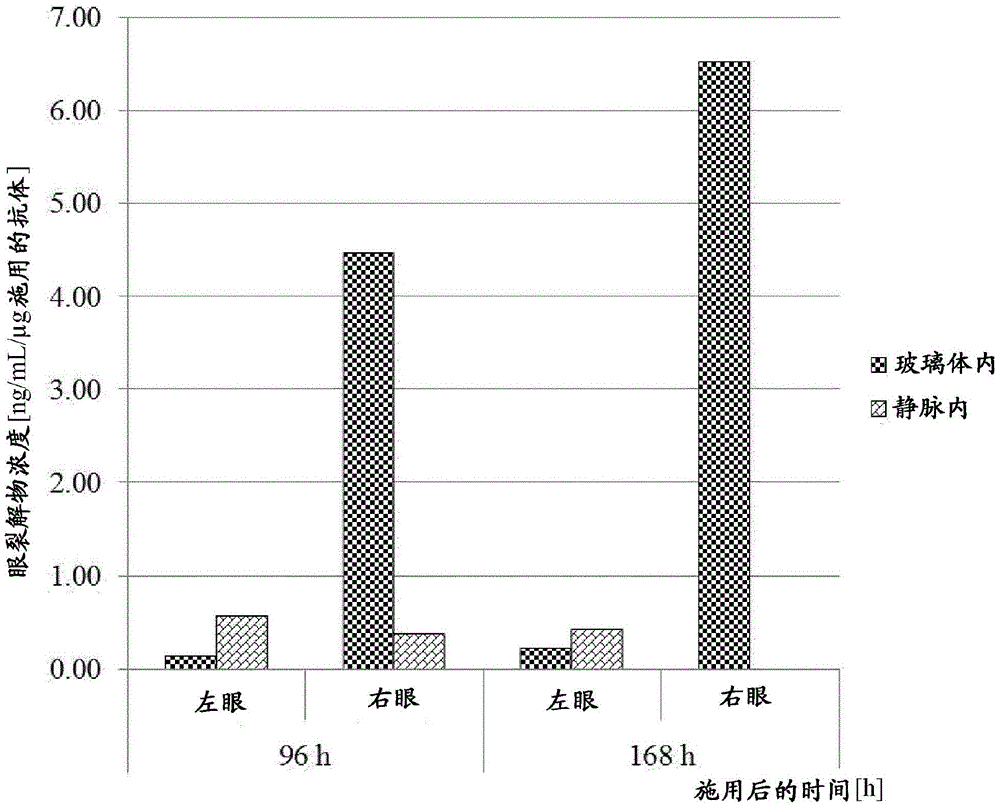
图7D:VEGF/ANG2-0016(具有IHH-AAA突变)在右眼和左眼中的眼裂解物浓度(与静脉内施加相比,仅玻璃体内施加入右眼后):仅可以在玻璃体内施加后于右眼中检测到明显浓度;在静脉内施加后不能在眼裂解物中检出浓度,原因在于VEGF/ANG2-0016((具有IHH-AAA突变)的血清半寿期低。Figure 7D: Eye lysate concentrations of VEGF/ANG2-0016 (with IHH-AAA mutation) in right and left eyes (after intravitreal administration only to right eye compared to intravenous application): can only be administered intravitreally Significant concentrations were later detected in the right eye; concentrations could not be detected in eye lysates after intravenous administration due to the low serum half-life of VEGF/ANG2-0016 (with the IHH-AAA mutation).
图7E:可以检测到在右眼和左眼中(与静脉内施加相比,仅玻璃体内施加入右眼后)VEGF/ANG2-0015(没有IHH-AAA突变)的眼裂解物浓度:在玻璃体内施加后在右眼中(和一定程度在左眼中)检测到VEGF/ANG2-0015的浓度;这显示从右眼扩散至血清中并从这里扩散至左眼中,这可以由VEGF/ANG2-0015(没有IHH-AAA突变)的长半寿期解释;在静脉内施加后还可以在双眼的眼裂解物中检测到明显浓度,原因在于血清稳定的VEGF/ANG2-0015(没有IHH-AAA突变)扩散至眼中。Figure 7E: Eye lysate concentrations of VEGF/ANG2-0015 (without the IHH-AAA mutation) can be detected in the right and left eyes (after intravitreal administration to the right eye only compared to intravenous application): Intravitreal Concentrations of VEGF/ANG2-0015 were detected in the right eye (and to some extent in the left eye) after application; this shows diffusion from the right eye into the serum and from here into the left eye, which can be determined by VEGF/ANG2-0015 (no Long half-life explanation for the IHH-AAA mutation); significant concentrations could also be detected in ocular lysates from both eyes after intravenous administration due to the diffusion of serum-stabilized VEGF/ANG2-0015 (without the IHH-AAA mutation) to eyes.
图8:与参考野生型(wt)抗体相比,在其与FcRn结合的能力方面工程化的抗体在SPR分析中显示长体内半寿期(YTE突变)或缩短的体内半寿期(IHH-AAA突变)、增强(YTE突变)或减弱的结合作用(IHH-AAA突变)以及在FcRn柱色谱中显示增强或缩减的保留时间;a)在单次静脉内浓注施加10mg/kg至huFcRn转基因雄性C57BL/6J小鼠+/-276中后的PK数据:野生型IgG以及YTE和IHH-AAA Fc区修饰的IgG的AUC数据;b)BIAcore传感图;c)FcRn亲和柱洗脱;野生型抗IGF-1R抗体(参考),抗IGF-1R抗体的YTE-突变体、抗IGF-1R抗体的IHH-AAA-突变体。Figure 8: Antibodies engineered in their ability to bind to FcRn show either long in vivo half-life (YTE mutation) or shortened in vivo half-life (IHH- AAA mutation), enhanced (YTE mutation) or reduced binding (IHH-AAA mutation) and showed enhanced or reduced retention time in FcRn column chromatography; a) 10 mg/kg applied to huFcRn transgene in a single iv bolus PK data in male C57BL/6J mice +/- 276: AUC data for wild-type IgG and YTE and IHH-AAA Fc region-modified IgG; b) BIAcore sensorgram; c) FcRn affinity column elution; Wild-type anti-IGF-1R antibody (reference), YTE-mutant of anti-IGF-1R antibody, IHH-AAA-mutant of anti-IGF-1R antibody.
图9:取决于引入Fc区的突变的数目,FcRn亲和色谱中保留时间的变化。Figure 9: Variation of retention time in FcRn affinity chromatography depending on the number of mutations introduced into the Fc region.
图10:取决于引入Fc区的突变的非对称分布,FcRn结合作用的变化。Figure 10: Variation in FcRn binding depending on the asymmetric distribution of mutations introduced into the Fc region.
图11:来自两次连续蛋白A亲和色谱柱的在两条重链中具有突变H310A、H433A和Y436A的组合的双特异性抗VEGF/ANG2抗体(VEGF/ANG2-0121)的洗脱色谱图。Figure 11: Elution chromatogram of bispecific anti-VEGF/ANG2 antibody (VEGF/ANG2-0121) with a combination of mutations H310A, H433A and Y436A in both heavy chains from two consecutive Protein A affinity chromatography columns .
图12:来自蛋白A亲和色谱柱的在两条重链中具有突变H310A、H433A和Y436A的抗IGF-1R抗体(IGF-1R-0045)的洗脱色谱图。Figure 12: Elution chromatogram of an anti-IGF-1R antibody (IGF-1R-0045) with mutations H310A, H433A and Y436A in both heavy chains from a protein A affinity chromatography column.
图13:IgG Fc区修饰的抗VEGF/ANG-2抗体与CM5芯片上的固定化蛋白A的结合作用。Figure 13: Binding of IgG Fc region-modified anti-VEGF/ANG-2 antibody to immobilized protein A on a CM5 chip.
图14:FcRn亲和柱上不同抗VEGF/ANG2抗体的洗脱色谱图。Figure 14: Elution chromatograms of different anti-VEGF/ANG2 antibodies on FcRn affinity columns.
图15:不同融合多肽对葡萄球菌蛋白A(SPR)的结合作用。Figure 15: Binding of different fusion polypeptides to Staphylococcus protein A (SPR).
图16:不同抗VEGF/ANG2抗体和抗IGF-1R抗体突变体与固定化蛋白A(SPR)的结合。Figure 16: Binding of different anti-VEGF/ANG2 antibodies and anti-IGF-1R antibody mutants to immobilized protein A (SPR).
图17:静脉内施加抗体IGF-1R 0033、0035和0045后血清浓度的比较。Figure 17: Comparison of serum concentrations following intravenous administration of antibodies IGF-
图18:玻璃体内和静脉内施加抗体IGF-1R 0033后眼裂解物浓度的比较。Figure 18: Comparison of eye lysate concentrations after intravitreal and intravenous application of antibody IGF-
图19:玻璃体内和静脉内施加抗体IGF-1R 0035后眼裂解物浓度的比较。Figure 19: Comparison of eye lysate concentrations following intravitreal and intravenous application of antibody IGF-
图20:玻璃体内和静脉内施加抗体IGF-1R 0045后眼裂解物浓度的比较。Figure 20: Comparison of eye lysate concentrations following intravitreal and intravenous application of antibody IGF-
本发明实施方案的详细描述DETAILED DESCRIPTION OF EMBODIMENTS OF THE INVENTION
I.定义I. Definitions
术语“约”指下文数值的+/-20%范围。在一个实施方案中,术语“约”指下文数值的+/-10%范围。在一个实施方案中,术语“约”指下文数值的+/-5%范围。The term "about" refers to a range of +/- 20% of the numerical value below. In one embodiment, the term "about" refers to a range of +/- 10% of the numerical value below. In one embodiment, the term "about" refers to a range of +/- 5% of the numerical value below.
出于本文目的,“接纳体人类构架”是这样的构架,它包含源自人免疫球蛋白构架的轻链可变结构域(VL)构架或重链可变结构域(VH)构架或如下文定义的人共有构架的氨基酸序列。“衍生自”人免疫球蛋白构架或人共有构架的接纳体人类构架可以包含其相同的氨基酸序列,或它可以含有氨基酸序列改变。在一些实施方案中,氨基酸改变的数目是10或更小、9或更小、8或更小、7或更小、6或更小、5或更小、4或更小、3或更小、或2或更小。在一些实施方案中,VL接纳体人类构架在序列上与VL人免疫球蛋白构架序列或人类共有构架序列相同。For purposes herein, an "acceptor human framework" is a framework comprising a variable light chain (VL) framework or a variable heavy domain (VH) framework derived from a human immunoglobulin framework or as follows The amino acid sequence of the defined human consensus framework. An acceptor human framework "derived from" a human immunoglobulin framework or a human consensus framework may contain the same amino acid sequence thereof, or it may contain amino acid sequence changes. In some embodiments, the number of amino acid changes is 10 or less, 9 or less, 8 or less, 7 or less, 6 or less, 5 or less, 4 or less, 3 or less , or 2 or less. In some embodiments, the VL acceptor human framework is identical in sequence to a VL human immunoglobulin framework sequence or a human consensus framework sequence.
“亲和力成熟的”抗体指在一个或多个高变区(HVR)中存在一个或多个改变的抗体,其中与不拥有这些改变的亲本抗体相比,这类改变导致抗体对抗原的亲和力改善。An "affinity matured" antibody refers to an antibody that has one or more alterations in one or more hypervariable regions (HVRs), wherein such alterations result in improved affinity of the antibody for the antigen compared to a parent antibody that does not possess those alterations .
术语“改变”指亲本抗体或融合多肽(例如至少包含Fc区的FcRn结合部分的融合多肽)中突变(置换)、插入(添加)或缺失一个或多个氨基酸残基以获得修饰的抗体或融合多肽。术语“突变”指特定的氨基酸残基置换为不同的氨基酸残基。例如,突变L234A指抗体Fc区(多肽)中第234位置处的氨基酸残基赖氨酸置换为氨基酸残基丙氨酸(赖氨酸用丙氨酸置换)(根据Kabat EU索引编号体系编号)。The term "alteration" refers to the mutation (substitution), insertion (addition), or deletion of one or more amino acid residues in a parent antibody or fusion polypeptide (eg, a fusion polypeptide comprising at least the FcRn-binding portion of an Fc region) to obtain a modified antibody or fusion peptide. The term "mutation" refers to the replacement of a particular amino acid residue with a different amino acid residue. For example, mutation L234A refers to the replacement of the amino acid residue lysine at position 234 in the Fc region (polypeptide) of an antibody by the amino acid residue alanine (lysine is replaced by alanine) (numbering according to the Kabat EU index numbering system) .
如本文所用,重链和轻链的全部恒定区和结构域的氨基酸位置根据Kabat等人,Sequences of Proteins of Immunological Interest,第5版.Public Health Service,National Institutes of Health,Bethesda,MD(1991))中描述的Kabat编号系统编号并且在本文中称作“根据Kabat编号”。具体而言,Kabat等人,Sequences of Proteins ofImmunological Interest,第5版.Public Health Service,National Institutes ofHealth,Bethesda,MD(1991)的Kabat编号体系(参见第647-660页)用于κ和λ同种型的轻链恒定结构域CL并且Kabat EU索引编号体系(参见第661-723页)用于(CH1、铰合部、CH2和CH3)的恒定重链结构域。As used herein, amino acid positions of all constant regions and domains of heavy and light chains are according to Kabat et al., Sequences of Proteins of Immunological Interest, 5th ed. Public Health Service, National Institutes of Health, Bethesda, MD (1991) ) as described in the Kabat numbering system and referred to herein as "numbering according to Kabat". In particular, Kabat et al., Sequences of Proteins of Immunological Interest, 5th ed. The Kabat numbering system of Public Health Service, National Institutes of Health, Bethesda, MD (1991) (see pp. 647-660) is used for kappa and lambda The light chain constant domains of the isotype CL and the Kabat EU index numbering system (see pages 661-723) are used for the constant heavy chain domains (CH1, hinge, CH2 and CH3).
“天然存在的氨基酸残基”指来自以下的氨基酸残基:丙氨酸(三字母代码:Ala,单字母代码:A)、精氨酸(Arg,R)、天冬酰胺(Asn,N)、天冬氨酸(Asp,D)、半胱氨酸(Cys,C)、谷氨酰胺(Gln,Q)、谷氨酸(Glu,E)、甘氨酸(Gly,G)、组氨酸(His,H)、异亮氨酸(Ile,I)、亮氨酸(Leu,L)、赖氨酸(Lys,K)、甲硫氨酸(Met,M)、苯丙氨酸(Phe,F)、脯氨酸(Pro,P)、丝氨酸(Ser,S)、苏氨酸(Thr,T)、色氨酸(Trp,W)、酪氨酸(Tyr,Y)、和缬氨酸(Val,V)。"Naturally occurring amino acid residues" refers to amino acid residues from the following: Alanine (three-letter code: Ala, one-letter code: A), arginine (Arg, R), asparagine (Asn, N) , aspartic acid (Asp, D), cysteine (Cys, C), glutamine (Gln, Q), glutamic acid (Glu, E), glycine (Gly, G), histidine ( His, H), isoleucine (Ile, I), leucine (Leu, L), lysine (Lys, K), methionine (Met, M), phenylalanine (Phe, F), proline (Pro, P), serine (Ser, S), threonine (Thr, T), tryptophan (Trp, W), tyrosine (Tyr, Y), and valine (Val, V).
术语“氨基酸突变”指至少一个现有的氨基酸残基置换为另一个不同的氨基酸残基(=替换性氨基酸残基)。替换性氨基酸残基可以是“天然存在氨基酸残基”并且选自丙氨酸(三字母代码:丙氨酸(三字母代码:ala,单字母代码:A)、精氨酸(arg,R)、天冬酰胺(asn,N)、天冬氨酸(asp,D-半胱氨酸(cys,C)、谷氨酰胺(gln,Q)、谷氨酸(glu,E)、甘氨酸(gly,G)、组氨酸(his,H)、异亮氨酸(ile,I)、亮氨酸(leu,L)、赖氨酸(lys,K)、甲硫氨酸(met,M)、苯丙氨酸(phe,F)、脯氨酸(pro,P)、丝氨酸(ser,S)、苏氨酸(thr,T)、色氨酸(trp,W)、酪氨酸(tyr,Y)和缬氨酸(val,V)。替换性氨基酸残基可以是“非天然存在的氨基酸残基”。参见例如US 6,586,207、WO 98/48032、WO 03/073238、US 2004/0214988、WO 2005/35727、WO2005/74524,Chin,J.W.等人,J.Am.Chem.Soc.124(2002)9026-9027;Chin,J.W.和Schultz,P.G.,ChemBioChem 11(2002)1135-1137;Chin,J.W.等人,PICAS United States ofAmerica 99(2002)11020-11024;以及Wang,L.和Schultz,P.G.,Chem.(2002)1-10(全部文献均通过引用的方式完整并入本文)。The term "amino acid mutation" refers to the replacement of at least one existing amino acid residue by another, different amino acid residue (=replacement amino acid residue). Alternative amino acid residues may be "naturally occurring amino acid residues" and selected from alanine (three-letter code: alanine (three-letter code: ala, one-letter code: A), arginine (arg, R) , asparagine (asn, N), aspartic acid (asp, D-cysteine (cys, C), glutamine (gln, Q), glutamic acid (glu, E), glycine (gly , G), histidine (his, H), isoleucine (ile, I), leucine (leu, L), lysine (lys, K), methionine (met, M) , phenylalanine (phe, F), proline (pro, P), serine (ser, S), threonine (thr, T), tryptophan (trp, W), tyrosine (tyr) , Y) and valine (val, V). Alternative amino acid residues may be "non-naturally occurring amino acid residues". See eg US 6,586,207, WO 98/48032, WO 03/073238, US 2004/0214988, WO 2005/35727, WO 2005/74524, Chin, J.W. et al., J.Am.Chem.Soc.124(2002) 9026-9027; Chin, J.W. and Schultz, P.G., ChemBioChem 11(2002) 1135-1137; Chin, J.W. et al., PICAS United States of America 99 (2002) 11020-11024; and Wang, L. and Schultz, P.G., Chem. (2002) 1-10 (all incorporated herein by reference in their entirety).
术语“氨基酸插入”指在氨基酸序列中预定的位置处(额外)并入至少一个氨基酸残基。在一个实施方案中,插入将是插入一个或两个氨基酸残基。插入的氨基酸残基可以是任何天然存在的或非天然存在的氨基酸残基。The term "amino acid insertion" refers to the (additional) incorporation of at least one amino acid residue at a predetermined position in an amino acid sequence. In one embodiment, the insertion will be an insertion of one or two amino acid residues. The inserted amino acid residue can be any naturally occurring or non-naturally occurring amino acid residue.
术语“氨基酸缺失”指在氨基酸序列中的预定位置处移除至少一个氨基酸残基。The term "amino acid deletion" refers to the removal of at least one amino acid residue at a predetermined position in an amino acid sequence.
如本文所用,术语“ANG-2”指人血管生成素-2(ANG-2)(备选地缩写为:ANGPT2或ANG2)(SEQ ID NO:31),其例如在Maisonpierre,P.C.等人,Science 277(1997)55-60和Cheung,A.H.等人,Genomics 48(1998)389-91中描述。发现血管生成素-1(SEQ ID NO:32)和-2作为血管内皮内部选择性表达的酪氨酸激酶家族Tie的配体(Yancopoulos,G.D.等人,Nature 407(2000)242-248)。目前存在4种确定的血管生成素家族成员。血管生成素-3和-4(ANG-3和ANG-4)可以广泛地代表小鼠和人类中相同基因座的多样的对应物(Kim,I.等人,FEBS Let,443(1999)353-356;Kim,I.等人,J.Biol.Chem.274(1999)26523-26528)。ANG-1和ANG-2最初在组织培养实验中分别被鉴定为激动剂和拮抗剂(关于ANG-1,参见:Davis,S.等人,Cell 87(1996)1161-1169;并且关于ANG-2,参见:Maisonpierre,P.C.等人,Science277(1997)55-60)。全部已知的血管生成素主要与Tie2(SEQ ID NO:33)结合,并且ANG-1和-2均以3nM(Kd)亲和力与Tie2结合(Maisonpierre,P.C.等人,Science 277(1997)55-60)。As used herein, the term "ANG-2" refers to human angiopoietin-2 (ANG-2) (alternatively abbreviated as: ANGPT2 or ANG2) (SEQ ID NO: 31), which is described, for example, in Maisonpierre, P.C. et al., Science 277 (1997) 55-60 and Cheung, A.H. et al, Genomics 48 (1998) 389-91. Angiopoietin-1 (SEQ ID NO: 32) and -2 were discovered as ligands of the Tie family of tyrosine kinases selectively expressed within the vascular endothelium (Yancopoulos, G.D. et al., Nature 407 (2000) 242-248). There are currently 4 established members of the angiopoietin family. Angiopoietin-3 and -4 (ANG-3 and ANG-4) can broadly represent diverse counterparts at the same locus in mice and humans (Kim, I. et al., FEBS Let, 443 (1999) 353 -356; Kim, I. et al., J. Biol. Chem. 274 (1999) 26523-26528). ANG-1 and ANG-2 were originally identified as agonists and antagonists, respectively, in tissue culture experiments (for ANG-1, see: Davis, S. et al., Cell 87 (1996) 1161-1169; and for ANG-1 2, see: Maisonpierre, P.C. et al., Science 277 (1997) 55-60). All known angiopoietins bind primarily to Tie2 (SEQ ID NO:33), and both ANG-1 and -2 bind Tie2 with 3nM (Kd) affinity (Maisonpierre, P.C. et al., Science 277 (1997) 55- 60).
术语“抗体”在本文中以最广意义使用并且涵盖多种抗体结构物,包括但不限于单克隆抗体、多克隆抗体、多特异性抗体(例如,双特异性抗体、三特异性抗体)和抗体片段,只要它们显示出所需的抗原-和/或蛋白A和/或FcRn-结合活性。The term "antibody" is used herein in the broadest sense and encompasses a variety of antibody structures including, but not limited to, monoclonal antibodies, polyclonal antibodies, multispecific antibodies (eg, bispecific antibodies, trispecific antibodies) and Antibody fragments so long as they exhibit the desired antigen- and/or Protein A and/or FcRn-binding activity.
术语“非对称Fc区”指在根据Kabat EU索引编号体系的相应位置处具有不同氨基酸残基的一对Fc区多肽。The term "asymmetric Fc region" refers to a pair of Fc region polypeptides having different amino acid residues at corresponding positions according to the Kabat EU index numbering system.
术语“关于FcRn结合作用的非对称Fc区”指由相应位置处具有不同氨基酸残基的两条多肽链组成的Fc区,其中位置根据Kabat EU索引编号体系确定,因而不同位置影响Fc区与人新生儿Fc-受体(FcRn)的结合。出于本文目的,在“关于FcRn结合作用的非对称Fc区”中Fc区的两条多肽链之间的差异不包括已经引入以促进形成异二聚Fc区(例如用于产生双特异性抗体)的差异。这些区别也可以是非对称的,即两条链在根据Kabat EU索引编号体系的非相应氨基酸残基处具有差异。这些差异促进异二聚化并且减少同型二聚化。这类差异的例子是所谓的“结入扣”置换(参见,例如,US7 695 936和US 2003/0078385)。已经发现IgG1亚类的IgG抗体Fc区的单条多肽链中的以下结和扣置换增加异二聚体形成:1)一条链中的Y407T及另一条链中的T366Y;2)一条链中的Y407A及另一条链中的T366W;3)一条链中的F405A及另一条链中的T394W;4)一条链中的F405W及另一条链中的T394S;5)一条链中的Y407T及另一条链中的T366Y;6)一条链中的T366Y和F405A及另一条链中的T394W和Y407T;7)一条链中的T366W和F405W及另一条链中的T394S和Y407A;8)一条链中的F405W和Y407A及另一条链中的T366W和T394S;和9)一条链中的T366W及另一条链中的T366S、L368A和Y407V,其中最后列出的特别合适。此外,在两条个Fc区多肽链之间产生新二硫键的变化促进异二聚体形成(参见,例如,US 2003/0078385)。已经发现产生适当间隔的半胱氨酸残基用于IgG1亚类的IgG抗体Fc区的单条多肽链中形成新链内二硫键的以下置换以增加异二聚体形成:一条链中的Y349C及另一条链中的S354C;一条链中的Y349C及另一条链中的E356C;一条链中的Y349C及另一条链中的E357C;一条链中的L351C及另一条链中的S354C;一条链中的T394C及另一条链中的E397C;或一条链中的D399C及另一条链中的K392C。促进异二聚化的氨基酸变化的其他例子是所谓的“电荷对置换”(参见,例如,WO 2009/089004)。已经发现IgG1亚类的IgG抗体Fc区的单条多肽链中的以下电荷对置换增加异二聚体形成:1)一条链中的K409D或K409E及另一条链中的D399K或D399R;2)一条链中的K392D或K392E及另一条链中的D399K或D399R;3)一条链中的K439D或K439E及另一条链中的E356K或E356R;4)一条链中的K370D或K370E及另一条链中的E357K或E357R;5)一条链中的K409D和K360D加另一条链中的D399K和E356K;6)一条链中的K409D和K370D加另一条链中D399K和E357K;7)一条链中的K409D和K392D加D399K、E356K及另一条链中的E357K;8)一条链中的K409D和K392D及另一条链中的D399K;9)一条链中的K409D和K392D及另一条链中的D399K和E356K;10)一条链中的K409D和K392D及另一条链中的D399K和D357K;11)一条链中的K409D和K370D及另一条链中的D399K和D357K;12)一条链中的D399K及另一条链中的K409D和K360D;和13)一条链中的K409D和K439D及另一条链上的D399K和E356K。The term "asymmetric Fc region with respect to FcRn binding" refers to an Fc region consisting of two polypeptide chains having different amino acid residues at corresponding positions, wherein the positions are determined according to the Kabat EU index numbering system, and thus different positions affect the relationship between the Fc region and human Binding of the neonatal Fc-receptor (FcRn). For purposes herein, the difference between the two polypeptide chains of the Fc region in "Asymmetric Fc region for FcRn binding" does not include that which has been introduced to facilitate the formation of a heterodimeric Fc region (eg, for the production of bispecific antibodies). ) difference. These differences can also be asymmetric, ie the two chains have differences at non-corresponding amino acid residues according to the Kabat EU index numbering system. These differences promote heterodimerization and reduce homodimerization. An example of such a difference is the so-called "buckle-in" permutation (see, eg,
术语“(与抗原)结合”指在体外测定法中、在一个实施方案中在其中抗体与表面结合并通过表面等离子体共振(SPR)测量抗原与抗体结合的结合测定法中抗体与其抗原的结合。结合意指结合10-8M或更小、在一些实施方案中10-13至10-8M、在一些实施方案中10-13至10-9M的亲和力(KD)。The term "binding (to an antigen)" refers to the binding of an antibody to its antigen in an in vitro assay, in one embodiment in a binding assay in which the antibody is bound to a surface and the antigen-antibody binding is measured by surface plasmon resonance (SPR) . Binding means binding with an affinity (K D ) of 10-8 M or less, in some embodiments 10-13 to 10-8 M, in some embodiments 10-13 to 10-9 M.
可以通过BIAcore测定法(GE Healthcare Biosensor AB,乌普萨拉,瑞典)研究结合作用。结合作用的亲和力由术语ka(来自抗体/抗原复合物的抗体的缔合速率常数)、kD(解离常数)和KD(kD/ka)定义。Binding can be studied by BIAcore assay (GE Healthcare Biosensor AB, Uppsala, Sweden). The affinity of binding is defined by the terms ka (association rate constant of the antibody from the antibody/antigen complex), kD (dissociation constant) and KD ( kD / ka ).
术语“嵌合”抗体指一种抗体,其中重链和/或轻链的一部分衍生自特定来源或物种,而重链和/或轻链的剩余部分衍生自不同来源或物种。The term "chimeric" antibody refers to an antibody in which a portion of the heavy and/or light chain is derived from a particular source or species and the remainder of the heavy and/or light chain is derived from a different source or species.
术语“CH2结构域”指抗体重链多肽的从EU位置231延伸至EU位置340的部分(根据Kabat的EU编号体系)。在一个实施方案中,CH2结构域具有SEQ ID NO:09的氨基酸序列:APELLGG PSVFLFPPKP KDTLMISRTP EVTCVWDVS HEDPEVKFNW YVDGVEVHNA KTKPREEQ ESTYRWSVLT VLHQDWLNGK EYKCKVSNKA LPAPIEKTIS KAK。The term "CH2 domain" refers to the portion of an antibody heavy chain polypeptide extending from EU position 231 to EU position 340 (according to Kabat's EU numbering system). In one embodiment, the CH2 domain has the amino acid sequence of SEQ ID NO: 09: APELLGG PSVFLFPPKP KDTLMISRTP EVTCVWDVS HEDPEVKFNW YVDGVEVHNA KTKPREEQ ESTYRWSVLT VLHQDWLNGK EYKCKVSNKA LPAPIEKTIS KAK.
术语“CH3结构域”指抗体重链多肽的从EU位置341延伸至EU位置446的部分。在一个实施方案中,CH3结构域具有SEQ ID NO:10的氨基酸序列:GQPREPQ VYTLPPSRDELTKNQVSLTC LVKGFYPSDI AVEWESNGQP ENNYKTTPPV LDSDGSFFLY SKLTVDKSRW QQGNVFSCSVMHEALHNHYT QKSLSLSPG。The term "CH3 domain" refers to the portion of an antibody heavy chain polypeptide extending from EU position 341 to EU position 446. In one embodiment, the CH3 domain has the amino acid sequence of SEQ ID NO: 10: GQPREPQ VYTLPPSRDELTKNQVSLTC LVKGFYPSDI AVEWESNGQP ENNYKTTPPV LDSDGSFFLY SKLTVDKSRW QQGNVFSCSVMHEALHNHYT QKSLSLSPG.
抗体的“类”指由其重链拥有的恒定结构域或恒定区的类型。存在五个主要类别的抗体:IgA、IgD、IgE、IgG和IgM,并且这些类别中的几种可以进一步划分成亚类(同种型),例如,IgG1、IgG2、IgG3、IgG4、IgA1和IgA2。对应于不同类别免疫球蛋白的重链恒定域分别称作α、δ、ε、γ和μ。The "class" of an antibody refers to the type of constant domain or constant region possessed by its heavy chain. There are five main classes of antibodies: IgA, IgD, IgE, IgG, and IgM, and several of these classes can be further divided into subclasses (isotypes), eg, IgGi , IgG2, IgG3 , IgG4 , IgA 1 and IgA 2 . The heavy chain constant domains that correspond to the different classes of immunoglobulins are called alpha, delta, epsilon, gamma, and mu, respectively.
术语“可比较长度”指两种多肽包含相同数目的氨基酸残基或可以在长度上因一个或多个和直至最多10个氨基酸残基而不同。在一个实施方案中,(Fc区)多肽包含相同数目的氨基酸残基或可以因1至10个氨基酸残基而不同。在一个实施方案中,(Fc区)多肽包含相同数目的氨基酸残基或可以因1至5个氨基酸残基而不同。在一个实施方案中,(Fc区)多肽包含相同数目的氨基酸残基或可以因1至3个氨基酸残基而不同。The term "comparable length" means that two polypeptides comprise the same number of amino acid residues or may differ in length by one or more and up to 10 amino acid residues. In one embodiment, the (Fc region) polypeptides comprise the same number of amino acid residues or may vary by 1 to 10 amino acid residues. In one embodiment, the (Fc region) polypeptides comprise the same number of amino acid residues or may vary by 1 to 5 amino acid residues. In one embodiment, the (Fc region) polypeptides comprise the same number of amino acid residues or may vary by 1 to 3 amino acid residues.
“效应子功能”指随抗体类别变动的归因于抗体Fc区的那些生物学活性。抗体效应子功能的例子包括:C1q结合和补体依赖的细胞毒性(CDC);Fc受体结合作用;抗体依赖的细胞介导的细胞毒性(ADCC);吞噬;下调细胞表面受体(例如B细胞受体);和B-细胞活化。"Effector functions" refer to those biological activities attributable to the Fc region of an antibody that vary by antibody class. Examples of antibody effector functions include: C1q binding and complement-dependent cytotoxicity (CDC); Fc receptor binding; antibody-dependent cell-mediated cytotoxicity (ADCC); phagocytosis; downregulation of cell surface receptors such as B cells receptor); and B-cell activation.
药剂(例如,药物制剂)的“有效量”指有效实现所需治疗性或预防性结果的量、以实现前述结果的剂量和持续实现前述结果所需要的时间段。An "effective amount" of an agent (eg, a pharmaceutical formulation) refers to an amount effective to achieve a desired therapeutic or prophylactic result, a dosage to achieve the aforementioned result, and for the period of time necessary to achieve the aforementioned result.
术语“Fc-融合多肽”指结合结构域(例如抗原结合结构域如单链抗体,或多肽如受体的配体)与显示所需靶结合活性、蛋白A结合活性和FcRn-结合活性的抗体Fc区的融合物。The term "Fc-fusion polypeptide" refers to a binding domain (eg, an antigen-binding domain such as a single-chain antibody, or a polypeptide such as a ligand for a receptor) and an antibody that exhibits the desired target-binding activity, protein A-binding activity, and FcRn-binding activity Fc region fusions.
术语“人源Fc区”指人源免疫球蛋白的C端区域重链,其至少含有一部分的铰链区、CH2结构域和CH3结构域。在一个实施方案中,人IgG重链Fc区从Cys226或从Pro230延伸至重链的羧基端。在一个实施方案中,Fc区具有SEQ ID NO:60的氨基酸序列。然而,Fc区的C端赖氨酸(Lys447)可以存在或可以不存在。The term "human Fc region" refers to the C-terminal region heavy chain of a human immunoglobulin, which contains at least a portion of the hinge region, the CH2 domain and the CH3 domain. In one embodiment, the human IgG heavy chain Fc region extends from Cys226 or from Pro230 to the carboxy terminus of the heavy chain. In one embodiment, the Fc region has the amino acid sequence of SEQ ID NO:60. However, the C-terminal lysine (Lys447) of the Fc region may or may not be present.
术语“FcRn”指人新生儿Fc-受体。FcRn起到挽救来自溶酶体降解途径的IgG的作用,导致清除率减少和半寿期增加。FcRn是由两条多肽:50kDa主要组织相容性复合体样蛋白I类(α-FcRn)和15kDaβ2-微球蛋白(β2m)组成的异二聚体蛋白。FcRn以高亲和力与IgG的Fc区的CH2-CH3部分结合。在IgG和FcRn之间的相互作用严格依赖pH并且以1:2化学计量发生,即一个IgG通过其两条重链与两个FcRn分子结合(Huber,A.H.等人,J.Mol.Biol.230(1993)1077-1083)。FcRn结合作用在内体中酸性pH(pH<6.5)发生并且IgG在中性细胞表面(pH约7.4)释放。这种相互作用的pH敏感性质促进FcRn介导保护胞饮入细胞的IgG通过在内体酸性环境内部与受体结合而免遭胞内降解。FcRn随后促进IgG再循环到细胞表面并随后在FcRn-IgG复合物暴露于细胞外部中性pH环境时释放入血流。The term "FcRn" refers to the human neonatal Fc-receptor. FcRn functions to rescue IgG from the lysosomal degradation pathway, resulting in reduced clearance and increased half-life. FcRn is a heterodimeric protein composed of two polypeptides: 50 kDa major histocompatibility complex-like protein class I (α-FcRn) and 15 kDa β2-microglobulin (β2m). FcRn binds with high affinity to the CH2-CH3 portion of the Fc region of IgG. The interaction between IgG and FcRn is strictly pH-dependent and occurs at 1:2 stoichiometry, ie one IgG binds two FcRn molecules via its two heavy chains (Huber, A.H. et al., J.Mol.Biol.230 (1993) 1077-1083). FcRn binding occurs in endosomes at acidic pH (pH<6.5) and IgG is released at the surface of neutrophils (pH about 7.4). The pH-sensitive nature of this interaction facilitates FcRn-mediated protection of IgG pinocytosed into cells from intracellular degradation by binding to receptors within the acidic environment of the endosome. FcRn then promotes recycling of IgG to the cell surface and subsequent release into the bloodstream when the FcRn-IgG complex is exposed to the neutral pH environment outside the cell.
术语“Fc区的FcRn结合部分”指抗体重链多肽的部分,所述部分从大约EU位置243延伸至EU位置261,并且从大约EU位置275延伸至EU位置293,并且从大约EU位置302延伸至EU位置319,并且从大约EU位置336延伸至EU位置348,并且从大约EU位置367延伸至EU位置393及EU位置408,并且从大约EU位置424延伸至EU位置440。在一个实施方案中,改变根据Kabat EU编号的以下一个或多个氨基酸残基F243,P244,P245P,K246,P247,K248,D249,T250,L251,M252,I253,S254,R255,T256,P257,E258,V259,T260,C261,F275,N276,W277,Y278,V279,D280,V282,E283,V284,H285,N286,A287,K288,T289,K290,P291,R292,E293,V302,V303,S304,V305,L306,T307,V308,L309,H310,Q311,D312,W313,L314,N315,G316,K317,E318,Y319,I336,S337,K338,A339,K340,G341,Q342,P343,R344,E345,P346,Q347,V348,C367,V369,F372,Y373,P374,S375,D376,I377,A378,V379,E380,W381,E382,S383,N384,G385,Q386,P387,E388,N389,Y391,T393,S408,S424,C425,S426,V427,M428,H429,E430,A431,L432,H433,N434,H435,Y436,T437,Q438,K439和S440(EU编号)。The term "FcRn binding portion of an Fc region" refers to the portion of an antibody heavy chain polypeptide that extends from about EU position 243 to EU position 261, and from about EU position 275 to EU position 293, and from about EU position 302 to EU position 319 and extending from approximately EU position 336 to EU position 348 , and from approximately EU position 367 to EU position 393 and EU position 408 , and from approximately EU position 424 to EU position 440 . In one embodiment, one or more of the following amino acid residues F243, P244, P245P, K246, P247, K248, D249, T250, L251, M252, I253, S254, R255, T256, P257 are altered according to Kabat EU numbering, E258,V259,T260,C261,F275,N276,W277,Y278,V279,D280,V282,E283,V284,H285,N286,A287,K288,T289,K290,P291,R292,E293,V302,V303,S304, V305,L306,T307,V308,L309,H310,Q311,D312,W313,L314,N315,G316,K317,E318,Y319,I336,S337,K338,A339,K340,G341,Q342,P343,R344,E345, P346,Q347,V348,C367,V369,F372,Y373,P374,S375,D376,I377,A378,V379,E380,W381,E382,S383,N384,G385,Q386,P387,E388,N389,Y391,T393, S408, S424, C425, S426, V427, M428, H429, E430, A431, L432, H433, N434, H435, Y436, T437, Q438, K439 and S440 (EU number).
“构架”或“FR”指除高变区(HVR)残基之外的可变结构域残基。可变结构域的FR通常由以下4个FR结构域组成:FR1、FR2、FR3和FR4。因此,HVR序列和FR序列通常按以下序列出现在VH(或VL)中:FR1-H1(L1)-FR2-H2(L2)-FR3-H3(L3)-FR4。"Framework" or "FR" refers to variable domain residues other than hypervariable region (HVR) residues. The FRs of variable domains generally consist of the following four FR domains: FR1, FR2, FR3 and FR4. Thus, HVR sequences and FR sequences typically appear in VH (or VL) in the following sequence: FR1-H1(L1)-FR2-H2(L2)-FR3-H3(L3)-FR4.
术语“全长抗体”指这样的抗体,所述抗体具有基本上与包含四条多肽的天然抗体结构相似的结构或具有含有如本文定义的Fc区的重链。全长抗体可以包含其他结构域,例如与全长抗体的一个条或多条链缀合的scFv或scFab。这些缀合物也由术语全长抗体涵盖。The term "full-length antibody" refers to an antibody having a structure substantially similar to that of a native antibody comprising four polypeptides or having a heavy chain comprising an Fc region as defined herein. Full-length antibodies may comprise other domains, such as scFvs or scFabs conjugated to one or more chains of the full-length antibody. These conjugates are also encompassed by the term full-length antibody.
术语“二聚体多肽”指包含共价结合的至少两条多肽的复合物。该复合物可以包含其他多肽,所述其他多肽也与其余多肽共价或非共价结合。在一个实施方案中,二聚体多肽包含两条或四条多肽。The term "dimeric polypeptide" refers to a complex comprising at least two polypeptides covalently bound. The complex may contain other polypeptides that are also covalently or non-covalently bound to the remaining polypeptides. In one embodiment, the dimeric polypeptide comprises two or four polypeptides.
术语“异二聚体”或“异二聚的”指包含两条多肽的分子(例如具有可比较长度),其中这两条多肽具有这样的氨基酸序列,其在相应位置具有至少一个不同的氨基酸残基,其中相应位置根据Kabat EU索引编号体系确定。The term "heterodimer" or "heterodimeric" refers to a molecule comprising two polypeptides (eg, of comparable length), wherein the two polypeptides have amino acid sequences that have at least one different amino acid at corresponding positions residues, where the corresponding positions are identified according to the Kabat EU index numbering system.
术语“同型二聚体”和“同型二聚的”指包含具有可比较长度的两条多肽的分子,其中这两条多肽具有在相应位置相同的氨基酸序列,其中根据Kabat EU索引编号体系确定。The terms "homodimer" and "homodimeric" refer to a molecule comprising two polypeptides of comparable length, wherein the two polypeptides have the same amino acid sequence at corresponding positions, as determined according to the Kabat EU index numbering system.
如本文中报道的二聚体多肽可以是同型二聚的或异二聚的,这相对于关注的突变或特性而决定。例如,相对于FcRn和/或蛋白A结合作用(即关注特性),二聚体多肽就突变H310A、H433A和Y436A而言是同型二聚的(即二聚体多肽的两条多肽均包含这些突变)(就二聚体多肽的FcRn和/或蛋白A结合特性而言关注这些突变),但同时分别就突变Y349C、T366S、L368A和Y407V而言(不关注这些突变,因为这些突变涉及二聚体多肽异二聚化而不涉及FcRn/蛋白A结合特性)以及就突变S354C和T366W而言(第一组仅含于第一多肽中,而第二组仅含于第二多肽中)是异二聚的。进一步例如,如本文中报道的二聚体多肽可以就突变I253A、H310A、H433A、H435A和Y436A而言是异二聚的(即这些突变均涉及二聚体多肽的FcRn和/或蛋白A结合特性),即一条多肽包含突变I253A,H310A和H435A,而另一条多肽包含突变H310A、H433A和Y436A。Dimeric polypeptides as reported herein can be homodimeric or heterodimeric, depending on the mutation or property of interest. For example, with respect to FcRn and/or Protein A binding (ie properties of interest), the dimeric polypeptide is homodimeric with respect to mutations H310A, H433A and Y436A (ie both polypeptides of the dimer polypeptide contain these mutations) ) (these mutations are of interest in terms of the FcRn and/or Protein A binding properties of the dimeric polypeptide), but also in terms of the mutations Y349C, T366S, L368A and Y407V, respectively (these mutations are not of interest as these are involved in dimerization Polypeptide heterodimerization without involving FcRn/Protein A binding properties) and for mutations S354C and T366W (the first set contained only in the first polypeptide and the second set only in the second polypeptide) were Heterodimeric. For further example, a dimeric polypeptide as reported herein may be heterodimeric with respect to mutations I253A, H310A, H433A, H435A and Y436A (ie, these mutations are all related to the FcRn and/or Protein A binding properties of the dimeric polypeptide ), that is, one polypeptide contains the mutations I253A, H310A and H435A, while the other polypeptide contains the mutations H310A, H433A and Y436A.
术语“宿主细胞”、“宿主细胞系”和“宿主细胞培养物”互换使用并且指已经向其中引入外源核酸的细胞,包括这类细胞的后代。宿主细胞包括“转化体”和“转化的细胞”,其包括原代转化细胞和从其衍生的后代,而无论传代次数是多少。后代可以在核酸含量含量方面不与亲本细胞完全相同,反而可以含有突变。本文中包括突变子代,所述突变子代具有与最初转化的细胞中所筛选或选择的子代相同的功能或生物活性。The terms "host cell", "host cell line" and "host cell culture" are used interchangeably and refer to cells into which exogenous nucleic acid has been introduced, including the progeny of such cells. Host cells include "transformants" and "transformed cells," which include the primary transformed cell and progeny derived therefrom, regardless of the number of passages. The progeny may not be identical to the parental cell in terms of nucleic acid content and may instead contain mutations. Included herein are mutant progeny that have the same function or biological activity as the progeny screened or selected in the original transformed cell.
“人抗体”是这样一种抗体,其拥有对应于人或人细胞产生的抗体的氨基酸序列或从利用人抗体库或其他编码人抗体的序列的非人来源衍生。人抗体的这种定义特别排除包含非人抗原结合残基的人源化抗体。A "human antibody" is an antibody that possesses an amino acid sequence corresponding to that of an antibody produced by a human or human cell or derived from a non-human source utilizing a human antibody library or other sequence encoding a human antibody. This definition of human antibody specifically excludes humanized antibodies comprising non-human antigen-binding residues.
“人类共有构架”是这样的构架,它代表在人免疫球蛋白VL或VH构架序列的选项中最常出现的氨基酸残基。通常,人免疫球蛋白VL或VH构架序列的选项来自可变结构域序列的亚组。通常,序列亚组是如Kabat,E.A.等人,Sequences of Proteins of ImmunologicalInterest,第5版,Bethesda MD(1991),NIH Publication 91-3242,第1-3卷中描述的亚组。在一个实施方案中,对于VL,该亚组是如上文Kabat等人中描述的亚组κI。在一个实施方案中,对于VH,该亚组是如上文Kabat等人中描述的亚组III。A "human consensus framework" is a framework that represents the amino acid residues that occur most frequently in a selection of human immunoglobulin VL or VH framework sequences. Typically, options for human immunoglobulin VL or VH framework sequences are derived from a subset of variable domain sequences. Typically, a subset of sequences is a subset as described in Kabat, E.A. et al., Sequences of Proteins of Immunological Interest, 5th Edition, Bethesda MD (1991), NIH Publication 91-3242, Vols. 1-3. In one embodiment, for VL, the subgroup is subgroup κI as described in Kabat et al., supra. In one embodiment, for VH, the subgroup is subgroup III as described in Kabat et al., supra.
术语“衍生自”指氨基酸序列通过在至少一个位置改变引入衍生自母氨基酸序列。因此,衍生的氨基酸序列在至少一个相应位置(根据抗体Fc区的Kabat EU索引)处与相应的母氨基酸序列不同。在一个实施方案中,衍生自母氨基酸序列的氨基酸序列在相应位置相异1至15个氨基酸残基。在一个实施方案中,衍生自母氨基酸序列的氨基酸序列在相应位置相异1至10个氨基酸残基。在一个实施方案中,衍生自母氨基酸序列的氨基酸序列在相应位置相异1至6个氨基酸残基。同样地,衍生的氨基酸序列与其母氨基酸序列具有高氨基酸序列同一性。在一个实施方案中,衍生自母氨基酸序列的氨基酸序列具有80%或更大的氨基酸序列同一性。在一个实施方案中,衍生自母氨基酸序列的氨基酸序列具有90%或更大的氨基酸序列同一性。在一个实施方案中,衍生自母氨基酸序列的氨基酸序列具有95%或更大的氨基酸序列同一性。The term "derived from" refers to an amino acid sequence that is derived from a parent amino acid sequence by introducing changes in at least one position. Thus, the derived amino acid sequence differs from the corresponding parent amino acid sequence at at least one corresponding position (according to the Kabat EU index of the Fc region of an antibody). In one embodiment, the amino acid sequences derived from the parent amino acid sequence differ by 1 to 15 amino acid residues at corresponding positions. In one embodiment, the amino acid sequences derived from the parent amino acid sequence differ by 1 to 10 amino acid residues at corresponding positions. In one embodiment, the amino acid sequences derived from the parent amino acid sequence differ by 1 to 6 amino acid residues at corresponding positions. Likewise, the derived amino acid sequence has high amino acid sequence identity to its parent amino acid sequence. In one embodiment, the amino acid sequence derived from the parent amino acid sequence has 80% or greater amino acid sequence identity. In one embodiment, the amino acid sequence derived from the parent amino acid sequence has 90% or greater amino acid sequence identity. In one embodiment, the amino acid sequence derived from the parent amino acid sequence has 95% or greater amino acid sequence identity.
术语“人Fc区多肽”指与“天然”或“野生型”人Fc区多肽相同的氨基酸序列。术语“变异(人)Fc区多肽”指因至少一个“氨基酸改变”而衍生自“天然”或“野生型”Fc区氨基酸序列的氨基酸序列。“人Fc区”由两条人Fc区多肽组成。“变异(人)Fc区”由两条Fc区多肽组成,因而二者可以均是变异(人)Fc区多肽或一个是人Fc区多肽并且另一个是变异(人)Fc区多肽。The term "human Fc region polypeptide" refers to the same amino acid sequence as a "native" or "wild-type" human Fc region polypeptide. The term "variant (human) Fc region polypeptide" refers to an amino acid sequence derived from a "native" or "wild-type" Fc region amino acid sequence with at least one "amino acid change". A "human Fc region" consists of two human Fc region polypeptides. A "variant (human) Fc region" consists of two Fc region polypeptides, thus both can be variant (human) Fc region polypeptides or one is a human Fc region polypeptide and the other is a variant (human) Fc region polypeptide.
在一个实施方案中,人Fc区多肽具有SEQ ID NO:60的人IgG1 Fc区多肽的氨基酸序列、或SEQ ID NO:61的人IgG2Fc区多肽的氨基酸序列或SEQ ID NO:63的人IgG4 Fc区的多肽氨基酸序列,所述氨基酸序列具有如本文中报道的突变。在一个实施方案中,变异(人)Fc区多肽衍生自SEQ ID NO:60、或61、或63的Fc区多肽并且与SEQ ID NO:60、或61、或63的Fc区多肽相比具有至少一个氨基酸突变。在一个实施方案中,变异(人)Fc区多肽包含/具有从约1个至约10个氨基酸突变,并在一个实施方案中具有约1个至约5个氨基酸突变。在一个实施方案中,变异(人)Fc区多肽与人Fc区多肽SEQ ID NO:60、或62、或63具有至少约80%同源性。在一个实施方案中,变异(人)Fc区多肽与人Fc区多肽SEQ ID NO:60、或61、或63具有至少约90%同源性。在一个实施方案中,变异(人)Fc区多肽与人Fc区多肽SEQ ID NO:60、或62、或63具有至少约95%同源性。In one embodiment, the human Fc region polypeptide has the amino acid sequence of the human IgGl Fc region polypeptide of SEQ ID NO:60, or the amino acid sequence of the human IgG2 Fc region polypeptide of SEQ ID NO:61, or the human IgG4 Fc of SEQ ID NO:63 Polypeptide amino acid sequence of a region with mutations as reported herein. In one embodiment, the variant (human) Fc region polypeptide is derived from the Fc region polypeptide of SEQ ID NO: 60, or 61, or 63 and has as compared to the Fc region polypeptide of SEQ ID NO: 60, or 61, or 63 At least one amino acid mutation. In one embodiment, the variant (human) Fc region polypeptide comprises/has from about 1 to about 10 amino acid mutations, and in one embodiment about 1 to about 5 amino acid mutations. In one embodiment, the variant (human) Fc region polypeptide has at least about 80% homology to the human Fc region polypeptide SEQ ID NO: 60, or 62, or 63. In one embodiment, the variant (human) Fc region polypeptide is at least about 90% homologous to the human Fc region polypeptide SEQ ID NO: 60, or 61, or 63. In one embodiment, the variant (human) Fc region polypeptide has at least about 95% homology to the human Fc region polypeptide SEQ ID NO: 60, or 62, or 63.
从SEQ ID NO:60、或61、或63的人Fc区多肽衍生的变异(人)Fc区多肽由所含的氨基酸改变限定。因此,例如,术语P329G指从相对于SEQ ID NO:60、或61、或63的人Fc区多肽在氨基酸位置329具有脯氨酸至甘氨酸突变的人Fc区多肽衍生的变异(人)Fc区多肽。Variant (human) Fc region polypeptides derived from the human Fc region polypeptides of SEQ ID NO: 60, or 61, or 63 are defined by the amino acid changes contained. Thus, for example, the term P329G refers to a variant (human) Fc region derived from a human Fc region polypeptide having a proline to glycine mutation at amino acid position 329 relative to the human Fc region polypeptide of SEQ ID NO: 60, or 61, or 63 peptide.
本发明中讨论的全部位置,根据Kabat EU索引编号体系编号。All positions discussed in this invention are numbered according to the Kabat EU index numbering system.
人IgG1 Fc区多肽具有以下氨基酸序列:The human IgG1 Fc region polypeptide has the following amino acid sequence:
DKTHTCPPCPAPELLGGPSVFLFPPKPKDTLMISRTPEVTCVVVDVSHEDPEVKFNWYVDGVEVHNAKTKPREEQYNSTYRVVSVLTVLHQDWLNGKEYKCKVSNKALPAPIEKTISKAKGQPREPQVYTLPPSRDELTKNQVSLTCLVKGFYPSDIAVEWESNGQPENNYKTTPPVLDSDGSFFLYSKLTVDKSRWQQGNVFSCSVMHEALHNHYTQKSLSLSPGK(SEQ ID NO:60)。DKTHTCPPCPAPELLGGPSVFLFPPKPKDTLMISRTPEVTCVVVDVSHEDPEVKFNWYVDGVEVHNAKTKPREEQYNSTYRVVSVLTVLHQDWLNGKEYKCKVSNKALPAPIEKTISKAKGQPREPQVYTLPPSRDELTKNQVSLTCLVKGFYPSDIAVEWESNGQPENNYKTTPPVLDSDGSFFLYSKLTVDKSRWQQGNVFSCSVMHEALHNHY)(SEQ IDKS LTVDKSRWQQGNVFSCSVMHEALHNHY).
人IgG1 Fc区衍生的具有突变L234A、L235A的Fc区多肽具有以下氨基酸序列:Human IgG1 Fc region-derived Fc region polypeptides with mutations L234A, L235A have the following amino acid sequences:
DKTHTCPPCPAPEAAGGPSVFLFPPKPKDTLMISRTPEVTCVVVDVSHEDPEVKFNWYVDGVEVHNAKTKPREEQYNSTYRVVSVLTVLHQDWLNGKEYKCKVSNKALPAPIEKTISKAKGQPREPQVYTLPPSRDELTKNQVSLTCLVKGFYPSDIAVEWESNGQPENNYKTTPPVLDSDGSFFLYSKLTVDKSRWQQGNVFSCSVMHEALHNHYTQKSLSLSPGK(SEQ ID NO:64)。DKTHTCPPCPAPEAAGGPSVFLFPPKPKDTLMISRTPEVTCVVVDVSHEDPEVKFNWYVDGVEVHNAKTKPREEQYNSTYRVVSVLTVLHQDWLNGKEYKCKVSNKALPAPIEKTISKAKGQPREPQVYTLPPSRDELTKNQVSLTCLVKGFYPSDIAVEWESNGQPENNYKTTPPVLDSDGSFFLYSKLTVDKSRWQQGNVFSCSVMHEALHNHY)(
人IgG1 Fc区衍生的具有Y349C、T366S、L368A和Y407V突变的Fc区多肽具有以下氨基酸序列:Human IgG1 Fc region derived Fc region polypeptides with mutations Y349C, T366S, L368A and Y407V have the following amino acid sequence:
DKTHTCPPCPAPELLGGPSVFLFPPKPKDTLMISRTPEVTCVVVDVSHEDPEVKFNWYVDGVEVHNAKTKPREEQYNSTYRVVSVLTVLHQDWLNGKEYKCKVSNKALPAPIEKTISKAKGQPREPQVCTLPPSRDELTKNQVSLSCAVKGFYPSDIAVEWESNGQPENNYKTTPPVLDSDGSFFLVSKLTVDKSRWQQGNVFSCSVMHEALHNHYTQKSLSLSPGK(SEQ ID NO:65)。DKTHTCPPCPAPELLGGPSVFLFPPKPKDTLMISRTPEVTCVVVDVSHEDPEVKFNWYVDGVEVHNAKTKPREEQYNSTYRVVSVLTVLHQDWLNGKEYKCKVSNKALPAPIEKTISKAKGQPREPQVCTLPPSRDELTKNQVSLSCAVKGFYPSDIAVEWESNGQPENNYKTTPPVLDSDGSFFLVSKLTVDKSRWQQGNVFSCSVMHEALHNHYTQ)(SEQ ID NO: 65KSRWQQGNVFSMHEALHNHYTQ).
人IgG1 Fc区衍生的具有S354C、T366W突变的Fc区多肽具有以下氨基酸序列:Human IgG1 Fc region derived Fc region polypeptides with S354C, T366W mutations have the following amino acid sequence:
DKTHTCPPCPAPELLGGPSVFLFPPKPKDTLMISRTPEVTCVVVDVSHEDPEVKFNWYVDGVEVHNAKTKPREEQYNSTYRVVSVLTVLHQDWLNGKEYKCKVSNKALPAPIEKTISKAKGQPREPQVYTLPPCRDELTKNQVSLWCLVKGFYPSDIAVEWESNGQPENNYKTTPPVLDSDGSFFLYSKLTVDKSRWQQGNVFSCSVMHEALHNHYTQKSLSLSPGK(SEQ ID NO:66)。DKTHTCPPCPAPELLGGPSVFLFPPKPKDTLMISRTPEVTCVVVDVSHEDPEVKFNWYVDGVEVHNAKTKPREEQYNSTYRVVSVLTVLHQDWLNGKEYKCKVSNKALPAPIEKTISKAKGQPREPQVYTLPPCRDELTKNQVSLWCLVKGFYPSDIAVEWESNGQPENNYKTTPPVLDSDGSFFLYSKLTVDKSRWQQGNVFSCSVMSK
人IgG1 Fc区衍生的具有L234A、L235A突变和Y349C、T366S、L368A、Y407V突变的Fc区多肽具有以下氨基酸序列:Human IgG1 Fc region derived Fc region polypeptides with L234A, L235A mutations and Y349C, T366S, L368A, Y407V mutations have the following amino acid sequence:
DKTHTCPPCPAPEAAGGPSVFLFPPKPKDTLMISRTPEVTCVVVDVSHEDPEVKFNWYVDGVEVHNAKTKPREEQYNSTYRVVSVLTVLHQDWLNGKEYKCKVSNKALPAPIEKTISKAKGQPREPQVCTLPPSRDELTKNQVSLSCAVKGFYPSDIAVEWESNGQPENNYKTTPPVLDSDGSFFLVSKLTVDKSRWQQGNVFSCSVMHEALHNHYTQKSLSLSPGK(SEQ ID NO:67)。DKTHTCPPCPAPEAAGGPSVFLFPPKPKDTLMISRTPEVTCVVVDVSHEDPEVKFNWYVDGVEVHNAKTKPREEQYNSTYRVVSVLTVLHQDWLNGKEYKCKVSNKALPAPIEKTISKAKGQPREPQVCTLPPSRDELTKNQVSLSCAVKGFYPSDIAVEWESNGQPENNYKTTPPVLDSDGSFFLVSKLTVDKSRWQQGNVFSCSVMHEALHNHYTQ)(SEQ ID NOKSRWQQGNVCSVMHEALHNHYTQ).
人IgG1 Fc区衍生的具有L234A、L235A和S354C、T366W突变的Fc区多肽具有以下氨基酸序列:Human IgG1 Fc region derived Fc region polypeptides with L234A, L235A and S354C, T366W mutations have the following amino acid sequence:
DKTHTCPPCPAPEAAGGPSVFLFPPKPKDTLMISRTPEVTCVVVDVSHEDPEVKFNWYVDGVEVHNAKTKPREEQYNSTYRVVSVLTVLHQDWLNGKEYKCKVSNKALPAPIEKTISKAKGQPREPQVYTLPPCRDELTKNQVSLWCLVKGFYPSDIAVEWESNGQPENNYKTTPPVLDSDGSFFLYSKLTVDKSRWQQGNVFSCSVMHEALHNHYTQKSLSLSPGK(SEQ ID NO:68)。DKTHTCPPCPAPEAAGGPSVFLFPPKPKDTLMISRTPEVTCVVVDVSHEDPEVKFNWYVDGVEVHNAKTKPREEQYNSTYRVVSVLTVLHQDWLNGKEYKCKVSNKALPAPIEKTISKAKGQPREPQVYTLPPCRDELTKNQVSLWCLVKGFYPSDIAVEWESNGQPENNYKTTPPVLDSDGSFFLYSKLTVDKSRWQQGNVFSCSVMSKLSK
人IgG1 Fc区衍生的具有P329G突变的Fc区多肽具有以下氨基酸序列:A human IgG1 Fc region derived Fc region polypeptide with the P329G mutation has the following amino acid sequence:
DKTHTCPPCPAPELLGGPSVFLFPPKPKDTLMISRTPEVTCVVVDVSHEDPEVKFNWYVDGVEVHNAKTKPREEQYNSTYRVVSVLTVLHQDWLNGKEYKCKVSNKALGAPIEKTISKAKGQPREPQVYTLPPSRDELTKNQVSLTCLVKGFYPSDIAVEWESNGQPENNYKTTPPVLDSDGSFFLYSKLTVDKSRWQQGNVFSCSVMHEALHNHYTQKSLSLSPGK(SEQ ID NO:69)。DKTHTCPPCPAPELLGGPSVFLFPPKPKDTLMISRTPEVTCVVVDVSHEDPEVKFNWYVDGVEVHNAKTKPREEQYNSTYRVVSVLTVLHQDWLNGKEYKCKVSNKALGAPIEKTISKAKGQPREPQVYTLPPSRDELTKNQVSLTCLVKGFYPSDIAVEWESNGQPENNYKTTPPVLDSDGSFFLYSKLTVDKSRWQQGNVFSCSVMHEALHNHY)(SEQ IDKS LTVDKSRWQQGNVFSCSVMHEALHNHY).
人IgG1 Fc区衍生的具有L234A、L235A突变和P329G突变的Fc区多肽具有以下氨基酸序列:Human IgG1 Fc region derived Fc region polypeptides with L234A, L235A mutations and P329G mutations have the following amino acid sequences:
DKTHTCPPCPAPEAAGGPSVFLFPPKPKDTLMISRTPEVTCVVVDVSHEDPEVKFNWYVDGVEVHNAKTKPREEQYNSTYRVVSVLTVLHQDWLNGKEYKCKVSNKALGAPIEKTISKAKGQPREPQVYTLPPSRDELTKNQVSLTCLVKGFYPSDIAVEWESNGQPENNYKTTPPVLDSDGSFFLYSKLTVDKSRWQQGNVFSCSVMHEALHNHYTQKSLSLSPGK(SEQ ID NO:70)。DKTHTCPPCPAPEAAGGPSVFLFPPKPKDTLMISRTPEVTCVVVDVSHEDPEVKFNWYVDGVEVHNAKTKPREEQYNSTYRVVSVLTVLHQDWLNGKEYKCKVSNKALGAPIEKTISKAKGQPREPQVYTLPPSRDELTKNQVSLTCLVKGFYPSDIAVEWESNGQPENNYKTTPPVLDSDGSFFLYSKLTVDKSRWQQGNVFSCSVMHEALHNHY)(
人IgG1 Fc区衍生的具有P239G突变和Y349C、T366S、L368A、Y407V突变的Fc区多肽具有以下氨基酸序列:Human IgG1 Fc region derived Fc region polypeptides with P239G mutation and Y349C, T366S, L368A, Y407V mutations have the following amino acid sequence:
DKTHTCPPCPAPELLGGPSVFLFPPKPKDTLMISRTPEVTCVVVDVSHEDPEVKFNWYVDGVEVHNAKTKPREEQYNSTYRVVSVLTVLHQDWLNGKEYKCKVSNKALGAPIEKTISKAKGQPREPQVCTLPPSRDELTKNQVSLSCAVKGFYPSDIAVEWESNGQPENNYKTTPPVLDSDGSFFLVSKLTVDKSRWQQGNVFSCSVMHEALHNHYTQKSLSLSPGK(SEQ ID NO:71)。DKTHTCPPCPAPELLGGPSVFLFPPKPKDTLMISRTPEVTCVVVDVSHEDPEVKFNWYVDGVEVHNAKTKPREEQYNSTYRVVSVLTVLHQDWLNGKEYKCKVSNKALGAPIEKTISKAKGQPREPQVCTLPPSRDELTKNQVSLSCAVKGFYPSDIAVEWESNGQPENNYKTTPPVLDSDGSFFLVSKLTVDKSRWQQGNVFSCSVMHEALHNHYTQ(SEQ ID NOKSRWQQGNVFSMHEALHNHYTQ).
人IgG1 Fc区衍生的具有P329G突变和S354C、T366W突变的Fc区多肽具有以下氨基酸序列:Human IgG1 Fc region derived Fc region polypeptides with P329G mutation and S354C, T366W mutations have the following amino acid sequence:
DKTHTCPPCPAPELLGGPSVFLFPPKPKDTLMISRTPEVTCVVVDVSHEDPEVKFNWYVDGVEVHNAKTKPREEQYNSTYRVVSVLTVLHQDWLNGKEYKCKVSNKALGAPIEKTISKAKGQPREPQVYTLPPCRDELTKNQVSLWCLVKGFYPSDIAVEWESNGQPENNYKTTPPVLDSDGSFFLYSKLTVDKSRWQQGNVFSCSVMHEALHNHYTQKSLSLSPGK(SEQ ID NO:72)。DKTHTCPPCPAPELLGGPSVFLFPPKPKDTLMISRTPEVTCVVVDVSHEDPEVKFNWYVDGVEVHNAKTKPREEQYNSTYRVVSVLTVLHQDWLNGKEYKCKVSNKALGAPIEKTISKAKGQPREPQVYTLPPCRDELTKNQVSLWCLVKGFYPSDIAVEWESNGQPENNYKTTPPVLDSDGSFFLYSKLTVDKSRWQQGNVFSCSVMHEALHNHY)(SEQ IDKSLSK
人IgG1 Fc区衍生的具有L234A、L235A、P329G和Y349C、T366S、L368A、Y407V突变的Fc区多肽具有以下氨基酸序列:Human IgG1 Fc region derived Fc region polypeptides with mutations L234A, L235A, P329G and Y349C, T366S, L368A, Y407V have the following amino acid sequence:
DKTHTCPPCPAPEAAGGPSVFLFPPKPKDTLMISRTPEVTCVVVDVSHEDPEVKFNWYVDGVEVHNAKTKPREEQYNSTYRVVSVLTVLHQDWLNGKEYKCKVSNKALGAPIEKTISKAKGQPREPQVCTLPPSRDELTKNQVSLSCAVKGFYPSDIAVEWESNGQPENNYKTTPPVLDSDGSFFLVSKLTVDKSRWQQGNVFSCSVMHEALHNHYTQKSLSLSPGK(SEQ ID NO:73)。DKTHTCPPCPAPEAAGGPSVFLFPPKPKDTLMISRTPEVTCVVVDVSHEDPEVKFNWYVDGVEVHNAKTKPREEQYNSTYRVVSVLTVLHQDWLNGKEYKCKVSNKALGAPIEKTISKAKGQPREPQVCTLPPSRDELTKNQVSLSCAVKGFYPSDIAVEWESNGQPENNYKTTPPVLDSDGSFFLVSKLTVDKSRWQQGNVFSCSVMHEALHNHYTQ)(SEQ ID NO:733).
人IgG1 Fc区衍生的具有L234A、L235A、P329G突变和S354C、T366W突变的Fc区多肽具有以下氨基酸序列:Human IgG1 Fc region derived Fc region polypeptides with L234A, L235A, P329G mutations and S354C, T366W mutations have the following amino acid sequences:
DKTHTCPPCPAPEAAGGPSVFLFPPKPKDTLMISRTPEVTCVVVDVSHEDPEVKFNWYVDGVEVHNAKTKPREEQYNSTYRVVSVLTVLHQDWLNGKEYKCKVSNKALGAPIEKTISKAKGQPREPQVYTLPPCRDELTKNQVSLWCLVKGFYPSDIAVEWESNGQPENNYKTTPPVLDSDGSFFLYSKLTVDKSRWQQGNVFSCSVMHEALHNHYTQKSLSLSPGK(SEQ ID NO:74)。DKTHTCPPCPAPEAAGGPSVFLFPPKPKDTLMISRTPEVTCVVVDVSHEDPEVKFNWYVDGVEVHNAKTKPREEQYNSTYRVVSVLTVLHQDWLNGKEYKCKVSNKALGAPIEKTISKAKGQPREPQVYTLPPCRDELTKNQVSLWCLVKGFYPSDIAVEWESNGQPENNYKTTPPVLDSDGSFFLYSKLTVDKSRWQQGNVFSCSVMSKLSK
人IgG4 Fc区多肽具有以下氨基酸序列:The human IgG4 Fc region polypeptide has the following amino acid sequence:
ESKYGPPCPSCPAPEFLGGPSVFLFPPKPKDTLMISRTPEVTCVVVDVSQEDPEVQFNWYVDGVEVHNAKTKPREEQFNSTYRVVSVLTVLHQDWLNGKEYKCKVSNKGLPSSIEKTISKAKGQPREPQVYTLPPSQEEMTKNQVSLTCLVKGFYPSDIAVEWESNGQPENNYKTTPPVLDSDGSFFLYSRLTVDKSRWQEGNVFSCSVMHEALHNHYTQKSLSLSLGK(SEQ ID NO:63)。ESKYGPPCPSCPAPEFLGGPSVFLFPPKPKDTLMISRTPEVTCVVVDVSQEDPEVQFNWYVDGVEVHNAKTKPREEQFNSTYRVVSVLTVLHQDWLNGKEYKCKVSNKGLPSSIEKTISKAKGQPREPQVYTLPPSQEEMTKNQVSLTCLVKGFYPSDIAVEWESNGQPENNYKTTPPVLDSDGSFFLYSRLTVDKSRWQLSEGNVFSTKSLMHEALHNH )
人IgG4 Fc区衍生的具有S228P和L235E突变的Fc区多肽具有以下氨基酸序列:A human IgG4 Fc region derived Fc region polypeptide with mutations S228P and L235E has the following amino acid sequence:
ESKYGPPCPPCPAPEFEGGPSVFLFPPKPKDTLMISRTPEVTCVVVDVSQEDPEVQFNWYVDGVEVHNAKTKPREEQFNSTYRVVSVLTVLHQDWLNGKEYKCKVSNKGLPSSIEKTISKAKGQPREPQVYTLPPSQEEMTKNQVSLTCLVKGFYPSDIAVEWESNGQPENNYKTTPPVLDSDGSFFLYSRLTVDKSRWQEGNVFSCSVMHEALHNHYTQKSLSLSLGK(SEQ ID NO:75)。ESKYGPPCPPCPAPEFEGGPSVFLFPPKPKDTLMISRTPEVTCVVVDVSQEDPEVQFNWYVDGVEVHNAKTKPREEQFNSTYRVVSVLTVLHQDWLNGKEYKCKVSNKGLPSSIEKTISKAKGQPREPQVYTLPPSQEEMTKNQVSLTCLVKGFYPSDIAVEWESNGQPENNYKTTPPVLDSDGSFFLYSRLTVDKSRWQLSEGFSTCSVMHEALHNHQ SEQ ID K
人IgG4 Fc区衍生的具有S228P、L235E突变和P329G突变的Fc区多肽具有以下氨基酸序列:Human IgG4 Fc region derived Fc region polypeptides with mutations S228P, L235E and P329G have the following amino acid sequence:
ESKYGPPCPPCPAPEFEGGPSVFLFPPKPKDTLMISRTPEVTCVVVDVSQEDPEVQFNWYVDGVEVHNAKTKPREEQFNSTYRVVSVLTVLHQDWLNGKEYKCKVSNKGLGSSIEKTISKAKGQPREPQVYTLPPSQEEMTKNQVSLTCLVKGFYPSDIAVEWESNGQPENNYKTTPPVLDSDGSFFLYSRLTVDKSRWQEGNVFSCSVMHEALHNHYTQKSLSLSLGK(SEQ ID NO:76)。ESKYGPPCPPCPAPEFEGGPSVFLFPPKPKDTLMISRTPEVTCVVVDVSQEDPEVQFNWYVDGVEVHNAKTKPREEQFNSTYRVVSVLTVLHQDWLNGKEYKCKVSNKGLGSSIEKTISKAKGQPREPQVYTLPSQEEMTKNQVSLTCLVKGFYPSDIAVEWESNGQPENNYKTTPPVLDSDGSFFLYSRLTVDKSRWQLSEGNVFSTCSVMHEALHNHQ) SEQ IDK
人IgG4 Fc区衍生的具有S354C、T366W突变的Fc区多肽具有以下氨基酸序列:Human IgG4 Fc region-derived Fc region polypeptides with mutations S354C, T366W have the following amino acid sequence:
ESKYGPPCPSCPAPEFLGGPSVFLFPPKPKDTLMISRTPEVTCVVVDVSQEDPEVQFNWYVDGVEVHNAKTKPREEQFNSTYRVVSVLTVLHQDWLNGKEYKCKVSNKGLPSSIEKTISKAKGQPREPQVYTLPPCQEEMTKNQVSLWCLVKGFYPSDIAVEWESNGQPENNYKTTPPVLDSDGSFFLYSRLTVDKSRWQEGNVFSCSVMHEALHNHYTQKSLSLSLGK(SEQ ID NO:77)。ESKYGPPCPSCPAPEFLGGPSVFLFPPKPKDTLMISRTPEVTCVVVDVSQEDPEVQFNWYVDGVEVHNAKTKPREEQFNSTYRVVSVLTVLHQDWLNGKEYKCKVSNKGLPSSIEKTISKAKGQPREPQVYTLPPCQEEMTKNQVSLWCLVKGFYPSDIAVEWESNGQPENNYKTTPPVLDSDGSFFLYSRLTVDKSRWQLSEGNVFSTCSVMHEALHNHNH(SEQ IDK SRLTVDKSRWQLSEGNVFSTCSVMHEALHNH).
人IgG4 Fc区衍生的具有Y349C、T366S、L368A、Y407V突变的Fc区多肽具有以下氨基酸序列:Human IgG4 Fc region derived Fc region polypeptides with mutations Y349C, T366S, L368A, Y407V have the following amino acid sequence:
ESKYGPPCPSCPAPEFLGGPSVFLFPPKPKDTLMISRTPEVTCVVVDVSQEDPEVQFNWYVDGVEVHNAKTKPREEQFNSTYRVVSVLTVLHQDWLNGKEYKCKVSNKGLPSSIEKTISKAKGQPREPQVCTLPPSQEEMTKNQVSLSCAVKGFYPSDIAVEWESNGQPENNYKTTPPVLDSDGSFFLVSRLTVDKSRWQEGNVFSCSVMHEALHNHYTQKSLSLSLGK(SEQ ID NO:78)。ESKYGPPCPSCPAPEFLGGPSVFLFPPKPKDTLMISRTPEVTCVVVDVSQEDPEVQFNWYVDGVEVHNAKTKPREEQFNSTYRVVSVLTVLHQDWLNGKEYKCKVSNKGLPSSIEKTISKAKGQPREPQVCTLPPSQEEMTKNQVSLSCAVKGFYPSDIAVEWESNGQPENNYKTTPPVLDSDGSFFLVSRLTVDKSRWQEGNVFSLGCSVMHEALHNHY)(SEQQLSK SRWQEGNVFSLGCSVMHEALHNHY).
人IgG4 Fc区衍生的具有S228P、L235E和S354C、T366W突变的Fc区多肽具有以下氨基酸序列:Human IgG4 Fc region derived Fc region polypeptides with mutations S228P, L235E and S354C, T366W have the following amino acid sequence:
ESKYGPPCPPCPAPEFEGGPSVFLFPPKPKDTLMISRTPEVTCVVVDVSQEDPEVQFNWYVDGVEVHNAKTKPREEQFNSTYRVVSVLTVLHQDWLNGKEYKCKVSNKGLPSSIEKTISKAKGQPREPQVYTLPPCQEEMTKNQVSLWCLVKGFYPSDIAVEWESNGQPENNYKTTPPVLDSDGSFFLYSRLTVDKSRWQEGNVFSCSVMHEALHNHYTQKSLSLSLGK(SEQ ID NO:79)。ESKYGPPCPPCPAPEFEGGPSVFLFPPKPKDTLMISRTPEVTCVVVDVSQEDPEVQFNWYVDGVEVHNAKTKPREEQFNSTYRVVSVLTVLHQDWLNGKEYKCKVSNKGLPSSIEKTISKAKGQPREPQVYTLPPCQEEMTKNQVSLWCLVKGFYPSDIAVEWESNGQPENNYKTTPPVLDSDGSFFLYSRLTVDKSRWQLSEGNVFSTCSVMHEALHNH ) (SEQ ID KS KSRWQLSEGFSTCSVMHEALHNH)
人IgG4 Fc区衍生的具有S228P、L235E和Y349C、T366S、L368A、Y407V突变的Fc区多肽具有以下氨基酸序列:Human IgG4 Fc region derived Fc region polypeptides with mutations S228P, L235E and Y349C, T366S, L368A, Y407V have the following amino acid sequence:
ESKYGPPCPPCPAPEFEGGPSVFLFPPKPKDTLMISRTPEVTCVVVDVSQEDPEVQFNWYVDGVEVHNAKTKPREEQFNSTYRVVSVLTVLHQDWLNGKEYKCKVSNKGLPSSIEKTISKAKGQPREPQVCTLPPSQEEMTKNQVSLSCAVKGFYPSDIAVEWESNGQPENNYKTTPPVLDSDGSFFLVSRLTVDKSRWQEGNVFSCSVMHEALHNHYTQKSLSLSLGK(SEQ ID NO:80)。ESKYGPPCPPCPAPEFEGGPSVFLFPPKPKDTLMISRTPEVTCVVVDVSQEDPEVQFNWYVDGVEVHNAKTKPREEQFNSTYRVVSVLTVLHQDWLNGKEYKCKVSNKGLPSSIEKTISKAKGQPREPQVCTLPPSQEEMTKNQVSLSCAVKGFYPSDIAVEWESNGQPENNYKTTPPVLDSDGSFFLVSRLTVDKSRWQEGNVFSKCSVMHEALHNHY).
人IgG4 Fc区衍生的具有P329G突变的Fc区多肽具有以下氨基酸序列:A human IgG4 Fc region derived Fc region polypeptide with the P329G mutation has the following amino acid sequence:
ESKYGPPCPSCPAPEFLGGPSVFLFPPKPKDTLMISRTPEVTCVVVDVSQEDPEVQFNWYVDGVEVHNAKTKPREEQFNSTYRVVSVLTVLHQDWLNGKEYKCKVSNKGLGSSIEKTISKAKGQPREPQVYTLPPSQEEMTKNQVSLTCLVKGFYPSDIAVEWESNGQPENNYKTTPPVLDSDGSFFLYSRLTVDKSRWQEGNVFSCSVMHEALHNHYTQKSLSLSLGK(SEQ ID NO:81)。ESKYGPPCPSCPAPEFLGGPSVFLFPPKPKDTLMISRTPEVTCVVVDVSQEDPEVQFNWYVDGVEVHNAKTKPREEQFNSTYRVVSVLTVLHQDWLNGKEYKCKVSNKGLGSSIEKTISKAKGQPREPQVYTLPPSQEEMTKNQVSLTCLVKGFYPSDIAVEWESNGQPENNYKTTPPVLDSDGSFFLYSRLTVDKSRWQLSEGNVFSTKSLMHEALHNH ) SEQ ID K S KSRWQLSEGFSTCSVMHEALHNH
人IgG4 Fc区衍生的具有P239G和Y349C、T366S、L368A、Y407V突变的Fc区多肽具有以下氨基酸序列:Human IgG4 Fc region derived Fc region polypeptides with mutations P239G and Y349C, T366S, L368A, Y407V have the following amino acid sequence:
ESKYGPPCPSCPAPEFLGGPSVFLFPPKPKDTLMISRTPEVTCVVVDVSQEDPEVQFNWYVDGVEVHNAKTKPREEQFNSTYRVVSVLTVLHQDWLNGKEYKCKVSNKGLGSSIEKTISKAKGQPREPQVCTLPPSQEEMTKNQVSLSCAVKGFYPSDIAVEWESNGQPENNYKTTPPVLDSDGSFFLVSRLTVDKSRWQEGNVFSCSVMHEALHNHYTQKSLSLSLGK(SEQ ID NO:82)。ESKYGPPCPSCPAPEFLGGPSVFLFPPKPKDTLMISRTPEVTCVVVDVSQEDPEVQFNWYVDGVEVHNAKTKPREEQFNSTYRVVSVLTVLHQDWLNGKEYKCKVSNKGLGSSIEKTISKAKGQPREPQVCTLPPSQEEMTKNQVSLSCAVKGFYPSDIAVEWESNGQPENNYKTTPPVLDSDGSFFLVSRLTVDKSRWQEGNVFSKCSVMHEALHNHY).
人IgG4 Fc区衍生的具有P329G和S354C、T366W突变的Fc区多肽具有以下氨基酸序列:Human IgG4 Fc region derived Fc region polypeptides with P329G and S354C, T366W mutations have the following amino acid sequence:
ESKYGPPCPSCPAPEFLGGPSVFLFPPKPKDTLMISRTPEVTCVVVDVSQEDPEVQFNWYVDGVEVHNAKTKPREEQFNSTYRVVSVLTVLHQDWLNGKEYKCKVSNKGLGSSIEKTISKAKGQPREPQVYTLPPCQEEMTKNQVSLWCLVKGFYPSDIAVEWESNGQPENNYKTTPPVLDSDGSFFLYSRLTVDKSRWQEGNVFSCSVMHEALHNHYTQKSLSLSLGK(SEQ ID NO:83)。ESKYGPPCPSCPAPEFLGGPSVFLFPPKPKDTLMISRTPEVTCVVVDVSQEDPEVQFNWYVDGVEVHNAKTKPREEQFNSTYRVVSVLTVLHQDWLNGKEYKCKVSNKGLGSSIEKTISKAKGQPREPQVYTLPPCQEEMTKNQVSLWCLVKGFYPSDIAVEWESNGQPENNYKTTPPVLDSDGSFFLYSRLTVDKSRWQLSEGNVFSTCSVMHEALHNHNHQ) (SEQ ID K S K S LTVDKSRWQLSEGFST CSVMHEALHNH )
人IgG4 Fc区衍生的具有S228P、L235E、P329G和Y349C、T366S、L368A、Y407V突变的Fc区多肽具有以下氨基酸序列:Human IgG4 Fc region derived Fc region polypeptides with mutations S228P, L235E, P329G and Y349C, T366S, L368A, Y407V have the following amino acid sequence:
ESKYGPPCPPCPAPEFEGGPSVFLFPPKPKDTLMISRTPEVTCVVVDVSQEDPEVQFNWYVDGVEVHNAKTKPREEQFNSTYRVVSVLTVLHQDWLNGKEYKCKVSNKGLGSSIEKTISKAKGQPREPQVCTLPPSQEEMTKNQVSLSCAVKGFYPSDIAVEWESNGQPENNYKTTPPVLDSDGSFFLVSRLTVDKSRWQEGNVFSCSVMHEALHNHYTQKSLSLSLGK(SEQ ID NO:84)。ESKYGPPCPPCPAPEFEGGPSVFLFPPKPKDTLMISRTPEVTCVVVDVSQEDPEVQFNWYVDGVEVHNAKTKPREEQFNSTYRVVSVLTVLHQDWLNGKEYKCKVSNKGLGSSIEKTISKAKGQPREPQVCTLPPSQEEMTKNQVSLSCAVKGFYPSDIAVEWESNGQPENNYKTTPPVLDSDGSFFLVSRLTVDKSRWQEGNVFSKLSK
人IgG4 Fc区衍生的具有S228P、L235E、P329G和S354C、T366W突变的Fc区多肽具有以下氨基酸序列:Human IgG4 Fc region derived Fc region polypeptides with mutations S228P, L235E, P329G and S354C, T366W have the following amino acid sequence:
ESKYGPPCPPCPAPEFEGGPSVFLFPPKPKDTLMISRTPEVTCVVVDVSQEDPEVQFNWYVDGVEVHNAKTKPREEQFNSTYRVVSVLTVLHQDWLNGKEYKCKVSNKGLGSSIEKTISKAKGQPREPQVYTLPPCQEEMTKNQVSLWCLVKGFYPSDIAVEWESNGQPENNYKTTPPVLDSDGSFFLYSRLTVDKSRWQEGNVFSCSVMHEALHNHYTQKSLSLSLGK(SEQ ID NO:85)。ESKYGPPCPPCPAPEFEGGPSVFLFPPKPKDTLMISRTPEVTCVVVDVSQEDPEVQFNWYVDGVEVHNAKTKPREEQFNSTYRVVSVLTVLHQDWLNGKEYKCKVSNKGLGSSIEKTISKAKGQPREPQVYTLPPCQEEMTKNQVSLWCLVKGFYPSDIAVEWESNGQPENNYKTTPPVLDSDGSFFLYSRLTVDKSRWQLSEGFSTCSVMHEALHNH ) (SEQ ID KS KSRWQLSEGFSTCSVMHEALHNH)
下文显示不同人Fc区的比对结果(Kabat EU索引编号体系):The results of the alignment of different human Fc regions (Kabat EU index numbering system) are shown below:
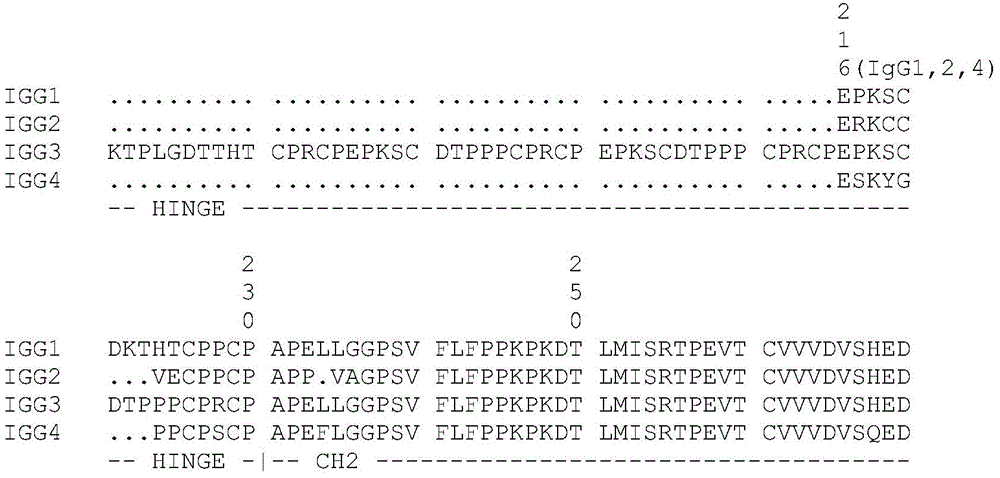
“人源化”抗体指包含来自非人类HVR的氨基酸残基和来自人FR的氨基酸残基的嵌合抗体。在某些实施方案中,人源化抗体将包含至少1个、并且一般2个可变结构域的基本上全部,其中全部或基本上全部的HVR(例如,CDR)与非人抗体的那些HVR对应并且全部或基本上全部的FR区与人抗体的那些FR对应。人源化抗体任选地可以包含从人抗体衍生的抗体恒定区的至少一部分。抗体例如非人抗体的“人源化形式”指已经历过人源化的抗体。A "humanized" antibody refers to a chimeric antibody comprising amino acid residues from a non-human HVR and amino acid residues from a human FR. In certain embodiments, a humanized antibody will comprise substantially all of at least 1, and generally 2, variable domains, wherein all or substantially all of the HVRs (eg, CDRs) are the same as those of the non-human antibody Corresponding and all or substantially all of the FR regions correspond to those of a human antibody. A humanized antibody may optionally comprise at least a portion of an antibody constant region derived from a human antibody. A "humanized form" of an antibody, eg, a non-human antibody, refers to an antibody that has undergone humanization.
如本文所用,术语“高变区”或“HVR”指抗体可变结域的下述每个区域,所述区域在序列上高变(“互补决定区”或“CDR”)并且形成结构上确定的环(“高变环”),和/或含有抗原接触残基(“抗原触点”)。通常,抗体包含六个HVR;VH中三个(H1、H2、H3)和VL中三个(L1、L2、L3)。如本文中提到的HVR包括As used herein, the term "hypervariable region" or "HVR" refers to each region of the variable knot domain of an antibody that is hypervariable in sequence ("complementarity determining regions" or "CDRs") and forms a structural Defined loops ("hypervariable loops"), and/or contain antigen-contacting residues ("antigen contacts"). Typically, an antibody contains six HVRs; three in VH (H1, H2, H3) and three in VL (L1, L2, L3). HVRs as referred to herein include
(a)出现在第26-32(L1)、50-52(L2)、91-96(L3)、26-32(H1)、53-55(H2)和96-101(H3)氨基酸残基处的高变环(Chothia,C.和Lesk,A.M.,J.Mol.Biol.196(1987)901-917);(a) Occurs at amino acid residues 26-32(L1), 50-52(L2), 91-96(L3), 26-32(H1), 53-55(H2) and 96-101(H3) A hypervariable loop at (Chothia, C. and Lesk, A.M., J. Mol. Biol. 196 (1987) 901-917);
(b)出现在第24-34(L1)、50-56(L2)、89-97(L3)、31-35b(H1)、50-65(H2)和95-102(H3)氨基酸残基处的CDR(Kabat,E.A.等人,Sequences of Proteins of ImmunologicalInterest,第5版,Public Health Service,National Institutes of Health,Bethesda,MD(1991),NIH Publication 91-3242);(b) Occurs at amino acid residues 24-34(L1), 50-56(L2), 89-97(L3), 31-35b(H1), 50-65(H2) and 95-102(H3) CDRs at (Kabat, E.A. et al., Sequences of Proteins of Immunological Interest, 5th Edition, Public Health Service, National Institutes of Health, Bethesda, MD (1991), NIH Publication 91-3242);
(c)出现在第27c-36(L1)、46-55(L2)、89-96(L3)、30-35b(H1)、47-58(H2)和93-101(H3)氨基酸残基处的抗原触点(MacCallum等人,J.Mol.Biol.262:732-745(1996));和(c) Occurs at amino acid residues 27c-36(L1), 46-55(L2), 89-96(L3), 30-35b(H1), 47-58(H2) and 93-101(H3) antigenic contacts at (MacCallum et al., J. Mol. Biol. 262:732-745 (1996)); and
(d)(a)、(b)和/或(c)的组合,包括HVR氨基酸残基46-56(L2)、47-56(L2)、48-56(L2)、49-56(L2)、26-35(H1)、26-35b(H1)、49-65(H2)、93-102(H3)和94-102(H3)。(d) a combination of (a), (b) and/or (c) including HVR amino acid residues 46-56(L2), 47-56(L2), 48-56(L2), 49-56(L2) ), 26-35(H1), 26-35b(H1), 49-65(H2), 93-102(H3) and 94-102(H3).
除非另外说明,否则HVR残基和可变结构域中的其他残基(例如,FR残基)在本文中根据Kabat EU索引编号体系(Kabat等人,上文)编号。Unless otherwise specified, HVR residues and other residues in the variable domains (eg, FR residues) are numbered herein according to the Kabat EU index numbering system (Kabat et al., supra).
如本文所用,术语“IGF-1R”指来自任何脊椎动物来源的任何天然IGF-1R,其中除非另外说明,否则所述脊椎动物来源包括哺乳动物如灵长类(例如,人类)和啮齿类(例如,小鼠和大鼠)。术语涵盖“全长”、未加工的IGF-1R以及因细胞中加工而产生的任何形式的IGF-1R。本术语还涵盖天然存在的IGF-1R变体,例如,剪接变体或等位变体。人IGF-1R的氨基酸序列在SEQ ID NO:11显示。As used herein, the term "IGF-1R" refers to any native IGF-1R from any vertebrate source, including mammals such as primates (eg, humans) and rodents ( For example, mice and rats). The term encompasses "full-length", unprocessed IGF-1R as well as any form of IGF-1R that results from processing in a cell. The term also encompasses naturally occurring variants of IGF-1R, eg, splice variants or allelic variants. The amino acid sequence of human IGF-1R is shown in SEQ ID NO:11.
“个体”或“受试者”是哺乳动物。哺乳动物包括但不限于驯化动物(例如,奶牛、绵羊、猫、犬和马)、灵长类(例如,人和非人灵长类如猴)、兔和啮齿类(例如,小鼠和大鼠)。在某些实施方案中,个体或受试者是人。An "individual" or "subject" is a mammal. Mammals include, but are not limited to, domesticated animals (eg, cows, sheep, cats, dogs, and horses), primates (eg, humans and non-human primates such as monkeys), rabbits, and rodents (eg, mice and large mouse). In certain embodiments, the individual or subject is a human.
“分离的”抗体是已经与其自然环境的组分分离的一种抗体。在一些实施方案中,将抗体纯化至大于95%或99%纯度,如通过例如电泳(例如,SDS-PAGE、等电聚焦(IEF)、毛细管电泳法)或色谱(例如,大小排阻层析、离子交换或反相HPLC)所确定。关于评估抗体纯度的方法的综述,参见,例如,Flatman,S.等人,J.Chrom.B 848(2007)79-87。An "isolated" antibody is one that has been separated from components of its natural environment. In some embodiments, the antibody is purified to greater than 95% or 99% purity, such as by, eg, electrophoresis (eg, SDS-PAGE, isoelectric focusing (IEF), capillary electrophoresis) or chromatography (eg, size exclusion chromatography) , ion exchange or reversed-phase HPLC). For a review of methods for assessing antibody purity, see, eg, Flatman, S. et al., J. Chrom. B 848 (2007) 79-87.
“分离的”核酸指已经与其自然环境的组分分离的核酸分子。分离的核酸包括含于细胞内的核酸分子,所述细胞通常含有该核酸分子,但是该核酸分子存在于染色体外或与其天然染色体位置不同的染色体位置处。An "isolated" nucleic acid refers to a nucleic acid molecule that has been separated from components of its natural environment. An isolated nucleic acid includes a nucleic acid molecule contained within a cell that normally contains the nucleic acid molecule, but which is present extrachromosomally or at a chromosomal location different from its natural chromosomal location.
“编码抗IGF-1R抗体的分离核酸”指编码抗体重链和轻链(或其片段)的一个或多个核酸分子,包括在单一载体或分别的载体中的这类核酸分子和在宿主细胞中一个或多个位置处存在的这类核酸分子。"Isolated nucleic acid encoding an anti-IGF-1R antibody" refers to one or more nucleic acid molecules encoding antibody heavy and light chains (or fragments thereof), including such nucleic acid molecules in a single vector or separate vectors and in a host cell Such nucleic acid molecules are present at one or more positions in the .
如本文中所用的术语“单克隆抗体”指从基本上均一的抗体群体获得的抗体,即,构成该群体的各个抗体是相同的和/或结合相同的表位,除了可能的变体抗体之外(例如,含有天然存在突变或在产生单克隆抗体制备物期间出现),这类变体通常以微小的量存在。与一般包括针对不同决定簇(表位)的不同抗体的多克隆抗体制备物相反,单克隆抗体制备物的每种单克隆抗体针对抗原上的单一决定簇。因此,修饰语“单克隆的”指示该抗体的特征为从基本上均一的抗体群体获得,并且不得解释为要求通过任何特定方法产生该抗体。例如,可以通过多种技术产生待根据本发明使用的单克隆抗体,所述技术包括但不限于杂交瘤方法、重组DNA方法、噬菌体展示方法和利用含有全部或部分的人免疫球蛋白基因座的转基因动物的方法,本文中描述了用于产生单克隆抗体的这类方法和其他示例性方法。The term "monoclonal antibody" as used herein refers to an antibody obtained from a substantially homogeneous population of antibodies, ie, the individual antibodies comprising the population are identical and/or bind the same epitope, except for possible variant antibodies In addition (eg, containing naturally occurring mutations or occurring during the production of monoclonal antibody preparations), such variants are usually present in minor amounts. In contrast to polyclonal antibody preparations, which typically include different antibodies directed against different determinants (epitopes), each monoclonal antibody of a monoclonal antibody preparation is directed against a single determinant on the antigen. Thus, the modifier "monoclonal" indicates that the antibody is characterized as being obtained from a substantially homogeneous population of antibodies, and should not be construed as requiring that the antibody be produced by any particular method. For example, monoclonal antibodies to be used in accordance with the present invention can be produced by a variety of techniques including, but not limited to, hybridoma methods, recombinant DNA methods, phage display methods, and the use of immunoglobulin loci containing all or part of a human immunoglobulin locus. Methods of Transgenic Animals, such and other exemplary methods for producing monoclonal antibodies are described herein.
“天然抗体”指具有不定结构的天然存在的免疫球蛋白分子。例如,天然IgG抗体是由二硫键结合的两条相同轻链和两条相同重链组成的约150,000道尔顿的异四聚体糖蛋白。从N端至C端,每条重链具有一个可变区(VH),也称作可变重结构域或重链可变结构域,随后是三个恒定结构域(CH1,CH2和CH3)。类似地,从N端至C端,每条轻链具有一个可变区(VL),也称作可变轻链域或轻链可变结构域,随后一个恒定轻链(CL)结构域。抗体的轻链可以基于其恒定域的氨基酸序列而划分成两种类型之一,称作κ(κ)和λ(λ)。"Native antibody" refers to a naturally occurring immunoglobulin molecule of indeterminate structure. For example, native IgG antibodies are heterotetrameric glycoproteins of approximately 150,000 Daltons consisting of two identical light chains and two identical heavy chains joined by disulfide bonds. From the N-terminus to the C-terminus, each heavy chain has a variable domain (VH), also known as a variable heavy domain or heavy chain variable domain, followed by three constant domains (CH1, CH2 and CH3) . Similarly, from the N-terminus to the C-terminus, each light chain has a variable region (VL), also referred to as a variable light chain domain or light chain variable domain, followed by a constant light chain (CL) domain. The light chains of antibodies can be divided into one of two types, called kappa (κ) and λ (λ), based on the amino acid sequence of their constant domains.
术语“包装插页”用来指治疗产品的商业包装中习惯性包括的说明书,所述说明书含有关于适应症、用法、剂量、施用、联合疗法、禁忌症和/或涉及此类治疗产品用途之警告的信息。The term "package insert" is used to refer to instructions customarily included in commercial packaging of therapeutic products, said instructions containing warnings regarding indications, usage, dosage, administration, combination therapy, contraindications and/or concerning the use of such therapeutic products Information.
相对于参考多肽序列,将“氨基酸序列同一性百分数(%)”定义为比对序列并根据需要引入空位以实现最大序列同源性百分数并且不考虑任何保守性置换作为序列同一性的部分之后,候选序列中与参考多肽序列中的氨基酸残基相同的氨基酸残基的百分数。为了确定氨基酸序列同一性百分数的比对可以按本领域能力范围内的多种方式实现,例如,使用可公开获得的计算机软件如BLAST、BLAST-2、ALIGN或Megalign(DNASTAR)软件。本领域技术人员可以确定用于比对序列的适宜参数,包括为实现正在比较的全长序列范围内最大比对所需要的任何算法。然而,出于本文目的,使用序列比较计算机程序ALIGN-2产生氨基酸序列同一性%值。ALIGN-2序列比较计算机程序由Genentech,Inc.授权,并且源代码已经随用户文档提交至华盛顿特区20559的美国版权局,在那里它以美国版权登记号TXU510087登记。ALIGN-2程序从Genentech,Inc.,South San Francisco,加利福尼亚州可公开获得或可以从源代码汇编。应当将ALIGN-2程序汇编在UNIX操作系统(包括数字式UNIX V4.0D)上使用。全部序列比较参数由ALIGN-2程序设定并且不变动。Relative to a reference polypeptide sequence, "percent (%) amino acid sequence identity" is defined as after aligning the sequences and introducing gaps as necessary to achieve maximum percent sequence homology and disregarding any conservative substitutions as part of sequence identity, The percentage of amino acid residues in a candidate sequence that are identical to amino acid residues in a reference polypeptide sequence. Alignment to determine percent amino acid sequence identity can be accomplished in a variety of ways that are within the capabilities of the art, eg, using publicly available computer software such as BLAST, BLAST-2, ALIGN or Megalign (DNASTAR) software. Those skilled in the art can determine appropriate parameters for aligning sequences, including any algorithms needed to achieve maximal alignment over the full-length sequences being compared. However, for purposes herein, % amino acid sequence identity values were generated using the sequence comparison computer program ALIGN-2. The ALIGN-2 sequence comparison computer program is licensed from Genentech, Inc. and the source code has been filed with the user documentation in the US Copyright Office, Washington, DC 20559, where it is registered under US Copyright Registration No. TXU510087. The ALIGN-2 program is publicly available from Genentech, Inc., South San Francisco, CA or can be compiled from source code. ALIGN-2 programs should be compiled for use on UNIX operating systems (including digital UNIX V4.0D). All sequence comparison parameters are set by the ALIGN-2 program and do not vary.
在使用ALIGN-2比较氨基酸序列的情况下,如下计算给定氨基酸序列A与给定氨基酸序列B、同给定氨基酸序列B或针对给定氨基酸序列B(这可以备选地描述为与给定氨基酸序列B、同给定氨基酸序列B或针对给定氨基酸序列B具有或包含某个氨基酸序列同一性%的给定氨基酸序列A)的氨基酸序列同一性%:In the case of comparing amino acid sequences using ALIGN-2, a given amino acid sequence A is calculated with a given amino acid sequence B, with a given amino acid sequence B, or against a given amino acid sequence B (this can alternatively be described as Amino acid sequence B, the % amino acid sequence identity of a given amino acid sequence A) with or with a given amino acid sequence B having or comprising a certain % amino acid sequence identity:
100乘以分数X/Y100 times the fraction X/Y
其中X是由序列比对程序ALIGN-2在该程序的A和B比对结果中评定为相同匹配的氨基酸残基的数目,并且其中Y是B中氨基酸残基的总数。将可以理解在氨基酸序列A的长度不等于氨基酸序列B的长度时,A相对于B的氨基酸序列同一性%将不等于B相对于A的氨基酸序列同一性%。除非另外特别声明,否则本文所用的全部氨基酸序列同一性值%如紧接前段中所述那样使用ALIGN-2计算机程序获得。where X is the number of amino acid residues rated as identical matches by the sequence alignment program ALIGN-2 in the program's A and B alignments, and where Y is the total number of amino acid residues in B. It will be appreciated that where the length of amino acid sequence A is not equal to the length of amino acid sequence B, the % amino acid sequence identity of A with respect to B will not equal the % amino acid sequence identity of B with respect to A. Unless specifically stated otherwise, all % amino acid sequence identity values used herein were obtained using the ALIGN-2 computer program as described in the immediately preceding paragraph.
术语“药物制剂”指一种制备物,所述制备物处于这类形式从而允许其中所含的有效成分的生物活性有效,并且不含有对于将会施用该制剂的受试者不可接受地有毒的额外组分。The term "pharmaceutical formulation" refers to a preparation in such a form as to allow the biological activity of the active ingredient contained therein to be effective and free from unacceptably toxic to the subject to whom the preparation will be administered extra components.
“可药用载体”指药物制剂中除有效成分之外的对受试者无毒的成分。可药用载体包括但不限于缓冲剂、赋形剂、稳定剂或防腐剂。"Pharmaceutically acceptable carrier" refers to an ingredient other than the active ingredient in a pharmaceutical formulation that is not toxic to a subject. Pharmaceutically acceptable carriers include, but are not limited to, buffers, excipients, stabilizers or preservatives.
如本文所用的术语“肽接头”指具有氨基酸序列的肽,所述肽在一个实施方案中是合成来源的。肽接头在一个实施方案中是具有至少30个氨基酸长度的氨基酸序列的肽,在一个实施方案中是具有32至50个氨基酸长度的氨基酸序列的肽。在一个实施方案中,肽接头是具有32至40个氨基酸长度的氨基酸序列的肽。在一个实施方案中,肽接头是(GxS)n,其中G=甘氨酸,S=丝氨酸,(x=3,n=8、9或10)或(x=4并且n=6、7或8),在一个实施方案中,其中x=4,n=6或7,在一个实施方案中,x=4,n=7。在一个实施方案中,肽接头是(G4S)6G2。The term "peptide linker" as used herein refers to a peptide having an amino acid sequence, which in one embodiment is of synthetic origin. The peptide linker is in one embodiment a peptide having an amino acid sequence of at least 30 amino acids in length, and in one embodiment is a peptide having an amino acid sequence of 32 to 50 amino acids in length. In one embodiment, the peptide linker is a peptide having an amino acid sequence of 32 to 40 amino acids in length. In one embodiment, the peptide linker is (GxS)n, where G=glycine, S=serine, (x=3, n=8, 9 or 10) or (x=4 and n=6, 7 or 8) , in one embodiment, where x=4, n=6 or 7, and in one embodiment, x=4, n=7. In one embodiment, the peptide linker is ( G4S ) 6G2 .
如本文所用,术语“重组抗体”指通过重组手段制备、表达、产生或分离的全部抗体(嵌合、人源化和人抗体)。这包括从宿主细胞如NS0或CHO细胞或从相对于人免疫球蛋白基因为转基因的动物(例如小鼠)中分离的抗体或使用转染至宿主细胞中的重组表达载体所表达的抗体。此类重组抗体具有重排形式的可变区和恒定区。重组抗体可以经历体内体细胞超变。因此,重组抗体的VH和VL区的氨基酸序列是尽管源自人种系VH和VL序列并且与之相关,但可以是不天然存在于体内人抗体种系库内部的序列。As used herein, the term "recombinant antibody" refers to all antibodies (chimeric, humanized and human) prepared, expressed, produced or isolated by recombinant means. This includes antibodies isolated from host cells such as NSO or CHO cells or from animals (eg, mice) transgenic for human immunoglobulin genes or expressed using recombinant expression vectors transfected into host cells. Such recombinant antibodies have variable and constant regions in rearranged forms. Recombinant antibodies can undergo somatic hypermutation in vivo. Thus, the amino acid sequences of the VH and VL regions of recombinant antibodies, although derived from and related to human germline VH and VL sequences, may be sequences that do not naturally occur within the human antibody germline repertoire in vivo.
如本文所用,名词“治疗”(和其语法变型如动词“治疗”或分词“治疗”)指意欲改变正在接受治疗的个体的天然过程的临床介入,并且可以旨在预防或在临床病理学过程期间实施。想要的治疗效果包括,但不限于防止疾病出现或复发、减轻症状、减小疾病的任何直接或间接病理学后果、防止转移、降低病情进展速率、改善或缓和疾病状态,以及缓解或预后改善。在一些实施方案中,如本文中报道的抗体或Fc区融合多肽用来延缓疾病的形成或用来减慢疾病的进展。As used herein, the noun "treat" (and its grammatical conjugations such as the verb "treat" or the participle "treat") refers to a clinical intervention intended to alter the natural course of an individual being treated, and may be aimed at prevention or in the course of clinical pathology implemented during the period. Desired therapeutic effects include, but are not limited to, preventing the appearance or recurrence of the disease, reducing symptoms, reducing any direct or indirect pathological consequences of the disease, preventing metastasis, reducing the rate of disease progression, ameliorating or alleviating the disease state, and remission or improved prognosis . In some embodiments, an antibody or Fc region fusion polypeptide as reported herein is used to delay the development of a disease or to slow the progression of a disease.
如本申请中所用,术语“价态”指(抗体)分子中存在指定数目的结合位点。就这一点而论,术语“双价”、“四价”和“六价”指(抗体)分子中分别存在2个结合位点、4个结合位点和6个结合位点。在一个优选的实施方案中,如本文中报道的双特异性抗体是“双价的”。As used in this application, the term "valency" refers to the presence of a specified number of binding sites in an (antibody) molecule. In this regard, the terms "bivalent", "tetravalent" and "hexavalent" refer to the presence of 2, 4 and 6 binding sites, respectively, in the (antibody) molecule. In a preferred embodiment, the bispecific antibody as reported herein is "bivalent".
术语“可变区”或“可变结构域”指抗体重链或轻链的参与使抗体结合其抗原的结构域。抗体重链和轻链的可变结构域(分别是VH和VL)通常具有相似的结构,每种结构域包含四个构架区(FR)和三个高变区(HVR)(参见,例如Kindt,T.J.等人,Kuby Immunology,第6版,W.H.Freeman and Co.,N.Y.(2007),第91页)。单个VH结构域或VL结构域可能足以赋予抗原结合特异性。另外,结合特定抗原的抗体可以利用来自结合该抗原的抗体的VH或VL结构域进行分离以分别筛选互补性VL结构域或VH结构域的文库(参见,例如,Portolano,S.等人,J.Immunol.150(1993)880-887;Clackson,T.等人,Nature 352(1991)624-628)。The term "variable region" or "variable domain" refers to the domain of an antibody's heavy or light chain that engages the antibody to bind its antigen. The variable domains of antibody heavy and light chains (VH and VL, respectively) generally have similar structures, with each domain comprising four framework regions (FRs) and three hypervariable regions (HVRs) (see, e.g., Kindt , T.J. et al., Kuby Immunology, 6th ed., W.H. Freeman and Co., N.Y. (2007), p. 91). A single VH or VL domain may be sufficient to confer antigen-binding specificity. Additionally, antibodies that bind a particular antigen can be isolated using VH or VL domains from antibodies that bind that antigen to screen libraries of complementary VL or VH domains, respectively (see, e.g., Portolano, S. et al., J. . Immunol. 150 (1993) 880-887; Clackson, T. et al., Nature 352 (1991) 624-628).
术语“眼血管疾病”包括但不限于眼内新生血管综合征如糖尿病性视网膜病变、糖尿病性黄斑水肿、早产儿视网膜病变、新生血管性青光眼、视网膜静脉闭塞、视网膜中央静脉闭塞、黄斑变性、年龄相关性黄斑变性、视网膜色素变性、视网膜血管瘤样增生、黄斑毛细血管扩张症、缺血性视网膜病变、虹膜新血管化、眼内新血管化、角膜血管新生、视网膜血管新生、脉络膜血管新生和视网膜变性(参见例如Garner,A.,Vascular diseases,引自:Pathobiology of ocular disease,A dynamic approach,Garner,A.和Klintworth,G.K.,(编著),第2版,Marcel Dekker,New York(1994),第1625-1710页)。The term "ocular vascular disease" includes, but is not limited to, intraocular neovascular syndromes such as diabetic retinopathy, diabetic macular edema, retinopathy of prematurity, neovascular glaucoma, retinal vein occlusion, central retinal vein occlusion, macular degeneration, age associated macular degeneration, retinitis pigmentosa, retinal hemangiomatosis, macular telangiectasia, ischemic retinopathy, iris neovascularization, intraocular neovascularization, corneal angiogenesis, retinal angiogenesis, choroidal angiogenesis and Retinal degeneration (see eg Garner, A., Vascular diseases, cited in: Pathobiology of ocular disease, A dynamic approach, Garner, A. and Klintworth, G.K., (eds.), 2nd ed., Marcel Dekker, New York (1994) , pp. 1625-1710).
如本文所用,术语“载体”指能够增殖与其连接的另一种核酸的核酸分子。该术语包括作为自我复制型核酸结构的载体以及并入已经将该载体引入其中的宿主细胞的基因组内的载体。某些载体能够指导与它们有效连接的核酸表达。此类载体在本文中称作“表达载体”。As used herein, the term "vector" refers to a nucleic acid molecule capable of propagating another nucleic acid to which it is linked. The term includes vectors that are self-replicating nucleic acid structures as well as vectors that are incorporated into the genome of the host cell into which the vector has been introduced. Certain vectors are capable of directing the expression of nucleic acids to which they are operably linked. Such vectors are referred to herein as "expression vectors".
如本文所用的术语“VEGF”指人血管内皮生长因子(VEGF/VEGF-A),165氨基酸人血管内皮细胞生长因子(人VEGF165的前体序列的氨基酸27-191:SEQ ID NO:30;氨基酸1-26代表信号肽),和相关121、189和206血管内皮细胞生长因子同工型,如Leung,D.W.等人,Science 246(1989)1306-1309;Houck等人,Mol.Endocrin.5(1991)1806-1814;Keck,P.J.等人,Science 246(1989)1309-1312和Connolly,D.T.等人,J.Biol.Chem.264(1989)20017-20024所描述;连同这些生长因子的天然存在的等位和加工形式。VEGF参与调节与肿瘤和眼内病症相关的正常和异常血管生成及新血管化(Ferrara,N.等人,Endocrin.Rev.18(1997)4-25;Berkman,R.A.等人,J.Clin.Invest.91(1993)153-159;Brown,L.F.等人,Human Pathol.26(1995)86-91;Brown,L.F.等人,Cancer Res.53(1993)4727-4735;Mattern,J.等人,Brit.J.Cancer.73(1996)931-934;和Dvorak,H.F.等人,Am.J.Pathol.146(1995)1029-1039)。VEGF是已经从几种来源分离并且包括几种同工型的同型二聚的糖蛋白。VEGF对内皮细胞显示高度特异的促有丝分裂活性。The term "VEGF" as used herein refers to human vascular endothelial growth factor (VEGF/VEGF-A), amino acids 27-191 of the precursor sequence of 165 amino acid human vascular endothelial growth factor (human VEGF165: SEQ ID NO: 30; amino acids 27-191 ) 1-26 represent signal peptides), and related 121, 189, and 206 vascular endothelial cell growth factor isoforms, as in Leung, D.W. et al., Science 246 (1989) 1306-1309; Houck et al., Mol. Endocrin.5 ( 1991) 1806-1814; Keck, P.J. et al., Science 246 (1989) 1309-1312 and Connolly, D.T. et al., J. Biol. Chem. 264 (1989) 20017-20024; together with the natural occurrence of these growth factors Allelic and processed forms. VEGF is involved in the regulation of normal and abnormal angiogenesis and neovascularization associated with tumors and intraocular disorders (Ferrara, N. et al., Endocrin. Rev. 18 (1997) 4-25; Berkman, R.A. et al., J. Clin. Invest. 91 (1993) 153-159; Brown, L.F. et al., Human Pathol. 26 (1995) 86-91; Brown, L.F. et al., Cancer Res. 53 (1993) 4727-4735; Matter, J. et al. , Brit. J. Cancer. 73 (1996) 931-934; and Dvorak, H. F. et al., Am. J. Pathol. 146 (1995) 1029-1039). VEGF is a homodimeric glycoprotein that has been isolated from several sources and includes several isoforms. VEGF shows highly specific mitogenic activity on endothelial cells.
如本文所用的术语“具有突变IHH-AAA”指IgG1或IgG4亚类的恒定重链区中突变I253A(Ile253Ala)、H310A(His310Ala)和H435A(His435Ala)的组合,并且如本文所用的术语“具有突变HHY-AAA”指IgG1或IgG4亚类的恒定重链区中突变H310A(His310Ala)、H433A(His433Ala)和Y436A(Tyr436Ala)的组合,并且如本文所用的术语“具有突变YTE”指IgG1或IgG4亚类的恒定重链区中突变M252Y(Met252Tyr)、S254T(Ser254Thr)和T256E(Thr256Glu)的组合,其中根据Kabat EU索引编号体系编号。The term "having the mutation IHH-AAA" as used herein refers to the combination of the mutations I253A (Ile253Ala), H310A (His310Ala) and H435A (His435Ala) in the constant heavy chain region of the IgG1 or IgG4 subclass, and the term "having the mutation" as used herein Mutation HHY-AAA" refers to the combination of mutations H310A (His310Ala), H433A (His433Ala) and Y436A (Tyr436Ala) in the constant heavy chain region of IgGl or IgG4 subclass, and the term "with mutation YTE" as used herein refers to IgGl or IgG4 A combination of mutations M252Y (Met252Tyr), S254T (Ser254Thr) and T256E (Thr256Glu) in the constant heavy chain region of the subclass, numbered according to the Kabat EU index numbering system.
如本文所用的术语“具有突变P329G LALA”指IgG1亚类的恒定重链区中突变L234A(Leu235Ala)、L235A(Leu234Ala)和P329G(Pro329Gly)的组合,其中根据Kabat EU索引编号体系编号。如本文所用的术语“具有突变SPLE”指IgG4亚类的恒定重链区中突变S228P(Ser228Pro)和L235E(Leu235Glu)的组合,其中根据Kabat EU索引编号体系编号。如本文所用的术语“具有突变SPLE和P329G”指IgG4亚类的恒定重链区中突变S228P(Ser228Pro)、L235E(Leu235Glu)和P329G(Pro329Gly)的组合,其中根据Kabat EU索引编号体系编号。The term "with mutation P329G LALA" as used herein refers to the combination of mutations L234A (Leu235Ala), L235A (Leu234Ala) and P329G (Pro329Gly) in the constant heavy chain region of the IgG1 subclass, numbered according to the Kabat EU index numbering system. The term "having a mutant SPLE" as used herein refers to the combination of mutations S228P (Ser228Pro) and L235E (Leu235Glu) in the constant heavy chain region of the IgG4 subclass, numbered according to the Kabat EU index numbering system. The term "with mutations SPLE and P329G" as used herein refers to the combination of mutations S228P (Ser228Pro), L235E (Leu235Glu) and P329G (Pro329Gly) in the constant heavy chain region of the IgG4 subclass, numbered according to the Kabat EU index numbering system.
II.组合物和方法II. Compositions and Methods
在一个方面,本发明部分地基于以下发现:在Fc区的一条或二条Fc区多肽中引入突变Y436A可以增加Fc区与葡萄球菌蛋白A的结合。In one aspect, the invention is based in part on the discovery that introduction of the mutation Y436A in one or both of the Fc region polypeptides in the Fc region increases binding of the Fc region to Staphylococcus protein A.
在一个方面,本发明部分地基于以下发现:影响免疫球蛋白Fc区与新生儿Fc-受体(FcRn)结合(即减少或甚至消除Fc区与FcRn结合)的特定突变或突变组合并未同时消除Fc区与葡萄球菌蛋白A的结合。这对可以使用的纯化过程产生深远影响,因为例如要求非特异性和种类限制性亲和色谱材料,例如,仅与包含κ轻链的抗体结合的KappaSelect。因此,采用如本文中报道的突变组合,可能同时减少或甚至消除与FcRn结合,同时维持与葡萄球菌蛋白A的结合。In one aspect, the invention is based in part on the discovery that specific mutations or combinations of mutations affecting binding of the immunoglobulin Fc region to the neonatal Fc-receptor (FcRn) (ie reducing or even eliminating Fc region binding to FcRn) are not concomitant Eliminates Fc region binding to staphylococcal protein A. This has a profound impact on the purification process that can be used, since, for example, non-specific and species-restricted affinity chromatography materials are required, eg, KappaSelect, which only binds to antibodies containing kappa light chains. Thus, with a combination of mutations as reported herein, it is possible to simultaneously reduce or even eliminate binding to FcRn, while maintaining binding to Staphylococcus protein A.
在一个方面,本发明部分地基于以下发现:通过在异二聚体分子(例如双特异性抗体)的每条重链的Fc区中使用不同突变,可以在一方面提供减少或甚至消除与FcRn的结合,但是在另一方面维持与葡萄球菌蛋白A结合的能力。与葡萄球菌蛋白A的这种结合作用可以用来分离异二聚体分子与同型二聚体副产物。例如通过使用结入扣法,将一个重链Fc区中的突变I253A、H310A和H435A与另一个重链Fc区中的突变H310A、H433A和Y436A组合,可以获得异二聚Fc区,所述异二聚Fc区在一方面不与FcRn结合(两组突变相对于人FcRn是沉默的),但是维持与葡萄球菌蛋白A的结合(具有突变I253A、H310A和H435A的重链Fc区不与FcRn结合并且不与葡萄球菌蛋白A结合,而具有突变H310A、H433A和Y436A的重链Fc区不与FcRn结合,但是仍然与葡萄球菌蛋白A结合)。因此,标准蛋白A亲和色谱可以用来除去同型二聚扣-扣副产物,因为这种副产物不再与葡萄球菌蛋白A结合。因此,通过结入扣法将扣链中的突变I253A、H310A和H435A和结链中的突变H310A、H433A和Y436A组合,可以促进异二聚结入扣产物与同型二聚扣-扣副产物的纯化/分离。In one aspect, the invention is based in part on the discovery that by using different mutations in the Fc region of each heavy chain of a heterodimeric molecule (eg, a bispecific antibody), one can provide, in one aspect, a reduction or even abrogation of interaction with FcRn binding, but on the other hand maintains the ability to bind to staphylococcal protein A. This binding to staphylococcal protein A can be used to separate heterodimeric molecules from homodimeric by-products. Heterodimeric Fc regions can be obtained, for example, by combining mutations I253A, H310A, and H435A in the Fc region of one heavy chain with mutations H310A, H433A, and Y436A in the Fc region of another heavy chain, using a junction-in-binding method. The dimeric Fc region on the one hand does not bind to FcRn (two sets of mutations are silent relative to human FcRn), but maintains binding to Staphylococcus protein A (the heavy chain Fc region with mutations I253A, H310A and H435A does not bind to FcRn and does not bind to Staphylococcus protein A, whereas the heavy chain Fc region with mutations H310A, H433A and Y436A does not bind to FcRn, but still binds Staphylococcus protein A). Therefore, standard Protein A affinity chromatography can be used to remove the homodimeric Button-Button by-product, since this by-product is no longer bound to Staphylococcal Protein A. Therefore, combining the mutations I253A, H310A and H435A in the buckle chain and the mutations H310A, H433A and Y436A in the binding chain by the binding method can promote the heterodimerization of the buckle product and the homodimeric buckle-buckle by-product. Purification/Isolation.
在一个方面,本发明部分地基于以下发现:无FcRn结合作用的玻璃体内施加用抗体是有益的,因为这些抗体可以跨过血-视网膜屏障,在眼中没有大幅度延长或缩短的半寿期并且从血液循环快速清除,导致在眼以外无全身性副作用或全身性副作用非常有限。本发明的抗体例如可用于诊断或治疗眼血管疾病。In one aspect, the invention is based in part on the discovery that intravitreal administration of antibodies without FcRn binding is beneficial because these antibodies can cross the blood-retinal barrier, do not have a substantially prolonged or shortened half-life in the eye and Rapid clearance from circulation results in no or very limited systemic side effects outside the eye. The antibodies of the present invention can be used, for example, to diagnose or treat ocular vascular diseases.
本发明至少部分地基于以下发现:通过在异二聚体分子(例如双特异性抗体)的Fc区的每条Fc区多肽中使用不同突变,可以提供具有定制的FcRn结合作用并且因而可以提供具有定制全身性半寿期的抗体。The present invention is based, at least in part, on the discovery that by using different mutations in each Fc region polypeptide of the Fc region of a heterodimeric molecule (eg, a bispecific antibody), it is possible to provide tailor-made FcRn binding and thus Antibodies with custom systemic half-life.
突变I253A、H310A、H435A、或L251D、L314D、L432D、或L251S、L314S、L432S的组合导致蛋白A结合作用丧失,而突变I253A、H310A、H435A、或H310A、H433A、Y436A、或L251D、L314D、L432D的组合导致人新生儿Fc受体的结合作用丧失。A combination of mutations I253A, H310A, H435A, or L251D, L314D, L432D, or L251S, L314S, L432S resulted in loss of protein A binding, while mutations I253A, H310A, H435A, or H310A, H433A, Y436A, or L251D, L314D, L432D The combination resulted in loss of binding to the human neonatal Fc receptor.
以下表展示存在Fc区中参与相互作用或已经被改变以调节相互作用的氨基酸残基的示例性概览。The following table presents an exemplary overview of the amino acid residues present in the Fc region that are involved in the interaction or have been altered to modulate the interaction.
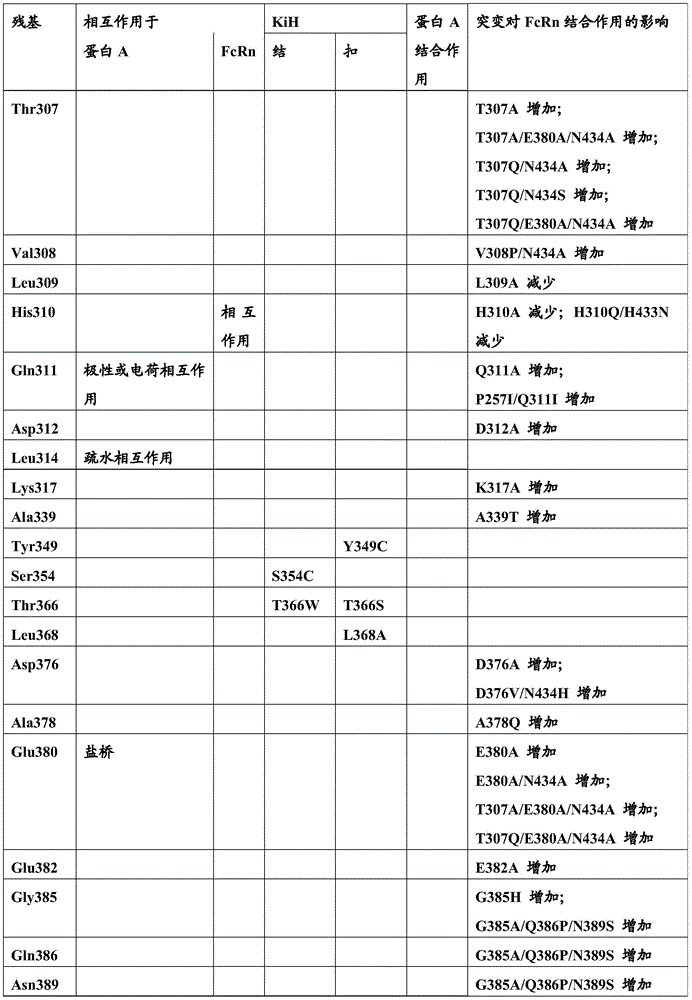
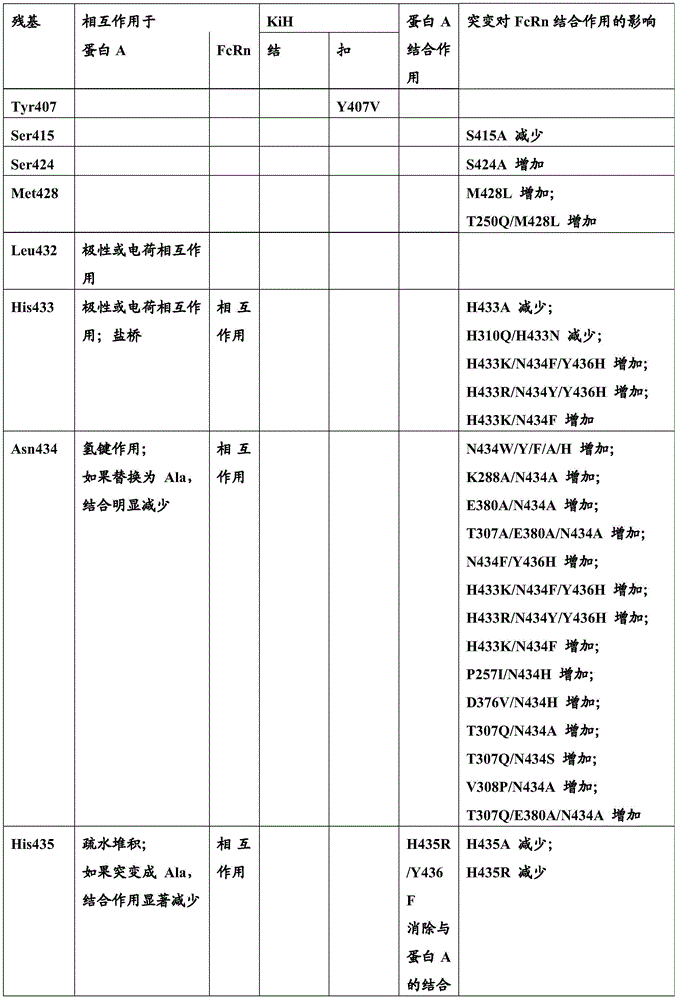

可以与突变Y436A组合使用的如本文中报道的修饰改变对一种或多种Fc受体如人FcRn的结合特异性。同时,改变与人FcRn结合的一些突变还改变与葡萄球菌蛋白A的结合。可以通过使用额外的突变Y436A,减弱或甚至克服与葡萄球菌蛋白A结合作用的这种减少。Modifications as reported herein that can be used in combination with mutation Y436A alter the binding specificity for one or more Fc receptors such as human FcRn. At the same time, some mutations that altered binding to human FcRn also altered binding to Staphylococcus protein A. This reduction in binding to staphylococcal protein A can be attenuated or even overcome by the use of an additional mutation, Y436A.
在一个实施方案中,与缺少这种突变组合的相应二聚体多肽相比,如本文中报道的突变组合改变或基本上改变二聚体多肽的血清半寿期。在一个实施方案中,与缺少这种突变组合的相应二聚体多肽相比,这突变组合还未改变或基本上未改变二聚体多肽与葡萄球菌蛋白A的结合作用。In one embodiment, a combination of mutations as reported herein alters or substantially alters the serum half-life of the dimeric polypeptide compared to the corresponding dimeric polypeptide lacking such a combination of mutations. In one embodiment, the combination of mutations does not alter or substantially does not alter the binding of the dimeric polypeptide to Staphylococcus protein A as compared to the corresponding dimeric polypeptide lacking the combination of mutations.
A.新生儿Fc-受体(FcRn)A. Neonatal Fc-receptor (FcRn)
新生儿Fc-受体(FcRn)对IgG类抗体体内的代谢命运重要。FcRn起到挽救来自溶酶体降解途径的野生型IgG的作用,导致清除率减少和半寿期增加。它是由两条多肽:50kDa主要组织相容性复合体样蛋白I类(α-FcRn)和15kDaβ2-微球蛋白(β2m)组成的异二聚体蛋白。FcRn以高亲和力与IgG类抗体的Fc区的CH2-CH3部分结合。IgG类抗体和FcRn之间的相互作用依赖pH并且以1:2化学计量发生,即一个IgG抗体分子可以通过其两条重链Fc区多肽与两个FcRn分子相互作用(参见,例如Huber,A.H.等人,J.Mol.Biol.230(1993)1077-1083)。The neonatal Fc-receptor (FcRn) is important for the metabolic fate of IgG class antibodies in vivo. FcRn functions to rescue wild-type IgG from the lysosomal degradation pathway, resulting in reduced clearance and increased half-life. It is a heterodimeric protein composed of two polypeptides: 50 kDa major histocompatibility complex-like protein class I (α-FcRn) and 15 kDa β2-microglobulin (β2m). FcRn binds with high affinity to the CH2-CH3 portion of the Fc region of IgG class antibodies. The interaction between IgG class antibodies and FcRn is pH-dependent and occurs at 1:2 stoichiometry, i.e. one IgG antibody molecule can interact with two FcRn molecules through its two heavy chain Fc region polypeptides (see, e.g., Huber, A.H. et al, J. Mol. Biol. 230 (1993) 1077-1083).
因此,IgG体外FcRn结合特性/特征指示其在血液循环中的体内药代动力学特性。Thus, the in vitro FcRn binding properties/characteristics of IgG are indicative of their in vivo pharmacokinetic properties in the blood circulation.
重链CH2结构域和CH3结构域的不同氨基酸残基参与FcRn和IgG类抗体Fc区之间的相互作用。与FcRn相互作用的氨基酸残基位于大约EU位置243和EU位置261之间、大约EU位置275和EU位置293之间、大约EU位置302和EU位置319之间、大约EU位置336和EU位置348之间、大约EU位置367和EU位置393、位于EU位置408处以及大约EU位置424和EU位置440之间。更具体地,根据Kabat EU编号的以下氨基酸残基参与Fc区和FcRn之间的相互作用:F243,P244,P245P,K246,P247,K248,D249,T250,L251,M252,I253,S254,R255,T256,P257,E258,V259,T260,C261,F275,N276,W277,Y278,V279,D280,V282,E283,V284,H285,N286,A287,K288,T289,K290,P291,R292,E293,V302,V303,S304,V305,L306,T307,V308,L309,H310,Q311,D312,W313,L314,N315,G316,K317,E318,Y319,I336,S337,K338,A339,K340,G341,Q342,P343,R344,E345,P346,Q347,V348,C367,V369,F372,Y373,P374,S375,D376,I377,A378,V379,E380,W381,E382,S383,N384,G385,Q386,P387,E388,N389,Y391,T393,S408,S424,C425,S426,V427,M428,H429,E430,A431,L432,H433,N434,H435,Y436,T437,Q438,K439和S440。Different amino acid residues of the heavy chain CH2 domain and CH3 domain are involved in the interaction between FcRn and the Fc region of IgG class antibodies. The amino acid residues that interact with FcRn are located between approximately EU position 243 and EU position 261, approximately between EU position 275 and EU position 293, approximately between EU position 302 and EU position 319, approximately EU position 336 and EU position 348 between, approximately between EU position 367 and EU position 393, at EU position 408, and approximately between EU position 424 and EU position 440. More specifically, the following amino acid residues according to Kabat EU numbering are involved in the interaction between the Fc region and FcRn: F243, P244, P245P, K246, P247, K248, D249, T250, L251, M252, I253, S254, R255, T256,P257,E258,V259,T260,C261,F275,N276,W277,Y278,V279,D280,V282,E283,V284,H285,N286,A287,K288,T289,K290,P291,R292,E293,V302, V303,S304,V305,L306,T307,V308,L309,H310,Q311,D312,W313,L314,N315,G316,K317,E318,Y319,I336,S337,K338,A339,K340,G341,Q342,P343, R344,E345,P346,Q347,V348,C367,V369,F372,Y373,P374,S375,D376,I377,A378,V379,E380,W381,E382,S383,N384,G385,Q386,P387,E388,N389, Y391, T393, S408, S424, C425, S426, V427, M428, H429, E430, A431, L432, H433, N434, H435, Y436, T437, Q438, K439 and S440.
位点定向诱变研究已经证明IgG的Fc区中FcRn的关键结合位点是组氨酸310、组氨酸435和异亮氨酸253并且程度更低地是组氨酸433和酪氨酸436(参见例如Kim,J.K.等人,Eur.J.Immunol.29(1999)2819-2825;Raghavan,M.等人,Biochem.34(1995)14649-14657;Medesan,C.等人,J.Immunol.158(1997)2211-2217)。Site-directed mutagenesis studies have demonstrated that the key binding sites for FcRn in the Fc region of IgG are histidine 310, histidine 435 and isoleucine 253 and to a lesser extent histidine 433 and tyrosine 436 ( See, eg, Kim, J.K. et al., Eur. J. Immunol. 29 (1999) 2819-2825; Raghavan, M. et al., Biochem. 34 (1995) 14649-14657; Medesan, C. et al., J. Immunol. 158 (1997) 2211-2217).
增加IgG与FcRn结合的方法已经通过在以下各种氨基酸残基处突变IgG来实施:苏氨酸250、甲硫氨酸252、丝氨酸254、苏氨酸256、苏氨酸307、谷氨酸380、甲硫氨酸428、组氨酸433和天冬酰胺434(参见Kuo,T.T.等人,J.Clin.Immunol.30(2010)777-789)。Methods of increasing IgG binding to FcRn have been carried out by mutating IgG at various amino acid residues:
在一些情况下需要在血液循环中半寿期降低的抗体。例如,玻璃体内施加的药物应当在眼部中具有长半寿期并且在患者血液循环中具有短半寿期。这类抗体还具有疾病部位如眼中暴露增加的优点。Antibodies with reduced half-life in the blood circulation are desired in some cases. For example, a drug administered intravitreally should have a long half-life in the eye and a short half-life in the patient's blood circulation. Such antibodies also have the advantage of increased exposure at disease sites such as the eye.
影响FcRn结合并且影响血液循环中半寿期的不同突变是已知的。已经通过位点定向诱变鉴定了对小鼠Fc区-小鼠FcRn相互作用至关重要的Fc区残基(参见例如Dall’Acqua,W.F.等人,J.Immunol 169(2002)5171-5180)。残基I253、H310、H433、N434和H435(根据Kabat的EU编号)参与这种相互作用(Medesan,C.等人,Eur.J.Immunol.26(1996)2533-2536;Firan,M.等人,Int.Immunol.13(2001)993-1002;Kim,J.K.等人,Eur.J.Immunol.24(1994)542-548))。发现残基I253、H310和H435对人Fc与鼠FcRn的相互作用至关重要(Kim,J.K.等人,Eur.J.Immunol.29(1999)2819-2855)。通过蛋白质-蛋白质相互作用研究,Dall’Acqua等人已经描述残基M252Y、S254T、T256E改善FcRn结合(Dall'Acqua,W.F.等人,J.Biol.Chem.281(2006)23514-23524)。人Fc-人FcRn复合物的研究已经显示残基I253、S254、H435和Y436对这种相互作用至关重要(Firan,M.等人,Int.Immunol.13(2001)993-1002;Shields,R.L.等人,J.Biol.Chem.276(2001)6591-6604)。在Yeung,Y.A.等人(J.Immunol.182(2009)7667-7671)中,已经报道并研究了残基248至259和301至317和376至382和424至437的各种突变体。下表中列出示例性突变和它们对FcRn结合作用的影响。Different mutations affecting FcRn binding and affecting half-life in the blood circulation are known. Fc region residues critical for mouse Fc region-mouse FcRn interaction have been identified by site-directed mutagenesis (see eg Dall'Acqua, W.F. et al., J. Immunol 169 (2002) 5171-5180) . Residues I253, H310, H433, N434 and H435 (EU numbering according to Kabat) are involved in this interaction (Medesan, C. et al., Eur. J. Immunol. 26 (1996) 2533-2536; Firan, M. et al. Human, Int. Immunol. 13 (2001) 993-1002; Kim, J. K. et al., Eur. J. Immunol. 24 (1994) 542-548)). Residues 1253, H310 and H435 were found to be critical for the interaction of human Fc with murine FcRn (Kim, J.K. et al., Eur. J. Immunol. 29 (1999) 2819-2855). Residues M252Y, S254T, T256E have been described by Dall'Acqua et al. to improve FcRn binding through protein-protein interaction studies (Dall'Acqua, W.F. et al., J. Biol. Chem. 281 (2006) 23514-23524). Studies of the human Fc-human FcRn complex have shown that residues I253, S254, H435 and Y436 are critical for this interaction (Firan, M. et al., Int. Immunol. 13 (2001) 993-1002; Shields, R.L. et al., J. Biol. Chem. 276 (2001) 6591-6604). In Yeung, Y.A. et al. (J. Immunol. 182 (2009) 7667-7671), various mutants of residues 248 to 259 and 301 to 317 and 376 to 382 and 424 to 437 have been reported and studied. Exemplary mutations and their effect on FcRn binding are listed in the table below.
表surface


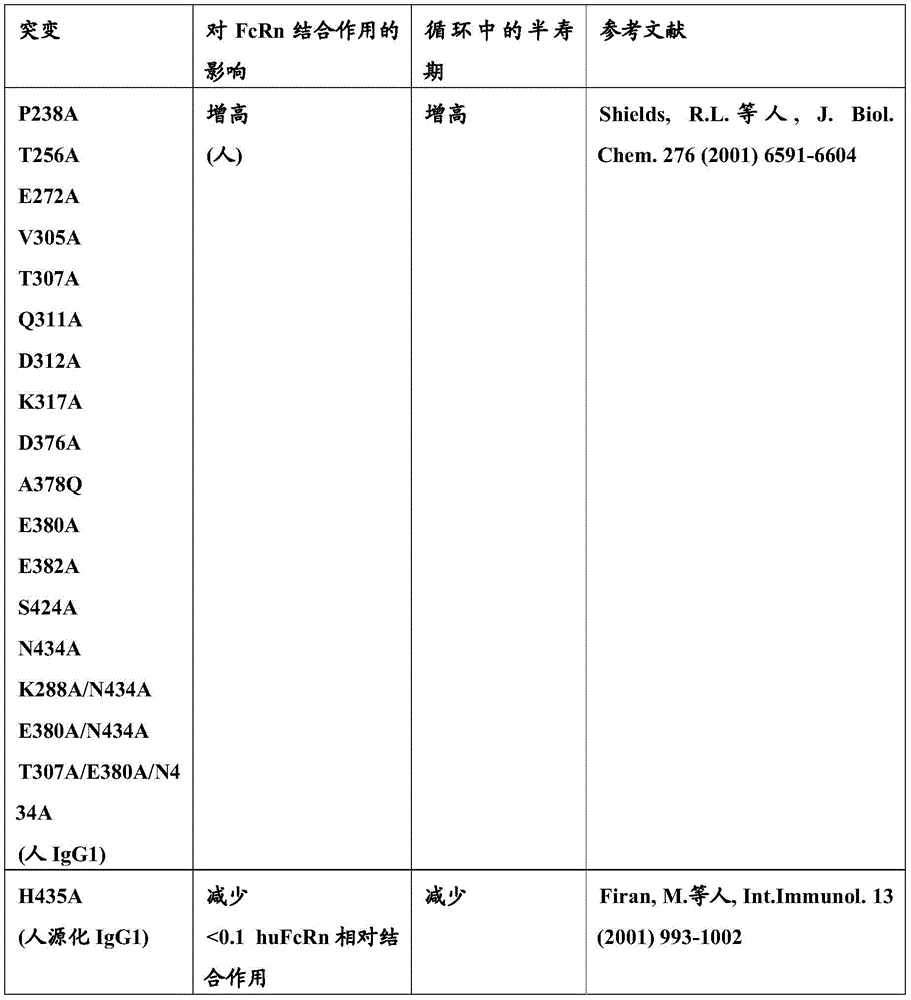
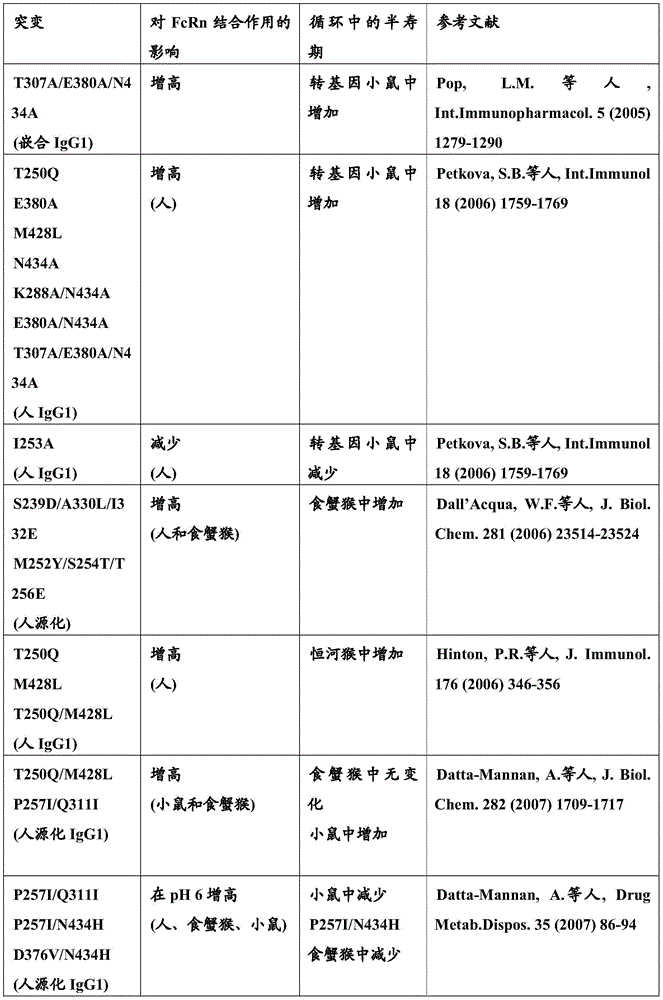
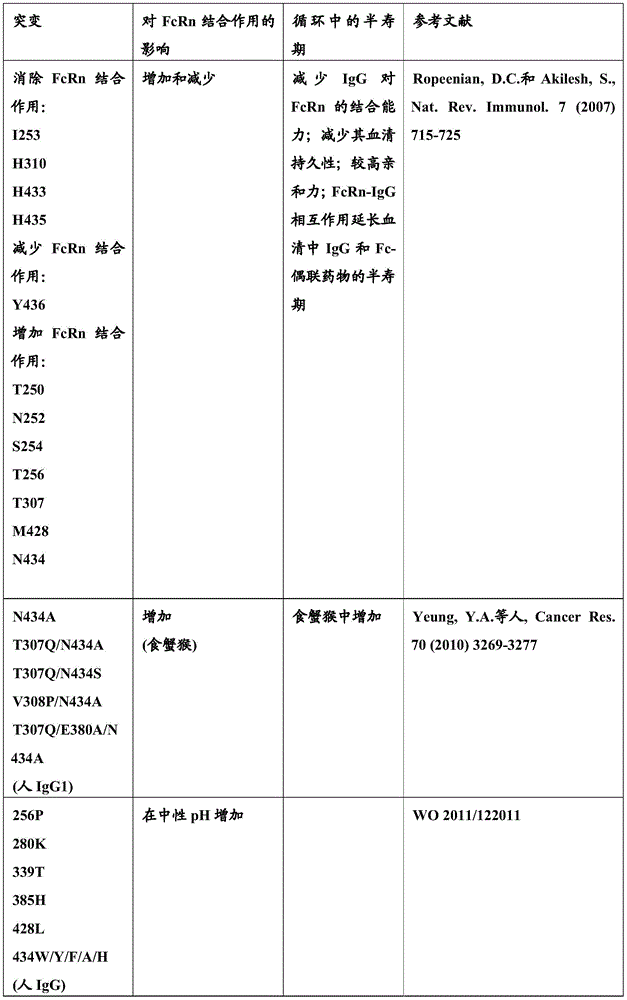
已经发现在一条Fc区多肽中一侧的一个突变足以显著削弱结合作用。Fc区中引入更多突变,则与FcRn的结合作用变得越弱。但是单侧非对称突变不足以完全抑制FcRn结合作用。在双侧上的突变是完全抑制FcRn结合作用必需的。It has been found that one mutation on one side of an Fc region polypeptide is sufficient to significantly impair binding. The more mutations are introduced into the Fc region, the weaker the binding to FcRn becomes. However, one-sided asymmetric mutation was not sufficient to completely inhibit FcRn binding. Mutations on both sides are required for complete inhibition of FcRn binding.
下表中显示IgG1 Fc区的对称工程化影响FcRn结合作用的结果(突变和FcRn-亲和色谱柱上保留时间的对比)。The results of symmetrical engineering of the IgG1 Fc region affecting FcRn binding are shown in the table below (comparison of mutation and retention time on FcRn-affinity chromatography columns).
表surface

低于3分钟的保留时间对应于不结合,因为物质处于通流中(空隙峰)。Retention times below 3 minutes correspond to no binding because the material is in flow through (void peak).
单突变H310A是消除任何FcRn结合作用的最沉默对称突变。The single mutation H310A was the most silent symmetrical mutation that eliminated any FcRn binding.
对称单突变I253A和H435A导致保留时间相对偏移0.3-0.4分钟。这可以通常视为不可检测的结合作用。Symmetric single mutations I253A and H435A resulted in a relative shift in retention time of 0.3-0.4 min. This can generally be seen as undetectable binding.
单突变Y436A导致可检测的与FcRn亲和柱的相互作用强度。在不受这个理论约束的情况下,这种突变可能在体外影响FcRn介导的半寿期,这一点可以与零相互作用如I253A、H310A和H435A突变组合(IHH-AAA突变)不同。The single mutation Y436A resulted in a detectable interaction strength with the FcRn affinity column. Without being bound by this theory, this mutation may affect FcRn-mediated half-life in vitro, which may differ from zero-interactions such as the I253A, H310A and H435A mutation combination (IHH-AAA mutation).
下表中展示用对称修饰的抗HER2抗体获得的结果(关于参考,参见WO2006/031370)。The results obtained with symmetrically modified anti-HER2 antibodies are shown in the table below (for reference see WO2006/031370).
表surface
在Fc区中引入影响FcRn结合作用的非对称突变的作用已经用双特异性抗体例举,其中所述抗体使用结入扣技术装配(参见例如US7,695,936、US2003/0078385;"扣链”突变:S354C/T366W,"结链”突变:Y349C/T366S/L368A/Y407V)。非对称引入的突变对FcRn结合作用的影响可以使用FcRn亲和层析法容易地确定(参见图9和下表)。从FcRn亲和柱洗脱稍晚,即在FcRn亲和柱上具有较长保留时间的抗体具有较长的体内半寿期,并且反之亦然。The effect of introducing asymmetric mutations in the Fc region that affect FcRn binding has been exemplified with bispecific antibodies, wherein the antibodies are assembled using knot-in-buckle technology (see, eg, US 7,695,936, US 2003/0078385; "buckle" mutations : S354C/T366W, "linking" mutation: Y349C/T366S/L368A/Y407V). The effect of asymmetrically introduced mutations on FcRn binding can be readily determined using FcRn affinity chromatography (see Figure 9 and table below). The eluted later from the FcRn affinity column, ie antibodies with longer retention times on the FcRn affinity column have longer in vivo half-lives, and vice versa.
表surface
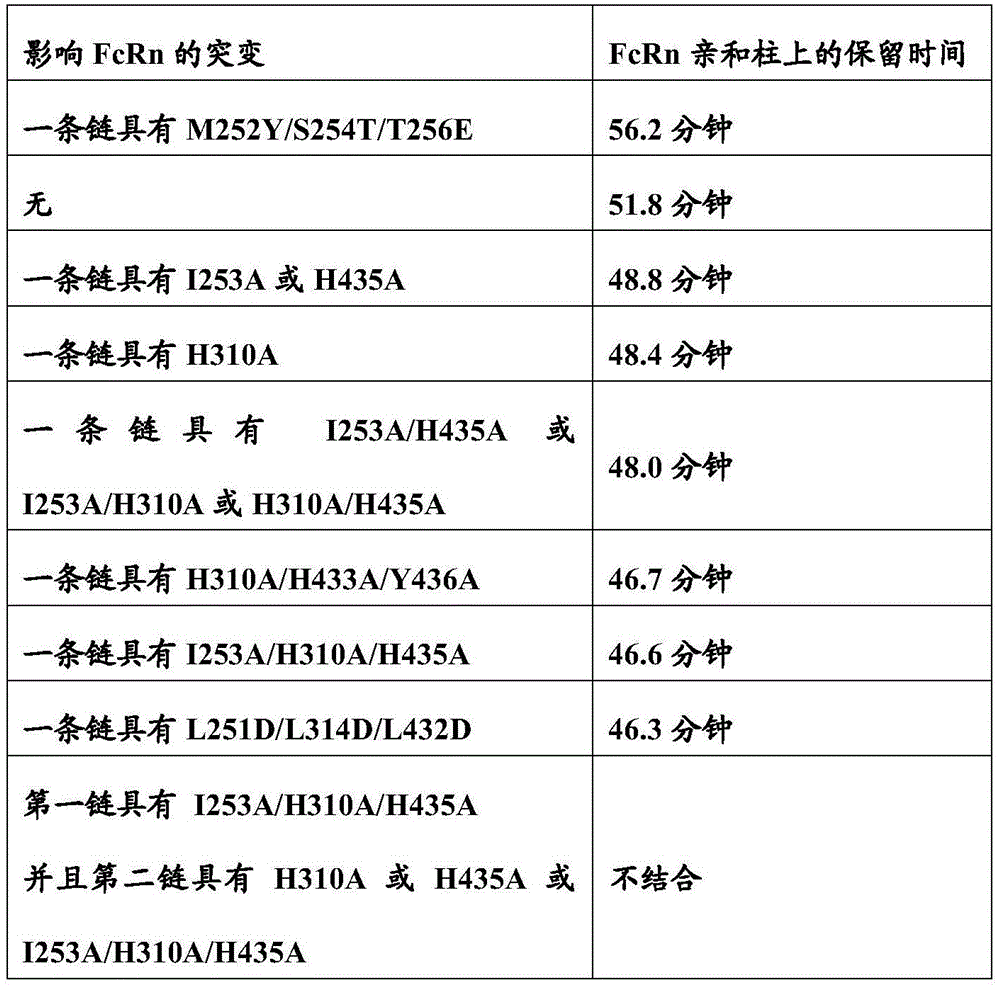
在Fc区中引入影响FcRn结合作用的非对称突变的作用已经进一步用单特异性抗IGF-1R抗体例举,其中所述抗体使用结入扣技术装配以允许非对称突变的引入(参见例如US7,695,936,US2003/0078385;"扣链”突变:S354C/T366W,"结链”突变:Y349C/T366S/L368A/Y407V)。非对称引入的突变对FcRn结合作用的影响可以使用FcRn亲和色谱法容易地确定(参见下表)。从FcRn亲和柱洗脱稍晚,即在FcRn亲和柱上具有较长保留时间的抗体具有较长的体内半寿期,并且反之亦然。The role of introducing asymmetric mutations in the Fc region affecting FcRn binding has been further exemplified with monospecific anti-IGF-1R antibodies assembled using knot-in technology to allow the introduction of asymmetric mutations (see eg US7 , 695,936, US2003/0078385; "knot" mutation: S354C/T366W, "knot" mutation: Y349C/T366S/L368A/Y407V). The effect of asymmetrically introduced mutations on FcRn binding can be readily determined using FcRn affinity chromatography (see table below). The eluted later from the FcRn affinity column, ie antibodies with longer retention times on the FcRn affinity column have longer in vivo half-lives, and vice versa.
表surface
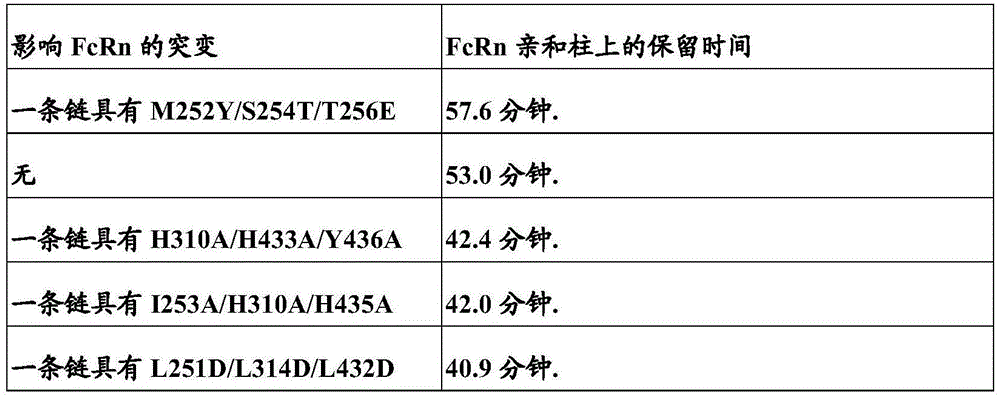

非对称IHH-AAA-和LLL-DDD突变(LLL-DDD突变=突变L251D、L314D和L432D的组合)显示比相应亲本或野生型抗体更弱的结合作用。Asymmetric IHH-AAA- and LLL-DDD mutations (LLL-DDD mutation = combination of mutations L251D, L314D and L432D) showed weaker binding than the corresponding parental or wild-type antibodies.
对称HHY-AAA突变(=突变H310A、H433A和Y436A的组合)产生不再与人FcRn结合,同时蛋白A结合作用维持的Fc区(参见图11、12、13和14)。Symmetrical HHY-AAA mutation (=combination of mutations H310A, H433A and Y436A) produces an Fc region that no longer binds to human FcRn, while protein A binding is maintained (see Figures 11, 12, 13 and 14).
在Fc区中引入影响FcRn结合作用的非对称突变的作用已经用单特异性抗IGF-1R抗体(IGF-1R)、双特异性抗VEGF/ANG2抗体(VEGF/ANG2)和与两条重链的C末端融合的全长抗体(融合物)例举,其中所述抗体使用结入扣技术装配以允许引入非对称突变(参见例如US7,695,936、US2003/0078385;"扣链”突变:S354C/T366W,"结链”突变:Y349C/T366S/L368A/Y407V)。引入的突变对FcRn结合作用和蛋白A结合作用的影响可以使用FcRn亲和色谱法、蛋白A亲和色谱法和基于SPR的方法容易地确定(参见下表)。The effect of introducing asymmetric mutations in the Fc region affecting FcRn binding has been investigated using a monospecific anti-IGF-1R antibody (IGF-1R), a bispecific anti-VEGF/ANG2 antibody (VEGF/ANG2) and a combination of two heavy chain Full-length antibodies (fusions) fused to the C-terminus of the T366W, "knot-strand" mutation: Y349C/T366S/L368A/Y407V). The effect of introduced mutations on FcRn binding and Protein A binding can be readily determined using FcRn affinity chromatography, Protein A affinity chromatography and SPR-based methods (see table below).

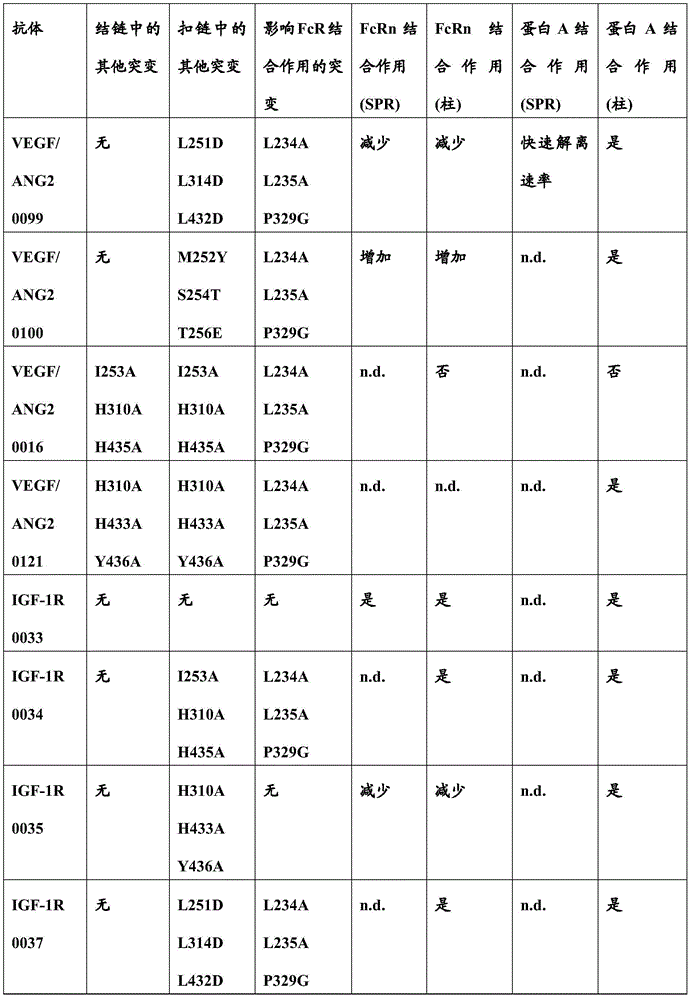
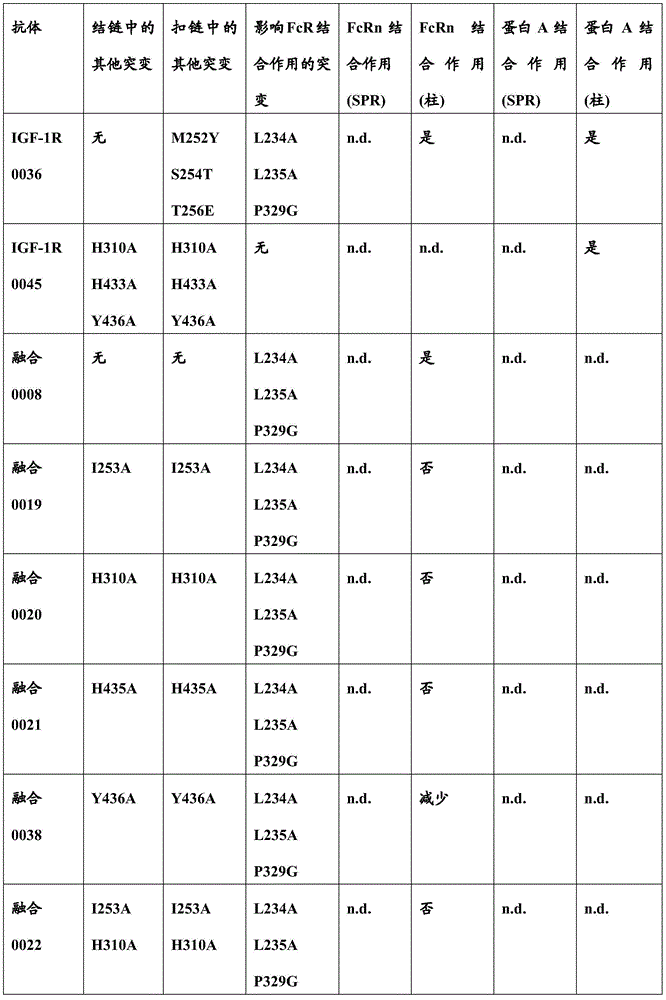
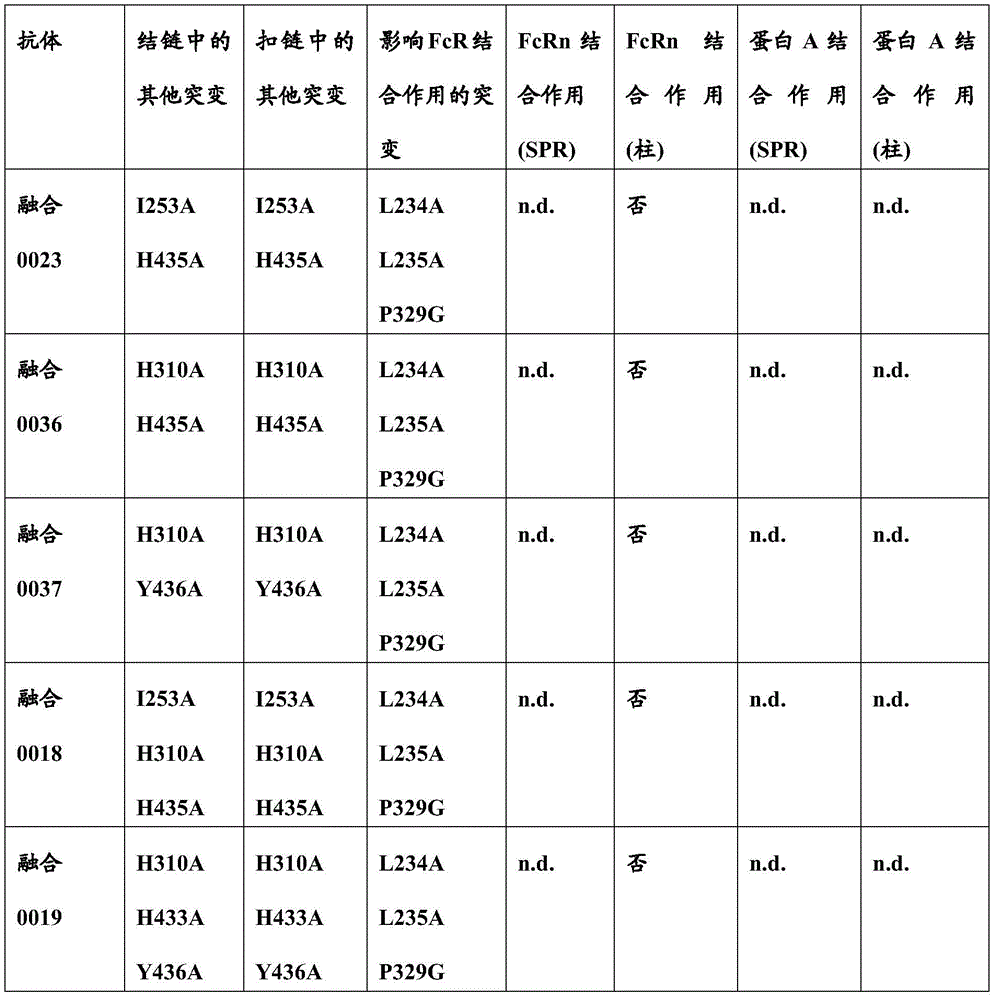
如本文中报道的一个方面是如本文中报道的包含变异人IgG类Fc区的抗体或Fc区融合多肽。One aspect as reported herein is an antibody or Fc region fusion polypeptide comprising a variant human IgG class Fc region as reported herein.
当在Fc区融合多肽或全长抗体中包含时,如本文中报道的Fc区(二聚体多肽)赋予分子上述特征。融合配偶体可以是具有生物活性的任何分子,其中应当减少或增加所述分子的体内半寿期,即应当针对所述分子的预期应用明确限定或定制其体内半寿期。When included in an Fc region fusion polypeptide or a full length antibody, an Fc region (dimeric polypeptide) as reported herein confers the above-described characteristics to the molecule. A fusion partner can be any molecule that is biologically active, wherein the in vivo half-life of the molecule should be reduced or increased, ie its in vivo half-life should be well defined or tailored for the molecule's intended application.
Fc区融合多肽可以例如包含如本文中报道的变异(人)IgG类Fc区和与靶(包括配体)结合的受体蛋白,如,例如TNFR-Fc区融合多肽(TNFR=人肿瘤坏死因子受体)、或IL-1R-Fc区融合多肽(IL-1R=人白介素-1受体)、或VEGFR-Fc区融合多肽(VEGFR=人血管内皮生长因子受体)、或ANG2R-Fc区融合多肽(ANG2R=人血管生成素2受体)。An Fc region fusion polypeptide may eg comprise a variant (human) IgG class Fc region as reported herein and a receptor protein that binds to a target (including a ligand), such as, eg, a TNFR-Fc region fusion polypeptide (TNFR = human tumor necrosis factor). receptor), or IL-1R-Fc region fusion polypeptide (IL-1R=human interleukin-1 receptor), or VEGFR-Fc region fusion polypeptide (VEGFR=human vascular endothelial growth factor receptor), or ANG2R-Fc region Fusion polypeptide (ANG2R =
Fc区融合多肽可以包含例如本文中报道的变异(人)IgG类Fc区和与靶结合的抗体片段,包括例如抗体Fab片段,scFv(参见例如Nat.Biotechnol.23(2005)1126-1136),或结构域抗体(dAb)(参见例如WO 2004/058821、WO 2003/002609)。Fc region fusion polypeptides may comprise, for example, a variant (human) IgG class Fc region as reported herein and target-binding antibody fragments, including, for example, antibody Fab fragments, scFvs (see, eg, Nat. Biotechnol. 23 (2005) 1126-1136), or domain antibodies (dAbs) (see eg WO 2004/058821, WO 2003/002609).
Fc区融合多肽可以例如包含如本文中报道的变异(人)人IgG类Fc区和(天然存在或人工的)受体配体。Fc region fusion polypeptides can eg comprise a variant (human) human IgG class Fc region as reported herein and a receptor ligand (naturally occurring or artificial).
抗体,例如全长抗体或CrossMabs,可以包含如本文中报道的变异(人)人IgG类Fc区。Antibodies, such as full-length antibodies or CrossMabs, may comprise variant (human) human IgG class Fc regions as reported herein.
B.眼血管疾病B. Ocular vascular disease
眼血管疾病是以新血管向眼组织结构(如视网膜或角膜)内改变或失调的增殖和侵入为特征的任何病理状况。Ophthalmic vascular disease is any pathological condition characterized by the proliferation and invasion of new blood vessels into altered or deregulated ocular tissue structures such as the retina or cornea.
在一个实施方案中,眼血管疾病是选自湿性年龄相关性黄斑变性(湿性AMD)、干性年龄相关性黄斑变性(干性AMD)、糖尿病性黄斑水肿(DME)、囊样黄斑水肿(CME)、非增生性糖尿病性视网膜病变(NPDR)、增生性糖尿病性视网膜病变(PDR)、囊样黄斑水肿、血管炎(例如视网膜中央静脉闭塞)、视盘水肿、视网膜炎、结膜炎、葡萄膜炎、脉络膜炎、多灶性脉络膜炎、眼组织胞浆菌病、眼睑炎、干眼(Sjogren’s疾病)和其中眼疾病或病症与眼部血管新生、血管泄漏、和/或视网膜水肿相关的其他眼科疾病。In one embodiment, the ocular vascular disease is selected from wet age-related macular degeneration (wet AMD), dry age-related macular degeneration (dry AMD), diabetic macular edema (DME), cystoid macular edema (CME) ), nonproliferative diabetic retinopathy (NPDR), proliferative diabetic retinopathy (PDR), cystoid macular edema, vasculitis (eg, central retinal vein occlusion), optic disc edema, retinitis, conjunctivitis, uveitis , choroiditis, multifocal choroiditis, ocular histoplasmosis, blepharitis, dry eye (Sjogren's disease), and other ophthalmology in which the ocular disease or disorder is associated with ocular angiogenesis, vascular leakage, and/or retinal edema disease.
包含如本文中报道的二聚体多肽的抗体可用于预防和治疗湿性AMD、干性AMD、CME、DME、NPDR、PDR、眼睑炎、干眼和葡萄膜炎,在一个优选的实施方案中可用于预防和治疗湿性AMD、干性AMD、眼睑炎和干眼,并且在一个优选的实施方案中还可用于预防和治疗CME、DME、NPDR和PDR,并且在一个优选的实施方案中还可用于预防和治疗眼睑炎和干眼、尤其湿性AMD和干性AMD、以及还特别地可用于预防和治疗湿性AMD。Antibodies comprising dimeric polypeptides as reported herein are useful in the prevention and treatment of wet AMD, dry AMD, CME, DME, NPDR, PDR, blepharitis, dry eye and uveitis, in a preferred embodiment For the prevention and treatment of wet AMD, dry AMD, blepharitis and dry eye, and in a preferred embodiment for the prevention and treatment of CME, DME, NPDR and PDR, and in a preferred embodiment also for Prevention and treatment of blepharitis and dry eye, especially wet AMD and dry AMD, and also particularly useful for the prevention and treatment of wet AMD.
在一些实施方案中,眼血管疾病选自湿性年龄相关性黄斑变性(湿性AMD)、黄斑水肿、视网膜静脉闭塞、早产儿视网膜病变和糖尿病性视网膜病变。In some embodiments, the ocular vascular disease is selected from wet age-related macular degeneration (wet AMD), macular edema, retinal vein occlusion, retinopathy of prematurity, and diabetic retinopathy.
与角膜血管新生相关的其他疾病包括但不限于流行性角结膜炎、维生素A缺乏症、隐形眼镜过度疲劳、异位性角膜炎、上方角膜缘角膜炎、翼状胬肉干燥性角膜炎、Sjogren’s疾病、酒渣鼻性痤疮、小泡性角膜炎(phylectenulosis)、梅毒、分枝杆菌(Mycobacteria)感染、脂质变性、化学烧伤、细菌性溃疡、真菌性溃疡、单纯疱疹感染、带状疱疹感染、原生动物感染、卡波齐肉瘤、Mooren溃疡、边缘性角膜变性、边缘性角质层分离(mariginalkeratolysis)、类风湿性关节炎、全身性狼疮、多动脉炎、创伤、Wegener肉样瘤病、巩膜炎、Steven's Johnson疾病、放射状角膜切开术和角膜移植物排异。Other diseases associated with corneal angiogenesis include, but are not limited to, epidemic keratoconjunctivitis, vitamin A deficiency, contact lens fatigue, atopic keratitis, superior limbal keratitis, pterygium sicca keratitis, Sjogren's disease , rosacea, vesicular keratitis (phylectenulosis), syphilis, Mycobacteria infections, lipid degeneration, chemical burns, bacterial ulcers, fungal ulcers, herpes simplex infections, herpes zoster infections, Protozoal infection, Kaposi's sarcoma, Mooren ulcer, marginal corneal degeneration, marginal keratolysis, rheumatoid arthritis, systemic lupus, polyarteritis, trauma, Wegener's sarcoidosis, scleritis , Steven's Johnson disease, radial keratotomy, and corneal graft rejection.
与视网膜/脉络膜血管新生相关的疾病包括但不限于糖尿病性视网膜病变、黄斑变性、镰状细胞性贫血、结节病、梅毒、弹性假黄色瘤、Paget病、静脉闭塞、动脉闭塞、颈动脉的阻塞性疾病、慢性葡萄膜炎/玻璃体炎、结核分枝杆菌感染、莱姆病、系统性红斑狼疮、早产儿视网膜病变、视网膜色素变性、视网膜水肿(包含ing黄斑水肿)、Eale病、Bechet病、造成视网膜炎或脉络膜炎的感染、眼假组织胞浆菌病、Best病、近视、视盘凹(optic pits)、Stargart病、扁平部炎、慢性视网膜脱离、高粘滞综合征、弓形虫病、创伤和激光后并发症。Diseases associated with retinal/choroidal angiogenesis include, but are not limited to, diabetic retinopathy, macular degeneration, sickle cell anemia, sarcoidosis, syphilis, pseudoxanthoma elastica, Paget disease, venous occlusion, arterial occlusion, carotid Obstructive disease, chronic uveitis/vitritis, Mycobacterium tuberculosis infection, Lyme disease, systemic lupus erythematosus, retinopathy of prematurity, retinitis pigmentosa, retinal edema (including macular edema), Eale disease, Bechet disease , Infections causing retinitis or choroiditis, ocular pseudohistoplasmosis, Best's disease, myopia, optic pits, Stargart's disease, pars plana, chronic retinal detachment, hyperviscosity syndrome, toxoplasmosis , trauma and post-laser complications.
其他疾病包括但不限于与虹膜红变(角部新血管化(neovascularization of theangle))相关的疾病和由纤维血管组织或纤维组织异常增殖(包括全部形式的增生性玻璃体视网膜病变)引起的疾病。Other diseases include, but are not limited to, diseases associated with iris erythema (neovascularization of the angle) and diseases caused by abnormal proliferation of fibrovascular tissue or fibrous tissue, including all forms of proliferative vitreoretinopathy.
早产儿视网膜病变(ROP)是侵袭早产婴儿的眼疾病。认为它由可以导致瘢痕化和视网膜脱离的视网膜血管杂乱生长引起。ROP可以是轻微的并且可以自发地消散,但是在严重病例中可以导致失明。因而,全部早产婴儿均面临ROP风险,并且出生体重极低是额外的风险因素。氧毒性和相对缺氧均可以促成ROP形成。Retinopathy of prematurity (ROP) is an eye disease that affects premature infants. It is thought to be caused by the chaotic growth of retinal blood vessels that can lead to scarring and retinal detachment. ROP can be mild and resolve spontaneously, but in severe cases can lead to blindness. Thus, all preterm infants are at risk for ROP, and very low birth weight is an additional risk factor. Both oxygen toxicity and relative hypoxia can contribute to ROP formation.
黄斑变性是主要存在于老年成人中的医学疾病,其中眼内衬的中心(称作视网膜黄斑区域)出现变薄、萎缩和在一些情况下出血。这可以导致中心视力减退,这导致不能看到精细细节、不能阅读或不能识别面部。根据美国眼科学学会,它是如今美国年逾50岁人群内中心视力减退(失明)的主导原因。虽然侵袭更年轻个体的一些黄斑营养障碍有时称作黄斑变性,但是本术语通常指年龄相关性黄斑变性(AMD或ARMD)。Macular degeneration is a medical condition that occurs primarily in older adults in which the center of the inner lining of the eye (called the macular region) thins, shrinks, and in some cases bleeds. This can lead to decreased central vision, which results in the inability to see fine details, read or recognize faces. According to the American Academy of Ophthalmology, it is now the leading cause of central vision loss (blindness) among people over 50 in the United States. Although some macular dystrophy disorders affecting younger individuals are sometimes referred to as macular degeneration, the term generally refers to age-related macular degeneration (AMD or ARMD).
年龄相关性黄斑变性始于视网膜色素上皮和下部脉络膜之间黄斑(提供精细中心视力的视网膜中心区域,称作中心凹)中的特征性黄色沉积物,称作玻璃膜疣。出现这些早期变化(称作年龄相关性黄斑病变)的大部分人具有良好视力。具有玻璃膜疣的人可以继续发展成晚期AMD。当玻璃膜疣大和数量多并且与黄斑下色素细胞层中的紊乱相关时,风险明显较高。大而软的玻璃膜疣与增多的胆固醇沉积物有关并且可以响应于降胆固醇药物或Rheo手术。Age-related macular degeneration begins with characteristic yellow deposits called drusen in the macula (the central area of the retina that provides fine central vision, called the fovea) between the retinal pigment epithelium and the lower choroid. Most people with these early changes (called age-related macular degeneration) have good vision. People with drusen can go on to develop advanced AMD. The risk is significantly higher when the drusen are large and numerous and associated with disorders in the submacular pigment cell layer. Large, soft drusen are associated with increased cholesterol deposits and can respond to cholesterol-lowering drugs or Rheo surgery.
晚期AMD,造成重大视力减退,具有两个形式:干性和湿性。中心地图样萎缩,晚期AMD的干性形式,因视网膜下方视网膜色素上皮层萎缩所致,所述萎缩因眼中心部分的光受体(视杆细胞和视锥细胞)损失造成视力丧失。尽管无治疗可用于这种病状,美国国家眼科研究所和其他机构已经显示,维生素补充物联用大剂量抗氧化剂、叶黄素和玉米黄素减缓干性黄斑变性进展和在一些患者中改善视力。Advanced AMD, which causes significant vision loss, has two forms: dry and wet. Central geographic atrophy, the dry form of advanced AMD, results from atrophy of the retinal pigment epithelium layer below the retina, which causes vision loss due to loss of photoreceptors (rods and cones) in the central part of the eye. Although no treatment is available for this condition, the National Eye Institute and others have shown that vitamin supplementation in combination with high-dose antioxidants, lutein and zeaxanthin slows the progression of dry macular degeneration and improves vision in some patients.
视网膜色素变性(RP)是一组遗传性眼病。在RP的症状进展时,夜盲通常先于管状视达数年或甚至数十年。许多患有RP的人直至40岁阶段或50岁阶段才变成法律上的失明并且终生保留一些视力。其他人因RP完全失明,在一些情况下早至儿童期失明。RP的进展在每个病例中均不同。RP是一种类型的遗传性视网膜营养不良,这是一组光受体(视杆细胞和视锥细胞)或视网膜色素上皮(RPE)的异常导致进行性视力减退的遗传疾病。受累个体首先出现缺陷性暗适应或夜盲(夜盲),随后外周视野收缩(称作管状视)和有时在病程后出现中心视力减退。Retinitis pigmentosa (RP) is a group of inherited eye diseases. Night blindness often precedes tubular vision by years or even decades as symptoms of RP progress. Many people with RP do not become legally blind until the age of 40 or 50 and retain some vision for life. Others become completely blind with RP, in some cases as early as childhood. The progression of RP is different in each case. RP is a type of inherited retinal dystrophy, a genetic disorder in which abnormalities in a group of photoreceptors (rods and cones) or retinal pigment epithelium (RPE) lead to progressive vision loss. Affected individuals first develop defective dark adaptation or night blindness (night blindness), followed by shrinkage of the peripheral visual field (called tubular vision) and sometimes central vision loss later in the course of the disease.
当体液和蛋白质沉积物聚集在眼黄斑(视网膜的黄色中心区域)上或其下,造成它增厚和肿胀时,黄斑水肿出现。肿胀可以扭曲人的中心视力,因为黄斑接近眼球背部处视网膜的中心。这个区域容纳紧密堆积的视锥细胞,所述视锥细胞提供锐利、清晰中心视力以使得人看到与视线完全对齐的形式、颜色和细节。囊样黄斑水肿是包括囊肿形成的一个黄斑水肿类型。Macular edema occurs when fluid and protein deposits collect on or under the macula (the yellow central area of the retina), causing it to thicken and swell. Swelling can distort a person's central vision because the macula is near the center of the retina at the back of the eye. This area houses the tightly packed cone cells that provide sharp, clear central vision so that a person sees form, color and detail in perfect alignment with the line of sight. Cystoid macular edema is a type of macular edema that includes cyst formation.
C.用葡萄球菌蛋白A亲和色谱柱纯化抗体C. Purification of Antibodies Using Staphylococcal Protein A Affinity Chromatography Columns
在一个方面,提供包含以下多肽的二聚体多肽In one aspect, there is provided a dimeric polypeptide comprising the following polypeptides
第一多肽和第二多肽,所述第一多肽和第二多肽各自按N末端至C端方向包含含有一个或多个半胱氨酸残基的至少一部分免疫球蛋白铰链区、免疫球蛋白CH2结构域和免疫球蛋白CH3结构域,a first polypeptide and a second polypeptide, each of the first and second polypeptides comprising, in the N-terminal to C-terminal direction, at least a portion of an immunoglobulin hinge region containing one or more cysteine residues, immunoglobulin CH2 domain and immunoglobulin CH3 domain,
其中第一多肽、第二多肽或者第一和第二多肽包含突变Y436A(根据Kabat EU索引编号体系编号)。wherein the first polypeptide, the second polypeptide, or the first and second polypeptides comprise the mutation Y436A (numbered according to the Kabat EU index numbering system).
这种二聚体多肽具有因突变所致的特性:改进的葡萄球菌蛋白A结合作用。This dimeric polypeptide has a mutation-induced property: improved Staphylococcal protein A binding.
因此,可以通过使用常规的蛋白A亲和材料,如MabSelectSure,纯化这些抗体,即与不想要的副产物分离。不要求使用高度复杂的但种类限制性亲和材料,如例如仅可用于包含κ亚类轻链的抗体的KappaSelect。另外,如果修饰/交换轻链亚类,则不要求采用纯化方法(分别参见图11和图12)。Therefore, these antibodies can be purified, ie separated from unwanted by-products, by using conventional Protein A affinity materials such as MabSelectSure. The use of highly complex but class-limiting affinity materials, such as, for example, KappaSelect, which is only available for antibodies containing kappa subclass light chains, is not required. Additionally, purification methods are not required if the light chain subclass is modified/swapped (see Figure 11 and Figure 12, respectively).
如本文中报道的一个方面是一种用于产生如本文中报道的二聚体多肽的方法,所述方法包括以下步骤One aspect as reported herein is a method for producing a dimeric polypeptide as reported herein, the method comprising the steps of
a)培育哺乳动物细胞,所述哺乳动物细胞包含编码如本文中报道的二聚体多肽的一种或多种核酸,a) growing mammalian cells comprising one or more nucleic acids encoding a dimeric polypeptide as reported herein,
b)从培养基回收二聚体多肽,和b) recovering the dimeric polypeptide from the culture medium, and
c)用蛋白A亲和色谱纯化二聚体多肽并且因而产生二聚体多肽。c) Purify the dimeric polypeptide by protein A affinity chromatography and thus produce a dimeric polypeptide.
如本文中报道的一个方面是使用突变Y436A增加二聚体Fc区多肽与蛋白A的结合。One aspect as reported herein is the use of mutation Y436A to increase the binding of dimeric Fc region polypeptides to Protein A.
已经发现通过引入突变Y436A,可以增加可以与葡萄球菌蛋白A(SPA)的结合。如果引入减少与SPA结合的额外突变,例如I253A和H310A或H310A和H435A,则这是有利的(参见图15)。It has been found that binding to Staphylococcus protein A (SPA) can be increased by introducing the mutation Y436A. This is advantageous if additional mutations are introduced that reduce binding to SPA, such as I253A and H310A or H310A and H435A (see Figure 15).
通过重组手段产生如本文中报道的二聚体多肽。因此,本发明的一个方面是编码如本文中报道的二聚体多肽的核酸并且又一个方面是包含核酸的细胞,所述核酸编码如本文中报道的二聚体多肽。用于重组产生的方法是本领域广泛已知并且包括在原核细胞和真核细胞中的蛋白质表达,以及后续分离二聚体多肽并通常纯化至可药用的纯度。为了在宿主细胞中表达如前述的二聚体多肽,通过标准方法,将编码相应第一和第二多肽的核酸插入表达载体中。表达在适宜的原核或真核宿主细胞中进行,如CHO细胞、NS0细胞、SP2/0细胞、HEK293细胞、COS细胞、PER.C6细胞、酵母或大肠杆菌细胞,并且从细胞(培养上清液或裂解后的细胞)回收二聚体多肽。Dimeric polypeptides as reported herein are produced by recombinant means. Accordingly, one aspect of the invention is a nucleic acid encoding a dimeric polypeptide as reported herein and a further aspect is a cell comprising a nucleic acid encoding a dimeric polypeptide as reported herein. Methods for recombinant production are widely known in the art and include protein expression in prokaryotic and eukaryotic cells, and subsequent isolation of dimeric polypeptides and typically purification to pharmaceutically acceptable purity. To express a dimeric polypeptide as previously described in a host cell, the nucleic acids encoding the corresponding first and second polypeptides are inserted into an expression vector by standard methods. Expression is carried out in suitable prokaryotic or eukaryotic host cells, such as CHO cells, NSO cells, SP2/0 cells, HEK293 cells, COS cells, PER.C6 cells, yeast or E. coli cells, and from cells (culture supernatants) or lysed cells) to recover the dimeric polypeptide.
用于重组产生抗体的一般方法是现有技术中熟知的并且例如在以下综述文章中描述:Makrides,S.C.,Protein Expr.Purif.17(1999)183-202;Geisse,S.等人,ProteinExpr.Purif.8(1996)271-282;Kaufman,R.J.,Mol.Biotechnol.16(2000)151-160;Werner,R.G.,Drug Res.48(1998)870-880。General methods for recombinant production of antibodies are well known in the art and are described, for example, in the following review articles: Makrides, S.C., Protein Expr. Purif. 17 (1999) 183-202; Geisse, S. et al., ProteinExpr. Purif. 8 (1996) 271-282; Kaufman, R.J., Mol. Biotechnol. 16 (2000) 151-160; Werner, R.G., Drug Res. 48 (1998) 870-880.
因此如本文中报道的一个方面是一种用于产生如本文中报道的二聚体多肽的方法,所述方法包括步骤One aspect as reported herein is therefore a method for producing a dimeric polypeptide as reported herein, the method comprising the steps of
a)用一种或多种载体转化宿主细胞,所述载体包含编码如本文中报道的二聚体多肽的核酸分子,a) transforming a host cell with one or more vectors comprising a nucleic acid molecule encoding a dimeric polypeptide as reported herein,
b)在允许合成二聚体多肽的条件下培养宿主细胞,和b) culturing the host cell under conditions permitting synthesis of the dimeric polypeptide, and
c)从培养物回收二聚体多肽并且因而产生二聚体多肽。c) The dimeric polypeptide is recovered from the culture and the dimeric polypeptide is thus produced.
在一个实施方案中,c)下的回收步骤包括使用免疫球蛋白Fc区特异性捕获试剂。在一个实施方案中,这种Fc区特异性捕获试剂以结合-洗脱模式使用。这类Fc区特异性捕获试剂的例子例如是基于葡萄球菌蛋白A的亲和色谱柱,所述亲和色谱柱基于大规模时允许高流速和低回压的高刚性琼脂糖基础基质。它们的特征是与二聚体多肽即其Fc区结合的配体。配体借助亲水性长间隔臂与基质连接以使它轻易可用于与靶分子结合。In one embodiment, the recovery step under c) comprises the use of an immunoglobulin Fc region specific capture reagent. In one embodiment, this Fc region-specific capture reagent is used in a bind-elute mode. Examples of such Fc region-specific capture reagents are, for example, staphylococcal protein A-based affinity chromatography columns based on a highly rigid agarose base matrix that allows high flow rates and low back pressures at large scale. They are characterized by ligands that bind to dimeric polypeptides, their Fc regions. The ligand is attached to the substrate by means of a long hydrophilic spacer arm to make it readily available for binding to the target molecule.
通过常规的免疫球蛋白纯化方法例如蛋白A-Sepharose、羟基磷灰石层析法、凝胶电泳法、透析法或亲和层析,将如本文中报道的二聚体多肽与培养基恰当地分离。B细胞或杂交瘤细胞可以充当编码二聚体多肽的DNA和RNA源。使用常规方法,将编码单克隆抗体的DNA和RNA轻易地分离并测序。一旦分离,可以将这种DNA插入表达载体,随后将所述表达载体转染至不产生二聚体多肽的宿主细胞(如HEK293细胞、CHO细胞或骨髓瘤细胞)中,以实现重组单克隆二聚体多肽在宿主细胞中的合成。Dimeric polypeptides as reported herein are suitably combined with the culture medium by conventional immunoglobulin purification methods such as protein A-Sepharose, hydroxyapatite chromatography, gel electrophoresis, dialysis or affinity chromatography separation. B cells or hybridoma cells can serve as sources of DNA and RNA encoding dimeric polypeptides. DNA and RNA encoding monoclonal antibodies are readily isolated and sequenced using conventional methods. Once isolated, this DNA can be inserted into an expression vector, which is then transfected into host cells that do not produce dimeric polypeptides (eg, HEK293 cells, CHO cells, or myeloma cells) to achieve recombinant monoclonal two Synthesis of polymeric polypeptides in host cells.
通过标准技术(包括碱/SDS处理、CsCl区带法、柱色谱、琼脂糖凝胶电泳)和本领域熟知的其他技术进行抗体纯化,目的在于消除细胞组分或其他杂质(例如,其他细胞性核酸或蛋白质)(参见Ausubel,F.等人,编著,Current Protocols in Molecular Biology,Greene Publishing and Wiley Interscience,New York(1987))。充分建立了不同的方法并且它们广泛用于蛋白质纯化,如使用微生物蛋白的亲和色谱(例如蛋白A或蛋白G亲和色谱)、离子交换色谱(例如阳离子交换(羧甲基树脂)、阴离子交换(氨基乙基树脂)和混合模式交换)、亲硫吸附作用(例如采用β-巯基乙醇和其他SH配体)、疏水相互作用或芳族吸附色谱(例如采用苯基-琼脂糖凝胶、亲氮杂-芳烃树脂(aza-arenophilic resin)或间氨基苯基硼酸)、金属螯合物亲和色谱(例如采用Ni(II)-和Cu(II)-亲和材料)、大小排阻色谱和电泳法(如凝胶电泳法、毛细管电泳法)(Vijayalakshmi,M.A.,Appl.Biochem.Biotech.75(1998)93-102)。Antibody purification is performed by standard techniques (including alkali/SDS treatment, CsCl banding, column chromatography, agarose gel electrophoresis) and other techniques well known in the art to eliminate cellular components or other impurities (eg, other cellular nucleic acid or protein) (see Ausubel, F. et al., eds., Current Protocols in Molecular Biology, Greene Publishing and Wiley Interscience, New York (1987)). Different methods are well established and they are widely used for protein purification, such as affinity chromatography using microproteins (eg protein A or protein G affinity chromatography), ion exchange chromatography (eg cation exchange (carboxymethyl resin), anion exchange (aminoethyl resin) and mixed-mode exchange), thiophilic adsorption (e.g. with β-mercaptoethanol and other SH ligands), hydrophobic interaction or aromatic adsorption chromatography (e.g. with phenyl-Sepharose, aza-arenophilic resin (or m-aminophenylboronic acid), metal chelate affinity chromatography (eg using Ni(II)- and Cu(II)-affinity materials), size exclusion chromatography and Electrophoresis (eg, gel electrophoresis, capillary electrophoresis) (Vijayalakshmi, M.A., Appl. Biochem. Biotech. 75 (1998) 93-102).
本发明的一个方面是包含如本文中报道的二聚体多肽或抗体的药物制剂。本发明的另一个方面是如本文中报道的二聚体多肽或抗体用于制造药物制剂的用途。本发明的又一个方面是一种用于制造药物制剂的方法,所述药物制剂包含如本文中报道的二聚体多肽或抗体。在另一个方面,本发明提供制剂,例如药物制剂,所述制剂含有与药用载体一起配制的如本文中报道的二聚体多肽或抗体。One aspect of the invention is a pharmaceutical formulation comprising a dimeric polypeptide or antibody as reported herein. Another aspect of the invention is the use of a dimeric polypeptide or antibody as reported herein for the manufacture of a pharmaceutical formulation. Yet another aspect of the present invention is a method for the manufacture of a pharmaceutical formulation comprising a dimeric polypeptide or antibody as reported herein. In another aspect, the invention provides formulations, eg, pharmaceutical formulations, comprising a dimeric polypeptide or antibody as reported herein formulated together with a pharmaceutically acceptable carrier.
可以通过本领域已知的多种方法施用如本文中报道的制剂。熟练技术人员将理解,施用的途径和/或模式将取决于所希望的结果而变。为了通过某些施用途径施用本发明的化合物,可能需要将混合物用防止其失活的材料包衣或随这种材料共施用。例如,该化合物可以在适宜的载体例如脂质体或稀释剂中施用至受试者。可药用的稀释剂包括盐水和缓冲水溶液。药用载体包括无菌水溶液或分散体和用于现场制备无菌可注射溶液剂或分散剂的无菌粉末。用于药学活性物质的此类介质和试剂的用途是本领域已知的。The formulations as reported herein can be administered by a variety of methods known in the art. The skilled artisan will understand that the route and/or mode of administration will vary depending on the desired results. In order to administer the compounds of the present invention by certain routes of administration, it may be necessary to coat or co-administer the mixture with a material that prevents its inactivation. For example, the compound can be administered to a subject in a suitable carrier such as a liposome or diluent. Pharmaceutically acceptable diluents include saline and buffered aqueous solutions. Pharmaceutically acceptable carriers include sterile aqueous solutions or dispersions and sterile powders for the extemporaneous preparation of sterile injectable solutions or dispersion. The use of such media and agents for pharmaceutically active substances is known in the art.
可以使用许多可能的递送模式,包括但不限于眼内施加或局部施加。在一个实施方案中,施加是眼内施加并且包括,但不限于,结膜下注射、颅内注射、通过颞侧缘注射入前房、基质内注射,角膜内注射、视网膜下注射、眼房水注射、筋膜下注射或持久递送装置、玻璃体内注射(例如,玻璃体前部、中部或后部注射)。在一个实施方案中,施加是局部的并且包括但不限于滴至角膜上的眼滴。Many possible modes of delivery can be used, including but not limited to intraocular application or topical application. In one embodiment, the application is intraocular application and includes, but is not limited to, subconjunctival injection, intracranial injection, injection into the anterior chamber through the temporal limbus, intrastromal injection, intracorneal injection, subretinal injection, aqueous humor Injection, subfascial injection or durable delivery device, intravitreal injection (eg, anterior, medial, or posterior vitreous injection). In one embodiment, the application is topical and includes, but is not limited to, eye drops on the cornea.
在一个实施方案中,通过玻璃体内施加,例如通过玻璃体内注射,施用如本文中报道的二聚体多肽或如本文中报道的药物制剂。这可以根据本领域已知的标准方法进行(参见,例如,Ritter等人,J.Clin.Invest.116(2006)3266-3276;Russelakis-Carneiro等人,Neuropathol.Appl.Neurobiol.25(1999)196-206和Wray等人,Arch.Neurol.33(1976)183-185)。In one embodiment, the dimeric polypeptide as reported herein or the pharmaceutical formulation as reported herein is administered by intravitreal application, eg by intravitreal injection. This can be done according to standard methods known in the art (see, eg, Ritter et al, J. Clin. Invest. 116 (2006) 3266-3276; Russelakis-Carneiro et al, Neuropathol. Appl. Neurobiol. 25 (1999) 196-206 and Wray et al., Arch. Neurol. 33 (1976) 183-185).
在一些实施方案中,本发明的治疗性试剂盒可以含有一个或多个剂量的在如本文所述的药物制剂中存在的如本文中报道的二聚体多肽、用于玻璃体内注射该药物制剂的合适装置和详述适用受试者及用于实施注射的方案的说明书。在这些实施方案中,一般将制剂通过玻璃体内注射施用至需要治疗的受试者。这可以根据本领域已知的标准程序进行。参见,例如,Ritter等人,J.Clin.Invest.116(2006)3266-3276;Russelakis-Carneiro等人,Neuropathol.Appl.Neurobiol.25(1999)196-206和Wray等人,Arch.Neurol.33(1976)183-185。In some embodiments, the therapeutic kits of the present invention may contain one or more doses of a dimeric polypeptide as reported herein present in a pharmaceutical formulation as described herein for intravitreal injection of the pharmaceutical formulation Suitable devices and instructions detailing suitable subjects and protocols for administering injections. In these embodiments, the formulation is typically administered to a subject in need of treatment by intravitreal injection. This can be done according to standard procedures known in the art. See, eg, Ritter et al, J. Clin. Invest. 116 (2006) 3266-3276; Russelakis-Carneiro et al, Neuropathol. Appl. Neurobiol. 25 (1999) 196-206 and Wray et al, Arch. Neurol. 33 (1976) 183-185.
所述制剂也可以含有辅助剂如防腐剂、润湿剂、乳化剂和分散剂。可以通过上文的消毒方法和通过纳入多种抗菌剂和抗真菌剂例如,尼泊金酯、氯丁醇、苯酚、山梨酸等确保防止存在微生物。还可能想要将等渗剂如糖、氯化钠等纳入制剂中。此外,可以通过纳入延迟吸收的物质如单硬脂酸铝和明胶引起可注射药物形式的延长吸收。The formulations may also contain adjuvants such as preservatives, wetting agents, emulsifying agents and dispersing agents. Prevention of the presence of microorganisms can be ensured by the above disinfection methods and by the inclusion of various antibacterial and antifungal agents, eg, parabens, chlorobutanol, phenol, sorbic acid, and the like. It may also be desirable to incorporate isotonic agents such as sugars, sodium chloride, and the like into the formulation. In addition, prolonged absorption of the injectable pharmaceutical form can be brought about by the inclusion of substances which delay absorption such as aluminum monostearate and gelatin.
无论选择何种施用途径,均将如本文中报道的化合物(其可以按适宜的水合形式使用)和/或如本文中报道的药物制剂,通过本领域技术人员已知的常规方法配制成可药用的剂型。Regardless of the route of administration chosen, the compounds as reported herein, which can be used in a suitable hydrated form, and/or the pharmaceutical formulations as reported herein, are formulated into medicaments by conventional methods known to those skilled in the art dosage form used.
可以改变如本文报道的药物制剂中有效成分的实际剂量水平,以获得有效成分的下述量,所述量就具体患者、组成和施用方式而言可以有效实现想要的治疗反应,并同时对患者无毒性。选择的剂量水平将取决于多种药物代谢动力学因素,包括所用的本发明特定组合物的活性、施用途径、施用时间、正在使用的化合物的排泄速率、治疗的持续期、与所用特定组合物联合使用的其他药物、化合物和/或材料、正在治疗的患者的年龄、性别、重量、状况、总体健康和既往医史等医学领域熟知的因素。Actual dosage levels of active ingredients in pharmaceutical formulations as reported herein can be varied to obtain amounts of active ingredients effective to achieve the desired therapeutic response with respect to a particular patient, composition and mode of administration, while at the same time having The patient is not toxic. The dose level selected will depend on a variety of pharmacokinetic factors, including the activity of the particular composition of the invention employed, the route of administration, the time of administration, the rate of excretion of the compound being employed, the duration of treatment, and the specific composition of the invention employed. Other drugs, compounds and/or materials used in combination, age, sex, weight, condition, general health, and previous medical history of the patient being treated are factors well known in the medical arts.
制剂必须是无菌并如此程度地流动,从而通过注射器可输送制剂。除了水之外,载体在一个优选的实施方案中还优选地是等渗缓冲盐水溶液。The formulation must be sterile and fluid to the extent that the formulation can be delivered by a syringe. In addition to water, the carrier in a preferred embodiment is preferably an isotonic buffered saline solution.
可以例如通过使用包衣如卵磷脂、在分散体情况下通过维持要求的粒度和通过使用表面活性剂,维持适宜的流动性。在许多情况下,优选在组合物中包含等渗剂例如糖、多元醇如甘露醇或山梨醇和氯化钠。Proper fluidity can be maintained, for example, by the use of coatings such as lecithin, by the maintenance of the required particle size in the case of dispersions and by the use of surfactants. In many cases it is preferred to include isotonic agents such as sugars, polyols such as mannitol or sorbitol and sodium chloride in the composition.
制剂可以包含用于结膜下给药的包含活性物质的眼科用贮库制剂。眼科用贮库制剂包含基本上纯的活性物质(例如,如本文中报道的二聚体多肽)的微粒子。包含如本文中报道的二聚体多肽的微粒子可以包埋入生物相容性可药用聚合物或脂质包囊剂中。贮库制剂可以适应于历经延长的时间段释放全部或基本上全部的活性物质。如果存在的话,聚合物或脂质基质可以适应于充分地降解,以便在释放全部或基本上全部活性物质后从施用部位转运出来。贮库制剂可以是液态制剂,包含可药用聚合物和溶解或分散的活性物质。一旦注射,则聚合物在注射部位形成储库,例如通过胶化或沉淀过程形成。The formulations may comprise ophthalmic depot formulations containing the active substance for subconjunctival administration. Ophthalmic depot formulations comprise microparticles of substantially pure active substance (eg, a dimeric polypeptide as reported herein). Microparticles comprising dimeric polypeptides as reported herein can be embedded in biocompatible pharmaceutically acceptable polymers or lipid encapsulation agents. Depot formulations can be adapted to release all or substantially all of the active substance over an extended period of time. If present, the polymer or lipid matrix can be adapted to degrade sufficiently to be transported from the site of application upon release of all or substantially all of the active substance. Depot formulations can be liquid formulations containing a pharmaceutically acceptable polymer and a dissolved or dispersed active substance. Once injected, the polymer forms a depot at the injection site, for example by a gelling or precipitation process.
本发明的另一个方面是用于治疗眼血管疾病的如本文中报道的二聚体多肽或抗体。Another aspect of the invention is a dimeric polypeptide or antibody as reported herein for use in the treatment of ocular vascular disease.
本发明的一个实施方案是用于治疗眼血管疾病的如本文中报道的二聚体多肽或抗体。One embodiment of the present invention is a dimeric polypeptide or antibody as reported herein for use in the treatment of ocular vascular disease.
本发明的另一个方面是用于治疗眼血管疾病的药物制剂。Another aspect of the present invention is a pharmaceutical formulation for the treatment of ocular vascular disease.
本发明的另一个方面是如本文中报道的二聚体多肽或抗体用于制造用于治疗眼血管疾病的药物的用途。Another aspect of the invention is the use of a dimeric polypeptide or antibody as reported herein for the manufacture of a medicament for the treatment of ocular vascular disease.
本发明的另一个方面是通过以下方式治疗患有眼血管疾病的患者的方法:向需要这种治疗的患者施用如本文中报道的二聚体多肽或抗体。Another aspect of the invention is a method of treating a patient suffering from ocular vascular disease by administering to a patient in need of such treatment a dimeric polypeptide or antibody as reported herein.
这里明确地说明,如本文所用的术语“包含”包括术语“由……组成”。因此,含有术语“包含”的全部方面和实施方案同样地用术语“由……组成”公开。It is expressly stated herein that the term "comprising" as used herein includes the term "consisting of." Accordingly, all aspects and embodiments containing the term "comprising" are likewise disclosed with the term "consisting of."
D.修饰D. to modify
在又一个方面,根据任一个以上实施方案的二聚体多肽可以单独或以组合方式合并如下文1-6部分中所述的任一特征:In yet another aspect, a dimeric polypeptide according to any one of the above embodiments may incorporate any of the features described in Sections 1-6 below, alone or in combination:
1.抗体亲和力1. Antibody Affinity
在一个实施方案中,使用表面等离子体共振测定法测量Kd。例如,使用


2.嵌合和人源化抗体2. Chimeric and Humanized Antibodies
在某些实施方案中,如本文中报道的二聚体多肽是嵌合抗体。某些嵌合抗体例如在US 4,816,567;和Morrison,S.L.等人,Proc.Natl.Acad.Sci.USA 81(1984)6851-6855)中描述。在一个例子中,嵌合抗体包含非人类可变区(例如,源自小鼠、大鼠、仓鼠、兔或非人灵长类如猴的可变区)和人类恒定区。在又一个例子中,嵌合抗体是“类转换”抗体,其中类或亚类已经相对亲本抗体发生改变。嵌合抗体包括其抗原结合其片段。In certain embodiments, the dimeric polypeptides as reported herein are chimeric antibodies. Certain chimeric antibodies are described, for example, in US 4,816,567; and Morrison, S.L. et al., Proc. Natl. Acad. Sci. USA 81 (1984) 6851-6855). In one example, a chimeric antibody comprises non-human variable regions (eg, variable regions derived from mouse, rat, hamster, rabbit, or non-human primates such as monkeys) and human constant regions. In yet another example, a chimeric antibody is a "class-switched" antibody, wherein the class or subclass has been changed relative to the parent antibody. Chimeric antibodies include antigen-binding fragments thereof.
在某些实施方案中,嵌合抗体是人源化抗体。一般地,将非人抗体人源化以降低对人的免疫原性,同时保留亲本非人抗体的特异性和亲和力。通常,人源化抗体包含HVR(例如,CDR)(或其部分)衍生自非人类抗体并且FR(或其部分)衍生自人抗体序列的一个或多个可变结构域。人源化抗体任选地也将包含人恒定区的至少一部分。在一些实施方案中,将人源化抗体中的一些FR残基置换为来自非人类抗体(例如,衍生HVR残基的抗体)的相应残基,例如,以恢复或改善抗体特异性或亲和力。In certain embodiments, the chimeric antibody is a humanized antibody. Generally, non-human antibodies are humanized to reduce immunogenicity to humans while retaining the specificity and affinity of the parental non-human antibody. Typically, humanized antibodies comprise one or more variable domains in which HVRs (eg, CDRs) (or portions thereof) are derived from non-human antibodies and FRs (or portions thereof) are derived from human antibody sequences. Humanized antibodies will optionally also contain at least a portion of human constant regions. In some embodiments, some FR residues in a humanized antibody are replaced with corresponding residues from a non-human antibody (eg, an antibody from which the HVR residues are derived), eg, to restore or improve antibody specificity or affinity.
人源化抗体和制造它们的方法例如在Almagro,JAlmagro,J.C.和Fransson,J.,Front.Biosci.13(2008)1619-1633中综述,并且例如在Riechmann,I.等人,Nature 332(1988)323-329;Queen,C.等人,Proc.Natl.Acad.Sci.USA 86(1989)10029-10033;US 5,821,337、US 7,527,791、US 6,982,321和US 7,087,409;Kashmiri,S.V.等人,Methods 36(2005)25-34(描述特异性决定区(SDR)移植);Padlan,E.A.,Mol.Immunol.28(1991)489-498(描述“表面重塑”);Dall'Acqua,W.F.等人,Methods 36(2005)43-60(描述“FR改组”);Osbourn,J.等人,Methods36(2005)61-68;以及Klimka,A.等人,Br.J.Cancer 83(2000)252-260(描述针对FR改组的“导向选择”方案)中进一步描述。Humanized antibodies and methods of making them are reviewed, for example, in Almagro, JAlmagro, J.C. and Fransson, J., Front. Biosci. 13 (2008) 1619-1633, and for example in Riechmann, I. et al., Nature 332 (1988 ) 323-329; Queen, C. et al., Proc. Natl. Acad. Sci. USA 86 (1989) 10029-10033; US 5,821,337, US 7,527,791, US 6,982,321 and US 7,087,409; Kashmiri, S.V. 2005) 25-34 (describes specificity determining region (SDR) transplantation); Padlan, E.A., Mol. Immunol. 28 (1991) 489-498 (describes "surface remodeling"); Dall'Acqua, W.F. et al, Methods 36 (2005) 43-60 (describes "FR shuffling"); Osbourn, J. et al, Methods 36 (2005) 61-68; and Klimka, A. et al, Br. J. Cancer 83 (2000) 252-260 (Describes a "directed selection" approach for FR shuffling).
可以用于人源化的人构架区包括但不限于:使用“最佳配合”方法选择的构架区(例如,见Sims,M.J.等人,J.Immunol.151(1993)2296-2308);从特定亚组的人抗体的轻链可变区或重链可变区的共有序列衍生的构架区(例如,见Carter,P.等人,Proc.Natl.Acad.Sci.USA 89(1992)4285-4289;和Presta,L.G.等人,J.Immunol.151(1993)2623-2632);人成熟(体细胞突变)构架区或人种系构架区(例如,见Almagro,J.C.和Fransson,J.,Front.Biosci.13(2008)1619-1633);和从筛选FR文库衍生的构架区(例如,见Baca,M.等人,J.Biol.Chem.272(1997)10678-10684和Rosok,M.J.等人,J.Biol.Chem.271(1996)22611-22618)。Human framework regions that can be used for humanization include, but are not limited to: framework regions selected using a "best fit" approach (see, eg, Sims, M.J. et al., J. Immunol. 151 (1993) 2296-2308); Framework regions derived from consensus sequences of light chain variable regions or heavy chain variable regions of a particular subset of human antibodies (see, for example, Carter, P. et al., Proc. Natl. Acad. Sci. USA 89 (1992) 4285 -4289; and Presta, L.G. et al., J. Immunol. 151 (1993) 2623-2632); human mature (somatic mutation) framework regions or human germline framework regions (see, eg, Almagro, J.C. and Fransson, J. , Front. Biosci. 13 (2008) 1619-1633); and framework regions derived from screening FR libraries (for example, see Baca, M. et al., J. Biol. Chem. 272 (1997) 10678-10684 and Rosok, M.J. et al., J. Biol. Chem. 271 (1996) 22611-22618).
3.人抗体3. Human Antibodies
在某些实施方案中,如本文中报道的二聚体多肽是人抗体。可以使用本领域已知的多种技术产生人抗体。人抗体总体上在van Dijk,M.A.和van de Winkel,J.G.,Curr.Opin.Pharmacol.5(2001)368-374以及Lonberg,N.,Curr.Opin.Immunol.20(2008)450-459中描述。In certain embodiments, the dimeric polypeptides as reported herein are human antibodies. Human antibodies can be produced using a variety of techniques known in the art. Human antibodies are generally described in van Dijk, M.A. and van de Winkel, J.G., Curr. Opin. Pharmacol. 5 (2001) 368-374 and Lonberg, N., Curr. Opin. Immunol. 20 (2008) 450-459 .
可以通过施用免疫原至转基因动物制备人抗体,其中所述转基因动物已经被修饰成响应于抗原攻击而产生完整人抗体或具有人可变区的完整抗体。这类动物一般含有替换内源免疫球蛋白基因座或在染色体外存在或随机整合入动物染色体的全部或部分人免疫球蛋白基因座。在这类转基因小鼠中,内源免疫球蛋白基因座通常已经失活。关于从转基因动物获得人抗体的方法的综述,参见Lonberg,N.,Nat.Biotech.23(2005)1117-1125。例如,还参见描述XENOMOUSETM技术的US 6,075,181和US 6,150,584;描述


也可以通过基于杂交瘤的方法产生人抗体。已经描述了用于产生人单克隆抗体的人骨髓瘤细胞系和小鼠-人杂合骨髓瘤细胞系。(例如,参见Kozbor,D.,J.Immunol.133(1984)3001-3005;Brodeur,B.R.等人,Monoclonal Antibody Production Techniquesand Applications,Marcel Dekker,Inc.,New York(1987),第51-63页;和Boerner,P.等人,J.Immunol.147(1991)86-95)。还在Li,J.等人,Proc.Natl.Acad.Sci.USA 103(2006)3557-3562中描述了借助人B-细胞杂交瘤技术产生的人抗体。额外的方法包括例如在US7,189,826(其描述从杂交瘤细胞系产生单克隆人IgM抗体)和Ni,J.,Xiandai Mianyixue 26(2006)265-268(其描述人-人杂交瘤)中描述的那些方法。在Vollmers,H.P.和Brandlein,S.,Histology和Histopathology 20(2005)927-937和Vollmers,H.P.和Brandlein,S.,Methods and Findings in Experimental and Clinical Pharmacology 27(2005)185-191中也描述了人杂交瘤技术(三体瘤技术)。Human antibodies can also be produced by hybridoma-based methods. Human myeloma cell lines and mouse-human hybrid myeloma cell lines have been described for the production of human monoclonal antibodies. (See, eg, Kozbor, D., J. Immunol. 133 (1984) 3001-3005; Brodeur, B.R. et al., Monoclonal Antibody Production Techniques and Applications, Marcel Dekker, Inc., New York (1987), pp. 51-63 and Boerner, P. et al., J. Immunol. 147 (1991) 86-95). Human antibodies produced via human B-cell hybridoma technology are also described in Li, J. et al., Proc. Natl. Acad. Sci. USA 103 (2006) 3557-3562. Additional methods include, for example, those described in US 7,189,826 (which describes the production of monoclonal human IgM antibodies from hybridoma cell lines) and Ni, J., Xiandai Mianyixue 26 (2006) 265-268 (which describes human-human hybridomas) of those methods. Humans are also described in Vollmers, H.P. and Brandlein, S., Histology and Hisopathology 20 (2005) 927-937 and Vollmers, H.P. and Brandlein, S., Methods and Findings in Experimental and Clinical Pharmacology 27 (2005) 185-191 Hybridoma Technology (Trisomy Technology).
也可以通过分离从人衍生的噬菌体展示文库中选择的Fv克隆可变结构域序列产生人抗体。这类可变结构域序列随后可以与所需的人恒定域组合。下文描述用于从抗体文库选出人抗体的技术。Human antibodies can also be generated by isolating Fv clone variable domain sequences selected from human-derived phage display libraries. Such variable domain sequences can then be combined with the desired human constant domains. Techniques for selecting human antibodies from antibody libraries are described below.
4.文库衍生的抗体4. Library-Derived Antibodies
在某些实施方案中,如本文中报道的二聚体多肽是文库衍生的抗体。可以通过对组合文库筛选具有所需一种活性或多种活性的抗体,分离文库衍生的抗体。例如,本领域已知用于产生噬菌体展示文库并对这类文库筛选拥有所需结合特征的抗体的多种方法。这类方法例如在Hoogenboom,H.R.等人,Methods in Molecular Biology 178(2001)1-37中综述并且例如在McCafferty,J.等人,Nature 348(1990)552-554;Clackson,T.等人,Nature352(1991)624-628;Marks,J.D.等人,J.Mol.Biol.222(1992)581-597;Marks,J.D.和Bradbury,A.,Methods in Molecular Biology 248(2003)161-175;Sidhu,S.S.等人,J.Mol.Biol.338(2004)299-310;Lee,C.V.等人,J.Mol.Biol.340(2004)1073-1093;Fellouse,F.A.,Proc.Natl.Acad.Sci.USA 101(2004)12467-12472和Lee,C.V.等人,J.Immunol.Methods 284(2004)119-132中进一步描述。In certain embodiments, the dimeric polypeptides as reported herein are library-derived antibodies. Library-derived antibodies can be isolated by screening combinatorial libraries for antibodies having the desired activity or activities. For example, various methods are known in the art for generating phage display libraries and screening such libraries for antibodies possessing desired binding characteristics. Such methods are reviewed, for example, in Hoogenboom, H.R. et al., Methods in Molecular Biology 178 (2001) 1-37 and in, for example, McCafferty, J. et al., Nature 348 (1990) 552-554; Clackson, T. et al., Nature 352 (1991) 624-628; Marks, J.D. et al., J. Mol. Biol. 222 (1992) 581-597; Marks, J.D. and Bradbury, A., Methods in Molecular Biology 248 (2003) 161-175; Sidhu , S.S. et al, J. Mol. Biol. 338 (2004) 299-310; Lee, C. V. et al, J. Mol. Biol. 340 (2004) 1073-1093; Fellouse, F.A., Proc.Natl.Acad.Sci . USA 101 (2004) 12467-12472 and further described in Lee, C.V. et al., J. Immunol. Methods 284 (2004) 119-132.
在某些噬菌体展示法中,VH基因库和VL基因库分别由聚合酶链反应(PCR)克隆并且在噬菌体文库中随机重组,随后可以对所述噬菌体文库筛选抗原结合性噬菌体,如Winter,G.等人,Ann.Rev.Immunol.12(1994)433-455中所述。噬菌体一般将抗体片段展示为单链Fv(scFv)片段或展示为Fab片段。来自免疫源的文库在不要求构建杂交瘤的情况下提供针对免疫原的高亲和力抗体。备选地,可以(例如,从人)克隆天然库以便在不作任何免疫的情况下,提供针对广泛类型非自身抗原和另外针对广泛类型自身抗原的抗体的单一来源,如Griffiths,A.D.等人,EMBO J.12(1993)725-734所述。最后,也可以通过从干细胞克隆未重排的V-基因区段并使用含有随机序列的PCR引物以编码高度可变的CDR3区并实现体外重排,合成地产生天然文库,如Hoogenboom,H.R.和Winter,G.,J.Mol.Biol.227(1992)381-388所述。描述人抗体噬菌体文库的专利公布例如包括:US 5,750,373和S 2005/0079574、US 2005/0119455、US 2005/0266000、US 2007/0117126、US 2007/0160598、US2007/0237764、US 2007/0292936及US 2009/0002360。In some phage display methods, the VH and VL gene repertoires are separately cloned by polymerase chain reaction (PCR) and randomly recombined in a phage library, which can then be screened for antigen-binding phage, such as Winter, G. . et al, Ann. Rev. Immunol. 12 (1994) 433-455. Phages typically display antibody fragments as single-chain Fv (scFv) fragments or as Fab fragments. Libraries from immunogens provide high affinity antibodies to the immunogen without requiring construction of hybridomas. Alternatively, natural repertoires can be cloned (e.g., from humans) to provide, without any immunization, a single source of antibodies against a broad class of non-self-antigens and additionally against a broad class of self-antigens, as in Griffiths, A.D. et al., Described in EMBO J. 12 (1993) 725-734. Finally, natural libraries such as Hoogenboom, H.R. and Winter, G., J. Mol. Biol. 227 (1992) 381-388. Patent publications describing human antibody phage libraries include, for example: US 5,750,373 and S 2005/0079574, US 2005/0119455, US 2005/0266000, US 2007/0117126, US 2007/0160598, US 2007/0237764, US 2007/029 /0002360.
将从人抗体文库分离的抗体或抗体片段视为本文中的人抗体或人抗体片段。Antibodies or antibody fragments isolated from human antibody libraries are considered human antibodies or human antibody fragments herein.
5.多特异性抗体5. Multispecific Antibodies
在某些实施方案中,如本文中报道的二聚体多肽是多特异性抗体,例如双特异性抗体。多特异性抗体是对至少两个不同位点具有结合特异性的单克隆抗体。在某些实施方案中,一种结合特异性针对第一抗原并且另一种结合特异性针对不同的第二抗原。在某些实施方案中,双特异性抗体可以与相同抗原的两个不同表位结合。双特异性抗体也可以用来使细胞毒性剂局限至表达至少一种抗原的细胞。双特异性抗体可以被制备为全长抗体或抗体片段。In certain embodiments, the dimeric polypeptides as reported herein are multispecific antibodies, eg, bispecific antibodies. Multispecific antibodies are monoclonal antibodies that have binding specificities for at least two different sites. In certain embodiments, one binding specificity is for a first antigen and the other binding specificity is for a second, different antigen. In certain embodiments, bispecific antibodies can bind to two different epitopes of the same antigen. Bispecific antibodies can also be used to localize cytotoxic agents to cells expressing at least one antigen. Bispecific antibodies can be prepared as full-length antibodies or antibody fragments.
用于产生多特异性抗体的技术包括但不限于重组共表达具有不同特异性的两个免疫球蛋白重链-轻链对(见Milstein,C.和Cuello,A.C.,Nature 305(1983)537-540,WO93/08829和Traunecker,A.等人,EMBO J.10(1991)3655-3659)和“结入扣”工程化(例如,见US5,731,168)。也可以通过以下方式产生多特异性抗体:工程化静电转向效应用于产生抗体Fc-异二聚体分子(WO 2009/089004);交联两个或更多个抗体或片段(例如,见US 4,676,980和Brennan,M.等人,Science229(1985)81-83);使用亮氨酸拉链以产生双特异性抗体(例如,参见Kostelny,S.A.等人,J.Immunol.148(1992)1547-1553);使用“双体抗体(diabody)”技术以产生双特异性抗体片段(例如,见Holliger,P.等人,Proc.Natl.Acad.Sci.USA 90(1993)6444-6448);和使用单链Fv(scFv)二聚体(例如,参见Gruber,M.等人,J.Immunol.152(1994)5368-5374);以及制备三特异性抗体,如在例如Tutt,A.等人,J.Immunol.147(1991)60-69)中所述那样。Techniques for producing multispecific antibodies include, but are not limited to, the recombinant co-expression of two immunoglobulin heavy chain-light chain pairs with different specificities (see Milstein, C. and Cuello, A.C., Nature 305 (1983) 537- 540, WO 93/08829 and Traunecker, A. et al., EMBO J. 10 (1991) 3655-3659) and "knot-in" engineering (see, eg, US 5,731,168). Multispecific antibodies can also be produced by: engineering electrostatic steering effects for the production of antibody Fc-heterodimeric molecules (WO 2009/089004); cross-linking two or more antibodies or fragments (eg, see US 4,676,980 and Brennan, M. et al., Science 229 (1985) 81-83); use of leucine zippers to generate bispecific antibodies (see, eg, Kostelny, S.A. et al., J. Immunol. 148 (1992) 1547-1553 ); using "diabody" technology to generate bispecific antibody fragments (eg, see Holliger, P. et al., Proc. Natl. Acad. Sci. USA 90 (1993) 6444-6448); and using single-chain Fv (scFv) dimers (see, for example, Gruber, M. et al., J. Immunol. 152 (1994) 5368-5374); and trispecific antibodies, as in, for example, Tutt, A. et al., As described in J. Immunol. 147 (1991) 60-69).
本文中还包括具有三个或更多个功能性抗原结合位点的工程化抗体,包括“八抗体(Octopus antibody)”(见,例如US 2006/0025576)。Also included herein are engineered antibodies with three or more functional antigen binding sites, including "Octopus antibodies" (see, eg, US 2006/0025576).
本文的抗体或片段还包括“双重功能Fab”或“DAF”(例如参见,US2008/0069820)。Antibodies or fragments herein also include "dual function Fab" or "DAF" (see eg, US2008/0069820).
本文中的抗体或片段也包括在WO 2009/080251、WO 2009/080252、WO 2009/080253、WO 2009/080254、WO 2010/112193、WO 2010/115589、WO 2010/136172、WO 2010/145792和WO 2010/145793中描述的多特异性抗体。Antibodies or fragments herein are also included in WO 2009/080251, WO 2009/080252, WO 2009/080253, WO 2009/080254, WO 2010/112193, WO 2010/115589, WO 2010/136172, WO 2010/145792 and WO Multispecific antibodies described in 2010/145793.
6.抗体变体6. Antibody Variants
在某些实施方案中,如本文中报道的二聚体多肽是抗体。在某些实施方案中,构思了本文提供的抗体的氨基酸序列变体。例如,可能想要改善该抗体的结合亲和力和/或其他生物学特性。可以通过向编码抗体的核苷酸序列引入适宜修饰或通过肽合成制备该抗体的氨基酸序列变体。此类修饰包括例如,从抗体的氨基酸序列内部缺失残基和/或将残基插入所述氨基酸序列中和/或置换所述氨基酸序列中的残基。可以产生缺失、插入和置换的任意组合以获得最终构建体,只要所述最终构建体拥有想要的特征,例如抗原结合作用。In certain embodiments, the dimeric polypeptide as reported herein is an antibody. In certain embodiments, amino acid sequence variants of the antibodies provided herein are contemplated. For example, it may be desirable to improve the binding affinity and/or other biological properties of the antibody. Amino acid sequence variants of the antibody can be prepared by introducing appropriate modifications to the nucleotide sequence encoding the antibody or by peptide synthesis. Such modifications include, for example, deletion of residues from within the amino acid sequence of the antibody and/or insertion of residues into and/or substitution of residues in the amino acid sequence. Any combination of deletions, insertions and substitutions can be made to obtain the final construct, so long as the final construct possesses the desired characteristics, eg, antigen binding.
a)置换变体、插入变体和缺失变体a) Substitutional, insertional and deletional variants
在某些实施方案中,提供具有一个或多个氨基酸置换的抗体变体。用于置换诱变的目的位点包括HVR和FR。下表中在“优选置换”的标题下显示保守性置换。下表中在“示例性置换”标题下显示并且参考氨基酸侧链类别如下文进一步描述更明显的变化。可以将氨基酸置换引入目的抗体中并且对产物筛选所需的活性,例如,保留/改善的抗原结合作用、降低的免疫原性或改善的ADCC或CDC。In certain embodiments, antibody variants with one or more amino acid substitutions are provided. Sites of interest for substitutional mutagenesis include HVR and FR. Conservative substitutions are shown in the table below under the heading of "preferred substitutions". More significant changes are shown in the table below under the heading "Exemplary Substitutions" and refer to amino acid side chain classes as described further below. Amino acid substitutions can be introduced into the antibody of interest and the product screened for the desired activity, eg, retained/improved antigen binding, reduced immunogenicity, or improved ADCC or CDC.
表surface

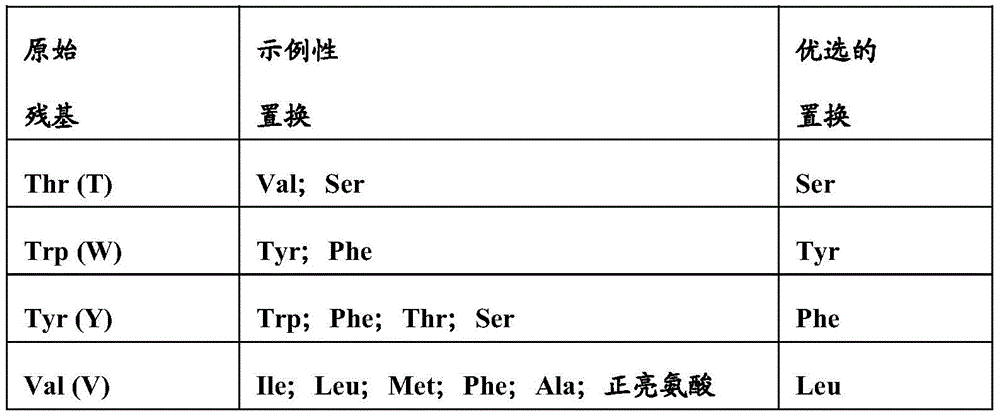
氨基酸可以根据常见的侧链特性分组:Amino acids can be grouped according to common side chain properties:
(1)疏水性:正亮氨酸、Met、Ala、Val、Leu;Ile;(1) Hydrophobicity: norleucine, Met, Ala, Val, Leu; Ile;
(2)中性亲水:Cys、Ser、Thr、Asn;Gln;(2) Neutral hydrophilic: Cys, Ser, Thr, Asn; Gln;
(3)酸性:Asp、Glu;(3) Acidic: Asp, Glu;
(4)碱性:His、Lys、Arg;(4) Alkaline: His, Lys, Arg;
(5)影响链方向的残基:Gly、Pro;(5) Residues affecting chain orientation: Gly, Pro;
(6)芳族:Trp、Tyr、Phe。(6) Aromatic: Trp, Tyr, Phe.
非保守性置换将使这些类别之一的成员交换为另一个类别的成员。Non-conservative substitutions would exchange a member of one of these classes for a member of the other class.
一个置换变体类型涉及置换亲本抗体(例如,人源化或人抗体)的一个或多个高变区残基。通常,经选择用于进一步研究的所得变体将相对于亲本抗体在某些生物学特性方面(例如,增加的亲和力、降低的免疫原性)具有修饰(例如,改善)和/或将具有亲本抗体的基本上保留的某些生物学特性。示例性置换变体是亲和力成熟抗体,所述抗体可以例如使用基于噬菌体展示的亲和力成熟技术如本文所述的那些技术便利地产生。简而言之,将一个或多个HVR残基突变并且将变体抗体在噬菌体上展示并筛选特定生物活性(例如结合亲和力)。One type of substitutional variant involves substituting one or more hypervariable region residues of a parent antibody (eg, a humanized or human antibody). Typically, the resulting variant selected for further study will have a modification (eg, improvement) relative to the parent antibody in some biological property (eg, increased affinity, decreased immunogenicity) and/or will have the parent antibody Certain biological properties of an antibody are substantially retained. Exemplary substitutional variants are affinity matured antibodies, which can be conveniently produced, eg, using phage display-based affinity maturation techniques such as those described herein. Briefly, one or more HVR residues are mutated and variant antibodies are displayed on phage and screened for specific biological activity (eg, binding affinity).
可以在HVR中做出改变(例如,置换),例如以改善抗体亲和力。可以在HVR“热点”(即,在体细胞成熟过程期间以高频率经历突变的密码子所编码的残基(见,例如,Chowdhury,P.S.,Methods Mol.Biol.207(2008)179-196)和/或接触抗原的残基中做出这类改变,同时对所产生的变体VH或VL测试结合亲和力。已经例如在Hoogenboom,H.R.等人,引自Methods in Molecular Biology 178(2002)1-37中描述了通过构建次级文库并从中重新选择实现亲和力成熟。在亲和力成熟的一些实施方案中,通过多种方法(例如,易错PCR、链改组或寡核苷酸定向诱变)的任一种,将多样性引入所选择用于成熟的可变基因中。随后产生次级文库。随后筛选该文库以鉴定具有所需亲和力的任何抗体变体。另一种引入多样性的方法涉及HVR指导的方案,其中将几个HVR残基(例如,一次4-6个残基)随机分组。可以特别地鉴定参与抗原结合的HVR残基,例如,使用丙氨酸扫描法诱变或建模。特别地经常靶向CDR-H3和CDR-L3。Changes (eg, substitutions) can be made in the HVR, eg, to improve antibody affinity. Residues encoded by codons that can be at HVR "hot spots" (ie, undergo mutations with high frequency during the somatic maturation process (see, eg, Chowdhury, P.S., Methods Mol. Biol. 207 (2008) 179-196) Such changes are made in and/or in residues that contact the antigen, while the resulting variant VH or VL is tested for binding affinity. It has been e.g. in Hoogenboom, H.R. et al., cited in Methods in Molecular Biology 178 (2002) 1- Affinity maturation by construction of secondary libraries and reselection therefrom is described in 37. In some embodiments of affinity maturation, by any of a variety of methods (eg, error-prone PCR, strand shuffling, or oligonucleotide-directed mutagenesis) In one, diversity is introduced into variable genes selected for maturation. A secondary library is then generated. The library is then screened to identify any antibody variants with the desired affinity. Another method of introducing diversity involves HVR Guided protocol in which several HVR residues (eg, 4-6 residues at a time) are randomly grouped. HVR residues involved in antigen binding can be specifically identified, eg, using alanine scanning mutagenesis or modeling In particular, CDR-H3 and CDR-L3 are often targeted.
在某些实施方案中,置换、插入或缺失可以在一个或多个HVR内部出现,只要这类改变不实质降低抗体结合抗原的能力。例如,可以在HVR中做出不实质降低结合亲和力的保守性改变(例如,如本文中提供的保守性置换)。这类改变可以例如是在HVR中的抗原接触残基外部。在上文提供的变体VH和VL序列的某些实施方案中,每个HVR或者不予改变或含有不多于一个、两个或三个氨基酸置换。In certain embodiments, substitutions, insertions, or deletions may occur within one or more HVRs, so long as such changes do not substantially reduce the ability of the antibody to bind antigen. For example, conservative changes (eg, conservative substitutions as provided herein) can be made in the HVR that do not substantially reduce binding affinity. Such alterations can, for example, be external to antigen-contacting residues in the HVR. In certain embodiments of the variant VH and VL sequences provided above, each HVR is either unaltered or contains no more than one, two or three amino acid substitutions.
一种用于鉴定可以被靶向用于诱变的抗体残基或区域的有用方法称作“丙氨酸扫描法诱变法”,如Cunningham,B.C.和Wells,J.A.,Science 244(1989)1081-1085所述。在这种方法中,鉴定一个残基或靶残基组(例如,带电荷残基如Arg、Asp、His、Lys和Glu)并且用中性或带负电荷的氨基酸(例如,丙氨酸或聚丙氨酸)替换以确定该抗体与抗原的相互作用是否受影响。可以在对于初始置换显示功能敏感的氨基酸位置处引入其他置换。备选地或额外地,可以利用抗原-抗体复合物的晶体结构以鉴定抗体和抗原之间的接触点。可以将这类接触残基和邻近残基作为置换候选物打靶或消除。可以筛选变体以确定它们是否含有所需的特性。A useful method for identifying antibody residues or regions that can be targeted for mutagenesis is called "alanine scanning mutagenesis," as described in Cunningham, B.C. and Wells, J.A., Science 244 (1989) 1081 -1085 stated. In this method, a residue or group of target residues is identified (eg, charged residues such as Arg, Asp, His, Lys, and Glu) and neutral or negatively charged amino acids (eg, alanine or polyalanine) to determine whether the interaction of the antibody with the antigen is affected. Additional substitutions can be introduced at amino acid positions that were shown to be functionally sensitive to the initial substitution. Alternatively or additionally, crystal structures of antigen-antibody complexes can be utilized to identify contact points between antibody and antigen. Such contact residues and adjacent residues can be targeted or eliminated as candidates for substitution. Variants can be screened to determine whether they contain desired properties.
氨基酸序列插入包括长度从1个残基至含有成百个或更多个残基的多肽间变动的氨基端和/或羧基端融合,以及单个或多个氨基酸残基的序列内插入。末端插入的例子包括具有N末端甲硫氨酰基残基的抗体。抗体分子的其他插入性变体包括抗体的N末端或C末端与酶(例如针对ADEPT的酶)或增加该抗体血清半寿期的多肽融合。Amino acid sequence insertions include amino- and/or carboxy-terminal fusions ranging in length from 1 residue to polypeptides containing hundreds or more residues, as well as intrasequence insertions of single or multiple amino acid residues. Examples of terminal insertions include antibodies with an N-terminal methionyl residue. Other insertional variants of the antibody molecule include fusion of the N- or C-terminus of the antibody to an enzyme (eg, for ADEPT) or a polypeptide that increases the serum half-life of the antibody.
b)糖基化变体b) Glycosylation variants
在某些实施方案中,改变本文提供的抗体以增加或减少抗体发生糖基化的程度。可以通过改变氨基酸序列从而创造或移除一个或多个糖基化位点,便利地实现对抗体产生或删除糖基化位点。In certain embodiments, the antibodies provided herein are altered to increase or decrease the degree to which the antibodies undergo glycosylation. Antibody production or deletion of glycosylation sites can be conveniently accomplished by altering the amino acid sequence so as to create or remove one or more glycosylation sites.
在抗体包含Fc区的情况下,可以改变与之连接的糖。哺乳动物细胞产生的天然抗体一般包含分枝的双天线状低聚糖,所述低聚糖通常借助N联连接至Fc区的CH2结构域的Asn297。参见,例如,Wright,A.和Morrison,S.L.,TIBTECH15(1997)26-32。低聚糖可以包括各种糖,例如,甘露糖、N-乙酰氨基葡萄糖(GlcNAc)、半乳糖和唾液酸,以及与双天线状低聚糖结构的“茎部”中GlcNAc连接的岩藻糖。在一些实施方案中,可以修饰本发明抗体中的低聚糖以产生某些特性改善的抗体变体。Where the antibody comprises an Fc region, the carbohydrate attached to it can be varied. Natural antibodies produced by mammalian cells typically contain branched biantennary oligosaccharides, usually N-linked to Asn297 of the CH2 domain of the Fc region. See, eg, Wright, A. and Morrison, S.L., TIBTECH 15 (1997) 26-32. Oligosaccharides can include various sugars such as mannose, N-acetylglucosamine (GlcNAc), galactose and sialic acid, as well as fucose linked to GlcNAc in the "stem" of the biantennary oligosaccharide structure . In some embodiments, the oligosaccharides in the antibodies of the invention can be modified to generate antibody variants with improved certain properties.
在一个实施方案中,提供具有糖结构的抗体变体,所述糖结构缺少与Fc区(直接或间接)连接的岩藻糖。例如,这种抗体中岩藻糖的量可以是1%至80%、1%至65%、5%至65%或20%至40%。通过以下方式确定岩藻糖的量:相对于如通过MALDI-TOF质谱法所测量的与Asn297连接的全部糖结构(例如复杂结构、杂合结构和高甘露糖结构)的总和,计算糖链内部Asn297处岩藻糖的平均量,例如,如WO 2008/077546中所述。Asn297指位于Fc区内约第297位置处的天冬酰胺残基(Fc区残基的EU编号);然而,Asn297也可以位于第297位置的上游或下游±3个氨基酸附近,即,第294和300位置之间,原因在于抗体中的微小序列变异。这类岩藻糖化变体可以具有改善的ADCC功能。参见,例如,US 2003/0157108;US 2004/0093621。与“去岩藻糖化”或“缺乏岩藻糖的”抗体变体相关的出版物的例子包括:US 2003/0157108;WO 2000/61739;WO 2001/29246;US 2003/0115614;US 2002/0164328;US 2004/0093621;US 2004/0132140;US 2004/0110704;US 2004/0110282;US 2004/0109865;WO2003/085119;WO 2003/084570;WO 2005/035586;WO 2005/035778;WO 2005/053742;WO2002/031140;Okazaki,A.等人,J.Mol.Biol.336(2004)1239-1249;Yamane-Ohnuki,N.等人,Biotech.Bioeng.87(2004)614-622。能够产生去岩藻糖化抗体的细胞系的例子包括在蛋白质岩藻糖化方面缺陷的Lec13CHO细胞(Ripka,J.等人,Arch.Biochem.Biophys.249(1986)533-545;US2003/0157108;和WO 2004/056312,特别在实施例11处)和敲除细胞系,如α-1,6-岩藻糖基转移酶基因FUT8敲除的CHO细胞(例如,见Yamane-Ohnukii,N等人,Biotech.Bioeng.87(2004)614-622;Kanda,Y.等人,Biotechnol.Bioeng.94(2006)680-688;和WO 2003/085107)。In one embodiment, antibody variants are provided that have carbohydrate structures lacking fucose linked (directly or indirectly) to the Fc region. For example, the amount of fucose in such an antibody may be 1% to 80%, 1% to 65%, 5% to 65%, or 20% to 40%. The amount of fucose was determined by calculating the inside of the sugar chain relative to the sum of all sugar structures (eg complex structures, hybrid structures and high mannose structures) linked to Asn297 as measured by MALDI-TOF mass spectrometry The average amount of fucose at Asn297, for example, as described in WO 2008/077546. Asn297 refers to the asparagine residue located at about position 297 in the Fc region (EU numbering of Fc region residues); however, Asn297 can also be located about ±3 amino acids upstream or downstream of position 297, i.e., position 294 between
还可以对抗体变体提供双分低聚糖,例如,其中与抗体Fc区连接的双天线状低聚糖由GlcNAc对分。这类抗体变体可以具有减少的岩藻糖化和/或改善的ADCC功能。这类抗体变体的例子例如在WO 2003/011878;US6,602,684;和US 2005/0123546中描述。也提供低聚糖中至少一个半乳糖残基与Fc区连接的抗体变体。这类抗体变体可以具有改善的CDC功能。这类抗体变体例如在WO 1997/30087;WO 1998/58964和WO1999/22764中描述。Antibody variants can also be provided with bipartite oligosaccharides, eg, wherein the biantennary oligosaccharide linked to the Fc region of the antibody is bisected by GlcNAc. Such antibody variants may have reduced fucosylation and/or improved ADCC function. Examples of such antibody variants are described, for example, in WO 2003/011878; US 6,602,684; and US 2005/0123546. Antibody variants in which at least one galactose residue in the oligosaccharide is linked to the Fc region are also provided. Such antibody variants may have improved CDC function. Such antibody variants are described, for example, in WO 1997/30087; WO 1998/58964 and WO 1999/22764.
c)Fc区变体c) Fc region variants
在某些实施方案中,可以将一个或多个其他氨基酸修饰引入如本文中报道的二聚体多肽中,因而产生Fc区变体。该Fc区变体可以包含人Fc区序列(例如,人IgG1、IgG2、IgG3或IgG4 Fc区),所述人Fc区序列在一个或多个氨基酸位置处包含氨基酸修饰(例如,置换/突变)。In certain embodiments, one or more additional amino acid modifications can be introduced into a dimeric polypeptide as reported herein, thereby generating Fc region variants. The Fc region variant may comprise a human Fc region sequence (eg, a human IgGl, IgG2, IgG3 or IgG4 Fc region) comprising amino acid modifications (eg, substitutions/mutations) at one or more amino acid positions .
在某些实施方案中,本发明构思了拥有一些但非全部效应子功能的二聚体多肽,这使所述二聚体多肽成为下述应用的有利候选物,其中二聚体多肽的体内半寿期重要,而某些效应子功能(如CDC和ADCC)是不必要或有害的。可以实施体外和/或体内细胞毒性测定法以证实CDC和/或ADCC活性降低/耗尽。例如,可以实施Fc受体(FcR)结合测定法以确保二聚体多肽抗体缺少FcγR结合作用(因此可能缺少ADCC活性),但是保留FcRn结合能力。介导ADCC的原代细胞-NK细胞仅表达FcγRIII,而单核细胞表达FcγRI、FcγRII和FcγRIII。Ravetch,J.V.和Kinet,J.P.,Annu.Rev.Immunol.9(1991)457-492的第464页上的表3中总结了造血细胞上的FcR表达。评估目的分子的ADCC活性的体外测定法的非限制性例子在US5,500,362(参见,例如,Hellstrom,I.等人,Proc.Natl.Acad.Sci.USA 83(1986)7059-7063;和Hellstrom,I.等人,Proc.Natl.Acad.Sci.USA 82(1985)1499-1502);US 5,821,337(参见Bruggemann,M.等人,J.Exp.Med.166(1987)1351-1361))中描述。备选地,可以使用非放射性分析方法(参见,例如,用于流式细胞术的ACTITM非放射性细胞毒性测定法(CellTechnology,Inc.Mountain View,CA;和CytoTox
效应子功能减少的二聚体多肽包括置换一个或多个Fc区残基238、265、269、270、297、327和329(US 6,737,056)的那些。这类Fc区变体包括在氨基酸位置265、269、270、297和327的两个或更多个位置处具有置换的Fc区,包括残基265和297置换成丙氨酸的所谓“DANA”Fc区突变体(US 7,332,581)。Dimeric polypeptides with reduced effector function include those that replace one or more of Fc region residues 238, 265, 269, 270, 297, 327 and 329 (US 6,737,056). Such Fc region variants include Fc regions with substitutions at two or more of amino acid positions 265, 269, 270, 297 and 327, including the so-called "DANA" in which residues 265 and 297 are replaced by alanines Fc region mutants (US 7,332,581).
描述了具有FcR结合作用改善或削弱的某些抗体变体(参见,例如,US 6,737,056;WO2004/056312,和Shields,R.L.等人,J.Biol.Chem.276(2001)6591-6604)。Certain antibody variants with improved or impaired FcR binding are described (see, eg, US 6,737,056; WO2004/056312, and Shields, R.L. et al., J. Biol. Chem. 276 (2001) 6591-6604).
在某些实施方案中,二聚体多肽变体包含具有改善ADCC的一个或多个氨基酸置换(例如,在Fc区的第298、333和/或334位置处的置换)(残基的EU编号)的Fc区。In certain embodiments, the dimeric polypeptide variant comprises one or more amino acid substitutions (eg, substitutions at positions 298, 333 and/or 334 of the Fc region) with improved ADCC (EU numbering of residues) ) of the Fc region.
在一些实施方案中,在Fc区内做出改变,所述改变导致变更(即改善或削弱)的C1q结合作用和/或补体依赖的细胞毒性(CDC),例如,如US 6,194,551、WO 99/51642和Idusogie,E.E.等人,J.Immunol.164(2000)4178-4184中所述。In some embodiments, changes are made in the Fc region that result in altered (ie, improved or impaired) C1q binding and/or complement-dependent cytotoxicity (CDC), eg, as in US 6,194,551, WO 99/ 51642 and in Idusogie, E.E. et al., J. Immunol. 164 (2000) 4178-4184.
在US 2005/0014934中描述了半寿期增加和新生儿Fc受体(FcRn)结合作用改善的抗体,所述新生儿Fc受体负责转移母源IgG至胎儿(Guyer,R.L.等人,J.Immunol.117(1976)587-593和Kim,J.K.等人,J.Immunol.24(1994)2429-2434)。这些抗体包含其中具有一个或多个置换的Fc区,其中所述置换改善Fc区与FcRn的结合。这类Fc区变体包括在一个或多个Fc区残基:238、256、265、272、286、303、305、307、311、312、317、340、356、360、362、376、378、380、382、413、424或434处具有置换(例如,Fc区残基434的置换)的那些(US 7,371,826)。Antibodies with increased half-life and improved binding to the neonatal Fc receptor (FcRn) responsible for the transfer of maternal IgG to the fetus are described in US 2005/0014934 (Guyer, R.L. et al., J. Immunol. 117 (1976) 587-593 and Kim, J.K. et al., J. Immunol. 24 (1994) 2429-2434). These antibodies comprise an Fc region with one or more substitutions therein, wherein the substitutions improve binding of the Fc region to FcRn. Such Fc region variants include at one or more Fc region residues: 238, 256, 265, 272, 286, 303, 305, 307, 311, 312, 317, 340, 356, 360, 362, 376, 378 Those with substitutions at , 380, 382, 413, 424, or 434 (eg, substitution of Fc region residue 434) (US 7,371,826).
关于Fc区变体的其他例子,还参见Duncan,A.R.和Winter,G.,Nature 322(1988)738-740;US 5,648,260;US 5,624,821和WO 94/29351。See also Duncan, A.R. and Winter, G., Nature 322 (1988) 738-740; US 5,648,260; US 5,624,821 and WO 94/29351 for other examples of Fc region variants.
d)半胱氨酸工程化抗体变体d) Cysteine-engineered antibody variants
在某些实施方案中,可能想要产生半胱氨酸工程化的二聚体多肽,例如,类似于“硫代MAb”,其中所述抗体的一个或多个残基用半胱氨酸残基置换。在具体的实施方案中,置换的残基出现在二聚体多肽的可及位点处。通过用半胱氨酸置换这些残基,因而将反应性巯基安置在二聚体多肽的可及位点处并且可以用来使二聚体多肽缀合至其他部分,如药物部分或接头-药物部分以产生免疫缀合物,如本文中进一步所述。在某些实施方案中,可以用半胱氨酸置换以下残基的任何一个或多个:轻链的V205(Kabat编号);重链的A118(EU编号);和重链Fc区的S400(EU编号)。可以例如US 7,521,541中所述那样产生半胱氨酸工程化的二聚体多肽。In certain embodiments, it may be desirable to generate cysteine-engineered dimeric polypeptides, eg, similar to "thioMAbs," wherein one or more residues of the antibody are replaced with cysteine residues base replacement. In specific embodiments, the substituted residues occur at accessible sites in the dimeric polypeptide. By replacing these residues with cysteine, reactive sulfhydryl groups are thus placed at accessible sites in the dimeric polypeptide and can be used to conjugate the dimeric polypeptide to other moieties, such as drug moieties or linker-drugs moiety to generate immunoconjugates, as described further herein. In certain embodiments, cysteine may be substituted for any one or more of the following residues: V205 (Kabat numbering) of the light chain; A118 (EU numbering) of the heavy chain; and S400 of the Fc region of the heavy chain ( EU number). Cysteine-engineered dimeric polypeptides can be produced, for example, as described in US 7,521,541.
e)衍生物e) Derivatives
在某些实施方案中,可以进一步修饰如本文中报道的二聚体多肽以含有本领域已知并轻易可获得的额外的非蛋白质部分。适于二聚体多肽衍生化的部分包括但不限于水溶性聚合物。水溶性聚合物的非限制性例子包括但不限于聚乙二醇(PEG)、乙二醇/丙二醇的共聚物、羧甲基纤维素、葡聚糖、聚乙烯醇、聚乙烯吡咯烷酮、聚1,3-二氧戊环、聚1,3,6-三
在另一个实施方案中,提供了如本文中报道的二聚体多肽体和可以通过暴露于辐射而选择性加热的非蛋白质部分的缀合物。在一个实施方案中,非蛋白质部分是碳纳米管(Kam,N.W.等人,Proc.Natl.Acad.Sci.USA 102(2005)11600-11605)。辐射可以具有任何波长,并包括但不限于这样的波长,所述波长不伤害普通细胞,但是使非蛋白质部加热至杀伤临近于二聚体多肽-非蛋白质部分的细胞的温度。In another embodiment, a conjugate of a dimeric polypeptide body as reported herein and a non-protein moiety that can be selectively heated by exposure to radiation is provided. In one embodiment, the non-protein moiety is a carbon nanotube (Kam, N.W. et al., Proc. Natl. Acad. Sci. USA 102 (2005) 11600-11605). The radiation can be of any wavelength and includes, but is not limited to, wavelengths that do not harm ordinary cells, but heat the non-protein moiety to a temperature that would kill cells adjacent to the dimeric polypeptide-non-protein moiety.
f)异二聚化f) Heterodimerization
存在几种修饰CH3以增强异二聚化的方案,这些方案例如在WO 96/27011、WO 98/050431、EP 1870459、WO 2007/110205、WO 2007/147901、WO 2009/089004、WO 2010/129304、WO 2011/90754、WO 2011/143545、WO 2012058768、WO 2013157954、WO 2013096291中充分描述。一般地,在全部这类方案中,第一CH3结构域和第二CH3结构域均以互补方式工程化,从而每个CH3结构域(或包含它的重链)不能与自身同型二聚化,而是被迫与另一个工程化的互补性CH3结构域异二聚化(从而第一和第二CH3结构域异二聚化并且在两个第一CH3结构域之间或两个第二CH3结构域之间不形成同型二聚体)。构思用于改善重链异二聚化的这些不同方案作为本发明的多特异性抗体中与重链–轻链修饰组合的不同替代方案(在一个结合臂中VH和VL交换/替换并且在CH1/CL界面中引入带相反电荷的带电荷氨基酸置换)以减少轻链错误配对的Bence-Jones型副产物。There are several protocols for modifying CH3 to enhance heterodimerization, for example in WO 96/27011, WO 98/050431, EP 1870459, WO 2007/110205, WO 2007/147901, WO 2009/089004, WO 2010/129304 , WO 2011/90754, WO 2011/143545, WO 2012058768, WO 2013157954, WO 2013096291 are fully described. Generally, in all such schemes, the first CH3 domain and the second CH3 domain are engineered in a complementary manner such that each CH3 domain (or the heavy chain comprising it) cannot homodimerize with itself, Instead, it is forced to heterodimerize with another engineered, complementary CH3 domain (thus the first and second CH3 domains are heterodimerized and either between the two first CH3 domains or between the two second CH3 domains no homodimer formation between domains). These different schemes for improving heavy chain heterodimerization were conceived as different alternatives in combination with heavy chain-light chain modifications in the multispecific antibodies of the invention (VH and VL exchange/replacement in one binding arm and in CH1 The introduction of oppositely charged amino acid substitutions into the /CL interface) to reduce Bence-Jones-type by-products of light chain mispairing.
在本发明的一个优选实施方案中(这种情况下,多特异性抗体在重链中包含CH3结构域),可以通过“结入扣”技术改变本发明的所述多特异性抗体的CH3结构域,所述技术以例如WO 96/027011;Ridgway,J.B.等人,Protein Eng.9(1996)617-621;和Merchant,A.M.等人,Nat.Biotechnol.16(1998)677-681;WO 98/050431中的几个例子详述。在这种方法中,改变两个CH3结构域的相互作用面以增加含有这两个CH3结构域的两条重链的异二聚化。(两条重链的)两个CH3结构域的一者可以是“结”,而另一者是“扣”。二硫键的引入进一步稳定异二聚体(Merchant,A.M等人,Nature Biotech.16(1998)677-681;Atwell,S.等人,J.Mol.Biol.270(1997)26-35)并增加产率。In a preferred embodiment of the invention (in which case the multispecific antibody comprises a CH3 domain in the heavy chain), the CH3 structure of the multispecific antibody of the invention can be altered by "knocking" techniques WO 96/027011; Ridgway, J.B. et al., Protein Eng. 9 (1996) 617-621; and Merchant, A.M. et al., Nat. Biotechnol. 16 (1998) 677-681; WO 98 Several examples in /050431 are detailed. In this approach, the interaction surfaces of the two CH3 domains are altered to increase the heterodimerization of the two heavy chains containing the two CH3 domains. One of the two CH3 domains (of the two heavy chains) can be the "knot" and the other the "button". The introduction of disulfide bonds further stabilizes the heterodimer (Merchant, A.M. et al., Nature Biotech. 16 (1998) 677-681; Atwell, S. et al., J. Mol. Biol. 270 (1997) 26-35) and increase productivity.
因此在本发明的一个实施方案中,所述多特异性抗体(在每条重链中包含CH3结构域以及)其特征在于Thus in one embodiment of the invention the multispecific antibody (comprising a CH3 domain in each heavy chain and) is characterized by
在a)下的抗体的第一重链的第一CH3结构域和在b)下的抗体的第二重链的第二CH3结构域各自在包含抗体CH3结构域之间的初始界面的界面处会合。The first CH3 domain of the first heavy chain of the antibody under a) and the second CH3 domain of the second heavy chain of the antibody under b) are each at the interface comprising the initial interface between the antibody CH3 domains meet.
其中改变所述界面以促进多特异性抗体的形成,其中所述改变的特征在于wherein the interface is altered to facilitate the formation of multispecific antibodies, wherein the alteration is characterized by
i)如此改变一条重链的CH3结构域,i) so altering the CH3 domain of a heavy chain,
从而在多特异性抗体内部,一条重链的CH3结构域的初始界面内部会合另一条重链的CH3结构域的初始界面,Thus within a multispecific antibody, the initial interface of the CH3 domain of one heavy chain meets the initial interface of the CH3 domain of the other heavy chain,
将氨基酸残基替换为具有更大侧链体积的氨基酸残基,因而在一个重链的CH3结构域的界面内部产生突出部分,所述突出部分可布置在另一个重链的CH3结构域的界面内部的空穴中。Replacement of amino acid residues with amino acid residues with greater side chain bulk, thus creating overhangs within the interface of the CH3 domain of one heavy chain that can be placed at the interface of the CH3 domain of another heavy chain in the internal cavity.
并且and
ii)如此改变另一条重链的CH3结构域,ii) so altering the CH3 domain of the other heavy chain,
从而在多特异性抗体内部,第二CH3结构域的初始界面内部会合第一CH3结构域的初始界面,Thus within the multispecific antibody, the initial interface of the second CH3 domain meets the initial interface of the first CH3 domain,
将氨基酸残基替换为具有更小侧链体积的氨基酸残基,因而在第二CH3结构域的界面内部产生空穴,在所述空穴内部可布置第一CH3结构域界面内部的突出部分。Replacing amino acid residues with amino acid residues with smaller side chain bulk thus creates a cavity inside the interface of the second CH3 domain, within which the overhangs inside the interface of the first CH3 domain can be arranged.
优选地,所述具有更大侧链体积的氨基酸残基选自精氨酸(R)、苯丙氨酸(F)、酪氨酸(Y)、色氨酸(W)。Preferably, the amino acid residue with a larger side chain volume is selected from arginine (R), phenylalanine (F), tyrosine (Y), tryptophan (W).
优选地,所述具有更小侧链体积的氨基酸残基选自丙氨酸(A)、丝氨酸(S)、苏氨酸(T)、缬氨酸(V)。Preferably, the amino acid residue with smaller side chain volume is selected from alanine (A), serine (S), threonine (T), valine (V).
在本发明的一个方面,通过以下方式进一步改变两个CH3结构域:如此引入半胱氨酸(C)作为每个CH3结构域的相应位置中的氨基酸,从而能形成两个CH3结构域之间的二硫键。In one aspect of the invention, the two CH3 domains are further altered by introducing cysteine (C) as the amino acid in the corresponding position of each CH3 domain such that a gap between the two CH3 domains can be formed of disulfide bonds.
在一个优选的实施方案中,所述多特异性抗体在“结链”的第一CH3结构域中包含氨基酸T366W突变并且在“扣链”的第二CH3结构域中包含氨基酸T366S、L368A、Y407V突变。也可以使用CH3结构域之间的额外链间二硫键(Merchant,A.M等人,Nature Biotech 16(1998)677-681),例如通过向“扣链”的CH3结构域引入氨基酸Y349C突变并向“结链”的CH3结构域引入氨基酸E356C突变或氨基酸S354C突变。In a preferred embodiment, the multispecific antibody comprises the amino acid T366W mutation in the first CH3 domain of the "knot" and amino acids T366S, L368A, Y407V in the second CH3 domain of the "knot" mutation. Additional interchain disulfide bonds between the CH3 domains can also be used (Merchant, A.M. et al., Nature Biotech 16 (1998) 677-681 ), for example by introducing the amino acid Y349C mutation into the CH3 domain of the "buckle" and An amino acid E356C mutation or an amino acid S354C mutation was introduced into the CH3 domain of the "knot".
在一个优选的实施方案中,所述多特异性抗体(其在每条重链中包含CH3结构域)在两个CH3结构域之一中包含氨基酸S354C、T366W突变并且在两个CH3结构域的另一个结构域中包含氨基酸Y349C、T366S、L368A、Y407V突变(在一个CH3域中的额外氨基酸S354C突变和另一个CH3域中的额外氨基酸Y349C突变形成链间二硫键)(根据Kabat编号)。In a preferred embodiment, the multispecific antibody (which comprises a CH3 domain in each heavy chain) comprises amino acid S354C, T366W mutations in one of the two CH3 domains and a mutation between the two CH3 domains The other domain contains amino acid Y349C, T366S, L368A, Y407V mutations (an additional amino acid S354C mutation in one CH3 domain and an additional amino acid Y349C mutation in the other CH3 domain form an interchain disulfide bond) (numbering according to Kabat).
构思用于修饰CH3以增强异二聚化的其他技术作为本发明的替代并且它们例如在WO 96/27011、WO 98/050431,EP1870459、WO 2007/110205、WO 2007/147901、WO 2009/089004、WO 2010/129304、WO 2011/90754、WO 2011/143545、WO 2012/058768、WO 2013/157954、WO 2013/096291中描述。Other techniques for modifying CH3 to enhance heterodimerization are envisaged as an alternative to the present invention and they are described for example in WO 96/27011, WO 98/050431, EP1870459, WO 2007/110205, WO 2007/147901, WO 2009/089004, Described in WO 2010/129304, WO 2011/90754, WO 2011/143545, WO 2012/058768, WO 2013/157954, WO 2013/096291.
在一个实施方案中,可以备选地使用EP 1 870 459A1中描述的异二聚化方案。这种方法基于在两条重链之间的CH3/CH3结构域界面中特定氨基酸位置处引入带相反电荷的带电荷氨基酸置换/突变。所述多特异性抗体的一个优选实施方案是在(多特异性抗体的)第一CH3结构域中的氨基酸R409D、K370E突变和在多特异性抗体的第二CH3结构域中的氨基酸D399K、E357K突变(根据Kabat编号)。In one embodiment, the heterodimerization scheme described in
在另一个实施方案中,所述多特异性抗体在“结链”的CH3结构域中包含氨基酸T366W突变并且在“扣链”的CH3结构域中包含氨基酸T366S、L368A、Y407V突变以及额外地在“结链”的CH3结构域中包含氨基酸R409D、K370E突变及在“扣链”的CH3结构域中包含氨基酸D399K、E357K突变。In another embodiment, the multispecific antibody comprises the amino acid T366W mutation in the CH3 domain of the "knot" and amino acid T366S, L368A, Y407V mutations in the CH3 domain of the "knot" and additionally in The CH3 domain of "knot" contains amino acid R409D, K370E mutation and the CH3 domain of "chain" contains amino acid D399K, E357K mutation.
在另一个实施方案中,所述多特异性抗体在两个CH3结构域之一中包含氨基酸S354C、T366W突变及在两个CH3结构域的另一结构域中包含氨基酸Y349C、T366S、L368A、Y407V突变,或者所述多特异性抗体在两个CH3结构域之一中包含氨基酸Y349C、T366W突变及在两个CH3结构域的另一结构域中包含氨基酸S354C、T366S、L368A、Y407V突变以及额外地在“结链”的CH3结构域中包含氨基酸R409D、K370E突变及在“扣链”的CH3结构域中包含氨基酸D399K、E357K突变。In another embodiment, the multispecific antibody comprises amino acids S354C, T366W mutations in one of the two CH3 domains and amino acids Y349C, T366S, L368A, Y407V in the other of the two CH3 domains Mutations, or the multispecific antibody comprises amino acid Y349C, T366W mutations in one of the two CH3 domains and amino acid S354C, T366S, L368A, Y407V mutations in the other of the two CH3 domains and additionally The amino acid R409D, K370E mutation is included in the CH3 domain of the "knot" and the amino acid D399K, E357K mutation is included in the CH3 domain of the "chain".
在一个实施方案中,可以备选地使用WO 2013/157953中描述的异二聚化方案。在一个实施方案中,第一CH3结构域包含氨基酸T366K突变并且第二CH3结构域多肽包含氨基酸L351D突变。在又一个实施方案中,第一CH3结构域包含又一个氨基酸L351K突变。在又一个实施方案中,第二CH3结构域包含选自Y349E、Y349D和L368E(优选地L368E)的其他氨基酸突变。In one embodiment, the heterodimerization scheme described in WO 2013/157953 may alternatively be used. In one embodiment, the first CH3 domain comprises the amino acid T366K mutation and the second CH3 domain polypeptide comprises the amino acid L351D mutation. In yet another embodiment, the first CH3 domain comprises yet another amino acid L351K mutation. In yet another embodiment, the second CH3 domain comprises other amino acid mutations selected from Y349E, Y349D and L368E (preferably L368E).
在一个实施方案中,可以备选地使用WO 2012/058768中描述的异二聚化方案。在一个实施方案中,第一CH3结构域包含氨基酸L351Y、Y407A突变并且第二CH3结构域包含氨基酸T366A、K409F突变。在又一个实施方案中,第二CH3结构域在位置T411、D399、S400、F405、N390或K392处包含又一个氨基酸突变,所述氨基酸突变例如选自a)T411N、T411R、T411Q、T411K、T411D、T411E或T411W,b)D399R、D399W、D399Y或D399K,c)S400E、S400D、S400R或S400K、F405I、F405M、F405T、F405S、F405V或F405W、N390R、N390K或N390D、K392V、K392M、K392R、K392L、K392F或K392E。在又一个实施方案中,第一CH3结构域包含氨基酸L351Y、Y407A突变并且第二CH3结构域包含氨基酸T366V、K409F突变。在又一个实施方案中,第一CH3结构域包含氨基酸Y407A突变并且第二CH3结构域包含氨基酸T366A、K409F突变。在又一个实施方案中,第二CH3结构域包含又一个氨基酸突变K392E、T411E、D399R和S400R。In one embodiment, the heterodimerization scheme described in WO 2012/058768 may alternatively be used. In one embodiment, the first CH3 domain comprises amino acid L351Y, Y407A mutations and the second CH3 domain comprises amino acid T366A, K409F mutations. In yet another embodiment, the second CH3 domain comprises a further amino acid mutation at positions T411, D399, S400, F405, N390 or K392, for example selected from a) T411N, T411R, T411Q, T411K, T411D , T411E or T411W, b) D399R, D399W, D399Y or D399K, c) S400E, S400D, S400R or S400K, F405I, F405M, F405T, F405S, F405V or F405W, N390R, N390K or N390D, K292V, K390D , K392F or K392E. In yet another embodiment, the first CH3 domain comprises amino acid L351Y, Y407A mutations and the second CH3 domain comprises amino acid T366V, K409F mutations. In yet another embodiment, the first CH3 domain comprises amino acid Y407A mutations and the second CH3 domain comprises amino acid T366A, K409F mutations. In yet another embodiment, the second CH3 domain comprises yet another amino acid mutation K392E, T411E, D399R and S400R.
在一个实施方案中,可以备选地使用WO 2011/143545中描述的异二聚化方案,例如在选自368和409的位置具有氨基酸修饰。In one embodiment, the heterodimerization scheme described in WO 2011/143545 can alternatively be used, eg with amino acid modifications at positions selected from 368 and 409.
在一个实施方案中,可以备选地使用WO 2011/090762中描述的异二聚化方案,所述方案也使用上文所述的结入扣技术。在一个实施方案中,第一CH3结构域包含氨基酸T366W突变并且第二CH3结构域包含氨基酸Y407A突变。在一个实施方案中,第一CH3结构域包含氨基酸T366Y突变并且第二CH3结构域包含氨基酸Y407T突变。In one embodiment, the heterodimerization scheme described in WO 2011/090762, which also uses the knot-in technique described above, may alternatively be used. In one embodiment, the first CH3 domain comprises the amino acid T366W mutation and the second CH3 domain comprises the amino acid Y407A mutation. In one embodiment, the first CH3 domain comprises the amino acid T366Y mutation and the second CH3 domain comprises the amino acid Y407T mutation.
在一个实施方案中,多特异性抗体属于IgG2同种型并且可以备选地使用WO 2010/129304中描述的异二聚化方案。In one embodiment, the multispecific antibody is of the IgG2 isotype and may alternatively use the heterodimerization scheme described in WO 2010/129304.
在一个实施方案中,可以备选地使用WO 2009/089004中描述的异二聚化方案。在一个实施方案中,第一CH3结构域包含带负电荷氨基酸(例如谷氨酸(E)或天冬氨酸(D),优选地K392D或N392D)对K392或N392的氨基酸置换并且第二CH3结构域包含带正电荷氨基酸(例如赖氨酸(K)或精氨酸(R),优选地D399K、E356K、D356K或E357K和更优选地D399K和E356K)对D399、E356、D356或E357的氨基酸置换。在又一个实施方案中,第一CH3结构域还包含带负电荷氨基酸(例如谷氨酸(E)、或天冬氨酸(D),优选地K409D或R409D)对K409或R409的氨基酸置换。在又一个实施方案中,第一CH3结构域进一步或另外地包含带负电荷氨基酸(例如谷氨酸(E),或天冬氨酸(D))对K439和/或K370的氨基酸置换。In one embodiment, the heterodimerization scheme described in WO 2009/089004 may alternatively be used. In one embodiment, the first CH3 domain comprises an amino acid substitution of K392 or N392 with a negatively charged amino acid (eg glutamic acid (E) or aspartic acid (D), preferably K392D or N392D) and the second CH3 The domains comprise positively charged amino acids (e.g. lysine (K) or arginine (R), preferably D399K, E356K, D356K or E357K and more preferably D399K and E356K) versus amino acids D399, E356, D356 or E357 replacement. In yet another embodiment, the first CH3 domain further comprises an amino acid substitution of K409 or R409 with a negatively charged amino acid (eg, glutamic acid (E), or aspartic acid (D), preferably K409D or R409D). In yet another embodiment, the first CH3 domain further or additionally comprises amino acid substitutions of K439 and/or K370 with negatively charged amino acids (eg, glutamic acid (E), or aspartic acid (D)).
在一个实施方案中,可以备选地使用WO 2007/147901中描述的异二聚化方案。在一个实施方案中,第一CH3结构域包含氨基酸K253E、D282K和K322D突变并且第二CH3结构域包含氨基酸D239K、E240K和K292D突变。In one embodiment, the heterodimerization scheme described in WO 2007/147901 may alternatively be used. In one embodiment, the first CH3 domain comprises amino acid K253E, D282K and K322D mutations and the second CH3 domain comprises amino acid D239K, E240K and K292D mutations.
在一个实施方案中,可以备选地使用WO 2007/110205中描述的异二聚化方案。In one embodiment, the heterodimerization scheme described in WO 2007/110205 may alternatively be used.
E.重组方法和组合物E. Recombinant Methods and Compositions
可以例如使用重组方法和组合物产生抗体,如US 4,816,567中所述。在一个实施方案中,提供了编码如本文中报道的二聚体多肽的分离核酸。这种核酸可以编码构成二聚体多肽的第一多肽的氨基酸序列和/或构成二聚体多肽的第二多肽的氨基酸序列。在又一个实施方案中,提供一种或多种包含这种核酸的载体(例如,表达载体)。在又一个实施方案中,提供包含这种核酸的宿主细胞。在这样一个实施方案中,宿主细胞包含(例如,已经用下述载体转化):(1)包含核酸的载体,所述核酸编码构成二聚体多肽的第一多肽的氨基酸序列和构成二聚体多肽的第二多肽的氨基酸序列,或(2)包含核酸的第一载体,所述核酸编码构成二聚体多肽的第一多肽的氨基酸序列,和包含核酸的第二载体,所述核酸编码构成二聚体多肽的第二多肽的氨基酸序列。在一个实施方案中,宿主细胞是真核细胞,例如中国仓鼠卵巢(CHO)细胞或淋巴样细胞(例如,Y0、NS0、Sp20细胞)。在一个实施方案中,提供一种产生如本文中报道的二聚体多肽的方法,其中所述方法包括在适于表达二聚体多肽的条件下培养如上文提供的包含编码二聚体多肽的核酸的宿主细胞,并且任选地从宿主细胞(或宿主细胞培养基)回收所述抗体。Antibodies can be produced, for example, using recombinant methods and compositions, as described in US 4,816,567. In one embodiment, an isolated nucleic acid encoding a dimeric polypeptide as reported herein is provided. Such nucleic acid may encode the amino acid sequence of the first polypeptide that constitutes the dimeric polypeptide and/or the amino acid sequence of the second polypeptide that constitutes the dimeric polypeptide. In yet another embodiment, one or more vectors (eg, expression vectors) comprising such nucleic acids are provided. In yet another embodiment, a host cell comprising such a nucleic acid is provided. In such an embodiment, the host cell comprises (eg, has been transformed with the following vector): (1) a vector comprising a nucleic acid encoding the amino acid sequence of the first polypeptide comprising the dimeric polypeptide and comprising the dimeric polypeptide the amino acid sequence of the second polypeptide of the dimeric polypeptide, or (2) the first vector comprising a nucleic acid encoding the amino acid sequence of the first polypeptide constituting the dimeric polypeptide, and the second vector comprising the nucleic acid, the The nucleic acid encodes the amino acid sequence of the second polypeptide that constitutes the dimeric polypeptide. In one embodiment, the host cell is a eukaryotic cell, such as a Chinese hamster ovary (CHO) cell or a lymphoid cell (eg, Y0, NSO, Sp20 cells). In one embodiment, there is provided a method of producing a dimeric polypeptide as reported herein, wherein the method comprises culturing a dimeric polypeptide encoding a dimeric polypeptide as provided above under conditions suitable for expression of the dimeric polypeptide host cells of the nucleic acid, and optionally recovering the antibodies from the host cells (or host cell culture medium).
为了重组产生如本文中报道的二聚体多肽,将编码二聚体多肽的核酸(例如,如上文所述)分离并插入一种或多种载体中用于宿主细胞中进一步克隆和/或表达。可以使用常规方法(例如,通过使用能够与编码变异Fc区多肽和抗体重链和轻链的基因特异性结合的寡核苷酸探针),轻易地分离这种核酸并将其测序。For recombinant production of a dimeric polypeptide as reported herein, nucleic acid encoding the dimeric polypeptide (eg, as described above) is isolated and inserted into one or more vectors for further cloning and/or expression in host cells . Such nucleic acids can be readily isolated and sequenced using conventional methods (eg, by using oligonucleotide probes capable of binding specifically to genes encoding variant Fc region polypeptides and antibody heavy and light chains).
克隆或表达编码二聚体多肽的载体的合适宿主细胞包括本文所述的原核或真核细胞。例如,可以在细菌中产生二聚体多肽,尤其当不需要糖基化和Fc效应子功能时。对于细菌中表达抗体片段和多肽,例如,参见US 5,648,237、U S5,789,199和US 5,840,523。(还参见Charlton,K.A.,引自Methods in Molecular Biology,第248卷,Lo,B.K.C.(编著),Humana Press,Totowa,NJ(2003),第245-254页,其描述在大肠杆菌中表达抗体片段)。在表达后,可以将二聚体多肽从细菌细胞糊状物分离于可溶性级分中并且可以进一步纯化多肽。Suitable host cells for cloning or expressing vectors encoding dimeric polypeptides include prokaryotic or eukaryotic cells as described herein. For example, dimeric polypeptides can be produced in bacteria, especially when glycosylation and Fc effector functions are not required. For expression of antibody fragments and polypeptides in bacteria, see, eg, US 5,648,237, US 5,789,199 and US 5,840,523. (See also Charlton, K.A., cited in Methods in Molecular Biology, Vol. 248, Lo, B.K.C. (eds.), Humana Press, Totowa, NJ (2003), pp. 245-254, which describe the expression of antibody fragments in E. coli ). After expression, the dimeric polypeptide can be isolated from the bacterial cell paste in a soluble fraction and the polypeptide can be further purified.
除原核生物之外,真核微生物如丝状真菌或酵母是编码二聚体多肽的载体的合适克隆宿主或表达宿主,包括其糖基化途径已经“人源化”的真菌和酵母菌株,导致产生具有部分或完全人类糖基化模式的二聚体多肽。参见Gerngross,T.U.,Nat.Biotech.22(2004)1409-1414;和Li,H.等人,Nat.Biotech.24(2006)210-215。In addition to prokaryotes, eukaryotic microorganisms such as filamentous fungi or yeast are suitable cloning or expression hosts for vectors encoding dimeric polypeptides, including fungal and yeast strains whose glycosylation pathways have been "humanized", resulting in Produces dimeric polypeptides with partially or fully human glycosylation patterns. See Gerngross, T.U., Nat. Biotech. 22 (2004) 1409-1414; and Li, H. et al., Nat. Biotech. 24 (2006) 210-215.
用于表达糖基化二聚体多肽的合适宿主细胞还源自多细胞生物(无脊椎动物和脊椎动物)。无脊椎动物细胞的例子包括植物细胞和昆虫细胞。已经鉴定了可以与昆虫细胞一起使用、尤其用于转染草地贪夜蛾(Spodoptera frugiperda)细胞的许多杆状病毒毒株。Suitable host cells for expression of glycosylated dimeric polypeptides are also derived from multicellular organisms (invertebrates and vertebrates). Examples of invertebrate cells include plant cells and insect cells. A number of baculovirus strains have been identified that can be used with insect cells, especially for transfection of Spodoptera frugiperda cells.
也可以利用植物细胞培养物作为宿主。参见,例如US 5,959,177、US 6,040,498、US 6,420,548,US 7,125,978和US 6,417,429(描述在转基因植物中产生抗体的PLANTIBODIESTM技术)。Plant cell cultures can also be utilized as hosts. See, eg, US 5,959,177, US 6,040,498, US 6,420,548, US 7,125,978 and US 6,417,429 (described PLANTIBODIES ™ technology for the production of antibodies in transgenic plants).
也可以使用脊椎动物细胞作为宿主。例如,适应于悬浮培育的哺乳动物细胞系可以是有用的。可用哺乳动物宿主细胞系的其他例子是由SV40转化的猴肾CV1系(COS-7);人胚肾系(如在例如Graham,F.L.等人,J.Gen Virol.36(1977)59-74中所述的HEK293或293细胞);幼仓鼠肾细胞(BHK);小鼠支持细胞(如在例如Mather,J.P.,Biol.Reprod.23(1980)243-252中所述的TM4细胞);猴肾细胞(CV1);非洲绿猴肾细胞(VERO-76);人宫颈癌细胞(HELA);犬肾细胞(MDCK);布法罗大鼠肝细胞(BRL 3A);人肺细胞(W138);人肝细胞(HepG2);小鼠乳腺瘤(MMT 060562);如在例如Mather,J.P.等人,Annals N.Y.Acad.Sci.383(1982)44-68中所述的TRI细胞;MRC5细胞;和FS4细胞。其他可用的哺乳动物宿主细胞系包括中国仓鼠卵巢(CHO)细胞,包括DHFR-CHO细胞(Urlaub,G.等人,Proc.Natl.Acad.Sci.USA77(1980)4216-4220);和骨髓瘤细胞系如Y0、NS0和Sp2/0。关于适于产生抗体的某些哺乳动物宿主细胞系的综述,例如,见Yazaki,P.和Wu,A.M.,Methods in Molecular Biology,第248卷,Lo,B.K.C.(编著),Humana Press,Totowa,NJ(2004),第255-268页。Vertebrate cells can also be used as hosts. For example, mammalian cell lines adapted for suspension culture can be useful. Other examples of useful mammalian host cell lines are the monkey kidney CV1 line (COS-7) transformed by SV40; HEK293 or 293 cells as described in); baby hamster kidney cells (BHK); mouse Sertoli cells (TM4 cells as described in eg Mather, JP, Biol. Reprod. 23 (1980) 243-252); monkeys Kidney cells (CV1); African green monkey kidney cells (VERO-76); Human cervical cancer cells (HELA); Canine kidney cells (MDCK); Buffalo rat hepatocytes (BRL 3A); Human lung cells (W138) human hepatocytes (HepG2); mouse mammary tumor (MMT 060562); TRI cells as described in eg Mather, JP et al., Annals NYAcad. Sci. 383 (1982) 44-68; MRC5 cells; and FS4 cell. Other useful mammalian host cell lines include Chinese hamster ovary (CHO) cells, including DHFR - CHO cells (Urlaub, G. et al., Proc. Natl. Acad. Sci. USA 77 (1980) 4216-4220); and myeloma Cell lines such as Y0, NSO and Sp2/0. For a review of certain mammalian host cell lines suitable for producing antibodies, see, for example, Yazaki, P. and Wu, AM, Methods in Molecular Biology, Vol. 248, Lo, BKC (eds.), Humana Press, Totowa, NJ (2004), pp. 255-268.
F.联合治疗F. Combination therapy
在某些实施方案中,单独施用(无额外治疗药)如本文中报道的二聚体多肽或如本文中报道的药物制剂以治疗本文所述的一种或多种眼血管疾病。In certain embodiments, a dimeric polypeptide as reported herein or a pharmaceutical formulation as reported herein is administered alone (without additional therapeutic agents) to treat one or more of the ocular vascular diseases described herein.
在其他实施方案中,如本文中报道的二聚体多肽抗体或药物制剂与一种或多种额外治疗药和方法组合施用以治疗本文所述的一种或多种眼血管疾病。In other embodiments, a dimeric polypeptide antibody or pharmaceutical formulation as reported herein is administered in combination with one or more additional therapeutic agents and methods to treat one or more of the ocular vascular diseases described herein.
在其他实施方案中,如本文中报道的二聚体多肽或药物制剂与一种或多种额外治疗药组合配制并且施用以治疗本文所述的一种或多种眼血管疾病。In other embodiments, a dimeric polypeptide or pharmaceutical formulation as reported herein is formulated and administered in combination with one or more additional therapeutic agents to treat one or more of the ocular vascular diseases described herein.
在某些实施方案中,本文提供的联合治疗包括,将如本文中报道的二聚体多肽或药物制剂与一种或多种额外治疗药依次施用以治疗本文所述的一种或多种眼血管疾病。In certain embodiments, the combination therapy provided herein comprises the sequential administration of a dimeric polypeptide or pharmaceutical formulation as reported herein with one or more additional therapeutic agents to treat one or more of the eyes described herein Vascular disease.
额外的治疗药包括但不限于,色氨酰-tRNA合成酶(TrpRS),EyeOOl(抗VEGF聚乙二醇化适配体)、司夸胺、RETAANE(TM)(储库混悬用醋酸阿奈可他;Alcon,Inc.),康普瑞汀A4前药(CA4P),MACUGEN(TM)、MIFEPREX(TM)(米非司酮-ru486)、筋膜下曲安奈德、玻璃体内晶态曲安奈德、普啉司他(AG3340-合成性基质金属蛋白酶抑制剂,Pfizer)、氟氯奈德(包括氟轻松眼内植入物,Bausch&Lomb/Control Delivery Systems)、VEGFR抑制剂(Sugen)、VEGF-Trap(Regeneron/Aventis)、VEGF受体酪氨酸激酶抑制剂如4-(4-溴-2-氟苯胺基)-6-甲氧基-7-(1-甲基哌啶-4-基甲氧基)喹唑啉(ZD6474),4-(4-氟-2-甲基吲哚-5-基氧基)-6-甲氧基-7-(3-吡咯烷-1-基丙氧基)喹唑啉(AZD2171)、瓦他拉尼(vatalanib)(PTK787)和SU11248(舒尼替尼)、利诺胺和整联蛋白vβ3功能的抑制剂及血管抑制素。Additional therapeutic agents include, but are not limited to, tryptophanyl-tRNA synthetase (TrpRS), Eye001 (anti-VEGF pegylated aptamer), squaramide, RETAANE(TM) (anel acetate for depot suspension). Keta; Alcon, Inc.), compresin A4 prodrug (CA4P), MACUGEN(TM), MIFEPREX(TM) (mifepristone-ru486), subfascial triamcinolone acetonide, intravitreal crystalline triamcinolone Amendron acetonide, prolinostat (AG3340-synthetic matrix metalloproteinase inhibitor, Pfizer), fluclonide (including fluocinolone ocular implant, Bausch & Lomb/Control Delivery Systems), VEGFR inhibitor (Sugen), VEGF -Trap (Regeneron/Aventis), VEGF receptor tyrosine kinase inhibitors such as 4-(4-bromo-2-fluoroanilino)-6-methoxy-7-(1-methylpiperidine-4- methoxy)quinazoline (ZD6474), 4-(4-fluoro-2-methylindol-5-yloxy)-6-methoxy-7-(3-pyrrolidin-1-yl Propoxy) quinazoline (AZD2171), vatalanib (PTK787) and SU11248 (sunitinib), linoamide and inhibitors of integrin vβ3 function and angiostatin.
可以与如本文中报道的二聚体多肽或药物制剂组合使用的其他药物治疗包括但不限于VISUDYNE(TM)联用非热激光、PKC412、Endovion(NeuroSearch A/S)、神经营养因子,以举例方式包括神经胶质衍生的神经营养因子和睫状神经营养因子、diatazem,多佐胺、Phototrop、9-顺-视黄醛,包括依可碘酯(phospholine iodide)或依可酯或碳酸酐酶抑制剂的眼用药物(包括Echo疗法)、AE-941(AEterna Laboratories,Inc.)、Sirna-027(SimaTherapeutics,Inc.)、哌加他尼(NeXstar Pharmaceuticals/Gilead Sciences)、神经营养因子(仅以举例方式包括NT-4/5,Genentech)、Cand5(Acuity Pharmaceuticals)、INS-37217(Inspire Pharmaceuticals)、整联蛋白拮抗剂(包括来自Jerini AG和AbbottLaboratories的那些)、EG-3306(Ark Therapeutics Ltd.)、BDM-E(BioDiem Ltd.)、沙立度胺(例如,由EntreMed,Inc.使用)、心脏营养素-1(Genentech)、2-甲氧雌二醇(Allergan/Oculex)、DL-8234(Toray Industries)、NTC-200(Neurotech)、四硫钼酸盐(密歇根大学)、LYN-002(Lynkeus Biotech)、微藻化合物(Aquasearch/Albany,Mera Pharmaceuticals)、D-9120(Celltech Group plc)、ATX-S10(Hamamatsu Photonics)、TGF-β2(Genzyme/Celtrix)、酪氨酸激酶抑制剂(Allergan,SUGEN,Pfizer)、NX-278-L(NeXstarPharmaceuticals/Gilead Sciences)、Opt-24(OPTIS France SA)、视网膜细胞神经节神经保护药(Cogent Neurosciences)、N-硝基吡唑衍生物(Texas A&M University System)、KP-102(Krenitsky Pharmaceuticals)、环孢菌素A、有限视网膜转位术、光动力疗法(仅以举例方式,包括受体靶向性PDT,Bristol-Myers Squibb,Co.;注射用卟菲尔钠联用PDT;维替泊芬,QLT Inc.;罗他泊芬联用PDT,Miravent Medical Technologies;他拉泊芬钠联用PDT,Nippon Petroleum;莫特沙芬镥,Pharmacyclics,Inc.)、反义寡核苷酸(以举例方式,包括由Novagali Pharma SA测试的产品和ISIS-13650,Isis Pharmaceuticals)、激光光凝术、隐结激光术、黄斑裂孔术、黄斑转位术、可植入式微型窥镜、Phi-Motion血管造影术(也称作显微激光疗法(Micro-Laser Therapy)和滋养血管治疗(Feeder VesselTreatment))、质子束疗法、微刺激疗法、视网膜脱离和玻璃体手术、巩膜扣带术、黄斑下手术、经瞳孔热疗法、光系统I疗法、使用RNA干扰(RNAi)、体外净化疗法(也称作膜差异性过滤和流变疗法(Rheotherapy))、微芯片植入法、干细胞疗法、基因替代疗法、核酶基因疗法(包括针对低氧反应元件的基因疗法,Oxford Biomedica;Lentipak,Genetix;PDEF基因疗法,GenVec)、光受体/视网膜细胞移植术(包括可移植性视网膜上皮细胞,Diacrin,Inc.;视网膜细胞移植,Cell Genesys,Inc.)和针刺。Other drug treatments that can be used in combination with dimeric polypeptides or pharmaceutical formulations as reported herein include, but are not limited to, VISUDYNE(TM) in combination with athermal laser, PKC412, Endovion (NeuroSearch A/S), neurotrophic factors, to name a few Modalities include glial-derived neurotrophic factor and ciliary neurotrophic factor, diatazem, dorzolamide, Phototrop, 9-cis-retinal, including phospholine iodide or icosate or carbonic anhydrase Inhibitors of ophthalmic drugs (including Echo therapy), AE-941 (AEterna Laboratories, Inc.), Sirna-027 (SimaTherapeutics, Inc.), pegatanide (NeXstar Pharmaceuticals/Gilead Sciences), neurotrophic factor (only Include by way of example NT-4/5, Genentech), Cand5 (Acuity Pharmaceuticals), INS-37217 (Inspire Pharmaceuticals), integrin antagonists (including those from Jerini AG and Abbott Laboratories), EG-3306 (Ark Therapeutics Ltd) .), BDM-E (BioDiem Ltd.), thalidomide (for example, used by EntreMed, Inc.), Cardiotrophin-1 (Genentech), 2-methoxyestradiol (Allergan/Oculex), DL- 8234 (Toray Industries), NTC-200 (Neurotech), tetrathiomolybdate (University of Michigan), LYN-002 (Lynkeus Biotech), microalgal compounds (Aquasearch/Albany, Mera Pharmaceuticals), D-9120 (Celltech Group plc) ), ATX-S10 (Hamamatsu Photonics), TGF-β2 (Genzyme/Celtrix), tyrosine kinase inhibitor (Allergan, SUGEN, Pfizer), NX-278-L (NeXstar Pharmaceuticals/Gilead Sciences), Opt-24 (OPTIS France SA), retinal cell ganglion neuroprotective drugs (Cogent Neurosciences), N-nitropyrazole derivatives (Texas A&M University System), KP-102 (Krenitsky Pharma ceuticals), cyclosporine A, limited retinal transposition, photodynamic therapy (by way of example only, including receptor-targeted PDT, Bristol-Myers Squibb, Co.; Porphir sodium for injection in combination with PDT; Verteporfin, QLT Inc.; rotaporfin combined with PDT, Miravent Medical Technologies; talaporfin sodium combined with PDT, Nippon Petroleum; motshafen lutetium, Pharmacyclics, Inc.), antisense oligonucleotides Acids (including, by way of example, products tested by Novagali Pharma SA and ISIS-13650, Isis Pharmaceuticals), laser photocoagulation, crypt laser, macular hole, macular transposition, implantable microscope, Phi-Motion Angiography (also known as Micro-Laser Therapy and Feeder VesselTreatment), Proton Beam Therapy, Microstimulation Therapy, Retinal Detachment and Vitreous Surgery, Scleral Buckling, Macular surgery, transpupillary thermotherapy, photosystem I therapy, use of RNA interference (RNAi), extracorporeal purification therapy (also known as membrane differential filtration and Rheotherapy), microchipping, stem cell therapy, genetics Replacement therapy, ribozyme gene therapy (including gene therapy targeting hypoxia response elements, Oxford Biomedica; Lentipak, Genetix; PDEF gene therapy, GenVec), photoreceptor/retinal cell transplantation (including transplantable retinal epithelial cells, Diacrin , Inc.; Retinal Cell Transplantation, Cell Genesys, Inc.) and acupuncture.
可以与如本文中报道的二聚体多肽或药物制剂组合使用任何抗血管生成药,包括但不限于,Carmeliet和Jain(Nature 407(2000)249-257)列出的那些。在某些实施方案中,抗血管生成药是另一种VEGF拮抗剂或VEGF受体拮抗剂如VEGF变体、可溶性VEGF受体片段、能够阻断VEGF或VEGFR、中和抗VEGFR抗体的适配体、VEGFR酪氨酸激酶的低分子量抑制剂及其任意组合并且这些包括抗VEGF适配体(例如哌加他尼)、可溶性重组诱饵受体(例如VEGFTrap)。在某些实施方案中,抗血管生成药包括皮质类固醇类、血管抑制性类固醇、醋酸阿奈可他、血管抑制素、内皮抑素、减少VEGFR或VEGF配体表达的小干扰性RNA、VEGFR后用酪氨酸激酶抑制剂阻断、MMP抑制剂、IGFBP3、SDF-1封闭剂、PEDF、γ-分泌酶、δ-样配体4、整联蛋白拮抗剂、HIF-1α阻断、蛋白激酶肌酸激酶2阻断、和使用血管内皮钙黏着蛋白(CD-144)抑制干细胞(即内皮祖先细胞)归巢至新血管化部位及间质衍生因子(SDF)-I抗体。也可以使用靶向VEGF受体的小分子RTK抑制剂,包括PTK787。也可以使用针对新血管化具有活性的并不必然是VEGF化合物的药物并且它们包括抗炎药、m-Tor抑制剂、雷帕霉素、依维莫司(everolismus)、坦罗莫司(temsirolismus)、环孢菌素(cyclospohne)、抗TNF药、抗补体药和非甾体抗炎药。也可以使用具有神经保护作用并且可以潜在减少干性黄斑变性进展的药物,如称作“神经类固醇”的药物类别。这些包括药物如脱氢表雄酮(DHEA)(商品名:Prastera(R)和Fidelin(R))、硫酸脱氢表雄酮和硫酸孕烯醇酮。可以与如本文中报道的二聚体多肽或药物制剂组合使用任何AMD(年龄相关性黄斑变性)治疗药,包括但不限于维替泊芬与PDT、哌加他尼钠、锌或抗氧化剂单独组合或以任何组合来组合。Any anti-angiogenic drug, including, but not limited to, those listed by Carmeliet and Jain (Nature 407 (2000) 249-257), can be used in combination with the dimeric polypeptide or pharmaceutical formulation as reported herein. In certain embodiments, the anti-angiogenic agent is another VEGF antagonist or a VEGF receptor antagonist such as a VEGF variant, a soluble VEGF receptor fragment, an adapter capable of blocking VEGF or VEGFR, neutralizing an anti-VEGFR antibody Anti-VEGF aptamers, low molecular weight inhibitors of VEGFR tyrosine kinases, and any combination thereof and these include anti-VEGF aptamers (eg, pegatanide), soluble recombinant decoy receptors (eg, VEGFTrap). In certain embodiments, anti-angiogenic agents include corticosteroids, angiosuppressive steroids, anectostatin acetate, angiostatin, endostatin, small interfering RNAs that reduce VEGFR or VEGF ligand expression, post-VEGFR Blocked with tyrosine kinase inhibitor, MMP inhibitor, IGFBP3, SDF-1 blocker, PEDF, γ-secretase, δ-
G药物制剂G pharmaceutical preparations
通过以下方式制备冻干制剂或水溶液剂形式的如本文中报道的二聚体多肽的药物制剂:将具有所需纯度的这种二聚体多与一种或多种任选的可药用载体混合(Remington's Pharmaceutical Sciences第16版,Osol,A.(编著)(1980))。可药用载体总体上在所用的剂量和浓度对接受者无毒,并且包括但不限于:缓冲剂如磷酸盐、柠檬酸和其他有机酸;抗氧化剂(包括抗坏血酸和甲硫氨酸);防腐剂(如十八烷基二甲基苄基氯化铵;六甲氯铵;苯扎氯铵、苯扎溴铵;苯酚、丁醇或苄醇;烷基尼泊金酯如尼泊金甲酯或丙酯;儿茶酚;雷琐辛;环己醇;3-戊醇和间甲酚);低分子量(少于约10个残基)多肽;蛋白质,如血清白蛋白、明胶或免疫球蛋白;亲水聚合物如聚(乙烯吡咯烷酮);氨基酸如甘氨酸、谷氨酰胺、天冬酰胺、组氨酸、精氨酸或赖氨酸;单糖、二糖和其他糖包括葡萄糖、甘露糖或糊精;螯合剂如EDTA;糖如蔗糖、甘露糖、海藻糖或山梨糖;形成盐的反离子如钠;金属复合物(例如,Zn-蛋白质复合物)和/或非离子表面活性剂如聚乙二醇(PEG)。本文中的示例性可药用载体还包括间质药物分散剂如可溶性中性活性透明质酸酶糖蛋白(sHASEGP),例如,人可溶性PH-20透明质酸酶糖蛋白,如rhuPH20(
在美国专利号US 6,267,958中描述了示例性冻干抗体制剂。水质抗体制剂包括在US 6,171,586和WO 2006/044908中描述的那些制剂,后一类制剂包括组氨酸-乙酸盐缓冲剂。Exemplary lyophilized antibody formulations are described in US Pat. No. 6,267,958. Aqueous antibody formulations include those described in US 6,171,586 and WO 2006/044908, the latter class of formulations including histidine-acetate buffers.
本文中的制剂也可以根据正在治疗的特定适应症需要而含有多于一种有效成分,优选地是具有并未相互不利影响的互补活性的那些有效成分。这种有效成分以有效用于预期目的的量适当存在。The formulations herein may also contain more than one active ingredient, preferably those having complementary activities that do not adversely affect each other, as desired for the particular indication being treated. Such active ingredients are suitably present in an amount effective for the intended purpose.
有效成分可以包埋于例如分别通过凝聚技术或界面聚合而制备的微胶囊(例如,羟甲基纤维素微胶囊或明胶微胶囊和聚(甲基丙烯酸甲酯)微胶囊)、胶态药物递送系统(例如,脂质体、白蛋白微球体、微乳液、纳米粒子和纳米胶囊)或乳浊液中。此类技术在Remington's Pharmaceutical Sciences第16版,Osol,A.(编著)(1980)中公开。The active ingredient can be encapsulated, for example, in microcapsules prepared by coacervation techniques or interfacial polymerization, respectively (eg, hydroxymethyl cellulose microcapsules or gelatin microcapsules and poly(methyl methacrylate) microcapsules), colloidal drug delivery systems (eg, liposomes, albumin microspheres, microemulsions, nanoparticles, and nanocapsules) or emulsions. Such techniques are disclosed in Remington's Pharmaceutical Sciences 16th Edition, Osol, A. (ed.) (1980).
可以制备持续释放制品。持续释放制品的合适例子包括含有抗体的固态疏水性聚合物半通透性基质,所述基质处于成型制品(例如,薄膜或微胶囊)形式。Sustained release articles can be prepared. Suitable examples of sustained release articles include semipermeable matrices of solid hydrophobic polymers containing antibodies in the form of shaped articles (eg, films or microcapsules).
待用于体内施用的制剂通常是无菌的。可以例如通过借助无菌滤膜过滤轻易地实现无菌。Formulations to be used for in vivo administration are generally sterile. Sterility can be easily achieved, for example, by filtration through sterile membranes.
H.治疗方法和组合物H. Methods of Treatment and Compositions
如本文中报道的任何二聚体多肽均可以用于治疗方法中。Any of the dimeric polypeptides as reported herein can be used in methods of therapy.
在一个方面,提供了作为药物使用的如本文中报道的二聚体多肽。在其他方面,提供用于治疗眼血管疾病的二聚体多肽。在某些实施方案中,提供用于治疗方法中的二聚体多肽。在某些实施方案中,本发明提供二聚体多肽用于治疗患有眼血管疾病的个体的方法中,所述方法包括向个体施用有效量的如本文中报道的二聚体多肽。在一个这种实施方案中,该方法还包括向该个体施用有效量的至少一种额外治疗药,例如,如上文D部分中描述的治疗药。在其他实施方案中,本发明提供一种用于抑制眼中血管生成的二聚体多肽。在某些实施方案中,本发明提供一种在抑制个体中血管生成的方法中使用的二聚体多肽,所述方法包括向该个体施用有效量的二聚体多肽以抑制血管生成。根据任一个以上实施方案的“个体”在一个优选的实施方案中是人。In one aspect, there is provided a dimeric polypeptide as reported herein for use as a medicament. In other aspects, dimeric polypeptides for use in the treatment of ocular vascular diseases are provided. In certain embodiments, dimeric polypeptides for use in methods of therapy are provided. In certain embodiments, the present invention provides a dimeric polypeptide for use in a method of treating an individual suffering from an ocular vascular disease, the method comprising administering to the individual an effective amount of a dimeric polypeptide as reported herein. In one such embodiment, the method further comprises administering to the individual an effective amount of at least one additional therapeutic agent, eg, as described in Section D above. In other embodiments, the present invention provides a dimeric polypeptide for use in inhibiting angiogenesis in the eye. In certain embodiments, the present invention provides a dimeric polypeptide for use in a method of inhibiting angiogenesis in an individual, the method comprising administering to the individual an effective amount of the dimeric polypeptide to inhibit angiogenesis. An "individual" according to any of the above embodiments is in a preferred embodiment a human.
在又一个方面,本发明提供二聚体多肽在制造或制备药物中的用途。在一个实施方案中,该药物用于治疗眼血管疾病。在又一个实施方案中,该药物用于治疗眼血管疾病的方法中,所述方法包括向患有眼血管疾病的个体施用有效量的药物。在一个这种实施方案中,该方法还包括向该个体施用有效量的至少一种额外治疗药,例如,如上文描述的治疗药。在又一个实施方案中,药物用于抑制血管生成。在又一个实施方案中,药物用于抑制个体内血管生成的方法中,所述方法包括向该个体施用有效量的抑制血管生成的药物。根据以上实施方案中任一个实施方案的“个体”可以是人。In yet another aspect, the present invention provides the use of a dimeric polypeptide in the manufacture or manufacture of a medicament. In one embodiment, the medicament is for the treatment of ocular vascular disease. In yet another embodiment, the medicament is for use in a method of treating ocular vascular disease, the method comprising administering to an individual suffering from ocular vascular disease an effective amount of the medicament. In one such embodiment, the method further comprises administering to the individual an effective amount of at least one additional therapeutic agent, eg, as described above. In yet another embodiment, the drug is used to inhibit angiogenesis. In yet another embodiment, a drug is used in a method of inhibiting angiogenesis in an individual, the method comprising administering to the individual an effective amount of a drug that inhibits angiogenesis. An "individual" according to any of the above embodiments may be a human.
在又一个方面,本发明提供一种用于治疗眼血管疾病的方法。在一个实施方案中,该方法包括向患有这种眼血管疾病的个体施用有效量的如本文中报道的二聚体多肽。在这样一个实施方案中,该方法还包括向该个体施用有效量的如下文描述的至少一种额外治疗药。根据以上实施方案中任一个实施方案的“个体”可以是人。In yet another aspect, the present invention provides a method for treating ocular vascular disease. In one embodiment, the method comprises administering to an individual suffering from such an ocular vascular disease an effective amount of a dimeric polypeptide as reported herein. In such an embodiment, the method further comprises administering to the individual an effective amount of at least one additional therapeutic agent as described below. An "individual" according to any of the above embodiments may be a human.
在又一个方面,本发明提供一种用于抑制个体的眼中血管生成的方法。在一个实施方案中,该方法包括向该个体施用有效量的如本文中报道的二聚体多肽以抑制血管生成。在一个实施方案中,“个体”是人。In yet another aspect, the present invention provides a method for inhibiting angiogenesis in the eye of an individual. In one embodiment, the method comprises administering to the individual an effective amount of a dimeric polypeptide as reported herein to inhibit angiogenesis. In one embodiment, an "individual" is a human.
在又一个方面,本发明提供了包含如本文中报道的任何二聚体多肽的药物制剂,例如,用于前述任一种治疗方法中。在一个实施方案中,药物制剂包含如本文中报道的任何二聚体多肽和可药用载体。在另一个实施方案中,药物制剂包含如本文中报道的任何二聚体多肽和至少一种额外的治疗药,例如,如下文描述。In yet another aspect, the present invention provides pharmaceutical formulations comprising any of the dimeric polypeptides as reported herein, eg, for use in any of the foregoing methods of treatment. In one embodiment, the pharmaceutical formulation comprises any of the dimeric polypeptides as reported herein and a pharmaceutically acceptable carrier. In another embodiment, the pharmaceutical formulation comprises any of the dimeric polypeptides as reported herein and at least one additional therapeutic agent, eg, as described below.
如本文中报道的二聚体多肽可以在疗法中单独使用或与其他药物组合使用。例如,如本文中报道的二聚体多肽可以与至少一种额外治疗药共施用。Dimeric polypeptides as reported herein can be used alone or in combination with other drugs in therapy. For example, a dimeric polypeptide as reported herein can be co-administered with at least one additional therapeutic agent.
如本文中报道的二聚体多肽(和任何额外的治疗药)可以通过任何合适的手段施用,所述的合适手段包括肠胃外、肺内和鼻内以及(如果需要局部治疗)病灶内施用。肠胃外输注包括肌内、静脉内、动脉内、腹内或皮下施用。给药可以通过任何合适的途径进行,例如通过注射,如静脉内或皮下注射,这部分地取决于施用是否为短暂或长期。本文中构思了各种给药方案,包括但不限于单次或在各种时间点多次施用、快速浓注施用和脉冲输注。The dimeric polypeptides (and any additional therapeutic agents) as reported herein can be administered by any suitable means including parenteral, intrapulmonary and intranasal and (if local treatment is desired) intralesional administration. Parenteral infusions include intramuscular, intravenous, intraarterial, intraperitoneal or subcutaneous administration. Administration can be by any suitable route, eg, by injection, such as intravenous or subcutaneous injection, depending in part on whether the administration is brief or chronic. Various dosing regimens are contemplated herein, including, but not limited to, single or multiple administrations at various time points, bolus administration, and pulse infusion.
如本文中报道的二聚体多肽将以符合良好医学实践的方式配制、投予和施用。在这种情况下考虑的因素包括正在治疗的具体病症、正在治疗的具体哺乳动物、个体患者的临床状况、病症原因、送递药物的部位、施用方法、施用计划和医疗执业者已知的其他因素。该二聚体多肽不需要与目前用来预防或治疗所讨论病症的一种或多种药物一起配制,但是任选地与它们一起配制。这类其他药物的有效量取决于该制剂中存在的二聚体多肽的量、疾病类型或疗法和上文讨论的其他因素。这些药物通常以与本文所述相同的剂量并且采用与本文所述相同的施用途径使用,或以约1%至99%的本文所述剂量使用,或以经验地/临床上确定适宜的任何剂量和任何途径使用。Dimeric polypeptides as reported herein will be formulated, administered and administered in a manner consistent with good medical practice. Factors considered in this context include the specific condition being treated, the specific mammal being treated, the clinical condition of the individual patient, the cause of the condition, the site of delivery of the drug, the method of administration, the schedule of administration, and others known to the medical practitioner. factor. The dimeric polypeptide need not be formulated with, but is optionally formulated with, one or more drugs currently used to prevent or treat the disorder in question. The effective amount of such other drugs depends on the amount of dimeric polypeptide present in the formulation, the type of disease or therapy, and other factors discussed above. These drugs are generally used at the same doses and using the same routes of administration as described herein, or at about 1% to 99% of the doses described herein, or at any dose empirically/clinically determined to be appropriate and use in any way.
对于预防或治疗疾病,如本文中报道的二聚体多肽的适宜剂量(当单独或与一种或多种其他额外治疗药组合使用时)将取决于待治疗疾病的类型、二聚体多肽的类型、疾病的严重性和过程,二聚体多肽是否出于预防或治疗目的施用、先前疗法、患者的临床史和对二聚体多肽的反应以及主治医师的决定。将二聚体多肽适当地按一次或经过一系列治疗施用至患者。取决于疾病的类型和严重性,约1μg/kg至15mg/kg(例如0.5mg/kg-10mg/kg)二聚体多肽可以是向患者施用的起始候选剂量,无论是否例如通过一个或多个单独施用或通过连续输注来施用。取决于上文提到的因素,一个常见的每日剂量可能是从约1μg/kg至100mg/kg或更多。对于在几日或更长时间范围内重复施用,取决于病状,治疗通常将持续直至对疾病症状的所需抑制作用出现。二聚体多肽的一个示例性剂量将处于约0.05mg/kg至约10mg/kg范围内。因此,可以向患者施用约0.5mg/kg、2.0mg/kg、4.0mg/kg或10mg/kg的一种或多种剂量(或其任意组合)。这类剂量可以间歇地施用,例如,每周或每3周(例如,患者接受从约2个至约20个或例如约6个剂量的二聚体多肽)。可以施用较高的初始负荷剂量,随后是一个或多个较低剂量。通过常规技术和测定法容易地监测这种疗法的进程。For the prevention or treatment of disease, the appropriate dosage of a dimeric polypeptide as reported herein (when used alone or in combination with one or more other additional therapeutic agents) will depend on the type of disease to be treated, the The type, severity and course of the disease, whether the dimeric polypeptide is administered for prophylactic or therapeutic purposes, previous therapy, the patient's clinical history and response to the dimeric polypeptide, and the decision of the attending physician. The dimeric polypeptide is administered to the patient in one session or over a series of treatments, as appropriate. Depending on the type and severity of the disease, about 1 μg/kg to 15 mg/kg (eg, 0.5 mg/kg-10 mg/kg) of dimeric polypeptide may be an initial candidate dose for administration to a patient, whether or not, for example, by one or more Each is administered alone or by continuous infusion. A common daily dose may be from about 1 μg/kg to 100 mg/kg or more, depending on the factors mentioned above. For repeated administrations over several days or longer, depending on the condition, treatment will generally continue until the desired suppression of disease symptoms occurs. An exemplary dose of a dimeric polypeptide would be in the range of about 0.05 mg/kg to about 10 mg/kg. Thus, one or more doses (or any combination thereof) of about 0.5 mg/kg, 2.0 mg/kg, 4.0 mg/kg, or 10 mg/kg may be administered to the patient. Such doses may be administered intermittently, eg, weekly or every 3 weeks (eg, the patient receives from about 2 to about 20, or eg, about 6 doses of the dimeric polypeptide). A higher initial loading dose can be administered, followed by one or more lower doses. The progress of this therapy is readily monitored by conventional techniques and assays.
III.制造物III. Manufactures
在本发明的另一个方面,提供一种制造物,所述制造物含有上文描述的可用于治疗、预防和/或诊断病症的物质。该制造物包括容器和或在该容器上或与之结合的标签或包装插页。合适的容器包括例如瓶、小药瓶、注射器、静脉内输液袋等。容器可以从多种材料如玻璃或塑料中形成。该容器容纳了本身或与另一种组合物组合时有效治疗、预防和/或诊断病症的组合物并且可以具有无菌接入口(例如该容器可以是静脉内输液袋或是具有皮下注射针头可穿透的瓶塞的小药瓶)。至少一种活性物质在中的组合物是如本文中报道的二聚体多肽。标签或包装插页说明该组合物用于治疗选择的病状。另外,制造物可以包含(a)其中含有组合物的第一容器,其中所述组合物包含如本文中报道的二聚体多肽;和(b)其中含有组合物的第二容器,其中所述组合物包含其他细胞毒性剂或治疗药。在本发明的这个实施方案中制造物还可以包含指示组合物可以用来治疗特定病状的包装插页。备选地或额外地,该制造物可以还包含第二(或第三)容器,其包含可药用缓冲剂,如抑菌注射用水(BWFI)、磷酸盐缓冲盐水、林格溶液和葡萄糖溶液。它可以还包括从商业和用户观点看受欢迎的其他材料,包括其他缓冲剂、稀释剂、滤器、针头和注射器。In another aspect of the present invention, there is provided an article of manufacture comprising a substance as described above useful in the treatment, prevention and/or diagnosis of a disorder. The article of manufacture includes a container and or a label or package insert on or associated with the container. Suitable containers include, for example, bottles, vials, syringes, IV bags, and the like. Containers can be formed from a variety of materials such as glass or plastic. The container contains a composition effective by itself or in combination with another composition to treat, prevent and/or diagnose a disorder and may have a sterile access port (eg, the container may be an IV bag or may have a hypodermic needle for pierced vials). The composition in which at least one active substance is in is a dimeric polypeptide as reported herein. The label or package insert states that the composition is used to treat the condition of choice. Additionally, the article of manufacture can comprise (a) a first container containing a composition therein, wherein the composition comprises a dimeric polypeptide as reported herein; and (b) a second container containing a composition therein, wherein the composition Compositions include other cytotoxic or therapeutic agents. The article of manufacture in this embodiment of the invention may also include a package insert indicating that the composition can be used to treat a particular condition. Alternatively or additionally, the article of manufacture can further comprise a second (or third) container comprising a pharmaceutically acceptable buffer, such as bacteriostatic water for injection (BWFI), phosphate buffered saline, Ringer's solution, and dextrose solution . It may also include other materials that are desirable from a commercial and user standpoint, including other buffers, diluents, filters, needles and syringes.
可以理解,前述任一者制造物可以包含替代如本文中报道的二聚体多肽或除此之外的如本文中报道的免疫缀合物。It will be appreciated that any of the foregoing manufactures may comprise an immunoconjugate as reported herein in place of or in addition to a dimeric polypeptide as reported herein.
IV.具体实施方案IV. Specific Embodiments
1.二聚体多肽,包含1. Dimeric polypeptides, comprising
第一多肽和第二多肽,所述第一多肽和第二多肽各自按N末端至C端方向包含含有一个或多个半胱氨酸残基的至少一部分免疫球蛋白铰链区、免疫球蛋白CH2结构域和免疫球蛋白CH3结构域,a first polypeptide and a second polypeptide, each of the first and second polypeptides comprising, in the N-terminal to C-terminal direction, at least a portion of an immunoglobulin hinge region containing one or more cysteine residues, immunoglobulin CH2 domain and immunoglobulin CH3 domain,
其中in
i)第一和第二多肽包含突变H310A、H433A和Y436A,或i) the first and second polypeptides comprise the mutations H310A, H433A and Y436A, or
ii)第一和第二多肽包含突变L251D、L314D和L432D,或ii) the first and second polypeptides comprise the mutations L251D, L314D and L432D, or
iii)第一和第二多肽包含突变L251S、L314S和L432S,或iii) the first and second polypeptides comprise the mutations L251S, L314S and L432S, or
iv)第一多肽包含突变I253A、H310A和H435A并且第二多肽包含突变H310A、H433A和Y436A,或iv) the first polypeptide comprises the mutations I253A, H310A and H435A and the second polypeptide comprises the mutations H310A, H433A and Y436A, or
v)第一多肽包含突变I253A、H310A和H435A并且第二多肽包含突变L251D、L314D和L432D,或v) the first polypeptide comprises the mutations I253A, H310A and H435A and the second polypeptide comprises the mutations L251D, L314D and L432D, or
vi)第一多肽包含突变I253A、H310A和H435A并且第二多肽包含突变L251S、L314S和L432S。vi) The first polypeptide comprises the mutations I253A, H310A and H435A and the second polypeptide comprises the mutations L251S, L314S and L432S.
2.根据项1的二聚体多肽,特征在于二聚体多肽不与人FcRn特异性结合并且与葡萄球菌蛋白A特异性结合。2. Dimeric polypeptide according to
3.根据项1至2中任一项的二聚体多肽,特征在于二聚体多肽是同型二聚多肽。3. Dimeric polypeptide according to any of
4.根据项1至2中任一项的二聚体多肽,特征在于二聚体多肽是异二聚多肽。4. Dimeric polypeptide according to any of
5.根据项1至4中任一项的二聚体多肽,特征在于i)第一多肽还包含突变Y349C、T366S、L368A和Y407V并且第二多肽包含突变S354C和T366W,或ii)第一多肽还包含突变S354C、T366S、L368A和Y407V并且第二多肽包含突变Y349C和T366W。5. The dimeric polypeptide according to any one of
6.根据项1至5中任一项的二聚体多肽,特征在于免疫球蛋白铰链区、免疫球蛋白CH2结构域和免疫球蛋白CH3结构域属于人IgG1亚类。6. Dimeric polypeptide according to any of
7.根据项1至6中任一项的二聚体多肽,特征在于第一多肽和第二多肽还包含突变L234A和L235A。7. Dimeric polypeptide according to any one of
8.根据项1至5中任一项的二聚体多肽,特征在于免疫球蛋白铰链区、免疫球蛋白CH2结构域和免疫球蛋白CH3结构域属于人IgG2亚类,其任选地具有突变V234A、G237A、P238S、H268A、V309L、A330S和P331S。8. Dimeric polypeptide according to any one of
9.根据项1至5中任一项的二聚体多肽,特征在于免疫球蛋白铰链区、免疫球蛋白CH2结构域和免疫球蛋白CH3结构域属于人IgG4亚类。9. Dimeric polypeptide according to any of
10.根据项1至5和9中任一项的二聚体多肽,特征在于第一多肽和第二多肽还包含突变S228P和L235E。10. Dimeric polypeptide according to any of
11.根据项1至10中任一项的二聚体多肽,特征在于第一多肽和第二多肽还包含突变P329G。11. Dimeric polypeptide according to any of
12.根据项1至11中任一项的二聚体多肽,特征在于二聚体多肽是Fc区融合多肽。12. Dimeric polypeptide according to any of
13.根据项1至11中任一项的二聚体多肽,特征在于二聚体多肽是(全长)抗体。13. Dimeric polypeptide according to any of
14.根据项1至11和13中任一项的二聚体多肽,特征在于(全长)抗体是单特异性抗体。14. Dimeric polypeptide according to any of
15.根据项1至11和13至14中任一项的二聚体多肽,特征在于单特异性抗体是单价单特异性抗体。15. Dimeric polypeptide according to any of
16.根据项1至11和13至15中任一项的二聚体多肽,特征在于单特异性抗体是双价单特异性抗体。16. Dimeric polypeptide according to any of
17.根据项1至11和13中任一项的二聚体多肽,特征在于(全长)抗体是双特异性抗体。17. Dimeric polypeptide according to any of
18.根据项1至11和13和17中任一项的二聚体多肽,特征在于双特异性抗体是双价双特异性抗体。18. Dimeric polypeptide according to any of
19.根据项1至11和13和17至18中任一项的二聚体多肽,特征在于双特异性抗体是四价双特异性抗体。19. Dimeric polypeptide according to any of
20.根据项1至11和13中任一项的二聚体多肽,特征在于(全长)抗体是三特异性抗体。20. Dimeric polypeptide according to any of
21.根据项1至11和13和20中任一项的二聚体多肽,特征在于三特异性抗体是三价三特异性抗体。21. Dimeric polypeptide according to any of
22.根据项1至11和13和20至21中任一项的二聚体多肽,特征在于三特异性抗体是四价三特异性抗体。22. Dimeric polypeptide according to any of
23.二聚体多肽,包含23. Dimeric polypeptides, comprising
第一多肽和第二多肽,所述第一多肽和第二多肽各自按N末端至C端方向包含含有一个或多个半胱氨酸残基的至少一部分免疫球蛋白铰链区、免疫球蛋白CH2结构域和免疫球蛋白CH3结构域,a first polypeptide and a second polypeptide, each of the first and second polypeptides comprising, in the N-terminal to C-terminal direction, at least a portion of an immunoglobulin hinge region containing one or more cysteine residues, immunoglobulin CH2 domain and immunoglobulin CH3 domain,
其中第一多肽、第二多肽或者第一和第二多肽包含突变Y436A(根据EU索引编号)。wherein the first polypeptide, the second polypeptide or the first and second polypeptides comprise the mutation Y436A (numbered according to the EU index).
24.根据项23的二聚体多肽,特征在于第一和第二多肽包含突变Y436A。24. Dimeric polypeptide according to item 23, characterized in that the first and the second polypeptide comprise the mutation Y436A.
25.根据项23至24中任一项的二聚体多肽,特征在于二聚体多肽不与人FcRn特异性结合并且与葡萄球菌蛋白A特异性结合。25. Dimeric polypeptide according to any of items 23 to 24, characterized in that the dimeric polypeptide does not specifically bind to human FcRn and specifically binds to Staphylococcus protein A.
26.根据项23至25中任一项的二聚体多肽,特征在于二聚体多肽是同型二聚多肽。26. Dimeric polypeptide according to any of items 23 to 25, characterized in that the dimeric polypeptide is a homodimeric polypeptide.
27.根据项23至25中任一项的二聚体多肽,特征在于二聚体多肽是异二聚多肽。27. Dimeric polypeptide according to any of items 23 to 25, characterized in that the dimeric polypeptide is a heterodimeric polypeptide.
28.根据项23至27中任一项的二聚体多肽,特征在于28. Dimeric polypeptide according to any one of items 23 to 27, characterized in that
a)第一多肽还包含突变Y349C、T366S、L368A和Y407V并且第二多肽包含突变S354C和T366W,或第一多肽还包含突变S354C、T366S、L368A和Y407V并且第二多肽包含突变Y349C和T366W,和/或a) The first polypeptide further comprises the mutations Y349C, T366S, L368A and Y407V and the second polypeptide comprises the mutations S354C and T366W, or the first polypeptide further comprises the mutations S354C, T366S, L368A and Y407V and the second polypeptide comprises the mutation Y349C and T366W, and/or
b)i)第一和第二多肽包含突变H310A、H433A和Y436A,或b) i) the first and second polypeptides comprise the mutations H310A, H433A and Y436A, or
ii)第一和第二多肽包含突变L251D、L314D和L432D,或ii) the first and second polypeptides comprise the mutations L251D, L314D and L432D, or
iii)第一和第二多肽包含突变L251S、L314S和L432S,或iii) the first and second polypeptides comprise the mutations L251S, L314S and L432S, or
iv)第一多肽包含突变I253A、H310A和H435A并且第二多肽包含突变H310A、H433A和Y436A,或iv) the first polypeptide comprises the mutations I253A, H310A and H435A and the second polypeptide comprises the mutations H310A, H433A and Y436A, or
v)第一多肽包含突变I253A、H310A和H435A并且第二多肽包含突变L251D、L314D和L432D,或v) the first polypeptide comprises the mutations I253A, H310A and H435A and the second polypeptide comprises the mutations L251D, L314D and L432D, or
vi)第一多肽包含突变I253A、H310A和H435A并且第二多肽包含突变L251S、L314S和L432S。vi) The first polypeptide comprises the mutations I253A, H310A and H435A and the second polypeptide comprises the mutations L251S, L314S and L432S.
29.根据项23至28中任一项的二聚体多肽,特征在于免疫球蛋白铰链区、免疫球蛋白CH2结构域和免疫球蛋白CH3结构域属于人IgG1亚类。29. Dimeric polypeptide according to any of items 23 to 28, characterized in that the immunoglobulin hinge region, the immunoglobulin CH2 domain and the immunoglobulin CH3 domain belong to the human IgG1 subclass.
30.根据项23至29中任一项的二聚体多肽,特征在于第一多肽和第二多肽还包含突变L234A和L235A。30. Dimeric polypeptide according to any one of items 23 to 29, characterized in that the first polypeptide and the second polypeptide further comprise the mutations L234A and L235A.
31.根据项23至28中任一项的二聚体多肽,特征在于免疫球蛋白铰链区、免疫球蛋白CH2结构域和免疫球蛋白CH3结构域属于人IgG2亚类,其任选地具有突变V234A、G237A、P238S、H268A、V309L、A330S和P331S。31. Dimeric polypeptide according to any one of items 23 to 28, characterized in that the immunoglobulin hinge region, the immunoglobulin CH2 domain and the immunoglobulin CH3 domain belong to the human IgG2 subclass, optionally with mutations V234A, G237A, P238S, H268A, V309L, A330S and P331S.
32.根据项23至28中任一项的二聚体多肽,特征在于免疫球蛋白铰链区、免疫球蛋白CH2结构域和免疫球蛋白CH3结构域属于人IgG4亚类。32. Dimeric polypeptide according to any of items 23 to 28, characterized in that the immunoglobulin hinge region, the immunoglobulin CH2 domain and the immunoglobulin CH3 domain belong to the human IgG4 subclass.
33.根据项23至28和32中任一项的二聚体多肽,特征在于第一多肽和第二多肽还包含突变S228P和L235E。33. Dimeric polypeptide according to any of items 23 to 28 and 32, characterized in that the first polypeptide and the second polypeptide further comprise the mutations S228P and L235E.
34.根据项23至33中任一项的二聚体多肽,特征在于第一多肽和第二多肽还包含突变P329G。34. Dimeric polypeptide according to any one of items 23 to 33, characterized in that the first polypeptide and the second polypeptide further comprise the mutation P329G.
35.根据项23至34中任一项的二聚体多肽,特征在于二聚体多肽是Fc区融合多肽。35. Dimeric polypeptide according to any of items 23 to 34, characterized in that the dimeric polypeptide is an Fc region fusion polypeptide.
36.根据项23至34中任一项的二聚体多肽,特征在于二聚体多肽是(全长)抗体。36. Dimeric polypeptide according to any of items 23 to 34, characterized in that the dimeric polypeptide is a (full length) antibody.
37.根据项23至34和36中任一项的二聚体多肽,特征在于(全长)抗体是单特异性抗体。37. Dimeric polypeptide according to any of items 23 to 34 and 36, characterized in that the (full length) antibody is a monospecific antibody.
38.根据项23至34和36至37中任一项的二聚体多肽,特征在于单特异性抗体是单价单特异性抗体。38. Dimeric polypeptide according to any of items 23 to 34 and 36 to 37, characterized in that the monospecific antibody is a monovalent monospecific antibody.
39.根据项23至34和36至38中任一项的二聚体多肽,特征在于单特异性抗体是双价单特异性抗体。39. Dimeric polypeptide according to any of items 23 to 34 and 36 to 38, characterized in that the monospecific antibody is a bivalent monospecific antibody.
40.根据项23至34和36中任一项的二聚体多肽,特征在于(全长)抗体是双特异性抗体。40. Dimeric polypeptide according to any of items 23 to 34 and 36, characterized in that the (full length) antibody is a bispecific antibody.
41.根据项23至34和36和40中任一项的二聚体多肽,特征在于双特异性抗体是双价双特异性抗体。41. Dimeric polypeptide according to any of items 23 to 34 and 36 and 40, characterized in that the bispecific antibody is a bivalent bispecific antibody.
42.根据项23至34和36和40至41中任一项的二聚体多肽,特征在于双特异性抗体是四价双特异性抗体。42. Dimeric polypeptide according to any of items 23 to 34 and 36 and 40 to 41, characterized in that the bispecific antibody is a tetravalent bispecific antibody.
43.根据项23至34和36中任一项的二聚体多肽,特征在于(全长)抗体是三特异性抗体。43. Dimeric polypeptide according to any of items 23 to 34 and 36, characterized in that the (full length) antibody is a trispecific antibody.
44.根据项23至34和36和43中任一项的二聚体多肽,特征在于三特异性抗体是三价三特异性抗体。44. Dimeric polypeptide according to any of items 23 to 34 and 36 and 43, characterized in that the trispecific antibody is a trivalent trispecific antibody.
45.根据项23至34和36和43至44中任一项的二聚体多肽,特征在于三特异性抗体是四价三特异性抗体。45. Dimeric polypeptide according to any of items 23 to 34 and 36 and 43 to 44, characterized in that the trispecific antibody is a tetravalent trispecific antibody.
46.二聚体多肽,包含46. Dimeric polypeptides, comprising
第一多肽按N末端至C端方向包含第一重链可变结构域、IgG1亚类的免疫球蛋白CH1结构域、IgG1亚类的免疫球蛋白铰链区、IgG1亚类的免疫球蛋白CH2结构域和IgG1亚类的免疫球蛋白CH3结构域,The first polypeptide comprises, in the N-terminal to C-terminal direction, a first heavy chain variable domain, an immunoglobulin CH1 domain of IgG1 subclass, an immunoglobulin hinge region of IgG1 subclass, and an immunoglobulin CH2 of IgG1 subclass domain and the immunoglobulin CH3 domain of the IgG1 subclass,
第二多肽按N末端至C端方向包含第二重链可变结构域、IgG1亚类的免疫球蛋白CH1结构域、IgG1亚类的免疫球蛋白铰链区、IgG1亚类的免疫球蛋白CH2结构域和IgG1亚类的免疫球蛋白CH3结构域,The second polypeptide comprises, in the N-terminal to C-terminal direction, a second heavy chain variable domain, an immunoglobulin CH1 domain of IgG1 subclass, an immunoglobulin hinge region of IgG1 subclass, and an immunoglobulin CH2 of IgG1 subclass domain and the immunoglobulin CH3 domain of the IgG1 subclass,
第三多肽按N末端至C端方向包含第一轻链可变结构域和轻链恒定结构域,The third polypeptide comprises the first light chain variable domain and the light chain constant domain in an N-terminal to C-terminal direction,
第四多肽按N末端至C端方向包含第二轻链可变结构域和轻链恒定结构域,the fourth polypeptide comprises a second light chain variable domain and a light chain constant domain in an N-terminal to C-terminal direction,
其中第一重链可变结构域和第一轻链可变结构域形成与第一抗原特异性结合的第一结合位点,wherein the first heavy chain variable domain and the first light chain variable domain form a first binding site that specifically binds to the first antigen,
其中第二重链可变结构域和第二轻链可变结构域形成与第二抗原特异性结合的第二结合位点,wherein the second heavy chain variable domain and the second light chain variable domain form a second binding site that specifically binds to the second antigen,
其中i)第一多肽包含突变Y349C、T366S、L368A和Y407V并且第二多肽包含突变S354C和T366W,或ii)第一多肽包含突变S354C、T366S、L368A和Y407V并且第二多肽包含突变Y349C和T366W、wherein i) the first polypeptide comprises the mutations Y349C, T366S, L368A and Y407V and the second polypeptide comprises the mutations S354C and T366W, or ii) the first polypeptide comprises the mutations S354C, T366S, L368A and Y407V and the second polypeptide comprises the mutations Y349C and T366W,
其中第一和第二多肽还包含突变L234A、L235A和P329G,并且wherein the first and second polypeptides further comprise mutations L234A, L235A and P329G, and
其中in
i)第一和第二多肽包含突变H310A、H433A和Y436A,或i) the first and second polypeptides comprise the mutations H310A, H433A and Y436A, or
ii)第一和第二多肽包含突变L251D、L314D和L432D,或ii) the first and second polypeptides comprise the mutations L251D, L314D and L432D, or
iii)第一和第二多肽包含突变L251S、L314S和L432S,或iii) the first and second polypeptides comprise the mutations L251S, L314S and L432S, or
iv)第一多肽包含突变I253A、H310A和H435A并且第二多肽包含突变H310A、H433A和Y436A,或iv) the first polypeptide comprises the mutations I253A, H310A and H435A and the second polypeptide comprises the mutations H310A, H433A and Y436A, or
v)第一多肽包含突变I253A、H310A和H435A并且第二多肽包含突变L251D、L314D和L432D,或v) the first polypeptide comprises the mutations I253A, H310A and H435A and the second polypeptide comprises the mutations L251D, L314D and L432D, or
vi)第一多肽包含突变I253A、H310A和H435A并且第二多肽包含突变L251S、L314S和L432S。vi) The first polypeptide comprises the mutations I253A, H310A and H435A and the second polypeptide comprises the mutations L251S, L314S and L432S.
47.二聚体多肽,包含47. Dimeric polypeptides comprising
第一多肽按N末端至C端方向包含第一重链可变结构域、免疫球蛋白轻链恒定结构域、IgG1亚类的免疫球蛋白铰链区、IgG1亚类的免疫球蛋白CH2结构域和IgG1亚类的免疫球蛋白CH3结构域,The first polypeptide comprises a first heavy chain variable domain, an immunoglobulin light chain constant domain, an immunoglobulin hinge region of the IgG1 subclass, and an immunoglobulin CH2 domain of the IgG1 subclass in the N-terminal to C-terminal direction and the immunoglobulin CH3 domain of the IgG1 subclass,
第二多肽按N末端至C端方向包含第二重链可变结构域、IgG1亚类的免疫球蛋白CH1结构域、IgG1亚类的免疫球蛋白铰链区、IgG1亚类的免疫球蛋白CH2结构域和IgG1亚类的免疫球蛋白CH3结构域,The second polypeptide comprises, in the N-terminal to C-terminal direction, a second heavy chain variable domain, an immunoglobulin CH1 domain of IgG1 subclass, an immunoglobulin hinge region of IgG1 subclass, and an immunoglobulin CH2 of IgG1 subclass domain and the immunoglobulin CH3 domain of the IgG1 subclass,
第三多肽按N末端至C端方向包含IgG1亚类的第一轻链可变结构域和免疫球蛋白CH1结构域,The third polypeptide comprises the first light chain variable domain of the IgG1 subclass and the immunoglobulin CH1 domain in an N-terminal to C-terminal direction,
第四多肽按N末端至C端方向包含第二轻链可变结构域和轻链恒定结构域,the fourth polypeptide comprises a second light chain variable domain and a light chain constant domain in an N-terminal to C-terminal direction,
其中第一重链可变结构域和第一轻链可变结构域形成与第一抗原特异性结合的第一结合位点,wherein the first heavy chain variable domain and the first light chain variable domain form a first binding site that specifically binds to the first antigen,
其中第二重链可变结构域和第二轻链可变结构域形成与第二抗原特异性结合的第二结合位点,wherein the second heavy chain variable domain and the second light chain variable domain form a second binding site that specifically binds to the second antigen,
其中i)第一多肽包含突变Y349C、T366S、L368A和Y407V并且第二多肽包含突变S354C和T366W,或ii)第一多肽包含突变S354C、T366S、L368A和Y407V并且第二多肽包含突变Y349C和T366W、wherein i) the first polypeptide comprises the mutations Y349C, T366S, L368A and Y407V and the second polypeptide comprises the mutations S354C and T366W, or ii) the first polypeptide comprises the mutations S354C, T366S, L368A and Y407V and the second polypeptide comprises the mutations Y349C and T366W,
其中第一和第二多肽还包含突变L234A、L235A和P329G,并且wherein the first and second polypeptides further comprise mutations L234A, L235A and P329G, and
其中in
i)第一和第二多肽包含突变H310A、H433A和Y436A,或i) the first and second polypeptides comprise the mutations H310A, H433A and Y436A, or
ii)第一和第二多肽包含突变L251D、L314D和L432D,或ii) the first and second polypeptides comprise the mutations L251D, L314D and L432D, or
iii)第一和第二多肽包含突变L251S、L314S和L432S,或iii) the first and second polypeptides comprise the mutations L251S, L314S and L432S, or
iv)第一多肽包含突变I253A、H310A和H435A并且第二多肽包含突变H310A、H433A和Y436A,或iv) the first polypeptide comprises the mutations I253A, H310A and H435A and the second polypeptide comprises the mutations H310A, H433A and Y436A, or
v)第一多肽包含突变I253A、H310A和H435A并且第二多肽包含突变L251D、L314D和L432D,或v) the first polypeptide comprises the mutations I253A, H310A and H435A and the second polypeptide comprises the mutations L251D, L314D and L432D, or
vi)第一多肽包含突变I253A、H310A和H435A并且第二多肽包含突变L251S、L314S和L432S。vi) The first polypeptide comprises the mutations I253A, H310A and H435A and the second polypeptide comprises the mutations L251S, L314S and L432S.
48.二聚体多肽,包含48. Dimeric polypeptides, comprising
第一多肽按N末端至C端方向包含第一重链可变结构域、IgG4亚类的免疫球蛋白CH1结构域、IgG4亚类的免疫球蛋白铰链区、IgG4亚类的免疫球蛋白CH2结构域和IgG4亚类的免疫球蛋白CH3结构域,The first polypeptide comprises, in the N-terminal to C-terminal direction, a first heavy chain variable domain, an immunoglobulin CH1 domain of IgG4 subclass, an immunoglobulin hinge region of IgG4 subclass, and an immunoglobulin CH2 of IgG4 subclass domain and the immunoglobulin CH3 domain of the IgG4 subclass,
第二多肽按N末端至C端方向包含第二重链可变结构域、IgG4亚类的免疫球蛋白CH1结构域、IgG4亚类的免疫球蛋白铰链区、IgG4亚类的免疫球蛋白CH2结构域和IgG4亚类的免疫球蛋白CH3结构域,The second polypeptide comprises, in the N-terminal to C-terminal direction, a second heavy chain variable domain, an immunoglobulin CH1 domain of IgG4 subclass, an immunoglobulin hinge region of IgG4 subclass, and an immunoglobulin CH2 of IgG4 subclass domain and the immunoglobulin CH3 domain of the IgG4 subclass,
第三多肽按N末端至C端方向包含第一轻链可变结构域和轻链恒定结构域,The third polypeptide comprises the first light chain variable domain and the light chain constant domain in an N-terminal to C-terminal direction,
第四多肽按N末端至C端方向包含第二轻链可变结构域和轻链恒定结构域,the fourth polypeptide comprises a second light chain variable domain and a light chain constant domain in an N-terminal to C-terminal direction,
其中第一重链可变结构域和第一轻链可变结构域形成与第一抗原特异性结合的第一结合位点,wherein the first heavy chain variable domain and the first light chain variable domain form a first binding site that specifically binds to the first antigen,
其中第二重链可变结构域和第二轻链可变结构域形成与第二抗原特异性结合的第二结合位点,wherein the second heavy chain variable domain and the second light chain variable domain form a second binding site that specifically binds to the second antigen,
其中i)第一多肽包含突变Y349C、T366S、L368A和Y407V并且第二多肽包含突变S354C和T366W,或ii)第一多肽包含突变S354C、T366S、L368A和Y407V并且第二多肽包含突变Y349C和T366W、wherein i) the first polypeptide comprises the mutations Y349C, T366S, L368A and Y407V and the second polypeptide comprises the mutations S354C and T366W, or ii) the first polypeptide comprises the mutations S354C, T366S, L368A and Y407V and the second polypeptide comprises the mutations Y349C and T366W,
其中第一和第二多肽还包含突变S228P、L235E和P329G,并且wherein the first and second polypeptides further comprise mutations S228P, L235E and P329G, and
其中in
i)第一和第二多肽包含突变H310A、H433A和Y436A,或i) the first and second polypeptides comprise the mutations H310A, H433A and Y436A, or
ii)第一和第二多肽包含突变L251D、L314D和L432D,或ii) the first and second polypeptides comprise the mutations L251D, L314D and L432D, or
iii)第一和第二多肽包含突变L251S、L314S和L432S,或iii) the first and second polypeptides comprise the mutations L251S, L314S and L432S, or
iv)第一多肽包含突变I253A、H310A和H435A并且第二多肽包含突变H310A、H433A和Y436A,或iv) the first polypeptide comprises the mutations I253A, H310A and H435A and the second polypeptide comprises the mutations H310A, H433A and Y436A, or
v)第一多肽包含突变I253A、H310A和H435A并且第二多肽包含突变L251D、L314D和L432D,或v) the first polypeptide comprises the mutations I253A, H310A and H435A and the second polypeptide comprises the mutations L251D, L314D and L432D, or
vi)第一多肽包含突变I253A、H310A和H435A并且第二多肽包含突变L251S、L314S和L432S。vi) The first polypeptide comprises the mutations I253A, H310A and H435A and the second polypeptide comprises the mutations L251S, L314S and L432S.
49.二聚体多肽,包含49. Dimeric polypeptides, comprising
第一多肽按N末端至C端方向包含第一重链可变结构域、免疫球蛋白轻链恒定结构域、IgG4亚类的免疫球蛋白铰链区、IgG4亚类的免疫球蛋白CH2结构域和IgG4亚类的免疫球蛋白CH3结构域,The first polypeptide comprises a first heavy chain variable domain, an immunoglobulin light chain constant domain, an immunoglobulin hinge region of the IgG4 subclass, and an immunoglobulin CH2 domain of the IgG4 subclass in the N-terminal to C-terminal direction and the immunoglobulin CH3 domain of the IgG4 subclass,
第二多肽按N末端至C端方向包含第二重链可变结构域、IgG4亚类的免疫球蛋白CH1结构域、IgG4亚类的免疫球蛋白铰链区、IgG4亚类的免疫球蛋白CH2结构域和IgG4亚类的免疫球蛋白CH3结构域,The second polypeptide comprises, in the N-terminal to C-terminal direction, a second heavy chain variable domain, an immunoglobulin CH1 domain of IgG4 subclass, an immunoglobulin hinge region of IgG4 subclass, and an immunoglobulin CH2 of IgG4 subclass domain and the immunoglobulin CH3 domain of the IgG4 subclass,
第三多肽按N末端至C端方向包含第一轻链可变结构域和IgG4亚类的免疫球蛋白CH1结构域,The third polypeptide comprises the first light chain variable domain and the immunoglobulin CH1 domain of the IgG4 subclass in an N-terminal to C-terminal direction,
第四多肽按N末端至C端方向包含第二轻链可变结构域和轻链恒定结构域,the fourth polypeptide comprises a second light chain variable domain and a light chain constant domain in an N-terminal to C-terminal direction,
其中第一重链可变结构域和第一轻链可变结构域形成与第一抗原特异性结合的第一结合位点,wherein the first heavy chain variable domain and the first light chain variable domain form a first binding site that specifically binds to the first antigen,
其中第二重链可变结构域和第二轻链可变结构域形成与第二抗原特异性结合的第二结合位点,wherein the second heavy chain variable domain and the second light chain variable domain form a second binding site that specifically binds to the second antigen,
其中i)第一多肽包含突变Y349C、T366S、L368A和Y407V并且第二多肽包含突变S354C和T366W,或ii)第一多肽包含突变S354C、T366S、L368A和Y407V并且第二多肽包含突变Y349C和T366W、wherein i) the first polypeptide comprises the mutations Y349C, T366S, L368A and Y407V and the second polypeptide comprises the mutations S354C and T366W, or ii) the first polypeptide comprises the mutations S354C, T366S, L368A and Y407V and the second polypeptide comprises the mutations Y349C and T366W,
其中第一和第二多肽还包含突变S228P、L235E和P329G,并且wherein the first and second polypeptides further comprise mutations S228P, L235E and P329G, and
其中in
i)第一和第二多肽包含突变H310A、H433A和Y436A,或i) the first and second polypeptides comprise the mutations H310A, H433A and Y436A, or
ii)第一和第二多肽包含突变L251D、L314D和L432D,或ii) the first and second polypeptides comprise the mutations L251D, L314D and L432D, or
iii)第一和第二多肽包含突变L251S、L314S和L432S,或iii) the first and second polypeptides comprise the mutations L251S, L314S and L432S, or
iv)第一多肽包含突变I253A、H310A和H435A并且第二多肽包含突变H310A、H433A和Y436A,或iv) the first polypeptide comprises the mutations I253A, H310A and H435A and the second polypeptide comprises the mutations H310A, H433A and Y436A, or
v)第一多肽包含突变I253A、H310A和H435A并且第二多肽包含突变L251D、L314D和L432D,或v) the first polypeptide comprises the mutations I253A, H310A and H435A and the second polypeptide comprises the mutations L251D, L314D and L432D, or
vi)第一多肽包含突变I253A、H310A和H435A并且第二多肽包含突变L251S、L314S和L432S。vi) The first polypeptide comprises the mutations I253A, H310A and H435A and the second polypeptide comprises the mutations L251S, L314S and L432S.
50.二聚体多肽,包含50. Dimeric polypeptides, comprising
第一多肽按N末端至C端方向包含第一重链可变结构域、IgG1亚类的免疫球蛋白CH1结构域、IgG1亚类的免疫球蛋白铰链区、IgG1亚类的免疫球蛋白CH2结构域和IgG1亚类的免疫球蛋白CH3结构域、肽接头和第一scFv,The first polypeptide comprises, in the N-terminal to C-terminal direction, a first heavy chain variable domain, an immunoglobulin CH1 domain of IgG1 subclass, an immunoglobulin hinge region of IgG1 subclass, and an immunoglobulin CH2 of IgG1 subclass domain and immunoglobulin CH3 domain of IgG1 subclass, peptide linker and first scFv,
第二多肽按N末端至C端方向包含第二重链可变结构域、IgG1亚类的免疫球蛋白CH1结构域、IgG1亚类的免疫球蛋白铰链区、IgG1亚类的免疫球蛋白CH2结构域和IgG1亚类的免疫球蛋白CH3结构域、肽接头和第二scFv,The second polypeptide comprises, in the N-terminal to C-terminal direction, a second heavy chain variable domain, an immunoglobulin CH1 domain of IgG1 subclass, an immunoglobulin hinge region of IgG1 subclass, and an immunoglobulin CH2 of IgG1 subclass domain and immunoglobulin CH3 domain of IgG1 subclass, peptide linker and second scFv,
第三多肽按N末端至C端方向包含第一轻链可变结构域和轻链恒定结构域,The third polypeptide comprises the first light chain variable domain and the light chain constant domain in an N-terminal to C-terminal direction,
第四多肽按N末端至C端方向包含第二轻链可变结构域和轻链恒定结构域,the fourth polypeptide comprises a second light chain variable domain and a light chain constant domain in an N-terminal to C-terminal direction,
其中第一重链可变结构域和第一轻链可变结构域形成与第一抗原特异性结合的第一结合位点,第二重链可变结构域和第二轻链可变结构域形成与第一抗原特异性结合的第二结合位点,第一和第二scFv与第二抗原特异性结合,wherein the first heavy chain variable domain and the first light chain variable domain form a first binding site that specifically binds to the first antigen, the second heavy chain variable domain and the second light chain variable domain forming a second binding site that specifically binds to the first antigen, the first and second scFvs specifically bind to the second antigen,
其中i)第一多肽包含突变Y349C、T366S、L368A和Y407V并且第二多肽包含突变S354C和T366W,或ii)第一多肽包含突变S354C、T366S、L368A和Y407V并且第二多肽包含突变Y349C和T366W、wherein i) the first polypeptide comprises the mutations Y349C, T366S, L368A and Y407V and the second polypeptide comprises the mutations S354C and T366W, or ii) the first polypeptide comprises the mutations S354C, T366S, L368A and Y407V and the second polypeptide comprises the mutations Y349C and T366W,
其中第一和第二多肽还包含突变L234A、L235A和P329G,并且wherein the first and second polypeptides further comprise mutations L234A, L235A and P329G, and
其中in
i)第一和第二多肽包含突变H310A、H433A和Y436A,或i) the first and second polypeptides comprise the mutations H310A, H433A and Y436A, or
ii)第一和第二多肽包含突变L251D、L314D和L432D,或ii) the first and second polypeptides comprise the mutations L251D, L314D and L432D, or
iii)第一和第二多肽包含突变L251S、L314S和L432S,或iii) the first and second polypeptides comprise the mutations L251S, L314S and L432S, or
iv)第一多肽包含突变I253A、H310A和H435A并且第二多肽包含突变H310A、H433A和Y436A,或iv) the first polypeptide comprises the mutations I253A, H310A and H435A and the second polypeptide comprises the mutations H310A, H433A and Y436A, or
v)第一多肽包含突变I253A、H310A和H435A并且第二多肽包含突变L251D、L314D和L432D,或v) the first polypeptide comprises the mutations I253A, H310A and H435A and the second polypeptide comprises the mutations L251D, L314D and L432D, or
vi)第一多肽包含突变I253A、H310A和H435A并且第二多肽包含突变L251S、L314S和L432S。vi) The first polypeptide comprises the mutations I253A, H310A and H435A and the second polypeptide comprises the mutations L251S, L314S and L432S.
51.二聚体多肽,包含51. Dimeric polypeptides, comprising
第一多肽按N末端至C端方向包含第一重链可变结构域、免疫球蛋白轻链恒定结构域、IgG1亚类的免疫球蛋白CH1结构域、IgG1亚类的免疫球蛋白铰链区、IgG1亚类的免疫球蛋白CH2结构域和IgG1亚类的免疫球蛋白CH3结构域、肽接头和第一scFv,The first polypeptide comprises a first heavy chain variable domain, an immunoglobulin light chain constant domain, an immunoglobulin CH1 domain of an IgG1 subclass, an immunoglobulin hinge region of an IgG1 subclass in the N-terminal to C-terminal direction , the immunoglobulin CH2 domain of the IgG1 subclass and the immunoglobulin CH3 domain of the IgG1 subclass, the peptide linker and the first scFv,
第二多肽按N末端至C端方向包含第二重链可变结构域、IgG1亚类的免疫球蛋白CH1结构域、IgG1亚类的免疫球蛋白铰链区、IgG1亚类的免疫球蛋白CH2结构域和IgG1亚类的免疫球蛋白CH3结构域、肽接头和第二scFv,The second polypeptide comprises, in the N-terminal to C-terminal direction, a second heavy chain variable domain, an immunoglobulin CH1 domain of IgG1 subclass, an immunoglobulin hinge region of IgG1 subclass, and an immunoglobulin CH2 of IgG1 subclass domain and immunoglobulin CH3 domain of IgG1 subclass, peptide linker and second scFv,
第三多肽按N末端至C端方向包含第一轻链可变结构域和IgG1亚类的免疫球蛋白CH1结构域,The third polypeptide comprises the first light chain variable domain and the immunoglobulin CH1 domain of the IgG1 subclass in an N-terminal to C-terminal direction,
第四多肽按N末端至C端方向包含第二轻链可变结构域和轻链恒定结构域,the fourth polypeptide comprises a second light chain variable domain and a light chain constant domain in an N-terminal to C-terminal direction,
其中第一重链可变结构域和第一轻链可变结构域形成与第一抗原特异性结合的第一结合位点,第二重链可变结构域和第二轻链可变结构域形成与第一抗原特异性结合的第二结合位点,并且第一和第二scFv与第二抗原特异性结合,wherein the first heavy chain variable domain and the first light chain variable domain form a first binding site that specifically binds to the first antigen, the second heavy chain variable domain and the second light chain variable domain forming a second binding site that specifically binds to the first antigen, and the first and second scFvs specifically bind to the second antigen,
其中i)第一多肽包含突变Y349C、T366S、L368A和Y407V并且第二多肽包含突变S354C和T366W,或ii)第一多肽包含突变S354C、T366S、L368A和Y407V并且第二多肽包含突变Y349C和T366W、wherein i) the first polypeptide comprises the mutations Y349C, T366S, L368A and Y407V and the second polypeptide comprises the mutations S354C and T366W, or ii) the first polypeptide comprises the mutations S354C, T366S, L368A and Y407V and the second polypeptide comprises the mutations Y349C and T366W,
其中第一和第二多肽还包含突变L234A、L235A和P329G,并且wherein the first and second polypeptides further comprise mutations L234A, L235A and P329G, and
其中in
i)第一和第二多肽包含突变H310A、H433A和Y436A,或i) the first and second polypeptides comprise the mutations H310A, H433A and Y436A, or
ii)第一和第二多肽包含突变L251D、L314D和L432D,或ii) the first and second polypeptides comprise the mutations L251D, L314D and L432D, or
iii)第一和第二多肽包含突变L251S、L314S和L432S,或iii) the first and second polypeptides comprise the mutations L251S, L314S and L432S, or
iv)第一多肽包含突变I253A、H310A和H435A并且第二多肽包含突变H310A、H433A和Y436A,或iv) the first polypeptide comprises the mutations I253A, H310A and H435A and the second polypeptide comprises the mutations H310A, H433A and Y436A, or
v)第一多肽包含突变I253A、H310A和H435A并且第二多肽包含突变L251D、L314D和L432D,或v) the first polypeptide comprises the mutations I253A, H310A and H435A and the second polypeptide comprises the mutations L251D, L314D and L432D, or
vi)第一多肽包含突变I253A、H310A和H435A并且第二多肽包含突变L251S、L314S和L432S。vi) The first polypeptide comprises the mutations I253A, H310A and H435A and the second polypeptide comprises the mutations L251S, L314S and L432S.
52.一种用于产生根据项1至51中任一项的二聚体多肽的方法,包括以下步骤:52. A method for producing a dimeric polypeptide according to any one of
a)培育哺乳动物细胞,所述哺乳动物细胞包含编码根据项1至51中任一项的二聚体多肽的一种或多种核酸,a) growing mammalian cells comprising one or more nucleic acids encoding a dimeric polypeptide according to any one of
b)从培养基回收二聚体多肽,并且b) recovering the dimeric polypeptide from the culture medium, and
c)用蛋白A亲和色谱纯化二聚体多肽。c) Purification of the dimeric polypeptide by protein A affinity chromatography.
53.突变Y436A增加二聚体多肽与蛋白A结合的用途。53. Use of mutation Y436A to increase binding of a dimeric polypeptide to Protein A.
54.突变H310A,H433A和Y436A分离异二聚多肽与同型二聚多肽的用途。54. Use of the mutations H310A, H433A and Y436A to separate heterodimeric and homodimeric polypeptides.
55.突变L251D、L314D、L432D或突变L251S、L314S、L432S分离异二聚多肽与同型二聚多肽的用途。55. Use of mutant L251D, L314D, L432D or mutant L251S, L314S, L432S to separate a heterodimeric polypeptide from a homodimeric polypeptide.
56.第一多肽中的突变I253A、H310A和H435A与第二多肽中的突变H310A、H433A和Y436A组合用于分离包含第一和第二多肽的异二聚多肽与同型二聚多肽的用途。56. Mutations I253A, H310A and H435A in a first polypeptide in combination with mutations H310A, H433A and Y436A in a second polypeptide for the separation of heterodimeric and homodimeric polypeptides comprising the first and second polypeptides use.
57.第一多肽中的突变I253A、H310A和H435A与第二多肽中的突变L251D、L314D、L432D或突变L251S、L314S、L432S组合用于分离包含第一和第二多肽的异二聚多肽与同型二聚多肽的用途。57. Mutations I253A, H310A and H435A in a first polypeptide in combination with mutations L251D, L314D, L432D or mutations L251S, L314S, L432S in a second polypeptide for the isolation of a heterodimer comprising a first and a second polypeptide Use of polypeptides and homodimeric polypeptides.
58.根据项53至57中任一项的用途,特征在于i)第一多肽还包含突变Y349C、T366S、L368A和Y407V并且第二多肽还包含突变S354C和T366W,或ii)第一多肽包含突变S354C、T366S、L368A和Y407V并且第二多肽包含突变Y349C和T366W。58. Use according to any one of items 53 to 57, characterized in that i) the first polypeptide further comprises the mutations Y349C, T366S, L368A and Y407V and the second polypeptide further comprises the mutations S354C and T366W, or ii) the first multiple The peptide contained mutations S354C, T366S, L368A and Y407V and the second polypeptide contained mutations Y349C and T366W.
59.治疗患有眼血管疾病的患者的方法,所述方法向需要这种治疗的患者施用根据项1至51中任一项的二聚体多肽。59. A method of treating a patient suffering from ocular vascular disease by administering a dimeric polypeptide according to any one of
60.根据项1至51中任一项的二聚体多肽,用于玻璃体内施加。60. Dimeric polypeptide according to any one of
61.根据项1至51中任一项的二聚体多肽,用于治疗眼血管疾病.61. Dimeric polypeptides according to any one of
62.药物制剂,包含根据项1至51中任一项的二聚体多肽和任选地可药用载体。62. A pharmaceutical formulation comprising a dimeric polypeptide according to any one of
63.根据项1至51中任一项的二聚体多肽的用途,用于从眼转运可溶性受体配体经血-眼屏障至血液循环中。63. Use of a dimeric polypeptide according to any one of
64.根据项1至51中任一项的二聚体多肽的用途,用于从眼移除一种或多种可溶性受体配体。64. Use of a dimeric polypeptide according to any one of
65.根据项1至51中任一项的二聚体多肽的用途,用于治疗眼病、尤其眼血管疾病。65. Use of a dimeric polypeptide according to any one of
66.根据项1至51中任一项的二聚体多肽的用途,用于从玻璃体内腔转运一种或多种可溶性受体配体至血液循环中。66. Use of a dimeric polypeptide according to any one of
67.根据项1至51中任一项的二聚体多肽,用于治疗眼病。67. Dimeric polypeptide according to any one of
68.根据项1至51中任一项的二聚体多肽,用于从眼转运可溶性受体配体经血-眼屏障至血液循环中。68. Dimeric polypeptide according to any one of
69.根据项1至51中任一项的二聚体多肽,用于从眼移除一种或多种可溶性受体配体。69. Dimeric polypeptide according to any one of
70.根据项1至51中任一项的二聚体多肽,用于治疗眼病、尤其眼血管疾病。70. Dimeric polypeptide according to any one of
71.根据项1至51中任一项的二聚体多肽,用于从玻璃体内腔转运一种或多种可溶性受体配体至血液循环中。71. Dimeric polypeptide according to any one of
72.治疗患有眼血管疾病的个体的方法,所述方法包括向该个体施用有效量的根据项1至51中任一项的二聚体多肽。72. A method of treating an individual suffering from ocular vascular disease, the method comprising administering to the individual an effective amount of a dimeric polypeptide according to any of
73.在个体中从眼转运可溶性受体配体经血-眼屏障至血液循环中的方法,所述方法包括向该个体施用有效量的根据项1至51中任一项的二聚体多肽以从眼转运可溶性受体配体经血-眼屏障至血液循环中。73. A method of transporting a soluble receptor ligand from the eye across the blood-ocular barrier into the blood circulation in an individual, the method comprising administering to the individual an effective amount of a dimeric polypeptide according to any one of
74.在个体中从眼移除一种或多种可溶性受体配体的方法,所述方法包括向该个体施用有效量的根据项1至51中任一项的二聚体多肽以从眼移除一种或多种可溶性受体配体。74. A method for removing one or more soluble receptor ligands from the eye in an individual, the method comprising administering to the individual an effective amount of a dimeric polypeptide according to any one of
75.在个体中从玻璃体内腔转运一种或多种可溶性受体配体至血液循环中的方法,所述方法包括向该个体施用有效量的根据项1至51中任一项的二聚体多肽以从玻璃体内腔转运一种或多种可溶性受体配体至血液循环中。75. A method of transporting one or more soluble receptor ligands from the vitreous cavity into the blood circulation in an individual, the method comprising administering to the individual an effective amount of a dimer according to any one of
76.在个体中从玻璃体内腔或眼转运可溶性受体配体经血-眼屏障至血液循环中的方法,所述方法包括向该个体施用有效量的根据项1至51中任一项的二聚体多肽以从眼转运可溶性受体配体经血-眼屏障至血液循环中。76. A method of transporting a soluble receptor ligand from the vitreous cavity or eye across the blood-ocular barrier into the blood circulation in an individual, the method comprising administering to the individual an effective amount of a second according to any one of
V.实施例V. Examples
以下是本发明方法和组合物的例子。应当理解,鉴于上文提供的一般性描述,可以实施多种其他实施方案。The following are examples of the methods and compositions of the present invention. It should be understood that various other embodiments may be practiced in light of the general description provided above.
虽然已经出于清晰理解的目的,以说明和举例方式某种程度地详细描述前述发明,但是这些说明和例子不应当解释为限制本发明的范围。本文中援引的全部专利和科学文献的公开内容通过引用方式明确地完整并入。While the foregoing invention has been described in some detail by way of illustration and example for purposes of clarity of understanding, these descriptions and examples should not be construed as limiting the scope of the invention. The disclosures of all patent and scientific literature cited herein are expressly incorporated by reference in their entirety.
方法method
电喷雾电离质谱法(ESI-MS)Electrospray Ionization Mass Spectrometry (ESI-MS)
通过添加0.5μL N-聚糖酶plus(Roche)和磷酸钠缓冲液(0.1M,pH 7.1)以获得最终样品体积115μL,使蛋白质等分试样(50μg)去糖基化。将混合物在37℃温育18小时。此后为了还原和变性,添加60μL在4M胍*HCl(Pierce)中的0.5M TCEP(Pierce)和50μL 8M胍*HCl。将混合物在37℃温育30分钟。通过大小排阻色谱(琼脂糖凝胶G-25,等强度,40%乙腈,含2%甲酸),将样品脱盐。在配备纳米ESI源(TriVersa NanoMate,Advion)的Q-TOF仪(maXis,Bruker)上记录ESI质谱(+ve)。MS参数设置如下:转移:漏斗RF,400Vpp;ISCID能量,0eV;多极RF,400Vpp;四极:离子能,4.0eV;低质量,600m/z;源头:干气,8L/分钟;干气温度,160℃;碰撞室:碰撞能,10eV;碰撞RF:2000Vpp;离子冷却器:离子冷却器RF,300Vpp;转移时间:120μs;脉冲前储存,10μs;扫描范围m/z 600至2000。对于数据评价,使用自有开发软件(MassAnalyzer)。Protein aliquots (50 μg) were deglycosylated by adding 0.5 μL of N-glycanase plus (Roche) and sodium phosphate buffer (0.1 M, pH 7.1) to obtain a final sample volume of 115 μL. The mixture was incubated at 37°C for 18 hours. Thereafter for reduction and denaturation, 60 μL of 0.5M TCEP (Pierce) in 4M Guanidine*HCl (Pierce) and 50 μL of 8M Guanidine*HCl (Pierce) were added. The mixture was incubated at 37°C for 30 minutes. Samples were desalted by size exclusion chromatography (Sepharose G-25, isointense, 40% acetonitrile with 2% formic acid). ESI mass spectra (+ve) were recorded on a Q-TOF instrument (maXis, Bruker) equipped with a nano-ESI source (TriVersa NanoMate, Advion). MS parameters are set as follows: Transfer: Funnel RF, 400Vpp; ISCID Energy, 0eV; Multipole RF, 400Vpp; Quadrupole: Ion Energy, 4.0eV; Low Mass, 600m/z; Source: Dry Gas, 8L/min; Dry Gas Temperature, 160°C; Collision Cell: Collision Energy, 10 eV; Collision RF: 2000 Vpp; Ion Cooler: Ion Cooler RF, 300 Vpp; Transfer Time: 120 μs; Pre-pulse Storage, 10 μs; Scan Range m/
FcRn表面等离子体共振(SPR)分析FcRn Surface Plasmon Resonance (SPR) Analysis
使用BIAcore T100仪(BIAcore AB,乌普萨拉,瑞典),通过表面等离子体共振(SPR)技术分析野生型抗体和突变体对FcRn的结合特性。该体系经充分建立用于研究分子相互作用。它允许连续实时监测配体/分析物结合作用,并且因此在多种分析设置下测定动力学参数。SPR-技术基于测量靠近镀金生物传感器芯片表面的折射率。折射率的变化表示该表面上固定化配体与溶液中注射的分析物相互作用所引起的质量变化。如果分子与表面上的固定化配体结合,则质量增加,在解离的情况下,则质量减少。在当前测定法中,借助胺偶联法,将FcRn受体固定在BIAcore CM5-生物传感器芯片(GE HealthcareBioscience,乌普萨拉,瑞典)到400响应单位(RU)水平。该测定法在室温实施,以PBS,0.05%Tween20pH 6,0(GE Healthcare Bioscience)作为运行缓冲液和稀释缓冲液。将200nM抗体样品在室温以流速50μL/分钟注射。结合时间是180秒,解离相耗时360秒。通过短暂注射HBS-P,pH 8.0,实现芯片表面是再生。通过比较注射后180秒和注射后300秒的生物学反应信号高度,进行SPR-数据的评价。相应参数是RU最高水平(注射后180秒)和晚期稳定性(注射结束后300秒)。The binding properties of wild-type antibodies and mutants to FcRn were analyzed by surface plasmon resonance (SPR) technique using a BIAcore T100 instrument (BIAcore AB, Uppsala, Sweden). This system is well established for studying molecular interactions. It allows continuous real-time monitoring of ligand/analyte binding and thus kinetic parameters determination under a variety of assay settings. The SPR-technology is based on measuring the refractive index close to the surface of a gold-coated biosensor chip. The change in refractive index represents the mass change caused by the interaction of the immobilized ligand on the surface with the analyte injected in solution. If the molecule binds to the immobilized ligand on the surface, the mass increases, and in the case of dissociation, the mass decreases. In the current assay, FcRn receptors were immobilized to a level of 400 response units (RU) on a BIAcore CM5-biosensor chip (GE Healthcare Bioscience, Uppsala, Sweden) by means of amine coupling. The assay was performed at room temperature with PBS, 0.05
蛋白A表面等离子体共振(SPR)分析Protein A Surface Plasmon Resonance (SPR) Analysis
该测定法基于表面等离子体共振光谱法。蛋白A固定在SPR生物传感器的表面上。一旦将样品注射入SPR分光计的流动小室中,它与固定化蛋白A形成复合物,导致传感芯片表面上质量增加,并且因此导致更高的响应(如1RU定义为1pg/mm2)。此后,通过溶解样品-蛋白A复合物,再生传感芯片。随后对获得的响应按响应单位(RU)评价信号高度和评价解离行为。The assay is based on surface plasmon resonance spectroscopy. Protein A was immobilized on the surface of the SPR biosensor. Once the sample is injected into the flow cell of the SPR spectrometer, it forms a complex with immobilized protein A, resulting in an increase in mass on the sensor chip surface and thus a higher response (as 1RU is defined as 1 pg/mm2). Thereafter, the sensor chip is regenerated by dissolving the sample-protein A complex. The obtained responses were then evaluated for signal height and dissociation behavior in response units (RU).
通过使用GE Healthcare的胺偶联试剂盒,将约3500响应单位(RU)的蛋白A(20μg/ml)在pH 4.0偶联到CM5芯片(GE Healthcare)上。About 3500 response units (RU) of protein A (20 μg/ml) were coupled to a CM5 chip (GE Healthcare) at pH 4.0 by using GE Healthcare's amine coupling kit.
样品和系统缓冲液是HBS-P+(0.01M HEPES,0.15M NaCl,无菌过滤的0.005%表面活性剂P20,pH 7.4)。将流动小室温度设定至25℃并且将样品区室温度设定至12℃。该系统用运行缓冲液填装。随后,将5nM样品构建体溶液以流速30μL/分钟注射120秒,随后是300秒解离相。随后,通过两次30秒以流速30μL/分钟长时间注射甘氨酸-HCl pH 1.5,再生传感芯片表面。一式三份测量每份样品。The sample and system buffers were HBS-P+ (0.01M HEPES, 0.15M NaCl, sterile filtered 0.005% Surfactant P20, pH 7.4). The flow cell temperature was set to 25°C and the sample compartment temperature was set to 12°C. The system is primed with running buffer. Subsequently, a 5 nM sample construct solution was injected at a flow rate of 30 μL/min for 120 seconds, followed by 300 seconds of dissociation phase. Subsequently, the sensor chip surface was regenerated by two prolonged injections of glycine-HCl pH 1.5 at a flow rate of 30 μL/min for 30 seconds. Each sample was measured in triplicate.
双特异性抗体和它们的相应的序列Bispecific antibodies and their corresponding sequences
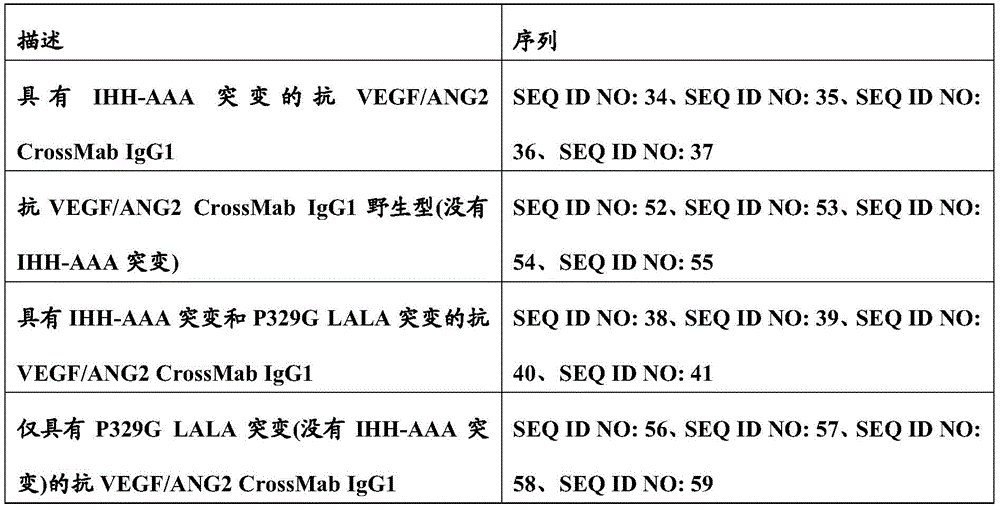
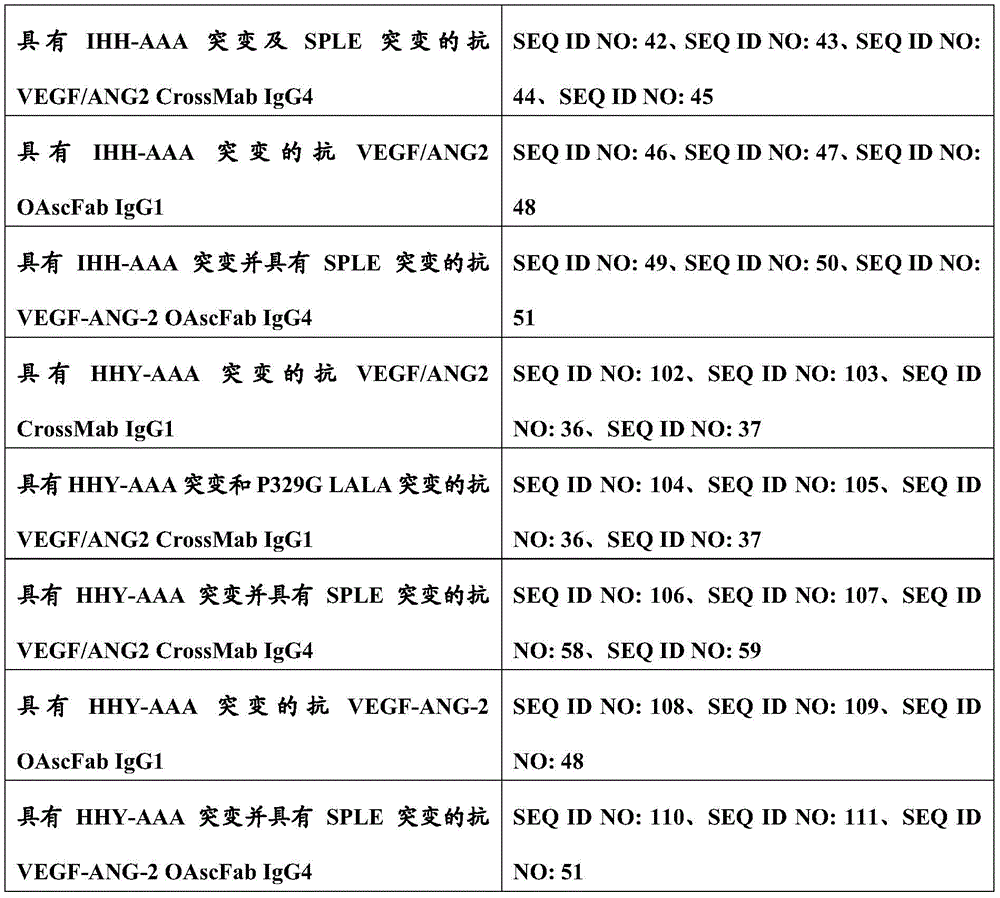
如本文所用的术语“具有突变IHH-AAA”指在IgG1或IgG4亚类的恒定重链区(根据Kabat EU索引编号体系编号)中突变I253A(Ile253Ala)、H310A(His310Ala)和H435A(His435Ala)的组合,如本文所用的术语“具有突变HHY-AAA”指在IgG1或IgG4亚类的恒定重链区(根据Kabat EU索引编号体系编号)中突变H310A(His310Ala)、H433A(His433Ala)和Y436A(Tyr436Ala)的组合,如本文所用的术语“具有突变P329G LALA”指在IgG1亚类的恒定重链区(根据Kabat EU索引编号体系编号)中突变L234A(Leu234Ala),L235A(Leu235Ala)和P329G(Pro329Gly)的组合,并且如本文所用的术语“具有突变SPLE”指在IgG4亚类的恒定重链区(根据Kabat EU索引编号体系编号)中突变S228P(Ser228Pro)和L235E(Leu235Glu)的组合。The term "with mutation IHH-AAA" as used herein refers to mutations I253A (Ile253Ala), H310A (His310Ala) and H435A (His435Ala) in the constant heavy chain region (numbering according to the Kabat EU index numbering system) of the IgG1 or IgG4 subclass. In combination, the term "with mutation HHY-AAA" as used herein refers to mutations H310A (His310Ala), H433A (His433Ala) and Y436A (Tyr436Ala) in the constant heavy chain region (numbering according to the Kabat EU index numbering system) of the IgG1 or IgG4 subclass ), the term "with mutation P329G LALA" as used herein refers to the mutations L234A (Leu234Ala), L235A (Leu235Ala) and P329G (Pro329Gly) in the constant heavy chain region (numbering according to the Kabat EU index numbering system) of the IgG1 subclass and the term "with mutation SPLE" as used herein refers to the combination of mutations S228P (Ser228Pro) and L235E (Leu235Glu) in the constant heavy chain region (numbering according to the Kabat EU index numbering system) of the IgG4 subclass.

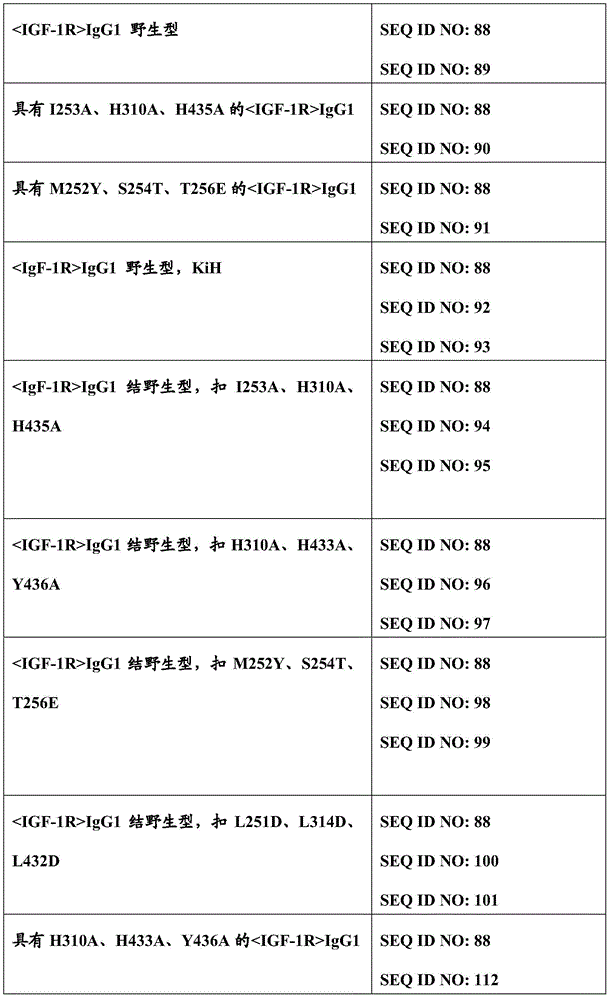
概述Overview
关于人免疫球蛋白轻链和重链的核苷酸序列的一般信息在Kabat,E.A.等人,Sequences of Proteins of Immunological Interest,第5版,Public Health Service,National Institutes of Health,Bethesda,MD(1991)中给出。根据EU编号编号并提及抗体链的氨基酸残基(Edelman,G.M.等人,Proc.Natl.Acad.Sci.USA 63(1969)78-85;Kabat,E.A.等人,Sequences of Proteins of Immunological Interest,第5版,Public HealthService,National Institutes of Health,Bethesda,MD(1991))。General information on the nucleotide sequences of human immunoglobulin light and heavy chains is in Kabat, E.A. et al., Sequences of Proteins of Immunological Interest, 5th ed., Public Health Service, National Institutes of Health, Bethesda, MD (1991 ) given in. Amino acid residues of antibody chains are numbered and referred to according to EU numbering (Edelman, G.M. et al., Proc. Natl. Acad. Sci. USA 63 (1969) 78-85; Kabat, E.A. et al., Sequences of Proteins of Immunological Interest, 5th Edition, Public Health Service, National Institutes of Health, Bethesda, MD (1991)).
重组DNA技术recombinant DNA technology
如Sambrook,J.等人,Molecular Cloning:A laboratory manual;Cold SpringHarbor Laboratory Press,Cold Spring Harbor,New York(1989)中所述的标准方法用来操作DNA。根据制造商的说明书使用分子生物学试剂。Standard methods as described in Sambrook, J. et al., Molecular Cloning: A laboratory manual; Cold Spring Harbor Laboratory Press, Cold Spring Harbor, New York (1989) were used to manipulate DNA. Molecular biology reagents were used according to the manufacturer's instructions.
基因合成gene synthesis
根据给出的说明书在Geneart(雷根斯堡,德国)订购目的基因区段。Gene segments of interest were ordered at Geneart (Regensburg, Germany) according to the instructions given.
DNA序列测定DNA sequencing
通过在MediGenomix GmbH(Martinsried,德国)或SequiServe GmbH(Vaterstetten,德国)进行的双链测序法测定DNA序列。DNA sequences were determined by double-stranded sequencing at MediGenomix GmbH (Martinsried, Germany) or SequiServe GmbH (Vaterstetten, Germany).
DNA和蛋白质序列分析和序列数据管理DNA and protein sequence analysis and sequence data management
GCG(遗传学计算机组(Genetics Computer Group),Madison,Wisconsin)的软件包第10.2版和Infomax的Vector NTI Advance套装8.0版用于序列生成、作图、分析、注释和图示。GCG (Genetics Computer Group, Madison, Wisconsin) software package version 10.2 and Infomax's Vector NTI Advance suite version 8.0 were used for sequence generation, mapping, analysis, annotation and illustration.
表达载体Expression vector
为了表达所描述的抗体,使用基于采用或不采用CMV-内含子A启动子的cDNA组织化或基于采用CMV启动子的基因组组织化的表达载体以瞬时表达(例如在HEK293-F细胞中)。To express the described antibodies, expression vectors based on cDNA organization with or without the CMV-intron A promoter or based on genome organization with the CMV promoter are used for transient expression (eg in HEK293-F cells) .
除了抗体表达盒之外,载体还含有:In addition to the antibody expression cassette, the vector contains:
允许该载体在大肠杆菌中复制的复制起点,an origin of replication that allows the vector to replicate in E. coli,
在大肠杆菌中赋予氨苄青霉素抗性的β-内酰胺酶基因,和The beta-lactamase gene that confers ampicillin resistance in E. coli, and
作为真核细胞中选择标记的来自小家鼠(Mus musculus)的二氢叶酸还原酶基因。The dihydrofolate reductase gene from Mus musculus as a selectable marker in eukaryotic cells.
抗体基因的转录单位包含以下元件:The transcription unit of an antibody gene contains the following elements:
在5'末端的独特限制性位点,Unique restriction site at the 5' end,
来自人巨细胞病毒的立即早期增强子和启动子,Immediate early enhancer and promoter from human cytomegalovirus,
在cDNA组织化的情况下,后续内含子A序列,In the case of cDNA organization, subsequent intron A sequences,
人免疫球蛋白基因的5'非翻译区,5' untranslated regions of human immunoglobulin genes,
编码免疫球蛋白重链信号序列的核酸,a nucleic acid encoding an immunoglobulin heavy chain signal sequence,
编码人抗体链(野生型或具有结构域交换)的核酸,所述核酸作为cDNA或在基因组组织化中具有免疫球蛋白外显子-内含子组织化,A nucleic acid encoding a human antibody chain (wild-type or with domain swapping) as cDNA or with immunoglobulin exon-intron organization in genome organization,
具有多聚腺苷化信号序列的3’非翻译区,和a 3' untranslated region with a polyadenylation signal sequence, and
在3'末端的独特限制性位点。Unique restriction site at the 3' end.
编码抗体链的核酸通过PCR和/或基因合成法生成并通过连接相应的核酸区段,例如利用相应载体中的独特限制性位点连接,通过已知的重组方法和技术装配。通过DNA测序验证亚克隆核酸序列。为了瞬时转染,从转化的大肠杆菌培养物(Nucleobond AX,Macherey-Nagel)制备载体,制得量较大的载体。Nucleic acids encoding antibody chains are generated by PCR and/or gene synthesis and assembled by known recombinant methods and techniques by ligating the corresponding nucleic acid segments, eg using unique restriction sites in the corresponding vectors. Subcloned nucleic acid sequences were verified by DNA sequencing. For transient transfection, vectors were prepared from transformed E. coli cultures (Nucleobond AX, Macherey-Nagel) to produce larger quantities of vectors.
细胞培养物技术Cell Culture Technology
使用如Current Protocols in Cell Biology(2000),Bonifacino,J.S.,Dasso,M.,Harford,J.B.,Lippincott-Schwartz,J.和Yamada,K.M.(编著),John Wiley&Sons,Inc.中所述的标准细胞培养物技术。Standard cell cultures were used as described in Current Protocols in Cell Biology (2000), Bonifacino, J.S., Dasso, M., Harford, J.B., Lippincott-Schwartz, J., and Yamada, K.M. (eds.), John Wiley & Sons, Inc. material technology.
如下文描述,通过在按照悬浮方式生长的HEK29-F细胞中瞬时共转染相应的表达载体,表达双特异性抗体。Bispecific antibodies were expressed by transient co-transfection of the corresponding expression vectors in HEK29-F cells grown in suspension, as described below.
实施例1Example 1
表达和纯化Expression and purification
HEK293-F系统中的瞬时转染Transient transfection in the HEK293-F system
使用HEK293-F系统(Invitrogen),根据制造商的说明书,通过用相应载体(例如编码重链和修饰的重链以及相应轻链和修饰的轻链的质粒)瞬时转染,产生单特异性和双特异性抗体。简而言之,将摇瓶中或搅拌式发酵器中无血清FreeStyleTM293表达培养基(Invitrogen)内以悬浮方式生长的HEK293-F细胞(Invitrogen)用相应表达载体和293fectinTM或fectin(Invitrogen)的混合物转染。对于2L摇瓶(Corning),将HEK293-F细胞以密度1*106个细胞/mL接种在600mL中并且以120转/分钟,8%CO2温育。该日之后,将约1.5*106个细胞/mL细胞密度的细胞用大约42mL以下混合物转染:A)20mL Opti-MEM(Invitrogen)与600μg以等摩尔比率分别编码重链或修饰重链及相应轻链的总载体DNA(1μg/mL)的混合物以及B)20ml Opti-MEM与1.2mL 293fectin或fectin(2μL/mL)的混合物。在发酵过程期间根据葡萄糖消耗量,添加葡萄糖溶液。5-10天后收获含有分泌型抗体的上清液并且将抗体直接从上清液纯化或将上清液冷冻并存储。Monospecific and Bispecific antibodies. Briefly, HEK293-F cells (Invitrogen) grown in suspension in serum-free FreeStyle ™ 293 expression medium (Invitrogen) in shake flasks or stirred fermenters were treated with the corresponding expression vector and 293fectin ™ or fectin (Invitrogen). ) mixture was transfected. For 2L shake flasks (Corning), HEK293-F cells were seeded in 600 mL at a density of 1*106 cells/mL and incubated at 120 rpm, 8% CO2 . After this day, cells at a cell density of about 1.5* 10 cells/mL were transfected with about 42 mL of the following mixture: A) 20 mL of Opti-MEM (Invitrogen) with 600 μg of encoded heavy chain or modified heavy chain in equimolar ratios, respectively, and A mixture of total carrier DNA (1 μg/mL) for the corresponding light chain and B) a mixture of 20 ml Opti-MEM with 1.2 mL 293fectin or fectin (2 μL/mL). During the fermentation process, the glucose solution was added according to the glucose consumption. The supernatant containing the secreted antibody was harvested after 5-10 days and the antibody was purified directly from the supernatant or the supernatant was frozen and stored.
纯化purification
通过使用MabSelectSure-SepharoseTM(用于非IHH-AAA突变体)(GE Healthcare,瑞典)或KappaSelect-琼脂糖(用于IHH-AAA突变体)(GE Healthcare,瑞典)的亲和色谱、使用丁基-琼脂糖凝胶(GE Healthcare,瑞典)的疏水相互作用色谱和Superdex 200大小排阻(GE Healthcare,瑞典)色谱,从细胞培养上清液纯化双特异性抗体。By affinity chromatography using MabSelectSure-Sepharose ™ (for non-IHH-AAA mutants) (GE Healthcare, Sweden) or KappaSelect-Sepharose (for IHH-AAA mutants) (GE Healthcare, Sweden) using butyl - Hydrophobic interaction chromatography on agarose gel (GE Healthcare, Sweden) and
简而言之,在用PBS缓冲液(10mM Na2HPO4,1mM KH2PO4,137mM NaCl和2.7mM KCl,pH 7.4)平衡的MabSelectSuRe树脂(非IHH-AAA突变和野生型抗体)上捕获无菌过滤的细胞培养上清液,用平衡缓冲液洗涤并且用25mM pH 3.0柠檬酸钠洗脱。在用25mM Tris,50mMNaCl,pH 7.2平衡的KappaSelect树脂上捕获IHH-AAA突变体,用平衡缓冲液洗涤并且用25mM pH 2.9柠檬酸钠洗脱。将洗脱的抗体级分汇集并用2M Tris,pH 9.0中和。通过添加1.6M硫酸铵溶液至终浓度0.8M硫酸铵并使用乙酸调节pH至pH 5.0,将抗体汇集物准备好用于疏水相互作用色谱。用35mM乙酸钠,0.8M硫酸铵,pH 5.0平衡丁基-琼脂糖凝胶树脂后,将抗体施加至树脂,用平衡缓冲液洗涤并且用线性梯度洗脱至35mM乙酸钠pH 5.0。将含有(单特异性或双特异性)抗体的级分汇集并且使用以20mM组氨酸,140mM NaCl,pH 6.0平衡的Superdex200 26/60GL(GE Healthcare,瑞典)柱,进一步通过大小排阻色谱纯化。将含有(单特异性或双特异性)抗体的级分汇集,使用Vivaspin超滤装置(Sartorius StedimBiotechS.A.,法国)浓缩至要求的浓度并贮存在-80℃。Briefly, capture on MabSelectSuRe resin (non-IHH-AAA mutant and wild-type antibodies) equilibrated with PBS buffer ( 10 mM Na2HPO4 , 1 mM KH2PO4 , 137 mM NaCl and 2.7 mM KCl, pH 7.4) Cell culture supernatants were sterile filtered, washed with equilibration buffer and eluted with 25 mM sodium citrate pH 3.0. IHH-AAA mutants were captured on KappaSelect resin equilibrated with 25 mM Tris, 50 mM NaCl, pH 7.2, washed with equilibration buffer and eluted with 25 mM sodium citrate pH 2.9. The eluted antibody fractions were pooled and neutralized with 2M Tris, pH 9.0. Antibody pools were prepared for hydrophobic interaction chromatography by adding 1.6M ammonium sulfate solution to a final concentration of 0.8M ammonium sulfate and adjusting the pH to pH 5.0 using acetic acid. After equilibrating the butyl-sepharose resin with 35 mM sodium acetate, 0.8 M ammonium sulfate, pH 5.0, the antibody was applied to the resin, washed with equilibration buffer and eluted with a linear gradient to 35 mM sodium acetate pH 5.0. Fractions containing (monospecific or bispecific) antibodies were pooled and further purified by size exclusion chromatography using a Superdex200 26/60GL (GE Healthcare, Sweden) column equilibrated with 20 mM histidine, 140 mM NaCl, pH 6.0 . Fractions containing antibodies (monospecific or bispecific) were pooled, concentrated to the desired concentration using a Vivaspin ultrafiltration device (Sartorius Stedim Biotech S.A., France) and stored at -80°C.
表:双特异性抗<VEGF-ANG-2>抗体的产率Table: Yields of bispecific anti-<VEGF-ANG-2> antibodies

每种纯化步骤后使用微流体Labchip技术(Caliper Life Science,美国)通过CE-SDS分析纯度和抗体完整性。根据制造商的说明书,使用HT蛋白质表达试剂盒,制备5μL用于CE-SDS分析的蛋白质溶液,并使用HT蛋白质表达芯片,在Labchip GXII系统上分析。使用Labchip GX软件分析数据。Purity and antibody integrity were analyzed by CE-SDS after each purification step using microfluidic Labchip technology (Caliper Life Science, USA). Using the HT protein expression kit according to the manufacturer's instructions, 5 μL of protein solution for CE-SDS analysis was prepared and analyzed on the Labchip GXII system using the HT protein expression chip. Data were analyzed using Labchip GX software.
表:通过CE-SDS确定借助不同顺序的纯化步骤移除常见副产物Table: Removal of common by-products with different sequences of purification steps as determined by CE-SDS

在25℃使用Superdex 200分析性大小排阻柱(GE Healthcare,瑞典)在2x PBS(20mM Na2HPO4,2mM KH2PO4,274mM NaCl和5.4mM KCl,pH 7.4)运行缓冲液中,通过高性能SEC分析抗体样品的聚集物含量。将25μg蛋白质以流速0.75mL/分钟注射到柱上并经50分钟等强度洗脱。Using a
类似地,制备抗VEGF-ANG2抗体VEGF/ANG2-0012和VEGF/ANG2-0201并以如下产率纯化:Similarly, anti-VEGF-ANG2 antibodies VEGF/ANG2-0012 and VEGF/ANG2-0201 were prepared and purified in the following yields:
另外,可以类似地制备并纯化具有IHH-AAA突变并具有SPLE突变的抗VEGF/ANG2双特异性抗体抗VEGF/ANG2CrossMAb IgG4(SEQ ID NO:42、SEQ ID NO:43、SEQ ID NO:44、SEQID NO:45)、具有IHH-AAA突变的抗VEGF/ANG2OAscFab IgG1(SEQ ID NO:46、SEQ ID NO:47、SEQ ID NO:48)、具有IHH-AAA突变并具有SPLE突变的抗VEGF/ANG2OAscFab IgG4(SEQ IDNO:49、SEQ ID NO:50、SEQ ID NO:51)、具有HHY-AAA突变和P329G LALA突变的抗VEGF/ANG2CrossMab IgG1(SEQ ID NO:90、SEQ ID NO:91、SEQ ID NO:40、SEQ ID NO:41)、具有HHY-AAA突变和SPLE突变的抗VEGF/ANG2CrossMab IgG4(SEQ ID NO:92、SEQ ID NO:93、SEQID NO:44、SEQ ID NO:45)、具有HHY-AAA突变的抗VEGF/ANG2OAscFab IgG1(SEQ ID NO:94、SEQ ID NO:95、SEQ ID NO:48)和具有HHY-AAA突变和SPLE突变的抗VEGF/ANG2OAscFabIgG4(SEQ ID NO:96、SEQ ID NO:97、SEQ ID NO:51)并且还可以类似地制备并纯化抗IGF-1R单特异性抗体抗IGF-1R野生型(SEQ ID NO:88、SEQ ID NO:89)、具有IHH-AAA突变的抗IGF-1R IgG1(SEQ ID NO:88、SEQ ID NO:90)、具有YTE突变的抗IGF-1R IgG1(SEQ ID NO:88、SEQ ID NO:91)、具有KiH突变的抗IGF-1R IgG1野生型(SEQ ID NO:88、SEQ ID NO:92、SEQ ID NO:93)、在扣链中具有KiH突变和IHH-AAA突变的抗IGF-1R IgG1(SEQ ID NO:88、SEQ ID NO:94、SEQ ID NO:95)、在扣链中具有KiH突变和HHY-AAA突变的抗IGF-1R IgG1(SEQ ID NO:88、SEQ ID NO:96、SEQ ID NO:97)、具有KiH突变和YTE突变的抗IGF-1R IgG1(SEQ ID NO:88、SEQ ID NO:98、SEQ ID NO:99)、具有KiH突变和DDD突变的抗IGF-1R IgG1(SEQ ID NO:88、SEQ ID NO:100、SEQ ID NO:101),和具有HHY-AAA突变的抗IGF-1R IgG1(SEQ ID NO:88、SEQ ID NO:112)。Additionally, an anti-VEGF/ANG2 bispecific antibody anti-VEGF/ANG2CrossMAb IgG4 (SEQ ID NO:42, SEQ ID NO:43, SEQ ID NO:44, SEQ ID NO:42, SEQ ID NO:43, SEQ ID NO:44, SEQ ID NO: 45), anti-VEGF/ANG2OAscFab IgG1 with IHH-AAA mutation (SEQ ID NO: 46, SEQ ID NO: 47, SEQ ID NO: 48), anti-VEGF/ with IHH-AAA mutation and with SPLE mutation ANG2OAscFab IgG4 (SEQ ID NO:49, SEQ ID NO:50, SEQ ID NO:51), anti-VEGF/ANG2CrossMab IgG1 with HHY-AAA mutation and P329G LALA mutation (SEQ ID NO:90, SEQ ID NO:91, SEQ ID NO:91, SEQ ID NO:91 ID NO:40, SEQ ID NO:41), anti-VEGF/ANG2CrossMab IgG4 with HHY-AAA mutation and SPLE mutation (SEQ ID NO:92, SEQ ID NO:93, SEQ ID NO:44, SEQ ID NO:45) , anti-VEGF/ANG2OAscFab IgG1 with HHY-AAA mutation (SEQ ID NO:94, SEQ ID NO:95, SEQ ID NO:48) and anti-VEGF/ANG2OAscFabIgG4 with HHY-AAA mutation and SPLE mutation (SEQ ID NO: 96, SEQ ID NO:97, SEQ ID NO:51) and can also similarly prepare and purify anti-IGF-1R monospecific antibodies anti-IGF-1R wild type (SEQ ID NO:88, SEQ ID NO:89), Anti-IGF-1R IgG1 with IHH-AAA mutation (SEQ ID NO:88, SEQ ID NO:90), anti-IGF-1R IgG1 with YTE mutation (SEQ ID NO:88, SEQ ID NO:91), with KiH Mutated anti-IGF-1R IgG1 wild type (SEQ ID NO:88, SEQ ID NO:92, SEQ ID NO:93), anti-IGF-1R IgG1 with KiH mutation and IHH-AAA mutation in the buckle (SEQ ID NO:93) NO:88, SEQ ID NO:94, SEQ ID NO:95), anti-IGF-1R IgG1 with KiH mutation and HHY-AAA mutation in the buckle (SEQ ID NO:88, SEQ ID NO:96, SEQ ID NO:97), anti-IGF-1R IgG1 with KiH mutation and YTE mutation (SEQ ID NO:88, SEQ ID NO:98, SEQ ID NO:99), anti-IGF-1R with KiH mutation and DDD mutation IgG1 (SEQ ID NO:88, SEQ ID NO:100, SEQ ID NO:101), and anti-IGF-1R IgG1 with HHY-AAA mutation (SEQ ID NO:88, SEQ ID NO:112).
实施例2Example 2
分析学和可发展性Analytics and Development
基于小规模DLS的粘度测量:Small-scale DLS-based viscosity measurement:
粘度测量基本上如(He,F.等人,Analytical Biochemistry 399(2009)141-143)中所述进行。简而言之,将样品在200mM精氨酸琥珀酸盐,pH 5.5中浓缩到多种蛋白质浓度,之后添加聚苯乙烯乳胶珠(300nm直径)和聚山梨醇酯20(0.02%v/v)。将样品通过离心经0.4μm滤板转移入光学384孔平板并用石蜡油覆盖。在25℃通过动态光散射法测定乳胶珠的表观直径。溶液的粘度可以计算为η=η0(rh/rh,0)(η:粘度;η0:水的粘度;rh:乳胶珠的表观流体动力学半径;rh,0:乳胶珠在水中的流体动力学半径)。Viscosity measurements were performed essentially as described in (He, F. et al., Analytical Biochemistry 399 (2009) 141-143). Briefly, samples were concentrated to various protein concentrations in 200 mM arginine succinate, pH 5.5, followed by addition of polystyrene latex beads (300 nm diameter) and polysorbate 20 (0.02% v/v) . Samples were transferred into optical 384-well plates by centrifugation through 0.4 μm filter plates and covered with paraffin oil. The apparent diameter of the latex beads was determined by dynamic light scattering at 25°C. The viscosity of the solution can be calculated as η=η0(rh/rh,0) (η: viscosity; η0: viscosity of water; rh: apparent hydrodynamic radius of latex beads; rh,0: hydrodynamics of latex beads in water learning radius).
为了允许在相同浓度比较各种样品,粘度-浓度数据用Mooney等式(等式1)(Mooney,M.,Colloid.Sci.,6(1951)162-170;Monkos,K.,Biochem.Biophys.Acta 304(1997)1339)拟合并据此内插数据。To allow comparison of various samples at the same concentration, the viscosity-concentration data were calculated using the Mooney equation (Equation 1) (Mooney, M., Colloid. Sci., 6 (1951) 162-170; Monkos, K., Biochem. Biophys . Acta 304 (1997) 1339) fit and interpolate the data accordingly.
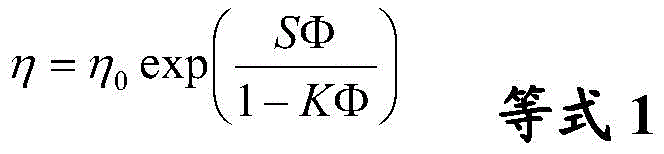
(S:蛋白质的流体动力学相互作用参数;K:自集因子;Φ:溶解的蛋白质的体积分数)(S: hydrodynamic interaction parameter of protein; K: self-assembly factor; Φ: volume fraction of dissolved protein)
图2中显示结果:与Fc区中没有IHH-AAA突变的VEGF/ANG2-0015相比,在Fc区中具有IHH-AAA突变的VEGF/ANG2-0016在全部测量温度均显示较低的粘度。Results are shown in Figure 2: VEGF/ANG2-0016 with the IHH-AAA mutation in the Fc region showed lower viscosity at all measured temperatures compared to VEGF/ANG2-0015 without the IHH-AAA mutation in the Fc region.
DLS聚集起始温度DLS aggregation onset temperature
将样品以1mg/mL的浓度在20mM组氨酸/组氨酸盐酸盐,140mM NaCl,pH 6.0中制备,通过离心经0.4μm滤板转移入光学384孔平板并用石蜡油覆盖。将样品以0.05℃/分钟的速率从25℃加热至80℃的同时,通过动态光散射法重复测量流体动力学半径。聚集起始温度定义为流体动力学半径开始增加的温度。图3中显示结果。在图3中,显示了Fc区中没有IHH-AAA突变的VEGF/ANG2-0015和具有IHH-AAA突变的VEGF/ANG2-0016的聚集。VEGF/ANG2-0016显示61℃的聚集起始温度,而没有IHH-AAA突变的VEGF/ANG2-0015显示60℃的起始温度。Samples were prepared at a concentration of 1 mg/mL in 20 mM histidine/histidine hydrochloride, 140 mM NaCl, pH 6.0, transferred by centrifugation through 0.4 μm filter plates into optical 384-well plates and overlaid with paraffin oil. The hydrodynamic radius was repeatedly measured by dynamic light scattering while heating the sample from 25°C to 80°C at a rate of 0.05°C/min. The aggregation onset temperature is defined as the temperature at which the hydrodynamic radius begins to increase. The results are shown in Figure 3. In Figure 3, the aggregation of VEGF/ANG2-0015 without the IHH-AAA mutation in the Fc region and VEGF/ANG2-0016 with the IHH-AAA mutation is shown. VEGF/ANG2-0016 showed an aggregation onset temperature of 61°C, whereas VEGF/ANG2-0015 without the IHH-AAA mutation showed an onset temperature of 60°C.
DLS时程DLS schedule
将样品以1mg/mL的浓度在20mM组氨酸/组氨酸盐酸盐,140mM NaCl,pH 6.0中制备,通过离心经0.4μm滤板转移入光学384孔平板并用石蜡油覆盖。将样品维持在50℃恒定温度直至145小时的同时,通过动态光散射法重复测量流体动力学半径。在这个实验中,天然的解折叠蛋白质在升高温度下的聚集倾向将导致平均粒径随时间推移增加。这种基于DLS的方法对聚集物非常敏感,因为这些聚集物以超比例方式对散射光强度作出贡献。甚至在50℃(接近于聚集起始温度的温度,见上文)145小时后,仅观察到VEGF/ANG2-0015和VEGF/ANG2-0016的平均粒径增加小于0.5nm。Samples were prepared at a concentration of 1 mg/mL in 20 mM histidine/histidine hydrochloride, 140 mM NaCl, pH 6.0, transferred by centrifugation through 0.4 μm filter plates into optical 384-well plates and overlaid with paraffin oil. The hydrodynamic radius was repeatedly measured by dynamic light scattering while maintaining the sample at a constant temperature of 50°C until 145 hours. In this experiment, the tendency of the native unfolded protein to aggregate at elevated temperatures will result in an increase in average particle size over time. This DLS-based method is very sensitive to aggregates, which contribute to the scattered light intensity in a disproportionate manner. Even after 145 hours at 50°C (a temperature close to the aggregation onset temperature, see above), only an increase in the average particle size of VEGF/ANG2-0015 and VEGF/ANG2-0016 of less than 0.5 nm was observed.
在40℃以100mg/mL储存7日Store at 100 mg/mL at 40°C for 7 days
将样品在200mM精氨酸琥珀酸盐pH 5.5中浓缩至终浓度100mg/mL,无菌过滤并在40℃静止储存7日。在储存之前和之后,通过大小排阻色谱法测定高分子量种类和低分子量种类(分别是HMW和LMW)的含量。存储样品和制备后立即测量的样品之间HMW含量和LMW含量的差异分别报告为“HMW增长”和“LMW增长”。下表和图4中显示结果,这些结果显示,与VEGF/ANG2-0016(具有IHH-AAA突变)相比,VEGF/ANG2-0015(没有IHH-AAA突变)显示更大的主峰下降并且更高的HMW增长。令人惊讶地,与VEGF/ANG2-0015(没有IHH-AAA突变)相比,VEGF/ANG2-0016(具有IHH-AAA突变)显示较低的聚集倾向性。Samples were concentrated to a final concentration of 100 mg/mL in 200 mM arginine succinate pH 5.5, sterile filtered and quiescently stored at 40°C for 7 days. Before and after storage, the content of high and low molecular weight species (HMW and LMW, respectively) was determined by size exclusion chromatography. Differences in HMW content and LMW content between stored samples and samples measured immediately after preparation are reported as "HMW growth" and "LMW growth", respectively. The results are shown in the table below and in Figure 4, which show that VEGF/ANG2-0015 (without the IHH-AAA mutation) showed a greater decrease in the main peak and was higher than VEGF/ANG2-0016 (with the IHH-AAA mutation) HMW growth. Surprisingly, VEGF/ANG2-0016 (with the IHH-AAA mutation) showed a lower propensity to aggregate compared to VEGF/ANG2-0015 (without the IHH-AAA mutation).
表:在40℃时7天后Δ主峰、HMW峰和LMW峰Table: Δ main peak, HMW peak and LMW peak after 7 days at 40°C
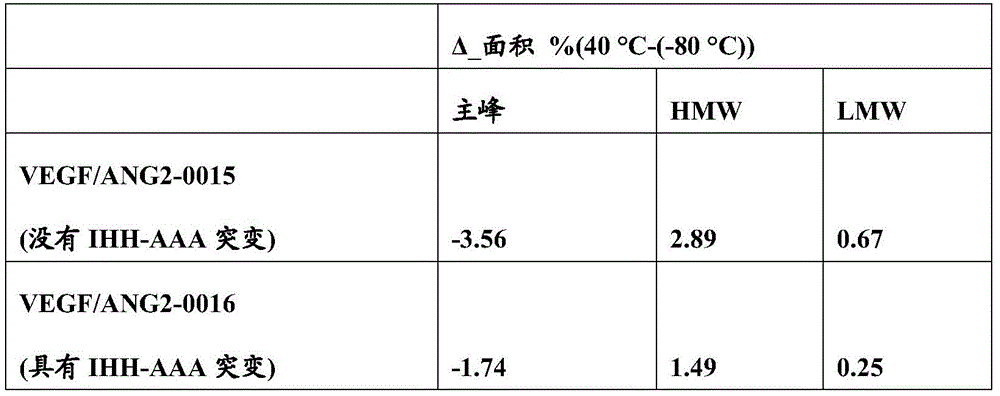
在25℃使用

实施例3Example 3
与VEGF、ANG2、FcγR和FcRn的结合Binding to VEGF, ANG2, FcγR and FcRn
VEGF同工型动力学亲和力,包括评定物种交叉反应性VEGF isoform kinetic affinity, including assessment of species cross-reactivity
通过使用GE Healthcare供应的胺偶联试剂盒在pH 5.0,在CM5芯片(GEHealthcare BR-1005-30)上偶联约12,000共振单位(RU)捕获系统(10μg/mL山羊抗人F(ab)’2;订单代码:28958325;GE Healthcare Bio-Sciences AB,瑞典)。样品和系统缓冲液是PBS-T(包含0.05%Tween 20的10mM磷酸盐缓冲盐水)pH 7.4。将流动小室设定至25℃-并且将样品块设定至12℃-并用运行缓冲液填装2次。通过在溶液中以流速5μL/分钟注射50nM溶液30秒,捕获双特异性抗体。通过在溶液中以流速30μL/分钟注射多种浓度(始于300nM,1:3稀释)的人hVEGF121、小鼠mVEGF120或大鼠rVEGF164持续300秒,测量结合作用。监测解离相达1200秒并通过将样品溶液转换成运行缓冲液启动。通过用甘氨酸pH 2.1溶液以流速30μL/分钟洗涤60秒,使表面再生。通过扣减从山羊抗人F(Ab’)2表面获得的响应值,修正本体折射率差异。还扣减空白注射(=双参考)。为了计算表观KD和其他动力学参数,使用朗格缪尔1:1模型。下文显示结果。About 12,000 resonance units (RU) capture system (10 μg/mL goat anti-human F(ab)' was coupled on a CM5 chip (GE Healthcare BR-1005-30) at pH 5.0 by using an amine coupling kit supplied by GE Healthcare 2 ; order code: 28958325; GE Healthcare Bio-Sciences AB, Sweden). The sample and system buffers were PBS-T (10 mM phosphate buffered saline containing 0.05% Tween 20) pH 7.4. The flow cell was set to 25°C - and the sample block was set to 12°C - and filled 2 times with running buffer. Bispecific antibodies were captured by injecting 50 nM solution in solution at a flow rate of 5 μL/min for 30 seconds. Binding was measured by injecting various concentrations (starting at 300 nM, 1:3 dilution) of human hVEGF121, mouse mVEGF120 or rat rVEGF164 in solution at a flow rate of 30 μL/min for 300 seconds. The dissociation phase was monitored for 1200 seconds and initiated by switching the sample solution to running buffer. The surface was regenerated by washing with glycine pH 2.1 solution for 60 seconds at a flow rate of 30 μL/min. The bulk refractive index differences were corrected by subtracting the response values obtained from the goat anti-human F(Ab') 2 surface. Blank injections (= double reference) were also subtracted. To calculate the apparent KD and other kinetic parameters, the Langmuir 1:1 model was used. The results are shown below.
ANG2溶液亲和力,包括评定物种交叉反应性ANG2 solution affinity, including assessment of species cross-reactivity
通过确定平衡混合物中游离相互作用配偶体的浓度,溶液亲和力度量相互作用的亲和力。溶液亲和力测定法涉及将保持处于恒定浓度的抗VEGF/ANG2抗体与浓度变动的配体(=ANG2)混合。使用GE Healthcare供应的胺偶联试剂盒在pH 5.0测定固定在CM5芯片(GE Healthcare BR-1005-30)表面上的抗体的最大可能共振单位(例如17,000共振单位(RU))。样品和系统缓冲液是HBS-P pH7.4。将流动小室设定至25℃并且将样品块设定至12℃并用运行缓冲液填装2次。为了产生校正曲线,将渐增浓度的ANG2注入含有固定化抗VEGF/ANG2抗体的BIAcore流动小室。将结合型ANG2的量作为共振单位(RU)测定并对浓度作图。将每种配体的溶液(11种浓度,对于抗VEGF/ANG2抗体,从0至200nM)与10nM ANG2温育并且使其在室温达到平衡。从校正曲线测定游离ANG2浓度,所述校正曲线测定在测量具有已知量的ANG2的溶液的响应值之前和之后生成。使用模型201,使用游离ANG2浓度作为y-轴并使用用于抑制的抗体浓度作为x-轴,用XLfit4(IDBS Software)建立一个4参数拟合。通过确定这条曲线的拐点计算亲和力。通过用0.85%H3PO4溶液以流速30μL/分钟洗涤1次30秒,使表面再生。通过扣减从空白偶联的表面获得的响应值,修正本体折射率差异。下文显示结果。Solution affinity measures the affinity of the interaction by determining the concentration of free interaction partners in the equilibrium mixture. Solution affinity assays involve mixing anti-VEGF/ANG2 antibody, which is maintained at a constant concentration, with varying concentrations of ligand (=ANG2). The maximum possible resonance units (eg, 17,000 resonance units (RU)) of the antibody immobilized on the surface of a CM5 chip (GE Healthcare BR-1005-30) were determined at pH 5.0 using an amine coupling kit supplied by GE Healthcare. The sample and system buffers were HBS-P pH 7.4. The flow cell was set to 25°C and the sample block was set to 12°C and filled 2 times with running buffer. To generate the calibration curve, increasing concentrations of ANG2 were injected into the BIAcore flow cell containing immobilized anti-VEGF/ANG2 antibody. The amount of bound ANG2 was determined as resonance units (RU) and the concentration was plotted. Solutions of each ligand (11 concentrations, from 0 to 200 nM for anti-VEGF/ANG2 antibody) were incubated with 10 nM ANG2 and allowed to equilibrate at room temperature. Free ANG2 concentrations were determined from calibration curves generated before and after measuring response values for solutions with known amounts of ANG2. A 4-parameter fit was built with XLfit4 (IDBS Software) using model 201, using free ANG2 concentration as the y-axis and antibody concentration for inhibition as the x-axis. Affinity is calculated by determining the inflection point of this curve. The surface was regenerated by washing once for 30 seconds with 0.85% H3PO4 solution at a flow rate of 30 [mu]L/min. The bulk refractive index differences were corrected by subtracting the response values obtained from blank coupled surfaces. The results are shown below.
FcRn稳态亲和力FcRn steady state affinity
对于FcRn测量,稳态亲和力用来相互比较双特异性抗体。将人FcRn稀释于偶联缓冲液(10μg/mL,乙酸钠pH 5.0)中并通过定向固定法,使用BIAcore wizard,固定在C1芯片(GE Healthcare BR-1005-35)至最终响应值200RU。将流动小室设定至25℃并且将样品块设定至12℃并用运行缓冲液填装2次。样品和系统缓冲液是PBS-T(包含0.05%Tween 20的10mM磷酸盐缓冲盐水)pH6.0。为了评估每种抗体的不同IgG浓度,制备浓度62.5nM、125nM、250nM和500nM。流速设定至30μL/分钟并选择180秒结合时间情况下,将不同样品连续注射到芯片表面上。通过以流速30μL/分钟注射PBS-T pH 8持续60秒,使表面再生。通过扣减从空白表面获得的响应值,修正本体折射率差异。还扣减缓冲液注射(=双参考)。为了计算稳态亲和力,使用来自BIA-评价软件的方法。简而言之,将RU值对分析的浓度作图,产生剂量-反应曲线。基于一个2参数拟合,计算一条上渐近线,从而允许确定最大半数RU值并因此测定亲和力。图5和下表中显示结果。类似地,可以确定对食蟹猴、小鼠和兔FcRn的亲和力。For FcRn measurements, steady-state affinity was used to compare bispecific antibodies to each other. Human FcRn was diluted in coupling buffer (10 μg/mL, sodium acetate pH 5.0) and immobilized on a C1 chip (GE Healthcare BR-1005-35) to a final response value of 200RU by targeted immobilization using the BIAcore wizard. The flow cell was set to 25°C and the sample block was set to 12°C and filled 2 times with running buffer. The sample and system buffers were PBS-T (10 mM phosphate buffered saline containing 0.05% Tween 20) pH 6.0. To evaluate different IgG concentrations for each antibody, concentrations of 62.5 nM, 125 nM, 250 nM and 500 nM were prepared. Different samples were injected successively onto the chip surface with the flow rate set to 30 μL/min and a binding time of 180 seconds selected. The surface was regenerated by injecting PBS-T pH 8 for 60 seconds at a flow rate of 30 μL/min. The bulk refractive index difference is corrected by subtracting the response value obtained from the blank surface. Buffer injections (= double reference) were also subtracted. To calculate steady state affinity, the method from the BIA-evaluation software was used. Briefly, RU values were plotted against the concentrations analyzed to generate dose-response curves. Based on a 2-parameter fit, an upper asymptote was calculated, allowing determination of the maximum half-RU value and thus affinity. The results are shown in Figure 5 and the table below. Similarly, affinity for cynomolgus monkey, mouse and rabbit FcRn can be determined.
FcγRIIIa测量FcγRIIIa measurement
对于FcγRIIIa测量,使用直接结合测定法。通过使用GE Healthcare供应的胺偶联试剂盒在pH 5.0,在CM5芯片(GE Healthcare BR-1005-30)上偶联约3,000共振单位(RU)捕获系统(1μg/ml Penta-His;Qiagen)。样品和系统缓冲液是HBS-P+pH 7.4。将流动小室设定至25℃-并且将样品块设定至12℃-并用运行缓冲液填装2次。通过以流速5μL/分钟注射100nM溶液60秒,捕获FcγRIIIa-His-受体。通过以流速30μL/分钟注射100nM双特异性抗体或单特异性对照抗体(对于IgG1亚类和IgG4亚类抗体,抗洋地黄毒苷抗体)180秒,测量结合作用。通过用甘氨酸pH 2.5溶液以流速30μL/分钟洗涤120秒,使表面再生。因为FcγRIIIa结合作用与朗格缪尔1:1模型不同,用这种测定法仅确定结合/不结合。以相似方式,可以确定FcγRIa结合作用和FcγRIIa结合作用。图6中显示结果,当后续是通过引入突变P329GLALA,未能检测到更多的FcγRIII结合作用。For FcγRIIIa measurements, a direct binding assay was used. About 3,000 resonance units (RU) of a capture system (1 μg/ml Penta-His; Qiagen) were coupled on a CM5 chip (GE Healthcare BR-1005-30) at pH 5.0 by using an amine coupling kit supplied by GE Healthcare. Sample and system buffers were HBS-P + pH 7.4. The flow cell was set to 25°C - and the sample block was set to 12°C - and filled 2 times with running buffer. The FcγRIIIa-His-receptor was captured by injecting a 100 nM solution at a flow rate of 5 μL/min for 60 seconds. Binding was measured by injecting 100 nM bispecific antibody or monospecific control antibody (anti-digoxigenin antibody for IgG1 subclass and IgG4 subclass antibodies) at a flow rate of 30 μL/min for 180 seconds. The surface was regenerated by washing with glycine pH 2.5 solution for 120 seconds at a flow rate of 30 μL/min. Because FcyRIIIa binding differs from the Langmuir 1:1 model, only binding/non-binding is determined with this assay. In a similar manner, FcyRIa binding and FcyRIIa binding can be determined. The results are shown in Figure 6, when followed by introduction of the mutation P329GLALA, no further binding of Fc[gamma]RIII could be detected.
评定抗VEGF/ANG2抗体的独立VEGF结合作用和ANG-2结合作用Assessment of independent VEGF binding and ANG-2 binding of anti-VEGF/ANG2 antibodies
通过使用GE Healthcare供应的胺偶联试剂盒在pH 5.0,在CM4芯片(GEHealthcare BR-1005-34)上偶联约3,500共振单位(RU)捕获系统(10μg/mL山羊抗人IgG;GEHealthcare Bio-Sciences AB,瑞典)。样品和系统缓冲液是PBS-T(包含0.05%Tween 20的10mM磷酸盐缓冲盐水)pH 7.4。将流动小室的温度设定至25℃并且将样品块的温度设定至12℃。在捕获之前,将流动小室用运行缓冲液填装2次。About 3,500 resonance units (RU) of a capture system (10 μg/mL goat anti-human IgG; GE Healthcare Bio- Sciences AB, Sweden). The sample and system buffers were PBS-T (10 mM phosphate buffered saline containing 0.05% Tween 20) pH 7.4. The temperature of the flow cell was set to 25°C and the temperature of the sample block was set to 12°C. Before capture, the flow cell was filled 2 times with running buffer.
通过以流速5μL/分钟注射10nM溶液60秒,捕获双特异性抗体。通过确定依次或同时添加(流速30μL/分钟)的每种配体的有效结合能力,分析每配体与双特异性抗体的独立结合作用:Bispecific antibodies were captured by injecting a 10 nM solution at a flow rate of 5 μL/min for 60 seconds. The independent binding of each ligand to the bispecific antibody was analyzed by determining the effective binding capacity of each ligand added sequentially or simultaneously (flow
1.以浓度200nM注射人VEGF持续180秒(鉴定抗原的单一结合作用)。1. Injection of human VEGF at a concentration of 200 nM for 180 seconds (identification of single binding of antigen).
2.以浓度100nM注射人ANG2持续180秒(鉴定抗原的单一结合作用)。2. Human ANG2 was injected at a concentration of 100 nM for 180 seconds (identification of single binding of antigen).
3.以浓度200nM注射人VEGF持续180秒,随后额外以浓度100nM注射人ANG2持续180秒(鉴定在VEGF存在下的ANG2结合作用)。3. Human VEGF was injected at a concentration of 200 nM for 180 seconds, followed by an additional injection of human ANG2 at a concentration of 100 nM for 180 seconds (identification of ANG2 binding in the presence of VEGF).
4.以浓度100nM注射人ANG2持续180秒,随后额外以浓度200nM注射人VEGF(鉴定在ANG2存在下的VEGF结合作用)。4. Human ANG2 was injected at a concentration of 100 nM for 180 seconds, followed by an additional injection of human VEGF at a concentration of 200 nM (identification of VEGF binding in the presence of ANG2).
5.共注射浓度200nM的人VEGF和浓度100nM的人ANG2持续180秒(鉴定在相同时间VEGF的结合作用和ANG2的结合作用)。5. Co-injection of human VEGF at a concentration of 200 nM and human ANG2 at a concentration of 100 nM for 180 seconds (identification of VEGF binding and ANG2 binding at the same time).
通过用3M MgCl2溶液以流速30μL/分钟洗涤60秒,使表面再生。通过扣减从山羊抗人IgG表面获得的响应值,修正本体折射率差异。The surface was regenerated by washing with 3M MgCl2 solution at a flow rate of 30 μL/min for 60 s. The bulk refractive index differences were corrected by subtracting the response values obtained from the goat anti-human IgG surface.
如果方案3、4和5的最终所得信号等于或类似于方案1和2的各最终信号的总和,则双特异性抗体能够相互独立地结合两种抗原。下表中显示结果,其中两种抗体VEGF/ANG2-0016、VEGF/ANG2-0012均显示能够相互独立地与VEGF和ANG2结合。If the final resulting signal of
评定抗VEGF/ANG2抗体的同时VEGF结合作用和ANG-2结合作用Assessing simultaneous VEGF binding and ANG-2 binding of anti-VEGF/ANG2 antibodies
首先,通过使用GE Healthcare供应的胺偶联试剂盒在pH 5.0,在CM4芯片(GEHealthcare BR-1005-34)上偶联约1,600共振单位(RU)的VEGF(20μg/mL)。样品和系统缓冲液是PBS-T(包含0.05%Tween 20的10mM磷酸盐缓冲盐水)pH 7.4。将流动小室设定至25℃并且将样品块设定至12℃并用运行缓冲液填装2次。其次,将50nM的双特异性抗体溶液以流速30μL/分钟注射180秒。第三,将hANG2以流速30μL/分钟注射180秒。hANG2的结合响应取决于与VEGF结合的双特异性抗体的量并且显示同时结合作用。通过用0.85%H3PO4溶液以流速30μL/分钟洗涤60秒,使表面再生。同时结合作用由hANG2对先前VEGF结合的抗VEGF/ANG2抗体的额外特异性结合信号显示。对二种双特异性抗体VEGF/ANG2-0015和VEGF/ANG2-0016而言,可以检测到抗VEGF/ANG2抗体与VEGF及与ANG-2的同时结合作用(数据未显示)。First, approximately 1,600 resonance units (RU) of VEGF (20 μg/mL) were coupled on a CM4 chip (GE Healthcare BR-1005-34) at pH 5.0 by using an amine coupling kit supplied by GE Healthcare. The sample and system buffers were PBS-T (10 mM phosphate buffered saline containing 0.05% Tween 20) pH 7.4. The flow cell was set to 25°C and the sample block was set to 12°C and filled 2 times with running buffer. Next, a 50 nM bispecific antibody solution was injected at a flow rate of 30 μL/min for 180 seconds. Third, hANG2 was injected for 180 seconds at a flow rate of 30 μL/min. The binding response of hANG2 was dependent on the amount of bispecific antibody bound to VEGF and showed simultaneous binding. The surface was regenerated by washing with 0.85% H3PO4 solution for 60 seconds at a flow rate of 30 μL/min. Simultaneous binding is shown by the additional specific binding signal of hANG2 to previously VEGF-bound anti-VEGF/ANG2 antibodies. For the two bispecific antibodies, VEGF/ANG2-0015 and VEGF/ANG2-0016, simultaneous binding of anti-VEGF/ANG2 antibodies to VEGF and to ANG-2 was detected (data not shown).
表:结果:对来自不同物种的VEGF同工型的动力学亲和力Table: Results: Kinetic affinities for VEGF isoforms from different species
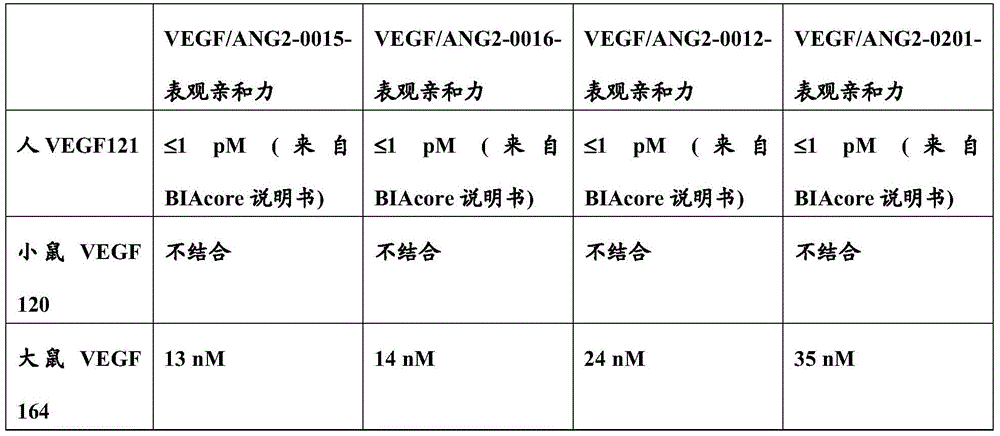
表:结果:对ANG2的溶液亲和力Table: Results: Solution affinity for ANG2
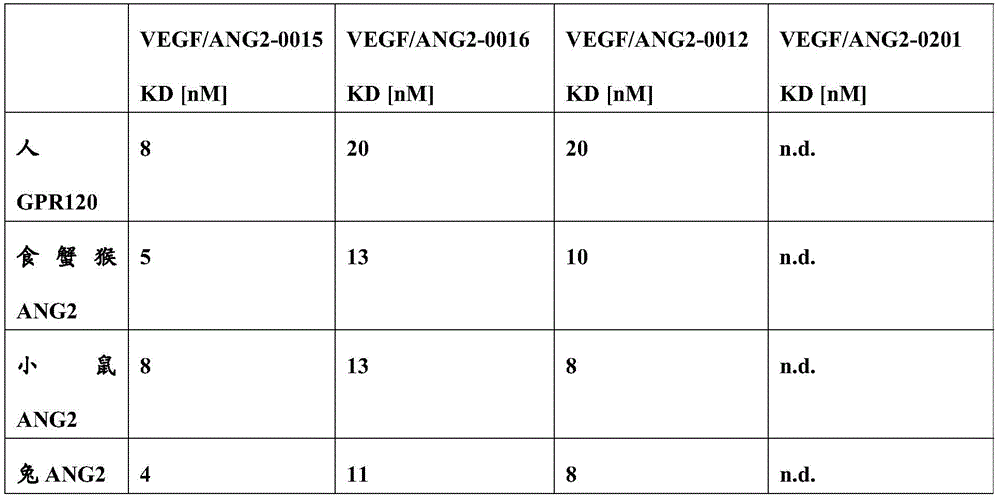
表:结果:抗VEGF/ANG2抗体对FcRn的亲和力Table: Results: Affinity of anti-VEGF/ANG2 antibodies to FcRn


表:与FcγRI–IIIa的结合结果Table: Binding results to FcγRI-IIIa
表:结果:抗VEGF/ANG2抗体对VEGF和ANG2的独立结合作用Table: Results: Independent binding of anti-VEGF/ANG2 antibodies to VEGF and ANG2

实施例4Example 4
质谱法mass spectrometry
这个章节描述抗VEGF/ANG2抗体的表征,重点在于正确装配。通过去糖基化以及完整或IdeS消化(化脓性链球菌(S.pyogenes)的IgG降解酶)的抗VEGF/ANG2抗体的电喷雾电离质谱法(ESI-MS),证实预期的一级结构。用100μg纯化抗体进行IdeS-消化,所述抗体与2μg IdeS蛋白酶(Fabricator)在100mmol/L NaH2PO4/Na2HPO4,pH 7.1中在37℃温育5小时。随后,将抗体以蛋白质浓度1mg/mL在100mmol/L NaH2PO4/Na2HPO4,pH 7.1中用N-糖苷酶F、神经氨酸酶和O-糖苷酶(Roche)在37℃去糖基化达16小时并且随后在Sephade x G25柱(GEHealthcare)上通过HPLC脱盐。在配备TriVersa NanoMate源(Advion)的maXis 4G UHR-QTOF MS系统(Bruker Daltonik)上,通过ESI-MS测定总质量。This section describes the characterization of anti-VEGF/ANG2 antibodies with an emphasis on proper assembly. The expected primary structure was confirmed by electrospray ionization mass spectrometry (ESI-MS) of deglycosylated and intact or IdeS digested (IgG degrading enzyme of S. pyogenes) anti-VEGF/ANG2 antibody. IdeS-digestion was performed with 100 μg of purified antibody incubated with 2 μg of IdeS protease (Fabricator) in 100 mmol/L NaH2PO4 / Na2HPO4 , pH 7.1 for 5 hours at 37°C. Subsequently, the antibodies were dehydrated with N-glycosidase F, neuraminidase and O-glycosidase (Roche) at a protein concentration of 1 mg/mL in 100 mmol/L NaH 2 PO 4 /Na 2 HPO 4 , pH 7.1 at 37°C Glycosylation was performed for 16 hours and then desalted by HPLC on a Sephadex G25 column (GE Healthcare). Total mass was determined by ESI-MS on a maXis 4G UHR-QTOF MS system (Bruker Daltonik) equipped with a TriVersa NanoMate source (Advion).
对IdeS消化的去糖基化(下表)或完整的去糖基化(下表)的分子获得的质量对应于预测质量,所述预测质量从由两条不同轻链LCANG-2和LCLucentis和两条不同重链HCANG-2和HCLucentis组成的抗VEGF/ANG2抗体的氨基酸序列推断。The masses obtained for IdeS digested deglycosylated (below) or intact deglycosylated (below) molecules correspond to predicted masses derived from two different light chains, LC ANG-2 and LC Amino acid sequence deduction of Lucentis and an anti-VEGF/ANG2 antibody composed of two different heavy chains, HC ANG-2 and HC Lucentis .
表:去糖基化和IdeS消化的双特异性抗VEGF/ANG2抗体VEGF/ANG2-0201(没有IHH-AAA突变)和VEGF/ANG2-0012(具有IHH-AAA突变)的质量Table: Quality of deglycosylated and IdeS digested bispecific anti-VEGF/ANG2 antibodies VEGF/ANG2-0201 (without IHH-AAA mutation) and VEGF/ANG2-0012 (with IHH-AAA mutation)
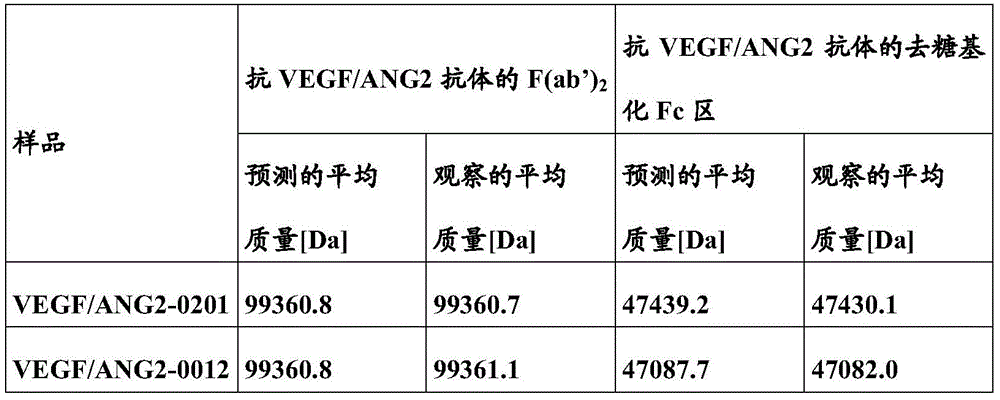
表:去糖基化的抗VEGF/ANG2抗体VEGF/ANG2-0016(具有IHH-AAA突变)和VEGF/ANG2-0015(没有IHH-AAA突变)的质量Table: Mass of deglycosylated anti-VEGF/ANG2 antibodies VEGF/ANG2-0016 (with IHH-AAA mutation) and VEGF/ANG2-0015 (without IHH-AAA mutation)

实施例5Example 5
FcRn色谱FcRn chromatography
偶联于链霉亲和素琼脂糖凝胶:Conjugated to Streptavidin Sepharose:
将1克链霉亲和素琼脂糖凝胶(GE Healthcare)添加至生物素酰化和透析的受体并温育两个小时伴以振摇。将受体衍生化的琼脂糖凝胶填充于1mL XK柱(GE Healthcare)中。One gram of Streptavidin Sepharose (GE Healthcare) was added to the biotinylated and dialyzed receptors and incubated for two hours with shaking. Receptor-derivatized agarose gels were packed in 1 mL XK columns (GE Healthcare).
使用FcRn亲和柱的色谱:Chromatography using FcRn affinity column:
条件:condition:
柱尺寸:50mm x 5mmColumn Size: 50mm x 5mm
床高度:5cmBed height: 5cm
载量:50μg样品Loading capacity: 50μg sample
平衡缓冲液:20mM MES,含150mM NaCl,调节至pH 5.5Equilibration buffer: 20 mM MES with 150 mM NaCl, adjusted to pH 5.5
洗脱缓冲液:20mM Tris/HCl,含150mM NaCl,调节至pH 8.8Elution buffer: 20 mM Tris/HCl with 150 mM NaCl, adjusted to pH 8.8
洗脱:7.5CV平衡缓冲液,在30CV内至100%洗脱缓冲液,10CV洗脱缓冲液Elution: 7.5CV of equilibration buffer, to 100% elution buffer in 30CV, 10CV of elution buffer
人FcRn亲和柱色谱Human FcRn affinity column chromatography
在下表中,给出抗VEGF-ANG2抗体在包含人FcRn的亲和柱上的保留时间。使用上述条件,获得数据。In the table below, the retention times of anti-VEGF-ANG2 antibodies on affinity columns containing human FcRn are given. Using the above conditions, data were obtained.
表:结果:抗VEGF/ANG2抗体的保留时间Table: Results: Retention times of anti-VEGF/ANG2 antibodies
实施例6Example 6
具有IHH-AAA突变的抗体的药代动力学(PK)特性Pharmacokinetic (PK) properties of antibodies with IHH-AAA mutations
人FcRn转基因的FcRn小鼠的PK数据PK data of human FcRn transgenic FcRn mice
在生活阶段:During the life stage:
该研究包括雌性C57BL/6J小鼠(背景);FcRn缺陷型,但呈人FcRn半合子转基因的小鼠(huFcRn,品系276-/tg)The study included female C57BL/6J mice (background); FcRn-deficient, but hemizygous transgenic for human FcRn (huFcRn, strain 276-/tg)
第1部分:part 1:
以适宜溶液的2μL/动物,以玻璃体内方式向右眼中注射全部小鼠一次(即21μg化合物/动物(VEGF/ANG2-0015(没有IHH-AAA突变))或23.6μg化合物/动物(VEGF/ANG2-0016(具有IHH-AAA突变))。All mice (ie, 21 μg compound/animal (VEGF/ANG2-0015 (without the IHH-AAA mutation)) or 23.6 μg compound/animal (VEGF/ANG2) were injected intravitreally into the right eye once at 2 μL/animal of the appropriate solution -0016 (with IHH-AAA mutation)).
将小鼠分配至2个组,每组6只动物。血液样品在给药后2、24和96小时取自组1并且在给药后7、48和168小时取自组2。Mice were assigned to 2 groups of 6 animals each. Blood samples were taken from
通过利用德国柏林World Precision Instruments,Inc.的用于纳升注射的NanoFil微量注射器系统,向小鼠右眼的玻璃体中注射。将小鼠用2.5%异氟烷麻醉,并且为了观察小鼠眼,使用放大率为40倍和具有Leica KL 2500LCD闪光的环形灯的Leica MZFL3显微镜。随后,使用35号针注射2μL化合物。The mice were injected into the vitreous of the right eye by utilizing the NanoFil Microinjector System for nanoliter injections from World Precision Instruments, Inc., Berlin, Germany. Mice were anesthetized with 2.5% isoflurane, and to observe mouse eyes, a Leica MZFL3 microscope with 40X magnification and ring light with a Leica KL 2500LCD flash was used. Subsequently, 2 μL of compound was injected using a 35 gauge needle.
通过对侧眼的眼球后静脉丛,从每只动物采集血液以测定血清中的化合物水平。Blood was collected from each animal via the retrobulbar venous plexus of the fellow eye to determine compound levels in serum.
在室温1小时后,通过在4℃离心(9300x g)3分钟从血液获得至少50μL血清样品。血清样品在离心后随即冷冻并在-80℃冷冻贮藏直至分析。处理后96小时,分离组1的动物的处理眼,并且处理后168小时,分离组2的动物的处理眼。样品在-80℃冷冻贮藏直至分析。After 1 hour at room temperature, at least 50 μL serum samples were obtained from blood by centrifugation (9300×g) for 3 minutes at 4°C. Serum samples were frozen immediately after centrifugation and stored frozen at -80°C until analysis. The treated eyes of the animals of
第2部分:part 2:
以适宜溶液的200μL/动物,以静脉内方式经尾静脉注射全部小鼠一次(即21μg化合物/动物(VEGF/ANG2-0015(没有IHH-AAA突变))或23.6μg化合物/动物(VEGF/ANG2-0016(具有IHH-AAA突变))。All mice (ie, 21 μg compound/animal (VEGF/ANG2-0015 (without IHH-AAA mutation)) or 23.6 μg compound/animal (VEGF/ANG2) were injected intravenously once via the tail vein at 200 μL/animal of the appropriate solution -0016 (with IHH-AAA mutation)).
将小鼠分配至2个组,每组5只动物。血液样品在给药后1、24和96小时取自组1并且在给药后7、48和168小时取自组2。通过眼球后静脉丛,从每只动物采集血液以测定血清中的化合物水平。Mice were assigned to 2 groups of 5 animals each. Blood samples were taken from
在室温1小时后,通过在4℃离心(9300x g)3分钟从血液获得至少50μL血清样品。血清样品在离心后随即冷冻并在-80℃冷冻贮藏直至分析。After 1 hour at room temperature, at least 50 μL serum samples were obtained from blood by centrifugation (9300×g) for 3 minutes at 4°C. Serum samples were frozen immediately after centrifugation and stored frozen at -80°C until analysis.
全眼裂解物(小鼠)的制备Preparation of Whole Eye Lysates (Mouse)
通过物理-化学瓦解来自实验室动物的全眼,获得眼裂解物。为了机械破裂,将每只眼转移至一个1.5mL圆锥底微量小瓶。在冷冻和解冻后,将眼用1mL细胞洗涤缓冲液洗涤一次(Bio-Rad,Bio-Plex细胞溶解试剂盒,目录号171-304011)。在后续步骤中,添加500μL新鲜制备的细胞溶解缓冲液并且使用1.5mL组织碾磨研杵(Kimble Chase,1.5mL研杵,产品编号749521-1500),研磨该眼。随后将混合物冷冻并融化5次并再次研磨。为了将裂解物与剩余组织分离,将样品以4,500g离心4分钟。在离心后,将上清液收集并贮存在-20℃直至在定量ELISA中进一步分析。Eye lysates were obtained by physico-chemical disruption of whole eyes from laboratory animals. For mechanical disruption, each eye was transferred to a 1.5 mL conical bottom microvial. After freezing and thawing, the eyes were washed once with 1 mL of Cell Wash Buffer (Bio-Rad, Bio-Plex Cell Lysis Kit, Cat. No. 171-304011). In a subsequent step, 500 μL of freshly prepared cell lysis buffer was added and the eye was triturated using a 1.5 mL tissue milling pestle (Kimble Chase, 1.5 mL pestle, Product No. 749521-1500). The mixture was then frozen and thawed 5 times and ground again. To separate the lysate from the remaining tissue, the samples were centrifuged at 4,500 g for 4 minutes. After centrifugation, supernatants were collected and stored at -20°C until further analysis in quantitative ELISA.
分析analyze
用酶联免疫吸附测定法(ELISA)测定小鼠血清和眼裂解物中抗VEGF/ANG2抗体的浓度。The concentrations of anti-VEGF/ANG2 antibodies in mouse serum and eye lysates were determined by enzyme-linked immunosorbent assay (ELISA).
为了定量小鼠血清样品和眼裂解物中的抗VEGF/ANG2抗体,进行标准固相系列夹心免疫测定,使用生物素酰化的和洋地黄毒苷化的单克隆抗体作为捕获抗体和检测抗体。为了验证分析物的双特异性的完整性,生物素酰化的捕获抗体识别VEGF-结合位点,而洋地黄毒苷化的检测抗体将与分析物的ANG2结合位点结合。随后用与抗洋地黄毒苷抗体偶联的辣根过氧化物酶检测在链霉亲和素包被的微量滴定平板(SA-MTP)的固相上的捕获抗体、分析物和检测抗体的结合型免疫复合物。在从SA-MTP洗去未结合的物质并添加ABTS-底物后,获得的信号与SA-MTP固相上结合的分析物的量成正比。随后通过参考同时分析的校准物将样品的测量信号换算成浓度,进行定量。To quantify anti-VEGF/ANG2 antibodies in mouse serum samples and eye lysates, a standard solid-phase serial sandwich immunoassay was performed using biotinylated and digoxigenylated monoclonal antibodies as capture and detection antibodies. To verify the integrity of the bispecificity of the analyte, the biotinylated capture antibody recognizes the VEGF-binding site, while the digoxigenylated detection antibody will bind to the analyte's ANG2 binding site. The capture, analyte, and detection antibodies on the solid phase of streptavidin-coated microtiter plates (SA-MTP) were subsequently detected with horseradish peroxidase conjugated to an anti-digoxigenin antibody. Conjugated immune complexes. After washing away unbound material from SA-MTP and adding ABTS-substrate, the obtained signal is proportional to the amount of analyte bound on the SA-MTP solid phase. Quantitation is then performed by converting the measured signal of the sample to a concentration with reference to a calibrator that is analyzed at the same time.
在第一步骤中,将SA-MTP在MTP摇板机上以500转/分钟用浓度1μg/mL的100μL/孔生物素酰化捕获抗体溶液(mAb<Id<VEGF>>M-2.45.51-IgG-Bi(DDS),抗独特型抗体)包被1小时。同时,制备校准物、QC样品和样品。将校准物和QC样品稀释至2%血清基质;将样品稀释直至信号处于校准物的线性范围内。In the first step, SA-MTP was biotinylated with a solution of 100 μL/well of biotinylated capture antibody (mAb<Id<VEGF>>M-2.45.51- IgG-Bi (DDS), anti-idiotype antibody) was coated for 1 hour. At the same time, prepare calibrators, QC samples and samples. Calibrator and QC samples were diluted to 2% serum matrix; samples were diluted until the signal was within the linear range of the calibrator.
在SA-MTP用捕获抗体包被后,将平板用洗涤缓冲液和300μL/孔洗涤3次。随后,将100μL/孔校准物、QC样品和样品吸到SA-MTP上并以500转/分钟再次温育1小时。分析物现在借助其VEGF结合位点通过捕获抗体与SA-MTP的固相结合。在温育并通过洗涤平板移除未结合的分析物后,将浓度250ng/mL的100μL/孔第一检测抗体(mAb<Id-<ANG2>>M-2.6.81-IgG-Dig(XOSu),抗独特型抗体)添加至SA-MTP。再次,将平板在摇床上以500转/分钟温育1小时。在洗涤后,将浓度50mU/mL的100μL/孔第二检测抗体(pAb<洋地黄毒苷>S-Fab-POD(多聚))添加至SA-MTP各孔并且将平板以500转/分钟再次温育1小时。在移除过量检测抗体的最终洗涤步骤后,添加100μL/孔底物(ABTS)。抗体-酶缀合物催化
药代动力学评价Pharmacokinetic evaluation
使用药代动力学评价程序WinNonlinTM(Pharsight)第5.2.1版,通过非房室分析计算药代动力学参数。Pharmacokinetic parameters were calculated by non-compartmental analysis using the pharmacokinetic evaluation program WinNonlin™ (Pharsight) version 5.2.1.
结果:result:
A)血清浓度A) Serum concentration
下表和图7B至图7C中显示血清浓度的结果。The results for serum concentrations are shown in the table below and in Figures 7B-7C.
表:VEGF/ANG2-0015(没有IHH-AAA突变):玻璃体内施加和静脉内施加后血清浓度的比较Table: VEGF/ANG2-0015 (without IHH-AAA mutation): Comparison of serum concentrations after intravitreal and intravenous administration
表:VEGF/ANG2-0016(具有IHH-AAA突变):玻璃体内施加和静脉内施加后血清浓度的比较Table: VEGF/ANG2-0016 (with IHH-AAA mutation): Comparison of serum concentrations after intravitreal and intravenous administration


表:VEGF/ANG2-0015(没有IHH-AAA突变)和VEGF/ANG2-0016(具有IHH-AAA突变):玻璃体内施加后各血清浓度的比较Table: VEGF/ANG2-0015 (without IHH-AAA mutation) and VEGF/ANG2-0016 (with IHH-AAA mutation): Comparison of serum concentrations after intravitreal application
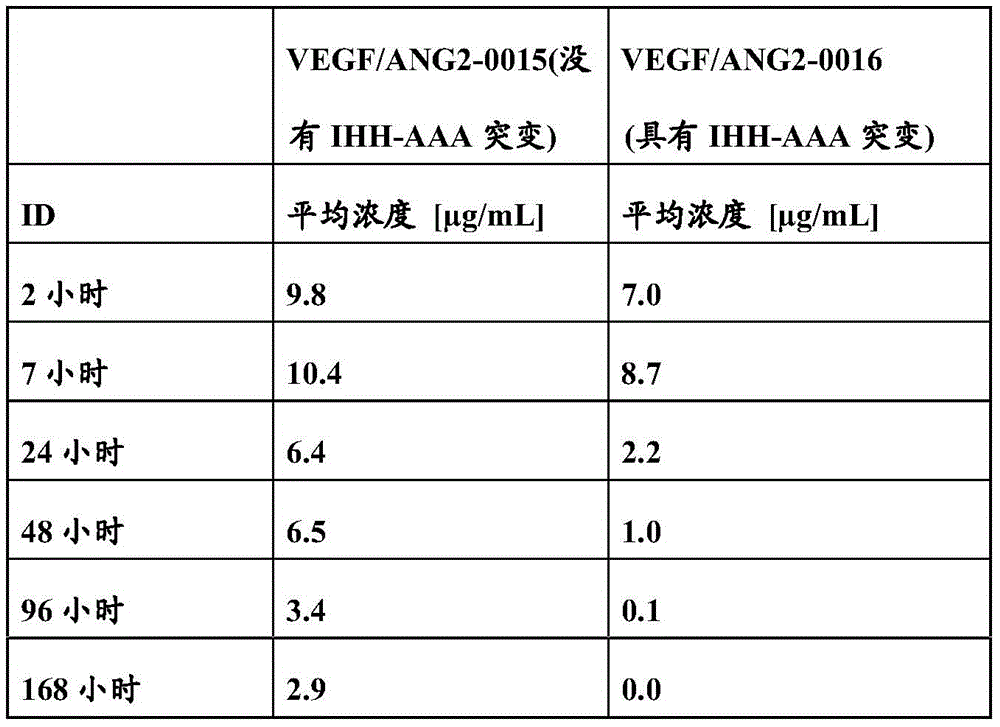
表:VEGF/ANG2-0015(没有IHH-AAA突变)和VEGF/ANG2-0016(具有IHH-AAA突变):静脉内施加后各血清浓度的比较Table: VEGF/ANG2-0015 (without IHH-AAA mutation) and VEGF/ANG2-0016 (with IHH-AAA mutation): Comparison of serum concentrations of each after intravenous administration
结果:result:
B)在左眼和右眼的眼裂解物中的浓度B) Concentrations in eye lysates of left and right eyes
下表和图7D至图7E中显示眼裂解物中浓度的结果。The results for concentrations in eye lysates are shown in the table below and in Figures 7D-7E.
表:玻璃体内施加至右眼后VEGF/ANG2-0015(没有IHH-AAA突变)在眼裂解物中的浓度Table: Concentrations of VEGF/ANG2-0015 (without IHH-AAA mutation) in eye lysates following intravitreal application to the right eye
表:静脉内施加后VEGF/ANG2-0015(没有IHH-AAA突变)在眼裂解物中的浓度Table: Concentrations of VEGF/ANG2-0015 (without IHH-AAA mutation) in eye lysates after intravenous administration

表:玻璃体内施加至右眼后VEGF/ANG2-0016(具有IHH-AAA突变)在眼裂解物中的浓度Table: Concentrations of VEGF/ANG2-0016 (with IHH-AAA mutation) in eye lysates after intravitreal application to the right eye
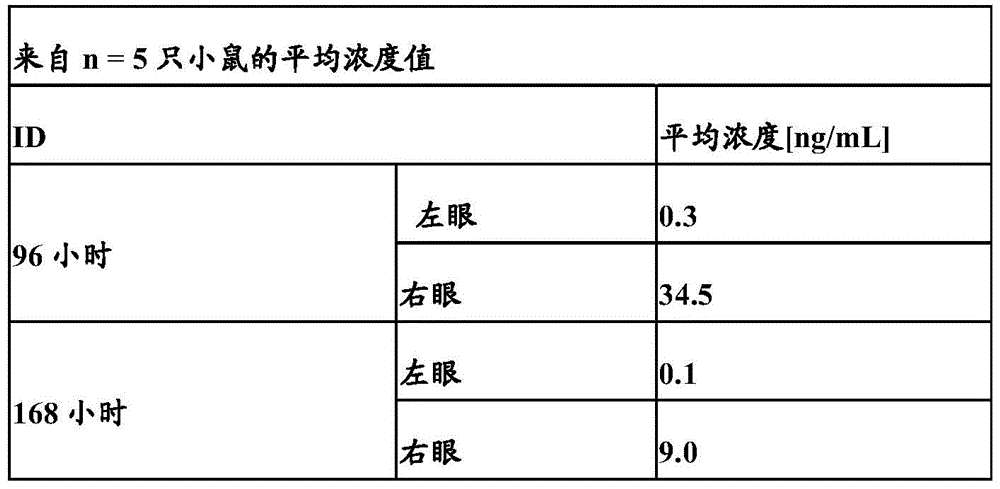
表:静脉内施加后VEGF/ANG2-0016(具有IHH-AAA突变)在眼裂解物中的浓度Table: Concentrations of VEGF/ANG2-0016 (with IHH-AAA mutation) in eye lysates after intravenous administration

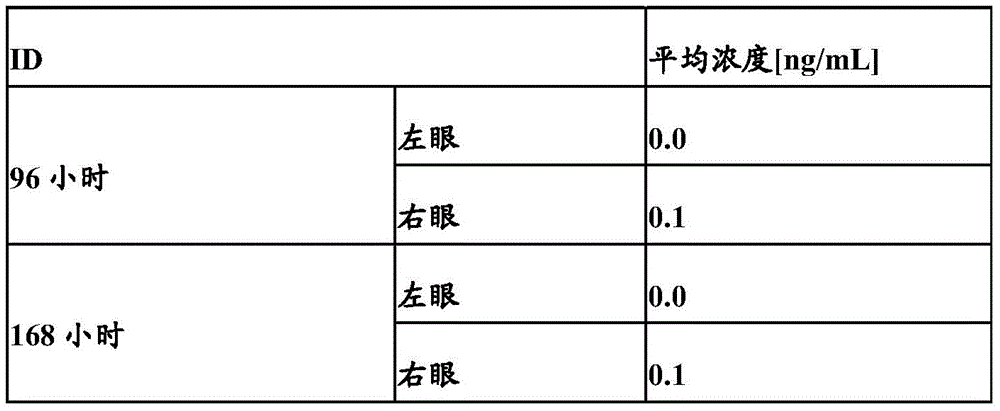
结果总结:Summary of results:
在玻璃体内施加后,与没有IHH-AAA突变的双特异性抗VEGF/ANG2抗体VEGF/ANG2-0015相比,如本文中报道的双特异性VEGF/ANG2抗体VEGF/ANG2-0016(具有IHH-AAA突变)在眼裂解物中显示相似的浓度(96小时和168小时后)。After intravitreal application, the bispecific VEGF/ANG2 antibody VEGF/ANG2-0016 (with IHH- AAA mutant) showed similar concentrations in eye lysates (after 96 and 168 hours).
另外,在玻璃体内施加后,与没有IHH-AAA突变的双特异性VEGF/ANG2抗体VEGF/ANG2-0015相比,如本文中报道的双特异性VEGF/ANG2抗体VEGF/ANG2-0016(具有IHH-AAA突变)额外显示在血清中更快的清除作用和较短的半寿期。Additionally, the bispecific VEGF/ANG2 antibody VEGF/ANG2-0016 as reported herein (with IHH-AAA mutation) was compared to the bispecific VEGF/ANG2 antibody VEGF/ANG2-0015 without the IHH-AAA mutation after intravitreal application. -AAA mutation) additionally showed faster clearance and shorter half-life in serum.
实施例7Example 7
小鼠角膜微囊袋血管生成测定法Mouse Corneal Microcapsule Angiogenesis Assay
为了测试具有SEQ ID NO:20和21的相应VEGF结合性VH和VL以及SEQ ID NO:28和29的ANG2结合性VH和VL的双特异抗VEGF/ANG2抗体在体内对VEGF所致血管生成过程的抗血管生成作用,实施小鼠角膜血管生成测定法。在这个测定法中,将浸透VEGF的Nylaflo圆片以相对于角膜缘血管而言固定的距离植入无血管的角膜囊袋中。血管立即生长至角膜中指向正在形成的VEGF梯度。8至10周龄雌性BALB/c小鼠购自Charles River,Sulzfeld,德国。研究方案根据Rogers,M.S.等人,Nat.Protoc.2(2007)2545-2550描述的方法调整。简而言之,在麻醉小鼠中使用手术刀片和尖头镊,在显微镜下按照从角膜缘至角膜顶部的大约1mm制备宽度约500μm的微囊袋。植入直径0.6mm的圆片(
将圆片用300ng VEGF或PBS加载作为对照并植入7日。随时间推移在第3、5和/或7日监测血管从角膜缘至圆片的生长晕。在圆片植入之前一日,将抗体以剂量10mg/kg静脉内施用(归因于静脉内施加,使用仅因IHH-AAA突变与VEGF/ANG2-0016不同并具有相同的结合VEGF和ANG-2的VH和VL以介导效力的血清稳定的VEGF/ANG2-0015(没有IHH-AAA突变)作为代用品)以在体内测试对VEGF所致血管生成的抗血管生成作用。对照组中的动物接受溶媒。施加体积是10mL/kg。Discs were loaded with 300ng VEGF or PBS as controls and implanted for 7 days. Vessel growth from the limbus to the disc was monitored on
实施例8Example 8
具有HHY-AAA突变的抗体的药代动力学(PK)特性Pharmacokinetic (PK) properties of antibodies with HHY-AAA mutations
人FcRn转基因的FcRn小鼠的PK数据PK data of human FcRn transgenic FcRn mice
在生活阶段:During the life stage:
该研究包括雌性C57BL/6J小鼠(背景);小鼠FcRn缺陷型,但呈人FcRn半合子转基因的小鼠(huFcRn,品系276-/tg)The study included female C57BL/6J mice (background); mice deficient in FcRn but hemizygous transgenic for human FcRn (huFcRn, strain 276-/tg)
第1部分:part 1:
用适宜的IGF-1R 0033、IGF-1R 0035、IGF-1R 0045溶液(即22.2μg化合物/动物的IGF-1R 0033、24.4μg化合物/动物的IGF-1R 0035、32.0μg化合物/动物的IGF-1R和32.0μg化合物/动物的IGF-1R 0045),向全部小鼠的右眼中按玻璃体内方式注射至一次。Use appropriate solutions of IGF-
将13只小鼠分配至2个组,每个组分别有6只和7只动物。血液样品在给药后2、24和96小时取自组1并且在给药后7、48和168小时取自组2。Thirteen mice were assigned to 2 groups of 6 and 7 animals, respectively. Blood samples were taken from
通过利用德国柏林World Precision Instruments,Inc.的用于纳升注射的NanoFil微量注射器系统,向小鼠右眼的玻璃体中注射。将小鼠用2.5%异氟烷麻醉,并且为了观察小鼠眼,使用放大率为40倍和具有Leica KL 2500LCD闪光的环形灯的Leica MZFL3显微镜。随后,使用35号针注射2μL化合物。The mice were injected into the vitreous of the right eye by utilizing the NanoFil microinjector system for nanoliter injections from World Precision Instruments, Inc., Berlin, Germany. Mice were anesthetized with 2.5% isoflurane, and to observe mouse eyes, a Leica MZFL3 microscope with 40X magnification and ring light with a Leica KL 2500LCD flash was used. Subsequently, 2 μL of compound was injected using a 35 gauge needle.
通过对侧眼的眼球后静脉丛,从每只动物采集血液以测定血清中的化合物水平。Blood was collected from each animal via the retrobulbar venous plexus of the fellow eye to determine compound levels in serum.
在室温1小时后,通过在4℃离心(9300x g)3分钟从血液获得至少50μL血清样品。血清样品在离心后随即冷冻并在-80℃冷冻贮藏直至分析。处理后96小时,分离组1动物的处理眼,并且处理后168小时,分离组2动物的处理眼。样品在-80℃冷冻贮藏直至分析。After 1 hour at room temperature, at least 50 μL serum samples were obtained from blood by centrifugation (9300×g) for 3 minutes at 4°C. Serum samples were frozen immediately after centrifugation and stored frozen at -80°C until analysis. The treated eyes of the
第2部分:part 2:
用适宜的IGF-1R 0033、IGF-1R 0035、IGF-1R 0045溶液(即22.2μg化合物/动物的IGF-1R 0033、24.4μg化合物/动物的IGF-1R 0035、32.0μg化合物/动物的IGF-1R和32.0μg化合物/动物的IGF-1R 0045),按静脉内方式经尾静脉注射全部小鼠一次。Use appropriate solutions of IGF-
将12只小鼠分配至2个组,每组6只动物。血液样品在给药后1、24和96小时取自组1并且在给药后7、48和168小时取自组2。通过眼球后静脉丛,从每只动物采集血液以测定血清中的化合物水平。Twelve mice were assigned to 2 groups of 6 animals each. Blood samples were taken from
在室温1小时后,通过在4℃离心(9300x g)3分钟从血液获得至少50μL血清样品。血清样品在离心后随即冷冻并在-80℃冷冻贮藏直至分析。After 1 hour at room temperature, at least 50 μL serum samples were obtained from blood by centrifugation (9300×g) for 3 minutes at 4°C. Serum samples were frozen immediately after centrifugation and stored frozen at -80°C until analysis.
细胞溶解缓冲液的制备Preparation of Cell Lysis Buffer
小心混合100μL因子1、50μL因子2和24.73mL细胞溶解缓冲液(全部来自Bio-Rad,Bio-Plex细胞溶解试剂盒,目录号:171-304011)并且添加125μL PMSF-溶液(稀释于2.0mLDMSO中的174.4mg苯甲基磺酰氟)。Carefully mix 100
全眼裂解物(小鼠)的制备Preparation of Whole Eye Lysates (Mouse)
通过物理-化学瓦解来自实验室动物的全眼,获得眼裂解物。为了机械破裂,将每只眼转移至一个1.5mL圆锥底微量小瓶。在解冻后,将眼用1mL细胞洗涤缓冲液洗涤一次(Bio-Rad,Bio-Plex细胞溶解试剂盒,目录号171-304011)。在后续步骤中,添加500μL新鲜制备的细胞溶解缓冲液并且使用1.5mL组织碾磨研杵(VWR Int.,产品编号431-0098),研磨该眼。随后将混合物冷冻并融化5次并再次研磨。为了将裂解物与剩余组织分离,将样品以4500x g离心4分钟。在离心后,将上清液收集并贮存在-20℃直至在定量ELISA中进一步分析。Eye lysates were obtained by physico-chemical disruption of whole eyes from laboratory animals. For mechanical disruption, each eye was transferred to a 1.5 mL conical bottom microvial. After thawing, the eyes were washed once with 1 mL of Cell Wash Buffer (Bio-Rad, Bio-Plex Cell Lysis Kit, Cat. No. 171-304011). In a subsequent step, 500 μL of freshly prepared cell lysis buffer was added and the eye was ground using a 1.5 mL tissue grinding pestle (VWR Int., Catalog No. 431-0098). The mixture was then frozen and thawed 5 times and ground again. To separate the lysate from the remaining tissue, the samples were centrifuged at 4500 x g for 4 min. After centrifugation, supernatants were collected and stored at -20°C until further analysis in quantitative ELISA.
分析(血清)Analysis (serum)
为了定量小鼠血清样品中的抗体,进行标准固相系列夹心免疫测定,使用生物素酰化的和洋地黄毒苷化的单克隆抗体作为捕获抗体和检测抗体。血清占据整个血液样品体积的约50%。To quantify antibodies in mouse serum samples, a standard solid phase serial sandwich immunoassay was performed using biotinylated and digoxigenylated monoclonal antibodies as capture and detection antibodies. Serum occupies approximately 50% of the volume of the entire blood sample.
更详细地,通过人IgG(Fab)特异性酶联免疫吸附测定法确定小鼠血清样品中抗体的浓度。将链霉亲和素包被的微量滴定板在室温与作为捕获抗体稀释于分析缓冲液中的生物素酰化抗人Fab(kappa)单克隆抗体M-1.7.10-IgG温育1小时伴以搅拌。用磷酸盐缓冲盐水-聚山梨醇酯20(Tween 20)洗涤3次后,将血清样品按多个稀释度添加,随后在室温第二次温育1小时。在三次反复洗涤后,通过后续与缀合于洋地黄毒苷的抗人Fab(CH1)单克隆抗体M-1.19.31-IgG温育,随后与缀合于辣根过氧化物酶(HRP)的抗洋地黄毒苷抗体温育,检测结合的抗体。使用ABTS(2,2'-联氮-双(3-乙基苯并噻唑啉-6-磺酸)-6-磺酸);RocheDiagnostics GmbH,曼海姆,德国)作为HRP底物以形成有色反应产物。在405nm读取所产生的反应产物的吸光度(ABTS;参考波长:490nm)。In more detail, the concentration of antibodies in mouse serum samples was determined by human IgG (Fab) specific enzyme-linked immunosorbent assay. Streptavidin-coated microtiter plates were incubated with biotinylated anti-human Fab (kappa) monoclonal antibody M-1.7.10-IgG diluted in assay buffer as capture antibody for 1 hour at room temperature with to stir. After 3 washes with phosphate buffered saline-polysorbate 20 (Tween 20), serum samples were added in multiple dilutions followed by a second incubation for 1 hour at room temperature. After three repeated washes, by subsequent incubation with digoxigenin-conjugated anti-human Fab (CH1) monoclonal antibody M-1.19.31-IgG, followed by horseradish peroxidase (HRP)-conjugated Anti-digoxigenin antibody was incubated to detect bound antibody. ABTS (2,2'-Diazo-bis(3-ethylbenzothiazoline-6-sulfonic acid)-6-sulfonic acid); RocheDiagnostics GmbH, Mannheim, Germany) was used as the HRP substrate to form colored reaction product. The absorbance of the resulting reaction product was read at 405 nm (ABTS; reference wavelength: 490 nm).
将全部样品、阳性对照样品和阴性对照样品一式两份分析并且针对提供的抗体标准校准。All samples, positive control samples and negative control samples were analyzed in duplicate and calibrated against the antibody standards provided.
分析(眼裂解物)Analysis (eye lysate)
基于
将未稀释的上清液(眼裂解物)与捕获分子和检测分子在37℃温育9分钟。使用生物素酰化的抗人-Fab(kappa)单克隆抗体M-1.7.10-IgG作为捕获分子并且将钌(II)三(双吡啶基)3 2+标记的抗人-Fab(CH1)单克隆抗体M-1.19.31-IgG用于检测。添加链霉亲和素包被的磁性的微粒子并且在37℃温育额外9分钟,以允许预先形成的免疫复合物因生物素-链霉亲和素相互作用而结合。以磁性方式在电极上捕获微粒子并且使用共反应物三丙胺(TPA)生成化学发光信号。通过光电倍增探测器测量获得的信号。The undiluted supernatant (eye lysate) was incubated with capture and detection molecules for 9 minutes at 37°C. Biotinylated anti-human-Fab(kappa) monoclonal antibody M-1.7.10-IgG was used as capture molecule and anti-human-Fab(CH1) labeled with ruthenium(II) tris(bispyridyl) 3 2+ Monoclonal antibody M-1.19.31-IgG was used for detection. Streptavidin-coated magnetic microparticles were added and incubated at 37°C for an additional 9 minutes to allow pre-formed immune complexes to bind due to biotin-streptavidin interactions. Microparticles were magnetically captured on electrodes and the co-reactant tripropylamine (TPA) was used to generate a chemiluminescent signal. The obtained signal is measured by a photomultiplier detector.
表:标准表IGF-1R 0033Table: Standard Table IGF-
表:标准表IGF-1R 0035Table: Standard Table IGF-
表:标准表IGF-1R 0045Table: Standard Table IGF-
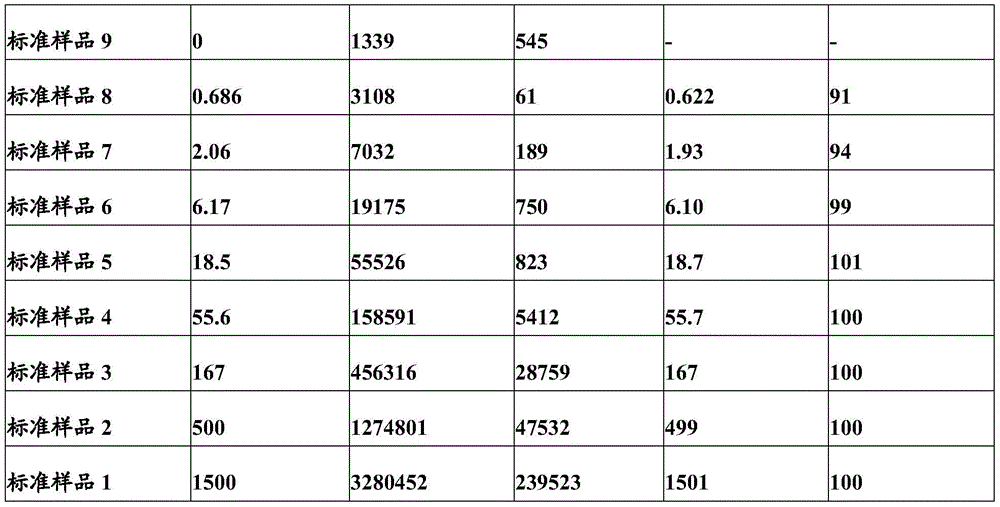
结果:result:
A)血清浓度A) Serum concentration
下表和图17中显示血清浓度的结果。The results for serum concentrations are shown in the table below and in FIG. 17 .
表:IGF-1R 0033(没有HHY-AAA突变):玻璃体内施加和静脉内施加后血清浓度的比较(n.d.=未测定)Table: IGF-1R 0033 (without HHY-AAA mutation): Comparison of serum concentrations after intravitreal and intravenous administration (n.d.=not determined)
表:IGF-1R 0035(在一条Fc区多肽中具有HHY-AAA突变):玻璃体内施加和静脉内施加后血清浓度的比较Table: IGF-1R 0035 (with HHY-AAA mutation in an Fc region polypeptide): Comparison of serum concentrations after intravitreal and intravenous administration
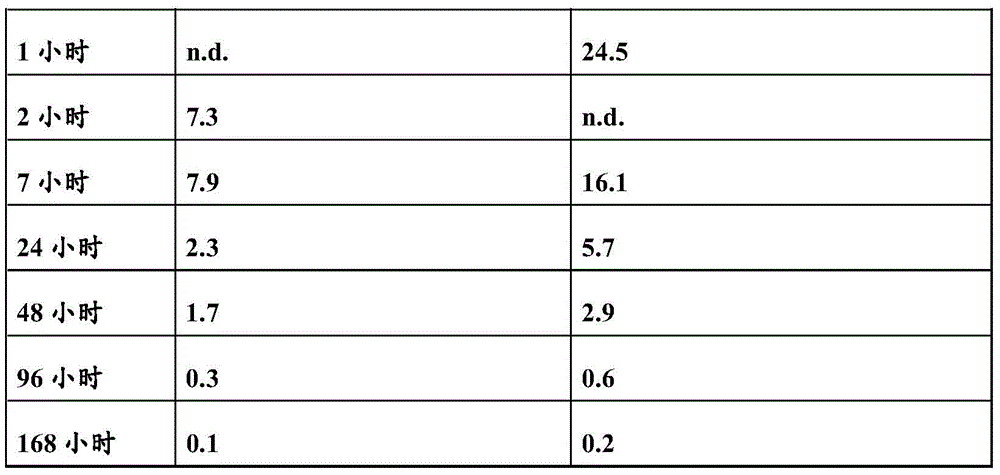
表:IGF-1R 0045(在两条Fc区多肽中具有HHY-AAA突变):玻璃体内施加和静脉内施加后血清浓度的比较(BLQ=定量限以下)Table: IGF-1R 0045 (with HHY-AAA mutation in both Fc region polypeptides): Comparison of serum concentrations after intravitreal and intravenous administration (BLQ = below limit of quantitation)
表:静脉内施加抗体IGF-1R 0033、0035和0045后对1μg施加的抗体归一化的血清浓度的比较Table: Comparison of serum concentrations normalized to 1 μg applied antibody after intravenous administration of antibodies IGF-
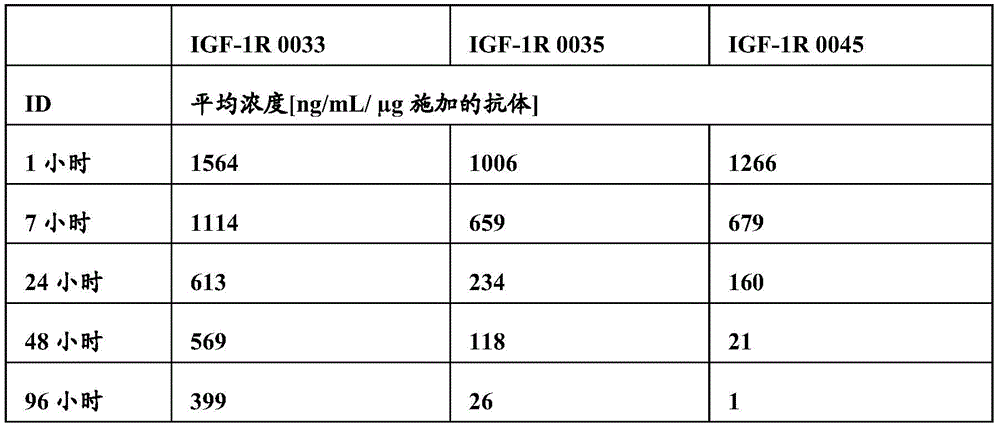

结果:result:
B)在左眼和右眼的眼裂解物中的浓度B) Concentrations in eye lysates of left and right eyes
下表和图18至20中显示眼裂解物中浓度的结果。The results for concentrations in eye lysates are shown in the table below and in Figures 18-20.
表:在玻璃体内施加入右眼后眼裂解物中IGF-1R 0033(没有HHY-AAA突变)的浓度Table: Concentrations of IGF-1R 0033 (without HHY-AAA mutation) in eye lysates after intravitreal administration to the right eye
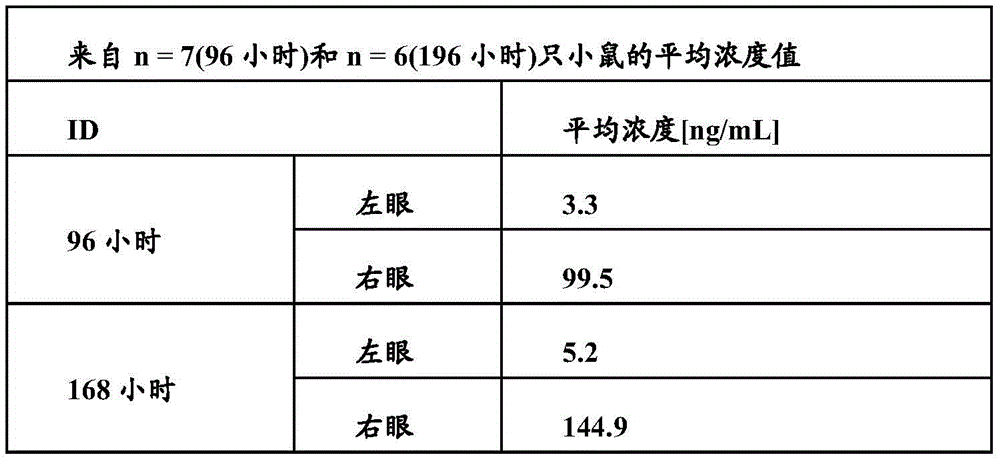
表:在静脉内施加后眼裂解物中IGF-1R 0033(没有HHY-AAA突变)的浓度(BLQ=定量限以下)Table: Concentrations of IGF-1R 0033 (without HHY-AAA mutation) in eye lysates after intravenous application (BLQ = below limit of quantitation)
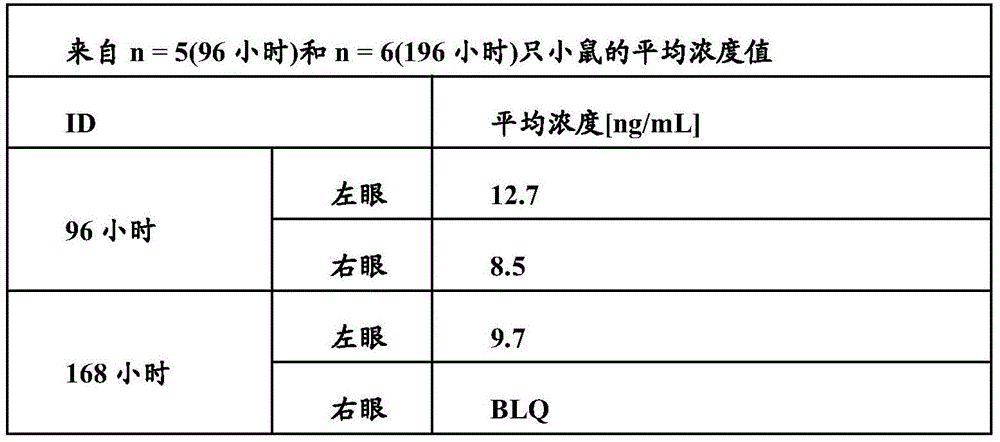
表:在玻璃体内施加入右眼后眼裂解物中IGF-1R 0035(在一条Fc区多肽中具有HHY-AAA突变)的浓度Table: Concentrations of IGF-1R 0035 (with HHY-AAA mutation in one Fc region polypeptide) in eye lysates after intravitreal administration to the right eye
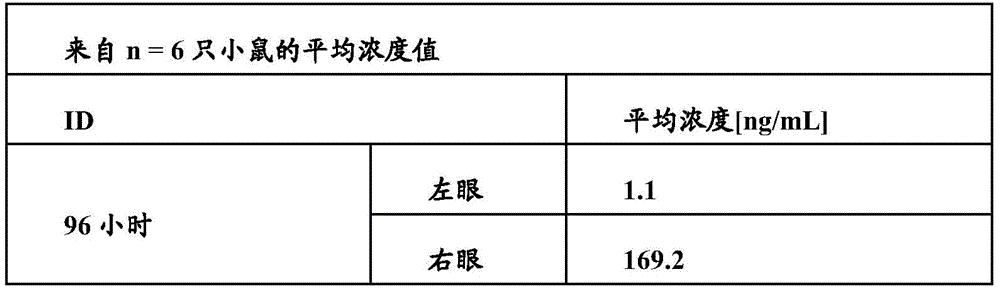

表:在静脉内施加后眼裂解物中IGF-1R 0035(在一条Fc区多肽中具有HHY-AAA突变)的浓度(BLQ=定量限以下)Table: Concentrations of IGF-1R 0035 (with HHY-AAA mutation in one Fc region polypeptide) in eye lysates after intravenous application (BLQ = below limit of quantitation)

表:在玻璃体内施加入右眼后眼裂解物中IGF-1R 0045(在两条Fc区多肽中均具有HHY-AAA突变)的浓度Table: Concentration of IGF-1R 0045 (with HHY-AAA mutation in both Fc region polypeptides) in eye lysate following intravitreal administration to the right eye

表:在静脉内施加后眼裂解物中IGF-1R 0045(在两条Fc区多肽中均具有HHY-AAA突变)的浓度(BLQ=定量限以下)Table: Concentrations of IGF-1R 0045 (with HHY-AAA mutation in both Fc region polypeptides) in eye lysates after intravenous application (BLQ = below limit of quantitation)
表:在玻璃体内施加入右眼后眼裂解物中对1μg施加的抗体归一化的IGF-1R0033、0035和0045浓度Table: IGF-1R0033, 0035 and 0045 concentrations normalized to 1 μg of applied antibody in eye lysates after intravitreal administration to the right eye
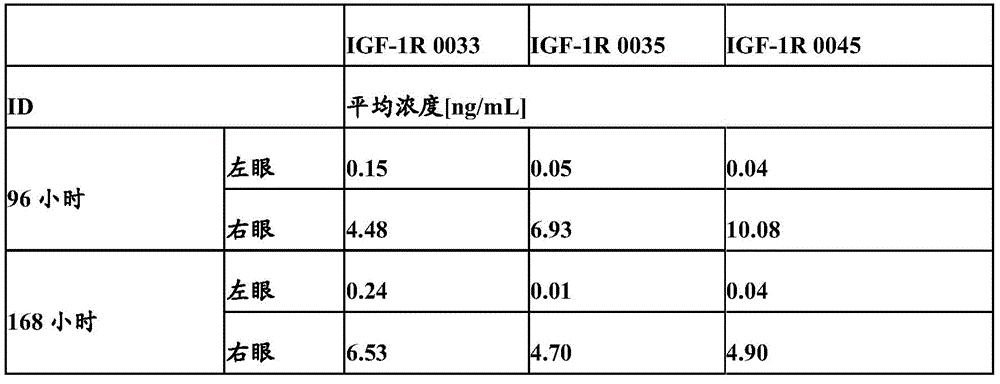
结果总结:Summary of results:
在玻璃体内施加后,与没有HHY-AAA突变的抗IGF-1R抗体(IGF-1R 0033)相比,如本文中报道的抗IGF-1R抗体0035和0045(具有一侧或两侧HHY-AAA突变)在眼裂解物中显示(96小时和168小时后)相似的浓度。After intravitreal application, the anti-IGF-
另外,在玻璃体内施加后,与没有HHY-AAA突变的抗IGF-1R抗体(IGF-1R0033)相比,如本文中报道的抗IGF-1R抗体0035和0045(具有一侧或两侧HHY-AAA突变)在血清中额外地显示更快的清除和较短的半寿期。Additionally, after intravitreal application, the anti-IGF-
虽然已经出于清晰理解的目的,以说明和举例方式某种程度地详细描述了前述发明,但是这些说明和例子不应当解释为限制本发明的范围。本文中援引的全部专利和科学文献的公开内容通过引用方式明确地完整并入。While the foregoing invention has been described in some detail by way of illustration and example for purposes of clarity of understanding, these descriptions and examples should not be construed as limiting the scope of the invention. The disclosures of all patent and scientific literature cited herein are expressly incorporated by reference in their entirety.
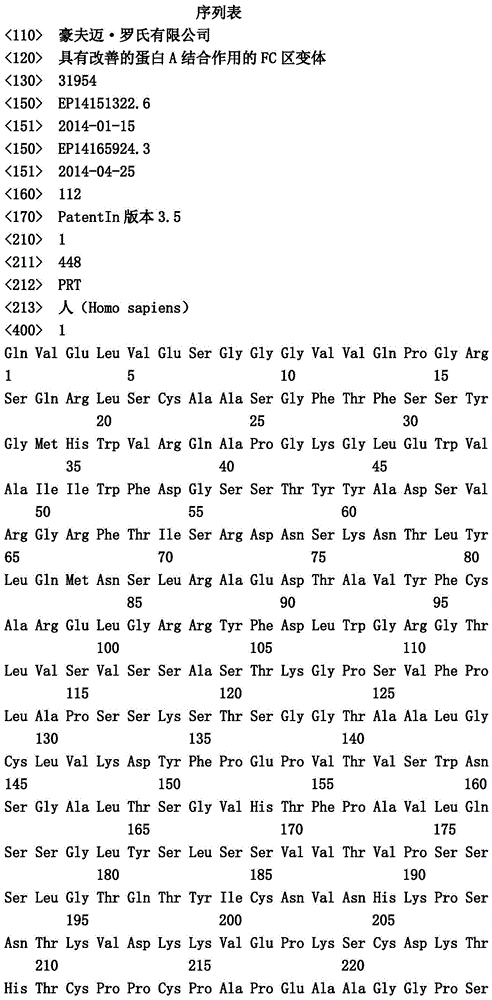
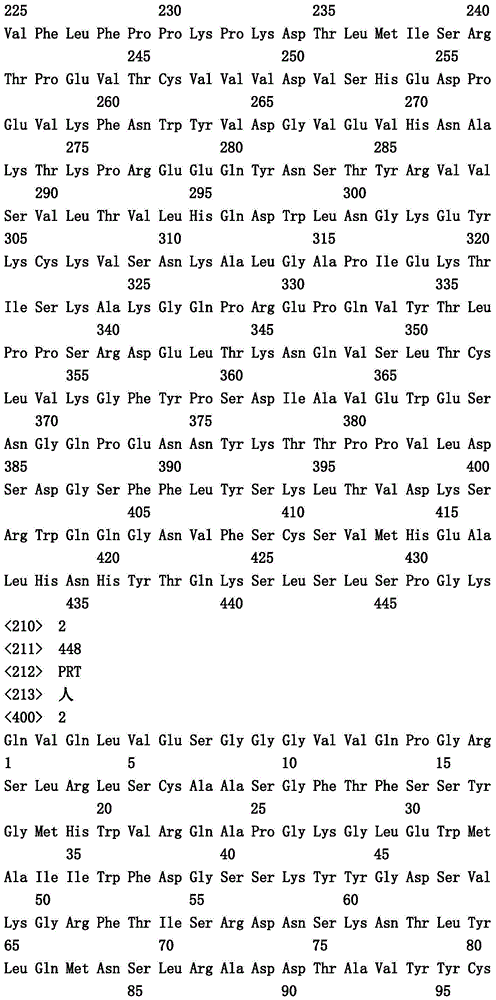
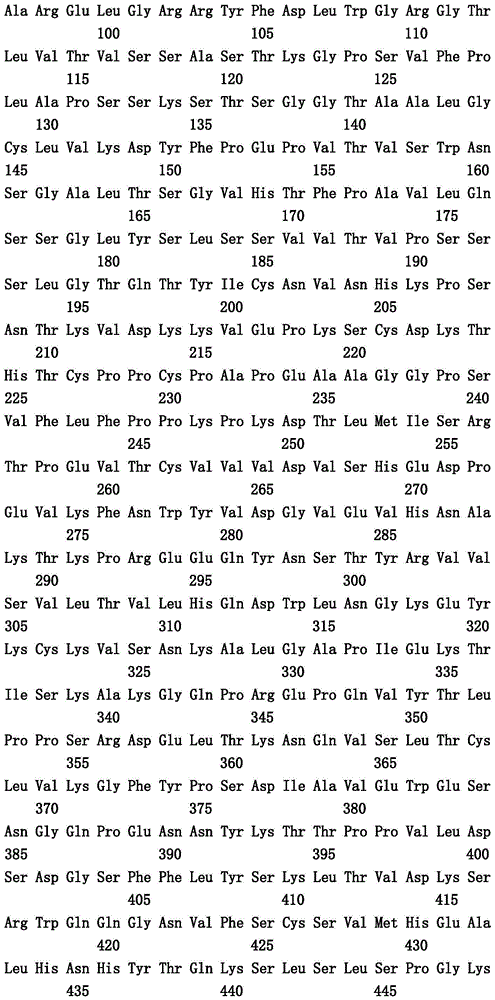
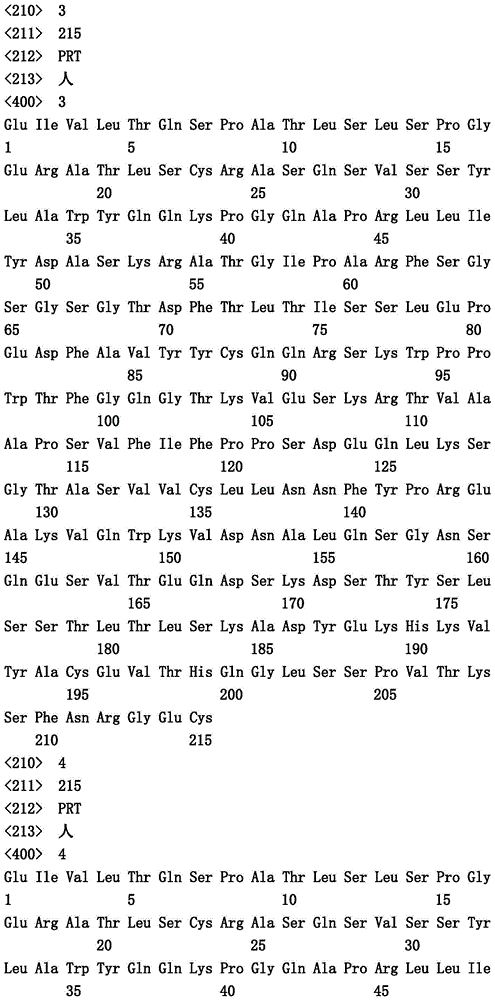
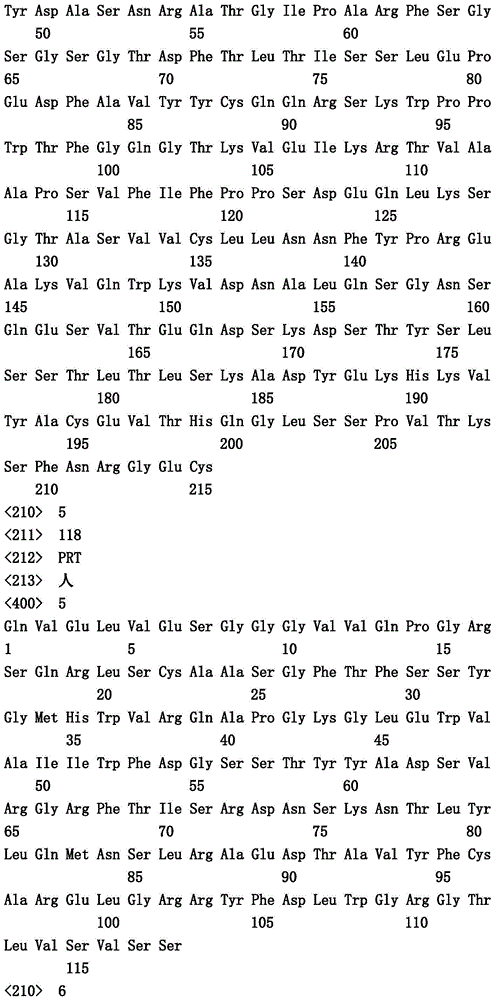
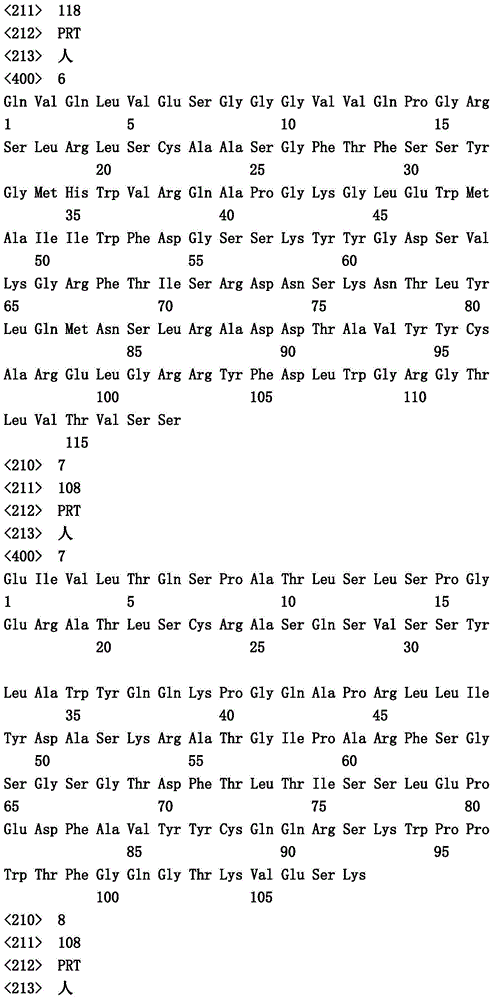

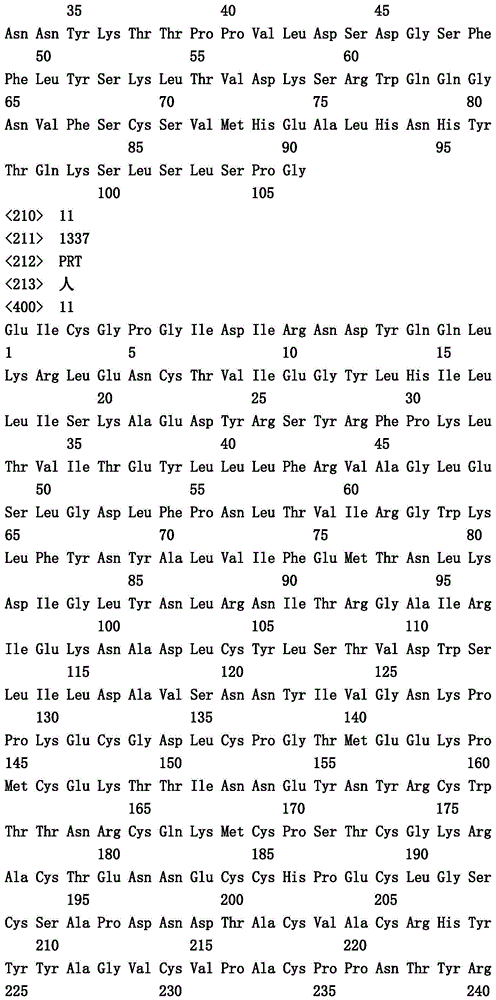
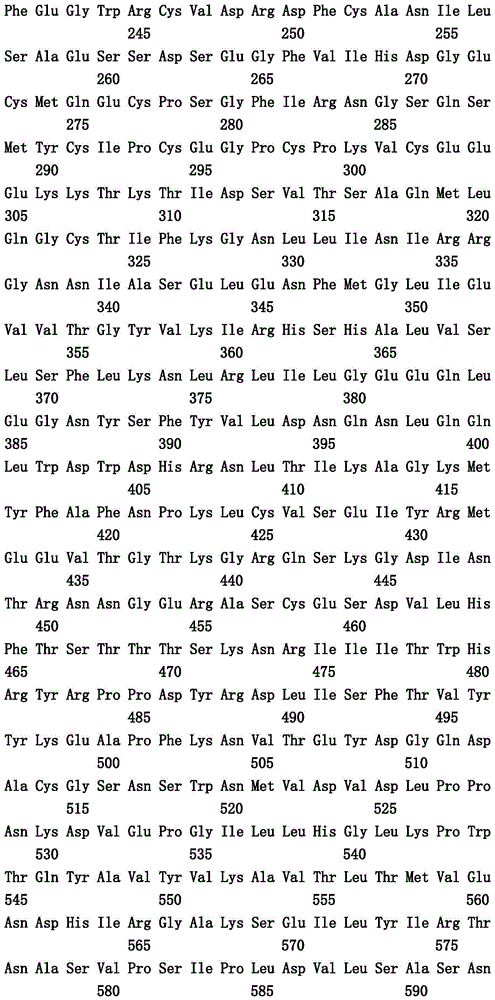
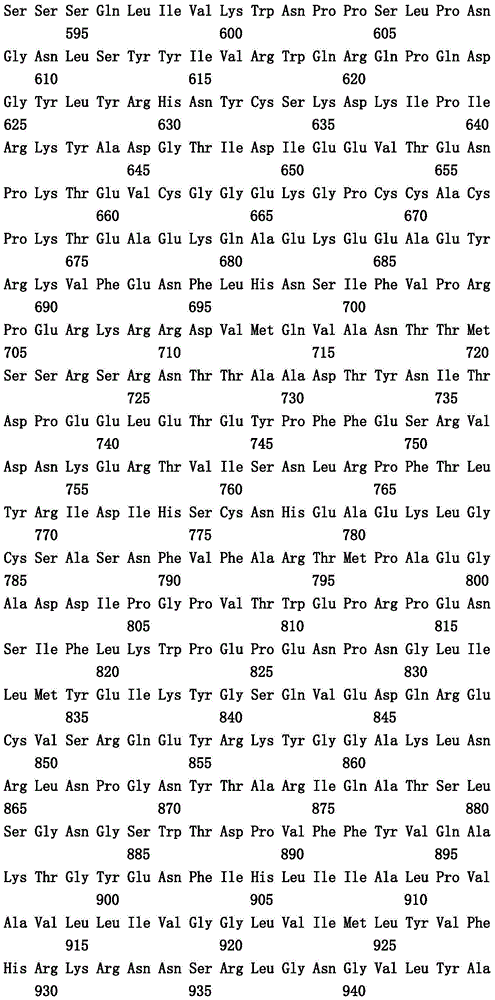
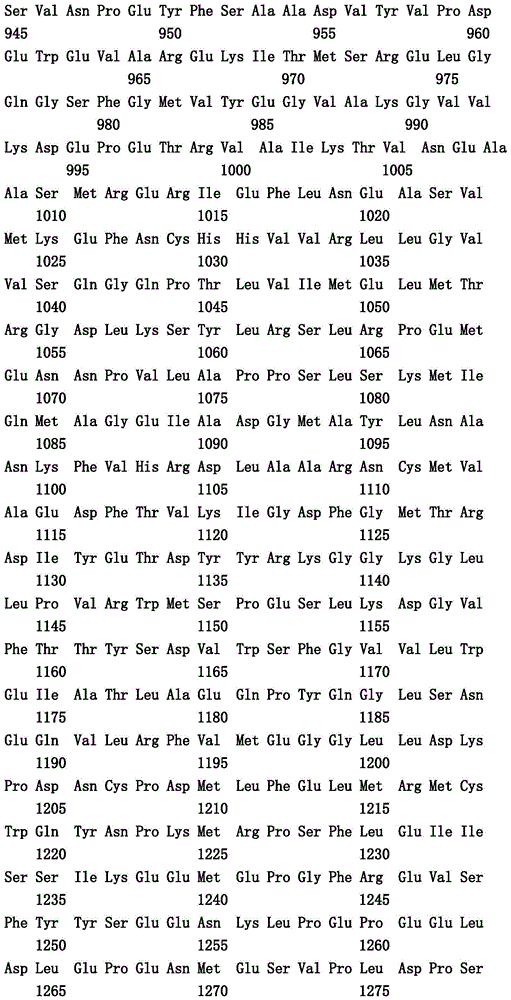
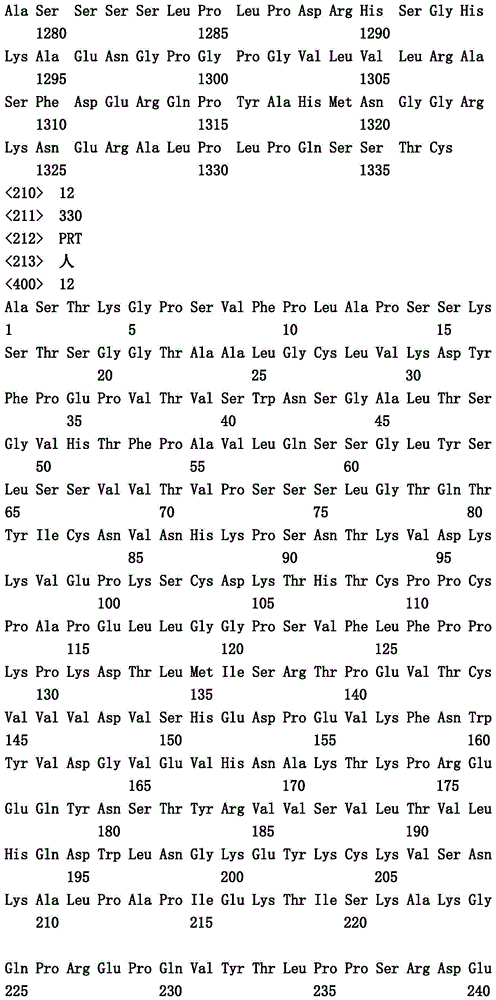
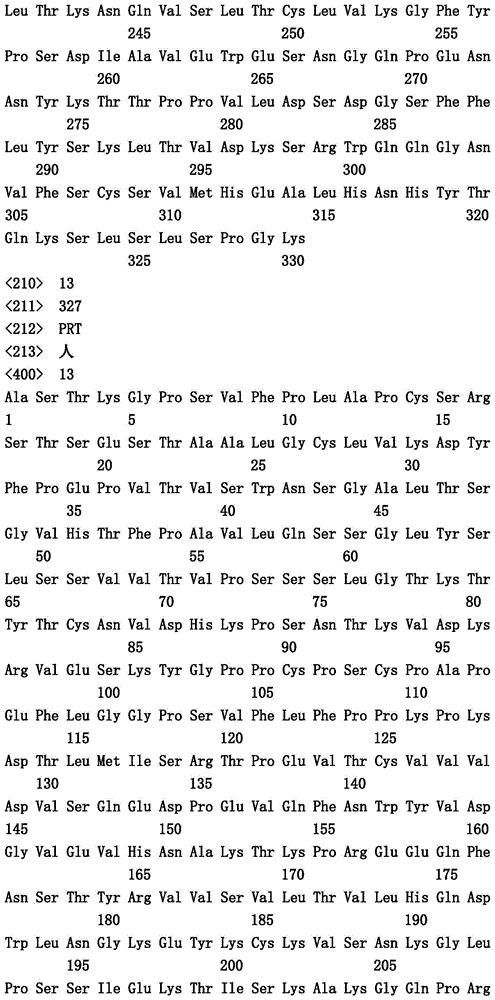
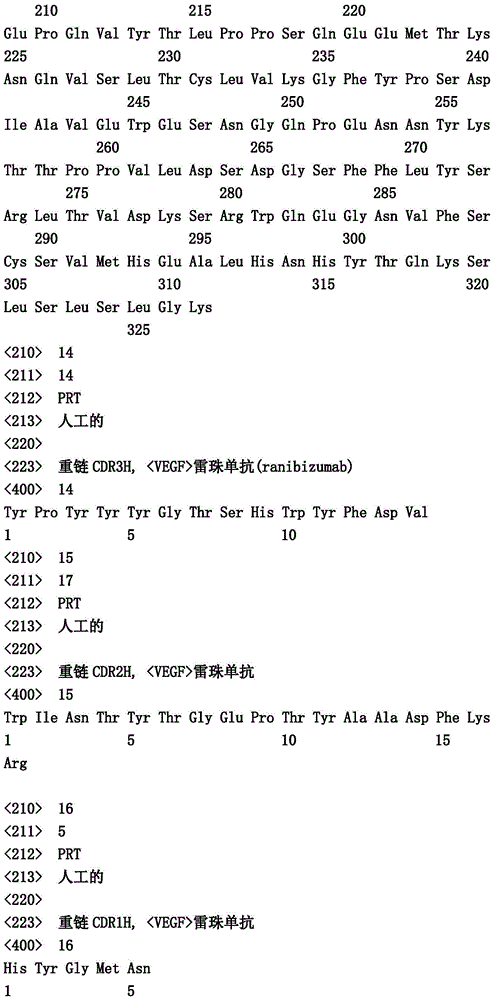
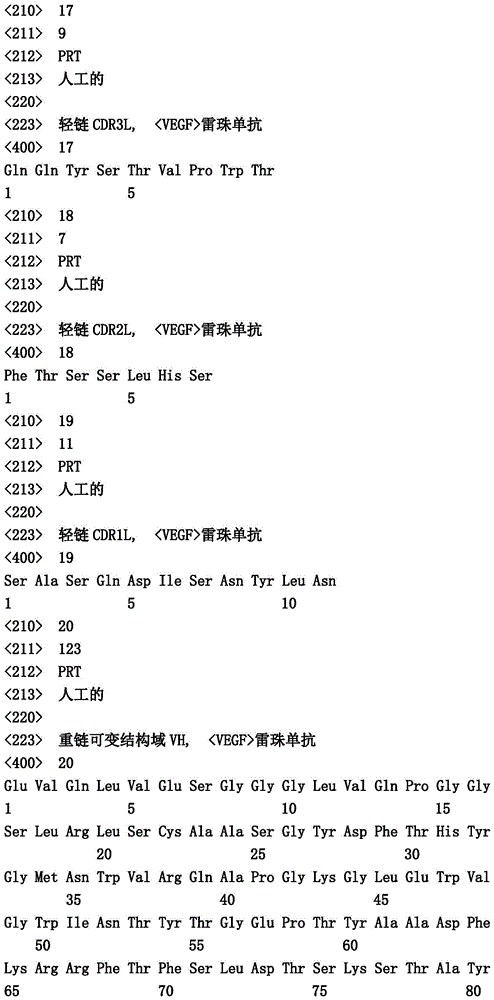

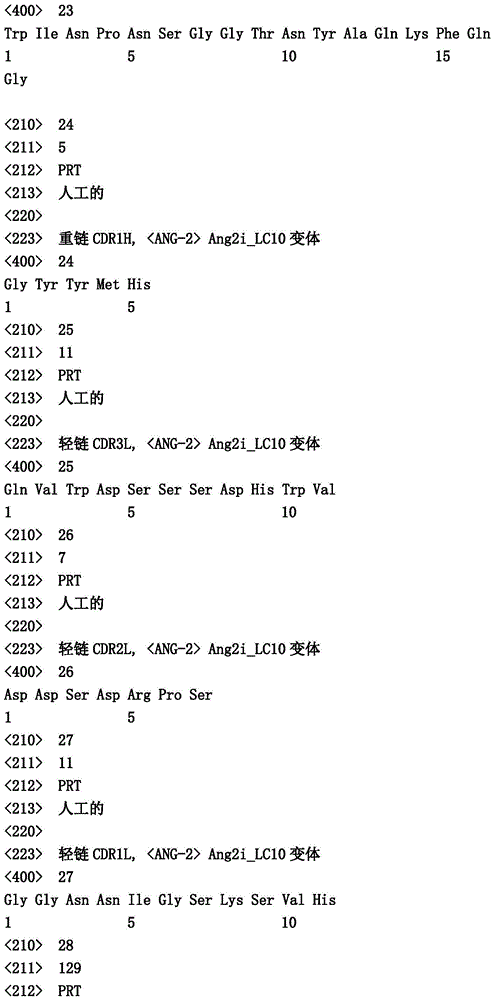
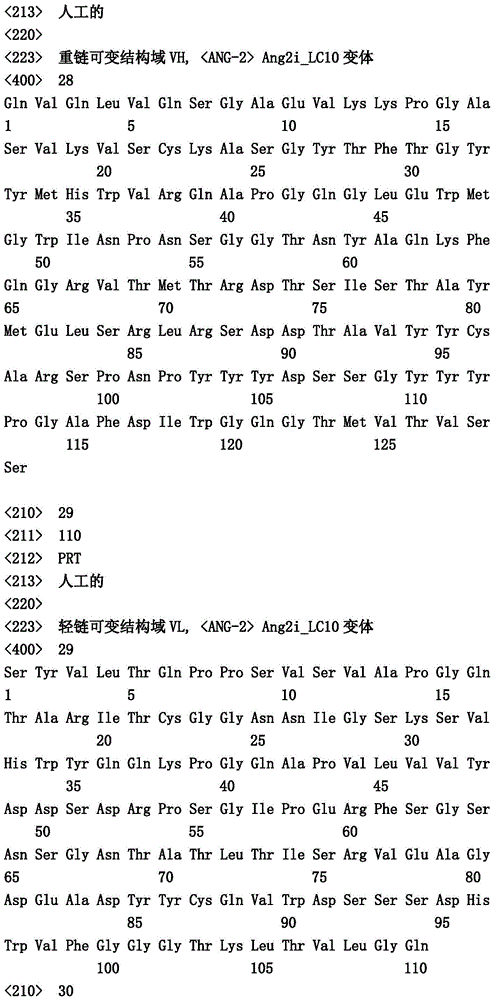
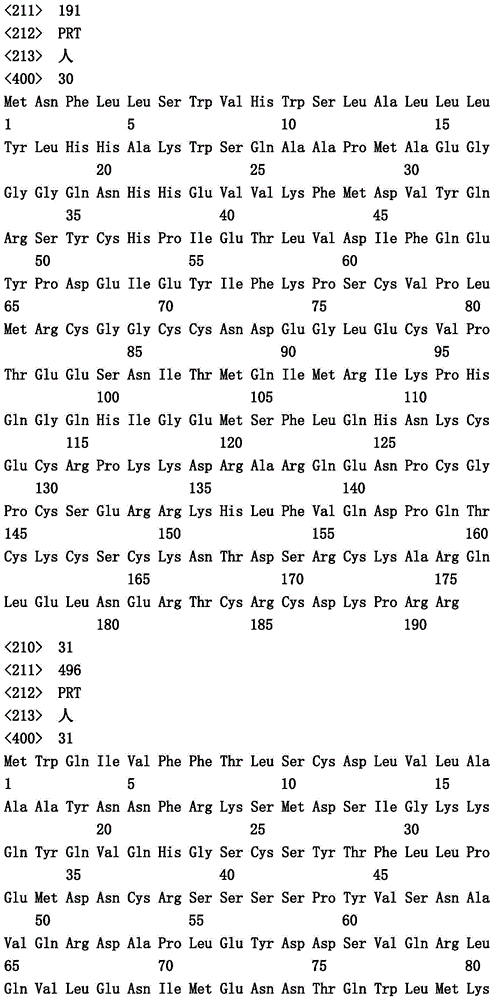
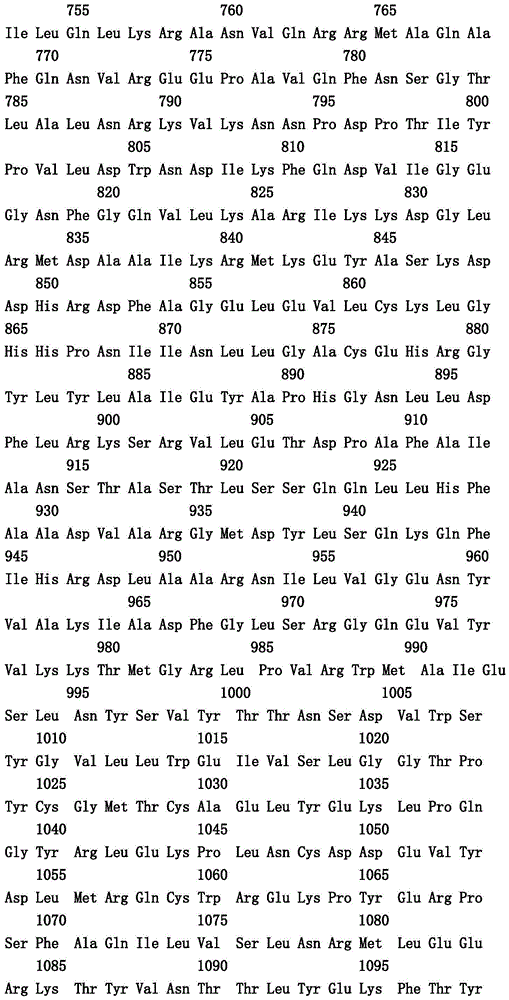
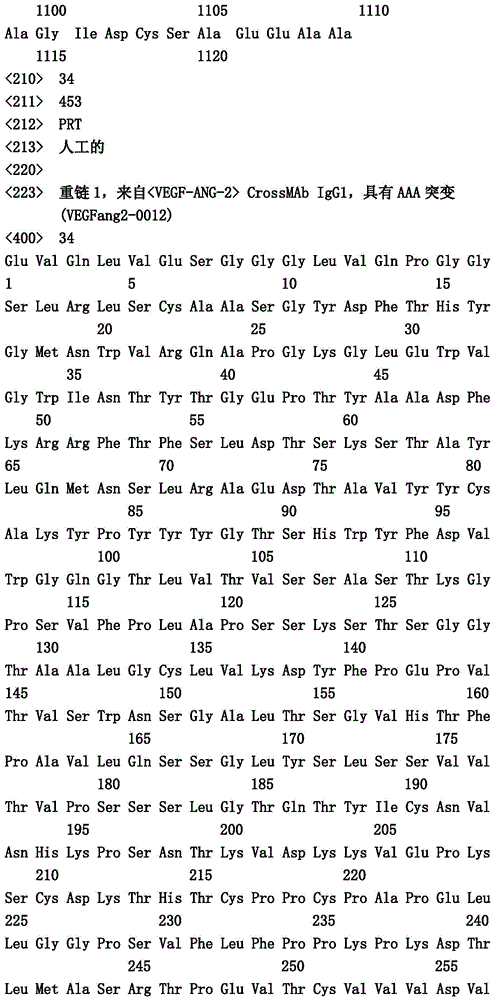

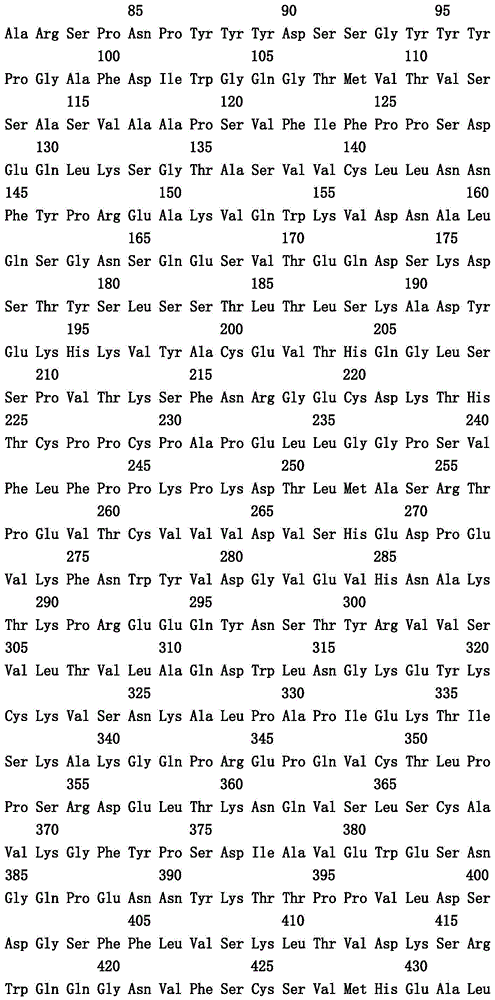

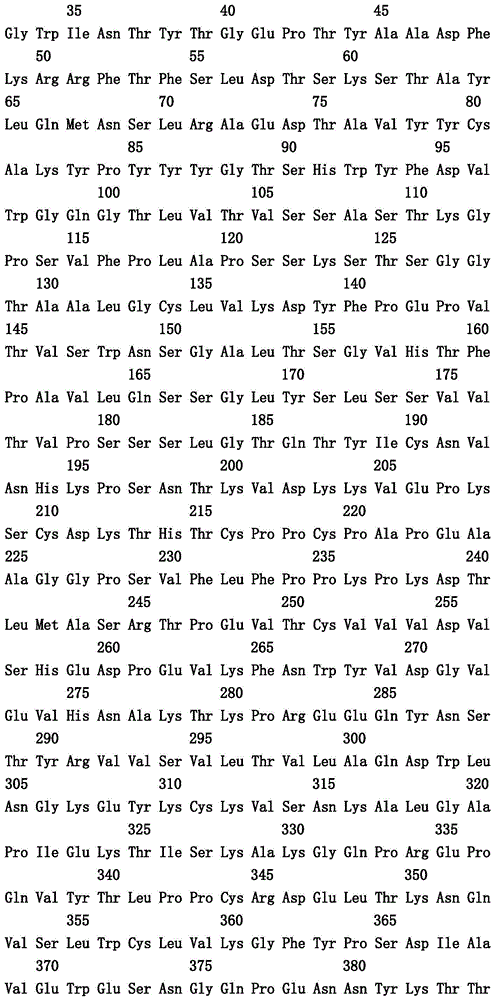
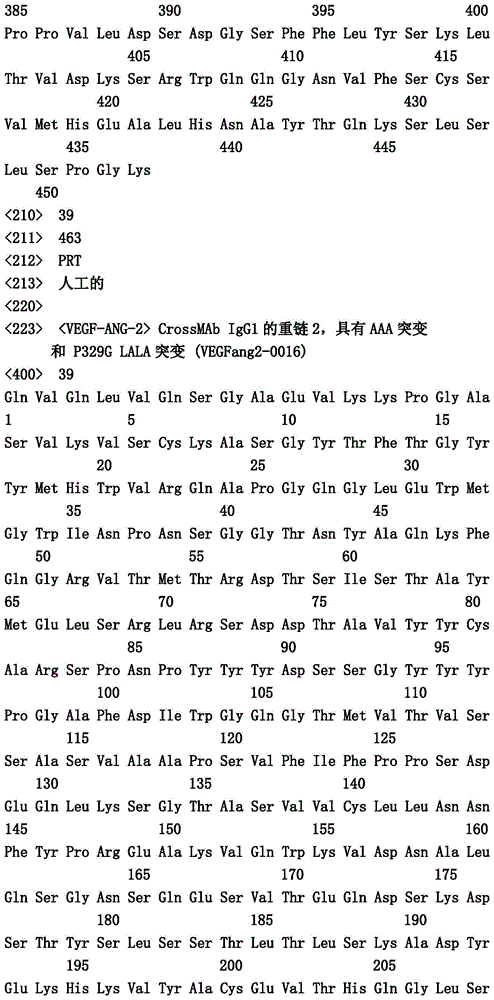
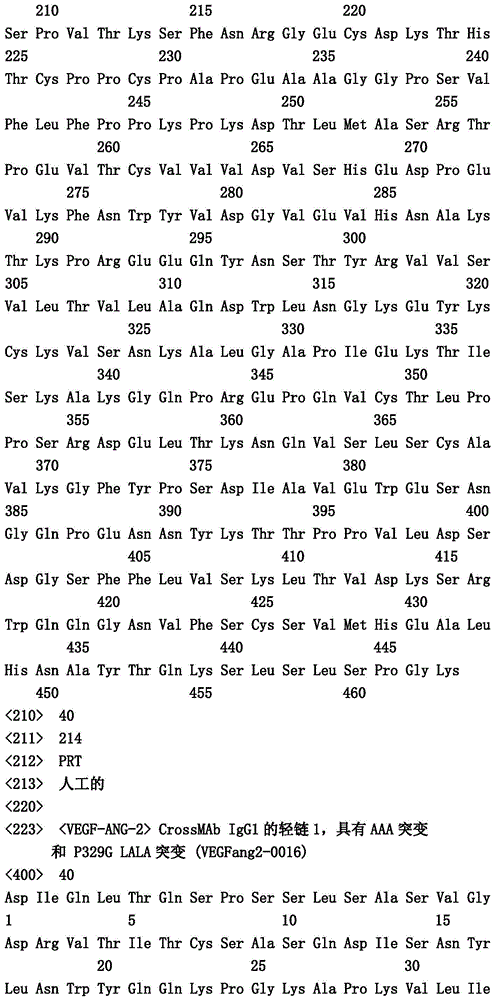


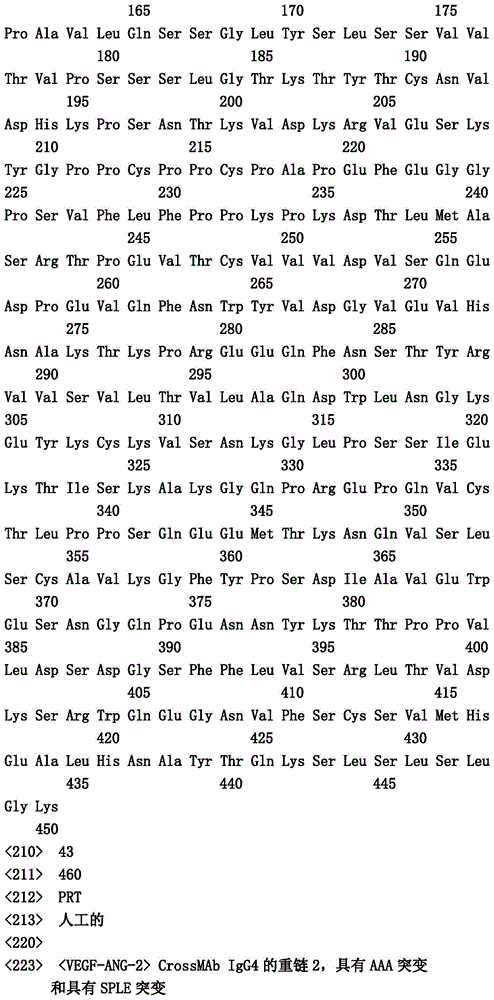


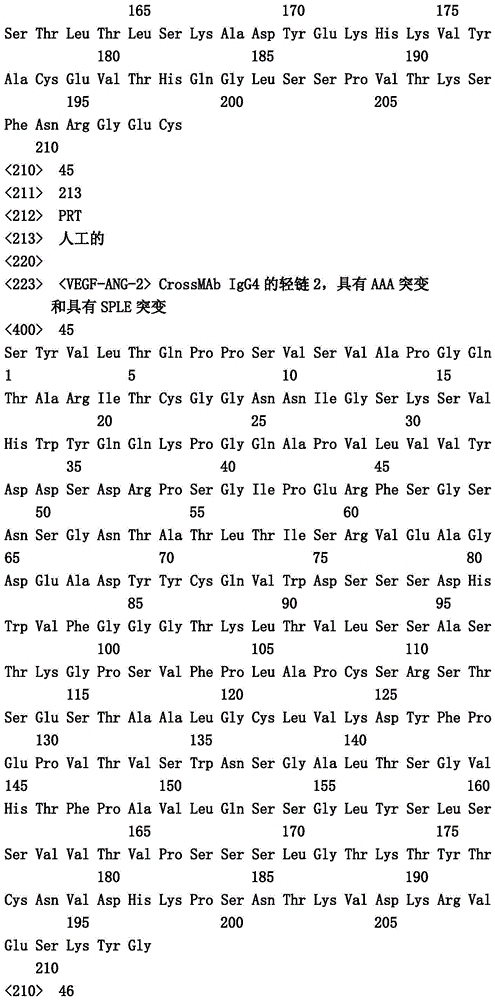
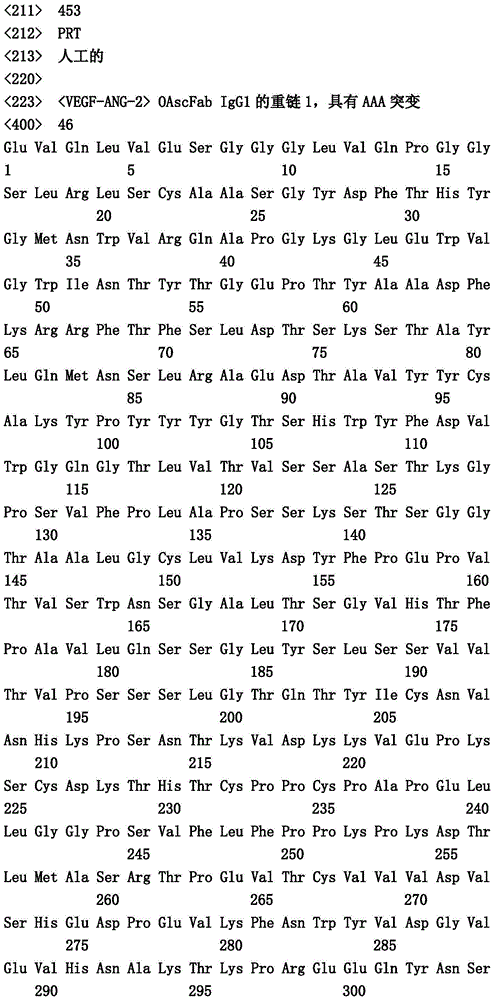
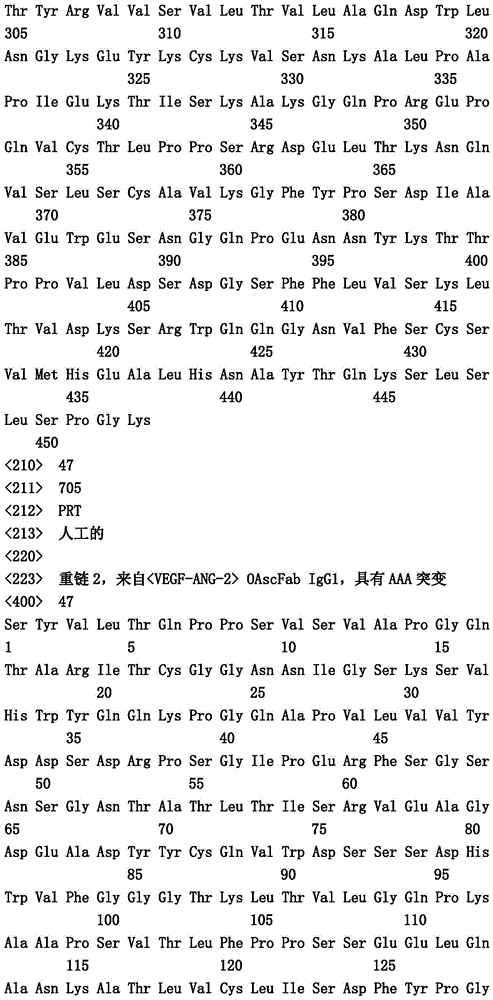
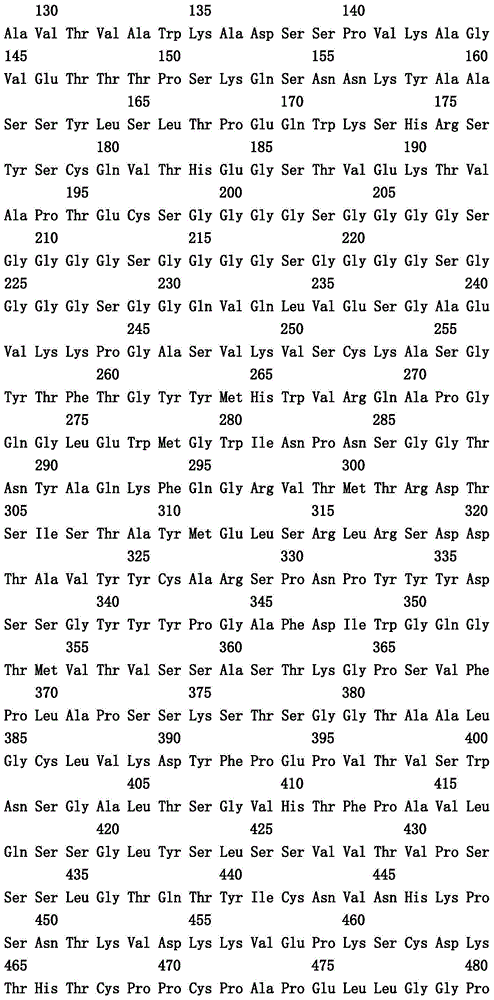


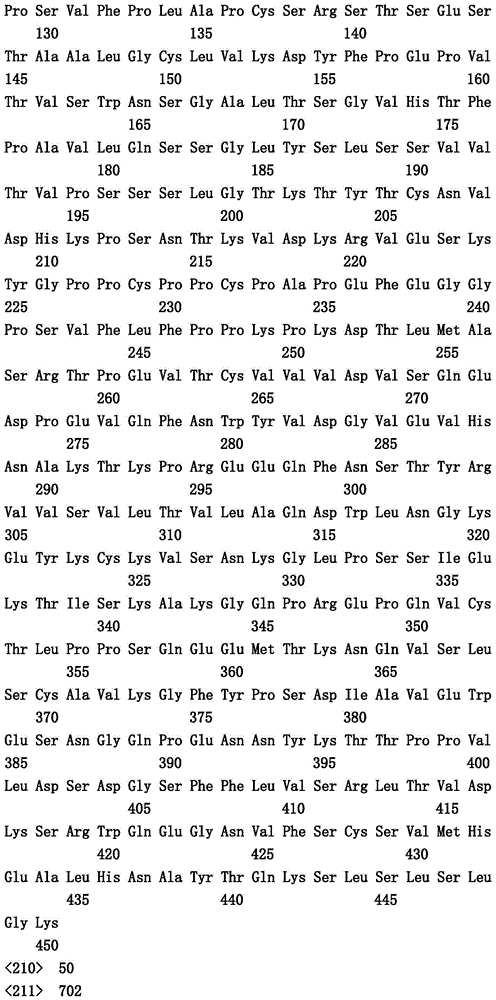
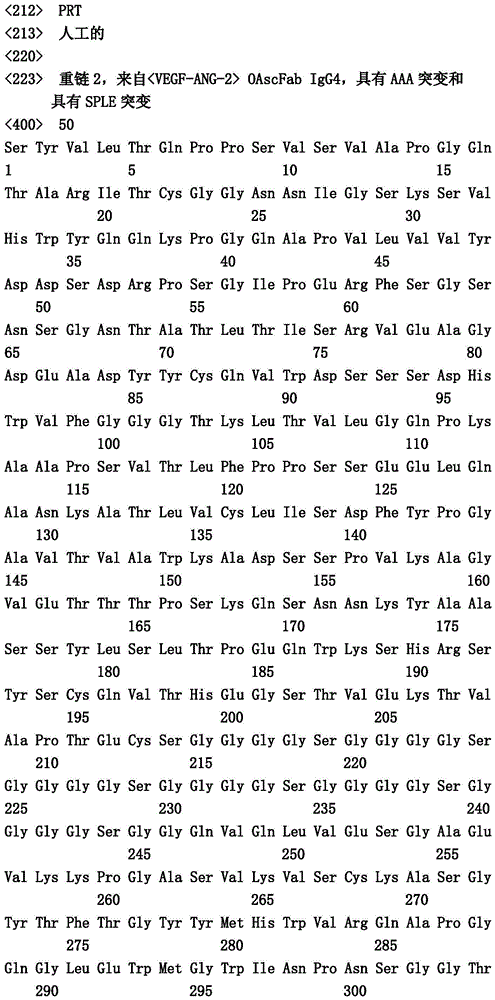
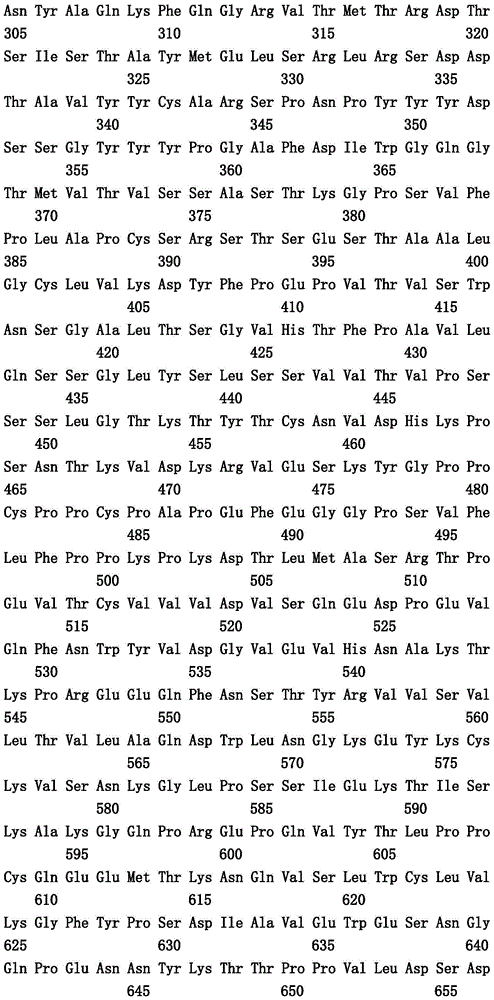

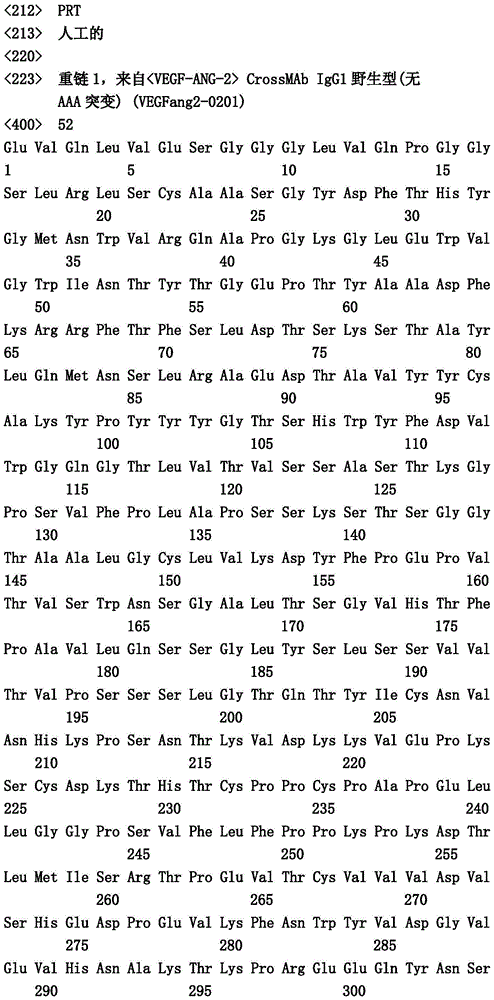
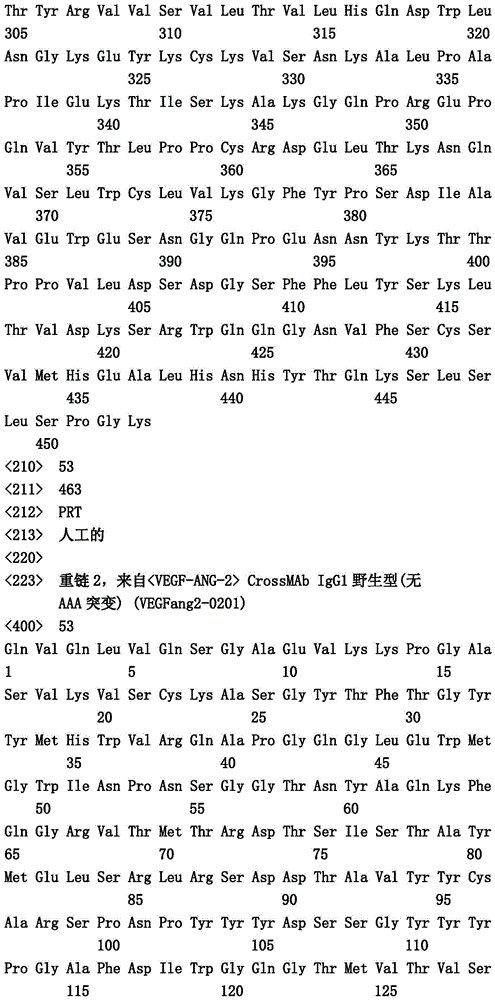
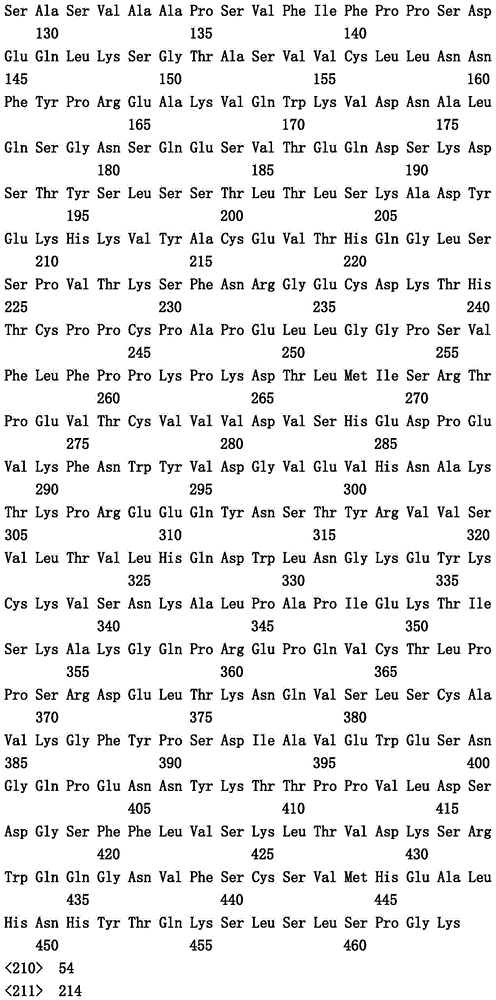
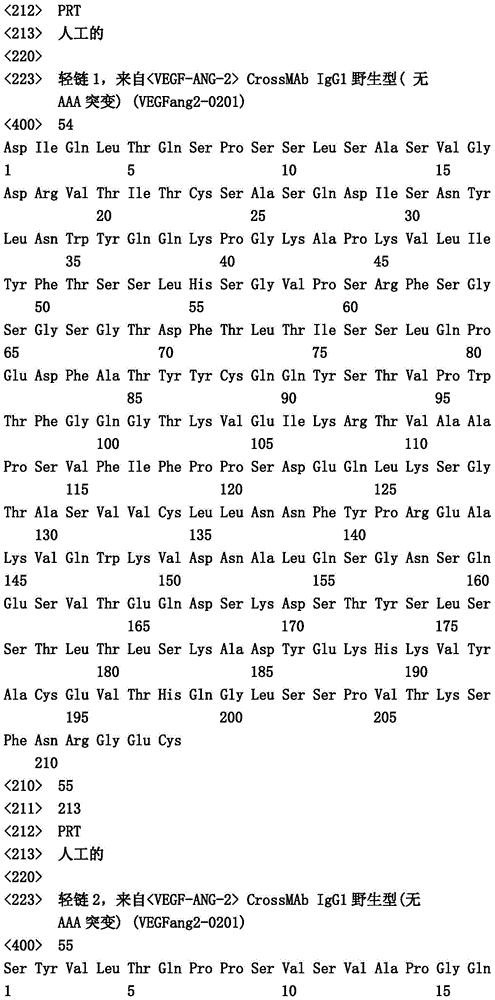
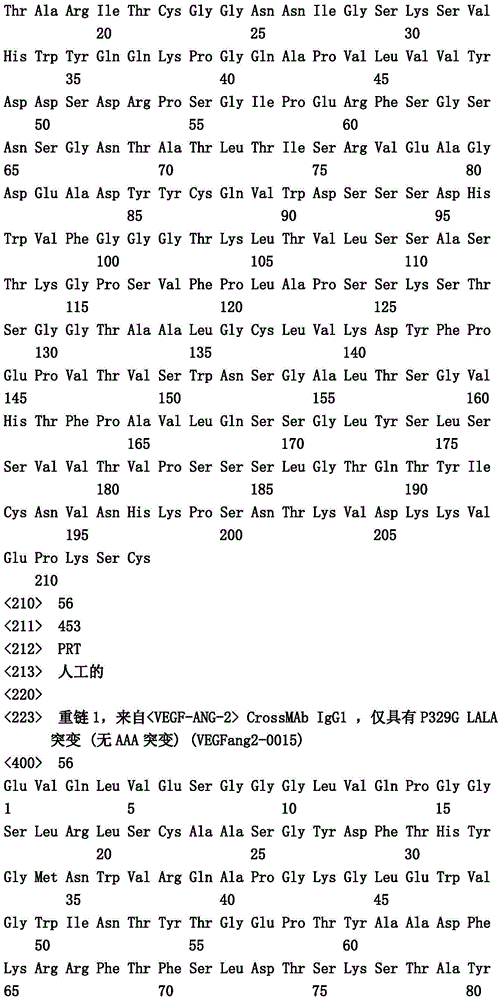
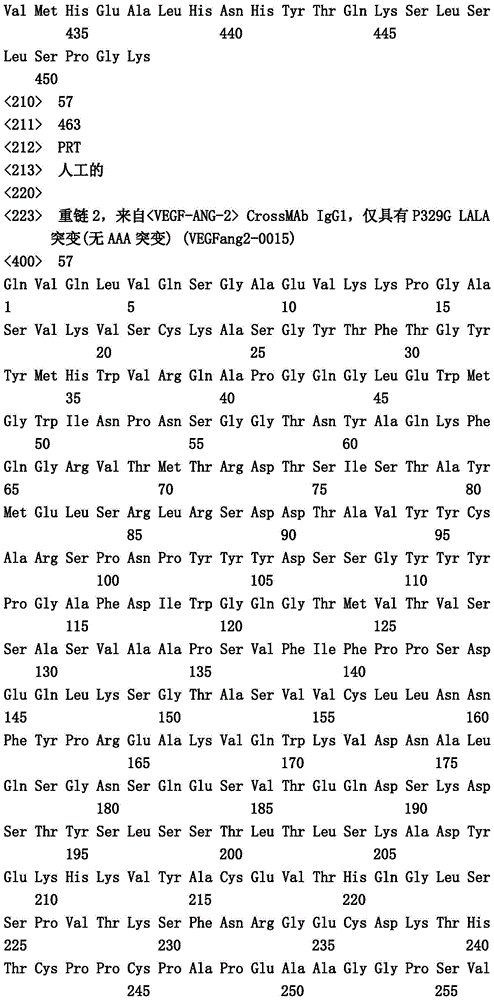

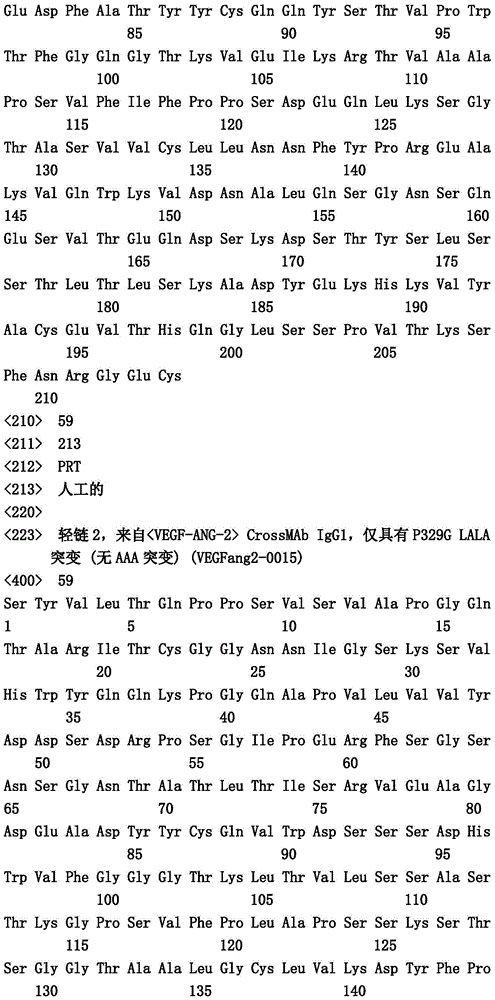
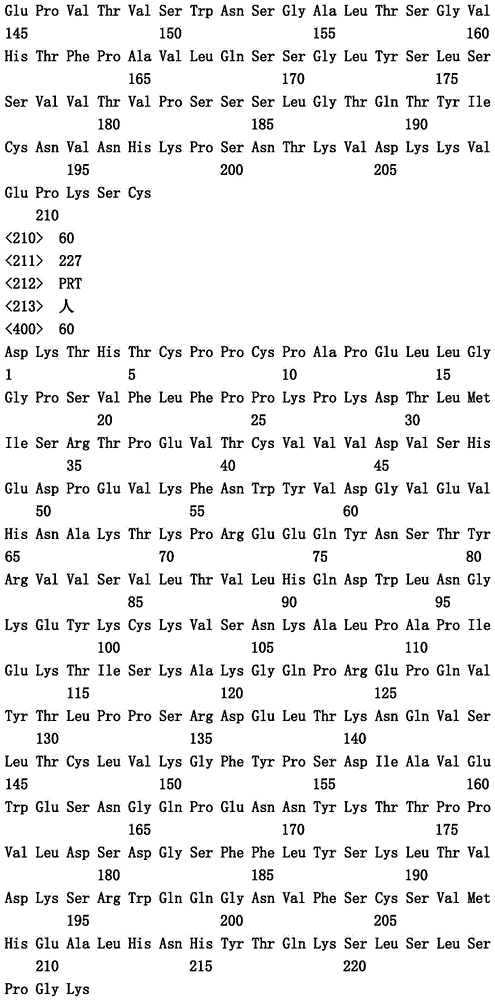
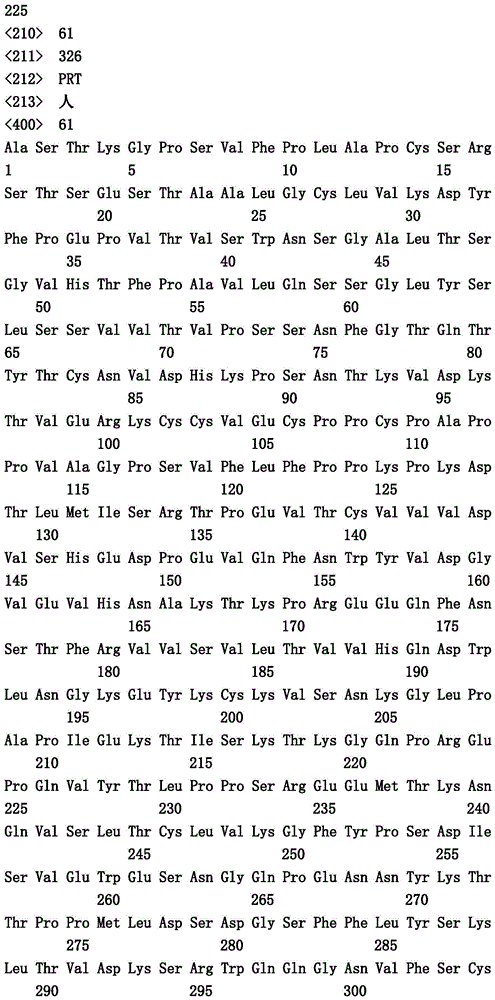
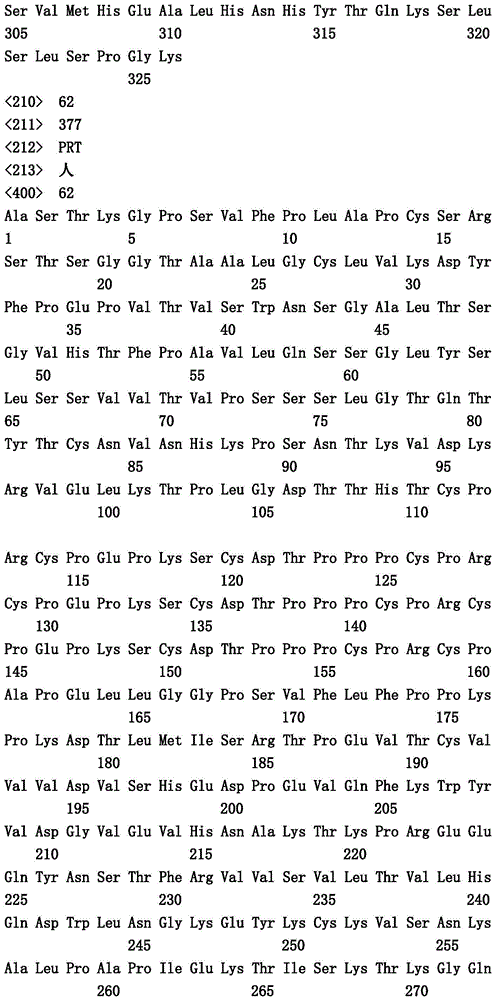
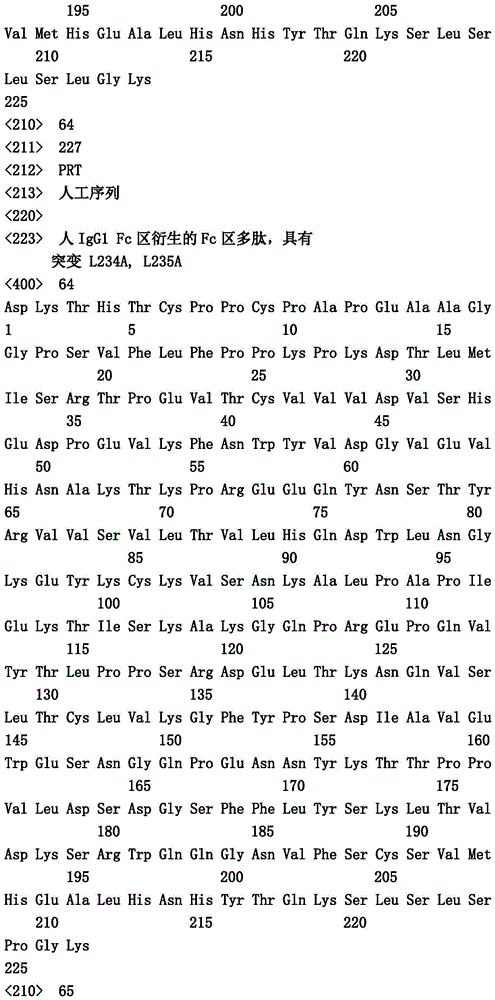
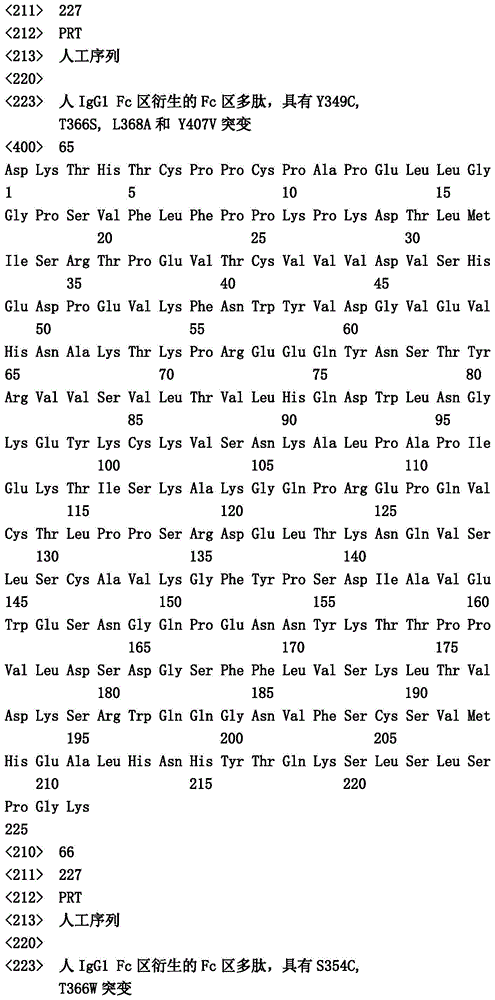
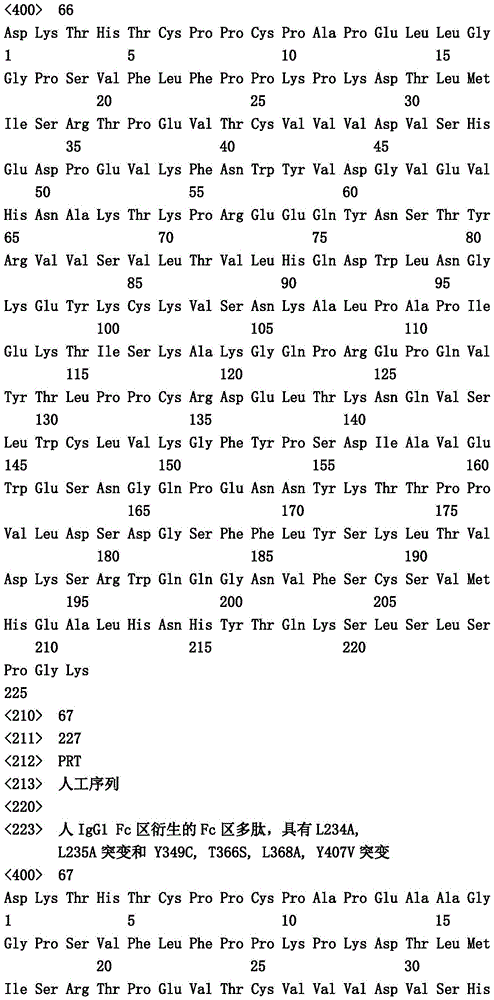

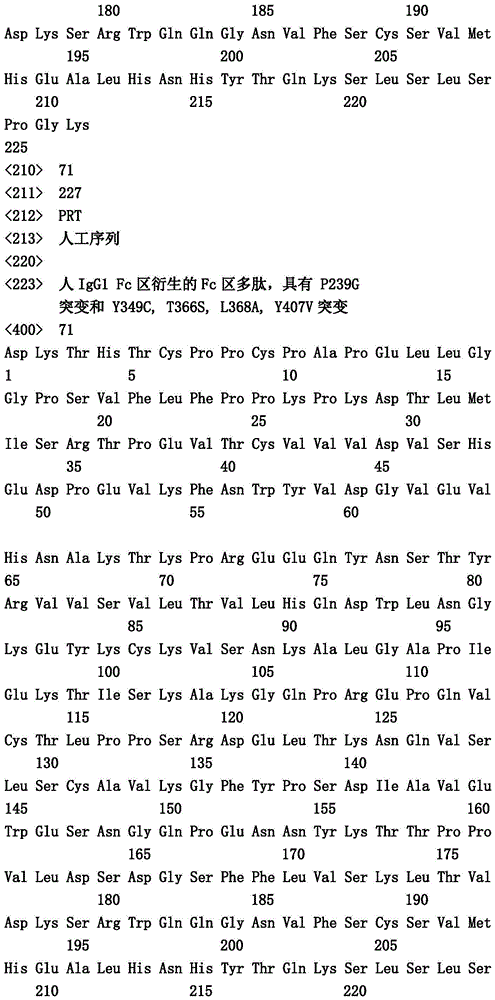


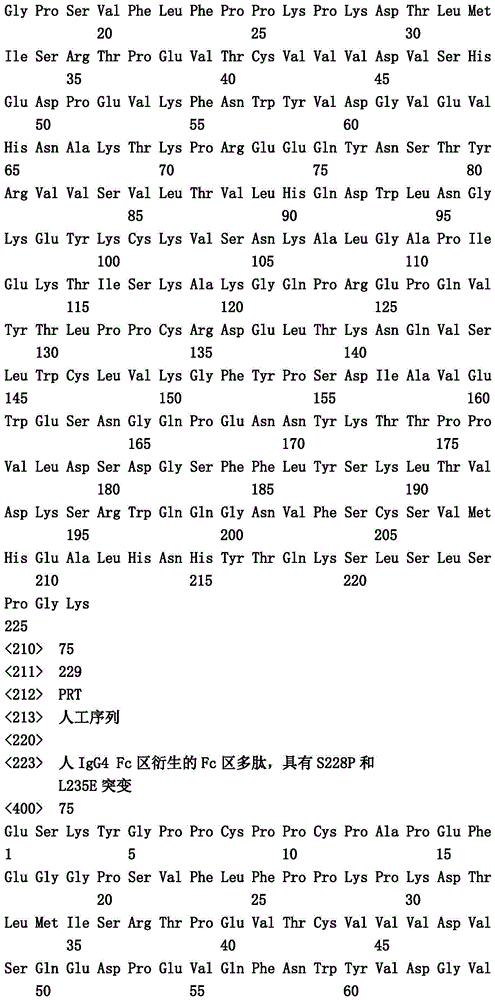
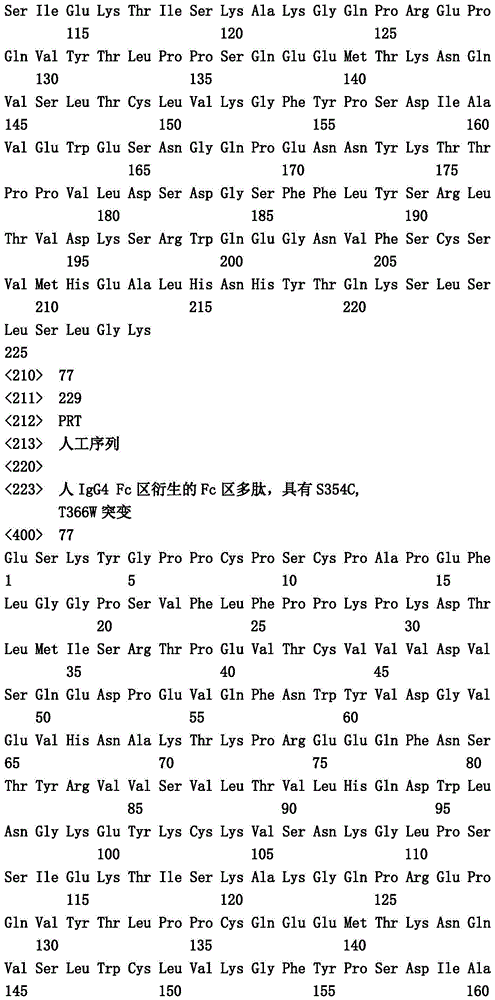
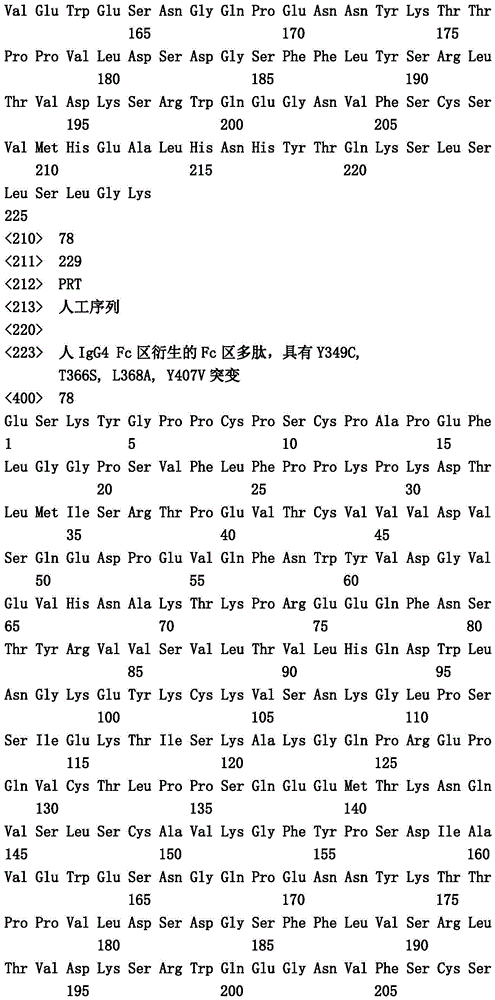

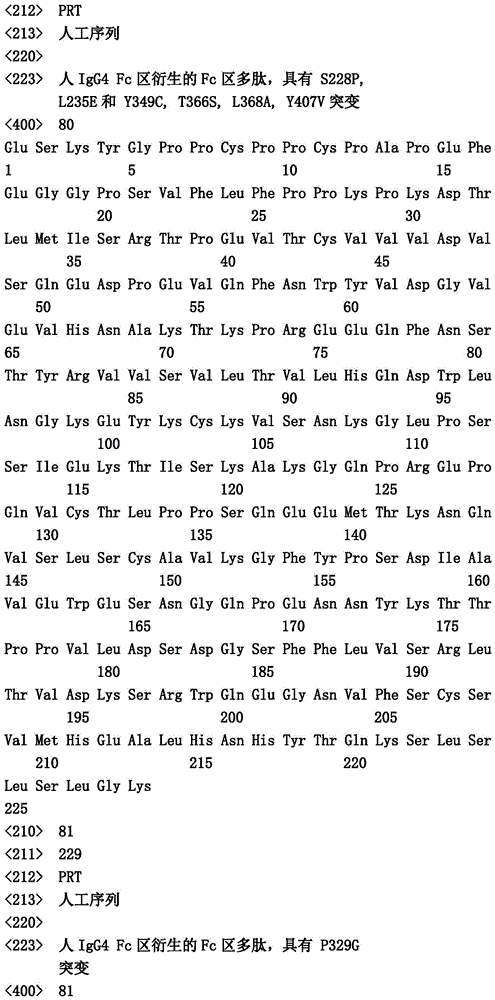
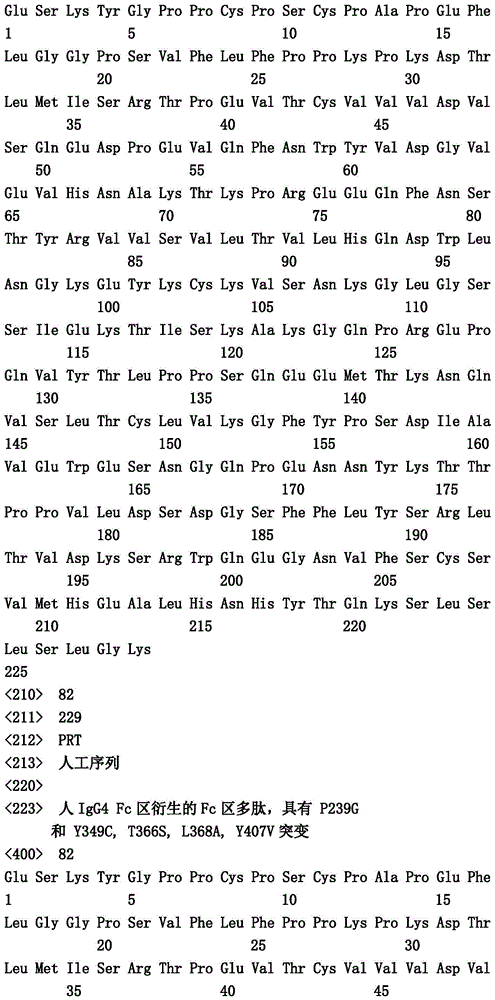
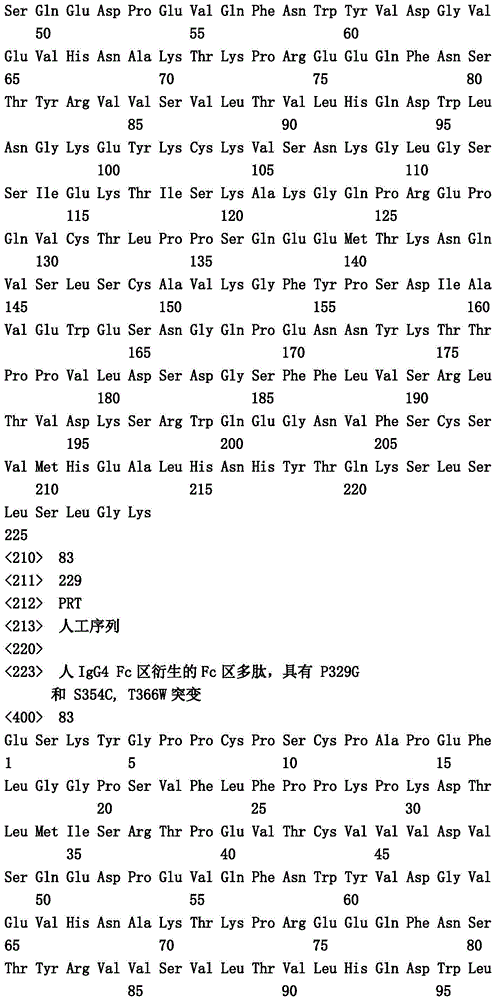
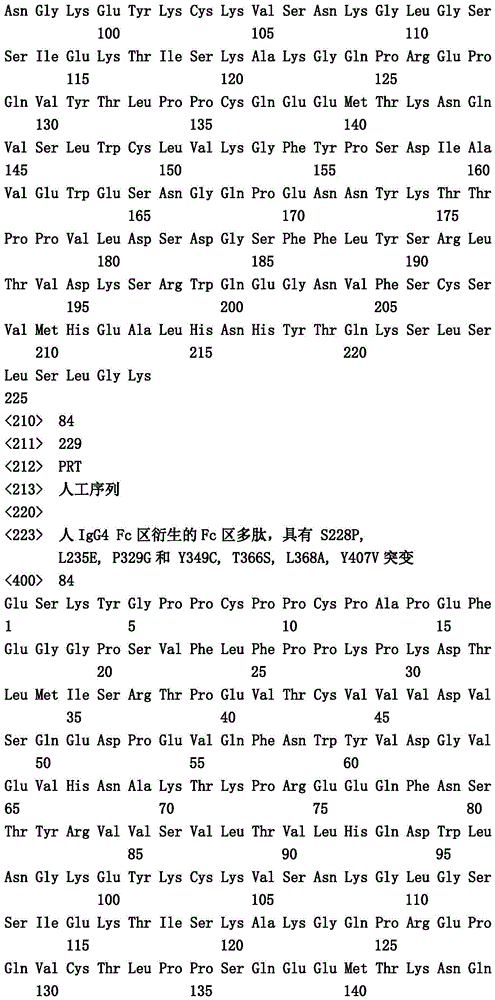
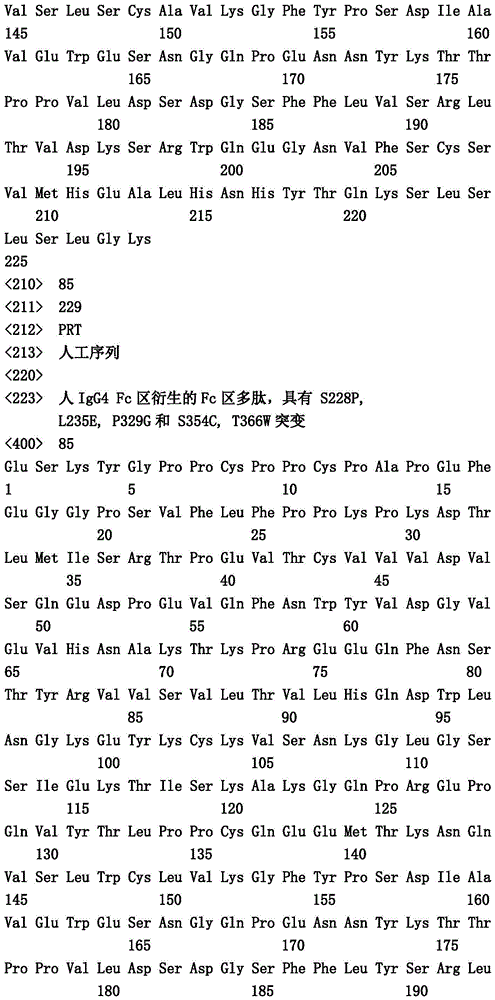
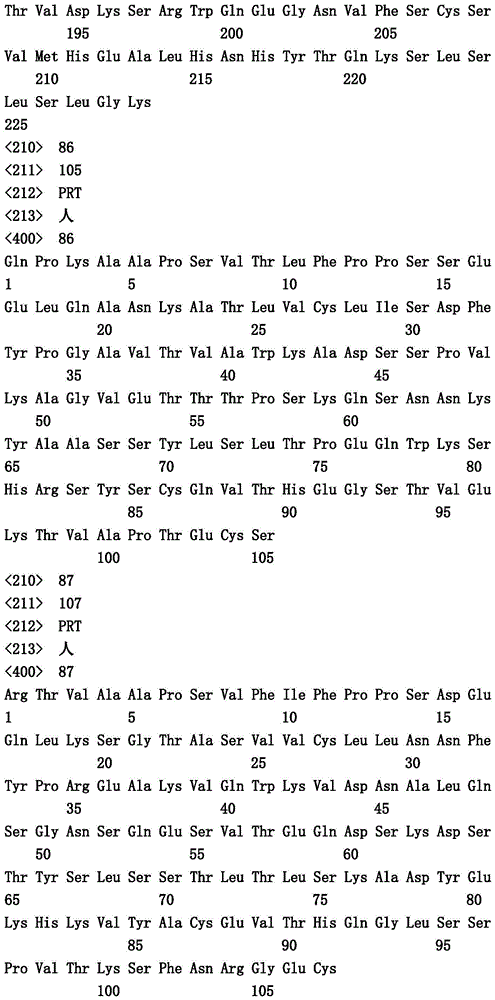

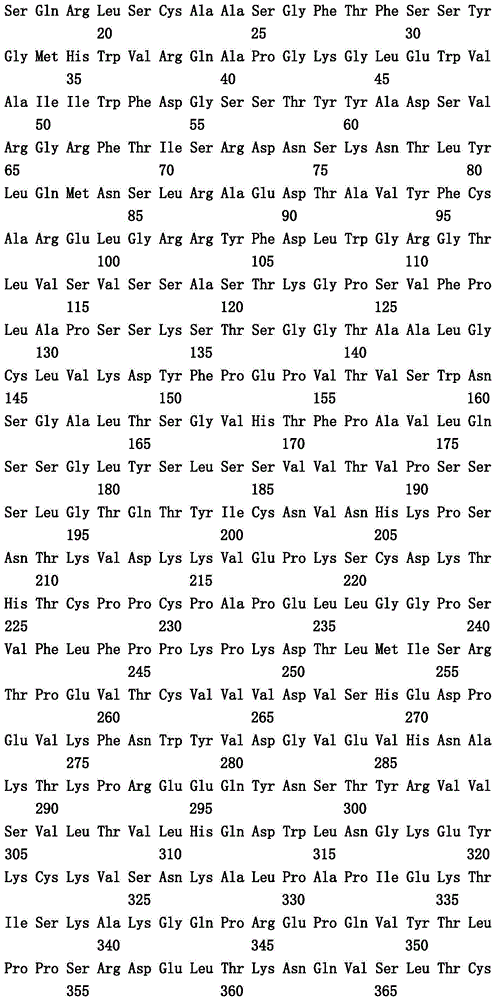

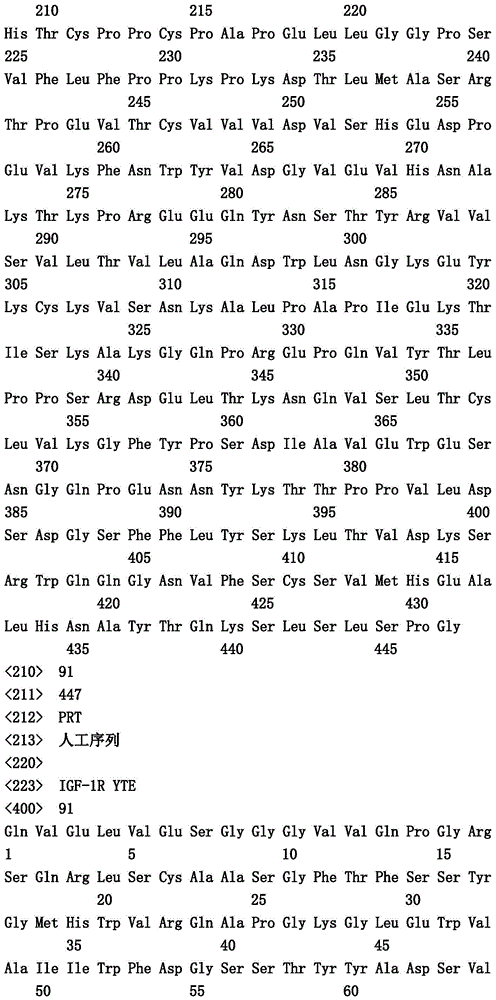
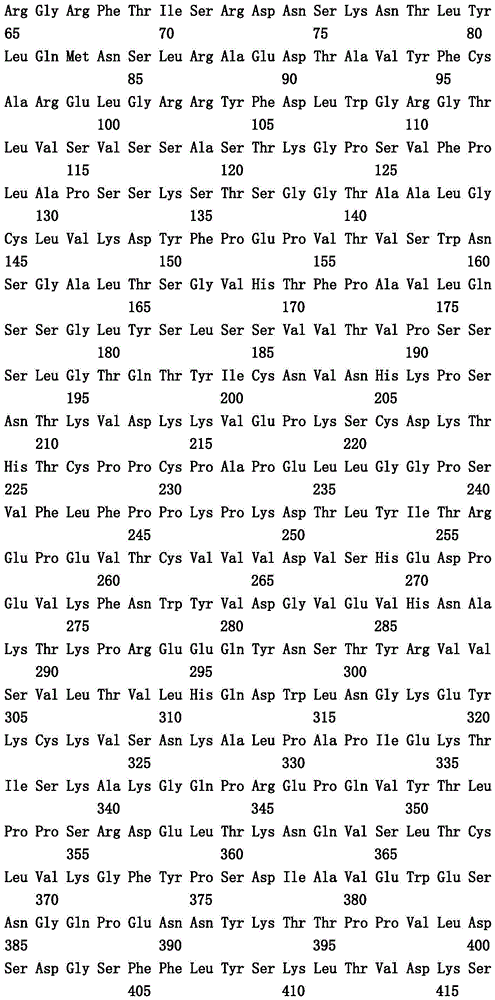

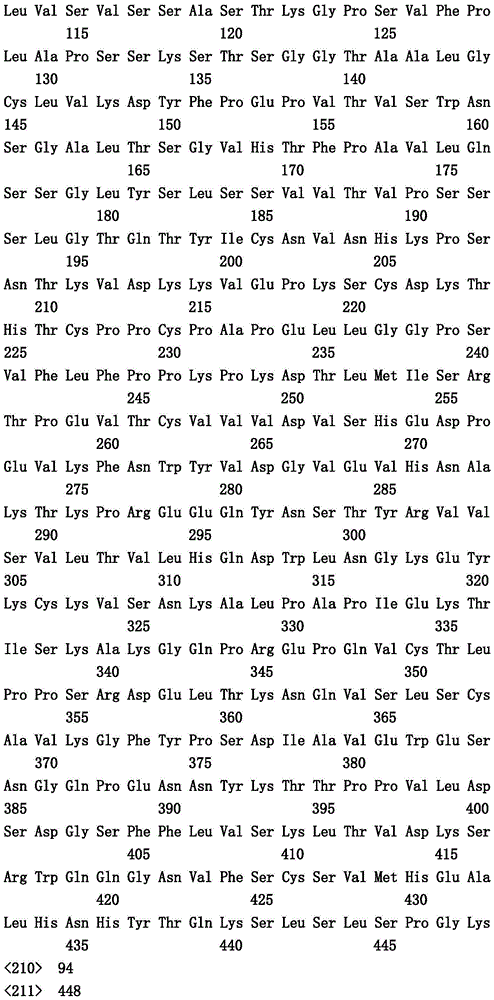
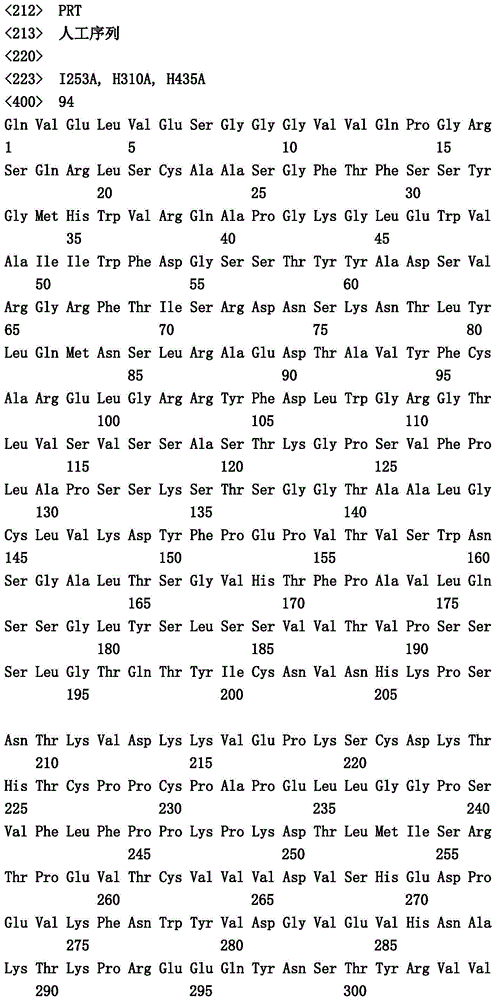

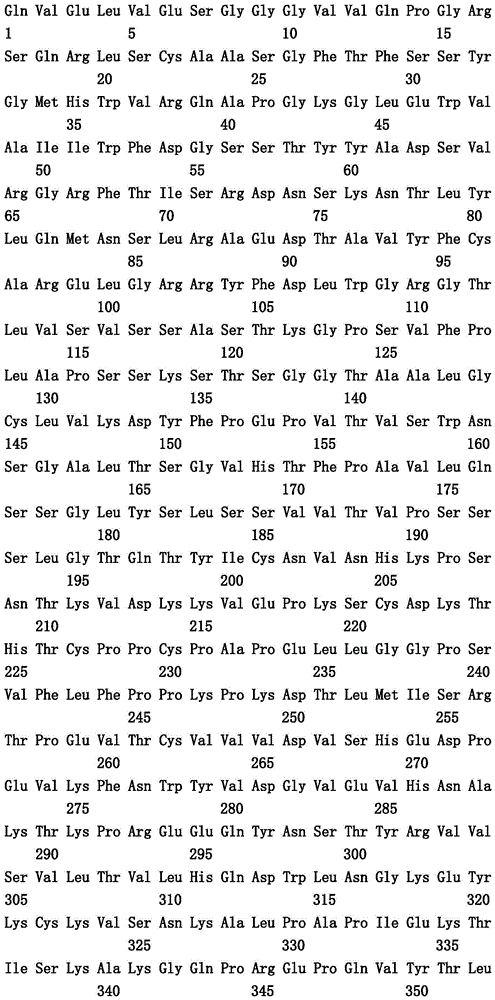

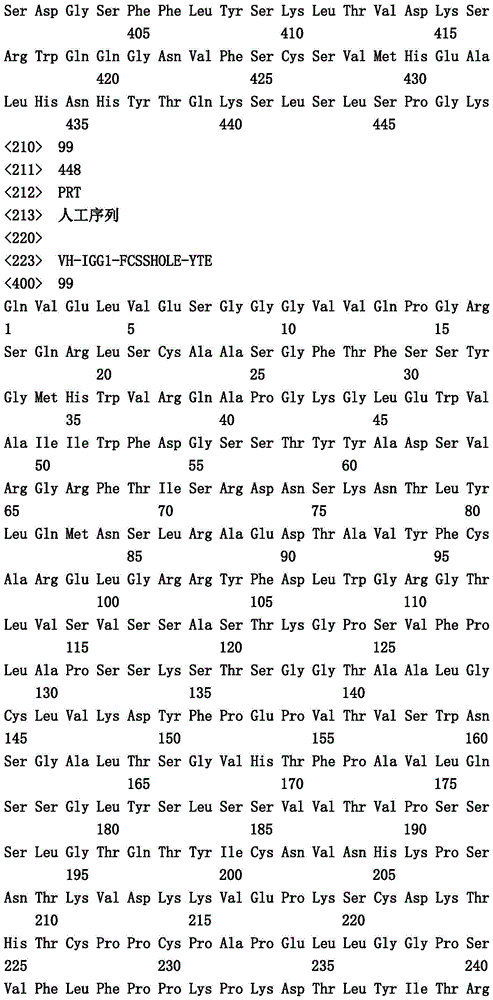
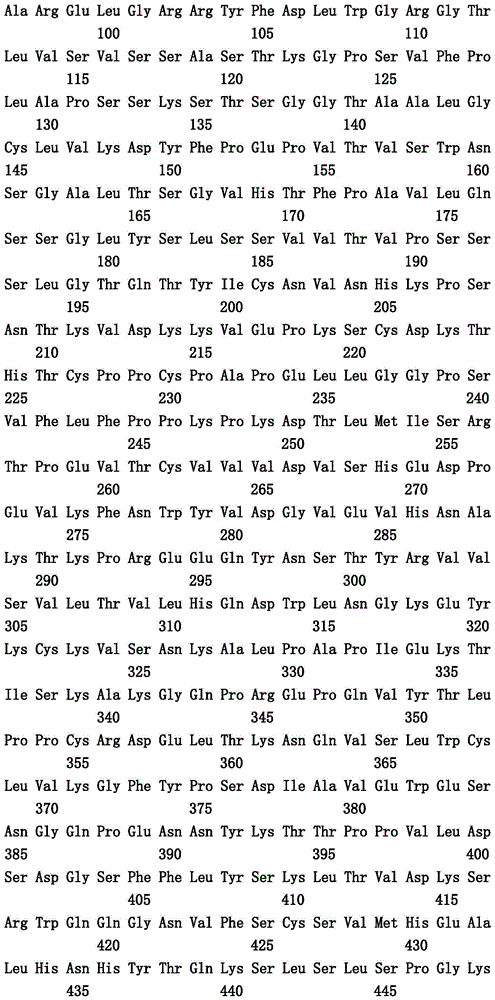
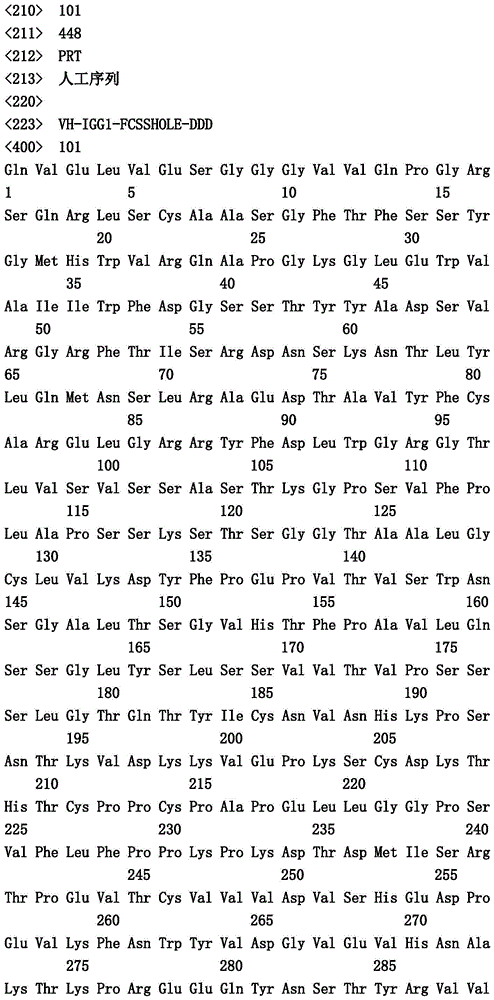
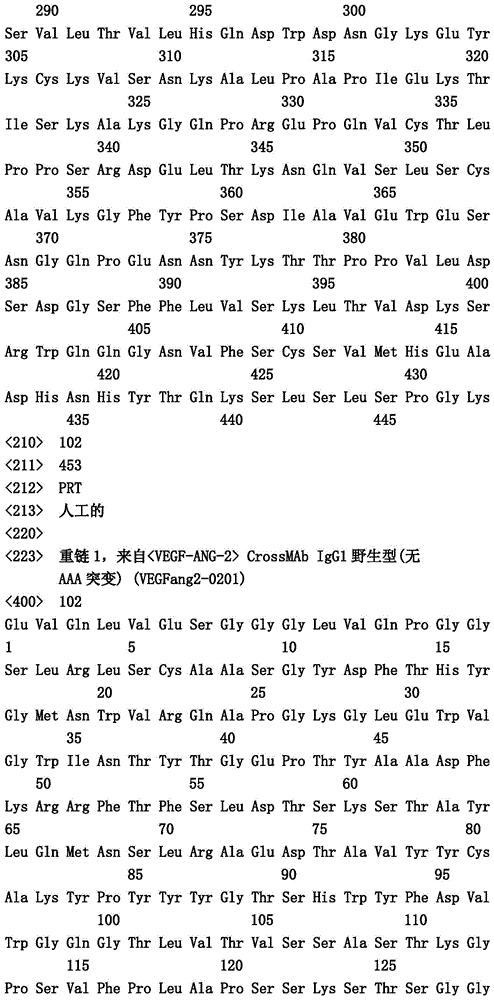

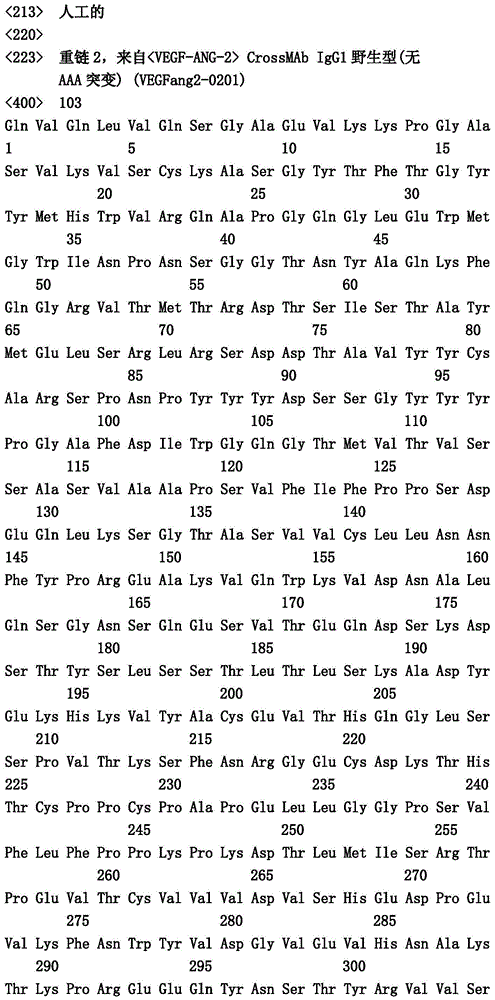

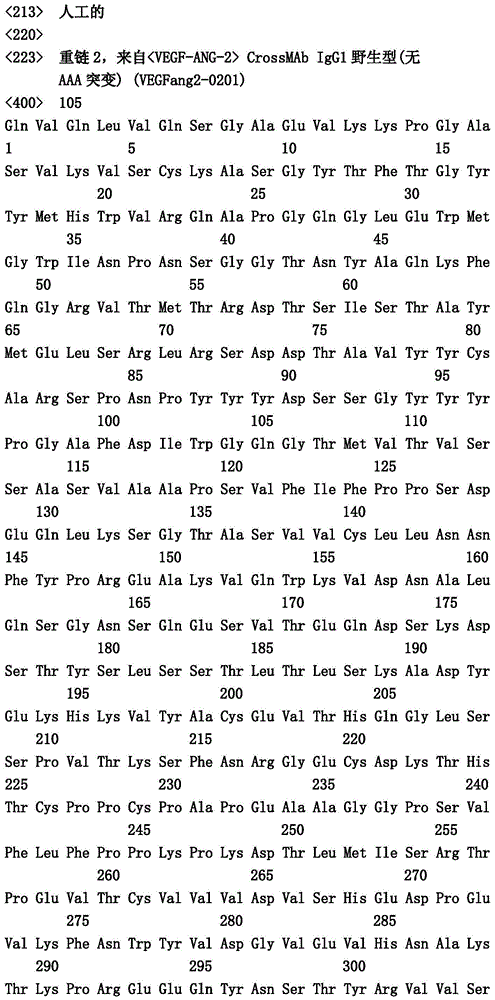
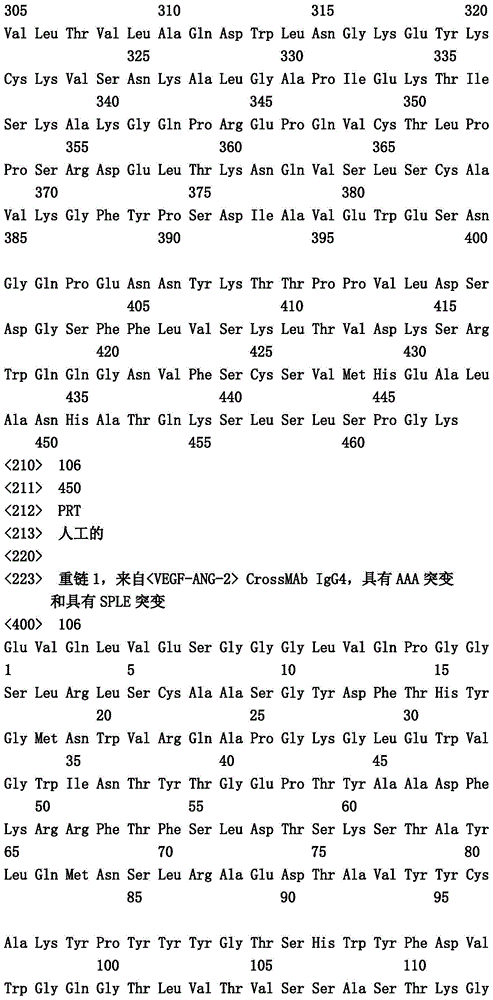


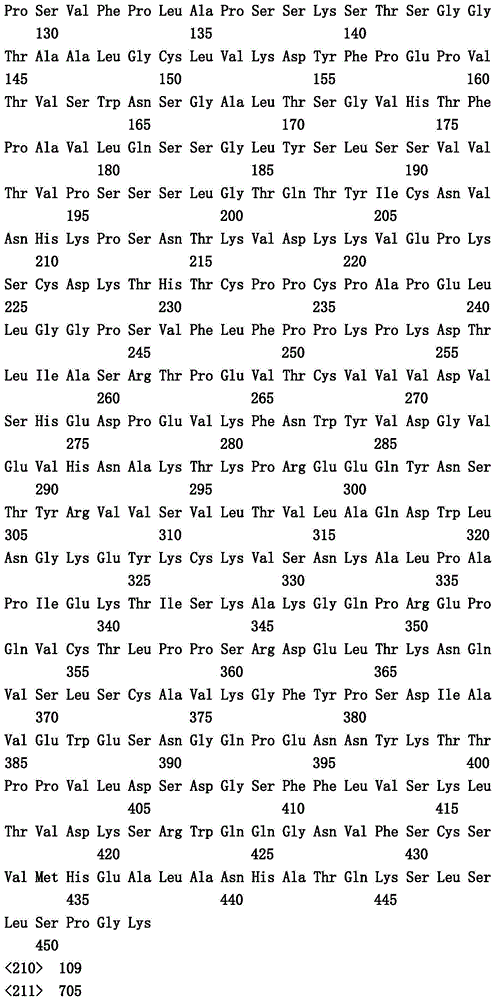

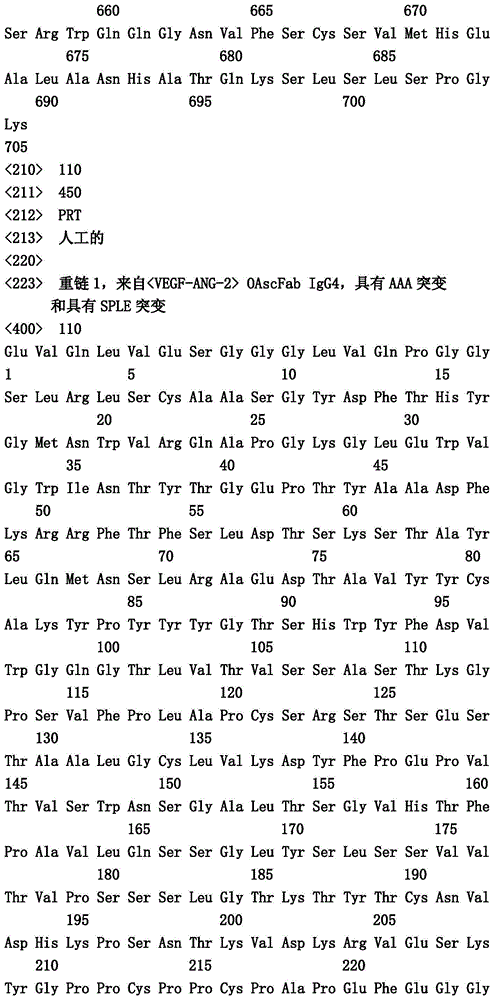
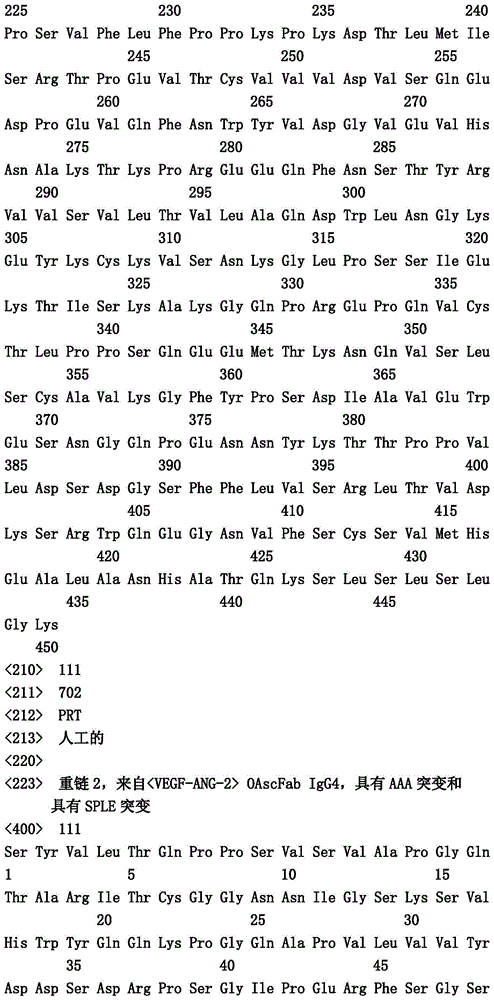
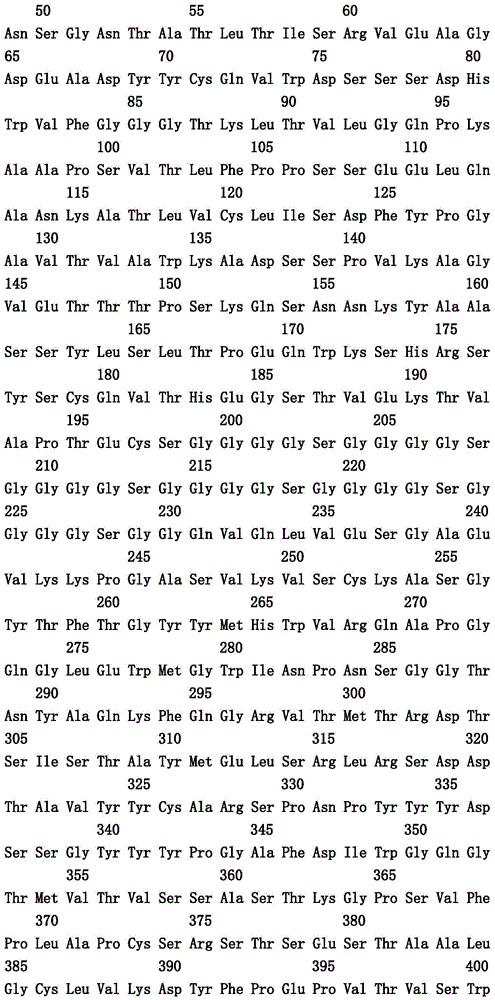
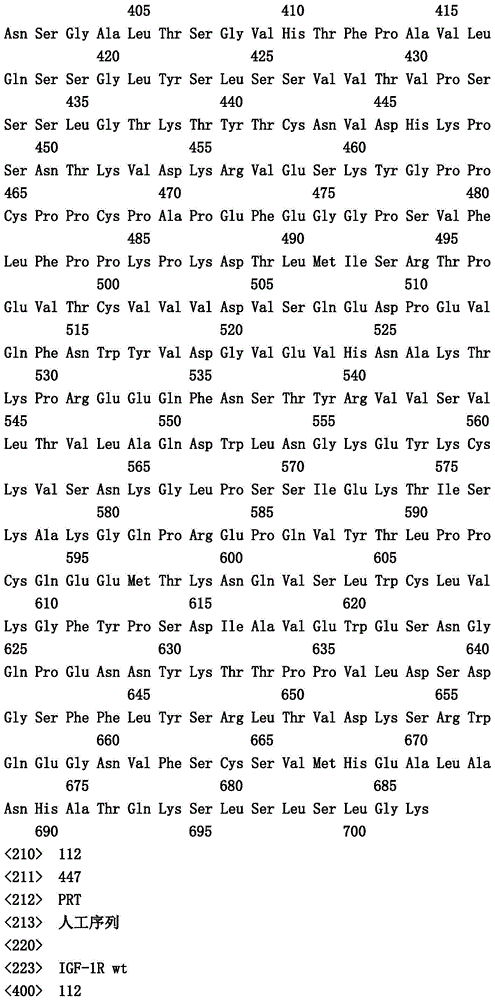

Claims (11)
Priority Applications (1)
| Application Number | Priority Date | Filing Date | Title |
|---|---|---|---|
| CN201911344011.0A CN110981957B (en) | 2014-01-15 | 2015-01-12 | Fc region variants with improved protein A binding |
Applications Claiming Priority (5)
| Application Number | Priority Date | Filing Date | Title |
|---|---|---|---|
| EP14151322.6 | 2014-01-15 | ||
| EP14151322 | 2014-01-15 | ||
| EP14165924.3 | 2014-04-25 | ||
| EP14165924 | 2014-04-25 | ||
| PCT/EP2015/050389 WO2015107015A1 (en) | 2014-01-15 | 2015-01-12 | Fc-region variants with improved protein a-binding |
Related Child Applications (1)
| Application Number | Title | Priority Date | Filing Date |
|---|---|---|---|
| CN201911344011.0A Division CN110981957B (en) | 2014-01-15 | 2015-01-12 | Fc region variants with improved protein A binding |
Publications (2)
| Publication Number | Publication Date |
|---|---|
| CN105916880A CN105916880A (en) | 2016-08-31 |
| CN105916880B true CN105916880B (en) | 2020-01-17 |
Family
ID=52358762
Family Applications (2)
| Application Number | Title | Priority Date | Filing Date |
|---|---|---|---|
| CN201580004548.6A Active CN105916880B (en) | 2014-01-15 | 2015-01-12 | Fc region variants with improved protein A binding |
| CN201911344011.0A Active CN110981957B (en) | 2014-01-15 | 2015-01-12 | Fc region variants with improved protein A binding |
Family Applications After (1)
| Application Number | Title | Priority Date | Filing Date |
|---|---|---|---|
| CN201911344011.0A Active CN110981957B (en) | 2014-01-15 | 2015-01-12 | Fc region variants with improved protein A binding |
Country Status (10)
| Country | Link |
|---|---|
| US (3) | US20170044246A1 (en) |
| EP (2) | EP3842455A1 (en) |
| JP (2) | JP6778110B2 (en) |
| KR (1) | KR20160104636A (en) |
| CN (2) | CN105916880B (en) |
| BR (1) | BR112016014969A2 (en) |
| CA (1) | CA2932364A1 (en) |
| MX (1) | MX380658B (en) |
| RU (1) | RU2698969C2 (en) |
| WO (1) | WO2015107015A1 (en) |
Families Citing this family (44)
| Publication number | Priority date | Publication date | Assignee | Title |
|---|---|---|---|---|
| US20090162359A1 (en) | 2007-12-21 | 2009-06-25 | Christian Klein | Bivalent, bispecific antibodies |
| US9676845B2 (en) | 2009-06-16 | 2017-06-13 | Hoffmann-La Roche, Inc. | Bispecific antigen binding proteins |
| MX341921B (en) | 2011-02-28 | 2016-09-07 | Hoffmann La Roche | Antigen binding proteins. |
| WO2012116927A1 (en) | 2011-02-28 | 2012-09-07 | F. Hoffmann-La Roche Ag | Monovalent antigen binding proteins |
| HK1213578A1 (en) * | 2013-04-29 | 2016-07-08 | 豪夫迈‧罗氏有限公司 | Human fcrn-binding modified antibodies and methods of use |
| KR20160044060A (en) * | 2013-10-11 | 2016-04-22 | 에프. 호프만-라 로슈 아게 | Multispecific domain exchanged common variable light chain antibodies |
| TWI744242B (en) | 2015-07-31 | 2021-11-01 | 德商安美基研究(慕尼黑)公司 | Antibody constructs for egfrviii and cd3 |
| TWI829617B (en) | 2015-07-31 | 2024-01-21 | 德商安美基研究(慕尼黑)公司 | Antibody constructs for flt3 and cd3 |
| TWI796283B (en) | 2015-07-31 | 2023-03-21 | 德商安美基研究(慕尼黑)公司 | Antibody constructs for msln and cd3 |
| EA039859B1 (en) | 2015-07-31 | 2022-03-21 | Эмджен Рисерч (Мюник) Гмбх | Bispecific antibody constructs binding egfrviii and cd3 |
| JP7026613B2 (en) | 2015-08-07 | 2022-02-28 | イマジナブ・インコーポレーテッド | Antigen binding construct for target molecule |
| MA43959A (en) | 2016-02-03 | 2018-12-12 | Amgen Res Munich Gmbh | CONSTRUCTIONS OF ANTIBODIES INVOLVING BISPECIFIC PSMA AND CD3 T-CELLS |
| WO2017165464A1 (en) | 2016-03-21 | 2017-09-28 | Elstar Therapeutics, Inc. | Multispecific and multifunctional molecules and uses thereof |
| WO2018147960A1 (en) | 2017-02-08 | 2018-08-16 | Imaginab, Inc. | Extension sequences for diabodies |
| US20200291089A1 (en) | 2017-02-16 | 2020-09-17 | Elstar Therapeutics, Inc. | Multifunctional molecules comprising a trimeric ligand and uses thereof |
| US20210246227A1 (en) | 2017-05-31 | 2021-08-12 | Elstar Therapeutics, Inc. | Multispecific molecules that bind to myeloproliferative leukemia (mpl) protein and uses thereof |
| WO2019035938A1 (en) | 2017-08-16 | 2019-02-21 | Elstar Therapeutics, Inc. | Multispecific molecules that bind to bcma and uses thereof |
| EP3737692A4 (en) | 2018-01-09 | 2021-09-29 | Elstar Therapeutics, Inc. | CALRETICULIN-BINDING CONSTRUCTS AND GENERALLY MODIFIED T-CELLS FOR THE TREATMENT OF DISEASES |
| WO2019178364A2 (en) | 2018-03-14 | 2019-09-19 | Elstar Therapeutics, Inc. | Multifunctional molecules and uses thereof |
| WO2019178362A1 (en) | 2018-03-14 | 2019-09-19 | Elstar Therapeutics, Inc. | Multifunctional molecules that bind to calreticulin and uses thereof |
| CN112955465A (en) | 2018-07-03 | 2021-06-11 | 马伦戈治疗公司 | anti-TCR antibody molecules and uses thereof |
| MX2021004774A (en) * | 2018-10-29 | 2021-08-24 | Hoffmann La Roche | Antibody formulation. |
| WO2020172605A1 (en) | 2019-02-21 | 2020-08-27 | Elstar Therapeutics, Inc. | Antibody molecules that bind to nkp30 and uses thereof |
| CA3131014A1 (en) | 2019-02-21 | 2020-08-27 | Andreas Loew | Anti-tcr antibody molecules and uses thereof |
| CN114026122B (en) | 2019-02-21 | 2024-12-31 | 马伦戈治疗公司 | Multifunctional molecules that bind to T cell-associated cancer cells and their uses |
| CN114127113A (en) | 2019-02-21 | 2022-03-01 | 马伦戈治疗公司 | Multifunctional molecules binding to calreticulin and uses thereof |
| CA3130628A1 (en) | 2019-02-21 | 2020-08-27 | Marengo Therapeutics, Inc. | Multifunctional molecules that bind to t cells and uses thereof to treat autoimmune disorders |
| MX2021012871A (en) * | 2019-04-25 | 2021-11-17 | Hoffmann La Roche | Generation of antibody-derived polypeptides by polypeptide chain exchange. |
| MA56467A (en) * | 2019-07-02 | 2022-05-11 | Telix Int Pty Ltd | ANTIBODIES DIRECTED AGAINST CAIX WITH REDUCED AFFINITY FOR THE NEONATAL FC RECEPTOR |
| CN114786731A (en) | 2019-10-10 | 2022-07-22 | 科达制药股份有限公司 | Methods of treating ocular disorders |
| WO2021119832A1 (en) * | 2019-12-20 | 2021-06-24 | Kisoji Biotechnology Inc. | Polypeptides, protein complexes and method for making same |
| EP4084823A4 (en) | 2020-01-03 | 2024-05-15 | Marengo Therapeutics, Inc. | Anti-tcr antibody molecules and uses thereof |
| EP4084821A4 (en) | 2020-01-03 | 2024-04-24 | Marengo Therapeutics, Inc. | CD33-BINDING MULTIFUNCTIONAL MOLECULES AND THEIR USES |
| KR20230028242A (en) | 2020-04-24 | 2023-02-28 | 마렝고 테라퓨틱스, 인크. | Multifunctional molecules that bind to T cell-associated cancer cells and their uses |
| CA3190766A1 (en) | 2020-08-26 | 2022-03-03 | Marengo Therapeutics, Inc. | Antibody molecules that bind to nkp30 and uses thereof |
| WO2022047046A1 (en) | 2020-08-26 | 2022-03-03 | Marengo Therapeutics, Inc. | Methods of detecting trbc1 or trbc2 |
| CN116249718A (en) | 2020-08-26 | 2023-06-09 | 马伦戈治疗公司 | Multifunctional molecules binding to calreticulin and uses thereof |
| KR20230061458A (en) | 2020-09-04 | 2023-05-08 | 에프. 호프만-라 로슈 아게 | Antibodies that bind to VEGF-A and ANG2 and methods of use |
| WO2022216993A2 (en) | 2021-04-08 | 2022-10-13 | Marengo Therapeutics, Inc. | Multifuntional molecules binding to tcr and uses thereof |
| CA3231335A1 (en) * | 2021-09-08 | 2023-03-16 | Sergei Aleksandrovich LEGOTSKII | Bispecific antibody comprising a heterodimer based on mhc proteins |
| CN115873127A (en) * | 2021-11-26 | 2023-03-31 | 深圳科兴药业有限公司 | Recombinant long-acting human growth hormone fusion protein and preparation method and application thereof |
| IL314472A (en) * | 2022-02-10 | 2024-09-01 | Kodiak Sciences Inc | Methods of purifying a product |
| CN117467025B (en) * | 2023-12-28 | 2024-04-16 | 上海鼎新基因科技有限公司 | A dual-function fusion protein of anti-VEGF and complement and its application |
| WO2026011013A1 (en) | 2024-07-02 | 2026-01-08 | Epibiologics, Inc. | Binding agents and uses thereof |
Citations (1)
| Publication number | Priority date | Publication date | Assignee | Title |
|---|---|---|---|---|
| WO2013004842A2 (en) * | 2011-07-06 | 2013-01-10 | Genmab A/S | Antibody variants and uses thereof |
Family Cites Families (91)
| Publication number | Priority date | Publication date | Assignee | Title |
|---|---|---|---|---|
| US5731168A (en) | 1995-03-01 | 1998-03-24 | Genentech, Inc. | Method for making heteromultimeric polypeptides |
| CA2249195A1 (en) | 1996-03-18 | 1997-09-25 | Board Of Regents, The University Of Texas System | Immunoglobin-like domains with increased half lives |
| US6277375B1 (en) * | 1997-03-03 | 2001-08-21 | Board Of Regents, The University Of Texas System | Immunoglobulin-like domains with increased half-lives |
| NZ500078A (en) | 1997-04-07 | 2001-10-26 | Genentech Inc | Humanized anti-VEGF antibodies and their use in inhibiting VEGF-induced angiogenesis in mammals |
| US20020062010A1 (en) | 1997-05-02 | 2002-05-23 | Genentech, Inc. | Method for making multispecific antibodies having heteromultimeric and common components |
| US7317091B2 (en) | 2002-03-01 | 2008-01-08 | Xencor, Inc. | Optimized Fc variants |
| US8034904B2 (en) | 2002-06-14 | 2011-10-11 | Immunogen Inc. | Anti-IGF-I receptor antibody |
| US7217797B2 (en) | 2002-10-15 | 2007-05-15 | Pdl Biopharma, Inc. | Alteration of FcRn binding affinities or serum half-lives of antibodies by mutagenesis |
| ATE480562T1 (en) | 2002-10-15 | 2010-09-15 | Facet Biotech Corp | CHANGE IN FCRN BINDING AFFINITIES OR SERUM HALF-LIFE TIMES OF ANTIBODIES USING MUtagenesis |
| US6736056B1 (en) | 2002-11-15 | 2004-05-18 | A Marek Ken Company | Manual ink applicator |
| PT1601697E (en) | 2003-02-28 | 2007-09-04 | Lonza Biologics Plc | Antibody purification by protein a and ion exchange chromatography |
| US7579157B2 (en) | 2003-07-10 | 2009-08-25 | Hoffmann-La Roche Inc. | Antibody selection method against IGF-IR |
| CN1835975B (en) | 2003-08-13 | 2012-11-21 | 辉瑞产品公司 | Modified human IGF-1R antibodies |
| EP1670922A2 (en) | 2003-10-03 | 2006-06-21 | University of Florida Research Foundation, Incorporated | Materials and methods for synthesis of a flavor and aroma volatile in plants |
| CA2545603A1 (en) | 2003-11-12 | 2005-05-26 | Biogen Idec Ma Inc. | Neonatal fc receptor (fcrn)-binding polypeptide variants, dimeric fc binding proteins and methods related thereto |
| WO2005063815A2 (en) | 2003-11-12 | 2005-07-14 | Biogen Idec Ma Inc. | Fcϝ receptor-binding polypeptide variants and methods related thereto |
| WO2005058967A2 (en) | 2003-12-16 | 2005-06-30 | Pierre Fabre Medicament | Novel anti-insulin/igf-i hybrid receptor or anti-insulin/igf-i hybrid receptor and igf-ir antibodies and uses thereof |
| WO2005077981A2 (en) | 2003-12-22 | 2005-08-25 | Xencor, Inc. | Fc POLYPEPTIDES WITH NOVEL Fc LIGAND BINDING SITES |
| JP2008510466A (en) | 2004-08-19 | 2008-04-10 | ジェネンテック・インコーポレーテッド | Polypeptide variants with altered effector function |
| WO2006039137A1 (en) | 2004-10-01 | 2006-04-13 | Wms Gaming Inc. | Method and apparatus for serverless storage of information |
| AU2005304624B2 (en) | 2004-11-12 | 2010-10-07 | Xencor, Inc. | Fc variants with altered binding to FcRn |
| US8802820B2 (en) | 2004-11-12 | 2014-08-12 | Xencor, Inc. | Fc variants with altered binding to FcRn |
| AU2006204459B2 (en) * | 2005-01-05 | 2012-11-01 | F-Star Therapeutics Limited | Synthetic immunoglobulin domains with binding properties engineered in regions of the molecule different from the complementarity determining regions |
| WO2006106905A1 (en) | 2005-03-31 | 2006-10-12 | Chugai Seiyaku Kabushiki Kaisha | Process for production of polypeptide by regulation of assembly |
| US7923538B2 (en) | 2005-07-22 | 2011-04-12 | Kyowa Hakko Kirin Co., Ltd | Recombinant antibody composition |
| AU2007229554A1 (en) | 2006-03-28 | 2007-10-04 | F. Hoffmann-La Roche Ag | Anti-IGF-1R human monoclonal antibody formulation |
| US20080112961A1 (en) * | 2006-10-09 | 2008-05-15 | Macrogenics, Inc. | Identification and Engineering of Antibodies with Variant Fc Regions and Methods of Using Same |
| EP2407548A1 (en) | 2006-10-16 | 2012-01-18 | MedImmune, LLC | Molecules with reduced half-lives, compositions and uses thereof |
| PT2099823E (en) | 2006-12-01 | 2014-12-22 | Seattle Genetics Inc | Variant target binding agents and uses thereof |
| US20080226635A1 (en) | 2006-12-22 | 2008-09-18 | Hans Koll | Antibodies against insulin-like growth factor I receptor and uses thereof |
| EP2087111A2 (en) | 2007-03-19 | 2009-08-12 | Medimmune Limited | Polypeptide variants |
| CA2685675C (en) * | 2007-05-01 | 2016-02-16 | Research Development Foundation | Immunoglobulin fc libraries |
| AU2008307579A1 (en) | 2007-10-03 | 2009-04-09 | Osi Pharmaceuticals, Inc. | Biological markers predictive of anti-cancer response to insulin-like growth factor-1 receptor kinase inhibitors |
| JO3076B1 (en) | 2007-10-17 | 2017-03-15 | Janssen Alzheimer Immunotherap | Immunotherapy regimes dependent on apoe status |
| US8242247B2 (en) | 2007-12-21 | 2012-08-14 | Hoffmann-La Roche Inc. | Bivalent, bispecific antibodies |
| US8227577B2 (en) | 2007-12-21 | 2012-07-24 | Hoffman-La Roche Inc. | Bivalent, bispecific antibodies |
| SI2235064T1 (en) | 2008-01-07 | 2016-04-29 | Amgen Inc. | Method for making antibody fc-heterodimeric molecules using electrostatic steering effects |
| CN102065895A (en) | 2008-04-11 | 2011-05-18 | 比奥根艾迪克Ma公司 | Therapeutic combinations of anti-IGF-1R antibodies and other compounds |
| US8268314B2 (en) * | 2008-10-08 | 2012-09-18 | Hoffmann-La Roche Inc. | Bispecific anti-VEGF/anti-ANG-2 antibodies |
| CN110317272A (en) | 2008-10-14 | 2019-10-11 | 霍夫曼-拉罗奇有限公司 | Immunoglobulin variants and application thereof |
| EP2350317A4 (en) | 2008-10-20 | 2012-06-27 | Univ Colorado Regents | BIOLOGICAL MARKERS PREDICTIVE OF AN ANTICANCER RESPONSE TO INSULIN GROWTH FACTOR 1 RECEPTOR KINASE INHIBITORS |
| CN103396488A (en) | 2008-12-12 | 2013-11-20 | 贝林格尔.英格海姆国际有限公司 | Anti-IGF antibodies |
| WO2010068722A1 (en) | 2008-12-12 | 2010-06-17 | Medimmune, Llc | Crystals and structure of a human igg fc variant with enhanced fcrn binding |
| JP2012519170A (en) | 2009-02-26 | 2012-08-23 | オーエスアイ・ファーマシューティカルズ,エルエルシー | INSITU method for monitoring EMT status of tumor cells in vivo |
| KR101431318B1 (en) | 2009-04-02 | 2014-08-20 | 로슈 글리카트 아게 | Multispecific antibodies comprising full length antibodies and single chain fab fragments |
| CA2757531A1 (en) | 2009-04-07 | 2010-10-14 | Roche Glycart Ag | Bispecific anti-erbb-3/anti-c-met antibodies |
| EA201171259A1 (en) | 2009-04-22 | 2012-05-30 | Мерк Патент Гмбх | ANTIBODY HYBRID PROTEINS WITH MODIFIED FCRN BINDING SITES |
| US20120134984A1 (en) | 2009-06-01 | 2012-05-31 | Olga Lubman | Molecules with extended half-lives and uses thereof |
| CA2766220C (en) | 2009-06-26 | 2021-02-09 | Regeneron Pharmaceuticals, Inc. | Readily isolated bispecific antibodies with native immunoglobulin format |
| CA2766065C (en) | 2009-06-30 | 2020-07-21 | Research Development Foundation | Immunoglobulin fc polypeptides |
| SG177560A1 (en) | 2009-07-06 | 2012-03-29 | Hoffmann La Roche | Bi-specific digoxigenin binding antibodies |
| WO2011028952A1 (en) | 2009-09-02 | 2011-03-10 | Xencor, Inc. | Compositions and methods for simultaneous bivalent and monovalent co-engagement of antigens |
| PL2505654T5 (en) | 2010-02-08 | 2020-11-30 | Regeneron Pharmaceuticals, Inc. | Common light chain mouse |
| WO2011109584A2 (en) | 2010-03-03 | 2011-09-09 | OSI Pharmaceuticals, LLC | Biological markers predictive of anti-cancer response to insulin-like growth factor-1 receptor kinase inhibitors |
| TWI426920B (en) | 2010-03-26 | 2014-02-21 | Hoffmann La Roche | Bispecific, bivalent anti-VEGF/anti-ANG-2 antibody |
| TW201138821A (en) | 2010-03-26 | 2011-11-16 | Roche Glycart Ag | Bispecific antibodies |
| TWI667257B (en) | 2010-03-30 | 2019-08-01 | 中外製藥股份有限公司 | Antibodies with modified affinity to fcrn that promote antigen clearance |
| ES2989108T3 (en) | 2010-04-20 | 2024-11-25 | Genmab As | Proteins containing heterodimeric antibody FC and methods for producing the same |
| GB201009172D0 (en) | 2010-06-01 | 2010-07-14 | Novaucd | Process |
| DE102010032050B4 (en) | 2010-07-23 | 2017-12-21 | Continental Automotive Gmbh | Nozzle body with blind hole |
| AU2011325833C1 (en) | 2010-11-05 | 2017-07-13 | Zymeworks Bc Inc. | Stable heterodimeric antibody design with mutations in the Fc domain |
| AU2011333738A1 (en) | 2010-11-24 | 2013-07-11 | Glaxo Group Limited | Multispecific antigen binding proteins targeting HGF |
| JP6147670B2 (en) | 2010-12-22 | 2017-06-14 | テバ・ファーマシューティカルズ・オーストラリア・ピーティワイ・リミテッド | Modified antibodies with improved half-life |
| JP6062375B2 (en) | 2011-01-06 | 2017-01-18 | グラクソ グループ リミテッドGlaxo Group Limited | Ligand binding to TGF-beta receptor II |
| CA2827923C (en) | 2011-02-25 | 2021-11-23 | Chugai Seiyaku Kabushiki Kaisha | Fc.gamma.riib-specific fc antibody |
| WO2012133782A1 (en) * | 2011-03-30 | 2012-10-04 | 中外製薬株式会社 | Retention of antigen-binding molecules in blood plasma and method for modifying immunogenicity |
| CA2830254C (en) | 2011-03-16 | 2019-09-10 | Amgen Inc. | Fc variants |
| KR101614195B1 (en) | 2011-03-29 | 2016-04-20 | 로슈 글리카트 아게 | Antibody fc variants |
| RS56879B1 (en) | 2011-08-23 | 2018-04-30 | Roche Glycart Ag | Bispecific t cell activating antigen binding molecules |
| WO2013041462A1 (en) | 2011-09-23 | 2013-03-28 | Roche Glycart Ag | Bispecific anti-egfr/anti igf-1r antibodies |
| CA2850824C (en) | 2011-10-13 | 2023-01-03 | Aerpio Therapeutics, Inc. | Treatment of ocular disease |
| SG10201805291TA (en) | 2011-10-27 | 2018-08-30 | Genmab As | Production of heterodimeric proteins |
| AU2012332021B8 (en) | 2011-11-04 | 2017-10-12 | Zymeworks Bc Inc. | Stable heterodimeric antibody design with mutations in the Fc domain |
| CN104125852B9 (en) | 2012-02-15 | 2017-05-17 | 弗·哈夫曼-拉罗切有限公司 | Fc-receptor based affinity chromatography |
| DK2883449T3 (en) | 2012-03-16 | 2018-04-23 | Regeneron Pharma | Histidine engineered light chain antibodies and genetically modified rodents to generate them |
| WO2013166594A1 (en) | 2012-05-10 | 2013-11-14 | Zymeworks Inc. | Heteromultimer constructs of immunoglobulin heavy chains with mutations in the fc domain |
| GB201208370D0 (en) | 2012-05-14 | 2012-06-27 | Ucb Pharma Sa | Antibodies |
| BR112015000167B1 (en) * | 2012-07-06 | 2021-11-23 | Genmab B.V. | DIMERIC PROTEIN, PROTEIN, COMPOSITION, KIT OF PARTS AND THEIR USES, AS WELL AS A METHOD TO INCREASE THE OLIGOMERIZATION IN SOLUTION OF A DIMERIC PROTEIN COMPRISING A FIRST AND SECOND POLYPEPTIDE, EACH COMPRISING AT LEAST ONE CH2 AND CH3 REGIONS HUMAN AND VARIANT DIMER PROTEIN |
| SMT202100621T1 (en) | 2012-07-13 | 2022-01-10 | Roche Glycart Ag | Bispecific anti-vegf/anti-ang-2 antibodies and their use in the treatment of ocular vascular diseases |
| US9073996B2 (en) | 2012-08-31 | 2015-07-07 | The University Of North Carolina At Chapel Hill | Monoclonal antibodies for enhancing or inhibiting insulin-like growth factor 1 (IGF-1) |
| CA2886036A1 (en) * | 2012-09-25 | 2014-04-03 | Glenmark Pharmaceuticals S.A. | Purification of hetero-dimeric immunoglobulins |
| ES2756098T3 (en) | 2013-03-27 | 2020-04-27 | Theranos Ip Co Llc | Methods, devices and systems for sample analysis |
| CN118561989A (en) * | 2013-04-29 | 2024-08-30 | 豪夫迈·罗氏有限公司 | FC-receptor binding modified asymmetric antibodies and methods of use |
| HK1213578A1 (en) * | 2013-04-29 | 2016-07-08 | 豪夫迈‧罗氏有限公司 | Human fcrn-binding modified antibodies and methods of use |
| TWI653243B (en) * | 2013-04-29 | 2019-03-11 | 赫孚孟拉羅股份公司 | Anti-IGF-1R antibody against FcRn binding and use thereof for treating vascular eye diseases |
| AU2014268298B2 (en) | 2013-05-24 | 2019-01-17 | Medlmmune, Llc | Anti-B7-H5 antibodies and their uses |
| US9217880B2 (en) | 2013-05-30 | 2015-12-22 | Johnson & Johnson Vision Care, Inc. | Energizable ophthalmic lens device with a programmaable media insert |
| BR112016008082A2 (en) | 2013-10-15 | 2017-10-17 | Medimmune Llc | Methods for treating chronic obstructive pulmonary disease using benralizumab |
| GB201320066D0 (en) | 2013-11-13 | 2013-12-25 | Ucb Pharma Sa | Biological products |
| MX370488B (en) | 2013-12-04 | 2019-12-16 | Glaxosmithkline Biologicals Sa | Prevention of staphylococcus aureus infections by glycoprotein vaccines synthesized in escherichia coli. |
| BR102016022721A2 (en) | 2016-09-29 | 2018-05-02 | Ribeiro Josimar | ETHANOL OXIDATION IN ACID OR BASIC MEDIA USING PTSNGABI TYPE CATALYLERS SUPPORTED IN PRINTEX CARBON |
-
2015
- 2015-01-12 CN CN201580004548.6A patent/CN105916880B/en active Active
- 2015-01-12 CN CN201911344011.0A patent/CN110981957B/en active Active
- 2015-01-12 JP JP2016546803A patent/JP6778110B2/en active Active
- 2015-01-12 CA CA2932364A patent/CA2932364A1/en not_active Abandoned
- 2015-01-12 RU RU2016133347A patent/RU2698969C2/en active
- 2015-01-12 BR BR112016014969A patent/BR112016014969A2/en not_active IP Right Cessation
- 2015-01-12 EP EP20206487.9A patent/EP3842455A1/en active Pending
- 2015-01-12 EP EP15700545.5A patent/EP3094648B1/en active Active
- 2015-01-12 MX MX2016008782A patent/MX380658B/en unknown
- 2015-01-12 KR KR1020167018968A patent/KR20160104636A/en not_active Ceased
- 2015-01-12 WO PCT/EP2015/050389 patent/WO2015107015A1/en not_active Ceased
-
2016
- 2016-07-14 US US15/210,464 patent/US20170044246A1/en not_active Abandoned
-
2019
- 2019-01-10 US US16/244,378 patent/US11555067B2/en active Active
-
2020
- 2020-10-09 JP JP2020170935A patent/JP7012800B2/en active Active
-
2022
- 2022-12-12 US US18/079,307 patent/US12398203B2/en active Active
Patent Citations (1)
| Publication number | Priority date | Publication date | Assignee | Title |
|---|---|---|---|---|
| WO2013004842A2 (en) * | 2011-07-06 | 2013-01-10 | Genmab A/S | Antibody variants and uses thereof |
Also Published As
| Publication number | Publication date |
|---|---|
| CA2932364A1 (en) | 2015-07-23 |
| US11555067B2 (en) | 2023-01-17 |
| JP6778110B2 (en) | 2020-10-28 |
| EP3094648C0 (en) | 2025-03-12 |
| RU2698969C2 (en) | 2019-09-02 |
| CN110981957B (en) | 2024-12-24 |
| RU2016133347A (en) | 2018-02-20 |
| KR20160104636A (en) | 2016-09-05 |
| JP7012800B2 (en) | 2022-02-14 |
| US20230183330A1 (en) | 2023-06-15 |
| US20170044246A1 (en) | 2017-02-16 |
| WO2015107015A1 (en) | 2015-07-23 |
| EP3842455A1 (en) | 2021-06-30 |
| EP3094648B1 (en) | 2025-03-12 |
| EP3094648A1 (en) | 2016-11-23 |
| US12398203B2 (en) | 2025-08-26 |
| MX2016008782A (en) | 2016-09-08 |
| MX380658B (en) | 2025-03-11 |
| CN105916880A (en) | 2016-08-31 |
| JP2021008508A (en) | 2021-01-28 |
| US20190127457A1 (en) | 2019-05-02 |
| BR112016014969A2 (en) | 2018-01-23 |
| RU2016133347A3 (en) | 2018-08-09 |
| JP2017508726A (en) | 2017-03-30 |
| CN110981957A (en) | 2020-04-10 |
Similar Documents
| Publication | Publication Date | Title |
|---|---|---|
| US12398203B2 (en) | Method for producing bispecific antibodies comprising a Y436A Fc-region mutation for improved protein A-binding | |
| JP7686437B2 (en) | Fc Region Variants with Altered FcRn Binding Properties | |
| CN105899534B (en) | Fc region variants with modified FCRN and retained protein A binding properties | |
| US11091541B2 (en) | Human FcRn-binding modified antibodies and methods of use | |
| HK40049253B (en) | Fc-region variants with modified fcrn-binding properties | |
| HK40024244B (en) | Fc-region variants with improved protein a-binding | |
| HK1228410B (en) | Fc-region variants with improved protein a-binding | |
| HK1223952B (en) | Fc-region variants with modified fcrn- and maintained protein a-binding properties | |
| HK1223951B (en) | Fc-region variants with modified fcrn-binding properties | |
| HK40015612B (en) | Fc-region variants with modified fcrn- and maintained protein a-binding properties | |
| HK1228410A1 (en) | Fc-region variants with improved protein a-binding |
Legal Events
| Date | Code | Title | Description |
|---|---|---|---|
| C06 | Publication | ||
| PB01 | Publication | ||
| C10 | Entry into substantive examination | ||
| SE01 | Entry into force of request for substantive examination | ||
| REG | Reference to a national code |
Ref country code: HK Ref legal event code: DE Ref document number: 1228410 Country of ref document: HK |
|
| GR01 | Patent grant | ||
| GR01 | Patent grant |