KR20230061458A - Antibodies that bind to VEGF-A and ANG2 and methods of use - Google Patents
Antibodies that bind to VEGF-A and ANG2 and methods of use Download PDFInfo
- Publication number
- KR20230061458A KR20230061458A KR1020237011081A KR20237011081A KR20230061458A KR 20230061458 A KR20230061458 A KR 20230061458A KR 1020237011081 A KR1020237011081 A KR 1020237011081A KR 20237011081 A KR20237011081 A KR 20237011081A KR 20230061458 A KR20230061458 A KR 20230061458A
- Authority
- KR
- South Korea
- Prior art keywords
- amino acid
- antibody
- seq
- acid sequence
- cdr
- Prior art date
- Legal status (The legal status is an assumption and is not a legal conclusion. Google has not performed a legal analysis and makes no representation as to the accuracy of the status listed.)
- Pending
Links
Images


Classifications
-
- A—HUMAN NECESSITIES
- A61—MEDICAL OR VETERINARY SCIENCE; HYGIENE
- A61K—PREPARATIONS FOR MEDICAL, DENTAL OR TOILETRY PURPOSES
- A61K39/00—Medicinal preparations containing antigens or antibodies
- A61K39/395—Antibodies; Immunoglobulins; Immune serum, e.g. antilymphocytic serum
-
- A—HUMAN NECESSITIES
- A61—MEDICAL OR VETERINARY SCIENCE; HYGIENE
- A61P—SPECIFIC THERAPEUTIC ACTIVITY OF CHEMICAL COMPOUNDS OR MEDICINAL PREPARATIONS
- A61P27/00—Drugs for disorders of the senses
- A61P27/02—Ophthalmic agents
-
- C—CHEMISTRY; METALLURGY
- C07—ORGANIC CHEMISTRY
- C07K—PEPTIDES
- C07K16/00—Immunoglobulins [IGs], e.g. monoclonal or polyclonal antibodies
- C07K16/18—Immunoglobulins [IGs], e.g. monoclonal or polyclonal antibodies against material from animals or humans
- C07K16/22—Immunoglobulins [IGs], e.g. monoclonal or polyclonal antibodies against material from animals or humans against growth factors ; against growth regulators
-
- C—CHEMISTRY; METALLURGY
- C07—ORGANIC CHEMISTRY
- C07K—PEPTIDES
- C07K16/00—Immunoglobulins [IGs], e.g. monoclonal or polyclonal antibodies
- C07K16/46—Hybrid immunoglobulins
- C07K16/468—Immunoglobulins having two or more different antigen binding sites, e.g. multifunctional antibodies
-
- A—HUMAN NECESSITIES
- A61—MEDICAL OR VETERINARY SCIENCE; HYGIENE
- A61K—PREPARATIONS FOR MEDICAL, DENTAL OR TOILETRY PURPOSES
- A61K39/00—Medicinal preparations containing antigens or antibodies
- A61K2039/505—Medicinal preparations containing antigens or antibodies comprising antibodies
- A61K2039/507—Comprising a combination of two or more separate antibodies
-
- A—HUMAN NECESSITIES
- A61—MEDICAL OR VETERINARY SCIENCE; HYGIENE
- A61K—PREPARATIONS FOR MEDICAL, DENTAL OR TOILETRY PURPOSES
- A61K9/00—Medicinal preparations characterised by special physical form
- A61K9/0012—Galenical forms characterised by the site of application
- A61K9/0019—Injectable compositions; Intramuscular, intravenous, arterial, subcutaneous administration; Compositions to be administered through the skin in an invasive manner
-
- C—CHEMISTRY; METALLURGY
- C07—ORGANIC CHEMISTRY
- C07K—PEPTIDES
- C07K2317/00—Immunoglobulins specific features
- C07K2317/30—Immunoglobulins specific features characterized by aspects of specificity or valency
- C07K2317/31—Immunoglobulins specific features characterized by aspects of specificity or valency multispecific
-
- C—CHEMISTRY; METALLURGY
- C07—ORGANIC CHEMISTRY
- C07K—PEPTIDES
- C07K2317/00—Immunoglobulins specific features
- C07K2317/30—Immunoglobulins specific features characterized by aspects of specificity or valency
- C07K2317/33—Crossreactivity, e.g. for species or epitope, or lack of said crossreactivity
-
- C—CHEMISTRY; METALLURGY
- C07—ORGANIC CHEMISTRY
- C07K—PEPTIDES
- C07K2317/00—Immunoglobulins specific features
- C07K2317/50—Immunoglobulins specific features characterized by immunoglobulin fragments
- C07K2317/55—Fab or Fab'
-
- C—CHEMISTRY; METALLURGY
- C07—ORGANIC CHEMISTRY
- C07K—PEPTIDES
- C07K2317/00—Immunoglobulins specific features
- C07K2317/50—Immunoglobulins specific features characterized by immunoglobulin fragments
- C07K2317/56—Immunoglobulins specific features characterized by immunoglobulin fragments variable (Fv) region, i.e. VH and/or VL
- C07K2317/565—Complementarity determining region [CDR]
-
- C—CHEMISTRY; METALLURGY
- C07—ORGANIC CHEMISTRY
- C07K—PEPTIDES
- C07K2317/00—Immunoglobulins specific features
- C07K2317/50—Immunoglobulins specific features characterized by immunoglobulin fragments
- C07K2317/56—Immunoglobulins specific features characterized by immunoglobulin fragments variable (Fv) region, i.e. VH and/or VL
- C07K2317/567—Framework region [FR]
-
- C—CHEMISTRY; METALLURGY
- C07—ORGANIC CHEMISTRY
- C07K—PEPTIDES
- C07K2317/00—Immunoglobulins specific features
- C07K2317/70—Immunoglobulins specific features characterized by effect upon binding to a cell or to an antigen
- C07K2317/76—Antagonist effect on antigen, e.g. neutralization or inhibition of binding
-
- C—CHEMISTRY; METALLURGY
- C07—ORGANIC CHEMISTRY
- C07K—PEPTIDES
- C07K2317/00—Immunoglobulins specific features
- C07K2317/90—Immunoglobulins specific features characterized by (pharmaco)kinetic aspects or by stability of the immunoglobulin
- C07K2317/92—Affinity (KD), association rate (Ka), dissociation rate (Kd) or EC50 value
Landscapes
- Health & Medical Sciences (AREA)
- Chemical & Material Sciences (AREA)
- Organic Chemistry (AREA)
- Medicinal Chemistry (AREA)
- Life Sciences & Earth Sciences (AREA)
- Immunology (AREA)
- General Health & Medical Sciences (AREA)
- Proteomics, Peptides & Aminoacids (AREA)
- Biochemistry (AREA)
- Molecular Biology (AREA)
- Genetics & Genomics (AREA)
- Biophysics (AREA)
- Bioinformatics & Cheminformatics (AREA)
- Pharmacology & Pharmacy (AREA)
- Public Health (AREA)
- Veterinary Medicine (AREA)
- Engineering & Computer Science (AREA)
- Animal Behavior & Ethology (AREA)
- Ophthalmology & Optometry (AREA)
- Chemical Kinetics & Catalysis (AREA)
- General Chemical & Material Sciences (AREA)
- Nuclear Medicine, Radiotherapy & Molecular Imaging (AREA)
- Microbiology (AREA)
- Mycology (AREA)
- Epidemiology (AREA)
- Peptides Or Proteins (AREA)
- Medicines Containing Antibodies Or Antigens For Use As Internal Diagnostic Agents (AREA)
- Preparation Of Compounds By Using Micro-Organisms (AREA)
- Micro-Organisms Or Cultivation Processes Thereof (AREA)
Abstract
본 발명은, 예를 들어, 이중특이성 Fab 단편 형태의 항-VEGF-A/항-ANG2 항체 및 이를 사용하는 방법에 관한 것이다.The present invention relates to anti-VEGF-A/anti-ANG2 antibodies and methods of using the same, eg in the form of bispecific Fab fragments.
Description
발명의 분야field of invention
본 발명은 항-VEGF-A/항-ANG2 항체 및 이의 사용 방법에 관한 것이다.The present invention relates to anti-VEGF-A/anti-ANG2 antibodies and methods of use thereof.
발명의 배경background of invention
VEGF 및 ANG2에 결합하는 이중특이성 항체는 이전에 보고된 바 있으며, 연령 관련 황반 변성증과 같은 안구 혈관 질환의 치료를 위해 제안되어 왔다. VEGF에 특이적으로 결합하는 Fab 결합 팔과 ANG2에 특이적으로 결합하는 제2 Fab 결합 팔을 포함하는 전장 IgG1 항체인 파리시맙(INN)은 DME 및 nAMD 치료를 위한 임상 3상 연구에서 현재 평가되고 있는 가장 진보된 이중특이성 치료제이다(Sharma, A., Kumar, N., Kuppermann, BD et al. Eye 34, 802-804 (2020)). Bispecific antibodies that bind to VEGF and ANG2 have been previously reported and have been proposed for the treatment of ocular vascular diseases such as age-related macular degeneration. Parisimab (INN), a full-length IgG1 antibody comprising a Fab-binding arm that specifically binds VEGF and a second Fab-binding arm that specifically binds ANG2, is currently being evaluated in phase 3 clinical studies for the treatment of DME and nAMD. It is the most advanced bispecific therapy currently being used (Sharma, A., Kumar, N., Kuppermann, BD et al. Eye 34, 802-804 (2020)).
안구 혈관 질환의 치료를 위한, VEGF 및 ANG2를 표적으로 하는 또 다른 병용 치료가 지난 수 년 동안 제안되어 왔다(예를 들어, WO2016/122996 A1, WO2018/037000A1, WO2019/200006A2, US 2020/0102381 A1).Another combination therapy targeting VEGF and ANG2 for the treatment of ocular vascular disease has been proposed over the past years (eg WO2016/122996 A1, WO2018/037000A1, WO2019/200006A2, US 2020/0102381 A1 ).
가변 중쇄 도메인(VH) 및 가변 경쇄 도메인(VL)의 하나의 쌍에 2개의 파라토프를 포함하는 다중특이성 항체가 WO2008/027236; WO2010/108127 및 Bostrom, J. 외, Science 323 (2009) 1610-1614 및 WO2012/163520에 기재된 바 있다. Multispecific antibodies comprising two paratopes in one pair of variable heavy chain domain (VH) and variable light chain domain (VL) are described in WO2008/027236; WO2010/108127 and Bostrom, J. et al., Science 323 (2009) 1610-1614 and WO2012/163520.
WO2012/163520에는 VH 및 VL 도메인의 하나의 쌍에 2개의 파라토프를 포함하는 이중특이성 항체(“DutaFabs”)가 개시되어 있다. WO2012/163520의 이중특이성 항체의 각각의 파라토프는 중쇄 및 경쇄 CDR 유래 아미노산을 포함하며, 여기서 중쇄 CDR-H1 및 CDR-H3, 뿐만 아니라 경쇄 CDR-L2는 제1 파라토프에 기여하고 경쇄 CDR-L1 및 CDR-L3, 뿐만 아니라 중쇄 CDR-H2는 제2 파라토프에 기여한다. 개별 파라토프들을 포함하는 단일특이성 항체는 제1 또는 제2 파라토프가 다양한 서로 다른 Fab-라이브러리로부터 독립적으로 단리된다. 상기 단일특이성 항체의 아미노산 서열이 확인되고 이중 파라토프 VH 및 VL 쌍으로 병합된다. VEGF 및 IL-6에 특이적으로 결합하는 하나의 예시적인 Fab 단편은 WO2012/163520에 개시되어 있다. WO2012/163520 discloses bispecific antibodies (“DutaFabs”) comprising two paratopes in one pair of VH and VL domains. Each paratope of the bispecific antibody of WO2012/163520 comprises amino acids from heavy and light chain CDRs, wherein heavy chain CDR-H1 and CDR-H3, as well as light chain CDR-L2 contribute to the first paratope and light chain CDR-H3. L1 and CDR-L3, as well as heavy chain CDR-H2, contribute to the second paratope. Monospecific antibodies comprising individual paratopes are independently isolated from different Fab-libraries with varying first or second paratopes. The amino acid sequence of the monospecific antibody was identified and merged into a dual paratopic VH and VL pair. One exemplary Fab fragment that specifically binds to VEGF and IL-6 is disclosed in WO2012/163520.
그러나, 예를 들어, 표준 치료에 비해 효능을 개선하고 작용 기간을 개선하여 결과적으로 유리체강내 주사 빈도를 감소시켜 환자에 대한 투여 부담을 줄여주는 VEGF 및 ANG2에 결합하는 개선된 치료 항체가 필요하다. However, there is a need for improved therapeutic antibodies that bind to VEGF and ANG2 that, for example, improve efficacy and improve duration of action compared to standard treatments and consequently reduce the dosing burden on patients by reducing the frequency of intravitreal injections.
발명의 요약 Summary of Invention
본 발명은 이중특이성 항-VEGF-A/항-ANG2 항체 및 이를 사용하는 방법에 관한 것이다.The present invention relates to bispecific anti-VEGF-A/anti-ANG2 antibodies and methods of using the same.
한 양상에서 본 발명은 가변 경쇄 도메인(VL 도메인) 및 가변 중쇄 도메인(VH 도메인)의 하나의 동족쌍 내부에 VEGF-A 파라토프 및 ANG2 파라토프를 포함하는, 인간 VEGF-A 및 인간 ANG2에 결합하는 항체를 제공하고, 여기서 VEGF-A 파라토프는 항체의 CDR-H2, CDR-L1 및 CDR-L3 유래 아미노산 잔기를 포함하고, ANG2 파라토프는 항체의 CDR-H1, CDR-H3 및 CDR-L2 유래 아미노산 잔기를 포함한다.In one aspect, the present invention provides a VEGF-A paratope and an ANG2 paratope within one cognate pair of a variable light chain domain (VL domain) and a variable heavy chain domain (VH domain), binding to human VEGF-A and human ANG2. wherein the VEGF-A paratope comprises amino acid residues from CDR-H2, CDR-L1 and CDR-L3 of the antibody, and the ANG2 paratope comprises CDR-H1, CDR-H3 and CDR-L2 of the antibody. contains amino acid residues.
한 양상에서 본 발명은 가변 경쇄 도메인(VL 도메인) 및 가변 중쇄 도메인(VH 도메인)의 하나의 동족쌍 내부에 VEGF-A 파라토프 및 ANG2 파라토프를 포함하는, 인간 VEGF-A 및 인간 ANG2에 결합하는 항체를 제공하고, 여기서 상기 가변 경쇄 도메인 및 가변 중쇄 도메인의 쌍은 인간 VEGF-A 및 인간 ANG2에 동시에 결합한다.In one aspect, the present invention provides a VEGF-A paratope and an ANG2 paratope within one cognate pair of a variable light chain domain (VL domain) and a variable heavy chain domain (VH domain), binding to human VEGF-A and human ANG2. wherein the pair of variable light chain domains and variable heavy chain domains simultaneously binds human VEGF-A and human ANG2.
한 양상에서 본 발명은 가변 경쇄 도메인(VL 도메인) 및 가변 중쇄 도메인(VH 도메인)의 하나의 동족쌍 내부에 VEGF-A 파라토프 및 ANG2 파라토프를 포함하는, 인간 VEGF-A 및 인간 ANG2에 결합하는 항체를 제공하고, 이 항체는 서열 번호 19의 가변 중쇄 도메인 및 서열 번호 20의 가변 경쇄 도메인을 가진 항체와 동일한 인간 VEGF-A 상의 에피토프에 그리고 이와 동일한 인간 ANG2 상의 에피토프에 결합한다.In one aspect, the present invention provides a VEGF-A paratope and an ANG2 paratope within one cognate pair of a variable light chain domain (VL domain) and a variable heavy chain domain (VH domain), binding to human VEGF-A and human ANG2. Provided is an antibody that binds to the same epitope on human VEGF-A and to the same epitope on human ANG2 as the antibody having the variable heavy chain domain of SEQ ID NO: 19 and the variable light chain domain of SEQ ID NO: 20.
한 양상에서 본 발명은 인간 VEGF-A 및 인간 ANG2에 결합하는 항체를 제공하며, 여기서 이 항체의 항체 Fab 단편은 (i)KinExA에 의해 측정했을 때 50 pM 미만의 KD로 인간 VEGF-A121에, 그리고 (ii)KinExA에 의해 측정했을 때 50 pM 미만의 KD로 인간 ANG2에 결합한다.In one aspect, the invention provides an antibody that binds to human VEGF-A and human ANG2, wherein the antibody Fab fragment of the antibody binds to human VEGF-A121 with a K D of less than 50 pM as measured by (i) KinExA. and (ii) binds to human ANG2 with a K D of less than 50 pM as measured by KinExA.
한 양상에서 본 발명은 인간 VEGF-A 및 인간 ANG2에 결합하는 항체를 제공하며, 여기서 이 항체의 항체 Fab 단편은 정적 광 산란(SLS)에 의해 측정했을 때, 한 실시형태에서 재료 및 일반적인 방법 섹션의 “열 안정성” 장에 기재된 바와 같은 SLS에 의해 측정했을 때, 70℃이상의 응집 개시 온도를 나타낸다.In one aspect, the invention provides antibodies that bind to human VEGF-A and human ANG2, wherein the antibody Fab fragments of the antibodies, as measured by static light scattering (SLS), are described in the Materials and General Methods section in one embodiment. exhibits an aggregation onset temperature of greater than 70° C. as measured by SLS as described in the “Thermal Stability” section of
한 양상에서 본 발명은 인간 VEGF-A 및 인간 ANG2에 결합하는 항체를 제공하며, 여기서 이 항체의 항체 Fab 단편은 정적 광 산란(SLS)에 의해 측정했을 때, 한 실시형태에서 재료 및 일반적인 방법 섹션의 “열 안정성” 장에 기재된 바와 같은 SLS에 의해 측정했을 때, 80℃초과의 용융 온도를 나타낸다.In one aspect, the invention provides antibodies that bind to human VEGF-A and human ANG2, wherein the antibody Fab fragments of the antibodies, as measured by static light scattering (SLS), are described in the Materials and General Methods section in one embodiment. exhibits a melting temperature greater than 80° C. as measured by SLS as described in the “Thermal Stability” section of
한 양상에서 인간 VEGF-A 및 인간 ANG2에 결합하는 항체를 제공하며, 여기서 180 mg/ml의 항체 Fab 단편을 포함하는 20mM His/HisHCl, pH 6.0 용액은 실시예 8에 기재된 라텍스-비드 DLS 방법에 따른 동적 광 산란에 의해 검출하였을 때 20℃에서 20 cP 미만의 점도를 갖는다.In one aspect, an antibody that binds to human VEGF-A and human ANG2 is provided, wherein a 20 mM His/HisHCl, pH 6.0 solution containing 180 mg/ml antibody Fab fragment was subjected to the latex-bead DLS method described in Example 8. It has a viscosity of less than 20 cP at 20 °C as detected by dynamic light scattering according to
한 양상에서 본 발명은 인간 VEGF-A 및 인간 ANG2에 결합하는 항체를 제공하며, 이 항체는 (a) 서열 번호 3의 아미노산 서열을 포함하는 CDR-H1, (b) 서열 번호 21의 아미노산 서열을 포함하는 CDR-H2, 및 (c) 서열 번호 14의 아미노산 서열을 포함하는 CDR-H3을 포함하는 VH 도메인, 및 (d) 서열 번호 22의 아미노산 서열을 포함하는 CDR-L1, (e) 서열 번호 23의 아미노산 서열을 포함하는 CDR-L2, 및 (f) 서열 번호 8의 아미노산 서열을 포함하는 CDR-L3을 포함하는 VL 도메인을 포함한다.In one aspect, the present invention provides an antibody that binds to human VEGF-A and human ANG2, the antibody comprising (a) CDR-H1 comprising the amino acid sequence of SEQ ID NO: 3, (b) amino acid sequence of SEQ ID NO: 21 CDR-H2 comprising and (c) a VH domain comprising CDR-H3 comprising the amino acid sequence of SEQ ID NO: 14, and (d) CDR-L1 comprising the amino acid sequence of SEQ ID NO: 22, (e) SEQ ID NO: 23, and (f) a VL domain comprising CDR-L3 comprising the amino acid sequence of SEQ ID NO:8.
한 양상에서 본 발명은 인간 VEGF-A 및 인간 ANG2에 결합하는 항체를 제공하며, 여기서 서열 번호 21의 아미노산 서열, 및 (c) 서열 번호 14의 아미노산 서열을 포함하는 CDR-H3, (d) (i) 아미노산 잔기 H3, D26, F27, E29, 및 Y30을 포함하는 FR1, (ii) 아미노산 잔기 R66 및 R94를 포함하는 FR3을 갖는 인간 중쇄 프레임워크를 포함하는 VH 도메인; 및 (e) 서열 번호 22의 아미노산 서열을 포함하는 CDR-L1, (f) 서열 번호 23의 아미노산 서열을 포함하는 CDR-L2, (g) 서열 번호 8의 아미노산 서열을 포함하는 CDR-L3, 및 (h) (i) 아미노산 잔기 I2 및 Y3을 포함하는 FR1, (ii) 아미노산 잔기 L46 및 F49를 포함하는 FR2, (iii) 아미노산 잔기 E57을 포함하는 FR3을 갖는 인간 경쇄 프레임워크를 포함하는 VL 도메인을 포함하고, 여기서 VH 및 VL 도메인의 넘버링은 카밧 넘버링 체계에 따른다.In one aspect, the present invention provides an antibody that binds to human VEGF-A and human ANG2, wherein the amino acid sequence of SEQ ID NO: 21, and (c) CDR-H3 comprising the amino acid sequence of SEQ ID NO: 14, (d) ( a VH domain comprising a human heavy chain framework having i) FR1 comprising amino acid residues H3, D26, F27, E29, and Y30, (ii) FR3 comprising amino acid residues R66 and R94; and (e) CDR-L1 comprising the amino acid sequence of SEQ ID NO: 22, (f) CDR-L2 comprising the amino acid sequence of SEQ ID NO: 23, (g) CDR-L3 comprising the amino acid sequence of SEQ ID NO: 8, and (h) a VL domain comprising a human light chain framework having (i) FR1 comprising amino acid residues I2 and Y3, (ii) FR2 comprising amino acid residues L46 and F49, (iii) FR3 comprising amino acid residue E57; , wherein the numbering of the VH and VL domains follows the Kabat numbering system.
한 양상에서 본 발명은 아미노산 잔기 H3, D26, F27, E29, Y30, D35b, D35c, D55, H56, K57, Y58, T61, K62, F63, I64, G65, R66, R94, D95, V96, F98, 및 F99를 포함하는 VH 도메인, 및 아미노산 잔기 I2, Y3, Y27, W27a, E32, L46, F49, D50, F53, K54, V55, Y56, E57, Y91, R92, Y93, H94, 및 P95를 포함하는 VL 도메인을 포함하는, 인간 VEGF-A 및 인간 ANG2에 결합하는 항체를 제공하며, 여기서 VH 및 VL 도메인의 넘버링은 카밧 넘버링 체계에 따른다. 한 실시형태에서, 항체는 다음과 같은 VH 도메인의 아미노산 잔기: D35c, D55, H56, K57, Y58, T61, K62, F63, I64, G65, R66, 및 D95, 및 다음과 같은 VL 도메인의 아미노산 잔기: I2, Y3, Y27, W27a, E32, R92, Y93, H94, 및 P95를 포함하는 VEGF-A 파라토프; 및 다음과 같은 VH 도메인의 아미노산 잔기: H3, D26, F27, E29, Y30, D35b, R94, V96, F98, 및 F99, 및 다음과 같은 VL 도메인의 아미노산 잔기: E32, L46, F49, D50, F53, K54, V55, Y56, E57, 및 Y91를 포함하는 ANG2 파라토프를 포함한다.In one aspect the invention relates to amino acid residues H3, D26, F27, E29, Y30, D35b, D35c, D55, H56, K57, Y58, T61, K62, F63, I64, G65, R66, R94, D95, V96, F98, and a VH domain comprising F99, and amino acid residues I2, Y3, Y27, W27a, E32, L46, F49, D50, F53, K54, V55, Y56, E57, Y91, R92, Y93, H94, and P95. An antibody that binds to human VEGF-A and human ANG2 is provided comprising a VL domain, wherein the numbering of the VH and VL domains is according to the Kabat numbering system. In one embodiment, the antibody comprises amino acid residues of the VH domain as follows: D35c, D55, H56, K57, Y58, T61, K62, F63, I64, G65, R66, and D95, and amino acid residues of the VL domain as : VEGF-A paratope including I2, Y3, Y27, W27a, E32, R92, Y93, H94, and P95; and the following amino acid residues of the VH domain: H3, D26, F27, E29, Y30, D35b, R94, V96, F98, and F99, and the following amino acid residues of the VL domain: E32, L46, F49, D50, F53 , the ANG2 paratope including K54, V55, Y56, E57, and Y91.
한 양상에서 본 발명은 인간 VEGF-A 및 인간 ANG2에 결합하고, (a) 서열 번호 19의 아미노산 서열에 적어도 90%의 서열 동일성을 갖는 아미노산 서열을 포함하는 VH 도메인; 및 (b) 서열 번호 20의 아미노산 서열에 적어도 90%의 서열 동일성을 갖는 아미노산 서열을 포함하는 VL 도메인을 포함하는 항체를 제공한다.In one aspect, the present invention provides a VH domain that binds to human VEGF-A and human ANG2, and (a) comprises an amino acid sequence having at least 90% sequence identity to the amino acid sequence of SEQ ID NO: 19; and (b) a VL domain comprising an amino acid sequence having at least 90% sequence identity to the amino acid sequence of SEQ ID NO: 20.
한 양상에서 본 발명은 인간 VEGF-A 및 인간 ANG2에 결합하는 항체를 제공하며, 이 항체는 (a) 서열 번호 3의 아미노산 서열을 포함하는 CDR-H1, (b) 서열 번호 21의 아미노산 서열을 포함하는 CDR-H2, 및 (c) 서열 번호 14의 아미노산 서열을 포함하는 CDR-H3을 포함하는 VH 도메인, 및 (d) 서열 번호 22의 아미노산 서열을 포함하는 CDR-L1, (e) 서열 번호 23의 아미노산 서열을 포함하는 CDR-L2, 및 (f) 서열 번호 8의 아미노산 서열을 포함하는 CDR-L3을 포함하는 VL 도메인을 포함하고, (a) 서열 번호 19의 아미노산 서열에 적어도 90% 서열 동일성을 갖는 아미노산 서열을 포함하는 VH 도메인; 및 (b) 서열 번호 20의 아미노산 서열에 적어도 90% 서열 동일성을 갖는 아미노산 서열을 포함하는 VL 도메인을 포함한다.In one aspect, the present invention provides an antibody that binds to human VEGF-A and human ANG2, the antibody comprising (a) CDR-H1 comprising the amino acid sequence of SEQ ID NO: 3, (b) amino acid sequence of SEQ ID NO: 21 CDR-H2 comprising and (c) a VH domain comprising CDR-H3 comprising the amino acid sequence of SEQ ID NO: 14, and (d) CDR-L1 comprising the amino acid sequence of SEQ ID NO: 22, (e) SEQ ID NO: 23, and (f) a VL domain comprising CDR-L3 comprising the amino acid sequence of SEQ ID NO: 8, wherein: a VH domain comprising amino acid sequences having identity; and (b) a VL domain comprising an amino acid sequence having at least 90% sequence identity to the amino acid sequence of SEQ ID NO:20.
한 양상에서 본 발명은 인간 VEGF-A 및 인간 ANG2에 결합하는 항체를 제공하며, 이 항체는 (a) 서열 번호 3의 아미노산 서열을 포함하는 CDR-H1, (b) 서열 번호 21의 아미노산 서열을 포함하는 CDR-H2, 및 (c) 서열 번호 14의 아미노산 서열을 포함하는 CDR-H3을 포함하는 VH 도메인, 및 (d) 서열 번호 22의 아미노산 서열을 포함하는 CDR-L1, (e) 서열 번호 23의 아미노산 서열을 포함하는 CDR-L2, 및 (f) 서열 번호 8의 아미노산 서열을 포함하는 CDR-L3을 포함하는 VL 도메인을 포함하고, (a) 서열 번호 19의 아미노산 서열에 적어도 90% 서열 동일성을 갖는 아미노산 서열을 포함하는 VH 도메인(여기서 VH 도메인은 아미노산 잔기 H3, D26, F27, E29, Y30, R66 및 R94를 포함함); 및 (b) 서열 번호 20의 아미노산 서열에 적어도 90% 서열 동일성을 갖는 아미노산 서열을 포함하는 VL 도메인(여기서 VL 도메인은 아미노산 잔기 I2, Y3, L46, F49, 및 E57을 포함함)을 포함하며, 여기서 VH 및 VL 도메인의 넘버링은 카밧 넘버링 체계에 따른다.In one aspect, the present invention provides an antibody that binds to human VEGF-A and human ANG2, the antibody comprising (a) CDR-H1 comprising the amino acid sequence of SEQ ID NO: 3, (b) amino acid sequence of SEQ ID NO: 21 CDR-H2 comprising and (c) a VH domain comprising CDR-H3 comprising the amino acid sequence of SEQ ID NO: 14, and (d) CDR-L1 comprising the amino acid sequence of SEQ ID NO: 22, (e) SEQ ID NO: 23, and (f) a VL domain comprising CDR-L3 comprising the amino acid sequence of SEQ ID NO: 8, wherein: a VH domain comprising an amino acid sequence having identity, wherein the VH domain comprises amino acid residues H3, D26, F27, E29, Y30, R66 and R94; and (b) a VL domain comprising an amino acid sequence having at least 90% sequence identity to the amino acid sequence of SEQ ID NO: 20, wherein the VL domain comprises amino acid residues I2, Y3, L46, F49, and E57; Here, the numbering of the VH and VL domains follows the Kabat numbering system.
한 양상에서 본 발명은 인간 VEGF-A 및 인간 ANG2에 결합하는 항체를 제공하며, 이 항체는 (a) 서열 번호 3의 아미노산 서열을 포함하는 CDR-H1, (b) 서열 번호 21의 아미노산 서열을 포함하는 CDR-H2, (c) 서열 번호 14의 아미노산 서열을 포함하는 CDR-H3, (d) (i) 아미노산 잔기 H3, D26, F27, E29, 및 Y30을 포함하는 FR1, (ii) 아미노산 잔기 R66 및 R94를 포함하는 FR3을 갖는 인간 중쇄 프레임워크를 포함하는 VH 도메인; 및 (e) 서열 번호 22의 아미노산 서열을 포함하는 CDR-L1, (f) 서열 번호 23의 아미노산 서열을 포함하는 CDR-L2, (g) 서열 번호 8의 아미노산 서열을 포함하는 CDR-L3, 및 (h) (i) 아미노산 잔기 I2 및 Y3을 포함하는 FR1, (ii) 아미노산 잔기 L46 및 F49를 포함하는 FR2, (iii) 아미노산 잔기 E57을 포함하는 FR3을 갖는 인간 경쇄 프레임워크를 포함하는 VL 도메인을 포함하고, 여기서 VH 및 VL 도메인의 넘버링은 카밧 넘버링 체계에 따르며, (a) 서열 번호 19의 아미노산 서열에 적어도 90% 서열 동일성을 갖는 아미노산 서열을 포함하는 VH 도메인; 및 (b) 서열 번호 20의 아미노산 서열에 적어도 90% 서열 동일성을 갖는 아미노산 서열을 포함하는 VL 도메인을 포함한다.In one aspect, the present invention provides an antibody that binds to human VEGF-A and human ANG2, the antibody comprising (a) CDR-H1 comprising the amino acid sequence of SEQ ID NO: 3, (b) amino acid sequence of SEQ ID NO: 21 (c) CDR-H3 comprising the amino acid sequence of SEQ ID NO: 14, (d) (i) FR1 comprising amino acid residues H3, D26, F27, E29, and Y30, (ii) amino acid residues a VH domain comprising a human heavy chain framework with FR3 comprising R66 and R94; and (e) CDR-L1 comprising the amino acid sequence of SEQ ID NO: 22, (f) CDR-L2 comprising the amino acid sequence of SEQ ID NO: 23, (g) CDR-L3 comprising the amino acid sequence of SEQ ID NO: 8, and (h) a VL domain comprising a human light chain framework having (i) FR1 comprising amino acid residues I2 and Y3, (ii) FR2 comprising amino acid residues L46 and F49, (iii) FR3 comprising amino acid residue E57; wherein the numbering of the VH and VL domains is according to the Kabat numbering system; (a) a VH domain comprising an amino acid sequence having at least 90% sequence identity to the amino acid sequence of SEQ ID NO: 19; and (b) a VL domain comprising an amino acid sequence having at least 90% sequence identity to the amino acid sequence of SEQ ID NO:20.
한 양상에서 본 발명은 인간 VEGF-A 및 인간 ANG2에 결합하는 항체를 제공하며, 이 항체는 (a) 최대 15개 아미노산 치환을 갖는 서열 번호 19의 아미노산 서열을 포함하는 VH 도메인(여기서 아미노산 치환은 서열 번호 19의 위치 1, 2, 4 내지 25, 28, 35d 내지 54, 59, 60, 67 내지 93, 97, 101 내지 113 중 하나 이상에 위치함); 및 (b) 최대 15개 아미노산 치환을 갖는 서열 번호 20의 아미노산 서열을 포함하는 가변 경쇄 도메인(여기서 아미노산 치환은 서열 번호 20의 위치 1, 4 내지 26, 27b 내지 27d, 33 내지 45, 47, 48, 51, 52, 58 내지 90, 96 내지 107에 위치함)을 포함하고, 여기서 VH 및 VL 도메인의 넘버링은 카밧 넘버링 체계에 따른다.In one aspect, the invention provides an antibody that binds to human VEGF-A and human ANG2, the antibody comprising (a) a VH domain comprising the amino acid sequence of SEQ ID NO: 19 with up to 15 amino acid substitutions, wherein the amino acid substitutions are at one or more of
한 양상에서 본 발명은 인간 VEGF-A 및 인간 ANG2에 결합하는 항체를 제공하며, 이 항체는 (a) 서열 번호 3의 아미노산 서열을 포함하는 CDR-H1, (b) 서열 번호 21의 아미노산 서열을 포함하는 CDR-H2, 및 (c) 서열 번호 14의 아미노산 서열을 포함하는 CDR-H3을 포함하는 VH 도메인, 및 (d) 서열 번호 22의 아미노산 서열을 포함하는 CDR-L1, (e) 서열 번호 23의 아미노산 서열을 포함하는 CDR-L2, 및 (f) 서열 번호 8의 아미노산 서열을 포함하는 CDR-L3을 포함하는 VL 도메인을 포함하고, (a) 최대 15개 아미노산 치환을 갖는 서열 번호 19의 아미노산 서열을 포함하는 VH 도메인; 및 (b) 최대 15개 아미노산 치환을 갖는 서열 번호 20의 아미노산 서열을 포함하는 가변 경쇄 도메인을 포함한다.In one aspect, the present invention provides an antibody that binds to human VEGF-A and human ANG2, the antibody comprising (a) CDR-H1 comprising the amino acid sequence of SEQ ID NO: 3, (b) amino acid sequence of SEQ ID NO: 21 CDR-H2 comprising and (c) a VH domain comprising CDR-H3 comprising the amino acid sequence of SEQ ID NO: 14, and (d) CDR-L1 comprising the amino acid sequence of SEQ ID NO: 22, (e) SEQ ID NO: 23, and (f) CDR-L3 comprising the amino acid sequence of SEQ ID NO: 8; a VH domain comprising an amino acid sequence; and (b) a variable light domain comprising the amino acid sequence of SEQ ID NO: 20 with up to 15 amino acid substitutions.
한 양상에서 본 발명은 인간 VEGF-A 및 인간 ANG2에 결합하는 항체를 제공하며, 이 항체는 (a) 서열 번호 3의 아미노산 서열을 포함하는 CDR-H1, (b) 서열 번호 21의 아미노산 서열을 포함하는 CDR-H2, 및 (c) 서열 번호 14의 아미노산 서열을 포함하는 CDR-H3, (d) (i) 아미노산 잔기 H3, D26, F27, E29, 및 Y30을 포함하는 FR1, (ii) 아미노산 잔기 R66 및 R94를 포함하는 FR3을 갖는 인간 중쇄 프레임워크를 포함하는 VH 도메인; 및 (e) 서열 번호 22의 아미노산 서열을 포함하는 CDR-L1, (f) 서열 번호 23의 아미노산 서열을 포함하는 CDR-L2, (g) 서열 번호 8의 아미노산 서열을 포함하는 CDR-L3, 및 (h) (i) 아미노산 잔기 I2 및 Y3을 포함하는 FR1, (ii) 아미노산 잔기 L46 및 F49를 포함하는 FR2, (iii) 아미노산 잔기 E57을 포함하는 FR3을 갖는 인간 경쇄 프레임워크를 포함하는 VL 도메인을 포함하고, 여기서 VH 및 VL 도메인의 넘버링은 카밧 넘버링 체계에 따르며, (a) 최대 15개 아미노산 치환을 갖는 서열 번호 19의 아미노산 서열을 포함하는 VH 도메인; 및 (b) 최대 15개 아미노산 치환을 갖는 서열 번호 20의 아미노산 서열을 포함하는 가변 경쇄 도메인을 포함한다.In one aspect, the present invention provides an antibody that binds to human VEGF-A and human ANG2, the antibody comprising (a) CDR-H1 comprising the amino acid sequence of SEQ ID NO: 3, (b) amino acid sequence of SEQ ID NO: 21 (c) CDR-H3 comprising the amino acid sequence of SEQ ID NO: 14, (d) (i) FR1 comprising amino acid residues H3, D26, F27, E29, and Y30, (ii) amino acids a VH domain comprising a human heavy chain framework having FR3 comprising residues R66 and R94; and (e) CDR-L1 comprising the amino acid sequence of SEQ ID NO: 22, (f) CDR-L2 comprising the amino acid sequence of SEQ ID NO: 23, (g) CDR-L3 comprising the amino acid sequence of SEQ ID NO: 8, and (h) a VL domain comprising a human light chain framework having (i) FR1 comprising amino acid residues I2 and Y3, (ii) FR2 comprising amino acid residues L46 and F49, (iii) FR3 comprising amino acid residue E57; wherein the numbering of the VH and VL domains is according to the Kabat numbering system; (a) a VH domain comprising the amino acid sequence of SEQ ID NO: 19 having up to 15 amino acid substitutions; and (b) a variable light domain comprising the amino acid sequence of SEQ ID NO: 20 with up to 15 amino acid substitutions.
한 양상에서 본 발명은 서열 번호 19의 VH 서열 및 서열 번호 20의 VL 서열을 포함하는, 인간 VEGF-A 및 인간 ANG2에 결합하는 항체를 제공한다.In one aspect, the invention provides an antibody comprising a VH sequence of SEQ ID NO: 19 and a VL sequence of SEQ ID NO: 20, that binds to human VEGF-A and human ANG2.
한 양상에서 본 발명은 서열 번호 24의 중쇄 아미노산 서열 및 서열 번호 25의 경쇄 아미노산 서열을 포함하는, 인간 VEGF-A 및 인간 ANG2에 결합하는 항체를 제공한다.In one aspect, the present invention provides an antibody that binds to human VEGF-A and human ANG2 comprising the heavy chain amino acid sequence of SEQ ID NO: 24 and the light chain amino acid sequence of SEQ ID NO: 25.
한 양상에서 본 발명은 인간 VEGF-A 및 인간 ANG2에 결합하는 항체를 제공하며, 이 항체는 (a) 서열 번호 3의 아미노산 서열을 포함하는 CDR-H1, (b) 서열 번호 21의 아미노산 서열을 포함하는 CDR-H2, 및 (c) 서열 번호 14의 아미노산 서열을 포함하는 CDR-H3을 포함하는 VH 도메인, 및 (d) 서열 번호 22의 아미노산 서열을 포함하는 CDR-L1, (e) 서열 번호 23의 아미노산 서열을 포함하는 CDR-L2, 및 (f) 서열 번호 8의 아미노산 서열을 포함하는 CDR-L3을 포함하는 VL 도메인을 포함하고, 여기서 이 항체의 항체 Fab 단편은 (i)KinExA에 의해 측정했을 때 50 pM 미만의 KD로 인간 VEGF-A121에, 그리고 (ii)KinExA에 의해 측정했을 때 50 pM 미만의 KD로 인간 ANG2에 결합한다.In one aspect, the present invention provides an antibody that binds to human VEGF-A and human ANG2, the antibody comprising (a) CDR-H1 comprising the amino acid sequence of SEQ ID NO: 3, (b) amino acid sequence of SEQ ID NO: 21 CDR-H2 comprising and (c) a VH domain comprising CDR-H3 comprising the amino acid sequence of SEQ ID NO: 14, and (d) CDR-L1 comprising the amino acid sequence of SEQ ID NO: 22, (e) SEQ ID NO: 23; binds to human VEGF-A121 with a K D of less than 50 pM as measured and (ii) to human ANG2 with a K D of less than 50 pM as measured by KinExA.
한 양상에서 본 발명은 인간 VEGF-A 및 인간 ANG2에 결합하는 항체를 제공하며, 이 항체는 (a) 서열 번호 3의 아미노산 서열을 포함하는 CDR-H1, (b) 서열 번호 21의 아미노산 서열을 포함하는 CDR-H2, 및 (c) 서열 번호 14의 아미노산 서열을 포함하는 CDR-H3, (d) (i) 아미노산 잔기 H3, D26, F27, E29, 및 Y30을 포함하는 FR1, (ii) 아미노산 잔기 R66 및 R94를 포함하는 FR3을 갖는 인간 중쇄 프레임워크를 포함하는 VH 도메인; 및 (e) 서열 번호 22의 아미노산 서열을 포함하는 CDR-L1, (f) 서열 번호 23의 아미노산 서열을 포함하는 CDR-L2, (g) 서열 번호 8의 아미노산 서열을 포함하는 CDR-L3, 및 (h) (i) 아미노산 잔기 I2 및 Y3을 포함하는 FR1, (ii) 아미노산 잔기 L46 및 F49를 포함하는 FR2, (iii) 아미노산 잔기 E57을 포함하는 FR3을 갖는 인간 경쇄 프레임워크를 포함하는 VL 도메인을 포함하고, 여기서 VH 및 VL 도메인의 넘버링은 카밧 넘버링 체계에 따르며, 이 항체는 (a) 서열 번호 19의 아미노산 서열에 적어도 90% 서열 동일성을 갖는 아미노산 서열을 포함하는 VH 도메인; 및 (b) 서열 번호 20의 아미노산 서열에 적어도 90% 서열 동일성을 갖는 아미노산 서열을 포함하는 VL 도메인을 포함하고; 그리고 여기서 이 항체의 항체 Fab 단편은 (i)KinExA에 의해 측정했을 때 50 pM 미만의 KD로 인간 VEGF-A121에, 그리고 (ii)KinExA에 의해 측정했을 때 50 pM 미만의 KD로 인간 ANG2에 결합한다.In one aspect, the present invention provides an antibody that binds to human VEGF-A and human ANG2, the antibody comprising (a) CDR-H1 comprising the amino acid sequence of SEQ ID NO: 3, (b) amino acid sequence of SEQ ID NO: 21 (c) CDR-H3 comprising the amino acid sequence of SEQ ID NO: 14, (d) (i) FR1 comprising amino acid residues H3, D26, F27, E29, and Y30, (ii) amino acids a VH domain comprising a human heavy chain framework having FR3 comprising residues R66 and R94; and (e) CDR-L1 comprising the amino acid sequence of SEQ ID NO: 22, (f) CDR-L2 comprising the amino acid sequence of SEQ ID NO: 23, (g) CDR-L3 comprising the amino acid sequence of SEQ ID NO: 8, and (h) a VL domain comprising a human light chain framework having (i) FR1 comprising amino acid residues I2 and Y3, (ii) FR2 comprising amino acid residues L46 and F49, (iii) FR3 comprising amino acid residue E57; wherein the numbering of the VH and VL domains is according to the Kabat numbering system, wherein the antibody comprises (a) a VH domain comprising an amino acid sequence having at least 90% sequence identity to the amino acid sequence of SEQ ID NO: 19; and (b) a VL domain comprising an amino acid sequence having at least 90% sequence identity to the amino acid sequence of SEQ ID NO: 20; and wherein the antibody Fab fragment of this antibody binds to (i) human VEGF-A121 with a K D of less than 50 pM as measured by KinExA, and (ii) human ANG2 with a K D of less than 50 pM as measured by KinExA. join in
한 양상에서 본 발명은 인간 VEGF-A 및 인간 ANG2에 결합하는 항체를 제공하며, 이 항체는 (a) 서열 번호 3의 아미노산 서열을 포함하는 CDR-H1, (b) 서열 번호 21의 아미노산 서열을 포함하는 CDR-H2, 및 (c) 서열 번호 14의 아미노산 서열을 포함하는 CDR-H3을 포함하는 VH 도메인, 및 (d) 서열 번호 22의 아미노산 서열을 포함하는 CDR-L1, (e) 서열 번호 23의 아미노산 서열을 포함하는 CDR-L2, 및 (f) 서열 번호 8의 아미노산 서열을 포함하는 CDR-L3을 포함하는 VL 도메인을 포함하고, 여기서 이 항체의 항체 Fab 단편은 70 °C 이상의 응집 개시 온도를 나타낸다.In one aspect, the present invention provides an antibody that binds to human VEGF-A and human ANG2, the antibody comprising (a) CDR-H1 comprising the amino acid sequence of SEQ ID NO: 3, (b) amino acid sequence of SEQ ID NO: 21 CDR-H2 comprising and (c) a VH domain comprising CDR-H3 comprising the amino acid sequence of SEQ ID NO: 14, and (d) CDR-L1 comprising the amino acid sequence of SEQ ID NO: 22, (e) SEQ ID NO: 23, and (f) CDR-L3 comprising the amino acid sequence of SEQ ID NO: 8, wherein the antibody Fab fragment of the antibody initiates aggregation at 70 °C or higher. indicates the temperature.
한 양상에서 본 발명은 인간 VEGF-A 및 인간 ANG2에 결합하는 항체를 제공하며, 이 항체는 (a) 서열 번호 3의 아미노산 서열을 포함하는 CDR-H1, (b) 서열 번호 21의 아미노산 서열을 포함하는 CDR-H2, 및 (c) 서열 번호 14의 아미노산 서열을 포함하는 CDR-H3, (d) (i) 아미노산 잔기 H3, D26, F27, E29, 및 Y30을 포함하는 FR1, (ii) 아미노산 잔기 R66 및 R94를 포함하는 FR3을 갖는 인간 중쇄 프레임워크를 포함하는 VH 도메인; 및 (e) 서열 번호 22의 아미노산 서열을 포함하는 CDR-L1, (f) 서열 번호 23의 아미노산 서열을 포함하는 CDR-L2, (g) 서열 번호 8의 아미노산 서열을 포함하는 CDR-L3, 및 (h) (i) 아미노산 잔기 I2 및 Y3을 포함하는 FR1, (ii) 아미노산 잔기 L46 및 F49를 포함하는 FR2, (iii) 아미노산 잔기 E57을 포함하는 FR3을 갖는 인간 경쇄 프레임워크를 포함하는 VL 도메인을 포함하고, 여기서 VH 및 VL 도메인의 넘버링은 카밧 넘버링 체계에 따르며, (a) 서열 번호 19의 아미노산 서열에 적어도 90% 서열 동일성을 갖는 아미노산 서열을 포함하는 VH 도메인; 및 (b) 서열 번호 20의 아미노산 서열에 적어도 90% 서열 동일성을 갖는 아미노산 서열을 포함하는 VL 도메인을 포함하고, 여기서 이 항체의 항체 Fab 단편은 70 °C 이상의 응집 개시 온도를 나타낸다.In one aspect, the present invention provides an antibody that binds to human VEGF-A and human ANG2, the antibody comprising (a) CDR-H1 comprising the amino acid sequence of SEQ ID NO: 3, (b) amino acid sequence of SEQ ID NO: 21 (c) CDR-H3 comprising the amino acid sequence of SEQ ID NO: 14, (d) (i) FR1 comprising amino acid residues H3, D26, F27, E29, and Y30, (ii) amino acids a VH domain comprising a human heavy chain framework having FR3 comprising residues R66 and R94; and (e) CDR-L1 comprising the amino acid sequence of SEQ ID NO: 22, (f) CDR-L2 comprising the amino acid sequence of SEQ ID NO: 23, (g) CDR-L3 comprising the amino acid sequence of SEQ ID NO: 8, and (h) a VL domain comprising a human light chain framework having (i) FR1 comprising amino acid residues I2 and Y3, (ii) FR2 comprising amino acid residues L46 and F49, (iii) FR3 comprising amino acid residue E57; wherein the numbering of the VH and VL domains is according to the Kabat numbering system; (a) a VH domain comprising an amino acid sequence having at least 90% sequence identity to the amino acid sequence of SEQ ID NO: 19; and (b) a VL domain comprising an amino acid sequence having at least 90% sequence identity to the amino acid sequence of SEQ ID NO: 20, wherein the antibody Fab fragment of the antibody exhibits an aggregation onset temperature of at least 70 °C.
한 양상에서 본 발명은 인간 VEGF-A 및 인간 ANG2에 결합하는 항체를 제공하며, 이 항체는 (a) 서열 번호 3의 아미노산 서열을 포함하는 CDR-H1, (b) 서열 번호 21의 아미노산 서열을 포함하는 CDR-H2, 및 (c) 서열 번호 14의 아미노산 서열을 포함하는 CDR-H3을 포함하는 VH 도메인, 및 (d) 서열 번호 22의 아미노산 서열을 포함하는 CDR-L1, (e) 서열 번호 23의 아미노산 서열을 포함하는 CDR-L2, 및 (f) 서열 번호 8의 아미노산 서열을 포함하는 CDR-L3을 포함하는 VL 도메인을 포함하고, 여기서 이 항체의 항체 Fab 단편은 동적 광산란으로 측정했을 때 80 °C 초과의 용융 온도를 나타낸다.In one aspect, the present invention provides an antibody that binds to human VEGF-A and human ANG2, the antibody comprising (a) CDR-H1 comprising the amino acid sequence of SEQ ID NO: 3, (b) amino acid sequence of SEQ ID NO: 21 CDR-H2 comprising and (c) a VH domain comprising CDR-H3 comprising the amino acid sequence of SEQ ID NO: 14, and (d) CDR-L1 comprising the amino acid sequence of SEQ ID NO: 22, (e) SEQ ID NO: 23, and (f) a VL domain comprising CDR-L3 comprising the amino acid sequence of SEQ ID NO: 8, wherein the antibody Fab fragment of the antibody is determined by dynamic light scattering Indicates a melting temperature above 80 °C.
한 양상에서 본 발명은 인간 VEGF-A 및 인간 ANG2에 결합하는 항체를 제공하며, 이 항체는 (a) 서열 번호 3의 아미노산 서열을 포함하는 CDR-H1, (b) 서열 번호 21의 아미노산 서열을 포함하는 CDR-H2, (c) 서열 번호 14의 아미노산 서열을 포함하는 CDR-H3, (d) (i) 아미노산 잔기 H3, D26, F27, E29, 및 Y30을 포함하는 FR1, (ii) 아미노산 잔기 R66 및 R94를 포함하는 FR3을 갖는 인간 중쇄 프레임워크를 포함하는 VH 도메인; 및 (e) 서열 번호 22의 아미노산 서열을 포함하는 CDR-L1, (f) 서열 번호 23의 아미노산 서열을 포함하는 CDR-L2, (g) 서열 번호 8의 아미노산 서열을 포함하는 CDR-L3, 및 (h) (i) 아미노산 잔기 I2 및 Y3을 포함하는 FR1, (ii) 아미노산 잔기 L46 및 F49를 포함하는 FR2, (iii) 아미노산 잔기 E57을 포함하는 FR3을 갖는 인간 경쇄 프레임워크를 포함하는 VL 도메인을 포함하고, 여기서 VH 및 VL 도메인의 넘버링은 카밧 넘버링 체계에 따르며, (a) 서열 번호 19의 아미노산 서열에 적어도 90% 서열 동일성을 갖는 아미노산 서열을 포함하는 VH 도메인; 및 (b) 서열 번호 20의 아미노산 서열에 적어도 90% 서열 동일성을 갖는 아미노산 서열을 포함하는 VL 도메인을 포함하고, 여기서 이 항체의 항체 Fab 단편은 동적 광산란으로 측정했을 때 80 °C 초과의 용융 온도를 나타낸다.In one aspect, the present invention provides an antibody that binds to human VEGF-A and human ANG2, the antibody comprising (a) CDR-H1 comprising the amino acid sequence of SEQ ID NO: 3, (b) amino acid sequence of SEQ ID NO: 21 (c) CDR-H3 comprising the amino acid sequence of SEQ ID NO: 14, (d) (i) FR1 comprising amino acid residues H3, D26, F27, E29, and Y30, (ii) amino acid residues a VH domain comprising a human heavy chain framework with FR3 comprising R66 and R94; and (e) CDR-L1 comprising the amino acid sequence of SEQ ID NO: 22, (f) CDR-L2 comprising the amino acid sequence of SEQ ID NO: 23, (g) CDR-L3 comprising the amino acid sequence of SEQ ID NO: 8, and (h) a VL domain comprising a human light chain framework having (i) FR1 comprising amino acid residues I2 and Y3, (ii) FR2 comprising amino acid residues L46 and F49, (iii) FR3 comprising amino acid residue E57; wherein the numbering of the VH and VL domains is according to the Kabat numbering system; (a) a VH domain comprising an amino acid sequence having at least 90% sequence identity to the amino acid sequence of SEQ ID NO: 19; and (b) a VL domain comprising an amino acid sequence having at least 90% sequence identity to the amino acid sequence of SEQ ID NO: 20, wherein the antibody Fab fragment of the antibody has a melting temperature greater than 80 °C as determined by dynamic light scattering. indicates
한 양상에서 본 발명은 인간 VEGF-A 및 인간 ANG2에 결합하는 항체를 제공하며, 이 항체는 (a) 서열 번호 3의 아미노산 서열을 포함하는 CDR-H1, (b) 서열 번호 21의 아미노산 서열을 포함하는 CDR-H2, 및 (c) 서열 번호 14의 아미노산 서열을 포함하는 CDR-H3을 포함하는 VH 도메인, 및 (d) 서열 번호 22의 아미노산 서열을 포함하는 CDR-L1, (e) 서열 번호 23의 아미노산 서열을 포함하는 CDR-L2, 및 (f) 서열 번호 8의 아미노산 서열을 포함하는 CDR-L3을 포함하는 VL 도메인을 포함하고, 여기서 항체 Fab 단편의 180 mg/ml를 포함하는 20mM His/HisHCl, pH 6.0 용액은 실시예 8에 기재된 바와 같은 라텍스-비드 DLS 방법을 사용한 동적 광 산란에 의해 검출하였을 때 20 °C에서 20 cP 미만의 점도를 가진다.In one aspect, the present invention provides an antibody that binds to human VEGF-A and human ANG2, the antibody comprising (a) CDR-H1 comprising the amino acid sequence of SEQ ID NO: 3, (b) amino acid sequence of SEQ ID NO: 21 CDR-H2 comprising and (c) a VH domain comprising CDR-H3 comprising the amino acid sequence of SEQ ID NO: 14, and (d) CDR-L1 comprising the amino acid sequence of SEQ ID NO: 22, (e) SEQ ID NO: 23; /HisHCl, pH 6.0 solution has a viscosity of less than 20 cP at 20 °C as detected by dynamic light scattering using the latex-bead DLS method as described in Example 8.
한 양상에서 본 발명은 인간 VEGF-A 및 인간 ANG2에 결합하는 항체를 제공하며, 이 항체는 (a) 서열 번호 3의 아미노산 서열을 포함하는 CDR-H1, (b) 서열 번호 21의 아미노산 서열을 포함하는 CDR-H2, 및 (c) 서열 번호 14의 아미노산 서열을 포함하는 CDR-H3, (d) (i) 아미노산 잔기 H3, D26, F27, E29, 및 Y30을 포함하는 FR1, (ii) 아미노산 잔기 R66 및 R94를 포함하는 FR3을 갖는 인간 중쇄 프레임워크를 포함하는 VH 도메인; 및 (e) 서열 번호 22의 아미노산 서열을 포함하는 CDR-L1, (f) 서열 번호 23의 아미노산 서열을 포함하는 CDR-L2, (g) 서열 번호 8의 아미노산 서열을 포함하는 CDR-L3, 및 (h) (i) 아미노산 잔기 I2 및 Y3을 포함하는 FR1, (ii) 아미노산 잔기 L46 및 F49를 포함하는 FR2, (iii) 아미노산 잔기 E57을 포함하는 FR3을 갖는 인간 경쇄 프레임워크를 포함하는 VL 도메인을 포함하고, 여기서 VH 및 VL 도메인의 넘버링은 카밧 넘버링 체계에 따르며, (a) 서열 번호 19의 아미노산 서열에 적어도 90% 서열 동일성을 갖는 아미노산 서열을 포함하는 VH 도메인; 및 (b) 서열 번호 20의 아미노산 서열에 적어도 90% 서열 동일성을 갖는 아미노산 서열을 포함하는 VL 도메인을 포함하고, 여기서 항체 Fab 단편의 180 mg/ml를 포함하는 20mM His/HisHCl, pH 6.0 용액은 실시예 8에 기재된 바와 같은 라텍스-비드 DLS 방법을 사용한 동적 광 산란에 의해 검출하였을 때 20 °C에서 20 cP 미만의 점도를 가진다.In one aspect, the present invention provides an antibody that binds to human VEGF-A and human ANG2, the antibody comprising (a) CDR-H1 comprising the amino acid sequence of SEQ ID NO: 3, (b) amino acid sequence of SEQ ID NO: 21 (c) CDR-H3 comprising the amino acid sequence of SEQ ID NO: 14, (d) (i) FR1 comprising amino acid residues H3, D26, F27, E29, and Y30, (ii) amino acids a VH domain comprising a human heavy chain framework having FR3 comprising residues R66 and R94; and (e) CDR-L1 comprising the amino acid sequence of SEQ ID NO: 22, (f) CDR-L2 comprising the amino acid sequence of SEQ ID NO: 23, (g) CDR-L3 comprising the amino acid sequence of SEQ ID NO: 8, and (h) a VL domain comprising a human light chain framework having (i) FR1 comprising amino acid residues I2 and Y3, (ii) FR2 comprising amino acid residues L46 and F49, (iii) FR3 comprising amino acid residue E57; wherein the numbering of the VH and VL domains is according to the Kabat numbering system; (a) a VH domain comprising an amino acid sequence having at least 90% sequence identity to the amino acid sequence of SEQ ID NO: 19; and (b) a VL domain comprising an amino acid sequence having at least 90% sequence identity to the amino acid sequence of SEQ ID NO: 20, wherein a 20 mM His/HisHCl, pH 6.0 solution containing 180 mg/ml of the antibody Fab fragment is It has a viscosity of less than 20 cP at 20 °C as detected by dynamic light scattering using the latex-bead DLS method as described in Example 8.
본 발명의 한 실시형태는 인간 VEGF-A 및 인간 ANG2에 결합하는 항체 단편에 관한 것이다. 본 발명의 한 실시형태는 인간 VEGF-A 및 인간 ANG2에 결합하는 이중특이성 항체 단편에 관한 것이다. 한 실시형태에서 항체 단편은 Fv, Fab, Fab', Fab'-SH, F(ab')2 또는 이들로부터 유래된 단일 사슬 항체로부터 선택된다. 본 발명의 한 실시형태는 인간 VEGF-A 및 인간 ANG2에 결합하는 Fab 단편에 관한 것이다. 본 발명의 한 실시형태는 인간 VEGF-A 및 인간 ANG2에 결합하는 Fv 단편에 관한 것이다. One embodiment of the present invention relates to antibody fragments that bind to human VEGF-A and human ANG2. One embodiment of the present invention relates to bispecific antibody fragments that bind human VEGF-A and human ANG2. In one embodiment the antibody fragment is selected from Fv, Fab, Fab', Fab'-SH, F(ab') 2 or single chain antibodies derived therefrom. One embodiment of the present invention relates to a Fab fragment that binds to human VEGF-A and human ANG2. One embodiment of the present invention relates to Fv fragments that bind human VEGF-A and human ANG2.
본 발명의 한 실시형태는 인간 VEGF-A 및 인간 ANG2에 결합하는 전장 IgG 항체에 관한 것이다. One embodiment of the present invention relates to a full-length IgG antibody that binds to human VEGF-A and human ANG2.
한 양상에서 본 발명은 본 발명의 항체를 인코딩하는 단리된 핵산을 제공한다.In one aspect the invention provides isolated nucleic acids encoding the antibodies of the invention.
한 양상에서 본 발명은 본 발명의 핵산을 포함하는 숙주 세포를 제공한다. 한 실시형태에서 숙주 세포는 CHO 세포이다. 한 실시형태에서 숙주 세포는 대장균 세포이다.In one aspect the invention provides a host cell comprising a nucleic acid of the invention. In one embodiment the host cell is a CHO cell. In one embodiment the host cell is an E. coli cell.
한 양상에서 본 발명은 본 발명의 핵산을 포함하는 발현 벡터를 제공한다.In one aspect the invention provides an expression vector comprising a nucleic acid of the invention.
한 양상에서 본 발명은 본 발명의 숙주 세포를 배양하여 항체가 생산되는 단계를 포함하는, 인간 VEGF-A 및 인간 ANG2에 결합하는 항체의 생산 방법을 제공한다.In one aspect, the present invention provides a method for producing an antibody that binds to human VEGF-A and human ANG2, comprising culturing the host cell of the present invention to produce the antibody.
한 양상에서 본 발명은 본 발명의 방법에 의해 생산된 항체를 제공한다.In one aspect the invention provides antibodies produced by the methods of the invention.
한 양상에서 본 발명은 추가로 본 발명의 항체 및 약학적으로 허용되는 담체를 포함하는 약학 제제를 제공한다.In one aspect the invention further provides a pharmaceutical formulation comprising an antibody of the invention and a pharmaceutically acceptable carrier.
한 양상에서 본 발명은 추가로 본 발명의 항체 및 약학적으로 허용되는 담체를 포함하는 사전 충전형 주사기를 제공한다. In one aspect the invention further provides a pre-filled syringe comprising an antibody of the invention and a pharmaceutically acceptable carrier.
한 양상에서 본 발명은 추가로 본 발명의 항체 및 약학적으로 허용되는 담체를 포함하는 안구 이식물을 제공한다. 한 실시형태에서, 본 발명은 본 발명의 항체를 포함하는 포트 전달 장치를 포함한다. In one aspect the invention further provides an ocular implant comprising an antibody of the invention and a pharmaceutically acceptable carrier. In one embodiment, the invention includes a port delivery device comprising an antibody of the invention.
본 발명의 한 양상에서 항체 또는 약학 제제는 포트 전달 장치에 의해 투여된다.In one aspect of the invention the antibody or pharmaceutical agent is administered by a port delivery device.
한 양상에서 본 발명은 약제로 사용하기 위한 본 발명의 항체를 제공하고, 한 실시형태에서는 혈관 질환의 치료에 사용하기 위한 것이다.In one aspect the invention provides an antibody of the invention for use as a medicament, and in one embodiment for use in the treatment of vascular disease.
한 양상에서 본 발명은 약제, 한 실시형태에서 혈관 질환 치료용 약제의 제조에 있어서 본 발명의 항체 또는 본 발명의 약학적 조성물의 용도를 제공한다. In one aspect the invention provides the use of an antibody of the invention or a pharmaceutical composition of the invention in the manufacture of a medicament, in one embodiment a medicament for the treatment of a vascular disease.
한 양상에서, 본 발명은 유효량의 본 발명의 항체 또는 본 발명의 약학 조성물을 개체에게 투여하는 것을 포함하는, 혈관 질환을 갖는 개체를 치료하는 방법을 제공한다.In one aspect, the invention provides a method of treating a subject having a vascular disease comprising administering to the subject an effective amount of an antibody of the invention or a pharmaceutical composition of the invention.
한 양상에서, 본 발명은 유효량의 본 발명의 항체 또는 본 발명의 약학 조성물을 개체에게 투여하여 혈관신생을 억제하는 것을 포함하는, 개체에서 혈관신생을 억제하는 방법을 제공한다.In one aspect, the invention provides a method of inhibiting angiogenesis in a subject comprising administering to the subject an effective amount of an antibody of the invention or a pharmaceutical composition of the invention to inhibit angiogenesis.
본 발명에 따르면 항체 Fab 단편의 형태로 제공되는 경우에도 그의 표적 항원에 독립적으로 결합할 수 있는 치료용 항-VEGF-A/항-ANG2 항체가 제공된다. 본 발명의 항체는 안구 혈관 질환의 치료에 적합하다. 본 발명의 항체는 낮은 유효 투여량을 뒷받침하는 두 표적에 대한 높은 친화도 및 장기간 동안 유리한 높은 안정성과 같이 이를 치료적으로 사용할 수 있게 하는 몇 가지 유용한 특성을 제공한다. 비-항체 접근법과 비교하여 본 발명의 항체는 높은 인간성과 인공 도메인 및 링커의 결여로 인해 더 수용 가능한 경향이 있다. 또한, 본 발명의 항체는 안구 적용에 적합한 점도를 갖는 고농도 액체 제형으로 제공되는 것이 유리하다. 고농도로 제공될 수 있기 때문에, 본 발명의 항체를 사용한 치료는 한 번의 치료에 더 높은 용량의 치료제가 적용될 수 있어 치료 주기를 더 길게 할 수 있게 하기 때문에, 환자에게 더 수용 가능하다. 또한, 치료를 위한 이중특이성 Fab 단편으로서 사용되는 경우, 본 발명의 항체는 이중특이성 전장 IgG 항체와 비교할 때 용량 당 더 많은 결합 부위를 허용한다. According to the present invention, a therapeutic anti-VEGF-A/anti-ANG2 antibody capable of independently binding to its target antigen even when provided in the form of an antibody Fab fragment is provided. Antibodies of the present invention are suitable for the treatment of ocular vascular diseases. The antibodies of the present invention offer several useful properties that make them of therapeutic use, such as high affinity for both targets supporting low effective dosages and advantageous high stability over long periods of time. Compared to non-antibody approaches, the antibodies of the present invention tend to be more acceptable due to their high human nature and lack of artificial domains and linkers. In addition, the antibodies of the present invention are advantageously provided in high-concentration liquid formulations having a viscosity suitable for ocular application. Because they can be given in high concentrations, treatment with the antibodies of the present invention is more acceptable to patients because higher doses of the therapeutic can be applied in one treatment, allowing for longer treatment cycles. In addition, when used as a therapeutic bispecific Fab fragment, the antibodies of the present invention allow for more binding sites per dose when compared to full-length bispecific IgG antibodies.
도면의 설명
도 1: 본 발명의 항-VEGF-A/항-ANG2 항체의 Fab 단편의 개략도. CDR 아미노산의 배열(상부 이미지)을 포함하는 동족 VH/VL 쌍의 하향식 도면이 도시되어 있다. VH 도메인은 회색으로 표시되고 VL 도메인은 흰색으로 표시된다. 또한, CDR 영역의 공간적 배열이 표시된다. 본 발명의 항체의 파라토프 영역은 H-CDR2, L-CDR1 및 L-CDR2 영역에 배열된 VEGF-A 파라토프와 H- CDR1, H-CDR3 및 L-CDR2 영역에 배열된 ANG2 파라토프를 가진다.
도 2: 본 발명의 예시적인 항-VEGF-A/항-ANG2 항체의 VH 도메인의 아미노산 서열. 아미노산 위치의 카밧 넘버링은 물론 CDR 및 FR 영역이 표시된다. 실시예 13에서 확인된 바와 같이 VEGF-A 파라토프 및 ANG2 파라토프에 기여하는 아미노산 위치가 강조 표시되어 있다.
도 3: 본 발명의 예시적인 항-VEGF-A/항-ANG2 항체의 VL 도메인의 아미노산 서열. 아미노산 위치의 카밧 넘버링은 물론 CDR 및 FR 영역이 표시된다. 실시예 13에서 확인된 바와 같이 VEGF-A 파라토프 및 ANG2 파라토프에 기여하는 아미노산 위치가 강조 표시되어 있다.
도 4: 실시예 5에 따라 SPR을 통해 평가된, VEGF-A 및 ANG2에 대한 이중특이성 항체 P1AD9820의 독립적인 항원 결합.
도 5: 실시예 11에서 테스트한, 표시된 항체들의 VEGF-A121 및 VEGF-A165 차단 활성.
도 6: 실시예 11에서 테스트한, 표시된 본 발명의 항체 및 선행 기술 항체 유사체들의 VEGF-A121 및 VEGF-A165 차단 활성.
도 7: 실시예 10에서 테스트한, 표시된 본 발명의 항체 및 선행 기술 항체 유사체들의 VEGF-A 억제 분석을 위한 리포터 유전자 분석(RGA).
도 8: 실시예 10에서 테스트한, 표시된 본 발명의 항체 및 선행 기술 항체 유사체들의 ANG2 억제 분석을 위한 pTie2-분석.
도 9: 실시예 12에서 테스트한, P1AD9820에 의해 매개된 ANG1 억제.
도 10: 실시예 8에서 테스트하여 라텍스 비드 DLS 방법으로 측정된, 대장균에서 생성된 P1AA0902(왼쪽 위) 및 P1AD9820(오른쪽 위) Fab 단편 및 CHO에서 생성된 P1AD9820(중간)의 점도. Description of the drawing
Figure 1: Schematic diagram of the Fab fragment of the anti-VEGF-A/anti-ANG2 antibody of the present invention. A top-down view of the cognate VH/VL pair including the sequence of CDR amino acids (upper image) is shown. VH domains are shown in gray and VL domains are shown in white. In addition, the spatial arrangement of CDR regions is indicated. The paratope region of the antibody of the present invention has a VEGF-A paratope arranged in the H-CDR2, L-CDR1 and L-CDR2 regions and an ANG2 paratope arranged in the H-CDR1, H-CDR3 and L-CDR2 regions. .
Figure 2: Amino acid sequence of the VH domain of an exemplary anti-VEGF-A/anti-ANG2 antibody of the present invention. Kabat numbering of amino acid positions as well as CDR and FR regions are indicated. Amino acid positions contributing to the VEGF-A paratope and the ANG2 paratope as identified in Example 13 are highlighted.
Figure 3: Amino acid sequence of the VL domain of an exemplary anti-VEGF-A/anti-ANG2 antibody of the present invention. Kabat numbering of amino acid positions as well as CDR and FR regions are indicated. Amino acid positions contributing to the VEGF-A paratope and the ANG2 paratope as identified in Example 13 are highlighted.
Figure 4: Independent antigen binding of bispecific antibody P1AD9820 to VEGF-A and ANG2, assessed via SPR according to Example 5.
Figure 5: VEGF-A121 and VEGF-A165 blocking activity of the indicated antibodies tested in Example 11.
Figure 6: VEGF-A121 and VEGF-A165 blocking activity of the indicated antibodies of the invention and prior art antibody analogues tested in Example 11.
Figure 7: Reporter gene assay (RGA) for VEGF-A inhibition assay of the indicated antibodies of the invention and prior art antibody analogues tested in Example 10.
Figure 8 : pTie2-assay for ANG2 inhibition assay of the indicated antibodies of the invention and prior art antibody analogs tested in Example 10.
Figure 9: ANG1 inhibition mediated by P1AD9820, tested in Example 12.
Figure 10 : Viscosity of P1AA0902 (upper left) and P1AD9820 (upper right) Fab fragments produced in E. coli and P1AD9820 (middle) produced in CHO as tested in Example 8 and measured by the latex bead DLS method.
발명의 상세한 설명DETAILED DESCRIPTION OF THE INVENTION
1. 정의1. Definition
본 명세서에 달리 정의되지 않는 한, 본 발명과 관련하여 사용되는 과학 및 기술 용어들은 해당 분야의 숙련된 기술자들이 통상적으로 이해하는 의미를 가져야 한다. 추가로, 내용상 달리 필요로 하는 것이 아닌 한, 단수형 용어들은 복수형을 포함하며, 복수형 용어들은 단수형을 포함한다. 본 발명의 방법 및 기술은 일반적으로 당업계에 잘 알려진 통상적인 방법에 따라 수행된다. 일반적으로, 본원에 기재된 생화학, 효소학, 분자 및 세포 생물학, 미생물학, 유전학 및 단백질 및 핵산 화학 및 혼성화와 관련하여 사용되는 명명법 및 기술은 당업계에 잘 알려져 있고 일반적으로 사용되는 것들이다.Unless defined otherwise herein, scientific and technical terms used in connection with the present invention should have meanings commonly understood by those skilled in the art. Additionally, unless otherwise required by context, singular terms include the plural and plural terms include the singular. The methods and techniques of the present invention are generally performed according to conventional methods well known in the art. In general, the nomenclature and techniques used in connection with biochemistry, enzymology, molecular and cell biology, microbiology, genetics, and protein and nucleic acid chemistry and hybridization described herein are those well known and commonly used in the art.
본 명세서에서 달리 정의되지 않는 한, “~를 포함하는”이라는 용어는 “~로 이루어진”이라는 용어를 포함해야 한다. Unless defined otherwise herein, the term “comprising” shall include the term “consisting of”.
특정 값(예를 들어, 온도, 농도, 시간 및 기타)과 관련하여 본 명세서에 사용된 용어 “약”은 용어 “약”이 나타내는 특정 값의 +/- 1%의 변동을 지칭할 것이다.The term "about" as used herein with reference to a particular value (eg, temperature, concentration, time, and the like) shall refer to a variation of +/- 1% of the particular value indicated by the term "about".
본원에서 용어 “항체”는 가장 넓은 의미에서 이용되고, 그리고 원하는 항원 결합 활성을 나타내기만 하면, 단클론 항체, 다중특이성 항체 (예를 들면, 이중특이성 항체) 및 항체 단편을 포함하지만 이들에 한정되지 않는 다양한 항체 구조를 포괄한다.The term “antibody” herein is used in its broadest sense and includes, but is not limited to, monoclonal antibodies, multispecific antibodies (eg, bispecific antibodies) and antibody fragments so long as they exhibit the desired antigen binding activity. Covers a variety of antibody structures.
“단리된” 항체는 자연 환경의 구성성분에서 분리된 항체이다. 일부 실시형태들에 있어서, 항체는 예를 들면, 전기영동의 (예로써, SDS-PAGE, 등전초점조절 (IEF), 모세관전기이동) 또는 크로마토그래프 (예로써, 이온 교환 또는 역상 HPLC) 방법에 의해 측정되었을 때 95% 또는 99% 순도이상으로 정제된다. 항체 순도 평가 방법의 검토는, 예를 들어, Flatman 외, J. Chromatogr. B 848:79-87 (2007)를 참고하라.An "isolated" antibody is an antibody that has been separated from a component of its natural environment. In some embodiments, the antibody is prepared by, for example, electrophoretic (eg, SDS-PAGE, isoelectric focusing (IEF), capillary electrophoresis) or chromatographic (eg, ion exchange or reverse phase HPLC) methods. Purified to greater than 95% or 99% purity as measured by A review of methods for assessing antibody purity can be found, eg, in Flatman et al., J. Chromatogr. See B 848:79-87 (2007).
본원에서 사용되는 용어 “단클론 항체”는 실질적으로 동질성 항체 집단으로부터 획득된 항체를 말하는데, 예를 들어, 개별 항체는 동일한 집단 및/또는 같은 에피토프에 결합하는 집단을 포함하는데, 다만, 변이체 항체, 예를 들어, 자연 발생적 돌연변이 또는 단클론 항체 제재를 만드는 동안 발생되는 돌연변이를 가진 변이체 항체 가능성이 있으며, 이러한 변이체들은 일반적으로 소량으로 존재한다. 상이한 결정부위(에피토프)에 대해 지시된 상이한 항체를 통상적으로 포함하는 다클론 항체 제제와 대조적으로, 단클론 항체 제제의 각각의 단클론 항체는 항원 상의 단일 결정부위에 대해 지시된다. 따라서, 수식어 “단클론(monoclonal)”은 실질적으로 동질성 항체 집단으로부터 수득되는 항체의 특성을 나타내며, 임의의 특정 방법에 의한 항체 생산을 필요로 하는 것으로 해석되어서는 안된다. As used herein, the term "monoclonal antibody" refers to an antibody obtained from a population of substantially homogeneous antibodies, e.g., individual antibodies include populations that bind to the same population and/or the same epitope, except that variant antibodies, e.g. For example, there is the potential for variant antibodies with naturally occurring mutations or mutations introduced during the manufacture of monoclonal antibody preparations, and such variants are generally present in small amounts. In contrast to polyclonal antibody preparations, which usually include different antibodies directed against different determinants (epitopes), each monoclonal antibody of a monoclonal antibody preparation is directed against a single determinant on the antigen. Thus, the modifier “monoclonal” indicates the character of the antibody as being obtained from a substantially homogeneous population of antibodies, and is not to be construed as requiring production of the antibody by any particular method.
용어 “전장 항체”, “온전한 항체” 및 “전 항체 (whole antibody)”는 천연 항체 구조와 실질적으로 유사한 구조를 갖거나 본원에 정의된 바와 같은 Fc 영역을 함유하는 중쇄를 갖는 항체를 지칭하기 위해 본원에서 호환적으로 사용된다.The terms “full length antibody”, “intact antibody” and “whole antibody” are intended to refer to antibodies having a structure substantially similar to that of a native antibody or having a heavy chain containing an Fc region as defined herein. are used interchangeably herein.
항체의 “분류(class)”란 항체의 중쇄가 보유하는 불변 도메인 또는 불변 영역의 유형을 지칭한다. 항체에는 5가지 주요 분류가 있으며: IgA, IgD, IgE, IgG, 및 IgM, 그리고 이들 중 몇몇은 하위부류(동형), 예컨대, IgG1, IgG2, IgG3, IgG4, IgA1, 및 IgA2로 더욱 세분화될 수 있다. 특정 실시형태들에서, 항체는 IgG1 이소형의 항체이다. 특정 실시형태에서, 항체는 Fc-영역 효과기 기능을 감소시키는 P329G, L234A 및 L235A 돌연변이를 갖는 IgG1 이소형이다. 다른 실시형태들에서, 항체는 IgG2 이소형의 항체이다. 특정 실시형태에서, 항체는 IgG4 항체의 안정성을 개선하기 위해 힌지 영역에 S228P 돌연변이를 갖는 IgG4 이소형이다. 상이한 면역글로불린 분류에 상응하는 중쇄 불변 도메인은 차례로 α, δ, ε, γ 및 μ로 불린다. 항체의 경쇄는 불변 도메인의 아미노산 서열에 따라 카파 (κ) 및 람다 (λ)라고 하는 두 가지 유형 중 하나로 지정될 수 있다.The "class" of an antibody refers to the type of constant domain or constant region possessed by the antibody's heavy chain. There are five major classes of antibodies: IgA, IgD, IgE, IgG, and IgM, and several of these can be further subdivided into subclasses (isotypes), such as IgG1, IgG2, IgG3, IgG4, IgA1, and IgA2. there is. In certain embodiments, the antibody is of the IgG 1 isotype. In certain embodiments, the antibody is of the IgG 1 isotype with P329G, L234A and L235A mutations that reduce Fc-region effector function. In other embodiments, the antibody is of the IgG 2 isotype. In certain embodiments, the antibody is of the IgG 4 isotype with the S228P mutation in the hinge region to improve the stability of the IgG 4 antibody. The heavy chain constant domains corresponding to the different immunoglobulin classes are called α, δ, ε, γ and μ in turn. The light chain of an antibody can be assigned to one of two types, called kappa (κ) and lambda (λ), depending on the amino acid sequence of its constant domain.
본원에서 용어 “Fc 영역”은 불변 영역의 적어도 일부를 함유하는 면역글로불린 중쇄의 C-말단 영역을 정의하는데 사용된다. 상기 용어는 천연 서열 Fc 영역 및 변이체 Fc 영역을 포함한다. 한 실시형태에서, 인간 IgG 중쇄 Fc 영역은 Cys226, 또는 Pro230에서 중쇄의 카르복실-말단까지 연장된다. 명시적으로 다른 언급이 없는 한, Fc 영역 또는 불변 영역에서 아미노산 잔기의 넘버링은 EU 넘버링 체계, Kabat 등, Sequences of Proteins of Immunological Interest, 5th Ed. Public Health Service, National Institutes of Health, Bethesda, MD, 1991에서 설명된 소위 EU 색인에 따른다.The term "Fc region" is used herein to define the C-terminal region of an immunoglobulin heavy chain that contains at least a portion of the constant region. The term includes native sequence Fc regions and variant Fc regions. In one embodiment, the human IgG heavy chain Fc region extends from Cys226, or Pro230, to the carboxyl-terminus of the heavy chain. Unless explicitly stated otherwise, the numbering of amino acid residues in the Fc region or constant region is based on the EU numbering system, Kabat et al., Sequences of Proteins of Immunological Interest, 5th Ed. According to the so-called EU index described in Public Health Service, National Institutes of Health, Bethesda, MD, 1991.
“가변 영역” 또는 “가변 도메인”은 항체가 항원에 결합하는데 관여하는 항체 중쇄 또는 경쇄 도메인을 지칭한다. 고유 항체의 중쇄와 경쇄 (차례로 VH 및 VL)의 가변 도메인은 일반적으로 유사한 구조를 가지며, 각 도메인은 4개의 보존된 프레임워크 영역 (FRs)과 3개의 초가변 영역 (HVR들)을 포함한다 (예컨대, Kindt et al. Kuby Immunology, 6th ed., W.H. Freeman and Co., 91페이지(2007) 참조). 본 발명의 항체에서, VH 도메인 및 VL 도메인의 단일 쌍, 즉, 동족 VH/VL 쌍은 그의 2개의 표적: VEGF-A 및 ANG2에 특이적으로 결합한다. “Variable region” or “variable domain” refers to an antibody heavy or light chain domain that is involved in binding an antibody to an antigen. The variable domains of the heavy and light chains (VH and VL, in turn) of native antibodies generally have a similar structure, each domain containing four conserved framework regions (FRs) and three hypervariable regions (HVRs) ( See, eg, Kindt et al. Kuby Immunology, 6th ed., W. H. Freeman and Co., page 91 (2007). In the antibodies of the present invention, a single pair of VH domains and VL domains, i.e., a cognate VH/VL pair, specifically binds to its two targets: VEGF-A and ANG2.
“DutaFab”은 WO2012/163520에 개시된 이중특이성 항체이다. DutaFab에서 단일 쌍의 VH 도메인과 VL 도메인은 2개의 상이한 에피토프에 특이적으로 결합하며, 여기서 하나의 파라토프는 CDR-H2, CDR-L1 및 CDR-L3의 아미노산 잔기를 포함하고 다른 파라토프는 CDR-H1, CDR-H3 및 CDR-L2의 아미노 잔기를 포함한다. DutaFab은 동족 VH/VL 쌍 내부에 2개의 중첩되지 않는 파라토프를 포함하고 2개의 상이한 에피토프에 동시에 결합할 수 있다. 단일특이성 Fab 단편을 포함하는 라이브러리들의 스크리닝에 의한 DutaFab 및 이들의 생성 방법은 WO2012/163520에 개시되어 있다. “DutaFab” is a bispecific antibody disclosed in WO2012/163520. In DutaFab, a single pair of VH and VL domains specifically binds to two different epitopes, where one paratope contains amino acid residues from CDR-H2, CDR-L1 and CDR-L3 and the other paratope is CDR-L3. -H1, contains amino residues of CDR-H3 and CDR-L2. DutaFab contains two non-overlapping paratopes inside the cognate VH/VL pair and can bind to two different epitopes simultaneously. DutaFab and methods for their production by screening libraries containing monospecific Fab fragments are disclosed in WO2012/163520.
“인간 항체”는 인간 또는 인간 세포에 의해 생성되거나 인간 항체 레퍼토리 또는 다른 인간 항체-인코딩 서열을 이용하는 비-인간 출처로부터 유래된 항체의 아미노산 서열에 상응하는 아미노산 서열을 갖는 항체이다. 인간 항체의 정의에서 특히 비-인간 항원-결합 잔기를 포함하는 인간화 항체는 제외한다. 인간 항체 라이브러리로부터 단리된 항체 또는 항체 단편은 본원에서 인간 항체 또는 인간 항체 단편으로 간주된다. A “human antibody” is an antibody having an amino acid sequence that corresponds to that of an antibody produced by humans or human cells, or derived from a non-human source that utilizes human antibody repertoires or other human antibody-encoding sequences. The definition of human antibody specifically excludes humanized antibodies comprising non-human antigen-binding moieties. Antibodies or antibody fragments isolated from human antibody libraries are considered human antibodies or human antibody fragments herein.
“인간 공통 프레임워크”는 인간 면역글로불린 VL 또는 VH 프레임워크 서열의 선별에 있어서 가장 일반적으로 발생하는 아미노산 잔기를 나타내는 프레임워크이다. 일반적으로, 인간 면역글로불린 VL 또는 VH 서열은 가변 도메인 서열의 하위그룹으로부터 선택된다. 일반적으로, 서열들의 하위그룹들은 Kabat 외, Sequences of Proteins of Immunological Interest, Fifth Edition, NIH Publication 91-3242, Bethesda MD (1991), vols. 1-3에서와 같은 하위그룹이다. 한 실시형태에서, VL의 경우, 하위그룹은 상기 Kabat 외의 문헌에서와 같은 하위그룹 카파 I이다. 한 실시형태에서, VH의 경우, 하위그룹은 상기 Kabat 외의 문헌에서와 같은 하위그룹 III이다. A “human consensus framework” is a framework representing the most commonly occurring amino acid residues in a selection of human immunoglobulin VL or VH framework sequences. Generally, human immunoglobulin VL or VH sequences are selected from a subgroup of variable domain sequences. In general, subgroups of sequences are described in Kabat et al., Sequences of Proteins of Immunological Interest, Fifth Edition, NIH Publication 91-3242, Bethesda MD (1991), vols. It is the same subgroup as in 1-3. In one embodiment, for VL, the subgroup is subgroup kappa I as in Kabat et al., supra. In one embodiment, for VH, the subgroup is subgroup III as in Kabat et al., supra.
“항체 단편”은 온전한 항체가 결합하는 항원에 결합하는, 온전한 항체의 일부를 포함하는 온전한 항체 이외의 분자를 지칭한다. 항체 단편의 예는 Fv, Fab, Fab', Fab'-SH, F(ab')2; 디아바디; 선형 항체; 단일쇄 항체 분자 (예를 들어, scFv); 및 항체 단편들로부터 형성된 다중특이성 항체를 포함하나 이에 제한되는 것은 아니다.“Antibody fragment” refers to a molecule other than an intact antibody, comprising a portion of an intact antibody, that binds an antigen to which the intact antibody binds. Examples of antibody fragments include Fv, Fab, Fab', Fab'-SH, F(ab') 2 ; diabodies; linear antibodies; single chain antibody molecules (eg scFv); and multispecific antibodies formed from antibody fragments.
본원에서 상호교환적으로 사용되는 “파라토프” 또는 “항원 결합 부위”는 항원을 인식하고 결합하는 항체의 일부를 의미한다. 파라토프는 Fv 영역의 3차 구조에서 공간적으로 근접하게 배열된 항체의 중쇄 및 경쇄 가변 도메인으로부터의 여러 개별 아미노산 잔기에 의해 형성된다. 본 발명의 항체는 하나의 동족 VH/VL 쌍에 2개의 파라토프를 포함한다. “Paratope” or “antigen binding site”, as used interchangeably herein, refers to the part of an antibody that recognizes and binds an antigen. A paratope is formed by several individual amino acid residues from the heavy and light chain variable domains of an antibody, arranged in close spatial proximity in the tertiary structure of the Fv region. Antibodies of the present invention contain two paratopes in one cognate VH/VL pair.
본원에서 사용되는 “VEGF-A 파라토프”는 VEGF-A에 결합하는 파라토프 또는 항원 결합 부위이다. 본 발명의 항체의 VEGF-A 파라토프는 항체의 CDR-H2, CDR-L1 및 CDR-L3의 아미노산 잔기를 포함한다.As used herein, "VEGF-A paratope" is a paratope or antigen binding site that binds to VEGF-A. The VEGF-A paratope of an antibody of the present invention includes amino acid residues of CDR-H2, CDR-L1 and CDR-L3 of the antibody.
본원에 사용된 “ANG2 파라토프”는 ANG2에 결합하는 파라토프 또는 항원 결합 부위이다. 본 발명의 항체의 ANG2 파라토프는 항체의 CDR-H1, CDR-H3 및 CDR-L2 유래 아미노산 잔기를 포함한다.“ANG2 paratope” as used herein is a paratope or antigen binding site that binds to ANG2. The ANG2 paratope of an antibody of the present invention includes amino acid residues from CDR-H1, CDR-H3 and CDR-L2 of the antibody.
본원에서 사용되는 “혈관 내피 성장 인자”(약어로 “VEGF”)라는 용어는 달리 명시되지 않는 한, 영장류(예를 들어, 인간) 및 설치류(예를 들어, 마우스 및 래트)와 같은 포유동물을 포함하는 임의의 척추동물 공급원 유래의 임의의 천연 VEGF를 지칭한다. 이 용어는 “전장”의, 비처리 VEGF, 뿐만 아니라 세포에서 처리된 임의의 형태의 VEGF을 포함한다. 이 용어는 또한 VEGF의 자연 발생 변이체, 예를 들어, 스플라이스 변이체 또는 대립유전자 변이체를 포함한다. 예시적인 인간 VEGF의 아미노산 서열은 서열 번호 26에 제시되어 있다.As used herein, the term "vascular endothelial growth factor" (abbreviated as "VEGF") refers to mammals such as primates (eg, humans) and rodents (eg, mice and rats), unless otherwise specified. Refers to any native VEGF from any vertebrate source, including This term includes “full-length”, untreated VEGF as well as VEGF in any form processed in cells. The term also includes naturally occurring variants of VEGF, such as splice variants or allelic variants. The amino acid sequence of an exemplary human VEGF is set forth in SEQ ID NO:26.
용어 “항-VEGF-A 항체” 및 “VEGF-A에 결합하는 항체”는 항체가 VEGF-A를 표적하는데 있어서 진단제 및/또는 치료제로서 유용하도록 하기에 충분한 친화도로 VEGF-A에 결합할 수 있는 항체를 나타낸다. 한 실시형태에서, 관련없는, 비-VEGF-A 단백질에 항-VEGF-A 항체의 결합 정도는, 예를 들면, 표면 플라즈몬 공명(SPR)으로 측정한 VEGF-A에 대한 항체 결합의 약 10% 미만이다. 특정 실시형태에서, VEGF-A에 결합하는 항체는 ≤ 1 nM, ≤ 0.1 nM 또는 ≤ 0.01 nM의 해리 상수(KD)를 갖는다. 항체의 KD가 1μM 이하일 때 항체는 VEGF-A에 “특이적으로 결합”한다고 한다. The terms “anti-VEGF-A antibody” and “antibody that binds to VEGF-A” refer to antibodies that target VEGF-A and are capable of binding VEGF-A with sufficient affinity such that they are useful as diagnostic and/or therapeutic agents. indicates the presence of antibodies. In one embodiment, the extent of binding of the anti-VEGF-A antibody to an unrelated, non-VEGF-A protein is about 10% of the binding of the antibody to VEGF-A, e.g., as measured by surface plasmon resonance (SPR). is less than In certain embodiments, an antibody that binds VEGF-A has a dissociation constant (K D ) of ≤ 1 nM, ≤ 0.1 nM, or ≤ 0.01 nM. When the K D of the antibody is 1 μM or less, the antibody is said to “specifically bind” to VEGF-A.
본원에서 사용되는 용어 “안지오포이에틴-2”(약어 “ANG2”)은, 달리 명시되지 않는 한, 영장류(예를 들어, 인간) 및 설치류(예를 들어, 마우스 및 래트)와 같은 포유동물을 포함한 임의의 척추동물 출처로부터의 임의의 천연 ANG2를 나타낸다. 이 용어는 “전장”의, 비처리 ANG2, 뿐만 아니라 세포에서 처리된 임의의 형태의 ANG2를 포함한다. 이 용어는 또한 ANG2의 자연 발생 변이체, 예를 들어, 스플라이스 변이체 또는 대립유전자 변이체를 포함한다. 예시적인 인간 ANG2의 아미노산 서열은 서열 번호 27에 제시되어 있다.As used herein, the term “angiopoietin-2” (abbreviated “ANG2”) refers to mammals, such as primates (eg, humans) and rodents (eg, mice and rats), unless otherwise specified. Indicates any native ANG2 from any vertebrate source, including. This term includes “full length”, untreated ANG2 as well as any form of ANG2 processed in cells. The term also includes naturally occurring variants of ANG2, such as splice variants or allelic variants. The amino acid sequence of an exemplary human ANG2 is set forth in SEQ ID NO:27.
용어 “항-ANG2 항체” 및 “항-ANG2에 결합하는 항체”는 항체가 항-ANG2를 표적하는데 있어서 진단제 및/또는 치료제로서 유용하도록 하기에 충분한 친화도로 항-ANG2에 결합할 수 있는 항체를 나타낸다. 한 실시형태에서, 관련없는, 비-항-ANG2 단백질에 대한 항-ANG2 항체의 결합 정도는, 예를 들면, 표면 플라즈몬 공명(SPR)으로 측정한 항-ANG2에 대한 항체 결합의 약 10% 미만이다. 특정 실시형태에서, ANG2에 결합하는 항체는 ≤ 1 nM, ≤ 0.1 nM 또는 ≤ 0.03 nM의 해리 상수(KD)를 갖는다. 항체의 KD가 1μM 이하일 때 항체는 항-ANG2에 “특이적으로 결합”한다고 한다. The terms “anti-ANG2 antibody” and “antibody that binds anti-ANG2” refer to an antibody capable of binding anti-ANG2 with sufficient affinity such that the antibody is useful as a diagnostic and/or therapeutic agent in targeting anti-ANG2. indicates In one embodiment, the degree of binding of the anti-ANG2 antibody to an unrelated, non-anti-ANG2 protein is less than about 10% of the binding of the antibody to anti-ANG2, e.g., as measured by surface plasmon resonance (SPR). am. In certain embodiments, an antibody that binds ANG2 has a dissociation constant (K D ) of ≤ 1 nM, ≤ 0.1 nM, or ≤ 0.03 nM. When the K D of the antibody is 1 μM or less, the antibody is said to “specifically bind” to anti-ANG2.
본 발명의 항체는 “인간 VEGF-A 및 인간 ANG2에 동시에 결합”하는데, 이는 (a) 인간 ANG2에 결합된 본 발명의 항체 Fab 단편이 (또한) 인간 VEGF-A에 특이적으로 결합하고, (b) 인간 VEGF-A에 결합된 본 발명의 항체 Fab 단편이 (또한) 인간 ANG2에 특이적으로 결합함을 의미한다. 동시 결합은 당업계에 공지된 방법, 예를 들어, 본원에 기재된 바와 같은 표면 플라즈몬 공명에 의해 평가될 수 있다.The antibody of the present invention "binds to human VEGF-A and human ANG2 simultaneously", which means that (a) the antibody Fab fragment of the present invention bound to human ANG2 (also) binds specifically to human VEGF-A, ( b) means that the antibody Fab fragment of the present invention bound to human VEGF-A (also) specifically binds to human ANG2. Simultaneous binding can be assessed by methods known in the art, such as surface plasmon resonance as described herein.
본원에서 사용되는 용어 “상보성 결정 영역” 또는 “CDR”은, 서열이 초가변이고 항원-접촉 잔기를 함유하는 항체 가변 도메인의 영역들 각각을 지칭한다. 일반적으로, 항체들은 6개의 HVR: VH 도메인에 3개(CDR-H1, CDR-H2, CDR-H3), 및 VL 도메인에 3개(CDR-L1, CDR-L2, CDR-L3)를 포함한다. 달리 명시되지 않는 한, 가변 도메인의 CDR 잔기 및 기타 잔기 (예를 들어, FR 잔기)는 상기 카밧 넘버링 체계에 따라 넘버링된다 (Kabat 외, Sequences of Proteins of Immunological Interest, 5th Ed. Public Health Service, National Institutes of Health, Bethesda, MD, 1991). As used herein, the term “complementarity determining region” or “CDR” refers to each of the regions of an antibody variable domain that are hypervariable in sequence and contain antigen-contacting residues. In general, antibodies contain six HVRs: three in the VH domain (CDR-H1, CDR-H2, CDR-H3), and three in the VL domain (CDR-L1, CDR-L2, CDR-L3). . Unless otherwise specified, CDR residues and other residues (eg, FR residues) of variable domains are numbered according to the Kabat numbering scheme above (Kabat et al., Sequences of Proteins of Immunological Interest, 5th Ed. Public Health Service, National Institutes of Health, Bethesda, MD, 1991).
본원에서 사용된 “프레임워크” 또는 “FR”은 CDR 잔기 이외의 가변 도메인 아미노산 잔기를 지칭한다. 가변 도메인의 프레임워크는 일반적으로 4가지 프레임워크 도메인: FR1, FR2, FR3, 및 FR4로 구성된다. 따라서, CDR 및 FR 아미노산 서열들은 일반적으로 (a) VH 도메인에서: FR1-CDR-H1-FR2-CDR-H2-FR3-CDR-H3-FR4; 그리고 (b) VL 도메인에서: FR1-CDR-L1-FR2-CDR-L2-FR3-CDR-L3-FR4의 순서로 나타난다.As used herein, “framework” or “FR” refers to variable domain amino acid residues other than CDR residues. The framework of variable domains generally consists of four framework domains: FR1, FR2, FR3, and FR4. Thus, the CDR and FR amino acid sequences are generally (a) in the VH domain: FR1-CDR-H1-FR2-CDR-H2-FR3-CDR-H3-FR4; and (b) in the VL domain: FR1-CDR-L1-FR2-CDR-L2-FR3-CDR-L3-FR4.
본원에서 사용되는 카밧 넘버링 체계에 따르면, 프레임워크 및 CDR 영역은 가변 도메인의 다음 영역에 위치한다:According to the Kabat numbering system used herein, the framework and CDR regions are located in the following regions of the variable domains:

* CDR-H1에서 위치 35b와 36 사이에 추가 아미노산이 존재할 수 있으며, 본원에서 도 2 및 3에 예시된 바와 같이 위치 “35c”, “35d” 및 “35e”로 지칭됨* There may be additional amino acids between positions 35b and 36 in CDR-H1, referred to herein as positions “35c”, “35d” and “35e” as illustrated in Figures 2 and 3
본원에 언급된 카밧 넘버링 체계에 따른 아미노산 위치는 본 발명의 항체의 아미노산 서열과 정렬하여 도 2 및 3에 예시되어 있다. 아미노산 서열 내의 특정 위치에 있는 아미노산은 본원에서 당업계에 잘 알려진 바와 같이 각각의 아미노산 및 아미노산 위치를 언급함으로써 지칭된다. “E2”는 각각의 항체 도메인의 아미노산 서열의 카밧 위치 2에 위치한 글루탐산 잔기를 지칭한다. Amino acid positions according to the Kabat numbering system mentioned herein are illustrated in Figures 2 and 3 in alignment with the amino acid sequences of the antibodies of the present invention. An amino acid at a particular position within an amino acid sequence is referred to herein by referring to each amino acid and amino acid position as is well known in the art. “E2” refers to the glutamic acid residue located at Kabat position 2 of the amino acid sequence of each antibody domain.
“친화도”는 분자의 단일 결합 부위(예를 들어, 항체)와 이의 결합 짝(예를 들어, 항원) 사이의 비공유 상호작용의 총 강도를 의미한다. 달리 표시되지 않은 한, 본 명세서에 기재된 “결합 친화도”는 결합쌍(예를 들면, 항체 및 항원)의 구성원 간의 1:1 상호작용을 반영하는 고유 결합 친화도를 의미한다. 분자 X의 그 짝 Y에 대한 친화도는 일반적으로 해리 상수(KD)로 나타낼 수 있다. 친화도는 본원에 기재된 것을 포함하여 해당 분야에 공지된 일반적인 방법에 의해 측정 될 수 있다. 결합 친화도를 측정하기 위한 구체적인 설명적 및 예시적 실시형태는 본원에 기재되어 있다.“Affinity” refers to the total strength of non-covalent interactions between a single binding site of a molecule (eg an antibody) and its binding partner (eg an antigen). Unless otherwise indicated, “binding affinity” as used herein refers to intrinsic binding affinity that reflects a 1:1 interaction between members of a binding pair (eg, antibody and antigen). The affinity of a molecule X for its partner Y can generally be represented by the dissociation constant (K D ). Affinity can be measured by common methods known in the art, including those described herein. Specific illustrative and exemplary embodiments for measuring binding affinity are described herein.
용어 “에피토프”는 항체가 결합하는 단백질성 또는 비단백질성 항원 상의 부위를 나타낸다. 에피토프는 인접한 아미노산 스트레치(선형 에피토프)로부터 형성될 수 있거나, 예를 들어, 항원의 폴딩으로 인해, 즉, 단백질성 항원의 3차 폴딩에 의해 공간적으로 근접하게 되는 비연속 아미노산(입체형 에피토프)을 포함할 수 있다. 선형 에피토프는 전형적으로 단백질성 항원이 변성제에 노출된 후에도 여전히 항체에 의해 결합되는 반면, 입체형 에피토프는 전형적으로 변성제로 처리시 파괴된다. 에피토프는 고유한 공간 형태에 3개 이상, 4개 이상, 5개 이상, 6개 이상, 7개 이상 또는 8-10개 아미노산을 포함한다.The term “epitope” refers to the site on a proteinaceous or nonproteinaceous antigen to which an antibody binds. Epitopes can be formed from contiguous stretches of amino acids (linear epitopes) or include non-contiguous amino acids brought into spatial proximity, for example, due to folding of antigens, i.e., by tertiary folding of proteinaceous antigens (conformational epitopes). can do. Linear epitopes are typically still bound by antibodies after exposure of the proteinaceous antigen to a denaturing agent, whereas conformational epitopes are typically destroyed upon treatment with a denaturing agent. An epitope comprises at least 3, at least 4, at least 5, at least 6, at least 7, or at least 8-10 amino acids in a unique spatial conformation.
특정 에피토프에 결합하는 항체(즉, 동일한 에피토프에 결합하는 항체)에 대한 스크리닝은, 예를 들어, 제한 없이 알라닌 스캐닝, 펩티드 블롯(Meth. Mol. Biol. 248(2004) 443-463) 참조), 펩티드 절단 분석, 에피토프 절제, 에피토프 추출, 항원의 화학적 변형(Prot. Sci. 9 (2000) 487-496 참조) 및 교차 차단(“Antibodies” 참조, Harlow and Lane(Cold Spring Harbor Press, Cold Spring Harb., NY)과 같은 당업계의 관례적인 방법을 사용하여 수행할 수 있다. Screening for antibodies that bind to a particular epitope (i.e., antibodies that bind to the same epitope) can include, for example, without limitation, alanine scanning, peptide blots (see Meth. Mol. Biol. 248 (2004) 443-463), Peptide cleavage assays, epitope excision, epitope extraction, chemical modification of antigens (see Prot. Sci. 9 (2000) 487-496) and cross-blocking (see “Antibodies”, Harlow and Lane (Cold Spring Harbor Press, Cold Spring Harb. , NY).
변형-보조 프로파일링(Modification-Assisted Profiling, MAP)로도 알려진 항원 구조-기반 항체 프로파일링(ASAP)은 다수 내지 화학적으로 또는 효소적으로 변형된 항원 표면의 항체 각각의 결합 프로파일을 기반으로 VEGF-A 또는 ANG2에 특이적으로 결합하는 다수의 단클론 항체를 비닝할 수 있다(예를 들어, US 2004/0101920 참조). 각 빈의 항체는 동일한 에피토프에 결합하는데, 이 에피토프는 또 다른 빈으로 표시되는 에피토프와 뚜렷하게 다르거나 부분적으로 중첩되는 고유의 에피토프일 수 있다. Antigen structure-based antibody profiling (ASAP), also known as Modification-Assisted Profiling (MAP), is based on the binding profile of each of the antibodies on an antigen surface that has been chemically or enzymatically modified to target VEGF-A. Alternatively, multiple monoclonal antibodies that bind specifically to ANG2 can be binned (see, eg, US 2004/0101920). The antibodies in each bin bind to the same epitope, which may be a unique epitope that is distinctly different or partially overlaps with the epitope represented by another bin.
또한 경쟁적 결합은 항체가 본 발명의 참조 항체와 동일한 VEGF-A 또는 ANG2의 에피토프에 결합하는지 또는 이러한 결합에 대해 경쟁하는지를 용이하게 결정하기 위해 사용될 수 있다. 예를 들어, 참조 항체와 “VEGF-A 및 ANG2의 동일한 에피토프에 결합하는 항체”는 각각의 경쟁 분석에서 참조 항체의 그 항원에 대한 결합을 50% 이상 차단함을 의미하고, 반대로, 참조 항체는 각각의 경쟁 분석에서 상기 항체의 그 항원에 대한 결합을 50% 이상 차단한다. 또한 예를 들어, 한 항체가 참조 항체와 동일한 에피토프에 결합하는지 결정하기 위해, 참조 항체를 포화 조건에서 VEGF-A 또는 ANG2에 결합하게 한다. 과량의 참조 항체를 제거한 후, 해당 항체가 VEGF-A 또는 ANG2에 결합하는 능력을 평가한다. 해당 항체가 참조 항체의 포화 결합 후 VEGF-A 또는 ANG2에 결합할 수 있는 경우, 해당 항체가 참조 항체와 다른 에피토프에 결합한다고 결론 내릴 수 있다. 그러나 참조 항체의 포화 결합 후 해당 항체가 VEGF-A 또는 ANG2에 결합할 수 없는 경우, 해당 항체는 참조 항체가 결합한 에피토프와 동일한 에피토프에 결합할 수 있다. 해당 항체가 동일한 에피토프에 결합하는지 또는 입체적인 이유로 인해 결합이 방해를 받는지 확인하기 위해, 관례적인 실험(예를 들어, ELISA, RIA, 표면 플라즈몬 공명, 유동 세포 분석 또는 기타 당업계에서 이용가능한 정량적 또는 정성적 항체-결합 분석)을 사용할 수 있다. 이 분석은 두 가지 설정, 즉, 두 항체가 모두 포화 항체인 상태에서 수행되어야 한다. 만약, 두 설정 모두에서 첫 번째(포화) 항체만 VEGF-A 또는 ANG2에 결합할 수 있는 경우, 해당 항체와 참조 항체가 VEGF-A 또는 ANG2에 결합하기 위해 경쟁한다고 결론을 내릴 수 있다.Competitive binding can also be used to readily determine whether an antibody binds to the same epitope of VEGF-A or ANG2 as a reference antibody of the present invention or competes for such binding. For example, "an antibody that binds to the same epitope of VEGF-A and ANG2" as a reference antibody means that the binding of the reference antibody to its antigen is blocked by 50% or more in each competition assay, and conversely, the reference antibody Each competition assay blocks at least 50% of the binding of the antibody to its antigen. Also, for example, to determine if an antibody binds to the same epitope as the reference antibody, the reference antibody is allowed to bind to VEGF-A or ANG2 under saturating conditions. After removing excess reference antibody, the ability of that antibody to bind to VEGF-A or ANG2 is evaluated. If the antibody can bind to VEGF-A or ANG2 after saturation binding of the reference antibody, it can be concluded that the antibody binds to a different epitope than the reference antibody. However, if the antibody cannot bind to VEGF-A or ANG2 after saturation binding of the reference antibody, the antibody may bind to the same epitope as the reference antibody. To determine whether the antibodies of interest bind to the same epitope or if binding is hindered for steric reasons, routine experiments (e.g., ELISA, RIA, surface plasmon resonance, flow cytometry, or other quantitative or quantitative assays available in the art) are performed. sexual antibody-binding assay) can be used. This assay should be performed in two settings, i.e. both antibodies are saturating antibodies. If, in both settings, only the first (saturated) antibody can bind to VEGF-A or ANG2, it can be concluded that that antibody and the reference antibody compete for binding to VEGF-A or ANG2.
일부 실시형태에서, 경쟁적 결합 분석에서 측정했을 때 1배, 5배, 10배, 20배 또는 100배 과량의 한 항체가 다른 항체의 결합을 적어도 50%, 적어도 75%, 적어도 90% 또는 심지어 99% 이상 억제하는 경우, 2개 항체들은 동일 또는 중첩 에피토프에 결합하는 것으로 보인다(예를 들어, Junghans et al., Cancer Res. 50 (1990) 1495-1502 참조).In some embodiments, a 1-fold, 5-fold, 10-fold, 20-fold or 100-fold excess of one antibody inhibits binding of the other antibody by at least 50%, at least 75%, at least 90% or even 99% as measured in a competitive binding assay. In case of % inhibition or more, the two antibodies appear to bind to the same or overlapping epitope (see, eg, Junghans et al., Cancer Res. 50 (1990) 1495-1502).
일부 실시형태에서, 하나의 항체의 결합을 감소시키거나 제거하는, 항원 내의 본질적으로 모든 아미노산 돌연변이가 다른 것의 결합도 감소시키거나 제거하는 경우, 2개의 항체는 동일한 에피토프에 결합하는 것으로 간주된다. 한 항체의 결합을 감소시키거나 제거하는 아미노산 돌연변이의 하위 집합만이 다른 항체의 결합을 감소시키거나 제거하는 경우 두 항체는 “중첩되는 에피토프”를 갖는 것으로 간주된다.In some embodiments, two antibodies are considered to bind the same epitope if essentially every amino acid mutation in the antigen that reduces or eliminates binding of one antibody also reduces or eliminates binding of the other. Two antibodies are considered to have “overlapping epitopes” if only a subset of amino acid mutations that reduce or eliminate binding of one antibody reduce or eliminate binding of the other antibody.
참조 폴리펩티드 서열에 대한 “아미노산 서열 동일성 퍼센트 (%)”는, 서열들을 정렬하고 필요에 따라 최대 퍼센트 서열 동일성을 달성하기 위해 갭을 도입한 후 참조 폴리펩티드 서열의 아미노산 잔기들과 동일한, 후보 서열의 아미노산 잔기들의 백분율로 정의되며, 보존적 치환은 정렬 목적에 있어서 서열 동일성의 일부로 고려하지 않는다. 아미노산 서열 동일성 퍼센트를 결정하기 위한 정렬은 해당 분야의 기술 범위에 속하는 다양한 방식으로, 예를 들어, BLAST, BLAST-2, Clustal W, Megalign(DNASTAR) 소프트웨어 또는 FASTA 프로그램 패키지와 같은 공개적으로 이용가능한 컴퓨터 소프트웨어를 사용하여 이루어질 수 있다. 당업자는 비교되는 서열들의 전체 길이에 걸쳐 최대 정렬을 구현하는 데 필요한 임의의 알고리즘을 포함하여 서열들을 정렬하기 위한 적절한 매개변수를 결정할 수 있다. 대안적으로, 동일성 퍼센트 값은 서열 비교 컴퓨터 프로그램 ALIGN-2를 사용하여 생성될 수 있다. ALIGN-2 서열 비교 컴퓨터 프로그램은 Genentech, Inc.에서 제작되었으며 소스 코드는 미국 워싱턴 D.C., 20559에 소재한 미국 저작권청에 사용자 문서와 함께 제출되었으며, 미국 저작권 등록 번호 TXU510087로 등록되었으며, WO 2000/005319에 기재되어 있다. “Percent (%) amino acid sequence identity” to a reference polypeptide sequence is the number of amino acids in a candidate sequence that are identical to amino acid residues in the reference polypeptide sequence, after aligning the sequences and introducing gaps, if necessary, to achieve the maximum percent sequence identity. Defined as a percentage of residues, conservative substitutions are not considered part of sequence identity for alignment purposes. Alignment to determine percent amino acid sequence identity can be performed in a variety of ways that are within the skill in the art, for example, by using publicly available computer tools such as BLAST, BLAST-2, Clustal W, Megalign (DNASTAR) software, or the FASTA program package. This can be done using software. One skilled in the art can determine appropriate parameters for aligning sequences, including any algorithms needed to achieve maximal alignment over the entire length of the sequences being compared. Alternatively, percent identity values can be generated using the sequence comparison computer program ALIGN-2. The ALIGN-2 sequence comparison computer program was created by Genentech, Inc., and the source code was submitted with user documentation to the United States Copyright Office, Washington, D.C., 20559, USA, registered under US Copyright Registration No. TXU510087, and WO 2000/005319 are listed.
달리 언급이 없는 한, 본원의 목적을 위해 아미노산 서열 동일성% 값은 FASTA 패키지 버전 36.3.8c 이상의 ggsearch 프로그램을 사용하여 또한 이후 BLOSUM50 비교 매트릭스를 사용하여 생성된다. FASTA 프로그램 패키지는 W. R. Pearson 및 D. J. Lipman(1988), “Improved Tools for Biological Sequence Analysis”, PNAS 85:2444-2448; W. R. Pearson (1996) “Effective protein sequence comparison” Meth. Enzymol. 266:227- 258; 및 Pearson 외 공저 (1997) Genomics 46:24-36에 의해 개발되었으며 www.fasta.bioch.virginia.edu/fasta_www2/fasta_down.shtml or www. ebi.ac.uk/Tools/sss/fasta로부터 공중이 이용가능하다. 또는 fasta.bioch.virginia.edu/fasta_www2/index.cgi에서 액세스할 수 있는 공용 서버를 사용하여 ggsearch(글로벌 단백질:단백질) 프로그램 및 기본 옵션(BLOSUM50; 열기: -10; ext: -2; Ktup = 2)을 사용하여 서열들을 비교하여, 로컬이 아닌 글로벌 정렬이 수행되도록 할 수 있다. 아미노산 동일성 퍼센트는 출력 정렬 헤더에 제공된다.Unless otherwise stated, for purposes herein, % amino acid sequence identity values are generated using the ggsearch program of the FASTA package version 36.3.8c or higher and then using the BLOSUM50 comparison matrix. The FASTA program package is based on W. R. Pearson and D. J. Lipman (1988), “Improved Tools for Biological Sequence Analysis”, PNAS 85:2444-2448; W. R. Pearson (1996) “Effective protein sequence comparison” Meth. Enzymol. 266:227-258; and Pearson et al. (1997) Genomics 46:24-36, www.fasta.bioch.virginia.edu/fasta_www2/fasta_down.shtml or www.fasta.bioch.virginia.edu. Publicly available from ebi.ac.uk/Tools/sss/fasta. Alternatively, use a public server accessible at fasta.bioch.virginia.edu/fasta_www2/index.cgi, using the ggsearch (global protein:protein) program and default options (BLOSUM50; open: -10; ext: -2; Ktup = 2) can be used to compare sequences, allowing a global rather than local alignment to be performed. Percent amino acid identity is provided in the output alignment header.
“면역접합체”는, 비제한적으로 세포독성제를 포함한, 하나 이상의 이종 분자(들)에 접합된 항체이다. An “immunoconjugate” is an antibody conjugated to one or more heterologous molecule(s), including but not limited to a cytotoxic agent.
용어 “핵산 분자” 또는 “폴리뉴클레오티드”는 뉴클레오티드의 중합체를 포함하는 임의의 화합물 및/또는 물질을 포함한다. 각 뉴클레오티드는 염기, 특히 퓨린- 또는 피리미딘 염기 (즉, 시토신 (C), 구아닌 (G), 아데닌 (A), 티민 (T) 또는 우라실 (U)), 당 (즉, 데옥시리보스 또는 리보스) 및 포스페이트 기로 구성된다. 종종, 핵산 분자는 염기 서열로 기재되며, 이 염기는 핵산 분자의 1차 구조 (선형 구조)를 나타낸다. 염기들의 서열은 일반적으로 5'으로부터 3'으로 제시된다. 본원에서, 용어 핵산 분자는, 예를 들어, 상보적 DNA (cDNA) 및 게놈 DNA를 비롯한 데옥시리보핵산 (DNA), 리보핵산 (RNA), 특히, 전령 RNA (mRNA), DNA 또는 RNA의 합성 형태들, 그리고 둘 이상의 이러한 분자들을 포함하는 혼합 중합체를 포함한다. 핵산 분자는 선형 또는 원형일 수 있다. 또한, 핵산 분자라는 용어는 센스 및 안티센스 가닥 모두, 뿐만 아니라 단일 가닥 및 이중 가닥 형태를 포함한다. 더욱이, 본원에 기재된 핵산 분자는 자연 발생 또는 비-자연 발생 뉴클레오티드를 포함할 수 있다. 비-자연 발생 뉴클레오티드의 예에는 유도된 당 또는 포스페이트 백본 연결부 또는 화학적으로 변형된 잔기가 있는 변형된 뉴클레오티드 염기가 포함된다. 핵산 분자는 또한, 시험관내에서 및/또는 생체내에서, 예를 들면, 숙주 또는 환자에서 본원 발명의 항체의 직접적인 발현을 위한 벡터로서 적합한 DNA와 RNA 분자를 포괄한다. 이러한 DNA (예를 들어, cDNA) 또는 RNA (예를 들어, mRNA) 벡터는 비변형 또는 변형될 수 있다. 예를 들면, mRNA는 RNA 벡터의 안정성 및/또는 인코딩된 분자의 발현을 개선하기 위하여 화학적으로 변형될 수 있으며, 이러한 mRNA는 대상체에 주사되어 생체내에서 항체를 생성할 수 있다 (예를 들어, 2017년 6월 12일 온라인으로 공개된 Stadler 등, Nature Medicine 2017, doi:10.1038/nm.4356 또는 EP 2 101 823 B1 참고). The term "nucleic acid molecule" or "polynucleotide" includes any compound and/or substance comprising a polymer of nucleotides. Each nucleotide is a base, particularly a purine- or pyrimidine base (i.e., cytosine (C), guanine (G), adenine (A), thymine (T), or uracil (U)), a sugar (i.e., deoxyribose or ribose ) and a phosphate group. Often, nucleic acid molecules are described by a sequence of bases, which bases represent the primary structure (linear structure) of the nucleic acid molecule. The sequence of bases is generally presented from 5' to 3'. As used herein, the term nucleic acid molecule refers to, for example, deoxyribonucleic acid (DNA), ribonucleic acid (RNA), especially messenger RNA (mRNA), including complementary DNA (cDNA) and genomic DNA, synthesis of DNA or RNA. forms, and mixed polymers comprising two or more such molecules. Nucleic acid molecules may be linear or circular. The term nucleic acid molecule also includes both sense and antisense strands, as well as single-stranded and double-stranded forms. Moreover, nucleic acid molecules described herein may include naturally occurring or non-naturally occurring nucleotides. Examples of non-naturally occurring nucleotides include modified nucleotide bases with derived sugar or phosphate backbone linkages or chemically modified moieties. Nucleic acid molecules also encompass DNA and RNA molecules suitable as vectors for direct expression of an antibody of the invention in vitro and/or in vivo, eg, in a host or patient. Such DNA (eg cDNA) or RNA (eg mRNA) vectors may be unmodified or modified. For example, mRNA can be chemically modified to improve the stability of the RNA vector and/or expression of the encoded molecule, and such mRNA can be injected into a subject to generate antibodies in vivo (e.g., See Stadler et al., Nature Medicine 2017, doi:10.1038/nm.4356 or EP 2 101 823 B1, published online 12 June 2017).
“단리된” 핵산은 이의 자연 환경의 성분으로부터 분리되어 있는 핵산 분자를 지칭한다. 단리된 핵산은 핵산 분자를 보통 포함하는 세포 안에 있는 핵산 분자를 포함하지만, 상기 핵산 분자는 자연 염색체 위치와는 상이한 염색체 위치에 존재하거나 또는 염색체외부에 존재한다. An “isolated” nucleic acid refers to a nucleic acid molecule that has been separated from components of its natural environment. An isolated nucleic acid includes a nucleic acid molecule within cells that ordinarily contain the nucleic acid molecule, but the nucleic acid molecule is present at a chromosomal location different from its natural chromosomal location or is present extrachromosomally.
항체를 “인코딩하는 단리된 핵산”은, 단일 벡터 또는 별도의 벡터에 있는 이러한 핵산 분자를 포함하는, 항체 중쇄 및 경쇄 (또는 이의 단편)를 인코딩하는 하나 이상의 핵산 분자, 및 숙주 세포의 하나 이상의 위치에 존재하는 이러한 핵산 분자(들)을 지칭한다. An "isolated nucleic acid encoding an antibody" refers to one or more nucleic acid molecules encoding the antibody heavy and light chains (or fragments thereof), including such nucleic acid molecules in a single vector or in separate vectors, and one or more loci in a host cell. refers to such nucleic acid molecule(s) present in
본원에 사용된 용어 “벡터”는 이것이 연결되는 다른 핵산을 증식시킬 수 있는 핵산 분자를 지칭한다. 이 용어에는 자가-복제 핵산 구조체로서의 벡터 그리고 그것이 도입되는 숙주 세포의 게놈에 통합된 벡터가 포함된다. 특정 벡터는 작동가능하게 연결된 핵산의 발현을 지시할 수 있다. 이러한 벡터는 본원에서 “발현 벡터”로 지칭된다. As used herein, the term "vector" refers to a nucleic acid molecule capable of propagating another nucleic acid to which it is linked. The term includes the vector as a self-replicating nucleic acid construct and the vector integrated into the genome of a host cell into which it is introduced. Certain vectors are capable of directing the expression of nucleic acids to which they are operably linked. Such vectors are referred to herein as “expression vectors”.
용어 “숙주 세포(host cell)”, “숙주 세포주(cell line)”, 및 “숙주 세포 배양물(culture)”은 호환적으로 이용되며, 외인성 핵산이 도입되어 있는 세포를 지칭하고 이러한 세포들의 자손을 포함한다. 숙주 세포는 “형질전환체” 및 “형질전환된 세포”를 포함하며, 이는 계대 수에 관계없이 1차 형질전환된 세포 및 이로부터 유래된 자손을 포함한다. 자손은 핵산 함량이 모체 세포와 완전히 동일하지 않을 수 있지만 돌연변이를 포함할 수 있다. 최초로 형질전환된 세포에서 스크리닝되거나 선별된 것과 동일한 기능 또는 생물학적 활성을 갖는 돌연변이 자손이 본원에 포함된다. The terms “host cell,” “cell line,” and “host cell culture” are used interchangeably and refer to cells into which exogenous nucleic acids have been introduced and the progeny of such cells. includes Host cells include "transformants" and "transformed cells", which include primary transformed cells and progeny derived therefrom, regardless of passage number. The progeny may not be completely identical in nucleic acid content to the parent cell, but may contain mutations. Mutant progeny that have the same function or biological activity as screened or selected for in the originally transformed cell are included herein.
용어 “약학 조성물” 또는 “약학 제제 (pharmaceutical formulation)”란 이 조성물 안에 포함된 활성 성분의 생물학적 활성이 효과가 있도록 하기 위한 형태의 제재를 지칭하며, 약학 조성물이 투여되는 대상체에게 수용불가능한 독성을 주는 추가 성분들은 포함하지 않는다. The term "pharmaceutical composition" or "pharmaceutical formulation" refers to a formulation in a form intended to effect the biological activity of the active ingredient contained within the composition, and which does not cause unacceptable toxicity to the subject to whom the pharmaceutical composition is administered. Contains no additional ingredients.
“약학적으로 허용되는 담체”는 활성 성분 이외에 약학 조성물 또는 제형 안에 있는 성분을 말하며, 대상체에게 비독성이다. 약학적으로 허용되는 담체는 완충액, 부형제, 안정화제, 또는 보존제를 포함하나 이에 제한되는 것은 아니다. "Pharmaceutically acceptable carrier" refers to ingredients in a pharmaceutical composition or formulation other than the active ingredient and is non-toxic to a subject. Pharmaceutically acceptable carriers include, but are not limited to, buffers, excipients, stabilizers, or preservatives.
제제, 예를 들어, 약학 조성물의 “유효량”은 원하는 치료 또는 예방 결과를 달성하기 위해 필요한 투여량으로 그리고 기간 동안 효과적인 양을 지칭한다.An “effective amount” of an agent, e.g., pharmaceutical composition, refers to an amount effective at dosages and for a period of time necessary to achieve a desired therapeutic or prophylactic result.
“개체” 또는 “대상체”는 포유동물이다. 포유동물에는 가축 (예컨대, 소, 양, 고양이, 개 및 말), 영장류 (예컨대, 인간 및 비인간 영장류, 가령, 원숭이), 토끼 및 설치류 (예컨대, 마우스 및 래트)가 포함되나 이에 제한되지 않는다. 특정 실시형태들에서, 개체 또는 대상체는 인간이다. An “individual” or “subject” is a mammal. Mammals include, but are not limited to, livestock (eg, cows, sheep, cats, dogs, and horses), primates (eg, humans and non-human primates, such as monkeys), rabbits, and rodents (eg, mice and rats). In certain embodiments, the individual or subject is a human.
본원에서 사용되는 “치료” (및 “치료하다” 또는 “치료하는”과 같은 이의 문법적 변형)는 치료를 받는 개체의 질환의 자연적 과정을 변경하려는 시도에 있어서의 임상적 개입을 의미하며, 예방을 위해 또는 임상 병리학 과정 중에 수행될 수 있다. 치료의 바람직한 효과에는 질환의 발생 또는 재발 예방, 증상의 완화, 상기 질환의 임의의 직접 또는 간접적인 병리학적 결과의 감소, 전이 예방, 질환 진행 속도 감소, 상기 질환 상태의 개선 또는 경감, 그리고 차도 또는 개선된 예후가 포함되나, 이에 국한되지 않는다. 일부 실시형태들에 있어서, 본 발명의 항체는 질환 또는 질환의 발달을 지연 또는 질환의 진행을 느리게 하는데 이용된다.“Treatment” (and its grammatical variations such as “treat” or “treating”) as used herein refers to clinical intervention in an attempt to alter the natural course of a disease of the subject being treated, and includes prevention. It can be performed during the course of harm or clinical pathology. Desirable effects of treatment include preventing occurrence or recurrence of the disease, alleviating symptoms, reducing any direct or indirect pathological consequences of the disease, preventing metastasis, reducing the rate of disease progression, ameliorating or alleviating the disease state, and remission or An improved prognosis includes, but is not limited to. In some embodiments, antibodies of the invention are used to delay the development of a disease or condition or slow the progression of a disease.
본원에서 사용되는 용어 “안구 질환”은 병리학적 혈관신생 및/또는 위축과 관련된 임의의 안구 질환을 포함한다. 안구 질환은 망막 또는 각막과 같은 안구 조직의 구조 내부로의 변경되거나 조절되지 않는 새로운 혈관의 증식 및/또는 침범을 특징으로 할 수 있다. 안구 질환은 망막 조직(광 수용체 및 기저 망막 색소 상피(RPE) 및 맥락막모세혈관층)의 위축을 특징으로 할 수 있다. 비-제한적 안구 질환은, 예를 들어 AMD(예를 들어, 습성 AMD, 건성 AMD, 중간 AMD, 진행성 AMD 및 지도모양 위축(GA)), 황반 변성, 황반 부종, DME(예를 들어, 초점, 비-중심 DME 및 미만성 중심 관련 DME), 망막 병증, 당뇨병성 망막증(DR)(예를 들어, 증식성 DR(PDR), 비증식성 DR(NPDR) 및 고 지대 DR), 기타 허혈 관련 망막 병증, ROP, 망막 정맥 폐색(RVO)(예를 들어, 중앙(CRVO) 및 분지(BRVO) 형태), CNV(예를 들어, 근시 CNV), 각막 혈관 신생, 각막 혈관 신생과 관련된 질환, 망막 혈관 신생, 망막/맥락막 혈관 신생과 관련된 질환, 중심 장액성 망막 병증(CSR), 병리적 근시, 폰 히펠-린다우병, 눈의 히스토플라스마증, FEVR, 코우츠병, 노리 병, 골다공증-가성 신경교종 증후군(OPPG)과 관련된 망막 이상, 결막하 출혈, 피부홍조, 안구 신생혈관 질환, 신혈관 녹내장, 색소성 망막염(RP), 고혈압성 망막 병증, 망막 혈관종 증식, 황반 모세혈관 확장증, 홍채 혈관 신생, 안구 내 혈관 신생, 망막 변성, 낭포성 황반 부종(CME), 혈관염, 유두 부종, 망막염(CMV 망막염을 포함하지만, 이에 제한되지는 않음), 안구 흑색종, 망막 모세포종, 결막염(예를 들어, 감염성 결막염 및 비감염성(예를 들어, 알레르기성 결막염), 레버 선천성 흑암시(레버 선천성 흑암시 또는 LCA라고도 공지됨), 포도막염(감염성 및 비감염성 포도막염을 포함), 맥락 막염(예를 들어, 다초점 맥락 막염), 안구 히스토플라스마증, 안검염, 안구 건조증, 외상성 안구 손상, 쇼그렌 병 및 기타 안과 장애들을 포함하고, 상기 질환은 안구 혈관 신생, 혈관 누출 및/또는 망막 부종 또는 망막 위축과 관련이 있다. 또 다른 예시적인 안구 질환은 망막 층간분리증(망막 감각신경층의 비정상적 분할), 피부홍조와 관련된 질환(각의 신생 혈관) 및 모든 형태의 증식성 유리체 망막 병증을 포함한 섬유 혈관 또는 섬유 조직의 비정상적인 증식으로 인한 질환을 포함한다. 각막 신생혈관신생과 관련된 예시적인 질환은 유행병 각결막염, 비타민 A 결핍, 콘택트 렌즈 과도착용, 아토피성 각막염, 상윤부 각막염, 익상편 건성 각막염, 쇼그렌 증후군, 여드름 장미증, 필렉테눌로시스, 매독, 마이코박테리아 감염, 지질 변성, 화학적 화상, 박테리아 궤양, 진균 궤양, 단순 포진 감염, 대상포진 감염, 원생동물 감염, 카포시 육종, 잠식성 각막궤양, 테리엔 변연 변성, 변연 표피박리, 류마티스성 관절염, 전신 낭창, 다발동맥염, 외상, 베게너 유육종증, 공막염, 스티븐 존슨 증후군, 방사상 각막절개, 및 각막 이식 거부를 포함하지만, 이에 제한되는 것은 아니다. 혈관 누출 증가, 동맥류 및 모세 혈관 탈락을 포함한 맥락막 신생 혈관신생 및 망막 혈관계의 결함과 관련된 예시적인 질환은 당뇨병성 망막 병증, 황반 변성, 겸상 적혈구 빈혈, 유육종, 매독, 탄성섬유 가성 황색종, 페제트병, 정맥 폐색, 동맥 폐쇄, 경동맥 폐색 질환, 만성 포도막염/유리체염, 마이코박테리아 감염, 라임 병, 전신성 홍반성 루푸스, 미숙아 망막 병증, 망막 부종(황반 부종을 포함), 일스병, 베체트 병, 망막염 또는 맥락막염을 유발하는 감염(예를 들어, 다초점 맥락막), 추정된 안구 히스토플라스마증, 베스트 병(유리 체형 황반 변성), 근시, 시신경 유두 소와, 평면부염, 망막 박리(예를 들어, 만성 망막 박리), 과다점성 증후군, 톡소플라스마증, 외상 및 레이저 치료후 합병증을 포함하지만, 이제 제한되는 것은 아니다. 망막 조직의 위축(광수용체 및 기저 RPE)과 관련된 예시적인 질환은 위축성 또는 삼출성 AMD(예를 들어, 지도모양 위축 또는 진행성 건성 AMD), 황반 위축(예를 들어, 혈관 신생과 관련된 위축 및/또는 지도모양 위축), 당뇨병성 망막병증, 스타가르트 병, 소르스비 안저 이영양증, 망막 층간분리증 및 색소성 망막염을 포함하지만, 이에 제한되는 것은 아니다. As used herein, the term “ocular disease” includes any ocular disease associated with pathological angiogenesis and/or atrophy. Ocular diseases can be characterized by altered or uncontrolled proliferation and/or invasion of new blood vessels into structures of ocular tissue, such as the retina or cornea. Ocular diseases can be characterized by atrophy of retinal tissues (photoreceptors and basal retinal pigment epithelium (RPE) and choriocapillaris). Non-limiting ocular diseases include, for example, AMD (e.g., wet AMD, dry AMD, intermediate AMD, progressive AMD, and geographic atrophy (GA)), macular degeneration, macular edema, DME (e.g., focal, non-central DME and diffuse central related DME), retinopathy, diabetic retinopathy (DR) (e.g., proliferative DR (PDR), non-proliferative DR (NPDR) and hyperalgesic DR), other ischemia-related retinopathy, ROP, retinal vein occlusion (RVO) (eg central (CRVO) and branched (BRVO) forms), CNV (eg myopic CNV), corneal neovascularization, diseases associated with corneal neovascularization, retinal neovascularization, Diseases associated with retinal/choroidal neovascularization, central serous retinopathy (CSR), pathological myopia, von Hippel-Lindau disease, ocular histoplasmosis, FEVR, Coates disease, Nori disease, osteoporosis-pseudoglioma syndrome ( OPPG)-related retinal abnormalities, subconjunctival hemorrhage, erythema, ocular neovascular disease, neovascular glaucoma, retinitis pigmentosa (RP), hypertensive retinopathy, retinal hemangioma hyperplasia, macular telangiectasia, iris neovascularization, intraocular neovascularization, retinal degeneration, cystic macular edema (CME), vasculitis, papillary edema, retinitis (including but not limited to CMV retinitis), ocular melanoma, retinoblastoma, conjunctivitis (eg, infectious conjunctivitis and Noninfectious (eg, allergic conjunctivitis), Leber congenital amaurosis (also known as Leber congenital amaurosis or LCA), uveitis (including infectious and noninfectious uveitis), choroiditis (eg, multifocal choroiditis) ), ocular histoplasmosis, blepharitis, dry eye, traumatic eye injury, Sjogren's disease and other ophthalmic disorders, which diseases are associated with ocular neovascularization, vascular leakage and/or retinal edema or retinal atrophy. Other exemplary ocular diseases include abnormal proliferation of fibrovascular or fibrous tissue, including retinal delamina (abnormal division of the sensory nerve layer of the retina), disorders associated with erythema (new blood vessels in the cornea), and all forms of proliferative vitreoretinopathy. including diseases caused by Exemplary diseases associated with corneal neovascularization include epidemiological keratoconjunctivitis, vitamin A deficiency, contact lens overwearing, atopic keratitis, superior limbic keratitis, pterygium keratitis sicca, Sjogren's syndrome, acne rosacea, phyllectenulosis, syphilis, mycobacteria infection, lipid degeneration, chemical burn, bacterial ulcer, fungal ulcer, herpes simplex infection, herpes zoster infection, protozoal infection, Kaposi's sarcoma, erosive corneal ulcer, Terien's marginal degeneration, marginal epidermolysis, rheumatoid arthritis, systemic lupus, polyarteritis, trauma, Wegener's sarcoidosis, scleritis, Steven Johnson syndrome, radial keratotomy, and corneal transplant rejection. Exemplary diseases associated with choroidal neovascularization and defects in the retinal vasculature, including increased vascular leakage, aneurysms and capillary decapsulation, include diabetic retinopathy, macular degeneration, sickle cell anemia, sarcoidosis, syphilis, elastomeric pseudoxanthoma, Pezzet disease, venous occlusion, arterial occlusion, carotid artery occlusive disease, chronic uveitis/vitreolitis, mycobacterial infection, Lyme disease, systemic lupus erythematosus, retinopathy of prematurity, retinal edema (including macular edema), Iles disease, Behcet's disease, retinitis or infection causing choroiditis (eg, multifocal choroid), presumptive ocular histoplasmosis, Best's disease (vitreous macular degeneration), myopia, optic disc fovea, planinitis, retinal detachment (eg , chronic retinal detachment), hyperviscosity syndrome, toxoplasmosis, trauma and complications after laser treatment. Exemplary diseases associated with atrophy of retinal tissue (photoreceptors and basal RPE) include atrophic or exudative AMD (eg, geographic atrophy or progressive dry AMD), macular atrophy (eg, atrophy associated with angiogenesis and/or geographic atrophy), diabetic retinopathy, Stargardt's disease, Sorsby fundus dystrophy, retinal delamination, and retinitis pigmentosa.
“약품 설명서”라는 용어는 치료 제품의 사용에 관한 적응증, 사용법, 투여량, 투여, 병용 요법, 금기 및/또는 경고에 대한 정보를 포함하는 치료 제품의 상용 패키지에 관례적으로 포함된 지침을 지칭하는 데 사용된다.The term “medicine leaflet” refers to instructions customarily included in commercial packages of therapeutic products that contain information on indications, directions for use, dosage, administration, concomitant therapy, contraindications and/or warnings concerning the use of the therapeutic product. used to do
2. 본 발명의 실시형태들의 상세한 설명2. DETAILED DESCRIPTION OF EMBODIMENTS OF THE INVENTION
한 양상에서, 본 발명은 부분적으로 치료 적용을 위한 이중특이성 항체의 제공을 기반으로 한다. 특정 양상에서, 인간 VEGF-A 및 인간 ANG2에 결합하는 항체가 제공된다. 본 발명의 항체는, 예를 들어, 혈관 질환, 예를 들어, 안구 혈관 질환의 진단 또는 치료에 유용하다.In one aspect, the present invention is based in part on the provision of bispecific antibodies for therapeutic applications. In certain aspects, antibodies that bind human VEGF-A and human ANG2 are provided. Antibodies of the invention are useful, for example, in the diagnosis or treatment of vascular diseases, eg, ocular vascular diseases.
A. 인간 VEGF-A 및 인간 ANG2에 결합하는 예시적인 항체 A. Exemplary Antibodies That Bind to Human VEGF-A and Human ANG2
한 양상에서, 본 발명은 인간 VEGF-A 및 인간 ANG2에 결합하는 항체를 제공한다. 한 양상에서, 인간 VEGF-A 및 인간 ANG2에 결합하는 단리된 항체가 제공된다. 한 양상에서, 본 발명은 인간 VEGF-A 및 인간 ANG2에 특이적으로 결합하는 항체를 제공한다.In one aspect, the invention provides antibodies that bind to human VEGF-A and human ANG2. In one aspect, isolated antibodies that bind human VEGF-A and human ANG2 are provided. In one aspect, the present invention provides antibodies that specifically bind to human VEGF-A and human ANG2.
특정 양상에서, 인간 VEGF-A 및 인간 ANG2에 결합하는 항체가 제공되며, 이 항체는 VL 도메인과 VH 도메인의 한 동족 쌍 내부에 VEGF-A 파라토프(즉, VEGF-A에 결합하는 항원 결합 부위) 및 ANG2 파라토프(즉, ANG2에 결합하는 항원 결합 부위)를 포함하고, 여기서In certain aspects, an antibody that binds to human VEGF-A and human ANG2 is provided, the antibody having a VEGF-A paratope (i.e., an antigen-binding site that binds to VEGF-A) within a cognate pair of VL and VH domains. ) and the ANG2 paratope (i.e., the antigen binding site that binds to ANG2), wherein
· VEGF-A 파라토프는 항체의 CDR-H2, CDR-L1 및 CDR-L3 유래 아미노산 잔기를 포함하고, ANG2 파라토프는 항체의 CDR-H1, CDR-H3 및 CDR-L2 유래 아미노산 잔기를 포함하고; 및/또는 · The VEGF-A paratope includes amino acid residues from CDR-H2, CDR-L1 and CDR-L3 of the antibody, and the ANG2 paratope includes amino acid residues from CDR-H1, CDR-H3 and CDR-L2 of the antibody; and/or
· 상기 가변 경쇄 도메인 및 가변 중쇄 도메인의 쌍은 인간 VEGF-A 및 인간 ANG2에 동시에 결합하고; 및/또는 · The pair of variable light chain domain and variable heavy chain domain simultaneously binds human VEGF-A and human ANG2; and/or
· 이 항체는 서열 번호 19의 가변 중쇄 도메인 및 서열 번호 20의 가변 경쇄 도메인을 가진 항체와 동일한 인간 VEGF-A 상의 에피토프에 그리고 이와 동일한 인간 ANG2 상의 에피토프에 결합하고; 및/또는 The antibody binds to the same epitope on human VEGF-A and to the same epitope on human ANG2 as the antibody having the variable heavy chain domain of SEQ ID NO: 19 and the variable light chain domain of SEQ ID NO: 20; and/or
· 이 항체의 항체 Fab 단편은 (i) KinExA에 의해 측정했을 때 50pM 미만의 KD로 인간 VEGF-A121에 결합하고, (ii) KinExA에 의해 측정했을 때 50pM 미만의 KD로 인간 ANG2에 결합하고; 및/또는The antibody Fab fragment of this antibody (i) binds to human VEGF-A121 with a K D of less than 50 pM as measured by KinExA, and (ii) binds to human ANG2 with a K D of less than 50 pM as measured by KinExA do; and/or
· 이 항체의 항체 Fab 단편은 70℃ 이상의 응집 개시 온도를 나타내고; 및/또는 · The antibody Fab fragment of this antibody exhibits an aggregation onset temperature of 70° C. or higher; and/or
· 이 항체의 항체 Fab 단편은 동적 광산란으로 측정했을 때 80°C 이상의 융점을 나타내고; 및/또는 · The antibody Fab fragment of this antibody exhibits a melting point of greater than 80 °C as determined by dynamic light scattering; and/or
· 180 mg/ml의 항체 Fab 단편을 포함하는 20mM His/HisHCl, pH 6.0 용액은, 실시예 8에 기재된 라텍스-비드 DLS 방법에 따른 동적 광 산란에 의해 검출하였을 때 20℃에서 20 cP 미만의 점도를 갖는다. · A 20 mM His/HisHCl, pH 6.0 solution containing 180 mg/ml of the antibody Fab fragment had a viscosity of less than 20 cP at 20° C. as detected by dynamic light scattering according to the latex-bead DLS method described in Example 8. have
또 다른 양상에서 본 발명은 인간 VEGF-A 및 인간 ANG2에 결합하는 항체를 제공하며, 이 항체는 (a) 서열 번호 3의 아미노산 서열을 포함하는 CDR-H1, (b) 서열 번호 21의 아미노산 서열을 포함하는 CDR-H2, 및 (c) 서열 번호 14의 아미노산 서열을 포함하는 CDR-H3을 포함하는 VH 도메인, 및 (d) 서열 번호 22의 아미노산 서열을 포함하는 CDR-L1, (e) 서열 번호 23의 아미노산 서열을 포함하는 CDR-L2, 및 (f) 서열 번호 8의 아미노산 서열을 포함하는 CDR-L3을 포함하는 VL 도메인을 포함한다.In another aspect, the present invention provides an antibody that binds to human VEGF-A and human ANG2, the antibody comprising (a) CDR-H1 comprising the amino acid sequence of SEQ ID NO: 3, (b) amino acid sequence of SEQ ID NO: 21 CDR-H2 comprising, and (c) a VH domain comprising CDR-H3 comprising the amino acid sequence of SEQ ID NO: 14, and (d) CDR-L1 comprising the amino acid sequence of SEQ ID NO: 22, (e) sequence CDR-L2 comprising the amino acid sequence of SEQ ID NO: 23, and (f) a VL domain comprising CDR-L3 comprising the amino acid sequence of SEQ ID NO: 8.
또 다른 양상에서, 본 발명은 인간 VEGF-A 및 인간 ANG2에 결합하는 항체를 제공하며, 이 항체는 (a) 서열 번호 3의 아미노산 서열을 포함하는 CDR-H1, (b) 서열 번호 21의 아미노산 서열을 포함하는 CDR-H2, (c) 서열 번호 14의 아미노산 서열을 포함하는 CDR-H3, (d) (i) 아미노산 잔기 H3, D26, F27, E29, 및 Y30을 포함하는 FR1, (ii) 아미노산 잔기 R66 및 R94를 포함하는 FR3을 갖는 인간 중쇄 프레임워크를 포함하는 VH 도메인; 및 (e) 서열 번호 22의 아미노산 서열을 포함하는 CDR-L1, (f) 서열 번호 23의 아미노산 서열을 포함하는 CDR-L2, (g) 서열 번호 8의 아미노산 서열을 포함하는 CDR-L3, 및 (h) (i) 아미노산 잔기 I2 및 Y3을 포함하는 FR1, (ii) 아미노산 잔기 L46 및 F49를 포함하는 FR2, (iii) 아미노산 잔기 E57을 포함하는 FR3을 갖는 인간 경쇄 프레임워크를 포함하는 VL 도메인을 포함하고, 여기서 VH 및 VL 도메인의 넘버링은 카밧 넘버링 체계에 따른다.In another aspect, the invention provides an antibody that binds to human VEGF-A and human ANG2, the antibody comprising (a) CDR-H1 comprising the amino acid sequence of SEQ ID NO: 3, (b) amino acids of SEQ ID NO: 21 CDR-H2 comprising the sequence, (c) CDR-H3 comprising the amino acid sequence of SEQ ID NO: 14, (d) (i) FR1 comprising amino acid residues H3, D26, F27, E29, and Y30, (ii) a VH domain comprising a human heavy chain framework having FR3 comprising amino acid residues R66 and R94; and (e) CDR-L1 comprising the amino acid sequence of SEQ ID NO: 22, (f) CDR-L2 comprising the amino acid sequence of SEQ ID NO: 23, (g) CDR-L3 comprising the amino acid sequence of SEQ ID NO: 8, and (h) a VL domain comprising a human light chain framework having (i) FR1 comprising amino acid residues I2 and Y3, (ii) FR2 comprising amino acid residues L46 and F49, (iii) FR3 comprising amino acid residue E57; , wherein the numbering of the VH and VL domains follows the Kabat numbering system.
또 다른 양상에서 본 발명은 아미노산 잔기 H3, D26, F27, E29, Y30, D35b, D35c, D55, H56, K57, Y58, T61, K62, F63, I64, G65, R66, R94, D95, V96, F98, 및 F99를 포함하는 VH 도메인, 및 아미노산 잔기 I2, Y3, Y27, W27a, E32, L46, F49, D50, F53, K54, V55, Y56, E57, Y91, R92, Y93, H94, 및 P95를 포함하는 VL 도메인을 포함하는, 인간 VEGF-A 및 인간 ANG2에 결합하는 항체를 제공하며, 여기서 VH 및 VL 도메인의 넘버링은 카밧 넘버링 체계에 따른다. 한 실시형태에서, 항체는 다음과 같은 VH 도메인의 아미노산 잔기: D35c, D55, H56, K57, Y58, T61, K62, F63, I64, G65, R66, 및 D95, 및 다음과 같은 VL 도메인의 아미노산 잔기: I2, Y3, Y27, W27a, E32, R92, Y93, H94, 및 P95를 포함하는 VEGF-A 파라토프; 및 다음과 같은 VH 도메인의 아미노산 잔기: H3, D26, F27, E29, Y30, D35b, R94, V96, F98, 및 F99, 및 다음과 같은 VL 도메인의 아미노산 잔기: E32, L46, F49, D50, F53, K54, V55, Y56, E57, 및 Y91를 포함하는 ANG2 파라토프를 포함한다.In another aspect, the invention relates to amino acid residues H3, D26, F27, E29, Y30, D35b, D35c, D55, H56, K57, Y58, T61, K62, F63, I64, G65, R66, R94, D95, V96, F98 , and a VH domain comprising F99, and amino acid residues I2, Y3, Y27, W27a, E32, L46, F49, D50, F53, K54, V55, Y56, E57, Y91, R92, Y93, H94, and P95 Provided is an antibody that binds to human VEGF-A and human ANG2, comprising a VL domain of which the VH and VL domains are numbered according to the Kabat numbering system. In one embodiment, the antibody comprises amino acid residues of the VH domain as follows: D35c, D55, H56, K57, Y58, T61, K62, F63, I64, G65, R66, and D95, and amino acid residues of the VL domain as : VEGF-A paratope including I2, Y3, Y27, W27a, E32, R92, Y93, H94, and P95; and the following amino acid residues of the VH domain: H3, D26, F27, E29, Y30, D35b, R94, V96, F98, and F99, and the following amino acid residues of the VL domain: E32, L46, F49, D50, F53 , the ANG2 paratope including K54, V55, Y56, E57, and Y91.
또 다른 양상에서 본 발명은 인간 VEGF-A 및 인간 ANG2에 결합하고, (a) 서열 번호 19의 아미노산 서열에 적어도 85%, 86%, 87%, 88%, 89%, 90%, 91%, 92%, 93%, 94%, 95%, 96%, 97%, 98% 또는 99%의 서열 동일성을 갖는 아미노산 서열을 포함하는 VH 도메인; 및 (b) 서열 번호 20의 아미노산 서열에 적어도 85%, 86%, 87%, 88%, 89%, 90%, 91%, 92%, 93%, 94%, 95%, 96%, 97%, 98% 또는 99%의 서열 동일성을 갖는 아미노산 서열을 포함하는 VL 도메인을 포함하는 항체를 제공한다. In another aspect, the present invention binds to human VEGF-A and human ANG2, (a) at least 85%, 86%, 87%, 88%, 89%, 90%, 91% to the amino acid sequence of SEQ ID NO: 19, a VH domain comprising an amino acid sequence having 92%, 93%, 94%, 95%, 96%, 97%, 98% or 99% sequence identity; and (b) at least 85%, 86%, 87%, 88%, 89%, 90%, 91%, 92%, 93%, 94%, 95%, 96%, 97% of the amino acid sequence of SEQ ID NO: 20 , an antibody comprising a VL domain comprising an amino acid sequence having 98% or 99% sequence identity.
또 다른 양상에서, 본 발명은 인간 VEGF-A 및 인간 ANG2에 결합하는 항체를 제공하며, 이 항체는 (a) 서열 번호 19의 아미노산 서열에 적어도 85%, 86%, 87%, 88%, 89%, 90%, 91%, 92%, 93%, 94%, 95%, 96%, 97%, 98% 또는 99%의 서열 동일성을 갖는 아미노산 서열을 포함하는 VH 도메인(여기서 VH 도메인은 아미노산 잔기 H3, D26, F27, E29, Y30, D35b, D35c, D55, H56, K57, Y58, T61, K62, F63, I64, G65, R66, R94, D95, V96, F98, 및 F99를 포함하고); 및 (b) 서열 번호 20의 아미노산 서열에 적어도 85%, 86%, 87%, 88%, 89%, 90%, 91%, 92%, 93%, 94%, 95%, 96%, 97%, 98% 또는 99%의 서열 동일성을 갖는 아미노산 서열을 포함하는 VL 도메인(여기서 VL 도메인은 아미노산 잔기 I2, Y3, Y27, W27a, E32, L46, F49, D50, F53, K54, V55, Y56, E57, Y91, R92, Y93, H94, 및 P95를 포함하고)을 포함하고, 여기서 VH 및 VL 도메인의 넘버링은 카밧 넘버링 체계에 따른다.In another aspect, the invention provides an antibody that binds to human VEGF-A and human ANG2, the antibody comprising (a) at least 85%, 86%, 87%, 88%, 89% of the amino acid sequence of SEQ ID NO: 19 %, 90%, 91%, 92%, 93%, 94%, 95%, 96%, 97%, 98% or 99% sequence identity VH domain comprising an amino acid sequence, wherein the VH domain is an amino acid residue H3, D26, F27, E29, Y30, D35b, D35c, D55, H56, K57, Y58, T61, K62, F63, I64, G65, R66, R94, D95, V96, F98, and F99); and (b) at least 85%, 86%, 87%, 88%, 89%, 90%, 91%, 92%, 93%, 94%, 95%, 96%, 97% of the amino acid sequence of SEQ ID NO: 20 , a VL domain comprising an amino acid sequence having 98% or 99% sequence identity, wherein the VL domain comprises amino acid residues I2, Y3, Y27, W27a, E32, L46, F49, D50, F53, K54, V55, Y56, E57 , including Y91, R92, Y93, H94, and P95), wherein the numbering of the VH and VL domains is according to the Kabat numbering system.
또 다른 양상에서 본 발명은 인간 VEGF-A 및 인간 ANG2에 결합하는 항체를 제공하며, 이 항체는 (a) 서열 번호 3의 아미노산 서열을 포함하는 CDR-H1, (b) 서열 번호 21의 아미노산 서열을 포함하는 CDR-H2, 및 (c) 서열 번호 14의 아미노산 서열을 포함하는 CDR-H3을 포함하는 VH 도메인, 및 (d) 서열 번호 22의 아미노산 서열을 포함하는 CDR-L1, (e) 서열 번호 23의 아미노산 서열을 포함하는 CDR-L2, 및 (f) 서열 번호 8의 아미노산 서열을 포함하는 CDR-L3을 포함하는 VL 도메인을 포함하고, (a) 서열 번호 19의 아미노산 서열에 적어도 85%, 86%, 87%, 88%, 89%, 90%, 91%, 92%, 93%, 94%, 95%, 96%, 97%, 98% 또는 99% 서열 동일성을 갖는 아미노산 서열을 포함하는 VH 도메인; 및 (b) 서열 번호 20의 아미노산 서열에 적어도 85%, 86%, 87%, 88%, 89%, 90%, 91%, 92%, 93%, 94%, 95%, 96%, 97%, 98% 또는 99% 서열 동일성을 갖는 아미노산 서열을 포함하는 VL 도메인을 포함한다.In another aspect, the present invention provides an antibody that binds to human VEGF-A and human ANG2, the antibody comprising (a) CDR-H1 comprising the amino acid sequence of SEQ ID NO: 3, (b) amino acid sequence of SEQ ID NO: 21 CDR-H2 comprising, and (c) a VH domain comprising CDR-H3 comprising the amino acid sequence of SEQ ID NO: 14, and (d) CDR-L1 comprising the amino acid sequence of SEQ ID NO: 22, (e) sequence a VL domain comprising CDR-L2 comprising the amino acid sequence of SEQ ID NO: 23, and (f) CDR-L3 comprising the amino acid sequence of SEQ ID NO: 8, wherein (a) at least 85% of the amino acid sequence of SEQ ID NO: 19 , comprising an amino acid sequence having 86%, 87%, 88%, 89%, 90%, 91%, 92%, 93%, 94%, 95%, 96%, 97%, 98% or 99% sequence identity. a VH domain; and (b) at least 85%, 86%, 87%, 88%, 89%, 90%, 91%, 92%, 93%, 94%, 95%, 96%, 97% of the amino acid sequence of SEQ ID NO: 20 , a VL domain comprising an amino acid sequence having 98% or 99% sequence identity.
또 다른 양상에서 본 발명은 인간 VEGF-A 및 인간 ANG2에 결합하는 항체를 제공하며, 이 항체는 (a) 서열 번호 3의 아미노산 서열을 포함하는 CDR-H1, (b) 서열 번호 21의 아미노산 서열을 포함하는 CDR-H2, 및 (c) 서열 번호 14의 아미노산 서열을 포함하는 CDR-H3을 포함하는 VH 도메인, 및 (d) 서열 번호 22의 아미노산 서열을 포함하는 CDR-L1, (e) 서열 번호 23의 아미노산 서열을 포함하는 CDR-L2, 및 (f) 서열 번호 8의 아미노산 서열을 포함하는 CDR-L3을 포함하는 VL 도메인을 포함하고, (a) 서열 번호 19의 아미노산 서열에 적어도 90% 서열 동일성을 갖는 아미노산 서열을 포함하는 VH 도메인(여기서 VH 도메인은 아미노산 잔기 H3, D26, F27, E29, Y30, R66 및 R94를 포함함); 및 (b) 서열 번호 20의 아미노산 서열에 적어도 85%, 86%, 87%, 88%, 89%, 90%, 91%, 92%, 93%, 94%, 95%, 96%, 97%, 98% 또는 99% 서열 동일성을 갖는 아미노산 서열을 포함하는 VL 도메인(여기서 VL 도메인은 아미노산 잔기 I2, Y3, L46, F49, 및 E57을 포함함)을 포함하며, 여기서 VH 및 VL 도메인의 넘버링은 카밧 넘버링 체계에 따른다.In another aspect, the present invention provides an antibody that binds to human VEGF-A and human ANG2, the antibody comprising (a) CDR-H1 comprising the amino acid sequence of SEQ ID NO: 3, (b) amino acid sequence of SEQ ID NO: 21 CDR-H2 comprising, and (c) a VH domain comprising CDR-H3 comprising the amino acid sequence of SEQ ID NO: 14, and (d) CDR-L1 comprising the amino acid sequence of SEQ ID NO: 22, (e) sequence a VL domain comprising CDR-L2 comprising the amino acid sequence of SEQ ID NO: 23, and (f) CDR-L3 comprising the amino acid sequence of SEQ ID NO: 8, wherein (a) at least 90% of the amino acid sequence of SEQ ID NO: 19 a VH domain comprising an amino acid sequence having sequence identity, wherein the VH domain comprises amino acid residues H3, D26, F27, E29, Y30, R66 and R94; and (b) at least 85%, 86%, 87%, 88%, 89%, 90%, 91%, 92%, 93%, 94%, 95%, 96%, 97% of the amino acid sequence of SEQ ID NO: 20 , a VL domain comprising an amino acid sequence having 98% or 99% sequence identity, wherein the VL domain comprises amino acid residues I2, Y3, L46, F49, and E57, wherein the numbering of the VH and VL domains is According to the Kabat numbering system.
또 다른 양상에서 본 발명은 인간 VEGF-A 및 인간 ANG2에 결합하는 항체를 제공하며, 이 항체는 (a) 서열 번호 3의 아미노산 서열을 포함하는 CDR-H1, (b) 서열 번호 21의 아미노산 서열을 포함하는 CDR-H2, (c) 서열 번호 14의 아미노산 서열을 포함하는 CDR-H3, (d) (i) 아미노산 잔기 H3, D26, F27, E29, 및 Y30을 포함하는 FR1, (ii) 아미노산 잔기 R66 및 R94를 포함하는 FR3을 갖는 인간 중쇄 프레임워크를 포함하는 VH 도메인; 및 (e) 서열 번호 22의 아미노산 서열을 포함하는 CDR-L1, (f) 서열 번호 23의 아미노산 서열을 포함하는 CDR-L2, (g) 서열 번호 8의 아미노산 서열을 포함하는 CDR-L3, 및 (h) (i) 아미노산 잔기 I2 및 Y3을 포함하는 FR1, (ii) 아미노산 잔기 L46 및 F49를 포함하는 FR2, (iii) 아미노산 잔기 E57을 포함하는 FR3을 갖는 인간 경쇄 프레임워크를 포함하는 VL 도메인을 포함하고, 여기서 VH 및 VL 도메인의 넘버링은 카밧 넘버링 체계에 따르며, (a) 서열 번호 19의 아미노산 서열에 적어도 85%, 86%, 87%, 88%, 89%, 90%, 91%, 92%, 93%, 94%, 95%, 96%, 97%, 98% 또는 99% 서열 동일성을 갖는 아미노산 서열을 포함하는 VH 도메인; 및 (b) 서열 번호 20의 아미노산 서열에 적어도 85%, 86%, 87%, 88%, 89%, 90%, 91%, 92%, 93%, 94%, 95%, 96%, 97%, 98% 또는 99% 서열 동일성을 갖는 아미노산 서열을 포함하는 VL 도메인을 포함한다.In another aspect, the present invention provides an antibody that binds to human VEGF-A and human ANG2, the antibody comprising (a) CDR-H1 comprising the amino acid sequence of SEQ ID NO: 3, (b) amino acid sequence of SEQ ID NO: 21 (c) CDR-H3 comprising the amino acid sequence of SEQ ID NO: 14, (d) (i) FR1 comprising amino acid residues H3, D26, F27, E29, and Y30, (ii) amino acids a VH domain comprising a human heavy chain framework having FR3 comprising residues R66 and R94; and (e) CDR-L1 comprising the amino acid sequence of SEQ ID NO: 22, (f) CDR-L2 comprising the amino acid sequence of SEQ ID NO: 23, (g) CDR-L3 comprising the amino acid sequence of SEQ ID NO: 8, and (h) a VL domain comprising a human light chain framework having (i) FR1 comprising amino acid residues I2 and Y3, (ii) FR2 comprising amino acid residues L46 and F49, (iii) FR3 comprising amino acid residue E57; wherein the numbering of the VH and VL domains is according to the Kabat numbering system, (a) at least 85%, 86%, 87%, 88%, 89%, 90%, 91% of the amino acid sequence of SEQ ID NO: 19; a VH domain comprising an amino acid sequence having 92%, 93%, 94%, 95%, 96%, 97%, 98% or 99% sequence identity; and (b) at least 85%, 86%, 87%, 88%, 89%, 90%, 91%, 92%, 93%, 94%, 95%, 96%, 97% of the amino acid sequence of SEQ ID NO: 20 , a VL domain comprising an amino acid sequence having 98% or 99% sequence identity.
또 다른 양상에서, 본 발명은 인간 VEGF-A 및 인간 ANG2에 결합하는 항체를 제공하며, 이 항체는 (a) 1 내지 15, 1 내지 10, 또는 1 내지 5개의 아미노산 치환을 갖는 서열 번호 19의 아미노산 서열을 포함하는 VH 도메인; 및 (b) 1 내지 15, 1 내지 10, 또는 1 내지 5개의 아미노산 치환을 갖는 서열 번호 20의 아미노산 서열을 포함하는 가변 경쇄 도메인을 포함한다. In another aspect, the invention provides an antibody that binds to human VEGF-A and human ANG2, the antibody having (a) 1 to 15, 1 to 10, or 1 to 5 amino acid substitutions of SEQ ID NO: 19 a VH domain comprising an amino acid sequence; and (b) a variable light domain comprising the amino acid sequence of SEQ ID NO: 20 having 1 to 15, 1 to 10, or 1 to 5 amino acid substitutions.
또 다른 양상에서 본 발명은 인간 VEGF-A 및 인간 ANG2에 결합하는 항체를 제공하며, 이 항체는 (a) 1 내지 15, 1 내지 10, 또는 1 내지 5개 아미노산 치환을 갖는 서열 번호 19의 아미노산 서열을 포함하는 VH 도메인(여기서 아미노산 치환은 서열 번호 19의 위치 1, 2, 4 내지 25, 28, 35d 내지 54, 59, 60, 67 내지 93, 97, 101 내지 113 중 하나 이상에 위치함); 및 (b) 1 내지 15, 1 내지 10, 또는 1 내지 5개 아미노산 치환을 갖는 서열 번호 20의 아미노산 서열을 포함하는 가변 경쇄 도메인(여기서 아미노산 치환은 서열 번호 20의 위치 1, 4 내지 26, 27b 내지 27d, 33 내지 45, 47, 48, 51, 52, 58 내지 90, 96 내지 107에 위치함)을 포함하고, 여기서 VH 및 VL 도메인의 넘버링은 카밧 넘버링 체계에 따른다.In another aspect, the invention provides an antibody that binds to human VEGF-A and human ANG2, wherein the antibody comprises (a) amino acids of SEQ ID NO: 19 with 1 to 15, 1 to 10, or 1 to 5 amino acid substitutions; A VH domain comprising the sequence wherein the amino acid substitution is at one or more of
또 다른 양상에서 본 발명은 인간 VEGF-A 및 인간 ANG2에 결합하는 항체를 제공하며, 이 항체는 (a) 서열 번호 3의 아미노산 서열을 포함하는 CDR-H1, (b) 서열 번호 21의 아미노산 서열을 포함하는 CDR-H2, 및 (c) 서열 번호 14의 아미노산 서열을 포함하는 CDR-H3을 포함하는 VH 도메인, 및 (d) 서열 번호 22의 아미노산 서열을 포함하는 CDR-L1, (e) 서열 번호 23의 아미노산 서열을 포함하는 CDR-L2, 및 (f) 서열 번호 8의 아미노산 서열을 포함하는 CDR-L3을 포함하는 VL 도메인을 포함하고, (a) 1 내지 15, 1 내지 10, 또는 1 내지 5개 아미노산 치환을 갖는 서열 번호 19의 아미노산 서열을 포함하는 VH 도메인; 및 (b) 1 내지 15, 1 내지 10, 또는 1 내지 5개 아미노산 치환을 갖는 서열 번호 20의 아미노산 서열을 포함하는 가변 경쇄 도메인을 포함한다.In another aspect, the present invention provides an antibody that binds to human VEGF-A and human ANG2, the antibody comprising (a) CDR-H1 comprising the amino acid sequence of SEQ ID NO: 3, (b) amino acid sequence of SEQ ID NO: 21 CDR-H2 comprising, and (c) a VH domain comprising CDR-H3 comprising the amino acid sequence of SEQ ID NO: 14, and (d) CDR-L1 comprising the amino acid sequence of SEQ ID NO: 22, (e) sequence CDR-L2 comprising the amino acid sequence of SEQ ID NO: 23, and (f) CDR-L3 comprising the amino acid sequence of SEQ ID NO: 8; a VH domain comprising the amino acid sequence of SEQ ID NO: 19 having from 5 amino acid substitutions; and (b) a variable light chain domain comprising the amino acid sequence of SEQ ID NO: 20 having 1 to 15, 1 to 10, or 1 to 5 amino acid substitutions.
또 다른 양상에서 본 발명은 인간 VEGF-A 및 인간 ANG2에 결합하는 항체를 제공하며, 이 항체는 (a) 서열 번호 3의 아미노산 서열을 포함하는 CDR-H1, (b) 서열 번호 21의 아미노산 서열을 포함하는 CDR-H2, 및 (c) 서열 번호 14의 아미노산 서열을 포함하는 CDR-H3, (d) (i) 아미노산 잔기 H3, D26, F27, E29, 및 Y30을 포함하는 FR1, (ii) 아미노산 잔기 R66 및 R94를 포함하는 FR3을 갖는 인간 중쇄 프레임워크를 포함하는 VH 도메인; 및 (e) 서열 번호 22의 아미노산 서열을 포함하는 CDR-L1, (f) 서열 번호 23의 아미노산 서열을 포함하는 CDR-L2, (g) 서열 번호 8의 아미노산 서열을 포함하는 CDR-L3, 및 (h) (i) 아미노산 잔기 I2 및 Y3을 포함하는 FR1, (ii) 아미노산 잔기 L46 및 F49를 포함하는 FR2, (iii) 아미노산 잔기 E57을 포함하는 FR3을 갖는 인간 경쇄 프레임워크를 포함하는 VL 도메인을 포함하고, 여기서 VH 및 VL 도메인의 넘버링은 카밧 넘버링 체계에 따르며, (a) 1 내지 15, 1 내지 10, 또는 1 내지 5개 아미노산 치환을 갖는 서열 번호 19의 아미노산 서열을 포함하는 VH 도메인; 및 (b) 1 내지 15, 1 내지 10, 또는 1 내지 5개 아미노산 치환을 갖는 서열 번호 20의 아미노산 서열을 포함하는 가변 경쇄 도메인을 포함한다.In another aspect, the present invention provides an antibody that binds to human VEGF-A and human ANG2, the antibody comprising (a) CDR-H1 comprising the amino acid sequence of SEQ ID NO: 3, (b) amino acid sequence of SEQ ID NO: 21 and (c) CDR-H3 comprising the amino acid sequence of SEQ ID NO: 14, (d) (i) FR1 comprising amino acid residues H3, D26, F27, E29, and Y30, (ii) a VH domain comprising a human heavy chain framework having FR3 comprising amino acid residues R66 and R94; and (e) CDR-L1 comprising the amino acid sequence of SEQ ID NO: 22, (f) CDR-L2 comprising the amino acid sequence of SEQ ID NO: 23, (g) CDR-L3 comprising the amino acid sequence of SEQ ID NO: 8, and (h) a VL domain comprising a human light chain framework having (i) FR1 comprising amino acid residues I2 and Y3, (ii) FR2 comprising amino acid residues L46 and F49, (iii) FR3 comprising amino acid residue E57; wherein the numbering of the VH and VL domains is according to the Kabat numbering system, and wherein (a) a VH domain comprising the amino acid sequence of SEQ ID NO: 19 having 1 to 15, 1 to 10, or 1 to 5 amino acid substitutions; and (b) a variable light chain domain comprising the amino acid sequence of SEQ ID NO: 20 having 1 to 15, 1 to 10, or 1 to 5 amino acid substitutions.
한 양상에서, 본 발명은 서열 번호 19의 아미노산 서열에 적어도 90%, 91%, 92%, 93%, 94%, 95%, 96%, 97%, 98%, 99% 또는 100% 서열 동일성을 갖는 VH 도메인을 포함하는 인간 VEGF-A 및 인간 ANG2에 결합하는 항체를 제공한다. 특정 양상에서, 적어도 90%, 91%, 92%, 93%, 94%, 95%, 96%, 97%, 98%, 또는 99% 동일성을 갖는 VH 서열은 참조 서열 대비 치환(예를 들어, 보존적 치환), 삽입 또는 결실을 포함하지만, 그 서열을 포함하는 인간 VEGF-A 및 인간 ANG2에 결합하는 항체는 인간 VEGF-A 및 인간 ANG2에 결합하는 능력을 보유한다. 특정 양상에서, 서열 번호 19에서 총 1 내지 10개의 아미노산이 치환, 삽입 및/또는 결실되었다. 특정 양상에서, CDR 외부 영역에서 (즉, FR에서) 치환, 삽입 또는 결실이 나타난다. 특정 양상에서, VH는 (a) 서열 번호 3의 아미노산 서열을 포함하는 CDR-H1, (b) 서열 번호 21의 아미노산 서열을 포함하는 CDR-H2: 및 (c) 서열 번호 14의 아미노산 서열을 포함하는 CDR-H3을 포함한다.In one aspect, the invention provides at least 90%, 91%, 92%, 93%, 94%, 95%, 96%, 97%, 98%, 99% or 100% sequence identity to the amino acid sequence of SEQ ID NO: 19. An antibody that binds to human VEGF-A and human ANG2 comprising a VH domain having a domain is provided. In certain aspects, a VH sequence having at least 90%, 91%, 92%, 93%, 94%, 95%, 96%, 97%, 98%, or 99% identity is a substitution relative to a reference sequence (e.g., conservative substitutions), insertions or deletions, but antibodies that bind to human VEGF-A and human ANG2 comprising those sequences retain the ability to bind to human VEGF-A and human ANG2. In certain aspects, a total of 1 to 10 amino acids in SEQ ID NO: 19 have been substituted, inserted and/or deleted. In certain aspects, substitutions, insertions or deletions are made in regions outside the CDRs (ie, in the FRs). In a specific aspect, the VH comprises (a) CDR-H1 comprising the amino acid sequence of SEQ ID NO: 3, (b) CDR-H2 comprising the amino acid sequence of SEQ ID NO: 21: and (c) the amino acid sequence of SEQ ID NO: 14 and CDR-H3.
한 양상에서, 본 발명은 서열 번호 20의 아미노산 서열에 적어도 90%, 91%, 92%, 93%, 94%, 95%, 96%, 97%, 98%, 99% 또는 100% 서열 동일성을 갖는 VL 도메인을 포함하는 인간 VEGF-A 및 인간 ANG2에 결합하는 항체를 제공한다. 특정 양상에서, 적어도 90%, 91%, 92%, 93%, 94%, 95%, 96%, 97%, 98%, 또는 99% 동일성을 갖는 VL 서열은 참조 서열 대비 치환(예를 들어, 보존적 치환), 삽입 또는 결실을 포함하지만, 그 서열을 포함하는 인간 VEGF-A 및 인간 ANG2에 결합하는 항체는 인간 VEGF-A 및 인간 ANG2에 결합하는 능력을 보유한다. 특정 양상에서, 서열 번호 20에서 총 1 내지 10개의 아미노산이 치환, 삽입 및/또는 결실되었다. 특정 양상에서, CDR 외부 영역에서 (즉, FR에서) 치환, 삽입 또는 결실이 나타난다. 특정 양상에서, VL 도메인은 (d) 서열 번호 22의 아미노산 서열을 포함하는 CDR-L1; (e) 서열 번호 23의 아미노산 서열을 포함하는 CDR-L2; 및 (f) 서열 번호 8의 아미노산 서열을 포함하는 CDR-L3을 포함한다.In one aspect, the invention provides at least 90%, 91%, 92%, 93%, 94%, 95%, 96%, 97%, 98%, 99% or 100% sequence identity to the amino acid sequence of SEQ ID NO: 20. An antibody that binds to human VEGF-A and human ANG2 comprising a VL domain having a VL domain is provided. In certain aspects, a VL sequence having at least 90%, 91%, 92%, 93%, 94%, 95%, 96%, 97%, 98%, or 99% identity is a substitution relative to a reference sequence (e.g., conservative substitutions), insertions or deletions, but antibodies that bind to human VEGF-A and human ANG2 comprising those sequences retain the ability to bind to human VEGF-A and human ANG2. In certain aspects, a total of 1 to 10 amino acids in SEQ ID NO: 20 have been substituted, inserted and/or deleted. In certain aspects, substitutions, insertions or deletions are made in regions outside the CDRs (ie, in the FRs). In certain aspects, the VL domain comprises (d) CDR-L1 comprising the amino acid sequence of SEQ ID NO: 22; (e) CDR-L2 comprising the amino acid sequence of SEQ ID NO: 23; and (f) CDR-L3 comprising the amino acid sequence of SEQ ID NO:8.
또 다른 양상에서, 인간 VEGF-A 및 인간 ANG2에 결합하는 항체가 제공되며, 이 항체는 상기 제공된 임의의 양상에서와 같은 VH 서열 및 상기 제공된 임의의 양상에서와 같은 VL 서열을 포함한다. 한 양상에서, 상기 항체는 이들 서열의 번역후 변형을 포함하여 각각 서열 번호 19 및 서열 번호 20의 VH 및 VL 서열을 포함한다.In another aspect, an antibody that binds to human VEGF-A and human ANG2 is provided, the antibody comprising a VH sequence as in any aspect provided above and a VL sequence as in any aspect provided above. In one aspect, the antibody comprises the VH and VL sequences of SEQ ID NO: 19 and SEQ ID NO: 20, respectively, including post-translational modifications of these sequences.
또 다른 양상에서, 인간 VEGF-A 및 인간 ANG2에 결합하는 항체가 제공되며, 이 항체는 서열 번호 24의 중쇄 아미노산 서열 및 서열 번호 25의 경쇄 아미노산 서열을 포함한다.In another aspect, an antibody that binds to human VEGF-A and human ANG2 is provided, the antibody comprising the heavy chain amino acid sequence of SEQ ID NO: 24 and the light chain amino acid sequence of SEQ ID NO: 25.
또 다른 양상에서, 인간 VEGF-A 및 인간 ANG2에 결합하는 항체가 제공되며, 이 항체는 서열 번호 17의 중쇄 아미노산 서열 및 서열 번호 18의 경쇄 아미노산 서열을 포함한다.In another aspect, an antibody that binds human VEGF-A and human ANG2 is provided, the antibody comprising the heavy chain amino acid sequence of SEQ ID NO: 17 and the light chain amino acid sequence of SEQ ID NO: 18.
본 발명의 추가 양상에서, 임의의 상기 양상에 따라 인간 VEGF-A 및 인간 ANG2에 결합하는 항체는 단클론 항체이다. 한 양상에서, 인간 VEGF-A 및 인간 ANG2에 결합하는 항체는 항체 단편, 예를 들어, Fv, Fab, Fab', scFv, 디아바디 또는 F(ab')2 단편이다. 또 다른 양상에서, 항체는 전장 항체이다. In a further aspect of the invention, the antibody that binds human VEGF-A and human ANG2 according to any of the above aspects is a monoclonal antibody. In one aspect, the antibody that binds human VEGF-A and human ANG2 is an antibody fragment, eg, an Fv, Fab, Fab', scFv, diabody or F(ab') 2 fragment. In another aspect, the antibody is a full-length antibody.
또 다른 양상에서, 상기 양상들 중 어느 하나에 따른 인간 VEGF-A 및 인간 ANG2에 결합하는 항체는 아래 섹션 1-5에 기재된 바와 같이, 상기 특징들을 단독으로 또는 조합하여 포함할 수 있다:In another aspect, an antibody that binds to human VEGF-A and human ANG2 according to any of the above aspects may include the above features, alone or in combination, as described in Sections 1-5 below:
1. 항체 친화도1. Antibody Affinity
특정 실시형태에서, 본원에 제공된 항체는 ≤ 1 nM, ≤ 0.1 nM 또는 ≤ 0.01 nM의 해리 상수(KD)로 VEGF-A에 결합한다. 바람직한 실시형태에서 본원에 제공된 항체는 ≤ 10pM, 바람직한 실시형태에서 ≤ 5pM의 해리 상수(KD)로 인간 VEGF-A에 결합한다. 바람직한 실시형태에서 본원에 제공된 항체는 ≤ 10pM, 바람직한 실시형태에서 ≤ 5pM의 해리 상수(KD)로 인간 VEGFA-121에 결합한다. 바람직한 실시형태에서 본원에 제공된 항체는 ≤ 10pM, 바람직한 실시형태에서 ≤ 5pM의 해리 상수(KD)로 인간 VEGFA-165에 결합한다.In certain embodiments, an antibody provided herein binds VEGF-A with a dissociation constant (K D ) of ≤ 1 nM, ≤ 0.1 nM, or ≤ 0.01 nM. In a preferred embodiment an antibody provided herein binds to human VEGF-A with a dissociation constant (K D ) of ≤ 10 pM, and in a preferred embodiment ≤ 5 pM. In a preferred embodiment an antibody provided herein binds to human VEGFA-121 with a dissociation constant (K D ) of ≤ 10 pM, and in a preferred embodiment ≤ 5 pM. In a preferred embodiment an antibody provided herein binds to human VEGFA-165 with a dissociation constant (K D ) of ≤ 10 pM, and in a preferred embodiment ≤ 5 pM.
특정 실시형태에서, ANG2에 결합하는 항체는 ≤ 1 nM, ≤ 0.1 nM 또는 ≤ 0.03 nM의 해리 상수(KD)를 갖는다. 바람직한 실시형태에서 본원에 제공된 항체는 ≤ 10pM, 바람직한 실시형태에서 ≤ 5pM의 해리 상수(KD)로 인간 ANG2에 결합한다.In certain embodiments, an antibody that binds ANG2 has a dissociation constant (K D ) of ≤ 1 nM, ≤ 0.1 nM, or ≤ 0.03 nM. In a preferred embodiment an antibody provided herein binds human ANG2 with a dissociation constant (K D ) of ≤ 10 pM, and in a preferred embodiment ≤ 5 pM.
한 양상에서, KD는 BIACORE® 표면 플라즈몬 공명 분석을 사용하여 측정된다. In one aspect, K D is measured using BIACORE ® surface plasmon resonance analysis.
또 다른 양상에서, KD는 KinExA 분석을 사용하여 측정된다. 한 실시형태에서, KD는 VEGF-A 결합의 KD 검출 또는 ANG2 결합의 KD 검출을 위해, 재료 및 일반적인 방법 섹션에서 아래 기재된 바와 같은 조건하에 KinExA 분석을 사용하여 측정된다. In another aspect, K D is measured using a KinExA assay. In one embodiment, the K D is measured using the KinExA assay under conditions as described below in the Materials and General Methods section, for K D detection of VEGF-A binding or K D detection of ANG2 binding.
예를 들어, VEGF-A에 결합하는 항체의 KD는 Sapidyne Instruments(Boise, ID)의 KinExA 3200 기기를 사용하는 분석에서 측정되고, PMMA 비드는 KinExA 핸드북 프로토콜(Adsorption coating, Sapidyne)에 따라 1ml PBS(pH7.4) 중 30μg의 항-VEGF-항체 MAB293(R&D)를 사용하여 항원으로 코팅된다. KinExA 평형 분석은 실행 완충액으로서 0.01% BSA 및 0.01% Tween20이 포함된 PBS pH 7.4를 사용하여 실온에서 수행되며, 샘플 및 비드는 LowCross 완충액(Candor Bioscience)에서 준비된다. 0.25 ml/min의 유속이 사용된다. 일정한 양의 VEGFA-121-His(50pM 및 두 번째 실험에서는 500pM)를 테스트 항체로 사용하여 적정하고, 평형화된 혼합물을 50pM의 일정한 VEGF의 경우 750μl, 500pM의 일정한 VEGF의 경우 125μl 부피의 KinExA 시스템에서 항-VEGF 항체(Mab293) 커플링된 비드들의 컬럼을 통과시킨다. 결합된 VEGFA-121의 검출은 농도가 250ng/ml인 두 번째 비오티닐화된 항-VEGF 항체(BAF293)를 사용하고 샘플 완충액에 250ng/ml 스트렙타비딘 Alexa Fluor™ 647 접합체를 주입하여 수행된다. KD는 “표준 분석” 방법을 사용하여 KinExA 소프트웨어(버전 4.0.11)에 포함된 단일 부위 균일 결합 모델을 사용하여 데이터를 비선형 회귀 분석하여 얻는다. 이 소프트웨어는 KD를 계산하고 데이터 포인트들을 이론적 KD 곡선에 핏팅하여 95% 신뢰 구간을 결정한다. 95% 신뢰 구간은 KD 낮음과 KD 높음으로 표시된다. For example, the K D of an antibody that binds to VEGF-A is measured in an assay using a KinExA 3200 instrument from Sapidyne Instruments (Boise, ID), and PMMA beads are mixed with 1 ml PBS according to the KinExA handbook protocol (Adsorption coating, Sapidyne). Anti-VEGF-antibody MAB293 (R&D) at 30 μg in (pH7.4) was used to coat with antigen. The KinExA equilibration assay is performed at room temperature using PBS pH 7.4 with 0.01% BSA and 0.01% Tween20 as running buffer, and samples and beads are prepared in LowCross buffer (Candor Bioscience). A flow rate of 0.25 ml/min is used. A constant amount of VEGFA-121-His (50 pM and 500 pM in the second experiment) was titrated using the test antibody and the equilibrated mixture was purified in a KinExA system in a volume of 750 μl for 50 pM constant VEGF and 125 μl for 500 pM constant VEGF. Pass a column of anti-VEGF antibody (Mab293) coupled beads. Detection of bound VEGFA-121 is performed using a second biotinylated anti-VEGF antibody (BAF293) at a concentration of 250 ng/ml and injecting 250 ng/ml streptavidin Alexa Fluor™ 647 conjugate in the sample buffer. K D is obtained by non-linear regression analysis of the data using the single site uniform binding model included in KinExA software (version 4.0.11) using the “standard analysis” method. The software calculates K D and fits the data points to a theoretical K D curve to determine a 95% confidence interval. The 95% confidence intervals are denoted by K D low and K D high.
예를 들어, ANG2에 결합하는 항체의 KD는 Sapidyne Instruments(Boise, ID)의 KinExA 3200 기기를 사용하는 분석에서 측정되고, PMMA 비드는 KinExA 핸드북 프로토콜(Adsorption coating, Sapidyne)에 따라 1ml PBS(pH7.4) 중 20μg의 항-Ang2-항체 MAB098(R&D)를 사용하여 항원으로 코팅된다. KinExA 평형 분석은 실행 완충액으로서 0.01% BSA 및 0.01% Tween20이 포함된 PBS pH 7.4를 사용하여 실온에서 수행되며, 샘플 및 비드는 LowCross 완충액(Candor Bioscience)에서 준비된다. 0.25 ml/분의 유속이 사용된다. 일정한 양의 Ang2A-RBD-muFc(50pM 및 두 번째 실험에서는 500pM)를 테스트 항체로 사용하여 적정하고, 평형화된 혼합물을 50pM의 일정한 Ang2의 경우 750μl, 500pM의 일정한 Ang2의 경우 188μl 부피의 KinExA 시스템에서 항-Ang2 항체(MAB098) 커플링된 비드들의 컬럼을 통과시킨다. 결합된 Ang2의 검출은 농도가 250ng/ml인 두 번째 비오티닐화 항-Ang2 항체(BAM0981)를 사용한 후 샘플 완충액에 250ng/ml 스트렙타비딘 Alexa Fluor™ 647 접합체를 주입하여 수행된다. KD는 “표준 분석” 방법을 사용하여 KinExA 소프트웨어(버전 4.0.11)에 포함된 단일 부위 균일 결합 모델을 사용하여 데이터를 비선형 회귀 분석하여 얻는다. 이 소프트웨어는 KD를 계산하고 데이터 포인트들을 이론적 KD 곡선에 핏팅하여 95% 신뢰 구간을 결정한다. 95% 신뢰 구간은 KD 낮음과 KD 높음으로 표시된다.For example, the K D of an antibody that binds to ANG2 is measured in an assay using a KinExA 3200 instrument from Sapidyne Instruments (Boise, ID), and PMMA beads are prepared in 1 ml PBS (pH 7) according to the KinExA handbook protocol (Adsorption coating, Sapidyne). .4) was coated with antigen using 20 μg of anti-Ang2-antibody MAB098 (R&D). The KinExA equilibration assay is performed at room temperature using PBS pH 7.4 with 0.01% BSA and 0.01% Tween20 as running buffer, and samples and beads are prepared in LowCross buffer (Candor Bioscience). A flow rate of 0.25 ml/min is used. A constant amount of Ang2A-RBD-muFc (50 pM and 500 pM in the second experiment) was titrated using the test antibody, and the equilibrated mixture was added to the KinExA system in a volume of 750 μl for 50 pM constant Ang2 and 188 μl for 500 pM constant Ang2. Pass a column of anti-Ang2 antibody (MAB098) coupled beads. Detection of bound Ang2 is performed using a second biotinylated anti-Ang2 antibody (BAM0981) at a concentration of 250 ng/ml followed by injection of 250 ng/ml streptavidin Alexa Fluor™ 647 conjugate in the sample buffer. K D is obtained by non-linear regression analysis of the data using the single site uniform binding model included in KinExA software (version 4.0.11) using the “standard analysis” method. The software calculates K D and fits the data points to a theoretical K D curve to determine a 95% confidence interval. The 95% confidence intervals are denoted by K D low and K D high.
2. 항체 단편2. Antibody Fragments
특정 양상에서, 본원에서 제공된 항체는 항체 단편이다.In certain aspects, an antibody provided herein is an antibody fragment.
한 양상에서, 항체 단편은 Fab, Fab', Fab'-SH 또는 F(ab')2 단편, 특히, 본원에 기재된 바와 같은 Fab 단편이다. 온전한 항체들의 파파인 분해는 각각 중쇄 및 경쇄 가변 도메인(각각 VH 및 VL) 및 경쇄의 불변 도메인(CL) 및 중쇄의 제1 불변 도메인(CH1) 또한 함유하는 2개의 동일한 항원-결합 단편들, 소위 “Fab” 단편들을 생성한다. 따라서 용어 “Fab 단편”은 VL 도메인 및 CL 도메인을 포함하는 경쇄 및 VH 도메인 및 CH1 도메인을 포함하는 중쇄 단편을 포함하는 항체 단편을 지칭한다. “Fab' 단편”은 항체 힌지(hinge)의 영역으로부터의 하나 또는 그 이상의 시스테인을 포함하여 CH1 도메인의 카르복시 말단에서 잔기들의 부가에 의해, Fab 단편과 상이하다. Fab'-SH는 본원에서 불변 도메인의 시스테인 잔기(들)이 유리 티올기를 보유하는 Fab' 단편이다. 펩신 처리는 2개의 항원 결합 부위(2개의 Fab 단편) 및 Fc 영역의 일부를 갖는 F(ab')2 단편을 생성한다. 구조 수용체(salvage receptor) 결합 에피토프 잔기를 포함하고 생체내 반감기가 증가된 Fab 및 F(ab')2 단편에 대한 논의는 미국 특허 제5,869,046을 참조하라.In one aspect, the antibody fragment is a Fab, Fab', Fab'-SH or F(ab') 2 fragment, in particular a Fab fragment as described herein. Papain digestion of intact antibodies results in two identical antigen-binding fragments, the so-called " Fab” fragments. Accordingly, the term “Fab fragment” refers to an antibody fragment comprising a light chain comprising a VL domain and a CL domain and a heavy chain fragment comprising a VH domain and a CH1 domain. A “Fab' fragment” differs from a Fab fragment by the addition of residues at the carboxy terminus of the CH1 domain, including one or more cysteines from the region of the antibody hinge. Fab'-SH herein is a Fab' fragment in which the cysteine residue(s) of the constant domains bear a free thiol group. Pepsin treatment produces an F(ab') 2 fragment with two antigen binding sites (two Fab fragments) and part of the Fc region. See U.S. Patent No. 5,869,046 for a discussion of Fab and F(ab') 2 fragments comprising salvage receptor binding epitope residues and increased half-lives in vivo.
항체 단편은 본원에 기재된 바와 같이, 온전한 항체의 단백질분해 소화, 뿐만 아니라 재조합 숙주 세포 (예를 들어, 대장균, CHO)에 의한 재조합 제조를 포함한 (그러나 이에 제한되지 않음) 다양한 기술에 의해 제조될 수 있다.Antibody fragments can be prepared by a variety of techniques including, but not limited to, proteolytic digestion of intact antibodies, as well as recombinant production by recombinant host cells (eg, E. coli, CHO), as described herein. there is.
바람직한 실시형태에서 본원에 제공된 항체는 Fab 단편이다.In a preferred embodiment the antibodies provided herein are Fab fragments.
한 실시형태에서 본원에 제공된 항체의 VH 도메인은 인간 VH3 프레임워크를 포함한다.In one embodiment the VH domain of an antibody provided herein comprises a human VH3 framework.
한 실시형태에서 본원에 제공된 항체의 VL 도메인은 인간 V카파1 프레임워크를 포함한다.In one embodiment the VL domain of an antibody provided herein comprises a human Vkappa1 framework.
한 실시형태에서 본원에 제공된 항체의 CL 도메인은 카파 이소형이다.In one embodiment the CL domain of an antibody provided herein is of the kappa isotype.
한 실시형태에서 본원에 제공된 항체의 CH1 도메인은 인간 IgG1 이소형이다.In one embodiment the CH1 domain of an antibody provided herein is of the human IgG1 isotype.
바람직한 실시형태에서, 본원에 제공된 항체는 카파 이소형의 CL 도메인 및 인간 IgG1 이소형의 CH1 도메인을 포함하는 Fab 단편이다.In a preferred embodiment, an antibody provided herein is a Fab fragment comprising the CL domain of the kappa isotype and the CH1 domain of the human IgG1 isotype.
3. 열 안정성3. Thermal stability
본원에서 제공되는 항체는 우수한 열 안정성을 나타낸다. 특정 실시형태에서, 본원에 제공된 항체의 Fab 단편은 70℃이상의 응집 개시 온도를 나타낸다. 특정 실시형태에서, 본원에 제공된 항체의 Fab 단편은 동적 광산란에 의해 측정했을 때 80℃초과의 융점을 나타낸다.Antibodies provided herein exhibit good thermal stability. In certain embodiments, a Fab fragment of an antibody provided herein exhibits an aggregation onset temperature of 70°C or greater. In certain embodiments, a Fab fragment of an antibody provided herein exhibits a melting point greater than 80° C. as determined by dynamic light scattering.
4. 다중특이성 항체4. Multispecific antibodies
특정 양상에서, 본원에 제공된 항체는 다중특이성 항체이다. “다중특이성 항체”는 최소 2가지 상이한 부위들, 즉, 상이한 항원들 상의 상이한 에피토프 또는 동일한 항원 상의 상이한 에피토프에 대한 결합 특이성을 가지는 단클론 항체들이다. 특정 양상들에서, 다중특이성 항체는 3개 이상의 결합 특이성을 가진다.In certain aspects, an antibody provided herein is a multispecific antibody. “Multispecific antibodies” are monoclonal antibodies that have binding specificities for at least two different sites, ie, different epitopes on different antigens or different epitopes on the same antigen. In certain aspects, a multispecific antibody has three or more binding specificities.
본원에 제공된 항체를 포함하는 3개 이상의 결합 특이성을 갖는 다중 특이적 항체는 동일한 항원 특이성의 하나 이상의 결합 팔들에서 도메인 교차에 의해, 즉, VH/VL 도메인들 (예컨대, WO 2009/080252 및 WO 2015/150447 참조), CH1/CL 도메인들 (예컨대, WO 2009/080253) 또는 완전한 Fab 팔들 (예컨대, WO 2009/080251, WO 2016/016299 참고, 또한 Schaefer 외, PNAS, 108 (2011) 1187-1191, 및 Klein 외, MAbs 8 (2016) 1010-20 참고)을 교환함으로써 비대칭 형태로 제공될 수 있다. 다중특이성 항체에 대한 다양한 추가적인 분자 형태들이 당업계에 공지되어 있으며 본원에 포함된다 (예를 들어, Spiess 외, Mol. Immunol. 67 (2015) 95-106 참조).Multispecific antibodies with three or more binding specificities, including antibodies provided herein, can be obtained by domain crossing on one or more binding arms of the same antigenic specificity, i.e., VH/VL domains (e.g., WO 2009/080252 and WO 2015 /150447), CH1/CL domains (eg WO 2009/080253) or complete Fab arms (eg WO 2009/080251, WO 2016/016299 see also Schaefer et al., PNAS, 108 (2011) 1187-1191, and Klein et al., MAbs 8 (2016) 1010-20). A variety of additional molecular forms for multispecific antibodies are known in the art and are incorporated herein (see, eg, Spiess et al. Mol. Immunol. 67 (2015) 95-106).
5. 항체 변이체5. Antibody variants
특정 양상에서, 본원에 제공된 항체의 아미노산 서열 변이체가 고려된다. 예를 들면, 항체의 상기 결합 친화도 및/또는 다른 생물학적 성질들을 변화시키는 것이 바람직할 수 있다. 항체의 아미노산 서열 변이체들은 상기 항체를 인코드하는 뉴클레오티드 서열 내부에 적절한 변형을 도입시킴으로써, 또는 펩티드 합성에 의해 만들어질 수 있다. 이러한 변형은, 예를 들면, 항체의 아미노산 서열 내의 잔기의 결실, 및/또는 삽입 및/또는 치환을 포함한다. 최종 구조체가 원하는 특성, 예를 들어, 항원 결합을 보유하는 한, 최종 구조체에 도달하기 위한 어떠한 결실, 삽입 및 치환의 조합이라도 이루어질 수 있다. In certain aspects, amino acid sequence variants of the antibodies provided herein are contemplated. For example, it may be desirable to alter the binding affinity and/or other biological properties of an antibody. Amino acid sequence variants of an antibody can be made by introducing appropriate modifications into the nucleotide sequence encoding the antibody or by peptide synthesis. Such modifications include, for example, deletions, and/or insertions and/or substitutions of residues within the amino acid sequence of the antibody. Any combination of deletions, insertions and substitutions can be made to arrive at the final construct, as long as the final construct retains the desired properties, eg antigen binding.
특정 양상들에서, 1개 이상의 아미노산 치환을 갖는 항체 변이체들이 제공된다. 치환 돌연변이유발을 위한 관심 부위에는 CDR들 및 FR들이 포함된다. 보존적 치환들을 아래 표에서 “바람직한 치환”이라는 제목으로 나타낸다. 더 많은 실질적인 변화가 표 1의 “예시적 치환”이라는 제목하에 제시되며, 이는 아미노산 측쇄 분류를 참조하여 이하에서 추가로 설명된다. 아미노산 치환을 관심 항체에 도입하고 원하는 활성, 예를 들어, 유지/개선 항원 결합, 감소된 면역원성, 또는 개선된 ADCC 또는 CDC에 대해 생성물을 스크리닝할 수 있다.In certain aspects, antibody variants with one or more amino acid substitutions are provided. Sites of interest for substitutional mutagenesis include CDRs and FRs. Conservative substitutions are indicated in the table below under the heading “preferred substitutions”. More substantial changes are presented under the heading "Exemplary Substitutions" in Table 1, which are further described below with reference to amino acid side chain classifications. Amino acid substitutions can be introduced into the antibody of interest and the product screened for the desired activity, eg, maintenance/improvement antigen binding, reduced immunogenicity, or improved ADCC or CDC.
표graph

아미노산은 다음과 같이 공통적인 측쇄 성질들에 따라 그룹화될 수 있다: Amino acids can be grouped according to common side chain properties:
(1) 소수성: 노르류신, Met, Ala, Val, Leu, Ile; (1) Hydrophobicity: Norleucine, Met, Ala, Val, Leu, Ile;
(2) 중성 친수성: Cys, Ser, Thr, Asn, Gln; (2) neutral hydrophilic: Cys, Ser, Thr, Asn, Gln;
(3) 산성: Asp, Glu; (3) acidic: Asp, Glu;
(4) 염기성: His, Lys, Arg; (4) basicity: His, Lys, Arg;
(5) 측쇄 방향에 영향을 주는 잔기: Gly, Pro; (5) residues that influence side chain orientation: Gly, Pro;
(6) 방향족: Trp, Tyr, Phe. (6) Aromatic: Trp, Tyr, Phe.
비-보존성 치환들은 이들 분류 중 하나의 구성원을 또 다른 분류의 구성원으로 교환하게 할 것이다. Non-conservative substitutions will result in the exchange of a member of one of these classes for a member of another class.
치환적 변이체의 한 가지 유형은 모 항체의 하나 또는 그 이상의 CDR 잔기의 치환(예를 들어, 인간화된 또는 인간 항체)과 관련된다. 일반적으로, 추가 연구를 위하여 선별된 생성된 변이체(들)은 모 항체와 비교하였을 때, 특정 생물학적 성질들(예를 들어, 증가된 친화도, 감소된 면역원성)의 변형(예를 들어, 개선)을 가지거나 및/또는 모 항체의 특정 생물학적 성질들을 실질적으로 보유할 것이다. 예시적인 치환 변이체는 친화도 성숙 항체이며, 이는 예를 들어 본원에 기재된 것과 같은 파지 디스플레이 기반 친화도 성숙 기술을 사용하여 편리하게 생성될 수 있다. 간략하게 설명하자면, 하나 또는 그 이상의 CDR 잔기는 돌연변이되며, 변이체 항체는 파지 상에서 디스플레이되며, 그리고 특정 생물학적 활성 (예를 들어, 결합 친화도)에 대하여 스크리닝된다.One type of substitutional variant involves substitution of one or more CDR residues of a parent antibody (eg, a humanized or human antibody). Generally, the resulting variant(s) selected for further study will alter (eg, improve) certain biological properties (eg, increased affinity, decreased immunogenicity) when compared to the parent antibody. ) and/or will substantially retain certain biological properties of the parent antibody. Exemplary substitutional variants are affinity matured antibodies, which may conveniently be generated using phage display based affinity maturation techniques, eg, as described herein. Briefly, one or more CDR residues are mutated, the variant antibodies displayed on phage, and screened for a particular biological activity (eg binding affinity).
치환, 삽입, 또는 결실은 이러한 변경으로 이 항체가 항원에 결합하는 능력이 실질적으로 감소되지 않는 한, 하나 또는 그 이상의 CDR들에서 나타날 수 있다. 예를 들어, 결합 친화도를 실질적으로 감소시키지 않는 보존적 변경(예를 들어, 본원에 제공된 보존적 치환)이 CDR들에서 이루어질 수 있다. 이러한 변경은 예를 들어, CDR들의 항원 접촉 잔기의 외부에 있을 수 있다. 상기 제공된 특정 변이체 VH 및 VL 서열들에서, 각각의 CDR은 변경되지 않거나 1개, 2개 또는 3개 이하의 아미노산 치환을 포함한다. Substitutions, insertions, or deletions may be present in one or more CDRs, provided that such alterations do not substantially reduce the ability of the antibody to bind antigen. For example, conservative alterations that do not substantially reduce binding affinity (eg, conservative substitutions provided herein) can be made in the CDRs. Such alterations may be, for example, outside of the antigen contacting residues of the CDRs. In the specific variant VH and VL sequences provided above, each CDR is unaltered or contains no more than one, two or three amino acid substitutions.
돌연변이유발을 위해 표적화될 수 있는 항체의 잔기 또는 영역을 식별하는데 유용한 방법은 “알라닌 스캐닝 돌연변이유발”로 지칭되며, Cunningham and Wells (1989) Science, 244:1081-1085에 기재되어 있다. 이 방법에서, 표적 잔기 또는 표적 잔기들의 그룹 (예컨대, 하전된 잔기, 예를 들어, arg, asp, his, lys, 및 glu)이 식별되고, 중성 또는 음으로 하전된 아미노산 (예컨대, 알라닌 또는 폴리알라닌)으로 대체되어, 항원과 항체의 상호작용이 영향을 받았는지를 판단한다. 초기 치환에 대한 기능적 민감성을 나타내는 아미노산 위치에 추가 치환이 도입될 수 있다. 대안으로, 또는 추가로, 항원-항체 복합체의 결정 구조를 이용하여 항체와 항원 간의 접촉점을 동정할 수 있다. 이러한 접촉 잔기와 이웃 잔기는 치환의 후보로서 표적되거나, 또는 제거될 수 있다. 변이체들이 원하는 성질을 포함하는지 여부를 결정하기 위해 이들을 스크리닝할 수 있다.A useful method for identifying residues or regions of an antibody that can be targeted for mutagenesis is referred to as “alanine scanning mutagenesis” and is described in Cunningham and Wells (1989) Science , 244:1081-1085. In this method, a target residue or group of target residues (e.g., charged residues such as arg, asp, his, lys, and glu) are identified and neutral or negatively charged amino acids (e.g., alanine or poly alanine) to determine if the interaction of the antigen with the antibody is affected. Additional substitutions may be introduced at amino acid positions that exhibit functional sensitivity to the initial substitution. Alternatively, or in addition, the crystal structure of the antigen-antibody complex can be used to identify contact points between the antibody and the antigen. Such contact residues and neighboring residues may be targeted as candidates for substitution or eliminated. Variants can be screened to determine whether they contain the desired properties.
아미노산 서열 삽입은 1개 잔기 내지 100개 이상의 잔기를 함유하는 폴리펩티드에 이르는 길이 범위의 아미노- 및/또는 카르복실-말단 융합, 뿐만 아니라 단일 또는 다중 아미노산 잔기의 서열내 삽입을 포함한다. 말단 삽입의 예는 N-말단 메티오닐 잔기를 갖는 항체를 포함한다. 상기 항체 분자의 다른 삽입 변이체들은 효소(예를 들어, ADEPT (항체 지시된 효소 전구약물 요법)의 경우)에 항체의 N- 또는 C-말단의 융합 또는 상기 항체의 혈청 반감기를 증가시키는 폴리펩티드에 항체의 N- 또는 C-말단의 융합을 포함한다.Amino acid sequence insertions include amino- and/or carboxyl-terminal fusions ranging in length from 1 residue to polypeptides containing 100 or more residues, as well as insertions of single or multiple amino acid residues into a sequence. Examples of terminal insertions include antibodies with an N-terminal methionyl residue. Other insertional variants of the antibody molecule include fusion of the N- or C-terminus of the antibody to an enzyme (e.g., in the case of ADEPT (antibody-directed enzyme prodrug therapy)) or an antibody to a polypeptide that increases the serum half-life of the antibody. It includes fusion of the N- or C-terminus of
a) 당화 변이체a) glycosylation variants
특정 양상들에서, 본원에서 제공된 항체는 이 항체가 당화되는 정도를 증가 또는 감소시키기 위하여 변경된다. 항체에 대한 당화 부위의 부가 또는 결실은 하나 이상의 당화 부위가 생성되거나 제거되도록 아미노산 서열을 변경함으로써 편리하게 이루어질 수 있다. In certain aspects, an antibody provided herein is altered to increase or decrease the extent to which the antibody is glycosylated. Addition or deletion of glycosylation sites to an antibody may conveniently be accomplished by altering the amino acid sequence such that one or more glycosylation sites are created or removed.
항체가 Fc 영역을 포함하는 경우, 이에 부착된 올리고사카라이드가 변경될 수 있다. 포유동물 세포들에 의해 만들어지는 천연 항체는 Fc 영역의 CH2 도메인의 Asn297에 N-연결부에 의해 일반적으로 부착된 분지화된, 이촉각성(biantennary) 올리고사카라이드를 전형적으로 포함한다. 예를 들어, Wright 외 TIBTECH 15:26-32 (1997) 참조. 상기 올리고사카라이드는 다양한 탄수화물, 예로써, 만노스, N-아세틸 글루코사민 (GlcNAc), 갈락토스, 및 시알산, 뿐만 아니라 상기 바이안테너리 올리고사카라이드 구조의 “스템(stem)”에 GlcNAc에 부착된 푸코스를 포함할 수 있다. 일부 양상들에서, 특정 개선된 특성을 갖는 항체 변이체를 생성하기 위해 본 발명의 항체에서 올리고사카라이드의 변형이 이루어질 수 있다. Where the antibody comprises an Fc region, the oligosaccharide attached to it may be altered. Native antibodies made by mammalian cells typically contain branched, bitennary oligosaccharides usually attached by an N-linkage to Asn297 of the CH2 domain of the Fc region. See, eg, Wright et al. TIBTECH 15:26-32 (1997). The oligosaccharide can be a variety of carbohydrates such as mannose, N-acetyl glucosamine (GlcNAc), galactose, and sialic acid, as well as fumes attached to GlcNAc at the “stem” of the biantennary oligosaccharide structure. Courses may be included. In some aspects, oligosaccharide modifications may be made in an antibody of the invention to create antibody variants with certain improved properties.
한 양상에서, Fc 영역에 부착된 (직접적으로 또는 간접적으로) 푸코오스를 결여하는 비-푸코실화된 올리고사카라이드, 다시 말하면 올리고사카라이드 구조를 갖는 항체 변이체가 제공된다. 이런 비-푸코실화된 올리고사카라이드 (“아푸코실화된” 올리고사카라이드로서 또한 지칭됨)는 특히 N-연결된 올리고사카라이드인데, 이것은 이촉각성 올리고사카라이드 구조의 줄기에서 첫 번째 GlcNAc에 부착된 푸코오스 잔기가 없다. 한 양상에서, 선천적 또는 모 항체와 비교하여 Fc 영역에서 증가된 비율의 비-푸코실화 올리고사카라이드를 갖는 항체 변이체가 제공된다. 예를 들어, 비-푸코실화 올리고사카라이드의 비율은 적어도 약 20%, 적어도 약 40%, 적어도 약 60%, 적어도 약 80% 또는 심지어 약 100% (즉, 푸코실화 올리고사카라이드가 존재하지 않음) 일 수 있다. 비-푸코실화 올리고사카라이드의 백분율은, 예를 들어, WO 2006/082515에 설명되어 있는 바와 같이, MALDI-TOF 질량 분석법에 의해 측정된, Asn 297에 부착된 모든 올리고사카라이드(예컨대, 복합체, 하이브리드 및 높은 만노스 구조들)의 합에 대한 푸코스 잔기가 없는 올리고사카라이드의 (평균) 양이다. Asn297은 Fc 영역에서 대략 위치 297 (Fc 영역 잔기의 EU 넘버링)에 위치한 아스파라긴 잔기를 지칭하지만; Asn297은 항체에서 소수의 서열 변이로 인하여 위치 297의 상류 또는 하류의 약 ± 3의 아미노산, 가령, 위치 294와 300 사이에 또한 위치할 수 있다. Fc 영역에서 증가된 비-푸코실화된 올리고사카라이드를 갖는 이러한 항체는 개선된 FcγRIIIa 수용체 결합 및/또는 개선된 효과기 기능, 특히 개선된 ADCC 기능을 가질 수 있다. 예를 들어, US 2003/0157108; US 2004/0093621 참조. In one aspect, antibody variants are provided that have a non-fucosylated oligosaccharide, ie an oligosaccharide structure, that lacks fucose (directly or indirectly) attached to the Fc region. These non-fucosylated oligosaccharides (also referred to as “afucosylated” oligosaccharides) are in particular N-linked oligosaccharides, which are attached to the first GlcNAc in the stem of the tactile oligosaccharide structure. There are no fucose residues. In one aspect, antibody variants are provided that have an increased proportion of non-fucosylated oligosaccharides in the Fc region compared to a native or parent antibody. For example, the proportion of non-fucosylated oligosaccharides is at least about 20%, at least about 40%, at least about 60%, at least about 80% or even about 100% (i.e. no fucosylated oligosaccharides are present). ) can be The percentage of non-fucosylated oligosaccharides is determined by MALDI-TOF mass spectrometry, as described for example in WO 2006/082515, of all oligosaccharides attached to Asn 297 (eg complex is the (average) amount of oligosaccharides without fucose residues relative to the sum of hybrid and high mannose structures). Asn297 refers to the asparagine residue located at approximately position 297 in the Fc region (EU numbering of Fc region residues); Asn297 may also be located about ± 3 amino acids upstream or downstream of position 297, such as between
푸코실화가 감소된 항체를 생산할 수 있는 세포주의 예에는 단백질 푸코실화가 결핍된 Lec13 CHO 세포 (Ripka 외, Arch. Biochem. Biophys. 249:533-545 (1986); 미국 특허출원 US 2003/0157108; 및 WO 2004/056312, 특히 실시예 11), 및 녹아웃 세포주, 예를 들어, 알파-1,6-푸코실트랜스퍼라제 유전자, FUT8, 녹아웃 CHO 세포 (예를 들어, Yamane-Ohnuki 외, Biotech. Bioeng. 87: 614-622 (2004); Kanda, Y. 외, Biotechnol. Bioeng., 94(4):680-688 (2006); 및 WO 2003/085107 참조), 또는 GDP-푸코스 합성 또는 수송체 단백질의 활성이 감소되거나 제거된 세포 (예를 들어, US2004259150, US2005031613, US2004132140, US2004110282 참조)가 포함된다.Examples of cell lines capable of producing antibodies with reduced fucosylation include Lec13 CHO cells lacking protein fucosylation (Ripka et al., Arch. Biochem. Biophys. 249:533-545 (1986); US Patent Application US 2003/0157108; and WO 2004/056312, in particular Example 11), and knockout cell lines, e.g., the alpha-1,6-fucosyltransferase gene, FUT8, knockout CHO cells ( e.g., Yamane-Ohnuki et al., Biotech. Bioeng 87 : 614-622 ( 2004 ); Cells in which the activity of the protein has been reduced or eliminated (see, eg, US2004259150, US2005031613, US2004132140, US2004110282) are included.
한 추가 양상에서, 항체의 Fc 영역의 이촉각성 올리고사카라이드가 GlcNAc에 의해 양분되어 있는, 양분된 올리고사카라이드를 가진 항체 변이체들이 제공된다. 이러한 항체 변이체는 상기 기재된 바와 같이 감소된 푸코실화 및/또는 개선된 ADCC 기능을 가질 수 있다. 이러한 항체 변이체들의 예들은, 예컨대, Umana 외, Nat Biotechnol 17, 176-180 (1999); Ferrara 외, Biotechn Bioeng 93, 851-861 (2006); WO 99/54342; WO 2004/065540, WO 2003/011878에 기재되어 있다. In a further aspect, antibody variants with bisected oligosaccharides are provided in which the tactile oligosaccharide of the Fc region of the antibody is bisected by GlcNAc. Such antibody variants may have reduced fucosylation and/or improved ADCC function as described above. Examples of such antibody variants include, for example, Umana et al.,
Fc 영역에 부착된 올리고사카라이드에 최소한 한 개의 갈락토스 잔기를 가진 항체 변이체들이 또한 제공된다. 이러한 항체 변이체는 개선된 CDC 기능을 가질 수 있다. 이러한 항체 변이체는 예를 들면, WO 1997/30087; WO 1998/58964; 및 WO 1999/22764에 설명되어 있다.Antibody variants having at least one galactose residue in the oligosaccharide attached to the Fc region are also provided. Such antibody variants may have improved CDC function. Such antibody variants are described, for example, in WO 1997/30087; WO 1998/58964; and WO 1999/22764.
b) Fc 영역 변이체b) Fc region variants
특정 양상들에서, 하나 이상의 아미노산 변형이 본원에 제공된 항체의 Fc 영역 내로 도입되어 Fc 영역 변이체를 생성할 수 있다. Fc 영역 변이체는 하나 이상의 아미노산 위치에서 아미노산 변형(예를 들어, 치환)을 포함하는 인간 Fc 영역 서열(예를 들어, 인간 IgG1, IgG2, IgG3 또는 IgG4 Fc 영역)을 포함할 수 있다.In certain aspects, one or more amino acid modifications can be introduced into the Fc region of an antibody provided herein to create an Fc region variant. An Fc region variant may comprise a human Fc region sequence (eg a human IgG1, IgG2, IgG3 or IgG4 Fc region) comprising an amino acid modification (eg substitution) at one or more amino acid positions.
특정 양상들에서, 본 발명은 전체 효과기 기능이 아닌 일부만을 보유하는 항체 변이체를 고려하는데, 이들 변이체는 항체의 반감기도 중요하지만, 특정 효과기 기능 (가령, 보체-의존적 세포독성 (CDC) 및 항체-의존적 세포-매개 세포독성 (ADCC))은 불필요하거나 또는 유해한 용도에 바람직한 후보물질이 될 수 있다. 시험관내 및/또는 생체내 세포독성 분석을 실행하여 CDC 및/또는 ADCC 활성의 감소/고갈을 확인할 수 있다. 예를 들면, Fc 수용체 (FcR) 결합 분석을 실행하여, 상기 항체는 FcγR 결합 (이로 인하여 ADCC 활성이 결여될 가능성이 있음)은 없지만, 여전히 FcRn 결합 능력은 유지하고 있다는 것을 확인할 수 있다. ADCC를 매개하는 일차 세포인, NK 세포는 오로지 FcγRIII만을 발현시키는 반면, 단핵구는 FcγRI, FcγRII 및 FcγRIII를 발현시킨다. 조혈 세포들에서 FcR 발현은 Ravetch and Kinet, Annu. Rev. Immunol. 9:457-492 (1991)의 페이지 464의 표 3에 요약되어 있다. 관심 분자의 ADCC 활성을 평가하기 위한 시험관내 분석의 비제한적 실시예는 미국 특허 제 5,500,362 (예컨대, Hellstrom, I. 외, Proc. Nat'l Acad. Sci. USA 83:7059-7063 (1986) 참조) 및 Hellstrom, I 외, Proc. Nat'l Acad. Sci. USA 82:1499-1502 (1985); 5,821,337 (Bruggemann, M. 외, J. Exp. Med. 166:1351-1361 (1987) 참조)에 설명되어 있다. 대안으로, 비-방사능활성 분석 방법들이 이용될 수 있다 (예를 들면, 유동 세포측정을 위한 ACTI™ 비-방사능활성 세포독성 분석 (CellTechnology, Inc. Mountain View, CA); 그리고 CytoTox 96® 비-방사능활성 세포독성 분석 (Promega, Madison, WI) 참고). 이러한 분석에 유용한 효과기 세포들은 말초 혈액 단핵 세포들 (PBMC) 및 자연 살해(NK) 세포들을 포함한다. 대안으로, 또는 추가적으로, 관심 분자의 ADCC 활성은, 예컨대, Clynes 외. Proc. Nat'l Acad. Sci. USA 95:652-656 (1998)에서 공개된 바와 같은 동물 모델에서 생체내에서 평가될 수 있다. 상기 항체가 C1q에 결합할 수 없고, 이로 인하여 CDC 활성이 결여된다는 것을 확인하기 위하여 C1q 결합 분석이 또한 실행될 수 있다. 예로써, WO 2006/029879와 WO 2005/100402에서 C1q 및 C3c 결합 ELISA 참조. 보체 활성화를 평가하기 위하여, CDC 분석이 실행될 수 있다 (예를 들면, Gazzano-Santoro 외. J. Immunol. Methods 202:163 (1996); Cragg, M.S. 외. Blood. 101:1045-1052 (2003); 그리고 Cragg, M.S. 및 M.J. Glennie Blood. 103:2738-2743 (2004) 참고). 또한 FcRn 결합과 생체내 제거율/반감기 결정은 해당 분야에 공지된 방법들을 이용하여 또한 실시될 수 있다 (예컨대, Petkova, S.B. 외. Int'l. Immunol. 18(12):1759-1769 (2006) WO 2013/120929 Al 참조).In certain aspects, the invention contemplates antibody variants that retain only some but not all effector functions, wherein the half-life of the antibody is also important, but certain effector functions (e.g., complement-dependent cytotoxicity (CDC) and antibody- Dependent cell-mediated cytotoxicity (ADCC)) may be a desirable candidate for unnecessary or deleterious applications. In vitro and/or in vivo cytotoxicity assays can be performed to confirm reduction/depletion of CDC and/or ADCC activity. For example, an Fc receptor (FcR) binding assay can be performed to confirm that the antibody lacks FcγR binding (thereby likely lacking ADCC activity), but still retains FcRn binding ability. The primary cells that mediate ADCC, NK cells, express only FcγRIII, whereas monocytes express FcγRI, FcγRII and FcγRIII. FcR expression in hematopoietic cells has been studied by Ravetch and Kinet, Annu. Rev. Immunol . 9:457-492 (1991), page 464, Table 3. For a non-limiting example of an in vitro assay for evaluating the ADCC activity of a molecule of interest, see U.S. Patent No. 5,500,362 (eg, Hellstrom, I. et al., Proc. Nat'l Acad. Sci. USA 83:7059-7063 (1986)). ) and Hellstrom, I et al., Proc. Nat'l Acad. Sci. USA 82:1499-1502 (1985); 5,821,337 (see Bruggemann, M. et al., J. Exp. Med. 166:1351-1361 (1987)). Alternatively, non-radioactive assay methods can be used (e.g., ACTI™ Non-Radioactive Cytotoxicity Assay for Flow Cytometry (CellTechnology, Inc. Mountain View, CA); and CytoTox 96 ® non-radioactive cytotoxicity assay). See radioactive cytotoxicity assay (Promega, Madison, WI)). Effector cells useful for this assay include peripheral blood mononuclear cells (PBMC) and natural killer (NK) cells. Alternatively, or additionally, the ADCC activity of the molecule of interest can be determined, eg , by Clynes et al. Proc. Nat'l Acad. Sci. USA 95:652-656 (1998) can be evaluated in vivo in animal models. A C1q binding assay can also be performed to confirm that the antibody is unable to bind C1q and therefore lacks CDC activity. See, for example, C1q and C3c binding ELISA in WO 2006/029879 and WO 2005/100402. To assess complement activation, a CDC assay can be performed (eg, Gazzano-Santoro et al . J. Immunol. Methods 202:163 (1996); Cragg, MS et al. Blood. 101:1045-1052 (2003) ; and Cragg, MS and MJ Glennie Blood. 103:2738-2743 (2004)). Additionally, FcRn binding and in vivo clearance/half-life determinations can also be performed using methods known in the art ( eg , Petkova, SB et al. Int'l. Immunol. 18(12):1759-1769 (2006)). see WO 2013/120929 Al).
감소된 효과기 기능을 가진 항체들은 Fc 영역 잔기 238, 265, 269, 270, 297, 327 및 329 중 하나 또는 그 이상의 치환을 가진 것들을 포함한다(미국 특허 제6,737,056). 이런 Fc 돌연변이체는 잔기 265 및 297의 알라닌으로의 치환을 갖는 이른바 “DANA” Fc 돌연변이체를 비롯하여, 아미노산 위치 265, 269, 270, 297 및 327 중 두 개 또는 그 이상에서 치환을 갖는 Fc 돌연변이체를 포함한다(US 특허 번호 7,332,581).Antibodies with reduced effector function include those with substitutions of one or more of Fc region residues 238, 265, 269, 270, 297, 327 and 329 (US Pat. No. 6,737,056). Such Fc mutants include Fc mutants with substitutions at two or more of amino acid positions 265, 269, 270, 297 and 327, including the so-called “DANA” Fc mutants with substitutions of residues 265 and 297 to alanine. (US Patent No. 7,332,581).
FcRs에 대한 결합이 개선된 또는 감소된 특정 항체 변이체들이 기재되어 있다. (예를 들어, 미국 특허 제6,737,056; WO 2004/056312, 및 Shields 외, J. Biol. Chem. 9(2): 6591-6604 (2001) 참조.) Certain antibody variants with improved or reduced binding to FcRs have been described. (See, eg, US Pat. No. 6,737,056; WO 2004/056312, and Shields et al ., J. Biol. Chem. 9(2): 6591-6604 (2001).)
특정 양상들에 있어서, 항체 변이체는 ADCC를 개선시키는 하나 또는 그 이상의 아미노산 치환들, 예로써, Fc 영역의 위치 298, 333, 및/또는 334(잔기는 EU 넘버링)에서 치환을 가진 Fc 영역을 포함한다. In certain aspects, the antibody variant comprises an Fc region with one or more amino acid substitutions that improve ADCC, e.g., substitutions at positions 298, 333, and/or 334 of the Fc region (residues are EU numbering). do.
특정 양상들에서, 항체 변이체는 FcγR 결합을 감소시키는 하나 또는 그 이상의 아미노산 치환들, 예컨대 Fc 영역의 위치 234 및 235(잔기의 EU 넘버링)에서 치환을 가진 Fc 영역을 포함한다. 한 양상에서, 치환은 L234A 및 L235A(LALA)이다. 특정 양상들에서, 상기 항체 변이체는 인간 IgG1 Fc 영역으로부터 유래된 Fc 영역에 D265A 및/또는 P329G를 추가로 포함한다. 한 양상에서, 치환은 인간 IgG1 Fc 영역으로부터 유래된 Fc 영역의 L234A, L235A 및 P329G (LALA-PG)이다. (예를 들어, WO 2012/130831 참조). 또 다른 양상에서, 치환은 인간 IgG1 Fc 영역으로부터 유래된 Fc 영역의 L234A, L235A 및 D265A (LALA-DA)이다. In certain aspects, the antibody variant comprises an Fc region with one or more amino acid substitutions that reduce FcγR binding, such as substitutions at positions 234 and 235 of the Fc region (EU numbering of residues). In one aspect, the substitutions are L234A and L235A (LALA). In certain aspects, the antibody variant further comprises D265A and/or P329G in the Fc region derived from a human IgG 1 Fc region. In one aspect, the substitutions are L234A, L235A and P329G (LALA-PG) of an Fc region derived from a human IgG 1 Fc region. (See eg WO 2012/130831). In another aspect, the substitutions are L234A, L235A and D265A (LALA-DA) of an Fc region derived from a human IgG 1 Fc region.
일부 양상들에서, Fc 영역 안에 예로써, 미국 특허 제 6,194,551, WO 99/51642, 및 Idusogie 외 J. Immunol. 164: 4178-4184 (2000)에서 기재된 바와 같이, 변경된 (예를 들어, 개선된 또는 감소된) C1q 결합 및/또는 보체 의존적 세포독성 (CDC)을 변경시키는 변경이 이루어진다. In some aspects, within the Fc region, see, for example, US Pat. No. 6,194,551, WO 99/51642, and Idusogie et al . J. Immunol. 164: 4178-4184 (2000), alterations are made that alter ( eg, improved or reduced) C1q binding and/or complement dependent cytotoxicity (CDC).
태아로 모계 IgGs의 전달을 담당하는, 증가된 반감기와 신생아의 Fc 수용체 (FcRn)에 대한 결합이 개선된 항체들(Guyer 외, J. Immunol. 117:587 (1976) 그리고 Kim 외, J. Immunol. 24:249 (1994))은 US2005/0014934 (Hinton 외)에서 설명된다. 이들 항체는 FcRn에 대한 Fc 영역의 결합을 개선시키는 하나 또는 그 이상의 치환들을 가진 Fc 영역을 내부에 포함한다. 이러한 Fc 변이체들에는 다음 중 하나 이상의 Fc 영역 잔기에서 치환을 갖는 것들이 포함된다: 238, 252, 254, 256, 265, 272, 286, 303, 305, 307, 311, 312, 317, 340, 356, 360, 362, 376, 378, 380, 382, 413, 424 또는 434, 예컨대 Fc 영역 잔기 434의 치환(예컨대, 미국 특허 제 7,371,826; Dall'Acqua, W.F., 외, J. Biol. Chem. 281 (2006) 23514-23524를 참조).Antibodies with increased half-life and improved binding to the neonatal Fc receptor (FcRn) responsible for the transfer of maternal IgGs to the fetus (Guyer et al., J. Immunol. 117:587 (1976) and Kim et al., J. Immunol . 24 :249 (1994)) is described in US2005/0014934 (Hinton et al.). These antibodies contain an Fc region therein with one or more substitutions therein which improve binding of the Fc region to FcRn. Such Fc variants include those with substitutions in one or more of the following Fc region residues: 238, 252, 254, 256, 265, 272, 286, 303, 305, 307, 311, 312, 317, 340, 356, 360, 362, 376, 378, 380, 382, 413, 424 or 434, such as substitution of Fc region residue 434 (eg, US Pat. No. 7,371,826; Dall'Acqua, WF, et al., J. Biol. Chem. 281 (2006 ) see 23514-23524).
마우스 Fc-마우스 FcRn 상호작용에 중요한 Fc 영역 잔기는 부위 지정 돌연변이유발에 의해 확인되었다(예를 들어, Dall'Acqua, W.F., 외, J. Immunol 169 (2002) 5171-5180을 참조). 잔기 I253, H310, H433, N434, 및 H435 (EU 색인 넘버링)는 상호작용에 관여한다 (Medesan, C., 외, Eur. J. Immunol. 26 (1996) 2533; Firan, M., 외, Int. Immunol. 13 (2001) 993; Kim, J.K., 외, Eur. J. Immunol. 24 (1994) 542). 잔기 I253, H310 및 H435는 인간 Fc와 뮤린 FcRn의 상호작용에 중요한 것임이 밝혀졌다(Kim, J.K., 외, Eur.J.Immunol.29 (1999) 2819). 인간 Fc-인간 FcRn 복합체에 관한 연구는 잔기 I253, S254, H435, 및 Y436이 이러한 상호작용에 중요함을 보여주었다(Firan, M., 외, Int. Immunol. 13 (2001) 993; Shields, R.L., 외, J. Biol. Chem. 276 (2001) 6591-6604). Yeung, Y. A. 외(J. Immunol. 182 (2009) 7667-7671)에서, 잔기 248 내지 259 및 301 내지 317 및 376 내지 382 및 424 내지 437의 다양한 돌연변이체가 보고 및 조사되었다.Fc region residues important for mouse Fc-mouse FcRn interactions have been identified by site-directed mutagenesis (see, eg, Dall'Acqua, W.F., et al., J. Immunol 169 (2002) 5171-5180). Residues I253, H310, H433, N434, and H435 (EU index numbering) are involved in the interaction (Medesan, C., et al., Eur. J. Immunol. 26 (1996) 2533; Firan, M., et al., Int Immunol.13 (2001) 993; Kim, J.K., et al., Eur. J. Immunol.24 (1994) 542). Residues 1253, H310 and H435 have been shown to be important for the interaction of human Fc with murine FcRn (Kim, J.K., et al., Eur.J.Immunol.29 (1999) 2819). Studies of the human Fc-human FcRn complex have shown that residues I253, S254, H435, and Y436 are important for this interaction (Firan, M., et al., Int. Immunol. 13 (2001) 993; Shields, R.L. , et al., J. Biol. Chem. 276 (2001) 6591-6604). In Yeung, Y. A. et al. (J. Immunol. 182 (2009) 7667-7671), various mutants of residues 248 to 259 and 301 to 317 and 376 to 382 and 424 to 437 have been reported and investigated.
특정 양상들에 있어서, 항체 변이체는 FcRn 결합을 감소시키는 하나 이상의 아미노산 치환들, 예로써, Fc-영역의 위치 253, 및/또는 310, 및/또는 435 (잔기의 EU 넘버링)에서 치환을 가진 Fc 영역을 포함한다. 특정 양상들에서, 항체 변이체는 위치 253, 310 및 435에서 아미노산 치환을 갖는 Fc 영역을 포함한다. 한 양상에서, 이러한 치환은 인간 IgG1 Fc-영역으로부터 유래된 Fc 영역에서의 I253A, H310A 및 H435A이다. 예를 들어, Grevys, A., 외, J. Immunol. 194 (2015) 5497-5508를 참조하라.In certain aspects, an antibody variant is an Fc with one or more amino acid substitutions that reduce FcRn binding, e.g., a substitution at position 253, and/or 310, and/or 435 of the Fc-region (EU numbering of residues). contains the area In certain aspects, the antibody variant comprises an Fc region with amino acid substitutions at positions 253, 310 and 435. In one aspect, these substitutions are I253A, H310A and H435A in an Fc region derived from a human IgG1 Fc-region. For example, Grevys, A., et al., J. Immunol. 194 (2015) 5497-5508.
특정 양상들에 있어서, 항체 변이체는 FcRn 결합을 감소시키는 하나 이상의 아미노산 치환들, 예컨대 Fc 영역의 위치 310, 및/또는 433, 및/또는 436(잔기의 EU 넘버링)에서 치환을 가진 Fc 영역을 포함한다. 특정 양상들에서, 항체 변이체는 위치 310, 433 및 436에서 아미노산 치환을 갖는 Fc 영역을 포함한다. 한 양상에서, 상기 치환은 인간 IgG1 Fc-영역으로부터 유래된 Fc 영역에서의 H310A, H433A 및 Y436A이다. (예를 들어, WO 2014/177460 A1 참조).In certain aspects, the antibody variant comprises an Fc region with one or more amino acid substitutions that reduce FcRn binding, such as a substitution at positions 310, and/or 433, and/or 436 of the Fc region (EU numbering of residues). do. In certain aspects, the antibody variant comprises an Fc region with amino acid substitutions at positions 310, 433 and 436. In one aspect, the substitutions are H310A, H433A and Y436A in an Fc region derived from a human IgG1 Fc-region. (see for example WO 2014/177460 A1).
특정 양상들에서, 항체 변이체는 FcRn 결합을 증가시키는 하나 또는 그 이상의 아미노산 치환들, 예로써, Fc 영역의 위치 252, 및/또는 254, 및/또는 256 (잔기의 EU 넘버링)에서 치환을 가진 Fc 영역을 포함한다. 특정 양상들에서, 항체 변이체는 위치 252, 254, 및 256에서 아미노산 치환을 갖는 Fc 영역을 포함한다. 한 양상에서, 상기 치환은 인간 IgG1 Fc-영역으로부터 유래된 Fc 영역에서의 M252Y, S254T 및 T256E이다. Fc 영역 변이체들의 다른 예들에 관하여 Duncan & Winter, Nature 322:738-40 (1988); 미국 특허 제5,648,260; 미국 특허 제5,624,821; 그리고 WO 94/29351 참조.In certain aspects, an antibody variant is an Fc having one or more amino acid substitutions that increase FcRn binding, e.g., a substitution at position 252, and/or 254, and/or 256 of the Fc region (EU numbering of residues). contains the area In certain aspects, the antibody variant comprises an Fc region with amino acid substitutions at positions 252, 254, and 256. In one aspect, the substitutions are M252Y, S254T and T256E in an Fc region derived from a human IgG1 Fc-region. Duncan & Winter, Nature 322:738-40 (1988) for other examples of Fc region variants; U.S. Patent No. 5,648,260; U.S. Patent No. 5,624,821; and WO 94/29351.
본원에 보고된 항체 중쇄의 C-말단은 아미노산 잔기 PGK로 끝나는 완전한 C-말단 일 수 있다. 중쇄의 C-말단은 C 말단 아미노산 잔기 중 1개 또는 2개가 제거된 단축된 C-말단일 수 있다. 한 바람직한 양상에서, 중쇄의 C-말단은 PG로 끝나는 단축된 C-말단이다. 본원에 보고된 모든 양상들 중 한 양상에서, 본원에 명시된 바와 같은 C-말단 CH3 도메인을 포함하는 중쇄를 포함하는 항체는 C-말단 글리신-리신 디펩티드 (G446 및 K447, 아미노산 위치의 Kabat EU 색인 넘버링)를 포함한다. 본원에 보고된 모든 양상들 중 한 양상에서, 본원에 명시된 바와 같은 C-말단 CH3 도메인을 포함하는 중쇄를 포함하는 항체는 C-말단 글리신 잔기 (G446, 아미노산 위치의 EU 색인 넘버링)를 포함한다.The C-terminus of an antibody heavy chain as reported herein may be a complete C-terminus ending with the amino acid residue PGK. The C-terminus of the heavy chain may be a shortened C-terminus in which one or two of the C-terminal amino acid residues are removed. In one preferred aspect, the C-terminus of the heavy chain is a shortened C-terminus ending in PG. In one of all aspects reported herein, an antibody comprising a heavy chain comprising a C-terminal CH3 domain as specified herein is a C-terminal glycine-lysine dipeptide (G446 and K447, Kabat EU index of amino acid positions) numbering). In one of all aspects reported herein, an antibody comprising a heavy chain comprising a C-terminal CH3 domain as specified herein comprises a C-terminal glycine residue (G446, EU index numbering of amino acid positions).
c) 시스테인 조작된 항체 변이체c) cysteine engineered antibody variants
특정 양상들에 있어서, 항체의 하나 또는 그 이상의 잔기가 시스테인 잔기로 대체된, 시스테인 조작된 항체, 예컨대, THIOMAB™ 항체를 만드는 것이 바람직할 수 있다. 특정 양상들에서, 상기 치환된 잔기는 상기 항체의 접근가능한 부위에서 나타난다. 이들 잔기를 시스테인으로 치환함으로써, 반응성 티올기는 이러한 항체의 접근가능한 부위에 위치하게 되고, 다른 모이어티, 예를 들어, 다음에서 설명되는 약물 모이어티 또는 링커-약물 모이어티에 이 항체가 접합되어 면역접합체가 생성될 수 있다. 시스테인 조작된 항체는 예를 들어 미국 특허 번호 7,521,541, 8,30,930, 7,855,275, 9,000,130 또는 WO 2016040856에 기재된 바와 같이 생성될 수 있다.In certain aspects, it may be desirable to create a cysteine engineered antibody, such as a THIOMAB™ antibody, in which one or more residues of the antibody are replaced with cysteine residues. In certain aspects, the substituted residue appears at an accessible site of the antibody. By substituting these residues with cysteine, reactive thiol groups are placed in accessible sites of these antibodies and the antibodies are conjugated to other moieties, such as drug moieties or linker-drug moieties described below, to form immunoconjugates. can be created. Cysteine engineered antibodies can be generated as described, for example, in US Pat. Nos. 7,521,541, 8,30,930, 7,855,275, 9,000,130 or WO 2016040856.
6. 면역접합체6. Immunoconjugates
본 발명은 또한 하나 이상의 물질에 접합된(화학적으로 결합된); 한 실시형태에서 예를 들어, 세포독성제, 화학요법제 또는 약물, 성장 억제제, 독소(예를 들어, 단백질 독소, 박테리아, 진균, 식물 또는 동물 기원의 효소 활성 독소, 또는 이의 단편), 또는 방사성 동위 원소에 접합된, 본원에 제공된 항체를 포함하는 면역접합체를 제공한다. The present invention also relates to conjugated (chemically bonded) to one or more substances; In one embodiment, for example, a cytotoxic agent, a chemotherapeutic agent or drug, a growth inhibitory agent, a toxin (eg, a protein toxin, an enzymatically active toxin of bacterial, fungal, plant or animal origin, or fragments thereof), or a radioactive Immunoconjugates comprising an antibody provided herein conjugated to an isotope are provided.
한 실시형태에서 본 발명은 중합체에 접합된 본원에 제공된 항체를 포함하는 면역접합체를 제공한다. 본원에서 사용되는 “중합체”라는 용어는 화학적 중합체 및 단백질 중합체를 포함한다. 한 실시형태에서 면역접합체는 연장된 재조합 폴리펩티드(XTEN)에 접합된 본원에 제공된 항체를 포함한다. “확장된 재조합 폴리펩티드”는 당업계에 공지되어 있으며, 예를 들어, US20190083577에 개시되어 있다. 한 실시형태에서 면역접합체는 (a)GGSPAGSCTSP, GASASCAPSTG, TAEAAGCGTAEAAA 및 GPEPTCPAPSG로부터 선택된 서열을 포함하고/하거나 (b) 36 내지 3000개 L-아미노산 잔기 길이이고/이거나 (c) 글리신(G), 알라닌(A), 세린(S), 트레오닌(T), 글루타메이트(E) 및 프롤린(P) 잔기들의 합이 XTEN의 총 아미노산 잔기의 90% 이상을 구성하는 XTEN을 포함한다.In one embodiment, the invention provides an immunoconjugate comprising an antibody provided herein conjugated to a polymer. As used herein, the term “polymer” includes chemical polymers and protein polymers. In one embodiment the immunoconjugate comprises an antibody provided herein conjugated to an extended recombinant polypeptide (XTEN). “Expanded recombinant polypeptides” are known in the art and are disclosed, for example, in US20190083577. In one embodiment the immunoconjugate (a) comprises a sequence selected from GGSPAGSCTSP, GASASCAPSTG, TAEAAGCGTAEAAA and GPEPTCPAPSG, (b) is 36 to 3000 L-amino acid residues in length, and/or (c) glycine (G), alanine ( A), serine (S), threonine (T), glutamate (E) and proline (P) residues together constitute at least 90% of the total amino acid residues of XTEN.
B. 재조합 방법 및 조성물B. Recombinant Methods and Compositions
항체는 예를 들어, US 제4,816,567호에 기재된 바와 같은 재조합 방법 및 조성물을 사용하여 생성될 수 있다. 이들 방법을 위해 항체를 인코딩하는 하나 이상의 단리된 핵산(들)이 제공된다.Antibodies can be produced using recombinant methods and compositions as described, for example, in US 4,816,567. For these methods one or more isolated nucleic acid(s) encoding the antibody are provided.
한 양상에서, 본 발명의 항체를 인코딩하는 단리된 핵산이 제공된다.In one aspect, isolated nucleic acids encoding the antibodies of the invention are provided.
한 양상에서, 인간 VEGF-A 및 인간 ANG2에 결합하는 항체를 제조하는 방법이 제공되는데, 이 때 이 방법은 상기 제공된, 항체를 인코딩하는 핵산(들)을 포함하는 숙주 세포를 상기 항체의 발현에 적합한 조건하에서 배양하는 단계, 그리고 선택적으로 상기 숙주 세포(또는 숙주 세포 배양 배지)로부터 상기 항체를 회수하는 단계를 포함한다.In one aspect, a method of making an antibody that binds to human VEGF-A and human ANG2 is provided, wherein the method comprises subjecting a host cell comprising the nucleic acid(s) encoding the antibody provided above to expression of the antibody. culturing under suitable conditions, and optionally recovering the antibody from the host cells (or host cell culture medium).
인간 VEGF-A 및 인간 ANG2에 결합하는 항체의 재조합 생산을 위하여, 예컨대, 상기 기재한 항체를 인코드하는 핵산이 단리되고, 숙주 세포 안에서 추가 클로닝 및/또는 발현을 위하여 하나 이상의 벡터 안으로 삽입된다. 이러한 핵산은 통상적인 절차를 사용하여(예를 들어, 항체의 중쇄 및 경쇄를 인코딩하는 유전자에 특이적으로 결합할 수 있는 올리고뉴클레오티드 프로브를 사용하여) 용이하게 단리 및 시퀀싱하거나 재조합 방법에 의해 생성되거나 화학적 합성에 의해 수득될 수 있다.For recombinant production of antibodies that bind human VEGF-A and human ANG2, eg, nucleic acids encoding the antibodies described above are isolated and inserted into one or more vectors for further cloning and/or expression in a host cell. Such nucleic acids can be readily isolated and sequenced using conventional procedures (eg, using oligonucleotide probes capable of binding specifically to genes encoding the heavy and light chains of an antibody) or generated by recombinant methods or It can be obtained by chemical synthesis.
항체-인코딩 벡터의 클로닝 또는 발현에 적합한 숙주 세포는 본원에 기재된 원핵 또는 진핵 세포를 포함한다. 예를 들어, 항체는 특히 당화 및 Fc 효과기 기능이 필요하지 않은 경우 박테리아에서 생성될 수 있다. 박테리아에서 항체 단편들 및 폴리펩티드 발현과 관련하여 예컨대, US 5,648,237, US 5,789,199, 및 US 5,840,523호를 참고하라. (대장균(E. coli)에서 항체 단편들의 발현을 설명하는Charlton, K.A., In: Methods in Molecular Biology, Vol. 248, Lo, B.K.C. (ed.), Humana Press, Totowa, NJ (2003), pp. 245-254 또한 참고) 발현 후, 항체는 가용성 분획 중의 박테리아 세포 페이스트로부터 단리될 수 있으며 추가로 정제될 수 있다. 한 실시형태에서 숙주 세포는 대장균 세포이다. Host cells suitable for cloning or expressing antibody-encoding vectors include prokaryotic or eukaryotic cells described herein. For example, antibodies can be produced in bacteria, especially when glycosylation and Fc effector function are not required. Regarding antibody fragments and polypeptide expression in bacteria, see, for example, US 5,648,237, US 5,789,199, and US 5,840,523. (Charlton, K.A., In: Methods in Molecular Biology, Vol. 248, Lo, B.K.C. (ed.) describing the expression of antibody fragments in E. coli, Humana Press, Totowa, NJ (2003), pp. 245-254) After expression, the antibody can be isolated from the bacterial cell paste in a soluble fraction and further purified. In one embodiment the host cell is an E. coli cell.
척추동물 세포들 또한 숙주로 이용될 수 있다. 예를 들면, 현탁액에서 성장하도록 개조시킨 포유동물 세포주들이 유용할 수 있다. 유용한 포유동물 숙주 세포주의 다른 예는 SV40에 의해 형질전환된 원숭이 신장 CV1 세포주 (COS-7); 인간 배아 신장 세포주 (예를 들면, Graham, F.L. 외, J. Gen Virol. 36, (1977) 59-74에 설명된 293 또는 293T 세포); 아기 햄스터 신장 세포 (BHK); 마우스 세르톨리 세포 (예를 들면, Mather, J.P. Biol. Reprod. 23, (1980) 243-252에 설명된 TM4 세포); 원숭이 신장 세포 (CV1); 아프리카 녹색 원숭이 신장 세포 (VERO-76); 인간 경부 암종 세포 (HELA); 개 신장 세포 (MDCK), 버팔로 래트 간 세포 (BRL 3A); 인간 폐 세포 (W138), 인간 간 세포 (Hep G2), 마우스 유방 종양 (MMT 060562), (예를 들면, Mather, J.P. 등, Annals N.Y. Acad. Sci. 383, (1982) 44-68에 설명된) TRI 세포, MRC 5 세포, 및 FS4 세포이다. 다른 유용한 포유동물 숙주 세포주는 DHFR-CHO 세포를 포함하는 중국 햄스터 난소(CHO) 세포 (Urlaub, G. 외, Proc. Natl. Acad. Sci. USA 77 (1980) 4216-4220); 및 Y0, NS0 및 Sp2/0과 같은 골수종 세포주를 포함한다. 항체 생산에 적합한 특정 포유동물 숙주 세포주의 검토는 예컨대, Yazaki, P. 및 Wu, A.M., Methods in Molecular Biology, Vol. 248, Lo, B.K.C. (ed.), Humana Press, Totowa, NJ (2004), pp. 255-268을 참고하라.Vertebrate cells can also be used as hosts. For example, mammalian cell lines adapted to grow in suspension may be useful. Other examples of useful mammalian host cell lines include monkey kidney CV1 cell line transformed by SV40 (COS-7); human embryonic kidney cell lines (eg, 293 or 293T cells described in Graham, F.L. et al., J. Gen Virol. 36, (1977) 59-74); baby hamster kidney cells (BHK); mouse Sertoli cells (eg, TM4 cells described in Mather, J.P. Biol. Reprod. 23, (1980) 243-252); monkey kidney cells (CV1); African green monkey kidney cells (VERO-76); human cervical carcinoma cells (HELA); dog kidney cells (MDCK), buffalo rat liver cells (BRL 3A); Human lung cells (W138), human liver cells (Hep G2), mouse mammary tumors (MMT 060562), (eg, as described in Mather, J.P. et al., Annals N.Y. Acad. Sci. 383, (1982) 44-68 ) TRI cells,
한 양상태에서, 상기 숙주 세포는 진핵, 예컨대 중국 햄스터 난소 (CHO) 세포 또는 림프구 세포 (예컨대, Y0, NS0, Sp20 세포)다. 한 바람직한 실시형태에서 숙주 세포는 CHO 세포이다. CHO 세포에서 본 발명의 항체의 생산은 항체의 주사가능성을 개선할 수 있다.In one embodiment, the host cells are eukaryotic, such as Chinese Hamster Ovary (CHO) cells or lymphoid cells (eg, Y0, NSO, Sp20 cells). In one preferred embodiment the host cell is a CHO cell. Production of an antibody of the invention in CHO cells may improve the injectability of the antibody.
C. 약학 조성물C. Pharmaceutical composition
한 추가 양상에서, 예를 들어, 아래 치료 방법 중 어느 하나에 사용하기 위한 본원에 제공된 임의의 항체를 포함하는 약학 조성물을 제공한다. 한 양상에서, 약학 조성물은 본원에 제공된 임의의 항체 및 약학적으로 허용되는 담체를 포함한다. 또 다른 양상에서, 약학 조성물은 본원에 제공된 임의의 항체 및 적어도 하나의 추가 치료제, 예를 들어 아래 기재되는 치료제를 포함한다.In one further aspect, a pharmaceutical composition comprising any of the antibodies provided herein is provided, eg, for use in any one of the methods of treatment below. In one aspect, a pharmaceutical composition comprises any of the antibodies provided herein and a pharmaceutically acceptable carrier. In another aspect, a pharmaceutical composition comprises any antibody provided herein and at least one additional therapeutic agent, such as a therapeutic agent described below.
본원에 기재된 인간 VEGF-A 및 인간 ANG2에 결합하는 항체의 약학 조성물은 원하는 정도의 순도를 갖는 이런 항체를 하나 이상의 임의적인 약학적으로 허용되는 담체와 혼합함으로써 동결 건조된 조성물 또는 수용액의 형태로 제조된다(Remington's Pharmaceutical Sciences 16th edition, Osol, A. Ed. (1980)). 약학적으로 허용되는 담체는 이용되는 투여량 및 농도에서 수용자에 비독성이며, 다음을 포함하나, 이에 제한되지 않는다: 완충액, 예를 들어, 히스티딘, 포스페이트, 시트레이트, 아세테이트 및 다른 유기산; 아스코르브산 및 메티오닌을 포함하는 항산화제; 보존제 (예를 들어, 옥타데실디메틸벤질 암모늄 클로라이드; 헥사메토니움 클로라이드; 벤잘코니움 클로라이드; 벤제토늄 클로라이드; 페놀, 부탈 또는 벤질 알코올; 알킬 파라벤 예를 들어, 메틸 또는 프로필 파라벤; 카테콜; 레소르치놀; 시클로헥사놀; 3-펜타놀; 그리고 m-크레졸); 낮은 분자량의 (약 10개 잔기 미만) 폴리펩티드; 단백질, 예를 들어, 혈청 알부민, 젤라틴, 또는 면역글로블린; 친수성 중합체 예를 들어, 폴리비닐피롤리돈; 아미노산 예를 들어, 글리신, 글루타민, 아스파라긴, 히스티딘, 아르기닌, 또는 리신; 모노사카라이드, 디사카라이드, 그리고 글루코스, 만노스, 또는 덱스트린을 포함하는 기타 탄수화물; 킬레이트 물질 예를 들어, EDTA; 당, 예를 들어, 슈크로스, 만니톨, 트레할로스 또는 소르비톨; 염-형성 카운터-이온, 예를 들어, 나트륨; 금속 복합체 (예컨대 Zn-단백질 복합체); 및/또는 비-이온성 계면활성제 예를 들어, 폴리에틸렌 글리콜 (PEG). 본원에서 예시적인 약학적으로 허용되는 담체는 세포간(insterstitial) 약물 분산 물질, 예를 들어, 가용성 중성-활성 히알루로니다제 당단백질(sHASEGP), 예를 들면, 인간 가용성 PH-20 히알루로니다제 당단백질, 예를 들어, rHuPH20(HYLENEX®, Halozyme, Inc.)을 포함한다. rHuPH20를 포함하는 특정 예시적인 sHASEGP 및 이를 이용하는 방법은 미국 공개 특허 출원 제2005/0260186 및 2006/0104968에 기재되어 있다. 한 양상에서, sHASEGP는 하나 또는 그 이상의 추가 글리코사미노글리카나제, 예를 들어, 콘드로이티나제와 조합된다.Pharmaceutical compositions of antibodies that bind to human VEGF-A and human ANG2 described herein are prepared in the form of lyophilized compositions or aqueous solutions by mixing such antibodies having a desired degree of purity with one or more optional pharmaceutically acceptable carriers. ( Remington's Pharmaceutical Sciences 16th edition, Osol, A. Ed. (1980)). Pharmaceutically acceptable carriers are nontoxic to recipients at the dosages and concentrations employed and include, but are not limited to: buffers such as histidine, phosphate, citrate, acetate and other organic acids; antioxidants including ascorbic acid and methionine; preservatives (eg octadecyldimethylbenzyl ammonium chloride; hexamethonium chloride; benzalkonium chloride; benzethonium chloride; phenol, butal or benzyl alcohol; alkyl parabens such as methyl or propyl paraben; catechol; sorbinol; cyclohexanol; 3-pentanol; and m-cresol); low molecular weight (less than about 10 residues) polypeptides; proteins such as serum albumin, gelatin, or immunoglobulins; hydrophilic polymers such as polyvinylpyrrolidone; amino acids such as glycine, glutamine, asparagine, histidine, arginine, or lysine; monosaccharides, disaccharides, and other carbohydrates including glucose, mannose, or dextrins; chelating agents such as EDTA; sugars such as sucrose, mannitol, trehalose or sorbitol; salt-forming counter-ions such as sodium; metal complexes (such as Zn-protein complexes); and/or non-ionic surfactants such as polyethylene glycol (PEG). An exemplary pharmaceutically acceptable carrier herein is an insterstitial drug dispersion material, such as a soluble neutral-active hyaluronidase glycoprotein (sHASEGP), such as human soluble PH-20 hyaluronic acid. glycoproteins such as rHuPH20 ( HYLENEX® , Halozyme, Inc.). Certain exemplary sHASEGPs comprising rHuPH20 and methods of using the same are described in US Published Patent Applications 2005/0260186 and 2006/0104968. In one aspect, a sHASEGP is combined with one or more additional glycosaminoglycanases, such as chondroitinases.
예시적인 동결건조된 항체 조성물은 미국 특허 제 6,267,958에 기재되어 있다.수용액 항체 조성물은 미국 특허 제 6,171,586 및 WO 2006/044908에 기재된 것들을 포함하며, 후자의 조성물은 히스티딘-아세테이트 완충액을 포함한다.Exemplary lyophilized antibody compositions are described in US Pat. No. 6,267,958. Aqueous solution antibody compositions include those described in US Pat. No. 6,171,586 and WO 2006/044908, the latter compositions comprising histidine-acetate buffer.
본원의 약학 조성물은 또한 치료되는 특정 적응증에 필요한 둘 이상의 활성 성분, 바람직하게는 서로 불리하게 영향을 미치지 않는 상보적 활성을 갖는 성분을 함유할 수 있다. 이러한 활성 성분은 의도한 목적에 유효한 양으로 조합되어 적절하게 존재한다.The pharmaceutical composition herein may also contain two or more active ingredients required for the particular indication being treated, preferably with complementary activities that do not adversely affect each other. These active ingredients are suitably present in combination in an amount effective for the intended purpose.
활성 성분은 콜로이드성 약물 전달 시스템 (예를 들어, 리포좀, 알부민 미소구, 마이크로에멀젼, 나노입자 및 나노캡슐)에서 각각 코아세르베이션 기술에 의해 또는 계면 중합, 예를 들어 하이드록시메틸셀룰로스 또는 젤라틴-마이크로캡슐 및 폴리-(메틸메타크릴레이트) 마이크로캡슐에 의해 준비된 마이크로캡슐 또는 마크로에멀젼 (macroemulsions)안에 포집될 수 있다. 이런 기술은 Remington's Pharmaceutical Sciences 16th edition, Osol, A. Ed. (1980)에서 개시된다.The active ingredient is formulated in a colloidal drug delivery system (e.g. liposomes, albumin microspheres, microemulsions, nanoparticles and nanocapsules) by coacervation techniques or by interfacial polymerization, e.g. It can be entrapped in microcapsules or macroemulsions prepared by microcapsules and poly-(methyl methacrylate) microcapsules. These techniques are described in Remington's Pharmaceutical Sciences 16th edition, Osol, A. Ed. (1980).
지속 방출을 위한 약학 조성물이 제조될 수 있다. 지속 방출 제재의 적합한 예들에는 상기 항체를 함유하는 고체 소수성 중합체의 반투과성 매트릭스가 포함되며, 이러한 매트릭스는 성형된 제품 형태, 예컨대 필름, 또는 마이크로캡슐 형태로 존재한다. Pharmaceutical compositions for sustained release can be prepared. Suitable examples of sustained-release preparations include semipermeable matrices of solid hydrophobic polymers containing the antibody, and such matrices are in the form of shaped articles, such as films, or microcapsules.
생체내 투여에 사용되는 약학 조성물은 일반적으로 멸균이다. 멸균은 예를 들어, 멸균 여과막을 통한 여과에 의해 용이하게 구현될 수 있다.Pharmaceutical compositions used for in vivo administration are generally sterile. Sterilization can be readily achieved by, for example, filtration through sterile filtration membranes.
D. 치료 방법 및 투여 경로D. Methods of Treatment and Routes of Administration
본원에 제공된, 인간 VEGF-A 및 인간 ANG2에 결합하는 항체는 치료 방법에 사용될 수 있다.Antibodies that bind to human VEGF-A and human ANG2 provided herein can be used in methods of treatment.
한 양상에서, 약제로서 사용하기 위한 인간 VEGF-A 및 인간 ANG2에 결합하는 항체가 제공된다. 추가 양상에서, 혈관 질환을 치료하는데 사용하기 위한 인간 VEGF-A 및 인간 ANG2에 결합하는 항체가 제공된다. 특정 양상에서, 치료 방법에 사용하기 위한 인간 VEGF-A 및 인간 ANG2에 결합하는 항체가 제공된다. 특정 양상들에서, 본 발명은 인간 VEGF-A 및 인간 ANG2에 결합하는 유효량의 항체를 개체에게 투여하는 것을 포함하는, 질환을 가진 개체의 치료 방법에 사용하기 위한 인간 VEGF-A 및 인간 ANG2에 결합하는 항체를 제공한다. 이러한 한 양상에서, 상기 방법은 예를 들어, 아래에 기재된 바와 같은 유효량의 적어도 하나의 추가 치료제(예를 들어, 1, 2, 3, 4, 5 또는 6개의 추가 치료제)를 개체에게 투여하는 것을 추가로 포함한다. 추가 양상에서, 본 발명은 혈관신생 억제에 사용하기 위한 인간 VEGF-A 및 인간 ANG2에 결합하는 항체를 제공한다. 특정 양상들에서, 본 발명은 혈관신생을 억제하기 위해 인간 VEGF-A 및 인간 ANG2에 결합하는 유효량의 항체를 개체에게 투여하는 것을 포함하는, 개체의 혈관신생을 억제하는 방법에서 사용하기 위한 인간 VEGF-A 및 인간 ANG2에 결합하는 항체를 제공한다. 상기 임의의 양상들에 따른 “개체”는 바람직하게는 인간이다. In one aspect, antibodies that bind human VEGF-A and human ANG2 for use as a medicament are provided. In a further aspect, antibodies that bind human VEGF-A and human ANG2 for use in treating vascular disease are provided. In certain aspects, antibodies that bind human VEGF-A and human ANG2 for use in a method of treatment are provided. In certain aspects, the invention provides a method of treating a subject having a disease comprising administering to the subject an effective amount of an antibody that binds to human VEGF-A and human ANG2. Antibodies are provided. In one such aspect, the method comprises administering to the individual an effective amount of at least one additional therapeutic agent (eg, 1, 2, 3, 4, 5 or 6 additional therapeutic agents), eg, as described below. include additional In a further aspect, the invention provides antibodies that bind human VEGF-A and human ANG2 for use in inhibiting angiogenesis. In certain aspects, the invention provides human VEGF for use in a method of inhibiting angiogenesis in a subject comprising administering to the subject an effective amount of an antibody that binds to human VEGF-A and human ANG2 to inhibit angiogenesis. -A and human ANG2 are provided. An “individual” according to any of the aspects above is preferably a human.
추가 양상에서, 안구 질환을 치료하는데 사용하기 위한 인간 VEGF-A 및 인간 ANG2에 결합하는 항체가 제공된다. 한 실시형태에서, 안구 질환은, AMD(한 실시형태에서, 습성 AMD, 건성 AMD, 중간 AMD, 진행성 AMD 및 지도모양 위축(GA)), 황반 변성, 황반 부종, DME(한 실시형태에서, 초점, 비-중심 DME 및 미만성 중심 관련 DME), 망막 병증, 당뇨병성 망막증(DR)(한 실시형태에서, 증식성 DR(PDR), 비증식성 DR(NPDR) 및 고 지대 DR), 기타 허혈 관련 망막 병증, ROP, 망막 정맥 폐색(RVO)(한 실시형태에서, 중앙(CRVO) 및 분지(BRVO) 형태), CNV(한 실시형태에서, 근시 CNV), 각막 혈관 신생, 각막 혈관 신생과 관련된 질환, 망막 혈관 신생, 망막/맥락막 혈관 신생과 관련된 질환, 중심 장액성 망막 병증(CSR), 병리적 근시, 폰 히펠-린다우병, 눈의 히스토플라스마증, FEVR, 코우츠병, 노리 병, 골다공증-가성 신경교종 증후군(OPPG)과 관련된 망막 이상, 결막하 출혈, 피부홍조, 안구 신생혈관 질환, 신혈관 녹내장, 색소성 망막염(RP), 고혈압성 망막 병증, 망막 혈관종 증식, 황반 모세혈관 확장증, 홍채 혈관 신생, 안구 내 혈관 신생, 망막 변성, 낭포성 황반 부종(CME), 혈관염, 유두 부종, 망막염(CMV 망막염을 포함하지만, 이에 제한되지는 않음), 안구 흑색종, 망막 모세포종, 결막염(한 실시형태에서, 감염성 결막염 및 비감염성(한 실시형태에서, 알레르기성 결막염), 레버 선천성 흑암시(레버 선천성 흑암시 또는 LCA라고도 공지됨), 포도막염(감염성 및 비감염성 포도막염을 포함), 맥락 막염(한 실시형태에서, 다초점 맥락 막염), 안구 히스토플라스마증, 안검염, 안구 건조증, 외상성 안구 손상, 쇼그렌 병 및 기타 안과 장애들로부터 선택되고, 상기 질환은 안구 혈관 신생, 혈관 누출 및/또는 망막 부종 또는 망막 위축과 관련이 있다. 하나의 실시형태에서 안구 질환은 AMD(한 실시형태에서 습성 AMD, 건성 AMD, 중간 AMD, 진행성 AMD 및 지도모양 위축(GA)), 황반 변성, 황반 부종, DME(한 실시형태에서 초점, 비중심 DME 및 미만성, 중추 관련 DME), 망막병증, 당뇨병성 망막병증(DR)(한 실시형태에서 증식성 DR(PDR), 비증식성 DR(NPDR) 및 고도 DR로부터 선택된다.In a further aspect, antibodies that bind human VEGF-A and human ANG2 for use in treating ocular disorders are provided. In one embodiment, the ocular disease is selected from the group consisting of AMD (in one embodiment, wet AMD, dry AMD, intermediate AMD, progressive AMD and geographic atrophy (GA)), macular degeneration, macular edema, DME (in one embodiment, focal , non-central DME and diffuse foveal related DME), retinopathy, diabetic retinopathy (DR) (in one embodiment, proliferative DR (PDR), non-proliferative DR (NPDR) and high-zone DR), other ischemia related retina conditions, ROP, retinal vein occlusion (RVO) (in one embodiment, central (CRVO) and branch (BRVO) forms), CNV (in one embodiment, myopic CNV), corneal neovascularization, diseases associated with corneal neovascularization, Retinal neovascularization, diseases associated with retinal/choroidal neovascularization, central serous retinopathy (CSR), pathological myopia, von Hippel-Lindau disease, ocular histoplasmosis, FEVR, Coates disease, Norrie disease, osteoporosis-positive Retinal abnormalities associated with glioma syndrome (OPPG), subconjunctival hemorrhage, skin flushing, ocular neovascular disease, neovascular glaucoma, retinitis pigmentosa (RP), hypertensive retinopathy, retinal hemangioma hyperplasia, macular telangiectasia, iris blood vessels nephrogenesis, intraocular neovascularization, retinal degeneration, cystic macular edema (CME), vasculitis, papillary edema, retinitis (including but not limited to CMV retinitis), ocular melanoma, retinoblastoma, conjunctivitis (in one embodiment Infectious conjunctivitis and noninfectious (in one embodiment, allergic conjunctivitis), Leber congenital amaurosis (also known as Leber congenital amaurosis or LCA), uveitis (including infectious and noninfectious uveitis), choroiditis (in one embodiment in form, multifocal choroiditis), ocular histoplasmosis, blepharitis, dry eye, traumatic eye injury, Sjogren's disease and other ophthalmic disorders, said diseases comprising ocular neovascularization, vascular leakage and/or retinal edema or In one embodiment the ocular disease is AMD (in one embodiment wet AMD, dry AMD, intermediate AMD, progressive AMD and geographic atrophy (GA)), macular degeneration, macular edema, DME (one In an embodiment is selected from focal, non-central DME and diffuse, central-related DME), retinopathy, diabetic retinopathy (DR) (in one embodiment proliferative DR (PDR), non-proliferative DR (NPDR) and high DR) .
추가 양상에서, 본 발명은 약제의 제조 또는 조제에 있어서 인간 VEGF-A 및 인간 ANG2에 결합하는 항체의 용도를 제공한다. 한 양상에서, 약제는 혈관 질환 치료용이다. 한 추가 양상에서, 약제는 혈관 질환이 있는 개체에게 유효량의 약제를 투여하는 것을 포함하는, 혈관 질환을 치료하는 방법에서의 용도에 관한 것이다. 이러한 한 양상에서, 상기 방법은 예를 들어, 아래에 기재된 바와 같은 유효량의 적어도 하나의 추가 치료제를 개체에게 투여하는 것을 추가로 포함한다. In a further aspect, the invention provides use of an antibody that binds to human VEGF-A and human ANG2 in the manufacture or dispensing of a medicament. In one aspect, the medicament is for treatment of a vascular disease. In a further aspect, the medicament is directed to use in a method of treating a vascular disease comprising administering to a subject with the vascular disease an effective amount of the medicament. In one such aspect, the method further comprises administering to the subject an effective amount of at least one additional therapeutic agent, eg, as described below.
한 양상에서, 약제는 안구 질환 치료용이다. 한 추가 양상에서, 약제는 안구 질환이 있는 개체에게 유효량의 약제를 투여하는 것을 포함하는, 안구 질환을 치료하는 방법에서의 용도에 관한 것이다. 이러한 한 양상에서, 상기 방법은 예를 들어, 아래에 기재된 바와 같은 유효량의 적어도 하나의 추가 치료제를 개체에게 투여하는 것을 추가로 포함한다. In one aspect, the medicament is for treatment of an ocular condition. In a further aspect, a medicament is directed to use in a method of treating an ocular disease comprising administering to a subject suffering from an ocular disease an effective amount of the medicament. In one such aspect, the method further comprises administering to the subject an effective amount of at least one additional therapeutic agent, eg, as described below.
추가 양상에서, 본 발명은 혈관 질환을 치료하는 방법을 제공한다. 한 양상에서, 상기 방법은 인간 VEGF-A 및 인간 ANG2에 결합하는 항체의 유효량을 이러한 혈관 질환을 갖는 개체에게 투여하는 것을 포함한다. 이러한 한 양상에서, 상기 방법은, 아래에 기재된 바와 같은 유효량의 적어도 하나의 추가 치료제를 개체에게 투여하는 것을 추가로 포함한다. In a further aspect, the invention provides a method of treating a vascular disease. In one aspect, the method comprises administering to an individual with such a vascular disease an effective amount of an antibody that binds to human VEGF-A and human ANG2. In one such aspect, the method further comprises administering to the individual an effective amount of at least one additional therapeutic agent as described below.
추가의 양태에서, 본 발명은 안구 질환의 치료 방법을 제공한다. 한 양상에서, 상기 방법은 인간 VEGF-A 및 인간 ANG2에 결합하는 항체의 유효량을 이러한 안구 질환을 갖는 개체에게 투여하는 것을 포함한다. 이러한 한 양상에서, 상기 방법은, 아래에 기재된 바와 같은 유효량의 적어도 하나의 추가 치료제를 개체에게 투여하는 것을 추가로 포함한다.In a further aspect, the present invention provides a method of treating an ocular condition. In one aspect, the method comprises administering an effective amount of an antibody that binds human VEGF-A and human ANG2 to an individual with such an ocular condition. In one such aspect, the method further comprises administering to the individual an effective amount of at least one additional therapeutic agent as described below.
상기 양상 중 하나에 따른 “개체”는 인간일 수 있다. An “individual” according to one of the above aspects may be a human.
한 추가 양상에서, 본 발명은, 예를 들어, 임의의 상기 치료 방법에 사용하기 위한, 인간 VEGF-A 및 인간 ANG2에 결합하는 본원에 제공된 임의의 항체를 포함하는 약학 조성물을 제공한다. 한 양상에서, 약학 조성물은 인간 VEGF-A 및 인간 ANG2에 결합하는 본원에 제공된 임의의 항체 및 약학적으로 허용되는 담체를 포함한다. 또 다른 양상에서, 약학 조성물은 인간 VEGF-A 및 인간 ANG2에 결합하는 본원에 제공된 임의의 항체 및 적어도 하나의 추가 치료제, 예를 들어 아래 기재되는 치료제를 포함한다.In one further aspect, the invention provides a pharmaceutical composition comprising any of the antibodies provided herein that binds human VEGF-A and human ANG2, eg, for use in any of the above methods of treatment. In one aspect, a pharmaceutical composition comprises any antibody provided herein that binds human VEGF-A and human ANG2 and a pharmaceutically acceptable carrier. In another aspect, the pharmaceutical composition comprises any antibody provided herein that binds human VEGF-A and human ANG2 and at least one additional therapeutic agent, such as a therapeutic agent described below.
본 발명의 항체는 유리체내 투여(예를 들어, 유리체내 주사) 또는 포트 전달 장치를 사용하여 투여될 수 있다. 하나의 실시형태에서, 본 발명의 항체는 포트 전달 장치를 사용하여 포트 전달 장치를 재충전하기 전 6개월 이상, 하나의 실시형태에서 8개월 이상, 하나의 실시형태에서 9개월 이상, 하나의 실시형태에서 12개월 이상의 기간에 걸쳐 투여된다. 한 실시형태에서 본 발명의 항체는 포트 전달 장치를 사용하여 투여되며, 이 항체는 150 mg/ml 이상의 농도로 포트 전달 장치에 적용되며, 한 실시형태에서는 200 mg/ml 이상의 농도로 적용된다 . Antibodies of the invention can be administered using intravitreal administration (eg, intravitreal injection) or port delivery devices. In one embodiment, an antibody of the invention is administered with a port delivery device for at least 6 months, in one embodiment at least 8 months, in one embodiment at least 9 months, in one embodiment at least 9 months prior to refilling the port delivery device. administered over a period of 12 months or longer. In one embodiment, an antibody of the invention is administered using a port delivery device, and the antibody is applied to the port delivery device at a concentration of at least 150 mg/ml, and in one embodiment at a concentration of at least 200 mg/ml.
본 발명의 항체는 단독으로 투여되거나 병용 요법으로 사용될 수 있다. 예를 들어, 병용 요법은 본 발명의 항체를 투여하는 것과 적어도 하나의 추가 치료제(예를 들어, 1개, 2개, 3개, 4개, 5개 또는 6개의 추가 치료제)를 투여하는 것을 포함한다. Antibodies of the present invention may be administered alone or used in combination therapy. For example, combination therapy comprises administering an antibody of the invention and at least one additional therapeutic agent (eg, 1, 2, 3, 4, 5 or 6 additional therapeutic agents). do.
상기 임의의 실시형태들에 따른(또는 이에 적용되는) 특정 실시형태들에서, 안구 장애는 증식성 망막 병증, 맥락막 혈관 신생(CNV), 연령-관련 황반 변성(AMD), 당뇨병 및 기타 허혈 관련 망막 병증, 당뇨병성 황반 부종, 병리적 근시, 폰 히펠-린다우 병, 눈의 히스토플라스마증, 망막 정맥 폐색(RVO)(CRVO 및 BRVO를 포함), 각막 신생혈관신생, 망막 신생혈관 혈성 및 미숙아 망막 병증(ROP)으로 이루어진 군으로부터 선택되는 안내구 신생 혈관 질환이다. In certain embodiments according to (or as applied to) any of the embodiments above, the ocular disorder is proliferative retinopathy, choroidal neovascularization (CNV), age-related macular degeneration (AMD), diabetes and other ischemia related retinal conditions, diabetic macular edema, pathological myopia, von Hippel-Lindau disease, ocular histoplasmosis, retinal vein occlusion (RVO) (including CRVO and BRVO), corneal neovascularization, retinal neovascularization and prematurity It is an intraocular neovascular disease selected from the group consisting of retinopathy (ROP).
일부 경우에, 인간 VEGF-A 및 인간 ANG2에 결합하는 항체는 안구 장애, 예를 들어, 본원에 기재된 안구 장애(예를 들어, AMD(예를 들어, 습식 AMD), DME, DR, RVO 또는 GA)의 치료를 위한 하나 이상의 추가 치료제와 병용하여 투여될 수 있다. In some cases, an antibody that binds human VEGF-A and human ANG2 is an ocular disorder, eg, an ocular disorder described herein (eg, AMD (eg, wet AMD), DME, DR, RVO or GA). ) can be administered in combination with one or more additional therapeutic agents for the treatment of
임의의 적합한 AMD 치료제는 안구 장애(예를 들어, AMD, DME, DR, RVO, 또는 GA)의 치료를 위해 본원에 제공된 바와 같은 인간 VEGF 및 인간 ANG2에 결합하는 항체와 병용하여 추가 치료제로서 투여될 수 있으며, 여기에는 VEGF 길항제, 예를 들어 항-VEGF 항체(예를 들어, LUCENTIS®(라니비주맙), RTH-258(이전의 ESBA-1008, 항-VEGF 단일 사슬 항체 단편; Novartis), 또는 이중특이성 항-VEGF 항체(예를 들어, 항-VEGF/항-안지오포에이틴 2 이중특이성 항체, 예를 들어, 파리시맙; Roche)), 가용성 VEGF 수용체 융합 단백질(예를 들어, EYLEA®(애플리버셉트)), 항- VEGF DARPin®(예를 들어, 아비시파르 페골; Molecular Partners AG/Allergan), 또는 항-VEGF 앱타머(예를 들어, MACUGEN®(페갑타닙 소듐)); 혈소판 유래 성장 인자(PDGF) 길항제, 예를 들어 항-PDGF 항체, 항-PDGFR 항체(예를 들어, REGN2176-3), 항-PDGF-BB 페길화된 앱타머(예를 들어, FOVISTA®; Ophthotech/Novartis ), 가용성 PDGFR 수용체 융합 단백질, 또는 이중 PDGF/VEGF 길항제(예를 들어, 소분자 억제제(예를 들어, DE-120(Santen) 또는 X-82(TyrogeneX)) 또는 이중특이성 항-PDGF/항-VEGF 항체)); VISUDYNE®(베르테포르핀)과 광역학 요법 병용; 항산화제; 보체 시스템 길항제, 예를 들어 보체 인자 C5 길항제(예를 들어, 소분자 억제제(예를 들어, ARC-1905; Opthotech) 또는 항-C5 항체(예를 들어, LFG-316; Novartis), 프로퍼딘 길항제(예를 들어, 항-프로퍼딘 항체, 예를 들어, CLG-561; Alcon), 또는 보체 인자 D 길항제(예를 들어, 항-보체 인자 D 항체, 예를 들어, 람팔리주맙; Roche)); C3 차단 펩티드(예를 들어, APL-2, Appellis); 시각 주기 조절제(예를 들어, 에믹수스타트 염산염); 스쿠알라민(예를 들어, OHR-102; Ohr Pharmaceutical); 비타민 및 미네랄 보충제(예를 들어, 연령 관련 안구 질환 연구 1(AREDS1, 아연 및/또는 항산화제) 및 연구 2(AREDS2, 아연, 항산화제, 루테인, 제아잔틴 및/또는 오메가-3 지방산)에 기재된 것들); 세포 기반 요법, 예를 들어 NT-501(Renexus); PH-05206388(Pfizer), huCNS-SC 세포 이식(StemCells), CNTO-2476(제대 줄기 세포주, Janssen), OpRegen(RPE 세포 현탁액, Cell Cure Neurosciences) 또는 MA09-hRPE 세포 이식(Ocata Therapeutics) ); 조직 인자 길항제(예를 들어, hI-con1; Iconic Therapeutics); 알파-아드레날린성 수용체 효능제(예를 들어, 브리모니딘 타르트레이트; Allergan); 펩티드 백신(예를 들어, S-646240; Shionogi); 아밀로이드 베타 길항제(예를 들어, 항-베타 아밀로이드 단클론 항체, 예를 들어, GSK-933776); S1P 길항제(예를 들어, 항-S1P 항체, 예를 들어, iSONEP™; Lpath Inc); ROBO4 길항제(예를 들어, 항-ROBO4 항체, 예를 들어, DS-7080a; Daiichi Sankyo); 엔도스타틴 및 안지오스타틴을 발현하는 렌티바이러스 벡터(예를 들어, RetinoStat); 및 이들의 임의의 조합이 포함되나 이에 제한되는 것은 아니다. 일부 경우에, AMD 치료제(이전의 AMD 치료제들을 포함)는 공동 제형화될 수 있다. 예를 들어, 항-PDGFR 항체 REGN2176-3은 애플리버셉트(EYLEA®)와 공동 제형화될 수 있다. 일부 경우에, 이러한 공동 제형은 인간 VEGF 및 인간 ANG2에 결합하는 본 발명의 항체와 조합하여 투여될 수 있다. 일부 경우에, 안구 장애는 AMD(예를 들어, 습성 AMD)이다. Any suitable AMD therapeutic agent can be administered as an additional therapeutic agent in combination with an antibody that binds human VEGF and human ANG2 as provided herein for the treatment of an ocular disorder (eg, AMD, DME, DR, RVO, or GA). may include a VEGF antagonist, such as an anti-VEGF antibody (eg, LUCENTIS® (ranibizumab), RTH-258 (formerly ESBA-1008, an anti-VEGF single chain antibody fragment; Novartis), or Bispecific anti-VEGF antibody (eg anti-VEGF/anti-angiopoietin 2 bispecific antibody, eg parisimab; Roche), soluble VEGF receptor fusion protein (eg EYLEA® (aflibercept)), anti-VEGF DARPin® (eg, abicipar pegol; Molecular Partners AG/Allergan), or anti-VEGF aptamer (eg, MACUGEN® (pegaptanib sodium)); Platelet derived growth factor (PDGF) antagonists such as anti-PDGF antibodies, anti-PDGFR antibodies (eg REGN2176-3), anti-PDGF-BB pegylated aptamers (eg FOVISTA®; Ophthotech / Novartis®, a soluble PDGFR receptor fusion protein, or a dual PDGF/VEGF antagonist (eg, a small molecule inhibitor (eg, DE-120 (Santen) or X-82 (TyrogeneX)) or a bispecific anti-PDGF/antibody). -VEGF antibody)); VISUDYNE® (verteporfin) in combination with photodynamic therapy; antioxidants; Complement system antagonists such as complement factor C5 antagonists (e.g., small molecule inhibitors (e.g., ARC-1905; Opthotech) or anti-C5 antibodies (e.g., LFG-316; Novartis), properdin antagonists ( eg, an anti-properdin antibody, eg, CLG-561; Alcon), or a complement factor D antagonist (eg, an anti-complement factor D antibody, eg, rampalizumab; Roche)); C3 blocking peptide (eg APL-2, Appellis); visual cycle modulators (eg, emixustat hydrochloride); squalamine (eg, OHR-102; Ohr Pharmaceutical); Vitamin and mineral supplements (e.g., those described in Age-Related Eye Disease Study 1 (AREDS1, zinc and/or antioxidants) and Study 2 (AREDS2, zinc, antioxidants, lutein, zeaxanthin, and/or omega-3 fatty acids) ); cell-based therapies such as NT-501 (Renexus); PH-05206388 (Pfizer), huCNS-SC cell transplant (StemCells), CNTO-2476 (umbilical cord stem cell line, Janssen), OpRegen (RPE cell suspension, Cell Cure Neurosciences) or MA09-hRPE cell transplant (Ocata Therapeutics); tissue factor antagonists (eg hI-con1; Iconic Therapeutics); alpha-adrenergic receptor agonists (eg, brimonidine tartrate; Allergan); peptide vaccines (eg S-646240; Shionogi); an amyloid beta antagonist (eg anti-beta amyloid monoclonal antibody, eg GSK-933776); S1P antagonists (eg, anti-S1P antibodies, eg, iSONEP™; Lpath Inc); ROBO4 antagonists (eg anti-ROBO4 antibodies, eg DS-7080a; Daiichi Sankyo); lentiviral vectors expressing endostatin and angiostatin (eg, RetinoStat); and any combination thereof, but is not limited thereto. In some cases, AMD agents (including previous AMD agents) may be co-formulated. For example, anti-PDGFR antibody REGN2176-3 can be co-formulated with aflibercept (EYLEA®). In some cases, such co-formulations may be administered in combination with an antibody of the invention that binds human VEGF and human ANG2. In some cases, the ocular disorder is AMD (eg, wet AMD).
VEGF 길항제(예를 들어, 루센티스® 또는 아일리아®), 코르티코 스테로이드(예를 들어, 코르티코스테로이드 임플란트(예를 들어, 오저덱스(OZURDEX)®(덱사메타손 유리체내 임플란트) 또는 일루비엔(ILUVIEN)®(플루오시놀론 아세토나이드 유리체내 임플란트)), 유리 체내 주사(예를 들어, 트리암시놀론 아세토나이드)에 의한 투여를 위해 제형화된 코르티코스테로이드 또는 이들의 조합을 포함하는 (그러나 이에 제한되는 것은 아님) 임의의 적합한 DME 및/또는 DR 치료제는 안구 질환(예를 들어, AMD, DME, DR, RVO 또는 GA)의 치료를 위해 인간 VEGF 및 인간 ANG2에 결합하는 본 발명의 항체와 병용 투여될 수 있다. 일부 경우에, 안구 장애는 DME 및/또는 DR이다. VEGF antagonists (e.g. Lucentis® or Eylia®), corticosteroids (e.g. corticosteroid implants (e.g. OZURDEX® (dexamethasone intravitreal implant)) or ILUVIEN ® (fluocinolone acetonide intravitreal implant)), including but not limited to corticosteroids formulated for administration by intravitreal injection (eg, triamcinolone acetonide), or combinations thereof Any suitable DME and/or DR therapeutic agent can be administered in combination with an antibody of the invention that binds human VEGF and human ANG2 for the treatment of an ocular disease (eg, AMD, DME, DR, RVO or GA). In some cases, the ocular disorder is DME and/or DR.
인간 VEGF 및 인간 ANG2에 결합하는 본원에 제공된 항체는 안구 장애(예를 들어, AMD, DME, DR, RVO 또는 GA)의 치료를 위한 요법 또는 수술 절차, 예를 들어 레이저 광응고(예를 들어, 범망막 광응고(PRP)), 드루젠 레이저, 황반 구멍 수술, 황반 전좌 수술, 이식형 소형 망원경, PHI-모션 혈관 조영술(마이크로 레이저 요법 및 영양 혈관 치료라고도 공지됨), 양성자 빔 요법, 미세 자극 요법, 망막 박리 및 유리체 수술, 공막 누름 조각, 황반하 수술, 동공 열요법, 광계 I 요법, RNA 간섭 사용(RNAi), 체외 유동술(막 차등 여과 및 유동술 요법이라고도 공지됨), 마이크로 칩 이식, 줄기 세포 요법, 유전자 대체 요법, 리보자임 유전자 요법(저산소 반응 요소에 대한 유전자 요법 포함, 옥스포드 바이오메디카(Oxford Biomedica); 렌티팍(Lentipak), 제네틱스(Genetix); 및 PDEF 유전자 치료, 젠벡(GenVec)), 광 수용체/망막 세포 이식(이식 가능한 망막 상피 세포를 포함, 디아크린(주)(Diacrin, Inc.)); 망막 세포 이식, 예컨대 Astellas Pharma US, Inc., ReNeuron, CHA Biotech), 침술 및 이들의 조합과 병용 투여될 수 있다.Antibodies provided herein that bind human VEGF and human ANG2 may be useful in therapy or surgical procedures for the treatment of ocular disorders (eg, AMD, DME, DR, RVO or GA), such as laser photocoagulation (eg, Panretinal photocoagulation (PRP)), drusen laser, macular hole surgery, macular transposition surgery, implantable telescope, PHI-motion angiography (also known as microlaser therapy and trophic vascular therapy), proton beam therapy, microstimulation therapy, retinal detachment and vitreous surgery, sclera press fragmentation, submacular surgery, pupillary thermotherapy, photosystem I therapy, RNA interference use (RNAi), extracorporeal fluidography (also known as membrane differential filtration and fluidography therapy), microchip implantation, stemming Cell therapy, gene replacement therapy, ribozyme gene therapy (including gene therapy for hypoxia response elements, Oxford Biomedica; Lentipak, Genetix; and PDEF gene therapy, GenVec) , photoreceptor/retinal cell transplantation (including transplantable retinal epithelial cells, Diacrin, Inc.); retinal cell transplantation, such as Astellas Pharma US, Inc., ReNeuron, CHA Biotech), acupuncture, and combinations thereof.
상기의 이러한 병용 요법은 병용 투여(두 가지 또는 그 이상의 요법제가 동일한 또는 별도 제제 안에 함유됨), 및 별도 투여를 포함하고, 이 경우, 인간 VEGF 및 인간 ANG2에 결합하는 본 발명의 항체의 투여는 추가적인 요법제 및/또는 요법제들의 투여 이전, 동시 및/또는 이후에 일어날 수 있다. 일 실시형태에서, 인간 VEGF 및 인간 ANG2에 결합하는 본 발명의 항체의 투여 및 추가 치료제의 투여는 서로 간에 약 1, 2, 3, 4 또는 5개월 이내에, 또는 약 1, 2 또는 3주 이내에, 또는 약 1, 2, 3, 4, 5 또는 6일 이내에 이루어진다.Such combination therapy above includes combined administration (two or more therapies are contained in the same or separate preparations), and separate administration, in which case administration of an antibody of the present invention that binds to human VEGF and human ANG2 is It can occur before, concurrently and/or after administration of the additional therapy and/or agents. In one embodiment, administration of an antibody of the invention that binds human VEGF and human ANG2 and administration of an additional therapeutic agent occur within about 1, 2, 3, 4, or 5 months, or within about 1, 2, or 3 weeks of each other; or within about 1, 2, 3, 4, 5 or 6 days.
본 발명의 항체 (및 임의의 추가 치료제)는 비경구, 폐내 및 비강내를 포함하는 임의의 적합한 수단에 의해 투여될 수 있고, 국소 치료의 경우 필요에 따라 병변내 투여 될 수 있다. 비경구 주입에는 근육내, 정맥내, 동맥내, 복강내 또는 피하 투여가 포함된다. 투약은 부분적으로 투여가 잠시 동안인지 또는 만성적인지에 따라, 예컨대, 주사, 이를 테면, 정맥 또는 피하 주사에 의한 것일 수 있다. 단일 또는 다양한 시점에 걸친 다중 투여, 일시 투여 및 펄스 주입을 비롯한(그러나 이에 제한되지 않는) 다양한 투약 일정이 본원에서 고려된다.Antibodies of the invention (and any additional therapeutic agent) may be administered by any suitable means, including parenteral, intrapulmonary and intranasal, and in the case of topical treatment, intralesional administration as needed. Parenteral infusion includes intramuscular, intravenous, intraarterial, intraperitoneal or subcutaneous administration. Dosing may be, for example, by injection, such as intravenous or subcutaneous injection, depending in part on whether the administration is brief or chronic. Various dosing schedules are contemplated herein, including but not limited to single or multiple doses over multiple time points, bolus doses and pulse infusions.
본 발명의 항체는 모범 의료행위 지침과 일치하는 방식으로 제형화, 투여 및 투여될 것이다. 이와 관련하여 고려해야 할 요소에는 치료 중인 특정 장애, 치료 중인 특정 포유동물, 개별 환자의 임상 병태, 장애의 원인, 제제 전달 부위, 투여 방법, 투여 일정, 및 의료 종사자에게 공지된 기타 요소가 포함된다. 항체는 꼭 그럴 필요는 없지만, 문제의 장애를 예방하거나 치료하기 위해 현재 사용되는 하나 이상의 제제와 함께 선택적으로 제형화된다. 이러한 다른 물질들의 유효량은 약학 조성물에 존재하는 항체 또는 면역접합체의 양, 질환 또는 치료의 유형, 그리고 상기에서 논의된 다른 인자들에 따라 달라진다. 이들은 일반적으로 본원에 설명된 투여 경로로 동일한 투여량으로 이용되거나, 또는 본원에서 논의된 투여량의 약 1 내지 99%, 또는 실험적으로/임상적으로 적절한 것으로 판단된 임의의 투여량 및 임의의 경로로 이용된다. Antibodies of the invention will be formulated, administered, and administered in a manner consistent with good medical practice guidelines. Factors to be considered in this regard include the particular disorder being treated, the particular mammal being treated, the individual patient's clinical condition, the cause of the disorder, the site of delivery of the agent, the method of administration, the schedule of administration, and other factors known to health care practitioners. The antibody need not be, but is optionally formulated with one or more agents currently used to prevent or treat the disorder in question. The effective amount of these other substances will depend on the amount of antibody or immunoconjugate present in the pharmaceutical composition, the type of disease or treatment, and other factors discussed above. They are generally employed at the same dosages as the routes of administration described herein, or from about 1 to 99% of the dosages discussed herein, or at any dosage and any route determined empirically/clinically appropriate. is used as
질환의 예방 또는 치료를 위한, 본 발명의 항체의 적절한 용량(단독으로 또는 한 가지 이상의 다른 추가 치료제와 병용될 때)은 치료되는 질환의 유형, 항체의 유형, 질환의 중증도 및 과정, 항체가 예방적 또는 치료적 목적으로 투여되는지 여부, 선행 요법, 환자의 임상 병력 및 항체에 대한 반응, 그리고 주치의의 재량에 따라 달라질 것이다. 상기 항체는 한 번에 또는 일련의 치료일정에 걸쳐 환자에게 적절하게 투여된다. 질환의 유형 및 중증도에 따르면, 약 1 μg/kg 내지 15 mg/kg(예를 들어, 0.1 mg/kg 내지 10 mg/kg)의 항체는 예를 들어 1회 이상의 개별 투여에 의해 또는 연속 주입에 의해 환자에게 투여하기 위한 초기 후보 투여량일 수 있다. 상기 언급된 요소들에 따라, 하나의 전형적인 일일 투여량의 범위는 약 1 μg/kg 내지 100 mg/kg 또는 그 이상이 될 수 있다. 수일 또는 보다 장기에 걸친 반복된 투여를 위하여, 병태에 따라, 치료는 일반적으로 질환 증세가 바람직하게 억제될 때까지 지속될 것이다. 상기 항체 또는 면역접합체의 한 가지 예시적인 투여량은 약 0.05 mg/kg 내지 약 10 mg/kg 범위 일 것이다. 따라서, 약 0.5mg/kg, 2.0mg/kg, 4.0mg/kg 또는 10mg/kg(또는 이의 임의의 조합)의 하나 이상의 용량이 환자에게 투여될 수 있다. 이러한 용량은 간헐적으로, 예를 들면 매주 또는 3주마다 투여될 수 있다 (예를 들면 상기 환자는 약 2 내지 약 20회, 또는 예를 들면 약 6회 용량의 항체를 제공받는다). 초기에는 보다 높은 부하 용량, 후속하여 보다 낮은 하나 이상의 용량이 투여될 수 있다. 이 요법의 진행은 통상적인 기술 및 분석에 의해 용이하게 모니터된다.An appropriate dose of an antibody of the invention (either alone or in combination with one or more other additional therapeutic agents) for prophylaxis or treatment of a disease depends on the type of disease being treated, the type of antibody, the severity and course of the disease, and whether the antibody prevents Whether administered for therapeutic or therapeutic purposes, prior therapy, the patient's clinical history and response to the antibody, and the discretion of the attending physician will vary. The antibody is suitably administered to the patient at one time or over a series of treatment schedules. Depending on the type and severity of the disease, about 1 μg/kg to 15 mg/kg (eg, 0.1 mg/kg to 10 mg/kg) of the antibody may be administered, for example, by one or more separate administrations or by continuous infusion. may be an initial candidate dose for administration to a patient by One typical daily dosage might range from about 1 μg/kg to 100 mg/kg or more, depending on the factors mentioned above. For repeated administrations over several days or longer, depending on the condition, treatment will generally continue until disease symptoms are desirably suppressed. One exemplary dosage of the antibody or immunoconjugate would be in the range of about 0.05 mg/kg to about 10 mg/kg. Thus, one or more doses of about 0.5 mg/kg, 2.0 mg/kg, 4.0 mg/kg or 10 mg/kg (or any combination thereof) may be administered to the patient. Such doses may be administered intermittently, eg every week or 3 weeks (eg the patient receives from about 2 to about 20, or for example about 6 doses of the antibody). An initially higher loading dose may be administered followed by one or more lower doses. The progress of this therapy is easily monitored by routine techniques and assays.
E. 제조 물품E. Articles of Manufacture
본 발명의 또 다른 양상에서, 상기 설명된 장애의 치료, 예방 및/또는 진단에 유용한 물질들을 함유하는 제조 물품이 제공된다. 상기 제조 물품은 용기 및 용기 위에 또는 용기에 결합된 라벨 또는 약품 설명서를 포함한다. 적합한 용기에는, 예를 들어, 병, 바이알, 주사기 등이 포함된다. 용기는 다양한 재료들, 예를 들어, 유리 또는 플라스틱으로부터 형성될 수 있다. 상기 용기는 자체가 조성물을 보유하거나 병태의 치료, 방지 및/또는 진단에 효과적인 또다른 조성물과 복합된 조성물을 보유하며, 멸균 접근 포트를 가질 수 있다 (예를 들면, 상기 용기는 피하 주사 바늘이 뚫을 수 있는 마개를 가진 정맥 용액 주머니 또는 바이알일 수 있다). 조성물에서 적어도 하나의 활성제는 본 발명의 항체이다. 라벨 또는 약품 설명서에는 이 조성물이 선택된 병태 치료에 이용된다는 것이 명시되어 있다. In another aspect of the invention, an article of manufacture containing materials useful for the treatment, prevention and/or diagnosis of the disorders described above is provided. The article of manufacture includes a container and a label or drug instructions on or associated with the container. Suitable containers include, for example, bottles, vials, syringes, and the like. The container may be formed from a variety of materials, such as glass or plastic. The container may hold a composition by itself or in combination with another composition effective for treating, preventing and/or diagnosing a condition, and may have a sterile access port (eg, the container may contain a hypodermic needle). may be an intravenous solution bag or vial with a pierceable stopper). At least one active agent in the composition is an antibody of the invention. The label or package insert states that the composition is used for the treatment of the condition of choice.
더욱이, 상기 제조 물품은 (a) 조성물이 포함된 제1 용기, 여기에서 상기 조성물은 본 발명의 항체를 포함하고; 그리고 (b) 조성물이 포함된 제2 용기, 여기에서 상기 조성물은 또 다른 세포독성제 또는 다른 치료제를 포함한다. 본 발명의 이러한 양상에서 제조물품은 이 조성물이 특정 병태의 치료에 사용될 수 있음이 표시된 약품 설명서를 추가로 포함할 수 있다. 한편, 또는 추가적으로, 상기 제조 물품은 약학적으로-허용되는 완충액, 가령, 주사 (BWFI)용 정균수, 포스페이트 완충 염수, Ringer 용액 및 덱스트로즈 용액이 포함된 제2 (또는 제 3) 용기를 더 포함할 수 있다. 제조 물품은 다른 완충액, 희석액, 필터, 바늘 및 주사기를 비롯하여 상업적으로 그리고 사용자 관점에서 바람직한 다른 물질들을 추가로 포함할 수 있다.Moreover, the article of manufacture comprises (a) a first container with a composition contained therein, wherein the composition comprises an antibody of the invention; and (b) a second container containing a composition, wherein the composition contains another cytotoxic agent or other therapeutic agent. The article of manufacture in this aspect of the invention may further include drug instructions indicating that the composition may be used for the treatment of a particular condition. Meanwhile, or additionally, the article of manufacture further comprises a second (or third) container containing a pharmaceutically-acceptable buffer, such as bacteriostatic water for injection (BWFI), phosphate buffered saline, Ringer's solution, and dextrose solution. can include The article of manufacture may further include other materials desirable from a commercial and user standpoint, including other buffers, diluents, filters, needles, and syringes.
F. 장치F. device
본 발명의 항체는 안구 이식물을 사용하여, 한 실시형태에서는 포트 전달 장치를 사용하여 눈에 투여될 수 있다. Antibodies of the invention may be administered to the eye using an ocular implant, in one embodiment using a port delivery device.
포트 전달 장치는 소정 개월(예를 들어, 1 , 2, 3, 4, 5, 6, 7, 8, 9, 10, 11, 12, 또는 그 이상의 개월)의 기간에 걸쳐 치료제(예를 들어, 본 발명의 항체)를 방출 할 수 있는 이식가능하고 재충전가능한 장치이다. 사용될 수 있는 예시적인 포트 전달 장치는 예를 들어, 국제 특허 출원 공개 공보 제 WO 2010/088548, WO2015/085234, WO 2013/116061, WO 2012/019176, WO 2013/040247, 및 WO 2012/019047(이들 문헌은 그 전문이 본원에 참고로 포함됨)에 기재된 ForSight Labs, LLC 및/또는 ForSight VISION4사의 장치들을 포함한다.The port delivery device may provide a therapeutic agent (eg, eg, 1 , 2, 3, 4, 5, 6, 7, 8, 9, 10, 11, 12, or more months) over a period of months. It is an implantable and refillable device capable of releasing an antibody of the present invention). Exemplary port forwarding devices that may be used include, for example, International Patent Application Publication Nos. WO 2010/088548, WO2015/085234, WO 2013/116061, WO 2012/019176, WO 2013/040247, and WO 2012/019047 ( The literature includes devices from ForSight Labs, LLC and/or ForSight VISION4, which are disclosed herein by reference in their entirety.
예를 들어, 본 발명은 본원에 기재된 임의의 항체를 함유하는 저장소를 포함하는 포트 전달 장치를 제공한다. 포트 전달 장치는 근위 영역, 저장소와 유체 연통하는 근위 영역에 커플링된 관형 몸체, 및 저장소와 유체 연통하고 조성물을 눈으로 방출하도록 구성된 하나 이상의 배출구를 추가로 포함할 수 있다. 관형 몸체는 눈의 절개부 또는 개구부를 통해 삽입되도록 구성된 약 0.5mm 이하의 외경을 가질 수 있다. 이 장치는 길이가 약 1mm 내지 약 15mm(예를 들어, 약 1mm, 약 2mm, 약 4mm, 약 5mm, 약 6mm, 약 7mm, 약 9mm, 약 11mm, 약 13mm, 또는 약 15mm 길이)일 수 있다. 저장소는 임의의 적절한 부피를 가질 수 있다. 일부 경우에, 저장소는 약 1μl 내지 약 100μl(예를 들어, 약 1μl, 약 5μl, 약 10μl, 약 20μl, 약 50μl, 약 75μl, 또는 약 100μl)의 부피를 갖는다. 이러한 장치 또는 그 구성부들은 임의의 적절한 재료, 예를 들어, 폴리이미드로 만들어질 수 있다.For example, the present invention provides a port delivery device comprising a reservoir containing any of the antibodies described herein. The port delivery device can further include a proximal region, a tubular body coupled to the proximal region in fluid communication with the reservoir, and one or more outlets in fluid communication with the reservoir and configured to release the composition into the eye. The tubular body may have an outer diameter of about 0.5 mm or less configured to be inserted through an incision or opening in the eye. The device may be from about 1 mm to about 15 mm in length (e.g., about 1 mm, about 2 mm, about 4 mm, about 5 mm, about 6 mm, about 7 mm, about 9 mm, about 11 mm, about 13 mm, or about 15 mm long). . The reservoir may have any suitable volume. In some cases, the reservoir has a volume of between about 1 μl and about 100 μl (eg, about 1 μl, about 5 μl, about 10 μl, about 20 μl, about 50 μl, about 75 μl, or about 100 μl). These devices or their components may be made of any suitable material, for example polyimide.
일부 예에서, 포트 전달 장치는 본원에 기재된 임의의 항체 및 하나 이상의 추가 화합물을 함유하는 저장소를 포함한다. In some examples, a port delivery device includes a reservoir containing any of the antibodies described herein and one or more additional compounds.
일부 경우에, 포트 전달 장치는 본원에 기재된 임의의 항체 또는 항체 접합체 및 추가적인 VEGF 길항제를 포함한다.In some cases, the port delivery device includes any antibody or antibody conjugate described herein and an additional VEGF antagonist.
3. 본 발명의 구체적인 실시형태3. Specific embodiments of the present invention
본 발명의 구체적인 실시형태들을 다음에 나열한다.Specific embodiments of the present invention are listed below.
1. 가변 경쇄 도메인(VL 도메인) 및 가변 중쇄 도메인(VH 도메인)의 하나의 동족쌍 내부에 VEGF-A 파라토프 및 ANG2 파라토프를 포함하는, 인간 VEGF-A 및 인간 ANG2에 결합하는 항체로서, 여기서 VEGF-A 파라토프는 항체의 CDR-H2, CDR-L1 및 CDR-L3 유래 아미노산 잔기를 포함하고, ANG2 파라토프는 항체의 CDR-H1, CDR-H3 및 CDR-L2 유래 아미노산 잔기를 포함하는, 항체.One. An antibody that binds to human VEGF-A and human ANG2 comprising a VEGF-A paratope and an ANG2 paratope within one cognate pair of a variable light chain domain (VL domain) and a variable heavy chain domain (VH domain), wherein VEGF -A paratope comprises amino acid residues from CDR-H2, CDR-L1 and CDR-L3 of the antibody, and the ANG2 paratope comprises amino acid residues from CDR-H1, CDR-H3 and CDR-L2 of the antibody. .
2.
가변 경쇄 도메인(VL 도메인) 및 가변 중쇄 도메인(VH 도메인)의 하나의 동족쌍 내부에 VEGF-A 파라토프 및 ANG2 파라토프를 포함하는, 인간 VEGF-A 및 인간 ANG2에 결합하는 항체로서, 여기서 상기 가변 경쇄 도메인 및 가변 중쇄 도메인의 쌍은 인간 VEGF-A 및 인간 ANG2에 동시에 결합하는, 항체.2.
An antibody that binds to human VEGF-A and human ANG2, comprising a VEGF-A paratope and an ANG2 paratope within one cognate pair of a variable light chain domain (VL domain) and a variable heavy chain domain (VH domain), wherein The antibody of
3. 가변 경쇄 도메인(VL 도메인) 및 가변 중쇄 도메인(VH 도메인)의 하나의 동족쌍 내부에 VEGF-A 파라토프 및 ANG2 파라토프를 포함하는, 인간 VEGF-A 및 인간 ANG2에 결합하는 항체로서, 이 항체는 서열 번호 19의 가변 중쇄 도메인 및 서열 번호 20의 가변 경쇄 도메인을 가진 항체와 동일한 인간 VEGF-A 상의 에피토프에 그리고 이와 동일한 인간 ANG2 상의 에피토프에 결합하는, 항체.3. An antibody that binds to human VEGF-A and human ANG2, comprising a VEGF-A paratope and an ANG2 paratope inside one cognate pair of a variable light chain domain (VL domain) and a variable heavy chain domain (VH domain), the antibody binds to the same epitope on human VEGF-A as the antibody having the variable heavy chain domain of SEQ ID NO: 19 and the variable light chain domain of SEQ ID NO: 20 and to the same epitope on human ANG2.
4. 가변 경쇄 도메인(VL 도메인) 및 가변 중쇄 도메인(VH 도메인)의 하나의 동족쌍 내부에 VEGF-A 파라토프 및 ANG2 파라토프를 포함하는, 인간 VEGF-A 및 인간 ANG2에 결합하는 항체로서, 여기서 4. An antibody that binds to human VEGF-A and human ANG2 comprising a VEGF-A paratope and an ANG2 paratope within one cognate pair of a variable light chain domain (VL domain) and a variable heavy chain domain (VH domain), wherein
· VEGF-A 파라토프는 항체의 CDR-H2, CDR-L1 및 CDR-L3 유래 아미노산 잔기를 포함하고, ANG2 파라토프는 항체의 CDR-H1, CDR-H3 및 CDR-L2 유래 아미노산 잔기를 포함하고/하거나; · The VEGF-A paratope includes amino acid residues from CDR-H2, CDR-L1 and CDR-L3 of the antibody, and the ANG2 paratope includes amino acid residues from CDR-H1, CDR-H3 and CDR-L2 of the antibody / do or;
· 상기 가변 경쇄 도메인 및 가변 중쇄 도메인의 쌍은 인간 VEGF-A 및 인간 ANG2에 동시에 결합하고/하거나; · The pair of variable light chain domains and variable heavy chain domains simultaneously bind human VEGF-A and human ANG2;
· 이 항체는 서열 번호 19의 가변 중쇄 도메인 및 서열 번호 20의 가변 경쇄 도메인을 가진 항체와 동일한 인간 VEGF-A 상의 에피토프에 그리고 이와 동일한 인간 ANG2 상의 에피토프에 결합하고/하거나; the antibody binds to the same epitope on human VEGF-A and to the same epitope on human ANG2 as the antibody having the variable heavy chain domain of SEQ ID NO: 19 and the variable light chain domain of SEQ ID NO: 20;
· 이 항체의 항체 Fab 단편은 (i) KinExA에 의해 측정했을 때 50pM 미만의 KD로 인간 VEGF-A121에 결합하고, (ii) KinExA에 의해 측정했을 때 50pM 미만의 KD로 인간 ANG2에 결합하고/하거나;The antibody Fab fragment of this antibody (i) binds to human VEGF-A121 with a K D of less than 50 pM as measured by KinExA, and (ii) binds to human ANG2 with a K D of less than 50 pM as measured by KinExA and/or;
· 이 항체의 항체 Fab 단편은 70℃이상의 응집 개시 온도를 나타내고/내거나;· The antibody Fab fragment of this antibody exhibits an aggregation onset temperature of 70° C. or higher;
· 이 항체의 항체 Fab 단편은 동적 광산란으로 측정했을 때 80°C 이상의 융점을 나타내고/내거나;· The antibody Fab fragment of this antibody exhibits a melting point of greater than 80 °C as determined by dynamic light scattering;
· 180 mg/ml의 항체 Fab 단편을 포함하는 20mM His/HisHCl, pH 6.0 용액은, 실시예 8에 기재된 라텍스-비드 DLS 방법에 따른 동적 광 산란에 의해 검출하였을 때 20℃에서 20 cP 미만의 점도를 갖는, 항체.· A 20 mM His/HisHCl, pH 6.0 solution containing 180 mg/ml of the antibody Fab fragment had a viscosity of less than 20 cP at 20° C. as detected by dynamic light scattering according to the latex-bead DLS method described in Example 8. having, antibodies.
5. 전술한 실시형태들 중 어느 하나에 있어서, 항체는 (a) 서열 번호 3의 아미노산 서열을 포함하는 CDR-H1, (b) 서열 번호 21의 아미노산 서열을 포함하는 CDR-H2, 및 (c) 서열 번호 14의 아미노산 서열을 포함하는 CDR-H3을 포함하는 VH 도메인, 및 (d) 서열 번호 22의 아미노산 서열을 포함하는 CDR-L1, (e) 서열 번호 23의 아미노산 서열을 포함하는 CDR-L2, 및 (f) 서열 번호 8의 아미노산 서열을 포함하는 CDR-L3을 포함하는 VL 도메인을 포함하는, 항체. 5. The antibody of any one of the foregoing embodiments, wherein the antibody comprises (a) CDR-H1 comprising the amino acid sequence of SEQ ID NO: 3, (b) CDR-H2 comprising the amino acid sequence of SEQ ID NO: 21, and (c) the sequence A VH domain comprising CDR-H3 comprising the amino acid sequence of SEQ ID NO: 14, and (d) CDR-L1 comprising the amino acid sequence of SEQ ID NO: 22, (e) CDR-L2 comprising the amino acid sequence of SEQ ID NO: 23; and (f) a VL domain comprising CDR-L3 comprising the amino acid sequence of SEQ ID NO:8.
6. 인간 VEGF-A 및 인간 ANG2에 결합하는 항체로서, 이 항체는 (a) 서열 번호 3의 아미노산 서열을 포함하는 CDR-H1, (b) 서열 번호 21의 아미노산 서열을 포함하는 CDR-H2, 및 (c) 서열 번호 14의 아미노산 서열을 포함하는 CDR-H3을 포함하는 VH 도메인, 및 (d) 서열 번호 22의 아미노산 서열을 포함하는 CDR-L1, (e) 서열 번호 23의 아미노산 서열을 포함하는 CDR-L2, 및 (f) 서열 번호 8의 아미노산 서열을 포함하는 CDR-L3을 포함하는 VL 도메인을 포함하는, 항체. 6. An antibody that binds to human VEGF-A and human ANG2, the antibody comprising (a) CDR-H1 comprising the amino acid sequence of SEQ ID NO: 3, (b) CDR-H2 comprising the amino acid sequence of SEQ ID NO: 21, and ( c) a VH domain comprising CDR-H3 comprising the amino acid sequence of SEQ ID NO: 14, and (d) CDR-L1 comprising the amino acid sequence of SEQ ID NO: 22, (e) CDR comprising the amino acid sequence of SEQ ID NO: 23 -L2, and (f) a VL domain comprising a CDR-L3 comprising the amino acid sequence of SEQ ID NO:8.
7. 전술한 실시형태들 중 어느 하나에 있어서, 항체는 (a) 서열 번호 3의 아미노산 서열을 포함하는 CDR-H1, (b) 서열 번호 21의 아미노산 서열을 포함하는 CDR-H2, (c) 서열 번호 14의 아미노산 서열을 포함하는 CDR-H3, (d) (i) 아미노산 잔기 H3, D26, F27, E29, 및 Y30을 포함하는 FR1, (ii) 아미노산 잔기 R66 및 R94를 포함하는 FR3을 갖는 인간 중쇄 프레임워크를 포함하는 VH 도메인; 및 (e) 서열 번호 22의 아미노산 서열을 포함하는 CDR-L1, (f) 서열 번호 23의 아미노산 서열을 포함하는 CDR-L2, (g) 서열 번호 8의 아미노산 서열을 포함하는 CDR-L3, 및 (h) (i) 아미노산 잔기 I2 및 Y3을 포함하는 FR1, (ii) 아미노산 잔기 L46 및 F49를 포함하는 FR2, (iii) 아미노산 잔기 E57을 포함하는 FR3을 갖는 인간 경쇄 프레임워크를 포함하는 VL 도메인을 포함하고, 여기서 VH 및 VL 도메인의 넘버링은 카밧 넘버링 체계에 따르는, 항체. 7. The antibody according to any one of the foregoing embodiments, wherein the antibody comprises (a) CDR-H1 comprising the amino acid sequence of SEQ ID NO: 3, (b) CDR-H2 comprising the amino acid sequence of SEQ ID NO: 21, (c) SEQ ID NO: CDR-H3 comprising the amino acid sequence of 14, (d) a human heavy chain having (i) FR1 comprising amino acid residues H3, D26, F27, E29, and Y30, (ii) FR3 comprising amino acid residues R66 and R94 VH domains containing frameworks; and (e) CDR-L1 comprising the amino acid sequence of SEQ ID NO: 22, (f) CDR-L2 comprising the amino acid sequence of SEQ ID NO: 23, (g) CDR-L3 comprising the amino acid sequence of SEQ ID NO: 8, and (h) a VL domain comprising a human light chain framework having (i) FR1 comprising amino acid residues I2 and Y3, (ii) FR2 comprising amino acid residues L46 and F49, (iii) FR3 comprising amino acid residue E57; wherein the numbering of the VH and VL domains is according to the Kabat numbering system.
8. 인간 VEGF-A 및 인간 ANG2에 결합하는 항체로서, 이 항체는 (a) 서열 번호 3의 아미노산 서열을 포함하는 CDR-H1, (b) 서열 번호 21의 아미노산 서열을 포함하는 CDR-H2, 및 (c) 서열 번호 14의 아미노산 서열을 포함하는 CDR-H3, (d) (i) 아미노산 잔기 H3, D26, F27, E29 및 Y30을 포함하는 FR1, (ii) 아미노산 잔기 R66 및 R94를 포함하는 FR3을 갖는 인간 중쇄 프레임워크를 포함하는 VH 도메인; 및 (e) 서열 번호 22의 아미노산 서열을 포함하는 CDR-L1, (f) 서열 번호 23의 아미노산 서열을 포함하는 CDR-L2, (g) 서열 번호 8의 아미노산 서열을 포함하는 CDR-L3, 및 (h) (i) 아미노산 잔기 I2 및 Y3을 포함하는 FR1, (ii) 아미노산 잔기 L46 및 F49를 포함하는 FR2, (iii) 아미노산 잔기 E57을 포함하는 FR3을 갖는 인간 경쇄 프레임워크를 포함하는 VL 도메인을 포함하고, 여기서 VH 및 VL 도메인의 넘버링은 카밧 넘버링 체계에 따르는, 항체. 8. An antibody that binds to human VEGF-A and human ANG2, the antibody comprising (a) CDR-H1 comprising the amino acid sequence of SEQ ID NO: 3, (b) CDR-H2 comprising the amino acid sequence of SEQ ID NO: 21; and (c) CDR-H3 comprising the amino acid sequence of SEQ ID NO: 14, (d) (i) FR1 comprising amino acid residues H3, D26, F27, E29 and Y30, (ii) comprising amino acid residues R66 and R94. a VH domain comprising a human heavy chain framework with FR3; and (e) CDR-L1 comprising the amino acid sequence of SEQ ID NO: 22, (f) CDR-L2 comprising the amino acid sequence of SEQ ID NO: 23, (g) CDR-L3 comprising the amino acid sequence of SEQ ID NO: 8, and (h) a VL domain comprising a human light chain framework having (i) FR1 comprising amino acid residues I2 and Y3, (ii) FR2 comprising amino acid residues L46 and F49, (iii) FR3 comprising amino acid residue E57; wherein the numbering of the VH and VL domains is according to the Kabat numbering system.
9. 전술한 실시형태들 중 어느 하나에 있어서, 아미노산 잔기 H3, D26, F27, E29, Y30, D35b, D35c, D55, H56, K57, Y58, T61, K62, F63, I64, G65, R66, R94, D95, V96, F98, 및 F99를 포함하는 VH 도메인, 및 아미노산 잔기 I2, Y3, Y27, W27a, E32, L46, F49, D50, F53, K54, V55, Y56, E57, Y91, R92, Y93, H94, 및 P95를 포함하는 VL 도메인을 포함하고, 여기서 VH 및 VL 도메인의 넘버링은 카밧 넘버링 체계에 따르는, 항체.9. The amino acid residues H3, D26, F27, E29, Y30, D35b, D35c, D55, H56, K57, Y58, T61, K62, F63, I64, G65, R66, R94, D95 according to any one of the preceding embodiments. , VH domain comprising V96, F98, and F99, and amino acid residues I2, Y3, Y27, W27a, E32, L46, F49, D50, F53, K54, V55, Y56, E57, Y91, R92, Y93, H94, and a VL domain comprising P95, wherein the numbering of the VH and VL domains is according to the Kabat numbering system.
10. 인간 VEGF-A 및 인간 ANG2에 결합하는 항체로서, 이 항체는 서열 번호 19의 VH 도메인 및 서열 번호 20의 VL을 갖는 항체의 VEGF-A 파라토프 및 ANG2 파라토프에 포함된 아미노산 잔기들을 포함하는, 항체.10. An antibody that binds to human VEGF-A and human ANG2, wherein the antibody comprises amino acid residues contained in the VEGF-A paratope and the ANG2 paratope of an antibody having the VH domain of SEQ ID NO: 19 and the VL of SEQ ID NO: 20, Antibodies.
11.
실시형태 9 또는 10에 있어서, 다음을 포함하는 항체:11.
The antibody of
- 다음과 같은 VH 도메인의 아미노산 잔기: D35c, D55, H56, K57, Y58, T61, K62, F63, I64, G65, R66, 및 D95, 및 다음과 같은 VL 도메인의 아미노산 잔기: I2, Y3, Y27, W27a, E32, R92, Y93, H94, 및 P95를 포함하는 VEGF-A 파라토프; 및- amino acid residues of the VH domain as follows: D35c, D55, H56, K57, Y58, T61, K62, F63, I64, G65, R66, and D95, and amino acid residues of the VL domain as: I2, Y3, Y27, VEGF-A paratopes including W27a, E32, R92, Y93, H94, and P95; and
- 다음과 같은 VH 도메인의 아미노산 잔기: H3, D26, F27, E29, Y30, D35b, R94, V96, F98, 및 F99, 및 다음과 같은 VL 도메인의 아미노산 잔기: E32, L46, F49, D50, F53, K54, V55, Y56, E57, 및 Y91를 포함하는 ANG2 파라토프. - amino acid residues of the VH domain as follows: H3, D26, F27, E29, Y30, D35b, R94, V96, F98, and F99, and amino acid residues of the VL domain as: E32, L46, F49, D50, F53, ANG2 paratopes including K54, V55, Y56, E57, and Y91.
12. 인간 VEGF-A 및 인간 ANG2에 결합하는 항체로서, 아미노산 잔기 H3, D26, F27, E29, Y30, D35b, D35c, D55, H56, K57, Y58, T61, K62, F63, I64, G65, R66, R94, D95, V96, F98, 및 F99를 포함하는 VH 도메인, 및 아미노산 잔기 I2, Y3, Y27, W27a, E32, L46, F49, D50, F53, K54, V55, Y56, E57, Y91, R92, Y93, H94, 및 P95를 포함하는 VL 도메인을 포함하고, 여기서 VH 및 VL 도메인의 넘버링은 카밧 넘버링 체계에 따르는, 항체. 12. An antibody that binds to human VEGF-A and human ANG2, comprising amino acid residues H3, D26, F27, E29, Y30, D35b, D35c, D55, H56, K57, Y58, T61, K62, F63, I64, G65, R66, R94 , D95, V96, F98, and F99, and amino acid residues I2, Y3, Y27, W27a, E32, L46, F49, D50, F53, K54, V55, Y56, E57, Y91, R92, Y93, An antibody comprising a VL domain comprising H94, and P95, wherein the numbering of the VH and VL domains is according to the Kabat numbering system.
13.
실시형태 12에 있어서, 다음을 포함하는 항체: 13.
The antibody of
- 다음과 같은 VH 도메인의 아미노산 잔기: D35c, D55, H56, K57, Y58, T61, K62, F63, I64, G65, R66, 및 D95, 및 다음과 같은 VL 도메인의 아미노산 잔기: I2, Y3, Y27, W27a, E32, R92, Y93, H94, 및 P95를 포함하는 VEGF-A 파라토프; 및- amino acid residues of the VH domain as follows: D35c, D55, H56, K57, Y58, T61, K62, F63, I64, G65, R66, and D95, and amino acid residues of the VL domain as: I2, Y3, Y27, VEGF-A paratopes including W27a, E32, R92, Y93, H94, and P95; and
- 다음과 같은 VH 도메인의 아미노산 잔기: H3, D26, F27, E29, Y30, D35b, R94, V96, F98, 및 F99, 및 다음과 같은 VL 도메인의 아미노산 잔기: E32, L46, F49, D50, F53, K54, V55, Y56, E57, 및 Y91를 포함하는 ANG2 파라토프.- amino acid residues of the VH domain as follows: H3, D26, F27, E29, Y30, D35b, R94, V96, F98, and F99, and amino acid residues of the VL domain as: E32, L46, F49, D50, F53, ANG2 paratopes including K54, V55, Y56, E57, and Y91.
14. 전술한 실시형태들 중 어느 하나에 있어서, (a) 서열 번호 19의 아미노산 서열에 적어도 90%의 서열 동일성을 갖는 아미노산 서열을 포함하는 VH 도메인; 및 (b) 서열 번호 20의 아미노산 서열에 적어도 90%의 서열 동일성을 갖는 아미노산 서열을 포함하는 VL 도메인을 포함하는, 항체.14. The method of any one of the foregoing embodiments, comprising (a) a VH domain comprising an amino acid sequence having at least 90% sequence identity to the amino acid sequence of SEQ ID NO: 19; and (b) a VL domain comprising an amino acid sequence having at least 90% sequence identity to the amino acid sequence of SEQ ID NO: 20.
15. 전술한 실시형태들 중 어느 하나에 있어서, (a) 서열 번호 19의 아미노산 서열에 적어도 90%의 서열 동일성을 갖는 아미노산 서열을 포함하는 VH 도메인(여기서 VH 도메인은 아미노산 잔기 H3, D26, F27, E29, Y30, D35b, D35c, D55, H56, K57, Y58, T61, K62, F63, I64, G65, R66, R94, D95, V96, F98, 및 F99를 포함함); 및 (b) 서열 번호 20의 아미노산 서열에 적어도 90%의 서열 동일성을 갖는 아미노산 서열을 포함하는 VL 도메인(여기서 VL 도메인은 아미노산 잔기 I2, Y3, Y27, W27a, E32, L46, F49, D50, F53, K54, V55, Y56, E57, Y91, R92, Y93, H94, 및 P95를 포함함)을 포함하고, 여기서 VH 및 VL 도메인의 넘버링은 카밧 넘버링 체계에 따르는, 항체. 15. (a) a VH domain comprising an amino acid sequence having at least 90% sequence identity to the amino acid sequence of SEQ ID NO: 19, wherein the VH domain comprises amino acid residues H3, D26, F27, E29 , Y30, D35b, D35c, D55, H56, K57, Y58, T61, K62, F63, I64, G65, R66, R94, D95, V96, F98, and F99); and (b) a VL domain comprising an amino acid sequence having at least 90% sequence identity to the amino acid sequence of SEQ ID NO: 20, wherein the VL domain comprises amino acid residues I2, Y3, Y27, W27a, E32, L46, F49, D50, F53 , K54, V55, Y56, E57, Y91, R92, Y93, H94, and P95), wherein the numbering of the VH and VL domains is according to the Kabat numbering system.
16. 인간 VEGF-A 및 인간 ANG2에 특이적으로 결합하는 항체로서, 이 항체는 (a) 서열 번호 3의 아미노산 서열을 포함하는 CDR-H1, (b) 서열 번호 21의 아미노산 서열을 포함하는 CDR-H2, 및 (c) 서열 번호 14의 아미노산 서열을 포함하는 CDR-H3을 포함하는 VH 도메인, 및 (d) 서열 번호 22의 아미노산 서열을 포함하는 CDR-L1, (e) 서열 번호 23의 아미노산 서열을 포함하는 CDR-L2, 및 (f) 서열 번호 8의 아미노산 서열을 포함하는 CDR-L3을 포함하는 VL 도메인을 포함하고, (a) 서열 번호 19의 아미노산 서열에 적어도 90% 서열 동일성을 갖는 아미노산 서열을 포함하는 VH 도메인; 및 (b) 서열 번호 20의 아미노산 서열에 적어도 90% 서열 동일성을 갖는 아미노산 서열을 포함하는 VL 도메인을 포함하는, 항체.16. An antibody that specifically binds to human VEGF-A and human ANG2, the antibody comprising (a) CDR-H1 comprising the amino acid sequence of SEQ ID NO: 3, (b) CDR-H2 comprising the amino acid sequence of SEQ ID NO: 21 , and (c) a VH domain comprising CDR-H3 comprising the amino acid sequence of SEQ ID NO: 14, and (d) CDR-L1 comprising the amino acid sequence of SEQ ID NO: 22, (e) the amino acid sequence of SEQ ID NO: 23 and (f) a CDR-L3 comprising the amino acid sequence of SEQ ID NO: 8, wherein (a) an amino acid sequence having at least 90% sequence identity to the amino acid sequence of SEQ ID NO: 19 VH domain containing; and (b) a VL domain comprising an amino acid sequence having at least 90% sequence identity to the amino acid sequence of SEQ ID NO: 20.
17. 인간 VEGF-A 및 인간 ANG2에 특이적으로 결합하는 항체로서, 이 항체는 (a) 서열 번호 3의 아미노산 서열을 포함하는 CDR-H1, (b) 서열 번호 21의 아미노산 서열을 포함하는 CDR-H2, 및 (c) 서열 번호 14의 아미노산 서열을 포함하는 CDR-H3을 포함하는 VH 도메인, 및 (d) 서열 번호 22의 아미노산 서열을 포함하는 CDR-L1, (e) 서열 번호 23의 아미노산 서열을 포함하는 CDR-L2, 및 (f) 서열 번호 8의 아미노산 서열을 포함하는 CDR-L3을 포함하는 VL 도메인을 포함하고, (a) 서열 번호 19의 아미노산 서열에 적어도 90% 서열 동일성을 갖는 아미노산 서열을 포함하는 VH 도메인(여기서 VH 도메인은 아미노산 잔기 H3, D26, F27, E29, Y30, R66 및 R94를 포함함); 및 (b) 서열 번호 20의 아미노산 서열에 적어도 90% 서열 동일성을 갖는 아미노산 서열을 포함하는 VL 도메인(여기서 VL 도메인은 아미노산 잔기 I2, Y3, L46, F49, 및 E57을 포함함)을 포함하며, 여기서 VH 및 VL 도메인의 넘버링은 카밧 넘버링 체계에 따르는, 항체.17. An antibody that specifically binds to human VEGF-A and human ANG2, the antibody comprising (a) CDR-H1 comprising the amino acid sequence of SEQ ID NO: 3, (b) CDR-H2 comprising the amino acid sequence of SEQ ID NO: 21 , and (c) a VH domain comprising CDR-H3 comprising the amino acid sequence of SEQ ID NO: 14, and (d) CDR-L1 comprising the amino acid sequence of SEQ ID NO: 22, (e) the amino acid sequence of SEQ ID NO: 23 and (f) a CDR-L3 comprising the amino acid sequence of SEQ ID NO: 8, wherein (a) an amino acid sequence having at least 90% sequence identity to the amino acid sequence of SEQ ID NO: 19 wherein the VH domain comprises amino acid residues H3, D26, F27, E29, Y30, R66 and R94; and (b) a VL domain comprising an amino acid sequence having at least 90% sequence identity to the amino acid sequence of SEQ ID NO: 20, wherein the VL domain comprises amino acid residues I2, Y3, L46, F49, and E57; wherein the numbering of the VH and VL domains is according to the Kabat numbering system.
18. 인간 VEGF-A 및 인간 ANG2에 특이적으로 결합하는 항체로서, 이 항체는 (a) 서열 번호 3의 아미노산 서열을 포함하는 CDR-H1, (b) 서열 번호 21의 아미노산 서열을 포함하는 CDR-H2, (c) 서열 번호 14의 아미노산 서열을 포함하는 CDR-H3, (d) (i) 아미노산 잔기 H3, D26, F27, E29, 및 Y30을 포함하는 FR1, (ii) 아미노산 잔기 R66 및 R94를 포함하는 FR3을 갖는 인간 중쇄 프레임워크를 포함하는 VH 도메인; 및 (e) 서열 번호 22의 아미노산 서열을 포함하는 CDR-L1, (f) 서열 번호 23의 아미노산 서열을 포함하는 CDR-L2, (g) 서열 번호 8의 아미노산 서열을 포함하는 CDR-L3, 및 (h) (i) 아미노산 잔기 I2 및 Y3을 포함하는 FR1, (ii) 아미노산 잔기 L46 및 F49를 포함하는 FR2, (iii) 아미노산 잔기 E57을 포함하는 FR3을 갖는 인간 경쇄 프레임워크를 포함하는 VL 도메인을 포함하고, 여기서 VH 및 VL 도메인의 넘버링은 카밧 넘버링 체계에 따르며, (a) 서열 번호 19의 아미노산 서열에 적어도 90% 서열 동일성을 갖는 아미노산 서열을 포함하는 VH 도메인; 및 (b) 서열 번호 20의 아미노산 서열에 적어도 90% 서열 동일성을 갖는 아미노산 서열을 포함하는 VL 도메인을 포함하는, 항체.18. An antibody that specifically binds to human VEGF-A and human ANG2, the antibody comprising (a) CDR-H1 comprising the amino acid sequence of SEQ ID NO: 3, (b) CDR-H2 comprising the amino acid sequence of SEQ ID NO: 21 , (c) CDR-H3 comprising the amino acid sequence of SEQ ID NO: 14, (d) (i) FR1 comprising amino acid residues H3, D26, F27, E29, and Y30, (ii) comprising amino acid residues R66 and R94 a VH domain comprising a human heavy chain framework with FR3; and (e) CDR-L1 comprising the amino acid sequence of SEQ ID NO: 22, (f) CDR-L2 comprising the amino acid sequence of SEQ ID NO: 23, (g) CDR-L3 comprising the amino acid sequence of SEQ ID NO: 8, and (h) a VL domain comprising a human light chain framework having (i) FR1 comprising amino acid residues I2 and Y3, (ii) FR2 comprising amino acid residues L46 and F49, (iii) FR3 comprising amino acid residue E57; wherein the numbering of the VH and VL domains is according to the Kabat numbering system; (a) a VH domain comprising an amino acid sequence having at least 90% sequence identity to the amino acid sequence of SEQ ID NO: 19; and (b) a VL domain comprising an amino acid sequence having at least 90% sequence identity to the amino acid sequence of SEQ ID NO: 20.
19. 전술한 실시형태들 중 어느 하나에 있어서, (a) 최대 15개의 아미노산 치환을 갖는 서열 번호 19의 아미노산 서열을 포함하는 VH 도메인; 및 (b) 최대 15개의 아미노산 치환을 갖는 서열 번호 20의 아미노산 서열을 포함하는 가변 경쇄 도메인을 포함하는, 항체.19. The method of any of the preceding embodiments, comprising (a) a VH domain comprising the amino acid sequence of SEQ ID NO: 19 having up to 15 amino acid substitutions; and (b) a variable light chain domain comprising the amino acid sequence of SEQ ID NO: 20 with up to 15 amino acid substitutions.
20.
전술한 실시형태들 중 어느 하나에 있어서, (a) 최대 15개 아미노산 치환을 갖는 서열 번호 19의 아미노산 서열을 포함하는 VH 도메인(여기서 아미노산 치환은 서열 번호 19의 위치 1, 2, 4 내지 25, 28, 35d 내지 54, 59, 60, 67 내지 93, 97, 101 내지 113 중 하나 이상에 위치함); 및 (b) 최대 15개 아미노산 치환을 갖는 서열 번호 20의 아미노산 서열을 포함하는 가변 경쇄 도메인(여기서 아미노산 치환은 서열 번호 20의 위치 1, 4 내지 26, 27b 내지 27d, 33 내지 45, 47, 48, 51, 52, 58 내지 90, 96 내지 107에 위치함)을 포함하고, 여기서 VH 및 VL 도메인의 넘버링은 카밧 넘버링 체계에 따르는, 항체.20.
The method of any one of the preceding embodiments, wherein (a) a VH domain comprising the amino acid sequence of SEQ ID NO: 19 with up to 15 amino acid substitutions, wherein the amino acid substitutions are at
21. 인간 VEGF-A 및 인간 ANG2에 특이적으로 결합하는 항체로서, 이 항체는 (a) 서열 번호 3의 아미노산 서열을 포함하는 CDR-H1, (b) 서열 번호 21의 아미노산 서열을 포함하는 CDR-H2, 및 (c) 서열 번호 14의 아미노산 서열을 포함하는 CDR-H3을 포함하는 VH 도메인, 및 (d) 서열 번호 22의 아미노산 서열을 포함하는 CDR-L1, (e) 서열 번호 23의 아미노산 서열을 포함하는 CDR-L2, 및 (f) 서열 번호 8의 아미노산 서열을 포함하는 CDR-L3을 포함하는 VL 도메인을 포함하고, (a) 최대 15개 아미노산 치환을 갖는 서열 번호 19의 아미노산 서열을 포함하는 VH 도메인; 및 (b) 최대 15개 아미노산 치환을 갖는 서열 번호 20의 아미노산 서열을 포함하는 가변 경쇄 도메인을 포함하는, 항체.21. An antibody that specifically binds to human VEGF-A and human ANG2, the antibody comprising (a) CDR-H1 comprising the amino acid sequence of SEQ ID NO: 3, (b) CDR-H2 comprising the amino acid sequence of SEQ ID NO: 21 , and (c) a VH domain comprising CDR-H3 comprising the amino acid sequence of SEQ ID NO: 14, and (d) CDR-L1 comprising the amino acid sequence of SEQ ID NO: 22, (e) the amino acid sequence of SEQ ID NO: 23 and (f) a VL domain comprising CDR-L3 comprising the amino acid sequence of SEQ ID NO: 8, and (a) comprising the amino acid sequence of SEQ ID NO: 19 with up to 15 amino acid substitutions. VH domain; and (b) a variable light chain domain comprising the amino acid sequence of SEQ ID NO: 20 with up to 15 amino acid substitutions.
22. 인간 VEGF-A 및 인간 ANG2에 특이적으로 결합하는 항체로서, 이 항체는 (a) 서열 번호 3의 아미노산 서열을 포함하는 CDR-H1, (b) 서열 번호 21의 아미노산 서열을 포함하는 CDR-H2, 및 (c) 서열 번호 14의 아미노산 서열을 포함하는 CDR-H3, (d) (i) 아미노산 잔기 H3, D26, F27, E29, 및 Y30을 포함하는 FR1, (ii) 아미노산 잔기 R66 및 R94를 포함하는 FR3을 갖는 인간 중쇄 프레임워크를 포함하는 VH 도메인; 및 (e) 서열 번호 22의 아미노산 서열을 포함하는 CDR-L1, (f) 서열 번호 23의 아미노산 서열을 포함하는 CDR-L2, (g) 서열 번호 8의 아미노산 서열을 포함하는 CDR-L3, 및 (h) (i) 아미노산 잔기 I2 및 Y3을 포함하는 FR1, (ii) 아미노산 잔기 L46 및 F49를 포함하는 FR2, (iii) 아미노산 잔기 E57을 포함하는 FR3을 갖는 인간 경쇄 프레임워크를 포함하는 VL 도메인을 포함하고, 여기서 VH 및 VL 도메인의 넘버링은 카밧 넘버링 체계에 따르며, (a) 최대 15개 아미노산 치환을 갖는 서열 번호 19의 아미노산 서열을 포함하는 VH 도메인; 및 (b) 최대 15개 아미노산 치환을 갖는 서열 번호 20의 아미노산 서열을 포함하는 가변 경쇄 도메인을 포함하는, 항체.22. An antibody that specifically binds to human VEGF-A and human ANG2, the antibody comprising (a) CDR-H1 comprising the amino acid sequence of SEQ ID NO: 3, (b) CDR-H2 comprising the amino acid sequence of SEQ ID NO: 21 , and (c) CDR-H3 comprising the amino acid sequence of SEQ ID NO: 14, (d) (i) FR1 comprising amino acid residues H3, D26, F27, E29, and Y30, (ii) amino acid residues R66 and R94. a VH domain comprising a human heavy chain framework having FR3 comprising; and (e) CDR-L1 comprising the amino acid sequence of SEQ ID NO: 22, (f) CDR-L2 comprising the amino acid sequence of SEQ ID NO: 23, (g) CDR-L3 comprising the amino acid sequence of SEQ ID NO: 8, and (h) a VL domain comprising a human light chain framework having (i) FR1 comprising amino acid residues I2 and Y3, (ii) FR2 comprising amino acid residues L46 and F49, (iii) FR3 comprising amino acid residue E57; wherein the numbering of the VH and VL domains is according to the Kabat numbering system; (a) a VH domain comprising the amino acid sequence of SEQ ID NO: 19 having up to 15 amino acid substitutions; and (b) a variable light chain domain comprising the amino acid sequence of SEQ ID NO: 20 with up to 15 amino acid substitutions.
23. 전술한 실시형태들 중 어느 하나에 있어서, 서열 번호 19의 VH 서열 및 서열 번호 20의 VL 서열을 포함하는, 항체. 23. The antibody of any one of the preceding embodiments comprising the VH sequence of SEQ ID NO: 19 and the VL sequence of SEQ ID NO: 20.
24. 서열 번호 19의 VH 서열 및 서열 번호 20의 VL 서열을 포함하는, 인간 VEGF-A 및 인간 ANG2에 결합하는, 항체. 24. An antibody that binds to human VEGF-A and human ANG2, comprising the VH sequence of SEQ ID NO: 19 and the VL sequence of SEQ ID NO: 20.
25. 전술한 실시형태들 중 어느 하나에 있어서, 서열 번호 24의 중쇄 아미노산 서열 및 서열 번호 25의 경쇄 아미노산 서열을 포함하는, 항체. 25. The antibody of any one of the preceding embodiments comprising the heavy chain amino acid sequence of SEQ ID NO: 24 and the light chain amino acid sequence of SEQ ID NO: 25.
26. 서열 번호 24의 중쇄 아미노산 서열 및 서열 번호 25의 경쇄 아미노산 서열을 포함하는, 인간 VEGF-A 및 인간 ANG2에 결합하는 항체. 26. An antibody that binds to human VEGF-A and human ANG2 comprising the heavy chain amino acid sequence of SEQ ID NO: 24 and the light chain amino acid sequence of SEQ ID NO: 25.
27. 전술한 실시형태들 중 어느 하나에 있어서, 서열 번호 17의 중쇄 아미노산 서열 및 서열 번호 18의 경쇄 아미노산 서열을 포함하는, 항체. 27. The antibody of any one of the preceding embodiments comprising the heavy chain amino acid sequence of SEQ ID NO: 17 and the light chain amino acid sequence of SEQ ID NO: 18.
28. 서열 번호 17의 중쇄 아미노산 서열 및 서열 번호 18의 경쇄 아미노산 서열을 포함하는, 인간 VEGF-A 및 인간 ANG2에 특이적으로 결합하는 항체. 28. An antibody that specifically binds to human VEGF-A and human ANG2, comprising the heavy chain amino acid sequence of SEQ ID NO: 17 and the light chain amino acid sequence of SEQ ID NO: 18.
29. 전술한 실시형태들 중 어느 하나에 있어서, 상기 항체의 항체 Fab 단편은 (i) KinExA에 의해 측정했을 때 50pM 미만의 KD로 인간 VEGF-A121에 결합하고, (ii) KinExA에 의해 측정했을 때 50pM 미만의 KD로 인간 ANG2에 결합하는, 항체.29. The antibody Fab fragment of any of the preceding embodiments, wherein the antibody Fab fragment of the antibody (i) binds human VEGF-A121 with a K D of less than 50 pM as measured by KinExA, and (ii) binds to human VEGF-A121 as measured by KinExA An antibody that binds to human ANG2 with a K D of less than 50 pM when tested.
30. 인간 VEGF-A 및 인간 ANG2에 특이적으로 결합하는 항체로서, 여기서 이 항체의 항체 Fab 단편은 (i)KinExA에 의해 측정했을 때 50 pM 미만의 KD로 인간 VEGF-A121에, 그리고 (ii)KinExA에 의해 측정했을 때 50 pM 미만의 KD로 인간 VEGF-A121에 결합하는, 항체.30. An antibody that specifically binds to human VEGF-A and human ANG2, wherein the antibody Fab fragment of the antibody is (i) to human VEGF-A121 with a K D of less than 50 pM as measured by KinExA, and ( ii) an antibody that binds to human VEGF-A121 with a K D of less than 50 pM as measured by KinExA.
31. 인간 VEGF-A 및 인간 ANG2에 결합하는 항체로서, 이 항체는 (a) 서열 번호 3의 아미노산 서열을 포함하는 CDR-H1, (b) 서열 번호 21의 아미노산 서열을 포함하는 CDR-H2, 및 (c) 서열 번호 14의 아미노산 서열을 포함하는 CDR-H3을 포함하는 VH 도메인, 및 (d) 서열 번호 22의 아미노산 서열을 포함하는 CDR-L1, (e) 서열 번호 23의 아미노산 서열을 포함하는 CDR-L2, 및 (f) 서열 번호 8의 아미노산 서열을 포함하는 CDR-L3을 포함하는 VL 도메인을 포함하고, 여기서 이 항체의 항체 Fab 단편은 (i)KinExA에 의해 측정했을 때 50 pM 미만의 KD로 인간 VEGF-A121에, 그리고 (ii)KinExA에 의해 측정했을 때 50 pM 미만의 KD로 인간 ANG2에 결합하는, 항체.31. An antibody that binds to human VEGF-A and human ANG2, the antibody comprising (a) CDR-H1 comprising the amino acid sequence of SEQ ID NO: 3, (b) CDR-H2 comprising the amino acid sequence of SEQ ID NO: 21; and (c) a VH domain comprising CDR-H3 comprising the amino acid sequence of SEQ ID NO: 14, and (d) CDR-L1 comprising the amino acid sequence of SEQ ID NO: 22, (e) comprising the amino acid sequence of SEQ ID NO: 23. and (f) a CDR-L3 comprising the amino acid sequence of SEQ ID NO: 8, wherein the antibody Fab fragment of the antibody is (i) less than 50 pM as measured by KinExA. An antibody that binds to human VEGF-A121 with a K D of , and (ii) to human ANG2 with a K D of less than 50 pM as measured by KinExA.
32. 인간 VEGF-A 및 인간 ANG2에 특이적으로 결합하는 항체로서, 이 항체는 (a) 서열 번호 3의 아미노산 서열을 포함하는 CDR-H1, (b) 서열 번호 21의 아미노산 서열을 포함하는 CDR-H2, 및 (c) 서열 번호 14의 아미노산 서열을 포함하는 CDR-H3, (d) (i) 아미노산 잔기 H3, D26, F27, E29 및 Y30을 포함하는 FR1, (ii) 아미노산 잔기 R66 및 R94를 포함하는 FR3을 갖는 인간 중쇄 프레임워크를 포함하는 VH 도메인; 및 (e) 서열 번호 22의 아미노산 서열을 포함하는 CDR-L1, (f) 서열 번호 23의 아미노산 서열을 포함하는 CDR-L2, (g) 서열 번호 8의 아미노산 서열을 포함하는 CDR-L3, 및 (h) (i) 아미노산 잔기 I2 및 Y3을 포함하는 FR1, (ii) 아미노산 잔기 L46 및 F49를 포함하는 FR2, (iii) 아미노산 잔기 E57을 포함하는 FR3을 갖는 인간 경쇄 프레임워크를 포함하는 VL 도메인을 포함하고, 여기서 VH 및 VL 도메인의 넘버링은 카밧 넘버링 체계에 따르며, 이 항체의 항체 Fab 단편은 (i)KinExA에 의해 측정했을 때 50 pM 미만의 KD로 인간 VEGF-A121에, 그리고 (ii)KinExA에 의해 측정했을 때 50 pM 미만의 KD로 인간 ANG2에 결합하는, 항체.32. An antibody that specifically binds to human VEGF-A and human ANG2, wherein the antibody comprises (a) CDR-H1 comprising the amino acid sequence of SEQ ID NO: 3, (b) CDR comprising the amino acid sequence of SEQ ID NO: 21 -H2, and (c) CDR-H3 comprising the amino acid sequence of SEQ ID NO: 14, (d) (i) FR1 comprising amino acid residues H3, D26, F27, E29 and Y30, (ii) amino acid residues R66 and R94 A VH domain comprising a human heavy chain framework having FR3 comprising; and (e) CDR-L1 comprising the amino acid sequence of SEQ ID NO: 22, (f) CDR-L2 comprising the amino acid sequence of SEQ ID NO: 23, (g) CDR-L3 comprising the amino acid sequence of SEQ ID NO: 8, and (h) a VL domain comprising a human light chain framework having (i) FR1 comprising amino acid residues I2 and Y3, (ii) FR2 comprising amino acid residues L46 and F49, (iii) FR3 comprising amino acid residue E57; wherein the numbering of the VH and VL domains is according to the Kabat numbering system, wherein the antibody Fab fragment of this antibody is (i) to human VEGF-A121 with a K D of less than 50 pM as measured by KinExA, and (ii) ) An antibody that binds to human ANG2 with a K D of less than 50 pM as measured by KinExA.
33. 인간 VEGF-A 및 인간 ANG2에 특이적으로 결합하는 항체로서, VH 및 VL 도메인의 하나의 쌍 내부에: (i) 아미노산 잔기 H3, D26, F27, E29, Y30, D35b, D35c, D55, H56, K57, Y58, T61, K62, F63, I64, G65, R66, R94, D95, V96, F98, 및 F99를 포함하는 VH 도메인, 및 (ii) 아미노산 잔기 I2, Y3, Y27, W27a, E32, L46, F49, D50, F53, K54, V55, Y56, E57, Y91, R92, Y93, H94, 및 P95를 포함하는 VL 도메인을 포함하고, 여기서 VH 및 VL 도메인의 넘버링은 카밧 넘버링 체계에 따르며, 이 항체의 항체 Fab 단편은 (i)KinExA에 의해 측정했을 때 50 pM 미만의 KD로 인간 VEGF-A121에, 그리고 (ii)KinExA에 의해 측정했을 때 50 pM 미만의 KD로 인간 ANG2에 결합하는, 항체.33. An antibody that binds specifically to human VEGF-A and human ANG2, wherein within one pair of VH and VL domains: (i) amino acid residues H3, D26, F27, E29, Y30, D35b, D35c, D55; a VH domain comprising H56, K57, Y58, T61, K62, F63, I64, G65, R66, R94, D95, V96, F98, and F99, and (ii) amino acid residues I2, Y3, Y27, W27a, E32; a VL domain comprising L46, F49, D50, F53, K54, V55, Y56, E57, Y91, R92, Y93, H94, and P95, wherein the numbering of the VH and VL domains is according to the Kabat numbering system; The antibody Fab fragment of the antibody binds (i) to human VEGF-A121 with a K D of less than 50 pM as measured by KinExA, and (ii) to human ANG2 with a K D of less than 50 pM as measured by KinExA. , antibody.
34. 인간 VEGF-A 및 인간 ANG2에 특이적으로 결합하는 항체로서, 이 항체는 (a) 서열 번호 3의 아미노산 서열을 포함하는 CDR-H1, (b) 서열 번호 21의 아미노산 서열을 포함하는 CDR-H2, 및 (c) 서열 번호 14의 아미노산 서열을 포함하는 CDR-H3을 포함하는 VH 도메인, 및 (d) 서열 번호 22의 아미노산 서열을 포함하는 CDR-L1, (e) 서열 번호 23의 아미노산 서열을 포함하는 CDR-L2, 및 (f) 서열 번호 8의 아미노산 서열을 포함하는 CDR-L3을 포함하는 VL 도메인을 포함하고, (a) 서열 번호 19의 아미노산 서열에 적어도 90% 서열 동일성을 갖는 아미노산 서열을 포함하는 VH 도메인; 및 (b) 서열 번호 20의 아미노산 서열에 적어도 90% 서열 동일성을 갖는 아미노산 서열을 포함하는 VL 도메인을 포함하고, 여기서 이 항체의 항체 Fab 단편은 (i)KinExA에 의해 측정했을 때 50 pM 미만의 KD로 인간 VEGF-A121에, 그리고 (ii)KinExA에 의해 측정했을 때 50 pM 미만의 KD로 인간 ANG2에 결합하는, 항체.34. An antibody that specifically binds to human VEGF-A and human ANG2, the antibody comprising (a) CDR-H1 comprising the amino acid sequence of SEQ ID NO: 3, (b) CDR comprising the amino acid sequence of SEQ ID NO: 21 -H2, and (c) a VH domain comprising CDR-H3 comprising the amino acid sequence of SEQ ID NO: 14, and (d) CDR-L1 comprising the amino acid sequence of SEQ ID NO: 22, (e) amino acids of SEQ ID NO: 23 and (f) a CDR-L3 comprising the amino acid sequence of SEQ ID NO: 8, wherein (a) has at least 90% sequence identity to the amino acid sequence of SEQ ID NO: 19. a VH domain comprising an amino acid sequence; and (b) a VL domain comprising an amino acid sequence having at least 90% sequence identity to the amino acid sequence of SEQ ID NO: 20, wherein the antibody Fab fragment of the antibody has (i) less than 50 pM as measured by KinExA. An antibody that binds to human VEGF-A121 with a K D and (ii) to human ANG2 with a K D of less than 50 pM as measured by KinExA.
35. 전술한 실시형태들 중 어느 하나에 있어서, 이 항체의 항체 Fab 단편은 70℃이상의 응집 개시 온도를 나타내는, 항체. 35. The antibody according to any one of the preceding embodiments, wherein the antibody Fab fragment of the antibody exhibits an aggregation onset temperature of 70°C or higher.
36. 인간 VEGF-A 및 인간 ANG2에 특이적으로 결합하는 항체로서, 이 항체의 항체 Fab 단편은 70℃이상의 응집 개시 온도를 나타내는, 항체.36. An antibody that specifically binds to human VEGF-A and human ANG2, wherein the antibody Fab fragment of this antibody exhibits an aggregation initiation temperature of 70°C or higher.
37. 인간 VEGF-A 및 인간 ANG2에 결합하는 항체로서, 이 항체는 (a) 서열 번호 3의 아미노산 서열을 포함하는 CDR-H1, (b) 서열 번호 21의 아미노산 서열을 포함하는 CDR-H2, 및 (c) 서열 번호 14의 아미노산 서열을 포함하는 CDR-H3을 포함하는 VH 도메인, 및 (d) 서열 번호 22의 아미노산 서열을 포함하는 CDR-L1, (e) 서열 번호 23의 아미노산 서열을 포함하는 CDR-L2, 및 (f) 서열 번호 8의 아미노산 서열을 포함하는 CDR-L3을 포함하는 VL 도메인을 포함하고, 여기서 이 항체의 항체 Fab 단편은 70 °C 이상의 응집 개시 온도를 나타내는, 항체.37. An antibody that binds to human VEGF-A and human ANG2, the antibody comprising (a) CDR-H1 comprising the amino acid sequence of SEQ ID NO: 3, (b) CDR-H2 comprising the amino acid sequence of SEQ ID NO: 21, and ( c) a VH domain comprising CDR-H3 comprising the amino acid sequence of SEQ ID NO: 14, and (d) CDR-L1 comprising the amino acid sequence of SEQ ID NO: 22, (e) CDR comprising the amino acid sequence of SEQ ID NO: 23 -L2, and (f) a CDR-L3 comprising the amino acid sequence of SEQ ID NO: 8, wherein the antibody Fab fragment of the antibody exhibits an aggregation onset temperature of at least 70 °C.
38. 인간 VEGF-A 및 인간 ANG2에 특이적으로 결합하는 항체로서, 이 항체는 (a) 서열 번호 3의 아미노산 서열을 포함하는 CDR-H1, (b) 서열 번호 21의 아미노산 서열을 포함하는 CDR-H2, 및 (c) 서열 번호 14의 아미노산 서열을 포함하는 CDR-H3, (d) (i) 아미노산 잔기 H3, D26, F27, E29 및 Y30을 포함하는 FR1, (ii) 아미노산 잔기 R66 및 R94를 포함하는 FR3을 갖는 인간 중쇄 프레임워크를 포함하는 VH 도메인; 및 (e) 서열 번호 22의 아미노산 서열을 포함하는 CDR-L1, (f) 서열 번호 23의 아미노산 서열을 포함하는 CDR-L2, (g) 서열 번호 8의 아미노산 서열을 포함하는 CDR-L3, 및 (h) (i) 아미노산 잔기 I2 및 Y3을 포함하는 FR1, (ii) 아미노산 잔기 L46 및 F49를 포함하는 FR2, (iii) 아미노산 잔기 E57을 포함하는 FR3을 갖는 인간 경쇄 프레임워크를 포함하는 VL 도메인을 포함하고, 여기서 VH 및 VL 도메인의 넘버링은 카밧 넘버링 체계에 따르며, 이 항체의 항체 Fab 단편은 70 °C 이상의 응집 개시 온도를 나타내는, 항체.38. An antibody that specifically binds to human VEGF-A and human ANG2, the antibody comprising (a) CDR-H1 comprising the amino acid sequence of SEQ ID NO: 3, (b) CDR-H2 comprising the amino acid sequence of SEQ ID NO: 21 , and (c) CDR-H3 comprising the amino acid sequence of SEQ ID NO: 14, (d) (i) FR1 comprising amino acid residues H3, D26, F27, E29 and Y30, (ii) comprising amino acid residues R66 and R94. a VH domain comprising a human heavy chain framework with FR3; and (e) CDR-L1 comprising the amino acid sequence of SEQ ID NO: 22, (f) CDR-L2 comprising the amino acid sequence of SEQ ID NO: 23, (g) CDR-L3 comprising the amino acid sequence of SEQ ID NO: 8, and (h) a VL domain comprising a human light chain framework having (i) FR1 comprising amino acid residues I2 and Y3, (ii) FR2 comprising amino acid residues L46 and F49, (iii) FR3 comprising amino acid residue E57; wherein the numbering of the VH and VL domains is according to the Kabat numbering system, wherein the antibody Fab fragment of the antibody exhibits an aggregation onset temperature of 70 °C or higher.
39. 인간 VEGF-A 및 인간 ANG2에 특이적으로 결합하는 항체로서, VH 및 VL 도메인의 하나의 쌍 내부에: (i) 아미노산 잔기 H3, D26, F27, E29, Y30, D35b, D35c, D55, H56, K57, Y58, T61, K62, F63, I64, G65, R66, R94, D95, V96, F98, 및 F99를 포함하는 VH 도메인, 및 (ii) 아미노산 잔기 I2, Y3, Y27, W27a, E32, L46, F49, D50, F53, K54, V55, Y56, E57, Y91, R92, Y93, H94, 및 P95를 포함하는 VL 도메인을 포함하고, 여기서 VH 및 VL 도메인의 넘버링은 카밧 넘버링 체계에 따르며, 이 항체의 항체 Fab 단편은 70 °C 이상의 응집 개시 온도를 나타내는, 항체.39. An antibody that binds specifically to human VEGF-A and human ANG2, wherein within one pair of VH and VL domains: (i) amino acid residues H3, D26, F27, E29, Y30, D35b, D35c, D55, H56; a VH domain comprising K57, Y58, T61, K62, F63, I64, G65, R66, R94, D95, V96, F98, and F99, and (ii) amino acid residues I2, Y3, Y27, W27a, E32, L46; a VL domain comprising F49, D50, F53, K54, V55, Y56, E57, Y91, R92, Y93, H94, and P95, wherein the numbering of the VH and VL domains is according to the Kabat numbering system; Antibodies, wherein the antibody Fab fragment exhibits an aggregation onset temperature of 70 °C or higher.
40. 인간 VEGF-A 및 인간 ANG2에 특이적으로 결합하는 항체로서, 이 항체는 (a) 서열 번호 3의 아미노산 서열을 포함하는 CDR-H1, (b) 서열 번호 21의 아미노산 서열을 포함하는 CDR-H2, 및 (c) 서열 번호 14의 아미노산 서열을 포함하는 CDR-H3을 포함하는 VH 도메인, 및 (d) 서열 번호 22의 아미노산 서열을 포함하는 CDR-L1, (e) 서열 번호 23의 아미노산 서열을 포함하는 CDR-L2, 및 (f) 서열 번호 8의 아미노산 서열을 포함하는 CDR-L3을 포함하는 VL 도메인을 포함하고, (a) 서열 번호 19의 아미노산 서열에 적어도 90% 서열 동일성을 갖는 아미노산 서열을 포함하는 VH 도메인; 및 (b) 서열 번호 20의 아미노산 서열에 적어도 90% 서열 동일성을 갖는 아미노산 서열을 포함하는 VL 도메인을 포함하고, 이 항체의 항체 Fab 단편은 70 °C 이상의 응집 개시 온도를 나타내는, 항체.40. An antibody that specifically binds to human VEGF-A and human ANG2, the antibody comprising (a) CDR-H1 comprising the amino acid sequence of SEQ ID NO: 3, (b) CDR-H2 comprising the amino acid sequence of SEQ ID NO: 21 , and (c) a VH domain comprising CDR-H3 comprising the amino acid sequence of SEQ ID NO: 14, and (d) CDR-L1 comprising the amino acid sequence of SEQ ID NO: 22, (e) the amino acid sequence of SEQ ID NO: 23 and (f) a CDR-L3 comprising the amino acid sequence of SEQ ID NO: 8, wherein (a) an amino acid sequence having at least 90% sequence identity to the amino acid sequence of SEQ ID NO: 19 VH domain containing; and (b) a VL domain comprising an amino acid sequence having at least 90% sequence identity to the amino acid sequence of SEQ ID NO: 20, wherein the antibody Fab fragment of the antibody exhibits an aggregation onset temperature of at least 70 °C.
41. 전술한 실시형태들 중 어느 하나에 있어서, 이 항체의 항체 Fab 단편은 동적 광산란으로 측정했을 때 80°C 이상의 융점을 나타내는, 항체. 41. The antibody of any one of the preceding embodiments, wherein the antibody Fab fragment of the antibody exhibits a melting point of at least 80 °C as determined by dynamic light scattering.
42. 인간 VEGF-A 및 인간 ANG2에 특이적으로 결합하는 항체로서, 이 항체의 항체 Fab 단편은 동적 광산란으로 측정했을 때 80°C 이상의 융점을 나타내는, 항체.42. An antibody that specifically binds to human VEGF-A and human ANG2, wherein the antibody Fab fragment exhibits a melting point of 80 ° C or higher as measured by dynamic light scattering.
43. 인간 VEGF-A 및 인간 ANG2에 결합하는 항체로서, 이 항체는 (a) 서열 번호 3의 아미노산 서열을 포함하는 CDR-H1, (b) 서열 번호 21의 아미노산 서열을 포함하는 CDR-H2, 및 (c) 서열 번호 14의 아미노산 서열을 포함하는 CDR-H3을 포함하는 VH 도메인, 및 (d) 서열 번호 22의 아미노산 서열을 포함하는 CDR-L1, (e) 서열 번호 23의 아미노산 서열을 포함하는 CDR-L2, 및 (f) 서열 번호 8의 아미노산 서열을 포함하는 CDR-L3을 포함하는 VL 도메인을 포함하고, 여기서 이 항체의 항체 Fab 단편은 동적 광산란으로 측정했을 때 80 °C 초과의 용융 온도를 나타내는, 항체.43. An antibody that binds to human VEGF-A and human ANG2, the antibody comprising (a) CDR-H1 comprising the amino acid sequence of SEQ ID NO: 3, (b) CDR-H2 comprising the amino acid sequence of SEQ ID NO: 21, and ( c) a VH domain comprising CDR-H3 comprising the amino acid sequence of SEQ ID NO: 14, and (d) CDR-L1 comprising the amino acid sequence of SEQ ID NO: 22, (e) CDR comprising the amino acid sequence of SEQ ID NO: 23 -L2, and (f) a CDR-L3 comprising the amino acid sequence of SEQ ID NO: 8, wherein the antibody Fab fragment of the antibody has a melting temperature greater than 80 °C as determined by dynamic light scattering. Indicative, antibody.
44. 인간 VEGF-A 및 인간 ANG2에 특이적으로 결합하는 항체로서, 이 항체는 (a) 서열 번호 3의 아미노산 서열을 포함하는 CDR-H1, (b) 서열 번호 21의 아미노산 서열을 포함하는 CDR-H2, 및 (c) 서열 번호 14의 아미노산 서열을 포함하는 CDR-H3, (d) (i) 아미노산 잔기 H3, D26, F27, E29 및 Y30을 포함하는 FR1, (ii) 아미노산 잔기 R66 및 R94를 포함하는 FR3을 갖는 인간 중쇄 프레임워크를 포함하는 VH 도메인; 및 (e) 서열 번호 22의 아미노산 서열을 포함하는 CDR-L1, (f) 서열 번호 23의 아미노산 서열을 포함하는 CDR-L2, (g) 서열 번호 8의 아미노산 서열을 포함하는 CDR-L3, 및 (h) (i) 아미노산 잔기 I2 및 Y3을 포함하는 FR1, (ii) 아미노산 잔기 L46 및 F49를 포함하는 FR2, (iii) 아미노산 잔기 E57을 포함하는 FR3을 갖는 인간 경쇄 프레임워크를 포함하는 VL 도메인을 포함하고, 여기서 VH 및 VL 도메인의 넘버링은 카밧 넘버링 체계에 따르며, 이 항체의 항체 Fab 단편은 동적 광산란으로 측정했을 때 80 °C 초과의 용융 온도를 나타내는, 항체.44. An antibody that specifically binds to human VEGF-A and human ANG2, the antibody comprising (a) CDR-H1 comprising the amino acid sequence of SEQ ID NO: 3, (b) CDR-H2 comprising the amino acid sequence of SEQ ID NO: 21 , and (c) CDR-H3 comprising the amino acid sequence of SEQ ID NO: 14, (d) (i) FR1 comprising amino acid residues H3, D26, F27, E29 and Y30, (ii) comprising amino acid residues R66 and R94. a VH domain comprising a human heavy chain framework with FR3; and (e) CDR-L1 comprising the amino acid sequence of SEQ ID NO: 22, (f) CDR-L2 comprising the amino acid sequence of SEQ ID NO: 23, (g) CDR-L3 comprising the amino acid sequence of SEQ ID NO: 8, and (h) a VL domain comprising a human light chain framework having (i) FR1 comprising amino acid residues I2 and Y3, (ii) FR2 comprising amino acid residues L46 and F49, (iii) FR3 comprising amino acid residue E57; wherein the numbering of the VH and VL domains is according to the Kabat numbering system, wherein the antibody Fab fragment of the antibody exhibits a melting temperature greater than 80 °C as determined by dynamic light scattering.
45. 인간 VEGF-A 및 인간 ANG2에 특이적으로 결합하는 항체로서, VH 및 VL 도메인의 하나의 쌍 내부에: (i) 아미노산 잔기 H3, D26, F27, E29, Y30, D35b, D35c, D55, H56, K57, Y58, T61, K62, F63, I64, G65, R66, R94, D95, V96, F98, 및 F99를 포함하는 VH 도메인, 및 (ii) 아미노산 잔기 I2, Y3, Y27, W27a, E32, L46, F49, D50, F53, K54, V55, Y56, E57, Y91, R92, Y93, H94, 및 P95를 포함하는 VL 도메인을 포함하고, 여기서 VH 및 VL 도메인의 넘버링은 카밧 넘버링 체계에 따르며, 이 항체의 항체 Fab 단편은 동적 광산란으로 측정했을 때 80 °C 초과의 용융 온도를 나타내는, 항체.45. An antibody that binds specifically to human VEGF-A and human ANG2, wherein within one pair of VH and VL domains: (i) amino acid residues H3, D26, F27, E29, Y30, D35b, D35c, D55, H56; a VH domain comprising K57, Y58, T61, K62, F63, I64, G65, R66, R94, D95, V96, F98, and F99, and (ii) amino acid residues I2, Y3, Y27, W27a, E32, L46; a VL domain comprising F49, D50, F53, K54, V55, Y56, E57, Y91, R92, Y93, H94, and P95, wherein the numbering of the VH and VL domains is according to the Kabat numbering system; The antibody Fab fragment exhibits a melting temperature greater than 80 °C as determined by dynamic light scattering.
46. 인간 VEGF-A 및 인간 ANG2에 특이적으로 결합하는 항체로서, 이 항체는 (a) 서열 번호 3의 아미노산 서열을 포함하는 CDR-H1, (b) 서열 번호 21의 아미노산 서열을 포함하는 CDR-H2, 및 (c) 서열 번호 14의 아미노산 서열을 포함하는 CDR-H3을 포함하는 VH 도메인, 및 (d) 서열 번호 22의 아미노산 서열을 포함하는 CDR-L1, (e) 서열 번호 23의 아미노산 서열을 포함하는 CDR-L2, 및 (f) 서열 번호 8의 아미노산 서열을 포함하는 CDR-L3을 포함하는 VL 도메인을 포함하고, (a) 서열 번호 19의 아미노산 서열에 적어도 90% 서열 동일성을 갖는 아미노산 서열을 포함하는 VH 도메인; 및 (b) 서열 번호 20의 아미노산 서열에 적어도 90% 서열 동일성을 갖는 아미노산 서열을 포함하는 VL 도메인을 포함하고, 이 항체의 항체 Fab 단편은 동적 광산란으로 측정했을 때 80 °C 초과의 용융 온도를 나타내는, 항체.46. An antibody that specifically binds to human VEGF-A and human ANG2, the antibody comprising (a) CDR-H1 comprising the amino acid sequence of SEQ ID NO: 3, (b) CDR-H2 comprising the amino acid sequence of SEQ ID NO: 21 , and (c) a VH domain comprising CDR-H3 comprising the amino acid sequence of SEQ ID NO: 14, and (d) CDR-L1 comprising the amino acid sequence of SEQ ID NO: 22, (e) the amino acid sequence of SEQ ID NO: 23 and (f) a CDR-L3 comprising the amino acid sequence of SEQ ID NO: 8, wherein (a) an amino acid sequence having at least 90% sequence identity to the amino acid sequence of SEQ ID NO: 19 VH domain containing; and (b) a VL domain comprising an amino acid sequence having at least 90% sequence identity to the amino acid sequence of SEQ ID NO: 20, wherein the antibody Fab fragment of the antibody exhibits a melting temperature greater than 80 °C as determined by dynamic light scattering. Indicative, antibody.
47. 전술한 실시형태들 중 어느 하나에 있어서, 180 mg/ml의 항체 Fab 단편을 포함하는 20mM His/HisHCl, pH 6.0 용액은, 실시예 8에 기재된 라텍스-비드 DLS 방법에 따른 동적 광 산란에 의해 검출하였을 때 20℃에서 20 cP 미만의 점도를 갖는, 항체. 47. A 20 mM His/HisHCl, pH 6.0 solution containing 180 mg/ml of the antibody Fab fragment according to any of the foregoing embodiments is detected by dynamic light scattering according to the latex-bead DLS method described in Example 8. An antibody having a viscosity of less than 20 cP at 20 ° C.
48. 인간 VEGF-A 및 인간 ANG2에 특이적으로 결합하는 항체로서, 여기서 180 mg/ml의 항체 Fab 단편을 포함하는 20mM His/HisHCl, pH 6.0 용액은 실시예 8에 기재된 라텍스-비드 DLS 방법에 따른 동적 광 산란에 의해 검출하였을 때 20℃에서 20 cP 미만의 점도를 갖는, 항체.48. An antibody that specifically binds to human VEGF-A and human ANG2, wherein a 20 mM His/HisHCl, pH 6.0 solution containing 180 mg/ml of the antibody Fab fragment was subjected to dynamic reaction according to the latex-bead DLS method described in Example 8. An antibody having a viscosity of less than 20 cP at 20 °C as detected by light scattering.
49. 인간 VEGF-A 및 인간 ANG2에 결합하는 항체로서, 이 항체는 (a) 서열 번호 3의 아미노산 서열을 포함하는 CDR-H1, (b) 서열 번호 21의 아미노산 서열을 포함하는 CDR-H2, 및 (c) 서열 번호 14의 아미노산 서열을 포함하는 CDR-H3을 포함하는 VH 도메인, 및 (d) 서열 번호 22의 아미노산 서열을 포함하는 CDR-L1, (e) 서열 번호 23의 아미노산 서열을 포함하는 CDR-L2, 및 (f) 서열 번호 8의 아미노산 서열을 포함하는 CDR-L3을 포함하는 VL 도메인을 포함하고, 여기서 항체 Fab 단편의 180 mg/ml를 포함하는 20mM His/HisHCl, pH 6.0 용액은 실시예 8에 기재된 바와 같은 라텍스-비드 DLS 방법을 사용한 동적 광 산란에 의해 검출하였을 때 20 °C에서 20 cP 미만의 점도를 갖는, 항체.49. An antibody that binds to human VEGF-A and human ANG2, the antibody comprising (a) CDR-H1 comprising the amino acid sequence of SEQ ID NO: 3, (b) CDR-H2 comprising the amino acid sequence of SEQ ID NO: 21, and ( c) a VH domain comprising CDR-H3 comprising the amino acid sequence of SEQ ID NO: 14, and (d) CDR-L1 comprising the amino acid sequence of SEQ ID NO: 22, (e) CDR comprising the amino acid sequence of SEQ ID NO: 23 -L2, and (f) a VL domain comprising a CDR-L3 comprising the amino acid sequence of SEQ ID NO: 8, wherein a 20 mM His/HisHCl, pH 6.0 solution containing 180 mg/ml of the antibody Fab fragment is An antibody having a viscosity of less than 20 cP at 20 °C as detected by dynamic light scattering using the latex-bead DLS method as described in Example 8.
50. 인간 VEGF-A 및 인간 ANG2에 특이적으로 결합하는 항체로서, 이 항체는 (a) 서열 번호 3의 아미노산 서열을 포함하는 CDR-H1, (b) 서열 번호 21의 아미노산 서열을 포함하는 CDR-H2, 및 (c) 서열 번호 14의 아미노산 서열을 포함하는 CDR-H3, (d) (i) 아미노산 잔기 H3, D26, F27, E29 및 Y30을 포함하는 FR1, (ii) 아미노산 잔기 R66 및 R94를 포함하는 FR3을 갖는 인간 중쇄 프레임워크를 포함하는 VH 도메인; 및 (e) 서열 번호 22의 아미노산 서열을 포함하는 CDR-L1, (f) 서열 번호 23의 아미노산 서열을 포함하는 CDR-L2, (g) 서열 번호 8의 아미노산 서열을 포함하는 CDR-L3, 및 (h) (i) 아미노산 잔기 I2 및 Y3을 포함하는 FR1, (ii) 아미노산 잔기 L46 및 F49를 포함하는 FR2, (iii) 아미노산 잔기 E57을 포함하는 FR3을 갖는 인간 경쇄 프레임워크를 포함하는 VL 도메인을 포함하고, 여기서 VH 및 VL 도메인의 넘버링은 카밧 넘버링 체계에 따르며, 여기서 항체 Fab 단편의 180 mg/ml를 포함하는 20mM His/HisHCl, pH 6.0 용액은 실시예 8에 기재된 바와 같은 라텍스-비드 DLS 방법을 사용한 동적 광 산란에 의해 검출하였을 때 20 °C에서 20 cP 미만의 점도를 갖는, 항체.50. An antibody that specifically binds to human VEGF-A and human ANG2, the antibody comprising (a) CDR-H1 comprising the amino acid sequence of SEQ ID NO: 3, (b) CDR-H2 comprising the amino acid sequence of SEQ ID NO: 21 , and (c) CDR-H3 comprising the amino acid sequence of SEQ ID NO: 14, (d) (i) FR1 comprising amino acid residues H3, D26, F27, E29 and Y30, (ii) comprising amino acid residues R66 and R94. a VH domain comprising a human heavy chain framework with FR3; and (e) CDR-L1 comprising the amino acid sequence of SEQ ID NO: 22, (f) CDR-L2 comprising the amino acid sequence of SEQ ID NO: 23, (g) CDR-L3 comprising the amino acid sequence of SEQ ID NO: 8, and (h) a VL domain comprising a human light chain framework having (i) FR1 comprising amino acid residues I2 and Y3, (ii) FR2 comprising amino acid residues L46 and F49, (iii) FR3 comprising amino acid residue E57; wherein the numbering of the VH and VL domains is according to the Kabat numbering system, wherein a 20 mM His/HisHCl, pH 6.0 solution containing 180 mg/ml of the antibody Fab fragment is a latex-bead DLS as described in Example 8. An antibody having a viscosity of less than 20 cP at 20 °C as detected by dynamic light scattering using the method.
51.
인간 VEGF-A 및 인간 ANG2에 특이적으로 결합하는 항체로서, VH 및 VL 도메인의 하나의 쌍 내부에: (i) 아미노산 잔기 H3, D26, F27, E29, Y30, D35b, D35c, D55, H56, K57, Y58, T61, K62, F63, I64, G65, R66, R94, D95, V96, F98, 및 F99를 포함하는 VH 도메인, 및 (ii) 아미노산 잔기 I2, Y3, Y27, W27a, E32, L46, F49, D50, F53, K54, V55, Y56, E57, Y91, R92, Y93, H94, 및 P95를 포함하는 VL 도메인을 포함하고, 여기서 VH 및 VL 도메인의 넘버링은 카밧 넘버링 체계에 따르며, 여기서 항체 Fab 단편의 180 mg/ml를 포함하는 20mM His/HisHCl, pH 6.0 용액은 실시예 8에 기재된 바와 같은 라텍스-비드 DLS 방법을 사용한 동적 광 산란에 의해 검출하였을 때 20 °C에서 20 cP 미만의 점도를 갖는, 항체.51.
An antibody that binds specifically to human VEGF-A and human ANG2, wherein within one pair of VH and VL domains: (i) amino acid residues H3, D26, F27, E29, Y30, D35b, D35c, D55, H56; a VH domain comprising K57, Y58, T61, K62, F63, I64, G65, R66, R94, D95, V96, F98, and F99, and (ii) amino acid residues I2, Y3, Y27, W27a, E32, L46; A VL domain comprising F49, D50, F53, K54, V55, Y56, E57, Y91, R92, Y93, H94, and P95, wherein the numbering of the VH and VL domains is according to the Kabat numbering system, wherein the
52. 인간 VEGF-A 및 인간 ANG2에 특이적으로 결합하는 항체로서, 이 항체는 (a) 서열 번호 3의 아미노산 서열을 포함하는 CDR-H1, (b) 서열 번호 21의 아미노산 서열을 포함하는 CDR-H2, 및 (c) 서열 번호 14의 아미노산 서열을 포함하는 CDR-H3을 포함하는 VH 도메인, 및 (d) 서열 번호 22의 아미노산 서열을 포함하는 CDR-L1, (e) 서열 번호 23의 아미노산 서열을 포함하는 CDR-L2, 및 (f) 서열 번호 8의 아미노산 서열을 포함하는 CDR-L3을 포함하는 VL 도메인을 포함하고, (a) 서열 번호 19의 아미노산 서열에 적어도 90% 서열 동일성을 갖는 아미노산 서열을 포함하는 VH 도메인; 및 (b) 서열 번호 20의 아미노산 서열에 적어도 90% 서열 동일성을 갖는 아미노산 서열을 포함하는 VL 도메인을 포함하고, 여기서 항체 Fab 단편의 180 mg/ml를 포함하는 20mM His/HisHCl, pH 6.0 용액은 실시예 8에 기재된 바와 같은 라텍스-비드 DLS 방법을 사용한 동적 광 산란에 의해 검출하였을 때 20 °C에서 20 cP 미만의 점도를 갖는, 항체.52. An antibody that specifically binds to human VEGF-A and human ANG2, the antibody comprising (a) CDR-H1 comprising the amino acid sequence of SEQ ID NO: 3, (b) CDR-H2 comprising the amino acid sequence of SEQ ID NO: 21 , and (c) a VH domain comprising CDR-H3 comprising the amino acid sequence of SEQ ID NO: 14, and (d) CDR-L1 comprising the amino acid sequence of SEQ ID NO: 22, (e) the amino acid sequence of SEQ ID NO: 23 and (f) a CDR-L3 comprising the amino acid sequence of SEQ ID NO: 8, wherein (a) an amino acid sequence having at least 90% sequence identity to the amino acid sequence of SEQ ID NO: 19 VH domain containing; and (b) a VL domain comprising an amino acid sequence having at least 90% sequence identity to the amino acid sequence of SEQ ID NO: 20, wherein a 20 mM His/HisHCl, pH 6.0 solution containing 180 mg/ml of the antibody Fab fragment is An antibody having a viscosity of less than 20 cP at 20 °C as detected by dynamic light scattering using the latex-bead DLS method as described in Example 8.
53. 전술한 실시형태들 중 어느 하나에 있어서, 단클론 항체인, 항체.53. The antibody of any one of the preceding embodiments, which is a monoclonal antibody.
54. 전술한 실시형태들 중 어느 하나에 있어서, 인간 VEGF-A 및 인간 ANG2에 결합하는 항체 단편인, 항체. 54. The antibody according to any one of the preceding embodiments, which is an antibody fragment that binds to human VEGF-A and human ANG2.
55. 전술한 실시형태들 중 어느 하나에 있어서, 항체는 이중특이성인, 항체. 55. The antibody of any one of the preceding embodiments, wherein the antibody is bispecific.
56. 전술한 실시형태들 중 어느 하나에 있어서, 항체는 Fab 단편인, 항체. 56. The antibody of any one of the preceding embodiments, wherein the antibody is a Fab fragment.
57. 전술한 실시형태들 중 어느 하나에 있어서, 항체는 이중특이성 항체 단편인, 항체. 57. The antibody of any one of the preceding embodiments, wherein the antibody is a bispecific antibody fragment.
58. 전술한 실시형태들 중 어느 하나에 있어서, 항체는 다중특이성 항체인, 항체. 58. The antibody of any one of the preceding embodiments, wherein the antibody is a multispecific antibody.
59. 전술한 실시형태들 중 어느 하나에 있어서, 항체는 인간 VEGF-A에 특이적으로 결합하는, 항체. 59. The antibody of any one of the preceding embodiments, wherein the antibody specifically binds to human VEGF-A.
60. 전술한 실시형태들 중 어느 하나에 있어서, 항체는 인간 ANG2에 특이적으로 결합하는, 항체. 60. The antibody of any one of the preceding embodiments, wherein the antibody specifically binds to human ANG2.
61. 실시형태 1 내지 58 중 어느 하나의 항체를 인코딩하는 단리된 핵산. 61. An isolated nucleic acid encoding the antibody of any one of embodiments 1-58.
62. 실시형태 59의 핵산을 포함하는 숙주 세포. 62. A host cell comprising the nucleic acid of embodiment 59.
63. 실시형태 61의 핵산을 포함하는 발현 벡터.63. An expression vector comprising the nucleic acid of embodiment 61.
64.
실시형태 60의 숙주 세포를 배양하여 항체가 생산되는 단계를 포함하는, 인간 VEGF-A 및 인간 ANG2에 결합하는 항체의 생산 방법. 64.
A method for producing an antibody that binds to human VEGF-A and human ANG2 comprising culturing the host cell of
65.
실시형태 64에 있어서, 숙주 세포로부터 항체를 회수하는 단계를 추가로 포함하는, 방법.65.
The method of
66.
실시형태 64 또는 65에 있어서, 숙주 세포는 대장균 세포인, 방법.66.
The method of
67.
실시형태 64 또는 65에 있어서, 숙주 세포는 CHO 세포인, 방법.67.
The method of
68.
실시형태 64 또는 65의 방법에 의해 생산된 항체. 68.
An antibody produced by the method of
69.
실시형태 1 내지 60 중 어느 하나의 항체 및 약학적으로 허용되는 담체를 포함하는 약학 제제. 69.
A pharmaceutical formulation comprising the antibody of any one of
70.
실시형태 1 내지 60 중 어느 하나에 있어서, 의약으로서 사용하기 위한, 항체.70.
The antibody of any one of
71.
실시형태 1 내지 60 중 어느 하나에 있어서, 혈관 질환의 치료에 사용하기 위한, 항체. 71.
The antibody of any one of
72.
실시형태 1 내지 60 중 어느 하나에 있어서, 안구 혈관 질환의 치료에 사용하기 위한, 항체. 72.
The antibody of any one of
73.
약제의 제조에서, 실시형태 1 내지 60 중 어느 하나의 항체 또는 실시형태 65의 약학 조성물의 용도.73.
Use of the antibody of any one of
74.
혈관신생을 억제하기 위한 약제의 제조에서, 실시형태 1 내지 60 중 어느 하나의 항체 또는 실시형태 65의 약학 조성물의 용도.74.
Use of the antibody of any one of
75.
실시형태 1 내지 60 중 어느 하나의 항체 또는 실시형태 69의 약학 제제의 유효량을 개체에게 투여하는 것을 포함하는, 혈관 질환을 갖는 개체를 치료하는 방법.75.
A method of treating an individual having a vascular disease comprising administering to the individual an effective amount of the antibody of any one of
76.
실시형태 1 내지 60 중 어느 하나의 항체 또는 실시형태 69의 약학 제제의 유효량을 개체에게 투여하는 것을 포함하는, 안구 혈관 질환을 갖는 개체를 치료하는 방법.76.
A method of treating an individual having an ocular vascular disease comprising administering to the individual an effective amount of the antibody of any one of
77.
개체에서 혈관신생을 억제하는 방법으로서, 실시형태 1 내지 60 중 어느 하나의 항체 또는 실시형태 69의 약학 제제의 유효량을 개체에게 투여하여 혈관신생을 억제하는 것을 포함하는, 방법.77.
A method of inhibiting angiogenesis in a subject, comprising administering to the subject an effective amount of the antibody of any one of
78.
실시형태 1 내지 60 중 어느 하나의 항체 또는 실시형태 69의 약학 제제를 포함하는 포트 전달 장치. 78.
A port delivery device comprising the antibody of any one of
79.
포트 전달 장치에 의해 안구 투여하기 위한, 실시형태 1 내지 60 중 어느 하나의 항체 또는 실시형태 69의 약학 제제.79.
The antibody of any one of
80.
실시형태 79의 포트 전달 장치에 의해 안구 투여하기 위한, 실시형태 1 내지 60 중 어느 하나의 항체 또는 실시형태 69의 약학 제제로서, 여기서 투여는 포트 전달 장치가 재충전되기 전 6개월 이상, 한 실시형태예에서 8개월 이상, 한 실시형태에서 9개월 이상의 기간에 걸쳐 이루어지는, 항체 또는 약학 제제.80.
The antibody of any one of
81. 포트 전달 장치를 사용하여 항체 또는 약학 제제를 투여함으로써 약제로서 사용하기 위한 실시형태 1 내지 60 중 어느 하나의 항체 또는 실시형태 69의 약학 제제로서, 이 항체는 150 mg 이상의 농도로, 한 실시형태에서 200 mg/ml 이상의 농도로 포트 전달 장치에 적용되는, 항체 또는 약학 제제. 81. The antibody of any one of
아미노산 서열의 설명Description of Amino Acid Sequences


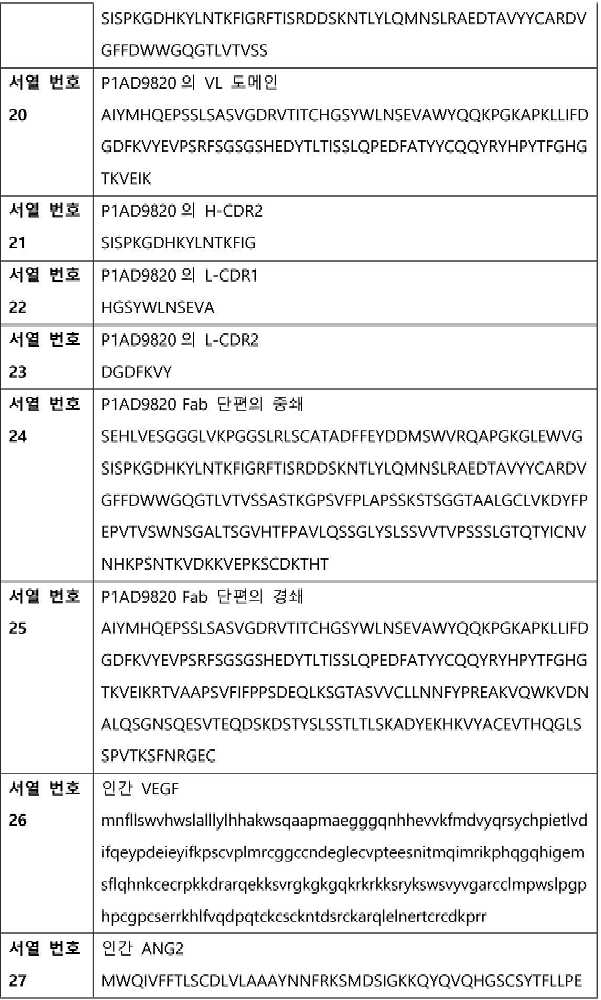

실시예Example
다음의 실시예는 본 발명의 이해를 돕기 위해 제공되며, 그 진정한 범위는 첨부된 청구범위에 제시되어 있다. 본 발명의 사상에서 벗어나지 않고 제시된 절차에서 수정이 이루어질 수 있는 것으로 이해된다. The following examples are provided to aid in the understanding of this invention, the true scope of which is set forth in the appended claims. It is understood that modifications may be made in the presented procedures without departing from the spirit of the invention.
재료 및 일반적인 방법 Materials and general methods
인간 VEGF-A121 친화성 Kinexa:Human VEGF-A121 Affinity Kinexa:

오토샘플러가 있는 Sapidyne Instruments사(Boise, ID)의 KinExA 3200 기기를 사용했다. 폴리메틸메타크릴레이트(PMMA) 비드는 Sapidyne에서 구입했고, 항-VEGF 항체는 R&D Systems(Mab293, BAF293)에서 구입했다. 스트렙타비딘 Alexa Fluor™ 647 접합체는 Thermo Fisher Scientific(S21374)에서 구입했다. PBS(포스페이트 완충 식염수), BSA(소 혈청 알부민 분획 V), VEGFA-121(서열 번호 28)을 회사 내부(Roche)에서 제조하였다. A KinExA 3200 instrument from Sapidyne Instruments (Boise, ID) with an autosampler was used. Polymethylmethacrylate (PMMA) beads were purchased from Sapidyne, and anti-VEGF antibodies were purchased from R&D Systems (Mab293, BAF293). Streptavidin Alexa Fluor™ 647 conjugate was purchased from Thermo Fisher Scientific (S21374). PBS (phosphate buffered saline), BSA (bovine serum albumin fraction V), VEGFA-121 (SEQ ID NO: 28) were prepared in-house (Roche).

PMMA 비드는 KinExA 핸드북 프로토콜에 따라 코팅되었다(흡착 코팅, Sapidyne). 먼저 흡착 코팅을 위해 비드들의 바이알(200mg) 하나 당 1ml PBS(pH7.4) 중의 30μg의 항-VEGF-항체 MAB293(R&D)을 첨가했다. 실온에서 2시간 동안 회전시킨 후, 상층액을 제거하고 블로킹 용액(완충액 중 10mg/ml BSA) 1ml를 채우고 1시간 동안 흔들었다. PMMA beads were coated according to the KinExA handbook protocol (adsorption coating, Sapidyne). First, 30 μg of anti-VEGF-antibody MAB293 (R&D) in 1 ml PBS (pH7.4) was added per vial (200 mg) of beads for adsorption coating. After spinning at room temperature for 2 hours, the supernatant was removed and 1 ml of blocking solution (10 mg/ml BSA in buffer) was added and shaken for 1 hour.

모든 KinExA 실험은 실행 완충액으로 0.01% BSA 및 0.01% Tween20(BioRad, #161-0781)이 포함된 PBS pH 7.4를 사용하여 실온(RT)에서 수행되었다. 샘플 및 비드는 이전 측정들에서 관찰된 비특이적 결합을 줄이기 위해 LowCross 완충액(Candor Bioscience)에서 준비되었다. 0.25ml/분의 유속을 사용했다. 일정한 양의 VEGFA-121-His(50pM 및 두 번째 실험에서 500pM)를 테스트 항체로 4nM(농도 범위 1.95pM - 4000pM)에서 시작하여 2배 연속 희석시켜 적정했다. 항원-항체 복합체는 평형에 도달할 수 있도록 RT에서 적어도 8시간 동안 인큐베이션되었다. 그런 다음 평형화된 혼합물을 50pM 일정한 VEGF의 경우 750μl의 부피 그리고 500pM 일정한 VEGF의 경우 125μl의 부피의 KinExA 시스템에서 항-VEGF 항체(Mab293) 커플링된 비드들의 컬럼을 통해 통과시켜, 용액의 평형 상태를 방해하지 않고 결합되지 않은 VEGFA-121을 비드들에 포획시켰다. 결합된 VEGFA-121은 농도가 250ng/ml인 두 번째 비오티닐화된 항-VEGF 항체(BAF293)를 사용하고 샘플 완충액에 250ng/ml 스트렙타비딘 Alexa Fluor™ 647 접합체를 주입하여 검출되었다. 각 샘플은 모든 평형 실험에 대해 중복 측정되었다. KD는 “표준 분석” 방법을 사용하여 KinExA 소프트웨어(버전 4.0.11)에 포함된 단일 부위 균일 결합 모델을 사용하여 데이터를 비선형 회귀 분석하여 얻었다. 이 소프트웨어는 KD를 계산하고 데이터 포인트들을 이론적 KD 곡선에 핏팅하여 95% 신뢰 구간을 결정한다. 95% 신뢰 구간은 KD 낮음과 KD 높음으로 표시된다. All KinExA experiments were performed at room temperature (RT) using PBS pH 7.4 with 0.01% BSA and 0.01% Tween20 (BioRad, #161-0781) as running buffer. Samples and beads were prepared in LowCross buffer (Candor Bioscience) to reduce non-specific binding observed in previous measurements. A flow rate of 0.25 ml/min was used. A constant amount of VEGFA-121-His (50 pM and 500 pM in the second experiment) was titrated with the test antibody in two-fold serial dilutions starting at 4 nM (concentration range 1.95 pM - 4000 pM). Antigen-antibody complexes were incubated for at least 8 hours at RT to allow equilibrium to be reached. The equilibrated mixture was then passed through a column of anti-VEGF antibody (Mab293) coupled beads in a KinExA system in a volume of 750 μl for 50 pM constant VEGF and 125 μl for 500 pM constant VEGF to equilibrate the solution. Undisturbed and unbound VEGFA-121 was captured by the beads. Bound VEGFA-121 was detected using a second biotinylated anti-VEGF antibody (BAF293) at a concentration of 250 ng/ml and injecting 250 ng/ml streptavidin Alexa Fluor™ 647 conjugate in the sample buffer. Each sample was measured in duplicate for all equilibrium experiments. K D was obtained by non-linear regression analysis of the data using the single site uniform binding model included in KinExA software (version 4.0.11) using the “standard analysis” method. The software calculates K D and fits the data points to a theoretical K D curve to determine a 95% confidence interval. The 95% confidence intervals are denoted by K D low and K D high.
최종 KD 결정을 위해 서로 다른 일정한 VEGFA-121 농도를 사용한 두 측정값의 n-곡선 결정이 수행되었다. n-곡선 분석은 보다 정확한 KD를 결정하기 위해 동일한 축에서 여러 표준 KD 실험들을 분석하는 데 사용될 수 있다. For the final K D determination, n-curve determination of two measurements using different constant VEGFA-121 concentrations was performed. An n-curve analysis can be used to analyze several standard K D experiments on the same axis to determine a more accurate K D .
인간 ANG2 친화성 Kinexa:Human ANG2 Affinity Kinexa:

오토샘플러가 있는 Sapidyne Instruments사(Boise, ID)의 KinExA 3200 기기를 사용했다. 폴리메틸메타크릴레이트(PMMA) 비드는 Sapidyne에서 구입했고, 항-Ang2 항체는 R&D Systems(MAB098, BAM0981)에서 구입했다. 스트렙타비딘 Alexa Fluor™ 647 접합체는 Thermo Fisher Scientific(S21374)에서 구입했다. PBS(포스페이트 완충 식염수), BSA(소 혈청 알부민 분획 V), Ang2(서열 번호 27)을 회사 내부(Roche)에서 제조하였다. A KinExA 3200 instrument from Sapidyne Instruments (Boise, ID) with an autosampler was used. Polymethylmethacrylate (PMMA) beads were purchased from Sapidyne, and anti-Ang2 antibodies were purchased from R&D Systems (MAB098, BAM0981). Streptavidin Alexa Fluor™ 647 conjugate was purchased from Thermo Fisher Scientific (S21374). PBS (phosphate buffered saline), BSA (bovine serum albumin fraction V), and Ang2 (SEQ ID NO: 27) were prepared in-house (Roche).

PMMA 비드는 KinExA 핸드북 프로토콜에 따라 코팅되었다(흡착 코팅, Sapidyne). 먼저 흡착 코팅을 위해 비드들의 바이알(200mg) 하나 당 1ml PBS(pH7.4) 중의 20 μg의 항-Ang2-항체 MAB098(R&D)을 첨가했다. 실온에서 2시간 동안 회전시킨 후, 상층액을 제거하고 블로킹 용액(완충액 중 10mg/ml BSA) 1ml를 채우고 1시간 동안 흔들었다.PMMA beads were coated according to the KinExA handbook protocol (adsorption coating, Sapidyne). First, 20 μg of anti-Ang2-antibody MAB098 (R&D) in 1 ml PBS (pH7.4) was added per vial (200 mg) of beads for adsorption coating. After spinning at room temperature for 2 hours, the supernatant was removed and 1 ml of blocking solution (10 mg/ml BSA in buffer) was added and shaken for 1 hour.

모든 KinExA 실험은 실행 완충액으로 0.01% BSA 및 0.01% Tween20(BioRad, #161-0781)이 포함된 PBS pH 7.4를 사용하여 실온(RT)에서 수행되었다. 샘플 및 비드는 이전 측정들에서 관찰된 비특이적 결합을 줄이기 위해 LowCross 완충액(Candor Bioscience)에서 준비되었다. 0.25ml/분의 유속을 사용했다. 일정한 양의 Ang2-RBD-muFc(50pM 및 두 번째 실험에서 500pM)를 테스트 항체로 4nM(농도 범위 1.95pM - 4000pM)에서 시작하여 2배 연속 희석시켜 적정했다. 항원-항체 복합체는 평형에 도달할 수 있도록 RT에서 적어도 8시간 동안 인큐베이션되었다. 그런 다음 평형화된 혼합물을 50pM 일정한 Ang2의 경우 750μl의 부피 그리고 500pM 일정한 Ang2의 경우 188μl의 부피의 KinExA 시스템에서 항-Ang2 항체(MAB098) 커플링된 비드들의 컬럼을 통해 통과시켜, 용액의 평형 상태를 방해하지 않고 결합되지 않은 Ang2을 비드들에 포획시켰다. 결합된 Ang2는 농도가 250ng/ml인 두 번째 비오티닐화된 항-Ang2 항체(BAM0981)를 사용하고 샘플 완충액에 250ng/ml 스트렙타비딘 Alexa Fluor™ 647 접합체를 주입하여 검출되었다. 각 샘플은 모든 평형 실험에 대해 중복 측정되었다. KD는 “표준 분석” 방법을 사용하여 KinExA 소프트웨어(버전 4.0.11)에 포함된 단일 부위 균일 결합 모델을 사용하여 데이터를 비선형 회귀 분석하여 얻었다. 이 소프트웨어는 KD를 계산하고 데이터 포인트들을 이론적 KD 곡선에 핏팅하여 95% 신뢰 구간을 결정한다. 95% 신뢰 구간은 KD 낮음과 KD 높음으로 표시된다. All KinExA experiments were performed at room temperature (RT) using PBS pH 7.4 with 0.01% BSA and 0.01% Tween20 (BioRad, #161-0781) as running buffer. Samples and beads were prepared in LowCross buffer (Candor Bioscience) to reduce non-specific binding observed in previous measurements. A flow rate of 0.25 ml/min was used. A constant amount of Ang2-RBD-muFc (50 pM and 500 pM in the second experiment) was titrated with the test antibody in two-fold serial dilutions starting at 4 nM (concentration range 1.95 pM - 4000 pM). Antigen-antibody complexes were incubated for at least 8 hours at RT to allow equilibrium to be reached. The equilibrated mixture was then passed through a column of anti-Ang2 antibody (MAB098) coupled beads in a KinExA system in a volume of 750 μl for 50 pM constant Ang2 and 188 μl for 500 pM constant Ang2 to equilibrate the solution. Undisturbed and unbound Ang2 was captured by the beads. Bound Ang2 was detected using a second biotinylated anti-Ang2 antibody (BAM0981) at a concentration of 250 ng/ml and injecting 250 ng/ml streptavidin Alexa Fluor™ 647 conjugate into the sample buffer. Each sample was measured in duplicate for all equilibrium experiments. K D was obtained by non-linear regression analysis of the data using the single site uniform binding model included in KinExA software (version 4.0.11) using the “standard analysis” method. The software calculates K D and fits the data points to a theoretical K D curve to determine a 95% confidence interval. The 95% confidence intervals are denoted by K D low and K D high.
최종 KD 결정을 위해 서로 다른 일정한 Ang2 농도를 사용한 두 측정값의 n-곡선 결정이 수행되었다. n-곡선 분석은 보다 정확한 KD를 결정하기 위해 동일한 축에서 여러 표준 KD 실험들을 분석하는 데 사용될 수 있다. For the final K D determination, n-curve determination of two measurements using different constant Ang2 concentrations was performed. An n-curve analysis can be used to analyze several standard K D experiments on the same axis to determine a more accurate K D .
표면 플라즈몬 공명(SPR)에 의해 평가된 인간 VEGF-A 결합 동역학: Human VEGF-A binding kinetics assessed by surface plasmon resonance (SPR):
항-His 포획 항체(GE Healthcare 28995056)를 표준 아민 커플링 화학을 사용하여 시리즈 S 센서 칩 C1(GE Healthcare BR100535)에 고정화시켜 약 600 공명 단위(RU)의 표면 밀도를 생성했다. 실행 및 희석 완충액으로 HBS-P+(10mM HEPES, 150mM NaCl pH 7.4, 0.05% 계면활성제 P20)를 사용했다. 인간 VEGF-A121-His는 각각 약 10 및 20 RU의 리간드 밀도로 표면에 포획되었다. 테스트 항체의 연속 희석액(3.7 - 300 nM, 1:3 희석)을 각각 60초 동안 연속적으로 주입하고, 30 μl/분의 유속에서 3600초 동안 해리를 모니터링했다(단일 주기 동역학). 5μl/분의 유속으로 60초 동안 10mM 글리신 pH 1.5를 주입하여 표면을 재생시켰다. 벌크 굴절률 차이는 블랭크 주입을 빼고 포획된 인간 VEGF-A121이 없는 대조군 유세포로부터 얻은 반응을 빼서 수정했다. 곡선 피팅은 Biacore 평가 소프트웨어 내부의 1:1 Langmuir 결합 모델을 사용하여 수행되었다.An anti-His capture antibody (GE Healthcare 28995056) was immobilized on a Series S sensor chip C1 (GE Healthcare BR100535) using standard amine coupling chemistry, resulting in a surface density of approximately 600 resonance units (RU). HBS-P+ (10 mM HEPES, 150 mM NaCl pH 7.4, 0.05% Surfactant P20) was used as the running and dilution buffer. Human VEGF-A121-His was captured on the surface at ligand densities of about 10 and 20 RU, respectively. Serial dilutions (3.7 - 300 nM, 1:3 dilution) of the test antibody were injected continuously for 60 seconds each, and dissociation was monitored for 3600 seconds at a flow rate of 30 μl/min (single cycle kinetics). The surface was regenerated by injecting 10 mM glycine pH 1.5 for 60 seconds at a flow rate of 5 μl/min. Bulk refractive index differences were corrected for by subtracting blank injections and subtracting responses from control flow cells without captured human VEGF-A121. Curve fitting was performed using a 1:1 Langmuir binding model inside the Biacore evaluation software.
교차반응성 시험을 위한 표면 플라즈몬 공명(SPR)에 의해 평가된 VEGF-A 결합 동역학: VEGF-A binding kinetics assessed by surface plasmon resonance (SPR) for cross-reactivity testing:
항-His 포획 항체(GE Healthcare 28995056)를 표준 아민 커플링 화학을 사용하여 시리즈 S 센서 칩 C1(GE Healthcare BR100535)에 고정화시켜 약 600 공명 단위(RU)의 표면 밀도를 생성했다. 실행 및 희석 완충액으로 HBS-P+(10mM HEPES, 150mM NaCl pH 7.4, 0.05% 계면활성제 P20)를 사용했다. 지시된 종들로부터 얻은 VEGF-A121-His는 각각 약 10 및 20 RU의 리간드 밀도로 표면에 포획되었다. 테스트 항체의 연속 희석액(3.7 - 300 nM, 1:3 희석)을 각각 60초 동안 연속적으로 주입하고, 30 μl/분의 유속에서 3600초 동안 해리를 모니터링했다(단일 주기 동역학). 5μl/분의 유속으로 60초 동안 10mM 글리신 pH 1.5를 주입하여 표면을 재생시켰다. 벌크 굴절률 차이는 블랭크 주입을 빼고 포획된 VEGF-A121이 없는 대조군 유세포로부터 얻은 반응을 빼서 수정했다. 곡선 피팅은 Biacore 평가 소프트웨어 내부의 1:1 Langmuir 결합 모델을 사용하여 수행되었다.An anti-His capture antibody (GE Healthcare 28995056) was immobilized on a Series S sensor chip C1 (GE Healthcare BR100535) using standard amine coupling chemistry, resulting in a surface density of approximately 600 resonance units (RU). HBS-P+ (10 mM HEPES, 150 mM NaCl pH 7.4, 0.05% Surfactant P20) was used as the running and dilution buffer. VEGF-A121-His from the indicated species were surface-captured at ligand densities of approximately 10 and 20 RU, respectively. Serial dilutions (3.7 - 300 nM, 1:3 dilution) of the test antibody were injected continuously for 60 seconds each, and dissociation was monitored for 3600 seconds at a flow rate of 30 μl/min (single cycle kinetics). The surface was regenerated by injecting 10 mM glycine pH 1.5 for 60 seconds at a flow rate of 5 μl/min. Bulk refractive index differences were corrected for by subtracting blank injections and subtracting responses from control flow cells without captured VEGF-A121. Curve fitting was performed using a 1:1 Langmuir binding model inside the Biacore evaluation software.
표면 플라즈몬 공명(SPR)에 의해 평가된 인간 ANG2 결합 동역학: Human ANG2 binding kinetics assessed by surface plasmon resonance (SPR):
항-Fab 포획 항체(GE Healthcare 28958325)를 표준 아민 커플링 화학을 사용하여 시리즈 S 센서 칩 C1(GE Healthcare BR100535)에 고정화시켜 약 800 공명 단위(RU)의 표면 밀도를 생성했다. 실행 및 희석 완충액으로 HBS-P+(10mM HEPES, 150mM NaCl pH 7.4, 0.05% 계면활성제 P20)를 사용했으며 측정 온도는 25°C였다. 5 μl/분의 유속으로 60초 동안 50 nM 용액을 주입하여 테스트된 항체를 포획하였다. 회합은 30 μl/분(0.07 nM - 50 nM, 1:3 희석)의 유속으로 180초 동안 용액 중에서의 다양한 농도로 인간 Ang2-RBD를 주입하여 측정되었다. 해리 단계는 최대 900초 동안 모니터링되었으며 30μl/분의 유속으로 샘플 용액으로부터 실행 버퍼로 전환시킴으로써 촉발되었다. 10mM 글리신 pH 2.1을 30μl/분의 유속으로 60초 동안 주입하여 표면을 재생시켰다. 벌크 굴절률 차이는 블랭크 주입을 빼고 포획된 테스트 항체가 없는 참조 유동 세포로부터 얻은 반응을 빼어 보정되었다. 곡선 피팅은 Biacore 평가 소프트웨어 내부의 1:1 Langmuir 결합 모델을 사용하여 수행되었다.An anti-Fab capture antibody (GE Healthcare 28958325) was immobilized on a Series S sensor chip C1 (GE Healthcare BR100535) using standard amine coupling chemistry, resulting in a surface density of approximately 800 resonance units (RU). HBS-P+ (10 mM HEPES, 150 mM NaCl pH 7.4, 0.05% surfactant P20) was used as the running and dilution buffer and the measurement temperature was 25 °C. The tested antibody was captured by injecting a 50 nM solution for 60 seconds at a flow rate of 5 μl/min. Association was measured by injecting human Ang2-RBD at various concentrations in solution for 180 seconds at a flow rate of 30 μl/min (0.07 nM - 50 nM, 1:3 dilution). The dissociation phase was monitored for up to 900 seconds and was triggered by switching from sample solution to running buffer at a flow rate of 30 μl/min. The surface was regenerated by injecting 10 mM glycine pH 2.1 at a flow rate of 30 μl/min for 60 seconds. Bulk refractive index differences were corrected for by subtracting blank injections and subtracting responses from a reference flow cell without captured test antibody. Curve fitting was performed using a 1:1 Langmuir binding model inside the Biacore evaluation software.
교차반응성 시험을 위한 표면 플라즈몬 공명(SPR)에 의해 평가된 ANG2 결합 동역학: ANG2 binding kinetics assessed by surface plasmon resonance (SPR) for cross-reactivity testing:
항-Fab 포획 항체(GE Healthcare 28958325)를 표준 아민 커플링 화학을 사용하여 시리즈 S 센서 칩 C1(GE Healthcare BR100535)에 고정화시켜 약 800 공명 단위(RU)의 표면 밀도를 생성했다. 실행 및 희석 완충액으로 HBS-P+(10mM HEPES, 150mM NaCl pH 7.4, 0.05% 계면활성제 P20)를 사용했으며 측정 온도는 25°C였다. 5 μl/분의 유속으로 60초 동안 50 nM 용액을 주입하여 테스트된 항체를 포획하였다. 회합은 30 μl/분(0.07 nM - 50 nM, 1:3 희석)의 유속으로 180초 동안 용액 중에서의 다양한 농도로 지시된 종들에서 유래한 Ang2-RBD를 주입하여 측정되었다. 해리 단계는 최대 600초 동안 모니터링되었으며 30μl/분의 유속으로 샘플 용액으로부터 실행 버퍼로 전환시킴으로써 촉발되었다. 10mM 글리신 pH 2.1을 30μl/분의 유속으로 60초 동안 주입하여 표면을 재생시켰다. 벌크 굴절률 차이는 블랭크 주입을 빼고 포획된 항체가 없는 참조 유세포로부터 얻은 반응을 빼어 보정되었다. 곡선 피팅은 Biacore 평가 소프트웨어 내부의 1:1 Langmuir 결합 모델을 사용하여 수행되었다.An anti-Fab capture antibody (GE Healthcare 28958325) was immobilized on a Series S sensor chip C1 (GE Healthcare BR100535) using standard amine coupling chemistry, resulting in a surface density of approximately 800 resonance units (RU). HBS-P+ (10 mM HEPES, 150 mM NaCl pH 7.4, 0.05% surfactant P20) was used as the running and dilution buffer and the measurement temperature was 25 °C. The tested antibody was captured by injecting a 50 nM solution for 60 seconds at a flow rate of 5 μl/min. Association was measured by injecting Ang2-RBD from the indicated species at various concentrations in solution for 180 seconds at a flow rate of 30 μl/min (0.07 nM - 50 nM, 1:3 dilution). The dissociation phase was monitored for up to 600 seconds and was triggered by switching from sample solution to running buffer at a flow rate of 30 μl/min. The surface was regenerated by injecting 10 mM glycine pH 2.1 at a flow rate of 30 μl/min for 60 seconds. Bulk refractive index differences were corrected for by subtracting blank injections and subtracting responses from reference flow cells without captured antibody. Curve fitting was performed using a 1:1 Langmuir binding model inside the Biacore evaluation software.
표면 플라즈몬 공명(SPR)을 사용한, 표적 항원에 대한 독립적인 결합의 평가Assessment of Independent Binding to Target Antigen Using Surface Plasmon Resonance (SPR)
포획 시스템(항-Fab 포획 항체(GE Healthcare 28958325))의 약 5000개 공명 단위(RU)를 GE Healthcare사에서 공급한 아민 커플링 키트를 사용하여 pH 5.0에서 CM5 칩(GE Healthcare BR100530)에 커플링시켰다. 샘플 및 시스템 완충액은 HBS-P+(10mM HEPES, 150mM NaCl pH 7.4, 0.05% 계면활성제 P20)였다. 유동 세포의 온도는 25°C로, 샘플 블록의 온도는 12°C로 설정했다. 포획하기 전에 유동 세포를 실행 완충액으로 세 번 프라이밍했다. Coupling approximately 5000 resonance units (RU) of the capture system (anti-Fab capture antibody (GE Healthcare 28958325)) to a CM5 chip (GE Healthcare BR100530) at pH 5.0 using an amine coupling kit supplied by GE Healthcare made it The sample and system buffer was HBS-P+ (10 mM HEPES, 150 mM NaCl pH 7.4, 0.05% Surfactant P20). The temperature of the flow cell was set to 25 °C and the temperature of the sample block to 12 °C. Prior to capture, the flow cell was primed three times with running buffer.
6.5μg/ml 용액을 5μl/분의 흐름으로 60초 동안 주입하여 이중특이성 Fab를 포획하였다. 이중특이성 Fab에 대한 각각의 리간드의 독립적인 결합은 순차적으로 또는 동시에(10 μl/분의 흐름) 첨가되는 각각의 리간드에 대한 활성 결합 능력을 결정함으로써 다음과 같이 분석되었다:The bispecific Fab was captured by injecting a 6.5 μg/ml solution at a flow rate of 5 μl/min for 60 seconds. Independent binding of each ligand to the bispecific Fab was assayed by determining the active binding capacity for each ligand added sequentially or simultaneously (flow of 10 μl/min) as follows:
1) 60초 동안 1μg/ml의 농도로 인간 VEGFA-121을 주입(항원의 단일 결합을 확인). One) Inject human VEGFA-121 at a concentration of 1 μg/ml for 60 seconds (confirm single binding of antigen).
2) 60초 동안 5μg/ml의 농도로 인간 Ang2를 주입(항원의 단일 결합을 확인) 2) Inject human Ang2 at a concentration of 5 μg/ml for 60 seconds (confirm single binding of antigen)
3) 60초 동안 1μg/ml의 농도로 인간 VEGFA-121을 주입한 후 60초 동안 5μg/ml의 농도로 인간 Ang2를 추가 주입(VEGFA-121의 존재하에서 Ang2의 결합을 확인). 3) After injection of human VEGFA-121 at a concentration of 1 μg/ml for 60 seconds, additional injection of human Ang2 at a concentration of 5 μg/ml for 60 seconds (confirmation of binding of Ang2 in the presence of VEGFA-121).
4) 60초 동안 5μg/ml의 농도로 인간 Ang2을 주입한 후 60초 동안 1μg/ml의 농도로 인간 VEGFA-121을 추가 주입(Ang2의 존재하에서 VEGFA-121의 결합을 확인). 4) Human Ang2 was injected at a concentration of 5 μg/ml for 60 seconds, followed by additional injection of human VEGFA-121 at a concentration of 1 μg/ml for 60 seconds (to confirm binding of VEGFA-121 in the presence of Ang2).
5) 1μg/ml 농도의 인간 VEGFA-121과 5μg/ml 농도의 인간 Ang2를 60초간 동시 주입(VEGFA-121과 Ang2의 동시 결합을 확인). 5) Simultaneous injection of human VEGFA-121 at a concentration of 1 μg/ml and human Ang2 at a concentration of 5 μg/ml for 60 seconds (to confirm simultaneous binding of VEGFA-121 and Ang2).
10mM 글리신 pH 2.1을 30μl/분의 유속으로 60초 동안 주입하여 표면을 재생시켰다. 벌크 굴절률 차이는 블랭크 주입을 빼고 포획된 이중특이성 Fab가 없는 참조 유세포로부터 얻은 반응을 빼어 보정되었다. 이중특이성 항체는 접근법 3, 4 및 5에서 생성된 최종 신호가 접근법 1 및 2의 개별 최종 신호의 합과 동일한 경우 상호 독립적으로 두 항원에 결합할 수 있다.The surface was regenerated by injecting 10 mM glycine pH 2.1 at a flow rate of 30 μl/min for 60 seconds. Bulk refractive index differences were corrected for by subtracting the blank injection and subtracting the response from the reference flow cell without the captured bispecific Fab. A bispecific antibody can bind to both antigens independently of each other if the final signal generated by
열 안정성:Thermal Stability:
이중특이성 항체 Fab 단편의 샘플을 20mM 히스티딘/히스티딘 클로라이드, 140mM NaCl, pH 6.0에서 1mg/mL의 농도로 제조하고 10μL 마이크로-큐벳 어레이로 옮겼다. UNcle 기기(Unchained Labs)를 사용하여 266nm 레이저로 여기 시 정적 광산란 데이터 및 형광 데이터를 기록하고 샘플을 30°C에서 90°C까지 0.1°C/분의 속도로 가열한다. 샘플은 삼중으로 측정되었다. Samples of the bispecific antibody Fab fragments were prepared at a concentration of 1 mg/mL in 20 mM histidine/histidine chloride, 140 mM NaCl, pH 6.0 and transferred to a 10 μL micro-cuvette array. Record static light scattering data and fluorescence data upon excitation with a 266 nm laser using a UNcle instrument (Unchained Labs) and heat the sample from 30 °C to 90 °C at a rate of 0.1 °C/min. Samples were measured in triplicate.
개시 온도의 평가는 UNcle 분석 소프트웨어에 의해 수행되었다. 응집 개시 온도는 산란광 강도가 증가하기 시작하는 온도로 정의된다. 열에 대한 형광 신호의 무게 중심 평균(BCM)의 이동으로 단백질의 변성을 모니터링했다. 용융 온도는 BCM(nm) 대 온도 곡선의 변곡점으로 정의된다.Evaluation of the onset temperature was performed by UNcle analysis software. The aggregation onset temperature is defined as the temperature at which the scattered light intensity starts to increase. Protein denaturation was monitored by the shift of the centroid mean (BCM) of the fluorescence signal with respect to heat. Melting temperature is defined as the inflection point of the BCM (nm) versus temperature curve.
물리화학적 안정성:Physical and chemical stability:
항체 샘플을 20mM His/HisCl, 140mM NaCl, pH 6.0에서 제형화하고, 3개의 분취물로 나누었다: 하나의 분취물을 각각 PBS로 재완충하고, 2개의 분취물을 원래 제제에 보관하였다. PBS 분취물과 하나의 His/HisCl 분취물을 1 mg/ml에서 40°C(His/NaCl) 또는 37°C(PBS)에서 2주(2w) 동안 인큐베이션하고, PBS 샘플을 총 4주(4w) 동안 추가로 인큐베이션했다. 세 번째 대조군 분취물 샘플은 -80°C에서 보관되었다. 인큐베이션 종료 후, 샘플을 상대적 활성 농도(Biacore; 스트레스를 가한 각 결합제의 두 분취물의 활성 농도는 스트레스를 가하지 않은 4℃분취물로 정규화됨), 응집(SEC) 및 단편화(모세관 전기영동 또는 SDS-PAGE, CE-SDS)에 대해 분석하고 및 미처리 대조군과 비교하였다. Antibody samples were formulated in 20 mM His/HisCl, 140 mM NaCl, pH 6.0 and divided into 3 aliquots: one aliquot was each rebuffered with PBS, and 2 aliquots were kept in the original formulation. PBS aliquots and one His/HisCl aliquot were incubated at 1 mg/ml at 40 °C (His/NaCl) or 37 °C (PBS) for 2 weeks (2w), PBS samples were incubated for a total of 4 weeks (4w). ) during further incubation. A third control aliquot sample was stored at -80°C. After the end of incubation, samples were assayed for relative activity concentration (Biacore; activity concentration of two aliquots of each stressed binding agent normalized to unstressed 4°C aliquot), aggregation (SEC) and fragmentation (capillary electrophoresis or SDS- PAGE, CE-SDS) and compared to untreated controls.
기능적 안정성 테스트를 위해 SPR에 의해 평가된 인간 VEGF-A 및 인간 ANG2 결합 동역학Human VEGF-A and human ANG2 binding kinetics evaluated by SPR for functional stability testing
VEGFA-121(회사 내부), 단백질 A(Pierce/Thermo Scientific 21181) 및 항인간 Fab 포획 항체(GE Healthcare 28958325)를 표준 아민 커플링 화학을 사용하여 시리즈 S 센서 칩 CM5(GE Healthcare 29104988)에 서로 다른 유동 세포 상에서 고정시켜, hVEGFA-121 및 단백질 A에 대해 3000의 표면 밀도 및 항-인간 Fab 포획 항체에 대해 12000 공명 단위(RU)를 생성하였다. 실행 및 희석 완충액으로 HBS-N(10mM HEPES, 150mM NaCl pH 7.4, GE Healthcare)을 사용했다. 다음 농도 측정을 위한 샘플 및 실행 완충액은 HBS-P(10mM HEPES, 150mM NaCl pH 7.4, 0.05% 계면활성제 P20; GE Healthcare)였다. 유동 세포의 온도는 25°C로, 샘플 블록의 온도는 12°C로 설정했다. 유동 세포는 농도 측정 전에 실행 완충액으로 두 번 프라이밍되었다. 먼저, 10μg/ml 용액을 10μl/분의 유속으로 120초 동안 주입하여 인간 Ang2-RBD-hFc Dimer를 포획하였다. 테스트 항체는 1 μg/ml의 농도에서 5 μl/분의 유속으로 60초 동안 용액에 주입되었다. 해리 단계는 최대 30초 동안 모니터링되었으며 샘플 용액에서 실행 완충액으로 바꾸어 촉발되었다. VEGFA-121 (in-house), protein A (Pierce/Thermo Scientific 21181), and an anti-human Fab capture antibody (GE Healthcare 28958325) were isolated on the Series S sensor chip CM5 (GE Healthcare 29104988) using standard amine coupling chemistry. Immobilization on a flow cell yielded a surface density of 3000 for hVEGFA-121 and protein A and 12000 resonance units (RU) for the anti-human Fab capture antibody. HBS-N (10 mM HEPES, 150 mM NaCl pH 7.4, GE Healthcare) was used as the running and dilution buffer. The sample and running buffer for the next concentration measurement was HBS-P (10 mM HEPES, 150 mM NaCl pH 7.4, 0.05% Surfactant P20; GE Healthcare). The temperature of the flow cell was set to 25 °C and the temperature of the sample block to 12 °C. The flow cell was primed twice with running buffer prior to concentration measurements. First, human Ang2-RBD-hFc dimer was captured by injecting a 10 μg/ml solution at a flow rate of 10 μl/min for 120 seconds. Test antibodies were injected into the solution at a concentration of 1 μg/ml at a flow rate of 5 μl/min for 60 seconds. The dissociation phase was monitored for up to 30 seconds and was triggered by changing from sample solution to running buffer.
hVEGFA-121 표면은 30μl/분의 유속으로 10mM 글리신 pH2.0 용액으로 30초 동안 세척하여 재생되었다. 단백질 A 표면은 30μl/분의 유속으로 10mM 글리신 pH1.5 용액으로 30초 동안 세척하여 재생되었다. 마지막으로 항-인간 Fab 항체 표면을 10mM 글리신 pH 2.1 용액으로 30μl/분의 유속으로 60초 동안 세척하여 재생시켰다. The hVEGFA-121 surface was regenerated by washing for 30 seconds with a 10 mM glycine pH2.0 solution at a flow rate of 30 μl/min. The Protein A surface was regenerated by washing for 30 seconds with a 10 mM glycine pH1.5 solution at a flow rate of 30 μl/min. Finally, the anti-human Fab antibody surface was regenerated by washing with 10 mM glycine pH 2.1 solution at a flow rate of 30 μl/min for 60 seconds.
벌크 굴절률 차이는 블랭크 표면으로부터 얻은 반응을 빼서 수정했다. 평가를 위해, 결합 반응을 취했다. The bulk refractive index difference was corrected by subtracting the response obtained from the blank surface. For evaluation, binding reactions were taken.
상대 활성 농도는 각 온도의 스트레스를 가한 샘플을 스트레스를 가하지 않은 상응하는 샘플에 대해 참조하여 계산되었다.Relative activity concentrations were calculated by referencing the stressed sample at each temperature to the corresponding unstressed sample.

항원의 결합 신호를 정규화하기 위해, hVEGF-A121 결합 및 Ang2 결합을 항체 샘플의 항-Fab 결합에 대해 정규화했다.To normalize the binding signal of the antigen, hVEGF-A121 binding and Ang2 binding were normalized to the anti-Fab binding of the antibody samples.

실시예 1: Example 1:
이중특이성 항-VEGF-A/항-ANG2 Fab 단편의 생성Generation of bispecific anti-VEGF-A/anti-ANG2 Fab fragments
이중특이성 항-VEGF-A/항-ANG2 Fab 단편은, 예를 들어 WO2012/163520에 기재된 바와 같은 방법에 의해, VEGF-A 및 ANG2에 결합하는 단일특이성 항체를 독립적으로 스크리닝하고 이어서 아미노산 서열을 이중 파라토프 HC/LC 쌍으로 병합하여 VEGF-A 및 ANG2에 결합하는 Fab 단편을 형성함으로써 생성되었다. Bispecific anti-VEGF-A/anti-ANG2 Fab fragments can be obtained by independently screening monospecific antibodies that bind VEGF-A and ANG2, eg, by methods as described in WO2012/163520, followed by double screening of the amino acid sequence. It was created by merging into a paratopic HC/LC pair to form a Fab fragment that binds to VEGF-A and ANG2.
합성 Fab 단편의 2개의 별개의 파지 디스플레이 라이브러리를 이용하였는데, 여기서 제1 파지 디스플레이 라이브러리에서 Fab 단편의 CDR-H1, CDR-H3 및 CDR-L2 영역들 내부의 잔기들이 다양화되었고, 제2 파지 디스플레이 라이브러리에서 Fab 단편의 CDR-L1, CDR-L3 및 CDR-H2 영역들 내부의 잔기들이 다양화되었다. 각 라이브러리에서 다른 3개의 CDR 영역은 불변 더미 서열로서 다양화되지 않은 상태로 유지되었다. 두 라이브러리에서 Fab 단편의 CH1 도메인은 절단된 유전자 III 단백질에 링커를 통해 융합되어 파지 디스플레이를 용이하게 한다.Two distinct phage display libraries of synthetic Fab fragments were used, in which residues within the CDR-H1, CDR-H3 and CDR-L2 regions of the Fab fragments in the first phage display library were diversified and the second phage display library was diversified. Residues within the CDR-L1, CDR-L3 and CDR-H2 regions of the Fab fragments in the library were diversified. The other three CDR regions in each library were kept undiversified as constant dummy sequences. In both libraries, the CH1 domain of the Fab fragment is fused to the truncated gene III protein via a linker to facilitate phage display.
파지 라이브러리 패닝에 의해, 제1 라이브러리에는 인간 ANG2에 대한 결합제가 농축되었고 제2 라이브러리에는 인간 VEGF-A에 대한 결합제가 농축되었다. 패닝 후, 농축된 두 파지미드 벡터 풀 모두에 대해 플라스미드 미니프렙을 생성하였다. 미니프렙을 제한 효소로 분해하여 절단된 유전자-III 단백질을 인코딩하는 영역을 절제하고 결찰에 의해 다시 원형화하여, 각각 ANG2 결합제 또는 VEGF-A 결합제에 대해 농축된 가용성 Fab 단편들을 인코딩하는 발현 벡터들의 풀들을 얻었다. 이들 벡터 풀을 TG1 대장균 세포로 형질전환하고 개별 콜로니들을 선택하여 마이크로타이터 플레이트에서 개별 Fab 클론의 가용성 발현을 위해 배양했다. 가용성 Fab 단편을 포함하는 상층액을 ANG2 또는 VEGF-A에 대한 결합에 대해 표준 ELISA 방법을 사용하여 스크리닝하고, 특정 결합제를 생성하는 TG1 클론들을 DNA 플라스미드 제조 및 시퀀싱하여 ANG2 또는 VEGF-A 각각에 특이적으로 결합하는 VH 및 VL 서열들의 쌍들을 얻었다.By panning the phage libraries, the first library was enriched for human ANG2 binding agents and the second library was enriched for human VEGF-A binding agents. After panning, plasmid minipreps were generated for both enriched phagemid vector pools. The miniprep was digested with restriction enzymes to excise the region encoding the truncated gene-III protein and recirculated by ligation to generate expression vectors encoding soluble Fab fragments enriched for the ANG2 binder or the VEGF-A binder, respectively. got the grass These vector pools were transformed into TG1 E. coli cells and individual colonies were selected and cultured for soluble expression of individual Fab clones in microtiter plates. Supernatants containing soluble Fab fragments were screened for binding to ANG2 or VEGF-A using standard ELISA methods, and TG1 clones that produced specific binding agents were prepared with DNA plasmids and sequenced to detect specificity for ANG2 or VEGF-A, respectively. Pairs of VH and VL sequences that bind antagonistically were obtained.
이중특이성 항-VEGF-A/항-ANG2 VH 및 VL 서열들의 하나의 쌍은 (1) ANG2-특이적 Fab의 VH 서열에서 무관한 VH 잔기 52b 내지 65를 VEGF-A-특이적 Fab의 선택된 VH 잔기 52b 내지 65로 대체하여, 잠재적으로 VEGF-A-특이적 파라토프의 일부인 CDR-H2 잔기를 ANG2 결합제 중쇄로 치환하고, 그리고 (2) VEGF-A-특이적 Fab의 VL 서열에서 관련된 VL 잔기 49 내지 57을 ANG2-특이적 Fab의 선택된 VL 잔기 49 내지 57로 대체하여, 잠재적으로 ANG2-특이적 파라토프의 일부인 CDR-L2 잔기를 VEGF-A 결합제 경쇄로 치환함으로써, 모의로 설계되었다. One pair of bispecific anti-VEGF-A/anti-ANG2 VH and VL sequences (1) converts unrelated VH residues 52b to 65 in the VH sequence of an ANG2-specific Fab to a selected VH of a VEGF-A-specific Fab. Replacing residues 52b to 65, replacing CDR-H2 residues potentially part of the VEGF-A-specific paratope with the ANG2 binding agent heavy chain, and (2) the relevant VL residues in the VL sequence of the VEGF-A-specific Fab It was mock designed by replacing 49 to 57 with selected VL residues 49 to 57 of the ANG2-specific Fab, replacing CDR-L2 residues, potentially part of the ANG2-specific paratope, with the VEGF-A binding agent light chain.
실시예 2:Example 2:
이중특이성 항-VEGF-A/항-ANG2 Fab 단편 P1AA8906의 발현 Expression of the bispecific anti-VEGF-A/anti-ANG2 Fab fragment P1AA8906
상기와 같이 생성된 이중특이성 항-VEGF-A/항-ANG2 VH 및 VL 서열들의 설계된 쌍을 합성하고 CH1 및 C카파 도메인을 인코딩하는 유전자 서열과 함께 인프레임 대장균 발현 벡터에 클로닝하였다. 벡터를 TG1 대장균 세포에 형질전환시키고, 개별 콜로니를 이중특이성 항체 Fab 단편의 가용성 발현을 위해 배양하였다. 친화성 크로마토그래피에 의해 TG1 배양 상층액으로부터 이중특이성 항체를 정제하고, ANG2 및 VEGF-A 모두에 대한 특이적 결합을 확인하였다.The designed pair of bispecific anti-VEGF-A/anti-ANG2 VH and VL sequences generated above was synthesized and cloned into an in-frame E. coli expression vector along with gene sequences encoding the CH1 and Ckappa domains. The vector was transformed into TG1 E. coli cells and individual colonies were cultured for soluble expression of the bispecific antibody Fab fragment. The bispecific antibody was purified from the TG1 culture supernatant by affinity chromatography and specific binding to both ANG2 and VEGF-A was confirmed.
이중특이성 항-VEGF-A/항-ANG2 항체 “P1AA8906”이 선택되었고, 서열 번호 9의 중쇄 및 서열 번호 10의 경쇄를 특징으로 한다. The bispecific anti-VEGF-A/anti-ANG2 antibody “P1AA8906” was selected and features a heavy chain of SEQ ID NO:9 and a light chain of SEQ ID NO:10.
추가 분석을 위해, 본 발명의 항-VEGF-A/항-ANG2 항체를 표준 재조합 방법에 의해 CHO 세포에 형질전환시키고 그로부터 발현시켰다. For further analysis, the anti-VEGF-A/anti-ANG2 antibodies of the present invention were transformed into CHO cells and expressed therefrom by standard recombinant methods.
실시예 3:Example 3:
이중특이성 항-VEGF-A/항-ANG2 Fab 단편 P1AA8906의 특성화Characterization of the bispecific anti-VEGF-A/anti-ANG2 Fab fragment P1AA8906
이중특이성 항체 P1AA8906의 결합 친화도는 상기 “재료 및 일반적인 방법” 섹션에서 기재된 바와 같이 SPR 및 KinExA에 의해 평가되었다. The binding affinity of the bispecific antibody P1AA8906 was evaluated by SPR and KinExA as described in the “Materials and General Methods” section above.
표 1: 인간 VEGFA-121 결합: Table 1: Human VEGFA-121 binding:

* Biacore® 사양 외* Outside of Biacore® specifications
KinExA 분석은 다음 조건에서 수행되었다: VEGF-A-121 농도: 100 pM / 1000 pM (CBP), P1AA8906 4nM - 0pM (1:2 희석, 12x), 실온에서 사전 인큐베이션 시간 ~8시간.The KinExA assay was performed under the following conditions: VEGF-A-121 concentration: 100 pM/1000 pM (CBP), P1AA8906 4 nM - 0 pM (1:2 dilution, 12x), pre-incubation time ~8 h at room temperature.
표 2: 인간 ANG2 결합: Table 2: Human ANG2 Binding:

KinExA 분석은 다음 조건에서 수행되었다: VEGF-A-121 농도: 100 pM / 1000 pM (CBP), P1AA8906 4nM - 0pM (1:2 희석, 12x), 실온에서 사전 인큐베이션 시간 ~8시간.The KinExA assay was performed under the following conditions: VEGF-A-121 concentration: 100 pM/1000 pM (CBP), P1AA8906 4 nM - 0 pM (1:2 dilution, 12x), pre-incubation time ~8 h at room temperature.
이중특이성 항체 P1AA8906의 열 안정성은 상기 “재료 및 일반적인 방법” 섹션에서 기재된 바와 같이 평가되었다.The thermal stability of the bispecific antibody P1AA8906 was evaluated as described in the “Materials and General Methods” section above.
표 3: 열 안정성 Table 3: Thermal stability

이중특이성 항체 P1AA8906의 물리화학적 안정성을 상기 “재료 및 일반적인 방법” 섹션에서 기재된 바와 같이 평가되었다. The physicochemical stability of the bispecific antibody P1AA8906 was evaluated as described in the “Materials and General Methods” section above.
표 4: 물리화학적 안정성(SEC)Table 4: Physicochemical Stability (SEC)

표 5: 물리화학적 안정성 (CE-SDS)Table 5: Physical and chemical stability (CE-SDS)

실시예 4:Example 4:
이중특이성 항-VEGF-A/항-ANG2 Fab 단편 P1AA8906의 개선Improvement of the bispecific anti-VEGF-A/anti-ANG2 Fab fragment P1AA8906
위에서 기재한 바와 같이, P1AA8906은 VEGF-A에 대한 높은 열 안정성과 유리한 친화도를 나타내면서 ANG2에 대하여는 나노몰 범위의 친화도 그리고 스트레스 하에서 증가하는 중합체량 불순물을 형성하는 경향을 나타낸다. 눈에 치료제를 주입해야 하는 안구 혈관 질환의 치료를 위해, 치료 효과의 지속성을 높이고 환자의 불편을 최소화하기 위해 표적 항원에 대한 높은 친화도 그리고 매우 고 농도의 치료제를 제공하는 것이 바람직하다. 따라서 원하는 목적을 위해 친화도를 증가시키고 물리화학적 안정성을 개선하는 것이 바람직하다. As described above, P1AA8906 exhibits high thermal stability and favorable affinity for VEGF-A, while exhibiting an affinity for ANG2 in the nanomolar range and a tendency to form increasing high-molecular-weight impurities under stress. For the treatment of ocular vascular diseases requiring injection of a therapeutic agent into the eye, it is desirable to provide a therapeutic agent having high affinity for a target antigen and a very high concentration in order to increase the durability of a therapeutic effect and minimize patient discomfort. Therefore, it is desirable to increase the affinity and improve the physicochemical stability for the desired purpose.
결과적으로, 임상 적용을 위해 항체는, 예를 들어, ANG2 결합(특히 해리 속도를 개선함으로써) 및 스트레스에 대한 민감성을 감소시키는 것과 관련하여 추가 개선을 필요로 하였다. VH 및 VL 도메인에 별개의 아미노산 치환들을 도입함으로써 여러 차례의 성숙을 수행하였다. 성숙하는 동안 항체 P1AA8906으로부터 유도된 후보 항체를 스크리닝하고 수율, 친화도, 동시 항원 결합, 친수성, 안정성, 점도 및 기타 매개변수와 관련하여 원하는 특성에 기초하여 선택하였다. Consequently, for clinical application the antibody needed further improvement, for example with respect to ANG2 binding (particularly by improving the rate of dissociation) and reducing sensitivity to stress. Several rounds of maturation were performed by introducing separate amino acid substitutions in the VH and VL domains. Candidate antibodies derived from antibody P1AA8906 during maturation were screened and selected based on desired properties with respect to yield, affinity, simultaneous antigen binding, hydrophilicity, stability, viscosity and other parameters.
복수의 테스트 후보 항체 분자들로부터 개선된 후보 항체 P1AA0902가 선택되었다. 이 분자에서 시작하여 VH 및 VL 도메인에 별개의 아미노산 치환을 다시 도입하여 추가 최적화 라운드를 수행했다. 후보 선택은 원하는 특성, 특히, ANG2 결합을 개선하고 고농도에서 주사 가능성을 보장하면서도, 다른 유리한 특성, 예를 들어, VEGF-A 친화도, 동시 항원 결합 및 열 안정성을 유지하는 것에 기반한다. The improved candidate antibody P1AA0902 was selected from a plurality of test candidate antibody molecules. Starting from this molecule, additional rounds of optimization were performed by reintroducing distinct amino acid substitutions into the VH and VL domains. Candidate selection is based on improving desired properties, particularly ANG2 binding and ensuring injectability at high concentrations, while retaining other advantageous properties, such as VEGF-A affinity, concomitant antigen binding and thermal stability.
복수의 테스트 후보 항체 분자들로부터 개선된 또 다른 후보 항체 P1AD9820가 선택되었다.Another improved candidate antibody P1AD9820 was selected from a plurality of test candidate antibody molecules.
표 6: 이중특이성 Fab 단편 P1AA8906, P1AA0902, P1AD9820의 아미노산 서열(숫자는 본원에서 사용된 서열 번호를 나타냄)Table 6: Amino acid sequences of bispecific Fab fragments P1AA8906, P1AA0902, P1AD9820 (numbers indicate sequence numbers used herein)

도 2 및 3은 생성된 이중특이성 단편의 가변 중쇄 도메인 및 가변 경쇄 도메인의 정렬을 예시한다. VH 및 VL 도메인 내의 아미노산 위치의 넘버링은 카밧 넘버링 체계에 따른다. 단순함을 위해, 프레임워크 및 CDR 아미노산 위치를 추가로 예시하는 도면에 넘버링이 포함되어 있다. 2 and 3 illustrate the alignment of the variable heavy and variable light domains of the resulting bispecific fragments. The numbering of amino acid positions in the VH and VL domains is according to the Kabat numbering system. For simplicity, numbering is included in figures further illustrating framework and CDR amino acid positions.
후보 항체는 실시예 2에 기재된 바와 같이 발현되었다. Candidate antibodies were expressed as described in Example 2.
실시예 5:Example 5:
개선된 항-VEGF-A/항-ANG2 Fab 단편의 항원 결합 동역학 Antigen binding kinetics of improved anti-VEGF-A/anti-ANG2 Fab fragments
후보 항체에 대한 인간 VEGF-A 및 인간 ANG2에 대한 결합 동역학을 명시된 Fab 단편들(표 4에 예시된 아미노산 서열)을 사용하여 상기 기재된 바와 같이 평가하였다. 본 발명의 항체의 항원 결합 동역학을 선행 기술 분자 파리시맙(INN, 이전에는 RG7716이라고도 함), 항-VEGF 결합제 애플리버셉트(INN) 및 브롤루시주맙(INN) 및 항-ANG2 결합제 네스바쿠맙(INN)과 비교하기 위해, 전술한 선행 기술 항체들을 이들 각각의 INN에 개시된 동일한 아미노산 서열들의 재조합 발현에 의해 제조하였다. 참조 분자는 회사 내부 제제임을 강조하기 위해 본원에서 “유사체”라고도 명명한다. The binding kinetics of the candidate antibodies to human VEGF-A and human ANG2 were evaluated as described above using the indicated Fab fragments (amino acid sequences shown in Table 4 ). Antigen binding kinetics of antibodies of the invention were compared with prior art molecules parisimab (INN, formerly known as RG7716), the anti-VEGF binders aflibercept (INN) and brolucizumab (INN) and the anti-ANG2 binder nesvacumab For comparison with (INN), the aforementioned prior art antibodies were prepared by recombinant expression of the same amino acid sequences disclosed in their respective INN. Reference molecules are also referred to herein as “analogues” to emphasize that they are internal company preparations.
표 7: 인간 VEGFA-121 결합(KinExA)Table 7: Human VEGFA-121 binding (KinExA)

표 8: 인간 VEGFA-121 결합(SPR)Table 8: Human VEGFA-121 Binding (SPR)

* Biacore® 사양 외* Outside of Biacore® specifications
표 9: 인간 VEGF-A 결합(KinExA에 의해 측정된 KTable 9: Human VEGF-A binding (K measured by KinExA DD ))

표 10: 인간 ANG2 결합(KinExA)Table 10: Human ANG2 binding (KinExA)

표 11: 인간 ANG2 결합(SPR)Table 11: Human ANG2 Binding (SPR)

표 12: 인간 ANG2 결합(KinExA에 의해 측정된 KTable 12: Human ANG2 binding (K measured by KinExA DD ))

인간 VEGF-A 및 인간 ANG2에 대한 후보 항체들의 독립적인 결합을 상기 “재료 및 일반적인 방법” 섹션에서 기재한 바와 같이 SPR로 분석하였다. Independent binding of the candidate antibodies to human VEGF-A and human ANG2 was analyzed by SPR as described in the “Materials and General Methods” section above.
표 13: 인간 VEGFA-121 및 인간 ANG2에 대한 독립적인 결합Table 13: Independent binding to human VEGFA-121 and human ANG2

다른 종들의 VEGF-A 및 ANG2에 대한 교차 반응성은 상기 “재료 및 일반적인 방법” 섹션에서 기재한 바와 같이 평가되었다. The cross reactivity of different species to VEGF-A and ANG2 was evaluated as described in the “Materials and General Methods” section above.
표 14: 다른 종의 VEGF-A에 대한 P1AD9820 Fab 단편의 교차 반응성 평가 Table 14: Assessment of cross-reactivity of P1AD9820 Fab fragments to VEGF-A of different species

*KD는 분석 설정에 따라 다르다. 표시된 KD는 위에서 설명한 교차 반응성 테스트 설정에 유효하다. *K D depends on the assay setup. The indicated K D is valid for the cross-reactivity test set-up described above.
표 15: 다른 종의 ANG2에 대한 P1AD9820 Fab 단편의 교차 반응성 평가 Table 15: Evaluation of cross-reactivity of P1AD9820 Fab fragments to ANG2 of different species

*KD는 분석 설정에 따라 다르다. 표시된 KD는 위에서 설명한 교차 반응성 테스트 설정에 유효하다. *K D depends on the assay setup. The indicated K D is valid for the cross-reactivity test set-up described above.
실시예 6:Example 6:
개선된 항-VEGF-A/항-ANG2 Fab 단편의 열 안정성 Thermal stability of improved anti-VEGF-A/anti-ANG2 Fab fragments
상기 명시된 이중특이성 항체들의 열 안정성은 상기 “재료 및 일반적인 방법” 섹션에서 기재된 바와 같이 실시예 3과 동일한 조건하에서 평가되었다.The thermal stability of the bispecific antibodies specified above was evaluated under the same conditions as in Example 3 as described in the “Materials and General Methods” section above.
표 16: 열 안정성Table 16: Thermal Stability

실시예 7:Example 7:
개선된 이중특이성 항-VEGF-A/항-ANG2 Fab 단편의 생물물리학적 특성(안정성) Biophysical properties (stability) of the improved bispecific anti-VEGF-A/anti-ANG2 Fab fragment
상기 명시된 이중특이성 항체들의 생물물리학적 안정성은 상기 “재료 및 일반적인 방법” 섹션에서 기재된 바와 같이 실시예 3과 동일한 조건하에서 평가되었다.The biophysical stability of the bispecific antibodies specified above was evaluated under the same conditions as in Example 3 as described in the “Materials and General Methods” section above.
표 17: 물리화학적 안정성(SEC)Table 17: Physicochemical Stability (SEC)
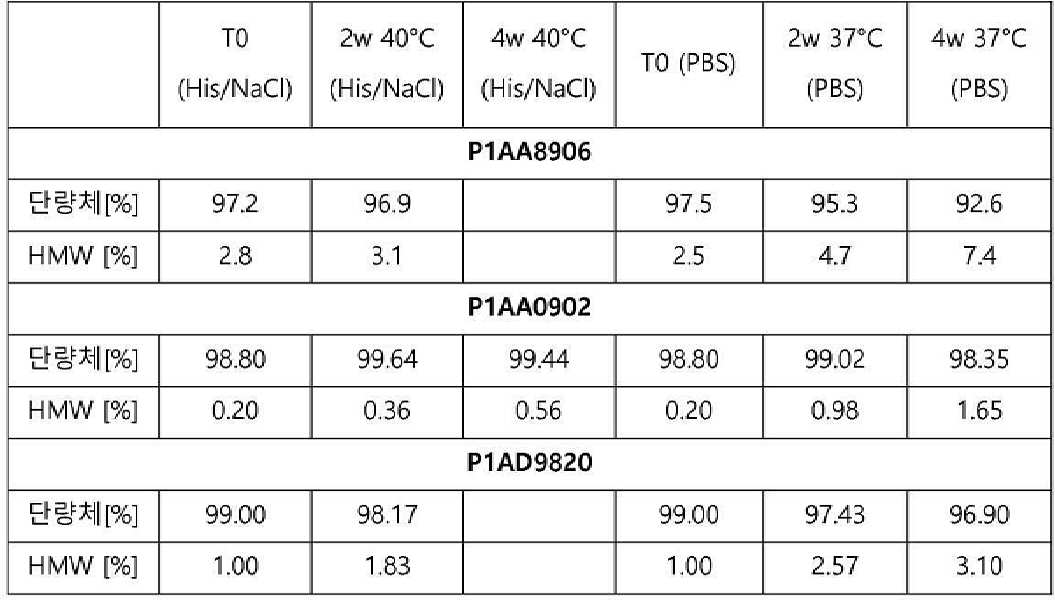
실시예 8:Example 8:
개선된 이중특이성 항-VEGF-A/항-ANG2 Fab 단편의 생물물리학적 특성(동적 광산란(DLS)에 의한 점도 평가)Biophysical properties of the improved bispecific anti-VEGF-A/anti-ANG2 Fab fragment (viscosity evaluation by dynamic light scattering (DLS))
전술한 바와 같은 P1AA0902 및 P1AD9820 Fab 단편을 표준 방법에 의해 대장균 세포에서 발현시켰다. P1AA0902 and P1AD9820 Fab fragments as described above were expressed in E. coli cells by standard methods.
점도는 전술한 바와 같이 라텍스-비드 DLS 방법으로 측정하였다(He F et al.; Anal Biochem. 2010 Apr 1;399(1):141-3). 구체적으로, 명시된 물질들을 사용하여 다음 프로토콜을 따랐다.Viscosity was measured by the latex-bead DLS method as described above (He F et al.; Anal Biochem. 2010
점도 평가:Viscosity evaluation:
기기 및 재료:Devices and Materials:


샘플 준비:sample preparation:
항체 샘플을 재완충시키고 20mM His/HCl, pH 6.0(완충액) 및 0.02% Tween 20(최종 농도)으로 희석했다. 0.03% 농도의 고체 비드를 첨가하였다. 최소 4가지 농도가 준비되었으며, 가능한 최고 농도는 약 200mg/mL였다. 무항체 대조군으로서 2개의 블랭크 샘플이 필요하였다: 하나는 물에 재현탁된 나노스피어 비드를 포함하고, 다른 하나는 완충액에 재현탁된 나노스피어 비드를 포함한다. 샘플을 마이크로 플레이트로 옮기고 각 웰을 실리콘 오일로 덮었다. Antibody samples were rebuffered and diluted in 20 mM His/HCl, pH 6.0 (buffer) and 0.02% Tween 20 (final concentration). Solid beads at a concentration of 0.03% were added. At least four concentrations were prepared, the highest possible concentration being approximately 200 mg/mL. As no-antibody controls, two blank samples were required: one containing nanosphere beads resuspended in water and the other containing nanosphere beads resuspended in buffer. Samples were transferred to microplates and each well was covered with silicone oil.
Wyatt DLS 플레이트 판독기로 측정Measured with a Wyatt DLS plate reader
모든 샘플과 블랭크는 5°C 단계로 15 내지 35°C의 다양한 온도에서 분석되었다. 획득 시간은 30초이고 획득 횟수는 샘플 및 온도당 40회이다.All samples and blanks were analyzed at various temperatures from 15 to 35 °C in 5 °C steps. The acquisition time is 30 seconds and the number of acquisitions is 40 per sample and temperature.
데이터 분석data analysis
nm 단위의 원시 데이터 Dapp(겉보기 반경)을 소프트웨어 템플릿(Microsoft Dynamics 7.0 이상)의 개요에 표시하였다. 점도는 식(ηreal = Dapp * ηH2O / Dreal)로 계산하였다. Dreal은 블랭크 샘플에서 측정된 비드 크기이며 비드 크기(300nm)와 동일하다. 계산된 점도를 엑셀 곡선으로 나타내었다. Mooney 곡선 핏(Excel)을 사용하여 주어진 농도에서 점도를 외삽할 수 있다. 여기서 점도가 20cP를 초과하는 최대 단백질 농도를 계산하였다.The raw data Dapp (apparent radius) in nm was displayed in the outline of a software template (Microsoft Dynamics 7.0 or higher). Viscosity was calculated by the formula (ηreal = Dapp * ηH2O / Dreal). Dreal is the measured bead size on the blank sample and is equal to the bead size (300 nm). The calculated viscosity was expressed as an Excel curve. A Mooney curve fit (Excel) can be used to extrapolate the viscosity at a given concentration. The maximum protein concentration at which the viscosity exceeded 20 cP was calculated here.
20 °C에서 20 cP의 점도에 도달하는, 명시된 항체의 최대 농도를 아래에 표시한다. 결과를 도 10에도 나타낸다. The maximum concentration of the specified antibody that will reach a viscosity of 20 cP at 20 °C is shown below. The results are also shown in FIG. 10 .
표 18: DLS 비드법에 의한 점도. 20°C에서 20 cP에 도달하는, 명시된 항체의 최대 실시가능한 농도를 나타낸다. 항체 Fab 단편은 대장균에서 발현되었다.Table 18: Viscosity by DLS bead method. Represents the maximum practicable concentration of the specified antibody reaching 20 cP at 20 °C. Antibody Fab fragments were expressed in E. coli.

결과는 본 발명의 항체가 주사가능성에 대한 허용가능한 점도 한계 미만의 점도를 포함하는 고농도로 제제화될 수 있음을 나타낸다. 두 테스트 항체 모두 고도로 농축 가능한 것으로 나타났지만, 그 효과는 P1AD9820 항체에서 더 두드러졌다. The results indicate that the antibodies of the present invention can be formulated at high concentrations, including viscosities below the acceptable viscosity limit for injectability. Both test antibodies appeared to be highly concentrable, but the effect was more pronounced with the P1AD9820 antibody.
결과적으로, 본 발명의 항체는 제한된 주사 부피로 높은 몰 용량을 제공할 수 있기 때문에 안구 적용에 매우 적합하며, 이는 높은 효능과 조합될 때 지속성을 높이고 결과적으로 투여 빈도를 감소시키므로, 환자 측의 어려움을 줄이는 데 바람직하다. As a result, the antibodies of the present invention are well suited for ocular applications because they can provide high molar doses with limited injection volumes, which when combined with high potency increases persistence and consequently reduces dosing frequency, which is a challenge on the part of the patient. is desirable to reduce
다른 일련의 실험에서, 표준 재조합 방법에 따라 CHO 세포에서 생성된 P1AD9820의 점도를 상기 기재한 바와 같이 분석하였다. In another series of experiments, the viscosity of P1AD9820 produced in CHO cells according to standard recombinant methods was analyzed as described above.
20 °C에서 20 cP의 점도에 도달하는, 명시된 항체의 최대 농도를 아래에 표시한다. 결과를 도 10에도 나타낸다. The maximum concentration of the specified antibody that will reach a viscosity of 20 cP at 20 °C is shown below. The results are also shown in FIG. 10 .
표 19: DLS 비드법에 의한 점도. 20°C에서 20 cP에 도달하는, 명시된 항체의 최대 실시가능한 농도를 나타낸다. 항체 Fab 단편은 대장균에서 발현되었다.Table 19: Viscosity by DLS bead method. Represents the maximum practicable concentration of the specified antibody reaching 20 cP at 20 °C. Antibody Fab fragments were expressed in E. coli.

실시예 9:Example 9:
개선된 항-VEGF-A/항-ANG2 Fab 단편의 기능적 안정성 Functional stability of improved anti-VEGF-A/anti-ANG2 Fab fragments
P1AD9820 Fab 단편은 상기 “재료 및 일반적인 방법” 섹션(물리화학적 안정성)에서 기재한 바와 같이 상이한 스트레스 조건하에서 처리되었다. 그리하여 생성된 스트레스를 가한 항체 샘플의 항원 결합을 상기 기재한 바와 같이 분석하였다(“재료 및 일반적인 방법” 섹션: 기능적 안정성 테스트를 위해 SPR에 의해 평가된 인간 VEGF-A 및 인간 ANG2 결합 동역학).The P1AD9820 Fab fragment was treated under different stress conditions as described above in the “Materials and General Methods” section (physicochemical stability). Antigen binding of the resulting stressed antibody samples was assayed as described above (“Materials and General Methods” section: human VEGF-A and human ANG2 binding kinetics assessed by SPR for functional stability testing).
표 20: 스트레스를 가한 P1AD9820 샘플에 대한 항원 결합(SPR)Table 20: Antigen Binding (SPR) for Stressed P1AD9820 Samples
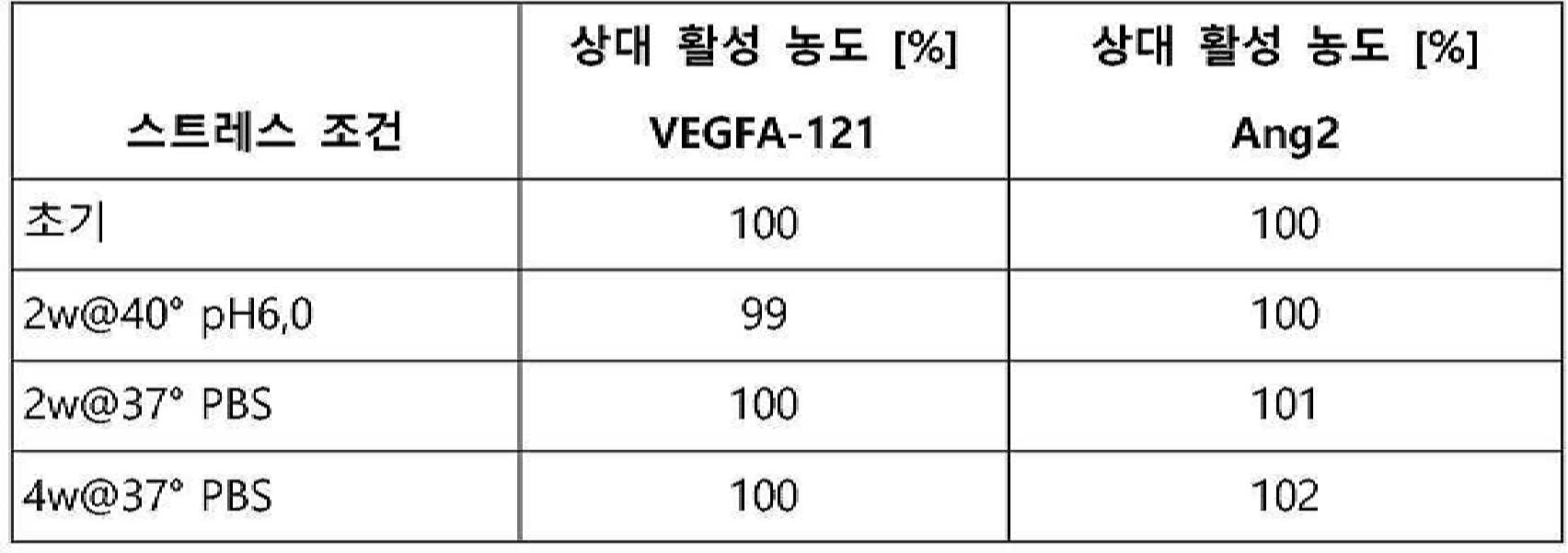
실시예 10:Example 10:
개선된 항-VEGF-A/항-ANG2 Fab 단편의 기능적 특성화 Functional Characterization of Improved Anti-VEGF-A/Anti-ANG2 Fab Fragments
후보 항체의 ANG2 및 VEGF-A 억제를 세포 기반 분석에서 다음과 같이 평가하였다: ANG2 and VEGF-A inhibition of the candidate antibodies was assessed in a cell-based assay as follows:
ANG2 억제: pTie2-분석 ANG2 inhibition: pTie2-assay
후보 항체 및 선택된 참조 분자(네스바쿠맙 유사체, 서열 번호 29 및 30에 따른 재조합 발현에 의한 회사 내부 제조)를 MEM 알파-배지에서 250nM 내지 0.14nM 범위의 11가지 농도로 사전 인큐베이션하였다. 40μl의 3배 농축된 항 Ang2 항체를 3배 농축된 c=3,9μg/ml에서 40μl Ang-2와 혼합하고 세포 인큐베이터에서 30분 동안 인큐베이션하였다. 그런 다음, 선별 없이 FreeStyle 배지에 현탁된 40μl/웰 Hek293_HOMSA-Tie2-Clone22_B11 세포를 웰당 40000개 세포의 밀도로 RT에서 10분 동안 첨가했다. 그런 다음 Ang2 인산화는 저온 용해 완충액을 프로테아제 억제제와 함께 첨가하여 중단되었다. 진탕하는 동안 maxisorp-플레이트-결합된 항 Tie2 항체는 RT에서 90분 동안 세포 용해물의 Tie2를 고정화시켰다. PBS에서 세척 단계 후, 0.05% Tween20, 인산화된 Tie2에 특이적인 비오티닐화된 항체를 실온에서 1시간 동안 3μg/ml의 최종 농도까지 첨가했다. 세 번의 세척 단계 후, 405/690nm에서 1M H2SO2로 중단한 후 Tecan Sunrise 플레이트 판독기를 사용하여 최종 비색 종말점을 평가하기 위해 HRP 커플링된 스트렙타비딘을 RT에서 30분 동안 최종 농도 100mU/ml까지 첨가하여 POD를 변환했다. 결과를 아래 도 8에 나타낸다.Candidate antibodies and selected reference molecules (nesvacumab analogs, manufactured in-house by recombinant expression according to SEQ ID NOs: 29 and 30) were pre-incubated at 11 concentrations ranging from 250 nM to 0.14 nM in MEM alpha-medium. 40 μl of 3-fold concentrated anti-Ang2 antibody was mixed with 40 μl Ang-2 at 3-fold concentrated c=3,9 μg/ml and incubated for 30 minutes in a cell incubator. Then, 40 μl/well Hek293_HOMSA-Tie2-Clone22_B11 cells suspended in FreeStyle medium without sorting were added at a density of 40000 cells per well for 10 minutes at RT. Ang2 phosphorylation was then stopped by adding cold lysis buffer together with protease inhibitors. While shaking, maxisorp-plate-bound anti Tie2 antibody immobilized Tie2 in cell lysates for 90 min at RT. After a washing step in PBS, 0.05% Tween20, a biotinylated antibody specific for phosphorylated Tie2, was added for 1 hour at room temperature to a final concentration of 3 μg/ml. After three washing steps, stopping with 1M H2SO2 at 405/690 nm, HRP coupled streptavidin was added to a final concentration of 100 mU/ml for 30 min at RT to evaluate the final colorimetric endpoint using a Tecan Sunrise plate reader to convert the POD. The results are shown in Figure 8 below.
표 21: ANG2 억제(IC50, 세포 기반 분석)Table 21: ANG2 inhibition (IC50, cell-based assay)
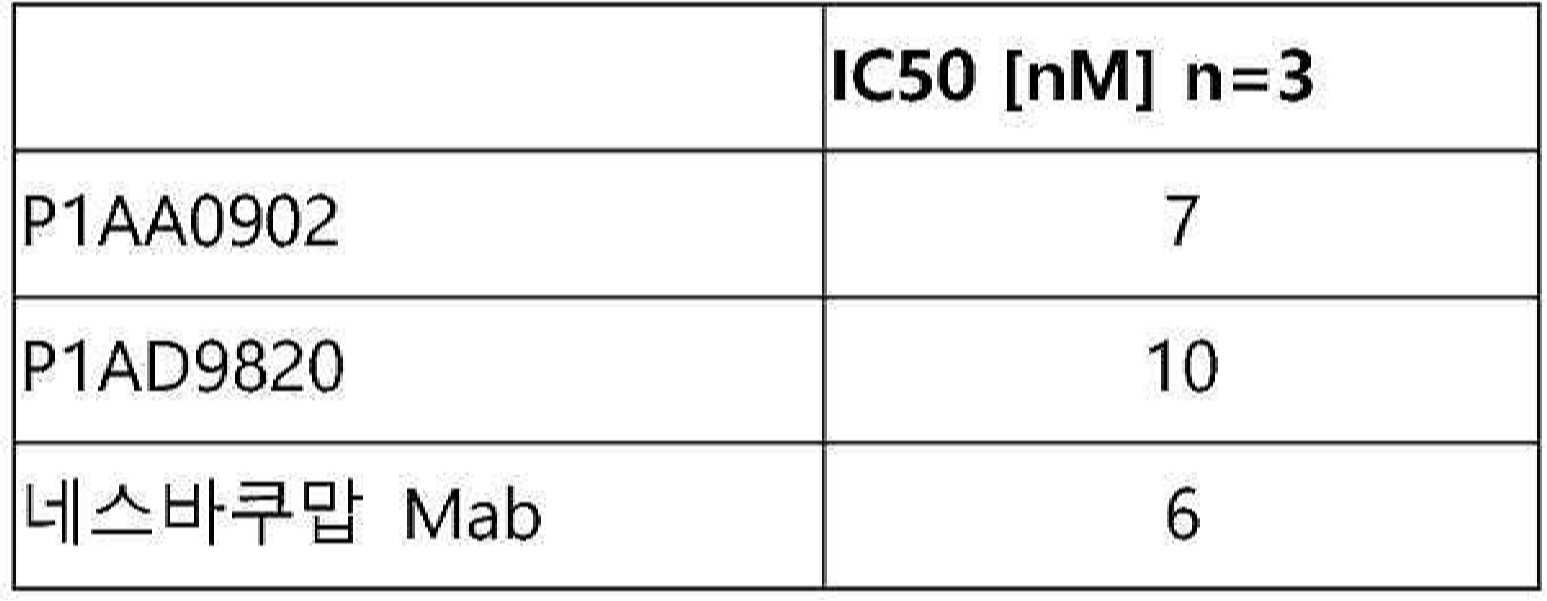
VEGF-A 억제: 리포터 유전자 분석(RGA) VEGF-A Inhibition: Reporter Gene Analysis (RGA)
분석을 위해 4배 농축된 테스트 항체 또는 참조 분자 37.5μl를 4배 농축된 37.5μl의 VEGF-A121(R&D, c=100μg/ml)과 함께 실온에서 15분 동안 사전 인큐베이션하였다. 그런 다음 혼합물을 40000 세포/웰의 밀도로 75μl/웰 Hek_NFAT_KDR_Luc 세포에 첨가하고 세포 인큐베이터에서 5시간 동안 인큐베이션하였다. 마지막으로, 웰 당 100μl BioGlo 시약을 추가한 후 Infinite Pro 플레이트판독기(Tecan)를 사용하여 발광을 평가했다. 결과를 아래 도 7에 나타낸다.For analysis, 37.5 μl of 4-fold concentrated test antibody or reference molecule was pre-incubated with 37.5 μl of 4-fold concentrated VEGF-A121 (R&D, c=100 μg/ml) for 15 minutes at room temperature. The mixture was then added to 75 μl/well Hek_NFAT_KDR_Luc cells at a density of 40000 cells/well and incubated for 5 hours in a cell incubator. Finally, after adding 100 μl BioGlo reagent per well, luminescence was assessed using an Infinite Pro plate reader (Tecan). The results are shown in Figure 7 below.
표 22: VEGF-A 억제(IC50, 세포 기반 분석)Table 22: VEGF-A inhibition (IC50, cell-based assay)

실시예 11:Example 11:
hVEGF-A121 및 hVEGF-A165 차단 활성(VEGF 기준 분석)hVEGF-A121 and hVEGF-A165 blocking activity (VEGF reference assay)
Maxisorp 96-웰 플레이트(ThermoScientific #442404)를 실온에서 1시간 동안 1μg/mL의 최종 농도에서 200mM NaHCO3, pH 9.4 중 50μL/웰의 hVEGFR-1-Fc로 코팅하였다. 명시된 후보 Fab 단편들을 280 μL PBST-1%BSA에서 409.6 nM의 농도로 희석했다. 2배 연속 희석을 위해 이 희석된 Fab 샘플 140μL를 PBST-1%BSA 140μL와 혼합하고 부드러운 피펫팅으로 7회 혼합했다. 이 2배 희석 단계를 9번 더 반복했다. 둥근 바닥 96-웰 플레이트를 PBST-1%BSA에서 50 μL/웰의 2 nM VEGF-A121 또는 2 nM VEGF-A165로 사전에 충전하였다. Fab 희석액 50μL를 VEGF 플레이트에 첨가하고 6회 혼합하고 1.5시간 동안 인큐베이션하였다. 이어서, maxisorp 플레이트를 PBST로 2회 세척한 후 200 μL의 2% MPBST를 첨가하고 실온에서 45분 동안 인큐베이션하였다. 그 후, 플레이트를 PBST로 2회 세척하였다. 50 μl의 Fab-VEGF 프리믹스를 Maxisorp 플레이트로 옮기고 실온에서 1.5시간 동안 인큐베이션하였다. 그 후, 플레이트를 PBST로 2회 세척하고 항-VEGF-bio 항체(PBST에서 1:2000 희석) 및 SA-HRP(PBST에서 1:2000 희석) 50 μL를 첨가하고 실온에서 30분 동안 인큐베이션하였다. 플레이트를 PBST로 6회 세척하고 50 μL의 TMB 기질 용액을 첨가하고 30분 동안 실온에서 인큐베이션하였다. 마지막으로 50 μL 1N 황산을 첨가하여 반응을 멈추고 450 nm에서 흡광도를 판독한다. 결과를 도 5와 6에 나타낸다.Maxisorp 96-well plates (ThermoScientific #442404) were coated with 50 μL/well of hVEGFR-1-Fc in 200 mM NaHCO 3 , pH 9.4 at a final concentration of 1 μg/mL for 1 hour at room temperature. The indicated candidate Fab fragments were diluted to a concentration of 409.6 nM in 280 μL PBST-1%BSA. For 2-fold serial dilution, 140 μL of this diluted Fab sample was mixed with 140 μL of PBST-1%BSA and mixed 7 times by gentle pipetting. This 2-fold dilution step was repeated 9 more times. Round bottom 96-well plates were pre-filled with 50 μL/well of 2 nM VEGF-A121 or 2 nM VEGF-A165 in PBST-1%BSA. 50 μL of the Fab dilution was added to the VEGF plate, mixed 6 times and incubated for 1.5 hours. Then, the maxisorp plate was washed twice with PBST, then 200 μL of 2% MPBST was added and incubated for 45 minutes at room temperature. After that, the plate was washed twice with PBST. 50 μl of the Fab-VEGF premix was transferred to a Maxisorp plate and incubated for 1.5 hours at room temperature. Then, the plate was washed twice with PBST and 50 μL of anti-VEGF-bio antibody (diluted 1:2000 in PBST) and SA-HRP (diluted 1:2000 in PBST) were added and incubated for 30 minutes at room temperature. Plates were washed 6 times with PBST and 50 μL of TMB substrate solution was added and incubated for 30 minutes at room temperature. Finally, stop the reaction by adding 50 μL 1N sulfuric acid and read the absorbance at 450 nm. Results are shown in FIGS. 5 and 6 .
실시예 12:Example 12:
ANG1에 대한 ANG2의 선택적 결합Selective binding of ANG2 to ANG1
Ang-1에 대한 Ang-2 선택성은 안구 안전성에 중요한 속성일 수 있다: P1AD9820 Fab의 ANG1 억제를 세포 기반 분석에서 평가하였다.Ang-2 selectivity over Ang-1 may be an important attribute for ocular safety: ANG1 inhibition of the P1AD9820 Fab was evaluated in a cell-based assay.
ANG-1은 기아 상태에서 성장한 HUVEC 생존력의 약한 유도인자이다. 따라서 ANG-1 중화 항체로 생존력을 억제할 수 있다. 항체 RO5314196(이전 LC-08 - Thomas M, Kienast Y, Scheuer W, et al. A novel angiopoietin-2 selective fully human antibody with potent anti-tumoral and anti-angiogenic efficacy and superior side effect profile compared to Pan-Angiopoietin-1/-2 inhibitors. PLoS One. 2013;8(2):e54923. doi:10.1371/journal.pone.0054923)은 ANG-1을 중화함으로써 HUVEC 생존력을 억제하며, 본 분석을 위한 양성 대조군으로 사용되었다. Gibco사의 의 AF(부착 인자)(카탈로그 번호 S-006-100)로 코팅된 Corning사의 세포 배양 플라스크 T162(카탈로그 번호 3151)를 사용하여 계대 5까지 HUVEC를 유지시켰다. 생존율 분석을 위해 HUVEC를 Accutase®로 분리한 다음 PBS-/-로 세척했다. 그 후, 세포를 0.5% FBS가 포함된 EBM-2에서 피브로넥틴-코팅된 96웰 플레이트에 10.000개 세포/100μl 웰의 세포 밀도로 씨딩하였다. 세포를 5% CO2와 함께 37°C에서 밤새 인큐베이션하였다. 다음날, P1AD9820 또는 Ang-1 결합 양성 대조군 RO5314196을 EBM/0.5% FBS에서 10x 작업 농도로 희석했다. 시작 농도는 1000μg/ml였으며 이후 457.2μg/ml에서 끝나는 3배 8지점 희석 시리즈가 이어졌다. ANG-1은 2400 ng/ml에 해당하는 20x 작업 농도로 설정되었다. 다음으로, 10배 사전 희석된 P1AD9820 10μl 및 이어서 20배 ANG-1 용액 5μl를 플레이트 당 4개 웰의 세포에 사중으로 첨가했다. 각 실험일에, 각 조건은 2개의 플레이트에서 중복으로 수행되었다. 세포를 37℃5% CO2에서 72시간 동안 인큐베이션하였다. 분석을 위해, 각 웰에 11μl의 alamarBlue®를 첨가한 후 세포 배양 인큐베이터에서 4시간 동안 인큐베이션했다. 흡광도는 600nm의 기준 파장으로 570nm에서 검출되었다.ANG-1 is a weak inducer of HUVEC viability grown under starvation conditions. Thus, ANG-1 neutralizing antibodies can inhibit viability. Antibody RO5314196 (formerly LC-08 - Thomas M, Kienast Y, Scheuer W, et al. A novel angiopoietin-2 selectively fully human antibody with potent anti-tumoral and anti-angiogenic efficacy and superior side effect profile compared to Pan-Angiopoietin- 1/-2 inhibitors. PLoS One. 2013;8(2):e54923. doi:10.1371/journal.pone.0054923) inhibits HUVEC viability by neutralizing ANG-1 and was used as a positive control for this assay. . HUVECs were maintained until
각각의 실험에 대해, 각 조건이 4중으로 수행되는 2개의 분석 플레이트를 사용하여 조건들을 반복하였다. 자극되지 않은 세포들의 배경 신호를 실험 웰에서 빼고 조건 당 평균 신호를 계산했다. 추가 처리 없이 ANG-1(120 ng/ml)로 자극된 세포로부터 100% 반응 수준을 계산하였고, 항체-처리된 웰로부터 얻은 신호는 100% 반응의 백분율 억제로 표현하였다. P1AD9820 및 RO5314196의 경우, 각 항체 처리에 대한 백분율 억제를 n=4 독립 실험에서 측정하고 평균 및 평균의 표준 오차를 계산했다. ExcelXLfit 소프트웨어(IDBS)를 사용하여 각 항체 농도에 대한 평균 데이터로부터 IC50 값을 계산했다. 농도-반응 곡선은 기본 및 최대 억제 활성에 대해 계산된 5개 매개변수 로지스틱 모델(A+((BA)/(1+((C/x)^D))))을 사용하여 비선형 회귀 분석에 의해 피팅되었다.For each experiment, conditions were repeated using two assay plates where each condition was run in quadruplicate. The background signal of unstimulated cells was subtracted from the experimental wells and the average signal per condition was calculated. 100% response levels were calculated from cells stimulated with ANG-1 (120 ng/ml) without further treatment, and signals obtained from antibody-treated wells were expressed as percent inhibition of 100% response. For P1AD9820 and RO5314196, the percent inhibition for each antibody treatment was determined in n=4 independent experiments and the mean and standard error of the mean were calculated. IC 50 values were calculated from the average data for each antibody concentration using ExcelXLfit software (IDBS). Concentration-response curves were obtained by nonlinear regression analysis using a five-parameter logistic model (A+((BA)/(1+((C/x)^D)))) calculated for basal and maximal inhibitory activities. Fitted.
세포 기반 분석은 P1AD9820에 의해 매개되는 ANG1 억제를 검출하지 못했다.The cell-based assay did not detect ANG1 inhibition mediated by P1AD9820.
실시예 13:Example 13:
P1AD9820 Fab 단편의 구조 분석 Structural analysis of the P1AD9820 Fab fragment
P1AD9820 Fab의 구조 분석을 x-선 결정학에 의해 다음과 같이 수행되었다:Structural analysis of the P1AD9820 Fab was performed by x-ray crystallography as follows:
삼원 복합체 안지오포이에틴 2-RBD-VEGF-A121-P1AD9820의 복합체 형성 및 정제. 복합체 형성을 위해 P1AD9820 Fab 및 인간 VEGF-A121(Peprotech)을 1.1:1 몰비로 혼합하였다. 4℃에서 45분 동안 인큐베이션한 후, 안지오포이에틴2-RBD를 1.25:1의 P1AD9820에 대한 몰비로 첨가한 후, 4℃에서 추가로 60분 동안 첨가하였다. 생성된 삼원 복합체를 37℃에서 13시간 동안 PNGaseF(NEB)로 추가로 탈당화하고 마지막 단계에서 Superdex200(16/600) 컬럼에서 겔여과 크로마토그래피로 정제했다. 삼원 복합체를 함유하는 분획들을 모으고 3.55mg/ml로 농축하였다. Complex formation and purification of the ternary complex angiopoietin 2-RBD-VEGF-A121-P1AD9820. For complex formation, P1AD9820 Fab and human VEGF-A121 (Peprotech) were mixed in a 1.1:1 molar ratio. After incubation at 4°C for 45 minutes, angiopoietin 2-RBD was added at a molar ratio to P1AD9820 of 1.25:1 followed by an additional 60 minutes at 4°C. The resulting ternary complex was further deglycosylated with PNGaseF (NEB) at 37°C for 13 hours and purified by gel filtration chromatography on a Superdex200 (16/600) column in the final step. Fractions containing the ternary complex were pooled and concentrated to 3.55 mg/ml.
삼원 안지오포이에틴 2-RBD-VEGF-A121-P1AD9820의 결정화. 초기 결정화 시험은 14.5mg/ml의 단백질 농도에서 21°C에서 시팅 드롭(sitting drop) 증기 확산 설정에서 수행되었다. 결정들은 35% MPD, 0.1M Na/K 포스페이트 pH 6.2에서 1일 이내에 나타났다. 판 모양의 결정들은 일주일 만에 100x80x30 μm의 최종 크기로 성장했다. 추가 최적화 단계 없이 스크리닝 플레이트에서 결정들을 직접 수확했다. Crystallization of ternary angiopoietin 2-RBD-VEGF-A121-P1AD9820. Initial crystallization tests were performed in a sitting drop vapor diffusion setup at 21 °C at a protein concentration of 14.5 mg/ml. Crystals appeared within 1 day in 35% MPD, 0.1M Na/K phosphate pH 6.2. The plate-shaped crystals grew to a final size of 100x80x30 μm in one week. Crystals were harvested directly from the screening plate without further optimization steps.
데이터 수집 및 구조 결정. 데이터 수집을 위해 결정들을 추가 동결 방지제 없이 침전제 용액에서 100K로 급속 냉각시켰다. 스위스 광원(Villigen, 스위스)의 빔라인 X10SA에서 PILATUS 6M 검출기를 사용하여 1.0000Å의 파장에서 회절 데이터를 수집했다. 데이터는 XDS(Kabsch, W. Acta Cryst. D66, 133-144 (2010))로 처리되었으며 SADABS(BRUKER)로 확장되었다. 결정들은 셀 축들이 a= 165.74Å, b= 90.27Å, c= 127.89Å, =112.05°인 공간 그룹 C2에 속하며 2.08Å의 해상도로 회절된다. 구조는 검색 모델로서 Ang2-VEGF-Fab 삼원 복합체의 관련 회사 내부 구조의 격자를 사용하여 PHASER를 이용한 분자 대체에 의해 결정되었다(McCoy, A.J, Grosse-Kunstleve, R.W., Adams, P.D., Storoni, L.C., and Read, R.J. J. Appl. Cryst. 40, 658-674 (2007)). 후속하여 CCP4 제품군(Collaborative Computational Project, Number 4 Acta Cryst. D50, 760-763 (1994)) 및 Buster (Bricogne, G., Blanc, E., Brandl, M., Flensburg, C., Keller, P., Paciorek, W., Roversi, P., Sharff, A., Smart, O.S., Vonrhein, C., Womack, T.O . (2011). Buster version 2.9.5 Cambridge, United Kingdom : Global Phasing Ltd)의 프로그램들을 사용하여 데이터를 정제하였다. COOT(Emsley, P., Lohkamp, B., Scott, WG and Cowtan, K. Acta Cryst D66, 486-501 (2010))를 사용하여 차등 전자 밀도를 사용한 단백질을 수동으로 재구성했다. 두 구조 모두에 대한 데이터 수집 및 정제 통계를 표 23에 요약한다. 모든 그래픽 표현은 PYMOL(DeLano Scientific, Palo Alto, CA, 2002)을 사용하여 준비되었다. Data collection and structure determination. For data collection, crystals were flash cooled to 100 K in precipitant solution without additional cryoprotectant. Diffraction data were collected at a wavelength of 1.0000 Å using a PILATUS 6M detector at beamline X10SA of the Swiss Light Source (Villigen, Switzerland). Data were processed with XDS (Kabsch, W. Acta Cryst. D66 , 133-144 (2010)) and extended with SADABS (BRUKER). The crystals belong to space group C2 with cell axes a = 165.74 Å, b = 90.27 Å, c = 127.89 Å, =112.05° and diffract to a resolution of 2.08 Å. Structures were determined by molecular replacement with PHASER using the lattice of the related firm internal structure of the Ang2-VEGF-Fab ternary complex as a search model (McCoy, AJ, Grosse-Kunstleve, RW, Adams, PD, Storoni, LC; and Read, RJ.J.Appl.Cryst.40 , 658-674 (2007)) . Subsequently, the CCP4 family (Collaborative Computational Project, Number 4 Acta Cryst. D50 , 760-763 (1994)) and Buster (Bricogne, G., Blanc, E., Brandl, M., Flensburg, C., Keller, P. , Paciorek, W., Roversi, P., Sharff, A., Smart, OS, Vonrhein, C., Womack, TO. (2011) Buster version 2.9.5 Cambridge, United Kingdom: Global Phasing Ltd) The data were refined using Proteins using differential electron density were manually reconstituted using COOT (Emsley, P., Lohkamp, B., Scott, WG and Cowtan, K. Acta Cryst D66, 486-501 (2010)). Data collection and refinement statistics for both constructs are summarized in Table 23 . All graphical representations were prepared using PYMOL (DeLano Scientific, Palo Alto, CA, 2002).
표 23: 데이터 수집 및 구조 정제 통계 Table 23: Data Collection and Structure Refinement Statistics


1 괄호 안의 값은 최고 해상도 빈을 지칭한다. 1 Values in parentheses refer to the highest resolution bin.
2 Rmerge= I- <I>/ I, 여기서 I는 강도이다. 2 R merge = I- <I>/ I, where I is the strength.
3 R작업= S

4 Rfree는 정제 과정에서 생략된 전체 데이터의 5%를 기준으로 계산되었다. 4 R free was calculated based on 5% of the total data omitted in the refinement process.
각각의 항원, VEGF-A 및 ANG2와 접촉하는 아미노산 잔기들은 삼원 복합체 안지오포이에틴 2-RBD-VEGF-A121-P1AD9820의 결정 구조로부터 확인되었다. VH 및 VL 도메인 내의 파라토프 아미노산 잔기의 위치에 대한 예시가 도 2 및 도 3에 도시되어 있다. Amino acid residues in contact with each antigen, VEGF-A and ANG2, were identified from the crystal structure of the ternary complex angiopoietin 2-RBD-VEGF-A121-P1AD9820. Examples of the location of paratopic amino acid residues in the VH and VL domains are shown in FIGS. 2 and 3 .
항원 결합에 기여하는 것으로 확인된 아미노산 잔기는 표 24(가변 중쇄 도메인 아미노산 잔기의 경우) 및 표 25(가변 경쇄 도메인 아미노산 잔기의 경우)에서 확인된다. 아미노산 위치는 카밧 넘버링 체계에 따라 넘버링된다(동일한 넘버링이 도 2 및 3에서 사용됨). 항원 결합에 관여하는 아미노산 위치는 VH 또는 VL 도메인에서 카밧 위치에 의해 식별된다(또한 도 2 및 3의 번호 참조). Amino acid residues identified as contributing to antigen binding are identified in Table 24 (for variable heavy chain domain amino acid residues) and Table 25 (for variable light chain domain amino acid residues). Amino acid positions are numbered according to the Kabat numbering system (the same numbering is used in Figures 2 and 3 ). Amino acid positions involved in antigen binding are identified by Kabat positions in the VH or VL domain (see also numbers in Figures 2 and 3 ).
표 24: P1AD9820의 결정 구조 분석으로 확인된 항원 결합에 관여하는 가변 중쇄 아미노산 잔기Table 24: Variable heavy chain amino acid residues involved in antigen binding identified by crystal structure analysis of P1AD9820

표 25: P1AD9820의 결정 구조 분석으로 확인된 항원 결합에 관여하는 가변 경쇄 아미노산 잔기 Table 25: Variable light chain amino acid residues involved in antigen binding identified by crystal structure analysis of P1AD9820

SEQUENCE LISTING <110> F. Hoffmann-La Roche AG <120> Antibody that binds to VEGF-A and ANG2 and methods of use <130> P36370 <140> PCT/EP2021/074195 <141> 2021-09-02 <150> EP20194610.0 <151> 2020-09-04 <150> EP20209591.5 <151> 2020-11-24 <160> 30 <170> PatentIn version 3.5 <210> 1 <211> 115 <212> PRT <213> Artificial Sequence <220> <223> VH domain of P1AA8906 <400> 1 Asp Phe Gln Leu Val Glu Ser Gly Gly Gly Leu Val Lys Pro Gly Gly 1 5 10 15 Ser Leu Arg Leu Ser Cys Ala Ala Ser Tyr Glu Phe Glu Tyr Asp Asp 20 25 30 Met Ser Trp Val Arg Gln Ala Pro Gly Lys Gly Leu Glu Trp Val Gly 35 40 45 Ser Ile Ser Pro Lys Gly Gly Ser Thr Tyr Tyr Asn Thr Lys Phe Ile 50 55 60 Gly Arg Phe Thr Ile Ser Arg Asp Asn Ser Lys Asn Thr Leu Tyr Leu 65 70 75 80 Gln Met Asn Ser Leu Arg Ala Glu Asp Thr Ala Val Tyr Tyr Cys Ala 85 90 95 Arg Asp Val Gly Phe Phe Asp Met Trp Gly Gln Gly Thr Leu Val Thr 100 105 110 Val Ser Ser 115 <210> 2 <211> 107 <212> PRT <213> Artificial Sequence <220> <223> VL domain of P1AA8906 <400> 2 Ala Ile Tyr Met His Gln Glu Pro Ser Ser Leu Ser Ala Ser Val Gly 1 5 10 15 Asp Arg Val Thr Ile Thr Cys His Gly Ser Tyr Trp Leu Ser Asn Tyr 20 25 30 Leu Ala Trp Tyr Gln Gln Lys Pro Gly Lys Ala Pro Lys Leu Leu Ile 35 40 45 Phe Asp Ala Arg Trp Leu Val His Gly Val Pro Ser Arg Phe Ser Gly 50 55 60 Ser Gly Ser His Glu Asp Tyr Thr Leu Thr Ile Ser Ser Leu Gln Pro 65 70 75 80 Glu Asp Phe Ala Thr Tyr Tyr Cys Gln Gln Tyr Arg Tyr His Pro Tyr 85 90 95 Thr Phe Gly His Gly Thr Lys Val Glu Ile Lys 100 105 <210> 3 <211> 4 <212> PRT <213> Artificial Sequence <220> <223> H-CDR1 of P1AA8906, P1AA0902 and P1AD9820 <400> 3 Asp Asp Met Ser 1 <210> 4 <211> 17 <212> PRT <213> Artificial Sequence <220> <223> H-CDR2 of P1AA8906 <400> 4 Ser Ile Ser Pro Lys Gly Gly Ser Thr Tyr Tyr Asn Thr Lys Phe Ile 1 5 10 15 Gly <210> 5 <211> 7 <212> PRT <213> Artificial Sequence <220> <223> H-CDR3 of P1AA8906 <400> 5 Asp Val Gly Phe Phe Asp Met 1 5 <210> 6 <211> 11 <212> PRT <213> Artificial Sequence <220> <223> L-CDR1 of P1AA8906 <400> 6 His Gly Ser Tyr Trp Leu Ser Asn Tyr Leu Ala 1 5 10 <210> 7 <211> 7 <212> PRT <213> Artificial Sequence <220> <223> L-CDR2 of P1AA8906 <400> 7 Asp Ala Arg Trp Leu Val His 1 5 <210> 8 <211> 9 <212> PRT <213> Artificial Sequence <220> <223> L-CDR3 of P1AA8906, P1AA0902 and P1AD9820 <400> 8 Gln Gln Tyr Arg Tyr His Pro Tyr Thr 1 5 <210> 9 <211> 223 <212> PRT <213> Artificial Sequence <220> <223> heavy chain of P1AA8906 Fab fragment <400> 9 Asp Phe Gln Leu Val Glu Ser Gly Gly Gly Leu Val Lys Pro Gly Gly 1 5 10 15 Ser Leu Arg Leu Ser Cys Ala Ala Ser Tyr Glu Phe Glu Tyr Asp Asp 20 25 30 Met Ser Trp Val Arg Gln Ala Pro Gly Lys Gly Leu Glu Trp Val Gly 35 40 45 Ser Ile Ser Pro Lys Gly Gly Ser Thr Tyr Tyr Asn Thr Lys Phe Ile 50 55 60 Gly Arg Phe Thr Ile Ser Arg Asp Asn Ser Lys Asn Thr Leu Tyr Leu 65 70 75 80 Gln Met Asn Ser Leu Arg Ala Glu Asp Thr Ala Val Tyr Tyr Cys Ala 85 90 95 Arg Asp Val Gly Phe Phe Asp Met Trp Gly Gln Gly Thr Leu Val Thr 100 105 110 Val Ser Ser Ala Ser Thr Lys Gly Pro Ser Val Phe Pro Leu Ala Pro 115 120 125 Ser Ser Lys Ser Thr Ser Gly Gly Thr Ala Ala Leu Gly Cys Leu Val 130 135 140 Lys Asp Tyr Phe Pro Glu Pro Val Thr Val Ser Trp Asn Ser Gly Ala 145 150 155 160 Leu Thr Ser Gly Val His Thr Phe Pro Ala Val Leu Gln Ser Ser Gly 165 170 175 Leu Tyr Ser Leu Ser Ser Val Val Thr Val Pro Ser Ser Ser Leu Gly 180 185 190 Thr Lys Thr Tyr Ile Cys Asn Val Asn His Lys Pro Ser Asn Thr Lys 195 200 205 Val Asp Lys Lys Val Glu Pro Lys Ser Cys Asp Lys Thr His Thr 210 215 220 <210> 10 <211> 214 <212> PRT <213> Artificial Sequence <220> <223> light chain of P1AA8906 Fab fragment <400> 10 Ala Ile Tyr Met His Gln Glu Pro Ser Ser Leu Ser Ala Ser Val Gly 1 5 10 15 Asp Arg Val Thr Ile Thr Cys His Gly Ser Tyr Trp Leu Ser Asn Tyr 20 25 30 Leu Ala Trp Tyr Gln Gln Lys Pro Gly Lys Ala Pro Lys Leu Leu Ile 35 40 45 Phe Asp Ala Arg Trp Leu Val His Gly Val Pro Ser Arg Phe Ser Gly 50 55 60 Ser Gly Ser His Glu Asp Tyr Thr Leu Thr Ile Ser Ser Leu Gln Pro 65 70 75 80 Glu Asp Phe Ala Thr Tyr Tyr Cys Gln Gln Tyr Arg Tyr His Pro Tyr 85 90 95 Thr Phe Gly His Gly Thr Lys Val Glu Ile Lys Arg Thr Val Ala Ala 100 105 110 Pro Ser Val Phe Ile Phe Pro Pro Ser Asp Glu Gln Leu Lys Ser Gly 115 120 125 Thr Ala Ser Val Val Cys Leu Leu Asn Asn Phe Tyr Pro Arg Glu Ala 130 135 140 Lys Val Gln Trp Lys Val Asp Asn Ala Leu Gln Ser Gly Asn Ser Gln 145 150 155 160 Glu Ser Val Thr Glu Gln Asp Ser Lys Asp Ser Thr Tyr Ser Leu Ser 165 170 175 Ser Thr Leu Thr Leu Ser Lys Ala Asp Tyr Glu Lys His Lys Val Tyr 180 185 190 Ala Cys Glu Val Thr His Gln Gly Leu Ser Ser Pro Val Thr Lys Ser 195 200 205 Phe Asn Arg Gly Glu Cys 210 <210> 11 <211> 115 <212> PRT <213> Artificial Sequence <220> <223> VH domain of P1AA0902 <400> 11 Asp Asp His Leu Val Glu Ser Gly Gly Gly Leu Val Lys Pro Gly Gly 1 5 10 15 Ser Leu Arg Leu Ser Cys Ala Thr Ala Asp Phe Phe Glu Tyr Asp Asp 20 25 30 Met Ser Trp Val Arg Gln Ala Pro Gly Lys Gly Leu Glu Trp Val Gly 35 40 45 Ser Ile Ser Gly Arg Gly Asp His Lys Tyr Leu Asn Thr Lys Phe Ile 50 55 60 Gly Arg Phe Thr Ile Ser Arg Asp Asp Ser Lys Asn Thr Leu Tyr Leu 65 70 75 80 Gln Met Asn Ser Leu Arg Ala Glu Asp Thr Ala Val Tyr Tyr Cys Ala 85 90 95 Arg Asp Val Gly Phe Phe Asp Trp Trp Gly Gln Gly Thr Leu Val Thr 100 105 110 Val Ser Ser 115 <210> 12 <211> 107 <212> PRT <213> Artificial Sequence <220> <223> VL domain of P1AA0902 <400> 12 Ala Ile Tyr Met His Gln Glu Pro Ser Ser Leu Ser Ala Ser Val Gly 1 5 10 15 Asp Arg Val Thr Ile Thr Cys His Gly Ser Tyr Trp Leu Asn Ser Glu 20 25 30 Leu Ala Trp Tyr Gln Gln Lys Pro Gly Lys Ala Pro Lys Leu Leu Ile 35 40 45 Phe Asp Gly Asp Phe Lys Val Phe Asp Val Pro Ser Arg Phe Ser Gly 50 55 60 Ser Gly Ser His Glu Asp Tyr Thr Leu Thr Ile Ser Ser Leu Gln Pro 65 70 75 80 Glu Asp Phe Ala Thr Tyr Tyr Cys Gln Gln Tyr Arg Tyr His Pro Tyr 85 90 95 Thr Phe Gly His Gly Thr Lys Val Glu Ile Lys 100 105 <210> 13 <211> 17 <212> PRT <213> Artificial Sequence <220> <223> H-CDR2 of P1AA0902 <400> 13 Ser Ile Ser Gly Arg Gly Asp His Lys Tyr Leu Asn Thr Lys Phe Ile 1 5 10 15 Gly <210> 14 <211> 7 <212> PRT <213> Artificial Sequence <220> <223> H-CDR3 of P1AA0902 and P1AD9820 <400> 14 Asp Val Gly Phe Phe Asp Trp 1 5 <210> 15 <211> 11 <212> PRT <213> Artificial Sequence <220> <223> L-CDR1 of P1AA0902 <400> 15 His Gly Ser Tyr Trp Leu Asn Ser Glu Leu Ala 1 5 10 <210> 16 <211> 7 <212> PRT <213> Artificial Sequence <220> <223> L-CDR2 of P1AA0902 <400> 16 Asp Gly Asp Phe Lys Val Phe 1 5 <210> 17 <211> 223 <212> PRT <213> Artificial Sequence <220> <223> heavy chain of P1AA0902 Fab fragment <400> 17 Asp Asp His Leu Val Glu Ser Gly Gly Gly Leu Val Lys Pro Gly Gly 1 5 10 15 Ser Leu Arg Leu Ser Cys Ala Thr Ala Asp Phe Phe Glu Tyr Asp Asp 20 25 30 Met Ser Trp Val Arg Gln Ala Pro Gly Lys Gly Leu Glu Trp Val Gly 35 40 45 Ser Ile Ser Gly Arg Gly Asp His Lys Tyr Leu Asn Thr Lys Phe Ile 50 55 60 Gly Arg Phe Thr Ile Ser Arg Asp Asp Ser Lys Asn Thr Leu Tyr Leu 65 70 75 80 Gln Met Asn Ser Leu Arg Ala Glu Asp Thr Ala Val Tyr Tyr Cys Ala 85 90 95 Arg Asp Val Gly Phe Phe Asp Trp Trp Gly Gln Gly Thr Leu Val Thr 100 105 110 Val Ser Ser Ala Ser Thr Lys Gly Pro Ser Val Phe Pro Leu Ala Pro 115 120 125 Ser Ser Lys Ser Thr Ser Gly Gly Thr Ala Ala Leu Gly Cys Leu Val 130 135 140 Lys Asp Tyr Phe Pro Glu Pro Val Thr Val Ser Trp Asn Ser Gly Ala 145 150 155 160 Leu Thr Ser Gly Val His Thr Phe Pro Ala Val Leu Gln Ser Ser Gly 165 170 175 Leu Tyr Ser Leu Ser Ser Val Val Thr Val Pro Ser Ser Ser Leu Gly 180 185 190 Thr Lys Thr Tyr Ile Cys Asn Val Asn His Lys Pro Ser Asn Thr Lys 195 200 205 Val Asp Lys Lys Val Glu Pro Lys Ser Cys Asp Lys Thr His Thr 210 215 220 <210> 18 <211> 214 <212> PRT <213> Artificial Sequence <220> <223> light chain of P1AA0902 Fab fragment <400> 18 Ala Ile Tyr Met His Gln Glu Pro Ser Ser Leu Ser Ala Ser Val Gly 1 5 10 15 Asp Arg Val Thr Ile Thr Cys His Gly Ser Tyr Trp Leu Asn Ser Glu 20 25 30 Leu Ala Trp Tyr Gln Gln Lys Pro Gly Lys Ala Pro Lys Leu Leu Ile 35 40 45 Phe Asp Gly Asp Phe Lys Val Phe Asp Val Pro Ser Arg Phe Ser Gly 50 55 60 Ser Gly Ser His Glu Asp Tyr Thr Leu Thr Ile Ser Ser Leu Gln Pro 65 70 75 80 Glu Asp Phe Ala Thr Tyr Tyr Cys Gln Gln Tyr Arg Tyr His Pro Tyr 85 90 95 Thr Phe Gly His Gly Thr Lys Val Glu Ile Lys Arg Thr Val Ala Ala 100 105 110 Pro Ser Val Phe Ile Phe Pro Pro Ser Asp Glu Gln Leu Lys Ser Gly 115 120 125 Thr Ala Ser Val Val Cys Leu Leu Asn Asn Phe Tyr Pro Arg Glu Ala 130 135 140 Lys Val Gln Trp Lys Val Asp Asn Ala Leu Gln Ser Gly Asn Ser Gln 145 150 155 160 Glu Ser Val Thr Glu Gln Asp Ser Lys Asp Ser Thr Tyr Ser Leu Ser 165 170 175 Ser Thr Leu Thr Leu Ser Lys Ala Asp Tyr Glu Lys His Lys Val Tyr 180 185 190 Ala Cys Glu Val Thr His Gln Gly Leu Ser Ser Pro Val Thr Lys Ser 195 200 205 Phe Asn Arg Gly Glu Cys 210 <210> 19 <211> 115 <212> PRT <213> Artificial Sequence <220> <223> VH domain of P1AD9820 <400> 19 Ser Glu His Leu Val Glu Ser Gly Gly Gly Leu Val Lys Pro Gly Gly 1 5 10 15 Ser Leu Arg Leu Ser Cys Ala Thr Ala Asp Phe Phe Glu Tyr Asp Asp 20 25 30 Met Ser Trp Val Arg Gln Ala Pro Gly Lys Gly Leu Glu Trp Val Gly 35 40 45 Ser Ile Ser Pro Lys Gly Asp His Lys Tyr Leu Asn Thr Lys Phe Ile 50 55 60 Gly Arg Phe Thr Ile Ser Arg Asp Asp Ser Lys Asn Thr Leu Tyr Leu 65 70 75 80 Gln Met Asn Ser Leu Arg Ala Glu Asp Thr Ala Val Tyr Tyr Cys Ala 85 90 95 Arg Asp Val Gly Phe Phe Asp Trp Trp Gly Gln Gly Thr Leu Val Thr 100 105 110 Val Ser Ser 115 <210> 20 <211> 107 <212> PRT <213> Artificial Sequence <220> <223> VL domain of P1AD9820 <400> 20 Ala Ile Tyr Met His Gln Glu Pro Ser Ser Leu Ser Ala Ser Val Gly 1 5 10 15 Asp Arg Val Thr Ile Thr Cys His Gly Ser Tyr Trp Leu Asn Ser Glu 20 25 30 Val Ala Trp Tyr Gln Gln Lys Pro Gly Lys Ala Pro Lys Leu Leu Ile 35 40 45 Phe Asp Gly Asp Phe Lys Val Tyr Glu Val Pro Ser Arg Phe Ser Gly 50 55 60 Ser Gly Ser His Glu Asp Tyr Thr Leu Thr Ile Ser Ser Leu Gln Pro 65 70 75 80 Glu Asp Phe Ala Thr Tyr Tyr Cys Gln Gln Tyr Arg Tyr His Pro Tyr 85 90 95 Thr Phe Gly His Gly Thr Lys Val Glu Ile Lys 100 105 <210> 21 <211> 17 <212> PRT <213> Artificial Sequence <220> <223> H-CDR2 of P1AD9820 <400> 21 Ser Ile Ser Pro Lys Gly Asp His Lys Tyr Leu Asn Thr Lys Phe Ile 1 5 10 15 Gly <210> 22 <211> 11 <212> PRT <213> Artificial Sequence <220> <223> L-CDR1 of P1AD9820 <400> 22 His Gly Ser Tyr Trp Leu Asn Ser Glu Val Ala 1 5 10 <210> 23 <211> 7 <212> PRT <213> Artificial Sequence <220> <223> L-CDR2 of P1AD9820 <400> 23 Asp Gly Asp Phe Lys Val Tyr 1 5 <210> 24 <211> 223 <212> PRT <213> Artificial Sequence <220> <223> heavy chain of P1AD9820 Fab fragment <400> 24 Ser Glu His Leu Val Glu Ser Gly Gly Gly Leu Val Lys Pro Gly Gly 1 5 10 15 Ser Leu Arg Leu Ser Cys Ala Thr Ala Asp Phe Phe Glu Tyr Asp Asp 20 25 30 Met Ser Trp Val Arg Gln Ala Pro Gly Lys Gly Leu Glu Trp Val Gly 35 40 45 Ser Ile Ser Pro Lys Gly Asp His Lys Tyr Leu Asn Thr Lys Phe Ile 50 55 60 Gly Arg Phe Thr Ile Ser Arg Asp Asp Ser Lys Asn Thr Leu Tyr Leu 65 70 75 80 Gln Met Asn Ser Leu Arg Ala Glu Asp Thr Ala Val Tyr Tyr Cys Ala 85 90 95 Arg Asp Val Gly Phe Phe Asp Trp Trp Gly Gln Gly Thr Leu Val Thr 100 105 110 Val Ser Ser Ala Ser Thr Lys Gly Pro Ser Val Phe Pro Leu Ala Pro 115 120 125 Ser Ser Lys Ser Thr Ser Gly Gly Thr Ala Ala Leu Gly Cys Leu Val 130 135 140 Lys Asp Tyr Phe Pro Glu Pro Val Thr Val Ser Trp Asn Ser Gly Ala 145 150 155 160 Leu Thr Ser Gly Val His Thr Phe Pro Ala Val Leu Gln Ser Ser Gly 165 170 175 Leu Tyr Ser Leu Ser Ser Val Val Thr Val Pro Ser Ser Ser Leu Gly 180 185 190 Thr Gln Thr Tyr Ile Cys Asn Val Asn His Lys Pro Ser Asn Thr Lys 195 200 205 Val Asp Lys Lys Val Glu Pro Lys Ser Cys Asp Lys Thr His Thr 210 215 220 <210> 25 <211> 214 <212> PRT <213> Artificial Sequence <220> <223> light chain of P1AD9820 Fab fragment <400> 25 Ala Ile Tyr Met His Gln Glu Pro Ser Ser Leu Ser Ala Ser Val Gly 1 5 10 15 Asp Arg Val Thr Ile Thr Cys His Gly Ser Tyr Trp Leu Asn Ser Glu 20 25 30 Val Ala Trp Tyr Gln Gln Lys Pro Gly Lys Ala Pro Lys Leu Leu Ile 35 40 45 Phe Asp Gly Asp Phe Lys Val Tyr Glu Val Pro Ser Arg Phe Ser Gly 50 55 60 Ser Gly Ser His Glu Asp Tyr Thr Leu Thr Ile Ser Ser Leu Gln Pro 65 70 75 80 Glu Asp Phe Ala Thr Tyr Tyr Cys Gln Gln Tyr Arg Tyr His Pro Tyr 85 90 95 Thr Phe Gly His Gly Thr Lys Val Glu Ile Lys Arg Thr Val Ala Ala 100 105 110 Pro Ser Val Phe Ile Phe Pro Pro Ser Asp Glu Gln Leu Lys Ser Gly 115 120 125 Thr Ala Ser Val Val Cys Leu Leu Asn Asn Phe Tyr Pro Arg Glu Ala 130 135 140 Lys Val Gln Trp Lys Val Asp Asn Ala Leu Gln Ser Gly Asn Ser Gln 145 150 155 160 Glu Ser Val Thr Glu Gln Asp Ser Lys Asp Ser Thr Tyr Ser Leu Ser 165 170 175 Ser Thr Leu Thr Leu Ser Lys Ala Asp Tyr Glu Lys His Lys Val Tyr 180 185 190 Ala Cys Glu Val Thr His Gln Gly Leu Ser Ser Pro Val Thr Lys Ser 195 200 205 Phe Asn Arg Gly Glu Cys 210 <210> 26 <211> 232 <212> PRT <213> Homo sapiens <400> 26 Met Asn Phe Leu Leu Ser Trp Val His Trp Ser Leu Ala Leu Leu Leu 1 5 10 15 Tyr Leu His His Ala Lys Trp Ser Gln Ala Ala Pro Met Ala Glu Gly 20 25 30 Gly Gly Gln Asn His His Glu Val Val Lys Phe Met Asp Val Tyr Gln 35 40 45 Arg Ser Tyr Cys His Pro Ile Glu Thr Leu Val Asp Ile Phe Gln Glu 50 55 60 Tyr Pro Asp Glu Ile Glu Tyr Ile Phe Lys Pro Ser Cys Val Pro Leu 65 70 75 80 Met Arg Cys Gly Gly Cys Cys Asn Asp Glu Gly Leu Glu Cys Val Pro 85 90 95 Thr Glu Glu Ser Asn Ile Thr Met Gln Ile Met Arg Ile Lys Pro His 100 105 110 Gln Gly Gln His Ile Gly Glu Met Ser Phe Leu Gln His Asn Lys Cys 115 120 125 Glu Cys Arg Pro Lys Lys Asp Arg Ala Arg Gln Glu Lys Lys Ser Val 130 135 140 Arg Gly Lys Gly Lys Gly Gln Lys Arg Lys Arg Lys Lys Ser Arg Tyr 145 150 155 160 Lys Ser Trp Ser Val Tyr Val Gly Ala Arg Cys Cys Leu Met Pro Trp 165 170 175 Ser Leu Pro Gly Pro His Pro Cys Gly Pro Cys Ser Glu Arg Arg Lys 180 185 190 His Leu Phe Val Gln Asp Pro Gln Thr Cys Lys Cys Ser Cys Lys Asn 195 200 205 Thr Asp Ser Arg Cys Lys Ala Arg Gln Leu Glu Leu Asn Glu Arg Thr 210 215 220 Cys Arg Cys Asp Lys Pro Arg Arg 225 230 <210> 27 <211> 496 <212> PRT <213> Homo sapiens <400> 27 Met Trp Gln Ile Val Phe Phe Thr Leu Ser Cys Asp Leu Val Leu Ala 1 5 10 15 Ala Ala Tyr Asn Asn Phe Arg Lys Ser Met Asp Ser Ile Gly Lys Lys 20 25 30 Gln Tyr Gln Val Gln His Gly Ser Cys Ser Tyr Thr Phe Leu Leu Pro 35 40 45 Glu Met Asp Asn Cys Arg Ser Ser Ser Ser Pro Tyr Val Ser Asn Ala 50 55 60 Val Gln Arg Asp Ala Pro Leu Glu Tyr Asp Asp Ser Val Gln Arg Leu 65 70 75 80 Gln Val Leu Glu Asn Ile Met Glu Asn Asn Thr Gln Trp Leu Met Lys 85 90 95 Leu Glu Asn Tyr Ile Gln Asp Asn Met Lys Lys Glu Met Val Glu Ile 100 105 110 Gln Gln Asn Ala Val Gln Asn Gln Thr Ala Val Met Ile Glu Ile Gly 115 120 125 Thr Asn Leu Leu Asn Gln Thr Ala Glu Gln Thr Arg Lys Leu Thr Asp 130 135 140 Val Glu Ala Gln Val Leu Asn Gln Thr Thr Arg Leu Glu Leu Gln Leu 145 150 155 160 Leu Glu His Ser Leu Ser Thr Asn Lys Leu Glu Lys Gln Ile Leu Asp 165 170 175 Gln Thr Ser Glu Ile Asn Lys Leu Gln Asp Lys Asn Ser Phe Leu Glu 180 185 190 Lys Lys Val Leu Ala Met Glu Asp Lys His Ile Ile Gln Leu Gln Ser 195 200 205 Ile Lys Glu Glu Lys Asp Gln Leu Gln Val Leu Val Ser Lys Gln Asn 210 215 220 Ser Ile Ile Glu Glu Leu Glu Lys Lys Ile Val Thr Ala Thr Val Asn 225 230 235 240 Asn Ser Val Leu Gln Lys Gln Gln His Asp Leu Met Glu Thr Val Asn 245 250 255 Asn Leu Leu Thr Met Met Ser Thr Ser Asn Ser Ala Lys Asp Pro Thr 260 265 270 Val Ala Lys Glu Glu Gln Ile Ser Phe Arg Asp Cys Ala Glu Val Phe 275 280 285 Lys Ser Gly His Thr Thr Asn Gly Ile Tyr Thr Leu Thr Phe Pro Asn 290 295 300 Ser Thr Glu Glu Ile Lys Ala Tyr Cys Asp Met Glu Ala Gly Gly Gly 305 310 315 320 Gly Trp Thr Ile Ile Gln Arg Arg Glu Asp Gly Ser Val Asp Phe Gln 325 330 335 Arg Thr Trp Lys Glu Tyr Lys Val Gly Phe Gly Asn Pro Ser Gly Glu 340 345 350 Tyr Trp Leu Gly Asn Glu Phe Val Ser Gln Leu Thr Asn Gln Gln Arg 355 360 365 Tyr Val Leu Lys Ile His Leu Lys Asp Trp Glu Gly Asn Glu Ala Tyr 370 375 380 Ser Leu Tyr Glu His Phe Tyr Leu Ser Ser Glu Glu Leu Asn Tyr Arg 385 390 395 400 Ile His Leu Lys Gly Leu Thr Gly Thr Ala Gly Lys Ile Ser Ser Ile 405 410 415 Ser Gln Pro Gly Asn Asp Phe Ser Thr Lys Asp Gly Asp Asn Asp Lys 420 425 430 Cys Ile Cys Lys Cys Ser Gln Met Leu Thr Gly Gly Trp Trp Phe Asp 435 440 445 Ala Cys Gly Pro Ser Asn Leu Asn Gly Met Tyr Tyr Pro Gln Arg Gln 450 455 460 Asn Thr Asn Lys Phe Asn Gly Ile Lys Trp Tyr Tyr Trp Lys Gly Ser 465 470 475 480 Gly Tyr Ser Leu Lys Ala Thr Thr Met Met Ile Arg Pro Ala Asp Phe 485 490 495 <210> 28 <211> 147 <212> PRT <213> Homo sapiens <400> 28 Met Asn Phe Leu Leu Ser Trp Val His Trp Ser Leu Ala Leu Leu Leu 1 5 10 15 Tyr Leu His His Ala Lys Trp Ser Gln Ala Ala Pro Met Ala Glu Gly 20 25 30 Gly Gly Gln Asn His His Glu Val Val Lys Phe Met Asp Val Tyr Gln 35 40 45 Arg Ser Tyr Cys His Pro Ile Glu Thr Leu Val Asp Ile Phe Gln Glu 50 55 60 Tyr Pro Asp Glu Ile Glu Tyr Ile Phe Lys Pro Ser Cys Val Pro Leu 65 70 75 80 Met Arg Cys Gly Gly Cys Cys Asn Asp Glu Gly Leu Glu Cys Val Pro 85 90 95 Thr Glu Glu Ser Asn Ile Thr Met Gln Ile Met Arg Ile Lys Pro His 100 105 110 Gln Gly Gln His Ile Gly Glu Met Ser Phe Leu Gln His Asn Lys Cys 115 120 125 Glu Cys Arg Pro Lys Lys Asp Arg Ala Arg Gln Glu Lys Cys Asp Lys 130 135 140 Pro Arg Arg 145 <210> 29 <211> 213 <212> PRT <213> Artificial Sequence <220> <223> Nesvacumab Mab LC <400> 29 Ile Val Leu Thr Gln Ser Pro Gly Thr Leu Ser Leu Ser Pro Gly Glu 1 5 10 15 Arg Ala Thr Leu Ser Cys Arg Ala Ser Gln Ser Val Ser Ser Thr Tyr 20 25 30 Leu Ala Trp Tyr Gln Gln Lys Pro Gly Gln Ala Pro Arg Leu Leu Ile 35 40 45 Tyr Gly Ala Ser Ser Arg Ala Thr Gly Ile Pro Asp Arg Phe Ser Gly 50 55 60 Ser Gly Ser Gly Thr Asp Phe Thr Leu Thr Ile Ser Arg Leu Glu Pro 65 70 75 80 Glu Asp Phe Ala Val Tyr Tyr Cys Gln His Tyr Asp Asn Ser Gln Thr 85 90 95 Phe Gly Gln Gly Thr Lys Val Glu Ile Lys Arg Thr Val Ala Ala Pro 100 105 110 Ser Val Phe Ile Phe Pro Pro Ser Asp Glu Gln Leu Lys Ser Gly Thr 115 120 125 Ala Ser Val Val Cys Leu Leu Asn Asn Phe Tyr Pro Arg Glu Ala Lys 130 135 140 Val Gln Trp Lys Val Asp Asn Ala Leu Gln Ser Gly Asn Ser Gln Glu 145 150 155 160 Ser Val Thr Glu Gln Asp Ser Lys Asp Ser Thr Tyr Ser Leu Ser Ser 165 170 175 Thr Leu Thr Leu Ser Lys Ala Asp Tyr Glu Lys His Lys Val Tyr Ala 180 185 190 Cys Glu Val Thr His Gln Gly Leu Ser Ser Pro Val Thr Lys Ser Phe 195 200 205 Asn Arg Gly Glu Cys 210 <210> 30 <211> 452 <212> PRT <213> Artificial Sequence <220> <223> Nesvacumab Mab HC <400> 30 Ala Val Gln Leu Val Ala Ser Gly Gly Gly Leu Val Gln Pro Gly Gly 1 5 10 15 Ser Leu Arg Leu Ser Cys Ala Ala Ser Gly Phe Thr Phe Ser Ser Tyr 20 25 30 Asp Ile His Trp Val Arg Gln Ala Thr Gly Lys Gly Leu Glu Trp Val 35 40 45 Ser Ala Ile Gly Pro Ala Gly Asp Thr Tyr Tyr Pro Gly Ser Val Lys 50 55 60 Gly Arg Phe Thr Ile Ser Arg Glu Asn Ala Lys Asn Ser Leu Tyr Leu 65 70 75 80 Gln Met Asn Ser Leu Arg Ala Gly Asp Thr Ala Val Tyr Tyr Cys Ala 85 90 95 Arg Gly Leu Ile Thr Phe Gly Gly Leu Ile Ala Pro Phe Asp Tyr Trp 100 105 110 Gly Gln Gly Thr Leu Val Thr Val Ser Ser Ala Ser Thr Lys Gly Pro 115 120 125 Ser Val Phe Pro Leu Ala Pro Ser Ser Lys Ser Thr Ser Gly Gly Thr 130 135 140 Ala Ala Leu Gly Cys Leu Val Lys Asp Tyr Phe Pro Glu Pro Val Thr 145 150 155 160 Val Ser Trp Asn Ser Gly Ala Leu Thr Ser Gly Val His Thr Phe Pro 165 170 175 Ala Val Leu Gln Ser Ser Gly Leu Tyr Ser Leu Ser Ser Val Val Thr 180 185 190 Val Pro Ser Ser Ser Leu Gly Thr Gln Thr Tyr Ile Cys Asn Val Asn 195 200 205 His Lys Pro Ser Asn Thr Lys Val Asp Lys Lys Val Glu Pro Lys Ser 210 215 220 Cys Asp Lys Thr His Thr Cys Pro Pro Cys Pro Ala Pro Glu Ala Ala 225 230 235 240 Gly Gly Pro Ser Val Phe Leu Phe Pro Pro Lys Pro Lys Asp Thr Leu 245 250 255 Met Ile Ser Arg Thr Pro Glu Val Thr Cys Val Val Val Asp Val Ser 260 265 270 His Glu Asp Pro Glu Val Lys Phe Asn Trp Tyr Val Asp Gly Val Glu 275 280 285 Val His Asn Ala Lys Thr Lys Pro Arg Glu Glu Gln Tyr Asn Ser Thr 290 295 300 Tyr Arg Val Val Ser Val Leu Thr Val Leu His Gln Asp Trp Leu Asn 305 310 315 320 Gly Lys Glu Tyr Lys Cys Lys Val Ser Asn Lys Ala Leu Gly Ala Pro 325 330 335 Ile Glu Lys Thr Ile Ser Lys Ala Lys Gly Gln Pro Arg Glu Pro Gln 340 345 350 Val Tyr Thr Leu Pro Pro Ser Arg Asp Glu Leu Thr Lys Asn Gln Val 355 360 365 Ser Leu Thr Cys Leu Val Lys Gly Phe Tyr Pro Ser Asp Ile Ala Val 370 375 380 Glu Trp Glu Ser Asn Gly Gln Pro Glu Asn Asn Tyr Lys Thr Thr Pro 385 390 395 400 Pro Val Leu Asp Ser Asp Gly Ser Phe Phe Leu Tyr Ser Lys Leu Thr 405 410 415 Val Asp Lys Ser Arg Trp Gln Gln Gly Asn Val Phe Ser Cys Ser Val 420 425 430 Met His Glu Ala Leu His Asn His Tyr Thr Gln Lys Ser Leu Ser Leu 435 440 445 Ser Pro Gly Lys 450 SEQUENCE LISTING <110> F. Hoffmann-La Roche AG <120> Antibody that binds to VEGF-A and ANG2 and methods of use <130> P36370 <140> PCT/EP2021/074195 <141> 2021-09-02 <150 > EP20194610.0 <151> 2020-09-04 <150> EP20209591.5 <151> 2020-11-24 <160> 30 <170> PatentIn version 3.5 <210> 1 <211> 115 <212> PRT <213 > Artificial Sequence <220> <223> VH domain of P1AA8906 <400> 1 Asp Phe Gln Leu Val Glu Ser Gly Gly Gly Leu Val Lys Pro Gly Gly 1 5 10 15 Ser Leu Arg Leu Ser Cys Ala Ala Ser Tyr Glu Phe Glu Tyr Asp Asp 20 25 30 Met Ser Trp Val Arg Gln Ala Pro Gly Lys Gly Leu Glu Trp Val Gly 35 40 45 Ser Ile Ser Pro Lys Gly Gly Ser Thr Tyr Tyr Asn Thr Lys Phe Ile 50 55 60 Gly Arg Phe Thr Ile Ser Arg Asp Asn Ser Lys Asn Thr Leu Tyr Leu 65 70 75 80 Gln Met Asn Ser Leu Arg Ala Glu Asp Thr Ala Val Tyr Tyr Cys Ala 85 90 95 Arg Asp Val Gly Phe Phe Asp Met Trp Gly Gln Gly Thr Leu Val Thr 100 105 110 Val Ser Ser 115 <210> 2 <211> 107 <212> PRT <213> Artificial Sequence <220> <223> VL domain of P1AA8906 <400> 2 Ala Ile Tyr Met His Gln Glu Pro Ser Ser Leu Ser Ala Ser Val Gly 1 5 10 15 Asp Arg Val Thr Ile Thr Cys His Gly Ser Tyr Trp Leu Ser Asn Tyr 20 25 30 Leu Ala Trp Tyr Gln Gln Lys Pro Gly Lys Ala Pro Lys Leu Leu Ile 35 40 45 Phe Asp Ala Arg Trp Leu Val His Gly Val Pro Ser Arg Phe Ser Gly 50 55 60 Ser Gly Ser His Glu Asp Tyr Thr Leu Thr Ile Ser Ser Leu Gln Pro 65 70 75 80 Glu Asp Phe Ala Thr Tyr Tyr Cys Gln Gln Tyr Arg Tyr His Pro Tyr 85 90 95 Thr Phe Gly His Gly Thr Lys Val Glu Ile Lys 100 105 <210> 3 <211> 4 <212> PRT <213> Artificial Sequence <220> <223> H-CDR1 of P1AA8906, P1AA0902 and P1AD9820 <400 > 3 Asp Asp Met Ser 1 <210> 4 <211> 17 <212> PRT <213> Artificial Sequence <220> <223> H-CDR2 of P1AA8906 <400> 4 Ser Ile Ser Pro Lys Gly Gly Ser Thr Tyr Tyr Asn Thr Lys Phe Ile 1 5 10 15 Gly <210> 5 <211> 7 <212> PRT <213> Artificial Sequence <220> <223> H-CDR3 of P1AA8906 <400> 5 Asp Val Gly Phe Phe Asp Met 1 5 <210> 6 <211> 11 <212> PRT <213> Artificial Sequence <220> <223> L-CDR1 of P1AA8906 <400> 6 His Gly Ser Tyr Trp Leu Ser Asn Tyr Leu Ala 1 5 10 <210> 7 <211> 7 <212> PRT <213> Artificial Sequence <220> <223> L-CDR2 of P1AA8906 <400> 7 Asp Ala Arg Trp Leu Val His 1 5 <210> 8 <211> 9 <212> PRT <213> Artificial Sequence <220> <223> L-CDR3 of P1AA8906, P1AA0902 and P1AD9820 <400> 8 Gln Gln Tyr Arg Tyr His Pro Tyr Thr 1 5 <210> 9 <211> 223 <212> PRT <213> Artificial Sequence <220> <223> heavy chain of P1AA8906 Fab fragment <400> 9 Asp Phe Gln Leu Val Glu Ser Gly Gly Gly Leu Val Lys Pro Gly Gly 1 5 10 15 Ser Leu Arg Leu Ser Cys Ala Ala Ser Tyr Glu Phe Glu Tyr Asp Asp 20 25 30 Met Ser Trp Val Arg Gln Ala Pro Gly Lys Gly Leu Glu Trp Val Gly 35 40 45 Ser Ile Ser Pro Lys Gly Gly Ser Thr Tyr Tyr Asn Thr Lys Phe Ile 50 55 60 Gly Arg Phe Thr Ile Ser Arg Asp Asn Ser Lys Asn Thr Leu Tyr Leu 65 70 75 80 Gln Met Asn Ser Leu Arg Ala Glu Asp Thr Ala Val Tyr Tyr Cys Ala 85 90 95 Arg Asp Val Gly Phe Phe Asp Met Trp Gly Gln Gly Thr Leu Val Thr 100 105 110 Val Ser Ser Ala Ser Thr Lys Gly Pro Ser Val Phe Pro Leu Ala Pro 115 120 125 Ser Ser Lys Ser Thr Ser Gly Gly Thr Ala Ala Leu Gly Cys Leu Val 130 135 140 Lys Asp Tyr Phe Pro Glu Pro Val Thr Val Ser Trp Asn Ser Gly Ala 145 150 155 160 Leu Thr Ser Gly Val His Thr Phe Pro Ala Val Leu Gln Ser Ser Gly 165 170 175 Leu Tyr Ser Leu Ser Ser Val Val Thr Val Pro Ser Ser Ser Leu Gly 180 185 190 Thr Lys Thr Tyr Ile Cys Asn Val Asn His Lys Pro Ser Asn Thr Lys 195 200 205 Val Asp Lys Lys Val Glu Pro Lys Ser Cys Asp Lys Thr His Thr 210 215 220 <210> 10 <211> 214 <212> PRT <213 > Artificial Sequence <220> <223> light chain of P1AA8906 Fab fragment <400> 10 Ala Ile Tyr Met His Gln Glu Pro Ser Ser Leu Ser Ala Ser Val Gly 1 5 10 15 Asp Arg Val Thr Ile Thr Cys His Gly Ser Tyr Trp Leu Ser Asn Tyr 20 25 30 Leu Ala Trp Tyr Gln Gln Lys Pro Gly Lys Ala Pro Lys Leu Leu Ile 35 40 45 Phe Asp Ala Arg Trp Leu Val His Gly Val Pro Ser Arg Phe Ser Gly 50 55 60 Ser Gly Ser His Glu Asp Tyr Thr Leu Thr Ile Ser Ser Leu Gln Pro 65 70 75 80 Glu Asp Phe Ala Thr Tyr Tyr Cys Gln Gln Tyr Arg Tyr His Pro Tyr 85 90 95 Thr Phe Gly His Gly Thr Lys Val Glu Ile Lys Arg Thr Val Ala Ala 100 105 110 Pro Ser Val Phe Ile Phe Pro Pro Ser Asp Glu Gln Leu Lys Ser Gly 115 120 125 Thr Ala Ser Val Val Cys Leu Leu Asn Asn Phe Tyr Pro Arg Glu Ala 130 135 140 Lys Val Gln Trp Lys Val Asp Asn Ala Leu Gln Ser Gly Asn Ser Gln 145 150 155 160 Glu Ser Val Thr Glu Gln Asp Ser Lys Asp Ser Thr Tyr Ser Leu Ser 165 170 175 Ser Thr Leu Thr Leu Ser Lys Ala Asp Tyr Glu Lys His Lys Val Tyr 180 185 190 Ala Cys Glu Val Thr His Gln Gly Leu Ser Ser Pro Val Thr Lys Ser 195 200 205 Phe Asn Arg Gly Glu Cys 210 <210> 11 <211> 115 <212> PRT <213> Artificial Sequence <220> <223> VH domain of P1AA0902 <400> 11 Asp Asp His Leu Val Glu Ser Gly Gly Gly Leu Val Lys Pro Gly Gly 1 5 10 15 Ser Leu Arg Leu Ser Cys Ala Thr Ala Asp Phe Phe Glu Tyr Asp Asp 20 25 30 Met Ser Trp Val Arg Gln Ala Pro Gly Lys Gly Leu Glu Trp Val Gly 35 40 45 Ser Ile Ser Gly Arg Gly Asp His Lys Tyr Leu Asn Thr Lys Phe Ile 50 55 60 Gly Arg Phe Thr Ile Ser Arg Asp Asp Ser Lys Asn Thr Leu Tyr Leu 65 70 75 80 Gln Met Asn Ser Leu Arg Ala Glu Asp Thr Ala Val Tyr Tyr Cys Ala 85 90 95 Arg Asp Val Gly Phe Phe Asp Trp Trp Gly Gln Gly Thr Leu Val Thr 100 105 110 Val Ser Ser 115 <210> 12 <211> 107 <212> PRT <213> Artificial Sequence <220> <223> VL domain of P1AA0902 <400> 12 Ala Ile Tyr Met His Gln Glu Pro Ser Ser Leu Ser Ala Ser Val Gly 1 5 10 15 Asp Arg Val Thr Ile Thr Cys His Gly Ser Tyr Trp Leu Asn Ser Glu 20 25 30 Leu Ala Trp Tyr Gln Gln Lys Pro Gly Lys Ala Pro Lys Leu Leu Ile 35 40 45 Phe Asp Gly Asp Phe Lys Val Phe Asp Val Pro Ser Arg Phe Ser Gly 50 55 60 Ser Gly Ser His Glu Asp Tyr Thr Leu Thr Ile Ser Ser Leu Gln Pro 65 70 75 80 Glu Asp Phe Ala Thr Tyr Tyr Cys Gln Gln Tyr Arg Tyr His Pro Tyr 85 90 95 Thr Phe Gly His Gly Thr Lys Val Glu Ile Lys 100 105 <210> 13 <211> 17 <212> PRT <213> Artificial Sequence <220> <223> H-CDR2 of P1AA0902 <400> 13 Ser Ile Ser Gly Arg Gly Asp His Lys Tyr Leu Asn Thr Lys Phe Ile 1 5 10 15 Gly <210> 14 <211> 7 <212> PRT <213> Artificial Sequence <220> <223> H-CDR3 of P1AA0902 and P1AD9820 <400> 14 Asp Val Gly Phe Phe Asp Trp 1 5 <210> 15 <211> 11 <212> PRT <213> Artificial Sequence <220> <223> L-CDR1 of P1AA0902 <400> 15 His Gly Ser Tyr Trp Leu Asn Ser Glu Leu Ala 1 5 10 <210 > 16 <211> 7 <212> PRT <213> Artificial Sequence <220> <223> L-CDR2 of P1AA0902 <400> 16 Asp Gly Asp Phe Lys Val Phe 1 5 <210> 17 <211> 223 <212> PRT <213> Artificial Sequence <220> <223> heavy chain of P1AA0902 Fab fragment <400> 17 Asp Asp His Leu Val Glu Ser Gly Gly Gly Leu Val Lys Pro Gly Gly 1 5 10 15 Ser Leu Arg Leu Ser Cys Ala Thr Ala Asp Phe Phe Glu Tyr Asp Asp 20 25 30 Met Ser Trp Val Arg Gln Ala Pro Gly Lys Gly Leu Glu Trp Val Gly 35 40 45 Ser Ile Ser Gly Arg Gly Asp His Lys Tyr Leu Asn Thr Lys Phe Ile 50 55 60 Gly Arg Phe Thr Ile Ser Arg Asp Asp Ser Lys Asn Thr Leu Tyr Leu 65 70 75 80 Gln Met Asn Ser Leu Arg Ala Glu Asp Thr Ala Val Tyr Tyr Cys Ala 85 90 95 Arg Asp Val Gly Phe Phe Asp Trp Trp Gly Gln Gly Thr Leu Val Thr 100 105 110 Val Ser Ser Ala Ser Thr Lys Gly Pro Ser Val Phe Pro Leu Ala Pro 115 120 125 Ser Ser Lys Ser Thr Ser Gly Gly Thr Ala Ala Leu Gly Cys Leu Val 130 135 140 Lys Asp Tyr Phe Pro Glu Pro Val Thr Val Ser Trp Asn Ser Gly Ala 145 150 155 160 Leu Thr Ser Gly Val His Thr Phe Pro Ala Val Leu Gln Ser Ser Gly 165 170 175 Leu Tyr Ser Leu Ser Ser Val Val Val Thr Val Pro Ser Ser Ser Leu Gly 180 185 190 Thr Lys Thr Tyr Ile Cys Asn Val Asn His Lys Pro Ser Asn Thr Lys 195 200 205 Val Asp Lys Lys Val Glu Pro Lys Ser Cys Asp Lys Thr His Thr 210 215 220 <210> 18 <211> 214 <212 > PRT <213> Artificial Sequence <220> <223> light chain of P1AA0902 Fab fragment <400> 18 Ala Ile Tyr Met His Gln Glu Pro Ser Ser Leu Ser Ala Ser Val Gly 1 5 10 15 Asp Arg Val Thr Ile Thr Cys His Gly Ser Tyr Trp Leu Asn Ser Glu 20 25 30 Leu Ala Trp Tyr Gln Gln Lys Pro Gly Lys Ala Pro Lys Leu Leu Ile 35 40 45 Phe Asp Gly Asp Phe Lys Val Phe Asp Val Pro Ser Arg Phe Ser Gly 50 55 60 Ser Gly Ser His Glu Asp Tyr Thr Leu Thr Ile Ser Ser Leu Gln Pro 65 70 75 80 Glu Asp Phe Ala Thr Tyr Tyr Cys Gln Gln Tyr Arg Tyr His Pro Tyr 85 90 95 Thr Phe Gly His Gly Thr Lys Val Glu Ile Lys Arg Thr Val Ala Ala 100 105 110 Pro Ser Val Phe Ile Phe Pro Pro Ser Asp Glu Gln Leu Lys Ser Gly 115 120 125 Thr Ala Ser Val Val Cys Leu Leu Asn Asn Phe Tyr Pro Arg Glu Ala 130 135 140 Lys Val Gln Trp Lys Val Asp Asn Ala Leu Gln Ser Gly Asn Ser Gln 145 150 155 160 Glu Ser Val Thr Glu Gln Asp Ser Lys Asp Ser Thr Tyr Ser Leu Ser 165 170 175 Ser Thr Leu Thr Leu Ser Lys Ala Asp Tyr Glu Lys His Lys Val Tyr 180 185 190 Ala Cys Glu Val Thr His Gln Gly Leu Ser Ser Pro Val Thr Lys Ser 195 200 205 Phe Asn Arg Gly Glu Cys 210 <210> 19 <211> 115 <212> PRT <213> Artificial Sequence <220> <223> VH domain of P1AD9820 <400> 19 Ser Glu His Leu Val Glu Ser Gly Gly Gly Leu Val Lys Pro Gly Gly 1 5 10 15 Ser Leu Arg Leu Ser Cys Ala Thr Ala Asp Phe Phe Glu Tyr Asp Asp 20 25 30 Met Ser Trp Val Arg Gln Ala Pro Gly Lys Gly Leu Glu Trp Val Gly 35 40 45 Ser Ile Ser Pro Lys Gly Asp His Lys Tyr Leu Asn Thr Lys Phe Ile 50 55 60 Gly Arg Phe Thr Ile Ser Arg Asp Asp Ser Lys Asn Thr Leu Tyr Leu 65 70 75 80 Gln Met Asn Ser Leu Arg Ala Glu Asp Thr Ala Val Tyr Tyr Cys Ala 85 90 95 Arg Asp Val Gly Phe Phe Asp Trp Trp Gly Gln Gly Thr Leu Val Thr 100 105 110 Val Ser Ser 115 <210> 20 <211> 107 <212> PRT <213> Artificial Sequence <220> <223> VL domain of P1AD9820 <400> 20 Ala Ile Tyr Met His Gln Glu Pro Ser Ser Leu Ser Ala Ser Val Gly 1 5 10 15 Asp Arg Val Thr Ile Thr Cys His Gly Ser Tyr Trp Leu Asn Ser Glu 20 25 30 Val Ala Trp Tyr Gln Gln Lys Pro Gly Lys Ala Pro Lys Leu Leu Ile 35 40 45 Phe Asp Gly Asp Phe Lys Val Tyr Glu Val Pro Ser Arg Phe Ser Gly 50 55 60 Ser Gly Ser His Glu Asp Tyr Thr Leu Thr Ile Ser Ser Leu Gln Pro 65 70 75 80 Glu Asp Phe Ala Thr Tyr Tyr Cys Gln Gln Tyr Arg Tyr His Pro Tyr 85 90 95 Thr Phe Gly His Gly Thr Lys Val Glu Ile Lys 100 105 <210> 21 <211> 17 <212> PRT <213> Artificial Sequence <220> <223> H-CDR2 of P1AD9820 <400> 21 Ser Ile Ser Pro Lys Gly Asp His Lys Tyr Leu Asn Thr Lys Phe Ile 1 5 10 15 Gly <210> 22 <211> 11 <212> PRT <213> Artificial Sequence <220> <223> L-CDR1 of P1AD9820 <400> 22 His Gly Ser Tyr Trp Leu Asn Ser Glu Val Ala 1 5 10 <210> 23 <211> 7 <212> PRT <213> Artificial Sequence <220> <223> L-CDR2 of P1AD9820 <400> 23 Asp Gly Asp Phe Lys Val Tyr 1 5 <210> 24 <211> 223 <212> PRT <213> Artificial Sequence <220> <223> heavy chain of P1AD9820 Fab fragment <400> 24 Ser Glu His Leu Val Glu Ser Gly Gly Gly Leu Val Lys Pro Gly Gly 1 5 10 15 Ser Leu Arg Leu Ser Cys Ala Thr Ala Asp Phe Phe Glu Tyr Asp Asp 20 25 30 Met Ser Trp Val Arg Gln Ala Pro Gly Lys Gly Leu Glu Trp Val Gly 35 40 45 Ser Ile Ser Pro Lys Gly Asp His Lys Tyr Leu Asn Thr Lys Phe Ile 50 55 60 Gly Arg Phe Thr Ile Ser Arg Asp Asp Ser Lys Asn Thr Leu Tyr Leu 65 70 75 80 Gln Met Asn Ser Leu Arg Ala Glu Asp Thr Ala Val Tyr Tyr Cys Ala 85 90 95 Arg Asp Val Gly Phe Phe Asp Trp Trp Gly Gln Gly Thr Leu Val Thr 100 105 110 Val Ser Ser Ala Ser Thr Lys Gly Pro Ser Val Phe Pro Leu Ala Pro 115 120 125 Ser Ser Lys Ser Thr Ser Gly Gly Thr Ala Ala Leu Gly Cys Leu Val 130 135 140 Lys Asp Tyr Phe Pro Glu Pro Val Thr Val Ser Trp Asn Ser Gly Ala 145 150 155 160 Leu Thr Ser Gly Val His Thr Phe Pro Ala Val Leu Gln Ser Ser Ser Gly 165 170 175 Leu Tyr Ser Leu Ser Ser Val Val Thr Val Pro Ser Ser Ser Leu Gly 180 185 190 Thr Gln Thr Tyr Ile Cys Asn Val Asn His Lys Pro Ser Asn Thr Lys 195 200 205 Val Asp Lys Lys Val Glu Pro Lys Ser Cys Asp Lys Thr His Thr 210 215 220 <210> 25 <211> 214 <212> PRT <213> Artificial Sequence <220> <223> light chain of P1AD9820 Fab fragment <400> 25 Ala Ile Tyr Met His Gln Glu Pro Ser Ser Leu Ser Ala Ser Val Gly 1 5 10 15 Asp Arg Val Thr Ile Thr Cys His Gly Ser Tyr Trp Leu Asn Ser Glu 20 25 30 Val Ala Trp Tyr Gln Gln Lys Pro Gly Lys Ala Pro Lys Leu Leu Ile 35 40 45 Phe Asp Gly Asp Phe Lys Val Tyr Glu Val Pro Ser Arg Phe Ser Gly 50 55 60 Ser Gly Ser His Glu Asp Tyr Thr Leu Thr Ile Ser Ser Leu Gln Pro 65 70 75 80 Glu Asp Phe Ala Thr Tyr Tyr Cys Gln Gln Tyr Arg Tyr His Pro Tyr 85 90 95 Thr Phe Gly His Gly Thr Lys Val Glu Ile Lys Arg Thr Val Ala Ala 100 105 110 Pro Ser Val Phe Ile Phe Pro Pro Ser Asp Glu Gln Leu Lys Ser Gly 115 120 125 Thr Ala Ser Val Val Cys Leu Leu Asn Asn Phe Tyr Pro Arg Glu Ala 130 135 140 Lys Val Gln Trp Lys Val Asp Asn Ala Leu Gln Ser Gly Asn Ser Gln 145 150 155 160 Glu Ser Val Thr Glu Gln Asp Ser Lys Asp Ser Thr Tyr Ser Leu Ser 165 170 175 Ser Thr Leu Thr Leu Ser Lys Ala Asp Tyr Glu Lys His Lys Val Tyr 180 185 190 Ala Cys Glu Val Thr His Gln Gly Leu Ser Ser Pro Val Thr Lys Ser 195 200 205 Phe Asn Arg Gly Glu Cys 210 <210> 26 <211> 232 < 212> PRT <213> Homo sapiens <400> 26 Met Asn Phe Leu Leu Ser Trp Val His Trp Ser Leu Ala Leu Leu Leu 1 5 10 15 Tyr Leu His His Ala Lys Trp Ser Gln Ala Ala Pro Met Ala Glu Gly 20 25 30 Gly Gly Gln Asn His Glu Val Val Lys Phe Met Asp Val Tyr Gln 35 40 45 Arg Ser Tyr Cys His Pro Ile Glu Thr Leu Val Asp Ile Phe Gln Glu 50 55 60 Tyr Pro Asp Glu Ile Glu Tyr Ile Phe Lys Pro Ser Cys Val Pro Leu 65 70 75 80 Met Arg Cys Gly Gly Cys Cys Asn Asp Glu Gly Leu Glu Cys Val Pro 85 90 95 Thr Glu Glu Ser Asn Ile Thr Met Gln Ile Met Arg Ile Lys Pro His 100 105 110 Gln Gly Gln His Ile Gly Glu Met Ser Phe Leu Gln His Asn Lys Cys 115 120 125 Glu Cys Arg Pro Lys Lys Asp Arg Ala Arg Gln Glu Lys Lys Ser Val 130 135 140 Arg Gly Lys Gly Lys Gly Gln Lys Arg Lys Arg Lys Lys Ser Arg Tyr 145 150 155 160 Lys Ser Trp Ser Val Tyr Val Gly Ala Arg Cys Cys Leu Met Pro Trp 165 170 175 Ser Leu Pro Gly Pro His Pro Cys Gly Pro Cys Ser Glu Arg Arg Lys 180 185 190 His Leu Phe Val Gln Asp Pro Gln Thr Cys Lys Cys Ser Cys Lys Asn 195 200 205 Thr Asp Ser Arg Cys Lys Ala Arg Gln Leu Glu Leu Asn Glu Arg Thr 210 215 220 Cys Arg Cys Asp Lys Pro Arg Arg 225 230 <210> 27 <211> 496 < 212> PRT <213> Homo sapiens <400> 27 Met Trp Gln Ile Val Phe Phe Thr Leu Ser Cys Asp Leu Val Leu Ala 1 5 10 15 Ala Ala Tyr Asn Asn Phe Arg Lys Ser Met Asp Ser Ile Gly Lys Lys 20 25 30 Gln Tyr Gln Val Gln His Gly Ser Cys Ser Tyr Thr Phe Leu Leu Pro 35 40 45 Glu Met Asp Asn Cys Arg Ser Ser Ser Ser Pro Tyr Val Ser Asn Ala 50 55 60 Val Gln Arg Asp Ala Pro Leu Glu Tyr Asp Asp Ser Val Gln Arg Leu 65 70 75 80 Gln Val Leu Glu Asn Ile Met Glu Asn Asn Thr Gln Trp Leu Met Lys 85 90 95 Leu Glu Asn Tyr Ile Gln Asp Asn Met Lys Lys Glu Met Val Glu Ile 100 105 110 Gln Gln Asn Ala Val Gln Asn Gln Thr Ala Val Met Ile Glu Ile Gly 115 120 125 Thr Asn Leu Leu Asn Gln Thr Ala Glu Gln Thr Arg Lys Leu Thr Asp 130 135 140 Val Glu Ala Gln Val Leu Asn Gln Thr Thr Arg Leu Glu Leu Gln Leu 145 150 155 160 Leu Glu His Ser Leu Ser Thr Asn Lys Leu Glu Lys Gln Ile Leu Asp 165 170 175 Gln Thr Ser Glu Ile Asn Lys Leu Gln Asp Lys Asn Ser Phe Leu Glu 180 185 190 Lys Lys Val Leu Ala Met Glu Asp Lys His Ile Ile Gln Leu Gln Ser 195 200 205 Ile Lys Glu Glu Lys Asp Gln Leu Gln Val Leu Val Ser Lys Gln Asn 210 215 220 Ser Ile Ile Glu Glu Leu Glu Lys Lys Ile Val Thr Ala Thr Val Asn 225 230 235 240 Asn Ser Val Leu Gln Lys Gln Gln His Asp Leu Met Glu Thr Val Asn 245 250 255 Asn Leu Leu Thr Met Met Ser Thr Ser Asn Ser Ala Lys Asp Pro Thr 260 265 270 Val Ala Lys Glu Glu Gln Ile Ser Phe Arg Asp Cys Ala Glu Val Phe 275 280 285 Lys Ser Gly His Thr Thr Asn Gly Ile Tyr Thr Leu Thr Phe Pro Asn 290 295 300 Ser Thr Glu Glu Glu Ile Lys Ala Tyr Cys Asp Met Glu Ala Gly Gly Gly 305 310 315 320 Gly Trp Thr Ile Ile Gln Arg Arg Glu Asp Gly Ser Val Asp Phe Gln 325 330 335 Arg Thr Trp Lys Glu Tyr Lys Val Gly Phe Gly Asn Pro Ser Gly Glu 340 345 350 Tyr Trp Leu Gly Asn Glu Phe Val Ser Gln Leu Thr Asn Gln Gln Arg 355 360 365 Tyr Val Leu Lys Ile His Leu Lys Asp Trp Glu Gly Asn Glu Ala Tyr 370 375 380 Ser Leu Tyr Glu His Phe Tyr Leu Ser Ser Glu Glu Leu Asn Tyr Arg 385 390 395 400 Ile His Leu Lys Gly Leu Thr Gly Thr Ala Gly Lys Ile Ser Ser Ile 405 410 415 Ser Gln Pro Gly Asn Asp Phe Ser Thr Lys Asp Gly Asp Asn Asp Lys 420 425 430 Cys Ile Cys Lys Cys Ser Gln Met Leu Thr Gly Gly Trp Trp Phe Asp 435 440 445 Ala Cys Gly Pro Ser Asn Leu Asn Gly Met Tyr Tyr Pro Gln Arg Gln 450 455 460 Asn Thr Asn Lys Phe Asn Gly Ile Lys Trp Tyr Tyr Trp Lys Gly Ser 465 470 475 480 Gly Tyr Ser Leu Lys Ala Thr Thr Met Met Ile Arg Pro Ala Asp Phe 485 490 495 <210> 28 <211> 147 <212> PRT <213> Homo sapiens <400> 28 Met Asn Phe Leu Leu Ser Trp Val His Trp Ser Leu Ala Leu Leu Leu 1 5 10 15 Tyr Leu His His Ala Lys Trp Ser Gln Ala Ala Pro Met Ala Glu Gly 20 25 30 Gly Gly Gln Asn His His Glu Val Val Lys Phe Met Asp Val Tyr Gln 35 40 45 Arg Ser Tyr Cys His Pro Ile Glu Thr Leu Val Asp Ile Phe Gln Glu 50 55 60 Tyr Pro Asp Glu Ile Glu Tyr Ile Phe Lys Pro Ser Cys Val Pro Leu 65 70 75 80 Met Arg Cys Gly Gly Cys Cys Asn Asp Glu Gly Leu Glu Cys Val Pro 85 90 95 Thr Glu Glu Ser Asn Ile Thr Met Gln Ile Met Arg Ile Lys Pro His 100 105 110 Gln Gly Gln His Ile Gly Glu Met Ser Phe Leu Gln His Asn Lys Cys 115 120 125 Glu Cys Arg Pro Lys Lys Asp Arg Ala Arg Gln Glu Lys Cys Asp Lys 130 135 140 Pro Arg Arg 145 <210> 29 <211> 213 <212> PRT <213> Artificial Sequence <220> <223> Nesvacumab Mab LC <400> 29 Ile Val Leu Thr Gln Ser Pro Gly Thr Leu Ser Leu Ser Pro Gly Glu 1 5 10 15 Arg Ala Thr Leu Ser Cys Arg Ala Ser Gln Ser Val Ser Ser Thr Tyr 20 25 30 Leu Ala Trp Tyr Gln Gln Lys Pro Gly Gln Ala Pro Arg Leu Leu Ile 35 40 45 Tyr Gly Ala Ser Ser Arg Ala Thr Gly Ile Pro Asp Arg Phe Ser Gly 50 55 60 Ser Gly Ser Gly Thr Asp Phe Thr Leu Thr Ile Ser Arg Leu Glu Pro 65 70 75 80 Glu Asp Phe Ala Val Tyr Tyr Cys Gln His Tyr Asp Asn Ser Gln Thr 85 90 95 Phe Gly Gln Gly Thr Lys Val Glu Ile Lys Arg Thr Val Ala Ala Pro 100 105 110 Ser Val Phe Ile Phe Pro Pro Ser Asp Glu Gln Leu Lys Ser Gly Thr 115 120 125 Ala Ser Val Val Cys Leu Leu Asn Asn Phe Tyr Pro Arg Glu Ala Lys 130 135 140 Val Gln Trp Lys Val Asp Asn Ala Leu Gln Ser Gly Asn Ser Gln Glu 145 150 155 160 Ser Val Thr Glu Gln Asp Ser Lys Asp Ser Thr Tyr Ser Leu Ser Ser 165 170 175 Thr Leu Thr Leu Ser Lys Ala Asp Tyr Glu Lys His Lys Val Tyr Ala 180 185 190 Cys Glu Val Thr His Gln Gly Leu Ser Ser Pro Val Thr Lys Ser Phe 195 200 205 Asn Arg Gly Glu Cys 210 <210> 30 <211> 452 <212> PRT <213> Artificial Sequence <220> <223> Nesvacumab Mab HC <400> 30 Ala Val Gln Leu Val Ala Ser Gly Gly Gly Leu Val Gln Pro Gly Gly 1 5 10 15 Ser Leu Arg Leu Ser Cys Ala Ala Ser Gly Phe Thr Phe Ser Ser Tyr 20 25 30 Asp Ile His Trp Val Arg Gln Ala Thr Gly Lys Gly Leu Glu Trp Val 35 40 45 Ser Ala Ile Gly Pro Ala Gly Asp Thr Tyr Tyr Pro Gly Ser Val Lys 50 55 60 Gly Arg Phe Thr Ile Ser Arg Glu Asn Ala Lys Asn Ser Leu Tyr Leu 65 70 75 80 Gln Met Asn Ser Leu Arg Ala Gly Asp Thr Ala Val Tyr Tyr Cys Ala 85 90 95 Arg Gly Leu Ile Thr Phe Gly Gly Leu Ile Ala Pro Phe Asp Tyr Trp 100 105 110 Gly Gln Gly Thr Leu Val Thr Val Ser Ser Ala Ser Thr Lys Gly Pro 115 120 125 Ser Val Phe Pro Leu Ala Pro Ser Ser Lys Ser Thr Ser Gly Gly Thr 130 135 140 Ala Ala Leu Gly Cys Leu Val Lys Asp Tyr Phe Pro Glu Pro Val Thr 145 150 155 160 Val Ser Trp Asn Ser Gly Ala Leu Thr Ser Gly Val His Thr Phe Pro 165 170 175 Ala Val Leu Gln Ser Ser Gly Leu Tyr Ser Leu Ser Ser Ser Val Val Thr 180 185 190 Val Pro Ser Ser Ser Leu Gly Thr Gln Thr Tyr Ile Cys Asn Val Asn 195 200 205 His Lys Pro Ser Asn Thr Lys Val Asp Lys Lys Val Glu Pro Lys Ser 210 215 220 Cys Asp Lys Thr His Thr Cys Pro Pro Cys Pro Ala Pro Glu Ala Ala 225 230 235 240 Gly Gly Pro Ser Val Phe Leu Phe Pro Pro Lys Pro Lys Asp Thr Leu 245 250 255 Met Ile Ser Arg Thr Pro Glu Val Thr Cys Val Val Val Asp Val Ser 260 265 270 His Glu Asp Pro Glu Val Lys Phe Asn Trp Tyr Val Asp Gly Val Glu 275 280 285 Val His Asn Ala Lys Thr Lys Pro Arg Glu Glu Gln Tyr Asn Ser Thr 290 295 300 Tyr Arg Val Val Ser Val Leu Thr Val Leu His Gln Asp Trp Leu Asn 305 310 315 320 Gly Lys Glu Tyr Lys Cys Lys Val Ser Asn Lys Ala Leu Gly Ala Pro 325 330 335 Ile Glu Lys Thr Ile Ser Lys Ala Lys Gly Gln Pro Arg Glu Pro Gln 340 345 350 Val Tyr Thr Leu Pro Pro Ser Arg Asp Glu Leu Thr Lys Asn Gln Val 355 360 365 Ser Leu Thr Cys Leu Val Lys Gly Phe Tyr Pro Ser Asp Ile Ala Val 370 375 380 Glu Trp Glu Ser Asn Gly Gln Pro Glu Asn Asn Tyr Lys Thr Thr Pro 385 390 395 400 Pro Val Leu Asp Ser Asp Gly Ser Phe Phe Leu Tyr Ser Lys Leu Thr 405 410 415 Val Asp Lys Ser Arg Trp Gln Gln Gly Asn Val Phe Ser Cys Ser Val 420 425 430 Met His Glu Ala Leu His Asn His Tyr Thr Gln Lys Ser Leu Ser Leu 435 440 445Ser Pro Gly Lys 450
Claims (16)
Applications Claiming Priority (5)
| Application Number | Priority Date | Filing Date | Title |
|---|---|---|---|
| EP20194610.0 | 2020-09-04 | ||
| EP20194610 | 2020-09-04 | ||
| EP20209591.5 | 2020-11-24 | ||
| EP20209591 | 2020-11-24 | ||
| PCT/EP2021/074195 WO2022049165A1 (en) | 2020-09-04 | 2021-09-02 | Antibody that binds to vegf-a and ang2 and methods of use |
Publications (1)
| Publication Number | Publication Date |
|---|---|
| KR20230061458A true KR20230061458A (en) | 2023-05-08 |
Family
ID=77750299
Family Applications (1)
| Application Number | Title | Priority Date | Filing Date |
|---|---|---|---|
| KR1020237011081A Pending KR20230061458A (en) | 2020-09-04 | 2021-09-02 | Antibodies that bind to VEGF-A and ANG2 and methods of use |
Country Status (16)
| Country | Link |
|---|---|
| US (2) | US11732036B2 (en) |
| EP (1) | EP4208201A1 (en) |
| JP (3) | JP7158626B1 (en) |
| KR (1) | KR20230061458A (en) |
| CN (1) | CN116323663A (en) |
| AU (1) | AU2021335509B2 (en) |
| CA (1) | CA3193163A1 (en) |
| CL (1) | CL2023000595A1 (en) |
| CO (1) | CO2023004251A2 (en) |
| CR (1) | CR20230114A (en) |
| IL (1) | IL300616A (en) |
| MX (1) | MX2023002496A (en) |
| PE (1) | PE20230986A1 (en) |
| TW (1) | TWI902889B (en) |
| WO (1) | WO2022049165A1 (en) |
| ZA (1) | ZA202302084B (en) |
Families Citing this family (5)
| Publication number | Priority date | Publication date | Assignee | Title |
|---|---|---|---|---|
| KR20230061458A (en) * | 2020-09-04 | 2023-05-08 | 에프. 호프만-라 로슈 아게 | Antibodies that bind to VEGF-A and ANG2 and methods of use |
| CN116925234B (en) * | 2022-04-02 | 2024-05-31 | 合肥星眸生物科技有限公司 | AAV vector for encoding anti-VEGF-A and ANG-2 bispecific antibody |
| WO2024085606A1 (en) * | 2022-10-20 | 2024-04-25 | (주)니오테스바이오 | Bispecific antibody including first antigen-binding site that specifically binds to human angiopoietin-2, and use thereof |
| WO2026010946A1 (en) | 2024-07-04 | 2026-01-08 | Genentech, Inc. | Zifibancimig for use in methods for treating ocular diseases via an ocular implant |
| WO2026010945A1 (en) | 2024-07-04 | 2026-01-08 | Genentech, Inc. | Zifibancimig for use in methods for treating ocular diseases |
Family Cites Families (71)
| Publication number | Priority date | Publication date | Assignee | Title |
|---|---|---|---|---|
| US830930A (en) | 1905-11-22 | 1906-09-11 | E & T Fairbanks & Co | Weighing-scale. |
| US4816567A (en) | 1983-04-08 | 1989-03-28 | Genentech, Inc. | Recombinant immunoglobin preparations |
| IL85035A0 (en) | 1987-01-08 | 1988-06-30 | Int Genetic Eng | Polynucleotide molecule,a chimeric antibody with specificity for human b cell surface antigen,a process for the preparation and methods utilizing the same |
| WO1988007089A1 (en) | 1987-03-18 | 1988-09-22 | Medical Research Council | Altered antibodies |
| WO1993006217A1 (en) | 1991-09-19 | 1993-04-01 | Genentech, Inc. | EXPRESSION IN E. COLI OF ANTIBODY FRAGMENTS HAVING AT LEAST A CYSTEINE PRESENT AS A FREE THIOL, USE FOR THE PRODUCTION OF BIFUNCTIONAL F(ab')2 ANTIBODIES |
| CA2163345A1 (en) | 1993-06-16 | 1994-12-22 | Susan Adrienne Morgan | Antibodies |
| US5789199A (en) | 1994-11-03 | 1998-08-04 | Genentech, Inc. | Process for bacterial production of polypeptides |
| US5840523A (en) | 1995-03-01 | 1998-11-24 | Genetech, Inc. | Methods and compositions for secretion of heterologous polypeptides |
| US5869046A (en) | 1995-04-14 | 1999-02-09 | Genentech, Inc. | Altered polypeptides with increased half-life |
| US6267958B1 (en) | 1995-07-27 | 2001-07-31 | Genentech, Inc. | Protein formulation |
| GB9603256D0 (en) | 1996-02-16 | 1996-04-17 | Wellcome Found | Antibodies |
| US6171586B1 (en) | 1997-06-13 | 2001-01-09 | Genentech, Inc. | Antibody formulation |
| ES2244066T3 (en) | 1997-06-24 | 2005-12-01 | Genentech, Inc. | PROCEDURE AND COMPOSITIONS OF GALACTOSILATED GLICOPROTEINS. |
| WO1999022764A1 (en) | 1997-10-31 | 1999-05-14 | Genentech, Inc. | Methods and compositions comprising glycoprotein glycoforms |
| ATE375365T1 (en) | 1998-04-02 | 2007-10-15 | Genentech Inc | ANTIBODIES VARIANTS AND FRAGMENTS THEREOF |
| US6194551B1 (en) | 1998-04-02 | 2001-02-27 | Genentech, Inc. | Polypeptide variants |
| PT1071700E (en) | 1998-04-20 | 2010-04-23 | Glycart Biotechnology Ag | Glycosylation engineering of antibodies for improving antibody-dependent cellular cytotoxicity |
| ID27960A (en) | 1998-07-23 | 2001-05-03 | Avebe B A | COMPOSITION OF ADHESIVE |
| EP1141024B1 (en) | 1999-01-15 | 2018-08-08 | Genentech, Inc. | POLYPEPTIDE COMPRISING A VARIANT HUMAN IgG1 Fc REGION |
| US6737056B1 (en) | 1999-01-15 | 2004-05-18 | Genentech, Inc. | Polypeptide variants with altered effector function |
| EP1423510A4 (en) | 2001-08-03 | 2005-06-01 | Glycart Biotechnology Ag | ANTIBODY GLYCOSYLATION VARIANTS WITH INCREASED CELL CYTOTOXICITY DEPENDENT OF ANTIBODIES |
| HUP0600342A3 (en) | 2001-10-25 | 2011-03-28 | Genentech Inc | Glycoprotein compositions |
| US20040093621A1 (en) | 2001-12-25 | 2004-05-13 | Kyowa Hakko Kogyo Co., Ltd | Antibody composition which specifically binds to CD20 |
| CA2481837A1 (en) | 2002-04-09 | 2003-10-16 | Kyowa Hakko Kogyo Co., Ltd. | Production process for antibody composition |
| WO2003085119A1 (en) | 2002-04-09 | 2003-10-16 | Kyowa Hakko Kogyo Co., Ltd. | METHOD OF ENHANCING ACTIVITY OF ANTIBODY COMPOSITION OF BINDING TO FcϜ RECEPTOR IIIa |
| US20050031613A1 (en) | 2002-04-09 | 2005-02-10 | Kazuyasu Nakamura | Therapeutic agent for patients having human FcgammaRIIIa |
| CA2481656A1 (en) | 2002-04-09 | 2003-10-16 | Kyowa Hakko Kogyo Co., Ltd. | Cells in which activity of the protein involved in transportation of gdp-fucose is reduced or lost |
| CN102911987B (en) | 2002-04-09 | 2015-09-30 | 协和发酵麒麟株式会社 | The adorned cell of genome |
| US7361740B2 (en) | 2002-10-15 | 2008-04-22 | Pdl Biopharma, Inc. | Alteration of FcRn binding affinities or serum half-lives of antibodies by mutagenesis |
| US20040101920A1 (en) | 2002-11-01 | 2004-05-27 | Czeslaw Radziejewski | Modification assisted profiling (MAP) methodology |
| DK2289936T3 (en) | 2002-12-16 | 2017-07-31 | Genentech Inc | IMMUNGLOBULIN VARIATIONS AND APPLICATIONS THEREOF |
| NZ582315A (en) | 2003-01-22 | 2011-01-28 | Glycart Biotechnology Ag | Fusion constructs and use of same to produce antibodies with increased Fc receptor binding affinity and effector function |
| US7871607B2 (en) | 2003-03-05 | 2011-01-18 | Halozyme, Inc. | Soluble glycosaminoglycanases and methods of preparing and using soluble glycosaminoglycanases |
| PL1737891T3 (en) | 2004-04-13 | 2013-08-30 | Hoffmann La Roche | Anti-p-selectin antibodies |
| TWI380996B (en) | 2004-09-17 | 2013-01-01 | Hoffmann La Roche | Anti-ox40l antibodies |
| NZ553500A (en) | 2004-09-23 | 2009-11-27 | Genentech Inc Genentech Inc | Cysteine engineered antibodies and conjugates withCysteine engineered antibodies and conjugates with a free cysteine amino acid in the heavy chain a free cysteine amino acid in the heavy chain |
| JO3000B1 (en) | 2004-10-20 | 2016-09-05 | Genentech Inc | Antibody Formulations. |
| RU2488597C2 (en) | 2005-02-07 | 2013-07-27 | Гликарт Биотехнологи Аг | Antigen-binding molecules, which bind egfr, their coding vectors and their usage |
| WO2008027236A2 (en) | 2006-08-30 | 2008-03-06 | Genentech, Inc. | Multispecific antibodies |
| DE102007001370A1 (en) | 2007-01-09 | 2008-07-10 | Curevac Gmbh | RNA-encoded antibodies |
| US20090162359A1 (en) | 2007-12-21 | 2009-06-25 | Christian Klein | Bivalent, bispecific antibodies |
| US9266967B2 (en) | 2007-12-21 | 2016-02-23 | Hoffmann-La Roche, Inc. | Bivalent, bispecific antibodies |
| US8242247B2 (en) | 2007-12-21 | 2012-08-14 | Hoffmann-La Roche Inc. | Bivalent, bispecific antibodies |
| US8268314B2 (en) | 2008-10-08 | 2012-09-18 | Hoffmann-La Roche Inc. | Bispecific anti-VEGF/anti-ANG-2 antibodies |
| JP5577354B2 (en) | 2009-01-29 | 2014-08-20 | フォーサイト・ビジョン フォー・インコーポレーテッド | Treatment device |
| ES2572728T3 (en) | 2009-03-20 | 2016-06-02 | F. Hoffmann-La Roche Ag | Bispecific anti-HER antibodies |
| US9000130B2 (en) | 2010-06-08 | 2015-04-07 | Genentech, Inc. | Cysteine engineered antibodies and conjugates |
| CA2807508A1 (en) | 2010-08-05 | 2012-02-09 | Forsight Vision4, Inc. | Subconjunctival implant for posterior segment drug delivery |
| HRP20211909T1 (en) | 2010-08-05 | 2022-03-18 | Forsight Vision4, Inc. | Apparatus to treat an eye |
| KR101614195B1 (en) | 2011-03-29 | 2016-04-20 | 로슈 글리카트 아게 | Antibody fc variants |
| EP2726510B1 (en) | 2011-05-27 | 2023-03-08 | F. Hoffmann-La Roche AG | Dual targeting |
| ES3049671T3 (en) | 2011-09-16 | 2025-12-17 | Forsight Vision4 Inc | Fluid exchange apparatus |
| WO2013116061A1 (en) | 2012-02-03 | 2013-08-08 | Forsight Vision4, Inc. | Insertion and removal methods and apparatus for therapeutic devices |
| CN104125852B9 (en) | 2012-02-15 | 2017-05-17 | 弗·哈夫曼-拉罗切有限公司 | Fc-receptor based affinity chromatography |
| CN107496932A (en) | 2012-02-27 | 2017-12-22 | 阿穆尼克斯运营公司 | XTEN conjugate compositions and its method of manufacture |
| SMT202100621T1 (en) * | 2012-07-13 | 2022-01-10 | Roche Glycart Ag | Bispecific anti-vegf/anti-ang-2 antibodies and their use in the treatment of ocular vascular diseases |
| HK1213578A1 (en) | 2013-04-29 | 2016-07-08 | 豪夫迈‧罗氏有限公司 | Human fcrn-binding modified antibodies and methods of use |
| KR20150063847A (en) * | 2013-12-02 | 2015-06-10 | 삼성전자주식회사 | Anti-VEGF-A/anti-Ang2 bispecific antibody |
| WO2015085234A1 (en) | 2013-12-06 | 2015-06-11 | Forsight Vision4, Inc. | Implantable therapeutic devices |
| CN105916880B (en) | 2014-01-15 | 2020-01-17 | 豪夫迈·罗氏有限公司 | Fc region variants with improved protein A binding |
| UA117289C2 (en) | 2014-04-02 | 2018-07-10 | Ф. Хоффманн-Ля Рош Аг | MULTISPECIFIC ANTIBODY |
| JP6744292B2 (en) | 2014-07-29 | 2020-08-19 | エフ.ホフマン−ラ ロシュ アーゲーF. Hoffmann−La Roche Aktiengesellschaft | Multispecific antibody |
| MX2017003123A (en) | 2014-09-12 | 2017-05-12 | Genentech Inc | Cysteine engineered antibodies and conjugates. |
| AR103477A1 (en) | 2015-01-28 | 2017-05-10 | Lilly Co Eli | VEGFA / ANG2 COMPOUNDS |
| US11059885B2 (en) | 2016-05-13 | 2021-07-13 | Askgene Pharma Inc. | Angiopoietin 2, VEGF dual antagonists |
| US10836819B2 (en) | 2016-08-23 | 2020-11-17 | Medimmune Limited | Anti-VEGF-A and anti-ANG2 antibodies and uses thereof |
| CN119733046A (en) * | 2018-02-06 | 2025-04-01 | 豪夫迈·罗氏有限公司 | Treatment of eye diseases |
| CN112262158B (en) | 2018-04-10 | 2024-08-09 | 奥美药业有限公司 | A novel bispecific antagonist of angiopoietin 2 and VEGF |
| MX2021004774A (en) * | 2018-10-29 | 2021-08-24 | Hoffmann La Roche | Antibody formulation. |
| KR20240042566A (en) | 2018-12-21 | 2024-04-02 | 에프. 호프만-라 로슈 아게 | Antibody that binds to vegf and il-1beta and methods of use |
| KR20230061458A (en) * | 2020-09-04 | 2023-05-08 | 에프. 호프만-라 로슈 아게 | Antibodies that bind to VEGF-A and ANG2 and methods of use |
-
2021
- 2021-09-02 KR KR1020237011081A patent/KR20230061458A/en active Pending
- 2021-09-02 MX MX2023002496A patent/MX2023002496A/en unknown
- 2021-09-02 AU AU2021335509A patent/AU2021335509B2/en active Active
- 2021-09-02 IL IL300616A patent/IL300616A/en unknown
- 2021-09-02 CN CN202180054251.6A patent/CN116323663A/en active Pending
- 2021-09-02 JP JP2022521292A patent/JP7158626B1/en active Active
- 2021-09-02 EP EP21770014.5A patent/EP4208201A1/en active Pending
- 2021-09-02 PE PE2023000941A patent/PE20230986A1/en unknown
- 2021-09-02 WO PCT/EP2021/074195 patent/WO2022049165A1/en not_active Ceased
- 2021-09-02 CR CR20230114A patent/CR20230114A/en unknown
- 2021-09-02 CA CA3193163A patent/CA3193163A1/en active Pending
- 2021-09-03 TW TW110132839A patent/TWI902889B/en active
- 2021-09-03 US US17/466,276 patent/US11732036B2/en active Active
-
2022
- 2022-10-11 JP JP2022163264A patent/JP7631276B2/en active Active
-
2023
- 2023-02-20 ZA ZA2023/02084A patent/ZA202302084B/en unknown
- 2023-03-01 CL CL2023000595A patent/CL2023000595A1/en unknown
- 2023-03-31 CO CONC2023/0004251A patent/CO2023004251A2/en unknown
- 2023-06-22 US US18/339,713 patent/US12522653B2/en active Active
-
2025
- 2025-02-05 JP JP2025017454A patent/JP2025072509A/en active Pending
Also Published As
| Publication number | Publication date |
|---|---|
| ZA202302084B (en) | 2023-11-29 |
| CR20230114A (en) | 2023-05-18 |
| US20220073599A1 (en) | 2022-03-10 |
| US20230374119A1 (en) | 2023-11-23 |
| AU2021335509A1 (en) | 2023-03-09 |
| CL2023000595A1 (en) | 2023-10-06 |
| EP4208201A1 (en) | 2023-07-12 |
| JP2022545849A (en) | 2022-10-31 |
| JP2022191367A (en) | 2022-12-27 |
| JP7158626B1 (en) | 2022-10-21 |
| CN116323663A (en) | 2023-06-23 |
| IL300616A (en) | 2023-04-01 |
| US12522653B2 (en) | 2026-01-13 |
| JP7631276B2 (en) | 2025-02-18 |
| CO2023004251A2 (en) | 2023-06-30 |
| WO2022049165A1 (en) | 2022-03-10 |
| US11732036B2 (en) | 2023-08-22 |
| JP2025072509A (en) | 2025-05-09 |
| TWI902889B (en) | 2025-11-01 |
| AU2021335509B2 (en) | 2025-11-13 |
| MX2023002496A (en) | 2023-03-09 |
| CA3193163A1 (en) | 2022-03-10 |
| TW202227487A (en) | 2022-07-16 |
| PE20230986A1 (en) | 2023-06-21 |
Similar Documents
| Publication | Publication Date | Title |
|---|---|---|
| JP7631276B2 (en) | Antibodies that bind VEGF-A and ANG2 and methods of use - Patents.com | |
| JP7680504B2 (en) | Antibodies that bind VEGF and IL-1 beta and methods of use | |
| RU2837708C1 (en) | Antibody that binds to vegf-a and ang2, and methods of use | |
| JP7801491B2 (en) | Antibodies that bind VEGF-A and IL6 and methods of use | |
| HK40086991A (en) | Antibody that binds to vegf-a and ang2 and methods of use | |
| HK40114363A (en) | Antibody that binds to vegf-a and il6 and methods of use | |
| HK40048869A (en) | Antibody that binds to vegf and il-ibeta and methods of use |
Legal Events
| Date | Code | Title | Description |
|---|---|---|---|
| PA0105 | International application |
St.27 status event code: A-0-1-A10-A15-nap-PA0105 |
|
| PA0201 | Request for examination |
St.27 status event code: A-1-2-D10-D11-exm-PA0201 |
|
| PG1501 | Laying open of application |
St.27 status event code: A-1-1-Q10-Q12-nap-PG1501 |
|
| R18-X000 | Changes to party contact information recorded |
St.27 status event code: A-3-3-R10-R18-oth-X000 |
|
| D21 | Rejection of application intended |
Free format text: ST27 STATUS EVENT CODE: A-1-2-D10-D21-EXM-PE0902 (AS PROVIDED BY THE NATIONAL OFFICE) |
|
| PE0902 | Notice of grounds for rejection |
St.27 status event code: A-1-2-D10-D21-exm-PE0902 |