CN102943108B - MicroRNA-based methods and compositions for diagnosis, prognosis and treatment of lung cancer - Google Patents
MicroRNA-based methods and compositions for diagnosis, prognosis and treatment of lung cancer Download PDFInfo
- Publication number
- CN102943108B CN102943108B CN201210312507.1A CN201210312507A CN102943108B CN 102943108 B CN102943108 B CN 102943108B CN 201210312507 A CN201210312507 A CN 201210312507A CN 102943108 B CN102943108 B CN 102943108B
- Authority
- CN
- China
- Prior art keywords
- mir
- lung cancer
- gene product
- prec
- expression
- Prior art date
- Legal status (The legal status is an assumption and is not a legal conclusion. Google has not performed a legal analysis and makes no representation as to the accuracy of the status listed.)
- Expired - Fee Related
Links
- 208000020816 lung neoplasm Diseases 0.000 title claims abstract description 148
- 206010058467 Lung neoplasm malignant Diseases 0.000 title claims abstract description 145
- 201000005202 lung cancer Diseases 0.000 title claims abstract description 145
- 238000004393 prognosis Methods 0.000 title claims abstract description 20
- 238000003745 diagnosis Methods 0.000 title claims abstract description 9
- 238000000034 method Methods 0.000 title abstract description 98
- 238000011282 treatment Methods 0.000 title abstract description 23
- 239000000203 mixture Substances 0.000 title abstract description 7
- 108700011259 MicroRNAs Proteins 0.000 title description 64
- 108091070501 miRNA Proteins 0.000 claims description 398
- 108090000623 proteins and genes Proteins 0.000 claims description 319
- 239000002679 microRNA Substances 0.000 claims description 118
- 239000000523 sample Substances 0.000 claims description 113
- 108091032973 (ribonucleotides)n+m Proteins 0.000 claims description 80
- -1 miR-192-prec Proteins 0.000 claims description 72
- 238000012360 testing method Methods 0.000 claims description 51
- 108091028066 Mir-126 Proteins 0.000 claims description 45
- 238000009396 hybridization Methods 0.000 claims description 45
- 108091062762 miR-21 stem-loop Proteins 0.000 claims description 38
- 108091041631 miR-21-1 stem-loop Proteins 0.000 claims description 38
- 108091044442 miR-21-2 stem-loop Proteins 0.000 claims description 38
- 238000002493 microarray Methods 0.000 claims description 38
- 108091033773 MiR-155 Proteins 0.000 claims description 35
- 108091034117 Oligonucleotide Proteins 0.000 claims description 32
- 108091048308 miR-210 stem-loop Proteins 0.000 claims description 28
- 108091062154 Mir-205 Proteins 0.000 claims description 27
- 108091033433 MiR-191 Proteins 0.000 claims description 26
- 108091086416 miR-192 stem-loop Proteins 0.000 claims description 25
- 108091064157 miR-106a stem-loop Proteins 0.000 claims description 23
- 108091028108 MiR-212 Proteins 0.000 claims description 22
- 108091028684 Mir-145 Proteins 0.000 claims description 22
- 239000013068 control sample Substances 0.000 claims description 22
- 108091091751 miR-17 stem-loop Proteins 0.000 claims description 22
- 108091053935 miR-212 stem-loop Proteins 0.000 claims description 22
- 108091028397 miR-212-1 stem-loop Proteins 0.000 claims description 22
- 108091028945 miR-212-2 stem-loop Proteins 0.000 claims description 22
- 108091028695 MiR-224 Proteins 0.000 claims description 21
- 108091027766 Mir-143 Proteins 0.000 claims description 21
- 108091080995 Mir-9/mir-79 microRNA precursor family Proteins 0.000 claims description 21
- 108091047084 miR-9 stem-loop Proteins 0.000 claims description 21
- 108091028141 MiR-203 Proteins 0.000 claims description 20
- 108091026807 MiR-214 Proteins 0.000 claims description 20
- 108091043187 miR-30a stem-loop Proteins 0.000 claims description 20
- 108091029750 miR-30a-1 stem-loop Proteins 0.000 claims description 20
- 108091030035 miR-30a-2 stem-loop Proteins 0.000 claims description 20
- 108091091870 miR-30a-3 stem-loop Proteins 0.000 claims description 20
- 108091067477 miR-30a-4 stem-loop Proteins 0.000 claims description 20
- 238000010837 poor prognosis Methods 0.000 claims description 20
- 108091047626 let-7a-2 stem-loop Proteins 0.000 claims description 19
- 108091047483 miR-24-2 stem-loop Proteins 0.000 claims description 19
- 108091093082 MiR-146 Proteins 0.000 claims description 17
- 108091023819 miR-124a-1 stem-loop Proteins 0.000 claims description 17
- 108091025088 miR-29b-2 stem-loop Proteins 0.000 claims description 17
- 108091024082 miR-32 stem-loop Proteins 0.000 claims description 17
- 208000010507 Adenocarcinoma of Lung Diseases 0.000 claims description 16
- 108091060382 miR-140 stem-loop Proteins 0.000 claims description 16
- 229940046166 oligodeoxynucleotide Drugs 0.000 claims description 16
- 108091046841 MiR-150 Proteins 0.000 claims description 15
- 108091046261 miR-198 stem-loop Proteins 0.000 claims description 15
- 108091054980 miR-218-2 stem-loop Proteins 0.000 claims description 15
- 108091090052 miR-219-1 stem-loop Proteins 0.000 claims description 15
- 108091023525 miR-95 stem-loop Proteins 0.000 claims description 15
- 108091029710 let-7f-1 stem-loop Proteins 0.000 claims description 14
- 108091044988 miR-125a stem-loop Proteins 0.000 claims description 14
- 108091049513 miR-125a-1 stem-loop Proteins 0.000 claims description 14
- 108091040046 miR-125a-2 stem-loop Proteins 0.000 claims description 14
- 108091088515 miR-197 stem-loop Proteins 0.000 claims description 14
- 108091081013 MiR-33 Proteins 0.000 claims description 13
- 108091068974 miR-101 stem-loop Proteins 0.000 claims description 13
- 108091053561 miR-101-1 stem-loop Proteins 0.000 claims description 13
- 108091075041 miR-124a-3 stem-loop Proteins 0.000 claims description 13
- 108091070404 miR-27b stem-loop Proteins 0.000 claims description 13
- 239000003153 chemical reaction reagent Substances 0.000 claims description 11
- 238000001228 spectrum Methods 0.000 claims description 8
- 230000008859 change Effects 0.000 claims description 7
- 201000005243 lung squamous cell carcinoma Diseases 0.000 claims description 4
- 108091087148 miR-20 stem-loop Proteins 0.000 claims description 4
- 108091066984 miR-20-1 stem-loop Proteins 0.000 claims description 4
- 108091076199 miR-20-2 stem-loop Proteins 0.000 claims description 4
- 108091032902 miR-93 stem-loop Proteins 0.000 claims description 4
- 108091007423 let-7b Proteins 0.000 claims description 3
- 238000010839 reverse transcription Methods 0.000 claims description 3
- 108091028751 miR-188 stem-loop Proteins 0.000 claims description 2
- 108091007432 miR-29b Proteins 0.000 claims 1
- 239000003183 carcinogenic agent Substances 0.000 abstract description 7
- 230000014509 gene expression Effects 0.000 description 249
- 210000004027 cell Anatomy 0.000 description 142
- 206010028980 Neoplasm Diseases 0.000 description 73
- 210000001519 tissue Anatomy 0.000 description 72
- 150000007523 nucleic acids Chemical class 0.000 description 64
- 150000001875 compounds Chemical class 0.000 description 53
- 239000002243 precursor Substances 0.000 description 51
- 201000011510 cancer Diseases 0.000 description 48
- 230000000875 corresponding effect Effects 0.000 description 48
- 102000039446 nucleic acids Human genes 0.000 description 45
- 108020004707 nucleic acids Proteins 0.000 description 45
- 230000004083 survival effect Effects 0.000 description 39
- 239000002502 liposome Substances 0.000 description 31
- 108091065981 Homo sapiens miR-155 stem-loop Proteins 0.000 description 30
- 208000009956 adenocarcinoma Diseases 0.000 description 28
- 230000002401 inhibitory effect Effects 0.000 description 28
- 210000004072 lung Anatomy 0.000 description 25
- 239000002773 nucleotide Substances 0.000 description 24
- 125000003729 nucleotide group Chemical group 0.000 description 24
- 108091070522 Homo sapiens let-7a-2 stem-loop Proteins 0.000 description 22
- 108020004459 Small interfering RNA Proteins 0.000 description 22
- 238000004458 analytical method Methods 0.000 description 21
- 239000008194 pharmaceutical composition Substances 0.000 description 21
- 239000013603 viral vector Substances 0.000 description 20
- 239000013612 plasmid Substances 0.000 description 19
- 208000037265 diseases, disorders, signs and symptoms Diseases 0.000 description 18
- 238000010208 microarray analysis Methods 0.000 description 17
- 201000010099 disease Diseases 0.000 description 16
- 238000001325 log-rank test Methods 0.000 description 16
- 108091028043 Nucleic acid sequence Proteins 0.000 description 15
- 239000003795 chemical substances by application Substances 0.000 description 15
- 238000001514 detection method Methods 0.000 description 15
- 230000000692 anti-sense effect Effects 0.000 description 14
- 208000002154 non-small cell lung carcinoma Diseases 0.000 description 14
- 208000029729 tumor suppressor gene on chromosome 11 Diseases 0.000 description 14
- JLCPHMBAVCMARE-UHFFFAOYSA-N [3-[[3-[[3-[[3-[[3-[[3-[[3-[[3-[[3-[[3-[[3-[[5-(2-amino-6-oxo-1H-purin-9-yl)-3-[[3-[[3-[[3-[[3-[[3-[[5-(2-amino-6-oxo-1H-purin-9-yl)-3-[[5-(2-amino-6-oxo-1H-purin-9-yl)-3-hydroxyoxolan-2-yl]methoxy-hydroxyphosphoryl]oxyoxolan-2-yl]methoxy-hydroxyphosphoryl]oxy-5-(5-methyl-2,4-dioxopyrimidin-1-yl)oxolan-2-yl]methoxy-hydroxyphosphoryl]oxy-5-(6-aminopurin-9-yl)oxolan-2-yl]methoxy-hydroxyphosphoryl]oxy-5-(6-aminopurin-9-yl)oxolan-2-yl]methoxy-hydroxyphosphoryl]oxy-5-(6-aminopurin-9-yl)oxolan-2-yl]methoxy-hydroxyphosphoryl]oxy-5-(6-aminopurin-9-yl)oxolan-2-yl]methoxy-hydroxyphosphoryl]oxyoxolan-2-yl]methoxy-hydroxyphosphoryl]oxy-5-(5-methyl-2,4-dioxopyrimidin-1-yl)oxolan-2-yl]methoxy-hydroxyphosphoryl]oxy-5-(4-amino-2-oxopyrimidin-1-yl)oxolan-2-yl]methoxy-hydroxyphosphoryl]oxy-5-(5-methyl-2,4-dioxopyrimidin-1-yl)oxolan-2-yl]methoxy-hydroxyphosphoryl]oxy-5-(5-methyl-2,4-dioxopyrimidin-1-yl)oxolan-2-yl]methoxy-hydroxyphosphoryl]oxy-5-(6-aminopurin-9-yl)oxolan-2-yl]methoxy-hydroxyphosphoryl]oxy-5-(6-aminopurin-9-yl)oxolan-2-yl]methoxy-hydroxyphosphoryl]oxy-5-(4-amino-2-oxopyrimidin-1-yl)oxolan-2-yl]methoxy-hydroxyphosphoryl]oxy-5-(4-amino-2-oxopyrimidin-1-yl)oxolan-2-yl]methoxy-hydroxyphosphoryl]oxy-5-(4-amino-2-oxopyrimidin-1-yl)oxolan-2-yl]methoxy-hydroxyphosphoryl]oxy-5-(6-aminopurin-9-yl)oxolan-2-yl]methoxy-hydroxyphosphoryl]oxy-5-(4-amino-2-oxopyrimidin-1-yl)oxolan-2-yl]methyl [5-(6-aminopurin-9-yl)-2-(hydroxymethyl)oxolan-3-yl] hydrogen phosphate Polymers Cc1cn(C2CC(OP(O)(=O)OCC3OC(CC3OP(O)(=O)OCC3OC(CC3O)n3cnc4c3nc(N)[nH]c4=O)n3cnc4c3nc(N)[nH]c4=O)C(COP(O)(=O)OC3CC(OC3COP(O)(=O)OC3CC(OC3COP(O)(=O)OC3CC(OC3COP(O)(=O)OC3CC(OC3COP(O)(=O)OC3CC(OC3COP(O)(=O)OC3CC(OC3COP(O)(=O)OC3CC(OC3COP(O)(=O)OC3CC(OC3COP(O)(=O)OC3CC(OC3COP(O)(=O)OC3CC(OC3COP(O)(=O)OC3CC(OC3COP(O)(=O)OC3CC(OC3COP(O)(=O)OC3CC(OC3COP(O)(=O)OC3CC(OC3COP(O)(=O)OC3CC(OC3COP(O)(=O)OC3CC(OC3COP(O)(=O)OC3CC(OC3CO)n3cnc4c(N)ncnc34)n3ccc(N)nc3=O)n3cnc4c(N)ncnc34)n3ccc(N)nc3=O)n3ccc(N)nc3=O)n3ccc(N)nc3=O)n3cnc4c(N)ncnc34)n3cnc4c(N)ncnc34)n3cc(C)c(=O)[nH]c3=O)n3cc(C)c(=O)[nH]c3=O)n3ccc(N)nc3=O)n3cc(C)c(=O)[nH]c3=O)n3cnc4c3nc(N)[nH]c4=O)n3cnc4c(N)ncnc34)n3cnc4c(N)ncnc34)n3cnc4c(N)ncnc34)n3cnc4c(N)ncnc34)O2)c(=O)[nH]c1=O JLCPHMBAVCMARE-UHFFFAOYSA-N 0.000 description 13
- 230000000295 complement effect Effects 0.000 description 13
- 201000005249 lung adenocarcinoma Diseases 0.000 description 13
- 230000014207 opsonization Effects 0.000 description 12
- 230000002829 reductive effect Effects 0.000 description 12
- 230000001105 regulatory effect Effects 0.000 description 12
- 239000013598 vector Substances 0.000 description 12
- 108020004414 DNA Proteins 0.000 description 11
- 108091070493 Homo sapiens miR-21 stem-loop Proteins 0.000 description 11
- 108091008065 MIR21 Proteins 0.000 description 11
- 230000035755 proliferation Effects 0.000 description 11
- YBJHBAHKTGYVGT-ZKWXMUAHSA-N (+)-Biotin Chemical compound N1C(=O)N[C@@H]2[C@H](CCCCC(=O)O)SC[C@@H]21 YBJHBAHKTGYVGT-ZKWXMUAHSA-N 0.000 description 10
- 102000040650 (ribonucleotides)n+m Human genes 0.000 description 10
- 238000002347 injection Methods 0.000 description 10
- 239000007924 injection Substances 0.000 description 10
- 108091069085 Homo sapiens miR-126 stem-loop Proteins 0.000 description 9
- 238000000636 Northern blotting Methods 0.000 description 9
- 239000002202 Polyethylene glycol Substances 0.000 description 9
- 206010041067 Small cell lung cancer Diseases 0.000 description 9
- 239000002299 complementary DNA Substances 0.000 description 9
- 239000012634 fragment Substances 0.000 description 9
- 229920001223 polyethylene glycol Polymers 0.000 description 9
- 238000012755 real-time RT-PCR analysis Methods 0.000 description 9
- 230000002441 reversible effect Effects 0.000 description 9
- 208000000587 small cell lung carcinoma Diseases 0.000 description 9
- 238000007619 statistical method Methods 0.000 description 9
- XAUDJQYHKZQPEU-KVQBGUIXSA-N 5-aza-2'-deoxycytidine Chemical compound O=C1N=C(N)N=CN1[C@@H]1O[C@H](CO)[C@@H](O)C1 XAUDJQYHKZQPEU-KVQBGUIXSA-N 0.000 description 8
- 108091067482 Homo sapiens miR-205 stem-loop Proteins 0.000 description 8
- 230000004075 alteration Effects 0.000 description 8
- 239000000463 material Substances 0.000 description 8
- 108091074057 miR-16-1 stem-loop Proteins 0.000 description 8
- 108091092012 miR-199b stem-loop Proteins 0.000 description 8
- 108091029119 miR-34a stem-loop Proteins 0.000 description 8
- 102000004190 Enzymes Human genes 0.000 description 7
- 108090000790 Enzymes Proteins 0.000 description 7
- 230000001965 increasing effect Effects 0.000 description 7
- 108091084619 miR-125b-1 stem-loop Proteins 0.000 description 7
- 108091059105 miR-216-1 stem-loop Proteins 0.000 description 7
- 108091045470 miR-216-2 stem-loop Proteins 0.000 description 7
- 206010041823 squamous cell carcinoma Diseases 0.000 description 7
- RTKIYFITIVXBLE-QEQCGCAPSA-N trichostatin A Chemical compound ONC(=O)/C=C/C(/C)=C/[C@@H](C)C(=O)C1=CC=C(N(C)C)C=C1 RTKIYFITIVXBLE-QEQCGCAPSA-N 0.000 description 7
- 239000013607 AAV vector Substances 0.000 description 6
- 101710163270 Nuclease Proteins 0.000 description 6
- RTKIYFITIVXBLE-UHFFFAOYSA-N Trichostatin A Natural products ONC(=O)C=CC(C)=CC(C)C(=O)C1=CC=C(N(C)C)C=C1 RTKIYFITIVXBLE-UHFFFAOYSA-N 0.000 description 6
- 239000002246 antineoplastic agent Substances 0.000 description 6
- 230000007423 decrease Effects 0.000 description 6
- 239000003937 drug carrier Substances 0.000 description 6
- 239000003112 inhibitor Substances 0.000 description 6
- 108020004999 messenger RNA Proteins 0.000 description 6
- 108091056296 miR-196-1 stem-loop Proteins 0.000 description 6
- 238000012545 processing Methods 0.000 description 6
- 102000004169 proteins and genes Human genes 0.000 description 6
- 239000000243 solution Substances 0.000 description 6
- 241000894007 species Species 0.000 description 6
- 238000013518 transcription Methods 0.000 description 6
- 230000035897 transcription Effects 0.000 description 6
- 108090000565 Capsid Proteins Proteins 0.000 description 5
- 108020005187 Oligonucleotide Probes Proteins 0.000 description 5
- 238000007792 addition Methods 0.000 description 5
- 230000027455 binding Effects 0.000 description 5
- 230000004071 biological effect Effects 0.000 description 5
- 229960002685 biotin Drugs 0.000 description 5
- 235000020958 biotin Nutrition 0.000 description 5
- 239000011616 biotin Substances 0.000 description 5
- 210000004369 blood Anatomy 0.000 description 5
- 239000008280 blood Substances 0.000 description 5
- 230000015556 catabolic process Effects 0.000 description 5
- 238000006731 degradation reaction Methods 0.000 description 5
- 239000003814 drug Substances 0.000 description 5
- 238000007901 in situ hybridization Methods 0.000 description 5
- 239000003446 ligand Substances 0.000 description 5
- 239000012528 membrane Substances 0.000 description 5
- 239000002751 oligonucleotide probe Substances 0.000 description 5
- 229920001451 polypropylene glycol Polymers 0.000 description 5
- 239000007787 solid Substances 0.000 description 5
- 238000010561 standard procedure Methods 0.000 description 5
- 241000701161 unidentified adenovirus Species 0.000 description 5
- 239000003298 DNA probe Substances 0.000 description 4
- AOJJSUZBOXZQNB-TZSSRYMLSA-N Doxorubicin Chemical compound O([C@H]1C[C@@](O)(CC=2C(O)=C3C(=O)C=4C=CC=C(C=4C(=O)C3=C(O)C=21)OC)C(=O)CO)[C@H]1C[C@H](N)[C@H](O)[C@H](C)O1 AOJJSUZBOXZQNB-TZSSRYMLSA-N 0.000 description 4
- ZHNUHDYFZUAESO-UHFFFAOYSA-N Formamide Chemical compound NC=O ZHNUHDYFZUAESO-UHFFFAOYSA-N 0.000 description 4
- 108091070489 Homo sapiens miR-17 stem-loop Proteins 0.000 description 4
- 108091007773 MIR100 Proteins 0.000 description 4
- 108091007774 MIR107 Proteins 0.000 description 4
- 108091007772 MIRLET7C Proteins 0.000 description 4
- 108091028080 MiR-132 Proteins 0.000 description 4
- 108091028076 Mir-127 Proteins 0.000 description 4
- 108091027966 Mir-137 Proteins 0.000 description 4
- 108091080933 Mir-192/215 microRNA precursor Proteins 0.000 description 4
- 108091028049 Mir-221 microRNA Proteins 0.000 description 4
- 108091062140 Mir-223 Proteins 0.000 description 4
- 108091060585 Mir-31 Proteins 0.000 description 4
- 108091027559 Mir-96 microRNA Proteins 0.000 description 4
- 108020004518 RNA Probes Proteins 0.000 description 4
- 239000003391 RNA probe Substances 0.000 description 4
- 102000003661 Ribonuclease III Human genes 0.000 description 4
- 108010057163 Ribonuclease III Proteins 0.000 description 4
- 239000002253 acid Substances 0.000 description 4
- 238000011394 anticancer treatment Methods 0.000 description 4
- 239000012472 biological sample Substances 0.000 description 4
- 230000037396 body weight Effects 0.000 description 4
- 238000002512 chemotherapy Methods 0.000 description 4
- HVYWMOMLDIMFJA-DPAQBDIFSA-N cholesterol Chemical group C1C=C2C[C@@H](O)CC[C@]2(C)[C@@H]2[C@@H]1[C@@H]1CC[C@H]([C@H](C)CCCC(C)C)[C@@]1(C)CC2 HVYWMOMLDIMFJA-DPAQBDIFSA-N 0.000 description 4
- 210000004748 cultured cell Anatomy 0.000 description 4
- 230000034994 death Effects 0.000 description 4
- 231100000517 death Toxicity 0.000 description 4
- 230000002255 enzymatic effect Effects 0.000 description 4
- 238000001802 infusion Methods 0.000 description 4
- 230000005764 inhibitory process Effects 0.000 description 4
- 238000002372 labelling Methods 0.000 description 4
- 108091007427 let-7g Proteins 0.000 description 4
- 108091042844 let-7i stem-loop Proteins 0.000 description 4
- 238000004519 manufacturing process Methods 0.000 description 4
- 230000001404 mediated effect Effects 0.000 description 4
- 108091037473 miR-103 stem-loop Proteins 0.000 description 4
- 108091035155 miR-10a stem-loop Proteins 0.000 description 4
- 108091063409 miR-125b-2 stem-loop Proteins 0.000 description 4
- 108091071817 miR-128b stem-loop Proteins 0.000 description 4
- 108091040501 miR-129 stem-loop Proteins 0.000 description 4
- 108091038720 miR-129-1 stem-loop Proteins 0.000 description 4
- 108091045757 miR-129-3 stem-loop Proteins 0.000 description 4
- 108091090758 miR-129-4 stem-loop Proteins 0.000 description 4
- 108091065139 miR-129-5 stem-loop Proteins 0.000 description 4
- 108091043249 miR-135-1 stem-loop Proteins 0.000 description 4
- 108091047467 miR-136 stem-loop Proteins 0.000 description 4
- 108091058688 miR-141 stem-loop Proteins 0.000 description 4
- 108091089860 miR-148 stem-loop Proteins 0.000 description 4
- 108091047577 miR-149 stem-loop Proteins 0.000 description 4
- 108091035696 miR-149-1 stem-loop Proteins 0.000 description 4
- 108091031096 miR-149-2 stem-loop Proteins 0.000 description 4
- 108091033783 miR-153 stem-loop Proteins 0.000 description 4
- 108091031326 miR-15b stem-loop Proteins 0.000 description 4
- 108091056204 miR-16-2 stem-loop Proteins 0.000 description 4
- 108091044046 miR-17-1 stem-loop Proteins 0.000 description 4
- 108091065423 miR-17-3 stem-loop Proteins 0.000 description 4
- 108091055042 miR-181 stem-loop Proteins 0.000 description 4
- 108091074194 miR-181b-1 stem-loop Proteins 0.000 description 4
- 108091064825 miR-181c stem-loop Proteins 0.000 description 4
- 108091044400 miR-181c-1 stem-loop Proteins 0.000 description 4
- 108091048818 miR-181c-2 stem-loop Proteins 0.000 description 4
- 108091032779 miR-181c-3 stem-loop Proteins 0.000 description 4
- 108091023796 miR-182 stem-loop Proteins 0.000 description 4
- 108091047641 miR-186 stem-loop Proteins 0.000 description 4
- 108091040170 miR-196-2 stem-loop Proteins 0.000 description 4
- 108091089775 miR-200b stem-loop Proteins 0.000 description 4
- 108091045665 miR-202 stem-loop Proteins 0.000 description 4
- 108091031479 miR-204 stem-loop Proteins 0.000 description 4
- 108091032382 miR-204-1 stem-loop Proteins 0.000 description 4
- 108091085803 miR-204-2 stem-loop Proteins 0.000 description 4
- 108091089766 miR-204-3 stem-loop Proteins 0.000 description 4
- 108091073500 miR-204-4 stem-loop Proteins 0.000 description 4
- 108091053626 miR-204-5 stem-loop Proteins 0.000 description 4
- 108091049679 miR-20a stem-loop Proteins 0.000 description 4
- 108091050113 miR-211 stem-loop Proteins 0.000 description 4
- 108091088730 miR-215 stem-loop Proteins 0.000 description 4
- 108091035328 miR-217 stem-loop Proteins 0.000 description 4
- 108091039135 miR-217-1 stem-loop Proteins 0.000 description 4
- 108091029206 miR-217-2 stem-loop Proteins 0.000 description 4
- 108091061917 miR-221 stem-loop Proteins 0.000 description 4
- 108091063489 miR-221-1 stem-loop Proteins 0.000 description 4
- 108091055391 miR-221-2 stem-loop Proteins 0.000 description 4
- 108091031076 miR-221-3 stem-loop Proteins 0.000 description 4
- 108091048857 miR-24-1 stem-loop Proteins 0.000 description 4
- 108091085564 miR-25 stem-loop Proteins 0.000 description 4
- 108091080167 miR-25-1 stem-loop Proteins 0.000 description 4
- 108091083056 miR-25-2 stem-loop Proteins 0.000 description 4
- 108091052996 miR-26a-1 stem-loop Proteins 0.000 description 4
- 108091055059 miR-30c stem-loop Proteins 0.000 description 4
- 108091057431 miR-30d stem-loop Proteins 0.000 description 4
- 108091074487 miR-34 stem-loop Proteins 0.000 description 4
- 108091092493 miR-34-1 stem-loop Proteins 0.000 description 4
- 108091059780 miR-34-2 stem-loop Proteins 0.000 description 4
- 108091040342 miR-34a-1 stem-loop Proteins 0.000 description 4
- 108091035608 miR-34a-2 stem-loop Proteins 0.000 description 4
- 108091030520 miR-7-2 stem-loop Proteins 0.000 description 4
- 108091025113 miR-7-3 stem-loop Proteins 0.000 description 4
- 108091089992 miR-9-1 stem-loop Proteins 0.000 description 4
- 108091084336 miR-92-2 stem-loop Proteins 0.000 description 4
- 108091086713 miR-96 stem-loop Proteins 0.000 description 4
- 108091070961 miR-96-3 stem-loop Proteins 0.000 description 4
- 108091076732 miR-99a stem-loop Proteins 0.000 description 4
- 108091064318 miR-99a-1 stem-loop Proteins 0.000 description 4
- 108091086202 miR-99a-2 stem-loop Proteins 0.000 description 4
- 108091053257 miR-99b stem-loop Proteins 0.000 description 4
- 230000004048 modification Effects 0.000 description 4
- 238000012986 modification Methods 0.000 description 4
- 238000001558 permutation test Methods 0.000 description 4
- 239000000546 pharmaceutical excipient Substances 0.000 description 4
- 229920000642 polymer Polymers 0.000 description 4
- 229920001282 polysaccharide Polymers 0.000 description 4
- 239000005017 polysaccharide Substances 0.000 description 4
- 150000004804 polysaccharides Chemical class 0.000 description 4
- 238000001959 radiotherapy Methods 0.000 description 4
- 125000002652 ribonucleotide group Chemical group 0.000 description 4
- 239000004055 small Interfering RNA Substances 0.000 description 4
- 208000024891 symptom Diseases 0.000 description 4
- 238000013519 translation Methods 0.000 description 4
- KWVJHCQQUFDPLU-YEUCEMRASA-N 2,3-bis[[(z)-octadec-9-enoyl]oxy]propyl-trimethylazanium Chemical compound CCCCCCCC\C=C/CCCCCCCC(=O)OCC(C[N+](C)(C)C)OC(=O)CCCCCCC\C=C/CCCCCCCC KWVJHCQQUFDPLU-YEUCEMRASA-N 0.000 description 3
- 102100023321 Ceruloplasmin Human genes 0.000 description 3
- GHASVSINZRGABV-UHFFFAOYSA-N Fluorouracil Chemical compound FC1=CNC(=O)NC1=O GHASVSINZRGABV-UHFFFAOYSA-N 0.000 description 3
- IAJILQKETJEXLJ-UHFFFAOYSA-N Galacturonsaeure Natural products O=CC(O)C(O)C(O)C(O)C(O)=O IAJILQKETJEXLJ-UHFFFAOYSA-N 0.000 description 3
- 108091069002 Homo sapiens miR-145 stem-loop Proteins 0.000 description 3
- 108091065457 Homo sapiens miR-99b stem-loop Proteins 0.000 description 3
- 108091028664 Ribonucleotide Proteins 0.000 description 3
- FAPWRFPIFSIZLT-UHFFFAOYSA-M Sodium chloride Chemical compound [Na+].[Cl-] FAPWRFPIFSIZLT-UHFFFAOYSA-M 0.000 description 3
- 238000003491 array Methods 0.000 description 3
- 239000011575 calcium Substances 0.000 description 3
- 230000010261 cell growth Effects 0.000 description 3
- 238000006243 chemical reaction Methods 0.000 description 3
- 208000032852 chronic lymphocytic leukemia Diseases 0.000 description 3
- 229940127089 cytotoxic agent Drugs 0.000 description 3
- 230000003247 decreasing effect Effects 0.000 description 3
- 238000012217 deletion Methods 0.000 description 3
- 230000037430 deletion Effects 0.000 description 3
- 238000011161 development Methods 0.000 description 3
- 230000018109 developmental process Effects 0.000 description 3
- 229960002949 fluorouracil Drugs 0.000 description 3
- 108020004445 glyceraldehyde-3-phosphate dehydrogenase Proteins 0.000 description 3
- 230000001939 inductive effect Effects 0.000 description 3
- 230000003993 interaction Effects 0.000 description 3
- 150000002632 lipids Chemical class 0.000 description 3
- 108091064138 miR-129-2 stem-loop Proteins 0.000 description 3
- 239000013074 reference sample Substances 0.000 description 3
- 238000011160 research Methods 0.000 description 3
- 239000002336 ribonucleotide Substances 0.000 description 3
- 230000011664 signaling Effects 0.000 description 3
- 238000006467 substitution reaction Methods 0.000 description 3
- 238000003786 synthesis reaction Methods 0.000 description 3
- 238000012546 transfer Methods 0.000 description 3
- KIUKXJAPPMFGSW-DNGZLQJQSA-N (2S,3S,4S,5R,6R)-6-[(2S,3R,4R,5S,6R)-3-Acetamido-2-[(2S,3S,4R,5R,6R)-6-[(2R,3R,4R,5S,6R)-3-acetamido-2,5-dihydroxy-6-(hydroxymethyl)oxan-4-yl]oxy-2-carboxy-4,5-dihydroxyoxan-3-yl]oxy-5-hydroxy-6-(hydroxymethyl)oxan-4-yl]oxy-3,4,5-trihydroxyoxane-2-carboxylic acid Chemical compound CC(=O)N[C@H]1[C@H](O)O[C@H](CO)[C@@H](O)[C@@H]1O[C@H]1[C@H](O)[C@@H](O)[C@H](O[C@H]2[C@@H]([C@@H](O[C@H]3[C@@H]([C@@H](O)[C@H](O)[C@H](O3)C(O)=O)O)[C@H](O)[C@@H](CO)O2)NC(C)=O)[C@@H](C(O)=O)O1 KIUKXJAPPMFGSW-DNGZLQJQSA-N 0.000 description 2
- HJCUTNIGJHJGCF-UHFFFAOYSA-N 9,10-dihydroacridine Chemical compound C1=CC=C2CC3=CC=CC=C3NC2=C1 HJCUTNIGJHJGCF-UHFFFAOYSA-N 0.000 description 2
- 108090001008 Avidin Proteins 0.000 description 2
- 241000283690 Bos taurus Species 0.000 description 2
- OYPRJOBELJOOCE-UHFFFAOYSA-N Calcium Chemical compound [Ca] OYPRJOBELJOOCE-UHFFFAOYSA-N 0.000 description 2
- 108090000994 Catalytic RNA Proteins 0.000 description 2
- 102000053642 Catalytic RNA Human genes 0.000 description 2
- 241000701022 Cytomegalovirus Species 0.000 description 2
- 241000588724 Escherichia coli Species 0.000 description 2
- DHMQDGOQFOQNFH-UHFFFAOYSA-N Glycine Chemical compound NCC(O)=O DHMQDGOQFOQNFH-UHFFFAOYSA-N 0.000 description 2
- 108091070514 Homo sapiens let-7b stem-loop Proteins 0.000 description 2
- 108091068941 Homo sapiens miR-106a stem-loop Proteins 0.000 description 2
- 108091070377 Homo sapiens miR-93 stem-loop Proteins 0.000 description 2
- MHAJPDPJQMAIIY-UHFFFAOYSA-N Hydrogen peroxide Chemical compound OO MHAJPDPJQMAIIY-UHFFFAOYSA-N 0.000 description 2
- 102100034349 Integrase Human genes 0.000 description 2
- 238000010824 Kaplan-Meier survival analysis Methods 0.000 description 2
- 241000713666 Lentivirus Species 0.000 description 2
- 208000006644 Malignant Fibrous Histiocytoma Diseases 0.000 description 2
- 241000124008 Mammalia Species 0.000 description 2
- 108010052285 Membrane Proteins Proteins 0.000 description 2
- 102000018697 Membrane Proteins Human genes 0.000 description 2
- 241001465754 Metazoa Species 0.000 description 2
- 241000699666 Mus <mouse, genus> Species 0.000 description 2
- NWIBSHFKIJFRCO-WUDYKRTCSA-N Mytomycin Chemical compound C1N2C(C(C(C)=C(N)C3=O)=O)=C3[C@@H](COC(N)=O)[C@@]2(OC)[C@@H]2[C@H]1N2 NWIBSHFKIJFRCO-WUDYKRTCSA-N 0.000 description 2
- 108020004711 Nucleic Acid Probes Proteins 0.000 description 2
- 108091093037 Peptide nucleic acid Proteins 0.000 description 2
- 238000000692 Student's t-test Methods 0.000 description 2
- 208000037065 Subacute sclerosing leukoencephalitis Diseases 0.000 description 2
- 206010042297 Subacute sclerosing panencephalitis Diseases 0.000 description 2
- NKANXQFJJICGDU-QPLCGJKRSA-N Tamoxifen Chemical compound C=1C=CC=CC=1C(/CC)=C(C=1C=CC(OCCN(C)C)=CC=1)/C1=CC=CC=C1 NKANXQFJJICGDU-QPLCGJKRSA-N 0.000 description 2
- WYURNTSHIVDZCO-UHFFFAOYSA-N Tetrahydrofuran Chemical compound C1CCOC1 WYURNTSHIVDZCO-UHFFFAOYSA-N 0.000 description 2
- 241000906446 Theraps Species 0.000 description 2
- 102000004243 Tubulin Human genes 0.000 description 2
- 108090000704 Tubulin Proteins 0.000 description 2
- 208000015778 Undifferentiated pleomorphic sarcoma Diseases 0.000 description 2
- 241000711975 Vesicular stomatitis virus Species 0.000 description 2
- HMNZFMSWFCAGGW-XPWSMXQVSA-N [3-[hydroxy(2-hydroxyethoxy)phosphoryl]oxy-2-[(e)-octadec-9-enoyl]oxypropyl] (e)-octadec-9-enoate Chemical compound CCCCCCCC\C=C\CCCCCCCC(=O)OCC(COP(O)(=O)OCCO)OC(=O)CCCCCCC\C=C\CCCCCCCC HMNZFMSWFCAGGW-XPWSMXQVSA-N 0.000 description 2
- DZBUGLKDJFMEHC-UHFFFAOYSA-N acridine Chemical compound C1=CC=CC2=CC3=CC=CC=C3N=C21 DZBUGLKDJFMEHC-UHFFFAOYSA-N 0.000 description 2
- RJURFGZVJUQBHK-UHFFFAOYSA-N actinomycin D Natural products CC1OC(=O)C(C(C)C)N(C)C(=O)CN(C)C(=O)C2CCCN2C(=O)C(C(C)C)NC(=O)C1NC(=O)C1=C(N)C(=O)C(C)=C2OC(C(C)=CC=C3C(=O)NC4C(=O)NC(C(N5CCCC5C(=O)N(C)CC(=O)N(C)C(C(C)C)C(=O)OC4C)=O)C(C)C)=C3N=C21 RJURFGZVJUQBHK-UHFFFAOYSA-N 0.000 description 2
- 230000003321 amplification Effects 0.000 description 2
- 238000003556 assay Methods 0.000 description 2
- 238000001574 biopsy Methods 0.000 description 2
- 230000015572 biosynthetic process Effects 0.000 description 2
- 239000000872 buffer Substances 0.000 description 2
- 229960005069 calcium Drugs 0.000 description 2
- 229910052791 calcium Inorganic materials 0.000 description 2
- 125000003178 carboxy group Chemical group [H]OC(*)=O 0.000 description 2
- 231100000504 carcinogenesis Toxicity 0.000 description 2
- 230000030833 cell death Effects 0.000 description 2
- 230000024245 cell differentiation Effects 0.000 description 2
- 239000013592 cell lysate Substances 0.000 description 2
- 210000000038 chest Anatomy 0.000 description 2
- 235000012000 cholesterol Nutrition 0.000 description 2
- 238000010835 comparative analysis Methods 0.000 description 2
- 238000002790 cross-validation Methods 0.000 description 2
- 230000007547 defect Effects 0.000 description 2
- 229940124447 delivery agent Drugs 0.000 description 2
- 230000008021 deposition Effects 0.000 description 2
- 238000002059 diagnostic imaging Methods 0.000 description 2
- 230000029087 digestion Effects 0.000 description 2
- 208000035475 disorder Diseases 0.000 description 2
- 230000003828 downregulation Effects 0.000 description 2
- 229960004679 doxorubicin Drugs 0.000 description 2
- 230000000694 effects Effects 0.000 description 2
- 238000010195 expression analysis Methods 0.000 description 2
- 102000006602 glyceraldehyde-3-phosphate dehydrogenase Human genes 0.000 description 2
- 230000036541 health Effects 0.000 description 2
- 206010073071 hepatocellular carcinoma Diseases 0.000 description 2
- 229920002674 hyaluronan Polymers 0.000 description 2
- 229960003160 hyaluronic acid Drugs 0.000 description 2
- 229920001477 hydrophilic polymer Polymers 0.000 description 2
- 238000001361 intraarterial administration Methods 0.000 description 2
- 238000001990 intravenous administration Methods 0.000 description 2
- UWKQSNNFCGGAFS-XIFFEERXSA-N irinotecan Chemical compound C1=C2C(CC)=C3CN(C(C4=C([C@@](C(=O)OC4)(O)CC)C=4)=O)C=4C3=NC2=CC=C1OC(=O)N(CC1)CCC1N1CCCCC1 UWKQSNNFCGGAFS-XIFFEERXSA-N 0.000 description 2
- 230000000670 limiting effect Effects 0.000 description 2
- 238000011068 loading method Methods 0.000 description 2
- 230000007774 longterm Effects 0.000 description 2
- HQKMJHAJHXVSDF-UHFFFAOYSA-L magnesium stearate Chemical compound [Mg+2].CCCCCCCCCCCCCCCCCC([O-])=O.CCCCCCCCCCCCCCCCCC([O-])=O HQKMJHAJHXVSDF-UHFFFAOYSA-L 0.000 description 2
- 238000005259 measurement Methods 0.000 description 2
- 238000010369 molecular cloning Methods 0.000 description 2
- 108091027963 non-coding RNA Proteins 0.000 description 2
- 102000042567 non-coding RNA Human genes 0.000 description 2
- 238000003199 nucleic acid amplification method Methods 0.000 description 2
- 239000002853 nucleic acid probe Substances 0.000 description 2
- LYRFLYHAGKPMFH-UHFFFAOYSA-N octadecanamide Chemical compound CCCCCCCCCCCCCCCCCC(N)=O LYRFLYHAGKPMFH-UHFFFAOYSA-N 0.000 description 2
- 229920001542 oligosaccharide Polymers 0.000 description 2
- 150000002482 oligosaccharides Chemical class 0.000 description 2
- 230000003204 osmotic effect Effects 0.000 description 2
- 238000007427 paired t-test Methods 0.000 description 2
- 230000037361 pathway Effects 0.000 description 2
- 239000013610 patient sample Substances 0.000 description 2
- 229940124531 pharmaceutical excipient Drugs 0.000 description 2
- 239000013600 plasmid vector Substances 0.000 description 2
- 229920000962 poly(amidoamine) Polymers 0.000 description 2
- 230000002980 postoperative effect Effects 0.000 description 2
- 238000001556 precipitation Methods 0.000 description 2
- 238000011002 quantification Methods 0.000 description 2
- 230000002285 radioactive effect Effects 0.000 description 2
- 238000011127 radiochemotherapy Methods 0.000 description 2
- 108020003175 receptors Proteins 0.000 description 2
- 102000005962 receptors Human genes 0.000 description 2
- 108091092562 ribozyme Proteins 0.000 description 2
- 239000011780 sodium chloride Substances 0.000 description 2
- 239000003381 stabilizer Substances 0.000 description 2
- 239000000758 substrate Substances 0.000 description 2
- 230000009885 systemic effect Effects 0.000 description 2
- 238000012353 t test Methods 0.000 description 2
- 230000001225 therapeutic effect Effects 0.000 description 2
- 238000001890 transfection Methods 0.000 description 2
- 210000004881 tumor cell Anatomy 0.000 description 2
- 230000003612 virological effect Effects 0.000 description 2
- XLYOFNOQVPJJNP-UHFFFAOYSA-N water Substances O XLYOFNOQVPJJNP-UHFFFAOYSA-N 0.000 description 2
- CABVTRNMFUVUDM-VRHQGPGLSA-N (3S)-3-hydroxy-3-methylglutaryl-CoA Chemical compound O[C@@H]1[C@H](OP(O)(O)=O)[C@@H](COP(O)(=O)OP(O)(=O)OCC(C)(C)[C@@H](O)C(=O)NCCC(=O)NCCSC(=O)C[C@@](O)(CC(O)=O)C)O[C@H]1N1C2=NC=NC(N)=C2N=C1 CABVTRNMFUVUDM-VRHQGPGLSA-N 0.000 description 1
- IIZPXYDJLKNOIY-JXPKJXOSSA-N 1-palmitoyl-2-arachidonoyl-sn-glycero-3-phosphocholine Chemical compound CCCCCCCCCCCCCCCC(=O)OC[C@H](COP([O-])(=O)OCC[N+](C)(C)C)OC(=O)CCC\C=C/C\C=C/C\C=C/C\C=C/CCCCC IIZPXYDJLKNOIY-JXPKJXOSSA-N 0.000 description 1
- OTLLEIBWKHEHGU-UHFFFAOYSA-N 2-[5-[[5-(6-aminopurin-9-yl)-3,4-dihydroxyoxolan-2-yl]methoxy]-3,4-dihydroxy-6-(hydroxymethyl)oxan-2-yl]oxy-3,5-dihydroxy-4-phosphonooxyhexanedioic acid Chemical compound C1=NC=2C(N)=NC=NC=2N1C(C(C1O)O)OC1COC1C(CO)OC(OC(C(O)C(OP(O)(O)=O)C(O)C(O)=O)C(O)=O)C(O)C1O OTLLEIBWKHEHGU-UHFFFAOYSA-N 0.000 description 1
- QKNYBSVHEMOAJP-UHFFFAOYSA-N 2-amino-2-(hydroxymethyl)propane-1,3-diol;hydron;chloride Chemical compound Cl.OCC(N)(CO)CO QKNYBSVHEMOAJP-UHFFFAOYSA-N 0.000 description 1
- 108020005075 5S Ribosomal RNA Proteins 0.000 description 1
- VVIAGPKUTFNRDU-UHFFFAOYSA-N 6S-folinic acid Natural products C1NC=2NC(N)=NC(=O)C=2N(C=O)C1CNC1=CC=C(C(=O)NC(CCC(O)=O)C(O)=O)C=C1 VVIAGPKUTFNRDU-UHFFFAOYSA-N 0.000 description 1
- STQGQHZAVUOBTE-UHFFFAOYSA-N 7-Cyan-hept-2t-en-4,6-diinsaeure Natural products C1=2C(O)=C3C(=O)C=4C(OC)=CC=CC=4C(=O)C3=C(O)C=2CC(O)(C(C)=O)CC1OC1CC(N)C(O)C(C)O1 STQGQHZAVUOBTE-UHFFFAOYSA-N 0.000 description 1
- 241000702423 Adeno-associated virus - 2 Species 0.000 description 1
- GUBGYTABKSRVRQ-XLOQQCSPSA-N Alpha-Lactose Chemical compound O[C@@H]1[C@@H](O)[C@@H](O)[C@@H](CO)O[C@H]1O[C@@H]1[C@@H](CO)O[C@H](O)[C@H](O)[C@H]1O GUBGYTABKSRVRQ-XLOQQCSPSA-N 0.000 description 1
- 108091029845 Aminoallyl nucleotide Proteins 0.000 description 1
- 108020005544 Antisense RNA Proteins 0.000 description 1
- 108091023037 Aptamer Proteins 0.000 description 1
- 208000010839 B-cell chronic lymphocytic leukemia Diseases 0.000 description 1
- 231100000699 Bacterial toxin Toxicity 0.000 description 1
- 102100037674 Bis(5'-adenosyl)-triphosphatase Human genes 0.000 description 1
- UXVMQQNJUSDDNG-UHFFFAOYSA-L Calcium chloride Chemical compound [Cl-].[Cl-].[Ca+2] UXVMQQNJUSDDNG-UHFFFAOYSA-L 0.000 description 1
- KLWPJMFMVPTNCC-UHFFFAOYSA-N Camptothecin Natural products CCC1(O)C(=O)OCC2=C1C=C3C4Nc5ccccc5C=C4CN3C2=O KLWPJMFMVPTNCC-UHFFFAOYSA-N 0.000 description 1
- 241000282465 Canis Species 0.000 description 1
- 241000282472 Canis lupus familiaris Species 0.000 description 1
- 241000283707 Capra Species 0.000 description 1
- DLGOEMSEDOSKAD-UHFFFAOYSA-N Carmustine Chemical compound ClCCNC(=O)N(N=O)CCCl DLGOEMSEDOSKAD-UHFFFAOYSA-N 0.000 description 1
- 102000011727 Caspases Human genes 0.000 description 1
- 108010076667 Caspases Proteins 0.000 description 1
- 241000700198 Cavia Species 0.000 description 1
- 108091026890 Coding region Proteins 0.000 description 1
- 108020004635 Complementary DNA Proteins 0.000 description 1
- 108050006400 Cyclin Proteins 0.000 description 1
- 102000016736 Cyclin Human genes 0.000 description 1
- CMSMOCZEIVJLDB-UHFFFAOYSA-N Cyclophosphamide Chemical compound ClCCN(CCCl)P1(=O)NCCCO1 CMSMOCZEIVJLDB-UHFFFAOYSA-N 0.000 description 1
- UHDGCWIWMRVCDJ-CCXZUQQUSA-N Cytarabine Chemical compound O=C1N=C(N)C=CN1[C@H]1[C@@H](O)[C@H](O)[C@@H](CO)O1 UHDGCWIWMRVCDJ-CCXZUQQUSA-N 0.000 description 1
- FBPFZTCFMRRESA-KVTDHHQDSA-N D-Mannitol Chemical compound OC[C@@H](O)[C@@H](O)[C@H](O)[C@H](O)CO FBPFZTCFMRRESA-KVTDHHQDSA-N 0.000 description 1
- AEMOLEFTQBMNLQ-VANFPWTGSA-N D-mannopyranuronic acid Chemical compound OC1O[C@H](C(O)=O)[C@@H](O)[C@H](O)[C@@H]1O AEMOLEFTQBMNLQ-VANFPWTGSA-N 0.000 description 1
- 102000053602 DNA Human genes 0.000 description 1
- 239000012624 DNA alkylating agent Substances 0.000 description 1
- 238000007400 DNA extraction Methods 0.000 description 1
- 230000007067 DNA methylation Effects 0.000 description 1
- 108010092160 Dactinomycin Proteins 0.000 description 1
- 102000016911 Deoxyribonucleases Human genes 0.000 description 1
- 108010053770 Deoxyribonucleases Proteins 0.000 description 1
- AHCYMLUZIRLXAA-SHYZEUOFSA-N Deoxyuridine 5'-triphosphate Chemical compound O1[C@H](COP(O)(=O)OP(O)(=O)OP(O)(O)=O)[C@@H](O)C[C@@H]1N1C(=O)NC(=O)C=C1 AHCYMLUZIRLXAA-SHYZEUOFSA-N 0.000 description 1
- 241000702421 Dependoparvovirus Species 0.000 description 1
- 229920002307 Dextran Polymers 0.000 description 1
- 206010061818 Disease progression Diseases 0.000 description 1
- 241000255581 Drosophila <fruit fly, genus> Species 0.000 description 1
- KCXVZYZYPLLWCC-UHFFFAOYSA-N EDTA Chemical compound OC(=O)CN(CC(O)=O)CCN(CC(O)=O)CC(O)=O KCXVZYZYPLLWCC-UHFFFAOYSA-N 0.000 description 1
- 241001115402 Ebolavirus Species 0.000 description 1
- 101710091045 Envelope protein Proteins 0.000 description 1
- 241000283086 Equidae Species 0.000 description 1
- 241000283073 Equus caballus Species 0.000 description 1
- 238000001134 F-test Methods 0.000 description 1
- 241000282324 Felis Species 0.000 description 1
- 241000282326 Felis catus Species 0.000 description 1
- PXGOKWXKJXAPGV-UHFFFAOYSA-N Fluorine Chemical compound FF PXGOKWXKJXAPGV-UHFFFAOYSA-N 0.000 description 1
- 101710113436 GTPase KRas Proteins 0.000 description 1
- WQZGKKKJIJFFOK-GASJEMHNSA-N Glucose Natural products OC[C@H]1OC(O)[C@H](O)[C@@H](O)[C@@H]1O WQZGKKKJIJFFOK-GASJEMHNSA-N 0.000 description 1
- 102100031181 Glyceraldehyde-3-phosphate dehydrogenase Human genes 0.000 description 1
- JZNWSCPGTDBMEW-UHFFFAOYSA-N Glycerophosphorylethanolamin Natural products NCCOP(O)(=O)OCC(O)CO JZNWSCPGTDBMEW-UHFFFAOYSA-N 0.000 description 1
- 239000004471 Glycine Substances 0.000 description 1
- 101001030226 Homo sapiens Unconventional myosin-XVIIIb Proteins 0.000 description 1
- 108091068998 Homo sapiens miR-191 stem-loop Proteins 0.000 description 1
- 108091092296 Homo sapiens miR-202 stem-loop Proteins 0.000 description 1
- 108091067468 Homo sapiens miR-210 stem-loop Proteins 0.000 description 1
- 108091069517 Homo sapiens miR-224 stem-loop Proteins 0.000 description 1
- 108091070373 Homo sapiens miR-24-1 stem-loop Proteins 0.000 description 1
- 108091069018 Homo sapiens miR-27b stem-loop Proteins 0.000 description 1
- 108091070398 Homo sapiens miR-29a stem-loop Proteins 0.000 description 1
- 108091065168 Homo sapiens miR-29c stem-loop Proteins 0.000 description 1
- 108091070383 Homo sapiens miR-32 stem-loop Proteins 0.000 description 1
- 101710203526 Integrase Proteins 0.000 description 1
- FFEARJCKVFRZRR-BYPYZUCNSA-N L-methionine Chemical compound CSCC[C@H](N)C(O)=O FFEARJCKVFRZRR-BYPYZUCNSA-N 0.000 description 1
- FBOZXECLQNJBKD-ZDUSSCGKSA-N L-methotrexate Chemical compound C=1N=C2N=C(N)N=C(N)C2=NC=1CN(C)C1=CC=C(C(=O)N[C@@H](CCC(O)=O)C(O)=O)C=C1 FBOZXECLQNJBKD-ZDUSSCGKSA-N 0.000 description 1
- 239000005517 L01XE01 - Imatinib Substances 0.000 description 1
- GUBGYTABKSRVRQ-QKKXKWKRSA-N Lactose Natural products OC[C@H]1O[C@@H](O[C@H]2[C@H](O)[C@@H](O)C(O)O[C@@H]2CO)[C@H](O)[C@@H](O)[C@H]1O GUBGYTABKSRVRQ-QKKXKWKRSA-N 0.000 description 1
- 208000031422 Lymphocytic Chronic B-Cell Leukemia Diseases 0.000 description 1
- 108091007424 MIR27B Proteins 0.000 description 1
- 229930195725 Mannitol Natural products 0.000 description 1
- 241001529936 Murinae Species 0.000 description 1
- 241000714177 Murine leukemia virus Species 0.000 description 1
- 241000699670 Mus sp. Species 0.000 description 1
- 102000003505 Myosin Human genes 0.000 description 1
- 108060008487 Myosin Proteins 0.000 description 1
- QPCDCPDFJACHGM-UHFFFAOYSA-N N,N-bis{2-[bis(carboxymethyl)amino]ethyl}glycine Chemical compound OC(=O)CN(CC(O)=O)CCN(CC(=O)O)CCN(CC(O)=O)CC(O)=O QPCDCPDFJACHGM-UHFFFAOYSA-N 0.000 description 1
- ZRKWMRDKSOPRRS-UHFFFAOYSA-N N-Methyl-N-nitrosourea Chemical compound O=NN(C)C(N)=O ZRKWMRDKSOPRRS-UHFFFAOYSA-N 0.000 description 1
- ZDZOTLJHXYCWBA-VCVYQWHSSA-N N-debenzoyl-N-(tert-butoxycarbonyl)-10-deacetyltaxol Chemical compound O([C@H]1[C@H]2[C@@](C([C@H](O)C3=C(C)[C@@H](OC(=O)[C@H](O)[C@@H](NC(=O)OC(C)(C)C)C=4C=CC=CC=4)C[C@]1(O)C3(C)C)=O)(C)[C@@H](O)C[C@H]1OC[C@]12OC(=O)C)C(=O)C1=CC=CC=C1 ZDZOTLJHXYCWBA-VCVYQWHSSA-N 0.000 description 1
- 208000012902 Nervous system disease Diseases 0.000 description 1
- 208000025966 Neurological disease Diseases 0.000 description 1
- 239000000020 Nitrocellulose Substances 0.000 description 1
- 241000283973 Oryctolagus cuniculus Species 0.000 description 1
- 108010011536 PTEN Phosphohydrolase Proteins 0.000 description 1
- 102000014160 PTEN Phosphohydrolase Human genes 0.000 description 1
- 229930012538 Paclitaxel Natural products 0.000 description 1
- 241001494479 Pecora Species 0.000 description 1
- 108010039918 Polylysine Proteins 0.000 description 1
- 108010021757 Polynucleotide 5'-Hydroxyl-Kinase Proteins 0.000 description 1
- 102000008422 Polynucleotide 5'-hydroxyl-kinase Human genes 0.000 description 1
- 229920001213 Polysorbate 20 Polymers 0.000 description 1
- 239000004372 Polyvinyl alcohol Substances 0.000 description 1
- 241000288906 Primates Species 0.000 description 1
- 206010036790 Productive cough Diseases 0.000 description 1
- 102000001253 Protein Kinase Human genes 0.000 description 1
- 101710188315 Protein X Proteins 0.000 description 1
- 108020005093 RNA Precursors Proteins 0.000 description 1
- 238000012228 RNA interference-mediated gene silencing Methods 0.000 description 1
- 238000011529 RT qPCR Methods 0.000 description 1
- 238000010240 RT-PCR analysis Methods 0.000 description 1
- 241000711798 Rabies lyssavirus Species 0.000 description 1
- 241000700159 Rattus Species 0.000 description 1
- 102000006382 Ribonucleases Human genes 0.000 description 1
- 108010083644 Ribonucleases Proteins 0.000 description 1
- 241000283984 Rodentia Species 0.000 description 1
- WINXNKPZLFISPD-UHFFFAOYSA-M Saccharin sodium Chemical compound [Na+].C1=CC=C2C(=O)[N-]S(=O)(=O)C2=C1 WINXNKPZLFISPD-UHFFFAOYSA-M 0.000 description 1
- 108091081021 Sense strand Proteins 0.000 description 1
- 108020004682 Single-Stranded DNA Proteins 0.000 description 1
- 229920002125 Sokalan® Polymers 0.000 description 1
- 229920002472 Starch Polymers 0.000 description 1
- 229930182558 Sterol Natural products 0.000 description 1
- 108010090804 Streptavidin Proteins 0.000 description 1
- CZMRCDWAGMRECN-UGDNZRGBSA-N Sucrose Chemical compound O[C@H]1[C@H](O)[C@@H](CO)O[C@@]1(CO)O[C@@H]1[C@H](O)[C@@H](O)[C@H](O)[C@@H](CO)O1 CZMRCDWAGMRECN-UGDNZRGBSA-N 0.000 description 1
- 229930006000 Sucrose Natural products 0.000 description 1
- 239000007983 Tris buffer Substances 0.000 description 1
- 102100038892 Unconventional myosin-XVIIIb Human genes 0.000 description 1
- 229910052770 Uranium Inorganic materials 0.000 description 1
- JXLYSJRDGCGARV-WWYNWVTFSA-N Vinblastine Natural products O=C(O[C@H]1[C@](O)(C(=O)OC)[C@@H]2N(C)c3c(cc(c(OC)c3)[C@]3(C(=O)OC)c4[nH]c5c(c4CCN4C[C@](O)(CC)C[C@H](C3)C4)cccc5)[C@@]32[C@H]2[C@@]1(CC)C=CCN2CC3)C JXLYSJRDGCGARV-WWYNWVTFSA-N 0.000 description 1
- 241000700605 Viruses Species 0.000 description 1
- TVXBFESIOXBWNM-UHFFFAOYSA-N Xylitol Natural products OCCC(O)C(O)C(O)CCO TVXBFESIOXBWNM-UHFFFAOYSA-N 0.000 description 1
- MMXKIWIWQPKTIK-KPRKPIBOSA-N [(2r,3s,5r)-3-hydroxy-5-(5-methyl-2,4-dioxopyrimidin-1-yl)oxolan-2-yl]methyl [(2r,3s,5r)-5-(5-methyl-2,4-dioxopyrimidin-1-yl)-2-(phosphonooxymethyl)oxolan-3-yl] hydrogen phosphate Chemical compound O=C1NC(=O)C(C)=CN1[C@@H]1O[C@H](COP(O)(=O)O[C@@H]2[C@H](O[C@H](C2)N2C(NC(=O)C(C)=C2)=O)COP(O)(O)=O)[C@@H](O)C1 MMXKIWIWQPKTIK-KPRKPIBOSA-N 0.000 description 1
- 230000002159 abnormal effect Effects 0.000 description 1
- 230000001133 acceleration Effects 0.000 description 1
- 238000009825 accumulation Methods 0.000 description 1
- 150000007513 acids Chemical class 0.000 description 1
- RJURFGZVJUQBHK-IIXSONLDSA-N actinomycin D Chemical compound C[C@H]1OC(=O)[C@H](C(C)C)N(C)C(=O)CN(C)C(=O)[C@@H]2CCCN2C(=O)[C@@H](C(C)C)NC(=O)[C@H]1NC(=O)C1=C(N)C(=O)C(C)=C2OC(C(C)=CC=C3C(=O)N[C@@H]4C(=O)N[C@@H](C(N5CCC[C@H]5C(=O)N(C)CC(=O)N(C)[C@@H](C(C)C)C(=O)O[C@@H]4C)=O)C(C)C)=C3N=C21 RJURFGZVJUQBHK-IIXSONLDSA-N 0.000 description 1
- 239000000654 additive Substances 0.000 description 1
- 239000000443 aerosol Substances 0.000 description 1
- 239000011543 agarose gel Substances 0.000 description 1
- IAJILQKETJEXLJ-RSJOWCBRSA-N aldehydo-D-galacturonic acid Chemical compound O=C[C@H](O)[C@@H](O)[C@@H](O)[C@H](O)C(O)=O IAJILQKETJEXLJ-RSJOWCBRSA-N 0.000 description 1
- IAJILQKETJEXLJ-QTBDOELSSA-N aldehydo-D-glucuronic acid Chemical compound O=C[C@H](O)[C@@H](O)[C@H](O)[C@H](O)C(O)=O IAJILQKETJEXLJ-QTBDOELSSA-N 0.000 description 1
- 239000000783 alginic acid Substances 0.000 description 1
- 235000010443 alginic acid Nutrition 0.000 description 1
- 229920000615 alginic acid Polymers 0.000 description 1
- 229960001126 alginic acid Drugs 0.000 description 1
- 150000004781 alginic acids Chemical class 0.000 description 1
- 125000003545 alkoxy group Chemical group 0.000 description 1
- 125000000217 alkyl group Chemical group 0.000 description 1
- 150000001413 amino acids Chemical class 0.000 description 1
- 125000003277 amino group Chemical group 0.000 description 1
- 230000001745 anti-biotin effect Effects 0.000 description 1
- 230000000340 anti-metabolite Effects 0.000 description 1
- 239000000427 antigen Substances 0.000 description 1
- 108091007433 antigens Proteins 0.000 description 1
- 102000036639 antigens Human genes 0.000 description 1
- 229940100197 antimetabolite Drugs 0.000 description 1
- 239000002256 antimetabolite Substances 0.000 description 1
- 239000003972 antineoplastic antibiotic Substances 0.000 description 1
- 229940045988 antineoplastic drug protein kinase inhibitors Drugs 0.000 description 1
- 239000003963 antioxidant agent Substances 0.000 description 1
- 235000006708 antioxidants Nutrition 0.000 description 1
- 239000007864 aqueous solution Substances 0.000 description 1
- UVJYAKBJSGRTHA-ZCRGAIPPSA-N arglabin Chemical compound C1C[C@H]2C(=C)C(=O)O[C@@H]2[C@@H]2C(C)=CC[C@]32O[C@]31C UVJYAKBJSGRTHA-ZCRGAIPPSA-N 0.000 description 1
- UVJYAKBJSGRTHA-UHFFFAOYSA-N arglabin Natural products C1CC2C(=C)C(=O)OC2C2C(C)=CCC32OC31C UVJYAKBJSGRTHA-UHFFFAOYSA-N 0.000 description 1
- 230000001580 bacterial effect Effects 0.000 description 1
- 239000000688 bacterial toxin Substances 0.000 description 1
- 230000006399 behavior Effects 0.000 description 1
- 230000008901 benefit Effects 0.000 description 1
- WQZGKKKJIJFFOK-VFUOTHLCSA-N beta-D-glucose Chemical compound OC[C@H]1O[C@@H](O)[C@H](O)[C@@H](O)[C@@H]1O WQZGKKKJIJFFOK-VFUOTHLCSA-N 0.000 description 1
- 238000007622 bioinformatic analysis Methods 0.000 description 1
- 230000031018 biological processes and functions Effects 0.000 description 1
- 108700021042 biotin binding protein Proteins 0.000 description 1
- 102000043871 biotin binding protein Human genes 0.000 description 1
- 108010005713 bis(5'-adenosyl)triphosphatase Proteins 0.000 description 1
- 229920001400 block copolymer Polymers 0.000 description 1
- 239000011692 calcium ascorbate Substances 0.000 description 1
- 235000010376 calcium ascorbate Nutrition 0.000 description 1
- 229940047036 calcium ascorbate Drugs 0.000 description 1
- 239000001110 calcium chloride Substances 0.000 description 1
- 229910001628 calcium chloride Inorganic materials 0.000 description 1
- 229960002713 calcium chloride Drugs 0.000 description 1
- 235000011148 calcium chloride Nutrition 0.000 description 1
- 239000004227 calcium gluconate Substances 0.000 description 1
- 235000013927 calcium gluconate Nutrition 0.000 description 1
- 229960004494 calcium gluconate Drugs 0.000 description 1
- MKJXYGKVIBWPFZ-UHFFFAOYSA-L calcium lactate Chemical compound [Ca+2].CC(O)C([O-])=O.CC(O)C([O-])=O MKJXYGKVIBWPFZ-UHFFFAOYSA-L 0.000 description 1
- 239000001527 calcium lactate Substances 0.000 description 1
- 229960002401 calcium lactate Drugs 0.000 description 1
- 235000011086 calcium lactate Nutrition 0.000 description 1
- 239000001506 calcium phosphate Substances 0.000 description 1
- 229910000389 calcium phosphate Inorganic materials 0.000 description 1
- 235000011010 calcium phosphates Nutrition 0.000 description 1
- BLORRZQTHNGFTI-ZZMNMWMASA-L calcium-L-ascorbate Chemical compound [Ca+2].OC[C@H](O)[C@H]1OC(=O)C(O)=C1[O-].OC[C@H](O)[C@H]1OC(=O)C(O)=C1[O-] BLORRZQTHNGFTI-ZZMNMWMASA-L 0.000 description 1
- NEEHYRZPVYRGPP-UHFFFAOYSA-L calcium;2,3,4,5,6-pentahydroxyhexanoate Chemical compound [Ca+2].OCC(O)C(O)C(O)C(O)C([O-])=O.OCC(O)C(O)C(O)C(O)C([O-])=O NEEHYRZPVYRGPP-UHFFFAOYSA-L 0.000 description 1
- BHRQIJRLOVHRKH-UHFFFAOYSA-L calcium;2-[bis[2-[bis(carboxylatomethyl)amino]ethyl]amino]acetate;hydron Chemical compound [Ca+2].OC(=O)CN(CC(O)=O)CCN(CC([O-])=O)CCN(CC(O)=O)CC([O-])=O BHRQIJRLOVHRKH-UHFFFAOYSA-L 0.000 description 1
- VSJKWCGYPAHWDS-FQEVSTJZSA-N camptothecin Chemical compound C1=CC=C2C=C(CN3C4=CC5=C(C3=O)COC(=O)[C@]5(O)CC)C4=NC2=C1 VSJKWCGYPAHWDS-FQEVSTJZSA-N 0.000 description 1
- 229940127093 camptothecin Drugs 0.000 description 1
- 230000005773 cancer-related death Effects 0.000 description 1
- 210000000234 capsid Anatomy 0.000 description 1
- 150000004649 carbonic acid derivatives Chemical class 0.000 description 1
- 150000001735 carboxylic acids Chemical class 0.000 description 1
- 229960005243 carmustine Drugs 0.000 description 1
- 239000000679 carrageenan Substances 0.000 description 1
- 235000010418 carrageenan Nutrition 0.000 description 1
- 229920001525 carrageenan Polymers 0.000 description 1
- 229940113118 carrageenan Drugs 0.000 description 1
- 239000000969 carrier Substances 0.000 description 1
- 108091092328 cellular RNA Proteins 0.000 description 1
- 230000001413 cellular effect Effects 0.000 description 1
- 241000902900 cellular organisms Species 0.000 description 1
- 230000033077 cellular process Effects 0.000 description 1
- 239000001913 cellulose Substances 0.000 description 1
- 229920002678 cellulose Polymers 0.000 description 1
- 238000005119 centrifugation Methods 0.000 description 1
- 239000002738 chelating agent Substances 0.000 description 1
- 229940044683 chemotherapy drug Drugs 0.000 description 1
- DQLATGHUWYMOKM-UHFFFAOYSA-L cisplatin Chemical compound N[Pt](N)(Cl)Cl DQLATGHUWYMOKM-UHFFFAOYSA-L 0.000 description 1
- 229960004316 cisplatin Drugs 0.000 description 1
- 238000003776 cleavage reaction Methods 0.000 description 1
- 239000003184 complementary RNA Substances 0.000 description 1
- 238000010276 construction Methods 0.000 description 1
- 239000002872 contrast media Substances 0.000 description 1
- 229920001577 copolymer Polymers 0.000 description 1
- 230000002596 correlated effect Effects 0.000 description 1
- 229940043378 cyclin-dependent kinase inhibitor Drugs 0.000 description 1
- 229960004397 cyclophosphamide Drugs 0.000 description 1
- 229960000684 cytarabine Drugs 0.000 description 1
- NHVNXKFIZYSCEB-XLPZGREQSA-N dTTP Chemical class O=C1NC(=O)C(C)=CN1[C@@H]1O[C@H](COP(O)(=O)OP(O)(=O)OP(O)(O)=O)[C@@H](O)C1 NHVNXKFIZYSCEB-XLPZGREQSA-N 0.000 description 1
- 229960000640 dactinomycin Drugs 0.000 description 1
- STQGQHZAVUOBTE-VGBVRHCVSA-N daunorubicin Chemical compound O([C@H]1C[C@@](O)(CC=2C(O)=C3C(=O)C=4C=CC=C(C=4C(=O)C3=C(O)C=21)OC)C(C)=O)[C@H]1C[C@H](N)[C@H](O)[C@H](C)O1 STQGQHZAVUOBTE-VGBVRHCVSA-N 0.000 description 1
- 229960000975 daunorubicin Drugs 0.000 description 1
- 239000005549 deoxyribonucleoside Substances 0.000 description 1
- 239000005547 deoxyribonucleotide Substances 0.000 description 1
- 125000002637 deoxyribonucleotide group Chemical group 0.000 description 1
- 230000002074 deregulated effect Effects 0.000 description 1
- 238000013461 design Methods 0.000 description 1
- UREBDLICKHMUKA-CXSFZGCWSA-N dexamethasone Chemical compound C1CC2=CC(=O)C=C[C@]2(C)[C@]2(F)[C@@H]1[C@@H]1C[C@@H](C)[C@@](C(=O)CO)(O)[C@@]1(C)C[C@@H]2O UREBDLICKHMUKA-CXSFZGCWSA-N 0.000 description 1
- 229960003957 dexamethasone Drugs 0.000 description 1
- FPAFDBFIGPHWGO-UHFFFAOYSA-N dioxosilane;oxomagnesium;hydrate Chemical compound O.[Mg]=O.[Mg]=O.[Mg]=O.O=[Si]=O.O=[Si]=O.O=[Si]=O.O=[Si]=O FPAFDBFIGPHWGO-UHFFFAOYSA-N 0.000 description 1
- 230000005750 disease progression Effects 0.000 description 1
- VSJKWCGYPAHWDS-UHFFFAOYSA-N dl-camptothecin Natural products C1=CC=C2C=C(CN3C4=CC5=C(C3=O)COC(=O)C5(O)CC)C4=NC2=C1 VSJKWCGYPAHWDS-UHFFFAOYSA-N 0.000 description 1
- 229960003668 docetaxel Drugs 0.000 description 1
- 229940079593 drug Drugs 0.000 description 1
- 229940000406 drug candidate Drugs 0.000 description 1
- 230000008482 dysregulation Effects 0.000 description 1
- 238000004520 electroporation Methods 0.000 description 1
- 238000005516 engineering process Methods 0.000 description 1
- 230000006718 epigenetic regulation Effects 0.000 description 1
- VJJPUSNTGOMMGY-MRVIYFEKSA-N etoposide Chemical compound COC1=C(O)C(OC)=CC([C@@H]2C3=CC=4OCOC=4C=C3[C@@H](O[C@H]3[C@@H]([C@@H](O)[C@@H]4O[C@H](C)OC[C@H]4O3)O)[C@@H]3[C@@H]2C(OC3)=O)=C1 VJJPUSNTGOMMGY-MRVIYFEKSA-N 0.000 description 1
- 210000003527 eukaryotic cell Anatomy 0.000 description 1
- 239000002095 exotoxin Substances 0.000 description 1
- 231100000776 exotoxin Toxicity 0.000 description 1
- 239000011536 extraction buffer Substances 0.000 description 1
- 238000000684 flow cytometry Methods 0.000 description 1
- 229960000390 fludarabine Drugs 0.000 description 1
- GIUYCYHIANZCFB-FJFJXFQQSA-N fludarabine phosphate Chemical compound C1=NC=2C(N)=NC(F)=NC=2N1[C@@H]1O[C@H](COP(O)(O)=O)[C@@H](O)[C@@H]1O GIUYCYHIANZCFB-FJFJXFQQSA-N 0.000 description 1
- 239000007850 fluorescent dye Substances 0.000 description 1
- 229910052731 fluorine Inorganic materials 0.000 description 1
- 239000011737 fluorine Substances 0.000 description 1
- VVIAGPKUTFNRDU-ABLWVSNPSA-N folinic acid Chemical compound C1NC=2NC(N)=NC(=O)C=2N(C=O)C1CNC1=CC=C(C(=O)N[C@@H](CCC(O)=O)C(O)=O)C=C1 VVIAGPKUTFNRDU-ABLWVSNPSA-N 0.000 description 1
- 235000008191 folinic acid Nutrition 0.000 description 1
- 239000011672 folinic acid Substances 0.000 description 1
- 238000009472 formulation Methods 0.000 description 1
- 230000006870 function Effects 0.000 description 1
- QPJBWNIQKHGLAU-IQZHVAEDSA-N ganglioside GM1 Chemical compound O[C@@H]1[C@@H](O)[C@H](OC[C@H](NC(=O)CCCCCCCCCCCCCCCCC)[C@H](O)\C=C\CCCCCCCCCCCCC)O[C@H](CO)[C@H]1O[C@H]1[C@H](O)[C@@H](O[C@]2(O[C@H]([C@H](NC(C)=O)[C@@H](O)C2)[C@H](O)[C@H](O)CO)C(O)=O)[C@@H](O[C@H]2[C@@H]([C@@H](O[C@H]3[C@@H]([C@@H](O)[C@@H](O)[C@@H](CO)O3)O)[C@@H](O)[C@@H](CO)O2)NC(C)=O)[C@@H](CO)O1 QPJBWNIQKHGLAU-IQZHVAEDSA-N 0.000 description 1
- 238000001502 gel electrophoresis Methods 0.000 description 1
- 230000009368 gene silencing by RNA Effects 0.000 description 1
- 230000002068 genetic effect Effects 0.000 description 1
- 210000004907 gland Anatomy 0.000 description 1
- 239000008103 glucose Substances 0.000 description 1
- 229940097043 glucuronic acid Drugs 0.000 description 1
- 238000010438 heat treatment Methods 0.000 description 1
- 229910001385 heavy metal Inorganic materials 0.000 description 1
- 231100000844 hepatocellular carcinoma Toxicity 0.000 description 1
- 238000007417 hierarchical cluster analysis Methods 0.000 description 1
- 229940121372 histone deacetylase inhibitor Drugs 0.000 description 1
- 239000003276 histone deacetylase inhibitor Substances 0.000 description 1
- 230000006197 histone deacetylation Effects 0.000 description 1
- 238000000265 homogenisation Methods 0.000 description 1
- 239000003667 hormone antagonist Substances 0.000 description 1
- 229960002163 hydrogen peroxide Drugs 0.000 description 1
- 230000006607 hypermethylation Effects 0.000 description 1
- 238000003384 imaging method Methods 0.000 description 1
- KTUFNOKKBVMGRW-UHFFFAOYSA-N imatinib Chemical compound C1CN(C)CCN1CC1=CC=C(C(=O)NC=2C=C(NC=3N=C(C=CN=3)C=3C=NC=CC=3)C(C)=CC=2)C=C1 KTUFNOKKBVMGRW-UHFFFAOYSA-N 0.000 description 1
- 229960002411 imatinib Drugs 0.000 description 1
- 239000007943 implant Substances 0.000 description 1
- 238000000338 in vitro Methods 0.000 description 1
- 238000003780 insertion Methods 0.000 description 1
- 230000037431 insertion Effects 0.000 description 1
- 230000031146 intracellular signal transduction Effects 0.000 description 1
- 230000002601 intratumoral effect Effects 0.000 description 1
- 230000009545 invasion Effects 0.000 description 1
- 229960004768 irinotecan Drugs 0.000 description 1
- 230000009916 joint effect Effects 0.000 description 1
- BQINXKOTJQCISL-GRCPKETISA-N keto-neuraminic acid Chemical compound OC(=O)C(=O)C[C@H](O)[C@@H](N)[C@@H](O)[C@H](O)[C@H](O)CO BQINXKOTJQCISL-GRCPKETISA-N 0.000 description 1
- 230000002147 killing effect Effects 0.000 description 1
- 239000008101 lactose Substances 0.000 description 1
- 239000000787 lecithin Substances 0.000 description 1
- 235000010445 lecithin Nutrition 0.000 description 1
- 229940067606 lecithin Drugs 0.000 description 1
- 108091023663 let-7 stem-loop Proteins 0.000 description 1
- 108091063478 let-7-1 stem-loop Proteins 0.000 description 1
- 108091049777 let-7-2 stem-loop Proteins 0.000 description 1
- 108091050724 let-7b stem-loop Proteins 0.000 description 1
- 108091030917 let-7b-1 stem-loop Proteins 0.000 description 1
- 108091082924 let-7b-2 stem-loop Proteins 0.000 description 1
- 229960001691 leucovorin Drugs 0.000 description 1
- 210000000265 leukocyte Anatomy 0.000 description 1
- 239000008206 lipophilic material Substances 0.000 description 1
- 239000007788 liquid Substances 0.000 description 1
- 210000004185 liver Anatomy 0.000 description 1
- 229920001427 mPEG Polymers 0.000 description 1
- 210000002540 macrophage Anatomy 0.000 description 1
- ZLNQQNXFFQJAID-UHFFFAOYSA-L magnesium carbonate Chemical compound [Mg+2].[O-]C([O-])=O ZLNQQNXFFQJAID-UHFFFAOYSA-L 0.000 description 1
- 239000001095 magnesium carbonate Substances 0.000 description 1
- 229910000021 magnesium carbonate Inorganic materials 0.000 description 1
- 235000019359 magnesium stearate Nutrition 0.000 description 1
- 238000002595 magnetic resonance imaging Methods 0.000 description 1
- 230000036210 malignancy Effects 0.000 description 1
- 239000000594 mannitol Substances 0.000 description 1
- 235000010355 mannitol Nutrition 0.000 description 1
- 239000011159 matrix material Substances 0.000 description 1
- HEBKCHPVOIAQTA-UHFFFAOYSA-N meso ribitol Natural products OCC(O)C(O)C(O)CO HEBKCHPVOIAQTA-UHFFFAOYSA-N 0.000 description 1
- 239000003475 metalloproteinase inhibitor Substances 0.000 description 1
- 206010061289 metastatic neoplasm Diseases 0.000 description 1
- 229930182817 methionine Natural products 0.000 description 1
- 229960000485 methotrexate Drugs 0.000 description 1
- 108091057645 miR-15 stem-loop Proteins 0.000 description 1
- 108091027943 miR-16 stem-loop Proteins 0.000 description 1
- 108091007426 microRNA precursor Proteins 0.000 description 1
- 210000004088 microvessel Anatomy 0.000 description 1
- 229960004857 mitomycin Drugs 0.000 description 1
- 238000000329 molecular dynamics simulation Methods 0.000 description 1
- 239000003068 molecular probe Substances 0.000 description 1
- 210000000865 mononuclear phagocyte system Anatomy 0.000 description 1
- 230000035772 mutation Effects 0.000 description 1
- 230000011260 negative regulation of cellular process Effects 0.000 description 1
- CERZMXAJYMMUDR-UHFFFAOYSA-N neuraminic acid Natural products NC1C(O)CC(O)(C(O)=O)OC1C(O)C(O)CO CERZMXAJYMMUDR-UHFFFAOYSA-N 0.000 description 1
- 230000007935 neutral effect Effects 0.000 description 1
- 229920001220 nitrocellulos Polymers 0.000 description 1
- 231100000252 nontoxic Toxicity 0.000 description 1
- 230000003000 nontoxic effect Effects 0.000 description 1
- 238000010606 normalization Methods 0.000 description 1
- QIQXTHQIDYTFRH-UHFFFAOYSA-N octadecanoic acid Chemical compound CCCCCCCCCCCCCCCCCC(O)=O QIQXTHQIDYTFRH-UHFFFAOYSA-N 0.000 description 1
- DWAFYCQODLXJNR-BNTLRKBRSA-L oxaliplatin Chemical compound O1C(=O)C(=O)O[Pt]11N[C@@H]2CCCC[C@H]2N1 DWAFYCQODLXJNR-BNTLRKBRSA-L 0.000 description 1
- 229960001756 oxaliplatin Drugs 0.000 description 1
- 229960001592 paclitaxel Drugs 0.000 description 1
- 238000002559 palpation Methods 0.000 description 1
- 238000007911 parenteral administration Methods 0.000 description 1
- 239000002245 particle Substances 0.000 description 1
- 230000001717 pathogenic effect Effects 0.000 description 1
- 230000001575 pathological effect Effects 0.000 description 1
- 229920003175 pectinic acid Polymers 0.000 description 1
- 230000002093 peripheral effect Effects 0.000 description 1
- NMHMNPHRMNGLLB-UHFFFAOYSA-N phloretic acid Chemical compound OC(=O)CCC1=CC=C(O)C=C1 NMHMNPHRMNGLLB-UHFFFAOYSA-N 0.000 description 1
- 125000002467 phosphate group Chemical group [H]OP(=O)(O[H])O[*] 0.000 description 1
- 150000008104 phosphatidylethanolamines Chemical class 0.000 description 1
- 150000003904 phospholipids Chemical class 0.000 description 1
- 238000000053 physical method Methods 0.000 description 1
- 239000002504 physiological saline solution Substances 0.000 description 1
- 229920000191 poly(N-vinyl pyrrolidone) Polymers 0.000 description 1
- 229920002401 polyacrylamide Polymers 0.000 description 1
- 238000002264 polyacrylamide gel electrophoresis Methods 0.000 description 1
- 239000004584 polyacrylic acid Substances 0.000 description 1
- 229920000656 polylysine Polymers 0.000 description 1
- 238000003752 polymerase chain reaction Methods 0.000 description 1
- 102000040430 polynucleotide Human genes 0.000 description 1
- 108091033319 polynucleotide Proteins 0.000 description 1
- 239000002157 polynucleotide Substances 0.000 description 1
- 229920005862 polyol Polymers 0.000 description 1
- 150000003077 polyols Chemical class 0.000 description 1
- 239000000256 polyoxyethylene sorbitan monolaurate Substances 0.000 description 1
- 235000010486 polyoxyethylene sorbitan monolaurate Nutrition 0.000 description 1
- 229920002451 polyvinyl alcohol Polymers 0.000 description 1
- 239000013641 positive control Substances 0.000 description 1
- 230000003389 potentiating effect Effects 0.000 description 1
- 238000002360 preparation method Methods 0.000 description 1
- 125000002924 primary amino group Chemical group [H]N([H])* 0.000 description 1
- 230000008569 process Effects 0.000 description 1
- 108090000765 processed proteins & peptides Proteins 0.000 description 1
- 102000004196 processed proteins & peptides Human genes 0.000 description 1
- 239000003380 propellant Substances 0.000 description 1
- 230000001681 protective effect Effects 0.000 description 1
- 108060006633 protein kinase Proteins 0.000 description 1
- 239000003909 protein kinase inhibitor Substances 0.000 description 1
- 230000005855 radiation Effects 0.000 description 1
- 238000011084 recovery Methods 0.000 description 1
- 230000009467 reduction Effects 0.000 description 1
- 238000006722 reduction reaction Methods 0.000 description 1
- 238000006268 reductive amination reaction Methods 0.000 description 1
- 238000000611 regression analysis Methods 0.000 description 1
- 230000008844 regulatory mechanism Effects 0.000 description 1
- 230000002207 retinal effect Effects 0.000 description 1
- 238000012552 review Methods 0.000 description 1
- 239000002342 ribonucleoside Substances 0.000 description 1
- 229960004641 rituximab Drugs 0.000 description 1
- 150000003839 salts Chemical class 0.000 description 1
- 230000007017 scission Effects 0.000 description 1
- 238000012216 screening Methods 0.000 description 1
- 230000009131 signaling function Effects 0.000 description 1
- 150000003384 small molecules Chemical class 0.000 description 1
- 230000000391 smoking effect Effects 0.000 description 1
- 239000011734 sodium Substances 0.000 description 1
- 159000000000 sodium salts Chemical class 0.000 description 1
- 239000011877 solvent mixture Substances 0.000 description 1
- 230000009870 specific binding Effects 0.000 description 1
- 210000000952 spleen Anatomy 0.000 description 1
- 208000024794 sputum Diseases 0.000 description 1
- 210000003802 sputum Anatomy 0.000 description 1
- 239000008107 starch Substances 0.000 description 1
- 235000019698 starch Nutrition 0.000 description 1
- 239000007858 starting material Substances 0.000 description 1
- 229940037312 stearamide Drugs 0.000 description 1
- 235000003702 sterols Nutrition 0.000 description 1
- 150000003432 sterols Chemical class 0.000 description 1
- ZSJLQEPLLKMAKR-GKHCUFPYSA-N streptozocin Chemical compound O=NN(C)C(=O)N[C@H]1[C@@H](O)O[C@H](CO)[C@@H](O)[C@@H]1O ZSJLQEPLLKMAKR-GKHCUFPYSA-N 0.000 description 1
- 229960001052 streptozocin Drugs 0.000 description 1
- 238000007920 subcutaneous administration Methods 0.000 description 1
- 238000010254 subcutaneous injection Methods 0.000 description 1
- 239000007929 subcutaneous injection Substances 0.000 description 1
- 239000000126 substance Substances 0.000 description 1
- 239000005720 sucrose Substances 0.000 description 1
- 239000000829 suppository Substances 0.000 description 1
- 239000002344 surface layer Substances 0.000 description 1
- 238000001356 surgical procedure Methods 0.000 description 1
- 229920001059 synthetic polymer Polymers 0.000 description 1
- 229960001603 tamoxifen Drugs 0.000 description 1
- 230000008685 targeting Effects 0.000 description 1
- RCINICONZNJXQF-MZXODVADSA-N taxol Chemical compound O([C@@H]1[C@@]2(C[C@@H](C(C)=C(C2(C)C)[C@H](C([C@]2(C)[C@@H](O)C[C@H]3OC[C@]3([C@H]21)OC(C)=O)=O)OC(=O)C)OC(=O)[C@H](O)[C@@H](NC(=O)C=1C=CC=CC=1)C=1C=CC=CC=1)O)C(=O)C1=CC=CC=C1 RCINICONZNJXQF-MZXODVADSA-N 0.000 description 1
- YLQBMQCUIZJEEH-UHFFFAOYSA-N tetrahydrofuran Natural products C=1C=COC=1 YLQBMQCUIZJEEH-UHFFFAOYSA-N 0.000 description 1
- 229960000303 topotecan Drugs 0.000 description 1
- UCFGDBYHRUNTLO-QHCPKHFHSA-N topotecan Chemical compound C1=C(O)C(CN(C)C)=C2C=C(CN3C4=CC5=C(C3=O)COC(=O)[C@]5(O)CC)C4=NC2=C1 UCFGDBYHRUNTLO-QHCPKHFHSA-N 0.000 description 1
- 231100000419 toxicity Toxicity 0.000 description 1
- 230000001988 toxicity Effects 0.000 description 1
- 238000003151 transfection method Methods 0.000 description 1
- 238000011269 treatment regimen Methods 0.000 description 1
- QORWJWZARLRLPR-UHFFFAOYSA-H tricalcium bis(phosphate) Chemical compound [Ca+2].[Ca+2].[Ca+2].[O-]P([O-])([O-])=O.[O-]P([O-])([O-])=O QORWJWZARLRLPR-UHFFFAOYSA-H 0.000 description 1
- LENZDBCJOHFCAS-UHFFFAOYSA-N tris Chemical compound OCC(N)(CO)CO LENZDBCJOHFCAS-UHFFFAOYSA-N 0.000 description 1
- 229940073585 tromethamine hydrochloride Drugs 0.000 description 1
- 230000010415 tropism Effects 0.000 description 1
- 230000004614 tumor growth Effects 0.000 description 1
- 238000002604 ultrasonography Methods 0.000 description 1
- 241000701447 unidentified baculovirus Species 0.000 description 1
- 241001529453 unidentified herpesvirus Species 0.000 description 1
- 241001430294 unidentified retrovirus Species 0.000 description 1
- 230000003827 upregulation Effects 0.000 description 1
- 238000010200 validation analysis Methods 0.000 description 1
- 210000005166 vasculature Anatomy 0.000 description 1
- 229960003048 vinblastine Drugs 0.000 description 1
- JXLYSJRDGCGARV-XQKSVPLYSA-N vincaleukoblastine Chemical compound C([C@@H](C[C@]1(C(=O)OC)C=2C(=CC3=C([C@]45[C@H]([C@@]([C@H](OC(C)=O)[C@]6(CC)C=CCN([C@H]56)CC4)(O)C(=O)OC)N3C)C=2)OC)C[C@@](C2)(O)CC)N2CCC2=C1NC1=CC=CC=C21 JXLYSJRDGCGARV-XQKSVPLYSA-N 0.000 description 1
- 229960004528 vincristine Drugs 0.000 description 1
- OGWKCGZFUXNPDA-XQKSVPLYSA-N vincristine Chemical compound C([N@]1C[C@@H](C[C@]2(C(=O)OC)C=3C(=CC4=C([C@]56[C@H]([C@@]([C@H](OC(C)=O)[C@]7(CC)C=CCN([C@H]67)CC5)(O)C(=O)OC)N4C=O)C=3)OC)C[C@@](C1)(O)CC)CC1=C2NC2=CC=CC=C12 OGWKCGZFUXNPDA-XQKSVPLYSA-N 0.000 description 1
- OGWKCGZFUXNPDA-UHFFFAOYSA-N vincristine Natural products C1C(CC)(O)CC(CC2(C(=O)OC)C=3C(=CC4=C(C56C(C(C(OC(C)=O)C7(CC)C=CCN(C67)CC5)(O)C(=O)OC)N4C=O)C=3)OC)CN1CCC1=C2NC2=CC=CC=C12 OGWKCGZFUXNPDA-UHFFFAOYSA-N 0.000 description 1
- 230000000007 visual effect Effects 0.000 description 1
- 229920003169 water-soluble polymer Polymers 0.000 description 1
- 239000000811 xylitol Substances 0.000 description 1
- HEBKCHPVOIAQTA-SCDXWVJYSA-N xylitol Chemical compound OC[C@H](O)[C@@H](O)[C@H](O)CO HEBKCHPVOIAQTA-SCDXWVJYSA-N 0.000 description 1
- 235000010447 xylitol Nutrition 0.000 description 1
- 229960002675 xylitol Drugs 0.000 description 1
- UHVMMEOXYDMDKI-JKYCWFKZSA-L zinc;1-(5-cyanopyridin-2-yl)-3-[(1s,2s)-2-(6-fluoro-2-hydroxy-3-propanoylphenyl)cyclopropyl]urea;diacetate Chemical compound [Zn+2].CC([O-])=O.CC([O-])=O.CCC(=O)C1=CC=C(F)C([C@H]2[C@H](C2)NC(=O)NC=2N=CC(=CC=2)C#N)=C1O UHVMMEOXYDMDKI-JKYCWFKZSA-L 0.000 description 1
Images


Classifications
-
- C—CHEMISTRY; METALLURGY
- C12—BIOCHEMISTRY; BEER; SPIRITS; WINE; VINEGAR; MICROBIOLOGY; ENZYMOLOGY; MUTATION OR GENETIC ENGINEERING
- C12Q—MEASURING OR TESTING PROCESSES INVOLVING ENZYMES, NUCLEIC ACIDS OR MICROORGANISMS; COMPOSITIONS OR TEST PAPERS THEREFOR; PROCESSES OF PREPARING SUCH COMPOSITIONS; CONDITION-RESPONSIVE CONTROL IN MICROBIOLOGICAL OR ENZYMOLOGICAL PROCESSES
- C12Q1/00—Measuring or testing processes involving enzymes, nucleic acids or microorganisms; Compositions therefor; Processes of preparing such compositions
- C12Q1/68—Measuring or testing processes involving enzymes, nucleic acids or microorganisms; Compositions therefor; Processes of preparing such compositions involving nucleic acids
- C12Q1/6876—Nucleic acid products used in the analysis of nucleic acids, e.g. primers or probes
- C12Q1/6883—Nucleic acid products used in the analysis of nucleic acids, e.g. primers or probes for diseases caused by alterations of genetic material
-
- C—CHEMISTRY; METALLURGY
- C12—BIOCHEMISTRY; BEER; SPIRITS; WINE; VINEGAR; MICROBIOLOGY; ENZYMOLOGY; MUTATION OR GENETIC ENGINEERING
- C12Q—MEASURING OR TESTING PROCESSES INVOLVING ENZYMES, NUCLEIC ACIDS OR MICROORGANISMS; COMPOSITIONS OR TEST PAPERS THEREFOR; PROCESSES OF PREPARING SUCH COMPOSITIONS; CONDITION-RESPONSIVE CONTROL IN MICROBIOLOGICAL OR ENZYMOLOGICAL PROCESSES
- C12Q1/00—Measuring or testing processes involving enzymes, nucleic acids or microorganisms; Compositions therefor; Processes of preparing such compositions
- C12Q1/68—Measuring or testing processes involving enzymes, nucleic acids or microorganisms; Compositions therefor; Processes of preparing such compositions involving nucleic acids
- C12Q1/6876—Nucleic acid products used in the analysis of nucleic acids, e.g. primers or probes
- C12Q1/6883—Nucleic acid products used in the analysis of nucleic acids, e.g. primers or probes for diseases caused by alterations of genetic material
- C12Q1/6886—Nucleic acid products used in the analysis of nucleic acids, e.g. primers or probes for diseases caused by alterations of genetic material for cancer
-
- A—HUMAN NECESSITIES
- A61—MEDICAL OR VETERINARY SCIENCE; HYGIENE
- A61P—SPECIFIC THERAPEUTIC ACTIVITY OF CHEMICAL COMPOUNDS OR MEDICINAL PREPARATIONS
- A61P35/00—Antineoplastic agents
-
- C—CHEMISTRY; METALLURGY
- C12—BIOCHEMISTRY; BEER; SPIRITS; WINE; VINEGAR; MICROBIOLOGY; ENZYMOLOGY; MUTATION OR GENETIC ENGINEERING
- C12Q—MEASURING OR TESTING PROCESSES INVOLVING ENZYMES, NUCLEIC ACIDS OR MICROORGANISMS; COMPOSITIONS OR TEST PAPERS THEREFOR; PROCESSES OF PREPARING SUCH COMPOSITIONS; CONDITION-RESPONSIVE CONTROL IN MICROBIOLOGICAL OR ENZYMOLOGICAL PROCESSES
- C12Q2600/00—Oligonucleotides characterized by their use
- C12Q2600/106—Pharmacogenomics, i.e. genetic variability in individual responses to drugs and drug metabolism
-
- C—CHEMISTRY; METALLURGY
- C12—BIOCHEMISTRY; BEER; SPIRITS; WINE; VINEGAR; MICROBIOLOGY; ENZYMOLOGY; MUTATION OR GENETIC ENGINEERING
- C12Q—MEASURING OR TESTING PROCESSES INVOLVING ENZYMES, NUCLEIC ACIDS OR MICROORGANISMS; COMPOSITIONS OR TEST PAPERS THEREFOR; PROCESSES OF PREPARING SUCH COMPOSITIONS; CONDITION-RESPONSIVE CONTROL IN MICROBIOLOGICAL OR ENZYMOLOGICAL PROCESSES
- C12Q2600/00—Oligonucleotides characterized by their use
- C12Q2600/118—Prognosis of disease development
-
- C—CHEMISTRY; METALLURGY
- C12—BIOCHEMISTRY; BEER; SPIRITS; WINE; VINEGAR; MICROBIOLOGY; ENZYMOLOGY; MUTATION OR GENETIC ENGINEERING
- C12Q—MEASURING OR TESTING PROCESSES INVOLVING ENZYMES, NUCLEIC ACIDS OR MICROORGANISMS; COMPOSITIONS OR TEST PAPERS THEREFOR; PROCESSES OF PREPARING SUCH COMPOSITIONS; CONDITION-RESPONSIVE CONTROL IN MICROBIOLOGICAL OR ENZYMOLOGICAL PROCESSES
- C12Q2600/00—Oligonucleotides characterized by their use
- C12Q2600/136—Screening for pharmacological compounds
-
- C—CHEMISTRY; METALLURGY
- C12—BIOCHEMISTRY; BEER; SPIRITS; WINE; VINEGAR; MICROBIOLOGY; ENZYMOLOGY; MUTATION OR GENETIC ENGINEERING
- C12Q—MEASURING OR TESTING PROCESSES INVOLVING ENZYMES, NUCLEIC ACIDS OR MICROORGANISMS; COMPOSITIONS OR TEST PAPERS THEREFOR; PROCESSES OF PREPARING SUCH COMPOSITIONS; CONDITION-RESPONSIVE CONTROL IN MICROBIOLOGICAL OR ENZYMOLOGICAL PROCESSES
- C12Q2600/00—Oligonucleotides characterized by their use
- C12Q2600/158—Expression markers
-
- C—CHEMISTRY; METALLURGY
- C12—BIOCHEMISTRY; BEER; SPIRITS; WINE; VINEGAR; MICROBIOLOGY; ENZYMOLOGY; MUTATION OR GENETIC ENGINEERING
- C12Q—MEASURING OR TESTING PROCESSES INVOLVING ENZYMES, NUCLEIC ACIDS OR MICROORGANISMS; COMPOSITIONS OR TEST PAPERS THEREFOR; PROCESSES OF PREPARING SUCH COMPOSITIONS; CONDITION-RESPONSIVE CONTROL IN MICROBIOLOGICAL OR ENZYMOLOGICAL PROCESSES
- C12Q2600/00—Oligonucleotides characterized by their use
- C12Q2600/178—Oligonucleotides characterized by their use miRNA, siRNA or ncRNA
Landscapes
- Chemical & Material Sciences (AREA)
- Life Sciences & Earth Sciences (AREA)
- Health & Medical Sciences (AREA)
- Organic Chemistry (AREA)
- Proteomics, Peptides & Aminoacids (AREA)
- Analytical Chemistry (AREA)
- Wood Science & Technology (AREA)
- Genetics & Genomics (AREA)
- Zoology (AREA)
- Engineering & Computer Science (AREA)
- Pathology (AREA)
- Immunology (AREA)
- General Health & Medical Sciences (AREA)
- Bioinformatics & Cheminformatics (AREA)
- Microbiology (AREA)
- Molecular Biology (AREA)
- Biotechnology (AREA)
- Biophysics (AREA)
- Biochemistry (AREA)
- Physics & Mathematics (AREA)
- General Engineering & Computer Science (AREA)
- Hospice & Palliative Care (AREA)
- Oncology (AREA)
- General Chemical & Material Sciences (AREA)
- Chemical Kinetics & Catalysis (AREA)
- Medicinal Chemistry (AREA)
- Nuclear Medicine, Radiotherapy & Molecular Imaging (AREA)
- Pharmacology & Pharmacy (AREA)
- Animal Behavior & Ethology (AREA)
- Public Health (AREA)
- Veterinary Medicine (AREA)
- Measuring Or Testing Involving Enzymes Or Micro-Organisms (AREA)
- Investigating Or Analysing Biological Materials (AREA)
- Pharmaceuticals Containing Other Organic And Inorganic Compounds (AREA)
- Medicines That Contain Protein Lipid Enzymes And Other Medicines (AREA)
Abstract
本发明提供了用于肺癌的诊断、预后和治疗的新的方法和组合物。本发明还提供了鉴定抗肺癌剂的方法。
The present invention provides novel methods and compositions for the diagnosis, prognosis and treatment of lung cancer. The invention also provides methods of identifying anti-lung cancer agents.
Description
发明人:Carlo M.Croce,Nozomu Yanaihara和Curtis C.HarrisInventors: Carlo M. Croce, Nozomu Yanaihara and Curtis C. Harris
本申请是申请日为2007年1月3日、申请号为200780006750.8、发明名称为“用于肺癌的诊断、预后和治疗的基于微小RNA的方法和组合物”的申请的分案申请。This application is a divisional application of the application dated January 3, 2007, the application number 200780006750.8, and the title of the invention is "MicroRNA-based method and composition for diagnosis, prognosis and treatment of lung cancer".
政府资助Government funding
本发明全部或部分由来自CCR/NCI/NIH的基金CA76259和校内基金资助,也依照合同号NO1-CO-12400由来自NCI/NIH的联邦基金资助。政府具有本发明的某些权利。This invention was supported in whole or in part by grant CA76259 and intramural grants from CCR/NCI/NIH, and also by federal grants from NCI/NIH under contract number NO1-CO-12400. The government has certain rights in this invention.
发明背景Background of the invention
在世界范围内,肺癌造成比任何其它形式的癌症更多的死亡(Goodman,G.E.,Thorax 57:994-999(2002))。在美国,肺癌是男性和女性癌症死亡的主要原因。在2002年,肺癌死亡率估计是134,900例。肺癌也是所有欧洲国家癌症死亡的主要原因,肺癌-相关死亡的数目在发展中国家也快速增加。Worldwide, lung cancer causes more deaths than any other form of cancer (Goodman, G.E., Thorax 57:994-999 (2002)). Lung cancer is the leading cause of cancer death in both men and women in the United States. In 2002, the death rate from lung cancer was estimated to be 134,900. Lung cancer is also the leading cause of cancer death in all European countries, and the number of lung cancer-related deaths is also increasing rapidly in developing countries.
无论在诊断时的疾病阶段,所有肺癌患者的五年生存率仅是约13%。这与在该疾病仍然在局部时检测出的病例的46%的五年生存率形成对比。但是,在该疾病已经扩散之前,仅16%的肺癌被发现。早期检测是困难的,因为在该疾病已经达到晚期之前经常观察不到临床症状。目前,使用胸部X线、痰中含有的细胞类型的分析和支气管气道的纤维光学检查来辅助诊断。治疗方案由癌症的类型和阶段决定,包括手术、放疗和/或化疗。尽管对该癌症和其它癌症的治疗进行了大量研究,肺癌仍然难以有效地诊断和治疗。因此,非常需要改进的检测和治疗这些癌症的方法。The five-year survival rate for all lung cancer patients is only about 13%, regardless of the stage of the disease at diagnosis. This contrasts with the five-year survival rate of 46 percent for cases detected when the disease was still localized. However, only 16 percent of lung cancers are detected before the disease has already spread. Early detection is difficult because clinical symptoms are often not observed until the disease has reached an advanced stage. Currently, chest x-rays, analysis of the cell types contained in the sputum, and fiberoptic examination of the bronchial airways are used to aid diagnosis. Treatment options are determined by the type and stage of cancer and include surgery, radiation and/or chemotherapy. Despite extensive research into the treatment of this and other cancers, lung cancer remains difficult to diagnose and treat effectively. Therefore, improved methods of detecting and treating these cancers are highly desired.
Carbone,J.Clin.Oncol.23:3219-3226(2005);Granville和Dennis,Cell Mol.Biol.32:169-176(2005))。例如,p53和RB/p16途径中的缺陷是肺癌中常见的。几个其它的基因,例如K-ras,PTEN,FHIT和MY018B,在肺癌中发生遗传改变,尽管频率更低(Minna等人,CancerCell 1:49-52(2002);Sekido等人,Annu.Rev.Med.54:73-87(2003);Yokota和Kohno,Cancer Sci.95:197-204(2004))。尽管对已知的基因和蛋白的关注已经产生了有用的信息,以前未知的肺癌标记也可以导致对肺癌生物学的洞察。Carbone, J. Clin. Oncol. 23:3219-3226 (2005); Granville and Dennis, Cell Mol. Biol. 32:169-176 (2005)). For example, defects in the p53 and RB/p16 pathways are common in lung cancer. Several other genes, such as K-ras, PTEN, FHIT, and MY018B, are genetically altered in lung cancer, albeit at lower frequencies (Minna et al., Cancer Cell 1:49-52 (2002); Sekido et al., Annu. Rev. . Med. 54: 73-87 (2003); Yokota and Kohno, Cancer Sci. 95: 197-204 (2004)). While a focus on known genes and proteins has yielded useful information, previously unknown lung cancer markers can also lead to insights into lung cancer biology.
微小RNA(miRNA)是通过与信使RNA(mRNA)靶杂交并引发对它的翻译抑制或较不常见地引起其降解来控制基因表达的一类小的非编码RNA。miRNA的发现和研究已揭示在生物发育和各种细胞过程例如细胞分化、细胞生长和细胞死亡中发挥重要作用的miRNA介导的基因调控机制(Cheng,A.M.,等人,Nucleic Acids Res.33:1290-1297(2005))。近年来的研究表明,特定miRNA的异常表达可参与人的疾病,例如神经障碍(Ishizuka,A.,等人,Genes Dev.16:2497-2508(2002))和癌症。具体地,已在人慢性淋巴细胞性白血病中发现miR-16-1和/或miR-15a的不当表达(Calin,G.A.,等人,Proc.Natl.Acad.Sci.U.S.A.99:15524-15529(2002))。MicroRNAs (miRNAs) are a class of small noncoding RNAs that control gene expression by hybridizing to messenger RNA (mRNA) targets and triggering their translational repression or, less commonly, their degradation. The discovery and study of miRNAs have revealed miRNA-mediated gene regulation mechanisms that play important roles in biological development and various cellular processes such as cell differentiation, cell growth, and cell death (Cheng, A.M., et al., Nucleic Acids Res. 33: 1290-1297 (2005)). Studies in recent years have shown that abnormal expression of specific miRNAs may be involved in human diseases such as neurological disorders (Ishizuka, A., et al., Genes Dev. 16:2497-2508 (2002)) and cancer. In particular, inappropriate expression of miR-16-1 and/or miR-15a has been found in human chronic lymphocytic leukemia (Calin, G.A., et al., Proc. Natl. Acad. Sci. U.S.A. 99:15524-15529( 2002)).
含有所有已知的人微小RNA的微阵列的开发和应用,已经允许同时分析样品中每种miRNA的表达(Liu,C.G.等人,Proc Natl.Acad.Sci.U.S.A.101:9740-9744(2004))。这些微小RNA微阵列不仅已经用于证实miR-16-1在人CLL细胞中失调,而且用于产生与明确定义的人CLL的临床病理学特征有关的miRNA表达特征(Calin,G.A.等人,Proc.Natl.Acad.Sci.U.S.A.101:1175-11760(2004))。The development and application of microarrays containing all known human microRNAs has allowed the simultaneous analysis of the expression of each miRNA in a sample (Liu, C.G. et al., Proc Natl. Acad. Sci. U.S.A. 101:9740-9744 (2004) ). These microRNA microarrays have been used not only to demonstrate that miR-16-1 is deregulated in human CLL cells, but also to generate miRNA expression signatures associated with well-defined clinicopathological features of human CLL (Calin, G.A. et al., Proc. . Natl. Acad. Sci. U.S.A. 101:1175-11760 (2004)).
对在肺癌细胞中差异表达的微小RNA的鉴定,会辅助诊断、预测和治疗肺癌。此外,对这些miRNA的推定靶的鉴定,会辅助解释它们的致病作用。本发明提供了用于肺癌的诊断、预后和治疗的新的方法和组合物。The identification of microRNAs differentially expressed in lung cancer cells will assist in the diagnosis, prediction and treatment of lung cancer. Furthermore, the identification of putative targets for these miRNAs will aid in explaining their pathogenic roles. The present invention provides novel methods and compositions for the diagnosis, prognosis and treatment of lung cancer.
发明内容 Contents of the invention
本发明部分地基于与肺癌细胞中改变的表达水平有关的特定miRNA的鉴定。The present invention is based in part on the identification of specific miRNAs associated with altered expression levels in lung cancer cells.
因此,本发明包括诊断受试者是否患有肺癌或处于发生肺癌的风险中的方法。根据本发明的方法,将受试者的测试样品中至少一种miR基因产物的水平与对照样品中的相应的miR基因产物的水平相比较。与对照样品中相应的miR基因产物的水平相比,测试样品中所述miR基因产物的水平的改变(例如增加,降低),指示着受试者患有肺癌或处于发生肺癌的风险中。在某些实施方案中,所述至少一种miR基因产物选自:miR-21,miR-191,miR-126*,miR-210,miR-155,miR-143,miR-205,miR-192-prec,miR-224,miR-126,miR-24-2,miR-30a-5p,miR-212,miR-140,miR-9,miR-214,miR-17-3p,miR-124a-1,miR-218-2,miR-95,miR-145,miR-198,miR-216-prec,miR-219-1,miR-106a,miR-197,miR-192,miR-125a-prec,miR-26a-1-prec,miR-146,miR-203,miR-199b-prec,let-7a-2-prec,miR-27b,miR-32,miR-29b-2,miR-220,miR-33,miR-181c-prec,miR-150,miR-101-1,miR-124a-3,miR-125a和let-7f-1。在一个特定的实施方案中,所述至少一种miR基因产物选自:miR-21,miR-191,miR-155,miR-210,miR-126*和miR-224。在另一个实施方案中,所述至少一种miR基因产物选自:miR-21,miR-205和miR-216。在另一个实施方案中,所述肺癌是肺腺癌,且所述至少一种miR基因产物选自:miR-21,miR-191,miR-155,miR-210,miR-126*,miR-126,miR-24-2,miR-219-1,miR-95,miR-192-prec,miR-220,miR-216-prec,miR-204-prec,miR-188,miR-198,miR-145和miR-224。Accordingly, the invention includes methods of diagnosing whether a subject has or is at risk of developing lung cancer. According to the methods of the invention, the level of at least one miR gene product in a test sample of the subject is compared to the level of the corresponding miR gene product in a control sample. An alteration (eg, increase, decrease) in the level of the miR gene product in a test sample compared to the level of the corresponding miR gene product in a control sample indicates that the subject has or is at risk of developing lung cancer. In certain embodiments, the at least one miR gene product is selected from the group consisting of: miR-21, miR-191, miR-126*, miR-210, miR-155, miR-143, miR-205, miR-192 -prec, miR-224, miR-126, miR-24-2, miR-30a-5p, miR-212, miR-140, miR-9, miR-214, miR-17-3p, miR-124a-1 , miR-218-2, miR-95, miR-145, miR-198, miR-216-prec, miR-219-1, miR-106a, miR-197, miR-192, miR-125a-prec, miR -26a-1-prec, miR-146, miR-203, miR-199b-prec, let-7a-2-prec, miR-27b, miR-32, miR-29b-2, miR-220, miR-33 , miR-181c-prec, miR-150, miR-101-1, miR-124a-3, miR-125a and let-7f-1. In a specific embodiment, said at least one miR gene product is selected from: miR-21, miR-191, miR-155, miR-210, miR-126* and miR-224. In another embodiment, said at least one miR gene product is selected from: miR-21, miR-205 and miR-216. In another embodiment, the lung cancer is lung adenocarcinoma, and the at least one miR gene product is selected from the group consisting of: miR-21, miR-191, miR-155, miR-210, miR-126*, miR- 126, miR-24-2, miR-219-1, miR-95, miR-192-prec, miR-220, miR-216-prec, miR-204-prec, miR-188, miR-198, miR- 145 and miR-224.
使用本领域技术人员众所周知的众多技术(例如,定量或半定量RT-PCR,RNA印迹分析,溶液杂交检测),可以测量至少一种miR基因产物的水平。在一个具体的实施方案中,如下测量至少一种miR基因产物的水平:从获自受试者的测试样品逆转录RNA,以提供一组靶寡脱氧核苷酸,使所述靶寡脱氧核苷酸与一种或多种miRNA-特异性探针寡核苷酸(例如,包含miRNA-特异性探针寡核苷酸的微阵列)杂交,以提供测试样品的杂交谱,并对比测试样品杂交谱与从对照样品产生的杂交谱。测试样品中至少一种miRNA的信号相对于对照样品的变化指示着受试者患有肺癌或处于发生肺癌的风险中。在一个特定的实施方案中,所述微阵列包含针对所有已知人miRNA的实质部分的miRNA-特异性探针寡核苷酸。在另一个实施方案中,所述微阵列包含针对选自下述的一种或多种miRNA的miRNA-特异性探针寡核苷酸:miR-21,miR-191,miR-126*,miR-210,miR-155,miR-143,miR-205,miR-192-prec,miR-224,miR-126,miR-24-2,miR-30a-5p,miR-212,miR-140,miR-9,miR-214,miR-17-3p,miR-124a-1,miR-218-2,miR-95,miR-145,miR-198,miR-216-prec,miR-219-1,miR-106a,miR-197,miR-192,miR-125a-prec,miR-26a-1-prec,miR-146,miR-203,miR-199b-prec,let-7a-2-prec,miR-27b,miR-32,miR-29b-2,miR-220,miR-33,miR-181c-prec,miR-150,miR-101-1,miR-124a-3,miR-125a和let-7f-1。The level of at least one miR gene product can be measured using a number of techniques well known to those of skill in the art (eg, quantitative or semi-quantitative RT-PCR, Northern blot analysis, solution hybridization detection). In a specific embodiment, the level of at least one miR gene product is measured by reverse transcribing RNA from a test sample obtained from a subject to provide a set of target oligodeoxynucleotides that render the target oligodeoxynucleotides The nucleotides are hybridized to one or more miRNA-specific probe oligonucleotides (e.g., a microarray comprising miRNA-specific probe oligonucleotides) to provide a hybridization profile of the test sample and compare the test sample Hybridization profiles versus hybridization profiles generated from control samples. A change in the signal of at least one miRNA in the test sample relative to the control sample indicates that the subject has or is at risk of developing lung cancer. In a specific embodiment, the microarray comprises miRNA-specific probe oligonucleotides directed against a substantial portion of all known human miRNAs. In another embodiment, the microarray comprises miRNA-specific probe oligonucleotides directed to one or more miRNAs selected from: miR-21, miR-191, miR-126*, miR -210, miR-155, miR-143, miR-205, miR-192-prec, miR-224, miR-126, miR-24-2, miR-30a-5p, miR-212, miR-140, miR -9, miR-214, miR-17-3p, miR-124a-1, miR-218-2, miR-95, miR-145, miR-198, miR-216-prec, miR-219-1, miR -106a, miR-197, miR-192, miR-125a-prec, miR-26a-1-prec, miR-146, miR-203, miR-199b-prec, let-7a-2-prec, miR-27b , miR-32, miR-29b-2, miR-220, miR-33, miR-181c-prec, miR-150, miR-101-1, miR-124a-3, miR-125a and let-7f-1 .
本发明也提供了确定患有肺癌的受试者的预后的方法,其包括测量在来自受试者的测试样品中与肺癌不良预后有关的至少一种miR基因产物的水平。根据这些方法,与对照样品中相应的miR基因产物的水平相比,测试样品中与不良预后有关的miR基因产物的水平的改变,指示着不良预后。在某些实施方案中,所述至少一种miR基因产物选自:miR-155,miR-17-3p,miR-106a,miR-93,let-7a-2,miR-145,let-7b,miR-20和miR-21。在一个特定的实施方案中,所述肺癌是肺腺癌,且所述至少一种miR基因产物选自:miR-155和let-7a-2。The invention also provides a method of determining prognosis in a subject with lung cancer comprising measuring the level of at least one miR gene product associated with poor prognosis in lung cancer in a test sample from the subject. According to these methods, an alteration in the level of a miR gene product associated with poor prognosis in a test sample compared to the level of the corresponding miR gene product in a control sample is indicative of a poor prognosis. In certain embodiments, the at least one miR gene product is selected from the group consisting of: miR-155, miR-17-3p, miR-106a, miR-93, let-7a-2, miR-145, let-7b, miR-20 and miR-21. In a specific embodiment, said lung cancer is lung adenocarcinoma, and said at least one miR gene product is selected from: miR-155 and let-7a-2.
可以如本文所述(例如定量或半-定量RT-PCR,RNA印迹分析,溶液杂交检测,微阵列分析),测量所述至少一种miR基因产物的水平。与对照样品相比,测试样品中至少一种miRNA的信号的改变,指示着受试者患有不良预后的肺癌或处于发生不良预后的肺癌的风险中。在一个特定的实施方案中,miR-125a、miR-125b-1、miR-224和/或miR-21的信号的改变,指示着受试者患有不良预后的肺癌或处于发生不良预后的肺癌的风险中。在另一个实施方案中,来自患有肺腺癌的受试者的样品中miR-155和/或let-7a-2信号的改变,指示着不良预后。在一个特定实施方案中,所述微阵列包含针对选自下述的一种或多种miRNA的miRNA-特异性探针寡核苷酸:miR-21,miR-191,miR-126*,miR-210,miR-155,miR-143,miR-205,miR-192-prec,miR-224,miR-126,miR-24-2,miR-30a-5p,miR-212,miR-140,miR-9,miR-214,miR-17-3p,miR-124a-1,miR-218-2,miR-95,miR-145,miR-198,miR-216-prec,miR-219-1,miR-106a,miR-197,miR-192,miR-125a-prec,miR-26a-1-prec,miR-146,miR-203,miR-199b-prec,let-7a-2-prec,miR-27b,miR-32,miR-29b-2,miR-220,miR-33,miR-181c-prec,miR-150,miR-101-1,miR-124a-3,miR-125a和let-7f-1。The level of the at least one miR gene product can be measured as described herein (eg, quantitative or semi-quantitative RT-PCR, Northern blot analysis, solution hybridization detection, microarray analysis). A change in the signal of at least one miRNA in a test sample compared to a control sample indicates that the subject has or is at risk of developing lung cancer with a poor prognosis. In a specific embodiment, an alteration in the signaling of miR-125a, miR-125b-1, miR-224 and/or miR-21 indicates that the subject has or is at risk of developing lung cancer with a poor prognosis in the risk. In another embodiment, an alteration in miR-155 and/or let-7a-2 signaling in a sample from a subject with lung adenocarcinoma is indicative of a poor prognosis. In a specific embodiment, the microarray comprises miRNA-specific probe oligonucleotides directed to one or more miRNAs selected from: miR-21, miR-191, miR-126*, miR -210, miR-155, miR-143, miR-205, miR-192-prec, miR-224, miR-126, miR-24-2, miR-30a-5p, miR-212, miR-140, miR -9, miR-214, miR-17-3p, miR-124a-1, miR-218-2, miR-95, miR-145, miR-198, miR-216-prec, miR-219-1, miR -106a, miR-197, miR-192, miR-125a-prec, miR-26a-1-prec, miR-146, miR-203, miR-199b-prec, let-7a-2-prec, miR-27b , miR-32, miR-29b-2, miR-220, miR-33, miR-181c-prec, miR-150, miR-101-1, miR-124a-3, miR-125a and let-7f-1 .
本发明也包括治疗受试者的肺癌的方法,其中受试者的癌细胞中至少一种miR基因产物失调(例如,减量调节,增量调节)。当至少一种分离的miR基因产物在肺癌细胞中减量调节时,该方法包括,施用有效量的分离的mi R基因产物、或其分离的变体或生物活性片段,从而抑制受试者中癌细胞的增殖。当至少一种分离的miR基因产物在癌细胞中增量调节时,该方法包括,给受试者施用有效量的至少一种用于抑制所述至少一种miR基因产物的表达的化合物,从而抑制肺癌细胞的增殖。The invention also includes methods of treating lung cancer in a subject, wherein at least one miR gene product is dysregulated (eg, down-regulated, up-regulated) in the subject's cancer cells. When at least one isolated miR gene product is down-regulated in lung cancer cells, the method includes administering an effective amount of an isolated miR gene product, or an isolated variant or biologically active fragment thereof, thereby inhibiting Proliferation of cancer cells. When the at least one isolated miR gene product is upregulated in the cancer cell, the method comprises administering to the subject an effective amount of at least one compound for inhibiting expression of the at least one miR gene product, thereby Inhibit the proliferation of lung cancer cells.
在一个相关实施方案中,治疗受试者的肺癌的方法另外包括下述步骤:首先测定受试者肺癌细胞中至少一种miR基因产物的量,并将所述miR基因产物的水平与对照细胞中相应的miR基因产物的水平相对比。如果肺癌细胞中miR基因产物的表达失调(例如,减量调节,增量调节),该方法另外包括,改变在肺癌细胞中表达的所述至少一种miR基因产物的量。在一个实施方案中,在癌细胞中表达的miR基因产物的量小于在对照细胞中表达的miR基因产物的量,并将有效量的所述miR基因产物、或其分离的变体或生物活性片段施用给受试者。在另一个实施方案中,在癌细胞中表达的miR基因产物的量大于在对照细胞中表达的miR基因产物的量,并将有效量的至少一种用于抑制所述至少一种miR基因的表达的化合物施用给受试者。In a related embodiment, the method of treating lung cancer in a subject further comprises the steps of first determining the amount of at least one miR gene product in the subject's lung cancer cells, and comparing the level of the miR gene product to that of the control cells The levels of the corresponding miR gene products were compared. If the expression of the miR gene product in the lung cancer cell is dysregulated (eg, down-regulated, up-regulated), the method further comprises, altering the amount of the at least one miR gene product expressed in the lung cancer cell. In one embodiment, the amount of the miR gene product expressed in the cancer cell is less than the amount of the miR gene product expressed in the control cell, and an effective amount of the miR gene product, or an isolated variant or biological activity thereof The fragments are administered to a subject. In another embodiment, the amount of the miR gene product expressed in the cancer cell is greater than the amount of the miR gene product expressed in the control cell, and an effective amount of at least one of the miR genes is used to inhibit expression of the at least one miR gene The expressed compound is administered to the subject.
本发明另外提供了用于治疗肺癌的药物组合物。在一个实施方案中,所述药物组合物包含至少一种分离的miR基因产物、或其分离的变体或生物活性片段,和药学上可接受的载体。在一个特定的实施方案中,所述至少一种miR基因产物对应于相对于合适的对照细胞在肺癌细胞中具有降低的表达水平的miR基因产物。在某些实施方案中,所述分离的miR基因产物选自:miR-126*,miR-143,miR-192,miR-224,miR-126,miR-30a-5p,miR-140,miR-9,miR-124a-1,miR-218-2,miR-95,miR-145,miR-198,miR-216,miR-219-1,miR-125a,miR-26a-1,miR-199b,let-7a-2,miR-27b,miR-32,miR-29b-2,miR-220,miR-33,miR-181c,miR-101-1,miR-124a-3,let-7f-1和其组合。The present invention additionally provides a pharmaceutical composition for treating lung cancer. In one embodiment, the pharmaceutical composition comprises at least one isolated miR gene product, or an isolated variant or biologically active fragment thereof, and a pharmaceutically acceptable carrier. In a specific embodiment, said at least one miR gene product corresponds to a miR gene product having a reduced expression level in lung cancer cells relative to a suitable control cell. In certain embodiments, the isolated miR gene product is selected from the group consisting of: miR-126*, miR-143, miR-192, miR-224, miR-126, miR-30a-5p, miR-140, miR- 9. miR-124a-1, miR-218-2, miR-95, miR-145, miR-198, miR-216, miR-219-1, miR-125a, miR-26a-1, miR-199b, let-7a-2, miR-27b, miR-32, miR-29b-2, miR-220, miR-33, miR-181c, miR-101-1, miR-124a-3, let-7f-1 and its combination.
在另一个实施方案中,本发明的药物组合物包含至少一种抑制miR表达的化合物。在一个特定的实施方案中,所述至少一种抑制miR表达的化合物对在肺癌细胞中的表达大于对照细胞的mi R基因产物是特异性的。在某些实施方案中,所述抑制miR表达的化合物对一种或多种选自下述的miR基因产物是特异性的:miR-21,miR-191,miR-210,miR-155,miR-205,miR-24-2,miR-212,miR-214,miR-17-3p,miR-106a,miR-197,miR-192,miR-146,miR-203,miR-150和其组合。In another embodiment, the pharmaceutical composition of the present invention comprises at least one compound that inhibits miR expression. In a specific embodiment, the at least one miR expression-inhibiting compound is specific for a miR gene product that is expressed more in lung cancer cells than in control cells. In certain embodiments, the compound that inhibits miR expression is specific for one or more miR gene products selected from the group consisting of: miR-21, miR-191, miR-210, miR-155, miR -205, miR-24-2, miR-212, miR-214, miR-17-3p, miR-106a, miR-197, miR-192, miR-146, miR-203, miR-150 and combinations thereof.
本发明也包括鉴定抗肺癌剂的方法,其包括给细胞提供测试试剂,和测量细胞中至少一种miR基因产物的水平。在一个实施方案中,该方法包括,给细胞提供测试试剂,和测量与肺癌细胞中降低的表达水平有关的至少一种miR基因产物的水平。与合适的对照细胞相比,所述细胞中所述miR基因产物的水平的增加,指示着测试试剂是抗肺癌剂。在一个特定的实施方案中,与肺癌细胞中降低的表达水平有关的至少一种miR基因产物选自:miR-126*,miR-143,miR-192,miR-224,miR-126,miR-30a-5p,miR-140,miR-9,miR-124a-1,miR-218-2,miR-95,miR-145,miR-198,miR-216,miR-219-1,miR-125a,miR-26a-1,miR-199b,let-7a-2,miR-27b,miR-32,miR-29b-2,miR-220,miR-33,miR-181c,miR-101-1,miR-124a-3,let-7f-1和其组合。The invention also includes a method of identifying an anti-lung cancer agent comprising providing a test agent to a cell, and measuring the level of at least one miR gene product in the cell. In one embodiment, the method comprises, providing a test agent to the cell, and measuring the level of at least one miR gene product that correlates with reduced expression levels in the lung cancer cells. An increase in the level of the miR gene product in said cells compared to a suitable control cell indicates that the test agent is an anti-lung cancer agent. In a specific embodiment, at least one miR gene product associated with reduced expression levels in lung cancer cells is selected from the group consisting of: miR-126*, miR-143, miR-192, miR-224, miR-126, miR- 30a-5p, miR-140, miR-9, miR-124a-1, miR-218-2, miR-95, miR-145, miR-198, miR-216, miR-219-1, miR-125a, miR-26a-1, miR-199b, let-7a-2, miR-27b, miR-32, miR-29b-2, miR-220, miR-33, miR-181c, miR-101-1, miR- 124a-3, let-7f-1 and combinations thereof.
在其它实施方案中,该方法包括,给细胞提供测试试剂,和测量与肺癌细胞中增加的表达水平有关的至少一种miR基因产物的水平。与合适的对照细胞相比,与肺癌细胞中增加的表达水平有关的miR基因产物的水平的降低,指示着测试试剂是抗肺癌剂。在一个特定的实施方案中,与肺癌细胞中增加的表达水平有关的至少一种miR基因产物选自:miR-21,miR-191,miR-210,miR-155,miR-205,miR-24-2,miR-212,miR-214,miR-17-3p,miR-106a,miR-197,miR-192,miR-146,miR-203,miR-150和其组合。In other embodiments, the method includes providing a test agent to the cell, and measuring the level of at least one miR gene product that correlates with increased expression levels in lung cancer cells. A decrease in the level of a miR gene product that correlates with an increased expression level in lung cancer cells compared to an appropriate control cell indicates that the test agent is an anti-lung cancer agent. In a specific embodiment, at least one miR gene product associated with increased expression levels in lung cancer cells is selected from the group consisting of: miR-21, miR-191, miR-210, miR-155, miR-205, miR-24 -2, miR-212, miR-214, miR-17-3p, miR-106a, miR-197, miR-192, miR-146, miR-203, miR-150 and combinations thereof.
附图简述Brief description of the drawings
本专利或申请文件含有至少一幅彩色附图。含有彩色附图的本专利或专利申请公开的拷贝将在提出请求并支付必要的费用后由官方提供。This patent or application file contains at least one drawing executed in color. Copies of this patent or patent application publication with color drawing(s) will be provided by the Office upon request and payment of the necessary fee.
图1显示的图描绘了通过实时RT-PCR分析测得的肺癌(Ca)和非癌(N)组织中人miR-21前体(hsa-mir-21;上图)、人miR-126*前体(hsa-mir-126*;中图)和人miR-205前体(hsa-mir-205;下图)的相对表达水平。癌样品是腺癌或鳞状细胞癌(SCC)。进行配对t检验,以确定肺癌组织和非癌肺组织中的表达水平之间的统计学显著性。Figure 1 shows a graph depicting human miR-21 precursor (hsa-mir-21; upper panel), human miR-126* Relative expression levels of precursor (hsa-mir-126*; middle panel) and human miR-205 precursor (hsa-mir-205; lower panel). Cancer samples were adenocarcinoma or squamous cell carcinoma (SCC). Paired t-tests were performed to determine statistical significance between expression levels in lung cancer and noncancerous lung tissues.
图2描述了通过溶液杂交测得的肺癌样品(即,腺癌(Adeno)和鳞状细胞癌(SCC))中miR-21(hsa-mir-21)、miR-126*(hsa-mir-126*)和miR-205(hsa-mir-205)的成熟miRNA的表达。Ca代表癌性的肺组织,N代表非癌肺组织。5S rRNA用作加样对照。Figure 2 depicts miR-21 (hsa-mir-21), miR-126* (hsa-mir- 126*) and miR-205 (hsa-mir-205) mature miRNA expression. Ca represents cancerous lung tissue and N represents non-cancerous lung tissue. 5S rRNA was used as a loading control.
图3A的树状图描绘了基于代表小细胞肺癌(SCLC)和非小细胞肺癌(NSCLC)的13个肺癌细胞系的微小RNA表达谱的分级聚类。Figure 3A is a dendrogram depicting hierarchical clustering based on microRNA expression profiles of 13 lung cancer cell lines representative of small cell lung cancer (SCLC) and non-small cell lung cancer (NSCLC).
图3B描述了与图3A所列出的那些相对应的13个肺癌细胞系(顶部)的miRNA表达簇视图。根据颜色指示在图右侧列出的不同miRNA的表达水平。蓝色指示低于中值的表达水平,黑色指示大约与中值相等的表达水平,橙色指示大于中值的表达水平。灰色指示缺少的数据点。Figure 3B depicts a view of miRNA expression clusters for 13 lung cancer cell lines (top) corresponding to those listed in Figure 3A. The expression levels of the different miRNAs listed on the right side of the graph are indicated according to the color. Blue indicates expression levels below the median, black indicates expression levels approximately equal to the median, and orange indicates expression levels greater than the median. Gray indicates missing data points.
图4是腺癌患者的Kaplan-Meier存活曲线。根据hsa-mir-155表达,将其中杂交强度不同于背景的腺癌病例(参见实施例4)分类,并使用时序检验对比存活数据。将平均表达比定义为,平均表达比=肿瘤表达的平均值/非癌组织表达的平均值。将hsa-mir-155高表达组(即,表达比≥平均表达比(1.42)的组;n=27)与相应的非癌肺组织相对比。将hsa-mir-155低表达组(即,表达比<平均表达比(1.42)的组;n=28)与相应的非癌肺组织相对比。所述比例代表相对于非癌对照的肺癌样品中的杂交信号强度。Figure 4 is a Kaplan-Meier survival curve for patients with adenocarcinoma. Adenocarcinoma cases (see Example 4) in which the hybridization intensity was different from background were classified according to hsa-mir-155 expression, and the survival data were compared using a log-rank test. The average expression ratio was defined as, average expression ratio = mean value of tumor expression/average value of non-cancerous tissue expression. The hsa-mir-155 high expression group (ie, the group with expression ratio≥average expression ratio (1.42); n=27) was compared with the corresponding non-cancerous lung tissue. The hsa-mir-155 low expression group (ie, the group with expression ratio<average expression ratio (1.42); n=28) was compared with corresponding non-cancerous lung tissues. The ratios represent the hybridization signal intensity in lung cancer samples relative to non-cancer controls.
图5是腺癌患者的Kaplan-Meier存活曲线。根据hsa-let-7a-2表达,将其中杂交强度不同于背景的腺癌病例(参见实施例4)分类,并使用时序检验对比存活数据。将平均表达比定义为,平均表达比=肿瘤表达的平均值/非癌组织表达的平均值。将hsa-let-7a-2高表达组(即,表达比≥平均表达比(0.95)的组;n=34)与相应的非癌肺组织相对比。将hsa-let-7a-2低表达组(即,表达比<平均表达比(0.95)的组;n=18)与相应的非癌肺组织相对比。Figure 5 is a Kaplan-Meier survival curve for patients with adenocarcinoma. Adenocarcinoma cases (see Example 4) in which the intensity of hybridization was different from background were classified according to hsa-let-7a-2 expression, and survival data were compared using a log-rank test. The average expression ratio was defined as, average expression ratio = mean value of tumor expression/average value of non-cancerous tissue expression. The hsa-let-7a-2 high expression group (ie, the group with expression ratio≥average expression ratio (0.95); n=34) was compared with corresponding non-cancerous lung tissues. The hsa-let-7a-2 low expression group (ie, the group with the expression ratio<average expression ratio (0.95); n=18) was compared with the corresponding non-cancerous lung tissue.
图6是腺癌患者的Kaplan-Meier存活曲线。根据前体hsa-miR-155表达,将来自一个原始组群的32个腺癌病例分类,并使用时序检验对比存活数据。将平均表达比定义为,平均表达比=肿瘤表达的平均值/非癌组织表达的平均值。将前体hsa-miR-155高表达组(即,表达比≥平均表达比(1.19)的组;n=13)与相应的非癌肺组织相对比。将前体hsa-miR-155低表达组(即,表达比<平均表达比(1.19)的组;n=19)与相应的非癌肺组织相对比。Figure 6 is a Kaplan-Meier survival curve for adenocarcinoma patients. Thirty-two adenocarcinoma cases from an original cohort were classified according to precursor hsa-miR-155 expression, and survival data were compared using a log-rank test. The average expression ratio was defined as, average expression ratio = mean value of tumor expression/average value of non-cancerous tissue expression. Precursor hsa-miR-155 high expression group (ie group with expression ratio≥average expression ratio (1.19); n=13) was compared with corresponding non-cancerous lung tissues. Precursor hsa-miR-155 low expression group (ie, group with expression ratio<average expression ratio (1.19); n=19) was compared with corresponding non-cancerous lung tissues.
图7是腺癌患者的Kaplan-Meier存活曲线。根据前体hsa-let-7a-2表达,将来自一个原始组群的32个腺癌病例分类,并使用时序检验对比存活数据。将平均表达比定义为,平均表达比=肿瘤表达的平均值/非癌组织表达的平均值。将前体hsa-let-7a-2高表达组(即,表达比≥平均表达比(0.92)的组;n=18)与相应的非癌肺组织相对比。将前体hsa-let-7a-2低表达组(即,表达比<平均表达比(0.92)的组;n=14)与相应的非癌肺组织相对比。Figure 7 is a Kaplan-Meier survival curve for adenocarcinoma patients. Thirty-two adenocarcinoma cases from an original cohort were classified according to precursor hsa-let-7a-2 expression, and survival data were compared using a log-rank test. The average expression ratio was defined as, average expression ratio = mean value of tumor expression/average value of non-cancerous tissue expression. Precursor hsa-let-7a-2 high expression group (ie, group with expression ratio≥average expression ratio (0.92); n=18) was compared with corresponding non-cancerous lung tissues. Precursor hsa-let-7a-2 low expression group (ie, group with expression ratio<average expression ratio (0.92); n=14) was compared with corresponding non-cancerous lung tissues.
图8是腺癌患者的Kaplan-Meier存活曲线。根据前体hsa-let-7a-2表达,将来自一个独立的额外组群的32个腺癌病例分类,并使用时序检验对比存活数据。前体hsa-mir-155高表达组(n=14);前体hsa-mir-155低表达组(n=18)。Figure 8 is a Kaplan-Meier survival curve for adenocarcinoma patients. Thirty-two adenocarcinoma cases from an independent additional cohort were classified according to precursor Hsa-let-7a-2 expression, and survival data were compared using a log-rank test. Precursor hsa-mir-155 high expression group (n=14); precursor hsa-mir-155 low expression group (n=18).
图9是腺癌患者的Kaplan-Meier存活曲线。根据前体hsa-let-7a-2表达,将来自一个独立的额外组群的32个腺癌病例分类,并使用时序检验对比存活数据。前体hsa-let-7a-2高表达组(n=15);前体hsa-let-7a-2低表达组(n=17)。Figure 9 is a Kaplan-Meier survival curve for patients with adenocarcinoma. Thirty-two adenocarcinoma cases from an independent additional cohort were classified according to precursor Hsa-let-7a-2 expression, and survival data were compared using a log-rank test. Precursor hsa-let-7a-2 high expression group (n=15); precursor hsa-let-7a-2 low expression group (n=17).
图10是腺癌患者的Kaplan-Meier存活曲线。根据如通过实时RT-PCR分析所估计的前体hsa-mir-155表达,将来自2个独立组群组合的64个腺癌病例分类。使用时序检验对比存活数据。将平均表达比定义为,平均表达比=肿瘤表达的平均值/非癌组织表达的平均值。将前体hsa-miR-155高表达组(即,表达比≥平均表达比(1.19)的组;n=27)与相应的非癌肺组织相对比。将前体hsa-miR-155低表达组(即,表达比<平均表达比(1.19)的组;n=37)与相应的非癌肺组织相对比。Figure 10 is a Kaplan-Meier survival curve for patients with adenocarcinoma. 64 adenocarcinoma cases from 2 independent cohort combinations were classified according to precursor hsa-mir-155 expression as estimated by real-time RT-PCR analysis. Survival data were compared using a log-rank test. The average expression ratio was defined as, average expression ratio = mean value of tumor expression/average value of non-cancerous tissue expression. Precursor hsa-miR-155 high expression group (ie, group with expression ratio≥average expression ratio (1.19); n=27) was compared with corresponding non-cancerous lung tissues. Precursor hsa-miR-155 low expression group (ie, group with expression ratio<average expression ratio (1.19); n=37) was compared with corresponding non-cancerous lung tissues.
图11是腺癌患者的Kaplan-Meier存活曲线。根据如通过实时RT-PCR分析所估计的前体hsa-let-7a-2表达,将来自2个独立组群组合的64个腺癌病例分类。使用时序检验对比存活数据。将平均表达比定义为,平均表达比=肿瘤表达的平均值/非癌组织表达的平均值。将前体hsa-let-7a-2高表达组(即,表达比≥平均表达比(0.92)的组;n=33)与相应的非癌肺组织相对比。将前体hsa-let-7a-2低表达组(即,表达比<平均表达比(0.92)的组;n=31)与相应的非癌肺组织相对比。Figure 11 is a Kaplan-Meier survival curve for patients with adenocarcinoma. Sixty-four adenocarcinoma cases from 2 independent cohort combinations were classified according to precursor hsa-let-7a-2 expression as estimated by real-time RT-PCR analysis. Survival data were compared using a log-rank test. The average expression ratio was defined as, average expression ratio = mean value of tumor expression/average value of non-cancerous tissue expression. Precursor hsa-let-7a-2 high expression group (ie, group with expression ratio≥average expression ratio (0.92); n=33) was compared with corresponding non-cancerous lung tissues. Precursor hsa-let-7a-2 low expression group (ie, group with expression ratio<average expression ratio (0.92); n=31) was compared with corresponding non-cancerous lung tissues.
图12描述了在2个肺癌细胞系(H157,A549)中用5-氮杂-dC和/或TSA处理后MYO18BmRNA的表达,如通过RT-PCR分析所测得的。泳道1,无处理;泳道2,用1.0μM5-氮杂-dC处理72小时;泳道3,用1.0μMTSA处理24小时;泳道4,用1.0μM5-氮杂-dC处理72小时,随后用1.0μM TSA处理24小时。GAPDH表达用作加样对照。Figure 12 depicts the expression of MYO18B mRNA after treatment with 5-aza-dC and/or TSA in 2 lung cancer cell lines (H157, A549), as determined by RT-PCR analysis.
发明详述Detailed description of the invention
本发明部分地基于,与正常的对照细胞相比,在肺癌细胞中具有改变的表达的特定miRNA的鉴定,也基于这些微小RNA与特定诊断、预后和治疗特征的关联。The present invention is based in part on the identification of specific miRNAs with altered expression in lung cancer cells compared to normal control cells, and also on the association of these microRNAs with specific diagnostic, prognostic and therapeutic features.
如本文中互换使用的,″miR基因产物,″″微小RNA,″″miR,″或″miRNA″是指来自miR基因的未加工的或加工过的RNA转录物。由于miR基因产物不翻译成蛋白,术语″miR基因产物″不包括蛋白。未加工的miR基因转录物也称作″miR前体″,通常包含长度为约70-100个核苷酸的RNA转录物。miR前体可以用RNA酶(例如,Dicer,Argonaut,或RNA酶III(例如,大肠杆菌RNA酶III))消化加工成有活性的19-25个核苷酸的RNA分子。该有活性的19-25个核苷酸的RNA分子也称作″加工过的″miR基因转录物或″成熟的″miRNA。As used interchangeably herein, "miR gene product," "microRNA," "miR," or "miRNA" refers to an unprocessed or processed RNA transcript from a miR gene. Since miR gene products are not translated into protein, the term "miR gene product" does not include protein. Unprocessed miR gene transcripts, also referred to as "miR precursors," typically comprise RNA transcripts about 70-100 nucleotides in length. miR precursors can be processed into active 19-25 nucleotide RNA molecules by digestion with RNase (eg, Dicer, Argonaut, or RNase III (eg, E. coli RNase III)). The active 19-25 nucleotide RNA molecule is also referred to as "processed" miR gene transcript or "mature" miRNA.
所述有活性的19-25个核苷酸的RNA分子可以通过天然加工途径(例如,使用完整细胞或细胞裂解物)或通过合成加工途径(例如,使用分离的加工酶,例如分离的Dicer,Argonaut,或RNA酶III)从miR前体得到。应当理解,所述有活性的19-25个核苷酸的RNA分子也可以通过生物或化学合成直接生成,不必从miR前体加工。当在本文中用名称提及微小RNA时,该名称对应着前体和成熟形式两者,除非另有说明。The active 19-25 nucleotide RNA molecule can be processed naturally (e.g., using whole cells or cell lysates) or synthetically (e.g., using an isolated processing enzyme, such as isolated Dicer, Argonaut, or RNase III) is derived from miR precursors. It should be understood that the active RNA molecule of 19-25 nucleotides can also be directly produced by biological or chemical synthesis without having to be processed from miR precursors. When a microRNA is referred to herein by name, the name corresponds to both the precursor and the mature form, unless otherwise stated.
本发明包括诊断受试者是否患有肺癌或处于发生肺癌的风险中的方法,其包括测量来自受试者的测试样品中至少一种miR基因产物的水平,并将测试样品中所述miR基因产物的水平与对照样品中相应的miR基因产物的水平相对比。如本文所用的,“受试者”可以是患有或被怀疑患有肺癌的任意哺乳动物。在一个优选的实施方案中,受试者是患有或被怀疑患有肺癌的人。The present invention includes methods of diagnosing whether a subject has or is at risk of developing lung cancer, comprising measuring the level of at least one miR gene product in a test sample from the subject, and comparing the miR gene product in the test sample to The level of the product is compared to the level of the corresponding miR gene product in the control sample. As used herein, a "subject" can be any mammal that has or is suspected of having lung cancer. In a preferred embodiment, the subject is a human having or suspected of having lung cancer.
所述肺癌可以是任意形式的肺癌,例如,不同组织学的肺癌(例如腺癌,鳞状细胞癌)。此外,所述肺癌可以伴随特定预后(例如低生存率,快速进展)。The lung cancer may be any form of lung cancer, eg, lung cancer of different histologies (eg adenocarcinoma, squamous cell carcinoma). In addition, the lung cancer can be associated with a specific prognosis (eg poor survival, rapid progression).
表1a和1b描述了特定的前体和成熟人微小RNA的核苷酸序列。Tables 1a and 1b describe the nucleotide sequences of specific precursor and mature human microRNAs.
表1a-人微小RNA前体序列。Table 1a - Human microRNA precursor sequences.


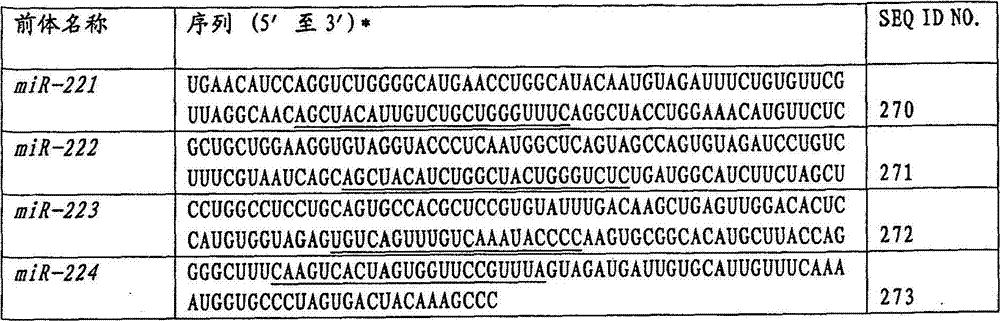

*前体序列中加下划线的序列对应于成熟的加工过的miR转录物(参见表1b)。有些前体序列具有2个加下划线的序列,它们表示源自相同前体的2种不同的成熟miR。所有序列都是人的。*The underlined sequence in the precursor sequence corresponds to the mature processed miR transcript (see Table 1b). Some precursor sequences have 2 underlined sequences, which represent 2 different mature miRs derived from the same precursor. All sequences are human.
表1b-人成熟微小RNA序列。Table 1b - Human mature microRNA sequences.


可以测量从受试者得到的生物样品的细胞中的至少一种miR基因产物的水平。例如,通过常规活检技术,可以从被怀疑患有肺癌的受试者取出组织样品。在另一个实施方案中,可以从受试者取出血液样品,并通过标准技术,分离白细胞用于DNA提取。优选地,在放疗、化疗或其它治疗性处理之前,从受试者得到血液或组织样品。相应的对照组织或血液样品或对照参照样品,可以从受试者的未受影响的组织、从正常人个体或正常个体的群体、或从与受试者样品中大多数细胞相对应的培养细胞得到。然后与来自受试者的样品一起,加工处理对照组织或血液样品,从而可以将来自受试者样品的细胞中从给定miR基因产生的miR基因产物的水平与来自对照样品的细胞的相应miR基因产物水平相对比。或者,可以与测试样品单独分开地得到和加工处理参照样品(例如在不同时间),并将来自测试样品的细胞中从给定miR基因产生的miR基因产物的水平与来自参照样品的相应的miR基因产物水平相对比。The level of at least one miR gene product can be measured in cells of a biological sample obtained from a subject. For example, a tissue sample can be taken from a subject suspected of having lung cancer by conventional biopsy techniques. In another embodiment, a blood sample can be taken from a subject, and by standard techniques, white blood cells are isolated for DNA extraction. Preferably, a blood or tissue sample is obtained from the subject prior to radiotherapy, chemotherapy or other therapeutic treatment. A corresponding control tissue or blood sample or control reference sample may be obtained from an unaffected tissue of a subject, from a normal human individual or population of normal individuals, or from cultured cells corresponding to the majority of cells in the subject sample get. A control tissue or blood sample is then processed, along with the sample from the subject, so that the level of miR gene product produced from a given miR gene in cells from the subject sample can be compared to the corresponding miR in cells from the control sample. Gene product levels are compared. Alternatively, a reference sample can be obtained and processed separately from the test sample (e.g., at a different time) and the level of miR gene product produced from a given miR gene in cells from the test sample compared to the corresponding miR gene from the reference sample. Gene product levels are compared.
在一个实施方案中,测试样品中至少一种miR基因产物的水平大于对照样品中的相应的miR基因产物的水平(即,miR基因产物的表达被“增量调节”)。如本文使用的,当来自受试者的细胞或组织样品中miR基因产物的量大于对照细胞或组织样品中相同基因产物的量时,该miR基因产物的表达被″增量调节″。在另一个实施方案中,测试样品中至少一种miR基因产物的水平小于对照样品中的相应的miR基因产物的水平(即,miR基因产物的表达被″减量调节″)。如本文使用的,当从来自受试者的细胞或组织样品的基因产生的miR基因产物的量小于从对照细胞或组织样品中相同基因产生的量时,该miR基因产物的表达被″减量调节″。可以相对于一种或多种RNA表达标准,测定对照和正常样品中的相对miR基因表达。所述标准可包括,例如,零miR基因表达水平,标准细胞系中的miR基因表达水平,受试者的未受影响的组织中的miR基因表达水平,或以前对正常人对照群体得到的miR基因表达的平均水平。In one embodiment, the level of at least one miR gene product in the test sample is greater than the level of the corresponding miR gene product in the control sample (ie, expression of the miR gene product is "upregulated"). As used herein, expression of a miR gene product is "upregulated" when the amount of the miR gene product in a cell or tissue sample from a subject is greater than the amount of the same gene product in a control cell or tissue sample. In another embodiment, the level of at least one miR gene product in the test sample is less than the level of the corresponding miR gene product in the control sample (ie, expression of the miR gene product is "downregulated"). As used herein, expression of a miR gene product is "decreased" when the amount of a miR gene product produced from a gene in a cell or tissue sample from a subject is less than the amount produced from the same gene in a control cell or tissue sample adjust". Relative miR gene expression in control and normal samples can be determined relative to one or more RNA expression standards. The criteria can include, for example, zero miR gene expression levels, miR gene expression levels in standard cell lines, miR gene expression levels in unaffected tissues of the subject, or miR gene expression levels previously obtained for normal human control populations. Average level of gene expression.
与对照样品中相应的miR基因产物的水平相比,从受试者得到的样品中miR基因产物水平的改变(即,增加或降低),指示着受试者中存在肺癌。在一个实施方案中,测试样品中至少一种miR基因产物的水平大于对照样品中相应的miR基因产物的水平。在另一个实施方案中,测试样品中至少一种miR基因产物的水平小于对照样品中相应的miR基因产物的水平。在一个特定实施方案中,所述至少一种miR基因产物选自:miR-21,miR-191,miR-126*,miR-210,miR-155,miR-143,miR-205,miR-192-prec,miR-224,miR-126,miR-24-2,miR-30a-5p,miR-212,miR-140,miR-9,miR-214,miR-17-3p,miR-124a-1,miR-218-2,miR-95,miR-145,miR-198,miR-216-prec,miR-219-1,miR-106a,miR-197,miR-192,miR-125a-prec,miR-26a-1-prec,miR-146,miR-203,miR-199b-prec,let-7a-2-prec,miR-27b,miR-32,miR-29b-2,miR-220,miR-33,miR-181c-prec,miR-150,miR-101-1,miR-124a-3,miR-125a和let-7f-1。在一个特定的实施方案中,所述至少一种miR基因产物选自:miR-21,miR-205和miR-216。在另一个实施方案中,所述肺癌是肺腺癌,且所述至少一种miR基因产物选自:miR-21,miR-191,miR-155,miR-210,miR-126*和miR-224.An alteration (ie, increase or decrease) in the level of a miR gene product in a sample obtained from a subject compared to the level of the corresponding miR gene product in a control sample is indicative of the presence of lung cancer in the subject. In one embodiment, the level of at least one miR gene product in the test sample is greater than the level of the corresponding miR gene product in the control sample. In another embodiment, the level of at least one miR gene product in the test sample is less than the level of the corresponding miR gene product in the control sample. In a specific embodiment, said at least one miR gene product is selected from: miR-21, miR-191, miR-126*, miR-210, miR-155, miR-143, miR-205, miR-192 -prec, miR-224, miR-126, miR-24-2, miR-30a-5p, miR-212, miR-140, miR-9, miR-214, miR-17-3p, miR-124a-1 , miR-218-2, miR-95, miR-145, miR-198, miR-216-prec, miR-219-1, miR-106a, miR-197, miR-192, miR-125a-prec, miR -26a-1-prec, miR-146, miR-203, miR-199b-prec, let-7a-2-prec, miR-27b, miR-32, miR-29b-2, miR-220, miR-33 , miR-181c-prec, miR-150, miR-101-1, miR-124a-3, miR-125a and let-7f-1. In a specific embodiment, said at least one miR gene product is selected from: miR-21, miR-205 and miR-216. In another embodiment, the lung cancer is lung adenocarcinoma and the at least one miR gene product is selected from the group consisting of: miR-21, miR-191, miR-155, miR-210, miR-126* and miR- 224.
在一个特定的实施方案中,所述miR基因产物不是下述的一种或多种:let7a-2,let-7c,let-7g,let-7i,miR-7-2,miR-7-3,miR-9,miR-9-1,miR-10a,miR-15a,miR-15b,miR-16-1,miR-16-2,miR-17-5p,miR-20a,miR-21,miR-24-1,miR-24-2,miR-25,miR-29b-2,miR-30,miR-30a-5p,miR-30c,miR-30d,miR-31,miR-32,miR-34,miR-34a,miR-34a prec,miR-34a-1,miR-34a-2,miR-92-2,miR-96,miR-99a,miR-99b prec,mi R-100,miR-103,miR-106a,mi R-107,miR-123,miR-124a-1,miR-125b-1,miR-125b-2,miR-126*,miR-127,miR-128b,miR-129,miR-129-1/2 prec,miR-132,mi R-135-1,miR-136,miR-137,miR-141,miR-142-as,miR-143,miR-146,miR-148,miR-149,miR-153,miR-155,miR 159-1,miR-181,miR-181b-1,miR-182,miR-186,miR-191,miR-192,miR-195,miR-196-1,miR-196-1prec,miR-196-2,miR-199a-1,miR-199a-2,miR-199b,miR-200b,miR-202,miR-203,miR-204,miR-205,miR-210,miR-211,miR-212,miR-214,miR-215,miR-217,miR-221和/或miR-223。In a specific embodiment, the miR gene product is not one or more of: let7a-2, let-7c, let-7g, let-7i, miR-7-2, miR-7-3 , miR-9, miR-9-1, miR-10a, miR-15a, miR-15b, miR-16-1, miR-16-2, miR-17-5p, miR-20a, miR-21, miR -24-1, miR-24-2, miR-25, miR-29b-2, miR-30, miR-30a-5p, miR-30c, miR-30d, miR-31, miR-32, miR-34 , miR-34a, miR-34a prec, miR-34a-1, miR-34a-2, miR-92-2, miR-96, miR-99a, miR-99b prec, miR-100, miR-103, miR-106a, miR-107, miR-123, miR-124a-1, miR-125b-1, miR-125b-2, miR-126*, miR-127, miR-128b, miR-129, miR- 129-1/2 prec, miR-132, miR-135-1, miR-136, miR-137, miR-141, miR-142-as, miR-143, miR-146, miR-148, miR- 149, miR-153, miR-155, miR-159-1, miR-181, miR-181b-1, miR-182, miR-186, miR-191, miR-192, miR-195, miR-196-1 , miR-196-1prec, miR-196-2, miR-199a-1, miR-199a-2, miR-199b, miR-200b, miR-202, miR-203, miR-204, miR-205, miR -210, miR-211, miR-212, miR-214, miR-215, miR-217, miR-221 and/or miR-223.
使用适用于检测生物样品中的RNA表达水平的任意技术,可以测量样品中mi R基因产物的水平。用于测定生物样品(例如,细胞,组织)中RNA表达水平的合适技术(例如,RNA印迹分析,RT-PCR,原位杂交)是本领域技术人员众所周知的。在一个具体的实施方案中,使用RNA印迹分析,检测至少一种miR基因产物的水平。例如,可以如下从细胞纯化总细胞RNA:在有核酸提取缓冲液存在下匀浆,随后离心。沉淀核酸,通过用DNA酶处理和沉淀,去除DNA。然后根据标准技术,通过琼脂糖凝胶上的凝胶电泳分离RNA分子,并转移至硝酸纤维素滤膜。然后通过加热,将RNA固定化在滤膜上。使用与目标RNA互补的适当标记的DNA或RNA探针,进行对特定RNA的检测和定量。参见,例如,Molecular Cloning:A Laboratory Manual,J.Sambrook等人编,第2版,Cold Spring Harbor Laboratory Press,1989,Chapter7,其所有公开内容通过参考引用并入本文。The level of the miR gene product in the sample can be measured using any technique suitable for detecting the level of RNA expression in a biological sample. Suitable techniques (eg, Northern blot analysis, RT-PCR, in situ hybridization) for determining RNA expression levels in biological samples (eg, cells, tissues) are well known to those skilled in the art. In a specific embodiment, the level of at least one miR gene product is detected using Northern blot analysis. For example, total cellular RNA can be purified from cells by homogenization in the presence of nucleic acid extraction buffer followed by centrifugation. Nucleic acids are precipitated and DNA is removed by treatment with DNase and precipitation. The RNA molecules are then separated by gel electrophoresis on an agarose gel and transferred to nitrocellulose filters according to standard techniques. The RNA is then immobilized on the filter by heating. Detection and quantification of specific RNAs is performed using appropriately labeled DNA or RNA probes that are complementary to the target RNA. See, e.g., Molecular Cloning: A Laboratory Manual, edited by J. Sambrook et al., 2nd Ed., Cold Spring Harbor Laboratory Press, 1989, Chapter 7, the entire disclosure of which is incorporated herein by reference.
从表1a和表1b中提供的核酸序列,可以生成适用于给定miR基因产物的RNA印迹杂交的探针(例如DNA探针,RNA探针),包括、但不限于,与目标miR基因产物具有至少约70%、75%、80%、85%、90%、95%、98%或99%互补性的探针,以及与目标miR基因产物具有完全互补性的探针。标记的DNA和RNA探针的制备方法,和其与靶核苷酸序列的杂交的条件,描述在Molecular Cloning:A Laboratory Manual,J.Sambrook等人,编.,第2版,Cold Spring Harbor Laboratory Press,1989,Chapters 10和11,其所有公开内容都通过参考引用并入本文。From the nucleic acid sequences provided in Table 1a and Table 1b, probes (e.g., DNA probes, RNA probes) suitable for Northern hybridization of a given miR gene product can be generated, including, but not limited to, those with the miR gene product of interest. Probes having at least about 70%, 75%, 80%, 85%, 90%, 95%, 98% or 99% complementarity, as well as probes having full complementarity to the miR gene product of interest. Methods for the preparation of labeled DNA and RNA probes, and conditions for their hybridization to target nucleotide sequences, are described in Molecular Cloning: A Laboratory Manual, J. Sambrook et al., ed., 2nd ed., Cold Spring Harbor Laboratory Press, 1989,
例如,核酸探针用下述物质标记,例如,放射性核素,例如3H,32P,33P,14C,或35S;重金属;能起到标记配体的特异性结合对成员功能的配体(例如,生物素,抗生物素蛋白或抗体);荧光分子;化学发光分子;酶等。For example, nucleic acid probes are labeled with, for example, radionuclides such as 3 H, 32 P, 33 P, 14 C, or 35 S; heavy metals; members of specific binding pairs that can function as labeling ligands. Ligands (eg, biotin, avidin, or antibodies); fluorescent molecules; chemiluminescent molecules; enzymes, etc.
通过Rigby等人(1977),J.Mol.Biol.113:237-251的切口平移方法,或通过Fienberg等人(1983),Anal.Biochem.132:6-13的随机引物法,可以将探针标记成高比放射性,所述文献的所有公开内容都通过参考引用并入本文。后者是从单链DNA或从RNA模板合成高比放射性的32P-标记的探针的选择方法。例如,通过根据切口平移方法用高放射性的核苷酸替换现有的核苷酸,可以制备比放射性大大超过108cpm/微克的32P-标记的核酸探针。然后通过使杂交的滤膜曝光于照相胶片,可以进行杂交的放射自显影检测。对杂交的滤膜曝光的照相胶片的光密度扫描,会提供miR基因转录物水平的精确测量。使用另一个方案,通过计算机化成像系统,例如可从AmershamBiosciences,Piscataway,NJ得到的Molecular Dynamics 400-B 2D磷光计,可以定量miR基因转录物水平。By the nick translation method of Rigby et al. (1977), J. Mol. Biol. 113: 237-251, or by the random primer method of Fienberg et al. (1983), Anal. Biochem. The needles are labeled with high specific activity, the entire disclosure of which is hereby incorporated by reference. The latter is the method of choice for the synthesis of highly specific radioactive32P -labeled probes from single-stranded DNA or from RNA templates. For example, by replacing existing nucleotides with highly radioactive nucleotides according to the nick translation method, 32 P-labeled nucleic acid probes with specific radioactivity greatly exceeding 10 8 cpm/microgram can be prepared. Autoradiographic detection of hybridization can then be performed by exposing the hybridized filter to photographic film. Densitometric scanning of photographic film exposed to hybridized filters will provide accurate measurements of miR gene transcript levels. Using another protocol, miR gene transcript levels can be quantified by a computerized imaging system, such as the Molecular Dynamics 400-B 2D Phosphorometer available from Amersham Biosciences, Piscataway, NJ.
当DNA或RNA探针的放射性核素标记不可行时,随机-引物方法可以用于将类似物例如dTTP类似物5-(N-(N-生物素基-ε-氨基己酰基)-3-氨基烯丙基)脱氧尿苷三磷酸掺入探针分子中。通过与生物素-结合蛋白(例如抗生物素蛋白、链霉抗生物素和抗体(例如,抗-生物素抗体),其偶联到荧光染料或产生颜色反应的酶上)的反应,可以检测生物素化的探针寡核苷酸。When radionuclide labeling of DNA or RNA probes is not feasible, random-priming methods can be used to incorporate analogs such as the dTTP analog 5-(N-(N-biotinyl-ε-aminocaproyl)-3- Aminoallyl) deoxyuridine triphosphate is incorporated into the probe molecule. Can be detected by reaction with biotin-binding proteins such as avidin, streptavidin, and antibodies (e.g., anti-biotin antibodies) conjugated to fluorescent dyes or enzymes that produce color reactions Biotinylated probe oligonucleotides.
除了RNA印迹和其它RNA杂交技术以外,使用原位杂交技术,可以测定RNA转录物的水平。该技术需要比RNA印迹技术更少的细胞,包括将整个细胞放置在显微镜盖玻片上,用含有放射性的或其它标记的核酸(例如,cDNA或RNA)探针的溶液探测细胞的核酸内容物。该技术特别适用于分析来自受试者的组织活检样品。原位杂交技术的实践更详细地描述在美国专利号5,427,916,其全部公开内容通过参考引用并入本文。从表1a和表1b中提供的核酸序列,可以生成适用于给定miR基因产物的原位杂交的探针,包括、但不限于,与目标miR基因产物具有至少约70%、75%、80%、85%、90%、95%、98%或99%互补性的探针,以及与目标miR基因产物具有完全互补性的探针,如上所述。In addition to Northern blotting and other RNA hybridization techniques, the level of RNA transcripts can be determined using in situ hybridization techniques. The technique requires fewer cells than Northern blotting and involves placing whole cells on microscope coverslips and probing the nucleic acid contents of the cells with a solution containing radioactive or otherwise labeled nucleic acid (eg, cDNA or RNA) probes. This technique is particularly suitable for analyzing tissue biopsy samples from subjects. The practice of in situ hybridization techniques is described in more detail in US Patent No. 5,427,916, the entire disclosure of which is incorporated herein by reference. From the nucleic acid sequences provided in Table 1a and Table 1b, probes suitable for in situ hybridization of a given miR gene product can be generated, including, but not limited to, at least about 70%, 75%, 80%, %, 85%, 90%, 95%, 98%, or 99% complementary, as well as probes that are fully complementary to the target miR gene product, as described above.
通过逆转录miR基因转录物,随后通过聚合酶链式反应(RT-PCR)扩增逆转录的转录物,也可以测定细胞中miR基因转录物的相对数目。可通过与内部标准例如来自存在于相同样品中的“管家”基因的mRNA的水平比较,来定量miR基因转录物的水平。用作内部标准的合适的“管家”基因包括例如肌球蛋白或甘油醛-3-磷酸脱氢酶(G3PDH)。用于定量和半-定量RT-PCR的方法和其变化形式,是本领域技术人员众所周知的。Relative numbers of miR gene transcripts in cells can also be determined by reverse transcription of miR gene transcripts followed by amplification of the reverse transcribed transcripts by polymerase chain reaction (RT-PCR). Levels of miR gene transcripts can be quantified by comparison to internal standards such as levels of mRNA from "housekeeping" genes present in the same sample. Suitable "housekeeping" genes for use as internal standards include, for example, myosin or glyceraldehyde-3-phosphate dehydrogenase (G3PDH). Methods for quantitative and semi-quantitative RT-PCR, and variations thereof, are well known to those skilled in the art.
在一些情况下,可能希望同时测定样品中许多不同mi R基因产物的表达水平。在其它情况下,可能希望测定所有已知的与癌症相关的miR基因的转录物的表达水平。评估数百个miR基因或基因产物的癌症特异性表达水平是非常耗时的,并且需要大量总RNA(对于每个RNA印迹至少20μg)和需要放射性同位素的放射自显影技术。In some cases, it may be desirable to simultaneously determine the expression levels of many different miR gene products in a sample. In other cases, it may be desirable to determine the expression levels of transcripts of all known cancer-associated miR genes. Assessing cancer-specific expression levels of hundreds of miR genes or gene products is time-consuming and requires large amounts of total RNA (at least 20 μg for each northern blot) and autoradiographic techniques requiring radioisotopes.
为克服这些限制,可构建微芯片形式(即,微阵列)的寡物文库,其包含对于一组miR基因特异性的一组寡核苷酸(例如,寡脱氧核苷酸)探针。通过使用该微阵列,可通过逆转录RNA以产生一组靶寡脱氧核苷酸,然后使其与微阵列上的探针寡脱氧核苷酸杂交,从而产生杂交或表达谱,来测定生物样品中多种微小RNA的表达水平。然后科将测试样品的杂交谱与对照样品进行比较,以确定在实体癌细胞中具有改变的表达水平的微小RNA。如本文所用的,“探针寡核苷酸”或“探针寡脱氧核苷酸”是指能够与靶寡核苷酸杂交的寡核苷酸。“靶寡核苷酸”或“靶寡脱氧核苷酸”是指待检测(例如通过杂交)的分子。“miR-特异性的探针寡核苷酸”或“对miR特异性的探针寡核苷酸”是指具有经选择与特定miR基因产物杂交或与该特定miR基因产物的逆转录物杂交的序列的探针寡核苷酸。To overcome these limitations, an oligo library can be constructed in a microchip format (ie, microarray) comprising a set of oligonucleotide (eg, oligodeoxynucleotide) probes specific for a set of miR genes. Using this microarray, biological samples can be assayed by reverse transcribing RNA to produce a set of target oligodeoxynucleotides, which are then hybridized to probe oligodeoxynucleotides on the microarray, resulting in a hybridization or expression profile. Expression levels of various microRNAs. Koe then compared the hybridization profiles of the test samples to the control samples to identify microRNAs with altered expression levels in solid cancer cells. As used herein, "probe oligonucleotide" or "probe oligodeoxynucleotide" refers to an oligonucleotide capable of hybridizing to a target oligonucleotide. "Target oligonucleotide" or "target oligodeoxynucleotide" refers to a molecule to be detected (eg, by hybridization). A "miR-specific probe oligonucleotide" or "miR-specific probe oligonucleotide" refers to an oligonucleotide with a specific miR gene product selected to hybridize or hybridize to the reverse transcript of the specific miR gene product. The sequence of the probe oligonucleotide.
特定样品的“表达谱”(expression profile)或“杂交谱”(hybridization profile)基本上是样品的状态的指纹图谱;尽管两种状态可具有相似表达的任何特定基因,但同时评估许多基因可允许产生对于细胞状态独特的基因表达谱。即,正常组织可与肺癌组织区分,并且在肺癌组织内,可确定不同的预后状态(例如,好的或差的长期存活希望)。通过比较不同状态中的肺癌组织的表达谱,可获得关于那些基因在这些状态每一种中是重要的(包括基因的增量调节和减量调节)信息。在肺癌组织或正常肺组织中差异表达的序列的鉴定以及导致不同的预后结果的差异表达的鉴定,允许以许多方式使用该信息。例如,可评价特定的治疗方案(例如,以确定化疗药物是否起着改善特定患者的长期预后的作用)。类似地,可通过将患者的样品与已知的表达谱比较来进行或确认诊断。此外,这些基因表达谱(或个别基因)允许筛选抑制肺癌表达谱或将差预后谱转变成较好的预后谱的药物候选品。The "expression profile" or "hybridization profile" of a particular sample is essentially a fingerprint of the state of the sample; while two states may have any particular gene similarly expressed, evaluating many genes simultaneously allows Gene expression profiles unique to cell states are generated. That is, normal tissue can be distinguished from lung cancer tissue, and within lung cancer tissue, different prognostic status (eg, good or poor long-term survival prospects) can be determined. By comparing the expression profiles of lung cancer tissues in different states, information can be obtained about which genes are important in each of these states, including both up-regulation and down-regulation of genes. The identification of sequences that are differentially expressed in lung cancer tissue or normal lung tissue, and that differential expression leads to different prognostic outcomes, allows this information to be used in a number of ways. For example, a particular treatment regimen can be evaluated (eg, to determine whether a chemotherapeutic drug acts to improve the long-term prognosis of a particular patient). Similarly, a diagnosis can be made or confirmed by comparing a patient's sample to known expression profiles. Furthermore, these gene expression profiles (or individual genes) allow the screening of drug candidates that suppress the lung cancer expression profile or convert a poor prognosis profile to a better prognosis profile.
因此,本发明提供了诊断受试者是否患有肺癌或处于发生肺癌的风险中的方法,其包括从获自受试者的测试样品逆转录RNA,以提供一组靶寡脱氧核苷酸,使所述靶寡脱氧核苷酸与包含miRNA-特异性探针寡核苷酸的微阵列杂交,以提供测试样品的杂交谱,并对比测试样品杂交谱与从对照样品产生的杂交谱,其中至少一种miRNA的信号的改变指示着受试者患有肺癌或处于发生肺癌的风险中。在一个实施方案中,所述微阵列包含针对所有已知人miRNA的实质部分的miRNA-特异性探针寡核苷酸。在一个特定的实施方案中,所述微阵列包含针对选自下述的一种或多种miRNA的miRNA-特异性探针寡核苷酸:miR-21,miR-191,miR-126*,miR-210,miR-155,miR-143,miR-205,miR-192-prec,miR-224,miR-126,miR-24-2,miR-30a-5p,miR-212,miR-140,miR-9,miR-214,miR-17-3p,miR-124a-1,miR-218-2,miR-95,miR-145,miR-198,miR-216-prec,miR-219-1,miR-106a,miR-197,miR-192,miR-125a-prec,miR-26a-1-prec,miR-146,miR-203,miR-199b-prec,let-7a-2-prec,miR-27b,miR-32,miR-29b-2,miR-220,miR-33,miR-181c-prec,miR-150,miR-101-1,miR-124a-3,miR-125a,let-7f-1和其组合。Accordingly, the present invention provides a method of diagnosing whether a subject has or is at risk of developing lung cancer comprising reverse transcribing RNA from a test sample obtained from the subject to provide a set of target oligodeoxynucleotides, hybridizing said target oligodeoxynucleotides to a microarray comprising miRNA-specific probe oligonucleotides to provide a hybridization profile for a test sample, and comparing the test sample hybridization profile to a hybridization profile generated from a control sample, wherein A change in the signaling of at least one miRNA indicates that the subject has or is at risk of developing lung cancer. In one embodiment, the microarray comprises miRNA-specific probe oligonucleotides directed to a substantial portion of all known human miRNAs. In a specific embodiment, the microarray comprises miRNA-specific probe oligonucleotides directed to one or more miRNAs selected from: miR-21, miR-191, miR-126*, miR-210, miR-155, miR-143, miR-205, miR-192-prec, miR-224, miR-126, miR-24-2, miR-30a-5p, miR-212, miR-140, miR-9, miR-214, miR-17-3p, miR-124a-1, miR-218-2, miR-95, miR-145, miR-198, miR-216-prec, miR-219-1, miR-106a, miR-197, miR-192, miR-125a-prec, miR-26a-1-prec, miR-146, miR-203, miR-199b-prec, let-7a-2-prec, miR- 27b, miR-32, miR-29b-2, miR-220, miR-33, miR-181c-prec, miR-150, miR-101-1, miR-124a-3, miR-125a, let-7f- 1 and combinations thereof.
可以从由已知的miRNA序列产生的基因特异性寡核苷酸探针制备微阵列。微阵列可包含对于每种miRNA的两种不同的寡核苷酸探针,一种包含活性的成熟序列,另一种对于该miRNA的前体是特异性的。微阵列还可以包含对照,例如一个或多个与人直系同源物相异仅少数碱基的小鼠序列,该序列可用作杂交严格性条件的对照。还可将来自两个物种的tRNA和其它RNA(例如,rRNA,mRNA)印在微芯片上,为特异性杂交提供内部的、相对稳定的阳性对照。还可在微芯片上包含非特异性杂交的一个或多个合适的对照。为此,基于与任何已知的miRNA不存在任何同源性来选择序列。Microarrays can be prepared from gene-specific oligonucleotide probes generated from known miRNA sequences. The microarray can contain two different oligonucleotide probes for each miRNA, one containing the active mature sequence and the other specific for the precursor of that miRNA. The microarray can also contain controls, such as one or more mouse sequences differing by only a few bases from the human ortholog, which can be used as a control for hybridization stringency conditions. tRNA and other RNA (eg, rRNA, mRNA) from both species can also be printed on the microchip to provide an internal, relatively stable positive control for specific hybridization. One or more suitable controls for non-specific hybridization may also be included on the microchip. For this, sequences were selected based on the absence of any homology to any known miRNA.
可使用本领域内已知的技术制造微阵列。例如,在位置C6上对合适长度例如40个核苷酸的探针寡核苷酸进行5’-胺修饰,然后使用可商购获得的微阵列系统例如GeneMachine OmniGridTM 100Microarrayer和Amersham CodeLinkTM活化载玻片进行印制。通过用标记的引物逆转录靶RNA来制备相应于靶RNA的标记的cDNA寡物。在第一链合成后,使RNA/DNA杂交体变性以降解RNA模板。然后将所制备的标记的靶cDNA在杂交条件下与微阵列芯片杂交,所述条件是例如在25℃下在6X SSPE/30%甲酰胺中进行18小时,然后在37℃下在0.75XTNT中洗涤40分钟。杂交在阵列上在固定的探针DNA识别样品中的互补靶cDNA的位置上发生。标记的靶cDNA标记了阵列上发生结合的确切位置,从而允许自动检测和定量。输出由一列杂交事件组成,其显示了特定cDNA序列的相对丰度,从而显示患者样品中相应的互补miR的相对丰度。根据一个实施方案,标记的cDNA寡物是从生物素标记的引物制备的生物素标记的cDNA。然后通过使用例如链霉抗生物素-Alexa647缀合物直接检测含生物素的转录物来处理微阵列和使用常规的扫描方法扫描微阵列。阵列上各点的图像强度与患者样品中相应的miR的丰度成比例。Microarrays can be fabricated using techniques known in the art. For example, a probe oligonucleotide of suitable length, e.g., 40 nucleotides, is 5'-amine-modified at position C6 and then activated using commercially available microarray systems such as
阵列的使用对于miRNA表达检测具有几个有利方面。第一,可在一个时间点在相同的样品中鉴定数百个基因的整体表达。第二,通过对寡核苷酸探针的仔细设计,可鉴定成熟和前体分子的表达。第三,与RNA印迹分析相比,芯片需要少量的RNA,并且使用2.5μg的总RNA可提供可重复的结果。相对有限数量的miRNA(每个物种数百个)允许构建几个物种的共同微阵列,对于各物种具有不同的寡核苷酸探针。该工具允许对多种不同条件下各已知m iR的跨物种表达进行分析。The use of arrays has several advantages for miRNA expression detection. First, the global expression of hundreds of genes can be identified in the same sample at one time point. Second, through careful design of oligonucleotide probes, the expression of mature and precursor molecules can be identified. Third, ChIP requires small amounts of RNA compared to Northern blot analysis and provides reproducible results using 2.5 μg of total RNA. The relatively limited number of miRNAs (hundreds per species) allows the construction of common microarrays of several species, with different oligonucleotide probes for each species. This tool allows the analysis of the cross-species expression of each known miR under a variety of different conditions.
除了用于特定mi R的定量表达水平测定外,包含相应于相当大部分的miRNome(优选整个miRNome)的miRNA特异性探针寡核苷酸的微芯片可用于确定miR基因表达谱,从而进行miR表达模式的分析。不同的miR特征谱可与已建立的疾病标记或直接与疾病状态相关联。In addition to quantitative expression level assays for specific miRs, microchips containing miRNA-specific probe oligonucleotides corresponding to a substantial portion of the miRNome (preferably the entire miRNome) can be used to determine miR gene expression profiles and thereby perform miR Analysis of expression patterns. Different miR profiles can be associated with established disease markers or directly with disease states.
根据本文描述的表达谱确定分析法,定量逆转录来自获自怀疑患有癌症(例如,肺癌)的受试者的样品的总RNA,以提供一组与样品中的RNA互补的标记的靶寡脱氧核苷酸。然后使所述靶寡脱氧核苷酸与包含mi RNA特异性探针寡核苷酸的微阵列杂交,从而提供样品的杂交谱。结果是展示样品中miRNA的表达模式的样品的杂交谱。杂交谱包含来自样品的靶寡脱氧核苷酸与微阵列中的miRNA特异性探针寡核苷酸结合产生的信号。该谱可记录为结合的存在或不存在(信号相对于零信号)。更优选,记录的谱包括来自各杂交的信号的强度。将所述谱与从正常例如非癌性的对照样品产生的杂交谱进行比较。信号的改变指示着受试者中存在癌症或发生癌症的倾向。Total RNA from a sample obtained from a subject suspected of having cancer (e.g., lung cancer) is quantitatively reverse transcribed according to the expression profiling assay described herein to provide a set of labeled target oligos that are complementary to the RNA in the sample. deoxynucleotides. The target oligodeoxynucleotides are then hybridized to a microarray comprising miRNA-specific probe oligonucleotides, thereby providing a hybridization profile of the sample. The result is a hybridization profile of the sample showing the expression pattern of the miRNAs in the sample. The hybridization profile comprises the signal from the binding of the target oligodeoxynucleotides from the sample to the miRNA-specific probe oligonucleotides in the microarray. The spectrum can be recorded as the presence or absence of binding (signal versus zero signal). More preferably, the recorded spectrum includes the intensity of the signal from each hybridization. The profile is compared to a hybridization profile generated from a normal, eg, non-cancerous, control sample. A change in signal is indicative of the presence or predisposition of cancer in the subject.
用于测量miR基因表达的其它技术也在本领域技术人员的技能范围之内,并且包括用于测量RNA转录和降解的速率的各种技术。Other techniques for measuring miR gene expression are also within the skill of the art and include various techniques for measuring the rate of RNA transcription and degradation.
本发明也提供了确定患有肺癌的受试者的预后的方法,其包括测量来自受试者的测试样品中与肺癌的特定预后(例如,好的或积极的预后,差的或不良的预后)有关的至少一种miR基因产物的水平。根据这些方法,与对照样品中相应的mi R基因产物的水平相比,测试样品中与特定预后有关的mi R基因产物的水平的改变,指示着受试者患有具有特定预后的肺癌。在一个实施方案中,所述miR基因产物与不良(即,差)预后有关。不良预后的实例包括、但不限于,低生存率和快速疾病进展。在某些实施方案中,与特定预后有关的至少一种miR基因产物选自:miR-155,miR-17-3p,miR-106a,miR-93,let-7a-2,miR-145,let-7b,miR-20和miR-21。在一个特定的实施方案中,所述肺癌是肺腺癌,且与特定预后有关的至少一种miR基因产物选自:miR-155和let-7a-2。在某些实施方案中,如下测量至少一种miR基因产物的水平:从获自受试者的测试样品逆转录RNA,以提供一组靶寡脱氧核苷酸,使所述靶寡脱氧核苷酸与包含miRNA-特异性探针寡核苷酸的微阵列杂交,以提供测试样品的杂交谱,并对比测试样品杂交谱与从对照样品产生的杂交谱。The invention also provides a method of determining the prognosis of a subject with lung cancer comprising measuring a specific prognosis (e.g., good or positive prognosis, poor or poor prognosis) of lung cancer in a test sample from the subject. ) associated with the level of at least one miR gene product. According to these methods, an alteration in the level of a miR gene product associated with a particular prognosis in a test sample compared to the level of the corresponding miR gene product in a control sample indicates that the subject has lung cancer with a particular prognosis. In one embodiment, the miR gene product is associated with poor (ie, poor) prognosis. Examples of poor prognosis include, but are not limited to, poor survival and rapid disease progression. In certain embodiments, at least one miR gene product associated with a particular prognosis is selected from the group consisting of: miR-155, miR-17-3p, miR-106a, miR-93, let-7a-2, miR-145, let -7b, miR-20 and miR-21. In a specific embodiment, said lung cancer is lung adenocarcinoma, and the at least one miR gene product associated with a specific prognosis is selected from: miR-155 and let-7a-2. In certain embodiments, the level of at least one miR gene product is measured by reverse transcribing RNA from a test sample obtained from a subject to provide a set of target oligodeoxynucleotides that The acid is hybridized to a microarray comprising miRNA-specific probe oligonucleotides to provide a hybridization profile of the test sample, and the hybridization profile of the test sample is compared to the hybridization profile generated from the control sample.
不希望受任何一种理论的束缚,认为细胞中一种或多种miR基因产物的水平的变化可导致这些miR的一个或多个目标靶失调,这可导致肺癌的形成。因此,改变miR基因产物的水平(例如,通过降低在肺癌细胞中被增量调节的miR的水平,通过增加在肺癌细胞中被减量调节的miR的水平)可成功地治疗肺癌。Without wishing to be bound by any one theory, it is believed that changes in the levels of one or more miR gene products in cells can lead to dysregulation of one or more targets of interest of these miRs, which can lead to the development of lung cancer. Thus, altering the levels of miR gene products (eg, by decreasing the levels of miRs that are up-regulated in lung cancer cells, by increasing the levels of miRs that are down-regulated in lung cancer cells) can successfully treat lung cancer.
因此,本发明包括治疗受试者的肺癌的方法,其中受试者细胞(例如肺癌细胞)中的至少一种miR基因产物失调(例如,减量调节,增量调节)。在一个实施方案中,测试样品(例如肺癌样品)中至少一种miR基因产物的水平大于对照样品中相应的miR基因产物的水平。在另一个实施方案中,测试样品(例如肺癌样品)中至少一种miR基因产物的水平小于对照样品中相应的miR基因产物的水平。当肺癌细胞中至少一种分离的miR基因产物被减量调节时,该方法包括,施用有效量的所述至少一种分离的miR基因产物、或其分离的变体或生物活性片段,从而抑制受试者中癌细胞的增殖。例如,当受试者癌细胞中miR基因产物被减量调节时,给受试者施用有效量的分离的miR基因产物可以抑制癌细胞的增殖。施用给受试者的分离的miR基因产物可以与在癌症细胞中减量调节的内源野生型mi R基因产物(例如在表1a或表1b中所示的miR基因产物)相同,或可以是其变体或生物活性片段。如本文所定义的,miR基因产物的″变体″是指与相应的野生型miR基因产物具有小于100%同一性、且具有相应的野生型miR基因产物的一种或多种生物活性的miRNA。这样的生物活性的实例包括、但不限于,抑制靶RNA分子的表达(例如,抑制靶RNA分子的翻译,调控靶RNA分子的稳定性,抑制靶RNA分子的加工)和抑制与肺癌有关的细胞过程(例如,细胞分化,细胞生长,细胞死亡)。这些变体包括物种变体和作为miR基因中的一个或多个突变(例如,置换,缺失,插入)的结果的变体。在某些实施方案中,所述变体与相应的野生型miR基因产物至少约70%、75%、80%、85%、90%、95%、98%或99%相同。Accordingly, the invention includes methods of treating lung cancer in a subject wherein at least one miR gene product is dysregulated (eg, down-regulated, up-regulated) in cells of the subject (eg, lung cancer cells). In one embodiment, the level of at least one miR gene product in the test sample (eg, a lung cancer sample) is greater than the level of the corresponding miR gene product in the control sample. In another embodiment, the level of at least one miR gene product in the test sample (eg, a lung cancer sample) is less than the level of the corresponding miR gene product in the control sample. When at least one isolated miR gene product is down-regulated in lung cancer cells, the method includes administering an effective amount of the at least one isolated miR gene product, or an isolated variant or biologically active fragment thereof, thereby inhibiting Proliferation of cancer cells in the subject. For example, when the miR gene product is downregulated in a cancer cell in the subject, administering to the subject an effective amount of the isolated miR gene product can inhibit the proliferation of the cancer cell. The isolated miR gene product administered to the subject can be the same as an endogenous wild-type miR gene product that is down-regulated in the cancer cell (eg, the miR gene product shown in Table 1a or Table 1b), or can be Variants or biologically active fragments thereof. As defined herein, a "variant" of a miR gene product refers to a miRNA that is less than 100% identical to the corresponding wild-type miR gene product and that has one or more biological activities of the corresponding wild-type miR gene product . Examples of such biological activities include, but are not limited to, inhibiting the expression of target RNA molecules (e.g., inhibiting the translation of target RNA molecules, regulating the stability of target RNA molecules, inhibiting the processing of target RNA molecules) and inhibiting the expression of target RNA molecules Process (eg, cell differentiation, cell growth, cell death). These variants include species variants and variants that are the result of one or more mutations (eg, substitutions, deletions, insertions) in the miR gene. In certain embodiments, the variant is at least about 70%, 75%, 80%, 85%, 90%, 95%, 98%, or 99% identical to the corresponding wild-type miR gene product.
如本文所定义的,miR基因产物的″生物活性片段″是指具有相应的野生型miR基因产物的一种或多种生物活性的的miR基因产物的RNA片段。如上所述,这样的生物活性的实例包括、但不限于,抑制靶RNA分子的表达和抑制与肺癌有关的细胞过程。在某些实施方案中,所述生物活性片段的长度是至少约5,7,10,12,15,或17个核苷酸。在一个具体的实施方案中,可以与一种或多种其它的抗癌治疗相组合,将分离的miR基因产物施用给受试者。合适的抗癌治疗包括、但不限于,化疗,放疗和其组合(例如,放化疗)。As defined herein, a "biologically active fragment" of a miR gene product refers to an RNA fragment of a miR gene product that possesses one or more biological activities of the corresponding wild-type miR gene product. Examples of such biological activities include, but are not limited to, inhibition of expression of target RNA molecules and inhibition of cellular processes associated with lung cancer, as described above. In certain embodiments, the biologically active fragment is at least about 5, 7, 10, 12, 15, or 17 nucleotides in length. In a specific embodiment, an isolated miR gene product can be administered to a subject in combination with one or more other anti-cancer treatments. Suitable anticancer treatments include, but are not limited to, chemotherapy, radiation therapy, and combinations thereof (eg, chemoradiotherapy).
当至少一种分离的miR基因产物在癌细胞中增量调节时,该方法包括,给受试者施用有效量的抑制所述至少一种miR基因产物的表达的化合物,从而抑制肺癌细胞的增殖。这样的化合物在本文中称作抑制miR基因表达的化合物。合适的抑制miR基因表达的化合物的实例包括、但不限于,本文所述的那些(例如双链RNA,反义核酸和酶RNA分子)。在一个特定的实施方案中,抑制miR基因表达的化合物可以与一种或多种其它抗癌治疗组合施用给受试者。合适的抗癌治疗包括、但不限于,化疗,放疗和其组合(例如,放化疗)。When the at least one isolated miR gene product is upregulated in the cancer cell, the method comprises administering to the subject an effective amount of a compound that inhibits expression of the at least one miR gene product, thereby inhibiting proliferation of the lung cancer cell . Such compounds are referred to herein as miR gene expression inhibiting compounds. Examples of suitable compounds that inhibit miR gene expression include, but are not limited to, those described herein (eg, double-stranded RNA, antisense nucleic acid, and enzymatic RNA molecules). In a specific embodiment, compounds that inhibit miR gene expression may be administered to a subject in combination with one or more other anticancer treatments. Suitable anticancer treatments include, but are not limited to, chemotherapy, radiation therapy, and combinations thereof (eg, chemoradiotherapy).
在一个特定实施方案中,在肺癌中失调的分离的miR基因产物选自:miR-21,miR-191,miR-126*,miR-210,miR-155,miR-143,miR-205,miR-192-prec,miR-224,miR-126,miR-24-2,miR-30a-5p,miR-212,miR-140,miR-9,miR-214,miR-17-3p,miR-124a-1,miR-218-2,miR-95,miR-145,miR-198,miR-216-prec,miR-219-1,miR-106a,miR-197,miR-192,miR-125a-prec,miR-26a-1-prec,miR-146,miR-203,miR-199b-prec,let-7a-2-prec,miR-27b,miR-32,miR-29b-2,miR-220,miR-33,miR-181c-prec,miR-150,miR-101-1,miR-124a-3,miR-125a和let-7f-1。在一个特定的实施方案中,所述至少一种miR基因产物选自:miR-21,miR-205和miR-216。在另一个实施方案中,所述肺癌是肺腺癌,且所述至少一种miR基因产物选自:miR-21,miR-191,miR-155,miR-210,miR-126*和miR-224。In a specific embodiment, the isolated miR gene product dysregulated in lung cancer is selected from the group consisting of: miR-21, miR-191, miR-126*, miR-210, miR-155, miR-143, miR-205, miR -192-prec, miR-224, miR-126, miR-24-2, miR-30a-5p, miR-212, miR-140, miR-9, miR-214, miR-17-3p, miR-124a -1, miR-218-2, miR-95, miR-145, miR-198, miR-216-prec, miR-219-1, miR-106a, miR-197, miR-192, miR-125a-prec , miR-26a-1-prec, miR-146, miR-203, miR-199b-prec, let-7a-2-prec, miR-27b, miR-32, miR-29b-2, miR-220, miR -33, miR-181c-prec, miR-150, miR-101-1, miR-124a-3, miR-125a and let-7f-1. In a specific embodiment, said at least one miR gene product is selected from: miR-21, miR-205 and miR-216. In another embodiment, the lung cancer is lung adenocarcinoma and the at least one miR gene product is selected from the group consisting of: miR-21, miR-191, miR-155, miR-210, miR-126* and miR- 224.
在一个特定的实施方案中,所述miR基因产物不是下述的一种或多种:let7a-2,let-7c,let-7g,let-7i,miR-7-2,miR-7-3,miR-9,miR-9-1,miR-10a,miR-15a,miR-15b,miR-16-1,miR-16-2,miR-17-5p,miR-20a,miR-21,miR-24-1,miR-24-2,miR-25,miR-29b-2,miR-30,miR-30a-5p,miR-30c,miR-30d,miR-31,miR-32,miR-34,miR-34a,miR-34a prec,miR-34a-1,miR-34a-2,miR-92-2,miR-96,miR-99a,miR-99b prec,miR-100,miR-103,miR-106a,miR-107,miR-123,miR-124a-1,miR-125b-1,miR-125b-2,miR-126*,miR-127,miR-128b,miR-129,miR-129-1/2prec,miR-132,miR-135-1,miR-136,miR-137,miR-141,miR-142-as,miR-143,miR-146,miR-148,miR-149,miR-153,miR-155,miR 159-1,miR-181,miR-181b-1,miR-182,miR-186,miR-191,miR-192,miR-195,miR-196-1,miR-196-1 prec,miR-196-2,miR-199a-1,miR-199a-2,miR-199b,miR-200b,miR-202,miR-203,miR-204,miR-205,miR-210,miR-211,miR-212,miR-214,miR-215,miR-217,miR-221和/或miR-223。In a specific embodiment, the miR gene product is not one or more of: let7a-2, let-7c, let-7g, let-7i, miR-7-2, miR-7-3 , miR-9, miR-9-1, miR-10a, miR-15a, miR-15b, miR-16-1, miR-16-2, miR-17-5p, miR-20a, miR-21, miR -24-1, miR-24-2, miR-25, miR-29b-2, miR-30, miR-30a-5p, miR-30c, miR-30d, miR-31, miR-32, miR-34 , miR-34a, miR-34a prec, miR-34a-1, miR-34a-2, miR-92-2, miR-96, miR-99a, miR-99b prec, miR-100, miR-103, miR -106a, miR-107, miR-123, miR-124a-1, miR-125b-1, miR-125b-2, miR-126*, miR-127, miR-128b, miR-129, miR-129- 1/2prec, miR-132, miR-135-1, miR-136, miR-137, miR-141, miR-142-as, miR-143, miR-146, miR-148, miR-149, miR- 153, miR-155, miR-159-1, miR-181, miR-181b-1, miR-182, miR-186, miR-191, miR-192, miR-195, miR-196-1, miR-196 -1 prec, miR-196-2, miR-199a-1, miR-199a-2, miR-199b, miR-200b, miR-202, miR-203, miR-204, miR-205, miR-210, miR-211, miR-212, miR-214, miR-215, miR-217, miR-221 and/or miR-223.
如本文所用的,术语“治疗”、“医治”和“医疗”是指改善与疾病或病症例如实体癌相关的症状,包括阻止或延迟疾病症状的发作和/或减少疾病或病症的症状的严重度或频率。术语“受试者”、“患者”和“个体”在本文定义为包括动物例如哺乳动物,包括但不限于,灵长类动物、牛、绵羊、山羊、马、狗、猫、兔子、豚鼠、大鼠、小鼠或其它牛族动物、羊科动物、马科动物、犬科动物、猫科动物、啮齿类动物或鼠类物种。在优选实施方案中,动物是人。As used herein, the terms "treat," "cure," and "medicine" refer to ameliorating symptoms associated with a disease or disorder, such as solid cancer, including arresting or delaying the onset of symptoms of a disease and/or reducing the severity of symptoms of a disease or disorder degree or frequency. The terms "subject", "patient" and "individual" are defined herein to include animals such as mammals, including, but not limited to, primates, cows, sheep, goats, horses, dogs, cats, rabbits, guinea pigs, Rats, mice or other bovine, ovine, equine, canine, feline, rodent or murine species. In a preferred embodiment, the animal is a human.
如本文所用的,分离的miR基因产物的“有效量”是足以抑制遭受肺癌的受试者中癌细胞增殖的量。通过考虑诸如受试者的身材大小和体重、疾病侵入的程度、受试者的年龄、健康和性别、给药途径以及给药是局部的还是全身性的等因素,本领域技术人员可容易地确定对给定受试者施用的miR基因产物的有效量。As used herein, an "effective amount" of an isolated miR gene product is an amount sufficient to inhibit proliferation of cancer cells in a subject suffering from lung cancer. Those of ordinary skill in the art can readily appreciate such factors as the size and weight of the subject, the degree of disease intrusion, the age, health and sex of the subject, the route of administration, and whether the administration is local or systemic. An effective amount of a miR gene product to be administered to a given subject is determined.
例如,分离的miR基因产物的有效量可基于被治疗的肿瘤块的近似重量。可通过计算团块的近似体积确定肿瘤块的近似重量,其中1立方厘米的体积大致相当于1克。基于肿瘤块的重量的分离的mi R基因产物的有效量可以在约10-500微克/克的肿瘤块的范围内。在某些实施方案中,肿癌块可以是至少约10微克/克的肿瘤块,至少约60微克/克的肿瘤块或至少约100微克/克的肿瘤块。For example, an effective amount of an isolated miR gene product can be based on the approximate weight of the tumor mass being treated. The approximate weight of a tumor mass can be determined by calculating the approximate volume of the mass, where a volume of 1 cubic centimeter corresponds approximately to 1 gram. The effective amount of the isolated miR gene product based on the weight of the tumor mass can be in the range of about 10-500 micrograms per gram of tumor mass. In certain embodiments, the tumor mass can be at least about 10 micrograms/gram of tumor mass, at least about 60 micrograms/gram of tumor mass, or at least about 100 micrograms/gram of tumor mass.
分离的miR基因产物的有效量还可基于被治疗的受试者的近似或估计的体重。优选,如本文所描述的,通过胃肠外或肠内给药施用该有效量。例如,对受试者施用的分离的miR基因产物的有效量可在约5至3000微克/kg的体重,约700至1000微克/kg的体重的范围内变动,或大于约1000微克/kg的体重。An effective amount of an isolated miR gene product can also be based on the approximate or estimated body weight of the subject being treated. Preferably, the effective amount is administered by parenteral or enteral administration, as described herein. For example, an effective amount of an isolated miR gene product administered to a subject may range from about 5 to 3000 micrograms/kg of body weight, from about 700 to 1000 micrograms/kg of body weight, or greater than about 1000 micrograms/kg of body weight. weight.
本领域技术人员也可容易地确定对给定的受试者施用分离的miR基因产物的合适的给药方案。例如,可对受试者施用miR基因产物一次(例如,作为单次注射或沉积(deposition))。或者,可每天对受试者施用miR基因产物1次或2次,进行约3至约28天,更特别地约7至约10天的时期。在特定的给药方案中,每天1次施用miR基因产物,进行7天。当给药方案包括多次施用时,要理解对受试者施用的miR基因产物的有效量可包括在整个给药方案中施用的基因产物的总量。Suitable dosing regimens for administering an isolated miR gene product to a given subject can also be readily determined by those skilled in the art. For example, a miR gene product can be administered to a subject once (eg, as a single injection or deposition). Alternatively, the miR gene product may be administered to the subject once or twice daily for a period of about 3 to about 28 days, more specifically about 7 to about 10 days. In a particular dosing regimen, the miR gene product is administered once daily for 7 days. When the dosing regimen includes multiple administrations, it is understood that an effective amount of a miR gene product administered to a subject may include the total amount of the gene product administered throughout the dosing regimen.
如本文所用的,“分离的”miR基因产物是合成的或通过人干预从天然状态改变的或取出的产物。例如,合成的mi R基因产物或部分地或完全地从与其天然状态的共存材料分离的miR基因产物被认为是“分离的”。分离的miR基因产物可以基本上纯化的形式存在,或可存在于已递送了该miR基因产物的细胞中。因此,有意递送至细胞或有意在细胞中表达的miR基因产物被认为是“分离的”miR基因产物。在细胞内从miR前体分子产生的miR基因产物也被认为是“分离的”分子。根据本发明,本文所述的分离的miR基因产物可以用于生产治疗受试者(例如,人)的肺癌的药物。As used herein, an "isolated" miR gene product is one that is synthetically or altered or removed from the natural state by human intervention. For example, a synthetic miR gene product or a miR gene product that is partially or completely separated from coexisting materials with its natural state is considered "isolated." An isolated miR gene product can exist in substantially purified form, or can exist in a cell into which the miR gene product has been delivered. Accordingly, a miR gene product that is intended to be delivered to or expressed in a cell is considered an "isolated" miR gene product. miR gene products that are produced intracellularly from miR precursor molecules are also considered "isolated" molecules. According to the present invention, the isolated miR gene products described herein can be used in the manufacture of a medicament for treating lung cancer in a subject (eg, a human).
可使用许多标准技术获得分离的miR基因产物。例如,可使用本领域内已知的方法化学合成或重组产生miR基因产物。在一个实施方案中,使用适当保护的核糖核苷亚磷酰胺和常规的DNA/RNA合成仪,化学合成miR基因产物。合成的RNA分子或合成试剂的商业提供商包括例如Proligo(Hamburg,Germany)、Dharmacon Research(Lafayette,CO,U.S.A.)、Pierce Chemical(part of Perbio Science,Rockford,IL,U.S.A.)、Glen Research(Sterling,VA,U.S.A.)、ChemGenes(Ashland,MA,U.S.A.)和Cruachem(Glasgow,UK)。Isolated miR gene products can be obtained using a number of standard techniques. For example, miR gene products can be chemically synthesized or recombinantly produced using methods known in the art. In one embodiment, miR gene products are chemically synthesized using appropriately protected ribonucleoside phosphoramidites and a conventional DNA/RNA synthesizer. Commercial providers of synthetic RNA molecules or synthetic reagents include, for example, Proligo (Hamburg, Germany), Dharmacon Research (Lafayette, CO, U.S.A.), Pierce Chemical (part of Perbio Science, Rockford, IL, U.S.A.), Glen Research (Sterling, VA, U.S.A.), ChemGenes (Ashland, MA, U.S.A.) and Cruachem (Glasgow, UK).
或者,可使用任何合适的启动子从重组环状或线性DNA质粒表达miR基因产物。用于从质粒表达RNA的合适的启动子包括例如U6或H1RNA pol III启动子序列或巨细胞病毒启动子。其它合适的启动子的选择在本领域技术人员的技能范围之内。本发明的重组质粒还可包含用于在癌细胞中表达miR基因产物的诱导型或调控型启动子。Alternatively, miR gene products can be expressed from recombinant circular or linear DNA plasmids using any suitable promoter. Suitable promoters for expression of RNA from plasmids include, for example, the U6 or H1 RNA pol III promoter sequence or the cytomegalovirus promoter. Selection of other suitable promoters is within the skill of the artisan. The recombinant plasmids of the present invention may also comprise inducible or regulatable promoters for expression of miR gene products in cancer cells.
可通过标准技术从培养细胞表达系统分离从重组质粒表达的miR基因产物。也可将从重组质粒表达的miR基因产物递送至和直接在癌细胞中表达。下面更详细地讨论重组质粒用于将miR基因产物递送至癌细胞的用途。miR gene products expressed from recombinant plasmids can be isolated from cultured cell expression systems by standard techniques. miR gene products expressed from recombinant plasmids can also be delivered to and directly expressed in cancer cells. The use of recombinant plasmids to deliver miR gene products to cancer cells is discussed in more detail below.
可从分开的重组质粒表达miR基因产物,或可从相同的重组质粒表达它们。在一个实施方案中,miR基因产物从单个质粒表达为RNA前体分子,然后前体分子通过合适的加工系统(包括但不限于存在于癌细胞内的加工系统)加工成功能性miR基因产物。其它合适的加工系统包括,例如,体外果蝇细胞裂解物系统(lysate system)(例如,如属于Tuschl等人的美国公开专利申请号2002/0086356中描述的,其全部公开内容通过参考引用并入本文)和大肠杆菌RNA酶III系统(例如,如属于Yang等人的美国公开专利申请号2004/0014113中描述的,其全部公开内容通过参考引用并入本文)。The miR gene products can be expressed from separate recombinant plasmids, or they can be expressed from the same recombinant plasmid. In one embodiment, miR gene products are expressed from a single plasmid as RNA precursor molecules, which are then processed into functional miR gene products by suitable processing systems, including but not limited to those present in cancer cells. Other suitable processing systems include, for example, the in vitro Drosophila cell lysate system (e.g., as described in U.S. Published Patent Application No. 2002/0086356 to Tuschl et al., the entire disclosure of which is incorporated by reference herein) and the E. coli RNase III system (eg, as described in US Published Patent Application No. 2004/0014113 to Yang et al., the entire disclosure of which is incorporated herein by reference).
适合用于表达miR基因产物的质粒的选择,用于将核酸序列插入质粒以表达基因产物的方法和将重组质粒递送入目的细胞的方法在本领域技术人员的技能范围之内。参见,例如,Zeng等人(2002),Molecular Cell 9:1327-1333;Tuschl(2002),Nat.Biotechnol,20:446-448;Brummelkamp等人(2002),Science 296:550-553;Miyagishi等人(2002),Nat.Biotechnol.20:497-500;Paddison等人(2002),Genes Dev.16:948-958;Lee等人(2002),Nat.Biotechnol.20:500-505;和Paul等人(2002),Nat.Biotechnol.20:505-508,其全部公开内容通过参考引用并入本文。Selection of suitable plasmids for expression of miR gene products, methods for inserting nucleic acid sequences into plasmids for expression of gene products and methods for delivery of recombinant plasmids into cells of interest are within the skill of the art. See, e.g., Zeng et al. (2002), Molecular Cell 9:1327-1333; Tuschl (2002), Nat. Biotechnol, 20:446-448; Brummelkamp et al. (2002), Science 296:550-553; Miyagishi et al. (2002), Nat.Biotechnol.20:497-500; Paddison et al. (2002), Genes Dev.16:948-958; Lee et al. (2002), Nat.Biotechnol.20:500-505; and Paul et al. (2002), Nat. Biotechnol. 20:505-508, the entire disclosure of which is incorporated herein by reference.
在一个实施方案中,表达miR基因产物的质粒包含在CMV即早期启动子控制之下的编码miR前体RNA的序列。如本文所用的,“在启动子控制之下”意指编码miR基因产物的核酸序列位于启动子的3’,这样启动子可起始编码miR基因产物的序列的转录。In one embodiment, the plasmid expressing the miR gene product comprises a sequence encoding a miR precursor RNA under the control of the CMV ie early promoter. As used herein, "under the control of a promoter" means that the nucleic acid sequence encoding the miR gene product is located 3' to the promoter such that the promoter can initiate transcription of the sequence encoding the miR gene product.
也可从重组病毒载体表达miR基因产物。可从两个分开的重组病毒载体或从相同的病毒载体表达miR基因产物。可通过标准技术从培养细胞表达系统分离从重组病毒载体表达的RNA,或可在癌细胞中直接表达它。下面更详细地描述重组病毒载体将miR基因产物递送至癌细胞的用途。miR gene products can also be expressed from recombinant viral vectors. The miR gene products can be expressed from two separate recombinant viral vectors or from the same viral vector. RNA expressed from recombinant viral vectors can be isolated from cultured cell expression systems by standard techniques, or it can be expressed directly in cancer cells. The use of recombinant viral vectors to deliver miR gene products to cancer cells is described in more detail below.
本发明的重组病毒载体包含编码miR基因产物的序列和用于表达RNA序列的任何合适的启动子。合适的启动子包括、但不限于例如U6或H1 RNA pol III启动子序列或巨细胞病毒启动子。其它合适的启动子的选择在本领域技术人员的技能范围之内。本发明的重组病毒载体还可包含用于在癌细胞中表达miR基因产物的诱导型或调控型启动子。The recombinant viral vectors of the present invention comprise sequences encoding miR gene products and any suitable promoter for expressing RNA sequences. Suitable promoters include, but are not limited to, for example, the U6 or H1 RNA pol III promoter sequence or the cytomegalovirus promoter. Selection of other suitable promoters is within the skill of the artisan. The recombinant viral vectors of the present invention may also comprise inducible or regulatable promoters for expression of miR gene products in cancer cells.
可使用能够接受miR基因产物的编码序列的任何病毒载体;例如来源于腺病毒(AV)、腺伴随病毒(AAV)、逆转录病毒(例如,慢病毒(LV)、杆状病毒、鼠白血病病毒)、疱疹病毒等的载体。适当时,可通过用包膜蛋白和来自其它病毒的其它表面蛋白假型化载体或通过置换不同的病毒衣壳蛋白来改变病毒载体的向性。Any viral vector capable of accepting the coding sequence of the miR gene product can be used; for example derived from adenovirus (AV), adeno-associated virus (AAV), retrovirus (e.g., lentivirus (LV), baculovirus, murine leukemia virus ), herpes virus, etc. As appropriate, the tropism of viral vectors can be altered by pseudotyping the vector with envelope proteins and other surface proteins from other viruses or by substituting different viral capsid proteins.
例如,可用来自水泡性口膜炎病毒(VSV)、狂犬病毒病毒、埃博拉病毒、莫科拉病等的表面蛋白假型化本发明的慢病毒载体。通过对载体进行基因工程改造以表达不同的衣壳蛋白血清型来产生本发明的AAV载体,从而使其靶向不同的细胞。例如,在血清2型基因组上表达血清2型衣壳的AAV载体称为AAV 2/2。可用血清5型衣壳蛋白基因取代AAV2/2载体中的该血清2型衣壳蛋白基因以产生AAV 2/5载体。用于构建表达不同的衣壳蛋白血清型的AAV载体的技术在本领域技术人员的技能范围之内;参见,例如,Rabinowitz,J.E.,等人(2002),J.Virol.76:791-801,其全部公开内容通过参考引用并入本文。For example, lentiviral vectors of the invention can be pseudotyped with surface proteins from vesicular stomatitis virus (VSV), rabies virus, Ebola virus, Mokola disease, and the like. The AAV vectors of the invention are produced by genetically engineering the vectors to express different capsid protein serotypes, thereby targeting different cells. For example, an AAV vector expressing a
适合用于本发明的重组病毒载体的选择、用于将表达RNA的核酸序列插入载体的方法、将病毒载体递送至目的细胞的方法以及表达的RNA产物的回收在本领域技术人员的技能范围之内。参见,例如,Dornburg(1995),Gene Therap.2:301-310;Eglitis(1988),Biotechniques 6:608-614;Miller(1990),Hum.Gene Therap.1:5-14;和Anderson(1998),Nature 392:25-30,其全部公开内容通过参考引用并入本文。Selection of recombinant viral vectors suitable for use in the present invention, methods for inserting nucleic acid sequences expressing RNA into vectors, methods of delivering viral vectors to cells of interest, and recovery of expressed RNA products are within the skill of those skilled in the art Inside. See, e.g., Dornburg (1995), Gene Therap. 2: 301-310; Eglitis (1988), Biotechniques 6: 608-614; Miller (1990), Hum. Gene Therap. 1: 5-14; and Anderson (1998 ), Nature 392:25-30, the entire disclosure of which is incorporated herein by reference.
特别合适的病毒载体是来源于AV和AAV的载体。用于表达本发明的mi R基因产物的合适的AV载体、用于构建重组AV载体的方法以及将载体递送入靶细胞的方法描述于Xia等人(2002),Nat.Biotech.20:1006-1010中,其全部公开内容通过参考引用并入本文。用于表达miR基因产物的合适的AAV载体、用于构建重组AAV载体的方法以及将载体递送入靶细胞的方法描述于Samulski等人(1987),J.Virol.61:3096-3101;Fisher等人(1996),J.Virol.,70:520-532;Samulski等人(1989),J.Virol.63:3822-3826;美国专利号5,252,479;美国专利号5,139,941;国际专利申请号WO 94/13788;和国际专利申请号WO 93/24641,其全部公开内容通过参考引用并入本文。在一个实施方案中,从包含CMV立即早期启动子的单个重组AAV载体表达miR基因产物。Particularly suitable viral vectors are those derived from AV and AAV. Suitable AV vectors for expressing the miR gene products of the invention, methods for constructing recombinant AV vectors, and methods for delivering the vectors into target cells are described in Xia et al. (2002), Nat. Biotech. 20: 1006- 1010, the entire disclosure of which is incorporated herein by reference. Suitable AAV vectors for expressing miR gene products, methods for constructing recombinant AAV vectors, and methods for delivering vectors into target cells are described in Samulski et al. (1987), J. Virol. 61:3096-3101; Fisher et al. (1996), J.Virol., 70:520-532; Samulski et al. (1989), J.Virol.63:3822-3826; U.S. Patent No. 5,252,479; U.S. Patent No. 5,139,941; International Patent Application No. WO 94/ 13788; and International Patent Application No. WO 93/24641, the entire disclosure of which is incorporated herein by reference. In one embodiment, miR gene products are expressed from a single recombinant AAV vector comprising the CMV immediate early promoter.
在某一实施方案中,本发明的重组AAV病毒载体包含在人U6RNA的控制下、与polyT终止序列有效连接的编码miR前体RNA的核酸序列。如本文所用的,“与polyT终止序列有效连接”是指编码有义或反义链的核酸序列以5’方向与polyT终止信号直接相邻。在从载体转录mi R序列的过程中,polyT终止信号起着终止转录的作用。In a certain embodiment, the recombinant AAV viral vector of the present invention comprises a nucleic acid sequence encoding a miR precursor RNA operably linked to a polyT termination sequence under the control of a human U6 RNA. As used herein, "operably linked to a polyT termination sequence" means that the nucleic acid sequence encoding the sense or antisense strand is directly adjacent to the polyT termination signal in the 5' direction. During transcription of the miR sequence from the vector, the polyT termination signal functions to terminate transcription.
在本发明的治疗方法的其它实施方案中,可对受试者施用有效量的至少一种抑制miR表达的化合物。如本文所用的,“抑制miR表达”是指在治疗后miR基因产物的前体和/或活性成熟形式的产量比治疗前产生的量低。通过使用例如本文讨论的确定miR转录物水平的技术,本领域技术人员可容易地确定miR的表达在癌细胞中是否已被抑制。抑制可在基因表达的水平上发生(即,通过抑制编码miR基因产物的miR基因的转录)或在加工水平上发生(例如,通过抑制miR前体加工成成熟的活性miR)。In other embodiments of the methods of treatment of the present invention, an effective amount of at least one compound that inhibits miR expression may be administered to the subject. As used herein, "inhibiting miR expression" means that the production of precursor and/or active mature forms of miR gene products is lower after treatment than before treatment. One of skill in the art can readily determine whether expression of a miR has been suppressed in a cancer cell by using, for example, the techniques for determining miR transcript levels discussed herein. Inhibition can occur at the level of gene expression (ie, by inhibiting transcription of the miR gene encoding the miR gene product) or at the level of processing (eg, by inhibiting the processing of miR precursors into mature active miRs).
如本文所用的,抑制miR表达的化合物的“有效量”是足以在罹患癌症(例如,肺癌)的受试者中抑制癌细胞的增殖的量。通过考虑诸如受试者的身材大小和体重、疾病侵入的程度、受试者的年龄、健康和性别、给药途径和给药是局部的还是全身性的等因素,本领域技术人员可容易地确定抑制miR表达的化合物的有效量。As used herein, an "effective amount" of a compound that inhibits miR expression is an amount sufficient to inhibit the proliferation of cancer cells in a subject suffering from cancer (eg, lung cancer). Those of ordinary skill in the art can readily appreciate such factors as the size and weight of the subject, the extent of disease invasion, the age, health and sex of the subject, the route of administration, and whether the administration is local or systemic. An effective amount of a compound that inhibits miR expression is determined.
例如,表达抑制化合物的有效量可基于待治疗的肿瘤块的近似重量,如本文所述。抑制miR表达的化合物的有效量也可基于待治疗的受试者的近似或估计重量,如本文所述。For example, an effective amount of an expression-inhibiting compound can be based on the approximate weight of the tumor mass to be treated, as described herein. An effective amount of a compound that inhibits miR expression can also be based on the approximate or estimated weight of the subject to be treated, as described herein.
本领域技术人员也可容易地确定对给定的受试者施用抑制miR表达的化合物的合适的给药方案,如本文所述。用于抑制miR基因表达的合适的化合物包括双链RNA(例如短的或小的干扰RNA或“siRNA”)、反义核酸和酶RNA分子例如核酶。此类化合物中的各化合物可靶向给定的miR基因产物和干扰靶miR基因产物的表达(例如,通过抑制翻译,通过诱导切割和/或降解)。One of skill in the art can also readily determine an appropriate dosing regimen for administering a compound that inhibits miR expression to a given subject, as described herein. Suitable compounds for inhibiting miR gene expression include double-stranded RNA (eg, short or small interfering RNA or "siRNA"), antisense nucleic acids, and enzymatic RNA molecules such as ribozymes. Each of these compounds can target a given miR gene product and interfere with expression of the targeted miR gene product (eg, by inhibiting translation, by inducing cleavage and/or degradation).
例如,通过用与miR基因产物的至少一部分具有至少90%、例如至少95%、至少98%、至少99%、或100%序列同源性的分离的双链RNA(″dsRNA″)分子诱导miR基因的RNA干扰,可以抑制给定miR基因的表达。在一个具体的实施方案中,dsRNA分子是″短的或小的干扰RNA″或″siRNA″。For example, miR is induced by using an isolated double-stranded RNA ("dsRNA") molecule having at least 90%, such as at least 95%, at least 98%, at least 99%, or 100%, sequence homology to at least a portion of the miR gene product Genetic RNA interference can inhibit the expression of a given miR gene. In a specific embodiment, the dsRNA molecule is a "short or small interfering RNA" or "siRNA".
用于本方法的siRNA包含长度为约17个核苷酸至约29个核苷酸,优选长度为约19至约25个核苷酸的短的双链RNA。siRNA包含根据标准的Watson-Crick碱基配对相互作用(以下称“碱基配对”)退火在一起的有义RNA链和互补反义RNA链。有义链包含基本上与靶miR基因产物内包含的核酸序列相同的核酸序列。siRNAs for use in the present methods comprise short double-stranded RNAs of about 17 nucleotides to about 29 nucleotides in length, preferably about 19 to about 25 nucleotides in length. siRNAs comprise a sense RNA strand and a complementary antisense RNA strand annealed together according to standard Watson-Crick base pairing interactions (hereinafter "base pairing"). The sense strand comprises a nucleic acid sequence substantially identical to the nucleic acid sequence contained within the target miR gene product.
如本文所用的,siRNA中与靶mRNA中包含的靶序列“基本上相同”的核酸序列是与靶序列相同或与靶序列相异1个或2个核苷酸的核酸序列。siRNA的有义和反义链可包含两个互补的单链RNA分子,或可包含其中两个互补部分是碱基配对的并且通过单链“发夹”区域共价连接的单链分子。As used herein, a nucleic acid sequence in an siRNA that is "substantially identical" to a target sequence contained in a target mRNA is a nucleic acid sequence that is identical to the target sequence or differs from the target sequence by 1 or 2 nucleotides. The sense and antisense strands of an siRNA may comprise two complementary single-stranded RNA molecules, or may comprise a single-stranded molecule in which the two complementary portions are base-paired and covalently linked by a single-stranded "hairpin" region.
siRNA可以是与天然存在的RNA不同在于一个或多个核苷酸的添加、缺失、置换和/或改变的改变的RNA。此类改变可包括非核苷酸材料的添加,例如添加至siRNA的末端或添加至siRNA的一个或多个内部核苷酸,或使siRNA对核酸酶降解具有抗性的修饰或用脱氧核糖核苷酸对siRNA中的一个或多个核苷酸的置换。An siRNA may be an altered RNA that differs from a naturally occurring RNA by the addition, deletion, substitution, and/or alteration of one or more nucleotides. Such alterations may include the addition of non-nucleotide materials, such as additions to the terminus of the siRNA or to one or more internal nucleotides of the siRNA, or modifications to render the siRNA resistant to nuclease degradation or the use of deoxyribonucleosides Acid substitution of one or more nucleotides in the siRNA.
siRNA的一条或两条链还可包含3′突出端。如本文所用的,“3′突出端”是指从双链RNA链的3′末端延伸的至少一个未配对的核苷酸。因此,在某些实施方案中,siRNA包含长度为1个至约6个核苷酸(其包括核糖核苷酸或脱氧核糖核苷酸)、长度为1至约5个核苷酸、长度为1至约4个核苷酸或长度为约2至约4个核苷酸的至少一个3′突出端。在一个具体的实施方案中,3′突出端存在于siRNA的两条链上,且长度为2个核苷酸。例如,siRNA的各链包含二胸腺嘧啶脱氧核苷酸(dithymidylic acid)(“TT”)或二尿苷酸(“uu”)的3′突出端。One or both strands of the siRNA may also contain 3' overhangs. As used herein, "3' overhang" refers to at least one unpaired nucleotide extending from the 3' end of a double-stranded RNA strand. Thus, in certain embodiments, the siRNA comprises 1 to about 6 nucleotides (including ribonucleotides or deoxyribonucleotides) in length, 1 to about 5 nucleotides in length, 1 to about 4 nucleotides or at least one 3' overhang of about 2 to about 4 nucleotides in length. In a specific embodiment, the 3' overhangs are present on both strands of the siRNA and are 2 nucleotides in length. For example, each strand of the siRNA comprises a 3' overhang of dithymidylic acid ("TT") or diuridine ("uu").
siRNA可通过化学或生物学的方法产生,或如上面关于分离的miR基因产物所描述的,可从重组质粒或病毒载体表达。用于产生和检测dsRNA或siRNA分子的示例性方法描述于属于Gewirtz的美国公开专利申请号2002/0173478和属于Reich等人的美国公开专利申请号2004/0018176,其全部公开内容通过参考引用并入本文。siRNAs can be produced chemically or biologically, or can be expressed from recombinant plasmids or viral vectors as described above for isolated miR gene products. Exemplary methods for generating and detecting dsRNA or siRNA molecules are described in U.S. Published Patent Application No. 2002/0173478 to Gewirtz and U.S. Published Patent Application No. 2004/0018176 to Reich et al., the entire disclosures of which are incorporated by reference This article.
还可通过反义核酸来抑制给定的miR基因的表达。如本文所用的,“反义核酸”是指通过RNA-RNA或RNA-DNA或RNA-肽核酸相互作用结合至靶RNA的核酸分子,其可改变靶RNA的活性。适合用于本发明的方法的反义核酸是通常包含与miR基因产物中的连续核酸序列互补的核酸序列的单链核酸(例如,RNA、DNA、RNA-DNA嵌合体、肽核酸(PNA))。反义核酸可包含与miR基因产物中的连续核酸序列50-100%互补、75-100%互补或95-100%互补的核酸序列。表1a和表1b中提供了特定人miR基因产物的核酸序列。不希望受限于任何理论,认为反义核酸激活RNA酶H或降解miR基因产物/反义核酸双链体的另一种细胞核酸酶。Expression of a given miR gene can also be inhibited by antisense nucleic acid. As used herein, "antisense nucleic acid" refers to a nucleic acid molecule that binds to a target RNA through RNA-RNA or RNA-DNA or RNA-peptide nucleic acid interactions, which alters the activity of the target RNA. Antisense nucleic acids suitable for use in the methods of the invention are single-stranded nucleic acids (e.g., RNA, DNA, RNA-DNA chimeras, peptide nucleic acids (PNAs)) that typically comprise a nucleic acid sequence that is complementary to a contiguous nucleic acid sequence in the miR gene product. . An antisense nucleic acid can comprise a nucleic acid sequence that is 50-100% complementary, 75-100% complementary, or 95-100% complementary to a contiguous nucleic acid sequence in a miR gene product. The nucleic acid sequences of specific human miR gene products are provided in Table 1a and Table 1b. Without wishing to be bound by any theory, it is believed that the antisense nucleic acid activates RNase H or another cellular nuclease that degrades the miR gene product/antisense nucleic acid duplex.
反义核酸还可包含对核酸主链的修饰或对糖和碱基部分(或其等同物)的修饰,以增强靶特异性、对核酸酶的抗性、与分子的功效相关的递送或其它性质。此类修饰包括胆固醇部分、双链体插入剂(例如吖啶)或一种或多种抗核酸酶基团。Antisense nucleic acids may also contain modifications to the nucleic acid backbone or to sugar and base moieties (or equivalents thereof) to enhance target specificity, resistance to nucleases, delivery related to the efficacy of the molecule, or other nature. Such modifications include cholesterol moieties, duplex intercalators such as acridine, or one or more nuclease resistant groups.
反义核酸可通过化学或生物学方法产生,或如上面关于分离的mi R基因产物所描述的,可从重组质粒或病毒载体表达。用于产生和检测的示例性方法在本领域技术人员的技能范围之内;参见,例如,Stein和Cheng(1993),Science 261:1004和Woolf等人的美国专利号5,849,902,其全部公开内容通过参考引用并入本文。Antisense nucleic acids can be produced chemically or biologically, or can be expressed from recombinant plasmids or viral vectors as described above for isolated miR gene products. Exemplary methods for production and detection are within the skill of the art; see, e.g., Stein and Cheng (1993), Science 261:1004 and U.S. Patent No. 5,849,902 to Woolf et al., the entire disclosure of which is accessed via Incorporated herein by reference.
还可用酶核酸抑制给定的miR基因的表达。如本文所用的,“酶核酸”是指包含具有与miR基因产物的连续核酸序列的互补性的底物结合区的核酸,其能够特异性切割miR基因产物。酶核酸底物结合区可以与miR基因产物中的连续核酸序列具有例如50-100%的互补性、75-100%的互补性或95-100%的互补性。酶核酸还可包含在碱基、糖和/或磷酸基团上的修饰。用于本发明的方法的示例性酶核酸是核酶。Enzyme nucleic acids can also be used to inhibit the expression of a given miR gene. As used herein, "enzymatic nucleic acid" refers to a nucleic acid comprising a substrate binding region having complementarity to a contiguous nucleic acid sequence of a miR gene product, which is capable of specifically cleaving the miR gene product. The enzyme nucleic acid substrate binding region may have, for example, 50-100% complementarity, 75-100% complementarity, or 95-100% complementarity to the contiguous nucleic acid sequence in the miR gene product. Enzyme nucleic acids may also contain modifications on base, sugar and/or phosphate groups. Exemplary enzymatic nucleic acids for use in the methods of the invention are ribozymes.
酶核酸可通过化学或生物学方法产生,或如上面关于分离的miR基因产物所描述的,可从重组质粒或病毒载体表达。用于产生和检测dsRNA或siRNA分子的示例性方法描述于Werner和Uhlenbeck(1995),Nucleic Acids Res.23:2092-96;Hammann等人(1999),Antisenseand Nucleic Acid Drug Dev.9:25-31;和属于Cech等人的美国专利号4,987,071,其全部公开内容通过参考引用并入本文。Enzyme nucleic acids can be produced chemically or biologically, or can be expressed from recombinant plasmids or viral vectors as described above for isolated miR gene products. Exemplary methods for producing and detecting dsRNA or siRNA molecules are described in Werner and Uhlenbeck (1995), Nucleic Acids Res. 23: 2092-96; Hammann et al. (1999), Antisense and Nucleic Acid Drug Dev. 9: 25-31 and US Patent No. 4,987,071 to Cech et al., the entire disclosure of which is incorporated herein by reference.
至少一种miR基因产物或至少一种抑制miR表达的化合物的施用,将抑制患有癌症(例如肺癌)的受试者中的癌细胞的增殖。如本文所用的,“抑制癌细胞的增殖”是指杀死细胞或永久性地或临时性地阻止或减缓细胞的生长。如果在施用miR基因产物或抑制miR基因表达的化合物后,受试者中癌细胞的数目保持恒定或减少,那么可推断此类细胞的增殖被抑制。如果癌细胞的绝对数目增加但肿瘤生长速率减小也可推断癌细胞的增殖被抑制。Administration of at least one miR gene product or at least one compound that inhibits miR expression inhibits the proliferation of cancer cells in a subject having cancer (eg, lung cancer). As used herein, "inhibiting the proliferation of cancer cells" refers to killing cells or preventing or slowing the growth of cells, either permanently or temporarily. If the number of cancer cells in a subject remains constant or decreases following administration of a miR gene product or a compound that inhibits miR gene expression, it can be inferred that proliferation of such cells is inhibited. Inhibition of proliferation of cancer cells can also be inferred if the absolute number of cancer cells increases but the rate of tumor growth decreases.
可通过直接测量或通过从原发性或转移肿瘤块的大小估计来确定受试者体内的癌细胞的数目。例如,可通过免疫组织学方法、流式细胞计量术或设计用于检测癌细胞的特征性表面标记的其它技术测量受试者中的癌细胞数目。The number of cancer cells in a subject can be determined by direct measurement or by estimation from the size of primary or metastatic tumor masses. For example, the number of cancer cells in a subject can be measured by immunohistological methods, flow cytometry, or other techniques designed to detect surface markers characteristic of cancer cells.
可通过直接目视观察或通过诊断性影像学方法例如X射线、磁共振显像、超声和闪烁照相术确定肿瘤块的大小。如本领域内已知的,可在存在或不存在造影剂的情况下使用用于确定肿瘤块的大小的诊断性影像法。还可使用物理方法例如组织块的触诊或使用测量仪器例如测径器测量组织块来确定肿瘤块的大小。The size of tumor masses can be determined by direct visual observation or by diagnostic imaging methods such as X-ray, magnetic resonance imaging, ultrasound, and scintigraphy. Diagnostic imaging methods for determining the size of tumor masses can be used in the presence or absence of contrast agents, as is known in the art. The size of the tumor mass can also be determined using physical methods such as palpation of the mass of tissue or measuring the mass of tissue using measuring instruments such as calipers.
可通过适合将这些化合物递送至受试者的癌细胞的任何方法对受试者施用miR基因产物或抑制miR基因表达的化合物。例如,可通过适合于用这些化合物或用包含编码这些化合物的序列的核酸转染受试者的细胞的方法来施用miR基因产物或抑制miR表达的化合物。在一个实施方案中,用包含编码至少一种miR基因产物或抑制miR基因表达的化合物的序列的质粒或病毒载体转染细胞。A miR gene product or a compound that inhibits miR gene expression can be administered to a subject by any method suitable for delivering these compounds to cancer cells in the subject. For example, miR gene products or compounds that inhibit miR expression can be administered by methods suitable for transfecting cells of a subject with these compounds or with nucleic acids comprising sequences encoding these compounds. In one embodiment, cells are transfected with a plasmid or viral vector comprising a sequence encoding at least one miR gene product or a compound that inhibits miR gene expression.
用于真核细胞的转染方法在本领域内是熟知,包括例如核酸至细胞的细胞核或前核的直接注射、电穿孔、脂质体转移或通过亲脂材料介导的转移、受体介导的核酸递送、bioballistic或粒子加速;磷酸钙沉淀和通过病毒载体介导的转染。Transfection methods for eukaryotic cells are well known in the art and include, for example, direct injection of nucleic acid into the nucleus or pronucleus of the cell, electroporation, liposomal transfer or transfer mediated by lipophilic materials, receptor-mediated guided nucleic acid delivery, bioballistic or particle acceleration; calcium phosphate precipitation and transfection mediated by viral vectors.
例如,可用脂质体转移化合物DOTAP(甲基硫酸N-[1-(2,3-二油酰氧)丙基]-N,N,N-三甲基-铵,Boehringer-Mannheim)或等同物例如LIPOFECTIN转染细胞。使用的核酸的量对于本发明的实践不是至关重要的;可用0.1-100微克的核酸/105个细胞获得可接受的结果。例如,可使用每105个细胞约0.5微克质粒于3微克DOTAP中的比率。For example, the liposomal transfer compound DOTAP (N-[1-(2,3-dioleoyloxy)propyl]-N,N,N-trimethyl-ammonium methylsulfate, Boehringer-Mannheim) or equivalent can be used. Agents such as LIPOFECTIN transfected cells. The amount of nucleic acid used is not critical to the practice of the invention; acceptable results can be obtained with 0.1-100 micrograms of nucleic acid/ 105 cells. For example, a ratio of approximately 0.5 micrograms of plasmid in 3 micrograms of DOTAP per 105 cells can be used.
还可通过任何合适的肠内或胃肠外给药途径对受试者施用miR基因产物或抑制miR基因表达的化合物。用于本方法的合适的肠内给药途径包括例如口服、直肠或鼻内递送。合适的胃肠外给药途径包括例如血管内给药(例如,至脉管系统的静脉内快速注射、静脉输注、动脉内快速浓注、动脉内输注和导管滴注);组织外周和组织内注射(例如,瘤周和瘤内注射、视网膜内注射或视网膜下注射);皮下注射或沉积,包括皮下输注(例如通过渗透泵);对目的组织的直接施用,例如通过导管或其它安置装置(例如,视网膜弹丸剂或栓剂或包含多孔、无孔或凝胶状材料的植入体);以及吸入。特别适合的给药途径是注射、输注和直接注射至肿瘤中。A miR gene product or a compound that inhibits miR gene expression may also be administered to a subject by any suitable enteral or parenteral route of administration. Suitable enteral routes of administration for use in the method include, for example, oral, rectal or intranasal delivery. Suitable routes of parenteral administration include, for example, intravascular administration (e.g., intravenous bolus injection into the vasculature, intravenous infusion, intraarterial bolus injection, intraarterial infusion, and catheter instillation); tissue peripheral and Intratissue injection (e.g., peritumoral and intratumoral injection, intraretinal injection, or subretinal injection); subcutaneous injection or deposition, including subcutaneous infusion (e.g., by osmotic pump); direct administration to the tissue of interest, e.g., by catheter or other placement devices (eg, retinal boluses or suppositories or implants containing porous, non-porous or gel-like materials); and inhalation. Particularly suitable routes of administration are injection, infusion and direct injection into the tumor.
在本方法中,可将miR基因产物或抑制miR基因产物表达的化合物作为裸RNA与递送试剂一起或作为核酸(例如,重组质粒或病毒载体)给受试者施用,所述核酸包含表达miR基因产物或抑制miR基因产物表达的化合物的序列。合适的递送试剂包括例如Mirus TransitTKO亲脂试剂、LIPOFECTIN、lipofectamine、cellfectin、聚阳离子(例如,多聚赖氨酸)和脂质体。In the present methods, the miR gene product or a compound that inhibits expression of the miR gene product may be administered to the subject as naked RNA with a delivery agent or as a nucleic acid (e.g., a recombinant plasmid or viral vector) comprising an expression miR gene product or the sequence of a compound that inhibits the expression of a miR gene product. Suitable delivery agents include, for example, Mirus Transit TKO lipophilic reagents, LIPOFECTIN, lipofectamine, cellfectin, polycations (eg, polylysine), and liposomes.
本文讨论了包含表达miR基因产物或抑制miR基因产物表达的化合物的序列的重组质粒和病毒载体以及用于递送此类质粒和载体至癌细胞的技术,且/或是本领域众所周知的。Recombinant plasmids and viral vectors comprising sequences expressing miR gene products or compounds that inhibit expression of miR gene products and techniques for delivering such plasmids and vectors to cancer cells are discussed herein and/or are well known in the art.
在一个具体的实施方案中,脂质体用于将miR基因产物或抑制miR基因表达的化合物(或包含编码它们的序列的核酸)递送至受试者。脂质体也可以增加基因产物或核酸的血液半衰期。可从标准的形成小囊泡的脂质(其通常包含中性或带负电荷的磷脂和固醇例如胆固醇)形成用于本发明的合适的脂质体。通常通过考虑诸如想要的脂质体大小和血流中脂质体的半衰期等因素,指导脂质的选择。用于制备脂质体的许多方法是已知的,例如,如在Szoka等人(1980),Ann.Rev.Biophys.Bioeng.9:467;和美国专利号4,235,871、4,501,728、4,837,028和5,019,369(其全部公开内容通过参考引用并入本文)中描述的方法。In a specific embodiment, liposomes are used to deliver miR gene products or compounds that inhibit miR gene expression (or nucleic acids comprising sequences encoding them) to a subject. Liposomes can also increase the blood half-life of gene products or nucleic acids. Suitable liposomes for use in the invention can be formed from standard vesicle-forming lipids, which generally comprise neutral or negatively charged phospholipids and a sterol such as cholesterol. Lipid choice is generally guided by consideration of factors such as the desired liposome size and the half-life of the liposomes in the bloodstream. Many methods for preparing liposomes are known, for example, as in Szoka et al. (1980), Ann. Rev. Biophys. Bioeng. 9: 467; and U.S. Pat. The entire disclosure is incorporated by reference herein for the methods described in ).
用于本方法的脂质体可包含将脂质体靶向癌细胞的配体分子。结合癌细胞中普遍存在的受体的配体例如结合肿瘤细胞抗原的单克隆抗体是优选的。The liposomes used in the method may contain ligand molecules that target the liposomes to cancer cells. Ligands that bind receptors ubiquitous in cancer cells, such as monoclonal antibodies that bind tumor cell antigens, are preferred.
还可对用于本方法的脂质体进行修饰,以避免被单核巨噬细胞系统(“MMS”)和网状内皮系统(“RES”)清除。此类经修饰的脂质体具有存在于表面上或整合入脂质体结构中的调理作用抑制部分。在特别优选实施方案中,本发明的脂质体可同时包含调理作用抑制部分和配体两者。Liposomes used in the present methods may also be modified to avoid clearance by the mononuclear macrophage system ("MMS") and the reticuloendothelial system ("RES"). Such modified liposomes have opsonization-inhibiting moieties either present on the surface or integrated into the liposome structure. In a particularly preferred embodiment, the liposomes of the invention may comprise both an opsonization-inhibiting moiety and a ligand.
用于制备本发明的脂质体的调理作用抑制部分通常是结合至脂质体的膜的大的亲水聚合物。如本文所用的,当其例如通过脂溶性锚嵌入膜本身中或通过对膜脂质的活性基团直接结合而被化学地或物理地附着至膜时,调理作用抑制部分“结合”至脂质体膜。这些调理作用抑制性亲水聚合物形成了显著减少脂质体被MMS和RES吸收的保护表面层;例如,如美国专利号4,920,016中所描述的,其全部公开内容通过参考引用并入本文。The opsonization-inhibiting moiety used to prepare the liposomes of the invention is typically a large hydrophilic polymer bound to the liposome's membrane. As used herein, an opsonization-inhibiting moiety is "bound" to a lipid when it is chemically or physically attached to the membrane, e.g. body membrane. These opsonization-inhibiting hydrophilic polymers form a protective surface layer that significantly reduces liposome uptake by MMS and RES; for example, as described in US Patent No. 4,920,016, the entire disclosure of which is incorporated herein by reference.
适合用于修饰脂质体的调理作用抑制部分优选是具有约500至约40,000道尔顿和优选约2,000至约20,000道尔顿的数量平均分子量的水溶性聚合物。此类聚合物包括聚乙二醇(PEG)或聚丙二醇(PPG)或其衍生物;例如甲氧基PEG或PPG,和PEG或PPG硬脂酸酯;合成聚合物,例如聚丙烯酰胺或聚N-乙烯基吡咯酮;线性的、分支的或树状聚酰胺-胺(polyamidoamines);聚丙烯酸;多元醇,例如羧基或氨基化学连接至其的聚乙烯醇和聚木糖醇,以及神经节苷脂例如神经节苷脂GM1。PEG、甲氧基PEG或甲氧基PPG或其衍生物的共聚物也是合适的。此外,调理作用抑制性聚合物可以是PEG与多聚氨基酸、多糖、聚酰胺-胺、聚乙烯胺或多核苷酸的嵌段共聚物。调理作用抑制性聚合物也可以是包含氨基酸或羧酸例如半乳糖醛酸、葡糖醛酸、甘露糖醛酸、透明质酸、果胶酸、神经氨酸、海藻酸、角叉菜胶的天然多糖;氨化多糖或寡糖(线性或分支的);或羧化多糖或低聚糖,例如与碳酸的衍生物反应,获得羧基的连接。优选,调理作用抑制部分是PEG、PPG或其衍生物。用PEG或PEG衍生物修饰的脂质体有时称为“PEG化脂质体”。Opsonization-inhibiting moieties suitable for modifying liposomes are preferably water-soluble polymers having a number average molecular weight of from about 500 to about 40,000 Daltons, and preferably from about 2,000 to about 20,000 Daltons. Such polymers include polyethylene glycol (PEG) or polypropylene glycol (PPG) or derivatives thereof; such as methoxy PEG or PPG, and PEG or PPG stearate; synthetic polymers such as polyacrylamide or poly N-vinylpyrrolidone; linear, branched or dendritic polyamidoamines; polyacrylic acid; polyols such as polyvinyl alcohol and xylitol to which carboxyl or amino groups are chemically linked, and gangliosides Lipids such as ganglioside GM1. Copolymers of PEG, methoxyPEG or methoxyPPG or derivatives thereof are also suitable. Additionally, the opsonization-inhibiting polymer may be a block copolymer of PEG with a polyamino acid, polysaccharide, polyamidoamine, polyvinylamine, or polynucleotide. The opsonization-inhibiting polymer may also be one comprising amino acids or carboxylic acids such as galacturonic acid, glucuronic acid, mannuronic acid, hyaluronic acid, pectinic acid, neuraminic acid, alginic acid, carrageenan Natural polysaccharides; ammoniated polysaccharides or oligosaccharides (linear or branched); or carboxylated polysaccharides or oligosaccharides, for example reacted with derivatives of carbonic acid to obtain carboxyl linkages. Preferably, the opsonization-inhibiting moiety is PEG, PPG or a derivative thereof. Liposomes modified with PEG or PEG derivatives are sometimes referred to as "PEGylated liposomes."
可通过许多熟知的技术中的任一种将调理作用抑制部分与脂质体膜结合。例如,可将PEG的N-羟基琥珀酰亚胺酯结合至磷脂酰乙醇胺脂溶性锚,然后再将其结合至膜。类似地,可使用Na(CN)BH3和溶剂混合物(例如以30∶12比例的四氢呋喃和水)在60℃下通过还原氨化作用用硬脂酰胺脂溶性锚衍生葡聚糖聚合物。Opsonization-inhibiting moieties can be associated with the liposome membrane by any of a number of well-known techniques. For example, the N-hydroxysuccinimide ester of PEG can be conjugated to a phosphatidylethanolamine lipid-soluble anchor, which is then bound to the membrane. Similarly, dextran polymers can be derivatized with stearamide liposoluble anchors by reductive amination using Na(CN) BH3 and a solvent mixture (eg tetrahydrofuran and water in a 30:12 ratio) at 60°C.
用调理作用抑制部分修饰的脂质体在循环中比未修饰的脂质体保持长得多的时间。因此,这样的脂质体有时称为“秘密(stealth)”脂质体。已知秘密脂质体在由多孔的或“渗漏的”微血管滋养的组织中积累。因此,特征在于该微血管缺陷的组织例如实体瘤(例如肺癌)将有效率地积累这些脂质体;参见Gabizon,等人(1988),Proc.Natl.Acad.Sci.,U.S.A.,18:6949-53。此外,减少的由RES进行的吸收通过防止脂质体在肝和脾中大量积累而降低了秘密脂质体的毒性。因此,用调理作用抑制部分修饰的脂质体特别适合将miR基因产物或抑制miR基因表达的化合物(或包含编码它们的序列的核酸)递送至肿瘤细胞。Liposomes partially modified with opsonization inhibition remain in circulation for much longer than unmodified liposomes. Accordingly, such liposomes are sometimes referred to as "stealth" liposomes. Secret liposomes are known to accumulate in tissues nourished by porous or "leaky" microvessels. Thus, tissues such as solid tumors (e.g. lung cancer) characterized by this microvascular defect will efficiently accumulate these liposomes; see Gabizon, et al. (1988), Proc.Natl.Acad.Sci., U.S.A., 18:6949- 53. Furthermore, reduced uptake by the RES reduces the toxicity of secret liposomes by preventing massive accumulation of liposomes in the liver and spleen. Thus, liposomes modified with opsonization-inhibiting moieties are particularly suitable for delivering miR gene products or compounds that inhibit miR gene expression (or nucleic acids comprising sequences encoding them) to tumor cells.
按照本领域内已知的技术在给受试者施用之前,可将miR基因产物或抑制miR基因表达的化合物配制为药物组合物,有时称为“药物”。因此,本发明包括用于治疗肺癌的药物组合物。在一个实施方案中,药物组合物包含至少一种分离的miR基因产物、或其分离的变体或生物活性片段,和药学上可接受的载体。在一个具体实施方案中,至少一种miR基因产物对应于这样的miR基因产物,即相对于合适的对照细胞,该miR基因产物在肺癌细胞中具有减少的表达水平。在某些实施方案中,所述分离的miR基因产物选自:miR-126*,miR-192,miR-224,miR-126,miR-30a-5p,miR-140,miR-9,miR-124a-1,miR-218-2,miR-95,miR-145,miR-198,miR-216,miR-219-1,miR-125a,miR-26a-1,miR-199b,let-7a-2,miR-27b,miR-32,miR-29b-2,miR-220,miR-33,miR-181c,miR-101-1,miR-124a-3,miR-125b-1,let-7f-1和其组合。在一个实施方案中,分离的miR基因产物不是miR-15a或miR-16-1。在另一个实施方案中,所述miR基因产物不是miR-210或miR-212。在另一个实施方案中,所述miR基因产物不是miR-21,miR-143,miR-205或miR-9。在另一个实施方案中,所述miR基因产物不是miR-21,miR-191,miR-126*,miR-210,miR-155,miR-143,miR-205,miR-126,miR-30a-5p,miR-140,miR-214,miR-218-2,miR-145,miR-106a,miR-192,miR-203,miR-150,miR-220,miR-212或miR-9。Prior to administration to a subject, miR gene products or compounds that inhibit miR gene expression can be formulated into pharmaceutical compositions, sometimes referred to as "medicaments," according to techniques known in the art. Accordingly, the present invention includes pharmaceutical compositions useful in the treatment of lung cancer. In one embodiment, a pharmaceutical composition comprises at least one isolated miR gene product, or an isolated variant or biologically active fragment thereof, and a pharmaceutically acceptable carrier. In a specific embodiment, at least one miR gene product corresponds to a miR gene product that has a reduced expression level in a lung cancer cell relative to a suitable control cell. In certain embodiments, the isolated miR gene product is selected from the group consisting of: miR-126*, miR-192, miR-224, miR-126, miR-30a-5p, miR-140, miR-9, miR- 124a-1, miR-218-2, miR-95, miR-145, miR-198, miR-216, miR-219-1, miR-125a, miR-26a-1, miR-199b, let-7a- 2. miR-27b, miR-32, miR-29b-2, miR-220, miR-33, miR-181c, miR-101-1, miR-124a-3, miR-125b-1, let-7f- 1 and combinations thereof. In one embodiment, the isolated miR gene product is not miR-15a or miR-16-1. In another embodiment, the miR gene product is not miR-210 or miR-212. In another embodiment, the miR gene product is not miR-21, miR-143, miR-205 or miR-9. In another embodiment, the miR gene product is not miR-21, miR-191, miR-126*, miR-210, miR-155, miR-143, miR-205, miR-126, miR-30a- 5p, miR-140, miR-214, miR-218-2, miR-145, miR-106a, miR-192, miR-203, miR-150, miR-220, miR-212 or miR-9.
在其它实施方案中,本发明的药物组合物包含至少一种抑制miR表达的化合物。在一个特定的实施方案中,所述至少一种抑制miR表达的化合物对在肺癌细胞中的表达大于对照细胞的miR基因是特异性的。在某些实施方案中,所述抑制miR表达的化合物对一种或多种选自下述的miR基因产物是特异性的:miR-21,miR-191,miR-210,miR-155,miR-205,miR-24-2,miR-212,miR-214,miR-17-3p,miR-106a,miR-197,miR-192,miR-146,miR-203,miR-150和其组合。在一个实施方案中,分离的miR基因产物不是对miR-15a或miR-16-1特异性的。在另一个实施方案中,所述miR基因产物不是对miR-210或miR-212特异性的。在另一个实施方案中,所述miR基因产物不是对miR-21、miR-143、miR-205或miR-9特异性的。在另一个实施方案中,所述miR基因产物不是对miR-21、miR-191、miR-126*、miR-210、miR-155、miR-143、miR-205、miR-126、miR-30a-5p、miR-140、miR-214、miR-218-2、miR-145、miR-106a、miR-192、miR-203、miR-150、miR-220、miR-212或miR-9特异性的。本发明的药物组合物的特征在于是至少无菌的和无热原的。如本文所用的,“药物组合物”包括用于人和兽医用途的制剂。用于制备本发明的药物组合物的方法在本领域技术人员的技能范围之内,例如,如Remington′sPharmaceutical Science,第17版,Mack Publishing Company,Easton,PA.(1985)中所描述的,其全部公开内容通过参考引用并入本文。In other embodiments, the pharmaceutical compositions of the invention comprise at least one compound that inhibits miR expression. In a specific embodiment, said at least one compound that inhibits miR expression is specific for a miR gene that is more expressed in lung cancer cells than in control cells. In certain embodiments, the compound that inhibits miR expression is specific for one or more miR gene products selected from the group consisting of: miR-21, miR-191, miR-210, miR-155, miR -205, miR-24-2, miR-212, miR-214, miR-17-3p, miR-106a, miR-197, miR-192, miR-146, miR-203, miR-150 and combinations thereof. In one embodiment, the isolated miR gene product is not specific for miR-15a or miR-16-1. In another embodiment, the miR gene product is not specific for miR-210 or miR-212. In another embodiment, the miR gene product is not specific for miR-21, miR-143, miR-205, or miR-9. In another embodiment, the miR gene product is not specific for miR-21, miR-191, miR-126*, miR-210, miR-155, miR-143, miR-205, miR-126, miR-30a -5p, miR-140, miR-214, miR-218-2, miR-145, miR-106a, miR-192, miR-203, miR-150, miR-220, miR-212, or miR-9 specificity of. The pharmaceutical compositions of the invention are characterized by being at least sterile and pyrogen-free. As used herein, "pharmaceutical composition" includes formulations for human and veterinary use. Methods for preparing the pharmaceutical compositions of the present invention are within the skill of the art, for example, as described in Remington's Pharmaceutical Science, 17th Edition, Mack Publishing Company, Easton, PA. (1985), The entire disclosure content thereof is incorporated herein by reference.
本发明的药物组合物包含与药学上可接受的载体相混合的至少一种miR基因产物或抑制miR基因表达的化合物(或至少一种包含编码miR基因产物或抑制miR基因表达的化合物的序列的核酸)(例如,0.1-90%重量)或其生理上可接受的盐。在某些实施方案中,本发明的药物组合物另外包含一种或多种抗癌剂(例如,化疗剂)。本发明的药物制剂也可以包含由脂质体包封的至少一种miR基因产物或抑制miR基因表达的化合物(或至少一种包含编码miR基因产物或抑制miR基因表达的化合物的序列的核酸),和药学上可接受的载体。在一个实施方案中,药物组合物包含不是miR-15、miR-16、miR-143和/或miR-145的miR基因或基因产物。The pharmaceutical composition of the present invention comprises at least one miR gene product or a compound that inhibits miR gene expression (or at least one compound comprising a sequence encoding an miR gene product or a compound that inhibits miR gene expression) mixed with a pharmaceutically acceptable carrier. nucleic acid) (for example, 0.1-90% by weight) or a physiologically acceptable salt thereof. In certain embodiments, the pharmaceutical compositions of the invention additionally comprise one or more anticancer agents (eg, chemotherapeutic agents). The pharmaceutical formulation of the invention may also comprise at least one miR gene product or compound that inhibits miR gene expression (or at least one nucleic acid comprising a sequence encoding a miR gene product or a compound that inhibits miR gene expression) encapsulated by liposomes , and a pharmaceutically acceptable carrier. In one embodiment, the pharmaceutical composition comprises a miR gene or gene product that is not miR-15, miR-16, miR-143 and/or miR-145.
特别合适的药学上可接受的载体是水、缓冲水溶液、生理盐水、0.4%的盐水、0.3%甘氨酸、透明质酸等。Particularly suitable pharmaceutically acceptable carriers are water, buffered aqueous solution, physiological saline, 0.4% saline, 0.3% glycine, hyaluronic acid and the like.
在一个具体实施方案中,本发明的药物组合物包含对核酸酶的降解具有抗性的至少一种miR基因产物或抑制miR基因表达的化合物(或至少一种包含编码miR基因产物或抑制miR基因表达的化合物的序列的核酸)。本领域技术人员可容易地合成对核酸酶具有抗性的核酸,例如通过将一个或多个在2’位置被修饰的核糖核苷酸掺入miR基因产物。合适的2’-修饰的核糖核苷酸包括在2’位置用氟、氨基、烷基、烷氧基和O-烯丙基修饰的核糖核苷酸。In a specific embodiment, the pharmaceutical composition of the present invention comprises at least one miR gene product or a compound that inhibits miR gene expression (or at least one compound that encodes a miR gene product or inhibits miR gene) that is resistant to degradation by nucleases. Nucleic acid of the sequence of the expressed compound). One skilled in the art can readily synthesize nucleic acids that are resistant to nucleases, for example, by incorporating one or more ribonucleotides modified at the 2' position into the miR gene product. Suitable 2'-modified ribonucleotides include ribonucleotides modified at the 2' position with fluorine, amino, alkyl, alkoxy and O-allyl groups.
本发明的药物组合物还可包含常规药物赋形剂和/或添加剂。合适的药物赋形剂包括稳定剂、抗氧化剂、渗透压调节剂、缓冲剂和pH调节剂。合适的添加剂包括例如生理生物相容性缓冲剂(例如,盐酸氨丁三醇)、螯合剂(例如,DTPA或DTPA-双酰胺)或钙螯合物(例如,DTPA钙、CaNaDTPA-双酰胺)的加入,或任意地,钙或钠盐(例如,氯化钙、抗坏血酸钙、葡萄糖酸钙或乳酸钙)的加入。可包装本发明的药物组合物以使以液体形式使用或可将其冻干。The pharmaceutical composition of the present invention may also contain conventional pharmaceutical excipients and/or additives. Suitable pharmaceutical excipients include stabilizers, antioxidants, osmotic pressure regulators, buffers and pH regulators. Suitable additives include, for example, physiologically biocompatible buffers (e.g., tromethamine hydrochloride), chelating agents (e.g., DTPA or DTPA-bisamide) or calcium chelates (e.g., calcium DTPA, CaNaDTPA-bisamide) The addition of, or optionally, the addition of calcium or sodium salts (eg, calcium chloride, calcium ascorbate, calcium gluconate, or calcium lactate). The pharmaceutical compositions of the invention can be packaged for use in liquid form or they can be lyophilized.
对于本发明的固体药物组合物,可使用常规的无毒性固体药学上可接受的载体例如药物级的甘露醇、乳糖、淀粉、硬脂酸镁、糖精钠、滑石粉、纤维素、葡萄糖、蔗糖、碳酸镁等。For the solid pharmaceutical composition of the present invention, conventional non-toxic solid pharmaceutically acceptable carriers such as pharmaceutical grade mannitol, lactose, starch, magnesium stearate, sodium saccharin, talcum powder, cellulose, glucose, sucrose can be used , magnesium carbonate, etc.
例如,用于口服给药的固体药物组合物可包含上列的任何载体和赋形剂和10-95%,优选25%-75%的至少一种miR基因产物或抑制miR基因表达的化合物(或至少一种包含编码它们的序列的核酸)。用于气雾剂(吸入)给药的药物组合物可包含封装在上述脂质体中的按重量计算0.01-20%、优选按重量计算1%-10%的至少一种miR基因产物或抑制miR基因表达的化合物(或至少一种包含编码miR基因产物或抑制miR基因表达的化合物的序列的核酸)和喷射剂。当需要时也可包含载体;例如用于鼻内递送的卵磷脂。For example, a solid pharmaceutical composition for oral administration may comprise any of the carriers and excipients listed above and 10-95%, preferably 25%-75%, of at least one miR gene product or a compound that inhibits miR gene expression ( or at least one nucleic acid comprising a sequence encoding them). A pharmaceutical composition for aerosol (inhalation) administration may comprise 0.01-20% by weight, preferably 1%-10% by weight, of at least one miR gene product or inhibitor encapsulated in a liposome as described above A miR gene-expressing compound (or at least one nucleic acid comprising a sequence encoding a miR gene product or a compound that inhibits miR gene expression) and a propellant. A carrier may also be included if desired; eg, lecithin for intranasal delivery.
本发明的药物组合物可以另外包含一种或多种抗癌剂。在一个具体的实施方案中,组合物包含至少一种miR基因产物或抑制miR基因表达的化合物(或至少一种包含编码miR基因产物或抑制miR基因表达的化合物的序列的核酸)和至少一种化疗剂。适用于本发明的方法的化疗剂,包括、但不限于,DNA-烷化剂,抗肿瘤抗生素剂,抗代谢剂,微管蛋白稳定剂,微管蛋白去稳定剂,激素拮抗剂,拓扑异构酶抑制剂,蛋白激酶抑制剂,HMG-CoA抑制剂,CDK抑制剂,细胞周期蛋白抑制剂,天冬氨酸特异性半胱氨酸蛋白酶抑制剂,金属蛋白酶抑制剂,反义核酸,三链螺旋DNA,核酸适体,和分子修饰的病毒、细菌和外毒素试剂。适用于本发明的组合物的试剂的实例包括、但不限于,阿糖胞苷,甲氨蝶呤,长春新碱,依托泊苷(VP-16),多柔比星(阿霉素),顺铂(CDDP),地塞米松,arglabin,环磷酰胺,沙可来新,甲基亚硝基脲,氟尿嘧啶,5-氟尿嘧啶(5FU),长春碱,喜树碱,放线菌素-D,丝裂霉素C,过氧化氢,奥沙利铂,伊立替康,托泊替康,亚叶酸,卡莫司汀,链佐星,CPT-11,泰素,他莫昔芬,达卡巴嗪,利妥昔单抗,柔红霉素,1-β-D-阿糖呋喃胞嘧啶,伊马替尼,氟达拉滨,多西他赛和FOLFOX4。The pharmaceutical composition of the present invention may additionally contain one or more anticancer agents. In a specific embodiment, the composition comprises at least one miR gene product or a compound that inhibits miR gene expression (or at least one nucleic acid comprising a sequence encoding a miR gene product or a compound that inhibits miR gene expression) and at least one chemotherapeutic agent. Chemotherapeutic agents suitable for use in the methods of the invention include, but are not limited to, DNA-alkylating agents, anti-tumor antibiotic agents, antimetabolites, tubulin stabilizers, tubulin destabilizers, hormone antagonists, topoisomers Constructase Inhibitors, Protein Kinase Inhibitors, HMG-CoA Inhibitors, CDK Inhibitors, Cyclin Inhibitors, Caspase Inhibitors, Metalloproteinase Inhibitors, Antisense Nucleic Acids, Tri Stranded helical DNA, aptamers, and molecularly modified viral, bacterial, and exotoxin reagents. Examples of agents suitable for use in the compositions of the present invention include, but are not limited to, cytarabine, methotrexate, vincristine, etoposide (VP-16), doxorubicin (doxorubicin), Cisplatin (CDDP), dexamethasone, arglabin, cyclophosphamide, saclixine, methylnitrosourea, fluorouracil, 5-fluorouracil (5FU), vinblastine, camptothecin, actinomycin-D , mitomycin C, hydrogen peroxide, oxaliplatin, irinotecan, topotecan, leucovorin, carmustine, streptozocin, CPT-11, taxol, tamoxifen, Carbazine, rituximab, daunorubicin, 1-beta-D-arabinocytofuran, imatinib, fludarabine, docetaxel, and FOLFOX4.
本发明也包括鉴定抗肺癌剂的方法,其包括给细胞提供测试试剂,和测量细胞中至少一种miR基因产物的水平。在一个实施方案中,该方法包括,给细胞提供测试试剂,和测量与肺癌细胞中降低的表达水平有关的至少一种miR基因产物的水平。与合适的对照(例如对照细胞中所述miR基因产物的水平)相比,所述细胞中所述miR基因产物的水平的增加,指示着测试试剂是抗肺癌剂。在一个特定的实施方案中,与肺癌细胞中降低的表达水平有关的至少一种miR基因产物选自:miR-126*,miR-192,miR-224,miR-126,miR-30a-5p,miR-140,miR-9,miR-124a-1,miR-218-2,miR-95,miR-145,miR-198,miR-216,miR-219-1,miR-125a,miR-26a-1,miR-199b,let-7a-2,miR-27b,miR-32,miR-29b-2,miR-220,miR-33,miR-181c,miR-101-1,miR-124a-3,miR-125b-1,let-7f-1和其组合。在一个实施方案中,所述miR基因产物不是下述的一种或多种:let7a-2,let-7c,let-7g,let-7i,miR-7-2,miR-7-3,miR-9,miR-9-1,miR-10a,miR-15a,miR-15b,miR-16-1,miR-16-2,miR-17-5p,miR-20a,miR-21,miR-24-1,miR-24-2,miR-25,miR-29b-2,miR-30,miR-30a-5p,miR-30c,miR-30d,miR-31,miR-32,miR-34,miR-34a,miR-34a prec,miR-34a-1,miR-34a-2,miR-92-2,miR-96,miR-99a,miR-99b prec,miR-100,miR-103,miR-106a,miR-107,miR-123,miR-124a-1,miR-125b-1,miR-125b-2,miR-126*,miR-127,miR-128b,miR-129,miR-129-1/2 prec,miR-132,miR-135-1,miR-136,miR-137,miR-141,miR-142-as,miR-143,miR-146,miR-148,miR-149,miR-153,miR-155,miR 159-1,miR-181,miR-181b-1,miR-182,miR-186,miR-191,miR-192,miR-195,miR-196-1,miR-196-1 prec,miR-196-2,miR-199a-1,miR-199a-2,miR-199b,miR-200b,miR-202,miR-203,miR-204,miR-205,miR-210,miR-211,miR-212,miR-214,miR-215,miR-217,miR-221和/或miR-223。The invention also includes a method of identifying an anti-lung cancer agent comprising providing a test agent to a cell, and measuring the level of at least one miR gene product in the cell. In one embodiment, the method comprises, providing a test agent to the cell, and measuring the level of at least one miR gene product that correlates with reduced expression levels in the lung cancer cells. An increase in the level of the miR gene product in the cell compared to a suitable control (eg, the level of the miR gene product in a control cell) indicates that the test agent is an anti-lung cancer agent. In a specific embodiment, at least one miR gene product associated with reduced expression levels in lung cancer cells is selected from the group consisting of: miR-126*, miR-192, miR-224, miR-126, miR-30a-5p, miR-140, miR-9, miR-124a-1, miR-218-2, miR-95, miR-145, miR-198, miR-216, miR-219-1, miR-125a, miR-26a- 1, miR-199b, let-7a-2, miR-27b, miR-32, miR-29b-2, miR-220, miR-33, miR-181c, miR-101-1, miR-124a-3, miR-125b-1, let-7f-1 and combinations thereof. In one embodiment, the miR gene product is not one or more of: let7a-2, let-7c, let-7g, let-7i, miR-7-2, miR-7-3, miR -9, miR-9-1, miR-10a, miR-15a, miR-15b, miR-16-1, miR-16-2, miR-17-5p, miR-20a, miR-21, miR-24 -1, miR-24-2, miR-25, miR-29b-2, miR-30, miR-30a-5p, miR-30c, miR-30d, miR-31, miR-32, miR-34, miR -34a, miR-34a prec, miR-34a-1, miR-34a-2, miR-92-2, miR-96, miR-99a, miR-99b prec, miR-100, miR-103, miR-106a , miR-107, miR-123, miR-124a-1, miR-125b-1, miR-125b-2, miR-126*, miR-127, miR-128b, miR-129, miR-129-1/ 2 prec, miR-132, miR-135-1, miR-136, miR-137, miR-141, miR-142-as, miR-143, miR-146, miR-148, miR-149, miR-153 , miR-155, miR 159-1, miR-181, miR-181b-1, miR-182, miR-186, miR-191, miR-192, miR-195, miR-196-1, miR-196- 1 prec, miR-196-2, miR-199a-1, miR-199a-2, miR-199b, miR-200b, miR-202, miR-203, miR-204, miR-205, miR-210, miR -211, miR-212, miR-214, miR-215, miR-217, miR-221 and/or miR-223.
在其它实施方案中,该方法包括,给细胞提供测试试剂,和测量与肺癌细胞中增加的表达水平有关的至少一种miR基因产物的水平。与合适的对照(例如对照细胞中所述miR基因产物的水平)相比,所述细胞中所述miR基因产物的水平的降低,指示着测试试剂是抗肺癌剂。在一个特定的实施方案中,与肺癌细胞中增加的表达水平有关的至少一种miR基因产物选自:miR-21,miR-191,miR-210,miR-155,miR-205,miR-24-2,miR-212,miR-214,miR-17-3p,miR-106a,miR-197,miR-192,miR-146,miR-203,miR-150和其组合。在一个实施方案中,所述miR基因产物不是下述的一种或多种:let7a-2,let-7c,let-7g,let-7i,miR-7-2,miR-7-3,miR-9,miR-9-1,miR-10a,miR-15a,miR-15b,miR-16-1,miR-16-2,miR-17-5p,miR-20a,miR-21,miR-24-1,miR-24-2,miR-25,miR-29b-2,miR-30,miR-30a-5p,miR-30c,miR-30d,miR-31,miR-32,miR-34,miR-34a,miR-34a prec,miR-34a-1,miR-34a-2,miR-92-2,miR-96,miR-99a,miR-99b prec,miR-100,miR-103,miR-106a,miR-107,miR-123,miR-124a-1,miR-125b-1,miR-125b-2,miR-126*,miR-127,miR-128b,miR-129,miR-129-1/2 prec,miR-132,miR-135-1,miR-136,miR-137,miR-141,miR-142-as,miR-143,miR-146,miR-148,miR-149,miR-153,miR-155,miR 159-1,miR-181,miR-181b-1,miR-182,miR-186,miR-191,miR-192,miR-195,miR-196-1,miR-196-1prec,miR-196-2,miR-199a-1,miR-199a-2,miR-199b,miR-200b,mi R-202,miR-203,miR-204,miR-205,miR-210,miR-211,miR-212,miR-214,miR-215,miR-217,miR-221和/或miR-223。In other embodiments, the method includes providing a test agent to the cell, and measuring the level of at least one miR gene product that correlates with increased expression levels in lung cancer cells. A decrease in the level of the miR gene product in the cell compared to a suitable control (eg, the level of the miR gene product in a control cell) indicates that the test agent is an anti-lung cancer agent. In a specific embodiment, at least one miR gene product associated with increased expression levels in lung cancer cells is selected from the group consisting of: miR-21, miR-191, miR-210, miR-155, miR-205, miR-24 -2, miR-212, miR-214, miR-17-3p, miR-106a, miR-197, miR-192, miR-146, miR-203, miR-150 and combinations thereof. In one embodiment, the miR gene product is not one or more of: let7a-2, let-7c, let-7g, let-7i, miR-7-2, miR-7-3, miR -9, miR-9-1, miR-10a, miR-15a, miR-15b, miR-16-1, miR-16-2, miR-17-5p, miR-20a, miR-21, miR-24 -1, miR-24-2, miR-25, miR-29b-2, miR-30, miR-30a-5p, miR-30c, miR-30d, miR-31, miR-32, miR-34, miR -34a, miR-34a prec, miR-34a-1, miR-34a-2, miR-92-2, miR-96, miR-99a, miR-99b prec, miR-100, miR-103, miR-106a , miR-107, miR-123, miR-124a-1, miR-125b-1, miR-125b-2, miR-126*, miR-127, miR-128b, miR-129, miR-129-1/ 2 prec, miR-132, miR-135-1, miR-136, miR-137, miR-141, miR-142-as, miR-143, miR-146, miR-148, miR-149, miR-153 , miR-155, miR 159-1, miR-181, miR-181b-1, miR-182, miR-186, miR-191, miR-192, miR-195, miR-196-1, miR-196- 1prec, miR-196-2, miR-199a-1, miR-199a-2, miR-199b, miR-200b, miR-202, miR-203, miR-204, miR-205, miR-210, miR -211, miR-212, miR-214, miR-215, miR-217, miR-221 and/or miR-223.
合适的试剂包括但不限于药物(例如,小分子、肽),和生物大分子(例如,蛋白质、核酸)。可通过重组、合成方法产生该试剂,或其可从天然来源分离(即,纯化)。用于对细胞提此类试剂的各种方法(例如,转染)在本领域内是熟知的,上文中描述了几种这样的方法。用于检测至少一种miR基因产物的表达的方法(例如,RNA印迹法、原位杂交法、RT-PCR、表达谱确定分析)在本领域内也是熟知的。本文中也描述了这些方法中的几种方法。Suitable reagents include, but are not limited to, drugs (eg, small molecules, peptides), and biomacromolecules (eg, proteins, nucleic acids). The agent may be produced by recombinant, synthetic means, or it may be isolated (ie, purified) from a natural source. Various methods (eg, transfection) for extracting such agents from cells are well known in the art and several such methods are described above. Methods for detecting expression of at least one miR gene product (eg, Northern blot, in situ hybridization, RT-PCR, expression profiling analysis) are also well known in the art. Several of these methods are also described herein.
现在通过下列非限制性实施例解释本发明。The invention is now illustrated by the following non-limiting examples.
实施例 Example
实施例1:原发性肺癌中改变的miRNA表达Example 1: Altered miRNA expression in primary lung cancer
材料和方法Materials and methods
样品sample
在该研究中使用了104对原发性肺癌和相应的非癌肺组织。可随访长达5年的另外32例用于独立的验证数据组。在征得知情同意后且符合Institutional Review Board,这些组织在1990至1999年作为手术标本从Baltimore大都市市区患者获得。肺癌组织来自65位肺腺癌患者和39位肺鳞状细胞癌患者。中值年龄为65(38-84)岁的65位男性和39位女性患者构成该集合。65个肿瘤分类成I期,17个分类成II期,和22个分类成III或IV期肿瘤。对于大多数样品,可得到临床和生物学信息。根据生产商的说明书,通过
微阵列分析microarray analysis
如前所述进行微阵列分析(Liu,C.G.等人,Proc.Natl.Acad.Sci.U.S.A.101:9740-9744(2004))。简而言之,使5μg总RNA与含有一式三份的352个的探针的miRNA微阵列芯片杂交。具体而言,这些芯片含有基因特异性的40-聚体寡核苷酸探针,它们通过接触技术来印制,并共价结合到聚合基质上,它们从161人miRNA、84个小鼠miRNA、来自3个其它物种的miRNA和tRNA产生。微阵列在25℃在6X SSPE(0.9MNaCl/60mM NaH2PO4·H2O/8mM EDTA,pH 7.4)/30%甲酰胺中杂交18小时,在37℃在0.75X TNT(Tris·HCl/NaCl/吐温20)中洗涤40min,通过链霉抗生物素-Alexa647缀合物(Molecular Probes,Carlsbad,CA),使用对含有生物素的转录物的直接检测方法进行处理。使用PerkinElmer ScanArray XL5K扫描仪扫描处理过的载玻片,激光设定在635nm,在功率80和PMT 70设置,扫描分辨率是10μm。标准化每个miRNA的3个点重复的平均值,并在BRB-ArrayTools 3.2.3版本中分析。排除杂交强度低于背景的负值后,使用每个芯片按照中位值标准化方法进行标准化,并相对于作为参照的中位值阵列标准化。最后,选择147个miRNA,它们在超过50%的样品中存在一致的log值。使用t-或F-检验,鉴定出在组之间差异表达的基因,如果它们的p值小于0.001,则认为该基因是统计学上显著的。通过置换与组相对应的阵列的标记,也进行组之间的表达谱是否存在差异的总体检验。对于每个置换,重新计算p值,并记录在0.001水平显著的基因的数目。产生至少象实际数据一样多的显著基因的置换的比例,是总体检验的显著性水平。Microarray analysis was performed as previously described (Liu, CG et al., Proc. Natl. Acad. Sci. USA 101 :9740-9744 (2004)). Briefly, 5 μg of total RNA was hybridized to miRNA microarray chips containing 352 probes in triplicate. Specifically, the chips contained gene-specific 40-mer oligonucleotide probes that were printed by contact technology and covalently bound to a polymeric matrix, ranging from 161 human miRNAs, 84 mouse miRNAs, , miRNA and tRNA production from 3 other species. The microarray was hybridized in 6X SSPE (0.9MNaCl/60mM NaH 2 PO 4 ·H 2 O/8mM EDTA, pH 7.4)/30% formamide at 25°C for 18 hours, and at 37°C in 0.75X TNT (Tris·HCl/ NaCl/Tween 20) was washed for 40 min and processed by streptavidin-Alexa647 conjugate (Molecular Probes, Carlsbad, CA) using a direct detection method for biotin-containing transcripts. The processed slides were scanned using a PerkinElmer ScanArray XL5K scanner with a laser set at 635 nm at a power of 80 and a PMT of 70 at a scanning resolution of 10 μm. The mean of 3 point replicates for each miRNA was normalized and analyzed in BRB-ArrayTools version 3.2.3. After excluding negative values for hybridization intensities below background, each chip was normalized to the median normalization method and normalized to the median array as a reference. Finally, 147 miRNAs were selected, which had concordant log values in more than 50% of the samples. Genes that were differentially expressed between groups were identified using t- or F-tests and were considered statistically significant if their p-value was less than 0.001. An overall test of whether expression profiles differed between groups was also performed by substituting the markers of the arrays corresponding to the groups. For each permutation, p-values were recalculated and the number of genes significant at the 0.001 level was recorded. The proportion of permutations that produce at least as many significant genes as there are actual data is the significance level for the overall test.
溶液杂交检测分析和实时RT-PCR分析Solution hybridization detection analysis and real-time RT-PCR analysis
使用mirVanaTM miRNA检测试剂盒(Ambion Inc.,TX),通过溶液杂交检测,测量成熟miRNA的表达水平。简而言之,将1μg总RNA与对应于这些miRNA的放射性标记的探针温育。消化以去除靶miRNA没有结合的任意探针后,通过变性聚丙烯酰胺凝胶电泳,分离放射性标记的产物。根据生产商的说明书,使用mirVanaTM探针&标记试剂盒(Ambion Inc.,TX),通过用T4多核苷酸激酶进行5’末端标记,制备探针。如(Schmittgen等人,Nucl.Acids Res.32:e43(2004))所述,在Applied Biosystem的序列检测系统上进行定量实时PCR,所有反应一式三份地进行。简而言之,用基因特异性的引物和Thermoscript,将RNA逆转录成cDNA,并测定对于起始物蛋氨酸每种miRNA相对于tRNA的相对量,其中使用方程:2-dCT,其中dCT=(CTmiRNA-CTU6)。Expression levels of mature miRNAs were measured by solution hybridization detection using the mirVana ™ miRNA Detection Kit (Ambion Inc., TX). Briefly, 1 μg of total RNA was incubated with radiolabeled probes corresponding to these miRNAs. After digestion to remove any probes not bound to the target miRNA, radiolabeled products are separated by denaturing polyacrylamide gel electrophoresis. Probes were prepared by 5' end labeling with T4 polynucleotide kinase using the mirVana ™ Probe & Labeling Kit (Ambion Inc., TX) according to the manufacturer's instructions. Quantitative real-time PCR was performed on the Applied Biosystem's Sequence Detection System as described (Schmittgen et al., Nucl. Acids Res. 32:e43 (2004)), and all reactions were performed in triplicate. Briefly, RNA was reverse transcribed into cDNA using gene-specific primers and Thermoscript, and the relative amount of each miRNA relative to tRNA was determined for the starter methionine using the equation: 2 -dCT , where dC T = ( CTmiRNA - CTU6 ).
存活分析survival analysis
鉴定出其表达与患者的存活显著相关的基因。基于BRB-ArrayTools3.2.3版本中的单变量Cox比例危险回归模型,计算每个基因的统计学显著性水平。然后将这些p值用于多变量置换检验,其中将存活时间和检查指示物在阵列间随机置换。如果它们的p值小于0.05,则认为基因是统计学上显著的。Genes whose expression was significantly correlated with patient survival were identified. Statistical significance levels for each gene were calculated based on a univariate Cox proportional hazards regression model in BRB-ArrayTools version 3.2.3. These p-values were then used in a multivariate permutation test in which survival times and check indicators were randomly permuted across the arrays. Genes were considered statistically significant if their p-value was less than 0.05.
通过Kaplan-Meier方法(SAS Institute,Cary,NC)估计存活曲线,使用时序检验对比得到的曲线。使用Cox比例危险回归模型,检查共变量的联合作用。使用StatMate(ATMS Co.Ltd.,Tokyo,Japan)进行统计学分析。Survival curves were estimated by the Kaplan-Meier method (SAS Institute, Cary, NC), and the resulting curves were compared using the log-rank test. Joint effects of covariates were examined using Cox proportional hazards regression models. Statistical analysis was performed using StatMate (ATMS Co. Ltd., Tokyo, Japan).
结果result
分析104对原发性肺癌和相应的非癌肺组织中的miRNA表达,以研究miRNA在肺癌中的参与。在表2中对比了几个特定组对的miRNA表达。鉴定出在5个表型和组织学分类中差异表达的miRNA(表2)。miRNA expression in 104 pairs of primary lung cancer and corresponding noncancerous lung tissues was analyzed to investigate the involvement of miRNAs in lung cancer. In Table 2 the miRNA expression of several specific group pairs is compared. Differentially expressed miRNAs were identified across five phenotypic and histological classes (Table 2).
在对比肺癌组织和相应的非癌肺组织中的miRNA表达后,鉴定出表现出组间的表达的统计学上显著的差异的43种miRNA(表3)。在使用我们的微阵列分析工具的类别对比分析中,进行多变量置换检验,以控制多重对比。该检验提供了一个特定的置信水平,用于确保假发现的数目不超过靶水平,或用于确保代表假发现的基因列表的比例不超过靶水平。因而,通过多变量置换检验估计出,如果类别之间没有实际差异,则在<0.001水平偶然获得至少43个统计学显著的差异表达的miRNA的概率是0。此外,使用基于化合物共变量预测因子的剩下一个(leave-one-out)交叉验证的类别预测方法,104个肺癌中的91%得以正确地分类。基于2000个随机置换,p值<0.0005,所述p值定义为产生不大于真实数据的交叉验证误差率的交叉验证误差率的随机置换的比例。After comparing miRNA expression in lung cancer tissues and corresponding non-cancerous lung tissues, 43 miRNAs were identified that showed statistically significant differences in expression between the groups (Table 3). In class comparison analyzes using our microarray analysis tool, multivariate permutation tests were performed to control for multiple comparisons. This test provides a specific confidence level for ensuring that the number of false discoveries does not exceed the target level, or that the proportion of the gene list representing false discoveries does not exceed the target level. Thus, the probability of obtaining at least 43 statistically significant differentially expressed miRNAs by chance at the <0.001 level was 0, estimated by multivariate permutation tests, if there were no actual differences between the categories. Furthermore, 91% of the 104 lung cancers were correctly classified using a leave-one-out cross-validated class prediction method based on compound covariate predictors. Based on 2000 random permutations, p-value < 0.0005, defined as the proportion of random permutations that yielded a cross-validation error rate no greater than that of the real data.
这些miRNA中的几个与FRA有关(表3)。更具体地,3种miRNA位于脆性位点内(hsa-mir-21在FRA17B,hsa-mir-27b在FRA9D,和hsa-mir-32在FRA9E)。此外,这些鉴定出的miRNA中的许多位于在几种恶性肿瘤中频繁缺失或扩增的区域(表3)。例如,hsa-mir-21和hsa-mir-205位于在肺癌中扩增的区域,而hsa-mir-126*和hsa-mir-126是在9q34.3,该区域在肺癌中缺失。还在腺癌和鳞状细胞癌中发现了前体let-7a-2和let-7f-1的降低的表达,p值截止值为0.05。以相同的方式,肺腺癌相对于非癌组织之间、以及鳞状细胞癌相对于非癌组织之间的对比分析,分别揭示了具有统计学差异表达的17和16种miRNA(表4)。6种miRNA(hsa-mir-21,hsa-mir-191,hsa-mir-155,hsa-mir-210,hsa-mir-126*,和hsa-mir-224)在这两种组织学类型的非小细胞肺癌(NSCLC)中共有。Several of these miRNAs were associated with FRA (Table 3). More specifically, three miRNAs were located within the fragile site (hsa-mir-21 in FRA17B, hsa-mir-27b in FRA9D, and hsa-mir-32 in FRA9E). Furthermore, many of these identified miRNAs are located in regions that are frequently deleted or amplified in several malignancies (Table 3). For example, hsa-mir-21 and hsa-mir-205 are located in regions that are amplified in lung cancer, whereas hsa-mir-126* and hsa-mir-126 are at 9q34.3, a region that is deleted in lung cancer. Reduced expression of the precursors let-7a-2 and let-7f-1 was also found in adenocarcinoma and squamous cell carcinoma with a p-value cutoff of 0.05. In the same way, comparative analysis between lung adenocarcinoma versus non-cancerous tissue and squamous cell carcinoma versus non-cancerous tissue revealed 17 and 16 miRNAs with statistically differential expression, respectively (Table 4). . Six miRNAs (hsa-mir-21, hsa-mir-191, hsa-mir-155, hsa-mir-210, hsa-mir-126*, and hsa-mir-224) were detected in both histological types Shared in non-small cell lung cancer (NSCLC).
表2.临床病理学分类的的对比分析Table 2. Comparative analysis of clinicopathological categories

a基因数,在0.001显著的基因的数目。 a Number of genes, number of genes that are significant at 0.001.
bFDR,假发现率,它是显著基因的偶然概率。 b FDR, False Discovery Rate, which is the chance probability of a significant gene.
c正确分类%(p-值)。基于化合物共变量预测因子的剩下一个交叉验证的类别预测方法。p-值是产生不大于真实数据的交叉验证误差率的交叉验证误差率的随机置换的比例。 c Correct classification % (p-value). The remaining one is a cross-validated class prediction method based on compound covariate predictors. The p-value is the proportion of random permutations that produce a cross-validation error rate no greater than that of the real data.
d腺,腺癌。 d gland, adenocarcinoma.
eSCC,鳞状细胞癌。 e SCC, squamous cell carcinoma.
表3.相对于非癌肺组织,在肺癌组织中差异表达的43种miRNA。Table 3. 43 miRNAs differentially expressed in lung cancer tissues relative to noncancerous lung tissues.

a信息来自以前的报道(Calin,G.A.等人,Proc.Natl.Acad.Sci.U.S.A.101:2999-3004(2004))。 a Information from a previous report (Calin, GA et al., Proc. Natl. Acad. Sci. USA 101:2999-3004 (2004)).
b信息来自以前的报道(Rodriguez,A.等人,Genome Res.14:1902-1910(2004))。 b Information from previous reports (Rodriguez, A. et al., Genome Res. 14:1902-1910 (2004)).
cAmp,扩增;dDel,缺失;eNSCLC,非小细胞肺癌;fHCC,肝细胞癌;gmlncRNA,mRNA样非编码RNA;hND,未确定;iMFHs,恶性纤维组织细胞瘤。 c Amp, amplification; d Del, deletion; e NSCLC, non-small cell lung cancer; f HCC, hepatocellular carcinoma; g mlncRNA, mRNA-like noncoding RNA; h ND, not determined; i MFHs, malignant fibrous histiocytoma.
进行对选择前体miRNA的实时RT-PCR分析,以验证微阵列分析的结果。首先,使用hsa-mir-21、hsa-mir-126*、hsa-mir-205和U6(作为对照)的基因特异性引物,制备来自16对肺腺癌和16对肺鳞状细胞癌的cDNA。随后,进行实时RT-PCR分析,以测定这些miRNA在不同样品中的表达水平。当与这些miRNA在相应的非癌组织中的表达水平相比时,分别在32个病例的66%和56%中发现了hsa-mir-21和hsa-mir-205前体miRNA表达的至少2倍增量调节(图1)。通过配对的t-检验,差异在p<0.001是统计学显著的。相比之下,检查的32个肺癌病例中31%表现出前体hsa-mir-126*表达的大于50%减少,尽管这些结果不是统计上显著的(图1)。这些发现表明,特定前体miRNA在肺癌中频繁增量调节或减少,这与它们的成熟miRNA的表达模式相一致,如使用微阵列分析所测定的。Real-time RT-PCR analysis of selected precursor miRNAs was performed to validate the results of the microarray analysis. First, cDNAs from 16 pairs of lung adenocarcinoma and 16 pairs of lung squamous cell carcinoma were prepared using gene-specific primers for hsa-mir-21, hsa-mir-126*, hsa-mir-205, and U6 (as controls) . Subsequently, real-time RT-PCR analysis was performed to determine the expression levels of these miRNAs in different samples. At least 2% of hsa-mir-21 and hsa-mir-205 precursor miRNA expression were found in 66% and 56% of the 32 cases, respectively, when compared with the expression levels of these miRNAs in the corresponding noncancerous tissues. Multiplier adjustment (Figure 1). Differences were statistically significant at p<0.001 by paired t-test. In contrast, 31% of the 32 lung cancer cases examined showed a greater than 50% reduction in precursor hsa-mir-126* expression, although these results were not statistically significant (Figure 1). These findings suggest that specific precursor miRNAs are frequently upregulated or decreased in lung cancer, consistent with the expression patterns of their mature miRNAs, as determined using microarray analysis.
表4。相对于非癌肺组织,在腺癌组织/鳞状细胞肺癌组织中差异表达的miRNA。Table 4. Differentially expressed miRNAs in adenocarcinoma/squamous cell lung cancer tissues relative to noncancerous lung tissues.

另外,通过溶液杂交检测方法,对成熟miRNA证实了3种前体miRNA-hsa-mir-21、hsa-mir-126*和hsa-mir-205的微阵列数据。具体地,分析了7对原发性肺癌组织和相应的非癌肺组织,可以得到足够量的RNA。与相应的非癌肺组织相比,成熟形式的hsa-mir-21和hsa-mir-205在肺癌组织中明显地增量调节(图2),而hsa-mir-126*在大多数检查的肺癌组织中减量调节。因此,象RT-PCR结果一样,这些分析证实了这3种miRNA的微阵列表达数据。In addition, the microarray data of three precursor miRNAs-hsa-mir-21, hsa-mir-126* and hsa-mir-205 were confirmed for mature miRNAs by solution hybridization detection method. Specifically, 7 pairs of primary lung cancer tissues and corresponding noncancerous lung tissues were analyzed, and a sufficient amount of RNA could be obtained. The mature forms of hsa-mir-21 and hsa-mir-205 were clearly upregulated in lung cancer tissues compared with corresponding noncancerous lung tissues (Figure 2), whereas hsa-mir-126* was upregulated in most of the Down-regulation in lung cancer tissue. Thus, like the RT-PCR results, these analyzes confirmed the microarray expression data for these 3 miRNAs.
实施例2:人肺癌细胞系中不同的miRNA表达特征Example 2: Different miRNA expression profiles in human lung cancer cell lines
材料和方法Materials and methods
样品sample
在该研究中使用了13种肺癌细胞系,它们由5种小细胞肺癌(SCLC)细胞系和8种非小细胞肺癌(NSCLC)细胞系组成。5种SCLC细胞系是DMS92,NCI-H82,NCI-H146,NCI-H446和NCI-H417(美国组织培养物保藏中心)。8种NSCLC细胞系是NCI-H157,Calu-1,Calu-6,NCI-H292,NCI-H596,A-427,A549和A2182(美国组织培养物保藏中心,Manassas,VA)。根据生产商的说明书,用Reagent(Invitrogen,Carlsbad,CA)从组织和培养的细胞分离总RNA。Thirteen lung cancer cell lines were used in this study, consisting of 5 small cell lung cancer (SCLC) cell lines and 8 non-small cell lung cancer (NSCLC) cell lines. The five SCLC cell lines are DMS92, NCI-H82, NCI-H146, NCI-H446 and NCI-H417 (American Tissue Culture Collection). The eight NSCLC cell lines are NCI-H157, Calu-1, Calu-6, NCI-H292, NCI-H596, A-427, A549 and A2182 (American Tissue Culture Collection, Manassas, VA). According to the manufacturer's instructions, use the Reagent (Invitrogen, Carlsbad, CA) was used to isolate total RNA from tissues and cultured cells.
微阵列分析microarray analysis
如前所述进行微阵列分析(Liu,C.G.等人,Proc.Natl.Acad.Sci.U.S.A.101:9740-9744(2004),也参见,实施例1)。Microarray analysis was performed as previously described (Liu, C.G. et al., Proc. Natl. Acad. Sci. U.S.A. 101:9740-9744 (2004), see also, Example 1).
统计学分析Statistical analysis
如上文所述进行统计学分析(参见,例如实施例1)。Statistical analysis was performed as described above (see, eg, Example 1).
结果result
通过微阵列分析,产生了5种小细胞肺癌(SCLC)细胞系和8种非小细胞肺癌(NSCLC)细胞系的miRNA表达谱。对比NSCLC和SCLC的miRNA表达谱,揭示了3种miRNA(hsa-mir-24-1,hsa-mir-29a,和hsa-mir-29c)的表达水平的统计学显著的差异(t-检验,p<0.001)。此外,当将分级聚类分析应用于每种样品类型的18种最为差异表达的miRNA时,揭示了不同簇,所有NSCLC细胞系落入不同于SCLC细胞系的簇中(图3A,图3B)。这些结果指示,miRNA表达谱可以在不同的起源和/或类型的细胞中有差异,如在以前的研究中所发现的(参见,例如Liu,C.G.等人,Proc.Natl.Acad.Sci.U.S.A.101:9740-9744(2004);Bhattacharjee,A.等人,Proc.Nat1.Acad.Sci.U.S.A.98:13790-13795(2001);Garber,M.E.等人,Proc.Natl.Acad.Sci.U.S.A.98:13784-13789(2001))。By microarray analysis, miRNA expression profiles of five small cell lung cancer (SCLC) cell lines and eight non-small cell lung cancer (NSCLC) cell lines were generated. Comparing the miRNA expression profiles of NSCLC and SCLC revealed statistically significant differences in the expression levels of 3 miRNAs (hsa-mir-24-1, hsa-mir-29a, and hsa-mir-29c) (t-test, p<0.001). Furthermore, when hierarchical cluster analysis was applied to the 18 most differentially expressed miRNAs for each sample type, distinct clusters were revealed, with all NSCLC cell lines falling into a different cluster than SCLC cell lines (Fig. 3A, Fig. 3B) . These results indicate that miRNA expression profiles may differ in cells of different origins and/or types, as found in previous studies (see, e.g., Liu, C.G. et al., Proc. Natl. Acad. Sci. U.S.A. 101:9740-9744 (2004); Bhattacharjee, A. et al., Proc. Natl. Acad. Sci. U.S.A. 98: 13790-13795 (2001); Garber, M.E. et al., Proc. : 13784-13789 (2001)).
实施例3:与肺癌的临床病理学特征有关的miRNA的鉴定Example 3: Identification of miRNAs associated with clinicopathological features of lung cancer
材料和方法Materials and methods
微阵列分析microarray analysis
如前所述进行微阵列分析(Liu,C.G.等人,Proc.Natl.Acad.Sci.U.S.A.101:9740-9744(2004),也参见,实施例1)。Microarray analysis was performed as previously described (Liu, C.G. et al., Proc. Natl. Acad. Sci. U.S.A. 101:9740-9744 (2004), see also, Example 1).
统计学分析Statistical analysis
如上文所述进行统计学分析(参见,例如实施例1)。Statistical analysis was performed as described above (see, eg, Example 1).
结果result
分析了微阵列数据是否揭示临床行为有差异的肺癌子集的特异性分子特征。对于该分析,检查了5类临床和病理学信息的关系(表2)。在组织学分类中,鉴定出在两种最常见组织学类型的NSCLC-腺癌和鳞状细胞癌中差异表达的6种miRNA(hsa-mir-205,hsa-mir-99b,hsa-mir-203,hsa-mir-202,hsa-mir-102,和hsa-mir-204-prec)。腺癌中hsa-mir-99b和hsa-mir-102的表达水平更高。对于通过年龄、性别或种族区分的组,没有鉴定出差异表达的miRNA。We analyzed whether microarray data reveal specific molecular signatures of subsets of lung cancers that differ in clinical behavior. For this analysis, the relationship of 5 categories of clinical and pathological information was examined (Table 2). In histological classification, 6 miRNAs (hsa-mir-205, hsa-mir-99b, hsa-mir-99b, hsa-mir- 203, hsa-mir-202, hsa-mir-102, and hsa-mir-204-prec). The expression levels of hsa-mir-99b and hsa-mir-102 were higher in adenocarcinoma. No differentially expressed miRNAs were identified for groups differentiated by age, sex or race.
实施例4:hsa-mir-155和hsa-let-7a-2表达与肺腺癌患者的预后之间的关联。Example 4: Association between expression of hsa-mir-155 and hsa-let-7a-2 and prognosis of lung adenocarcinoma patients.
材料和方法Materials and methods
微阵列分析microarray analysis
如前所述进行微阵列分析(Liu,C.G.等人,Proc.Natl.Acad.Sci.U.S.A.101:9740-9744(2004),也参见,实施例1)。Microarray analysis was performed as previously described (Liu, C.G. et al., Proc. Natl. Acad. Sci. U.S.A. 101:9740-9744 (2004), see also, Example 1).
统计学分析Statistical analysis
如上文所述进行统计学分析(参见,例如实施例1)。Statistical analysis was performed as described above (see, eg, Example 1).
基因本体论分析Gene Ontology Analysis
通过Lewis等人(Lewis,B.P.等人,Cell 120:15-20(2005))和PicTar(Krek,A.等人,Nat.Genet.37:495-500(2005))的方法,确定hsa-mir-155和hsa-let-7a的预测靶,并就特定基因本体论(GO)生物群内的过度表示进行分析。对GO项目列进行使用Whole Pathway Scope(WPS)应用的分析,并列出Fisher Exact scores小于0.005的那些项。The hsa- Predicted targets of mir-155 and hsa-let-7a and analyzed for over-representation within specific Gene Ontology (GO) biota. Analyze the GO item columns using Whole Pathway Scope (WPS) application and list those items with Fisher Exact scores less than 0.005.
结果result
评估了miRNA表达与患者存活的关联。BRB-ArrayTools中带总体置换检验的单变量Cox比例危险回归模型指示,8种miRNA(hsa-mir-155,hsa-mir-17-3p,hsa-mir-106a,hsa-mir-93,hsa-let-7a-2,hsa-mir-145,hsa-let-7b和hsa-mir-21)与腺癌患者存活相关。发现hsa-mir-155、hsa-mir-17-3p、hsa-mir-106a、hsa-mir-93或hsa-mir-21的高表达和hsa-let-7a-2、hsa-let-7b或hsa-mir-145的低表达具有显著更差的预后。另外,41位I期腺癌患者中的存活分析揭示,3种miRNA(hsa-mir-155,hsa-mir-17-3p,和hsa-mir-20)与患者结果有关。这些结果证实了miRNA表达谱与患者存活之间的重要关系,与疾病阶段无关。The association of miRNA expression with patient survival was assessed. The univariate Cox proportional hazards regression model with overall permutation test in BRB-ArrayTools indicated that eight miRNAs (hsa-mir-155, hsa-mir-17-3p, hsa-mir-106a, hsa-mir-93, hsa- let-7a-2, hsa-mir-145, hsa-let-7b, and hsa-mir-21) are associated with survival in patients with adenocarcinoma. High expression of hsa-mir-155, hsa-mir-17-3p, hsa-mir-106a, hsa-mir-93 or hsa-mir-21 and hsa-let-7a-2, hsa-let-7b or Low expression of hsa-mir-145 was associated with significantly worse prognosis. Additionally, survival analysis in 41 stage I adenocarcinoma patients revealed that 3 miRNAs (hsa-mir-155, hsa-mir-17-3p, and hsa-mir-20) were associated with patient outcome. These results demonstrate a significant relationship between miRNA expression profiles and patient survival, independent of disease stage.
因为这些miRNA中的5种(hsa-mir-155,hsa-mir-17-3p,hsa-let-7a-2,hsa-mir-145,和hsa-mir-21)相对于相应的非癌肺组织在肺癌组织中差异表达,将这些miRNA用于进一步的存活分析。为这5种miRNA中的每一种计算肺癌表达与相应的非癌肺组织表达的比例,并根据所述表达比将病例分类。使用对每种miRNA的这些分组,进行Kaplan-Meier存活分析。Kaplan-Meier存活估计表明,具有高hsa-mir-155表达或降低的hsa-let-7a-2表达的肺腺癌患者的存活前景比具有低hsa-mir-155或高hsa-let-7a-2表达的患者更差(图4和图5)。这2组的预后的差异,对于hsa-mir-155是非常显著的(p=0.006;时序检验),但是对于hsa-let-7a-2不太显著(p=0.033;时序检验)。对临床病理学因素的存活分析表明,阶段与存活显著相关(p=0.01;时序检验),而年龄、种族、性别和吸烟史不能解释差的预后(表5A和5B)。为了调整进行多重对比,我们使用了Storey等人的方法(Storey,J.D.和Tibshirani,R.,Proc.Natl.Acad.Sci.U.S.A.100:9440-9445(2003)),将错误发现率限定到0.05。使用该比率,hsa-mir-155和疾病阶段仍然是统计学上显著的。随后,使用所有这些临床病理学和分子因素,进行多变量Cox比例危险回归分析。确定高hsa-mir-155表达是不利的预后因素,独立于其它临床病理学因素(p=0.027;危险比率3.03;95% CI,1.13-8.14)以及疾病阶段(p=0.013;危险比率3.27;95% CI,1.31-8.37;表5A)。Because five of these miRNAs (hsa-mir-155, hsa-mir-17-3p, hsa-let-7a-2, hsa-mir-145, and hsa-mir-21) were more Tissues were differentially expressed in lung cancer tissues and these miRNAs were used for further survival analysis. The ratio of lung cancer expression to corresponding noncancerous lung tissue expression was calculated for each of these 5 miRNAs, and cases were classified according to the expression ratio. Using these groupings for each miRNA, Kaplan-Meier survival analysis was performed. Kaplan-Meier survival estimates suggest that lung adenocarcinoma patients with high hsa-mir-155 expression or reduced hsa-let-7a-2 expression have a better survival outlook than those with low hsa-mir-155 or high hsa-let-7a- 2 expression was worse (Figure 4 and Figure 5). The difference in prognosis of the 2 groups was very significant for hsa-mir-155 (p=0.006; log-rank test), but not so significant for hsa-let-7a-2 (p=0.033; log-rank test). Survival analysis for clinicopathological factors showed that stage was significantly associated with survival (p=0.01; log-rank test), whereas age, race, sex, and smoking history could not explain poor prognosis (Tables 5A and 5B). To adjust for multiple comparisons, we used the method of Storey et al. (Storey, J.D. and Tibshirani, R., Proc. Natl. Acad. Sci. U.S.A. 100:9440-9445 (2003)), limiting the false discovery rate to 0.05 . Using this ratio, hsa-mir-155 and disease stage remained statistically significant. Subsequently, multivariate Cox proportional hazards regression analyzes were performed using all of these clinicopathological and molecular factors. High hsa-mir-155 expression was identified as an unfavorable prognostic factor, independent of other clinicopathological factors (p=0.027; hazard ratio 3.03; 95% CI, 1.13-8.14) as well as disease stage (p=0.013; hazard ratio 3.27; 95% CI, 1.31-8.37; Table 5A).
表5A.与分子和临床病理学特征和miRNA表达(通过微阵列分析进行分析)相关的肺腺癌患者的手术后存活。Table 5A. Postoperative survival of lung adenocarcinoma patients in relation to molecular and clinicopathological features and miRNA expression (analyzed by microarray analysis).

a95% CI,95%置信区间。 a 95% CI, 95% confidence interval.
b多变量分析,Cox比例危险回归模型。 bMultivariate analysis, Cox proportional hazards regression model.
chsa-let-7a-2低/高不是统计学上显著的(p=0.089)。 c hsa-let-7a-2 low/high was not statistically significant (p=0.089).
表5B.与临床病理学特征和前体miRNA表达(通过实时RT-PCR分析而分析的)相关的肺腺癌患者的手术后存活。Table 5B. Postoperative survival of lung adenocarcinoma patients in relation to clinicopathological features and precursor miRNA expression (analyzed by real-time RT-PCR analysis).
a95%CI,95%置信区间。 a 95% CI, 95% confidence interval.
b多变量分析,Cox比例危险回归模型。 bMultivariate analysis, Cox proportional hazards regression model.
为了研究改变的hsa-mir-155和hsa-let-7a-2表达的生物学结果,进行生物信息分析,来根据基因本体论(GO)项分组这些miRNA的预测靶(表6)。除了与更一般的功能GO项的联系以外,对hsa-mir-155观察到与转录有关的靶的显著富集。hsa-let-7a显示出与蛋白激酶和细胞内信号传递级联相关联的基因靶的过度表示,该发现与报道的let-7与RAS之间的功能相互作用一致(Johnson,S.M.等人,Cell 120:635-647(2005))。To investigate the biological consequences of altered hsa-mir-155 and hsa-let-7a-2 expression, bioinformatic analysis was performed to group the predicted targets of these miRNAs according to Gene Ontology (GO) terms (Table 6). In addition to associations with more general functional GO terms, a significant enrichment of transcription-related targets was observed for hsa-mir-155. hsa-let-7a shows overrepresentation of gene targets associated with protein kinases and intracellular signaling cascades, a finding consistent with the reported functional interaction between let-7 and RAS (Johnson, S.M. et al. Cell 120: 635-647 (2005)).
表6.hsa-mir-155和hsa-let-7a的预测转录物靶的基因本体论分析(生物学过程)。Table 6. Gene Ontology analysis of predicted transcript targets of hsa-mir-155 and hsa-let-7a (biological processes).

对hsa-mir-155和hsa-let-7a-2进行实时RT-PCR分析,以确定前体miRNA表达是否也对腺癌患者具有预后影响。首先,对32对来自原始集合的腺癌(其中可以得到RNA)进行实时RT-PCR分析。计算肺癌表达与相应的非癌肺组织表达的比例,并根据表达比将病例分类。Kaplan-Meier存活分析(图6,图7)证实了具有高前体hsa-mir-155表达(p=0.047;时序检验)或降低的前体hsa-let-7a-2表达(p=0.037;时序检验)的患者的显著更差的存活(表5B)。为了进一步验证本文所述的预后分类标准,使用实时RT-PCR分析,分析了另一个独立的32个腺癌的集合。Kaplan-Meier存活曲线(图8,图9)也显示出该组群中前体hsa-mir-155表达的明显关系(p=0.033;时序检验)和hsa-let-7a-2表达的接近显著性(p=0.084;时序检验)(表5B)。另外,通过多变量Cox比例危险回归分析,发现高前体hsa-mir-155表达是差预后的独立预测因子(表5B)。为了进一步证实原始集合(32个病例)和附加集合(32个病例)中是否存在任何分组偏倚,对所有64个病例进行单变量和多变量存活分析。与以前的结果相一致,这些分析显示出前体hsa-mir-155表达的显著性(表5B;图10)。注意到,降低的前体hsa-let-7a-2表达也对腺癌患者具有类似的预后影响(表5B;图11),这与以前的报道(Takamizawa,J.等人,Cancer Res.64,3753-3756(2004))相一致。Real-time RT-PCR analysis of hsa-mir-155 and hsa-let-7a-2 was performed to determine whether precursor miRNA expression also has a prognostic impact in adenocarcinoma patients. First, real-time RT-PCR analysis was performed on 32 pairs of adenocarcinomas from the original pool where RNA was available. The ratio of lung cancer expression to corresponding noncancerous lung tissue expression was calculated and cases were classified according to the expression ratio. Kaplan-Meier survival analysis (Figure 6, Figure 7) demonstrated high precursor hsa-mir-155 expression (p=0.047; log-rank test) or reduced precursor hsa-let-7a-2 expression (p=0.037; Log-rank test) patients had significantly worse survival (Table 5B). To further validate the prognostic classification criteria described herein, another independent pool of 32 adenocarcinomas was analyzed using real-time RT-PCR analysis. Kaplan-Meier survival curves (Fig. 8, Fig. 9) also showed a clear relationship in this cohort for expression of precursor hsa-mir-155 (p = 0.033; log-rank test) and a near-significant relationship for expression of hsa-let-7a-2 (p=0.084; log-rank test) (Table 5B). Additionally, high precursor hsa-mir-155 expression was found to be an independent predictor of poor prognosis by multivariate Cox proportional hazards regression analysis (Table 5B). To further confirm whether there was any grouping bias in the original set (32 cases) and the additional set (32 cases), univariate and multivariate survival analyzes were performed on all 64 cases. Consistent with previous results, these analyzes revealed a significant expression of precursor hsa-mir-155 (Table 5B; Figure 10). Note that reduced expression of precursor hsa-let-7a-2 also had a similar prognostic impact in adenocarcinoma patients (Table 5B; Figure 11), which is consistent with previous reports (Takamizawa, J. et al., Cancer Res.64 , 3753-3756 (2004)) consistent.
实施例5:NSCLC细胞系中miRNA表达的外遗传调节的缺乏。Example 5: Lack of epigenetic regulation of miRNA expression in NSCLC cell lines.
材料和方法Materials and methods
微阵列分析microarray analysis
如前所述进行微阵列分析(Liu,C.G.等人,Proc.Natl.Acad.Sci.U.S.A.101:9740-9744(2004),也参见,实施例1)。Microarray analysis was performed as previously described (Liu, C.G. et al., Proc. Natl. Acad. Sci. U.S.A. 101:9740-9744 (2004), see also, Example 1).
统计学分析Statistical analysis
如上文所述进行统计学分析(参见,例如实施例1)。Statistical analysis was performed as described above (see, eg, Example 1).
5-氮杂-dC和/或TSA处理5-Aza-dC and/or TSA treatment
用含有1.0μM 5-氮杂-dC(Sigma,St.Louis,MO)的培养基温育A549和NCI-H157肺癌细胞(来自美国组织培养物保藏中心)48小时,然后在有1.0μM TSA(Sigma,St.Louis,MO)存在下,再温育24小时。用
结果result
miRNA微阵列用于分析在2种肺癌细胞系(A549和NCI-H157)中用5-氮杂-2’-脱氧胞苷(5-氮杂-dC)(一种DNA甲基化抑制剂)和/或曲古抑菌素A(TSA)(一种有效的组蛋白去乙酰化酶抑制剂)处理后多种不同miRNA的表达。尽管在用5-氮杂-dC或TSA处理后证实了已知转录沉默的基因(MY018B)的增强表达(图12),来自微阵列的miRNA在任一种化合物处理后都没有表现出表达的统计学上显著的变化,提示超甲基化和组蛋白去乙酰化在至少这2种细胞系中不导致降低水平miRNA表达。miRNA microarray for analysis of 5-aza-2'-deoxycytidine (5-aza-dC), a DNA methylation inhibitor, in 2 lung cancer cell lines (A549 and NCI-H157) and/or the expression of a variety of different miRNAs after treatment with trichostatin A (TSA), a potent histone deacetylase inhibitor. Although enhanced expression of a gene known to be transcriptionally silenced (MY018B) was demonstrated after treatment with 5-aza-dC or TSA (Fig. 12), miRNAs from the microarray showed no expression statistics following treatment with either compound. The clinically significant changes suggested that hypermethylation and histone deacetylation did not result in reduced levels of miRNA expression in at least these 2 cell lines.
未明确通过参考引用并入的本文引述的所有出版物的相关教导通过参考引用整体并入本文。尽管参考其优选实施方案已具体地显示和描述了本发明,但本领域技术人员将理解其中可进行形式和细节上的多种不同变化,而不偏离所附权利要求包括的本发明的范围。The relevant teachings of all publications cited herein that are not expressly incorporated by reference are hereby incorporated by reference in their entirety. While the invention has been particularly shown and described with reference to preferred embodiments thereof, it will be understood by those skilled in the art that various changes in form and details may be made therein without departing from the scope of the invention encompassed by the appended claims.
Claims (14)
Applications Claiming Priority (2)
| Application Number | Priority Date | Filing Date | Title |
|---|---|---|---|
| US75640006P | 2006-01-05 | 2006-01-05 | |
| US60/756,400 | 2006-01-05 |
Related Parent Applications (1)
| Application Number | Title | Priority Date | Filing Date |
|---|---|---|---|
| CN2007800067508A Division CN101400361B (en) | 2006-01-05 | 2007-01-03 | MicroRNA-based methods and compositions for diagnosis, prognosis and treatment of lung cancer |
Publications (2)
| Publication Number | Publication Date |
|---|---|
| CN102943108A CN102943108A (en) | 2013-02-27 |
| CN102943108B true CN102943108B (en) | 2014-05-21 |
Family
ID=38256884
Family Applications (3)
| Application Number | Title | Priority Date | Filing Date |
|---|---|---|---|
| CN2007800067508A Expired - Fee Related CN101400361B (en) | 2006-01-05 | 2007-01-03 | MicroRNA-based methods and compositions for diagnosis, prognosis and treatment of lung cancer |
| CN201210312507.1A Expired - Fee Related CN102943108B (en) | 2006-01-05 | 2007-01-03 | MicroRNA-based methods and compositions for diagnosis, prognosis and treatment of lung cancer |
| CN201410210166.6A Expired - Fee Related CN103993082B (en) | 2006-01-05 | 2007-01-03 | Microrna-based methods and compositions for the diagnosis, prognosis and treatment of lung cancer |
Family Applications Before (1)
| Application Number | Title | Priority Date | Filing Date |
|---|---|---|---|
| CN2007800067508A Expired - Fee Related CN101400361B (en) | 2006-01-05 | 2007-01-03 | MicroRNA-based methods and compositions for diagnosis, prognosis and treatment of lung cancer |
Family Applications After (1)
| Application Number | Title | Priority Date | Filing Date |
|---|---|---|---|
| CN201410210166.6A Expired - Fee Related CN103993082B (en) | 2006-01-05 | 2007-01-03 | Microrna-based methods and compositions for the diagnosis, prognosis and treatment of lung cancer |
Country Status (8)
| Country | Link |
|---|---|
| US (3) | US7943318B2 (en) |
| EP (4) | EP2514434B1 (en) |
| JP (1) | JP5451077B2 (en) |
| CN (3) | CN101400361B (en) |
| AU (1) | AU2007205234B2 (en) |
| CA (1) | CA2633674A1 (en) |
| ES (4) | ES2554531T3 (en) |
| WO (1) | WO2007081720A2 (en) |
Families Citing this family (158)
| Publication number | Priority date | Publication date | Assignee | Title |
|---|---|---|---|---|
| EP2295604B1 (en) | 2004-02-09 | 2015-04-08 | Thomas Jefferson University | Diagnosis and treatment of cancers with microRNA located in or near cancer-associated chromosomal features |
| EP1771563A2 (en) | 2004-05-28 | 2007-04-11 | Ambion, Inc. | METHODS AND COMPOSITIONS INVOLVING MicroRNA |
| ES2503739T3 (en) | 2004-11-12 | 2014-10-07 | Asuragen, Inc. | Procedures and compositions involving miRNA and miRNA inhibitor molecules |
| CN103866018B (en) | 2005-08-01 | 2016-05-25 | 俄亥俄州立大学研究基金会 | Be used for the method and composition based on MicroRNA of diagnosis, prognosis and the treatment of breast cancer |
| ES2523989T3 (en) | 2005-09-12 | 2014-12-03 | The Ohio State University Research Foundation | Compositions for the therapy of cancers associated with BCL2 |
| EP2479285B1 (en) | 2006-01-05 | 2014-05-14 | The Ohio State University Research Foundation | MicroRNA-based methods and compositions for the diagnosis and treatment of solid cancers |
| JP5451077B2 (en) | 2006-01-05 | 2014-03-26 | ジ・オハイオ・ステイト・ユニバーシティ・リサーチ・ファウンデイション | MicroRNA-based methods and compositions for lung cancer diagnosis, prognosis and treatment |
| CA2635616A1 (en) | 2006-01-05 | 2007-07-19 | Carlo M. Croce | Microrna expression abnormalities in pancreatic endocrine and acinar tumors |
| US7985584B2 (en) | 2006-03-20 | 2011-07-26 | The Ohio State University Research Foundation | MicroRNA fingerprints during human megakaryocytopoiesis |
| US8207325B2 (en) * | 2006-04-03 | 2012-06-26 | Univ. of Copenhagen | MicroRNA biomarkers for human breast and lung cancer |
| ES2447850T3 (en) | 2006-07-13 | 2014-03-13 | The Ohio State University Research Foundation | Methods and compositions based on micro-RNA for the prognosis and treatment of diseases related to the colon |
| JP5426383B2 (en) | 2006-09-19 | 2014-02-26 | ジ・オハイオ・ステイト・ユニバーシティ・リサーチ・ファウンデイション | TCL1 expression regulated by miR-29 and miR-181 in chronic lymphocytic leukemia |
| EP2115138A2 (en) * | 2006-09-19 | 2009-11-11 | Asuragen, Inc. | Micrornas differentially expressed in pancreatic diseases and uses thereof |
| JP5501766B2 (en) | 2006-11-01 | 2014-05-28 | ジ・オハイオ・ステイト・ユニバーシティ・リサーチ・ファウンデイション | MicroRNA expression signature to predict survival and metastasis in hepatocellular carcinoma |
| US8338109B2 (en) | 2006-11-02 | 2012-12-25 | Mayo Foundation For Medical Education And Research | Predicting cancer outcome |
| AU2008211142A1 (en) | 2007-01-31 | 2008-08-07 | The Ohio State University Research Foundation | Mic orna-based methods and compositions for the treatment of acute myeloid leukemia |
| EP2610347B1 (en) * | 2007-04-30 | 2015-04-15 | The Ohio State University Research Foundation | Methods of determining the prognosis of a subject with pancreatic cancer |
| EP2559773B1 (en) | 2007-06-08 | 2015-04-22 | The Government of the United States of America as represented by the Secretary of the Department of Health and Human Services | Methods for determining a hepatocellular carcinoma subtype |
| EP2167521A4 (en) | 2007-06-15 | 2011-11-23 | Univ Ohio State Res Found | ALL-1 ONCOGEN FUSION PROTEINS TO TARGE TREATMENT OF MICRO-RNA REGULATED BY DROSHA |
| NZ583024A (en) | 2007-07-31 | 2012-04-27 | Regents The Univeristy Of Texas System Board Of | An agonist of miR-29a, miR-29b or miR-29c that prevents tissue fibrosis and uses thereof |
| CA2695184A1 (en) * | 2007-07-31 | 2009-02-05 | The Ohio State University Research Foundation | Methods for reverting methylation by targeting dnmt3a and dnmt3b |
| JP2010535473A (en) | 2007-08-03 | 2010-11-25 | ズィ、オハイオウ、ステイト、ユーニヴァーサティ、リサーチ、ファウンデイシャン | Superconserved region encoding ncRNA |
| EP2188395A4 (en) * | 2007-08-17 | 2010-10-13 | Catalyst Assets Llc | Diagnostic and prognostic use of human bladder cancer-associated micro rnas |
| CA2696887C (en) | 2007-08-22 | 2016-06-28 | The Ohio State University Research Foundation | Methods and compositions for inducing deregulation of epha7 and erk phosphorylation in human acute leukemias |
| WO2009024790A1 (en) * | 2007-08-23 | 2009-02-26 | Isis Innovation Limited | Method and kit for the prognosis of cancer by determining the level of mirna-210 |
| US8361714B2 (en) | 2007-09-14 | 2013-01-29 | Asuragen, Inc. | Micrornas differentially expressed in cervical cancer and uses thereof |
| EP2208499A4 (en) * | 2007-10-03 | 2011-12-28 | Kyowa Hakko Kirin Co Ltd | Nucleic acid capable of regulating the proliferation of cell |
| CA2702241A1 (en) * | 2007-10-11 | 2009-04-16 | The Ohio State University Research Foundation | Methods and compositions for the diagnosis and treatment of esophageal adenocarcinomas |
| US20090186015A1 (en) * | 2007-10-18 | 2009-07-23 | Latham Gary J | Micrornas differentially expressed in lung diseases and uses thereof |
| EP2201112A4 (en) | 2007-10-26 | 2011-02-02 | Univ Ohio State Res Found | METHODS FOR IDENTIFYING INTERACTION OF THE "FRAGILE HISTIDINE TRIAD" GENE (FHIT) AND USES THEREOF |
| BRPI0818478A2 (en) | 2007-10-30 | 2015-04-14 | Veridex Llc | Process for predicting squamous cell lung cancer prognosis |
| US20100323357A1 (en) * | 2007-11-30 | 2010-12-23 | The Ohio State University Research Foundation | MicroRNA Expression Profiling and Targeting in Peripheral Blood in Lung Cancer |
| US8071562B2 (en) | 2007-12-01 | 2011-12-06 | Mirna Therapeutics, Inc. | MiR-124 regulated genes and pathways as targets for therapeutic intervention |
| JP5116026B2 (en) | 2008-01-23 | 2013-01-09 | 富士フイルム株式会社 | Cancer detection method and cancer inhibitor |
| CA2713469A1 (en) * | 2008-02-01 | 2009-08-06 | The Board Of Trustees Of The Leland Stanford Junior University | Methods and compositions relating to carcinoma stem cells |
| CA2716906A1 (en) * | 2008-02-28 | 2009-09-03 | The Ohio State University Research Foundation | Microrna-based methods and compositions for the diagnosis, prognosis and treatment of gastric cancer |
| EP2285960B1 (en) | 2008-05-08 | 2015-07-08 | Asuragen, INC. | Compositions and methods related to mir-184 modulation of neovascularization or angiogenesis |
| US20110136683A1 (en) | 2008-05-28 | 2011-06-09 | Genomedx Biosciences, Inc. | Systems and Methods for Expression-Based Discrimination of Distinct Clinical Disease States in Prostate Cancer |
| US10407731B2 (en) | 2008-05-30 | 2019-09-10 | Mayo Foundation For Medical Education And Research | Biomarker panels for predicting prostate cancer outcomes |
| EP2294218A2 (en) * | 2008-06-02 | 2011-03-16 | New York University | Compositions and methods for diagnosis, prognosis and treatment of mesothelioma |
| US8927207B2 (en) * | 2008-06-05 | 2015-01-06 | Research Foundation Of State University Of New York | miRNAs as therapeutic targets in cancer |
| WO2009152300A1 (en) | 2008-06-11 | 2009-12-17 | The Government Of The United States Of America, As Represented By The Secretary Of The Department Of Health And Human Services | Use of mir-26 family as a predictive marker of hepatocellular carcinoma and responsiveness to therapy |
| US20110077168A1 (en) * | 2008-06-17 | 2011-03-31 | Nitzan Rosenfeld | Methods for distinguishing between specific types of lung cancers |
| EP2145964A1 (en) * | 2008-07-17 | 2010-01-20 | Universität Zu Köln | A method for lung cancer early detection and prognosis |
| CN102308004A (en) * | 2008-10-30 | 2012-01-04 | 卡里斯生命科学卢森堡控股有限责任公司 | Methods for Assessing RNA Motifs |
| GB2463401B (en) * | 2008-11-12 | 2014-01-29 | Caris Life Sciences Luxembourg Holdings S A R L | Characterizing prostate disorders by analysis of microvesicles |
| CN101475984A (en) * | 2008-12-15 | 2009-07-08 | 江苏命码生物科技有限公司 | Non-small cell lung cancer detection marker, detection method thereof, related biochip and reagent kit |
| US20100240049A1 (en) | 2009-01-16 | 2010-09-23 | Cepheid | Methods of Detecting Cervical Cancer |
| EP2379720B1 (en) | 2009-01-20 | 2016-08-17 | Alona Zilberberg | Mir-21 promoter driven targeted cancer therapy |
| US20120058901A1 (en) * | 2009-02-13 | 2012-03-08 | The Board Of Regents Of The University Of Texas System | Assay for the detection of recurrence in breast cancer using the novel tumor suppressor dear1 |
| WO2010094155A1 (en) * | 2009-02-23 | 2010-08-26 | Capitalbio Corporation | Methods and compositions diagnosing lung cancer, determining prognosis, and improving patient survival |
| EP2628803A3 (en) * | 2009-02-25 | 2014-01-01 | Cepheid | Methods of detecting lung cancer |
| EP2401405A4 (en) * | 2009-02-26 | 2013-10-16 | Univ Ohio State Res Found | MICROARN IN NON-SMOKERS AND METHODS AND RELATED MATERIALS |
| IT1398768B1 (en) * | 2009-03-24 | 2013-03-18 | Zollo | USE OF MICRORNA-199B-5P IN MEDICAL AND DIAGNOSTIC FIELD. |
| US8785414B2 (en) | 2009-03-31 | 2014-07-22 | The United States Of America, As Represented By The Secretary, Department Of Health And Human Services | Differentially expressed microRNAs as biomarkers for the diagnosis and treatment of Sjögren's syndrome |
| US20110105585A1 (en) * | 2009-04-23 | 2011-05-05 | Northwestern University | METHODS FOR DIAGNOSING AND TREATING SQUAMOUS CELL CARCINOMA UTILIZING miRNA-205 AND INHIBITORS THEREOF |
| EP2336353A1 (en) * | 2009-12-17 | 2011-06-22 | febit holding GmbH | miRNA fingerprints in the diagnosis of diseases |
| JP5546064B2 (en) * | 2009-07-09 | 2014-07-09 | 中国医学科学院▲腫▼瘤研究所 | Use of two microRNAs in lung cancer prognosis and drug preparation |
| PL212748B1 (en) * | 2009-07-30 | 2012-11-30 | Gdanski Univ Medyczny | Method for determining the risk of distant recurrence of non small cell lung cancer in patients in I-III A stage treated surgically |
| WO2011014697A1 (en) | 2009-07-31 | 2011-02-03 | The Translational Genomics Research Institute | Methods of assessing a risk of cancer progression |
| WO2011025919A1 (en) * | 2009-08-28 | 2011-03-03 | Asuragen, Inc. | Mirna biomarkers of lung disease |
| CN102018963B (en) * | 2009-09-11 | 2013-03-13 | 中国科学院上海生命科学研究院 | MiR-125a for adjusting regulated on activation normal T cell expressed and secreted (RANTES) expressions as well as composition and application thereof |
| JP5812491B2 (en) * | 2009-10-01 | 2015-11-11 | 国立研究開発法人国立がん研究センター | Tumor treatment |
| SG2014010698A (en) * | 2009-11-02 | 2014-05-29 | Agency Science Tech & Res | Methods of monitoring cellular states |
| JP5960060B2 (en) | 2009-11-23 | 2016-08-02 | ジ・オハイオ・ステート・ユニバーシティ | Substances and methods useful for influencing tumor cell growth, migration and invasion |
| CN102080083B (en) * | 2009-12-01 | 2013-02-27 | 中国科学院上海药物研究所 | Human miR-149 antisense nucleic acid and its application |
| WO2011084815A1 (en) * | 2009-12-21 | 2011-07-14 | Board Of Trustees Of Southern Illinois University | Inhibition of ubc9-mediated cancer cell invasion and metastasis |
| WO2011076145A1 (en) * | 2009-12-24 | 2011-06-30 | Fudan University | Tissue-based micro-rna methods for diagnosis of different subtypes of lung cancer |
| CN102770561B (en) * | 2009-12-24 | 2015-05-06 | 复旦大学 | Tissue-based micro-RNA methods for diagnosis of different subtypes of lung cancer |
| WO2011076144A1 (en) * | 2009-12-24 | 2011-06-30 | Fudan University | Compositions and methods for microrna expession profiling in plasma of lung cancer |
| CN103237901B (en) | 2010-03-01 | 2016-08-03 | 卡里斯生命科学瑞士控股有限责任公司 | For treating the biomarker of diagnosis |
| US20120329060A1 (en) * | 2010-03-18 | 2012-12-27 | Jayaprakash Karkera | Diagnostic for lung cancer using mirna |
| CN103025384B (en) * | 2010-03-26 | 2016-04-20 | 俄亥俄州立大学 | Relate to the materials and methods of miR-155 for the adjustment of mispairing reparation and Genome stability |
| JPWO2011125245A1 (en) * | 2010-04-05 | 2013-07-08 | 公益財団法人がん研究会 | Method for predicting prognosis of small cell lung cancer using miRNA, method for treating small cell lung cancer, method for improving prognosis of small cell lung cancer, and method for screening agent for treating small cell lung cancer |
| EP2556172A4 (en) | 2010-04-06 | 2013-10-30 | Caris Life Sciences Luxembourg Holdings | CIRCULATING BIOMARKERS FOR DISEASE |
| CN103080334B (en) * | 2010-06-04 | 2016-05-04 | 复旦大学 | For diagnosing microRNA biomarker and the method for early stage colorectal cancer and senior adenoma |
| WO2011156777A1 (en) | 2010-06-10 | 2011-12-15 | Fred Hutchinson Cancer Research Center | Use of blood mir-210 for cancer prognosis |
| NZ605420A (en) | 2010-07-06 | 2015-02-27 | Interna Technologies Bv | Mirna and its diagnostic and therapeutic uses in diseases or conditions associated with melanoma, or in diseases or conditions associated with activated braf pathway |
| ES2573669T3 (en) | 2010-07-08 | 2016-06-09 | Takeda Pharmaceutical Company Limited | Prophylactic or therapeutic agent for diabetes |
| CA2816603A1 (en) | 2010-11-12 | 2012-05-18 | The Ohio State University Research Foundation | Materials and methods related to microrna-21, mismatch repair, and colorectal cancer |
| EP2640368B1 (en) | 2010-11-15 | 2020-12-30 | The Ohio State University Research Foundation | Controlled release mucoadhesive systems |
| US20130267443A1 (en) | 2010-11-19 | 2013-10-10 | The Regents Of The University Of Michigan | ncRNA AND USES THEREOF |
| CN102140466B (en) * | 2010-12-30 | 2013-03-27 | 苏州吉玛基因股份有限公司 | Human miR-1825 antisense nucleic acid and application thereof |
| CN102140467B (en) * | 2010-12-30 | 2013-05-15 | 苏州吉玛基因股份有限公司 | Human miR-365 antisense nucleic acid and application thereof |
| EP2505663A1 (en) | 2011-03-30 | 2012-10-03 | IFOM Fondazione Istituto Firc di Oncologia Molecolare | A method to identify asymptomatic high-risk individuals with early stage lung cancer by means of detecting miRNAs in biologic fluids |
| US20130017964A1 (en) * | 2011-01-11 | 2013-01-17 | Croce Carlo M | Methods to Identify Chronic Lymphocytic Leukemia Disease Progression |
| EP2474617A1 (en) | 2011-01-11 | 2012-07-11 | InteRNA Technologies BV | Mir for treating neo-angiogenesis |
| CN102586412B (en) * | 2011-01-18 | 2015-05-20 | 上海市第一人民医院 | MicroRNA (ribonucleic acid) specific expression profile and application thereof |
| JP2014513521A (en) | 2011-01-26 | 2014-06-05 | セファイド | How to detect lung cancer |
| JP2014506789A (en) | 2011-02-03 | 2014-03-20 | マーナ セラピューティクス インコーポレイテッド | miR-124 synthetic mimics |
| EP2734636B1 (en) * | 2011-02-07 | 2019-05-22 | Gabriella Sozzi | Micro-rna biomarkers for identifying risk of and/or for diagnosing lung tumour |
| IT1403685B1 (en) * | 2011-02-07 | 2013-10-31 | Fond Irccs Istituto Naz Dei Tumori | PROCEDURE AND EQUIPMENT TO IDENTIFY INDIVIDUALS AT RISK OF PULMONARY AND / OR TO DIAGNOSE A PULMONARY CANCER, AS WELL AS COMPOSITION AND METHOD TO REDUCE OR REMOVE THE RISK OF PULMONARY CANCER. |
| IT1406866B1 (en) * | 2011-02-07 | 2014-03-14 | Fond Irccs Istituto Naz Dei Tumori | PROCEDURE AND EQUIPMENT TO IDENTIFY INDIVIDUALS AT RISK OF PULMONARY AND / OR TO DIAGNOSE A PULMONARY CANCER, AS WELL AS COMPOSITION AND METHOD TO REDUCE OR ELIMINATE THE RISK OF PULMONARY CANCER |
| CN103561750A (en) | 2011-03-07 | 2014-02-05 | 俄亥俄州立大学 | Mutator activity induced by microRNA-155 (miR-155) links inflammation and cancer |
| EP2691545B1 (en) * | 2011-03-28 | 2017-06-14 | Rosetta Genomics Ltd | Methods for lung cancer classification |
| WO2013040251A2 (en) | 2011-09-13 | 2013-03-21 | Asurgen, Inc. | Methods and compositions involving mir-135b for distinguishing pancreatic cancer from benign pancreatic disease |
| CN104364390B (en) | 2011-10-14 | 2016-08-24 | 俄亥俄州立大学 | Methods and materials related to ovarian cancer |
| US10513737B2 (en) | 2011-12-13 | 2019-12-24 | Decipher Biosciences, Inc. | Cancer diagnostics using non-coding transcripts |
| CA2859430A1 (en) | 2011-12-13 | 2013-06-20 | Ohio State Innovation Foundation | Methods and compositions related to mir-21 and mir-29a, exosome inhibition, and cancer metastasis |
| CN102533983A (en) * | 2011-12-19 | 2012-07-04 | 苏州福英基因科技有限公司 | Horizontal in-situ hybridization detection kit and detection method as well as application for MICRORNA-330 in earlier stage of cancer pathologic evolution |
| CN102533984A (en) * | 2011-12-19 | 2012-07-04 | 苏州福英基因科技有限公司 | Horizontal in-situ hybridization detection kit and detection method as well as application for MICRORNA17-3P in earlier stage of cancer pathologic evolution |
| ITRM20110685A1 (en) | 2011-12-23 | 2013-06-24 | Internat Ct For Genetic En Gineering And | MICRORNA FOR CARDIAC REGENERATION THROUGH THE INDUCTION OF THE PROLIFERATION OF CARDIAC MYCYCLES |
| CN102559884A (en) * | 2011-12-27 | 2012-07-11 | 芮屈生物技术(上海)有限公司 | LET-7micro ribose nucleic acid (MIRNA) level in-situ hybridization detection kit for pathologic evolution early stage of various cancer, and detection method and application |
| CA2866052A1 (en) | 2012-01-20 | 2013-07-25 | The Ohio State University | Breast cancer biomarker signatures for invasiveness and prognosis |
| CN102776194A (en) * | 2012-07-20 | 2012-11-14 | 苏州大学 | MicroRNA (micro ribonucleic acid) for regulating gene expression of PTEN (phosphatase and tensin homolog) |
| US10196662B2 (en) * | 2012-08-10 | 2019-02-05 | Mello Biotechnology, Inc. | Composition for producing microRNA precursors as drugs for enhancing wound healing and production method of the microRNA precursors |
| CA2881627C (en) | 2012-08-16 | 2024-09-10 | Mayo Foundation For Medical Education And Research | Cancer diagnostics using biomarkers |
| KR101501826B1 (en) * | 2013-04-05 | 2015-03-13 | 연세대학교 산학협력단 | Method for preparing prognosis prediction model of gastric cancer |
| CN103285406B (en) * | 2013-05-27 | 2015-05-13 | 哈尔滨医科大学 | MicroRNA-203, and application of analogue thereof in preparation of medicament for preventing and treating obesity, dyslipidemia and complication of obesity and dyslipidemia |
| CN103751801A (en) * | 2013-09-10 | 2014-04-30 | 上海大学 | Application of miR-143 gene in non-small-cell lung carcinoma |
| PL405648A1 (en) | 2013-10-15 | 2015-04-27 | Warszawski Uniwersytet Medyczny | Method for diagnosing primary hepatic carcinoma, application of microRNA marker for diagnosing the lesion within liver, assessment of the progression of disease and evaluation of patient's vulnerability and/or disease to the proposed treatment and diagnostic set containing such same markers |
| PL406033A1 (en) | 2013-11-14 | 2015-05-25 | Warszawski Uniwersytet Medyczny | Method for diagnosing of thyroid papillous carcinoma, application of microRNA marker for diagnosing of the thyroid carcinoma, assessment of the disease progress and evaluation of patient and/or disease susceptibility to the proposed treatment and diagnostic set containing such markers |
| CN103948926A (en) * | 2014-03-24 | 2014-07-30 | 江苏大学 | Use of miR-9 inhibitor in preparation of tumor growth inhibition drugs |
| CN104031987B (en) * | 2014-05-12 | 2016-08-31 | 贵州省人民医院 | MiRNA application in myocardial fibrosis disease treatment |
| US10620228B2 (en) | 2014-06-18 | 2020-04-14 | Toray Industries, Inc. | Lung cancer detection kit or device, and detection method |
| CN104152452B (en) * | 2014-08-19 | 2016-08-24 | 中国人民解放军总医院第一附属医院 | A kind of blood miRNA marker relevant to hepatocarcinoma and application thereof |
| US20160070852A1 (en) * | 2014-09-04 | 2016-03-10 | National Taiwan University | Prognosis prediction for acute myeloid leukemia by a 3-microrna scoring method |
| CN104911248A (en) * | 2014-12-18 | 2015-09-16 | 南京大学 | Micro RNA combination used for II and III stage colorectal cancer diagnosis and prognosis as well as application thereof |
| CN104726448B (en) * | 2014-12-29 | 2018-03-30 | 常州杰傲病理诊断技术有限公司 | A kind of miRNA marker and application for cancerous lung tissue parting |
| BR112017024688A2 (en) * | 2015-05-19 | 2019-02-12 | The Wistar Institute Of Anatomy And Biology | methods and compositions for diagnosing or detecting lung cancer |
| EP3303590A4 (en) | 2015-06-05 | 2019-01-02 | Miragen Therapeutics, Inc. | Mir-155 inhibitors for treating cutaneous t cell lymphoma (ctcl) |
| US11925628B2 (en) * | 2015-06-30 | 2024-03-12 | Shanghai Jiao Tong University | Applications for nicardipine in preparing anti-lung cancer products |
| CN105457041B (en) * | 2015-12-09 | 2020-09-08 | 上海大学 | Application of miR-26a in non-small cell lung cancer |
| CN105561339B (en) * | 2015-12-21 | 2019-02-22 | 江苏省人民医院 | Application of a combination of miRNAs in the preparation of anti-non-small cell lung cancer drugs |
| CN105726559B (en) * | 2016-03-21 | 2018-12-18 | 南通大学 | MiRNA-17-3p and miRNA-19b-1 composition and its application |
| ES2646826B1 (en) * | 2016-05-13 | 2018-10-01 | Servicio Andaluz De Salud | MicroRNAs as biomarkers for the diagnosis of lung cancer |
| CN109563510A (en) * | 2016-05-27 | 2019-04-02 | 林希龙 | Compositions and methods for treating human lung cancer using MIR-302 precursor as an anticancer drug |
| CN106055921A (en) * | 2016-05-27 | 2016-10-26 | 华中农业大学 | Pharmaceutical activity prediction and selection method based on genetic expressions and drug targets |
| SG11201810670VA (en) * | 2016-06-14 | 2018-12-28 | Agency Science Tech & Res | Use of mi r-198 in treating and diagnosing cutaneous squamous cell carcinoma |
| CN105950753B (en) * | 2016-06-16 | 2019-10-01 | 朱伟 | One kind blood plasma miRNA marker relevant to adenocarcinoma of lung auxiliary diagnosis and its application |
| KR101888744B1 (en) | 2016-08-02 | 2018-10-04 | 연세대학교 산학협력단 | Method of providing the information for selecting the drugs for treating EML4-ALK positive non-small-cell lung cancer resistant to ALK inhibitors |
| US11414708B2 (en) | 2016-08-24 | 2022-08-16 | Decipher Biosciences, Inc. | Use of genomic signatures to predict responsiveness of patients with prostate cancer to post-operative radiation therapy |
| US10738363B2 (en) | 2016-08-31 | 2020-08-11 | National Central University | Analyzer and analytical method for predicting prognosis of cancer radiotherapy |
| US11584932B2 (en) | 2016-11-01 | 2023-02-21 | The Research Foundation For The State University Of New York | 5-halouracil-modified microRNAs and their use in the treatment of cancer |
| EP3545091A1 (en) * | 2016-11-25 | 2019-10-02 | Centre National De La Recherche Scientifique | Agents for the treatment of patients with nsclc and methods to predict response |
| CN107058480B (en) * | 2016-12-14 | 2018-07-13 | 河北医科大学第四医院(河北省肿瘤医院) | Long-chain non-coding RNA marker for diagnosing adenocarcinoma of lung |
| AU2018210695B2 (en) | 2017-01-20 | 2024-07-18 | The University Of British Columbia | Molecular subtyping, prognosis, and treatment of bladder cancer |
| EP3571212B1 (en) | 2017-01-23 | 2024-03-06 | Trustees of Boston University | Methods relating to lung cancer |
| CN106755521B (en) * | 2017-02-20 | 2019-03-08 | 南京盖斯夫医药科技有限公司 | Blood plasma microRNAs is used to prepare the purposes of the diagnostic reagent of patients with lung adenocarcinoma in sieving and diagnosis female group |
| CA3055925A1 (en) | 2017-03-09 | 2018-09-13 | Decipher Biosciences, Inc. | Subtyping prostate cancer to predict response to hormone therapy |
| CA3062716A1 (en) | 2017-05-12 | 2018-11-15 | Decipher Biosciences, Inc. | Genetic signatures to predict prostate cancer metastasis and identify tumor agressiveness |
| CN110799648B (en) | 2017-06-29 | 2024-03-22 | 东丽株式会社 | Kit, device and method for detecting lung cancer |
| WO2019028285A2 (en) | 2017-08-04 | 2019-02-07 | Genomedx, Inc. | Use of immune cell-specific gene expression for prognosis of prostate cancer and prediction of responsiveness to radiation therapy |
| CN107365852B (en) * | 2017-08-14 | 2021-08-13 | 江苏为真生物医药技术股份有限公司 | Application and detection kit of lung cancer-related microRNA molecular markers in serum exosomes |
| CN107475388B (en) * | 2017-08-22 | 2020-05-19 | 深圳市恩普电子技术有限公司 | Application of nasopharyngeal carcinoma-related miRNAs as biomarkers and detection kits for nasopharyngeal carcinoma |
| CN108096266A (en) * | 2017-11-30 | 2018-06-01 | 佛山英特医药科技有限公司 | MiRNA-370 is in antitumor action, implementation and purposes |
| CN108841962B (en) * | 2018-08-01 | 2021-11-19 | 博奥生物集团有限公司 | Non-small cell lung cancer detection kit and application thereof |
| CN109207599A (en) * | 2018-11-12 | 2019-01-15 | 觅瑞(杭州)生物科技有限公司 | A kind of peripheral blood miRNA marker for Diagnosis of Non-Small Cell Lung |
| JP2020092688A (en) | 2018-12-12 | 2020-06-18 | 国立大学法人東海国立大学機構 | Body fluid extract containing microRNA |
| CN109385478B (en) * | 2018-12-20 | 2021-08-03 | 首都医科大学附属北京朝阳医院 | Application of detecting gene markers of 19-GCS in the preparation of products for diagnosing the prognosis of early lung adenocarcinoma |
| CN111218513B (en) * | 2020-04-24 | 2020-08-14 | 上海思路迪医学检验所有限公司 | Peripheral blood extracellular vesicle microRNA biomarker for early diagnosis of lung cancer and application thereof |
| WO2021262919A2 (en) | 2020-06-26 | 2021-12-30 | The Research Foundation For The State University Of New York | 5-halouracil-modified micrornas and their use in the treatment of cancer |
| JP2023545017A (en) * | 2020-10-02 | 2023-10-26 | ボード オブ レジェンツ,ザ ユニバーシティ オブ テキサス システム | Methods for detection and treatment of lung cancer |
| EP4428248A4 (en) * | 2021-11-01 | 2025-11-19 | Nat Cancer Ct | METHOD AND REAGENT KIT TO SUPPORT THE DETERMINATION OF A LUNG CANCER PROGNOSIS |
| CN115896291A (en) * | 2022-12-05 | 2023-04-04 | 四川省肿瘤医院 | A marker and application for diagnosing lung adenocarcinoma |
| CN119055671A (en) * | 2023-05-23 | 2024-12-03 | 源生生物科技(青岛)有限责任公司 | Active ingredients containing miRNA and their applications |
| CN117286252B (en) * | 2023-11-16 | 2024-04-09 | 上海交通大学医学院 | Biomarker combination for diagnosing and prognosis evaluating lung cancer and application thereof |
| CN118236389B (en) * | 2024-05-28 | 2024-09-24 | 南京晖丽生物科技有限公司 | Application of miR-3120 in the preparation of a pharmaceutical composition for preventing and treating tumors and tumor cachexia |
Family Cites Families (172)
| Publication number | Priority date | Publication date | Assignee | Title |
|---|---|---|---|---|
| US4196265A (en) | 1977-06-15 | 1980-04-01 | The Wistar Institute | Method of producing antibodies |
| US4235871A (en) | 1978-02-24 | 1980-11-25 | Papahadjopoulos Demetrios P | Method of encapsulating biologically active materials in lipid vesicles |
| US4172124A (en) | 1978-04-28 | 1979-10-23 | The Wistar Institute | Method of producing tumor antibodies |
| US4608337A (en) | 1980-11-07 | 1986-08-26 | The Wistar Institute | Human hybridomas and the production of human monoclonal antibodies by human hybridomas |
| US4501728A (en) | 1983-01-06 | 1985-02-26 | Technology Unlimited, Inc. | Masking of liposomes from RES recognition |
| US5019369A (en) | 1984-10-22 | 1991-05-28 | Vestar, Inc. | Method of targeting tumors in humans |
| US4701409A (en) | 1984-11-15 | 1987-10-20 | The Wistar Institute | Detection of B-cell neoplasms |
| US4693975A (en) | 1984-11-20 | 1987-09-15 | The Wistar Institute | Human hybridroma fusion partner for production of human monoclonal antibodies |
| US5139941A (en) | 1985-10-31 | 1992-08-18 | University Of Florida Research Foundation, Inc. | AAV transduction vectors |
| US5015568A (en) | 1986-07-09 | 1991-05-14 | The Wistar Institute | Diagnostic methods for detecting lymphomas in humans |
| US5202429A (en) | 1986-07-09 | 1993-04-13 | The Wistar Institute | DNA molecules having human BCL-2 gene sequences |
| US4987071A (en) | 1986-12-03 | 1991-01-22 | University Patents, Inc. | RNA ribozyme polymerases, dephosphorylases, restriction endoribonucleases and methods |
| US4712124A (en) * | 1986-12-22 | 1987-12-08 | North American Philips Corporation | Complementary lateral insulated gate rectifiers with matched "on" resistances |
| US4837028A (en) | 1986-12-24 | 1989-06-06 | Liposome Technology, Inc. | Liposomes with enhanced circulation time |
| US4920016A (en) | 1986-12-24 | 1990-04-24 | Linear Technology, Inc. | Liposomes with enhanced circulation time |
| EP0341904B1 (en) | 1988-05-09 | 1995-03-29 | Temple University of the Commonwealth System of Higher Education | Method for predicting the effectiveness of antineoplastic therapy in individual patients |
| US5198338A (en) | 1989-05-31 | 1993-03-30 | Temple University | Molecular probing for human t-cell leukemia and lymphoma |
| US5149628A (en) | 1989-11-15 | 1992-09-22 | Temple University | Methods for detecting bcl-3 gene in human leukemias |
| US5252479A (en) | 1991-11-08 | 1993-10-12 | Research Corporation Technologies, Inc. | Safe vector for gene therapy |
| WO1993012136A1 (en) | 1991-12-11 | 1993-06-24 | Thomas Jefferson University | Detection and treatment of acute leukemias resulting from chromosome abnormalities in the all-1 region |
| US6040140A (en) | 1991-12-11 | 2000-03-21 | Thomas Jefferson University | Methods for screening and treating leukemias resulting from all-1 region chromosome abnormalities |
| US5633135A (en) | 1991-12-11 | 1997-05-27 | Thomas Jefferson University | Chimeric nucleic acids and proteins resulting from ALL-1 region chromosome abnormalities |
| US5587308A (en) | 1992-06-02 | 1996-12-24 | The United States Of America As Represented By The Department Of Health & Human Services | Modified adeno-associated virus vector capable of expression from a novel promoter |
| CA2148350A1 (en) | 1992-10-29 | 1994-05-11 | Carlo Croce | Methods of detecting micrometastasis of prostate cancer |
| US5674682A (en) | 1992-10-29 | 1997-10-07 | Thomas Jefferson University | Nucleic acid primers for detecting micrometastasis of prostate cancer |
| US5478745A (en) | 1992-12-04 | 1995-12-26 | University Of Pittsburgh | Recombinant viral vector system |
| US7175995B1 (en) | 1994-10-27 | 2007-02-13 | Thomas Jefferson University | TCL-1 protein and related methods |
| US5985598A (en) | 1994-10-27 | 1999-11-16 | Thomas Jefferson University | TCL-1 gene and protein and related methods and compositions |
| US5695944A (en) | 1995-05-05 | 1997-12-09 | Thomas Jefferson University | Modulation of bcl-2 phosphorylation |
| US5567586A (en) | 1995-05-18 | 1996-10-22 | Thomas Jefferson University | Methods of indentifying solid tumors with chromosome abnormalities in the ALL-1 region |
| US6242212B1 (en) | 1996-02-09 | 2001-06-05 | Thomas Jefferson University | Fragile histidine triad (FHIT) nucleic acids and methods of producing FHIT proteins |
| US5928884A (en) | 1996-02-09 | 1999-07-27 | Croce; Carlo M. | FHIT proteins and nucleic acids and methods based thereon |
| US5849902A (en) | 1996-09-26 | 1998-12-15 | Oligos Etc. Inc. | Three component chimeric antisense oligonucleotides |
| US6187536B1 (en) * | 1997-02-18 | 2001-02-13 | Thomas Jefferson University | Methods of identifying and detecting pancreatic cancer |
| CA2286328A1 (en) | 1997-04-04 | 1998-10-15 | The Texas A & M University System | Noninvasive detection of colonic biomarkers using fecal messenger rna |
| CA2335315A1 (en) | 1998-07-20 | 2000-01-27 | Thomas Jefferson University | Nitrilase homologs |
| US6255293B1 (en) | 1998-07-24 | 2001-07-03 | Yeda Research And Development Co., Ltd. | Prevention of metastasis with 5-aza-2′-deoxycytidine |
| US7141417B1 (en) | 1999-02-25 | 2006-11-28 | Thomas Jefferson University | Compositions, kits, and methods relating to the human FEZ1 gene, a novel tumor suppressor gene |
| WO2000055169A1 (en) | 1999-03-15 | 2000-09-21 | Thomas Jefferson University | TCL-1b GENE AND PROTEIN AND RELATED METHODS AND COMPOSITIONS |
| US7163801B2 (en) | 1999-09-01 | 2007-01-16 | The Burnham Institute | Methods for determining the prognosis for cancer patients using tucan |
| SE0000522D0 (en) * | 2000-02-17 | 2000-02-17 | Astrazeneca Ab | Mixing apparatus |
| US6891031B2 (en) | 2000-02-18 | 2005-05-10 | The Regents Of The University Of California | Coordinate cytokine regulatory sequences |
| US20010026796A1 (en) | 2000-03-14 | 2001-10-04 | Croce Carlo M. | TCL1 enhances Akt kinase activity and mediates its nuclear translocation |
| NZ522045A (en) | 2000-03-30 | 2007-05-31 | Whitehead Biomedical Inst | RNA sequence-specific mediators of RNA interference |
| CA2406366A1 (en) | 2000-04-11 | 2001-10-18 | Thomas Jefferson University | Muir-torre-like syndrome infhit deficient mice |
| US20020086331A1 (en) | 2000-05-16 | 2002-07-04 | Carlo Croce | Crystal structure of worm NitFhit reveals that a Nit tetramer binds two Fhit dimers |
| US7060811B2 (en) | 2000-10-13 | 2006-06-13 | Board Of Regents, The University Of Texas System | WWOX: a tumor suppressor gene mutated in multiple cancers |
| US20020173478A1 (en) | 2000-11-14 | 2002-11-21 | The Trustees Of The University Of Pennsylvania | Post-transcriptional gene silencing by RNAi in mammalian cells |
| US20040033502A1 (en) | 2001-03-28 | 2004-02-19 | Amanda Williams | Gene expression profiles in esophageal tissue |
| US20050176025A1 (en) | 2001-05-18 | 2005-08-11 | Sirna Therapeutics, Inc. | RNA interference mediated inhibition of B-cell CLL/Lymphoma-2 (BCL-2) gene expression using short interfering nucleic acid (siNA) |
| JP4371812B2 (en) | 2001-09-28 | 2009-11-25 | マックス−プランク−ゲゼルシャフト・ツア・フェルデルング・デア・ヴィッセンシャフテン・エー・ファオ | MicroRNA molecules |
| US7371736B2 (en) | 2001-11-07 | 2008-05-13 | The Board Of Trustees Of The University Of Arkansas | Gene expression profiling based identification of DKK1 as a potential therapeutic targets for controlling bone loss |
| GB0128898D0 (en) | 2001-12-03 | 2002-01-23 | Biotech Res Ventures Pte Ltd | Materials and methods relating to the stabilization and activation of a tumour suppressor protein |
| IL163711A0 (en) | 2002-03-08 | 2005-12-18 | Eisai Co Ltd | Macrocyclic compounds useful as pharmaceuticals |
| US20060084059A1 (en) | 2002-04-08 | 2006-04-20 | Tai-Tung Yip | Serum biomarkers in hepatocellular carcinoma |
| US20040078834A1 (en) | 2002-04-29 | 2004-04-22 | Croce Carlo M. | Human chronic lymphocytic leukemia modeled in mouse by targeted TCL1 expression |
| AU2003253618B2 (en) | 2002-05-31 | 2007-11-15 | The Regents Of The University Of California | Method for efficient RNA interference in mammalian cells |
| US7217568B2 (en) | 2002-05-31 | 2007-05-15 | The Board Of Trustees Of The Leland Stanford Junior University | Methods of identifying and isolating stem cells and cancer stem cells |
| WO2004005891A2 (en) * | 2002-07-10 | 2004-01-15 | The Regents Of The University Of Michigan | Expression profile of lung cancer |
| US7148342B2 (en) | 2002-07-24 | 2006-12-12 | The Trustees Of The University Of Pennyslvania | Compositions and methods for sirna inhibition of angiogenesis |
| US20050260639A1 (en) | 2002-09-30 | 2005-11-24 | Oncotherapy Science, Inc. | Method for diagnosing pancreatic cancer |
| EP1581621A4 (en) | 2002-10-11 | 2006-07-05 | Univ Jefferson | NOVEL TUMOR SUPPRESSOR GENE, COMPOSITIONS AND METHODS OF MAKING AND USING SAME |
| US20050266443A1 (en) | 2002-10-11 | 2005-12-01 | Thomas Jefferson University | Novel tumor suppressor gene and compositions and methods for making and using the same |
| US20040152112A1 (en) | 2002-11-13 | 2004-08-05 | Thomas Jefferson University | Compositions and methods for cancer diagnosis and therapy |
| US7250496B2 (en) | 2002-11-14 | 2007-07-31 | Rosetta Genomics Ltd. | Bioinformatically detectable group of novel regulatory genes and uses thereof |
| WO2004071464A2 (en) | 2003-02-12 | 2004-08-26 | Johns Hopkins University School Of Medicine | Diagnostic application of differentially-expressed genes in lympho-hematopoietic stem cells |
| WO2004079013A1 (en) | 2003-03-03 | 2004-09-16 | Arizona Board Of Regents On Behalf Of The University Of Arizona | Ecto-5’-nucleotidase (cd73) used in the diagnosis and the treatment of pancreatic cancer |
| US7183384B2 (en) | 2003-03-06 | 2007-02-27 | A & G Pharmaceutical, Inc. | Monoclonal antibody 7H11 reactive with human cancer |
| AU2003286741A1 (en) | 2003-05-02 | 2004-11-26 | Thomas Jefferson University | Methods and compositions for diagnosis and therapy of parkin-associated disorders |
| US20050069918A1 (en) | 2003-05-29 | 2005-03-31 | Francois Claret | JAB1 as a prognostic marker and a therapeutic target for human cancer |
| SG179291A1 (en) | 2003-06-18 | 2012-04-27 | Genelux Corp | Modified recombinant vaccinia viruses and other microorganisms, uses thereof |
| US7683036B2 (en) | 2003-07-31 | 2010-03-23 | Regulus Therapeutics Inc. | Oligomeric compounds and compositions for use in modulation of small non-coding RNAs |
| US8106180B2 (en) | 2003-08-07 | 2012-01-31 | Whitehead Institute For Biomedical Research | Methods and products for expression of micro RNAs |
| US20050037362A1 (en) | 2003-08-11 | 2005-02-17 | Eppendorf Array Technologies, S.A. | Detection and quantification of siRNA on microarrays |
| US8412541B2 (en) | 2003-08-14 | 2013-04-02 | Edda Technology, Inc. | Method and system for intelligent qualitative and quantitative analysis for medical diagnosis |
| US20050084883A1 (en) | 2003-08-25 | 2005-04-21 | The Johns Hopkins University School Of Medicine | Method of diagnosis and treatment of pancreatic endocrine neoplasms based on differential gene expression analysis |
| AU2004276823A1 (en) | 2003-09-22 | 2005-04-07 | Merck And Co., Inc | Synthetic lethal screen using RNA interference |
| CN1890382A (en) | 2003-09-24 | 2007-01-03 | 肿瘤疗法科学股份有限公司 | Method for diagnosing hepatocellular carcinomas |
| US20050186589A1 (en) | 2003-11-07 | 2005-08-25 | University Of Massachusetts | Interspersed repetitive element RNAs as substrates, inhibitors and delivery vehicles for RNAi |
| US20050164252A1 (en) | 2003-12-04 | 2005-07-28 | Yeung Wah Hin A. | Methods using non-genic sequences for the detection, modification and treatment of any disease or improvement of functions of a cell |
| AU2004305075A1 (en) | 2003-12-19 | 2005-07-07 | The Regents Of The University Of California | Methods and materials for assessing prostate cancer therapies |
| EP2295604B1 (en) | 2004-02-09 | 2015-04-08 | Thomas Jefferson University | Diagnosis and treatment of cancers with microRNA located in or near cancer-associated chromosomal features |
| US20050256072A1 (en) * | 2004-02-09 | 2005-11-17 | University Of Massachusetts | Dual functional oligonucleotides for use in repressing mutant gene expression |
| CA2556435C (en) | 2004-02-13 | 2014-08-12 | The Rockefeller University | Anti-microrna oligonucleotide molecules |
| JP4980878B2 (en) | 2004-02-23 | 2012-07-18 | エラスムス ユニバーシティ メディカル センター ロッテルダム | Classification, diagnosis, and prognosis of acute myeloid leukemia by gene expression profiling |
| US7365058B2 (en) | 2004-04-13 | 2008-04-29 | The Rockefeller University | MicroRNA and methods for inhibiting same |
| EP1745150A4 (en) | 2004-04-20 | 2008-02-27 | Genaco Biomedial Products Inc | Method for detecting ncrna |
| WO2005111211A2 (en) | 2004-05-14 | 2005-11-24 | Rosetta Genomics Ltd. | Micronas and uses thereof |
| EP1771563A2 (en) | 2004-05-28 | 2007-04-11 | Ambion, Inc. | METHODS AND COMPOSITIONS INVOLVING MicroRNA |
| US7635563B2 (en) | 2004-06-30 | 2009-12-22 | Massachusetts Institute Of Technology | High throughput methods relating to microRNA expression analysis |
| US20060037088A1 (en) | 2004-08-13 | 2006-02-16 | Shulin Li | Gene expression levels as predictors of chemoradiation response of cancer |
| AU2005282731B2 (en) | 2004-09-02 | 2010-04-01 | Yale University | Regulation of oncogenes by microRNAs |
| US7642348B2 (en) | 2004-10-04 | 2010-01-05 | Rosetta Genomics Ltd | Prostate cancer-related nucleic acids |
| US7592441B2 (en) | 2004-10-04 | 2009-09-22 | Rosetta Genomics Ltd | Liver cancer-related nucleic acids |
| FR2877350B1 (en) | 2004-11-03 | 2010-08-27 | Centre Nat Rech Scient | IDENTIFICATION AND USE OF miRNAs INVOLVED IN THE DIFFERENTIATION OF CELLS FROM MYELOID LEUKEMIA |
| ES2503739T3 (en) | 2004-11-12 | 2014-10-07 | Asuragen, Inc. | Procedures and compositions involving miRNA and miRNA inhibitor molecules |
| WO2008073922A2 (en) | 2006-12-08 | 2008-06-19 | Asuragen, Inc. | Functions and targets of let-7 micro rnas |
| CA2590768A1 (en) | 2004-12-14 | 2006-06-22 | Alnylam Pharmaceuticals, Inc. | Rnai modulation of mll-af4 and uses thereof |
| US20060185027A1 (en) | 2004-12-23 | 2006-08-17 | David Bartel | Systems and methods for identifying miRNA targets and for altering miRNA and target expression |
| US20070099196A1 (en) | 2004-12-29 | 2007-05-03 | Sakari Kauppinen | Novel oligonucleotide compositions and probe sequences useful for detection and analysis of micrornas and their target mRNAs |
| WO2006081284A2 (en) | 2005-01-25 | 2006-08-03 | Rosetta Inpharmatics Llc | Methods for quantitating small rna molecules |
| US8071306B2 (en) | 2005-01-25 | 2011-12-06 | Merck Sharp & Dohme Corp. | Methods for quantitating small RNA molecules |
| US20070065840A1 (en) | 2005-03-23 | 2007-03-22 | Irena Naguibneva | Novel oligonucleotide compositions and probe sequences useful for detection and analysis of microRNAS and their target mRNAS |
| GB2425311A (en) | 2005-04-15 | 2006-10-25 | Ist Superiore Sanita | Micro RNA against kit protein |
| WO2006119266A2 (en) | 2005-04-29 | 2006-11-09 | Rockefeller University | Human micrornas and methods for inhibiting same |
| EP1904111A4 (en) | 2005-06-03 | 2009-08-19 | Univ Johns Hopkins | COMPOSITIONS AND METHODS FOR DECREASING MICROARN EXPRESSION FOR THE TREATMENT OF NEOPLASIA |
| US20070065844A1 (en) | 2005-06-08 | 2007-03-22 | Massachusetts Institute Of Technology | Solution-based methods for RNA expression profiling |
| US20060292616A1 (en) | 2005-06-23 | 2006-12-28 | U.S. Genomics, Inc. | Single molecule miRNA-based disease diagnostic methods |
| CN103866018B (en) | 2005-08-01 | 2016-05-25 | 俄亥俄州立大学研究基金会 | Be used for the method and composition based on MicroRNA of diagnosis, prognosis and the treatment of breast cancer |
| AU2006279906B2 (en) | 2005-08-10 | 2012-05-10 | Alnylam Pharmaceuticals, Inc. | Chemically modified oligonucleotides for use in modulating micro RNA and uses thereof |
| US20070213292A1 (en) | 2005-08-10 | 2007-09-13 | The Rockefeller University | Chemically modified oligonucleotides for use in modulating micro RNA and uses thereof |
| ES2523989T3 (en) | 2005-09-12 | 2014-12-03 | The Ohio State University Research Foundation | Compositions for the therapy of cancers associated with BCL2 |
| US20090270484A1 (en) | 2005-10-05 | 2009-10-29 | The Ohio State University Research Foundation | WWOX Vectors and Uses in Treatment of Cancer |
| US7390792B2 (en) | 2005-12-15 | 2008-06-24 | Board Of Regents, The University Of Texas System | MicroRNA1 therapies |
| CA2635616A1 (en) | 2006-01-05 | 2007-07-19 | Carlo M. Croce | Microrna expression abnormalities in pancreatic endocrine and acinar tumors |
| JP5451077B2 (en) | 2006-01-05 | 2014-03-26 | ジ・オハイオ・ステイト・ユニバーシティ・リサーチ・ファウンデイション | MicroRNA-based methods and compositions for lung cancer diagnosis, prognosis and treatment |
| EP2479285B1 (en) | 2006-01-05 | 2014-05-14 | The Ohio State University Research Foundation | MicroRNA-based methods and compositions for the diagnosis and treatment of solid cancers |
| WO2007084485A2 (en) | 2006-01-13 | 2007-07-26 | Battelle Memorial Institute | Markers for assessing copd-related diseases |
| US7985584B2 (en) | 2006-03-20 | 2011-07-26 | The Ohio State University Research Foundation | MicroRNA fingerprints during human megakaryocytopoiesis |
| US20090324618A1 (en) | 2006-03-24 | 2009-12-31 | Armstrong Scott A | Novel signature self renewal gene expression programs |
| CA3024953A1 (en) | 2006-04-03 | 2007-10-11 | Roche Innovation Center Copenhagen A/S | Pharmaceutical composition comprising anti-mirna antisense oligonucleotides |
| EP2023944A4 (en) | 2006-04-24 | 2011-10-05 | Univ Ohio State Res Found | PRE-B CELL PROLIEFERATION AND LYMPHOBLASTIC LEUKEMIA / HIGH GRADE LYMPHOMA IN MIR155 TRANSGENIC MICE |
| ES2447850T3 (en) | 2006-07-13 | 2014-03-13 | The Ohio State University Research Foundation | Methods and compositions based on micro-RNA for the prognosis and treatment of diseases related to the colon |
| US20080193943A1 (en) | 2006-09-05 | 2008-08-14 | Abbott Laboratories | Companion diagnostic assays for cancer therapy |
| EP2115138A2 (en) | 2006-09-19 | 2009-11-11 | Asuragen, Inc. | Micrornas differentially expressed in pancreatic diseases and uses thereof |
| AU2007299748A1 (en) | 2006-09-19 | 2008-03-27 | Asuragen, Inc. | miR-15, miR-26, miR -31,miR -145, miR-147, miR-188, miR-215, miR-216 miR-331, mmu-miR-292-3p regulated genes and pathways as targets for therapeutic intervention |
| JP5426383B2 (en) | 2006-09-19 | 2014-02-26 | ジ・オハイオ・ステイト・ユニバーシティ・リサーチ・ファウンデイション | TCL1 expression regulated by miR-29 and miR-181 in chronic lymphocytic leukemia |
| AU2007299804A1 (en) | 2006-09-19 | 2008-03-27 | Asuragen, Inc. | MiR-200 regulated genes and pathways as targets for therapeutic intervention |
| JP5501766B2 (en) | 2006-11-01 | 2014-05-28 | ジ・オハイオ・ステイト・ユニバーシティ・リサーチ・ファウンデイション | MicroRNA expression signature to predict survival and metastasis in hepatocellular carcinoma |
| US8293684B2 (en) | 2006-11-29 | 2012-10-23 | Exiqon | Locked nucleic acid reagents for labelling nucleic acids |
| WO2008070082A2 (en) | 2006-12-04 | 2008-06-12 | The Johns Hopkins University | Stem-progenitor cell specific micro-ribonucleic acids and uses thereof |
| CA2671294A1 (en) | 2006-12-08 | 2008-06-19 | Asuragen, Inc. | Mir-21 regulated genes and pathways as targets for therapeutic intervention |
| CN101622349A (en) | 2006-12-08 | 2010-01-06 | 奥斯瑞根公司 | miR-20 regulated genes and pathways as targets for therapeutic intervention |
| CA2671194A1 (en) | 2006-12-08 | 2008-06-19 | Asuragen, Inc. | Mir-20 regulated genes and pathways as targets for therapeutic intervention |
| US20090175827A1 (en) | 2006-12-29 | 2009-07-09 | Byrom Mike W | miR-16 REGULATED GENES AND PATHWAYS AS TARGETS FOR THERAPEUTIC INTERVENTION |
| AU2008211142A1 (en) | 2007-01-31 | 2008-08-07 | The Ohio State University Research Foundation | Mic orna-based methods and compositions for the treatment of acute myeloid leukemia |
| EP2134874A4 (en) | 2007-04-10 | 2010-12-22 | Univ Nat Taiwan | PREDICTION OF SURVIVAL AFTER TREATMENT IN CANCER PATIENTS WITH MICRO-RNA |
| EP2610347B1 (en) | 2007-04-30 | 2015-04-15 | The Ohio State University Research Foundation | Methods of determining the prognosis of a subject with pancreatic cancer |
| US20090005336A1 (en) | 2007-05-08 | 2009-01-01 | Zhiguo Wang | Use of the microRNA miR-1 for the treatment, prevention, and diagnosis of cardiac conditions |
| US20090131354A1 (en) | 2007-05-22 | 2009-05-21 | Bader Andreas G | miR-126 REGULATED GENES AND PATHWAYS AS TARGETS FOR THERAPEUTIC INTERVENTION |
| US20090232893A1 (en) | 2007-05-22 | 2009-09-17 | Bader Andreas G | miR-143 REGULATED GENES AND PATHWAYS AS TARGETS FOR THERAPEUTIC INTERVENTION |
| WO2008154098A2 (en) | 2007-06-07 | 2008-12-18 | Wisconsin Alumni Research Foundation | Reagents and methods for mirna expression analysis and identification of cancer biomarkers |
| EP2559773B1 (en) | 2007-06-08 | 2015-04-22 | The Government of the United States of America as represented by the Secretary of the Department of Health and Human Services | Methods for determining a hepatocellular carcinoma subtype |
| CA2689974A1 (en) | 2007-06-08 | 2008-12-18 | Asuragen, Inc. | Mir-34 regulated genes and pathways as targets for therapeutic intervention |
| EP2167521A4 (en) | 2007-06-15 | 2011-11-23 | Univ Ohio State Res Found | ALL-1 ONCOGEN FUSION PROTEINS TO TARGE TREATMENT OF MICRO-RNA REGULATED BY DROSHA |
| CA2695184A1 (en) | 2007-07-31 | 2009-02-05 | The Ohio State University Research Foundation | Methods for reverting methylation by targeting dnmt3a and dnmt3b |
| JP2010535473A (en) | 2007-08-03 | 2010-11-25 | ズィ、オハイオウ、ステイト、ユーニヴァーサティ、リサーチ、ファウンデイシャン | Superconserved region encoding ncRNA |
| CA2696887C (en) | 2007-08-22 | 2016-06-28 | The Ohio State University Research Foundation | Methods and compositions for inducing deregulation of epha7 and erk phosphorylation in human acute leukemias |
| US20090061424A1 (en) | 2007-08-30 | 2009-03-05 | Sigma-Aldrich Company | Universal ligation array for analyzing gene expression or genomic variations |
| EP2183393B1 (en) | 2007-09-06 | 2014-06-11 | The Ohio State University Research Foundation | Microrna signatures in human ovarian cancer |
| CA2702241A1 (en) | 2007-10-11 | 2009-04-16 | The Ohio State University Research Foundation | Methods and compositions for the diagnosis and treatment of esophageal adenocarcinomas |
| EP2201112A4 (en) | 2007-10-26 | 2011-02-02 | Univ Ohio State Res Found | METHODS FOR IDENTIFYING INTERACTION OF THE "FRAGILE HISTIDINE TRIAD" GENE (FHIT) AND USES THEREOF |
| US20090123933A1 (en) | 2007-11-12 | 2009-05-14 | Wake Forest University Health Sciences | Microrna biomarkers in lupus |
| US8575121B2 (en) | 2007-11-12 | 2013-11-05 | The United States of America as represented by the Secetary of the Department of Health and Human Services | Therapeutic applications of p53 isoforms in regenerative medicine, aging and cancer |
| US20100323357A1 (en) | 2007-11-30 | 2010-12-23 | The Ohio State University Research Foundation | MicroRNA Expression Profiling and Targeting in Peripheral Blood in Lung Cancer |
| US8071562B2 (en) | 2007-12-01 | 2011-12-06 | Mirna Therapeutics, Inc. | MiR-124 regulated genes and pathways as targets for therapeutic intervention |
| US20090192114A1 (en) | 2007-12-21 | 2009-07-30 | Dmitriy Ovcharenko | miR-10 Regulated Genes and Pathways as Targets for Therapeutic Intervention |
| EP3239305A3 (en) | 2008-02-01 | 2017-11-29 | The General Hospital Corporation | Use of microvesicles in diagnosis and prognosis of medical diseases and conditions |
| EP2260110B1 (en) | 2008-02-08 | 2014-11-12 | Asuragen, INC. | miRNAs DIFFERENTIALLY EXPRESSED IN LYMPH NODES FROM CANCER PATIENTS |
| JP2011517932A (en) | 2008-02-28 | 2011-06-23 | ジ・オハイオ・ステイト・ユニバーシティ・リサーチ・ファウンデイション | MicroRNA signatures associated with human chronic lymphocytic leukemia (CCL) and uses thereof |
| CN102007408A (en) | 2008-02-28 | 2011-04-06 | 俄亥俄州立大学研究基金会 | Microrna signatures associated with cytogenetics and prognosis in acute myeloid leukemia (aml) and uses thereof |
| ES2600165T3 (en) | 2008-02-28 | 2017-02-07 | The Ohio State University Research Foundation | MiR-32 antagonists to increase the response of prostate cancer to apoptosis |
| CA2716906A1 (en) | 2008-02-28 | 2009-09-03 | The Ohio State University Research Foundation | Microrna-based methods and compositions for the diagnosis, prognosis and treatment of gastric cancer |
| EP2268832A2 (en) | 2008-03-06 | 2011-01-05 | Asuragen, INC. | Microrna markers for recurrence of colorectal cancer |
| US20090253780A1 (en) | 2008-03-26 | 2009-10-08 | Fumitaka Takeshita | COMPOSITIONS AND METHODS RELATED TO miR-16 AND THERAPY OF PROSTATE CANCER |
| EP2285960B1 (en) | 2008-05-08 | 2015-07-08 | Asuragen, INC. | Compositions and methods related to mir-184 modulation of neovascularization or angiogenesis |
| WO2009149418A2 (en) | 2008-06-06 | 2009-12-10 | Asuragen, Inc. | Novel compositions for the in vivo delivery of rnai agents |
| WO2009152300A1 (en) | 2008-06-11 | 2009-12-17 | The Government Of The United States Of America, As Represented By The Secretary Of The Department Of Health And Human Services | Use of mir-26 family as a predictive marker of hepatocellular carcinoma and responsiveness to therapy |
| CA2734179A1 (en) | 2008-08-12 | 2010-02-18 | The Ohio State University Research Foundation | Micro-rna-based compositions and methods for the diagnosis, prognosis and treatment of multiple myeloma |
| WO2010059779A1 (en) | 2008-11-21 | 2010-05-27 | The Ohio State University Research Foundation | Tcl1 AS A TRANSCRIPTIONAL REGULATOR |
| EP2373815A4 (en) | 2008-12-05 | 2012-09-26 | Univ Ohio State Res Found | MICRO-RNA-RNA BASED METHODS AND COMPOSITIONS FOR DIAGNOSIS AND TREATMENT OF OVARIAN CARCINOMA |
| EP2401405A4 (en) | 2009-02-26 | 2013-10-16 | Univ Ohio State Res Found | MICROARN IN NON-SMOKERS AND METHODS AND RELATED MATERIALS |
-
2007
- 2007-01-03 JP JP2008549549A patent/JP5451077B2/en not_active Expired - Fee Related
- 2007-01-03 ES ES12165734.0T patent/ES2554531T3/en active Active
- 2007-01-03 EP EP12165740.7A patent/EP2514434B1/en not_active Not-in-force
- 2007-01-03 US US12/160,034 patent/US7943318B2/en active Active
- 2007-01-03 CA CA002633674A patent/CA2633674A1/en not_active Abandoned
- 2007-01-03 EP EP12165734.0A patent/EP2514433B1/en not_active Not-in-force
- 2007-01-03 EP EP07717734.3A patent/EP1978986B1/en not_active Not-in-force
- 2007-01-03 ES ES12165740.7T patent/ES2553442T3/en active Active
- 2007-01-03 ES ES12165748.0T patent/ES2536438T3/en active Active
- 2007-01-03 WO PCT/US2007/000103 patent/WO2007081720A2/en not_active Ceased
- 2007-01-03 EP EP12165748.0A patent/EP2502630B1/en not_active Not-in-force
- 2007-01-03 ES ES07717734T patent/ES2429404T3/en active Active
- 2007-01-03 CN CN2007800067508A patent/CN101400361B/en not_active Expired - Fee Related
- 2007-01-03 CN CN201210312507.1A patent/CN102943108B/en not_active Expired - Fee Related
- 2007-01-03 AU AU2007205234A patent/AU2007205234B2/en not_active Ceased
- 2007-01-03 CN CN201410210166.6A patent/CN103993082B/en not_active Expired - Fee Related
-
2011
- 2011-03-30 US US13/075,820 patent/US8361710B2/en not_active Expired - Fee Related
- 2011-03-30 US US13/075,828 patent/US8377637B2/en not_active Expired - Fee Related
Also Published As
Similar Documents
| Publication | Publication Date | Title |
|---|---|---|
| CN102943108B (en) | MicroRNA-based methods and compositions for diagnosis, prognosis and treatment of lung cancer | |
| CN103642900B (en) | For the diagnosis and treatment of the method and composition based on Microrna of solid carcinoma | |
| JP5490413B2 (en) | Abnormal microRNA expression in pancreatic endocrine and acinar tumors | |
| AU2016203583A1 (en) | MicroRNA-based methods and compositions for the diagnosis and treatment of solid cancers | |
| AU2013245505B2 (en) | MicroRNA-based methods and compositions for the diagnosis and treatment of solid cancers | |
| AU2014203454B2 (en) | MicroRNA-based methods and compositions for the diagnosis, prognosis and treatment of lung cancer | |
| AU2012238336B8 (en) | MicroRNA-based methods and compositions for the diagnosis, prognosis and treatment of lung cancer | |
| AU2013206405B2 (en) | MicroRNA expression abnormalities in pancreatic endocrine and acinar tumors | |
| AU2016203848B2 (en) | MicroRNA-based methods and compositions for the diagnosis, prognosis and treatment of lung cancer |
Legal Events
| Date | Code | Title | Description |
|---|---|---|---|
| C06 | Publication | ||
| PB01 | Publication | ||
| C10 | Entry into substantive examination | ||
| SE01 | Entry into force of request for substantive examination | ||
| C14 | Grant of patent or utility model | ||
| GR01 | Patent grant | ||
| CF01 | Termination of patent right due to non-payment of annual fee | ||
| CF01 | Termination of patent right due to non-payment of annual fee |
Granted publication date: 20140521 Termination date: 20180103 |