CN102596249A - AX1 and AX189 PCSK9 antagonists and variants - Google Patents
AX1 and AX189 PCSK9 antagonists and variants Download PDFInfo
- Publication number
- CN102596249A CN102596249A CN2010800495061A CN201080049506A CN102596249A CN 102596249 A CN102596249 A CN 102596249A CN 2010800495061 A CN2010800495061 A CN 2010800495061A CN 201080049506 A CN201080049506 A CN 201080049506A CN 102596249 A CN102596249 A CN 102596249A
- Authority
- CN
- China
- Prior art keywords
- pcsk9
- seq
- antibody
- specific
- sequence
- Prior art date
- Legal status (The legal status is an assumption and is not a legal conclusion. Google has not performed a legal analysis and makes no representation as to the accuracy of the status listed.)
- Pending
Links
Images


Classifications
-
- C—CHEMISTRY; METALLURGY
- C07—ORGANIC CHEMISTRY
- C07K—PEPTIDES
- C07K16/00—Immunoglobulins [IGs], e.g. monoclonal or polyclonal antibodies
- C07K16/40—Immunoglobulins [IGs], e.g. monoclonal or polyclonal antibodies against enzymes
-
- A—HUMAN NECESSITIES
- A61—MEDICAL OR VETERINARY SCIENCE; HYGIENE
- A61P—SPECIFIC THERAPEUTIC ACTIVITY OF CHEMICAL COMPOUNDS OR MEDICINAL PREPARATIONS
- A61P3/00—Drugs for disorders of the metabolism
- A61P3/04—Anorexiants; Antiobesity agents
-
- A—HUMAN NECESSITIES
- A61—MEDICAL OR VETERINARY SCIENCE; HYGIENE
- A61P—SPECIFIC THERAPEUTIC ACTIVITY OF CHEMICAL COMPOUNDS OR MEDICINAL PREPARATIONS
- A61P3/00—Drugs for disorders of the metabolism
- A61P3/06—Antihyperlipidemics
-
- A—HUMAN NECESSITIES
- A61—MEDICAL OR VETERINARY SCIENCE; HYGIENE
- A61P—SPECIFIC THERAPEUTIC ACTIVITY OF CHEMICAL COMPOUNDS OR MEDICINAL PREPARATIONS
- A61P3/00—Drugs for disorders of the metabolism
- A61P3/08—Drugs for disorders of the metabolism for glucose homeostasis
- A61P3/10—Drugs for disorders of the metabolism for glucose homeostasis for hyperglycaemia, e.g. antidiabetics
-
- A—HUMAN NECESSITIES
- A61—MEDICAL OR VETERINARY SCIENCE; HYGIENE
- A61P—SPECIFIC THERAPEUTIC ACTIVITY OF CHEMICAL COMPOUNDS OR MEDICINAL PREPARATIONS
- A61P43/00—Drugs for specific purposes, not provided for in groups A61P1/00-A61P41/00
-
- A—HUMAN NECESSITIES
- A61—MEDICAL OR VETERINARY SCIENCE; HYGIENE
- A61P—SPECIFIC THERAPEUTIC ACTIVITY OF CHEMICAL COMPOUNDS OR MEDICINAL PREPARATIONS
- A61P9/00—Drugs for disorders of the cardiovascular system
- A61P9/10—Drugs for disorders of the cardiovascular system for treating ischaemic or atherosclerotic diseases, e.g. antianginal drugs, coronary vasodilators, drugs for myocardial infarction, retinopathy, cerebrovascula insufficiency, renal arteriosclerosis
-
- C—CHEMISTRY; METALLURGY
- C07—ORGANIC CHEMISTRY
- C07K—PEPTIDES
- C07K2317/00—Immunoglobulins specific features
- C07K2317/20—Immunoglobulins specific features characterized by taxonomic origin
- C07K2317/21—Immunoglobulins specific features characterized by taxonomic origin from primates, e.g. man
-
- C—CHEMISTRY; METALLURGY
- C07—ORGANIC CHEMISTRY
- C07K—PEPTIDES
- C07K2317/00—Immunoglobulins specific features
- C07K2317/30—Immunoglobulins specific features characterized by aspects of specificity or valency
- C07K2317/34—Identification of a linear epitope shorter than 20 amino acid residues or of a conformational epitope defined by amino acid residues
-
- C—CHEMISTRY; METALLURGY
- C07—ORGANIC CHEMISTRY
- C07K—PEPTIDES
- C07K2317/00—Immunoglobulins specific features
- C07K2317/40—Immunoglobulins specific features characterized by post-translational modification
- C07K2317/41—Glycosylation, sialylation, or fucosylation
-
- C—CHEMISTRY; METALLURGY
- C07—ORGANIC CHEMISTRY
- C07K—PEPTIDES
- C07K2317/00—Immunoglobulins specific features
- C07K2317/50—Immunoglobulins specific features characterized by immunoglobulin fragments
- C07K2317/55—Fab or Fab'
-
- C—CHEMISTRY; METALLURGY
- C07—ORGANIC CHEMISTRY
- C07K—PEPTIDES
- C07K2317/00—Immunoglobulins specific features
- C07K2317/50—Immunoglobulins specific features characterized by immunoglobulin fragments
- C07K2317/56—Immunoglobulins specific features characterized by immunoglobulin fragments variable (Fv) region, i.e. VH and/or VL
-
- C—CHEMISTRY; METALLURGY
- C07—ORGANIC CHEMISTRY
- C07K—PEPTIDES
- C07K2317/00—Immunoglobulins specific features
- C07K2317/50—Immunoglobulins specific features characterized by immunoglobulin fragments
- C07K2317/56—Immunoglobulins specific features characterized by immunoglobulin fragments variable (Fv) region, i.e. VH and/or VL
- C07K2317/565—Complementarity determining region [CDR]
-
- C—CHEMISTRY; METALLURGY
- C07—ORGANIC CHEMISTRY
- C07K—PEPTIDES
- C07K2317/00—Immunoglobulins specific features
- C07K2317/50—Immunoglobulins specific features characterized by immunoglobulin fragments
- C07K2317/56—Immunoglobulins specific features characterized by immunoglobulin fragments variable (Fv) region, i.e. VH and/or VL
- C07K2317/567—Framework region [FR]
-
- C—CHEMISTRY; METALLURGY
- C07—ORGANIC CHEMISTRY
- C07K—PEPTIDES
- C07K2317/00—Immunoglobulins specific features
- C07K2317/70—Immunoglobulins specific features characterized by effect upon binding to a cell or to an antigen
- C07K2317/76—Antagonist effect on antigen, e.g. neutralization or inhibition of binding
-
- C—CHEMISTRY; METALLURGY
- C07—ORGANIC CHEMISTRY
- C07K—PEPTIDES
- C07K2317/00—Immunoglobulins specific features
- C07K2317/90—Immunoglobulins specific features characterized by (pharmaco)kinetic aspects or by stability of the immunoglobulin
-
- C—CHEMISTRY; METALLURGY
- C07—ORGANIC CHEMISTRY
- C07K—PEPTIDES
- C07K2317/00—Immunoglobulins specific features
- C07K2317/90—Immunoglobulins specific features characterized by (pharmaco)kinetic aspects or by stability of the immunoglobulin
- C07K2317/92—Affinity (KD), association rate (Ka), dissociation rate (Kd) or EC50 value
-
- C—CHEMISTRY; METALLURGY
- C07—ORGANIC CHEMISTRY
- C07K—PEPTIDES
- C07K2317/00—Immunoglobulins specific features
- C07K2317/90—Immunoglobulins specific features characterized by (pharmaco)kinetic aspects or by stability of the immunoglobulin
- C07K2317/94—Stability, e.g. half-life, pH, temperature or enzyme-resistance
Landscapes
- Health & Medical Sciences (AREA)
- Chemical & Material Sciences (AREA)
- Organic Chemistry (AREA)
- General Health & Medical Sciences (AREA)
- Medicinal Chemistry (AREA)
- Life Sciences & Earth Sciences (AREA)
- Bioinformatics & Cheminformatics (AREA)
- Engineering & Computer Science (AREA)
- Nuclear Medicine, Radiotherapy & Molecular Imaging (AREA)
- Pharmacology & Pharmacy (AREA)
- Chemical Kinetics & Catalysis (AREA)
- Animal Behavior & Ethology (AREA)
- General Chemical & Material Sciences (AREA)
- Public Health (AREA)
- Veterinary Medicine (AREA)
- Diabetes (AREA)
- Hematology (AREA)
- Obesity (AREA)
- Biophysics (AREA)
- Immunology (AREA)
- Proteomics, Peptides & Aminoacids (AREA)
- Molecular Biology (AREA)
- Genetics & Genomics (AREA)
- Biochemistry (AREA)
- Urology & Nephrology (AREA)
- Child & Adolescent Psychology (AREA)
- Endocrinology (AREA)
- Vascular Medicine (AREA)
- Emergency Medicine (AREA)
- Heart & Thoracic Surgery (AREA)
- Cardiology (AREA)
- Peptides Or Proteins (AREA)
- Micro-Organisms Or Cultivation Processes Thereof (AREA)
- Preparation Of Compounds By Using Micro-Organisms (AREA)
- Medicines That Contain Protein Lipid Enzymes And Other Medicines (AREA)
- Medicines Containing Antibodies Or Antigens For Use As Internal Diagnostic Agents (AREA)
Abstract
Description
相关申请的交叉援引Cross-references to related applications
不适用 not applicable
关于联邦政府资助的about federally funded R&DR&D 的声明statement of
不适用 not applicable
缩微胶片附件的援引Invocation of Microfiche Annex
不适用。 not applicable.
背景技术 Background technique
前蛋白转化酶枯草杆菌蛋白酶-kexin 9型(在下文中称作“PCSK9”)也称作神经细胞凋亡-调节的转化酶1(“NARC-1”),是一种蛋白水解酶K样subtilase,其被鉴别为分泌型亚麻酶家族的第9个成员;参见:Seidah等人,2003 PNAS 100:928-933。PCSK9的基因定位在人染色体1p33-p34.3; Seidah等人,出处同上。PCSK9在能够增殖和分化的细胞中表达,所述细胞包括、例如,肝细胞、肾间质细胞、肠的回肠和结肠上皮以及胚胎脑端脑神经元; Seidah等人,出处同上。 Proprotein convertase subtilisin-kexin type 9 (hereinafter referred to as "PCSK9"), also known as neuronal apoptosis-regulated convertase 1 ("NARC-1"), is a proteolytic enzyme K-like subtilase , which was identified as the ninth member of the secreted linase family; see: Seidah et al., 2003 PNAS 100:928-933. The gene of PCSK9 is located on human chromosome 1p33-p34.3; Seidah et al., supra. PCSK9 is expressed in cells capable of proliferation and differentiation including, for example, hepatocytes, renal mesenchymal cells, ileal and colonic epithelium of the intestine, and telencephalic neurons of the embryonic brain; Seidah et al., supra.
PCSK9的最初合成是以约72-kDa的无活性的酶前体或酶原的形式,其在内质网(“ER”)中经历自催化的分子内加工,以激活它的功能性。已经报道,该内部加工事件发生在SSVFAQ↓SIPWNL158基序(分别是SEQ ID NO: 103和104); Benjannet等人, 2004 J. Biol. Chem. 279:48865-48875。已经将这样的内部加工报道为离开ER的必要条件。Benjannet等人,出处同上; Seidah等人,出处同上。被切割的并因此活化的蛋白与被切割的肽结合地分泌,出处同上。 PCSK9 is initially synthesized as an approximately 72-kDa inactive enzyme precursor, or zymogen, which undergoes autocatalytic intramolecular processing in the endoplasmic reticulum ("ER") to activate its functionality. This internal processing event has been reported to occur at the SSVFAQ↓SIPWNL158 motif (SEQ ID NO: 103 and 104, respectively); Benjannet et al., 2004 J. Biol. Chem. 279:48865-48875. Such internal processing has been reported as a requirement for exit from the ER. Benjannet et al., supra; Seidah et al., supra. The cleaved and thus activated protein is secreted in association with the cleaved peptide, supra.
人PCSK9的序列(约22-kb长,具有12个编码692氨基酸蛋白的外显子)可以在例如保藏号NP_777596.2中发现。已经保藏了人、小鼠和大鼠PCSK9核酸序列;分别参见,例如,GenBank登录号: AX21327530(也AX207686), NP_705793(也Q80W65)和P59996。PCSK9具有几个在其它前蛋白转化酶中发现的结构域,包括N-端信号序列、pro结构域、催化结构域和富含半胱氨酸的C端结构域。PCSK9催化结构域与蛋白水解酶K家族的subtilase具有高度的序列相似性,值得注意的是,与D186、H226和S386的催化三联体具有高度的序列相似性。 The sequence of human PCSK9 (approximately 22-kb long, with 12 exons encoding a 692 amino acid protein) can be found, for example, in deposit number NP_777596.2. Human, mouse and rat PCSK9 nucleic acid sequences have been deposited; see, eg, GenBank Accession Numbers: AX21327530 (also AX207686), NP_705793 (also Q80W65) and P59996, respectively. PCSK9 has several domains found in other proprotein convertases, including an N-terminal signal sequence, a pro domain, a catalytic domain, and a cysteine-rich C-terminal domain. The PCSK9 catalytic domain shares high sequence similarity with the subtilases of the proteolytic enzyme K family and, notably, with the catalytic triad of D186, H226, and S386.
在几个专利公布中公开了和/或要求保护PCSK9,所述专利公布包括、但不限于下述的:PCT公开号WO
01/31007、WO 01/57081、WO 02/14358、WO
01/98468、WO 02/102993、WO 02/102994、WO
02/46383、WO 02/90526、WO 01/77137和WO
01/34768;美国公开号US 2004/0009553和US 2003/0119038和欧洲公开号EP 1
440 981、EP 1 067 182和EP 1 471 152。
PCSK9 is disclosed and/or claimed in several patent publications including, but not limited to the following: PCT Publication No. WO
01/31007, WO 01/57081, WO 02/14358, WO
01/98468, WO 02/102993, WO 02/102994, WO
02/46383, WO 02/90526, WO 01/77137 and WO
01/34768; US Publication Nos. US 2004/0009553 and US 2003/0119038 and European Publication No.
已经被认为在肝细胞和神经元细胞的分化中起作用(Seidah等人,出处同上)的PCSK9在胚胎肝中高度表达,且已经强烈地涉入胆固醇体内稳态。研究已经提示PCSK9在胆固醇生物合成或吸收中的特殊作用。在胆固醇饲喂的大鼠的研究中,Maxwell等人发现,PCSK9以与参与胆固醇生物合成的另外3个基因类似的方式被减量调节,Maxwell等人, 2003 J. Lipid Res. 44:2109-2119。实际上,已经证实,PCSK9的表达受甾醇调控元件结合蛋白(“SREBP”)调节,对参与胆固醇代谢的其它基因也观察到该调节;出处同上。这些发现的最新证据来自一项PCSK9转录调节研究,该研究证实,这样的调节是涉入脂蛋白代谢的其它基因的非常典型的特征;Dubuc等人, 2004 Arterioscler. Thromb. Vasc. Biol. 24:1454-1459。已经证实,他汀类药物会以归因于药物的胆固醇降低效应的方式增量调节PCSK9表达;出处同上。此外,已经证实,PCSK9启动子具有2个参与胆固醇调节的保守位点:甾醇调控元件和Spl位点;出处同上。 PCSK9, which has been implicated to play a role in the differentiation of hepatocytes and neuronal cells (Seidah et al., supra), is highly expressed in the embryonic liver and has been strongly implicated in cholesterol homeostasis. Studies have suggested a specific role for PCSK9 in cholesterol biosynthesis or absorption. In a study of cholesterol-fed rats, Maxwell et al. found that PCSK9 was downregulated in a manner similar to 3 other genes involved in cholesterol biosynthesis, Maxwell et al., 2003 J. Lipid Res. 44:2109- 2119. Indeed, it has been shown that the expression of PCSK9 is regulated by the sterol regulatory element binding protein ("SREBP"), which regulation is also observed for other genes involved in cholesterol metabolism; supra. Recent evidence for these findings comes from a PCSK9 transcriptional regulation study that demonstrated that such regulation is a very typical feature of other genes involved in lipoprotein metabolism; Dubuc et al., 2004 Arterioscler. Thromb. Vasc. Biol. 24: 1454-1459. Statins have been shown to upregulate PCSK9 expression in a manner attributable to the drug's cholesterol-lowering effect; supra. In addition, it has been confirmed that the PCSK9 promoter has two conserved sites involved in cholesterol regulation: the sterol regulatory element and the Spl site; ibid.
众多证据证实,PCSK9具体地降低肝脏LDLR蛋白的量,并从而破坏肝脏的从循环中去除LDL胆固醇的能力。腺病毒-介导的PCSK9在小鼠肝脏中的过表达,会导致循环LDL-C的积累(由于肝脏LDLR蛋白的急剧损失),对LDLR mRNA水平没有影响;Benjaiuiet等人, 2004 J. Biol. Chem. 279:48865-48875; Maxwell & Breslow,2004 PNAS 101:7100-7105; Park等人, 2004 J. Biol. Chem. 279:50630-50638;和Lalanne等人, 2005 J. Lipid Res. 46:1312-1319。PCSK9过表达对小鼠中升高的循环LDL-C水平的作用,完全依赖于LDLR的表达,这又指示,PCSK9对LDL-C的调节是通过LDLR蛋白的减量调节来介导。与这些发现相一致,缺少PCSK9或其中PCSK9 mRNA已经被反义寡核苷酸抑制剂降低的小鼠,具有更高的肝脏LDLR蛋白水平和更大的清除循环LDL-C的能力;Rashid等人, 2005 PNAS 102:5374-5379;和Graham等人, 2007 J. Lipid Res. 48(4):763-767。另外,用siRNA降低培养的人肝细胞中的PCSK9水平,也会导致更高的LDLR蛋白水平和增加的吸收LDL-C的能力;Benjannet等人, 2004 J. Biol. Chem. 279:48865-48875;和Lalanne等人, 2005 J. Lipid Res. 46:1312-1319。总之,这些数据表明,通过降低LDLR蛋白水平,PCSK9作用会导致增加的LDL-C。 Numerous lines of evidence demonstrate that PCSK9 specifically reduces the amount of hepatic LDLR protein and thereby impairs the liver's ability to remove LDL cholesterol from circulation. Adenovirus-mediated overexpression of PCSK9 in mouse liver results in accumulation of circulating LDL-C (due to acute loss of hepatic LDLR protein) with no effect on LDLR mRNA levels; Benjaiuiet et al., 2004 J. Biol. Chem. 279:48865-48875; Maxwell & Breslow, 2004 PNAS 101:7100-7105; Park et al., 2004 J. Biol. Chem. 279:50630-50638; and Lalanne et al., 2005 J. Lipid Res. 46: 1312-1319. The effect of PCSK9 overexpression on elevated circulating LDL-C levels in mice was completely dependent on the expression of LDLR, which in turn indicates that regulation of LDL-C by PCSK9 is mediated through downregulation of LDLR proteins. Consistent with these findings, mice lacking PCSK9, or in which PCSK9 mRNA had been reduced by an antisense oligonucleotide inhibitor, had higher hepatic LDLR protein levels and a greater ability to clear circulating LDL-C; Rashid et al. , 2005 PNAS 102:5374-5379; and Graham et al., 2007 J. Lipid Res. 48(4):763-767. Additionally, reduction of PCSK9 levels in cultured human hepatocytes with siRNA also resulted in higher LDLR protein levels and increased capacity to uptake LDL-C; Benjannet et al., 2004 J. Biol. Chem. 279:48865-48875 and Lalanne et al., 2005 J. Lipid Res. 46:1312-1319. Taken together, these data suggest that PCSK9 action leads to increased LDL-C by reducing LDLR protein levels.
基因PCSK9中的许多突变也已经确定性地与常染色体显性高胆固醇血症(“ADH”)相关联,后者是一种遗传性代谢障碍,其特征在于,血浆中的低密度脂蛋白(“LDL”)颗粒显著增加,这可以导致过早的心血管衰竭;参见:Abifadel等人, 2003 Nature Genetics 34:154-156; Timms等人, 2004 Hum. Genet. 114:349-353; Leren, 2004 Clin. Genet. 65:419-422。以后公布的对S127R突变的研究(Abifadel等人,出处同上)报道了,携带这样的突变的患者表现出在血浆中更高的总胆固醇和apoB100,这归因于:(1)含有apoB100的脂蛋白(诸如低密度脂蛋白(“LDL”)、极低密度脂蛋白(“VLDL”)和中间密度脂蛋白(“IDL”))的过度生产,和(2)所述脂蛋白的清除或转化的关联性减少;Ouguerram等人, 2004 Arterioscler. Thromb. Vasc. Biol. 24:1448-1453。 A number of mutations in the gene PCSK9 have also been conclusively associated with autosomal dominant hypercholesterolemia ("ADH"), an inherited metabolic disorder characterized by low-density lipoprotein ( "LDL") particles are significantly increased, which can lead to premature cardiovascular failure; see: Abifadel et al., 2003 Nature Genetics 34:154-156; Timms et al., 2004 Hum. Genet. 114:349-353; Leren, 2004 Clin. Genet. 65:419-422. A later published study of the S127R mutation (Abifadel et al., supra) reported that patients carrying such mutations exhibited higher total cholesterol and apoB100 in plasma, which was attributed to: (1) apoB100-containing lipids Overproduction of proteins such as low-density lipoprotein ("LDL"), very low-density lipoprotein ("VLDL"), and intermediate-density lipoprotein ("IDL"), and (2) clearance or conversion of said lipoproteins Reduction in the association of ; Ouguerram et al., 2004 Arterioscler. Thromb. Vasc. Biol. 24:1448-1453.
因此,确定无疑的是,PCSK9在LDL的调节中起作用。PCSK9的表达或增量调节与增加的LDL胆固醇血浆水平有关,且PCSK9表达的对应的抑制或缺失与降低的LDL胆固醇血浆水平有关。已经发现,与PCSK9中的序列变化有关的降低的LDL胆固醇水平,会赋予针对冠心病的保护; Cohen, 2006 N. Engl. J. Med. 354:1264-1272。 Therefore, it is well established that PCSK9 plays a role in the regulation of LDL. Expression or upregulation of PCSK9 is associated with increased LDL cholesterol plasma levels and corresponding inhibition or absence of PCSK9 expression is associated with decreased LDL cholesterol plasma levels. Reduced LDL cholesterol levels associated with sequence changes in PCSK9 have been found to confer protection against coronary heart disease; Cohen, 2006 N. Engl. J. Med. 354:1264-1272.
非常需要鉴别可有效地治疗心血管病症的化合物和/或药剂。在临床试验中,LDL胆固醇水平的降低已经与冠心病的发病率直接相关;Law等人, 2003 BMJ 326:1423-1427。最近发现,血浆LDL胆固醇水平的适度终生性降低,与冠心病的发病率的大幅下降相关联;Cohen等人,出处同上。甚至在具有非脂质相关的心血管危险因素的高流行的群体中,也是如此;出处同上。因此,通过控制LDL胆固醇水平,可以获得巨大益处。 There is a great need to identify compounds and/or agents that are effective in treating cardiovascular disorders. In clinical trials, reductions in LDL cholesterol levels have been directly associated with the incidence of coronary heart disease; Law et al., 2003 BMJ 326:1423-1427. It was recently found that a modest lifetime reduction in plasma LDL cholesterol levels was associated with a substantial reduction in the incidence of coronary heart disease; Cohen et al., supra. This is true even in a high prevalence group with non-lipid-related cardiovascular risk factors; ibid. Therefore, by controlling LDL cholesterol levels, there are huge benefits to be gained.
通过提供PCSK9拮抗剂,所述拮抗剂可用于抑制PCSK9活性以及PCSK9在不同治疗病症中所起的对应作用,本发明实现了这些利益。 The present invention achieves these benefits by providing PCSK9 antagonists that can be used to inhibit PCSK9 activity and the corresponding role PCSK9 plays in different therapeutic conditions.
发明内容 Contents of the invention
本发明涉及蛋白-特异性的PCSK9拮抗剂,在具体实施方案中,涉及抑制人PCSK9的那些拮抗剂。广义地讲,蛋白-特异性的PCSK9拮抗剂(或在本文中提及的“PCSK9-特异性的拮抗剂”)是PCSK9蛋白结合分子,或在PCSK9的选择性结合和PCSK9功能的抑制中起作用的分子。在具体实施方案中,本发明涉及单克隆抗体变体,它们具有高亲和力和从治疗角度看希望的性质。这些分子在与PCSK9功能有关或受其影响的病症的治疗中具有重要价值,所述病症包括、但不限于:高胆固醇血症、冠心病、代谢综合征、急性冠状动脉综合征和有关病症,PCSK9-特异性的拮抗剂的特征在于,对PCSK9的选择性识别和结合。PCSK9-特异性的拮抗剂不会表现出对除了PCSK9以外的蛋白的显著结合,除非在下述的那些特殊情况下:其中所述拮抗剂被添加或被设计成赋予对PCSK9-特异性的结合组分的额外的、独特的特异性。 The present invention relates to protein-specific PCSK9 antagonists, and in particular embodiments, to those antagonists that inhibit human PCSK9. Broadly speaking, protein-specific PCSK9 antagonists (or "PCSK9-specific antagonists" as referred to herein) are PCSK9 protein binding molecules, or play a role in the selective binding of PCSK9 and the inhibition of PCSK9 function acting molecule. In a specific embodiment, the invention relates to monoclonal antibody variants which possess high affinity and therapeutically desirable properties. These molecules are of great value in the treatment of conditions associated with or affected by PCSK9 function, including, but not limited to, hypercholesterolemia, coronary heart disease, metabolic syndrome, acute coronary syndrome and related conditions, PCSK9-specific antagonists are characterized by selective recognition and binding of PCSK9. PCSK9-specific antagonists will not exhibit significant binding to proteins other than PCSK9, except in those special circumstances in which the antagonist is added or designed to confer binding to PCSK9-specific Additional, unique specificity for points.
构成本发明的特定实施方案的PCSK9-特异性的拮抗剂包含:(a)重链可变区,其包含CDR3结构域,所述CDR3结构域包含选自下述的序列(在选择的实施方案中,由其组成):SEQ ID NO: 15、16、18、20和长度为18个氨基酸的前述序列的残基4-15,以及所述可变区的等效物,所述等效物被表征为具有一个或多个(在具体实施方案中,1-5个或1-3个)氨基酸置换,所述置换不会使对PCSK9的特异性降低超过50% (在具体实施方案中,超过60%、70%、80%和90%);和/或(b)轻链可变区,其包含CDR3结构域,所述CDR3结构域包含选自下述的序列(在选择的实施方案中,由其组成):SEQ ID NO: 33-35、37和39,以及所述可变区的等效物,所述等效物被表征为具有一个或多个(在具体实施方案中,1-5个或1-3个)氨基酸置换,所述置换不会使对PCSK9的特异性降低超过50% (在具体实施方案中,超过60%、70%、80%和90%)。 A PCSK9-specific antagonist constituting a particular embodiment of the invention comprises: (a) a heavy chain variable region comprising a CDR3 domain comprising a sequence selected from (in selected embodiments in, consisting of): SEQ ID NO: 15, 16, 18, 20 and residues 4-15 of the preceding sequence of 18 amino acids in length, and equivalents of said variable regions, said equivalents characterized as having one or more (in particular embodiments, 1-5 or 1-3) amino acid substitutions that do not reduce specificity for PCSK9 by more than 50% (in particular embodiments, more than 60%, 70%, 80% and 90%); and/or (b) a light chain variable region comprising a CDR3 domain comprising a sequence selected from (in selected embodiments in, consisting of): SEQ ID NOs: 33-35, 37 and 39, and equivalents of said variable regions characterized as having one or more (in particular embodiments, 1-5 or 1-3 a) amino acid substitutions that do not reduce specificity for PCSK9 by more than 50% (in specific embodiments, more than 60%, 70%, 80%, and 90%).
构成本发明的额外实施方案的PCSK9-特异性的拮抗剂包含:(a)重链可变区,其包含CDR2结构域,所述CDR2结构域包含选自下述的序列(在选择的实施方案中,由其组成):SEQ ID NO: 8、9、11、13和长度为23个氨基酸的前述序列的残基4-20,以及所述可变区的等效物,所述等效物被表征为具有一个或多个(在具体实施方案中,1-5个或1-3个)氨基酸置换,所述置换不会使对PCSK9的特异性降低超过50%(在具体实施方案中,超过60%、70%、80%和90%);和/或(b)轻链可变区,其包含CDR2结构域,所述CDR2结构域包含SEQ ID NO: 31,以及所述可变区的等效物,所述等效物被表征为具有一个或多个(在具体实施方案中,1-5个或1-3个)氨基酸置换,所述置换不会使对PCSK9的特异性降低超过50% (在具体实施方案中,超过60%、70%、80%和90%)。 PCSK9-specific antagonists which constitute an additional embodiment of the invention comprise: (a) a heavy chain variable region comprising a CDR2 domain comprising a sequence selected from (in selected embodiments in, consisting of): SEQ ID NO: 8, 9, 11, 13 and residues 4-20 of the preceding sequence of 23 amino acids in length, and equivalents of said variable regions, said equivalents characterized as having one or more (in particular embodiments, 1-5 or 1-3) amino acid substitutions that do not reduce specificity for PCSK9 by more than 50% (in particular embodiments, more than 60%, 70%, 80% and 90%)); and/or (b) a light chain variable region comprising a CDR2 domain comprising SEQ ID NO: 31, and the variable region Equivalents characterized as having one or more (in particular embodiments, 1-5 or 1-3) amino acid substitutions that do not reduce specificity for PCSK9 More than 50% (in particular embodiments, more than 60%, 70%, 80% and 90%).
在具体实施方案中,PCSK9-特异性的拮抗剂以1.2 X 10⁻⁶ M或更小的KD结合人PCSK9。在更具体的实施方案中,PCSK9-特异性的拮抗剂以1 X 10⁻⁷ M或更小的KD结合人PCSK9。在额外的实施方案中,PCSK9-特异性的拮抗剂以1 X 10⁻⁸ M或更小的KD结合人PCSK9。在其它实施方案中,PCSK9-特异性的拮抗剂以5 X 10⁻⁹ M或更小、或1 X 10⁻⁹ M或更小的KD结合人PCSK9。在选择的实施方案中,PCSK9-特异性的拮抗剂以1 X 10⁻¹⁰ M或更小的KD、1 X 10-11 M或更小的KD或1 X10-12 M或更小的KD结合人PCSK9。在具体实施方案中,PCSK9-特异性的拮抗剂不会以关于与PCSK9的结合所指出的上述水平结合除了PCSK9以外的蛋白。 In specific embodiments, the PCSK9-specific antagonist binds human PCSK9 with a KD of 1.2 X 10 -6 M or less. In a more specific embodiment, the PCSK9-specific antagonist binds human PCSK9 with a KD of 1 X 10 -7 M or less. In additional embodiments, the PCSK9-specific antagonist binds human PCSK9 with a KD of 1×10 −8 M or less. In other embodiments, the PCSK9-specific antagonist binds human PCSK9 with a KD of 5×10 −9 M or less, or 1×10 −9 M or less. In selected embodiments, the PCSK9-specific antagonist has a KD of 1×10 −10 M or less, a KD of 1×10 −11 M or less, or a KD of 1×10 −12 M or less KD binds human PCSK9. In specific embodiments, the PCSK9-specific antagonist does not bind proteins other than PCSK9 at the levels indicated above for binding to PCSK9.
本发明的特定实施方案包括这样的PCSK9-特异性的拮抗剂:其表现出在上述水平之一的与PCSK9的结合,并与AX1和本文所述的它的变体竞争结合PCSK9。AX1和它的公开的变体(被描述为落入在本公开内容中提供的描述、序列和/或功能限制中的任意抗体分子)形成本文中的重要的PCSK9-特异性的拮抗剂。 Particular embodiments of the invention include PCSK9-specific antagonists that exhibit binding to PCSK9 at one of the levels described above and that compete with AX1 and its variants described herein for binding to PCSK9. AX1 and its disclosed variants (described as any antibody molecule falling within the description, sequence and/or functional constraints provided in this disclosure) form the important PCSK9-specific antagonists herein.
AX1抗体分子被表征为,包含:(i)含有SEQ ID NO: 41的重链可变区(“VH”);和(ii)含有SEQ ID NO: 50或52(AX1DG)的轻链可变区(“VL”)。所述VH和VL区分别包含VH区[SEQ ID NO: 2(或SEQ ID NO: 4)作为CDR1;SEQ ID NO: 9(或SEQ
ID NO: 11)作为CDR2;和SEQ
ID NO: 16(或SEQ ID NO: 18)作为CDR3]和VL区[SEQ ID NO: 24作为CDR1;SEQ ID NO: 31作为CDR2;和SEQ ID NO: 35作为CDR3]的公开的CDR 1、2和3的全部(full
complement)。AX1抗体分子的实例包括、但不限于:(i)包含含有SEQ ID NO: 73的轻链的Fab,和包含含有SEQ ID NO: 69的氨基酸1-227(或SEQ ID NO: 69)的氨基酸的Fd链;(ii)全长抗体分子,其包含含有SEQ ID NO: 85的轻链和含有SEQ ID NO: 79的重链;和(iii)通过SEQ ID NO: 91的表达生成的抗体。
The AX1 antibody molecule is characterized as comprising: (i) a heavy chain variable region ("VH") comprising SEQ ID NO: 41; and (ii) a light chain variable region comprising SEQ ID NO: 50 or 52 (AX1DG) area ("VL"). The VH and VL regions respectively comprise a VH region [SEQ ID NO: 2 (or SEQ ID NO: 4) as CDR1; SEQ ID NO: 9 (or SEQ ID NO:
ID NO: 11) as CDR2; and SEQ
ID NO: 16 (or SEQ ID NO: 18) as CDR3] and the disclosed
本文公开的一种具体的变体AX9抗体分子被表征为,包含:(i)含有SEQ ID NO: 43的重链可变区(“VH”);和(ii)含有SEQ ID NO: 53的轻链可变区(“VL”)。所述VH和VL区分别包含VH区[SEQ ID NO: 6作为CDR1;SEQ ID NO: 13作为CDR2;和SEQ ID NO: 20作为CDR3]和VL区[SEQ ID NO: 26作为CDR1; SEQ ID NO: 31作为CDR2;和SEQ ID NO: 37作为CDR3]的公开的CDR 1、2和3的全部。AX9抗体分子的实例包括、但不限于:(i)包含含有SEQ
ID NO: 75的轻链的Fab,和包含含有SEQ
ID NO: 71的氨基酸1-229(或SEQ
ID NO: 71)的氨基酸的Fd链;(ii)全长抗体分子,其包含含有SEQ ID NO: 87的轻链和含有SEQ
ID NO: 81的重链;和(iii)通过SEQ
ID NO: 92的表达生成的抗体。
A specific variant AX9 antibody molecule disclosed herein is characterized as comprising: (i) a heavy chain variable region ("VH") comprising SEQ ID NO: 43; and (ii) a VH comprising SEQ ID NO: 53; Light Chain Variable Region ("VL"). The VH and VL regions respectively comprise a VH region [SEQ ID NO: 6 as CDR1; SEQ ID NO: 13 as CDR2; and SEQ ID NO: 20 as CDR3] and a VL region [SEQ ID NO: 26 as CDR1; SEQ ID NO: 26 as CDR1; NO: 31 as CDR2; and SEQ ID NO: 37 as CDR3] All of the disclosed
本文公开的一种具体的变体AX189抗体分子被表征为,包含:(i)含有SEQ ID NO: 43的重链可变区(“VH”);和(ii)含有SEQ ID NO: 67的轻链可变区(“VL”)。所述VH和VL区分别包含VH区[SEQ ID NO: 6作为CDR1;
SEQ ID NO: 13作为CDR2;和SEQ
ID NO: 20作为CDR3]和VL区[SEQ ID NO: 28作为CDR1;
SEQ ID NO: 31作为CDR2;和SEQ
ID NO: 39作为CDR3]的公开的CDR 1、2和3的全部。AX189抗体分子的实例包括、但不限于:(i)包含含有SEQ ID NO: 77的轻链的Fab,和包含含有SEQ ID NO: 71的氨基酸1-229(或SEQ ID NO: 71)的氨基酸的Fd链;(ii)全长抗体分子,其包含含有SEQ ID NO: 89的轻链和含有SEQ ID NO: 81(或SEQ
ID NO: 83)的重链;和(iii)通过SEQ
ID NO: 93的表达生成的抗体。
A specific variant AX189 antibody molecule disclosed herein is characterized as comprising: (i) a heavy chain variable region ("VH") comprising SEQ ID NO: 43; and (ii) a heavy chain comprising SEQ ID NO: 67 Light Chain Variable Region ("VL"). The VH and VL regions respectively comprise a VH region [SEQ ID NO: 6 as CDR1;
SEQ ID NO: 13 as CDR2; and SEQ ID NO: 13 as CDR2;
ID NO: 20 as CDR3] and the VL region [SEQ ID NO: 28 as CDR1;
SEQ ID NO: 31 as CDR2; and SEQ ID NO: 31 as CDR2;
ID NO: 39 as CDR3] All of the published
PCSK9-特异性的拮抗剂可有效地对抗细胞的LDL-摄入的PCSK9-依赖性的抑制,尤其是细胞LDL摄入的人PCSK9-依赖性的抑制。另外,本文所述的PCSK9-特异性的拮抗剂已经表现出PCSK9对LDL摄入的影响的剂量依赖性的抑制。因此,公开的PCSK9-特异性的拮抗剂对于降低血浆LDL胆固醇水平是重要的。公开的拮抗剂也具有用于不同诊断目的的用途,包括PCSK9的检测和定量。 PCSK9-specific antagonists are effective against PCSK9-dependent inhibition of cellular LDL-uptake, especially human PCSK9-dependent inhibition of cellular LDL uptake. In addition, the PCSK9-specific antagonists described herein have demonstrated dose-dependent inhibition of the effect of PCSK9 on LDL uptake. Therefore, the disclosed PCSK9-specific antagonists are important for lowering plasma LDL cholesterol levels. The disclosed antagonists also have utility for various diagnostic purposes, including the detection and quantification of PCSK9.
在具体实施方案中,本发明包括这样的抗体分子:其包含公开的重链和/或轻链可变区、所述区域的具有一个或多个基本上不会影响功能的氨基酸置换的等效物和它们的同源物。选择的实施方案包括分离的PCSK9-特异性的拮抗剂,所述拮抗剂包含公开的CDR结构域或重链和/或轻链CDR结构域的集合,并且这样的结构域的等效物被表征为具有一个或多个氨基酸置换。本领域技术人员会理解,PCSK9-特异性的拮抗剂的保留拮抗PCSK9的能力的片段可以插入不同框架中;参见,例如,美国专利号6,818,418和其中包含的参考文献,它们的全部公开内容通过引用并入本文,它们讨论了不同的骨架,所述骨架可以用于展示以前基于抗原结合而选择的抗体环。在替代方案中,使用重组方法,可以连接编码VL和VH的基因,所述方法例如使用合成的接头,所述接头使它们能够制成单条蛋白链,其中VL和VH区配对以形成单价分子,或者称作单链Fv(“ScFV”);参见,例如,Bird等人, 1988 Science 242: 423-426,和Huston等人, 1988 Proc. Natl. Acad. Sci. USA 85:5879-5883,它们的公开内容通过引用并入本文。在另一个替代方案中,所述VH和VL可以与2个相互作用的结构域融合,并形成Fab-样分子,参见,例如,ccFv, Wang等人, 美国专利号6,833,441和US 7,429,652。 In specific embodiments, the invention includes antibody molecules comprising the disclosed heavy and/or light chain variable regions, equivalents of said regions with one or more amino acid substitutions that do not substantially affect function. and their homologues. Selected embodiments include isolated PCSK9-specific antagonists comprising a disclosed CDR domain or a collection of heavy and/or light chain CDR domains, and equivalents of such domains are characterized is having one or more amino acid substitutions. Those skilled in the art will appreciate that fragments of PCSK9-specific antagonists that retain the ability to antagonize PCSK9 may be inserted in different frames; see, for example, U.S. Pat. No. 6,818,418 and references contained therein, the entire disclosures of which are incorporated by reference Incorporated herein, they discuss different scaffolds that can be used to display antibody loops previously selected based on antigen binding. In an alternative, the genes encoding VL and VH can be linked using recombinant methods, for example using synthetic linkers that enable them to be made into a single protein chain, where the VL and VH regions pair to form a monovalent molecule, Alternatively known as single-chain Fv ("ScFV"); see, e.g., Bird et al., 1988 Science 242: 423-426, and Huston et al., 1988 Proc. Natl. Acad. Sci. USA 85:5879-5883, the disclosures of which are incorporated herein by reference. In another alternative, the VH and VL can be fused to two interacting domains and form a Fab-like molecule, see, eg, ccFv, Wang et al., US Patent Nos. 6,833,441 and US 7,429,652.
PCSK-9特异性的拮抗剂和片段可以是不同的基于非抗体的骨架的形式,包括、但不限于avimers(Avidia)、DARPins(Molecular Partners)、Adnectins(Adnexus)、Anticalins(Pieris)和亲和体(Affibody)。用于蛋白结合的替代骨架的应用是科学文献中众所周知的,参见,例如,Binz & Plückthun, 2005 Curr. Opin. Biotech. 16:1-11;其公开内容通过引用并入本文。 PCSK-9 specific antagonists and fragments are available in the form of different non-antibody based backbones including, but not limited to, avimers (Avidia), DARPins (Molecular Partners), Adnectins (Adnexus), Anticalins (Pieris) and Affibodies (Affibody). The use of alternative backbones for protein binding is well known in the scientific literature, see, eg, Binz & Plückthun, 2005 Curr. Opin. Biotech. 16:1-11; the disclosure of which is incorporated herein by reference.
因此,任意PCSK9-特异性的拮抗剂形成本发明的重要实施方案,所述拮抗剂包括含有下述序列的抗体分子和基于非抗体的骨架:(i)公开的重链和/或轻链可变区CDR3序列(重链可变区CDR3序列选自SEQ ID NO: 15、16、18、20、169和前述序列的长度为18个氨基酸的残基4-15;轻链可变区CDR3序列选自SEQ ID NO: 33、34、35、37和39),(ii)公开的重链和/或轻链可变区CDR2序列(重链可变区CDR2序列选自SEQ ID NO: 8、9、11、13、171和前述序列的长度为23个氨基酸的残基4-20;轻链可变区CDR2序列选自SEQ ID NO: 31或SEQ ID NO: 31),(iii)公开的重链和/或轻链可变区CDR1序列(重链可变区CDR1序列选自SEQ ID NO: 1、2、4、6、169和和前述序列的长度为16个氨基酸的残基4-13;轻链可变区CDR1序列选自SEQ ID NO: 22、23、24、26和28),(iv)公开的重链可变CDR1、CDR2和CDR3序列或公开的轻链可变CDR1、CDR2和CDR3序列,(v)分别在人重链和/或轻链序列的可变区框架内的公开的重链和轻链CDR的全部(CDR1、2和3),或(vi)公开的重链和/或轻链可变区(重链可变序列选自SEQ ID NO: 41、43和45-49;轻链可变序列选自SEQ ID NO: 50、52、53、55-66和67);其中拮抗剂、抗体分子或骨架表现出对PCSK9的选择性,并对抗细胞的LDL-摄入的PCSK9-依赖性的抑制。 Accordingly, any PCSK9-specific antagonists comprising antibody molecules and non-antibody based backbones comprising the following sequences: (i) the disclosed heavy and/or light chains may Variable region CDR3 sequence (heavy chain variable region CDR3 sequence selected from residues 4-15 of SEQ ID NO: 15, 16, 18, 20, 169 and the preceding sequences having a length of 18 amino acids; light chain variable region CDR3 sequence selected from SEQ ID NO: 33, 34, 35, 37 and 39), (ii) the disclosed heavy chain and/or light chain variable region CDR2 sequence (the heavy chain variable region CDR2 sequence is selected from SEQ ID NO: 8, 9, 11, 13, 171 and residues 4-20 of the preceding sequence are 23 amino acids in length; the light chain variable region CDR2 sequence is selected from SEQ ID NO: 31 or SEQ ID NO: 31 ID NO: 31), (iii) the disclosed heavy chain and/or light chain variable region CDR1 sequence (the heavy chain variable region CDR1 sequence is selected from SEQ ID NO: 1, 2, 4, 6, 169 and the aforementioned sequences Residues 4-13 of 16 amino acids in length; the light chain variable region CDR1 sequence is selected from SEQ ID NO: 22, 23, 24, 26 and 28), (iv) the disclosed heavy chain variable CDR1, CDR2 and CDR3 sequences or published light chain variable CDR1, CDR2 and CDR3 sequences, (v) all of the published heavy and light chain CDRs (CDR1, CDR1, 2 and 3), or (vi) the disclosed heavy and/or light chain variable regions (heavy chain variable sequence selected from SEQ ID NO: 41, 43 and 45-49; light chain variable sequence selected from SEQ ID NO: 41, 43 and 45-49; light chain variable sequence selected from SEQ ID NO: 50, 52, 53, 55-66 and 67); wherein the antagonist, antibody molecule or scaffold exhibits selectivity for PCSK9 and resists PCSK9-dependent inhibition of LDL-uptake into cells.
在另一个方面,本发明提供了核酸,其编码公开的PCSK9-特异性的拮抗剂,且在具体实施方案中,编码这样的PCSK9-特异性的拮抗剂:所述拮抗剂包含公开的重链和轻链、公开的可变重链和轻链区域和它们的选择的组分(包括CDR 1、2和/或3)、尤其是公开的各个CDR3或CDR2区。在另一个方面,本发明提供了包含所述核酸的载体。本发明另外提供了分离的细胞,其包含编码公开的PCSK9-特异性的拮抗剂的核酸。在另一个方面,本发明提供了分离的细胞,其包含本发明的多肽或载体。
In another aspect, the invention provides nucleic acids encoding a disclosed PCSK9-specific antagonist, and in particular embodiments, encoding a PCSK9-specific antagonist comprising a disclosed heavy chain and light chains, the disclosed variable heavy and light chain regions and their selected components (including
本发明提供了用于制备本文公开的PCSK9-特异性的拮抗剂的方法,所述拮抗剂包括、但不限于包含公开的序列的抗体、抗原结合片段、衍生物、嵌合分子、前述任一种与另一种多肽的融合体,或替代结构/组合物,其能够特异性地结合PCSK9。所述方法包括:(i)在允许表达和/或装配PCSK9-特异性的拮抗剂的条件下,温育细胞,所述细胞包含编码PCSK9-特异性的拮抗剂的核酸,或所述细胞包含编码其一种或多种组分的单个核酸,所述核酸当被表达时共同地生产所述拮抗剂,和(ii)从所述细胞分离出所述拮抗剂。本领域技术人员使用标准的重组DNA技术也可以得到本文公开的PCSK9-特异性的拮抗剂。 The present invention provides methods for preparing PCSK9-specific antagonists disclosed herein, including, but not limited to, antibodies, antigen-binding fragments, derivatives, chimeric molecules, any of the foregoing, comprising the disclosed sequences A fusion with another polypeptide, or an alternative structure/composition, which is capable of specifically binding PCSK9. The method comprises: (i) incubating cells comprising a nucleic acid encoding a PCSK9-specific antagonist, or comprising A single nucleic acid encoding one or more components thereof which when expressed collectively produces the antagonist, and (ii) isolating the antagonist from the cell. The PCSK9-specific antagonists disclosed herein can also be obtained by those skilled in the art using standard recombinant DNA techniques.
本发明提供了用于拮抗PCSK9的活性或功能或指出的PCSK9的作用的方法,所述方法包括:在允许所述拮抗剂结合PCSK9的条件下,使表达PCSK9的细胞、细胞群体或目标组织样品(或用人PCSK9处理过或在其中具有人PCSK9)接触本文公开的PCSK9-特异性的拮抗剂。本发明的特定实施方案包括这样的方法,其中所述细胞是人细胞。额外的实施方案是,其中所述细胞表达人-衍生的PCSK9。 The present invention provides a method for antagonizing the activity or function of PCSK9 or the indicated effect of PCSK9, the method comprising: allowing a PCSK9-expressing cell, cell population, or target tissue sample to (either treated with or have human PCSK9 therein) exposed to a PCSK9-specific antagonist disclosed herein. Particular embodiments of the invention include methods wherein said cells are human cells. An additional embodiment is wherein said cells express human-derived PCSK9.
在另一个方面,本发明提供了用于拮抗受试者中的PCSK9的活性或功能或指出的PCSK9的作用的方法,所述受试者表现出与PCSK9活性有关的病症,或其中PCSK9的功能是特定受试者的禁忌的病症,所述方法包括:给所述受试者施用在药物组合物或其它组合物中的治疗有效量的本发明的PCSK9-特异性的拮抗剂。 In another aspect, the present invention provides methods for antagonizing the activity or function of PCSK9 or the indicated effect of PCSK9 in a subject exhibiting a disorder associated with PCSK9 activity, or wherein the function of PCSK9 A condition that is contraindicated in a particular subject, the method comprising: administering to the subject a therapeutically effective amount of a PCSK9-specific antagonist of the invention in a pharmaceutical or other composition.
因而,本发明包括治疗与PCSK9活性有关的病症或其中PCSK9的功能是特定受试者的禁忌的病症的方法,所述方法包括:给所述受试者施用在药物组合物或其它组合物中的治疗有效量的本发明的PCSK9-特异性的拮抗剂。在选择的实施方案中,所述病症是高胆固醇血症、冠心病、代谢综合征、急性冠状动脉综合征或有关病症。 Thus, the present invention includes methods of treating a condition associated with PCSK9 activity or a condition in which PCSK9 function is contraindicated in a particular subject, said method comprising: administering to said subject in a pharmaceutical or other composition A therapeutically effective amount of a PCSK9-specific antagonist of the invention. In selected embodiments, the condition is hypercholesterolemia, coronary heart disease, metabolic syndrome, acute coronary syndrome, or a related condition.
在具体实施方案中,本发明包括给受试者施用公开的PCSK9-特异性的拮抗剂的方法,所述方法包括:递送治疗有效量的药物组合物或其它组合物,所述组合物包含本文公开的PCSK9-特异性的拮抗剂。 In specific embodiments, the present invention includes methods of administering to a subject a disclosed PCSK9-specific antagonist comprising: delivering a therapeutically effective amount of a pharmaceutical or other composition comprising Disclosed PCSK9-specific antagonists.
在另一个方面,本发明提供了包含本发明的PCSK9-特异性的拮抗剂的药物组合物或其它组合物,其被表征为包含药学上可接受的载体,包括、但不限于赋形剂、稀释剂、稳定剂、缓冲剂或用于便利所述拮抗剂以所需的量施用给待治疗的个体的替代试剂。 In another aspect, the invention provides a pharmaceutical or other composition comprising a PCSK9-specific antagonist of the invention, characterized as comprising a pharmaceutically acceptable carrier, including, but not limited to, an excipient, Diluents, stabilizers, buffers or substitute agents are used to facilitate administration of the antagonist in the desired amount to the individual to be treated.
下表提供了在本申请中讨论的序列的一般概况。序列表(包括所有注释、序列和特征)形成本文的公开内容的明确部分: The following table provides a general overview of the sequences discussed in this application. The Sequence Listing (including all annotations, sequences and features) forms an express part of the disclosure herein:


附图说明 Description of drawings
图1解释了PDL1 Fab对PCSK9 -LDL受体相互作用的影响。该基于Biacore的试验表明,AX1、AX9和AX114与PCSK9的结合会抑制PCSK9-LDLR和PCSK9-EGF__AB结构域的相互作用。在LDLR中的EGF_AB结构域参与与PCSK9的相互作用。 Figure 1 illustrates the effect of PDL1 Fab on PCSK9-LDL receptor interaction. This Biacore-based assay demonstrates that binding of AX1, AX9, and AX114 to PCSK9 inhibits PCSK9-LDLR and PCSK9-EGF__AB domain interactions. The EGF_AB domain in LDLR is involved in the interaction with PCSK9.
图2A-B解释了公开的变体和在VK-CDR区中的氨基酸置换。 Figures 2A-B illustrate the disclosed variants and amino acid substitutions in the VK-CDR regions.
图3A-B解释了通过计算对接程序提出的、从PDL1文库分离出的PCSK9拮抗剂抗体的3种可能的结合框。预测框#2或#3是AX1和/或AX189的结合区。提供了在每个框中的表面氨基酸残基(3B)。
Figures 3A-B illustrate 3 possible binding boxes for PCSK9 antagonist antibodies isolated from the PDL1 library proposed by the computational docking program.
图4A-B解释了ELISA结果,其指示AX1DG(B)和AX189(A)与框#2的结合。人PCSK9中的E366K和E426M置换会造成与AX1和AX189抗体的结合活性的显著丧失。
Figures 4A-B illustrate ELISA results indicating binding of AX1DG (B) and AX189 (A) to
图5解释了具有D192G和F379Y置换的人PCSK9嵌合突变体#1和具有E366K和E426M置换的嵌合突变体#1的结构。
Figure 5 illustrates the structures of human PCSK9
图6解释了AX1抗体的HD交换特性。在AX1结合后表现出最大氘化差异的PCSK9肽片段是:155- Figure 6 illustrates the HD exchange properties of the AX1 antibody. The PCSK9 peptide fragment that exhibited the greatest difference in deuteration upon AX1 binding was: 155-


图7解释了AX189抗体的HD交换特性。在AX189结合后表现出最大氘化差异的PCSK9肽片段是:155- Figure 7 illustrates the HD exchange properties of the AX189 antibody. The PCSK9 peptide fragment exhibiting the greatest deuteration difference upon AX189 binding is: 155-


图8显示了PCSK9(PDB: 2PMW),其具有含有突出显示的AX1和AX189表位的肽片段。这些片段是:


图9. 以TR-FRET形式,测试了单克隆抗体AX1 IgG2对AF647标记的野生型人PCSK9和Eu8044标记的LDL受体的相互作用的抑制。 Figure 9. Monoclonal antibody AX1 IgG2 was tested for inhibition of the interaction of AF647-tagged wild-type human PCSK9 and Eu8044-tagged LDL receptor in TR-FRET format.
图10. 以TR-FRET形式,测试了单克隆抗体AX9 IgG2对AF647标记的野生型人PCSK9和Eu8044标记的LDL受体的相互作用的抑制。 Figure 10. Monoclonal antibody AX9 IgG2 was tested for inhibition of the interaction of AF647-tagged wild-type human PCSK9 and Eu8044-tagged LDL receptor in TR-FRET format.
图11. 以TR-FRET形式,测试了单克隆抗体AX189 IgG2对AF647标记的野生型人PCSK9和Eu8044标记的LDL受体的相互作用的抑制。 Figure 11. Monoclonal antibody AX189 IgG2 was tested for inhibition of the interaction of AF647-tagged wild-type human PCSK9 and Eu8044-tagged LDL receptor in TR-FRET format.
图12. 以TR-FRET形式,测试了单克隆抗体AX191 IgG2对AF647标记的野生型人PCSK9和Eu8044标记的LDL受体的相互作用的抑制。 Figure 12. Monoclonal antibody AX191 IgG2 was tested for inhibition of the interaction of AF647-tagged wild-type human PCSK9 and Eu8044-tagged LDL receptor in TR-FRET format.
图13A-D显示了细胞的LDL-摄入的人(A、C和D)和恒河猴(B)PCSK9-依赖性的损失的抗体IgG(A和B:来自HEK细胞的Ax-1 IgG,C和D:来自毕赤酵母的AX-1 IgG)剂量依赖性的抑制。Ax-1 IgG可以抑制PCSK9对细胞LDL摄入的影响。对于人和恒河猴PCSK9蛋白,Ax-1 IgG的IC50分别是7 nM(n=6)和11.2 nM(n=2)。 Figure 13A-D shows human (A, C and D) and rhesus monkey (B) PCSK9-dependent loss of LDL-uptake by cells of antibody IgG (A and B: Ax-1 IgG from HEK cells , C and D: AX-1 IgG from Pichia) dose-dependent inhibition. Ax-1 IgG can inhibit the effect of PCSK9 on cellular LDL uptake. The IC 50 of Ax-1 IgG is 7 nM (n=6) and 11.2 nM (n=2) for human and rhesus monkey PCSK9 proteins, respectively.
图14A-B解释了细胞的LDL-摄入的人(A)和恒河猴(B)PCSK9-依赖性的损失的Ax-9 IgG的剂量依赖性的抑制。Ax-9 IgG可以抑制PCSK9对细胞LDL摄入的影响。对于人和恒河猴PCSK9蛋白,Ax-9 IgG的IC50分别是25.5 nM(n=3)和28.6nM。 Figures 14A-B illustrate Ax-9 IgG dose-dependent inhibition of human (A) and rhesus monkey (B) PCSK9-dependent loss of cellular LDL-uptake. Ax-9 IgG can inhibit the effect of PCSK9 on cellular LDL uptake. The IC 50 of Ax-9 IgG is 25.5 nM (n=3) and 28.6 nM for human and rhesus monkey PCSK9 proteins, respectively.
图15A-B解释了细胞的LDL-摄入的人(A)和恒河猴(B)PCSK9-依赖性的损失的Ax-189 IgG的剂量依赖性的抑制。Ax-189 IgG可以抑制PCSK9对细胞LDL摄入的影响。对于人和恒河猴PCSK9蛋白,Ax-189 IgG的IC50分别是9.4 nM(n=6)和9nM(n=5)。 Figures 15A-B illustrate Ax-189 IgG dose-dependent inhibition of human (A) and rhesus monkey (B) PCSK9-dependent loss of cellular LDL-uptake. Ax-189 IgG can inhibit the effect of PCSK9 on cellular LDL uptake. The IC 50 of Ax-189 IgG is 9.4 nM (n=6) and 9 nM (n=5) for human and rhesus monkey PCSK9 proteins, respectively.
图16A-B解释了细胞的LDL-摄入的人(A)和恒河猴(B)PCSK9-依赖性的损失的Ax-191 IgG的剂量依赖性的抑制。Ax-191 IgG可以抑制PCSK9对细胞LDL摄入的影响。对于人和恒河猴PCSK9蛋白,Ax-191 IgG的IC50分别是8.7 nM(n=4)和6.6nM(n=4)。 Figures 16A-B illustrate Ax-191 IgG dose-dependent inhibition of human (A) and rhesus monkey (B) PCSK9-dependent loss of cellular LDL-uptake. Ax-191 IgG can inhibit the effect of PCSK9 on cellular LDL uptake. The IC 50 of Ax-191 IgG is 8.7 nM (n=4) and 6.6 nM (n=4) for human and rhesus monkey PCSK9 proteins, respectively.
图17解释了AX1与固定化的人FcRn的结合(用Biacore)。传感图显示了在pH 6.0时的结合和在pH 7.3时的解离。在pH 6.0结合结束以后5秒时,插入报告点(稳定性),并将5%结合计算为RU稳定性/RU结合(%)。 Figure 17 illustrates the binding of AX1 to immobilized human FcRn (using Biacore). The sensorgram shows association at pH 6.0 and dissociation at pH 7.3. At 5 seconds after the end of binding at pH 6.0, a reporting point (stability) was inserted and 5% binding was calculated as RU Stability/RU Binding (%).
图18解释了AX9与固定化的人FcRn的结合(用Biacore)。传感图显示了在pH 6.0时的结合和在pH 7.3时的解离。在pH 6.0结合结束以后5秒时,插入报告点(稳定性),并将1%结合计算为RU稳定性/RU结合(%)。 Figure 18 illustrates the binding of AX9 to immobilized human FcRn (using Biacore). The sensorgram shows association at pH 6.0 and dissociation at pH 7.3. At 5 seconds after the end of binding at pH 6.0, a reporting point (stability) was inserted and 1% binding was calculated as RU Stability/RU Binding (%).
图19解释了AX189与固定化的人FcRn的结合(用Biacore)。传感图显示了在pH 6.0时的结合和在pH 7.3时的解离。在pH 6.0结合结束以后5秒时,插入报告点(稳定性),并将0.9%结合计算为RU稳定性/RU结合(%)。 Figure 19 illustrates the binding of AX189 to immobilized human FcRn (using Biacore). The sensorgram shows association at pH 6.0 and dissociation at pH 7.3. At 5 seconds after the end of binding at pH 6.0, a reporting point (stability) was inserted and 0.9% binding was calculated as RU Stability/RU Binding (%).
图20解释了AX191与固定化的人FcRn的结合(用Biacore)。传感图显示了在pH 6.0时的结合和在pH 7.3时的解离。在pH 6.0结合结束以后5秒时,插入报告点(稳定性),并将1.1%结合计算为RU稳定性/RU结合(%)。 Figure 20 illustrates the binding of AX191 to immobilized human FcRn (using Biacore). The sensorgram shows association at pH 6.0 and dissociation at pH 7.3. At 5 seconds after the end of binding at pH 6.0, a reporting point (stability) was inserted and 1.1% binding was calculated as RU Stability/RU Binding (%).
图21解释了在单次10 mg/kg静脉内给药以后,AX1在人FcRn小鼠中的药代动力学特性。绘制了在指定的时间点处的血药水平。AX1的半衰期是92.5小时。 Figure 21 illustrates the pharmacokinetic properties of AX1 in human FcRn mice following a single 10 mg/kg iv administration. Blood drug levels at indicated time points are plotted. The half-life of AX1 is 92.5 hours.
图22解释了在单次10 mg/kg静脉内给药以后,AX9在人FcRn小鼠中的药代动力学特性。绘制了在指定的时间点处的血药水平。AX9的半衰期是77.5小时。 Figure 22 illustrates the pharmacokinetic profile of AX9 in human FcRn mice following a single 10 mg/kg iv administration. Blood drug levels at indicated time points are plotted. The half-life of AX9 is 77.5 hours.
图23解释了在单次10 mg/kg静脉内给药以后,AX189在人FcRn小鼠中的药代动力学特性。绘制了在指定的时间点处的血药水平。AX189的半衰期是140小时。 Figure 23 illustrates the pharmacokinetic profile of AX189 in human FcRn mice following a single 10 mg/kg iv administration. Blood drug levels at indicated time points are plotted. The half-life of AX189 is 140 hours.
图24解释了在10 mpk静脉内给药时在恒河猴中的药效动力学研究的结果。在单次剂量以后,AX1使LDL-C降低了≥50%,且观察到≥25%的LDL-C降低≥10天。在单次剂量以后,AX189使LDL-C降低了≥50%,且观察到≥25%的LDL-C降低≥25天。 Figure 24 illustrates the results of a pharmacodynamic study in rhesus monkeys at 10 mpk intravenous dosing. Following a single dose, AX1 lowered LDL-C by ≥50%, and LDL-C reductions of ≥25% were observed for ≥10 days. Following a single dose, AX189 lowered LDL-C by ≥50%, and LDL-C reductions of ≥25% were observed for ≥25 days.
图25解释了在1 mpk皮下给药时在恒河猴中的药效动力学研究的结果。在单次剂量以后,AX189使LDL胆固醇降低了≥40%,且观察到≥15%的LDL-C降低≥25天。 Figure 25 illustrates the results of a pharmacodynamic study in rhesus monkeys at 1 mpk subcutaneous administration. Following a single dose, AX189 lowered LDL cholesterol by ≥40%, and LDL-C reductions of ≥15% were observed for ≥25 days.
图26: AX1/AX189表位框中的mAb的时间零点产物的尺寸排阻色谱法。 Figure 26: Size exclusion chromatography of time zero products of mAbs in the AX1/AX189 epitope frame.
具体实施方式 Detailed ways
本发明涉及蛋白-特异性的PCSK9拮抗剂,在具体实施方案中,涉及抑制人PCSK9的那些拮抗剂。根据本发明的蛋白-特异性的PCSK9拮抗剂(或“PCSK9-特异性的拮抗剂”)可有效地选择性地结合PCSK9和抑制PCSK9功能,并因而在与PCSK9功能有关或受其影响的病症的治疗中具有重要性,所述病症包括、但不限于:高胆固醇血症、冠心病、代谢综合征、急性冠状动脉综合征和有关病症。使用术语“拮抗剂”表示下述事实:即主题分子可以拮抗PCSK9的功能。使用术语“拮抗”或其派生词表示反抗、对抗、抑制、中和或减小PCSK9的一种或多种功能的行为。在本文中提及的PCSK9功能或PCSK9活性表示被PCSK9驱动、加重或增强的任何功能或活性,或需要PCSK9的任何功能或活性。已经证实,本文所述的PCSK9-特异性的拮抗剂可以有效地对抗细胞的LDL-摄入的人PCSK9-依赖性的抑制。 The present invention relates to protein-specific PCSK9 antagonists, and in particular embodiments, to those antagonists that inhibit human PCSK9. The protein-specific PCSK9 antagonists (or "PCSK9-specific antagonists") according to the present invention are effective in selectively binding to PCSK9 and inhibiting PCSK9 function, and thus in diseases related to or affected by PCSK9 function. is of importance in the treatment of disorders including, but not limited to, hypercholesterolemia, coronary heart disease, metabolic syndrome, acute coronary syndrome, and related disorders. Use of the term "antagonist" refers to the fact that the subject molecule can antagonize the function of PCSK9. Use of the term "antagonistic" or derivatives thereof refers to the act of opposing, antagonizing, inhibiting, neutralizing or reducing one or more functions of PCSK9. Reference herein to PCSK9 function or PCSK9 activity means any function or activity that is driven, exacerbated or enhanced by PCSK9, or requires any function or activity of PCSK9. It has been demonstrated that the PCSK9-specific antagonists described herein are effective against human PCSK9-dependent inhibition of cellular LDL-uptake.
关于此点的一个重要实施方案涉及AX1抗体分子和其变体。本发明的特定实施方案包括这样的AX1抗体分子,其被表征为,包含:(i)含有SEQ ID NO: 41或由其组成的重链可变区(“VH”);和(ii)含有SEQ ID NO: 50或52(AX1DG)或由其组成的轻链可变区(“VL”)。所述VH和VL区分别包含VH区[SEQ ID NO: 2(或SEQ ID NO: 4)作为CDR1;
SEQ ID NO: 9(或SEQ ID NO: 11)作为CDR2;和SEQ ID NO: 16(或SEQ ID NO: 18)作为CDR3]和VL区[SEQ ID NO: 24作为CDR1;SEQ ID NO: 31作为CDR2;和SEQ ID NO: 35作为CDR3]的公开的CDR 1、2和3的全部。AX1抗体分子的实例包括、但不限于:(i)包含含有SEQ ID NO: 73的轻链的Fab,和包含含有SEQ ID NO: 69的氨基酸1-227(或SEQ ID NO: 69)的氨基酸的Fd链;(ii)全长抗体分子,其包含含有SEQ ID NO: 85的轻链和含有SEQ ID NO: 79的重链;和(iii)通过SEQ ID NO: 91的表达生成的抗体。
An important embodiment in this regard relates to AX1 antibody molecules and variants thereof. Particular embodiments of the invention include AX1 antibody molecules characterized as comprising: (i) a heavy chain variable region ("VH") comprising or consisting of SEQ ID NO: 41; and (ii) comprising SEQ ID NO: 50 or 52 (AX1DG) or a light chain variable region ("VL") consisting thereof. The VH and VL regions respectively comprise a VH region [SEQ ID NO: 2 (or SEQ ID NO: 4) as CDR1;
SEQ ID NO: 9 (or SEQ ID NO: 11) as CDR2; and SEQ ID NO: 16 (or SEQ ID NO: 18) as CDR3] and the VL region [SEQ ID NO: 24 as CDR1; SEQ ID NO: 31 All of the disclosed
在具体实施方案中,本文公开的PCSK9-特异性的拮抗剂包含连续次序的一个或两个重链或轻链:(a)框架1(FR1)序列;(b)CDR1序列;(c)框架2(FR2)序列;(d)CDR2序列;(e)框架3(FR3)序列,(f)CDR3序列;和(g)框架4(FR4)序列。在具体实施方案中,所述重链包含连续次序的:(a)FR1序列SEQ ID NO: 94;(b)选自SEQ ID NO: 1、2和6的CDR1序列;(c)FR2序列SEQ ID NO: 95;(d)选自SEQ ID NO: 8、9和13的CDR2序列;(e)FR3序列SEQ ID NO: 96;(f)选自SEQ ID NO: 15、16和20的CDR3序列;和(g)FR4序列SEQ ID NO: 97。在具体实施方案中,所述轻链包含连续次序的:(a)FR1序列SEQ ID NO: 98;(b)选自SEQ ID NO: 22、23、24、26和28的CDR1序列;(c)FR2序列SEQ ID NO: 99;(d)选自SEQ ID NO: 30和31的CDR2序列;(e)FR3序列SEQ ID NO: 100;(f)选自SEQ ID NO: 33、34、35、37和39的CDR3序列;和(g)FR4序列SEQ ID NO: 101或102。本发明包括具有上述重链和轻链的抗体分子以及所述抗体分子的等效物,所述等效物被表征为具有一个或多个(在具体实施方案中,1-5个或1-3个)氨基酸置换,所述置换不会使对PCSK9的特异性降低超过50% (在具体实施方案中,超过60%、70%、80%和90%)。选择的例证的AX1抗体集合证实、但不限于,本文公开的PCSK9-特异性的拮抗剂可有效地抑制人PCSK9。 In specific embodiments, a PCSK9-specific antagonist disclosed herein comprises one or two heavy or light chains in consecutive order: (a) Framework 1 (FR1) sequence; (b) CDR1 sequence; (c) Framework 2 (FR2) sequence; (d) CDR2 sequence; (e) framework 3 (FR3) sequence, (f) CDR3 sequence; and (g) framework 4 (FR4) sequence. In a specific embodiment, the heavy chain comprises in consecutive order: (a) FR1 sequence of SEQ ID NO: 94; (b) CDR1 sequence selected from SEQ ID NO: 1, 2 and 6; (c) FR2 sequence of SEQ ID NO: 94; ID NO: 95; (d) CDR2 sequence selected from SEQ ID NO: 8, 9 and 13; (e) FR3 sequence SEQ ID NO: 96; (f) CDR3 selected from SEQ ID NO: 15, 16 and 20 sequence; and (g) FR4 sequence SEQ ID NO: 97. In a specific embodiment, said light chain comprises in consecutive order: (a) FR1 sequence SEQ ID NO: 98; (b) CDR1 sequence selected from SEQ ID NO: 22, 23, 24, 26 and 28; (c ) FR2 sequence SEQ ID NO: 99; (d) CDR2 sequence selected from SEQ ID NO: 30 and 31; (e) FR3 sequence SEQ ID NO: 100; (f) selected from SEQ ID NO: 33, 34, 35 , 37 and 39 of the CDR3 sequence; and (g) FR4 sequence SEQ ID NO: 101 or 102. The invention includes antibody molecules having the heavy and light chains described above as well as equivalents of said antibody molecules characterized as having one or more (in particular embodiments, 1-5 or 1- 3) amino acid substitutions that do not reduce specificity for PCSK9 by more than 50% (in specific embodiments, more than 60%, 70%, 80%, and 90%). The selected panel of exemplary AX1 antibodies demonstrates, but is not limited to, that the PCSK9-specific antagonists disclosed herein can effectively inhibit human PCSK9.
本文公开的一种具体的变体AX9抗体分子被表征为,包含:(i)含有SEQ ID NO: 43的重链可变区(“VH”);和(ii)含有SEQ ID NO: 53的轻链可变区(“VL”)。所述VH和VL区分别包含VH区[SEQ ID NO: 6作为CDR1;SEQ ID NO: 13作为CDR2;和SEQ ID NO: 20作为CDR3]和VL区[SEQ ID NO: 26作为CDR1;SEQ ID NO: 31作为CDR2;和SEQ ID NO: 37作为CDR3]的公开的CDR 1、2和3的全部。AX9抗体分子的实例包括、但不限于:(i)包含含有SEQ ID NO: 75的轻链的Fab,和包含含有SEQ ID NO: 71的氨基酸1-229(或SEQ ID NO: 71)的氨基酸的Fd链;(ii)全长抗体分子,其包含含有SEQ ID NO: 87的轻链和含有SEQ ID NO: 81的重链;和(iii)通过SEQ ID NO: 92的表达生成的抗体。
A specific variant AX9 antibody molecule disclosed herein is characterized as comprising: (i) a heavy chain variable region ("VH") comprising SEQ ID NO: 43; and (ii) a VH comprising SEQ ID NO: 53; Light Chain Variable Region ("VL"). The VH and VL regions respectively comprise a VH region [SEQ ID NO: 6 as CDR1; SEQ ID NO: 13 as CDR2; and SEQ ID NO: 20 as CDR3] and a VL region [SEQ ID NO: 26 as CDR1; SEQ ID NO: 26 as CDR1; NO: 31 as CDR2; and SEQ ID NO: 37 as CDR3] All of the disclosed
本文公开的一种具体的变体AX189抗体分子被表征为,包含:(i)含有SEQ ID NO: 43的重链可变区(“VH”);和(ii)含有SEQ ID NO: 67的轻链可变区(“VL”)。所述VH和VL区分别包含VH区[SEQ ID NO: 6作为CDR1;SEQ ID NO: 13作为CDR2;和SEQ ID NO: 20作为CDR3]和VL区[SEQ ID NO: 28作为CDR1;SEQ ID NO: 31作为CDR2;和SEQ ID NO: 39作为CDR3]的公开的CDR 1、2和3的全部。AX189抗体分子的实例包括、但不限于:(i)包含含有SEQ ID NO: 77的轻链的Fab,和包含含有SEQ ID NO: 71的氨基酸1-229(或SEQ ID NO: 71)的氨基酸的Fd链;(ii)全长抗体分子,其包含含有SEQ ID NO: 89的轻链和含有SEQ ID NO: 81(或SEQ
ID NO: 83)的重链;和(iii)通过SEQ
ID NO: 93的表达生成的抗体。
A specific variant AX189 antibody molecule disclosed herein is characterized as comprising: (i) a heavy chain variable region ("VH") comprising SEQ ID NO: 43; and (ii) a heavy chain comprising SEQ ID NO: 67 Light Chain Variable Region ("VL"). The VH and VL regions respectively comprise a VH region [SEQ ID NO: 6 as CDR1; SEQ ID NO: 13 as CDR2; and SEQ ID NO: 20 as CDR3] and a VL region [SEQ ID NO: 28 as CDR1; SEQ ID NO: 28 as CDR1; NO: 31 as CDR2; and SEQ ID NO: 39 as CDR3] All of the disclosed
使用Abmaxis计算机程序(Luo等人, 美国专利号7,117,096和美国专利公布号US2004/0010376或W003/099999),定义在本文中提及和公开的CDR定义。但是,申请人希望指出,不同的其它方法也可用于描绘和定义CDR序列的起点和终点,包括、但不限于Kabat, 1991 Sequences of Proteins of Immunological Interest, 第5版, NIH公开号91-3242美国卫生和人类服务部; Clothia等人, 1987 J. Mol. Biol. 196:901-917; Clothia等人, 1989 Nature 342:877-883; Lefranc, 1997 Immunol. Today, 18:509;和Chen等人, 1999 J. Mol. Biol. 293:865-881。这些和其它方法已经见诸综述,且在本领域技术人员具有的技能范围内;参见,例如,Honegger & Plückthun, 2001 J. Mol. Biol. 309:657-670。尽管发明人已经采用Abmaxis程序来定义CDR,本发明可以包括关于序列的不同定义,并通过使用任何不同的分析软件或方法,实现不同的CDR描绘。例如,也可以将CDR定义为抗体分子的组分,其结合表位或参与结合抗原。CDR可以包含5-20个氨基酸。在具体实施方案中,所述CDR可以另外包含在CDR的每侧上进入框架区中的2-6个侧接氨基酸。上述方法和基于目前公开的序列而得到的CDR定义完全落入本公开内容的范围内,且在本文中预见到。 The CDR definitions referred to and disclosed herein were defined using the Abmaxis computer program (Luo et al., US Patent No. 7,117,096 and US Patent Publication No. US2004/0010376 or WO03/099999). However, applicants wish to point out that various other methods may be used to delineate and define the start and end points of CDR sequences, including, but not limited to, Kabat, 1991 Sequences of Proteins of Immunological Interest, 5th Edition, NIH Publication No. 91-3242 US Department of Health and Human Services; Clothia et al., 1987 J. Mol. Biol. 196:901-917; Clothia et al., 1989 Nature 342:877-883; Lefranc, 1997 Immunol. Today, 18:509; and Chen et al. , 1999 J. Mol. Biol. 293:865-881. These and other methods have been reviewed and are within the skill of those in the art; see, eg, Honegger & Plückthun, 2001 J. Mol. Biol. 309:657-670. Although the inventors have used the Abmaxis program to define the CDRs, the present invention can include different definitions for sequences and achieve different CDR delineations by using any different analysis software or methods. For example, a CDR can also be defined as a component of an antibody molecule that binds an epitope or participates in binding an antigen. CDRs may contain 5-20 amino acids. In specific embodiments, the CDR may additionally comprise 2-6 flanking amino acids into the framework region on each side of the CDR. The methods described above and CDR definitions based on the presently disclosed sequences are fully within the scope of the present disclosure and are contemplated herein.
PCSK9-特异性的分子也可以用于不同的诊断目的,用于PCSK9的检测和定量。 PCSK9-specific molecules can also be used for different diagnostic purposes, for the detection and quantification of PCSK9.
此外,公开的PCSK9-特异性的拮抗剂的独特之处在于,选择的实施方案已经表现出对处理过的PCSK9(PCSK9的活性形式)的优先识别。 Furthermore, the disclosed PCSK9-specific antagonists are unique in that selected embodiments have exhibited preferential recognition of processed PCSK9, the active form of PCSK9.
本文公开的PCSK9-特异性的拮抗剂是用于降低血浆LDL胆固醇水平的理想分子,且可用于具有商业或家养兽学重要性的任意灵长类动物、哺乳动物或脊椎动物。PCSK9-特异性的拮抗剂也可用于抑制具有LDL受体的任意细胞群体或组织中的PCSK9活性。通过技术人员可容易地得到的试验,可以直接地测量公开的拮抗剂的实用性。在文献中描述了用于测量LDL摄入的方法;参见,例如,Barak & Webb,1981 J. Cell Biol. 90:595-604,和Stephan & Yurachek, 1993 J. Lipid Res. 34:325330。另外,在文献中确定地描述了用于测量血浆中的LDL胆固醇的方法;参见,例如,McNamara等人, 2006 Clinica Chimica Acta 369:158-167。通过特定方法,也可以测量公开的拮抗剂对细胞LDL摄入的具体影响,所述方法包括:将纯化的PCSK9和标记的LDL颗粒提供给细胞样品;将PCSK9拮抗剂提供给细胞样品;温育所述细胞样品足以允许LDL颗粒被细胞摄入的时间段;定量掺入细胞中的标记的量;和鉴别出与单独施用PCSK9时观察到的相应值相比,导致细胞摄入的量化标记的量的增加的那些拮抗剂。用于测量公开的拮抗剂的影响的另一种方法包括:将纯化的PCSK9和标记的LDL颗粒提供给细胞样品;将PCSK9拮抗剂提供给细胞样品;温育所述细胞样品足以允许LDL颗粒被细胞摄入的时间段;通过去除上清液,分离细胞样品的细胞;减少标记的LDL颗粒的非特异性结合(无论是结合平板、细胞还是结合除了LDL受体以外的任何物质);裂解细胞;定量保留在细胞裂解物内的标记的量;和鉴别出与单独施用PCSK9时观察到的相应值相比,导致细胞摄入的量化标记的量的增加的那些拮抗剂。导致量化标记的量的增加的拮抗剂是PCSK9拮抗剂。 The PCSK9-specific antagonists disclosed herein are ideal molecules for lowering plasma LDL cholesterol levels and can be used in any primate, mammal or vertebrate of commercial or domestic veterinary importance. PCSK9-specific antagonists can also be used to inhibit PCSK9 activity in any cell population or tissue that has LDL receptors. The utility of the disclosed antagonists can be measured directly by assays readily available to the skilled artisan. Methods for measuring LDL uptake are described in the literature; see, eg, Barak & Webb, 1981 J. Cell Biol. 90:595-604, and Stephan & Yurachek, 1993 J. Lipid Res. 34:325330. Additionally, methods for measuring LDL cholesterol in plasma are well described in the literature; see, eg, McNamara et al., 2006 Clinica Chimica Acta 369:158-167. Specific effects of the disclosed antagonists on cellular LDL uptake can also be measured by specific methods comprising: providing purified PCSK9 and labeled LDL particles to a cell sample; providing a PCSK9 antagonist to a cell sample; incubating A time period in which the cell sample is sufficient to allow LDL particles to be taken up by the cells; quantify the amount of label incorporated into the cells; An increase in the amount of those antagonists. Another method for measuring the impact of the disclosed antagonists comprises: providing purified PCSK9 and labeled LDL particles to a cell sample; providing the PCSK9 antagonist to the cell sample; incubating the cell sample sufficient to allow the LDL particles to be Time period of cellular uptake; isolation of cells from cell samples by removal of supernatant; reduction of non-specific binding of labeled LDL particles (whether to the plate, cells, or anything other than LDL receptors); lysis of cells; quantifying the amount of label retained within cell lysates; and identifying those antagonists that lead to an increase in the quantified amount of label uptake by cells compared to the corresponding values observed when PCSK9 is administered alone. Antagonists that result in an increase in the amount of quantified label are PCSK9 antagonists.
携带LDL受体的任意类型的细胞可以用于上述方法中,所述细胞包括、但不限于:HEK细胞、HepG2细胞和CHO细胞。源自任意来源的LDL颗粒可以用于上述试验中。在具体试验中,所述LDL颗粒是源自血液的新鲜颗粒。这可以通过技术人员可得到的任意方法来实现,所述方法包括、但不限于:Havel等人, 1955 J. Clin. Invest.
34: 1345-1353的方法。可以用荧光标记所述LDL颗粒。标记的LDL颗粒可以在其中已经掺入了可见波长激活的荧光团3,3'-双(十八烷基)吲哚羰花青碘化物(dil(3)),以形成高荧光的LDL衍生物dil(3)-LDL。可以使用能够允许技术人员检测细胞裂解物中的LDL的任意标记。可以使用这样的LDL类似物:其仅当在细胞内被代谢时,或例如,如果在被内化的过程中与其它分子结合(或解离),才会变得可检测到(例如,变成荧光的或发出不同波长的荧光等)(例如FRET试验,其中LDL类似物会结合第二荧光素,或从猝灭剂解离)。可以采用本领域中可以用于检测标记的LDL颗粒的内化的任意方法。LDL颗粒和PCSK9与细胞的温育时间是足以允许LDL颗粒被细胞摄入的时间的量。该时间可以是在5分钟至360分钟的范围内。加给细胞的PCSK9的浓度可以是在1 nM至5 μM的范围内,在具体的方法中,是在0.1 nM至3 μM的范围内。技术人员可以用于确定特定PCSK9蛋白的浓度范围的一种具体方法是,在LDL-摄入试验中产生剂量响应曲线。可以选择这样的PCSK9浓度:其促进接近于LDL-摄入的最大损失,且仍然是在剂量响应曲线的线性范围内。通常,该浓度是从剂量响应曲线得到的蛋白的EC-50的约5倍。所述浓度可以随蛋白而异。
Any type of cell bearing an LDL receptor can be used in the methods described above, including, but not limited to, HEK cells, HepG2 cells, and CHO cells. LDL particles derived from any source can be used in the assays described above. In a particular experiment, the LDL particles were fresh particles derived from blood. This can be accomplished by any method available to the skilled person including, but not limited to, the method of Havel et al., 1955 J. Clin. Invest. 34: 1345-1353. The LDL particles can be fluorescently labeled. Labeled LDL particles can have incorporated into them the visible-wavelength-activated
广义地讲,本文定义的PCSK9-特异性的拮抗剂会选择性地识别和特异性地结合PCSK9。当解离常数≤1μM,优选地≤100 nM、最优选地≤10 nM时,通常称作抗体特异性地结合抗原。本文使用的术语“选择性的”或“特异性的”另外表示下述事实:即公开的拮抗剂没有表现出与除了PSCK9以外的蛋白的显著结合,但是下述的那些特殊情况除外:其中所述拮抗剂被添加或被设计成赋予PCSK9-特异性的结合部分额外的、独特的特异性(例如,在双特异性的或双功能的分子中,其中所述分子被设计成结合2种分子或实现2种功能,其中至少一种特异性地结合PCSK9)。在具体实施方案中,PCSK9-特异性的拮抗剂以1.2 X 10⁻⁶ M或更小的KD结合人PCSK9。在更具体的实施方案中,PCSK9-特异性的拮抗剂以5X10⁻⁷M或更小、2X10⁻⁷M或更小或1X10⁻⁷或更小的KD结合人PCSK9。在额外的实施方案中,PCSK9-特异性的拮抗剂以1 X 10⁻⁸ m或更小的KD结合人PCSK9。在其它实施方案中,PCSK9-特异性的拮抗剂以5X10⁻⁹M或更小或1X10⁻⁹M或更小的KD结合人PCSK9。在选择的实施方案中,PCSK9-特异性的拮抗剂以1 X 10⁻¹⁰ M或更小的KD、1 X 10-11 M或更小的KD、1 X 10-12 M或更小的KD结合人PCSK9。在具体实施方案中,PCSK9-特异性的拮抗剂不以上述KD结合除了PCSK9以外的蛋白。KD表示从Kd(特定结合分子-靶蛋白相互作用的解离速率)与Ka(特定结合分子-靶蛋白相互作用的结合速率)之比得到的解离常数,或表示为摩尔浓度(M)的Kd/Ka。使用本领域众所周知的方法,可以测定KD值。用于测定结合分子的KD的优选方法是,通过使用表面等离子体共振,例如采用生物传感器系统诸如Biacore™(GE Healthcare Life Sciences)系统。 Broadly speaking, a PCSK9-specific antagonist as defined herein will selectively recognize and specifically bind PCSK9. An antibody is generally said to specifically bind an antigen when the dissociation constant is ≤ 1 μΜ, preferably ≤ 100 nM, most preferably ≤ 10 nM. As used herein, the terms "selective" or "specific" additionally refer to the fact that the disclosed antagonists do not exhibit significant binding to proteins other than PSCK9, with the exception of those special cases where The antagonist is added or designed to confer additional, unique specificity to the PCSK9-specific binding moiety (e.g., in a bispecific or bifunctional molecule, where the molecule is designed to bind 2 molecules or fulfill 2 functions, at least one of which specifically binds PCSK9). In specific embodiments, the PCSK9-specific antagonist binds human PCSK9 with a KD of 1.2 X 10 -6 M or less. In more specific embodiments, the PCSK9-specific antagonist binds human PCSK9 with a KD of 5X10 "7 M or less, 2X10 "7 M or less, or 1X10" 7 or less. In additional embodiments, the PCSK9-specific antagonist binds human PCSK9 with a KD of 1×10 −8 m or less. In other embodiments, the PCSK9-specific antagonist binds human PCSK9 with a KD of 5×10 −9 M or less or 1×10 −9 M or less. In selected embodiments, the PCSK9 - specific antagonist has a KD of 1×10 −10 M or less, a KD of 1×10 −11 M or less, 1×10 −12 M or less KD binding to human PCSK9. In specific embodiments, the PCSK9-specific antagonist does not bind proteins other than PCSK9 with the aforementioned KD . KD represents the dissociation constant derived from the ratio of Kd (dissociation rate for a specific binding molecule-target protein interaction) to Ka (association rate for a specific binding molecule-target protein interaction), or expressed as a molar concentration ( M) K d /K a . KD values can be determined using methods well known in the art. A preferred method for determining the KD of a binding molecule is by using surface plasmon resonance, eg with a biosensor system such as the Biacore™ (GE Healthcare Life Sciences) system.
已经证实,本文公开的PCSK9-特异性的拮抗剂会剂量依赖性地抑制人PCSK9依赖性的对LDL摄入的影响。因此,本文公开的PCSK9-特异性的拮抗剂的特征在于,它们的对抗LDL摄入进细胞中的PCSK9依赖性的抑制的能力。LDL受体实现的该LDL向细胞中的摄入在本文中称作“细胞LDL摄入”。在具体实施方案中,PCSK9-特异性的拮抗剂会对抗或拮抗LDL摄入进细胞中的人PCSK9-依赖性的抑制,表现出小于1.0 X10⁻⁶
M的IC50,或者按照优选次序,小于1 X 10⁻⁷ M、1 X
10-8 M、1 X 10⁻⁹
M、1 X 10⁻¹⁰ M、1 X 10-11 M和1 X
10-12 M。在与对照的统计对比中,或通过本领域可得到的用于评估对PCSK9功能的负面效应或抑制的任意替代方法(即,能够评估PCSK9功能的拮抗作用的任意方法),可以定量地测量任意PCSK9-特异性的拮抗剂的抑制程度。在具体实施方案中,所述抑制是至少约10%抑制。在其它实施方案中、所述抑制是至少20%、30%、40%、50%、60%、70%、80%、90%或95%。因此,能够实现PCSK9功能的这些抑制水平的PCSK9-特异性的拮抗剂形成其特定实施方案。特定实施方案提供了本文所述的PCSK9拮抗剂,其在施用给受试者以后,会使LDL降低至少20%、25%、30%、35%、40%、45%、50%、55%、60%、65%和更多。在具体实施方案中,PCSK9拮抗剂使LDL降低那些水平至少7天、10天、15天、20天、25天、30天、35天、40天和更长的时段。在具体实施方案中,所述降低百分比是在超过20、30或40天中的大于或等于10、15、20和25。特定实施方案提供了在超过25天中大于或等于25%的降低(参见,例如,实施例20和图24-25)。特定实施方案也提供了PCSK9-特异性的拮抗剂,其在大约pH
6.0时结合人FcRn,并在大约pH
7.3时解离(参见,例如,实施例18和图17-20)。特定实施方案是这样的,其中公开的PCSK9-特异性的拮抗剂在中性pH时表现出<5% (在具体实施方案中,小于3%或1%)的解离。可以如在实施例18中所述计算解离(或结合百分比)。特定实施方案也提供了本文所述的PCSK-9特异性的拮抗剂,其在小鼠(或猴)中具有大于50、60、70、80、90、95、100、100、120、130或140小时的半衰期(参见,例如,实施例19和图21-23)。在具体实施方案中,提供了在灵长类动物中具有大于50、60、70、80、90、100、110、120、130、140和145天的半衰期的PCSK9-特异性的拮抗剂(参见,例如,实施例19)。在具体实施方案中,本发明也提供了PCSK9-特异性的拮抗剂,其在pH 5、6、7或8缓冲液中在45℃应激1周(在与在实施例22中所述的条件类似的条件下)以后,基本上不增加寡聚体(更高阶聚集体),并不表现出剪切(参见,例如,实施例22和表11)。在具体实施方案中,在人和非人灵长类动物(或在具体指出的情况下,小鼠)中观察到上述效应。在具体实施方案中,在静脉内的或皮下的给药以后,观察到上述效应。
It has been demonstrated that the PCSK9-specific antagonists disclosed herein dose-dependently inhibit human PCSK9-dependent effects on LDL uptake. Accordingly, the PCSK9-specific antagonists disclosed herein are characterized by their ability to antagonize the PCSK9-dependent inhibition of LDL uptake into cells. This uptake of LDL into cells by LDL receptors is referred to herein as "cellular LDL uptake". In specific embodiments, the PCSK9-specific antagonist antagonizes or antagonizes human PCSK9-dependent inhibition of LDL uptake into cells, exhibiting an IC 50 of less than 1.0×10 −6 M, or in order of preference, less than 1 X 10⁻⁷ M, 1 X 10⁻⁸ M, 1 X 10⁻⁹ M, 1 X 10⁻¹⁰ M, 1 X 10-11 M, and 1 X 10-12 M. Any method can be quantitatively measured in a statistical comparison to a control, or by any alternative method available in the art for assessing negative effects or inhibition of PCSK9 function (i.e., any method capable of assessing antagonism of PCSK9 function). Degree of Inhibition by PCSK9-Specific Antagonists. In specific embodiments, said inhibition is at least about 10% inhibition. In other embodiments, the inhibition is at least 20%, 30%, 40%, 50%, 60%, 70%, 80%, 90%, or 95%. Thus, PCSK9-specific antagonists capable of achieving these levels of inhibition of PCSK9 function form specific embodiments thereof. Certain embodiments provide a PCSK9 antagonist as described herein which, when administered to a subject, lowers LDL by at least 20%, 25%, 30%, 35%, 40%, 45%, 50%, 55% , 60%, 65% and more. In specific embodiments, the PCSK9 antagonist reduces LDL to those levels for at least 7 days, 10 days, 15 days, 20 days, 25 days, 30 days, 35 days, 40 days and longer periods of time. In specific embodiments, said percent reduction is greater than or equal to 10, 15, 20, and 25 over 20, 30, or 40 days. Certain embodiments provide a reduction of greater than or equal to 25% over 25 days (see, eg, Example 20 and Figures 24-25). Certain embodiments also provide PCSK9-specific antagonists that bind human FcRn at about pH 6.0 and dissociate at about pH 7.3 (see, eg, Example 18 and Figures 17-20). Particular embodiments are those wherein the disclosed PCSK9-specific antagonists exhibit <5% (in particular embodiments, less than 3% or 1%) dissociation at neutral pH. Dissociation (or percent binding) can be calculated as described in Example 18. Certain embodiments also provide PCSK-9 specific antagonists described herein that have greater than 50, 60, 70, 80, 90, 95, 100, 100, 120, 130 or more in mice (or monkeys) Half-life of 140 hours (see, eg, Example 19 and Figures 21-23). In particular embodiments, PCSK9-specific antagonists having a half-life greater than 50, 60, 70, 80, 90, 100, 110, 120, 130, 140, and 145 days in primates are provided (see , eg, Example 19). In particular embodiments, the invention also provides PCSK9-specific antagonists that were stressed at 45° C. for 1 week in
根据本发明的PCSK9-特异性的拮抗剂可以是特异性地结合人PCSK9蛋白的任意结合分子,其包括、但不限于:下面定义的抗体分子、任意PCSK9-特异性的结合结构、特异性地结合PCSK9的任意多肽或核酸结构以及掺入不同蛋白骨架中的任意前述物质;所述蛋白骨架包括、但不限于:不同的非基于抗体的骨架,和能够提供或允许与PCSK9的选择性结合的不同结构,包括、但不限于小模块免疫药物(或“SMIP”;参见,Haan & Maggos, 2004 Biocentury Jan. 26);免疫蛋白(参见,例如,Chak等人, 1996 Proc. Natl. Acad. Sci. USA 93:6437-6442);细胞色素b562(参见Ku和Schultz, 1995 Proc. Natl. Acad. Sci. USA 92:6552-6556);肽α2p8(参见Barthe等人, 2000 Protein Sci. 9:942-955); avimers(Avidia;参见:Silverman等人, 2005 Nat. Biotechnol. 23:1556-1561); DARPins(Molecular Partners;参见:Binz等人, 2003 J. Mol. Biol. 332:489-503;和Forrer等人, 2003 FEBS Lett. 539:2-6);四连接素(参见,Kastrup等人, 1998 Acta. Crystallogr. D. Biol. Crystallogr. 54:757-766); Adnectins(Adnexus;参见,Xu等人, 2002 Chem. Biol. 9:933-942), Anticalins(Pieris;参见:Vogt & Skerra, 2004 Chemobiochem. 5:191-199; Beste等人,1999 Proc. Natl. Acad. Sci. USA 96:1898-1903; Lamia & Erdmann, 2003 J. Mol. Biol. 329:381-388;和Lamia & Erdmann,2004 Protein Expr. Purif.33:39-47);A-结构域蛋白(参见North 8c Blacklow, 1999 Biochemistry 38:3926-3935), 脂质运载蛋白(参见Schlehuber & Skerra, 2005 DrugDiscov. Today 10:23-33);重复基序蛋白诸如锚蛋白重复蛋白(参见Sedgwick & Smerdon, 1999 Trends Biochem. Sci. 24:311-316; Mosavi等人, 2002 Proc. Natl. Acad. Sci. USA 99:16029-16034;和Binz等人, 2004 Nat. Biotechnol. 22:575-582);昆虫防卫素A(参见Zhao等人, 2004 Peptides 25:629-635); Kunitz结构域(参见Roberts等人, 1992 Proc. Natl. Acad. Sci. USA 89:2429-2433; Roberts等人, 1992 Gene 121:9-15; Dennis & Lazarus, 1994 J. Biol. Chem. 269:22129-22136;和Dennis & Lazarus, 1994 J, Biol. Chem. 269:22137-22144); PDZ-结构域(参见Schneider等人, 1999 Nat. Biotechnol. 17:170-175);全蝎毒素诸如charybdotoxin(参见Vita等人, 1998 Biopolymers 47:93-100);第10种纤连蛋白III型结构域(或10Fn3;参见:Koide等人, 1998 J. Mol. Biol. 284:1141-1151,和Xu等人, 2002 Chem. Biol. 9:933-942); CTLA-4(胞外结构域;参见:Nuttall等人, 1999 Proteins 36:217-227;和Irving等人, 2001 J. Immunol. Methods 248:31-45); knottins(参见Souriau等人, 2005 Biochemistry 44:7143-7155和Lehtio等人, 2000 Proteins 41:316-322);新制癌菌素(参见Heyd等人2003 Biochemistry 42:5674-5683);碳水化合物结合模块4-2(CBM4-2;参见:Cicortas等人, 2004 Protein Eng.Des. Sel 17:213-221);淀粉酶抑肽(参见McConnell & Hoess, 1995 J. Mol. Biol. 250:460-470,和Li等人, 2003 Protein Eng.16:65-72); T细胞受体(参见Holler等人, 2000 Proc. Natl. Acad. Sci. USA 97:5387-5392; Shusta等人, 2000 Nat. Biotechnol. 18:754-759;和Li等人, 2005 Nat. Biotechnol. 23:349-354);亲和体(Affibody;参见:Nord等人, 1995 Protein Eng. 8:601-608; Nord等人, 1997 Nat. Biotechnol. 15:772-777; Gunneriusson等人, 1999 Protein Eng. 12:873- 878);和在文献中识别出的其它选择性结合蛋白或骨架;参见,例如,Binz & Plückthun, 2005 Curr. Opin. Biotech. 16:1-11; Gill & Damle,2006 Curr. Opin. Biotechnol. 17:1-6; Hosse等人, 2006 Protein Science 15:14-27; Binz等人, 2005 Nat. Biotechnol. 23:1257-1268; Hey等人, 2005 Trends in Biotechnol. 23:514-522;Binz & Plückthun,2005 Curr. Opin. Biotech. 16:459-469; Nygren & Skerra,2004 J. Immunolog. Methods 290:3-28; Nygren & Uhlen, 1997 Curr. Opin. Struct. Biol. 7:463-469;它们的公开内容通过引用并入本文。抗体和抗原结合片段的应用在文献中被确定定义和理解。用于蛋白结合的替代骨架的应用,也是科学文献中容易理解的,参见,例如,Binz & Plückthun, 2005 Curr. Opin. Biotech. 16:1-11; Gill & Damle,2006 Curr. Opin. Biotechnol. 17:1-6; Hosse等人, 2006 Protein Science 15:14-27;Binz等人, 2005 Nat. Biotechnol. 23:1257-1268; Hey等人,2005 Trends in Biotechnol. 23:514-522; Binz & Plückthun, 2005 Curr. Opin. Biotech. 16:459-469; Nygren & Skerra, 2004 J. Immunolog. Methods 290:3-28; Nygren & Uhlen,1997 Curr. Opin. Struct. Biol. 7:463-469;它们的公开内容通过引用并入本文。因此,表现出对PCSK9的选择性的、对抗细胞的LDL-摄入的PCSK9-依赖性的抑制的、根据本发明的非基于抗体的骨架或拮抗剂分子形成本发明的重要实施方案。适体(能够选择性地结合靶分子的核酸或肽分子)是一个具体实施例。它们可以选自随机的序列库,或从天然来源(诸如riboswitches)中鉴别出。肽适体、核酸适体(例如,结构化的核酸,包括基于DNA和RNA的结构)和核酸诱饵可以有效地用于选择性地结合和抑制目标蛋白;参见,例如,Hoppe-Seyler & Butz, 2000 J. Mol. Med. 78:426-430; Bock等人, 1992 Nature 355:564-566; Bunka & Stockley,2006 Nat. Rev. Microbiol. 4:588-596; Martell等人, 2002 Molec. Ther. 6:30-34; Jayasena, 1999 Clin. Chem. 45:1628-1650;它们的公开内容通过引用并入本文。 The PCSK9-specific antagonist according to the present invention can be any binding molecule that specifically binds to human PCSK9 protein, which includes, but is not limited to: an antibody molecule as defined below, any PCSK9-specific binding structure, specifically Any polypeptide or nucleic acid structure that binds PCSK9 and any of the foregoing incorporated into different protein backbones; said protein backbones include, but are not limited to: different non-antibody-based backbones, and those capable of providing or allowing selective binding to PCSK9 Different structures, including, but not limited to, small modular immunopharmaceuticals (or "SMIPs"; see, Haan & Maggos, 2004 Biocentury Jan. 26); immune proteins (see, for example, Chak et al., 1996 Proc. Natl. Acad. Sci . USA 93:6437-6442); cytochrome b562 (see Ku and Schultz, 1995 Proc. Natl. Acad. Sci. USA 92:6552-6556); peptide α2p8 (see Barthe et al., 2000 Protein Sci. 9:942 -955); avimers (Avidia; see: Silverman et al., 2005 Nat. Biotechnol. 23:1556-1561); DARPins (Molecular Partners; see: Binz et al., 2003 J. Mol. Biol. 332:489-503; and Forrer et al., 2003 FEBS Lett. 539:2-6); Tetranectins (see, Kastrup et al., 1998 Acta. Crystallogr. D. Biol. Crystallogr. 54:757-766); Adnectins (Adnexus; see, Xu et al., 2002 Chem. Biol. 9:933-942), Anticalins (Pieris; see: Vogt & Skerra, 2004 Chemobiochem. 5:191-199; Beste et al., 1999 Proc. Natl. Acad. Sci. USA 96 :1898-1903; Lamia & Erdmann, 2003 J. Mol. Biol. 329:381-388; and Lamia & Erdmann, 2004 Protein Expr. Purif.33:39-47); A-domain proteins (see North 8c Blacklow , 1999 Biochemistry 38:392 6-3935), lipocalins (see Schlehuber & Skerra, 2005 DrugDiscov. Today 10:23-33); repeat motif proteins such as ankyrin repeat proteins (see Sedgwick & Smerdon, 1999 Trends Biochem. Sci. 24:311 -316; Mosavi et al., 2002 Proc. Natl. Acad. Sci. USA 99:16029-16034; and Binz et al., 2004 Nat. Biotechnol. 22:575-582); insect defensin A (see Zhao et al., 2004 Peptides 25:629-635); Kunitz domain (see Roberts et al., 1992 Proc. Natl. Acad. Sci. USA 89:2429-2433; Roberts et al., 1992 Gene 121:9-15; Dennis & Lazarus, 1994 J. Biol. Chem. 269:22129-22136; and Dennis & Lazarus, 1994 J, Biol. Chem. 269:22137-22144); PDZ-domain (see Schneider et al., 1999 Nat. Biotechnol. 17:170 -175); scorpion toxins such as charybdotoxin (see Vita et al., 1998 Biopolymers 47:93-100); the 10th fibronectin type III domain (or 10Fn3; see: Koide et al., 1998 J. Mol. Biol 284:1141-1151, and Xu et al., 2002 Chem. Biol. 9:933-942); CTLA-4 (extracellular domain; see: Nuttall et al., 1999 Proteins 36:217-227; and Irving et al. Methods 248:31-45); knottins (see Souriau et al., 2005 Biochemistry 44:7143-7155 and Lehtio et al . , 2000 Proteins 41:316-322); neocarcinstatins (see Heyd et al. 2003 Biochemistry 42:5674-5683); Carbohydrate Binding Module 4-2 (CBM4-2; see: Cicortas et al., 2004 Pro tein Eng.Des. Sel 17:213-221); amylase aprotinin (see McConnell & Hoess, 1995 J. Mol. Biol. 250:460-470, and Li et al., 2003 Protein Eng.16:65-72 ); T cell receptor (see Holler et al., 2000 Proc. Natl. Acad. Sci. USA 97:5387-5392; Shusta et al., 2000 Nat. Biotechnol. . Biotechnol. 23:349-354); Affibody (Affibody; see: Nord et al., 1995 Protein Eng. 8:601-608; Nord et al., 1997 Nat. Biotechnol. 15:772-777; Gunneriusson et al. , 1999 Protein Eng. 12:873-878); and other selectively binding proteins or scaffolds identified in the literature; see, eg, Binz & Plückthun, 2005 Curr. Opin. Biotech. 16:1-11; Gill & Damle, 2006 Curr. Opin. Biotechnol. 17:1-6; Hosse et al., 2006 Protein Science 15:14-27; Binz et al., 2005 Nat. Biotechnol. 23:1257-1268; Hey et al., 2005 Trends in Biotechnol. 23:514-522; Binz & Plückthun, 2005 Curr. Opin. Biotech. 16:459-469; Nygren & Skerra, 2004 J. Immunolog. Methods 290:3-28; Nygren & Uhlen, 1997 Curr. Opin. Struct. Biol. 7:463-469; the disclosures of which are incorporated herein by reference. The use of antibodies and antigen-binding fragments is well defined and understood in the literature. The use of alternative scaffolds for protein binding is also well understood in the scientific literature, see, for example, Binz & Plückthun, 2005 Curr. Opin. Biotech. 16:1-11; Gill & Damle, 2006 Curr. Opin. Biotechnol. 17:1-6; Hosse et al., 2006 Protein Science 15:14-27; Binz et al., 2005 Nat. Biotechnol. 23:1257-1268; Hey et al., 2005 Trends in Biotechnol. 23:514-522; Binz & Plückthun, 2005 Curr. Opin. Biotech. 16:459-469; Nygren & Skerra, 2004 J. Immunolog. Methods 290:3-28; Nygren & Uhlen, 1997 Curr. Opin. Struct. Biol. 7:463-469 ; their disclosures are incorporated herein by reference. Accordingly, non-antibody-based scaffolds or antagonist molecules according to the invention which exhibit a selective, PCSK9-dependent inhibition of LDL-uptake by cells against PCSK9 form an important embodiment of the invention. Aptamers (nucleic acid or peptide molecules capable of selectively binding target molecules) are a specific example. They can be selected from random sequence libraries, or identified from natural sources such as riboswitches. Peptide aptamers, nucleic acid aptamers (e.g., structured nucleic acids, including DNA- and RNA-based structures), and nucleic acid decoys can be effectively used to selectively bind and inhibit target proteins; see, e.g., Hoppe-Seyler & Butz, 2000 J. Mol. Med. 78:426-430; Bock et al., 1992 Nature 355:564-566; Bunka & Stockley, 2006 Nat. Rev. Microbiol. 4:588-596; Martell et al., 2002 Molec. Ther 6:30-34; Jayasena, 1999 Clin. Chem. 45:1628-1650; the disclosures of which are incorporated herein by reference.
鉴于AX1的显著中和活性和它的变体的活性,明显感兴趣的是,鉴别以与AX1或它的变体之一相同的方式结合PCSK9的其它PCSK9-特异性的拮抗剂。鉴别拮抗剂、特别是结合与AX1或它的变体相同的区域或表位(或重叠表位)的抗体的一种方法是,通过竞争或类似的试验,其中候选抗体或结合分子必须针对所述表位胜出(out-compete)AX1(或变体)。在本文中包括的竞争拮抗剂是这样的分子:其在1 μM或更小使AX1(或变体)结合抑制(即与对照相比,阻止或干扰AX1(或变体)结合)或减少了至少50%、60%、70%和80%,这是按照优选度递增的次序(甚至更优选地至少90%,且最优选地至少95%),AX1(或变体)在或低于它的KD,尤其是这样的那些分子:其拮抗(i)PCSK9与LDL受体的结合,(ii)PCSK9内化到细胞中,或(iii)PCSK9与LDL受体的结合和PCSK9内化到细胞中。使用例如ELISA和/或通过监测抗体与PCSK9在溶液中的相互作用,可以在体外容易地测定结合成员之间的竞争。用于进行分析的确切方法不是关键的。可以将PCSK9固定化在96-孔板上,或可以置于同质溶液中。在具体实施方案中,使用放射性标记、酶标记或其它标记,可以测量未标记的候选抗体的阻断标记的AX1(或变体)的结合的能力。在相反的试验中,测定未标记的抗体的干扰标记的AX1(或变体)与PCSK9的相互作用的能力,其中所述AX1(或变体)和PCSK9已经结合。在具体实施方案中,(i)使PCSK9接触标记的AX1(或变体);(ii)使PCSK9接触候选抗体或抗体集合;和(iii)鉴别出能够中断或阻止PCSK9和AX1(或变体)之间的复合物的抗体。在这样的实施例中的读出是通过测量结合的标记。AX1(或变体)和候选抗体可以以任意次序或同时加入。 In view of the remarkable neutralizing activity of AX1 and the activity of its variants, it is of obvious interest to identify other PCSK9-specific antagonists that bind PCSK9 in the same manner as AX1 or one of its variants. One method of identifying antagonists, particularly antibodies that bind to the same region or epitope (or overlapping epitopes) as AX1 or a variant thereof, is by competition or similar assays, wherein the candidate antibody or binding molecule must be directed against the The above epitopes out-compete AX1 (or variants). Competitive antagonists included herein are molecules that inhibit (i.e. prevent or interfere with AX1 (or variant) binding) or reduce AX1 (or variant) binding at 1 μM or less At least 50%, 60%, 70% and 80%, in order of increasing preference (even more preferably at least 90%, and most preferably at least 95%), AX1 (or variant) at or below it K D , especially those molecules that antagonize (i) PCSK9 binding to LDL receptors, (ii) PCSK9 internalization into cells, or (iii) PCSK9 binding to LDL receptors and PCSK9 internalization into in cells. Competition between binding members can be readily determined in vitro using, for example, ELISA and/or by monitoring the interaction of the antibody with PCSK9 in solution. The exact method used to perform the analysis is not critical. PCSK9 can be immobilized on a 96-well plate, or can be placed in a homogeneous solution. In specific embodiments, the ability of an unlabeled candidate antibody to block binding of labeled AX1 (or variant) can be measured using a radioactive, enzymatic or other label. In a reverse assay, the ability of unlabeled antibodies to interfere with the interaction of labeled AX1 (or variants) with PCSK9 to which AX1 (or variants) and PCSK9 have bound is determined. In specific embodiments, (i) contacting PCSK9 with labeled AX1 (or variant); (ii) contacting PCSK9 with a candidate antibody or collection of antibodies; and (iii) identifying an antibody capable of disrupting or preventing PCSK9 and AX1 (or variant) ) between the complexes of the antibody. The readout in such embodiments is by measuring the bound label. AX1 (or variant) and candidate antibody can be added in any order or simultaneously.
可以测试在上面的或其它合适的试验中被鉴别为AX1(或变体)竞争剂的抗体的下述能力:拮抗或中和(i)PCSK9与LDL受体的结合;和/或(ii)PCSK9内化到细胞中。通过使用与在本说明书中采用或描述的试验类似的试验,可以测量这些参数。在具体实施方案中,竞争性抗体表现出的抑制是至少约10%抑制。在其它实施方案中,所述抑制是至少20%、30%、40%、50%、60%、70%、80%、90%或95%。 Antibodies identified as AX1 (or variant) competitors in the above or other suitable assays may be tested for their ability to antagonize or neutralize (i) the binding of PCSK9 to the LDL receptor; and/or (ii) Internalization of PCSK9 into cells. These parameters can be measured using assays similar to those employed or described in this specification. In specific embodiments, the inhibition exhibited by the competing antibody is at least about 10% inhibition. In other embodiments, the inhibition is at least 20%, 30%, 40%, 50%, 60%, 70%, 80%, 90%, or 95%.
本发明具体地包括PCSK9-特异性的拮抗剂,尤其是单克隆抗体分子(和它们的对应的氨基酸和核酸序列),它们会选择性地结合与AX1(或变体)相同的表位或干扰AX1(或变体)与PCSK9的结合的重叠表位。特异性地结合AX1(或变体)的表位或重叠表位的单克隆抗体会拮抗或中和(i)PCSK9与LDL受体的结合;(ii)PCSK9内化进细胞中,或(iii)二者。根据本发明的单克隆抗体分子可以是完整的(完全的或全部的长度)抗体、基本上完整的抗体或包含抗原结合部分的抗体部分或片段,例如,鼠抗体或嵌合抗体或人源化抗体或人抗体的Fab片段、Fab’片段或F(ab')2片段。本文使用的“单克隆的”表示同质的或基本上同质的(或纯的)抗体群体(即所述群体中的至少约90%、91%、92%、93%、94%、95%、96%、更优选至少约97%或98%、或最优选至少99%的抗体是相同的,且在ELISA试验中会竞争相同的抗原或表位)。在本发明的具体实施方案中,本发明提供了单克隆抗体,其:(i)与AX1(或变体)抗体分子竞争结合PCSK9,在1 μM或更小使AX1(或变体)结合减少了至少50%,AX1(或变体)在或低于它的KD,(ii)阻断PCSK9与LDL受体的结合,(iii)抑制PCSK9内化进细胞中,和(iv)包含特定抗原结合区VH、VL、CDR集合或重链CDR3、重链和/或轻链或本文所述的这些组分的任意变体。 The invention specifically includes PCSK9-specific antagonists, especially monoclonal antibody molecules (and their corresponding amino acid and nucleic acid sequences), which selectively bind to the same epitope as AX1 (or variants) or interfere with Overlapping epitopes for AX1 (or variants) binding to PCSK9. Monoclonal antibodies that specifically bind to epitopes or overlapping epitopes of AX1 (or variants) antagonize or neutralize (i) PCSK9 binding to the LDL receptor; (ii) internalization of PCSK9 into cells, or (iii) )both. A monoclonal antibody molecule according to the invention may be a whole (full or full length) antibody, a substantially whole antibody, or an antibody part or fragment comprising an antigen-binding portion, e.g., a murine antibody or a chimeric antibody or a humanized Fab fragments, Fab' fragments or F(ab') 2 fragments of antibodies or human antibodies. "Monoclonal" as used herein means a homogeneous or substantially homogeneous (or pure) population of antibodies (i.e. at least about 90%, 91%, 92%, 93%, 94%, 95% of said population %, 96%, more preferably at least about 97% or 98%, or most preferably at least 99% of the antibodies are identical and will compete for the same antigen or epitope in an ELISA assay). In a specific embodiment of the invention, the invention provides a monoclonal antibody that: (i) competes with the AX1 (or variant) antibody molecule for binding to PCSK9 and reduces AX1 (or variant) binding at 1 μM or less AX1 (or variant) at or below its K D by at least 50%, (ii) blocks PCSK9 binding to LDL receptors, (iii) inhibits PCSK9 internalization into cells, and (iv) contains specific Antigen binding region VH, VL, CDR set or heavy chain CDR3, heavy chain and/or light chain or any variant of these components described herein.
在用于鉴别结合与AX1(或变体)相同的或重叠的表位区域的抗体的任意上述试验中,与候选结合剂相比,已知结合剂(即AX1(或变体)抗体分子)的结合应当是可区分的。这可以(但不一定)通过使用在任一种或两种分子上的标记来实现,这是技术人员会容易地理解的。本文使用的“标记”表示掺入/附着到抗体分子上的另一种分子或试剂。在一个实施方案中,所述标记是可检测的标志物,例如,放射性标记的氨基酸,或连接到生物素基部分上的多肽,所述生物素基部分可以通过标记的抗生物素蛋白(例如,含有荧光标志物的抗生蛋白链菌素,或可以通过光学或比色方法检测到的酶活性)检测到。本领域已知且可以使用不同的标记多肽和糖蛋白的方法。多肽的标记的实例包括、但不限于下述的:放射性同位素或放射性核素(例如,3H、14C、15N、35S、90Y、99Tc、111In、125I、131I)、荧光标记(例如,FITC、罗丹明、镧系元素、磷)、酶标记(例如辣根过氧化物酶、β-半乳糖苷酶、萤光素酶、碱性磷酸酶)、化学发光的标志物、生物素基基团、被第二报告物识别的预定多肽表位(例如,亮氨酸拉链对序列、第二抗体的结合位点、金属结合域、表位标签)、磁性试剂、诸如钆螯合物、毒素诸如百日咳毒素、泰素、细胞松弛素B、短杆菌肽D、溴化乙锭、依米丁、丝裂霉素、依托泊苷、tenoposide、长春新碱、长春碱、秋水仙碱、多柔比星、柔红霉素、二羟基炭疽菌素二酮、米托蒽醌、光辉霉素、放线菌素D、1 -脱氢睾酮、糖皮质激素、普鲁卡因、丁卡因、利多卡因、普萘洛尔和普萘洛尔和它们的类似物或同源物。在有些实施方案中,通过不同长度的间隔臂来连接标记,以减少潜在位阻。 Known binding agent (i.e. AX1 (or variant) antibody molecule) compared to candidate binding agent in any of the above assays for identifying antibodies that bind to the same or overlapping epitopic region as AX1 (or variant) The combination of should be distinguishable. This can (but need not) be achieved by using labels on either or both molecules, as will be readily understood by the skilled artisan. As used herein, "label" means another molecule or reagent incorporated/attached to an antibody molecule. In one embodiment, the label is a detectable marker, e.g., a radiolabeled amino acid, or a polypeptide linked to a biotinyl moiety that can be detected by labeled avidin (e.g. , streptavidin containing a fluorescent marker, or enzymatic activity that can be detected by optical or colorimetric methods). Various methods of labeling polypeptides and glycoproteins are known in the art and can be used. Examples of labels for polypeptides include, but are not limited to, the following: radioisotopes or radionuclides (eg, 3 H, 14 C, 15 N, 35 S, 90 Y, 99 Tc, 111 In, 125 I, 131 I ) , fluorescent labels (e.g., FITC, rhodamine, lanthanides, phosphorus), enzyme labels (e.g., horseradish peroxidase, β-galactosidase, luciferase, alkaline phosphatase), chemiluminescent Markers, biotinyl groups, predetermined polypeptide epitopes recognized by secondary reporters (e.g., leucine zipper pair sequences, binding sites for secondary antibodies, metal binding domains, epitope tags), magnetic reagents, Such as gadolinium chelate, toxins such as pertussis toxin, taxol, cytochalasin B, gramicidin D, ethidium bromide, emetine, mitomycin, etoposide, tenoposide, vincristine, vinblastine , colchicine, doxorubicin, daunorubicin, dihydroxyanthracindione, mitoxantrone, mitoxantrone, actinomycin D, 1-dehydrotestosterone, glucocorticoids, prole Caine, tetracaine, lidocaine, propranolol and propranolol and their analogs or congeners. In some embodiments, labels are attached via spacer arms of different lengths to reduce potential steric hindrance.
在具体实施方案中,本发明包括本文所述的拮抗剂,其被表征为,特异性地结合选自下述的任意表位序列:SEQ ID NO: 105-108、166和其中的区域(诸如157-NL-158)、SEQ ID NO: 109-111和133-134。在具体实施方案中,本发明包括本文所述的拮抗剂,其被表征为,特异性地结合选自下述的任意表位序列:SEQ ID NO: 112-113、158-ER、366EDI和380-SQS。在具体实施方案中,本发明包括这样的拮抗剂,其特异性地结合一个或多个选自下述的序列:157-NL-158和SEQ ID NO: 109-111。在具体实施方案中,本发明也包括这样的拮抗剂,其被表征为,特异性地结合一个或多个选自下述的表位序列:SEQ ID NO: 114-116和188-SIQ。这些表位另外描述在实施例10和图3、6、7和8中。所述数字编号提供了在人PCSK9上的起始和/或结束位置。 In particular embodiments, the invention includes antagonists described herein characterized as specifically binding to any epitope sequence selected from the group consisting of: SEQ ID NO: 105-108, 166 and regions therein (such as 157-NL-158), SEQ ID NO: 109-111 and 133-134. In particular embodiments, the invention includes antagonists described herein characterized as specifically binding to any epitope sequence selected from the group consisting of: SEQ ID NO: 112-113, 158-ER, 366EDI, and 380-SQS. In particular embodiments, the invention includes antagonists that specifically bind one or more sequences selected from the group consisting of: 157-NL-158 and SEQ ID NO: 109-111. In particular embodiments, the invention also includes antagonists characterized as specifically binding to one or more epitope sequences selected from the group consisting of: SEQ ID NO: 114-116 and 188-SIQ. These epitopes are further described in Example 10 and Figures 3, 6, 7 and 8. The numerical designation provides the start and/or end position on human PCSK9.
在具体实施方案中,对于具有在下述残基位置366和426处的一个或多个(例如,1、2、3、4、5或更多个)突变的突变体PCSK9蛋白,与野生型PCSK9蛋白(SEQ ID NO: 167)相比,PCSK9-特异性的拮抗剂的结合显著降低。在某些实施方案中,对于具有一个或多个(例如,1、2、3、4、5或更多个)下述突变E366K和E426M的突变体PCSK9蛋白,PCSK9-特异性的拮抗剂的结合显著降低。
In specific embodiments, for a mutant PCSK9 protein having one or more (e.g., 1, 2, 3, 4, 5 or more) mutations at
在具体实施方案中,对于具有在下述残基位置201、202、206、207、247和248处的一个或多个(例如,1、2、3、4、5或更多个)突变的突变体PCSK9蛋白,与野生型PCSK9蛋白(SEQ ID NO: 167)相比,PCSK9-特异性的拮抗剂的结合显著降低。
In specific embodiments, for mutations having one or more (eg, 1, 2, 3, 4, 5 or more) mutations at
用作竞争试验的标准物的AX1或AX189(或变体)抗体可以是本文所述的任意抗体分子。测试的分子(肽、拮抗剂、抗体分子等)可以来自任意来源或文库。在具体实施方案中,所述分子选自:噬菌体展示文库。在具体实施方案中,使用EGF_AB肽 The AX1 or AX189 (or variant) antibody used as a standard in a competition assay can be any antibody molecule described herein. The tested molecules (peptides, antagonists, antibody molecules, etc.) can be from any source or library. In a specific embodiment, said molecule is selected from: a phage display library. In a specific embodiment, using the EGF_AB peptide

来选择所述分子,所述EGF_AB肽以与在实施例11中所述类似的方式与AX1或AX189(或变体)竞争。 To select the molecule, the EGF_AB peptide competes with AX1 or AX189 (or variants) in a manner similar to that described in Example 11.
使用合适的技术,可以表达和选择在本申请中描述的任意PCSK9-特异性的拮抗剂,所述技术包括、但不限于:噬菌体展示(参见,例如,国际申请号WO 92/01047, Kay等人,1996 Phage Display of Peptides and Proteins: A Laboratory Manual San Diego: Academic Press), Wang等人, 2010 J. Mol. Biol. 395:1088-4101; Wang等人, 美国专利号7,175,983;酵母展示、细菌展示、T7展示和核糖体展示(参见,例如,Lowe & Jermutus,2004 Curr. Pharm. Biotech 517-527)。 Any of the PCSK9-specific antagonists described in this application can be expressed and selected using suitable techniques, including, but not limited to, phage display (see, e.g., International Application No. WO 92/01047, Kay et al. 1996 Phage Display of Peptides and Proteins: A Laboratory Manual San Diego: Academic Press), Wang et al., 2010 J. Mol. Biol. 395:1088-4101; Wang et al., US Patent No. 7,175,983; Yeast Display, Bacterial Display, T7 display and ribosome display (see, eg, Lowe & Jermutus, 2004 Curr. Pharm. Biotech 517-527).
形成本发明的一部分的具体的PCSK9-特异性的拮抗剂是抗体分子或抗体,本文所述的“抗体分子”或“抗体”表示选择性地结合人PCSK9的免疫球蛋白衍生的结构,包括、但不限于:全长或完整抗体、抗原结合片段(从抗体结构物理地或概念地衍生出的片段)、前述任一种的衍生物、前述任一种与另一种多肽的融合体、或为了选择性地结合/抑制PCSK9的功能的目的而掺入前述任一种的任意替代结构/组合物,例如,抗体分子可以作为完整免疫球蛋白或作为许多确定地表征的片段(通过例如用不同的肽酶消化而产生)存在。识别的免疫球蛋白基因包括κ、λ、α、γ、δ、ε和 μ恒定区基因,以及众多的免疫球蛋白可变区基因。轻链被分类为γ、 μ、α、δ或ε,它们又分别定义了免疫球蛋白类别IgG、IgM、IgA、IgD和IgE。“完整”抗体或“全长”抗体经常表示,包含通过二硫键相连的2个重链(H)和2个轻(L)链的蛋白,所述蛋白包含: (1)在重链方面,可变区(在本文中缩写为“VH”)和重链恒定区,所述重链恒定区包含3个结构域CH1、CH2和CH3;和(2)在轻链方面,轻链可变区(在本文中缩写为“VL”)和轻链恒定区,所述轻链恒定区包含1个结构域CL。胃蛋白酶会在铰链区中在二硫键下面消化抗体,生成F(ab)’2,即Fab的二聚体,所述Fab本身是通过二硫键连接到VH-CH1上的轻链。在破坏铰链区中的二硫键的温和条件下,可以还原F(ab)’2,从而将F(ab)’2二聚体转化成Fab’单体。Fab' 单体基本上是铰链区部分断裂的Fab。尽管以消化完整抗体的方式定义了不同抗体片段,技术人员会明白,可以化学地或通过使用重组DNA方法从新合成这样的Fab’片段。因而,本文使用的术语抗体也包括通过修饰整个抗体而生成的抗体片段,或使用重组DNA方法从新合成的那些。 Particular PCSK9-specific antagonists forming part of the present invention are antibody molecules or antibodies, "antibody molecule" or "antibody" as used herein means an immunoglobulin-derived structure that selectively binds human PCSK9, including, But not limited to: full-length or intact antibodies, antigen-binding fragments (fragments derived physically or conceptually from the antibody structure), derivatives of any of the foregoing, fusions of any of the foregoing with another polypeptide, or Any alternative structure/composition of any of the foregoing is incorporated for the purpose of selectively binding/inhibiting the function of PCSK9, e.g., the antibody molecule can be as an intact immunoglobulin or as a number of well-characterized fragments (by e.g. using different produced by peptidase digestion). The recognized immunoglobulin genes include the kappa, lambda, alpha, gamma, delta, epsilon, and mu constant region genes, as well as numerous immunoglobulin variable region genes. Light chains are classified as gamma, mu, alpha, delta, or epsilon, which in turn define the immunoglobulin classes IgG, IgM, IgA, IgD, and IgE, respectively. "Intact" antibody or "full length" antibody often refers to a protein comprising 2 heavy (H) and 2 light (L) chains connected by disulfide bonds, the protein comprising: (1) in terms of heavy chains , a variable region (abbreviated herein as " VH ") and a heavy chain constant region comprising 3 domains CH1 , CH2 and CH3 ; and (2) with respect to the light chain, A light chain variable region (abbreviated herein as " VL ") and a light chain constant region comprising 1 domain CL . Pepsin digests the antibody below the disulfide bond in the hinge region, producing F(ab)' 2 , a dimer of Fab which itself is a light disulfide bonded to VH - CH1 . chain. F(ab)' 2 can be reduced under mild conditions that disrupt the disulfide bonds in the hinge region, thereby converting the F(ab)' 2 dimer to a Fab' monomer. A Fab' monomer is essentially a Fab with a partially broken hinge region. Although various antibody fragments are defined in terms of digestion of intact antibodies, the skilled artisan will appreciate that such Fab' fragments can be synthesized de novo either chemically or by using recombinant DNA methods. Thus, the term antibody as used herein also includes antibody fragments produced by modification of whole antibodies, or those synthesized de novo using recombinant DNA methods.
抗体片段和更具体的抗原结合片段是具有抗体可变区或其节段的分子(其包含重链和/或轻链的公开的CDR3或CDR2结构域中的一个或多个,在适当时,在重链和/或轻链的框架区内),其赋予对PCSK9、尤其是人PCSK9的选择性结合。含有这样的抗体可变区的抗体片段包括、但不限于下述的抗体分子:Fab、F(ab)’2、Fd、Fv、scFv、ccFv、双特异性的抗体分子(包含与第二功能部分相连的本文公开的PCSK9-特异性的抗体或抗原结合片段的抗体分子,所述第二功能部分具有不同于所述抗体的结合特异性,所述抗体包括、但不限于另一种肽或蛋白诸如抗体或受体配体)、双特异性的单链Fv二聚体、分离的CDR3、微抗体(minibody)、“scAb”、dAb片段、diabody、triabody、tetrabody、微抗体(minibody)和基于蛋白骨架的人工抗体,包括、但不限于纤连蛋白III型多肽抗体(参见,例如,美国专利号6,703,199和国际申请号WO 02/32925和WO 00/34784)或细胞色素B;参见,例如,Nygren等人, 1997 Curr. Opinion Struct. Biol. 7:463-469;它们的公开内容通过引用并入本文。抗体部分或结合片段可以是天然的,或部分地或完全合成地生产。通过本领域技术人员已知的不同方法,可以制备这样的抗体部分,所述方法包括但不限于常规技术,诸如木瓜蛋白酶或胃蛋白酶消化。此外,本领域技术人员会理解,可以化学地或通过使用重组DNA方法从新合成任意上述抗体分子(包括全长以及不同的抗体片段)。因而,本文使用的术语抗体也包括通过完整抗体的制备或修饰而生成的全长抗体和抗体片段,或使用重组DNA方法从新合成的那些。 Antibody fragments and more specifically antigen-binding fragments are molecules having antibody variable regions or segments thereof (comprising one or more of the disclosed CDR3 or CDR2 domains of the heavy and/or light chain, where appropriate, within the framework regions of the heavy and/or light chain), which confer selective binding to PCSK9, especially human PCSK9. Antibody fragments containing such antibody variable regions include, but are not limited to, the following antibody molecules: Fab, F(ab)' 2 , Fd, Fv, scFv, ccFv, bispecific antibody molecules (comprising Antibody molecules of partially linked PCSK9-specific antibodies or antigen-binding fragments disclosed herein, the second functional portion having a binding specificity different from that of the antibody, including, but not limited to, another peptide or proteins such as antibodies or receptor ligands), bispecific single chain Fv dimers, isolated CDR3s, minibodies, "scAbs", dAb fragments, diabody, triabody, tetrabody, minibody and Artificial antibodies based on protein backbones, including, but not limited to, fibronectin type III polypeptide antibodies (see, e.g., U.S. Patent No. 6,703,199 and International Application Nos. WO 02/32925 and WO 00/34784) or cytochrome B; see, e.g. , Nygren et al., 1997 Curr. Opinion Struct. Biol. 7:463-469; the disclosures of which are incorporated herein by reference. Antibody parts or binding fragments may be naturally occurring, or produced partially or entirely synthetically. Such antibody portions may be prepared by various methods known to those skilled in the art including, but not limited to, conventional techniques such as papain or pepsin digestion. Furthermore, those skilled in the art will understand that any of the above-mentioned antibody molecules (including full-length as well as different antibody fragments) can be synthesized de novo chemically or by using recombinant DNA methods. Thus, the term antibody as used herein also includes full-length antibodies and antibody fragments produced by the preparation or modification of whole antibodies, or those synthesized de novo using recombinant DNA methods.
当提及抗体分子、一般的PCSK9-特异性的拮抗剂、编码核酸或其它分子时,本文使用的术语“分离的”描述了公开的PCSK9-特异性的拮抗剂、核酸或其它分子所具有的一种性质,所述性质使它们不同于在自然界中发现的物质。所述差异可以是,例如,它们具有与在自然界中发现的不同的纯度,或它们具有与在自然界中发现的不同的结构或形成不同结构的一部分。在自然界中未发现的结构包括例如重组人免疫球蛋白结构,包括、但不限于具有优化的CDR的重组人免疫球蛋白结构。在自然界中未发现的结构的其它实例是PCSK9-特异性的拮抗剂或基本上不含有其它细胞物质的核酸。分离的PCSK9-特异性的拮抗剂通常不含有具有不同蛋白特异性(即具有对除了PCSK9以外的蛋白的亲和力)的其它蛋白-特异性的拮抗剂。 When referring to antibody molecules, PCSK9-specific antagonists in general, encoding nucleic acids or other molecules, the term "isolated" as used herein describes the disclosed PCSK9-specific antagonists, nucleic acid or other molecules possessing A property that makes them different from substances found in nature. The difference may be, for example, that they have a different purity than that found in nature, or that they have a different structure or form part of a different structure than that found in nature. Structures not found in nature include, for example, recombinant human immunoglobulin structures, including, but not limited to, recombinant human immunoglobulin structures with optimized CDRs. Other examples of structures not found in nature are PCSK9-specific antagonists or nucleic acids substantially free of other cellular material. Isolated PCSK9-specific antagonists are generally free of other protein-specific antagonists with different protein specificities (ie, with affinity for proteins other than PCSK9).
在一个具体的方面,本发明提供了拮抗PCSK9功能的分离的PCSK9-特异性的拮抗剂。在具体实施方案中,所述PCSK9-特异性的拮抗剂通过干扰PCSK9与LDL受体的结合和得到的PCSK9细胞内化,抑制人PCSK9的细胞LDL摄入的拮抗作用。因而,公开的PCSK9-特异性的拮抗剂形成用于降低血浆LDL-胆固醇水平的理想分子;参见,例如,Cohen等人,2005 Nat. Genet. 37:161-165(其中在等位基因PCSK9的无义突变杂合的个体中,观察到明显更低的血浆LDL胆固醇水平);Rashid等人, 2005 Proc. Natl. Acad. Sci. USA 102: 5374-5379(其中PCSK9-敲除的小鼠表现出肝细胞中增加的LDLR数目、加速的血浆LDL清除和明显更低的血浆胆固醇水平);和Cohen等人, 2006 N. Engl. J. Med. 354:1264-1272(其中突变的、缺失功能PCSK9杂合的人表现出发展动脉粥样硬化性心脏病的长期风险的显著降低)。 In a specific aspect, the invention provides isolated PCSK9-specific antagonists that antagonize PCSK9 function. In specific embodiments, the PCSK9-specific antagonist inhibits the antagonism of cellular LDL uptake of human PCSK9 by interfering with the binding of PCSK9 to the LDL receptor and the resulting cellular internalization of PCSK9. Thus, the disclosed PCSK9-specific antagonists form ideal molecules for lowering plasma LDL-cholesterol levels; see, e.g., Cohen et al., 2005 Nat. Genet. 37:161-165 (where significantly lower plasma LDL cholesterol levels were observed in individuals heterozygous for a nonsense mutation of the allele PCSK9); Rashid et al., 2005 Proc. Natl. Acad. Sci . USA 102: 5374-5379 (where PCSK9-knockout mice exhibit increased LDLR numbers in hepatocytes, accelerated plasma LDL clearance, and significantly lower plasma cholesterol levels); and Cohen et al., 2006 N. Engl . J. Med. 354:1264-1272 (Humans heterozygous for mutated, loss-of-function PCSK9 exhibit significantly reduced long-term risk of developing atherosclerotic heart disease).
通过重复的实验,在本文中测试的抗体分子剂量依赖性地抑制人PCSK9对LDL摄入的影响。因而,在具体实施方案中,本发明包括本文所述的分离的PCSK9-特异性的拮抗剂以及它们的等效物(被表征为,具有一个或多个(在具体实施方案中,1-5个或1-3个)氨基酸置换,所述氨基酸置换不会降低公开的AX1或变体抗体分子的PCSK9-选择性的性质)或同源物。特定实施方案包括分离的PCSK9-特异性的拮抗剂,所述拮抗剂包含本文公开的CDR结构域或本文公开的重链和/或轻链CDR结构域的集合或它们的等效物,所述等效物被表征为,具有一个或多个氨基酸置换。 Through repeated experiments, the antibody molecules tested here dose-dependently inhibited the effect of human PCSK9 on LDL uptake. Thus, in particular embodiments, the invention includes the isolated PCSK9-specific antagonists described herein and their equivalents (characterized as having one or more (in particular embodiments, 1-5 or 1-3) amino acid substitutions that do not reduce the PCSK9-selective properties of the disclosed AX1 or variant antibody molecules) or homologues. Particular embodiments include isolated PCSK9-specific antagonists comprising a CDR domain disclosed herein or a collection of heavy and/or light chain CDR domains disclosed herein or their equivalents, said Equivalents are characterized as having one or more amino acid substitutions.
术语“结构域”或“区域”在本文中用于简单地表示抗体分子的各个部分,其中将存在被讨论的序列或节段,或在替代方案中,目前存在。 The terms "domain" or "region" are used herein to refer simply to the various portions of an antibody molecule where the sequence or segment in question would be present, or, in the alternative, presently be present.
在具体实施方案中,本发明提供了分离的PCSK9-特异性的拮抗剂,且在更具体的实施方案中,提供了抗体分子,其包含:(i)选自SEQ ID NO: 41、43和45-49的重链可变区,和/或(ii)选自SEQ ID NO: 50、52、53、55-66和67的轻链可变区;它们的等效物,所述等效物被表征为,具有一个或多个(在具体实施方案中,1-5个或1-3个)氨基酸置换和它们的同源物。公开的拮抗剂应当对抗或抑制细胞LDL摄入的人PCSK9-依赖性的抑制。在具体实施方案中,本发明提供了公开的拮抗剂的同源物,所述同源物被表征为,包含分别与下述区域中的任一个或两者具有至少90% (或在具体实施方案中,至少95%、97%或99%)序列同一性的重链可变区和/或轻链可变区:(i)选自SEQ ID NO: 41、43和45-49的重链可变区,和/或(ii)选自SEQ ID NO: 50、52、53、55-66和67的轻链可变区;所述拮抗剂使细胞LDL摄入的人PCSK9-依赖性的抑制被抑制至少10%。 In specific embodiments, the invention provides isolated PCSK9-specific antagonists, and in more specific embodiments, antibody molecules comprising: (i) selected from the group consisting of SEQ ID NO: 41, 43 and The heavy chain variable region of 45-49, and/or (ii) the light chain variable region selected from SEQ ID NO: 50, 52, 53, 55-66 and 67; their equivalents, said equivalent Compounds are characterized as having one or more (in particular embodiments, 1-5 or 1-3) amino acid substitutions and their homologues. The disclosed antagonists should antagonize or inhibit human PCSK9-dependent inhibition of cellular LDL uptake. In specific embodiments, the invention provides homologues of the disclosed antagonists, which are characterized as comprising at least 90% (or in specific embodiments) of any or both of the following regions: In the scheme, heavy chain variable region and/or light chain variable region of at least 95%, 97% or 99%) sequence identity: (i) heavy chain selected from SEQ ID NO: 41, 43 and 45-49 variable region, and/or (ii) a light chain variable region selected from SEQ ID NO: 50, 52, 53, 55-66, and 67; said antagonist makes human PCSK9-dependent of cellular LDL uptake Inhibition was suppressed by at least 10%.
在具体实施方案中,本发明提供了分离的PCSK9-特异性的拮抗剂,且在更具体的实施方案中,提供了PCSK9抗体分子,其包含:(i)选自下述的可变重链CDR3序列:SEQ ID NO: 15、16、18、20、173,和SEQ ID NO: 15、16和20的残基4-15,和/或(ii)选自下述的可变轻链CDR3序列:SEQ ID NO: 33、34、35、37和39;以及它们的等效物,所述等效物被表征为具有一个或多个(在具体实施方案中,1-5个或1-3个)氨基酸置换;它们的特定实施方案使细胞LDL摄入的人PCSK9-依赖性的抑制被抑制至少10%。特定实施方案提供了分离的拮抗剂,所述拮抗剂在重链和/或轻链可变区中另外包含本文所述的CDR1和/或CDR2序列;或它们的等效物,所述等效物被表征为,具有在任意一个或多个CDR序列中的一个或多个(在具体实施方案中,1-5个或1-3个)氨基酸置换。在具体实施方案中,本发明提供了公开的拮抗剂的同源物,所述同源物被表征为,与所述CDR3序列具有至少90% (在具体实施方案中,95%、97%或99%)同一性,或在CDR1、CDR2和CDR3序列中的每一个内;所述拮抗剂使细胞LDL摄入的人PCSK9-依赖性的抑制被抑制了至少10%。 In specific embodiments, the invention provides isolated PCSK9-specific antagonists, and in more specific embodiments, provides PCSK9 antibody molecules comprising: (i) a variable heavy chain selected from CDR3 sequence: SEQ ID NO: 15, 16, 18, 20, 173, and residues 4-15 of SEQ ID NO: 15, 16 and 20, and/or (ii) a variable light chain CDR3 selected from Sequences: SEQ ID NO: 33, 34, 35, 37 and 39; and their equivalents, which are characterized as having one or more (in particular embodiments, 1-5 or 1- 3) amino acid substitutions; certain embodiments thereof inhibit human PCSK9-dependent inhibition of cellular LDL uptake by at least 10%. Certain embodiments provide isolated antagonists which additionally comprise a CDR1 and/or CDR2 sequence as described herein in the heavy and/or light chain variable regions; or their equivalents, which Species are characterized as having one or more (in particular embodiments, 1-5 or 1-3) amino acid substitutions in any one or more of the CDR sequences. In particular embodiments, the invention provides homologues of the disclosed antagonists characterized as having at least 90% (in particular embodiments, 95%, 97%, or 99%) identity, or within each of the CDR1, CDR2, and CDR3 sequences; the antagonist inhibits human PCSK9-dependent inhibition of cellular LDL uptake by at least 10%.
在具体实施方案中,本发明提供了分离的PCSK9-特异性的拮抗剂,且在更具体的实施方案中,提供了PCSK9抗体分子,其包含:(i)选自下述的可变重链CDR2序列:SEQ ID NO: 8、9、11、13、171和SEQ ID NO: 8、9和13的残基4-20,和/或(ii)选自下述的可变轻链CDR2序列:SEQ ID NO: 30-31;以及它们的等效物,所述等效物被表征为具有一个或多个(在具体实施方案中,1-5个或1-3个)氨基酸置换;它们的特定实施方案使细胞LDL摄入的人PCSK9-依赖性的抑制被抑制了至少10%。特定实施方案提供了分离的拮抗剂,所述拮抗剂另外包含本文所述的重链和/或轻链可变区CDR1和/或CDR3序列;或它们的等效物,所述等效物被表征为,具有在任意一个或多个CDR序列中的一个或多个(在具体实施方案中,1-5个或1-3个)氨基酸置换。在具体实施方案中,本发明提供了公开的拮抗剂的同源物,所述同源物被表征为,与所述CDR2序列具有至少90% (在具体实施方案中,95%、97%或99%)同一性,或在CDR1、CDR2和CDR3序列中的每一个内;所述拮抗剂使细胞LDL摄入的人PCSK9-依赖性的抑制被抑制了至少10%。 In specific embodiments, the invention provides isolated PCSK9-specific antagonists, and in more specific embodiments, provides PCSK9 antibody molecules comprising: (i) a variable heavy chain selected from CDR2 sequence: SEQ ID NO: 8, 9, 11, 13, 171 and residues 4-20 of SEQ ID NO: 8, 9 and 13, and/or (ii) a variable light chain CDR2 sequence selected from : SEQ ID NO: 30-31; and their equivalents, which are characterized as having one or more (in specific embodiments, 1-5 or 1-3) amino acid substitutions; they Certain embodiments of the invention inhibit human PCSK9-dependent inhibition of cellular LDL uptake by at least 10%. A particular embodiment provides an isolated antagonist further comprising a heavy and/or light chain variable region CDR1 and/or CDR3 sequence as described herein; or an equivalent thereof, which is represented by Characterized as having one or more (in particular embodiments, 1-5 or 1-3) amino acid substitutions in any one or more of the CDR sequences. In particular embodiments, the invention provides homologues of the disclosed antagonists characterized as having at least 90% (in particular embodiments, 95%, 97%, or 99%) identity, or within each of the CDR1, CDR2, and CDR3 sequences; the antagonist inhibits human PCSK9-dependent inhibition of cellular LDL uptake by at least 10%.
选择的可变重链CDR1区包含选自下述的序列:SEQ ID NO:1、2、4、6、169,和SEQ ID NO: 1、2和6的残基4-13;以及它们的等效物,所述等效物被表征为具有一个或多个(在具体实施方案中,1-5个或1-3个)氨基酸置换。 The selected variable heavy chain CDR1 region comprises a sequence selected from the group consisting of: SEQ ID NO: 1, 2, 4, 6, 169, and residues 4-13 of SEQ ID NO: 1, 2, and 6; and their Equivalents, which are characterized as having one or more (in particular embodiments, 1-5 or 1-3) amino acid substitutions.
选择的可变轻链CDR1区包含选自下述的序列:SEQ ID NO: 22、23、24、26和28;以及它们的等效物,所述等效物被表征为具有一个或多个(在具体实施方案中,1-5个或1-3个)氨基酸置换。 The selected variable light chain CDR1 region comprises a sequence selected from the group consisting of: SEQ ID NO: 22, 23, 24, 26 and 28; and their equivalents, which are characterized as having one or more (In specific embodiments, 1-5 or 1-3) amino acid substitutions.
特定实施方案提供了分离的PCSK9-特异性的拮抗剂,且在更具体的实施方案中,提供了抗体分子,其包含:一个或多个(在具体实施方案中,每个CDR1、2和3区中的一个)本文公开的重链可变区CDR1、CDR2和CDR3序列和轻链可变区CDR1、CDR2和CDR3序列;以及它们的等效物,所述等效物被表征为,在所述CDR序列中的任意一个或多个中具有一个或多个(在具体实施方案中,1-5个或1-3个)氨基酸置换;它们的特定实施方案使细胞LDL摄入的人PCSK9-依赖性的抑制被抑制了至少10%。在具体实施方案中,本发明提供了公开的拮抗剂的同源物,所述同源物被表征为,与公开的重链和轻链可变区CDR1、CDR2和CDR3序列分别具有至少90% (在具体实施方案中,95%、97%或99%)同一性;所述拮抗剂使细胞LDL摄入的人PCSK9-依赖性的抑制被抑制了至少10%。 Particular embodiments provide isolated PCSK9-specific antagonists, and in more specific embodiments, antibody molecules comprising: one or more (in specific embodiments, each of CDR1, 2 and 3 region) the heavy chain variable region CDR1, CDR2 and CDR3 sequences and the light chain variable region CDR1, CDR2 and CDR3 sequences disclosed herein; and their equivalents, which are characterized as, in One or more (in specific embodiments, 1-5 or 1-3) amino acid substitutions in any one or more of the CDR sequences; specific embodiments thereof have human PCSK9- Dependent inhibition was suppressed by at least 10%. In specific embodiments, the invention provides homologues of the disclosed antagonists characterized as having at least 90% identity with the disclosed heavy and light chain variable region CDR1, CDR2 and CDR3 sequences, respectively (In specific embodiments, 95%, 97%, or 99%) identity; said antagonist inhibits human PCSK9-dependent inhibition of cellular LDL uptake by at least 10%.
本发明的一个具体方面包括分离的PCSK9-特异性的拮抗剂,且在更具体的实施方案中,抗体分子(作为上面公开的抗体分子的变体)使细胞LDL摄入的人PCSK9-依赖性的抑制被抑制了至少10%。 A specific aspect of the invention includes isolated PCSK9-specific antagonists, and in more specific embodiments, antibody molecules (as variants of the antibody molecules disclosed above) that confer human PCSK9-dependent cellular LDL uptake. inhibition was suppressed by at least 10%.
额外的独特的实施方案包括分离的PCSK9-特异性的拮抗剂,其包含: (a)重链可变区,其包含CDR1、CDR2和CDR3序列,其中(i)所述CDR1序列选自:SEQ ID NO: 1、2、4、6和169,和SEQ ID NO: 1、2和6的残基4-13;(ii)所述CDR2序列选自:SEQ ID NO: 8、9、11、13、171,和SEQ ID NO: 8、9和13的残基4-20;和(iii)所述CDR3序列选自:SEQ ID NO: 15、16、18、20、173,和SEQ ID NO: 1、2和6的残基4-15,和/或(b)轻链可变区,其包含CDR1、CDR2和CDR3序列,其中(i)所述CDR1序列选自:SEQ ID NO: 22、23、24、26和28;(ii)所述CDR2序列选自:SEQ ID NO: 30-31;和(iii)所述CDR3序列选自:SEQ ID NO: 33、34、35、37和39;以及它们的等效物,所述等效物被表征为具有一个或多个(在具体实施方案中,1-5个或1-3个)氨基酸置换;它们的特定实施方案使细胞LDL摄入的人PCSK9-依赖性的抑制被抑制了至少10%。 Additional unique embodiments include isolated PCSK9-specific antagonists comprising: (a) a heavy chain variable region comprising CDR1, CDR2 and CDR3 sequences, wherein (i) said CDR1 sequence is selected from: SEQ ID NO: ID NO: 1, 2, 4, 6 and 169, and residues 4-13 of SEQ ID NO: 1, 2 and 6; (ii) said CDR2 sequence is selected from: SEQ ID NO: 8, 9, 11, 13, 171, and residues 4-20 of SEQ ID NO: 8, 9, and 13; and (iii) the CDR3 sequence is selected from the group consisting of: SEQ ID NO: 15, 16, 18, 20, 173, and SEQ ID NO : residues 4-15 of 1, 2 and 6, and/or (b) a light chain variable region comprising CDR1, CDR2 and CDR3 sequences, wherein (i) said CDR1 sequence is selected from the group consisting of: SEQ ID NO: 22 , 23, 24, 26 and 28; (ii) the CDR2 sequence is selected from: SEQ ID NO: 30-31; and (iii) the CDR3 sequence is selected from: SEQ ID NO: 33, 34, 35, 37 and 39; and their equivalents, which are characterized as having one or more (in particular embodiments, 1-5 or 1-3) amino acid substitutions; particular embodiments thereof render cellular LDL Ingested human PCSK9-dependent inhibition was suppressed by at least 10%.
在本文中的具体实施方案中,所述CDR替代AX132(或公开的变体)或具有或没有氨基酸置换(在具体实施方案中,1-5个或1-3个)的替代拮抗剂、抗体分子或骨架结构的对应区域;它们的特定实施方案使细胞LDL摄入的人PCSK9-依赖性的抑制被抑制了至少10%。 In specific embodiments herein, said CDRs replace AX132 (or disclosed variants) or alternative antagonists, antibodies with or without amino acid substitutions (in specific embodiments 1-5 or 1-3) The corresponding regions of the molecule or scaffold structure; specific embodiments thereof inhibit the human PCSK9-dependent inhibition of cellular LDL uptake by at least 10%.
特定实施方案是分离的PCSK9-特异性的拮抗剂,其包含在全长抗体中的上述的VH和VL区。本文中的特定实施方案另外包含一系列选自下述的氨基酸:SEQ ID NO: 117(IgG1)、SEQ ID NO: 118(IgG2)、SEQ ID NO: 119(IgG4)和SEQ ID NO: 120(IgG2m4)。 A particular embodiment is an isolated PCSK9-specific antagonist comprising the VH and VL regions described above in a full-length antibody. Certain embodiments herein additionally comprise a series of amino acids selected from: SEQ ID NO: 117 (IgG1), SEQ ID NO: 118 (IgG2), SEQ ID NO: 119 (IgG4) and SEQ ID NO: 120 (IgG2m4).
在本文中包括的氨基酸置换可以是保守的或非保守的氨基酸置换。本领域普通技术人员会理解,氨基酸置换是这样的置换:即用提供类似的或更好的(对于预期的目的而言)功能和/或化学特征的氨基酸残基替换氨基酸残基。使用本领域可得到的或本文所述的功能试验,可以测试携带氨基酸置换的拮抗剂的保留的或更好的活性。具有一个或多个氨基酸置换的PCSK9-特异性的拮抗剂(其保留在与本文所述的AX132(或变体)抗体分子相同或更好的水平选择性地结合人PCSK9和拮抗PCSK9功能的能力)在本文中称作公开的拮抗剂的“功能等效物”,并形成本发明的特定实施方案。保守的氨基酸置换经常是这样的置换:其中氨基酸残基被具有类似侧链的氨基酸残基替换。在本领域中已经定义了具有类似侧链的氨基酸残基家族。这些家族包括:具有碱性侧链的氨基酸(例如,赖氨酸、精氨酸、组氨酸),具有酸性侧链的氨基酸(例如,天冬氨酸、谷氨酸),具有不带电荷的极性侧链的氨基酸(例如,甘氨酸、天冬酰胺、谷氨酰胺、丝氨酸、苏氨酸、酪氨酸、半胱氨酸、色氨酸),具有非极性侧链的氨基酸(例如,丙氨酸、缬氨酸、亮氨酸、异亮氨酸、脯氨酸、苯丙氨酸、甲硫氨酸),具有β-分支的侧链的氨基酸(例如,苏氨酸、缬氨酸、异亮氨酸)和具有芳族侧链的氨基酸(例如,酪氨酸、苯丙氨酸、色氨酸、组氨酸)。如上所述的修饰可以设计成或不设计成显著改变PCSK9-特异性的拮抗剂的结合或功能抑制特征,且可以提高这样的性质。产生置换的目的不是重要的,且可以包括、但是绝不限于:用能够更好地维持或增强分子的结构、分子的电荷或疏水性或分子的大小的残基替换残基。例如,可能希望简单地用具有相同极性或电荷的残基置换更不希望的残基。通过本领域已知的标准技术,诸如定位诱变和PCR-介导的诱变,可以导入这样的修饰。本领域技术人员实现保守的氨基酸置换的一种具体方式是,丙氨酸扫描诱变,其讨论在例如,MacLennan等人, 1998 Acta Physiol. Scand. Suppl. 643:55-67和Sasaki等人,1998 Adv. Biophys. 35:1-24中。 Amino acid substitutions included herein may be conservative or non-conservative amino acid substitutions. Those of ordinary skill in the art will understand that an amino acid substitution is a substitution of an amino acid residue with one that provides similar or better (for the intended purpose) functional and/or chemical characteristics. Antagonists bearing amino acid substitutions can be tested for retained or improved activity using functional assays available in the art or described herein. PCSK9-specific antagonists having one or more amino acid substitutions that retain the ability to selectively bind human PCSK9 and antagonize PCSK9 function at the same or better levels than the AX132 (or variant) antibody molecules described herein ) are referred to herein as "functional equivalents" of the disclosed antagonists and form a specific embodiment of the invention. Conservative amino acid substitutions are often substitutions in which an amino acid residue is replaced with an amino acid residue having a similar side chain. Families of amino acid residues with similar side chains have been defined in the art. These families include: amino acids with basic side chains (e.g., lysine, arginine, histidine), amino acids with acidic side chains (e.g., aspartic acid, glutamic acid), amino acids with polar side chains (e.g., glycine, asparagine, glutamine, serine, threonine, tyrosine, cysteine, tryptophan), amino acids with nonpolar side chains (e.g. , alanine, valine, leucine, isoleucine, proline, phenylalanine, methionine), amino acids with β-branched side chains (e.g., threonine, valine amino acids, isoleucine) and amino acids with aromatic side chains (e.g., tyrosine, phenylalanine, tryptophan, histidine). Modifications as described above may or may not be designed to significantly alter the binding or functional inhibition characteristics of a PCSK9-specific antagonist, and may enhance such properties. The purpose of making substitutions is not critical and may include, but is by no means limited to, replacing residues with residues that better maintain or enhance the structure of the molecule, the charge or hydrophobicity of the molecule, or the size of the molecule. For example, it may be desirable to simply substitute a residue of the same polarity or charge for a more undesirable residue. Such modifications can be introduced by standard techniques known in the art, such as site-directed mutagenesis and PCR-mediated mutagenesis. One specific way for those skilled in the art to achieve conservative amino acid substitutions is alanine scanning mutagenesis, which is discussed, for example, in MacLennan et al., 1998 Acta Physiol. Scand. Suppl. 643:55-67 and Sasaki et al., 1998 Adv. Biophys. 35:1-24.
在本发明的一个具体的实施方案中,本文公开的CDR被改变,从而产生更稳定的变体或在更高水平重组地表达的变体。例如,如果Asn-Gly或Asp-Gly存在于CDR中,则本发明包括这样的变体,其中所述Asp或Asn被改变成Glu或Ala,或其中所述Gly被改变成Ala。这样的改变的一个益处是,去除了形成异天冬氨酸酯的可能。另外,如果Met存在于CDR中的暴露位置处,则本发明的范围包括这样的变体,其中Met被改变成Lys、Leu、Ala或Phe。这样的改变的一个益处是,去除了甲硫氨酸氧化的可能。如果Asn存在于本发明的CDR中,则本发明的范围包括这样的变体,其中其中Asn被改变成Gln或Ala。这样的改变的一个益处是,去除了去酰胺化的可能。此外,如果Asn-Pro存在于本发明的CDR中,本发明包括这样的变体,其中Asn被改变成Gln或Ala,或其中Pro被改变成Ala。这样的改变的一个益处是,去除了可能裂开的Asn-Pro肽键。本发明的范围包括这样的实施方案,其中任意公开的抗体分子的重链或轻链CDR在上述的一个或多个位置处被独立地改变。 In a specific embodiment of the invention, the CDRs disclosed herein are altered, resulting in more stable variants or variants recombinantly expressed at higher levels. For example, if Asn-Gly or Asp-Gly is present in a CDR, the invention includes variants wherein said Asp or Asn is changed to Glu or Ala, or wherein said Gly is changed to Ala. One benefit of such a change is that the possibility of isoaspartate formation is removed. Additionally, if Met is present at an exposed position in a CDR, the scope of the invention includes variants in which Met is changed to Lys, Leu, Ala or Phe. One benefit of such a change is that the possibility of methionine oxidation is removed. If an Asn is present in a CDR of the invention, the scope of the invention includes variants wherein the Asn is changed to Gln or Ala. One benefit of such a change is that the possibility of deamidation is removed. Furthermore, if Asn-Pro is present in a CDR of the invention, the invention includes variants wherein Asn is changed to Gln or Ala, or where Pro is changed to Ala. One benefit of such a change is the removal of the potentially cleaved Asn-Pro peptide bond. The scope of the invention includes embodiments wherein the heavy or light chain CDRs of any disclosed antibody molecule are independently altered at one or more of the positions described above.
在另一个方面,本发明提供了分离的PCSK9-特异性的拮抗剂,且在更具体的实施方案中,提供了包含重链和/或轻链可变区的抗体分子,所述可变区包含与公开的抗体的对应氨基酸序列同源的氨基酸序列,其中所述抗体分子抑制细胞LDL摄入的PCSK9依赖性的抑制。特定实施方案是这样的拮抗剂,其包含与公开的重链和/或轻链可变区(或重链和/或轻链)分别具有至少90%同一性的重链和/或轻链可变区。提及的“至少90%同一性”包括:沿着本文公开的分子的全长,至少90%、91%、92%、93%、94%、95%、96%、97%、98%、99%和100%同一的序列。 In another aspect, the invention provides isolated PCSK9-specific antagonists, and in more specific embodiments, antibody molecules comprising heavy and/or light chain variable regions, said variable regions Comprising amino acid sequences homologous to the corresponding amino acid sequences of disclosed antibodies, wherein said antibody molecule inhibits PCSK9-dependent inhibition of cellular LDL uptake. A particular embodiment is an antagonist comprising a heavy chain and/or light chain that is at least 90% identical to the disclosed heavy chain and/or light chain variable region (or heavy chain and/or light chain), respectively. Variable area. Reference to "at least 90% identity" includes: along the full length of the molecules disclosed herein, at least 90%, 91%, 92%, 93%, 94%, 95%, 96%, 97%, 98%, 99% and 100% identical sequences.
通常生产其氨基酸序列与本文所述的拮抗剂的氨基酸序列同源的PCSK9-特异性的拮抗剂,以提高所述拮抗剂的一种或多种性质,而不不利地影响它对PCSK9的特异性。得到这样的序列的一种方法(其不是技术人员可得到的唯一方法)是,突变编码PCSK9-特异性的拮抗剂或其特异性决定区的序列,表达包含所述突变序列的拮抗剂,并使用可得到的功能试验(包括本文所述的那些)测试编码的拮抗剂的保留的功能。突变可以是通过定位诱变或随机诱变。但是,本领域技术人员会理解,其它诱变方法可以容易地实现相同的效果。例如,在某些方法中,通过非随机地靶向氨基酸置换(基于氨基酸化学或结构特征),或通过蛋白结构考虑,限制突变体的范围。在亲和力成熟实验中,可以在单个选定的分子中发现几个这样的突变,无论它们是随机地还是非随机地选择的。也存在不同的基于结构的亲和力成熟方案,如在例如美国专利号7,117,096、PCT公开号WO 02/084277和WO 03/099999(它们的公开内容通过引用并入本文)中所证实的。 PCSK9-specific antagonists whose amino acid sequences are homologous to those of the antagonists described herein are typically produced to enhance one or more properties of the antagonist without adversely affecting its specificity for PCSK9. sex. One way of obtaining such a sequence (which is not the only way available to the skilled person) is to mutate the sequence encoding a PCSK9-specific antagonist or its specificity determining region, express an antagonist comprising said mutated sequence, and The encoded antagonists are tested for retained function using available functional assays, including those described herein. Mutations can be by site-directed or random mutagenesis. However, those skilled in the art will appreciate that other methods of mutagenesis can readily achieve the same effect. For example, in some approaches, the range of mutants is limited by non-randomly targeted amino acid substitutions (based on amino acid chemical or structural characteristics), or by protein structure considerations. In affinity maturation experiments, several such mutations can be found in a single selected molecule, whether they are randomly or non-randomly selected. There are also different structure-based affinity maturation protocols, as demonstrated in, eg, US Patent No. 7,117,096, PCT Publication Nos. WO 02/084277 and WO 03/099999 (the disclosures of which are incorporated herein by reference).
如本文使用的,2个氨基酸或核酸序列之间的同源性百分比等于所述2个序列之间的同一性百分比,这2个术语在本文中可互换地使用。使用Karlin和Altschul的算法(Proc. Natl. Acad. Sci. USA 90:5873-5877,1993),测定本文使用的2个核酸或氨基酸序列的同一性百分比。这样的算法被集成在Altschul等人, 1990 J. Mol. Biol. 215:403-410的NBLAST和XBLAST程序中。用NBLAST程序进行BLAST核苷酸检索,评分=100,字长=12,以得到与本发明的核酸分子同源的核酸序列。用XBLAST程序进行BLAST蛋白检索,评分=50,字长=3,以得到与本文公开的氨基酸序列同源的氨基酸序列。为了得到用于对比目的的有缺口的比对,使用如在Altschul等人,1997 Nucleic Acids Res. 25:3389-3402中所述的有缺口的BLAST。当使用BLAST和有缺口的BLAST程序时,使用各个程序(例如, XBLAST和NBLAST)的默认参数。 As used herein, the percent homology between two amino acid or nucleic acid sequences is equal to the percent identity between said two sequences, and these two terms are used interchangeably herein. Using the algorithm of Karlin and Altschul (Proc. Natl. Acad. Sci. USA 90:5873-5877, 1993), determining the percent identity of two nucleic acid or amino acid sequences as used herein. Such algorithms are integrated in the NBLAST and XBLAST programs of Altschul et al., 1990 J. Mol. Biol. 215:403-410. BLAST nucleotide searches were performed with the NBLAST program, score=100, wordlength=12, to obtain nucleic acid sequences homologous to the nucleic acid molecules of the present invention. BLAST protein searches were performed with the XBLAST program, score = 50, wordlength = 3, to obtain amino acid sequences homologous to those disclosed herein. To obtain gapped alignments for comparison purposes, Gapped BLAST was used as described in Altschul et al., 1997 Nucleic Acids Res. 25:3389-3402. When using BLAST and Gapped BLAST programs, the default parameters of the respective programs (eg, XBLAST and NBLAST) are used.
一种或多种公开的PCSK9-特异性的分子的组分用于生产具有类似的或更好的特异性的其它结合分子的应用,是本领域技术人员的范围内。例如,这可以使用重组DNA技术等技术来实现。这方面的一个具体实例包括,将编码抗体的免疫球蛋白可变区或一个或多个CDR的DNA导入不同免疫球蛋白的适当的可变区、恒定区或恒定区+框架区中。这样的分子形成本发明的重要方面。在替代方案中,具体免疫球蛋白或对应的序列(其中可以插入特定公开的序列)形成下述抗体分子(包括、但不限于此)的基本部分,所述抗体分子形成本发明的特定实施方案:Fab(具有可变轻链(VL)、可变重链(VH)、恒定轻链(CL)和恒定重链1(CH1)结构域的单价片段),F(ab)’2(包含通过铰链区中的二硫键或替代键相连的2个Fab片段的二价片段),Fd(VH和CH1结构域),Fv(VL和VH结构域),scFv(单链Fv,其中VL和VH被接头(例如,肽接头)连接到一起,参见,例如,Bird等人, 1988 Science 242:423-426,Huston等人, 1988 PNAS USA 85:5879-5883),双特异性的抗体分子(包含与第二功能部分相连的本文公开的PCSK9-特异性的抗体或抗原结合片段的抗体分子,所述第二功能部分具有不同于所述抗体的结合特异性,所述抗体包括、但不限于另一种肽或蛋白诸如抗体或受体配体),双特异性的单链Fv二聚体(参见,例如,PCT/US92/09965),分离的CDR3,微抗体(minibody)(单链-CH3融合体,其自身装配成约80 kDa的二价二聚体),”scAb”(含有VH和VL以及CL或CH1的抗体片段),dAb片段(VH结构域, 参见,例如,Ward等人,1989 Nature 341:544-546,和McCafferty等人, 1990 Nature 348:552-554;或VL结构域; Holt等人, 2003 Trends in Biotechnology 21:484-489),diabody(参见,例如,Holliger等人, 1993 PNAS USA 90:6444-6448和国际申请号WO 94/13804),triabody,tetrabody,微抗体(minibody)(与CH3相连的scFv;参见,例如,Hu等人, 1996 Cancer Res. 56:3055-3061),IgG,IgG1,IgG2,IgG3,IgG4,IgM,IgD,IgA,IgE或它们的任意衍生物,和基于蛋白骨架的人工抗体,包括、但不限于纤连蛋白III型多肽抗体(参见,例如,美国专利号6,703,199和国际申请号WO 02/32925)或细胞色素B;参见,例如,Koide等人, 1998 J. Molec. Biol. 284:1141-1151,和Nygren等人, 1997 Current Opinion in Structural Biology 7:463-469;它们的公开内容通过引用并入本文。通过将二硫键掺入VH和VL结构域中,可以稳定某些抗体分子,包括、但不限于:Fv、scFv、diabody分子或结构域抗体(Domantis),参见,例如,Reiter等人, 1996 Nature Biotech. 14:1239-1245;其公开内容通过引用并入本文。使用常规技术(参见,例如,Holliger & Winter, 1993 Current Opinion Biotechnol. 4:446-449,其具体方法包括化学生产或从杂种杂交瘤生产)和其它技术,包括、但不限于BiTE™技术(具有通过肽接头相连的不同特异性的抗原结合区的分子)和把手进入孔中工程(knobs-into-holes engineering)(参见,例如,Ridgeway等人, 1996 Protein Eng. 9:616-621;其公开内容通过引用并入本文),可以生产双特异性的抗体。本领域技术人员会明白,可以在大肠杆菌中生产双特异性的diabody,并可以使用在适当的文库中的噬菌体展示,选择这些分子作为其它的PCSK9-特异性的拮抗剂(参见,例如,国际申请号WO 94/13804;其公开内容通过引用并入本文)。 The use of components of one or more of the disclosed PCSK9-specific molecules to produce other binding molecules with similar or better specificity is within the purview of those skilled in the art. For example, this can be accomplished using techniques such as recombinant DNA technology. A specific example of this involves introducing DNA encoding an immunoglobulin variable region or one or more CDRs of an antibody into the appropriate variable region, constant region or constant+framework region of a different immunoglobulin. Such molecules form an important aspect of the invention. In the alternative, specific immunoglobulins or corresponding sequences, into which specific disclosed sequences may be inserted, form an essential part of antibody molecules, including but not limited to, which form specific embodiments of the invention : Fab (monovalent fragment with variable light (VL), variable heavy (VH), constant light (CL) and constant heavy 1 (CH1) domains), F(ab)' 2 (containing Bivalent fragment of 2 Fab fragments linked by a disulfide or alternative bond in the hinge region), Fd (VH and CH1 domains), Fv (VL and VH domains), scFv (single-chain Fv, where VL and VH Linked together by linkers (eg, peptide linkers), see, eg, Bird et al., 1988 Science 242:423-426, Huston et al., 1988 PNAS USA 85:5879-5883), bispecific antibody molecules (comprising An antibody molecule of a PCSK9-specific antibody or antigen-binding fragment disclosed herein linked to a second functional portion having a binding specificity different from said antibody, including, but not limited to, another a peptide or protein such as an antibody or receptor ligand), bispecific single-chain Fv dimers (see, e.g., PCT/US92/09965), isolated CDR3, minibodies (single-chain-CH3 fusions, which self-assemble into bivalent dimers of about 80 kDa), "scAbs" (antibody fragments containing VH and VL and CL or CH1), dAb fragments (VH domains, see, e.g., Ward et al., 1989 Nature 341:544-546, and McCafferty et al., 1990 Nature 348:552-554; or the VL domain; Holt et al., 2003 Trends in Biotechnology 21:484-489), diabody (see, e.g., Holliger et al. , 1993 PNAS USA 90:6444-6448 and International Application No. WO 94/13804), triabody, tetrabody, minibody (scFv linked to CH3; see, eg, Hu et al., 1996 Cancer Res. 56:3055 -3061), IgG, IgG1, IgG2, IgG3, IgG4, IgM, IgD, IgA, IgE or any of their derivatives, and artificial antibodies based on protein backbones, including but not limited to fibronectin type III polypeptide antibodies (see , for example, U.S. Patent No. 6,703,199 and International Application No. WO 02/32925) or cytochrome B; see, for example, Koide et al., 1998 J. Molec. Biol 284:1141-1151, and Nygren et al., 1997 Current Opinion in Structural Biology 7:463-469; their disclosures are incorporated herein by reference. Certain antibody molecules can be stabilized by incorporation of disulfide bonds into the VH and VL domains, including, but not limited to: Fv, scFv, diabody molecules or domain antibodies (Domantis), see, e.g., Reiter et al., 1996 Nature Biotech. 14:1239-1245; the disclosure of which is incorporated herein by reference. Using conventional techniques (see, e.g., Holliger & Winter, 1993 Current Opinion Biotechnol. 4:446-449, specific methods of which include chemical production or production from hybrid hybridomas) and other techniques including, but not limited to, BiTE™ technology (with Molecules of antigen-binding domains of different specificities linked by peptide linkers) and knobs-into-holes engineering (see, e.g., Ridgeway et al., 1996 Protein Eng. 9:616-621; its disclosure The contents of which are incorporated herein by reference), bispecific antibodies can be produced. Those skilled in the art will appreciate that bispecific diabodies can be produced in E. coli and that these molecules can be selected as other PCSK9-specific antagonists using phage display in appropriate libraries (see, e.g., International Application No. WO 94/13804; the disclosure of which is incorporated herein by reference).
从任意种系或重排的人可变结构域,可以得到在其中可以插入目标CDR的可变结构域。也可以合成地生产可变结构域。使用重组DNA技术,可以将CDR区导入各个可变结构域中。用于实现该目的的一种方法描述在,Marks等人, 1992 Bio/Technology 10:779-783;其公开内容通过引用并入本文。可以使可变重链结构域与可变轻链结构域配对,以提供抗原结合位点。另外,可以使用独立的区域(例如,单独的可变重链结构域)来结合抗原。技术人员还知晓,使用重组方法,通过合成接头,可以连接Fv片段的2个结构域VL和VH(尽管可能由分开的基因编码),所述合成接头使它们能够制成单个蛋白链,其中VL和VH区配对以形成单价分子(scFv)。 From any germline or rearranged human variable domain, one can obtain a variable domain into which a CDR of interest can be inserted. Variable domains can also be produced synthetically. Using recombinant DNA techniques, the CDR regions can be introduced into individual variable domains. One method for this purpose is described in Marks et al., 1992 Bio/Technology 10:779-783; the disclosure of which is incorporated herein by reference. A variable heavy chain domain can be paired with a variable light chain domain to provide an antigen binding site. Additionally, separate domains (eg, separate variable heavy chain domains) can be used to bind antigen. The skilled person is also aware that, using recombinant methods, the 2 domains VL and VH of the Fv fragment (although possibly encoded by separate genes) can be joined by a synthetic linker that enables them to be made into a single protein chain, where VL Pair with the VH region to form a monovalent molecule (scFv).
特定实施方案提供了在种系框架区中的CDR。框架区(包括、但不限于人框架区)是本领域技术人员已知的(例如,人或非人框架)。框架区可以是天然存在的或共有的框架区。在一个方面,本发明的抗体的框架区是人(关于人框架区的列表,参见,例如,Clothia等人, 1998 J. Mol. Biol. 278:457-479;所述公开内容通过引用整体并入本文)。本文中的特定实施方案提供了公开的重链和/或轻链可变CDR3序列,它们分别在VH3或VK3中,替代有关的CDR。本文中的特定实施方案提供了公开的重链和/或轻链可变CDR1、CDR2和/或CDR3序列,它们分别在VH3或VK3中,替代有关的CDR。 Certain embodiments provide for CDRs in germline framework regions. Framework regions (including, but not limited to, human framework regions) are known to those of skill in the art (eg, human or non-human frameworks). Framework regions may be naturally occurring or consensus framework regions. In one aspect, the framework regions of the antibodies of the invention are human (for a list of human framework regions, see, e.g., Clothia et al., 1998 J. Mol. Biol. 278:457-479; said disclosure is incorporated by reference in its entirety into this article). Certain embodiments herein provide the disclosed heavy and/or light chain variable CDR3 sequences, in VH3 or VK3, respectively, in place of the relevant CDRs. Certain embodiments herein provide the disclosed heavy and/or light chain variable CDR1, CDR2 and/or CDR3 sequences in VH3 or VK3, respectively, in place of the associated CDRs.
本发明包括人的、人源化的、去免疫化的、嵌合的和灵长类动物化的抗体分子。本发明也包括通过镶盖方法生产的抗体分子;参见,例如,Mark等人,1994 Handbook of Experimental Pharmacology, vol. 113: The pharmacology of monoclonal Antibodies, Springer-Verlag,第105-134页;其公开内容通过引用并入本文。在提及公开的抗体分子时,“人”具体地表示具有源自人种系免疫球蛋白序列的可变区和/或恒定区的抗体分子,其中所述序列可以、但不一定被修饰/改变成具有不是由人种系免疫球蛋白序列编码的某些氨基酸置换或残基。通过特定方法,可以导入这样的突变,所述方法包括、但不限于:随机的或位点特异性的体外诱变,或通过体内体细胞突变。在文献中讨论的突变技术的具体实例是在下述文献中公开的那些:Gram等人,1992 PNAS USA 89:3576-3580; Barbas等人, 1994 PNAS USA 91:3809-3813,和Schier等人, 1996 J. Mol. Biol. 263:551-567;它们的公开内容通过引用并入本文。这些仅仅是具体实例,并不代表唯一可得到的技术。在科学文献中存在众多突变技术,它们可被技术人员得到,且被广泛地理解。在提及公开的抗体分子时,“人源化的”具体地表示这样的抗体分子,其中源自另一个哺乳动物物种(诸如小鼠)的CDR序列被移植到人框架序列上,在提及公开的抗体分子时,“灵长类动物化的”具体地表示这样的抗体分子,其中非灵长类动物的CDR序列被插入灵长类动物框架序列中, 参见,例如,WO 93/02108和WO 99/55369;它们的公开内容通过引用并入本文。 The invention includes human, humanized, deimmunized, chimeric and primatized antibody molecules. The invention also includes antibody molecules produced by capping methods; see, e.g., Mark et al., 1994 Handbook of Experimental Pharmacology, vol. 113: The Pharmacology of monoclonal Antibodies, Springer-Verlag, pp. 105-134; the disclosure of which is incorporated herein by reference. "Human" in reference to the disclosed antibody molecules specifically refers to antibody molecules having variable and/or constant regions derived from human germline immunoglobulin sequences, wherein said sequences may, but need not, be modified/ Altered to have certain amino acid substitutions or residues not encoded by human germline immunoglobulin sequences. Such mutations may be introduced by certain methods including, but not limited to, random or site-specific mutagenesis in vitro, or by somatic mutation in vivo. Specific examples of mutagenesis techniques discussed in the literature are those disclosed in: Gram et al., 1992 PNAS USA 89:3576-3580; Barbas et al., 1994 PNAS USA 91:3809-3813, and Schier et al., 1996 J. Mol. Biol. 263:551-567; the disclosures of which are incorporated herein by reference. These are specific examples only and do not represent the only techniques available. Numerous mutation techniques exist in the scientific literature, are available to the skilled artisan, and are widely understood. "Humanized" in reference to a disclosed antibody molecule specifically means an antibody molecule in which CDR sequences derived from another mammalian species (such as a mouse) have been grafted onto human framework sequences, where reference is made to When disclosing an antibody molecule, "primatized" specifically means an antibody molecule in which non-primate CDR sequences have been inserted into primate framework sequences, see, e.g., WO 93/02108 and WO 99/55369; their disclosures are incorporated herein by reference.
本发明的具体抗体是单克隆抗体,且在具体实施方案中,是下述抗体形式之一:IgD、IgA、IgE、IgM、IgG1、IgG2、IgG3、IgG4或前述任一种的任意衍生物。在这方面,措辞“其衍生物”或“衍生物”包括:除了别的以外,(i)具有在一个或两个可变区(即,VH和/或VL)中的氨基酸修饰的抗体和抗体分子,(ii)具有在重链和/或轻链的恒定区中的操纵的抗体和抗体分子,和/或(iii)含有额外化学部分的抗体和抗体分子,所述额外化学部分通常不是免疫球蛋白分子的一部分(例如,聚乙二醇化)。 Particular antibodies of the invention are monoclonal antibodies and, in particular embodiments, are one of the following antibody formats: IgD, IgA, IgE, IgM, IgGl, IgG2, IgG3, IgG4, or any derivative of any of the foregoing. In this regard, the words "derivatives thereof" or "derivatives" include, among others, (i) antibodies with amino acid modifications in one or both variable domains (i.e., VH and/or VL) and Antibody molecules, (ii) antibodies and antibody molecules with manipulations in the constant regions of the heavy and/or light chains, and/or (iii) antibodies and antibody molecules that contain additional chemical moieties that are generally not Part of an immunoglobulin molecule (eg, pegylated).
可变区的操纵可以是在VH和/或VL CDR区中的一个或多个内。用于产生序列或分子多样性的定位诱变、随机诱变或其它方法,可以用于建立突变体,所述突变体随后可以在可得到的体外或体内试验(包括本文所述的那些)中测试感兴趣的特定功能性质。 Manipulation of variable regions may be within one or more of the VH and/or VL CDR regions. Site-directed mutagenesis, random mutagenesis, or other methods for generating sequence or molecular diversity can be used to create mutants that can then be tested in available in vitro or in vivo assays, including those described herein. Test specific functional properties of interest.
本发明的抗体也包括这样的抗体:其中已经对在VH和/或VL内的框架残基做出修饰,以提高目标抗体的一种或多种性质。通常,做出这样的框架修饰,以降低抗体的免疫原性。例如,一个方案是,“回复突变”一个或多个框架残基为对应的种系序列。更具体地,已经经历体细胞突变的抗体可以含有这样的框架残基:所述框架残基不同于所述抗体的来源种系序列。通过将抗体框架序列与所述抗体的来源种系序列相对比,可以鉴别出这样的残基。本发明也意图包括这样的“回复突变的”抗体。另一类框架修饰包括:突变在框架区内、或甚至在一个或多个CDR区内的一个或多个残基,以去除T细胞表位,从而降低所述抗体的潜在免疫原性。该方案也称作“去免疫化”,且更详细地描述在Carr等人的美国专利公布号20030153043中;其公开内容通过引用并入本文。 Antibodies of the invention also include antibodies in which modifications to framework residues within the VH and/or VL have been made to improve one or more properties of the antibody of interest. Typically, such framework modifications are made to reduce the immunogenicity of the antibody. For example, one approach is to "backmutate" one or more framework residues to the corresponding germline sequence. More specifically, an antibody that has undergone somatic mutation may contain framework residues that differ from the germline sequence from which the antibody was derived. Such residues can be identified by comparing the antibody framework sequences to the germline sequence from which the antibody was derived. The invention is also intended to include such "backmutated" antibodies. Another type of framework modification involves mutating one or more residues within the framework regions, or even within one or more CDR regions, to remove T cell epitopes and thereby reduce the potential immunogenicity of the antibody. This protocol is also referred to as "deimmunization" and is described in more detail in US Patent Publication No. 20030153043 by Carr et al; the disclosure of which is incorporated herein by reference.
除了在框架区或CDR区内做出的修饰以外,或作为所述修饰的替代方案,可以工程化本发明的抗体,以包括在Fc或恒定区内的修饰,在存在的情况下,通常会改变所述抗体的一种或多种功能性质,诸如血清半衰期、补体结合、Fc受体结合和/或抗原依赖性的细胞的细胞毒性。 In addition to, or as an alternative to, modifications made within the framework or CDR regions, antibodies of the invention can be engineered to include modifications within the Fc or constant regions, where present, typically Altering one or more functional properties of the antibody, such as serum half-life, complement fixation, Fc receptor binding, and/or antigen-dependent cellular cytotoxicity.
已经普遍地描述了制备“杂合体”或“组合的”IgG形式(其包含不同的抗体同种型,以实现希望的效应子功能性)的概念;参见,例如,Tao等人, 1991 J. Exp. Med. 173:1025-1028。本发明的一个具体实施方案包括这样的抗体分子:所述抗体分子具有在Fc区中的特殊操纵,已经发现所述操纵会导致减少的或改变的与在抗体的一部分上的FcγR受体、C1q或FcRn的结合。因此,本发明包括根据本说明书的抗体,其不会引起(或在更低的程度上引起)抗体-依赖性的细胞的细胞毒性(“ADCC”)、补体-介导的细胞毒性(“CMC”)或形成免疫复合物,同时保留正常的药代动力学(“PK”)性质。本发明的特定实施方案提供了根据本发明定义的抗体分子,其包含SEQ ID NO: 120作为它的免疫球蛋白结构的一部分,且在具体实施方案中,其包含SEQ ID NO: 120的残基107-326作为免疫球蛋白结构的一部分。本发明包括这样的抗体分子,其包含: (i)选自SEQ ID NO: 50、52、53、55-66和67的轻链可变区,和(ii)选自SEQ ID NO: 41、43和45-49的重链可变区,所述可变区连接(邻近)或继之以一系列选自下述的氨基酸:SEQ ID NO: 117(IgG1)、SEQ ID NO: 118(IgG2)、SEQ ID NO: 119(IgG4)和SEQ ID NO: 120(IgG2m4)。在具体实施方案中,上述(i)和(ii)的轻链和重链配对是:(a)SEQ ID NO: 50(或52)和41;或(b)SEQ ID NO: 53(或67)和43。 The concept of making "hybrid" or "combined" IgG formats comprising different antibody isotypes to achieve desired effector functionality has been generally described; see, e.g., Tao et al., 1991 J. Exp. Med. 173:1025-1028. A specific embodiment of the invention includes antibody molecules that have specific manipulations in the Fc region that have been found to result in reduced or altered interaction with the FcγR receptor, C1q, on a portion of the antibody. or FcRn binding. Accordingly, the present invention includes antibodies according to the specification that do not cause (or to a lesser extent) antibody-dependent cellular cytotoxicity (“ADCC”), complement-mediated cytotoxicity (“CMC”) ”) or form immune complexes while retaining normal pharmacokinetic (“PK”) properties. A particular embodiment of the invention provides an antibody molecule as defined according to the invention comprising as part of its immunoglobulin structure SEQ ID NO: 120, and in particular embodiments comprising the residues of SEQ ID NO: 120 107-326 as part of the immunoglobulin structure. The invention includes antibody molecules comprising: (i) a light chain variable region selected from SEQ ID NO: 50, 52, 53, 55-66 and 67, and (ii) a light chain variable region selected from SEQ ID NO: 41, The heavy chain variable regions of 43 and 45-49 are joined (adjacent) or followed by a series of amino acids selected from: SEQ ID NO: 117 (IgG1), SEQ ID NO: 118 (IgG2 ), SEQ ID NO: 119 (IgG4) and SEQ ID NO: 120 (IgG2m4). In specific embodiments, the light chain and heavy chain pairings of (i) and (ii) above are: (a) SEQ ID NO: 50 (or 52) and 41; or (b) SEQ ID NO: 53 (or 67 ) and 43.
具体的PCSK9-特异性的拮抗剂可以携带可检测标记,或可以与毒素(例如、细胞毒素)、放射性的同位素、放射性核素、脂质体、靶向部分、生物传感器、阳离子型尾巴或酶(例如、通过肽基键或接头)缀合。这样的PCSK9-特异性的拮抗剂组合物形成本发明的一个额外方面。 Specific PCSK9-specific antagonists may carry a detectable label, or may be conjugated to a toxin (e.g., cytotoxin), radioactive isotope, radionuclide, liposome, targeting moiety, biosensor, cationic tail, or enzyme (eg, via a peptidyl bond or a linker). Such PCSK9-specific antagonist compositions form an additional aspect of the invention.
在另一个方面,本发明提供了编码公开的PCSK9-特异性的拮抗剂的分离的核酸。如以前提及的,“分离的”表示提及的物质所具有的一种性质,所述性质使它们不同于在自然界中发现的物质。所述差异可以是,例如,它们具有与在自然界中发现的不同的纯度,或它们具有与在自然界中发现的不同的结构或形成不同结构的一部分。在自然界中未发现的核酸的一个实例是,例如,基本上不含有其它细胞物质的核酸。所述核酸可以存在于完整细胞中、在细胞裂解物中,或是部分地纯化的或基本上纯的形式。在特定情况下,当从其它细胞组分或其它污染物(例如,其它细胞核酸或蛋白)中纯化出来时,可以分离核酸,例如,使用标准技术,包括、但不限于碱性/SDS处理、CsCl分带、柱色谱法、琼脂糖凝胶电泳和本领域已知的其它合适的方法。所述核酸可以包括DNA(包括cDNA)和/或RNA。使用标准的分子生物学技术,可以得到本发明的核酸。对于由杂交瘤表达的抗体(例如,从携带人免疫球蛋白基因的转基因小鼠制备的杂交瘤),通过标准的PCR扩增或cDNA克隆技术,可以得到cDNA,其编码由杂交瘤制备的抗体的轻链和重链。对于从免疫球蛋白基因文库得到的抗体(例如,使用噬菌体展示技术),可以从所述文库回收编码所述抗体的核酸。 In another aspect, the invention provides isolated nucleic acids encoding the disclosed PCSK9-specific antagonists. As mentioned previously, "isolated" means that the substances in question possess a property that makes them different from those found in nature. The difference may be, for example, that they have a different purity than that found in nature, or that they have a different structure or form part of a different structure than that found in nature. An example of a nucleic acid not found in nature is, for example, a nucleic acid that is substantially free of other cellular material. The nucleic acid may be present in intact cells, in a cell lysate, or in partially purified or substantially pure form. In certain cases, nucleic acids can be isolated when purified from other cellular components or other contaminants (e.g., other cellular nucleic acids or proteins), e.g., using standard techniques including, but not limited to, alkaline/SDS treatment, CsCl banding, column chromatography, agarose gel electrophoresis and other suitable methods known in the art. The nucleic acid may comprise DNA (including cDNA) and/or RNA. Nucleic acids of the invention can be obtained using standard molecular biology techniques. For antibodies expressed by hybridomas (e.g., hybridomas prepared from transgenic mice carrying human immunoglobulin genes), cDNA encoding the antibody produced by the hybridoma can be obtained by standard PCR amplification or cDNA cloning techniques light and heavy chains. For antibodies obtained from an immunoglobulin gene library (eg, using phage display technology), nucleic acid encoding the antibody can be recovered from the library.
本发明包括分离的核酸,其编码公开的可变重链和/或轻链及其选择的组分,特别是公开的可变区或各个CDR区。在本文的具体实施方案中,提供了在抗体框架区内的CDR,且在具体实施方案中,提供了在人框架区内的CDR。特定实施方案提供了分离的核酸,其编码在种系框架区(包括、但不限于人种系框架区)中的CDR。本文中的特定实施方案提供了分离的核酸,其编码选自下述的重链CDR3序列:SEQ ID NO: 15、16、18、20、173,和SEQ ID NO: 15、16和20的残基4-15(在具体实施方案中,它们的核酸包含选自SEQ ID NO: 17、19、21和174的序列)。本文中的特定实施方案提供了分离的核酸,其编码选自下述的重链CDR2序列:SEQ ID NO: 8、9、11、13、171,和SEQ ID NO: 8、9和13的残基4-20(在具体实施方案中,它们的核酸包含选自SEQ ID NO: 10、12、14和172的序列)。本文中的特定实施方案提供了分离的核酸,其编码选自下述的重链CDR1序列:SEQ ID NO: 1、2、4、6、169,和SEQ ID NO: 1、2和6的残基4-13(在具体实施方案中,其所述核酸包含选自SEQ ID NO: 3、5、7和170的序列)。本文中的特定实施方案提供了核酸,其编码公开的重链可变CDR1、CDR2和/或CDR3序列,它们在VH3中,替代有关的CDR。本文中的特定实施方案提供了分离的核酸,其编码选自下述的轻链CDR3序列:SEQ ID NO: 33、34、35、37和39(在具体实施方案中,其所述核酸包含选自SEQ ID NO: 36、38和40的序列)。本文中的特定实施方案提供了分离的核酸,其编码选自下述的轻链CDR2序列:SEQ ID NO: 30和31(在具体实施方案中,其所述核酸包含SEQ ID NO: 32)。本文中的特定实施方案提供了分离的核酸,其编码选自下述的轻链CDR1序列:SEQ ID NO: 22、23、24、26和28(在具体实施方案中,其所述核酸包含选自SEQ ID NO: 25、27和29的序列)。本文中的特定实施方案提供了核酸,其编码公开的轻链可变CDR1、CDR2和/或CDR3序列,它们在VK3中,替代有关的CDR。特定实施方案提供了重链和轻链CDR(1、2和3)或它们中的一个或多个的一些组合。 The invention includes isolated nucleic acids encoding the disclosed variable heavy and/or light chains and selected components thereof, particularly the disclosed variable regions or individual CDR regions. In particular embodiments herein, CDRs within antibody framework regions are provided, and in particular embodiments, CDRs within human framework regions are provided. Certain embodiments provide isolated nucleic acids encoding CDRs in germline framework regions, including, but not limited to, human germline framework regions. Particular embodiments herein provide an isolated nucleic acid encoding a heavy chain CDR3 sequence selected from the group consisting of: SEQ ID NO: 15, 16, 18, 20, 173, and residues of SEQ ID NO: 15, 16, and 20 Bases 4-15 (in specific embodiments, their nucleic acid comprises ID NO: 17, 19, 21 and 174 sequences). Particular embodiments herein provide an isolated nucleic acid encoding a heavy chain CDR2 sequence selected from the group consisting of: SEQ ID NO: 8, 9, 11, 13, 171, and residues of SEQ ID NO: 8, 9, and 13 Bases 4-20 (in particular embodiments, their nucleic acids comprise selected from SEQ ID NO: 10, 12, 14 and 172 sequences). Particular embodiments herein provide an isolated nucleic acid encoding a heavy chain CDR1 sequence selected from the group consisting of: SEQ ID NO: 1, 2, 4, 6, 169, and residues of SEQ ID NO: 1, 2, and 6 Bases 4-13 (in specific embodiments, said nucleic acid comprises a group selected from SEQ ID NO: ID NO: 3, 5, 7 and 170 sequences). Certain embodiments herein provide nucleic acids encoding the disclosed heavy chain variable CDR1, CDR2 and/or CDR3 sequences in VH3, in place of the associated CDRs. Specific embodiments herein provide an isolated nucleic acid encoding a light chain CDR3 sequence selected from the group consisting of: SEQ ID NO: 33, 34, 35, 37 and 39 (in specific embodiments, said nucleic acid comprises a sequence selected from from SEQ ID NO: 36, 38 and 40 sequences). Certain embodiments herein provide an isolated nucleic acid encoding a light chain CDR2 sequence selected from the group consisting of SEQ ID NO: 30 and 31 (in specific embodiments, said nucleic acid comprising SEQ ID NO: 32). Specific embodiments herein provide an isolated nucleic acid encoding a light chain CDR1 sequence selected from the group consisting of: SEQ ID NO: 22, 23, 24, 26 and 28 (in specific embodiments, said nucleic acid comprises a sequence selected from from SEQ ID NO: 25, 27 and 29 sequences). Certain embodiments herein provide nucleic acids encoding the disclosed light chain variable CDR1, CDR2 and/or CDR3 sequences in VK3, in place of the associated CDRs. Certain embodiments provide heavy and light chain CDRs (1, 2 and 3) or some combination of one or more of them.
编码可变区的分离的核酸可以提供在任意希望的抗体分子形式内,所述抗体分子形式包括、但不限于下述的:F(ab’)2、Fab、Fv、scFv、双特异性的抗体分子(包含与第二功能部分相连的本文公开的PCSK9-特异性的抗体或抗原结合片段的抗体分子,所述第二功能部分具有不同于所述抗体的结合特异性,包括、但不限于另一种肽或蛋白诸如抗体或受体配体)、双特异性的单链Fv二聚体、微抗体(minibody)、dAb片段、diabody、triabody、tetrabody、微抗体(minibody)、IgG、IgG1、IgG2、IgG3、IgG4、IgM、IgD、IgA、IgE或它们的任意衍生物。 The isolated nucleic acid encoding the variable region can be provided in any desired antibody molecular format including, but not limited to, the following: F(ab') 2 , Fab, Fv, scFv, bispecific Antibody molecules (antibody molecules comprising a PCSK9-specific antibody or antigen-binding fragment disclosed herein linked to a second functional moiety having a binding specificity different from said antibody, including, but not limited to Another peptide or protein such as antibody or receptor ligand), bispecific single chain Fv dimer, minibody, dAb fragment, diabody, triabody, tetrabody, minibody, IgG, IgG1 , IgG2, IgG3, IgG4, IgM, IgD, IgA, IgE or any derivative thereof.
特定实施方案提供了分离的核酸,其编码PCSK9-特异性的拮抗剂,且在更具体的实施方案中,其编码抗体分子,所述抗体分子包含:(i)选自下述的重链可变结构域:SEQ ID NO: 41、43和45-49;它们的特定实施方案包含核酸序列SEQ ID NO: 42或SEQ ID NO: 44;和/或(ii)选自下述的轻链可变结构域:SEQ ID NO: 50、52、53、55-66和67;它们的特定实施方案包含选自SEQ ID NO: 51、54、68的核酸序列。在具体实施方案中,本发明另外提供了上面公开的拮抗剂的同源物,所述同源物被表征为,在重链和/或轻链可变区中具有至少90% (在具体实施方案中,95%、97%或99%)同一性。 Particular embodiments provide isolated nucleic acids encoding PCSK9-specific antagonists, and in more specific embodiments, encoding antibody molecules comprising: (i) a heavy chain selected from the group consisting of: Variable domain: SEQ ID NO: 41, 43 and 45-49; their particular embodiment comprises nucleic acid sequence SEQ ID NO: 42 or SEQ ID NO: 44; and/or (ii) a light chain variable domain selected from the group consisting of: SEQ ID NO: 50, 52, 53, 55-66 and 67; specific embodiments thereof Comprising a nucleic acid sequence selected from SEQ ID NO: 51, 54, 68. In particular embodiments, the present invention additionally provides homologues of the antagonists disclosed above, characterized as having at least 90% (in a particular embodiment protocol, 95%, 97%, or 99%) identity.
额外的实施方案提供了分离的核酸,其编码PCSK9-特异性的拮抗剂,且在更具体的实施方案中,其编码抗体分子,所述抗体分子包含:(i)选自下述的轻链:SEQ ID NO: 73、75、77、85、87和89(它们的特定实施方案包含选自SEQ ID NO: 74、76、78、86、88和90的核酸);和/或(ii)选自下述的重链或Fd链:SEQ ID NO: 69、71、79、81、83,SEQ ID NO: 69的氨基酸1-227,和SEQ ID NO: 71的氨基酸1-229(它们的特定实施方案包含选自下述的核酸:SEQ ID NO: 70、72、80、82、84,和SEQ ID NO: 70和72的核苷酸1-663。在具体实施方案中,本发明另外提供了上面公开的拮抗剂的同源物,所述同源物被表征为,在重链和/或轻链中具有至少90%同一性。 Additional embodiments provide isolated nucleic acids encoding PCSK9-specific antagonists, and in more specific embodiments, encoding antibody molecules comprising: (i) a light chain selected from the group consisting of : SEQ ID NO: 73, 75, 77, 85, 87 and 89 (their particular embodiments comprise a nucleic acid selected from SEQ ID NO: 74, 76, 78, 86, 88 and 90); and/or (ii) A heavy or Fd chain selected from the group consisting of: SEQ ID NO: 69, 71, 79, 81, 83, amino acids 1-227 of SEQ ID NO: 69, and amino acids 1-229 of SEQ ID NO: 71 (their Particular embodiments comprise a nucleic acid selected from the group consisting of SEQ ID NO: 70, 72, 80, 82, 84, and nucleotides 1-663 of SEQ ID NO: 70 and 72. In particular embodiments, the present invention additionally Homologues of the antagonists disclosed above are provided, characterized as having at least 90% identity in the heavy and/or light chains.
本发明的特定实施方案包括核酸,所述核酸编码具有在Fc区中的操纵的抗体分子,所述操纵会导致减少的或改变的与在抗体的一部分上的FcγR受体、C1q或FcRn的结合。本发明的一个具体实施方案是分离的核酸,所述核酸编码这样的抗体分子:其包含SEQ ID NO: 120作为它们的免疫球蛋白结构的一部分,且在具体实施方案中,其包含SEQ ID NO: 120的残基107-326作为它们的免疫球蛋白结构的一部分。在具体实施方案中,通过从核酸表达,可以生产合成的PCSK9-特异性的拮抗剂,所述核酸从合成并装配在合适的表达载体中的寡核苷酸制成;参见,例如,Knappick等人, 2000 J. Mol. Biol. 296:57-86和Krebs等人, 2001 J. Immunol. Methods 254:67-84。 Particular embodiments of the invention include nucleic acids encoding antibody molecules having manipulations in the Fc region that result in reduced or altered binding to FcγR receptors, C1q or FcRn on a portion of the antibody . A particular embodiment of the invention are isolated nucleic acids encoding antibody molecules comprising SEQ ID NO: 120 as part of their immunoglobulin structure, and in particular embodiments comprising SEQ ID NO :120 residues 107-326 as part of their immunoglobulin structure. In specific embodiments, synthetic PCSK9-specific antagonists can be produced by expression from nucleic acids made from oligonucleotides synthesized and assembled in suitable expression vectors; see, e.g., Knappick et al. People, 2000 J. Mol. Biol. 296:57-86 and Krebs et al., 2001 J. Immunol. Methods 254:67-84.
本发明包括编码抗体分子的核酸,所述核酸包含:(i)公开的编码轻链可变区和恒定区的核酸,和(ii)公开的编码重链可变区的核酸,其继之以(邻近)编码选自下述的氨基酸集合的核苷酸集合:SEQ ID NO: 117(IgG1)、SEQ ID NO: 118(IgG2)、SEQ ID NO: 119(IgG4)和SEQ ID NO: 120(IgG2m4)。包含重链和轻链AX1抗-PCSK9抗体分子序列的质粒序列可以作为SEQ ID NO: 91发现。包含重链和轻链AX9抗-PCSK9抗体分子序列的质粒序列可以作为SEQ ID NO: 92发现。包含重链和轻链AX189抗-PCSK9抗体分子序列的质粒序列可以作为SEQ ID NO: 93发现。编码这样的抗体分子的核酸形成本发明的重要实施方案。通过用改变的区域置换在公开的质粒序列中存在的区域,可以得到额外的质粒序列。 The invention includes nucleic acids encoding antibody molecules comprising: (i) a disclosed nucleic acid encoding a light chain variable region and a constant region, and (ii) a disclosed nucleic acid encoding a heavy chain variable region, followed by (adjacent) set of nucleotides encoding a set of amino acids selected from the group consisting of: SEQ ID NO: 117 (IgG1), SEQ ID NO: 118 (IgG2), SEQ ID NO: 119 (IgG4) and SEQ ID NO: 120 ( IgG2m4). The plasmid sequence comprising the heavy and light chain AX1 anti-PCSK9 antibody molecular sequences can be found as SEQ ID NO:91. The plasmid sequence comprising the heavy and light chain AX9 anti-PCSK9 antibody molecular sequences can be found as SEQ ID NO:92. The plasmid sequence comprising the heavy and light chain AX189 anti-PCSK9 antibody molecular sequences can be found as SEQ ID NO:93. Nucleic acids encoding such antibody molecules form an important embodiment of the invention. Additional plasmid sequences can be obtained by replacing regions present in the published plasmid sequences with altered regions.
本发明也包括分离的核酸,其包含与本文所述的核苷酸序列的全长具有至少约90%同一性、更优选至少约95%同一性的核苷酸序列,且所述核苷酸序列编码PCSK9-特异性的拮抗剂,所述拮抗剂使细胞LDL摄入的PCSK9-依赖性的抑制被抑制至少10%。 The invention also includes isolated nucleic acids comprising a nucleotide sequence that is at least about 90% identical, more preferably at least about 95% identical, over the entire length of the nucleotide sequences described herein, and that The sequence encodes a PCSK9-specific antagonist that inhibits the PCSK9-dependent inhibition of cellular LDL uptake by at least 10%.
在本申请中提及的“至少约90%同一性”包括至少约90、91、92、93、94、95、96、97、98、99或100%同一性。 Reference to "at least about 90% identity" in this application includes at least about 90, 91, 92, 93, 94, 95, 96, 97, 98, 99 or 100% identity.
本发明另外提供了分离的核酸,所述核酸的至少一部分在严谨杂交条件下与编码本文公开的可变重链、可变轻链、重链区和轻链区中的任一种的核酸的互补物杂交,所述核酸赋予抗体分子特异性地结合PCSK9和拮抗PCSK9功能的能力,和采用所述核酸表达的PCSK9-特异性的拮抗剂。杂交核酸的方法是本领域众所周知的;参见,例如,Ausubel, Current Protocols in
Molecular Biology, John Wiley & Sons, N.Y,6.3.1-6.3.6,
1989。严谨杂交条件包括:在5x SSC/5x Denhardt氏溶液(或等效溶液)/1.0% SDS中在68℃杂交,并在0.2x SSC/0.1% SDS中在室温洗涤。适度严谨的条件包括:在3x
SSC中在42℃洗涤。可以改变盐浓度和温度的参数,以实现探针和靶核酸之间的同一性的最佳水平。技术人员可以操纵不同的杂交和/或洗涤条件,以在杂交部分中特异性地靶向核酸,所述部分与本文公开的可变重链、可变轻链、重链区和/或轻链区具有至少80、85、90、95、98或99%同一性。影响杂交条件的选择的基础参数,和关于设计合适的条件的指导,可以参见:Sambrook等人, Molecular Cloning: A Laboratory Manual, Cold Spring
Harbor Laboratory Press,Cold Spring
Harbor,N.Y. 第9和11章, 1989,和Ausubel等人(编)、Current
Protocols in Molecular Biology, John Wiley & Sons,Inc., 第2.10和6.3-6.4部分,1995(它们的公开内容通过引用并入本文),且可以由本领域的普通技术人员容易地确定。PCSK9拮抗剂(具有一个或多个包含核酸的区域,所述核酸在严谨杂交条件下与公开的重链、轻链、可变重链区或可变轻链区杂交)可以有效地拮抗PCSK9的一种或多种功能。所述拮抗剂和编码核酸因而形成本发明的重要实施方案。
The present invention additionally provides isolated nucleic acids at least a portion of which, under stringent hybridization conditions, are compatible with nucleic acids encoding any of the variable heavy chains, variable light chains, heavy chain regions, and light chain regions disclosed herein. Complement hybridization, the nucleic acid conferring on the antibody molecule the ability to specifically bind PCSK9 and antagonize PCSK9 function, and the expression of a PCSK9-specific antagonist using the nucleic acid. Methods of hybridizing nucleic acids are well known in the art; see, e.g., Ausubel, Current Protocols in
Molecular Biology, John Wiley & Sons, N.Y, 6.3.1-6.3.6,
1989. Stringent hybridization conditions included: hybridization in 5x SSC/5x Denhardt's solution (or equivalent solution)/1.0% SDS at 68°C, and washing in 0.2x SSC/0.1% SDS at room temperature. Conditions of moderate rigor include: at 3x
Wash in SSC at 42°C. The parameters of salt concentration and temperature can be varied to achieve optimal levels of identity between the probe and target nucleic acid. The skilled artisan can manipulate different hybridization and/or washing conditions to specifically target nucleic acids in hybridized portions that are compatible with the variable heavy chains, variable light chains, heavy chain regions and/or light chains disclosed herein Regions are at least 80, 85, 90, 95, 98 or 99% identical. Basic parameters affecting the choice of hybridization conditions, and guidance on designing suitable conditions can be found in: Sambrook et al., Molecular Cloning: A Laboratory Manual, Cold Spring
Harbor Laboratory Press, Cold Spring
Harbor, N.Y.
在另一个方面,本发明提供了载体,其包含本文公开的核酸。根据本发明的载体包括、但不限于:质粒和适合在适当水平(对于预期目的而言)表达所需的抗体分子的其它表达构建体(例如,适当的噬菌体或噬粒);参见,例如,Sambrook & Russell, Molecular Cloning: A Laboratory Manual: 第3版, Cold Spring Harbor Laboratory Press;其公开内容通过引用并入本文。对于大多数克隆目的,可以使用DNA载体。典型的载体包括质粒、修饰的病毒、噬菌体、粘粒、酵母人工染色体、细菌人工染色体和其它形式的附加型或整合型DNA。为特定基因转移、重组PCSK9-特异性的拮抗剂的制备或其它用途确定适当的载体,属于技术人员的技能范围内。在具体实施方案中,除了重组基因以外,所述载体也可以含有在宿主细胞中的自主复制所用的复制起点、适当的调节序列诸如启动子、终止序列、聚腺苷酸化序列、增强子序列、选择标记、有限数目的有用的限制性酶位点和/或适当的其它序列和高拷贝数的潜力。用于生产蛋白-特异性的拮抗剂的表达载体的实例是本领域众所周知的;参见,例如,Persic等人, 1997 Gene 187:9-18; Boel等人, 2000 J. Immunol. Methods 239:153-166,和Liang等人, 2001 J. Immunol. Methods 247:119-130;它们的公开内容通过引用并入本文。如果需要的话,使用本领域众所周知的技术,可以将编码拮抗剂的核酸整合进宿主染色体中;参见,例如,Ausubel, Current Protocols in Molecular Biology, John Wiley & Sons, 1999和Marks等人,国际申请号WO 95/17516。也可以在附加型地维持的或整合进人工染色体中的质粒上表达核酸;参见,例如,Csonka等人, 2000 J. Cell Science 113:3207-3216; Vanderbyl等人, 2002 Molecular Therapy 5:10。具体地,关于抗体分子,可以将抗体轻链基因和抗体重链基因插入单独的载体中,或者更通常地,可以将2个基因插入相同的表达载体中。使用标准方法(例如,在核酸片段和载体上的互补限制位点的连接,或者如果不存在限制位点,则平端连接),可以将编码任意PCSK9-特异性的拮抗剂或其组分的核酸插入表达载体中。实现该目的的方法的另一个具体实例是,通过使用重组方法,例如,Clontech“InFusion”系统或Invitrogen“TOPO”系统(都是体外地),或细胞内地(例如,Cre-Lox系统)。具体地,关于抗体分子,可以使用轻链和重链可变区建立任意抗体同种型的全长抗体基因,其中将它们插入已经编码所需同种型的重链恒定区和轻链恒定区的表达载体中,使得VH节段可操作地连接到在载体内的CH节段上,VL节段可操作地连接到在载体内的CL节段上。额外地或替换地,包含编码PCSK9-特异性的拮抗剂的核酸的重组表达载体可以编码信号肽,所述信号肽促进所述拮抗剂从宿主细胞的分泌。可以将核酸克隆进载体中,使得编码信号肽的核酸在框架内邻近地连接到编码PCSK9-特异性的拮抗剂的核酸上。所述信号肽可以是免疫球蛋白或非免疫球蛋白信号肽。技术人员可得到的任意技术,可以用于将核酸导入宿主细胞中;参见,例如,Morrison, 1985 Science, 229:1202。将目标核酸分子亚克隆进表达载体中的方法,转化或转染含有所述载体的宿主细胞的方法,和制备基本上纯的蛋白的方法(其包括下述步骤:将各个表达载体导入宿主细胞中,并在适当条件下培养宿主细胞),是众所周知的。以常规方式,可以从宿主细胞收获如此生产的PCSK9-特异性的拮抗剂。适用于将核酸导入目标细胞中的技术取决于使用的细胞的类型。一般的技术包括、但不限于:磷酸钙转染、DEAE-葡聚糖、电穿孔、脂质体-介导的转染和使用适合目标细胞系的病毒(例如,反转录病毒、疫苗、杆状病毒或噬菌体)的转导。 In another aspect, the invention provides a vector comprising a nucleic acid disclosed herein. Vectors according to the present invention include, but are not limited to, plasmids and other expression constructs (e.g., appropriate phage or phagemid) suitable for expressing desired antibody molecules at appropriate levels (for the intended purpose); see, e.g., Sambrook & Russell, Molecular Cloning: A Laboratory Manual: 3rd Edition, Cold Spring Harbor Laboratory Press; the disclosure of which is incorporated herein by reference. For most cloning purposes, DNA vectors can be used. Typical vectors include plasmids, modified viruses, phage, cosmids, yeast artificial chromosomes, bacterial artificial chromosomes and other forms of episomal or integrating DNA. It is within the skill of the skilled artisan to determine appropriate vectors for specific gene transfer, production of recombinant PCSK9-specific antagonists, or other uses. In particular embodiments, the vector may contain, in addition to the recombinant gene, an origin of replication for autonomous replication in the host cell, appropriate regulatory sequences such as promoters, termination sequences, polyadenylation sequences, enhancer sequences, Selectable markers, limited number of useful restriction enzyme sites and/or other sequences as appropriate and high copy number potential. Examples of expression vectors for the production of protein-specific antagonists are well known in the art; see, e.g., Persic et al., 1997 Gene 187:9-18; Boel et al., 2000 J. Immunol. Methods 239:153-166, and Liang et al., 2001 J. Immunol. Methods 247:119-130; their disclosures are incorporated herein by reference. Nucleic acid encoding the antagonist can be integrated into the host chromosome, if desired, using techniques well known in the art; see, e.g., Ausubel, Current Protocols in Molecular Biology, John Wiley & Sons, 1999 and Marks et al., International Application No. WO 95/17516. Nucleic acids can also be expressed on plasmids that are episomally maintained or integrated into artificial chromosomes; see, eg, Csonka et al., 2000 J. Cell Science 113:3207-3216; Vanderbyl et al., 2002 Molecular Therapy 5:10. Specifically, regarding antibody molecules, an antibody light chain gene and an antibody heavy chain gene can be inserted into separate vectors, or more generally, both genes can be inserted into the same expression vector. Nucleic acid encoding any PCSK9-specific antagonist or component thereof can be combined using standard methods (e.g., ligation of complementary restriction sites on the nucleic acid fragment and vector, or blunt-end ligation if no restriction site exists). inserted into the expression vector. Another specific example of a method for this purpose is by using recombinant methods, eg, the Clontech "InFusion" system or the Invitrogen "TOPO" system (both in vitro), or intracellularly (eg, the Cre-Lox system). Specifically, with regard to antibody molecules, full-length antibody genes for any antibody isotype can be created using the light and heavy chain variable regions by inserting them into the heavy and light chain constant regions already encoding the desired isotype In the expression vector, the VH segment is operably linked to the CH segment in the vector, and the VL segment is operably linked to the CL segment in the vector. Additionally or alternatively, a recombinant expression vector comprising a nucleic acid encoding a PCSK9-specific antagonist may encode a signal peptide that facilitates secretion of the antagonist from the host cell. The nucleic acid can be cloned into the vector such that the nucleic acid encoding the signal peptide is linked contiguously in frame to the nucleic acid encoding the PCSK9-specific antagonist. The signal peptide may be an immunoglobulin or a non-immunoglobulin signal peptide. Any technique available to the skilled artisan can be used to introduce nucleic acids into host cells; see, e.g., Morrison, 1985 Science, 229:1202. A method of subcloning a nucleic acid molecule of interest into an expression vector, a method of transforming or transfecting a host cell containing said vector, and a method of producing a substantially pure protein (which includes the steps of introducing each expression vector into a host cell , and culturing host cells under appropriate conditions), is well known. The PCSK9-specific antagonist thus produced can be harvested from the host cell in a conventional manner. Techniques suitable for introducing nucleic acids into target cells depend on the type of cells used. General techniques include, but are not limited to, calcium phosphate transfection, DEAE-dextran, electroporation, liposome-mediated transfection, and use of viruses appropriate to the cell line of interest (e.g., retroviruses, vaccines, baculovirus or bacteriophage).
在另一个方面,本发明提供了分离的细胞,其包含编码公开的PCSK9-特异性的拮抗剂的核酸。在本文中预见到多种不同的细胞系,且可以用于PCSK9-特异性的拮抗剂的重组生产,所述细胞系包括、但不限于来自原核生物体(例如,大肠杆菌、芽孢杆菌属和链霉菌属)和来自真核生物体(例如,酵母、杆状病毒和哺乳动物)的那些;参见,例如,Breitling等人, Recombinant antibodies, John Wiley & Sons,Inc.和Spektrum Akademischer Verlag, 1999;其公开内容通过引用并入本文。也预见到包含本文公开的核酸或拮抗剂的植物细胞(包括转基因植物)和动物细胞(包括转基因动物,除了人以外),作为本发明的一部分。合适的哺乳动物细胞或细胞系形成本发明的额外的实施方案,所述细胞或细胞系包括、但不限于:源自中国仓鼠卵巢的那些(CHO细胞,包括、但不限于DHFR-CHO细胞(描述在Urlaub和Chasin,1980 Proc. Natl. Acad. Sci.USA 77:4216-4220),其与例如DHFR选择标记一起使用(例如,描述在Kaufman和Sharp, 1982 Mol. Biol. 159:601-621)、NS0骨髓瘤细胞(其中可以使用在WO 87/04462、WO 89/01036和EP 338,841中所述的GS表达系统)、COS细胞、SP2细胞、HeLa细胞、幼仓鼠肾细胞、YB2/0大鼠骨髓瘤细胞、人胚胎肾细胞、人胚胎视网膜细胞和其它细胞,它们包含本文公开的核酸或拮抗剂;前述引用的公开内容通过引用并入本文。包含编码公开的PCSK9-特异性的拮抗剂的核酸的本发明的特定实施方案包括、但不限于:大肠杆菌;参见,例如,Plückthun,1991 Bio/Technology 9:545-551;或酵母,诸如毕赤酵母及其重组衍生物(参见,例如,Li等人, 2006 Nat. Biotechnol. 24:210-215);前述公开内容通过引用并入本文。本发明的特定实施方案涉及真核细胞,其包含编码公开的PCSK9-特异性的拮抗剂的核酸,参见,Chadd & Chamow, 2001 Current Opinion in Biotechnology 12:188-194,Andersen & Krummen, 2002 Current Opinion in Biotechnology 13:117,Larrick & Thomas,2001 Current Opinion in Biotechnology 12:411-418;它们的公开内容通过引用并入本文。本发明的特定实施方案涉及哺乳动物细胞,其包含编码公开的PCSK9-特异性的拮抗剂的核酸,所述细胞能够生产具有适当翻译后修饰的PCSK9-特异性的拮抗剂。翻译后修饰包括、但是绝不限于:二硫键形成和糖基化。另一类翻译后修饰是信号肽切割。本文中的优选实施方案具有适当的糖基化;参见,例如,Yoo等人,2002 J. Immunol. Methods 261:1 -20;其公开内容通过引用并入本文。天然存在的抗体含有至少一个与重链相连的N-连接的碳水化合物。出处同上。不同类型的哺乳动物宿主细胞可以用于提供有效的翻译后修饰。这样的宿主细胞的实例包括:中国仓鼠卵巢(CHO)、HeLa、C6、PC 12和骨髓瘤细胞;参见,Yoo等人, 2002 J. Immunol. Methods 261:1-15和Persic等人, 1997 Gene 187:9-18;它们的公开内容通过引用并入本文。 In another aspect, the invention provides an isolated cell comprising a nucleic acid encoding a disclosed PCSK9-specific antagonist. A variety of different cell lines are envisioned herein and can be used for the recombinant production of PCSK9-specific antagonists, including, but not limited to, those from prokaryotic organisms (e.g., Escherichia coli, Bacillus, and Streptomyces) and those from eukaryotic organisms (e.g., yeast, baculoviruses, and mammals); see, e.g., Breitling et al., Recombinant antibodies, John Wiley & Sons, Inc. and Spektrum Akademischer Verlag, 1999; Its disclosure is incorporated herein by reference. Plant cells (including transgenic plants) and animal cells (including transgenic animals, other than humans) comprising the nucleic acids or antagonists disclosed herein are also contemplated as part of the invention. Suitable mammalian cells or cell lines form an additional embodiment of the invention, including, but not limited to: those derived from Chinese hamster ovary (CHO cells, including, but not limited to, DHFR-CHO cells ( Described in Urlaub and Chasin, 1980 Proc. Natl. Acad. Sci. USA 77:4216-4220), which is used together with, for example, a DHFR selectable marker (for example, described in Kaufman and Sharp, 1982 Mol. Biol. 159:601-621 ), NSO myeloma cells (where the GS expression system described in WO 87/04462, WO 89/01036 and EP 338,841 can be used), COS cells, SP2 cells, HeLa cells, baby hamster kidney cells, YB2/0 large Murine myeloma cells, human embryonic kidney cells, human embryonic retinal cells, and other cells comprising the nucleic acids or antagonists disclosed herein; the disclosures cited above are incorporated herein by reference. Containing a PCSK9-specific antagonist encoding the disclosure Specific embodiments of the present invention for nucleic acids include, but are not limited to: Escherichia coli; see, for example, Plückthun, 1991 Bio/Technology 9:545-551; or yeast, such as Pichia pastoris and recombinant derivatives thereof (see, for example , Li et al., 2006 Nat. Biotechnol. 24:210-215); the aforementioned disclosure is incorporated herein by reference. Particular embodiments of the present invention relate to eukaryotic cells comprising a protein encoding a disclosed PCSK9-specific antagonist Nucleic acids, see, Chadd & Chamow, 2001 Current Opinion in Biotechnology 12:188-194, Andersen & Krummen, 2002 Current Opinion in Biotechnology 13:117, Larrick & Thomas, 2001 Current Opinion in Biotechnology 12:411-418; their disclosures The contents are incorporated herein by reference. Particular embodiments of the invention relate to mammalian cells comprising nucleic acids encoding the disclosed PCSK9-specific antagonists, which cells are capable of producing PCSK9-specific antagonists with appropriate post-translational modifications. Agents. Post-translational modifications include, but are by no means limited to: disulfide bond formation and glycosylation. Another type of post-translational modification is signal peptide cleavage. Preferred embodiments herein have appropriate glycosylation; see, for example, Yoo et al, 2002 J. Immunol. Methods 261:1 -20; its disclosure is incorporated herein by reference.Naturally occurring antibodies contain at least An N-linked carbohydrate linked to a heavy chain. The source is the same as above. Different types of mammalian host cells can be used to provide efficient post-translational modifications. Examples of such host cells include: Chinese Hamster Ovary (CHO), HeLa, C6, PC 12 and myeloma cells; see, Yoo et al., 2002 J. Immunol. Methods 261:1-15 and Persic et al., 1997 Gene 187:9-18; their disclosures are incorporated herein by reference.
在另一个方面,本发明提供了分离的细胞,其包含本发明的多肽。 In another aspect, the invention provides isolated cells comprising a polypeptide of the invention.
在另一个方面,本发明提供了一种制备本发明的PCSK9-特异性的拮抗剂的方法,所述方法包括:在允许表达PCSK9-特异性的拮抗剂或表达所述重链和/或轻链或片段并装配成PCSK9-特异性的拮抗剂的条件下,温育细胞,所述细胞包含编码PCSK9-特异性的拮抗剂或具有对人PCSK9的特异性的所需PCSK9-特异性的拮抗剂(由所需的拮抗剂决定)的重链和/或轻链或其片段(例如,VH和/或VL或一个或多个公开的重链和/或轻链可变区CDR)的核酸,并从所述细胞中分离出所述PCSK9-特异性的拮抗剂。用于制备特定希望的重链和/或轻链序列或片段的一个实例是,首先使用PCR,扩增(并修饰)所述种系重链和/或轻链可变序列或片段。技术人员可容易地得到人重链和/或轻链可变区的种系序列,参见,例如,“Vbase”人种系序列数据库,和Kabat, E. A. 等人, 1991 Sequences of Proteins of Immunological Interest第5版, 美国卫生和人类服务部, NIH公开号91-3242; Tomlinson, I.M. 等人, 1992“The Repertoire of Human Germline VH Sequences Reveals about Fifty Groups of VH Segments with Different Hypervariable Loops”J. Mol. Biol. 227:776-798;和Cox, J.P.L.等人, 1994“A Directory of Human Germ-line Vk Segments Reveals a Strong Bias in their Usage”,Eur. J. Immunol. 24:827-836;它们的公开内容通过引用并入本文。使用标准方法,例如PCR介导的诱变(其中将突变掺入PCR引物中)或定位诱变,可以诱变种系序列。如果需要全长抗体,可以得到人重链恒定区基因的序列;参见,例如,Kabat. E.A. 等人, 1991 Sequences of Proteins of Immunological Interest第5版, 美国卫生和人类服务部,NIH公开号91-3242。可以得到含有这些区域的片段,例如,通过标准的PCR扩增。或者,技术人员可以自己利用已经编码重链和/或轻链恒定区的载体。 In another aspect, the present invention provides a method of preparing a PCSK9-specific antagonist of the present invention, said method comprising: allowing expression of a PCSK9-specific antagonist or expressing said heavy chain and/or light chains or fragments and assembled into PCSK9-specific antagonists, incubating cells comprising the desired PCSK9-specific antagonists encoding PCSK9-specific antagonists or having specificity to human PCSK9 Nucleic acid of the heavy and/or light chain or fragment thereof (e.g., VH and/or VL or one or more of the disclosed heavy and/or light chain variable region CDRs) of the agent (depending on the desired antagonist) , and the PCSK9-specific antagonist is isolated from the cells. One example for preparing specific desired heavy and/or light chain sequences or fragments is to first amplify (and modify) the germline heavy and/or light chain variable sequences or fragments using PCR. The germline sequences of human heavy and/or light chain variable regions are readily available to the skilled person, see, e.g., the "Vbase" human germline sequence database, and Kabat, EA et al., 1991 Sequences of Proteins of Immunological Interest pp. 5th edition, US Department of Health and Human Services, NIH Publication No. 91-3242; Tomlinson, IM et al., 1992 "The Repertoire of Human Germline VH Sequences Reveals about Fifty Groups of VH Segments with Different Hypervariable Loops" J. Mol. Biol. 227:776-798; and Cox, JPL et al., 1994 "A Directory of Human Germ-line Vk Segments Reveals a Strong Bias in their Usage", Eur. J. Immunol. 24:827-836; their disclosure via Incorporated herein by reference. Germline sequences can be mutagenized using standard methods, such as PCR-mediated mutagenesis (where mutations are incorporated into PCR primers) or site-directed mutagenesis. If a full-length antibody is desired, the sequence of the human heavy chain constant region gene is available; see, e.g., Kabat. EA et al., 1991 Sequences of Proteins of Immunological Interest 5th ed., U.S. Department of Health and Human Services, NIH Publication No. 91- 3242. Fragments containing these regions can be obtained, for example, by standard PCR amplification. Alternatively, the skilled person can make his own use of vectors already encoding the heavy and/or light chain constant regions.
可以以许多方式实现Fab表达和纯化。一种常见的方式是,进行整个IgG1的木瓜蛋白酶消化,以释放出2当量的Fab和1当量的Fc区。但是,对于噬菌体展示的文库(其也需要在大肠杆菌中表达),通常通过与蛋白以及与六组氨酸标签(His-标签)的共价键来展示Fab。在一种典型方式中,在IPTG诱导以后,进行Fab的细胞内表达。随后,裂解完整细胞,并使用镍亲和柱纯化所需的Fab。根据具体的情况,这可以在分析型SE-HPLC中产生高背景,据推测是来自错误折叠的、部分地折叠的、二硫化物扰乱的或蛋白酶水解的含有His-标签的Fab,因为His-标签不会区分这些和正确折叠的Fab,因而,在具体实施方案中,如下进行Fab的表达:在表达载体中使用来自噬菌体的周质运输信号,诸如pIII和pVIII外壳蛋白前导序列,以将Fab多肽定位在周质空间的氧化环境中。在那里,分子伴侣样酶可以促进正确的Fab折叠,并因而允许形成正确的二硫键。最初的过夜生长期可以设定在30℃。随后,通过使用更低浓度的IPTG(1 mM、0.5 mM或0.1 mM)来诱导lac操纵子和Fab基因的起始翻译,可以诱导细菌培养物进行Fab生产。可以将温度降低至22-23℃。低IPTG和低温度会减慢大肠杆菌蛋白合成,从而避免过载周质折叠机制。然后,通过低速离心(约4000g),可以收获细胞,并进行周质提取,周质提取是一个温和的渗透性释放过程,其目的主要是通过温和的渗透冲击,使外部的细菌细胞壁渗漏,以允许Fab离开周质进入周围介质中。在提取以后,然后可以在高速(>15000g)离心细胞,保存含有释放的可溶性Fab的上清液,用于亲和色谱法。 Fab expression and purification can be achieved in a number of ways. A common approach is to perform papain digestion of whole IgG1 to release 2 equivalents of Fab and 1 equivalent of Fc region. However, for phage-displayed libraries, which also need to be expressed in E. coli, the Fab is usually displayed by covalent linkage to the protein as well as to a hexahistidine-tag (His-tag). In a typical approach, intracellular expression of Fab is performed following IPTG induction. Subsequently, intact cells were lysed and the desired Fab was purified using a nickel affinity column. Depending on the circumstances, this can generate high background in analytical SE-HPLC, presumably from misfolded, partially folded, disulfide-scrambled, or proteolytically hydrolyzed His-tagged Fabs, because His- Tags do not distinguish these from correctly folded Fabs, thus, in specific embodiments, expression of the Fabs is performed using periplasmic trafficking signals from the phage, such as pill and pVIII coat protein leaders, in expression vectors to convert the Fabs into Peptides localize in the oxidative environment of the periplasmic space. There, chaperone-like enzymes can promote correct Fab folding and thus allow correct disulfide bond formation. The initial overnight growth period can be set at 30°C. Bacterial cultures can then be induced for Fab production by using lower concentrations of IPTG (1 mM, 0.5 mM, or 0.1 mM) to induce initial translation of the lac operon and Fab genes. The temperature can be lowered to 22-23°C. Low IPTG and low temperature slow E. coli protein synthesis to avoid overloading the periplasmic folding machinery. Then, by low-speed centrifugation (about 4000g), the cells can be harvested and subjected to periplasmic extraction, which is a gentle osmotic release process whose purpose is mainly to make the outer bacterial cell wall leaky through a gentle osmotic shock, to allow the Fab to leave the periplasm into the surrounding medium. Following extraction, cells can then be centrifuged at high speed (>15000g) and the supernatant containing released soluble Fab saved for affinity chromatography.
在上述的具体实施方案中,可以如下进行亲和色谱法:在中性pH(通常,使用在约7.0
-7.4的PBS或HBS),使用蛋白G树脂的亲和纯化选择性地结合折叠的Fab恒定区。可以在酸性pH(通常使用甘氨酸-HCl,pH 2.7 -4.0)下释放结合的Fab,并洗脱进含有在pH 9的1M Tris碱的试管中,以使Fab向酸性pH的暴露最小化。或者,因为来自周质提取的提取物与整个细胞裂解物相比是相对干净的,可以使用镍亲和柱来纯化具有His-标签的Fab。在两种情况下,对洗脱的Fab进行缓冲液交换(例如,通过透析或离心过滤,使用30 KD分子量截止过滤器)到贮存缓冲液(通常是PBS或任意优选的配制缓冲液中)。使用分析型尺寸排阻(SE)HPLC,可以分析样品,通常显示由>95%的目标产物组成的单个峰。如果需要的话,使用正交方法,诸如阳离子(CEX)或阴离子交换(AEX)或疏水相互作用(HIC)色谱法,可以进行额外的精制。
In the specific embodiments described above, affinity chromatography can be performed as follows: at neutral pH (typically, a pH of about 7.0
-7.4 in PBS or HBS), affinity purification using protein G resin selectively binds to the folded Fab constant region. Bound Fab can be released at acidic pH (typically using glycine-HCl, pH 2.7-4.0) and eluted into tubes containing 1M Tris base at
因此,在具体实施方案中,用于表达公开的PCSK9-特异性的拮抗剂的表达载体包含:噬菌体外壳蛋白pIII或pVIII前导序列,或用于将表达的拮抗剂输出到细菌周质中的其它输出前导序列。在具体实施方案中,这用于表达Fab。在具体实施方案中,本发明包括用于生产PCSK9-特异性的拮抗剂的方法,所述方法包括:(a)将本文所述的载体插入细胞中(在具体实施方案中,所述载体编码Fab);其中所述载体包含噬菌体外壳蛋白PIII或pVIII前导序列;(b)在适合生产PCSK9-特异性的拮抗剂的条件下,培养所述细胞;和(c)通过周质提取分离出生产的PCSK9-特异性的拮抗剂,其中使用温和裂解条件主要破碎外层细胞壁,以释放出周质内容物,并使细胞内的内容物的污染最小化。在具体实施方案中,这可以另外包括,通过下述技术纯化PCSK9-特异性的拮抗剂:(i)恒定结构域对蛋白G的亲和力,以纯化正确折叠的PCSK9-特异性的拮抗剂(诸如Fab);(ii)His-标签对镍亲和柱的亲和力;或(iii)其它合适的纯化技术。这之后,然后可以使用SDS-PAGE、分析型SE-HPLC或质谱法,分析缓冲液交换的Fab或分离的PCSK9-特异性的拮抗剂,以对终产物进行质量控制。 Thus, in specific embodiments, expression vectors for expression of the disclosed PCSK9-specific antagonists comprise: phage coat protein pill or pVIII leader sequences, or other export leaders for export of expressed antagonists into the bacterial periplasm sequence. In specific embodiments, this is used to express Fabs. In particular embodiments, the invention includes methods for producing PCSK9-specific antagonists comprising: (a) inserting a vector described herein into a cell (in particular embodiments, the vector encodes Fab); wherein the vector comprises a phage coat protein PIII or pVIII leader sequence; (b) culturing the cells under conditions suitable for the production of a PCSK9-specific antagonist; and (c) isolating the produced by periplasmic extraction A PCSK9-specific antagonist in which mild lysis conditions are used to primarily disrupt the outer cell wall to release periplasmic contents and minimize contamination of intracellular contents. In particular embodiments, this may additionally include purifying the PCSK9-specific antagonist by the following techniques: (i) constant domain affinity for protein G to purify correctly folded PCSK9-specific antagonists (such as Fab); (ii) His-tag affinity for nickel affinity column; or (iii) other suitable purification techniques. Following this, the buffer exchanged Fab or isolated PCSK9-specific antagonist can then be analyzed using SDS-PAGE, analytical SE-HPLC or mass spectrometry for quality control of the final product.
存在可用于重组生产其它抗体分子的技术,所述抗体分子保留所有原始抗体的特异性。这方面的一个具体实例是这样的,其中将编码免疫球蛋白可变区或CDR的DNA导入另一种抗体分子的恒定区、或恒定区和框架区、或仅框架区中;参见,例如,EP-184,187、GB 2188638和EP-239400;它们的公开内容通过引用并入本文。在文献中描述了抗体分子(包括嵌合抗体)的克隆和表达;参见,例如,EP 0120694和EP 0125023;它们的公开内容通过引用并入本文。 Techniques exist that can be used to recombinantly produce other antibody molecules that retain all of the specificity of the original antibody. A specific example of this is where DNA encoding an immunoglobulin variable region or CDR is introduced into the constant region, or the constant region and the framework region, or only the framework region of another antibody molecule; see, e.g., EP-184,187, GB 2188638 and EP-239400; their disclosures are incorporated herein by reference. Cloning and expression of antibody molecules, including chimeric antibodies, are described in the literature; see, eg, EP 0120694 and EP 0125023; the disclosures of which are incorporated herein by reference.
在一个实例中,可以生产根据本发明的抗体分子,然后使用已知的技术,筛选在本文中鉴别出的特征。在文献中描述了用于制备单克隆抗体的基本技术,参见,例如,Kohler和Milstein(1975, Nature 256:495-497);其公开内容通过引用并入本文。通过可得到的方法,可以生产全人单克隆抗体。这些方法包括,但是绝不限于,使用遗传工程化的小鼠品系,其具有这样的免疫系统:已经灭活小鼠抗体基因,并已经用有功能的人抗体基因的所有组成部分替换,同时保留小鼠免疫系统的其它组分不变。这样的遗传工程化的小鼠允许天然的体内免疫应答和亲和力成熟过程,该过程产生高亲和力的全人单克隆抗体。该技术是本领域众所周知的,且充分地详述在不同的公开中,包括、但不限于美国专利号5,545,806、5,569,825、5,625,126、5,633,425、5,789,650、5,877,397、5,661,016、5,814,318、5,874,299、5,770,249(指定给GenPharm International,且可以通过Medarex得到,在“UltraMab Human Antibody Development System”部分下);以及美国专利号5,939,598、6,075,181、6,114,598、6,150,584和有关的家族成员(指定给Abgenix,公开了它们的XenoMouse®技术);它们的公开内容通过引用并入本文。也参见下述综述:Kellerman和Green, 2002 Curr. Opinion in Biotechnology 13:593-597和Kontermann & Stefan,2001Antibody Engineering, Springer Laboratory Manuals;它们的公开内容通过引用并入本文。 In one example, antibody molecules according to the invention can be produced and then screened for the characteristics identified herein using known techniques. Basic techniques for preparing monoclonal antibodies are described in the literature, see, e.g., Kohler and Milstein (1975, Nature 256:495-497); the disclosure of which is incorporated herein by reference. Fully human monoclonal antibodies can be produced by available methods. These methods include, but are by no means limited to, the use of genetically engineered mouse strains with immune systems in which mouse antibody genes have been inactivated and replaced with functional human antibody gene repertoires while retaining Other components of the mouse immune system were unchanged. Such genetically engineered mice allow for a natural in vivo immune response and an affinity maturation process that produces high affinity fully human monoclonal antibodies. This technique is well known in the art and is fully detailed in various publications including, but not limited to, U.S. Pat. International, and available through Medarex, at "UltraMab Human Antibody Development System" section); and U.S. Patent Nos. 5,939,598, 6,075,181, 6,114,598, 6,150,584 and related family members (assigned to Abgenix, disclosing their XenoMouse® technology); their disclosures are incorporated herein by reference. Also See the following reviews: Kellerman and Green, 2002 Curr. Opinion in Biotechnology 13:593-597 and Kontermann & Stefan, 2001 Antibody Engineering, Springer Laboratory Manuals; the disclosures of which are incorporated herein by reference.
或者,可以使具有潜在的PCSK9-特异性的拮抗剂的文库或抗体分子的任意文库接触PCSK9,且能够证实选择的特异性结合。然后可以进行功能研究,以确保适当的功能性,例如,细胞LDL摄入的PCSK9-依赖性的抑制的抑制。存在技术人员可用于从文库中选择蛋白-特异性的分子的不同技术,其中使用富集技术,包括、但不限于:噬菌体展示(例如,参见,在美国专利号7,175,983和7,117,096、WO03/099999和Wang等人, 2010 J. Mol. Biol. 395:1088-1101中公开的来自Abmaxis的技术,以及在美国专利号5,565,332、5,733,743、5,871,907、5,872,215、5,885,793、5,962,255、6,140,471、6,225,447、6,291,650、6,492,160、6,521,404、6,544,731、6,555,313、6,582,915、6,593,081和依赖于1992年5月24日提交的优先权申请GB 9206318的其它美国家族成员和/或申请中公开的坎布里奇抗体技术(Cambridge Antibody Technology,‘‘CAT”);也参见Vaughn等人, 1996,Nature Biotechnology 14:309-314),核糖体展示(参见,例如,Hanes和Pluckthün,1997 Proc. Natl. Acad. Sci. 94:4937-4942),细菌展示(参见,例如,Georgiou,等人, 1997 Nature Biotechnology 15:29-34)和/或酵母展示(参见,例如,Kieke, 等人, 1997 Protein Engineering 10:1303-1310, 和Wang等人, 2010 J. Immunol. Methods 354:11-19);前述公开内容通过引用并入本文。例如,可以在噬菌体颗粒表面上展示文库,在它的表面上表达和展示编码PCSK9-特异性的拮抗剂或其片段的核酸。然后可以从表现出所需活性水平的噬菌体颗粒分离出核酸,并将所述核酸用于开发所需的拮抗剂。已经在文献中充分地描述了噬菌体展示;参见,例如,Wang等人, 2010 J. Mol. Biol. 395:1088-1101, Kontermann & Stefan,出处同上,和国际申请号WO 92/01047;它们的公开内容通过引用并入本文。具体地,关于抗体分子,也可以使用根据本发明的单个重链或轻链克隆来筛选互补的重链或轻链,所述互补的重链或轻链分别能够与它们相互作用,形成组合的重链和轻链的分子;参见,例如,国际申请号WO 92/01047。技术人员可利用的任意淘选方法,可以用于鉴别PCSK9-特异性的拮抗剂。用于实现该目的的另一种具体方法是,针对在溶液中的靶抗原(例如生物素化的可溶性的PCSK9)进行淘选,然后将PCSK9-特异性的拮抗剂-噬菌体复合物捕获在抗生蛋白链菌素包被的磁珠上,然后洗涤它们,以去除非特异性地结合的噬菌体。然后可以以与本文所述的从平板表面回收它们相同的方式,从珠子回收捕获的噬菌体。 Alternatively, a library of potential PCSK9-specific antagonists or any library of antibody molecules can be contacted with PCSK9 and specific binding of choice can be demonstrated. Functional studies can then be performed to ensure proper functionality, eg, inhibition of PCSK9-dependent inhibition of cellular LDL uptake. There are different techniques available to the skilled person for selecting protein-specific molecules from libraries using enrichment techniques including, but not limited to: phage display (see, e.g., in U.S. Pat. Nos. 7,175,983 and 7,117,096, WO03/099999 and Wang等人, 2010 J. Mol. Biol. 395:1088-1101中公开的来自Abmaxis的技术,以及在美国专利号5,565,332、5,733,743、5,871,907、5,872,215、5,885,793、5,962,255、6,140,471、6,225,447、6,291,650、6,492,160、6,521,404 , 6,544,731, 6,555,313, 6,582,915, 6,593,081 and other American family members relying on priority application GB 9206318 filed May 24, 1992 and/or Cambridge Antibody Technology (Cambridge Antibody Technology, ''CAT ”); see also Vaughn et al., 1996, Nature Biotechnology 14:309-314), ribosome display (see, eg, Hanes and Pluckthün, 1997 Proc. Natl. Acad. Sci. 94:4937-4942), bacterial display (See, e.g., Georgiou, et al., 1997 Nature Biotechnology 15:29-34) and/or yeast display (see, e.g., Kieke, et al., 1997 Protein Engineering 10:1303-1310, and Wang et al., 2010 J . Immunol. Methods 354:11-19); The aforementioned disclosures are incorporated herein by reference. For example, the library can be displayed on the surface of phage particles, and the antagonist or fragment thereof encoding PCSK9-specificity is expressed and displayed on its surface Nucleic acid. Nucleic acid can then be isolated from phage particles exhibiting the desired level of activity and used to develop the desired antagonist. Phage display has been well described in the literature; see, e.g., Wang et al. People, 2010 J. Mol. Biol. 395:1088-1101, Kontermann & Stefan, the source is the same, and International Application No. WO 92/01047; Their disclosures are incorporated herein by reference. Specifically, with regard to antibody molecules, it is also possible Single heavy or light chain clones according to the invention are used to screen for complementary heavy or light chains, respectively, capable of interacting with them to form Molecules of combined heavy and light chains; see, eg, International Application No. WO 92/01047. Any panning method available to the skilled artisan can be used to identify PCSK9-specific antagonists. Another specific approach for this purpose is panning against the target antigen in solution (e.g., biotinylated soluble PCSK9), followed by capture of the PCSK9-specific antagonist-phage complex on the antibiotic streptavidin-coated magnetic beads, and then wash them to remove non-specifically bound phage. Captured phage can then be recovered from the beads in the same manner as they are recovered from the surface of a plate as described herein.
通过本领域技术人员可得到的技术,可以纯化PCSK9-特异性的拮抗剂。通过不同的血清学或免疫学试验,可以测定有关的拮抗剂制品、腹水、杂交瘤培养液或有关的样品的滴度,所述试验包括、但不限于:沉淀, 被动凝集, 酶联免疫吸附抗体(“ELISA”)技术和放射免疫测定(“RIA”)技术。 PCSK9-specific antagonists can be purified by techniques available to those skilled in the art. The titer of related antagonist preparations, ascitic fluid, hybridoma culture fluid or related samples can be determined by various serological or immunological assays including, but not limited to: precipitation, passive agglutination, ELISA Antibody ("ELISA") technology and radioimmunoassay ("RIA") technology.
本发明部分地涉及采用本文所述的PCSK9-特异性的拮抗剂来拮抗PCSK9功能的方法,所述方法在下面进一步描述。在本申请中使用的术语“拮抗”表示反抗、抑制、对抗、中和或减小PCSK9的一种或多种功能的行为。根据本领域已知的方法(参见,例如,Barak & Webb, 1981 J. Cell Biol. 90:595-604; Stephan & Yurachek, 1993 J. Lipid Res. 34:325330;和McNamara等人, 2006 Clinica Chimica Acta 369:158-167)以及本文描述的那些方法,可以容易地测定一种或多种PCSK9-相关的功能性质的抑制或拮抗作用。与在没有拮抗剂存在下观察到的活性相比,或与例如当存在无关特异性的对照拮抗剂时观察到的活性相比,抑制或拮抗作用会实现PCSK9活性的降低。优选地,根据本发明的PCSK9-特异性的拮抗剂会拮抗PCSK9功能至下述程度:测量的参数降低了至少10%,所述参数包括、但不限于本文公开的活性,和更优选地,测量的参数降低了至少20%、30%、40%、50%、60%、70%、80%、90%和95%。在PCSK9功能至少部分地促进不利地影响受试者的特定表型、疾病、障碍或病症的那些情况下,这样的PCSK9功能的抑制/拮抗作用是特别有效的。 The present invention relates, in part, to methods of antagonizing PCSK9 function using the PCSK9-specific antagonists described herein, which methods are further described below. The term "antagonism" as used in this application refers to the act of opposing, inhibiting, antagonizing, neutralizing or reducing one or more functions of PCSK9. According to methods known in the art (see, for example, Barak & Webb, 1981 J. Cell Biol. 90:595-604; Stephan & Yurachek, 1993 J. Lipid Res. 34:325330; and McNamara et al., 2006 Clinica Chimica Acta 369:158-167), as well as those methods described herein, can readily assay for inhibition or antagonism of one or more PCSK9-associated functional properties. Inhibition or antagonism will effect a decrease in PCSK9 activity compared to the activity observed in the absence of the antagonist, or compared to the activity observed, for example, in the presence of a control antagonist of irrelevant specificity. Preferably, a PCSK9-specific antagonist according to the invention will antagonize PCSK9 function to the extent that a measured parameter including, but not limited to, the activity disclosed herein is reduced by at least 10%, and more preferably, The measured parameters were reduced by at least 20%, 30%, 40%, 50%, 60%, 70%, 80%, 90% and 95%. Such inhibition/antagonism of PCSK9 function is particularly effective in those instances where PCSK9 function contributes at least in part to a particular phenotype, disease, disorder or condition that adversely affects the subject.
在一个方面,本发明提供了一种用于拮抗PCSK9活性的方法,所述方法包括:在允许所述拮抗剂结合PCSK9(当存在时)并抑制细胞LDL摄入的PCSK9抑制的条件下,使能够受PCSK9影响的细胞、细胞群体或组织样品(即,其表达和/或包含LDL受体)接触本文公开的PCSK9-特异性的拮抗剂。本发明的特定实施方案包括这样的方法,其中所述细胞是人细胞。 In one aspect, the invention provides a method for antagonizing the activity of PCSK9, the method comprising: under conditions that allow the antagonist to bind PCSK9 (when present) and inhibit PCSK9 inhibition of cellular LDL uptake, causing A cell, cell population or tissue sample capable of being affected by PCSK9 (ie, which expresses and/or comprises an LDL receptor) is contacted with a PCSK9-specific antagonist disclosed herein. Particular embodiments of the invention include methods wherein said cells are human cells.
在另一个方面,本发明提供了一种用于拮抗受试者中的PCSK9活性的方法,所述方法包括:给所述受试者施用治疗有效量的本发明的PCSK9-特异性的拮抗剂。在具体实施方案中,所述拮抗PCSK9功能的方法是用于治疗PCSK9有关的疾病、障碍或病症,或者,会从PCSK9拮抗剂的作用受益的疾病、障碍或病症。所述药物可用于这样的受试者:所述受试者表现出与PCSK9活性有关的病症,或其中PCSK9的功能是特定受试者的禁忌的病症。在选择的实施方案中,所述病症可以是高胆固醇血症、冠心病、代谢综合征、急性冠状动脉综合征或有关病症。 In another aspect, the present invention provides a method for antagonizing PCSK9 activity in a subject, the method comprising: administering to the subject a therapeutically effective amount of a PCSK9-specific antagonist of the present invention . In specific embodiments, the method of antagonizing PCSK9 function is for the treatment of a PCSK9-related disease, disorder or condition, or a disease, disorder or condition that would benefit from the action of a PCSK9 antagonist. The medicament may be used in a subject exhibiting a condition associated with PCSK9 activity, or a condition in which the function of PCSK9 is contraindicated for the particular subject. In selected embodiments, the condition may be hypercholesterolemia, coronary heart disease, metabolic syndrome, acute coronary syndrome, or a related condition.
因而,本发明预见到本文所述的PCSK9-特异性的拮抗剂在希望拮抗PCSK9功能的不同治疗方法中的应用。所述治疗方法在性质上可以是预防性的或治疗性的。在具体实施方案中,本发明涉及一种治疗方法,所述方法用于与PCSK9活性有关或归因于PCSK9活性的病症,或其中PCSK9的功能是特定受试者的禁忌的病症,所述方法包括:给所述受试者施用治疗有效量的本发明的PCSK9-特异性的拮抗剂。在选择的实施方案中,所述病症可以是高胆固醇血症、冠心病、代谢综合征、急性冠状动脉综合征或有关病症。 Thus, the present invention foresees the use of the PCSK9-specific antagonists described herein in various therapeutic approaches where antagonism of PCSK9 function is desired. The methods of treatment can be prophylactic or therapeutic in nature. In a specific embodiment, the invention relates to a method of treatment for a condition associated with or attributable to PCSK9 activity, or a condition in which the function of PCSK9 is contraindicated in a particular subject, said method comprising: administering to said subject a therapeutically effective amount of a PCSK9-specific antagonist of the present invention. In selected embodiments, the condition may be hypercholesterolemia, coronary heart disease, metabolic syndrome, acute coronary syndrome, or a related condition.
根据本发明的治疗方法包括:给个体施用治疗上(或预防上)有效量的本发明的PCSK9特异性的拮抗剂。在提及量时使用的术语“治疗上有效的”或“预防上有效的”表示,在预期的剂量在需要的时间段内实现所需的治疗/预防效果所需的量。所需的效果可以是,例如,与治疗的病症有关的至少一种症状的改善。技术人员会理解,这些量将随不同因素而变化,所述因素包括、但不限于个体的疾病状态、年龄、性别和体重,以及PCSK9-特异性的拮抗剂的在个体中引起所需的效果的能力。通过体外试验、体内非人动物研究,可以记录所述应答,和/或从临床试验进一步支持。 The treatment method according to the present invention comprises: administering to the individual a therapeutically (or prophylactically) effective amount of the PCSK9-specific antagonist of the present invention. The term "therapeutically effective" or "prophylactically effective" when used in reference to an amount indicates that amount required to achieve the desired therapeutic/prophylactic effect at the intended dosage and for the period of time required. The desired effect may be, for example, an amelioration of at least one symptom associated with the condition being treated. The skilled artisan will appreciate that these amounts will vary with various factors including, but not limited to, the disease state, age, sex and weight of the individual, and the effect of the PCSK9-specific antagonist on eliciting the desired effect in the individual. Ability. Such responses may be documented by in vitro assays , in vivo non-human animal studies, and/or further supported from clinical trials.
本发明提供了用于治疗或预防胆固醇或脂质体内稳态障碍以及与它们有关的障碍和并发症(例如,高胆固醇血症、高脂血症、高甘油三酯血症、谷固醇血症、动脉粥样硬化、动脉硬化、冠心病、代谢综合征、急性冠状动脉综合征、血管炎症、黄色瘤和有关病症)的方法。 The present invention provides methods for treating or preventing disorders of cholesterol or lipid homeostasis and disorders and complications associated with them (e.g., hypercholesterolemia, hyperlipidemia, hypertriglyceridemia, sitosterolemia) disease, atherosclerosis, arteriosclerosis, coronary heart disease, metabolic syndrome, acute coronary syndrome, vascular inflammation, xanthelasma and related conditions).
本发明也提供了用于提高与心脏病高危有关的血液胆固醇标志物的方法。这些标志物包括、但不限于:高总胆固醇、高LDL、高总胆固醇与HDL之比和高LDL与HDL之比。 The invention also provides methods for increasing blood cholesterol markers associated with high risk of heart disease. These markers include, but are not limited to: high total cholesterol, high LDL, high total cholesterol to HDL ratio, and high LDL to HDL ratio.
一般而言,小于200 mg/dL的总胆固醇被认为是希望的,200-239 mg/dL被认为是高边界,240 mg/dL和以上被认为是高的。例如,本发明包括通过施用治疗有效量的本发明的PCSK9-特异性的拮抗剂来降低总胆固醇的方法,例如降低至小于或等于约200 mg/dL。 In general, a total cholesterol of less than 200 mg/dL is considered desirable, 200-239 mg/dL is considered borderline high, and 240 mg/dL and above is considered high. For example, the invention includes methods of lowering total cholesterol by administering a therapeutically effective amount of a PCSK9-specific antagonist of the invention, eg, to less than or equal to about 200 mg/dL.
一般而言,小于100 mg/dL的血液LDL水平被认为是最佳的;100-129 mg/dL被认为是接近最佳的/超过最佳的,130-159 mg/dL被认为是高边界,160-189 mg/dL被认为是高的,190 mg/dL和以上被认为是非常高的。例如,本发明包括通过施用治疗有效量的本发明的PCSK9-特异性的拮抗剂来降低LDL例如至小于约100 mg/dL的方法。 In general, a blood LDL level of less than 100 mg/dL is considered optimal; 100-129 mg/dL is considered near-optimal/super-optimal, and 130-159 mg/dL is considered borderline high , 160-189 mg/dL is considered high, and 190 mg/dL and above is considered very high. For example, the invention includes methods of lowering LDL, eg, to less than about 100 mg/dL, by administering a therapeutically effective amount of a PCSK9-specific antagonist of the invention.
一般而言,认为正常的HDL水平是至少35-40 mg/dL。例如,本发明包括通过施用治疗有效量的本发明的抗-PCSK9抗体或其抗原结合片段来增加HDL(例如,增加至大于或等于约35-40 mg/dL)的方法。 In general, a normal HDL level is considered to be at least 35-40 mg/dL. For example, the invention includes methods of increasing HDL (eg, to greater than or equal to about 35-40 mg/dL) by administering a therapeutically effective amount of an anti-PCSK9 antibody or antigen-binding fragment thereof of the invention.
心脏病风险的另一个指标是总胆固醇与HDL之比。一般而言,非常低的心脏病风险与<3.4(男性)或<3.3(女性)的比率有关;低风险与4.0(男性)或3.8(女性)的比率有关,平均风险与5.0(男性)或4.5(女性)的比率有关,中等风险与9.5(男性)或7.0(女性)的比率有关,高风险与>23(男性)或>11(女性)的比率有关。例如,本发明包括通过施用治疗有效量的本发明的PCSK9-特异性的拮抗剂来降低总胆固醇与HDL之比(例如,降低至小于约4.5或5.0)的方法。 Another indicator of heart disease risk is the ratio of total cholesterol to HDL. In general, very low heart disease risk was associated with a ratio of <3.4 (men) or <3.3 (women); low risk was associated with a ratio of 4.0 (men) or 3.8 (women); mean risk was associated with a ratio of 5.0 (men) or A ratio of 4.5 (female) was associated, intermediate risk was associated with a ratio of 9.5 (male) or 7.0 (female), and high risk was associated with a ratio of >23 (male) or >11 (female). For example, the invention includes methods of reducing the total cholesterol to HDL ratio (eg, to less than about 4.5 or 5.0) by administering a therapeutically effective amount of a PCSK9-specific antagonist of the invention.
心脏病风险的另一个指标是LDL与HDL之比。一般而言,非常低的风险与1(男性)或1.5(女性)的比率有关,平均风险与3.6(男性)或3.2(女性)的比率有关,中等风险与6.3(男性)或5.0(女性)的比率有关,高风险与8(男性)或6.1(女性)的比率有关。例如,本发明包括通过施用治疗有效量的本发明的PCSK9-特异性的拮抗剂来降低LDL与HDL之比(例如,降低至小于或等于约3.2或3.6)的方法。 Another indicator of heart disease risk is the ratio of LDL to HDL. In general, very low risk is associated with a ratio of 1 (men) or 1.5 (women), average risk is associated with a ratio of 3.6 (men) or 3.2 (women), and intermediate risk is associated with a ratio of 6.3 (men) or 5.0 (women) High risk was associated with a ratio of 8 (men) or 6.1 (women). For example, the invention includes methods of reducing the LDL to HDL ratio (eg, to less than or equal to about 3.2 or 3.6) by administering a therapeutically effective amount of a PCSK9-specific antagonist of the invention.
所述PCSK9-特异性的拮抗剂可以作为药物组合物来施用。因而,本发明提供了一种药学上可接受的组合物,其包含本发明的PCSK9-特异性的拮抗剂和药学上可接受的载体,所述载体包括、但不限于赋形剂、稀释剂、稳定剂、缓冲剂,或者所述组合物被设计成促进拮抗剂以所需的形式和量施用给治疗的个体。 The PCSK9-specific antagonists can be administered as pharmaceutical compositions. Thus, the present invention provides a pharmaceutically acceptable composition comprising a PCSK9-specific antagonist of the present invention and a pharmaceutically acceptable carrier including, but not limited to, excipients, diluents , stabilizers, buffers, or the composition is designed to facilitate administration of the antagonist in the desired form and amount to the individual being treated.
通过本领域已知的任意数目的策略,可以配制药物组合物,所述策略参见,例如,McGoff和Scher,2000 Solution Formulation of Proteins/Peptides:见:McNally,E.J.编. Protein Formulation and Delivery. New York, NY: Marcel Dekker;第139-158页; Akers & Defilippis, 2000,Peptides and Proteins as Parenteral Solutions, 见:Pharmaceutical Formulation Development of Peptides and Proteins. Philadelphia, 宾夕法尼亚州; Taylor和Francis;第145-177页; Akers等人, 2002,Pharm. Biotechnol. 14:47-127。适合患者给药的药学上可接受的组合物将含有在制剂中的有效量的PCSK9-特异性的拮抗剂,在可接受的温度范围内贮存期间,所述制剂保留生物活性,同时也促进最大稳定性。 Pharmaceutical compositions can be formulated by any number of strategies known in the art, see, e.g., McGoff and Scher, 2000 Solution Formulation of Proteins/Peptides: In: McNally, E.J. eds. Protein Formulation and Delivery. New York, NY: Marcel Dekker; pp. 139-158; Akers & Defilippis, 2000, Peptides and Proteins as Parenteral Solutions, see: Pharmaceutical Formulation Development of Peptides and Proteins. Philadelphia, Pennsylvania; Taylor and Francis; pp. 145-177; Akers et al., 2002, Pharm. Biotechnol. 14:47-127. A pharmaceutically acceptable composition suitable for patient administration will contain an effective amount of a PCSK9-specific antagonist in a formulation that retains biological activity while also promoting maximal activity during storage within an acceptable temperature range. stability.
在具体实施方案中,基于拮抗剂的药学上可接受的组合物可以是液体或固体形式,或气体颗粒或气雾化的颗粒的形式。可以使用用于生产液体或固体制剂的任意技术。这样的技术属于技术人员的能力范围内。通过任意可得到的方法,可以生产固体制剂,所述方法包括、但不限于低压冻干法、喷雾干燥法或通过超临界流体技术的干燥。用于口服给药的固体制剂可以是使得拮抗剂可以以规定量和在规定的时间段内被患者接近的任意形式。口服制剂可以采取许多固体制剂的形式,所述固体制剂包括、但不限于、片剂、胶囊剂或散剂。或者,可以低压冻干固体制剂,并在施用之前放入溶液中,用于根据技术人员众所周知的方法进行单次或多次给药。通常在生物学上有关的pH范围内配制拮抗剂组合物,且可以缓冲,以在贮存期间维持适当的pH范围。液体和固体制剂通常需要贮存在更低的温度(例如,2-8℃),以便在更长的时段内保持稳定性。配制的拮抗剂组合物,特别是液体制剂,可以含有抑菌剂,以防止在贮存期间的蛋白酶解或使其最小化,所述抑菌剂包括、但不限于有效浓度(例如,≤1%
w/v)的苯甲醇、苯酚、间甲酚、三氯叔丁醇、对羟基苯甲酸甲酯和/或对羟基苯甲酸丙酯。对于某些患者而言,可能禁用抑菌剂。因此,可以将低压冻干的制剂重构在含有或不含有这样的组分的溶液中。可以将额外的组分加入缓冲的液体或固体拮抗剂制剂中,所述组分包括、但不限于:用作冷冻保护剂的糖类(包括、但不限于多羟基烃类诸如山梨醇、甘露醇、甘油和卫矛醇,和/或二糖类诸如蔗糖、乳糖、麦芽糖或海藻糖)和,在某些情况下,有关的盐(包括、但不限于NaCl、KCl或LiCl)。这样的预定长期贮存的拮抗剂制剂、特别是液体制剂,将依赖于有用范围的总渗透性,以促进在例如2-8℃或更高的温度的长期稳定性,同时也使得所述制剂可用于肠胃外的注射。在适当时,可以包括防腐剂、稳定剂、缓冲剂、抗氧化剂和/或其它添加剂。所述制剂可以含有二价阳离子(包括、但不限于MgCl2、CaCl2和MnCl2);和/或非离子型表面活性剂(包括、但不限于聚山梨酯-80(吐温80™)、聚山梨酯-60(吐温60™)、聚山梨酯-40(吐温40™)和聚山梨酯-20(吐温20™),聚氧乙烯烷基醚,包括、但不限于Brij
58™、Brij35™,以及其它试剂,诸如Triton
X-100™、Triton X-114™、NP40™、Span 85和Pluronic系列的非离子型表面活性剂(例如,Pluronic
121))。这样的组分的任意组合,形成本发明的特定实施方案。
In particular embodiments, the antagonist-based pharmaceutically acceptable composition may be in liquid or solid form, or in the form of gaseous or aerosolized particles. Any technique for producing liquid or solid formulations may be used. Such techniques are within the purview of skilled artisans. Solid formulations may be produced by any available method including, but not limited to, lyophilization, spray drying, or drying by supercritical fluid technology. Solid formulations for oral administration may be in any form such that the antagonist is accessible to the patient in defined amounts and for a defined period of time. Oral formulations may take the form of a number of solid formulations including, but not limited to, tablets, capsules or powders. Alternatively, solid formulations may be lyophilized and brought into solution prior to administration for single or multiple administrations according to methods well known to the skilled artisan. Antagonist compositions are generally formulated within a biologically relevant pH range, and may be buffered to maintain the appropriate pH range during storage. Liquid and solid formulations generally require storage at lower temperatures (eg, 2-8°C) in order to maintain stability over longer periods of time. Formulated antagonist compositions, particularly liquid formulations, may contain bacteriostatic agents to prevent or minimize proteolysis during storage, including, but not limited to, effective concentrations (e.g., ≤ 1% w/v) benzyl alcohol, phenol, m-cresol, chlorobutanol, methylparaben and/or propylparaben. Bacteriostats may be contraindicated in some patients. Thus, lyophilized formulations can be reconstituted in solutions with or without such components. Additional components may be added to buffered liquid or solid antagonist formulations including, but not limited to: sugars (including, but not limited to, polyhydric hydrocarbons such as sorbitol, mannose, alcohols, glycerol, and dulcitol, and/or disaccharides such as sucrose, lactose, maltose, or trehalose) and, in some cases, associated salts (including, but not limited to, NaCl, KCl, or LiCl). Such antagonist formulations intended for long-term storage, particularly liquid formulations, will rely on a useful range of total osmolarity to facilitate long-term stability at temperatures such as 2-8°C or higher while also making the formulation usable. For parenteral injection. Where appropriate, preservatives, stabilizers, buffers, antioxidants and/or other additives may be included. The formulation may contain divalent cations (including, but not limited to, MgCl 2 , CaCl 2 , and MnCl 2 ); and/or nonionic surfactants (including, but not limited to, polysorbate-80 (
液体形式的药物组合物可以包括液体载体,例如,水、石油、动物油、植物油、矿物油或合成的油。所述液体形式还可以包括生理盐水溶液、葡萄糖或其它糖溶液,或二醇类诸如乙二醇、丙二醇或聚乙二醇。 Liquid form pharmaceutical compositions may include a liquid carrier such as water, petroleum, animal, vegetable, mineral or synthetic oils. The liquid forms may also include saline solution, dextrose or other sugar solutions, or glycols such as ethylene glycol, propylene glycol or polyethylene glycol.
优选地,所述药物组合物可以是肠胃外地可接受的水溶液形式,所述水溶液是无热原的,具有适当的pH、张度和稳定性。可以配制药物组合物,用于在等渗媒介物(例如、氯化钠注射液、林格氏注射液或乳酸盐化的林格氏注射液)中稀释以后施用。 Preferably, the pharmaceutical composition may be in the form of a parenterally acceptable aqueous solution that is pyrogen-free and has appropriate pH, tonicity and stability. The pharmaceutical compositions can be formulated for administration after dilution in an isotonic vehicle such as Sodium Chloride Injection, Ringer's Injection, or Lactated Ringer's Injection.
本发明的一个方面是药物组合物,其包含: (i)约50至约200 mg/mL的本文所述的PCSK9-特异性的拮抗剂;(ii)多羟基烃(包括、但不限于山梨醇、甘露醇、甘油和卫矛醇)和/或二糖(包括、但不限于蔗糖、乳糖、麦芽糖和海藻糖);所述多羟基烃和/或二糖的总量是所述制剂的约1%至约6%(每体积的重量,“w/v”);(iii)约5 mM至约200 mM的组氨酸、咪唑、磷酸盐或醋酸,其用作缓冲剂(以防止pH在药物组合物的贮存期限内漂移)和张度调节剂;(iv)约5 mM至约200 mM的精氨酸、脯氨酸、苯丙氨酸、丙氨酸、甘氨酸、赖氨酸、谷氨酸、天冬氨酸或甲硫氨酸,用于对抗聚集;(v)约0.01M至约0.1M的盐酸(“HCl”),其量足以实现在约5.5至约7.5范围内的pH;和(vi)液体载体,包括、但不限于:无菌水、石油、动物油、植物油、矿物油、合成的油、生理盐水溶液、葡萄糖或其它糖溶液或二醇类,诸如乙二醇、丙二醇或聚乙二醇;其中所述药物组合物具有在约5.5至约7.5范围内的pH;且其中所述药物组合物任选地包含:占制剂的约0.01%至约1% w/v的非离子型表面活性剂(包括、但不限于聚山梨酯-80(吐温80™)、聚山梨酯-60(吐温60™)、聚山梨酯-40(吐温40™)和聚山梨酯-20(吐温20™),聚氧乙烯烷基醚,包括、但不限于Brij 58™、Brij35™,以及其它试剂,诸如Triton X-100™、Triton X-114™、NP40™、Span 85和Pluronic系列的非离子型表面活性剂(例如,Pluronic 121))。 One aspect of the invention is a pharmaceutical composition comprising: (i) about 50 to about 200 mg/mL of a PCSK9-specific antagonist described herein; (ii) polyhydroxyl hydrocarbons (including, but not limited to, sorbic acid alcohol, mannitol, glycerol, and dulcitol) and/or disaccharides (including, but not limited to, sucrose, lactose, maltose, and trehalose); the total amount of polyhydroxyl hydrocarbons and/or disaccharides is the From about 1% to about 6% (weight per volume, "w/v"); (iii) from about 5 mM to about 200 mM histidine, imidazole, phosphate, or acetic acid, used as a buffer (to prevent pH drift during the shelf life of the pharmaceutical composition) and tonicity modifiers; (iv) arginine, proline, phenylalanine, alanine, glycine, lysine from about 5 mM to about 200 mM , glutamic acid, aspartic acid, or methionine for anti-aggregation; (v) hydrochloric acid ("HCl") from about 0.01M to about 0.1M in an amount sufficient to achieve a range of about 5.5 to about 7.5 and (vi) liquid carriers including, but not limited to: sterile water, petroleum, animal oils, vegetable oils, mineral oils, synthetic oils, saline solution, dextrose or other sugar solutions or glycols, such as ethylene glycol alcohol, propylene glycol, or polyethylene glycol; wherein the pharmaceutical composition has a pH in the range of about 5.5 to about 7.5; and wherein the pharmaceutical composition optionally comprises: about 0.01% to about 1% of the formulation w/v nonionic surfactants (including, but not limited to, polysorbate-80 (Tween 80™), polysorbate-60 (Tween 60™), polysorbate-40 (Tween 40™ ) and polysorbate-20 (Tween 20™), polyoxyethylene alkyl ethers including, but not limited to, Brij 58™, Brij35™, and other reagents such as Triton X-100™, Triton X-114™, NP40™, Span 85, and the Pluronic range of nonionic surfactants (e.g., Pluronic 121)).
HCl可以作为游离酸、组氨酸-HCl或精氨酸-HCl加入。在作为组氨酸-HCl或精氨酸-HCl供给的情况下,在HCl形式中的组氨酸或精氨酸的总量应当是上面指出的量。因此,根据组氨酸和/或精氨酸的量,在适当时,一些或所有HCl可以作为组氨酸-HCl和/或精氨酸-HCl来供给。关于在说明书中公开的量所使用的术语“约”是指,在提供的指定数值的10%以内。例如在“约50至约200”中提供的范围特别地包括在所述范围内的每个数值作为不同的实施方案。象这样,在上述的实例中,实施方案(包括、但不限于具有50、100、125、150和200的那些)形成本文的特定实施方案。不管给药模式,本文公开的药物组合物具有普遍适用性。在具体实施方案中,公开的药物组合物可用于皮下给药,其作为液体或在低压冻干形式重构以后。在公开的制剂中可以采用的蛋白包括:被表征为包含共价地连接的氨基酸残基的任意聚合的蛋白或多肽,其为了实现治疗益处的目的而递送。在本发明的组合物中使用的蛋白包括、但不限于:本文定义的任意抗体分子或任意非-抗体或非-免疫球蛋白的蛋白、肽、聚乙二醇化的蛋白和融合蛋白。 HCl can be added as free acid, histidine-HCl or arginine-HCl. In case of supply as histidine-HCl or arginine-HCl, the total amount of histidine or arginine in the HCl form should be the amount indicated above. Thus, depending on the amount of histidine and/or arginine, some or all of the HCl may be supplied as histidine-HCl and/or arginine-HCl, as appropriate. The term "about" as used in reference to amounts disclosed in the specification means within 10% of the stated value provided. A range provided, for example, in "about 50 to about 200" specifically includes each value within the range as a different embodiment. As such, in the above examples, embodiments (including but not limited to those having 50, 100, 125, 150 and 200) form specific embodiments herein. Regardless of the mode of administration, the pharmaceutical compositions disclosed herein have general applicability. In specific embodiments, the disclosed pharmaceutical compositions are useful for subcutaneous administration, either as a liquid or after reconstitution in lyophilized form. Proteins that may be employed in the disclosed formulations include any polymeric protein or polypeptide characterized as comprising covalently linked amino acid residues, which is delivered for the purpose of achieving a therapeutic benefit. Proteins for use in the compositions of the invention include, but are not limited to, any antibody molecule or any non-antibody or non-immunoglobulin protein, peptide, pegylated protein and fusion protein defined herein.
本发明的具体方面涉及上面公开的药物组合物,其包含: (i)约50至约200 mg/mL的本文所述的PCSK9-特异性的拮抗剂;(ii)约1%至约6% (在具体实施方案中,约2%至约6%)w/v的甘露醇、海藻糖或蔗糖;(iii)约10 mM至约100 mM的组氨酸;(iv)约25 mM至约100 mM的精氨酸或脯氨酸;(v)约0.02 M至约0.05M的盐酸(“HCl”),其量足以实现在约5.8至约7范围内的pH;和(vi)液体载体,包括、但不限于:无菌水、石油、动物油、植物油、矿物油、合成的油、生理盐水溶液、葡萄糖或其它糖溶液或二醇类,诸如乙二醇、丙二醇或聚乙二醇;其中所述药物组合物具有在约5.8至约7范围内的pH;且其中所述药物组合物任选地包含:占制剂的约0.01%至约1% w/v的非离子型表面活性剂(包括、但不限于聚山梨酯-80(吐温80™)、聚山梨酯-60(吐温60™)、聚山梨酯-40(吐温40™)和聚山梨酯-20(吐温20™),聚氧乙烯烷基醚,包括、但不限于Brij 58™、Brij35™,以及其它试剂,诸如Triton X-100™、Triton X-114™、NP40™、Span 85和Pluronic系列的非离子型表面活性剂(例如,Pluronic 121))。 Particular aspects of the invention relate to the pharmaceutical composition disclosed above, comprising: (i) about 50 to about 200 mg/mL of a PCSK9-specific antagonist described herein; (ii) about 1% to about 6% (In specific embodiments, about 2% to about 6%) w/v mannitol, trehalose or sucrose; (iii) about 10 mM to about 100 mM histidine; (iv) about 25 mM to about 100 mM arginine or proline; (v) hydrochloric acid ("HCl") from about 0.02 M to about 0.05 M in an amount sufficient to achieve a pH in the range of about 5.8 to about 7; and (vi) a liquid carrier , including, but not limited to: sterile water, petroleum, animal oil, vegetable oil, mineral oil, synthetic oil, saline solution, dextrose or other sugar solutions or glycols, such as ethylene glycol, propylene glycol or polyethylene glycol; wherein the pharmaceutical composition has a pH in the range of about 5.8 to about 7; and wherein the pharmaceutical composition optionally comprises: about 0.01% to about 1% of the formulation w/v nonionic surfactants (including, but not limited to, polysorbate-80 (Tween 80™), polysorbate-60 (Tween 60™), polysorbate-40 (Tween 40™ ) and polysorbate-20 (Tween 20™), polyoxyethylene alkyl ethers including, but not limited to, Brij 58™, Brij35™, and other reagents such as Triton X-100™, Triton X-114™, NP40™, Span 85, and the Pluronic range of nonionic surfactants (e.g., Pluronic 121)).
特定实施方案提供了药物组合物,其包含: (i)50-200 mg/mL的本文所述的PCSK9-特异性的拮抗剂;(ii)约1%至约6% (在具体实施方案中,约2%至约6%)w/v的甘露醇、海藻糖或蔗糖;(iii)约10 mM至约150 mM的组氨酸;(iv)约10 mM至约150 mM的精氨酸或脯氨酸;(v)约0.03 M至约0.05 M的盐酸(“HCl”),其量足以实现在约5.8至约6.5范围内的pH;和(vi)液体载体,包括、但不限于:无菌水、石油、动物油、植物油、矿物油、合成的油、生理盐水溶液、葡萄糖或其它糖溶液或二醇类,诸如乙二醇、丙二醇或聚乙二醇;其中所述药物组合物具有在约5.8至约6.5范围内的pH;且其中所述药物组合物任选地包含:约0.01%至约1%
w/v的聚山梨酯-80(吐温80™)或聚山梨酯-20(吐温20™)。
Particular embodiments provide pharmaceutical compositions comprising: (i) 50-200 mg/mL of a PCSK9-specific antagonist described herein; (ii) about 1% to about 6% (in particular embodiments , about 2% to about 6%) w/v of mannitol, trehalose or sucrose; (iii) about 10 mM to about 150 mM histidine; (iv) about 10 mM to about 150 mM arginine or proline; (v) about 0.03 M to about 0.05 M hydrochloric acid (“HCl”) in an amount sufficient to achieve a pH in the range of about 5.8 to about 6.5; and (vi) liquid carriers including, but not limited to : sterile water, petroleum, animal oil, vegetable oil, mineral oil, synthetic oil, saline solution, glucose or other sugar solutions or glycols, such as ethylene glycol, propylene glycol or polyethylene glycol; wherein the pharmaceutical composition having a pH in the range of about 5.8 to about 6.5; and wherein said pharmaceutical composition optionally comprises: about 0.01% to about 1%
w/v Polysorbate-80 (
本文中的特定实施方案提供了药物组合物,其包含: (i)50-200 mg/mL的本文所述的PCSK9-特异性的拮抗剂;(ii)约1%至约6% (在具体实施方案中,约2%至约6%)w/v的蔗糖;(iii)约25 mM至约100 mM的组氨酸;(iv)约25 mM至约100 mM的精氨酸;(v)约0.040 M至约0.045 M的盐酸(“HCl”),其量足以实现约6的pH;和(vi)无菌水;其中所述药物组合物具有约6的pH;且其中所述药物组合物任选地包含约0.01%至约1% w/v的聚山梨酯-80(吐温80™)或聚山梨酯-20(吐温20™)。在其具体实施方案中,组氨酸和精氨酸的水平是各自在25 mM内,且在其它实施方案中,是相同的。
Certain embodiments herein provide pharmaceutical compositions comprising: (i) 50-200 mg/mL of a PCSK9-specific antagonist described herein; (ii) about 1% to about 6% (in particular In embodiments, about 2% to about 6%) w/v sucrose; (iii) about 25 mM to about 100 mM histidine; (iv) about 25 mM to about 100 mM arginine; (v ) hydrochloric acid ("HCl") from about 0.040 M to about 0.045 M in an amount sufficient to achieve a pH of about 6; and (vi) sterile water; wherein the pharmaceutical composition has a pH of about 6; and wherein the drug The composition optionally comprises from about 0.01% to about 1% w/v polysorbate-80 (
本文中的特定实施方案提供了药物组合物,其包含:(i)50-200
mg/mL的本文所述的PCSK9-特异性的拮抗剂;(ii)下述量之一的蔗糖、组氨酸和精氨酸:(a)约1% w/v蔗糖、约10 mM组氨酸和约25 mM精氨酸;(b)约2% w/v蔗糖、约25 mM组氨酸和约25 mM精氨酸;(c)约3% w/v蔗糖、约50 mM组氨酸和约50 mM精氨酸;或(d)约6% w/v蔗糖、约100 mM组氨酸和约100 mM精氨酸;(iii)约0.04 mol或约1.46 g HCl;和(iv)无菌水;其中所述药物组合物具有约6的pH;且其中所述药物组合物任选地包含约0.01%至约1% w/v的聚山梨酯-80(吐温80™)或聚山梨酯-20(吐温20™)。本文中的特定实施方案是这样的,其中在上面(ii)中的蔗糖、组氨酸和精氨酸的量是在(c)或(d)中所述的量。经发现,采用上述药物制剂(其中蔗糖、组氨酸和精氨酸的量是在(ii)(c)中指出的量)的特定实施方案,会提供与300
mOsm的生理值类似的渗透压,并以液体和低压冻干形式提供稳定性。
Certain embodiments herein provide pharmaceutical compositions comprising: (i) 50-200
mg/mL of a PCSK9-specific antagonist described herein; (ii) sucrose, histidine, and arginine in one of the following amounts: (a) about 1% w/v sucrose, about 10 mM amino acid and about 25 mM arginine; (b) about 2% w/v sucrose, about 25 mM histidine and about 25 mM arginine; (c) about 3% w/v sucrose, about 50 mM histidine and about 50 mM arginine; or (d) about 6% w/v sucrose, about 100 mM histidine, and about 100 mM arginine; (iii) about 0.04 mol or about 1.46 g HCl; and (iv) sterile water; wherein the pharmaceutical composition has a pH of about 6; and wherein the pharmaceutical composition optionally comprises polysorbate-80 (
本文中的特定实施方案提供了本文所述的药物组合物,其包含50-200 mg/ml的本文所述的不同的PCSK9-特异性的拮抗剂中的任一种。为了例证其一个独特实施方案的目的,且不应解释为限制,一个实施方案是如下的上文所述的药物制剂,其包含PCSK9-特异性的拮抗剂,所述拮抗剂包含:(a)含有SEQ ID NO: 85的轻链;和(b)含有SEQ ID NO: 79的重链;其中所述PCSK9-特异性的拮抗剂是拮抗细胞LDL摄入的PCSK9抑制的抗体分子。另一个实施方案是这样的上文所述的药物制剂,其包含PCSK9-特异性的拮抗剂,所述拮抗剂包含:(a)含有SEQ ID NO: 87的轻链;和(b)含有SEQ ID NO: 81的重链;其中所述PCSK9-特异性的拮抗剂是拮抗细胞LDL摄入的PCSK9抑制的抗体分子。另一个实施方案是这样的上文所述的药物制剂,其包含PCSK9-特异性的拮抗剂,所述拮抗剂包含:(a)含有SEQ ID NO: 89的轻链;和(b)含有SEQ ID NO: 83的重链;其中所述PCSK9-特异性的拮抗剂是拮抗细胞LDL摄入的PCSK9抑制的抗体分子。 Certain embodiments herein provide a pharmaceutical composition described herein comprising 50-200 mg/ml of any of the different PCSK9-specific antagonists described herein. For the purpose of illustrating a unique embodiment thereof, and should not be construed as limiting, one embodiment is the pharmaceutical formulation described above comprising a PCSK9-specific antagonist comprising: (a) Contains SEQ ID NO: light chain of 85; and (b) containing SEQ The heavy chain of ID NO: 79; wherein the PCSK9-specific antagonist is an antibody molecule that antagonizes PCSK9 inhibition of cellular LDL uptake. Another embodiment is the pharmaceutical formulation described above comprising a PCSK9-specific antagonist comprising: (a) comprising SEQ ID NO: the light chain of 87; and (b) containing SEQ The heavy chain of ID NO: 81; wherein the PCSK9-specific antagonist is an antibody molecule that antagonizes PCSK9 inhibition of cellular LDL uptake. Another embodiment is the pharmaceutical formulation described above comprising a PCSK9-specific antagonist comprising: (a) comprising SEQ ID NO: light chain of 89; and (b) containing SEQ The heavy chain of ID NO: 83; wherein the PCSK9-specific antagonist is an antibody molecule that antagonizes PCSK9 inhibition of cellular LDL uptake.
本文的特定实施方案是根据上述描述的药物组合物,其被低压冻干和重构。在具体实施方案中,所述低压冻干的和重构的溶液中的蛋白浓度最高是低压冻干前的组合物的2倍。在具体实施方案中,在低压冻干的和/或重构的药物组合物中的蛋白或PCSK9-特异性的拮抗剂浓度是在约50
mg/mL至约300 mg/mL范围内。可应用于重构低压冻干的药物组合物的稀释剂包括、但不限于:无菌水,抑菌的注射用水(“BWFI”)、磷酸盐缓冲盐水、无菌的盐水溶液、生理盐水溶液、林格氏溶液或葡萄糖溶液,且在具体实施方案中,可以含有0.01-1%
(w/v)的聚山梨酯-80(吐温80™)或聚山梨酯-20(吐温20™),在具体实施方案中,可以用1/60.2X原始体积(或0.167 mL)直到1X(1mL)重构低压冻干的粉末。
A particular embodiment herein is the pharmaceutical composition according to the above description, which is lyophilized and reconstituted. In specific embodiments, the lyophilized and reconstituted solution has a protein concentration up to 2 times that of the pre-lyophilized composition. In specific embodiments, the protein or PCSK9-specific antagonist concentration in the lyophilized and/or reconstituted pharmaceutical composition is at about 50
mg/mL to about 300 mg/mL range. Diluents that can be used to reconstitute the lyophilized pharmaceutical composition include, but are not limited to: sterile water, bacteriostatic water for injection ("BWFI"), phosphate buffered saline, sterile saline solution, physiological saline solution , Ringer's solution or dextrose solution, and in specific embodiments, may contain 0.01-1%
(w/v) polysorbate-80 (
本发明的示例性的实施方案是本文所述的药物组合物,所述药物组合物是稳定的。本发明的其它实施方案是本文所述的药物组合物,所述药物组合物通过低压冻干和重构来稳定化。技术人员可使用不同的方法来制备低压冻干的组合物;参见,例如,Martin & Mo, 2007“Stability Considerations for Lyophilized Biologies”Amer. Pharm. Rev.。本文使用的“稳定的”表示,在4-37℃范围内的温度,在至少约30天内,蛋白或PCSK9-特异性的拮抗剂的保持它的物理或化学稳定性、构象完整性的性质,或它的表现出与对照样品相比更少的变性、蛋白剪切、聚集、片段化、酸性变体形成或生物活性损失的能力。其它实施方案在上述温度保持稳定多达3个月、6个月、12个月、2年或更长的时间段。在具体实施方案中,所述制剂在2-8℃不表现出显著变化至少6个月,优选12个月、2年或更长,按照优选次序。在25-45℃(或者2-8℃)范围内的温度,具体实施方案经历与对照样品相比小于10% 或在具体实施方案中小于5%的变性、蛋白剪切、聚集、片段化、酸性变体形成或生物活性损失,持续至少约30天、3个月、6个月、12个月、2年或更长。通过技术人员已知的几种方法,可以测试制剂的稳定性,所述方法包括、但不限于:用于测量聚集和片段化的尺寸排阻色谱法(SEC-HPLC),用于测量浓缩样品的粒度的动态光散射(DLS),用于测量片段化的毛细管SDS-PAGE,和用于测量酸性变体形成的毛细管等电聚焦(cIEF)或阳离子交换色谱法(“CEX”)。适用于分析蛋白稳定性的技术是本领域技术人员众所周知的,参见下述文献中的综述:Peptide and Protein Drug Delivery, 247-301, Vincent Lee编, Marcel Dekker, Inc., New York, N.Y., Pubs. (1991)和Jones, 1993 Adv. Drug Delivery Rev.10:29-90。 An exemplary embodiment of the invention is the pharmaceutical composition described herein, which is stable. Other embodiments of the invention are the pharmaceutical compositions described herein, which are stabilized by lyophilization and reconstitution. The skilled artisan can use different methods to prepare lyophilized compositions; see, for example, Martin & Mo, 2007 "Stability Considerations for Lyophilized Biologies" Amer. Pharm. Rev.. As used herein, "stable" means that the protein or PCSK9-specific antagonist retains its physical or chemical properties for at least about 30 days at temperatures in the range of 4-37°C The property of stability, conformational integrity, or its ability to exhibit less denaturation, protein cleavage, aggregation, fragmentation, acidic variant formation, or loss of biological activity compared to a control sample. Other embodiments are at the above-mentioned temperature remain stable for periods of up to 3 months, 6 months, 12 months, 2 years, or longer. In particular embodiments, the formulation exhibits no significant change at 2-8° C. for at least 6 months, preferably 12 months, 2 years or longer, in order of preference. At temperatures in the range of 25-45°C (or 2-8°C), particular embodiments experience less than 10% or in particular embodiments less than 5% denaturation, protein cleavage, aggregation, fragmentation, formation of acidic variants, or loss of biological activity for at least about 30 days, 3 months, 6 months, 12 months, 2 years or longer. By technical staff Several methods are known to test the stability of formulations including, but not limited to: Size Exclusion Chromatography (SEC-HPLC) for measuring aggregation and fragmentation, Dynamic light scattering (DLS), capillary SDS-PAGE for measuring fragmentation, and capillary isoelectric focusing (cIEF) or cation exchange chromatography ("CEX") for measuring acidic variant formation. Suitable for analysis of protein stability Specific techniques are well known to those skilled in the art, see review in: Peptide and Protein Drug Delivery, 247-301, edited by Vincent Lee, Marcel Dekker, Inc., New York, N.Y., Pubs. (1991) and Jones, 1993 Adv. Drug Delivery Rev. 10:29-90.
本文所述的药物组合物应当是无菌的。技术人员可利用不同技术来实现该目的,包括、但不限于、通过无菌过滤膜的过滤。在采用低压冻干的和重构的组合物的具体实施方案中,这可以在低压冻干和重构之前或之后进行。 The pharmaceutical compositions described herein should be sterile. The skilled artisan can utilize different techniques for this purpose including, but not limited to, filtration through sterile filtration membranes. In particular embodiments employing lyophilized and reconstituted compositions, this may be done before or after lyophilization and reconstitution.
拮抗剂治疗剂的定量给药属于技术人员的技能范围内。参见,例如,Lederman等人, 1991 Int. J. Cancer 47:659-664; Bagshawe等人, 1991Antibody, Immunoconjugates and Radiopharmaceuticals 4:915-922,且将随许多因素而变化,所述因素包括、但不限于:使用的具体的PCSK9-特异性的拮抗剂、待治疗的患者、患者的病症、治疗区域、给药途径和预期的治疗。具有普通技术的医师或兽医可以容易地确定和开处方有效治疗量的拮抗剂。剂量范围可以是约0.01-100 mg/kg、更通常0.05-25 mg/kg宿主体重。例如,剂量可以是0.3 mg/kg体重、1 mg/kg体重、3 mg/kg体重、5 mg/kg体重或10 mg/kg体重,或在1-10 mg/kg范围内。为了例证目的,且不限于此,在具体实施方案中,可以使用5 mg至2.0 g的剂量来全身地递送拮抗剂。在具体实施方案中,提供的剂量的浓度是在约8 mg/mL至约200 mg/mL的范围内。在其它实施方案中,预见到用于本发明中的剂量是约50 mg/mL至约150 mg/mL。在具体实施方案中,所述剂量是约0.1 mL至约1.5 mL,在具体实施方案中,所述剂量是1mL。实现在无毒性地产生效力的范围内的拮抗剂浓度的最佳精确度,需要基于靶位点对于药物的利用度的动力学的方案。这涉及考虑PCSK9-特异性的拮抗剂的分布、平衡和消除。本文所述的拮抗剂可以在适当剂量单独使用。或者,可能希望其它药剂的共同施用或相继施用。可能提出与替代治疗方案结合地施用本发明的PCSK9-特异性的拮抗剂的治疗给药方案。例如,PCSK9-特异性的拮抗剂可以与其它药物(治疗性的和/或预防性的)联合地或结合地使用。在具体实施方案中,PCSK9-特异性的拮抗剂与降低胆固醇的药物联合地或结合地使用,所述药物例如胆固醇吸收抑制剂(例如,Zetia®)和胆固醇合成抑制剂(例如,Zocor®和Vytorin®)。本发明预见到这样的组合,且它们形成本发明的重要实施方案。因此,本发明涉及上述的治疗方法,其中与另外一种或多种药物(治疗性的和/或预防性的)同时、在其之后或之前施用/递送PCSK9-特异性的拮抗剂,所述药物包括、但不限于降低胆固醇的药物,包括胆固醇吸收抑制剂。 Dosing of antagonist therapeutics is within the skill of the artisan. See, e.g., Lederman et al., 1991 Int. J. Cancer 47:659-664; Bagshawe et al., 1991 Antibody, Immunoconjugates and Radiopharmaceuticals 4:915-922, and will vary with a number of factors including, but not Limitations: the specific PCSK9-specific antagonist used, the patient to be treated, the patient's condition, the area of treatment, the route of administration, and the intended treatment. A physician or veterinarian of ordinary skill can readily determine and prescribe a therapeutically effective amount of the antagonist. Dosages may range from about 0.01-100 mg/kg, more usually 0.05-25 mg/kg of host body weight. For example, dosages may be 0.3 mg/kg body weight, 1 mg/kg body weight, 3 mg/kg body weight, 5 mg/kg body weight or 10 mg/kg body weight, or within the range of 1-10 mg/kg. For purposes of illustration, and not limitation, in specific embodiments, doses of 5 mg to 2.0 g may be used to deliver the antagonist systemically. In specific embodiments, the concentration of the provided dosage is in the range of about 8 mg/mL to about 200 mg/mL. In other embodiments, dosages envisioned for use in the present invention are from about 50 mg/mL to about 150 mg/mL. In specific embodiments, the dose is about 0.1 mL to about 1.5 mL, in specific embodiments, the dose is 1 mL. Optimal precision in achieving antagonist concentrations within the range that produces efficacy without toxicity requires a regimen based on the kinetics of drug availability to the target site. This involves consideration of distribution, equilibration and elimination of PCSK9-specific antagonists. The antagonists described herein can be used alone in appropriate dosages. Alternatively, co-administration or sequential administration of other agents may be desired. Therapeutic dosing regimens for administering the PCSK9-specific antagonists of the invention in conjunction with alternative therapeutic regimens may be proposed. For example, PCSK9-specific antagonists may be used in combination or in combination with other drugs (therapeutic and/or prophylactic). In specific embodiments, PCSK9-specific antagonists are used in combination or in combination with cholesterol-lowering drugs, such as cholesterol absorption inhibitors (eg, Zetia ® ) and cholesterol synthesis inhibitors (eg, Zocor ® and Vytorin® ). The present invention foresees such combinations and they form important embodiments of the invention. Accordingly, the present invention relates to a method of treatment as described above, wherein a PCSK9-specific antagonist is administered/delivered simultaneously with, after or prior to one or more other drugs (therapeutic and/or prophylactic), said Medications include, but are not limited to, cholesterol-lowering medications, including cholesterol absorption inhibitors.
能够如本文所述进行治疗的个体(受试者)包括灵长类动物、人和非人,包括具有商业或家养兽学重要性的任意非人哺乳动物或脊椎动物。 Individuals (subjects) capable of treatment as described herein include primates, humans and non-humans, including any non-human mammal or vertebrate of commercial or domestic veterinary importance.
通过本领域会理解的任意给药途径,可以将PCSK9-特异性的拮抗剂施用给个体,所述途径包括、但不限于:口服给药、注射给药(它们的特定实施方案包括静脉内的、皮下的、腹膜内的或肌肉内的注射)或吸入给药、鼻内给药或局部给药,它们是单独的,或与用于辅助个体的治疗的其它药剂相组合。也可以通过注射装置、注射笔、无针装置和皮下贴剂递送系统,施用PCSK9-特异性的拮抗剂。应当基于技术人员会理解的许多考虑,确定给药途径,所述考虑包括、但不限于治疗的希望的生理化学特征。可以基于每天、每周、每2周或每个月,或在预定的时间将适当量的PCSK9-特异性的拮抗剂递送给个体从而实现和维持所需的治疗的任意其它方案,提供治疗。可以在单次剂量中,或在分开的时间在超过一次剂量中施用制剂。 A PCSK9-specific antagonist can be administered to an individual by any route of administration understood in the art, including, but not limited to: oral administration, injection (specific embodiments of which include intravenous , subcutaneous, intraperitoneal or intramuscular injection) or inhalation, intranasal or topical administration, alone or in combination with other agents used to aid in the treatment of the subject. PCSK9-specific antagonists can also be administered via injection devices, injection pens, needle-free devices, and subcutaneous patch delivery systems. The route of administration should be determined based on a number of considerations that the skilled artisan will appreciate, including, but not limited to, the desired physiochemical profile of the therapy. Treatment may be provided on a daily, weekly, biweekly, or monthly basis, or any other regimen that delivers appropriate amounts of the PCSK9-specific antagonist to the individual at predetermined times to achieve and maintain the desired treatment. The formulations may be administered in a single dose, or in more than one dose divided at times.
也预见到的是,在药物的生产中使用公开的拮抗剂的方法,所述药物用于治疗PCS K9-相关的疾病、障碍或病症,或者可从PCSK9拮抗剂的效果受益的疾病、障碍或病症。所述药物可用于这样的受试者:所述受试者表现出与PCSK9活性有关的病症,或其中PCSK9的功能是特定受试者的禁忌的病症。在选择的实施方案中,所述病症可以是高胆固醇血症、冠心病、代谢综合征、急性冠状动脉综合征或有关病症。 Also envisioned are methods of using the disclosed antagonists in the manufacture of medicaments for the treatment of PCS K9-related diseases, disorders or conditions, or diseases, disorders or conditions that would benefit from the effects of PCSK9 antagonists. disease. The medicament may be used in a subject exhibiting a condition associated with PCSK9 activity, or a condition in which the function of PCSK9 is contraindicated for the particular subject. In selected embodiments, the condition may be hypercholesterolemia, coronary heart disease, metabolic syndrome, acute coronary syndrome, or a related condition.
本文公开的PCSK9-特异性的拮抗剂也可以用作诊断PCSK9的方法,在选择的实施方案中,本发明包括,鉴别或定量样品(包括、但不限于生物样品,例如血清或血液)中存在的PCSK9的水平的方法,所述方法包括:使样品接触本文所述的PCSK9-特异性的拮抗剂,和分别检测或定量与PCSK9的结合。PCSK9-特异性的拮抗剂可以用于技术人员已知的不同测定形式中,且可以形成试剂盒的一部分(所述试剂盒的一般特征在下面进一步描述)。 The PCSK9-specific antagonists disclosed herein can also be used as a method for diagnosing PCSK9. In selected embodiments, the invention includes identifying or quantifying the presence of A method for the level of PCSK9, the method comprising: contacting a sample with a PCSK9-specific antagonist described herein, and detecting or quantifying binding to PCSK9, respectively. PCSK9-specific antagonists may be used in different assay formats known to the skilled person and may form part of a kit (the general characteristics of which are further described below).
本发明另外提供了为了基因治疗目的而施用公开的抗-PCSK9拮抗剂。通过这样的方法,用编码本发明的PCSK9-特异性的拮抗剂的核酸转化受试者的细胞。然后含有此核酸的受试者内源性地生产PCSK9-特异性的拮抗剂。以前,Alvarez等人, Clinical Cancer Research,6:3081-3087, 2000介绍了使用基因治疗方案将单链抗-ErbB2抗体导入受试者体内。Alvarez等人(出处同上)所公开的方法可以容易地经过修改,用于把编码本发明的抗-PCSK9抗体的核酸导入受试者体内。 The present invention additionally provides administration of the disclosed anti-PCSK9 antagonists for gene therapy purposes. By such methods, cells of a subject are transformed with a nucleic acid encoding a PCSK9-specific antagonist of the invention. Subjects containing this nucleic acid then endogenously produce a PCSK9-specific antagonist. Previously, Alvarez et al., Clinical Cancer Research , 6:3081-3087, 2000 described the use of a gene therapy protocol to introduce a single chain anti-ErbB2 antibody into a subject. The method disclosed by Alvarez et al., supra, can be readily adapted for introducing into a subject a nucleic acid encoding an anti-PCSK9 antibody of the invention.
可以将编码任意PCSK9-特异性的拮抗剂的核酸导入受试者体内。 A nucleic acid encoding any PCSK9-specific antagonist can be introduced into a subject.
所述核酸可以通过任何本领域所熟知的方法导入受试者的细胞中。在优选的实施方案中,所述核酸作为病毒载体的一部分而被导入。载体来源的优选病毒的实例包括慢病毒、疱疹病毒、腺病毒、腺伴随病毒、痘苗病毒、杆状病毒、甲病毒、流感病毒和具有所需细胞向性的其它重组病毒。 The nucleic acid can be introduced into the cells of the subject by any method well known in the art. In preferred embodiments, the nucleic acid is introduced as part of a viral vector. Examples of preferred viruses of vector origin include lentiviruses, herpes viruses, adenoviruses, adeno-associated viruses, vaccinia viruses, baculoviruses, alphaviruses, influenza viruses, and other recombinant viruses with the desired cellular tropism.
许多公司商业化生产病毒载体,包括、但绝不限于:Avigen,Inc. (Alameda,加利福尼亚州;腺伴随病毒载体)、Cell Genesys(Foster City,加利福尼亚州;反转录病毒、腺病毒、腺伴随病毒载体和慢病毒载体)、Clontech(反转录病毒和杆状病毒载体)、Genovo,Inc.(Sharon Hill,宾夕法尼亚州;腺病毒和腺伴随病毒载体)、Genvec(腺病毒载体)、IntroGene(Leiden,荷兰;腺病毒载体)、Molecular Medicine(反转录病毒、腺病毒、腺伴随病毒和疱疹病毒载体)、Norgen(腺病毒载体)、Oxford BioMedica(Oxford,英国;慢病毒载体)和Transgene (Strasbourg,法国;腺病毒、痘苗病毒、反转录病毒和慢病毒载体)。 Viral vectors are produced commercially by a number of companies including, but not limited to: Avigen, Inc. (Alameda, CA; adeno-associated virus vector), Cell Genesys (Foster City, Calif.; retroviral, adenoviral, adeno-associated viral vectors, and lentiviral vectors), Clontech (retroviral and baculoviral vectors), Genovo, Inc. (Sharon Hill, Pa.; adenoviral and adeno-associated viral vectors), Genvec (adenoviral vectors), IntroGene (Leiden, Netherlands; adenoviral vectors), Molecular Medicine (retrovirus, adenovirus, adeno-associated virus, and herpes virus vectors), Norgen (adenovirus vectors), Oxford BioMedica (Oxford, UK; lentiviral vectors), and Transgene (Strasbourg, France; adenovirus, vaccinia virus, retroviral and lentiviral vectors).
构建和使用病毒载体的方法为本领域所熟知(参见,例如,Miller,等人,BioTechniques 7:980-990,1992)。优选地,所述病毒载体是复制缺陷的,也就是说,它们不能在靶细胞中自主复制,因而不具有传染性。优选地,复制缺陷病毒是最小的病毒,即它仅保留包装基因组生产病毒颗粒所必需的基因组序列。完全或几乎完全缺失病毒基因的缺陷病毒是优选的。使用缺陷病毒载体,可以将其施用于细胞里特定的局部区域,而不用考虑此载体可以感染其它细胞。因而,可以特异性地靶向特定的组织。 Methods for constructing and using viral vectors are well known in the art (see, eg, Miller, et al., BioTechniques 7:980-990, 1992). Preferably, the viral vectors are replication deficient, that is, they are unable to replicate autonomously in target cells and are therefore not infectious. Preferably, the replication deficient virus is a minimal virus, ie it retains only the genomic sequences necessary for the packaging of the genome to produce viral particles. Defective viruses with complete or almost complete deletion of viral genes are preferred. With a defective viral vector, it can be administered to a specific localized area of a cell without regard for the vector being able to infect other cells. Thus, specific tissues can be specifically targeted.
含有减毒的或缺陷的DNA病毒序列的载体的实例包括、但不限于:缺陷型疱疹病毒载体(Kanno等人, Cancer Gen. Ther. 6: 147-154,1999; Kaplitt等人, J. Neurosci. Meth.71: 125-132, 1997,和Kaplitt等人, J. Neuro. Onc. 19:137-147, 1994)。 Examples of vectors containing attenuated or defective DNA viral sequences include, but are not limited to: defective herpesvirus vectors (Kanno et al., Cancer Gen. Ther. 6: 147-154, 1999; Kaplitt et al., J. Neurosci . Meth.71: 125-132, 1997, and Kaplitt et al., J. Neuro. Onc. 19:137-147, 1994).
腺病毒是真核DNA病毒,其经过改造以将本发明的核酸有效地递送给许多细胞类型。在某些情况下,减毒腺病毒载体(例如Strafford-Perricaudet等人, J. Clin. Invest. 90:626-630,1992所描述的载体)是合乎需要的。多种复制缺陷的腺病毒和最小腺病毒载体已被描述(PCT公布号WO94/26914、WO94/28938、WO94/28152、WO94/12649、WO95/02697和WO96/22378)。根据本发明的复制缺陷的重组腺病毒可以通过本领域人员已知的任何技术制备(Levrero等人, Gene 101:195,1991; EP 185573; Graham, EMBO J. 3:2917,1984; Graham等人,J. Gen. Virol. 36:59,1977)。 Adenoviruses are eukaryotic DNA viruses that have been engineered to efficiently deliver the nucleic acids of the invention to many cell types. In some cases, attenuated adenoviral vectors such as those described by Strafford-Perricaudet et al., J. Clin. Invest. 90:626-630, 1992 are desirable. A variety of replication defective adenoviruses and minimal adenovirus vectors have been described (PCT Publication Nos. WO94/26914, WO94/28938, WO94/28152, WO94/12649, WO95/02697 and WO96/22378). Replication-defective recombinant adenoviruses according to the present invention can be prepared by any technique known to those skilled in the art (Levrero et al., Gene 101:195, 1991; EP 185573; Graham, EMBO J. 3:2917, 1984; Graham et al. , J. Gen. Virol. 36:59, 1977).
腺伴随病毒(AAV)是相对较小尺寸的DNA病毒,该病毒可以以稳定的和位点特异性方式整合进它们所感染的细胞的基因组中。它们能够感染广谱的细胞,而不会对细胞的生长、形态或分化产生任何影响,它们也似乎不会涉入人病理学。源自腺伴随病毒的载体用于在体内或在体外转移基因的应用已有描述(参见Daly, 等人, Gene Ther. 8:1343-1346, 2001, Larson等人, Adv. Exp. Med. Bio. 489:45-57,2001; PCT公开号WO 91/18088和WO 93/09239;美国专利号4,797,368和5,139,941和EP 488528B1)。 Adeno-associated viruses (AAV) are DNA viruses of relatively small size that can integrate in a stable and site-specific manner into the genome of the cells they infect. They are able to infect a broad spectrum of cells without any effect on cell growth, morphology or differentiation, nor do they appear to be involved in human pathology. The use of vectors derived from adeno-associated virus for gene transfer in vivo or in vitro has been described (see Daly, et al., Gene Ther. 8:1343-1346, 2001, Larson et al., Adv. Exp. Med. Bio. 489:45-57, 2001; PCT Publication Nos. WO 91/18088 and WO 93/09239; US Patent Nos. 4,797,368 and 5,139,941 and EP 488528B1).
在另一个实施方案中,所述基因可以在反转录病毒载体中导入,例如如在下列文献中所描述:美国专利号5,399,346、4,650,764、4,980,289和5,124,263; Mann等人, Cell 33:153, 1983; Markowitz等人, J. Virol. 62:1120,1988; EP 453242和EP178220。反转录病毒是整合中的病毒,其感染正在分裂的细胞。 In another embodiment, the gene can be introduced in a retroviral vector, for example as described in: U.S. Pat. ; Markowitz et al., J. Virol. 62:1120, 1988; EP 453242 and EP178220. Retroviruses are integrating viruses that infect dividing cells.
慢病毒载体可以用作这样的试剂:所述试剂用于在几种组织类型(包括脑、视网膜、肌肉、肝脏和血液)中直接递送和持续表达编码本发明的PCSK9-特异性的拮抗剂的核酸。所述载体可以有效转导这些组织中的正在分裂的和未在分裂的细胞,并可维持PCSK9-特异性的拮抗剂的长期表达。关于综述,参见:Zufferey等人, J. Virol. 72:9873-80,1998和Kafri等人, Curr. Opin. Mol. Ther. 3:316-326, 2001。 Lentiviral vectors can be used as reagents for direct delivery and sustained expression of proteins encoding PCSK9-specific antagonists of the invention in several tissue types, including brain, retina, muscle, liver and blood. nucleic acid. The vectors can efficiently transduce dividing and non-dividing cells in these tissues and can maintain long-term expression of PCSK9-specific antagonists. For reviews see: Zufferey et al., J. Virol. 72:9873-80, 1998 and Kafri et al., Curr. Opin. Mol. Ther. 3:316-326, 2001.
慢病毒的包装细胞系是可获得的,且为本领域一般所知。它们会促进用于基因治疗的高滴度慢病毒载体的生产。一个实例是四环素诱导的VSV-G假型慢病毒包装细胞系,其可以在至少3-4天内产生滴度大于106 IU/ml的病毒颗粒;参见:Kafri等人, J. Virol. 73:576-584,1999。根据需要,可以浓缩由可诱导的细胞系所生产的载体,用于在体内或体外有效地转导非分裂的细胞。 Packaging cell lines for lentiviruses are available and generally known in the art. They facilitate the production of high-titer lentiviral vectors for gene therapy. An example is the tetracycline-induced VSV-G pseudotyped lentiviral packaging cell line, which can produce viral particles with a titer greater than 106 IU/ml for at least 3-4 days; see: Kafri et al., J. Virol. 73: 576-584, 1999. Vectors produced by inducible cell lines can be concentrated for efficient transduction of non-dividing cells in vivo or in vitro, as desired.
Sindbis病毒是甲病毒属中的一个成员,自从最初于1953年在世界各地发现以来,已对其进行了广泛的研究。基于甲病毒属、尤其是Sindbis病毒的基因转导,已在体外进行了充分研究(参见Straus,等人, Microbiol. Rev., 58:491-562, 1994; Bredenbeek等人, J. Virol. 67:6439-6446,1993; Ijima等人, Int. J. Cancer 80:110-1188,1999和Sawai等人, Biochim. Biophyr. Res. Comm. 248:315-323, 1998)。甲病毒属载体的许多性质使它们成为正在开发的其它病毒衍生的载体系统的理想替代载体,所述性质包括表达构建体的快速工程构建、感染颗粒的高滴度储备物的生产、未分裂的细胞的感染、以及高表达水平(Strauss等人, 1994,出处同上)。Sindbis病毒用于基因治疗的应用已有描述(Wahlfors,等人, Gene. Ther. 7:472-480, 2000和Lundstrom, J. Recep. Sig. Transduct. Res. 19(1-4):673-686,1999)。 Sindbis virus is a member of the alphavirus genus that has been extensively studied since it was first discovered around the world in 1953. Gene transduction based on alphaviruses, especially Sindbis virus, has been well studied in vitro (see Straus, et al., Microbiol. Rev., 58:491-562, 1994; Bredenbeek et al., J. Virol. 67 :6439-6446, 1993; Ijima et al., Int. J. Cancer 80:110-1188, 1999 and Sawai et al., Biochim. Biophyr. Res. Comm. 248:315-323, 1998). Alphavirus vectors have many properties that make them ideal alternative vectors for other virus-derived vector systems under development, including rapid engineering of expression constructs, production of high-titer stocks of infectious particles, unsplit Infection of cells, and high expression levels (Strauss et al., 1994, supra). The use of Sindbis virus for gene therapy has been described (Wahlfors, et al., Gene. Ther. 7:472-480, 2000 and Lundstrom, J. Recep. Sig. Transduct. Res. 19(1-4):673- 686, 1999).
在另一个实施方案中,通过脂转染或使用其它转染促进剂(肽、聚合物等),可以将载体导入细胞中。合成的阳离子脂质可用于制备脂质体,用于在体内或体外转染编码标记物的基因(Feigner等人, Proc. Natl. Acad. Sci. USA 84:7413-7417, 1987和Wang等人, Proc. Natl. Acad. Sci.USA 84:7851-7855, 1987)。可用于核酸转移的的脂质化合物和组合物,描述在:PCT公开号WO95/18863和WO96/17823以及美国专利号5,459,127。 In another embodiment, vectors can be introduced into cells by lipofection or using other transfection-enhancing agents (peptides, polymers, etc.). Synthetic cationic lipids can be used to prepare liposomes for in vivo or in vitro transfection of genes encoding markers (Feigner et al., Proc. Natl. Acad. Sci. USA 84:7413-7417, 1987 and Wang et al. , Proc. Natl. Acad. Sci. USA 84:7851-7855, 1987). Lipid compounds and compositions useful for nucleic acid transfer are described in: PCT Publication Nos. WO95/18863 and WO96/17823 and US Patent No. 5,459,127.
也可能将载体作为裸DNA质粒导入体内。通过本领域已知的方法,可以将用于基因治疗的裸DNA载体导入所需的宿主细胞中,所述方法例如电穿孔、显微注射、细胞融合、DEAE葡聚糖、磷酸钙沉淀、使用基因枪或使用DNA载体运载体(参见,例如,Wilson, 等人, J. Biol. Chem. 267:963-967,1992; Williams等人, Proc. Natl. Acad. Sci. USA 88:2726-2730, 1991)。常用于质粒转染的其它试剂包括、但是绝不限于FuGene、脂质体转染和Lipofectamine。也可使用受体介导的DNA递送方案(Wu等人, J. Biol. Chem. 263:14621-14624,1988)。美国专利号5,580,859和5,589,466公开了不用转染促进剂将外源DNA序列导入哺乳动物中。最近,已经描述了一种相对低电压、高效体内DNA转移技术,称为电转移(Vilquin等人, Gene Ther. 8:1097, 2001; Payen等人, Exp. Hematol. 29:295-300, 2001; Mir, Bioelectrochemistry 53: 1-10, 2001; PCT公开号WO 99/01157、WO 99/01158和WO 99/01175)。 It is also possible to introduce the vector into the body as a naked DNA plasmid. Naked DNA vectors for gene therapy can be introduced into desired host cells by methods known in the art, such as electroporation, microinjection, cell fusion, DEAE dextran, calcium phosphate precipitation, using Gene guns or use of DNA vector vehicles (see, e.g., Wilson, et al., J. Biol. Chem. 267:963-967, 1992; Williams et al., Proc. Natl. Acad. Sci. USA 88:2726-2730 , 1991). Other reagents commonly used for plasmid transfection include, but are by no means limited to, FuGene, Lipofectamine, and Lipofectamine. Receptor-mediated DNA delivery protocols can also be used (Wu et al., J. Biol. Chem. 263:14621-14624, 1988). US Patent Nos. 5,580,859 and 5,589,466 disclose the introduction of exogenous DNA sequences into mammals without a transfection promoting agent. Recently, a relatively low-voltage, high-efficiency in vivo DNA transfer technique has been described, called electrotransfer (Vilquin et al., Gene Ther. 8:1097, 2001; Payen et al., Exp. Hematol. 29:295-300, 2001 ; Mir, Bioelectrochemistry 53: 1-10, 2001; PCT Publication Nos. WO 99/01157, WO 99/01158, and WO 99/01175).
适用于这样的基因治疗方案且包含编码本发明的抗-PCSK9拮抗剂的核酸的药物组合物,被包括在本发明的范围内。 Pharmaceutical compositions suitable for use in such gene therapy regimens and comprising nucleic acids encoding anti-PCSK9 antagonists of the invention are included within the scope of the invention.
在另一个方面,本发明提供了用于鉴别、分离、定量或拮抗目标样品中的PCSK9的方法,其中使用本发明的PCSK9-特异性的拮抗剂。PCSK9-特异性的拮抗剂可以在免疫化学测定中用作研究工具,所述免疫化学测定例如蛋白印迹、ELISA、放射免疫测定、免疫组织化学测定、免疫沉淀或本领域已知的其它免疫化学测定(参见,例如,Immunological Techniques Laboratoxy Manual, Goers编, J. 1993, Academic Press)或不同的纯化方案。所述拮抗剂可以具有掺入其中的或附着于其上面的标记,以促进与其有关的活性的容易鉴别或测量。本领域技术人员可以容易地熟知不同类型的可检测标记(例如,酶、染料或其它合适的分子,它们可容易地检测到,或会造成可容易地检测到的某种活性/结果),它们被用于或可用于上述方案中。 In another aspect, the present invention provides methods for identifying, isolating, quantifying or antagonizing PCSK9 in a sample of interest, wherein a PCSK9-specific antagonist of the present invention is used. PCSK9-specific antagonists can be used as research tools in immunochemical assays such as Western blot, ELISA, radioimmunoassay, immunohistochemical assay, immunoprecipitation, or other immunochemical assays known in the art (See, eg, Immunological Techniques Laboratoxy Manual, edited by Goers, J. 1993, Academic Press) or a different purification protocol. The antagonist may have a label incorporated therein or attached thereto to facilitate easy identification or measurement of the activity associated therewith. Different types of detectable labels (e.g., enzymes, dyes, or other suitable molecules that are readily detectable, or that cause a certain activity/result that is readily detectable) are readily known to those skilled in the art, which is used or can be used in the above schemes.
本发明的另一个方面是试剂盒,其包含本文公开的PCSK9-特异性的拮抗剂或药物组合物和使用说明书。试剂盒通常、但是不一定包括标签,所述标签指示试剂盒的内容物的预期用途。术语标签包括任何书面的或记录的材料,其提供在试剂盒上或与试剂盒一起提供,或以其它方式伴随试剂盒。在其中提供的药物组合物被低压冻干的具体实施方案中,所述试剂盒可以包括无菌水或盐水,用于将所述制剂重构成液体形式。在具体实施方案中,水或盐水的量是约0.1 ml-1.0 ml。 Another aspect of the invention is a kit comprising a PCSK9-specific antagonist or pharmaceutical composition disclosed herein and instructions for use. Kits typically, but do not necessarily include a label indicating the intended use of the contents of the kit. The term label includes any written or recorded material that is provided on or with the kit, or otherwise accompanies the kit. In specific embodiments wherein the provided pharmaceutical composition is lyophilized, the kit may include sterile water or saline for reconstitution of the formulation into liquid form. In particular embodiments, the amount of water or saline is about 0.1 ml-1.0 ml.
提供下面的实施例来例证本发明,而不将本发明限于此: The following examples are provided to illustrate the invention without limiting the invention thereto:
实施例1 Example 1
针对PCSK9蛋白的ABMAXIS PDL1噬菌体文库淘选 ABMAXIS targeting PCSK9 protein PDL1 phage library panning
针对人PCSK9,淘选了合成的人Fab文库。以1-10 μg/ml的浓度,在4℃将抗原蛋白PCSK9包被在Maxisorp孔条(Nunc-Immuno Modules)上过夜。对于每个文库,制备多个抗原孔。使用在PBS中的5%奶,在室温封闭包被的孔1-2小时。在用PBS洗涤以后,将100 μl噬菌体文库溶液/孔(通常1-5 x1012,在2%奶-PBS中)加入4个平行的孔中,并温育指定的时间长度(通常1-2小时)。在用PBST和PBS洗涤几次以后,用新鲜制备的在ddH2O中的1.4% 三乙胺从孔洗脱结合的噬菌体(在室温温育10分钟),随后立即通过加入50 μl 1M Tris-HCl(pH 6.8)进行中和。 A synthetic human Fab library was panned against human PCSK9. At a concentration of 1-10 μg/ml, the antigenic protein PCSK9 was coated on Maxisorp well strips (Nunc-Immuno Modules) overnight at 4°C. For each library, prepare multiple antigen wells. Coated wells were blocked with 5% milk in PBS for 1-2 hours at room temperature. After washing with PBS, 100 μl of phage library solution/well (usually 1-5 x10 12 in 2% milk-PBS) was added to 4 parallel wells and incubated for the indicated length of time (usually 1-2 Hour). After several washes with PBST and PBS, bound phage were eluted from the wells with freshly prepared 1.4% triethylamine in ddH 2 O (incubated for 10 min at room temperature), followed immediately by adding 50 μl of 1M Tris- HCl (pH 6.8) for neutralization.
通过下述步骤,进一步扩增洗脱的、富集的噬菌体集合:首先,用洗脱的噬菌体在37℃感染TG1细胞1小时,然后接种在含有2% 葡萄糖和100 μg/ml羧苄西林的2YT琼脂平板上培养过夜。因而,从平板收获携带富集的噬粒文库的TG1细胞,并用辅助噬菌体GMCT感染1小时。然后通过在22℃在2xYT/羧苄西林/卡那霉素中培养过夜,从携带文库噬粒和GMCT辅助噬菌体基因组的那些TG1细胞制备Fab-展示噬菌体。通过用PEG/NaCl进行沉淀,从过夜培养物上清液纯化噬粒颗粒,并重新悬浮于PBS中。重复PEG-沉淀1次。通过OD268测量,测定噬菌体浓度。 The eluted, enriched phage collection was further amplified by the following steps: First, TG1 cells were infected with the eluted phage at 37°C for 1 hour, and then inoculated in a medium containing 2% glucose and 100 μg/ml carbenicillin. Cultured overnight on 2YT agar plates. Thus, TG1 cells carrying the enriched phagemid library were harvested from the plate and infected with helper phage GMCT for 1 hour. Fab-displaying phage were then prepared from those TG1 cells carrying library phagemids and GMCT helper phage genomes by overnight incubation at 22°C in 2xYT/carbenicillin/kanamycin. Phagemid particles were purified from overnight culture supernatants by precipitation with PEG/NaCl and resuspended in PBS. Repeat PEG-precipitation 1x. Phage concentration was determined by OD268 measurement.
使用扩增的第1轮噬菌体,重复如上所述的淘选过程2次,用于进一步富集PCSK9-结合噬菌体。将来自第3轮淘选的洗脱的噬菌体用于感染TG1细胞。从2YT琼脂平板中挑选来自第3轮淘选的携带噬粒的TG1细胞,用于Fab ELISA筛选试验。
Using the amplified
实施例2 Example 2
PCSK9结合剂的Fab ELISA筛选 Fab ELISA Screening of PCSK9 Binders
由MegaPix挑选机器人(Genetix)挑选超过10,000个来自第3轮轮淘选的克隆,并接种进含有60 μl 2YT/2% 葡萄糖/羧苄西林的384-孔平板中,在30℃在450 rpm摇动下培养过夜。通过将约1-3 μl过夜培养物从每个孔转移进含有50 μl/孔的2YT/0.1% 葡萄糖/羧苄西林的新平板中,制备副本平板。在摇床中在30℃温育副本平板6小时,然后加入10 μl/孔的IPTG至1mM的终浓度。在22℃培养过夜后,通过向每个孔中加入溶菌酶,在IPTG-诱导平板中释放可溶性的Fab。 More than 10,000 clones from the third round of panning were picked by a MegaPix picking robot (Genetix) and plated into 384-well plates containing 60 μl 2YT/2% glucose/carbenicillin at 30°C with shaking at 450 rpm Incubate overnight. Duplicate plates were prepared by transferring approximately 1-3 μl of the overnight culture from each well to a new plate containing 50 μl/well of 2YT/0.1% glucose/carbenicillin. Replica plates were incubated for 6 hours at 30°C on a shaker, then 10 μl/well of IPTG was added to a final concentration of 1 mM. After overnight incubation at 22°C, soluble Fab was released in the IPTG-induced plates by adding lysozyme to each well.
为了检测从上述实验产生的可溶性的Fab的抗原结合活性,通过用5 μg/ml人PCSK9抗原包被过夜,制备抗原平板。在用5%奶-PBS封闭并用PBST洗涤以后,将15-20 μl的Fab样品从IPTG-诱导平板转移进抗原平板中,在室温温育1-2小时。用PBS-T洗涤平板5次,并加入在5% MPBS中1:2000稀释的山羊抗-人κ-HRP(SouthernBiotech目录号2060-05)或1:10,000稀释的山羊抗-人Fab-HRP,温育1小时。在用PBST洗掉未结合的HRP-缀合物以后,然后将底物溶液QuantaBlu WS(Pierce
15169)加入每个孔中,并温育5-15分钟。使用激发波长330nm和发射检测波长410nm,测量每个孔的相对荧光单位(RFU),以测定Fab结合活性。
To test the antigen-binding activity of soluble Fabs generated from the above experiments, antigen plates were prepared by coating overnight with 5 μg/ml human PCSK9 antigen. After blocking with 5% milk-PBS and washing with PBST, 15-20 μl of Fab samples were transferred from the IPTG-induction plate to the antigen plate and incubated for 1-2 hours at room temperature. Wash the
ELISA结果表明,来自单个PDL1子文库的第3轮淘选的30-80% 克隆结合了抗原PCSK9。然后将阳性克隆用于DNA测序。从PDL1文库中鉴别出共128个独特的Fab序列。
ELISA results indicated that 30-80% of clones from
实施例3 Example 3
来自TG1细胞的Fab蛋白表达和纯化 Fab protein expression and purification from TG1 cells
在37℃摇床培养箱中,在2YT/2%
葡萄糖/羧苄西林100 μg/ml中培养来自单个克隆的50 ml过夜培养物。在第二天,通过转移5-10
ml过夜培养物,为每个克隆接种750 mL至1L的2YT/0.1% 葡萄糖/100 μg/mL羧苄西林。在摇动下在30℃培养培养物大约3-4小时,直到OD600为约1。将IPTG加入培养物中,达到0.1-0.5 mM的终浓度。在22℃进行IPTG诱导过夜以后,通过在10,000 rpm离心10-15分钟,收集细胞沉淀物,以继续进行周质制备。
In a shaker incubator at 37°C, at 2YT/2%
A 50 ml overnight culture from a single clone was grown in glucose/
从细胞周质提取可溶性的Fab。如下进行周质制备。将TG1沉淀物重新悬浮于20mL预冷的PPB缓冲剂(20% 蔗糖+ 2mM EDTA + 30mM Tris, pH = 8)中,并在冰上温育1小时。通过离心,收集含有可溶性的Fab的上清液。随后,将细胞沉淀物进一步重新悬浮于20mL预冷的5mM硫酸镁,在冰上温育1小时。组合2份上清液,用于进一步Fab纯化。 Soluble Fab was extracted from the periplasm. Periplasmic preparation was performed as follows. Resuspend the TG1 pellet in 20 mL of pre-cooled PPB buffer (20% sucrose + 2mM EDTA + 30mM Tris, pH = 8) and incubated on ice for 1 hour. The supernatant containing soluble Fab was collected by centrifugation. Subsequently, the cell pellet was further resuspended in 20 mL of pre-cooled 5 mM magnesium sulfate and incubated on ice for 1 hour. The 2 supernatants were combined for further Fab purification.
使用HiTrap蛋白G HP柱(GE Healthcare),纯化来自周质提取的可溶性的Fab。最初,用平衡缓冲液(PBS或Tris, pH 7.3)平衡该柱。将来自周质制备的上清液装载上1-ml或5-mL蛋白-G柱(HiTrap, GE
healthcare)。在用10柱体积(CV)的平衡缓冲液洗涤以后,用8 CV的洗脱缓冲液(0.3 M醋酸, pH3)洗脱Fab蛋白。收集洗脱的级分,并用0.5体积的1M Tris、pH 9缓冲液中和。使用具有10 KD分子量截止值的Amicon离心过滤器,将Fab样品缓冲液交换进PBS中。使用尺寸排阻HPLC(SE-HPLC),分析纯化的Fab的质量。纯化的Fab也用于ELISA试验和Biacore试验(下文)。总之,Fab产量的总结是约1-2 mg/L,具有高程度的差异性,从小于1 mg/L至超过10 mg/L。通过SE-HPLC发现,所有Fab显示出单个主峰。ELISA试验结果证实,从PDL1文库分离出的所有Fab都结合人PCSK9抗原。
Soluble Fab from periplasmic extraction was purified using HiTrap protein G HP columns (GE Healthcare). Initially, the column was equilibrated with equilibration buffer (PBS or Tris, pH 7.3). The supernatant from the periplasmic preparation was loaded onto a 1-ml or 5-mL protein-G column (HiTrap, GE
healthcare). After washing with 10 column volumes (CV) of equilibration buffer, the Fab protein was eluted with 8 CV of elution buffer (0.3 M acetic acid, pH 3). Eluted fractions were collected and neutralized with 0.5 volumes of 1 M Tris,
实施例4 Example 4
基于BIACORE的PCSP9-LDL受体相互作用试验 PCSP9-LDL receptor interaction assay based on BIACORE
根据胺偶联试剂盒(Amine Coupling Kit)(GE/Biacore)的说明书,通过将LDLR或EGF_AB结构域的胺基团偶联到传感器芯片的羧化表面上,将LDL-受体(LDLR)和LDLR的EGF_AB结构域(该结构域涉入与PCSK9的相互作用)固定化在相同CM5芯片的2个不同的流动池上。简而言之,在pH 4.5 10mM乙酸盐缓冲液中将LDLR和EGF_AB稀释至20 μg/ml,并注射到相同CM5芯片上的2个流动池中,以达到约1500RU的固定化水平。将在运行缓冲液(含有0.1 mM CaCl2的1xHBSP)中的单独的100 nM人PCSK9注射进流动池中(20 μl/min,2.5分钟),以测量PSK9与LDLR和EGF_AB结构域的相互作用。注射后,用10 mM HCl再生流动池。 According to the instructions of the Amine Coupling Kit (GE/Biacore), the LDL-receptor (LDLR) and The EGF_AB domain of LDLR, which is involved in the interaction with PCSK9, was immobilized on 2 different flow cells of the same CM5 chip. Briefly, LDLR and EGF_AB were diluted to 20 μg/ml in pH 4.5 10 mM acetate buffer and injected into 2 flow cells on the same CM5 chip to achieve an immobilization level of approximately 1500 RU. 100 nM human PCSK9 alone in running buffer (1xHBSP containing 0.1 mM CaCl 2 ) was injected into the flow cell (20 μl/min, 2.5 min) to measure the interaction of PSK9 with LDLR and EGF_AB domains. After injection, the flow cell was regenerated with 10 mM HCl.
为了测定Fab抗体与PCSK9的结合的影响,用100 nM浓度的人PCSK9在室温温育每种纯化的Fab样品(1 μM在运行缓冲液中)30分钟。将制备的PCSK9/Fab样品注射进CM5芯片中,并测量PCSK9/Fab复合物的结合。 To determine the effect of Fab antibody binding to PCSK9, each purified Fab sample (1 μM in running buffer) was incubated with human PCSK9 at a concentration of 100 nM for 30 minutes at room temperature. Prepared PCSK9/Fab samples were injected into CM5 chips and the binding of PCSK9/Fab complexes was measured.
如图1所示,单独的人PCSK9结合LDLR和EGF_AB结构域。当Fab抗体的结合没有抑制PCSK9-LDLR相互作用时,PCSK9/Fab复合物与LDLR或EGF_AB的结合导致比单独的PCSK9更高的结合RU。在测试的Fab抗体中,AX1、AX9和AX114 Fab表现出对PCSK9与LDLR或EGF_AB结构域的结合的显著抑制。 As shown in Figure 1, human PCSK9 alone binds LDLR and EGF_AB domains. While binding of Fab antibody did not inhibit PCSK9-LDLR interaction, binding of PCSK9/Fab complexes to LDLR or EGF_AB resulted in higher bound RU than PCSK9 alone. Among the Fab antibodies tested, AX1, AX9 and AX114 Fabs showed significant inhibition of PCSK9 binding to LDLR or EGF_AB domains.
下面列出了PCSK9拮抗剂AX1和AX9序列。 The PCSK9 antagonists AX1 and AX9 sequences are listed below.
AX1_VH的氨基酸序列(SEQ ID NO: 41): Amino acid sequence of AX1_VH (SEQ ID NO: 41):

AX1_VH的DNA序列(SEQ ID NO: 42): DNA sequence of AX1_VH (SEQ ID NO: 42):
AX1_VK的氨基酸序列(SEQ ID NO: 50): Amino acid sequence of AX1_VK (SEQ ID NO: 50):

AX1_VK的DNA序列(SEQ ID NO: 51): DNA sequence of AX1_VK (SEQ ID NO: 51):

AX1 fd链的氨基酸序列(Fab分子)(SEQ ID NO: 69) Amino acid sequence of AX1 fd chain (Fab molecule) (SEQ ID NO: 69)

AX1 fd链的DNA序列(Fab分子)(SEQ ID NO: 70) DNA sequence of AX1 fd chain (Fab molecule) (SEQ ID NO: 70)
AX1轻链的氨基酸序列(Fab分子)(SEQ ID NO: 73) Amino acid sequence (Fab molecule) of AX1 light chain (SEQ ID NO: 73)
AX1轻链的DNA序列(Fab分子)(SEQ ID NO: 74) DNA sequence of AX1 light chain (Fab molecule) (SEQ ID NO: 74)

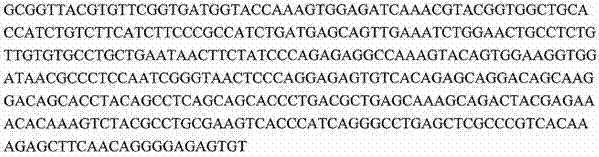
下面列出了AX1_IgG2序列。 The AX1_IgG2 sequence is listed below.
AX1_IgG2重链的氨基酸序列(SEQ ID NO: 79) Amino acid sequence of AX1_IgG2 heavy chain (SEQ ID NO: 79)
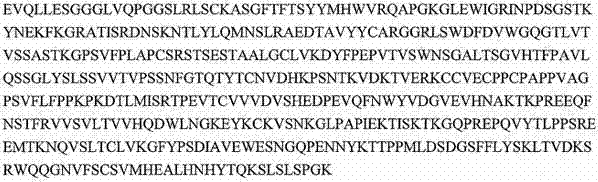
AX1_IgG2重链的DNA序列(SEQ ID NO: 80) DNA sequence of AX1_IgG2 heavy chain (SEQ ID NO: 80)

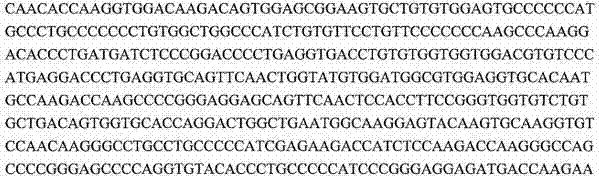

AX1_IgG2轻链的氨基酸序列(SEQ ID NO: 85) Amino acid sequence of AX1_IgG2 light chain (SEQ ID NO: 85)

AX1_IgG2轻链的DNA序列(SEQ ID NO: 86) The DNA sequence of the AX1_IgG2 light chain (SEQ ID NO: 86)
AX1_Fab展示载体序列(SEQ ID NO: 91): AX1_Fab display vector sequence (SEQ ID NO: 91):


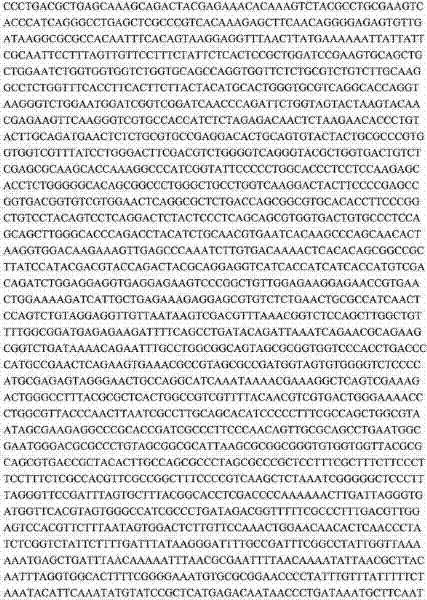

AX9_VH的氨基酸序列(SEQ ID NO: 43): Amino acid sequence of AX9_VH (SEQ ID NO: 43):
AX9_VH的DNA序列(SEQ ID NO: 44): The DNA sequence of AX9_VH (SEQ ID NO: 44):
AX9_VK的氨基酸序列(SEQ ID NO: 53): Amino acid sequence of AX9_VK (SEQ ID NO: 53):

AX9_VK的DNA序列(SEQ ID NO: 54): DNA sequence of AX9_VK (SEQ ID NO: 54):

AX9 fd链的氨基酸序列(Fab分子)(SEQ ID NO: 71) Amino acid sequence of AX9 fd chain (Fab molecule) (SEQ ID NO: 71)

AX9 fd链的DNA序列(Fab分子)(SEQ ID NO: 72) DNA sequence of AX9 fd chain (Fab molecule) (SEQ ID NO: 72)

AX9轻链的氨基酸序列(Fab分子)(SEQ ID NO: 75) Amino acid sequence (Fab molecule) of AX9 light chain (SEQ ID NO: 75)

AX9轻链的DNA序列(Fab分子)(SEQ ID NO: 76) DNA sequence of AX9 light chain (Fab molecule) (SEQ ID NO: 76)

下面列出了AX9_IgG2序列。 The AX9_IgG2 sequence is listed below.
AX9_IgG2重链的氨基酸序列(SEQ ID NO: 81) Amino acid sequence of AX9_IgG2 heavy chain (SEQ ID NO: 81)

AX9_IgG2重链的DNA序列(SEQ ID NO: 82) DNA sequence of AX9_IgG2 heavy chain (SEQ ID NO: 82)

AX9_IgG2轻链的氨基酸序列(SEQ ID NO: 87) Amino acid sequence of AX9_IgG2 light chain (SEQ ID NO: 87)

AX9_IgG2轻链的DNA序列(SEQ ID NO: 88) The DNA sequence of the AX9_IgG2 light chain (SEQ ID NO: 88)


AX9_Fab展示载体序列(SEQ ID NO: 92): AX9_Fab display vector sequence (SEQ ID NO: 92):

实施例5 Example 5
基于BIACORE的结合表位框并的竞争试验 BIACORE-based competition assay for binding epitope framing
根据胺偶联试剂盒(Amine
Coupling Kit)(GE/Biacore)的说明书,通过将PCSK9的伯胺基团偶联到传感器芯片的羧化表面上,将人PCSK9蛋白固定化在CM5芯片上。简而言之,在pH 5.5/10mM乙酸盐溶液中将hPCSK9蛋白稀释至50 μg/ml,并注射到NHS/EDC活化表面上,以达到1000 -2000 RU的固定化水平,随后通过注射乙醇胺,灭活表面。然后注射Fab或IgG蛋白(1 μM,在HBS-P缓冲液中),结合3分钟,随后解离5分钟。在结合表位框并试验中,用相同量的hPCSK9蛋白固定化2个流动池,以检测抗体1和抗体2之间的结合竞争。在流动池1上,抗体1被注射2次,以占据它的结合表位,然后注射抗体2进行结合。流动池2设作参照,其上面仅注射抗体2进行结合。为了测定抗体1和抗体2之间是否存在竞争,叠加来自两个流动池的抗体2的传感图。当2种抗体竞争时,抗体1的预先占据显著地或完全地抑制抗体2结合。完成了来自PDL1文库的19种抗体的交叉竞争,并鉴别出在人PCSK9上的3个独立表位框,参见表2。Ax1和Ax9竞争PCSK9结合,并共有表位框B。
According to the amine coupling kit (Amine
Coupling Kit) (GE/Biacore), immobilized human PCSK9 protein on a CM5 chip by coupling the primary amine groups of PCSK9 to the carboxylated surface of the sensor chip. Briefly, hPCSK9 protein was diluted to 50 μg/ml in pH 5.5/10 mM acetate solution and injected onto NHS/EDC activated surfaces to achieve an immobilization level of 1000-2000 RU, followed by injection of ethanolamine , to inactivate the surface. Fab or IgG protein (1 μM in HBS-P buffer) was then injected for 3 min of binding followed by 5 min of dissociation. In the binding epitope binding assay, 2 flow cells were immobilized with the same amount of hPCSK9 protein to detect the binding competition between
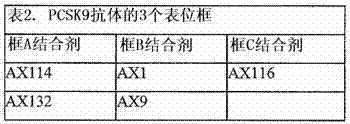

实施例6 Example 6
AX1工程化 AX1 engineering
从IgG2表达载体中的FGDGTKVEIK至FGGGTKVEIK,工程化抗体的VK_FR4,得到AX1变体AX1DG。 VK_FR4 of the antibody was engineered from FG D GTKVEIK to FG G GTKVEIK in an IgG2 expression vector, resulting in the AX1 variant AX1DG.
AX1DG_VH的氨基酸序列(SEQ ID NO: 41): Amino acid sequence of AX1DG_VH (SEQ ID NO: 41):

AX1DG_VK的氨基酸序列(SEQ ID NO: 52): Amino acid sequence of AX1DG_VK (SEQ ID NO: 52):

AX1DG维持与人和恒河猴PCSK9蛋白的结合亲和力,如表3所示。 AX1DG maintains binding affinity to human and rhesus PCSK9 proteins, as shown in Table 3.

实施例7 Example 7
AX9的优化 Optimization for AX9
使用如在Wang等人, Journal of Molecular Biology 2010, 395:1088-1101中所述的接头指导的噬菌体展示技术,构建AX9轻链文库。处理从所述文库开发的噬菌体,用于针对PCSK9进行淘选,如在实施例2中所述。对PCSK9阳性克隆测序,发现了包括AX189的13种独特Vk变体。在图2A中描绘了AX9变体的VK序列。还在图2B中描绘了VK变体的共有序列。 Using as in Wang et al., The linker-directed phage display technology described in Journal of Molecular Biology 2010, 395:1088-1101 was used to construct the AX9 light chain library. Phage developed from the library were processed for panning against PCSK9 as described in Example 2. Sequencing of PCSK9-positive clones revealed 13 unique Vk variants including AX189. The VK sequences of the AX9 variants are depicted in Figure 2A. The consensus sequence of the VK variants is also depicted in Figure 2B.
下面列出了一个变体AX189的序列。 The sequence of one variant, AX189, is listed below.
AX189_VH的氨基酸序列(SEQ ID NO: 43): Amino acid sequence of AX189_VH (SEQ ID NO: 43):

AX189_VH的DNA序列(SEQ ID NO: 44): The DNA sequence of AX189_VH (SEQ ID NO: 44):

AX189_VK的氨基酸序列(SEQ ID NO: 67): Amino acid sequence of AX189_VK (SEQ ID NO: 67):

AX189_VK的DNA序列(SEQ ID NO: 68): The DNA sequence of AX189_VK (SEQ ID NO: 68):
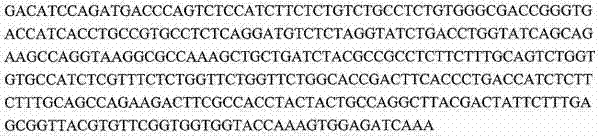
AX189 fd链的氨基酸序列(Fab分子)(SEQ ID NO: 71) Amino acid sequence (Fab molecule) of AX189 fd chain (SEQ ID NO: 71)

AX189 fd链的DNA序列(Fab分子)(SEQ ID NO: 72) DNA sequence of AX189 fd chain (Fab molecule) (SEQ ID NO: 72)


AX189轻链的氨基酸序列(Fab分子)(SEQ ID NO: 77) Amino acid sequence (Fab molecule) of AX189 light chain (SEQ ID NO: 77)

AX189轻链的DNA序列(Fab分子)(SEQ ID NO: 78) DNA sequence of AX189 light chain (Fab molecule) (SEQ ID NO: 78)

下面列出了AX189_IgG2序列。 The AX189_IgG2 sequence is listed below.
AX189_IgG2重链的氨基酸序列,包括前导序列(SEQ ID NO: 83) Amino acid sequence of AX189_IgG2 heavy chain, including leader sequence (SEQ ID NO: 83)

AX189_IgG2重链的DNA序列(SEQ ID NO: 84) DNA sequence of AX189_IgG2 heavy chain (SEQ ID NO: 84)
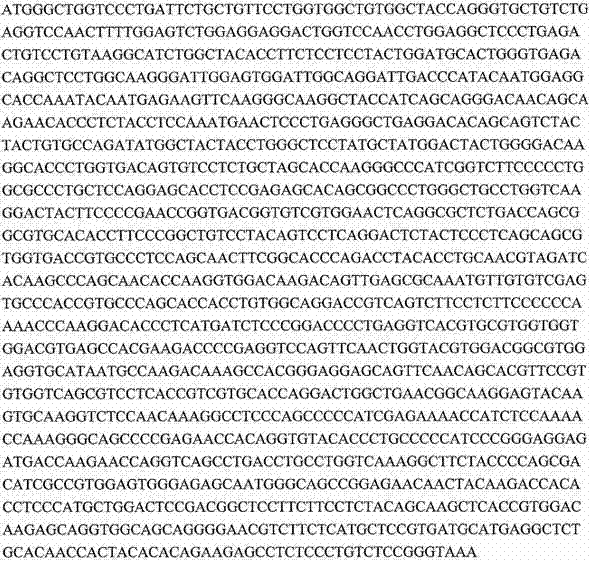
AX189_IgG2轻链的氨基酸序列,包括前导序列(SEQ ID NO: 89) Amino acid sequence of AX189_IgG2 light chain, including leader sequence (SEQ ID NO: 89)

AX189_IgG2轻链的DNA序列(SEQ ID NO: 90) DNA sequence of AX189_IgG2 light chain (SEQ ID NO: 90)


AX189_Fab展示载体序列(SEQ ID NO: 93): AX189_Fab display vector sequence (SEQ ID NO: 93):


下面是测得的CDR的序列,包括共有序列和变体序列: The following are the sequences of the measured CDRs, including consensus and variant sequences:
SEQ ID NO: 1 -共有序列VH CDR1 SEQ ID NO: 1 - Consensus VH CDR1

其中在位置1处的X是K或A;在位置5处的X是Y或F;在位置6处的X是T或D;在位置8处的X是S或T;在位置9处的X是S或D;在位置11处的X是W、Y、T或D;在位置12处的X是M、F、Y或I;且在位置13处的X是H、S或N。
where X at
其中在位置2处的X是I或V;在位置3处的X是G或S;在位置4处的X是R或Y;在位置6处的X是D、Y、E或N;在位置8处的X是Y或D;在位置9处的X是N、S或T;在位置10处的X是G、E或T;在位置11处的X是G、Y、D或S;在位置19处的X是K、A或D;在位置20处的X是G、S或D;在位置21处的X是K或R;且在位置22处的X是A或F。
where X at


其中在位置4处的X是Y、S、D或E;在位置5处的X是G、T或R;在位置8处的X是L、E、D、G或S;在位置9处的X是G、D或E;在位置10处的X是S、Y或F;且在位置13处的X是M、F、Y、L或E。
where X at

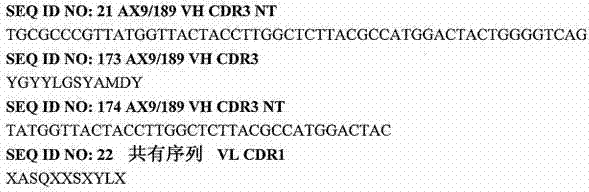
其中在位置1处的X是R或K;在位置5处的X是D或S;在位置6处的X是V或I;在位置8处的X是R、K、T或N;且在位置11处的X是T、A或S。
wherein X at
SEQ ID NO: 23共有序列VL CDR1 SEQ ID NO: 23 Consensus VL CDR1

其中在位置5处的X是A、D或S;在位置6处的X是V或I;在位置8处的X是R、K、N或S;在位置11处的X是A、T、N或H。
where X at

其中在位置1处的X是A或R;在位置3处的X是S、E或T;在位置4处的X是S、E、D或T;在位置6处的X是Q、R、K、Y或E;且在位置7处的X是S、T或A。
where X at
其中在位置1处的X是Q、E、Y或A;在位置2处的X是A、V或S;在位置3处的X是Y、E或W;在位置5处的X是Y、S或K;在位置6处的X是S或E;在位置7的X是L、S、P、G、D或T;在位置8处的X是S、D、N、E、G或A;在位置9处的X是G、A、D、R、S或H;且在位置10处的X是 Y或V。
Where X at
SEQ ID NO: 34共有序列VL CDR3 SEQ ID NO: 34 Consensus VL CDR3

其中在位置1处的X是Q或E;在位置2处的X是A、S或V;在位置5处的X是Y或S;在位置7处的X是L、S或P;在位置8处的X是G、S或N;在位置9处的X是A、H、P、R、G或D;且在位置10处的X是Y或W。
where X at

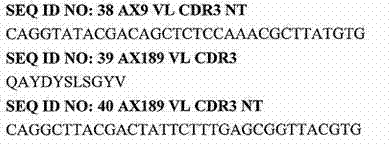
实施例8 Example 8
去除了去酰胺化位点的工程化的AX189变体 Engineered AX189 variant with deamidation site removed
为了去除在AX189的VH_CDR2中的潜在的去酰胺化位点,制备了AX189_VH的5个突变体,它们具有下述变化:56G变成E(AX421)、55N变成S(AX422)、56G变成T(AX423)、55N变成T(AX424)和55N变成D(AX425)。亲和力测量证实,那些变化仍然维持PCSK9结合活性(参见实施例15中的表7)。 To remove the potential deamidation site in the VH_CDR2 of AX189, five mutants of AX189_VH were prepared with the following changes: 56G to E (AX421), 55N to S (AX422), 56G to T (AX423), 55N becomes T (AX424) and 55N becomes D (AX425). Affinity measurements confirmed that those changes still maintained PCSK9 binding activity (see Table 7 in Example 15).
AX421_VH的氨基酸序列(SEQ ID NO: 45): Amino acid sequence of AX421_VH (SEQ ID NO: 45):

AX422_VH的氨基酸序列(SEQ ID NO: 46): Amino acid sequence of AX422_VH (SEQ ID NO: 46):

AX423_VH的氨基酸序列(SEQ ID NO: 47): Amino acid sequence of AX423_VH (SEQ ID NO: 47):

AX424_VH的氨基酸序列(SEQ ID NO: 48): Amino acid sequence of AX424_VH (SEQ ID NO: 48):

AX425_VH的氨基酸序列(SEQ ID NO: 49): Amino acid sequence of AX425_VH (SEQ ID NO: 49):

AX421、AX422、AX423、AX424和AX425的VK的氨基酸序列(SEQ ID NO: 67): Amino acid sequence of the VK of AX421, AX422, AX423, AX424 and AX425 (SEQ ID NO: 67):
在HEK-239细胞中,制备2个AX189突变体AX422(55N变成S)和AX424(55N变成T)的IgG2。通过Biacore,测量它们对人和恒河猴PCSK9的亲和力。结果(实施例15中的表8)表明,这些突变体维持对人和恒河猴PCSK9的亲和力,具有与野生型AX189类似的Kon、Koff。AX422和AX424也维持它的体外FcRn结合特性。此外,AX422和AX424变体在基于细胞的Exopolar试验中具有相当的或更好的IC50(参见实施例17中的表10)。 In HEK-239 cells, IgG2 of two AX189 mutants, AX422 (55N changed to S) and AX424 (55N changed to T), were prepared. Their affinity to human and rhesus PCSK9 was measured by Biacore. The results (Table 8 in Example 15) indicated that these mutants maintained affinity to human and rhesus PCSK9, with Kon, Koff similar to wild type AX189. AX422 and AX424 also maintained its in vitro FcRn binding properties. Furthermore, the AX422 and AX424 variants had comparable or better IC50s in the cell-based Exopolar assay (see Table 10 in Example 17).
实施例9 Example 9
AX1和AX189表位作图的计算对接(docking)和PCSK9诱变 Computational docking and PCSK9 mutagenesis for AX1 and AX189 epitope mapping
定义: 如果PCSK9残基的Cα原子(参见,例如,Carl Branden & John Tooze的“Introduction to Protein Structure”, 第2版, 1999 Garland出版)距离给定的抗体的CA是在10埃(“Å”)内,则认为在PCSK9上的给定残基与所述抗体接触。关于X-射线结构,接触的残基会限定表位。关于在给定的表位框内的对接姿势(pose),具有高于阈值(>50-75%)的频率的接触残基限定表位。如果这些蛋白的任意CA原子之间的距离短于5Å,则基于它们的结构模型,将2种蛋白(例如具有对照Fab的AX1,其结合PCSK9 EGFA结合区)定义为竞争。 Definition: If the Cα atom of a PCSK9 residue (see, e.g., Carl Branden & John Tooze's "Introduction to Protein Structure", 2nd Edition, 1999 Garland Publishing) is within 10 Angstroms ("Å") of a given antibody's CA, a given residue on PCSK9 is considered to be in contact with the antibody. Regarding X-ray Structure, residues in contact define the epitope. Residues in contact with a frequency above a threshold (>50-75%) define the epitope with respect to docking poses within a given epitope frame. If these The distance between any CA atoms of proteins is shorter than 5 Å, based on their structural models, 2 proteins (eg AX1 with control Fab, which binds the PCSK9 EGFA binding domain) were defined as competition.
为了测定AX1和AX189的表位,已经用FTDOCK程序(Gabb等人,J. Mol. Biol. 1997;272:106-120)进行了总对接。已经首先过滤产生的姿势,以确保它们不会与对照抗体竞争(参见上面的定义),然后确保抗体的重(即非氢)原子距离在人和小鼠中不同的残基的重原子不超过5Å。进一步过滤剩余的姿势,以确保它们与EGF-AB竞争。已经将过滤的姿势分簇,并分析接触,以确定表位。 To determine the epitopes of AX1 and AX189, total docking has been performed with the FTDOCK program (Gabb et al., J. Mol. Biol. 1997;272:106-120). The resulting poses have been filtered first to ensure that they do not compete with the control antibody (see definition above), and then to ensure that heavy (i.e. non-hydrogen) atoms of the antibody are no more than 5Å. The remaining poses were further filtered to ensure they compete with EGF-AB. Filtered poses have been clustered and contacts analyzed to identify epitopes.
基于计算对接研究,已经测定了3个框,如图3所示。 Based on computational docking studies, 3 boxes have been determined, as shown in Figure 3.
表4显示了人和大鼠PCSK9之间的抗体结合分化。 Table 4 shows the antibody binding differentiation between human and rat PCSK9.

基于亲和力分化,已经选择针对大鼠PCSK9残基的人PCSK9嵌合突变,以区分和测试表位框。已经设计了共6个嵌合的突变体。每个突变体代表PCSK9上的一个修补,参见表5。突变体#1是在框1中,预期突变体#2(来自框2)或突变体3(来自框3)会消除其它抗体诸如AX1/AX1DG和AX189的结合。基于人和大鼠PCSK9序列之间的差异,选择剩余的突变体,并基于它们的空间接近,进行划分。跳过几个残基,因为它们面向前-结构域/被包埋/不在rPCSK9中。
Based on affinity differentiation, human PCSK9 chimeric mutations targeting rat PCSK9 residues have been selected to differentiate and test epitope cassettes. A total of 6 chimeric mutants have been designed. Each mutant represents a patch on PCSK9, see Table 5.

从HEK293细胞生产人PCSK9突变蛋白。简而言之,通过定位诱变,修饰在具有His-标签的哺乳动物表达载体内的全长人PCSK9的基因,以诱导基于表5的对应突变。然后,将PCSK9突变体的载体瞬时转染进人HEK293细胞中,在37 ℃培养7-10天。通过NTA柱(GE Healthcare,Pittsburgh,宾夕法尼亚州),从培养物上清液中纯化His-标签化的PCSK9突变蛋白。使用10% SDS-PAGE,分析PCSK9蛋白的质量。 Production of human PCSK9 muteins from HEK293 cells. Briefly, the gene for full-length human PCSK9 within a His-tag mammalian expression vector was modified by site-directed mutagenesis to induce the corresponding mutations based on Table 5. Then, the vector of the PCSK9 mutant was transiently transfected into human HEK293 cells and cultured at 37°C for 7-10 days. His-tagged PCSK9 muteins were purified from culture supernatants by NTA columns (GE Healthcare, Pittsburgh, PA). The quality of PCSK9 protein was analyzed using 10% SDS-PAGE.
进行ELISA试验,以研究PCSK9突变体与抗-PCSK9抗体(包括AX1DG和AX189)的结合。简而言之,用PBS稀释PCSK9突变蛋白至5 μg/ml的浓度,并以100 μl/孔在4 ℃包被96-孔ELISA平板过夜。在用5%奶-PBS封闭以后,将抗体样品(在5%奶-PBS中,从4 nM起始浓度开始1:2系列稀释)加入被单一PCSK9突变体包被的孔中,并在室温温育1小时。在PBS洗涤以后,加入与HRP缀合的抗-人K抗体,并温育另外1小时。然后将TMB底物溶液(Thermo Scientific)加入PBS洗过的平板中,显影10 -20分钟。加入终止溶液以后,在450 nM测量平板的吸光度。 ELISA assays were performed to study the binding of PCSK9 mutants to anti-PCSK9 antibodies, including AX1DG and AX189. Briefly, PCSK9 muteins were diluted with PBS to a concentration of 5 μg/ml, and 96-well ELISA plates were coated at 100 μl/well overnight at 4°C. After blocking with 5% milk-PBS, antibody samples (1:2 serial dilutions in 5% milk-PBS starting from a starting concentration of 4 nM) were added to wells coated with a single PCSK9 mutant and incubated at room temperature. Incubate for 1 hour. After washing with PBS, anti-human K antibody conjugated to HRP was added and incubated for another 1 hour. Then the TMB substrate solution (Thermo Scientific) was added to the plate washed with PBS and developed for 10 -20 minutes. After adding the stop solution, the absorbance of the plate was measured at 450 nM.
显示在图4中的ELISA结果指示,PCSK9突变体#2与抗体AX1DG和AX189的结合显著减少,这提示,AX1DG和AX189结合表位框2。PCSK9突变体#2具有E366K和E426M的氨基酸置换(图5)。
The ELISA results shown in Figure 4 indicated that
实施例10 Example 10
通过氢-氘交换质谱法(DXMS)进行表位作图 Epitope mapping by hydrogen-deuterium exchange mass spectrometry (DXMS)
为了鉴别被抗-PCSK9抗体识别的PCSK9的不同表位区,将氢-氘交换应用于PCSK9,随后基于Wood和Hamuro(2001)的方法进行肽消化和质谱法,并进一步开发和自动化(Hamuro等人,2003 J. Biomolec. Tech. 14:171-182; Coales等人, 2009 Rapid Comm. Mass Spect. 23:639-647。该多步骤规程描述在下面。 To identify distinct epitopic regions of PCSK9 recognized by anti-PCSK9 antibodies, hydrogen-deuterium exchange was applied to PCSK9, followed by peptide digestion and mass spectrometry based on the method of Wood and Hamuro (2001), and further developed and automated (Hamuro et al. People, 2003 J. Biomolec. Tech. 14:171-182; Coales et al., 2009 Rapid Comm. Mass Spect. 23:639-647. The multi-step procedure is described below.
抗体亲和柱制备:通过与溴化氰活化的Poros AL树脂一起温育过夜,将抗体固定化,然后使用过滤漏斗,用PBS进行洗涤。通过将干燥的树脂重新悬浮于乙醇胺溶液中2小时,将反应物加帽,然后使用过滤漏斗,用PBS进行洗涤。将树脂重新悬浮于PBS中,然后填入柱。在3 ℃用PBS(pH 7,含有2mM NaCl,在交换缓冲液H中)平衡柱。使用注射泵,进行所有柱注射和温育。
Antibody affinity column preparation: Antibodies were immobilized by overnight incubation with cyanogen bromide-activated Poros AL resin, followed by washing with PBS using filter funnels. Reactions were capped by resuspending the dried resin in ethanolamine solution for 2 hours, then washed with PBS using a filter funnel. The resin was resuspended in PBS and packed into the column. The column was equilibrated with PBS (
溶液上(On-solution)和离开柱(off-column)氘交换:将交换H缓冲液制备为在水中的PBS。将交换D缓冲液制备为在D2O中的PBS。将交换HD缓冲液制备为在50% D2O中的PBS。在3 ℃进行所有交换步骤。用0.8% 甲酸清洁mAb柱,洗涤,并用交换HD缓冲液平衡。如下开始氘核的溶液上交换:将PCSK9样品与交换D缓冲液1:1混合,并温育预定的时间。然后将混合物注射进mAb柱,并用交换HD缓冲液洗涤。如下开始离开柱交换:用交换H缓冲液洗涤,并温育预定的时间。猝灭离开柱交换,并使用0.8% 甲酸洗脱PCSK9。收集级分,并分析。 On-solution and off-column deuterium exchange: Prepare exchange H buffer as PBS in water. Prepare exchange D buffer as PBS in D2O . Exchange HD buffer was prepared as PBS in 50% D2O . All exchange steps were performed at 3 °C. The mAb column was cleaned with 0.8% formic acid, washed, and equilibrated with exchange HD buffer. In-solution exchange of deuterons was initiated by mixing PCSK9 samples 1:1 with exchange D buffer and incubating for a predetermined time. The mixture was then injected into a mAb column and washed with exchange HD buffer. Initiate off-column exchange by washing with exchange H buffer and incubating for a predetermined time. The off-column exchange was quenched and PCSK9 was eluted using 0.8% formic acid. Fractions were collected and analyzed.
上柱和离开柱氘交换:在3℃进行所有交换步骤。用0.8% 甲酸清洁mAb柱,洗涤,并用交换HD缓冲液平衡。将在交换H缓冲液中的PCSK9装载上mAb柱,并用交换H缓冲液洗涤。如下开始氘核的上柱交换:注射交换HD缓冲液,并温育预定的时间。如上进行离开柱交换,和猝灭。收集级分,并分析。 On-column and off-column deuterium exchange: All exchange steps were performed at 3°C. The mAb column was cleaned with 0.8% formic acid, washed, and equilibrated with exchange HD buffer. PCSK9 in exchanged H buffer was loaded onto the mAb column and washed with exchanged H buffer. The exchange of deuterons onto the column was initiated by injecting exchange HD buffer and incubating for a predetermined time. Exchange off the column, and quenching were performed as above. Fractions were collected and analyzed.
PCSK9的完全氘化:在在D2O中制备的PBS中平衡PCSK9,并在60℃温育3小时。将其冷却至室温,并在冰上保藏。将完全氘化的PCSK9在HD交换缓冲液中装载上抗体亲和柱,并用相同的缓冲液洗涤。洗脱和分析与上面相同。 Complete deuteration of PCSK9: Equilibrate PCSK9 in PBS prepared in D2O and incubate at 60°C for 3 hours. It was cooled to room temperature and kept on ice. Fully deuterated PCSK9 was loaded onto the antibody affinity column in HD exchange buffer and washed with the same buffer. Elution and analysis were the same as above.
通过质谱法进行肽分析:将洗脱的PCSK9注射进固定化的胃蛋白酶柱中,然后上C18反相LC-MS,以鉴别片段。在2M脲、1M TCEP(pH3)中在0℃将来自洗脱的级分的PCSK9变性和还原2分钟。然后使样品在缓冲液A(在水中的0.05% TFA)中穿过固定化的胃蛋白酶柱。将肽片段装载上反相捕获柱,并在缓冲液A中脱盐。使用在23分钟内13-40%缓冲液B(95% 乙腈、5% 水、0.0025% TFA)的线性梯度,通过C18柱,分离肽片段。通过质谱法,检测肽。
Peptide analysis by mass spectrometry: The eluted PCSK9 was injected into an immobilized pepsin column followed by C18 reverse phase LC-MS to identify fragments. PCSK9 from eluted fractions was denatured and reduced in 2M urea, 1M TCEP,
通过MS测得的已知肽片段的质量的漂移,用于测定HD交换水平。从结合的相对于未结合的PCSK9的HD交换比率,确定交换百分比,其指示抗体的表位保护程度。氘化变化百分比是5%的截止,作为去除噪音的阈值。 The mass shift of known peptide fragments measured by MS was used to determine HD exchange levels. From the HD exchange ratio of bound versus unbound PCSK9, the percent exchange was determined, which is indicative of the degree of epitope protection of the antibody. The percent change in deuteration was a 5% cutoff as a threshold for noise removal.
如图6和图7所示,在AX1和AX189结合以后表现出最大氘化差异的PCSK9肽片段是非常类似的。所述片段是 As shown in Figures 6 and 7, the PCSK9 peptide fragments that exhibited the greatest difference in deuteration following AX1 and AX189 binding were very similar. The snippet is


图8显示了PCSK9(PDB: 2PMW),含有AX1和AX189表位的肽片段被突出显示。这些片段是:


HD交换结果与来自实施例9中的计算对接和PCSK9诱变研究的数据相一致。表现出最大氘化差异的肽片段与在实施例9中预测的框2片段在很大程度上重叠。
The HD exchange results are consistent with data from computational docking and PCSK9 mutagenesis studies in Example 9. The peptide fragments exhibiting the greatest deuteration differences largely overlap with the
实施例11 Example 11
FAB结构域热稳定性 FAB domain thermal stability
通过在Origin 5.0中分析和解卷积过热容量函数,从DSC实验中测定Fab和Fab结构域的热稳定性。在表6中指出了Fab或Fab结构域的解链转变温度(Tm)。对于AX1、AX9、AX189和变体抗体,不同的Fab和Fab结构域的Tm范围是72-78℃,这与正确折叠的抗体Fab区相一致。 Thermal stability of Fab and Fab domains was determined from DSC experiments by analyzing and deconvoluting the superheat capacity function in Origin 5.0. In Table 6 the melting transition temperature (Tm) of the Fab or Fab domain is indicated. For AX1, AX9, AX189 and variant antibodies, the Tm of the different Fab and Fab domains ranged from 72-78°C, which is consistent with the correctly folded antibody Fab region.
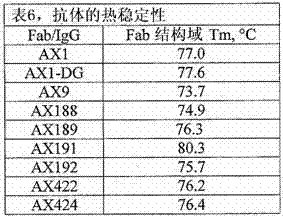
实施例12 Example 12
抗体与在PCSK9上的AX1/AX189表位的结合的选择 Selection of antibodies for binding to the AX1/AX189 epitope on PCSK9
使用与AX1/AX189竞争结合的EGF_AB肽,也可以从噬菌体展示抗体文库中选择出具有AX1/AX189结合表位的抗体。在噬菌体文库与包被在平板上的人PCSK9结合以后,可以加入EGF_AB蛋白,以洗脱结合噬菌体。然后可以针对人PCSK9和PCSK9突变体#2,筛选来自EGF_AB洗脱的噬菌体集合的单个克隆。如实施例9所示,AX1/AX189以高亲和力结合人PCSK9,但是非常低地结合人PCSK9突变体#2。可以对结合人PCSK9的Fab进行针对PCSK9突变体#2蛋白的结合筛选试验,强结合人PCSK9、但是弱结合或不结合PCSK9突变体#2的Fab共有AX1/AX189结合表位。
Antibodies with AX1/AX189-binding epitopes can also be selected from phage-displayed antibody libraries using the EGF_AB peptide, which competes with AX1/AX189 for binding. After the phage library is bound to the human PCSK9 coated on the plate, EGF_AB protein can be added to elute the bound phage. Individual clones from the EGF_AB eluted phage pool can then be screened against human PCSK9 and
实施例13 Example 13
从哺乳动物细胞表达和纯化抗-PCSK9单克隆抗体 Expression and Purification of Anti-PCSK9 Monoclonal Antibody from Mammalian Cells
通过聚合酶链式反应,从质粒模板扩增编码Vk1轻链可变区的DNA序列。使用InFusion克隆系统(Clontech),将该扩增的产物克隆进已经预先用Fspl和Bmtl消化的质粒pVUNSAGS-FB-LCK中。通过在整个可变区的DNA测序,验证得到的质粒。使用Qiagen Endo-Free质粒maxiprep试剂盒,制备不含内毒素的质粒制品。通过聚合酶链式反应,扩增编码VH3的重链可变区的DNA序列,将扩增的产物克隆进已经预先用Fspl和Bmtl消化的质粒pV1 JNSA-BF-HCG2M4。通过在整个可变区的DNA测序,验证得到的质粒。使用Qiagen Endo-Free质粒maxiprep试剂盒,制备不含内毒素的质粒制品。 The DNA sequence encoding the Vk1 light chain variable region was amplified from the plasmid template by polymerase chain reaction. Using the InFusion Cloning System (Clontech), this amplified product was cloned into plasmid pVUNSAGS-FB-LCK which had been previously digested with Fspl and Bmtl. The resulting plasmids were verified by DNA sequencing over the entire variable region. Endotoxin-free plasmid preparations were prepared using the Qiagen Endo-Free Plasmid maxiprep kit. The DNA sequence encoding the heavy chain variable region of VH3 was amplified by polymerase chain reaction, and the amplified product was cloned into the plasmid pV1 that had been digested with Fspl and Bmtl in advance JNSA-BF-HCG2M4. The resulting plasmids were verified by DNA sequencing over the entire variable region. Using Qiagen Endo-Free plasmid maxiprep kit to prepare endotoxin-free plasmid preparations.
以1:3混合重链和轻链的质粒DNA,并共转染进HEK293细胞。在培养5-7天后,收获上清液,并进行蛋白-A柱纯化。简而言之,以5.0mL/min的流速,将无细胞的上清液装载上蛋白-A柱,所述柱用3柱体积的20mM Tris-HCl pH7.0预平衡过。用3柱体积的20mM Tris-HCl pH7.0洗涤柱,随后用5柱体积的20mM Tris-HCl pH7.0(含有1M
NaCl)洗涤柱,以去除宿主细胞蛋白。用5柱体积的100
mM甘氨酸、100 mM精氨酸pH
3.0洗脱抗-PCSK9抗体,并立即用1M
Tris-HCl pH8.0中和。
Plasmid DNAs of heavy and light chains were mixed 1:3 and co-transfected into HEK293 cells. After 5-7 days of culture, the supernatant was harvested and subjected to protein-A column purification. Briefly, the cell-free supernatant was loaded onto a protein-A column pre-equilibrated with 3 column volumes of 20 mM Tris-HCl pH 7.0 at a flow rate of 5.0 mL/min. Wash the column with 3 column volumes of 20 mM Tris-HCl pH 7.0, followed by 5 column volumes of 20 mM Tris-HCl pH 7.0 (containing 1 M
NaCl) to remove host cell proteins.
实施例14 Example 14
从糖工程化的巴斯德毕赤酵母表达和纯化抗-PCSK9单克隆抗体 Expression and purification of anti-PCSK9 monoclonal antibody from glycoengineered Pichia pastoris
在糖工程化的巴斯德毕赤酵母GFI
5.0宿主YGLY8316(其能够转移在它的复杂的N-连接的聚糖处的末端半乳糖)中,表达抗-PCSK9 IgG2单克隆抗体。对抗-PCSK9重链和轻链进行密码子优化,并使用酿酒酵母α交配因子前序列作为分泌信号序列,在甲醇紧密诱导型启动子AOX1下表达。使用来自GE Healthcare的MabSelect™介质(目录号17-5199-01),通过亲和色谱法,从无细胞的上清液培养基中捕获来自巴斯德毕赤酵母GFI 5.0宿主YGLY8316的抗-PCSK9抗体。以5.0mL/min的流速,将无细胞的上清液装载上Mabselect柱(XK
16/20, 1.6cm x 10.0 cm),该柱用3柱体积的20mM Tris-HCl pH7.0预平衡过。用3柱体积的20mM Tris-HCl pH7.0洗涤柱,随后用5柱体积的20mM Tris-HCl pH7.0(含有1M
NaCl)洗涤柱,以去除宿主细胞蛋白。用5柱体积的100
mM甘氨酸、100 mM精氨酸pH
3.0洗脱抗-PCSK9抗体,并立即用1M
Tris-HCl pH8.0中和。AX1和AX1DG抗体在毕赤酵母中充分表达,在约40小时诱导过程中产生约100-250 mg/L的蛋白。对于AX189,在工程化的毕赤酵母菌株中的表达产量达到450 mg/L。
Glycoengineered Pichia pastoris GFI
Anti-PCSK9 IgG2 monoclonal antibody was expressed in the 5.0 host YGLY8316, which is capable of transferring terminal galactose at its complex N-linked glycans. The anti-PCSK9 heavy and light chains were codon optimized and expressed under the methanol-tight inducible promoter AOX1 using the S. cerevisiae alpha mating factor presequence as the secretion signal sequence. Anti-PCSK9 from Pichia pastoris GFI 5.0 host YGLY8316 was captured from cell-free supernatant media by affinity chromatography using MabSelect™ medium from GE Healthcare (cat# 17-5199-01) Antibody. At a flow rate of 5.0 mL/min, the cell-free supernatant was loaded onto a Mabselect column (XK
16/20, 1.6cm x 10.0 cm), the column was pre-equilibrated with 3 column volumes of 20mM Tris-HCl pH 7.0. Wash the column with 3 column volumes of 20 mM Tris-HCl pH 7.0, followed by 5 column volumes of 20 mM Tris-HCl pH 7.0 (containing 1 M
NaCl) to remove host cell proteins.
使用强阳离子交换色谱法,采用来自GE Healthcare的Source 30S树脂(目录号17-1273-02),作为第二步纯化,以去除剪切的物质和聚集体。用25mM醋酸钠pH5.0稀释抗-PCSK9抗体的Mabselect集合5倍,并装载上Source 30S柱,该柱用3柱体积的25mM醋酸钠pH5.0预平衡过。装载后,用3柱体积的25mM醋酸钠pH5.0洗涤柱,并通过10柱体积的线性梯度(从100mM至150mM氯化钠,在25mM醋酸钠中,pH5.0),进行洗脱。将含有正确装配的抗-PCSK9抗体的级分集合到一起。将含有抗-PCSK9抗体的Source30S集合的级分缓冲液交换进含有6% 蔗糖、100mM精氨酸、100mM组氨酸的配制缓冲液(pH6.0)(HyClone®目录号RR10804.02)中,并使用0.2 μm PES(聚醚砜)膜滤器无菌过滤,并在4℃保存备用。 Strong cation exchange chromatography was used with Source 30S resin from GE Healthcare (cat. no. 17-1273-02) as a second purification step to remove sheared material and aggregates. The Mabselect pool of anti-PCSK9 antibodies was diluted 5-fold with 25 mM sodium acetate pH 5.0 and loaded onto a Source 30S column pre-equilibrated with 3 column volumes of 25 mM sodium acetate pH 5.0. After loading, the column was washed with 3 column volumes of 25 mM sodium acetate, pH 5.0, and eluted by a 10 column volume linear gradient from 100 mM to 150 mM sodium chloride in 25 mM sodium acetate, pH 5.0. Fractions containing correctly assembled anti-PCSK9 antibodies were pooled. Fractions of the Source30S pool containing anti-PCSK9 antibodies were buffer exchanged into formulation buffer (pH 6.0) (HyClone® cat# RR10804.02) containing 6% sucrose, 100 mM arginine, 100 mM histidine, And use 0.2 μm PES (polyethersulfone) membrane filter to sterile filter, and store at 4 ℃ for later use.
实施例15 Example 15
用于亲和力测量的BIACORE试验 BIACORE assay for affinity measurement
为了测定Fab对PCSK9的结合亲和力,开发了基于Fab捕获的Biacore试验。首先,通过如上所述的胺偶联,将山羊抗-Fab IgG固定化在CM5芯片上。在pH 5/10mM乙酸盐溶液中,将抗-Fab IgG稀释至200 μg/ml,并注射到NHS/EDC活化表面上,以实现约10,000 RU的固定化水平,随后通过注射乙醇胺,灭活表面。然后,以20 μl/min的流速,注射Fab样品(2 μg/ml浓度,在HBS-P运行缓冲液中)3分钟,随后K-注射(3分钟注射进行结合,6分钟进行解离)PCSK9,浓度为10-100 nM。通过100mM磷酸的30秒注射,再生传感器芯片表面。使结合传感图与Langmuir结合模型1:1拟合,以测定结合亲和力。AX1、Ax189和其它变体的Fab亲和力如表7所示。
To determine the binding affinity of Fabs for PCSK9, a Fab capture based Biacore assay was developed. First, goat anti-Fab IgG was immobilized on a CM5 chip by amine coupling as described above. Anti-Fab IgG was diluted to 200 μg/ml in

将在基于细胞的试验中表现出功能效力的Fab转化成IgG分子。还通过Biacore试验,测量那些IgG分子的亲和力。简而言之,以8000-10000 RU的水平,将抗-人IgG单克隆抗体(来自Biacore提供的人抗体捕获试剂盒)固定化在CM5芯片上。以20 μl/min的流速,将浓度为约0.4 μg/ml的IgG样品注射到传感器芯片上2分钟,然后将5个浓度(3.75至60 nM)的PCSK9蛋白注射到IgG捕获的流动池上,用于结合动力学分析。在每轮注射以后,通过3M氯化镁的30秒注射,再生传感器芯片表面。AX1、Ax189和其它变体的亲和力如表8所示。 Fabs showing functional potency in cell-based assays were converted into IgG molecules. The affinity of those IgG molecules was also measured by Biacore assay. Briefly, anti-human IgG monoclonal antibodies (from Human Antibody Capture Kit provided by Biacore) were immobilized on CM5 chips at the level of 8000-10000 RU. At a flow rate of 20 μl/min, an IgG sample with a concentration of about 0.4 μg/ml was injected onto the sensor chip for 2 minutes, and then 5 concentrations (3.75 to 60 nM) of PCSK9 protein were injected onto the IgG-captured flow cell with for binding kinetic analysis. After each injection round, the sensor chip surface was regenerated by a 30 second injection of 3M magnesium chloride. The affinities of AX1, Ax189 and other variants are shown in Table 8.

实施例16 Example 16
PCSK9-LDLR TR-FRET试验 PCSK9-LDLR TR-FRET assay
该试验是在Fisher等人,2007 J.
Biol. Chem. 282:20502-20512中描述的试验的一种变体。将AlexaFluor647-标记的PCSK9(终浓度10 nM)与不同量的抗体相混合,向其中加入Eu(8044)-标记的LDLR胞外结构域,至终浓度约4 nM(足以产生约20,000个计数,在Fl620
nM,在Rubystar上),在10 mM
HEPES(pH 7.4)、150
mM NaCl、0.1 mM CaCl2、0.05% (w/v)BSA中,总体积为50 μL,使用96孔黑色Dynatech U底平板。在平衡至少90分钟以后,在Rubystar读数器(BMG Corp.)上读出样品,其中使用20闪烁/孔、50微秒积分延迟和200微秒总积分时间。将数据表示为(Fl665/Fl620 x 10000)之比,并使用标准4参数拟合,从S形剂量-响应曲线的拐点确定每种抗体的IC50。
This assay is a variant of the assay described in Fisher et al., 2007 J. Biol. Chem. 282:20502-20512. To AlexaFluor647-labeled PCSK9 (
图9解释了AX1抗体的结果。以TR-FRET形式测试了单克隆抗体AX1 IgG2对AF647标记的野生型人PCSK9和Eu8044标记的LDL受体的相互作用的抑制。AX1的IC50是1.0 nM。 Figure 9 illustrates the results for the AX1 antibody. Inhibition of the interaction of AF647-tagged wild-type human PCSK9 and Eu8044-tagged LDL receptor by monoclonal antibody AX1 IgG2 was tested in TR-FRET format. The IC50 of AX1 is 1.0 nM.
图10解释了AX9抗体的结果。以TR-FRET形式测试了单克隆抗体AX9 IgG2对AF647标记的野生型人PCSK9和Eu8044标记的LDL受体的相互作用的抑制。AX9的IC50是4.1 nM。 Figure 10 illustrates the results for the AX9 antibody. Inhibition of the interaction of AF647-tagged wild-type human PCSK9 and Eu8044-tagged LDL receptor by monoclonal antibody AX9 IgG2 was tested in TR-FRET format. The IC50 of AX9 is 4.1 nM.
图11解释了AX189抗体的结果。以TR-FRET形式测试了单克隆抗体AX189 IgG2对AF647标记的野生型人PCSK9和Eu8044标记的LDL受体的相互作用的抑制。AX189的IC50是6.4 nM。 Figure 11 illustrates the results for the AX189 antibody. Inhibition of the interaction of AF647-tagged wild-type human PCSK9 and Eu8044-tagged LDL receptor by monoclonal antibody AX189 IgG2 was tested in TR-FRET format. The IC50 of AX189 is 6.4 nM.
图12解释了AX191抗体的结果。以TR-FRET形式测试了单克隆抗体AX191 IgG2对AF647标记的野生型人PCSK9和Eu8044标记的LDL受体的相互作用的抑制。AX191的IC50是3.0 nM。 Figure 12 illustrates the results for the AX191 antibody. Inhibition of the interaction of AF647-tagged wild-type human PCSK9 and Eu8044-tagged LDL receptor by monoclonal antibody AX191 IgG2 was tested in TR-FRET format. The IC50 of AX191 is 3.0 nM.
实施例17 Example 17
EXOPOLAR试验:外源性的PCSK9对细胞LDL摄入的影响 EXOPOLAR trial: Effect of exogenous PCSK9 on cellular LDL uptake
在第1天,将30,000
HepG2或HEK细胞/孔接种在96孔聚D-赖氨酸包被的平板上。在第2天,将培养基更换成不含有血清的DMEM培养基。在第3天,去除培养基,用OptiMEM洗涤细胞。将纯化的PCSK9加入100 μl含有LPDS和dI-LDL的DMEM培养基中。将平板在37 ℃温育6.5小时。迅速在含有2 mg/ml BSA的TBS中洗涤细胞;然后在TBS-BSA中洗涤2分钟;然后用TBS洗涤2次(但是快速地)。在100 μl RIPA缓冲液中裂解细胞。然后使用激发波长520 nm、发射波长580
nm,测量平板中的荧光。使用BCA蛋白试验,测量每个孔中的总细胞蛋白,然后将荧光单位标准化为总蛋白。
On
Exopolar试验可有效地表征变体对LDL摄入的影响;参见下表9,该表解释了PCSK9突变体的能力如何与Exopolar试验中的血浆LDL-胆固醇相关联。 The Exopolar assay is useful for characterizing the effect of variants on LDL uptake; see Table 9 below, which explains how the potency of PCSK9 mutants correlates with plasma LDL-cholesterol in the Exopolar assay.

AX1、Axl 89和在表10中的它们的变体以剂量依赖性的方式抑制了PCSK9对LDL摄入的影响,IC50(人PCSK9)范围是5 - 25.5 nM。 AX1, Axl 89 and their variants in Table 10 inhibited the effect of PCSK9 on LDL uptake in a dose-dependent manner with IC 50 (human PCSK9) ranging from 5 - 25.5 nM.

图13显示,抗体IgG(A和B: 来自HEK细胞的Ax-1 IgG,C和D;来自毕赤酵母的AX-1 IgG)剂量依赖性地抑制细胞LDL-摄入的人(A、C和D)和恒河猴(B)PCSK9-依赖性的损失。每个实验具有2个对照: (i)仅细胞的对照,它显示细胞LDL摄入的基础水平,和(ii)PCSK9(1 μg/ml)对照,它显示LDL-摄入的PCSK9-依赖性的损失水平。进行了含有Ax-1 IgG和PCSK9的滴定实验,该实验使用固定浓度的PCSK9(1 μg/ml)和图中所示的递增浓度的抗体来进行。如所示的,Ax-1 IgG抑制了PCSK9对细胞LDL摄入的影响。对于人和恒河猴PCSK9蛋白,Ax-1 IgG的IC50分别是7 nM(n=6)和11.2 nM(n=2)。 Figure 13 shows that antibody IgG (A and B: Ax-1 IgG from HEK cells, C and D; AX-1 IgG from Pichia pastoris) dose-dependently inhibits cellular LDL-uptake in humans (A, C and D) and rhesus monkeys (B) PCSK9-dependent loss. Each experiment had 2 controls: (i) a cell-only control, which showed basal levels of cellular LDL uptake, and (ii) a PCSK9 (1 μg/ml) control, which showed PCSK9-dependence of LDL-uptake level of loss. A titration experiment with Ax-1 IgG and PCSK9 was performed using a fixed concentration of PCSK9 (1 μg/ml) and increasing concentrations of antibody indicated in the figure. As shown, Ax-1 IgG inhibited the effect of PCSK9 on cellular LDL uptake. The IC 50 of Ax-1 IgG is 7 nM (n=6) and 11.2 nM (n=2) for human and rhesus monkey PCSK9 proteins, respectively.
图14显示,Ax-9 IgG剂量依赖性地抑制细胞LDL-摄入的人(A)和恒河猴(B)PCSK9-依赖性损失。Ax-9 IgG与人和恒河猴PCSK9交叉反应。每个实验具有2个对照: (i)仅细胞的对照,它显示细胞LDL摄入的基础水平,和(ii)PCSK9(1 μg/ml)对照,它显示LDL-摄入的PCSK9-依赖性的损失水平。进行了含有Ax-9 IgG和PCSK9的滴定实验,该实验使用固定浓度的PCSK9(1 μg/ml)和图中所示的递增浓度的抗体来进行。如所示的,Ax-9 IgG抑制了PCSK9对细胞LDL摄入的影响。对于人和恒河猴PCSK9蛋白,Ax-9 IgG的IC50分别是25.5 nM(n=3)和28.6nM。 Figure 14 shows that Ax-9 IgG dose-dependently inhibits human (A) and rhesus (B) PCSK9-dependent loss of cellular LDL-uptake. Ax-9 IgG cross-reacts with human and rhesus PCSK9. Each experiment had 2 controls: (i) a cell-only control, which showed basal levels of cellular LDL uptake, and (ii) a PCSK9 (1 μg/ml) control, which showed PCSK9-dependence of LDL-uptake level of loss. A titration experiment with Ax-9 IgG and PCSK9 was performed using a fixed concentration of PCSK9 (1 μg/ml) and increasing concentrations of antibody indicated in the figure. As shown, Ax-9 IgG inhibited the effect of PCSK9 on cellular LDL uptake. The IC 50 of Ax-9 IgG is 25.5 nM (n=3) and 28.6 nM for human and rhesus monkey PCSK9 proteins, respectively.
图15显示,Ax-189 IgG剂量依赖性地抑制细胞LDL-摄入的人(A)和恒河猴(B)PCSK9-依赖性损失。Ax-189 IgG与人和恒河猴PCSK9交叉反应。每个实验具有2个对照: (i)仅细胞的对照,它显示细胞LDL摄入的基础水平,和(ii)PCSK9(1 μg/ml)对照,它显示LDL-摄入的PCSK9-依赖性的损失水平。进行了含有Ax-189 IgG和PCSK9的滴定实验,该实验使用固定浓度的PCSK9(1 μg/ml)和图中所示的递增浓度的抗体来进行。如所示的,Ax-189 IgG抑制了PCSK9对细胞LDL摄入的影响。对于人和恒河猴PCSK9蛋白,Ax-189 IgG的IC50分别是9.4 nM(n=6)和9nM(n=5)。 Figure 15 shows that Ax-189 IgG dose-dependently inhibits human (A) and rhesus (B) PCSK9-dependent loss of cellular LDL-uptake. Ax-189 IgG cross-reacts with human and rhesus PCSK9. Each experiment had 2 controls: (i) a cell-only control, which showed basal levels of cellular LDL uptake, and (ii) a PCSK9 (1 μg/ml) control, which showed PCSK9-dependence of LDL-uptake level of loss. A titration experiment with Ax-189 IgG and PCSK9 was performed using a fixed concentration of PCSK9 (1 μg/ml) and increasing concentrations of antibody indicated in the figure. As shown, Ax-189 IgG inhibited the effect of PCSK9 on cellular LDL uptake. The IC 50 of Ax-189 IgG is 9.4 nM (n=6) and 9 nM (n=5) for human and rhesus monkey PCSK9 proteins, respectively.
图16显示,Ax-191 IgG剂量依赖性地抑制细胞LDL-摄入的人(A)和恒河猴(B)PCSK9-依赖性损失。Ax-191 IgG与人和恒河猴PCSK9交叉反应。每个实验具有2个对照: (i)仅细胞的对照,它显示细胞LDL摄入的基础水平,和(ii)PCSK9(1 μg/ml)对照,它显示LDL-摄入的PCSK9-依赖性的损失水平。进行了含有Ax-191 IgG和PCSK9的滴定实验,该实验使用固定浓度的PCSK9(1 μg/ml)和图中所示的递增浓度的抗体来进行。如所示的,Ax-191 IgG抑制了PCSK9对细胞LDL摄入的影响。对于人和恒河猴PCSK9蛋白,Ax-191 IgG的IC50分别是8.7 nM(n=4)和6.6 nM(n=4)。 Figure 16 shows that Ax-191 IgG dose-dependently inhibits human (A) and rhesus monkey (B) PCSK9-dependent loss of cellular LDL-uptake. Ax-191 IgG cross-reacts with human and rhesus PCSK9. Each experiment had 2 controls: (i) a cell-only control, which showed basal levels of cellular LDL uptake, and (ii) a PCSK9 (1 μg/ml) control, which showed a PCSK9-dependence of LDL-uptake level of loss. A titration experiment with Ax-191 IgG and PCSK9 was performed using a fixed concentration of PCSK9 (1 μg/ml) and increasing concentrations of antibody indicated in the figure. As shown, Ax-191 IgG inhibited the effect of PCSK9 on cellular LDL uptake. The IC 50 of Ax-191 IgG is 8.7 nM (n=4) and 6.6 nM (n=4) for human and rhesus monkey PCSK9 proteins, respectively.
实施例18 Example 18
体外FcRn解离试验 In vitro FcRn dissociation assay
我们的内部数据表明,具有相同Fc序列、但是具有不同Fab结构域的单克隆抗体可以显著差异地结合FcRn。此外,观察到在中性pH时的解离和体内药代动力学之间的明显关联:具有缓慢解离的mAb(即>5%的“结合百分比”倾向于表现出更短的体内终末半衰期(t1/2))。将该特征用作抗体药代动力学的体外筛选工具。 Our in-house data indicate that mAbs with the same Fc sequence but different Fab domains can bind FcRn significantly differently. Furthermore, a clear correlation between dissociation at neutral pH and in vivo pharmacokinetics was observed: mAbs with slow dissociation (i.e. >5% "percent bound" tended to exhibit shorter in vivo terminal half-life (t 1/2 )). This feature was used as an in vitro screening tool for antibody pharmacokinetics.
使用Biacore T-100仪器,通过SPR,测量mAb从人FcRn的中性pH解离。简而言之,将纯化的FcRn蛋白固定化在Biacore CM5生物传感器芯片上,并将PBSP(50 mM NaPO4、150 mM NaCl和0.05% (v/v)表面活性剂20)pH 7.3用作运行缓冲液。用PBSP pH 6.0将mAb稀释至100 nM,允许结合FcRn 3分钟,以达到平衡,随后在pH 7.3运行缓冲液中解离1分钟。在mAb结合结束后5秒,插入报告点(稳定性),并将“结合百分比”计算为RU稳定性/RU结合(%)。 Neutral pH dissociation of mAbs from human FcRn was measured by SPR using a Biacore T-100 instrument. Briefly, purified FcRn protein was immobilized on a Biacore CM5 biosensor chip and PBSP (50 mM NaPO 4 , 150 mM NaCl, and 0.05% (v/v) surfactant 20) pH 7.3 was used as the run buffer. mAbs were diluted to 100 nM in PBSP pH 6.0, allowed to bind FcRn for 3 min to equilibrate, and then dissociated in pH 7.3 running buffer for 1 min. At 5 s after the end of mAb binding, the reporting point (stability) was inserted and the "percent bound" was calculated as RU Stability /RU Binding (%).
图17-20解释了使用Biacore测得的AX1、AX9、AX189和AX191与固定化的人FcRn的结合。计算为RU稳定性/RU结合(%)的“结合百分比”的范围是0.9%-5%。 Figures 17-20 illustrate the binding of AX1, AX9, AX189 and AX191 to immobilized human FcRn using Biacore. "Percent Binding" calculated as RU Stability /RU Binding (%) ranged from 0.9% to 5%.
实施例19 Example 19
在人FcRn小鼠中的药代动力学研究 Pharmacokinetic studies in human FcRn mice
在IgG和FcRn之间的相互作用是物种特异性的。最近已经提议人FcRn小鼠作为用于评价mAb药代动力学的有价值的替代系统;Petkova等人, 2006 Int. Immunol. 12:1759-69。从Jackson Laboratory(Bar Harbor,ME)得到在该研究中使用的人FcRn小鼠(杂合的Tg276)。它是小鼠FcRn-α链缺陷型,并携带人FcRn-α链基因。出处同上。我们的内部数据表明,与小鼠或大鼠FcRn不同,该“杂种”FcRn具有与人和猴FcRn相当的人IgG结合特征。另外,观察到在该人FcRn小鼠和非人灵长类动物之间的良好终末半衰期关联。 The interaction between IgG and FcRn is species specific. The human FcRn mouse has recently been proposed as a valuable alternative system for evaluating mAb pharmacokinetics; Petkova et al., 2006 Int. Immunol. 12:1759-69. From Jackson Laboratory (Bar Harbor, ME) obtained the human FcRn mice (heterozygous for Tg276) used in this study. It is mouse FcRn-α chain deficient and carries the human FcRn-α chain gene. The source is the same as above. Our internal data indicate that, unlike mouse or rat FcRn, this "hybrid" FcRn has human IgG binding characteristics comparable to human and monkey FcRn. In addition, a good terminal half-life correlation between the human FcRn mice and non-human primates was observed.
对于药代动力学研究,每只动物(2-3只/组)通过尾静脉接受10 mg/kg的mAb的单次静脉内注射。在指定的时间点,收集一系列10 μL血液。使用验证过的抗-人IgG免疫试验来测定所有mAb水平。 For pharmacokinetic studies, each animal (2-3/group) received a single intravenous injection of 10 mg/kg of mAb via the tail vein. At indicated time points, a series of 10 μL of blood was collected. All mAb levels were determined using a validated anti-human IgG immunoassay.
在单次10 mg/kg静脉内给药以后,测定人FcRn小鼠中的AX1、AX9、AX189和AX191的药代动力学特性。图21-23表明,AX1、AX9和AX189的半衰期分别被测定为92、77和140小时。 The pharmacokinetic properties of AX1 , AX9, AX189 and AX191 in human FcRn mice were determined following a single 10 mg/kg iv administration. Figures 21-23 show that the half-lives of AX1, AX9 and AX189 were determined to be 92, 77 and 140 hours, respectively.
还在单次10 mg/kg静脉内给药以后,测定恒河猴中的AX1和AX189的药代动力学特性。AX1和AX189的半衰期被测定为112和139小时。 The pharmacokinetic properties of AX1 and AX189 in rhesus monkeys were also determined following a single 10 mg/kg iv administration. The half-lives of AX1 and AX189 were determined to be 112 and 139 hours.
实施例20 Example 20
恒河猴药效动力学研究 Pharmacodynamic Study in Rhesus Monkeys
为了表征抗体的药代动力学、药效动力学和靶标结合,在3或6只恒河猴中以10 mg/kg(静脉内给药途径)或1 mg/kg(皮下给药途径)进行了单次剂量研究。在该研究中使用的所有恒河猴都是生物学上初次用于试验的。在给药后的指定时间点,从隐静脉/股血管收集血液样品,并在分析之前在-70 ℃保存得到的血浆/血清。 To characterize the pharmacokinetics, pharmacodynamics, and target binding of the antibody at 10 mg/kg (intravenous route) or 1 mg/kg (subcutaneous route) in 3 or 6 rhesus monkeys single-dose study. All rhesus monkeys used in this study were biologically naive. At indicated time points after dosing, blood samples were collected from the saphenous vein/femoral vessel and the resulting plasma/serum was stored at -70°C until analysis.
为了描绘脂蛋白特性,通过在Superose-6尺寸排阻柱(GE LifeSciences, Inc.)上的色谱法,分级分离血浆或血清。通过含有可商业得到的酶比色法胆固醇检测试剂(Total Cholesterol E, Wako USA)的线内混合物,连续测量柱流出物中的总胆固醇水平,随后在600 nm吸光度对反应产物进行下游分光光度计检测。把从柱洗脱的第一个胆固醇峰归于VLDL,把第二个峰归于LDL,把第三个峰归于HDL;使用与HPLC一起提供的软件,计算每个峰下的面积。为了计算每个脂蛋白级分的胆固醇浓度,将对应的峰面积与总峰面积之比乘以在样品中测得的总胆固醇浓度。 In order to characterize lipoprotein properties, pass through the Superose-6 size exclusion column (GE LifeSciences, Inc.), fractionation of plasma or serum. By containing commercially available enzyme colorimetric cholesterol detection reagent (Total Cholesterol E, Wako USA) for continuous measurement of total cholesterol levels in column effluent, followed by 600 Reaction products were detected by a downstream spectrophotometer by nm absorbance. The first cholesterol peak eluting from the column was assigned to VLDL, the second peak to LDL, and the third peak to HDL; using the software supplied with the HPLC, the area under each peak was calculated. To calculate the cholesterol concentration of each lipoprotein fraction, the ratio of the corresponding peak area to the total peak area was multiplied by the total cholesterol concentration measured in the sample.
如上所述,进行血清样品的脂蛋白分析。使用抗-人IgG ELISA,使用可商业得到的试剂,分别定量Ax1、AX189水平。 Lipoprotein analysis of serum samples was performed as described above. anti-human IgG ELISA, using commercially available reagents, quantifies Ax1, AX189 levels, respectively.
如图24所示,在10 mpk剂量的AX1使LDL-C降低了≥50%,且观察到≥25% LDL-C降低≥10天。在10 mpk剂量的AX189使LDL-C降低了≥50%,且观察到≥25% LDL-C降低≥25天。 As shown in Figure 24, AX1 at a dose of 10 mpk reduced LDL-C by ≥50%, and ≥25% LDL-C reduction was observed for ≥10 days. AX189 at doses of 10 mpk lowered LDL-C by ≥50%, and ≥25% LDL-C reduction was observed for ≥25 days.
如图25所示,在1 mg/kg皮下给药的单次剂量以后,AX189降低LDL胆固醇,最大平均减少≥40%,且观察到≥15% LDL-C降低≥25天。 As shown in Figure 25, following a single dose of 1 mg/kg subcutaneously, AX189 lowered LDL cholesterol with a maximum mean reduction of ≥40%, and ≥15% LDL-C reduction was observed for ≥25 days.
实施例21 Example 21
在人FcRn小鼠中的药代动力学研究 Pharmacokinetic studies in human FcRn mice
在IgG和FcRn之间的相互作用是物种特异性的。最近已经提议人FcRn小鼠作为用于评价mAb药代动力学的有价值的替代系统(Petkova等人, 2006 Int. Immunol. 18(12):1759-69)。从Jackson Laboratory(Bar Harbor,ME)得到在该研究中使用的人FcRn小鼠(杂合的Tg276)。它是小鼠FcRn-α链缺陷型,并携带人FcRn-α链基因。出处同上。我们的内部数据表明,与小鼠或大鼠FcRn不同,该“杂种”FcRn具有与人和猴FcRn相当的人IgG结合特征。另外,观察到在该人FcRn小鼠和非人灵长类动物之间的良好终末半衰期关联。 The interaction between IgG and FcRn is species specific. The human FcRn mouse has recently been proposed as a valuable alternative system for evaluating mAb pharmacokinetics (Petkova et al., 2006 Int. Immunol. 18(12):1759-69). from Jackson Human FcRn mice (heterozygous for Tg276) used in this study were obtained from the Laboratory (Bar Harbor, ME). It is mouse FcRn-α chain deficient and carries the human FcRn-α chain gene. The source is the same as above. Our internal data indicate that, unlike mouse or rat FcRn, this "hybrid" FcRn has human IgG binding characteristics comparable to human and monkey FcRn. In addition, a good terminal half-life correlation between the human FcRn mice and non-human primates was observed.
对于药代动力学研究,每只动物(2-3只/组)通过尾静脉接受10 mg/kg的mAb的单次静脉内注射。在指定的时间点,收集一系列10 μL血液。使用验证过的抗-人IgG免疫试验来测定所有mAb水平。 For pharmacokinetic studies, each animal (2-3/group) received a single intravenous injection of 10 mg/kg of mAb via the tail vein. At indicated time points, a series of 10 μL of blood was collected. All mAb levels were determined using a validated anti-human IgG immunoassay.
得到在单次10 mg/kg静脉内给药以后,人FcRn小鼠中的AX1和AX189的药代动力学特性;数据未显示。AX1和AX189的半衰期分别为92.5小时和140.5小时。 The pharmacokinetic properties of AX1 and AX189 in human FcRn mice following a single 10 mg/kg iv administration were obtained; data not shown. The half-lives of AX1 and AX189 were 92.5 hours and 140.5 hours, respectively.
实施例22 Example 22
分析型尺寸排阻色谱法 Analytical Size Exclusion Chromatography
高效-尺寸排阻色谱法(HP-SEC)是一种用于分离蛋白(基于递减尺寸次序)的分析方法。使用该方法来定量在处理和纯化以后(时间零点)和在加速稳定性研究以后的蛋白的聚集和/或片段化的水平。使用Waters 2690分离模块/996光电二极管阵列检测器,进行尺寸排阻色谱法。使用具有Phenomenex预滤器GFC 4000(4x3 mm)的TSKgel G3000SWXL(4.6 x 300 mm)柱,分离物质。给该柱装载10 μg物质,并以0.5 ml/min的流速用25 mM磷酸钠、300 mM氯化钠pH 7.0流动相洗脱30分钟。报告从200-500 nm和220 nm获得的数据。 High Performance-Size Exclusion Chromatography (HP-SEC) is an analytical method used to separate proteins based on decreasing size order. This method was used to quantify the level of aggregation and/or fragmentation of proteins after processing and purification (time zero) and after accelerated stability studies. Size exclusion chromatography was performed using a Waters 2690 Separation Module/996 Photodiode Array Detector. The material was separated using a TSKgel G3000SW XL (4.6 x 300 mm) column with a Phenomenex prefilter GFC 4000 (4x3 mm). The column was loaded with 10 μg of material and eluted with 25 mM sodium phosphate, 300 mM sodium chloride pH 7.0 mobile phase at a flow rate of 0.5 ml/min for 30 minutes. Data obtained from 200-500 nm and 220 nm are reported.
在0.5 mg/ml,在pH 5、6、7和8缓冲液中配制单克隆抗体。所述缓冲液含有150
mM氯化钠和10 mM乙酸盐、组氨酸、磷酸盐和TRIS(分别对于pH 5、6、7和8)。使用HP-SEC来表征在时间零点和在45 ℃ 1周以后的物质纯度。稳定性结果总结在下面的表11中。图26显示了时间零点SEC特性。该图中带框的标记定义了更高阶聚集体(HOA)、寡聚体、单体和剪切的蛋白的近似洗脱时间。
Monoclonal antibodies were formulated in
表11. 在时间零点和在热应激(45℃ 1周)以后的物理稳定性数据 Table 11. Physical stability data at time zero and after heat stress (1 week at 45°C)

lmAb: 单克隆抗体 l mAb: monoclonal antibody
2Mon: 单体 2 Mon: Monomer
3O1ig: 寡聚体 3 Olig: oligomer
4HOA: 更高阶聚集体 4 HOA: Higher Order Aggregates
5Clip: 剪切的蛋白。 5 Clip: Clipped protein.
序列表 sequence listing
<110> Merck Sharp & Dohme Corp.<110> Merck Sharp & Dohme Corp.
Luo, Peter Peizhi Luo, Peter Peizhi
Wang, Kevin Caili Wang, Kevin Caili
Zhong, Pingyu Zhong, Pingyu
Hsieh, Mark Hsieh, Mark
Li, Yan Li, Yan
Wang, Xinwei Wang, Xinwei
Dong, Feng Dong, Feng
Golosov, Andrei Golosov, Andrei
Ni, Yan Ni, Yan
Wang, Weirong Wang, Weirong
Peterson, Laurence B. Peterson, Laurence B.
Cubbon, Rose Cubbon, Rose
<120> AX1和AX189 PCSK9拮抗剂和变体<120> AX1 and AX189 PCSK9 antagonists and variants
<130> MRL-ACV-00028<130> MRL-ACV-00028
<150> 61/323,117 <150> 61/323,117
<151> 2010-04-12 <151> 2010-04-12
<150> 61/256,720 <150> 61/256,720
<151> 2009-10-30 <151> 2009-10-30
<160> 174<160> 174
<170> FastSEQ for Windows Version 4.0<170> FastSEQ for Windows Version 4.0
<210> 1<210> 1
<211> 16<211> 16
<212> PRT<212> PRT
<213> 人工序列<213> Artificial sequence
<220><220>
<223> 共有的 VH CDR1 抗体序列<223> Consensus VH CDR1 Antibody Sequences
<220><220>
<221> 变体 <221> variant
<222> (1)...(1)<222> (1)...(1)
<223> Xaa = K 或 A<223> Xaa = K or A
<220><220>
<221> 变体 <221> variant
<222> (5)...(5)<222> (5)...(5)
<223> Xaa = Y 或 F<223> Xaa = Y or F
<220><220>
<221> 变体 <221> variant
<222> (6)...(6)<222> (6)...(6)
<223> Xaa = T 或 D<223> Xaa = T or D
<220><220>
<221> 变体 <221> variant
<222> (8)...(8)<222> (8)...(8)
<223> Xaa = S 或 T<223> Xaa = S or T
<220><220>
<221> 变体 <221> variant
<222> (9)...(9)<222> (9)...(9)
<223> Xaa = S 或 D<223> Xaa = S or D
<220><220>
<221> 变体 <221> variant
<222> (11)...(11)<222> (11)...(11)
<223> Xaa = W, Y, T 或 D<223> Xaa = W, Y, T or D
<220><220>
<221> 变体 <221> variant
<222> (12)...(12)<222> (12)...(12)
<223> Xaa = M, F, Y 或 I<223> Xaa = M, F, Y or I
<220><220>
<221> 变体 <221> variant
<222> (13)...(13)<222> (13)...(13)
<223> Xaa = H, S 或 N<223> Xaa = H, S or N
<400> 1<400> 1
Xaa Ala Ser Gly Xaa Xaa Phe Xaa Xaa Tyr Xaa Xaa Xaa Trp Val ArgXaa Ala Ser Gly Xaa Xaa Phe Xaa Xaa Tyr Xaa Xaa Xaa Trp Val Arg
1 5 10 15 1 5 10 15
<210> 2<210> 2
<211> 16<211> 16
<212> PRT<212> PRT
<213> 人工序列<213> Artificial sequence
<220><220>
<223> AX1 VH CDR1 抗体序列<223> AX1 VH CDR1 antibody sequence
<400> 2<400> 2
Lys Ala Ser Gly Phe Thr Phe Thr Ser Tyr Tyr Met His Trp Val ArgLys Ala Ser Gly Phe Thr Phe Thr Ser Tyr Tyr Met His Trp Val Arg
1 5 10 15 1 5 10 15
<210> 3<210> 3
<211> 48<211> 48
<212> DNA<212>DNA
<213> 人工序列<213> Artificial sequence
<220><220>
<223> AX1 VH CDR1 抗体序列<223> AX1 VH CDR1 antibody sequence
<400> 3<400> 3
aaggcctctg gtttcacctt cacttcttac tacatgcact gggtgcgt 48aaggcctctg gtttcacctt cacttcttac tacatgcact gggtgcgt 48
<210> 4<210> 4
<211> 10<211> 10
<212> PRT<212> PRT
<213> 人工序列<213> Artificial sequence
<220><220>
<223> AX1 VH CDR1 抗体序列<223> AX1 VH CDR1 antibody sequence
<400> 4<400> 4
Gly Phe Thr Phe Thr Ser Tyr Tyr Met HisGly Phe Thr Phe Thr Ser Tyr Tyr Met His
1 5 10 1 5 10
<210> 5<210> 5
<211> 30<211> 30
<212> DNA<212>DNA
<213> 人工序列<213> Artificial sequence
<220><220>
<223> AX1 VH CDR1 抗体序列<223> AX1 VH CDR1 antibody sequence
<400> 5<400> 5
ggtttcacct tcacttctta ctacatgcac 30ggtttcacct tcacttctta ctacatgcac 30
<210> 6<210> 6
<211> 16<211> 16
<212> PRT<212> PRT
<213> 人工序列<213> Artificial sequence
<220><220>
<223> AX9 AX189 VH CDR1 抗体序列<223> AX9 AX189 VH CDR1 antibody sequence
<400> 6<400> 6
Lys Ala Ser Gly Tyr Thr Phe Ser Ser Tyr Trp Met His Trp Val ArgLys Ala Ser Gly Tyr Thr Phe Ser Ser Tyr Trp Met His Trp Val Arg
1 5 10 15 1 5 10 15
<210> 7<210> 7
<211> 48<211> 48
<212> DNA<212>DNA
<213> 人工序列<213> Artificial sequence
<220><220>
<223> AX9 AX189 VH CDR1 抗体序列<223> AX9 AX189 VH CDR1 antibody sequence
<400> 7<400> 7
aaggcctctg gttacacctt ctcttcttac tggatgcact gggtgcgt 48aaggcctctg gttacacctt ctcttcttac tggatgcact gggtgcgt 48
<210> 8<210> 8
<211> 23<211> 23
<212> PRT<212> PRT
<213> 人工序列<213> Artificial sequence
<220><220>
<223> 共有的 VH CDR2 抗体序列<223> Consensus VH CDR2 Antibody Sequences
<220><220>
<221> 变体 <221> variant
<222> (2)...(2)<222> (2)...(2)
<223> Xaa = I 或 V<223> Xaa = I or V
<220><220>
<221> 变体 <221> variant
<222> (3)...(3)<222> (3)...(3)
<223> Xaa = G 或 S<223> Xaa = G or S
<220><220>
<221> 变体 <221> variant
<222> (4)...(4)<222> (4)...(4)
<223> Xaa = R 或 Y<223> Xaa = R or Y
<220><220>
<221> 变体 <221> variant
<222> (6)...(6)<222> (6)...(6)
<223> Xaa = D, Y, E 或 N<223> Xaa = D, Y, E or N
<220><220>
<221> 变体 <221> variant
<222> (8)...(8)<222> (8)...(8)
<223> Xaa = Y 或 D<223> Xaa = Y or D
<220><220>
<221> 变体 <221> variant
<222> (9)...(9)<222> (9)...(9)
<223> Xaa = N, S 或 T<223> Xaa = N, S or T
<220><220>
<221> 变体 <221> variant
<222> (10)...(10)<222> (10)...(10)
<223> Xaa = G, E 或 T<223> Xaa = G, E or T
<220><220>
<221> 变体 <221> variant
<222> (11)...(11)<222> (11)...(11)
<223> Xaa = G, Y, D 或 S<223> Xaa = G, Y, D or S
<220><220>
<221> 变体 <221> variant
<222> (19)...(19)<222> (19)...(19)
<223> Xaa = K, A 或 D<223> Xaa = K, A or D
<220><220>
<221> 变体 <221> variant
<222> (20)...(20)<222> (20)...(20)
<223> Xaa = G, S 或 D<223> Xaa = G, S or D
<220><220>
<221> 变体 <221> variant
<222> (21)...(21)<222> (21)...(21)
<223> Xaa = K 或 R<223> Xaa = K or R
<220><220>
<221> 变体 <221> variant
<222> (22)...(22)<222> (22)...(22)
<223> Xaa = A 或 F<223> Xaa = A or F
<400> 8<400> 8
Trp Xaa Xaa Xaa Ile Xaa Pro Xaa Xaa Xaa Xaa Thr Lys Tyr Asn GluTrp Xaa Xaa Xaa Ile Xaa Pro Xaa Xaa Xaa Xaa Thr Lys Tyr Asn Glu
1 5 10 15 1 5 10 15
Lys Arg Xaa Xaa Xaa Xaa ThrLys Arg Xaa Xaa Xaa Xaa Thr
20 20
<210> 9<210> 9
<211> 23<211> 23
<212> PRT<212> PRT
<213> 人工序列<213> Artificial sequence
<220><220>
<223> AX1 VH CDR2 抗体序列<223> AX1 VH CDR2 antibody sequence
<400> 9<400> 9
Trp Ile Gly Arg Ile Asn Pro Asp Ser Gly Ser Thr Lys Tyr Asn GluTrp Ile Gly Arg Ile Asn Pro Asp Ser Gly Ser Thr Lys Tyr Asn Glu
1 5 10 15 1 5 10 15
Lys Phe Lys Gly Arg Ala ThrLys Phe Lys Gly Arg Ala Thr
20 20
<210> 10<210> 10
<211> 74<211> 74
<212> DNA<212>DNA
<213> 人工序列<213> Artificial sequence
<220><220>
<223> AX1 VH CDR2 抗体序列<223> AX1 VH CDR2 antibody sequence
<400> 10<400> 10
tggaatggat cggtcggatc aacccagatt ctggtagtac taagtacaac gagaagttca 60tggaatggat cggtcggatc aacccagatt ctggtagtac taagtacaac gagaagttca 60
agggtcgtgc cacc 74agggtcgtgc cacc 74
<210> 11<210> 11
<211> 17<211> 17
<212> PRT<212> PRT
<213> 人工序列<213> Artificial sequence
<220><220>
<223> AX1 VH CDR2 抗体序列<223> AX1 VH CDR2 antibody sequence
<400> 11<400> 11
Arg Ile Asn Pro Asp Ser Gly Ser Thr Lys Tyr Asn Glu Lys Phe LysArg Ile Asn Pro Asp Ser Gly Ser Thr Lys Tyr Asn Glu Lys Phe Lys
1 5 10 15 1 5 10 15
GlyGly
<210> 12<210> 12
<211> 51<211> 51
<212> DNA<212>DNA
<213> 人工序列<213> Artificial sequence
<220><220>
<223> AX1 VH CDR2 抗体序列<223> AX1 VH CDR2 antibody sequence
<400> 12<400> 12
cggatcaacc cagattctgg tagtactaag tacaacgaga agttcaaggg t 51cggatcaacc cagattctgg tagtactaag tacaacgaga agttcaaggg t 51
<210> 13<210> 13
<211> 23<211> 23
<212> PRT<212> PRT
<213> 人工序列<213> Artificial sequence
<220><220>
<223> AX9 AX189 VH CDR2 抗体序列<223> AX9 AX189 VH CDR2 antibody sequence
<400> 13<400> 13
Trp Ile Gly Arg Ile Asp Pro Tyr Asn Gly Gly Thr Lys Tyr Asn GluTrp Ile Gly Arg Ile Asp Pro Tyr Asn Gly Gly Thr Lys Tyr Asn Glu
1 5 10 15 1 5 10 15
Lys Phe Lys Gly Lys Ala ThrLys Phe Lys Gly Lys Ala Thr
20 20
<210> 14<210> 14
<211> 69<211> 69
<212> DNA<212>DNA
<213> 人工序列<213> Artificial sequence
<220><220>
<223> AX9 AX189 VH CDR2 抗体序列<223> AX9 AX189 VH CDR2 antibody sequence
<400> 14<400> 14
tggatcggtc gtatcgaccc atataacggt ggcaccaagt acaacgagaa gttcaagggt 60tggatcggtc gtatcgaccc atataacggt ggcaccaagt acaacgagaa gttcaagggt 60
aaggccacc 69aaggccacc 69
<210> 15<210> 15
<211> 18<211> 18
<212> PRT<212> PRT
<213> 人工序列<213> Artificial sequence
<220><220>
<223> 共有的 VH CDR3 抗体序列<223> Consensus VH CDR3 Antibody Sequences
<220><220>
<221> 变体 <221> variant
<222> (4)...(4)<222> (4)...(4)
<223> Xaa = Y, S, D 或 E<223> Xaa = Y, S, D or E
<220><220>
<221> 变体 <221> variant
<222> (5)...(5)<222> (5)...(5)
<223> Xaa = G, T 或 R<223> Xaa = G, T or R
<220><220>
<221> 变体 <221> variant
<222> (8)...(8)<222> (8)...(8)
<223> Xaa = L, E, D, G 或 S<223> Xaa = L, E, D, G or S
<220><220>
<221> 变体 <221> variant
<222> (9)...(9)<222> (9)...(9)
<223> Xaa = G, D 或 E<223> Xaa = G, D or E
<220><220>
<221> 变体 <221> variant
<222> (10)...(10)<222> (10)...(10)
<223> Xaa = S, Y 或 F<223> Xaa = S, Y or F
<220><220>
<221> 变体 <221> variant
<222> (13)...(13)<222> (13)...(13)
<223> Xaa = M, F, Y, L 或 E<223> Xaa = M, F, Y, L or E
<400> 15<400> 15
Cys Ala Arg Xaa Xaa Tyr Tyr Xaa Xaa Xaa Tyr Ala Xaa Asp Tyr TrpCys Ala Arg Xaa Xaa Tyr Tyr Xaa Xaa Xaa Tyr Ala Xaa Asp Tyr Trp
1 5 10 15 1 5 10 15
Gly GlnGly Gln
<210> 16<210> 16
<211> 16<211> 16
<212> PRT<212> PRT
<213> 人工序列<213> Artificial sequence
<220><220>
<223> AX1 VH CDR3 抗体序列<223> AX1 VH CDR3 antibody sequence
<400> 16<400> 16
Cys Ala Arg Gly Gly Arg Leu Ser Trp Asp Phe Asp Val Trp Gly GlnCys Ala Arg Gly Gly Arg Leu Ser Trp Asp Phe Asp Val Trp Gly Gln
1 5 10 15 1 5 10 15
<210> 17<210> 17
<211> 48<211> 48
<212> DNA<212>DNA
<213> 人工序列<213> Artificial sequence
<220><220>
<223> AX1 VH CDR3 抗体序列<223> AX1 VH CDR3 antibody sequence
<400> 17<400> 17
tgcgcccgtg gtggtcgttt atcctgggac ttcgacgtct ggggtcag 48tgcgcccgtg gtggtcgttt atcctgggac ttcgacgtctggggtcag 48
<210> 18<210> 18
<211> 10<211> 10
<212> PRT<212> PRT
<213> 人工序列<213> Artificial sequence
<220><220>
<223> AX1 VH CDR3 抗体序列<223> AX1 VH CDR3 antibody sequence
<400> 18<400> 18
Gly Gly Arg Leu Ser Trp Asp Phe Asp ValGly Gly Arg Leu Ser Trp Asp Phe Asp Val
1 5 10 1 5 10
<210> 19<210> 19
<211> 30<211> 30
<212> DNA<212>DNA
<213> 人工序列<213> Artificial sequence
<220><220>
<223> AX1 VH CDR3 抗体序列<223> AX1 VH CDR3 antibody sequence
<400> 19<400> 19
ggtggtcgtt tatcctggga cttcgacgtc 30ggtggtcgtt tatcctggga cttcgacgtc 30
<210> 20<210> 20
<211> 18<211> 18
<212> PRT<212> PRT
<213> 人工序列<213> Artificial sequence
<220><220>
<223> AX9 AX189 VH CDR3 抗体序列<223> AX9 AX189 VH CDR3 antibody sequence
<400> 20<400> 20
Cys Ala Arg Tyr Gly Tyr Tyr Leu Gly Ser Tyr Ala Met Asp Tyr TrpCys Ala Arg Tyr Gly Tyr Tyr Leu Gly Ser Tyr Ala Met Asp Tyr Trp
1 5 10 15 1 5 10 15
Gly GlnGly Gln
<210> 21<210> 21
<211> 54<211> 54
<212> DNA<212>DNA
<213> 人工序列<213> Artificial sequence
<220><220>
<223> AX9 AX189 VH CDR3 抗体序列<223> AX9 AX189 VH CDR3 antibody sequence
<400> 21<400> 21
tgcgcccgtt atggttacta ccttggctct tacgccatgg actactgggg tcag 54tgcgcccgtt atggttacta ccttggctct tacgccatgg actactgggg tcag 54
<210> 22<210> 22
<211> 11<211> 11
<212> PRT<212> PRT
<213> 人工序列<213> Artificial sequence
<220><220>
<223> 共有的 VL CDR1 抗体序列<223> Consensus VL CDR1 Antibody Sequences
<220><220>
<221> 变体 <221> variant
<222> (1)...(1)<222> (1)...(1)
<223> Xaa = R 或 K<223> Xaa = R or K
<220><220>
<221> 变体 <221> variant
<222> (5)...(5)<222> (5)...(5)
<223> Xaa = D 或 S<223> Xaa = D or S
<220><220>
<221> 变体 <221> variant
<222> (6)...(6)<222> (6)...(6)
<223> Xaa = V 或 I<223> Xaa = V or I
<220><220>
<221> 变体 <221> variant
<222> (8)...(8)<222> (8)...(8)
<223> Xaa = R, K, T 或 N<223> Xaa = R, K, T or N
<220><220>
<221> 变体 <221> variant
<222> (11)...(11)<222> (11)...(11)
<223> Xaa = T, A 或 S<223> Xaa = T, A or S
<400> 22<400> 22
Xaa Ala Ser Gln Xaa Xaa Ser Xaa Tyr Leu XaaXaa Ala Ser Gln Xaa Xaa Ser Xaa Tyr Leu Xaa
1 5 10 1 5 10
<210> 23<210> 23
<211> 11<211> 11
<212> PRT<212> PRT
<213> 人工序列<213> Artificial sequence
<220><220>
<223> 共有的 VL CDR1 抗体序列<223> Consensus VL CDR1 Antibody Sequences
<220><220>
<221> 变体 <221> variant
<222> (5)...(5)<222> (5)...(5)
<223> Xaa = A, D 或 S<223> Xaa = A, D or S
<220><220>
<221> 变体 <221> variant
<222> (6)...(6)<222> (6)...(6)
<223> Xaa = V 或 I<223> Xaa = V or I
<220><220>
<221> 变体 <221> variant
<222> (8)...(8)<222> (8)...(8)
<223> Xaa = R, K, N 或 S<223> Xaa = R, K, N or S
<220><220>
<221> 变体 <221> variant
<222> (11)...(11)<222> (11)...(11)
<223> Xaa = A, T, N 或 H<223> Xaa = A, T, N or H
<400> 23<400> 23
Arg Ala Ser Gln Xaa Xaa Ser Xaa Tyr Leu XaaArg Ala Ser Gln Xaa Xaa Ser Xaa Tyr Leu Xaa
1 5 10 1 5 10
<210> 24<210> 24
<211> 11<211> 11
<212> PRT<212> PRT
<213> 人工序列<213> Artificial sequence
<220><220>
<223> AX1 VL CDR1 抗体序列<223> AX1 VL CDR1 antibody sequence
<400> 24<400> 24
Arg Ala Ser Gln Asp Ile Ser Arg Tyr Leu AlaArg Ala Ser Gln Asp Ile Ser Arg Tyr Leu Ala
1 5 10 1 5 10
<210> 25<210> 25
<211> 33<211> 33
<212> DNA<212>DNA
<213> 人工序列<213> Artificial sequence
<220><220>
<223> AX1 VL CDR1 抗体序列<223> AX1 VL CDR1 antibody sequence
<400> 25<400> 25
cgtgcctctc aggatatctc taggtatctg gcc 33cgtgcctctc aggatatctc taggtatctg gcc33
<210> 26<210> 26
<211> 11<211> 11
<212> PRT<212> PRT
<213> 人工序列<213> Artificial sequence
<220><220>
<223> AX9 VL CDR1 抗体序列<223> AX9 VL CDR1 antibody sequence
<400> 26<400> 26
Arg Ala Ser Gln Asp Val Ser Lys Tyr Leu AlaArg Ala Ser Gln Asp Val Ser Lys Tyr Leu Ala
1 5 10 1 5 10
<210> 27<210> 27
<211> 33<211> 33
<212> DNA<212>DNA
<213> 人工序列<213> Artificial sequence
<220><220>
<223> AX9 VL CDR1 抗体序列<223> AX9 VL CDR1 antibody sequence
<400> 27<400> 27
cgtgcctctc aggatgtctc taagtatctg gcc 33cgtgcctctc aggatgtctc taagtatctg gcc33
<210> 28<210> 28
<211> 11<211> 11
<212> PRT<212> PRT
<213> 人工序列<213> Artificial sequence
<220><220>
<223> AX189 VL CDR1 抗体序列<223> AX189 VL CDR1 antibody sequence
<400> 28<400> 28
Arg Ala Ser Gln Asp Val Ser Arg Tyr Leu ThrArg Ala Ser Gln Asp Val Ser Arg Tyr Leu Thr
1 5 10 1 5 10
<210> 29<210> 29
<211> 33<211> 33
<212> DNA<212>DNA
<213> 人工序列<213> Artificial sequence
<220><220>
<223> AX189 VL CDR1 抗体序列<223> AX189 VL CDR1 antibody sequence
<400> 29<400> 29
cgtgcctctc aggatgtctc taggtatctg acc 33cgtgcctctc aggatgtctc taggtatctg acc 33
<210> 30<210> 30
<211> 7<211> 7
<212> PRT<212> PRT
<213> 人工序列<213> Artificial sequence
<220><220>
<223> 共有的 VL CDR2 抗体序列<223> Consensus VL CDR2 Antibody Sequences
<220><220>
<221> 变体 <221> variant
<222> (1)...(1)<222> (1)...(1)
<223> Xaa = A 或 R<223> Xaa = A or R
<220><220>
<221> 变体 <221> variant
<222> (3)...(3)<222> (3)...(3)
<223> Xaa = S, E 或 T<223> Xaa = S, E or T
<220><220>
<221> 变体 <221> variant
<222> (4)...(4)<222> (4)...(4)
<223> Xaa = S, E, D 或 T<223> Xaa = S, E, D or T
<220><220>
<221> 变体 <221> variant
<222> (6)...(6)<222> (6)...(6)
<223> Xaa = Q, R, K, Y 或 E<223> Xaa = Q, R, K, Y or E
<220><220>
<221> 变体 <221> variant
<222> (7)...(7)<222> (7)...(7)
<223> Xaa = S, T 或 A<223> Xaa = S, T or A
<400> 30<400> 30
Xaa Ala Xaa Xaa Leu Xaa XaaXaa Ala Xaa Xaa Leu Xaa Xaa
1 5 1 5
<210> 31<210> 31
<211> 7<211> 7
<212> PRT<212> PRT
<213> 人工序列<213> Artificial sequence
<220><220>
<223> AX1 AX9 AX189 VL CDR2 抗体序列<223> AX1 AX9 AX189 VL CDR2 antibody sequence
<400> 31<400> 31
Ala Ala Ser Ser Leu Gln SerAla Ala Ser Ser Leu Gln Ser
1 5 1 5
<210> 32<210> 32
<211> 21<211> 21
<212> DNA<212>DNA
<213> 人工序列<213> Artificial sequence
<220><220>
<223> AX1 AX9 AX189 VL CDR2 抗体序列<223> AX1 AX9 AX189 VL CDR2 antibody sequence
<400> 32<400> 32
gccgcctctt ctttgcagtc t 21gccgcctctt ctttgcagtc t 21
<210> 33<210> 33
<211> 11<211> 11
<212> PRT<212> PRT
<213> 人工序列<213> Artificial sequence
<220><220>
<223> 共有的 VL CDR3 抗体序列<223> Consensus VL CDR3 antibody sequences
<220><220>
<221> 变体 <221> variant
<222> (1)...(1)<222> (1)...(1)
<223> Xaa = Q, E, Y 或 A<223> Xaa = Q, E, Y or A
<220><220>
<221> 变体 <221> variant
<222> (2)...(2)<222> (2)...(2)
<223> Xaa = A, V 或 S<223> Xaa = A, V or S
<220><220>
<221> 变体 <221> variant
<222> (3)...(3)<222> (3)...(3)
<223> Xaa = Y, E 或 W<223> Xaa = Y, E or W
<220><220>
<221> 变体 <221> variant
<222> (5)...(5)<222> (5)...(5)
<223> Xaa = Y, S 或 K<223> Xaa = Y, S or K
<220><220>
<221> 变体 <221> variant
<222> (6)...(6)<222> (6)...(6)
<223> Xaa = S 或 E<223> Xaa = S or E
<220><220>
<221> 变体 <221> variant
<222> (7)...(7)<222> (7)...(7)
<223> Xaa = L, S, P, G, D 或 T<223> Xaa = L, S, P, G, D or T
<220><220>
<221> 变体 <221> variant
<222> (8)...(8)<222> (8)...(8)
<223> Xaa = S, D, N, E, G 或 A<223> Xaa = S, D, N, E, G or A
<220><220>
<221> 变体 <221> variant
<222> (9)...(9)<222> (9)...(9)
<223> Xaa = G, A, D, R, S 或 H<223> Xaa = G, A, D, R, S or H
<220><220>
<221> 变体 <221> variant
<222> (10)...(10)<222> (10)...(10)
<223> Xaa = Y 或 V<223> Xaa = Y or V
<400> 33<400> 33
Xaa Xaa Xaa Asp Xaa Xaa Xaa Xaa Xaa Xaa ValXaa Xaa Xaa Asp Xaa Xaa Xaa Xaa Xaa Xaa Val
1 5 10 1 5 10
<210> 34<210> 34
<211> 11<211> 11
<212> PRT<212> PRT
<213> 人工序列<213> Artificial sequence
<220><220>
<223> 共有的 VL CDR3 抗体序列<223> Consensus VL CDR3 antibody sequences
<220><220>
<221> 变体 <221> variant
<222> (1)...(1)<222> (1)...(1)
<223> Xaa = Q 或 E<223> Xaa = Q or E
<220><220>
<221> 变体 <221> variant
<222> (2)...(2)<222> (2)...(2)
<223> Xaa = A, S 或 V<223> Xaa = A, S or V
<220><220>
<221> 变体 <221> variant
<222> (5)...(5)<222> (5)...(5)
<223> Xaa = Y 或 S<223> Xaa = Y or S
<220><220>
<221> 变体 <221> variant
<222> (7)...(7)<222> (7)...(7)
<223> Xaa = L, S 或 P<223> Xaa = L, S or P
<220><220>
<221> 变体 <221> variant
<222> (8)...(8)<222> (8)...(8)
<223> Xaa = G, S 或 N<223> Xaa = G, S or N
<220><220>
<221> 变体 <221> variant
<222> (9)...(9)<222> (9)...(9)
<223> Xaa = A, H, P, R, G 或 D<223> Xaa = A, H, P, R, G or D
<220><220>
<221> 变体 <221> variant
<222> (10)...(10)<222> (10)...(10)
<223> Xaa = Y 或 W<223> Xaa = Y or W
<400> 34<400> 34
Xaa Xaa Tyr Asp Xaa Ser Xaa Xaa Xaa Xaa ValXaa Xaa Tyr Asp Xaa Ser Xaa Xaa Xaa Xaa Val
1 5 10 1 5 10
<210> 35<210> 35
<211> 11<211> 11
<212> PRT<212> PRT
<213> 人工序列<213> Artificial sequence
<220><220>
<223> AX1 VL CDR3 抗体序列<223> AX1 VL CDR3 antibody sequence
<400> 35<400> 35
Ala Ala Tyr Asp Tyr Ser Leu Gly Gly Tyr ValAla Ala Tyr Asp Tyr Ser Leu Gly Gly Tyr Val
1 5 10 1 5 10
<210> 36<210> 36
<211> 33<211> 33
<212> DNA<212>DNA
<213> 人工序列<213> Artificial sequence
<220><220>
<223> AX1 VL CDR3 抗体序列<223> AX1 VL CDR3 antibody sequence
<400> 36<400> 36
gcggcttacg actattcttt gggcggttac gtg 33gcggcttacg actattcttt gggcggttac gtg 33
<210> 37<210> 37
<211> 11<211> 11
<212> PRT<212> PRT
<213> 人工序列<213> Artificial sequence
<220><220>
<223> AX9 VL CDR3 抗体序列<223> AX9 VL CDR3 antibody sequence
<400> 37<400> 37
Gln Val Tyr Asp Ser Ser Pro Asn Ala Tyr ValGln Val Tyr Asp Ser Ser Pro Asn Ala Tyr Val
1 5 10 1 5 10
<210> 38<210> 38
<211> 33<211> 33
<212> DNA<212>DNA
<213> 人工序列<213> Artificial sequence
<220><220>
<223> AX9 VL CDR3 抗体序列<223> AX9 VL CDR3 antibody sequence
<400> 38<400> 38
caggtatacg acagctctcc aaacgcttat gtg 33caggtatacg acagctctcc aaacgcttat gtg 33
<210> 39<210> 39
<211> 11<211> 11
<212> PRT<212> PRT
<213> 人工序列<213> Artificial sequence
<220><220>
<223> AX189 VL CDR3 抗体序列<223> AX189 VL CDR3 antibody sequence
<400> 39<400> 39
Gln Ala Tyr Asp Tyr Ser Leu Ser Gly Tyr ValGln Ala Tyr Asp Tyr Ser Leu Ser Gly Tyr Val
1 5 10 1 5 10
<210> 40<210> 40
<211> 33<211> 33
<212> DNA<212>DNA
<213> 人工序列<213> Artificial sequence
<220><220>
<223> AX189 VL CDR3 抗体序列<223> AX189 VL CDR3 antibody sequence
<400> 40<400> 40
caggcttacg actattcttt gagcggttac gtg 33caggcttacg actattcttt gagcggttac gtg 33
<210> 41<210> 41
<211> 119<211> 119
<212> PRT<212> PRT
<213> 人工序列<213> Artificial sequence
<220><220>
<223> AX1 VH 抗体序列<223> AX1 VH antibody sequence
<400> 41<400> 41
Glu Val Gln Leu Leu Glu Ser Gly Gly Gly Leu Val Gln Pro Gly GlyGlu Val Gln Leu Leu Glu Ser Gly Gly Gly Leu Val Gln Pro Gly Gly
1 5 10 15 1 5 10 15
Ser Leu Arg Leu Ser Cys Lys Ala Ser Gly Phe Thr Phe Thr Ser TyrSer Leu Arg Leu Ser Cys Lys Ala Ser Gly Phe Thr Phe Thr Ser Tyr
20 25 30 20 25 30
Tyr Met His Trp Val Arg Gln Ala Pro Gly Lys Gly Leu Glu Trp IleTyr Met His Trp Val Arg Gln Ala Pro Gly Lys Gly Leu Glu Trp Ile
35 40 45 35 40 45
Gly Arg Ile Asn Pro Asp Ser Gly Ser Thr Lys Tyr Asn Glu Lys PheGly Arg Ile Asn Pro Asp Ser Gly Ser Thr Lys Tyr Asn Glu Lys Phe
50 55 60 50 55 60
Lys Gly Arg Ala Thr Ile Ser Arg Asp Asn Ser Lys Asn Thr Leu TyrLys Gly Arg Ala Thr Ile Ser Arg Asp Asn Ser Lys Asn Thr Leu Tyr
65 70 75 80 65 70 75 80
Leu Gln Met Asn Ser Leu Arg Ala Glu Asp Thr Ala Val Tyr Tyr CysLeu Gln Met Asn Ser Leu Arg Ala Glu Asp Thr Ala Val Tyr Tyr Cys
85 90 95 85 90 95
Ala Arg Gly Gly Arg Leu Ser Trp Asp Phe Asp Val Trp Gly Gln GlyAla Arg Gly Gly Arg Leu Ser Trp Asp Phe Asp Val Trp Gly Gln Gly
100 105 110 100 105 110
Thr Leu Val Thr Val Ser SerThr Leu Val Thr Val Ser Ser
115 115
<210> 42<210> 42
<211> 357<211> 357
<212> DNA<212>DNA
<213> 人工序列<213> Artificial sequence
<220><220>
<223> AX1 VH 抗体序列<223> AX1 VH antibody sequence
<400> 42<400> 42
gaagtgcagc tgctggaatc tggtggtggt ctggtgcagc caggtggttc tctgcgtctg 60gaagtgcagc tgctggaatc tggtggtggt ctggtgcagc caggtggttc tctgcgtctg 60
tcttgcaagg cctctggttt caccttcact tcttactaca tgcactgggt gcgtcaggca 120tcttgcaagg cctctggttt caccttcact tcttactaca tgcactgggt gcgtcaggca 120
ccaggtaagg gtctggaatg gatcggtcgg atcaacccag attctggtag tactaagtac 180ccaggtaagg gtctggaatg gatcggtcgg atcaacccag attctggtag tactaagtac 180
aacgagaagt tcaagggtcg tgccaccatc tctagagaca actctaagaa caccctgtac 240aacgagaagt tcaagggtcg tgccaccatc tctagagaca actctaagaa caccctgtac 240
ttgcagatga actctctgcg tgccgaggac actgcagtgt actactgcgc ccgtggtggt 300ttgcagatga actctctgcg tgccgaggac actgcagtgt actactgcgc ccgtggtggt 300
cgtttatcct gggacttcga cgtctggggt cagggtacgc tggtgactgt ctcgagc 357cgtttatcctgggacttcga cgtctggggt cagggtacgc tggtgactgt ctcgagc 357
<210> 43<210> 43
<211> 121<211> 121
<212> PRT<212> PRT
<213> 人工序列<213> Artificial sequence
<220><220>
<223> AX9 AX189 VH 抗体序列<223> AX9 AX189 VH antibody sequence
<400> 43<400> 43
Glu Val Gln Leu Leu Glu Ser Gly Gly Gly Leu Val Gln Pro Gly GlyGlu Val Gln Leu Leu Glu Ser Gly Gly Gly Leu Val Gln Pro Gly Gly
1 5 10 15 1 5 10 15
Ser Leu Arg Leu Ser Cys Lys Ala Ser Gly Tyr Thr Phe Ser Ser TyrSer Leu Arg Leu Ser Cys Lys Ala Ser Gly Tyr Thr Phe Ser Ser Tyr
20 25 30 20 25 30
Trp Met His Trp Val Arg Gln Ala Pro Gly Lys Gly Leu Glu Trp IleTrp Met His Trp Val Arg Gln Ala Pro Gly Lys Gly Leu Glu Trp Ile
35 40 45 35 40 45
Gly Arg Ile Asp Pro Tyr Asn Gly Gly Thr Lys Tyr Asn Glu Lys PheGly Arg Ile Asp Pro Tyr Asn Gly Gly Thr Lys Tyr Asn Glu Lys Phe
50 55 60 50 55 60
Lys Gly Lys Ala Thr Ile Ser Arg Asp Asn Ser Lys Asn Thr Leu TyrLys Gly Lys Ala Thr Ile Ser Arg Asp Asn Ser Lys Asn Thr Leu Tyr
65 70 75 80 65 70 75 80
Leu Gln Met Asn Ser Leu Arg Ala Glu Asp Thr Ala Val Tyr Tyr CysLeu Gln Met Asn Ser Leu Arg Ala Glu Asp Thr Ala Val Tyr Tyr Cys
85 90 95 85 90 95
Ala Arg Tyr Gly Tyr Tyr Leu Gly Ser Tyr Ala Met Asp Tyr Trp GlyAla Arg Tyr Gly Tyr Tyr Leu Gly Ser Tyr Ala Met Asp Tyr Trp Gly
100 105 110 100 105 110
Gln Gly Thr Leu Val Thr Val Ser SerGln Gly Thr Leu Val Thr Val Ser Ser
115 120 115 120
<210> 44<210> 44
<211> 363<211> 363
<212> DNA<212>DNA
<213> 人工序列<213> Artificial sequence
<220><220>
<223> AX9 AX189 VH 抗体序列<223> AX9 AX189 VH antibody sequence
<400> 44<400> 44
gaagtgcagc tgttggaatc tggtggtggt ctggtgcagc caggtggttc tctgcgtctg 60gaagtgcagc tgttggaatc tggtggtggt ctggtgcagc caggtggttc tctgcgtctg 60
tcttgcaagg cctctggtta caccttctct tcttactgga tgcactgggt gcgtcaggca 120tcttgcaagg cctctggtta caccttctct tcttactgga tgcactgggt gcgtcaggca 120
ccaggtaagg gtctggaatg gatcggtcgt atcgacccat ataacggtgg caccaagtac 180ccaggtaagg gtctggaatg gatcggtcgt atcgacccat ataacggtgg caccaagtac 180
aacgagaagt tcaagggtaa ggccaccatc tctagagaca actctaagaa caccctgtac 240aacgagaagt tcaagggtaa ggccaccatc tctagagaca actctaagaa caccctgtac 240
ttgcagatga actctctgcg tgccgaggac actgcagtgt actactgcgc ccgttatggt 300ttgcagatga actctctgcg tgccgaggac actgcagtgt actactgcgc ccgttatggt 300
tactaccttg gctcttacgc catggactac tggggtcagg gtacgctggt gactgtctcg 360tactaccttg gctcttacgc catggactac tggggtcagg gtacgctggt gactgtctcg 360
agc 363agc 363
<210> 45<210> 45
<211> 121<211> 121
<212> PRT<212> PRT
<213> 人工序列<213> Artificial sequence
<220><220>
<223> AX421 VH 抗体序列<223> AX421 VH antibody sequence
<400> 45<400> 45
Glu Val Gln Leu Leu Glu Ser Gly Gly Gly Leu Val Gln Pro Gly GlyGlu Val Gln Leu Leu Glu Ser Gly Gly Gly Leu Val Gln Pro Gly Gly
1 5 10 15 1 5 10 15
Ser Leu Arg Leu Ser Cys Lys Ala Ser Gly Tyr Thr Phe Ser Ser TyrSer Leu Arg Leu Ser Cys Lys Ala Ser Gly Tyr Thr Phe Ser Ser Tyr
20 25 30 20 25 30
Trp Met His Trp Val Arg Gln Ala Pro Gly Lys Gly Leu Glu Trp IleTrp Met His Trp Val Arg Gln Ala Pro Gly Lys Gly Leu Glu Trp Ile
35 40 45 35 40 45
Gly Arg Ile Asp Pro Tyr Asn Glu Gly Thr Lys Tyr Asn Glu Lys PheGly Arg Ile Asp Pro Tyr Asn Glu Gly Thr Lys Tyr Asn Glu Lys Phe
50 55 60 50 55 60
Lys Gly Lys Ala Thr Ile Ser Arg Asp Asn Ser Lys Asn Thr Leu TyrLys Gly Lys Ala Thr Ile Ser Arg Asp Asn Ser Lys Asn Thr Leu Tyr
65 70 75 80 65 70 75 80
Leu Gln Met Asn Ser Leu Arg Ala Glu Asp Thr Ala Val Tyr Tyr CysLeu Gln Met Asn Ser Leu Arg Ala Glu Asp Thr Ala Val Tyr Tyr Cys
85 90 95 85 90 95
Ala Arg Tyr Gly Tyr Tyr Leu Gly Ser Tyr Ala Met Asp Tyr Trp GlyAla Arg Tyr Gly Tyr Tyr Leu Gly Ser Tyr Ala Met Asp Tyr Trp Gly
100 105 110 100 105 110
Gln Gly Thr Leu Val Thr Val Ser SerGln Gly Thr Leu Val Thr Val Ser Ser
115 120 115 120
<210> 46<210> 46
<211> 121<211> 121
<212> PRT<212> PRT
<213> 人工序列<213> Artificial sequence
<220><220>
<223> AX422 VH 抗体序列<223> AX422 VH antibody sequence
<400> 46<400> 46
Glu Val Gln Leu Leu Glu Ser Gly Gly Gly Leu Val Gln Pro Gly GlyGlu Val Gln Leu Leu Glu Ser Gly Gly Gly Leu Val Gln Pro Gly Gly
1 5 10 15 1 5 10 15
Ser Leu Arg Leu Ser Cys Lys Ala Ser Gly Tyr Thr Phe Ser Ser TyrSer Leu Arg Leu Ser Cys Lys Ala Ser Gly Tyr Thr Phe Ser Ser Tyr
20 25 30 20 25 30
Trp Met His Trp Val Arg Gln Ala Pro Gly Lys Gly Leu Glu Trp IleTrp Met His Trp Val Arg Gln Ala Pro Gly Lys Gly Leu Glu Trp Ile
35 40 45 35 40 45
Gly Arg Ile Asp Pro Tyr Ser Gly Gly Thr Lys Tyr Asn Glu Lys PheGly Arg Ile Asp Pro Tyr Ser Gly Gly Thr Lys Tyr Asn Glu Lys Phe
50 55 60 50 55 60
Lys Gly Lys Ala Thr Ile Ser Arg Asp Asn Ser Lys Asn Thr Leu TyrLys Gly Lys Ala Thr Ile Ser Arg Asp Asn Ser Lys Asn Thr Leu Tyr
65 70 75 80 65 70 75 80
Leu Gln Met Asn Ser Leu Arg Ala Glu Asp Thr Ala Val Tyr Tyr CysLeu Gln Met Asn Ser Leu Arg Ala Glu Asp Thr Ala Val Tyr Tyr Cys
85 90 95 85 90 95
Ala Arg Tyr Gly Tyr Tyr Leu Gly Ser Tyr Ala Met Asp Tyr Trp GlyAla Arg Tyr Gly Tyr Tyr Leu Gly Ser Tyr Ala Met Asp Tyr Trp Gly
100 105 110 100 105 110
Gln Gly Thr Leu Val Thr Val Ser SerGln Gly Thr Leu Val Thr Val Ser Ser
115 120 115 120
<210> 47<210> 47
<211> 121<211> 121
<212> PRT<212> PRT
<213> 人工序列<213> Artificial sequence
<220><220>
<223> AX423 VH 抗体序列<223> AX423 VH antibody sequence
<400> 47<400> 47
Glu Val Gln Leu Leu Glu Ser Gly Gly Gly Leu Val Gln Pro Gly GlyGlu Val Gln Leu Leu Glu Ser Gly Gly Gly Leu Val Gln Pro Gly Gly
1 5 10 15 1 5 10 15
Ser Leu Arg Leu Ser Cys Lys Ala Ser Gly Tyr Thr Phe Ser Ser TyrSer Leu Arg Leu Ser Cys Lys Ala Ser Gly Tyr Thr Phe Ser Ser Tyr
20 25 30 20 25 30
Trp Met His Trp Val Arg Gln Ala Pro Gly Lys Gly Leu Glu Trp IleTrp Met His Trp Val Arg Gln Ala Pro Gly Lys Gly Leu Glu Trp Ile
35 40 45 35 40 45
Gly Arg Ile Asp Pro Tyr Asn Thr Gly Thr Lys Tyr Asn Glu Lys PheGly Arg Ile Asp Pro Tyr Asn Thr Gly Thr Lys Tyr Asn Glu Lys Phe
50 55 60 50 55 60
Lys Gly Lys Ala Thr Ile Ser Arg Asp Asn Ser Lys Asn Thr Leu TyrLys Gly Lys Ala Thr Ile Ser Arg Asp Asn Ser Lys Asn Thr Leu Tyr
65 70 75 80 65 70 75 80
Leu Gln Met Asn Ser Leu Arg Ala Glu Asp Thr Ala Val Tyr Tyr CysLeu Gln Met Asn Ser Leu Arg Ala Glu Asp Thr Ala Val Tyr Tyr Cys
85 90 95 85 90 95
Ala Arg Tyr Gly Tyr Tyr Leu Gly Ser Tyr Ala Met Asp Tyr Trp GlyAla Arg Tyr Gly Tyr Tyr Leu Gly Ser Tyr Ala Met Asp Tyr Trp Gly
100 105 110 100 105 110
Gln Gly Thr Leu Val Thr Val Ser SerGln Gly Thr Leu Val Thr Val Ser Ser
115 120 115 120
<210> 48<210> 48
<211> 121<211> 121
<212> PRT<212> PRT
<213> 人工序列<213> Artificial sequence
<220><220>
<223> AX424 VH 抗体序列<223> AX424 VH antibody sequence
<400> 48<400> 48
Glu Val Gln Leu Leu Glu Ser Gly Gly Gly Leu Val Gln Pro Gly GlyGlu Val Gln Leu Leu Glu Ser Gly Gly Gly Leu Val Gln Pro Gly Gly
1 5 10 15 1 5 10 15
Ser Leu Arg Leu Ser Cys Lys Ala Ser Gly Tyr Thr Phe Ser Ser TyrSer Leu Arg Leu Ser Cys Lys Ala Ser Gly Tyr Thr Phe Ser Ser Tyr
20 25 30 20 25 30
Trp Met His Trp Val Arg Gln Ala Pro Gly Lys Gly Leu Glu Trp IleTrp Met His Trp Val Arg Gln Ala Pro Gly Lys Gly Leu Glu Trp Ile
35 40 45 35 40 45
Gly Arg Ile Asp Pro Tyr Thr Gly Gly Thr Lys Tyr Asn Glu Lys PheGly Arg Ile Asp Pro Tyr Thr Gly Gly Thr Lys Tyr Asn Glu Lys Phe
50 55 60 50 55 60
Lys Gly Lys Ala Thr Ile Ser Arg Asp Asn Ser Lys Asn Thr Leu TyrLys Gly Lys Ala Thr Ile Ser Arg Asp Asn Ser Lys Asn Thr Leu Tyr
65 70 75 80 65 70 75 80
Leu Gln Met Asn Ser Leu Arg Ala Glu Asp Thr Ala Val Tyr Tyr CysLeu Gln Met Asn Ser Leu Arg Ala Glu Asp Thr Ala Val Tyr Tyr Cys
85 90 95 85 90 95
Ala Arg Tyr Gly Tyr Tyr Leu Gly Ser Tyr Ala Met Asp Tyr Trp GlyAla Arg Tyr Gly Tyr Tyr Leu Gly Ser Tyr Ala Met Asp Tyr Trp Gly
100 105 110 100 105 110
Gln Gly Thr Leu Val Thr Val Ser SerGln Gly Thr Leu Val Thr Val Ser Ser
115 120 115 120
<210> 49<210> 49
<211> 121<211> 121
<212> PRT<212> PRT
<213> 人工序列<213> Artificial sequence
<220><220>
<223> AX425 VH 抗体序列<223> AX425 VH antibody sequence
<400> 49<400> 49
Glu Val Gln Leu Leu Glu Ser Gly Gly Gly Leu Val Gln Pro Gly GlyGlu Val Gln Leu Leu Glu Ser Gly Gly Gly Leu Val Gln Pro Gly Gly
1 5 10 15 1 5 10 15
Ser Leu Arg Leu Ser Cys Lys Ala Ser Gly Tyr Thr Phe Ser Ser TyrSer Leu Arg Leu Ser Cys Lys Ala Ser Gly Tyr Thr Phe Ser Ser Tyr
20 25 30 20 25 30
Trp Met His Trp Val Arg Gln Ala Pro Gly Lys Gly Leu Glu Trp IleTrp Met His Trp Val Arg Gln Ala Pro Gly Lys Gly Leu Glu Trp Ile
35 40 45 35 40 45
Gly Arg Ile Asp Pro Tyr Asp Gly Gly Thr Lys Tyr Asn Glu Lys PheGly Arg Ile Asp Pro Tyr Asp Gly Gly Thr Lys Tyr Asn Glu Lys Phe
50 55 60 50 55 60
Lys Gly Lys Ala Thr Ile Ser Arg Asp Asn Ser Lys Asn Thr Leu TyrLys Gly Lys Ala Thr Ile Ser Arg Asp Asn Ser Lys Asn Thr Leu Tyr
65 70 75 80 65 70 75 80
Leu Gln Met Asn Ser Leu Arg Ala Glu Asp Thr Ala Val Tyr Tyr CysLeu Gln Met Asn Ser Leu Arg Ala Glu Asp Thr Ala Val Tyr Tyr Cys
85 90 95 85 90 95
Ala Arg Tyr Gly Tyr Tyr Leu Gly Ser Tyr Ala Met Asp Tyr Trp GlyAla Arg Tyr Gly Tyr Tyr Leu Gly Ser Tyr Ala Met Asp Tyr Trp Gly
100 105 110 100 105 110
Gln Gly Thr Leu Val Thr Val Ser SerGln Gly Thr Leu Val Thr Val Ser Ser
115 120 115 120
<210> 50<210> 50
<211> 109<211> 109
<212> PRT<212> PRT
<213> 人工序列<213> Artificial sequence
<220><220>
<223> AX1 VL 抗体序列<223> AX1 VL antibody sequence
<400> 50<400> 50
Asp Ile Gln Met Thr Gln Ser Pro Ser Ser Leu Ser Ala Ser Val GlyAsp Ile Gln Met Thr Gln Ser Pro Ser Ser Leu Ser Ala Ser Val Gly
1 5 10 15 1 5 10 15
Asp Arg Val Thr Ile Thr Cys Arg Ala Ser Gln Asp Ile Ser Arg TyrAsp Arg Val Thr Ile Thr Cys Arg Ala Ser Gln Asp Ile Ser Arg Tyr
20 25 30 20 25 30
Leu Ala Trp Tyr Gln Gln Lys Pro Gly Lys Ala Pro Lys Leu Leu IleLeu Ala Trp Tyr Gln Gln Lys Pro Gly Lys Ala Pro Lys Leu Leu Ile
35 40 45 35 40 45
Tyr Ala Ala Ser Ser Leu Gln Ser Gly Val Pro Ser Arg Phe Ser GlyTyr Ala Ala Ser Ser Leu Gln Ser Gly Val Pro Ser Arg Phe Ser Gly
50 55 60 50 55 60
Ser Gly Ser Gly Thr Asp Phe Thr Leu Thr Ile Ser Ser Leu Gln ProSer Gly Ser Gly Thr Asp Phe Thr Leu Thr Ile Ser Ser Leu Gln Pro
65 70 75 80 65 70 75 80
Glu Asp Phe Ala Thr Tyr Tyr Cys Ala Ala Tyr Asp Tyr Ser Leu GlyGlu Asp Phe Ala Thr Tyr Tyr Cys Ala Ala Tyr Asp Tyr Ser Leu Gly
85 90 95 85 90 95
Gly Tyr Val Phe Gly Asp Gly Thr Lys Val Glu Ile LysGly Tyr Val Phe Gly Asp Gly Thr Lys Val Glu Ile Lys
100 105 100 105
<210> 51<210> 51
<211> 327<211> 327
<212> DNA<212>DNA
<213> 人工序列<213> Artificial sequence
<220><220>
<223> AX1 VL 抗体序列<223> AX1 VL antibody sequence
<400> 51<400> 51
gacatccaga tgacccagtc tccatcttct ctgtctgcct ctgtgggcga ccgggtgacc 60gacatccaga tgacccagtc tccatcttct ctgtctgcct ctgtggggcga ccgggtgacc 60
atcacctgcc gtgcctctca ggatatctct aggtatctgg cctggtatca gcagaagcca 120atcacctgcc gtgcctctca ggatatctct aggtatctgg cctggtatca gcagaagcca 120
ggtaaggcgc caaagctgct gatctacgcc gcctcttctt tgcagtctgg tgtgccatct 180ggtaaggcgc caaagctgct gatctacgcc gcctcttctt tgcagtctgg tgtgccatct 180
cgtttctctg gttctggttc tggcaccgac ttcaccctga ccatctcttc tttgcagcca 240cgtttctctg gttctggttc tggcaccgac ttcaccctga ccatctcttc tttgcagcca 240
gaagacttcg ccacctacta ctgcgcggct tacgactatt ctttgggcgg ttacgtgttc 300gaagacttcg ccaccctacta ctgcgcggct tacgactatt ctttgggcgg ttacgtgttc 300
ggtgatggta ccaaagtgga gatcaaa 327ggtgatggta ccaaagtgga gatcaaa 327
<210> 52<210> 52
<211> 109<211> 109
<212> PRT<212> PRT
<213> 人工序列<213> Artificial sequence
<220><220>
<223> AX1DG VL 抗体序列<223> AX1DG VL antibody sequence
<400> 52<400> 52
Asp Ile Gln Met Thr Gln Ser Pro Ser Ser Leu Ser Ala Ser Val GlyAsp Ile Gln Met Thr Gln Ser Pro Ser Ser Leu Ser Ala Ser Val Gly
1 5 10 15 1 5 10 15
Asp Arg Val Thr Ile Thr Cys Arg Ala Ser Gln Asp Ile Ser Arg TyrAsp Arg Val Thr Ile Thr Cys Arg Ala Ser Gln Asp Ile Ser Arg Tyr
20 25 30 20 25 30
Leu Ala Trp Tyr Gln Gln Lys Pro Gly Lys Ala Pro Lys Leu Leu IleLeu Ala Trp Tyr Gln Gln Lys Pro Gly Lys Ala Pro Lys Leu Leu Ile
35 40 45 35 40 45
Tyr Ala Ala Ser Ser Leu Gln Ser Gly Val Pro Ser Arg Phe Ser GlyTyr Ala Ala Ser Ser Leu Gln Ser Gly Val Pro Ser Arg Phe Ser Gly
50 55 60 50 55 60
Ser Gly Ser Gly Thr Asp Phe Thr Leu Thr Ile Ser Ser Leu Gln ProSer Gly Ser Gly Thr Asp Phe Thr Leu Thr Ile Ser Ser Leu Gln Pro
65 70 75 80 65 70 75 80
Glu Asp Phe Ala Thr Tyr Tyr Cys Ala Ala Tyr Asp Tyr Ser Leu GlyGlu Asp Phe Ala Thr Tyr Tyr Cys Ala Ala Tyr Asp Tyr Ser Leu Gly
85 90 95 85 90 95
Gly Tyr Val Phe Gly Gly Gly Thr Lys Val Glu Ile LysGly Tyr Val Phe Gly Gly Gly Thr Lys Val Glu Ile Lys
100 105 100 105
<210> 53<210> 53
<211> 109<211> 109
<212> PRT<212> PRT
<213> 人工序列<213> Artificial sequence
<220><220>
<223> AX9 VL 抗体序列<223> AX9 VL antibody sequence
<400> 53<400> 53
Asp Ile Gln Met Thr Gln Ser Pro Ser Ser Leu Ser Ala Ser Val GlyAsp Ile Gln Met Thr Gln Ser Pro Ser Ser Leu Ser Ala Ser Val Gly
1 5 10 15 1 5 10 15
Asp Arg Val Thr Ile Thr Cys Arg Ala Ser Gln Asp Val Ser Lys TyrAsp Arg Val Thr Ile Thr Cys Arg Ala Ser Gln Asp Val Ser Lys Tyr
20 25 30 20 25 30
Leu Ala Trp Tyr Gln Gln Lys Pro Gly Lys Ala Pro Lys Leu Leu IleLeu Ala Trp Tyr Gln Gln Lys Pro Gly Lys Ala Pro Lys Leu Leu Ile
35 40 45 35 40 45
Tyr Ala Ala Ser Ser Leu Gln Ser Gly Val Pro Ser Arg Phe Ser GlyTyr Ala Ala Ser Ser Leu Gln Ser Gly Val Pro Ser Arg Phe Ser Gly
50 55 60 50 55 60
Ser Gly Ser Gly Thr Asp Phe Thr Leu Thr Ile Ser Ser Leu Gln ProSer Gly Ser Gly Thr Asp Phe Thr Leu Thr Ile Ser Ser Leu Gln Pro
65 70 75 80 65 70 75 80
Glu Asp Phe Ala Thr Tyr Tyr Cys Gln Val Tyr Asp Ser Ser Pro AsnGlu Asp Phe Ala Thr Tyr Tyr Cys Gln Val Tyr Asp Ser Ser Pro Asn
85 90 95 85 90 95
Ala Tyr Val Phe Gly Gly Gly Thr Lys Val Glu Ile LysAla Tyr Val Phe Gly Gly Gly Thr Lys Val Glu Ile Lys
100 105 100 105
<210> 54<210> 54
<211> 327<211> 327
<212> DNA<212>DNA
<213> 人工序列<213> Artificial sequence
<220><220>
<223> AX9 VL 抗体序列<223> AX9 VL antibody sequence
<400> 54<400> 54
gacatccaga tgacccagtc tccatcttct ctgtctgcct ctgtgggcga ccgggtgacc 60gacatccaga tgacccagtc tccatcttct ctgtctgcct ctgtggggcga ccgggtgacc 60
atcacctgcc gtgcctctca ggatgtctct aagtatctgg cctggtatca gcagaagcca 120atcacctgcc gtgcctctca ggatgtctct aagtatctgg cctggtatca gcagaagcca 120
ggtaaggcgc caaagctgct gatctacgcc gcctcttctt tgcagtctgg tgtgccatct 180ggtaaggcgc caaagctgct gatctacgcc gcctcttctt tgcagtctgg tgtgccatct 180
cgtttctctg gttctggttc tggcaccgac ttcaccctga ccatctcttc tttgcagcca 240cgtttctctg gttctggttc tggcaccgac ttcaccctga ccatctcttc tttgcagcca 240
gaagacttcg ccacctacta ctgccaggta tacgacagct ctccaaacgc ttatgtgttc 300gaagacttcg ccaccctacta ctgccaggta tacgacagct ctccaaacgc ttatgtgttc 300
ggtggtggta ccaaagtgga gatcaaa 327ggtggtggta ccaaagtgga gatcaaa 327
<210> 55<210> 55
<211> 109<211> 109
<212> PRT<212> PRT
<213> 人工序列<213> Artificial sequence
<220><220>
<223> AX188 VL 抗体序列<223> AX188 VL antibody sequence
<400> 55<400> 55
Asp Ile Gln Met Thr Gln Ser Pro Ser Ser Leu Ser Ala Ser Val GlyAsp Ile Gln Met Thr Gln Ser Pro Ser Ser Leu Ser Ala Ser Val Gly
1 5 10 15 1 5 10 15
Asp Arg Val Thr Ile Thr Cys Arg Ala Ser Gln Ser Val Ser Arg TyrAsp Arg Val Thr Ile Thr Cys Arg Ala Ser Gln Ser Val Ser Arg Tyr
20 25 30 20 25 30
Leu Ala Trp Tyr Gln Gln Lys Pro Gly Lys Ala Pro Lys Leu Leu IleLeu Ala Trp Tyr Gln Gln Lys Pro Gly Lys Ala Pro Lys Leu Leu Ile
35 40 45 35 40 45
Tyr Ala Ala Ser Ser Leu Gln Ser Gly Val Pro Ser Arg Phe Ser GlyTyr Ala Ala Ser Ser Leu Gln Ser Gly Val Pro Ser Arg Phe Ser Gly
50 55 60 50 55 60
Ser Gly Ser Gly Thr Asp Phe Thr Leu Thr Ile Ser Ser Leu Gln ProSer Gly Ser Gly Thr Asp Phe Thr Leu Thr Ile Ser Ser Leu Gln Pro
65 70 75 80 65 70 75 80
Glu Asp Phe Ala Thr Tyr Tyr Cys Glu Ala Tyr Asp Tyr Ser Ser GlyGlu Asp Phe Ala Thr Tyr Tyr Cys Glu Ala Tyr Asp Tyr Ser Ser Gly
85 90 95 85 90 95
Pro Trp Val Phe Gly Gly Gly Thr Lys Val Glu Ile LysPro Trp Val Phe Gly Gly Gly Thr Lys Val Glu Ile Lys
100 105 100 105
<210> 56<210> 56
<211> 109<211> 109
<212> PRT<212> PRT
<213> 人工序列<213> Artificial sequence
<220><220>
<223> AX190 VL 抗体序列<223> AX190 VL antibody sequence
<400> 56<400> 56
Asp Ile Gln Met Thr Gln Ser Pro Ser Ser Leu Ser Ala Ser Val GlyAsp Ile Gln Met Thr Gln Ser Pro Ser Ser Leu Ser Ala Ser Val Gly
1 5 10 15 1 5 10 15
Asp Arg Val Thr Ile Thr Cys Arg Ala Ser Gln Ser Val Ser Arg TyrAsp Arg Val Thr Ile Thr Cys Arg Ala Ser Gln Ser Val Ser Arg Tyr
20 25 30 20 25 30
Leu Thr Trp Tyr Gln Gln Lys Pro Gly Lys Ala Pro Lys Leu Leu IleLeu Thr Trp Tyr Gln Gln Lys Pro Gly Lys Ala Pro Lys Leu Leu Ile
35 40 45 35 40 45
Tyr Ala Ala Ser Ser Leu Gln Ser Gly Val Pro Ser Arg Phe Ser GlyTyr Ala Ala Ser Ser Leu Gln Ser Gly Val Pro Ser Arg Phe Ser Gly
50 55 60 50 55 60
Ser Gly Ser Gly Thr Asp Phe Thr Leu Thr Ile Ser Ser Leu Gln ProSer Gly Ser Gly Thr Asp Phe Thr Leu Thr Ile Ser Ser Leu Gln Pro
65 70 75 80 65 70 75 80
Glu Asp Phe Ala Thr Tyr Tyr Cys Gln Ser Tyr Asp Tyr Ser Leu SerGlu Asp Phe Ala Thr Tyr Tyr Cys Gln Ser Tyr Asp Tyr Ser Leu Ser
85 90 95 85 90 95
Asp Tyr Val Phe Gly Gly Gly Thr Lys Val Glu Ile LysAsp Tyr Val Phe Gly Gly Gly Thr Lys Val Glu Ile Lys
100 105 100 105
<210> 57<210> 57
<211> 109<211> 109
<212> PRT<212> PRT
<213> 人工序列<213> Artificial sequence
<220><220>
<223> AX191 VL 抗体序列<223> AX191 VL antibody sequence
<400> 57<400> 57
Asp Ile Gln Met Thr Gln Ser Pro Ser Ser Leu Ser Ala Ser Val GlyAsp Ile Gln Met Thr Gln Ser Pro Ser Ser Leu Ser Ala Ser Val Gly
1 5 10 15 1 5 10 15
Asp Arg Val Thr Ile Thr Cys Arg Ala Ser Gln Asp Ile Ser Lys TyrAsp Arg Val Thr Ile Thr Cys Arg Ala Ser Gln Asp Ile Ser Lys Tyr
20 25 30 20 25 30
Leu Ala Trp Tyr Gln Gln Lys Pro Gly Lys Ala Pro Lys Leu Leu IleLeu Ala Trp Tyr Gln Gln Lys Pro Gly Lys Ala Pro Lys Leu Leu Ile
35 40 45 35 40 45
Tyr Ala Ala Ser Ser Leu Gln Ser Gly Val Pro Ser Arg Phe Ser GlyTyr Ala Ala Ser Ser Leu Gln Ser Gly Val Pro Ser Arg Phe Ser Gly
50 55 60 50 55 60
Ser Gly Ser Gly Thr Asp Phe Thr Leu Thr Ile Ser Ser Leu Gln ProSer Gly Ser Gly Thr Asp Phe Thr Leu Thr Ile Ser Ser Leu Gln Pro
65 70 75 80 65 70 75 80
Glu Asp Phe Ala Thr Tyr Tyr Cys Gln Ala Tyr Asp Tyr Ser Ser SerGlu Asp Phe Ala Thr Tyr Tyr Cys Gln Ala Tyr Asp Tyr Ser Ser Ser
85 90 95 85 90 95
Ala Tyr Val Phe Gly Gly Gly Thr Lys Val Glu Ile LysAla Tyr Val Phe Gly Gly Gly Thr Lys Val Glu Ile Lys
100 105 100 105
<210> 58<210> 58
<211> 109<211> 109
<212> PRT<212> PRT
<213> 人工序列<213> Artificial sequence
<220><220>
<223> AX192 VL 抗体序列<223> AX192 VL antibody sequence
<400> 58<400> 58
Asp Ile Gln Met Thr Gln Ser Pro Ser Ser Leu Ser Ala Ser Val GlyAsp Ile Gln Met Thr Gln Ser Pro Ser Ser Leu Ser Ala Ser Val Gly
1 5 10 15 1 5 10 15
Asp Arg Val Thr Ile Thr Cys Arg Ala Ser Gln Ala Val Ser Asn TyrAsp Arg Val Thr Ile Thr Cys Arg Ala Ser Gln Ala Val Ser Asn Tyr
20 25 30 20 25 30
Leu Ala Trp Tyr Gln Gln Lys Pro Gly Lys Ala Pro Lys Leu Leu IleLeu Ala Trp Tyr Gln Gln Lys Pro Gly Lys Ala Pro Lys Leu Leu Ile
35 40 45 35 40 45
Tyr Ala Ala Ser Ser Leu Gln Ser Gly Val Pro Ser Arg Phe Ser GlyTyr Ala Ala Ser Ser Leu Gln Ser Gly Val Pro Ser Arg Phe Ser Gly
50 55 60 50 55 60
Ser Gly Ser Gly Thr Asp Phe Thr Leu Thr Ile Ser Ser Leu Gln ProSer Gly Ser Gly Thr Asp Phe Thr Leu Thr Ile Ser Ser Leu Gln Pro
65 70 75 80 65 70 75 80
Glu Asp Phe Ala Thr Tyr Tyr Cys Glu Ala Tyr Asp Tyr Ser Leu GlyGlu Asp Phe Ala Thr Tyr Tyr Cys Glu Ala Tyr Asp Tyr Ser Leu Gly
85 90 95 85 90 95
Arg Tyr Val Phe Gly Gly Gly Thr Lys Val Glu Ile LysArg Tyr Val Phe Gly Gly Gly Thr Lys Val Glu Ile Lys
100 105 100 105
<210> 59<210> 59
<211> 109<211> 109
<212> PRT<212> PRT
<213> 人工序列<213> Artificial sequence
<220><220>
<223> AX193 VL 抗体序列<223> AX193 VL antibody sequence
<400> 59<400> 59
Asp Ile Gln Met Thr Gln Ser Pro Ser Ser Leu Ser Ala Ser Val GlyAsp Ile Gln Met Thr Gln Ser Pro Ser Ser Leu Ser Ala Ser Val Gly
1 5 10 15 1 5 10 15
Asp Arg Val Thr Ile Thr Cys Arg Ala Ser Gln Ala Ile Ser Lys TyrAsp Arg Val Thr Ile Thr Cys Arg Ala Ser Gln Ala Ile Ser Lys Tyr
20 25 30 20 25 30
Leu Asn Trp Tyr Gln Gln Lys Pro Gly Lys Ala Pro Lys Leu Leu IleLeu Asn Trp Tyr Gln Gln Lys Pro Gly Lys Ala Pro Lys Leu Leu Ile
35 40 45 35 40 45
Tyr Ala Ala Ser Ser Leu Gln Ser Gly Val Pro Ser Arg Phe Ser GlyTyr Ala Ala Ser Ser Leu Gln Ser Gly Val Pro Ser Arg Phe Ser Gly
50 55 60 50 55 60
Ser Gly Ser Gly Thr Asp Phe Thr Leu Thr Ile Ser Ser Leu Gln ProSer Gly Ser Gly Thr Asp Phe Thr Leu Thr Ile Ser Ser Leu Gln Pro
65 70 75 80 65 70 75 80
Glu Asp Phe Ala Thr Tyr Tyr Cys Glu Ser Tyr Asp Tyr Ser Leu GlyGlu Asp Phe Ala Thr Tyr Tyr Cys Glu Ser Tyr Asp Tyr Ser Leu Gly
85 90 95 85 90 95
Arg Tyr Val Phe Gly Gly Gly Thr Lys Val Glu Ile LysArg Tyr Val Phe Gly Gly Gly Thr Lys Val Glu Ile Lys
100 105 100 105
<210> 60<210> 60
<211> 109<211> 109
<212> PRT<212> PRT
<213> 人工序列<213> Artificial sequence
<220><220>
<223> AX194 VL 抗体序列<223> AX194 VL antibody sequence
<400> 60<400> 60
Asp Ile Gln Met Thr Gln Ser Pro Ser Ser Leu Ser Ala Ser Val GlyAsp Ile Gln Met Thr Gln Ser Pro Ser Ser Leu Ser Ala Ser Val Gly
1 5 10 15 1 5 10 15
Asp Arg Val Thr Thr Thr Cys Arg Ala Ser Gln Ala Val Ser Arg TyrAsp Arg Val Thr Thr Thr Cys Arg Ala Ser Gln Ala Val Ser Arg Tyr
20 25 30 20 25 30
Leu Thr Trp Tyr Gln Gln Lys Pro Gly Lys Ala Pro Lys Leu Leu IleLeu Thr Trp Tyr Gln Gln Lys Pro Gly Lys Ala Pro Lys Leu Leu Ile
35 40 45 35 40 45
Tyr Ala Ala Ser Ser Leu Gln Ser Gly Val Pro Ser Arg Phe Ser GlyTyr Ala Ala Ser Ser Leu Gln Ser Gly Val Pro Ser Arg Phe Ser Gly
50 55 60 50 55 60
Ser Gly Ser Gly Thr Asp Phe Thr Leu Thr Ile Ser Ser Leu Gln ProSer Gly Ser Gly Thr Asp Phe Thr Leu Thr Ile Ser Ser Leu Gln Pro
65 70 75 80 65 70 75 80
Glu Asp Phe Ala Thr Tyr Tyr Cys Gln Ala Tyr Asp Tyr Ser Leu GlyGlu Asp Phe Ala Thr Tyr Tyr Cys Gln Ala Tyr Asp Tyr Ser Leu Gly
85 90 95 85 90 95
Ala Tyr Val Phe Gly Gly Gly Thr Lys Val Glu Ile LysAla Tyr Val Phe Gly Gly Gly Thr Lys Val Glu Ile Lys
100 105 100 105
<210> 61<210> 61
<211> 109<211> 109
<212> PRT<212> PRT
<213> 人工序列<213> Artificial sequence
<220><220>
<223> AX195 VL 抗体序列<223> AX195 VL antibody sequence
<400> 61<400> 61
Asp Ile Gln Met Thr Gln Ser Pro Ser Ser Leu Ser Ala Ser Val GlyAsp Ile Gln Met Thr Gln Ser Pro Ser Ser Leu Ser Ala Ser Val Gly
1 5 10 15 1 5 10 15
Asp Arg Val Thr Ile Thr Cys Arg Ala Ser Gln Ala Val Ser Lys TyrAsp Arg Val Thr Ile Thr Cys Arg Ala Ser Gln Ala Val Ser Lys Tyr
20 25 30 20 25 30
Leu Ala Trp Tyr Gln Gln Lys Pro Gly Lys Ala Pro Lys Leu Leu IleLeu Ala Trp Tyr Gln Gln Lys Pro Gly Lys Ala Pro Lys Leu Leu Ile
35 40 45 35 40 45
Tyr Ala Ala Ser Ser Leu Gln Ser Gly Val Pro Ser Arg Phe Ser GlyTyr Ala Ala Ser Ser Leu Gln Ser Gly Val Pro Ser Arg Phe Ser Gly
50 55 60 50 55 60
Ser Gly Ser Gly Thr Asp Phe Thr Leu Thr Ile Ser Ser Leu Gln ProSer Gly Ser Gly Thr Asp Phe Thr Leu Thr Ile Ser Ser Leu Gln Pro
65 70 75 80 65 70 75 80
Glu Asp Phe Ala Thr Tyr Tyr Cys Gln Ala Tyr Asp Tyr Ser Leu GlyGlu Asp Phe Ala Thr Tyr Tyr Cys Gln Ala Tyr Asp Tyr Ser Leu Gly
85 90 95 85 90 95
Asp Tyr Val Phe Gly Gly Gly Thr Lys Val Glu Ile LysAsp Tyr Val Phe Gly Gly Gly Thr Lys Val Glu Ile Lys
100 105 100 105
<210> 62<210> 62
<211> 109<211> 109
<212> PRT<212> PRT
<213> 人工序列<213> Artificial sequence
<220><220>
<223> AX196 VL 抗体序列<223> AX196 VL antibody sequence
<400> 62<400> 62
Asp Ile Gln Ile Thr Gln Ser Pro Ser Ser Leu Ser Ala Ser Val GlyAsp Ile Gln Ile Thr Gln Ser Pro Ser Ser Leu Ser Ala Ser Val Gly
1 5 10 15 1 5 10 15
Asp Arg Val Thr Ile Thr Cys Arg Ala Ser Gln Asp Val Ser Arg TyrAsp Arg Val Thr Ile Thr Cys Arg Ala Ser Gln Asp Val Ser Arg Tyr
20 25 30 20 25 30
Leu Ala Trp Tyr Gln Gln Lys Pro Gly Lys Ala Pro Lys Leu Leu IleLeu Ala Trp Tyr Gln Gln Lys Pro Gly Lys Ala Pro Lys Leu Leu Ile
35 40 45 35 40 45
Tyr Ala Ala Ser Ser Leu Gln Ser Gly Val Pro Ser Arg Phe Ser GlyTyr Ala Ala Ser Ser Leu Gln Ser Gly Val Pro Ser Arg Phe Ser Gly
50 55 60 50 55 60
Ser Gly Ser Gly Thr Asp Phe Thr Leu Thr Ile Ser Ser Leu Gln ProSer Gly Ser Gly Thr Asp Phe Thr Leu Thr Ile Ser Ser Leu Gln Pro
65 70 75 80 65 70 75 80
Glu Asp Phe Ala Thr Tyr Tyr Cys Glu Ser Tyr Asp Tyr Ser Leu SerGlu Asp Phe Ala Thr Tyr Tyr Cys Glu Ser Tyr Asp Tyr Ser Leu Ser
85 90 95 85 90 95
His Tyr Val Phe Gly Gly Gly Thr Lys Val Glu Ile LysHis Tyr Val Phe Gly Gly Gly Thr Lys Val Glu Ile Lys
100 105 100 105
<210> 63<210> 63
<211> 109<211> 109
<212> PRT<212> PRT
<213> 人工序列<213> Artificial sequence
<220><220>
<223> AX197 VL 抗体序列<223> AX197 VL antibody sequence
<400> 63<400> 63
Asp Ile Gln Met Thr Gln Ser Pro Ser Ser Leu Ser Ala Ser Val GlyAsp Ile Gln Met Thr Gln Ser Pro Ser Ser Leu Ser Ala Ser Val Gly
1 5 10 15 1 5 10 15
Asp Arg Val Thr Ile Thr Cys Arg Ala Ser Gln Ala Ile Ser Arg TyrAsp Arg Val Thr Ile Thr Cys Arg Ala Ser Gln Ala Ile Ser Arg Tyr
20 25 30 20 25 30
Leu Ala Trp Tyr Gln Gln Lys Pro Gly Lys Ala Pro Lys Leu Leu IleLeu Ala Trp Tyr Gln Gln Lys Pro Gly Lys Ala Pro Lys Leu Leu Ile
35 40 45 35 40 45
Tyr Ala Ala Ser Ser Leu Gln Ser Gly Val Pro Ser Arg Phe Ser GlyTyr Ala Ala Ser Ser Leu Gln Ser Gly Val Pro Ser Arg Phe Ser Gly
50 55 60 50 55 60
Ser Gly Ser Gly Thr Asp Phe Thr Leu Thr Ile Ser Ser Leu Gln ProSer Gly Ser Gly Thr Asp Phe Thr Leu Thr Ile Ser Ser Leu Gln Pro
65 70 75 80 65 70 75 80
Glu Asp Phe Ala Thr Tyr Tyr Cys Gln Ala Tyr Asp Tyr Ser Leu GlyGlu Asp Phe Ala Thr Tyr Tyr Cys Gln Ala Tyr Asp Tyr Ser Leu Gly
85 90 95 85 90 95
His Tyr Val Phe Gly Gly Gly Thr Lys Val Glu Ile LysHis Tyr Val Phe Gly Gly Gly Thr Lys Val Glu Ile Lys
100 105 100 105
<210> 64<210> 64
<211> 109<211> 109
<212> PRT<212> PRT
<213> 人工序列<213> Artificial sequence
<220><220>
<223> AX198 VL 抗体序列<223> AX198 VL antibody sequence
<400> 64<400> 64
Asp Ile Gln Met Thr Gln Ser Pro Ser Ser Leu Ser Ala Ser Val GlyAsp Ile Gln Met Thr Gln Ser Pro Ser Ser Leu Ser Ala Ser Val Gly
1 5 10 15 1 5 10 15
Asp Arg Val Thr Ile Thr Cys Arg Ala Ser Gln Ala Val Ser Ser TyrAsp Arg Val Thr Ile Thr Cys Arg Ala Ser Gln Ala Val Ser Ser Tyr
20 25 30 20 25 30
Leu Asn Trp Tyr Gln Gln Lys Pro Gly Lys Ala Pro Lys Leu Leu IleLeu Asn Trp Tyr Gln Gln Lys Pro Gly Lys Ala Pro Lys Leu Leu Ile
35 40 45 35 40 45
Tyr Ala Ala Ser Ser Leu Gln Ser Gly Val Pro Ser Arg Phe Ser GlyTyr Ala Ala Ser Ser Leu Gln Ser Gly Val Pro Ser Arg Phe Ser Gly
50 55 60 50 55 60
Ser Gly Ser Gly Thr Asp Phe Thr Leu Thr Ile Ser Ser Leu Gln ProSer Gly Ser Gly Thr Asp Phe Thr Leu Thr Ile Ser Ser Leu Gln Pro
65 70 75 80 65 70 75 80
Glu Asp Phe Ala Thr Tyr Tyr Cys Glu Ala Tyr Asp Tyr Ser Leu GlyGlu Asp Phe Ala Thr Tyr Tyr Cys Glu Ala Tyr Asp Tyr Ser Leu Gly
85 90 95 85 90 95
Gly Trp Val Phe Gly Gly Gly Thr Lys Val Glu Ile LysGly Trp Val Phe Gly Gly Gly Thr Lys Val Glu Ile Lys
100 105 100 105
<210> 65<210> 65
<211> 109<211> 109
<212> PRT<212> PRT
<213> 人工序列<213> Artificial sequence
<220><220>
<223> AX199 VL 抗体序列<223> AX199 VL antibody sequence
<400> 65<400> 65
Asp Ile Gln Met Thr Gln Ser Pro Ser Ser Leu Ser Ala Ser Val GlyAsp Ile Gln Met Thr Gln Ser Pro Ser Ser Leu Ser Ala Ser Val Gly
1 5 10 15 1 5 10 15
Asp Arg Val Thr Ile Thr Cys Arg Ala Ser Gln Ser Val Ser Asn TyrAsp Arg Val Thr Ile Thr Cys Arg Ala Ser Gln Ser Val Ser Asn Tyr
20 25 30 20 25 30
Leu His Trp Tyr Gln Gln Lys Pro Gly Lys Ala Pro Lys Leu Leu IleLeu His Trp Tyr Gln Gln Lys Pro Gly Lys Ala Pro Lys Leu Leu Ile
35 40 45 35 40 45
Tyr Ala Ala Ser Ser Leu Gln Ser Gly Val Pro Ser Arg Phe Ser GlyTyr Ala Ala Ser Ser Leu Gln Ser Gly Val Pro Ser Arg Phe Ser Gly
50 55 60 50 55 60
Ser Gly Ser Gly Thr Asp Phe Thr Leu Thr Ile Ser Ser Leu Gln ProSer Gly Ser Gly Thr Asp Phe Thr Leu Thr Ile Ser Ser Leu Gln Pro
65 70 75 80 65 70 75 80
Glu Asp Phe Ala Thr Tyr Tyr Cys Gln Ala Tyr Asp Tyr Ser Leu GlyGlu Asp Phe Ala Thr Tyr Tyr Cys Gln Ala Tyr Asp Tyr Ser Leu Gly
85 90 95 85 90 95
Pro Tyr Val Phe Gly Gly Gly Thr Lys Val Glu Ile LysPro Tyr Val Phe Gly Gly Gly Thr Lys Val Glu Ile Lys
100 105 100 105
<210> 66<210> 66
<211> 109<211> 109
<212> PRT<212> PRT
<213> 人工序列<213> Artificial sequence
<220><220>
<223> AX200 VL 抗体序列<223> AX200 VL antibody sequence
<400> 66<400> 66
Asp Ile Gln Met Thr Gln Ser Pro Ser Ser Leu Ser Ala Ser Val GlyAsp Ile Gln Met Thr Gln Ser Pro Ser Ser Leu Ser Ala Ser Val Gly
1 5 10 15 1 5 10 15
Asp Arg Val Thr Ile Thr Cys Arg Ala Ser Gln Asp Val Ser Lys TyrAsp Arg Val Thr Ile Thr Cys Arg Ala Ser Gln Asp Val Ser Lys Tyr
20 25 30 20 25 30
Leu Ala Trp Tyr Gln Gln Lys Pro Gly Lys Ala Pro Lys Leu Leu IleLeu Ala Trp Tyr Gln Gln Lys Pro Gly Lys Ala Pro Lys Leu Leu Ile
35 40 45 35 40 45
Tyr Ala Ala Ser Ser Leu Gln Ser Gly Val Pro Ser Arg Phe Ser GlyTyr Ala Ala Ser Ser Leu Gln Ser Gly Val Pro Ser Arg Phe Ser Gly
50 55 60 50 55 60
Ser Gly Ser Gly Thr Asp Phe Thr Leu Thr Ile Ser Ser Leu Gln ProSer Gly Ser Gly Thr Asp Phe Thr Leu Thr Ile Ser Ser Leu Gln Pro
65 70 75 80 65 70 75 80
Glu Asp Phe Ala Thr Tyr Tyr Cys Glu Ala Tyr Asp Tyr Ser Leu SerGlu Asp Phe Ala Thr Tyr Tyr Cys Glu Ala Tyr Asp Tyr Ser Leu Ser
85 90 95 85 90 95
His Tyr Val Phe Gly Gly Gly Thr Lys Val Glu Ile LysHis Tyr Val Phe Gly Gly Gly Thr Lys Val Glu Ile Lys
100 105 100 105
<210> 67<210> 67
<211> 109<211> 109
<212> PRT<212> PRT
<213> 人工序列<213> Artificial sequence
<220><220>
<223> AX189 VL 抗体序列<223> AX189 VL antibody sequence
<400> 67<400> 67
Asp Ile Gln Met Thr Gln Ser Pro Ser Ser Leu Ser Ala Ser Val GlyAsp Ile Gln Met Thr Gln Ser Pro Ser Ser Leu Ser Ala Ser Val Gly
1 5 10 15 1 5 10 15
Asp Arg Val Thr Ile Thr Cys Arg Ala Ser Gln Asp Val Ser Arg TyrAsp Arg Val Thr Ile Thr Cys Arg Ala Ser Gln Asp Val Ser Arg Tyr
20 25 30 20 25 30
Leu Thr Trp Tyr Gln Gln Lys Pro Gly Lys Ala Pro Lys Leu Leu IleLeu Thr Trp Tyr Gln Gln Lys Pro Gly Lys Ala Pro Lys Leu Leu Ile
35 40 45 35 40 45
Tyr Ala Ala Ser Ser Leu Gln Ser Gly Val Pro Ser Arg Phe Ser GlyTyr Ala Ala Ser Ser Leu Gln Ser Gly Val Pro Ser Arg Phe Ser Gly
50 55 60 50 55 60
Ser Gly Ser Gly Thr Asp Phe Thr Leu Thr Ile Ser Ser Leu Gln ProSer Gly Ser Gly Thr Asp Phe Thr Leu Thr Ile Ser Ser Leu Gln Pro
65 70 75 80 65 70 75 80
Glu Asp Phe Ala Thr Tyr Tyr Cys Gln Ala Tyr Asp Tyr Ser Leu SerGlu Asp Phe Ala Thr Tyr Tyr Cys Gln Ala Tyr Asp Tyr Ser Leu Ser
85 90 95 85 90 95
Gly Tyr Val Phe Gly Gly Gly Thr Lys Val Glu Ile LysGly Tyr Val Phe Gly Gly Gly Thr Lys Val Glu Ile Lys
100 105 100 105
<210> 68<210> 68
<211> 327<211> 327
<212> DNA<212>DNA
<213> 人工序列<213> Artificial sequence
<220><220>
<223> AX189 VL 抗体序列<223> AX189 VL antibody sequence
<400> 68<400> 68
gacatccaga tgacccagtc tccatcttct ctgtctgcct ctgtgggcga ccgggtgacc 60gacatccaga tgacccagtc tccatcttct ctgtctgcct ctgtggggcga ccgggtgacc 60
atcacctgcc gtgcctctca ggatgtctct aggtatctga cctggtatca gcagaagcca 120atcacctgcc gtgcctctca ggatgtctct aggtatctga cctggtatca gcagaagcca 120
ggtaaggcgc caaagctgct gatctacgcc gcctcttctt tgcagtctgg tgtgccatct 180ggtaaggcgc caaagctgct gatctacgcc gcctcttctt tgcagtctgg tgtgccatct 180
cgtttctctg gttctggttc tggcaccgac ttcaccctga ccatctcttc tttgcagcca 240cgtttctctg gttctggttc tggcaccgac ttcaccctga ccatctcttc tttgcagcca 240
gaagacttcg ccacctacta ctgccaggct tacgactatt ctttgagcgg ttacgtgttc 300gaagacttcg ccaccctacta ctgccaggct tacgactatt ctttgagcgg ttacgtgttc 300
ggtggtggta ccaaagtgga gatcaaa 327ggtggtggta ccaaagtgga gatcaaa 327
<210> 69<210> 69
<211> 227<211> 227
<212> PRT<212> PRT
<213> 人工序列<213> Artificial sequence
<220><220>
<223> AX1 FD 链抗体序列<223> AX1 FD chain antibody sequence
<400> 69<400> 69
Glu Val Gln Leu Leu Glu Ser Gly Gly Gly Leu Val Gln Pro Gly GlyGlu Val Gln Leu Leu Glu Ser Gly Gly Gly Leu Val Gln Pro Gly Gly
1 5 10 15 1 5 10 15
Ser Leu Arg Leu Ser Cys Lys Ala Ser Gly Phe Thr Phe Thr Ser TyrSer Leu Arg Leu Ser Cys Lys Ala Ser Gly Phe Thr Phe Thr Ser Tyr
20 25 30 20 25 30
Tyr Met His Trp Val Arg Gln Ala Pro Gly Lys Gly Leu Glu Trp IleTyr Met His Trp Val Arg Gln Ala Pro Gly Lys Gly Leu Glu Trp Ile
35 40 45 35 40 45
Gly Arg Ile Asn Pro Asp Ser Gly Ser Thr Lys Tyr Asn Glu Lys PheGly Arg Ile Asn Pro Asp Ser Gly Ser Thr Lys Tyr Asn Glu Lys Phe
50 55 60 50 55 60
Lys Gly Arg Ala Thr Ile Ser Arg Asp Asn Ser Lys Asn Thr Leu TyrLys Gly Arg Ala Thr Ile Ser Arg Asp Asn Ser Lys Asn Thr Leu Tyr
65 70 75 80 65 70 75 80
Leu Gln Met Asn Ser Leu Arg Ala Glu Asp Thr Ala Val Tyr Tyr CysLeu Gln Met Asn Ser Leu Arg Ala Glu Asp Thr Ala Val Tyr Tyr Cys
85 90 95 85 90 95
Ala Arg Gly Gly Arg Leu Ser Trp Asp Phe Asp Val Trp Gly Gln GlyAla Arg Gly Gly Arg Leu Ser Trp Asp Phe Asp Val Trp Gly Gln Gly
100 105 110 100 105 110
Thr Leu Val Thr Val Ser Ser Ala Ser Thr Lys Gly Pro Ser Val PheThr Leu Val Thr Val Ser Ser Ala Ser Thr Lys Gly Pro Ser Val Phe
115 120 125 115 120 125
Pro Leu Ala Pro Ser Ser Lys Ser Thr Ser Gly Gly Thr Ala Ala LeuPro Leu Ala Pro Ser Ser Lys Ser Thr Ser Gly Gly Thr Ala Ala Leu
130 135 140 130 135 140
Gly Cys Leu Val Lys Asp Tyr Phe Pro Glu Pro Val Thr Val Ser TrpGly Cys Leu Val Lys Asp Tyr Phe Pro Glu Pro Val Thr Val Ser Trp
145 150 155 160145 150 155 160
Asn Ser Gly Ala Leu Thr Ser Gly Val His Thr Phe Pro Ala Val LeuAsn Ser Gly Ala Leu Thr Ser Gly Val His Thr Phe Pro Ala Val Leu
165 170 175 165 170 175
Gln Ser Ser Gly Leu Tyr Ser Leu Ser Ser Val Val Thr Val Pro SerGln Ser Ser Gly Leu Tyr Ser Leu Ser Ser Val Val Thr Val Pro Ser
180 185 190 180 185 190
Ser Ser Leu Gly Thr Gln Thr Tyr Ile Cys Asn Val Asn His Lys ProSer Ser Leu Gly Thr Gln Thr Tyr Ile Cys Asn Val Asn His Lys Pro
195 200 205 195 200 205
Ser Asn Thr Lys Val Asp Lys Lys Val Glu Pro Lys Ser Cys Asp LysSer Asn Thr Lys Val Asp Lys Lys Val Glu Pro Lys Ser Cys Asp Lys
210 215 220 210 215 220
Thr His ThrThr His Thr
225 225
<210> 70<210> 70
<211> 681<211> 681
<212> DNA<212>DNA
<213> 人工序列<213> Artificial sequence
<220><220>
<223> AX1 FD 链抗体序列<223> AX1 FD chain antibody sequence
<400> 70<400> 70
gaagtgcagc tgctggaatc tggtggtggt ctggtgcagc caggtggttc tctgcgtctg 60gaagtgcagc tgctggaatc tggtggtggt ctggtgcagc caggtggttc tctgcgtctg 60
tcttgcaagg cctctggttt caccttcact tcttactaca tgcactgggt gcgtcaggca 120tcttgcaagg cctctggttt caccttcact tcttactaca tgcactgggt gcgtcaggca 120
ccaggtaagg gtctggaatg gatcggtcgg atcaacccag attctggtag tactaagtac 180ccaggtaagg gtctggaatg gatcggtcgg atcaacccag attctggtag tactaagtac 180
aacgagaagt tcaagggtcg tgccaccatc tctagagaca actctaagaa caccctgtac 240aacgagaagt tcaagggtcg tgccaccatc tctagagaca actctaagaa caccctgtac 240
ttgcagatga actctctgcg tgccgaggac actgcagtgt actactgcgc ccgtggtggt 300ttgcagatga actctctgcg tgccgaggac actgcagtgt actactgcgc ccgtggtggt 300
cgtttatcct gggacttcga cgtctggggt cagggtacgc tggtgactgt ctcgagcgca 360cgtttatcctgggacttcga cgtctggggt cagggtacgc tggtgactgt ctcgagcgca 360
agcaccaaag gcccatcggt attccccctg gcaccctcct ccaagagcac ctctgggggc 420agcaccaaag gcccatcggt attccccctg gcaccctcct ccaagagcac ctctgggggc 420
acagcggccc tgggctgcct ggtcaaggac tacttccccg agccggtgac ggtgtcgtgg 480acagcggccc tgggctgcct ggtcaaggac tacttccccg agccggtgac ggtgtcgtgg 480
aactcaggcg ctctgaccag cggcgtgcac accttcccgg ctgtcctaca gtcctcagga 540aactcaggcg ctctgaccag cggcgtgcac accttcccgg ctgtcctaca gtcctcagga 540
ctctactccc tcagcagcgt ggtgactgtg ccctccagca gcttgggcac ccagacctac 600ctctactccc tcagcagcgt ggtgactgtg ccctccagca gcttgggcac ccagacctac 600
atctgcaacg tgaatcacaa gcccagcaac actaaggtgg acaagaaagt tgagcccaaa 660atctgcaacg tgaatcacaa gcccagcaac actaaggtgg acaagaaagt tgagcccaaa 660
tcttgtgaca aaactcacac a 681tcttgtgaca aaactcacac a 681
<210> 71<210> 71
<211> 229<211> 229
<212> PRT<212> PRT
<213> 人工序列<213> Artificial sequence
<220><220>
<223> AX9 AX189 FD 链抗体序列<223> AX9 AX189 FD chain antibody sequence
<400> 71<400> 71
Glu Val Gln Leu Leu Glu Ser Gly Gly Gly Leu Val Gln Pro Gly GlyGlu Val Gln Leu Leu Glu Ser Gly Gly Gly Leu Val Gln Pro Gly Gly
1 5 10 15 1 5 10 15
Ser Leu Arg Leu Ser Cys Lys Ala Ser Gly Tyr Thr Phe Ser Ser TyrSer Leu Arg Leu Ser Cys Lys Ala Ser Gly Tyr Thr Phe Ser Ser Tyr
20 25 30 20 25 30
Trp Met His Trp Val Arg Gln Ala Pro Gly Lys Gly Leu Glu Trp IleTrp Met His Trp Val Arg Gln Ala Pro Gly Lys Gly Leu Glu Trp Ile
35 40 45 35 40 45
Gly Arg Ile Asp Pro Tyr Asn Gly Gly Thr Lys Tyr Asn Glu Lys PheGly Arg Ile Asp Pro Tyr Asn Gly Gly Thr Lys Tyr Asn Glu Lys Phe
50 55 60 50 55 60
Lys Gly Lys Ala Thr Ile Ser Arg Asp Asn Ser Lys Asn Thr Leu TyrLys Gly Lys Ala Thr Ile Ser Arg Asp Asn Ser Lys Asn Thr Leu Tyr
65 70 75 80 65 70 75 80
Leu Gln Met Asn Ser Leu Arg Ala Glu Asp Thr Ala Val Tyr Tyr CysLeu Gln Met Asn Ser Leu Arg Ala Glu Asp Thr Ala Val Tyr Tyr Cys
85 90 95 85 90 95
Ala Arg Tyr Gly Tyr Tyr Leu Gly Ser Tyr Ala Met Asp Tyr Trp GlyAla Arg Tyr Gly Tyr Tyr Leu Gly Ser Tyr Ala Met Asp Tyr Trp Gly
100 105 110 100 105 110
Gln Gly Thr Leu Val Thr Val Ser Ser Ala Ser Thr Lys Gly Pro SerGln Gly Thr Leu Val Thr Val Ser Ser Ala Ser Thr Lys Gly Pro Ser
115 120 125 115 120 125
Val Phe Pro Leu Ala Pro Ser Ser Lys Ser Thr Ser Gly Gly Thr AlaVal Phe Pro Leu Ala Pro Ser Ser Lys Ser Thr Ser Gly Gly Thr Ala
130 135 140 130 135 140
Ala Leu Gly Cys Leu Val Lys Asp Tyr Phe Pro Glu Pro Val Thr ValAla Leu Gly Cys Leu Val Lys Asp Tyr Phe Pro Glu Pro Val Thr Val
145 150 155 160145 150 155 160
Ser Trp Asn Ser Gly Ala Leu Thr Ser Gly Val His Thr Phe Pro AlaSer Trp Asn Ser Gly Ala Leu Thr Ser Gly Val His Thr Phe Pro Ala
165 170 175 165 170 175
Val Leu Gln Ser Ser Gly Leu Tyr Ser Leu Ser Ser Val Val Thr ValVal Leu Gln Ser Ser Gly Leu Tyr Ser Leu Ser Ser Ser Val Val Thr Val
180 185 190 180 185 190
Pro Ser Ser Ser Leu Gly Thr Gln Thr Tyr Ile Cys Asn Val Asn HisPro Ser Ser Ser Leu Gly Thr Gln Thr Tyr Ile Cys Asn Val Asn His
195 200 205 195 200 205
Lys Pro Ser Asn Thr Lys Val Asp Lys Lys Val Glu Pro Lys Ser CysLys Pro Ser Asn Thr Lys Val Asp Lys Lys Val Glu Pro Lys Ser Cys
210 215 220 210 215 220
Asp Lys Thr His ThrAsp Lys Thr His Thr
225 225
<210> 72<210> 72
<211> 687<211> 687
<212> DNA<212>DNA
<213> 人工序列<213> Artificial sequence
<220><220>
<223> AX9 AX189 FD 链抗体序列<223> AX9 AX189 FD chain antibody sequence
<400> 72<400> 72
gaagtgcagc tgttggaatc tggtggtggt ctggtgcagc caggtggttc tctgcgtctg 60gaagtgcagc tgttggaatc tggtggtggt ctggtgcagc caggtggttc tctgcgtctg 60
tcttgcaagg cctctggtta caccttctct tcttactgga tgcactgggt gcgtcaggca 120tcttgcaagg cctctggtta caccttctct tcttactgga tgcactgggt gcgtcaggca 120
ccaggtaagg gtctggaatg gatcggtcgt atcgacccat ataacggtgg caccaagtac 180ccaggtaagg gtctggaatg gatcggtcgt atcgacccat ataacggtgg caccaagtac 180
aacgagaagt tcaagggtaa ggccaccatc tctagagaca actctaagaa caccctgtac 240aacgagaagt tcaagggtaa ggccaccatc tctagagaca actctaagaa caccctgtac 240
ttgcagatga actctctgcg tgccgaggac actgcagtgt actactgcgc ccgttatggt 300ttgcagatga actctctgcg tgccgaggac actgcagtgt actactgcgc ccgttatggt 300
tactaccttg gctcttacgc catggactac tggggtcagg gtacgctggt gactgtctcg 360tactaccttg gctcttacgc catggactac tggggtcagg gtacgctggt gactgtctcg 360
agcgcaagca ccaaaggccc atcggtattc cccctggcac cctcctccaa gagcacctct 420agcgcaagca ccaaaggccc atcggtattc cccctggcac cctcctccaa gagcacctct 420
gggggcacag cggccctggg ctgcctggtc aaggactact tccccgagcc ggtgacggtg 480gggggcacag cggccctggg ctgcctggtc aaggactact tccccgagcc ggtgacggtg 480
tcgtggaact caggcgctct gaccagcggc gtgcacacct tcccggctgt cctacagtcc 540tcgtggaact caggcgctct gaccagcggc gtgcacacct tcccggctgt cctacagtcc 540
tcaggactct actccctcag cagcgtggtg actgtgccct ccagcagctt gggcacccag 600tcaggactct actccctcag cagcgtggtg actgtgccct ccagcagctt gggcacccag 600
acctacatct gcaacgtgaa tcacaagccc agcaacacta aggtggacaa gaaagttgag 660acctacatct gcaacgtgaa tcacaagccc agcaacacta aggtggacaa gaaagttgag 660
cccaaatctt gtgacaaaac tcacaca 687cccaaatctt gtgacaaaac tcacaca 687
<210> 73<210> 73
<211> 216<211> 216
<212> PRT<212> PRT
<213> 人工序列<213> Artificial sequence
<220><220>
<223> AX1 Fab 轻链抗体序列<223> AX1 Fab light chain antibody sequence
<400> 73<400> 73
Asp Ile Gln Met Thr Gln Ser Pro Ser Ser Leu Ser Ala Ser Val GlyAsp Ile Gln Met Thr Gln Ser Pro Ser Ser Leu Ser Ala Ser Val Gly
1 5 10 15 1 5 10 15
Asp Arg Val Thr Ile Thr Cys Arg Ala Ser Gln Asp Ile Ser Arg TyrAsp Arg Val Thr Ile Thr Cys Arg Ala Ser Gln Asp Ile Ser Arg Tyr
20 25 30 20 25 30
Leu Ala Trp Tyr Gln Gln Lys Pro Gly Lys Ala Pro Lys Leu Leu IleLeu Ala Trp Tyr Gln Gln Lys Pro Gly Lys Ala Pro Lys Leu Leu Ile
35 40 45 35 40 45
Tyr Ala Ala Ser Ser Leu Gln Ser Gly Val Pro Ser Arg Phe Ser GlyTyr Ala Ala Ser Ser Leu Gln Ser Gly Val Pro Ser Arg Phe Ser Gly
50 55 60 50 55 60
Ser Gly Ser Gly Thr Asp Phe Thr Leu Thr Ile Ser Ser Leu Gln ProSer Gly Ser Gly Thr Asp Phe Thr Leu Thr Ile Ser Ser Leu Gln Pro
65 70 75 80 65 70 75 80
Glu Asp Phe Ala Thr Tyr Tyr Cys Ala Ala Tyr Asp Tyr Ser Leu GlyGlu Asp Phe Ala Thr Tyr Tyr Cys Ala Ala Tyr Asp Tyr Ser Leu Gly
85 90 95 85 90 95
Gly Tyr Val Phe Gly Asp Gly Thr Lys Val Glu Ile Lys Arg Thr ValGly Tyr Val Phe Gly Asp Gly Thr Lys Val Glu Ile Lys Arg Thr Val
100 105 110 100 105 110
Ala Ala Pro Ser Val Phe Ile Phe Pro Pro Ser Asp Glu Gln Leu LysAla Ala Pro Ser Val Phe Ile Phe Pro Pro Ser Asp Glu Gln Leu Lys
115 120 125 115 120 125
Ser Gly Thr Ala Ser Val Val Cys Leu Leu Asn Asn Phe Tyr Pro ArgSer Gly Thr Ala Ser Val Val Cys Leu Leu Asn Asn Phe Tyr Pro Arg
130 135 140 130 135 140
Glu Ala Lys Val Gln Trp Lys Val Asp Asn Ala Leu Gln Ser Gly AsnGlu Ala Lys Val Gln Trp Lys Val Asp Asn Ala Leu Gln Ser Gly Asn
145 150 155 160145 150 155 160
Ser Gln Glu Ser Val Thr Glu Gln Asp Ser Lys Asp Ser Thr Tyr SerSer Gln Glu Ser Val Thr Glu Gln Asp Ser Lys Asp Ser Thr Tyr Ser
165 170 175 165 170 175
Leu Ser Ser Thr Leu Thr Leu Ser Lys Ala Asp Tyr Glu Lys His LysLeu Ser Ser Thr Leu Thr Leu Ser Lys Ala Asp Tyr Glu Lys His Lys
180 185 190 180 185 190
Val Tyr Ala Cys Glu Val Thr His Gln Gly Leu Ser Ser Pro Val ThrVal Tyr Ala Cys Glu Val Thr His Gln Gly Leu Ser Ser Pro Val Thr
195 200 205 195 200 205
Lys Ser Phe Asn Arg Gly Glu CysLys Ser Phe Asn Arg Gly Glu Cys
210 215 210 215
<210> 74<210> 74
<211> 648<211> 648
<212> DNA<212>DNA
<213> 人工序列<213> Artificial sequence
<220><220>
<223> AX1 Fab 轻链抗体序列<223> AX1 Fab light chain antibody sequence
<400> 74<400> 74
gacatccaga tgacccagtc tccatcttct ctgtctgcct ctgtgggcga ccgggtgacc 60gacatccaga tgacccagtc tccatcttct ctgtctgcct ctgtggggcga ccgggtgacc 60
atcacctgcc gtgcctctca ggatatctct aggtatctgg cctggtatca gcagaagcca 120atcacctgcc gtgcctctca ggatatctct aggtatctgg cctggtatca gcagaagcca 120
ggtaaggcgc caaagctgct gatctacgcc gcctcttctt tgcagtctgg tgtgccatct 180ggtaaggcgc caaagctgct gatctacgcc gcctcttctt tgcagtctgg tgtgccatct 180
cgtttctctg gttctggttc tggcaccgac ttcaccctga ccatctcttc tttgcagcca 240cgtttctctg gttctggttc tggcaccgac ttcaccctga ccatctcttc tttgcagcca 240
gaagacttcg ccacctacta ctgcgcggct tacgactatt ctttgggcgg ttacgtgttc 300gaagacttcg ccaccctacta ctgcgcggct tacgactatt ctttgggcgg ttacgtgttc 300
ggtgatggta ccaaagtgga gatcaaacgt acggtggctg caccatctgt cttcatcttc 360ggtgatggta ccaaagtgga gatcaaacgt acggtggctg caccatctgt cttcatcttc 360
ccgccatctg atgagcagtt gaaatctgga actgcctctg ttgtgtgcct gctgaataac 420ccgccatctg atgagcagtt gaaatctgga actgcctctg ttgtgtgcct gctgaataac 420
ttctatccca gagaggccaa agtacagtgg aaggtggata acgccctcca atcgggtaac 480ttctatccca gagaggccaa agtacagtgg aaggtggata acgccctcca atcgggtaac 480
tcccaggaga gtgtcacaga gcaggacagc aaggacagca cctacagcct cagcagcacc 540tcccaggaga gtgtcacaga gcaggacagc aaggacagca cctacagcct cagcagcacc 540
ctgacgctga gcaaagcaga ctacgagaaa cacaaagtct acgcctgcga agtcacccat 600ctgacgctga gcaaagcaga ctacgagaaa cacaaagtct acgcctgcga agtcacccat 600
cagggcctga gctcgcccgt cacaaagagc ttcaacaggg gagagtgt 648cagggcctga gctcgcccgt cacaaagagc ttcaacaggg gagagtgt 648
<210> 75<210> 75
<211> 216<211> 216
<212> PRT<212> PRT
<213> 人工序列<213> Artificial sequence
<220><220>
<223> AX9 Fab 轻链抗体序列<223> AX9 Fab light chain antibody sequence
<400> 75<400> 75
Asp Ile Gln Met Thr Gln Ser Pro Ser Ser Leu Ser Ala Ser Val GlyAsp Ile Gln Met Thr Gln Ser Pro Ser Ser Leu Ser Ala Ser Val Gly
1 5 10 15 1 5 10 15
Asp Arg Val Thr Ile Thr Cys Arg Ala Ser Gln Asp Val Ser Lys TyrAsp Arg Val Thr Ile Thr Cys Arg Ala Ser Gln Asp Val Ser Lys Tyr
20 25 30 20 25 30
Leu Ala Trp Tyr Gln Gln Lys Pro Gly Lys Ala Pro Lys Leu Leu IleLeu Ala Trp Tyr Gln Gln Lys Pro Gly Lys Ala Pro Lys Leu Leu Ile
35 40 45 35 40 45
Tyr Ala Ala Ser Ser Leu Gln Ser Gly Val Pro Ser Arg Phe Ser GlyTyr Ala Ala Ser Ser Leu Gln Ser Gly Val Pro Ser Arg Phe Ser Gly
50 55 60 50 55 60
Ser Gly Ser Gly Thr Asp Phe Thr Leu Thr Ile Ser Ser Leu Gln ProSer Gly Ser Gly Thr Asp Phe Thr Leu Thr Ile Ser Ser Leu Gln Pro
65 70 75 80 65 70 75 80
Glu Asp Phe Ala Thr Tyr Tyr Cys Gln Val Tyr Asp Ser Ser Pro AsnGlu Asp Phe Ala Thr Tyr Tyr Cys Gln Val Tyr Asp Ser Ser Pro Asn
85 90 95 85 90 95
Ala Tyr Val Phe Gly Gly Gly Thr Lys Val Glu Ile Lys Arg Thr ValAla Tyr Val Phe Gly Gly Gly Thr Lys Val Glu Ile Lys Arg Thr Val
100 105 110 100 105 110
Ala Ala Pro Ser Val Phe Ile Phe Pro Pro Ser Asp Glu Gln Leu LysAla Ala Pro Ser Val Phe Ile Phe Pro Pro Ser Asp Glu Gln Leu Lys
115 120 125 115 120 125
Ser Gly Thr Ala Ser Val Val Cys Leu Leu Asn Asn Phe Tyr Pro ArgSer Gly Thr Ala Ser Val Val Cys Leu Leu Asn Asn Phe Tyr Pro Arg
130 135 140 130 135 140
Glu Ala Lys Val Gln Trp Lys Val Asp Asn Ala Leu Gln Ser Gly AsnGlu Ala Lys Val Gln Trp Lys Val Asp Asn Ala Leu Gln Ser Gly Asn
145 150 155 160145 150 155 160
Ser Gln Glu Ser Val Thr Glu Gln Asp Ser Lys Asp Ser Thr Tyr SerSer Gln Glu Ser Val Thr Glu Gln Asp Ser Lys Asp Ser Thr Tyr Ser
165 170 175 165 170 175
Leu Ser Ser Thr Leu Thr Leu Ser Lys Ala Asp Tyr Glu Lys His LysLeu Ser Ser Thr Leu Thr Leu Ser Lys Ala Asp Tyr Glu Lys His Lys
180 185 190 180 185 190
Val Tyr Ala Cys Glu Val Thr His Gln Gly Leu Ser Ser Pro Val ThrVal Tyr Ala Cys Glu Val Thr His Gln Gly Leu Ser Ser Pro Val Thr
195 200 205 195 200 205
Lys Ser Phe Asn Arg Gly Glu CysLys Ser Phe Asn Arg Gly Glu Cys
210 215 210 215
<210> 76<210> 76
<211> 648<211> 648
<212> DNA<212>DNA
<213> 人工序列<213> Artificial sequence
<220><220>
<223> AX9 Fab 轻链抗体序列<223> AX9 Fab light chain antibody sequence
<400> 76<400> 76
gacatccaga tgacccagtc tccatcttct ctgtctgcct ctgtgggcga ccgggtgacc 60gacatccaga tgacccagtc tccatcttct ctgtctgcct ctgtggggcga ccgggtgacc 60
atcacctgcc gtgcctctca ggatgtctct aagtatctgg cctggtatca gcagaagcca 120atcacctgcc gtgcctctca ggatgtctct aagtatctgg cctggtatca gcagaagcca 120
ggtaaggcgc caaagctgct gatctacgcc gcctcttctt tgcagtctgg tgtgccatct 180ggtaaggcgc caaagctgct gatctacgcc gcctcttctt tgcagtctgg tgtgccatct 180
cgtttctctg gttctggttc tggcaccgac ttcaccctga ccatctcttc tttgcagcca 240cgtttctctg gttctggttc tggcaccgac ttcaccctga ccatctcttc tttgcagcca 240
gaagacttcg ccacctacta ctgccaggta tacgacagct ctccaaacgc ttatgtgttc 300gaagacttcg ccaccctacta ctgccaggta tacgacagct ctccaaacgc ttatgtgttc 300
ggtggtggta ccaaagtgga gatcaaacgt acggtggctg caccatctgt cttcatcttc 360ggtggtggta ccaaagtgga gatcaaacgt acggtggctg caccatctgt cttcatcttc 360
ccgccatctg atgagcagtt gaaatctgga actgcctctg ttgtgtgcct gctgaataac 420ccgccatctg atgagcagtt gaaatctgga actgcctctg ttgtgtgcct gctgaataac 420
ttctatccca gagaggccaa agtacagtgg aaggtggata acgccctcca atcgggtaac 480ttctatccca gagaggccaa agtacagtgg aaggtggata acgccctcca atcgggtaac 480
tcccaggaga gtgtcacaga gcaggacagc aaggacagca cctacagcct cagcagcacc 540tcccaggaga gtgtcacaga gcaggacagc aaggacagca cctacagcct cagcagcacc 540
ctgacgctga gcaaagcaga ctacgagaaa cacaaagtct acgcctgcga agtcacccat 600ctgacgctga gcaaagcaga ctacgagaaa cacaaagtct acgcctgcga agtcacccat 600
cagggcctga gctcgcccgt cacaaagagc ttcaacaggg gagagtgt 648cagggcctga gctcgcccgt cacaaagagc ttcaacaggg gagagtgt 648
<210> 77<210> 77
<211> 216<211> 216
<212> PRT<212> PRT
<213> 人工序列<213> Artificial sequence
<220><220>
<223> AX189 Fab 轻链抗体序列<223> AX189 Fab light chain antibody sequence
<400> 77<400> 77
Asp Ile Gln Met Thr Gln Ser Pro Ser Ser Leu Ser Ala Ser Val GlyAsp Ile Gln Met Thr Gln Ser Pro Ser Ser Leu Ser Ala Ser Val Gly
1 5 10 15 1 5 10 15
Asp Arg Val Thr Ile Thr Cys Arg Ala Ser Gln Asp Val Ser Arg TyrAsp Arg Val Thr Ile Thr Cys Arg Ala Ser Gln Asp Val Ser Arg Tyr
20 25 30 20 25 30
Leu Thr Trp Tyr Gln Gln Lys Pro Gly Lys Ala Pro Lys Leu Leu IleLeu Thr Trp Tyr Gln Gln Lys Pro Gly Lys Ala Pro Lys Leu Leu Ile
35 40 45 35 40 45
Tyr Ala Ala Ser Ser Leu Gln Ser Gly Val Pro Ser Arg Phe Ser GlyTyr Ala Ala Ser Ser Leu Gln Ser Gly Val Pro Ser Arg Phe Ser Gly
50 55 60 50 55 60
Ser Gly Ser Gly Thr Asp Phe Thr Leu Thr Ile Ser Ser Leu Gln ProSer Gly Ser Gly Thr Asp Phe Thr Leu Thr Ile Ser Ser Leu Gln Pro
65 70 75 80 65 70 75 80
Glu Asp Phe Ala Thr Tyr Tyr Cys Gln Ala Tyr Asp Tyr Ser Leu SerGlu Asp Phe Ala Thr Tyr Tyr Cys Gln Ala Tyr Asp Tyr Ser Leu Ser
85 90 95 85 90 95
Gly Tyr Val Phe Gly Gly Gly Thr Lys Val Glu Ile Lys Arg Thr ValGly Tyr Val Phe Gly Gly Gly Thr Lys Val Glu Ile Lys Arg Thr Val
100 105 110 100 105 110
Ala Ala Pro Ser Val Phe Ile Phe Pro Pro Ser Asp Glu Gln Leu LysAla Ala Pro Ser Val Phe Ile Phe Pro Pro Ser Asp Glu Gln Leu Lys
115 120 125 115 120 125
Ser Gly Thr Ala Ser Val Val Cys Leu Leu Asn Asn Phe Tyr Pro ArgSer Gly Thr Ala Ser Val Val Cys Leu Leu Asn Asn Phe Tyr Pro Arg
130 135 140 130 135 140
Glu Ala Lys Val Gln Trp Lys Val Asp Asn Ala Leu Gln Ser Gly AsnGlu Ala Lys Val Gln Trp Lys Val Asp Asn Ala Leu Gln Ser Gly Asn
145 150 155 160145 150 155 160
Ser Gln Glu Ser Val Thr Glu Gln Asp Ser Lys Asp Ser Thr Tyr SerSer Gln Glu Ser Val Thr Glu Gln Asp Ser Lys Asp Ser Thr Tyr Ser
165 170 175 165 170 175
Leu Ser Ser Thr Leu Thr Leu Ser Lys Ala Asp Tyr Glu Lys His LysLeu Ser Ser Thr Leu Thr Leu Ser Lys Ala Asp Tyr Glu Lys His Lys
180 185 190 180 185 190
Val Tyr Ala Cys Glu Val Thr His Gln Gly Leu Ser Ser Pro Val ThrVal Tyr Ala Cys Glu Val Thr His Gln Gly Leu Ser Ser Pro Val Thr
195 200 205 195 200 205
Lys Ser Phe Asn Arg Gly Glu CysLys Ser Phe Asn Arg Gly Glu Cys
210 215 210 215
<210> 78<210> 78
<211> 648<211> 648
<212> DNA<212>DNA
<213> 人工序列<213> Artificial sequence
<220><220>
<223> AX189 Fab 轻链抗体序列<223> AX189 Fab light chain antibody sequence
<400> 78<400> 78
gacatccaga tgacccagtc tccatcttct ctgtctgcct ctgtgggcga ccgggtgacc 60gacatccaga tgacccagtc tccatcttct ctgtctgcct ctgtggggcga ccgggtgacc 60
atcacctgcc gtgcctctca ggatgtctct aggtatctga cctggtatca gcagaagcca 120atcacctgcc gtgcctctca ggatgtctct aggtatctga cctggtatca gcagaagcca 120
ggtaaggcgc caaagctgct gatctacgcc gcctcttctt tgcagtctgg tgtgccatct 180ggtaaggcgc caaagctgct gatctacgcc gcctcttctt tgcagtctgg tgtgccatct 180
cgtttctctg gttctggttc tggcaccgac ttcaccctga ccatctcttc tttgcagcca 240cgtttctctg gttctggttc tggcaccgac ttcaccctga ccatctcttc tttgcagcca 240
gaagacttcg ccacctacta ctgccaggct tacgactatt ctttgagcgg ttacgtgttc 300gaagacttcg ccaccctacta ctgccaggct tacgactatt ctttgagcgg ttacgtgttc 300
ggtggtggta ccaaagtgga gatcaaacgt acggtggctg caccatctgt attcatcttc 360ggtggtggta ccaaagtgga gatcaaacgt acggtggctg caccatctgt attcatcttc 360
ccgccatctg atgagcagtt gaaatctgga actgcctctg ttgtgtgcct gctgaataac 420ccgccatctg atgagcagtt gaaatctgga actgcctctg ttgtgtgcct gctgaataac 420
ttctatccca gagaggccaa agtacagtgg aaggtggata acgccctcca atcgggtaac 480ttctatccca gagaggccaa agtacagtgg aaggtggata acgccctcca atcgggtaac 480
tcccaggaga gtgtcacaga gcaggacagc aaggacagca cctacagcct cagcagcacc 540tcccaggaga gtgtcacaga gcaggacagc aaggacagca cctacagcct cagcagcacc 540
ctgacgctga gcaaagcaga ctacgagaaa cacaaagtct acgcctgcga agtcacccat 600ctgacgctga gcaaagcaga ctacgagaaa cacaaagtct acgcctgcga agtcacccat 600
cagggcctga gctcgcccgt cacaaagagc ttcaacaggg gagagtgt 648cagggcctga gctcgcccgt cacaaagagc ttcaacaggg gagagtgt 648
<210> 79<210> 79
<211> 445<211> 445
<212> PRT<212> PRT
<213> 人工序列<213> Artificial sequence
<220><220>
<223> AX1 IgG2 重链抗体序列<223> AX1 IgG2 heavy chain antibody sequence
<400> 79<400> 79
Glu Val Gln Leu Leu Glu Ser Gly Gly Gly Leu Val Gln Pro Gly GlyGlu Val Gln Leu Leu Glu Ser Gly Gly Gly Leu Val Gln Pro Gly Gly
1 5 10 15 1 5 10 15
Ser Leu Arg Leu Ser Cys Lys Ala Ser Gly Phe Thr Phe Thr Ser TyrSer Leu Arg Leu Ser Cys Lys Ala Ser Gly Phe Thr Phe Thr Ser Tyr
20 25 30 20 25 30
Tyr Met His Trp Val Arg Gln Ala Pro Gly Lys Gly Leu Glu Trp IleTyr Met His Trp Val Arg Gln Ala Pro Gly Lys Gly Leu Glu Trp Ile
35 40 45 35 40 45
Gly Arg Ile Asn Pro Asp Ser Gly Ser Thr Lys Tyr Asn Glu Lys PheGly Arg Ile Asn Pro Asp Ser Gly Ser Thr Lys Tyr Asn Glu Lys Phe
50 55 60 50 55 60
Lys Gly Arg Ala Thr Ile Ser Arg Asp Asn Ser Lys Asn Thr Leu TyrLys Gly Arg Ala Thr Ile Ser Arg Asp Asn Ser Lys Asn Thr Leu Tyr
65 70 75 80 65 70 75 80
Leu Gln Met Asn Ser Leu Arg Ala Glu Asp Thr Ala Val Tyr Tyr CysLeu Gln Met Asn Ser Leu Arg Ala Glu Asp Thr Ala Val Tyr Tyr Cys
85 90 95 85 90 95
Ala Arg Gly Gly Arg Leu Ser Trp Asp Phe Asp Val Trp Gly Gln GlyAla Arg Gly Gly Arg Leu Ser Trp Asp Phe Asp Val Trp Gly Gln Gly
100 105 110 100 105 110
Thr Leu Val Thr Val Ser Ser Ala Ser Thr Lys Gly Pro Ser Val PheThr Leu Val Thr Val Ser Ser Ala Ser Thr Lys Gly Pro Ser Val Phe
115 120 125 115 120 125
Pro Leu Ala Pro Cys Ser Arg Ser Thr Ser Glu Ser Thr Ala Ala LeuPro Leu Ala Pro Cys Ser Arg Ser Thr Ser Glu Ser Thr Ala Ala Leu
130 135 140 130 135 140
Gly Cys Leu Val Lys Asp Tyr Phe Pro Glu Pro Val Thr Val Ser TrpGly Cys Leu Val Lys Asp Tyr Phe Pro Glu Pro Val Thr Val Ser Trp
145 150 155 160145 150 155 160
Asn Ser Gly Ala Leu Thr Ser Gly Val His Thr Phe Pro Ala Val LeuAsn Ser Gly Ala Leu Thr Ser Gly Val His Thr Phe Pro Ala Val Leu
165 170 175 165 170 175
Gln Ser Ser Gly Leu Tyr Ser Leu Ser Ser Val Val Thr Val Pro SerGln Ser Ser Gly Leu Tyr Ser Leu Ser Ser Val Val Thr Val Pro Ser
180 185 190 180 185 190
Ser Asn Phe Gly Thr Gln Thr Tyr Thr Cys Asn Val Asp His Lys ProSer Asn Phe Gly Thr Gln Thr Tyr Thr Cys Asn Val Asp His Lys Pro
195 200 205 195 200 205
Ser Asn Thr Lys Val Asp Lys Thr Val Glu Arg Lys Cys Cys Val GluSer Asn Thr Lys Val Asp Lys Thr Val Glu Arg Lys Cys Cys Val Glu
210 215 220 210 215 220
Cys Pro Pro Cys Pro Ala Pro Pro Val Ala Gly Pro Ser Val Phe LeuCys Pro Pro Cys Pro Ala Pro Pro Val Ala Gly Pro Ser Val Phe Leu
225 230 235 240225 230 235 240
Phe Pro Pro Lys Pro Lys Asp Thr Leu Met Ile Ser Arg Thr Pro GluPhe Pro Pro Lys Pro Lys Asp Thr Leu Met Ile Ser Arg Thr Pro Glu
245 250 255 245 250 255
Val Thr Cys Val Val Val Asp Val Ser His Glu Asp Pro Glu Val GlnVal Thr Cys Val Val Val Asp Val Ser His Glu Asp Pro Glu Val Gln
260 265 270 260 265 270
Phe Asn Trp Tyr Val Asp Gly Val Glu Val His Asn Ala Lys Thr LysPhe Asn Trp Tyr Val Asp Gly Val Glu Val His Asn Ala Lys Thr Lys
275 280 285 275 280 285
Pro Arg Glu Glu Gln Phe Asn Ser Thr Phe Arg Val Val Ser Val LeuPro Arg Glu Glu Gln Phe Asn Ser Thr Phe Arg Val Val Ser Val Leu
290 295 300 290 295 300
Thr Val Val His Gln Asp Trp Leu Asn Gly Lys Glu Tyr Lys Cys LysThr Val Val His Gln Asp Trp Leu Asn Gly Lys Glu Tyr Lys Cys Lys
305 310 315 320305 310 315 320
Val Ser Asn Lys Gly Leu Pro Ala Pro Ile Glu Lys Thr Ile Ser LysVal Ser Asn Lys Gly Leu Pro Ala Pro Ile Glu Lys Thr Ile Ser Lys
325 330 335 325 330 335
Thr Lys Gly Gln Pro Arg Glu Pro Gln Val Tyr Thr Leu Pro Pro SerThr Lys Gly Gln Pro Arg Glu Pro Gln Val Tyr Thr Leu Pro Pro Ser
340 345 350 340 345 350
Arg Glu Glu Met Thr Lys Asn Gln Val Ser Leu Thr Cys Leu Val LysArg Glu Glu Met Thr Lys Asn Gln Val Ser Leu Thr Cys Leu Val Lys
355 360 365 355 360 365
Gly Phe Tyr Pro Ser Asp Ile Ala Val Glu Trp Glu Ser Asn Gly GlnGly Phe Tyr Pro Ser Asp Ile Ala Val Glu Trp Glu Ser Asn Gly Gln
370 375 380 370 375 380
Pro Glu Asn Asn Tyr Lys Thr Thr Pro Pro Met Leu Asp Ser Asp GlyPro Glu Asn Asn Tyr Lys Thr Thr Pro Pro Met Leu Asp Ser Asp Gly
385 390 395 400385 390 395 400
Ser Phe Phe Leu Tyr Ser Lys Leu Thr Val Asp Lys Ser Arg Trp GlnSer Phe Phe Leu Tyr Ser Lys Leu Thr Val Asp Lys Ser Arg Trp Gln
405 410 415 405 410 415
Gln Gly Asn Val Phe Ser Cys Ser Val Met His Glu Ala Leu His AsnGln Gly Asn Val Phe Ser Cys Ser Val Met His Glu Ala Leu His Asn
420 425 430 420 425 430
His Tyr Thr Gln Lys Ser Leu Ser Leu Ser Pro Gly LysHis Tyr Thr Gln Lys Ser Leu Ser Leu Ser Pro Gly Lys
435 440 445 435 440 445
<210> 80<210> 80
<211> 1335<211> 1335
<212> DNA<212>DNA
<213> 人工序列<213> Artificial sequence
<220><220>
<223> AX1 IgG2 重链抗体序列<223> AX1 IgG2 heavy chain antibody sequence
<400> 80<400> 80
gaagtgcagc tgctggaatc tggtggtggt ctggtgcagc caggtggttc tctgcgtctg 60gaagtgcagc tgctggaatc tggtggtggt ctggtgcagc caggtggttc tctgcgtctg 60
tcttgcaagg cctctggttt caccttcact tcttactaca tgcactgggt gcgtcaggca 120tcttgcaagg cctctggttt caccttcact tcttactaca tgcactgggt gcgtcaggca 120
ccaggtaagg gtctggaatg gatcggtcgg atcaacccag attctggtag tactaagtac 180ccaggtaagg gtctggaatg gatcggtcgg atcaacccag attctggtag tactaagtac 180
aacgagaagt tcaagggtcg tgccaccatc tctagagaca actctaagaa caccctgtac 240aacgagaagt tcaagggtcg tgccaccatc tctagagaca actctaagaa caccctgtac 240
ttgcagatga actctctgcg tgccgaggac actgcagtgt actactgcgc ccgtggtggt 300ttgcagatga actctctgcg tgccgaggac actgcagtgt actactgcgc ccgtggtggt 300
cgtttatcct gggacttcga cgtctggggt cagggtacgc tggtgactgt ctcgagcgca 360cgtttatcctgggacttcga cgtctggggt cagggtacgc tggtgactgt ctcgagcgca 360
tccaccaagg gcccatccgt cttccccctg gcgccctgct ccaggagcac ctccgagagc 420tccaccaagg gcccatccgt cttccccctg gcgccctgct ccaggagcac ctccgagagc 420
acagccgccc tgggctgcct ggtcaaggac tacttccccg aaccggtgac ggtgtcctgg 480acagccgccc tgggctgcct ggtcaaggac tacttccccg aaccggtgac ggtgtcctgg 480
aactctggcg ccctgacctc tggcgtgcac accttccctg ctgtgctgca atcctctggc 540aactctggcg ccctgacctc tggcgtgcac accttccctg ctgtgctgca atcctctggc 540
ctgtactccc tgtcctctgt ggtgacagtg ccatcctcca acttcggcac ccagacctac 600ctgtactccc tgtcctctgt ggtgacagtg ccatcctcca acttcggcac ccagacctac 600
acatgcaatg tggaccacaa gccatccaac accaaggtgg acaagacagt ggagcggaag 660acatgcaatg tggaccacaa gccatccaac accaaggtgg acaagacagtggagcggaag 660
tgctgtgtgg agtgcccccc atgccctgcc ccccctgtgg ctggcccatc tgtgttcctg 720tgctgtgtgg agtgcccccc atgccctgcc ccccctgtgg ctggcccatc tgtgttcctg 720
ttccccccca agcccaagga caccctgatg atctcccgga cccctgaggt gacctgtgtg 780ttccccccca agcccaagga caccctgatg atctcccgga cccctgaggt gacctgtgtg 780
gtggtggacg tgtcccatga ggaccctgag gtgcagttca actggtatgt ggatggcgtg 840gtggtggacg tgtcccatga ggaccctgag gtgcagttca actggtatgt ggatggcgtg 840
gaggtgcaca atgccaagac caagccccgg gaggagcagt tcaactccac cttccgggtg 900gaggtgcaca atgccaagac caagccccgg gaggagcagt tcaactccac cttccgggtg 900
gtgtctgtgc tgacagtggt gcaccaggac tggctgaatg gcaaggagta caagtgcaag 960gtgtctgtgc tgacagtggt gcaccaggac tggctgaatg gcaaggagta caagtgcaag 960
gtgtccaaca agggcctgcc tgcccccatc gagaagacca tctccaagac caagggccag 1020gtgtccaaca agggcctgcc tgcccccatc gagaagacca tctccaagac caagggccag 1020
ccccgggagc cccaggtgta caccctgccc ccatcccggg aggagatgac caagaaccag 1080ccccgggagc cccaggtgta caccctgccc ccatcccggg aggagatgac caagaaccag 1080
gtgtccctga cctgcctggt gaagggcttc tacccatccg acattgctgt ggagtgggag 1140gtgtccctga cctgcctggt gaagggcttc tacccatccg aattgctgt ggagtggggag 1140
tccaatggcc agcctgagaa caactacaag accacccccc ccatgctgga ctctgatggc 1200tccaatggcc agcctgagaa caactacaag accaccccccc ccatgctgga ctctgatggc 1200
tccttcttcc tgtactccaa gctgacagtg gacaagtccc ggtggcagca gggcaatgtg 1260tccttcttcc tgtactccaa gctgacagtg gacaagtccc ggtggcagca gggcaatgtg 1260
ttctcctgct ctgtgatgca tgaggccctg cacaaccact acacccagaa gtccctgtcc 1320ttctcctgct ctgtgatgca tgaggccctg cacaaccactacacccagaa gtccctgtcc 1320
ctgtcccctg gcaag 1335ctgtcccctg gcaag 1335
<210> 81<210> 81
<211> 447<211> 447
<212> PRT<212> PRT
<213> 人工序列<213> Artificial sequence
<220><220>
<223> AX9 AX189 IgG2 重链抗体序列<223> AX9 AX189 IgG2 heavy chain antibody sequence
<400> 81<400> 81
Glu Val Gln Leu Leu Glu Ser Gly Gly Gly Leu Val Gln Pro Gly GlyGlu Val Gln Leu Leu Glu Ser Gly Gly Gly Leu Val Gln Pro Gly Gly
1 5 10 15 1 5 10 15
Ser Leu Arg Leu Ser Cys Lys Ala Ser Gly Tyr Thr Phe Ser Ser TyrSer Leu Arg Leu Ser Cys Lys Ala Ser Gly Tyr Thr Phe Ser Ser Tyr
20 25 30 20 25 30
Trp Met His Trp Val Arg Gln Ala Pro Gly Lys Gly Leu Glu Trp IleTrp Met His Trp Val Arg Gln Ala Pro Gly Lys Gly Leu Glu Trp Ile
35 40 45 35 40 45
Gly Arg Ile Asp Pro Tyr Asn Gly Gly Thr Lys Tyr Asn Glu Lys PheGly Arg Ile Asp Pro Tyr Asn Gly Gly Thr Lys Tyr Asn Glu Lys Phe
50 55 60 50 55 60
Lys Gly Lys Ala Thr Ile Ser Arg Asp Asn Ser Lys Asn Thr Leu TyrLys Gly Lys Ala Thr Ile Ser Arg Asp Asn Ser Lys Asn Thr Leu Tyr
65 70 75 80 65 70 75 80
Leu Gln Met Asn Ser Leu Arg Ala Glu Asp Thr Ala Val Tyr Tyr CysLeu Gln Met Asn Ser Leu Arg Ala Glu Asp Thr Ala Val Tyr Tyr Cys
85 90 95 85 90 95
Ala Arg Tyr Gly Tyr Tyr Leu Gly Ser Tyr Ala Met Asp Tyr Trp GlyAla Arg Tyr Gly Tyr Tyr Leu Gly Ser Tyr Ala Met Asp Tyr Trp Gly
100 105 110 100 105 110
Gln Gly Thr Leu Val Thr Val Ser Ser Ala Ser Thr Lys Gly Pro SerGln Gly Thr Leu Val Thr Val Ser Ser Ala Ser Thr Lys Gly Pro Ser
115 120 125 115 120 125
Val Phe Pro Leu Ala Pro Cys Ser Arg Ser Thr Ser Glu Ser Thr AlaVal Phe Pro Leu Ala Pro Cys Ser Arg Ser Thr Ser Glu Ser Thr Ala
130 135 140 130 135 140
Ala Leu Gly Cys Leu Val Lys Asp Tyr Phe Pro Glu Pro Val Thr ValAla Leu Gly Cys Leu Val Lys Asp Tyr Phe Pro Glu Pro Val Thr Val
145 150 155 160145 150 155 160
Ser Trp Asn Ser Gly Ala Leu Thr Ser Gly Val His Thr Phe Pro AlaSer Trp Asn Ser Gly Ala Leu Thr Ser Gly Val His Thr Phe Pro Ala
165 170 175 165 170 175
Val Leu Gln Ser Ser Gly Leu Tyr Ser Leu Ser Ser Val Val Thr ValVal Leu Gln Ser Ser Gly Leu Tyr Ser Leu Ser Ser Ser Val Val Thr Val
180 185 190 180 185 190
Pro Ser Ser Asn Phe Gly Thr Gln Thr Tyr Thr Cys Asn Val Asp HisPro Ser Ser Asn Phe Gly Thr Gln Thr Tyr Thr Cys Asn Val Asp His
195 200 205 195 200 205
Lys Pro Ser Asn Thr Lys Val Asp Lys Thr Val Glu Arg Lys Cys CysLys Pro Ser Asn Thr Lys Val Asp Lys Thr Val Glu Arg Lys Cys Cys
210 215 220 210 215 220
Val Glu Cys Pro Pro Cys Pro Ala Pro Pro Val Ala Gly Pro Ser ValVal Glu Cys Pro Pro Cys Pro Ala Pro Pro Val Ala Gly Pro Ser Val
225 230 235 240225 230 235 240
Phe Leu Phe Pro Pro Lys Pro Lys Asp Thr Leu Met Ile Ser Arg ThrPhe Leu Phe Pro Pro Lys Pro Lys Asp Thr Leu Met Ile Ser Arg Thr
245 250 255 245 250 255
Pro Glu Val Thr Cys Val Val Val Asp Val Ser His Glu Asp Pro GluPro Glu Val Thr Cys Val Val Val Asp Val Ser His Glu Asp Pro Glu
260 265 270 260 265 270
Val Gln Phe Asn Trp Tyr Val Asp Gly Val Glu Val His Asn Ala LysVal Gln Phe Asn Trp Tyr Val Asp Gly Val Glu Val His Asn Ala Lys
275 280 285 275 280 285
Thr Lys Pro Arg Glu Glu Gln Phe Asn Ser Thr Phe Arg Val Val SerThr Lys Pro Arg Glu Glu Gln Phe Asn Ser Thr Phe Arg Val Val Ser
290 295 300 290 295 300
Val Leu Thr Val Val His Gln Asp Trp Leu Asn Gly Lys Glu Tyr LysVal Leu Thr Val Val His Gln Asp Trp Leu Asn Gly Lys Glu Tyr Lys
305 310 315 320305 310 315 320
Cys Lys Val Ser Asn Lys Gly Leu Pro Ala Pro Ile Glu Lys Thr IleCys Lys Val Ser Asn Lys Gly Leu Pro Ala Pro Ile Glu Lys Thr Ile
325 330 335 325 330 335
Ser Lys Thr Lys Gly Gln Pro Arg Glu Pro Gln Val Tyr Thr Leu ProSer Lys Thr Lys Gly Gln Pro Arg Glu Pro Gln Val Tyr Thr Leu Pro
340 345 350 340 345 350
Pro Ser Arg Glu Glu Met Thr Lys Asn Gln Val Ser Leu Thr Cys LeuPro Ser Arg Glu Glu Met Thr Lys Asn Gln Val Ser Leu Thr Cys Leu
355 360 365 355 360 365
Val Lys Gly Phe Tyr Pro Ser Asp Ile Ala Val Glu Trp Glu Ser AsnVal Lys Gly Phe Tyr Pro Ser Asp Ile Ala Val Glu Trp Glu Ser Asn
370 375 380 370 375 380
Gly Gln Pro Glu Asn Asn Tyr Lys Thr Thr Pro Pro Met Leu Asp SerGly Gln Pro Glu Asn Asn Tyr Lys Thr Thr Pro Pro Met Leu Asp Ser
385 390 395 400385 390 395 400
Asp Gly Ser Phe Phe Leu Tyr Ser Lys Leu Thr Val Asp Lys Ser ArgAsp Gly Ser Phe Phe Leu Tyr Ser Lys Leu Thr Val Asp Lys Ser Arg
405 410 415 405 410 415
Trp Gln Gln Gly Asn Val Phe Ser Cys Ser Val Met His Glu Ala LeuTrp Gln Gln Gly Asn Val Phe Ser Cys Ser Val Met His Glu Ala Leu
420 425 430 420 425 430
His Asn His Tyr Thr Gln Lys Ser Leu Ser Leu Ser Pro Gly LysHis Asn His Tyr Thr Gln Lys Ser Leu Ser Leu Ser Pro Gly Lys
435 440 445 435 440 445
<210> 82<210> 82
<211> 1341<211> 1341
<212> DNA<212>DNA
<213> 人工序列<213> Artificial sequence
<220><220>
<223> AX9 AX189 IgG2 重链抗体序列<223> AX9 AX189 IgG2 heavy chain antibody sequence
<400> 82<400> 82
gaagtgcagc tgttggaatc tggtggtggt ctggtgcagc caggtggttc tctgcgtctg 60gaagtgcagc tgttggaatc tggtggtggt ctggtgcagc caggtggttc tctgcgtctg 60
tcttgcaagg cctctggtta caccttctct tcttactgga tgcactgggt gcgtcaggca 120tcttgcaagg cctctggtta caccttctct tcttactgga tgcactgggt gcgtcaggca 120
ccaggtaagg gtctggaatg gatcggtcgt atcgacccat ataacggtgg caccaagtac 180ccaggtaagg gtctggaatg gatcggtcgt atcgacccat ataacggtgg caccaagtac 180
aacgagaagt tcaagggtaa ggccaccatc tctagagaca actctaagaa caccctgtac 240aacgagaagt tcaagggtaa ggccaccatc tctagagaca actctaagaa caccctgtac 240
ttgcagatga actctctgcg tgccgaggac actgcagtgt actactgcgc ccgttatggt 300ttgcagatga actctctgcg tgccgaggac actgcagtgt actactgcgc ccgttatggt 300
tactaccttg gctcttacgc catggactac tggggtcagg gtacgctggt gactgtctcg 360tactaccttg gctcttacgc catggactac tggggtcagg gtacgctggt gactgtctcg 360
agcgcatcca ccaagggccc atccgtcttc cccctggcgc cctgctccag gagcacctcc 420agcgcatcca ccaagggccc atccgtcttc cccctggcgc cctgctccag gagcacctcc 420
gagagcacag ccgccctggg ctgcctggtc aaggactact tccccgaacc ggtgacggtg 480gagagcacag ccgccctggg ctgcctggtc aaggactact tccccgaacc ggtgacggtg 480
tcctggaact ctggcgccct gacctctggc gtgcacacct tccctgctgt gctgcaatcc 540tcctggaact ctggcgccct gacctctggc gtgcacacct tccctgctgt gctgcaatcc 540
tctggcctgt actccctgtc ctctgtggtg acagtgccat cctccaactt cggcacccag 600tctggcctgt actccctgtc ctctgtggtg acagtgccat cctccaactt cggcacccag 600
acctacacat gcaatgtgga ccacaagcca tccaacacca aggtggacaa gacagtggag 660acctacacat gcaatgtgga ccacaagcca tccaacacca aggtggacaa gacagtggag 660
cggaagtgct gtgtggagtg ccccccatgc cctgcccccc ctgtggctgg cccatctgtg 720cggaagtgct gtgtggagtg ccccccatgc cctgcccccc ctgtggctgg cccatctgtg 720
ttcctgttcc cccccaagcc caaggacacc ctgatgatct cccggacccc tgaggtgacc 780ttcctgttcc cccccaagcc caaggacacc ctgatgatct cccggaccccc tgaggtgacc 780
tgtgtggtgg tggacgtgtc ccatgaggac cctgaggtgc agttcaactg gtatgtggat 840tgtgtggtgg tggacgtgtc ccatgaggac cctgaggtgc agttcaactg gtatgtggat 840
ggcgtggagg tgcacaatgc caagaccaag ccccgggagg agcagttcaa ctccaccttc 900ggcgtggagg tgcacaatgc caagaccaag ccccgggagg agcagttcaa ctccaccttc 900
cgggtggtgt ctgtgctgac agtggtgcac caggactggc tgaatggcaa ggagtacaag 960cgggtggtgt ctgtgctgac agtggtgcac caggactggc tgaatggcaa ggagtacaag 960
tgcaaggtgt ccaacaaggg cctgcctgcc cccatcgaga agaccatctc caagaccaag 1020tgcaaggtgt ccaacaaggg cctgcctgcc cccatcgaga agaccatctc caagaccaag 1020
ggccagcccc gggagcccca ggtgtacacc ctgcccccat cccgggagga gatgaccaag 1080ggccagcccc gggagcccca ggtgtacacc ctgcccccat cccggggagga gatgaccaag 1080
aaccaggtgt ccctgacctg cctggtgaag ggcttctacc catccgacat tgctgtggag 1140aaccaggtgt ccctgacctg cctggtgaag ggcttctacc catccgacat tgctgtggag 1140
tgggagtcca atggccagcc tgagaacaac tacaagacca ccccccccat gctggactct 1200tgggagtcca atggccagcc tgagaacaac tacaagacca ccccccccat gctggactct 1200
gatggctcct tcttcctgta ctccaagctg acagtggaca agtcccggtg gcagcagggc 1260gatggctccttcttcctgta ctccaagctg acagtggaca agtcccggtg gcagcagggc 1260
aatgtgttct cctgctctgt gatgcatgag gccctgcaca accactacac ccagaagtcc 1320aatgtgttct cctgctctgt gatgcatgag gccctgcaca accactacac ccagaagtcc 1320
ctgtccctgt cccctggcaa g 1341ctgtccctgt cccctggcaa g 1341
<210> 83<210> 83
<211> 466<211> 466
<212> PRT<212> PRT
<213> 人工序列<213> Artificial sequence
<220><220>
<223> AX9 AX189 IgG2 重链抗体序列加上前导序列<223> AX9 AX189 IgG2 heavy chain antibody sequence plus leader sequence
<400> 83<400> 83
Met Gly Trp Ser Leu Ile Leu Leu Phe Leu Val Ala Val Ala Thr ArgMet Gly Trp Ser Leu Ile Leu Leu Phe Leu Val Ala Val Ala Thr Arg
1 5 10 15 1 5 10 15
Val Leu Ser Glu Val Gln Leu Leu Glu Ser Gly Gly Gly Leu Val GlnVal Leu Ser Glu Val Gln Leu Leu Glu Ser Gly Gly Gly Leu Val Gln
20 25 30 20 25 30
Pro Gly Gly Ser Leu Arg Leu Ser Cys Lys Ala Ser Gly Tyr Thr PhePro Gly Gly Ser Leu Arg Leu Ser Cys Lys Ala Ser Gly Tyr Thr Phe
35 40 45 35 40 45
Ser Ser Tyr Trp Met His Trp Val Arg Gln Ala Pro Gly Lys Gly LeuSer Ser Tyr Trp Met His Trp Val Arg Gln Ala Pro Gly Lys Gly Leu
50 55 60 50 55 60
Glu Trp Ile Gly Arg Ile Asp Pro Tyr Asn Gly Gly Thr Lys Tyr AsnGlu Trp Ile Gly Arg Ile Asp Pro Tyr Asn Gly Gly Thr Lys Tyr Asn
65 70 75 80 65 70 75 80
Glu Lys Phe Lys Gly Lys Ala Thr Ile Ser Arg Asp Asn Ser Lys AsnGlu Lys Phe Lys Gly Lys Ala Thr Ile Ser Arg Asp Asn Ser Lys Asn
85 90 95 85 90 95
Thr Leu Tyr Leu Gln Met Asn Ser Leu Arg Ala Glu Asp Thr Ala ValThr Leu Tyr Leu Gln Met Asn Ser Leu Arg Ala Glu Asp Thr Ala Val
100 105 110 100 105 110
Tyr Tyr Cys Ala Arg Tyr Gly Tyr Tyr Leu Gly Ser Tyr Ala Met AspTyr Tyr Cys Ala Arg Tyr Gly Tyr Tyr Leu Gly Ser Tyr Ala Met Asp
115 120 125 115 120 125
Tyr Trp Gly Gln Gly Thr Leu Val Thr Val Ser Ser Ala Ser Thr LysTyr Trp Gly Gln Gly Thr Leu Val Thr Val Ser Ser Ala Ser Thr Lys
130 135 140 130 135 140
Gly Pro Ser Val Phe Pro Leu Ala Pro Cys Ser Arg Ser Thr Ser GluGly Pro Ser Val Phe Pro Leu Ala Pro Cys Ser Arg Ser Thr Ser Glu
145 150 155 160145 150 155 160
Ser Thr Ala Ala Leu Gly Cys Leu Val Lys Asp Tyr Phe Pro Glu ProSer Thr Ala Ala Leu Gly Cys Leu Val Lys Asp Tyr Phe Pro Glu Pro
165 170 175 165 170 175
Val Thr Val Ser Trp Asn Ser Gly Ala Leu Thr Ser Gly Val His ThrVal Thr Val Ser Trp Asn Ser Gly Ala Leu Thr Ser Gly Val His Thr
180 185 190 180 185 190
Phe Pro Ala Val Leu Gln Ser Ser Gly Leu Tyr Ser Leu Ser Ser ValPhe Pro Ala Val Leu Gln Ser Ser Gly Leu Tyr Ser Leu Ser Ser Ser Val
195 200 205 195 200 205
Val Thr Val Pro Ser Ser Asn Phe Gly Thr Gln Thr Tyr Thr Cys AsnVal Thr Val Pro Ser Ser Asn Phe Gly Thr Gln Thr Tyr Thr Cys Asn
210 215 220 210 215 220
Val Asp His Lys Pro Ser Asn Thr Lys Val Asp Lys Thr Val Glu ArgVal Asp His Lys Pro Ser Asn Thr Lys Val Asp Lys Thr Val Glu Arg
225 230 235 240225 230 235 240
Lys Cys Cys Val Glu Cys Pro Pro Cys Pro Ala Pro Pro Val Ala GlyLys Cys Cys Val Glu Cys Pro Pro Cys Pro Ala Pro Pro Val Ala Gly
245 250 255 245 250 255
Pro Ser Val Phe Leu Phe Pro Pro Lys Pro Lys Asp Thr Leu Met IlePro Ser Val Phe Leu Phe Pro Pro Lys Pro Lys Asp Thr Leu Met Ile
260 265 270 260 265 270
Ser Arg Thr Pro Glu Val Thr Cys Val Val Val Asp Val Ser His GluSer Arg Thr Pro Glu Val Thr Cys Val Val Val Asp Val Ser His Glu
275 280 285 275 280 285
Asp Pro Glu Val Gln Phe Asn Trp Tyr Val Asp Gly Val Glu Val HisAsp Pro Glu Val Gln Phe Asn Trp Tyr Val Asp Gly Val Glu Val His
290 295 300 290 295 300
Asn Ala Lys Thr Lys Pro Arg Glu Glu Gln Phe Asn Ser Thr Phe ArgAsn Ala Lys Thr Lys Pro Arg Glu Glu Gln Phe Asn Ser Thr Phe Arg
305 310 315 320305 310 315 320
Val Val Ser Val Leu Thr Val Val His Gln Asp Trp Leu Asn Gly LysVal Val Ser Val Leu Thr Val Val His Gln Asp Trp Leu Asn Gly Lys
325 330 335 325 330 335
Glu Tyr Lys Cys Lys Val Ser Asn Lys Gly Leu Pro Ala Pro Ile GluGlu Tyr Lys Cys Lys Val Ser Asn Lys Gly Leu Pro Ala Pro Ile Glu
340 345 350 340 345 350
Lys Thr Ile Ser Lys Thr Lys Gly Gln Pro Arg Glu Pro Gln Val TyrLys Thr Ile Ser Lys Thr Lys Gly Gln Pro Arg Glu Pro Gln Val Tyr
355 360 365 355 360 365
Thr Leu Pro Pro Ser Arg Glu Glu Met Thr Lys Asn Gln Val Ser LeuThr Leu Pro Pro Ser Arg Glu Glu Met Thr Lys Asn Gln Val Ser Leu
370 375 380 370 375 380
Thr Cys Leu Val Lys Gly Phe Tyr Pro Ser Asp Ile Ala Val Glu TrpThr Cys Leu Val Lys Gly Phe Tyr Pro Ser Asp Ile Ala Val Glu Trp
385 390 395 400385 390 395 400
Glu Ser Asn Gly Gln Pro Glu Asn Asn Tyr Lys Thr Thr Pro Pro MetGlu Ser Asn Gly Gln Pro Glu Asn Asn Tyr Lys Thr Thr Pro Pro Met
405 410 415 405 410 415
Leu Asp Ser Asp Gly Ser Phe Phe Leu Tyr Ser Lys Leu Thr Val AspLeu Asp Ser Asp Gly Ser Phe Phe Leu Tyr Ser Lys Leu Thr Val Asp
420 425 430 420 425 430
Lys Ser Arg Trp Gln Gln Gly Asn Val Phe Ser Cys Ser Val Met HisLys Ser Arg Trp Gln Gln Gly Asn Val Phe Ser Cys Ser Val Met His
435 440 445 435 440 445
Glu Ala Leu His Asn His Tyr Thr Gln Lys Ser Leu Ser Leu Ser ProGlu Ala Leu His Asn His Tyr Thr Gln Lys Ser Leu Ser Leu Ser Pro
450 455 460 450 455 460
Gly LysGly Lys
465 465
<210> 84<210> 84
<211> 1398<211> 1398
<212> DNA<212>DNA
<213> 人工序列<213> Artificial sequence
<220><220>
<223> AX9 AX189 IgG2 重链抗体序列加上前导序列<223> AX9 AX189 IgG2 heavy chain antibody sequence plus leader sequence
<400> 84<400> 84
atgggctggt ccctgattct gctgttcctg gtggctgtgg ctaccagggt gctgtctgag 60atgggctggt ccctgattct gctgttcctg gtggctgtgg ctaccagggt gctgtctgag 60
gtccaacttt tggagtctgg aggaggactg gtccaacctg gaggctccct gagactgtcc 120gtccaacttt tggagtctgg aggaggactg gtccaacctg gaggctccct gagactgtcc 120
tgtaaggcat ctggctacac cttctcctcc tactggatgc actgggtgag acaggctcct 180tgtaaggcat ctggctacac cttctcctcc tactggatgc actgggtgag acaggctcct 180
ggcaagggat tggagtggat tggcaggatt gacccataca atggaggcac caaatacaat 240ggcaagggat tggagtggat tggcaggatt gacccataca atggaggcac caaatacaat 240
gagaagttca agggcaaggc taccatcagc agggacaaca gcaagaacac cctctacctc 300gagaagttca agggcaaggc taccatcagc agggacaaca gcaagaacac cctctacctc 300
caaatgaact ccctgagggc tgaggacaca gcagtctact actgtgccag atatggctac 360caaatgaact ccctgagggc tgaggacaca gcagtctact actgtgccag atatggctac 360
tacctgggct cctatgctat ggactactgg ggacaaggca ccctggtgac agtgtcctct 420tacctgggct cctatgctat ggactactgg ggacaaggca ccctggtgac agtgtcctct 420
gctagcacca agggcccatc ggtcttcccc ctggcgccct gctccaggag cacctccgag 480gctagcacca agggcccatc ggtcttcccc ctggcgccct gctccaggag cacctccgag 480
agcacagcgg ccctgggctg cctggtcaag gactacttcc ccgaaccggt gacggtgtcg 540agcacagcgg ccctgggctg cctggtcaag gactacttcc ccgaaccggt gacggtgtcg 540
tggaactcag gcgctctgac cagcggcgtg cacaccttcc cggctgtcct acagtcctca 600tggaactcag gcgctctgac cagcggcgtg cacaccttcc cggctgtcct acagtcctca 600
ggactctact ccctcagcag cgtggtgacc gtgccctcca gcaacttcgg cacccagacc 660ggactctact ccctcagcag cgtggtgacc gtgccctcca gcaacttcgg cacccagacc 660
tacacctgca acgtagatca caagcccagc aacaccaagg tggacaagac agttgagcgc 720tacacctgca acgtagatca caagcccagc aacaccaagg tggacaagac agttgagcgc 720
aaatgttgtg tcgagtgccc accgtgccca gcaccacctg tggcaggacc gtcagtcttc 780aaatgttgtg tcgagtgccc accgtgccca gcaccacctg tggcaggacc gtcagtcttc 780
ctcttccccc caaaacccaa ggacaccctc atgatctccc ggacccctga ggtcacgtgc 840ctcttccccc caaaacccaa ggacacccctc atgatctccc ggacccctga ggtcacgtgc 840
gtggtggtgg acgtgagcca cgaagacccc gaggtccagt tcaactggta cgtggacggc 900gtggtggtgg acgtgagcca cgaagacccc gaggtccagt tcaactggta cgtggacggc 900
gtggaggtgc ataatgccaa gacaaagcca cgggaggagc agttcaacag cacgttccgt 960gtggaggtgc ataatgccaa gacaaagcca cgggaggagc agttcaacag cacgttccgt 960
gtggtcagcg tcctcaccgt cgtgcaccag gactggctga acggcaagga gtacaagtgc 1020gtggtcagcg tcctcaccgt cgtgcaccag gactggctga acggcaagga gtacaagtgc 1020
aaggtctcca acaaaggcct cccagccccc atcgagaaaa ccatctccaa aaccaaaggg 1080aaggtctcca acaaaggcct cccagccccc atcgagaaaa ccatctccaa aaccaaaggg 1080
cagccccgag aaccacaggt gtacaccctg cccccatccc gggaggagat gaccaagaac 1140cagccccgag aaccacaggt gtacaccctg cccccatccc gggaggagat gaccaagaac 1140
caggtcagcc tgacctgcct ggtcaaaggc ttctacccca gcgacatcgc cgtggagtgg 1200caggtcagcc tgacctgcct ggtcaaaggc ttctacccca gcgacatcgc cgtggagtgg 1200
gagagcaatg ggcagccgga gaacaactac aagaccacac ctcccatgct ggactccgac 1260gagagcaatg ggcagccgga gaacaactac aagaccacac ctcccatgct ggactccgac 1260
ggctccttct tcctctacag caagctcacc gtggacaaga gcaggtggca gcaggggaac 1320ggctccttct tcctctacag caagctcacc gtggacaaga gcaggtggca gcagggggaac 1320
gtcttctcat gctccgtgat gcatgaggct ctgcacaacc actacacaca gaagagcctc 1380gtcttctcat gctccgtgat gcatgaggct ctgcacaacc actacacaca gaagagcctc 1380
tccctgtctc cgggtaaa 1398tccctgtctc cgggtaaa 1398
<210> 85<210> 85
<211> 216<211> 216
<212> PRT<212> PRT
<213> 人工序列<213> Artificial sequence
<220><220>
<223> AX1 IgG2 轻链抗体序列<223> AX1 IgG2 light chain antibody sequence
<400> 85<400> 85
Asp Ile Gln Met Thr Gln Ser Pro Ser Ser Leu Ser Ala Ser Val GlyAsp Ile Gln Met Thr Gln Ser Pro Ser Ser Leu Ser Ala Ser Val Gly
1 5 10 15 1 5 10 15
Asp Arg Val Thr Ile Thr Cys Arg Ala Ser Gln Asp Ile Ser Arg TyrAsp Arg Val Thr Ile Thr Cys Arg Ala Ser Gln Asp Ile Ser Arg Tyr
20 25 30 20 25 30
Leu Ala Trp Tyr Gln Gln Lys Pro Gly Lys Ala Pro Lys Leu Leu IleLeu Ala Trp Tyr Gln Gln Lys Pro Gly Lys Ala Pro Lys Leu Leu Ile
35 40 45 35 40 45
Tyr Ala Ala Ser Ser Leu Gln Ser Gly Val Pro Ser Arg Phe Ser GlyTyr Ala Ala Ser Ser Leu Gln Ser Gly Val Pro Ser Arg Phe Ser Gly
50 55 60 50 55 60
Ser Gly Ser Gly Thr Asp Phe Thr Leu Thr Ile Ser Ser Leu Gln ProSer Gly Ser Gly Thr Asp Phe Thr Leu Thr Ile Ser Ser Leu Gln Pro
65 70 75 80 65 70 75 80
Glu Asp Phe Ala Thr Tyr Tyr Cys Ala Ala Tyr Asp Tyr Ser Leu GlyGlu Asp Phe Ala Thr Tyr Tyr Cys Ala Ala Tyr Asp Tyr Ser Leu Gly
85 90 95 85 90 95
Gly Tyr Val Phe Gly Asp Gly Thr Lys Val Glu Ile Lys Arg Thr ValGly Tyr Val Phe Gly Asp Gly Thr Lys Val Glu Ile Lys Arg Thr Val
100 105 110 100 105 110
Ala Ala Pro Ser Val Phe Ile Phe Pro Pro Ser Asp Glu Gln Leu LysAla Ala Pro Ser Val Phe Ile Phe Pro Pro Ser Asp Glu Gln Leu Lys
115 120 125 115 120 125
Ser Gly Thr Ala Ser Val Val Cys Leu Leu Asn Asn Phe Tyr Pro ArgSer Gly Thr Ala Ser Val Val Cys Leu Leu Asn Asn Phe Tyr Pro Arg
130 135 140 130 135 140
Glu Ala Lys Val Gln Trp Lys Val Asp Asn Ala Leu Gln Ser Gly AsnGlu Ala Lys Val Gln Trp Lys Val Asp Asn Ala Leu Gln Ser Gly Asn
145 150 155 160145 150 155 160
Ser Gln Glu Ser Val Thr Glu Gln Asp Ser Lys Asp Ser Thr Tyr SerSer Gln Glu Ser Val Thr Glu Gln Asp Ser Lys Asp Ser Thr Tyr Ser
165 170 175 165 170 175
Leu Ser Ser Thr Leu Thr Leu Ser Lys Ala Asp Tyr Glu Lys His LysLeu Ser Ser Thr Leu Thr Leu Ser Lys Ala Asp Tyr Glu Lys His Lys
180 185 190 180 185 190
Val Tyr Ala Cys Glu Val Thr His Gln Gly Leu Ser Ser Pro Val ThrVal Tyr Ala Cys Glu Val Thr His Gln Gly Leu Ser Ser Pro Val Thr
195 200 205 195 200 205
Lys Ser Phe Asn Arg Gly Glu CysLys Ser Phe Asn Arg Gly Glu Cys
210 215 210 215
<210> 86<210> 86
<211> 648<211> 648
<212> DNA<212>DNA
<213> 人工序列<213> Artificial sequence
<220><220>
<223> AX1 IgG2 轻链抗体序列<223> AX1 IgG2 light chain antibody sequence
<400> 86<400> 86
gacatccaga tgacccagtc tccatcttct ctgtctgcct ctgtgggcga ccgggtgacc 60gacatccaga tgacccagtc tccatcttct ctgtctgcct ctgtggggcga ccgggtgacc 60
atcacctgcc gtgcctctca ggatatctct aggtatctgg cctggtatca gcagaagcca 120atcacctgcc gtgcctctca ggatatctct aggtatctgg cctggtatca gcagaagcca 120
ggtaaggcgc caaagctgct gatctacgcc gcctcttctt tgcagtctgg tgtgccatct 180ggtaaggcgc caaagctgct gatctacgcc gcctcttctt tgcagtctgg tgtgccatct 180
cgtttctctg gttctggttc tggcaccgac ttcaccctga ccatctcttc tttgcagcca 240cgtttctctg gttctggttc tggcaccgac ttcaccctga ccatctcttc tttgcagcca 240
gaagacttcg ccacctacta ctgcgcggct tacgactatt ctttgggcgg ttacgtgttc 300gaagacttcg ccaccctacta ctgcgcggct tacgactatt ctttgggcgg ttacgtgttc 300
ggtgatggta ccaaagtgga gatcaaacgt acggtggctg caccatctgt cttcatcttc 360ggtgatggta ccaaagtgga gatcaaacgt acggtggctg caccatctgt cttcatcttc 360
ccgccatctg atgagcagtt gaaatctgga actgcctctg ttgtgtgcct gctgaataac 420ccgccatctg atgagcagtt gaaatctgga actgcctctg ttgtgtgcct gctgaataac 420
ttctatccca gagaggccaa agtacagtgg aaggtggata acgccctcca atcgggtaac 480ttctatccca gagaggccaa agtacagtgg aaggtggata acgccctcca atcgggtaac 480
tcccaggaga gtgtcacaga gcaggacagc aaggacagca cctacagcct cagcagcacc 540tcccaggaga gtgtcacaga gcaggacagc aaggacagca cctacagcct cagcagcacc 540
ctgacgctga gcaaagcaga ctacgagaaa cacaaagtct acgcctgcga agtcacccat 600ctgacgctga gcaaagcaga ctacgagaaa cacaaagtct acgcctgcga agtcacccat 600
cagggcctga gctcgcccgt cacaaagagc ttcaacaggg gagagtgt 648cagggcctga gctcgcccgt cacaaagagc ttcaacaggg gagagtgt 648
<210> 87<210> 87
<211> 216<211> 216
<212> PRT<212> PRT
<213> 人工序列<213> Artificial sequence
<220><220>
<223> AX9 IgG2 轻链抗体序列<223> AX9 IgG2 light chain antibody sequence
<400> 87<400> 87
Asp Ile Gln Met Thr Gln Ser Pro Ser Ser Leu Ser Ala Ser Val GlyAsp Ile Gln Met Thr Gln Ser Pro Ser Ser Leu Ser Ala Ser Val Gly
1 5 10 15 1 5 10 15
Asp Arg Val Thr Ile Thr Cys Arg Ala Ser Gln Asp Val Ser Lys TyrAsp Arg Val Thr Ile Thr Cys Arg Ala Ser Gln Asp Val Ser Lys Tyr
20 25 30 20 25 30
Leu Ala Trp Tyr Gln Gln Lys Pro Gly Lys Ala Pro Lys Leu Leu IleLeu Ala Trp Tyr Gln Gln Lys Pro Gly Lys Ala Pro Lys Leu Leu Ile
35 40 45 35 40 45
Tyr Ala Ala Ser Ser Leu Gln Ser Gly Val Pro Ser Arg Phe Ser GlyTyr Ala Ala Ser Ser Leu Gln Ser Gly Val Pro Ser Arg Phe Ser Gly
50 55 60 50 55 60
Ser Gly Ser Gly Thr Asp Phe Thr Leu Thr Ile Ser Ser Leu Gln ProSer Gly Ser Gly Thr Asp Phe Thr Leu Thr Ile Ser Ser Leu Gln Pro
65 70 75 80 65 70 75 80
Glu Asp Phe Ala Thr Tyr Tyr Cys Gln Val Tyr Asp Ser Ser Pro AsnGlu Asp Phe Ala Thr Tyr Tyr Cys Gln Val Tyr Asp Ser Ser Pro Asn
85 90 95 85 90 95
Ala Tyr Val Phe Gly Gly Gly Thr Lys Val Glu Ile Lys Arg Thr ValAla Tyr Val Phe Gly Gly Gly Thr Lys Val Glu Ile Lys Arg Thr Val
100 105 110 100 105 110
Ala Ala Pro Ser Val Phe Ile Phe Pro Pro Ser Asp Glu Gln Leu LysAla Ala Pro Ser Val Phe Ile Phe Pro Pro Ser Asp Glu Gln Leu Lys
115 120 125 115 120 125
Ser Gly Thr Ala Ser Val Val Cys Leu Leu Asn Asn Phe Tyr Pro ArgSer Gly Thr Ala Ser Val Val Cys Leu Leu Asn Asn Phe Tyr Pro Arg
130 135 140 130 135 140
Glu Ala Lys Val Gln Trp Lys Val Asp Asn Ala Leu Gln Ser Gly AsnGlu Ala Lys Val Gln Trp Lys Val Asp Asn Ala Leu Gln Ser Gly Asn
145 150 155 160145 150 155 160
Ser Gln Glu Ser Val Thr Glu Gln Asp Ser Lys Asp Ser Thr Tyr SerSer Gln Glu Ser Val Thr Glu Gln Asp Ser Lys Asp Ser Thr Tyr Ser
165 170 175 165 170 175
Leu Ser Ser Thr Leu Thr Leu Ser Lys Ala Asp Tyr Glu Lys His LysLeu Ser Ser Thr Leu Thr Leu Ser Lys Ala Asp Tyr Glu Lys His Lys
180 185 190 180 185 190
Val Tyr Ala Cys Glu Val Thr His Gln Gly Leu Ser Ser Pro Val ThrVal Tyr Ala Cys Glu Val Thr His Gln Gly Leu Ser Ser Pro Val Thr
195 200 205 195 200 205
Lys Ser Phe Asn Arg Gly Glu CysLys Ser Phe Asn Arg Gly Glu Cys
210 215 210 215
<210> 88<210> 88
<211> 648<211> 648
<212> DNA<212>DNA
<213> 人工序列<213> Artificial sequence
<220><220>
<223> AX9 IgG2 轻链抗体序列<223> AX9 IgG2 light chain antibody sequence
<400> 88<400> 88
gacatccaga tgacccagtc tccatcttct ctgtctgcct ctgtgggcga ccgggtgacc 60gacatccaga tgacccagtc tccatcttct ctgtctgcct ctgtggggcga ccgggtgacc 60
atcacctgcc gtgcctctca ggatgtctct aagtatctgg cctggtatca gcagaagcca 120atcacctgcc gtgcctctca ggatgtctct aagtatctgg cctggtatca gcagaagcca 120
ggtaaggcgc caaagctgct gatctacgcc gcctcttctt tgcagtctgg tgtgccatct 180ggtaaggcgc caaagctgct gatctacgcc gcctcttctt tgcagtctgg tgtgccatct 180
cgtttctctg gttctggttc tggcaccgac ttcaccctga ccatctcttc tttgcagcca 240cgtttctctg gttctggttc tggcaccgac ttcaccctga ccatctcttc tttgcagcca 240
gaagacttcg ccacctacta ctgccaggta tacgacagct ctccaaacgc ttatgtgttc 300gaagacttcg ccaccctacta ctgccaggta tacgacagct ctccaaacgc ttatgtgttc 300
ggtggtggta ccaaagtgga gatcaaacgt acggtggctg caccatctgt cttcatcttc 360ggtggtggta ccaaagtgga gatcaaacgt acggtggctg caccatctgt cttcatcttc 360
ccgccatctg atgagcagtt gaaatctgga actgcctctg ttgtgtgcct gctgaataac 420ccgccatctg atgagcagtt gaaatctgga actgcctctg ttgtgtgcct gctgaataac 420
ttctatccca gagaggccaa agtacagtgg aaggtggata acgccctcca atcgggtaac 480ttctatccca gagaggccaa agtacagtgg aaggtggata acgccctcca atcgggtaac 480
tcccaggaga gtgtcacaga gcaggacagc aaggacagca cctacagcct cagcagcacc 540tcccaggaga gtgtcacaga gcaggacagc aaggacagca cctacagcct cagcagcacc 540
ctgacgctga gcaaagcaga ctacgagaaa cacaaagtct acgcctgcga agtcacccat 600ctgacgctga gcaaagcaga ctacgagaaa cacaaagtct acgcctgcga agtcacccat 600
cagggcctga gctcgcccgt cacaaagagc ttcaacaggg gagagtgt 648cagggcctga gctcgcccgt cacaaagagc ttcaacaggg gagagtgt 648
<210> 89<210> 89
<211> 235<211> 235
<212> PRT<212> PRT
<213> 人工序列<213> Artificial sequence
<220><220>
<223> AX189 IgG2 轻链抗体序列<223> AX189 IgG2 light chain antibody sequence
<400> 89<400> 89
Met Gly Trp Ser Cys Ile Ile Leu Phe Leu Val Ala Thr Ala Thr GlyMet Gly Trp Ser Cys Ile Ile Leu Phe Leu Val Ala Thr Ala Thr Gly
1 5 10 15 1 5 10 15
Val His Ser Asp Ile Gln Met Thr Gln Ser Pro Ser Ser Leu Ser AlaVal His Ser Asp Ile Gln Met Thr Gln Ser Pro Ser Ser Ser Leu Ser Ala
20 25 30 20 25 30
Ser Val Gly Asp Arg Val Thr Ile Thr Cys Arg Ala Ser Gln Asp ValSer Val Gly Asp Arg Val Thr Ile Thr Cys Arg Ala Ser Gln Asp Val
35 40 45 35 40 45
Ser Arg Tyr Leu Thr Trp Tyr Gln Gln Lys Pro Gly Lys Ala Pro LysSer Arg Tyr Leu Thr Trp Tyr Gln Gln Lys Pro Gly Lys Ala Pro Lys
50 55 60 50 55 60
Leu Leu Ile Tyr Ala Ala Ser Ser Leu Gln Ser Gly Val Pro Ser ArgLeu Leu Ile Tyr Ala Ala Ser Ser Leu Gln Ser Gly Val Pro Ser Arg
65 70 75 80 65 70 75 80
Phe Ser Gly Ser Gly Ser Gly Thr Asp Phe Thr Leu Thr Ile Ser SerPhe Ser Gly Ser Gly Ser Gly Thr Asp Phe Thr Leu Thr Ile Ser Ser
85 90 95 85 90 95
Leu Gln Pro Glu Asp Phe Ala Thr Tyr Tyr Cys Gln Ala Tyr Asp TyrLeu Gln Pro Glu Asp Phe Ala Thr Tyr Tyr Cys Gln Ala Tyr Asp Tyr
100 105 110 100 105 110
Ser Leu Ser Gly Tyr Val Phe Gly Gly Gly Thr Lys Val Glu Ile LysSer Leu Ser Gly Tyr Val Phe Gly Gly Gly Thr Lys Val Glu Ile Lys
115 120 125 115 120 125
Arg Thr Val Ala Ala Pro Ser Val Phe Ile Phe Pro Pro Ser Asp GluArg Thr Val Ala Ala Pro Ser Val Phe Ile Phe Pro Pro Ser Asp Glu
130 135 140 130 135 140
Gln Leu Lys Ser Gly Thr Ala Ser Val Val Cys Leu Leu Asn Asn PheGln Leu Lys Ser Gly Thr Ala Ser Val Val Cys Leu Leu Asn Asn Phe
145 150 155 160145 150 155 160
Tyr Pro Arg Glu Ala Lys Val Gln Trp Lys Val Asp Asn Ala Leu GlnTyr Pro Arg Glu Ala Lys Val Gln Trp Lys Val Asp Asn Ala Leu Gln
165 170 175 165 170 175
Ser Gly Asn Ser Gln Glu Ser Val Thr Glu Gln Asp Ser Lys Asp SerSer Gly Asn Ser Gln Glu Ser Val Thr Glu Gln Asp Ser Lys Asp Ser
180 185 190 180 185 190
Thr Tyr Ser Leu Ser Ser Thr Leu Thr Leu Ser Lys Ala Asp Tyr GluThr Tyr Ser Leu Ser Ser Ser Thr Leu Thr Leu Ser Lys Ala Asp Tyr Glu
195 200 205 195 200 205
Lys His Lys Val Tyr Ala Cys Glu Val Thr His Gln Gly Leu Ser SerLys His Lys Val Tyr Ala Cys Glu Val Thr His Gln Gly Leu Ser Ser
210 215 220 210 215 220
Pro Val Thr Lys Ser Phe Asn Arg Gly Glu CysPro Val Thr Lys Ser Phe Asn Arg Gly Glu Cys
225 230 235225 230 235
<210> 90<210> 90
<211> 705<211> 705
<212> DNA<212>DNA
<213> 人工序列<213> Artificial sequence
<220><220>
<223> AX189 IgG2 轻链抗体序列<223> AX189 IgG2 light chain antibody sequence
<400> 90<400> 90
atgggctggt cctgtatcat cctgttcctg
gtggctacag ccacaggagt gcattctgac 60atgggctggt cctgtatcat cctgttcctg
gtggctacag ccacaggagt
atccagatga cccagagccc atcctccctg
tctgcctctg tgggagacag ggtgaccatc 120atccagatga cccagagccc atcctccctg
tctgcctctg tgggagacag
acttgtaggg caagccagga tgtgagcaga tacctgacct ggtatcaaca gaagcctggc 180acttgtaggg caagccagga tgtgagcaga tacctgacct ggtatcaaca gaagcctggc 180
aaggctccaa aactgctgat ttatgctgcc tcctccctcc aatctggagt gccaagcagg 240aaggctccaa aactgctgat ttatgctgcc tcctccctcc aatctggagt gccaagcagg 240
ttctctggct ctggctctgg cacagacttc
accctgacca tctcctccct ccaacctgag 300ttctctggct ctggctctgg cacagacttc
accctgacca tctcctccct
gactttgcca cctactactg tcaggcttat gactactccc tgtctggcta tgtgtttgga 360gactttgcca cctactactg tcaggcttat gactactccc tgtctggcta tgtgtttgga 360
ggaggcacca aggtggagat taagcgtacg gtggctgcac catctgtctt catcttcccg 420ggaggcacca aggtggagat taagcgtacg gtggctgcac catctgtctt catcttcccg 420
ccatctgatg agcagttgaa atctggaact gcctctgttg tgtgcctgct gaataacttc 480ccatctgatg agcagttgaa atctggaact gcctctgttg tgtgcctgct gaataacttc 480
tatcccagag aggccaaagt acagtggaag gtggataacg ccctccaatc gggtaactcc 540tatccccagag aggccaaagt acagtggaag gtggataacg ccctccaatc gggtaactcc 540
caggagagtg tcacagagca ggacagcaag gacagcacct acagcctcag cagcaccctg 600caggagagtg tcacagagca ggacagcaag gacagcacct acagcctcag cagcaccctg 600
acgctgagca aagcagacta cgagaaacac aaagtctacg cctgcgaagt cacccatcag 660acgctgagca aagcagacta cgagaaacac aaagtctacg cctgcgaagt cacccatcag 660
ggcctgagct cgcccgtcac aaagagcttc aacaggggag agtgt 705ggcctgagct cgcccgtcac aaagagcttc aacaggggag agtgt 705
<210> 91<210> 91
<211> 4752<211> 4752
<212> DNA<212>DNA
<213> 人工序列<213> Artificial sequence
<220><220>
<223> AX1 抗体质粒序列<223> AX1 antibody plasmid sequence
<400> 91<400> 91
gcgcaacgca attaatgtga gttagctcac tcattaggca ccccaggctt tacactttat 60gcgcaacgca attaatgtga gttagctcac tcattaggca ccccaggctt tacactttat 60
gcttccggct cgtatgttgt gtggaattgt
gagcggataa caatttaccg gttcttgtaa 120gcttccggct cgtatgttgtgtggaattgt
gagcggataa
ggaggaatta aaaaatgaaa aagtctttag tcctcaaagc ctccgtagcc gttgctaccc 180ggaggaatta aaaaatgaaa aagtctttag tcctcaaagc ctccgtagcc gttgctaccc 180
tcgttccgat gctaagcttc gctgacatcc agatgaccca gtctccatct tctctgtctg 240tcgttccgat gctaagcttc gctgacatcc agatgaccca gtctccatct tctctgtctg 240
cctctgtggg cgaccgggtg accatcacct
gccgtgcctc tcaggatatc tctaggtatc 300cctctgtggg cgaccgggtg accatcacct
tggcctggta tcagcagaag ccaggtaagg cgccaaagct gctgatctac gccgcctctt 360tggcctggta tcagcagaag ccaggtaagg cgccaaagct gctgatctac gccgcctctt 360
ctttgcagtc tggtgtgcca tctcgtttct ctggttctgg ttctggcacc gacttcaccc 420ctttgcagtc tggtgtgcca tctcgtttct ctggttctgg ttctggcacc gacttcaccc 420
tgaccatctc ttctttgcag ccagaagact tcgccaccta ctactgcgcg gcttacgact 480tgaccatctc ttctttgcag ccagaagact tcgccaccta ctactgcgcg gcttacgact 480
attctttggg cggttacgtg ttcggtgatg gtaccaaagt ggagatcaaa cgtacggtgg 540attctttggg cggttacgtg ttcggtgatg gtaccaaagt ggagatcaaa cgtacggtgg 540
ctgcaccatc tgtcttcatc ttcccgccat ctgatgagca gttgaaatct ggaactgcct 600ctgcaccatc tgtcttcatc ttcccgccat ctgatgagca gttgaaatct ggaactgcct 600
ctgttgtgtg cctgctgaat aacttctatc ccagagaggc caaagtacag tggaaggtgg 660ctgttgtgtg cctgctgaat aacttctatc ccagagaggc caaagtacag tggaaggtgg 660
ataacgccct ccaatcgggt aactcccagg agagtgtcac agagcaggac agcaaggaca 720ataacgccct ccaatcgggt aactcccagg agagtgtcac agagcaggac agcaaggaca 720
gcacctacag cctcagcagc accctgacgc tgagcaaagc agactacgag aaacacaaag 780gcacctacag cctcagcagc accctgacgc tgagcaaagc agactacgag aaacacaaag 780
tctacgcctg cgaagtcacc catcagggcc tgagctcgcc cgtcacaaag agcttcaaca 840tctacgcctg cgaagtcacc catcagggcc tgagctcgcc cgtcacaaag agcttcaaca 840
ggggagagtg ttgataaggc gcgccacaat ttcacagtaa ggaggtttaa cttatgaaaa 900ggggagagtg ttgataaggc gcgccacaat ttcacagtaa ggaggtttaa cttatgaaaa 900
aattattatt cgcaattcct ttagttgttc ctttctattc tcactccgct ggatccgaag 960aattattatt cgcaattcct ttagttgttc ctttctattc tcactccgct ggatccgaag 960
tgcagctgct ggaatctggt ggtggtctgg tgcagccagg tggttctctg cgtctgtctt 1020tgcagctgct ggaatctggt ggtggtctgg tgcagccagg tggttctctg cgtctgtctt 1020
gcaaggcctc tggtttcacc ttcacttctt actacatgca ctgggtgcgt caggcaccag 1080gcaaggcctc tggtttcacc ttcacttctt actacatgca ctgggtgcgt caggcaccag 1080
gtaagggtct ggaatggatc ggtcggatca acccagattc tggtagtact aagtacaacg 1140gtaagggtct ggaatggatc ggtcggatca acccagattc tggtagtact aagtacaacg 1140
agaagttcaa gggtcgtgcc accatctcta gagacaactc taagaacacc ctgtacttgc 1200agaagttcaa gggtcgtgcc accatctcta gagacaactc taagaacacc ctgtacttgc 1200
agatgaactc tctgcgtgcc gaggacactg cagtgtacta ctgcgcccgt ggtggtcgtt 1260agatgaactc tctgcgtgcc gaggacactg cagtgtacta ctgcgcccgt ggtggtcgtt 1260
tatcctggga cttcgacgtc tggggtcagg gtacgctggt gactgtctcg agcgcaagca 1320tatcctggga cttcgacgtc tggggtcagg gtacgctggt gactgtctcg agcgcaagca 1320
ccaaaggccc atcggtattc cccctggcac cctcctccaa gagcacctct gggggcacag 1380ccaaaggccc atcggtattc cccctggcac cctcctccaa gagcacctct gggggcacag 1380
cggccctggg ctgcctggtc aaggactact tccccgagcc ggtgacggtg tcgtggaact 1440cggccctggg ctgcctggtc aaggactact tccccgagcc ggtgacggtg tcgtggaact 1440
caggcgctct gaccagcggc gtgcacacct tcccggctgt cctacagtcc tcaggactct 1500caggcgctct gaccagcggc gtgcacacct tcccggctgt cctacagtcc tcaggactct 1500
actccctcag cagcgtggtg actgtgccct ccagcagctt gggcacccag acctacatct 1560actccctcag cagcgtggtg actgtgccct ccagcagctt gggcacccag acctacatct 1560
gcaacgtgaa tcacaagccc agcaacacta aggtggacaa gaaagttgag cccaaatctt 1620gcaacgtgaa tcacaagccc agcaacacta aggtggaca gaaagttgag cccaaatctt 1620
gtgacaaaac tcacacagcg gccgcttatc catacgacgt accagactac gcaggaggtc 1680gtgacaaaac tcacacagcg gccgcttatc catacgacgt accagactac gcaggaggtc 1680
atcaccatca tcaccatgtc gacagatctg gaggaggtga ggagaagtcc cggctgttgg 1740atcaccatca tcaccatgtc gacagatctg gaggaggtga ggagaagtcc cggctgttgg 1740
agaaggagaa ccgtgaactg gaaaagatca ttgctgagaa agaggagcgt gtctctgaac 1800agaaggagaa ccgtga actg gaaaagatca ttgctgagaa agaggagcgt gtctctgaac 1800
tgcgccatca actccagtct gtaggaggtt gttaataagt cgacgtttaa acggtctcca 1860tgcgccatca actccagtct gtagggaggtt gttaataagt cgacgtttaa acggtctcca 1860
gcttggctgt tttggcggat gagagaagat tttcagcctg atacagatta aatcagaacg 1920gcttggctgt tttggcggat gagagaagat tttcagcctg atacagatta aatcagaacg 1920
cagaagcggt ctgataaaac agaatttgcc tggcggcagt agcgcggtgg tcccacctga 1980cagaagcggt ctgataaaac agaatttgcc tggcggcagt agcgcggtgg tcccacctga 1980
ccccatgccg aactcagaag tgaaacgccg tagcgccgat ggtagtgtgg ggtctcccca 2040ccccatgccg aactcagaag tgaaacgccg tagcgccgat ggtagtgtggggtctcccca 2040
tgcgagagta gggaactgcc aggcatcaaa taaaacgaaa ggctcagtcg aaagactggg 2100tgcgagagta gggaactgcc aggcatcaaa taaaacgaaa ggctcagtcg aaagactggg 2100
cctttacgcg ctcactggcc gtcgttttac aacgtcgtga ctgggaaaac cctggcgtta 2160cctttacgcg ctcactggcc gtcgttttac aacgtcgtga ctgggaaaac cctggcgtta 2160
cccaacttaa tcgccttgca gcacatcccc ctttcgccag ctggcgtaat agcgaagagg 2220cccaacttaa tcgccttgca gcacatcccc ctttcgccag ctggcgtaat agcgaagagg 2220
cccgcaccga tcgcccttcc caacagttgc gcagcctgaa tggcgaatgg gacgcgccct 2280cccgcaccga tcgcccttcc caacagttgc gcagcctgaa tggcgaatgg gacgcgccct 2280
gtagcggcgc attaagcgcg gcgggtgtgg tggttacgcg cagcgtgacc gctacacttg 2340gtagcggcgc attaagcgcg gcgggtgtgg tggttacgcg cagcgtgacc gctacacttg 2340
ccagcgccct agcgcccgct cctttcgctt tcttcccttc ctttctcgcc acgttcgccg 2400ccagcgccct agcgcccgct cctttcgctt tcttcccttc ctttctcgcc acgttcgccg 2400
gctttccccg tcaagctcta aatcgggggc tccctttagg gttccgattt agtgctttac 2460gctttccccg tcaagctcta aatcgggggc tccctttagg gttccgattt agtgctttagg 2460
ggcacctcga ccccaaaaaa cttgattagg gtgatggttc acgtagtggg ccatcgccct 2520ggcacctcga ccccaaaaaa cttgattagg gtgatggttc acgtagtggg ccatcgccct 2520
gatagacggt ttttcgccct ttgacgttgg agtccacgtt ctttaatagt ggactcttgt 2580gatagacggt ttttcgccct ttgacgttgg agtccacgtt ctttaatagt ggactcttgt 2580
tccaaactgg aacaacactc aaccctatct cggtctattc ttttgattta taagggattt 2640tccaaactgg aacaacactc aaccctatct cggtctattc ttttgatta taagggattt 2640
tgccgatttc ggcctattgg ttaaaaaatg agctgattta acaaaaattt aacgcgaatt 2700tgccgatttc ggcctattgg ttaaaaaatg agctgatta acaaaaattt aacgcgaatt 2700
ttaacaaaat attaacgctt acaatttagg tggcactttt cggggaaatg tgcgcggaac 2760ttaacaaaat attaacgctt acaatttagg tggcactttt cggggaaatg tgcgcggaac 2760
ccctatttgt ttatttttct aaatacattc aaatatgtat ccgctcatga gacaataacc 2820ccctatttgt ttatttttct aaatacattc aaatatgtat ccgctcatga gacaataacc 2820
ctgataaatg cttcaataat attgaaaaag gaagagtatg agtattcaac atttccgtgt 2880ctgataaatg cttcaataat attgaaaaag gaagagtatg agtattcaac atttccgtgt 2880
cgcccttatt cccttttttg cggcattttg ccttcctgtt tttgctcacc cagaaacgct 2940cgcccttatt cccttttttg cggcattttg ccttcctgtt tttgctcacc cagaaacgct 2940
ggtgaaagta aaagatgctg aagatcagtt gggtgcacga gtgggttaca tcgaactgga 3000ggtgaaagta aaagatgctg aagatcagtt gggtgcacga gtgggttaca tcgaactgga 3000
tctcaacagc ggtaagatcc ttgagagttt tcgccccgaa gaacgttttc caatgatgag 3060tctcaacagc ggtaagatcc ttgagagttt tcgccccgaa gaacgttttc caatgatgag 3060
cacttttaaa gttctgctat gtggcgcggt attatcccgt attgacgccg ggcaagagca 3120cacttttaaa gttctgctat gtggcgcggt attatcccgt attgacgccg ggcaagagca 3120
actcggtcgc cgcatacact attctcagaa tgacttggtt gagtactcac cagtcacaga 3180actcggtcgc cgcataacact attctcagaa tgacttggtt gagtactcac cagtcacaga 3180
aaagcatctt acggatggca tgacagtaag agaattatgc agtgctgcca taaccatgag 3240aaagcatctt acggatggca tgacagtaag agaattatgc agtgctgcca taaccatgag 3240
tgataacact gcggccaact tacttctgac aacgatcgga ggaccgaagg agctaaccgc 3300tgataacact gcggccaact tacttctgac aacgatcgga ggaccgaagg agctaaccgc 3300
ttttttgcac aacatggggg atcatgtaac tcgccttgat cgttgggaac cggagctgaa 3360ttttttgcac aacatggggg atcatgtaac tcgccttgat cgttgggaac cggagctgaa 3360
tgaagccata ccaaacgacg agcgtgacac cacgatgcct gtagcaatgg caacaacgtt 3420tgaagccata ccaaacgacg agcgtgacac cacgatgcct gtagcaatgg caacaacgtt 3420
gcgcaaacta ttaactggcg aactacttac tctagcttcc cggcaacaat taatagactg 3480gcgcaaacta ttaactggcg aactacttac tctagcttcc cggcaacaat taatagactg 3480
gatggaggcg gataaagttg caggaccact tctgcgctcg gcccttccgg ctggctggtt 3540gatggaggcg gataaagttg caggaccact tctgcgctcg gcccttccgg ctggctggtt 3540
tattgctgat aaatctggag ccggtgagcg tgggtctcgc ggtatcattg cagcactggg 3600tattgctgat aaatctggag ccggtgagcg tgggtctcgc ggtatcattg cagcactggg 3600
gccagatggt aagccctccc gtatcgtagt tatctacacg acggggagtc aggcaactat 3660gccagatggt aagccctccc gtatcgtagt tatctacacg acggggagtc aggcaactat 3660
ggatgaacga aatagacaga tcgctgagat aggtgcctca ctgattaagc attggtaact 3720ggatgaacga aatagacaga tcgctgagat aggtgcctca ctgattaagc attggtaact 3720
gtcagaccaa gtttactcat atatacttta gattgattta aaacttcatt tttaatttaa 3780gtcagaccaa gtttactcat atatacttta gattgattaaaacttcatttttaatttaa 3780
aaggatctag gtgaagatcc tttttgataa tctcatgacc aaaatccctt aacgtgagtt 3840aaggatctag gtgaagatcc tttttgataa tctcatgacc aaaatccctt aacgtgagtt 3840
ttcgttccac tgagcgtcag accccgtaga aaagatcaaa ggatcttctt gagatccttt 3900ttcgttccac tgagcgtcag accccgtaga aaagatcaaa ggatcttctt gagatccttt 3900
ttttctgcgc gtaatctgct gcttgcaaac aaaaaaacca ccgctaccag cggtggtttg 3960ttttctgcgc gtaatctgct gcttgcaaac aaaaaaacca ccgctaccag cggtggtttg 3960
tttgccggat caagagctac caactctttt tccgaaggta actggcttca gcagagcgca 4020tttgccggat caagagctac caactctttt tccgaaggta actggcttca gcagagcgca 4020
gataccaaat actgtccttc tagtgtagcc gtagttaggc caccacttca agaactctgt 4080gataccaaat actgtccttc tagtgtagcc gtagttaggc caccacttca agaactctgt 4080
agcaccgcct acatacctcg ctctgctaat cctgttacca gtggctgctg ccagtggcga 4140agcaccgcct acataccctcg ctctgctaat cctgttacca gtggctgctg ccagtggcga 4140
taagtcgtgt cttaccgggt tggactcaag acgatagtta ccggataagg cgcagcggtc 4200taagtcgtgt cttaccgggt tggactcaag acgatagtta ccggataagg cgcagcggtc 4200
gggctgaacg gggggttcgt gcacacagcc cagcttggag cgaacgacct acaccgaact 4260gggctgaacg gggggttcgt gcacacagcc cagcttggag cgaacgacct acaccgaact 4260
gagataccta cagcgtgagc tatgagaaag cgccacgctt cccgaaggga gaaaggcgga 4320gagataccta cagcgtgagc tatgagaaag cgccacgctt cccgaaggga gaaaggcgga 4320
caggtatccg gtaagcggca gggtcggaac aggagagcgc acgagggagc ttccaggggg 4380caggtatccg gtaagcggca gggtcggaac aggagagcgc acgagggagc ttccagggggg 4380
aaacgcctgg tatctttata gtcctgtcgg gtttcgccac ctctgacttg agcgtcgatt 4440aaacgcctgg tatctttata gtcctgtcgg gtttcgccac ctctgacttg agcgtcgatt 4440
tttgtgatgc tcgtcagggg ggcggagcct atggaaaaac gccagcaacg cggccttttt 4500tttgtgatgc tcgtcagggg ggcggagcct atggaaaaac gccagcaacg cggccttttt 4500
acggttcctg gccttttgct ggccttttgc tcacatgttc tttcctgcgt tatcccctga 4560acggttcctg gccttttgct ggccttttgc tcacatgttc tttcctgcgt tatcccctga 4560
ttctgtggat aaccgtatta ccgcctttga gtgagctgat accgctcgcc gcagccgaac 4620ttctgtggat aaccgtatta ccgcctttga gtgagctgat accgctcgcc gcagccgaac 4620
gaccgagcgc agcgagtcag tgagcgagga agcggaagag cgcccaatac gcaaaccgcc 4680gaccgagcgc agcgagtcag tgagcgagga agcggaagag cgcccaatac gcaaaccgcc 4680
tctccccgcg cgttggccga ttcattaatg cagctggcac gacaggtttc ccgactggaa 4740tctccccgcg cgttggccga ttcattaatg cagctggcac gacaggtttc ccgactggaa 4740
agcgggcagt ga 4752agcgggcagt ga 4752
<210> 92<210> 92
<211> 4758<211> 4758
<212> DNA<212>DNA
<213> 人工序列<213> Artificial sequence
<220><220>
<223> AX9 抗体质粒序列<223> AX9 antibody plasmid sequence
<400> 92<400> 92
gcgcaacgca attaatgtga gttagctcac tcattaggca ccccaggctt tacactttat 60gcgcaacgca attaatgtga gttagctcac tcattaggca ccccaggctt tacactttat 60
gcttccggct cgtatgttgt gtggaattgt gagcggataa caatttaccg gttcttgtaa 120gcttccggct cgtatgttgtgtggaattgt gagcggataa caatttaccg gttcttgtaa 120
ggaggaatta aaaaatgaaa aagtctttag tcctcaaagc ctccgtagcc gttgctaccc 180ggaggaatta aaaaatgaaa aagtctttag tcctcaaagc ctccgtagcc gttgctaccc 180
tcgttccgat gctaagcttc gctgacatcc agatgaccca gtctccatct tctctgtctg 240tcgttccgat gctaagcttc gctgacatcc agatgaccca gtctccatct tctctgtctg 240
cctctgtggg cgaccgggtg accatcacct gccgtgcctc tcaggatgtc tctaagtatc 300cctctgtggg cgaccgggtg accatcacct gccgtgcctc tcaggatgtc tctaagtatc 300
tggcctggta tcagcagaag ccaggtaagg cgccaaagct gctgatctac gccgcctctt 360tggcctggta tcagcagaag ccaggtaagg cgccaaagct gctgatctac gccgcctctt 360
ctttgcagtc tggtgtgcca tctcgtttct ctggttctgg ttctggcacc gacttcaccc 420ctttgcagtc tggtgtgcca tctcgtttct ctggttctgg ttctggcacc gacttcaccc 420
tgaccatctc ttctttgcag ccagaagact tcgccaccta ctactgccag gtatacgaca 480tgaccatctc ttctttgcag ccagaagact tcgccaccta ctactgccag gtatacgaca 480
gctctccaaa cgcttatgtg ttcggtggtg gtaccaaagt ggagatcaaa cgtacggtgg 540gctctccaaa cgcttatgtg ttcggtggtg gtaccaaagt ggagatcaaa cgtacggtgg 540
ctgcaccatc tgtcttcatc ttcccgccat ctgatgagca gttgaaatct ggaactgcct 600ctgcaccatc tgtcttcatc ttcccgccat ctgatgagca gttgaaatct ggaactgcct 600
ctgttgtgtg cctgctgaat aacttctatc ccagagaggc caaagtacag tggaaggtgg 660ctgttgtgtg cctgctgaat aacttctatc ccagagaggc caaagtacag tggaaggtgg 660
ataacgccct ccaatcgggt aactcccagg agagtgtcac agagcaggac agcaaggaca 720ataacgccct ccaatcgggt aactcccagg agagtgtcac agagcaggac agcaaggaca 720
gcacctacag cctcagcagc accctgacgc tgagcaaagc agactacgag aaacacaaag 780gcacctacag cctcagcagc accctgacgc tgagcaaagc agactacgag aaacacaaag 780
tctacgcctg cgaagtcacc catcagggcc tgagctcgcc cgtcacaaag agcttcaaca 840tctacgcctg cgaagtcacc catcagggcc tgagctcgcc cgtcacaaag agcttcaaca 840
ggggagagtg ttgataaggc gcgccacaat ttcacagtaa ggaggtttaa cttatgaaaa 900ggggagagtg ttgataaggc gcgccacaat ttcacagtaa ggaggtttaa cttatgaaaa 900
aattattatt cgcaattcct ttagttgttc ctttctattc tcactccgct ggatccgaag 960aattattatt cgcaattcct ttagttgttc ctttctattc tcactccgct ggatccgaag 960
tgcagctgtt ggaatctggt ggtggtctgg tgcagccagg tggttctctg cgtctgtctt 1020tgcagctgtt ggaatctggt ggtggtctgg tgcagccagg tggttctctg cgtctgtctt 1020
gcaaggcctc tggttacacc ttctcttctt actggatgca ctgggtgcgt caggcaccag 1080gcaaggcctc tggttacacc ttctcttctt actggatgca ctgggtgcgt caggcaccag 1080
gtaagggtct ggaatggatc ggtcgtatcg acccatataa cggtggcacc aagtacaacg 1140gtaagggtct ggaatggatc ggtcgtatcg acccatataa cggtggcacc aagtacaacg 1140
agaagttcaa gggtaaggcc accatctcta gagacaactc taagaacacc ctgtacttgc 1200agaagttcaa gggtaaggcc accatctcta gagacaactc taagaacacc ctgtacttgc 1200
agatgaactc tctgcgtgcc gaggacactg cagtgtacta ctgcgcccgt tatggttact 1260agatgaactc tctgcgtgcc gaggacactg cagtgtacta ctgcgcccgt tatggttact 1260
accttggctc ttacgccatg gactactggg gtcagggtac gctggtgact gtctcgagcg 1320accttggctc ttacgccatg gactactggg gtcagggtac gctggtgact gtctcgagcg 1320
caagcaccaa aggcccatcg gtattccccc tggcaccctc ctccaagagc acctctgggg 1380caagcaccaa aggcccatcg gtattccccc tggcaccctc ctccaagagc acctctgggg 1380
gcacagcggc cctgggctgc ctggtcaagg actacttccc cgagccggtg acggtgtcgt 1440gcacagcggc cctgggctgc ctggtcaagg actacttccc cgagccggtg acggtgtcgt 1440
ggaactcagg cgctctgacc agcggcgtgc acaccttccc ggctgtccta cagtcctcag 1500ggaactcagg cgctctgacc agcggcgtgc acaccttccc ggctgtccta cagtcctcag 1500
gactctactc cctcagcagc gtggtgactg tgccctccag cagcttgggc acccagacct 1560gactctactc cctcagcagc gtggtgactg tgccctccag cagcttgggc accccagacct 1560
acatctgcaa cgtgaatcac aagcccagca acactaaggt ggacaagaaa gttgagccca 1620acatctgcaa cgtgaatcac aagcccagca acactaaggt ggacaagaaa gttgagccca 1620
aatcttgtga caaaactcac acagcggccg cttatccata cgacgtacca gactacgcag 1680aatcttgtga caaaactcac acagcggccg cttatccata cgacgtacca gactacgcag 1680
gaggtcatca ccatcatcac catgtcgaca gatctggagg aggtgaggag aagtcccggc 1740gaggtcatca ccatcatcac catgtcgaca gatctggagg aggtgaggag aagtcccggc 1740
tgttggagaa ggagaaccgt gaactggaaa agatcattgc tgagaaagag gagcgtgtct 1800tgttggagaa ggagaaccgt gaactggaaa agatcattgc tgagaaagag gagcgtgtct 1800
ctgaactgcg ccatcaactc cagtctgtag gaggttgtta ataagtcgac gtttaaacgg 1860ctgaactgcg ccatcaactc cagtctgtag gaggttgtta ataagtcgac gtttaaacgg 1860
tctccagctt ggctgttttg gcggatgaga gaagattttc agcctgatac agattaaatc 1920tctccagctt ggctgttttg gcggatgaga gaagattttc agcctgatac agattaaatc 1920
agaacgcaga agcggtctga taaaacagaa tttgcctggc ggcagtagcg cggtggtccc 1980agaacgcaga agcggtctga taaaacagaa tttgcctggc ggcagtagcg cggtggtccc 1980
acctgacccc atgccgaact cagaagtgaa acgccgtagc gccgatggta gtgtggggtc 2040acctgacccc atgccgaact cagaagtgaa acgccgtagc gccgatggta gtgtggggtc 2040
tccccatgcg agagtaggga actgccaggc atcaaataaa acgaaaggct cagtcgaaag 2100tccccatgcg agagtaggga actgccaggc atcaaataaa acgaaaggct cagtcgaaag 2100
actgggcctt tacgcgctca ctggccgtcg ttttacaacg tcgtgactgg gaaaaccctg 2160actgggcctt tacgcgctca ctggccgtcg ttttacaacg tcgtgactgg gaaaaccctg 2160
gcgttaccca acttaatcgc cttgcagcac atcccccttt cgccagctgg cgtaatagcg 2220gcgttaccca acttaatcgc cttgcagcac atcccccttt cgccagctgg cgtaatagcg 2220
aagaggcccg caccgatcgc ccttcccaac agttgcgcag cctgaatggc gaatgggacg 2280aagaggcccg caccgatcgc ccttcccaac agttgcgcag cctgaatggc gaatgggacg 2280
cgccctgtag cggcgcatta agcgcggcgg gtgtggtggt tacgcgcagc gtgaccgcta 2340cgccctgtag cggcgcatta agcgcggcgg gtgtggtggt tacgcgcagc gtgaccgcta 2340
cacttgccag cgccctagcg cccgctcctt tcgctttctt cccttccttt ctcgccacgt 2400cacttgccag cgccctagcg cccgctcctt tcgctttctt cccttccttt ctcgccacgt 2400
tcgccggctt tccccgtcaa gctctaaatc gggggctccc tttagggttc cgatttagtg 2460tcgccggctt tccccgtcaa gctctaaatc gggggctccc tttagggttc cgattagtg 2460
ctttacggca cctcgacccc aaaaaacttg attagggtga tggttcacgt agtgggccat 2520ctttacggca cctcgacccc aaaaaacttg attagggtga tggttcacgt agtggggccat 2520
cgccctgata gacggttttt cgccctttga cgttggagtc cacgttcttt aatagtggac 2580cgccctgata gacggttttt cgccctttga cgttggagtc cacgttcttt aatagtggac 2580
tcttgttcca aactggaaca acactcaacc ctatctcggt ctattctttt gatttataag 2640tcttgttcca aactggaaca acactcaacc ctatctcggt ctattctttt gatttataag 2640
ggattttgcc gatttcggcc tattggttaa aaaatgagct gatttaacaa aaatttaacg 2700ggattttgcc gatttcggcc tattggttaa aaaatgagct gatttaacaa aaatttaacg 2700
cgaattttaa caaaatatta acgcttacaa tttaggtggc acttttcggg gaaatgtgcg 2760cgaattttaa caaaatatta acgcttacaa tttaggtggc acttttcggg gaaatgtgcg 2760
cggaacccct atttgtttat ttttctaaat acattcaaat atgtatccgc tcatgagaca 2820cggaacccct atttgtttat ttttctaaat acattcaaat atgtatccgc tcatgagaca 2820
ataaccctga taaatgcttc aataatattg aaaaaggaag agtatgagta ttcaacattt 2880ataaccctga taaatgcttc aataatattg aaaaaggaag agtatgagta ttcaacattt 2880
ccgtgtcgcc cttattccct tttttgcggc attttgcctt cctgtttttg ctcacccaga 2940ccgtgtcgcc cttattccct tttttgcggc attttgcctt cctgtttttg ctcacccaga 2940
aacgctggtg aaagtaaaag atgctgaaga tcagttgggt gcacgagtgg gttacatcga 3000aacgctggtg aaagtaaaag atgctgaaga tcagttgggt gcacgagtgg gttacatcga 3000
actggatctc aacagcggta agatccttga gagttttcgc cccgaagaac gttttccaat 3060actggatctc aacagcggta agatccttga gagttttcgc cccgaagaac gttttccaat 3060
gatgagcact tttaaagttc tgctatgtgg cgcggtatta tcccgtattg acgccgggca 3120gatgagcact tttaaagttc tgctatgtgg cgcggttatta tcccgtattg acgccgggca 3120
agagcaactc ggtcgccgca tacactattc tcagaatgac ttggttgagt actcaccagt 3180agagcaactc ggtcgccgca tacactattc tcagaatgac ttggttgagt actcaccagt 3180
cacagaaaag catcttacgg atggcatgac agtaagagaa ttatgcagtg ctgccataac 3240cacagaaaag catcttacgg atggcatgac agtaagagaa ttatgcagtg ctgccataac 3240
catgagtgat aacactgcgg ccaacttact tctgacaacg atcggaggac cgaaggagct 3300catgagtgat aacactgcgg ccaacttact tctgacaacg atcggaggac cgaaggagct 3300
aaccgctttt ttgcacaaca tgggggatca tgtaactcgc cttgatcgtt gggaaccgga 3360aaccgcttttttgcacaaca tgggggatca tgtaactcgc cttgatcgtt gggaaccgga 3360
gctgaatgaa gccataccaa acgacgagcg tgacaccacg atgcctgtag caatggcaac 3420gctgaatgaa gccataccaa acgacgagcg tgacaccacg atgcctgtag caatggcaac 3420
aacgttgcgc aaactattaa ctggcgaact acttactcta gcttcccggc aacaattaat 3480aacgttgcgc aaactattaa ctggcgaact acttactcta gcttcccggc aacaattaat 3480
agactggatg gaggcggata aagttgcagg accacttctg cgctcggccc ttccggctgg 3540agactggatg gaggcggata aagttgcagg accacttctg cgctcggccc ttccggctgg 3540
ctggtttatt gctgataaat ctggagccgg tgagcgtggg tctcgcggta tcattgcagc 3600ctggtttatt gctgataaat ctggagccgg tgagcgtggg tctcgcggta tcattgcagc 3600
actggggcca gatggtaagc cctcccgtat cgtagttatc tacacgacgg ggagtcaggc 3660actggggcca gatggtaagc cctcccgtat cgtagttatc tacacgacgg ggagtcaggc 3660
aactatggat gaacgaaata gacagatcgc tgagataggt gcctcactga ttaagcattg 3720aactatggat gaacgaaata gacagatcgc tgagataggt gcctcactga ttaagcattg 3720
gtaactgtca gaccaagttt actcatatat actttagatt gatttaaaac ttcattttta 3780gtaactgtca gaccaagttt actcatatat actttagatt gatttaaaac ttcattttta 3780
atttaaaagg atctaggtga agatcctttt tgataatctc atgaccaaaa tcccttaacg 3840atttaaaagg atctaggtga agatcctttt tgataatctc atgaccaaaa tcccttaacg 3840
tgagttttcg ttccactgag cgtcagaccc cgtagaaaag atcaaaggat cttcttgaga 3900tgagttttcg ttccactgag cgtcagaccc cgtagaaaag atcaaaggat cttcttgaga 3900
tccttttttt ctgcgcgtaa tctgctgctt gcaaacaaaa aaaccaccgc taccagcggt 3960tccttttttt ctgcgcgtaa tctgctgctt gcaaacaaaaaaaccaccgc taccagcggt 3960
ggtttgtttg ccggatcaag agctaccaac tctttttccg aaggtaactg gcttcagcag 4020ggtttgtttg ccggatcaag agctaccaac tctttttccg aaggtaactg gcttcagcag 4020
agcgcagata ccaaatactg tccttctagt gtagccgtag ttaggccacc acttcaagaa 4080agcgcagata ccaaatactg tccttctagt gtagcc gtag ttaggccacc acttcaagaa 4080
ctctgtagca ccgcctacat acctcgctct gctaatcctg ttaccagtgg ctgctgccag 4140ctctgtagca ccgcctacat acctcgctct gctaatcctg ttaccagtgg ctgctgccag 4140
tggcgataag tcgtgtctta ccgggttgga ctcaagacga tagttaccgg ataaggcgca 4200tggcgataag tcgtgtctta ccgggttgga ctcaagacga tagttaccgg ataaggcgca 4200
gcggtcgggc tgaacggggg gttcgtgcac acagcccagc ttggagcgaa cgacctacac 4260gcggtcgggc tgaacgggggg gttcgtgcac acagcccagc ttggagcgaa cgacctacac 4260
cgaactgaga tacctacagc gtgagctatg agaaagcgcc acgcttcccg aagggagaaa 4320cgaactgaga tacctacagc gtgagctatg agaaagcgcc acgcttcccg aagggagaaa 4320
ggcggacagg tatccggtaa gcggcagggt cggaacagga gagcgcacga gggagcttcc 4380ggcggacagg tatccggtaa gcggcagggt cggaacagga gagcgcacga gggagcttcc 4380
agggggaaac gcctggtatc tttatagtcc tgtcgggttt cgccacctct gacttgagcg 4440agggggaaac gcctggtatc tttatagtcc tgtcgggttt cgccaccctct gacttgagcg 4440
tcgatttttg tgatgctcgt caggggggcg gagcctatgg aaaaacgcca gcaacgcggc 4500tcgatttttg tgatgctcgt caggggggcg gagcctatgg aaaaacgcca gcaacgcggc 4500
ctttttacgg ttcctggcct tttgctggcc ttttgctcac atgttctttc ctgcgttatc 4560ctttttacgg ttcctggcct tttgctggcc ttttgctcac atgttctttc ctgcgttatc 4560
ccctgattct gtggataacc gtattaccgc ctttgagtga gctgataccg ctcgccgcag 4620ccctgattct gtggataacc gtattaccgc ctttgagtga gctgataccg ctcgccgcag 4620
ccgaacgacc gagcgcagcg agtcagtgag cgaggaagcg gaagagcgcc caatacgcaa 4680ccgaacgacc gagcgcagcg agtcagtgag cgaggaagcg gaagagcgcc caatacgcaa 4680
accgcctctc cccgcgcgtt ggccgattca ttaatgcagc tggcacgaca ggtttcccga 4740accgcctctc cccgcgcgtt ggccgattca ttaatgcagc tggcacgaca ggtttcccga 4740
ctggaaagcg ggcagtga 4758ctggaaagcg ggcagtga 4758
<210> 93<210> 93
<211> 4534<211> 4534
<212> DNA<212>DNA
<213> 人工序列<213> Artificial sequence
<220><220>
<223> AX189 抗体质粒序列<223> AX189 antibody plasmid sequence
<400> 93<400> 93
gcgcaacgca attaatgtga gttagctcac tcattaggca ccccaggctt tacactttat 60gcgcaacgca attaatgtga gttagctcac tcattaggca ccccaggctt tacactttat 60
gcttccggct cgtatgttgt gtggaattgt gagcggataa caatttaccg gttcttgtaa 120gcttccggct cgtatgttgtgtggaattgt gagcggataa caatttaccg gttcttgtaa 120
ggaggaatta aaaaatgaaa aagtctttag tcctcaaagc ctccgtagcc gttgctaccc 180ggaggaatta aaaaatgaaa aagtctttag tcctcaaagc ctccgtagcc gttgctaccc 180
tcgttccgat gctaagcttc gctgacatcc agatgaccca gtctccatct tctctgtctg 240tcgttccgat gctaagcttc gctgacatcc agatgaccca gtctccatct tctctgtctg 240
cctctgtggg cgaccgggtg accatcacct gccgtgcctc tcaggatgtc tctaggtatc 300cctctgtggg cgaccgggtg accatcacct gccgtgcctc tcaggatgtc tctaggtatc 300
tgacctggta tcagcagaag ccaggtaagg cgccaaagct gctgatctac gccgcctctt 360tgacctggta tcagcagaag ccaggtaagg cgccaaagct gctgatctac gccgcctctt 360
ctttgcagtc tggtgtgcca tctcgtttct ctggttctgg ttctggcacc gacttcaccc 420ctttgcagtc tggtgtgcca tctcgtttct ctggttctgg ttctggcacc gacttcaccc 420
tgaccatctc ttctttgcag ccagaagact tcgccaccta ctactgccag gcttacgact 480tgaccatctc ttctttgcag ccagaagact tcgccaccta ctactgccag gcttacgact 480
attctttgag cggttacgtg ttcggtggtg gtaccaaagt ggagatcaaa cgtacggtgg 540attctttgag cggttacgtg ttcggtggtg gtaccaaagt ggagatcaaa cgtacggtgg 540
ctgcaccatc tgtattcatc ttcccgccat ctgatgagca gttgaaatct ggaactgcct 600ctgcaccatc tgtattcatc ttcccgccat ctgatgagca gttgaaatct ggaactgcct 600
ctgttgtgtg cctgctgaat aacttctatc ccagagaggc caaagtacag tggaaggtgg 660ctgttgtgtg cctgctgaat aacttctatc ccagagaggc caaagtacag tggaaggtgg 660
ataacgccct ccaatcgggt aactcccagg agagtgtcac agagcaggac agcaaggaca 720ataacgccct ccaatcgggt aactcccagg agagtgtcac agagcaggac agcaaggaca 720
gcacctacag cctcagcagc accctgacgc tgagcaaagc agactacgag aaacacaaag 780gcacctacag cctcagcagc accctgacgc tgagcaaagc agactacgag aaacacaaag 780
tctacgcctg cgaagtcacc catcagggcc tgagctcgcc cgtcacaaag agcttcaaca 840tctacgcctg cgaagtcacc catcagggcc tgagctcgcc cgtcacaaag agcttcaaca 840
ggggagagtg ttaatgatgt accggcgcgc cacaatttca cagtaaggag gtttaactta 900ggggagagtg ttaatgatgt accggcgcgc cacaatttca cagtaaggag gtttaactta 900
tgaaaaaatt attattcgca attcctttag ttgttccttt ctattctcac tccgctggat 960tgaaaaaatt attattcgca attcctttag ttgttccttt ctattctcac tccgctggat 960
ccgaagtgca gctgttggaa tctggtggtg gtctggtgca gccaggtggt tctctgcgtc 1020ccgaagtgca gctgttggaa tctggtggtg gtctggtgca gccaggtggt tctctgcgtc 1020
tgtcttgcaa ggcctctggt tacaccttct cttcttactg gatgcactgg gtgcgtcagg 1080tgtcttgcaa ggcctctggt tacaccttct cttcttactg gatgcactgg gtgcgtcagg 1080
caccaggtaa gggtctggaa tggatcggtc gtatcgaccc atataacggt ggcaccaagt 1140caccaggtaa gggtctggaa tggatcggtc gtatcgaccc atataacggt ggcaccaagt 1140
acaacgagaa gttcaagggt aaggccacca tctctagaga caactctaag aacaccctgt 1200acaacgagaa gttcaagggt aaggccacca tctctagaga caactctaag aacaccctgt 1200
acttgcagat gaactctctg cgtgccgagg acactgcagt gtactactgc gcccgttatg 1260acttgcagat gaactctctg cgtgccgagg acactgcagt gtactactgc gcccgttatg 1260
gttactacct tggctcttac gccatggact actggggtca gggtacgctg gtgactgtct 1320gttactacct tggctcttac gccatggact actggggtca gggtacgctg gtgactgtct 1320
cgagcgcaag caccaaaggc ccatcggtat tccccctggc accctcctcc aagagcacct 1380cgagcgcaag caccaaaggc ccatcggtat tccccctggc accctcctcc aagagcacct 1380
ctgggggcac agcggccctg ggctgcctgg tcaaggacta cttccccgag ccggtgacgg 1440ctgggggcac agcggccctg ggctgcctgg tcaaggacta cttccccgag ccggtgacgg 1440
tgtcgtggaa ctcaggcgct ctgaccagcg gcgtgcacac cttcccggct gtcctacagt 1500tgtcgtggaa ctcaggcgct ctgaccagcg gcgtgcacac cttcccggct gtcctacagt 1500
cctcaggact ctactccctc agcagcgtgg tgactgtgcc ctccagcagc ttgggcaccc 1560cctcaggact ctactccctc agcagcgtgg tgactgtgcc ctccagcagc ttgggcaccc 1560
agacctacat ctgcaacgtg aatcacaagc ccagcaacac taaggtggac aagaaagttg 1620agacctacat ctgcaacgtg aatcacaagc ccagcaacac taaggtggac aagaaagttg 1620
agcccaaatc ttgtgacaaa actcacacag cggccgctta tccatacgac gtaccagact 1680agcccaaatc ttgtgacaaa actcacacag cggccgctta tccatacgac gtaccagact 1680
acgcaggagg tcatcaccat catcaccatt agagatctgg aggaggtgag gagaagtccc 1740acgcaggagg tcatcaccat catcaccat agagatctgg aggaggtgag gagaagtccc 1740
ggctgttgga gaaggagaac cgtgaactgg aaaagatcat tgctgagaaa gaggagcgtg 1800ggctgttgga gaaggagaac cgtgaactgg aaaagatcat tgctgagaaa gaggagcgtg 1800
tctctgaact gcgccatcaa ctccagtctg taggaggttg ttaataagtc gacctcgacc 1860tctctgaact gcgccatcaa ctccagtctg tagggaggttg ttaataagtc gacctcgacc 1860
aattcgccct atagtgagtc gtattacgcg cgctcactgg ccgtcgtttt acaacgtcgt 1920aattcgccct atagtgagtc gtattacgcg cgctcactgg ccgtcgtttt acaacgtcgt 1920
gactgggaaa accctggcgt tacccaactt aatcgccttg cagcacatcc ccctttcgcc 1980gactgggaaa accctggcgt taccaactt aatcgccttg cagcacatcc ccctttcgcc 1980
agctggcgta atagcgaaga ggcccgcacc gatcgccctt cccaacagtt gcgcagcctg 2040agctggcgta atagcgaaga ggcccgcacc gatcgccctt cccaacagtt gcgcagcctg 2040
aatggcgaat gggacgcgcc ctgtagcggc gcattaagcg cggcgggtgt ggtggttacg 2100aatggcgaat gggacgcgcc ctgtagcggc gcattaagcg cggcgggtgt ggtggttacg 2100
cgcagcgtga ccgctacact tgccagcgcc ctagcgcccg ctcctttcgc tttcttccct 2160cgcagcgtga ccgctacact tgccagcgcc ctagcgcccg ctcctttcgc tttcttccct 2160
tcctttctcg ccacgttcgc cggctttccc cgtcaagctc taaatcgggg gctcccttta 2220tcctttctcg ccacgttcgc cggctttccc cgtcaagctc taaatcgggg gctcccttta 2220
gggttccgat ttagtgcttt acggcacctc gaccccaaaa aacttgatta gggtgatggt 2280gggttccgat ttagtgcttt acggcacctc gaccccaaaa aacttgatta gggtgatggt 2280
tcacgtagtg ggccatcgcc ctgatagacg gtttttcgcc ctttgacgtt ggagtccacg 2340tcacgtagtg ggccatcgcc ctgatagacg gtttttcgcc ctttgacgtt ggagtccacg 2340
ttctttaata gtggactctt gttccaaact ggaacaacac tcaaccctat ctcggtctat 2400ttctttaata gtggactctt gttccaaact ggaacaacac tcaaccctat ctcggtctat 2400
tcttttgatt tataagggat tttgccgatt tcggcctatt ggttaaaaaa tgagctgatt 2460tcttttgatt tataagggat tttgccgatt tcggcctatt ggttaaaaaa tgagctgatt 2460
taacaaaaat ttaacgcgaa ttttaacaaa atattaacgc ttacaattta ggtggcactt 2520taacaaaaat ttaacgcgaa ttttaacaaa atattaacgc ttacaattta ggtggcactt 2520
ttcggggaaa tgtgcgcgga acccctattt gtttattttt ctaaatacat tcaaatatgt 2580ttcggggaaa tgtgcgcgga accccctattt gtttattttt ctaaatacat tcaaatatgt 2580
atccgctcat gagacaataa ccctgataaa tgcttcaata atattgaaaa aggaagagta 2640atccgctcat gagacaataa ccctgataaa tgcttcaata atattgaaaa aggaagagta 2640
tgagtattca acatttccgt gtcgccctta ttcccttttt tgcggcattt tgccttcctg 2700tgagtattca aatttccgt gtcgccctta ttcccttttt tgcggcattt tgccttcctg 2700
tttttgctca cccagaaacg ctggtgaaag taaaagatgc tgaagatcag ttgggtgcac 2760tttttgctca cccagaaacg ctggtgaaag taaaagatgc tgaagatcag ttgggtgcac 2760
gagtgggtta catcgaactg gatctcaaca gcggtaagat ccttgagagt tttcgccccg 2820gagtggggtta catcgaactg gatctcaaca gcggtaagat ccttgagagt tttcgccccg 2820
aagaacgttt tccaatgatg agcactttta aagttctgct atgtggcgcg gtattatccc 2880aagaacgttt tccaatgatg agcactttta aagttctgct atgtggcgcg gtattatccc 2880
gtattgacgc cgggcaagag caactcggtc gccgcataca ctattctcag aatgacttgg 2940gtattgacgc cgggcaagag caactcggtc gccgcataca ctattctcag aatgacttgg 2940
ttgagtactc accagtcaca gaaaagcatc ttacggatgg catgacagta agagaattat 3000ttgagtactcaccagtcacagaaaagcatc ttacggatgg catgacagta agagaattat 3000
gcagtgctgc cataaccatg agtgataaca ctgcggccaa cttacttctg acaacgatcg 3060gcagtgctgc cataaccatg agtgataaca ctgcggccaa cttacttctg acaacgatcg 3060
gaggaccgaa ggagctaacc gcttttttgc acaacatggg ggatcatgta actcgccttg 3120gaggaccgaa ggagctaacc gcttttttgc acaacatggg ggatcatgta actcgccttg 3120
atcgttggga accggagctg aatgaagcca taccaaacga cgagcgtgac accacgatgc 3180atcgttggga accggagctg aatgaagcca taccaaacga cgagcgtgac accacgatgc 3180
ctgtagcaat ggcaacaacg ttgcgcaaac tattaactgg cgaactactt actctagctt 3240ctgtagcaat ggcaacaacg ttgcgcaaac tattaactgg cgaactactt actctagctt 3240
cccggcaaca attaatagac tggatggagg cggataaagt tgcaggacca cttctgcgct 3300cccggcaaca attaatagac tggatggagg cggataaagt tgcaggacca cttctgcgct 3300
cggcccttcc ggctggctgg tttattgctg ataaatctgg agccggtgag cgtgggtctc 3360cggcccttcc ggctggctgg tttattgctg ataaatctgg agccggtgag cgtgggtctc 3360
gcggtatcat tgcagcactg gggccagatg gtaagccctc ccgtatcgta gttatctaca 3420gcggtatcat tgcagcactg gggccagatg gtaagccctc ccgtatcgta gttatctaca 3420
cgacggggag tcaggcaact atggatgaac gaaatagaca gatcgctgag ataggtgcct 3480cgacggggag tcaggcaact atggatgaac gaaatagaca gatcgctgag ataggtgcct 3480
cactgattaa gcattggtaa ctgtcagacc aagtttactc atatatactt tagattgatt 3540cactgattaa gcattggtaa ctgtcagacc aagtttactc atatatactt tagattgatt 3540
taaaacttca tttttaattt aaaaggatct aggtgaagat cctttttgat aatctcatga 3600taaaacttca tttttaattt aaaaggatct aggtgaagat cctttttgat aatctcatga 3600
ccaaaatccc ttaacgtgag ttttcgttcc actgagcgtc agaccccgta gaaaagatca 3660ccaaaatccc ttaacgtgag ttttcgttcc actgagcgtc agaccccgta gaaaagatca 3660
aaggatcttc ttgagatcct ttttttctgc gcgtaatctg ctgcttgcaa acaaaaaaac 3720aaggatcttc ttgagatcct ttttttctgc gcgtaatctg ctgcttgcaa acaaaaaaac 3720
caccgctacc agcggtggtt tgtttgccgg atcaagagct accaactctt tttccgaagg 3780caccgctacc agcggtggtt tgtttgccgg atcaagagct accaactctt tttccgaagg 3780
taactggctt cagcagagcg cagataccaa atactgtcct tctagtgtag ccgtagttag 3840taactggctt cagcagagcg cagataccaa atactgtcct tctagtgtag ccgtagttag 3840
gccaccactt caagaactct gtagcaccgc ctacatacct cgctctgcta atcctgttac 3900gccaccactt caagaactct gtagcaccgc ctacatacct cgctctgcta atcctgttac 3900
cagtggctgc tgccagtggc gataagtcgt gtcttaccgg gttggactca agacgatagt 3960cagtggctgc tgccagtggc gataagtcgt gtcttaccgg gttggactca agacgatagt 3960
taccggataa ggcgcagcgg tcgggctgaa cggggggttc gtgcacacag cccagcttgg 4020taccggataa ggcgcagcgg tcgggctgaa cggggggttc gtgcacacag cccagcttgg 4020
agcgaacgac ctacaccgaa ctgagatacc tacagcgtga gctatgagaa agcgccacgc 4080agcgaacgac ctacaccgaa ctgagatacc tacagcgtga gctatgagaa agcgccacgc 4080
ttcccgaagg gagaaaggcg gacaggtatc cggtaagcgg cagggtcgga acaggagagc 4140ttcccgaagg gagaaaggcg gacaggtatc cggtaagcgg cagggtcgga acaggagagc 4140
gcacgaggga gcttccaggg ggaaacgcct ggtatcttta tagtcctgtc gggtttcgcc 4200gcacgaggga gcttccaggg ggaaacgcct ggtatcttta tagtcctgtc gggtttcgcc 4200
acctctgact tgagcgtcga tttttgtgat gctcgtcagg ggggcggagc ctatggaaaa 4260acctctgact tgagcgtcga tttttgtgat gctcgtcagg ggggcggagc ctatggaaaa 4260
acgccagcaa cgcggccttt ttacggttcc tggccttttg ctggcctttt gctcacatgt 4320acgccagcaa cgcggccttt ttacggttcc tggccttttg ctggcctttt gctcacatgt 4320
tctttcctgc gttatcccct gattctgtgg ataaccgtat taccgccttt gagtgagctg 4380tctttcctgc gttatcccct gattctgtgg ataaccgtat taccgccttt gagtgagctg 4380
ataccgctcg ccgcagccga acgaccgagc gcagcgagtc agtgagcgag gaagcggaag 4440ataccgctcg ccgcagccga acgaccgagc gcagcgagtc agtgagcgag gaagcggaag 4440
agcgcccaat acgcaaaccg cctctccccg cgcgttggcc gattcattaa tgcagctggc 4500agcgcccaat acgcaaaccg cctctccccg cgcgttggcc gattcattaa tgcagctggc 4500
acgacaggtt tcccgactgg aaagcgggca gtga 4534acgacaggtt tcccgactgg aaagcgggca gtga 4534
<210> 94<210> 94
<211> 22<211> 22
<212> PRT<212> PRT
<213> 人工序列<213> Artificial sequence
<220><220>
<223> 抗体重链框架序列<223> Antibody heavy chain framework sequence
<400> 94<400> 94
Glu Val Gln Leu Leu Glu Ser Gly Gly Gly Leu Val Gln Pro Gly GlyGlu Val Gln Leu Leu Glu Ser Gly Gly Gly Leu Val Gln Pro Gly Gly
1 5 10 15 1 5 10 15
Ser Leu Arg Leu Ser CysSer Leu Arg Leu Ser Cys
20 20
<210> 95<210> 95
<211> 8<211> 8
<212> PRT<212> PRT
<213> 人工序列<213> Artificial sequence
<220><220>
<223> 抗体重链框架序列<223> Antibody heavy chain framework sequence
<400> 95<400> 95
Gln Ala Pro Gly Lys Gly Leu GluGln Ala Pro Gly Lys Gly Leu Glu
1 5 1 5
<210> 96<210> 96
<211> 26<211> 26
<212> PRT<212> PRT
<213> 人工序列<213> Artificial sequence
<220><220>
<223> 抗体重链框架序列<223> Antibody heavy chain framework sequence
<400> 96<400> 96
Ile Ser Arg Asp Asn Ser Lys Asn Thr Leu Tyr Leu Gln Met Asn SerIle Ser Arg Asp Asn Ser Lys Asn Thr Leu Tyr Leu Gln Met Asn Ser
1 5 10 15 1 5 10 15
Leu Arg Ala Glu Asp Thr Ala Val Tyr TyrLeu Arg Ala Glu Asp Thr Ala Val Tyr Tyr
20 25 20 25
<210> 97<210> 97
<211> 8<211> 8
<212> PRT<212> PRT
<213> 人工序列<213> Artificial sequence
<220><220>
<223> 抗体重链框架序列<223> Antibody heavy chain framework sequence
<400> 97<400> 97
Gly Thr Leu Val Thr Val Ser SerGly Thr Leu Val Thr Val Ser Ser
1 5 1 5
<210> 98<210> 98
<211> 23<211> 23
<212> PRT<212> PRT
<213> 人工序列<213> Artificial sequence
<220><220>
<223> 抗体轻链框架序列<223> antibody light chain framework sequence
<400> 98<400> 98
Asp Ile Gln Met Thr Gln Ser Pro Ser Ser Leu Ser Ala Ser Val GlyAsp Ile Gln Met Thr Gln Ser Pro Ser Ser Leu Ser Ala Ser Val Gly
1 5 10 15 1 5 10 15
Asp Arg Val Thr Ile Thr CysAsp Arg Val Thr Ile Thr Cys
20 20
<210> 99<210> 99
<211> 15<211> 15
<212> PRT<212> PRT
<213> 人工序列<213> Artificial sequence
<220><220>
<223> 抗体轻链框架序列<223> antibody light chain framework sequence
<400> 99<400> 99
Trp Tyr Gln Gln Lys Pro Gly Lys Ala Pro Lys Leu Leu Ile TyrTrp Tyr Gln Gln Lys Pro Gly Lys Ala Pro Lys Leu Leu Ile Tyr
1 5 10 15 1 5 10 15
<210> 100<210> 100
<211> 32<211> 32
<212> PRT<212> PRT
<213> 人工序列<213> Artificial sequence
<220><220>
<223> 抗体轻链框架序列<223> antibody light chain framework sequence
<400> 100<400> 100
Gly Val Pro Ser Arg Phe Ser Gly Ser Gly Ser Gly Thr Asp Phe ThrGly Val Pro Ser Arg Phe Ser Gly Ser Gly Ser Gly Thr Asp Phe Thr
1 5 10 15 1 5 10 15
Leu Thr Ile Ser Ser Leu Gln Pro Glu Asp Phe Ala Thr Tyr Tyr CysLeu Thr Ile Ser Ser Leu Gln Pro Glu Asp Phe Ala Thr Tyr Tyr Cys
20 25 30 20 25 30
<210> 101<210> 101
<211> 10<211> 10
<212> PRT<212> PRT
<213> 人工序列<213> Artificial sequence
<220><220>
<223> 抗体轻链框架序列<223> antibody light chain framework sequence
<400> 101<400> 101
Phe Gly Asp Gly Thr Lys Val Glu Ile LysPhe Gly Asp Gly Thr Lys Val Glu Ile Lys
1 5 10 1 5 10
<210> 102<210> 102
<211> 10<211> 10
<212> PRT<212> PRT
<213> 人工序列<213> Artificial sequence
<220><220>
<223> 抗体轻链框架序列<223> antibody light chain framework sequence
<400> 102<400> 102
Phe Gly Gly Gly Thr Lys Val Glu Ile LysPhe Gly Gly Gly Thr Lys Val Glu Ile Lys
1 5 10 1 5 10
<210> 103<210> 103
<211> 6<211> 6
<212> PRT<212> PRT
<213> 人工序列<213> Artificial sequence
<220><220>
<223> PCSK9 内部加工位点<223> PCSK9 internal processing site
<400> 103<400> 103
Ser Ser Val Phe Ala GlnSer Ser Val Phe Ala Gln
1 5 1 5
<210> 104<210> 104
<211> 6<211> 6
<212> PRT<212> PRT
<213> 人工序列<213> Artificial sequence
<220><220>
<223> PCSK9 内部加工位点<223> PCSK9 internal processing site
<400> 104<400> 104
Ser Ile Pro Trp Asn LeuSer Ile Pro Trp Asn Leu
1 5 1 5
<210> 105<210> 105
<211> 4<211> 4
<212> PRT<212> PRT
<213> 人工序列<213> Artificial sequence
<220><220>
<223> 表位序列<223> epitope sequence
<400> 105<400> 105
Pro Trp Asn LeuPro Trp Asn Leu
1 1
<210> 106<210> 106
<211> 22<211> 22
<212> PRT<212> PRT
<213> 人工序列<213> Artificial sequence
<220><220>
<223> 表位序列<223> epitope sequence
<400> 106<400> 106
Pro Ala Ser Ala Pro Glu Val Ile Thr Val Gly Ala Thr Asn Ala GlnPro Ala Ser Ala Pro Glu Val Ile Thr Val Gly Ala Thr Asn Ala Gln
1 5 10 15 1 5 10 15
Asp Gln Pro Val Thr LeuAsp Gln Pro Val Thr Leu
20 20
<210> 107<210> 107
<211> 13<211> 13
<212> PRT<212> PRT
<213> 人工序列<213> Artificial sequence
<220><220>
<223> 表位序列<223> epitope sequence
<400> 107<400> 107
Arg Leu Ile His Phe Ser Ala Lys Asp Val Ile Asn GluArg Leu Ile His Phe Ser Ala Lys Asp Val Ile Asn Glu
1 5 10 1 5 10
<210> 108<210> 108
<211> 12<211> 12
<212> PRT<212> PRT
<213> 人工序列<213> Artificial sequence
<220><220>
<223> 表位序列<223> epitope sequence
<400> 108<400> 108
Phe Pro Glu Asp Gln Arg Val Leu Thr Pro Asn LeuPhe Pro Glu Asp Gln Arg Val Leu Thr Pro Asn Leu
1 5 10 1 5 10
<210> 109<210> 109
<211> 13<211> 13
<212> PRT<212> PRT
<213> 人工序列<213> Artificial sequence
<220><220>
<223> 表位序列<223> epitope sequence
<400> 109<400> 109
Val Gly Ala Thr Asn Ala Gln Asp Gln Pro Val Thr LeuVal Gly Ala Thr Asn Ala Gln Asp Gln Pro Val Thr Leu
1 5 10 1 5 10
<210> 110<210> 110
<211> 8<211> 8
<212> PRT<212> PRT
<213> 人工序列<213> Artificial sequence
<220><220>
<223> 表位序列<223> epitope sequence
<400> 110<400> 110
Ser Ala Lys Asp Val Ile Asn GluSer Ala Lys Asp Val Ile Asn Glu
1 5 1 5
<210> 111<210> 111
<211> 5<211> 5
<212> PRT<212> PRT
<213> 人工序列<213> Artificial sequence
<220><220>
<223> 表位序列<223> epitope sequence
<400> 111<400> 111
Phe Pro Glu Asp GlnPhe Pro Glu Asp Gln
1 5 1 5
<210> 112<210> 112
<211> 14<211> 14
<212> PRT<212> PRT
<213> 人工序列<213> Artificial sequence
<220><220>
<223> 表位序列<223> epitope sequence
<400> 112<400> 112
Thr Asn Ala Gln Asp Gln Pro Val Thr Leu Gly Thr Leu GlyThr Asn Ala Gln Asp Gln Pro Val Thr Leu Gly Thr Leu Gly
1 5 10 1 5 10
<210> 113<210> 113
<211> 10<211> 10
<212> PRT<212> PRT
<213> 人工序列<213> Artificial sequence
<220><220>
<223> 表位序列<223> epitope sequence
<400> 113<400> 113
Asp Val Ile Asn Glu Ala Trp Phe Pro GluAsp Val Ile Asn Glu Ala Trp Phe Pro Glu
1 5 10 1 5 10
<210> 114<210> 114
<211> 11<211> 11
<212> PRT<212> PRT
<213> 人工序列<213> Artificial sequence
<220><220>
<223> 表位序列<223> epitope sequence
<400> 114<400> 114
Phe Glu Asn Val Pro Glu Glu Asp Gly Thr ArgPhe Glu Asn Val Pro Glu Glu Asp Gly Thr Arg
1 5 10 1 5 10
<210> 115<210> 115
<211> 6<211> 6
<212> PRT<212> PRT
<213> 人工序列<213> Artificial sequence
<220><220>
<223> 表位序列<223> epitope sequence
<400> 115<400> 115
Gln Ala Ser Lys Cys AspGln Ala Ser Lys Cys Asp
1 5 1 5
<210> 116<210> 116
<211> 9<211> 9
<212> PRT<212> PRT
<213> 人工序列<213> Artificial sequence
<220><220>
<223> 表位序列<223> epitope sequence
<400> 116<400> 116
Arg Val Leu Asn Cys Gln Gly Lys GlyArg Val Leu Asn Cys Gln Gly Lys Gly
1 5 1 5
<210> 117<210> 117
<211> 330<211> 330
<212> PRT<212> PRT
<213> 人工序列<213> Artificial sequence
<220><220>
<223> 包含IgG1的FC结构域的序列<223> contains the sequence of the FC domain of IgG1
<400> 117<400> 117
Ala Ser Thr Lys Gly Pro Ser Val Phe Pro Leu Ala Pro Ser Ser LysAla Ser Thr Lys Gly Pro Ser Val Phe Pro Leu Ala Pro Ser Ser Lys
1 5 10 15 1 5 10 15
Ser Thr Ser Gly Gly Thr Ala Ala Leu Gly Cys Leu Val Lys Asp TyrSer Thr Ser Gly Gly Thr Ala Ala Leu Gly Cys Leu Val Lys Asp Tyr
20 25 30 20 25 30
Phe Pro Glu Pro Val Thr Val Ser Trp Asn Ser Gly Ala Leu Thr SerPhe Pro Glu Pro Val Thr Val Ser Trp Asn Ser Gly Ala Leu Thr Ser
35 40 45 35 40 45
Gly Val His Thr Phe Pro Ala Val Leu Gln Ser Ser Gly Leu Tyr SerGly Val His Thr Phe Pro Ala Val Leu Gln Ser Ser Gly Leu Tyr Ser
50 55 60 50 55 60
Leu Ser Ser Val Val Thr Val Pro Ser Ser Ser Leu Gly Thr Gln ThrLeu Ser Ser Val Val Thr Val Pro Ser Ser Ser Leu Gly Thr Gln Thr
65 70 75 80 65 70 75 80
Tyr Ile Cys Asn Val Asn His Lys Pro Ser Asn Thr Lys Val Asp LysTyr Ile Cys Asn Val Asn His Lys Pro Ser Asn Thr Lys Val Asp Lys
85 90 95 85 90 95
Lys Ala Glu Pro Lys Ser Cys Asp Lys Thr His Thr Cys Pro Pro CysLys Ala Glu Pro Lys Ser Cys Asp Lys Thr His Thr Cys Pro Pro Cys
100 105 110 100 105 110
Pro Ala Pro Glu Leu Leu Gly Gly Pro Ser Val Phe Leu Phe Pro ProPro Ala Pro Glu Leu Leu Gly Gly Pro Ser Val Phe Leu Phe Pro Pro
115 120 125 115 120 125
Lys Pro Lys Asp Thr Leu Met Ile Ser Arg Thr Pro Glu Val Thr CysLys Pro Lys Asp Thr Leu Met Ile Ser Arg Thr Pro Glu Val Thr Cys
130 135 140 130 135 140
Val Val Val Asp Val Ser His Glu Asp Pro Glu Val Lys Phe Asn TrpVal Val Val Asp Val Ser His Glu Asp Pro Glu Val Lys Phe Asn Trp
145 150 155 160145 150 155 160
Tyr Val Asp Gly Val Glu Val His Asn Ala Lys Thr Lys Pro Arg GluTyr Val Asp Gly Val Glu Val His Asn Ala Lys Thr Lys Pro Arg Glu
165 170 175 165 170 175
Glu Gln Tyr Asn Ser Thr Tyr Arg Val Val Ser Val Leu Thr Val LeuGlu Gln Tyr Asn Ser Thr Tyr Arg Val Val Ser Val Leu Thr Val Leu
180 185 190 180 185 190
His Gln Asp Trp Leu Asn Gly Lys Glu Tyr Lys Cys Lys Val Ser AsnHis Gln Asp Trp Leu Asn Gly Lys Glu Tyr Lys Cys Lys Val Ser Asn
195 200 205 195 200 205
Lys Ala Leu Pro Ala Pro Ile Glu Lys Thr Ile Ser Lys Ala Lys GlyLys Ala Leu Pro Ala Pro Ile Glu Lys Thr Ile Ser Lys Ala Lys Gly
210 215 220 210 215 220
Gln Pro Arg Glu Pro Gln Val Tyr Thr Leu Pro Pro Ser Arg Asp GluGln Pro Arg Glu Pro Gln Val Tyr Thr Leu Pro Pro Ser Arg Asp Glu
225 230 235 240225 230 235 240
Leu Thr Lys Asn Gln Val Ser Leu Thr Cys Leu Val Lys Gly Phe TyrLeu Thr Lys Asn Gln Val Ser Leu Thr Cys Leu Val Lys Gly Phe Tyr
245 250 255 245 250 255
Pro Ser Asp Ile Ala Val Glu Trp Glu Ser Asn Gly Gln Pro Glu AsnPro Ser Asp Ile Ala Val Glu Trp Glu Ser Asn Gly Gln Pro Glu Asn
260 265 270 260 265 270
Asn Tyr Lys Thr Thr Pro Pro Val Leu Asp Ser Asp Gly Ser Phe PheAsn Tyr Lys Thr Thr Pro Pro Val Leu Asp Ser Asp Gly Ser Phe Phe
275 280 285 275 280 285
Leu Tyr Ser Lys Leu Thr Val Asp Lys Ser Arg Trp Gln Gln Gly AsnLeu Tyr Ser Lys Leu Thr Val Asp Lys Ser Arg Trp Gln Gln Gly Asn
290 295 300 290 295 300
Val Phe Ser Cys Ser Val Met His Glu Ala Leu His Asn His Tyr ThrVal Phe Ser Cys Ser Val Met His Glu Ala Leu His Asn His Tyr Thr
305 310 315 320305 310 315 320
Gln Lys Ser Leu Ser Leu Ser Pro Gly LysGln Lys Ser Leu Ser Leu Ser Pro Gly Lys
325 330 325 330
<210> 118<210> 118
<211> 326<211> 326
<212> PRT<212> PRT
<213> 人工序列<213> Artificial sequence
<220><220>
<223> 包含IgG2的FC结构域的序列<223> contains the sequence of the FC domain of IgG2
<400> 118<400> 118
Ala Ser Thr Lys Gly Pro Ser Val Phe Pro Leu Ala Pro Cys Ser ArgAla Ser Thr Lys Gly Pro Ser Val Phe Pro Leu Ala Pro Cys Ser Arg
1 5 10 15 1 5 10 15
Ser Thr Ser Glu Ser Thr Ala Ala Leu Gly Cys Leu Val Lys Asp TyrSer Thr Ser Glu Ser Thr Ala Ala Leu Gly Cys Leu Val Lys Asp Tyr
20 25 30 20 25 30
Phe Pro Glu Pro Val Thr Val Ser Trp Asn Ser Gly Ala Leu Thr SerPhe Pro Glu Pro Val Thr Val Ser Trp Asn Ser Gly Ala Leu Thr Ser
35 40 45 35 40 45
Gly Val His Thr Phe Pro Ala Val Leu Gln Ser Ser Gly Leu Tyr SerGly Val His Thr Phe Pro Ala Val Leu Gln Ser Ser Gly Leu Tyr Ser
50 55 60 50 55 60
Leu Ser Ser Val Val Thr Val Thr Ser Ser Asn Phe Gly Thr Gln ThrLeu Ser Ser Val Val Thr Val Thr Ser Ser Asn Phe Gly Thr Gln Thr
65 70 75 80 65 70 75 80
Tyr Thr Cys Asn Val Asp His Lys Pro Ser Asn Thr Lys Val Asp LysTyr Thr Cys Asn Val Asp His Lys Pro Ser Asn Thr Lys Val Asp Lys
85 90 95 85 90 95
Thr Val Glu Arg Lys Cys Cys Val Glu Cys Pro Pro Cys Pro Ala ProThr Val Glu Arg Lys Cys Cys Val Glu Cys Pro Pro Cys Pro Ala Pro
100 105 110 100 105 110
Pro Val Ala Gly Pro Ser Val Phe Leu Phe Pro Pro Lys Pro Lys AspPro Val Ala Gly Pro Ser Val Phe Leu Phe Pro Pro Lys Pro Lys Asp
115 120 125 115 120 125
Thr Leu Met Ile Ser Arg Thr Pro Glu Val Thr Cys Val Val Val AspThr Leu Met Ile Ser Arg Thr Pro Glu Val Thr Cys Val Val Val Asp
130 135 140 130 135 140
Val Ser His Glu Asp Pro Glu Val Gln Phe Asn Trp Tyr Val Asp GlyVal Ser His Glu Asp Pro Glu Val Gln Phe Asn Trp Tyr Val Asp Gly
145 150 155 160145 150 155 160
Val Glu Val His Asn Ala Lys Thr Lys Pro Arg Glu Glu Gln Phe AsnVal Glu Val His Asn Ala Lys Thr Lys Pro Arg Glu Glu Gln Phe Asn
165 170 175 165 170 175
Ser Thr Phe Arg Val Val Ser Val Leu Thr Val Val His Gln Asp TrpSer Thr Phe Arg Val Val Ser Val Leu Thr Val Val His Gln Asp Trp
180 185 190 180 185 190
Leu Asn Gly Lys Glu Tyr Lys Cys Lys Val Ser Asn Lys Gly Leu ProLeu Asn Gly Lys Glu Tyr Lys Cys Lys Val Ser Asn Lys Gly Leu Pro
195 200 205 195 200 205
Ala Pro Ile Glu Lys Thr Ile Ser Lys Thr Lys Gly Gln Pro Arg GluAla Pro Ile Glu Lys Thr Ile Ser Lys Thr Lys Gly Gln Pro Arg Glu
210 215 220 210 215 220
Pro Gln Val Tyr Thr Leu Pro Pro Ser Arg Glu Glu Met Thr Lys AsnPro Gln Val Tyr Thr Leu Pro Pro Ser Arg Glu Glu Met Thr Lys Asn
225 230 235 240225 230 235 240
Gln Val Ser Leu Thr Cys Leu Val Lys Gly Phe Tyr Pro Ser Asp IleGln Val Ser Leu Thr Cys Leu Val Lys Gly Phe Tyr Pro Ser Asp Ile
245 250 255 245 250 255
Ala Val Glu Trp Glu Ser Asn Gly Gln Pro Glu Asn Asn Tyr Lys ThrAla Val Glu Trp Glu Ser Asn Gly Gln Pro Glu Asn Asn Tyr Lys Thr
260 265 270 260 265 270
Thr Pro Pro Met Leu Asp Ser Asp Gly Ser Phe Phe Leu Tyr Ser LysThr Pro Pro Met Leu Asp Ser Asp Gly Ser Phe Phe Leu Tyr Ser Lys
275 280 285 275 280 285
Leu Thr Val Asp Lys Ser Arg Trp Gln Gln Gly Asn Val Phe Ser CysLeu Thr Val Asp Lys Ser Arg Trp Gln Gln Gly Asn Val Phe Ser Cys
290 295 300 290 295 300
Ser Val Met His Glu Ala Leu His Asn His Tyr Thr Gln Lys Ser LeuSer Val Met His Glu Ala Leu His Asn His Tyr Thr Gln Lys Ser Leu
305 310 315 320305 310 315 320
Ser Leu Ser Pro Gly LysSer Leu Ser Pro Gly Lys
325 325
<210> 119<210> 119
<211> 327<211> 327
<212> PRT<212> PRT
<213> 人工序列<213> Artificial sequence
<220><220>
<223> 包含IgG4的FC结构域的序列<223> contains the sequence of the FC domain of IgG4
<400> 119<400> 119
Ala Ser Thr Lys Gly Pro Ser Val Phe Pro Leu Ala Pro Cys Ser ArgAla Ser Thr Lys Gly Pro Ser Val Phe Pro Leu Ala Pro Cys Ser Arg
1 5 10 15 1 5 10 15
Ser Thr Ser Glu Ser Thr Ala Ala Leu Gly Cys Leu Val Lys Asp TyrSer Thr Ser Glu Ser Thr Ala Ala Leu Gly Cys Leu Val Lys Asp Tyr
20 25 30 20 25 30
Phe Pro Glu Pro Val Thr Val Ser Trp Asn Ser Gly Ala Leu Thr SerPhe Pro Glu Pro Val Thr Val Ser Trp Asn Ser Gly Ala Leu Thr Ser
35 40 45 35 40 45
Gly Val His Thr Phe Pro Ala Val Leu Gln Ser Ser Gly Leu Tyr SerGly Val His Thr Phe Pro Ala Val Leu Gln Ser Ser Gly Leu Tyr Ser
50 55 60 50 55 60
Leu Ser Ser Val Val Thr Val Pro Ser Ser Ser Leu Gly Thr Lys ThrLeu Ser Ser Val Val Thr Val Pro Ser Ser Ser Leu Gly Thr Lys Thr
65 70 75 80 65 70 75 80
Tyr Thr Cys Asn Val Asp His Lys Pro Ser Asn Thr Lys Val Asp LysTyr Thr Cys Asn Val Asp His Lys Pro Ser Asn Thr Lys Val Asp Lys
85 90 95 85 90 95
Arg Val Glu Ser Lys Tyr Gly Pro Pro Cys Pro Ser Cys Pro Ala ProArg Val Glu Ser Lys Tyr Gly Pro Pro Cys Pro Ser Cys Pro Ala Pro
100 105 110 100 105 110
Glu Phe Leu Gly Gly Pro Ser Val Phe Leu Phe Pro Pro Lys Pro LysGlu Phe Leu Gly Gly Pro Ser Val Phe Leu Phe Pro Pro Lys Pro Lys
115 120 125 115 120 125
Asp Thr Leu Met Ile Ser Arg Thr Pro Glu Val Thr Cys Val Val ValAsp Thr Leu Met Ile Ser Arg Thr Pro Glu Val Thr Cys Val Val Val
130 135 140 130 135 140
Asp Val Ser Gln Glu Asp Pro Glu Val Gln Phe Asn Trp Tyr Val AspAsp Val Ser Gln Glu Asp Pro Glu Val Gln Phe Asn Trp Tyr Val Asp
145 150 155 160145 150 155 160
Gly Val Glu Val His Asn Ala Lys Thr Lys Pro Arg Glu Glu Gln PheGly Val Glu Val His Asn Ala Lys Thr Lys Pro Arg Glu Glu Gln Phe
165 170 175 165 170 175
Asn Ser Thr Tyr Arg Val Val Ser Val Leu Thr Val Leu His Gln AspAsn Ser Thr Tyr Arg Val Val Ser Val Leu Thr Val Leu His Gln Asp
180 185 190 180 185 190
Trp Leu Asn Gly Lys Glu Tyr Lys Cys Lys Val Ser Asn Lys Gly LeuTrp Leu Asn Gly Lys Glu Tyr Lys Cys Lys Val Ser Asn Lys Gly Leu
195 200 205 195 200 205
Pro Ser Ser Ile Glu Lys Thr Ile Ser Lys Ala Lys Gly Gln Pro ArgPro Ser Ser Ile Glu Lys Thr Ile Ser Lys Ala Lys Gly Gln Pro Arg
210 215 220 210 215 220
Glu Pro Gln Val Tyr Thr Leu Pro Pro Ser Gln Glu Glu Met Thr LysGlu Pro Gln Val Tyr Thr Leu Pro Pro Ser Gln Glu Glu Met Thr Lys
225 230 235 240225 230 235 240
Asn Gln Val Ser Leu Thr Cys Leu Val Lys Gly Phe Tyr Pro Ser AspAsn Gln Val Ser Leu Thr Cys Leu Val Lys Gly Phe Tyr Pro Ser Asp
245 250 255 245 250 255
Ile Ala Val Glu Trp Glu Ser Asn Gly Gln Pro Glu Asn Asn Tyr LysIle Ala Val Glu Trp Glu Ser Asn Gly Gln Pro Glu Asn Asn Tyr Lys
260 265 270 260 265 270
Thr Thr Pro Pro Val Leu Asp Ser Asp Gly Ser Phe Phe Leu Tyr SerThr Thr Pro Pro Val Leu Asp Ser Asp Gly Ser Phe Phe Leu Tyr Ser
275 280 285 275 280 285
Arg Leu Thr Val Asp Lys Ser Arg Trp Gln Glu Gly Asn Val Phe SerArg Leu Thr Val Asp Lys Ser Arg Trp Gln Glu Gly Asn Val Phe Ser
290 295 300 290 295 300
Cys Ser Val Met His Glu Ala Leu His Asn His Tyr Thr Gln Lys SerCys Ser Val Met His Glu Ala Leu His Asn His Tyr Thr Gln Lys Ser
305 310 315 320305 310 315 320
Leu Ser Leu Ser Leu Gly LysLeu Ser Leu Ser Leu Gly Lys
325 325
<210> 120<210> 120
<211> 326<211> 326
<212> PRT<212> PRT
<213> 人工序列<213> Artificial sequence
<220><220>
<223> 包含IgG2m4的FC结构域的序列<223> Sequence comprising the FC domain of IgG2m4
<400> 120<400> 120
Ala Ser Thr Lys Gly Pro Ser Val Phe Pro Leu Ala Pro Cys Ser ArgAla Ser Thr Lys Gly Pro Ser Val Phe Pro Leu Ala Pro Cys Ser Arg
1 5 10 15 1 5 10 15
Ser Thr Ser Glu Ser Thr Ala Ala Leu Gly Cys Leu Val Lys Asp TyrSer Thr Ser Glu Ser Thr Ala Ala Leu Gly Cys Leu Val Lys Asp Tyr
20 25 30 20 25 30
Phe Pro Glu Pro Val Thr Val Ser Trp Asn Ser Gly Ala Leu Thr SerPhe Pro Glu Pro Val Thr Val Ser Trp Asn Ser Gly Ala Leu Thr Ser
35 40 45 35 40 45
Gly Val His Thr Phe Pro Ala Val Leu Gln Ser Ser Gly Leu Tyr SerGly Val His Thr Phe Pro Ala Val Leu Gln Ser Ser Gly Leu Tyr Ser
50 55 60 50 55 60
Leu Ser Ser Val Val Thr Val Thr Ser Ser Asn Phe Gly Thr Gln ThrLeu Ser Ser Val Val Thr Val Thr Ser Ser Asn Phe Gly Thr Gln Thr
65 70 75 80 65 70 75 80
Tyr Thr Cys Asn Val Asp His Lys Pro Ser Asn Thr Lys Val Asp LysTyr Thr Cys Asn Val Asp His Lys Pro Ser Asn Thr Lys Val Asp Lys
85 90 95 85 90 95
Thr Val Glu Arg Lys Cys Cys Val Glu Cys Pro Pro Cys Pro Ala ProThr Val Glu Arg Lys Cys Cys Val Glu Cys Pro Pro Cys Pro Ala Pro
100 105 110 100 105 110
Pro Val Ala Gly Pro Ser Val Phe Leu Phe Pro Pro Lys Pro Lys AspPro Val Ala Gly Pro Ser Val Phe Leu Phe Pro Pro Lys Pro Lys Asp
115 120 125 115 120 125
Thr Leu Met Ile Ser Arg Thr Pro Glu Val Thr Cys Val Val Val AspThr Leu Met Ile Ser Arg Thr Pro Glu Val Thr Cys Val Val Val Asp
130 135 140 130 135 140
Val Ser Gln Glu Asp Pro Glu Val Gln Phe Asn Trp Tyr Val Asp GlyVal Ser Gln Glu Asp Pro Glu Val Gln Phe Asn Trp Tyr Val Asp Gly
145 150 155 160145 150 155 160
Val Glu Val His Asn Ala Lys Thr Lys Pro Arg Glu Glu Gln Phe AsnVal Glu Val His Asn Ala Lys Thr Lys Pro Arg Glu Glu Gln Phe Asn
165 170 175 165 170 175
Ser Thr Phe Arg Val Val Ser Val Leu Thr Val Leu His Gln Asp TrpSer Thr Phe Arg Val Val Ser Val Leu Thr Val Leu His Gln Asp Trp
180 185 190 180 185 190
Leu Asn Gly Lys Glu Tyr Lys Cys Lys Val Ser Asn Lys Gly Leu ProLeu Asn Gly Lys Glu Tyr Lys Cys Lys Val Ser Asn Lys Gly Leu Pro
195 200 205 195 200 205
Ser Ser Ile Glu Lys Thr Ile Ser Lys Thr Lys Gly Gln Pro Arg GluSer Ser Ile Glu Lys Thr Ile Ser Lys Thr Lys Gly Gln Pro Arg Glu
210 215 220 210 215 220
Pro Gln Val Tyr Thr Leu Pro Pro Ser Arg Glu Glu Met Thr Lys AsnPro Gln Val Tyr Thr Leu Pro Pro Ser Arg Glu Glu Met Thr Lys Asn
225 230 235 240225 230 235 240
Gln Val Ser Leu Thr Cys Leu Val Lys Gly Phe Tyr Pro Ser Asp IleGln Val Ser Leu Thr Cys Leu Val Lys Gly Phe Tyr Pro Ser Asp Ile
245 250 255 245 250 255
Ala Val Glu Trp Glu Ser Asn Gly Gln Pro Glu Asn Asn Tyr Lys ThrAla Val Glu Trp Glu Ser Asn Gly Gln Pro Glu Asn Asn Tyr Lys Thr
260 265 270 260 265 270
Thr Pro Pro Met Leu Asp Ser Asp Gly Ser Phe Phe Leu Tyr Ser LysThr Pro Pro Met Leu Asp Ser Asp Gly Ser Phe Phe Leu Tyr Ser Lys
275 280 285 275 280 285
Leu Thr Val Asp Lys Ser Arg Trp Gln Gln Gly Asn Val Phe Ser CysLeu Thr Val Asp Lys Ser Arg Trp Gln Gln Gly Asn Val Phe Ser Cys
290 295 300 290 295 300
Ser Val Met His Glu Ala Leu His Asn His Tyr Thr Gln Lys Ser LeuSer Val Met His Glu Ala Leu His Asn His Tyr Thr Gln Lys Ser Leu
305 310 315 320305 310 315 320
Ser Leu Ser Pro Gly LysSer Leu Ser Pro Gly Lys
325 325
<210> 121<210> 121
<211> 21<211> 21
<212> PRT<212> PRT
<213> 人工序列<213> Artificial sequence
<220><220>
<223> PCSK9 片段<223> PCSK9 fragment
<400> 121<400> 121
Ala Leu Arg Ser Glu Glu Asp Gly Leu Ala Glu Ala Pro Glu His GlyAla Leu Arg Ser Glu Glu Asp Gly Leu Ala Glu Ala Pro Glu His Gly
1 5 10 15 1 5 10 15
Thr Thr Ala Thr PheThr Thr Ala Thr Phe
20 20
<210> 122<210> 122
<211> 7<211> 7
<212> PRT<212> PRT
<213> 人工序列<213> Artificial sequence
<220><220>
<223> PCSK9 片段<223> PCSK9 fragment
<400> 122<400> 122
Arg Ser Glu Glu Asp Gly LeuArg Ser Glu Glu Asp Gly Leu
1 5 1 5
<210> 123<210> 123
<211> 19<211> 19
<212> PRT<212> PRT
<213> 人工序列<213> Artificial sequence
<220><220>
<223> PCSK9 片段<223> PCSK9 fragment
<400> 123<400> 123
Arg Ser Glu Glu Asp Gly Leu Ala Glu Ala Pro Glu His Gly Thr ThrArg Ser Glu Glu Asp Gly Leu Ala Glu Ala Pro Glu His Gly Thr Thr
1 5 10 15 1 5 10 15
Ala Thr PheAla Thr Phe
<210> 124<210> 124
<211> 24<211> 24
<212> PRT<212> PRT
<213> 人工序列<213> Artificial sequence
<220><220>
<223> PCSK9 片段<223> PCSK9 fragment
<400> 124<400> 124
Ala Pro Glu His Gly Thr Thr Ala Thr Phe His Arg Cys Ala Lys AspAla Pro Glu His Gly Thr Thr Ala Thr Phe His Arg Cys Ala Lys Asp
1 5 10 15 1 5 10 15
Pro Trp Arg Leu Pro Gly Thr TyrPro Trp Arg Leu Pro Gly Thr Tyr
20 20
<210> 125<210> 125
<211> 13<211> 13
<212> PRT<212> PRT
<213> 人工序列<213> Artificial sequence
<220><220>
<223> PCSK9 片段<223> PCSK9 fragment
<400> 125<400> 125
Arg Cys Ala Lys Asp Pro Trp Arg Leu Pro Gly Thr TyrArg Cys Ala Lys Asp Pro Trp Arg Leu Pro Gly Thr Tyr
1 5 10 1 5 10
<210> 126<210> 126
<211> 38<211> 38
<212> PRT<212> PRT
<213> 人工序列<213> Artificial sequence
<220><220>
<223> PCSK9 片段<223> PCSK9 fragment
<400> 126<400> 126
Glu Thr His Leu Ser Gln Ser Glu Arg Thr Ala Arg Arg Leu Gln AlaGlu Thr His Leu Ser Gln Ser Glu Arg Thr Ala Arg Arg Leu Gln Ala
1 5 10 15 1 5 10 15
Gln Ala Ala Arg Arg Gly Tyr Leu Thr Lys Ile Leu His Val Phe HisGln Ala Ala Arg Arg Gly Tyr Leu Thr Lys Ile Leu His Val Phe His
20 25 30 20 25 30
Gly Leu Leu Pro Gly PheGly Leu Leu Pro Gly Phe
35 35
<210> 127<210> 127
<211> 39<211> 39
<212> PRT<212> PRT
<213> 人工序列<213> Artificial sequence
<220><220>
<223> PCSK9 片段<223> PCSK9 fragment
<400> 127<400> 127
Glu Thr His Leu Ser Gln Ser Glu Arg Thr Ala Arg Arg Leu Gln AlaGlu Thr His Leu Ser Gln Ser Glu Arg Thr Ala Arg Arg Leu Gln Ala
1 5 10 15 1 5 10 15
Gln Ala Ala Arg Arg Gly Tyr Leu Thr Lys Ile Leu His Val Phe HisGln Ala Ala Arg Arg Gly Tyr Leu Thr Lys Ile Leu His Val Phe His
20 25 30 20 25 30
Gly Leu Leu Pro Gly Phe LeuGly Leu Leu Pro Gly Phe Leu
35 35
<210> 128<210> 128
<211> 13<211> 13
<212> PRT<212> PRT
<213> 人工序列<213> Artificial sequence
<220><220>
<223> PCSK9 片段<223> PCSK9 fragment
<400> 128<400> 128
Ile Leu His Val Phe His Gly Leu Leu Pro Gly Phe LeuIle Leu His Val Phe His Gly Leu Leu Pro Gly Phe Leu
1 5 10 1 5 10
<210> 129<210> 129
<211> 5<211> 5
<212> PRT<212> PRT
<213> 人工序列<213> Artificial sequence
<220><220>
<223> PCSK9 片段<223> PCSK9 fragment
<400> 129<400> 129
Met Ser Gly Asp LeuMet Ser Gly Asp Leu
1 5 1 5
<210> 130<210> 130
<211> 7<211> 7
<212> PRT<212> PRT
<213> 人工序列<213> Artificial sequence
<220><220>
<223> PCSK9 片段<223> PCSK9 fragment
<400> 130<400> 130
Met Ser Gly Asp Leu Leu GluMet Ser Gly Asp Leu Leu Glu
1 5 1 5
<210> 131<210> 131
<211> 8<211> 8
<212> PRT<212> PRT
<213> 人工序列<213> Artificial sequence
<220><220>
<223> PCSK9 片段<223> PCSK9 fragment
<400> 131<400> 131
Leu Lys Leu Pro His Val Asp TyrLeu Lys Leu Pro His Val Asp Tyr
1 5 1 5
<210> 132<210> 132
<211> 7<211> 7
<212> PRT<212> PRT
<213> 人工序列<213> Artificial sequence
<220><220>
<223> PCSK9 片段<223> PCSK9 fragment
<400> 132<400> 132
Lys Leu Pro His Val Asp TyrLys Leu Pro His Val Asp Tyr
1 5 1 5
<210> 133<210> 133
<211> 19<211> 19
<212> PRT<212> PRT
<213> 人工序列<213> Artificial sequence
<220><220>
<223> PCSK9 片段<223> PCSK9 fragment
<400> 133<400> 133
Ile Thr Pro Pro Arg Tyr Arg Ala Asp Glu Tyr Gln Pro Pro Asp GlyIle Thr Pro Pro Arg Tyr Arg Ala Asp Glu Tyr Gln Pro Pro Asp Gly
1 5 10 15 1 5 10 15
Gly Ser LeuGly Ser Leu
<210> 134<210> 134
<211> 21<211> 21
<212> PRT<212> PRT
<213> 人工序列<213> Artificial sequence
<220><220>
<223> PCSK9 片段<223> PCSK9 fragment
<400> 134<400> 134
Ile Thr Pro Pro Arg Tyr Arg Ala Asp Glu Tyr Gln Pro Pro Asp GlyIle Thr Pro Pro Arg Tyr Arg Ala Asp Glu Tyr Gln Pro Pro Asp Gly
1 5 10 15 1 5 10 15
Gly Ser Leu Val GluGly Ser Leu Val Glu
20 20
<210> 135<210> 135
<211> 14<211> 14
<212> PRT<212> PRT
<213> 人工序列<213> Artificial sequence
<220><220>
<223> PCSK9 片段<223> PCSK9 fragment
<400> 135<400> 135
Thr Ser Ile Gln Ser Asp His Arg Glu Ile Glu Gly Arg ValThr Ser Ile Gln Ser Asp His Arg Glu Ile Glu Gly Arg Val
1 5 10 1 5 10
<210> 136<210> 136
<211> 17<211> 17
<212> PRT<212> PRT
<213> 人工序列<213> Artificial sequence
<220><220>
<223> PCSK9 片段<223> PCSK9 fragment
<400> 136<400> 136
Ile Gln Ser Asp His Arg Glu Ile Glu Gly Arg Val Met Val Thr AspIle Gln Ser Asp His Arg Glu Ile Glu Gly Arg Val Met Val Thr Asp
1 5 10 15 1 5 10 15
PhePhe
<210> 137<210> 137
<211> 23<211> 23
<212> PRT<212> PRT
<213> 人工序列<213> Artificial sequence
<220><220>
<223> PCSK9 片段<223> PCSK9 fragment
<400> 137<400> 137
Val Pro Glu Glu Asp Gly Thr Arg Phe His Arg Gln Ala Ser Lys CysVal Pro Glu Glu Asp Gly Thr Arg Phe His Arg Gln Ala Ser Lys Cys
1 5 10 15 1 5 10 15
Asp Ser His Gly Thr His LeuAsp Ser His Gly Thr His Leu
20 20
<210> 138<210> 138
<211> 40<211> 40
<212> PRT<212> PRT
<213> 人工序列<213> Artificial sequence
<220><220>
<223> PCSK9 片段<223> PCSK9 fragment
<400> 138<400> 138
Val Pro Glu Glu Asp Gly Thr Arg Phe His Arg Gln Ala Ser Lys CysVal Pro Glu Glu Asp Gly Thr Arg Phe His Arg Gln Ala Ser Lys Cys
1 5 10 15 1 5 10 15
Asp Ser His Gly Thr His Leu Ala Gly Val Val Ser Gly Arg Asp AlaAsp Ser His Gly Thr His Leu Ala Gly Val Val Ser Gly Arg Asp Ala
20 25 30 20 25 30
Gly Val Ala Lys Gly Ala Ser MetGly Val Ala Lys Gly Ala Ser Met
35 40 35 40
<210> 139<210> 139
<211> 15<211> 15
<212> PRT<212> PRT
<213> 人工序列<213> Artificial sequence
<220><220>
<223> PCSK9 片段<223> PCSK9 fragment
<400> 139<400> 139
Val Val Ser Gly Arg Asp Ala Gly Val Ala Lys Gly Ala Ser MetVal Val Ser Gly Arg Asp Ala Gly Val Ala Lys Gly Ala Ser Met
1 5 10 15 1 5 10 15
<210> 140<210> 140
<211> 16<211> 16
<212> PRT<212> PRT
<213> 人工序列<213> Artificial sequence
<220><220>
<223> PCSK9 片段<223> PCSK9 fragment
<400> 140<400> 140
Leu Arg Val Leu Asn Cys Gln Gly Lys Gly Thr Val Ser Gly Thr LeuLeu Arg Val Leu Asn Cys Gln Gly Lys Gly Thr Val Ser Gly Thr Leu
1 5 10 15 1 5 10 15
<210> 141<210> 141
<211> 16<211> 16
<212> PRT<212> PRT
<213> 人工序列<213> Artificial sequence
<220><220>
<223> PCSK9 片段<223> PCSK9 fragment
<400> 141<400> 141
Ile Arg Lys Ser Gln Leu Val Gln Pro Val Gly Pro Leu Val Val LeuIle Arg Lys Ser Gln Leu Val Gln Pro Val Gly Pro Leu Val Val Leu
1 5 10 15 1 5 10 15
<210> 142<210> 142
<211> 15<211> 15
<212> PRT<212> PRT
<213> 人工序列<213> Artificial sequence
<220><220>
<223> PCSK9 片段<223> PCSK9 fragment
<400> 142<400> 142
Arg Lys Ser Gln Leu Val Gln Pro Val Gly Pro Leu Val Val LeuArg Lys Ser Gln Leu Val Gln Pro Val Gly Pro Leu Val Val Leu
1 5 10 15 1 5 10 15
<210> 143<210> 143
<211> 8<211> 8
<212> PRT<212> PRT
<213> 人工序列<213> Artificial sequence
<220><220>
<223> PCSK9 片段<223> PCSK9 fragment
<400> 143<400> 143
Leu Leu Pro Leu Ala Gly Gly TyrLeu Leu Pro Leu Ala Gly Gly Tyr
1 5 1 5
<210> 144<210> 144
<211> 11<211> 11
<212> PRT<212> PRT
<213> 人工序列<213> Artificial sequence
<220><220>
<223> PCSK9 片段<223> PCSK9 fragment
<400> 144<400> 144
Leu Ala Gly Gly Tyr Ser Arg Val Leu Asn AlaLeu Ala Gly Gly Tyr Ser Arg Val Leu Asn Ala
1 5 10 1 5 10
<210> 145<210> 145
<211> 13<211> 13
<212> PRT<212> PRT
<213> 人工序列<213> Artificial sequence
<220><220>
<223> PCSK9 片段<223> PCSK9 fragment
<400> 145<400> 145
Leu Ala Gly Gly Tyr Ser Arg Val Leu Asn Ala Ala CysLeu Ala Gly Gly Tyr Ser Arg Val Leu Asn Ala Ala Cys
1 5 10 1 5 10
<210> 146<210> 146
<211> 8<211> 8
<212> PRT<212> PRT
<213> 人工序列<213> Artificial sequence
<220><220>
<223> PCSK9 片段<223> PCSK9 fragment
<400> 146<400> 146
Leu Ala Arg Ala Gly Val Val LeuLeu Ala Arg Ala Gly Val Val Leu
1 5 1 5
<210> 147<210> 147
<211> 5<211> 5
<212> PRT<212> PRT
<213> 人工序列<213> Artificial sequence
<220><220>
<223> PCSK9 片段<223> PCSK9 fragment
<400> 147<400> 147
Ala Gly Val Val LeuAla Gly Val Val Leu
1 5 1 5
<210> 148<210> 148
<211> 5<211> 5
<212> PRT<212> PRT
<213> 人工序列<213> Artificial sequence
<220><220>
<223> PCSK9 片段<223> PCSK9 fragment
<400> 148<400> 148
Ala Ala Gly Asn PheAla Ala Gly Asn Phe
1 5 1 5
<210> 149<210> 149
<211> 5<211> 5
<212> PRT<212> PRT
<213> 人工序列<213> Artificial sequence
<220><220>
<223> PCSK9 片段<223> PCSK9 fragment
<400> 149<400> 149
Asp Asp Ala Cys LeuAsp Asp Ala Cys Leu
1 5 1 5
<210> 150<210> 150
<211> 7<211> 7
<212> PRT<212> PRT
<213> 人工序列<213> Artificial sequence
<220><220>
<223> PCSK9 片段<223> PCSK9 fragment
<400> 150<400> 150
Pro Ala Ser Ala Pro Glu ValPro Ala Ser Ala Pro Glu Val
1 5 1 5
<210> 151<210> 151
<211> 8<211> 8
<212> PRT<212> PRT
<213> 人工序列<213> Artificial sequence
<220><220>
<223> PCSK9 片段<223> PCSK9 fragment
<400> 151<400> 151
Leu Gly Thr Asn Phe Gly Arg CysLeu Gly Thr Asn Phe Gly Arg Cys
1 5 1 5
<210> 152<210> 152
<211> 7<211> 7
<212> PRT<212> PRT
<213> 人工序列<213> Artificial sequence
<220><220>
<223> PCSK9 片段<223> PCSK9 fragment
<400> 152<400> 152
Leu Phe Ala Pro Gly Glu AspLeu Phe Ala Pro Gly Glu Asp
1 5 1 5
<210> 153<210> 153
<211> 15<211> 15
<212> PRT<212> PRT
<213> 人工序列<213> Artificial sequence
<220><220>
<223> PCSK9 片段<223> PCSK9 fragment
<400> 153<400> 153
Pro Gly Glu Asp Ile Ile Gly Ala Ser Ser Asp Cys Ser Thr CysPro Gly Glu Asp Ile Ile Gly Ala Ser Ser Asp Cys Ser Thr Cys
1 5 10 15 1 5 10 15
<210> 154<210> 154
<211> 9<211> 9
<212> PRT<212> PRT
<213> 人工序列<213> Artificial sequence
<220><220>
<223> PCSK9 片段<223> PCSK9 fragment
<400> 154<400> 154
Gly Ala Ser Ser Asp Cys Ser Thr CysGly Ala Ser Ser Asp Cys Ser Thr Cys
1 5 1 5
<210> 155<210> 155
<211> 15<211> 15
<212> PRT<212> PRT
<213> 人工序列<213> Artificial sequence
<220><220>
<223> PCSK9 片段<223> PCSK9 fragment
<400> 155<400> 155
Gln Ser Gly Thr Ser Gln Ala Ala Ala His Val Ala Gly Ile AlaGln Ser Gly Thr Ser Gln Ala Ala Ala His Val Ala Gly Ile Ala
1 5 10 15 1 5 10 15
<210> 156<210> 156
<211> 8<211> 8
<212> PRT<212> PRT
<213> 人工序列<213> Artificial sequence
<220><220>
<223> PCSK9 片段<223> PCSK9 fragment
<400> 156<400> 156
Ser Ala Glu Pro Glu Leu Thr LeuSer Ala Glu Pro Glu Leu Thr Leu
1 5 1 5
<210> 157<210> 157
<211> 7<211> 7
<212> PRT<212> PRT
<213> 人工序列<213> Artificial sequence
<220><220>
<223> PCSK9 片段<223> PCSK9 fragment
<400> 157<400> 157
Ala Glu Pro Glu Leu Thr LeuAla Glu Pro Glu Leu Thr Leu
1 5 1 5
<210> 158<210> 158
<211> 8<211> 8
<212> PRT<212> PRT
<213> 人工序列<213> Artificial sequence
<220><220>
<223> PCSK9 片段<223> PCSK9 fragment
<400> 158<400> 158
Leu Arg Gln Arg Leu Ile His PheLeu Arg Gln Arg Leu Ile His Phe
1 5 1 5
<210> 159<210> 159
<211> 16<211> 16
<212> PRT<212> PRT
<213> 人工序列<213> Artificial sequence
<220><220>
<223> PCSK9 片段<223> PCSK9 fragment
<400> 159<400> 159
Leu Arg Gln Arg Leu Ile His Phe Ser Ala Lys Asp Val Ile Asn GluLeu Arg Gln Arg Leu Ile His Phe Ser Ala Lys Asp Val Ile Asn Glu
1 5 10 15 1 5 10 15
<210> 160<210> 160
<211> 5<211> 5
<212> PRT<212> PRT
<213> 人工序列<213> Artificial sequence
<220><220>
<223> PCSK9 片段<223> PCSK9 fragment
<400> 160<400> 160
Arg Leu Ile His PheArg Leu Ile His Phe
1 5 1 5
<210> 161<210> 161
<211> 6<211> 6
<212> PRT<212> PRT
<213> 人工序列<213> Artificial sequence
<220><220>
<223> PCSK9 片段<223> PCSK9 fragment
<400> 161<400> 161
Val Leu Thr Pro Asn LeuVal Leu Thr Pro Asn Leu
1 5 1 5
<210> 162<210> 162
<211> 5<211> 5
<212> PRT<212> PRT
<213> 人工序列<213> Artificial sequence
<220><220>
<223> PCSK9 片段<223> PCSK9 fragment
<400> 162<400> 162
Leu Thr Pro Asn LeuLeu Thr Pro Asn Leu
1 5 1 5
<210> 163<210> 163
<211> 13<211> 13
<212> PRT<212> PRT
<213> 人工序列<213> Artificial sequence
<220><220>
<223> PCSK9 片段<223> PCSK9 fragment
<400> 163<400> 163
Ala Leu Pro Pro Ser Thr His Gly Ala Gly Trp Gln LeuAla Leu Pro Pro Ser Thr His Gly Ala Gly Trp Gln Leu
1 5 10 1 5 10
<210> 164<210> 164
<211> 21<211> 21
<212> PRT<212> PRT
<213> 人工序列<213> Artificial sequence
<220><220>
<223> PCSK9 片段<223> PCSK9 fragment
<400> 164<400> 164
Met Gly Thr Arg Val His Cys His Gln Gln Gly His Val Leu Thr GlyMet Gly Thr Arg Val His Cys His Gln Gln Gly His Val Leu Thr Gly
1 5 10 15 1 5 10 15
Cys Ser Ser His TrpCys Ser Ser His Trp
20 20
<210> 165<210> 165
<211> 18<211> 18
<212> PRT<212> PRT
<213> 人工序列<213> Artificial sequence
<220><220>
<223> PCSK9 片段<223> PCSK9 fragment
<400> 165<400> 165
Arg Val His Cys His Gln Gln Gly His Val Leu Thr Gly Cys Ser SerArg Val His Cys His Gln Gln Gly His Val Leu Thr Gly Cys Ser Ser
1 5 10 15 1 5 10 15
His TrpHis Trp
<210> 166<210> 166
<211> 23<211> 23
<212> PRT<212> PRT
<213> 人工序列<213> Artificial sequence
<220><220>
<223> 表位序列<223> epitope sequence
<400> 166<400> 166
Glu Arg Ile Thr Pro Pro Arg Tyr Arg Ala Asp Glu Tyr Gln Pro ProGlu Arg Ile Thr Pro Pro Arg Tyr Arg Ala Asp Glu Tyr Gln Pro Pro
1 5 10 15 1 5 10 15
Asp Gly Gly Ser Leu Val GluAsp Gly Gly Ser Leu Val Glu
20 20
<210> 167<210> 167
<211> 692<211> 692
<212> PRT<212> PRT
<213> 智人<213> Homo sapiens
<220><220>
<223> 人 PCSK9<223> Human PCSK9
<400> 167<400> 167
Met Gly Thr Val Ser Ser Arg Arg Ser Trp Trp Pro Leu Pro Leu LeuMet Gly Thr Val Ser Ser Arg Arg Ser Trp Trp Pro Leu Pro Leu Leu
1 5 10 15 1 5 10 15
Leu Leu Leu Leu Leu Leu Leu Gly Pro Ala Gly Ala Arg Ala Gln GluLeu Leu Leu Leu Leu Leu Leu Leu Gly Pro Ala Gly Ala Arg Ala Gln Glu
20 25 30 20 25 30
Asp Glu Asp Gly Asp Tyr Glu Glu Leu Val Leu Ala Leu Arg Ser GluAsp Glu Asp Gly Asp Tyr Glu Glu Leu Val Leu Ala Leu Arg Ser Glu
35 40 45 35 40 45
Glu Asp Gly Leu Ala Glu Ala Pro Glu His Gly Thr Thr Ala Thr PheGlu Asp Gly Leu Ala Glu Ala Pro Glu His Gly Thr Thr Ala Thr Phe
50 55 60 50 55 60
His Arg Cys Ala Lys Asp Pro Trp Arg Leu Pro Gly Thr Tyr Val ValHis Arg Cys Ala Lys Asp Pro Trp Arg Leu Pro Gly Thr Tyr Val Val
65 70 75 80 65 70 75 80
Val Leu Lys Glu Glu Thr His Leu Ser Gln Ser Glu Arg Thr Ala ArgVal Leu Lys Glu Glu Thr His Leu Ser Gln Ser Glu Arg Thr Ala Arg
85 90 95 85 90 95
Arg Leu Gln Ala Gln Ala Ala Arg Arg Gly Tyr Leu Thr Lys Ile LeuArg Leu Gln Ala Gln Ala Ala Arg Arg Gly Tyr Leu Thr Lys Ile Leu
100 105 110 100 105 110
His Val Phe His Gly Leu Leu Pro Gly Phe Leu Val Lys Met Ser GlyHis Val Phe His Gly Leu Leu Pro Gly Phe Leu Val Lys Met Ser Gly
115 120 125 115 120 125
Asp Leu Leu Glu Leu Ala Leu Lys Leu Pro His Val Asp Tyr Ile GluAsp Leu Leu Glu Leu Ala Leu Lys Leu Pro His Val Asp Tyr Ile Glu
130 135 140 130 135 140
Glu Asp Ser Ser Val Phe Ala Gln Ser Ile Pro Trp Asn Leu Glu ArgGlu Asp Ser Ser Val Phe Ala Gln Ser Ile Pro Trp Asn Leu Glu Arg
145 150 155 160145 150 155 160
Ile Thr Pro Pro Arg Tyr Arg Ala Asp Glu Tyr Gln Pro Pro Asp GlyIle Thr Pro Pro Arg Tyr Arg Ala Asp Glu Tyr Gln Pro Pro Asp Gly
165 170 175 165 170 175
Gly Ser Leu Val Glu Val Tyr Leu Leu Asp Thr Ser Ile Gln Ser AspGly Ser Leu Val Glu Val Tyr Leu Leu Asp Thr Ser Ile Gln Ser Asp
180 185 190 180 185 190
His Arg Glu Ile Glu Gly Arg Val Met Val Thr Asp Phe Glu Asn ValHis Arg Glu Ile Glu Gly Arg Val Met Val Thr Asp Phe Glu Asn Val
195 200 205 195 200 205
Pro Glu Glu Asp Gly Thr Arg Phe His Arg Gln Ala Ser Lys Cys AspPro Glu Glu Asp Gly Thr Arg Phe His Arg Gln Ala Ser Lys Cys Asp
210 215 220 210 215 220
Ser His Gly Thr His Leu Ala Gly Val Val Ser Gly Arg Asp Ala GlySer His Gly Thr His Leu Ala Gly Val Val Ser Gly Arg Asp Ala Gly
225 230 235 240225 230 235 240
Val Ala Lys Gly Ala Ser Met Arg Ser Leu Arg Val Leu Asn Cys GlnVal Ala Lys Gly Ala Ser Met Arg Ser Leu Arg Val Leu Asn Cys Gln
245 250 255 245 250 255
Gly Lys Gly Thr Val Ser Gly Thr Leu Ile Gly Leu Glu Phe Ile ArgGly Lys Gly Thr Val Ser Gly Thr Leu Ile Gly Leu Glu Phe Ile Arg
260 265 270 260 265 270
Lys Ser Gln Leu Val Gln Pro Val Gly Pro Leu Val Val Leu Leu ProLys Ser Gln Leu Val Gln Pro Val Gly Pro Leu Val Val Leu Leu Pro
275 280 285 275 280 285
Leu Ala Gly Gly Tyr Ser Arg Val Leu Asn Ala Ala Cys Gln Arg LeuLeu Ala Gly Gly Tyr Ser Arg Val Leu Asn Ala Ala Cys Gln Arg Leu
290 295 300 290 295 300
Ala Arg Ala Gly Val Val Leu Val Thr Ala Ala Gly Asn Phe Arg AspAla Arg Ala Gly Val Val Leu Val Thr Ala Ala Gly Asn Phe Arg Asp
305 310 315 320305 310 315 320
Asp Ala Cys Leu Tyr Ser Pro Ala Ser Ala Pro Glu Val Ile Thr ValAsp Ala Cys Leu Tyr Ser Pro Ala Ser Ala Pro Glu Val Ile Thr Val
325 330 335 325 330 335
Gly Ala Thr Asn Ala Gln Asp Gln Pro Val Thr Leu Gly Thr Leu GlyGly Ala Thr Asn Ala Gln Asp Gln Pro Val Thr Leu Gly Thr Leu Gly
340 345 350 340 345 350
Thr Asn Phe Gly Arg Cys Val Asp Leu Phe Ala Pro Gly Glu Asp IleThr Asn Phe Gly Arg Cys Val Asp Leu Phe Ala Pro Gly Glu Asp Ile
355 360 365 355 360 365
Ile Gly Ala Ser Ser Asp Cys Ser Thr Cys Phe Val Ser Gln Ser GlyIle Gly Ala Ser Ser Asp Cys Ser Thr Cys Phe Val Ser Gln Ser Gly
370 375 380 370 375 380
Thr Ser Gln Ala Ala Ala His Val Ala Gly Ile Ala Ala Met Met LeuThr Ser Gln Ala Ala Ala His Val Ala Gly Ile Ala Ala Met Met Leu
385 390 395 400385 390 395 400
Ser Ala Glu Pro Glu Leu Thr Leu Ala Glu Leu Arg Gln Arg Leu IleSer Ala Glu Pro Glu Leu Thr Leu Ala Glu Leu Arg Gln Arg Leu Ile
405 410 415 405 410 415
His Phe Ser Ala Lys Asp Val Ile Asn Glu Ala Trp Phe Pro Glu AspHis Phe Ser Ala Lys Asp Val Ile Asn Glu Ala Trp Phe Pro Glu Asp
420 425 430 420 425 430
Gln Arg Val Leu Thr Pro Asn Leu Val Ala Ala Leu Pro Pro Ser ThrGln Arg Val Leu Thr Pro Asn Leu Val Ala Ala Leu Pro Pro Ser Thr
435 440 445 435 440 445
His Gly Ala Gly Trp Gln Leu Phe Cys Arg Thr Val Trp Ser Ala HisHis Gly Ala Gly Trp Gln Leu Phe Cys Arg Thr Val Trp Ser Ala His
450 455 460 450 455 460
Ser Gly Pro Thr Arg Met Ala Thr Ala Val Ala Arg Cys Ala Pro AspSer Gly Pro Thr Arg Met Ala Thr Ala Val Ala Arg Cys Ala Pro Asp
465 470 475 480465 470 475 480
Glu Glu Leu Leu Ser Cys Ser Ser Phe Ser Arg Ser Gly Lys Arg ArgGlu Glu Leu Leu Ser Cys Ser Ser Phe Ser Arg Ser Gly Lys Arg Arg
485 490 495 485 490 495
Gly Glu Arg Met Glu Ala Gln Gly Gly Lys Leu Val Cys Arg Ala HisGly Glu Arg Met Glu Ala Gln Gly Gly Lys Leu Val Cys Arg Ala His
500 505 510 500 505 510
Asn Ala Phe Gly Gly Glu Gly Val Tyr Ala Ile Ala Arg Cys Cys LeuAsn Ala Phe Gly Gly Glu Gly Val Tyr Ala Ile Ala Arg Cys Cys Leu
515 520 525 515 520 525
Leu Pro Gln Ala Asn Cys Ser Val His Thr Ala Pro Pro Ala Glu AlaLeu Pro Gln Ala Asn Cys Ser Val His Thr Ala Pro Pro Ala Glu Ala
530 535 540 530 535 540
Ser Met Gly Thr Arg Val His Cys His Gln Gln Gly His Val Leu ThrSer Met Gly Thr Arg Val His Cys His Gln Gln Gly His Val Leu Thr
545 550 555 560545 550 555 560
Gly Cys Ser Ser His Trp Glu Val Glu Asp Leu Gly Thr His Lys ProGly Cys Ser Ser His Trp Glu Val Glu Asp Leu Gly Thr His Lys Pro
565 570 575 565 570 575
Pro Val Leu Arg Pro Arg Gly Gln Pro Asn Gln Cys Val Gly His ArgPro Val Leu Arg Pro Arg Gly Gln Pro Asn Gln Cys Val Gly His Arg
580 585 590 580 585 590
Glu Ala Ser Ile His Ala Ser Cys Cys His Ala Pro Gly Leu Glu CysGlu Ala Ser Ile His Ala Ser Cys Cys His Ala Pro Gly Leu Glu Cys
595 600 605 595 600 605
Lys Val Lys Glu His Gly Ile Pro Ala Pro Gln Glu Gln Val Thr ValLys Val Lys Glu His Gly Ile Pro Ala Pro Gln Glu Gln Val Thr Val
610 615 620 610 615 620
Ala Cys Glu Glu Gly Trp Thr Leu Thr Gly Cys Ser Ala Leu Pro GlyAla Cys Glu Glu Gly Trp Thr Leu Thr Gly Cys Ser Ala Leu Pro Gly
625 630 635 640625 630 635 640
Thr Ser His Val Leu Gly Ala Tyr Ala Val Asp Asn Thr Cys Val ValThr Ser His Val Leu Gly Ala Tyr Ala Val Asp Asn Thr Cys Val Val
645 650 655 645 650 655
Arg Ser Arg Asp Val Ser Thr Thr Gly Ser Thr Ser Glu Gly Ala ValArg Ser Arg Asp Val Ser Thr Thr Gly Ser Thr Ser Glu Gly Ala Val
660 665 670 660 665 670
Thr Ala Val Ala Ile Cys Cys Arg Ser Arg His Leu Ala Gln Ala SerThr Ala Val Ala Ile Cys Cys Arg Ser Arg His Leu Ala Gln Ala Ser
675 680 685 675 680 685
Gln Glu Leu GlnGln Glu Leu Gln
690 690
<210> 168<210> 168
<211> 80<211> 80
<212> PRT<212> PRT
<213> 人工序列<213> Artificial sequence
<220><220>
<223> EGF_AB 肽<223> EGF_AB peptide
<400> 168<400> 168
Asp Lys Val Cys Asn Met Ala Arg Asp Cys Arg Asp Trp Ser Asp GluAsp Lys Val Cys Asn Met Ala Arg Asp Cys Arg Asp Trp Ser Asp Glu
1 5 10 15 1 5 10 15
Pro Ile Lys Glu Cys Gly Thr Asn Glu Cys Leu Asp Asn Asn Gly GlyPro Ile Lys Glu Cys Gly Thr Asn Glu Cys Leu Asp Asn Asn Gly Gly
20 25 30 20 25 30
Cys Ser His Val Cys Asn Asp Leu Lys Ile Gly Tyr Glu Cys Leu CysCys Ser His Val Cys Asn Asp Leu Lys Ile Gly Tyr Glu Cys Leu Cys
35 40 45 35 40 45
Pro Asp Gly Phe Gln Leu Val Ala Gln Arg Arg Cys Glu Asp Ile AspPro Asp Gly Phe Gln Leu Val Ala Gln Arg Arg Cys Glu Asp Ile Asp
50 55 60 50 55 60
Glu Cys Gln Asp Pro Asp Thr Cys Ser Gln Leu Cys Val Asn Leu GluGlu Cys Gln Asp Pro Asp Thr Cys Ser Gln Leu Cys Val Asn Leu Glu
65 70 75 80 65 70 75 80
<210> 169<210> 169
<211> 10<211> 10
<212> PRT<212> PRT
<213> 人工序列<213> Artificial sequence
<220><220>
<223> AX9 AX189 VH CDR1<223> AX9 AX189 VH CDR1
<400> 169<400> 169
Gly Tyr Thr Phe Ser Ser Tyr Trp Met HisGly Tyr Thr Phe Ser Ser Tyr Trp Met His
1 5 10 1 5 10
<210> 170<210> 170
<211> 30<211> 30
<212> DNA<212>DNA
<213> 人工序列<213> Artificial sequence
<220><220>
<223> AX9 AX189 VH CDR1<223> AX9 AX189 VH CDR1
<400> 170<400> 170
ggttacacct tctcttctta ctggatgcac 30ggttacacct tctcttctta ctggatgcac 30
<210> 171<210> 171
<211> 17<211> 17
<212> PRT<212> PRT
<213> 人工序列<213> Artificial sequence
<220><220>
<223> AX9 AX189 VH CDR2<223> AX9 AX189 VH CDR2
<400> 171<400> 171
Arg Ile Asp Pro Tyr Asn Gly Gly Thr Lys Tyr Asn Glu Lys Phe LysArg Ile Asp Pro Tyr Asn Gly Gly Thr Lys Tyr Asn Glu Lys Phe Lys
1 5 10 15 1 5 10 15
GlyGly
<210> 172<210> 172
<211> 51<211> 51
<212> DNA<212>DNA
<213> 人工序列<213> Artificial sequence
<220><220>
<223> AX9 AX189 VH CDR2<223> AX9 AX189 VH CDR2
<400> 172<400> 172
cgtatcgacc catataacgg tggcaccaag tacaacgaga agttcaacac c 51cgtatcgacc catataacgg tggcaccaag tacaacgaga agttcaacac c 51
<210> 173<210> 173
<211> 12<211> 12
<212> PRT<212> PRT
<213> 人工序列<213> Artificial sequence
<220><220>
<223> AX9 AX189 VH CDR3<223> AX9 AX189 VH CDR3
<400> 173<400> 173
Tyr Gly Tyr Tyr Leu Gly Ser Tyr Ala Met Asp TyrTyr Gly Tyr Tyr Leu Gly Ser Tyr Ala Met Asp Tyr
1 5 10 1 5 10
<210> 174<210> 174
<211> 36<211> 36
<212> DNA<212>DNA
<213> 人工序列<213> Artificial sequence
<220><220>
<223> AX9 AX189 VH CDR3<223> AX9 AX189 VH CDR3
<400> 174<400> 174
tatggttact accttggctc ttacgccatg gactac 36tatggttact accttggctc ttacgccatg gactac 36
Claims (24)
Applications Claiming Priority (5)
| Application Number | Priority Date | Filing Date | Title |
|---|---|---|---|
| US25672009P | 2009-10-30 | 2009-10-30 | |
| US61/256720 | 2009-10-30 | ||
| US32311710P | 2010-04-12 | 2010-04-12 | |
| US61/323117 | 2010-04-12 | ||
| PCT/US2010/054640 WO2011053759A1 (en) | 2009-10-30 | 2010-10-29 | Ax1 and ax189 pcsk9 antagonists and variants |
Publications (1)
| Publication Number | Publication Date |
|---|---|
| CN102596249A true CN102596249A (en) | 2012-07-18 |
Family
ID=43922570
Family Applications (1)
| Application Number | Title | Priority Date | Filing Date |
|---|---|---|---|
| CN2010800495061A Pending CN102596249A (en) | 2009-10-30 | 2010-10-29 | AX1 and AX189 PCSK9 antagonists and variants |
Country Status (7)
| Country | Link |
|---|---|
| US (1) | US8802827B2 (en) |
| EP (1) | EP2493505A4 (en) |
| JP (1) | JP2013509191A (en) |
| CN (1) | CN102596249A (en) |
| AU (1) | AU2010313381A1 (en) |
| CA (1) | CA2777698A1 (en) |
| WO (1) | WO2011053759A1 (en) |
Cited By (1)
| Publication number | Priority date | Publication date | Assignee | Title |
|---|---|---|---|---|
| CN113584061A (en) * | 2021-07-30 | 2021-11-02 | 中国人民解放军空军军医大学 | Recombinant gene, vector and exosome of dual-pathway antagonistic PCSK9, and preparation method and application thereof |
Families Citing this family (128)
| Publication number | Priority date | Publication date | Assignee | Title |
|---|---|---|---|---|
| JOP20080381B1 (en) | 2007-08-23 | 2023-03-28 | Amgen Inc | Antigen Binding Proteins to Proprotein Convertase subtillisin Kexin type 9 (pcsk9) |
| AR070315A1 (en) | 2008-02-07 | 2010-03-31 | Merck & Co Inc | ANTIBODIES 1B20 ANTAGONISTS OF PCSK9 |
| US8206943B1 (en) | 2008-06-30 | 2012-06-26 | Schering Corporation | Assay for PCSK9 inhibitors |
| JO3672B1 (en) | 2008-12-15 | 2020-08-27 | Regeneron Pharma | High Affinity Human Antibodies to PCSK9 |
| US20130064834A1 (en) | 2008-12-15 | 2013-03-14 | Regeneron Pharmaceuticals, Inc. | Methods for treating hypercholesterolemia using antibodies to pcsk9 |
| PL2668212T3 (en) | 2011-01-28 | 2018-08-31 | Sanofi Biotechnology | Human antibodies to pcsk9 for use in methods of treating particular groups of subjects |
| JOP20200043A1 (en) | 2011-05-10 | 2017-06-16 | Amgen Inc | Ways to treat or prevent cholesterol disorders |
| BR112013032667A2 (en) * | 2011-06-20 | 2017-12-12 | Genentech Inc | pcsk9 binding polypeptide, isolated nucleic acid, vector, host cell, method for producing the polypeptide, pharmaceutical composition, method of lowering ldl cholesterol level in a subject, method of treating cholesterol related dysfunction in a subject, method of treatment of hypercholesterolemia in one subject, pcsk9 to ldlr binding inhibition method and pcsk9 protein detection method in one sample |
| AR087305A1 (en) * | 2011-07-28 | 2014-03-12 | Regeneron Pharma | STABILIZED FORMULATIONS CONTAINING ANTI-PCSK9 ANTIBODIES, PREPARATION METHOD AND KIT |
| PL4252857T3 (en) | 2011-09-16 | 2025-03-03 | Regeneron Pharmaceuticals, Inc. | Methods for reducing lipoprotein(a) levels by administering an inhibitor of proprotein convertase subtilisin kexin-9 (pcsk9) |
| AR087715A1 (en) * | 2011-09-16 | 2014-04-09 | Lilly Co Eli | ANTI PCSK9 ANTIBODIES AND USES OF THE SAME |
| AU2012347540A1 (en) | 2011-12-08 | 2014-06-26 | Amgen Inc. | Agonistic human LCAT antigen binding proteins and their use in therapy |
| US9255154B2 (en) | 2012-05-08 | 2016-02-09 | Alderbio Holdings, Llc | Anti-PCSK9 antibodies and use thereof |
| WO2013188855A1 (en) | 2012-06-15 | 2013-12-19 | Genentech, Inc. | Anti-pcsk9 antibodies, formulations, dosing, and methods of use |
| EP2882778B1 (en) | 2012-08-13 | 2018-04-11 | Regeneron Pharmaceuticals, Inc. | Anti-pcsk9 antibodies with ph-dependent binding characteristics |
| AU2013348071B2 (en) | 2012-11-21 | 2018-05-24 | Amgen Inc. | Drug delivery device |
| US10287317B2 (en) * | 2013-02-15 | 2019-05-14 | Srx Cardio, Llc | Proprotein convertase subtilisin kexin type 9 (PCSK9) allosteric binding ligands to modulate serum low density lipoprotein (LDL) levels |
| JP6336564B2 (en) | 2013-03-15 | 2018-06-06 | アムゲン・インコーポレーテッド | Drug cassette, auto-injector, and auto-injector system |
| TWI639453B (en) | 2013-03-15 | 2018-11-01 | 美商安美基公司 | Cassette for an injector |
| JP6643977B2 (en) | 2013-03-15 | 2020-02-12 | アムゲン・インコーポレーテッド | Automatic injector device adaptable to body contours |
| CN113559363B (en) | 2013-03-22 | 2023-10-31 | 美国安进公司 | Syringe and method of assembly |
| US10111953B2 (en) | 2013-05-30 | 2018-10-30 | Regeneron Pharmaceuticals, Inc. | Methods for reducing remnant cholesterol and other lipoprotein fractions by administering an inhibitor of proprotein convertase subtilisin kexin-9 (PCSK9) |
| WO2014197752A1 (en) | 2013-06-07 | 2014-12-11 | Regeneron Pharmaceuticals, Inc. | Methods fo inhibting atherosclerosis by administering an inhibitor of pcsk9 |
| CA2916259C (en) | 2013-06-28 | 2024-02-20 | Amgen Inc. | Methods for treating homozygous familial hypercholesterolemia |
| US20150037816A1 (en) * | 2013-08-01 | 2015-02-05 | Atherotech, Inc. | PCSK9 Function Assay |
| WO2015061389A1 (en) | 2013-10-24 | 2015-04-30 | Amgen Inc. | Drug delivery system with temperature-sensitive control |
| EP3789064B1 (en) | 2013-10-24 | 2024-11-27 | Amgen Inc. | Injector and method of assembly |
| TWI670077B (en) | 2013-11-12 | 2019-09-01 | 賽諾菲生物技術公司 | Dosing regimens for use with pcsk9 inhibitors |
| US8883157B1 (en) | 2013-12-17 | 2014-11-11 | Kymab Limited | Targeting rare human PCSK9 variants for cholesterol treatment |
| US9051378B1 (en) | 2014-07-15 | 2015-06-09 | Kymab Limited | Targeting rare human PCSK9 variants for cholesterol treatment |
| US8986694B1 (en) | 2014-07-15 | 2015-03-24 | Kymab Limited | Targeting human nav1.7 variants for treatment of pain |
| US8945560B1 (en) | 2014-07-15 | 2015-02-03 | Kymab Limited | Method of treating rheumatoid arthritis using antibody to IL6R |
| US8992927B1 (en) | 2014-07-15 | 2015-03-31 | Kymab Limited | Targeting human NAV1.7 variants for treatment of pain |
| US9045545B1 (en) | 2014-07-15 | 2015-06-02 | Kymab Limited | Precision medicine by targeting PD-L1 variants for treatment of cancer |
| US9067998B1 (en) | 2014-07-15 | 2015-06-30 | Kymab Limited | Targeting PD-1 variants for treatment of cancer |
| US9914769B2 (en) | 2014-07-15 | 2018-03-13 | Kymab Limited | Precision medicine for cholesterol treatment |
| US9023359B1 (en) | 2014-07-15 | 2015-05-05 | Kymab Limited | Targeting rare human PCSK9 variants for cholesterol treatment |
| US9034332B1 (en) | 2014-07-15 | 2015-05-19 | Kymab Limited | Precision medicine by targeting rare human PCSK9 variants for cholesterol treatment |
| US9045548B1 (en) | 2014-07-15 | 2015-06-02 | Kymab Limited | Precision Medicine by targeting rare human PCSK9 variants for cholesterol treatment |
| US8986691B1 (en) | 2014-07-15 | 2015-03-24 | Kymab Limited | Method of treating atopic dermatitis or asthma using antibody to IL4RA |
| US9017678B1 (en) | 2014-07-15 | 2015-04-28 | Kymab Limited | Method of treating rheumatoid arthritis using antibody to IL6R |
| DE202014010499U1 (en) | 2013-12-17 | 2015-10-20 | Kymab Limited | Targeting of human PCSK9 for cholesterol treatment |
| US8980273B1 (en) | 2014-07-15 | 2015-03-17 | Kymab Limited | Method of treating atopic dermatitis or asthma using antibody to IL4RA |
| WO2015119906A1 (en) | 2014-02-05 | 2015-08-13 | Amgen Inc. | Drug delivery system with electromagnetic field generator |
| KR102360250B1 (en) * | 2014-02-28 | 2022-02-07 | 아피리스 아게 | Pcsk9 vaccines |
| GB201403775D0 (en) | 2014-03-04 | 2014-04-16 | Kymab Ltd | Antibodies, uses & methods |
| SG11201609219QA (en) | 2014-05-07 | 2016-12-29 | Amgen Inc | Autoinjector with shock reducing elements |
| US20170124285A1 (en) | 2014-06-03 | 2017-05-04 | Amgen Inc. | Devices and methods for assisting a user of a drug delivery device |
| EP3332790A1 (en) | 2014-07-15 | 2018-06-13 | Kymab Limited | Antibodies for use in treating conditions related to specific pcsk9 variants in specific patients populations |
| US9150660B1 (en) | 2014-07-15 | 2015-10-06 | Kymab Limited | Precision Medicine by targeting human NAV1.8 variants for treatment of pain |
| EP4328245A3 (en) | 2014-07-15 | 2024-06-05 | Kymab Ltd. | Antibodies for use in treating conditions related to specific pcsk9 variants in specific patients populations |
| DE202015009002U1 (en) | 2014-07-15 | 2016-08-18 | Kymab Limited | Targeting of human PCSK9 for cholesterol treatment |
| US9139648B1 (en) | 2014-07-15 | 2015-09-22 | Kymab Limited | Precision medicine by targeting human NAV1.9 variants for treatment of pain |
| RU2735521C2 (en) | 2014-07-16 | 2020-11-03 | Санофи Байотекнолоджи | Methods of treating patients with heterozygous familial hypercholesterolemia (hefh) |
| WO2016023916A1 (en) | 2014-08-12 | 2016-02-18 | Kymab Limited | Treatment of disease using ligand binding to targets of interest |
| MX392725B (en) | 2014-10-14 | 2025-03-24 | Amgen Inc | DRUG INJECTION DEVICE WITH VISUAL AND AUDIBLE INDICATORS. |
| WO2016071701A1 (en) | 2014-11-07 | 2016-05-12 | Kymab Limited | Treatment of disease using ligand binding to targets of interest |
| WO2016100055A1 (en) | 2014-12-19 | 2016-06-23 | Amgen Inc. | Drug delivery device with live button or user interface field |
| JP6716566B2 (en) | 2014-12-19 | 2020-07-01 | アムジエン・インコーポレーテツド | Drug delivery device with proximity sensor |
| US10583245B2 (en) | 2015-02-17 | 2020-03-10 | Amgen Inc. | Drug delivery device with vacuum assisted securement and/or feedback |
| ES2905870T3 (en) | 2015-02-27 | 2022-04-12 | Amgen Inc | Drug delivery device having a needle guard mechanism with an adjustable threshold resistance to movement of the needle guard |
| AU2016308111A1 (en) | 2015-08-18 | 2018-03-01 | Regeneron Pharmaceuticals, Inc. | Anti-PCSK9 inhibitory antibodies for treating patients with hyperlipidemia undergoing lipoprotein apheresis |
| WO2017039786A1 (en) | 2015-09-02 | 2017-03-09 | Amgen Inc. | Syringe assembly adapter for a syringe |
| CN106589127A (en) * | 2015-10-16 | 2017-04-26 | 钜川生物医药 | PCSK9 antibody, preparation method and application thereof |
| CN105348390B (en) * | 2015-10-26 | 2018-08-28 | 北京智仁美博生物科技有限公司 | Anti-human PCSK9 monoclonal antibodies |
| RU2018123709A (en) * | 2015-12-04 | 2020-01-09 | Дзе Риджентс Оф Дзе Юниверсити Оф Калифорния | NEW ANTIBODIES FOR TREATING ONCOLOGICAL DISEASES |
| WO2017100501A1 (en) | 2015-12-09 | 2017-06-15 | Amgen Inc. | Auto-injector with signaling cap |
| WO2017120178A1 (en) | 2016-01-06 | 2017-07-13 | Amgen Inc. | Auto-injector with signaling electronics |
| ES2814287T3 (en) | 2016-03-15 | 2021-03-26 | Amgen Inc | Reduce the likelihood of glass breakage in drug delivery devices |
| WO2017189089A1 (en) | 2016-04-29 | 2017-11-02 | Amgen Inc. | Drug delivery device with messaging label |
| US11389588B2 (en) | 2016-05-02 | 2022-07-19 | Amgen Inc. | Syringe adapter and guide for filling an on-body injector |
| AU2017263558B2 (en) | 2016-05-13 | 2022-12-22 | Amgen Inc. | Vial sleeve assembly |
| US11238150B2 (en) | 2016-05-16 | 2022-02-01 | Amgen Inc. | Data encryption in medical devices with limited computational capability |
| EP3465124B1 (en) | 2016-06-03 | 2026-02-11 | Amgen Inc. | Impact testing apparatuses and methods for drug delivery devices |
| SG11201810509PA (en) | 2016-06-20 | 2018-12-28 | Kymab Ltd | Anti-pd-l1 antibodies |
| WO2018004842A1 (en) | 2016-07-01 | 2018-01-04 | Amgen Inc. | Drug delivery device having minimized risk of component fracture upon impact events |
| US20190328965A1 (en) | 2016-08-17 | 2019-10-31 | Amgen Inc. | Drug delivery device with placement detection |
| EP3532127A1 (en) | 2016-10-25 | 2019-09-04 | Amgen Inc. | On-body injector |
| US11779604B2 (en) | 2016-11-03 | 2023-10-10 | Kymab Limited | Antibodies, combinations comprising antibodies, biomarkers, uses and methods |
| EP3570917A1 (en) | 2017-01-17 | 2019-11-27 | Amgen Inc. | Injection devices and related methods of use and assembly |
| WO2018152073A1 (en) | 2017-02-17 | 2018-08-23 | Amgen Inc. | Insertion mechanism for drug delivery device |
| AU2018220538B2 (en) | 2017-02-17 | 2023-12-14 | Amgen Inc. | Drug delivery device with sterile fluid flowpath and related method of assembly |
| WO2018165143A1 (en) | 2017-03-06 | 2018-09-13 | Amgen Inc. | Drug delivery device with activation prevention feature |
| IL268478B2 (en) | 2017-03-07 | 2023-10-01 | Amgen Inc | Needle insertion by overpressure |
| MX2019010671A (en) | 2017-03-09 | 2019-10-21 | Amgen Inc | Insertion mechanism for drug delivery device. |
| KR102651078B1 (en) | 2017-03-28 | 2024-03-22 | 암겐 인코포레이티드 | Plunger rod and syringe assembly system and method |
| JP7050807B2 (en) | 2017-04-13 | 2022-04-08 | カディラ ヘルスケア リミティド | New peptide-based PCSK9 vaccine |
| EP3634546A1 (en) | 2017-06-08 | 2020-04-15 | Amgen Inc. | Torque driven drug delivery device |
| CA3061982A1 (en) | 2017-06-08 | 2018-12-13 | Amgen Inc. | Syringe assembly for a drug delivery device and method of assembly |
| AU2018288604B2 (en) | 2017-06-22 | 2023-12-21 | Amgen Inc. | Device activation impact/shock reduction |
| MA49461A (en) | 2017-06-23 | 2020-04-29 | Amgen Inc | ELECTRONIC DRUG DELIVERY DEVICE INCLUDING A CAP ACTIVATED BY A SWITCH ASSEMBLY |
| JP7408398B2 (en) | 2017-07-14 | 2024-01-05 | アムジエン・インコーポレーテツド | Needle insertion and retraction system with dual torsion spring system |
| WO2019018169A1 (en) | 2017-07-21 | 2019-01-24 | Amgen Inc. | Gas permeable sealing member for drug container and methods of assembly |
| JP7242562B2 (en) | 2017-07-25 | 2023-03-20 | アムジエン・インコーポレーテツド | Drug delivery device with container access system and associated method of assembly |
| MA49677A (en) | 2017-07-25 | 2021-04-21 | Amgen Inc | DRUG DELIVERY DEVICE WITH GEAR MODULE AND ASSOCIATED ASSEMBLY PROCESS |
| US12318593B2 (en) | 2017-08-09 | 2025-06-03 | Amgen Inc. | Hydraulic-pneumatic pressurized chamber drug delivery system |
| WO2019036181A1 (en) | 2017-08-18 | 2019-02-21 | Amgen Inc. | Wearable injector with sterile adhesive patch |
| US11103636B2 (en) | 2017-08-22 | 2021-08-31 | Amgen Inc. | Needle insertion mechanism for drug delivery device |
| MA50611A (en) | 2017-10-04 | 2020-08-12 | Amgen Inc | FLOW ADAPTER FOR A DRUG DELIVERY DEVICE |
| CN111132711B (en) | 2017-10-06 | 2022-07-01 | 安进公司 | Drug delivery device with interlocking components and related assembly methods |
| EP3694578B1 (en) | 2017-10-09 | 2025-09-24 | Amgen Inc. | Drug delivery device with drive assembly and related method of assembly |
| IL273663B2 (en) | 2017-11-03 | 2025-05-01 | Amgen Inc | System and approaches for sterilizing a drug delivery device |
| ES2994389T3 (en) | 2017-11-06 | 2025-01-23 | Amgen Inc | Drug delivery device with placement and flow sensing |
| WO2019090303A1 (en) | 2017-11-06 | 2019-05-09 | Amgen Inc. | Fill-finish assemblies and related methods |
| MA50557A (en) | 2017-11-10 | 2020-09-16 | Amgen Inc | PISTONS FOR DRUG DELIVERY DEVICES |
| JP7370969B2 (en) | 2017-11-16 | 2023-10-30 | アムジエン・インコーポレーテツド | Door latch mechanism for drug delivery devices |
| JP7747438B2 (en) | 2017-11-16 | 2025-10-01 | アムジエン・インコーポレーテツド | Autoinjector with stall and end-point detection |
| US10835685B2 (en) | 2018-05-30 | 2020-11-17 | Amgen Inc. | Thermal spring release mechanism for a drug delivery device |
| US11083840B2 (en) | 2018-06-01 | 2021-08-10 | Amgen Inc. | Modular fluid path assemblies for drug delivery devices |
| US12303677B2 (en) | 2018-07-24 | 2025-05-20 | Amgen Inc. | Hybrid drug delivery devices with optional grip portion and related method of preparation |
| MA53379A (en) | 2018-07-24 | 2021-06-02 | Amgen Inc | ADMINISTRATION DEVICES FOR THE ADMINISTRATION OF MEDICINES |
| WO2020023336A1 (en) | 2018-07-24 | 2020-01-30 | Amgen Inc. | Hybrid drug delivery devices with grip portion |
| WO2020023451A1 (en) | 2018-07-24 | 2020-01-30 | Amgen Inc. | Delivery devices for administering drugs |
| MA53320A (en) | 2018-07-31 | 2021-11-03 | Amgen Inc | FLUID PATH ASSEMBLY FOR DRUG DELIVERY DEVICE |
| MA53724A (en) | 2018-09-24 | 2021-12-29 | Amgen Inc | INTERVENTIONAL DOSING SYSTEMS AND METHODS |
| CA3110371A1 (en) | 2018-09-28 | 2020-04-02 | Amgen Inc. | Muscle wire escapement activation assembly for a drug delivery device |
| CN117159846A (en) | 2018-10-02 | 2023-12-05 | 安进公司 | Injection systems for drug delivery with internal force transmission |
| WO2020072846A1 (en) | 2018-10-05 | 2020-04-09 | Amgen Inc. | Drug delivery device having dose indicator |
| SG11202101824VA (en) | 2018-10-15 | 2021-03-30 | Amgen Inc | Platform assembly process for drug delivery device |
| AR116704A1 (en) | 2018-10-15 | 2021-06-02 | Amgen Inc | DRUG ADMINISTRATION DEVICE WITH CUSHIONING MECHANISM |
| IL281908B2 (en) | 2018-11-01 | 2025-06-01 | Amgen Inc | Drug delivery devices with partial drug delivery unit withdrawal |
| TWI831847B (en) | 2018-11-01 | 2024-02-11 | 美商安進公司 | Drug delivery devices with partial needle retraction and methods for operating the same |
| ES3010833T3 (en) | 2018-11-01 | 2025-04-04 | Amgen Inc | Drug delivery devices with partial drug delivery member retraction |
| HUE069590T2 (en) | 2019-01-18 | 2025-03-28 | Astrazeneca Ab | PCSK9 inhibitor 6'-[[(1s,3s)-3-[[5-(difluoromethoxy)-2-pyrimidinyl]amino]cyclopentyl]amino][1(2h),3'-bipyridin]-2-one and methods for its use |
| US20220160972A1 (en) | 2019-04-24 | 2022-05-26 | Amgen Inc. | Syringe sterilization verification assemblies and methods |
| US12264366B2 (en) | 2019-05-17 | 2025-04-01 | Regeneron Pharmaceuticals, Inc. | Genome-based methods for reducing cardiovascular risk |
| EP4017560A2 (en) | 2019-08-23 | 2022-06-29 | Amgen, Inc | Drug delivery device with configurable needle shield engagement components and related methods |
| MX2023013640A (en) | 2021-05-21 | 2023-11-30 | Amgen Inc | Method of optimizing a filling recipe for a drug container. |
Citations (5)
| Publication number | Priority date | Publication date | Assignee | Title |
|---|---|---|---|---|
| WO2008057457A2 (en) * | 2006-11-07 | 2008-05-15 | Merck & Co., Inc. | Antagonists of pcsk9 |
| WO2009026558A1 (en) * | 2007-08-23 | 2009-02-26 | Amgen Inc. | Antigen binding proteins to proprotein convertase subtilisin kexin type 9 (pcsk9) |
| WO2009055783A2 (en) * | 2007-10-26 | 2009-04-30 | Schering Corporation | Anti-pcsk9 and methods for treating lipid and cholesterol disorders |
| WO2009100297A1 (en) * | 2008-02-07 | 2009-08-13 | Merck & Co., Inc. | 1d05 pcsk9 antagonists |
| US20090232795A1 (en) * | 2008-02-07 | 2009-09-17 | Condra Jon H | 1b20 pcsk9 antagonists |
Family Cites Families (19)
| Publication number | Priority date | Publication date | Assignee | Title |
|---|---|---|---|---|
| US5977322A (en) * | 1995-06-14 | 1999-11-02 | The Regents Of The University Of California | High affinity human antibodies to tumor antigens |
| WO2001034768A2 (en) | 1999-11-09 | 2001-05-17 | Human Genome Sciences, Inc. | 15 human secreted proteins |
| WO2001077137A1 (en) | 2000-04-12 | 2001-10-18 | Human Genome Sciences, Inc. | Albumin fusion proteins |
| EP1514933A1 (en) | 1999-07-08 | 2005-03-16 | Research Association for Biotechnology | Secretory protein or membrane protein |
| US7605238B2 (en) * | 1999-08-24 | 2009-10-20 | Medarex, Inc. | Human CTLA-4 antibodies and their uses |
| US20030119038A1 (en) | 1999-09-09 | 2003-06-26 | Bingham Brendan William | NARC1, novel subtilase-like homologs |
| US7029895B2 (en) | 1999-09-27 | 2006-04-18 | Millennium Pharmaceuticals, Inc. | 27411, a novel human PGP synthase |
| AU1099601A (en) | 1999-10-22 | 2001-05-08 | Millennium Pharmaceuticals, Inc. | Nucleic acid molecules derived from rat brain and programmed cell death models |
| EP1257572A2 (en) | 2000-02-07 | 2002-11-20 | Millennium Pharmaceuticals, Inc. | Narc-1, subtilase-like homologs |
| AU2001269836A1 (en) | 2000-06-16 | 2002-01-02 | Incyte Genomics, Inc. | Proteases |
| EP1309614A2 (en) | 2000-08-11 | 2003-05-14 | Eli Lilly And Company | Novel secreted proteins and their uses |
| JP2005500005A (en) | 2000-12-08 | 2005-01-06 | インサイト・ゲノミックス・インコーポレイテッド | Protein modifying and maintenance molecules |
| WO2003038063A2 (en) | 2001-03-21 | 2003-05-08 | Human Genome Sciences, Inc. | Human secreted proteins |
| JP2006503547A (en) * | 2002-02-11 | 2006-02-02 | アレクシオン ファーマシューティカルズ, インコーポレイテッド | Immunotherapy for biological weapons defense |
| EP1440981A3 (en) | 2003-01-21 | 2005-11-23 | Research Association for Biotechnology | Full-length human cdna |
| EP1471152A1 (en) | 2003-04-25 | 2004-10-27 | Institut National De La Sante Et De La Recherche Medicale (Inserm) | Mutations in the human PCSK9 gene associated to hypercholesterolemia |
| WO2006124269A2 (en) | 2005-05-16 | 2006-11-23 | Amgen Fremont Inc. | Human monoclonal antibodies that bind to very late antigen-1 for the treatment of inflammation and other disorders |
| FR2909092B1 (en) * | 2006-11-24 | 2012-10-19 | Pf Medicament | NEW ANTI-PROLIFERATION ANTIBODIES |
| MX2009010957A (en) * | 2007-04-13 | 2009-10-29 | Novartis Ag | Molecules and methods for modulating proprotein convertase subtilisin/kexin type 9 (pcsk9). |
-
2010
- 2010-10-29 CN CN2010800495061A patent/CN102596249A/en active Pending
- 2010-10-29 EP EP10827512.4A patent/EP2493505A4/en not_active Withdrawn
- 2010-10-29 AU AU2010313381A patent/AU2010313381A1/en not_active Abandoned
- 2010-10-29 JP JP2012537098A patent/JP2013509191A/en not_active Ceased
- 2010-10-29 WO PCT/US2010/054640 patent/WO2011053759A1/en not_active Ceased
- 2010-10-29 CA CA2777698A patent/CA2777698A1/en not_active Abandoned
- 2010-10-29 US US13/503,726 patent/US8802827B2/en active Active
Patent Citations (5)
| Publication number | Priority date | Publication date | Assignee | Title |
|---|---|---|---|---|
| WO2008057457A2 (en) * | 2006-11-07 | 2008-05-15 | Merck & Co., Inc. | Antagonists of pcsk9 |
| WO2009026558A1 (en) * | 2007-08-23 | 2009-02-26 | Amgen Inc. | Antigen binding proteins to proprotein convertase subtilisin kexin type 9 (pcsk9) |
| WO2009055783A2 (en) * | 2007-10-26 | 2009-04-30 | Schering Corporation | Anti-pcsk9 and methods for treating lipid and cholesterol disorders |
| WO2009100297A1 (en) * | 2008-02-07 | 2009-08-13 | Merck & Co., Inc. | 1d05 pcsk9 antagonists |
| US20090232795A1 (en) * | 2008-02-07 | 2009-09-17 | Condra Jon H | 1b20 pcsk9 antagonists |
Non-Patent Citations (2)
| Title |
|---|
| JOYCE C. Y. CHAN, ET AL.: "A proprotein convertase subtilisin/kexin type 9 neutralizing antibody reduces serum cholesterol in mice and nonhuman primates", 《PNAS》 * |
| THOMAS A. LAGACE, ET AL.: "Secreted PCSK9 decreases the number of LDL receptors in hepatocytes and in livers of parabiotic mice", 《THE JOURNAL OF CLINICAL INVESTIGATION》 * |
Cited By (2)
| Publication number | Priority date | Publication date | Assignee | Title |
|---|---|---|---|---|
| CN113584061A (en) * | 2021-07-30 | 2021-11-02 | 中国人民解放军空军军医大学 | Recombinant gene, vector and exosome of dual-pathway antagonistic PCSK9, and preparation method and application thereof |
| CN113584061B (en) * | 2021-07-30 | 2022-09-23 | 中国人民解放军空军军医大学 | Recombinant gene, vector and exosome of dual-pathway antagonistic PCSK9, and preparation method and application thereof |
Also Published As
| Publication number | Publication date |
|---|---|
| WO2011053759A1 (en) | 2011-05-05 |
| CA2777698A1 (en) | 2011-05-05 |
| AU2010313381A1 (en) | 2012-04-12 |
| EP2493505A1 (en) | 2012-09-05 |
| EP2493505A4 (en) | 2013-06-12 |
| JP2013509191A (en) | 2013-03-14 |
| US8802827B2 (en) | 2014-08-12 |
| US20120231005A1 (en) | 2012-09-13 |
Similar Documents
| Publication | Publication Date | Title |
|---|---|---|
| CN102596249A (en) | AX1 and AX189 PCSK9 antagonists and variants | |
| TWI754157B (en) | Anti-tigit antibody and use thereof | |
| RU2725958C2 (en) | Compositions for inhibiting masp-2-dependent complement activation | |
| TWI477512B (en) | anti-GM-CSF antibody and use thereof | |
| EP2925782B1 (en) | Anti-cd47 antibodies and methods of use thereof | |
| AU2008317495B2 (en) | Anti-RANTES antibodies and methods of use thereof | |
| CN107405399A (en) | Bispecific antibodies against plasma kallikrein and factor XII | |
| JP7744746B2 (en) | Selection for the developability of polypeptide drugs in eukaryotic cell display systems. | |
| US10266607B2 (en) | Antibody binding to TFPI and composition comprising the same | |
| JP2014221064A (en) | Anti-mesothelin antibodies and use thereof | |
| WO2013119714A1 (en) | Cd47 antibodies and methods of use thereof | |
| TW201041594A (en) | Compositions and methods for increasing muscle growth | |
| CN108137705B (en) | Monoclonal antibody inhibitor of factor XIIA | |
| TW201522368A (en) | Pro-drug antibodies against tissue factor pathway inhibitor | |
| WO2015023851A1 (en) | Antibodies against frizzled proteins and methods of use thereof | |
| JP6731933B2 (en) | PCSK9 antibody, pharmaceutical composition and use thereof | |
| KR102862077B1 (en) | humanized anti-N-cleaved amyloid beta monoclonal antibody | |
| CN108712908A (en) | self-crosslinking antibody | |
| CN116496396A (en) | Anti-CD70 nanobody and use thereof | |
| CA3212599A1 (en) | Bispecific antibodies targeting cd47 and pd-l1 and methods of use thereof | |
| US20240317868A1 (en) | Anti-il1rap antibodies | |
| CN102438702B (en) | Anti-MST1R antibodies and uses thereof | |
| WO2009088065A1 (en) | HUMANIZED ANTI-HUMAN α9-INTEGRIN ANTIBODY | |
| WO2022207652A1 (en) | Methods of treatment using protein binders to irhom2 epitopes | |
| JP6854343B2 (en) | Long-acting PCSK9-specific binding protein and its applications |
Legal Events
| Date | Code | Title | Description |
|---|---|---|---|
| C06 | Publication | ||
| PB01 | Publication | ||
| ASS | Succession or assignment of patent right |
Owner name: SCHERING CORP (US) Free format text: FORMER OWNER: MSD CORP. Effective date: 20121107 |
|
| C10 | Entry into substantive examination | ||
| C41 | Transfer of patent application or patent right or utility model | ||
| C53 | Correction of patent of invention or patent application | ||
| CB02 | Change of applicant information |
Address after: New jersey, USA Applicant after: MERCK SHARP & DOHME Corp. Address before: New jersey, USA Applicant before: SCHERING Corp. |
|
| COR | Change of bibliographic data |
Free format text: CORRECT: APPLICANT; FROM: SCHERING CORP (US) TO: MSD CORP. |
|
| SE01 | Entry into force of request for substantive examination | ||
| TA01 | Transfer of patent application right |
Effective date of registration: 20121107 Address after: New jersey, USA Applicant after: SCHERING Corp. Address before: New jersey, USA Applicant before: MERCK SHARP & DOHME Corp. |
|
| C02 | Deemed withdrawal of patent application after publication (patent law 2001) | ||
| WD01 | Invention patent application deemed withdrawn after publication |
Application publication date: 20120718 |