CN102316733B - Heterocyclic compounds and methods of use - Google Patents
Heterocyclic compounds and methods of use Download PDFInfo
- Publication number
- CN102316733B CN102316733B CN200980156732.7A CN200980156732A CN102316733B CN 102316733 B CN102316733 B CN 102316733B CN 200980156732 A CN200980156732 A CN 200980156732A CN 102316733 B CN102316733 B CN 102316733B
- Authority
- CN
- China
- Prior art keywords
- compound
- pharmaceutically acceptable
- acceptable salt
- thiazole
- benzo
- Prior art date
- Legal status (The legal status is an assumption and is not a legal conclusion. Google has not performed a legal analysis and makes no representation as to the accuracy of the status listed.)
- Active
Links
- 0 CCC=C(C)N[C@@](C(C)=C*C)C(O)=O Chemical compound CCC=C(C)N[C@@](C(C)=C*C)C(O)=O 0.000 description 17
- WGVHNCAJPFIFCR-UHFFFAOYSA-N Cc1n[nH]c(O)c1 Chemical compound Cc1n[nH]c(O)c1 WGVHNCAJPFIFCR-UHFFFAOYSA-N 0.000 description 1
- PLLUMXSGRGRXSC-UHFFFAOYSA-N Oc(c(F)c1)cc(F)c1N(CC1)CCN1I Chemical compound Oc(c(F)c1)cc(F)c1N(CC1)CCN1I PLLUMXSGRGRXSC-UHFFFAOYSA-N 0.000 description 1
Images


Classifications
-
- A—HUMAN NECESSITIES
- A61—MEDICAL OR VETERINARY SCIENCE; HYGIENE
- A61K—PREPARATIONS FOR MEDICAL, DENTAL OR TOILETRY PURPOSES
- A61K31/00—Medicinal preparations containing organic active ingredients
- A61K31/33—Heterocyclic compounds
- A61K31/395—Heterocyclic compounds having nitrogen as a ring hetero atom, e.g. guanethidine or rifamycins
- A61K31/435—Heterocyclic compounds having nitrogen as a ring hetero atom, e.g. guanethidine or rifamycins having six-membered rings with one nitrogen as the only ring hetero atom
- A61K31/47—Quinolines; Isoquinolines
- A61K31/472—Non-condensed isoquinolines, e.g. papaverine
- A61K31/4725—Non-condensed isoquinolines, e.g. papaverine containing further heterocyclic rings
-
- A—HUMAN NECESSITIES
- A61—MEDICAL OR VETERINARY SCIENCE; HYGIENE
- A61P—SPECIFIC THERAPEUTIC ACTIVITY OF CHEMICAL COMPOUNDS OR MEDICINAL PREPARATIONS
- A61P35/00—Antineoplastic agents
-
- A—HUMAN NECESSITIES
- A61—MEDICAL OR VETERINARY SCIENCE; HYGIENE
- A61P—SPECIFIC THERAPEUTIC ACTIVITY OF CHEMICAL COMPOUNDS OR MEDICINAL PREPARATIONS
- A61P35/00—Antineoplastic agents
- A61P35/02—Antineoplastic agents specific for leukemia
-
- A—HUMAN NECESSITIES
- A61—MEDICAL OR VETERINARY SCIENCE; HYGIENE
- A61P—SPECIFIC THERAPEUTIC ACTIVITY OF CHEMICAL COMPOUNDS OR MEDICINAL PREPARATIONS
- A61P7/00—Drugs for disorders of the blood or the extracellular fluid
-
- A—HUMAN NECESSITIES
- A61—MEDICAL OR VETERINARY SCIENCE; HYGIENE
- A61P—SPECIFIC THERAPEUTIC ACTIVITY OF CHEMICAL COMPOUNDS OR MEDICINAL PREPARATIONS
- A61P7/00—Drugs for disorders of the blood or the extracellular fluid
- A61P7/02—Antithrombotic agents; Anticoagulants; Platelet aggregation inhibitors
-
- A—HUMAN NECESSITIES
- A61—MEDICAL OR VETERINARY SCIENCE; HYGIENE
- A61P—SPECIFIC THERAPEUTIC ACTIVITY OF CHEMICAL COMPOUNDS OR MEDICINAL PREPARATIONS
- A61P9/00—Drugs for disorders of the cardiovascular system
-
- A—HUMAN NECESSITIES
- A61—MEDICAL OR VETERINARY SCIENCE; HYGIENE
- A61P—SPECIFIC THERAPEUTIC ACTIVITY OF CHEMICAL COMPOUNDS OR MEDICINAL PREPARATIONS
- A61P9/00—Drugs for disorders of the cardiovascular system
- A61P9/10—Drugs for disorders of the cardiovascular system for treating ischaemic or atherosclerotic diseases, e.g. antianginal drugs, coronary vasodilators, drugs for myocardial infarction, retinopathy, cerebrovascula insufficiency, renal arteriosclerosis
-
- C—CHEMISTRY; METALLURGY
- C07—ORGANIC CHEMISTRY
- C07D—HETEROCYCLIC COMPOUNDS
- C07D417/00—Heterocyclic compounds containing two or more hetero rings, at least one ring having nitrogen and sulfur atoms as the only ring hetero atoms, not provided for by group C07D415/00
- C07D417/14—Heterocyclic compounds containing two or more hetero rings, at least one ring having nitrogen and sulfur atoms as the only ring hetero atoms, not provided for by group C07D415/00 containing three or more hetero rings
-
- C—CHEMISTRY; METALLURGY
- C07—ORGANIC CHEMISTRY
- C07D—HETEROCYCLIC COMPOUNDS
- C07D471/00—Heterocyclic compounds containing nitrogen atoms as the only ring hetero atoms in the condensed system, at least one ring being a six-membered ring with one nitrogen atom, not provided for by groups C07D451/00 - C07D463/00
- C07D471/02—Heterocyclic compounds containing nitrogen atoms as the only ring hetero atoms in the condensed system, at least one ring being a six-membered ring with one nitrogen atom, not provided for by groups C07D451/00 - C07D463/00 in which the condensed system contains two hetero rings
- C07D471/06—Peri-condensed systems
-
- C—CHEMISTRY; METALLURGY
- C07—ORGANIC CHEMISTRY
- C07D—HETEROCYCLIC COMPOUNDS
- C07D473/00—Heterocyclic compounds containing purine ring systems
-
- C—CHEMISTRY; METALLURGY
- C07—ORGANIC CHEMISTRY
- C07D—HETEROCYCLIC COMPOUNDS
- C07D473/00—Heterocyclic compounds containing purine ring systems
- C07D473/02—Heterocyclic compounds containing purine ring systems with oxygen, sulphur, or nitrogen atoms directly attached in positions 2 and 6
-
- C—CHEMISTRY; METALLURGY
- C07—ORGANIC CHEMISTRY
- C07D—HETEROCYCLIC COMPOUNDS
- C07D487/00—Heterocyclic compounds containing nitrogen atoms as the only ring hetero atoms in the condensed system, not provided for by groups C07D451/00 - C07D477/00
- C07D487/02—Heterocyclic compounds containing nitrogen atoms as the only ring hetero atoms in the condensed system, not provided for by groups C07D451/00 - C07D477/00 in which the condensed system contains two hetero rings
- C07D487/04—Ortho-condensed systems
-
- C—CHEMISTRY; METALLURGY
- C07—ORGANIC CHEMISTRY
- C07D—HETEROCYCLIC COMPOUNDS
- C07D495/00—Heterocyclic compounds containing in the condensed system at least one hetero ring having sulfur atoms as the only ring hetero atoms
- C07D495/02—Heterocyclic compounds containing in the condensed system at least one hetero ring having sulfur atoms as the only ring hetero atoms in which the condensed system contains two hetero rings
- C07D495/04—Ortho-condensed systems
-
- C—CHEMISTRY; METALLURGY
- C07—ORGANIC CHEMISTRY
- C07D—HETEROCYCLIC COMPOUNDS
- C07D513/00—Heterocyclic compounds containing in the condensed system at least one hetero ring having nitrogen and sulfur atoms as the only ring hetero atoms, not provided for in groups C07D463/00, C07D477/00 or C07D499/00 - C07D507/00
- C07D513/02—Heterocyclic compounds containing in the condensed system at least one hetero ring having nitrogen and sulfur atoms as the only ring hetero atoms, not provided for in groups C07D463/00, C07D477/00 or C07D499/00 - C07D507/00 in which the condensed system contains two hetero rings
- C07D513/04—Ortho-condensed systems
-
- C—CHEMISTRY; METALLURGY
- C07—ORGANIC CHEMISTRY
- C07D—HETEROCYCLIC COMPOUNDS
- C07D513/00—Heterocyclic compounds containing in the condensed system at least one hetero ring having nitrogen and sulfur atoms as the only ring hetero atoms, not provided for in groups C07D463/00, C07D477/00 or C07D499/00 - C07D507/00
- C07D513/02—Heterocyclic compounds containing in the condensed system at least one hetero ring having nitrogen and sulfur atoms as the only ring hetero atoms, not provided for in groups C07D463/00, C07D477/00 or C07D499/00 - C07D507/00 in which the condensed system contains two hetero rings
- C07D513/06—Peri-condensed systems
Landscapes
- Chemical & Material Sciences (AREA)
- Organic Chemistry (AREA)
- Health & Medical Sciences (AREA)
- Animal Behavior & Ethology (AREA)
- Medicinal Chemistry (AREA)
- Pharmacology & Pharmacy (AREA)
- Life Sciences & Earth Sciences (AREA)
- General Health & Medical Sciences (AREA)
- Public Health (AREA)
- Veterinary Medicine (AREA)
- Nuclear Medicine, Radiotherapy & Molecular Imaging (AREA)
- General Chemical & Material Sciences (AREA)
- Chemical Kinetics & Catalysis (AREA)
- Bioinformatics & Cheminformatics (AREA)
- Engineering & Computer Science (AREA)
- Hematology (AREA)
- Cardiology (AREA)
- Heart & Thoracic Surgery (AREA)
- Diabetes (AREA)
- Vascular Medicine (AREA)
- Urology & Nephrology (AREA)
- Oncology (AREA)
- Epidemiology (AREA)
- Pharmaceuticals Containing Other Organic And Inorganic Compounds (AREA)
- Plural Heterocyclic Compounds (AREA)
- Nitrogen Condensed Heterocyclic Rings (AREA)
- Heterocyclic Carbon Compounds Containing A Hetero Ring Having Oxygen Or Sulfur (AREA)
- Nitrogen And Oxygen Or Sulfur-Condensed Heterocyclic Ring Systems (AREA)
Abstract
Description
相关申请的交叉引用Cross References to Related Applications
本申请对2008年12月19日提交的美国临时申请号61/139,492主张权益,其内容作为参考特此全文并入。This application claims the benefit of US Provisional Application No. 61/139,492, filed December 19, 2008, the contents of which are hereby incorporated by reference in their entirety.
发明背景Background of the invention
凋亡现在被认可为对所有活着的物种的组织动态平衡必不可少的生物过程。尤其在哺乳动物中,已经显示了其对早期胚胎发育的调节。稍后在生命中,细胞死亡是通过其来除去潜在的危险细胞(例如携带癌性缺陷的细胞)的默认机制。已经揭示了数种凋亡途径,而其中最重要的之一涉及Bcl-2蛋白家族,它们是凋亡的线粒体(也称“内在”)途径的关键调节者。参见Danial,N.N.和Korsmeyer,S.J.Cell(2004)116,205-219。该蛋白家族的特征是结构性同源结构域BH1、BH2、BH3和BH4。取决于每个蛋白包含多少同源结构域及其生物活性(即其是否具有促或抗凋亡功能),Bcl-2蛋白家族可以进一步分类成三个亚族。Apoptosis is now recognized as a biological process essential to tissue homeostasis in all living species. In mammals in particular, it has been shown to regulate early embryonic development. Later in life, cell death is the default mechanism by which potentially dangerous cells, such as cells carrying cancerous defects, are removed. Several apoptotic pathways have been revealed, and one of the most important involves the Bcl-2 family of proteins, which are key regulators of the mitochondrial (also called "intrinsic") pathway of apoptosis. See Danial, N.N. and Korsmeyer, S.J. Cell (2004) 116, 205-219. This protein family is characterized by structural homeodomains BH1, BH2, BH3 and BH4. Depending on how many homology domains each protein contains and its biological activity (ie whether it has pro- or anti-apoptotic function), the Bcl-2 protein family can be further classified into three subfamilies.
第一亚组包含具有全部4个同源结构域(即BH1、BH2、BH3和BH4)的蛋白。其一般作用是抗凋亡,即阻止细胞开始细胞死亡过程。蛋白例如Bcl-2、Bcl-w、Bcl-xL、Mcl-1和Bfl-1/A1是该第一亚组的成员。属于第二亚组的蛋白包含BH1、BH2和BH3三个同源结构域,而且具有促凋亡作用。该第二亚组的两个主要的代表性蛋白是Bax和Bak。最后,第三亚组由仅包含BH3域的蛋白组成,而且该亚组的成员通常被称作“唯BH3蛋白”。其对细胞的生物作用是促凋亡。Bim、Bid、Bad、Bik、Noxa、Hrk、Bmf和Puma是该第三蛋白亚族的实例。Bcl-2家族蛋白调节细胞死亡的确切机制仍然不完全是已知的,而且理解该机制是科学团体的一个研究热点区域。在Bcl-2家族蛋白调节细胞死亡的一个假说中,取决于其调节功能,唯BH3蛋白被进一步分类成“激活剂”(例如Bim和Bid)或“敏化剂”(例如Bad、Bik、Noxa、Hrk、Bmf和Puma)蛋白。The first subgroup comprises proteins with all 4 homeodomains (ie BH1, BH2, BH3 and BH4). Its general effect is anti-apoptotic, ie preventing cells from starting the cell death process. Proteins such as Bcl-2, Bcl-w, Bcl-x L , Mcl-1 and Bfl-1/A1 are members of this first subgroup. The proteins belonging to the second subgroup contain three homology domains of BH1, BH2 and BH3, and have pro-apoptotic effects. The two main representative proteins of this second subgroup are Bax and Bak. Finally, a third subgroup consists of proteins that contain only the BH3 domain, and members of this subgroup are often referred to as "BH3-only proteins". Its biological effect on cells is to promote apoptosis. Bim, Bid, Bad, Bik, Noxa, Hrk, Bmf and Puma are examples of this third subfamily of proteins. The exact mechanism by which Bcl-2 family proteins regulate cell death is still not fully known, and understanding this mechanism is an area of intense research for the scientific community. In one hypothesis that Bcl-2 family proteins regulate cell death, only BH3 proteins are further classified as "activators" (eg Bim and Bid) or "sensitizers" (eg Bad, Bik, Noxa , Hrk, Bmf and Puma) proteins.
组织动态平衡的关键是细胞中三个蛋白亚组中的相互作用达到微妙平衡。最近的研究试图阐明Bcl-2家族蛋白的促凋亡和抗凋亡亚组相互作用让细胞经历程序化细胞死亡的机制。在细胞中,接受到胞内或胞外信号后,唯BH3蛋白发生转译后或转录激活。唯BH3蛋白是凋亡级联的主要诱导者,该级联包括细胞线粒体膜上促凋亡蛋白Bax和Bak的激活作为其中一步。已固定在线粒体膜上或向线粒体膜迁移的Bax和/或Bak激活时,Bax和/或Bak寡聚化,引起线粒体外膜透化(MOMP),细胞色素C释放,和效应物半胱天冬酶的下游激活,最后引起细胞凋亡。一些研究者假定某些唯BH3蛋白(例如Puma、Bim、Bid)是“激活剂”,因为这些蛋白直接啮合促凋亡蛋白Bax和Bak开始MOMP,而其它唯BH3蛋白(例如Bad、Bik和Noxa)是“敏化剂”,其通过与抗凋亡蛋白(例如Bcl-2、Bcl-xL、Bcl-w、Mcl-1)结合,置换并“释放”“激活剂”唯BH3蛋白,间接诱导Bax和Bak寡聚化,“激活剂”唯BH3蛋白随后与促凋亡蛋白(例如Bax、Bak)结合并激活它们来诱导细胞死亡。其它研究者提出,抗凋亡蛋白直接啮合并隔绝Bax和Bak,而且所有的唯BH3蛋白通过与抗凋亡蛋白(例如Bcl-2、Bcl-xL、Bcl-w、Mcl-1)结合引起Bax和Bak的释放,调节了这一相互作用。参见Adams,J.M.和Cory S.Oncogene(2007)26,1324-1337;Willis,S.N.等Science(2007)315,856-859。尽管抗和促凋亡Bcl-2家族蛋白调节凋亡的确切相互作用仍然有待讨论,有大量科学证据显示,抑制唯BH3蛋白与抗凋亡Bcl-2家族蛋白的结合的化合物,在细胞中促进凋亡。The key to tissue homeostasis is the delicate balance of interactions among three protein subgroups in the cell. Recent studies have attempted to elucidate the mechanism by which proapoptotic and antiapoptotic subsets of Bcl-2 family proteins interact to allow cells to undergo programmed cell death. In cells, after receiving intracellular or extracellular signals, only BH3 protein undergoes post-translational or transcriptional activation. Only the BH3 protein is the main inducer of the apoptotic cascade that includes as one step the activation of the pro-apoptotic proteins Bax and Bak on the mitochondrial membrane of the cell. Bax and/or Bak oligomerizes upon activation of Bax and/or Bak that have been immobilized on or migrated to the mitochondrial membrane, leading to mitochondrial outer membrane permeabilization (MOMP), release of cytochrome c, and effector cysteine Downstream activation of aspartases eventually leads to apoptosis. Some investigators postulate that certain BH3-only proteins (e.g., Puma, Bim, Bid) are "activators" because these proteins directly engage the pro-apoptotic proteins Bax and Bak to initiate MOMP, while other BH3-only proteins (e.g., Bad, Bik, and Noxa ) is a "sensitizer" that displaces and "releases" the "activator" only BH3 protein by binding to anti-apoptotic proteins (such as Bcl-2, Bcl-x L , Bcl-w, Mcl-1), indirectly Inducing Bax and Bak oligomerization, the "activator" BH3 protein then binds to pro-apoptotic proteins (eg, Bax, Bak) and activates them to induce cell death. Other investigators proposed that anti - apoptotic proteins directly engage and sequester Bax and Bak, and that all BH3-only proteins induce The release of Bax and Bak regulates this interaction. See Adams, JM and Cory S. Oncogene (2007) 26, 1324-1337; Willis, SN et al Science (2007) 315, 856-859. Although the precise interplay of anti- and pro-apoptotic Bcl-2 family proteins in regulating apoptosis remains to be debated, there is substantial scientific evidence that compounds that inhibit the binding of BH3-only proteins to anti-apoptotic Bcl-2 family proteins promote apoptosis in cells. apoptosis.
在许多重大疾病的病理学中涉及失调的凋亡途径,例如,神经退行性病症(凋亡上调)例如阿尔茨海默病;和增生性疾病(凋亡下调)例如癌症、自体免疫性疾病和促血栓形成病症。Dysregulated apoptotic pathways are implicated in the pathology of many major diseases, for example, neurodegenerative disorders (upregulation of apoptosis) such as Alzheimer's disease; and proliferative disorders (downregulation of apoptosis) such as cancer, autoimmune diseases and Prothrombotic disorders.
一方面,癌性恶性肿瘤的发作中涉及到凋亡下调(而且更特别地,Bcl-2蛋白家族),这一牵涉显示了靶向该仍难以捉摸的疾病的新途径。研究显示,例如,抗凋亡蛋白Bcl-2和Bcl-xL在许多癌细胞类型中过表达。参见Zhang J.Y.,Nature Reviews/Drug Discovery,(2002)1,101;Kirkin,V.等Biochimica et Biophysica Acta(2004)1644,229-249;和Amundson,S.A.等CancerResearch(2000)60,6101-6110。这一失调的后果是改变过的细胞的存活,而它们在正常条件下会经历凋亡。与未经调节的增生相关的这些缺陷的重复,被认为是癌性演化的起点。此外,研究显示,在患病动物中表达时,唯BH3蛋白可以充当肿瘤抑制剂。On the one hand, the involvement of downregulation of apoptosis (and more specifically, the Bcl-2 protein family) in the onset of cancerous malignancies suggests a new way to target this still elusive disease. Studies have shown, for example, that the anti-apoptotic proteins Bcl-2 and Bcl-x L are overexpressed in many cancer cell types. See Zhang JY, Nature Reviews/Drug Discovery, (2002) 1, 101; Kirkin, V. et al Biochimica et Biophysica Acta (2004) 1644, 229-249; and Amundson, SA et al Cancer Research (2000) 60, 6101-6110. The consequence of this dysregulation is the survival of altered cells that would normally undergo apoptosis. Duplication of these defects associated with unregulated proliferation is thought to be the starting point of cancerous evolution. Furthermore, studies have shown that only BH3 proteins can act as tumor suppressors when expressed in diseased animals.
这些发现和许多其它发现使得靶向癌症的药物探索中出现新的对策成为可能:如果可模拟唯BH3蛋白效果的小分子能够进入细胞并压制抗凋亡蛋白的过表达,那么它可能能够重启凋亡进程。这一对策可以具有可减轻药物抗性问题的优点,药物抗性通常是凋亡失调(异常存活)的后果。These findings, and many others, open up the possibility of new strategies in the search for drugs to target cancer: If a small molecule that mimics the effects of BH3-only proteins can enter cells and suppress overexpression of anti-apoptotic proteins, it might be able to restart apoptosis. die process. This strategy may have the advantage of alleviating the problem of drug resistance, which is often a consequence of dysregulation of apoptosis (abnormal survival).
研究者也已证明,血小板也包含必要的凋亡体系(例如,Bax、Bak、Bcl-xL、Bcl-2、细胞色素c、半胱天冬酶-9、半胱天冬酶-3和APAF-1),通过内在凋亡途径来执行程序化细胞死亡。尽管血小板的循环生产是正常生理过程,许多疾病被血小板的过量或不良激活引起或加剧。以上提示了能够在血小板中抑制抗凋亡蛋白和在哺乳动物中降低血小板数量的治疗剂,可能可用于治疗促血栓形成病症,以及特征是血小板的过量或不良激活的疾病。Investigators have also demonstrated that platelets also contain the necessary apoptotic machinery (e.g., Bax, Bak, Bcl- xL , Bcl-2, cytochrome c, caspase-9, caspase-3, and APAF -1), to execute programmed cell death through the intrinsic apoptotic pathway. Although the circulating production of platelets is a normal physiological process, many diseases are caused or exacerbated by excessive or inappropriate activation of platelets. The above suggests that therapeutic agents capable of inhibiting anti-apoptotic proteins in platelets and reducing platelet numbers in mammals may be useful in the treatment of prothrombotic disorders, as well as diseases characterized by excessive or inappropriate activation of platelets.
Abbott Laboratories公司已开发了一类小分子唯BH3蛋白模拟物,即ABT-737和ABT-263,它们与包括Bcl-2、Bcl-w和Bcl-xL的抗凋亡Bcl-2蛋白亚群强有力地结合,但与Mcl-1和A1仅弱结合,而且显示出基于机制的细胞毒性。这些化合物在动物研究中被测试并在某些异种移植模型中作为单一试剂证明了细胞毒性活性,而且在联合使用时增强了许多化疗剂对其它异种移植模型的效果。参见Tse,C.等Cancer Res(2008)68,3421-3428;和van Delft,M.F.等Cancer Cell(2006)10,389-399。这些体内研究提出,对治疗涉及失调的凋亡途径的疾病,抗凋亡Bcl-2家族蛋白的抑制剂的潜在用途。Abbott Laboratories has developed a class of small-molecule BH3-only protein mimics, ABT-737 and ABT-263, that interact with a subset of anti-apoptotic Bcl-2 proteins including Bcl-2, Bcl-w, and Bcl- xL Binds strongly, but only weakly to Mcl-1 and A1, and exhibits mechanism-based cytotoxicity. These compounds were tested in animal studies and demonstrated cytotoxic activity as single agents in certain xenograft models and, when used in combination, enhanced the effects of many chemotherapeutic agents in other xenograft models. See Tse, C. et al Cancer Res (2008) 68, 3421-3428; and van Delft, MF et al Cancer Cell (2006) 10, 389-399. These in vivo studies suggest the potential use of inhibitors of anti-apoptotic Bcl-2 family proteins for the treatment of diseases involving deregulated apoptotic pathways.
抗凋亡Bcl-2家族蛋白成员的自然表达水平在不同细胞类型中变化。例如,在幼血小板中,Bcl-xL蛋白高度表达而且在调节血小板的细胞死亡(寿命)中担任重要角色。同样地,在某些癌细胞类型中,癌细胞的存活归因于一种或多种抗凋亡Bcl-2蛋白家族成员的过表达引起的凋亡途径失调。考虑到Bcl-2蛋白家族在癌性和正常(即非癌性)细胞两者中调节凋亡的重要角色,以及认识到的Bcl-2家族蛋白表达在细胞类型间的变化性,拥有选择性靶向并优选地结合一类或一亚群抗凋亡Bcl-2蛋白(例如,在某些癌症类型中过表达的抗凋亡Bcl-2家族成员)的小分子抑制剂是有利的。此类选择性化合物还可以在临床应用中赋予某些优点,提供:例如,选择给药方案的灵活度,在正常细胞中目标毒性反应的减轻,等等(例如,在Bcl-2缺陷小鼠中观察到淋巴细胞减少)。参见Nakayama,K.等PNAS(1994)91,3700-3704。The natural expression levels of anti-apoptotic Bcl-2 family protein members vary in different cell types. For example, in young platelets, the Bcl-x L protein is highly expressed and plays an important role in regulating platelet cell death (lifespan). Likewise, in certain cancer cell types, cancer cell survival has been attributed to dysregulation of the apoptotic pathway by overexpression of one or more members of the anti-apoptotic Bcl-2 protein family. Considering the important role of the Bcl-2 family of proteins in regulating apoptosis in both cancerous and normal (i.e., non-cancerous) cells, and the recognized variability in the expression of Bcl-2 family proteins between cell types, there is selectivity Small molecule inhibitors that target and preferentially bind a class or subgroup of anti-apoptotic Bcl-2 proteins (eg, members of the anti-apoptotic Bcl-2 family that are overexpressed in certain cancer types) would be advantageous. Such selective compounds may also confer certain advantages in clinical use, providing, for example, flexibility in choosing dosing regimens, reduction of target toxic effects in normal cells, etc. (e.g., in Bcl-2 deficient mice A decrease in lymphocytes was observed). See Nakayama, K. et al. PNAS (1994) 91, 3700-3704.
考虑到以上各点,对可以选择性抑制一类或一亚群抗凋亡Bcl-2蛋白(例如Bcl-xL抗凋亡蛋白)活性的小分子治疗剂,领域中存在需求。本发明至少满足了这一需求。In view of the above, there is a need in the art for small molecule therapeutics that can selectively inhibit the activity of a class or subgroup of anti-apoptotic Bcl-2 proteins, such as Bcl-x L anti-apoptotic proteins. The present invention satisfies at least this need.
发明概述Summary of the invention
一方面,本发明提供了具有式I的化合物In one aspect, the invention provides compounds of formula I
或其药学上可接受的盐。在式I中,Q选自-C(O)-、-CH2-、-CH(Ra)-和-C(Ra)2-,其中Ra是C1-4烷基或C1-4卤代烷基。R1如果存在的话,独立地是选自卤素、=O、C1-6烷基、C1-6杂烷基、C2-6烯基、C2-6炔基和C1-6卤代烷基的一员。X1a、X1b和X1c各自独立地选自C(H)、C(R2)和N,其中X1a、X1b和X1c中的至少一个是C(H)或C(R2)。R2独立地选自-ORb、-NRbRc、-SRb、-C(O)ORc、-C(O)NRbRc、-NRbC(O)Rd、-S(O)2Rd、-S(O)Rd、-S(O)2NRbRc、-Rd、卤素、-CN和-NO2,其中Rb和Rc各自独立地选自氢、C1-4烷基、C2-4烯基、C2-4炔基、C1-4卤代烷基,或者任选地Rb和Rc,与它们各自相连的原子一起,组合形成一个3-到7-元的杂环,其包含1到2个选自N、O和S的杂原子作为环顶点;而且Rd选自C1-4烷基、C2-4烯基、C2-4炔基和C1-4卤代烷基。在式I中,X1d不存在或选自-O-、-NH-、-N(C1-4烷基)-和-N(C(O)C1-4烷基)-,下标m是1到2的整数,而且下标n是1到3的整数;其中如果X1d存在,则下标n是2或3。在式I中,A是选自以下的一员:or a pharmaceutically acceptable salt thereof. In formula I, Q is selected from -C(O)-, -CH 2 -, -CH(R a )- and -C(R a ) 2 -, wherein R a is C 1-4 alkyl or C 1 -4 haloalkyl. R 1 , if present, is independently selected from halogen, =0, C 1-6 alkyl, C 1-6 heteroalkyl, C 2-6 alkenyl, C 2-6 alkynyl and C 1-6 haloalkane member of base. X 1a , X 1b and X 1c are each independently selected from C(H), C(R 2 ) and N, wherein at least one of X 1a , X 1b and X 1c is C(H) or C(R 2 ) . R 2 is independently selected from -OR b , -NR b R c , -SR b , -C(O)OR c , -C(O)NR b R c , -NR b C(O)R d , -S (O) 2 R d , —S(O)R d , —S(O) 2 NR b R c , —R d , halogen, —CN, and —NO 2 , wherein R b and R c are each independently selected from Hydrogen, C 1-4 alkyl, C 2-4 alkenyl, C 2-4 alkynyl, C 1-4 haloalkyl, or optionally R b and R c , together with their respective attached atoms, form A 3- to 7-membered heterocyclic ring comprising 1 to 2 heteroatoms selected from N, O and S as ring vertices; and R d selected from C 1-4 alkyl, C 2-4 alkenyl, C 2-4 alkynyl and C 1-4 haloalkyl. In formula I, X 1d is absent or selected from -O-, -NH-, -N(C 1-4 alkyl)- and -N(C(O)C 1-4 alkyl)-, subscript m is an integer from 1 to 2, and subscript n is an integer from 1 to 3; wherein subscript n is 2 or 3 if X 1d exists. In formula I, A is a member selected from:
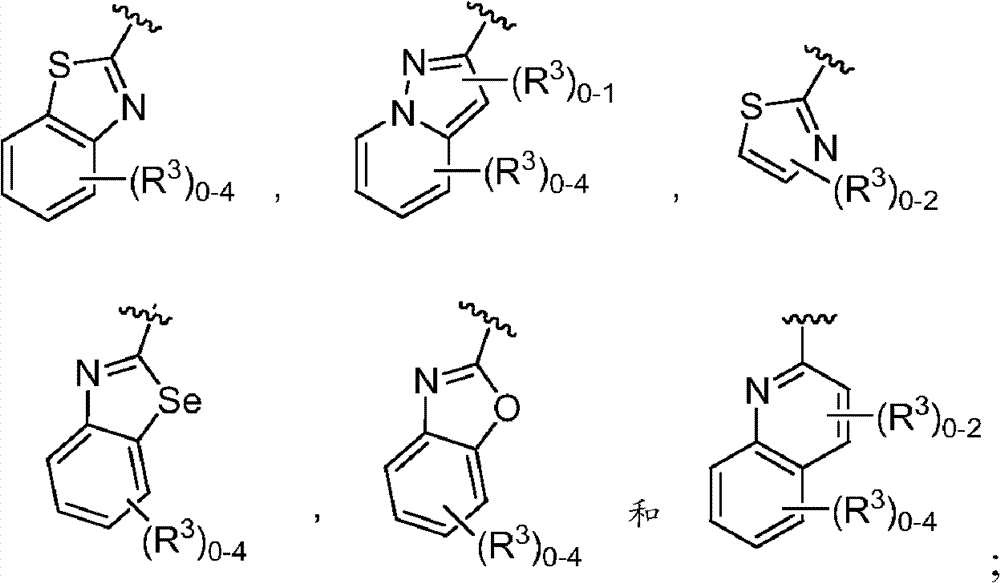
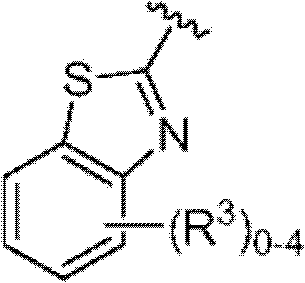
其中R3如果存在的话,独立地选自-NReRf、-ORe、-CN、-NO2、卤素、-C(O)ORe、-C(O)NReRf、-NReC(O)Rf、-NReS(O)2Rg、-NReS(O)Rg、-S(O)2Rg、-S(O)Rg和-Rg。Re和Rf每次出现时各自独立地选自氢、C1-4烷基、C2-4烯基、C2-4炔基、C1-4卤代烷基和-(CH2)1-4苯基,或者Re和Rf、或Re和Rg,与它们各自相连的原子一起,任选地组合形成一个3-到7-元的杂环,其包含1到2个选自N、O和S的杂原子作为环顶点;而且Rg选自C1-4烷基、C2-4烯基、C2-4炔基和C1-4卤代烷基。在式I中,B是选自以下的一员:wherein R 3 , if present, is independently selected from -NR e R f , -OR e , -CN, -NO 2 , halogen, -C(O)OR e , -C(O)NR e R f , -NR eC (O) Rf , -NReS (O) 2Rg , -NReS (O) Rg , -S(O) 2Rg , -S (O) Rg , and -Rg . Each occurrence of R e and R f is independently selected from hydrogen, C 1-4 alkyl, C 2-4 alkenyl, C 2-4 alkynyl, C 1-4 haloalkyl and -(CH 2 ) 1 -4 Phenyl, or Re and R f , or Re and R g , together with their respective attached atoms, optionally combined to form a 3- to 7-membered heterocyclic ring containing 1 to 2 optional A heteroatom from N, O and S serves as a ring apex; and R is selected from C 1-4 alkyl, C 2-4 alkenyl, C 2-4 alkynyl and C 1-4 haloalkyl. In formula I, B is a member selected from:
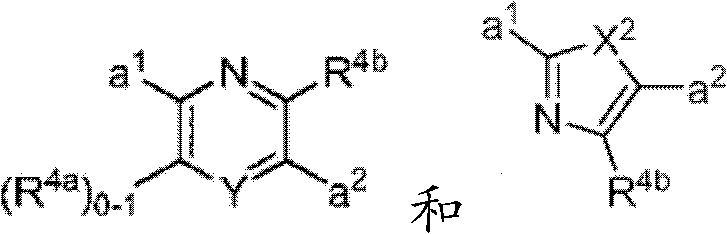
其中Y是N、C(H)或C(R4a);X2是-N(H)-、-N(C1-3烷基)-、O或S。R4a如果存在的话,独立地选自C1-4烷基、C1-4卤代烷基、C2-4烯基、C2-4炔基、卤素和-CN;R4b独立地选自-C(O)ORj、-C(O)NRhRi、-C(O)Ri、-NRhC(O)Ri、-NRhC(O)NRhRi、-OC(O)NRhRi、-NRhC(O)ORj、-C(=NORh)NRhRi、-NRhC(=NCN)NRhRi、-NRhS(O)2NRhRi、-S(O)2Rj、-S(O)2NRhRi、-N(Rh)S(O)2Ri、-NRhC(=NRi)NRhRi、-C(=S)NRhRi、-C(=NRh)NRhRi、卤素、-NO2和-CN,其中Rh和Ri每次出现时各自独立地选自氢、C1-6烷基、C2-6烯基、C2-6炔基、C3-6环烷基、C1-6卤代烷基、苯基和-(CH2)1-4-苯基。Rj选自C1-6烷基、C2-6烯基、C2-6炔基、C1-6卤代烷基、C3-7环烷基、苯基和-(CH2)1-4苯基。Rh和Ri、或Rh和Rj,与它们各自相连的原子一起任选地组合形成一个3-到7-元的杂环,其包含1到2个选自N、O和S的杂原子作为环顶点;或者作为替代,R4b选自以下:wherein Y is N, C(H) or C(R 4a ); X 2 is -N(H)-, -N(C 1-3 alkyl)-, O or S. R 4a , if present, is independently selected from C 1-4 alkyl, C 1-4 haloalkyl, C 2-4 alkenyl, C 2-4 alkynyl, halogen and -CN; R 4b is independently selected from - C(O)OR j , -C(O)NR h R i , -C(O)R i , -NR h C(O)R i , -NR h C(O)NR h R i , -OC( O)NR h R i , -NR h C(O)OR j , -C(=NOR h )NR h R i , -NR h C(=NCN)NR h R i , -NR h S(O) 2 NR h R i , -S(O) 2 R j , -S(O) 2 NR h R i , -N(R h )S(O) 2 R i , -NR h C(=NR i )NR h R i , -C(=S)NR h R i , -C(=NR h )NR h R i , halogen, -NO 2 and -CN, wherein each occurrence of R h and R i is independently selected from Hydrogen, C 1-6 alkyl, C 2-6 alkenyl, C 2-6 alkynyl, C 3-6 cycloalkyl, C 1-6 haloalkyl , phenyl and -(CH 2 ) 1-4 - phenyl. R j is selected from C 1-6 alkyl, C 2-6 alkenyl, C 2-6 alkynyl, C 1-6 haloalkyl, C 3-7 cycloalkyl, phenyl and -(CH 2 ) 1- 4 phenyl. R h and R i , or R h and R j , together with the atoms to which they are attached, are optionally combined to form a 3- to 7-membered heterocycle comprising 1 to 2 members selected from N, O and S A heteroatom as a ring vertex; or alternatively, R is selected from the following:
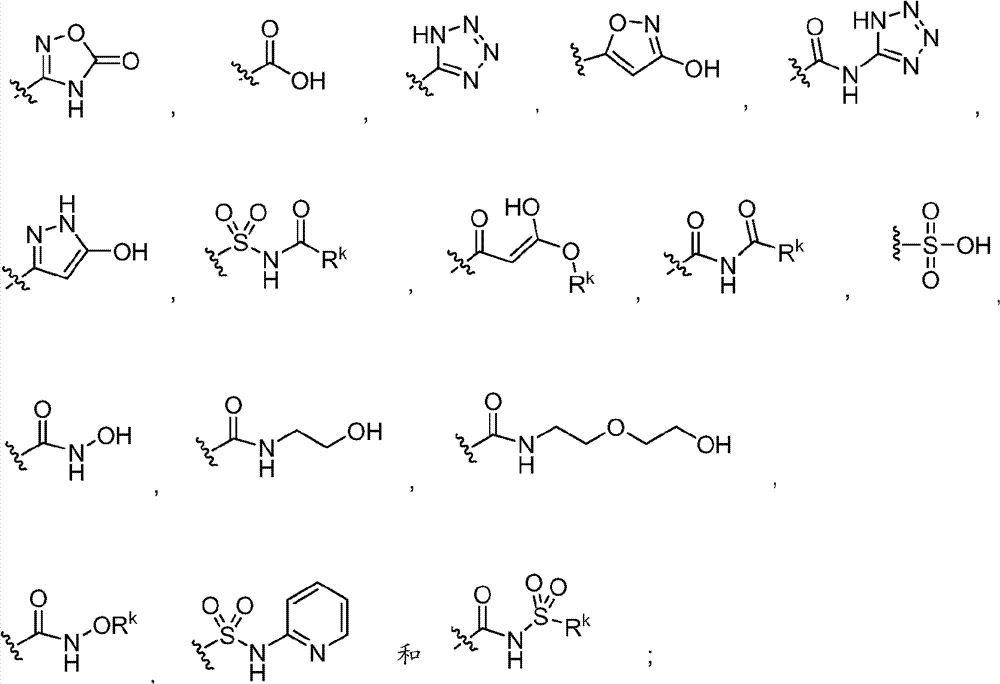
其中Rk选自C1-6烷基、C2-6烯基、C2-6炔基、C3-7环烷基和C1-6卤代烷基。对于式I中的B基团,基团a1代表B基团与式I中的氮原子的连接点,而a2代表B基团与式I中的L基团的连接点。在式I中,L不存在或是选自C6-10亚芳基-C1-6杂亚烷基、C5-9杂亚芳基-C1-6杂亚烷基、C1-6杂亚烷基、C1-6亚烷基、C1-6卤代亚烷基、C2-6亚烯基、C2-6亚炔基、-NH-、-S-和-O-的接头,其中L基团的亚烷基、亚烯基、亚炔基或杂亚烷基部分被0到4个选自卤素、-Rm和=O的R5a取代基取代,而且L基团的芳香族部分被0到4个选自卤素、-ORn、-NRnRo、-Rn、-NO2和CN的R5b取代基取代;其中Rm选自C1-6烷基、C2-6烯基、C2-6炔基、C1-6杂烷基、C3-6杂环烷基-C1-6烷基、C3-7杂环烷基-C1-6杂环烷基和C1-6卤代烷基。连接在L的相同或不同原子上的任选地任意两个R5a取代基,可以组合形成一个5-到7-元的碳环或一个5-到7-元的杂环,其包含1到2个选自N、O和S的杂原子作为环顶点;而且其中Rn和Ro每次出现时,独立地选自氢、C1-6烷基、C2-6烯基、C2-6炔基和C1-6卤代烷基,而且其中任选地Rn和Ro,与它们各自相连的原子一起,组合形成一个3-到7-元的杂环,其包含1到2个选自N、O和S的杂原子作为环顶点。在式I中,E是氢或卤素;或者作为替代,E选自苯基、C5-6杂芳基、C3-7杂环烷基和C3-7环烷基,而且任选地与E稠合的是1或2个环,其独立地选自3-到7-元的碳环、3-到7-元的杂环、苯环、和5-到6-元的杂芳环,其中E和各个任选地与E稠合的环独立地被0到5个R6取代基取代,R6取代基选自卤素、-NRpRq、-SRp、-ORp、-C(O)ORp、-C(O)NRpRq、-C(O)Rp、-NRpC(O)Rq、-OC(O)Rr、-NRpC(O)NRpRq、-OC(O)NRpRq、-NRpC(O)ORr、-C(=NORp)NRpRq、-NRpC(=N-CN)NRpRq、-NRpS(O)2NRpRq、-S(O)2Rr、-S(O)2NRpRq、-Rr、-Rs、-NO2、-N3、=O、-CN、-Z1-NRpRq、-Z1-SRp、-Z1-ORp、-Z1-C(O)ORp、-Z1-C(O)NRpRq、-Z1-C(O)Rp、-Z1-NRpC(O)Rq、-Z1-OC(O)Rr、-Z1-NRpC(O)NRpRq、-Z1-OC(O)NRpRq、-Z1-NRpC(O)ORr、-Z1-C(=NORp)NRpRq、-Z1-NRpC(=N-CN)NRpRq、-Z1-NRpS(O)2NRpRq、-Z1-S(O)2Rr、-Z1-S(O)2NRpRq、-Z1-NO2、-Z1-N3、-Z1-Rs和-Z1-CN;其中Z1选自C1-6亚烷基、C2-6亚烯基、C2-6亚炔基、C1-6杂亚烷基、C3-7杂环烷基和C3-7环烷基;Rp和Rq各自独立地选自氢、C1-6烷基、C1-6卤代烷基、C2-6烯基、C2-6炔基、C3-7环烷基、C3-7杂环烷基、苯基和-(CH2)1-4-苯基;而且Rr选自C1-6烷基、C1-6卤代烷基、C2-6烯基、C2-6炔基、C3-10环烷基、C3-10杂环烷基、苯基和-(CH2)1-4-苯基。任选地在各个R6取代基内,Rp和Rq、或Rp和Rr,与它们各自相连的原子一起,任选地组合形成一个3-到7-元的杂环,其任选地包含1到2个选自N、O和S的杂原子作为环顶点;Rs选自苯基、C5-6杂芳基、C3-7杂环烷基、C3-7环烷基,而且任选地与Rs稠合的是1或2个环,其各自独立地选自5-到7-元的碳环、5-到7-元的杂环、苯环、和5-到6-元的杂芳环,而且其中Rs和各个任选地与Rs稠合的环各自独立地被0到5个R7取代基取代,R7取代基选自卤素、-NRtRu、-SRt、-ORt、-C(O)ORt、-C(O)NRtRu、-C(O)Rt、-NRtC(O)Rv、-OC(O)Rv、-NRtC(O)NRtRu、-OC(O)NRtRr、-NRtC(O)ORv、-C(=NORt)NRtRu、-NRtC(=N-CN)NRtRu、-NRtS(O)2NRtRu、-S(O)2Rv、-S(O)2NRtRu、-Rv、-NO2、-N3、=O、-CN、-Z2-NRtRu、-Z2-SRt、-Z2-ORt、-Z2-C(O)ORt、-Z2-C(O)NRtRu、-Z2-C(O)Rv、-Z2-NRtC(O)Ru、-Z2-OC(O)Rv、-Z2-NRtC(O)NRtRu、-Z2-OC(O)NRtRu、-Z2-NRtC(O)ORv、-Z2-C(=NORt)NRtRu、-Z2-NRtC(=N-CN)NRtRu、-Z2-NRtS(O)2NRtRu、-Z2-S(O)2Rv、-Z2-S(O)2NRtRu、-Z2-NO2、-Z2-N3和-Z2-CN。Z2选自C1-6亚烷基、C2-6亚烯基、C2-6亚炔基、C1-6杂亚烷基,Rt和Ru各自独立地选自氢、C1-6烷基、C1-6卤代烷基、C2-6烯基、C2-6炔基、-(CH2)1-4-苯基、C3-7环烷基和C3-7杂环烷基;Rv选自C1-4烷基、C1-4卤代烷基、C2-6烯基、C2-6炔基、-(CH2)1-4-苯基、C3-7环烷基和C3-7杂环烷基;而且在各个R7取代基内,Rt和Ru、或Rt和Rv,与它们各自相连的原子一起,任选地组合形成一个3-到7-元的杂环,其含有1到2个选自N、O和S的杂原子作为环顶点。Wherein R k is selected from C 1-6 alkyl, C 2-6 alkenyl, C 2-6 alkynyl, C 3-7 cycloalkyl and C 1-6 haloalkyl. For the B group in formula I, the group a 1 represents the point of attachment of the B group to the nitrogen atom in formula I, and a 2 represents the point of attachment of the B group to the L group in formula I. In formula I, L does not exist or is selected from C 6-10 arylene-C 1-6 heteroalkylene, C 5-9 heteroarylene-C 1-6 heteroalkylene, C 1- 6 heteroalkylene, C 1-6 alkylene, C 1-6 haloalkylene, C 2-6 alkenylene, C 2-6 alkynylene, -NH-, -S- and -O - a linker, wherein the alkylene, alkenylene, alkynylene or heteroalkylene portion of the L group is substituted by 0 to 4 R substituents selected from halogen, -R and =O, and L The aromatic portion of the group is substituted by 0 to 4 R 5b substituents selected from halogen, -OR n , -NR n R o , -R n , -NO 2 and CN; wherein R m is selected from C 1-6 Alkyl, C 2-6 alkenyl, C 2-6 alkynyl, C 1-6 heteroalkyl, C 3-6 heterocycloalkyl-C 1-6 alkyl, C 3-7 heterocycloalkyl- C 1-6 heterocycloalkyl and C 1-6 haloalkyl. Optionally any two R substituents attached to the same or different atoms of L may combine to form a 5- to 7-membered carbocycle or a 5- to 7-membered heterocycle comprising 1 to 2 heteroatoms selected from N, O and S are used as ring vertices; and wherein R n and R o each occurrence are independently selected from hydrogen, C 1-6 alkyl, C 2-6 alkenyl, C 2 -6 alkynyl and C 1-6 haloalkyl, and wherein optionally R n and R o , together with the atoms to which they are attached, combine to form a 3- to 7-membered heterocyclic ring containing 1 to 2 Heteroatoms selected from N, O and S serve as ring vertices. In formula I, E is hydrogen or halogen; or alternatively, E is selected from phenyl, C 5-6 heteroaryl, C 3-7 heterocycloalkyl and C 3-7 cycloalkyl, and optionally Fused with E are 1 or 2 rings independently selected from 3- to 7-membered carbocycles, 3- to 7-membered heterocycles, benzene rings, and 5- to 6-membered heteroaryl rings ring, wherein E and each ring optionally fused to E are independently substituted by 0 to 5 R substituents selected from the group consisting of halogen, -NR p R q , -SR p , -OR p , -C(O)OR p , -C(O)NR p R q , -C(O)R p , -NR p C(O)R q , -OC(O)R r , -NR p C(O )NR p R q , -OC(O)NR p R q , -NR p C(O)OR r , -C(=NOR p )NR p R q , -NR p C(=N-CN)NR p R q , -NR p S(O) 2 NR p R q , -S(O) 2 R r , -S(O) 2 NR p R q , -R r , -R s , -NO 2 , -N 3 , =O, -CN, -Z 1 -NR p R q , -Z 1 -SR p , -Z 1 -OR p , -Z 1 -C(O)OR p , -Z 1 -C(O) NR p R q , -Z 1 -C(O)R p , -Z 1 -NR p C(O)R q , -Z 1 -OC(O)R r , -Z 1 -NR p C(O) NR p R q , -Z 1 -OC(O)NR p R q , -Z 1 -NR p C(O)OR r , -Z 1 -C(=NOR p )NR p R q , -Z 1 - NR p C (=N-CN) NR p R q , -Z 1 -NR p S(O) 2 NR p R q , -Z 1 -S(O) 2 R r , -Z 1 -S(O) 2 NR p R q , -Z 1 -NO 2 , -Z 1 -N 3 , -Z 1 -R s and -Z 1 -CN; wherein Z 1 is selected from C 1-6 alkylene, C 2-6 Alkenylene, C 2-6 alkynylene, C 1-6 heteroalkylene, C 3-7 heterocycloalkyl and C 3-7 cycloalkyl; R p and R q are each independently selected from hydrogen, C 1-6 alkyl, C 1-6 haloalkyl, C 2-6 alkenyl, C 2-6 alkynyl, C 3-7 cycloalkyl , C 3-7 heterocycloalkyl, phenyl and -( CH 2 ) 1-4 -phenyl; and R r is selected from C 1-6 alkyl, C 1-6 haloalkyl, C 2-6 alkenyl, C 2-6 alkynyl, C 3-10 cycloalkyl , C 3-10 heterocycloalkyl, phenyl and -(CH 2 ) 1-4 -phenyl. Optionally within each R substituent , R p and R q , or R p and R r , together with the atoms to which they are attached, optionally combine to form a 3- to 7-membered heterocyclic ring, any of which Optionally contains 1 to 2 heteroatoms selected from N, O and S as ring vertices; R s is selected from phenyl, C 5-6 heteroaryl, C 3-7 heterocycloalkyl, C 3-7 ring Alkyl, and optionally fused to R s are 1 or 2 rings each independently selected from 5- to 7-membered carbocycles, 5- to 7-membered heterocycles, benzene rings, and 5- to 6-membered heteroaryl ring, and wherein R s and each ring optionally fused to R s are each independently substituted by 0 to 5 R substituents selected from halogen, - NR t R u , -SR t , -OR t , -C(O)OR t , -C(O)NR t R u , -C(O)R t , -NR t C(O)R v , - OC(O)R v , -NR t C(O)NR t R u , -OC(O)NR t R r , -NR t C(O)OR v , -C(=NOR t )NR t R u , -NR t C(=N-CN)NR t R u , -NR t S(O) 2 NR t R u , -S(O) 2 R v , -S(O) 2 NR t R u , - R v , -NO 2 , -N 3 , =O, -CN, -Z 2 -NR t R u , -Z 2 -SR t , -Z 2 -OR t , -Z 2 -C(O)OR t , -Z 2 -C(O)NR t R u , -Z 2 -C(O)R v , -Z 2 -NR t C(O)R u , -Z 2 -OC(O)R v , - Z 2 -NR t C(O)NR t R u , -Z 2 -OC(O)NR t R u , -Z 2 -NR t C(O)OR v , -Z 2 -C(=NOR t ) NR t R u , -Z 2 -NR t C(=N-CN)NR t R u , -Z 2 -NR t S(O) 2 NR t R u , -Z 2 -S(O) 2 R v , -Z 2 -S(O) 2 NR t R u , -Z 2 -NO 2 , -Z 2 -N 3 and -Z 2 -CN. Z 2 is selected from C 1-6 alkylene, C 2-6 alkenylene, C 2-6 alkynylene, C 1-6 heteroalkylene, R t and R u are each independently selected from hydrogen, C 1-6 alkyl, C 1-6 haloalkyl, C 2-6 alkenyl, C 2-6 alkynyl, -(CH 2 ) 1-4 -phenyl, C 3-7 cycloalkyl and C 3- 7 heterocycloalkyl; R v is selected from C 1-4 alkyl, C 1-4 haloalkyl, C 2-6 alkenyl, C 2-6 alkynyl, -(CH 2 ) 1-4 -phenyl, C 3-7 cycloalkyl and C 3-7 heterocycloalkyl; and within each R 7 substituent, R t and R u , or R t and R v , together with their respective attached atoms, optionally The combination forms a 3- to 7-membered heterocyclic ring containing 1 to 2 heteroatoms selected from N, O and S as ring vertices.
另一方面,本发明提供了包含具有式I的化合物的药物组合物,以及使用具有式I的化合物治疗特征是Bcl-2抗凋亡蛋白(例如抗凋亡Bcl-xL蛋白)的表达或过表达的疾病和病症(例如癌症、血小板增多症等)的方法。In another aspect, the present invention provides pharmaceutical compositions comprising a compound of formula I, and the use of a compound of formula I to treat the expression or Methods for overexpressed diseases and disorders (eg, cancer, thrombocytosis, etc.).
附图描述Description of drawings
图1显示了本发明化合物的某些子式,即子式IV-a、IV-b、IV-c、IV-d、IV-e、IV-f、IV-g、IV-h、IV-i、IV-k、IV-m、IV-n、IV-o和IV-p。Figure 1 shows certain subformulas of the compounds of the present invention, namely subformulas IV-a, IV-b, IV-c, IV-d, IV-e, IV-f, IV-g, IV-h, IV- i, IV-k, IV-m, IV-n, IV-o, and IV-p.
图2A、图2B、图2C、图2D和图2E显示了具有式I的化合物的E基团的某些实施方式。Figure 2A, Figure 2B, Figure 2C, Figure 2D and Figure 2E show certain embodiments of the E group of compounds having Formula I.
发明详细描述Detailed description of the invention
I.定义I. Definition
除非另外规定,本文使用的术语“烷基”,单独地或作为另一个取代基的一部分,指具有指定数目碳原子(即C1-8指一到八个碳)的直链或带支链的烃基。烷基的实例包括甲基、乙基、正丙基、异丙基、正丁基、叔丁基、异丁基、仲丁基、正戊基、正己基、正庚基、正辛基等。术语“烯基”指具有一个或多个双键的不饱和烷基,而且包括单-和多-卤化变体。类似地,术语“炔基”指具有一个或多个三键的不饱和烷基,而且包括单-和多-卤化变体。此类不饱和烷基的实例包括乙烯基、2-丙烯基、巴豆基、2-异戊烯基、2-(丁二烯基)、2,4-戊二烯基、3-(1,4-戊二烯基)、乙炔基、1-和3-丙炔基、3-丁炔基,和更高碳数的同系物和异构体。术语“环烷基”、“碳环形的”和“碳环”可互换使用,而且单独地或作为另一个取代基的一部分使用时,指具有指定数目环原子(例如,C3-6环烷基)的烃环,而且是完全饱和的或在环顶点之间具有不超过一个双键。本文使用的“环烷基”、“碳环形的”或“碳环”也指双环的、多环的和螺环的烃环,例如,双环[2.2.1]庚烷、蒎烷、双环[2.2.2]辛烷、金刚烷、降冰片烯、螺环的C5-12链烷等。“环烷基”、“碳环形的”或“碳环”环可以通过环碳原子与分子的剩余部分相连,或者,如果这样规定的话,作为替代,“环烷基”、“碳环形的”或“碳环”环可以与分子的剩余部分稠合。与例如苯环稠合的“环烷基”、“碳环形的”或“碳环”环的非限制性实例,包括1,2,3,4-四氢萘、2,3-二氢-1H-茚、(Z)-6,9-二氢-5H-苯并[7]轮烯等。As used herein, unless otherwise specified, the term "alkyl", by itself or as part of another substituent, refers to a straight or branched chain having the indicated number of carbon atoms (i.e., C1-8 means one to eight carbons). of hydrocarbon groups. Examples of alkyl groups include methyl, ethyl, n-propyl, isopropyl, n-butyl, t-butyl, isobutyl, sec-butyl, n-pentyl, n-hexyl, n-heptyl, n-octyl, etc. . The term "alkenyl" refers to an unsaturated alkyl group having one or more double bonds, and includes mono- and poly-halogenated variants. Similarly, the term "alkynyl" refers to an unsaturated alkyl group having one or more triple bonds and includes mono- and poly-halogenated variations. Examples of such unsaturated alkyl groups include vinyl, 2-propenyl, crotyl, 2-isopentenyl, 2-(butadienyl), 2,4-pentadienyl, 3-(1, 4-pentadienyl), ethynyl, 1- and 3-propynyl, 3-butynyl, and higher homologues and isomers. The terms "cycloalkyl", "carbocyclic" and "carbocycle" are used interchangeably, and when used alone or as part of another substituent, refer to alkyl) and are fully saturated or have not more than one double bond between ring vertices. "Cycloalkyl", "carbocyclic" or "carbocycle" as used herein also refers to bicyclic, polycyclic and spirocyclic hydrocarbon rings, for example, bicyclo[2.2.1]heptane, pinane, bicyclo[ 2.2.2] Octane, adamantane, norbornene, spiro C 5-12 alkane, etc. A "cycloalkyl", "carbocyclic" or "carbocyclic" ring may be attached to the remainder of the molecule through a ring carbon atom, or, if so specified, alternatively, a "cycloalkyl", "carbocyclic" Or a "carbocyclic" ring can be fused to the remainder of the molecule. Non-limiting examples of "cycloalkyl", "carbocyclic" or "carbocyclic" rings fused to e.g. benzene rings include 1,2,3,4-tetrahydronaphthalene, 2,3-dihydro- 1H-indene, (Z)-6,9-dihydro-5H-benzo[7]annulene, etc.
除非另外规定,术语“杂烷基”,单独地或与另一个术语组合,指稳定的直链或带支链的烃基,其由所示数目的碳原子和一到三个选自O、N、Si和S的杂原子组成,而且其中的氮和硫原子可以任选地被氧化,而且氮杂原子可以任选地季铵化。杂原子O、N和S可以放置在杂烷基的任意内部位置。杂原子Si可以放置在杂烷基的任意位置,包括烷基与分子的剩余部分相连的位置。“杂烷基”可以包含最多三个不饱和单元(例如双键和三键),而且也包括单-和多-卤化变体,或其组合。“杂烷基”的实例包括-CH2-CH2-O-CH3、-CH2-CH2-O-CF3、-CH2-CH2-NH-CH3、-CH2-CH2-N(CH3)-CH3、-CH2-S-CH2-CH3、-S(O)-CH3、-CH2-CH2-S(O)2-CH3、-CH=CH-O-CH3、-Si(CH3)3、-CH2-CH=N-OCH3和-CH=CH=N(CH3)-CH3。同样地,对“杂烷基”,最多可以有两个杂原子是连续的,例如-CH2-NH-OCH3和-CH2-O-Si(CH3)3。Unless otherwise specified, the term "heteroalkyl", by itself or in combination with another term, refers to a stable straight or branched chain hydrocarbon group consisting of the indicated number of carbon atoms and one to three selected from O, N , Si and S heteroatoms, and wherein the nitrogen and sulfur atoms can be optionally oxidized, and the nitrogen heteroatoms can be optionally quaternized. The heteroatoms O, N and S can be placed at any internal position of the heteroalkyl group. The heteroatom Si can be placed anywhere on the heteroalkyl, including where the alkyl is attached to the rest of the molecule. "Heteroalkyl" may contain up to three units of unsaturation (eg, double and triple bonds), and also includes mono- and poly-halogenated variations, or combinations thereof. Examples of "heteroalkyl" include -CH2 - CH2 -O- CH3 , -CH2 - CH2 -O- CF3 , -CH2-CH2 -NH - CH3 , -CH2 - CH2 -N(CH 3 )-CH 3 , -CH 2 -S-CH 2 -CH 3 , -S(O)-CH 3 , -CH 2 -CH 2 -S(O) 2 -CH 3 , -CH= CH-O-CH 3 , -Si(CH 3 ) 3 , -CH 2 -CH=N-OCH 3 and -CH=CH=N(CH 3 )-CH 3 . Likewise, for "heteroalkyl", up to two heteroatoms can be consecutive, eg -CH 2 -NH-OCH 3 and -CH 2 -O-Si(CH 3 ) 3 .
术语“杂环烷基”、“杂环的”和“杂环”可互换使用,而且当单独地或作为另一个取代基的一部分使用时,指包含一到五个选自N、O和S的杂原子的环烷基,其中的氮和硫原子任选地被氧化,而且氮原子任选地季铵化。本领域技术人员将了解,对于具有指定数目碳原子的“杂环烷基”、“杂环的”和“杂环”(例如“C3-7杂环烷基”),至少一个且最多可能五个(如果可行的话)指定的碳被杂原子代替。例如,“C3杂环烷基”包括,在其它可能中,环氧乙烷基,其具有两个碳原子加一个氧原子作为环原子。除非另外规定,“杂环烷基”、“杂环的”和“杂环”环可以是单环、双环、螺环或多环的环系统。“杂环烷基”、“杂环的”和“杂环”基团的非限制性实例包括吡咯烷、哌啶、咪唑烷、吡唑烷、丁内酰胺、戊内酰胺、咪唑啉酮、乙内酰脲、二氧戊环、邻苯二甲酰亚胺、哌啶、嘧啶-2,4(1H,3H)-二酮、嘧啶-4-酮、嘧啶-2-酮、1,4-二氧杂环己烷、吗啉、硫代吗啉、硫代吗啉-S-氧化物、硫代吗啉-S,S-氧化物、哌嗪、吡喃、吡啶酮、3-吡咯啉、噻喃、吡喃酮、四氢呋喃、四氢噻吩、奎宁环、莨菪烷等。“杂环烷基”、“杂环的”或“杂环”基团可以通过环上的碳、杂原子与分子的剩余部分相连,或者,如果这样规定的话,“杂环烷基”、“杂环的”或“杂环”基团可以与分子的剩余部分稠合。与例如苯环稠合的“杂环烷基”、“杂环的”或“杂环”环的非限制性实例,包括异色满、2,3-二氢苯并呋喃、(Z)-4,5-二氢-1H-苯并[b]氮杂卓等。除非另外规定,“杂环烷基”、“杂环的”和“杂环”环包括其单-和多-卤化变体。The terms "heterocycloalkyl", "heterocyclic" and "heterocycle" are used interchangeably, and when used alone or as part of another substituent, refer to a group consisting of one to five substituents selected from N, O and A heteroatomic cycloalkyl group of S wherein the nitrogen and sulfur atoms are optionally oxidized and the nitrogen atom is optionally quaternized. Those skilled in the art will appreciate that for "heterocycloalkyl", "heterocyclic" and "heterocycle" (e.g. "C 3-7 heterocycloalkyl") with the specified number of carbon atoms, at least one and at most possible Five (if applicable) of the specified carbons were replaced by heteroatoms. For example, " C3 heterocycloalkyl" includes, among other possibilities, oxiranyl groups, which have two carbon atoms plus one oxygen atom as ring atoms. Unless otherwise specified, "heterocycloalkyl", "heterocyclic" and "heterocyclic" rings may be monocyclic, bicyclic, spiro or polycyclic ring systems. Non-limiting examples of "heterocycloalkyl", "heterocyclic" and "heterocyclic" groups include pyrrolidine, piperidine, imidazolidine, pyrazolidine, butyrolactam, valerolactam, imidazolinone, Hydantoin, dioxolane, phthalimide, piperidine, pyrimidine-2,4(1H,3H)-dione, pyrimidin-4-one, pyrimidin-2-one, 1,4 -Dioxane, morpholine, thiomorpholine, thiomorpholine-S-oxide, thiomorpholine-S,S-oxide, piperazine, pyran, pyridone, 3-pyrrole Phenoline, thiopyran, pyrone, tetrahydrofuran, tetrahydrothiophene, quinuclidine, tropane, etc. A "heterocycloalkyl", "heterocyclic" or "heterocyclic" group may be attached to the remainder of the molecule through a ring carbon, a heteroatom, or, if so specified, a "heterocycloalkyl", " A "heterocyclic" or "heterocyclic" group can be fused to the remainder of the molecule. Non-limiting examples of "heterocycloalkyl", "heterocyclic" or "heterocyclic" rings fused to, for example, benzene rings include isochroman, 2,3-dihydrobenzofuran, (Z)- 4,5-dihydro-1H-benzo[b]azepine and so on. Unless otherwise specified, "heterocycloalkyl", "heterocyclic" and "heterocyclic" rings include mono- and poly-halogenated variations thereof.
术语“亚烷基”单独地或作为另一个取代基的一部分,指衍生自链烷或卤代链烷的二价基,以-CH2CH2CH2CH2-和-CF2CF2-为例。典型地,烷基(或亚烷基)基团将含有1到24个碳原子,本发明中优选含有10个或更少的碳原子的那些基团。“亚烯基”和“亚炔基”分别指含有双键或三键的不饱和形式的“亚烷基”,包括单和多卤化变体。 The term "alkylene", by itself or as part of another substituent, refers to a divalent radical derived from an alkane or haloalkane , starting with -CH2CH2CH2CH2- and -CF2CF2- as an example. Typically, alkyl (or alkylene) groups will contain from 1 to 24 carbon atoms, with those groups containing 10 or fewer carbon atoms being preferred in the present invention. "Alkenylene" and "alkynylene" refer to unsaturated forms of "alkylene" containing double or triple bonds, respectively, including mono and polyhalogenated variants.
术语“杂亚烷基”单独地或作为另一个取代基的一部分,指衍生自杂烷基的二价基,以-O-CH2-CH2-CH2-CH2-O-、-O-CH2、-CH2-O-、-CH2-CH2-S-CH2CH2-和-CH2-S-CH2-CH2-NH-CH2-、-O-CH2-CH=CH-、-CH2-CH=C(H)CH2-O-CH2-、-O-CH2-CH≡CH-、-S-CH2-C≡C-、-CF2-O-为例。对杂亚烷基,杂原子还可以占据任一个或同时两个链末端(例如,亚烷氧基、亚烷二氧基、亚烷基氨基、亚烷基二氨基等)。本文使用的术语“杂亚烷基”也指单-和多-卤化变体。The term "heteroalkylene", by itself or as part of another substituent, refers to a divalent radical derived from heteroalkyl, starting with -O- CH2 - CH2 - CH2 - CH2 -O-, -O -CH 2 , -CH 2 -O-, -CH 2 -CH 2 -S-CH 2 CH 2 - and -CH 2 -S-CH 2 -CH 2 -NH-CH 2 -, -O-CH 2 - CH=CH-, -CH 2 -CH=C(H)CH 2 -O-CH 2 -, -O-CH 2 -CH≡CH-, -S-CH 2 -C≡C-, -CF 2 - O- as an example. For heteroalkylene groups, heteroatoms may also occupy either or both chain termini (eg, alkyleneoxy, alkylenedioxy, alkyleneamino, alkylenediamino, etc.). As used herein, the term "heteroalkylene" also refers to mono- and poly-halogenated variants.
术语“烷氧基”、“烷基氨基”和“烷基硫代”(或硫代烷氧基)按照它们的常规意义使用,而且分别指通过氧原子、氨基或硫原子与分子的剩余部分相连的那些烷基。此外,对于二烷基氨基,烷基部分可以是相同的或不同的,而且还可以与其各自相连的氮原子组合形成一个3-7原子的环。因此,描述为-NRiRii的基团包括哌啶基、吡咯烷基、吗啉基、吖丁啶基等。The terms "alkoxy", "alkylamino" and "alkylthio" (or thioalkoxy) are used according to their conventional meanings and refer to the interaction between an oxygen atom, an amino group or a sulfur atom, respectively, and the remainder of the molecule. the linked alkyl groups. In addition, for dialkylamino groups, the alkyl moieties may be the same or different, and may combine with their respective nitrogen atoms to form a ring of 3-7 atoms. Thus, groups described as -NR i R ii include piperidinyl, pyrrolidinyl, morpholinyl, azetidinyl, and the like.
除非另外规定,术语“卤代”或“卤素”,单独地或作为另一个取代基的一部分,指氟、氯、溴或碘原子。此外,术语例如“卤代烷基”包括单卤代烷基和多卤代烷基。例如,术语“C1-4卤代烷基”包括三氟甲基、2,2,2-三氟乙基、4-氯丁基、3-溴丙基等。Unless otherwise specified, the term "halo" or "halogen", by itself or as part of another substituent, refers to a fluorine, chlorine, bromine or iodine atom. Furthermore, terms such as "haloalkyl" include monohaloalkyl and polyhaloalkyl. For example, the term "C 1-4 haloalkyl" includes trifluoromethyl, 2,2,2-trifluoroethyl, 4-chlorobutyl, 3-bromopropyl and the like.
除非另外规定,术语“芳基”指多不饱和的典型芳香族的烃基,它可以是单环或稠合在一起的多环(最多三环)。术语“杂芳基”指包含一到五个选自N、O和S的杂原子的芳基(或环),其中的氮和硫原子任选地被氧化,而且氮原子任选地季铵化。杂芳基可以通过杂原子与分子的剩余部分相连。芳基的非限制性实例包括苯基、萘基和联苯基,而杂芳基的非限制性实例包括吡啶基、哒嗪基、吡嗪基、嘧啶基、三嗪基、喹啉基、喹喔啉基、喹唑啉基、噌啉基、酞嗪基、苯并三嗪基、嘌呤基、苯并咪唑基、苯并吡唑基、苯并三唑基、苯并异噁唑基、异苯并呋喃基、异吲哚基、吲嗪基、苯并三嗪基、噻吩并吡啶基、噻吩并嘧啶基、吡唑并嘧啶基、咪唑并吡啶基、苯并噻唑基、苯并呋喃基、苯并噻吩基、吲哚基、喹啉基、异喹啉基、异噻唑基、吡唑基、吲唑基、蝶啶基、咪唑基、三唑基、四唑基、噁唑基、异噁唑基、噻二唑基、吡咯基、噻唑基、呋喃基、噻吩基等。各个以上记录的芳基和杂芳基环系统的任选的取代基,可以选自但不限于下面进一步描述的可接受的取代基集团。Unless otherwise specified, the term "aryl" refers to a polyunsaturated, typically aromatic, hydrocarbon group, which may be a single ring or multiple rings (up to three rings) fused together. The term "heteroaryl" refers to an aryl group (or ring) containing one to five heteroatoms selected from N, O, and S, wherein the nitrogen and sulfur atoms are optionally oxidized, and the nitrogen atom is optionally quaternized change. A heteroaryl can be attached to the remainder of the molecule through a heteroatom. Non-limiting examples of aryl include phenyl, naphthyl, and biphenyl, while non-limiting examples of heteroaryl include pyridyl, pyridazinyl, pyrazinyl, pyrimidinyl, triazinyl, quinolinyl, Quinoxalinyl, quinazolinyl, cinnolinyl, phthalazinyl, benzotriazinyl, purinyl, benzimidazolyl, benzopyrazolyl, benzotriazolyl, benzisoxazolyl , isobenzofuryl, isoindolyl, indolazinyl, benzotriazinyl, thienopyridyl, thienopyrimidinyl, pyrazolopyrimidinyl, imidazopyridyl, benzothiazolyl, benzo Furyl, benzothienyl, indolyl, quinolinyl, isoquinolyl, isothiazolyl, pyrazolyl, indazolyl, pteridinyl, imidazolyl, triazolyl, tetrazolyl, oxazole base, isoxazolyl, thiadiazolyl, pyrrolyl, thiazolyl, furyl, thienyl, etc. Optional substituents for each of the above noted aryl and heteroaryl ring systems may be selected from, but are not limited to, the group of acceptable substituents described further below.
本文使用的术语“亚芳基”一般指为二价基的任意芳基。对一个更加具体的实例,“亚苯基”指二价的苯环基。术语“1,2-亚芳基”、“1,3-亚芳基”或“1,4-亚芳基”指特定亚芳基的几何异构体,其中连在芳基上的两个基团如式中描述般在芳基周围分别位于邻位、间位或对位几何联系。As used herein, the term "arylene" generally refers to any aryl group that is a divalent radical. For a more specific example, "phenylene" refers to a divalent phenyl ring group. The terms "1,2-arylene", "1,3-arylene" or "1,4-arylene" refer to geometric isomers of a specific arylene group in which two The groups are respectively located in the ortho, meta or para geometrical relationship around the aryl group as described in the formula.
本文使用的术语“杂亚芳基”一般指为二价基的任意杂芳基。对一个更加具体的实例,“亚吡啶基”指二价的吡啶环基。As used herein, the term "heteroarylene" generally refers to any heteroaryl group that is a divalent radical. For a more specific example, "pyridylene" refers to a divalent pyridine ring group.
本领域技术人员将了解,对于具有指定数目碳原子的术语“杂芳基”和“杂亚芳基”(例如,“C5-6杂芳基”或“C5-9杂亚芳基”),其至少一个且可行时最多五个指定碳原子被杂原子代替。例如,C5杂芳基可以是吡咯基,或者,作为另一个实例,在其它可能中,是噻唑基。Those skilled in the art will understand that for the terms "heteroaryl" and "heteroarylene" having a specified number of carbon atoms (for example, "C 5-6 heteroaryl" or "C 5-9 heteroarylene" ), at least one, and where applicable up to five, of the specified carbon atoms are replaced by a heteroatom. For example, a C5 heteroaryl can be pyrrolyl, or, as another example, thiazolyl, among other possibilities.
本文使用的组合术语“亚芳基-杂亚烷基”一般指由彼此共价连接的芳基和杂烷基组成的二价基,而且其中芳基和烷基各自包含可与另一个基团相连的额外的基中心。亚芳基-杂亚烷基的实例包括但不限于:As used herein, the combination term "arylene-heteroalkylene" generally refers to a divalent group consisting of an aryl group and a heteroalkyl group covalently linked to each other, and wherein the aryl group and the alkyl group each contain Connected additional base centers. Examples of arylene-heteroalkylene groups include, but are not limited to:

类似地,术语“杂亚芳基-杂亚烷基”指由彼此共价连接的杂芳基和杂烷基组成的二价基,而且其中杂芳基和杂烷基各自包含与另一个基团相连的额外的基中心。杂亚芳基-杂亚烷基的实例包括但不限于Similarly, the term "heteroarylene-heteroalkylene" refers to a divalent radical consisting of a heteroaryl and a heteroalkyl covalently linked to each other, and wherein the heteroaryl and heteroalkyl each The extra base centers connected by cliques. Examples of heteroarylene-heteroalkylene include, but are not limited to

以上术语(例如“烷基”、“芳基”和“杂芳基”)在一些实施方式中,将包括所指基的取代和未取代形式。每种类型的基的优选取代基在下面提供。The above terms (eg, "alkyl," "aryl," and "heteroaryl"), in some embodiments, are intended to encompass both substituted and unsubstituted forms of the referenced groups. Preferred substituents for each type of radical are provided below.
烷基(包括经常被称作亚烷基、烯基、炔基、杂烷基、杂环烷基和环烷基的那些基团)的取代基可以是各种基团,包括但不限于-卤素、-OR′、-NR′R″、-SR′、-SiR′R″R′″、-OC(O)R′、-C(O)R′、-CO2R′、-CONR′R″、-OC(O)NR′R″、-NR″C(O)R′、-NR″′C(O)NR′R″、-NR″C(O)2R′、-NHC(NH2)=NH、-NR′C(NH2)=NH、-NHC(NH2)=NR′、-NR′″C(NR′R″)=N-CN、-NR′″C(NR′R″)=NOR′、-NHC(NH2)=NR′、-S(O)R′、-S(O)2R′、-S(O)2NR′R″、-NR′S(O)2R″、-NR′″S(O)2NR′R″、-CN、=O、=S、=N-OH和-NO2,数量范围从0到(2m′+1),其中m′是此类基中碳原子的总数目。R′、R″和R′″各自独立地指基团包括例如氢、未取代的C1-6烷基、未取代的杂烷基、未取代的芳基、被1-3个卤素取代的芳基、未取代的C1-6烷基、C1-6烷氧基或C1-6硫代烷氧基、或未取代的芳基-C1-4烷基、未取代的杂芳基、取代的杂芳基,等等。当R′和R″与相同氮原子相连时,它们可以与该氮原子组合形成一个3-、4-、5-、6-或7-元的环。例如,-NR′R″包括1-吡咯烷基和4-吗啉基。烷基(包括杂烷基、亚烷基)的其它取代基,包括例如=O、=NR′、=N-OR′、=N-CN、=NH,其中R′包括如上面描述的取代基。Substituents for alkyl groups (including those often referred to as alkylene, alkenyl, alkynyl, heteroalkyl, heterocycloalkyl, and cycloalkyl) can be a variety of groups including, but not limited to - Halogen, -OR', -NR'R", -SR', -SiR'R"R'", -OC(O)R', -C(O)R', -CO 2 R', -CONR'R",-OC(O)NR'R",-NR"C(O)R',-NR"'C(O)NR'R",-NR"C(O) 2 R', -NHC( NH 2 )=NH, -NR'C(NH 2 )=NH, -NHC(NH 2 )=NR', -NR'"C(NR'R")=N-CN, -NR'"C(NR 'R")=NOR', -NHC(NH 2 )=NR', -S(O)R', -S(O) 2 R', -S(O) 2 NR'R", -NR'S (O) 2 R", -NR'"S(O) 2 NR'R", -CN, =O, =S, =N-OH, and -NO 2 in amounts ranging from 0 to (2m'+1) , wherein m' is the total number of carbon atoms in such groups. R', R" and R'" each independently refer to groups including, for example, hydrogen, unsubstituted C 1-6 alkyl, unsubstituted heteroalkyl , unsubstituted aryl, aryl substituted by 1-3 halogens, unsubstituted C 1-6 alkyl, C 1-6 alkoxy or C 1-6 thioalkoxy, or unsubstituted Aryl-C 1-4 alkyl, unsubstituted heteroaryl, substituted heteroaryl, etc. When R' and R" are attached to the same nitrogen atom, they can combine with the nitrogen atom to form a 3- , 4-, 5-, 6- or 7-membered ring. For example, -NR'R" includes 1-pyrrolidinyl and 4-morpholinyl. Other substituents for alkyl (including heteroalkyl, alkylene) include, for example, =O, =NR', =N-OR ', =N-CN, =NH, wherein R' includes substituents as described above.
类似地,芳基和杂芳基的取代基是多样的,而且一般选自基团包括但不限于-卤素、-OR′、-OC(O)R′、-NR′R″、-SR′、-R′、-CN、-NO2、-CO2R′、-CONR′R″、-C(O)R′、-OC(O)NR′R″、-NR″C(O)R′、-NR″C(O)2R′、-NR′C(O)NR″R′″、-NHC(NH2)=NH、-NR′C(NH2)=NH、-NHC(NH2)=NR′、-S(O)R′、-S(O)2R′、-S(O)2NR′R″、-NR′S(O)2R″、-N3、全氟-C1-4烷氧基、和全氟-C1-4烷基,数量范围从0到芳环系统上开放价的总数目;而且其中R′、R″和R′″可以独立地选自氢、C1-6烷基、C1-6卤代烷基、C3-6环烷基、C2-6烯基、C2-6炔基、未取代的芳基和杂芳基、(未取代的芳基)-C1-4烷基和未取代的芳氧基-C1-4烷基。其它合适的取代基包括通过1-4碳原子的亚烷基连接到环原子上的各个以上芳基取代基。Similarly, substituents for aryl and heteroaryl groups vary and are generally selected from groups including, but not limited to, -halogen, -OR', -OC(O)R', -NR'R", -SR' , -R', -CN, -NO 2 , -CO 2 R', -CONR'R", -C(O)R', -OC(O)NR'R", -NR"C(O)R ', -NR"C(O) 2 R', -NR'C(O)NR"R'", -NHC(NH 2 )=NH, -NR'C(NH 2 )=NH, -NHC(NH 2 )=NR', -S(O)R', -S(O) 2 R', -S(O) 2 NR'R", -NR'S(O) 2 R", -N 3 , all Fluoro-C 1-4 alkoxy, and perfluoro-C 1-4 alkyl, the number ranges from 0 to the total number of open valences on the aromatic ring system; and wherein R', R" and R'" can be independently selected from hydrogen, C 1-6 alkyl, C 1-6 haloalkyl, C 3-6 cycloalkyl, C 2-6 alkenyl, C 2-6 alkynyl, unsubstituted aryl and heteroaryl, (Unsubstituted aryl)-C 1-4 alkyl and unsubstituted aryloxy-C 1-4 alkyl. Other suitable substituents include alkylene attached to ring atoms via 1-4 carbon atoms Each of the above aryl substituents.
本文使用的在本文描述的任意化学结构中与单键、双键或三键相交的波浪线代表单键、双键或三键与分子的剩余部分的连接点。As used herein, a wavy line intersecting a single, double, or triple bond in any of the chemical structures described herein Represents the point of attachment of a single, double, or triple bond to the rest of the molecule.
本文使用的“本发明的化合物”指具有式I的化合物或其任意具体实施方式;或具有式I的化合物或其实施方式的任意立体异构体、几何异构体、互变异构体、溶剂化物、代谢物或药学上可接受的盐或前药。As used herein, "compound of the present invention" refers to a compound of formula I or any specific embodiment thereof; or any stereoisomer, geometric isomer, tautomer, Solvates, metabolites or pharmaceutically acceptable salts or prodrugs.
为了描述取代基(例如R10)可以与本申请中表明的化学结构相连的次数,取代基(例如R10)被写在括号中,而且可能出现的数目被记录为下标范围。例如,“-(R10)0-4”指R10基团可以不存在,或可以存在,最多出现四次。To describe the number of times a substituent (eg R 10 ) can be attached to a chemical structure shown in this application, the substituent (eg R 10 ) is written in parentheses and the number of possible occurrences is recorded as a subscripted range. For example, "-(R 10 ) 0-4 " means that the R 10 group may be absent, or may be present, up to four times.
本文使用的术语“杂原子”包括氧(O)、氮(N)、硫(S)和硅(Si)。The term "heteroatom" as used herein includes oxygen (O), nitrogen (N), sulfur (S) and silicon (Si).
II.化合物II. Compounds
一方面,本发明提供了具有式I的化合物In one aspect, the invention provides compounds of formula I
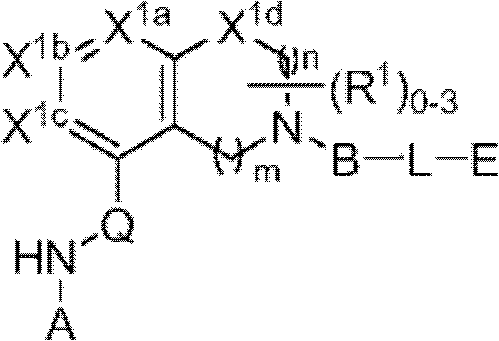
或其药学上可接受的盐。在式I中,Q选自-C(O)-、-CH2-、-CH(Ra)-和-C(Ra)2-,其中Ra是C1-4烷基或C1-4卤代烷基。R1如果存在的话,独立地是选自卤素、=O、C1-6烷基、C1-6杂烷基、C2-6烯基、C2-6炔基和C1-6卤代烷基的一员。X1a、X1b和X1c各自独立地选自C(H)、C(R2)和N,其中X1a、X1b和X1c中的至少一个是C(H)或C(R2)。R2独立地选自-ORb、-NRbRc、-SRb、-C(O)ORc、-C(O)NRbRc、-NRbC(O)Rd、-S(O)2Rd、-S(O)Rd、-S(O)2NRbRc、-Rd、卤素、-CN和-NO2,其中Rb和Rc各自独立地选自氢、C1-4烷基、C2-4烯基、C2-4炔基、C1-4卤代烷基,或者任选地Rb和Rc,与它们各自相连的原子一起,组合形成一个3-到7-元的杂环,其包含1到2个选自N、O和S的杂原子作为环顶点;而且Rd选自C1-4烷基、C2-4烯基、C2-4炔基和C1-4卤代烷基。在式I中,X1d不存在或选自-O-、-NH-、-N(C1-4烷基)-和-N(C(O)C1-4烷基)-,下标m是1到2的整数,而且下标n是1到3的整数;其中如果X1d存在,则下标n是2或3。在式I中,A是选自以下的一员:or a pharmaceutically acceptable salt thereof. In formula I, Q is selected from -C(O)-, -CH 2 -, -CH(R a )- and -C(R a ) 2 -, wherein R a is C 1-4 alkyl or C 1 -4 haloalkyl. R 1 , if present, is independently selected from halogen, =0, C 1-6 alkyl, C 1-6 heteroalkyl, C 2-6 alkenyl, C 2-6 alkynyl and C 1-6 haloalkane member of base. X 1a , X 1b and X 1c are each independently selected from C(H), C(R 2 ) and N, wherein at least one of X 1a , X 1b and X 1c is C(H) or C(R 2 ) . R 2 is independently selected from -OR b , -NR b R c , -SR b , -C(O)OR c , -C(O)NR b R c , -NR b C(O)R d , -S (O) 2 R d , —S(O)R d , —S(O) 2 NR b R c , —R d , halogen, —CN, and —NO 2 , wherein R b and R c are each independently selected from Hydrogen, C 1-4 alkyl, C 2-4 alkenyl, C 2-4 alkynyl, C 1-4 haloalkyl, or optionally R b and R c , together with their respective attached atoms, form A 3- to 7-membered heterocyclic ring comprising 1 to 2 heteroatoms selected from N, O and S as ring vertices; and R d selected from C 1-4 alkyl, C 2-4 alkenyl, C 2-4 alkynyl and C 1-4 haloalkyl. In formula I, X 1d is absent or selected from -O-, -NH-, -N(C 1-4 alkyl)- and -N(C(O)C 1-4 alkyl)-, subscript m is an integer from 1 to 2, and subscript n is an integer from 1 to 3; wherein subscript n is 2 or 3 if X 1d exists. In formula I, A is a member selected from:

其中R3如果存在的话,独立地选自-NReRf、-ORe、-CN、-NO2、卤素、-C(O)ORe、-C(O)NReRf、-NReC(O)Rf、-NReS(O)2Rg、-NReS(O)Rg、-S(O)2Rg、-S(O)Rg和-Rg。Re和Rf每次出现时各自独立地选自氢、C1-4烷基、C2-4烯基、C2-4炔基、C1-4卤代烷基和-(CH2)1-4苯基,或者Re和Rf、或Re和Rg,与它们各自相连的原子一起,任选地组合形成一个3-到7-元的杂环,其包含1到2个选自N、O和S的杂原子作为环顶点;而且Rg选自C1-4烷基、C2-4烯基、C2-4炔基和C1-4卤代烷基。在式I中,B是选自以下的一员:wherein R 3 , if present, is independently selected from -NR e R f , -OR e , -CN, -NO 2 , halogen, -C(O)OR e , -C(O)NR e R f , -NR eC (O) Rf , -NReS (O) 2Rg , -NReS (O) Rg , -S(O) 2Rg , -S (O) Rg , and -Rg . Each occurrence of R e and R f is independently selected from hydrogen, C 1-4 alkyl, C 2-4 alkenyl, C 2-4 alkynyl, C 1-4 haloalkyl and -(CH 2 ) 1 -4 Phenyl, or Re and R f , or Re and R g , together with their respective attached atoms, optionally combined to form a 3- to 7-membered heterocyclic ring containing 1 to 2 optional A heteroatom from N, O and S serves as a ring apex; and R is selected from C 1-4 alkyl, C 2-4 alkenyl, C 2-4 alkynyl and C 1-4 haloalkyl. In formula I, B is a member selected from:
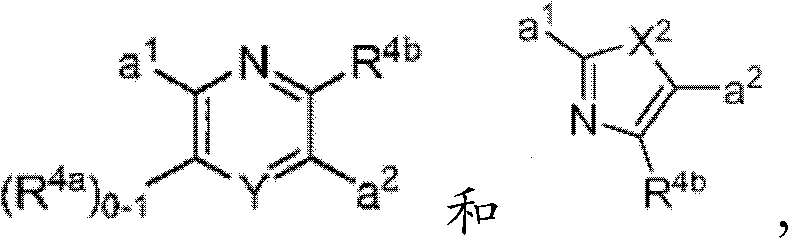
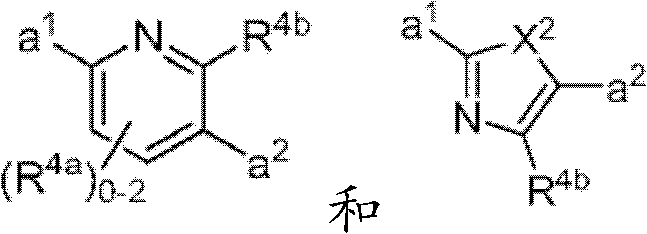
其中Y是N、C(H)或C(R4a);X2是-N(H)-、-N(C1-3烷基)-、O或S。R4a如果存在的话,独立地选自C1-4烷基、C1-4卤代烷基、C2-4烯基、C2-4炔基、卤素和-CN;R4b独立地选自-C(O)ORj、-C(O)NRhRi、-C(O)Ri、-NRhC(O)Ri、-NRhC(O)NRhRi、-OC(O)NRhRi、-NRhC(O)ORj、-C(=NORh)NRhRi、-NRhC(=NCN)NRhRi、-NRhS(O)2NRhRi、-S(O)2Rj、-S(O)2NRhRi、-N(Rh)S(O)2Ri、-NRhC(=NRi)NRhRi、-C(=S)NRhRi、-C(=NRh)NRhRi、卤素、-NO2和-CN,其中Rh和Ri每次出现时各自独立地选自氢、C1-6烷基、C2-6烯基、C2-6炔基、C3-6环烷基、C1-6卤代烷基、苯基和-(CH2)1-4-苯基。Rj选自C1-6烷基、C2-6烯基、C2-6炔基、C1-6卤代烷基、C3-7环烷基、苯基和-(CH2)1-4苯基。Rh和Ri、或Rh和Rj,与它们各自相连的原子一起任选地组合形成一个3-到7-元的杂环,其包含1到2个选自N、O和S的杂原子作为环顶点;或者作为替代,R4b选自:wherein Y is N, C(H) or C(R 4a ); X 2 is -N(H)-, -N(C 1-3 alkyl)-, O or S. R 4a , if present, is independently selected from C 1-4 alkyl, C 1-4 haloalkyl, C 2-4 alkenyl, C 2-4 alkynyl, halogen and -CN; R 4b is independently selected from - C(O)OR j , -C(O)NR h R i , -C(O)R i , -NR h C(O)R i , -NR h C(O)NR h R i , -OC( O)NR h R i , -NR h C(O)OR j , -C(=NOR h )NR h R i , -NR h C(=NCN)NR h R i , -NR h S(O) 2 NR h R i , -S(O) 2 R j , -S(O) 2 NR h R i , -N(R h )S(O) 2 R i , -NR h C(=NR i )NR h R i , -C(=S)NR h R i , -C(=NR h )NR h R i , halogen, -NO 2 and -CN, wherein each occurrence of R h and R i is independently selected from Hydrogen, C 1-6 alkyl, C 2-6 alkenyl, C 2-6 alkynyl, C 3-6 cycloalkyl, C 1-6 haloalkyl , phenyl and -(CH 2 ) 1-4 - phenyl. R j is selected from C 1-6 alkyl, C 2-6 alkenyl, C 2-6 alkynyl, C 1-6 haloalkyl, C 3-7 cycloalkyl, phenyl and -(CH 2 ) 1- 4 phenyl. R h and R i , or R h and R j , together with the atoms to which they are attached, are optionally combined to form a 3- to 7-membered heterocycle comprising 1 to 2 members selected from N, O and S A heteroatom as a ring vertex; or alternatively, R is selected from:
其中Rk选自C1-6烷基、C2-6烯基、C2-6炔基、C3-7环烷基和C1-6卤代烷基。在某些实施方式中,R4b选自:Wherein R k is selected from C 1-6 alkyl, C 2-6 alkenyl, C 2-6 alkynyl, C 3-7 cycloalkyl and C 1-6 haloalkyl. In certain embodiments, R is selected from:
其中Rk选自C1-6烷基、C2-6烯基、C2-6炔基、C3-7环烷基和C1-6卤代烷基。对于式I中的B基团,基团a1代表B基团与式I中的氮原子的连接点,而a2代表B基团与式I中的L基团的连接点。在式I中,L不存在或是选自C6-10亚芳基-C1-6杂亚烷基、C5-9杂亚芳基-C1-6杂亚烷基、C1-6杂亚烷基、C1-6亚烷基、C1-6卤代亚烷基、C2-6亚烯基、C2-6亚炔基、-NH-、-S-和-O-的接头,其中L基团的亚烷基、亚烯基、亚炔基或杂亚烷基部分被0到4个选自卤素、-Rm和=O的R5a取代基取代,而且L基团的芳香族部分被0到4个选自卤素、-ORn、-NRnRo、-Rn、-NO2和CN的R5b取代基取代;其中Rm选自C1-6烷基、C2-6烯基、C2-6炔基、C1-6杂烷基、C3-6杂环烷基-C1-6烷基、C3-7杂环烷基-C1-6杂环烷基和C1-6卤代烷基。连接在L的相同或不同原子上的任选地任意两个R5a取代基,可以组合形成一个5-到7-元的碳环或一个5-到7-元的杂环,该杂环包含1到2个选自N、O和S的杂原子作为环顶点;而且其中Rn和Ro每次出现时,独立地选自氢、C1-6烷基、C2-6烯基、C2-6炔基和C1-6卤代烷基,而且其中任选地Rn和Ro,与它们各自相连的原子一起,组合形成一个3-到7-元的杂环,其包含1到2个选自N、O和S的杂原子作为环顶点。在式I中,E是氢或卤素;或者作为替代,E选自苯基、C5-6杂芳基、C3-7杂环烷基和C3-7环烷基,而且任选地与E稠合的是1或2个环,其独立地选自5-到7-元的碳环、5-到7-元的杂环、苯环、和5-到6-元的杂芳环,其中E和各个任选地与E稠合的环独立地被0到5个R6取代基取代,R6取代基选自卤素、-NRpRq、-SRp、-ORp、-C(O)ORp、-C(O)NRpRq、-C(O)Rp、-NRpC(O)Rq、-OC(O)Rr、-NRpC(O)NRpRq、-OC(O)NRpRq、-NRpC(O)ORr、-C(=NORp)NRpRq、-NRpC(=N-CN)NRpRq、-NRpS(O)2NRpRq、-S(O)2Rr、-S(O)2NRpRq、-Rr、-Rs、-NO2、-N3、=O、-CN、-Z1-NRpRq、-Z1-SRp、-Z1-ORp、-Z1-C(O)ORp、-Z1-C(O)NRpRq、-Z1-C(O)Rp、-Z1-NRpC(O)Rq、-Z1-OC(O)Rr、-Z1-NRpC(O)NRpRq、-Z1-OC(O)NRpRq、-Z1-NRpC(O)ORr、-Z1-C(=NORp)NRpRq、-Z1-NRpC(=N-CN)NRpRq、-Z1-NRpS(O)2NRpRq、-Z1-S(O)2Rr、-Z1-S(O)2NRpRq、-Z1-NO2、-Z1-N3、-Z1-Rs和-Z1-CN;其中Z1选自C1-6亚烷基、C2-6亚烯基、C2-6亚炔基和C1-6杂亚烷基;Rp和Rq各自独立地选自氢、C1-6烷基、C1-6卤代烷基、C2-6烯基、C2-6炔基、C3-7环烷基、C3-7杂环烷基、苯基和-(CH2)1-4-苯基;而且Rr选自C1-6烷基、C1-6卤代烷基、C2-6烯基、C2-6炔基、C3-10环烷基、C3-10杂环烷基、苯基和-(CH2)1-4-苯基。任选地在各个R6取代基内,Rp和Rq、或Rp和Rr,与它们各自相连的原子一起,任选地组合形成一个3-到7-元的杂环,其任选地包含1到2个选自N、O和S的杂原子作为环顶点;Rs选自苯基、C5-6杂芳基、C3-7杂环烷基、C3-7环烷基,而且任选地与Rs稠合的是1或2个环,其各自独立地选自5-到7-元的碳环、5-到7-元的杂环、苯环、和5-到6-元的杂芳环,而且其中Rs和各个任选地与Rs稠合的环各自独立地被0到5个R7取代基取代,R7取代基选自卤素、-NRtRu、-SRt、-ORt、-C(O)ORt、-C(O)NRtRu、-C(O)Rt、-NRtC(O)Rv、-OC(O)Rv、-NRtC(O)NRtRu、-OC(O)NRtRr、-NRtC(O)ORv、-C(=NORt)NRtRu、-NRtC(=N-CN)NRtRu、-NRtS(O)2NRtRu、-S(O)2Rv、-S(O)2NRtRu、-Rv、-NO2、-N3、=O、-CN、-Z2-NRtRu、-Z2-SRt、-Z2-ORt、-Z2-C(O)ORt、-Z2-C(O)NRtRu、-Z2-C(O)Rv、-Z2-NRtC(O)Ru、-Z2-OC(O)Rv、-Z2-NRtC(O)NRtRu、-Z2-OC(O)NRtRu、-Z2-NRtC(O)ORv、-Z2-C(=NORt)NRtRu、-Z2-NRtC(=N-CN)NRtRu、-Z2-NRtS(O)2NRtRu、-Z2-S(O)2Rv、-Z2-S(O)2NRtRu、-Z2-NO2、-Z2-N3和-Z2-CN。Z2选自C1-6亚烷基、C2-6亚烯基、C2-6亚炔基、C1-6杂亚烷基,Rt和Ru各自独立地选自氢、C1-6烷基、C1-6卤代烷基、C2-6烯基、C2-6炔基、-(CH2)1-4-苯基、C3-7环烷基和C3-7杂环烷基;Rv选自C1-4烷基、C1-4卤代烷基、C2-6烯基、C2-6炔基、-(CH2)1-4-苯基、C3-7环烷基和C3-7杂环烷基;而且在各个R7取代基内,Rt和Ru、或Rt和Rv,与它们各自相连的原子一起,任选地组合形成一个3-到7-元的杂环,其含有1到2个选自N、O和S的杂原子作为环顶点。Wherein R k is selected from C 1-6 alkyl, C 2-6 alkenyl, C 2-6 alkynyl, C 3-7 cycloalkyl and C 1-6 haloalkyl. For the B group in formula I, the group a 1 represents the point of attachment of the B group to the nitrogen atom in formula I, and a 2 represents the point of attachment of the B group to the L group in formula I. In formula I, L does not exist or is selected from C 6-10 arylene-C 1-6 heteroalkylene, C 5-9 heteroarylene-C 1-6 heteroalkylene, C 1- 6 heteroalkylene, C 1-6 alkylene, C 1-6 haloalkylene, C 2-6 alkenylene, C 2-6 alkynylene, -NH-, -S- and -O - a linker, wherein the alkylene, alkenylene, alkynylene or heteroalkylene portion of the L group is substituted by 0 to 4 R substituents selected from halogen, -R and =O, and L The aromatic portion of the group is substituted by 0 to 4 R 5b substituents selected from halogen, -OR n , -NR n R o , -R n , -NO 2 and CN; wherein R m is selected from C 1-6 Alkyl, C 2-6 alkenyl, C 2-6 alkynyl, C 1-6 heteroalkyl, C 3-6 heterocycloalkyl-C 1-6 alkyl, C 3-7 heterocycloalkyl- C 1-6 heterocycloalkyl and C 1-6 haloalkyl. Optionally any two substituents of R attached to the same or different atoms of L may be combined to form a 5- to 7-membered carbocycle or a 5- to 7-membered heterocycle comprising 1 to 2 heteroatoms selected from N, O and S are used as ring vertices; and wherein R n and R o each occurrence are independently selected from hydrogen, C 1-6 alkyl, C 2-6 alkenyl, C 2-6 alkynyl and C 1-6 haloalkyl, and wherein optionally R n and R o , together with their respective attached atoms, combine to form a 3- to 7-membered heterocyclic ring comprising 1 to 2 heteroatoms selected from N, O and S serve as ring vertices. In formula I, E is hydrogen or halogen; or alternatively, E is selected from phenyl, C 5-6 heteroaryl, C 3-7 heterocycloalkyl and C 3-7 cycloalkyl, and optionally Fused with E are 1 or 2 rings independently selected from 5- to 7-membered carbocycles, 5- to 7-membered heterocycles, benzene rings, and 5- to 6-membered heteroaryl rings ring, wherein E and each ring optionally fused to E are independently substituted by 0 to 5 R substituents selected from the group consisting of halogen, -NR p R q , -SR p , -OR p , -C(O)OR p , -C(O)NR p R q , -C(O)R p , -NR p C(O)R q , -OC(O)R r , -NR p C(O )NR p R q , -OC(O)NR p R q , -NR p C(O)OR r , -C(=NOR p )NR p R q , -NR p C(=N-CN)NR p R q , -NR p S(O) 2 NR p R q , -S(O) 2 R r , -S(O) 2 NR p R q , -R r , -R s , -NO 2 , -N 3 , =O, -CN, -Z 1 -NR p R q , -Z 1 -SR p , -Z 1 -OR p , -Z 1 -C(O)OR p , -Z 1 -C(O) NR p R q , -Z 1 -C(O)R p , -Z 1 -NR p C(O)R q , -Z 1 -OC(O)R r , -Z 1 -NR p C(O) NR p R q , -Z 1 -OC(O)NR p R q , -Z 1 -NR p C(O)OR r , -Z 1 -C(=NOR p )NR p R q , -Z 1 - NR p C (=N-CN) NR p R q , -Z 1 -NR p S(O) 2 NR p R q , -Z 1 -S(O) 2 R r , -Z 1 -S(O) 2 NR p R q , -Z 1 -NO 2 , -Z 1 -N 3 , -Z 1 -R s and -Z 1 -CN; wherein Z 1 is selected from C 1-6 alkylene, C 2-6 Alkenylene, C 2-6 alkynylene and C 1-6 heteroalkylene; R p and R q are each independently selected from hydrogen, C 1-6 alkyl, C 1-6 haloalkyl, C 2- 6 alkenyl, C 2-6 alkynyl, C 3-7 cycloalkyl, C 3-7 heterocycloalkyl, phenyl and -(CH 2 ) 1-4 -phenyl; and R r is selected from C 1 -6 alkyl, C 1-6 haloalkyl, C 2-6 alkenyl, C 2-6 alkynyl, C 3-10 cycloalkyl , C 3-10 heterocycloalkyl, phenyl and -(CH 2 ) 1-4 -phenyl. Optionally within each R substituent , R p and R q , or R p and R r , together with the atoms to which they are attached, optionally combine to form a 3- to 7-membered heterocyclic ring, any of which Optionally contains 1 to 2 heteroatoms selected from N, O and S as ring vertices; R s is selected from phenyl, C 5-6 heteroaryl, C 3-7 heterocycloalkyl, C 3-7 ring Alkyl, and optionally fused to R s are 1 or 2 rings each independently selected from 5- to 7-membered carbocycles, 5- to 7-membered heterocycles, benzene rings, and 5- to 6-membered heteroaryl ring, and wherein R s and each ring optionally fused to R s are each independently substituted by 0 to 5 R substituents selected from halogen, - NR t R u , -SR t , -OR t , -C(O)OR t , -C(O)NR t R u , -C(O)R t , -NR t C(O)R v , - OC(O)R v , -NR t C(O)NR t R u , -OC(O)NR t R r , -NR t C(O)OR v , -C(=NOR t )NR t R u , -NR t C(=N-CN)NR t R u , -NR t S(O) 2 NR t R u , -S(O) 2 R v , -S(O) 2 NR t R u , - R v , -NO 2 , -N 3 , =O, -CN, -Z 2 -NR t R u , -Z 2 -SR t , -Z 2 -OR t , -Z 2 -C(O)OR t , -Z 2 -C(O)NR t R u , -Z 2 -C(O)R v , -Z 2 -NR t C(O)R u , -Z 2 -OC(O)R v , - Z 2 -NR t C(O)NR t R u , -Z 2 -OC(O)NR t R u , -Z 2 -NR t C(O)OR v , -Z 2 -C(=NOR t ) NR t R u , -Z 2 -NR t C(=N-CN)NR t R u , -Z 2 -NR t S(O) 2 NR t R u , -Z 2 -S(O) 2 R v , -Z 2 -S(O) 2 NR t R u , -Z 2 -NO 2 , -Z 2 -N 3 and -Z 2 -CN. Z 2 is selected from C 1-6 alkylene, C 2-6 alkenylene, C 2-6 alkynylene, C 1-6 heteroalkylene, R t and R u are each independently selected from hydrogen, C 1-6 alkyl, C 1-6 haloalkyl, C 2-6 alkenyl, C 2-6 alkynyl, -(CH 2 ) 1-4 -phenyl, C 3-7 cycloalkyl and C 3- 7 heterocycloalkyl; R v is selected from C 1-4 alkyl, C 1-4 haloalkyl, C 2-6 alkenyl, C 2-6 alkynyl, -(CH 2 ) 1-4 -phenyl, C 3-7 cycloalkyl and C 3-7 heterocycloalkyl; and within each R 7 substituent, R t and R u , or R t and R v , together with their respective attached atoms, optionally The combination forms a 3- to 7-membered heterocyclic ring containing 1 to 2 heteroatoms selected from N, O and S as ring vertices.
在第一个实施方式中,在具有式I的化合物中,A是In a first embodiment, in the compound of formula I, A is
在第二个实施方式中,在具有式I的化合物中或其第一个实施方式内,化合物具有式I-aIn a second embodiment, in a compound of formula I, or within its first embodiment, a compound of formula I-a
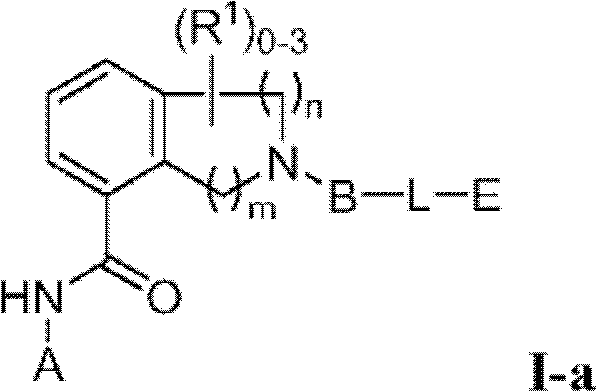
在第二个实施方式内,R1是卤素、C1-6烷基、C1-6杂烷基或=O。下标n是整数2或3;而且下标m是1到2的整数。A是In a second embodiment, R 1 is halogen, C 1-6 alkyl, C 1-6 heteroalkyl or =O. Subscript n is an integer of 2 or 3; and subscript m is an integer of 1 to 2. A is
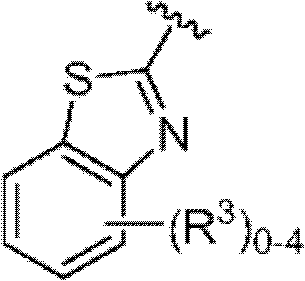
而且在该第二个实施方式内,B是选自以下的一员:And within this second embodiment, B is a member selected from:
其中R4b选自以下wherein R 4b is selected from the following

在第三个实施方式中,在具有式I的化合物中或其第一个实施方式内,化合物具有式I-aIn a third embodiment, in a compound of formula I, or within its first embodiment, a compound of formula I-a
其中R1是卤素、C1-6烷基、C1-6杂烷基或=O;下标n是2到3的整数;而且下标m是1到2的整数。在该第三个实施方式中,A是wherein R 1 is halogen, C 1-6 alkyl, C 1-6 heteroalkyl, or =0; subscript n is an integer from 2 to 3; and subscript m is an integer from 1 to 2. In this third embodiment, A is
而且B是选自以下的一员:and B is a member selected from:
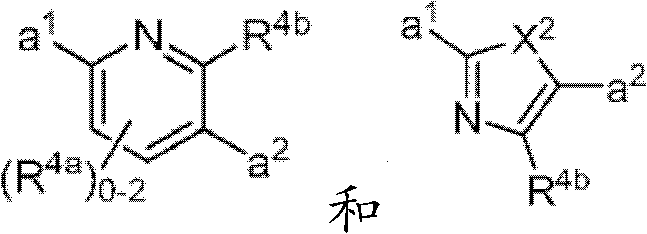
其中R4b选自-C(O)ORj、-C(O)NRhRi、-C(O)Ri、-NRhC(O)Ri、-NRhC(O)NRhRi、-OC(O)NRhRi、-NRhC(O)ORj、-C(=NORh)NRhRi、-NRhC(=NCN)NRhRi、-NRhS(O)2NRhRi、-S(O)2Rj、-S(O)2NRhRi、-N(Rh)S(O)2Ri、-NRhC(=NRi)NRhRi、-C(=S)NRhRi、-C(=NRh)NRhRi、-Rj、卤素、-NO2、和-CN。Wherein R 4b is selected from -C(O)OR j , -C(O)NR h R i , -C(O)R i , -NR h C(O)R i , -NR h C(O)NR h R i , -OC(O)NR h R i , -NR h C(O)OR j , -C(=NOR h )NR h R i , -NR h C(=NCN)NR h R i , -NR h S(O) 2 NR h R i , -S(O) 2 R j , -S(O) 2 NR h R i , -N(R h )S(O) 2 R i , -NR h C( =NR i ) NR h R i , -C(=S)NR h R i , -C(=NR h )NR h R i , -R j , halogen, -NO 2 , and -CN.
在第四个实施方式中,在具有式I的化合物的第二和第三个实施方式的某些方面内,下标n是2而且下标m是1。In a fourth embodiment, within certain aspects of the second and third embodiments of the compound having Formula I, subscript n is 2 and subscript m is 1.
在第五个实施方式中,在具有式I的化合物的第二个实施方式的某些方面内,R1不存在;而且B是In a fifth embodiment, within certain aspects of the second embodiment of the compound of formula I, R is absent; and B is

其中R4a如果存在的话选自卤素和C1-4烷基;其中下标n是2而且下标m是1。wherein R 4a, if present, is selected from halogen and C 1-4 alkyl; wherein subscript n is 2 and subscript m is 1.
在第六个实施方式中,在具有式I的化合物的第二个实施方式的某些方面内,R1不存在;而且B是In a sixth embodiment, within certain aspects of the second embodiment of the compound of formula I, R is absent; and B is
其中下标n是2而且下标m是1。where the subscript n is 2 and the subscript m is 1.
在第七个实施方式中,在具有式I的化合物或其第一、第二或第三个实施方式内,本发明的化合物具有的式选自In a seventh embodiment, within a compound of formula I, or its first, second or third embodiment, the compound of the invention has the formula selected from
在第八个实施方式中,在本发明化合物的第一、第二、第三、第四、第五、第六或第七个实施方式的某些方面内,L不存在,或者是被任意取代的基团,选自被任意取代的C6-10亚芳基-C1-6杂亚烷基和C5-9杂亚芳基-C1-6杂亚烷基。In an eighth embodiment, within certain aspects of the first, second, third, fourth, fifth, sixth or seventh embodiments of the compounds of the invention, L is absent, or is optionally The substituted group is selected from optionally substituted C 6-10 arylene-C 1-6 heteroalkylene and C 5-9 heteroarylene-C 1-6 heteroalkylene.
在第九个实施方式中在具有式I的化合物的第八个实施方式的某些方面内,L选自以下In a ninth embodiment within certain aspects of the eighth embodiment of the compound of formula I, L is selected from
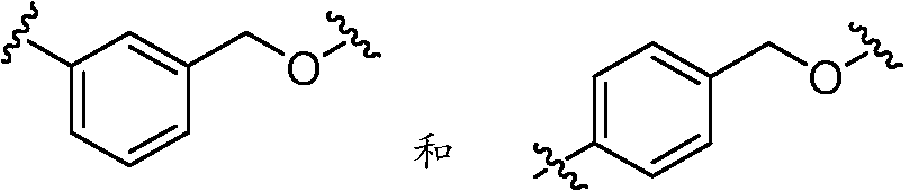
在第十个实施方式中,在具有式I的化合物的第一、第二、第三、第四、第五、第六或第七个实施方式的某些方面内,L是被任意取代的基团,选自被任意取代的C1-6杂亚烷基、C1-6亚烷基、C2-6亚烯基和C2-6亚炔基。In a tenth embodiment, within certain aspects of the first, second, third, fourth, fifth, sixth or seventh embodiment of the compound of Formula I, L is optionally substituted A group selected from optionally substituted C 1-6 heteroalkylene, C 1-6 alkylene, C 2-6 alkenylene and C 2-6 alkynylene.
在第十一个实施方式中,在具有式I的化合物的第十个实施方式的某些方面内,L选自被任意取代的C1-4亚烷氧基、C2-4亚烯氧基、C2-4亚炔氧基和C1-4亚烷基,其中L被0到4个Rm基团取代,而且其中位于L的相同或不同原子上的任意两个Rm基团任选地组合形成一个5-到7-元的碳环或一个5-到7-元的杂环,该杂环包含1到2个选自N、O和S的杂原子作为环顶点。In an eleventh embodiment, within certain aspects of the tenth embodiment of the compound having Formula I, L is selected from optionally substituted C 1-4 alkyleneoxy, C 2-4 alkenyleneoxy C 2-4 alkynylene oxy group and C 1-4 alkylene group, wherein L is substituted by 0 to 4 R m groups, and any two R m groups located on the same or different atoms of L Optionally combined to form a 5- to 7-membered carbocycle or a 5- to 7-membered heterocycle comprising 1 to 2 heteroatoms selected from N, O and S as ring vertices.
在第十二个实施方式中,在具有式I的化合物的第十个实施方式的某些方面内,L选自In a twelfth embodiment, within certain aspects of the tenth embodiment of the compound having Formula I, L is selected from
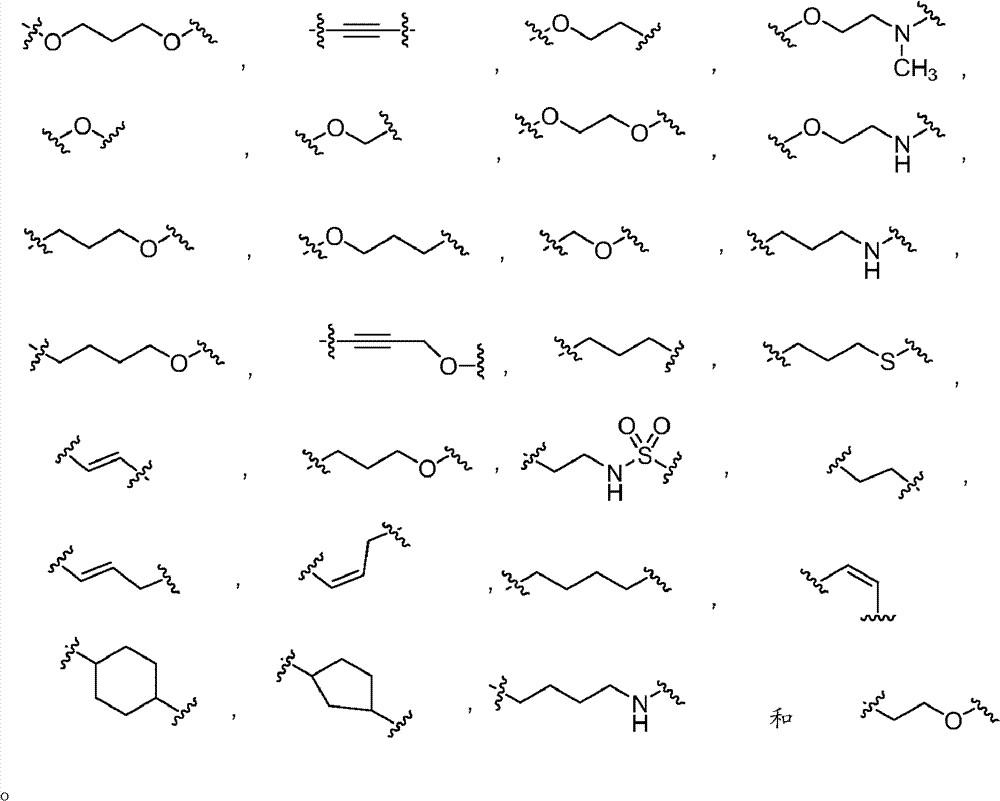
在第十三个实施方式中,在具有式I的化合物的第二、第三、第四、第五、第六、第七、第八、第九、第十、第十一或第十二个实施方式的某些方面内,E是氢。In a thirteenth embodiment, at the second, third, fourth, fifth, sixth, seventh, eighth, ninth, tenth, eleventh or twelfth In certain aspects of one embodiment, E is hydrogen.
在第十四个实施方式中,和在具有式I的化合物的第二、第三、第四、第五、第六、第七、第八、第九、第十、第十一、第十二或第十三个实施方式的某些方面内,E选自苯基、C5-6杂芳基和C3-7杂环烷基,而且任选地与E稠合的是一个环,独立地选自5-到7-元的碳环、5-到7-元的杂环、苯环、和5-到6-元的杂芳环,其中E和任选地与其稠合的环一共被总计1到3个R6取代基取代,其中的一个R6取代基是-NRpRq、-Z1-NRpRq、-Rs、或-Z1-Rs。In a fourteenth embodiment, and in the second, third, fourth, fifth, sixth, seventh, eighth, ninth, tenth, eleventh, tenth In certain aspects of the second or thirteenth embodiments, E is selected from phenyl, C 5-6 heteroaryl, and C 3-7 heterocycloalkyl, and optionally fused to E is a ring, independently selected from 5- to 7-membered carbocycles, 5- to 7-membered heterocycles, benzene rings, and 5- to 6-membered heteroaromatic rings, wherein E and the ring optionally fused thereto Substituted by a total of 1 to 3 R 6 substituents, one of which is -NR p R q , -Z 1 -NR p R q , -R s , or -Z 1 -R s .
在第十五个实施方式中,在具有式I的化合物的第十四个实施方式的某些方面内,所述的一个R6取代基是-NRpRq或-Z1-NRpRq。In a fifteenth embodiment, within certain aspects of the fourteenth embodiment of the compound having Formula I, said one R substituent is -NR p R q or -Z 1 -NR p R q .
在第十六个实施方式中,在式I的第十五个实施方式的某些方面内,1或2个R6取代基选自氟和氯。In a sixteenth embodiment, within certain aspects of the fifteenth embodiment of Formula I, 1 or 2 R substituents are selected from fluoro and chloro.
在第十七个实施方式中,在具有式I的化合物的第十四个实施方式的某些方面内,所述的一个R6取代基是Rs或-Z1-Rs,其中Rs具有的式选自:In the seventeenth embodiment, within certain aspects of the fourteenth embodiment of the compound having Formula I, said one R 6 substituent is R s or -Z 1 -R s , wherein R s Has a formula selected from:
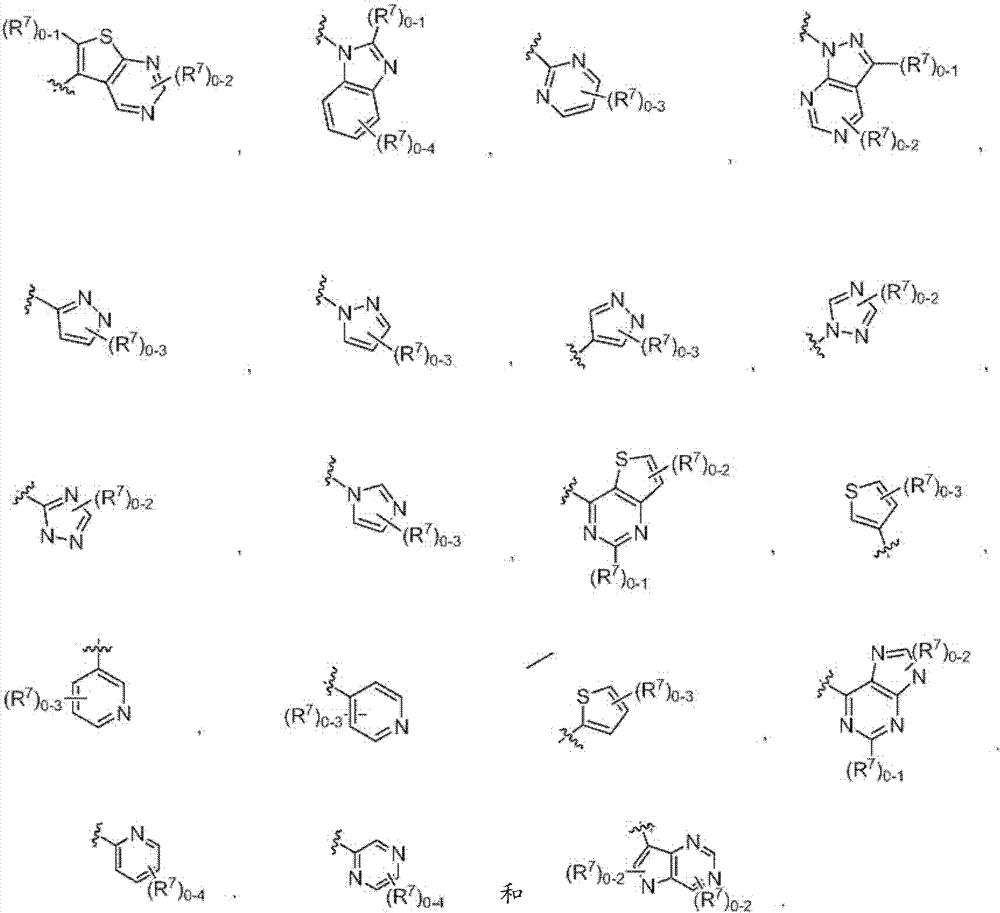
在第十八个实施方式中,在具有式I的化合物的第十四、第十五、第十六或第十七个实施方式的某些方面内,Z1选自:In an eighteenth embodiment, within certain aspects of the fourteenth, fifteenth, sixteenth or seventeenth embodiment of the compound of formula I, Z is selected from:
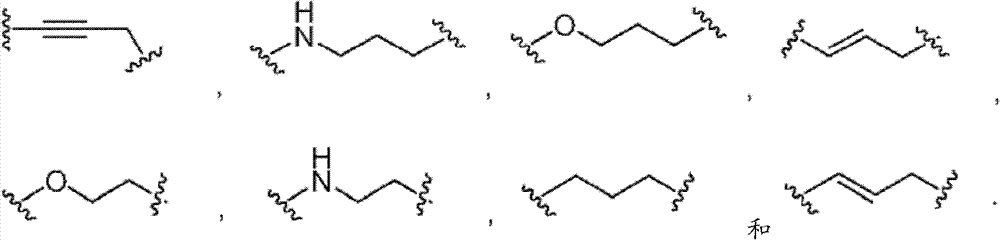
在第十九个实施方式中,在具有式I的化合物的第四、第十、第十一或第十二个实施方式的某些方面内,化合物具有的式选自:In a nineteenth embodiment, within certain aspects of the fourth, tenth, eleventh or twelfth embodiments of the compound having Formula I, the compound has the formula selected from:
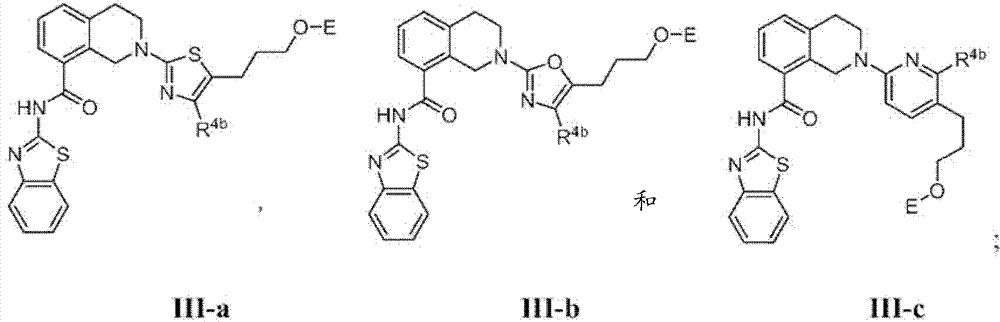
其中R4b选自:Wherein R is selected from:

而且E是苯基,而且被1到3个R6取代基取代。And E is phenyl and is substituted with 1 to 3 R substituents.
在第二十个实施方式中,在具有式I的化合物的第十九个实施方式的某些方面内,R4b是-C(O)OH。In a twentieth embodiment, within certain aspects of the nineteenth embodiment of compounds having Formula I, R 4b is -C(O)OH.
在第二十一个实施方式中,在具有式I的化合物的第一、第二、第三、第四、第七或第十九个实施方式的某些方面内,E是-苯基,其中苯基在间位或对位位置被任意取代的Rs基团取代,Rs基团具有的式选自:In the twenty-first embodiment, within certain aspects of the first, second, third, fourth, seventh or nineteenth embodiment of the compound of Formula I, E is -phenyl, wherein the phenyl group is substituted in the meta or para position with an optionally substituted R group, the R group having the formula selected from:

在第二十二个实施方式中,在具有式I的化合物的第十七或第二十一个实施方式的某些方面内,R7如果存在的话,至少一个选自-NRtRu和-Z2-NRtRu。In a twenty-second embodiment, within certain aspects of the seventeenth or twenty-first embodiment of the compound of formula I, R 7 , if present, is at least one selected from -NR t R u and -Z 2 -NR t R u .
在第二十三个实施方式中,在具有式I的化合物的第二十二个实施方式的某些方面内,Z2选自C1-4亚烷基、C2-4亚烯基、C2-4亚炔基和C1-4杂亚烷基。In a twenty-third embodiment, within certain aspects of the twenty-second embodiment of compounds having Formula I, Z is selected from C 1-4 alkylene, C 2-4 alkenylene, C 2-4 alkynylene and C 1-4 heteroalkylene.
在第二十四个实施方式中,在具有式I的化合物的第二十三个实施方式的某些方面内,Z2选自以下In the twenty-fourth embodiment, within certain aspects of the twenty-third embodiment of the compound of formula I, Z is selected from
在第二十五个实施方式中,对具有式I的化合物,化合物具有的式选自图1中阐述的组。In a twenty-fifth embodiment, for compounds having formula I, the compound has a formula selected from the group set forth in FIG. 1 .
在第二十六个实施方式中,对具有式I的化合物,化合物具有的式选自图1中的式IV-a、IV-b、IV-c、IV-e和IV-i。In a twenty-sixth embodiment, for the compound having formula I, the compound has a formula selected from formulas IV-a, IV-b, IV-c, IV-e and IV-i in Figure 1 .
在第二十七个实施方式中,在具有式I的化合物中或其第一、第二、第三、第七或第十九个实施方式的某些方面内,E选自图2-A、图2-B、图2-C、图2-D或图2-E阐述的组。In a twenty-seventh embodiment, in a compound of Formula I, or within certain aspects of its first, second, third, seventh or nineteenth embodiment, E is selected from Figure 2-A , Figure 2-B, Figure 2-C, Figure 2-D, or Figure 2-E sets forth.
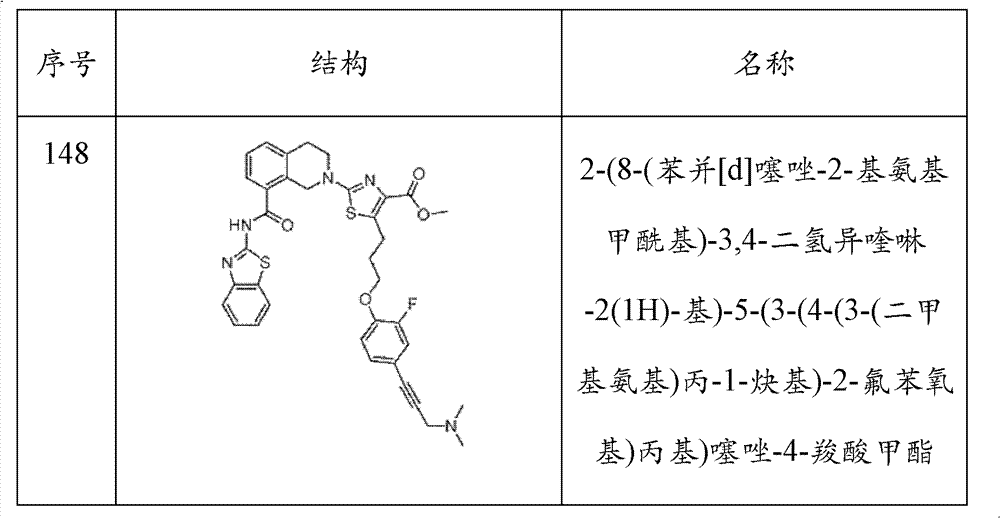
在第二十八个实施方式中,具有式I的化合物选自表1(在下)中阐述的组。In a twenty-eighth embodiment, the compound of formula I is selected from the group set forth in Table 1 (below).
表1Table 1
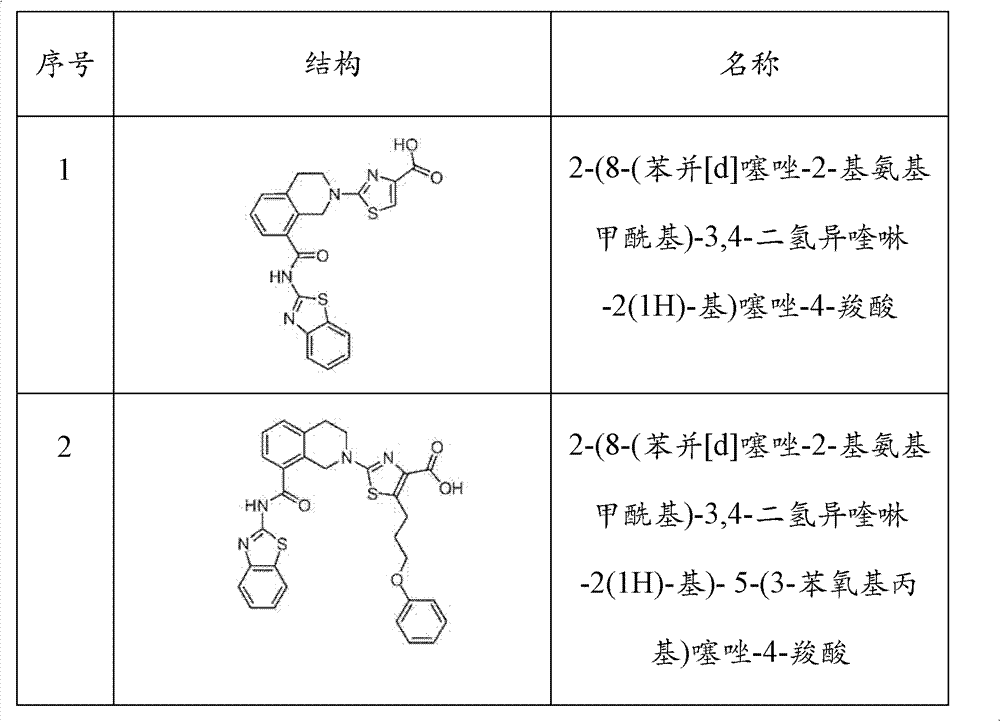
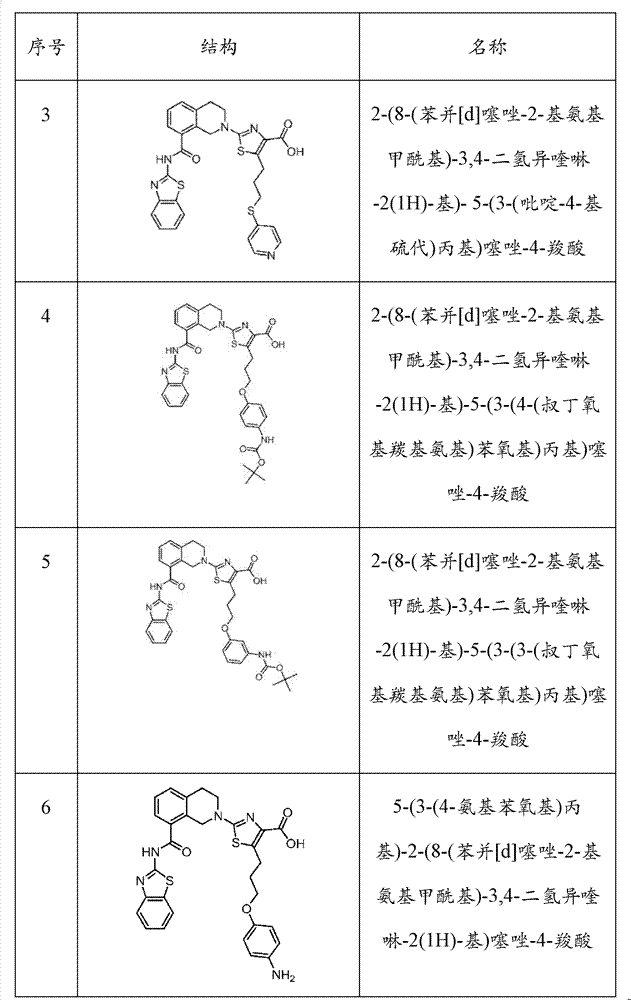

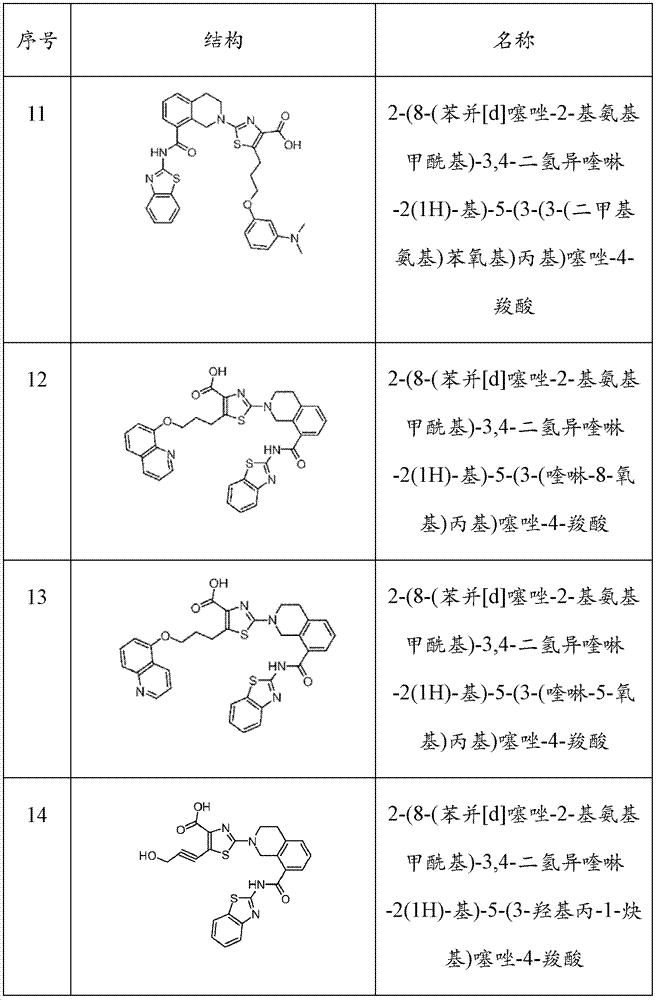
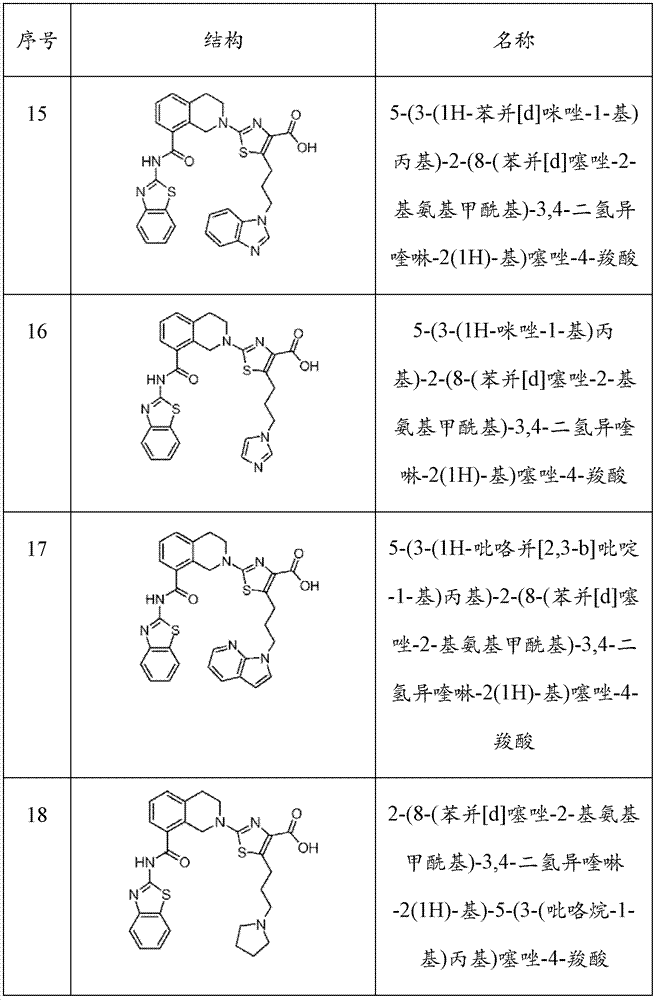
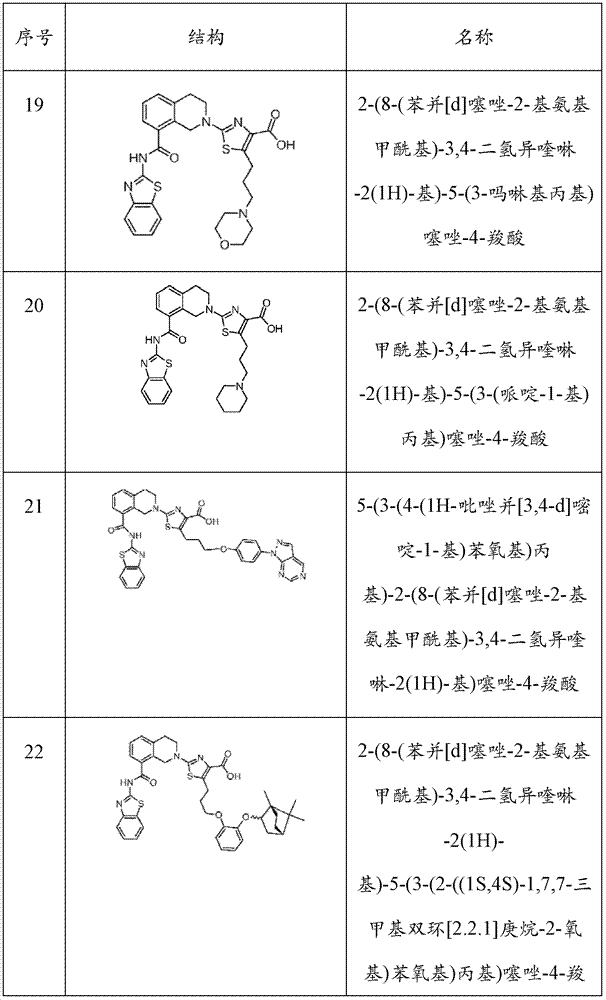
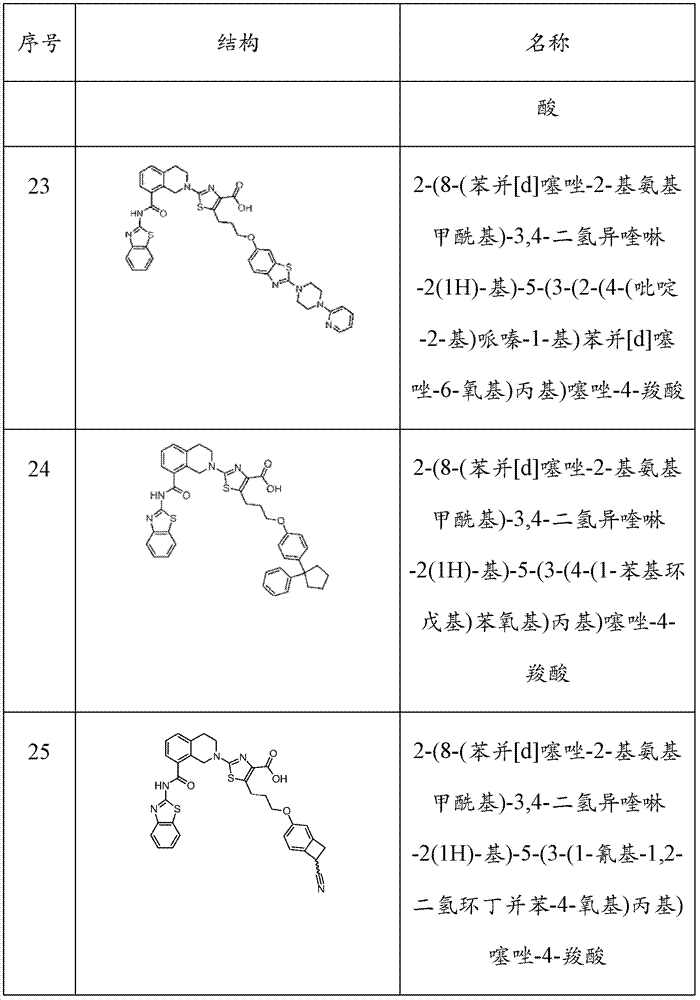
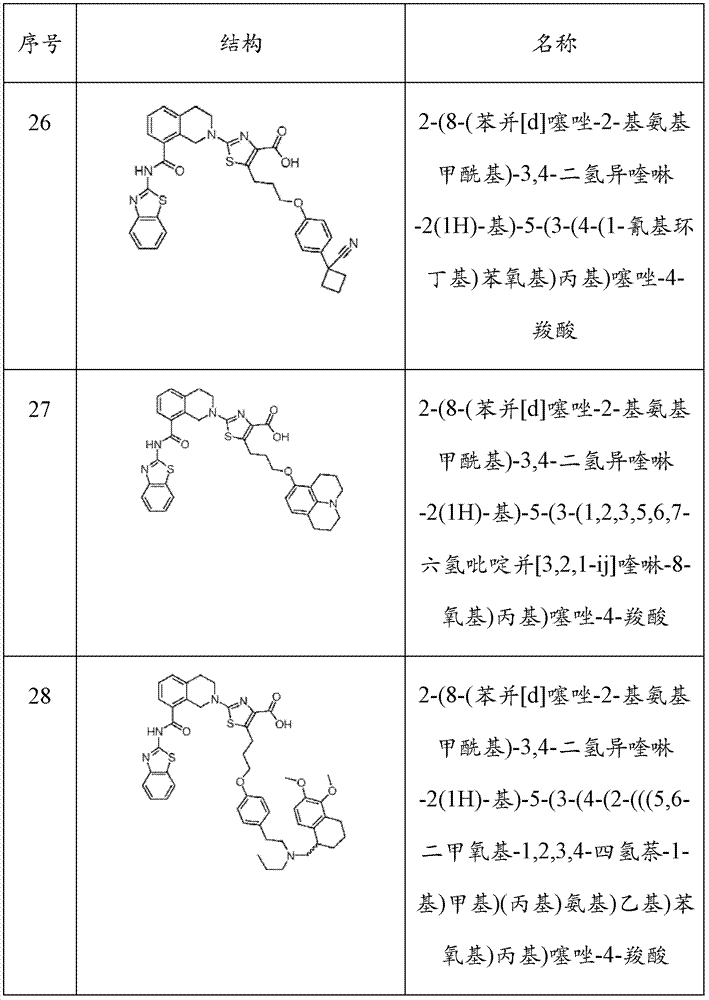
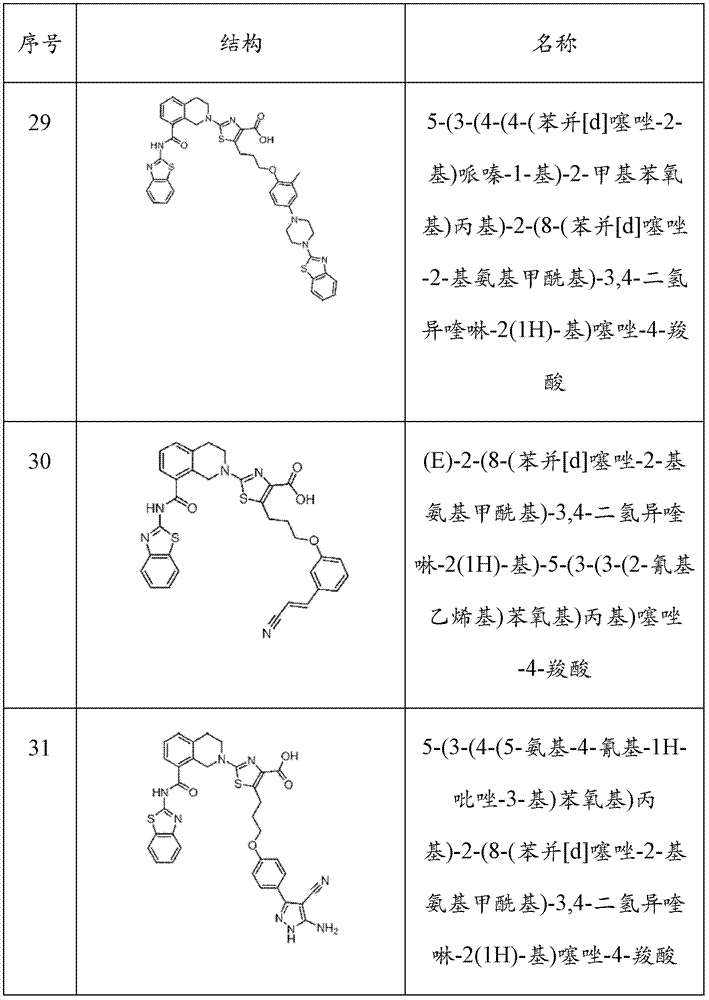
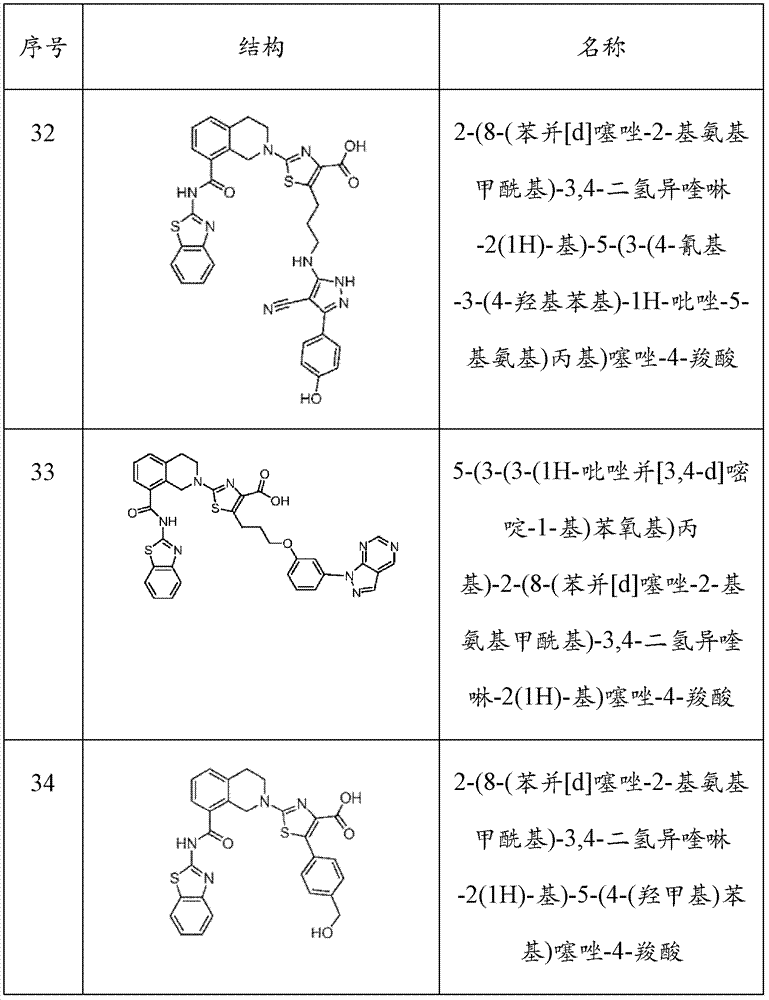
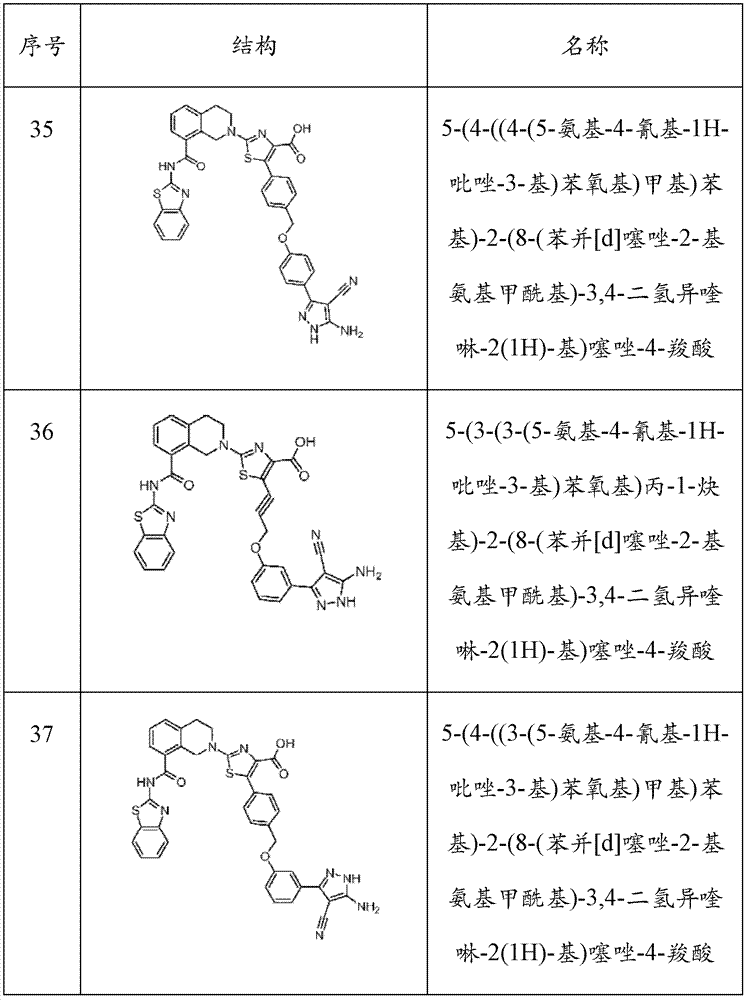
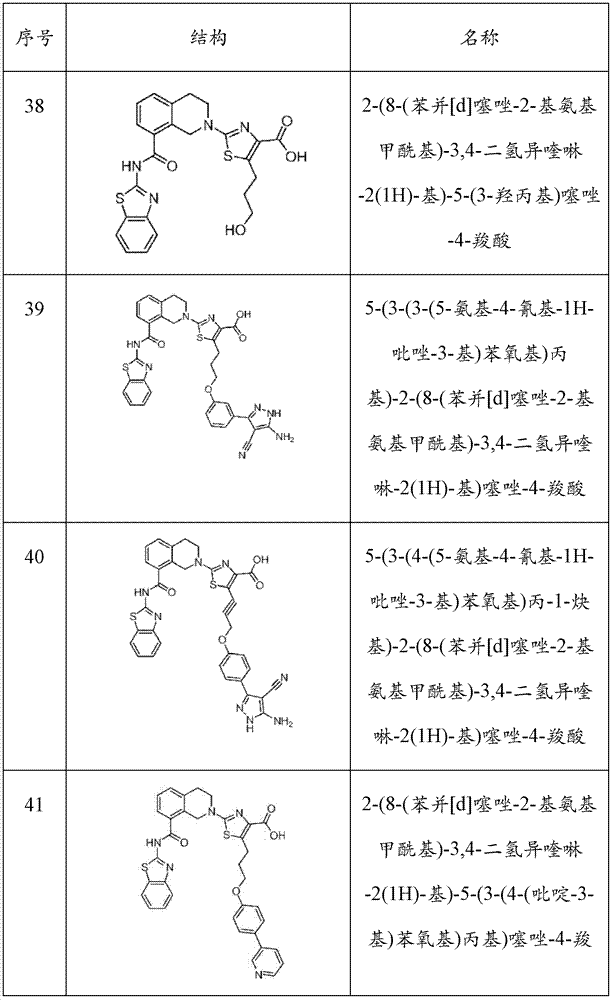

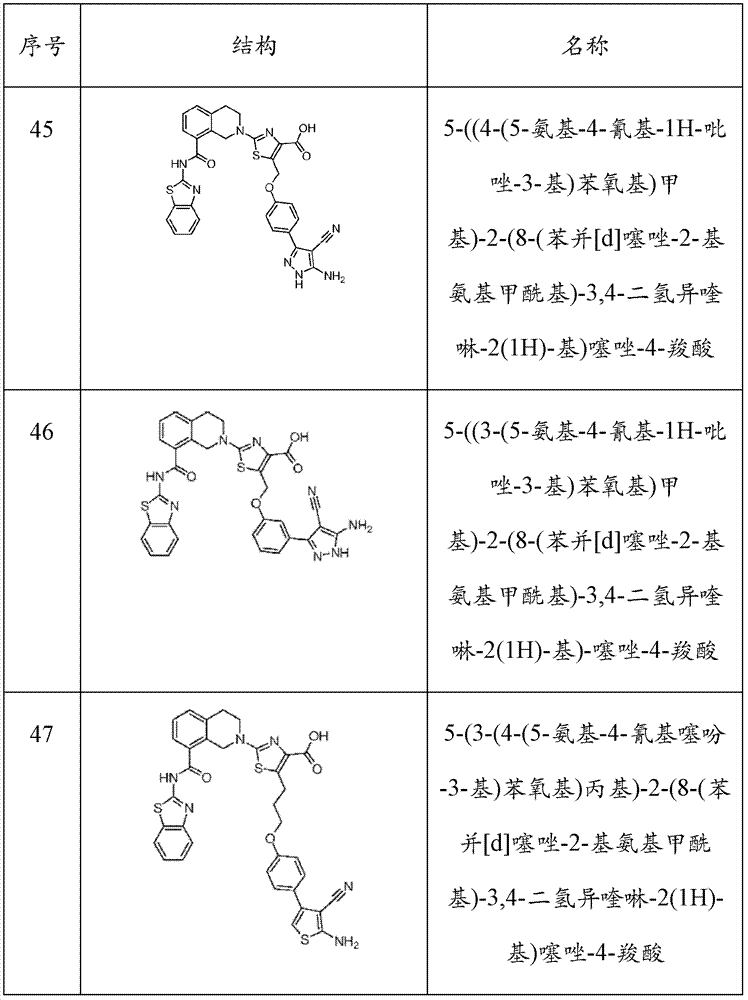

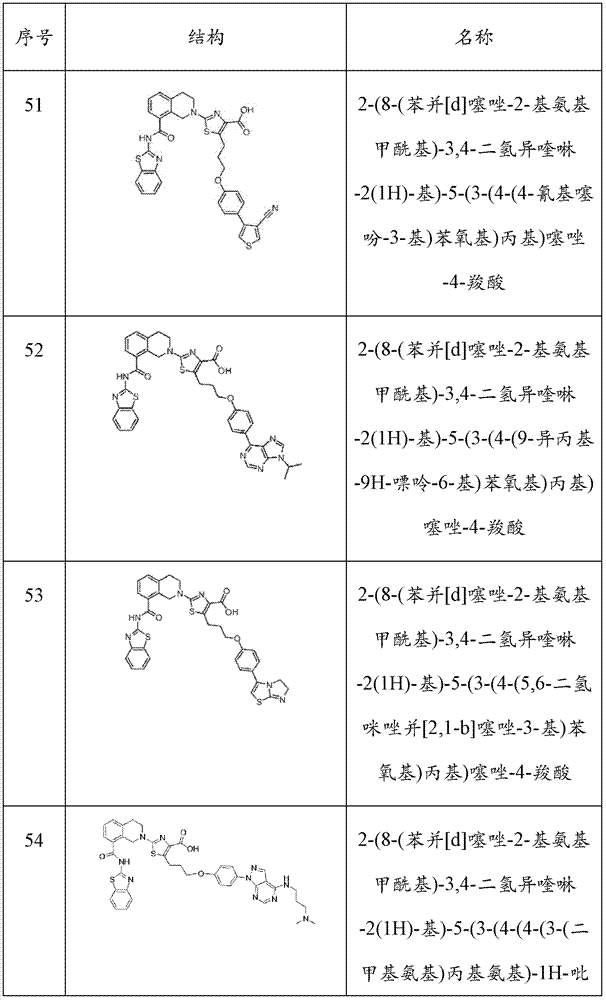

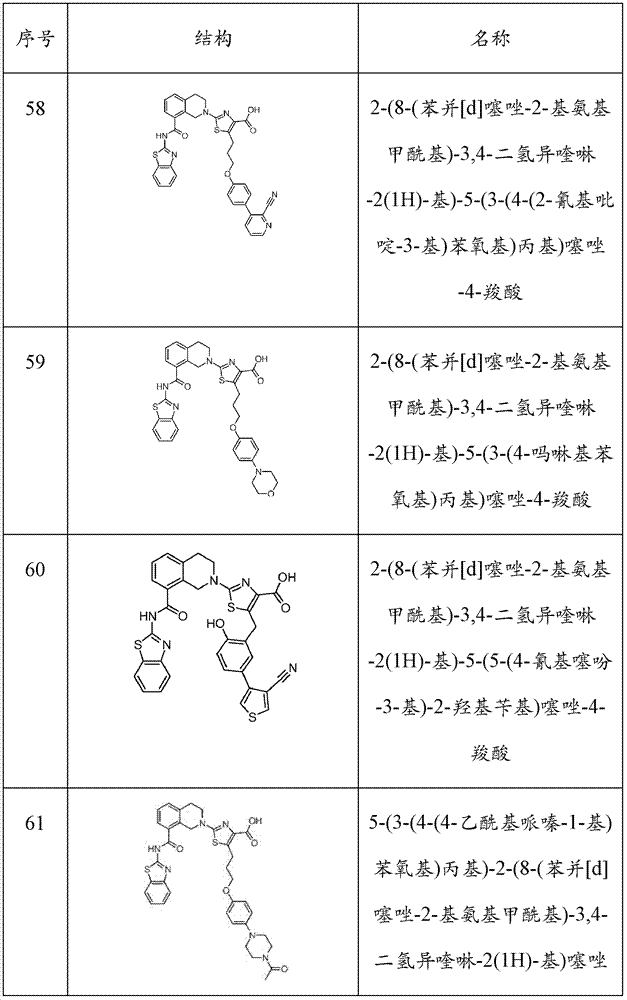
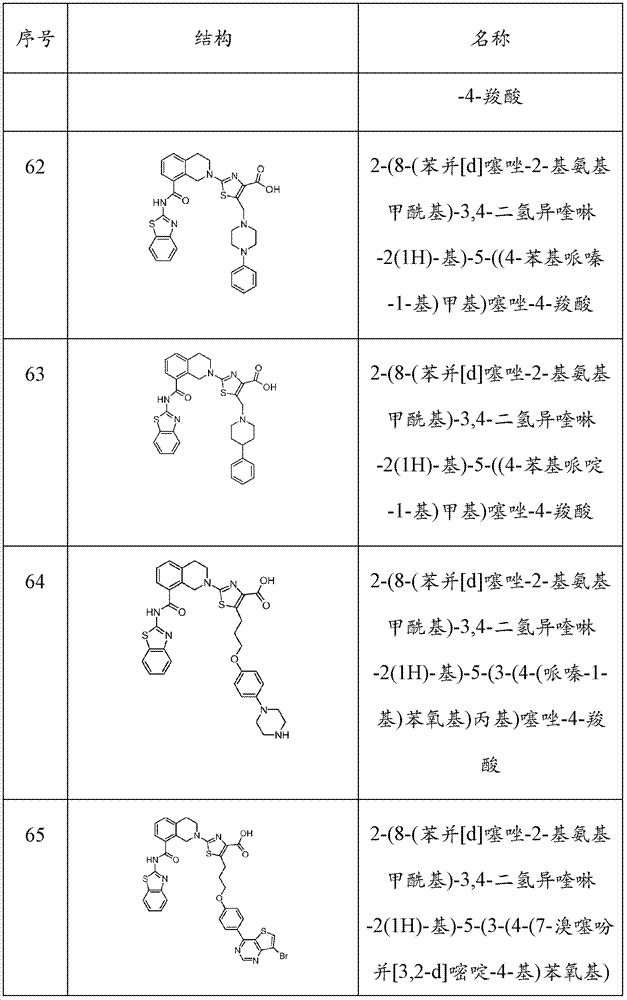
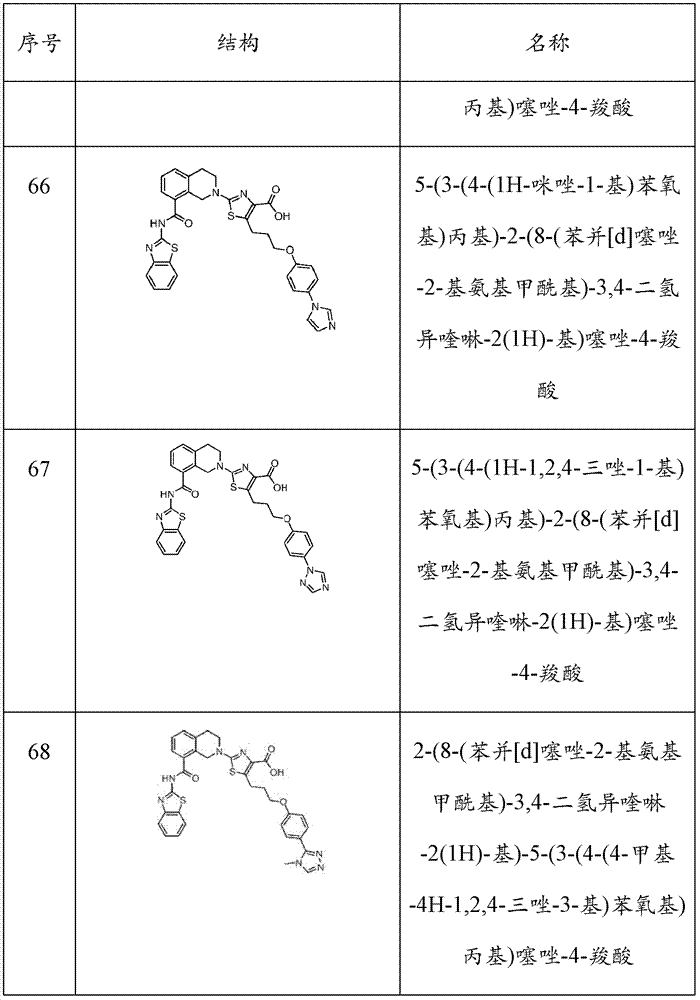
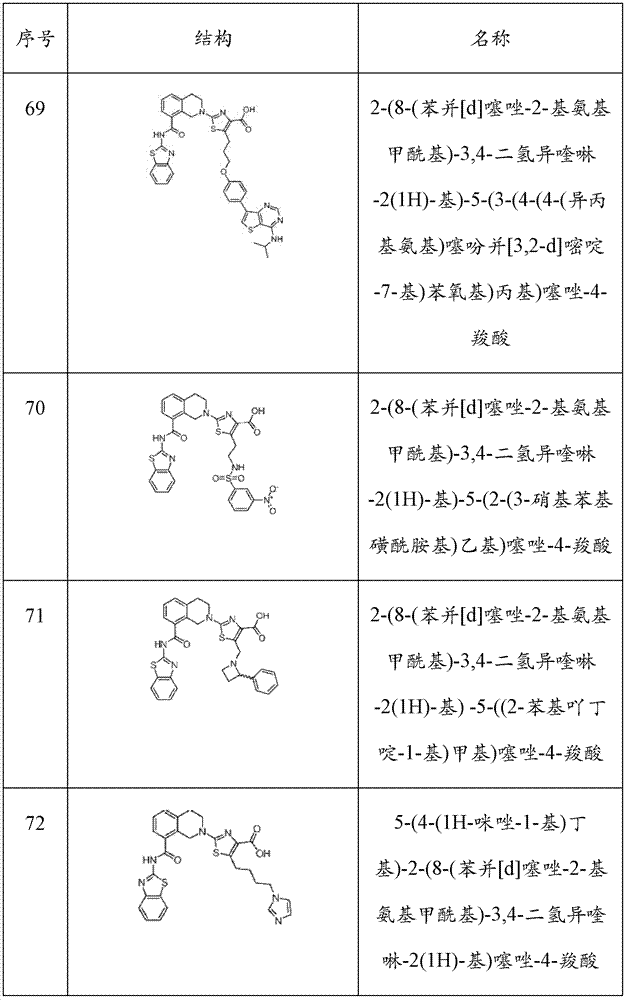

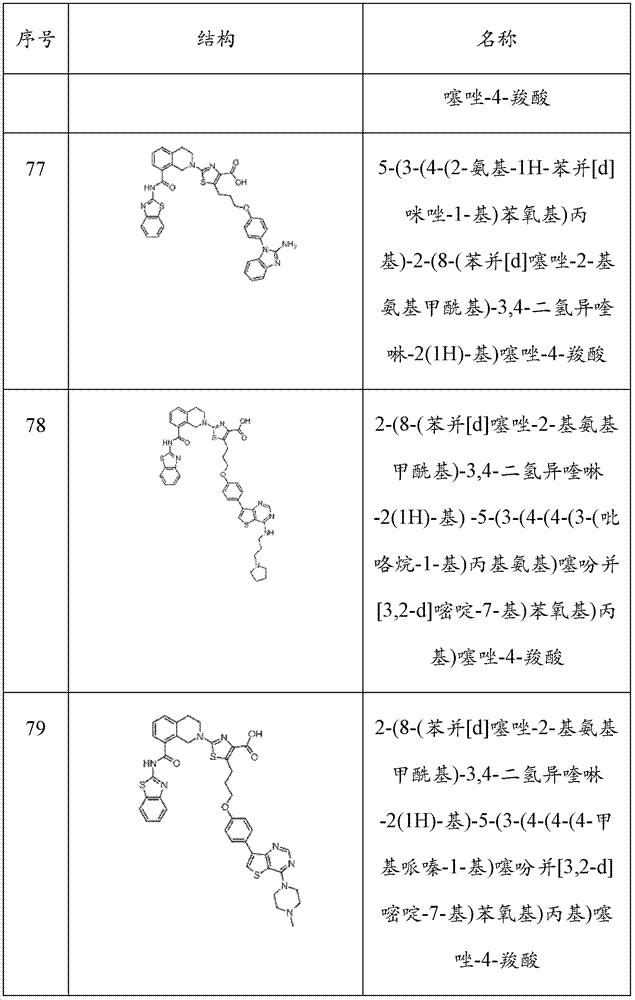
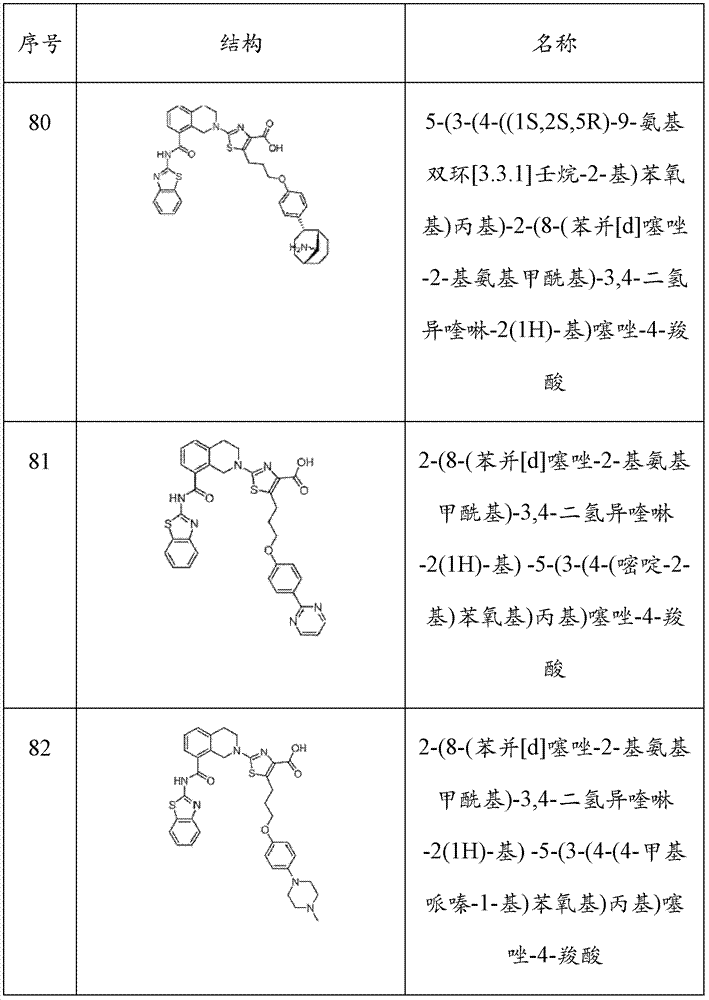
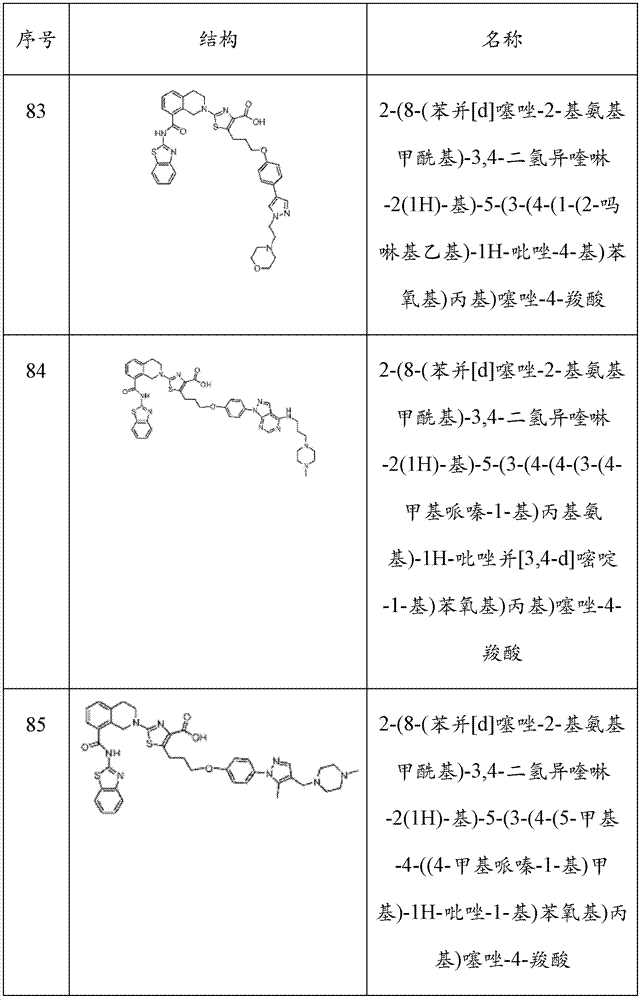


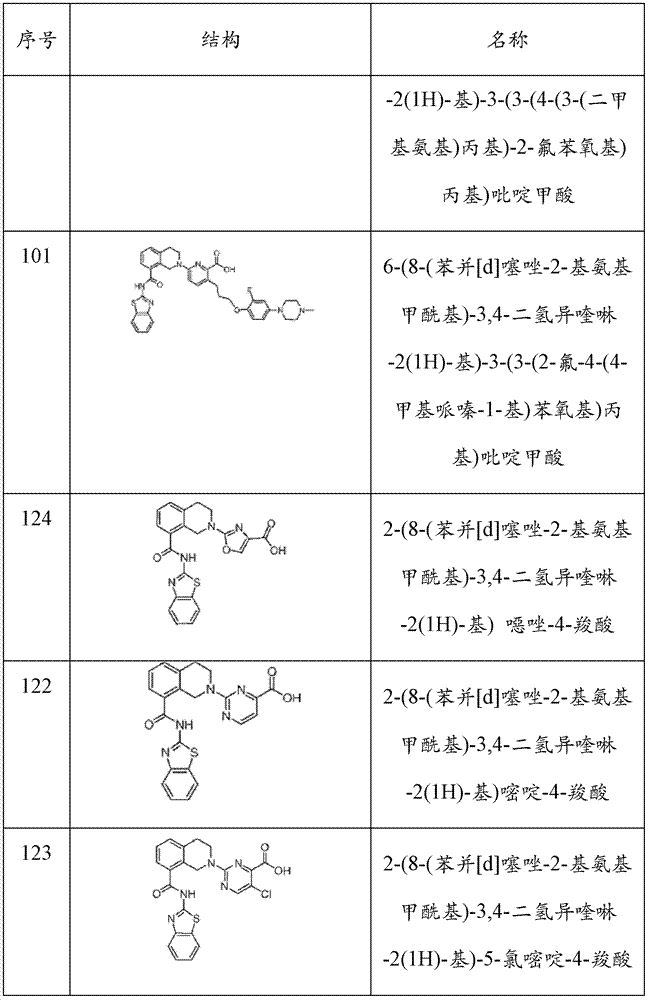
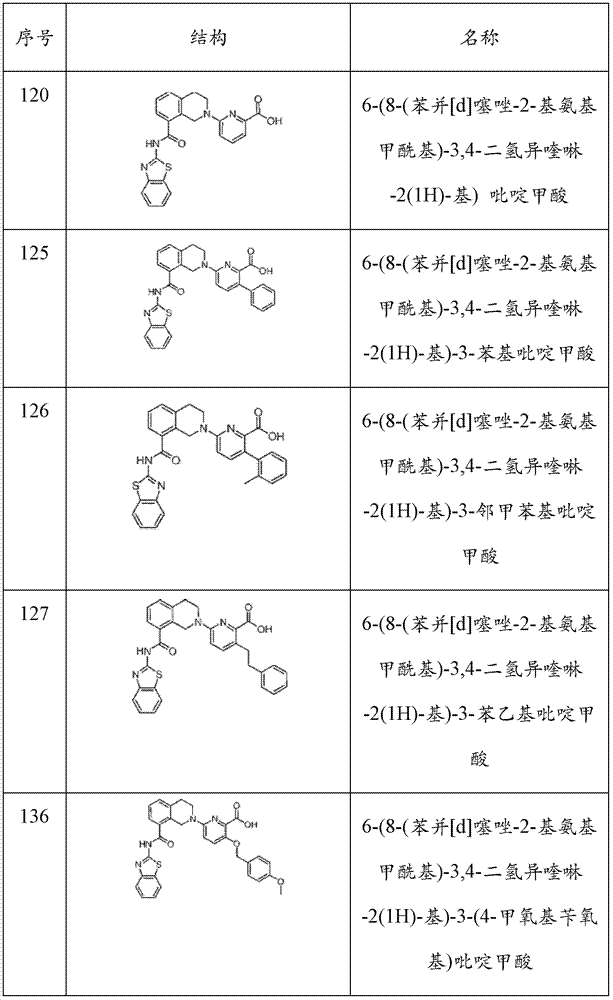
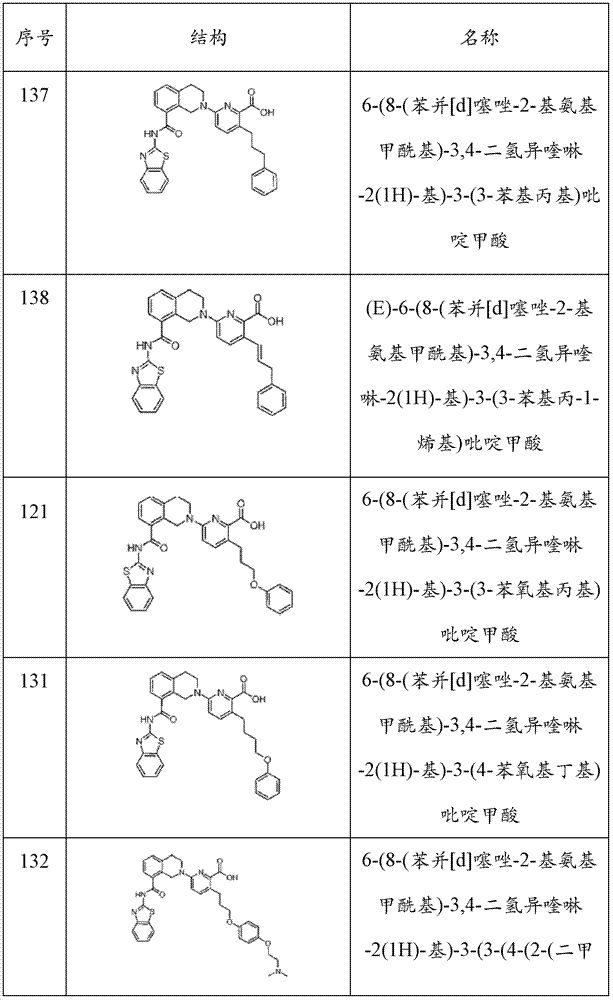

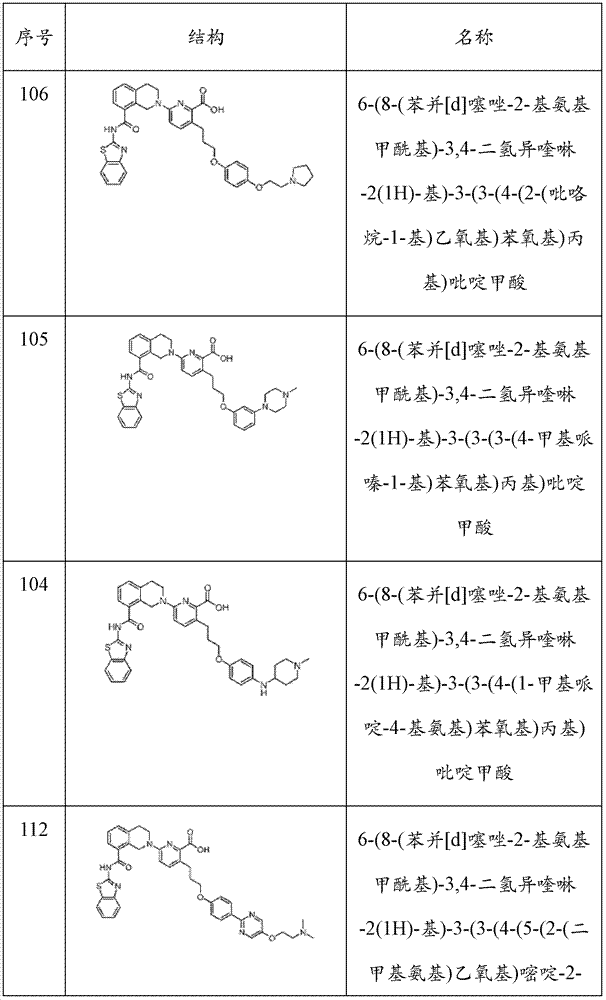

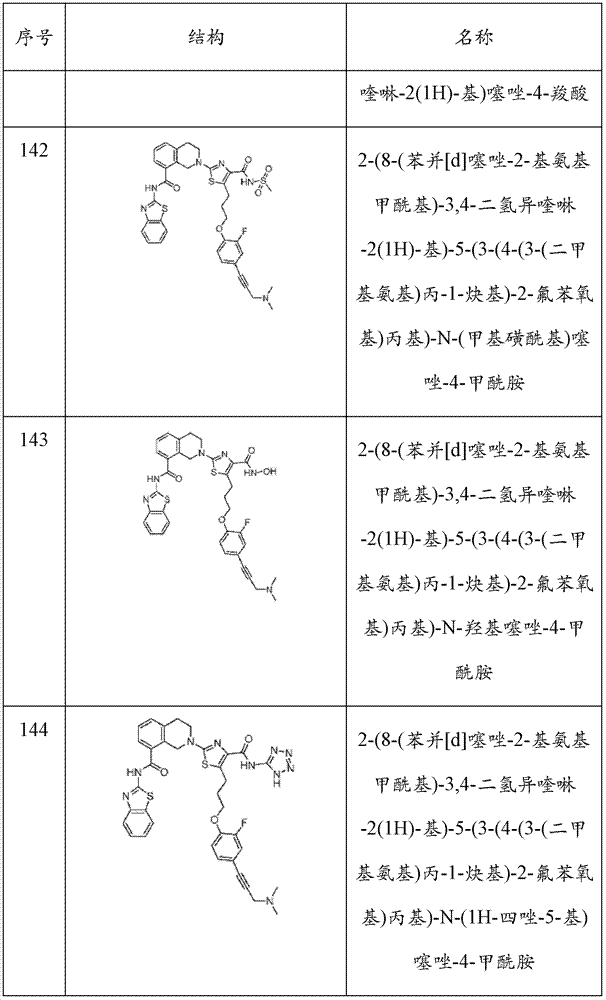
一般合成程序General synthesis procedure
本发明化合物可以通过本领域已知的合成方法制备,为了说明性的目的,下面描述了其中的一些。N-Boc-8-羟基羰基-1,2,3,4-四氢异喹啉具有CAS注册号878798-87-9,可从ASW MedChem Products Inc,New Brunswick,New Jersey商业得到,或可以通过遵循如HelveticaChimica Acta,68(1985)1828-1834中描述的修饰程序制备,如下面方案1中所示。The compounds of the present invention can be prepared by synthetic methods known in the art, some of which are described below for illustrative purposes. N-Boc-8-hydroxycarbonyl-1,2,3,4-tetrahydroisoquinoline has CAS Registry No. 878798-87-9 and is commercially available from ASW MedChem Products Inc, New Brunswick, New Jersey, or can be purchased via Prepared following a modified procedure as described in Helvetica Chimica Acta, 68 (1985) 1828-1834, as shown in Scheme 1 below.
方案1plan 1
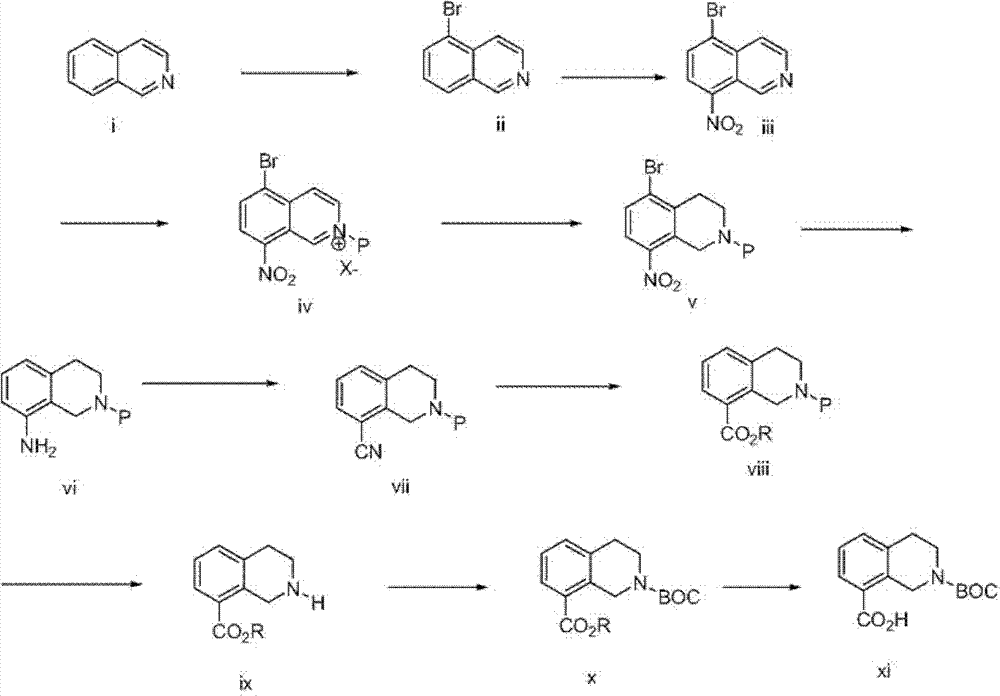
如上面方案1中所示,含有四氢异喹啉核心的式I化合物,可以从四氢异喹啉(i)在路易斯酸例如AlCl3存在下用例如Br2溴化产生溴化物化合物ii开始制备,接着硝化形成5-溴-8-硝基异喹啉(iii)。用保护基团(P)例如苄基、甲苯磺酰基、三甲基甲硅烷基乙氧基甲基(SEM)或2-三甲基甲硅烷基乙基磺酰基(SES)基团取代异喹啉环的氮原子,接着使用氢化物试剂例如NaBH3CN还原得到的吡啶环,可以提供四氢异喹啉化合物v。脱溴和v上硝基的还原,可以使用温和氢化条件例如H2、Pd/C完成,提供氨基化合物vi。vi在Sandmeyer条件例如,HNO2、CuCN下处理,可以提供腈vii,其在醇溶剂(R-OH,例如甲醇、乙醇)中酸水解(HCl水溶液),可以提供酯viii。用来除去化合物viii上的保护基团(P)的条件,将取决于保护基团的性质。例如,氢化条件(例如,H2、Pt2O)可以用来除去苄基保护基团;金属还原条件(Na、萘)可以用来除去甲苯磺酰基基团;而脱甲硅烷基条件(例如CsF)可以用来除去SES或SEM基团,以提供仲胺ix。ix用Boc酐再保护,接着在碱性条件(例如LiOH)下水解酯(-CO2R)基团,可以提供四氢异喹啉核心的酸x。As shown in Scheme 1 above, compounds of formula I containing a tetrahydroisoquinoline core, can be started from the bromination of tetrahydroisoquinoline (i) with, for example, Br in the presence of a Lewis acid such as AlCl to give bromide compound ii Preparation, followed by nitration to form 5-bromo-8-nitroisoquinoline (iii). Substitution of isoquinol with a protecting group (P) such as benzyl, tosyl, trimethylsilylethoxymethyl (SEM) or 2-trimethylsilylethylsulfonyl (SES) groups The nitrogen atom of the line ring, followed by reduction of the resulting pyridine ring using a hydride reagent such as NaBH3CN , can provide tetrahydroisoquinoline compounds v. Debromination and reduction of the nitro group on v can be accomplished using mild hydrogenation conditions such as H2 , Pd/C to provide amino compounds vi. Treatment of vi under Sandmeyer conditions eg, HNO2 , CuCN can afford nitriles vii, which acid hydrolysis (aqueous HCl) in alcoholic solvents (R-OH, eg methanol, ethanol) can afford esters viii. The conditions used to remove the protecting group (P) on compound viii will depend on the nature of the protecting group. For example, hydrogenation conditions (e.g., H2 , Pt2O ) can be used to remove benzyl protecting groups; metal reducing conditions (Na, naphthalene) can be used to remove tosyl groups; and desilylation conditions (e.g. CsF) can be used to remove the SES or SEM group to provide the secondary amine ix. Reprotection of ix with Boc anhydride followed by hydrolysis of the ester ( -CO2R ) group under basic conditions (eg LiOH) can provide the acid x with a tetrahydroisoquinoline core.
含有四氢吡啶并嘧啶核心的式I化合物可以如下面方案2中所示般制备。Compounds of formula I containing a tetrahydropyridopyrimidine core can be prepared as shown in Scheme 2 below.
方案2Scenario 2
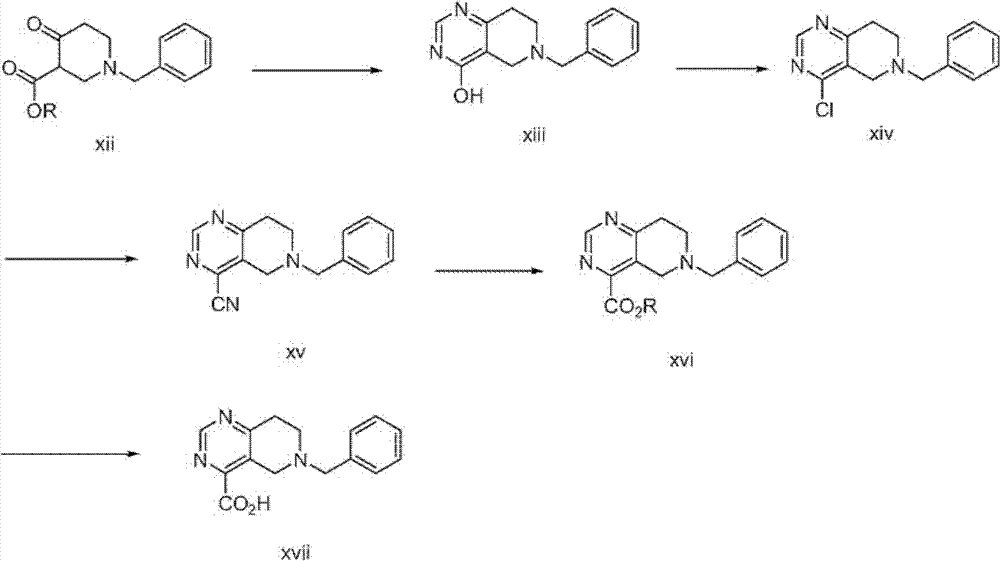
在方案2中,β-酮酯xii与醋酸甲脒缩合,提供羟基嘧啶xiii。xiii中的羟基向氯代基团的转化,可以使用POCl3完成,以提供氯化物xiv。氯化物xiv通过在Pd(0)催化剂(例如Pd(PPh3)4)存在下与Zn(CN)2反应,可以进一步转化成对应的腈xv。腈产物xv的水解可以在酸性条件下(例如,HCl/MeOH)完成,以提供酯xvi,其可以在碱性条件下(例如NaOH、MeOH)水解,以提供酸xvii。In Scheme 2, the β-ketoester xii is condensed with formamidine acetate to provide the hydroxypyrimidine xiii. Conversion of the hydroxyl group in xiii to the chloro group can be accomplished using POCl3 to afford the chloride xiv. Chlorides xiv can be further converted to the corresponding nitriles xv by reaction with Zn(CN) 2 in the presence of a Pd(0) catalyst such as Pd(PPh 3 ) 4 . Hydrolysis of nitrile product xv can be accomplished under acidic conditions (eg, HCl/MeOH) to provide esters xvi, which can be hydrolyzed under basic conditions (eg, NaOH, MeOH) to provide acids xvii.
含有苯并氮杂卓核心的式I化合物,可以使用如下面方案3中描述的修饰程序制备(参见Tetrahedron Letters,(1980),1393;J Chem SocPerkin Trans I,(1973),782)。Compounds of formula I, containing a benzazepine core, can be prepared using modified procedures as described in Scheme 3 below (see Tetrahedron Letters, (1980), 1393; J Chem Soc Perkin Trans I, (1973), 782).
方案3Option 3
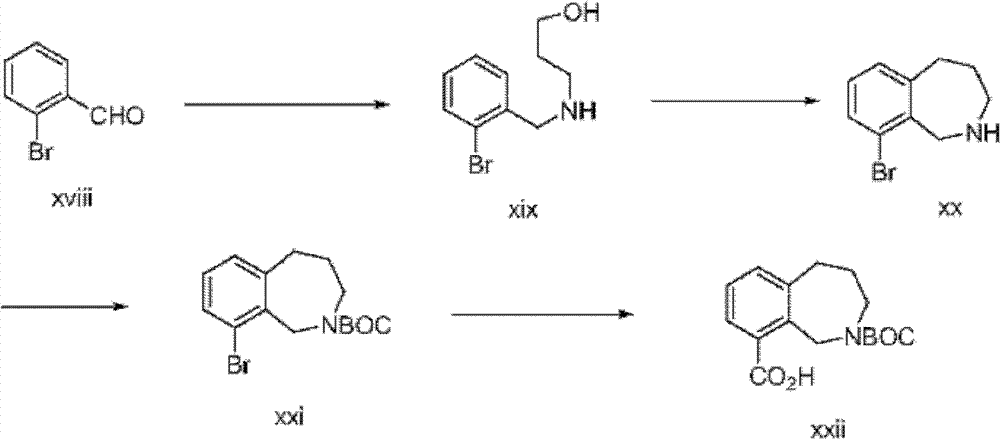
溴苯甲醛xviii可以用3-羟基丙胺在还原胺化条件下处理,以提供胺xix,其可以在Friedel-Crafts烷化条件(例如AlCl3)下环化,以提供苯并氮杂卓xx。xx上的仲胺氮原子用BOC酐保护,可以提供xxi。溴化物xxi在锂-卤素交换条件下处理,并用CO2淬灭xxi的锂阴离子,可以提供所需苯并氮杂卓产物xxiiBromobenzaldehyde xviii can be treated with 3-hydroxypropylamine under reductive amination conditions to provide amine xix, which can be cyclized under Friedel-Crafts alkylation conditions (eg AlCl3 ) to provide benzazepine xx. Protection of the secondary amine nitrogen atom on xx with BOC anhydride can provide xxi. Treatment of bromide xxi under lithium-halogen exchange conditions and quenching the lithium anion of xxi with CO2 can provide the desired benzazepine product xxii
含有苯并氧氮杂卓、苯并二氮杂卓、或苯并硫氮杂卓核心的式I化合物,可以如下面方案4中描述般制备。Compounds of formula I containing a benzoxazepine, benzodiazepine, or benzothiazepine core can be prepared as described in Scheme 4 below.
方案4Option 4
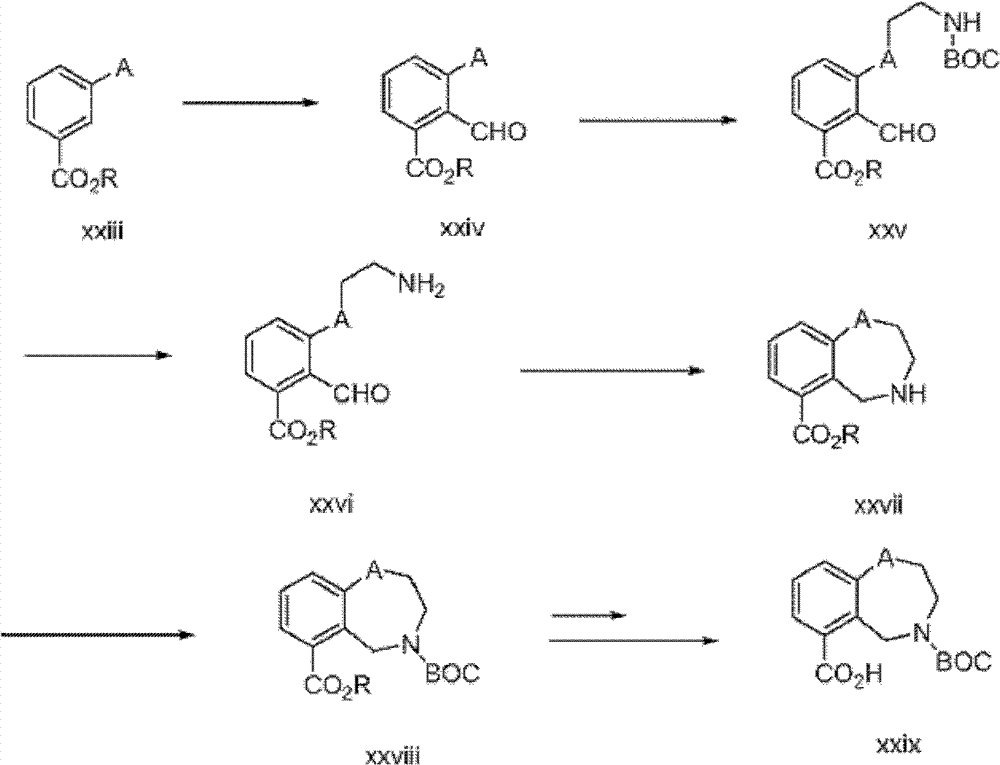
在方案4中,酯xxiii,其中的R基团是甲基或乙基,可以通过用六亚甲基四胺和多聚磷酸处理,甲酰化以提供醛xxiv。在方案4中,符号“A”代表亲核基团,例如NH2、SH、OH、NRH(其中R是烷基、酰基等)。xxiv使用2-氯乙基氨基甲酸叔丁酯烷化,将提供xxv。化合物xxv可以用甲醇HCl处理,得到去除Boc基团的xxvi。xxvi在还原剂(例如NaBH4)存在下分子内环化,可以提供化合物xxvii,其用Boc酐进一步再保护,提供N-Boc化合物xxviii。酯基团的水解可以提供酸化合物xxix。In Scheme 4, esters xxiii, wherein the R group is methyl or ethyl, can be formylated to provide aldehydes xxiv by treatment with hexamethylenetetramine and polyphosphoric acid. In Scheme 4, the symbol "A" represents a nucleophilic group such as NH2 , SH, OH, NRH (wherein R is alkyl, acyl, etc.). Alkylation of xxiv with tert-butyl 2-chloroethylcarbamate will provide xxv. Compound xxv can be treated with methanolic HCl to afford xxvi with removal of the Boc group. Intramolecular cyclization of xxvi in the presence of a reducing agent (eg NaBH4 ) can provide compound xxvii, which is further reprotected with Boc anhydride to provide N-Boc compound xxviii. Hydrolysis of the ester group can provide the acid compound xxix.
如方案5中所示,使用一些标准的氨基酸偶合条件,例如,1-O-苯并三唑-N,N,N′,N′-四甲基-脲阳离子-六氟-磷酸盐和二乙基异丙胺,在DMF中,四氢异喹啉酸核心xi可以进一步与合适的芳基胺(Ar-NH2)偶合,以提供酰胺xxx。异喹啉氮原子可以在酸性条件下(例如,4N甲醇HCl)去保护,以提供游离仲胺xxxi。As shown in Scheme 5, using some standard amino acid coupling conditions, for example, 1-O-benzotriazole-N,N,N',N'-tetramethyl-urea-cation-hexafluoro-phosphate and di Ethylisopropylamine, the tetrahydroisoquinolinic acid core xi can be further coupled with a suitable arylamine (Ar- NH2 ) in DMF to provide the amide xxx. The isoquinoline nitrogen atom can be deprotected under acidic conditions (eg, 4N methanolic HCl) to afford the free secondary amine xxxi.
方案5Option 5
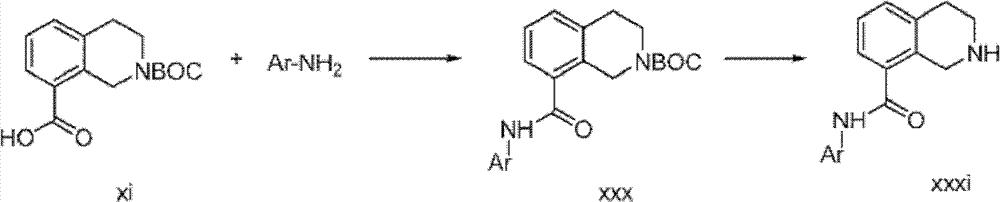
可以用来将化合物xxxi(和相关化合物例如xvii、xxii和xxix)转化成具有式I的化合物的进一步合成转换,在实施例部分中详细描述。Further synthetic transformations that can be used to convert compound xxxi (and related compounds such as xvii, xxii and xxix) into compounds of formula I are described in detail in the Examples section.
III.组合物III. Composition
除了一种或多种上面提供的化合物(或其立体异构体、几何异构体、互变异构体、溶剂化物、代谢物、或药学上可接受的盐或前药),在人和动物中调节Bcl-2蛋白家族活性的组合物将典型地包含药物载体或稀释剂。在一个实施方式中,本发明提供的药物组合物包含具有式I的化合物和至少一种药学上可接受的稀释剂、载体或赋形剂。In addition to one or more of the compounds provided above (or stereoisomers, geometric isomers, tautomers, solvates, metabolites, or pharmaceutically acceptable salts or prodrugs thereof), in humans and Compositions that modulate the activity of the Bcl-2 family of proteins in animals will typically comprise a pharmaceutical carrier or diluent. In one embodiment, the pharmaceutical composition provided by the present invention comprises a compound having formula I and at least one pharmaceutically acceptable diluent, carrier or excipient.
本文使用的术语“组合物”将包含:以指定量包含指定成分的产品,以及直接或间接地由指定成分以指定量组合得到的任意产品。“药学上可接受的”是指载体、稀释剂或赋形剂必须与制剂的其它成分相容,而且对其接受者无害。As used herein, the term "composition" shall include both a product comprising the specified ingredients in the specified amounts, as well as any product resulting from the combination, directly or indirectly, of the specified ingredients in the specified amounts. "Pharmaceutically acceptable" means that the carrier, diluent or excipient must be compatible with the other ingredients of the formulation and not deleterious to the recipient thereof.
为了使用本发明的化合物供患者的治疗性治疗(包括预防性治疗),它通常依照标准制药实践被配制为药物组合物。典型的药物组合物通过让本发明的化合物与载体、稀释剂或赋形剂混合来制备。合适的载体、稀释剂和赋形剂是本领域技术人员熟知的,而且包括材料例如碳水化合物、蜡、水可溶的和/或可膨胀的聚合物、亲水或疏水材料、明胶、油、溶剂、水等。使用的特定载体、稀释剂或赋形剂将取决于本发明化合物被应用的方式和目的。溶剂一般基于本领域技术人员认可为对哺乳动物施用安全(GRAS)的溶剂而选择。一般而言,安全的溶剂是无毒的水性溶剂,例如水和其它可溶于水或易与水混合的无毒溶剂。合适的水性溶剂包括水、乙醇、丙二醇、聚乙二醇(例如PEG 400、PEG 300等)及其混合物。制剂还可以包含一种或多种缓冲液、稳定剂、表面活性剂、润湿剂、润滑剂、乳化剂、悬浮剂、防腐剂、抗氧化剂、不透明剂、助流剂、加工助剂、着色剂、甜味剂、香味剂、调味剂和其它已知添加剂,以提供优质表现的药物(即本发明化合物或其药物组合物)或帮助制造药物产品(即药剂)。For use in the therapeutic treatment (including prophylactic treatment) of patients, a compound of the invention is formulated as a pharmaceutical composition according to standard pharmaceutical practice. Typical pharmaceutical compositions are prepared by admixing a compound of the invention with a carrier, diluent or excipient. Suitable carriers, diluents and excipients are well known to those skilled in the art and include materials such as carbohydrates, waxes, water soluble and/or swellable polymers, hydrophilic or hydrophobic materials, gelatin, oils, solvents, water, etc. The particular carrier, diluent or excipient employed will depend upon the manner and purpose for which the compound of the invention is to be used. Solvents are generally selected based on solvents recognized as safe (GRAS) for mammalian administration by those skilled in the art. In general, safe solvents are non-toxic aqueous solvents such as water and other non-toxic solvents that are soluble or miscible with water. Suitable aqueous solvents include water, ethanol, propylene glycol, polyethylene glycols (eg, PEG 400, PEG 300, etc.) and mixtures thereof. The formulation may also contain one or more buffers, stabilizers, surfactants, wetting agents, lubricants, emulsifiers, suspending agents, preservatives, antioxidants, opacifying agents, glidants, processing aids, colorants sweeteners, flavoring agents, flavoring agents and other known additives to provide superior performance of the drug (ie the compound of the invention or its pharmaceutical composition) or to aid in the manufacture of a drug product (ie medicament).
制剂可以使用常规溶解和混合程序制备。例如,整批原料药(即本发明的化合物或该化合物的稳定形式(例如,与环糊精衍生物或其它已知络合剂络合))在一种或多种上面描述的赋形剂存在下在合适的溶剂中溶解。本发明的化合物典型地配制到药物剂型中,以提供药物的可容易控制的剂量,且使患者能够遵守规定的方案。Formulations can be prepared using conventional dissolution and mixing procedures. For example, a bulk drug substance (i.e., a compound of the invention or a stabilized form of the compound (for example, complexed with a cyclodextrin derivative or other known complexing agent)) in one or more of the above-described excipients Dissolve in a suitable solvent in the presence. The compounds of the invention are typically formulated into pharmaceutical dosage forms to provide easily controllable dosages of the drug and to enable the patient to adhere to the prescribed regimen.
供应用的药物组合物(或制剂),可以用各种方式包装,取决于用来施用药物的方法。一般地,供分配的物品包含容器,其中存放有处于适当形式的药物制剂。合适的容器是本领域技术人员熟知的,而且包括材料例如瓶子(塑料的和玻璃的)、小袋、安瓿、塑料袋、金属圆柱体等。容器还可以包含防干扰组合来防止对包装内容物的轻率接近。另外,容器的上面放有标签,其描述了容器的内容物。标签还可以包含适当的警告。Pharmaceutical compositions (or formulations) for use may be packaged in a variety of ways depending on the method used to administer the drug. Typically, the article for dispensing comprises a container in which the pharmaceutical formulation is stored in a suitable form. Suitable containers are well known to those skilled in the art and include materials such as bottles (plastic and glass), sachets, ampoules, plastic bags, metal cylinders, and the like. The container may also contain a tamper-resistant combination to prevent indiscreet access to the contents of the package. In addition, a label is placed on the top of the container, which describes the contents of the container. Labels may also contain appropriate warnings.
本发明化合物的药物组合物可以被制备供各种施用路线和类型。例如,具有所需程度纯度的本发明化合物(例如,具有式I的化合物),可以以冻干的制剂、磨碎的粉末或水溶液形式,任选地与药学上可接受的稀释剂、载体、赋形剂或稳定剂(参见Remington:The Science andPractice of Pharmacy:Remington the Science and Practice of Pharmacy(2005)第21版,Lippincott Williams&Wilkins,Philidelphia,PA)混合。组合物可以通过在环境温度下、在适当的pH和在所需程度的纯度,与生理学上可接受的载体(即载体在使用的剂量和浓度对接受者是无毒的)混合来制备。制剂的pH主要取决于特定用途和化合物的浓度,但范围可以从约3到约8。醋酸盐缓冲液中pH为5的制剂是一个合适的实施方式。Pharmaceutical compositions of the compounds of the invention may be prepared for various routes and types of administration. For example, a compound of the invention (e.g., a compound of formula I) having the desired degree of purity may be in the form of a lyophilized preparation, a ground powder, or an aqueous solution, optionally with a pharmaceutically acceptable diluent, carrier, Excipients or stabilizers (see Remington: The Science and Practice of Pharmacy: Remington the Science and Practice of Pharmacy (2005) 21st ed., Lippincott Williams & Wilkins, Philidelphia, PA) were mixed. The compositions can be prepared by admixing at ambient temperature, at the appropriate pH and at the desired degree of purity, with a physiologically acceptable carrier (ie, the carrier is nontoxic to the recipients at the dosages and concentrations employed). The pH of the formulation will depend primarily on the particular use and concentration of the compound, but can range from about 3 to about 8. A formulation at pH 5 in acetate buffer is a suitable embodiment.
供本文使用的本发明的化合物(例如,具有式I的化合物)优选地是无菌的。特别地,用于体内施用的组合物或制剂必须是无菌的。此类灭菌通过穿过无菌的滤膜过滤而轻易地完成。Compounds of the invention (eg, compounds of formula I) for use herein are preferably sterile. In particular, compositions or formulations for in vivo administration must be sterile. Such sterilization is readily accomplished by filtration through sterile membrane filters.
本发明化合物通常可以作为固体组合物、冻干的制剂或作为水溶液贮存。Compounds of the invention can generally be stored as solid compositions, lyophilized formulations or as aqueous solutions.
本发明的药物组合物将以一种方式配制、分剂和施用,即量、浓度、时间表、进程、运载体和施用路线与医疗实践规范一致。关于这点要考虑的因素包括治疗的特定病症、治疗的特定哺乳动物、个体患者的临床状况、病症的起因、药剂的递送位点、施用方法、施用日程安排、和医生已知的其它因素。要施用的化合物的“治疗有效量”将受此类考虑控制,而且是预防、改善或治疗可表征为Bcl-xL蛋白的表达或过表达的疾病所必需的最低量。此类量优选地低于对宿主有毒的量。The pharmaceutical compositions of the present invention will be formulated, dosed and administered in such a manner that the amount, concentration, schedule, course, vehicle and route of administration are consistent with medical practice. Factors to consider in this regard include the particular condition being treated, the particular mammal being treated, the clinical condition of the individual patient, the cause of the condition, the site of delivery of the agent, the method of administration, the schedule of administration, and other factors known to the physician. A "therapeutically effective amount" of a compound to be administered will be governed by such considerations, and is the minimum amount necessary to prevent, ameliorate or treat a disease which may be characterized by expression or overexpression of Bcl-x L protein. Such amounts are preferably below amounts that are toxic to the host.
作为一般命题,肠胃外施用的本发明的抑制剂化合物的初始药学上的有效量,每剂范围将是约0.01-100mg/kg,即约0.1到20mg/kg患者体重/天,使用的化合物的典型初始范围是0.3到15mg/kg/天。As a general proposition, an initial pharmaceutically effective amount of an inhibitor compound of the invention administered parenterally will be in the range of about 0.01-100 mg/kg per dose, i.e. about 0.1 to 20 mg/kg of patient body weight/day, with the compound used A typical initial range is 0.3 to 15 mg/kg/day.
可接受的稀释剂、载体、赋形剂和稳定剂,在使用的剂量和浓度对接受者是无毒的,而且包括缓冲液例如磷酸盐、柠檬酸盐和其它有机酸;抗氧化剂包括抗坏血酸和蛋氨酸;防腐剂(例如十八烷基二甲基苄基氯化铵;氯化六烃季铵;苯扎氯铵、苄索氯铵;苯酚、丁醇或苯甲醇;尼泊金烷基酯例如尼泊金甲酯或丙酯;儿茶酚;间苯二酚;环己醇;3-戊醇;和间甲酚);低分子量(低于约10个残基)多肽;蛋白,例如血清白蛋白、明胶或免疫球蛋白;亲水聚合物例如聚乙烯吡咯烷酮;氨基酸例如甘氨酸、谷氨酰胺、天冬酰胺、组氨酸、精氨酸或赖氨酸;单糖、二糖和其它碳水化合物包括葡萄糖、甘露糖或糊精;螯合剂例如EDTA;糖例如蔗糖、甘露醇、海藻糖或山梨糖醇;形成盐的抗衡离子例如钠;金属络合物(例如Zn-蛋白络合物);和/或非离子的表面活性剂,例如TWEENTM、PLURONICSTM或聚乙二醇(PEG)。本发明的活性药物成分(例如具有式I的化合物)还可以被装入微胶囊中,其通过例如凝聚技术或界面聚合制备,分别例如,羟甲基纤维素或明胶-微胶囊和聚-(甲基丙烯酸甲酯)微胶囊;装入胶体药物递送系统中,例如脂质体、白蛋白微球、微乳剂、纳米颗粒和纳米胶囊;或装入粗乳剂中。此类技术在Remington:The Science and Practice ofPharmacy:Remington the Science and Practice of Pharmacy(2005)第21版,Lippincott Williams&Wilkins,Philidelphia,PA中公开。Acceptable diluents, carriers, excipients, and stabilizers are nontoxic to recipients at the dosages and concentrations employed, and include buffers such as phosphates, citrates, and other organic acids; antioxidants include ascorbic acid and Methionine; Preservatives (e.g. Octadecyldimethylbenzylammonium Chloride; Hexaquaternium Chloride; Benzalkonium Chloride, Benzethonium Chloride; Phenol, Butanol, or Benzyl Alcohol; Parabens such as methyl or propylparaben; catechol; resorcinol; cyclohexanol; 3-pentanol; and m-cresol); low molecular weight (less than about 10 residues) polypeptides; proteins such as Serum albumin, gelatin, or immunoglobulin; hydrophilic polymers such as polyvinylpyrrolidone; amino acids such as glycine, glutamine, asparagine, histidine, arginine, or lysine; monosaccharides, disaccharides, and others Carbohydrates include glucose, mannose or dextrin; chelating agents such as EDTA; sugars such as sucrose, mannitol, trehalose or sorbitol; salt-forming counterions such as sodium; metal complexes such as Zn-protein complexes ); and/or non-ionic surfactants such as TWEEN ™ , PLURONICS ™ or polyethylene glycol (PEG). The active pharmaceutical ingredient of the present invention (for example a compound of formula I) can also be enclosed in microcapsules, which are prepared for example by agglomeration techniques or interfacial polymerization, for example, hydroxymethylcellulose or gelatin-microcapsules and poly-( methyl methacrylate) microcapsules; into colloidal drug delivery systems, such as liposomes, albumin microspheres, microemulsions, nanoparticles, and nanocapsules; or into macroemulsions. Such techniques are disclosed in Remington: The Science and Practice of Pharmacy: Remington the Science and Practice of Pharmacy (2005) 21st ed., Lippincott Williams & Wilkins, Philidelphia, PA.
可以制备本发明化合物(例如具有式I的化合物)的持续释放组合物。持续释放组合物的合适实例,包括包含具有式I的化合物的固体疏水聚合物的半透性基质,其中基质为成形物品形式,例如薄膜或微胶囊。持续释放基质的实例包括聚酯、水凝胶(例如,聚(2-羟乙基-甲基丙烯酸酯)或聚乙烯醇))、聚乳酸(美国专利号3,773,919)、L-谷氨酸和γ-乙基-L-谷氨酸酯共聚物、不可降解的乙烯-醋酸乙烯、可降解的乳酸-乙醇酸共聚物例如LUPRON DEPOTTM(可注射的微球,由乳酸-乙醇酸共聚物和醋酸亮丙瑞林组成)和聚-D-(-)-3-羟基丁酸。Sustained release compositions of compounds of the invention (eg, compounds of formula I) may be prepared. Suitable examples of sustained release compositions include semipermeable matrices of solid hydrophobic polymers comprising a compound of formula I, wherein the matrix is in the form of a shaped article, such as a film or microcapsules. Examples of sustained release matrices include polyesters, hydrogels (e.g., poly(2-hydroxyethyl-methacrylate) or polyvinyl alcohol), polylactic acid (U.S. Patent No. 3,773,919), L-glutamic acid, and γ-Ethyl-L-glutamate copolymer, non-degradable ethylene-vinyl acetate, degradable lactic acid-glycolic acid copolymers such as LUPRON DEPOT TM (injectable microspheres made of lactic acid-glycolic acid copolymer and Leuprolide acetate) and poly-D-(-)-3-hydroxybutyrate.
药物组合物包括适合本文详述的施用路线的那些。组合物可以方便地以单位剂型存在,而且可以通过任何制药领域熟知的方法制备。技术和配方一般在Remington:The Science and Practice of Pharmacy:Remington the Science and Practice of Pharmacy(2005)第21版,Lippincott Williams&Wilkins,Philidelphia,PA中找到。此类方法包括活性成分与由一种或多种辅助成分组成的载体达到组合的步骤。一般而言,通过让活性成分与液体载体、精细固体载体、或两者一起均匀充分地达到组合来制备制剂,然后如果有必要的话,为产品塑形。Pharmaceutical compositions include those suitable for the routes of administration detailed herein. The compositions may conveniently be presented in unit dosage form and may be prepared by any of the methods well known in the art of pharmacy. Techniques and formulations are generally found in Remington: The Science and Practice of Pharmacy: Remington the Science and Practice of Pharmacy (2005) 21st ed., Lippincott Williams & Wilkins, Philidelphia, PA. Such methods include the step of bringing into association the active ingredient with the carrier which constitutes one or more accessory ingredients. In general, the formulations are prepared by uniformly and substantially bringing into association the active ingredient with liquid carriers, finely divided solid carriers, or both, and then, if necessary, shaping the product.
本发明化合物(例如具有式I的化合物)的适合口服施用的药物组合物,可以被制成离散单位,例如药丸、胶囊、扁囊剂或片剂,各包含预定量的本发明化合物。Pharmaceutical compositions suitable for oral administration of a compound of the invention, eg, a compound of Formula I, can be presented as discrete units such as pills, capsules, cachets or tablets, each containing a predetermined amount of a compound of the invention.
可以通过在合适的机器中压制任选地与粘合剂、润滑剂、惰性稀释剂、防腐剂、表面活性剂或分散剂混合的处于自由流动形式(例如粉末或颗粒)的活性成分,来制备压制的片剂。可以通过在合适的机器中模制被惰性液体稀释剂润湿的粉末活性成分的混合物,来制造模制的片剂。片剂可以任选地被包衣或刻痕,而且任选地被配制,以便提供活性成分从中的缓慢或控制释放。It may be prepared by compressing in a suitable machine the active ingredient in a free-flowing form such as powder or granules, optionally mixed with a binder, lubricant, inert diluent, preservative, surface active or dispersing agent. Compressed tablet. Molded tablets may be made by molding in a suitable machine a mixture of the powdered active ingredient moistened with an inert liquid diluent. The tablets may optionally be coated or scored and optionally are formulated so as to provide slow or controlled release of the active ingredient therefrom.
片剂、糖锭、锭剂、水或油悬浮液、分散性粉末或颗粒、乳剂、硬或软胶囊例如明胶胶囊、糖浆、或酏剂,可以被制备供口服使用。本发明化合物(例如具有式I的化合物)的将供口服使用的制剂,可以依照任何领域中已知的制造药物组合物的方法制备,而且此类组合物可以包含一种或多种辅剂,包括甜味剂、调味剂、着色剂和防腐剂,目的是提供适口的制剂。包含与适合制造片剂的无毒的药学上可接受的赋形剂混合的活性成分的片剂,是可接受的。这些赋形剂可以是例如惰性稀释剂,例如碳酸钙或碳酸钠、乳糖、磷酸钙或磷酸钠;成粒剂和崩解剂,例如玉米淀粉或海藻酸;粘合剂,例如淀粉、明胶或阿拉伯胶;和润滑剂,例如硬脂酸镁、硬脂酸或滑石。片剂可以不包衣,或可以通过已知技术包衣,包括微囊化,以延迟在胃肠道中的崩解和吸附,并因此在较长时期内提供持续作用。例如,可以使用延时材料例如单硬脂酸甘油酯或二硬脂酸甘油酯,单独地或和蜡一起。Tablets, troches, lozenges, aqueous or oily suspensions, dispersible powders or granules, emulsions, hard or soft capsules such as gelatin capsules, syrups, or elixirs, may be prepared for oral use. Formulations for oral use of compounds of the present invention (e.g. compounds of formula I) may be prepared according to any known method for the manufacture of pharmaceutical compositions, and such compositions may contain one or more adjuvants, Sweetening, flavoring, coloring and preservatives are included for the purpose of providing a palatable preparation. Tablets containing the active ingredient in admixture with non-toxic pharmaceutically acceptable excipients which are suitable for the manufacture of tablets are acceptable. These excipients may be, for example, inert diluents such as calcium or sodium carbonate, lactose, calcium or sodium phosphate; granulating and disintegrating agents such as cornstarch or alginic acid; binders such as starch, gelatin or gum arabic; and lubricating agents, such as magnesium stearate, stearic acid, or talc. Tablets may be uncoated, or may be coated by known techniques, including microencapsulation, to delay disintegration and absorption in the gastrointestinal tract and thus provide sustained action over a longer period of time. For example, a time delay material such as glyceryl monostearate or glyceryl distearate, alone or with a wax, may be employed.
为治疗眼睛或其它外部组织例如口腔和皮肤,制剂优选地作为局部软膏或乳膏应用,其包含的活性成分量为例如0.075到20%w/w。当配制到软膏中时,活性成分可以和石蜡的或易与水混合的软膏基质一起使用。或者,活性成分可以用水包油乳膏基质配制到乳膏中。For the treatment of the eye or other external tissues such as the mouth and skin, the formulation is preferably applied as a topical ointment or cream containing the active ingredient in an amount of eg 0.075 to 20% w/w. When formulated in an ointment, the active ingredients may be employed with either a paraffinic or a water-miscible ointment base. Alternatively, the active ingredients may be formulated in a cream with an oil-in-water cream base.
如果需要的话,乳膏基质的水相可以包含多元醇,即含有两个或更多个羟基的醇,例如丙二醇、丁1,3-二醇、甘露醇、山梨糖醇、甘油、和聚乙二醇(包括PEG 400)、及其混合物。局部制剂可以希望包含化合物,其增强活性成分通过皮肤或其它影响区域的吸收或渗透。此类真皮渗透增强剂的实例包括二甲基亚砜和相关类似物。The aqueous phase of the cream base may, if desired, contain polyols, i.e. alcohols containing two or more hydroxyl groups, such as propylene glycol, butane-1,3-diol, mannitol, sorbitol, glycerin, and polyethylene glycol. Diols (including PEG 400), and mixtures thereof. Topical formulations may desirably contain compounds which enhance the absorption or penetration of the active ingredient through the skin or other affected area. Examples of such dermal penetration enhancers include dimethylsulfoxide and related analogs.
本发明乳剂的油相可以由已知成分以已知方式组成。虽然该相可以仅包含乳化剂,希望它包含至少一种乳化剂和脂肪或油、或者脂肪和油的混合物。优选地,亲水乳化剂与亲脂的乳化剂一起被包含,后者充当稳定剂。它还优选地包括油和脂肪。乳化剂加或不加稳定剂,一起组成了所谓的乳化的蜡,而且蜡与油和脂肪一起组成了所谓的乳化的软膏基质,它形成了乳膏制剂的油性分散相。适合在本发明的制剂中使用的乳化剂和乳剂稳定剂,包括

本发明化合物(例如具有式I的化合物)的水性悬浮液,包含与适合制造水性悬浮液的赋形剂混合的活性材料。此类赋形剂包括悬浮剂,例如羧甲基纤维素钠、交联羧甲纤维素、聚乙烯吡咯烷酮、甲基纤维素、羟丙甲基纤维素、海藻酸钠、聚乙烯吡咯烷酮、黄蓍胶和阿拉伯胶,和分散剂或润湿剂,例如天然存在的磷脂(例如卵磷脂)、亚烷基氧化物和脂肪酸的缩合产物(例如聚氧乙烯硬脂酸酯)、环氧乙烷和长链脂肪醇的缩合产物(例如十七乙烯氧基鲸蜡醇)、环氧乙烷与源自脂肪酸和己糖醇酐的部分酯的缩合产物(例如聚氧乙烯山梨聚糖单油酸酯)。水性悬浮液还可以包含一种或多种防腐剂例如对羟基苯甲酸乙酯或正丙酯、一种或多种着色剂、一种或多种调味剂、和一种或多种甜味剂例如蔗糖或糖精。Aqueous suspensions of compounds of the invention, eg, compounds of formula I, contain the active materials in admixture with excipients suitable for the manufacture of aqueous suspensions. Such excipients include suspending agents such as sodium carboxymethylcellulose, croscarmellose, polyvinylpyrrolidone, methylcellulose, hydroxypropylmethylcellulose, sodium alginate, polyvinylpyrrolidone, tragacanth Gum and gum arabic, and dispersing or wetting agents, such as naturally occurring phospholipids (such as lecithin), condensation products of alkylene oxides and fatty acids (such as polyoxyethylene stearate), ethylene oxide and Condensation products of long-chain fatty alcohols (e.g. heptadecenyloxycetyl alcohol), condensation products of ethylene oxide with partial esters derived from fatty acids and hexitol anhydrides (e.g. polyoxyethylene sorbitan monooleate) . Aqueous suspensions may also contain one or more preservatives, such as ethyl or n-propyl p-hydroxybenzoate, one or more coloring agents, one or more flavoring agents, and one or more sweetening agents Examples include sucrose or saccharin.
本发明化合物(例如具有式I的化合物)的药物组合物可以处于无菌的可注射制剂形式,例如无菌的可注射的水性或油质悬浮液。该悬浮液可以依照已知技术配制,使用上面已提及的那些合适的分散剂或润湿剂和悬浮剂。无菌的可注射的组合物还可以是在无毒的肠胃外可接受的稀释剂或溶剂中的无菌的可注射的溶液或悬浮液,例如在1,3-丁二醇中的溶液,或者配制为冻干的粉末。可以使用的可接受的运载体和溶剂中有水、Ringer′s溶液和等渗氯化钠溶液。另外,无菌的不挥发性油可以常规地用作溶剂或悬浮介质。为了这一目的可以使用任何淡的不挥发性油,包括合成的单-或二甘油酯。另外,脂肪酸例如油酸也可以用在血管注射剂的制备中。Pharmaceutical compositions of compounds of the invention (eg, compounds of formula I) may be in the form of sterile injectable preparations, eg, sterile injectable aqueous or oleaginous suspensions. This suspension may be formulated according to the known art using those suitable dispersing or wetting agents and suspending agents which have been mentioned above. The sterile injectable composition may also be a sterile injectable solution or suspension in a non-toxic parenterally acceptable diluent or solvent, for example a solution in 1,3-butanediol, Alternatively formulated as a lyophilized powder. Among the acceptable vehicles and solvents that may be employed are water, Ringer's solution and isotonic sodium chloride solution. In addition, sterile, fixed oils are conventionally employed as a solvent or suspending medium. For this purpose any bland fixed oil may be employed including synthetic mono- or diglycerides. In addition, fatty acids such as oleic acid find use in the preparation of injectables.
可以与载体材料组合生产单一剂型的活性成分的量,将取决于治疗的宿主和施用的特定模式而变化。例如,要对人口服施用的随时间释放的组合物,可以包含与适当且便利量的载体材料混合的大约1到1000mg的活性材料,其可以占总组合物的约5到约95%(重量比)。药物组合物可以被制备成为施用提供可容易测量的量。例如,要静脉内输液的水溶液可以包含每毫升溶液约3到500μg的活性成分,目的是可以出现以速度约30mL/hr输液合适的体积。The amount of active ingredient which may be combined with a carrier material to produce a single dosage form will vary depending upon the host treated and the particular mode of administration. For example, a time release composition intended for oral administration to humans may contain from about 1 to 1000 mg of active material admixed with an appropriate and convenient amount of carrier material, which may represent from about 5 to about 95% (by weight) of the total composition. Compare). Pharmaceutical compositions can be prepared to provide readily measurable amounts for administration. For example, an aqueous solution to be infused intravenously may contain from about 3 to 500 [mu]g of active ingredient per milliliter of solution, so that a suitable volume can be infused at a rate of about 30 mL/hr.
适合肠胃外施用的组合物包括水性和非水性的无菌注射溶液,其可以包含抗氧化剂、缓冲液、抑菌剂、以及让制剂与预期接受者的血液等渗的溶质;以及水性和非水性的无菌悬浮液,其可以包含悬浮剂和增稠剂。Compositions suitable for parenteral administration include aqueous and nonaqueous sterile injectable solutions, which may contain antioxidants, buffers, bacteriostats, and solutes to render the formulation isotonic with the blood of the intended recipient; and aqueous and nonaqueous Sterile suspensions may contain suspending and thickening agents.
适合对眼睛局部施用的组合物还包括滴眼液,其中活性成分在合适的载体特别是活性成分的水性溶剂中溶解或悬浮。在此类制剂中活性成分优选地以浓度约0.5到20%w/w存在,例如约0.5到10%w/w,例如约1.5%w/w。Compositions suitable for topical administration to the eye also include eye drops wherein the active ingredient is dissolved or suspended in a suitable carrier, especially an aqueous solvent for the active ingredient. The active ingredient is preferably present in such formulations at a concentration of about 0.5 to 20% w/w, for example about 0.5 to 10% w/w, for example about 1.5% w/w.
适合在口中局部施用的组合物,包括在调味基质(通常为蔗糖和阿拉伯胶或黄蓍胶)中包含活性成分的锭剂;在惰性基质(例如明胶和甘油、或蔗糖和阿拉伯胶)中包含活性成分的糖果锭剂;和在合适的液体载体中包含活性成分的漱口剂。Compositions suitable for topical administration in the mouth, comprising lozenges containing the active ingredient in a flavored base, usually sucrose and acacia or tragacanth; inert bases such as gelatin and glycerin, or sucrose and acacia; confectionery lozenges of the active ingredient; and mouthwashes containing the active ingredient in a suitable liquid carrier.
供直肠施用的组合物可以作为栓剂存在,其具有的合适基质包括例如可可脂或水杨酸盐。Compositions for rectal administration may be presented as suppositories with a suitable base including, for example, cocoa butter or a salicylate.
适合肺内或鼻施用的组合物,具有的颗粒大小范围是例如0.1到500微米(包括颗粒大小范围在0.1和500微米之间,微米增量例如0.5、1、30微米、35微米等),它通过经鼻通道快速吸入或经口吸入来施用,以便到达肺泡囊。合适的制剂包括活性成分的水性或油性溶液。适合气溶胶或干粉施用的制剂可以依照常规方法制备,而且可以和其它治疗剂一起递送,例如迄今在如下面描述的病症的治疗或预防中使用的化合物。Compositions suitable for intrapulmonary or nasal administration having a particle size range of, for example, 0.1 to 500 microns (including particle size ranges between 0.1 and 500 microns in micron increments such as 0.5, 1, 30 microns, 35 microns, etc.), It is administered by rapid inhalation through the nasal passages or by oral inhalation in order to reach the alveolar sacs. Suitable formulations include aqueous or oily solutions of the active ingredient. Formulations suitable for aerosol or dry powder administration may be prepared according to conventional methods and may be delivered with other therapeutic agents, for example compounds heretofore used in the treatment or prevention of the conditions as described below.
适合阴道施用的组合物可以作为阴道栓剂、卫生棉条、乳膏、凝胶、糊剂、泡沫或喷雾制剂存在,其除了活性成分还包含例如本领域已知适当的载体。Compositions suitable for vaginal administration may be presented as pessaries, tampons, creams, gels, pastes, foams or spray formulations which contain, in addition to the active ingredient, such carriers as are known in the art to be appropriate.
药物组合物可以包装在单位剂量或多剂量容器例如密封的安瓿和小瓶中,而且可以在冷冻干燥(冻干)条件下贮存,仅需在使用前立即加入无菌的液体载体例如水供注射。临时制成的注射溶液和悬浮液由先前描述的种类的无菌粉末、颗粒和片剂制备。优选的单位剂量制剂是那些包含活性成分的每日剂量或单位每日亚剂量,如本文上面详述的,或其适当部分的。The pharmaceutical compositions can be packaged in unit-dose or multi-dose containers such as sealed ampoules and vials, and can be stored in a freeze-dried (lyophilized) condition requiring only the addition of a sterile liquid carrier such as water for injection immediately before use. Extemporaneous injection solutions and suspensions are prepared from sterile powders, granules and tablets of the kind previously described. Preferred unit dosage formulations are those containing a daily dose or unit daily sub-dose, as herein above detailed, or an appropriate fraction thereof, of an active ingredient.
本发明进一步提供兽用组合物,其包含至少一种如上定义的活性成分(例如,具有式I的化合物)和兽用载体。兽用载体是对施用组合物的目的有用的材料,而且可以是固体、液体或气体材料,它是惰性的或兽用领域可接受的,而且与活性成分相容。这些兽用组合物可以肠胃外、口服或通过任何其它所需路线施用。The invention further provides veterinary compositions comprising at least one active ingredient as defined above (eg, a compound of formula I) and a veterinary carrier. The veterinary carrier is a material useful for the purpose of administering the composition and can be a solid, liquid or gaseous material which is inert or acceptable in the veterinary field and which is compatible with the active ingredient. These veterinary compositions may be administered parenterally, orally or by any other desired route.
IV.使用方法IV. How to use
本发明化合物(即具有式I的化合物)(或其立体异构体、几何异构体、互变异构体、溶剂化物、代谢物、或药学上可接受的盐、或前药)与抗凋亡Bcl-2家族蛋白(而且在某些方面,具体地是抗凋亡Bcl-xL蛋白)结合并抑制其活性;而且因此可用于治疗疾病、病症和/或病症包括但不限于特征是抗凋亡Bcl-2家族蛋白成员的表达或过表达的那些疾病,而且在某些实施方式中,特征是Bcl-xL蛋白的表达或过表达的那些疾病。因此,本发明的某个方面包括在患者中治疗可表征为抗凋亡Bcl-2蛋白家族成员的表达或过表达的疾病或病症的方法。在该方面内,在某些实施方式中,疾病或病症是癌症。本发明化合物可以选择性地与抗凋亡Bcl-2蛋白亚组例如Bcl-xL结合,超过Bcl-2、Bcl-w或Mcl-1蛋白。在某些实施方式中,本发明化合物对结合Bcl-xL蛋白显示超过Bcl-2蛋白至少2倍、10倍、20倍、50倍、100倍、1000倍、10000倍、20000倍、或30000倍的选择性。在某些实施方式中,本发明化合物对结合Bcl-xL蛋白显示超过Mcl-1蛋白至少2倍、10倍、20倍、50倍、100倍、1000倍、10000倍、20000倍、或30000倍的选择性。在某些实施方式中,本发明化合物对结合Bcl-xL蛋白显示超过Bcl-w蛋白至少2倍、10倍、20倍、50倍、100倍、1000倍、10000倍、20000倍、或30000倍的选择性。在一个实施方式中,方法包含对需要其的患者施用治疗有效量的本发明的化合物,例如具有式I的化合物(或其立体异构体、几何异构体、互变异构体、溶剂化物、代谢物、或药学上可接受的盐或前药)。在另一个实施方式中,本发明提供了在患者中治疗特征是抗凋亡Bcl-xL蛋白的表达或过表达的疾病和病症的方法,所述方法包含对患者施用治疗有效量的具有式I的化合物或其药物组合物。一方面,供治疗在其期间抗凋亡Bcl-xL蛋白表达或过表达的疾病和病症的所述组合物,包含赋形剂和治疗有效量的具有式I的化合物。Compounds of the present invention (i.e. compounds of formula I) (or stereoisomers, geometric isomers, tautomers, solvates, metabolites, or pharmaceutically acceptable salts, or prodrugs) and anti- Apoptotic Bcl-2 family proteins (and in certain aspects, specifically anti-apoptotic Bcl-x L proteins) bind to and inhibit their activity; and thus are useful in the treatment of diseases, disorders and/or conditions including, but not limited to, characterized by Those diseases are those characterized by the expression or overexpression of anti-apoptotic Bcl-2 family protein members, and in certain embodiments, those diseases are characterized by the expression or overexpression of Bcl-x L protein. Accordingly, an aspect of the invention includes a method of treating a disease or disorder in a patient that can be characterized by the expression or overexpression of an anti-apoptotic Bcl-2 protein family member. Within this aspect, in certain embodiments, the disease or condition is cancer. The compounds of the present invention can selectively bind to a subgroup of anti-apoptotic Bcl-2 proteins, such as Bcl-x L , over Bcl-2, Bcl-w or Mcl-1 proteins. In certain embodiments, compounds of the invention exhibit at least 2-fold, 10-fold, 20-fold, 50-fold, 100-fold, 1000-fold, 10,000-fold, 20,000-fold, or 30,000-fold greater binding to Bcl-x L protein than to Bcl-2 protein double the selectivity. In certain embodiments, compounds of the invention exhibit at least 2-fold, 10-fold, 20-fold, 50-fold, 100-fold, 1000-fold, 10000-fold, 20000-fold, or 30000-fold greater binding to Bcl-x L protein than Mcl-1 protein double the selectivity. In certain embodiments, compounds of the invention exhibit at least 2-fold, 10-fold, 20-fold, 50-fold, 100-fold, 1000-fold, 10,000-fold, 20,000-fold, or 30,000-fold greater binding to Bcl-x L protein than to Bcl-w protein double the selectivity. In one embodiment, the method comprises administering to a patient in need thereof a therapeutically effective amount of a compound of the invention, such as a compound of formula I (or stereoisomers, geometric isomers, tautomers, solvates thereof , metabolites, or pharmaceutically acceptable salts or prodrugs). In another embodiment, the present invention provides a method of treating diseases and conditions in a patient characterized by expression or overexpression of an anti-apoptotic Bcl-x L protein, the method comprising administering to the patient a therapeutically effective amount of a drug having the formula A compound of I or a pharmaceutical composition thereof. In one aspect, said composition for treating diseases and conditions during which anti-apoptotic Bcl-x L protein is expressed or overexpressed comprises an excipient and a compound of formula I in a therapeutically effective amount.
本发明中还提供了本发明化合物,例如具有式I(或其立体异构体、几何异构体、互变异构体、溶剂化物、代谢物、或药学上可接受的盐、或前药),在制备药剂供在患有此类病症的患者中治疗本文描述的疾病和病症中的用途。Also provided in the present invention are compounds of the present invention, for example having formula I (or its stereoisomers, geometric isomers, tautomers, solvates, metabolites, or pharmaceutically acceptable salts, or prodrugs ), use in the manufacture of a medicament for the treatment of the diseases and disorders described herein in a patient suffering from such disorders.
本发明化合物可以通过适合要治疗的病症的任何路线施用。合适的路线包括口服、肠胃外(包括皮下、肌肉内、静脉内、动脉内、真皮内、鞘内和硬膜外)、透皮、直肠、鼻、局部(包括口腔和舌下)、阴道、腹膜内、肺内和鼻内。对局部免疫抑制治疗,化合物可以通过损害内施用来施用,包括在移植前用抑制剂灌注或接触移植物。将意识到,优选的路线可随例如接受者的病症而变化。当化合物口服施用时,使用药学上可接受的载体或赋形剂,它可以被配制为药丸、胶囊、片剂等。当化合物肠胃外施用时,它可以用药学上可接受的肠胃外运载体配制,而且处于单位剂量可注射形式,如下面详述的。The compounds of the invention may be administered by any route appropriate to the condition to be treated. Suitable routes include oral, parenteral (including subcutaneous, intramuscular, intravenous, intraarterial, intradermal, intrathecal and epidural), transdermal, rectal, nasal, topical (including buccal and sublingual), vaginal, Intraperitoneal, intrapulmonary and intranasal. For local immunosuppressive therapy, the compounds can be administered by intralesional administration, including perfusing or contacting the graft with the inhibitor prior to transplantation. It will be appreciated that the preferred route may vary with, for example, the condition of the recipient. When the compound is administered orally, it can be formulated as a pill, capsule, tablet, etc. using a pharmaceutically acceptable carrier or excipient. When the compound is administered parenterally, it can be formulated with a pharmaceutically acceptable parenteral vehicle and in unit dosage injectable form, as detailed below.
治疗人类患者的剂量范围可以是约10mg到约1000mg的式I化合物。典型剂量可以是约100mg到约300mg的化合物。剂量可以每日一次(QID)、每日两次(BID)或更频繁地施用,取决于药代动力学和药效学性质,包括特定化合物的吸收、分布、代谢和排泄。另外,毒性因素可以影响剂量和施用方案。口服施用时,对规定的时间段,药丸、胶囊或片剂可以每日摄入,或不那么频繁。方案可以重复若干个治疗循环。Dosages for the treatment of human patients may range from about 10 mg to about 1000 mg of a compound of formula I. A typical dosage may be from about 100 mg to about 300 mg of the compound. Doses may be administered once daily (QID), twice daily (BID), or more frequently, depending on the pharmacokinetic and pharmacodynamic properties, including absorption, distribution, metabolism, and excretion of the particular compound. In addition, toxicity factors can affect dosage and administration regimens. When administered orally, the pills, capsules or tablets may be ingested daily, or less frequently, for a defined period of time. The regimen may be repeated for several treatment cycles.
在另一个实施方式中,本发明提供了包含药学上可接受的赋形剂和治疗有效量的具有式I的化合物的组合物,供治疗异常细胞生长和/或凋亡失调的疾病或病症,例如癌症、间皮瘤、膀胱癌、胰腺癌、皮肤癌、头或颈癌、皮肤或眼内黑色素瘤、卵巢癌、乳腺癌、子宫癌、输卵管癌、子宫内膜癌、子宫颈癌、阴道癌、外阴癌、骨癌、卵巢癌、子宫颈癌、结肠癌、直肠癌、肛门区癌、胃癌、胃肠的(胃的、结肠直肠的、和十二指肠的)、慢性淋巴细胞白血病、食道癌、小肠癌、内分泌系统的癌症、甲状腺癌、甲状旁腺癌、肾上腺癌、软组织肉瘤、尿道癌、阴茎癌、睾丸癌、肝细胞癌(肝和胆管)、原发性或继发性中枢神经系统肿瘤、原发性或继发性脑肿瘤、淋巴肉芽肿病、慢性或急性白血病、慢性粒细胞白血病、淋巴细胞性淋巴瘤、成淋巴细胞白血病、滤泡性淋巴瘤、T细胞或B细胞源淋巴恶性肿瘤、黑色素瘤、多发性骨髓瘤、口腔癌、卵巢癌、非小细胞肺癌、前列腺癌、小细胞肺癌、肾和输尿管癌、肾细胞癌、肾盂癌、中枢神经系统肿瘤、原发性中枢神经系统淋巴瘤、非霍奇金淋巴瘤、脊柱轴肿瘤、脑干神经胶质瘤、垂体腺瘤、肾上腺皮质癌、胆囊癌、脾脏癌、胆管癌、纤维肉瘤、成神经细胞瘤、成视网膜细胞瘤或其组合。In another embodiment, the present invention provides a composition comprising a pharmaceutically acceptable excipient and a therapeutically effective amount of a compound of formula I for the treatment of a disease or condition in which abnormal cell growth and/or apoptosis is dysregulated, Examples include cancer, mesothelioma, bladder cancer, pancreatic cancer, skin cancer, head or neck cancer, skin or intraocular melanoma, ovarian cancer, breast cancer, uterine cancer, fallopian tube cancer, endometrial cancer, cervical cancer, vaginal cancer Carcinoma, vulvar cancer, bone cancer, ovarian cancer, cervical cancer, colon cancer, rectal cancer, anal region cancer, gastric cancer, gastrointestinal (gastric, colorectal, and duodenal), chronic lymphocytic leukemia , cancer of the esophagus, cancer of the small intestine, cancer of the endocrine system, cancer of the thyroid, parathyroid glands, adrenal gland, soft tissue sarcoma, urethra, penis, testis, hepatocellular carcinoma (liver and bile duct), primary or secondary Central nervous system tumors, primary or secondary brain tumors, lymphogranulomatous disease, chronic or acute leukemia, chronic myelogenous leukemia, lymphocytic lymphoma, lymphoblastic leukemia, follicular lymphoma, T cell Or lymphoid malignancies of B cell origin, melanoma, multiple myeloma, oral cancer, ovarian cancer, non-small cell lung cancer, prostate cancer, small cell lung cancer, kidney and ureter cancer, renal cell carcinoma, renal pelvis cancer, central nervous system tumors , primary central nervous system lymphoma, non-Hodgkin's lymphoma, spinal axis tumor, brainstem glioma, pituitary adenoma, adrenocortical carcinoma, gallbladder carcinoma, spleen carcinoma, cholangiocarcinoma, fibrosarcoma, neuroblastoma Cytoma, retinoblastoma, or a combination thereof.
在另一个实施方式中,本发明提供了在患者中治疗间皮瘤、膀胱癌、胰腺癌、皮肤癌、头或颈癌、皮肤或眼内黑色素瘤、卵巢癌、乳腺癌、子宫癌、输卵管癌、子宫内膜癌、子宫颈癌、阴道癌、外阴癌、骨癌、卵巢癌、子宫颈癌、结肠癌、直肠癌、肛门区癌、胃癌、胃肠的(胃的、结肠直肠的、和十二指肠的)、慢性淋巴细胞白血病、食道癌、小肠癌、内分泌系统的癌症、甲状腺癌、甲状旁腺癌、肾上腺癌、软组织肉瘤、尿道癌、阴茎癌、睾丸癌、肝细胞癌(肝和胆管)、原发性或继发性中枢神经系统肿瘤、原发性或继发性脑肿瘤、淋巴肉芽肿病、慢性或急性白血病、慢性粒细胞白血病、淋巴细胞性淋巴瘤、成淋巴细胞白血病、滤泡性淋巴瘤、T细胞或B细胞源淋巴恶性肿瘤、黑色素瘤、多发性骨髓瘤、口腔癌、卵巢癌、非小细胞肺癌、前列腺癌、小细胞肺癌、肾和输尿管癌、肾细胞癌、肾盂癌、中枢神经系统肿瘤、原发性中枢神经系统淋巴瘤、非霍奇金淋巴瘤、脊柱轴肿瘤、脑干神经胶质瘤、垂体腺瘤、肾上腺皮质癌、胆囊癌、脾脏癌、胆管癌、纤维肉瘤、成神经细胞瘤、成视网膜细胞瘤或一种或多种以上癌症的组合的方法,所述方法包含对其施用治疗有效量的具有式I的化合物。In another embodiment, the present invention provides for the treatment in a patient of mesothelioma, bladder cancer, pancreatic cancer, skin cancer, head or neck cancer, skin or intraocular melanoma, ovarian cancer, breast cancer, uterine cancer, fallopian tube cancer, endometrial cancer, cervical cancer, vaginal cancer, vulvar cancer, bone cancer, ovarian cancer, cervical cancer, colon cancer, rectal cancer, anal region cancer, gastric cancer, gastrointestinal (stomach, colorectal, and duodenal), chronic lymphocytic leukemia, esophagus, small intestine, endocrine system, thyroid, parathyroid, adrenal, soft tissue sarcoma, urethra, penis, testis, hepatocellular carcinoma (liver and bile ducts), primary or secondary central nervous system tumors, primary or secondary brain tumors, lymphogranulomatous disease, chronic or acute leukemia, chronic myelogenous leukemia, lymphocytic lymphoma, adult Lymphocytic leukemia, follicular lymphoma, lymphoid malignancy of T-cell or B-cell origin, melanoma, multiple myeloma, oral cancer, ovarian cancer, non-small cell lung cancer, prostate cancer, small cell lung cancer, kidney and ureter cancer , renal cell carcinoma, renal pelvis carcinoma, central nervous system tumor, primary central nervous system lymphoma, non-Hodgkin lymphoma, spinal axis tumor, brainstem glioma, pituitary adenoma, adrenocortical carcinoma, gallbladder carcinoma , spleen cancer, cholangiocarcinoma, fibrosarcoma, neuroblastoma, retinoblastoma, or a combination of one or more of the above cancers, comprising administering thereto a therapeutically effective amount of a compound of formula I.
在又一个实施方式中,本发明提供了在哺乳动物中治疗自体免疫性疾病的方法,包含对其施用治疗可接受量的具有式I的化合物。Bcl-2蛋白在免疫和自体免疫性疾病中的牵涉,在Puck,J.M.等(2003),Current Allergy and Asthma Reports,3,378-384;Shimazaki,K.等(2000),British Journal of Haematology,110(3),584-90;Rengan,R.等(2000),Blood,95(4),1283-92;和Holzelova,E.等(2004),NewEngland Journal of Medicine,351(14),1409-1418中描述。In yet another embodiment, the invention provides a method of treating an autoimmune disease in a mammal comprising administering thereto a therapeutically acceptable amount of a compound of formula I. The involvement of Bcl-2 protein in immunity and autoimmune diseases, in Puck, J.M. et al. (2003), Current Allergy and Asthma Reports, 3, 378-384; Shimazaki, K. et al. (2000), British Journal of Haematology, 110(3), 584-90; Rengan, R. et al. (2000), Blood, 95(4), 1283-92; and Holzelova, E. et al. (2004), New England Journal of Medicine, 351(14), 1409 -1418 described.
自体免疫病症包括获得性免疫缺陷疾病综合症(AIDS)、自体免疫性淋巴增生综合症、溶血性贫血、炎症性疾病、和血小板减少症、器官移植相关的急性或慢性免疫疾病、Addison′s病、过敏性疾病、脱发、斑秃、动脉粥样硬化疾病/动脉硬化、动脉粥样硬化、关节炎(包括骨关节炎、青少年慢性关节炎、化脓性关节炎、莱姆关节炎、银屑病关节炎和反应性关节炎)、自体免疫性大疱疾病、无β脂蛋白血症、获得性免疫缺陷相关疾病、器官移植相关的急性免疫疾病、获得性手足发绀、急性和慢性寄生或感染过程、急性胰腺炎、急性肾衰竭、急性风湿性发热、急性横贯性脊髓炎、腺癌、空异位搏动、成人(急性)呼吸窘迫综合症、AIDS痴呆复合症、酒精性肝硬化、酒精诱导的肝损伤、酒精诱导的肝炎、过敏性结膜炎、过敏性接触性皮炎、过敏性鼻炎、过敏和哮喘、同种异体移植排斥、α-1-抗胰蛋白酶缺陷、阿尔茨海默病、肌萎缩性侧索硬化症、贫血、心绞痛、强直性脊柱炎相关的肺病、前角细胞变性、抗体介导的细胞毒性、抗磷脂综合症、抗受体超敏反应、主动脉及外周动脉瘤、主动脉夹层、动脉高血压、动脉硬化、动静脉瘘、关节病、衰弱、哮喘、共济失调、特异反应性过敏、心房颤动(持续性或阵发性)、心房扑动、房室传导阻滞、萎缩性自体免疫性甲状腺机能减退、自体免疫性溶血性贫血、自体免疫性肝炎、1型自体免疫性肝炎(典型自体免疫性或狼疮样肝炎)、自体免疫介导的低血糖、自体免疫性嗜中性白血球减少症、自体免疫性血小板减少症、自体免疫性甲状腺疾病、B细胞淋巴瘤、骨移植排斥、骨髓移植(BMT)排斥、闭塞性细支气管炎、束支传导阻滞、烧伤、恶病质、心律失常、心脏顿抑综合症、心脏肿瘤、心肌病、心肺旁路炎症反应、软骨移植排斥、小脑皮质变性、小脑障碍、紊乱性或多源性房性心动过速、化疗相关病症、衣原体、胆汁淤积、慢性酒精中毒、慢性活动性肝炎、慢性疲劳综合症、器官移植相关的慢性免疫疾病、慢性嗜酸细胞性肺炎、慢性炎症性病理、慢性粘膜皮肤念珠菌病、慢性阻塞性肺病(COPD)、慢性水杨酸盐中毒、结肠直肠的常见变异性免疫缺陷(常见变异型低丙种球蛋白血症)、结膜炎、结缔组织疾病相关的间质性肺病、接触性皮炎、Coombs阳性溶血性贫血、肺源性心脏病、Creutzfeldt-Jakob病、原因不明的自体免疫性肝炎、隐原性纤维化肺泡炎、培养阴性的脓毒症、囊性纤维化、细胞因子治疗相关的病症、节段性肠炎、拳击员痴呆、脱髓鞘疾病、登革出血热、皮炎、皮炎硬皮病、皮肤病、皮肌炎/多肌炎相关的肺病、糖尿病、糖尿病性动脉硬化疾病、糖尿病、弥散性路易体病、扩张性心肌病、扩张性充血性心肌病、盘状红斑狼疮、基底神经节的病症、弥漫性血管内凝血、中年的唐氏综合症、药物诱导的间质性肺病、药物诱导性肝炎、被阻滞CNS多巴胺受体的药物诱导的药物诱导性运动障碍、药物过敏性、湿疹、脑脊髓炎、心内膜炎、内分泌病、肠病性滑膜炎、会厌炎、Epstein-Barr病毒感染、红斑性肢痛病、锥体束外和小脑障碍、家族性噬血细胞性淋巴组织细胞增生症、胎儿胸腺的植入排斥、Friedreich′s共济失调、功能性外周动脉病症、女性不孕、纤维化、纤维化肺病、真菌性脓毒症、气性坏疽、胃溃疡、巨细胞性动脉炎、肾小球性肾炎、血管球性肾炎、肺出血肾炎综合症、甲状腺肿性自体免疫甲状腺低能症(桥本氏甲状腺炎)、痛风性关节炎、任意器官或组织的移植排斥、移植物抗宿主病、革兰氏阴性的脓毒症、革兰氏阳性的脓毒症、胞内生物引起的肉芽肿、B组链球菌(GBS)感染、Grave′s病、含铁血黄素沉积病相关的肺病、毛细胞白血病、毛细胞白血病、Hallerrorden-Spatz病、桥本氏甲状腺炎、枯草热、心脏移植排斥、血色素沉着症、造血系统恶性肿瘤(白血病和淋巴瘤)、溶血性贫血、溶血性尿毒症综合症/溶血栓的血小板减少性紫癜、出血、过敏性紫癜、甲肝、乙肝、丙肝、HIV感染/HIV神经病变、淋巴肉芽肿病、甲状旁腺机能减退、亨廷顿舞蹈病、运动机能亢进性运动障碍、超敏反应、超敏性肺炎、甲状腺机能亢进、运动机能减退性运动障碍、下丘脑-垂体-肾上腺轴评估、特发性Addison′s病、特发性白细胞减少症、特发性肺纤维化、特发性血小板减少症、特应性肝病、婴儿型脊髓性肌萎缩、感染性疾病、主动脉炎症、炎症性肠病、胰岛素依赖性糖尿病、间质性肺炎、虹膜睫状体炎/葡萄膜炎/视神经炎、缺血-再灌注损伤、缺血性中风、青少年恶性贫血、青少年类风湿性关节炎、青少年脊髓性肌萎缩、Kaposi′s肉瘤、川崎病、肾脏移植排斥、军团菌、利什曼病、麻风、皮质脊髓系统的损害、线性IgA疾病、脂血症、肝脏移植排斥、莱姆病、淋巴水肿、淋巴细胞浸润性肺病、疟疾、特发性或NOS男性不育症、恶性组织细胞增生症、恶性黑色素瘤、脑膜炎、脑膜炎球菌血症、肾脏的微观血管炎、周期性偏头痛、线粒体多系统障碍、混合性结缔组织疾病、混合性结缔组织疾病相关的肺病、单克隆丙种球蛋白病、多发性骨髓瘤、多系统变性(Mencel Dejerine-ThomasShi-Drager和Machado-Joseph)、肌痛性脑炎/肌痛性脑脊髓炎、重症肌无力、肾脏的微观血管炎、胞内鸟型分枝杆菌、结核分枝杆菌、骨髓增生异常综合症、心肌梗塞、心肌缺血病症、鼻咽癌、新生儿慢性肺病、肾炎、肾病、肾病综合症、神经退行性疾病、神经原性肌萎缩I、中性粒细胞减少性发热、非酒精性脂肪性肝炎、腹主动脉及其支脉的闭塞、闭塞性动脉病症、器官移植排斥、睾丸炎/附睾炎、睾丸炎/输精管结扎术逆转程序、器官肿大、骨关节病、骨质疏松症、卵巢衰竭、胰脏移植排斥、寄生虫病、甲状旁腺移植排斥、帕金森病、盆腔炎、寻常性天疱疮、落叶型天疱疮、类天疱疮、常年性鼻炎、心包疾病、外周动脉粥样硬化疾病、外周血管病症、腹膜炎、恶性贫血、晶状体原的葡萄膜炎、卡氏肺孢子虫肺炎、肺炎、POEMS综合症(多神经病变、器官肿大、内分泌病、单克隆丙种球蛋白病、和皮肤变化综合症)、灌注后综合症、泵后综合症、MI后心切开术综合症、感染后间质性肺病、卵巢功能早衰、原发性胆汁性肝硬化、原发性硬化性肝炎、原发性黏液水肿、原发性肺动脉高压、原发性硬化性胆管炎、原发性血管炎、进行性核上性麻痹、银屑病、银屑病1型、银屑病2型、银屑病性关节病、结缔组织疾病继发的肺动脉高压、结节性多动脉炎的肺表现、炎症后间质性肺病、放射性纤维化、放射治疗、雷诺氏现象和疾病、植烷酸贮积症、有规律的狭窄QRS心动过速、Reiter′s病、NOS肾脏疾病、肾血管性高血压、再灌注损伤、限制性心肌病、类风湿性关节炎相关的间质性肺病、类风湿性脊椎炎、结节病、Schmidt′s综合症、硬皮病、老年性舞蹈病、路易体型老年性痴呆、脓毒症综合症、脓毒症性休克、血清阴性的关节病、休克、镰状细胞贫血、
在一个实施方式中,本发明化合物(例如具有式I的化合物),或其立体异构体、几何异构体、互变异构体、溶剂化物、代谢物、或药学上可接受的盐、前药,被用作抗癌剂,或在治疗癌症的联合治疗中被用作辅助药剂。本领域普通技术人员能够容易地测定候选化合物单独地或在组合中是否为任意特定细胞类型治疗癌症。在这一实施方式的某些方面内,本发明化合物被用来辅助对癌症治疗的其它治疗,包括常规手术、放射治疗和化疗。In one embodiment, a compound of the invention (eg, a compound having Formula I), or a stereoisomer, geometric isomer, tautomer, solvate, metabolite, or pharmaceutically acceptable salt thereof, Prodrugs, used as anticancer agents, or as adjuvant agents in combination therapy for the treatment of cancer. One of ordinary skill in the art can readily determine whether a candidate compound, alone or in combination, treats cancer of any particular cell type. Within certain aspects of this embodiment, the compounds of the invention are used as an adjunct to other treatments for cancer treatment, including conventional surgery, radiation therapy, and chemotherapy.
此类治疗可以包括一种或多种以下类别的抗癌剂:烷化剂、血管生成抑制剂、抗体、抗代谢物、抗有丝分裂剂、抗增殖剂、aurora激酶抑制剂、凋亡促进剂(例如,Bcl-xL、Bcl-w和BfI-1抑制剂)、死亡受体途径的激活剂、Bcr-Abl激酶抑制剂、BiTE(双特异性T细胞啮合者)抗体、生物反应调节剂、细胞周期蛋白依赖性激酶抑制剂、细胞周期抑制剂、环氧酶-2抑制剂、双可变域结合蛋白(DVDs)、白血病病毒致癌基因同源体(ErbB2)受体抑制剂、生长因子抑制剂、热激蛋白(HSP)-90抑制剂、组蛋白去乙酰酶(HDAC)抑制剂、激素治疗、免疫药剂、插入凋亡蛋白抑制剂(IAPs)的抗生素、激酶抑制剂、靶向哺乳动物的雷帕霉素抑制剂、微RNA的有丝分裂原激活的胞外信号-调节激酶抑制剂、多价结合蛋白、非甾族的抗炎症药物(NSAIDs)、聚ADP(二磷酸腺苷)-核糖聚合酶(PARP)抑制剂、铂化疗剂、polo样激酶(Plk)抑制剂、蛋白酶体抑制剂、嘌呤类似物、嘧啶类似物、受体酪氨酸激酶抑制剂、类视黄醇/deltoids植物生物碱、小分子抑制性核糖核酸(siRNAs)、拓扑异构酶抑制剂其组合等。Such treatment may include one or more of the following classes of anticancer agents: alkylating agents, angiogenesis inhibitors, antibodies, antimetabolites, antimitotics, antiproliferative agents, aurora kinase inhibitors, apoptosis promoters ( For example, Bcl-xL, Bcl-w, and BfI-1 inhibitors), activators of the death receptor pathway, Bcr-Abl kinase inhibitors, BiTE (bispecific T cell engager) antibodies, biological response modifiers, cell Cyclin-dependent kinase inhibitors, cell cycle inhibitors, cyclooxygenase-2 inhibitors, double variable domain binding proteins (DVDs), leukemia virus oncogene homolog (ErbB2) receptor inhibitors, growth factor inhibitors , heat shock protein (HSP)-90 inhibitors, histone deacetylase (HDAC) inhibitors, hormone therapy, immunopharmaceuticals, antibiotics that insert inhibitors of apoptosis proteins (IAPs), kinase inhibitors, mammalian-targeted Rapamycin inhibitors, mitogen-activated extracellular signal-regulated kinase inhibitors of microRNAs, multivalent binding proteins, non-steroidal anti-inflammatory drugs (NSAIDs), poly ADP (adenosine diphosphate)-ribose polymers Enzyme (PARP) inhibitors, platinum chemotherapeutics, polo-like kinase (Plk) inhibitors, proteasome inhibitors, purine analogs, pyrimidine analogs, receptor tyrosine kinase inhibitors, retinoids/deltoids plant organisms Alkali, small molecule inhibitory ribonucleic acid (siRNAs), topoisomerase inhibitors and combinations thereof.
BiTE抗体是通过同时结合两种细胞来引导T细胞攻击癌细胞的双特异性抗体。然后T细胞攻击目标癌细胞。BiTE抗体的实例包括阿德木单抗(Micromet MT201)、blinatumomab(Micromet MT 103)等。不受限于理论,T-细胞引起目标癌细胞凋亡的一种机制是通过胞吐溶细胞的颗粒成分包括穿孔素和颗粒酶B。在这方面,Bcl-2已显示削弱穿孔素和颗粒酶B两者的凋亡诱导。这些数据指出,当靶向癌细胞时,抑制Bcl-2可以增强T细胞引起的细胞毒性效应(V.R.Sutton,D.L.Vaux和J.A.Trapani(1997)J.of Immunology.158(12):5783)。BiTE antibodies are bispecific antibodies that guide T cells to attack cancer cells by binding to two types of cells at the same time. The T cells then attack the targeted cancer cells. Examples of BiTE antibodies include adelimumab (Micromet MT201), blinatumomab (Micromet MT 103) and the like. Without being bound by theory, one mechanism by which T-cells induce apoptosis of target cancer cells is through exocytosis of cytolytic granule components including perforin and granzyme B. In this regard, Bcl-2 has been shown to attenuate the induction of apoptosis by both perforin and granzyme B. These data indicate that inhibition of Bcl-2 can enhance the cytotoxic effects elicited by T cells when targeting cancer cells (V.R. Sutton, D.L. Vaux and J.A. Trapani (1997) J. of Immunology. 158(12):5783).
SiRNA是含有内源RNA碱基或化学修饰的核苷酸的分子。修饰不破坏细胞活性,但赋予增强的稳定性和/或增强的细胞效能。化学修饰的实例包括硫代磷酸基团、2′-脱氧核苷酸、包含2′-OCH3的核糖核苷酸、2′-F-核糖核苷酸、2′-甲氧基乙基核糖核苷酸、其组合等。siRNA可以具有不同的长度(例如10-200bps)和结构(例如,发卡、单/双链、凸出、缺口/间隙、错配),而且在细胞中加工,以提供活性基因的沉默。双链siRNA(dsRNA)可以在各链上具有相同数目的核苷酸(平末端)或不对称末端(突起)。1-2个核苷酸的突起可以存在于正义和/或反义链上,和存在于指定链的5′-和/或3′-末端。例如,靶向Mcl-1的siRNA显示在多肿瘤细胞系中增强ABT-263(即N-(4-(4-((2-(4-氯苯基)-5,5-二甲基-1-环己-1-烯-1-基)甲基)哌嗪-1-基)苯甲酰)-4-(((1R)-3-(吗啉-4-基)-1-((苯硫基)甲基)丙基)氨基)-3-((三氟甲基)磺酰基)苯磺酰胺)或ABT-737(即N-(4-(4-((4′-氯(1,1′-联苯基)-2-基)甲基)哌嗪-1-基)苯甲酰)-4-(((1R)-3-(二甲基氨基)-1-((苯硫基)甲基)丙基)氨基)-3-硝基苯磺酰胺)的活性(Tse等(2008)Cancer Research.68(9):3421及其中的参考文献)。SiRNAs are molecules that contain endogenous RNA bases or chemically modified nucleotides. Modifications do not destroy cellular activity, but confer enhanced stability and/or enhanced cellular potency. Examples of chemical modifications include phosphorothioate groups, 2′-deoxynucleotides, 2′- OCH3 containing ribonucleotides, 2′-F-ribonucleotides, 2′-methoxyethyl ribose Nucleotides, combinations thereof, etc. siRNAs can be of various lengths (eg, 10-200 bps) and structures (eg, hairpin, single/double stranded, bulge, nick/gap, mismatch) and are processed in the cell to provide silencing of active genes. Double-stranded siRNA (dsRNA) can have the same number of nucleotides (blunt ends) or asymmetric ends (overhangs) on each strand. Overhangs of 1-2 nucleotides may be present on the sense and/or antisense strands, and at the 5'- and/or 3'-ends of a given strand. For example, siRNA targeting Mcl-1 was shown to enhance ABT-263 (i.e., N-(4-(4-((2-(4-chlorophenyl)-5,5-dimethyl- 1-cyclohex-1-en-1-yl)methyl)piperazin-1-yl)benzoyl)-4-(((1R)-3-(morpholin-4-yl)-1-( (Phenylthio)methyl)propyl)amino)-3-((trifluoromethyl)sulfonyl)benzenesulfonamide) or ABT-737 (i.e. N-(4-(4-((4'-chloro (1,1'-biphenyl)-2-yl)methyl)piperazin-1-yl)benzoyl)-4-(((1R)-3-(dimethylamino)-1-( (Phenylthio)methyl)propyl)amino)-3-nitrobenzenesulfonamide) activity (Tse et al. (2008) Cancer Research. 68(9):3421 and references therein).
多价结合蛋白是包含两个或更多个抗原结合位点的结合蛋白。多价结合蛋白被设计为具有三个或更多个抗原结合位点,而且一般不是天然存在的抗体。术语“多特异性结合蛋白”指能够结合两个或更多个相关或不相关的靶点的结合蛋白。双可变域(DVD)结合蛋白是四价或多价的结合蛋白,结合蛋白包含两个或更多个抗原结合位点。此类DVD可以是单特异性的(即能够结合一种抗原)或多特异性的(即能够结合两种或更多种抗原)。包含两个重链DVD多肽和两个轻链DVD多肽的DVD结合蛋白,被称作DVD Ig′s。DVD Ig的每一半包含一个重链DVD多肽、一个轻链DVD多肽、和两个抗原结合位点。各结合位点包含一个重链可变域和一个轻链可变域,每个抗原结合位点含有抗原结合中涉及的总计6个CDRs。A multivalent binding protein is a binding protein comprising two or more antigen binding sites. Multivalent binding proteins are designed to have three or more antigen-binding sites and are generally not naturally occurring antibodies. The term "multispecific binding protein" refers to a binding protein capable of binding two or more related or unrelated targets. Dual variable domain (DVD) binding proteins are tetravalent or multivalent binding proteins comprising two or more antigen binding sites. Such DVDs may be monospecific (ie capable of binding one antigen) or multispecific (ie capable of binding two or more antigens). DVD binding proteins comprising two heavy chain DVD polypeptides and two light chain DVD polypeptides are called DVD Ig's. Each half of the DVD Ig contains a heavy chain DVD polypeptide, a light chain DVD polypeptide, and two antigen binding sites. Each binding site comprises a heavy chain variable domain and a light chain variable domain, and each antigen binding site contains a total of 6 CDRs involved in antigen binding.
烷化剂包括六甲蜜胺、AMD-473、AP-5280、apaziquone、苯达莫司汀、brostallicin、白消安、卡波醌、卡莫司汀(BCNU)、苯丁酸氮芥、

血管生成抑制剂包括内皮特异性受体酪氨酸激酶(Tie-2)抑制剂、表皮生长因子受体(EGFR)抑制剂、胰岛素生长因子-2受体(IGFR-2)抑制剂、基质金属蛋白酶-2(MMP-2)抑制剂、基质金属蛋白酶-9(MMP-9)抑制剂、血小板源生长因子受体(PDGFR)抑制剂、凝血酶敏感蛋白类似物、血管内皮生长因子受体酪氨酸激酶(VEGFR)抑制剂等。Angiogenesis inhibitors include endothelial-specific receptor tyrosine kinase (Tie-2) inhibitors, epidermal growth factor receptor (EGFR) inhibitors, insulin growth factor-2 receptor (IGFR-2) inhibitors, matrix metal Protease-2 (MMP-2) Inhibitors, Matrix Metalloproteinase-9 (MMP-9) Inhibitors, Platelet-Derived Growth Factor Receptor (PDGFR) Inhibitors, Thrombospondin Analogues, Vascular Endothelial Growth Factor Receptor Casein amino acid kinase (VEGFR) inhibitors, etc.
抗代谢物包括


Aurora激酶抑制剂包括AZD-1152、MLN-8054、VX-680等。Aurora kinase inhibitors include AZD-1152, MLN-8054, VX-680, etc.
Bcl-2家族蛋白抑制剂包括AT-101((-)棉酚)、
Bcr-Abl激酶抑制剂包括(BMS-354825)、
CDK抑制剂包括AZD-5438、BMI-1040、BMS-032、BMS-387、CVT-2584、夫拉平度、GPC-286199、MCS-5A、PD0332991、PHA-690509、seliciclib(CYC-202、R-roscovitine)、ZK-304709等。CDK inhibitors include AZD-5438, BMI-1040, BMS-032, BMS-387, CVT-2584, flapindus, GPC-286199, MCS-5A, PD0332991, PHA-690509, seliciclib (CYC-202, R- roscovitine), ZK-304709, etc.
COX-2抑制剂包括ABT-963、


EGFR抑制剂包括ABX-EGF、抗EGFR免疫脂质体、EGF-疫苗、EMD-7200、(西妥昔单抗)、HR3、IgA抗体、
ErbB2受体抑制剂包括CP-724-714、CI-1033(卡奈替尼)、(曲妥珠单抗)、

组蛋白去乙酰酶抑制剂包括缩酚酸肽、LAQ-824、MS-275、trapoxin、辛二酰苯胺异羟肟酸(SAHA)、TSA、丙戊酸等。Histone deacetylase inhibitors include depsipeptides, LAQ-824, MS-275, trapoxin, suberoylanilide hydroxamic acid (SAHA), TSA, valproic acid, and the like.
HSP-90抑制剂包括17-AAG-nab、17-AAG、CNF-101、CNF-1010、CNF-2024、17-DMAG、格尔德霉素、IPI-504、KOS-953、
死亡受体途径的激活剂包括TRAIL,靶向死亡受体(例如DR4和DR5)的抗体或其它药剂,例如Apomab、conatumumab、ETR2-ST01、GDC0145、来沙木单抗、HGS-1029、LBY-135、PRO-1762和曲妥珠单抗。Activators of the death receptor pathway include TRAIL, antibodies or other agents targeting death receptors such as DR4 and DR5, such as Apomab, conatumumab, ETR2-ST01, GDC0145, lesatumumab, HGS-1029, LBY- 135, PRO-1762 and trastuzumab.
MEK抑制剂包括ARRY-142886、ARRY-438162PD-325901、PD-98059等。MEK inhibitors include ARRY-142886, ARRY-438162PD-325901, PD-98059, etc.
mTOR抑制剂包括AP-23573、CCI-779、依维莫司、RAD-001、雷帕霉素、temsirolimus等。mTOR inhibitors include AP-23573, CCI-779, everolimus, RAD-001, rapamycin, temsirolimus, etc.
非甾族的抗炎症药物包括








PDGFR抑制剂包括C-451、CP-673、CP-868596等。PDGFR inhibitors include C-451, CP-673, CP-868596, etc.
铂化疗剂包括顺铂、(奥沙利铂)、依铂、洛铂、奈达铂、
Polo样激酶抑制剂包括BI-2536等。Polo-like kinase inhibitors include BI-2536 and the like.
凝血酶敏感蛋白类似物包括ABT-510、ABT-567、ABT-898、TSP-1等。Thrombospondin analogs include ABT-510, ABT-567, ABT-898, TSP-1 and the like.
VEGFR抑制剂包括


抗生素包括插入了的抗生素阿柔比星、放线菌素D、氨柔比星、annamycin、阿霉素、(博来霉素)、柔红霉素、或


拓扑异构酶抑制剂包括阿柔比星、9-氨基喜树碱、氨萘非特、安吖啶、becatecarin、贝洛替康、BN-80915、


抗体包括





激素治疗包括
















Deltoids和类视黄醇包括西奥骨化醇(EB1089、CB1093)、来沙骨化醇(KH1060)、芬维A胺、

PARP抑制剂包括ABT-888、奥拉帕尼、KU-59436、AZD-2281、AG-014699、BSI-201、BGP-15、INO-1001、ONO-2231等。PARP inhibitors include ABT-888, olaparib, KU-59436, AZD-2281, AG-014699, BSI-201, BGP-15, INO-1001, ONO-2231, etc.
植物生物碱包括但不限于长春新碱、长春碱、长春地辛、长春瑞滨等。Plant alkaloids include, but are not limited to, vincristine, vinblastine, vindesine, vinorelbine, and the like.
蛋白酶体抑制剂包括(硼替佐米)、MG132、NPI-0052、PR-171等。Proteasome inhibitors include (bortezomib), MG132, NPI-0052, PR-171, etc.
免疫药剂的实例包括干扰素和其它免疫增强剂。干扰素包括干扰素α、干扰素α-2a、干扰素α-2b、干扰素β、干扰素γ-1a、










生物反应调节剂是调整活体的防御机制或生物反应,例如组织细胞的存活、生长或分化,以引导它们具有抗肿瘤活性的药剂,而且包括云芝多糖、香菇多糖、西佐喃、溶链菌PF-3512676(CpG-8954)、乌苯美司等。Biological response modifiers are agents that adjust the defense mechanism or biological response of a living body, such as the survival, growth or differentiation of tissue cells, to guide them to have anti-tumor activity, and include polysaccharides such as versicolor polysaccharides, lentinan, sizoran, streptolyticus PF-3512676 (CpG-8954), Ubenimex, etc.
嘧啶类似物包括阿糖胞苷(ara C或阿拉伯糖苷C)、阿拉伯糖苷胞嘧啶、去氧氟尿苷、(氟达拉滨)、5-FU(5-氟尿嘧啶)、氟尿苷、

嘌呤类似物包括

抗有丝分裂剂包括巴他布林、埃博霉素D(KOS-862)、N-(2-((4-羟基苯基)氨基)吡啶-3-基)-4-甲氧基苯磺酰胺、伊沙匹隆(BMS247550)、紫杉醇、
本发明的化合物还可以用作增强放射治疗功效的辐射敏化剂。放射治疗的实例包括体外束放射治疗、远距放射治疗、近距放射治疗和密封/非密封源放射治疗等。The compounds of the invention may also be used as radiosensitizers to enhance the efficacy of radiotherapy. Examples of radiation therapy include external beam radiation therapy, teletherapy, brachytherapy, and sealed/unsealed source radiation therapy, among others.
此外,具有式I的化合物可以与其它化疗剂组合,例如ABRAXANETM(ABI-007)、ABT-100(法尼基转移酶抑制剂)、
































联合治疗可以作为同时的或相继的方案施用。相继施用时,组合可以在两次或多次施用中施用。联合施用包括共施用,使用分开的制剂或单一药物制剂,和以任一次序连续施用,其中优选地存在两种(或全部)活性剂同时发挥其生物活性的时间段。Combination therapy can be administered as a simultaneous or sequential regimen. When administered sequentially, the combination may be administered in two or more administrations. Joint administration includes co-administration, using separate formulations or a single pharmaceutical formulation, and sequential administration in either order, wherein there is preferably a period of time during which both (or both) active agents exert their biological activity simultaneously.
因此,在另一个实施方式中,本发明提供了在患者中供治疗在其期间抗凋亡Bcl-xL蛋白表达或过表达的疾病的组合物,所述组合物包含赋形剂和治疗有效量的具有式I的化合物,以及治疗有效量的一种额外治疗剂或超过一种额外治疗剂。Accordingly, in another embodiment, the present invention provides a composition for treating a disease during which anti-apoptotic Bcl-x L protein is expressed or overexpressed in a patient, said composition comprising an excipient and a therapeutically effective amount of a compound of formula I, and a therapeutically effective amount of one or more than one additional therapeutic agent.
在另一个实施方式中,本发明提供了在患者中治疗在其期间抗凋亡Bcl-xL蛋白表达或过表达的疾病的方法,所述方法包含对患者施用治疗有效量的具有式I的化合物和治疗有效量的一种额外治疗剂或超过一种额外治疗剂。In another embodiment, the present invention provides a method of treating a disease during which anti-apoptotic Bcl-x L protein is expressed or overexpressed in a patient, said method comprising administering to the patient a therapeutically effective amount of a compound having formula I A compound and a therapeutically effective amount of an additional therapeutic agent or more than one additional therapeutic agent.
在另一个实施方式中,本发明提供了在患者中治疗间皮瘤、膀胱癌、胰腺癌、皮肤癌、头或颈癌、皮肤或眼内黑色素瘤、卵巢癌、乳腺癌、子宫癌、输卵管癌、子宫内膜癌、子宫颈癌、阴道癌、外阴癌、骨癌、卵巢癌、子宫颈癌、结肠癌、直肠癌、肛门区癌、胃癌、胃肠的(胃的、结肠直肠的、和十二指肠的)、慢性淋巴细胞白血病、食道癌、小肠癌、内分泌系统的癌症、甲状腺癌、甲状旁腺癌、肾上腺癌、软组织肉瘤、尿道癌、阴茎癌、睾丸癌、肝细胞癌(肝和胆管)、原发性或继发性中枢神经系统肿瘤、原发性或继发性脑肿瘤、淋巴肉芽肿病、慢性或急性白血病、慢性粒细胞白血病、淋巴细胞性淋巴瘤、成淋巴细胞白血病、滤泡性淋巴瘤、T细胞或B细胞源淋巴恶性肿瘤、黑色素瘤、多发性骨髓瘤、口腔癌、卵巢癌、非小细胞肺癌、前列腺癌、小细胞肺癌、肾和输尿管癌、肾细胞癌、肾盂癌、中枢神经系统肿瘤、原发性中枢神经系统淋巴瘤、非霍奇金淋巴瘤、脊柱轴肿瘤、脑干神经胶质瘤、垂体腺瘤、肾上腺皮质癌、胆囊癌、脾脏癌、胆管癌、纤维肉瘤、成神经细胞瘤、成视网膜细胞瘤、或一种或多种以上癌症的组合的方法,所述方法包含对其施用治疗有效量的具有式I的化合物,或其药物组合物,以及依托泊苷长春新碱CHOP、利妥昔单抗、雷帕霉素、R-CHOP或硼替佐米中的一种或超过一种。In another embodiment, the present invention provides for the treatment in a patient of mesothelioma, bladder cancer, pancreatic cancer, skin cancer, head or neck cancer, skin or intraocular melanoma, ovarian cancer, breast cancer, uterine cancer, fallopian tube cancer, endometrial cancer, cervical cancer, vaginal cancer, vulvar cancer, bone cancer, ovarian cancer, cervical cancer, colon cancer, rectal cancer, anal region cancer, gastric cancer, gastrointestinal (stomach, colorectal, and duodenal), chronic lymphocytic leukemia, esophagus, small intestine, endocrine system, thyroid, parathyroid, adrenal, soft tissue sarcoma, urethra, penis, testis, hepatocellular carcinoma (liver and bile ducts), primary or secondary central nervous system tumors, primary or secondary brain tumors, lymphogranulomatous disease, chronic or acute leukemia, chronic myelogenous leukemia, lymphocytic lymphoma, adult Lymphocytic leukemia, follicular lymphoma, lymphoid malignancy of T-cell or B-cell origin, melanoma, multiple myeloma, oral cancer, ovarian cancer, non-small cell lung cancer, prostate cancer, small cell lung cancer, kidney and ureter cancer , renal cell carcinoma, renal pelvis carcinoma, central nervous system tumor, primary central nervous system lymphoma, non-Hodgkin lymphoma, spinal axis tumor, brainstem glioma, pituitary adenoma, adrenocortical carcinoma, gallbladder carcinoma , spleen cancer, cholangiocarcinoma, fibrosarcoma, neuroblastoma, retinoblastoma, or a combination of one or more of the above cancers, the method comprising administering thereto a therapeutically effective amount of a compound of formula I, or its pharmaceutical composition, and one or more of etoposide, vincristine, CHOP, rituximab, rapamycin, R-CHOP or bortezomib.
对于任意以上共施用的药剂,合适的剂量是目前使用的剂量,而且因为新发现的药剂和其它化疗剂或治疗的联合作用(协同作用),还可以降低剂量。For any of the above co-administered agents, suitable doses are those currently used, and doses may also be reduced due to the combined action (synergy) of newly discovered agents and other chemotherapeutic agents or treatments.
联合治疗可以提供“协同作用”和证明是“协同的”,即活性成分一起使用时达到的效果大于分开使用化合物得到的效果的总和。当活性成分如下使用时,可以获得协同效应:(1)共配制且在组合的单位剂量制剂中同时施用或递送;(2)作为分开的制剂交替或平行递送;或(3)通过一些其它方案。在交替治疗中递送时,当化合物相继施用或递送时可以获得协同效应,例如通过在分开的注射器中的不同注射,分开的药丸或胶囊,或在分开的输液中。一般而言,在交替治疗期间,各活性成分的有效剂量是相继(即连续)施用的,而在联合治疗中,两种或更多种活性成分的有效剂量是一起施用的。Combination therapy may provide "synergy" and be demonstrated to be "synergistic", ie the effect achieved when the active ingredients are used together is greater than the sum of the effects obtained when the compounds are used separately. A synergistic effect can be obtained when the active ingredients are used: (1) co-formulated and administered or delivered simultaneously in a combined unit dose formulation; (2) delivered alternately or in parallel as separate formulations; or (3) by some other regimen . When delivered in alternation therapy, a synergistic effect may be obtained when the compounds are administered or delivered sequentially, for example by different injections in separate syringes, separate pills or capsules, or in separate infusions. In general, during alternation therapy, effective doses of each active ingredient are administered sequentially (ie, serially), while in combination therapy, effective doses of two or more active ingredients are administered together.
在又一个实施方式中,本发明提供了在患者中治疗由血小板的过量或不良激活而引起、加剧或导致的疾病或病症的方法,包含对其施用具有式I的化合物或其药物组合物。In yet another embodiment, the present invention provides a method of treating a disease or condition caused, exacerbated or caused by excessive or inappropriate activation of platelets in a patient comprising administering thereto a compound of formula I or a pharmaceutical composition thereof.
由血小板的过量或不良激活而引起或加剧的疾病,包括但不限于原发性血小板增多症、真性红细胞增多症、M7急性骨髓性白血病、再狭窄、心血管疾病、围手术期的抗血小板治疗、器械相关的血栓及其相关并发症等。在原发性血小板增多症中,血小板的牵涉在Seminars in Hematology(2005),42(4),230-238和New Eng.J.Med.,2005,353:1,33-45中报道。在真性红细胞增多症中,血小板的牵涉在Seminars in Thrombosis and Hemostatis(2006),32(3),267-275中报道。在再狭窄中,血小板的牵涉在Journal of Clinical Pathology(2006),59(3),232-239中报道。在心血管疾病中,血小板的牵涉在InternationalJournal of Clinical Practice(2003),57(10),898-905中报道。在围手术期的抗血小板治疗中,血小板的牵涉在Journal of ThrombosisThrombolysis中报道。由升高的血小板水平导致的疾病或病症,包括出血、血栓或其它血栓栓塞并发症、其它血液疾病或病症的起始或恶化,例如“粘性血小板”综合症。Diseases caused or exacerbated by excess or adverse activation of platelets, including but not limited to essential thrombocythemia, polycythemia vera, M7 acute myelogenous leukemia, restenosis, cardiovascular disease, perioperative antiplatelet therapy , Device-related thrombosis and related complications. The involvement of platelets in essential thrombocythemia was reported in Seminars in Hematology (2005), 42(4), 230-238 and New Eng. J. Med., 2005, 353:1, 33-45. The involvement of platelets in polycythemia vera was reported in Seminars in Thrombosis and Hemostatis (2006), 32(3), 267-275. The involvement of platelets in restenosis was reported in Journal of Clinical Pathology (2006), 59(3), 232-239. The involvement of platelets in cardiovascular disease was reported in International Journal of Clinical Practice (2003), 57(10), 898-905. The involvement of platelets in perioperative antiplatelet therapy was reported in the Journal of Thrombosis Thrombolysis. Diseases or conditions resulting from elevated platelet levels, including bleeding, thrombosis or other thromboembolic complications, initiation or exacerbation of other blood diseases or conditions, such as "sticky platelet" syndrome.
在一个实施方式中,本发明提供了通过对其施用具有式I的化合物,在患者中减少血小板数量并治疗特征为血小板的过量或不良激活的促血栓形成病症和疾病的方法。In one embodiment, the present invention provides methods of reducing platelet numbers and treating prothrombotic conditions and diseases characterized by excess or inappropriate activation of platelets in a patient by administering a compound of formula I thereto.
在另一个实施方式中,本发明提供了在患者中治疗原发性血小板增多症的方法,包含对其施用具有式I的化合物。在这一实施方式的某些方面内,在一个实施方式中,本发明提供了在患者中减少血小板数量并治疗原发性血小板增多症的方法。In another embodiment, the present invention provides a method of treating essential thrombocythemia in a patient comprising administering a compound of formula I thereto. Within certain aspects of this embodiment, in one embodiment, the invention provides methods of reducing platelet count and treating essential thrombocythemia in a patient.
在另一个实施方式中,本发明提供了在患者中治疗真性红细胞增多症的方法,包含对其施用抑制Bcl-xL家族蛋白成员活性的具有式I的化合物。在这一实施方式的某些方面内,在一个实施方式中,本发明提供了在患者中减少血小板数量并治疗真性红细胞增多症的方法。In another embodiment, the present invention provides a method of treating polycythemia vera in a patient comprising administering thereto a compound of formula I that inhibits the activity of a Bcl-x L family protein member. Within certain aspects of this embodiment, in one embodiment, the invention provides methods of reducing platelet count and treating polycythemia vera in a patient.
在某些方面,本申请提供了如本文描述的化合物(例如,具有式I的化合物)或其立体异构体、几何异构体、互变异构体、溶剂化物、代谢物、或药学上可接受的盐、前药的用途,供治疗疾病或病症。示例的疾病或病症包括,例如,上面讨论的由血小板的过量或不良激活而引起、加剧或导致的任意疾病或病症,上面讨论的任意癌症,或上面讨论的任意自体免疫性疾病。在提供的用途的某些实施方式中,化合物(例如,具有式I的化合物)或其立体异构体、几何异构体、互变异构体、溶剂化物、代谢物、或药学上可接受的盐、前药,是单独使用的。在其它实施方式中,化合物(例如,具有式I的化合物)或其立体异构体、几何异构体、互变异构体、溶剂化物、代谢物、或药学上可接受的盐、前药,是如上面讨论般作为联合治疗的一部分使用的。In certain aspects, the application provides a compound as described herein (eg, a compound having Formula I) or a stereoisomer, geometric isomer, tautomer, solvate, metabolite, or pharmaceutically Use of acceptable salts, prodrugs, for treating a disease or condition. Exemplary diseases or conditions include, for example, any of the diseases or conditions discussed above that are caused, exacerbated, or caused by excessive or inappropriate activation of platelets, any of the cancers discussed above, or any of the autoimmune diseases discussed above. In certain embodiments of the provided uses, the compound (e.g., a compound having Formula I) or a stereoisomer, geometric isomer, tautomer, solvate, metabolite, or pharmaceutically acceptable The salts, prodrugs, are used alone. In other embodiments, the compound (e.g., a compound having Formula I) or a stereoisomer, geometric isomer, tautomer, solvate, metabolite, or pharmaceutically acceptable salt, prodrug thereof , is used as part of combination therapy as discussed above.
在某些方面,在本发明的各个上面描述的方法中使用的化合物或药物组合物,是选自表1的化合物,或包含选自表1的化合物的药物组合物。In certain aspects, the compound or pharmaceutical composition used in each of the above-described methods of the invention is a compound selected from Table 1, or a pharmaceutical composition comprising a compound selected from Table 1.
以下实施例被提供以说明本发明,但不应当以任何方式被解释为限制本发明。The following examples are provided to illustrate the invention but should not be construed as limiting the invention in any way.
V.实施例V. Examples
在下面描述的实施例中,除非另外指定,所有温度以摄氏度陈述。试剂从商业供应者例如Aldrich Chemical Company,Lancaster,TCI或Maybridge处购买,而且除非另外指定,其使用无需进一步纯化。下面阐述的反应一般在正压的氮气或氩气下完成或者用干燥的管(除非另外规定)在无水溶剂中完成,而且反应烧瓶典型地配备了橡胶隔断,底物和试剂通过注射器引入。玻璃仪器是烤箱干燥和/或热干燥的。用含有硅胶柱的Biotage系统(制造商:Dyax Corporation)、或二氧化硅SEP柱(Waters)、或含有硅胶柱的ISCO色谱系统(制造商:Teledyne ISCO)、或一般遵循W.C.Still描述的技术(参见Still,W.C.;Kahn,M.;Mitra,A.J.Org.Chem.1978,43(14),2923-2925)手工使用玻璃柱,执行柱色谱。1H NMR谱用Varian UNITY或Inova(500MHz)、Varian UNITY(400MHz)、或Varian UNITY plus或Mercury(300MHz)、或在300或400MHz操作的类似仪器来记录。化学位移记录为δ值(ppm),低场相对于TMS内标。1H NMR谱在含氘的CDCl3、d6-DMSO、CH3OD或d6-丙酮溶液(以ppm记录)中获得。多样性以通常方式记录,而且当记录峰多样性时,使用以下缩写:s(单峰)、d(双峰)、t(三峰)、m(多峰)、br(宽带)、dd(双重双峰)、dt(双重三峰)。当给出时,耦合常数以赫兹(Hz)记录。在可能时,反应混合物中的产物形成可以通过LC/MS监测,用联接了6140四极质谱仪的Agilent 1200Series LC,使用Supelco Ascentis Express C18柱,1.4分钟内线性梯度5%-95%乙腈/水(各流动相中含0.1%三氟乙酸)并在95%保持0.3分钟;或PE SCIEX API 150EX,使用PHENOMENEX DNYC monolithicC18柱,5分钟内线性梯度5%-95%乙腈/水(各流动相中含0.1%三氟乙酸)并在95%保持1分钟;或类似系统执行。或者,分析性LC-MS用Finnigan Navigator质谱仪和Agilent 1100HPLC系统执行,跑Xcalibur 1.2和Open-Access 1.3软件。质谱仪在阳性APCI电离条件下操作。HPLC系统包含Agilent Quatemary泵、脱气装置、柱间隔、自动进样器和二极管-排列检测器,带有Sedere Sedex 75蒸发光散射检测器。使用的柱是PHENOMENEX LUNA COMBI-HTS C8(2)5μm
GC-MS质谱分析用Finnigan SSQ7000GC/MS质谱仪,使用不同技术包括电喷雾电离(ESI)和大气压化学电离(APCI),按照对个体化合物的说明执行。精确质量测量用FINNIGAN FTMS NEWSTAR T70质谱仪执行。如果精确质量测量在精确单一同位素质量的5.0ppm相对质量误差(RME)之内,那么化合物被测定为与化学式“一致”。GC-MS mass spectrometry was performed with a Finnigan SSQ7000GC/MS mass spectrometer using different techniques including electrospray ionization (ESI) and atmospheric pressure chemical ionization (APCI) as described for individual compounds. Accurate mass measurements were performed with a FINNIGAN FTMS NEWSTAR T70 mass spectrometer. A compound was determined to be "identical" to the formula if the accurate mass measurement was within 5.0 ppm relative mass error (RME) of the exact monoisotopic mass.
对某些化合物执行预制备反相HPLC,用自动化Gilson HPLC系统来完成,使用SymmetryPrep Shield RP18预制备柱,250mmx21.20mm i.d.,10um,流速25mL/min;=214、245nm;流动相A,含0.1%TFA的H2O;流动相B,CH3CN;40分钟内,B的线性梯度0-70%。Perform pre-preparative reverse-phase HPLC on some compounds, using an automated Gilson HPLC system, using SymmetryPrep Shield RP18 pre-preparative column, 250mmx21.20mm i.d., 10um, flow rate 25mL/min; =214, 245nm; mobile phase A, containing 0.1 % TFA in H2O; mobile phase B, CH3CN; linear gradient of B 0-70% in 40 minutes.
所有用来描述使用的试剂、反应条件或仪器的缩写,与Journal ofOrganic Chemistry(一种美国化学学会会刊)每年出版的“List ofstandard abbreviations and acronyms”中阐述的定义一致。本文使用的以下缩写具有如下含义:rt=室温,DMAP=2,6-二甲基氨基吡啶;EDCI、DCM=二氯甲烷,THF=四氢呋喃,TEA=三乙胺,EtOAc=乙酸乙酯,TFA=三氟乙酸,LC/MS=液相色谱/质谱,APCI=大气压化学电离,DCI=解吸化学电离,MS=质谱,MeOH=甲醇,DMA=N,N-二甲基乙酰胺,EtOH=乙醇,Hex=己烷,NBS=N-溴代琥珀酰亚胺,NIS=N-碘代琥珀酰亚胺,SEMCl=2-(三甲基甲硅烷基)乙氧基甲基氯,DME=二甲氧基乙烷,DBAD=偶氮二甲酸二苄酯,DMF=N,N-二甲基甲酰胺,DCE=二氯乙烷,Et3N=三乙胺。All abbreviations used to describe reagents, reaction conditions or apparatus used are consistent with the definitions set forth in the "List of standard abbreviations and acronyms" published annually in the Journal of Organic Chemistry, a journal of the American Chemical Society. The following abbreviations used herein have the following meanings: rt = room temperature, DMAP = 2,6-dimethylaminopyridine; EDCI, DCM = dichloromethane, THF = tetrahydrofuran, TEA = triethylamine, EtOAc = ethyl acetate, TFA = trifluoroacetic acid, LC/MS = liquid chromatography/mass spectrometry, APCI = atmospheric pressure chemical ionization, DCI = desorption chemical ionization, MS = mass spectrometry, MeOH = methanol, DMA = N,N-dimethylacetamide, EtOH = ethanol , Hex=hexane, NBS=N-bromosuccinimide, NIS=N-iodosuccinimide, SEMCl=2-(trimethylsilyl)ethoxymethyl chloride, DME=di Methoxyethane, DBAD = dibenzyl azodicarboxylate, DMF = N,N-dimethylformamide, DCE = dichloroethane, Et3N = triethylamine.
实施例1Example 1
2-(8-(苯并[d]噻唑-2-基氨基甲酰基)-3,4-二氢异喹啉-2(1H)-基)噻唑-4-羧酸(1)的合成:Synthesis of 2-(8-(benzo[d]thiazol-2-ylcarbamoyl)-3,4-dihydroisoquinolin-2(1H)-yl)thiazole-4-carboxylic acid (1):
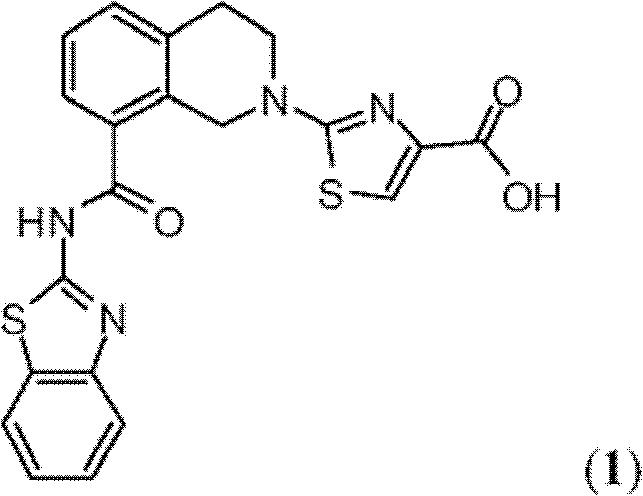
步骤1:8-(苯并[d]噻唑-2-基氨基甲酰基)-3,4-二氢异喹啉-2(1H)-羧酸叔丁酯(1A)的制备。 Step 1 : Preparation of tert-butyl 8-(benzo[d]thiazol-2-ylcarbamoyl)-3,4-dihydroisoquinoline-2(1H)-carboxylate (1A).
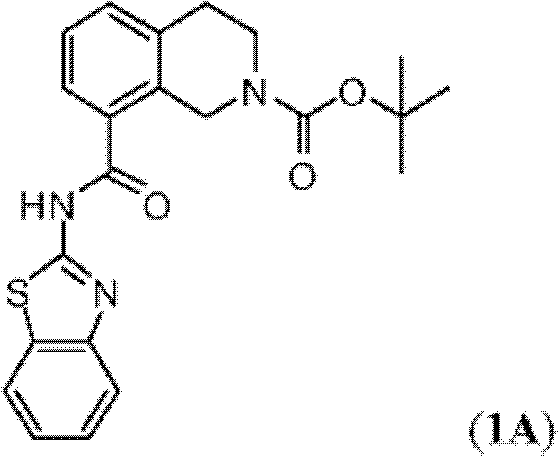
向2-(叔丁氧基羰基)-1,2,3,4-四氢异喹啉-8-羧酸(6.8g,24.5mmol)和苯并[d]噻唑-2-胺(5.52g,36.8mmol)在DCM(80mL)中的溶液中,加入EDCI(9.4g,49.04mmol)和DMAP(6g,49mmol)。混合物在室温下搅拌过夜。反应混合物用DCM(400mL)稀释,用5%HCl水溶液、水、盐水洗涤,用Na2SO4干燥,减压浓缩,以提供8.5g所需产物8-(苯并[d]噻唑-2-基氨基甲酰基)-3,4-二氢异喹啉-2(1H)-羧酸叔丁酯(1A):1H NMR(300MHz,CDCl3)δppm 7.83(1H,m),7.48(1H,d),7.34(4H,m),7.19(1H,t),4.91(2H,m),3.67(2H,t),2.92(2H,t),1.47(9H,m)。MS(ESI(+)):m/z 410(M+H)。To 2-(tert-butoxycarbonyl)-1,2,3,4-tetrahydroisoquinoline-8-carboxylic acid (6.8g, 24.5mmol) and benzo[d]thiazol-2-amine (5.52g , 36.8 mmol) in DCM (80 mL), EDCI (9.4 g, 49.04 mmol) and DMAP (6 g, 49 mmol) were added. The mixture was stirred overnight at room temperature. The reaction mixture was diluted with DCM (400 mL), washed with 5% aqueous HCl, water, brine, dried over Na2SO4 , and concentrated under reduced pressure to provide 8.5 g of the desired product 8-(benzo[d]thiazole-2- 1H NMR (300MHz, CDCl 3 ) δppm 7.83 (1H, m), 7.48 (1H , d), 7.34 (4H, m), 7.19 (1H, t), 4.91 (2H, m), 3.67 (2H, t), 2.92 (2H, t), 1.47 (9H, m). MS (ESI(+)): m/z 410 (M+H).
步骤2:N-(苯并[d]噻唑-2-基)-1,2,3,4-四氢异喹啉-8-甲酰胺二盐酸盐(1B)的制备。 Step 2 : Preparation of N-(benzo[d]thiazol-2-yl)-1,2,3,4-tetrahydroisoquinoline-8-carboxamide dihydrochloride (1B).
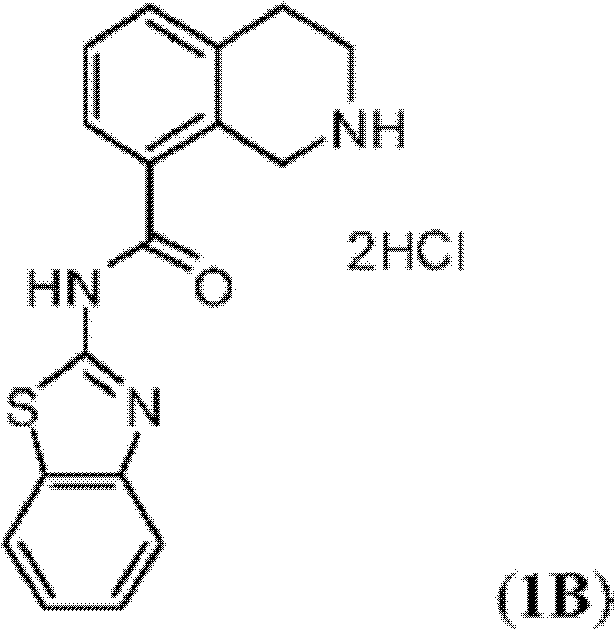
向8-(苯并[d]噻唑-2-基氨基甲酰基)-3,4-二氢异喹啉-2(1H)-羧酸叔丁酯(1A)(8.5g,20.75mmol)在DCM(80mL)中的溶液中,加入含2N HCl的乙醚(80mL)。反应混合物在室温下搅拌过夜,减压浓缩,以提供所需产物N-(苯并[d]噻唑-2-基)-1,2,3,4-四氢异喹啉-8-甲酰胺二盐酸盐(1B):LC/MS(APCI):m/z 309.9(M+H)。To 8-(benzo[d]thiazol-2-ylcarbamoyl)-3,4-dihydroisoquinoline-2(1H)-carboxylic acid tert-butyl ester (1A) (8.5g, 20.75mmol) in To a solution in DCM (80 mL), 2N HCl in ether (80 mL) was added. The reaction mixture was stirred at room temperature overnight and concentrated under reduced pressure to provide the desired product N-(benzo[d]thiazol-2-yl)-1,2,3,4-tetrahydroisoquinoline-8-carboxamide Dihydrochloride (1B): LC/MS (APCI): m/z 309.9 (M+H).
步骤3:2-(8-(苯并[d]噻唑-2-基氨基甲酰基)-3,4-二氢异喹啉-2(1H)-基)噻唑-4-羧酸甲酯(1C)的制备。 Step 3 : Methyl 2-(8-(benzo[d]thiazol-2-ylcarbamoyl)-3,4-dihydroisoquinolin-2(1H)-yl)thiazole-4-carboxylate ( 1C) Preparation.
向N-(苯并[d]噻唑-2-基)-1,2,3,4-四氢异喹啉-8-甲酰胺二盐酸盐(1B)(5.3g,13.86mmol)和2-氯噻唑-4-羧酸甲酯(2.5g,14mmol)在DMA(60mL)中的溶液中,加入Cs2CO3(25g,70mmol)。反应混合物在50℃搅拌过夜。反应混合物冷却至室温,用5%HCl酸化,用DCM萃取,用水、盐水洗涤,用Na2SO4干燥,减压浓缩。粗材料通过柱色谱用硅胶纯化,用含5%MeOH的DCM洗脱,以提供4.2g(67%)所需产物2-(8-(苯并[d]噻唑-2-基氨基甲酰基)-3,4-二氢异喹啉-2(1H)-基)噻唑-4-羧酸甲酯(1C):LC/MS(APCI):m/z 451.0(M+H)。To N-(benzo[d]thiazol-2-yl)-1,2,3,4-tetrahydroisoquinoline-8-carboxamide dihydrochloride (1B) (5.3g, 13.86mmol) and 2 - To a solution of methyl chlorothiazole-4-carboxylate (2.5 g, 14 mmol) in DMA ( 60 mL) was added Cs2CO3 (25 g, 70 mmol). The reaction mixture was stirred overnight at 50 °C. The reaction mixture was cooled to room temperature, acidified with 5% HCl, extracted with DCM, washed with water, brine, dried over Na2SO4 , concentrated under reduced pressure . The crude material was purified by column chromatography on silica gel eluting with 5% MeOH in DCM to afford 4.2 g (67%) of the desired product 2-(8-(benzo[d]thiazol-2-ylcarbamoyl) -3,4-Dihydroisoquinolin-2(1H)-yl)thiazole-4-carboxylic acid methyl ester (1C): LC/MS (APCI): m/z 451.0 (M+H).
步骤4:题示化合物1的制备: Step 4 : Preparation of Title Compound 1:
题示化合物2-(8-(苯并[d]噻唑-2-基氨基甲酰基)-3,4-二氢异喹啉-2(1H)-基)噻唑-4-羧酸(1)通过以下程序制备:向2-(8-(苯并[d]噻唑-2-基氨基甲酰基)-3,4-二氢异喹啉-2(1H)-基)噻唑-4-羧酸甲酯(1C)(180mg,4mmol)在THF(4mL)和MeOH(2mL)中的溶液中,加入2NNaOH(2mL)。反应混合物在50℃搅拌4小时,缓慢加入5%HCl水溶液中和。然后过滤沉淀,干燥,在DMSO/MeOH(1∶1)中溶解,通过柱色谱用硅胶纯化,以提供所需产物2-(8-(苯并[d]噻唑-2-基氨基甲酰基)-3,4-二氢异喹啉-2(1H)-基)噻唑-4-羧酸(1):1H NMR(300MHz,DMSO-D6)δppm 7.99(1H,d),7.76(1H,d),7.69(1H,dd),7.52(1H,s),7.38(4H,m),4.91(2H,s),3.75(2H,t),3.05(2H,t)。MS(ESI(+)):m/z 437(M+H)。The title compound 2-(8-(benzo[d]thiazol-2-ylcarbamoyl)-3,4-dihydroisoquinolin-2(1H)-yl)thiazole-4-carboxylic acid (1) Prepared by the following procedure: To 2-(8-(benzo[d]thiazol-2-ylcarbamoyl)-3,4-dihydroisoquinolin-2(1H)-yl)thiazole-4-carboxylic acid To a solution of the methyl ester (1C) (180 mg, 4 mmol) in THF (4 mL) and MeOH (2 mL) was added 2N NaOH (2 mL). The reaction mixture was stirred at 50°C for 4 hours, and neutralized by slowly adding 5% aqueous HCl. The precipitate was then filtered, dried, dissolved in DMSO/MeOH (1:1), and purified by column chromatography on silica gel to afford the desired product 2-(8-(benzo[d]thiazol-2-ylcarbamoyl) -3,4-Dihydroisoquinolin-2(1H)-yl)thiazole-4-carboxylic acid (1): 1 H NMR (300MHz, DMSO-D 6 ) δppm 7.99(1H,d), 7.76(1H , d), 7.69 (1H, dd), 7.52 (1H, s), 7.38 (4H, m), 4.91 (2H, s), 3.75 (2H, t), 3.05 (2H, t). MS (ESI(+)): m/z 437 (M+H).
实施例2Example 2
2-(8-(苯并[d]噻唑-2-基氨基甲酰基)-3,4-二氢异喹啉-2(1H)-基)-5-(3-苯氧基丙基)噻唑-4-羧酸(2)的合成:2-(8-(Benzo[d]thiazol-2-ylcarbamoyl)-3,4-dihydroisoquinolin-2(1H)-yl)-5-(3-phenoxypropyl) Synthesis of thiazole-4-carboxylic acid (2):

步骤1:3-溴-6-氯-2-氧己酸乙酯(2A)的制备。 Step 1 : Preparation of ethyl 3-bromo-6-chloro-2-oxohexanoate (2A).
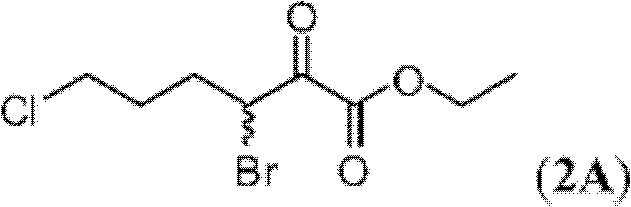
向含6-氯-2-氧己酸乙酯(2.9g,15mmol)的四氯化碳(30mL)中加入溴(0.85mL,16.5mmol),在室温下搅拌1小时。反应混合物用EtOAc稀释,用Na2S2O3溶液、水、盐水洗涤,用MgSO4干燥,过滤,减压浓缩。粗材料通过柱色谱用硅胶纯化,用含0到10%EtOAc的己烷梯度洗脱,以提供所需产物3-溴-6-氯-2-氧己酸乙酯(2A),产率95%。1H NMR(300MHz,DMSO-d6)δppm 5.25(1H,dd),4.29(2H,q),3.71(2H,t),2.16(1H,m),1.91(1H,m),1.29(3H,t)。Bromine (0.85 mL, 16.5 mmol) was added to carbon tetrachloride (30 mL) containing ethyl 6-chloro-2-oxohexanoate (2.9 g, 15 mmol), and stirred at room temperature for 1 hour. The reaction mixture was diluted with EtOAc , washed with Na2S2O3 solution, water, brine, dried over MgSO4 , filtered and concentrated under reduced pressure. The crude material was purified by column chromatography on silica gel eluting with a gradient of 0 to 10% EtOAc in hexanes to afford the desired product ethyl 3-bromo-6-chloro-2-oxohexanoate (2A) in 95% yield %. 1 H NMR (300MHz, DMSO-d 6 ) δppm 5.25 (1H, dd), 4.29 (2H, q), 3.71 (2H, t), 2.16 (1H, m), 1.91 (1H, m), 1.29 (3H , t).
步骤2:2-(8-(苯并[d]噻唑-2-基氨基甲酰基)-3,4-二氢异喹啉-2(1H)-基)-5-(3-氯丙基)噻唑-4-羧酸乙酯(2B)的制备。 Step 2 : 2-(8-(Benzo[d]thiazol-2-ylcarbamoyl)-3,4-dihydroisoquinolin-2(1H)-yl)-5-(3-chloropropyl ) Preparation of ethyl thiazole-4-carboxylate (2B).
向含N-(苯并[d]噻唑-2-基)-1,2,3,4-四氢异喹啉-8-甲酰胺二盐酸盐(1B)(11.5g,30mmol)的DMF(125mL),加入TEA(16.7mL,120mmol),在室温下搅拌15分钟。加入二(1H-咪唑-1-基)甲硫酮(6.53g,33mmol),反应混合物在室温下搅拌1小时。加入含7N氨水的MeOH(171mL,1.2mol),混合物在室温下搅拌过夜。浓缩反应混合物,以除去氨水、TEA和MeOH。向浓缩液中加入3-溴-6-氯-2-氧己酸乙酯(2A)(11.4g,42mmol)的EtOH(40mL)溶液。反应混合物在氮气中在50℃加热4.5小时。加入额外的含3-溴-6-氯-2-氧己酸乙酯(2A)(0.815g,3mmol)的EtOH(3mL),继续加热1.5小时。反应混合物减压浓缩除去EtOH,然后用EtOAc萃取。合并的有机萃取液用盐水洗涤,用MgSO4干燥,过滤,减压浓缩。浓缩液通过柱色谱用硅胶纯化,用含30到50%EtOAc的己烷梯度洗脱,以提供所需产物2-(8-(苯并[d]噻唑-2-基氨基甲酰基)-3,4-二氢异喹啉-2(1H)-基)-5-(3-氯丙基)噻唑-4-羧酸乙酯(2B),产率69%。1H NMR(300MHz,DMSO-d6)δppm12.89(1H,s),8.04(1H,d),7.79(1H,d),7.67(1H,d),7.42(4H,m),4.83(2H,s),4.19(2H,q),3.72(2H,t),3.64(2H,t),3.13(2H,m),3.04(2H,t),2.00(2H,m),1.21(3H,t)。To the DMF containing N-(benzo[d]thiazol-2-yl)-1,2,3,4-tetrahydroisoquinoline-8-carboxamide dihydrochloride (1B) (11.5g, 30mmol) (125 mL), TEA (16.7 mL, 120 mmol) was added and stirred at room temperature for 15 minutes. Bis(1H-imidazol-1-yl)methione (6.53 g, 33 mmol) was added and the reaction mixture was stirred at room temperature for 1 hour. 7N ammonia in MeOH (171 mL, 1.2 mol) was added and the mixture was stirred at room temperature overnight. The reaction mixture was concentrated to remove ammonia, TEA and MeOH. To the concentrate was added ethyl 3-bromo-6-chloro-2-oxohexanoate (2A) (11.4 g, 42 mmol) in EtOH (40 mL). The reaction mixture was heated at 50°C under nitrogen for 4.5 hours. Additional ethyl 3-bromo-6-chloro-2-oxohexanoate (2A) (0.815 g, 3 mmol) in EtOH (3 mL) was added and heating was continued for 1.5 h. The reaction mixture was concentrated under reduced pressure to remove EtOH, then extracted with EtOAc. The combined organic extracts were washed with brine, dried over MgSO4 , filtered and concentrated under reduced pressure. The concentrate was purified by column chromatography on silica gel eluting with a gradient of 30 to 50% EtOAc in hexanes to afford the desired product 2-(8-(benzo[d]thiazol-2-ylcarbamoyl)-3 , ethyl 4-dihydroisoquinolin-2(1H)-yl)-5-(3-chloropropyl)thiazole-4-carboxylate (2B), yield 69%. 1 H NMR (300MHz, DMSO-d 6 ) δppm 12.89 (1H, s), 8.04 (1H, d), 7.79 (1H, d), 7.67 (1H, d), 7.42 (4H, m), 4.83 ( 2H,s), 4.19(2H,q), 3.72(2H,t), 3.64(2H,t), 3.13(2H,m), 3.04(2H,t), 2.00(2H,m), 1.21(3H , t).
步骤3:2-(8-(苯并[d]噻唑-2-基氨基甲酰基)-3,4-二氢异喹啉-2(1H)-基)-5-(3-碘丙基)噻唑-4-羧酸乙酯(2C)的制备。 Step 3 : 2-(8-(Benzo[d]thiazol-2-ylcarbamoyl)-3,4-dihydroisoquinolin-2(1H)-yl)-5-(3-iodopropyl ) Preparation of ethyl thiazole-4-carboxylate (2C).

向含2-(8-(苯并[d]噻唑-2-基氨基甲酰基)-3,4-二氢异喹啉-2(1H)-基)-5-(3-氯丙基)噻唑-4-羧酸乙酯(2B)(9.3g,17.2mmol)的乙腈(125mL),加入碘化钠(25.8g,172mmol)。反应混合物用氮气吹扫两次。然后反应混合物在90℃加热5小时,冷却至室温,减压浓缩。浓缩液用EtOAc稀释,用水、盐水洗涤,用MgSO4干燥,过滤,减压浓缩。粗材料在Et2O中浆化,过滤,用额外的Et2O洗涤,减压干燥,以提供所需产物2-(8-(苯并[d]噻唑-2-基氨基甲酰基)-3,4-二氢异喹啉-2(1H)-基)-5-(3-碘丙基)噻唑-4-羧酸乙酯(2C),产率93%。1H NMR(300MHz,DMSO-d6)δppm 12.89(1H,s),8.04(1H,d),7.79(1H,d),7.66(1H,d),7.43(4H,m),4.83(2H,s),4.19(2H,q),3.72(2H,t),3.26(2H,t),3.06(4H,m),2.03(2H,m),1.21(3H,t)。To 2-(8-(benzo[d]thiazol-2-ylcarbamoyl)-3,4-dihydroisoquinolin-2(1H)-yl)-5-(3-chloropropyl) Ethyl thiazole-4-carboxylate (2B) (9.3 g, 17.2 mmol) in acetonitrile (125 mL) was added with sodium iodide (25.8 g, 172 mmol). The reaction mixture was purged twice with nitrogen. The reaction mixture was then heated at 90°C for 5 hours, cooled to room temperature, and concentrated under reduced pressure. The concentrate was diluted with EtOAc, washed with water, brine, dried over MgSO4 , filtered and concentrated under reduced pressure. The crude material was slurried in Et2O , filtered, washed with additional Et2O , and dried under reduced pressure to afford the desired product 2-(8-(benzo[d]thiazol-2-ylcarbamoyl)- 3,4-Dihydroisoquinolin-2(1H)-yl)-5-(3-iodopropyl)thiazole-4-carboxylic acid ethyl ester (2C), yield 93%. 1 H NMR (300MHz, DMSO-d 6 ) δppm 12.89 (1H, s), 8.04 (1H, d), 7.79 (1H, d), 7.66 (1H, d), 7.43 (4H, m), 4.83 (2H , s), 4.19 (2H, q), 3.72 (2H, t), 3.26 (2H, t), 3.06 (4H, m), 2.03 (2H, m), 1.21 (3H, t).
步骤4:题示化合物2的制备: Step 4 : Preparation of Title Compound 2:
题示化合物2-(8-(苯并[d]噻唑-2-基氨基甲酰基)-3,4-二氢异喹啉-2(1H)-基)-5-(3-苯氧基丙基)噻唑-4-羧酸(2)通过以下程序制备:向含苯酚(22.6mg,0.24mmol)的DMF(2mL)加入NaH(60%油分散剂)(24mg,0.6mmol)。在室温下搅拌5分钟后,加入2-(8-(苯并[d]噻唑-2-基氨基甲酰基)-3,4-二氢异喹啉-2(1H)-基)-5-(3-碘丙基)噻唑-4-羧酸乙酯(2C)(127mg,0.2mmol),继续搅拌1小时。反应混合物用1N HCl酸化,过滤沉淀,用水洗涤。沉淀在Et2O中浆化,过滤,用额外的Et2O洗涤。得到的固体通过柱色谱用硅胶纯化,用含0到2%MeOH的DCM梯度洗脱。向DMF(1mL)中的纯化材料中,加入NaOH(4N水溶液)(0.5mL,2mmol),在50℃加热5小时,冷却至室温,用1NHCl酸化。过滤沉淀,用水洗涤,在Et2O中浆化,过滤,用Et2O洗涤,在真空烤箱中干燥,以提供所需产物2-(8-(苯并[d]噻唑-2-基氨基甲酰基)-3,4-二氢异喹啉-2(1H)-基)-5-(3-苯氧基丙基)噻唑-4-羧酸(2),产率37%。1H NMR(300MHz,DMSO-d6)δppm 12.89(s,1H),12.49(1H,s),8.04(1H,d),7.79(1H,d),7.67(1H,d),7.44(4H,m),7.25(2H,m),6.88(3H,m),4.82(2H,s),3.96(2H,t),3.72(2H,t),3.17(2H,m),3.03(2H,t),2.00(2H,m)。MS(ESI(+)):m/z 571(M+H)。The title compound 2-(8-(benzo[d]thiazol-2-ylcarbamoyl)-3,4-dihydroisoquinolin-2(1H)-yl)-5-(3-phenoxy Propyl)thiazole-4-carboxylic acid (2) was prepared by the following procedure: To phenol (22.6 mg, 0.24 mmol) in DMF (2 mL) was added NaH (60% oil dispersion) (24 mg, 0.6 mmol). After stirring at room temperature for 5 minutes, 2-(8-(benzo[d]thiazol-2-ylcarbamoyl)-3,4-dihydroisoquinolin-2(1H)-yl)-5- Ethyl (3-iodopropyl)thiazole-4-carboxylate (2C) (127 mg, 0.2 mmol), stirring was continued for 1 hour. The reaction mixture was acidified with 1N HCl and the precipitate was filtered and washed with water. The precipitate was slurried in Et2O , filtered, and washed with additional Et2O . The resulting solid was purified by column chromatography on silica gel eluting with a gradient of 0 to 2% MeOH in DCM. To the purified material in DMF (1 mL) was added NaOH (4N aq) (0.5 mL, 2 mmol), heated at 50 °C for 5 hours, cooled to room temperature, and acidified with 1 N HCl. The precipitate was filtered, washed with water, slurried in Et2O , filtered, washed with Et2O , and dried in a vacuum oven to provide the desired product 2-(8-(benzo[d]thiazol-2-ylamino Formyl)-3,4-dihydroisoquinolin-2(1H)-yl)-5-(3-phenoxypropyl)thiazole-4-carboxylic acid (2), yield 37%. 1 H NMR (300MHz, DMSO-d 6 ) δppm 12.89(s, 1H), 12.49(1H, s), 8.04(1H, d), 7.79(1H, d), 7.67(1H, d), 7.44(4H , m), 7.25(2H, m), 6.88(3H, m), 4.82(2H, s), 3.96(2H, t), 3.72(2H, t), 3.17(2H, m), 3.03(2H, t), 2.00 (2H, m). MS (ESI(+)): m/z 571 (M+H).
实施例3Example 3
2-(8-(苯并[d]噻唑-2-基氨基甲酰基)-3,4-二氢异喹啉-2(1H)-基)-5-(3-(吡啶-4-基硫代)丙基)噻唑-4-羧酸(3)的合成:2-(8-(Benzo[d]thiazol-2-ylcarbamoyl)-3,4-dihydroisoquinolin-2(1H)-yl)-5-(3-(pyridin-4-yl Synthesis of thio)propyl)thiazole-4-carboxylic acid (3):
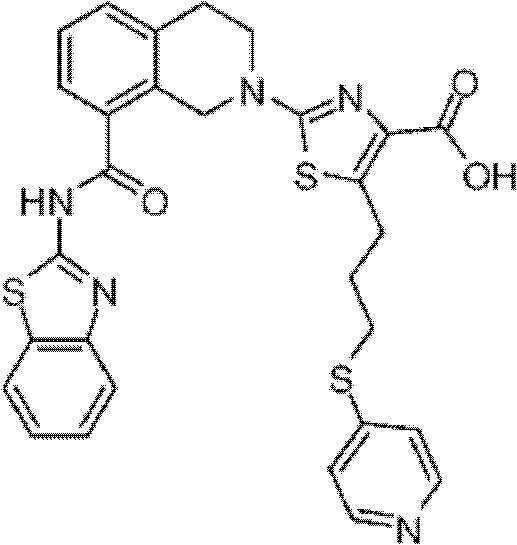
题示化合物2-(8-(苯并[d]噻唑-2-基氨基甲酰基)-3,4-二氢异喹啉-2(1H)-基)-5-(3-(吡啶-4-基硫代)丙基)噻唑-4-羧酸(3)通过以下程序制备:题示化合物通过在实施例2的步骤4用吡啶-4-硫醇代替苯酚制备。所需产物沉淀后,固体通过HPLC纯化(预制备反相HPLC用自动化Gilson HPLC系统执行,使用SymmetryPrep Shield RP18预制备柱,250mmx21.20mm i.d.,10um,流速25mL/min;λ=214、245nm;流动相A,含0.1%TFA的H2O;流动相B,CH3CN;40分钟内,B的线性梯度0-90%),以提供2-(8-(苯并[d]噻唑-2-基氨基甲酰基)-3,4-二氢异喹啉-2(1H)-基)-5-(3-(吡啶-4-基硫代)丙基)噻唑-4-羧酸(3),产率30%。1H NMR(300MHz,DMSO-d6)δppm 12.81(1H,s),8.48(2H,d),8.03(1H,d),7.79(1H,d),7.67(1H,d),7.59(2H,m),7.41(4H,m),4.83(2H,s),3.73(2H,t),3.18(4H,m),3.03(2H,t),1.95(2H,m)。MS(ESI(+)):m/z 588(M+H)。The title compound 2-(8-(benzo[d]thiazol-2-ylcarbamoyl)-3,4-dihydroisoquinolin-2(1H)-yl)-5-(3-(pyridine- 4-ylthio)propyl)thiazole-4-carboxylic acid (3) was prepared by the following procedure: The title compound was prepared by substituting pyridine-4-thiol for phenol in step 4 of Example 2. After precipitation of the desired product, the solid was purified by HPLC (pre-prep reverse phase HPLC performed with an automated Gilson HPLC system using a SymmetryPrep Shield RP18 pre-prep column, 250mmx21.20mm id, 10um, flow rate 25mL/min; λ = 214, 245nm; flow Phase A, H 2 O with 0.1% TFA; mobile phase B, CH 3 CN; linear gradient 0-90% of B over 40 minutes) to provide 2-(8-(benzo[d]thiazole-2 -ylcarbamoyl)-3,4-dihydroisoquinolin-2(1H)-yl)-5-(3-(pyridin-4-ylthio)propyl)thiazole-4-carboxylic acid (3 ), yield 30%. 1 H NMR (300MHz, DMSO-d 6 ) δppm 12.81 (1H, s), 8.48 (2H, d), 8.03 (1H, d), 7.79 (1H, d), 7.67 (1H, d), 7.59 (2H , m), 7.41 (4H, m), 4.83 (2H, s), 3.73 (2H, t), 3.18 (4H, m), 3.03 (2H, t), 1.95 (2H, m). MS (ESI(+)): m/z 588 (M+H).
实施例4Example 4
2-(8-(苯并[d]噻唑-2-基氨基甲酰基)-3,4-二氢异喹啉-2(1H)-基)-5-(3-(4-(叔丁氧基羰基氨基)苯氧基)丙基)噻唑-4-羧酸(4)的合成:2-(8-(Benzo[d]thiazol-2-ylcarbamoyl)-3,4-dihydroisoquinolin-2(1H)-yl)-5-(3-(4-(tert-butyl Synthesis of oxycarbonylamino)phenoxy)propyl)thiazole-4-carboxylic acid (4):
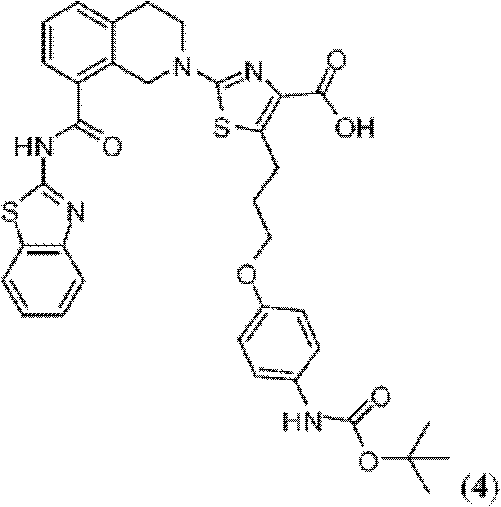
题示化合物2-(8-(苯并[d]噻唑-2-基氨基甲酰基)-3,4-二氢异喹啉-2(1H)-基)-5-(3-(4-(叔丁氧基羰基氨基)苯氧基)丙基)噻唑-4-羧酸(4)通过以下程序制备:题示化合物通过在实施例2的步骤4用4-羟基苯基氨基甲酸叔丁酯代替苯酚制备。因为烷化或水解步骤加入1N HCl不产生可过滤的固体,用EtOAc萃取反应混合物。合并的萃取液用盐水洗涤,用MgSO4干燥,过滤,减压浓缩。各步骤按照实施例2中纯化,最终固体加一次额外的MeOH洗涤,提供所需化合物2-(8-(苯并[d]噻唑-2-基氨基甲酰基)-3,4-二氢异喹啉-2(1H)-基)-5-(3-(4-(叔丁氧基羰基氨基)苯氧基)丙基)噻唑-4-羧酸(4),产率58%。1H NMR(300MHz,DMSO-d6)δppm 12.87(1H,s),12.52(1H,s),9.08(1H,s),8.03(1H,d),7.79(1H,d),7.67(1H,d),7.45(2H,m),7.35(4H,m),6.80(2H,m),4.83(2H,s),3.91(2H,t),3.72(2H,t),3.15(2H,m),3.03(2H,t),1.97(2H,m),1.45(9H,s)。MS(ESI(+)):m/z 686(M+H)。The title compound 2-(8-(benzo[d]thiazol-2-ylcarbamoyl)-3,4-dihydroisoquinolin-2(1H)-yl)-5-(3-(4- (tert-butoxycarbonylamino)phenoxy)propyl)thiazole-4-carboxylic acid (4) was prepared by the following procedure: The title compound was prepared by using tert-butyl 4-hydroxyphenylcarbamate in step 4 of Example 2 Esters were prepared instead of phenols. Since the addition of 1 N HCl to the alkylation or hydrolysis step did not produce a filterable solid, the reaction mixture was extracted with EtOAc. The combined extracts were washed with brine, dried over MgSO4 , filtered and concentrated under reduced pressure. The steps were purified as in Example 2 and the final solid was washed with one additional MeOH to provide the desired compound 2-(8-(benzo[d]thiazol-2-ylcarbamoyl)-3,4-dihydroiso Quinolin-2(1H)-yl)-5-(3-(4-(tert-butoxycarbonylamino)phenoxy)propyl)thiazole-4-carboxylic acid (4), yield 58%. 1 H NMR (300MHz, DMSO-d 6 ) δppm 12.87(1H, s), 12.52(1H, s), 9.08(1H, s), 8.03(1H, d), 7.79(1H, d), 7.67(1H , d), 7.45(2H, m), 7.35(4H, m), 6.80(2H, m), 4.83(2H, s), 3.91(2H, t), 3.72(2H, t), 3.15(2H, m), 3.03 (2H, t), 1.97 (2H, m), 1.45 (9H, s). MS (ESI(+)): m/z 686 (M+H).
实施例5Example 5
2-(8-(苯并[d]噻唑-2-基氨基甲酰基)-3,4-二氢异喹啉-2(1H)-基)-5-(3-(3-(叔丁氧基羰基氨基)苯氧基)丙基)噻唑-4-羧酸(5)的合成:2-(8-(Benzo[d]thiazol-2-ylcarbamoyl)-3,4-dihydroisoquinolin-2(1H)-yl)-5-(3-(3-(tert-butyl Synthesis of oxycarbonylamino)phenoxy)propyl)thiazole-4-carboxylic acid (5):
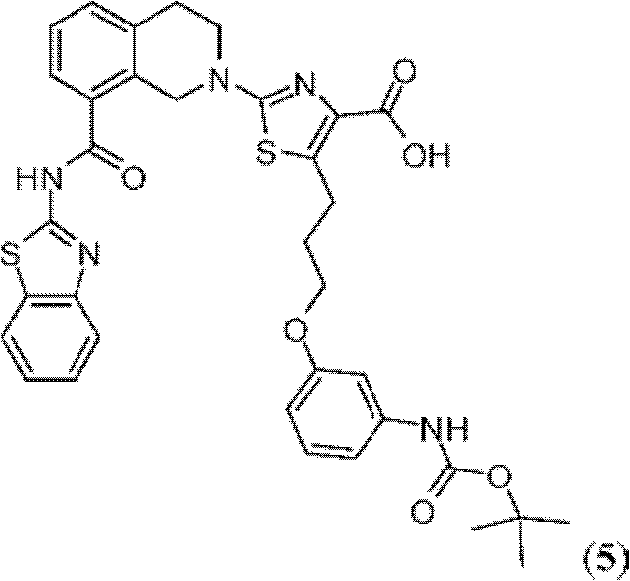
题示化合物2-(8-(苯并[d]噻唑-2-基氨基甲酰基)-3,4-二氢异喹啉-2(1H)-基)-5-(3-(3-(叔丁氧基羰基氨基)苯氧基)丙基)噻唑-4-羧酸(5)通过以下程序制备:题示化合物通过在实施例2的步骤4用3-羟基苯基氨基甲酸叔丁酯代替苯酚制备。酯水解前未分离中间体烷化产物。1HNMR(400MHz,DMSO-d6)δppm 12.81(1H,s),9.24(1H,s),8.03(1H,d),7.79(1H,d),7.67(1H,d),7.46(2H,m),7.36(2H,m),7.09(2H,m),6.97(1H,d),6.50(1H,dd),4.84(2H,s),3.91(2H,t),3.72(2H,t),3.16(2H,m),3.03(2H,t),1.99(2H,m),1.45(9H,s)。MS(ESI(+)):m/z 686(M+H)。The title compound 2-(8-(benzo[d]thiazol-2-ylcarbamoyl)-3,4-dihydroisoquinolin-2(1H)-yl)-5-(3-(3- (tert-butoxycarbonylamino)phenoxy)propyl)thiazole-4-carboxylic acid (5) was prepared by the following procedure: The title compound was prepared by using tert-butyl 3-hydroxyphenylcarbamate in step 4 of Example 2 Esters were prepared instead of phenols. The intermediate alkylation product was not isolated prior to ester hydrolysis. 1 HNMR (400MHz, DMSO-d 6 ) δppm 12.81 (1H, s), 9.24 (1H, s), 8.03 (1H, d), 7.79 (1H, d), 7.67 (1H, d), 7.46 (2H, m), 7.36(2H,m), 7.09(2H,m), 6.97(1H,d), 6.50(1H,dd), 4.84(2H,s), 3.91(2H,t), 3.72(2H,t ), 3.16 (2H, m), 3.03 (2H, t), 1.99 (2H, m), 1.45 (9H, s). MS (ESI(+)): m/z 686 (M+H).
实施例6Example 6
5-(3-(4-氨基苯氧基)丙基)-2-(8-(苯并[d]噻唑-2-基氨基甲酰基)-3,4-二氢异喹啉-2(1H)-基)噻唑-4-羧酸(6)的合成:5-(3-(4-aminophenoxy)propyl)-2-(8-(benzo[d]thiazol-2-ylcarbamoyl)-3,4-dihydroisoquinoline-2( Synthesis of 1H)-yl)thiazole-4-carboxylic acid (6):
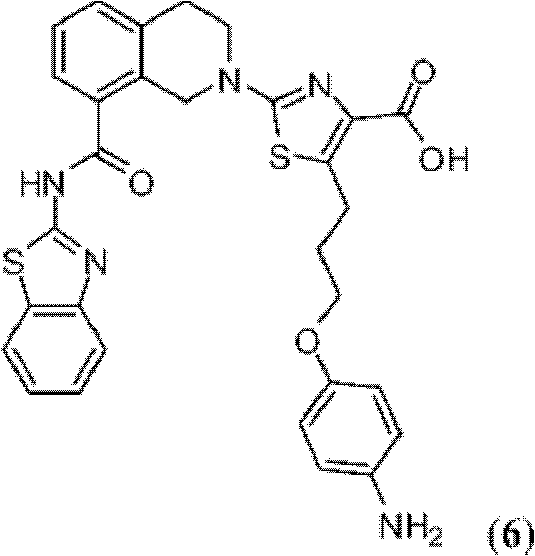
题示化合物5-(3-(4-氨基苯氧基)丙基)-2-(8-(苯并[d]噻唑-2-基氨基甲酰基)-3,4-二氢异喹啉-2(1H)-基)噻唑-4-羧酸(6)通过以下程序制备:向含2-(8-(苯并[d]噻唑-2-基氨基甲酰基)-3,4-二氢异喹啉-2(1H)-基)-5-(3-(4-(叔丁氧基羰基氨基)苯氧基)丙基)噻唑-4-羧酸(4)(20mg,0.029mmol)的MeOH(1mL),加入TFA(1mL,13mmol),在室温下搅拌2小时。反应混合物通过HPLC纯化(预制备反相HPLC用自动化Gilson HPLC系统执行,使用SymmetryPrep Shield RP18预制备柱,250mmx21.20mm i.d.,10um,流速25mL/min;λ=214、245nm;流动相A,含0.1%TFA的H2O;流动相B,CH3CN;40分钟内,B的线性梯度0-70%),以提供所需产物5-(3-(4-氨基苯氧基)丙基)-2-(8-(苯并[d]噻唑-2-基氨基甲酰基)-3,4-二氢异喹啉-2(1H)-基)噻唑-4-羧酸,产率48%。1H NMR(400MHz,DMSO-d6)δppm 12.77(1H,s),9.04(1H,s),8.03(1H,d),7.79(1H,d),7.67(1H,d),7.47(2H,m),7.37(2H,m),7.09(2H,d),6.92(2H,m),4.83(2H,s),3.95(2H,t),3.72(2H,t),3.17(2H,m),3.03(2H,t),1.99(2H,m)。MS(ESI(+)):m/z 586(M+H)。The title compound 5-(3-(4-aminophenoxy)propyl)-2-(8-(benzo[d]thiazol-2-ylcarbamoyl)-3,4-dihydroisoquinoline -2(1H)-yl)thiazole-4-carboxylic acid (6) was prepared by the following procedure: Hydroisoquinolin-2(1H)-yl)-5-(3-(4-(tert-butoxycarbonylamino)phenoxy)propyl)thiazole-4-carboxylic acid (4) (20mg, 0.029mmol ) in MeOH (1 mL), TFA (1 mL, 13 mmol) was added and stirred at room temperature for 2 hours. The reaction mixture was purified by HPLC (pre-preparative reverse-phase HPLC was performed with an automated Gilson HPLC system, using a SymmetryPrep Shield RP18 pre-preparative column, 250mmx21.20mm id, 10um, flow rate 25mL/min; λ = 214, 245nm; mobile phase A, containing 0.1 %TFA in H2O ; mobile phase B, CH3CN ; linear gradient 0-70% of B over 40 minutes) to provide the desired product 5-(3-(4-aminophenoxy)propyl) -2-(8-(Benzo[d]thiazol-2-ylcarbamoyl)-3,4-dihydroisoquinolin-2(1H)-yl)thiazole-4-carboxylic acid, yield 48% . 1 H NMR (400MHz, DMSO-d 6 ) δppm 12.77(1H, s), 9.04(1H, s), 8.03(1H, d), 7.79(1H, d), 7.67(1H, d), 7.47(2H , m), 7.37(2H, m), 7.09(2H, d), 6.92(2H, m), 4.83(2H, s), 3.95(2H, t), 3.72(2H, t), 3.17(2H, m), 3.03 (2H, t), 1.99 (2H, m). MS (ESI(+)): m/z 586 (M+H).
实施例7Example 7
5-(3-(1H-吡唑-1-基)丙基)-2-(8-(苯并[d]噻唑-2-基氨基甲酰基)-3,4-二氢异喹啉-2(1H)-基)噻唑-4-羧酸(7)的合成:5-(3-(1H-pyrazol-1-yl)propyl)-2-(8-(benzo[d]thiazol-2-ylcarbamoyl)-3,4-dihydroisoquinoline- Synthesis of 2(1H)-yl)thiazole-4-carboxylic acid (7):
题示化合物5-(3-(1H-吡唑-1-基)丙基)-2-(8-(苯并[d]噻唑-2-基氨基甲酰基)-3,4-二氢异喹啉-2(1H)-基)噻唑-4-羧酸(7)通过以下程序制备:题示化合物通过在实施例2的步骤4用1H-吡唑代替苯酚制备。酯水解前未分离中间体烷化产物。1H NMR(400MHz,DMSO-d6)δppm 12.85(1H,s),12.55(1H,s),8.03(1H,d),7.79(1H,d),7.68(2H,m),7.47(2H,m),7.37(3H,m),6.19(1H,t),4.83(2H,s),4.12(2H,t),3.73(2H,t),3.04(2H,t),2.99(2H,m),2.05(2H,m)。MS(ESI(+)):m/z 545(M+H)。The title compound 5-(3-(1H-pyrazol-1-yl)propyl)-2-(8-(benzo[d]thiazol-2-ylcarbamoyl)-3,4-dihydroiso Quinoline-2(1H)-yl)thiazole-4-carboxylic acid (7) was prepared by the following procedure: The title compound was prepared by substituting 1H-pyrazole for phenol in step 4 of Example 2. The intermediate alkylation product was not isolated prior to ester hydrolysis. 1 H NMR (400MHz, DMSO-d6) δppm 12.85 (1H, s), 12.55 (1H, s), 8.03 (1H, d), 7.79 (1H, d), 7.68 (2H, m), 7.47 (2H, m), 7.37(3H,m), 6.19(1H,t), 4.83(2H,s), 4.12(2H,t), 3.73(2H,t), 3.04(2H,t), 2.99(2H,m ), 2.05(2H, m). MS (ESI(+)): m/z 545 (M+H).
实施例8Example 8
2-(8-(苯并[d]噻唑-2-基氨基甲酰基)-3,4-二氢异喹啉-2(1H)-基)-5-(3-(异喹啉-6-氧基)丙基)噻唑-4-羧酸(8)的合成:2-(8-(Benzo[d]thiazol-2-ylcarbamoyl)-3,4-dihydroisoquinolin-2(1H)-yl)-5-(3-(isoquinolin-6 Synthesis of -oxy)propyl)thiazole-4-carboxylic acid (8):
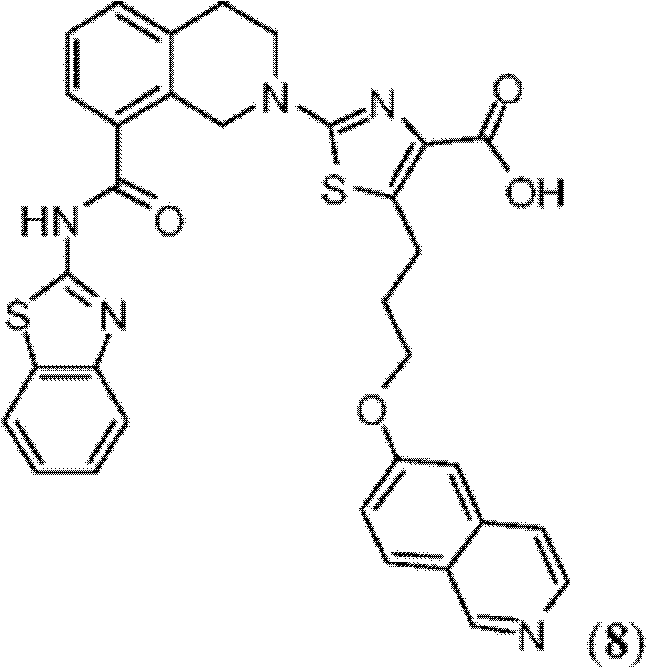
步骤1:2-氨基-5-碘噻唑-4-羧酸甲酯(8A)的制备: Step 1 : Preparation of 2-amino-5-iodothiazole-4-carboxylic acid methyl ester (8A):
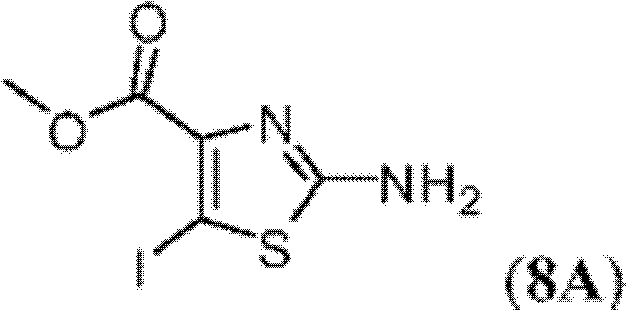
向2-氨基噻唑-4-羧酸甲酯(5.6g,35.4mmol)在DCM(60mL)中的溶液中,加入NIS(9.56g,42.5mmol)。混合物在室温下搅拌24小时,然后用EtOAc(200mL)稀释,用水、盐水洗涤,用Na2SO4干燥,减压浓缩,以提供9.5g(94%)所需产物2-氨基-5-碘噻唑-4-羧酸甲酯(8A):LC/MS(APCI):m/z 284.9(M+H)。To a solution of methyl 2-aminothiazole-4-carboxylate (5.6 g, 35.4 mmol) in DCM (60 mL) was added NIS (9.56 g, 42.5 mmol). The mixture was stirred at room temperature for 24 hours, then diluted with EtOAc (200 mL), washed with water, brine, dried over Na2SO4 , and concentrated under reduced pressure to provide 9.5 g (94%) of the desired product 2-amino-5-iodo Methyl thiazole-4-carboxylate (8A): LC/MS (APCI): m/z 284.9 (M+H).
步骤2:2-氯-5-碘噻唑-4-羧酸甲酯(8B)的制备: Step 2 : Preparation of 2-chloro-5-iodothiazole-4-carboxylic acid methyl ester (8B):
向2-氨基-5-碘噻唑-4-羧酸甲酯(8A)(9g,31.7mmol)在乙腈(60mL)中的溶液中,加入CuCl(4.75g,48mmol),接着加入亚硝酸叔丁酯(6.19g,60mmol)。混合物在室温下搅拌2小时。然后向搅拌混合物中缓慢加入NH4Cl以淬灭反应。用EtOAc萃取混合物,合并的萃取液用水、盐水洗涤,用Na2SO4干燥,减压浓缩。粗材料通过柱色谱用硅胶纯化,用含5%EtOAc的己烷洗脱,以提供7.5g(78%)所需产物2-氯-5-碘噻唑-4-羧酸甲酯(8B):LC/MS(APCI):m/z 304.0(M+H)。To a solution of methyl 2-amino-5-iodothiazole-4-carboxylate (8A) (9 g, 31.7 mmol) in acetonitrile (60 mL) was added CuCl (4.75 g, 48 mmol) followed by tert-butyl nitrite Ester (6.19 g, 60 mmol). The mixture was stirred at room temperature for 2 hours. Then NH4Cl was added slowly to the stirred mixture to quench the reaction. The mixture was extracted with EtOAc, and the combined extracts were washed with water, brine, dried over Na2SO4 , and concentrated under reduced pressure . The crude material was purified by column chromatography on silica gel eluting with 5% EtOAc in hexanes to provide 7.5 g (78%) of the desired product, methyl 2-chloro-5-iodothiazole-4-carboxylate (8B): LC/MS (APCI): m/z 304.0 (M+H).
步骤3:2-(8-(苯并[d]噻唑-2-基氨基甲酰基)-3,4-二氢异喹啉-2(1H)-基)-5-碘噻唑-4-羧酸甲酯(8C)的制备: Step 3 : 2-(8-(Benzo[d]thiazol-2-ylcarbamoyl)-3,4-dihydroisoquinolin-2(1H)-yl)-5-iodothiazole-4-carboxy Preparation of acid methyl ester (8C):

向N-(苯并[d]噻唑-2-基)-1,2,3,4-四氢异喹啉-8-甲酰胺二盐酸盐(1B)(2g,5.23mmol)和2-氯-5-碘噻唑-4-羧酸甲酯(8B)(1.66g,5.23mmol)在DMA(10mL)中的溶液中,加入Cs2CO3(8.52g,26.2mmol)。反应混合物在60℃搅拌过夜,冷却至室温,用5%HCl酸化,用DCM萃取,用水、盐水洗涤,用Na2SO4干燥,减压浓缩。粗材料通过柱色谱用硅胶纯化,用含5%MeOH的DCM洗脱,以提供2.0g(65%)所需产物2-(8-(苯并[d]噻唑-2-基氨基甲酰基)-3,4-二氢异喹啉-2(1H)-基)-5-碘噻唑-4-羧酸甲酯(8C):LC/MS(APCI):m/z 577.0(M+H)To N-(benzo[d]thiazol-2-yl)-1,2,3,4-tetrahydroisoquinoline-8-carboxamide dihydrochloride (1B) (2g, 5.23mmol) and 2- To a solution of methyl chloro-5-iodothiazole-4-carboxylate (8B) (1.66 g, 5.23 mmol) in DMA (10 mL) was added Cs2CO3 (8.52 g , 26.2 mmol). The reaction mixture was stirred at 60 °C overnight, cooled to room temperature, acidified with 5% HCl, extracted with DCM, washed with water, brine, dried over Na2SO4 , concentrated under reduced pressure . The crude material was purified by column chromatography on silica gel eluting with 5% MeOH in DCM to afford 2.0 g (65%) of the desired product 2-(8-(benzo[d]thiazol-2-ylcarbamoyl) -3,4-Dihydroisoquinolin-2(1H)-yl)-5-iodothiazole-4-carboxylic acid methyl ester (8C): LC/MS (APCI): m/z 577.0 (M+H)
步骤4:2-(8-(苯并[d]噻唑-2-基氨基甲酰基)-3,4-二氢异喹啉-2(1H)-基)-5-(3-羟基丙-1-炔基)噻唑-4-羧酸甲酯(8D)的制备。 Step 4 : 2-(8-(Benzo[d]thiazol-2-ylcarbamoyl)-3,4-dihydroisoquinolin-2(1H)-yl)-5-(3-hydroxypropane- Preparation of 1-alkynyl)thiazole-4-carboxylic acid methyl ester (8D).

向2-(8-(苯并[d]噻唑-2-基氨基甲酰基)-3,4-二氢异喹啉-2(1H)-基)-5-碘噻唑-4-羧酸甲酯(8C)(1.2g,2.03mmol)和丙-2-炔-1-醇(336mg,6mmol)在THF(20mL)中的溶液中,加入Pd(Ph3P)4(231mg,0.2mmol)、CuI(76mg,0.121mmol)、DIEA(520mg,4mmol)。混合物在室温下在氮气中搅拌过夜。混合物然后用DCM(400mL)稀释,用水、盐水洗涤,用Na2SO4干燥,减压浓缩。粗材料通过柱色谱用硅胶柱纯化,用含5%MeOH的DCM洗脱,以提供0.76g(73%)所需产物2-(8-(苯并[d]噻唑-2-基氨基甲酰基)-3,4-二氢异喹啉-2(1H)-基)-5-(3-羟基丙-1-炔基)噻唑-4-羧酸甲酯(8D):LC/MS(APCI):m/z505.1(M+H)To 2-(8-(benzo[d]thiazol-2-ylcarbamoyl)-3,4-dihydroisoquinolin-2(1H)-yl)-5-iodothiazole-4-carboxylic acid methyl To a solution of ester (8C) (1.2 g, 2.03 mmol) and prop-2-yn-1-ol (336 mg, 6 mmol) in THF (20 mL) was added Pd(Ph 3 P) 4 (231 mg, 0.2 mmol) , CuI (76 mg, 0.121 mmol), DIEA (520 mg, 4 mmol). The mixture was stirred overnight at room temperature under nitrogen. The mixture was then diluted with DCM (400 mL ), washed with water, brine, dried over Na2SO4 and concentrated under reduced pressure. The crude material was purified by column chromatography on silica gel eluting with 5% MeOH in DCM to afford 0.76 g (73%) of the desired product 2-(8-(benzo[d]thiazol-2-ylcarbamoyl )-3,4-dihydroisoquinolin-2(1H)-yl)-5-(3-hydroxyprop-1-ynyl)thiazole-4-carboxylic acid methyl ester (8D): LC/MS (APCI ): m/z505.1(M+H)
步骤5:2-(8-(苯并[d]噻唑-2-基氨基甲酰基)-34-二氢异喹啉-2(1H)-基)-5-(3-羟丙基)噻唑-4-羧酸甲酯(8E)的制备。 Step 5 : 2-(8-(Benzo[d]thiazol-2-ylcarbamoyl)-34-dihydroisoquinolin-2(1H)-yl)-5-(3-hydroxypropyl)thiazole - Preparation of methyl 4-carboxylate (8E).
向2-(8-(苯并[d]噻唑-2-基氨基甲酰基)-3,4-二氢异喹啉-2(1H)-基)-5-(3-羟基丙-1-炔基)噻唑-4-羧酸甲酯(8D)(1.2g,2.31mmol)在EtOAc(20mL)中的溶液中,加入PtO2(120mg,0.53mmol)。混合物在室温下在氢气球下搅拌过夜。这一时段后过滤混合物,浓缩滤液,以提供所需产物2-(8-(苯并[d]噻唑-2-基氨基甲酰基)-3,4-二氢异喹啉-2(1H)-基)-5-(3-羟丙基)噻唑-4-羧酸甲酯(8E):LC/MS(APCI):m/z509.2(M+H)。To 2-(8-(benzo[d]thiazol-2-ylcarbamoyl)-3,4-dihydroisoquinolin-2(1H)-yl)-5-(3-hydroxypropan-1- To a solution of methyl alkynyl)thiazole-4-carboxylate (8D) (1.2 g, 2.31 mmol) in EtOAc (20 mL) was added PtO2 (120 mg, 0.53 mmol). The mixture was stirred overnight at room temperature under a balloon of hydrogen. After this period the mixture was filtered and the filtrate was concentrated to afford the desired product 2-(8-(benzo[d]thiazol-2-ylcarbamoyl)-3,4-dihydroisoquinoline-2(1H) -yl)-5-(3-Hydroxypropyl)thiazole-4-carboxylic acid methyl ester (8E): LC/MS (APCI): m/z 509.2 (M+H).
步骤6:2-(8-(苯并[d]噻唑-2-基氨基甲酰基)-3,4-二氢异喹啉-2(1H)-基)-5-(3-(甲苯磺酰氧基)丙基)噻唑-4-羧酸甲酯(8F)的制备。 Step 6 : 2-(8-(Benzo[d]thiazol-2-ylcarbamoyl)-3,4-dihydroisoquinolin-2(1H)-yl)-5-(3-(toluenesulfonyl Preparation of methyl acyloxy)propyl)thiazole-4-carboxylate (8F).

向2-(8-(苯并[d]噻唑-2-基氨基甲酰基)-3,4-二氢异喹啉-2(1H)-基)-5-(3-羟丙基)噻唑-4-羧酸甲酯(0.5g,0.96mmol)在DCM(10mL)中的溶液中,加入TsCl(182mg,1mmol)、TEA(97mg,1mmol)和催化量的DMAP。混合物在室温下搅拌4小时。混合物用EtOAc稀释,用水、盐水洗涤,用Na2SO4干燥,减压浓缩,以提供所需产物2-(8-(苯并[d]噻唑-2-基氨基甲酰基)-3,4-二氢异喹啉-2(1H)-基)-5-(3-(甲苯磺酰氧基)丙基)噻唑-4-羧酸甲酯(8F),其使用无需进一步纯化。LC/MS(APCI):m/z 663.0(M+H)To 2-(8-(benzo[d]thiazol-2-ylcarbamoyl)-3,4-dihydroisoquinolin-2(1H)-yl)-5-(3-hydroxypropyl)thiazole - To a solution of methyl 4-carboxylate (0.5 g, 0.96 mmol) in DCM (10 mL) was added TsCl (182 mg, 1 mmol), TEA (97 mg, 1 mmol) and a catalytic amount of DMAP. The mixture was stirred at room temperature for 4 hours. The mixture was diluted with EtOAc, washed with water, brine , dried over Na2SO4 and concentrated under reduced pressure to afford the desired product 2-(8-(benzo[d]thiazol-2-ylcarbamoyl)-3,4 -Dihydroisoquinolin-2(1H)-yl)-5-(3-(tosyloxy)propyl)thiazole-4-carboxylic acid methyl ester (8F), which was used without further purification. LC/MS (APCI): m/z 663.0 (M+H)
步骤7:题示化合物8的制备: Step 7 : Preparation of Title Compound 8:

题示化合物2-(8-(苯并[d]噻唑-2-基氨基甲酰基)-3,4-二氢异喹啉-2(1H)-基)-5-(3-(异喹啉-6-氧基)丙基)噻唑-4-羧酸(8)通过以下程序制备:向2-(8-(苯并[d]噻唑-2-基氨基甲酰基)-3,4-二氢异喹啉-2(1H)-基)-5-(3-(甲苯磺酰氧基)丙基)噻唑-4-羧酸甲酯(8F)(133mg,0.2mmol)和5-羟基异喹啉(45mg,0.3mmol)在DMA(3mL)中的溶液中,加入Cs2CO3(50mg,0.3mmol)。混合物在室温下搅拌过夜,用2N NaOH(4mL)稀释,在50℃搅拌4小时。反应混合物用5%HCl中和,过滤沉淀并干燥。残余物然后在DMSO/MeOH(1∶1)中溶解,通过柱色谱用硅胶纯化,以提供所需产物2-(8-(苯并[d]噻唑-2-基氨基甲酰基)-3,4-二氢异喹啉-2(1H)-基)-5-(3-(异喹啉-6-氧基)丙基)噻唑-4-羧酸(8):1H NMR(300MHz,DMSO-D6)δppm 9.16(1H,s),8.34(1H,d),7.94(1H,d),7.85(1H,d),7.71(4H,m),7.38(8H,m),4.88(2H,s),4.14(2H,t),3.71(2H,t),3.00(2H,t),2.27(1H,m),2.09(2H,m)。LC/MS(APCI):m/z 622.2(M+H)。The title compound 2-(8-(benzo[d]thiazol-2-ylcarbamoyl)-3,4-dihydroisoquinolin-2(1H)-yl)-5-(3-(isoquinolin Phenyl-6-oxy)propyl)thiazole-4-carboxylic acid (8) was prepared by the following procedure: preparation of 2-(8-(benzo[d]thiazol-2-ylcarbamoyl)-3,4- Dihydroisoquinolin-2(1H)-yl)-5-(3-(tosyloxy)propyl)thiazole-4-carboxylic acid methyl ester (8F) (133mg, 0.2mmol) and 5-hydroxy To a solution of isoquinoline (45 mg , 0.3 mmol) in DMA (3 mL), Cs2CO3 (50 mg, 0.3 mmol) was added. The mixture was stirred at room temperature overnight, diluted with 2N NaOH (4 mL), and stirred at 50 °C for 4 hours. The reaction mixture was neutralized with 5% HCl, the precipitate was filtered and dried. The residue was then dissolved in DMSO/MeOH (1:1) and purified by column chromatography on silica gel to afford the desired product 2-(8-(benzo[d]thiazol-2-ylcarbamoyl)-3, 4-Dihydroisoquinolin-2(1H)-yl)-5-(3-(isoquinolin-6-oxyl)propyl)thiazole-4-carboxylic acid (8): 1 H NMR (300MHz, DMSO-D 6 ) δppm 9.16 (1H, s), 8.34 (1H, d), 7.94 (1H, d), 7.85 (1H, d), 7.71 (4H, m), 7.38 (8H, m), 4.88 ( 2H, s), 4.14 (2H, t), 3.71 (2H, t), 3.00 (2H, t), 2.27 (1H, m), 2.09 (2H, m). LC/MS (APCI): m/z 622.2 (M+H).
实施例9Example 9
5-(3-(3-氨基苯氧基)丙基)-2-(8-(苯并[d]噻唑-2-基氨基甲酰基)-3,4-二氢异喹啉-2(1H)-基)噻唑-4-羧酸(9)的合成:5-(3-(3-aminophenoxy)propyl)-2-(8-(benzo[d]thiazol-2-ylcarbamoyl)-3,4-dihydroisoquinoline-2( Synthesis of 1H)-yl)thiazole-4-carboxylic acid (9):

题示化合物9按照实施例6中阐述的程序制备,但用化合物5代替实施例6中的化合物4:1H NMR(300MHz,DMSO-d6)δppm 12.89(1H,s),8.03(1H,m),7.79(1H,d),7.67(1H,m),7.42(4H,m),7.02(1H,m),6.33(3H,m),4.83(2H,s),3.90(2H,t),3.72(2H,t),3.16(2H,m),3.03(2H,t),1.98(2H,m);MS(ESI(+)):m/z 586(M+H)。The title compound 9 was prepared according to the procedure set forth in Example 6, but compound 5 was used instead of compound 4 in Example 6: 1 H NMR (300 MHz, DMSO-d 6 ) δppm 12.89 (1H, s), 8.03 (1H, m), 7.79(1H,d), 7.67(1H,m), 7.42(4H,m), 7.02(1H,m), 6.33(3H,m), 4.83(2H,s), 3.90(2H,t ), 3.72 (2H, t), 3.16 (2H, m), 3.03 (2H, t), 1.98 (2H, m); MS (ESI (+)): m/z 586 (M+H).
实施例10Example 10
2-(8-(苯并[d]噻唑-2-基氨基甲酰基)-3,4-二氢异喹啉-2(1H)-基)-5-(3-(吡啶-4-氧基)丙基)噻唑-4-羧酸(10)的合成:2-(8-(Benzo[d]thiazol-2-ylcarbamoyl)-3,4-dihydroisoquinolin-2(1H)-yl)-5-(3-(pyridine-4-oxy Synthesis of (yl)propyl)thiazole-4-carboxylic acid (10):
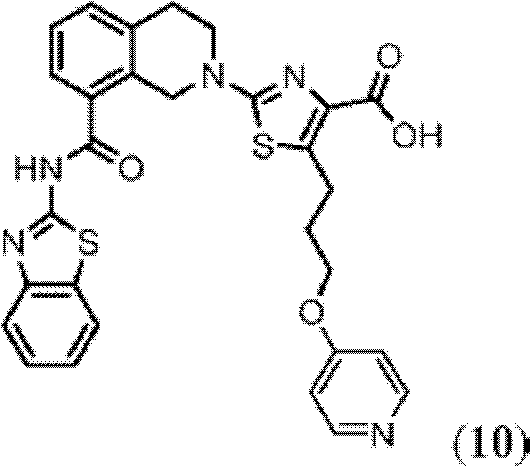
化合物10一般如实施例2中描述般制备,在实施例2的步骤4中用4-羟基吡啶代替苯酚。酯水解前未分离中间体烷化产物:1H NMR(400MHz,DMSO-d6)δppm 12.89(1H,s),12.55(1H,s),8.66(1H,m),8.44(1H,d),8.04(1H,m),7.79(1H,d),7.68(1H,d),7.43(5H,m),7.01(1H,d),4.82(2H,s),4.29(2H,m),3.74(2H,m),3.19(2H,m),3.04(2H,m),2.08(2H,m);MS(ESI(+)):m/z 572(M+H)。Compound 10 was generally prepared as described in Example 2, substituting 4-hydroxypyridine for phenol in step 4 of Example 2. Intermediate alkylation product not isolated before ester hydrolysis: 1 H NMR (400MHz, DMSO-d 6 ) δppm 12.89(1H,s), 12.55(1H,s), 8.66(1H,m), 8.44(1H,d) , 8.04(1H,m), 7.79(1H,d), 7.68(1H,d), 7.43(5H,m), 7.01(1H,d), 4.82(2H,s), 4.29(2H,m), 3.74 (2H, m), 3.19 (2H, m), 3.04 (2H, m), 2.08 (2H, m); MS (ESI (+)): m/z 572 (M+H).
实施例11Example 11
2-(8-(苯并[d]噻唑-2-基氨基甲酰基)-3,4-二氢异喹啉-2(1H)-基)-5-(3-(3-(二甲基氨基)苯氧基)丙基)噻唑-4-羧酸(11)的合成:2-(8-(Benzo[d]thiazol-2-ylcarbamoyl)-3,4-dihydroisoquinolin-2(1H)-yl)-5-(3-(3-(dimethyl Synthesis of (amino)phenoxy)propyl)thiazole-4-carboxylic acid (11):

化合物11一般如实施例2中描述般制备,在实施例2的步骤4用3-(二甲基氨基)苯酚代替苯酚,调整是:因烷化步骤添加1N HCl不产生可过滤的固体,用EtOAc(3x25mL)萃取反应混合物。合并的萃取液用盐水洗涤,干燥(MgSO4),过滤,浓缩。然后程序按实施例2的步骤4继续:1H NMR(400MHz,DMSO-d6)δppm 7.93(1H,d),7.71(2H,m),7.37(3H,m),7.26(1H,t),7.02(1H,t),6.28(1H,m),6.19(2H,m),4.90(2H,s),3.93(2H,t),3.70(2H,m),3.17(2H,m),3.02(2H,m),2.83(6H,s),1.96(2H,m);MS(ESI(+)):m/z 614(M+H)。Compound 11 was generally prepared as described in Example 2, substituting 3-(dimethylamino)phenol for phenol in step 4 of Example 2, with adjustments: since the addition of 1 N HCl to the alkylation step did not produce a filterable solid, use The reaction mixture was extracted with EtOAc (3x25 mL). The combined extracts were washed with brine, dried ( MgSO4 ), filtered and concentrated. The procedure then continued as in step 4 of Example 2: 1 H NMR (400 MHz, DMSO-d 6 ) δ ppm 7.93 (1H, d), 7.71 (2H, m), 7.37 (3H, m), 7.26 (1H, t) , 7.02(1H,t), 6.28(1H,m), 6.19(2H,m), 4.90(2H,s), 3.93(2H,t), 3.70(2H,m), 3.17(2H,m), 3.02 (2H, m), 2.83 (6H, s), 1.96 (2H, m); MS (ESI (+)): m/z 614 (M+H).
实施例12Example 12
2-(8-(苯并[d]噻唑-2-基氨基甲酰基)-3,4-二氢异喹啉-2(1H)-基)-5-(3-(喹啉-5-氧基)丙基)噻唑-4-羧酸(12)的合成:2-(8-(Benzo[d]thiazol-2-ylcarbamoyl)-3,4-dihydroisoquinolin-2(1H)-yl)-5-(3-(quinoline-5- Synthesis of oxy)propyl)thiazole-4-carboxylic acid (12):
化合物12使用如实施例8中描述的相同程序制备,在实施例8的步骤7中用4-羟基喹啉代替5-羟基异喹啉:1H NMR(300MHz,DMSO-D6)δppm 12.88(1H,s),8.85(1H,d),8.32(1H,dd),8.04(1H,d),7.78(1H,d),7.52(HH,m),7.19(1H,d),4.82(2H,s),4.20(2H,t),3.71(2H,t),3.02(1H,m),2.17(2H,m)。MS(ESI(+)):m/z 622(M+H)。Compound 12 was prepared using the same procedure as described in Example 8, substituting 4-hydroxyquinoline for 5-hydroxyisoquinoline in step 7 of Example 8: 1 H NMR (300 MHz, DMSO-D 6 ) δ ppm 12.88 ( 1H,s), 8.85(1H,d), 8.32(1H,dd), 8.04(1H,d), 7.78(1H,d), 7.52(HH,m), 7.19(1H,d), 4.82(2H , s), 4.20 (2H, t), 3.71 (2H, t), 3.02 (1H, m), 2.17 (2H, m). MS (ESI(+)): m/z 622 (M+H).
实施例13Example 13
2-(8-(苯并[d]噻唑-2-基氨基甲酰基)-3,4-二氢异喹啉-2(1H)-基)-5-(3-(喹啉-8-氧基)丙基)噻唑-4-羧酸(13)的合成:2-(8-(Benzo[d]thiazol-2-ylcarbamoyl)-3,4-dihydroisoquinolin-2(1H)-yl)-5-(3-(quinoline-8- Synthesis of oxy)propyl)thiazole-4-carboxylic acid (13):
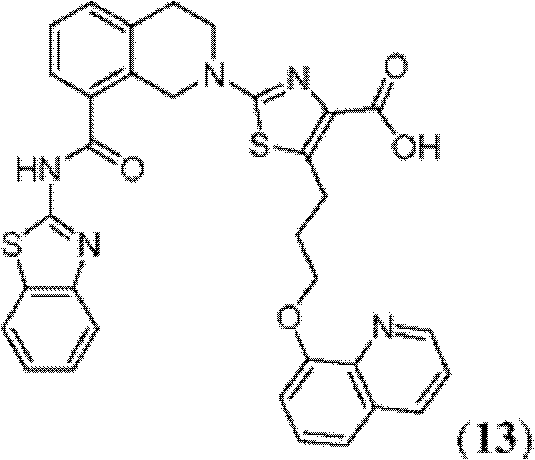
化合物13使用如实施例8中描述的相同程序制备,在实施例8的步骤7中用8-羟基喹啉代替5-羟基异喹啉:1H NMR(300MHz,DMSO-D6)δppm 8.93(1H,d),8.63(1H,d),8.04(1H,d),7.79(1H,d),7.53(12H,m),7.08(1H,d),4.82(2H,s),4.22(2H,t),3.70(2H,m),3.31(2H,t),3.03(2H,m),2.17(2H,m)。MS(ESI(+)):m/z 622(M+H)。Compound 13 was prepared using the same procedure as described in Example 8, substituting 8-hydroxyquinoline for 5-hydroxyisoquinoline in step 7 of Example 8: 1 H NMR (300 MHz, DMSO-D 6 ) δ ppm 8.93 ( 1H, d), 8.63 (1H, d), 8.04 (1H, d), 7.79 (1H, d), 7.53 (12H, m), 7.08 (1H, d), 4.82 (2H, s), 4.22 (2H , t), 3.70 (2H, m), 3.31 (2H, t), 3.03 (2H, m), 2.17 (2H, m). MS (ESI(+)): m/z 622 (M+H).
实施例14Example 14
2-(8-(苯并[d]噻唑-2-基氨基甲酰基)-3,4-二氢异喹啉-2(1H)-基)-5-(3-羟基丙-1-炔基)噻唑-4-羧酸(14)的合成:2-(8-(Benzo[d]thiazol-2-ylcarbamoyl)-3,4-dihydroisoquinolin-2(1H)-yl)-5-(3-hydroxyprop-1-yne base) synthesis of thiazole-4-carboxylic acid (14):
化合物14使用如实施例8的步骤7中描述的相同的水解和纯化程序,由化合物8D制备:1H NMR(300MHz,DMSO-D6)δppm 12.91(1H,s),8.04(1H,d),7.80(1H,d),7.52(5H,m),4.90(2H,s),4.30(2H,m),3.74(2H,t),3.06(2H,t);MS(ESI(+)):m/z 491(M+H)。Compound 14 was prepared from compound 8D using the same hydrolysis and purification procedure as described in step 7 of Example 8: 1 H NMR (300 MHz, DMSO-D 6 ) δ ppm 12.91 (1H, s), 8.04 (1H, d) , 7.80(1H,d), 7.52(5H,m), 4.90(2H,s), 4.30(2H,m), 3.74(2H,t), 3.06(2H,t); MS(ESI(+)) : m/z 491 (M+H).
实施例15Example 15
5-(3-(1H-苯并[d]咪唑-1-基)丙基)-2-(8-(苯并[d]噻唑-2-基氨基甲酰基)-3,4-二氢异喹啉-2(1H)-基)噻唑-4-羧酸(15)的合成:5-(3-(1H-Benzo[d]imidazol-1-yl)propyl)-2-(8-(benzo[d]thiazol-2-ylcarbamoyl)-3,4-dihydro Synthesis of isoquinolin-2(1H)-yl)thiazole-4-carboxylic acid (15):
化合物15通过在实施例2的步骤4用苯并咪唑代替苯酚制备。酯水解前未分离中间体烷化产物:1H NMR(300MHz,DMSO-d6)δppm 7.99(1H,d),7.75(1H,d),7.69(1H,dd),7.62(1H,m),7.56(1H,m),7.39(5H,m),7.19(2H,m),4.85(2H,s),4.27(2H,t),3.72(2H,t),3.04(4H,m),2.09(2H,m)。MS(ESI(+)):m/z 595(M+H)。Compound 15 was prepared by substituting benzimidazole for phenol in step 4 of Example 2. Intermediate alkylation product not isolated before ester hydrolysis: 1 H NMR (300 MHz, DMSO-d 6 ) δppm 7.99 (1H, d), 7.75 (1H, d), 7.69 (1H, dd), 7.62 (1H, m) , 7.56(1H, m), 7.39(5H, m), 7.19(2H, m), 4.85(2H, s), 4.27(2H, t), 3.72(2H, t), 3.04(4H, m), 2.09 (2H, m). MS (ESI(+)): m/z 595 (M+H).
实施例16Example 16
5-(3-(1H-咪唑-1-基)丙基)-2-(8-(苯并[d]噻唑-2-基氨基甲酰基)-3,4-二氢异喹啉-2(1H)-基)噻唑-4-羧酸(16)的合成:5-(3-(1H-imidazol-1-yl)propyl)-2-(8-(benzo[d]thiazol-2-ylcarbamoyl)-3,4-dihydroisoquinoline-2 Synthesis of (1H)-yl)thiazole-4-carboxylic acid (16):
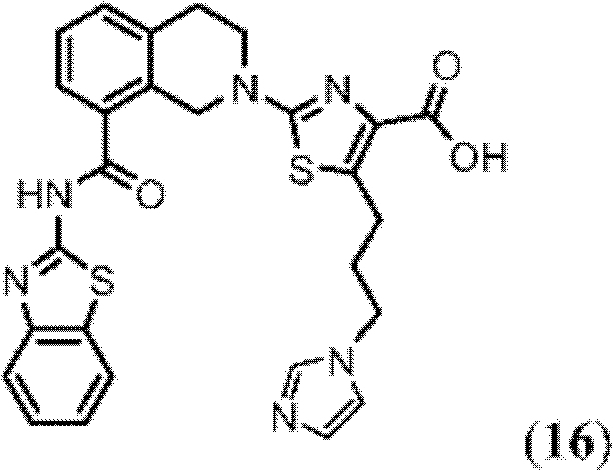
化合物16一般如实施例2中描述般制备,在实施例2的步骤4中用咪唑代替苯酚。酯水解前未分离中间体烷化产物:1H NMR(300MHz,DMSO-d6)δppm 12.90(1H,s),12.53(1H,s),8.03(1H,m),7.86(1H,s),7.79(1H,d),7.67(1H,m),7.41(4H,m),7.26(1H,s),6.99(1H,s),4.83(2H,s),4.01(2H,t),3.73(2H,t),3.02(4H,m),2.01(2H,t)。MS(ESI(+)):m/z 545(M+H)。Compound 16 was generally prepared as described in Example 2, substituting imidazole for phenol in step 4 of Example 2. Intermediate alkylation product not isolated before ester hydrolysis: 1 H NMR (300 MHz, DMSO-d 6 ) δppm 12.90 (1H, s), 12.53 (1H, s), 8.03 (1H, m), 7.86 (1H, s) , 7.79(1H,d), 7.67(1H,m), 7.41(4H,m), 7.26(1H,s), 6.99(1H,s), 4.83(2H,s), 4.01(2H,t), 3.73(2H,t), 3.02(4H,m), 2.01(2H,t). MS (ESI(+)): m/z 545 (M+H).
实施例17Example 17
5-(3-(1H-吡咯并[2,3-b]吡啶-1-基)丙基)-2-(8-(苯并[d]噻唑-2-基氨基甲酰基)-3,4-二氢异喹啉-2(1H)-基)噻唑-4-羧酸(17)的合成:5-(3-(1H-pyrrolo[2,3-b]pyridin-1-yl)propyl)-2-(8-(benzo[d]thiazol-2-ylcarbamoyl)-3, Synthesis of 4-dihydroisoquinolin-2(1H)-yl)thiazole-4-carboxylic acid (17):
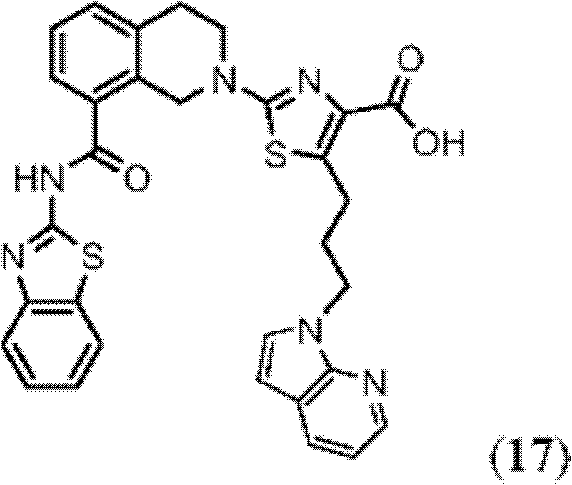
化合物17通过在实施例2的步骤4用7-吖吲哚代替苯酚制备。酯水解前未分离中间体烷化产物:1H NMR(300MHz,DMSO-d6)δppm 12.87(1H,s),12.54(1H,s),8.20(1H,dd),8.03(1H,m),7.92(1H,dd),7.79(1H,d),7.67(1H,m),7.54(1H,d),7.44(4H,m),7.03(1H,dd),6.43(1H,d),4.81(2H,s),4.29(2H,t),3.72(2H,t),3.03(4H,m),2.10(2H,m)。MS(ESI(+)):m/z 595(M+H)。Compound 17 was prepared by substituting 7-azindole for phenol in step 4 of Example 2. Intermediate alkylation product not isolated before ester hydrolysis: 1 H NMR (300 MHz, DMSO-d 6 ) δppm 12.87 (1H, s), 12.54 (1H, s), 8.20 (1H, dd), 8.03 (1H, m) , 7.92(1H,dd), 7.79(1H,d), 7.67(1H,m), 7.54(1H,d), 7.44(4H,m), 7.03(1H,dd), 6.43(1H,d), 4.81 (2H, s), 4.29 (2H, t), 3.72 (2H, t), 3.03 (4H, m), 2.10 (2H, m). MS (ESI(+)): m/z 595 (M+H).
实施例18Example 18
2-(8-(苯并[d]噻唑-2-基氨基甲酰基)-3,4-二氢异喹啉-2(1H)-基)-5-(3-(吡咯烷-1-基)丙基)噻唑-4-羧酸(18)的合成:2-(8-(Benzo[d]thiazol-2-ylcarbamoyl)-3,4-dihydroisoquinolin-2(1H)-yl)-5-(3-(pyrrolidin-1- Synthesis of (yl)propyl)thiazole-4-carboxylic acid (18):
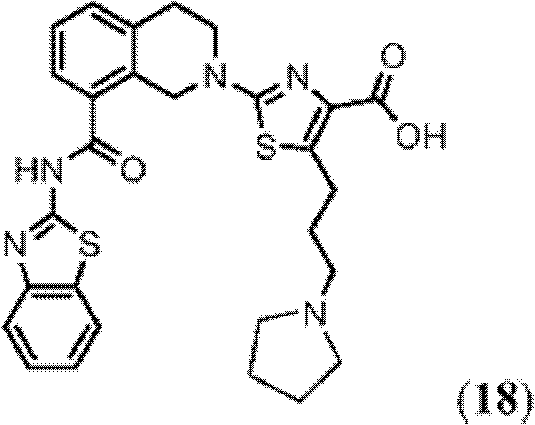
化合物18一般如实施例2中描述般制备,在实施例2的步骤4中用吡咯烷代替苯酚。酯水解前未分离中间体烷化产物。所需产物沉淀后,固体通过HPLC纯化(预制备反相HPLC用自动化Gilson HPLC系统执行,使用SymmetryPrep Shield RP18预制备柱,250mmx21.20mm i.d.,10um,流速25mL/min;λ=214、245nm;流动相A,含0.1%TFA的H2O;流动相B,CH3CN;40分钟内,B的线性梯度0-70%),以提供化合物18,产率18%:1H NMR(300MHz,DMSO-d6)δppm 12.90(1H,s),12.66(1H,s),9.33(1H,s),8.04(1H,d),7.80(1H,d),7.68(1H,d),7.42(4H,m),4.83(2H,s),3.76(2H,t),3.53(2H,m),3.10(6H,m),2.96(2H,m),1.93(4H,m),1.82(2H,m);MS(ESI(+)):m/z 548(M+H)。Compound 18 was generally prepared as described in Example 2, substituting pyrrolidine for phenol in step 4 of Example 2. The intermediate alkylation product was not isolated prior to ester hydrolysis. After precipitation of the desired product, the solid was purified by HPLC (pre-prep reverse phase HPLC performed with an automated Gilson HPLC system using a SymmetryPrep Shield RP18 pre-prep column, 250mmx21.20mm id, 10um, flow rate 25mL/min; λ = 214, 245nm; flow Phase A, H 2 O with 0.1% TFA; mobile phase B, CH 3 CN; linear gradient 0-70% of B over 40 minutes) to provide compound 18 in 18% yield: 1 H NMR (300 MHz, DMSO-d 6 ) δppm 12.90 (1H, s), 12.66 (1H, s), 9.33 (1H, s), 8.04 (1H, d), 7.80 (1H, d), 7.68 (1H, d), 7.42 ( 4H, m), 4.83 (2H, s), 3.76 (2H, t), 3.53 (2H, m), 3.10 (6H, m), 2.96 (2H, m), 1.93 (4H, m), 1.82 (2H , m); MS (ESI (+)): m/z 548 (M+H).
实施例19Example 19
2-(8-(苯并[d]噻唑-2-基氨基甲酰基)-3,4-二氢异喹啉-2(1H)-基)-5-(3-吗啉基丙基)噻唑-4-羧酸(19)的合成:2-(8-(Benzo[d]thiazol-2-ylcarbamoyl)-3,4-dihydroisoquinolin-2(1H)-yl)-5-(3-morpholinopropyl) Synthesis of thiazole-4-carboxylic acid (19):
化合物19一般如实施例2中描述般制备,在实施例2的步骤4中用吗啉代替苯酚。酯水解前未分离中间体烷化产物。所需产物沉淀后,固体通过HPLC纯化(预制备反相HPLC用自动化Gilson HPLC系统执行,使用SymmetryPrep Shield RP18预制备柱,250mmx21.20mm i.d.,10um,流速25mL/min;λ=214、245nm;流动相A,含0.1%TFA的H2O;流动相B,CH3CN;40分钟内,B的线性梯度0-70%),以提供化合物19,产率5%。1H NMR(300MHz,DMSO-d6)δppm 12.90(1H,s),9.49(1H,s),8.04(1H,d),7.80(1H,d),7.68(1H,d),7.42(4H,m),4.83(2H,s),3.92(2H,m),3.76(2H,t),3.62(2H,m),3.07(10H,m),1.95(2H,m);LCMS(APCI):m/z 564(M+H)。Compound 19 was generally prepared as described in Example 2, substituting morpholine for phenol in step 4 of Example 2. The intermediate alkylation product was not isolated prior to ester hydrolysis. After precipitation of the desired product, the solid was purified by HPLC (pre-prep reverse phase HPLC performed with an automated Gilson HPLC system using a SymmetryPrep Shield RP18 pre-prep column, 250mmx21.20mm id, 10um, flow rate 25mL/min; λ = 214, 245nm; flow Phase A, H2O with 0.1% TFA; mobile phase B, CH3CN ; linear gradient of B over 40 minutes 0-70%) to provide compound 19 in 5% yield. 1 H NMR (300MHz, DMSO-d 6 ) δppm 12.90(1H, s), 9.49(1H, s), 8.04(1H, d), 7.80(1H, d), 7.68(1H, d), 7.42(4H , m), 4.83(2H, s), 3.92(2H, m), 3.76(2H, t), 3.62(2H, m), 3.07(10H, m), 1.95(2H, m); LCMS(APCI) : m/z 564 (M+H).
实施例20Example 20
2-(8-(苯并[d]噻唑-2-基氨基甲酰基)-3,4-二氢异喹啉-2(1H)-基)-5-(3-(哌啶-1-基)丙基)噻唑-4-羧酸(20)的合成:2-(8-(Benzo[d]thiazol-2-ylcarbamoyl)-3,4-dihydroisoquinolin-2(1H)-yl)-5-(3-(piperidine-1- Synthesis of (yl)propyl)thiazole-4-carboxylic acid (20):
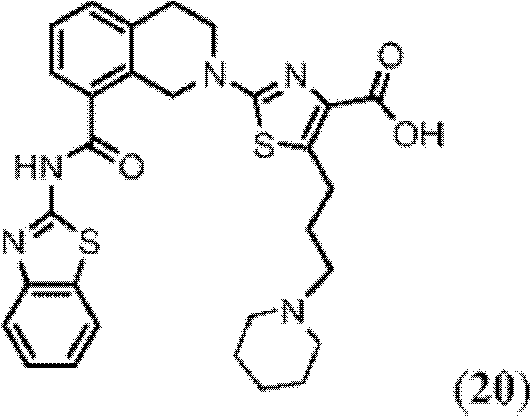
题示化合物20一般如实施例2中描述般制备,在实施例2的步骤4中用哌啶代替苯酚。酯水解前未分离中间体烷化产物。所需产物沉淀后,固体通过HPLC纯化(预制备反相HPLC用自动化GilsonHPLC系统执行,使用SymmetryPrep Shield RP18预制备柱,250mmx21.20mm i.d.,10um,流速25mL/min;λ=214、245nm;流动相A,含0.1%TFA的H2O;流动相B,CH3CN;40分钟内,B的线性梯度0-70%),以提供化合物20,产率17%:1H NMR(300MHz,DMSO-d6)δppm 12.90(1H,s),8.85(1H,s),8.04(1H,d),7.80(1H,m),7.68(1H,d),7.43(4H,m),4.83(2H,s),3.76(2H,t),3.05(7H,m),2.82(2H,m),1.93(2H,m),1.77(2H,m),1.60(3H,m),1.34(2H,m)。MS(ESI(+)):m/z 562(M+H)。Title compound 20 was generally prepared as described in Example 2, substituting piperidine for phenol in Step 4 of Example 2. The intermediate alkylation product was not isolated prior to ester hydrolysis. After precipitation of the desired product, the solid was purified by HPLC (pre-prep reverse phase HPLC was performed with an automated GilsonHPLC system using a SymmetryPrep Shield RP18 pre-prep column, 250mmx21.20mm id, 10um, flow rate 25mL/min; λ = 214, 245nm; mobile phase A, H 2 O with 0.1% TFA; mobile phase B, CH 3 CN; linear gradient 0-70% of B over 40 minutes) to provide compound 20 in 17% yield: 1 H NMR (300 MHz, DMSO -d 6 ) δppm 12.90(1H, s), 8.85(1H, s), 8.04(1H, d), 7.80(1H, m), 7.68(1H, d), 7.43(4H, m), 4.83(2H , s), 3.76(2H, t), 3.05(7H, m), 2.82(2H, m), 1.93(2H, m), 1.77(2H, m), 1.60(3H, m), 1.34(2H, m). MS (ESI(+)): m/z 562 (M+H).
实施例21Example 21
5-(3-(4-(1H-吡唑并[3,4-d]嘧啶-1-基)苯氧基)丙基)-2-(8-(苯并[d]噻唑-2-基氨基甲酰基)-3,4-二氢异喹啉-2(1H)-基)噻唑-4-羧酸(21)的合成:5-(3-(4-(1H-pyrazolo[3,4-d]pyrimidin-1-yl)phenoxy)propyl)-2-(8-(benzo[d]thiazole-2- Synthesis of (carbamoyl)-3,4-dihydroisoquinolin-2(1H)-yl)thiazole-4-carboxylic acid (21):

步骤1:5-氨基-1-(4-溴苯基)-1H-吡唑-4-羧酸(21A)的制备: Step 1 : Preparation of 5-amino-1-(4-bromophenyl)-1H-pyrazole-4-carboxylic acid (21A):
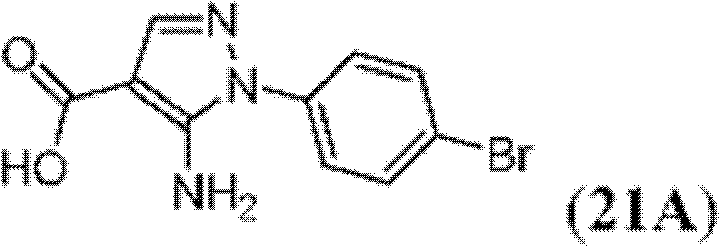
2-氰基-3-乙氧基丙烯酸(Z)-乙酯(2.099g,12.41mmol)、4-溴苯基肼盐酸盐(2.76g,12.41mmol)和Na2CO3(0.789g,7.44mmol)在EtOH(30mL)中的混合物,回流5h,轻微浓缩。通过过滤收集沉淀,用乙醚洗涤,干燥,以提供酯。酯在THF(5mL)和MeOH(25mL)中溶解。加入154mL 10%NaOH。得到的混合物在50℃搅拌过夜,浓缩。加入少量水,得到的溶液用HCl中和到pH 6。收集白色沉淀,用水洗涤,干燥,以提供化合物21A:1H NMR(400MHz,DMSO-D6)ppm 12.09(1H,s),7.72(2H,d),7.52(2H,d),6.35(2H,s)。(Z)-ethyl 2-cyano-3-ethoxyacrylate (2.099g, 12.41mmol), 4-bromophenylhydrazine hydrochloride (2.76g, 12.41mmol) and Na 2 CO 3 (0.789g, 7.44 mmol) in EtOH (30 mL), refluxed for 5 h, concentrated slightly. The precipitate was collected by filtration, washed with ether and dried to provide the ester. The ester was dissolved in THF (5 mL) and MeOH (25 mL). 154 mL of 10% NaOH was added. The resulting mixture was stirred overnight at 50°C and concentrated. A small amount of water was added and the resulting solution was neutralized to pH 6 with HCl. The white precipitate was collected, washed with water, and dried to provide compound 21A: 1 H NMR (400 MHz, DMSO-D 6 ) ppm 12.09 (1H, s), 7.72 (2H, d), 7.52 (2H, d), 6.35 (2H , s).
步骤2:1-(4-溴苯基)-1H-吡唑并[3,4-d]嘧啶(21B)的制备: Step 2 : Preparation of 1-(4-bromophenyl)-1H-pyrazolo[3,4-d]pyrimidine (21B):
向1,3,5-三嗪(0.575g,7.09mmol)和化合物21A(2g,7.09mmol)在DMSO(30mL)中的溶液中,加入醚合三氟化硼(1.078mL,8.51mmol)。得到的混合物在120℃加热20h,冷却,用EtOAc稀释,用1%NaOH和盐水洗涤。有机层用Na2SO4干燥,浓缩。残余物用少量EtOAc研磨,收集沉淀,以提供所需产物:1H NMR(400MHz,DMSO-D6)δppm 9.47(1H,s),9.16(1H,s),8.68(1H,s),8.22(2H,d),7.80(2H,d)。To a solution of 1,3,5-triazine (0.575 g, 7.09 mmol) and compound 21A (2 g, 7.09 mmol) in DMSO (30 mL) was added boron trifluoride etherate (1.078 mL, 8.51 mmol). The resulting mixture was heated at 120 °C for 20 h, cooled, diluted with EtOAc, washed with 1% NaOH and brine. The organic layer was dried over Na2SO4 and concentrated. The residue was triturated with a little EtOAc and the precipitate was collected to afford the desired product: 1 H NMR (400 MHz, DMSO-D 6 ) δ ppm 9.47 (1H, s), 9.16 (1H, s), 8.68 (1H, s), 8.22 (2H,d), 7.80(2H,d).
步骤3:1-(4-(4,4,5,5-四甲基-1,3,2-二氧硼戊环-2-基)苯基)-1H-吡唑并[3,4-d]嘧啶(21C)的制备: Step 3 : 1-(4-(4,4,5,5-tetramethyl-1,3,2-dioxaborolan-2-yl)phenyl)-1H-pyrazolo[3,4 -d] Preparation of pyrimidine (21C):
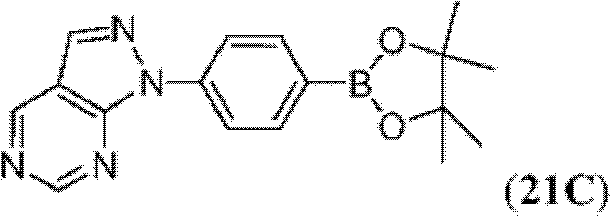
化合物21B(500mg,1.817mmol)、4,4,4′,4′,5,5,5′,5′-八甲基-2,2′-双(1,3,2-二氧硼戊环)(508mg,1.999mmol)、PdCl2(dppf)-CH2Cl2加合物(74.2mg,0.091mmol)和乙酸钾(535mg,5.45mmol)在DMSO(15mL)中的混合物用氮气吹扫,然后在80℃加热过夜。反应用乙酸乙酯稀释,用盐水洗涤。有机层用Na2SO4干燥,减压浓缩。粗材料通过柱色谱用硅胶纯化,用含0到20%EtOAc的DCM洗脱,以提供所需产物21C:1H NMR(400MHz,DMSO-D6)δppm 9.49(1H,s),9.20(1H,s),8.70(1H,s),8.33(2H,d),7.90(2H,d),1.33(12H,s)。Compound 21B (500mg, 1.817mmol), 4,4,4',4',5,5,5',5'-octamethyl-2,2'-bis(1,3,2-dioxaborpenta Cyclo) (508 mg, 1.999 mmol), PdCl 2 (dppf)-CH 2 Cl 2 adduct (74.2 mg, 0.091 mmol) and potassium acetate (535 mg, 5.45 mmol) in DMSO (15 mL) was purged with nitrogen , and then heated at 80 °C overnight. The reaction was diluted with ethyl acetate and washed with brine. The organic layer was dried over Na2SO4 , concentrated under reduced pressure. The crude material was purified by column chromatography on silica gel eluting with 0 to 20% EtOAc in DCM to afford the desired product 21C: 1 H NMR (400 MHz, DMSO-D 6 ) δ ppm 9.49 (1H, s), 9.20 (1H , s), 8.70 (1H, s), 8.33 (2H, d), 7.90 (2H, d), 1.33 (12H, s).
步骤4:4-(1H-吡唑并[3,4-d]嘧啶-1-基)苯酚(21D)的制备: Step 4 : Preparation of 4-(1H-pyrazolo[3,4-d]pyrimidin-1-yl)phenol (21D):
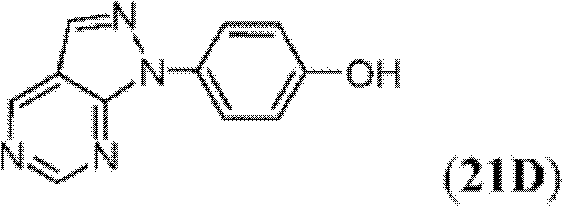
向化合物21C(100mg,0.31mmol)的THF(5mL)溶液中,加入NaOH(0.248mL,0.621mmol)和过氧化氢(0.048mL,0.466mmol)。混合物在0℃搅拌30分钟。减压浓缩反应混合物,浓缩液在8mL水中溶解。水溶液用稀释的HCl酸化。收集白色沉淀,用水洗涤,干燥,以提供所需产物21D:1H NMR(400MHz,DMSO-D6)δppm 9.75(1H,s),9.44(1H,s),9.09(1H,s),8.59(1H,s),7.82-7.99(2H,m),6.83-7.05(2H,m)。To a solution of compound 21C (100 mg, 0.31 mmol) in THF (5 mL) was added NaOH (0.248 mL, 0.621 mmol) and hydrogen peroxide (0.048 mL, 0.466 mmol). The mixture was stirred at 0°C for 30 minutes. The reaction mixture was concentrated under reduced pressure, and the concentrate was dissolved in 8 mL of water. The aqueous solution was acidified with dilute HCl. The white precipitate was collected, washed with water, and dried to afford the desired product 21D: 1 H NMR (400 MHz, DMSO-D 6 ) δ ppm 9.75 (1H, s), 9.44 (1H, s), 9.09 (1H, s), 8.59 (1H, s), 7.82-7.99 (2H, m), 6.83-7.05 (2H, m).
步骤5:题示化合物21的制备: Step 5 : Preparation of Title Compound 21:
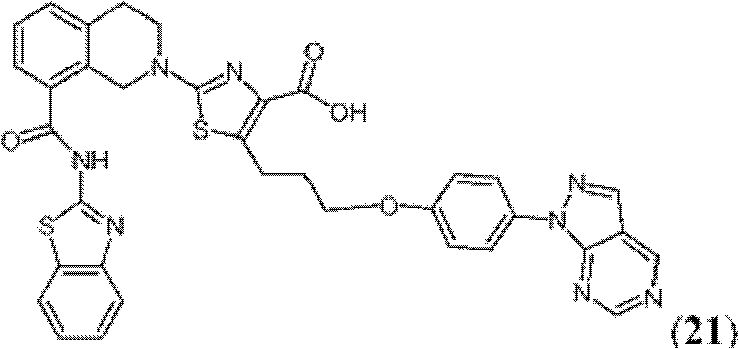
向化合物21D(106mg,0.498mmol)的DMF(5mL)溶液中,加入氢化钠(56.9mg,1.423mmol)。得到的混合物在室温下搅拌30分钟,加入化合物2C(300mg,0.474mmol)。反应混合物搅拌1小时,加入10%氢氧化钠(1.897mL,4.74mmol)、THF(5mL)和MeOH(3mL)。得到的混合物在70℃搅拌过夜,冷却,过滤。滤液用HCl酸化到pH4。收集沉淀,干燥,以提供所需产物:1H NMR(400MHz,DMSO-D6)δppm 12.85(1H,s),9.45(1H,s),9.10(1H,s),8.61(1H,s),7.98-8.06(3H,m),7.78(1H,d),7.67(1H,d),7.42-7.50(2H,m),7.32-7.40(2H,m),7.09-7.16(2H,m),4.84(2H,s),4.06(2H,t),3.73(2H,t),3.14-3.24(2H,m),3.03(2H,t),1.98-2.12(2H,m);LCMS(APCI):m/z 687(M+H)。To a solution of compound 21D (106 mg, 0.498 mmol) in DMF (5 mL) was added sodium hydride (56.9 mg, 1.423 mmol). The resulting mixture was stirred at room temperature for 30 minutes, and compound 2C (300 mg, 0.474 mmol) was added. The reaction mixture was stirred for 1 hour and 10% sodium hydroxide (1.897 mL, 4.74 mmol), THF (5 mL) and MeOH (3 mL) were added. The resulting mixture was stirred overnight at 70°C, cooled and filtered. The filtrate was acidified to pH4 with HCl. The precipitate was collected and dried to afford the desired product: 1 H NMR (400 MHz, DMSO-D 6 ) δppm 12.85 (1H, s), 9.45 (1H, s), 9.10 (1H, s), 8.61 (1H, s) , 7.98-8.06 (3H, m), 7.78 (1H, d), 7.67 (1H, d), 7.42-7.50 (2H, m), 7.32-7.40 (2H, m), 7.09-7.16 (2H, m) , 4.84(2H, s), 4.06(2H, t), 3.73(2H, t), 3.14-3.24(2H, m), 3.03(2H, t), 1.98-2.12(2H, m); LCMS (APCI ): m/z 687 (M+H).
实施例22Example 22
2-(8-(苯并[d]噻唑-2-基氨基甲酰基)-3,4-二氢异喹啉-2(1H)-基)-5-(3-(2-((1S,4S)-1,7,7-三甲基双环[2.2.1]庚烷-2-氧基)苯氧基)丙基)噻唑-4-羧酸(22)的合成:2-(8-(Benzo[d]thiazol-2-ylcarbamoyl)-3,4-dihydroisoquinolin-2(1H)-yl)-5-(3-(2-((1S , 4S)-1,7,7-trimethylbicyclo[2.2.1]heptane-2-oxyl)phenoxy)propyl)thiazole-4-carboxylic acid (22):

题示化合物22一般如实施例2中描述般制备,在实施例2的步骤4中用2-((1S,4S)-1,7,7-三甲基双环[2.2.1]庚烷-2-氧基)苯酚代替苯酚。酯水解前未分离中间体烷化产物。最终产物经历一次额外的MeOH洗涤,提供所需化合物22,产率76%:1H NMR(300MHz,DMSO-d6)δppm 7.85(1H,d),7.76(1H,dd),7.64(1H,d),7.33(3H,m),7.20(1H,m),6.84(4H,m),4.93(2H,s),4.04(1H,m),3.91(2H,t),3.69(2H,t),3.18(2H,m),3.00(2H,t),1.96(2H,m),1.76(2H,m),1.62(2H,m),1.47(1H,m),1.07(2H,m),1.04(3H,s),0.93(3H,s),0.77(3H,s);MS(ESI(+)):m/z 723(M+H)。The title compound 22 was generally prepared as described in Example 2 using 2-((1S,4S)-1,7,7-trimethylbicyclo[2.2.1]heptane- 2-oxy)phenol instead of phenol. The intermediate alkylation product was not isolated prior to ester hydrolysis. The final product was subjected to one additional MeOH wash to provide the desired compound 22 in 76% yield: 1 H NMR (300 MHz, DMSO-d 6 ) δ ppm 7.85 (1H, d), 7.76 (1H, dd), 7.64 (1H, d), 7.33(3H,m), 7.20(1H,m), 6.84(4H,m), 4.93(2H,s), 4.04(1H,m), 3.91(2H,t), 3.69(2H,t ), 3.18(2H,m), 3.00(2H,t), 1.96(2H,m), 1.76(2H,m), 1.62(2H,m), 1.47(1H,m), 1.07(2H,m) , 1.04 (3H, s), 0.93 (3H, s), 0.77 (3H, s); MS (ESI (+)): m/z 723 (M+H).
实施例23Example 23
2-(8-(苯并[d]噻唑-2-基氨基甲酰基)-3,4-二氢异喹啉-2(1H)-基)-5-(3-(2-(4-(吡啶-2-基)哌嗪-1-基)苯并[d]噻唑-6-氧基)丙基)噻唑-4-羧酸(23)的合成:2-(8-(Benzo[d]thiazol-2-ylcarbamoyl)-3,4-dihydroisoquinolin-2(1H)-yl)-5-(3-(2-(4- Synthesis of (pyridin-2-yl)piperazin-1-yl)benzo[d]thiazole-6-oxy)propyl)thiazole-4-carboxylic acid (23):
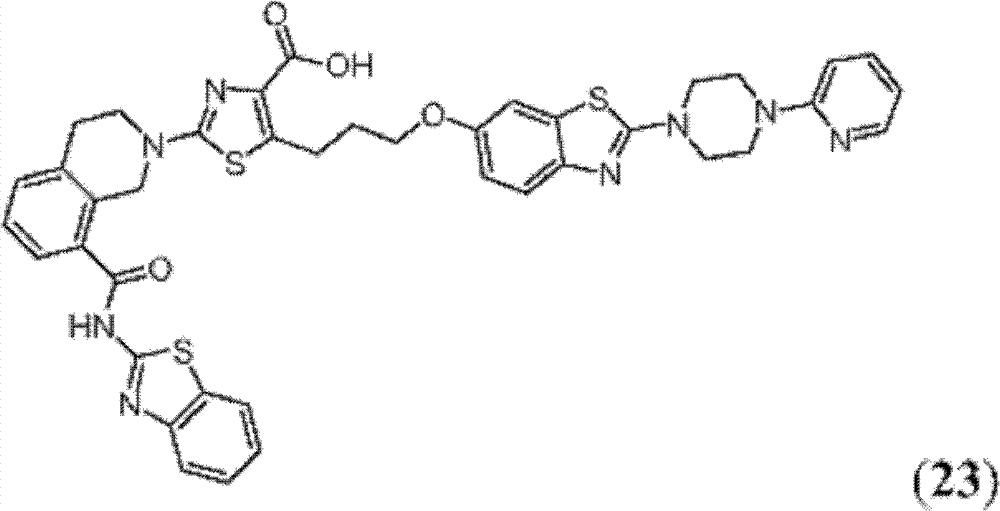
题示化合物23一般如实施例2中描述般制备,在实施例2的步骤4中用2-(4-(吡啶-2-基)哌嗪-1-基)苯并[d]噻唑-6-醇代替苯酚。酯水解前未分离烷化中间体。用1N HCl沉淀后,最终产物通过柱色谱用硅胶进一步纯化,用含0到10%MeOH的CH2Cl2梯度洗脱,以提供题示化合物23,产率39%:1H NMR(300MHz,DMSO-d6)δppm 12.87(1H,s),8.12(1H,dd),8.03(1H,m),7.72(3H,m),7.41(6H,m),7.08(1H,d),6.88(1H,dd),6.79(1H,dd),4.83(2H,s),3.98(2H,m),3.75(6H,d),3.69(4H,m),3.19(2H,m),3.03(2H,t),2.01(2H,m);MS(ESI(+)):m/z 789(M+H)。The title compound 23 was generally prepared as described in Example 2 using 2-(4-(pyridin-2-yl)piperazin-1-yl)benzo[d]thiazole-6 in step 4 of Example 2 -alcohol instead of phenol. The alkylated intermediate was not isolated prior to ester hydrolysis. After precipitation with 1 N HCl, the final product was further purified by column chromatography on silica gel, eluting with a gradient of CH2Cl2 containing 0 to 10% MeOH, to provide the title compound 23 in 39% yield: 1 H NMR (300 MHz, DMSO-d 6 ) δppm 12.87 (1H, s), 8.12 (1H, dd), 8.03 (1H, m), 7.72 (3H, m), 7.41 (6H, m), 7.08 (1H, d), 6.88 ( 1H,dd), 6.79(1H,dd), 4.83(2H,s), 3.98(2H,m), 3.75(6H,d), 3.69(4H,m), 3.19(2H,m), 3.03(2H , t), 2.01 (2H, m); MS (ESI (+)): m/z 789 (M+H).
实施例24Example 24
2-(8-(苯并[d]噻唑-2-基氨基甲酰基)-3,4-二氢异喹啉-2(1H)-基)-5-(3-(4-(1-苯基环戊基)苯氧基)丙基)噻唑-4-羧酸(24)的合成:2-(8-(Benzo[d]thiazol-2-ylcarbamoyl)-3,4-dihydroisoquinolin-2(1H)-yl)-5-(3-(4-(1- Synthesis of phenylcyclopentyl)phenoxy)propyl)thiazole-4-carboxylic acid (24):
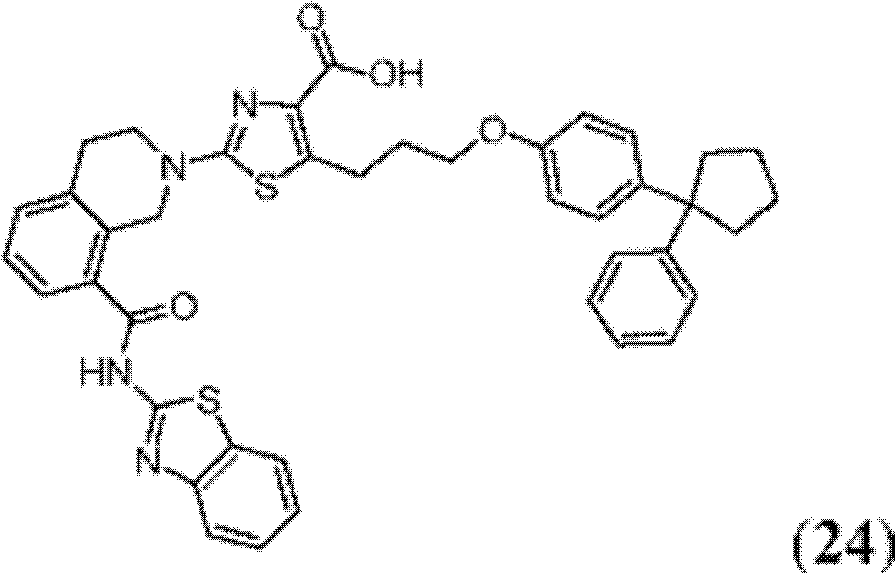
题示化合物24一般如实施例2中描述般制备,在实施例2的步骤4中用4-(1-苯基环戊基)苯酚代替苯酚。酯水解前未分离烷化中间体。最终产物经历一次额外的MeOH洗涤,提供所需化合物24,产率67%:1H NMR(300MHz,DMSO-d6)δppm 12.87(1H,s),12.56(1H,s),8.03(1H,d),7.79(1H,d),7.67(1H,m),7.42(5H,m),7.16(6H,m),6.77(2H,m),4.82(2H,s),3.91(2H,t),3.72(2H,m),3.14(2H,m),3.01(2H,m),2.20(4H,m),1.96(2H,m),1.59(4H,m)。MS(ESI(+)):m/z 715(M+H)。Title compound 24 was generally prepared as described in Example 2, substituting 4-(1-phenylcyclopentyl)phenol for phenol in step 4 of Example 2. The alkylated intermediate was not isolated prior to ester hydrolysis. The final product was subjected to one additional MeOH wash to provide the desired compound 24 in 67% yield: 1 H NMR (300 MHz, DMSO-d 6 ) δ ppm 12.87 (1H, s), 12.56 (1H, s), 8.03 (1H, d), 7.79(1H,d), 7.67(1H,m), 7.42(5H,m), 7.16(6H,m), 6.77(2H,m), 4.82(2H,s), 3.91(2H,t ), 3.72 (2H, m), 3.14 (2H, m), 3.01 (2H, m), 2.20 (4H, m), 1.96 (2H, m), 1.59 (4H, m). MS (ESI(+)): m/z 715 (M+H).
实施例25Example 25
2-(8-(苯并[d]噻唑-2-基氨基甲酰基)-3,4-二氢异喹啉-2(1H)-基)-5-(3-(1-氰基-1,2-二氢环丁并苯-4-氧基)丙基)噻唑-4-羧酸(25)的合成:2-(8-(Benzo[d]thiazol-2-ylcarbamoyl)-3,4-dihydroisoquinolin-2(1H)-yl)-5-(3-(1-cyano- Synthesis of 1,2-dihydrocyclobutacene-4-oxy)propyl)thiazole-4-carboxylic acid (25):
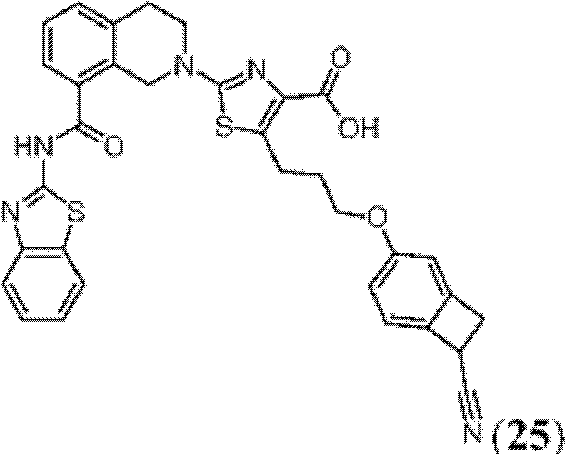
题示化合物25通过在实施例2的步骤4用4-羟基-1,2-二氢环丁并苯-1-腈代替苯酚制备。未分离烷化中间体。酯水解在环境温度下执行,最终产物经历一次额外的MeOH洗涤,以提供所需产物25,产率50%:1H NMR(300MHz,DMSO-d6)δppm 12.89(1H,s),12.55(1H,s),8.03(1H,m),7.79(1H,d),7.67(1H,d),7.42(4H,m),7.16(1H,d),6.82(2H,m),4.83(2H,s),4.44(1H,m),3.95(2H,t),3.72(2H,t),3.58(1H,dd),3.37(1H,m),3.16(2H,m),3.03(2H,t),1.99(2H,m);MS(ESI(+)):m/z 622(M+H)。The title compound 25 was prepared by substituting 4-hydroxy-1,2-dihydrocyclobutacene-1-carbonitrile for phenol in step 4 of Example 2. Alkylation intermediates were not isolated. Ester hydrolysis was performed at ambient temperature and the final product underwent one additional MeOH wash to afford the desired product 25 in 50% yield: 1 H NMR (300 MHz, DMSO-d 6 ) δ ppm 12.89 (1H, s), 12.55 ( 1H, s), 8.03 (1H, m), 7.79 (1H, d), 7.67 (1H, d), 7.42 (4H, m), 7.16 (1H, d), 6.82 (2H, m), 4.83 (2H , s), 4.44(1H, m), 3.95(2H, t), 3.72(2H, t), 3.58(1H, dd), 3.37(1H, m), 3.16(2H, m), 3.03(2H, t), 1.99 (2H, m); MS (ESI (+)): m/z 622 (M+H).
实施例26Example 26
2-(8-(苯并[d]噻唑-2-基氨基甲酰基)-3,4-二氢异喹啉-2(1H)-基)-5-(3-(4-(1-氰基环丁基)苯氧基)丙基)噻唑-4-羧酸(26)的合成:2-(8-(Benzo[d]thiazol-2-ylcarbamoyl)-3,4-dihydroisoquinolin-2(1H)-yl)-5-(3-(4-(1- Synthesis of cyanocyclobutyl)phenoxy)propyl)thiazole-4-carboxylic acid (26):

题示化合物26一般如实施例2中描述般制备,在实施例2的步骤4中用1-(4-羟基苯基)环丁腈代替苯酚。未分离烷化中间体。酯水解在环境温度下执行,最终产物经历一次额外的MeOH洗涤,以提供所需产物26,产率45%:1H NMR(300MHz,DMSO-d6)δppm 12.72(1H,s),8.02(1H,m),7.78(1H,d),7.67(1H,m),7.41(6H,m),6.95(2H,m),4.84(2H,s),3.99(2H,t),3.72(2H,t),3.17(2H,m),3.03(2H,t),2.69(2H,m),2.56(2H,m),2.23(2H,m),1.97(2H,m);MS(ESI(+)):m/z 650(M+H)。Title compound 26 was generally prepared as described in Example 2, substituting 1-(4-hydroxyphenyl)cyclobutyronitrile for phenol in step 4 of Example 2. Alkylation intermediates were not isolated. Ester hydrolysis was performed at ambient temperature and the final product underwent one additional MeOH wash to provide the desired product 26 in 45% yield: 1 H NMR (300 MHz, DMSO-d 6 ) δ ppm 12.72 (1H, s), 8.02 ( 1H, m), 7.78 (1H, d), 7.67 (1H, m), 7.41 (6H, m), 6.95 (2H, m), 4.84 (2H, s), 3.99 (2H, t), 3.72 (2H , t), 3.17(2H, m), 3.03(2H, t), 2.69(2H, m), 2.56(2H, m), 2.23(2H, m), 1.97(2H, m); MS(ESI( +)): m/z 650 (M+H).
实施例27Example 27
2-(8-(苯并[d]噻唑-2-基氨基甲酰基)-3,4-二氢异喹啉-2(1H)-基)-5-(3-(1,2,3,5,6,7-六氢吡啶并[3,2,1-ij]喹啉-8-氧基)丙基)噻唑-4-羧酸(27)的合成:2-(8-(Benzo[d]thiazol-2-ylcarbamoyl)-3,4-dihydroisoquinolin-2(1H)-yl)-5-(3-(1,2,3 , 5,6,7-Synthesis of hexahydropyrido[3,2,1-ij]quinoline-8-oxyl)propyl)thiazole-4-carboxylic acid (27):
题示化合物27一般如实施例2中描述般制备,在实施例2的步骤4中用1,2,3,5,6,7-六氢吡啶并[3,2,1-ij]喹啉-8-醇代替苯酚。酯水解前未分离烷化中间体。用1N HCl沉淀后,最终产物通过柱色谱用硅胶进一步纯化,用含0到12%MeOH的CH2Cl2梯度洗脱,以提供化合物27,产率20%:1H NMR(300MHz,DMSO-d6)δppm 12.90(1H,s),8.03(1H,d),7.79(1H,d),7.67(1H,d),7.43(4H,m),6.61(1H,d),6.09(1H,d),4.82(2H,s),3.86(2H,t),3.72(2H,t),3.17(2H,t),3.00(6H,m),2.58(4H,m),1.96(2H,m),1.81(4H,m);MS(ESI(+)):m/z 666(M+H)。The title compound 27 was generally prepared as described in Example 2 using 1,2,3,5,6,7-hexahydropyrido[3,2,1-ij]quinoline in step 4 of Example 2 -8-ol instead of phenol. The alkylated intermediate was not isolated prior to ester hydrolysis. After precipitation with 1 N HCl, the final product was further purified by column chromatography on silica gel, eluting with a gradient of CH2Cl2 containing 0 to 12% MeOH, to provide compound 27 in 20% yield: 1 H NMR (300 MHz, DMSO- d6 ) δppm 12.90(1H, s), 8.03(1H, d), 7.79(1H, d), 7.67(1H, d), 7.43(4H, m), 6.61(1H, d), 6.09(1H, d), 4.82(2H,s), 3.86(2H,t), 3.72(2H,t), 3.17(2H,t), 3.00(6H,m), 2.58(4H,m), 1.96(2H,m ), 1.81 (4H, m); MS (ESI (+)): m/z 666 (M+H).
实施例28Example 28
2-(8-(苯并[d]噻唑-2-基氨基甲酰基)-3,4-二氢异喹啉-2(1H)-基)-5-(3-(4-(2-(((5,6-二甲氧基-1,2,3,4-四氢萘-1-基)甲基)(丙基)氨基)乙基)苯氧基)丙基)噻唑-4-羧酸(28)的合成:2-(8-(Benzo[d]thiazol-2-ylcarbamoyl)-3,4-dihydroisoquinolin-2(1H)-yl)-5-(3-(4-(2- (((5,6-dimethoxy-1,2,3,4-tetrahydronaphthalen-1-yl)methyl)(propyl)amino)ethyl)phenoxy)propyl)thiazole-4 - Synthesis of carboxylic acid (28):
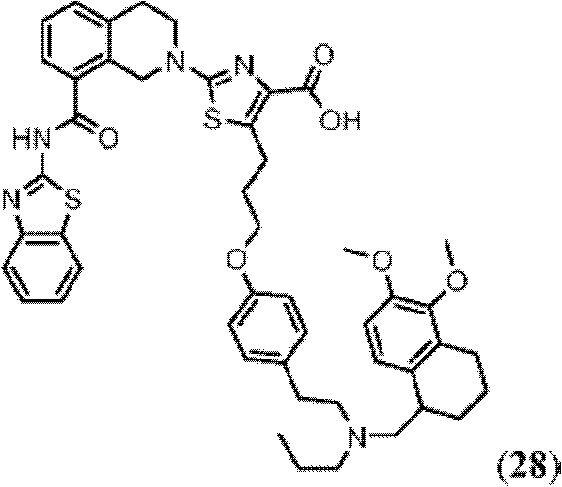
题示化合物28一般如实施例2中描述般制备,在实施例2的步骤4中用4-(2-(((5,6-二甲氧基-1,2,3,4-四氢萘-1-基)甲基)(丙基)氨基)乙基)苯酚HCl代替苯酚。酯水解前未分离烷化中间体。所需产物沉淀后,固体通过HPLC纯化(预制备反相HPLC用自动化Gilson HPLC系统执行,使用SymmetryPrep Shield RP18预制备柱,250mmx21.20mm i.d.,10um,流速25mL/min;λ=214、245nm;流动相A,含0.1%TFA的H2O;流动相B,CH3CN;40分钟内,B的线性梯度0-90%),以提供题示化合物,产率7%:1H NMR(400MHz,DMSO-d6)δppm 12.87(1H,s),8.91(1H,s),8.03(1H,d),7.79(1H,d),7.67(1H,d),7.47(2H,m),7.36(2H,m),7.25(1H,d),7.18(1H,d),6.97(1H,m),6.89(3H,m),4.83(2H,s),3.96(2H,m),3.77(3H,d),3.72(2H,t),3.67(3H,d),3.26(6H,m),3.16(3H,m),3.03(2H,t),2.91(2H,m),2.72(1H,m),2.58(1H,m),1.99(2H,m),1.74(6H,m),0.94(3H,m)。MS(ESI(+)):m/z 860(M+H)。The title compound 28 was generally prepared as described in Example 2 using 4-(2-(((5,6-dimethoxy-1,2,3,4-tetrahydro Naphthalen-1-yl)methyl)(propyl)amino)ethyl)phenol HCl instead of phenol. The alkylated intermediate was not isolated prior to ester hydrolysis. After precipitation of the desired product, the solid was purified by HPLC (pre-prep reverse phase HPLC performed with an automated Gilson HPLC system using a SymmetryPrep Shield RP18 pre-prep column, 250mmx21.20mm id, 10um, flow rate 25mL/min; λ = 214, 245nm; flow Phase A, H 2 O with 0.1% TFA; mobile phase B, CH 3 CN; linear gradient 0-90% of B over 40 minutes) to provide the title compound in 7% yield: 1 H NMR (400 MHz , DMSO-d 6 ) δppm 12.87 (1H, s), 8.91 (1H, s), 8.03 (1H, d), 7.79 (1H, d), 7.67 (1H, d), 7.47 (2H, m), 7.36 (2H, m), 7.25 (1H, d), 7.18 (1H, d), 6.97 (1H, m), 6.89 (3H, m), 4.83 (2H, s), 3.96 (2H, m), 3.77 ( 3H,d), 3.72(2H,t), 3.67(3H,d), 3.26(6H,m), 3.16(3H,m), 3.03(2H,t), 2.91(2H,m), 2.72(1H , m), 2.58 (1H, m), 1.99 (2H, m), 1.74 (6H, m), 0.94 (3H, m). MS (ESI(+)): m/z 860 (M+H).
实施例29Example 29
5-(3-(4-(4-(苯并[d]噻唑-2-基)哌嗪-1-基)-2-甲基苯氧基)丙基)-2-(8-(苯并[d]噻唑-2-基氨基甲酰基)-3,4-二氢异喹啉-2(1H)-基)噻唑-4-羧酸(29)的合成:5-(3-(4-(4-(Benzo[d]thiazol-2-yl)piperazin-1-yl)-2-methylphenoxy)propyl)-2-(8-(benzene Synthesis of [d]thiazol-2-ylcarbamoyl)-3,4-dihydroisoquinolin-2(1H)-yl)thiazole-4-carboxylic acid (29):
题示化合物29一般如实施例2中描述般制备,在实施例2的步骤4中用4-(4-(苯并[d]噻唑-2-基)哌嗪-1-基)-2-甲基苯酚2HCl代替苯酚。酯水解前未分离烷化中间体。沉淀所需产物后,固体通过HPLC纯化(预制备反相HPLC用自动化Gilson HPLC系统执行,使用SymmetryPrep Shield RP18预制备柱,250mmx21.20mm i.d.,10um,流速25mL/min;λ=214、245nm;流动相A,含0.1%TFA的H2O;流动相B,CH3CN;40分钟内,B的线性梯度0-90%),以提供题示化合物29,产率12%:1H NMR(400MHz,DMSO-d6)δppm 12.87(1H,s),8.03(1H,d),7.78(2H,t),7.66(1H,d),7.47(2H,m),7.44(1H,m),7.36(2H,m),7.29(1H,m),7.08(1H,m),6.94(1H,d),6.54(1H,d),6.43(1H,dd),4.82(2H,s),3.99(2H,t),3.72(2H,t),3.68(4H,m),3.21(6H,m),3.02(2H,t),2.03(3H,s),2.00(2H,m);MS(ESI(+)):m/z 802(M+H)。The title compound 29 was prepared generally as described in Example 2 using 4-(4-(benzo[d]thiazol-2-yl)piperazin-1-yl)-2- Methylphenol 2HCl was used instead of phenol. The alkylated intermediate was not isolated prior to ester hydrolysis. After precipitation of the desired product, the solid was purified by HPLC (pre-prep reverse phase HPLC performed with an automated Gilson HPLC system using a SymmetryPrep Shield RP18 pre-prep column, 250mmx21.20mm id, 10um, flow rate 25mL/min; λ = 214, 245nm; flow Phase A, H2O with 0.1% TFA; mobile phase B, CH3CN ; linear gradient of B over 40 minutes 0-90%) to provide the title compound 29 in 12% yield: 1 H NMR ( 400MHz, DMSO-d 6 )δppm 12.87(1H, s), 8.03(1H, d), 7.78(2H, t), 7.66(1H, d), 7.47(2H, m), 7.44(1H, m), 7.36(2H,m), 7.29(1H,m), 7.08(1H,m), 6.94(1H,d), 6.54(1H,d), 6.43(1H,dd), 4.82(2H,s), 3.99 (2H,t), 3.72(2H,t), 3.68(4H,m), 3.21(6H,m), 3.02(2H,t), 2.03(3H,s), 2.00(2H,m); MS( ESI (+)): m/z 802 (M+H).
实施例30Example 30
(E)-2-(8-(苯并[d]噻唑-2-基氨基甲酰基)-3,4-二氢异喹啉-2(1H)-基)-5-(3-(3-(2-氰基乙烯基)苯氧基)丙基)噻唑-4-羧酸(30)的合成:(E)-2-(8-(Benzo[d]thiazol-2-ylcarbamoyl)-3,4-dihydroisoquinolin-2(1H)-yl)-5-(3-(3 Synthesis of -(2-cyanovinyl)phenoxy)propyl)thiazole-4-carboxylic acid (30):
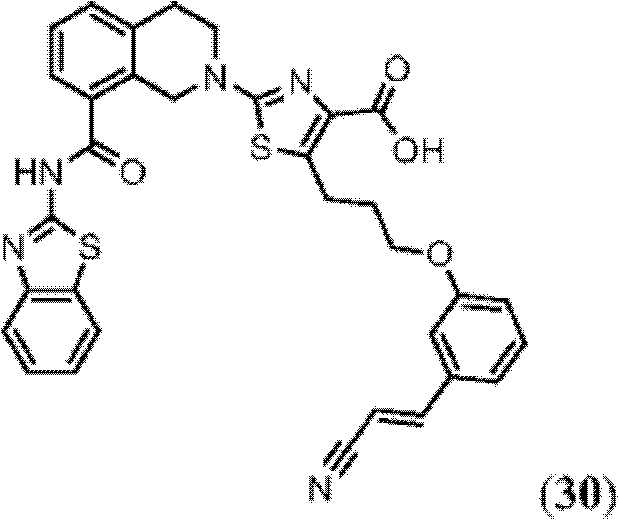
题示化合物30一般如实施例2中描述般制备,在实施例2的步骤4中用(E)-3-(2-(1,2,4-噁二唑-3-基)乙烯基)苯酚代替苯酚。除了所需烷化以外,NaH与噁二唑基部分反应,导致形成了氰基部分来替代噁二唑基部分。这一中间体未在酯水解前分离,酯水解在环境温度下执行。所需产物沉淀后,固体通过HPLC纯化(预制备反相HPLC用自动化Gilson HPLC系统执行,使用SymmetryPrep Shield RP18预制备柱,250mmx21.20mm i.d.,10um,流速25mL/min;λ=214、245nm;流动相A,含0.1%TFA的H2O;流动相B,CH3CN;40分钟内,B的线性梯度0-90%),以提供题示化合物30,产率14%:1H NMR(400MHz,DMSO-d6)δppm 12.87(1H,s),12.55(1H,s),8.03(1H,d),7.79(1H,d),7.67(1H,d),7.58(1H,d),7.47(2H,m),7.37(2H,m),7.30(1H,d),7.22(1H,m),7.18(1H,d),7.00(1H,dd),6.47(1H,d),4.82(2H,s),4.01(2H,t),3.72(2H,t),3.18(2H,m),3.03(2H,t),2.01(2H,m)。MS(ESI(+)):m/z 622(M+H)。The title compound 30 was generally prepared as described in Example 2 using (E)-3-(2-(1,2,4-oxadiazol-3-yl)ethenyl) in Step 4 of Example 2 Phenol instead of phenol. In addition to the desired alkylation, NaH reacts with the oxadiazolyl moiety, resulting in the formation of a cyano moiety in place of the oxadiazolyl moiety. This intermediate was not isolated prior to ester hydrolysis, which was performed at ambient temperature. After precipitation of the desired product, the solid was purified by HPLC (pre-prep reverse phase HPLC performed with an automated Gilson HPLC system using a SymmetryPrep Shield RP18 pre-prep column, 250mmx21.20mm id, 10um, flow rate 25mL/min; λ = 214, 245nm; flow Phase A, H 2 O with 0.1% TFA; mobile phase B, CH 3 CN; linear gradient of B over 40 minutes 0-90%) to provide the title compound 30 in 14% yield: 1 H NMR ( 400MHz, DMSO-d 6 )δppm 12.87(1H,s), 12.55(1H,s), 8.03(1H,d), 7.79(1H,d), 7.67(1H,d), 7.58(1H,d), 7.47(2H,m), 7.37(2H,m), 7.30(1H,d), 7.22(1H,m), 7.18(1H,d), 7.00(1H,dd), 6.47(1H,d), 4.82 (2H,s), 4.01(2H,t), 3.72(2H,t), 3.18(2H,m), 3.03(2H,t), 2.01(2H,m). MS (ESI(+)): m/z 622 (M+H).
实施例31Example 31
5-(3-(4-(5-氨基-4-氰基-1H-吡唑-3-基)苯氧基)丙基)-2-(8-(苯并[d]噻唑-2-基氨基甲酰基)-3,4-二氢异喹啉-2(1H)-基)噻唑-4-羧酸(31)的合成:5-(3-(4-(5-amino-4-cyano-1H-pyrazol-3-yl)phenoxy)propyl)-2-(8-(benzo[d]thiazole-2- Synthesis of (carbamoyl)-3,4-dihydroisoquinolin-2(1H)-yl)thiazole-4-carboxylic acid (31):
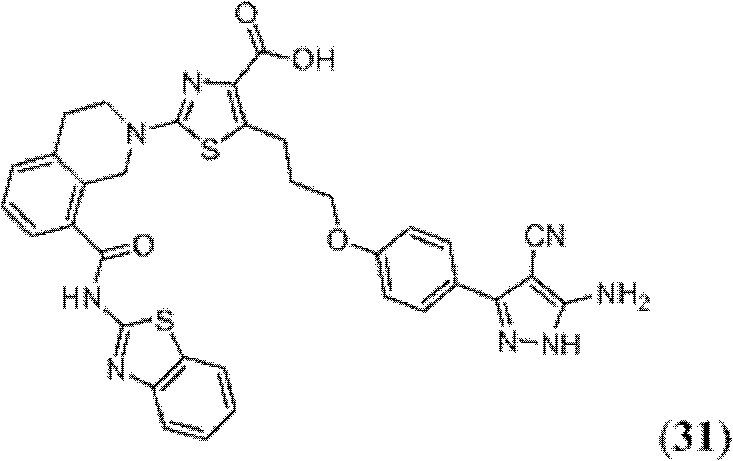
步骤1:4-(苄氧基)苯甲酰氯(31A)的制备: Step 1 : Preparation of 4-(benzyloxy)benzoyl chloride (31A):

4-(苄氧基)苯甲酸(4.73g,20.72mmol)在CH2Cl2(50mL)中悬浮。悬浮液冷却到0℃。向该悬浮液中加入乙二酰氯(3.63mL,41.4mmol),接着滴加N,N-二甲基甲酰胺(0.24mL,3.11mmol)。反应搅拌16小时。反应混合物减压浓缩,用甲苯稀释,减压浓缩。分离的固体直接用于下一反应,无需进一步纯化。4-(Benzyloxy)benzoic acid (4.73 g, 20.72 mmol) was suspended in CH2Cl2 ( 50 mL). The suspension was cooled to 0°C. To the suspension was added oxalyl chloride (3.63 mL, 41.4 mmol), followed by dropwise addition of N,N-dimethylformamide (0.24 mL, 3.11 mmol). The reaction was stirred for 16 hours. The reaction mixture was concentrated under reduced pressure, diluted with toluene, and concentrated under reduced pressure. The isolated solid was used directly in the next reaction without further purification.
步骤2:2-(4-(苄氧基)苯甲酰)丙二腈(31B)的制备: Step 2 : Preparation of 2-(4-(benzyloxy)benzoyl)malononitrile (31B):

NaH(1.657g,60%,41.4mmol)在THF(10mL)中悬浮。在0℃在10分钟内向该悬浮液中滴加含丙二腈(1.368g,20.71mmol)的THF(10mL)。悬浮液搅拌另外20分钟。向该溶液中分批加入含化合物31A(5.11g,20.71mmol)的THF(40mL)。然后,溶液升温至室温,搅拌30分钟。用浓HCl将溶剂的pH调到1。反应混合物浓缩,在水和EtOAc之间分离。用额外的EtOAc萃取水层。合并的有机层用盐水洗涤,干燥(MgSO4),过滤,减压浓缩。残余物用1∶1Hex/EtOAc(50mL)研磨,得到固体,其通过过滤收集,以提供3.7g所需产物31B:1H NMR(DMSO-d6):δ7.60-7.63(m,2H),7.32-7.47(m,5H),7.03-7.07(m,2H),5.16(s,2H)。MS(DCI(+)):m/z 294(M+NH4)。NaH (1.657 g, 60%, 41.4 mmol) was suspended in THF (10 mL). To this suspension was added malononitrile (1.368 g, 20.71 mmol) in THF (10 mL) dropwise over 10 min at 0°C. The suspension was stirred for another 20 minutes. To this solution was added compound 31A (5.11 g, 20.71 mmol) in THF (40 mL) in portions. Then, the solution was warmed to room temperature and stirred for 30 minutes. The pH of the solvent was adjusted to 1 with concentrated HCl. The reaction mixture was concentrated, partitioned between water and EtOAc. The aqueous layer was extracted with additional EtOAc. The combined organic layers were washed with brine, dried ( MgSO4 ), filtered and concentrated under reduced pressure. The residue was triturated with 1:1 Hex/EtOAc (50 mL) to give a solid which was collected by filtration to afford 3.7 g of the desired product 31B: 1 H NMR (DMSO-d 6 ): δ 7.60-7.63 (m, 2H) , 7.32-7.47 (m, 5H), 7.03-7.07 (m, 2H), 5.16 (s, 2H). MS (DCI(+)): m/z 294 (M+ NH4 ).
步骤3:2-((4-(苄氧基)苯基)(甲氧基)亚甲基)丙二腈(31C)的制备: Step 3 : Preparation of 2-((4-(benzyloxy)phenyl)(methoxy)methylene)malononitrile (31C):

化合物31B(3.7g,13.39mmol)在1,4-二氧杂环己烷(30mL)和水(5mL)中溶解。向该溶液中分批加入碳酸氢钠(9.0g,107mmol),以控制气体形成。向得到的悬浮液中加入硫酸二甲酯(8.96mL,94mmol)。反应加热回流2小时。反应混合物浓缩,在水和EtOAc之间分离。用额外的EtOAc萃取水层。合并的有机层用盐水洗涤,干燥(MgSO4),过滤,减压浓缩。残余物通过快速柱色谱用硅胶纯化,用7∶3/己烷∶EtOAc洗脱,以提供3.1g所需产物:1H NMR(DMSO-d6):δ7.64-7.68(m,2H),7.34-7.69(m,5H),7.22-7.26(m,2H),5.22(s,2H),3.92(s,3H)。MS(DCI(+)):m/z 308(M+NH4)。Compound 31B (3.7 g, 13.39 mmol) was dissolved in 1,4-dioxane (30 mL) and water (5 mL). To this solution was added sodium bicarbonate (9.0 g, 107 mmol) in portions to control gas evolution. Dimethyl sulfate (8.96 mL, 94 mmol) was added to the resulting suspension. The reaction was heated to reflux for 2 hours. The reaction mixture was concentrated, partitioned between water and EtOAc. The aqueous layer was extracted with additional EtOAc. The combined organic layers were washed with brine, dried ( MgSO4 ), filtered and concentrated under reduced pressure. The residue was purified by flash column chromatography on silica gel, eluting with 7:3/hexanes:EtOAc, to provide 3.1 g of the desired product: 1 H NMR (DMSO-d 6 ): δ 7.64-7.68 (m, 2H) , 7.34-7.69 (m, 5H), 7.22-7.26 (m, 2H), 5.22 (s, 2H), 3.92 (s, 3H). MS (DCI(+)): m/z 308 (M+ NH4 ).
步骤4:5-氨基-3-(4-(苄氧基)苯基)-1H-吡唑-4-腈(31D)的制备: Step 4 : Preparation of 5-amino-3-(4-(benzyloxy)phenyl)-1H-pyrazole-4-carbonitrile (31D):
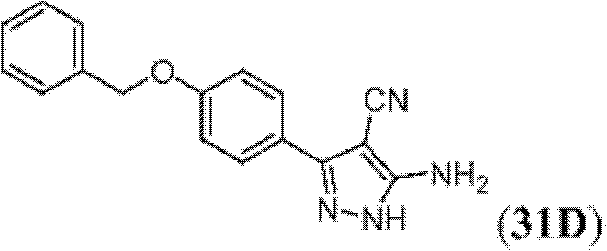
化合物31C(3.1g,10.68mmol)在EtOH(20mL)中溶解。向该溶液中加入水合肼(0.622mL,12.81mmol)。反应加热回流2小时。除去溶剂,残余物溶解到EtOAc中。然后用水、盐水洗涤它,用MgSO4干燥,减压浓缩,以提供2.72g所需产物:1H NMR(DMSO-d6):δ12.64和11.99(s,1H),7.71-7.74(m,2H),7.32-7.48(m,5H),7.09-7.10(br,2H),6.38(s,2H),5.15(s,2H)。MS(DCI(+)):m/z 291(M+H)。Compound 31C (3.1 g, 10.68 mmol) was dissolved in EtOH (20 mL). To this solution was added hydrazine hydrate (0.622 mL, 12.81 mmol). The reaction was heated to reflux for 2 hours. The solvent was removed and the residue was dissolved in EtOAc. It was then washed with water, brine, dried over MgSO 4 , concentrated under reduced pressure to provide 2.72 g of the desired product: 1 H NMR (DMSO-d 6 ): δ 12.64 and 11.99 (s, 1H), 7.71-7.74 (m , 2H), 7.32-7.48 (m, 5H), 7.09-7.10 (br, 2H), 6.38 (s, 2H), 5.15 (s, 2H). MS (DCI(+)): m/z 291 (M+H).
步骤5:5-氨基-3-(4-(苄氧基)苯基)-4-氰基-1H-吡唑-1-羧酸叔丁酯(31E)的制备: Step 5 : Preparation of tert-butyl 5-amino-3-(4-(benzyloxy)phenyl)-4-cyano-1H-pyrazole-1-carboxylate (31E):
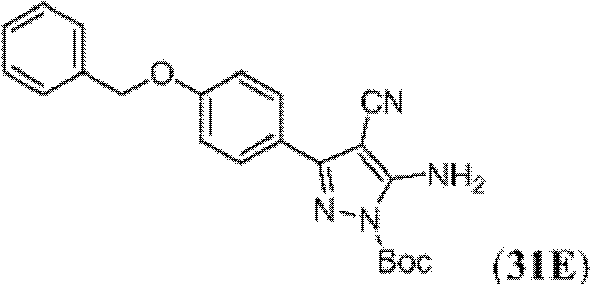
在室温下向化合物31D(1.6g,5.51mmol)和二碳酸二叔丁酯(1.44g,6.61mmol)在THF(15mL)中的混合物,加入N,N-二甲基吡啶-4-胺(0.808g,6.61mmol)。反应混合物搅拌1小时。除去溶剂,残余物通过快速柱色谱用硅胶纯化,用5∶1/己烷∶EtOAc洗脱,以提供2.03g所需产物:1H NMR(DMSO-d6):δ7.78(d,J=8.9Hz,2H),7.68(s,2H),7.32-7.48(m,5H),7.15(d,J=8.9Hz,2H),5.17(s,2H),1.59(s,9H)。MS(DCI(+)):m/z 391(M+H)。To a mixture of compound 31D (1.6 g, 5.51 mmol) and di-tert-butyl dicarbonate (1.44 g, 6.61 mmol) in THF (15 mL) was added N,N-dimethylpyridin-4-amine ( 0.808 g, 6.61 mmol). The reaction mixture was stirred for 1 hour. The solvent was removed and the residue was purified by flash column chromatography on silica gel, eluting with 5:1/hexanes:EtOAc, to provide 2.03 g of the desired product: 1 H NMR (DMSO-d 6 ): δ 7.78 (d,J =8.9Hz, 2H), 7.68(s, 2H), 7.32-7.48(m, 5H), 7.15(d, J=8.9Hz, 2H), 5.17(s, 2H), 1.59(s, 9H). MS (DCI(+)): m/z 391 (M+H).
步骤6:5-氨基-4-氰基-3-(4-羟基苯基)-1H-吡唑-1-羧酸叔丁酯(31F)的制备: Step 6 : Preparation of tert-butyl 5-amino-4-cyano-3-(4-hydroxyphenyl)-1H-pyrazole-1-carboxylate (31F):
化合物31E(1.3g,3.33mmol)和Pd/C(0.071g)在EtOH(15mL)中的混合物在室温下用氢气球氢化6小时。除去溶剂,残余物通过快速柱色谱用硅胶纯化,用1∶1/己烷∶EtOAc洗脱,以提供0.85g所需产物31F:1H NMR(DMSO-d6):δ9.88(s,1H),7.67(d,J=8.9Hz,2H),7.64(s,2H),6.87(d,J=8.9Hz,2H),1.59(s,9H)。MS(DCI(+)):m/z 301(M+H)。A mixture of compound 31E (1.3 g, 3.33 mmol) and Pd/C (0.071 g) in EtOH (15 mL) was hydrogenated with a hydrogen balloon at room temperature for 6 h. The solvent was removed and the residue was purified by flash column chromatography on silica gel, eluting with 1:1/hexanes:EtOAc, to provide 0.85 g of the desired product 31F: 1 H NMR (DMSO-d 6 ): δ 9.88 (s, 1H), 7.67(d, J=8.9Hz, 2H), 7.64(s, 2H), 6.87(d, J=8.9Hz, 2H), 1.59(s, 9H). MS (DCI(+)): m/z 301 (M+H).
步骤7:题示化合物31的制备: Step 7 : Preparation of Title Compound 31:
在0℃向含化合物31F(0.132g,0.44mmol)的DMF(4mL)加入60%氢化钠(0.048g,1.2mmol)。溶液搅拌10分钟。向该溶液中加入化合物2C。溶液在室温下搅拌2小时。溶液用浓HCl(0.5mL)稀释,在60℃加热30分钟。混合物用DMSO(5mL)和MeOH(9mL)稀释。滤去固体。滤液然后通过预制备HPLC纯化,以提供12mg所需产物:1H NMR(DMSO-d6):δ8.03(d,J=7.98Hz,1H),7.79(d,J=7.98Hz,1H),7.67-7.71(m,4H),7.33-7.49(m,5H),7.00(d,J=8.59Hz,2H),4.84(s,2H),4.03(t,J=5.98Hz,2H),3.71-3.74(m,2H),3.17-3.20(m,2H),3.01-3.05(m,2H),2.02(m,2H)。MS(ESI(+)):677(M+H)。To compound 31F (0.132 g, 0.44 mmol) in DMF (4 mL) was added 60% sodium hydride (0.048 g, 1.2 mmol) at 0°C. The solution was stirred for 10 minutes. To this solution was added compound 2C. The solution was stirred at room temperature for 2 hours. The solution was diluted with concentrated HCl (0.5 mL) and heated at 60°C for 30 minutes. The mixture was diluted with DMSO (5 mL) and MeOH (9 mL). The solids were filtered off. The filtrate was then purified by preparative HPLC to provide 12 mg of the desired product: 1 H NMR (DMSO-d 6 ): δ 8.03 (d, J = 7.98 Hz, 1 H), 7.79 (d, J = 7.98 Hz, 1 H) , 7.67-7.71(m, 4H), 7.33-7.49(m, 5H), 7.00(d, J=8.59Hz, 2H), 4.84(s, 2H), 4.03(t, J=5.98Hz, 2H), 3.71-3.74 (m, 2H), 3.17-3.20 (m, 2H), 3.01-3.05 (m, 2H), 2.02 (m, 2H). MS (ESI (+)): 677 (M+H).
实施例32Example 32
2-(8-(苯并[d]噻唑-2-基氨基甲酰基)-3,4-二氢异喹啉-2(1H)-基)-5-(3-(4-氰基-3-(4-羟基苯基)-1H-吡唑-5-基氨基)丙基)噻唑-4-羧酸(32)的合成:2-(8-(Benzo[d]thiazol-2-ylcarbamoyl)-3,4-dihydroisoquinolin-2(1H)-yl)-5-(3-(4-cyano- Synthesis of 3-(4-hydroxyphenyl)-1H-pyrazol-5-ylamino)propyl)thiazole-4-carboxylic acid (32):
题示化合物32作为化合物31的合成的副产物分离:1H NMR(DMSO-d6):δ8.02(d,J=7.67Hz,1H),7.79(d,J=7.98Hz,1H),7.67(d,J=7.67Hz,1H),7.59-7.61(m,2H),7.33-7.49(m,5H),6.80-6.82(m,2H),4.84(s,2H),4.03(t,J=5.98Hz,2H),3.93-3.95(m,2H),3.71-3.74(m,2H),3.02-3.08(m,4H),1.94-1.98(m,2H)。MS(ESI(+)):677(M+H)。The title compound 32 was isolated as a by-product of the synthesis of compound 31: 1 H NMR (DMSO-d 6 ): δ8.02 (d, J=7.67Hz, 1H), 7.79 (d, J=7.98Hz, 1H), 7.67(d, J=7.67Hz, 1H), 7.59-7.61(m, 2H), 7.33-7.49(m, 5H), 6.80-6.82(m, 2H), 4.84(s, 2H), 4.03(t, J=5.98Hz, 2H), 3.93-3.95(m, 2H), 3.71-3.74(m, 2H), 3.02-3.08(m, 4H), 1.94-1.98(m, 2H). MS (ESI (+)): 677 (M+H).
实施例33Example 33
5-(3-(4-(1H-吡唑并[3,4-d]嘧啶-1-基)苯氧基)丙基)-2-(8-(苯并[d]噻唑-2-基氨基甲酰基)-3,4-二氢异喹啉-2(1H)-基)噻唑-4-羧酸(33)的合成:5-(3-(4-(1H-pyrazolo[3,4-d]pyrimidin-1-yl)phenoxy)propyl)-2-(8-(benzo[d]thiazole-2- Synthesis of (carbamoyl)-3,4-dihydroisoquinolin-2(1H)-yl)thiazole-4-carboxylic acid (33):
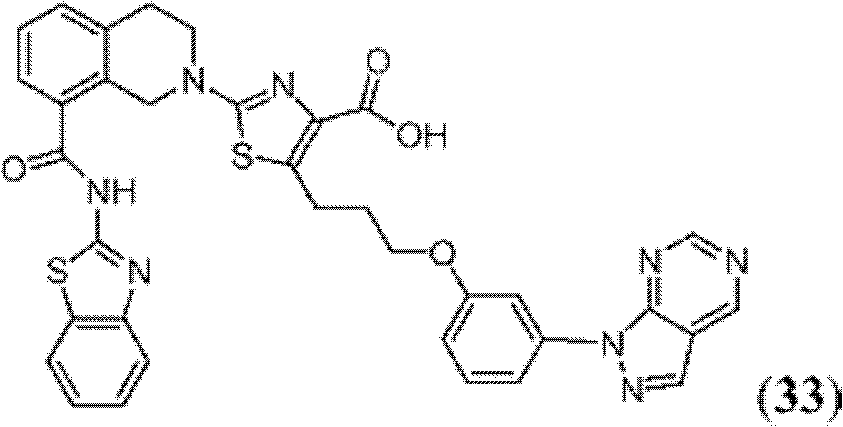
步骤1:5-氨基-1-(3-溴苯基)-1H-吡唑-4-羧酸(33A)的制备: Step 1 : Preparation of 5-amino-1-(3-bromophenyl)-1H-pyrazole-4-carboxylic acid (33A):
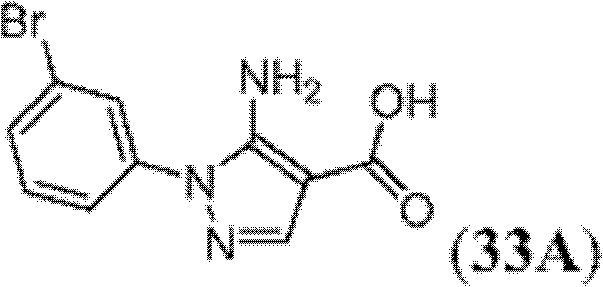
化合物33A使用实施例21的步骤1中描述的相同程序制备,用3-溴苯基肼盐酸盐代替4-溴苯基肼盐酸盐:1H NMR(400MHz,DMSO-D6)δppm 12.13(1H,s),7.74(1H,t),7.70(1H,s),7.57-7.62(2H,m),7.49(1H,t),6.41(2H,s)。Compound 33A was prepared using the same procedure described in step 1 of Example 21, substituting 3-bromophenylhydrazine hydrochloride for 4-bromophenylhydrazine hydrochloride: 1 H NMR (400 MHz, DMSO-D 6 ) δ ppm 12.13 (1H, s), 7.74 (1H, t), 7.70 (1H, s), 7.57-7.62 (2H, m), 7.49 (1H, t), 6.41 (2H, s).
步骤2:1-(3-溴苯基)-1H-吡唑并[3,4-d]嘧啶(33B)的制备: Step 2 : Preparation of 1-(3-bromophenyl)-1H-pyrazolo[3,4-d]pyrimidine (33B):
化合物33B使用实施例21的步骤2中描述的相同程序制备,用化合物33A代替化合物21A:1H NMR(400MHz,DMSO-D6)δppm9.49(1H,s),9.20(1H,s),8.71(1H,s),8.51(1H,t),8.25-8.30(1H,m),7.55-7.63(2H,m)。Compound 33B was prepared using the same procedure described in Step 2 of Example 21, substituting Compound 33A for Compound 21A: 1 H NMR (400 MHz, DMSO-D 6 ) δ ppm 9.49 (1H, s), 9.20 (1H, s), 8.71 (1H, s), 8.51 (1H, t), 8.25-8.30 (1H, m), 7.55-7.63 (2H, m).
步骤3:1-(3-(4,4,5,5-四甲基-1,3,2-二氧硼戊环-2-基)苯基)-1H-吡唑并[3,4-d]嘧啶(33C)的制备: Step 3 : 1-(3-(4,4,5,5-tetramethyl-1,3,2-dioxaborolan-2-yl)phenyl)-1H-pyrazolo[3,4 -d] Preparation of pyrimidine (33C):
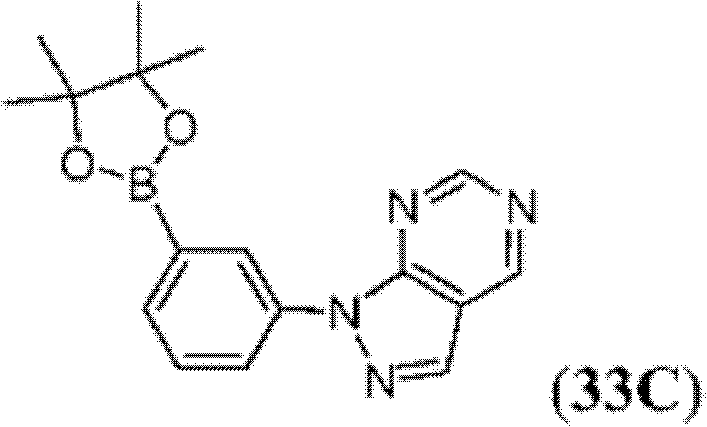
题示化合物33C使用实施例21的步骤3中描述的相同程序制备,用化合物33B代替化合物21B:1H NMR(400MHz,DMSO-D6)δppm9.48(1H,s),9.18(1H,s),8.68(1H,s),8.47(1H,d),8.36-8.40(1H,m),7.68-7.71(1H,m),7.64(1H,t),1.34(12H,s)。The title compound 33C was prepared using the same procedure described in step 3 of Example 21, substituting compound 33B for compound 21B: 1 H NMR (400 MHz, DMSO-D 6 ) δ ppm 9.48 (1H, s), 9.18 (1H, s ), 8.68 (1H, s), 8.47 (1H, d), 8.36-8.40 (1H, m), 7.68-7.71 (1H, m), 7.64 (1H, t), 1.34 (12H, s).
步骤4:3-(1H-吡唑并[3,4-d]嘧啶-1-基)苯酚(33D)的制备: Step 4 : Preparation of 3-(1H-pyrazolo[3,4-d]pyrimidin-1-yl)phenol (33D):

题示化合物33D使用实施例21的步骤4中描述的相同程序制备,用化合物33C代替化合物21C:1H NMR(400MHz,DMSO-D6)δppm9.86(1H,s),9.46(1H,s),9.16(1H,s),8.64(1H,s),7.72(1H,t),7.67-7.70(1H,m),7.38(1H,t),6.80(1H,dd)。The title compound 33D was prepared using the same procedure described in step 4 of Example 21, substituting compound 33C for compound 21C: 1 H NMR (400 MHz, DMSO-D 6 ) δ ppm 9.86 (1H, s), 9.46 (1H, s ), 9.16 (1H, s), 8.64 (1H, s), 7.72 (1H, t), 7.67-7.70 (1H, m), 7.38 (1H, t), 6.80 (1H, dd).
步骤5:题示化合物33的制备: Step 5 : Preparation of title compound 33:
题示化合物33使用实施例21的步骤5中描述的相同程序制备,用化合物33D代替化合物21D:1H NMR(500MHz,DMSO-D6)δppm12.89(1H,s),12.53(1H,s),9.46(1H,s),9.15(1H,s),8.64(1H,s),8.02(1H,d),7.76-7.84(3H,m),7.66(1H,d),7.33-7.49(5H,m),6.93-6.97(1H,m),4.82(2H,s),4.09(2H,t),3.72(2H,t),3.18-3.26(2H,m),3.02(2H,t),2.01-2.13(2H,m);LCMS(APCI):m/z 687(M+H)。Title compound 33 was prepared using the same procedure described in step 5 of Example 21, substituting compound 33D for compound 21D: 1 H NMR (500 MHz, DMSO-D6) δ ppm 12.89 (1H, s), 12.53 (1H, s) , 9.46(1H,s), 9.15(1H,s), 8.64(1H,s), 8.02(1H,d), 7.76-7.84(3H,m), 7.66(1H,d), 7.33-7.49(5H , m), 6.93-6.97(1H, m), 4.82(2H, s), 4.09(2H, t), 3.72(2H, t), 3.18-3.26(2H, m), 3.02(2H, t), 2.01-2.13 (2H, m); LCMS (APCI): m/z 687 (M+H).
实施例34Example 34
2-(8-(苯并[d]噻唑-2-基氨基甲酰基)-3,4-二氢异喹啉-2(1H)-基)-5-(4-(羟甲基)苯基)噻唑-4-羧酸(34)的合成:2-(8-(Benzo[d]thiazol-2-ylcarbamoyl)-3,4-dihydroisoquinolin-2(1H)-yl)-5-(4-(hydroxymethyl)benzene base) synthesis of thiazole-4-carboxylic acid (34):

步骤1:2-(8-(苯并[d]噻唑-2-基氨基甲酰基)-3,4-二氢异喹啉-2(1H)-基)噻唑-4-羧酸乙酯(34A)的制备: Step 1 : ethyl 2-(8-(benzo[d]thiazol-2-ylcarbamoyl)-3,4-dihydroisoquinolin-2(1H)-yl)thiazole-4-carboxylate ( 34A) Preparation:
化合物34A用与实施例1的步骤3的合成类似的方式制备,用2-氯噻唑-4-羧酸乙酯代替2-氯噻唑-4-羧酸甲酯:MS(ESI(+)):465(M+H)。Compound 34A was prepared in a similar manner to the synthesis of step 3 of Example 1, substituting ethyl 2-chlorothiazole-4-carboxylate for methyl 2-chlorothiazole-4-carboxylate: MS (ESI(+)): 465 (M+H).
步骤2:2-(8-(苯并[d]噻唑-2-基氨基甲酰基)-3,4-二氢异喹啉-2(1H)-基)-5-溴噻唑-4-羧酸乙酯(34B)的制备: Step 2 : 2-(8-(Benzo[d]thiazol-2-ylcarbamoyl)-3,4-dihydroisoquinolin-2(1H)-yl)-5-bromothiazole-4-carboxy Preparation of ethyl acetate (34B):
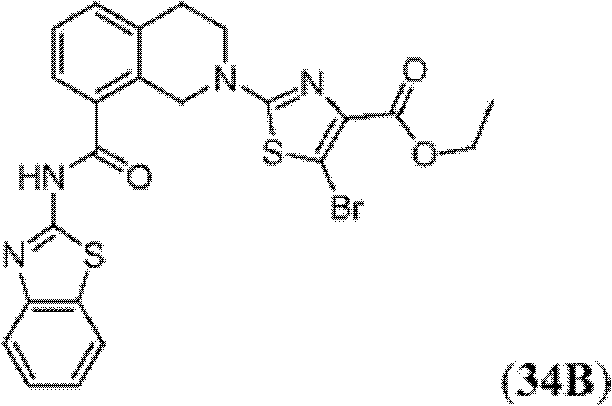
向含化合物34A的乙腈,加入1.05当量的NBS。反应混合物在室温下搅拌2小时。除去溶剂,残余物通过柱色谱用硅胶纯化,用3∶2己烷/EtOAc洗脱,以提供所需产物:MS(ESI(+)):544(M+H)。To compound 34A in acetonitrile, 1.05 equiv of NBS was added. The reaction mixture was stirred at room temperature for 2 hours. The solvent was removed and the residue was purified by column chromatography on silica gel, eluting with 3:2 hexane/EtOAc, to afford the desired product: MS (ESI(+)): 544 (M+H).
步骤3:2-(8-(苯并[d]噻唑-2-基((2-(三甲基甲硅烷基)乙氧基)甲基)氨基甲酰基)-3,4-二氢异喹啉-2(1H)-基)-5-溴噻唑-4-羧酸乙酯(34C)的制备: Step 3 : 2-(8-(Benzo[d]thiazol-2-yl((2-(trimethylsilyl)ethoxy)methyl)carbamoyl)-3,4-dihydroiso Preparation of ethyl quinoline-2(1H)-yl)-5-bromothiazole-4-carboxylate (34C):
在室温下向化合物34B(0.815g,1.5mmol)和SEMCl(0.318mL,1.8mmol)在THF(6mL)中的混合物中,加入TEA(0.65mL,4.5mmol)。反应混合物搅拌20分钟,减压浓缩,通过柱色谱用硅胶纯化,用3∶1/己烷∶EtOAc洗脱,以提供0.95g所需产物,为两种不可分离的异构体的混合物:MS(ESI(+)):m/z 657(M+H)。To a mixture of compound 34B (0.815 g, 1.5 mmol) and SEMCl (0.318 mL, 1.8 mmol) in THF (6 mL) was added TEA (0.65 mL, 4.5 mmol) at room temperature. The reaction mixture was stirred for 20 minutes, concentrated under reduced pressure and purified by column chromatography on silica gel, eluting with 3:1/hexanes:EtOAc, to afford 0.95 g of the desired product as a mixture of two inseparable isomers: MS (ESI(+)): m/z 657(M+H).
步骤4:2-(8-(苯并[d]噻唑-2-基((2-(三甲基甲硅烷基)乙氧基)甲基)氨基甲酰基)-3,4-二氢异喹啉-2(1H)-基)-5-(4-(羟甲基)苯基)噻唑-4-羧酸乙酯(34D)的制备: Step 4 : 2-(8-(Benzo[d]thiazol-2-yl((2-(trimethylsilyl)ethoxy)methyl)carbamoyl)-3,4-dihydroiso Preparation of ethyl quinoline-2(1H)-yl)-5-(4-(hydroxymethyl)phenyl)thiazole-4-carboxylate (34D):
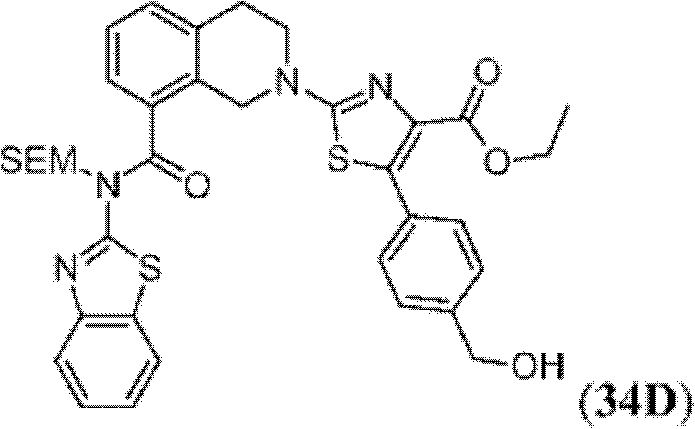
化合物34C(0.135g,0.2mmol)、4-(羟甲基)苯基硼酸(0.033g,0.22mmol)、Pd(PPh3)4(0.012g,0.01mmol)和CsF(0.091g,0.6mmol)在DME(2mL)和MeOH(1mL)中的混合物,在微波条件下加热(110℃,20分钟)。浓缩反应混合物,在水和EtOAc之间分离。用额外的EtOAc萃取水层。合并的有机层用盐水洗涤,干燥(MgSO4),过滤,减压浓缩。残余物通过快速柱色谱用硅胶纯化,用1∶1/己烷∶EtOAc洗脱,以提供0.085g所需产物34D,它也是两种位置异构体的混合物。MS(ESI(+)):m/z 701(M+H)。Compound 34C (0.135g, 0.2mmol), 4-(hydroxymethyl)phenylboronic acid (0.033g, 0.22mmol), Pd( PPh3 ) 4 (0.012g, 0.01mmol) and CsF (0.091g, 0.6mmol) A mixture in DME (2 mL) and MeOH (1 mL) was heated under microwave conditions (110 °C, 20 min). The reaction mixture was concentrated, partitioned between water and EtOAc. The aqueous layer was extracted with additional EtOAc. The combined organic layers were washed with brine, dried ( MgSO4 ), filtered and concentrated under reduced pressure. The residue was purified by flash column chromatography on silica gel, eluting with 1:1/hexanes:EtOAc, to afford 0.085 g of the desired product 34D, also a mixture of two positional isomers. MS (ESI(+)): m/z 701 (M+H).
步骤5:题示化合物34的制备: Step 5 : Preparation of Title Compound 34:
向含化合物34D(0.14g)的1,4-二氧杂环己烷(2mL)中,加入含4NHCl的1,4-二氧杂环己烷(2mL)和MeOH(0.5mL)。溶液在室温下搅拌1小时,减压浓缩,加入在1,4-二氧杂环己烷(2mL)中的1.0N LiOH(2mL)。溶液在60℃搅拌1小时,减压浓缩,通过预制备HPLC纯化,以提供所需产物34:1H NMR(DMSO-d6):δ8.02(d,J=7.98Hz,1H),7.79(d,J=7.98Hz,1H),7.69(d,J=7.36Hz,1H),7.29-7.49(m,8H),4.90(s,2H),4.50(s,2H),3.78(t,J=5.98Hz,2H),3.98(t,J=5.98Hz,2H);MS(ESI(+)):m/z 543(M+H)。To compound 34D (0.14 g) in 1,4-dioxane (2 mL), 4N HCl in 1,4-dioxane (2 mL) and MeOH (0.5 mL) were added. The solution was stirred at room temperature for 1 h, concentrated under reduced pressure, and 1.0 N LiOH (2 mL) in 1,4-dioxane (2 mL) was added. The solution was stirred at 60 °C for 1 h, concentrated under reduced pressure, and purified by pre-prep HPLC to provide the desired product 34: 1 H NMR (DMSO-d 6 ): δ 8.02 (d, J = 7.98 Hz, 1 H), 7.79 (d, J=7.98Hz, 1H), 7.69(d, J=7.36Hz, 1H), 7.29-7.49(m, 8H), 4.90(s, 2H), 4.50(s, 2H), 3.78(t, J=5.98Hz, 2H), 3.98(t, J=5.98Hz, 2H); MS (ESI(+)): m/z 543 (M+H).
实施例35Example 35
5-(4-((4-(5-氨基-4-氰基-1H-吡唑-3-基)苯氧基)甲基)苯基)-2-(8-(苯并[d]噻唑-2-基氨基甲酰基)-3,4-二氢异喹啉-2(1H)-基)噻唑-4-羧酸(35)的合成:5-(4-((4-(5-amino-4-cyano-1H-pyrazol-3-yl)phenoxy)methyl)phenyl)-2-(8-(benzo[d] Synthesis of Thiazol-2-ylcarbamoyl)-3,4-dihydroisoquinolin-2(1H)-yl)thiazole-4-carboxylic acid (35):
步骤1:5-(4-((4-(5-氨基-1-(叔丁氧基羰基)-4-氰基-1H-吡唑-3-基)苯氧基)甲基)苯基)-2-(8-(苯并[d]噻唑-2-基((2-(三甲基甲硅烷基)乙氧基)甲基)氨基甲酰基)-3,4-二氢异喹啉-2(1H)-基)噻唑-4-羧酸乙酯(35A)的制备: Step 1 : 5-(4-((4-(5-Amino-1-(tert-butoxycarbonyl)-4-cyano-1H-pyrazol-3-yl)phenoxy)methyl)phenyl )-2-(8-(Benzo[d]thiazol-2-yl((2-(trimethylsilyl)ethoxy)methyl)carbamoyl)-3,4-dihydroisoquinone Preparation of ethyl phen-2(1H)-yl)thiazole-4-carboxylate (35A):
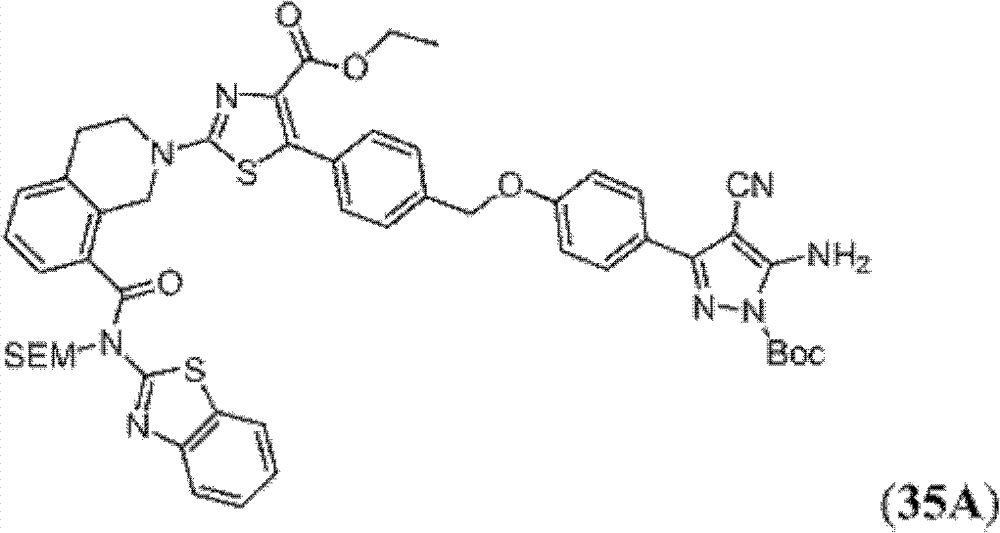
化合物34D(0.14g,0.2mmol)、PPh3(0.079g,0.3mmol)和化合物31F(0.066g,0.022mmol)的混合物在THF(3mL)中溶解。溶液冷却到0℃。向该溶液中加入DBAD。反应混合物在室温下搅拌2小时。除去溶剂,残余物通过快速柱色谱用硅胶纯化,用2∶1/己烷∶EtOAc洗脱,以提供0.13g题示化合物,为两种不可分离的异构体的混合物。MS(ESI(+)):m/z 982(M+NH4-H2O)。A mixture of compound 34D (0.14 g, 0.2 mmol), PPh3 (0.079 g, 0.3 mmol) and compound 31F (0.066 g, 0.022 mmol) was dissolved in THF (3 mL). The solution was cooled to 0°C. To this solution was added DBAD. The reaction mixture was stirred at room temperature for 2 hours. The solvent was removed and the residue was purified by flash column chromatography on silica gel, eluting with 2:1/hexanes:EtOAc, to afford 0.13 g of the title compound as a mixture of two inseparable isomers. MS (ESI(+)): m/z 982 (M+ NH4 - H2O ).
步骤2:题示化合物35的制备: Step 2 : Preparation of Title Compound 35:
题示化合物35用与实施例34的合成类似的方式制备,用化合物35A代替化合物34D:1H NMR(DMSO-d6):δ8.02(d,J=7.67Hz,1H),7.79(d,J=8.29Hz,1H),7.68-7.74(m,3H),7.37-7.49(m,9H),7.12(d,J=8.59Hz,2H),4.90(s,2H),5.16(s,2H),4.91(s,2H),3.79(t,J=5.98Hz,2H),3.08(t,J=5.83Hz,2H)。MS(ESI(+)):m/z 725(M+H)。The title compound 35 was prepared in a similar manner to the synthesis of Example 34, replacing compound 34D with compound 35A: 1 H NMR (DMSO-d 6 ): δ8.02 (d, J=7.67Hz, 1H), 7.79 (d , J=8.29Hz, 1H), 7.68-7.74(m, 3H), 7.37-7.49(m, 9H), 7.12(d, J=8.59Hz, 2H), 4.90(s, 2H), 5.16(s, 2H), 4.91(s, 2H), 3.79(t, J=5.98Hz, 2H), 3.08(t, J=5.83Hz, 2H). MS (ESI(+)): m/z 725 (M+H).
实施例36Example 36
5-(3-(3-(5-氨基-4-氰基-1H-吡唑-3-基)苯氧基)丙-1-炔基)-2-(8-(苯并[d]噻唑-2-基氨基甲酰基)-3,4-二氢异喹啉-2(1H)-基)噻唑-4-羧酸(36)的合成:5-(3-(3-(5-amino-4-cyano-1H-pyrazol-3-yl)phenoxy)prop-1-ynyl)-2-(8-(benzo[d] Synthesis of Thiazol-2-ylcarbamoyl)-3,4-dihydroisoquinolin-2(1H)-yl)thiazole-4-carboxylic acid (36):
步骤1:5-氨基-4-氰基-3-(3-羟基苯基)-1H-吡唑-1-羧酸叔丁酯(36A)的制备: Step 1 : Preparation of tert-butyl 5-amino-4-cyano-3-(3-hydroxyphenyl)-1H-pyrazole-1-carboxylate (36A):
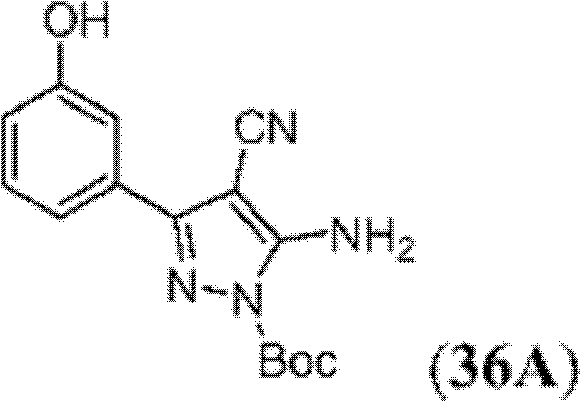
化合物36A用与化合物31F的合成类似的方式制备,用3-(苄氧基)苯甲酸代替4-(苄氧基)苯甲酸:1H NMR(DMSO-d6):δ9.70(s,1H),7.68(s,2H),7.25-7.32(m,3H),6.86-6.89(m,1H),1.60(s,9H)。MS(ESI(+)):m/z 322(M+Na)。Compound 36A was prepared in a similar manner to the synthesis of compound 31F, substituting 3-(benzyloxy)benzoic acid for 4-(benzyloxy)benzoic acid: 1 H NMR (DMSO-d 6 ): δ9.70(s, 1H), 7.68 (s, 2H), 7.25-7.32 (m, 3H), 6.86-6.89 (m, 1H), 1.60 (s, 9H). MS (ESI(+)): m/z 322 (M+Na).
步骤2:2-(8-(苯并[d]噻唑-2-基((2-(三甲基甲硅烷基)乙氧基)甲基)氨基甲酰基)-3,4-二氢异喹啉-2(1H)-基)-5-(3-羟基丙-1-炔基)噻唑-4-羧酸乙酯(36B)的制备: Step 2 : 2-(8-(Benzo[d]thiazol-2-yl((2-(trimethylsilyl)ethoxy)methyl)carbamoyl)-3,4-dihydroiso Preparation of ethyl quinolin-2(1H)-yl)-5-(3-hydroxyprop-1-ynyl)thiazole-4-carboxylate (36B):

化合物34C(0.38g,0.564mmol)、丙-2-炔-1-醇(0.047g,0.846mmol)、CuI(0.011g,0.056mmol)、Et3N(1.57mL,11mmol)和Pd(PPh3)2Cl2(0.02g,0.028mmol)在DMF(2mL)中的混合物,在90℃加热2小时。冷却后,用CH2Cl2稀释反应混合物。滤去固体。浓缩滤液。残余物通过快速柱色谱用硅胶纯化,用3∶2/己烷∶EtOAc洗脱,以提供0.19g所需产物36B,为两种不可分离的异构体的混合物:MS(ESI(+)):m/z 649(M+H)。Compound 34C (0.38g, 0.564mmol), prop-2-yn-1-ol (0.047g, 0.846mmol), CuI (0.011g, 0.056mmol), Et 3 N (1.57mL, 11mmol) and Pd(PPh 3 ) 2 Cl 2 (0.02 g, 0.028 mmol) in DMF (2 mL) was heated at 90° C. for 2 hours. After cooling, the reaction mixture was diluted with CH2Cl2 . The solids were filtered off. The filtrate was concentrated. The residue was purified by flash column chromatography on silica gel eluting with 3:2/hexanes:EtOAc to afford 0.19 g of the desired product 36B as a mixture of two inseparable isomers: MS (ESI(+)) : m/z 649 (M+H).
步骤3:5-(3-(3-(5-氨基-1-(叔丁氧基羰基)-4-氰基-1H-吡唑-3-基)苯氧基)丙-1-炔基)-2-(8-(苯并[d]噻唑-2-基((2-(三甲基甲硅烷基)乙氧基)甲基)氨基甲酰基)-3,4-二氢异喹啉-2(1H)-基)噻唑-4-羧酸乙酯(36C)的制备: Step 3 : 5-(3-(3-(5-amino-1-(tert-butoxycarbonyl)-4-cyano-1H-pyrazol-3-yl)phenoxy)prop-1-ynyl )-2-(8-(Benzo[d]thiazol-2-yl((2-(trimethylsilyl)ethoxy)methyl)carbamoyl)-3,4-dihydroisoquinone Preparation of ethyl phen-2(1H)-yl)thiazole-4-carboxylate (36C):
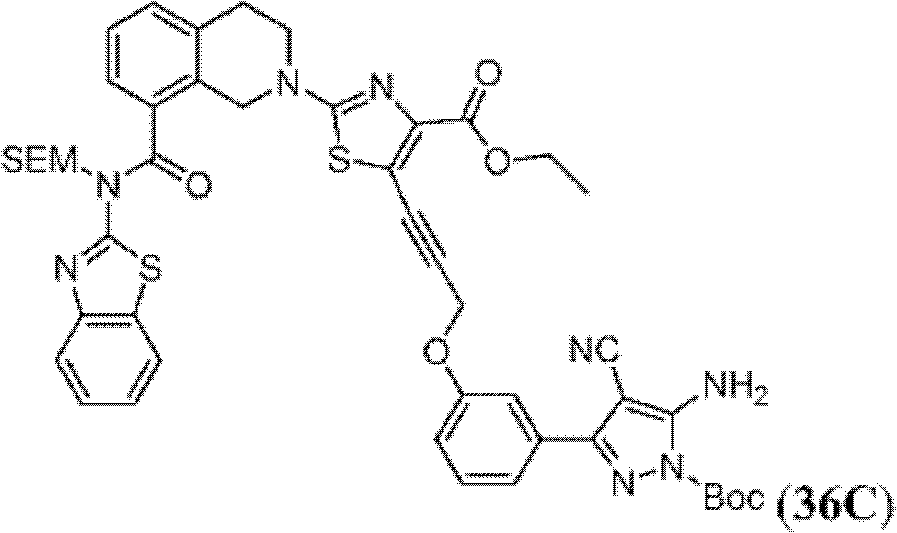
化合物36C用与化合物35A的合成类似的方式制备,分别用化合物36B和化合物36A代替化合物34D和化合物31F,为两种不可分离的异构体的混合物:MS(ESI(+)):m/z 932(M+H)。Compound 36C was prepared in a similar manner to the synthesis of compound 35A, replacing compound 34D and compound 31F with compound 36B and compound 36A, respectively, as a mixture of two inseparable isomers: MS (ESI (+)): m/z 932 (M+H).
步骤4:题示化合物36的制备: Step 4 : Preparation of title compound 36:
题示化合物36用与化合物34的合成类似的方式制备,在实施例34的步骤5中用化合物36C代替化合物34D:1H NMR(DMSO-d6):δ8.03(d,J=7.93Hz,1H),7.79(d,J=7.93Hz,1H),7.66-7.68(m,1H),7.35-7.48(m,8H),5.08(s,2H),4.91(s,2H),3.70-3.73(m,2H),3.46-3.49(m,2H),3.05-3.07(m,2H)。MS(ESI(+)):m/z 670(M-H)。The title compound 36 was prepared in a similar manner to the synthesis of compound 34, replacing compound 34D with compound 36C in step 5 of Example 34: 1 H NMR (DMSO-d 6 ): δ8.03(d, J=7.93Hz , 1H), 7.79(d, J=7.93Hz, 1H), 7.66-7.68(m, 1H), 7.35-7.48(m, 8H), 5.08(s, 2H), 4.91(s, 2H), 3.70- 3.73 (m, 2H), 3.46-3.49 (m, 2H), 3.05-3.07 (m, 2H). MS (ESI(+)): m/z 670 (MH).
实施例37Example 37
5-(4-((3-(5-氨基-4-氰基-1H-吡唑-3-基)苯氧基)甲基)苯基)-2-(8-(苯并[d]噻唑-2-基氨基甲酰基)-3,4-二氢异喹啉-2(1H)-基)噻唑-4-羧酸(37)的合成:5-(4-((3-(5-amino-4-cyano-1H-pyrazol-3-yl)phenoxy)methyl)phenyl)-2-(8-(benzo[d] Synthesis of Thiazol-2-ylcarbamoyl)-3,4-dihydroisoquinolin-2(1H)-yl)thiazole-4-carboxylic acid (37):

步骤1:5-(4-((3-(5-氨基-1-(叔丁氧基羰基)-4-氰基-1H-吡唑-3-基)苯氧基)甲基)苯基)-2-(8-(苯并[d]噻唑-2-基((2-(三甲基甲硅烷基)乙氧基)甲基)氨基甲酰基)-3,4-二氢异喹啉-2(1H)-基)噻唑-4-羧酸乙酯(37A)的制备:Step 1: 5-(4-((3-(5-Amino-1-(tert-butoxycarbonyl)-4-cyano-1H-pyrazol-3-yl)phenoxy)methyl)phenyl )-2-(8-(Benzo[d]thiazol-2-yl((2-(trimethylsilyl)ethoxy)methyl)carbamoyl)-3,4-dihydroisoquinone Preparation of ethyl phen-2(1H)-yl)thiazole-4-carboxylate (37A):
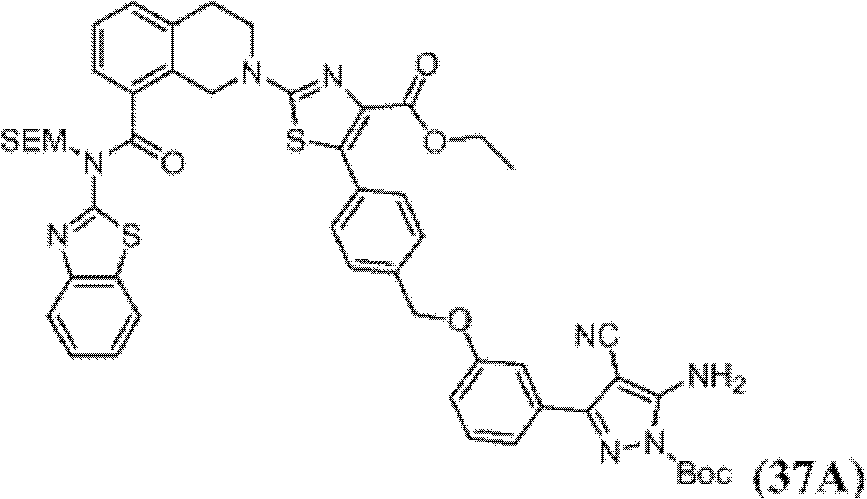
题示化合物37A用与化合物35A的合成类似的方式制备,用化合物36A代替化合物31F,得到两种不可分离的异构体的混合物:MS(ESI(+)):m/z 984(M+H)。The title compound 37A was prepared in a similar manner to the synthesis of compound 35A, replacing compound 31F with compound 36A to obtain a mixture of two inseparable isomers: MS (ESI (+)): m/z 984 (M+H ).
步骤2:题示化合物37的制备: Step 2 : Preparation of Title Compound 37:
题示化合物37用与化合物34的合成类似的方式制备,用化合物37A代替化合物34D:1H NMR(DMSO-d6):δ8.02(d,J=7.36Hz,1H),7.78(d,J=7.98Hz,1H),7.33-7.49(m,11H),7.05-7.08(m,1H),5.15(s,2H),4.91(s,2H),3.78(t,J=6.14Hz,2H),3.08(t,J=5.83Hz,2H)。MS(ESI(+)):m/z 725(M+H)。The title compound 37 was prepared in a similar manner to the synthesis of compound 34, replacing compound 34D with compound 37A: 1 H NMR (DMSO-d 6 ): δ8.02 (d, J=7.36Hz, 1H), 7.78 (d, J=7.98Hz, 1H), 7.33-7.49(m, 11H), 7.05-7.08(m, 1H), 5.15(s, 2H), 4.91(s, 2H), 3.78(t, J=6.14Hz, 2H ), 3.08 (t, J=5.83Hz, 2H). MS (ESI(+)): m/z 725 (M+H).
实施例38Example 38
2-(8-(苯并[d]噻唑-2-基氨基甲酰基)-3,4-二氢异喹啉-2(1H)-基)-5-(3-羟丙基)噻唑-4-羧酸(38)的合成:2-(8-(Benzo[d]thiazol-2-ylcarbamoyl)-3,4-dihydroisoquinolin-2(1H)-yl)-5-(3-hydroxypropyl)thiazole- Synthesis of 4-carboxylic acid (38):

步骤1:2-(8-(苯并[d]噻唑-2-基((2-(三甲基甲硅烷基)乙氧基)甲基)氨基甲酰基)-3,4-二氢异喹啉-2(1H)-基)噻唑-4-羧酸甲酯(38A)的制备: Step 1 : 2-(8-(Benzo[d]thiazol-2-yl((2-(trimethylsilyl)ethoxy)methyl)carbamoyl)-3,4-dihydroiso Preparation of quinoline-2(1H)-yl)thiazole-4-carboxylic acid methyl ester (38A):

向2-(8-(苯并[d]噻唑-2-基氨基甲酰基)-3,4-二氢异喹啉-2(1H)-基)噻唑-4-羧酸甲酯(14g,31.1mmol)在THF(150mL)中的溶液中,加入TEA(6.3g,62.1mmol)和2-(三甲基甲硅烷基)乙氧基甲基氯(7.77g,46.6mmol)。混合物在室温下搅拌4h。混合物用EtOAc(400mL)稀释,用3%HCl、水和盐水洗涤。蒸发溶剂,得到18.2g产物。LC/MS(APCI):m/z 580.9(M+H)。To 2-(8-(benzo[d]thiazol-2-ylcarbamoyl)-3,4-dihydroisoquinolin-2(1H)-yl)thiazole-4-carboxylic acid methyl ester (14g, 31.1 mmol) in THF (150 mL), TEA (6.3 g, 62.1 mmol) and 2-(trimethylsilyl)ethoxymethyl chloride (7.77 g, 46.6 mmol) were added. The mixture was stirred at room temperature for 4h. The mixture was diluted with EtOAc (400 mL), washed with 3% HCl, water and brine. Evaporation of the solvent gave 18.2 g of product. LC/MS (APCI): m/z 580.9 (M+H).
步骤2:2-(8-(苯并[d]噻唑-2-基((2-(三甲基甲硅烷基)乙氧基)甲基)氨基甲酰基)-3,4-二氢异喹啉-2(1H)-基)噻唑-4-羧酸叔丁酯(38B)的制备: Step 2 : 2-(8-(Benzo[d]thiazol-2-yl((2-(trimethylsilyl)ethoxy)methyl)carbamoyl)-3,4-dihydroiso Preparation of tert-butyl quinoline-2(1H)-yl)thiazole-4-carboxylate (38B):

向2-(8-(苯并[d]噻唑-2-基((2-(三甲基甲硅烷基)乙氧基)甲基)氨基甲酰基)-3,4-二氢异喹啉-2(1H)-基)噻唑-4-羧酸甲酯(38A)(14g,24.1mmol)在乙酸叔丁酯(200mL)中的搅拌溶液中,在真空条件下加入2mL THF中的t-BuOK(2M)。在真空条件下3x2mL t-BuOK加入到搅拌溶液中以驱动反应完成。混合物然后酸化至中性,用水、盐水洗涤,用Na2SO4干燥,减压浓缩。粗材料通过柱色谱用硅胶纯化,用含5%EtOAc的己烷洗脱,以提供3.5g所需产物38B:1H NMR(300MHz,CDCl3)δppm 8.29(1H,m),7.71(1H,d),7.62(2H,m),7.49(2H,t),7.34(3H,m),6.02(2H,s),5.20(2H,s),4.02(2H,m),3.71(3H,m),3.08(2H,m),1.59(9H,t),0.97(2H,m),-0.09(9H,m)。MS(ESI(+)):m/z 623.0(M+H)。To 2-(8-(benzo[d]thiazol-2-yl((2-(trimethylsilyl)ethoxy)methyl)carbamoyl)-3,4-dihydroisoquinoline To a stirred solution of methyl-2(1H)-yl)thiazole-4-carboxylate (38A) (14 g, 24.1 mmol) in tert-butyl acetate (200 mL) was added t- Bu OK (2M). 3x2 mL of t-BuOK was added to the stirred solution under vacuum to drive the reaction to completion. The mixture was then acidified to neutral, washed with water, brine, dried over Na2SO4 and concentrated under reduced pressure. The crude material was purified by column chromatography on silica gel eluting with 5% EtOAc in hexanes to provide 3.5 g of the desired product 38B: 1 H NMR (300 MHz, CDCl 3 ) δ ppm 8.29 (1H, m), 7.71 (1H, d), 7.62(2H, m), 7.49(2H, t), 7.34(3H, m), 6.02(2H, s), 5.20(2H, s), 4.02(2H, m), 3.71(3H, m ), 3.08 (2H, m), 1.59 (9H, t), 0.97 (2H, m), -0.09 (9H, m). MS (ESI(+)): m/z 623.0 (M+H).
步骤3:2-(8-(苯并[d]噻唑-2-基((2-(三甲基甲硅烷基)乙氧基)甲基)氨基甲酰基)-3,4-二氢异喹啉-2(1H)-基)-5-碘噻唑-4-羧酸叔丁酯(38C)的制备: Step 3 : 2-(8-(Benzo[d]thiazol-2-yl((2-(trimethylsilyl)ethoxy)methyl)carbamoyl)-3,4-dihydroiso Preparation of tert-butyl quinoline-2(1H)-yl)-5-iodothiazole-4-carboxylate (38C):
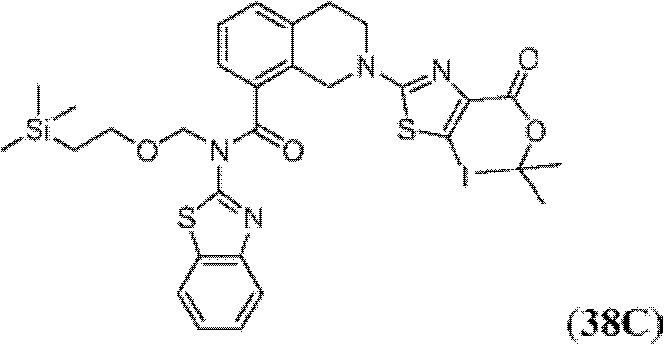
向2-(8-(苯并[d]噻唑-2-基((2-(三甲基甲硅烷基)乙氧基)甲基)氨基甲酰基)-3,4-二氢异喹啉-2(1H)-基)噻唑-4-羧酸叔丁酯(38B)(2.2g,3.53mmol)在DCM(30mL)中的溶液中,加入NIS(0.795g,3.53mmol)。混合物在室温下搅拌过夜。混合物然后用EtOAc(300mL)稀释,用水、盐水洗涤,用Na2SO4干燥,减压浓缩。粗材料通过柱色谱用硅胶纯化,用含5%EtOAc的己烷洗脱,以提供2.6g所需产物。LC/MS(APCI):m/z 749.2(M+H)。To 2-(8-(benzo[d]thiazol-2-yl((2-(trimethylsilyl)ethoxy)methyl)carbamoyl)-3,4-dihydroisoquinoline To a solution of tert-butyl-2(lH)-yl)thiazole-4-carboxylate (38B) (2.2 g, 3.53 mmol) in DCM (30 mL) was added NIS (0.795 g, 3.53 mmol). The mixture was stirred overnight at room temperature. The mixture was then diluted with EtOAc ( 300 mL), washed with water, brine, dried over Na2SO4 and concentrated under reduced pressure. The crude material was purified by column chromatography on silica gel eluting with 5% EtOAc in hexanes to afford 2.6 g of the desired product. LC/MS (APCI): m/z 749.2 (M+H).
步骤4:2-(8-(苯并[d]噻唑-2-基((2-(三甲基甲硅烷基)乙氧基)甲基)氨基甲酰基)-3,4-二氢异喹啉-2(1H)-基)-5-(3-羟基丙-1-炔基)噻唑-4-羧酸叔丁酯(38D)的制备: Step 4 : 2-(8-(Benzo[d]thiazol-2-yl((2-(trimethylsilyl)ethoxy)methyl)carbamoyl)-3,4-dihydroiso Preparation of tert-butyl quinoline-2(1H)-yl)-5-(3-hydroxyprop-1-ynyl)thiazole-4-carboxylate (38D):

向2-(8-(苯并[d]噻唑-2-基((2-(三甲基甲硅烷基)乙氧基)甲基)氨基甲酰基)-3,4-二氢异喹啉-2(1H)-基)-5-碘噻唑-4-羧酸叔丁酯(38C)(2.5g,3.34mmol)和丙-2-炔-1-醇(562mg,10mmol)在THF(20mL)中的溶液中,加入Pd(Ph3P)4(193mg,0.167mmol)、CuI(64mg,0.334mmol)、DIEA(863mg,6.7mmol)。混合物在室温下在氮气中搅拌过夜。混合物然后用DCM(400mL)稀释,用水、盐水洗涤,用Na2SO4干燥,减压浓缩。粗材料通过柱色谱用硅胶柱纯化,用含5%MeOH的DCM洗脱,以提供2.0g(88%)所需产物:1H NMR(300MHz,CDCl3)δppm8.31(1H,m),7.72(1H,d),7.59(1H,m),7.49(1H,d),7.34(3H,m),6.01(2H,s),5.18(2H,s),4.53(2H,d),4.00(2H,t),3.74(2H,t),3.07(2H,t),1.61(9H,s),0.98(2H,t),0.01(9H,m)。MS(ESI(+)):m/z 677(M+H)。To 2-(8-(benzo[d]thiazol-2-yl((2-(trimethylsilyl)ethoxy)methyl)carbamoyl)-3,4-dihydroisoquinoline -2(1H)-yl)-5-iodothiazole-4-carboxylic acid tert-butyl ester (38C) (2.5g, 3.34mmol) and prop-2-yn-1-ol (562mg, 10mmol) in THF (20mL ), Pd(Ph 3 P) 4 (193 mg, 0.167 mmol), CuI (64 mg, 0.334 mmol), DIEA (863 mg, 6.7 mmol) were added. The mixture was stirred overnight at room temperature under nitrogen. The mixture was then diluted with DCM (400 mL ), washed with water, brine, dried over Na2SO4 and concentrated under reduced pressure. The crude material was purified by column chromatography on silica gel eluting with 5% MeOH in DCM to afford 2.0 g (88%) of the desired product: 1 H NMR (300 MHz, CDCl 3 ) δ ppm 8.31 (1 H, m), 7.72(1H,d), 7.59(1H,m), 7.49(1H,d), 7.34(3H,m), 6.01(2H,s), 5.18(2H,s), 4.53(2H,d), 4.00 (2H,t), 3.74(2H,t), 3.07(2H,t), 1.61(9H,s), 0.98(2H,t), 0.01(9H,m). MS (ESI(+)): m/z 677 (M+H).
步骤5:2-(8-(苯并[d]噻唑-2-基((2-(三甲基甲硅烷基)乙氧基)甲基)氨基甲酰基)-3,4-二氢异喹啉-2(1H)-基)-5-(3-羟丙基)噻唑-4-羧酸叔丁酯(38E)的制备: Step 5 : 2-(8-(Benzo[d]thiazol-2-yl((2-(trimethylsilyl)ethoxy)methyl)carbamoyl)-3,4-dihydroiso Preparation of tert-butyl quinoline-2(1H)-yl)-5-(3-hydroxypropyl)thiazole-4-carboxylate (38E):

向2-(8-(苯并[d]噻唑-2-基氨基甲酰基)-3,4-二氢异喹啉-2(1H)-基)-5-(3-羟基丙-1-炔基)噻唑-4-羧酸甲酯(38D)(2.0g,3.96mmol)在EtOAc(20mL)中的溶液中,加入PtO2(240mg,1.1mmol)。混合物在室温下在氢气(气球)下搅拌过夜。然后过滤混合物,减压浓缩滤液,以提供所需产物38E:1H NMR(300MHz,CDCl3)δppm 8.30(1H,m),7.71(1H,d),7.59(1H,m),7.49(1H,m),7.35(3H,m),6.00(2H,s),5.14(2H,s),3.95(2H,m),3.75(2H,t),3.63(2H,m),3.17(2H,t),3.07(2H,t),2.40(1H,t),1.89(2H,m),1.58(9H,d),0.98(2H,t),0.01(9H,m)。MS(ESI(+)):m/z 681(M+H)。To 2-(8-(benzo[d]thiazol-2-ylcarbamoyl)-3,4-dihydroisoquinolin-2(1H)-yl)-5-(3-hydroxypropan-1- To a solution of methyl alkynyl)thiazole-4-carboxylate (38D) (2.0 g, 3.96 mmol) in EtOAc (20 mL) was added PtO2 (240 mg, 1.1 mmol). The mixture was stirred overnight at room temperature under hydrogen (balloon). The mixture was then filtered and the filtrate was concentrated under reduced pressure to provide the desired product 38E: 1 H NMR (300 MHz, CDCl 3 ) δ ppm 8.30 (1H, m), 7.71 (1H, d), 7.59 (1H, m), 7.49 (1H , m), 7.35(3H, m), 6.00(2H, s), 5.14(2H, s), 3.95(2H, m), 3.75(2H, t), 3.63(2H, m), 3.17(2H, t), 3.07 (2H, t), 2.40 (1H, t), 1.89 (2H, m), 1.58 (9H, d), 0.98 (2H, t), 0.01 (9H, m). MS (ESI(+)): m/z 681 (M+H).
步骤6:题示化合物38的制备: Step 6 : Preparation of Title Compound 38:
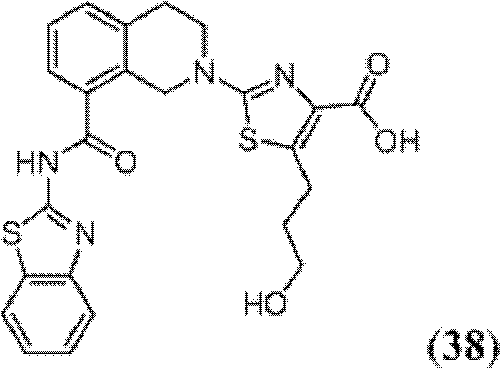
向2-(8-(苯并[d]噻唑-2-基((2-(三甲基甲硅烷基)乙氧基)甲基)氨基甲酰基)-3,4-二氢异喹啉-2(1H)-基)-5-(3-羟丙基)噻唑-4-羧酸叔丁酯(38E)(68mg,0.1mmol)在DCM(2mL)中的溶液中,加入2mL含2NHCl的乙醚。混合物在室温下搅拌过夜。向混合物中加入MeOH(0.5mL)以溶解固体。混合物在室温下搅拌另外2小时。减压浓缩反应混合物,以提供所需产物,为HCl盐:1H NMR(300MHz,DMSO-D6)δppm 8.03(1H,d),7.79(1H,d),7.67(1H,d),7.41(5H,m),4.83(2H,s),3.73(4H,t),3.50(2H,t),3.41(2H,t),3.04(4H,t),1.69(2H,m)。MS(ESI(+)):m/z 495(M+H)。To 2-(8-(benzo[d]thiazol-2-yl((2-(trimethylsilyl)ethoxy)methyl)carbamoyl)-3,4-dihydroisoquinoline -2(1H)-yl)-5-(3-hydroxypropyl)thiazole-4-carboxylate tert-butyl ester (38E) (68 mg, 0.1 mmol) in DCM (2 mL) was added 2 mL containing 2N HCl of ether. The mixture was stirred overnight at room temperature. MeOH (0.5 mL) was added to the mixture to dissolve the solid. The mixture was stirred at room temperature for another 2 hours. The reaction mixture was concentrated under reduced pressure to provide the desired product as HCl salt: 1 H NMR (300 MHz, DMSO-D 6 ) δ ppm 8.03 (1H,d), 7.79 (1H,d), 7.67 (1H,d), 7.41 (5H, m), 4.83 (2H, s), 3.73 (4H, t), 3.50 (2H, t), 3.41 (2H, t), 3.04 (4H, t), 1.69 (2H, m). MS (ESI(+)): m/z 495 (M+H).
实施例39Example 39
5-(3-(3-(5-氨基-4-氰基-1H-吡唑-3-基)苯氧基)丙基)-2-(8-(苯并[d]噻唑-2-基氨基甲酰基)-3,4-二氢异喹啉-2(1H)-基)噻唑-4-羧酸(39)的合成:5-(3-(3-(5-amino-4-cyano-1H-pyrazol-3-yl)phenoxy)propyl)-2-(8-(benzo[d]thiazole-2- Synthesis of (carbamoyl)-3,4-dihydroisoquinolin-2(1H)-yl)thiazole-4-carboxylic acid (39):
步骤1:5-(3-(3-(5-氨基-1-(叔丁氧基羰基)-4-氰基-1H-吡唑-3-基)苯氧基)丙基)-2-(8-(苯并[d]噻唑-2-基((2-(三甲基甲硅烷基)乙氧基)甲基)氨基甲酰基)-3,4-二氢异喹啉-2(1H)-基)噻唑-4-羧酸叔丁酯(39A)的制备: Step 1 : 5-(3-(3-(5-Amino-1-(tert-butoxycarbonyl)-4-cyano-1H-pyrazol-3-yl)phenoxy)propyl)-2- (8-(Benzo[d]thiazol-2-yl((2-(trimethylsilyl)ethoxy)methyl)carbamoyl)-3,4-dihydroisoquinoline-2( Preparation of tert-butyl 1H)-yl)thiazole-4-carboxylate (39A):
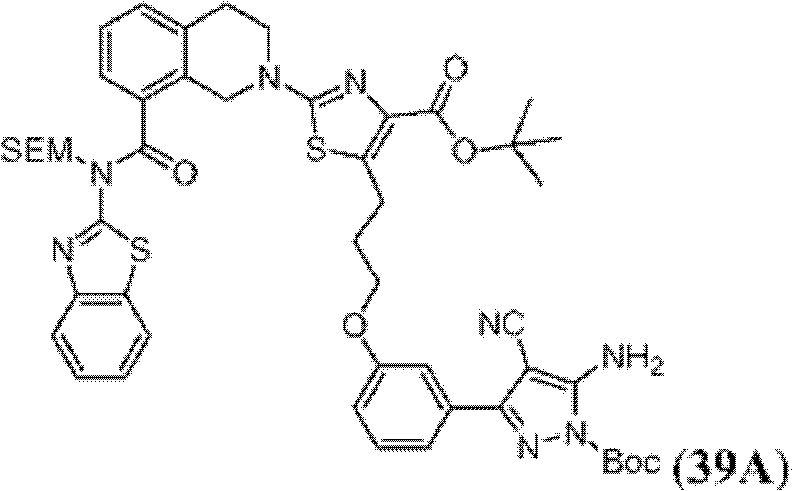
题示化合物39A用与化合物35A的合成类似的方式制备,分别用化合物38E和化合物36A代替化合物34D和化合物31F,为两种不可分离的异构体的混合物:MS(ESI(+)):934(M+H)。The title compound 39A was prepared in a similar manner to the synthesis of compound 35A, replacing compound 34D and compound 31F with compound 38E and compound 36A, respectively, as a mixture of two inseparable isomers: MS (ESI (+)): 934 (M+H).
步骤2:题示化合物39的制备:Step 2: Preparation of title compound 39:
题示化合物39用与实施例34的步骤5中描述的程序类似的方式制备,用化合物39A代替化合物34D:1H NMR(DMSO-d6):δ8.03(d,J=7.98Hz,1H),7.79(d,J=7.67Hz,1H),7.65-7.67(m,2H),7.32-7.49(m,6H),6.94-6.96(m,1H),4.84(s,2H),4.01(t,J=6.14Hz,2H),3.70-3.73(m,4H),3.19(t,J=7.52Hz,2H),3.01-3.03(m,2H),2.01-2.05(m,2H)。MS(ESI(+)):m/z 677(M+H)。The title compound 39 was prepared in a similar manner to the procedure described in step 5 of Example 34, substituting compound 39A for compound 34D: 1 H NMR (DMSO-d 6 ): δ8.03 (d, J = 7.98 Hz, 1H ), 7.79(d, J=7.67Hz, 1H), 7.65-7.67(m, 2H), 7.32-7.49(m, 6H), 6.94-6.96(m, 1H), 4.84(s, 2H), 4.01( t, J=6.14Hz, 2H), 3.70-3.73(m, 4H), 3.19(t, J=7.52Hz, 2H), 3.01-3.03(m, 2H), 2.01-2.05(m, 2H). MS (ESI(+)): m/z 677 (M+H).
实施例40Example 40
5-(3-(4-(5-氨基-4-氰基-1H-吡唑-3-基)苯氧基)丙-1-炔基)-2-(8-(苯并[d]噻唑-2-基氨基甲酰基)-3,4-二氢异喹啉-2(1H)-基)噻唑-4-羧酸(40)的合成:5-(3-(4-(5-amino-4-cyano-1H-pyrazol-3-yl)phenoxy)prop-1-ynyl)-2-(8-(benzo[d] Synthesis of Thiazol-2-ylcarbamoyl)-3,4-dihydroisoquinolin-2(1H)-yl)thiazole-4-carboxylic acid (40):
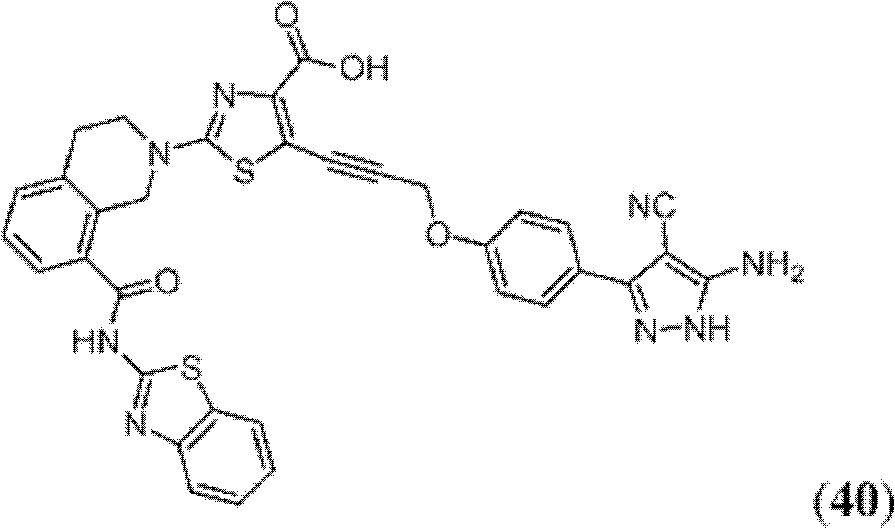
步骤1:5-(3-(4-(5-氨基-1-(叔丁氧基羰基)-4-氰基-1H-吡唑-3-基)苯氧基)丙-1-炔基)-2-(8-(苯并[d]噻唑-2-基(叔丁氧基羰基)氨基甲酰基)-3,4-二氢异喹啉-2(1H)-基)噻唑-4-羧酸乙酯(40A)的制备:Step 1: 5-(3-(4-(5-Amino-1-(tert-butoxycarbonyl)-4-cyano-1H-pyrazol-3-yl)phenoxy)prop-1-ynyl )-2-(8-(benzo[d]thiazol-2-yl(tert-butoxycarbonyl)carbamoyl)-3,4-dihydroisoquinolin-2(1H)-yl)thiazole-4 - Preparation of ethyl carboxylate (40A):
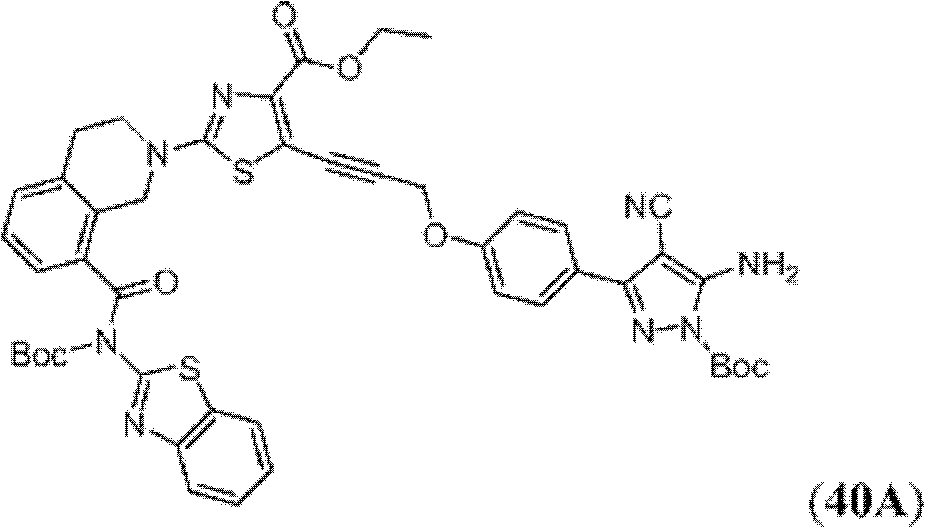
化合物40A用与实施例35的步骤1中描述的合成类似的方式制备,用化合物36B代替化合物34D,为两种不可分离的异构体的混合物:MS(ESI(+)):m/z 932(M+H)。Compound 40A was prepared in a similar manner to the synthesis described in step 1 of Example 35, substituting compound 36B for compound 34D as a mixture of two inseparable isomers: MS (ESI(+)): m/z 932 (M+H).
步骤2:题示化合物40的制备:Step 2: Preparation of the title compound 40:
题示化合物40用与化合物34的合成类似的方式制备,用化合物40A代替化合物34D:1H NMR(DMSO-d6):δ8.03(d,J=7.98Hz,1H),7.60-7.80(m,5H),7.34-7.50(m,6H),7.32-7.49(m,6H),7.12(d,J=8.9Hz,2H),5.10(s,2H),4.91(s,2H),3.73-3.75(m,2H),3.05-3.07(m,2H)。MS(ESI(+)):m/z 673(M+H)。The title compound 40 was prepared in a similar manner to the synthesis of compound 34, replacing compound 34D with compound 40A: 1 H NMR (DMSO-d 6 ): δ8.03 (d, J=7.98Hz, 1H), 7.60-7.80 ( m, 5H), 7.34-7.50(m, 6H), 7.32-7.49(m, 6H), 7.12(d, J=8.9Hz, 2H), 5.10(s, 2H), 4.91(s, 2H), 3.73 -3.75 (m, 2H), 3.05-3.07 (m, 2H). MS (ESI(+)): m/z 673 (M+H).
实施例41Example 41
2-(8-(苯并[d]噻唑-2-基氨基甲酰基)-3,4-二氢异喹啉-2(1H)-基)-5-(3-(4-(吡啶-3-基)苯氧基)丙基)噻唑-4-羧酸(41)的合成:2-(8-(Benzo[d]thiazol-2-ylcarbamoyl)-3,4-dihydroisoquinolin-2(1H)-yl)-5-(3-(4-(pyridine- Synthesis of 3-yl)phenoxy)propyl)thiazole-4-carboxylic acid (41):
步骤1:2-(8-(苯并[d]噻唑-2-基((2-(三甲基甲硅烷基)乙氧基)甲基)氨基甲酰基)-3,4-二氢异喹啉-2(1H)-基)-5-(3-(4-碘苯氧基)丙基)噻唑-4-羧酸叔丁酯(41A)的制备: Step 1 : 2-(8-(Benzo[d]thiazol-2-yl((2-(trimethylsilyl)ethoxy)methyl)carbamoyl)-3,4-dihydroiso Preparation of tert-butyl quinoline-2(1H)-yl)-5-(3-(4-iodophenoxy)propyl)thiazole-4-carboxylate (41A):

向2-(8-(苯并[d]噻唑-2-基((2-(三甲基甲硅烷基)乙氧基)甲基)氨基甲酰基)-3,4-二氢异喹啉-2(1H)-基)-5-(3-羟丙基)噻唑-4-羧酸叔丁酯(92mg,0.135mmol)、三苯基膦(35.4mg,0.135mmol)和4-碘苯酚(29.7mg,0.135mmol)在THF(2mL)中的溶液中,加入DBAD(32mg,0.135mmol)。混合物在室温下搅拌4小时。LC/MS显示预期产物为单峰。混合物用EtOAc稀释,用水、盐水洗涤,用Na2SO4干燥,减压浓缩。粗材料通过柱色谱用硅胶纯化,用含3%EtOAc的己烷洗脱,以提供110mg(92%)所需产物:1H NMR(300MHz,CDCl3)δppm 8.30(1H,m),7.72(1H,d),7.54(4H,m),7.34(3H,m),6.67(2H,d),6.00(2H,s),5.14(2H,s),3.96(4H,m),3.75(2H,t),3.22(2H,t),3.06(2H,t),2.13(2H,m),1.59(9H,s),0.97(2H,t),0.01(9H,m)。MS(ESI(+)):m/z 833(M+H)。To 2-(8-(benzo[d]thiazol-2-yl((2-(trimethylsilyl)ethoxy)methyl)carbamoyl)-3,4-dihydroisoquinoline -2(1H)-yl)-5-(3-hydroxypropyl)thiazole-4-carboxylate tert-butyl ester (92mg, 0.135mmol), triphenylphosphine (35.4mg, 0.135mmol) and 4-iodophenol (29.7 mg, 0.135 mmol) in THF (2 mL) was added DBAD (32 mg, 0.135 mmol). The mixture was stirred at room temperature for 4 hours. LC/MS showed the expected product as a single peak. The mixture was diluted with EtOAc, washed with water, brine, dried over Na2SO4 , concentrated under reduced pressure. The crude material was purified by column chromatography on silica gel eluting with 3% EtOAc in hexanes to afford 110 mg (92%) of the desired product: 1 H NMR (300 MHz, CDCl 3 ) δ ppm 8.30 (1 H, m), 7.72 ( 1H, d), 7.54 (4H, m), 7.34 (3H, m), 6.67 (2H, d), 6.00 (2H, s), 5.14 (2H, s), 3.96 (4H, m), 3.75 (2H , t), 3.22 (2H, t), 3.06 (2H, t), 2.13 (2H, m), 1.59 (9H, s), 0.97 (2H, t), 0.01 (9H, m). MS (ESI(+)): m/z 833 (M+H).
步骤2:题示化合物41的制备: Step 2 : Preparation of title compound 41:
向2-(8-(苯并[d]噻唑-2-基((2-(三甲基甲硅烷基)乙氧基)甲基)氨基甲酰基)-3,4-二氢异喹啉-2(1H)-基)-5-(3-(4-碘苯氧基)丙基)噻唑-4-羧酸叔丁酯(20mg,0.023mmol)和吡啶-3-硼酸(41A)(2.83mg,0.23mmol)在DME/MeOH(2∶1,3mL)中的混合物中,加入Pd(Ph3P)4(1.37mg,0.115umol)和CsF(12mg,0.069mmol)。混合物在100℃在微波加热(Smith合成器)下搅拌30分钟。混合物用EtOAc(200mL)稀释,用水、盐水洗涤,用Na2SO4干燥,减压浓缩。粗材料通过柱色谱纯化,用含5%EtOAc的己烷洗脱,以提供17mg(90%)产物,其立即使用实施例38中描述的相同程序去保护,以提供题示化合物41:1H NMR(300MHz,DMSO-D6)δppm 9.15(1H,s),8.77(1H,d),8.71(1H,d),8.02(1H,d),7.98(1H,m),7.80(2H,d),7.67(1H,d),7.41(5H,m),7.10(2H,d),4.84(2H,m),4.07(2H,m),3.73(2H,m),3.21(4H,m),3.04(2H,t),2.06(2H,m)。MS(ESI(+)):m/z 648(M+H)。To 2-(8-(benzo[d]thiazol-2-yl((2-(trimethylsilyl)ethoxy)methyl)carbamoyl)-3,4-dihydroisoquinoline -2(1H)-yl)-5-(3-(4-iodophenoxy)propyl)thiazole-4-carboxylic acid tert-butyl ester (20 mg, 0.023 mmol) and pyridine-3-boronic acid (41A) ( 2.83 mg, 0.23 mmol) in a mixture of DME/MeOH (2:1, 3 mL), Pd(Ph 3 P) 4 (1.37 mg, 0.115 umol) and CsF (12 mg, 0.069 mmol) were added. The mixture was stirred at 100° C. for 30 minutes under microwave heating (Smith synthesizer). The mixture was diluted with EtOAc (200 mL ), washed with water, brine, dried over Na2SO4 and concentrated under reduced pressure. The crude material was purified by column chromatography eluting with 5% EtOAc in hexanes to provide 17 mg (90%) of product which was immediately deprotected using the same procedure described in Example 38 to provide the title compound 41: 1H NMR (300MHz, DMSO-D 6 ) δppm 9.15 (1H, s), 8.77 (1H, d), 8.71 (1H, d), 8.02 (1H, d), 7.98 (1H, m), 7.80 (2H, d ), 7.67(1H,d), 7.41(5H,m), 7.10(2H,d), 4.84(2H,m), 4.07(2H,m), 3.73(2H,m), 3.21(4H,m) , 3.04(2H,t), 2.06(2H,m). MS (ESI(+)): m/z 648 (M+H).
实施例42Example 42
2-(8-(苯并[d]噻唑-2-基氨基甲酰基)-3,4-二氢异喹啉-2(1H)-基)-5-(4-苯氧基丁基)噻唑-4-羧酸(42A)的合成:2-(8-(Benzo[d]thiazol-2-ylcarbamoyl)-3,4-dihydroisoquinolin-2(1H)-yl)-5-(4-phenoxybutyl) Synthesis of thiazole-4-carboxylic acid (42A):
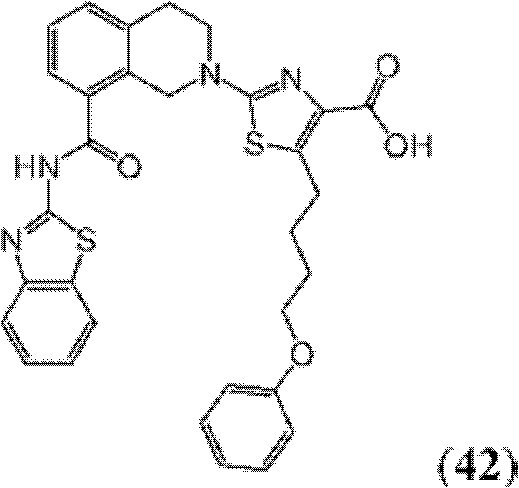
步骤1:3-溴-7-氯-2-氧庚酸乙酯(42A)的制备:Step 1: Preparation of ethyl 3-bromo-7-chloro-2-oxoheptanoate (42A):

题示化合物42A通过在实施例2的步骤1用7-氯-2-氧庚酸乙酯代替6-氯-2-氧己酸乙酯制备:1H NMR(300MHz,DMSO-d6)δppm5.18(1H,dd),4.29(2H,q),3.66(2H,t),2.03(1H,m),1.90(1H,m),1.78(2H,m),1.63(1H,m),1.48(1H,m),1.29(3H,t)。The title compound 42A was prepared by substituting ethyl 7-chloro-2-oxoheptanoate for ethyl 6-chloro-2-oxohexanoate in Step 1 of Example 2: 1 H NMR (300 MHz, DMSO-d 6 ) δppm5 .18(1H,dd), 4.29(2H,q), 3.66(2H,t), 2.03(1H,m), 1.90(1H,m), 1.78(2H,m), 1.63(1H,m), 1.48 (1H, m), 1.29 (3H, t).
步骤2:2-(8-(苯并[d]噻唑-2-基氨基甲酰基)-3,4-二氢异喹啉-2(1H)-基)-5-(4-氯丁基)噻唑-4-羧酸乙酯(42B)的制备: Step 2 : 2-(8-(Benzo[d]thiazol-2-ylcarbamoyl)-3,4-dihydroisoquinolin-2(1H)-yl)-5-(4-chlorobutyl ) Preparation of ethyl thiazole-4-carboxylate (42B):

题示化合物42B通过在实施例2的步骤2用化合物42A代替化合物2A制备:1H NMR(300MHz,DMSO-d6)δppm 12.88(1H,s),8.03(1H,d),7.79(1H,d),7.66(1H,d),7.42(4H,m),4.82(2H,s),4.19(2H,q),3.72(2H,t),3.63(2H,t),3.03(4H,m),1.70(4H,m),1.20(3H,t)。The title compound 42B was prepared by substituting compound 42A for compound 2A in step 2 of Example 2: 1 H NMR (300 MHz, DMSO-d 6 ) δppm 12.88 (1H, s), 8.03 (1H, d), 7.79 (1H, d), 7.66(1H,d), 7.42(4H,m), 4.82(2H,s), 4.19(2H,q), 3.72(2H,t), 3.63(2H,t), 3.03(4H,m ), 1.70 (4H, m), 1.20 (3H, t).
步骤3:2-(8-(苯并[d]噻唑-2-基氨基甲酰基)-3,4-二氢异喹啉-2(1H)-基)-5-(4-碘丁基)噻唑-4-羧酸乙酯(42C)的制备: Step 3 : 2-(8-(Benzo[d]thiazol-2-ylcarbamoyl)-3,4-dihydroisoquinolin-2(1H)-yl)-5-(4-iodobutyl ) Preparation of ethyl thiazole-4-carboxylate (42C):

题示化合物42C通过在实施例2的步骤3用化合物42B代替化合物2B制备:1H NMR(300MHz,DMSO-d6)δppm 12.89(1H,s),8.04(1H,d),7.79(1H,d),7.66(1H,d),7.41(4H,m),4.82(2H,s),4.19(2H,q),3.72(2H,t),3.27(2H,t),3.03(4H,m),1.77(2H,m),1.63(2H,m),1.20(3H,t)。The title compound 42C was prepared by substituting compound 42B for compound 2B in step 3 of Example 2: 1 H NMR (300 MHz, DMSO-d 6 ) δ ppm 12.89 (1H, s), 8.04 (1H, d), 7.79 (1H, d), 7.66(1H,d), 7.41(4H,m), 4.82(2H,s), 4.19(2H,q), 3.72(2H,t), 3.27(2H,t), 3.03(4H,m ), 1.77 (2H, m), 1.63 (2H, m), 1.20 (3H, t).
步骤4:题示化合物42的制备: Step 4 : Preparation of Title Compound 42:
题示化合物42通过在实施例2的步骤4用化合物42C代替化合物2C制备:1H NMR(400MHz,DMSO-d6)δppm 12.86(1H,s),8.02(1H,d),7.78(1H,d),7.66(1H,d),7.46(2H,m),7.36(2H,m),7.23(2H,t),6.88(3H,m),4.81(2H,s),3.94(2H,t),3.72(2H,t),3.09(2H,m),3.02(2H,t),1.70(4H,m)。MS(ESI(+)):m/z 585(M+H)。The title compound 42 was prepared by substituting compound 42C for compound 2C in step 4 of Example 2: 1 H NMR (400 MHz, DMSO-d 6 ) δppm 12.86 (1H, s), 8.02 (1H, d), 7.78 (1H, d), 7.66(1H,d), 7.46(2H,m), 7.36(2H,m), 7.23(2H,t), 6.88(3H,m), 4.81(2H,s), 3.94(2H,t ), 3.72 (2H, t), 3.09 (2H, m), 3.02 (2H, t), 1.70 (4H, m). MS (ESI(+)): m/z 585 (M+H).
实施例43Example 43
5-(4-(4-(1H-吡唑并[3,4-d]嘧啶-1-基)苯氧基)丁基)-2-(8-(苯并[d]噻唑-2-基氨基甲酰基)-3,4-二氢异喹啉-2(1H)-基)噻唑-4-羧酸(43)的合成:5-(4-(4-(1H-pyrazolo[3,4-d]pyrimidin-1-yl)phenoxy)butyl)-2-(8-(benzo[d]thiazole-2- Synthesis of (carbamoyl)-3,4-dihydroisoquinolin-2(1H)-yl)thiazole-4-carboxylic acid (43):
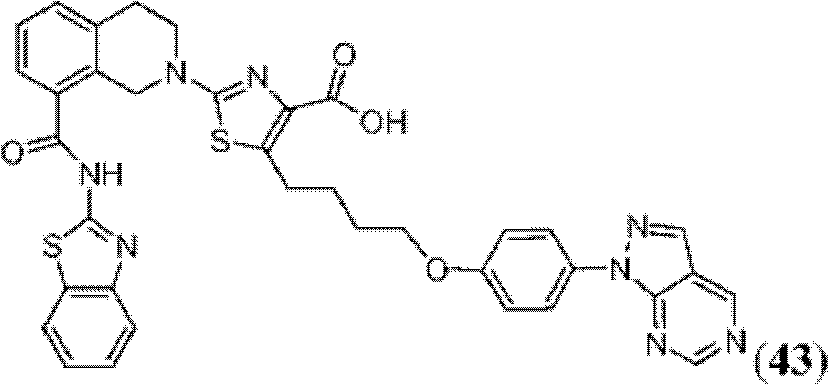
题示化合物43使用实施例21中描述的相同程序制备,用化合物42C代替化合物2C:1H NMR(400MHz,DMSO-D6)δppm 12.87(1H,s),9.45(1H,s),9.10(1H,s),8.61(1H,s),7.92-8.10(3H,m),7.78(1H,d),7.67(1H,d),7.42-7.48(2H,m),7.31-7.41(2H,m),7.07-7.16(2H,m),4.83(2H,s),4.05(2H,t),3.73(2H,t),3.12(2H,t),3.03(2H,t),1.68-1.83(4H,m)。LCMS(APCI)703(M+H)。Title compound 43 was prepared using the same procedure described in Example 21, substituting compound 42C for compound 2C: 1 H NMR (400 MHz, DMSO-D 6 ) δ ppm 12.87 (1H, s), 9.45 (1H, s), 9.10 ( 1H, s), 8.61 (1H, s), 7.92-8.10 (3H, m), 7.78 (1H, d), 7.67 (1H, d), 7.42-7.48 (2H, m), 7.31-7.41 (2H, m), 7.07-7.16(2H, m), 4.83(2H, s), 4.05(2H, t), 3.73(2H, t), 3.12(2H, t), 3.03(2H, t), 1.68-1.83 (4H, m). LCMS (APCI) 703 (M+H).
实施例44Example 44
2-(8-(苯并[d]噻唑-2-基氨基甲酰基)-3,4-二氢异喹啉-2(1H)-基)-5-(3-(4-(4-(异丙基氨基)-1H-吡唑并[3,4-d]嘧啶-1-基)苯氧基)丙基)噻唑-4-羧酸(44)的合成:2-(8-(Benzo[d]thiazol-2-ylcarbamoyl)-3,4-dihydroisoquinolin-2(1H)-yl)-5-(3-(4-(4- Synthesis of (isopropylamino)-1H-pyrazolo[3,4-d]pyrimidin-1-yl)phenoxy)propyl)thiazole-4-carboxylic acid (44):
步骤1:5-氨基-1-(4-甲氧基苯基)-1H-吡唑-4-羧酸乙酯(44A)的制备 Step 1 : Preparation of ethyl 5-amino-1-(4-methoxyphenyl)-1H-pyrazole-4-carboxylate (44A)
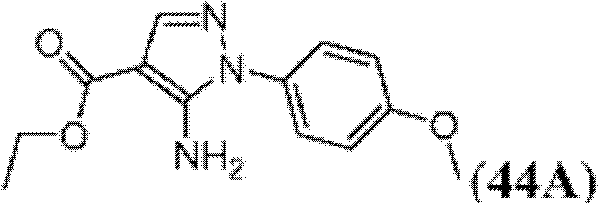
2-氰基-3-乙氧基丙烯酸(Z)-乙酯(9.64g,57.0mmol)、4-甲氧基苯基肼盐酸盐(9.95g,57.0mmol)和Na2CO3(6.04g,57.0mmol)在EtOH(480mL)中的混合物回流5h并在室温下搅拌过夜。滤去不溶的材料,浓缩滤液,固体沉淀。收集沉淀,用MeOH洗涤,并用水广泛洗涤。干燥浅色固体,以提供所需产物:1H NMR(400MHz,DMSO-D6)δppm 7.65(1H,s),7.42(2H,d),7.07(2H,d),6.15(2H,s),4.14-4.26(2H,m),3.81(3H,s),1.27(3H,t)。2-cyano-3-ethoxyacrylate (Z)-ethyl ester (9.64g, 57.0mmol), 4-methoxyphenylhydrazine hydrochloride (9.95g, 57.0mmol) and Na 2 CO 3 (6.04 g, 57.0 mmol) in EtOH (480 mL) was refluxed for 5 h and stirred at room temperature overnight. Insoluble material was filtered off, the filtrate was concentrated and a solid precipitated. The precipitate was collected, washed with MeOH, and washed extensively with water. The pale solid was dried to afford the desired product: 1 H NMR (400 MHz, DMSO-D 6 ) δ ppm 7.65 (1H, s), 7.42 (2H, d), 7.07 (2H, d), 6.15 (2H, s) , 4.14-4.26 (2H, m), 3.81 (3H, s), 1.27 (3H, t).
步骤2:1-(4-甲氧基苯基)-1H-吡唑并[3,4-d]嘧啶-4(3aH)-酮(44B)的制备: Step 2 : Preparation of 1-(4-methoxyphenyl)-1H-pyrazolo[3,4-d]pyrimidin-4(3aH)-one (44B):
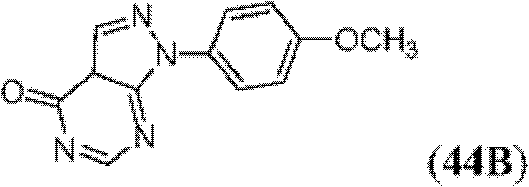
化合物44A(7g,26.8mmol)和甲酰胺(64.1mL,1607mmol)的混合物在180℃加热过夜并冷却。收集沉淀,用水洗涤,干燥,以提供所需产物:1H NMR(400MHz,DMSO-D6)δppm 12.35(1H,s),8.28(1H,s),8.15(1H,s),7.85-7.93(2H,m),7.09-7.14(2H,m),3.82(3H,s)。A mixture of compound 44A (7 g, 26.8 mmol) and formamide (64.1 mL, 1607 mmol) was heated at 180 °C overnight and cooled. The precipitate was collected, washed with water, and dried to afford the desired product: 1 H NMR (400 MHz, DMSO-D6) δppm 12.35 (1H, s), 8.28 (1H, s), 8.15 (1H, s), 7.85-7.93 ( 2H, m), 7.09-7.14 (2H, m), 3.82 (3H, s).
步骤3:4-氯-1-(4-甲氧基苯基)-1H-吡唑并[3,4-d]嘧啶(44C)的制备: Step 3 : Preparation of 4-chloro-1-(4-methoxyphenyl)-1H-pyrazolo[3,4-d]pyrimidine (44C):
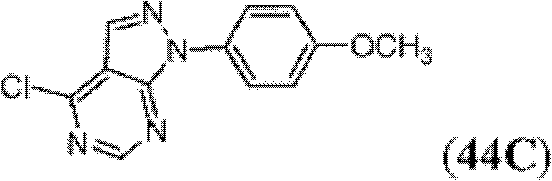
化合物44B(2g,8.26mmol)和磷酰氯(11.51mL,124mmol)的混合物在100℃加热2h并冷却。反应混合物缓慢倒到冰上。收集沉淀,用水洗涤,干燥,以提供所需产物。MS(APCI):m/z 261(M+H)。A mixture of compound 44B (2 g, 8.26 mmol) and phosphorus oxychloride (11.51 mL, 124 mmol) was heated at 100 °C for 2 h and cooled. The reaction mixture was poured slowly onto ice. The precipitate was collected, washed with water and dried to provide the desired product. MS (APCI): m/z 261 (M+H).
步骤4:4-(4-(异丙基氨基)-1H-吡唑并[3,4-d]嘧啶-1-基)苯酚(44D)的制备: Step 4 : Preparation of 4-(4-(isopropylamino)-1H-pyrazolo[3,4-d]pyrimidin-1-yl)phenol (44D):
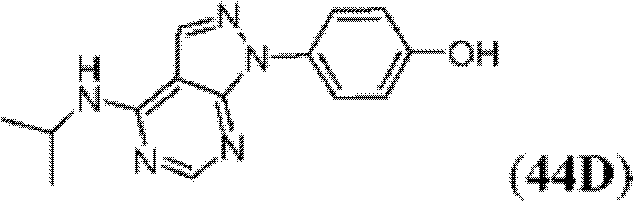
向化合物44C(388mg,1.48mmol)和丙-2-胺(0.14mL,1.63mmol)在THF(10mL)中的混合物中,加入TEA(0.456mL,3.27mmol)。得到的混合物在30℃搅拌过夜,用EtOAc稀释。有机层用盐水洗涤,用Na2SO4干燥,减压浓缩,干燥。向粗材料中加入含三甲基碘硅烷(1.0mL,7.06mmol)的环丁砜(5mL)。反应混合物在80℃加热过夜。将反应缓慢倒入冰-水(5mL)中。收集沉淀,用水洗涤,通过反相HPLC纯化(流动相:含0%-50%乙腈的0.1%TFA水溶液,40分钟内),以提供题示化合物:1H NMR(400MHz,DMSO-D6)δppm 9.68(1H,s,br),8.55(1H,s,br),8.39(1H,s),8.35(1H,s),7.82(2H,d),6.88-6.94(2H,m),4.34-4.46(1H,m),1.28(6H,d)To a mixture of compound 44C (388 mg, 1.48 mmol) and propan-2-amine (0.14 mL, 1.63 mmol) in THF (10 mL) was added TEA (0.456 mL, 3.27 mmol). The resulting mixture was stirred overnight at 30 °C and diluted with EtOAc. The organic layer was washed with brine, dried over Na2SO4 , concentrated under reduced pressure, and dried. To the crude material was added iodotrimethylsilane (1.0 mL, 7.06 mmol) in sulfolane (5 mL). The reaction mixture was heated at 80°C overnight. The reaction was slowly poured into ice-water (5 mL). The precipitate was collected, washed with water, and purified by reverse phase HPLC (mobile phase: 0%-50% acetonitrile in 0.1% TFA in water within 40 minutes) to provide the title compound: 1 H NMR (400 MHz, DMSO-D 6 ) δppm 9.68 (1H, s, br), 8.55 (1H, s, br), 8.39 (1H, s), 8.35 (1H, s), 7.82 (2H, d), 6.88-6.94 (2H, m), 4.34 -4.46(1H,m), 1.28(6H,d)
步骤5:题示化合物44的制备: Step 5 : Preparation of Title Compound 44:
题示化合物44使用实施例21的步骤5中描述的相同程序制备,用化合物44D代替化合物21D:1H NMR(400MHz,DMSO-D6)δppm12.87(1H,s),8.45(1H,s),8.39(1H,s),8.34(1H,s),8.01(1H,d),7.98(2H,d),7.79(1H,d),7.65-7.73(2H,m),7.43-7.49(2H,m),7.32-7.41(2H,m),7.07(2H,d),4.84(2H,s),4.09-4.20(1H,m),4.04(2H,t),3.73(2H,t),3.20(2H,t),3.03(2H,t),2.00-2.08(2H,m),1.28(3H,s),1.27(3H,s)。LCMS(APCI):m/z 746(M+H)。Title compound 44 was prepared using the same procedure described in step 5 of Example 21, substituting compound 44D for compound 21D: 1 H NMR (400 MHz, DMSO-D 6 ) δ ppm 12.87 (1H, s), 8.45 (1H, s ), 8.39(1H, s), 8.34(1H, s), 8.01(1H, d), 7.98(2H, d), 7.79(1H, d), 7.65-7.73(2H, m), 7.43-7.49( 2H, m), 7.32-7.41 (2H, m), 7.07 (2H, d), 4.84 (2H, s), 4.09-4.20 (1H, m), 4.04 (2H, t), 3.73 (2H, t) , 3.20(2H,t), 3.03(2H,t), 2.00-2.08(2H,m), 1.28(3H,s), 1.27(3H,s). LCMS (APCI): m/z 746 (M+H).
实施例45Example 45
5-((4-(5-氨基-4-氰基-1H-吡唑-3-基)苯氧基)甲基)-2-(8-(苯并[d]噻唑-2-基氨基甲酰基)-3,4-二氢异喹啉-2(1H)-基)噻唑-4-羧酸(45)的合成:5-((4-(5-amino-4-cyano-1H-pyrazol-3-yl)phenoxy)methyl)-2-(8-(benzo[d]thiazol-2-ylamino Synthesis of formyl)-3,4-dihydroisoquinolin-2(1H)-yl)thiazole-4-carboxylic acid (45):
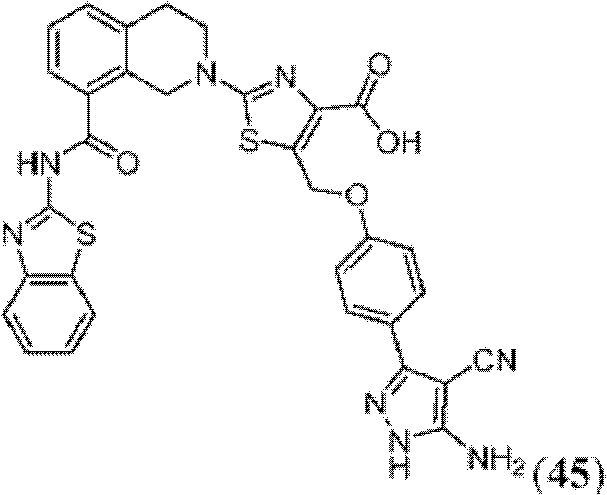
步骤1:N-(苯并[d]噻唑-2-基)-2-(4-氯-5-甲酰噻唑-2-基)-1,2,3,4-四氢异喹啉-8-甲酰胺(45A)的制备: Step 1 : N-(Benzo[d]thiazol-2-yl)-2-(4-chloro-5-formylthiazol-2-yl)-1,2,3,4-tetrahydroisoquinoline- Preparation of 8-formamide (45A):

化合物1B(3.82g,10mmol)、2,4-二氯噻唑-5-甲醛(1.82g,10mmol)和Cs2CO3(9.77g,30mmol)在DMA(30mL)中的混合物,在60℃加热8小时,冷却至室温,然后倒入水(500mL)中。通过过滤收集固体,在真空烤箱中干燥过夜(60℃),以提供4.2g所需产物(45A):1HNMR(DMSO-d6):δ12.66(s,1H),9.69(s,1H),8.00(d,J=7.82Hz,1H),7.77(d,J=8.06Hz,1H),7.73(d,J=7.58Hz,1H),7.40-7.49(m,3H),7.33-7.36(m,1H),5.04(s,2H),3.82(t,J=5.92Hz,2H),3.11(t,J=6.16Hz,2H)。MS(ESI(+)):m/z 455(M+H)。A mixture of compound 1B (3.82g, 10mmol), 2,4-dichlorothiazole-5-carbaldehyde (1.82g, 10mmol) and Cs2CO3 ( 9.77g , 30mmol) in DMA (30mL) was heated at 60°C 8 hours, cooled to room temperature, then poured into water (500 mL). The solid was collected by filtration and dried in a vacuum oven overnight (60 °C) to afford 4.2 g of the desired product (45A): 1 H NMR (DMSO-d 6 ): δ 12.66 (s, 1H), 9.69 (s, 1H ), 8.00(d, J=7.82Hz, 1H), 7.77(d, J=8.06Hz, 1H), 7.73(d, J=7.58Hz, 1H), 7.40-7.49(m, 3H), 7.33-7.36 (m, 1H), 5.04 (s, 2H), 3.82 (t, J=5.92Hz, 2H), 3.11 (t, J=6.16Hz, 2H). MS (ESI(+)): m/z 455 (M+H).
步骤2:(E)-2-(4-氯-5-甲酰噻唑-2-基)-N-(3-((2-(三甲基甲硅烷基)乙氧基)甲基)苯并[d]噻唑-2(3H)-亚基)-1,2,3,4-四氢异喹啉-8-甲酰胺(45B)的制备: Step 2 : (E)-2-(4-chloro-5-formylthiazol-2-yl)-N-(3-((2-(trimethylsilyl)ethoxy)methyl)benzene Preparation of [d]thiazole-2(3H)-ylidene)-1,2,3,4-tetrahydroisoquinoline-8-carboxamide (45B):
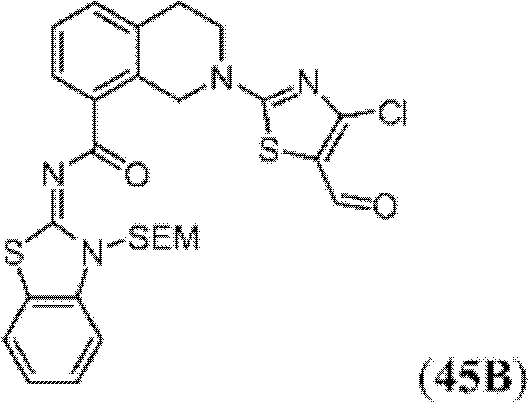
化合物45B用与化合物34C的合成类似的方式制备,在实施例34的步骤3中用化合物45A代替化合物34B。通过用1∶4己烷∶EtOAc研磨两种异构体的混合物,分离化合物45B,为白色固体。另一种异构体从母液中分离:1H NMR(DMSO-d6):δ9.71(s,1H),8.24(d,J=7.82Hz,1H),7.92(d,J=7.58Hz,1H),7.70(d,J=8.06Hz,1H),7.53-7.56(m,1H),7.36-7.46(m,3H),6.01(s,2H),5.35(s,2H),3.85(t,J=5.92Hz,2H),3.72-3.75(m,2H),3.11(t,J=6.04Hz,2H)。MS(ESI(+)):m/z 585(M+H)。Compound 45B was prepared in a similar manner to the synthesis of compound 34C by substituting compound 45A for compound 34B in step 3 of example 34. Compound 45B was isolated as a white solid by trituration of a mixture of the two isomers with 1:4 hexanes:EtOAc. The other isomer was isolated from the mother liquor: 1 H NMR (DMSO-d 6 ): δ9.71(s, 1H), 8.24(d, J=7.82Hz, 1H), 7.92(d, J=7.58Hz , 1H), 7.70(d, J=8.06Hz, 1H), 7.53-7.56(m, 1H), 7.36-7.46(m, 3H), 6.01(s, 2H), 5.35(s, 2H), 3.85( t, J=5.92Hz, 2H), 3.72-3.75(m, 2H), 3.11(t, J=6.04Hz, 2H). MS (ESI(+)): m/z 585 (M+H).
步骤3:5-甲酰-2-(8-(3-((2-(三甲基甲硅烷基)乙氧基)甲基)苯并[d]噻唑-2(3H)-亚基氨基甲酰基)-3,4-二氢异喹啉-2(1H)-基)噻唑-4-羧酸(E)-甲酯(45C): Step 3 : 5-Formyl-2-(8-(3-((2-(trimethylsilyl)ethoxy)methyl)benzo[d]thiazole-2(3H)-ylideneamino Formyl)-3,4-dihydroisoquinolin-2(1H)-yl)thiazole-4-carboxylic acid (E)-methyl ester (45C):
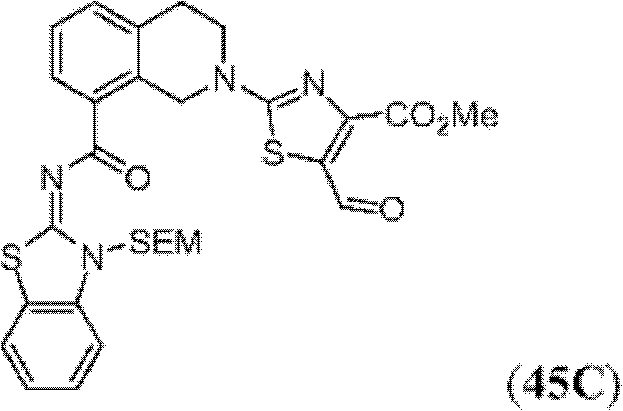
在250mL SS耐压瓶中,含化合物45B(4.6g,7.86mmol)的MeOH(50mL)加入到Pd-dppf(0.288g,0.393mmol)和NEt3(2.191mL,15.72mmol)中。混合物用CO(60psi)加压,并在100℃搅拌7h。滤去固体,然后浓缩滤液。残余物通过快速柱色谱用硅胶纯化,用3∶1/己烷∶EtOAc洗脱,以提供4.45g所需产物45C:1H NMR(DMSO-d6):δ10.16(s,1H),8.27(d,J=6.74Hz,1H),7.96(d,J=7.14Hz,1H),7.72(d,J=8.33Hz,1H),7.53-7.56(m,1H),7.37-7.42(m,3H),6.01(s,2H),5.32(s,2H),3.85-3.88(m,5H),3.66-3.71(m,2H),3.09(t,J=5.95Hz,2H),0.85-0.91(m,2H),-0.19(s,9H)。MS(ESI(+)):m/z 609(M+H)。Compound 45B (4.6 g, 7.86 mmol) in MeOH (50 mL) was added to Pd-dppf (0.288 g, 0.393 mmol) and NEt 3 (2.191 mL, 15.72 mmol) in a 250 mL SS pressure bottle. The mixture was pressurized with CO (60 psi) and stirred at 100 °C for 7 h. The solids were filtered off, and the filtrate was concentrated. The residue was purified by flash column chromatography on silica gel, eluting with 3:1/hexanes:EtOAc, to provide 4.45 g of the desired product 45C: 1 H NMR (DMSO-d 6 ): δ 10.16 (s, 1H), 8.27(d, J=6.74Hz, 1H), 7.96(d, J=7.14Hz, 1H), 7.72(d, J=8.33Hz, 1H), 7.53-7.56(m, 1H), 7.37-7.42(m , 3H), 6.01(s, 2H), 5.32(s, 2H), 3.85-3.88(m, 5H), 3.66-3.71(m, 2H), 3.09(t, J=5.95Hz, 2H), 0.85- 0.91 (m, 2H), -0.19 (s, 9H). MS (ESI(+)): m/z 609 (M+H).
步骤4:5-(羟甲基)-2-(8-(3-((2-(三甲基甲硅烷基)乙氧基)甲基)苯并[d]噻唑-2(3H)-亚基氨基甲酰基)-3,4-二氢异喹啉-2(1H)-基)噻唑-4-羧酸(E)-甲酯(45D)的制备: Step 4 : 5-(Hydroxymethyl)-2-(8-(3-((2-(trimethylsilyl)ethoxy)methyl)benzo[d]thiazole-2(3H)- Preparation of (E)-methylidenecarbamoyl)-3,4-dihydroisoquinolin-2(1H)-yl)thiazole-4-carboxylate (45D):
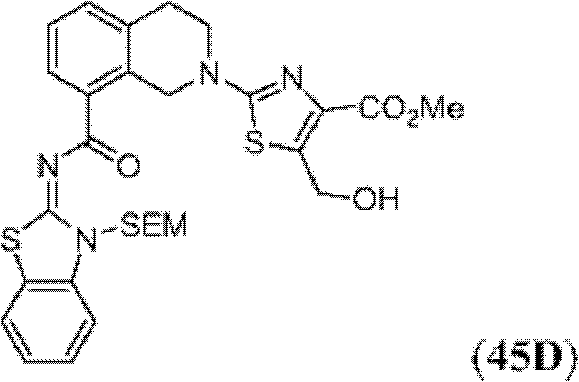
向在MeOH(50mL)和THF(20mL)中的化合物45C(2.08g,3.42mmol),加入NaBH4(0.259g,6.83mmol)。反应混合物在70℃加热2小时。除去溶剂,残余物在EtOAc和水之间分离。分离有机层,用额外的EtOAc萃取水层。合并的有机层用盐水洗涤,用MgSO4干燥,减压浓缩。粗材料通过柱色谱用硅胶纯化,用1∶1/己烷∶EtOAc洗脱,以提供1.86g所需产物:1H NMR(DMSO-d6):δ8.24-8.26(m,1H),7.94(d,J=7.67Hz,1H),7.70(d,J=8.20Hz,1H),7.52-7.56(m,1H),7.34-7.42(m,3H),6.00(s,2H),5.77(t,J=5.52Hz,1H),5.13(s,2H),4.83(d,J=5.52Hz,2H),3.67-3.75(m,7H),3.03(t,J=5.98Hz,2H),0.87-0.91(m,2H),-0.18(s,9H)。MS(ESI(+)):m/z 611(M+H)。To compound 45C (2.08 g, 3.42 mmol) in MeOH (50 mL) and THF (20 mL) was added NaBH4 (0.259 g, 6.83 mmol). The reaction mixture was heated at 70°C for 2 hours. The solvent was removed and the residue was partitioned between EtOAc and water. The organic layer was separated and the aqueous layer was extracted with additional EtOAc. The combined organic layers were washed with brine, dried over MgSO 4 and concentrated under reduced pressure. The crude material was purified by column chromatography on silica gel, eluting with 1:1/hexanes:EtOAc, to provide 1.86 g of the desired product: 1 H NMR (DMSO-d 6 ): δ 8.24-8.26 (m, 1H), 7.94(d, J=7.67Hz, 1H), 7.70(d, J=8.20Hz, 1H), 7.52-7.56(m, 1H), 7.34-7.42(m, 3H), 6.00(s, 2H), 5.77 (t, J=5.52Hz, 1H), 5.13(s, 2H), 4.83(d, J=5.52Hz, 2H), 3.67-3.75(m, 7H), 3.03(t, J=5.98Hz, 2H) , 0.87-0.91 (m, 2H), -0.18 (s, 9H). MS (ESI(+)): m/z 611 (M+H).
步骤5:5-((4-(5-氨基-1-(叔丁氧基羰基)-4-氰基-1H-吡唑-3-基)苯氧基)甲基)-2-(8-(3-((2-(三甲基甲硅烷基)乙氧基)甲基)苯并[d]噻唑-2(3H)-亚基氨基甲酰基)-3,4-二氢异喹啉-2(1H)-基)噻唑-4-羧酸(E)-甲酯(45E)的制备: Step 5 : 5-((4-(5-Amino-1-(tert-butoxycarbonyl)-4-cyano-1H-pyrazol-3-yl)phenoxy)methyl)-2-(8 -(3-((2-(trimethylsilyl)ethoxy)methyl)benzo[d]thiazole-2(3H)-ylidenecarbamoyl)-3,4-dihydroisoquinone Preparation of (E)-methyl phenin-2(1H)-yl)thiazole-4-carboxylate (45E):
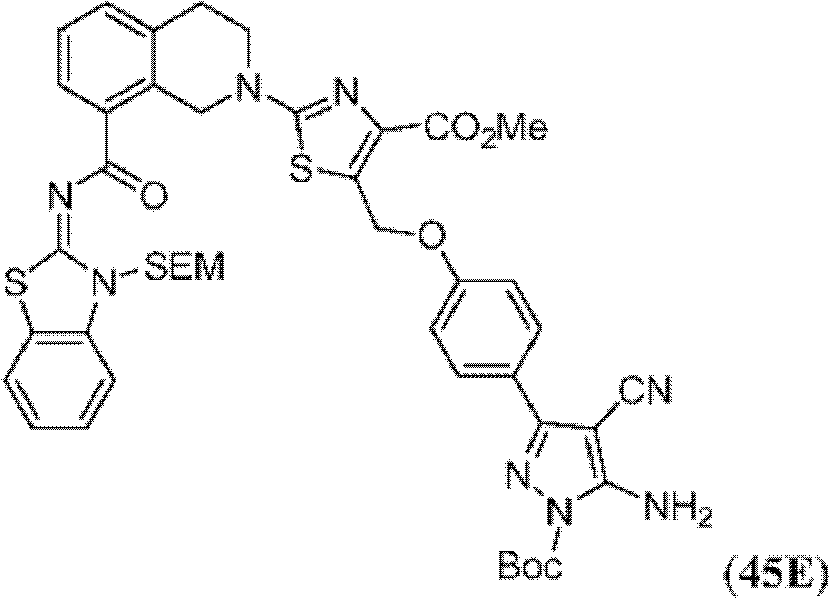
化合物45E用与化合物35A的合成类似的方式制备,在实施例35的步骤1中用化合物45D代替化合物34D:1H NMR(DMSO-d6):δ8.24(dd,J=7.52,1.38Hz,1H),7.94(d,J=7.67Hz,1H),7.70(d,J=7.98Hz,1H),7.67(s,2H),7.53-7.57(m,1H),7.34-7.43(m,3H),7.10-7.14(m,2H),6.00(s,2H),5.57(s,2H),5.17(s,2H),3.81(s,3H),3.76(t,J=5.98Hz,2H),3.66-3.70(m,2H),3.04(t,J=6.14Hz,2H),0.85-0.89(m,2H),-0.20(s,9H)。MS(ESI(+)):m/z 892(M+NH4-H2O)。Compound 45E was prepared in a similar manner to the synthesis of Compound 35A by substituting Compound 45D for Compound 34D in Step 1 of Example 35: 1 H NMR (DMSO-d 6 ): δ8.24 (dd, J=7.52, 1.38Hz , 1H), 7.94(d, J=7.67Hz, 1H), 7.70(d, J=7.98Hz, 1H), 7.67(s, 2H), 7.53-7.57(m, 1H), 7.34-7.43(m, 3H), 7.10-7.14(m, 2H), 6.00(s, 2H), 5.57(s, 2H), 5.17(s, 2H), 3.81(s, 3H), 3.76(t, J=5.98Hz, 2H ), 3.66-3.70 (m, 2H), 3.04 (t, J=6.14Hz, 2H), 0.85-0.89 (m, 2H), -0.20 (s, 9H). MS (ESI(+)): m/z 892 (M+ NH4 - H2O ).
步骤6:题示化合物45的制备: Step 6 : Preparation of Title Compound 45:
题示化合物45用与化合物34的合成类似的方式制备,用化合物45E代替化合物34D:1H NMR(DMSO-d6):δ8.02(d,J=7.67Hz,1H),7.78(d,J=7.98Hz,1H),7.59-7.71(m,3H),7.33-7.48(m,4H),7.05(d,J=7.59Hz,1H),6.83(d,J=7.67Hz,1H),5.54(s,2H),4.77-4.86(m,4H),3.74(t,J=5.68Hz,2H),3.04(t,J=5.83Hz,2H)。MS(ESI(+)):m/z 647(M-H)。The title compound 45 was prepared in a similar manner to the synthesis of compound 34, replacing compound 34D with compound 45E: 1 H NMR (DMSO-d 6 ): δ8.02 (d, J=7.67Hz, 1H), 7.78 (d, J=7.98Hz, 1H), 7.59-7.71(m, 3H), 7.33-7.48(m, 4H), 7.05(d, J=7.59Hz, 1H), 6.83(d, J=7.67Hz, 1H), 5.54(s, 2H), 4.77-4.86(m, 4H), 3.74(t, J=5.68Hz, 2H), 3.04(t, J=5.83Hz, 2H). MS (ESI(+)): m/z 647 (MH).
实施例46Example 46
5-[3-(5-氨基-4-氰基-1H-吡唑-3-基)-苯氧基甲基]-2-[8-(苯并噻唑-2-基氨基甲酰基)-3,4-二氢-1H-异喹啉-2-基]-噻唑-4-羧酸(46)的合成:5-[3-(5-amino-4-cyano-1H-pyrazol-3-yl)-phenoxymethyl]-2-[8-(benzothiazol-2-ylcarbamoyl)- Synthesis of 3,4-dihydro-1H-isoquinolin-2-yl]-thiazole-4-carboxylic acid (46):

步骤1:5-((3-(5-氨基-1-(叔丁氧基羰基)-4-氰基-1H-吡唑-3-基)苯氧基)甲基)-2-(8-(3-((2-(三甲基甲硅烷基)乙氧基)甲基)苯并[d]噻唑-2(3H)-亚基氨基甲酰基)-3,4-二氢异喹啉-2(1H)-基)噻唑-4-羧酸(E)-甲酯(46A)的制备: Step 1 : 5-((3-(5-Amino-1-(tert-butoxycarbonyl)-4-cyano-1H-pyrazol-3-yl)phenoxy)methyl)-2-(8 -(3-((2-(trimethylsilyl)ethoxy)methyl)benzo[d]thiazole-2(3H)-ylidenecarbamoyl)-3,4-dihydroisoquinone Preparation of (E)-methyl phenoline-2(1H)-yl)thiazole-4-carboxylate (46A):
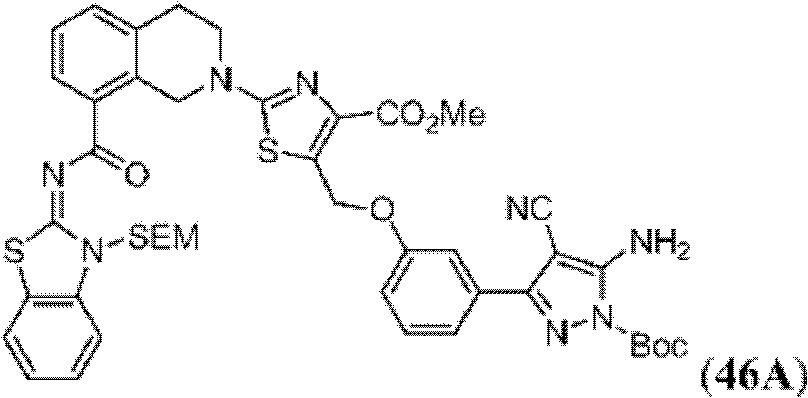
题示化合物(46A)用与化合物35A的合成类似的方式制备,在实施例35的步骤1中分别用化合物45D和化合物36A代替化合物34D和化合物31F:LCMS(ESI(+)):m/z 892(M+NH4-H2O)。The title compound (46A) was prepared in a similar manner to the synthesis of compound 35A, replacing compound 34D and compound 31F with compound 45D and compound 36A in step 1 of Example 35: LCMS (ESI (+)): m/z 892 (M+ NH4 - H2O ).
步骤2:题示化合物46的制备: Step 2 : Preparation of Title Compound 46:
题示化合物46用与化合物34的合成类似的方式制备,在实施例34的步骤5中用化合物46A代替化合物34D:1H NMR(DMSO-d6):δ12.83(s,1H),7.96(d,J=7.93Hz,1H),7.72(d,J=7.93Hz,1H),7.61(d,J=7.32Hz,1H),7.27-7.42(m,7H),6.95(d,J=7.93Hz,1H),5.47(s,2H),4.72-4.81(m,4H),3.74(t,J=5.68Hz,2H),2.98(t,J=5.65Hz,2H)。MS(ESI(+)):m/z 649(M+H)。The title compound 46 was prepared in a similar manner to the synthesis of compound 34, replacing compound 34D with compound 46A in step 5 of Example 34: 1 H NMR (DMSO-d 6 ): δ12.83 (s, 1H), 7.96 (d, J=7.93Hz, 1H), 7.72(d, J=7.93Hz, 1H), 7.61(d, J=7.32Hz, 1H), 7.27-7.42(m, 7H), 6.95(d, J= 7.93Hz, 1H), 5.47(s, 2H), 4.72-4.81(m, 4H), 3.74(t, J=5.68Hz, 2H), 2.98(t, J=5.65Hz, 2H). MS (ESI(+)): m/z 649 (M+H).
实施例47Example 47
5-{3-[4-(5-氨基-4-氰基-噻吩-3-基)-苯氧基]-丙基}-2-[8-(苯并噻唑-2-基氨基甲酰基)-3,4-二氢-1H-异喹啉-2-基]-噻唑-4-羧酸(47)的合成:5-{3-[4-(5-amino-4-cyano-thiophen-3-yl)-phenoxy]-propyl}-2-[8-(benzothiazol-2-ylcarbamoyl Synthesis of )-3,4-dihydro-1H-isoquinolin-2-yl]-thiazole-4-carboxylic acid (47):
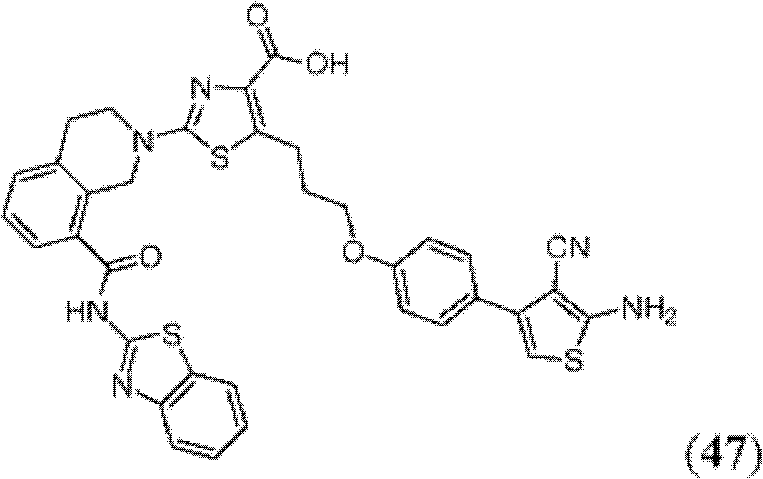
步骤1:2-(1-(4-(苄氧基)苯基)亚乙基)丙二腈(47A)的制备: Step 1 : Preparation of 2-(1-(4-(benzyloxy)phenyl)ethylene)malononitrile (47A):
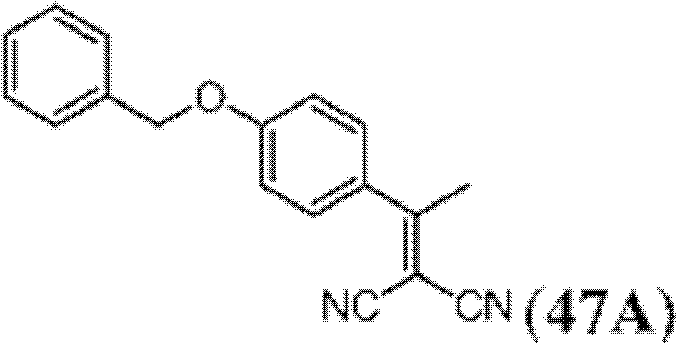
六甲基二硅氮烷(2.50mL,1.937g,12.0mmol)以保持内部温度低于74℃的速度,加入到含1-(4-(苄氧基)苯基)乙酮(2.263g,10mmol)的乙酸(6mL)中。添加完成后,向溶液中加入含丙二腈(1.32g,20mmol)的乙酸(6mL)。反应在90℃加热12小时。冷却后,将反应倒入冰/水中,用EtOAc萃取,干燥,减压浓缩,得到粗产物。固体用1∶9EtOAc/己烷研磨,以提供2.74g所需产物。1H NMR(DMSO-d6):δ7.72-7.75(m,2H),7.35-7.49(m,5H),7.18-7.21(d,2H),5.22(s,2H),2.61(s,3H)。MS(ESI(+)):m/z 291(M+NH4)。Hexamethyldisilazane (2.50 mL, 1.937 g, 12.0 mmol) was added to 1-(4-(benzyloxy)phenyl)ethanone (2.263 g, 10mmol) of acetic acid (6mL). After the addition was complete, malononitrile (1.32 g, 20 mmol) in acetic acid (6 mL) was added to the solution. The reaction was heated at 90°C for 12 hours. After cooling, the reaction was poured into ice/water, extracted with EtOAc, dried and concentrated under reduced pressure to give crude product. The solid was triturated with 1:9 EtOAc/Hexanes to provide 2.74 g of the desired product. 1 H NMR (DMSO-d 6 ): δ7.72-7.75(m, 2H), 7.35-7.49(m, 5H), 7.18-7.21(d, 2H), 5.22(s, 2H), 2.61(s, 3H). MS (ESI(+)): m/z 291 (M+ NH4 ).
步骤2:2-氨基-4-(4-(苄氧基)苯基)噻吩-3-腈(47B)的制备: Step 2 : Preparation of 2-amino-4-(4-(benzyloxy)phenyl)thiophene-3-carbonitrile (47B):

向化合物47A(2.74g,9.99mmol)和硫(0.374g,11.99mmol)在THF(20mL)中的混合物中,加入碳酸氢钠(0.839g,9.99mmol)。反应混合物加热回流2小时,减压浓缩。残余物在EtOAc和水之间分离。分离有机层,用额外的EtOAc萃取水层。合并的有机层用盐水洗涤,用MgSO4干燥,减压浓缩。残余物通过柱色谱用硅胶纯化,用3∶1/己烷∶EtOAc洗脱,以提供2.42g所需产物:1H NMR(DMSO-d6):δ7.33-7.48(m,7H),7.19(s,2H),7.07(d,J=8.73Hz,2H),6.42(s,1H),5.14(s,2H)。MS(ESI(+)):m/z 307(M+H)。To a mixture of compound 47A (2.74 g, 9.99 mmol) and sulfur (0.374 g, 11.99 mmol) in THF (20 mL) was added sodium bicarbonate (0.839 g, 9.99 mmol). The reaction mixture was heated to reflux for 2 hours and concentrated under reduced pressure. The residue was partitioned between EtOAc and water. The organic layer was separated and the aqueous layer was extracted with additional EtOAc. The combined organic layers were washed with brine, dried over MgSO 4 and concentrated under reduced pressure. The residue was purified by column chromatography on silica gel eluting with 3:1/hexanes:EtOAc to afford 2.42 g of the desired product: 1 H NMR (DMSO-d 6 ): δ 7.33-7.48 (m, 7H), 7.19 (s, 2H), 7.07 (d, J=8.73Hz, 2H), 6.42 (s, 1H), 5.14 (s, 2H). MS (ESI(+)): m/z 307 (M+H).
步骤3:2-氨基-4-(4-羟基苯基)噻吩-3-腈(47C)的制备: Step 3 : Preparation of 2-amino-4-(4-hydroxyphenyl)thiophene-3-carbonitrile (47C):
在室温下向含化合物47B(1.1g,3.59mmol)的DCM(80mL)中,加入含1.0M BBr3(36mL,36mmol)的DCM。加入时形成沉淀,在室温下搅拌2小时后逐渐消失。除去溶剂,残余物在水和EtOAc之间分离。分离有机层。用EtOAc萃取水层。合并的有机层用盐水洗涤,用MgSO4干燥,过滤,减压浓缩。粗材料通过柱色谱用硅胶纯化,用3∶2/己烷∶EtOAc洗脱,以提供0.65g所需产物47C:1H NMR(DMSO-d6):δ9.58(s,1H),7.35(d,J=8.73Hz,2H),7.15(s,2H),6.80(d,J=8.73Hz,2H),6.34(s,1H);MS(ESI(+)):m/z 217(M+H)。To compound 47B (1.1 g, 3.59 mmol) in DCM (80 mL) was added 1.0 M BBr3 (36 mL, 36 mmol) in DCM at room temperature. A precipitate formed on the addition, which gradually disappeared after stirring at room temperature for 2 hours. The solvent was removed and the residue was partitioned between water and EtOAc. Separate the organic layer. The aqueous layer was extracted with EtOAc. The combined organic layers were washed with brine, dried over MgSO4 , filtered and concentrated under reduced pressure. The crude material was purified by column chromatography on silica gel eluting with 3:2/hexanes:EtOAc to afford 0.65 g of the desired product 47C: 1 H NMR (DMSO-d 6 ): δ 9.58 (s, 1H), 7.35 (d, J=8.73Hz, 2H), 7.15(s, 2H), 6.80(d, J=8.73Hz, 2H), 6.34(s, 1H); MS (ESI(+)): m/z 217( M+H).
步骤4:2-(8-(苯并[d]噻唑-2-基((2-(三甲基甲硅烷基)乙氧基)甲基)氨基甲酰基)-3,4-二氢异喹啉-2(1H)-基)-5-碘噻唑-4-羧酸甲酯(47D)的制备: Step 4 : 2-(8-(Benzo[d]thiazol-2-yl((2-(trimethylsilyl)ethoxy)methyl)carbamoyl)-3,4-dihydroiso Preparation of quinoline-2(1H-yl)-5-iodothiazole-4-carboxylic acid methyl ester (47D):
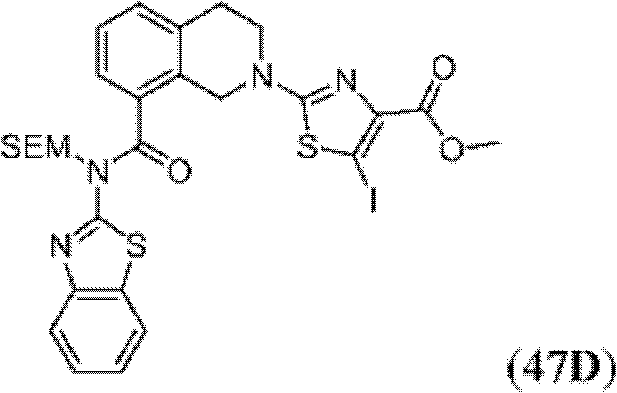
化合物47D用与化合物34C的合成类似的方式制备,在实施例34的步骤3中用化合物8C代替化合物34B:APCI(+)/LC/MS:707(M+H)。Compound 47D was prepared in a similar manner to the synthesis of compound 34C, substituting compound 8C for compound 34B in step 3 of example 34: APCI(+)/LC/MS: 707 (M+H).
步骤5:2-(8-(苯并[d]噻唑-2-基((2-(三甲基甲硅烷基)乙氧基)甲基)氨基甲酰基)-3,4-二氢异喹啉-2(1H)-基)-5-(3-羟基丙-1-炔基)噻唑-4-羧酸甲酯(47E)的制备: Step 5 : 2-(8-(Benzo[d]thiazol-2-yl((2-(trimethylsilyl)ethoxy)methyl)carbamoyl)-3,4-dihydroiso Preparation of quinoline-2(1H)-yl)-5-(3-hydroxyprop-1-ynyl)thiazole-4-carboxylic acid methyl ester (47E):
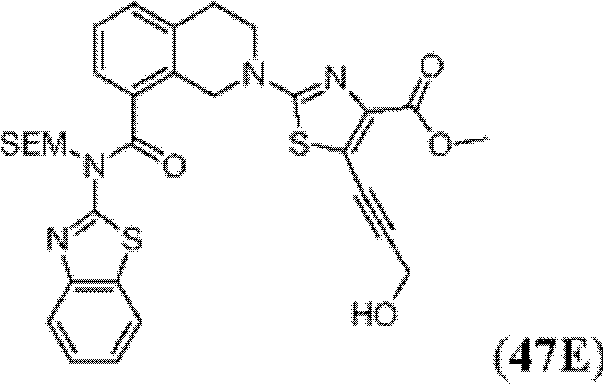
化合物47E用与化合物36B的合成类似的方式制备,在实施例34的步骤2中用化合物47D代替化合物34C:LCMS(APCI):m/z 635(M+H)。Compound 47E was prepared in a similar manner to the synthesis of compound 36B, substituting compound 47D for compound 34C in step 2 of example 34: LCMS (APCI): m/z 635 (M+H).
步骤6:2-(8-(苯并[d]噻唑-2-基((2-(三甲基甲硅烷基)乙氧基)甲基)氨基甲酰基)-3,4-二氢异喹啉-2(1H)-基)-5-(3-羟丙基)噻唑-4-羧酸甲酯(47F)的制备: Step 6 : 2-(8-(Benzo[d]thiazol-2-yl((2-(trimethylsilyl)ethoxy)methyl)carbamoyl)-3,4-dihydroiso Preparation of quinoline-2(1H)-yl)-5-(3-hydroxypropyl)thiazole-4-carboxylic acid methyl ester (47F):
题示化合物(47F)用与化合物8E的合成类似的方式制备,用化合物47E代替化合物8D:LC/MS(APCI):m/z 639(M+H)。The title compound (47F) was prepared in a similar manner to the synthesis of compound 8E, substituting compound 47E for compound 8D: LC/MS (APCI): m/z 639 (M+H).
步骤7:5-(3-(4-(5-氨基-4-氰基噻吩-3-基)苯氧基)丙基)-2-(8-(苯并[d]噻唑-2-基((2-(三甲基甲硅烷基)乙氧基)甲基)氨基甲酰基)-3,4-二氢异喹啉-2(1H)-基)噻唑-4-羧酸甲酯(47G)的制备。 Step 7 : 5-(3-(4-(5-amino-4-cyanothiophen-3-yl)phenoxy)propyl)-2-(8-(benzo[d]thiazol-2-yl ((2-(Trimethylsilyl)ethoxy)methyl)carbamoyl)-3,4-dihydroisoquinolin-2(1H)-yl)thiazole-4-carboxylic acid methyl ester ( 47G).
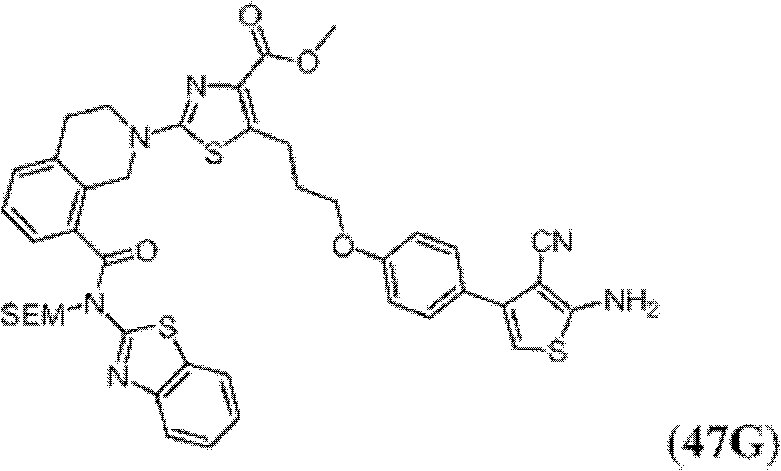
化合物47G用与化合物35A的合成类似的方式制备,分别用化合物47F和化合物47C代替化合物34B和化合物31F:MS(ESI(+)):m/z 838(M+H)。Compound 47G was prepared in a similar manner to the synthesis of Compound 35A, replacing Compound 34B and Compound 31F with Compound 47F and Compound 47C, respectively: MS (ESI(+)): m/z 838 (M+H).
步骤8:题示化合物47H的制备: Step 8 : Preparation of title compound 47H:
题示化合物47H用与化合物34的合成类似的方式制备,用化合物47G代替化合物34D:1H NMR(DMSO-d6):S 7.95(d,J=7.98Hz,1H),7.72(d,J=7.67Hz,1H),7.60(d,J=6.75Hz,1H),7.26-7.44(m,6H),6.87-6.90(m,2H),6.32(s,1H),4.77(s,2H),3.94(t,J=6.14Hz,2H),3.64-3.67(m,2H),3.10-3.13(m,2H),2.96(t,J=5.83Hz,2H),1.93-1.96(m,2H)。MS(ESI(+)):m/z 693(M+H)。The title compound 47H was prepared in a similar manner to the synthesis of compound 34, replacing compound 34D with compound 47G: 1 H NMR (DMSO-d 6 ): S 7.95 (d, J=7.98Hz, 1H), 7.72 (d, J =7.67Hz, 1H), 7.60(d, J=6.75Hz, 1H), 7.26-7.44(m, 6H), 6.87-6.90(m, 2H), 6.32(s, 1H), 4.77(s, 2H) , 3.94(t, J=6.14Hz, 2H), 3.64-3.67(m, 2H), 3.10-3.13(m, 2H), 2.96(t, J=5.83Hz, 2H), 1.93-1.96(m, 2H ). MS (ESI(+)): m/z 693 (M+H).
实施例48Example 48
5-(3-(4-(1H-吡唑-1-基)苯氧基)丙基)-2-(8-(苯并[d]噻唑-2-基氨基甲酰基)-3,4-二氢异喹啉-2(1H)-基)噻唑-4-羧酸(48)的合成:5-(3-(4-(1H-pyrazol-1-yl)phenoxy)propyl)-2-(8-(benzo[d]thiazol-2-ylcarbamoyl)-3,4 - Synthesis of dihydroisoquinolin-2(1H)-yl)thiazole-4-carboxylic acid (48):

题示化合物48通过在实施例2的步骤4用4-(1H-吡唑-1-基)苯酚代替苯酚制备。酯水解前未分离烷化中间体。所需产物沉淀后,固体通过HPLC纯化(预制备反相HPLC用自动化Gilson HPLC系统执行,使用SymmetryPrep Shield RP18预制备柱,250mmx21.20mm i.d.,10um,流速25mL/min;λ=214、245nm;流动相A,含0.1%TFA的H2O;流动相B,CH3CN;40分钟内,B的线性梯度0-90%),以提供题示化合物48,产率29%:1H NMR(300MHz,DMSO-d6)δppm12.89(1H,s),8.35(1H,d),8.03(1H,d),7.79(1H,d),7.69(4H,m),7.42(4H,m),7.02(2H,m),6.49(1H,m),4.84(2H,s),4.02(2H,t),3.72(2H,t),3.19(2H,t),3.03(2H,t),2.02(2H,m)。MS(ESI(+)):m/z 637(M+H)。The title compound 48 was prepared by substituting 4-(1H-pyrazol-1-yl)phenol for phenol in step 4 of Example 2. The alkylated intermediate was not isolated prior to ester hydrolysis. After precipitation of the desired product, the solid was purified by HPLC (pre-prep reverse phase HPLC performed with an automated Gilson HPLC system using a SymmetryPrep Shield RP18 pre-prep column, 250mmx21.20mm id, 10um, flow rate 25mL/min; λ = 214, 245nm; flow Phase A, H 2 O with 0.1% TFA; mobile phase B, CH 3 CN; linear gradient 0-90% of B over 40 minutes) to provide the title compound 48 in 29% yield: 1 H NMR ( 300MHz, DMSO-d 6 ) δppm12.89(1H, s), 8.35(1H, d), 8.03(1H, d), 7.79(1H, d), 7.69(4H, m), 7.42(4H, m) , 7.02(2H, m), 6.49(1H, m), 4.84(2H, s), 4.02(2H, t), 3.72(2H, t), 3.19(2H, t), 3.03(2H, t), 2.02(2H, m). MS (ESI(+)): m/z 637 (M+H).
实施例49Example 49
5-(2-(4-(1H-吡唑并[3,4-d]嘧啶-1-基)苯氧基)乙基)-2-(8-(苯并[d]噻唑-2-基氨基甲酰基)-3,4-二氢异喹啉-2(1H)-基)噻唑-4-羧酸(49)的合成:5-(2-(4-(1H-pyrazolo[3,4-d]pyrimidin-1-yl)phenoxy)ethyl)-2-(8-(benzo[d]thiazole-2- Synthesis of (carbamoyl)-3,4-dihydroisoquinolin-2(1H)-yl)thiazole-4-carboxylic acid (49):

步骤1:N-(苯并[d]噻唑-2-基)-2-氨基硫代甲酰基-1,2,3,4-四氢异喹啉-8-甲酰胺(49A)的制备: Step 1 : Preparation of N-(benzo[d]thiazol-2-yl)-2-aminothioformyl-1,2,3,4-tetrahydroisoquinoline-8-carboxamide (49A):

向化合物1B(3.25g,8.50mmol)在DMF(50mL)中的混合物中,加入TEA(4.71mL,34.0mmol)。得到的混合物搅拌10分钟,加入二(1H-咪唑-1-基)甲硫酮(1.818g,10.20mmol)。反应混合物在室温下搅拌30分钟。加入氨水(7N,MeOH中)(48.6mL,340mmol),得到的混合物搅拌过夜。浓缩反应混合物,以除去氨水和MeOH。DMF溶液直接用于下一步骤无需进一步纯化。LCMS(APCI):m/z 369(M+H)。To a mixture of Compound 1B (3.25 g, 8.50 mmol) in DMF (50 mL) was added TEA (4.71 mL, 34.0 mmol). The resulting mixture was stirred for 10 minutes and bis(1H-imidazol-1-yl)methione (1.818 g, 10.20 mmol) was added. The reaction mixture was stirred at room temperature for 30 minutes. Aqueous ammonia (7N in MeOH) (48.6 mL, 340 mmol) was added and the resulting mixture was stirred overnight. The reaction mixture was concentrated to remove ammonia and MeOH. The DMF solution was used directly in the next step without further purification. LCMS (APCI): m/z 369 (M+H).
步骤2:2-(8-(苯并[d]噻唑-2-基氨基甲酰基)-3,4-二氢异喹啉-2(1H)-基)-5-(2-(叔丁基二甲基甲硅烷氧基)乙基)噻唑-4-羧酸乙酯(49B)的制备: Step 2 : 2-(8-(Benzo[d]thiazol-2-ylcarbamoyl)-3,4-dihydroisoquinolin-2(1H)-yl)-5-(2-(tert-butyl Preparation of ethyl dimethylsilyloxy)ethyl)thiazole-4-carboxylate (49B):
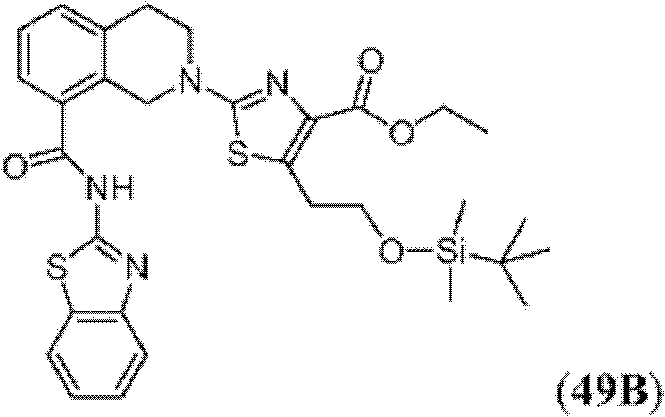
向3-(叔丁基二甲基甲硅烷氧基)丙醛(1g,5.31mmol)和2,2-二氯乙酸乙酯(0.651mL,5.31mmol)在Et2O(4mL)中的溶液中,在0°滴加含乙醇钠(0.397g,5.84mmol)的EtOH(4mL)。反应混合物在0℃搅拌1.5h,用Et2O稀释。得到的混合物用盐水洗涤,有机层用Na2SO4干燥,减压浓缩。残余物在真空中干燥,在EtOH(8mL)中溶解。向得到的溶液中加入含实施例49A(1当量)的DMF。反应混合物在50℃加热8小时,减压浓缩。残余物在DCM中溶解,通过柱色谱用硅胶纯化,用含0%到17%EtOAc的己烷洗脱,然后用含0%到15%EtOAc的DCM洗脱,以提供所需产物49B:LCMS(APCI):m/z 623(M+H)。To a solution of 3-(tert-butyldimethylsilyloxy)propanal (1 g, 5.31 mmol) and ethyl 2,2-dichloroacetate (0.651 mL, 5.31 mmol) in Et2O (4 mL) , sodium ethoxide (0.397 g, 5.84 mmol) in EtOH (4 mL) was added dropwise at 0°. The reaction mixture was stirred at 0 °C for 1.5 h, diluted with Et2O . The resulting mixture was washed with brine , the organic layer was dried over Na2SO4 , concentrated under reduced pressure. The residue was dried in vacuo and dissolved in EtOH (8 mL). To the resulting solution was added EXAMPLE 49A (1 equiv) in DMF. The reaction mixture was heated at 50°C for 8 hours and concentrated under reduced pressure. The residue was dissolved in DCM and purified by column chromatography on silica gel eluting with 0% to 17% EtOAc in hexanes and then 0% to 15% EtOAc in DCM to afford the desired product 49B: LCMS (APCI): m/z 623 (M+H).
步骤3:2-(8-(苯并[d]噻唑-2-基((2-(三甲基甲硅烷基)乙氧基)甲基)氨基甲酰基)-3,4-二氢异喹啉-2(1H)-基)-5-(2-(叔丁基二甲基甲硅烷氧基)乙基)噻唑-4-羧酸乙酯(49C1);和5-(2-(叔丁基二甲基甲硅烷氧基)乙基)-2-(8-(3-((2-(三甲基甲硅烷基)乙氧基)甲基)苯并[d]噻唑-2(3H)-亚基氨基甲酰基)-3,4-二氢异喹啉-2(1H)-基)噻唑-4-羧酸(Z)-乙酯(49C2)的制备: Step 3 : 2-(8-(Benzo[d]thiazol-2-yl((2-(trimethylsilyl)ethoxy)methyl)carbamoyl)-3,4-dihydroiso Quinoline-2(1H)-yl)-5-(2-(tert-butyldimethylsilyloxy)ethyl)thiazole-4-carboxylic acid ethyl ester (49C 1 ); and 5-(2- (tert-Butyldimethylsilyloxy)ethyl)-2-(8-(3-((2-(trimethylsilyl)ethoxy)methyl)benzo[d]thiazole- Preparation of 2(3H)-ylidenecarbamoyl)-3,4-dihydroisoquinolin-2(1H)-yl)thiazole-4-carboxylic acid (Z)-ethyl ester (49C 2 ):
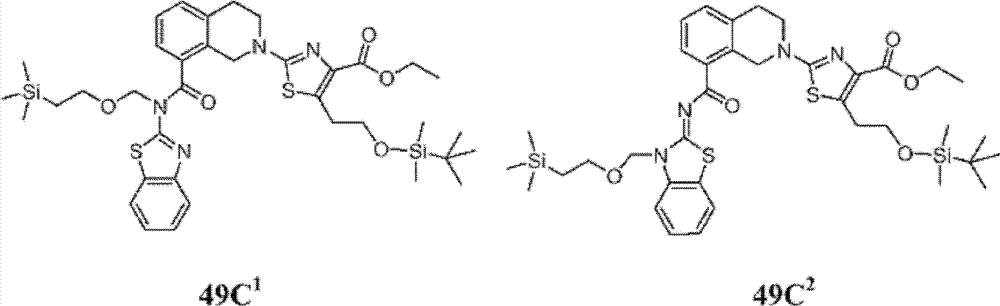
向实施例49B(365mg,0.586mmol)和(2-(氯甲氧基)乙基)三甲基硅烷(0.109mL,0.615mmol)在DMF(5mL)中的混合物中,滴加TEA(0.163mL,1.172mmol)。反应混合物在室温下搅拌10分钟。所需产物作为两种位置异构体(49C1和49C2)存在。反应用EtOAc稀释,用盐水洗涤,用Na2SO4干燥,减压浓缩。粗材料在下一步骤中使用,无需进一步纯化。To a mixture of EXAMPLE 49B (365 mg, 0.586 mmol) and (2-(chloromethoxy)ethyl)trimethylsilane (0.109 mL, 0.615 mmol) in DMF (5 mL) was added dropwise TEA (0.163 mL , 1.172 mmol). The reaction mixture was stirred at room temperature for 10 minutes. The desired product exists as two positional isomers ( 49C1 and 49C2 ). The reaction was diluted with EtOAc, washed with brine, dried over Na2SO4 and concentrated under reduced pressure . The crude material was used in the next step without further purification.
步骤4:2-(8-(苯并[d]噻唑-2-基((2-(三甲基甲硅烷基)乙氧基)甲基)氨基甲酰基)-3,4-二氢异喹啉-2(1H)-基)-5-(2-羟乙基)噻唑-4-羧酸乙酯(49D1);和5-(2-羟乙基)-2-(8-(3-((2-(三甲基甲硅烷基)乙氧基)甲基)苯并[d]噻唑-2(3H)-亚基氨基甲酰基)-3,4-二氢异喹啉-2(1H)-基)噻唑-4-羧酸(Z)-乙酯(49D2)的制备 Step 4 : 2-(8-(Benzo[d]thiazol-2-yl((2-(trimethylsilyl)ethoxy)methyl)carbamoyl)-3,4-dihydroiso Quinoline-2(1H)-yl)-5-(2-hydroxyethyl)thiazole-4-carboxylic acid ethyl ester (49D 1 ); and 5-(2-hydroxyethyl)-2-(8-( 3-((2-(trimethylsilyl)ethoxy)methyl)benzo[d]thiazole-2(3H)-ylidenecarbamoyl)-3,4-dihydroisoquinoline- Preparation of (Z)-ethyl 2(1H)-yl)thiazole-4-carboxylate (49D 2 )
向实施例49C1和49C2(400mg,0.531mmol)在DCM(2mL)中的溶液中,加入MeOH(50mL)。滴加含1%HCl的MeOH(3.87mL,1.062mmol)。反应混合物在室温下搅拌5小时,用EtOAc(250mL)稀释,用50%NaCl洗涤。有机层用Na2SO4干燥,减压浓缩。残余物在DCM中溶解,通过柱色谱用硅胶纯化,用含0%到25%EtOAc的DCM梯度洗脱,以提供所需化合物49D1和49D2:LCMS(APCI):m/z 639(M+H)。To a solution of EXAMPLE 49C 1 and 49C 2 (400 mg, 0.531 mmol) in DCM (2 mL) was added MeOH (50 mL). 1% HCl in MeOH (3.87 mL, 1.062 mmol) was added dropwise. The reaction mixture was stirred at room temperature for 5 hours, diluted with EtOAc (250 mL), washed with 50% NaCl. The organic layer was dried over Na2SO4 , concentrated under reduced pressure. The residue was dissolved in DCM and purified by column chromatography on silica gel eluting with a gradient of 0% to 25% EtOAc in DCM to afford the desired compounds 49D 1 and 49D 2 : LCMS (APCI): m/z 639 (M +H).
步骤5:5-(2-(4-(1H-吡唑并[3,4-d]嘧啶-1-基)苯氧基)乙基)-2-(8-(苯并[d]噻唑-2-基((2-(三甲基甲硅烷基)乙氧基)甲基)氨基甲酰基)-3,4-二氢异喹啉-2(1H)-基)噻唑-4-羧酸乙酯(49E1);和5-(2-(4-(1H-吡唑并[3,4-d]嘧啶-1-基)苯氧基)乙基)-2-(8-(3-((2-(三甲基甲硅烷基)乙氧基)甲基)苯并[d]噻唑-2(3H)-亚基氨基甲酰基)-3,4-二氢异喹啉-2(1H)-基)噻唑-4-羧酸(Z)-乙酯(49E2)的制备 Step 5 : 5-(2-(4-(1H-pyrazolo[3,4-d]pyrimidin-1-yl)phenoxy)ethyl)-2-(8-(benzo[d]thiazole -2-yl((2-(trimethylsilyl)ethoxy)methyl)carbamoyl)-3,4-dihydroisoquinolin-2(1H)-yl)thiazole-4-carboxy and 5-(2-(4-(1H-pyrazolo[3,4-d ] pyrimidin-1-yl)phenoxy)ethyl)-2-(8-( 3-((2-(trimethylsilyl)ethoxy)methyl)benzo[d]thiazole-2(3H)-ylidenecarbamoyl)-3,4-dihydroisoquinoline- Preparation of (Z)-ethyl 2(1H)-yl)thiazole-4-carboxylate (49E 2 )
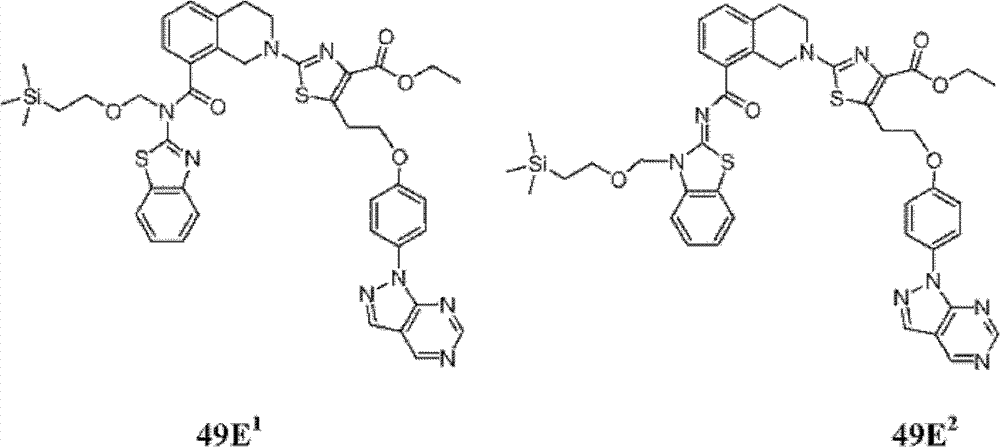
通过加热,化合物21D(27.8mg,0.131mmol)在THF(1.5mL)中溶解。溶液冷却至室温,然后加入化合物49D1和49D2(55.7mg,0.087mmol)和三苯基膦(11.43mg,0.044mmol),接着添加(E)-偶氮二甲酸二叔丁酯(10.04mg,0.044mmol)。反应混合物搅拌3小时。反应混合物用EtOAc稀释,用2%NaOH、5%HCl和水洗涤。有机层用Na2SO4干燥,减压浓缩。残余物通过柱色谱用硅胶纯化,用含0到25%EtOAc的DCM梯度洗脱,以提供所需化合物49E1和49E2:LCMS(APCI):m/z 834(M+H)。Compound 21D (27.8 mg, 0.131 mmol) was dissolved in THF (1.5 mL) by heating. The solution was cooled to room temperature, then compounds 49D 1 and 49D 2 (55.7 mg, 0.087 mmol) and triphenylphosphine (11.43 mg, 0.044 mmol) were added, followed by (E)-di-tert-butyl azodicarboxylate (10.04 mg , 0.044mmol). The reaction mixture was stirred for 3 hours. The reaction mixture was diluted with EtOAc, washed with 2% NaOH, 5% HCl and water. The organic layer was dried over Na2SO4 , concentrated under reduced pressure. The residue was purified by column chromatography on silica gel, eluting with a gradient of 0 to 25% EtOAc in DCM, to afford the desired compounds 49E1 and 49E2 : LCMS (APCI): m/z 834 (M+H).
步骤6:5-(2-(4-(1H-吡唑并[3,4-d]嘧啶-1-基)苯氧基)乙基)-2-(8-(苯并[d]噻唑-2-基氨基甲酰基)-3,4-二氢异喹啉-2(1H)-基)噻唑-4-羧酸(49)的制备: Step 6 : 5-(2-(4-(1H-pyrazolo[3,4-d]pyrimidin-1-yl)phenoxy)ethyl)-2-(8-(benzo[d]thiazole Preparation of -2-ylcarbamoyl)-3,4-dihydroisoquinolin-2(1H)-yl)thiazole-4-carboxylic acid (49):

向化合物49E1和化合物49E2(100mg,0.120mmol)在DCM(5mL)中的溶液中,加入含2N HCl的乙醚(0.60mL,1.20mmol)。反应搅拌15分钟,减压浓缩。向粗材料中加入含10%NaOH(0.17mL,0.427mmol)和水(5mL)的THF(5mL)和MeOH(5mL),加热到50℃2小时。冷却反应混合物并过滤。滤液用HCl酸化,通过过滤收集沉淀,用水洗涤,干燥,以提供所需产物49:1H NMR(400MHz,DMSO-D6)δppm 12.87(1H,s),9.44(1H,s),9.09(1H,s),8.60(1H,s),7.97-8.02(3H,m),7.77(1H,d),7.66(1H,d),7.28-7.47(4H,m),7.13-7.17(2H,m),4.84(2H,s),4.23(2H,t),3.75(2H,t),3.53(2H,t),3.04(2H,t)。LCMS(APCI):m/z 675(M+H)。To a solution of compound 49E 1 and compound 49E 2 (100 mg, 0.120 mmol) in DCM (5 mL) was added 2N HCl in ether (0.60 mL, 1.20 mmol). The reaction was stirred for 15 minutes and concentrated under reduced pressure. To the crude material was added 10% NaOH (0.17 mL, 0.427 mmol) and water (5 mL) in THF (5 mL) and MeOH (5 mL) and heated to 50 °C for 2 hours. The reaction mixture was cooled and filtered. The filtrate was acidified with HCl, and the precipitate was collected by filtration, washed with water, and dried to provide the desired product 49: 1 H NMR (400 MHz, DMSO-D 6 ) δ ppm 12.87 (1H, s), 9.44 (1H, s), 9.09 ( 1H, s), 8.60 (1H, s), 7.97-8.02 (3H, m), 7.77 (1H, d), 7.66 (1H, d), 7.28-7.47 (4H, m), 7.13-7.17 (2H, m), 4.84 (2H, s), 4.23 (2H, t), 3.75 (2H, t), 3.53 (2H, t), 3.04 (2H, t). LCMS (APCI): m/z 675 (M+H).
实施例50Example 50
5-(2-(3-(1H-吡唑并[3,4-d]嘧啶-1-基)苯氧基)乙基)-2-(8-(苯并[d]噻唑-2-基氨基甲酰基)-3,4-二氢异喹啉-2(1H)-基)噻唑-4-羧酸(50)的合成:5-(2-(3-(1H-pyrazolo[3,4-d]pyrimidin-1-yl)phenoxy)ethyl)-2-(8-(benzo[d]thiazole-2- Synthesis of (carbamoyl)-3,4-dihydroisoquinolin-2(1H)-yl)thiazole-4-carboxylic acid (50):
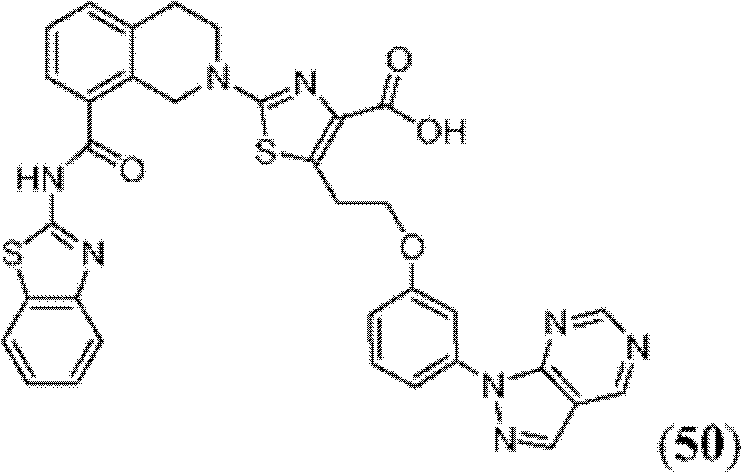
步骤1:5-(2-(3-(1H-吡唑并[3,4-d]嘧啶-1-基)苯氧基)乙基)-2-(8-(苯并[d]噻唑-2-基((2-(三甲基甲硅烷基)乙氧基)甲基)氨基甲酰基)-3,4-二氢异喹啉-2(1H)-基)噻唑-4-羧酸乙酯(50A1);和5-(2-(3-(1H-吡唑并[3,4-d]嘧啶-1-基)苯氧基)乙基)-2-(8-(3-((2-(三甲基甲硅烷基)乙氧基)甲基)苯并[d]噻唑-2(3H)-亚基氨基甲酰基)-3,4-二氢异喹啉-2(1H)-基)噻唑-4-羧酸(Z)-乙酯(50A2)的制备: Step 1 : 5-(2-(3-(1H-pyrazolo[3,4-d]pyrimidin-1-yl)phenoxy)ethyl)-2-(8-(benzo[d]thiazole -2-yl((2-(trimethylsilyl)ethoxy)methyl)carbamoyl)-3,4-dihydroisoquinolin-2(1H)-yl)thiazole-4-carboxy and 5-(2-(3-(1H-pyrazolo[ 3,4 -d]pyrimidin-1-yl)phenoxy)ethyl)-2-(8-( 3-((2-(trimethylsilyl)ethoxy)methyl)benzo[d]thiazole-2(3H)-ylidenecarbamoyl)-3,4-dihydroisoquinoline- Preparation of (Z)-ethyl 2(1H)-yl)thiazole-4-carboxylate (50A 2 ):
化合物50A1和50A2使用与实施例49的步骤5中描述的相同程序制备,用化合物33D代替化合物21D:LCMS(APCI):m/z 834(M+H)。Compounds 50A1 and 50A2 were prepared using the same procedure as described in step 5 of Example 49, substituting compound 33D for compound 21D: LCMS (APCI): m/z 834 (M+H).
步骤2:5-(2-(3-(1H-吡唑并[3,4-d]嘧啶-1-基)苯氧基)乙基)-2-(8-(苯并[d]噻唑-2-基氨基甲酰基)-3,4-二氢异喹啉-2(1H)-基)噻唑-4-羧酸(50)的制备: Step 2 : 5-(2-(3-(1H-pyrazolo[3,4-d]pyrimidin-1-yl)phenoxy)ethyl)-2-(8-(benzo[d]thiazole Preparation of -2-ylcarbamoyl)-3,4-dihydroisoquinolin-2(1H)-yl)thiazole-4-carboxylic acid (50):
化合物50使用与实施例49的步骤5中描述的相同程序制备,用化合物50A1和化合物50A2代替化合物49E1和化合物49E2:1H NMR(400MHz,DMSO-D6)δppm 12.84(1H,s),9.44(1H,s),9.14(1H,s),8.62(1H,s),8.01(1H,d),7.76-7.84(3H,m),7.66(1H,d),7.32-7.50(5H,m),6.98(1H,dd),4.84(2H,s),4.25(2H,t),3.73(2H,t),3.54(2H,t),3.03(2H,t)。LCMS(APCI):m/z 675(M+H)。Compound 50 was prepared using the same procedure as described in Step 5 of Example 49, replacing Compound 49E 1 and Compound 49E 2 with Compound 50A 1 and Compound 50A 2 : 1 H NMR (400 MHz, DMSO-D 6 ) δ ppm 12.84 (1H, s), 9.44(1H, s), 9.14(1H, s), 8.62(1H, s), 8.01(1H, d), 7.76-7.84(3H, m), 7.66(1H, d), 7.32-7.50 (5H, m), 6.98 (1H, dd), 4.84 (2H, s), 4.25 (2H, t), 3.73 (2H, t), 3.54 (2H, t), 3.03 (2H, t). LCMS (APCI): m/z 675 (M+H).
实施例51Example 51
2-[8-(苯并噻唑-2-基氨基甲酰基)-3,4-二氢-1H-异喹啉-2-基]-5-{3-[4-(4-氰基-噻吩-3-基)-苯氧基]-丙基}-噻唑-4-羧酸(51)的合成:2-[8-(Benzothiazol-2-ylcarbamoyl)-3,4-dihydro-1H-isoquinolin-2-yl]-5-{3-[4-(4-cyano- Synthesis of thiophen-3-yl)-phenoxy]-propyl}-thiazole-4-carboxylic acid (51):
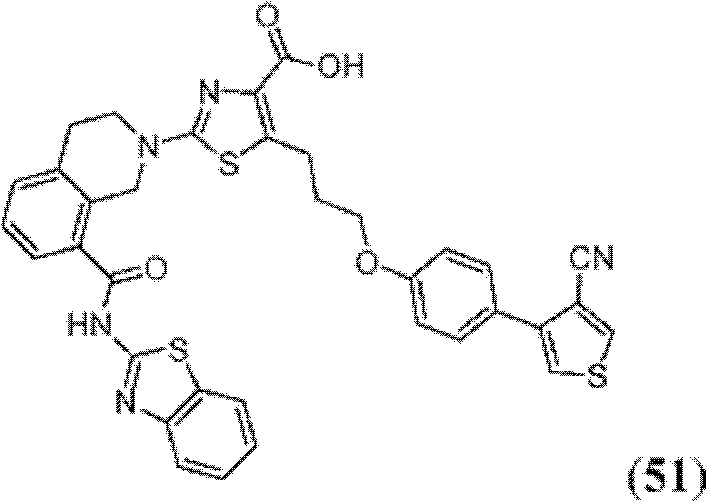
步骤1:4-(4-羟基苯基)噻吩-3-腈(51A)的制备: Step 1 : Preparation of 4-(4-hydroxyphenyl)thiophene-3-carbonitrile (51A):
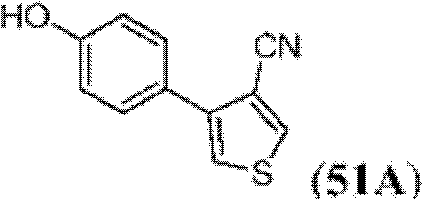
化合物51A用与化合物34D的合成类似的方式制备,分别用4-溴噻吩-3-腈和4-(4,4,5,5-四甲基-1,3,2-二氧硼戊环-2-基)苯酚代替化合物34C和4-(羟甲基)苯基硼酸:1H NMR(DMSO-d6):δ9.68(s,1H),8.62(d,J=3.38Hz,1H),7.73(d,J=3.07Hz,1H),7.44(d,J=8.59Hz,2H),6.86(d,J=8.59Hz,2H)。MS(ESI(+)):m/z 200(M-H)。Compound 51A was prepared in a similar manner to the synthesis of compound 34D using 4-bromothiophene-3-carbonitrile and 4-(4,4,5,5-tetramethyl-1,3,2-dioxaborolane, respectively -2-yl)phenol instead of compound 34C and 4-(hydroxymethyl)phenylboronic acid: 1 H NMR (DMSO-d 6 ): δ9.68 (s, 1H), 8.62 (d, J=3.38Hz, 1H ), 7.73 (d, J=3.07Hz, 1H), 7.44 (d, J=8.59Hz, 2H), 6.86 (d, J=8.59Hz, 2H). MS (ESI(+)): m/z 200 (MH).
步骤2:题示化合物51的制备: Step 2 : Preparation of title compound 51:
在0℃向含化合物51A(0.095g,0.015mmol)的DMF(4mL)中,加入60%氢化钠(0.036g,0.9mmol)。溶液搅拌10分钟。向该溶液中加入化合物2C。溶液在室温下搅拌2小时。用MeOH(1mL)淬灭反应。加入浓HCl(0.5mL),溶液通过针筒过滤器过滤。然后滤液通过预制备HPLC纯化,以提供所需产物51:1H NMR(DMSO-d6):δ8.57(d,J=3.38Hz,1H),7.95(d,J=7.98Hz,1H),7.71-7.72(m,2H),7.60(d,J=7.36Hz,1H),7.45-7.48(m,2H),7.26-7.41(m,4H),6.95-6.97(m,2H),4.77(s,2H),3.97(t,J=6.29Hz,2H),3.66(t,J=5.98Hz,2H),3.11-3.14(m,2H),2.96(t,J=5.98Hz,2H),1.93-2.00(m,2H);MS(ESI(+)):m/z 678(M+H)。To compound 51A (0.095 g, 0.015 mmol) in DMF (4 mL) was added 60% sodium hydride (0.036 g, 0.9 mmol) at 0°C. The solution was stirred for 10 minutes. To this solution was added compound 2C. The solution was stirred at room temperature for 2 hours. The reaction was quenched with MeOH (1 mL). Concentrated HCl (0.5 mL) was added and the solution was filtered through a syringe filter. The filtrate was then purified by preparative HPLC to provide the desired product 51: 1 H NMR (DMSO-d 6 ): δ 8.57 (d, J = 3.38 Hz, 1 H), 7.95 (d, J = 7.98 Hz, 1 H) , 7.71-7.72(m, 2H), 7.60(d, J=7.36Hz, 1H), 7.45-7.48(m, 2H), 7.26-7.41(m, 4H), 6.95-6.97(m, 2H), 4.77 (s, 2H), 3.97(t, J=6.29Hz, 2H), 3.66(t, J=5.98Hz, 2H), 3.11-3.14(m, 2H), 2.96(t, J=5.98Hz, 2H) , 1.93-2.00 (m, 2H); MS (ESI (+)): m/z 678 (M+H).
实施例52Example 52
2-(8-(苯并[d]噻唑-2-基氨基甲酰基)-3,4-二氢异喹啉-2(1H)-基)-5-(3-(4-(9-异丙基-9H-嘌呤-6-基)苯氧基)丙基)噻唑-4-羧酸(52)的合成:2-(8-(Benzo[d]thiazol-2-ylcarbamoyl)-3,4-dihydroisoquinolin-2(1H)-yl)-5-(3-(4-(9- Synthesis of isopropyl-9H-purin-6-yl)phenoxy)propyl)thiazole-4-carboxylic acid (52):
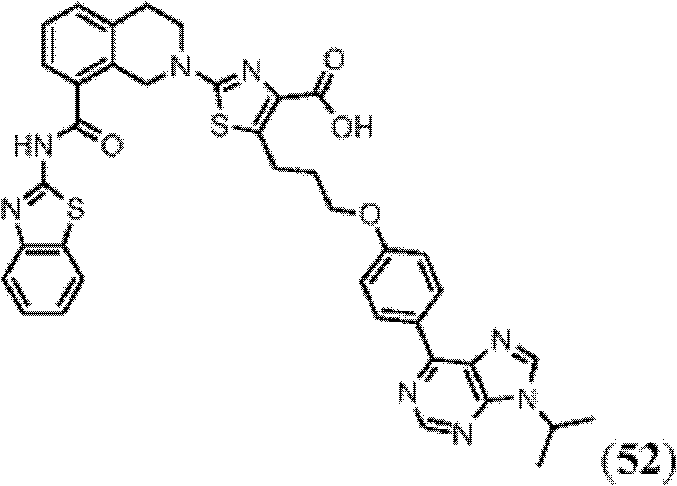
步骤1:6-氯-N4-异丙基嘧啶-4,5-二胺(52A)的制备: Step 1 : Preparation of 6-chloro-N4-isopropylpyrimidine-4,5-diamine (52A):
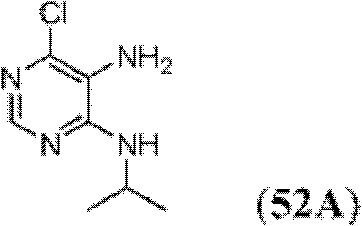
4,6-二氯嘧啶-5-胺(492mg,3mmol)、丙-2-胺(284μl,3.3mmol)和Et3N(836μl,6mmol)结合并加热回流。混合物回流5天,每天加入额外的异丙胺(0.77mL,9mmol)。反应混合物冷却至室温,浓缩,在水中浆化,过滤,用额外的水冲洗,减压干燥,以提供题示化合物52A,为黄褐色固体:1H NMR(300MHz,DMSO-d6)δppm 7.72(1H,s),6.53(1H,d),5.02(2H,s),4.20(1H,八峰),1.18(6H,d)。4,6-Dichloropyrimidin-5-amine (492 mg, 3 mmol), propan-2-amine (284 μl, 3.3 mmol) and Et 3 N (836 μl, 6 mmol) were combined and heated to reflux. The mixture was refluxed for 5 days and additional isopropylamine (0.77 mL, 9 mmol) was added each day. The reaction mixture was cooled to room temperature, concentrated, slurried in water, filtered, rinsed with additional water, and dried under reduced pressure to provide the title compound 52A as a tan solid: 1 H NMR (300 MHz, DMSO-d 6 ) δ ppm 7.72 (1H, s), 6.53 (1H, d), 5.02 (2H, s), 4.20 (1H, octapeak), 1.18 (6H, d).
步骤2:6-氯-9-异丙基-9H-嘌呤(52B)的制备: Step 2 : Preparation of 6-chloro-9-isopropyl-9H-purine (52B):
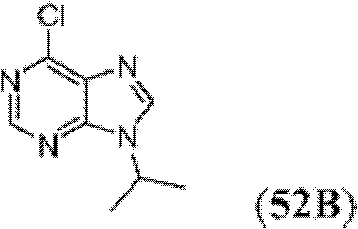
化合物52A(268mg,1.44mmol)、原甲酸三乙酯(2.4ml,14.36mmol)和对甲苯磺酸(27.3mg,0.144mmol)结合,在115℃加热过夜。冷却至室温时出现沉淀。通过过滤收集沉淀,用二乙醚冲洗,减压干燥,以产出题示化合物52B:1H NMR(300MHz,DMSO-d6)δppm 8.81(1H,s),8.78(1H,s),4.89(1H,m),1.58(6H,d)。Compound 52A (268mg, 1.44mmol), triethylorthoformate (2.4ml, 14.36mmol) and p-toluenesulfonic acid (27.3mg, 0.144mmol) were combined and heated at 115°C overnight. A precipitate appeared on cooling to room temperature. The precipitate was collected by filtration, rinsed with diethyl ether, and dried under reduced pressure to yield the title compound 52B: 1 H NMR (300 MHz, DMSO-d 6 ) δ ppm 8.81 (1H, s), 8.78 (1H, s), 4.89 ( 1H, m), 1.58 (6H, d).
步骤3:9-异丙基-6-(4-(四氢-2H-吡喃-2-氧基)苯基)-9H-嘌呤(52C)的制备: Step 3 : Preparation of 9-isopropyl-6-(4-(tetrahydro-2H-pyran-2-oxyl)phenyl)-9H-purine (52C):

含化合物52B(165mg,0.84mmol)的甲苯(5ml)用4-(四氢-2H-吡喃-2-氧基)苯基硼酸(280mg,1.26mmol)、四(三苯基膦)钯(0)(48.6mg,0.042mmol)和碳酸钠(2N水溶液)(1.26ml,2.52mmol)连续处理。用氮气吹扫反应容器,加热回流过夜。反应混合物冷却至室温,用EtOAc稀释,用水和盐水洗涤,干燥(MgSO4),过滤,浓缩。浓缩液通过柱色谱用硅胶纯化,用含0到5%MeOH的CH2Cl2梯度洗脱:1H NMR(300MHz,DMSO-d6)δppm 8.92(1H,s),8.83(2H,m),8.74(1H,s),7.22(2H,m),5.63(1H,t),4.92(1H,七峰),3.79(1H,ddd),3.60(1H,m),1.82(4H,m),1.60(6H,d),1.55(2H,m)。Compound 52B (165mg, 0.84mmol) in toluene (5ml) was treated with 4-(tetrahydro-2H-pyran-2-oxyl)phenylboronic acid (280mg, 1.26mmol), tetrakis(triphenylphosphine)palladium ( 0) (48.6mg, 0.042mmol) and sodium carbonate (2N in water) (1.26ml, 2.52mmol) were treated sequentially. The reaction vessel was purged with nitrogen and heated to reflux overnight. The reaction mixture was cooled to room temperature, diluted with EtOAc, washed with water and brine, dried ( MgSO4 ), filtered and concentrated. The concentrate was purified by column chromatography on silica gel, eluting with a gradient of 0 to 5% MeOH in CH2Cl2 : 1 H NMR (300 MHz, DMSO-d 6 ) δ ppm 8.92 (1H, s), 8.83 (2H, m) , 8.74(1H, s), 7.22(2H, m), 5.63(1H, t), 4.92(1H, seven peaks), 3.79(1H, ddd), 3.60(1H, m), 1.82(4H, m) , 1.60 (6H, d), 1.55 (2H, m).
步骤4:4-(9-异丙基-9H-嘌呤-6-基)苯酚(52D)的制备: Step 4 : Preparation of 4-(9-isopropyl-9H-purin-6-yl)phenol (52D):
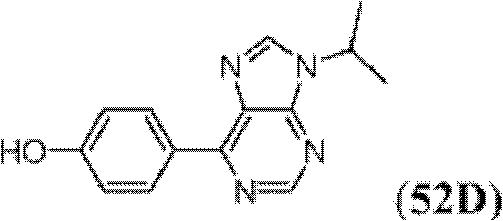
含化合物52C(149mg,0.44mmol)的二氧杂环己烷(3ml)用HCl(4N,二氧杂环己烷中)(0.55ml,2.2mmol)处理,在环境温度下搅拌1小时。浓缩反应混合物,干燥,得到浅灰色固体52D,产率94%:1H NMR(300MHz,DMSO-d6)δppm 10.16(1H,s),8.90(1H,s),8.76(1H,m),8.73(2H,m),6.97(2H,m),4.91(1H,七峰),1.60(6H,d)。Compound 52C (149mg, 0.44mmol) in dioxane (3ml) was treated with HCl (4N in dioxane) (0.55ml, 2.2mmol) and stirred at ambient temperature for 1 hour. The reaction mixture was concentrated and dried to give light gray solid 52D in 94% yield: 1 H NMR (300 MHz, DMSO-d 6 ) δ ppm 10.16 (1H, s), 8.90 (1H, s), 8.76 (1H, m), 8.73 (2H, m), 6.97 (2H, m), 4.91 (1H, seven peaks), 1.60 (6H, d).
步骤5:题示化合物52的制备: Step 5 : Preparation of title compound 52:
题示化合物52通过在实施例2的步骤4用化合物52D代替苯酚制备。烷化中间体通过柱色谱用硅胶纯化,用含0到60%EtOAc的CH2Cl2梯度洗脱。剩下的程序按照实施例2的步骤4:1H NMR(500MHz,DMSO-d6)δppm 12.89(1H,s),8.89(1H,s),8.81(2H,d),8.72(1H,s),8.00(1H,d),7.77(1H,d),7.65(1H,d),7.45(2H,m),7.35(2H,m),7.11(2H,d),4.90(1H,m),4.83(2H,s),4.09(2H,m),3.71(2H,m),3.20(2H,m),3.02(2H,m),2.04(2H,m),1.59(6H,d)。MS(ESI(+))m/e 731(M+H)。The title compound 52 was prepared by substituting compound 52D for phenol in step 4 of Example 2. The alkylated intermediate was purified by column chromatography on silica gel eluting with a gradient of 0 to 60% EtOAc in CH2Cl2 . The rest of the procedure followed step 4 of Example 2: 1 H NMR (500 MHz, DMSO-d 6 ) δppm 12.89 (1H, s), 8.89 (1H, s), 8.81 (2H, d), 8.72 (1H, s ), 8.00(1H,d), 7.77(1H,d), 7.65(1H,d), 7.45(2H,m), 7.35(2H,m), 7.11(2H,d), 4.90(1H,m) , 4.83 (2H, s), 4.09 (2H, m), 3.71 (2H, m), 3.20 (2H, m), 3.02 (2H, m), 2.04 (2H, m), 1.59 (6H, d). MS (ESI (+)) m/e 731 (M+H).
实施例53Example 53
2-(8-(苯并[d]噻唑-2-基氨基甲酰基)-3,4-二氢异喹啉-2(1H)-基)-5-(3-(4-(5,6-二氢咪唑并[2,1-b]噻唑-3-基)苯氧基)丙基)噻唑-4-羧酸(53)的合成:2-(8-(Benzo[d]thiazol-2-ylcarbamoyl)-3,4-dihydroisoquinolin-2(1H)-yl)-5-(3-(4-(5, Synthesis of 6-dihydroimidazo[2,1-b]thiazol-3-yl)phenoxy)propyl)thiazole-4-carboxylic acid (53):
题示化合物53通过在实施例2的步骤4用4-(5,6-二氢咪唑并[2,1-b]噻唑-3-基)苯酚HBr代替苯酚制备。烷化中间体通过柱色谱用硅胶纯化,用含5到60%EtOAc的己烷梯度洗脱。程序按照实施例2的步骤4中描述的,除了酯水解在环境温度下执行:1H MR(300MHz,DMSO-d6)δppm 12.89(1H,s),12.57(1H,s),8.03(1H,d),7.79(1H,d),7.68(1H,d),7.42(6H,m),7.03(2H,d),6.75(1H,s),4.83(2H,s),4.39(2H,m),4.23(2H,m),4.04(2H,t),3.73(2H,t),3.19(2H,t),3.03(2H,t),2.03(2H,m)。MS(ESI(+))m/e 695(M+H)。The title compound 53 was prepared by substituting 4-(5,6-dihydroimidazo[2,1-b]thiazol-3-yl)phenol HBr for phenol in step 4 of Example 2. The alkylated intermediate was purified by column chromatography on silica gel eluting with a gradient of 5 to 60% EtOAc in hexanes. The procedure was as described in step 4 of Example 2, except that ester hydrolysis was performed at ambient temperature: 1 H MR (300 MHz, DMSO-d 6 ) δ ppm 12.89 (1H, s), 12.57 (1H, s), 8.03 (1H ,d), 7.79(1H,d), 7.68(1H,d), 7.42(6H,m), 7.03(2H,d), 6.75(1H,s), 4.83(2H,s), 4.39(2H, m), 4.23(2H,m), 4.04(2H,t), 3.73(2H,t), 3.19(2H,t), 3.03(2H,t), 2.03(2H,m). MS (ESI (+)) m/e 695 (M+H).
实施例54Example 54
2-(8-(苯并[d]噻唑-2-基氨基甲酰基)-3,4-二氢异喹啉-2(1H)-基)-5-(3-(4-(4-(3-(二甲基氨基)丙基氨基)-1H-吡唑并[3,4-d]嘧啶-1-基)苯氧基)丙基)噻唑-4-羧酸(54)的合成:2-(8-(Benzo[d]thiazol-2-ylcarbamoyl)-3,4-dihydroisoquinolin-2(1H)-yl)-5-(3-(4-(4- Synthesis of (3-(dimethylamino)propylamino)-1H-pyrazolo[3,4-d]pyrimidin-1-yl)phenoxy)propyl)thiazole-4-carboxylic acid (54) :
步骤1:4-(4-(3-(二甲基氨基)丙基氨基)-1H-吡唑并[3,4-d]嘧啶-1-基)苯酚(54A)的制备:Step 1: Preparation of 4-(4-(3-(dimethylamino)propylamino)-1H-pyrazolo[3,4-d]pyrimidin-1-yl)phenol (54A):

题示化合物54A使用与实施例44的步骤4中描述的相同程序制备,用二甲基氨基丙胺代替异丙胺:1H NMR(500MHz,DMSO-D6)δppm 9.54(1H,s),8.63(1H,t),8.36(1H,s),8.31(1H,s),7.85(2H,d),6.92(2H,d),3.60(2H,q),3.12-3.18(2H,m),2.80(6H,s),1.95-2.03(2H,m)。The title compound 54A was prepared using the same procedure as described in step 4 of Example 44, substituting dimethylaminopropylamine for isopropylamine: 1 H NMR (500 MHz, DMSO-D 6 ) δ ppm 9.54 (1H, s), 8.63 ( 1H,t), 8.36(1H,s), 8.31(1H,s), 7.85(2H,d), 6.92(2H,d), 3.60(2H,q), 3.12-3.18(2H,m), 2.80 (6H, s), 1.95-2.03 (2H, m).
步骤2:题示化合物54的制备: Step 2 : Preparation of title compound 54:
向化合物54A(160mg,0.512mmol)在DMF(5ml)中的溶液中,加入氢化钠(102mg,2.56mmol)(60%)。反应混合物搅拌10min,加入实施例2C(194mg,0.307mmol)。得到的混合物搅拌1小时,加入甲醇(3ml)、10%NaOH(3ml)和水(1ml)。得到的混合物搅拌过夜,用TFA酸化,浓缩。残余物在DMSO-甲醇混合物中溶解,通过反相HPLC纯化(流动相:含0%-55%乙腈的0.1%TFA水溶液,60min内),以提供题示化合物:1H NMR(400MHz,DMSO-D6)δppm 12.84(1H,s),9.34(1H,s),8.53(1H,t),8.36(1H,s),8.32(1H,s),7.96-8.03(3H,m),7.78(1H,d),7.67(1H,d),7.42-7.49(2H,m),7.32-7.41(2H,m),7.05-7.10(2H,m),4.84(2H,s),4.04(2H,t),3.73(2H,t),3.60(2H,q),3.12-3.26(4H,m),3.03(2H,t),2.80(6H,s),1.93-2.08(4H,m)。LCMS(APCI)m/e 789(M+H)。To a solution of compound 54A (160 mg, 0.512 mmol) in DMF (5 ml) was added sodium hydride (102 mg, 2.56 mmol) (60%). The reaction mixture was stirred for 10 min and EXAMPLE 2C (194 mg, 0.307 mmol) was added. The resulting mixture was stirred for 1 hour and methanol (3ml), 10% NaOH (3ml) and water (1ml) were added. The resulting mixture was stirred overnight, acidified with TFA and concentrated. The residue was dissolved in DMSO-methanol mixture and purified by reverse phase HPLC (mobile phase: 0%-55% acetonitrile in 0.1% TFA in water within 60 min) to afford the title compound: 1 H NMR (400 MHz, DMSO- D 6 ) δppm 12.84(1H, s), 9.34(1H, s), 8.53(1H, t), 8.36(1H, s), 8.32(1H, s), 7.96-8.03(3H, m), 7.78( 1H, d), 7.67 (1H, d), 7.42-7.49 (2H, m), 7.32-7.41 (2H, m), 7.05-7.10 (2H, m), 4.84 (2H, s), 4.04 (2H, t), 3.73 (2H, t), 3.60 (2H, q), 3.12-3.26 (4H, m), 3.03 (2H, t), 2.80 (6H, s), 1.93-2.08 (4H, m). LCMS (APCI) m/e 789 (M+H).
实施例55Example 55
2-(8-(苯并[d]噻唑-2-基氨基甲酰基)-3,4-二氢异喹啉-2(1H)-基)-5-(2-(苄氧基)乙基)噻唑-4-羧酸(55)的合成:2-(8-(Benzo[d]thiazol-2-ylcarbamoyl)-3,4-dihydroisoquinolin-2(1H)-yl)-5-(2-(benzyloxy)ethyl base) synthesis of thiazole-4-carboxylic acid (55):
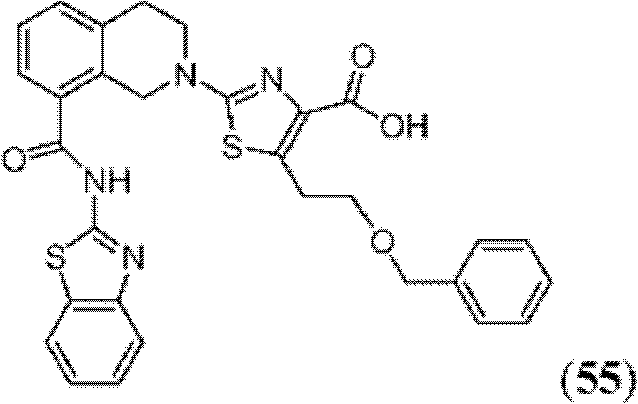
步骤1:2-(8-(苯并[d]噻唑-2-基氨基甲酰基)-3,4-二氢异喹啉-2(1H)-基)-5-(2-(苄氧基)乙基)噻唑-4-羧酸乙酯(55A)的制备: Step 1 : 2-(8-(Benzo[d]thiazol-2-ylcarbamoyl)-3,4-dihydroisoquinolin-2(1H)-yl)-5-(2-(benzyloxy Preparation of ethyl)ethyl)thiazole-4-carboxylate (55A):
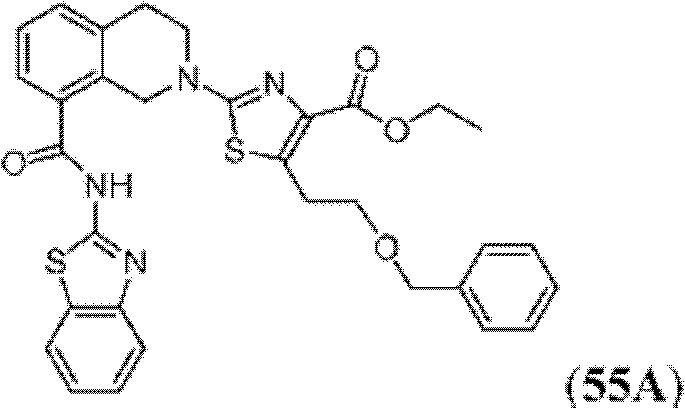
化合物55A使用与实施例49的步骤2描述的相同顺序制备,用3-(苄氧基)丙醛代替3-(叔丁基二甲基甲硅烷氧基)丙醛:1H NMR(400MHz,DMSO-D6)δppm 12.88(1H,s),8.03(1H,d),7.79(1H,d),7.66(1H,d),7.43-7.51(2H,m),7.33-7.41(2H,m),7.26-7.30(4H,m),7.16-7.23(1H,m),4.82(2H,s),4.46(2H,s),4.17(2H,q),3.73(2H,t),3.61(2H,t),3.26-3.30(2H,m),3.04(2H,t),1.18(3H,t);LCMS(APCI)m/e 599(M+H)。Compound 55A was prepared using the same sequence as described in step 2 of Example 49, substituting 3-(benzyloxy)propanal for 3-(tert-butyldimethylsilyloxy)propanal: 1 H NMR (400 MHz, DMSO-D 6 ) δppm 12.88 (1H, s), 8.03 (1H, d), 7.79 (1H, d), 7.66 (1H, d), 7.43-7.51 (2H, m), 7.33-7.41 (2H, m ), 7.26-7.30 (4H, m), 7.16-7.23 (1H, m), 4.82 (2H, s), 4.46 (2H, s), 4.17 (2H, q), 3.73 (2H, t), 3.61 ( 2H, t), 3.26-3.30 (2H, m), 3.04 (2H, t), 1.18 (3H, t); LCMS (APCI) m/e 599 (M+H).
步骤2:题示化合物55的制备: Step 2 : Preparation of title compound 55:
在THF(3ml)和MeOH(3ml)中的化合物55A(138mg,0.230mmol),用10%氢氧化钠(0.46ml,1.152mmol)处理1天。浓缩反应混合物,用浓HCl酸化。通过过滤收集沉淀,干燥,以提供题示化合物:1H NMR(500MHz,DMSO-D6)δppm 12.89(2H,s),8.03(1H,d),7.80(1H,d),7.67(1H,d),7.42-7.51(2H,m),7.33-7.42(2H,m),7.25-7.31(4H,m),7.17-7.21(1H,m),4.82(2H,s),4.46(2H,s),3.74(2H,t),3.60(2H,t),3.28-3.35(2H,m),3.03(2H,t);LCMS(APCI)m/e 571。Compound 55A (138 mg, 0.230 mmol) in THF (3 ml) and MeOH (3 ml) was treated with 10% sodium hydroxide (0.46 ml, 1.152 mmol) for 1 day. The reaction mixture was concentrated and acidified with concentrated HCl. The precipitate was collected by filtration and dried to provide the title compound: 1 H NMR (500 MHz, DMSO-D 6 ) δ ppm 12.89 (2H, s), 8.03 (1H, d), 7.80 (1H, d), 7.67 (1H, d), 7.42-7.51 (2H, m), 7.33-7.42 (2H, m), 7.25-7.31 (4H, m), 7.17-7.21 (1H, m), 4.82 (2H, s), 4.46 (2H, s), 3.74 (2H, t), 3.60 (2H, t), 3.28-3.35 (2H, m), 3.03 (2H, t); LCMS (APCI) m/e 571.
实施例56Example 56
2-[8-(苯并噻唑-2-基氨基甲酰基)-3,4-二氢-1H-异喹啉-2-基]-5-{3-[4-(3-氰基-吡啶-2-基)-苯氧基]-丙基}-噻唑-4-羧酸(56)的合成2-[8-(Benzothiazol-2-ylcarbamoyl)-3,4-dihydro-1H-isoquinolin-2-yl]-5-{3-[4-(3-cyano- Synthesis of pyridin-2-yl)-phenoxy]-propyl}-thiazole-4-carboxylic acid (56)
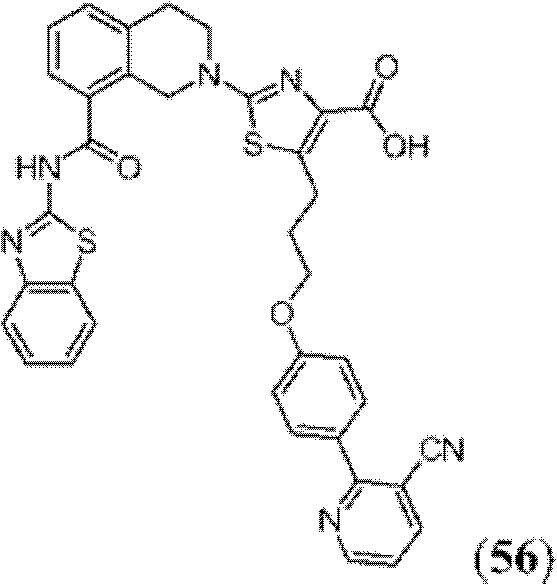
步骤1:2-(4-羟基苯基)烟腈(56A)的制备: Step 1 : Preparation of 2-(4-hydroxyphenyl)nicotinonitrile (56A):
化合物56A用与化合物34D的合成类似的方式制备,分别用2-氯烟腈和4-(4,4,5,5-四甲基-1,3,2-二氧硼戊环-2-基)苯酚代替化合物34C和4-(羟甲基)苯基硼酸:ESI(+)/LC/MS:197(M+H)+。Compound 56A was prepared in a similar manner to the synthesis of compound 34D, using 2-chloronicotinonitrile and 4-(4,4,5,5-tetramethyl-1,3,2-dioxaborolane-2- yl)phenol instead of compound 34C and 4-(hydroxymethyl)phenylboronic acid: ESI(+)/LC/MS: 197 (M+H) + .
步骤2:题示化合物56的制备: Step 2 : Preparation of title compound 56:
题示化合物56用与化合物51的合成类似的方式制备,在实施例51的步骤2中用化合物56A代替化合物51A:1H NMR(DMSO-d6):δ8.86(dd,J=4.76,1.69Hz,1H),8.34(dd,J=7.82,1.69Hz,1H),8.01(d,J=7.67Hz,1H),7.82(d,J=8.9Hz,2H),7.77(d,J=7.98Hz,1H),7.66(d,J=7.36Hz,1H),7.32-7.53(m,5H),7.07(d,J=8.9Hz,2H),4.83(s,2H),4.07(t,J=6.14Hz,2H),3.70-3.73(m,2H),3.18-3.22(m,2H),3.01-3.03(m,2H),2.00-2.08(m,2H)。ESI(+)/MS:673(M+H)+。The title compound 56 was prepared in a similar manner to the synthesis of compound 51, replacing compound 51A with compound 56A in step 2 of Example 51: 1 H NMR (DMSO-d 6 ): δ8.86 (dd, J=4.76, 1.69Hz, 1H), 8.34(dd, J=7.82, 1.69Hz, 1H), 8.01(d, J=7.67Hz, 1H), 7.82(d, J=8.9Hz, 2H), 7.77(d, J= 7.98Hz, 1H), 7.66(d, J=7.36Hz, 1H), 7.32-7.53(m, 5H), 7.07(d, J=8.9Hz, 2H), 4.83(s, 2H), 4.07(t, J=6.14Hz, 2H), 3.70-3.73(m, 2H), 3.18-3.22(m, 2H), 3.01-3.03(m, 2H), 2.00-2.08(m, 2H). ESI (+)/MS: 673 (M+H) + .
实施例57Example 57
2-(8-(苯并[d]噻唑-2-基氨基甲酰基)-3,4-二氢异喹啉-2(1H)-基)-5-(3-(6-(3-(二甲基氨基)丙-1-炔基)吡啶-3-氧基)丙基)噻唑-4-羧酸(57)的合成:2-(8-(Benzo[d]thiazol-2-ylcarbamoyl)-3,4-dihydroisoquinolin-2(1H)-yl)-5-(3-(6-(3- Synthesis of (dimethylamino)prop-1-ynyl)pyridine-3-oxy)propyl)thiazole-4-carboxylic acid (57):
步骤1:2-氯-5-((2-(三甲基甲硅烷基)乙氧基)甲氧基)吡啶(57A)的制备: Step 1 : Preparation of 2-chloro-5-((2-(trimethylsilyl)ethoxy)methoxy)pyridine (57A):
题示化合物57A使用与实施例49的步骤3中描述的相同程序制备,用6-氯吡啶-3-醇代替化合物49B:LCMS(APCI)m/e 260(M+H)。Title compound 57A was prepared using the same procedure as described in step 3 of Example 49, substituting 6-chloropyridin-3-ol for compound 49B: LCMS (APCI) m/e 260 (M+H).
步骤2:N,N-二甲基-3-(5-((2-(三甲基甲硅烷基)乙氧基)甲氧基)吡啶-2-基)丙-2-炔-1-胺(57B)的制备: Step 2 : N,N-Dimethyl-3-(5-((2-(trimethylsilyl)ethoxy)methoxy)pyridin-2-yl)prop-2-yn-1- Preparation of amine (57B):
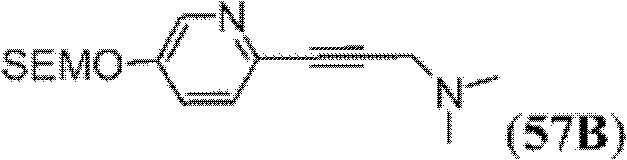
向化合物57A(154mg,0.593mmol)、N,N-二甲基丙-2-炔-1-胺(0.190ml,1.778mmol)、(PPh3)2PdCl2(62.4mg,0.089mmol)、TEA(0.413ml,2.96mmol)在DMF(3ml)中的混合物中,加入碘化亚铜(I)(11.29mg,0.059mmol)。得到的混合物在Smith微波合成器中在150℃加热30min,通过快速色谱纯化,以提供所需化合物57B;LCMS(APCI)m/e 307。To compound 57A (154 mg, 0.593 mmol), N, N-dimethylprop-2-yn-1-amine (0.190 ml, 1.778 mmol), (PPh 3 ) 2 PdCl 2 (62.4 mg, 0.089 mmol), TEA (0.413ml, 2.96mmol) in DMF (3ml) was added copper(I) iodide (11.29mg, 0.059mmol). The resulting mixture was heated at 150° C. for 30 min in a Smith microwave synthesizer and purified by flash chromatography to provide the desired compound 57B; LCMS (APCI) m/e 307.
步骤3:6-(3-(二甲基氨基)丙-1-炔基)吡啶-3-醇(57C)的制备: Step 3 : Preparation of 6-(3-(dimethylamino)prop-1-ynyl)pyridin-3-ol (57C):
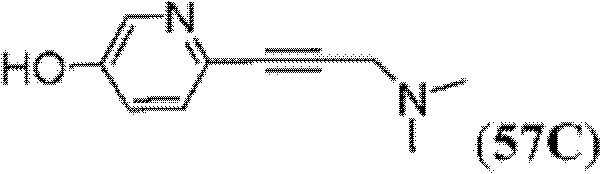
含化合物57B(40mg,0.131mmol)的MeOH(3ml)用含2N盐酸的乙醚(0.1ml,0.200mmol)处理1h,浓缩混合物,以提供题示化合物57C。LCMS(APCI)m/e 177(M+H)。Compound 57B (40 mg, 0.131 mmol) in MeOH (3 ml) was treated with 2N hydrochloric acid in ether (0.1 ml, 0.200 mmol) for 1 h and the mixture was concentrated to provide the title compound 57C. LCMS (APCI) m/e 177 (M+H).
步骤4:题示化合物(57)的制备: Step 4 : Preparation of title compound (57):
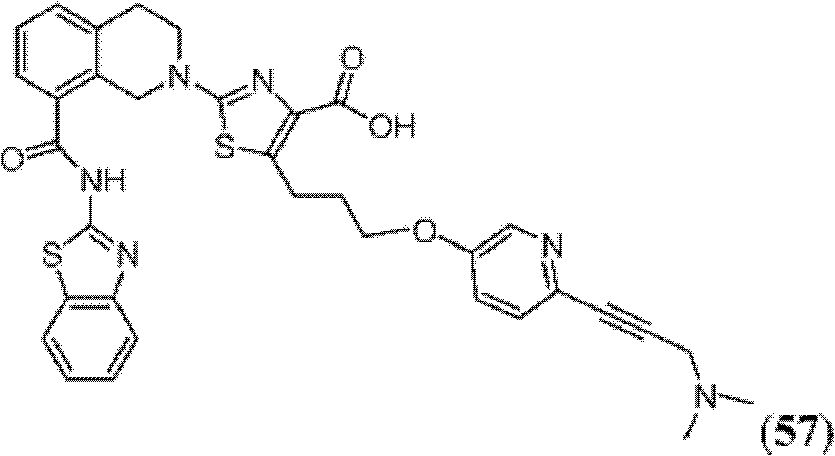
题示化合物57使用实施例54的步骤2中描述的相同程序制备,用化合物57C代替化合物54A:1H NMR(500MHz,DMSO-D6)δppm12.90(1H,s),10.25(1H,s),8.28(1H,d),8.04(1H,d),7.79(1H,d),7.67(1H,d),7.58(1H,d),7.43-7.50(2H,m),7.34-7.43(3H,m),4.83(2H,s),4.34(2H,s),4.10(2H,t),3.69-3.76(2H,m),3.16-3.24(2H,m),3.03(2H,t),2.73(6H,s),1.98-2.07(2H,m);LCMS(APCI)m/e 654(M+H)。Title compound 57 was prepared using the same procedure described in step 2 of Example 54, substituting compound 57C for compound 54A: 1 H NMR (500 MHz, DMSO-D 6 ) δ ppm 12.90 (1H, s), 10.25 (1H, s ), 8.28(1H,d), 8.04(1H,d), 7.79(1H,d), 7.67(1H,d), 7.58(1H,d), 7.43-7.50(2H,m), 7.34-7.43( 3H, m), 4.83 (2H, s), 4.34 (2H, s), 4.10 (2H, t), 3.69-3.76 (2H, m), 3.16-3.24 (2H, m), 3.03 (2H, t) , 2.73 (6H, s), 1.98-2.07 (2H, m); LCMS (APCI) m/e 654 (M+H).
实施例58Example 58
2-[8-(苯并噻唑-2-基氨基甲酰基)-3,4-二氢-1H-异喹啉-2-基]-5-{3-[4-(2-氰基-吡啶-3-基)-苯氧基]-丙基}-噻唑-4-羧酸(58)的合成:2-[8-(Benzothiazol-2-ylcarbamoyl)-3,4-dihydro-1H-isoquinolin-2-yl]-5-{3-[4-(2-cyano- Synthesis of pyridin-3-yl)-phenoxy]-propyl}-thiazole-4-carboxylic acid (58):
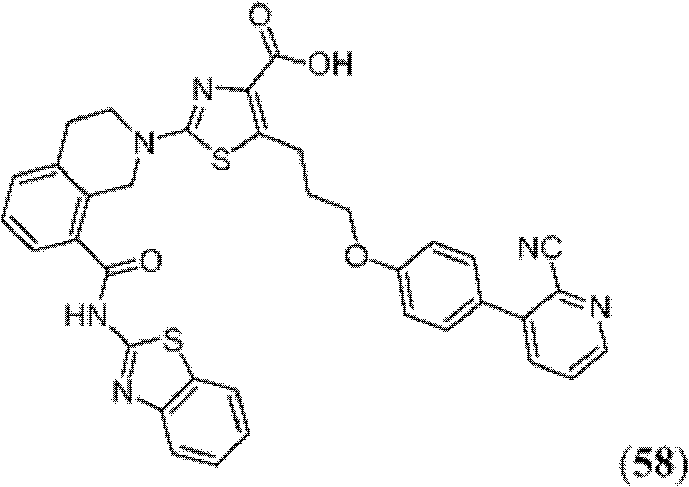
步骤1:3-(4-羟基苯基)吡啶腈(58A)的制备 Step 1 : Preparation of 3-(4-hydroxyphenyl)pyridinenitrile (58A)
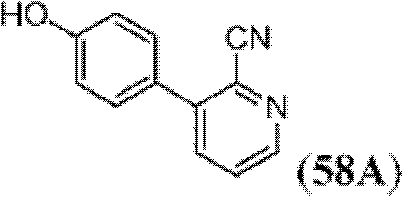
题示化合物58A用与化合物34D的合成类似的方式制备,分别用3-氯吡啶腈和4-(4,4,5,5-四甲基-1,3,2-二氧硼戊环-2-基)苯酚代替化合物34C和4-(羟甲基)苯基硼酸。ESI(+)/LC/MS:197(M+H)+。The title compound 58A was prepared in a similar manner to the synthesis of compound 34D using 3-chloropyridinenitrile and 4-(4,4,5,5-tetramethyl-1,3,2-dioxaborolane- 2-yl)phenol instead of compound 34C and 4-(hydroxymethyl)phenylboronic acid. ESI(+)/LC/MS: 197 (M+H) + .
步骤2:题示化合物58的制备: Step 2 : Preparation of Title Compound 58:
题示化合物58用与化合物51的合成类似的方式制备,在实施例51的步骤2中用化合物58A代替化合物51A:1H NMR(DMSO-d6):δ8.84(dd,J=4.6,1.53Hz,1H),7.98(dd,J=7.98,1.53Hz,1H),7.95(d,J=7.67Hz,1H),7.27-7.7(m,9H),7.01-7.03(m,2H),4.77(s,2H),4.01(t,J=6.29Hz,2H),3.66(t,J=5.98Hz,2H),3.12-3.16(m,2H),2.97(t,J=5.98Hz,2H),1.95-2.02(m,2H)。ESI(+)/MS:673(M+H)+。The title compound 58 was prepared in a similar manner to the synthesis of compound 51, replacing compound 51A with compound 58A in step 2 of Example 51: 1 H NMR (DMSO-d 6 ): δ8.84 (dd, J=4.6, 1.53Hz, 1H), 7.98(dd, J=7.98, 1.53Hz, 1H), 7.95(d, J=7.67Hz, 1H), 7.27-7.7(m, 9H), 7.01-7.03(m, 2H), 4.77(s, 2H), 4.01(t, J=6.29Hz, 2H), 3.66(t, J=5.98Hz, 2H), 3.12-3.16(m, 2H), 2.97(t, J=5.98Hz, 2H ), 1.95-2.02 (m, 2H). ESI (+)/MS: 673 (M+H) + .
实施例59Example 59
2-[8-(苯并噻唑-2-基氨基甲酰基)-3,4-二氢-1H-异喹啉-2-基]-5-[3-(4-吗啉-4-基-苯氧基)-丙基]-噻唑-4-羧酸(59)的合成:2-[8-(Benzothiazol-2-ylcarbamoyl)-3,4-dihydro-1H-isoquinolin-2-yl]-5-[3-(4-morpholin-4-yl Synthesis of -phenoxy)-propyl]-thiazole-4-carboxylic acid (59):
题示化合物用与化合物51的合成类似的方式制备,在实施例51的步骤2中用4-吗啉基苯酚代替化合物51A:1H NMR(DMSO-d6):δ7.96(d,J=7.67Hz,1H),7.72(d,J=7.98Hz,1H),7.60(d,J=7.06Hz,1H),7.27-7.42(m,4H),6.88(d,J=8.9Hz,2H),6.75-6.79(m,2H),4.76(s,2H),3.85(t,J=6.29Hz,2H),3.64-3.68(m,6H),3.07-3.11(m,2H),2.95-2.98(m,6H),1.87-1.94(m,2H)。ESI(+)/MS:656(M+H)+。The title compound was prepared in a similar manner to the synthesis of compound 51, substituting 4-morpholinophenol for compound 51A in step 2 of Example 51: 1 H NMR (DMSO-d 6 ): δ7.96(d, J =7.67Hz, 1H), 7.72(d, J=7.98Hz, 1H), 7.60(d, J=7.06Hz, 1H), 7.27-7.42(m, 4H), 6.88(d, J=8.9Hz, 2H ), 6.75-6.79(m, 2H), 4.76(s, 2H), 3.85(t, J=6.29Hz, 2H), 3.64-3.68(m, 6H), 3.07-3.11(m, 2H), 2.95- 2.98 (m, 6H), 1.87-1.94 (m, 2H). ESI (+)/MS: 656 (M+H) + .
实施例60Example 60
2-[8-(苯并噻唑-2-基氨基甲酰基)-3,4-二氢-1H-异喹啉-2-基]-5-[5-(4-氰基-噻吩-3-基)-2-羟基-苄基]-噻唑-4-羧酸(60)的合成:2-[8-(Benzothiazol-2-ylcarbamoyl)-3,4-dihydro-1H-isoquinolin-2-yl]-5-[5-(4-cyano-thiophene-3 -Synthesis of -2-hydroxy-benzyl]-thiazole-4-carboxylic acid (60):
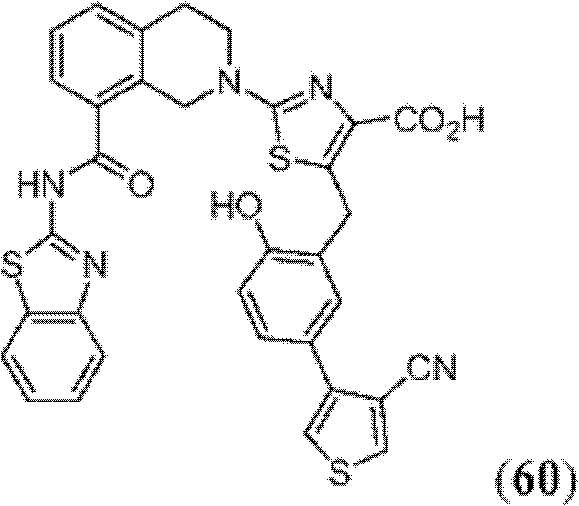
步骤1:5-(5-(4-氰基噻吩-3-基)-2-羟基苄基)-2-(8-(3-((2-(三甲基甲硅烷基)乙氧基)甲基)苯并[d]噻唑-2(3H)-亚基氨基甲酰基)-3,4-二氢异喹啉-2(1H)-基)噻唑-4-羧酸(E)-甲酯(60A)的制备: Step 1 : 5-(5-(4-cyanothiophen-3-yl)-2-hydroxybenzyl)-2-(8-(3-((2-(trimethylsilyl)ethoxy )methyl)benzo[d]thiazole-2(3H)-ylidenecarbamoyl)-3,4-dihydroisoquinolin-2(1H)-yl)thiazole-4-carboxylic acid (E)- Preparation of methyl ester (60A):
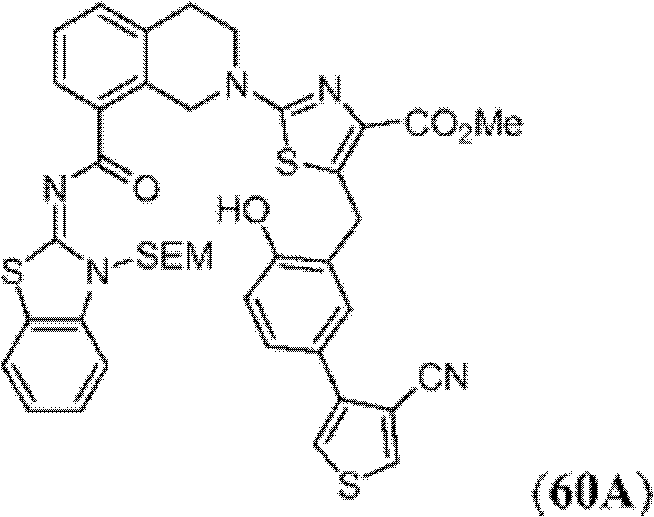
题示化合物60A用与化合物35A的合成类似的方式制备,分别用化合物45D和化合物51A代替化合物34D和化合物31F:ESI(+)/LC/MS:892(M+NH4-H2O)+:1H NMR(DMSO-d6):δ9.99(s,1H),8.58(s,1H),8.21(d,J=6.71Hz,1H),7.92(d,J=7.32Hz,1H),7.66-7.68(m,2H),7.52-7.55(m,1H),7.32-7.41(m,5H),6.92(d,J=8.24Hz,1H),5.97(s,2H),5.08(s,2H),4.35(s,2H),3.78(s,3H),3.64-3.68(m,2H),2.98(t,J=5.8Hz,2H),0.84-0.87(m,2H),-0.22(s,9H)。ESI(+)/MS:794(M+H)+。The title compound 60A was prepared in a similar manner to the synthesis of compound 35A, replacing compound 34D and compound 31F with compound 45D and compound 51A, respectively: ESI (+)/LC/MS: 892 (M+NH 4 -H 2 O) + : 1 H NMR (DMSO-d 6 ): δ9.99(s, 1H), 8.58(s, 1H), 8.21(d, J=6.71Hz, 1H), 7.92(d, J=7.32Hz, 1H) , 7.66-7.68(m, 2H), 7.52-7.55(m, 1H), 7.32-7.41(m, 5H), 6.92(d, J=8.24Hz, 1H), 5.97(s, 2H), 5.08(s , 2H), 4.35(s, 2H), 3.78(s, 3H), 3.64-3.68(m, 2H), 2.98(t, J=5.8Hz, 2H), 0.84-0.87(m, 2H), -0.22 (s, 9H). ESI (+)/MS: 794 (M+H) + .
步骤2:题示化合物60的制备: Step 2 : Preparation of title compound 60:
题示化合物60用与化合物34的合成类似的方式制备,用化合物60A代替化合物34D:1H NMR(DMSO-d6):δ9.92(s,1H),8.55(d,J=3.07Hz,1H),8.00(d,J=7.98Hz,1H),7.77(d,J=8.29Hz,1H),7.63-7.66(m,2H),7.29-7.48(m,6H),6.90(d,J=8.29Hz,1H),4.79(s,2H),4.34(s,2H),3.66(d,J=5.98Hz,2H),2.99(t,J=5.83Hz,2H)。ESI(+)/MS:650(M+H)+。The title compound 60 was prepared in a similar manner to the synthesis of compound 34, replacing compound 34D with compound 60A: 1 H NMR (DMSO-d 6 ): δ9.92 (s, 1H), 8.55 (d, J=3.07Hz, 1H), 8.00(d, J=7.98Hz, 1H), 7.77(d, J=8.29Hz, 1H), 7.63-7.66(m, 2H), 7.29-7.48(m, 6H), 6.90(d, J =8.29Hz, 1H), 4.79(s, 2H), 4.34(s, 2H), 3.66(d, J=5.98Hz, 2H), 2.99(t, J=5.83Hz, 2H). ESI(+)/MS: 650(M+H) + .
实施例61Example 61
5-{3-[4-(4-乙酰基-哌嗪-1-基)-苯氧基]-丙基}-2-[8-(苯并噻唑-2-基氨基甲酰基)-3,4-二氢-1H-异喹啉-2-基]-噻唑-4-羧酸(61)的合成:5-{3-[4-(4-Acetyl-piperazin-1-yl)-phenoxy]-propyl}-2-[8-(benzothiazol-2-ylcarbamoyl)-3 , Synthesis of 4-dihydro-1H-isoquinolin-2-yl]-thiazole-4-carboxylic acid (61):
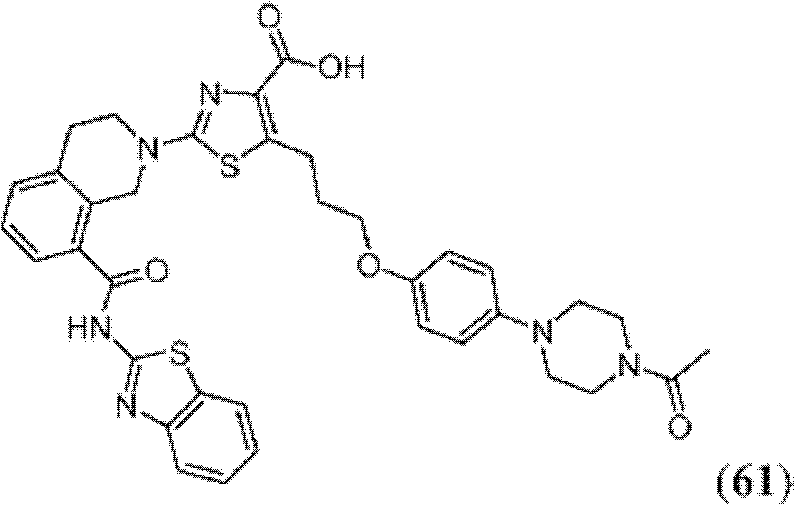
题示化合物61用与化合物51的合成类似的方式制备,在实施例51的步骤2中用1-(4-(4-羟基苯基)哌嗪-1-基)乙酮代替化合物51A:1H NMR(DMSO-d6):δ8.02(d,J=7.36Hz,1H),7.78(d,J=8.29Hz,1H),7.66(d,J=7.06Hz,1H),7.33-7.49(m,4H),6.90-6.92(m,2H),6.80-6.82(m,2H),4.82(s,2H),3.90(t,J=6.29Hz,2H),3.71(t,J=6.29Hz,2H),3.53-3.56(m,2H),3.13-3.17(m,2H),3.02(t,J=5.37Hz,4H),2.94-2.96(m,2H),2.02(s,3H),1.92-1.99(m,2H)。ESI(+)/MS:697(M+H)+。The title compound 61 was prepared in a similar manner to the synthesis of compound 51, replacing compound 51A with 1-(4-(4-hydroxyphenyl)piperazin-1-yl)ethanone in step 2 of Example 51: 1 H NMR (DMSO-d 6 ): δ8.02 (d, J=7.36Hz, 1H), 7.78 (d, J=8.29Hz, 1H), 7.66 (d, J=7.06Hz, 1H), 7.33-7.49 (m, 4H), 6.90-6.92(m, 2H), 6.80-6.82(m, 2H), 4.82(s, 2H), 3.90(t, J=6.29Hz, 2H), 3.71(t, J=6.29 Hz, 2H), 3.53-3.56(m, 2H), 3.13-3.17(m, 2H), 3.02(t, J=5.37Hz, 4H), 2.94-2.96(m, 2H), 2.02(s, 3H) , 1.92-1.99 (m, 2H). ESI (+)/MS: 697 (M+H) + .
实施例62Example 62
2-(8-(苯并[d]噻唑-2-基氨基甲酰基)-3,4-二氢异喹啉-2(1H)-基)-5-((4-苯基哌嗪-1-基)甲基)噻唑-4-羧酸(62A)的合成:2-(8-(Benzo[d]thiazol-2-ylcarbamoyl)-3,4-dihydroisoquinolin-2(1H)-yl)-5-((4-phenylpiperazine- Synthesis of 1-yl)methyl)thiazole-4-carboxylic acid (62A):
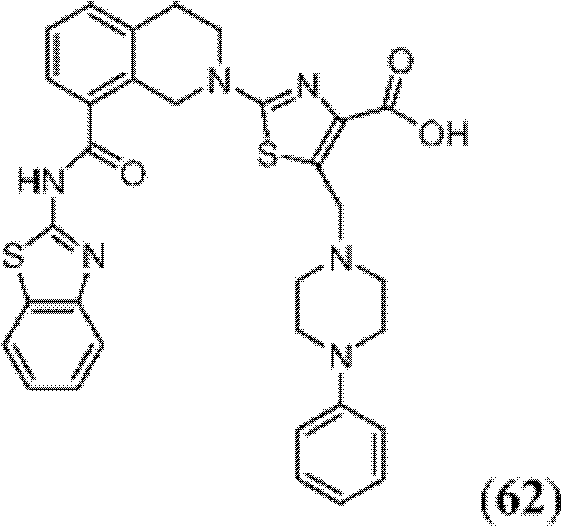
步骤1:2-(8-(苯并[d]噻唑-2-基((2-(三甲基甲硅烷基)乙氧基)甲基)氨基甲酰基)-3,4-二氢异喹啉-2(1H)-基)-5-((4-苯基哌嗪-1-基)甲基)噻唑-4-羧酸甲酯(62A)的制备: Step 1 : 2-(8-(Benzo[d]thiazol-2-yl((2-(trimethylsilyl)ethoxy)methyl)carbamoyl)-3,4-dihydroiso Preparation of quinoline-2(1H)-yl)-5-((4-phenylpiperazin-1-yl)methyl)thiazole-4-carboxylic acid methyl ester (62A):
向化合物45C(55mg,0.090mmol)在DCE(3.5ml)中的溶液中,加入1-苯基哌嗪(14.57mg,0.090mmol)和三乙酰氧基硼氢化钠(28.7mg,0.136mmol)。反应搅拌2天,浓缩。残余物用甲醇研磨,收集白色沉淀,得到题示化合物:LCMS(APCI)m/e 756(M+H)。To a solution of compound 45C (55 mg, 0.090 mmol) in DCE (3.5 ml), 1-phenylpiperazine (14.57 mg, 0.090 mmol) and sodium triacetoxyborohydride (28.7 mg, 0.136 mmol) were added. The reaction was stirred for 2 days and concentrated. The residue was triturated with methanol and the white precipitate was collected to give the title compound: LCMS (APCI) m/e 756 (M+H).
步骤2:题示化合物62的制备: Step 2 : Preparation of title compound 62:

含化合物62A(50mg,0.066mmol)的DCM(3.5ml)用含2N盐酸的乙醚(3.31ml,6.62mmol)处理30min。浓缩反应,残余物在THF(3ml)和甲醇(3ml)中溶解。加入NaOH(10%水溶液,1ml)。得到的混合物搅拌过夜,浓缩。残余物通过反相HPLC纯化(流动相:含0%-70%乙腈的0.1%TFA水溶液,40min内),以提供题示化合物:1H NMR(400MHz,DMSO-D6)δppm 12.91(1H,s),8.02(1H,d),7.78(1H,d),7.70(1H,d),7.44-7.50(2H,m),7.41(1H,t),7.35(1H,t),7.20-7.27(2H,m),6.96(2H,d),6.84(1H,t),4.89(2H,s),4.73(2H,s),3.82(2H,t),3.45(8H,s),3.07(2H,t)。LCMS(APCI)m/e 611(M+H)。Compound 62A (50 mg, 0.066 mmol) in DCM (3.5 ml) was treated with 2N hydrochloric acid in ether (3.31 ml, 6.62 mmol) for 30 min. The reaction was concentrated and the residue was dissolved in THF (3ml) and methanol (3ml). NaOH (10% in water, 1 ml) was added. The resulting mixture was stirred overnight and concentrated. The residue was purified by reverse phase HPLC (mobile phase: 0%-70% acetonitrile in 0.1% TFA in water within 40 min) to provide the title compound: 1 H NMR (400 MHz, DMSO-D 6 ) δ ppm 12.91 (1H, s), 8.02(1H,d), 7.78(1H,d), 7.70(1H,d), 7.44-7.50(2H,m), 7.41(1H,t), 7.35(1H,t), 7.20-7.27 (2H,m), 6.96(2H,d), 6.84(1H,t), 4.89(2H,s), 4.73(2H,s), 3.82(2H,t), 3.45(8H,s), 3.07( 2H, t). LCMS (APCI) m/e 611 (M+H).
实施例63Example 63
2-(8-(苯并[d]噻唑-2-基氨基甲酰基)-3,4-二氢异喹啉-2(1H)-基)-5-((4-苯基哌啶-1-基)甲基)噻唑-4-羧酸(63)的合成:2-(8-(Benzo[d]thiazol-2-ylcarbamoyl)-3,4-dihydroisoquinolin-2(1H)-yl)-5-((4-phenylpiperidine- Synthesis of 1-yl)methyl)thiazole-4-carboxylic acid (63):

步骤1:2-(8-(苯并[d]噻唑-2-基((2-(三甲基甲硅烷基)乙氧基)甲基)氨基甲酰基)-3,4-二氢异喹啉-2(1H)-基)-5-((4-苯基哌啶-1-基)甲基)噻唑-4-羧酸甲酯(63A)的制备: Step 1 : 2-(8-(Benzo[d]thiazol-2-yl((2-(trimethylsilyl)ethoxy)methyl)carbamoyl)-3,4-dihydroiso Preparation of quinoline-2(1H)-yl)-5-((4-phenylpiperidin-1-yl)methyl)thiazole-4-carboxylic acid methyl ester (63A):
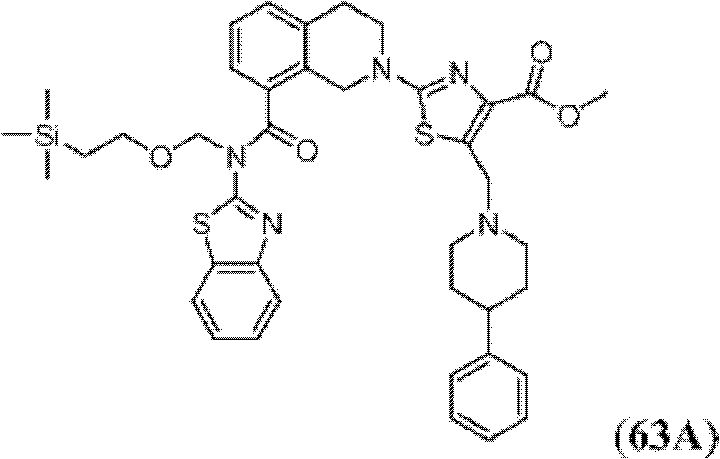
化合物使用与实施例62的步骤1中描述的相同程序制备,用4-苯基哌啶代替1-苯基哌嗪。LCMS(APCI)m/e 755(M+H)。The compound was prepared using the same procedure as described in step 1 of Example 62, substituting 4-phenylpiperidine for 1-phenylpiperazine. LCMS (APCI) m/e 755 (M+H).
步骤2:题示化合物63的制备: Step 2 : Preparation of Title Compound 63:
题示化合物63使用与实施例62的步骤2中描述的相同程序制备,用化合物63A代替化合物62A:1H NMR(400MHz,DMSO-D6)δppm 12.94(1H,s),9.32(1H,s),8.03(1H,d),7.78(1H,d),7.71(1H,d),7.45-7.50(2H,m),7.41(1H,t),7.29-7.38(3H,m),7.21(3H,t),4.89(2H,s),4.76(2H,s),3.83(2H,t),3.48-3.59(2H,m),3.11-3.21(2H,m),3.07(2H,t),2.78-2.90(1H,m),1.76-2.02(4H,m)。LCMS(APCI)m/e 610(M+H)。Title compound 63 was prepared using the same procedure as described in step 2 of Example 62, substituting compound 63A for compound 62A: 1 H NMR (400 MHz, DMSO-D 6 ) δ ppm 12.94 (1H, s), 9.32 (1H, s ), 8.03(1H, d), 7.78(1H, d), 7.71(1H, d), 7.45-7.50(2H, m), 7.41(1H, t), 7.29-7.38(3H, m), 7.21( 3H,t), 4.89(2H,s), 4.76(2H,s), 3.83(2H,t), 3.48-3.59(2H,m), 3.11-3.21(2H,m), 3.07(2H,t) , 2.78-2.90 (1H, m), 1.76-2.02 (4H, m). LCMS (APCI) m/e 610 (M+H).
实施例64Example 64
2-[8-(苯并噻唑-2-基氨基甲酰基)-3,4-二氢-1H-异喹啉-2-基]-5-[3-(4-哌嗪-1-基-苯氧基)-丙基]-噻唑-4-羧酸(64)的合成:2-[8-(Benzothiazol-2-ylcarbamoyl)-3,4-dihydro-1H-isoquinolin-2-yl]-5-[3-(4-piperazin-1-yl Synthesis of -phenoxy)-propyl]-thiazole-4-carboxylic acid (64):
在二氧杂环己烷(2mL)和MeOH(2mL)中的化合物61(25mg),用1.0N LiOH(2mL)处理。反应混合物加热回流,直到通过TLC监测,化合物61耗尽。除去溶剂,残余物用预制备HPLC纯化,得到题示化合物64,为TFA盐:1H NMR(DMSO-d6):δ8.56(s,2H),7.96(d,J=7.67Hz,1H),7.72(d,J=7.98Hz,1H),7.60(d,J=7.36Hz,1H),7.27-7.43(m,4H),6.92-6.95(m,2H),6.75-6.77(m,2H),4.76(s,2H),3.84(t,J=6.14Hz,2H),3.65(t,J=5.98Hz,2H),3.07-3.14(m,8H),2.96(t,J=5.98Hz,2H),1.86-1.94(m,2H)。ESI(+)/MS:655(M+H)+。Compound 61 (25 mg) in dioxane (2 mL) and MeOH (2 mL) was treated with 1.0 N LiOH (2 mL). The reaction mixture was heated to reflux until compound 61 was consumed as monitored by TLC. The solvent was removed, and the residue was purified by preparative HPLC to obtain the title compound 64 as a TFA salt: 1 H NMR (DMSO-d 6 ): δ8.56 (s, 2H), 7.96 (d, J=7.67Hz, 1H ), 7.72(d, J=7.98Hz, 1H), 7.60(d, J=7.36Hz, 1H), 7.27-7.43(m, 4H), 6.92-6.95(m, 2H), 6.75-6.77(m, 2H), 4.76(s, 2H), 3.84(t, J=6.14Hz, 2H), 3.65(t, J=5.98Hz, 2H), 3.07-3.14(m, 8H), 2.96(t, J=5.98 Hz, 2H), 1.86-1.94 (m, 2H). ESI (+)/MS: 655 (M+H) + .
实施例65Example 65
2-[8-(苯并噻唑-2-基氨基甲酰基)-3,4-二氢-1H-异喹啉-2-基]-5-{3-[4-(5-溴-噻吩并[2,3-d]嘧啶-4-基)-苯氧基]-丙基}-噻唑-4-羧酸(65)的合成:2-[8-(Benzothiazol-2-ylcarbamoyl)-3,4-dihydro-1H-isoquinolin-2-yl]-5-{3-[4-(5-bromo-thiophene Synthesis of [2,3-d]pyrimidin-4-yl)-phenoxy]-propyl}-thiazole-4-carboxylic acid (65):

步骤1:7-溴-4-氯噻吩并[3,2-d]嘧啶(65A)的制备: Step 1 : Preparation of 7-bromo-4-chlorothieno[3,2-d]pyrimidine (65A):
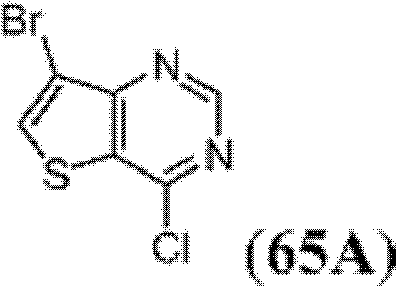
7-溴噻吩并[3,2-d]嘧啶-4(3H)-酮(0.9g,3.89mmol)在POCl3中加热回流2小时,减压除去过量的POCl3。残余物在水和EtOAc之间分离。分离有机层,用额外的EtOAc萃取水层。合并的有机层用盐水洗涤,干燥(MgSO4),过滤,浓缩,得到0.91g化合物65A:1H NMR(DMSO-d6):δ9.15(s,1H),8.78(s,1H)。ESI(+)/MS:248(M-H)+。7-Bromothieno[3,2-d]pyrimidin-4(3H)-one (0.9 g, 3.89 mmol) was heated under reflux in POCl 3 for 2 hours, and excess POCl 3 was removed under reduced pressure. The residue was partitioned between water and EtOAc. The organic layer was separated and the aqueous layer was extracted with additional EtOAc. The combined organic layers were washed with brine, dried (MgSO 4 ), filtered, and concentrated to afford 0.91 g of compound 65A: 1 H NMR (DMSO-d 6 ): δ 9.15 (s, 1H), 8.78 (s, 1H). ESI (+)/MS: 248 (MH) + .
步骤2:4-(7-溴噻吩并[3,2-d]嘧啶-4-基)苯酚(65B)的制备: Step 2 : Preparation of 4-(7-bromothieno[3,2-d]pyrimidin-4-yl)phenol (65B):
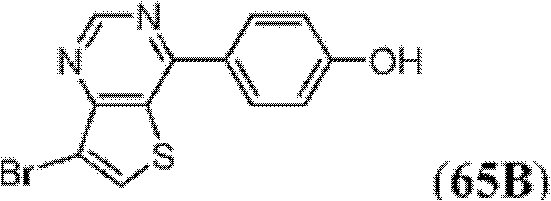
题示化合物使用如化合物34D的合成描述的类似条件制备,分别用化合物65A和4-(4,4,5,5-四甲基-1,3,2-二氧硼戊环-2-基)苯酚代替化合物34C和4-(羟甲基)苯基硼酸:1H NMR(DMSO-d6):δ9.27(s,1H),8.73(s,1H),8.08-8.10(m,2H),7.01-7.03(m,2H);ESI(-)/MS:308(M-H)-。The title compound was prepared using similar conditions as described for the synthesis of compound 34D, using compound 65A and 4-(4,4,5,5-tetramethyl-1,3,2-dioxaborolan-2-yl, respectively ) phenol instead of compound 34C and 4-(hydroxymethyl)phenylboronic acid: 1 H NMR (DMSO-d 6 ): δ9.27 (s, 1H), 8.73 (s, 1H), 8.08-8.10 (m, 2H ), 7.01-7.03 (m, 2H); ESI (-)/MS: 308 (MH) - .
步骤3:题示化合物65的制备: Step 3 : Preparation of Title Compound 65:
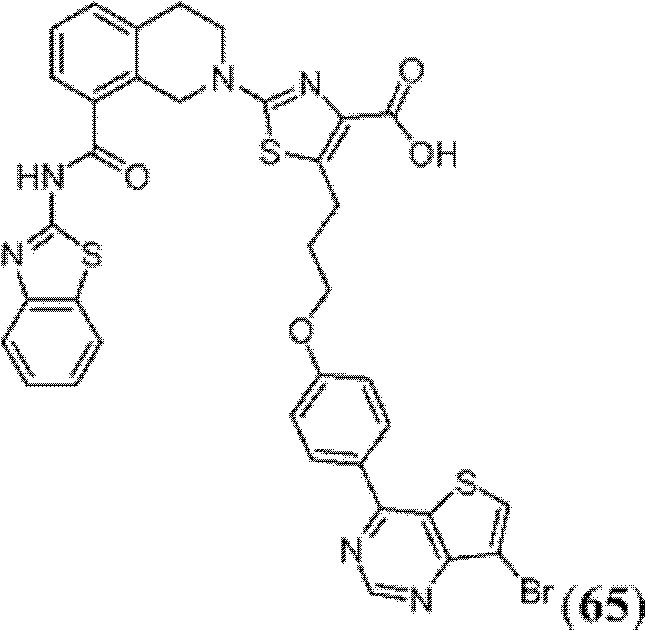
题示化合物65用与化合物51的合成类似的方式制备,用化合物65B代替化合物51A:1H NMR(DMSO-d6):δ9.29(s,1H),8.73(s,1H),8.13(d,J=8.59Hz,2H),7.99(d,J=7.98Hz,1H),7.76(d,J=7.98Hz,1H),7.66(d,J=7.06Hz,1H),7.31-7.47(m,4H),7.17(J=8.9Hz,2H),4.82(s,2H),4.11(t,J=6.14Hz,2H),3.71-3.74(m,2H),3.19-3.22(m,2H),3.02(t,J=5.37Hz,2H),2.05-2.07(m,2H)。ESI(+)/MS:527(M+H)+。The title compound 65 was prepared in a similar manner to the synthesis of compound 51, replacing compound 51A with compound 65B: 1 H NMR (DMSO-d 6 ): δ9.29 (s, 1H), 8.73 (s, 1H), 8.13 ( d, J=8.59Hz, 2H), 7.99(d, J=7.98Hz, 1H), 7.76(d, J=7.98Hz, 1H), 7.66(d, J=7.06Hz, 1H), 7.31-7.47( m, 4H), 7.17(J=8.9Hz, 2H), 4.82(s, 2H), 4.11(t, J=6.14Hz, 2H), 3.71-3.74(m, 2H), 3.19-3.22(m, 2H ), 3.02(t, J=5.37Hz, 2H), 2.05-2.07(m, 2H). ESI (+)/MS: 527 (M+H) + .
实施例66Example 66
5-(3-(4-(1H-咪唑-1-基)苯氧基)丙基)-2-(8-(苯并[d]噻唑-2-基氨基甲酰基)-3,4-二氢异喹啉-2(1H)-基)噻唑-4-羧酸(66)的合成:5-(3-(4-(1H-imidazol-1-yl)phenoxy)propyl)-2-(8-(benzo[d]thiazol-2-ylcarbamoyl)-3,4- Synthesis of dihydroisoquinolin-2(1H)-yl)thiazole-4-carboxylic acid (66):
题示化合物66通过在实施例2的步骤4用4-(1H-咪唑-1-基)苯酚代替苯酚制备。酯水解前未分离烷化中间体。所需产物沉淀后,固体通过HPLC纯化(预制备反相HPLC用自动化Gilson HPLC系统执行,使用SymmetryPrep Shield RP18预制备柱,250mmx21.20mm i.d.,10um,流速25mL/min;λ=214、245nm;流动相A,含0.1%TFA的H2O;流动相B,CH3CN;40分钟内,B的线性梯度20-90%),以提供题示化合物,产率45%:1H NMR(300MHz,DMSO-d6)δppm12.88(1H,s),12.52(1H,s),9.34(1H,s),8.10(1H,d),8.02(1H,m),7.78(2H,m),7.66(3H,m),7.42(4H,m),7.13(2H,m),4.83(2H,s),4.07(2H,t),3.73(2H,t),3.20(2H,m),3.03(2H,t),2.04(2H,m);MS(ESI(+))m/e 637(M+H)。The title compound 66 was prepared by substituting 4-(1H-imidazol-1-yl)phenol in step 4 of Example 2 for phenol. The alkylated intermediate was not isolated prior to ester hydrolysis. After precipitation of the desired product, the solid was purified by HPLC (pre-prep reverse phase HPLC performed with an automated Gilson HPLC system using a SymmetryPrep Shield RP18 pre-prep column, 250mmx21.20mm id, 10um, flow rate 25mL/min; λ = 214, 245nm; flow Phase A, H 2 O with 0.1% TFA; mobile phase B, CH 3 CN; linear gradient 20-90% of B over 40 minutes) to provide the title compound in 45% yield: 1 H NMR (300 MHz , DMSO-d 6 ) δppm 12.88 (1H, s), 12.52 (1H, s), 9.34 (1H, s), 8.10 (1H, d), 8.02 (1H, m), 7.78 (2H, m), 7.66(3H,m), 7.42(4H,m), 7.13(2H,m), 4.83(2H,s), 4.07(2H,t), 3.73(2H,t), 3.20(2H,m), 3.03 (2H,t), 2.04 (2H,m); MS (ESI(+)) m/e 637 (M+H).
实施例67Example 67
5-(3-(4-(1H-1,2,4-三唑-1-基)苯氧基)丙基)-2-(8-(苯并[d]噻唑-2-基氨基甲酰基)-3,4-二氢异喹啉-2(1H)-基)噻唑-4-羧酸(67)的合成:5-(3-(4-(1H-1,2,4-triazol-1-yl)phenoxy)propyl)-2-(8-(benzo[d]thiazol-2-ylaminomethyl Synthesis of acyl)-3,4-dihydroisoquinolin-2(1H)-yl)thiazole-4-carboxylic acid (67):
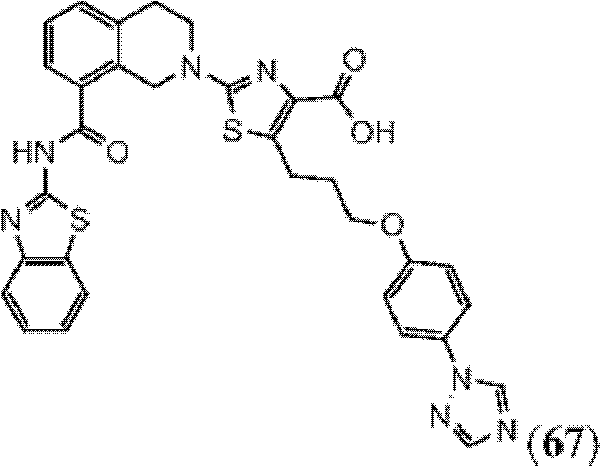
题示化合物通过在实施例2的步骤4用4-(1H-1,2,4-三唑-1-基)苯酚代替苯酚制备。酯水解前未分离烷化中间体。所需产物沉淀后,固体通过HPLC纯化(预制备反相HPLC用自动化Gilson HPLC系统执行,使用SymmetryPrep Shield RP18预制备柱,250mmx21.20mmi.d.,10um,流速25mL/min;λ=214、245nm;流动相A,含0.1%TFA的H2O;流动相B,CH3CN;40分钟内,B的线性梯度20-90%),以提供题示化合物67,产率43%:1H NMR(300MHz,DMSO-d6)δppm12.88(1H,s),9.14(1H,s),8.17(1H,s),8.03(1H,d),7.79(1H,d),7.72(2H,m),7.66(1H,d),7.42(5H,m),7.07(2H,m),4.83(2H,s),4.04(2H,t),3.72(2H,t),3.19(2H,m),3.03(2H,t),2.02(2H,m)。MS(ESI(+))m/e 638(M+H)。The title compound was prepared by substituting 4-(1H-1,2,4-triazol-1-yl)phenol in step 4 of Example 2 for phenol. The alkylated intermediate was not isolated prior to ester hydrolysis. After precipitation of the desired product, the solid was purified by HPLC (pre-preparative reverse phase HPLC performed with an automated Gilson HPLC system, using a SymmetryPrep Shield RP18 pre-preparative column, 250mmx21.20mmi.d., 10um, flow rate 25mL/min; λ = 214, 245nm ; mobile phase A, H 2 O with 0.1% TFA; mobile phase B, CH 3 CN; linear gradient 20-90% of B over 40 minutes) to provide the title compound 67 in 43% yield: 1 H NMR (300MHz, DMSO-d 6 ) δppm12.88 (1H, s), 9.14 (1H, s), 8.17 (1H, s), 8.03 (1H, d), 7.79 (1H, d), 7.72 (2H, m), 7.66(1H,d), 7.42(5H,m), 7.07(2H,m), 4.83(2H,s), 4.04(2H,t), 3.72(2H,t), 3.19(2H,m ), 3.03(2H,t), 2.02(2H,m). MS (ESI (+)) m/e 638 (M+H).
实施例68Example 68
2-(8-(苯并[d]噻唑-2-基氨基甲酰基)-3,4-二氢异喹啉-2(1H)-基)-5-(3-(4-(4-甲基-4H-1,2,4-三唑-3-基)苯氧基)丙基)噻唑-4-羧酸(68)的合成:2-(8-(Benzo[d]thiazol-2-ylcarbamoyl)-3,4-dihydroisoquinolin-2(1H)-yl)-5-(3-(4-(4- Synthesis of methyl-4H-1,2,4-triazol-3-yl)phenoxy)propyl)thiazole-4-carboxylic acid (68):
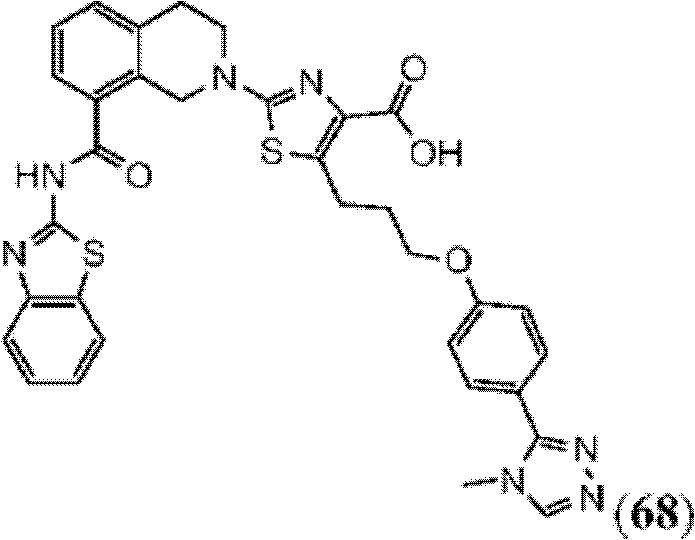
题示化合物68通过在实施例2的步骤4用4-(4-甲基-4H-1,2,4-三唑-3-基)苯酚代替苯酚制备。酯水解前未分离烷化中间体。所需产物沉淀后,固体通过HPLC纯化(预制备反相HPLC用自动化GilsonHPLC系统执行,使用SymmetryPrep Shield RP18预制备柱,250mmx21.20mm i.d.,10um,流速25mL/min;λ=214、245nm;流动相A,含0.1%TFA的H2O;流动相B,CH3CN;40分钟内,B的线性梯度20-90%),以提供题示化合物68,产率56%:1H NMR(300MHz,DMSO-d6)δppm 12.89(1H,s),8.73(1H,s),8.03(1H,d),7.79(1H,d),7.66(3H,m),7.42(4H,m),7.09(2H,m),4.83(2H,s),4.07(2H,t),3.73(5H,m),3.20(2H,m),3.03(2H,t),2.04(2H,m)。MS(ESI(+))m/e 652(M+H)。The title compound 68 was prepared by substituting 4-(4-methyl-4H-1,2,4-triazol-3-yl)phenol in step 4 of Example 2 for phenol. The alkylated intermediate was not isolated prior to ester hydrolysis. After precipitation of the desired product, the solid was purified by HPLC (pre-prep reverse phase HPLC was performed with an automated GilsonHPLC system using a SymmetryPrep Shield RP18 pre-prep column, 250mmx21.20mm id, 10um, flow rate 25mL/min; λ = 214, 245nm; mobile phase A, H 2 O with 0.1% TFA; mobile phase B, CH 3 CN; linear gradient 20-90% of B over 40 minutes) to provide the title compound 68 in 56% yield: 1 H NMR (300 MHz , DMSO-d 6 ) δppm 12.89 (1H, s), 8.73 (1H, s), 8.03 (1H, d), 7.79 (1H, d), 7.66 (3H, m), 7.42 (4H, m), 7.09 (2H, m), 4.83 (2H, s), 4.07 (2H, t), 3.73 (5H, m), 3.20 (2H, m), 3.03 (2H, t), 2.04 (2H, m). MS (ESI (+)) m/e 652 (M+H).
实施例69Example 69
2-[8-(苯并噻唑-2-基氨基甲酰基)-3,4-二氢-1H-异喹啉-2-基]-5-{3-[4-(4-异丙基氨基-噻吩并[3,2-d]嘧啶-7-基)-苯氧基]-丙基}-噻唑-4-羧酸(69)的合成:2-[8-(Benzothiazol-2-ylcarbamoyl)-3,4-dihydro-1H-isoquinolin-2-yl]-5-{3-[4-(4-isopropyl Synthesis of amino-thieno[3,2-d]pyrimidin-7-yl)-phenoxy]-propyl}-thiazole-4-carboxylic acid (69):

步骤1:7-溴-N-异丙基噻吩并[3,2-d]嘧啶-4-胺(69A)的制备: Step 1 : Preparation of 7-bromo-N-isopropylthieno[3,2-d]pyrimidin-4-amine (69A):
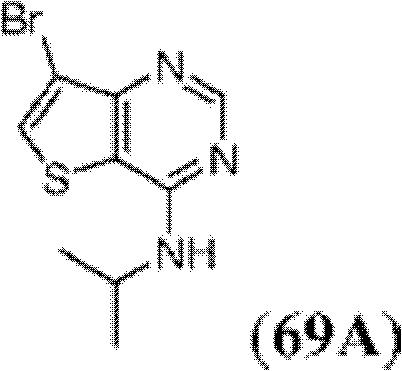
化合物65A(0.125g,0.5mmol)和丙-2-胺(0.148g,2.5mmol)在乙醇(10mL)中的混合物加热回流15小时。除去溶剂,残余物通过快速柱色谱用硅胶纯化,用1∶1EtOAc/己烷洗脱,得到0.13g题示化合物:1H NMR(DMSO-d6):δ8.50(s,1H),8.28(s,1H),7.87(d,J=7.46Hz,1H),4.40-4.51(m,1H),1.23(d,J=6.78Hz,6H)。ESI(+)/MS:273(M-H)+。A mixture of compound 65A (0.125 g, 0.5 mmol) and propan-2-amine (0.148 g, 2.5 mmol) in ethanol (10 mL) was heated at reflux for 15 hours. The solvent was removed and the residue was purified by flash column chromatography on silica gel, eluting with 1:1 EtOAc/hexanes, to afford 0.13 g of the title compound: 1 H NMR (DMSO-d 6 ): δ8.50 (s, 1H), 8.28 (s, 1H), 7.87 (d, J=7.46Hz, 1H), 4.40-4.51 (m, 1H), 1.23 (d, J=6.78Hz, 6H). ESI (+)/MS: 273 (MH) + .
步骤2:4-(4-(异丙基氨基)噻吩并[3,2-d]嘧啶-7-基)苯酚(69B)的制备: Step 2 : Preparation of 4-(4-(isopropylamino)thieno[3,2-d]pyrimidin-7-yl)phenol (69B):
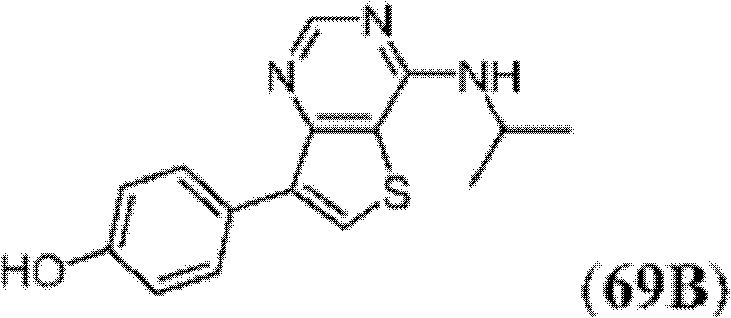
题示化合物69B用与化合物34D的合成类似的方式制备,分别用化合物69A和4-(4,4,5,5-四甲基-1,3,2-二氧硼戊环-2-基)苯酚代替化合物34C和4-(羟甲基)苯基硼酸:1H NMR(DMSO-d6):δ9.49(s,1H),8.50(s,1H),8.10(s,1H),7.88-7.91(m,2H),7.57(d,J=7.67Hz,1H),6.83-6.86(m,2H),4.44-4.53(m,1H),1.25(d,J=6.75Hz,6H)。ESI(+)/MS:286(M-H)+。The title compound 69B was prepared in a similar manner to the synthesis of compound 34D, using compound 69A and 4-(4,4,5,5-tetramethyl-1,3,2-dioxaborolan-2-yl, respectively ) phenol instead of compound 34C and 4-(hydroxymethyl)phenylboronic acid: 1 H NMR (DMSO-d 6 ): δ9.49 (s, 1H), 8.50 (s, 1H), 8.10 (s, 1H), 7.88-7.91(m, 2H), 7.57(d, J=7.67Hz, 1H), 6.83-6.86(m, 2H), 4.44-4.53(m, 1H), 1.25(d, J=6.75Hz, 6H) . ESI (+)/MS: 286 (MH) + .
步骤3:题示化合物69的制备: Step 3 : Preparation of title compound 69:
题示化合物69用与化合物51的合成类似的方式制备,用化合物69B代替化合物51A:1H NMR(DMSO-d6):δ8.59(s,1H),8.25(s,1H),8.00(d,J=7.67Hz,1H),7.66-7.79(m,4H),7.32-7.48(m,4H),7.03(d,J=8.59Hz,2H),4.84(s,2H),4.41-4.47(m,1H),4.05(t,J=6.14Hz,2H),3.72-3.75(m,2H),3.19-3.22(m,2H),3.03(t,J=5.98Hz,2H),2.00-2.08(m,2H),1.28(d,J=6.44Hz,6H)。ESI(+)/MS:762(M+H)+。The title compound 69 was prepared in a similar manner to the synthesis of compound 51, replacing compound 51A with compound 69B: 1 H NMR (DMSO-d 6 ): δ8.59 (s, 1H), 8.25 (s, 1H), 8.00 ( d, J=7.67Hz, 1H), 7.66-7.79(m, 4H), 7.32-7.48(m, 4H), 7.03(d, J=8.59Hz, 2H), 4.84(s, 2H), 4.41-4.47 (m, 1H), 4.05(t, J=6.14Hz, 2H), 3.72-3.75(m, 2H), 3.19-3.22(m, 2H), 3.03(t, J=5.98Hz, 2H), 2.00- 2.08 (m, 2H), 1.28 (d, J=6.44Hz, 6H). ESI (+)/MS: 762 (M+H) + .
实施例70Example 70
2-[8-(苯并噻唑-2-基氨基甲酰基)-3,4-二氢-1H-异喹啉-2-基]-5-[2-(3-硝基-苯磺酰基氨基)-乙基]-噻唑-4-羧酸(70)的合成:2-[8-(Benzothiazol-2-ylcarbamoyl)-3,4-dihydro-1H-isoquinolin-2-yl]-5-[2-(3-nitro-benzenesulfonyl Synthesis of amino)-ethyl]-thiazole-4-carboxylic acid (70):

步骤1:5-(2-(3-硝基苯基磺酰胺基)乙基)-2-(8-(2-(3-((2-(三甲基甲硅烷基)乙氧基)甲基)苯并[d]噻唑-2(3H)-亚基)乙酰基)-3,4-二氢异喹啉-2(1H)-基)噻唑-4-羧酸(E)-乙酯(70A)的制备: Step 1 : 5-(2-(3-nitrophenylsulfonamido)ethyl)-2-(8-(2-(3-((2-(trimethylsilyl)ethoxy) Methyl)benzo[d]thiazole-2(3H)-ylidene)acetyl)-3,4-dihydroisoquinolin-2(1H)-yl)thiazole-4-carboxylic acid (E)-ethyl Preparation of ester (70A):
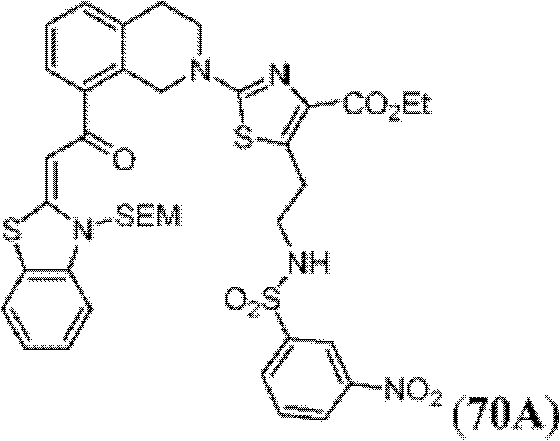
题示化合物70A用与化合物35A的合成类似的方式制备,分别用化合物49D和3-硝基苯磺酰胺代替化合物34D和化合物31F:ESI(+)/LC/MS:823(M+H)+。The title compound 70A was prepared in a similar manner to the synthesis of compound 35A, replacing compound 34D and compound 31F with compound 49D and 3-nitrobenzenesulfonamide: ESI (+)/LC/MS: 823 (M+H) + .
步骤2:题示化合物70的制备: Step 2 : Preparation of title compound 70:
题示化合物70用与化合物51的合成类似的方式制备,用化合物70A代替化合物51A:1H NMR(DMSO-d6):δ8.39-8.44(m,2H),8.11-8.15(m,2H),8.04(d,J=7.98Hz,1H),7.78-7.84(m,2H),7.68(d,J=7.36Hz,1H),7.34-7.50(m,4H),6.90(d,J=8.29Hz,1H),4.79(s,2H),3.69(d,J=5.98Hz,2H),3.06-3.10(m,4H),3.03(t,J=5.98Hz,2H)。ESI(+)/MS:665(M+H)+。The title compound 70 was prepared in a similar manner to the synthesis of compound 51, replacing compound 51A with compound 70A: 1 H NMR (DMSO-d 6 ): δ8.39-8.44 (m, 2H), 8.11-8.15 (m, 2H ), 8.04(d, J=7.98Hz, 1H), 7.78-7.84(m, 2H), 7.68(d, J=7.36Hz, 1H), 7.34-7.50(m, 4H), 6.90(d, J= 8.29Hz, 1H), 4.79(s, 2H), 3.69(d, J=5.98Hz, 2H), 3.06-3.10(m, 4H), 3.03(t, J=5.98Hz, 2H). ESI(+)/MS: 665(M+H) + .
实施例71Example 71
2-[8-(苯并噻唑-2-基氨基甲酰基)-3,4-二氢-1H-异喹啉-2-基]-5-(2-苯基-吖丁啶-1-基甲基)-噻唑-4-羧酸(71)的合成:2-[8-(Benzothiazol-2-ylcarbamoyl)-3,4-dihydro-1H-isoquinolin-2-yl]-5-(2-phenyl-azetidine-1- Synthesis of (methyl)-thiazole-4-carboxylic acid (71):
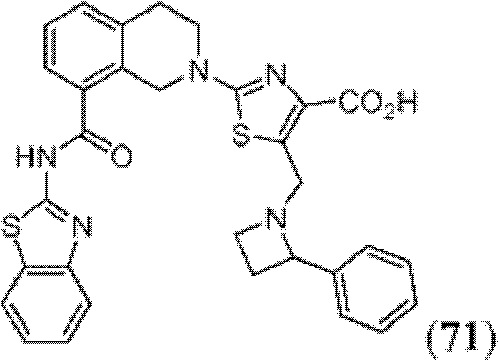
步骤1:5-((2-苯基吖丁啶-1-基)甲基)-2-(8-(2-(3-((2-(三甲基甲硅烷基)乙氧基)甲基)苯并[d]噻唑-2(3H)-亚基)乙酰基)-3,4-二氢异喹啉-2(1H)-基)噻唑-4-羧酸(E)-甲酯(71A)的制备: Step 1 : 5-((2-phenylazetidin-1-yl)methyl)-2-(8-(2-(3-((2-(trimethylsilyl)ethoxy) Methyl)benzo[d]thiazole-2(3H)-ylidene)acetyl)-3,4-dihydroisoquinolin-2(1H)-yl)thiazole-4-carboxylic acid (E)-methan Preparation of ester (71A):
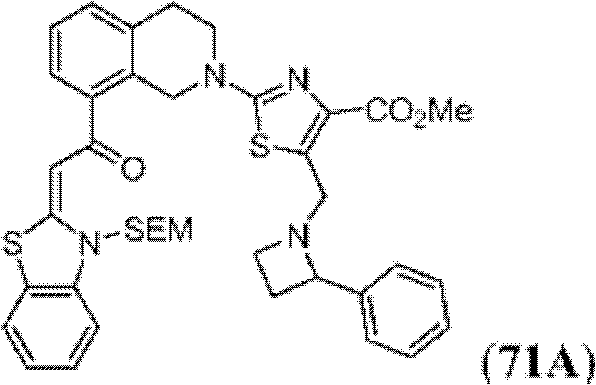
题示化合物71A用与化合物62A的合成类似的方式制备,用2-苯基吖丁啶代替苯基哌嗪:ESI(+)/LC/MS:726(M+H)+。The title compound 71A was prepared in a similar manner to the synthesis of compound 62A, substituting 2-phenylazetidine for phenylpiperazine: ESI(+)/LC/MS: 726 (M+H) + .
步骤2:题示化合物71的制备: Step 2 : Preparation of Title Compound 71:
题示化合物用与化合物51的合成类似的方式制备,用化合物71A代替化合物51A:1H NMR(DMSO-d6):δ12.89(s,1H),8.04(d,J=7.36Hz,1H),7.80(d,J=7.98Hz,1H),7.70(d,J=7.37Hz,1H),7.34-7.54(m,9H),5.47(br,1H),4.70-4.95(m,4H),4.40(br,s,1H),3.88(br,1H),3.76(d,J=5.83Hz,2H),2.60-2.8(br,s,2H)。ESI(+)/MS:582(M+H)+。The title compound was prepared in a similar manner to the synthesis of compound 51, replacing compound 51A with compound 71A: 1 H NMR (DMSO-d 6 ): δ12.89(s, 1H), 8.04(d, J=7.36Hz, 1H ), 7.80(d, J=7.98Hz, 1H), 7.70(d, J=7.37Hz, 1H), 7.34-7.54(m, 9H), 5.47(br, 1H), 4.70-4.95(m, 4H) , 4.40 (br, s, 1H), 3.88 (br, 1H), 3.76 (d, J=5.83Hz, 2H), 2.60-2.8 (br, s, 2H). ESI (+)/MS: 582 (M+H) + .
实施例72Example 72
5-(4-(1H-咪唑-1-基)丁基)-2-(8-(苯并[d]噻唑-2-基氨基甲酰基)-3,4-二氢异喹啉-2(1H)-基)噻唑-4-羧酸(72)的合成:5-(4-(1H-imidazol-1-yl)butyl)-2-(8-(benzo[d]thiazol-2-ylcarbamoyl)-3,4-dihydroisoquinoline-2 Synthesis of (1H)-yl)thiazole-4-carboxylic acid (72):
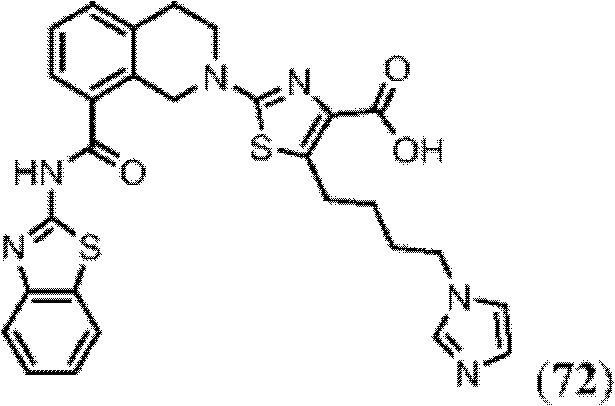
题示化合物72通过在实施例2的步骤4用化合物42C代替化合物2C且用咪唑代替苯酚制备。酯水解前未分离烷化中间体。所需产物沉淀后,固体通过HPLC纯化(预制备反相HPLC用自动化GilsonHPLC系统执行,使用SymmetryPrep Shield RP18预制备柱,250mmx21.20mm i.d.,10um,流速25mL/min;λ=214、245nm;流动相A,含0.1%TFA的H2O;流动相B,CH3CN;40分钟内,B的线性梯度20-90%),以提供题示化合物,产率34%:1H NMR(300MHz,DMSO-d6)δppm 12.91(1H,s),12.55(1H,s),9.06(1H,s),8.04(1H,d),7.77(2H,m),7.66(2H,m),7.43(4H,m),4.82(2H,s),4.19(2H,t),3.73(2H,t),3.05(4H,m),1.83(2H,m),1.53(2H,m)。MS(ESI(+))m/e 559(M+H)。The title compound 72 was prepared by substituting compound 42C for compound 2C and imidazole for phenol in step 4 of Example 2. The alkylated intermediate was not isolated prior to ester hydrolysis. After precipitation of the desired product, the solid was purified by HPLC (pre-prep reverse phase HPLC was performed with an automated GilsonHPLC system using a SymmetryPrep Shield RP18 pre-prep column, 250mmx21.20mm id, 10um, flow rate 25mL/min; λ = 214, 245nm; mobile phase A, H 2 O with 0.1% TFA; mobile phase B, CH 3 CN; linear gradient 20-90% of B over 40 minutes) to provide the title compound in 34% yield: 1 H NMR (300 MHz, DMSO-d 6 ) δppm 12.91 (1H, s), 12.55 (1H, s), 9.06 (1H, s), 8.04 (1H, d), 7.77 (2H, m), 7.66 (2H, m), 7.43 ( 4H, m), 4.82 (2H, s), 4.19 (2H, t), 3.73 (2H, t), 3.05 (4H, m), 1.83 (2H, m), 1.53 (2H, m). MS (ESI (+)) m/e 559 (M+H).
实施例73Example 73
5-(3-(4-(1H-吡唑-4-基)苯氧基)丙基)-2-(8-(苯并[d]噻唑-2-基氨基甲酰基)-3,4-二氢异喹啉-2(1H)-基)噻唑-4-羧酸(73)的合成:5-(3-(4-(1H-pyrazol-4-yl)phenoxy)propyl)-2-(8-(benzo[d]thiazol-2-ylcarbamoyl)-3,4 - Synthesis of dihydroisoquinolin-2(1H)-yl)thiazole-4-carboxylic acid (73):
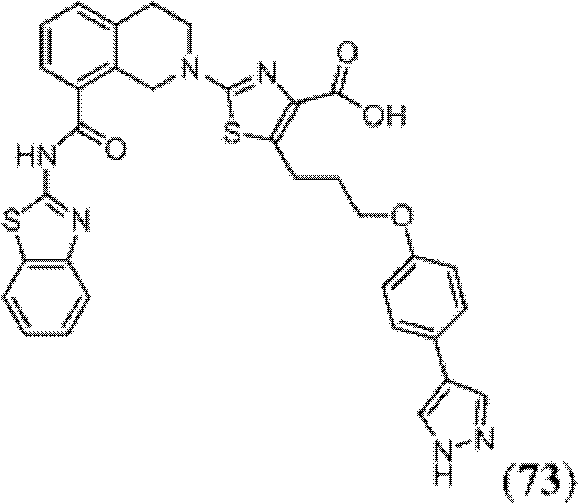
步骤1:5-(3-(4-(1H-吡唑-4-基)苯氧基)丙基)-2-(8-(苯并[d]噻唑-2-基((2-(三甲基甲硅烷基)乙氧基)甲基)氨基甲酰基)-3,4-二氢异喹啉-2(1H)-基)噻唑-4-羧酸叔丁酯(73A)的制备: Step 1 : 5-(3-(4-(1H-pyrazol-4-yl)phenoxy)propyl)-2-(8-(benzo[d]thiazol-2-yl((2-( Preparation of trimethylsilyl)ethoxy)methyl)carbamoyl)-3,4-dihydroisoquinolin-2(1H)-yl)thiazole-4-carboxylic acid tert-butyl ester (73A) :
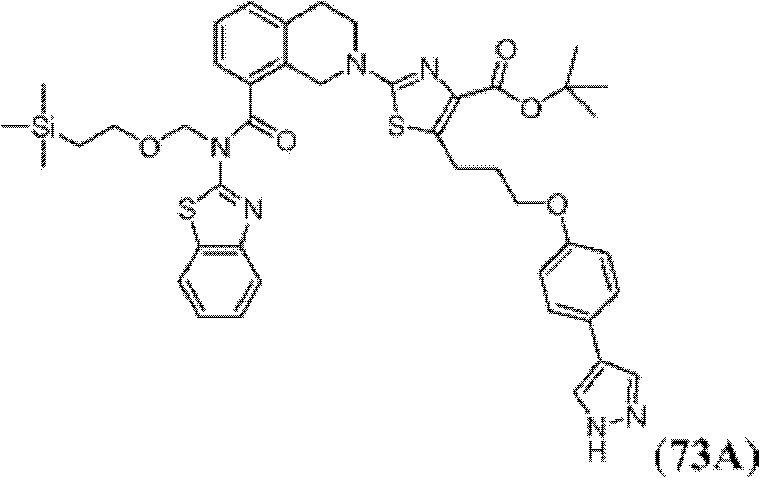
化合物41A(90mg,0.102mmol)、4-(4,4,5,5-四甲基-1,3,2-二氧硼戊环-2-基)-1H-吡唑(29.7mg,0.153mmol)、Na2CO3(108μl,0.102mmol)(1M)和(Ph3P)2Cl2Pd(7.15mg,10.19μmol)在EtOH-DME-H2O(7∶3∶2,4ml)中的混合物,在Smith微波合成器中在120℃加热30min,然后浓缩。残余物通过快速色谱纯化,得到化合物73A。LCMS(APCI)m/e 824(M+H)。Compound 41A (90 mg, 0.102 mmol), 4-(4,4,5,5-tetramethyl-1,3,2-dioxaborolan-2-yl)-1H-pyrazole (29.7 mg, 0.153 mmol), Na 2 CO 3 (108 μl, 0.102 mmol) (1M) and (Ph 3 P) 2 Cl 2 Pd (7.15 mg, 10.19 μmol) in EtOH-DME-H 2 O (7:3:2, 4ml) The mixture in was heated at 120 °C for 30 min in a Smith microwave synthesizer, then concentrated. The residue was purified by flash chromatography to afford compound 73A. LCMS (APCI) m/e 824 (M+H).
步骤2:题示化合物73的制备: Step 2 : Preparation of Title Compound 73:
含化合物73A(30mg)的DCM(1ml)用含HCl 2N的乙醚(5ml)处理2天。收集沉淀并干燥,得到题示化合物73:1H NMR(400MHz,DMSO-D6)δppm 8.09(2H,s),8.02(1H,d),7.79(1H,d),7.68(1H,d),7.51(2H,d),7.44-7.48(2H,m),7.33-7.42(2H,m),6.91(2H,d),4.87(2H,s),3.99(2H,t),3.75(2H,t),3.19(2H,t),3.04(2H,t);LCMS(APCI)m/e 637(M+H)。Compound 73A (30 mg) in DCM (1 ml) was treated with HCl 2N in ether (5 ml) for 2 days. The precipitate was collected and dried to give the title compound 73: 1 H NMR (400 MHz, DMSO-D 6 ) δppm 8.09 (2H, s), 8.02 (1H, d), 7.79 (1H, d), 7.68 (1H, d) , 7.51(2H,d), 7.44-7.48(2H,m), 7.33-7.42(2H,m), 6.91(2H,d), 4.87(2H,s), 3.99(2H,t), 3.75(2H , t), 3.19 (2H, t), 3.04 (2H, t); LCMS (APCI) m/e 637 (M+H).
实施例74Example 74
2-[8-(苯并噻唑-2-基氨基甲酰基)-3,4-二氢-1H-异喹啉-2-基]-5-{3-[4-(3-二甲基氨基-丙-1-炔基)-苯氧基]-丙基}-噻唑-4-羧酸(74)的合成2-[8-(Benzothiazol-2-ylcarbamoyl)-3,4-dihydro-1H-isoquinolin-2-yl]-5-{3-[4-(3-dimethyl Synthesis of amino-prop-1-ynyl)-phenoxy]-propyl}-thiazole-4-carboxylic acid (74)

步骤1:2-(8-(苯并[d]噻唑-2-基氨基甲酰基)-3,4-二氢异喹啉-2(1H)-基)-5-(3-(4-(3-(二甲基氨基)丙-1-炔基)苯氧基)丙基)噻唑-4-羧酸(74)的制备: Step 1 : 2-(8-(Benzo[d]thiazol-2-ylcarbamoyl)-3,4-dihydroisoquinolin-2(1H)-yl)-5-(3-(4- Preparation of (3-(dimethylamino)prop-1-ynyl)phenoxy)propyl)thiazole-4-carboxylic acid (74):
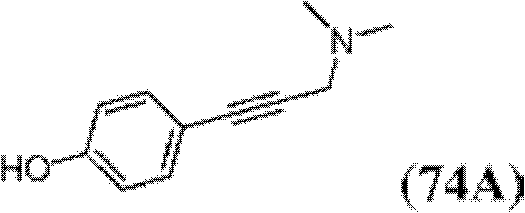
向4-碘苯酚(750mg,3.41mmol)、N,N-二甲基丙-2-炔-1-胺(1.090ml,10.23mmol)、(PPh3)4Pd(192mg,0.166mmol)、TEA(1.425ml,10.23mmol)在DMF(12ml)中的混合物中,加入碘化亚铜(I)(97mg,0.511mmol)。得到的混合物在Smith微波合成器中在100℃加热25min,然后浓缩。残余物通过反相HPLC纯化(流动相:含0%-30%乙腈的0.1%TFA水溶液,30min内),以提供该化合物,为TFA盐:1H NMR(400MHz,DMSO-D6)δppm 10.06(1H,s),7.35(2H,d),6.80(2H,d),4.25(2H,s),2.85(6H,s)。To 4-iodophenol (750mg, 3.41mmol), N, N-dimethylprop-2-yn-1-amine (1.090ml, 10.23mmol), (PPh3) 4Pd (192mg, 0.166mmol), TEA (1.425 ml, 10.23 mmol) in DMF (12 ml) was added copper(I) iodide (97 mg, 0.511 mmol). The resulting mixture was heated at 100° C. for 25 min in a Smith microwave synthesizer, then concentrated. The residue was purified by reverse phase HPLC (mobile phase: 0%-30% acetonitrile in 0.1% TFA in water within 30 min) to provide the compound as a TFA salt: 1 H NMR (400 MHz, DMSO-D 6 ) δ ppm 10.06 (1H, s), 7.35 (2H, d), 6.80 (2H, d), 4.25 (2H, s), 2.85 (6H, s).
步骤2:题示化合物74的制备: Step 2 : Preparation of Title Compound 74:
题示化合物74使用实施例54描述的相同程序制备,在实施例54的步骤2中用化合物74A代替化合物54A:1H NMR(400MHz,DMSO-D6)δppm 12.86(1H,s),10.19(1H,s),8.03(1H,d),7.79(1H,d),7.67(1H,d),7.33-7.50(6H,m),6.95(2H,d),4.83(2H,s),4.29(2H,s),4.02(2H,t),3.72(2H,t),3.11-3.21(2H,m),3.03(2H,t),2.87(6H,s),1.96-2.07(2H,m);LCMS(APCI)m/e 652(M+H)。The title compound 74 was prepared using the same procedure described in Example 54, substituting Compound 74A for Compound 54A in Step 2 of Example 54: 1 H NMR (400 MHz, DMSO-D 6 ) δppm 12.86 (1H, s), 10.19 ( 1H, s), 8.03 (1H, d), 7.79 (1H, d), 7.67 (1H, d), 7.33-7.50 (6H, m), 6.95 (2H, d), 4.83 (2H, s), 4.29 (2H, s), 4.02 (2H, t), 3.72 (2H, t), 3.11-3.21 (2H, m), 3.03 (2H, t), 2.87 (6H, s), 1.96-2.07 (2H, m ); LCMS (APCI) m/e 652 (M+H).
实施例75Example 75
2-[8-(苯并噻唑-2-基氨基甲酰基)-3,4-二氢-1H-异喹啉-2-基]-5-{3-[4-(2-二甲基氨基-乙氧基)-苯氧基]-丙基}-噻唑-4-羧酸(75)的合成:2-[8-(Benzothiazol-2-ylcarbamoyl)-3,4-dihydro-1H-isoquinolin-2-yl]-5-{3-[4-(2-dimethyl Synthesis of amino-ethoxy)-phenoxy]-propyl}-thiazole-4-carboxylic acid (75):
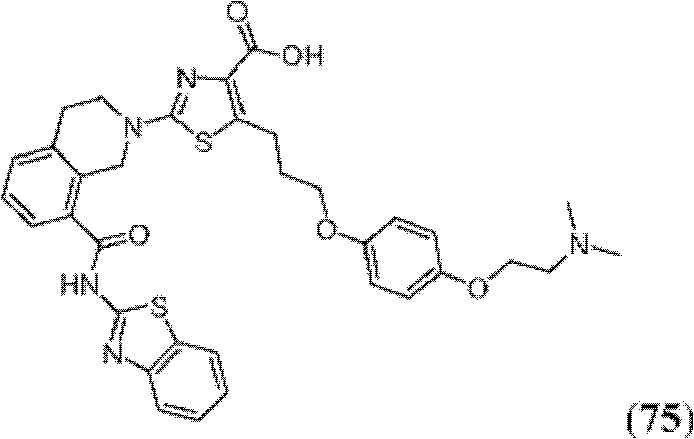
步骤1:2-(4-(苄氧基)苯氧基)-N,N-二甲基乙胺(75A)的制备: Step 1 : Preparation of 2-(4-(benzyloxy)phenoxy)-N,N-dimethylethylamine (75A):
化合物75A用与化合物35A的合成类似的方式制备,分别用2-(二甲基氨基)乙醇和4-(苄氧基)苯酚代替化合物34D和化合物31F:1H NMR(DMSO-d6):δ7.31-7.44(m,5H),6.84-6.94(m,4H),5.03(s,2H),3.94-3.98(m,2H),2.57(d,J=5.93Hz,2H),2.19(s,6H)。ESI(+)/MS:272(M+H)+。Compound 75A was prepared in a similar manner to the synthesis of Compound 35A, substituting 2-(dimethylamino)ethanol and 4-(benzyloxy)phenol for Compound 34D and Compound 31F, respectively: 1 H NMR (DMSO-d 6 ): δ7.31-7.44(m, 5H), 6.84-6.94(m, 4H), 5.03(s, 2H), 3.94-3.98(m, 2H), 2.57(d, J=5.93Hz, 2H), 2.19( s, 6H). ESI (+)/MS: 272 (M+H) + .
步骤2:4-(2-(二甲基氨基)乙氧基)苯酚(75B)的制备: Step 2 : Preparation of 4-(2-(dimethylamino)ethoxy)phenol (75B):
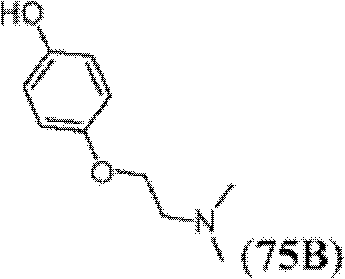
化合物75B用与化合物31F的合成类似的方式制备,用化合物75A代替化合物31E:1H NMR(DMSO-d6):S 8.86(s,1H),6.72-6.76(m,2H),6.64-6.68(m,2H),3.92(d,J=5.83Hz,2H),2.56(d,J=5.83Hz,2H),2.19(s,6H)。ESI(+)/MS:182(M+H)+。Compound 75B was prepared in a similar manner to the synthesis of Compound 31F, replacing Compound 31E with Compound 75A: 1 H NMR (DMSO-d 6 ): S 8.86 (s, 1H), 6.72-6.76 (m, 2H), 6.64-6.68 (m, 2H), 3.92 (d, J = 5.83Hz, 2H), 2.56 (d, J = 5.83Hz, 2H), 2.19 (s, 6H). ESI (+)/MS: 182 (M+H) + .
步骤3:题示化合物75的制备: Step 3 : Preparation of Title Compound 75:
用与化合物51的合成类似的方式,将题示化合物75制备为TFA盐,用化合物75B代替化合物51A:1H NMR(DMSO-d6):δ12.85(s,1H),9.58(s,1H),8.03(d,J=7.67Hz,1H),7.79(d,J=7.67Hz,1H),7.67(d,J=7.06Hz,1H),7.33-7.50(m,4H),6.86-6.93(m 4H),4.83(s,2H),4.21-4.24(m,2H),3.92(t,J=6.29Hz,2H),3.73(t,J=5.98Hz,2H),3.15-3.18(m,2H),3.03(t,J=5.98Hz,2H),2.85(s,6H),1.94-2.01(m,2H)。ESI(+)/MS:658(M+H)+。In a similar manner to the synthesis of compound 51, the title compound 75 was prepared as a TFA salt, replacing compound 51A with compound 75B: 1 H NMR (DMSO-d 6 ): δ12.85(s, 1H), 9.58(s, 1H), 8.03(d, J=7.67Hz, 1H), 7.79(d, J=7.67Hz, 1H), 7.67(d, J=7.06Hz, 1H), 7.33-7.50(m, 4H), 6.86- 6.93(m 4H), 4.83(s, 2H), 4.21-4.24(m, 2H), 3.92(t, J=6.29Hz, 2H), 3.73(t, J=5.98Hz, 2H), 3.15-3.18( m, 2H), 3.03 (t, J = 5.98 Hz, 2H), 2.85 (s, 6H), 1.94-2.01 (m, 2H). ESI (+)/MS: 658 (M+H) + .
实施例76Example 76
2-(8-(苯并[d]噻唑-2-基氨基甲酰基)-3,4-二氢异喹啉-2(1H)-基)-5-(2-苯氧基乙基)噻唑-4-羧酸(76)的合成:2-(8-(Benzo[d]thiazol-2-ylcarbamoyl)-3,4-dihydroisoquinolin-2(1H)-yl)-5-(2-phenoxyethyl) Synthesis of thiazole-4-carboxylic acid (76):
化合物49D(51mg,0.08mmol)、苯酚(11mg,0.12mmol)和三苯基膦(31mg,0.12mmol)与THF(2ml)结合,在环境温度下搅拌20分钟。加入偶氮二甲酸二叔丁酯(21mg,0.092mmol),继续搅拌过夜。反应混合物用EtOAc稀释,用水和盐水洗涤,干燥(MgSO4),过滤,浓缩。浓缩液通过柱色谱用硅胶纯化,用含10-50%EtOAc的己烷梯度洗脱。得到的材料在二氧杂环己烷(2ml)中溶解,用HCl(4N,二氧杂环己烷中)(0.4ml,1.6mmol)处理,在70℃加热数小时。反应混合物冷却至室温并浓缩。浓缩液在二氧杂环己烷(2ml)中溶解,用NaOH(4N水溶液)(0.2ml,0.8mmol)处理,在50℃加热四小时。反应混合物冷却至室温,用1N HCl(水溶液)处理以诱导产物沉淀。过滤固体,用水冲洗,在Et2O中浆化,过滤,用Et2O冲洗,在1∶1DMSO/MeOH中浆化,过滤,用MeOH冲洗,以提供题示化合物,为白色固体。1H NMR(300MHz,DMSO-d6)δppm 12.88(1H,s),12.66(1H,s),8.04(1H,d),7.80(1H,d),7.66(1H,d),7.43(4H,m),7.22(2H,m),6.90(3H,m),4.83(2H,s),4.13(2H,t),3.73(2H,t),3.47(2H,t),3.03(2H,t)。MS(ESI(+))m/e 557(M+H)。Compound 49D (51 mg, 0.08 mmol), phenol (11 mg, 0.12 mmol) and triphenylphosphine (31 mg, 0.12 mmol) were combined with THF (2 ml) and stirred at ambient temperature for 20 minutes. Di-tert-butyl azodicarboxylate (21 mg, 0.092 mmol) was added and stirring was continued overnight. The reaction mixture was diluted with EtOAc, washed with water and brine, dried ( MgSO4 ), filtered and concentrated. The concentrate was purified by column chromatography on silica gel eluting with a gradient of 10-50% EtOAc in hexanes. The resulting material was dissolved in dioxane (2ml), treated with HCl (4N in dioxane) (0.4ml, 1.6mmol) and heated at 70°C for several hours. The reaction mixture was cooled to room temperature and concentrated. The concentrate was dissolved in dioxane (2ml), treated with NaOH (4N in water) (0.2ml, 0.8mmol) and heated at 50°C for four hours. The reaction mixture was cooled to room temperature and treated with 1N HCl(aq) to induce precipitation of the product. The solid was filtered, rinsed with water, slurried in Et2O , filtered, rinsed with Et2O , slurried in 1:1 DMSO/MeOH, filtered, rinsed with MeOH to afford the title compound as a white solid. 1 H NMR (300MHz, DMSO-d 6 ) δppm 12.88(1H, s), 12.66(1H, s), 8.04(1H, d), 7.80(1H, d), 7.66(1H, d), 7.43(4H , m), 7.22(2H, m), 6.90(3H, m), 4.83(2H, s), 4.13(2H, t), 3.73(2H, t), 3.47(2H, t), 3.03(2H, t). MS (ESI (+)) m/e 557 (M+H).
实施例77Example 77
5-(3-(4-(2-氨基-1H-苯并[d]咪唑-1-基)苯氧基)丙基)-2-(8-(苯并[d]噻唑-2-基氨基甲酰基)-3,4-二氢异喹啉-2(1H)-基)噻唑-4-羧酸(77)的合成:5-(3-(4-(2-amino-1H-benzo[d]imidazol-1-yl)phenoxy)propyl)-2-(8-(benzo[d]thiazol-2-yl Synthesis of carbamoyl)-3,4-dihydroisoquinolin-2(1H)-yl)thiazole-4-carboxylic acid (77):

步骤1:乙酸4-(2-(N-乙酰基乙酰胺基)-1H-苯并[d]咪唑-1-基)苯酯(77A)的制备: Step 1 : Preparation of 4-(2-(N-acetylacetamido)-1H-benzo[d]imidazol-1-yl)phenyl acetate (77A):
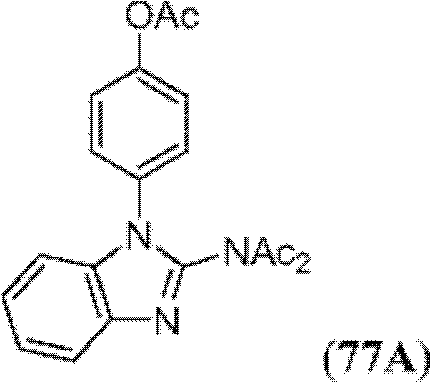
4-(2-氨基-1H-苯并[d]咪唑-1-基)苯酚(0.113g,0.5mmol)在二氯甲烷(2ml)和THF(1ml)的混合物中,用乙酸酐(0.47ml,5mmol)和DMAP(0.031g,0.25mmol)处理,在环境温度下搅拌3小时。反应混合物用EtOAc稀释,用水和盐水洗涤,干燥(MgSO4),过滤,浓缩,以提供所需产物:LCMS m/e 352(M+H)。4-(2-Amino-1H-benzo[d]imidazol-1-yl)phenol (0.113g, 0.5mmol) in a mixture of dichloromethane (2ml) and THF (1ml), with acetic anhydride (0.47ml , 5 mmol) and DMAP (0.031 g, 0.25 mmol) and stirred at ambient temperature for 3 hours. The reaction mixture was diluted with EtOAc, washed with water and brine, dried ( MgSO4 ), filtered and concentrated to afford the desired product: LCMS m/e 352 (M+H).
步骤2:N-(1-(4-羟基苯基)-1H-苯并[d]咪唑-2-基)乙酰胺(77B)的制备: Step 2 : Preparation of N-(1-(4-hydroxyphenyl)-1H-benzo[d]imidazol-2-yl)acetamide (77B):

含化合物77A(176mg,0.5mmol)的MeOH(4ml)用K2CO3(69.1mg,0.5mmol)处理,在环境温度下搅拌约40分钟。浓缩反应混合物,以除去MeOH,用EtOAc稀释,用1N HCl溶液酸化到pH 5。将混合物倒入分液漏斗中,分离各层。用EtOAc(2x40mL)萃取水层。合并的有机层干燥(MgSO4),过滤,浓缩,以提供题示化合物77B,为灰白色固体,产率67%:1H NMR(300MHz,DMSO-d6)δppm 10.26(1H,s),9.84(1H,s),7.63(1H,m),7.20(5H,m),6.93(2H,m),1.94(3H,s)。Compound 77A (176 mg, 0.5 mmol) in MeOH (4 ml) was treated with K2CO3 (69.1 mg, 0.5 mmol) and stirred at ambient temperature for about 40 min. The reaction mixture was concentrated to remove MeOH, diluted with EtOAc, acidified to pH 5 with 1N HCl solution. Pour the mixture into a separatory funnel and separate the layers. The aqueous layer was extracted with EtOAc (2x40 mL). The combined organic layers were dried (MgSO 4 ), filtered, and concentrated to provide the title compound 77B as an off-white solid in 67% yield: 1 H NMR (300 MHz, DMSO-d 6 ) δ ppm 10.26 (1 H, s), 9.84 (1H, s), 7.63 (1H, m), 7.20 (5H, m), 6.93 (2H, m), 1.94 (3H, s).
步骤3:题示化合物77的制备: Step 3 : Preparation of Title Compound 77:
含化合物77B(32mg,0.12mmol)的DMF(1ml)用NaH(60%油分散剂)(12mg,0.3mmol)处理。在环境温度下搅拌5分钟后,加入化合物2C(63mg,0.1mmol),继续搅拌1小时。加入额外的NaH(60%油分散剂)(12mg,0.3mmol),混合物在环境温度下搅拌过夜。加入NaOH(4N水溶液)(0.25ml,1mmol),混合物在环境温度下搅拌4小时。加入HCl(4N,二氧杂环己烷中)(2.5ml,10mmol),混合物在70℃加热数小时。当通过LCMS显示反应完成时,浓缩反应混合物,加入1N HCl以诱导产物的任何进一步沉淀。过滤固体,用水冲洗。固体在Et2O中浆化,过滤,用额外的Et2O冲洗。固体在1∶1DMSO/MeOH中溶解,通过针筒过滤器过滤除去未溶解的盐和杂质,通过HPLC纯化(预制备反相HPLC用自动化Gilson HPLC系统执行,使用SymmetryPrep Shield RP18预制备柱,250mmx21.20mm i.d.,10um,流速25mL/min;λ=214、245nm;流动相A,含0.1%TFA的H2O;流动相B,CH3CN;40分钟内,B的线性梯度20-90%),以提供题示化合物77,产率31%,为灰白色固体:1H NMR(300MHz,DMSO-d6)δppm 12.90(1H,s),12.83(1H,s),8.44(2H,s),8.02(1H,d),7.79(1H,d),7.68(1H,d),7.41(8H,m),7.17(3H,m),6.93(1H,d),4.84(2H,s),4.10(2H,t),3.74(2H,t),3.23(2H,m),3.04(2H,t),2.07(2H,m)。MS(ESI(+))m/e 702(M+H)。Compound 77B (32 mg, 0.12 mmol) in DMF (1 ml) was treated with NaH (60% oil dispersion) (12 mg, 0.3 mmol). After stirring at ambient temperature for 5 minutes, compound 2C (63 mg, 0.1 mmol) was added and stirring was continued for 1 hour. Additional NaH (60% oil dispersant) (12 mg, 0.3 mmol) was added and the mixture was stirred at ambient temperature overnight. NaOH (4N in water) (0.25ml, 1mmol) was added and the mixture was stirred at ambient temperature for 4 hours. HCl (4N in dioxane) (2.5ml, 10mmol) was added and the mixture was heated at 70°C for several hours. When the reaction was complete by LCMS, the reaction mixture was concentrated and 1 N HCl was added to induce any further precipitation of the product. The solid was filtered and rinsed with water. The solid was slurried in Et2O , filtered and rinsed with additional Et2O . The solid was dissolved in 1:1 DMSO/MeOH, filtered through a syringe filter to remove undissolved salts and impurities, and purified by HPLC (pre-preparative reverse-phase HPLC was performed with an automated Gilson HPLC system, using a SymmetryPrep Shield RP18 pre-preparative column, 250mmx21. 20mm id, 10um, flow rate 25mL/min; λ=214, 245nm; mobile phase A, H 2 O containing 0.1% TFA; mobile phase B, CH 3 CN; linear gradient of B within 40 minutes 20-90%) , to provide the title compound 77 in 31% yield as an off-white solid: 1 H NMR (300 MHz, DMSO-d 6 ) δ ppm 12.90 (1H, s), 12.83 (1H, s), 8.44 (2H, s), 8.02(1H,d), 7.79(1H,d), 7.68(1H,d), 7.41(8H,m), 7.17(3H,m), 6.93(1H,d), 4.84(2H,s), 4.10 (2H,t), 3.74(2H,t), 3.23(2H,m), 3.04(2H,t), 2.07(2H,m). MS (ESI (+)) m/e 702 (M+H).
实施例78Example 78
2-[8-(苯并噻唑-2-基氨基甲酰基)-3,4-二氢-1H-异喹啉-2-基]-5-(3-{4-[4-(3-吡咯烷-1-基-丙基氨基)-噻吩并[3,2-d]嘧啶-7-基]-苯氧基}-丙基)-噻唑-4-羧酸(78)的合成:2-[8-(Benzothiazol-2-ylcarbamoyl)-3,4-dihydro-1H-isoquinolin-2-yl]-5-(3-{4-[4-(3- Synthesis of pyrrolidin-1-yl-propylamino)-thieno[3,2-d]pyrimidin-7-yl]-phenoxy}-propyl)-thiazole-4-carboxylic acid (78):

步骤1:7-溴-N-(3-(吡咯烷-1-基)丙基)噻吩并[3,2-d]嘧啶-4-胺(78A)的制备: Step 1 : Preparation of 7-bromo-N-(3-(pyrrolidin-1-yl)propyl)thieno[3,2-d]pyrimidin-4-amine (78A):

化合物78A用与化合物69A的合成类似的方式制备,用3-(吡咯烷-1-基)丙-1-胺代替丙-2-胺:APCI(+)LC/MS:342(M+H)+。Compound 78A was prepared in a similar manner to the synthesis of Compound 69A, substituting 3-(pyrrolidin-1-yl)propan-1-amine for propan-2-amine: APCI(+) LC/MS: 342 (M+H) + .
步骤2:4-(4-(3-(吡咯烷-1-基)丙基氨基)噻吩并[3,2-d]嘧啶-7-基)苯酚(78B)的制备: Step 2 : Preparation of 4-(4-(3-(pyrrolidin-1-yl)propylamino)thieno[3,2-d]pyrimidin-7-yl)phenol (78B):
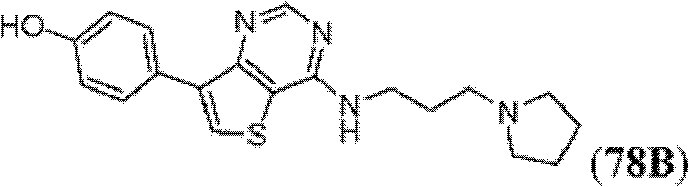
化合物78B用与化合物34D的合成类似的方式制备,分别用化合物77A和4-(4,4,5,5-四甲基-1,3,2-二氧硼戊环-2-基)苯酚代替化合物34C和4-(羟甲基)苯基硼酸:1H NMR(DMSO-d6):δ9.53(s,1H),8.54(s,1H),8.14(s,1H),7.96(d,J=5.68Hz,1H),7.88-7.92(m,2H),6.84-6.87(m,2H),3.58-3.63(m,2H),3.15-3.19(m,2H),1.99-2.09(m,2H),1.91-1.93(m,4H)。ESI(+)/MS:355(M+H)+。Compound 78B was prepared in a similar manner to the synthesis of compound 34D, using compound 77A and 4-(4,4,5,5-tetramethyl-1,3,2-dioxaborolan-2-yl)phenol, respectively Substitute compound 34C and 4-(hydroxymethyl)phenylboronic acid: 1 H NMR (DMSO-d 6 ): δ9.53(s, 1H), 8.54(s, 1H), 8.14(s, 1H), 7.96( d, J=5.68Hz, 1H), 7.88-7.92(m, 2H), 6.84-6.87(m, 2H), 3.58-3.63(m, 2H), 3.15-3.19(m, 2H), 1.99-2.09( m, 2H), 1.91-1.93 (m, 4H). ESI (+)/MS: 355 (M+H) + .
步骤3:题示化合物78的制备: Step 3 : Preparation of Title Compound 78:

用与化合物51的合成类似的方式,将题示化合物78制备为TFA盐,用化合物78B代替化合物51A:1H NMR(DMSO-d6):δ12.82(s,1H),9.53(s,1H),8.52(s,1H),8.22(s,1H),8.03-8.07(m,1H),8.01(d,J=7.98Hz,1H),7.69(d,J=8.59Hz,1H),7.79(d,J=7.98Hz,1H),7.67(d,J=7.36Hz,1H),7.32-7.49(m,4H),7.01(d,J=8.9Hz,2H),4.84(s,2H),4.04(t,J=6.29Hz,2H),3.73(t,J=5.83Hz,2H),3.18-3.24(m,4H),3.01-3.05(m,4H),1.78-2.07(m,6H)。ESI(+)/MS:831(M+H)+。In a similar manner to the synthesis of compound 51, the title compound 78 was prepared as a TFA salt, replacing compound 51A with compound 78B: 1 H NMR (DMSO-d 6 ): δ12.82 (s, 1H), 9.53 (s, 1H), 8.52(s, 1H), 8.22(s, 1H), 8.03-8.07(m, 1H), 8.01(d, J=7.98Hz, 1H), 7.69(d, J=8.59Hz, 1H), 7.79(d, J=7.98Hz, 1H), 7.67(d, J=7.36Hz, 1H), 7.32-7.49(m, 4H), 7.01(d, J=8.9Hz, 2H), 4.84(s, 2H ), 4.04(t, J=6.29Hz, 2H), 3.73(t, J=5.83Hz, 2H), 3.18-3.24(m, 4H), 3.01-3.05(m, 4H), 1.78-2.07(m, 6H). ESI (+)/MS: 831 (M+H) + .
实施例79Example 79
2-[8-(苯并噻唑-2-基氨基甲酰基)-3,4-二氢-1H-异喹啉-2-基]-5-(3-{4-[4-(4-甲基-哌嗪-1-基)-噻吩并[3,2-d]嘧啶-7-基]-苯氧基}-丙基)-噻唑-4-羧酸(79)的合成:2-[8-(Benzothiazol-2-ylcarbamoyl)-3,4-dihydro-1H-isoquinolin-2-yl]-5-(3-{4-[4-(4- Synthesis of methyl-piperazin-1-yl)-thieno[3,2-d]pyrimidin-7-yl]-phenoxy}-propyl)-thiazole-4-carboxylic acid (79):
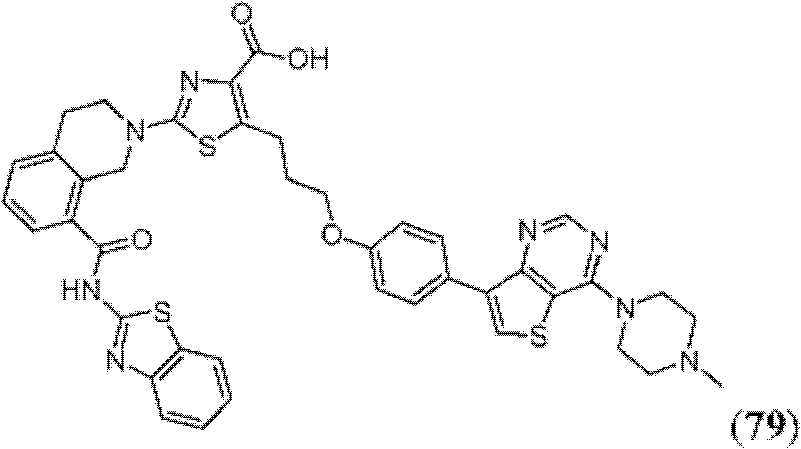
步骤1:7-溴-4-(4-甲基哌嗪-1-基)噻吩并[3,2-d]嘧啶(79A)的制备: Step 1 : Preparation of 7-bromo-4-(4-methylpiperazin-1-yl)thieno[3,2-d]pyrimidine (79A):
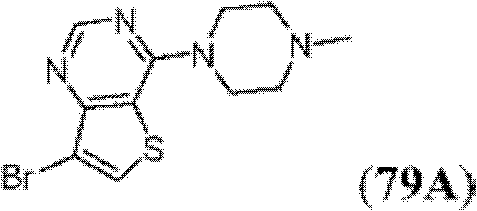
化合物79A用与实施例69的步骤1中描述的合成类似的方式制备,用1-甲基哌嗪代替丙-2-胺:ESI(+)LC/MS:314(M+H)+。Compound 79A was prepared in a similar manner to the synthesis described in step 1 of Example 69, substituting 1-methylpiperazine for propan-2-amine: ESI (+) LC/MS: 314 (M+H) + .
步骤2:4-(4-(4-甲基哌嗪-1-基)噻吩并[3,2-d]嘧啶-7-基)苯酚(79B)的制备: Step 2 : Preparation of 4-(4-(4-methylpiperazin-1-yl)thieno[3,2-d]pyrimidin-7-yl)phenol (79B):
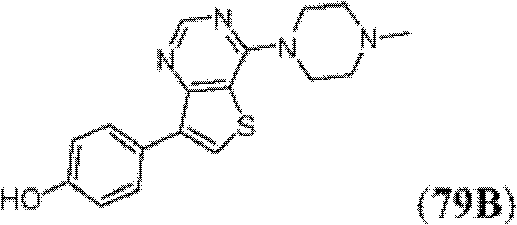
化合物79B用与化合物34D的合成类似的方式制备,分别用化合物79A和4-(4,4,5,5-四甲基-1,3,2-二氧硼戊环-2-基)苯酚代替化合物34C和4-(羟甲基)苯基硼酸:1H NMR(DMSO-d6):δ9.56(s,1H),8.63(s,1H),8.28(s,1H),7.85-7.89(m,2H),6.84-6.88(m,2H),4.06(br,4H),2.91(br,4H),2.53(s,3H)。ESI(+)/MS:327(M+H)+。Compound 79B was prepared in a similar manner to the synthesis of compound 34D, using compound 79A and 4-(4,4,5,5-tetramethyl-1,3,2-dioxaborolan-2-yl)phenol, respectively Substitute compound 34C and 4-(hydroxymethyl)phenylboronic acid: 1 H NMR (DMSO-d 6 ): δ9.56(s, 1H), 8.63(s, 1H), 8.28(s, 1H), 7.85- 7.89 (m, 2H), 6.84-6.88 (m, 2H), 4.06 (br, 4H), 2.91 (br, 4H), 2.53 (s, 3H). ESI(+)/MS: 327(M+H) + .
步骤3:题示化合物79的制备: Step 3 : Preparation of Title Compound 79:
用与化合物51的合成类似的方式,将题示化合物79制备为TFA盐,用化合物79B代替化合物51A:1H NMR(DMSO-d6):δ12.86(s,1H),9.98(s,1H),8.69(s,1H),8.40(s,1H),8.01(d,J=7.36Hz,1H),7.69(d,J=8.9Hz,2H),7.79(d,J=7.98Hz,1H),7.67(d,J=7.36Hz,1H),7.32-7.49(m,4H),7.02(d,J=8.9Hz,2H),4.78-4.84(m,4H),4.05(t,J=6.29Hz,2H),3.73(t,J=6.14Hz,2H),3.57(br,6H),3.18-3.22(m,2H),3.03(t,J=5.83Hz,2H),2.87(s,3H),2.00-2.09(m,2H)。ESI(+)/MS:803(M+H)+。In a similar manner to the synthesis of compound 51, the title compound 79 was prepared as a TFA salt, replacing compound 51A with compound 79B: 1 H NMR (DMSO-d 6 ): δ12.86(s, 1H), 9.98(s, 1H), 8.69(s, 1H), 8.40(s, 1H), 8.01(d, J=7.36Hz, 1H), 7.69(d, J=8.9Hz, 2H), 7.79(d, J=7.98Hz, 1H), 7.67(d, J=7.36Hz, 1H), 7.32-7.49(m, 4H), 7.02(d, J=8.9Hz, 2H), 4.78-4.84(m, 4H), 4.05(t, J =6.29Hz, 2H), 3.73(t, J=6.14Hz, 2H), 3.57(br, 6H), 3.18-3.22(m, 2H), 3.03(t, J=5.83Hz, 2H), 2.87(s , 3H), 2.00-2.09 (m, 2H). ESI(+)/MS: 803(M+H) + .
实施例80Example 80
5-(3-(4-((1S,2S,5R,9S)-9-氨基双环[3.3.1]壬烷-2-基)苯氧基)丙基)-2-(8-(苯并[d]噻唑-2-基氨基甲酰基)-3,4-二氢异喹啉-2(1H)-基)噻唑-4-羧酸(80)的合成:5-(3-(4-((1S,2S,5R,9S)-9-aminobicyclo[3.3.1]nonan-2-yl)phenoxy)propyl)-2-(8-(benzene Synthesis of [d]thiazol-2-ylcarbamoyl)-3,4-dihydroisoquinolin-2(1H)-yl)thiazole-4-carboxylic acid (80):
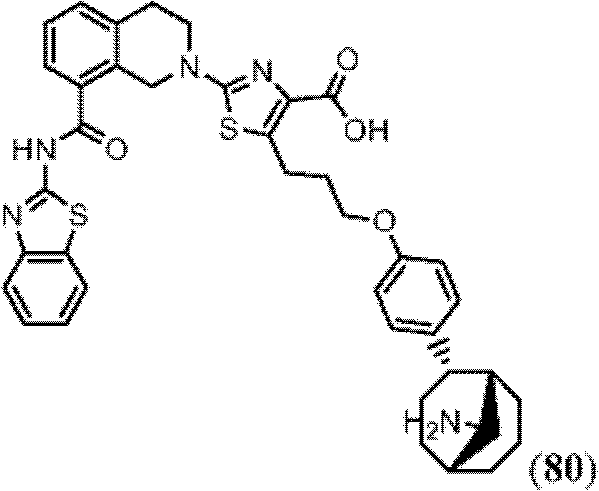
步骤1:(1S,2S,5R,9S)-2-(4-羟基苯基)双环[3.3.1]壬烷-9-基氨基甲酸叔丁酯(80A)的制备: Step 1 : Preparation of (1S, 2S, 5R, 9S)-2-(4-hydroxyphenyl)bicyclo[3.3.1]nonan-9-ylcarbamate tert-butyl ester (80A):

含4-((1S,2S,5R,9S)-9-氨基双环[3.3.1]壬烷-2-基)苯酚HCl盐(92mg,0.344mmol)的THF(2ml),用二碳酸二叔丁酯(0.088ml,0.38mmol)和Et3N(0.19ml,1.37mmol)处理,在环境温度下搅拌三小时。反应混合物用EtOAc稀释,用水和盐水洗涤,干燥(MgSO4),过滤,浓缩。浓缩液通过柱色谱用硅胶纯化,用含0到5%MeOH的CH2Cl2梯度洗脱:1H NMR(300MHz,DMSO-d6)δppm 9.09(1H,s),7.01(2H,m),6.68(2H,m),3.53(1H,m),3.01(1H,m),2.09(3H,m),1.69(10H,m),1.42(9H,s)。4-((1S,2S,5R,9S)-9-Aminobicyclo[3.3.1]nonan-2-yl)phenol HCl salt (92mg, 0.344mmol) in THF (2ml) with dicarbonate Butyl ester (0.088ml, 0.38mmol) was treated with Et3N (0.19ml, 1.37mmol) and stirred at ambient temperature for three hours. The reaction mixture was diluted with EtOAc, washed with water and brine, dried ( MgSO4 ), filtered and concentrated. The concentrate was purified by column chromatography on silica gel with a gradient of 0 to 5% MeOH in CH2Cl2 : 1 H NMR (300 MHz, DMSO-d 6 ) δ ppm 9.09 (1H, s), 7.01 (2H, m) , 6.68 (2H, m), 3.53 (1H, m), 3.01 (1H, m), 2.09 (3H, m), 1.69 (10H, m), 1.42 (9H, s).
步骤2:题示化合物80的制备: Step 2 : Preparation of title compound 80:
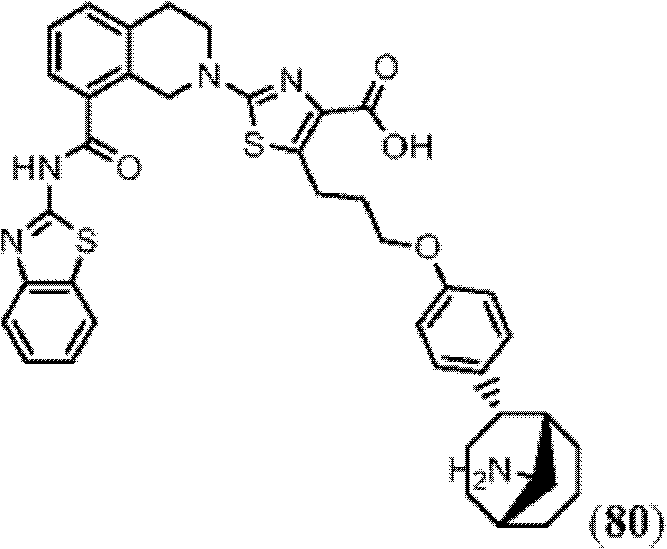
含(1S,2S,5R,9S)-2-(4-羟基苯基)双环[3.3.1]壬烷-9-基氨基甲酸叔丁酯80A(40.5mg,0.11mmol)的DMF(1ml),用NaH(12mg,0.3mmol)处理。在环境温度下搅拌5分钟后,加入化合物2C(63mg,0.1mmol),继续搅拌1.5小时。加入HCl(4N HCl,二氧杂环己烷中)(2.5ml,10mmol),混合物在室温下搅拌过夜,然后在60℃搅拌6小时。反应混合物冷却至室温并浓缩。残余物用1N HCl浆化,过滤,用水冲洗,在Et2O中浆化,过滤,用额外的Et2O冲洗。固体通过柱色谱用硅胶纯化,使用含0到5%MeOH的CH2Cl2梯度。固体在二氧杂环己烷(2ml)中溶解,用NaOH(4N水溶液)(0.25mL,1mmol)处理,在室温下搅拌过夜。反应混合物用1N HCl酸化,以诱导产物沉淀。过滤固体,用水冲洗,在Et2O中浆化,过滤,用额外的Et2O冲洗。固体通过HPLC纯化(预制备反相HPLC用自动化Gilson HPLC系统执行,使用SymmetryPrep Shield RP18预制备柱,250mmx21.20mm i.d.,10um,流速25mL/min;λ=214、245nm;流动相A,含0.1%TFA的H2O;流动相B,CH3CN;40分钟内,B的线性梯度20-90%),以提供题示化合物80,产率7%,为灰白色固体:1H NMR(400MHz,DMSO-d6)δppm 12.85(1H,s),12.50(1H,s),8.03(1H,d),7.97(2H,d),7.67(1H,d),7.47(2H,m),7.37(2H,m),7.13(2H,d),6.88(2H,m),4.83(2H,s),3.95(2H,t),3.72(2H,t),3.17(2H,m),3.02(2H,m),2.19(2H,m),1.98(5H,m),1.80(5H,m),1.59(2H,m),1.40(3H,m)。MS(ESI(+))m/e 708(M+H)。tert-butyl (1S,2S,5R,9S)-2-(4-hydroxyphenyl)bicyclo[3.3.1]nonan-9-ylcarbamate 80A (40.5 mg, 0.11 mmol) in DMF (1 ml) , treated with NaH (12 mg, 0.3 mmol). After stirring at ambient temperature for 5 minutes, compound 2C (63 mg, 0.1 mmol) was added and stirring was continued for 1.5 hours. HCl (4N HCl in dioxane) (2.5ml, 10mmol) was added and the mixture was stirred at room temperature overnight and then at 60°C for 6 hours. The reaction mixture was cooled to room temperature and concentrated. The residue was slurried with 1 N HCl, filtered, rinsed with water, slurried in Et2O , filtered, rinsed with additional Et2O . The solid was purified by column chromatography on silica gel using a gradient of 0 to 5% MeOH in CH2Cl2 . The solid was dissolved in dioxane (2 mL), treated with NaOH (4N in water) (0.25 mL, 1 mmol) and stirred at room temperature overnight. The reaction mixture was acidified with 1N HCl to induce precipitation of the product. The solid was filtered, rinsed with water, slurried in Et2O , filtered, rinsed with additional Et2O . The solid was purified by HPLC (pre-preparative reverse-phase HPLC was performed with an automated Gilson HPLC system, using a SymmetryPrep Shield RP18 pre-preparative column, 250mmx21.20mm id, 10um, flow rate 25mL/min; λ = 214, 245nm; mobile phase A, containing 0.1% H2O in TFA; mobile phase B, CH3CN ; linear gradient of B 20-90% over 40 minutes) to provide the title compound 80 in 7% yield as an off-white solid: 1 H NMR (400 MHz, DMSO-d 6 ) δppm 12.85 (1H, s), 12.50 (1H, s), 8.03 (1H, d), 7.97 (2H, d), 7.67 (1H, d), 7.47 (2H, m), 7.37 ( 2H, m), 7.13 (2H, d), 6.88 (2H, m), 4.83 (2H, s), 3.95 (2H, t), 3.72 (2H, t), 3.17 (2H, m), 3.02 (2H , m), 2.19 (2H, m), 1.98 (5H, m), 1.80 (5H, m), 1.59 (2H, m), 1.40 (3H, m). MS (ESI (+)) m/e 708 (M+H).
实施例81Example 81
2-[8-(苯并噻唑-2-基氨基甲酰基)-3,4-二氢-1H-异喹啉-2-基]-5-[3-(4-嘧啶-2-基-苯氧基)-丙基]-噻唑-4-羧酸(81)的合成:2-[8-(Benzothiazol-2-ylcarbamoyl)-3,4-dihydro-1H-isoquinolin-2-yl]-5-[3-(4-pyrimidin-2-yl- Synthesis of phenoxy)-propyl]-thiazole-4-carboxylic acid (81):
步骤1:4-(嘧啶-2-基)苯酚(81A)的制备: Step 1 : Preparation of 4-(pyrimidin-2-yl)phenol (81A):
化合物81A用与化合物34D的合成类似的方式制备,分别用2-溴嘧啶和4-(4,4,5,5-四甲基-1,3,2-二氧硼戊环-2-基)苯酚代替化合物34C和4-(羟甲基)苯基硼酸:1H NMR(DMSO-d6):δ9.92(s,1H),8.80(d,J=4.6Hz,2H),8.22-8.26(m,2H),7.31(t,J=4.6Hz,1H),6.89-6.89(m,2H)。Compound 81A was prepared in a similar manner to the synthesis of compound 34D, using 2-bromopyrimidine and 4-(4,4,5,5-tetramethyl-1,3,2-dioxaborolan-2-yl ) phenol instead of compound 34C and 4-(hydroxymethyl)phenylboronic acid: 1 H NMR (DMSO-d 6 ): δ9.92 (s, 1H), 8.80 (d, J=4.6Hz, 2H), 8.22- 8.26 (m, 2H), 7.31 (t, J=4.6Hz, 1H), 6.89-6.89 (m, 2H).
步骤2:题示化合物81的制备: Step 2 : Preparation of title compound 81:
用与化合物51的合成类似的方式,将题示化合物81制备为TFA盐,用化合物81A代替化合物51A:1H NMR(DMSO-d6):δ8.83(d,J=4.88Hz,2H),8.32(d,J=8.85Hz,2H),8.03(d,J=4.88Hz,1H),7.79(d,J=8.85Hz,1H),7.67(d,J=7.63Hz,1H),7.34-7.49(m,5H),7.04(d,J=8.85Hz,2H),4.84(s,2H),4.07(t,J=6.26Hz,2H),3.72(t,J=5.95Hz,2H),3.18-3.12(m,2H),3.03(t,J=5.64Hz,2H),2.01-2.07(m,2H)。ESI(+)/MS:649(M+H)+。In a similar manner to the synthesis of compound 51, the title compound 81 was prepared as a TFA salt, replacing compound 51A with compound 81A: 1 H NMR (DMSO-d 6 ): δ8.83 (d, J=4.88Hz, 2H) , 8.32(d, J=8.85Hz, 2H), 8.03(d, J=4.88Hz, 1H), 7.79(d, J=8.85Hz, 1H), 7.67(d, J=7.63Hz, 1H), 7.34 -7.49(m, 5H), 7.04(d, J=8.85Hz, 2H), 4.84(s, 2H), 4.07(t, J=6.26Hz, 2H), 3.72(t, J=5.95Hz, 2H) , 3.18-3.12 (m, 2H), 3.03 (t, J=5.64Hz, 2H), 2.01-2.07 (m, 2H). ESI (+)/MS: 649 (M+H) + .
实施例82Example 82
2-[8-(苯并噻唑-2-基氨基甲酰基)-3,4-二氢-1H-异喹啉-2-基]-5-{3-[4-(4-甲基-哌嗪-1-基)-苯氧基]-丙基}-噻唑-4-羧酸(82)的合成:2-[8-(Benzothiazol-2-ylcarbamoyl)-3,4-dihydro-1H-isoquinolin-2-yl]-5-{3-[4-(4-methyl- Synthesis of piperazin-1-yl)-phenoxy]-propyl}-thiazole-4-carboxylic acid (82):
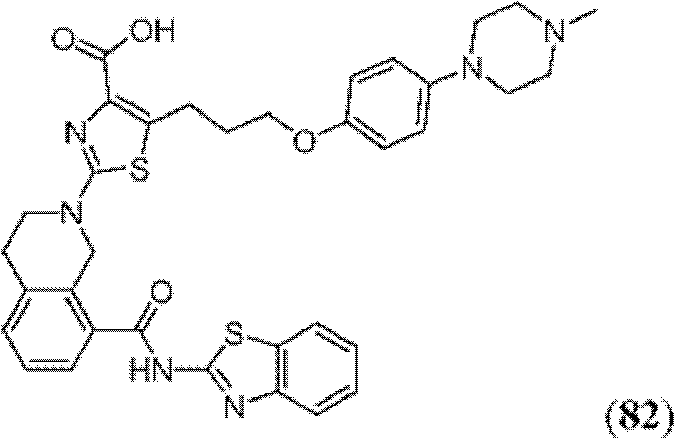
步骤1:4-(4-甲基哌嗪-1-基)苯酚(82A)的制备: Step 1 : Preparation of 4-(4-methylpiperazin-1-yl)phenol (82A):

化合物82A用与化合物62A的合成类似的方式制备,分别用多聚甲醛和4-(哌嗪-1-基)苯酚代替化合物42C和苯基哌嗪:1H NMR(DMSO-d6):δ6.74-6.78(m,2H),6.61-6.65(m,2H),2.93-2.95(m,4H),2.41-2.44(m,4H),2.22(s,3H)。ESI(+)/MS:193(M+H)+。Compound 82A was prepared in a similar manner to the synthesis of Compound 62A, replacing Compound 42C and phenylpiperazine with paraformaldehyde and 4-(piperazin-1-yl)phenol, respectively: 1 H NMR (DMSO-d 6 ): δ6 .74-6.78 (m, 2H), 6.61-6.65 (m, 2H), 2.93-2.95 (m, 4H), 2.41-2.44 (m, 4H), 2.22 (s, 3H). ESI (+)/MS: 193 (M+H) + .
步骤2:题示化合物82的制备: Step 2 : Preparation of Title Compound 82:
用与化合物51的合成类似的方式,将题示化合物82制备为TFA盐,用化合物82A代替化合物51A:1H NMR(DMSO-d6):δ12.90(s,1H),9.58(s,1H),8.04(d,J=7.63Hz,2H),7.80(d,J=7.93Hz,2H),7.67(d,J=7.63Hz,1H),7.35-7.50(m,4H),6.90-6.92(m,2H),6.82-6.85(m,2H),4.83(s,2H),3.91(t,J=6.26Hz,2H),3.14-3.17(m,2H),3.03(t,J=5.95Hz,2H),2.82-2.86(m,5H),1.94-2.00(m,2H)。ESI(+)/MS:669(M+H)+。In a similar manner to the synthesis of compound 51, the title compound 82 was prepared as a TFA salt, replacing compound 51A with compound 82A: 1 H NMR (DMSO-d 6 ): δ12.90(s, 1H), 9.58(s, 1H), 8.04(d, J=7.63Hz, 2H), 7.80(d, J=7.93Hz, 2H), 7.67(d, J=7.63Hz, 1H), 7.35-7.50(m, 4H), 6.90- 6.92(m, 2H), 6.82-6.85(m, 2H), 4.83(s, 2H), 3.91(t, J=6.26Hz, 2H), 3.14-3.17(m, 2H), 3.03(t, J= 5.95Hz, 2H), 2.82-2.86(m, 5H), 1.94-2.00(m, 2H). ESI (+)/MS: 669 (M+H) + .
实施例83Example 83
2-(8-(苯并[d]噻唑-2-基氨基甲酰基)-3,4-二氢异喹啉-2(1H)-基)-5-(3-(4-(1-(2-吗啉基乙基)-1H-吡唑-4-基)苯氧基)丙基)噻唑-4-羧酸(83)的合成:2-(8-(Benzo[d]thiazol-2-ylcarbamoyl)-3,4-dihydroisoquinolin-2(1H)-yl)-5-(3-(4-(1- Synthesis of (2-morpholinoethyl)-1H-pyrazol-4-yl)phenoxy)propyl)thiazole-4-carboxylic acid (83):
步骤1:2-(8-(苯并[d]噻唑-2-基((2-(三甲基甲硅烷基)乙氧基)甲基)氨基甲酰基)-3,4-二氢异喹啉-2(1H)-基)-5-(3-(4-(1-(2-吗啉基乙基)-1H-吡唑-4-基)苯氧基)丙基)噻唑-4-羧酸叔丁酯(83A)的制备: Step 1 : 2-(8-(Benzo[d]thiazol-2-yl((2-(trimethylsilyl)ethoxy)methyl)carbamoyl)-3,4-dihydroiso Quinoline-2(1H)-yl)-5-(3-(4-(1-(2-morpholinoethyl)-1H-pyrazol-4-yl)phenoxy)propyl)thiazole- Preparation of tert-butyl 4-carboxylate (83A):
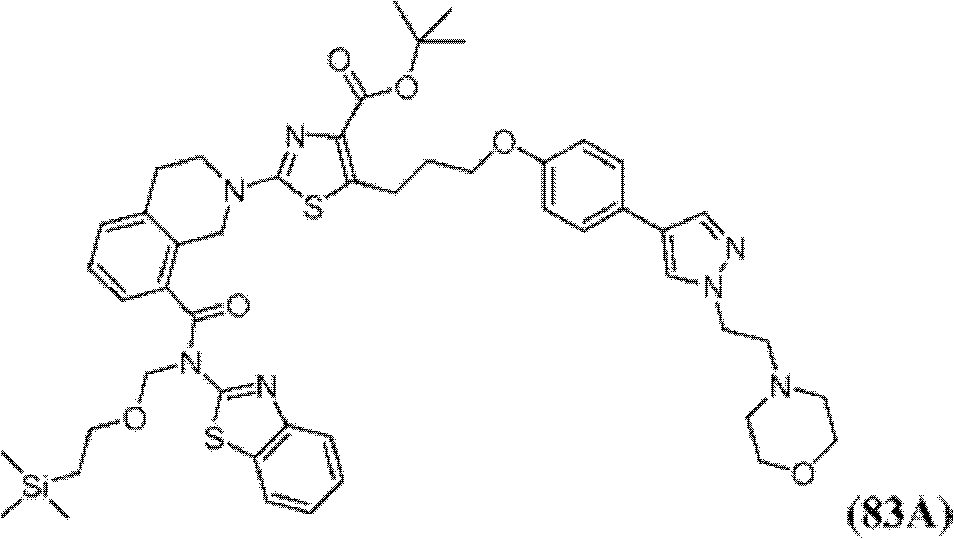
化合物83A使用实施例73的步骤1中描述的相同程序制备,用4-(2-(4-(4,4,5,5-四甲基-1,3,2-二氧硼戊环-2-基)-1H-吡唑-1-基)乙基)吗啉代替4-(4,4,5,5-四甲基-1,3,2-二氧硼戊环-2-基)-1H-吡唑:LCMS(APCI)m/e 936(M+H)。Compound 83A was prepared using the same procedure described in Step 1 of Example 73, using 4-(2-(4-(4,4,5,5-tetramethyl-1,3,2-dioxaborolane- 2-yl)-1H-pyrazol-1-yl)ethyl)morpholine instead of 4-(4,4,5,5-tetramethyl-1,3,2-dioxaborolan-2-yl )-1H-pyrazole: LCMS (APCI) m/e 936 (M+H).
步骤2:题示化合物83的制备: Step 2 : Preparation of Title Compound 83:
题示化合物83使用实施例73的步骤2中描述的相同程序制备,用化合物83A代替化合物73A:1H NMR(400MHz,DMSO-D6)δppm12.87(1H,s),8.12(1H,s),8.02(1H,d),7.89(1H,s),7.79(1H,d),7.67(1H,d),7.33-7.50(6H,m),6.91(2H,d),4.84(2H,s),4.52(2H,t),3.98(2H,t),3.77-3.93(2H,m),3.73(2H,t),3.51-3.65(2H,m),3.40-3.50(2H,m),3.13-3.25(6H,m),3.03(2H,t),1.95-2.07(2H,m);LCMS(APCI)751(M+H)。The title compound 83 was prepared using the same procedure described in step 2 of Example 73, substituting compound 83A for compound 73A: 1 H NMR (400 MHz, DMSO-D 6 ) δ ppm 12.87 (1H, s), 8.12 (1H, s ), 8.02(1H,d), 7.89(1H,s), 7.79(1H,d), 7.67(1H,d), 7.33-7.50(6H,m), 6.91(2H,d), 4.84(2H, s), 4.52(2H, t), 3.98(2H, t), 3.77-3.93(2H, m), 3.73(2H, t), 3.51-3.65(2H, m), 3.40-3.50(2H, m) , 3.13-3.25 (6H, m), 3.03 (2H, t), 1.95-2.07 (2H, m); LCMS (APCI) 751 (M+H).
实施例84Example 84
2-(8-(苯并[d]噻唑-2-基氨基甲酰基)-3,4-二氢异喹啉-2(1H)-基)-5-(3-(4-(4-(3-(4-甲基哌嗪-1-基)丙基氨基)-1H-吡唑并[3,4-d]嘧啶-1-基)苯氧基)丙基)噻唑-4-羧酸(84)的合成:2-(8-(Benzo[d]thiazol-2-ylcarbamoyl)-3,4-dihydroisoquinolin-2(1H)-yl)-5-(3-(4-(4- (3-(4-Methylpiperazin-1-yl)propylamino)-1H-pyrazolo[3,4-d]pyrimidin-1-yl)phenoxy)propyl)thiazole-4-carboxy Synthesis of acid (84):
步骤1:4-(4-(3-(4-甲基哌嗪-1-基)丙基氨基)-1H-吡唑并[3,4-d]嘧啶-1-基)苯酚(84A)的制备: Step 1 : 4-(4-(3-(4-Methylpiperazin-1-yl)propylamino)-1H-pyrazolo[3,4-d]pyrimidin-1-yl)phenol (84A) Preparation of:
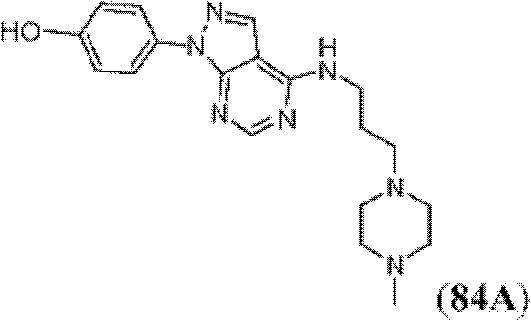
题示化合物84A使用实施例44的步骤4中描述的相同程序制备,用3-(4-甲基哌嗪-1-基)丙-1-胺代替异丙胺;LCMS(APCI)m/e 368(M+H)。The title compound 84A was prepared using the same procedure described in step 4 of Example 44, substituting 3-(4-methylpiperazin-1-yl)propan-1-amine for isopropylamine; LCMS (APCI) m/e 368 (M+H).
步骤2:题示化合物84的制备: Step 2 : Preparation of Title Compound 84:
题示化合物84使用实施例54的步骤2中描述的相同程序制备,用化合物84A代替化合物54A。1H NMR(500MHz,吡啶-D5)δppm8.69(1H,s),8.44-8.50(1H,m),8.41(2H,d),8.31(1H,s),7.95(1H,d),7.89(1H,d),7.78(1H,dd),7.43(1H,t),7.25-7.31(3H,m),7.14(2H,d),5.15(2H,s),4.09(2H,t),3.76-3.84(4H,m),3.48(2H,t),2.90(2H,t),2.71(8H,dd),2.61(2H,t),2.38(3H,s),2.14-2.23(2H,m),1.93-2.00(2H,m)。The
实施例85Example 85
2-(8-(苯并[d]噻唑-2-基氨基甲酰基)-3,4-二氢异喹啉-2(1H)-基)-5-(3-(4-(5-甲基-4-((4-甲基哌嗪-1-基)甲基)-1H-吡唑-1-基)苯氧基)丙基)噻唑-4-羧酸(85)的合成:2-(8-(Benzo[d]thiazol-2-ylcarbamoyl)-3,4-dihydroisoquinolin-2(1H)-yl)-5-(3-(4-(5- Synthesis of methyl-4-((4-methylpiperazin-1-yl)methyl)-1H-pyrazol-1-yl)phenoxy)propyl)thiazole-4-carboxylic acid (85):

步骤1:4-(5-甲基-4-((4-甲基哌嗪-1-基)甲基)-1H-吡唑-1-基)苯酚(85A)的制备: Step 1 : Preparation of 4-(5-methyl-4-((4-methylpiperazin-1-yl)methyl)-1H-pyrazol-1-yl)phenol (85A):

向1-(4-甲氧基苯基)-3-甲基-1H-吡唑-4-甲醛(232mg,1.073mmol)在DCE(3.5ml)中的溶液中,加入1-甲基哌嗪(0.119ml,1.073mmol)和三乙酰氧基硼氢化钠(455mg,2.146mmol)。反应搅拌过夜,用乙酸乙酯稀释,用盐水洗涤,用Na2SO4干燥,浓缩。残余物在环丁砜(5ml)中用三甲基碘硅烷(1.327ml,9.32mmol)在80℃处理过夜,冷却。反应混合物用甲醇稀释,通过反相HPLC纯化(流动相:含0%-30%乙腈的0.1%TFA水溶液,30min内),以提供题示化合物,为TFA盐;LCMS(APCI)m/e 287(M+H)。To a solution of 1-(4-methoxyphenyl)-3-methyl-1H-pyrazole-4-carbaldehyde (232mg, 1.073mmol) in DCE (3.5ml) was added 1-methylpiperazine (0.119ml, 1.073mmol) and sodium triacetoxyborohydride (455mg, 2.146mmol). The reaction was stirred overnight, diluted with ethyl acetate, washed with brine, dried over Na2SO4 , and concentrated. The residue was treated with iodotrimethylsilane (1.327ml, 9.32mmol) in sulfolane (5ml) overnight at 80°C and cooled. The reaction mixture was diluted with methanol and purified by reverse phase HPLC (mobile phase: 0%-30% acetonitrile in 0.1% TFA in water within 30 min) to provide the title compound as a TFA salt; LCMS (APCI) m/e 287 (M+H).
步骤2:题示化合物85的制备: Step 2 : Preparation of Title Compound 85:
题示化合物85使用实施例54的步骤2中描述的相同程序制备,用化合物85A代替化合物54A:1H NMR(400MHz,DMSO-D6)δppm12.87(1H,s),8.02(1H,d),7.79(1H,d),7.67(1H,d),7.57(1H,d),7.43-7.51(2H,m),7.33-7.41(4H,m),7.01-7.07(2H,m),4.84(2H,s),4.04(2H,t),3.97(2H,s),3.68-3.79(4H,m),3.46-3.53(2H,m),3.12-3.26(7H,m),3.04(4H,t),2.76(2H,s),2.25(3H,s)。The title compound 85 was prepared using the same procedure described in step 2 of Example 54, substituting compound 85A for compound 54A: 1 H NMR (400 MHz, DMSO-D 6 ) δ ppm 12.87 (1H, s), 8.02 (1H, d ), 7.79(1H, d), 7.67(1H, d), 7.57(1H, d), 7.43-7.51(2H, m), 7.33-7.41(4H, m), 7.01-7.07(2H, m), 4.84(2H, s), 4.04(2H, t), 3.97(2H, s), 3.68-3.79(4H, m), 3.46-3.53(2H, m), 3.12-3.26(7H, m), 3.04( 4H,t), 2.76(2H,s), 2.25(3H,s).
实施例86Example 86
2-[8-(苯并噻唑-2-基氨基甲酰基)-3,4-二氢-1H-异喹啉-2-基]-5-{3-[4-(3-氰基-吡嗪-2-基)-苯氧基]-丙基}-噻唑-4-羧酸(86)的合成:2-[8-(Benzothiazol-2-ylcarbamoyl)-3,4-dihydro-1H-isoquinolin-2-yl]-5-{3-[4-(3-cyano- Synthesis of pyrazin-2-yl)-phenoxy]-propyl}-thiazole-4-carboxylic acid (86):

步骤1:3-(4-羟基苯基)吡嗪-2-腈(86A)的制备: Step 1 : Preparation of 3-(4-hydroxyphenyl)pyrazine-2-carbonitrile (86A):
化合物86A用与化合物34D的合成类似的方式制备,分别用3-氯吡嗪-2-腈和4-(4,4,5,5-四甲基-1,3,2-二氧硼戊环-2-基)苯酚代替化合物34C和4-(羟甲基)苯基硼酸:1H NMR(DMSO-d6):δ10.14(s,1H),8.95(d,J=2.45Hz,1H),8.73(d,J=2.45Hz,1H),7.83-7.85(m,2H),6.95-6.99(m,2H)。ESI(+)/MS:211(M+H)+。Compound 86A was prepared in a similar manner to the synthesis of compound 34D, using 3-chloropyrazine-2-carbonitrile and 4-(4,4,5,5-tetramethyl-1,3,2-dioxaborpenta, respectively Cyclo-2-yl)phenol instead of compound 34C and 4-(hydroxymethyl)phenylboronic acid: 1 H NMR (DMSO-d 6 ): δ10.14 (s, 1H), 8.95 (d, J=2.45Hz, 1H), 8.73 (d, J = 2.45 Hz, 1H), 7.83-7.85 (m, 2H), 6.95-6.99 (m, 2H). ESI (+)/MS: 211 (M+H) + .
步骤2:题示化合物86的制备: Step 2 : Preparation of Title Compound 86:
用与化合物51的合成类似的方式,将题示化合物86制备为TFA盐,用化合物86A代替化合物51A:1H NMR(DMSO-d6):δ8.96(d,J=2.45Hz,1H),8.76(d,J=2.45Hz,1H),8.02(d,J=7.98Hz,2H),7.90-7.93(d,J=7.98Hz,2H),7.78(d,J=7.98Hz,1H),7.67(d J=7.67Hz,1H),7.33-7.49(m,4H),7.11-7.15(m,2H),4.84(s,2H),4.1(t,J=6.29Hz,2H),3.70-3.74(m,2H),3.19-3.23(m,2H),3.03(t,J=5.83Hz,2H),2.02-2.09(m,2H)。ESI(+)/MS:674(M+H)+。In a similar manner to the synthesis of compound 51, the title compound 86 was prepared as a TFA salt, replacing compound 51A with compound 86A: 1 H NMR (DMSO-d 6 ): δ8.96 (d, J=2.45Hz, 1H) , 8.76(d, J=2.45Hz, 1H), 8.02(d, J=7.98Hz, 2H), 7.90-7.93(d, J=7.98Hz, 2H), 7.78(d, J=7.98Hz, 1H) , 7.67(d J=7.67Hz, 1H), 7.33-7.49(m, 4H), 7.11-7.15(m, 2H), 4.84(s, 2H), 4.1(t, J=6.29Hz, 2H), 3.70 -3.74 (m, 2H), 3.19-3.23 (m, 2H), 3.03 (t, J=5.83Hz, 2H), 2.02-2.09 (m, 2H). ESI (+)/MS: 674 (M+H) + .
实施例87Example 87
2-[8-(苯并噻唑-2-基氨基甲酰基)-3,4-二氢-1H-异喹啉-2-基]-5-{3-[3-(4-甲基-哌嗪-1-基)-苯氧基]-丙基}-噻唑-4-羧酸(87)的合成:2-[8-(Benzothiazol-2-ylcarbamoyl)-3,4-dihydro-1H-isoquinolin-2-yl]-5-{3-[3-(4-methyl- Synthesis of piperazin-1-yl)-phenoxy]-propyl}-thiazole-4-carboxylic acid (87):
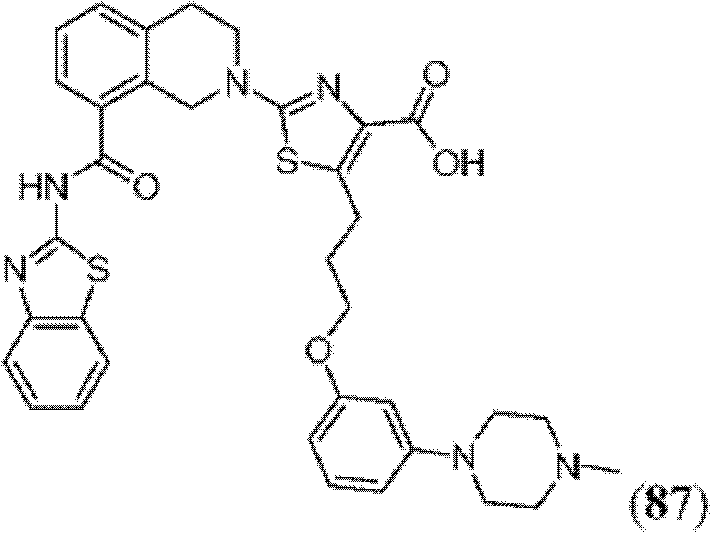
步骤1:3-(4-甲基哌嗪-1-基)苯酚(87A)的制备: Step 1 : Preparation of 3-(4-methylpiperazin-1-yl)phenol (87A):

化合物87A用与化合物62A的合成类似的方式制备,分别用多聚甲醛和3-(哌嗪-1-基)苯酚代替化合物45C和苯基哌嗪:1H NMR(DMSO-d6):δ9.07(s,1H),6.94-6.98(m,1H),6.36(d,J=8.13,2.4Hz,2H),8.28-8.29(m,1H),6.18-6.21(m,1H),3.04-3.07(m,4H),2.41-2.43(m,4H),2.21(s,3H)。ESI(+)/MS:193(M+H)+。Compound 87A was prepared in a similar manner to the synthesis of compound 62A, substituting paraformaldehyde and 3-(piperazin-1-yl)phenol for compound 45C and phenylpiperazine, respectively: 1 H NMR (DMSO-d 6 ): δ9 .07(s, 1H), 6.94-6.98(m, 1H), 6.36(d, J=8.13, 2.4Hz, 2H), 8.28-8.29(m, 1H), 6.18-6.21(m, 1H), 3.04 -3.07(m, 4H), 2.41-2.43(m, 4H), 2.21(s, 3H). ESI (+)/MS: 193 (M+H) + .
步骤2:题示化合物87的制备: Step 2 : Preparation of Title Compound 87:
用与化合物51的合成类似的方式,将题示化合物87制备为TFA盐,用化合物87A代替化合物51A:1H NMR(DMSO-d6):δ12.85(s,1H),9.65(s,1H),8.03(d,J=7.67Hz,1H),7.79(d,J=7.98Hz,2H),7.67(d,J=7.67Hz,1H),7.34-7.50(m,4H),7.12(t,J=8.13Hz,1H),6.54(dd,J=8.13,2.3Hz,1H),6.50(t,J=2.15Hz,1H),6.42(dd,J=8.29,2.15Hz,1H),4.83(s,2H),3.96(t,J=6.29Hz,2H),3.73(t,J=5.83Hz,2H),3.10-3.18(m,5H),3.03(t,J=5.98Hz,2H),2.90-2.98(m,2H),2.85(s,3H),1.95-2.02(m,2H)。ESI(+)/MS:669(M+H)+。In a similar manner to the synthesis of compound 51, the title compound 87 was prepared as a TFA salt, replacing compound 51A with compound 87A: 1 H NMR (DMSO-d 6 ): δ12.85(s, 1H), 9.65(s, 1H), 8.03(d, J=7.67Hz, 1H), 7.79(d, J=7.98Hz, 2H), 7.67(d, J=7.67Hz, 1H), 7.34-7.50(m, 4H), 7.12( t, J=8.13Hz, 1H), 6.54(dd, J=8.13, 2.3Hz, 1H), 6.50(t, J=2.15Hz, 1H), 6.42(dd, J=8.29, 2.15Hz, 1H), 4.83(s, 2H), 3.96(t, J=6.29Hz, 2H), 3.73(t, J=5.83Hz, 2H), 3.10-3.18(m, 5H), 3.03(t, J=5.98Hz, 2H ), 2.90-2.98 (m, 2H), 2.85 (s, 3H), 1.95-2.02 (m, 2H). ESI (+)/MS: 669 (M+H) + .
实施例88Example 88
2-[8-(苯并噻唑-2-基氨基甲酰基)-3,4-二氢-1H-异喹啉-2-基]-5-{3-[4-(2-吗啉-4-基-乙氧基)-苯氧基]-丙基}-噻唑-4-羧酸(88)的合成:2-[8-(Benzothiazol-2-ylcarbamoyl)-3,4-dihydro-1H-isoquinolin-2-yl]-5-{3-[4-(2-morpholine- Synthesis of 4-yl-ethoxy)-phenoxy]-propyl}-thiazole-4-carboxylic acid (88):
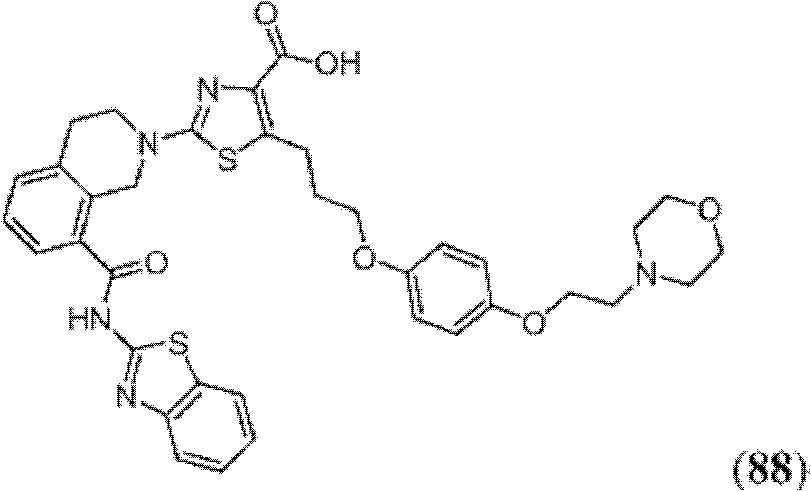
步骤1:4-(2-(4-(苄氧基)苯氧基)乙基)吗啉(88A)的制备: Step 1 : Preparation of 4-(2-(4-(benzyloxy)phenoxy)ethyl)morpholine (88A):
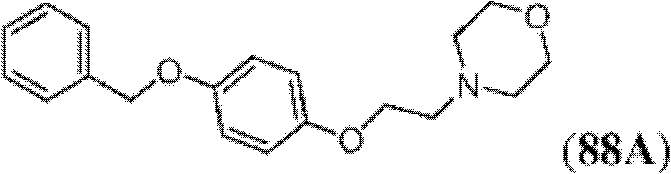
化合物88A用与化合物35A的合成类似的方式制备,分别用2-吗啉基乙醇和4-(苄氧基)苯酚代替化合物34B和化合物31F:ESI(+)LC/MS:314(M+H)+。Compound 88A was prepared in a similar manner to the synthesis of compound 35A, replacing compound 34B and compound 31F with 2-morpholinoethanol and 4-(benzyloxy)phenol, respectively: ESI (+) LC/MS: 314 (M+H ) + .
步骤2:4-(2-吗啉基乙氧基)苯酚(88B)的制备: Step 2 : Preparation of 4-(2-morpholinoethoxy)phenol (88B):
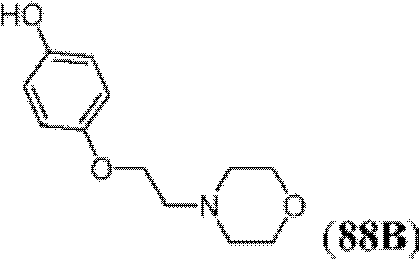
化合物88B用与化合物31F的合成类似的方式制备,用化合物88A代替化合物31E:1H NMR(DMSO-d6):δ8.84(s,1H),6.72-6.75(m,2H),6.64-6.67(m,2H),3.96(d,J=5.83Hz,2H),3.55-3.58(m4H),2.63(d,J=5.83Hz,2H),2.42-2.46(m,4H)。ESI(+)/MS:224(M+H)+。Compound 88B was prepared in a similar manner to the synthesis of Compound 31F, replacing Compound 31E with Compound 88A: 1 H NMR (DMSO-d 6 ): δ8.84 (s, 1H), 6.72-6.75 (m, 2H), 6.64- 6.67(m, 2H), 3.96(d, J=5.83Hz, 2H), 3.55-3.58(m4H), 2.63(d, J=5.83Hz, 2H), 2.42-2.46(m, 4H). ESI (+)/MS: 224 (M+H) + .
步骤3:题示化合物88的制备: Step 3 : Preparation of Title Compound 88:
用与化合物51的合成类似的方式,将题示化合物88制备为TFA盐,用化合物88B代替化合物51A:1H NMR(DMSO-d6):δ12.86(s,1H),9.96(s,1H),8.03(d,J=7.98Hz,1H),7.79(d,J=7.98Hz,2H),7.67(d,J=7.36Hz,1H),6.86-6.94(m,4H),4.83(s,2H),4.25-4.27(m,2H),3.91-4.02(m,4H),3.73(t,J=5.98Hz,2H),3.14-3.22(m,4H),3.03(t,J=5.98Hz,2H),1.94-2.01(m,2H)。ESI(+)/MS:700(M+H)+。In a similar manner to the synthesis of compound 51, the title compound 88 was prepared as a TFA salt, replacing compound 51A with compound 88B: 1 H NMR (DMSO-d 6 ): δ12.86(s, 1H), 9.96(s, 1H), 8.03(d, J=7.98Hz, 1H), 7.79(d, J=7.98Hz, 2H), 7.67(d, J=7.36Hz, 1H), 6.86-6.94(m, 4H), 4.83( s, 2H), 4.25-4.27(m, 2H), 3.91-4.02(m, 4H), 3.73(t, J=5.98Hz, 2H), 3.14-3.22(m, 4H), 3.03(t, J= 5.98Hz, 2H), 1.94-2.01(m, 2H). ESI(+)/MS: 700(M+H) + .
实施例89Example 89
2-[8-(苯并噻唑-2-基氨基甲酰基)-3,4-二氢-1H-异喹啉-2-基]-5-{3-[4-(4-甲基-哌嗪-1-基甲基)-苯氧基]-丙基}-噻唑-4-羧酸(89)的合成:2-[8-(Benzothiazol-2-ylcarbamoyl)-3,4-dihydro-1H-isoquinolin-2-yl]-5-{3-[4-(4-methyl- Synthesis of piperazin-1-ylmethyl)-phenoxy]-propyl}-thiazole-4-carboxylic acid (89):
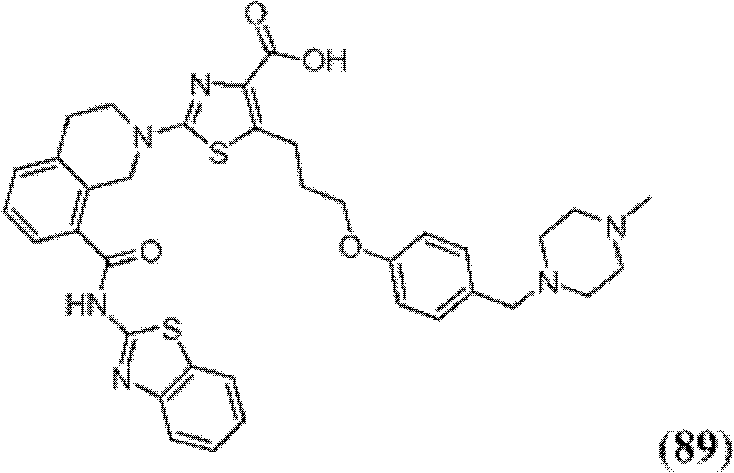
步骤1:4-((4-甲基哌嗪-1-基)甲基)苯酚(89A)的制备 Step 1 : Preparation of 4-((4-methylpiperazin-1-yl)methyl)phenol (89A)
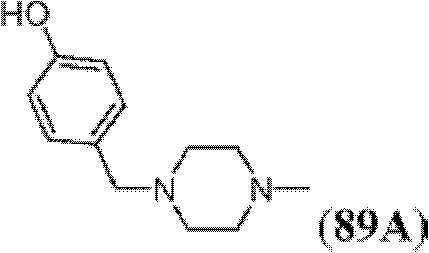
化合物89A用与化合物62A的合成类似的方式制备,分别用4-羟基苯甲醛和1-甲基哌嗪代替化合物45C和苯基哌嗪:ESI(+)/MS:207(M+H)+。Compound 89A was prepared in a similar manner to the synthesis of compound 62A, replacing compound 45C and phenylpiperazine with 4-hydroxybenzaldehyde and 1-methylpiperazine, respectively: ESI(+)/MS: 207(M+H) + .
步骤2:题示化合物89的制备: Step 2 : Preparation of title compound 89:
用与化合物51的合成类似的方式,将题示化合物89制备为TFA盐,用化合物89A代替化合物51A:1H NMR(DMSO-d6):δ8.03(d,J=7.67Hz,1H),7.79(d,J=7.98Hz,1H),7.67(d,J=7.06Hz,1H),7.34-7.50(m,4H),7.28(d,J=8.59Hz,2H),6.93(d,J=8.59Hz,2H),4.83(s,2H),3.98(d,J=6.29Hz,2H),3.16-3.19(m,4H),3.03(t,J=5.83Hz,2H),2.76(s,3H),1.97-2.03(m,2H)。ESI(+)/MS:683(M+H)+。In a similar manner to the synthesis of compound 51, the title compound 89 was prepared as a TFA salt, replacing compound 51A with compound 89A: 1 H NMR (DMSO-d 6 ): δ8.03 (d, J=7.67Hz, 1H) , 7.79(d, J=7.98Hz, 1H), 7.67(d, J=7.06Hz, 1H), 7.34-7.50(m, 4H), 7.28(d, J=8.59Hz, 2H), 6.93(d, J=8.59Hz, 2H), 4.83(s, 2H), 3.98(d, J=6.29Hz, 2H), 3.16-3.19(m, 4H), 3.03(t, J=5.83Hz, 2H), 2.76( s, 3H), 1.97-2.03 (m, 2H). ESI(+)/MS: 683(M+H) + .
实施例90Example 90
2-[8-(苯并噻唑-2-基氨基甲酰基)-3,4-二氢-1H-异喹啉-2-基]-5-(3-{4-[5-(2-二甲基氨基-乙氧基)-吡啶-2-基]-苯氧基}-丙基)-噻唑-4-羧酸(90)的合成:2-[8-(Benzothiazol-2-ylcarbamoyl)-3,4-dihydro-1H-isoquinolin-2-yl]-5-(3-{4-[5-(2- Synthesis of dimethylamino-ethoxy)-pyridin-2-yl]-phenoxy}-propyl)-thiazole-4-carboxylic acid (90):
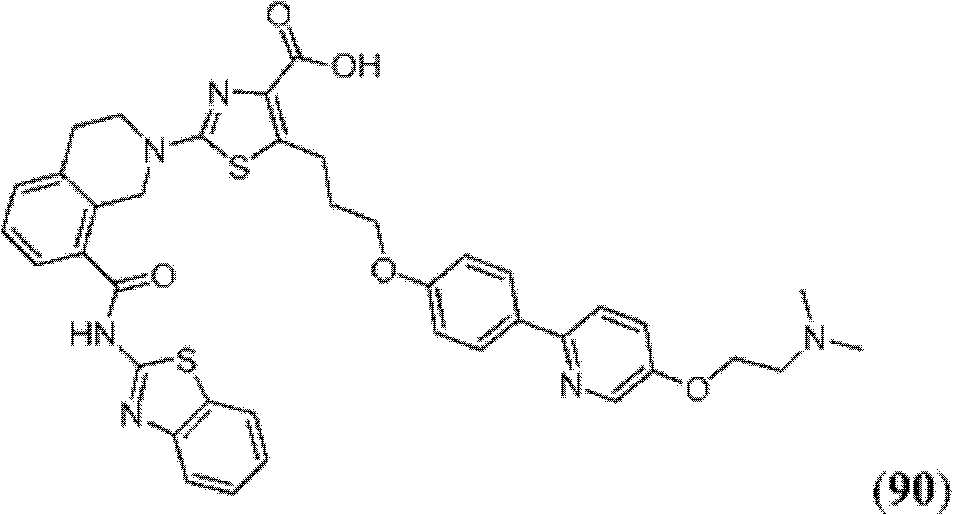
步骤1:2-(6-氯吡啶-3-氧基)-N,N-二甲基乙胺(90A)的制备: Step 1 : Preparation of 2-(6-chloropyridine-3-oxyl)-N,N-dimethylethylamine (90A):
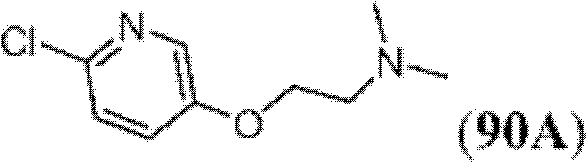
化合物90用与化合物35A的合成类似的方式制备,分别用2-(二甲基氨基)乙醇和6-氯吡啶-3-醇代替化合物34C和化合物31F。Compound 90 was prepared in a similar manner to the synthesis of Compound 35A, substituting 2-(dimethylamino)ethanol and 6-chloropyridin-3-ol for Compound 34C and Compound 31F, respectively.
步骤2:4-(5-(2-(二甲基氨基)乙氧基)吡啶-2-基)苯酚(90B): Step 2 : 4-(5-(2-(Dimethylamino)ethoxy)pyridin-2-yl)phenol (90B):

化合物90B用与化合物34D的合成类似的方式制备,分别用化合物90A和4-(4,4,5,5-四甲基-1,3,2-二氧硼戊环-2-基)苯酚代替化合物34C和4-(羟甲基)苯基硼酸:1H NMR(DMSO-d6):δ9.56(s,1H),8.29(d,J=2.76Hz,1H),7.83(d,J=8.59Hz,2H),7.74(d,J=8.59Hz,2H),7.41(dd,J=8.59,2.76Hz,2H),6.82(d,J=8.29Hz,2H),4.14(t,J=5.68Hz,2H),2.64(t,J=5.68Hz,2H),2.22(s,6H)。ESI(+)/MS:258(M+H)+。Compound 90B was prepared in a similar manner to the synthesis of compound 34D, using compound 90A and 4-(4,4,5,5-tetramethyl-1,3,2-dioxaborolan-2-yl)phenol, respectively Substitute compound 34C and 4-(hydroxymethyl)phenylboronic acid: 1 H NMR (DMSO-d 6 ): δ9.56(s, 1H), 8.29(d, J=2.76Hz, 1H), 7.83(d, J=8.59Hz, 2H), 7.74(d, J=8.59Hz, 2H), 7.41(dd, J=8.59, 2.76Hz, 2H), 6.82(d, J=8.29Hz, 2H), 4.14(t, J=5.68Hz, 2H), 2.64(t, J=5.68Hz, 2H), 2.22(s, 6H). ESI (+)/MS: 258 (M+H) + .
步骤3:题示化合物90的制备: Step 3 : Preparation of title compound 90:
用与化合物51的合成类似的方式,将题示化合物90制备为TFA盐,用化合物90B代替化合物51A:1H NMR(DMSO-d6):δ9.60(s,1H),8.09(d,J=2.76Hz,1H),8.02(d,J=7.37Hz,1H),7.93(d,J=8.9Hz,2H),7.85(d,J=8.9Hz,1H),7.79(d,J=8.29Hz,1H),7.67(d,J=7.67Hz,1H),7.33-7.51(m,5H),6.99(d,J=8.9Hz,2H),4.84(s,2H),4.42-4.45(m,2H),4.04(d,J=6.29Hz,2H),3.83(d,J=5.83Hz,1H),3.55(br,2H),3.16-3.21(m,2H),3.03(t,J=5.83Hz,2H),2.89(s,6H),1.99-2.07(m,2H)。ESI(+)/MS:735(M+H)+。In a similar manner to the synthesis of compound 51, the title compound 90 was prepared as a TFA salt, replacing compound 51A with compound 90B: 1 H NMR (DMSO-d 6 ): δ9.60(s, 1H), 8.09(d, J=2.76Hz, 1H), 8.02(d, J=7.37Hz, 1H), 7.93(d, J=8.9Hz, 2H), 7.85(d, J=8.9Hz, 1H), 7.79(d, J= 8.29Hz, 1H), 7.67(d, J=7.67Hz, 1H), 7.33-7.51(m, 5H), 6.99(d, J=8.9Hz, 2H), 4.84(s, 2H), 4.42-4.45( m, 2H), 4.04(d, J=6.29Hz, 2H), 3.83(d, J=5.83Hz, 1H), 3.55(br, 2H), 3.16-3.21(m, 2H), 3.03(t, J =5.83Hz, 2H), 2.89(s, 6H), 1.99-2.07(m, 2H). ESI (+)/MS: 735 (M+H) + .
实施例91Example 91
2-(8-(苯并[d]噻唑-2-基氨基甲酰基)-3,4-二氢异喹啉-2(1H)-基)-5-(3-((1-(4-羟基苯基)-1H-吡唑并[3,4-d]嘧啶-4-基)(3-(4-甲基哌嗪-1-基)丙基)氨基)丙基)噻唑-4-羧酸(91)的合成:2-(8-(Benzo[d]thiazol-2-ylcarbamoyl)-3,4-dihydroisoquinolin-2(1H)-yl)-5-(3-((1-(4 -Hydroxyphenyl)-1H-pyrazolo[3,4-d]pyrimidin-4-yl)(3-(4-methylpiperazin-1-yl)propyl)amino)propyl)thiazole-4 - Synthesis of carboxylic acid (91):
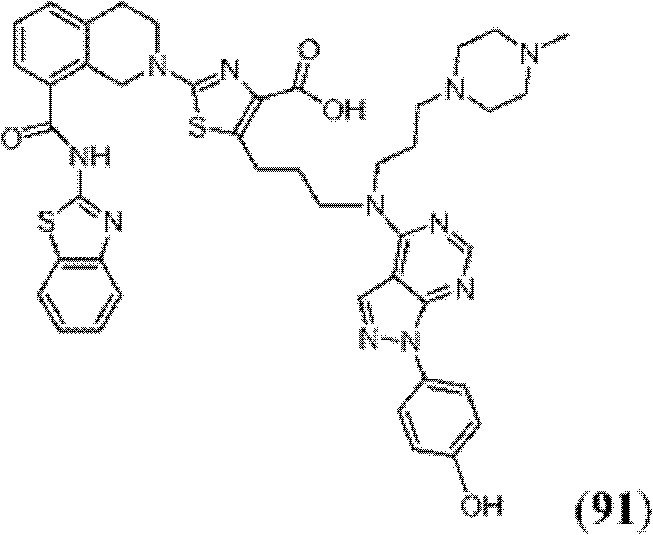
向化合物84A(50mg,0.136mmol)在DMF(5ml)中的溶液中,加入氢化钠(27.2mg,0.680mmol)(60%)。反应混合物搅拌10min,加入化合物2C(77mg,0.122mmol)。得到的混合物搅拌1小时,加入甲醇(3ml)、10%NaOH和水(1ml)。混合物搅拌过夜,用TFA酸化,浓缩。残余物在DMSO-甲醇混合物中溶解,通过反相HPLC纯化(流动相:含0%-60%乙腈的0.1%TFA水溶液,60min内),以提供题示化合物91,为TFA盐:1H NMR(500MHz,吡啶-D5)δppm 8.62(1H,s),8.41(1H,s),8.35(2H,d),7.94(1H,d),7.89(1H,d),7.77-7.81(1H,m),7.43(1H,t),7.24-7.33(5H,m),5.15(2H,s),3.93-4.01(2H,m),3.87(2H,d),3.81(2H,t),3.45(2H,t),2.92(2H,t),2.79-2.85(4H,m),2.62-2.69(4H,m),2.42-2.47(5H,m),2.18-2.28(2H,m),1.89-1.98(2H,m);LCMS(APCI)m/e 844(M+H)。To a solution of compound 84A (50 mg, 0.136 mmol) in DMF (5 ml) was added sodium hydride (27.2 mg, 0.680 mmol) (60%). The reaction mixture was stirred for 10 min, and compound 2C (77 mg, 0.122 mmol) was added. The resulting mixture was stirred for 1 hour and methanol (3ml), 10% NaOH and water (1ml) were added. The mixture was stirred overnight, acidified with TFA and concentrated. The residue was dissolved in DMSO-methanol mixture and purified by reverse phase HPLC (mobile phase: 0%-60% acetonitrile in 0.1% TFA in water within 60 min) to provide the title compound 91 as a TFA salt: 1 H NMR (500MHz, pyridine-D 5 ) δppm 8.62(1H, s), 8.41(1H, s), 8.35(2H, d), 7.94(1H, d), 7.89(1H, d), 7.77-7.81(1H, m), 7.43(1H,t), 7.24-7.33(5H,m), 5.15(2H,s), 3.93-4.01(2H,m), 3.87(2H,d), 3.81(2H,t), 3.45 (2H,t), 2.92(2H,t), 2.79-2.85(4H,m), 2.62-2.69(4H,m), 2.42-2.47(5H,m), 2.18-2.28(2H,m), 1.89 -1.98 (2H, m); LCMS (APCI) m/e 844 (M+H).
实施例92Example 92
6-(8-(苯并[d]噻唑-2-基氨基甲酰基)-3,4-二氢异喹啉-2(1H)-基)-3-(3-(4-(4-(3-(二甲基氨基)丙基氨基)-1H-吡唑并[3,4-d]嘧啶-1-基)苯氧基)丙基)吡啶甲酸(92)的合成:6-(8-(Benzo[d]thiazol-2-ylcarbamoyl)-3,4-dihydroisoquinolin-2(1H)-yl)-3-(3-(4-(4- Synthesis of (3-(dimethylamino)propylamino)-1H-pyrazolo[3,4-d]pyrimidin-1-yl)phenoxy)propyl)picolinic acid (92):

步骤1:6-(8-(苯并[d]噻唑-2-基氨基甲酰基)-3,4-二氢异喹啉-2(1H)-基)-3-(3-(4-(4-(3-(二甲基氨基)丙基氨基)-1H-吡唑并[3,4-d]嘧啶-1-基)苯氧基)丙基)吡啶甲酸叔丁酯(92A)的制备: Step 1 : 6-(8-(Benzo[d]thiazol-2-ylcarbamoyl)-3,4-dihydroisoquinolin-2(1H)-yl)-3-(3-(4- (4-(3-(Dimethylamino)propylamino)-1H-pyrazolo[3,4-d]pyrimidin-1-yl)phenoxy)propyl)picolinate tert-butyl (92A) Preparation of:
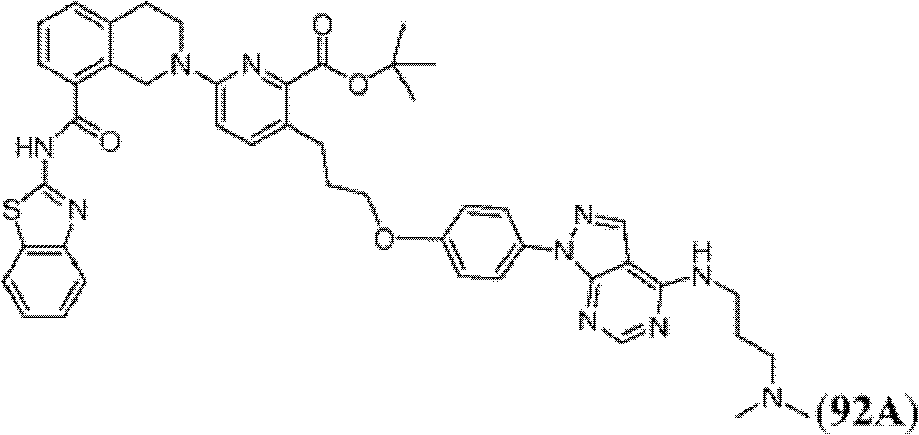
向化合物54A(100mg,0.320mmol)在DMF(5ml)中的溶液中,加入氢化钠(60%,38.4mg,0.960mmol)。反应搅拌10min,加入化合物96D(168mg,0.256mmol)。得到的混合物搅拌1小时,通过反相HPLC纯化(流动相:含0%-70%乙腈的0.1%TFA水溶液,70min内),以提供题示化合物92A,为TFA盐。LCMS(APCI)m/e 839(M+H)。To a solution of compound 54A (100 mg, 0.320 mmol) in DMF (5 ml), sodium hydride (60%, 38.4 mg, 0.960 mmol) was added. The reaction was stirred for 10 min and compound 96D (168 mg, 0.256 mmol) was added. The resulting mixture was stirred for 1 h and purified by reverse phase HPLC (mobile phase: 0%-70% acetonitrile in 0.1% TFA in water within 70 min) to provide the title compound 92A as a TFA salt. LCMS (APCI) m/e 839 (M+H).
步骤2:题示化合物92的制备: Step 2 : Preparation of Title Compound 92:
化合物92A(90mg,0.107mmol)和三乙基硅烷(37.4mg,0.322mmol)在DCM(1ml)中,用TFA(3ml,38.9mmol)处理4h。浓缩混合物,残余物通过反相HPLC纯化(流动相:含0%-60%乙腈的0.1%TFA水溶液,70min内),以提供题示化合物,为TFA盐:1H NMR(400MHz,DMSO-D6)δppm 12.82(1H,s),9.37(1H,s),8.55(1H,t),8.34(1H,d),8.03(1H,d),7.96-8.01(2H,m),7.79(1H,d),7.55-7.63(2H,m),7.44-7.50(2H,m),7.39-7.43(1H,m),7.35(2H,t),7.05-7.09(2H,m),6.97(1H,d),4.93(2H,s),3.99(2H,q),3.87(2H,t),3.43-3.70(2H,m),3.12-3.18(2H,m),2.99(2H,t),2.82-2.87(2H,m),2.80(6H,s),1.91-2.05(4H,m)。LCMS(APCI)783(M+H)。Compound 92A (90 mg, 0.107 mmol) and triethylsilane (37.4 mg, 0.322 mmol) in DCM (1 ml) were treated with TFA (3 ml, 38.9 mmol) for 4 h. The mixture was concentrated and the residue was purified by reverse phase HPLC (mobile phase: 0%-60% acetonitrile in 0.1% TFA in water within 70 min) to provide the title compound as a TFA salt: 1 H NMR (400 MHz, DMSO-D 6 ) δppm 12.82(1H, s), 9.37(1H, s), 8.55(1H, t), 8.34(1H, d), 8.03(1H, d), 7.96-8.01(2H, m), 7.79(1H , d), 7.55-7.63 (2H, m), 7.44-7.50 (2H, m), 7.39-7.43 (1H, m), 7.35 (2H, t), 7.05-7.09 (2H, m), 6.97 (1H , d), 4.93(2H, s), 3.99(2H, q), 3.87(2H, t), 3.43-3.70(2H, m), 3.12-3.18(2H, m), 2.99(2H, t), 2.82-2.87 (2H, m), 2.80 (6H, s), 1.91-2.05 (4H, m). LCMS (APCI) 783 (M+H).
实施例93Example 93
2-[8-(苯并噻唑-2-基氨基甲酰基)-3,4-二氢-1H-异喹啉-2-基]-5-{3-[2-氟-4-(4-甲基-哌嗪-1-基)-苯氧基]-丙基}-噻唑-4-羧酸(93)的合成:2-[8-(Benzothiazol-2-ylcarbamoyl)-3,4-dihydro-1H-isoquinolin-2-yl]-5-{3-[2-fluoro-4-(4 Synthesis of -methyl-piperazin-1-yl)-phenoxy]-propyl}-thiazole-4-carboxylic acid (93):
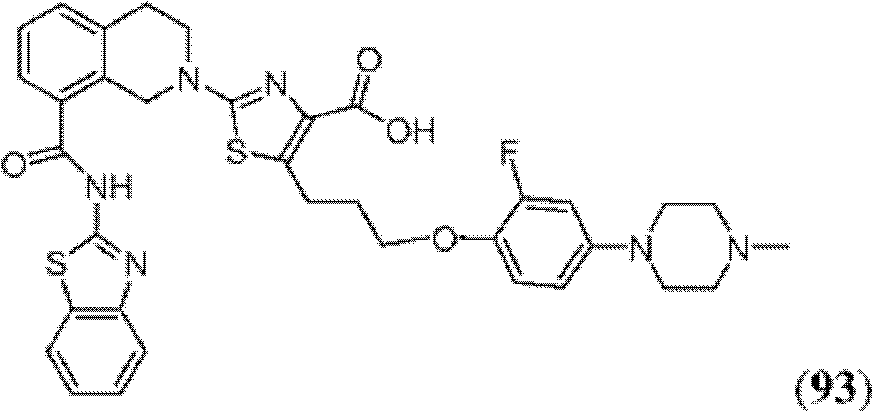
步骤1:1-(苄氧基)-4-溴-2-氟苯(93A)的制备: Step 1 : Preparation of 1-(benzyloxy)-4-bromo-2-fluorobenzene (93A):

4-溴-2-氟苯酚(2.557g,13.39mmol)和(溴甲基)苯(1.590ml,13.39mmol)在DMF(20ml)中用K2CO3(3.70g,26.8mmol)处理过夜。然后反应用乙酸乙酯稀释,用水洗涤。有机层用Na2SO4干燥,浓缩,以提供题示化合物。LCMS(APCI)m/e 282(M+H)。4-Bromo-2-fluorophenol (2.557g, 13.39mmol) and (bromomethyl)benzene (1.590ml, 13.39mmol) were treated with K2CO3 ( 3.70g , 26.8mmol) in DMF (20ml) overnight. The reaction was then diluted with ethyl acetate and washed with water. The organic layer was dried over Na2SO4 and concentrated to provide the title compound. LCMS (APCI) m/e 282 (M+H).
步骤2:1-(4-(苄氧基)-3-氟苯基)-4-甲基哌嗪(93B)的制备: Step 2 : Preparation of 1-(4-(benzyloxy)-3-fluorophenyl)-4-methylpiperazine (93B):
向烤箱干燥的小瓶中充填t-BuONa(360mg,3.75mmol)、Pd2(dba)3(51.5mg,0.056mmol)和(S)-BINAP(105mg,0.169mmol)。加入甲苯(5ml)、实施例93A(527mg,1.875mmol)和1-甲基哌嗪(416μl,3.75mmol)。得到的混合物用氮气吹扫,密封小瓶,在80℃加热过夜。浓缩反应,残余物通过反相HPLC纯化(流动相:含0%-50%乙腈的0.1%TFA水溶液,40min内),以提供题示化合物,为TFA盐:LCMS(APCI)m/e 301(M+H)。Oven-dried vials were charged with t-BuONa (360 mg, 3.75 mmol), Pd 2 (dba) 3 (51.5 mg, 0.056 mmol) and (S)-BINAP (105 mg, 0.169 mmol). Toluene (5ml), EXAMPLE 93A (527mg, 1.875mmol) and 1-methylpiperazine (416[mu]l, 3.75mmol) were added. The resulting mixture was purged with nitrogen, the vial was sealed and heated at 80°C overnight. The reaction was concentrated and the residue was purified by reverse phase HPLC (mobile phase: 0%-50% acetonitrile in 0.1% TFA in water within 40 min) to provide the title compound as a TFA salt: LCMS (APCI) m/e 301( M+H).
步骤3:2-氟-4-(4-甲基哌嗪-1-基)苯酚(93C)的制备: Step 3 : Preparation of 2-fluoro-4-(4-methylpiperazin-1-yl)phenol (93C):
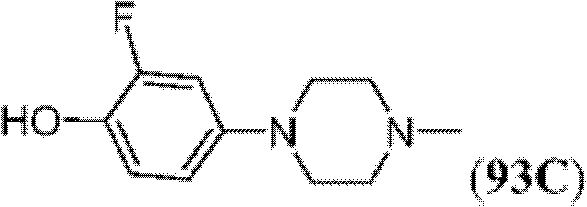
含化合物93B(230mg,0.766mmol)的MeOH(5ml)用10%Pd/C(48mg,0.045mmol)在H2环境下处理过夜。通过硅藻土过滤除去不可溶的材料,浓缩滤液。残余物通过反相HPLC纯化(流动相:含0%-30%乙腈的0.1%TFA水溶液,30min内),以提供题示化合物,为TFA盐:LCMS(APCI)m/e 211(M+H)。Compound 93B (230 mg, 0.766 mmol) in MeOH (5 ml) was treated with 10% Pd/C (48 mg, 0.045 mmol) under H2 overnight. Insoluble material was removed by filtration through celite, and the filtrate was concentrated. The residue was purified by reverse phase HPLC (mobile phase: 0%-30% acetonitrile in 0.1% TFA in water within 30 min) to provide the title compound as a TFA salt: LCMS (APCI) m/e 211 (M+H ).
步骤4:题示化合物93的制备: Step 4 : Preparation of Title Compound 93:
题示化合物92使用实施例54的步骤2中描述的相同程序制备,用化合物93代替化合物54A:1H NMR(400MHz,DMSO-D6)δppm12.85(1H,s),9.64(1H,s),8.03(1H,d),7.79(1H,d),7.67(1H,d),7.43-7.51(2H,m),7.33-7.42(2H,m),7.03(1H,t),6.92(1H,dd),6.70(1H,dd),4.83(2H,s),3.98(2H,t),3.72(2H,t),3.40-3.55(2H,m),3.33-3.39(2H,m),3.09-3.20(4H,m),3.03(2H,t),2.85-2.95(2H,m),2.84(3H,s),1.93-2.02(2H,m)。LCMS(APCI)m/e 687(M+H)。Title compound 92 was prepared using the same procedure described in step 2 of Example 54, substituting compound 93 for compound 54A: 1 H NMR (400 MHz, DMSO-D 6 ) δ ppm 12.85 (1H, s), 9.64 (1H, s ), 8.03(1H, d), 7.79(1H, d), 7.67(1H, d), 7.43-7.51(2H, m), 7.33-7.42(2H, m), 7.03(1H, t), 6.92( 1H,dd), 6.70(1H,dd), 4.83(2H,s), 3.98(2H,t), 3.72(2H,t), 3.40-3.55(2H,m), 3.33-3.39(2H,m) , 3.09-3.20 (4H, m), 3.03 (2H, t), 2.85-2.95 (2H, m), 2.84 (3H, s), 1.93-2.02 (2H, m). LCMS (APCI) m/e 687 (M+H).
实施例94Example 94
6-[8-(苯并噻唑-2-基氨基甲酰基)-3,4-二氢-1H-异喹啉-2-基]-3-{3-[4-(4-甲基-哌嗪-1-基)-苯氧基]-丙基}-吡啶-2-羧酸(94)的合成:6-[8-(Benzothiazol-2-ylcarbamoyl)-3,4-dihydro-1H-isoquinolin-2-yl]-3-{3-[4-(4-methyl- Synthesis of piperazin-1-yl)-phenoxy]-propyl}-pyridine-2-carboxylic acid (94):
步骤1:3-溴-6-氯吡啶甲酸叔丁酯(94A)的制备: Step 1 : Preparation of tert-butyl 3-bromo-6-chloropicolinate (94A):
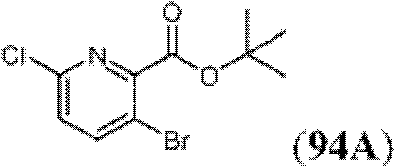
甲苯磺酰基氯(7.7g,40.4mmol)在0℃加入到2-氯-5-溴吡啶甲酸(4g,17mmol)和吡啶(9.2mL,114mmol)在33mL t-BuOH中的溶液中。然后反应在室温下搅拌12小时。然后加入NaHCO3(饱和),用乙酸乙酯萃取混合物(3次)。合并的有机相用盐水洗涤,用Na2SO4干燥。蒸发有机溶剂,提供所需化合物94A,其在下一步骤中使用,无需进一步纯化:1H NMR(300MHz,DMSO-d6)δppm 8.27(1H,d),7.63(1H,d),1.57(9H,s)。Tosyl chloride (7.7 g, 40.4 mmol) was added to a solution of 2-chloro-5-bromopicolinic acid (4 g, 17 mmol) and pyridine (9.2 mL, 114 mmol) in 33 mL t-BuOH at 0°C. The reaction was then stirred at room temperature for 12 hours. Then NaHCO3 (sat.) was added and the mixture was extracted with ethyl acetate (3 times). The combined organic phases were washed with brine and dried over Na2SO4 . Evaporation of the organic solvent provided the desired compound 94A, which was used in the next step without further purification: 1 H NMR (300 MHz, DMSO-d 6 ) δ ppm 8.27 (1H, d), 7.63 (1H, d), 1.57 (9H , s).
步骤2:6-(8-(苯并[d]噻唑-2-基氨基甲酰基)-3,4-二氢异喹啉-2(1H)-基)-3-溴吡啶甲酸叔丁酯(94B)的制备: Step 2 : tert-butyl 6-(8-(benzo[d]thiazol-2-ylcarbamoyl)-3,4-dihydroisoquinolin-2(1H)-yl)-3-bromopicolinate Preparation of (94B):
反应开始前,Cs2CO3(4.1g,12.6mmol)和
步骤3:3-溴-6-(8-(3-((2-(三甲基甲硅烷基)乙氧基)甲基)苯并[d]噻唑-2(3H)-亚基氨基甲酰基)-3,4-二氢异喹啉-2(1H)-基)吡啶甲酸(Z)-叔丁酯(94C)的制备: Step 3 : 3-Bromo-6-(8-(3-((2-(trimethylsilyl)ethoxy)methyl)benzo[d]thiazole-2(3H)-ylideneaminomethyl Preparation of acyl)-3,4-dihydroisoquinolin-2(1H)-yl)picolinic acid (Z)-tert-butyl ester (94C):
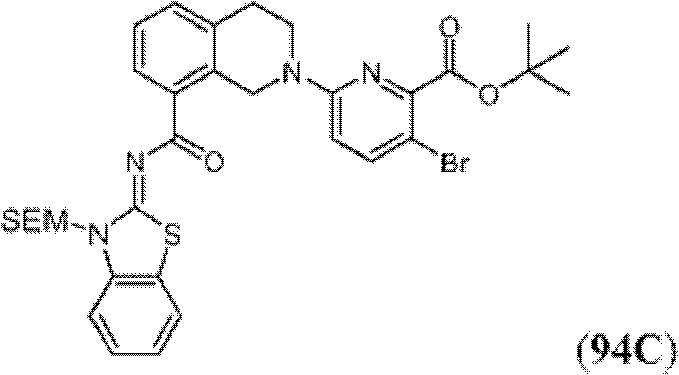
化合物94B(350mg,0.62mmol)在THF中溶解。连续加入NEt3(127μL,0.91mmol)和SEMCl(135μL,0.74mmol)。反应在室温下搅拌1小时。然后浓缩。残余物溶解到乙酸乙酯和水中。水层用乙酸乙酯萃取三次。合并的有机层用盐水洗涤,用Na2SO4干燥。浓缩后,残余物通过快速色谱使用flash master纯化:SiO2,乙酸乙酯/石油醚0∶100到30∶70。获得淡黄色泡沫固体94B,为两种不可分离的异构体的混合物(276mg,64%)。Compound 94B (350 mg, 0.62 mmol) was dissolved in THF. NEt3 (127 μL, 0.91 mmol) and SEMCl (135 μL, 0.74 mmol) were added sequentially. The reaction was stirred at room temperature for 1 hour. Then concentrate. The residue was dissolved in ethyl acetate and water. The aqueous layer was extracted three times with ethyl acetate. The combined organic layers were washed with brine and dried over Na2SO4 . After concentration, the residue was purified by flash chromatography using a flash master: SiO2 , ethyl acetate/petroleum ether 0:100 to 30:70. 94B was obtained as a pale yellow foamy solid as a mixture of two inseparable isomers (276 mg, 64%).
步骤4:3-(2-(1,3-二氧戊环-2-基)乙基)-6-(8-(3-((2-(三甲基甲硅烷基)乙氧基)甲基)苯并[d]噻唑-2(3H)-亚基氨基甲酰基)-3,4-二氢异喹啉-2(1H)-基)吡啶甲酸(Z)-叔丁酯(94D)的制备: Step 4 : 3-(2-(1,3-dioxolan-2-yl)ethyl)-6-(8-(3-((2-(trimethylsilyl)ethoxy) Methyl)benzo[d]thiazole-2(3H)-ylidenecarbamoyl)-3,4-dihydroisoquinolin-2(1H)-yl)picolinic acid (Z)-tert-butyl ester (94D ) preparation:
化合物94C(2.97g,4.27mmol)、二环己基(2′,6′-二甲氧基联苯基-2-基)膦(0.35g,0.854mmol)和乙酸钯(0.096g,0.427mmol)在THF(20mL)中的混合物,在室温下搅拌5min。在室温下向该溶液中滴加0.5M(2-(1,3-二氧戊环-2-基)乙基)溴化锌(II)(17.08mL,8.54mmol)。反应搅拌过夜。向溶液中加入2′,6′-二甲氧基联苯基-2-基)膦(170mg)、乙酸钯(42mg)和(2-(1,3-二氧戊环-2-基)乙基)溴化锌(II)(15mL)。得到的混合物搅拌另外6小时,浓缩。残余物加载到硅胶柱上,用7∶3/己烷∶EtOAc洗脱,以提供2.75g所需产物94D,是两种异构体的混合物。APCI(+)LC/MS:717(M+H)+。Compound 94C (2.97g, 4.27mmol), dicyclohexyl(2',6'-dimethoxybiphenyl-2-yl)phosphine (0.35g, 0.854mmol) and palladium acetate (0.096g, 0.427mmol) The mixture in THF (20 mL) was stirred at room temperature for 5 min. To this solution was added dropwise 0.5M (2-(1,3-dioxolan-2-yl)ethyl)zinc(II) bromide (17.08 mL, 8.54 mmol) at room temperature. The reaction was stirred overnight. To the solution was added 2',6'-dimethoxybiphenyl-2-yl)phosphine (170 mg), palladium acetate (42 mg) and (2-(1,3-dioxolan-2-yl) ethyl) zinc(II) bromide (15 mL). The resulting mixture was stirred for an additional 6 hours and concentrated. The residue was loaded onto a silica gel column and eluted with 7:3/hexanes:EtOAc to afford 2.75 g of the desired product 94D as a mixture of two isomers. APCI (+) LC/MS: 717 (M+H) + .
步骤5:3-(3-氧丙基)-6-(8-(3-((2-(三甲基甲硅烷基)乙氧基)甲基)苯并[d]噻唑-2(3H)-亚基氨基甲酰基)-3,4-二氢异喹啉-2(1H)-基)吡啶甲酸(Z)-叔丁酯(94E)的制备: Step 5 : 3-(3-Oxopropyl)-6-(8-(3-((2-(trimethylsilyl)ethoxy)methyl)benzo[d]thiazole-2(3H )-ylidenecarbamoyl)-3,4-dihydroisoquinolin-2(1H)-yl)pyridinecarboxylic acid (Z)-tert-butyl ester (94E):
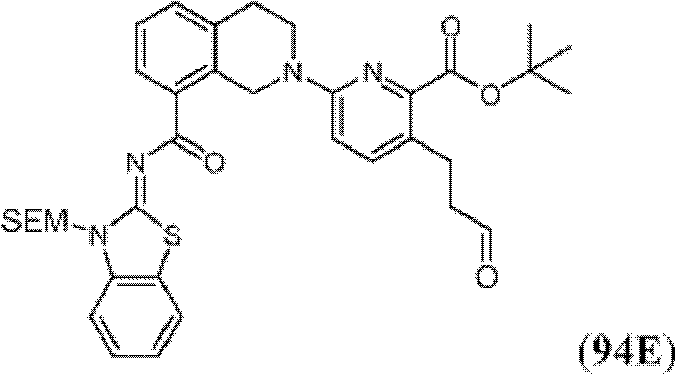
化合物94D(1.47g)在THF(30mL)中溶解。向该溶液中加入5%HCl(10mL)。反应混合物在48℃加热90min。冷却至室温后,用饱和NaHCO3溶液淬灭反应混合物,直到不再释放CO2。溶液在真空中浓缩。残余物在EtOAc中重溶解,用水(100mL)处理。分离有机层,用额外的EtOAc萃取水层(三次)。合并的有机层用盐水洗涤,干燥(MgSO4),过滤,在真空中浓缩。残余物使用快速柱色谱用硅胶纯化,用7∶3/Hex∶EtOAc洗脱,得到1.10g题示化合物94E(80%):APCI(+)LC/MS:673(M+H)+。Compound 94D (1.47 g) was dissolved in THF (30 mL). To this solution was added 5% HCl (10 mL). The reaction mixture was heated at 48 °C for 90 min. After cooling to room temperature, the reaction mixture was quenched with saturated NaHCO3 solution until no more CO2 was released. The solution was concentrated in vacuo. The residue was redissolved in EtOAc and treated with water (100 mL). The organic layer was separated and the aqueous layer was extracted with additional EtOAc (three times). The combined organic layers were washed with brine, dried ( MgSO4 ), filtered and concentrated in vacuo. The residue was purified using flash column chromatography on silica gel eluting with 7:3/Hex:EtOAc to afford 1.10 g of the title compound 94E (80%): APCI(+) LC/MS: 673 (M+H) + .
步骤6:3-(3-羟丙基)-6-(8-(3-((2-(三甲基甲硅烷基)乙氧基)甲基)苯并[d]噻唑-2(3H)-亚基氨基甲酰基)-3,4-二氢异喹啉-2(1H)-基)吡啶甲酸(Z)-叔丁酯(94F)的制备: Step 6 : 3-(3-Hydroxypropyl)-6-(8-(3-((2-(trimethylsilyl)ethoxy)methyl)benzo[d]thiazole-2(3H )-ylidenecarbamoyl)-3,4-dihydroisoquinolin-2(1H)-yl)pyridinecarboxylic acid (Z)-tert-butyl ester (94F):
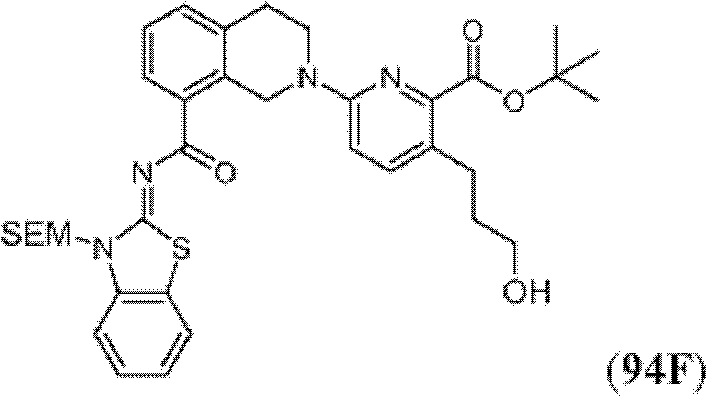
化合物94E(0.91g,1.351mmol)在THF(30mL)和甲醇(5mL)中用NaBH4(0.102g,2.7mmol)处理。反应混合物加热回流1小时。在真空中除去溶剂。残余物在EtOAc中重溶解,用水处理。分离有机层,用额外的EtOAc萃取水层。合并的有机层用盐水洗涤,干燥(MgSO4),过滤,浓缩。残余物通过快速色谱纯化,得到0.75g题示化合物94F(82%):APCI(+)LC/MS:675(M+H)+。Compound 94E (0.91 g, 1.351 mmol) was treated with NaBH4 (0.102 g, 2.7 mmol) in THF (30 mL) and methanol (5 mL). The reaction mixture was heated to reflux for 1 hour. Solvent was removed in vacuo. The residue was redissolved in EtOAc and treated with water. The organic layer was separated and the aqueous layer was extracted with additional EtOAc. The combined organic layers were washed with brine, dried ( MgSO4 ), filtered and concentrated. The residue was purified by flash chromatography to afford 0.75 g of the title compound 94F (82%): APCI (+) LC/MS: 675 (M+H) + .
步骤7:6-(8-(苯并[d]噻唑-2-基((2-(三甲基甲硅烷基)乙氧基)甲基)氨基甲酰基)-3,4-二氢异喹啉-2(1H)-基)-3-(3-(4-(4-甲基哌嗪-1-基)苯氧基)丙基)吡啶甲酸叔丁酯(94G)的制备: Step 7 : 6-(8-(Benzo[d]thiazol-2-yl((2-(trimethylsilyl)ethoxy)methyl)carbamoyl)-3,4-dihydroiso Preparation of tert-butyl quinolin-2(1H)-yl)-3-(3-(4-(4-methylpiperazin-1-yl)phenoxy)propyl)picolinate (94G):
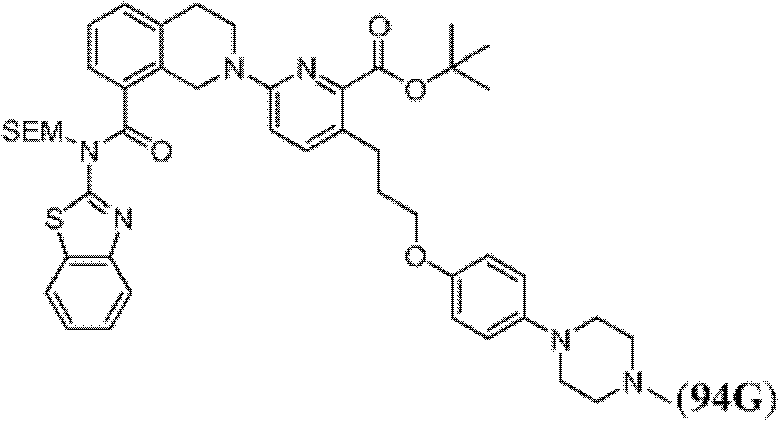
题示化合物94G用与化合物35A的合成类似的方式制备,分别用化合物94F和化合物82A代替化合物34D和化合物31F:ESI(+)LC/MS:849(M+H2O-NH4)+。The title compound 94G was prepared in a similar manner to the synthesis of compound 35A, replacing compound 34D and compound 31F with compound 94F and compound 82A, respectively: ESI (+) LC/MS: 849 (M+H 2 O-NH 4 ) + .
步骤7:题示化合物94的制备: Step 7 : Preparation of Title Compound 94:
含化合物94G(0.012g)的二氧杂环己烷(2mL)用在二氧杂环己烷(2mL)和甲醇(0.5mL)中的4N HCl处理。溶液在60℃搅拌6小时。除去溶剂,残余物通过预制备HPLC纯化,得到题示化合物94,为TFA盐:1H NMR(DMSO-d6):δ12.85(d,J=7.02Hz,1H),9.70(d,J=9.46Hz,1H),8.04(d,J=7.63Hz,1H),7.79(d,J=7.93Hz,1H),7.60(d,J=7.63Hz,1H),7.55(d,J=8.85Hz,1H),7.34-7.50(m,4H),6.96(d,J=8.54Hz,1H),6.90-6.93(m,2H),6.81-6.84(m,2H),4.92(s,2H),3.85-3.87(m,4H),3.62-3.64(m,2H),3.12-3.18(m,2H),2.98(t,J=5.8Hz,2H),2.79-2.86(m,7H),1.86-1.93(m,2H),1.26-1.28(m,2H)。ESI(+)LC/MS:663(M+H)+。Compound 94G (0.012 g) in dioxane (2 mL) was treated with 4N HCl in dioxane (2 mL) and methanol (0.5 mL). The solution was stirred at 60°C for 6 hours. The solvent was removed, and the residue was purified by preparative HPLC to give the title compound 94 as a TFA salt: 1 H NMR (DMSO-d 6 ): δ12.85 (d, J = 7.02 Hz, 1H), 9.70 (d, J =9.46Hz, 1H), 8.04(d, J=7.63Hz, 1H), 7.79(d, J=7.93Hz, 1H), 7.60(d, J=7.63Hz, 1H), 7.55(d, J=8.85 Hz, 1H), 7.34-7.50(m, 4H), 6.96(d, J=8.54Hz, 1H), 6.90-6.93(m, 2H), 6.81-6.84(m, 2H), 4.92(s, 2H) , 3.85-3.87(m, 4H), 3.62-3.64(m, 2H), 3.12-3.18(m, 2H), 2.98(t, J=5.8Hz, 2H), 2.79-2.86(m, 7H), 1.86 -1.93 (m, 2H), 1.26-1.28 (m, 2H). ESI (+) LC/MS: 663 (M+H) + .
实施例95Example 95
6-[8-(苯并噻唑-2-基氨基甲酰基)-3,4-二氢-1H-异喹啉-2-基]-3-(3-{4-[5-(2-二甲基氨基-乙氧基)-吡啶-2-基]-苯氧基}-丙基)-吡啶-2-羧酸(95)的合成:6-[8-(Benzothiazol-2-ylcarbamoyl)-3,4-dihydro-1H-isoquinolin-2-yl]-3-(3-{4-[5-(2- Synthesis of dimethylamino-ethoxy)-pyridin-2-yl]-phenoxy}-propyl)-pyridine-2-carboxylic acid (95):

步骤1:6-(8-(苯并[d]噻唑-2-基((2-(三甲基甲硅烷基)乙氧基)甲基)氨基甲酰基)-3,4-二氢异喹啉-2(1H)-基)-3-(3-(4-(5-(2-(二甲基氨基)乙氧基)吡啶-2-基)苯氧基)丙基)吡啶甲酸叔丁酯(95A)的制备: Step 1 : 6-(8-(Benzo[d]thiazol-2-yl((2-(trimethylsilyl)ethoxy)methyl)carbamoyl)-3,4-dihydroiso Quinolin-2(1H)-yl)-3-(3-(4-(5-(2-(dimethylamino)ethoxy)pyridin-2-yl)phenoxy)propyl)picolinic acid Preparation of tert-butyl ester (95A):
化合物95A用与化合物35A的合成类似的方式制备,分别用化合物94F和化合物90B代替化合物34D和化合物31F:ESI(+)LC/MS:915(M+H2O-NH4)+。Compound 95A was prepared in a similar manner to the synthesis of Compound 35A, replacing Compound 34D and Compound 31F with Compound 94F and Compound 90B, respectively: ESI (+) LC/MS: 915 (M+H 2 O—NH 4 ) + .
步骤2:题示化合物95的制备: Step 2 : Preparation of Title Compound 95:
题示化合物95用与实施例94的合成类似的方式制备,用化合物95A代替化合物94G:1H NMR(DMSO-d6):δ12.80(s,1H),9.69(s,1H),8.39(d,J=3.07Hz,1H),8.03(d,J=7.67Hz,1H),7.93(d,J=8.59Hz,2H),7.86(d,J=8.59Hz,1H),7.79(d,J=7.98Hz,1H),7.33-7.61(m,7H),6.96-7.00(m,1H),4.93(s,2H),4.43-4.45(m,2H),3.99(d,J=6.6Hz,2H),3.69(d,J=5.98Hz,2H),2.98(t,J=5.83Hz,2H),2.82-2.89(m,8H),1.93-2.01(m,2H)。ESI(+)/MS:729(M+H)+。The title compound 95 was prepared in a similar manner to the synthesis of Example 94, replacing compound 94G with compound 95A: 1 H NMR (DMSO-d 6 ): δ12.80 (s, 1H), 9.69 (s, 1H), 8.39 (d, J=3.07Hz, 1H), 8.03(d, J=7.67Hz, 1H), 7.93(d, J=8.59Hz, 2H), 7.86(d, J=8.59Hz, 1H), 7.79(d , J=7.98Hz, 1H), 7.33-7.61(m, 7H), 6.96-7.00(m, 1H), 4.93(s, 2H), 4.43-4.45(m, 2H), 3.99(d, J=6.6 Hz, 2H), 3.69(d, J=5.98Hz, 2H), 2.98(t, J=5.83Hz, 2H), 2.82-2.89(m, 8H), 1.93-2.01(m, 2H). ESI (+)/MS: 729 (M+H) + .
实施例96Example 96
6-[8-(苯并噻唑-2-基氨基甲酰基)-3,4-二氢-1H-异喹啉-2-基]-3-[3-(4-嘧啶-2-基-苯氧基)-丙基]-吡啶-2-羧酸(96)的合成:6-[8-(Benzothiazol-2-ylcarbamoyl)-3,4-dihydro-1H-isoquinolin-2-yl]-3-[3-(4-pyrimidin-2-yl- Synthesis of phenoxy)-propyl]-pyridine-2-carboxylic acid (96):
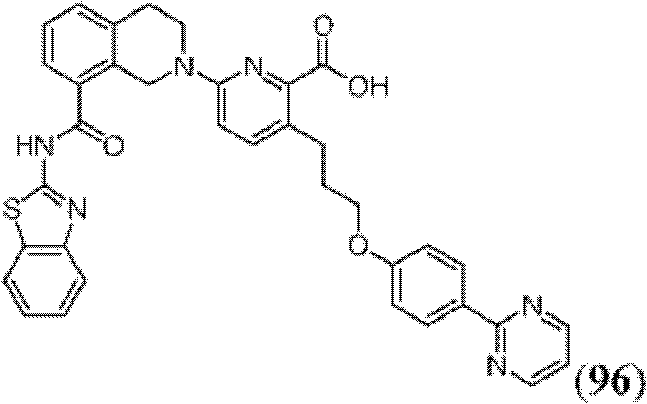
步骤1:3-(2-(1,3-二氧戊环-2-基)乙基)-6-(8-(苯并[d]噻唑-2-基氨基甲酰基)-3,4-二氢异喹啉-2(1H)-基)吡啶甲酸叔丁酯(96A)的制备: Step 1 : 3-(2-(1,3-dioxolan-2-yl)ethyl)-6-(8-(benzo[d]thiazol-2-ylcarbamoyl)-3,4 - Preparation of tert-butyl dihydroisoquinolin-2(1H)-yl)picolinate (96A):
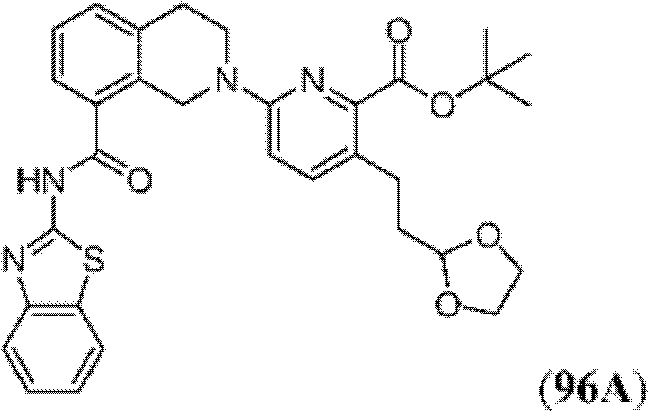
化合物94B(8.0g,14.15mmol)、二环己基(2′,6′-二甲氧基联苯基-2-基)膦(1.162g,2.83mmol)和乙酸钯(0.318g,1.415mmol)在THF(60mL)中的混合物,在室温下搅拌5min。在室温下通过额外的漏斗向该溶液中滴加0.5M(2-(1,3-二氧戊环-2-基)乙基)溴化锌(II)(56.6mL,28.3mmol)。反应搅拌过夜。除去溶剂,残余物加载到二氧化硅柱上,用7∶3/己烷∶EtOAc洗脱,得到7.58g所需产物96A:APCI(+)LC/MS:587(M+H)+。Compound 94B (8.0 g, 14.15 mmol), dicyclohexyl(2',6'-dimethoxybiphenyl-2-yl)phosphine (1.162 g, 2.83 mmol) and palladium acetate (0.318 g, 1.415 mmol) The mixture in THF (60 mL) was stirred at room temperature for 5 min. To this solution was added dropwise 0.5M (2-(1,3-dioxolan-2-yl)ethyl)zinc(II) bromide (56.6 mL, 28.3 mmol) at room temperature through an additional funnel. The reaction was stirred overnight. The solvent was removed and the residue loaded onto a silica column eluting with 7:3/Hex:EtOAc to give 7.58 g of the desired product 96A: APCI(+) LC/MS: 587 (M+H) + .
步骤2:6-(8-(苯并[d]噻唑-2-基氨基甲酰基)-3,4-二氢异喹啉-2(1H)-基)-3-(3-氧丙基)吡啶甲酸叔丁酯(96B)的制备: Step 2 : 6-(8-(Benzo[d]thiazol-2-ylcarbamoyl)-3,4-dihydroisoquinolin-2(1H)-yl)-3-(3-oxopropyl ) Preparation of tert-butyl picolinate (96B):
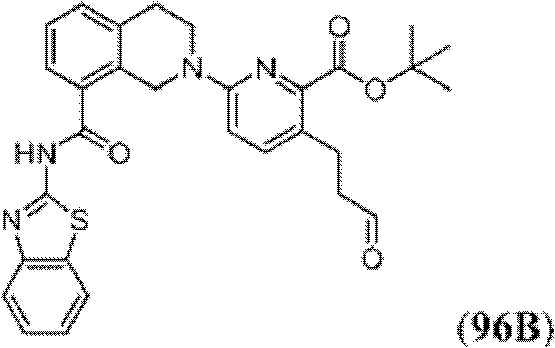
化合物96A(7.58g)在THF(120mL)中溶解。向该溶液中加入5%HCl水溶液(100mL)。反应混合物在48℃加热90min。冷却至室温后,用饱和NaHCO3溶液淬灭反应混合物,直到不再释放CO2。溶液在真空中浓缩。残余物在EtOAc中重溶解,用水(500mL)处理。分离有机层,用额外的EtOAc萃取水层(三次)。合并的有机层用盐水洗涤,干燥(MgSO4),过滤,在真空中浓缩。残余物使用快速柱色谱用硅胶纯化,用7∶3/Hex∶EtOAc洗脱,得到5.5g题示化合物96B(78%):APCI(+)LC/MS:543(M+H)+。Compound 96A (7.58 g) was dissolved in THF (120 mL). To this solution was added 5% aqueous HCl (100 mL). The reaction mixture was heated at 48 °C for 90 min. After cooling to room temperature, the reaction mixture was quenched with saturated NaHCO3 solution until no more CO2 was released. The solution was concentrated in vacuo. The residue was redissolved in EtOAc and treated with water (500 mL). The organic layer was separated and the aqueous layer was extracted with additional EtOAc (three times). The combined organic layers were washed with brine, dried ( MgSO4 ), filtered and concentrated in vacuo. The residue was purified using flash column chromatography on silica gel with 7:3/Hex:EtOAc to afford 5.5 g of the title compound 96B (78%): APCI(+) LC/MS: 543 (M+H) + .
步骤3:6-(8-(苯并[d]噻唑-2-基氨基甲酰基)-34-二氢异喹啉-2(1H)-基)-3-(3-羟丙基)吡啶甲酸叔丁酯(96C)的制备: Step 3 : 6-(8-(Benzo[d]thiazol-2-ylcarbamoyl)-34-dihydroisoquinolin-2(1H)-yl)-3-(3-hydroxypropyl)pyridine Preparation of tert-butyl formate (96C):
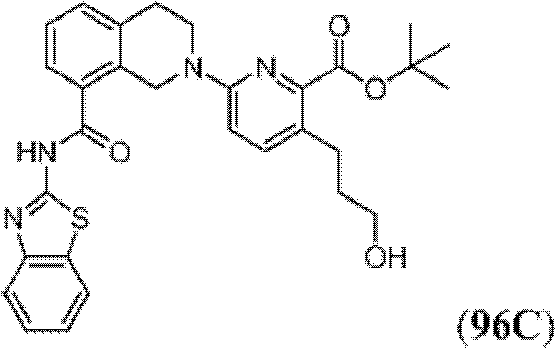
化合物96B(5.5g,10.14mmol)在THF(100mL)和甲醇(20mL)中用NaBH4(0.767g,20.28mmol)处理。反应混合物加热回流1小时。在真空中除去溶剂。残余物在EtOAc中重溶解,用水处理。分离有机层,用额外的EtOAc萃取水层。合并的有机层用盐水洗涤,干燥(MgSO4),过滤,浓缩。残余物通过快速色谱纯化,得到5.13g题示化合物96C(93%):APCI(+)LC/MS:545(M+H)+。Compound 96B (5.5 g, 10.14 mmol) was treated with NaBH4 (0.767 g, 20.28 mmol) in THF (100 mL) and methanol (20 mL). The reaction mixture was heated to reflux for 1 hour. Solvent was removed in vacuo. The residue was redissolved in EtOAc and treated with water. The organic layer was separated and the aqueous layer was extracted with additional EtOAc. The combined organic layers were washed with brine, dried ( MgSO4 ), filtered and concentrated. The residue was purified by flash chromatography to give 5.13 g of the title compound 96C (93%): APCI (+) LC/MS: 545 (M+H) + .
步骤4:6-(8-(苯并[d]噻唑-2-基氨基甲酰基)-3,4-二氢异喹啉-2(1H)-基)-3-(3-碘丙基)吡啶甲酸叔丁酯(96D)的制备: Step 4 : 6-(8-(Benzo[d]thiazol-2-ylcarbamoyl)-3,4-dihydroisoquinolin-2(1H)-yl)-3-(3-iodopropyl ) Preparation of tert-butyl picolinate (96D):
化合物96D用与化合物98A的合成类似的方式制备,用化合物96C代替化合物94F;APCI(+)LC/MS:655(M+H)+。Compound 96D was prepared in a similar manner to the synthesis of compound 98A, substituting compound 96C for compound 94F; APCI (+) LC/MS: 655 (M+H) + .
步骤5:题示化合物96的制备: Step 5 : Preparation of Title Compound 96:
用与化合物51的合成类似的方式,将题示化合物96制备为TFA盐,用化合物96D代替化合物51A:ESI(+)/MS:643(M+H)+;1H NMR(DMSO-d6):δ12.84(s,1H),8.863(d,J=4.48,2H),8.32(d,J=8.85Hz,2H),8.03(d,J=7.93Hz,1H),7.79(d,J=7.93Hz,1H),7.57-7.61(m,2H),7.46-7.49(m,1H),7.34-7.37(m,3H),7.03(d,J=9.15Hz,2H),6.98(d,J=8.54Hz,1H),4.93(s,2H),4.01-4.04(m,2H),3.87(d,J=5.95Hz,2H),2.99(d,J=5.65Hz,2H),2.83-2.86(m,2H),1.95-2.01(m,2H)。ESI(+)/MS:643(M+H)+。In a similar manner to the synthesis of compound 51, the title compound 96 was prepared as a TFA salt, replacing compound 51A with compound 96D: ESI (+)/MS: 643 (M+H) + ; 1 H NMR (DMSO-d 6 ): δ12.84(s, 1H), 8.863(d, J=4.48, 2H), 8.32(d, J=8.85Hz, 2H), 8.03(d, J=7.93Hz, 1H), 7.79(d, J=7.93Hz, 1H), 7.57-7.61(m, 2H), 7.46-7.49(m, 1H), 7.34-7.37(m, 3H), 7.03(d, J=9.15Hz, 2H), 6.98(d , J=8.54Hz, 1H), 4.93(s, 2H), 4.01-4.04(m, 2H), 3.87(d, J=5.95Hz, 2H), 2.99(d, J=5.65Hz, 2H), 2.83 -2.86 (m, 2H), 1.95-2.01 (m, 2H). ESI (+)/MS: 643 (M+H) + .
实施例97Example 97
6-(8-(苯并[d]噻唑-2-基氨基甲酰基)-3,4-二氢异喹啉-2(1H)-基)-3-(3-(4-(3-(二甲基氨基)丙-1-炔基)-2-氟苯氧基)丙基)吡啶甲酸(97)的合成:6-(8-(Benzo[d]thiazol-2-ylcarbamoyl)-3,4-dihydroisoquinolin-2(1H)-yl)-3-(3-(4-(3- Synthesis of (dimethylamino)prop-1-ynyl)-2-fluorophenoxy)propyl)picolinic acid (97):
步骤1:6-(8-(苯并[d]噻唑-2-基((2-(三甲基甲硅烷基)乙氧基)甲基)氨基甲酰基)-3,4-二氢异喹啉-2(1H)-基)-3-(3-(4-溴-2-氟苯氧基)丙基)吡啶甲酸叔丁酯(97A1);和3-(3-(4-溴-2-氟苯氧基)丙基)-6-(8-(3-((2-(三甲基甲硅烷基)乙氧基)甲基)苯并[d]噻唑-2(3H)-亚基氨基甲酰基)-3,4-二氢异喹啉-2(1H)-基)吡啶甲酸(Z)-叔丁酯(97A2)的制备: Step 1 : 6-(8-(Benzo[d]thiazol-2-yl((2-(trimethylsilyl)ethoxy)methyl)carbamoyl)-3,4-dihydroiso Quinolin-2(1H)-yl)-3-(3-(4-bromo-2-fluorophenoxy)propyl)picolinate tert-butyl (97A 1 ); and 3-(3-(4- Bromo-2-fluorophenoxy)propyl)-6-(8-(3-((2-(trimethylsilyl)ethoxy)methyl)benzo[d]thiazole-2(3H )-ylidenecarbamoyl)-3,4-dihydroisoquinolin-2(1H)-yl)pyridinecarboxylic acid (Z)-tert-butyl ester (97A 2 ):

向化合物94F(110mg,0.163mmol)、4-溴-2-氟苯酚(62.3mg,0.326mmol)和三苯基膦(64.1mg,0.244mmol)在THF(3ml)中的溶液中,加入(E)-偶氮二甲酸二叔丁酯(56.3mg,0.244mmol)。反应搅拌2h,加入水(0.5ml)。浓缩混合物,残余物通过快速色谱纯化,用DCM洗脱,以提供化合物97A1和化合物97A2;LCMS(APCI)m/e 848(M+H)。To a solution of compound 94F (110 mg, 0.163 mmol), 4-bromo-2-fluorophenol (62.3 mg, 0.326 mmol) and triphenylphosphine (64.1 mg, 0.244 mmol) in THF (3 ml) was added (E )-di-tert-butyl azodicarboxylate (56.3 mg, 0.244 mmol). The reaction was stirred for 2h and water (0.5ml) was added. The mixture was concentrated and the residue was purified by flash chromatography eluting with DCM to provide compound 97A 1 and compound 97A 2 ; LCMS (APCI) m/e 848 (M+H).
步骤2:3-(3-(4-(3-(二甲基氨基)丙-1-炔基)-2-氟苯氧基)丙基)-6-(8-(3-((2-(三甲基甲硅烷基)乙氧基)甲基)苯并[d]噻唑-2(3H)-亚基氨基甲酰基)-3,4-二氢异喹啉-2(1H)-基)吡啶甲酸(Z)-叔丁酯(97B1);和6-(8-(苯并[d]噻唑-2-基((2-(三甲基甲硅烷基)乙氧基)甲基)氨基甲酰基)-3,4-二氢异喹啉-2(1H)-基)-3-(3-(4-(3-(二甲基氨基)丙-1-炔基)-2-氟苯氧基)丙基)吡啶甲酸叔丁酯(97B2)的制备 Step 2 : 3-(3-(4-(3-(dimethylamino)prop-1-ynyl)-2-fluorophenoxy)propyl)-6-(8-(3-((2 -(trimethylsilyl)ethoxy)methyl)benzo[d]thiazole-2(3H)-ylidenecarbamoyl)-3,4-dihydroisoquinoline-2(1H)- base) picolinate (Z)-tert-butyl ester (97B 1 ); and 6-(8-(benzo[d]thiazol-2-yl((2-(trimethylsilyl)ethoxy)methyl Base) carbamoyl)-3,4-dihydroisoquinolin-2(1H)-yl)-3-(3-(4-(3-(dimethylamino)prop-1-ynyl)- Preparation of tert-butyl 2-fluorophenoxy)propyl)picolinate (97B 2 )
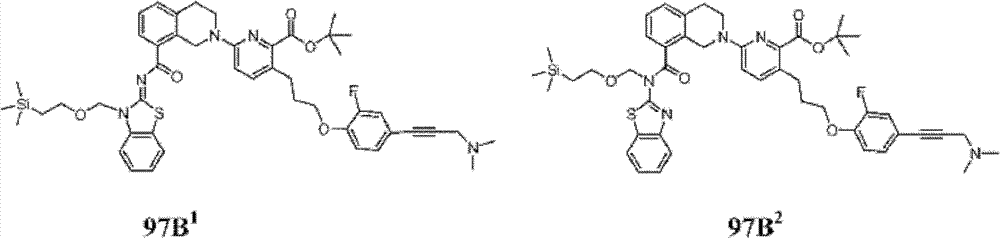
向化合物97A1和化合物97A2(90mg,0.106mmol)、N,N-二甲基丙-2-炔-1-胺(0.034ml,0.318mmol)、(PPh3)2PdCl2(22.35mg,0.032mmol)、TEA(0.074ml,0.531mmol)在DMF(2ml)中的混合物中,加入碘化亚铜(I)(2.022mg,0.01mmol)。得到的混合物在100℃在油浴中加热过夜,通过反相HPLC纯化(流动相:含10%-95%乙腈的0.1%TFA水溶液,60min内),以提供化合物97B1和97B2,为TFA盐:LCMS(APCI)m/e 850(M+H)。To compound 97A 1 and compound 97A 2 (90 mg, 0.106 mmol), N, N-dimethylprop-2-yn-1-amine (0.034 ml, 0.318 mmol), (PPh 3 ) 2 PdCl 2 (22.35 mg, To a mixture of 0.032 mmol), TEA (0.074 ml, 0.531 mmol) in DMF (2 ml), copper(I) iodide (2.022 mg, 0.01 mmol) was added. The resulting mixture was heated in an oil bath at 100 °C overnight and purified by reverse phase HPLC (mobile phase: 10%-95% acetonitrile in 0.1% TFA in water within 60 min) to provide compounds 97B1 and 97B2 as TFA Salt: LCMS (APCI) m/e 850 (M+H).
步骤3:题示化合物97的制备: Step 3 : Preparation of Title Compound 97:
含化合物97B1和化合物97B2(60mg,0.071mmol)的DCM(2ml)用含2N盐酸的乙醚(0.15ml,0.423mmol)处理2h,浓缩反应混合物。残余物在THF(2mL)和MeOH(2mL)中用10%氢氧化钠(256μl,0.639mmol)在70℃处理过夜并浓缩。残余物通过反相HPLC纯化(流动相:含0%-70%乙腈的0.1%TFA水溶液,60min内),以提供题示化合物97,为TFA盐:1H NMR(400MHz,DMSO-D6)δppm 12.79(1H,s),10.17(1H,s),8.03(1H,d),7.79(1H,d),7.53-7.63(2H,m),7.45-7.50(1H,m),7.39-7.44(2H,m),7.28-7.38(3H,m),7.17(1H,t),6.96(1H,d),4.93(2H,s),4.30(2H,s),4.06(2H,t),3.87(2H,t),2.99(2H,t),2.78-2.90(8H,m),1.91-2.05(2H,m);LCMS(APCI)m/e 664(M+H)。Compound 97B 1 and compound 97B 2 (60 mg, 0.071 mmol) in DCM (2 ml) were treated with 2N hydrochloric acid in ether (0.15 ml, 0.423 mmol) for 2 h, and the reaction mixture was concentrated. The residue was treated with 10% sodium hydroxide (256 μl, 0.639 mmol) in THF (2 mL) and MeOH (2 mL) at 70° C. overnight and concentrated. The residue was purified by reverse phase HPLC (mobile phase: 0%-70% acetonitrile in 0.1% TFA in water within 60 min) to provide the title compound 97 as a TFA salt: 1 H NMR (400 MHz, DMSO-D 6 ) δppm 12.79(1H, s), 10.17(1H, s), 8.03(1H, d), 7.79(1H, d), 7.53-7.63(2H, m), 7.45-7.50(1H, m), 7.39-7.44 (2H, m), 7.28-7.38 (3H, m), 7.17 (1H, t), 6.96 (1H, d), 4.93 (2H, s), 4.30 (2H, s), 4.06 (2H, t), 3.87 (2H, t), 2.99 (2H, t), 2.78-2.90 (8H, m), 1.91-2.05 (2H, m); LCMS (APCI) m/e 664 (M+H).
实施例98Example 98
6-(8-(苯并[d]噻唑-2-基氨基甲酰基)-3,4-二氢异喹啉-2(1H)-基)-3-(3-(4-(4-甲基哌嗪-1-羰基)苯氧基)丙基)吡啶甲酸(98)的合成:6-(8-(Benzo[d]thiazol-2-ylcarbamoyl)-3,4-dihydroisoquinolin-2(1H)-yl)-3-(3-(4-(4- Synthesis of methylpiperazine-1-carbonyl)phenoxy)propyl)picolinic acid (98):
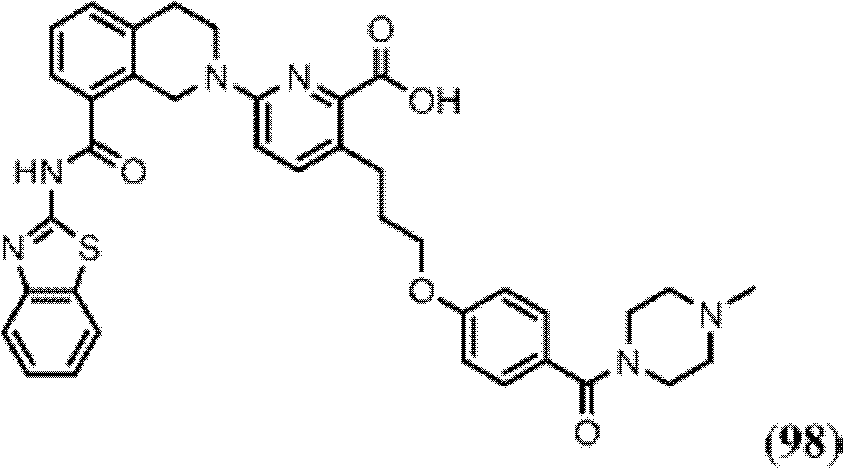
步骤1:6-(8-(苯并[d]噻唑-2-基((2-(三甲基甲硅烷基)乙氧基)甲基)氨基甲酰基)-3,4-二氢异喹啉-2(1H)-基)-3-(3-碘丙基)吡啶甲酸叔丁酯(98A1);和3-(3-碘丙基)-6-(8-(3-((2-(三甲基甲硅烷基)乙氧基)甲基)苯并[d]噻唑-2(3H)-亚基氨基甲酰基)-3,4-二氢异喹啉-2(1H)-基)吡啶甲酸(Z)-叔丁酯(98A2)的制备 Step 1 : 6-(8-(Benzo[d]thiazol-2-yl((2-(trimethylsilyl)ethoxy)methyl)carbamoyl)-3,4-dihydroiso Quinolin-2(1H)-yl)-3-(3-iodopropyl)picolinate tert-butyl (98A 1 ); and 3-(3-iodopropyl)-6-(8-(3-( (2-(Trimethylsilyl)ethoxy)methyl)benzo[d]thiazole-2(3H)-ylidenecarbamoyl)-3,4-dihydroisoquinoline-2(1H )-yl)pyridinecarboxylic acid (Z)-tert-butyl ester (98A 2 ) preparation
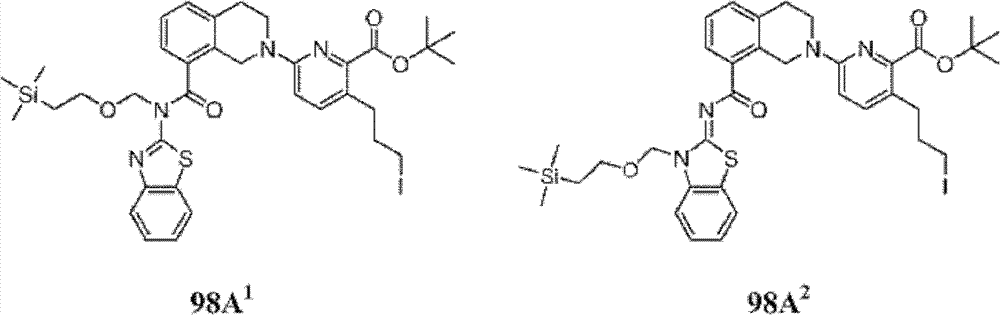
化合物94F(874mg,1.3mmol)在二乙醚(6.5ml)和乙腈(2.2ml)中,用咪唑(203mg,2.98mmol)、三苯基膦(509mg,1.94mmol)和碘(493mg,1.94mmol)连续处理。在各次加入之间搅拌反应混合物五分钟,让加入的试剂完全溶解。当全部试剂都已加入时,反应混合物在环境温度下搅拌45分钟,用EtOAc稀释,用水和盐水洗涤,干燥(MgSO4),过滤,浓缩。浓缩液通过柱色谱用硅胶纯化,用含5到30%EtOAc的己烷梯度洗脱,提供所需化合物,产率89%,为灰白色固体:1H NMR(300MHz,DMSO-d6)δppm 8.12(1H,dd),7.95(1H,d),7.70(1H,d),7.54(2H,m),7.37(3H,m),6.90(1H,d),5.98(2H,s),5.20(2H,s),3.82(2H,t),3.68(2H,m),3.23(2H,t),2.98(2H,t),2.61(2H,dd),1.97(2H,m),1.45(9H,s),0.88(2H,m),-0.19(9H,s)。Compound 94F (874mg, 1.3mmol) in diethyl ether (6.5ml) and acetonitrile (2.2ml), with imidazole (203mg, 2.98mmol), triphenylphosphine (509mg, 1.94mmol) and iodine (493mg, 1.94mmol) Continuous processing. The reaction mixture was stirred for five minutes between additions to allow complete dissolution of the added reagents. When all reagents had been added, the reaction mixture was stirred at ambient temperature for 45 min, diluted with EtOAc, washed with water and brine, dried ( MgSO4 ), filtered and concentrated. The concentrate was purified by column chromatography on silica gel eluting with a gradient of 5 to 30% EtOAc in hexanes to provide the desired compound in 89% yield as an off-white solid: 1 H NMR (300 MHz, DMSO-d 6 ) δ ppm 8.12 (1H,dd), 7.95(1H,d), 7.70(1H,d), 7.54(2H,m), 7.37(3H,m), 6.90(1H,d), 5.98(2H,s), 5.20( 2H,s), 3.82(2H,t), 3.68(2H,m), 3.23(2H,t), 2.98(2H,t), 2.61(2H,dd), 1.97(2H,m), 1.45(9H , s), 0.88 (2H, m), -0.19 (9H, s).
步骤2:6-(8-(苯并[d]噻唑-2-基((2-(三甲基甲硅烷基)乙氧基)甲基)氨基甲酰基)-3,4-二氢异喹啉-2(1H)-基)-3-(3-(4-(4-甲基哌嗪-1-羰基)苯氧基)丙基)吡啶甲酸叔丁酯(98B1);和3-(3-(4-(4-甲基哌嗪-1-羰基)苯氧基)丙基)-6-(8-(3-((2-(三甲基甲硅烷基)乙氧基)甲基)苯并[d]噻唑-2(3H)-亚基氨基甲酰基)-3,4-二氢异喹啉-2(1H)-基)吡啶甲酸(Z)-叔丁酯(98B2)的制备 Step 2 : 6-(8-(Benzo[d]thiazol-2-yl((2-(trimethylsilyl)ethoxy)methyl)carbamoyl)-3,4-dihydroiso tert-butyl quinolin-2(1H)-yl)-3-(3-(4-(4-methylpiperazine-1-carbonyl)phenoxy)propyl)picolinate (98B 1 ); and 3 -(3-(4-(4-methylpiperazine-1-carbonyl)phenoxy)propyl)-6-(8-(3-((2-(trimethylsilyl)ethoxy )methyl)benzo[d]thiazole-2(3H)-ylidenecarbamoyl)-3,4-dihydroisoquinolin-2(1H)-yl)pyridinecarboxylic acid (Z)-tert-butyl ester ( 98B 2 ) Preparation
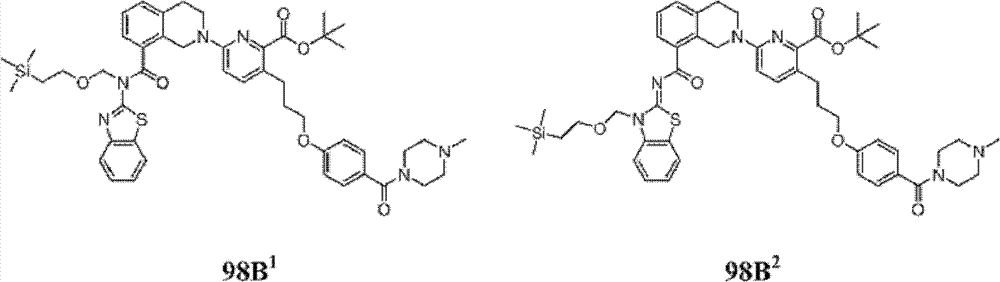
(4-羟基苯基)(4-甲基哌嗪-1-基)甲酮(66.1mg,0.3mmol)在DMF(2ml)中用NaH(24mg,0.6mmol)处理。在环境温度下搅拌15分钟后,加入化合物98A1和98A2(157mg,0.2mmol),继续搅拌3小时。反应混合物用EtOAc稀释,用水和盐水洗涤,干燥(MgSO4),过滤,浓缩。浓缩液通过柱色谱用硅胶纯化,用含0到5%MeOH的CH2Cl2梯度洗脱,提供97.5mg(产率56%)所需产物98B1和98B2:LCMS m/e877(M+H)。(4-Hydroxyphenyl)(4-methylpiperazin-1-yl)methanone (66.1 mg, 0.3 mmol) was treated with NaH (24 mg, 0.6 mmol) in DMF (2 ml). After stirring at ambient temperature for 15 minutes, compounds 98A 1 and 98A 2 (157 mg, 0.2 mmol) were added and stirring was continued for 3 hours. The reaction mixture was diluted with EtOAc, washed with water and brine, dried ( MgSO4 ), filtered and concentrated. The concentrate was purified by column chromatography on silica gel eluting with a gradient of CH2Cl2 containing 0 to 5% MeOH to provide 97.5 mg (56% yield) of the desired product 98B1 and 98B2 : LCMS m/e877 (M+ h).
步骤3:题示化合物98的制备: Step 3 : Preparation of Title Compound 98:
化合物98B1和化合物98B2用三乙基硅烷(0.177ml,1.1mmol)和TFA(1.5ml,19.5mmol)连续处理。加入最低量的二氯甲烷(0.1ml),以让反应混合物均质。反应混合物在环境温度下搅拌6小时。材料通过HPLC纯化(预制备反相HPLC用自动化Gilson HPLC系统执行,使用SymmetryPrep Shield RP18预制备柱,250mmx21.20mm i.d.,10um,流速25mL/min;λ=214、245nm;流动相A,含0.1%TFA的H2O;流动相B,CH3CN;40分钟内,B的线性梯度10-70%),以提供题示化合物98,产率63%,为灰白色固体:1H NMR(300MHz,DMSO-d6)δppm 12.84(1H,s),9.70(1H,s),8.04(1H,d),7.79(1H,d),7.59(2H,t),7.41(6H,m),6.97(3H,m),4.93(2H,s),4.18(2H,m),3.99(2H,t),3.87(2H,t),3.24(4H,m),3.08(2H,m),2.99(2H,t),2.82(5H,m),1.96(2H,m)。MS(ESI(+))m/e 691(M+H)。Compound 98B 1 and Compound 98B 2 were successively treated with triethylsilane (0.177 ml, 1.1 mmol) and TFA (1.5 ml, 19.5 mmol). A minimum amount of dichloromethane (0.1 ml) was added to make the reaction mixture homogeneous. The reaction mixture was stirred at ambient temperature for 6 hours. The material was purified by HPLC (pre-preparative reverse-phase HPLC performed with an automated Gilson HPLC system, using a SymmetryPrep Shield RP18 pre-preparative column, 250mmx21.20mm id, 10um, flow rate 25mL/min; λ = 214, 245nm; mobile phase A, containing 0.1% H2O in TFA; mobile phase B, CH3CN ; linear gradient 10-70% of B over 40 minutes) to provide the title compound 98 in 63% yield as an off-white solid: 1 H NMR (300 MHz, DMSO-d 6 ) δppm 12.84 (1H, s), 9.70 (1H, s), 8.04 (1H, d), 7.79 (1H, d), 7.59 (2H, t), 7.41 (6H, m), 6.97 ( 3H,m), 4.93(2H,s), 4.18(2H,m), 3.99(2H,t), 3.87(2H,t), 3.24(4H,m), 3.08(2H,m), 2.99(2H , t), 2.82 (5H, m), 1.96 (2H, m). MS (ESI (+)) m/e 691 (M+H).
实施例99Example 99
6-[8-(苯并噻唑-2-基氨基甲酰基)-3,4-二氢-1H-异喹啉-2-基]-3-(3-羟基-丙基)-吡啶-2-羧酸(99)的合成:6-[8-(Benzothiazol-2-ylcarbamoyl)-3,4-dihydro-1H-isoquinolin-2-yl]-3-(3-hydroxy-propyl)-pyridine-2 - Synthesis of carboxylic acid (99):
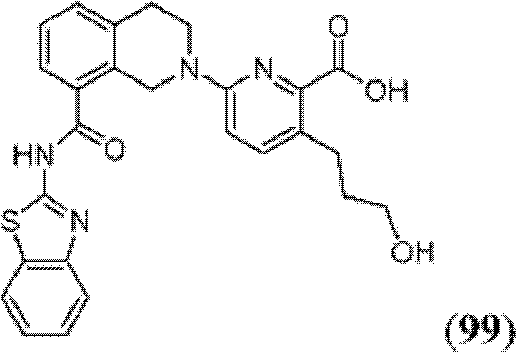
向化合物84A(60mg,0.163mmol)在DMF(5ml)中的溶液中,加入氢化钠(32.7mg,0.816mmol)(60%)。反应搅拌10min,加入化合物96D(107mg,0.163mmol)。得到的混合物搅拌3小时,通过反相HPLC纯化(流动相:含0%-50%乙腈的0.1%TFA水溶液,70min内),以提供题示化合物99:1H NMR(400MHz,DMSO-D6)δppm 12.81(1H,s),8.04(1H,dd),7.79(1H,d),7.60(1H,d),7.53(1H,d),7.45-7.50(1H,m),7.39-7.43(1H,m),7.32-7.38(2H,m),6.95(1H,d),4.92(2H,s),3.86(2H,t),3.37(2H,t),2.99(2H,t),2.63-2.70(2H,m),1.58-1.69(2H,m)。LCMS(APCI)489(M+H)。To a solution of compound 84A (60 mg, 0.163 mmol) in DMF (5 ml) was added sodium hydride (32.7 mg, 0.816 mmol) (60%). The reaction was stirred for 10 min and compound 96D (107 mg, 0.163 mmol) was added. The resulting mixture was stirred for 3 hours and purified by reverse phase HPLC (mobile phase: 0%-50% acetonitrile in 0.1% TFA in water within 70 min) to provide the title compound 99: 1 H NMR (400 MHz, DMSO-D 6 )δppm 12.81(1H,s), 8.04(1H,dd), 7.79(1H,d), 7.60(1H,d), 7.53(1H,d), 7.45-7.50(1H,m), 7.39-7.43( 1H, m), 7.32-7.38 (2H, m), 6.95 (1H, d), 4.92 (2H, s), 3.86 (2H, t), 3.37 (2H, t), 2.99 (2H, t), 2.63 -2.70 (2H, m), 1.58-1.69 (2H, m). LCMS (APCI) 489 (M+H).
实施例100Example 100
6-[8-(苯并噻唑-2-基氨基甲酰基)-3,4-二氢-1H-异喹啉-2-基]-3-{3-[4-(3-二甲基氨基-丙基)-2-氟-苯氧基]-丙基}-吡啶-2-羧酸(100)的合成:6-[8-(Benzothiazol-2-ylcarbamoyl)-3,4-dihydro-1H-isoquinolin-2-yl]-3-{3-[4-(3-dimethyl Synthesis of amino-propyl)-2-fluoro-phenoxy]-propyl}-pyridine-2-carboxylic acid (100):

步骤1:6-(8-(苯并[d]噻唑-2-基((2-(三甲基甲硅烷基)乙氧基)甲基)氨基甲酰基)-3,4-二氢异喹啉-2(1H)-基)-3-(3-(4-(3-(二甲基氨基)丙基)-2-氟苯氧基)丙基)吡啶甲酸叔丁酯(100A1);和3-(3-(4-(3-(二甲基氨基)丙基)-2-氟苯氧基)丙基)-6-(8-(3-((2-(三甲基甲硅烷基)乙氧基)甲基)苯并[d]噻唑-2(3H)-亚基氨基甲酰基)-3,4-二氢异喹啉-2(1H)-基)吡啶甲酸(Z)-叔丁酯(100A2)的制备 Step 1 : 6-(8-(Benzo[d]thiazol-2-yl((2-(trimethylsilyl)ethoxy)methyl)carbamoyl)-3,4-dihydroiso Quinolin-2(1H)-yl)-3-(3-(4-(3-(dimethylamino)propyl)-2-fluorophenoxy)propyl)picolinate (100A 1 ); and 3-(3-(4-(3-(dimethylamino)propyl)-2-fluorophenoxy)propyl)-6-(8-(3-((2-(trimethyl ylsilyl)ethoxy)methyl)benzo[d]thiazole-2(3H)-ylidenecarbamoyl)-3,4-dihydroisoquinolin-2(1H)-yl)picolinic acid Preparation of (Z)-tert-butyl ester (100A 2 )
化合物97B1和97B2(25mg,0.029mmol)在MeOH(5ml)中用氧化铂(IV)(5.34mg,0.024mmol)处理过夜。通过硅藻土滤去不溶的材料,浓缩滤液,以提供化合物100A1和100A2:LCMS(APCI)m/e 854(M+H)。Compounds 97B 1 and 97B 2 (25 mg, 0.029 mmol) were treated with platinum(IV) oxide (5.34 mg, 0.024 mmol) in MeOH (5 ml) overnight. Insoluble material was filtered off through celite and the filtrate was concentrated to provide compounds 100A 1 and 100A 2 : LCMS (APCI) m/e 854 (M+H).
步骤2:题示化合物100的制备: Step 2 : Preparation of title compound 100:
在DCM(0.5ml)和MeOH(0.5ml)中的化合物99(20mg,0.023mmol),用含2N HCl的乙醚(5ml)处理。得到的混合物在室温下搅拌3天,浓缩。残余物通过反相HPLC纯化(流动相:含0%-70%乙腈的0.1%TFA水溶液,60min内),以提供题示化合物100,为TFA盐:1H NMR(400MHz,DMSO-D6)δppm 12.82(1H,s),9.34(1H,s),8.03(1H,d),7.79(1H,d),7.60(1H,d),7.56(1H,d),7.45-7.51(1H,m),7.39-7.43(1H,m),7.33-7.38(2H,m),7.01-7.11(2H,m),6.92-6.97(2H,m),4.93(2H,s),3.94-4.01(2H,m),3.87(2H,t),2.95-3.04(4H,m),2.79-2.85(2H,m),2.76(3H,s),2.75(3H,s),2.52-2.58(2H,m),1.84-1.98(4H,m)。LCMS(APCI)m/e668(M+H)。Compound 99 (20mg, 0.023mmol) in DCM (0.5ml) and MeOH (0.5ml) was treated with 2N HCl in ether (5ml). The resulting mixture was stirred at room temperature for 3 days and concentrated. The residue was purified by reverse phase HPLC (mobile phase: 0%-70% acetonitrile in 0.1% TFA in water within 60 min) to provide the title compound 100 as a TFA salt: 1 H NMR (400 MHz, DMSO-D 6 ) δppm 12.82(1H, s), 9.34(1H, s), 8.03(1H, d), 7.79(1H, d), 7.60(1H, d), 7.56(1H, d), 7.45-7.51(1H, m ), 7.39-7.43 (1H, m), 7.33-7.38 (2H, m), 7.01-7.11 (2H, m), 6.92-6.97 (2H, m), 4.93 (2H, s), 3.94-4.01 (2H , m), 3.87(2H, t), 2.95-3.04(4H, m), 2.79-2.85(2H, m), 2.76(3H, s), 2.75(3H, s), 2.52-2.58(2H, m ), 1.84-1.98 (4H, m). LCMS (APCI) m/e668 (M+H).
实施例101Example 101
6-(8-(苯并[d]噻唑-2-基氨基甲酰基)-3,4-二氢异喹啉-2(1H)-基)-3-(3-(2-氟-4-(4-甲基哌嗪-1-基)苯氧基)丙基)吡啶甲酸(101)的合成:6-(8-(Benzo[d]thiazol-2-ylcarbamoyl)-3,4-dihydroisoquinolin-2(1H)-yl)-3-(3-(2-fluoro-4 Synthesis of -(4-methylpiperazin-1-yl)phenoxy)propyl)picolinic acid (101):

题示化合物101使用实施例54的步骤2中描述的相同程序制备,分别用化合物93和化合物96D代替化合物54A和化合物2C:1H NMR(400MHz,DMSO-D6)δppm 12.80(1H,s),9.61(1H,s),8.03(1H,d),7.79(1H,d),7.60(1H,d),7.55(1H,d),7.44-7.51(1H,m),7.39-7.43(1H,m),7.33-7.38(2H,m),7.02(1H,t),6.90-6.98(2H,m),6.70(1H,dd),4.93(2H,s),3.93(2H,t),3.86(2H,t),3.67-3.75(2H,m),3.26-3.37(2H,m),3.06-3.20(2H,m),2.99(2H,t),2.76-2.93(7H,m),1.86-1.99(2H,m);LCMS(APCI)m/e 681(M+H)。The title compound 101 was prepared using the same procedure described in step 2 of Example 54, substituting compound 93 and compound 96D for compound 54A and compound 2C, respectively: 1 H NMR (400 MHz, DMSO-D 6 ) δppm 12.80 (1H, s) , 9.61(1H,s), 8.03(1H,d), 7.79(1H,d), 7.60(1H,d), 7.55(1H,d), 7.44-7.51(1H,m), 7.39-7.43(1H , m), 7.33-7.38 (2H, m), 7.02 (1H, t), 6.90-6.98 (2H, m), 6.70 (1H, dd), 4.93 (2H, s), 3.93 (2H, t), 3.86(2H,t), 3.67-3.75(2H,m), 3.26-3.37(2H,m), 3.06-3.20(2H,m), 2.99(2H,t), 2.76-2.93(7H,m), 1.86-1.99 (2H, m); LCMS (APCI) m/e 681 (M+H).
实施例102Example 102
6-(8-(苯并[d]噻唑-2-基氨基甲酰基)-3,4-二氢异喹啉-2(1H)-基)-3-(3-(4-(2-(二甲基氨基)乙基)苯氧基)丙基)吡啶甲酸(102)的合成:6-(8-(Benzo[d]thiazol-2-ylcarbamoyl)-3,4-dihydroisoquinolin-2(1H)-yl)-3-(3-(4-(2- Synthesis of (dimethylamino)ethyl)phenoxy)propyl)picolinic acid (102):
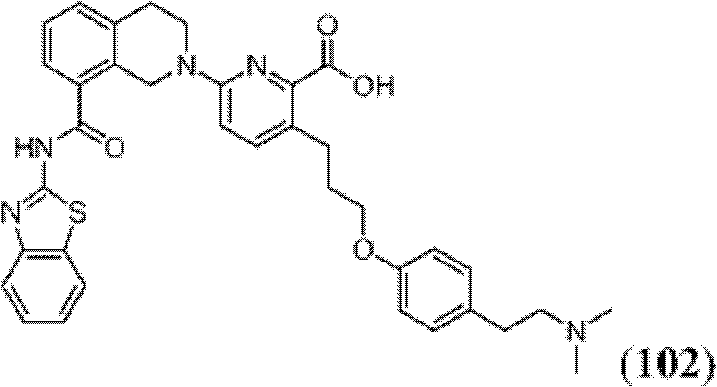
4-(2-(二甲基氨基)乙基)苯酚盐酸(60.5mg,0.300mmol)在DMF(2ml)中用Et3N(84μl,0.60mmol)处理,搅拌10分钟,然后用NaH(24.0mg,0.60mmol)处理。搅拌15分钟后,反应混合物用化合物98A1和98A2(157mg,0.2mmol)处理,并搅拌5小时。该时段后反应混合物用EtOAc稀释,用水和盐水洗涤,干燥(MgSO4),过滤,浓缩。浓缩液通过柱色谱用硅胶纯化,用含0到6%MeOH的CH2Cl2梯度洗脱。经色谱的材料用三乙基硅烷(220μl,1.377mmol)和TFA(1mL,12.98mmol)连续处理。滴加二氯甲烷(0.3mL)直到反应混合物变得均质。反应混合物在环境温度下在N2下搅拌6小时。该时段后,蒸发溶剂,化合物通过HPLC纯化(预制备反相HPLC用自动化Waters HPLC系统执行,使用SunFire C18预制备柱,250mmx50mm i.d.,10um,流速25mL/min;λ=214、245nm;流动相A,含0.1%TFA的H2O;流动相B,CH3CN;30分钟内,B的线性梯度0-70%),以提供产物,为淡黄色固体,产率10%:1H NMR(300MHz,DMSO-d6)δppm 12.84(1H,s),9.29(1H,s),8.04(1H,d),7.79(1H,d),7.61(1H,m),7.56(1H,d),7.48(1H,m),7.42(1H,m),7.36(2H,m),7.17(2H,m),6.96(1H,d),6.88(2H,m),4.92(2H,s),3.89(4H,m),3.24(4H,m),2.98(2H,m),2.87(2H,m),2.81(6H,d),1.93(2H,m)。MS(ESI(+))m/e 636(M+H)。4-(2-(Dimethylamino)ethyl)phenol hydrochloride (60.5 mg, 0.300 mmol) was treated with Et 3 N (84 μl, 0.60 mmol) in DMF (2 ml), stirred for 10 minutes, then washed with NaH (24.0 mg, 0.60mmol) treatment. After stirring for 15 minutes, the reaction mixture was treated with compounds 98A 1 and 98A 2 (157 mg, 0.2 mmol) and stirred for 5 hours. After this period the reaction mixture was diluted with EtOAc, washed with water and brine, dried ( MgSO4 ), filtered and concentrated. The concentrate was purified by column chromatography on silica gel eluting with a gradient of 0 to 6% MeOH in CH2Cl2 . The chromatographed material was treated successively with triethylsilane (220 μl, 1.377 mmol) and TFA (1 mL, 12.98 mmol). Dichloromethane (0.3 mL) was added dropwise until the reaction mixture became homogeneous. The reaction mixture was stirred at ambient temperature under N2 for 6 h. After this period, the solvent was evaporated and the compound was purified by HPLC (preparative reverse phase HPLC performed with an automated Waters HPLC system using a SunFire C18 preparative column, 250mmx50mm id, 10um, flow rate 25mL/min; λ = 214, 245nm; mobile phase A , H2O with 0.1% TFA; mobile phase B, CH3CN ; linear gradient 0-70% of B over 30 minutes) to afford the product as a pale yellow solid in 10% yield: 1 H NMR ( 300MHz, DMSO-d 6 ) δppm 12.84(1H, s), 9.29(1H, s), 8.04(1H, d), 7.79(1H, d), 7.61(1H, m), 7.56(1H, d), 7.48(1H,m), 7.42(1H,m), 7.36(2H,m), 7.17(2H,m), 6.96(1H,d), 6.88(2H,m), 4.92(2H,s), 3.89 (4H, m), 3.24 (4H, m), 2.98 (2H, m), 2.87 (2H, m), 2.81 (6H, d), 1.93 (2H, m). MS (ESI (+)) m/e 636 (M+H).
实施例103Example 103
2-(8-(苯并[d]噻唑-2-基氨基甲酰基)-3,4-二氢异喹啉-2(1H)-基)-5-(3-(4-(3-(二甲基氨基)丙基)-2-氟苯氧基)丙基)噻唑-4-羧酸(103)的合成:2-(8-(Benzo[d]thiazol-2-ylcarbamoyl)-3,4-dihydroisoquinolin-2(1H)-yl)-5-(3-(4-(3- Synthesis of (dimethylamino)propyl)-2-fluorophenoxy)propyl)thiazole-4-carboxylic acid (103):
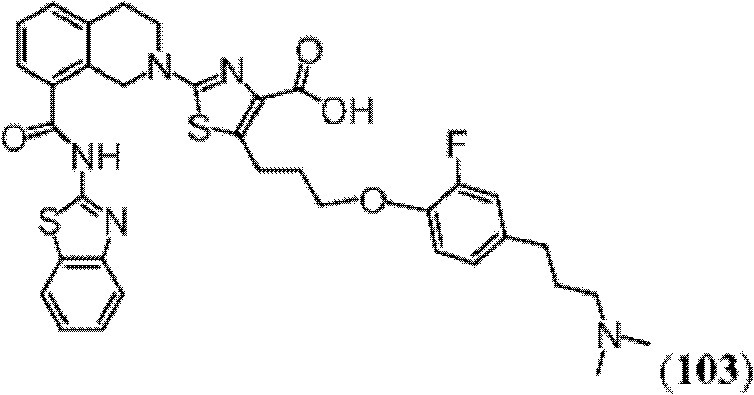
步骤1:3-(4-(苄氧基)-3-氟苯基)-N,N-二甲基丙-2-炔-1-胺(103A)的制备: Step 1 : Preparation of 3-(4-(benzyloxy)-3-fluorophenyl)-N,N-dimethylprop-2-yn-1-amine (103A):

题示化合物103A使用实施例97步骤2中描述的相同程序制备,用化合物93A代替化合物97A:LCMS(APCI)284(M+H)。The title compound 103A was prepared using the same procedure described in step 2 of Example 97, substituting compound 93A for compound 97A: LCMS (APCI) 284 (M+H).
步骤2:4-(3-(二甲基氨基)丙基)-2-氟苯酚(103B)的制备: Step 2 : Preparation of 4-(3-(dimethylamino)propyl)-2-fluorophenol (103B):
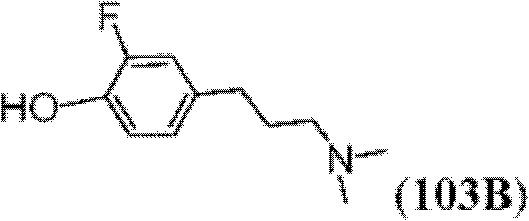
题示化合物103B使用实施例93的步骤3中描述的相同程序制备,用化合物103A代替化合物93B:LCMS(APCI)198(M+H)。The title compound 103B was prepared using the same procedure described in step 3 of Example 93, substituting compound 103A for compound 93B: LCMS (APCI) 198 (M+H).
步骤3:题示化合物103的制备: Step 3 : Preparation of title compound 103:
题示化合物103使用实施例54的步骤2中描述的相同程序制备,用化合物103B代替化合物54A。题示化合物103作为TFA盐获得:1H NMR(500MHz,DMSO-D6)δppm 12.90(2H,br,s),9.43(1H,s),8.04(1H,d),7.80(1H,d),7.67(1H,d),7.43-7.50(2H,m),7.34-7.42(2H,m),7.02-7.10(2H,m),6.94(1H,d),4.83(2H,s),4.02(2H,t),3.68-3.76(2H,m),3.14-3.20(2H,m),2.96-3.06(4H,m),2.76(3H,s),2.75(3H,s),2.51-2.58(2H,m),1.97-2.04(2H,m),1.84-1.91(2H,m)。LCMS(APCI)674(M+H)。The title compound 103 was prepared using the same procedure described in step 2 of Example 54, substituting compound 103B for compound 54A. The title compound 103 was obtained as a TFA salt: 1 H NMR (500 MHz, DMSO-D 6 ) δppm 12.90 (2H, br, s), 9.43 (1H, s), 8.04 (1H, d), 7.80 (1H, d) , 7.67(1H,d), 7.43-7.50(2H,m), 7.34-7.42(2H,m), 7.02-7.10(2H,m), 6.94(1H,d), 4.83(2H,s), 4.02 (2H,t), 3.68-3.76(2H,m), 3.14-3.20(2H,m), 2.96-3.06(4H,m), 2.76(3H,s), 2.75(3H,s), 2.51-2.58 (2H, m), 1.97-2.04 (2H, m), 1.84-1.91 (2H, m). LCMS (APCI) 674 (M+H).
实施例104Example 104
6-(8-(苯并[d]噻唑-2-基氨基甲酰基)-3,4-二氢异喹啉-2(1H)-基)-3-(3-(4-(1-甲基哌啶-4-基氨基)苯氧基)丙基)吡啶甲酸(104)的合成6-(8-(Benzo[d]thiazol-2-ylcarbamoyl)-3,4-dihydroisoquinolin-2(1H)-yl)-3-(3-(4-(1- Synthesis of Methylpiperidin-4-ylamino)phenoxy)propyl)picolinic acid (104)
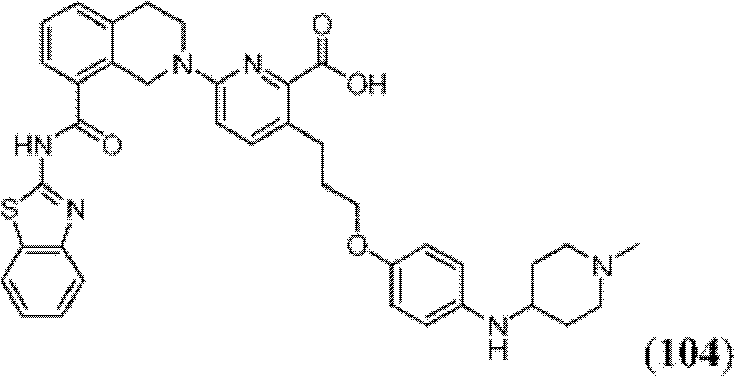
步骤1:4-(1-甲基哌啶-4-基氨基)苯酚(104A)的制备: Step 1 : Preparation of 4-(1-methylpiperidin-4-ylamino)phenol (104A):
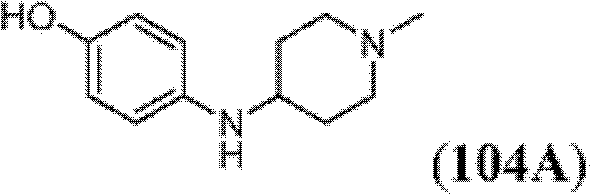
化合物104A用与化合物62A的合成类似的方式制备,分别用4-氨基苯酚和1-甲基哌啶-4-酮代替1-苯基哌嗪和化合物45C:ESI(+)/LC/MS:207(M+H)+。Compound 104A was prepared in a similar manner to the synthesis of compound 62A, substituting 4-aminophenol and 1-methylpiperidin-4-one for 1-phenylpiperazine and compound 45C, respectively: ESI(+)/LC/MS: 207(M+H) + .
步骤2:6-(8-(苯并[d]噻唑-2-基氨基甲酰基)-3,4-二氢异喹啉-2(1H)-基)-3-(3-(4-(1-甲基哌啶-4-基氨基)苯氧基)丙基)吡啶甲酸叔丁酯(104B)的制备: Step 2 : 6-(8-(Benzo[d]thiazol-2-ylcarbamoyl)-3,4-dihydroisoquinolin-2(1H)-yl)-3-(3-(4- Preparation of (1-methylpiperidin-4-ylamino)phenoxy)propyl)picolinate tert-butyl (104B):

用与实施例51的步骤2的合成类似的方式,将化合物104B制备为TFA盐,分别用化合物104A和化合物96D代替化合物51A和化合物2C:APCI(+)/LC/MS:733(M+H)+。In a similar manner to the synthesis of step 2 of Example 51, compound 104B was prepared as a TFA salt, and compound 51A and compound 2C were replaced by compound 104A and compound 96D, respectively: APCI (+)/LC/MS: 733 (M+H ) + .
步骤3:题示化合物104的制备: Step 3 : Preparation of title compound 104:
题示化合物104用与化合物94的合成类似的方式制备,用化合物104B代替化合物94G:1H NMR(DMSO-d6):δ12.84(s,1H),9.40(s,1H),8.04(d,J=7.63Hz,1H),7.79(d,J=8.24Hz,1H),7.60(d,J=7.32Hz,1H),7.55(d,J=8.85Hz,1H),7.34-7.49(m,4H),6.96(d,J=8.85Hz,1H),6.60-6.79(m,1H),4.92(s,2H),3.81-3.88(m,4H),2.97-3.00(m,4H),2.74-2.80(m,4H),2.10-2.13(m,2H),1.87-1.92(m,4H)ESI(+)/MS:677(M+H)+。The title compound 104 was prepared in a similar manner to the synthesis of compound 94, replacing compound 94G with compound 104B: 1 H NMR (DMSO-d 6 ): δ12.84 (s, 1H), 9.40 (s, 1H), 8.04 ( d, J=7.63Hz, 1H), 7.79(d, J=8.24Hz, 1H), 7.60(d, J=7.32Hz, 1H), 7.55(d, J=8.85Hz, 1H), 7.34-7.49( m, 4H), 6.96(d, J=8.85Hz, 1H), 6.60-6.79(m, 1H), 4.92(s, 2H), 3.81-3.88(m, 4H), 2.97-3.00(m, 4H) , 2.74-2.80 (m, 4H), 2.10-2.13 (m, 2H), 1.87-1.92 (m, 4H) ESI (+)/MS: 677 (M+H) + .
实施例105Example 105
6-(8-(苯并[d]噻唑-2-基氨基甲酰基)-3,4-二氢异喹啉-2(1H)-基)-3-(3-(3-(4-甲基哌嗪-1-基)苯氧基)丙基)吡啶甲酸(105)的合成:6-(8-(Benzo[d]thiazol-2-ylcarbamoyl)-3,4-dihydroisoquinolin-2(1H)-yl)-3-(3-(3-(4- Synthesis of methylpiperazin-1-yl)phenoxy)propyl)picolinic acid (105):

化合物87A(0.032g,0.017mmol)在DMF(3mL)中在0℃用60%氢化钠(0.018g,0.46mmol)处理。溶液搅拌10min。向该溶液中加入化合物96D(0.10g,0.15mmol)。溶液在室温下搅拌2小时。反应然后在60℃加热4小时。然后用甲醇(1mL)淬灭。加入浓HCl(0.5mL),溶液通过针筒过滤器过滤。滤液然后通过预制备HPLC纯化,得到题示化合物105,为TFA盐:1H NMR(DMSO-d6):δ12.85(s,1H),9.61(s,1H),8.04(d,J=7.63Hz,1H),7.79(d,J=7.93Hz,1H),7.60(d,J=7.32Hz,1H),7.55(d,J=8.85Hz,1H),7.34-7.49(m,4H),7.13(t,J=8.24Hz,1H),6.97(d,J=8.24Hz,1H),6.55(dd,J=8.39,1.98Hz,1H),6.50(s,1H),6.42(d,J=8.24,2.14Hz,1H),4.93(s,2H),3.82-3.92(m,6H),3.09-3.13(m,2H),2.99(t,J=5.64Hz,1H),2.90-2.94(m,2H),2.79-2.85(m,4H),1.89-1.95(m,2H)ESI(+)/MS:663(M+H)+。Compound 87A (0.032 g, 0.017 mmol) was treated with 60% sodium hydride (0.018 g, 0.46 mmol) in DMF (3 mL) at 0 °C. The solution was stirred for 10 min. To this solution was added compound 96D (0.10 g, 0.15 mmol). The solution was stirred at room temperature for 2 hours. The reaction was then heated at 60°C for 4 hours. It was then quenched with methanol (1 mL). Concentrated HCl (0.5 mL) was added and the solution was filtered through a syringe filter. The filtrate was then purified by preparative HPLC to afford the title compound 105 as a TFA salt: 1 H NMR (DMSO-d 6 ): δ 12.85(s, 1H), 9.61(s, 1H), 8.04(d, J= 7.63Hz, 1H), 7.79(d, J=7.93Hz, 1H), 7.60(d, J=7.32Hz, 1H), 7.55(d, J=8.85Hz, 1H), 7.34-7.49(m, 4H) , 7.13(t, J=8.24Hz, 1H), 6.97(d, J=8.24Hz, 1H), 6.55(dd, J=8.39, 1.98Hz, 1H), 6.50(s, 1H), 6.42(d, J=8.24, 2.14Hz, 1H), 4.93(s, 2H), 3.82-3.92(m, 6H), 3.09-3.13(m, 2H), 2.99(t, J=5.64Hz, 1H), 2.90-2.94 (m, 2H), 2.79-2.85 (m, 4H), 1.89-1.95 (m, 2H) ESI (+)/MS: 663 (M+H) + .
实施例106Example 106
6-(8-(苯并[d]噻唑-2-基氨基甲酰基)-3,4-二氢异喹啉-2(1H)-基)-3-(3-(4-(2-(吡咯烷-1-基)乙氧基)苯氧基)丙基)吡啶甲酸(106)的合成:6-(8-(Benzo[d]thiazol-2-ylcarbamoyl)-3,4-dihydroisoquinolin-2(1H)-yl)-3-(3-(4-(2- Synthesis of (pyrrolidin-1-yl)ethoxy)phenoxy)propyl)picolinic acid (106):

步骤1:1-(2-(4-(苄氧基)苯氧基)乙基)吡咯烷(106A)的制备: Step 1 : Preparation of 1-(2-(4-(benzyloxy)phenoxy)ethyl)pyrrolidine (106A):

化合物106A用与化合物35A的合成类似的方式制备,分别用2-(吡咯烷-1-基)乙醇和4-(苄氧基)苯酚代替化合物34D和化合物31F:DCI(+)MS:298(M+H)+。Compound 106A was prepared in a similar manner to the synthesis of compound 35A, replacing compound 34D and compound 31F with 2-(pyrrolidin-1-yl)ethanol and 4-(benzyloxy)phenol, respectively: DCI (+) MS: 298 ( M+H) + .
步骤2:4-(2-(吡咯烷-1-基)乙氧基)苯酚(106B)的制备: Step 2 : Preparation of 4-(2-(pyrrolidin-1-yl)ethoxy)phenol (106B):
化合物106B用与化合物31F的合成类似的方式制备,用化合物106A代替化合物31E:1H NMR(DMSO-d6):δ8.88(s,1H),6.72-6.75(m,2H),6.64-6.67(m,2H),3.94(d,J=6.1Hz,2H),2.72(d,J=5.95Hz,2H),2.48-2.51(m,4H),1.65-1.68(m,4H)ESI(+)/MS:208(M+H)+。Compound 106B was prepared in a similar manner to the synthesis of Compound 31F, substituting Compound 106A for Compound 31E: 1 H NMR (DMSO-d 6 ): δ8.88 (s, 1H), 6.72-6.75 (m, 2H), 6.64- 6.67(m, 2H), 3.94(d, J=6.1Hz, 2H), 2.72(d, J=5.95Hz, 2H), 2.48-2.51(m, 4H), 1.65-1.68(m, 4H)ESI( +)/MS: 208 (M+H) + .
步骤3:题示化合物106的制备: Step 3 : Preparation of Title Compound 106:
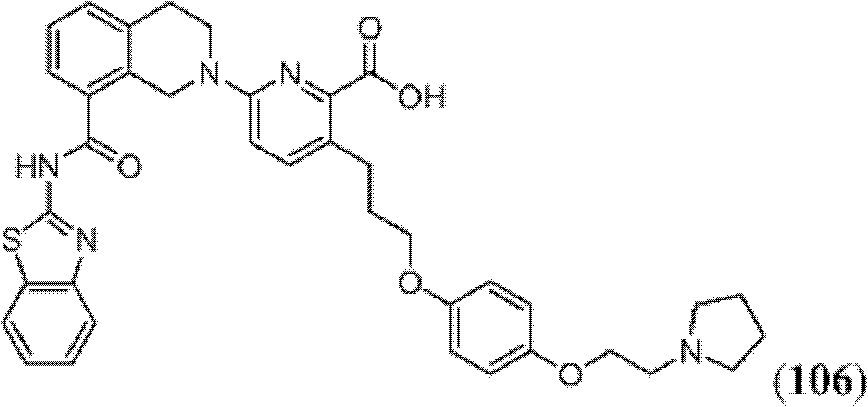
题示化合物106用与化合物105的合成类似的方式制备,用化合物106B代替化合物87C:1H NMR(DMSO-d6):δ12.84(s,1H),9.68(s,1H),8.04(d,J=7.93Hz,1H),7.79(d,J=8.24Hz,1H),7.60(d,J=7.32Hz,1H),7.56(d,J=8.54Hz,1H),7.34-7.50(m,4H),6.86-6.97(m,6H),4.92(s,2H),4.19-4.21(m,2H),3.86-3.89(m,6H),3.08-3.13(m,4H),2.98(t,J=5.8Hz,1H),2.79-2.82(m,2H),1.87-2.05(m,6H)ESI(+)/MS:678(M+H)+。The title compound 106 was prepared in a similar manner to the synthesis of compound 105, replacing compound 87C with compound 106B: 1 H NMR (DMSO-d 6 ): δ12.84 (s, 1H), 9.68 (s, 1H), 8.04 ( d, J=7.93Hz, 1H), 7.79(d, J=8.24Hz, 1H), 7.60(d, J=7.32Hz, 1H), 7.56(d, J=8.54Hz, 1H), 7.34-7.50( m, 4H), 6.86-6.97(m, 6H), 4.92(s, 2H), 4.19-4.21(m, 2H), 3.86-3.89(m, 6H), 3.08-3.13(m, 4H), 2.98( t, J = 5.8 Hz, 1H), 2.79-2.82 (m, 2H), 1.87-2.05 (m, 6H) ESI (+)/MS: 678 (M+H) + .
实施例107Example 107
2-(8-(苯并[d]噻唑-2-基氨基甲酰基)-3,4-二氢异喹啉-2(1H)-基)-5-(3-(4-(3-(二甲基氨基)丙基)苯氧基)丙基)噻唑-4-羧酸(107)的合成:2-(8-(Benzo[d]thiazol-2-ylcarbamoyl)-3,4-dihydroisoquinolin-2(1H)-yl)-5-(3-(4-(3- Synthesis of (dimethylamino)propyl)phenoxy)propyl)thiazole-4-carboxylic acid (107):
步骤1:4-(3-(二甲基氨基)丙基)苯酚(107A)的制备: Step 1 : Preparation of 4-(3-(dimethylamino)propyl)phenol (107A):
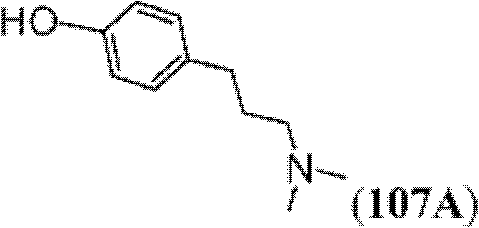
化合物107A使用实施例100的步骤1中描述的相同程序制备,用化合物74A代替化合物97B1和化合物97B2:LCMS(APCI)180(M+H)。Compound 107A was prepared using the same procedure described in Step 1 of Example 100, substituting Compound 74A for Compound 97B 1 and Compound 97B 2 : LCMS (APCI) 180 (M+H).
步骤2:题示化合物107的制备: Step 2 : Preparation of title compound 107:
题示化合物107使用实施例54的步骤2中描述的相同程序制备,用化合物107A代替化合物54A。题示化合物107作为TFA盐获得:1H NMR(500MHz,DMSO-D6)δppm 12.90(2H,br,s),9.41(1H,s),8.04(1H,d),7.80(1H,d),7.67(1H,d),7.44-7.50(2H,m),7.34-7.41(2H,m),7.10(2H,d),6.84(2H,d),4.83(2H,s),3.94(2H,t),3.72(2H,t),3.17(2H,t),2.96-3.06(4H,m),2.76(3H,s),2.75(3H,s),2.51-2.56(2H,m),1.96-2.02(2H,m),1.83-1.90(2H,m);LCMS(APCI)656(M+H)。The title compound 107 was prepared using the same procedure described in step 2 of Example 54, substituting compound 107A for compound 54A. The title compound 107 was obtained as a TFA salt: 1 H NMR (500 MHz, DMSO-D 6 ) δppm 12.90 (2H, br, s), 9.41 (1H, s), 8.04 (1H, d), 7.80 (1H, d) , 7.67(1H,d), 7.44-7.50(2H,m), 7.34-7.41(2H,m), 7.10(2H,d), 6.84(2H,d), 4.83(2H,s), 3.94(2H , t), 3.72(2H, t), 3.17(2H, t), 2.96-3.06(4H, m), 2.76(3H, s), 2.75(3H, s), 2.51-2.56(2H, m), 1.96-2.02 (2H, m), 1.83-1.90 (2H, m); LCMS (APCI) 656 (M+H).
实施例108Example 108
2-(8-(苯并[d]噻唑-2-基氨基甲酰基)-3,4-二氢异喹啉-2(1H)-基)-5-(3-(2,5-二氟-4-(4-甲基哌嗪-1-基)苯氧基)丙基)噻唑-4-羧酸(108)的合成:2-(8-(Benzo[d]thiazol-2-ylcarbamoyl)-3,4-dihydroisoquinolin-2(1H)-yl)-5-(3-(2,5-di Synthesis of fluoro-4-(4-methylpiperazin-1-yl)phenoxy)propyl)thiazole-4-carboxylic acid (108):

步骤1:1-(苄氧基)-4-溴-2,5-二氟苯(108A)的制备: Step 1 : Preparation of 1-(benzyloxy)-4-bromo-2,5-difluorobenzene (108A):
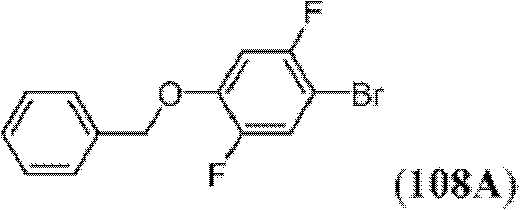
化合物108A使用实施例93的步骤1中描述的相同程序制备,用4-溴-2,5-二氟苯酚代替4-溴-2-氟苯酚。Compound 108A was prepared using the same procedure described in Step 1 of Example 93, substituting 4-bromo-2,5-difluorophenol for 4-bromo-2-fluorophenol.
步骤2:1-(4-(苄氧基)-2,5-二氟苯基)-4-甲基哌嗪(108B)的制备: Step 2 : Preparation of 1-(4-(benzyloxy)-2,5-difluorophenyl)-4-methylpiperazine (108B):
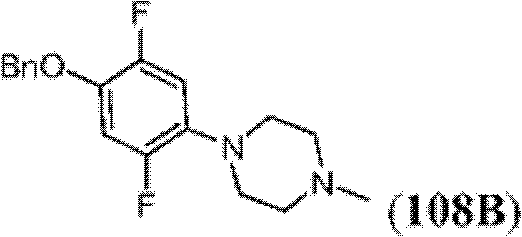
化合物108B使用实施例93的步骤2中描述的相同程序制备,用化合物108A代替化合物93A:LCMS(APCI)319(M+H)。Compound 108B was prepared using the same procedure described in step 2 of Example 93, substituting compound 108A for compound 93A: LCMS (APCI) 319 (M+H).
步骤3:2,5-二氟-4-(4-甲基哌嗪-1-基)苯酚(108C)的制备: Step 3 : Preparation of 2,5-difluoro-4-(4-methylpiperazin-1-yl)phenol (108C):
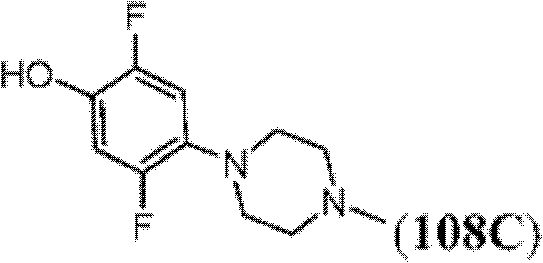
化合物108C使用实施例93的步骤3中描述的相同程序制备,用化合物108B代替化合物93B:LCMS(APCI)229(M+H)。Compound 108C was prepared using the same procedure described in step 3 of Example 93, substituting compound 108B for compound 93B: LCMS (APCI) 229 (M+H).
步骤4:题示化合物108的制备: Step 4 : Preparation of Title Compound 108:
题示化合物108使用实施例54的步骤2中描述的相同程序制备,用化合物108C代替化合物54A。题示化合物108作为TFA盐获得:1H NMR(500MHz,DMSO-D6)δppm 12.89(2H,s),9.64(1H,s),8.03(1H,d),7.79(1H,d),7.67(1H,d),7.43-7.50(2H,m),7.33-7.41(2H,m),7.05-7.16(2H,m),4.83(2H,s),4.02(2H,t),3.72(2H,t),3.45-3.56(2H,m),3.34-3.48(2H,m),3.11-3.24(4H,m),3.03(2H,t),2.87-2.98(2H,m),2.85(3H,d),1.94-2.03(2H,m)。LCMS(APCI)705(M+H)。Title compound 108 was prepared using the same procedure described in step 2 of Example 54, substituting compound 108C for compound 54A. The title compound 108 was obtained as a TFA salt: 1 H NMR (500 MHz, DMSO-D 6 ) δ ppm 12.89 (2H, s), 9.64 (1H, s), 8.03 (1H, d), 7.79 (1H, d), 7.67 (1H, d), 7.43-7.50 (2H, m), 7.33-7.41 (2H, m), 7.05-7.16 (2H, m), 4.83 (2H, s), 4.02 (2H, t), 3.72 (2H , t), 3.45-3.56(2H, m), 3.34-3.48(2H, m), 3.11-3.24(4H, m), 3.03(2H, t), 2.87-2.98(2H, m), 2.85(3H , d), 1.94-2.03 (2H, m). LCMS (APCI) 705 (M+H).
实施例109Example 109
6-(8-(苯并[d]噻唑-2-基氨基甲酰基)-3,4-二氢异喹啉-2(1H)-基)-3-(3-(2-氯吡啶-4-氧基)丙基)吡啶甲酸叔丁酯(109)的合成:6-(8-(Benzo[d]thiazol-2-ylcarbamoyl)-3,4-dihydroisoquinolin-2(1H)-yl)-3-(3-(2-chloropyridine- Synthesis of tert-butyl 4-oxy)propyl)picolinate (109):
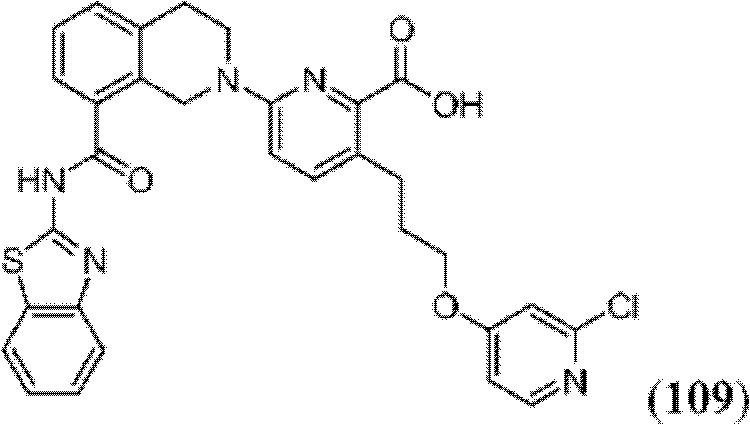
步骤1:6-(8-(苯并[d]噻唑-2-基氨基甲酰基)-3,4-二氢异喹啉-2(1H)-基)-3-(3-(2-氯吡啶-4-氧基)丙基)吡啶甲酸叔丁酯(109A)的制备: Step 1 : 6-(8-(Benzo[d]thiazol-2-ylcarbamoyl)-3,4-dihydroisoquinolin-2(1H)-yl)-3-(3-(2- Preparation of tert-butyl chloropyridine-4-oxyl)propyl)picolinate (109A):
用与化合物51的合成类似的方式,将化合物109A制备为TFA盐,分别用化合物96D和2-氯吡啶-4-醇代替化合物51A和化合物2C:APCI(+)/LC/MS:657(M+H)+。In a similar manner to the synthesis of compound 51, compound 109A was prepared as a TFA salt, compound 96D and 2-chloropyridin-4-ol were used to replace compound 51A and compound 2C: APCI (+)/LC/MS: 657 (M +H) + .
步骤2:题示化合物109B的制备: Step 2 : Preparation of title compound 109B:
题示化合物109用与化合物94的合成类似的方式制备,用化合物109A代替化合物94G:1H NMR(DMSO-d6):δ12.85(s,1H),8.17(d,J=5.8Hz,1H),8.04(d,J=7.93Hz,1H),7.79(d,J=8.24Hz,1H),7.60(d,J=7.32Hz,1H),7.56(d,J=8.85Hz,1H),7.34-7.49(m,4H),7.09(d,J=2.44Hz,1H),6.94-6.97(m,2H),4.93(s,2H),4.06(t,J=6.26Hz,2H),3.87(t,J=5.95Hz,2H),2.98(t,J=5.8Hz,2H),2.78-2.82(m,2H),1.92-1.98(m,2H);ESI(+)/MS:600(M+H)+。The title compound 109 was prepared in a similar manner to the synthesis of compound 94, replacing compound 94G with compound 109A: 1 H NMR (DMSO-d 6 ): δ12.85(s, 1H), 8.17(d, J=5.8Hz, 1H), 8.04(d, J=7.93Hz, 1H), 7.79(d, J=8.24Hz, 1H), 7.60(d, J=7.32Hz, 1H), 7.56(d, J=8.85Hz, 1H) , 7.34-7.49(m, 4H), 7.09(d, J=2.44Hz, 1H), 6.94-6.97(m, 2H), 4.93(s, 2H), 4.06(t, J=6.26Hz, 2H), 3.87(t, J=5.95Hz, 2H), 2.98(t, J=5.8Hz, 2H), 2.78-2.82(m, 2H), 1.92-1.98(m, 2H); ESI(+)/MS: 600 (M+H) + .
实施例110Example 110
步骤1:2-(8-(苯并[d]噻唑-2-基氨基甲酰基)-3,4-二氢异喹啉-2(1H)-基)-5-((6-(3-吗啉基丙氧基)萘-2-基)乙炔基)噻唑-4-羧酸(110):Step 1: 2-(8-(Benzo[d]thiazol-2-ylcarbamoyl)-3,4-dihydroisoquinolin-2(1H)-yl)-5-((6-(3 -morpholinopropoxy)naphthalen-2-yl)ethynyl)thiazole-4-carboxylic acid (110):
步骤1:6-((三甲基甲硅烷基)乙炔基)萘-2-醇(110A)的制备: Step 1 : Preparation of 6-((trimethylsilyl)ethynyl)naphthalen-2-ol (110A):
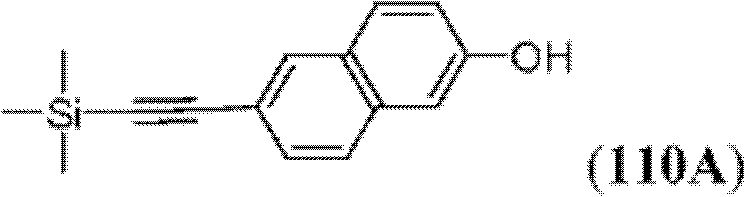
向6-溴萘-2-醇(3.8g,17.04mmol)、乙炔基三甲基硅烷(7.08ml,51.1mmol)、(PPh3)2PdCl2(1.79g,2.56mmol)、TEA(12ml,85mmol)在THF(12ml)中的混合物,加入碘化亚铜(I)(0.324g,1.70mmol)。得到的混合物在油浴中在70℃加热过夜并冷却。向混合物中加入硅胶(40g),得到的混合物真空干燥。将胶粉装载到硅胶柱上,用DCM洗脱,以提供化合物110A。To 6-bromonaphthalene-2-ol (3.8g, 17.04mmol), ethynyltrimethylsilane (7.08ml, 51.1mmol), (PPh 3 ) 2 PdCl 2 (1.79g, 2.56mmol), TEA (12ml, 85mmol) in THF (12ml), copper(I) iodide (0.324g, 1.70mmol) was added. The resulting mixture was heated overnight at 70°C in an oil bath and cooled. To the mixture was added silica gel (40 g), and the resulting mixture was dried in vacuo. The rubber powder was loaded onto a silica gel column and eluted with DCM to provide compound 110A.
步骤2:6-乙炔基萘-2-醇(110B)的制备: Step 2 : Preparation of 6-ethynylnaphthalen-2-ol (110B):

化合物110A(770mg,3.20mmol)在MeOH(5ml)和THF(10ml)中用K2CO3(885mg,6.41mmol)在室温下处理3h。反应用乙酸乙酯稀释,用水洗涤。浓缩有机层,残余物通过快速色谱纯化,用DCM洗脱,以提供化合物110B。Compound 110A (770 mg, 3.20 mmol) was treated with K2CO3 (885 mg, 6.41 mmol) in MeOH (5 ml) and THF (10 ml) at room temperature for 3 h. The reaction was diluted with ethyl acetate and washed with water. The organic layer was concentrated and the residue was purified by flash chromatography eluting with DCM to provide compound 110B.
步骤3:4-(3-(6-乙炔基萘-2-氧基)丙基)吗啉(110C)的制备: Step 3 : Preparation of 4-(3-(6-ethynylnaphthalene-2-oxyl)propyl)morpholine (110C):

向化合物110B(57mg,0.34mmol)、3-吗啉基丙-1-醇(98mg,0.68mmol)和三苯基膦(133mg,0.508mmol)在THF(1.5ml)中的混合物,加入(E)-偶氮二甲酸二叔丁酯(117mg,0.508mmol)。反应混合物搅拌1h,滤去不溶的材料。浓缩滤液,残余物通过反相HPLC纯化(梯度:含0-55%乙腈的0.1%TFA水溶液/40min),以提供化合物110C:LCMS(APCI)296(M+H)。To a mixture of compound 110B (57 mg, 0.34 mmol), 3-morpholinopropan-1-ol (98 mg, 0.68 mmol) and triphenylphosphine (133 mg, 0.508 mmol) in THF (1.5 ml) was added (E )-di-tert-butyl azodicarboxylate (117 mg, 0.508 mmol). The reaction mixture was stirred for 1 h and insoluble material was filtered off. The filtrate was concentrated and the residue was purified by reverse phase HPLC (Gradient: 0-55% acetonitrile in 0.1% TFA in water/40 min) to provide compound 110C: LCMS (APCI) 296 (M+H).
步骤4:2-(8-(苯并[d]噻唑-2-基((2-(三甲基甲硅烷基)乙氧基)甲基)氨基甲酰基)-3,4-二氢异喹啉-2(1H)-基)-5-((6-(3-吗啉基丙氧基)萘-2-基)乙炔基)噻唑-4-羧酸甲酯(110D)的制备: Step 4 : 2-(8-(Benzo[d]thiazol-2-yl((2-(trimethylsilyl)ethoxy)methyl)carbamoyl)-3,4-dihydroiso Preparation of quinolin-2(1H)-yl)-5-((6-(3-morpholinopropoxy)naphthalene-2-yl)ethynyl)thiazole-4-carboxylic acid methyl ester (110D):
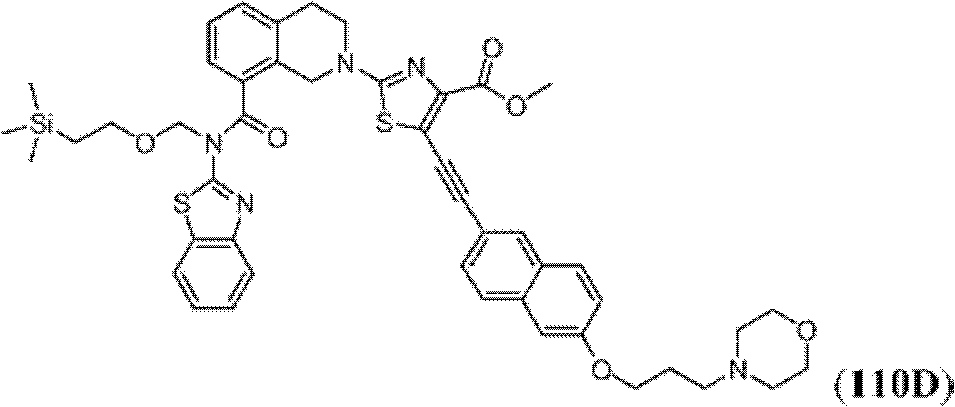
向化合物47D(200mg,0.283mmol)、化合物110C、(PPh3)2PdCl2(49.7mg,0.071mmol)、TEA(0.394ml,2.83mmol)在DMF(5ml)中的混合物,加入碘化亚铜(I)(5.40mg,0.028mmol)。得到的混合物在油浴中在120℃加热5h。浓缩反应混合物,通过RPHPLC纯化,用含10-95%乙腈的0.1%TFA水溶液在70min内洗脱,以提供化合物110D:LCMS(APCI)875(M+H)。To a mixture of compound 47D (200 mg, 0.283 mmol), compound 110C, (PPh 3 ) 2 PdCl 2 (49.7 mg, 0.071 mmol), TEA (0.394 ml, 2.83 mmol) in DMF (5 ml) was added cuprous iodide (I) (5.40 mg, 0.028 mmol). The resulting mixture was heated at 120 °C in an oil bath for 5 h. The reaction mixture was concentrated and purified by RPHPLC eluting with 10-95% acetonitrile in 0.1% TFA in water within 70 min to provide compound 110D: LCMS (APCI) 875 (M+H).
步骤5:题示化合物110的制备: Step 5 : Preparation of title compound 110:
题示化合物110使用实施例97的步骤3中描述的相同程序制备,用化合物110D代替化合物97B1和化合物97B2。题示化合物110作为TFA盐获得:1H NMR(500MHz,DMSO-d6)δppm 12.88-13.12(s,br,1H),12.94(s,1H),9.64-9.69(bs,1H),8.04-8.06(m,2H),7.88(d,J=9.0Hz,1H),7.83(d,J=8.8Hz,1H),7.78-7.83(m,1H),7.69-7.72(m,1H),7.46-7.52(m,3H),7.43(t,J=7.6Hz,1H),7.35-7.38(m,2H),7.22(dd,J=8.9,2.4Hz,1H),4.94-4.95(bs,2H),4.21(t,J=5.9Hz,2H),3.98-4.06(m,2H),3.78-3.81(m,2H),3.62-3.68(m,2H),3.48-3.54(m,2H),3.01-3.15(m,6H),2.17-2.24(m,2H);LCMS(APCI);730(M+H)。Title compound 110 was prepared using the same procedure described in step 3 of Example 97, substituting compound 110D for compound 97B 1 and compound 97B 2 . The title compound 110 was obtained as a TFA salt: 1 H NMR (500 MHz, DMSO-d 6 ) δppm 12.88-13.12 (s, br, 1H), 12.94 (s, 1H), 9.64-9.69 (bs, 1H), 8.04- 8.06(m, 2H), 7.88(d, J=9.0Hz, 1H), 7.83(d, J=8.8Hz, 1H), 7.78-7.83(m, 1H), 7.69-7.72(m, 1H), 7.46 -7.52(m, 3H), 7.43(t, J=7.6Hz, 1H), 7.35-7.38(m, 2H), 7.22(dd, J=8.9, 2.4Hz, 1H), 4.94-4.95(bs, 2H ), 4.21(t, J=5.9Hz, 2H), 3.98-4.06(m, 2H), 3.78-3.81(m, 2H), 3.62-3.68(m, 2H), 3.48-3.54(m, 2H), 3.01-3.15 (m, 6H), 2.17-2.24 (m, 2H); LCMS (APCI); 730 (M+H).
实施例111Example 111
2-(8-(苯并[d]噻唑-2-基氨基甲酰基)-3,4-二氢异喹啉-2(1H)-基)-5-(2-(6-(3-吗啉基丙氧基)萘-2-基)乙基)噻唑-4-羧酸(111)的合成:2-(8-(Benzo[d]thiazol-2-ylcarbamoyl)-3,4-dihydroisoquinolin-2(1H)-yl)-5-(2-(6-(3- Synthesis of morpholinopropoxy)naphthalen-2-yl)ethyl)thiazole-4-carboxylic acid (111):
步骤1:2-(8-(苯并[d]噻唑-2-基((2-(三甲基甲硅烷基)乙氧基)甲基)氨基甲酰基)-3,4-二氢异喹啉-2(1H)-基)-5-(2-(6-(3-吗啉基丙氧基)萘-2-基)乙基)噻唑-4-羧酸(111A)的制备: Step 1 : 2-(8-(Benzo[d]thiazol-2-yl((2-(trimethylsilyl)ethoxy)methyl)carbamoyl)-3,4-dihydroiso Preparation of quinolin-2(1H)-yl)-5-(2-(6-(3-morpholinopropoxy)naphthalen-2-yl)ethyl)thiazole-4-carboxylic acid (111A):
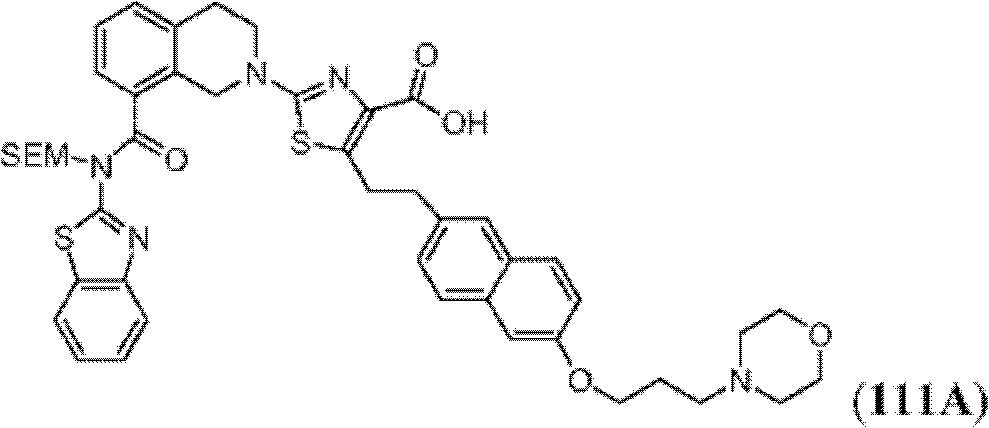
题示化合物111A使用实施例100的步骤1中描述的相同程序制备,用化合物110D代替化合物97B1和化合物97B2:LCMS(APCI)879(M+H)。Title compound 111A was prepared using the same procedure described in step 1 of Example 100, substituting compound 110D for compound 97B 1 and compound 97B 2 : LCMS (APCI) 879 (M+H).
步骤2:题示化合物111的制备: Step 2 : Preparation of title compound 111:
题示化合物111使用实施例97的步骤3中描述的相同程序制备,用化合物111A代替化合物97B1和化合物97B2。题示化合物111作为TFA盐获得:1H NMR(500MHz,DMSO-d6)δppm 12.87-12.94(s,br,1H),12.27-12.80(s,br,1H),9.65-9.71(s,br,1H),8.05(d,J=7.7Hz,1H),7.80(d,J=7.8Hz,1H),7.74(d,J=9.2Hz,1H),7.72(d,J=8.5Hz,1H),7.67(d,J=6.7Hz,1H),7.63-7.64(m,1H),7.46-7.50(m,1H),7.43-7.46(m,1H),7.34-7.42(m,3H),7.28(d,J=2.6Hz,1H),7.12(dd,J=8.9,2.5Hz,1H),4.81(s,2H),4.16(t,J=5.8Hz,2H),4.01(d,J=12.2Hz,2H),3.71(t,J=6.0Hz,2H),3.65(t,J=12.1Hz,2H),3.50(d,J=11.9Hz,2H),3.07-3.16(m,2H),2.96-3.04(m,3H),2.15-2.22(m,2H)。LCMS(APCI)734(M+H)。The title compound 111 was prepared using the same procedure described in step 3 of Example 97, substituting compound 111A for compound 97B 1 and compound 97B 2 . The title compound 111 was obtained as a TFA salt: 1 H NMR (500 MHz, DMSO-d 6 ) δppm 12.87-12.94 (s, br, 1H), 12.27-12.80 (s, br, 1H), 9.65-9.71 (s, br , 1H), 8.05(d, J=7.7Hz, 1H), 7.80(d, J=7.8Hz, 1H), 7.74(d, J=9.2Hz, 1H), 7.72(d, J=8.5Hz, 1H ), 7.67(d, J=6.7Hz, 1H), 7.63-7.64(m, 1H), 7.46-7.50(m, 1H), 7.43-7.46(m, 1H), 7.34-7.42(m, 3H), 7.28(d, J=2.6Hz, 1H), 7.12(dd, J=8.9, 2.5Hz, 1H), 4.81(s, 2H), 4.16(t, J=5.8Hz, 2H), 4.01(d, J =12.2Hz, 2H), 3.71(t, J=6.0Hz, 2H), 3.65(t, J=12.1Hz, 2H), 3.50(d, J=11.9Hz, 2H), 3.07-3.16(m, 2H ), 2.96-3.04 (m, 3H), 2.15-2.22 (m, 2H). LCMS (APCI) 734 (M+H).
实施例112Example 112
6-(8-(苯并[d]噻唑-2-基氨基甲酰基)-3,4-二氢异喹啉-2(1H)-基)-3-(3-(4-(5-(2-(二甲基氨基)乙氧基)嘧啶-2-基)苯氧基)丙基)吡啶甲酸(112)的合成:6-(8-(Benzo[d]thiazol-2-ylcarbamoyl)-3,4-dihydroisoquinolin-2(1H)-yl)-3-(3-(4-(5- Synthesis of (2-(dimethylamino)ethoxy)pyrimidin-2-yl)phenoxy)propyl)picolinic acid (112):
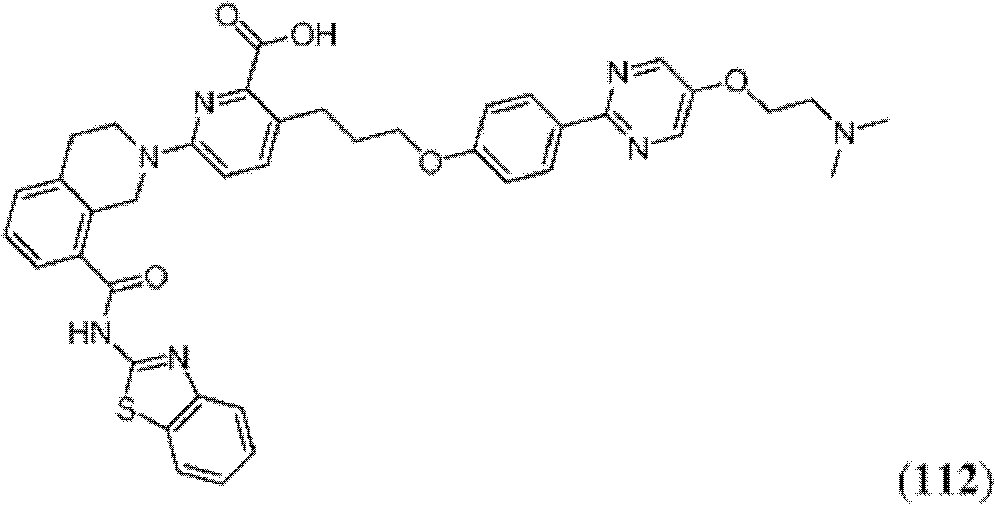
步骤1:2-氯嘧啶-5-醇(112A)的制备: Step 1 : Preparation of 2-chloropyrimidin-5-ol (112A):

在室温下,含2-氯-5-甲氧基嘧啶(0.46g,3.18mmol)的二氯甲烷(10mL)用1.0N三溴化硼(16mL,16mmol)处理。溶液搅拌过夜。该时段后,反应在饱和NaHCO3和DCM之间分离。用额外的DCM萃取水层。合并的有机层干燥(MgSO4),过滤,浓缩。残余物通过快速柱色谱用硅胶纯化,得到0.26g化合物112A(62%):1H NMR(DMSO-d6):δ10.03(s,1H),8.30(s,2H),ESI(-)/MS:129(M-H)-。2-Chloro-5-methoxypyrimidine (0.46 g, 3.18 mmol) in dichloromethane (10 mL) was treated with 1.0 N boron tribromide (16 mL, 16 mmol) at room temperature. The solution was stirred overnight. After this period, the reaction was split between saturated NaHCO 3 and DCM. The aqueous layer was extracted with additional DCM. The combined organic layers were dried (MgSO4), filtered and concentrated. The residue was purified by flash column chromatography on silica gel to give 0.26 g of compound 112A (62%): 1 H NMR (DMSO-d 6 ): δ 10.03 (s, 1H), 8.30 (s, 2H), ESI (-) /MS:129(MH) - .
步骤2:2-(2-氯嘧啶-5-氧基)-N,N-二甲基乙胺(112B)的制备: Step 2 : Preparation of 2-(2-chloropyrimidine-5-oxyl)-N,N-dimethylethylamine (112B):
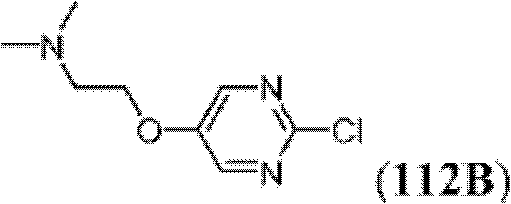
化合物112B用与实施例35的步骤1的合成类似的方式制备,分别用2-(二甲基氨基)乙醇和化合物112A代替化合物34D和化合物31F:ESI(+)MS:201(M+H)+。Compound 112B was prepared in a similar manner to the synthesis of Step 1 of Example 35, replacing Compound 34D and Compound 31F with 2-(dimethylamino)ethanol and Compound 112A, respectively: ESI (+) MS: 201 (M+H) + .
步骤3:4-(5-(2-(二甲基氨基)乙氧基)嘧啶-2-基)苯酚(112C)的制备: Step 3 : Preparation of 4-(5-(2-(dimethylamino)ethoxy)pyrimidin-2-yl)phenol (112C):

化合物112C用与化合物34D的合成类似的方式制备,分别用化合物112B和4-(4,4,5,5-四甲基-1,3,2-二氧硼戊环-2-基)苯酚代替化合物34C和4-(羟甲基)苯基硼酸:1H NMR(DMSO-d6):δ9.80(s,1H),8.56(s,2H),8.12-8.15(m,1H),6.83-6.86(m,2H),4.23(t,J=5.8Hz,2H),2.65(t,J=5.65Hz,2H),2.22(s,6H);ESI(+)/MS:259(M+H)+。Compound 112C was prepared in a manner similar to the synthesis of compound 34D, using compound 112B and 4-(4,4,5,5-tetramethyl-1,3,2-dioxaborolan-2-yl)phenol, respectively Substitute compound 34C and 4-(hydroxymethyl)phenylboronic acid: 1 H NMR (DMSO-d 6 ): δ9.80 (s, 1H), 8.56 (s, 2H), 8.12-8.15 (m, 1H), 6.83-6.86(m, 2H), 4.23(t, J=5.8Hz, 2H), 2.65(t, J=5.65Hz, 2H), 2.22(s, 6H); ESI(+)/MS: 259(M +H) + .
步骤4:6-(8-(苯并[d]噻唑-2-基氨基甲酰基)-3,4-二氢异喹啉-2(1H)-基)-3-(3-(4-(5-(2-(二甲基氨基)乙氧基)嘧啶-2-基)苯氧基)丙基)吡啶甲酸(112D)的制备: Step 4 : 6-(8-(Benzo[d]thiazol-2-ylcarbamoyl)-3,4-dihydroisoquinolin-2(1H)-yl)-3-(3-(4- Preparation of (5-(2-(dimethylamino)ethoxy)pyrimidin-2-yl)phenoxy)propyl)picolinic acid (112D):
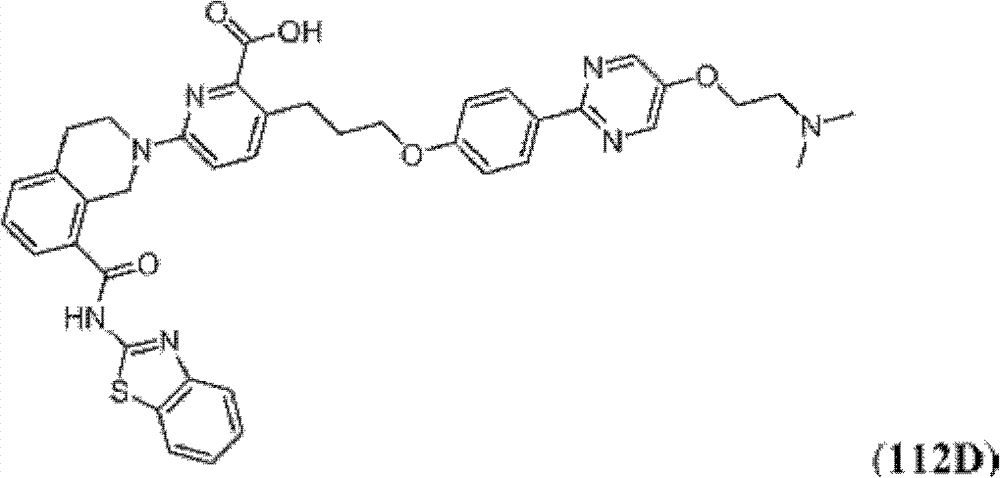
题示化合物112D用与化合物105的合成类似的方式制备,用化合物112C代替化合物87A:1H NMR(DMSO-d6):δ12.84(s,1H),9.70(s,1H),8.64(s,2H),8.23(d,J=8.85Hz,2H),8.04(d,J=7.93Hz,1H),7.79(d,J=8.24Hz,1H),7.57-7.61(m,2H),7.34-7.49(m,4H),7.02(t,J=8.85Hz,2H),6.97(d,J=8.85Hz,1H),4.93(s,2H),4.52-4.54(m,2H),4.01(t,J=6.41Hz,2H),3.87(t,J=5.95Hz,2H),2.95(t,J=5.8Hz,2H),2.82-2.85(m,2H),1.95-2.00(m,2H);ESI(+)/MS:730(M+H)+。The title compound 112D was prepared in a similar manner to the synthesis of compound 105, replacing compound 87A with compound 112C: 1 H NMR (DMSO-d 6 ): δ12.84 (s, 1H), 9.70 (s, 1H), 8.64 ( s, 2H), 8.23(d, J=8.85Hz, 2H), 8.04(d, J=7.93Hz, 1H), 7.79(d, J=8.24Hz, 1H), 7.57-7.61(m, 2H), 7.34-7.49(m, 4H), 7.02(t, J=8.85Hz, 2H), 6.97(d, J=8.85Hz, 1H), 4.93(s, 2H), 4.52-4.54(m, 2H), 4.01 (t, J=6.41Hz, 2H), 3.87(t, J=5.95Hz, 2H), 2.95(t, J=5.8Hz, 2H), 2.82-2.85(m, 2H), 1.95-2.00(m, 2H); ESI (+)/MS: 730 (M+H) + .
实施例113Example 113
6-(8-(苯并[d]噻唑-2-基氨基甲酰基)-3,4-二氢异喹啉-2(1H)-基)-3-(3-(3-(2-(二甲基氨基)乙氧基)苯氧基)丙基)吡啶甲酸(113)的合成:6-(8-(Benzo[d]thiazol-2-ylcarbamoyl)-3,4-dihydroisoquinolin-2(1H)-yl)-3-(3-(3-(2- Synthesis of (dimethylamino)ethoxy)phenoxy)propyl)picolinic acid (113):
步骤1:2-(3-(苄氧基)苯氧基)-N,N-二甲基乙胺(113A)的制备: Step 1 : Preparation of 2-(3-(benzyloxy)phenoxy)-N,N-dimethylethylamine (113A):
化合物113A用与实施例35的步骤1的合成类似的方式制备,分别用2-(二甲基氨基)乙醇和3-(苄氧基)苯酚代替化合物34D和化合物31F:DCI(+)MS:272(M+H)+。Compound 113A was prepared in a similar manner to the synthesis of Step 1 of Example 35, replacing Compound 34D and Compound 31F with 2-(dimethylamino)ethanol and 3-(benzyloxy)phenol, respectively: DCI(+)MS: 272(M+H) + .
步骤2:3-(2-(二甲基氨基)乙氧基)苯酚(113B)的制备: Step 2 : Preparation of 3-(2-(dimethylamino)ethoxy)phenol (113B):
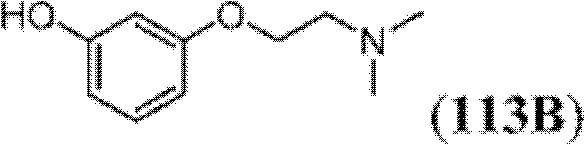
化合物113B用与化合物31F的合成类似的方式制备,用化合物113A代替化合物31E:1H NMR(DMSO-d6):δ9.34(s,1H),7.03(t,J=8.03Hz,1H),6.30-6.36(m,3H),3.96(d,J=5.95Hz,2H),2.58(d,J=5.8Hz,2H),2.20(s,2H)ESI(+)/MS:182(M+H)+。Compound 113B was prepared in a similar manner to the synthesis of Compound 31F, replacing Compound 31E with Compound 113A: 1 H NMR (DMSO-d 6 ): δ9.34 (s, 1H), 7.03 (t, J=8.03Hz, 1H) , 6.30-6.36(m, 3H), 3.96(d, J=5.95Hz, 2H), 2.58(d, J=5.8Hz, 2H), 2.20(s, 2H) ESI(+)/MS: 182(M +H) + .
步骤3:题示化合物113的制备: Step 3 : Preparation of title compound 113:
题示化合物113用与化合物105的合成类似的方式制备,用化合物113C代替化合物87A:1H NMR(DMSO-d6):δ12.85(s,1H),9.59(s,1H),8.64(s,2H),8.04(d,J=7.63Hz,1H),7.80(d,J=8.24Hz,1H),7.61(d,J=7.32Hz,1H),7.56(d,J=8.54Hz,1H),7.34-7.49(m,4H),7.19(t,J=8.09Hz,1H),6.96(d,J=8.85Hz,1H),4.93(s,2H),4.27-4.29(m,2H),3.92(t,J=6.56Hz,2H),3.87(t,J=5.95Hz,2H),2.99(t,J=5.8Hz,2H),2.79-2.82(m,2H),1.91-1.97(m,2H);ESI(+)/MS:652(M+H)+。The title compound 113 was prepared in a similar manner to the synthesis of compound 105, replacing compound 87A with compound 113C: 1 H NMR (DMSO-d 6 ): δ12.85 (s, 1H), 9.59 (s, 1H), 8.64 ( s, 2H), 8.04(d, J=7.63Hz, 1H), 7.80(d, J=8.24Hz, 1H), 7.61(d, J=7.32Hz, 1H), 7.56(d, J=8.54Hz, 1H), 7.34-7.49(m, 4H), 7.19(t, J=8.09Hz, 1H), 6.96(d, J=8.85Hz, 1H), 4.93(s, 2H), 4.27-4.29(m, 2H ), 3.92(t, J=6.56Hz, 2H), 3.87(t, J=5.95Hz, 2H), 2.99(t, J=5.8Hz, 2H), 2.79-2.82(m, 2H), 1.91-1.97 (m, 2H); ESI (+)/MS: 652 (M+H) + .
实施例114Example 114
2-(8-(苯并[d]噻唑-2-基氨基甲酰基)-3,4-二氢异喹啉-2(1H)-基)-5-(3-(4-(2-(吡咯烷-1-基)乙氧基)苯氧基)丙基)噻唑-4-羧酸(114)的合成:2-(8-(Benzo[d]thiazol-2-ylcarbamoyl)-3,4-dihydroisoquinolin-2(1H)-yl)-5-(3-(4-(2- Synthesis of (pyrrolidin-1-yl)ethoxy)phenoxy)propyl)thiazole-4-carboxylic acid (114):

用与化合物51的合成类似的方式,将题示化合物114制备为TFA盐,用化合物106B代替化合物51A:1H NMR(DMSO-d6):δ12.90(s,1H),9.75(s,1H),8.04(d,J=7.93Hz,1H),7.80(d,J=7.93Hz,1H),7.68(d,J=7.32Hz,2H),7.35-7.50(m,4H),6.86-6.93(m,4H),4.83(s,2H),4.19-4.21(m,2H),3.92(d,J=6.26Hz,2H),3.72(d,J=5.95Hz,1H),3.55(br,4H),3.10-3.18(m,4H),3.03(t,J=5.8Hz,2H),1.85-2.02(m,6H)。ESI(+)/MS:684(M+H)+。In a similar manner to the synthesis of compound 51, the title compound 114 was prepared as a TFA salt, replacing compound 51A with compound 106B: 1 H NMR (DMSO-d 6 ): δ12.90 (s, 1H), 9.75 (s, 1H), 8.04(d, J=7.93Hz, 1H), 7.80(d, J=7.93Hz, 1H), 7.68(d, J=7.32Hz, 2H), 7.35-7.50(m, 4H), 6.86- 6.93(m, 4H), 4.83(s, 2H), 4.19-4.21(m, 2H), 3.92(d, J=6.26Hz, 2H), 3.72(d, J=5.95Hz, 1H), 3.55(br , 4H), 3.10-3.18 (m, 4H), 3.03 (t, J=5.8Hz, 2H), 1.85-2.02 (m, 6H). ESI(+)/MS: 684(M+H) + .
实施例115Example 115
2-(8-(苯并[d]噻唑-2-基氨基甲酰基)-3,4-二氢异喹啉-2(1H)-基)-5-(3-(2,5-二氟-4-(2-吗啉基乙基氨基)苯氧基)丙基)噻唑-4-羧酸(115)的合成:2-(8-(Benzo[d]thiazol-2-ylcarbamoyl)-3,4-dihydroisoquinolin-2(1H)-yl)-5-(3-(2,5-di Synthesis of fluoro-4-(2-morpholinoethylamino)phenoxy)propyl)thiazole-4-carboxylic acid (115):
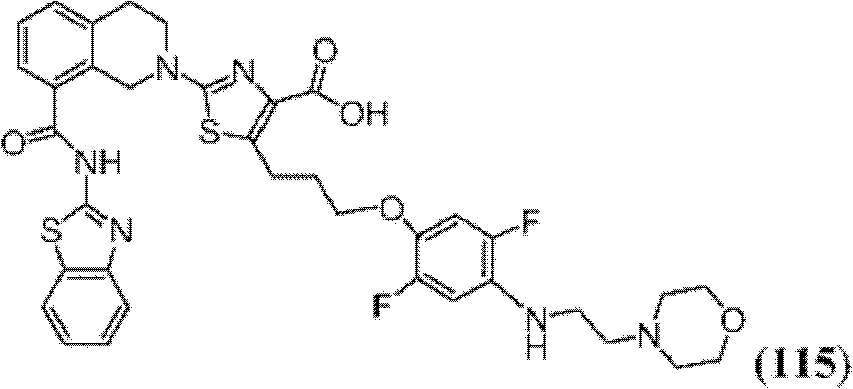
题示化合物115使用实施例108描述的相同程序制备,用2-吗啉基乙胺代替1-甲基哌嗪。题示化合物作为TFA盐获得:1H NMR(500MHz,吡啶-D5)δppm 8.05(1H,d),7.98(1H,d),7.85(1H,d),7.50(1H,t),7.26-7.38(3H,m),7.12(1H,dd),6.81(1H,dd),5.20(2H,s),4.11(2H,t),3.83(1H,s),3.79(2H,t),3.65-3.73(4H,m),3.52-3.59(2H,m),3.21(2H,t),2.88(2H,t),2.58(2H,t),2.42(4H,br,s),2.18-2.27(2H,m)。LCMS(APCI)735(M+H)。The title compound 115 was prepared using the same procedure described in Example 108, substituting 2-morpholinoethylamine for 1-methylpiperazine. The title compound was obtained as a TFA salt: 1 H NMR (500 MHz, pyridine-D 5 ) δ ppm 8.05 (1 H, d), 7.98 (1 H, d), 7.85 (1 H, d), 7.50 (1 H, t), 7.26- 7.38(3H,m), 7.12(1H,dd), 6.81(1H,dd), 5.20(2H,s), 4.11(2H,t), 3.83(1H,s), 3.79(2H,t), 3.65 -3.73(4H,m), 3.52-3.59(2H,m), 3.21(2H,t), 2.88(2H,t), 2.58(2H,t), 2.42(4H,br,s), 2.18-2.27 (2H, m). LCMS (APCI) 735 (M+H).
实施例116Example 116
2-(8-(苯并[d]噻唑-2-基氨基甲酰基)-3,4-二氢异喹啉-2(1H)-基)-5-(3-(4-(3-(二甲基氨基)丙-1-炔基)-2-氟苯氧基)丙基)噻唑-4-羧酸(116)的合成:2-(8-(Benzo[d]thiazol-2-ylcarbamoyl)-3,4-dihydroisoquinolin-2(1H)-yl)-5-(3-(4-(3- Synthesis of (dimethylamino)prop-1-ynyl)-2-fluorophenoxy)propyl)thiazole-4-carboxylic acid (116):
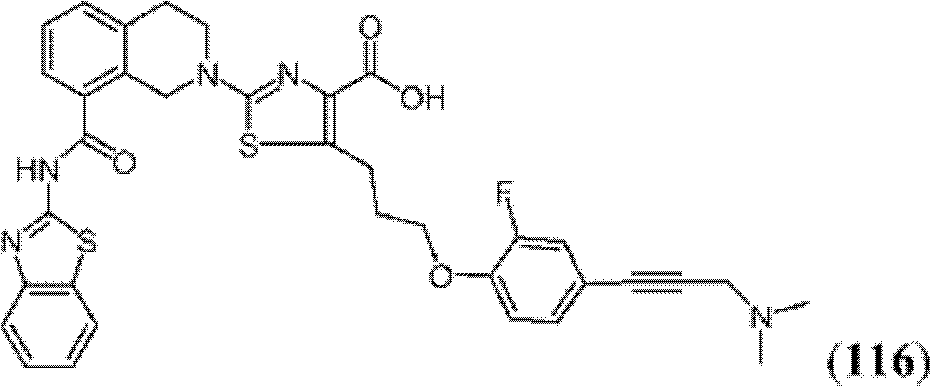
题示化合物116使用实施例97的步骤3描述的相同程序制备,用化合物47F代替化合物94F。题示化合物作为TFA盐获得:1H NMR(500MHz,DMSO-D6)δppm 12.90(1H,s),10.12(1H,s),8.04(1H,d),7.80(1H,d),7.67(1H,d),7.34-7.50(5H,m),7.31(1H,d),7.18(1H,t),4.83(2H,s),4.30(2H,s),4.10(2H,t),3.72(2H,t),3.12-3.23(2H,m),3.03(2H,t),2.87(6H,s),1.97-2.09(2H,m);LCMS(APCI)670(M+H)。Title compound 116 was prepared using the same procedure described in step 3 of Example 97, substituting compound 47F for compound 94F. The title compound was obtained as a TFA salt: 1 H NMR (500 MHz, DMSO-D 6 ) δ ppm 12.90 (1 H, s), 10.12 (1 H, s), 8.04 (1 H, d), 7.80 (1 H, d), 7.67 ( 1H, d), 7.34-7.50 (5H, m), 7.31 (1H, d), 7.18 (1H, t), 4.83 (2H, s), 4.30 (2H, s), 4.10 (2H, t), 3.72 (2H, t), 3.12-3.23 (2H, m), 3.03 (2H, t), 2.87 (6H, s), 1.97-2.09 (2H, m); LCMS (APCI) 670 (M+H).
实施例117Example 117
2-(8-(苯并[d]噻唑-2-基氨基甲酰基)-3,4-二氢异喹啉-2(1H)-基)-5-(3-(4-(3-(二甲基氨基)丙-1-炔基)-3-氟苯氧基)丙基)噻唑-4-羧酸(117)的合成:2-(8-(Benzo[d]thiazol-2-ylcarbamoyl)-3,4-dihydroisoquinolin-2(1H)-yl)-5-(3-(4-(3- Synthesis of (dimethylamino)prop-1-ynyl)-3-fluorophenoxy)propyl)thiazole-4-carboxylic acid (117):
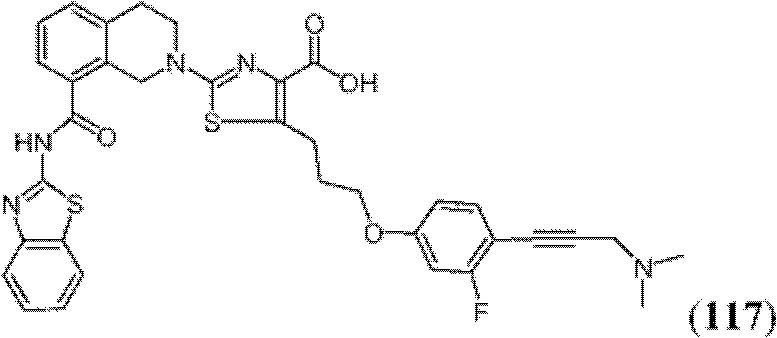
题示化合物117使用实施例97中描述的相同程序制备,分别用4-溴-3-氟苯酚和化合物47F代替4-溴-2-氟苯酚和化合物94F。题示化合物作为TFA盐获得:1H NMR(500MHZ,DMSO-D6)δppm 12.91(1H,s),10.13(1H,s),8.04(1H,d),7.80(1H,d),7.68(1H,d),7.44-7.51(3H,m),7.34-7.42(2H,m),7.03(1H,dd),6.77-6.82(1H,m),4.83(2H,s),4.32(2H,s),4.08(2H,t),3.72(2H,t),3.15-3.24(2H,m),3.03(2H,t),2.86(6H,s),1.98-2.08(2H,m)。LCMS(APCI)670(M+H)。The title compound 117 was prepared using the same procedure described in Example 97, substituting 4-bromo-3-fluorophenol and compound 47F for 4-bromo-2-fluorophenol and compound 94F, respectively. The title compound was obtained as a TFA salt: 1 H NMR (500 MHZ, DMSO-D 6 ) δppm 12.91 (1H, s), 10.13 (1H, s), 8.04 (1H, d), 7.80 (1H, d), 7.68 ( 1H, d), 7.44-7.51 (3H, m), 7.34-7.42 (2H, m), 7.03 (1H, dd), 6.77-6.82 (1H, m), 4.83 (2H, s), 4.32 (2H, s), 4.08 (2H, t), 3.72 (2H, t), 3.15-3.24 (2H, m), 3.03 (2H, t), 2.86 (6H, s), 1.98-2.08 (2H, m). LCMS (APCI) 670 (M+H).
实施例118Example 118
2-(8-(苯并[d]噻唑-2-基氨基甲酰基)-3,4-二氢异喹啉-2(1H)-基)-5-(3-(4-(3-(二甲基氨基)丙-1-炔基)-2,5-二氟苯氧基)丙基)噻唑-4-羧酸(118)的合成:2-(8-(Benzo[d]thiazol-2-ylcarbamoyl)-3,4-dihydroisoquinolin-2(1H)-yl)-5-(3-(4-(3- Synthesis of (dimethylamino)prop-1-ynyl)-2,5-difluorophenoxy)propyl)thiazole-4-carboxylic acid (118):

题示化合物118使用实施例97中描述的相同程序制备,分别用4-溴-2,5-二氟苯酚和化合物47F代替4-溴-2-氟苯酚和化合物94F。题示化合物118作为TFA盐获得:1H NMR(500MHz,DMSO-D6)δppm12.90(1H,s),10.19(1H,s),8.04(1H,d),7.80(1H,d),7.67(1H,d),7.53(1H,dd),7.43-7.50(2H,m),7.34-7.42(2H,m),7.26(1H,dd),4.83(2H,s),4.35(2H,s),4.12(2H,t),3.72(2H,t),3.12-3.21(2H,m),3.03(2H,t),2.87(6H,s),1.96-2.10(2H,m);LCMS(APCI)688(M+H)。Title compound 118 was prepared using the same procedure described in Example 97, substituting 4-bromo-2-fluorophenol and compound 94F with 4-bromo-2,5-difluorophenol and compound 47F, respectively. The title compound 118 was obtained as a TFA salt: 1 H NMR (500 MHz, DMSO-D 6 ) δppm 12.90 (1H, s), 10.19 (1H, s), 8.04 (1H, d), 7.80 (1H, d), 7.67(1H,d), 7.53(1H,dd), 7.43-7.50(2H,m), 7.34-7.42(2H,m), 7.26(1H,dd), 4.83(2H,s), 4.35(2H, s), 4.12(2H, t), 3.72(2H, t), 3.12-3.21(2H, m), 3.03(2H, t), 2.87(6H, s), 1.96-2.10(2H, m); LCMS (APCI) 688 (M+H).
实施例119Example 119
2-(8-(苯并[d]噻唑-2-基氨基甲酰基)-3,4-二氢异喹啉-2(1H)-基)-5-(3-(2-氯-4-(3-(二甲基氨基)丙-1-炔基)苯氧基)丙基)噻唑-4-羧酸(119)的合成:2-(8-(Benzo[d]thiazol-2-ylcarbamoyl)-3,4-dihydroisoquinolin-2(1H)-yl)-5-(3-(2-chloro-4 Synthesis of -(3-(dimethylamino)prop-1-ynyl)phenoxy)propyl)thiazole-4-carboxylic acid (119):
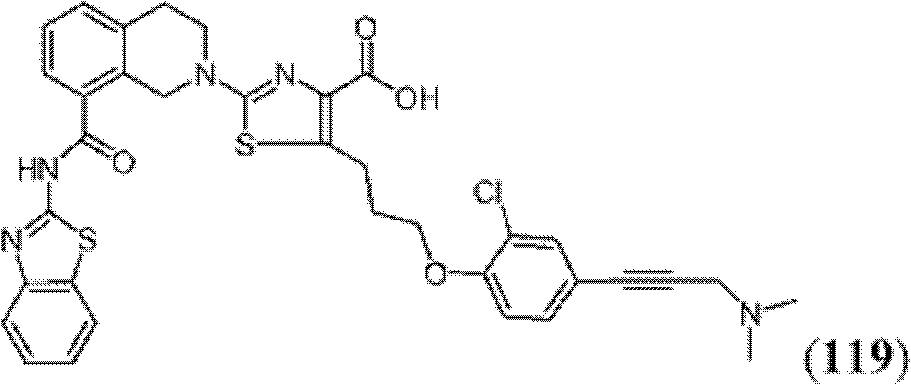
题示化合物(119)使用实施例97描述的相同程序制备,分别用4-溴-2-氯苯酚和化合物47F代替4-溴-2-氟苯酚和化合物94F。题示化合物119作为TFA盐获得:1H NMR(500MHz,DMSO-D6)δppm12.90(1H,s),10.09(1H,s),8.04(1H,d),7.80(1H,d),7.67(1H,d),7.62(1H,d),7.44-7.50(3H,m),7.35-7.41(2H,m),7.15(1H,d),4.83(2H,s),4.30(2H,s),4.11(2H,t),3.72(2H,t),3.17-3.23(2H,m),3.03(2H,t),2.88(6H,s),2.00-2.10(2H,m);LCMS(APCI)686(M+H)。The title compound (119) was prepared using the same procedure described in Example 97, substituting 4-bromo-2-chlorophenol and compound 47F for 4-bromo-2-fluorophenol and compound 94F, respectively. The title compound 119 was obtained as a TFA salt: 1 H NMR (500 MHz, DMSO-D 6 ) δppm 12.90 (1H, s), 10.09 (1H, s), 8.04 (1H, d), 7.80 (1H, d), 7.67(1H,d), 7.62(1H,d), 7.44-7.50(3H,m), 7.35-7.41(2H,m), 7.15(1H,d), 4.83(2H,s), 4.30(2H, s), 4.11(2H, t), 3.72(2H, t), 3.17-3.23(2H, m), 3.03(2H, t), 2.88(6H, s), 2.00-2.10(2H, m); LCMS (APCI) 686 (M+H).
实施例120Example 120
6-(8-(苯并[d]噻唑-2-基氨基甲酰基)-3,4-二氢异喹啉-2(1H)-基)吡啶甲酸(120)的合成:Synthesis of 6-(8-(benzo[d]thiazol-2-ylcarbamoyl)-3,4-dihydroisoquinolin-2(1H)-yl)picolinic acid (120):
步骤1:6-氟吡啶甲酸叔丁酯(120A)的制备 Step 1 : Preparation of tert-butyl 6-fluoropicolinate (120A)

在0℃将甲苯磺酰基氯(915mg,4.8mmol)加入到2-氟-吡啶甲酸(254mg,2mmol)和吡啶(1.08mL,13.4mmol)在3.6mL t-BuOH中的溶液中。反应然后在室温下搅拌12小时。然后加入NaHCO3水溶液,混合物用乙酸乙酯萃取(3次)。合并的有机相用盐水洗涤,用Na2SO4干燥。粗制的化合物通过快速色谱使用SiO2纯化(石油醚/EtOAc 100∶0到90∶10)。获得产物120A,为白色固体(m=326mg,83%):1HNMR(ppm,CDCl3)1.6(s,9H),7.05-7.11(m,1H),7.85-7.93(m,2H)。Tosyl chloride (915 mg, 4.8 mmol) was added to a solution of 2-fluoro-picolinic acid (254 mg, 2 mmol) and pyridine (1.08 mL, 13.4 mmol) in 3.6 mL t-BuOH at 0°C. The reaction was then stirred at room temperature for 12 hours. Then aqueous NaHCO 3 was added and the mixture was extracted with ethyl acetate (3 times). The combined organic phases were washed with brine and dried over Na2SO4 . The crude compound was purified by flash chromatography using SiO2 (petroleum ether/EtOAc 100:0 to 90:10). The product 120A was obtained as a white solid (m = 326 mg, 83%): 1 H NMR (ppm, CDCl 3 ) 1.6 (s, 9H), 7.05-7.11 (m, 1H), 7.85-7.93 (m, 2H).
步骤2:6-(8-(苯并[d]噻唑-2-基氨基甲酰基)-3,4-二氢异喹啉-2(1H)-基)吡啶甲酸叔丁酯(120B)的制备: Step 2 : tert-butyl 6-(8-(benzo[d]thiazol-2-ylcarbamoyl)-3,4-dihydroisoquinolin-2(1H)-yl)picolinate (120B) preparation:
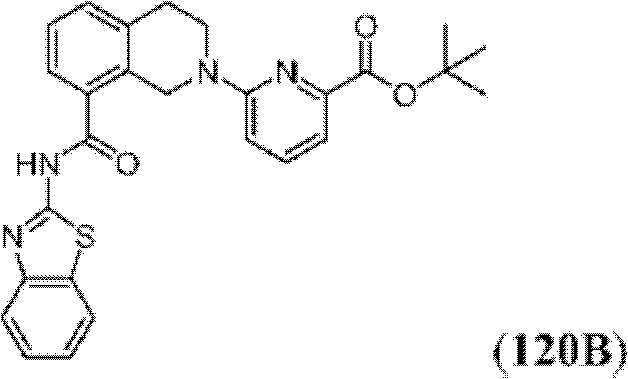
反应开始前,Cs2CO3(831mg,2.55mmol)和500mg
步骤3:题示化合物120的制备: Step 3 : Preparation of Title Compound 120:
化合物1B(71mg,0.15mmol)在2mL EtOH中溶解。然后加入两毫升水,接着是2mL浓HCl。反应在室温下搅拌72小时,直到LCMS指出完全转化。氮气冒泡穿过混合物,以除去HCl和EtOH;白色固体沉淀。通过过滤收集它,用水和少量Et2O冲洗,在真空中干燥,以提供产物,为白色固体(42mg,67%):1HNMR(ppm,DMSO)2.98(t,J=6.15Hz,2H),3.92(t,J=6.06Hz,2H),4.95(s,2H),7.02(d,J=8.5Hz,1H),7.27(d,J=7.3Hz,7.31-7.49(m,4H),758(d,J=7.5Hz,1H),7.66-7.71(m,1H),7.77(d,J=8.0Hz,1H),8.02(d,J=7.9Hz);LCMS m/z 431.0(M+1)。Compound 1B (71 mg, 0.15 mmol) was dissolved in 2 mL of EtOH. Two mL of water were then added, followed by 2 mL of concentrated HCl. The reaction was stirred at room temperature for 72 hours until LCMS indicated complete conversion. Nitrogen was bubbled through the mixture to remove HCl and EtOH; a white solid precipitated. It was collected by filtration, rinsed with water and a little Et2O , dried in vacuo to afford the product as a white solid (42 mg, 67%): 1 HNMR (ppm, DMSO) 2.98 (t, J = 6.15 Hz, 2H) , 3.92(t, J=6.06Hz, 2H), 4.95(s, 2H), 7.02(d, J=8.5Hz, 1H), 7.27(d, J=7.3Hz, 7.31-7.49(m, 4H), 758(d, J=7.5Hz, 1H), 7.66-7.71(m, 1H), 7.77(d, J=8.0Hz, 1H), 8.02(d, J=7.9Hz); LCMS m/z 431.0(M +1).
实施例121Example 121
6-(8-(苯并[d]噻唑-2-基氨基甲酰基)-3,4-二氢异喹啉-2(1H)-基)-3-(3-苯氧基丙基)吡啶甲酸(121)的合成:6-(8-(Benzo[d]thiazol-2-ylcarbamoyl)-3,4-dihydroisoquinolin-2(1H)-yl)-3-(3-phenoxypropyl) Synthesis of picolinic acid (121):
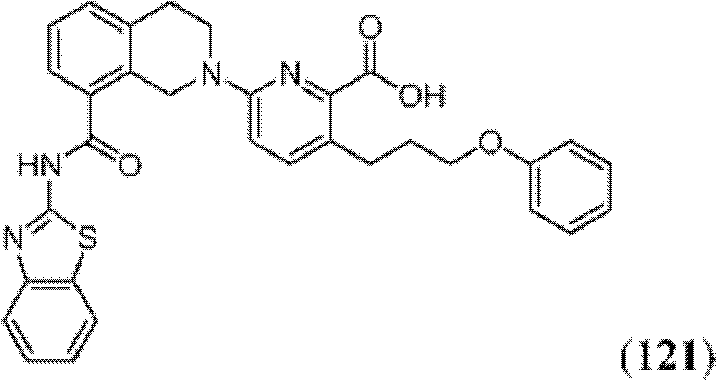
步骤1:2-溴-5-氯苯甲酸叔丁酯(121A)的制备: Step 1 : Preparation of tert-butyl 2-bromo-5-chlorobenzoate (121A):
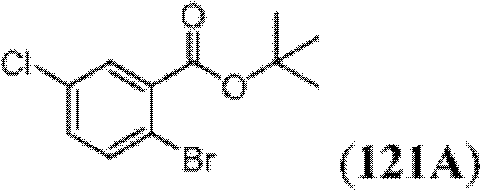
在0℃向2-氯-5-溴吡啶甲酸(4g,17mmol)和吡啶(9.2mL,114mmol)在33mL t-BuOH中的溶液中,加入甲苯磺酰基氯(7.7g,40.4mmol)。然后反应在室温下搅拌12小时。然后加入
步骤2:6-(8-(苯并[d]噻唑-2-基氨基甲酰基)-3,4-二氢异喹啉-2(1H)-基)-3-溴吡啶甲酸叔丁酯(121B)的制备: Step 2 : tert-butyl 6-(8-(benzo[d]thiazol-2-ylcarbamoyl)-3,4-dihydroisoquinolin-2(1H)-yl)-3-bromopicolinate Preparation of (121B):

反应开始前,Cs2CO3(4.1g,12.6mmol)和
步骤3:6-(8-(苯并[d]噻唑-2-基((2-(三甲基甲硅烷基)乙氧基)甲基)氨基甲酰基)-3,4-二氢异喹啉-2(1H)-基)-3-溴吡啶甲酸叔丁酯(121C)的制备: Step 3 : 6-(8-(Benzo[d]thiazol-2-yl((2-(trimethylsilyl)ethoxy)methyl)carbamoyl)-3,4-dihydroiso Preparation of tert-butyl quinoline-2(1H)-yl)-3-bromopicolinate (121C):

化合物121B(350mg,0.62mmol)在THF中溶解。连续加入NEt3(127μL,0.91mmol)和SEMCl(135μL,0.74mmol)。反应在室温下搅拌1小时。然后浓缩。残余物溶解到乙酸乙酯和水中。水层用乙酸乙酯萃取三次。合并的有机层用盐水洗涤,用Na2SO4干燥。浓缩后,残余物通过快速色谱使用flash master纯化:SiO2,乙酸乙酯/石油醚0∶100到30∶70。获得淡黄色泡沫固体化合物121C(276mg,64%)。NMR显示两种N-SEM产物:1H NMR(300MHz,CDCl3),异构体的混合物(1∶0.6)δ8.28(d,1H),7.86(d,1H),7.71(d,1H),7.62-7.42(m,5H),7.38-7.26(m,5H),6.80(d,1H),6.55(d,0.6H),5.98(s,2H),5.53(s,1H),5.19(s,2H),4.67(s,1H),4.00(t,2H),3.93(t,1H),3.75(t,2H),3.61(t,1H),3.02(m,3H),1.61(s,9H),1.53(s,5H),0.98(t,2H),0.82(t,1H),-0.09(s,9H)。Compound 121B (350 mg, 0.62 mmol) was dissolved in THF. NEt3 (127 μL, 0.91 mmol) and SEMCl (135 μL, 0.74 mmol) were added sequentially. The reaction was stirred at room temperature for 1 hour. Then concentrate. The residue was dissolved in ethyl acetate and water. The aqueous layer was extracted three times with ethyl acetate. The combined organic layers were washed with brine and dried over Na2SO4 . After concentration, the residue was purified by flash chromatography using a flash master: SiO2 , ethyl acetate/petroleum ether 0:100 to 30:70. Compound 121C (276 mg, 64%) was obtained as pale yellow foamy solid. NMR showed two N-SEM products: 1 H NMR (300 MHz, CDCl 3 ), mixture of isomers (1:0.6) δ 8.28 (d, 1H), 7.86 (d, 1H), 7.71 (d, 1H ), 7.62-7.42(m, 5H), 7.38-7.26(m, 5H), 6.80(d, 1H), 6.55(d, 0.6H), 5.98(s, 2H), 5.53(s, 1H), 5.19 (s, 2H), 4.67(s, 1H), 4.00(t, 2H), 3.93(t, 1H), 3.75(t, 2H), 3.61(t, 1H), 3.02(m, 3H), 1.61( s, 9H), 1.53 (s, 5H), 0.98 (t, 2H), 0.82 (t, 1H), -0.09 (s, 9H).
步骤4:6-(8-(苯并[d]噻唑-2-基((2-(三甲基甲硅烷基)乙氧基)甲基)氨基甲酰基)-3,4-二氢异喹啉-2(1H)-基)-3-(3-苯氧基丙-1-炔基)吡啶甲酸叔丁酯(121D)的合成 Step 4 : 6-(8-(Benzo[d]thiazol-2-yl((2-(trimethylsilyl)ethoxy)methyl)carbamoyl)-3,4-dihydroiso Synthesis of tert-butyl quinoline-2(1H)-yl)-3-(3-phenoxyprop-1-ynyl)pyridinecarboxylate (121D)
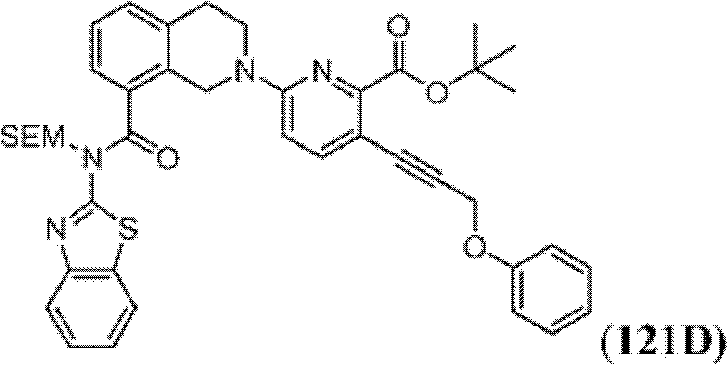
向预干燥的Cs2CO3(378mg,1.16mmol)加入化合物121C(180mg,0.26mmol)、2-二环己基膦-2′,4′,6′-三-异-丙基-1,1′-联苯基(18mg,0.04mmol)和双(乙腈)二氯化钯(II)(3.2mg,0.012mmol)。用氮气吹扫环境,加入丙腈(3.0mL)后,混合物在室温下搅拌10min.,之后加入苯基炔丙基醚(205mg,1.54mmol)。混合物在105℃加热1hr,冷却至室温,浓缩,用饱和NH4Cl稀释,用EtOAc(3x)萃取。有机相用盐水(1x)洗涤,干燥(Na2SO4),过滤,浓缩。粗材料通过快速柱色谱用硅胶纯化,使用PE∶EtOAc 100∶0-85∶15梯度,得到产物(90mg,47%):1H NMR(300MHz,CDCl3)δ8.28(d,1H),7.69(d,1H),7.57(m,2H),7.47(t,1H),7.38-7.26(m,5H),6.99(m,3H),6.82(d,1H),5.98(s,2H),5.24(s,2H),4.92(s,2H),4.07(t,2H),3.74(t,2H),3.02(t,2H),1.60(s,9H),0.97(t,2H),-0.09(s,9H)。To pre-dried Cs 2 CO 3 (378 mg, 1.16 mmol) was added compound 121C (180 mg, 0.26 mmol), 2-dicyclohexylphosphine-2′,4′,6′-tri-iso-propyl-1,1 '-Biphenyl (18 mg, 0.04 mmol) and bis(acetonitrile)palladium(II) dichloride (3.2 mg, 0.012 mmol). The environment was purged with nitrogen, after propionitrile (3.0 mL) was added, the mixture was stirred at room temperature for 10 min., after which phenyl propargyl ether (205 mg, 1.54 mmol) was added. The mixture was heated at 105 °C for 1 hr, cooled to room temperature, concentrated, diluted with saturated NH4Cl , extracted with EtOAc (3x). The organic phase was washed with brine (1x), dried ( Na2SO4 ), filtered and concentrated. The crude material was purified by flash column chromatography on silica gel using a PE:EtOAc 100:0-85:15 gradient to afford the product (90 mg, 47%): 1 H NMR (300 MHz, CDCl 3 ) δ 8.28 (d, 1 H), 7.69(d, 1H), 7.57(m, 2H), 7.47(t, 1H), 7.38-7.26(m, 5H), 6.99(m, 3H), 6.82(d, 1H), 5.98(s, 2H) , 5.24(s, 2H), 4.92(s, 2H), 4.07(t, 2H), 3.74(t, 2H), 3.02(t, 2H), 1.60(s, 9H), 0.97(t, 2H), -0.09(s, 9H).
步骤5:6-(8-(苯并[d]噻唑-2-基((2-(三甲基甲硅烷基)乙氧基)甲基)氨基甲酰基)-3,4-二氢异喹啉-2(1H)-基)-3-(3-苯氧基丙基)吡啶甲酸叔丁酯(121E)的制备: Step 5 : 6-(8-(Benzo[d]thiazol-2-yl((2-(trimethylsilyl)ethoxy)methyl)carbamoyl)-3,4-dihydroiso Preparation of tert-butyl quinoline-2(1H)-yl)-3-(3-phenoxypropyl)picolinate (121E):
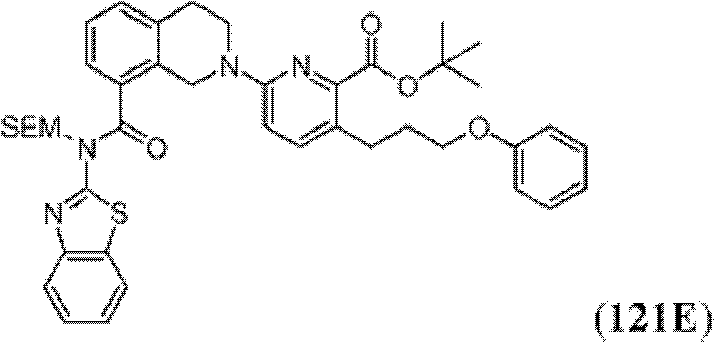
将PtO2(4.8mg,0.020mmol)加入到化合物2D(60mg,0.080mmol)在EtOAc(2.0mL)中的溶液中,混合物在H2环境下搅拌2小时。过滤混合物,用EtOAc洗涤,浓缩,得到产物121D(55mg,92%):1H NMR(300MHz,CDCl3)δ8.26(d,1H),7.69(d,1H),7.57(d,1H),7.48(t,1H),7.40-7.23(m,6H),6.97-6.82(m,4H),5.97(s,2H),5.20(s,2H),4.03(t,2H),3.96(t,2H),3.75(t,2H),3.04(t,2H),2.88(t,2H),2.06(m,2H),1.62(s,9H),0.97(t,2H),-0.09(s,9H)。PtO 2 (4.8 mg, 0.020 mmol) was added to a solution of compound 2D (60 mg, 0.080 mmol) in EtOAc (2.0 mL), and the mixture was stirred under H 2 atmosphere for 2 hrs. The mixture was filtered, washed with EtOAc, and concentrated to give product 121D (55 mg, 92%): 1 H NMR (300 MHz, CDCl 3 ) δ 8.26 (d, 1H), 7.69 (d, 1H), 7.57 (d, 1H) , 7.48(t, 1H), 7.40-7.23(m, 6H), 6.97-6.82(m, 4H), 5.97(s, 2H), 5.20(s, 2H), 4.03(t, 2H), 3.96(t , 2H), 3.75(t, 2H), 3.04(t, 2H), 2.88(t, 2H), 2.06(m, 2H), 1.62(s, 9H), 0.97(t, 2H), -0.09(s , 9H).
步骤5:题示化合物121的制备: Step 5 : Preparation of title compound 121:
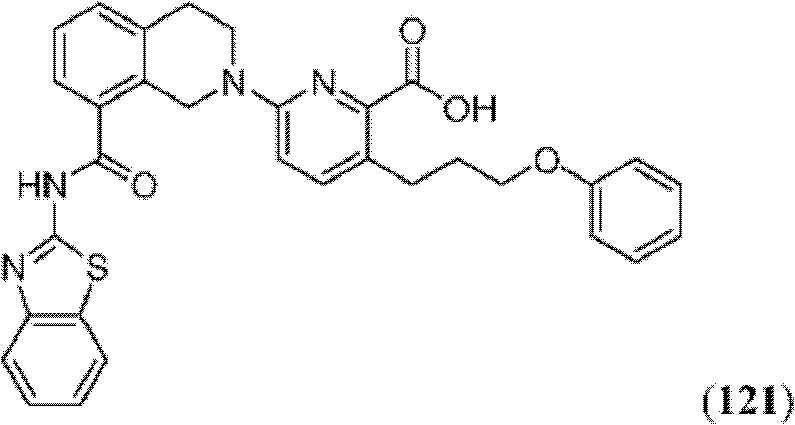
化合物121E(55mg,0.073mmol)在1mL EtOH中溶解。加入水(1mL),接着是1mL浓HCl。反应在50℃搅拌12小时。通过过滤收集沉淀的固体,用水冲洗。固体通过预制备HPLC纯化,得到白色固体:1H NMR(300MHz,DMSO-d6)δ2.09(t,2H),3.06(t,2H),3.21(t,2H),3.91(t,2H),3.97(t,2H),5.21(s,2H),6.87-6.94(m,4H),7.25-7.42(m,5H),7.46-7.50(m,2H),7.56(m,1H),8.01(m,1H);LCMS m/z 565.7(M+1)。Compound 121E (55 mg, 0.073 mmol) was dissolved in 1 mL of EtOH. Water (1 mL) was added, followed by 1 mL of concentrated HCl. The reaction was stirred at 50°C for 12 hours. The precipitated solid was collected by filtration and rinsed with water. The solid was purified by preparative HPLC to give a white solid: 1 H NMR (300 MHz, DMSO-d 6 ) δ 2.09(t, 2H), 3.06(t, 2H), 3.21(t, 2H), 3.91(t, 2H ), 3.97(t, 2H), 5.21(s, 2H), 6.87-6.94(m, 4H), 7.25-7.42(m, 5H), 7.46-7.50(m, 2H), 7.56(m, 1H), 8.01 (m, 1H); LCMS m/z 565.7 (M+1).
实施例122Example 122
2-(8-(苯并[d]噻唑-2-基氨基甲酰基)-3,4-二氢异喹啉-2(1H)-基)嘧啶-4-羧酸(122)的合成:Synthesis of 2-(8-(benzo[d]thiazol-2-ylcarbamoyl)-3,4-dihydroisoquinolin-2(1H)-yl)pyrimidine-4-carboxylic acid (122):

化合物1B(309mg,1mmol)、2-氯嘧啶-4-羧酸(134.5mg,1mmol)、碳酸铯(975mg,3mmol)在2ml DMSO中的混合物加热到60℃6h。将产物倒入水中,它从溶液中沉淀出来,通过过滤收集。粗材料经色谱(SiO2,含20%甲醇的二氯甲烷),提供37,为白色粉末:LCMS(纯度97%);保留时间=8.70min,432.0[M+H];1HNMR(300MHz,DMSO):8.60(1H,d),8.25(1H,d),7.80(1H,m),7.60(1H,d),7.45(1H,d),7.1-7.2(2H,m),7.0(1H,t),6.75(1H,d),5.25(2H,s),3.95(2H,t),2.85(2H,t)。A mixture of compound 1B (309mg, 1mmol), 2-chloropyrimidine-4-carboxylic acid (134.5mg, 1mmol), cesium carbonate (975mg, 3mmol) in 2ml DMSO was heated to 60°C for 6h. The product was poured into water and it precipitated out of solution and was collected by filtration. Chromatography ( SiO2 , 20% methanol in dichloromethane) of the crude material provided 37 as a white powder: LCMS (97% purity); retention time = 8.70 min, 432.0 [M+H]; 1 HNMR (300 MHz, DMSO): 8.60 (1H, d), 8.25 (1H, d), 7.80 (1H, m), 7.60 (1H, d), 7.45 (1H, d), 7.1-7.2 (2H, m), 7.0 (1H , t), 6.75 (1H, d), 5.25 (2H, s), 3.95 (2H, t), 2.85 (2H, t).
实施例123Example 123
2-(8-(苯并[d]噻唑-2-基氨基甲酰基)-3,4-二氢异喹啉-2(1H)-基)-5-氯嘧啶-4-羧酸(123)的合成。2-(8-(Benzo[d]thiazol-2-ylcarbamoyl)-3,4-dihydroisoquinolin-2(1H)-yl)-5-chloropyrimidine-4-carboxylic acid (123 )Synthesis.
化合物1B(309mg,1mmol)、5-氯-2-甲烷磺酰基-嘧啶-4-羧酸(236mg,1mmol)和碳酸铯(975mg,3mmol)在2ml DMSO中的混合物加热到60℃6h。通过加入到水中,产物从溶液中沉淀出来,通过过滤收集。粗材料经色谱(SiO2,含20%甲醇的二氯甲烷),提供题示化合物123,为白色粉末:LCMS(纯度96%):m/z 465.9[M+H]。A mixture of compound 1B (309 mg, 1 mmol), 5-chloro-2-methanesulfonyl-pyrimidine-4-carboxylic acid (236 mg, 1 mmol) and cesium carbonate (975 mg, 3 mmol) in 2 ml DMSO was heated to 60° C. for 6 h. Upon addition to water, the product precipitated out of solution and was collected by filtration. Chromatography ( SiO2 , 20% methanol in dichloromethane) of the crude material afforded the title compound 123 as a white powder: LCMS (purity 96%): m/z 465.9 [M+H].
实施例124Example 124
本发明化合物与F-Bak对Bcl-2家族蛋白(Bcl-xL)结合位点的竞争的测量,使用时间分辨荧光共振能量传递(TR-FRET)结合测试:Measurement of Competition of Compounds of the Invention with F-Bak for Bcl-2 Family Proteins (Bcl-x L ) Binding Sites Using Time-Resolved Fluorescence Resonance Energy Transfer (TR-FRET) Binding Assay:
测试化合物从50μM(2x起始浓度;10%DMSO)开始,在DMSO中连续稀释,并转移10μL到384孔板中。然后向各孔中加入10μL蛋白/探针/抗体混合物,终浓度在表2中列出。Test compounds were serially diluted in DMSO starting at 50 μM (2x starting concentration; 10% DMSO), and 10 μL was transferred to a 384-well plate. Then add 10 µL of protein/probe/antibody mix to each well at the final concentrations listed in Table 2.
表2Table 2
样本然后用振荡器混合1分钟,然后在室温下孵育另外2小时。各测试板分别包含探针/抗体和蛋白/抗体/探针混合物作为负和正对照。荧光用ENVISION(Perkin Elmer)测量,使用340/35nm感光滤片以及520/525(F-Bak)和495/510nm(Tb标记的抗his抗体)发射滤片。解离常数(Ki)使用Wang′s公式(参见Wang,Z.X.An exact mathematicalexpression for describing competitive binding of two different ligands to aprotein molecule.FEBS Lett.1995360:111-114)测定。TR-FRET测试可以在不同浓度的人血清(HS)或胎牛血清(FBS)存在下执行。Samples were then mixed with a shaker for 1 min and then incubated for an additional 2 h at room temperature. Each test plate contained probe/antibody and protein/antibody/probe mixtures as negative and positive controls, respectively. Fluorescence was measured with ENVISION (Perkin Elmer) using 340/35 nm sensitivity filters and 520/525 (F-Bak) and 495/510 nm (Tb-labeled anti-his antibody) emission filters. The dissociation constant (K i ) was determined using Wang's formula (see Wang, ZX An exact mathematical expression for describing competitive binding of two different ligands to aprotein molecule. FEBS Lett. 1995360: 111-114). TR-FRET tests can be performed in the presence of different concentrations of human serum (HS) or fetal bovine serum (FBS).
作为比较,使用TR-FRET结合测试,本发明化合物对其它Bcl-2家族蛋白结合位点(例如,Bcl-2、Mcl-1)的竞争的测量,通过在TR-FRET测试中用其它GST标记的蛋白代替GST-Bcl-xL来完成,例如,室内制备的GST-Bcl-2、GST-Mcl-1。As a comparison, using the TR-FRET binding assay, the measurement of the competition of the compounds of the invention for other Bcl-2 family protein binding sites (e.g., Bcl-2, Mcl-1), by labeling with other GST in the TR-FRET assay protein instead of GST-Bcl-x L , for example, GST-Bcl-2 and GST-Mcl-1 prepared in-house.
对表1中阐述的本发明的代表性化合物,TR-FRET测试结果(Ki,单位微摩尔)在下面按它们在表1中出现的顺序提供:0.077、0.0002、0.0002、0.0003、0.001、0.0002、0.007、0.00006、0.00007、0.0001、0.0001、0.0003、0.0007、0.006、0.003、0.006、0.004、0.004、0.009、0.003、0.00005、0.019、0.002、0.007、0.0003、0.003、0.001、0.001、0.023、0.0004、0.0001、0.017、0.0003、0.004、0.004、0.005、0.004、0.005、0.0002、0.0004、0.0001、0.002、0.005、0.00007、0.001、0.001、0.0001、0.00005、0.012、0.002、0.0003、0.00005、0.00005、0.00005、0.0006、0.00005、0.00007(w/1%HS)、0.0005、0.0003、0.176、0.0003、0.13、0.248、0.00005、0.00007、0.0001、0.00005、0.0002、0.0005、0.040、0.174、0.003、0.00008、0.00005、0.00005、0.008、0.007、0.00005、0.0001、0.0005、0.00005、0.00005、0.00005、0.00005、0.00005、0.00007、0.00005、0.00005、0.0001、0.00005、0.0007、0.00005、0.00005、0.002、0.00005、0.0001、0.00005、0.010、0.125、0.0005、0.0007、NA、NA、NA、0.15、0.0662、0.197、0.66、NA、NA、NA、0.0106、0.0189、0.00018、NA、0.0006、0.00015、0.00004、0.000004、0.003、0.000006(w/1%HS)、0.00001、0.00004、0.00002、0.00005、NA、0.0006、NA、NA、NA、0.002、0.0002、0.000023、NA、0.0003、0.001、0.0002、0.00007、0.00002、NA、0.000487、0.000088、NA、NA、NA、NA、>0.66和NA。本文使用的缩写“NA”指该化合物的数据未得到。For representative compounds of the invention set forth in Table 1, TR-FRET test results (K i in micromoles) are provided below in the order in which they appear in Table 1: 0.077, 0.0002, 0.0002, 0.0003, 0.001, 0.0002 0.007, 0.00006, 000007, 0.0001, 0.0001, 0.0003, 0.006, 0.003, 0.006, 0.004, 0.009, 0.003, 0.0019, 0.007, 0.003, 0.001, 0.0023, 0.0023, 0.0023 、0.017、0.0003、0.004、0.004、0.005、0.004、0.005、0.0002、0.0004、0.0001、0.002、0.005、0.00007、0.001、0.001、0.0001、0.00005、0.012、0.002、0.0003、0.00005、0.00005、0.00005、0.0006、0.00005 0.00007 (W/1 % H.), 0.0005, 0.0003, 0.176, 0.13, 0.248, 0.00005, 0.00007, 0.00005, 0.0005, 0.040, 0.003, 0.00005, 0.008, 0.007, 0.00005, 0.00005, 0.00005, 0.00005, 0.00005, 0.00005 0.00005、0.0001、0.0005、0.00005、0.00005、0.00005、0.00005、0.00005、0.00007、0.00005、0.00005、0.0001、0.00005、0.0007、0.00005、0.00005、0.002、0.00005、0.0001、0.00005、0.010、0.125、0.0005、0.0007、NA、 NA, NA, 0.15, 0.0662, 0.197, 0.66, NA, NA, NA, 0.0106, 0.0189, 0.00018, NA, 0.0006, 0.00015, 0.00004, 0.000004, 0.003, 0.000006 (w/1% HS), 0.00001, 0.00000 , 0.00005, NA, 0.0006, NA, NA, NA, 0.002, 0.0002, 0.000023, NA, 0.0003, 0.001, 0.0002, 0.00007, 0.00002, NA, 0 .000487, 0.000088, NA, NA, NA, NA, >0.66 and NA. The abbreviation "NA" as used herein means that data is not available for that compound.
在一个实施方式中,本发明化合物选择性抑制Bcl-2家族蛋白Bcl-xL超过其它Bcl-2家族蛋白,例如Bcl-2和Mcl-1。作为比较,使用TR-FRET结合测试,某些本发明化合物(即表1中的化合物52、58、64、70、74、76、81、82、84、88、93、94、97和100)与F-Bak对Bcl-2结合位点的竞争的测量,数据(Ki,单位微摩尔)分别是0.13、0.31、0.09、0.5、0.06、0.35、0.11、0.12、0.14、0.3、0.155、0.572、0.272和0.219。In one embodiment, compounds of the invention selectively inhibit the Bcl-2 family protein Bcl-x L over other Bcl-2 family proteins such as Bcl-2 and Mcl-1. As a comparison, using the TR-FRET binding assay, certain compounds of the invention (i.e. compounds 52, 58, 64, 70, 74, 76, 81, 82, 84, 88, 93, 94, 97 and 100 in Table 1) Measurement of competition with F-Bak for Bcl-2 binding sites, data (K i , in micromoles) are 0.13, 0.31, 0.09, 0.5, 0.06, 0.35, 0.11, 0.12, 0.14, 0.3, 0.155, 0.572 , 0.272 and 0.219.
实施例125Example 125
本发明化合物与Bim26-mer对Bcl-2家族蛋白结合位点的竞争的测量,使用Alpha Screen Bcl-xL结合测试:Measurement of competition of compounds of the invention with Bim26-mer for binding sites of Bcl-2 family proteins, using the Alpha Screen Bcl-x L binding assay:
BH3蛋白ALPHASCREENTM测试被用来识别活性小分子Bcl-2家族蛋白筛选,例如Bcl-xL、hmMcl-1筛选。为了测定精确估计的IC50,化合物在起始浓度、100μM和/或1μM常规测试,而且在11个稀释内连续3倍滴定。The BH3 protein ALPHASCREEN TM assay was used to identify active small molecule Bcl-2 family protein screens, eg Bcl-xL, hmMcl-1 screens. To determine precisely estimated IC50s , compounds were routinely tested at starting concentrations, 100 [mu]M and/or 1 [mu]M, and serially 3-fold titrated over 11 dilutions.
测试使用ALPHASCREENTM技术,其依赖水凝胶包衣的受体和供体珠,它们具有分别与蛋白(例如GST-hmMcl-1、GST-Bcl-xL或GST-生物素)和肽(生物素-Bak、生物素-Bim)共轭的功能性基团。当蛋白和肽相互作用时,珠变得极为接近。供体珠包含光敏剂,其在680nm激发下将氧气转化成O2的激发形式。能量从单态氧转换,并与受体珠上的化学发光剂反应,引起在520-620nm的光发射。当本发明化合物加入到反应中时,依靠抑制受体和供体珠的接近,可以降低荧光强度。用这一信息计算各化合物的IC50。The test uses ALPHASCREEN ™ technology, which relies on hydrogel-coated acceptor and donor beads with protein (eg GST-hmMcl-1, GST-Bcl-xL or GST-biotin) and peptide (biotin -Bak, biotin-Bim) conjugated functional groups. When proteins and peptides interact, the beads come into close proximity. Donor beads contain a photosensitizer that converts oxygen to the excited form of O2 upon excitation at 680 nm. Energy is converted from singlet oxygen and reacts with the chemiluminescent agent on the acceptor bead, causing light emission at 520-620 nm. When a compound of the invention is added to the reaction, the fluorescence intensity can be reduced by inhibiting the proximity of the acceptor and donor beads. This information was used to calculate the IC50 for each compound.
材料Material
GST-Bcl-xL、GST-hmMcl-1和生物素化的GST蛋白是室内制备的,而且作为储备溶液在-80℃贮存。生物素化的Bak和生物素化的Bim肽从Auspep购买,而且作为100%DMSO中的500μM储备溶液在-80℃贮存。ALPHASCREENTM GST(谷胱甘肽-S-转移酶)检测试剂盒从Perkin Elmer Lifesciences(Cat#6760603R)获得。Proxiplates白色384孔平底板从Interpath Services,Melboume(Cat#784075)购买。覆盖板的密封材料从Prescience,Melbourne(Cat#784075)购买。DMSO从AnalaR购买。384深孔板和聚丙烯50μL V形底聚丙烯化合物板从Matrical购买。GST-Bcl-xL, GST-hmMcl-1 and biotinylated GST proteins were prepared in house and stored as stock solutions at -80°C. Biotinylated Bak and biotinylated Bim peptides were purchased from Auspep and stored as 500 μM stock solutions in 100% DMSO at -80°C. ALPHASCREEN ™ GST (Glutathione-S-Transferase) Assay Kit was obtained from Perkin Elmer Lifesciences (Cat #6760603R). Proxiplates white 384-well flat bottom plates were purchased from Interpath Services, Melbourne (Cat #784075). Sealing material covering the plates was purchased from Prescience, Melbourne (Cat# 784075). DMSO was purchased from AnalaR. 384 deep well plates and polypropylene 50 μL V-bottom polypropylene compound plates were purchased from Matrical.
化合物的制备Compound preparation
本发明化合物在执行测试前一天用100%DMSO制备成10mM储液。12μL 100%DMSO和6μL 10mM化合物(即3.333mM,终100μM)加入到聚丙烯50μL V形底化合物板的第1和12列中。为达到终化合物浓度1μM,在分开的matrical板中,向一个孔中加入28μL 100%DMSO和2μL 10mM化合物,混合该孔,取2μL这一溶液加入到38μL100%DMSO中。将20μL这一溶液加入到测试matrical板中。测试板中包含数种对照化合物。对于对照孔,向各板适当的孔加入15μL仅100%DMSO。化合物板然后使用MiniTrak连续2倍稀释。一旦滴定完成,立即用箔密封物覆盖化合物板,以防止蒸发。Compounds of the invention were prepared as 10 mM stock solutions in 100% DMSO the day before testing was performed. 12 μL of 100% DMSO and 6 μL of 10 mM compound (ie 3.333 mM, final 100 μM) were added to columns 1 and 12 of a polypropylene 50 μL V-bottom compound plate. To achieve a final compound concentration of 1 μM, in a separate matrical plate, add 28 μL of 100% DMSO and 2 μL of 10 mM compound to one well, mix the well, and add 2 μL of this solution to 38 μL of 100% DMSO. Add 20 μL of this solution to the test matrical plate. Several control compounds were included in the test panel. For control wells, 15 [mu]L of 100% DMSO alone was added to the appropriate wells of each plate. Compound plates were then serially 2-fold diluted using the MiniTrak. Once the titration is complete, immediately cover the compound plate with a foil seal to prevent evaporation.
缓冲液的制备Buffer preparation
测试和珠缓冲液是新鲜制备的。各个滴定的化合物板一式二份测试。以下体积足够跑12个Proxiplates(Bclxl、hmMcl和对抗测试一式二份各跑4个测试板)Assay and bead buffers are freshly prepared. Each titrated compound plate was tested in duplicate. The following volume is enough to run 12 Proxiplates (Bclxl, hmMcl and confrontation test run 4 test plates in duplicate)
测试缓冲液test buffer

珠缓冲液bead buffer
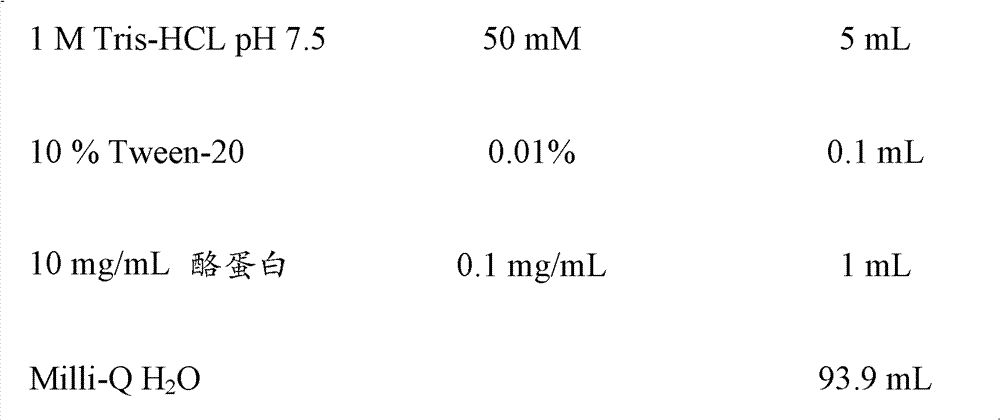
蛋白和肽的制备;和测试的执行Preparation of proteins and peptides; and execution of tests
1.使用测试和珠缓冲液来制备受体和供体溶液。ALPHASCREENTM珠是光敏的,因此在暗室中制备。每1mL缓冲液中加入2.5μL珠。1. Prepare acceptor and donor solutions using test and bead buffers. ALPHASCREEN ™ beads are light sensitive and therefore prepared in a dark room. Add 2.5 µL of beads per 1 mL of buffer.
2.加入的蛋白或肽体积使用以下公式计算:2. The volume of added protein or peptide is calculated using the following formula:
C1=蛋白/肽的终浓度C 1 = final concentration of protein/peptide
C2=蛋白/肽的储液浓度 C2 = stock solution concentration of protein/peptide
V1=受体/供体溶液的总体积V 1 = total volume of acceptor/donor solution
V2=向受体/供体溶液加入的蛋白/肽储液体积 V2 = protein/peptide stock volume added to acceptor/donor solution
3.测试成分被制备成分开的受体和供体溶液。受体溶液包含受体珠和靶向蛋白,而供体溶液包含供体珠和生物素化的肽。3. The test components are prepared as separate acceptor and donor solutions. The acceptor solution contains acceptor beads and targeting protein, while the donor solution contains donor beads and biotinylated peptide.
hmMcl-1hmMcl-1
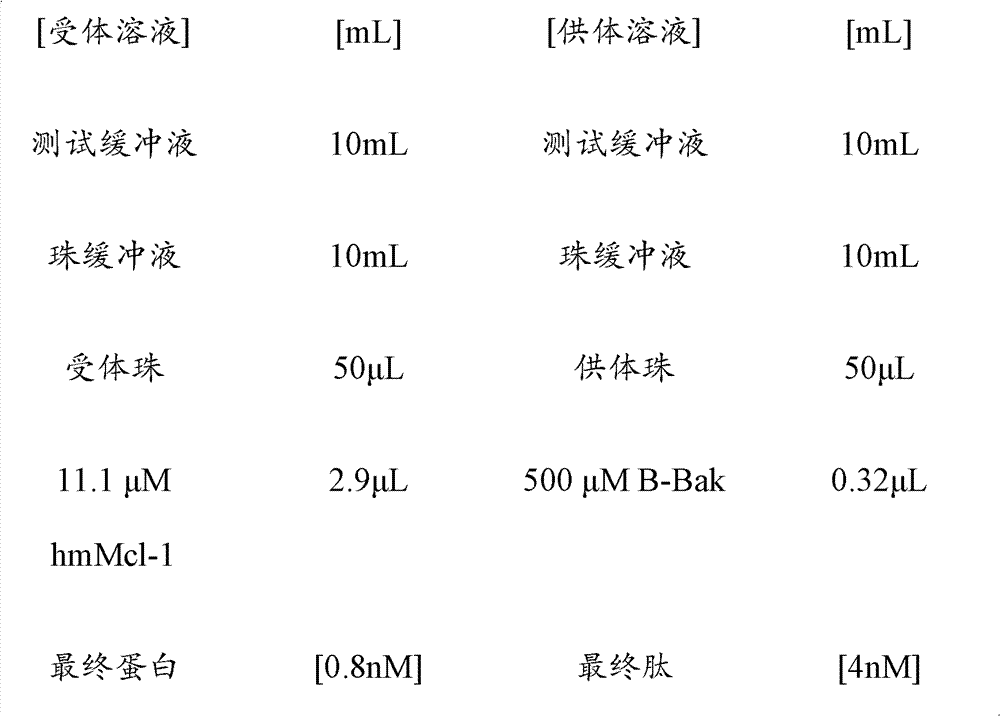
Bcl-xLBcl-xL
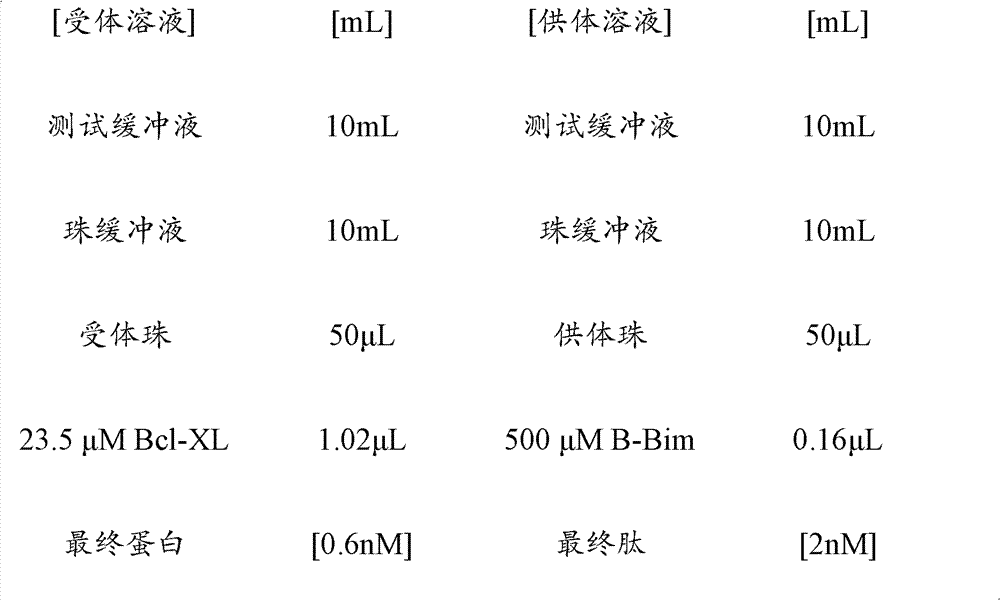
对抗-GSTAgainst-GST

4.配制溶液后,让其留在室温下孵育30分钟,让珠与蛋白和肽结合。4. After preparing the solution, let it incubate at room temperature for 30 minutes to allow the beads to bind to proteins and peptides.
5.将50μL Bcl-xL溶液、50μL hmMcl-1溶液和50μL生物素化的-GST加入到测试板上分开的深孔中。将对照50μL测试/珠缓冲液加入分开的孔板中(无蛋白)。5. Add 50 μL Bcl-xL solution, 50 μL hmMcl-1 solution, and 50 μL biotinylated-GST to separate deep wells on the test plate. Add control 50 μL test/bead buffer to a separate well plate (no protein).
6.将50μL Bim溶液和50μL Bak溶液加入到分开的深孔板中。6. Add 50 μL Bim solution and 50 μL Bak solution to a separate deep well plate.
7.从化合物板转移0.3μL样本到各测试板中。7. Transfer 0.3 μL sample from the compound plate to each test plate.
8.在室温下孵育30分钟,然后加入5μL供体溶液。加入供体溶液后,轻柔地拍打板,并用粘合薄膜独立密封。8. Incubate at room temperature for 30 minutes, then add 5 μL of donor solution. After adding the donor solution, the plates were gently tapped and individually sealed with an adhesive film.
9.板然后装载到Envision 2103读板器上供分析。9. Plates were then loaded onto the Envision 2103 plate reader for analysis.
数据分析data analysis
%抑制使用以下公式计算:% inhibition is calculated using the following formula:
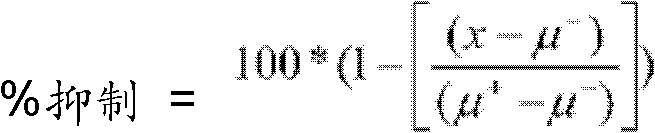
x=化合物处理后获得的RFUx = RFU obtained after compound treatment
μ-=由负对照(无蛋白对照)获得的RFUμ − = RFU obtained from negative control (no protein control)
μ+=由正对照(DMSO运载体对照)获得的RFUμ + = RFU obtained from positive control (DMSO vehicle control)
IC50值通过以上数据的非线性最小二乘方拟合获得,例如,对xLfit3公式205:y=A+((B-A)/(1+((C/x)ΛD)))。 IC50 values were obtained by nonlinear least squares fitting of the above data, eg, for xLfit3 formula 205: y=A+((BA)/(1+((C/x) ΛD ))).
通过测定各测试板的Z质因子,监控测试结果的质量,Z质数=>0.5时结果被认为是可靠的(Zhang等,J Biomol Screening,4:67-73,1999)。By measuring the Z prime factor of each test plate, the quality of the test results is monitored, and the result is considered reliable when the Z prime number=>0.5 (Zhang et al., J Biomol Screening, 4:67-73, 1999).
本发明的示例化合物,即表1中的化合物针对Bcl-xL蛋白的Alphascreen结果(IC50,单位微摩尔),在下面按它们在表1中出现的顺序提供:0.10、0.001、0.001、0.0008、0.002、0.002、0.025、0.0005、0.0008、0.001、0.002、0.004、0.010、0.020、0.010、0.010、0.020、0.006、NA、0.008、0.0003、0.050、0.001、0.027、0.0009、0.005、0.007、0.008、0.117、0.0003、0.0003、0.050、NA、0.005、0.010、NA、NA、0.005、NA、NA、0.0007、0.007、NA、NA、0.004、NA、NA、0.0003、0.080、0.010、0.006、NA、NA、NA、NA、NA、NA、NA、NA、NA、NA、1.6、0.574、NA、NA、NA、NA、NA、NA、0.26、0.57、NA、NA、NA、0.0001、0.086、0.034、NA、NA、NA、NA、NA、NA、NA、NA、NA、NA、NA、NA、NA、NA、NA、NA、NA、NA、NA、NA、0.14、NA、NA、NA、0.865、7.5、4、0.31、0.124、0.0776、0.598、19、0.030、0.003、0.136、0.041、0.0009、NA、NA、NA、0.0002、0.0002、0.017、0.0004、0.0003、0.00014、0.0004、NA、0.0924、0.0106、0.34、NA、NA、0.020、0.0009、0.0012、0.0011、0.0022、0.0096、0.00045、NA、NA、NA、3.8、NA、NA、NA、NA、NA、NA、NA和NA。本文使用的缩写“NA”指该化合物的数据未得到。The Alphascreen results (IC 50 , in micromoles) of the exemplary compounds of the present invention, namely the compounds in Table 1 against Bcl-x L protein, are provided below in the order in which they appear in Table 1: 0.10, 0.001, 0.001, 0.0008 0.002, 0.002, 0.25, 0.0005, 0.0008, 0.001, 0.002, 0.004, 0.010, 0.020, 0.010, 0.010, 0.006, NA, 0.008, 0.050, 0.027, 0.005, 0.007, 0.007, 0.007 ,0.0003,0.0003,0.050,NA,0.005,0.010,NA,NA,0.005,NA,NA,0.0007,0.007,NA,NA,0.004,NA,NA,0.0003,0.080,0.010,0.006,NA,NA,NA , NA, NA, NA, NA, NA, NA, NA, 1.6, 0.574, NA, NA, NA, NA, NA, NA, 0.26, 0.57, NA, NA, NA, 0.0001, 0.086, 0.034, NA, NA , NA, NA, NA, NA, NA, NA, NA, NA, NA, NA, NA, NA, NA, NA, NA, NA, NA, NA, 0.14, NA, NA, NA, 0.865, 7.5, 4 , 0.31, 0.124, 0.0776, 0.598, 19, 0.030, 0.003, 0.136, 0.041, 0.0009, NA, NA, NA, 0.0002, 0.0002, 0.017, 0.0004, 0.0003, 0.00014, 0.0004, NA, 0.09106, 0.0004 , NA, 0.020, 0.0009, 0.0012, 0.0011, 0.0022, 0.0096, 0.00045, NA, NA, NA, 3.8, NA, NA, NA, NA, NA, NA, NA, and NA. The abbreviation "NA" as used herein means that data is not available for that compound.
实施例126Example 126
细胞存活测试: Cell Viability Test :
综述:Summary:
本发明化合物的功效也可以在基于细胞的灭杀测试中使用各种细胞系和小鼠肿瘤模型测定。例如,它们对细胞存活的活性可以用一组培养的致瘤和非致瘤的细胞系,以及原代小鼠或人细胞群落来评估。在一组示例的条件中,5,000-20,000个细胞在37℃和10%CO2在适当的生长培养基(例如,在pre-B Eμ-Myc小鼠肿瘤情况下,100μLDulbecco′s改良的Eagle′s培养基,补充了10%胎牛血清、天冬酰胺酶和2-巯基乙醇)中在96孔板中培养。用1nM-100μM化合物孵育数小时到数天后,可以监测细胞存活和细胞总数,以识别在EC50<10μM致死的那些。细胞存活可以通过细胞排除碘化丙啶的能力测定(10μg/mL,通过免疫荧光分析,发射波长660-675nm,使用流式细胞仪(BD FACScan),或通过用CELL

a.Mcl-1-1-小鼠胚胎成纤维细胞(MEF)的细胞存活测试:a. Mcl- 1-1- cell survival test of mouse embryonic fibroblasts (MEFs):
在细胞通过下游Bax/Bak途径经历凋亡前,在正常细胞中,Bcl-xL和Mcl-1抗凋亡蛋白都需要中和,参见Chen,L.等MoI.Cell(2005)17,393-403;Willis,S.N.等Genes Dev.(2005)19,1294-1305。仅靶向Bcl-xL的化合物不应当影响正常细胞,但可以杀死某些癌细胞,如果这些癌细胞的存活更多地依赖Bcl-xL而较少地依赖其它抗凋亡蛋白例如Mcl-1。为反映这点,本发明化合物对野生型(wt)小鼠胚胎成纤维细胞(MEF)、Bax/Bak双敲除(BB DKO)MEF、表达Noxa的MEF、和表达Bad的MEF的存活,测试其效果。Noxa特异性中和Mcl-1。因此,表达Noxa的MEF反映了依赖Bcl-xL存活的癌细胞类型,而且对靶向Bcl-xL的化合物的灭杀,应当比MEF敏感得多,MEF中Bcl-xL和Mcl-1都是保护性的。In normal cells, both Bcl-x L and Mcl-1 antiapoptotic proteins require neutralization before cells undergo apoptosis via the downstream Bax/Bak pathway, see Chen, L. et al. MoI. Cell (2005) 17, 393 -403; Willis, SN et al. Genes Dev. (2005) 19, 1294-1305. Compounds targeting only Bcl-x L should not affect normal cells, but may kill certain cancer cells if those cancer cells depend more on Bcl-x L for survival and less on other anti-apoptotic proteins such as Mcl -1. To reflect this, the compounds of the present invention were tested for the survival of wild-type (wt) mouse embryonic fibroblasts (MEFs), Bax/Bak double knockout (BB DKO) MEFs, Noxa-expressing MEFs, and Bad-expressing MEFs. its effect. Noxa specifically neutralizes Mcl-1. Thus, Noxa-expressing MEFs reflect a cancer cell type that is dependent on Bcl-x L for survival, and should be much more sensitive to killing by compounds targeting Bcl-x L than MEFs, where Bcl-x L and Mcl-1 It's all protective.
在这一测试中,使用Mcl-1(-/-)细胞来确认BH3模拟小分子存在下的细胞凋亡主要是由于Bcl-xL失活。这一失活使得Bax/Bak不受拘束,并引起凋亡。CELLTITER-GLO发光细胞存活测试是基于存在的ATP的定量来测定培养中的存活细胞数量的均相方法。ATP量与代谢活性细胞的存在相关,使得细胞裂解后存在的ATP量与测量的荧光量成比例。In this test, Mcl-1 (-/-) cells were used to confirm that apoptosis in the presence of the BH3 mimetic small molecule is primarily due to Bcl-x L inactivation. This inactivation allows Bax/Bak to be uninhibited and induces apoptosis. The CELLTITER-GLO Luminescent Cell Viability Assay is a homogeneous method to determine the number of viable cells in culture based on the quantification of ATP present. The amount of ATP is correlated with the presence of metabolically active cells such that the amount of ATP present after cell lysis is proportional to the amount of fluorescence measured.
材料Material
Mcl-1(-/-)小鼠胚胎成纤维细胞(MEF)是室内制备的附着细胞系。MEF在Iwaki 75cm2组织培养烧瓶(cat#3123-075)中生长,使用FMA培养基,其组成如下:Mcl-1 (-/-) mouse embryonic fibroblasts (MEFs) are an adherent cell line prepared in-house. MEFs were grown in Iwaki 75cm tissue culture flasks (cat#3123-075) using FMA medium with the following composition:
·89%DME Kelso89% DME Kelso
·10%热灭活的胎牛血清(FCS)(Hyclone cat#SH30396.03)10% heat-inactivated fetal calf serum (FCS) (Hyclone cat#SH30396.03)
·1%10mM天冬酰胺(Fluka cat#11149)1% 10mM Asparagine (Fluka cat#11149)
·275μl 1∶2000稀释的2-巯基乙醇加入到终500ml体积的FMA中(Sigma cat#M7522;在MT-PBS中稀释)275 μl of 1:2000 diluted 2-mercaptoethanol was added to a final volume of 500 ml of FMA (Sigma cat#M7522; diluted in MT-PBS)
FMA在4℃贮存,在37℃使用。MEF在FMA培养基中培养,用MT-PBS和胰蛋白酶收获。对MEF细胞存活测试,细胞分别用10%FCS-FMA和1%FCS-FMA接种到板中。FMA was stored at 4°C and used at 37°C. MEFs were cultured in FMA medium and harvested with MT-PBS and trypsin. For MEF cell viability assay, cells were plated with 10% FCS-FMA and 1% FCS-FMA respectively.
1%FCS-FMA组成如下:The composition of 1% FCS-FMA is as follows:
·98%DME Kelso98% DME Kelso
·1%热灭活的胎牛血清(FCS)(Hyclone cat#SH30396.03)1% heat-inactivated fetal calf serum (FCS) (Hyclone cat#SH30396.03)
·1%10mM天冬酰胺(Fluka cat#11149)1% 10mM Asparagine (Fluka cat#11149)
·275μl 1∶2000稀释的2-巯基乙醇加入到终500ml体积中(Sigmacat#M7522;在MT-PBS中稀释)275 μl of 1:2000 diluted 2-mercaptoethanol was added to a final volume of 500 ml (Sigmacat #M7522; diluted in MT-PBS)
测试使用白色平透明底Greiner 384孔组织培养级(Interpath#781098)板执行。化合物在Matrical 384孔25μl V形底板(cat#MP101-2-PP)中配制,用来自Beckman Coulter(cat#538619)的铝箔密封,在12℃贮存过夜。化合物的制备和滴定在AnalaR级DMSO(Merck cat#1.02952.2500)中执行。细胞存活检测测试使用CELLTITRE-GLOTM,它是可从Promega(cat#G7572)商业得到的,在-20℃贮存,在37℃使用。Assays were performed using white flat clear bottom Greiner 384 well tissue culture grade (Interpath #781098) plates. Compounds were formulated in Matrical 384 well 25 μl V-bottom plates (cat# MP101-2-PP), sealed with aluminum foil from Beckman Coulter (cat#538619) and stored overnight at 12°C. Compound preparation and titrations were performed in AnalaR grade DMSO (Merck cat# 1.02952.2500). The cell viability assay used CELLTITRE-GLO ™ , which is commercially available from Promega (cat# G7572), stored at -20°C and used at 37°C.
可在这一测试中使用的自动化系统包括:1)Multidrop-MULTIDROP 384(ThermoLabsystems)分配器被用来无菌地分配细胞到测试板中;2)MiniTrak-来自Perkin Elmer的MiniTrak系统被用来滴定化合物板;3)Zymark-带100nL pintool头的Zymark ScicloneALH3000系统被用来向细胞添加化合物;4)EnVision-EnVision读板器被用来通过荧光的检测而测量存活。Automated systems that can be used in this test include: 1) Multidrop - A MULTIDROP 384 (ThermoLabsystems) dispenser is used to aseptically dispense cells into the test plate; 2) MiniTrak - a MiniTrak system from Perkin Elmer is used to titrate Compound plate; 3) Zymark - Zymark Sciclone ALH3000 system with 100 nL pintool head was used to add compound to cells; 4) EnVision - EnVision plate reader was used to measure survival by fluorescence detection.
本发明化合物在100%DMSO中被制备成10mM溶液,并在-20℃贮存。化合物解冻至室温并分配到384孔Matrical板中。向板中加入标准对照化合物作为对照,例如32.3mM依托泊苷。Compounds of the invention were prepared as 10 mM solutions in 100% DMSO and stored at -20°C. Compounds were thawed to room temperature and dispensed into 384-well Matrical plates. A standard control compound is added to the plate as a control, eg 32.3 mM etoposide.
板可以用箔密封物密封,并在12℃贮存过夜。化合物板留在室温下解冻,而且化合物用MiniTrak在100%DMSO中1∶3滴定(参见下面方法部分-第3天)。Plates can be sealed with a foil seal and stored overnight at 12°C. Compound plates were left at room temperature to thaw and compounds were titrated 1 :3 in 100% DMSO with a MiniTrak (see Methods section below - Day 3).
方法method
1.第一天-细胞裂解1. Day 1 - Cell Lysis
吸走培养基,Mcl-1(-/-)细胞用10ml温暖的MT-PBS洗涤。吸走MT-PBS,加入1ml胰蛋白酶。T75烧瓶在37℃孵育直到细胞变得分离。将4ml 10%FCS FMA培养基加入到胰蛋白酶处理的细胞中,整个体积转移到50ml离心管中,在250g离心3分钟。吸走上清液,细胞团在10ml 10%FCS FMA中重悬。3ml这一细胞悬浮液加入到包含17ml 10%FCS FMA培养基的洁净的75cm2烧瓶中,从而执行3∶10裂解。剩下的细胞悬浮液用来执行1∶50裂解,到另一个75cm2烧瓶中供进一步培养。The medium was aspirated and the Mcl-1 (-/-) cells were washed with 10 ml of warm MT-PBS. Aspirate MT-PBS, add 1ml trypsin. T75 flasks were incubated at 37°C until cells became detached. Add 4 ml of 10% FCS FMA medium to the trypsinized cells, transfer the entire volume to a 50 ml centrifuge tube, and centrifuge at 250 g for 3 min. The supernatant was aspirated and the cell pellet was resuspended in 10 ml 10% FCS FMA. 3 ml of this cell suspension was added to a clean 75 cm 2 flask containing 17 ml of 10% FCS FMA medium to perform a 3:10 lysis. The remaining cell suspension was used to perform a 1:50 lysis into another 75 cm 2 flask for further cultivation.
2.第二天-接种测试板并设立化合物板2. Day 2 - Inoculate test plates and set up compound plates
细胞按照方法步骤1收获,细胞团在3ml 10%FCS FMA中重悬。细胞数量通过在Neubauer血球计数器中计数来测定,计算稀释以达到1x10⁴细胞ml-1的密度(500细胞/孔,50μl培养基中)。分开的稀释分别在50ml 10%FCS FMA和50ml 1%FCS FMA溶液中制备。Cells were harvested according to method step 1, and the cell pellet was resuspended in 3 ml of 10% FCS FMA. Cell numbers were determined by counting in a Neubauer hemocytometer and dilutions were calculated to achieve a density of 1x10⁴ cells ml -1 (500 cells/well in 50 μl medium). Separate dilutions were prepared in 50 ml 10% FCS FMA and 50 ml 1% FCS FMA solutions respectively.
每化合物板设立四块测试板。两块384孔板包含10%FCS FMA中的Mcl-1(-/-)细胞,而其它两块板包含1%FCS FMA中的Mcl-1(-/-)细胞。Set up four test panels per compound panel. Two 384-well plates contained Mcl-1 (-/-) cells in 10% FCS FMA, while the other two plates contained Mcl-1 (-/-) cells in 1% FCS FMA.
使用Multidrop将25μl细胞无菌地分配到测试板的所有384孔中。板以未堆叠的层的状态室温下放置大约30分钟(最小化边际效应),然后单层放置在37℃培养箱中。将板孵育过夜。Aseptically dispense 25 μl of cells into all 384 wells of the test plate using a Multidrop. Plates were left in unstacked layers at room temperature for approximately 30 minutes (to minimize side effects) and then placed in a single layer in a 37°C incubator. Plates were incubated overnight.
3.第三天-滴定化合物板并处理细胞3. Day Three - Titrate Compound Plates and Treat Cells
化合物板通过使用100%DMSO执行3倍11个点稀释系列用MiniTrak滴定。滴定化合物后,使用Zymark Sciclone Pintool将100nl化合物加入到细胞板中。这是1∶250稀释的化合物,所以化合物的最高终浓度是40μM。板然后回到37℃培养箱,孵育过夜。Compound plates were titrated with the MiniTrak by performing a 3-fold 11-point dilution series using 100% DMSO. After titrating the compounds, 100 nl of the compounds were added to the cell plate using the Zymark Sciclone Pintool. This is a 1:250 dilution of the compound, so the highest final concentration of compound is 40 [mu]M. Plates were then returned to the 37°C incubator and incubated overnight.
4.第四天-存活分析4. Day Four - Survival Analysis
依照制造商的说明书,通过让CELLTITRE-GLOTM底物与CELLTITRE-GLOTM缓冲液重组,配制CELLTITRE-GLOTM溶液,并且使用后贮存在-80℃。板从培养箱中移走,平衡到室温15分钟。使用Multidrop向测试板的各孔加入25μl稀释的CELLTITRE-GLOTM。板用板振荡器混合15分钟,之后用Envision使用荧光程序读板。CELLTITRE-GLO™ solutions were prepared by reconstituting CELLTITRE-GLO ™ substrate with CELLTITRE-GLO ™ buffer according to the manufacturer's instructions and stored at -80°C after use. Plates were removed from the incubator and allowed to equilibrate to room temperature for 15 minutes. 25 μl of diluted CELLTITRE-GLO ™ was added to each well of the test plate using a Multidrop. Plates were mixed on a plate shaker for 15 minutes before reading with Envision using the fluorescence program.
数据分析data analysis
%抑制使用以下公式计算:% inhibition is calculated using the following formula:

x=样本化合物处理后获得的CPSx = CPS obtained after sample compound treatment
μ-=由负对照获得的CPSμ − = CPS obtained from the negative control
μ+=由正对照获得的CPSμ + = CPS obtained from the positive control
IC50值通过数据的非线性最小二乘方拟合获得,数据使用例如4-参数逻辑拟合(XLFit4eqn#205;y=A+((B-A)/(1+((C/x)ΛD)))。 IC50 values were obtained by non-linear least squares fitting of the data using, for example, a 4-parameter logistic fit (XLFit4eqn #205; y=A+((BA)/(1+((C/x) Λ D) )).
通过测定各测试板的Z’因子,监控测试结果的质量,Z’≥0.5时结果被认为是健康的(Zhang等,J Biomol Screening,4:67-73,1999)。By measuring the Z' factor of each test board, the quality of the test results is monitored, and the results are considered healthy when Z'≥0.5 (Zhang et al., J Biomol Screening, 4:67-73, 1999).
本发明的某些化合物,即表1中的化合物58、64、74、81、82、84、88、94、97和100的MEF Mcl-1-/-KO细胞存活结果(即EC50,单位微摩尔,而且测试在10%胎牛血清存在下执行),分别是1.3、0.31、0.007、0.010、0.030、0.022、0.028、0.448、0.026和0.399。MEF Mcl-1 -/- KO cell survival results (i.e. EC 50 , units micromolar, and the test was performed in the presence of 10% fetal bovine serum), were 1.3, 0.31, 0.007, 0.010, 0.030, 0.022, 0.028, 0.448, 0.026 and 0.399, respectively.
b.血小板的细胞存活测试 b. Cell survival assay for platelets
富血小板血浆(PRP)和本发明化合物一起在37℃孵育大约4小时。孵育后,血小板平衡至室温20分钟,然后加入等体积的CELLTITER-GLOTM试剂(Promega Corporation)。样本混合两分钟,然后让其在室温下平衡另外10分钟。由样本产生的荧光使用LJL Analyst读板器来定量。数据分析使用GRAPHPAD PRISM 4.0执行。本发明的某些化合物,即表1中的化合物54、74、75、78、79、86、87、88、90、95、96和97的血小板存活结果(即EC50,单位微摩尔),分别是0.132、0.021、0.009、0.003、0.003、0.010、0.003、0.003、0.003、0.003、0.354和0.003。Platelet-rich plasma (PRP) was incubated with compounds of the invention at 37°C for approximately 4 hours. After incubation, platelets were equilibrated to room temperature for 20 minutes before adding an equal volume of CELLTITER-GLO ™ reagent (Promega Corporation). The samples were mixed for two minutes and then allowed to equilibrate for an additional 10 minutes at room temperature. Fluorescence generated by samples was quantified using an LJL Analyst plate reader. Data analysis was performed using GRAPHPAD PRISM 4.0. Platelet survival results (i.e. EC50 in micromoles) of certain compounds of the present invention, namely compounds 54, 74, 75, 78, 79, 86, 87, 88, 90, 95, 96 and 97 in Table 1, They are 0.132, 0.021, 0.009, 0.003, 0.003, 0.010, 0.003, 0.003, 0.003, 0.003, 0.354 and 0.003, respectively.
c.人肿瘤细胞系NCI-H146的细胞存活c. Cell survival of human tumor cell line NCI-H146
NCI-H146(ATCC,Manassas,VA)人小细胞肺癌细胞在总体积100μL补充了10%人血清(Invitrogen,Carlsbad,CA)的组织培养基中以50,000细胞/孔接种到96孔组织培养板中,用感兴趣的化合物从10μM到0.020μL的2倍连续稀释处理。各浓度一式二份测试,至少独立测试3次。化合物处理48小时后存活细胞的数量,依照制造商的推荐(Promega Corp.,Madison,WI),使用CELLTITER
Claims (26)
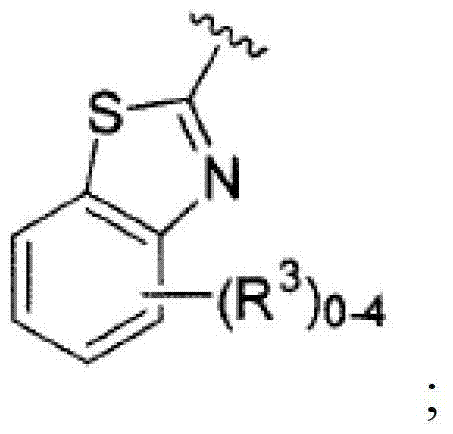
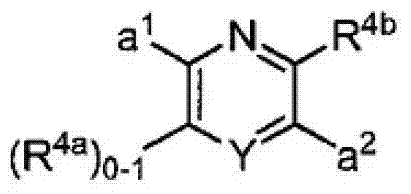
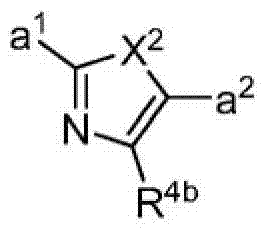
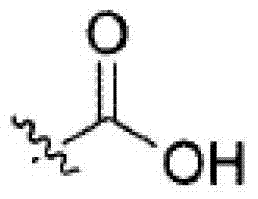

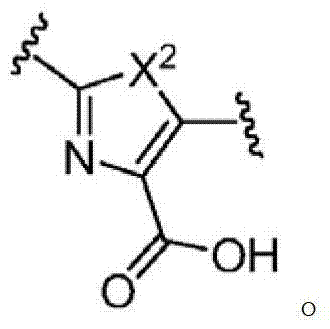
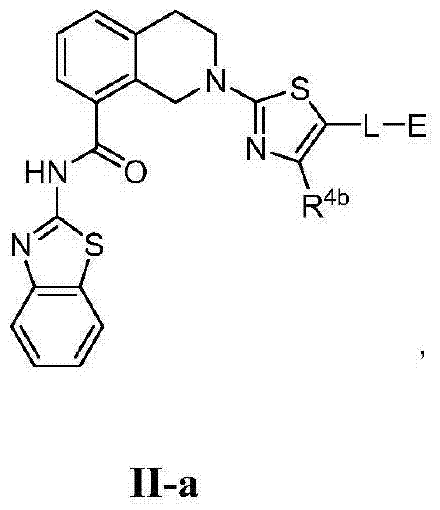
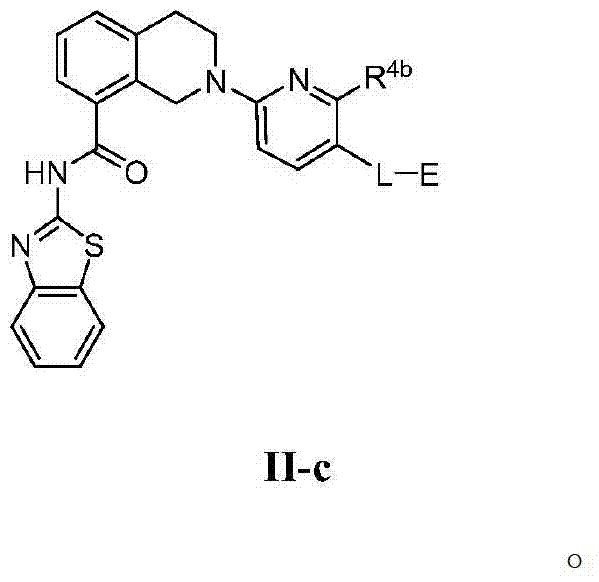
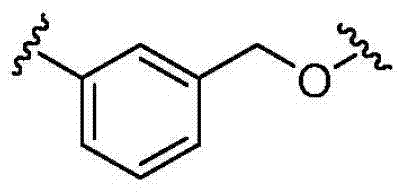
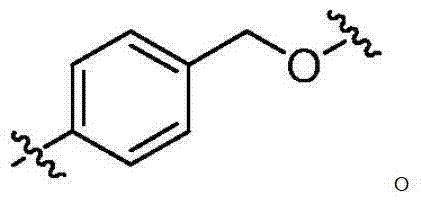
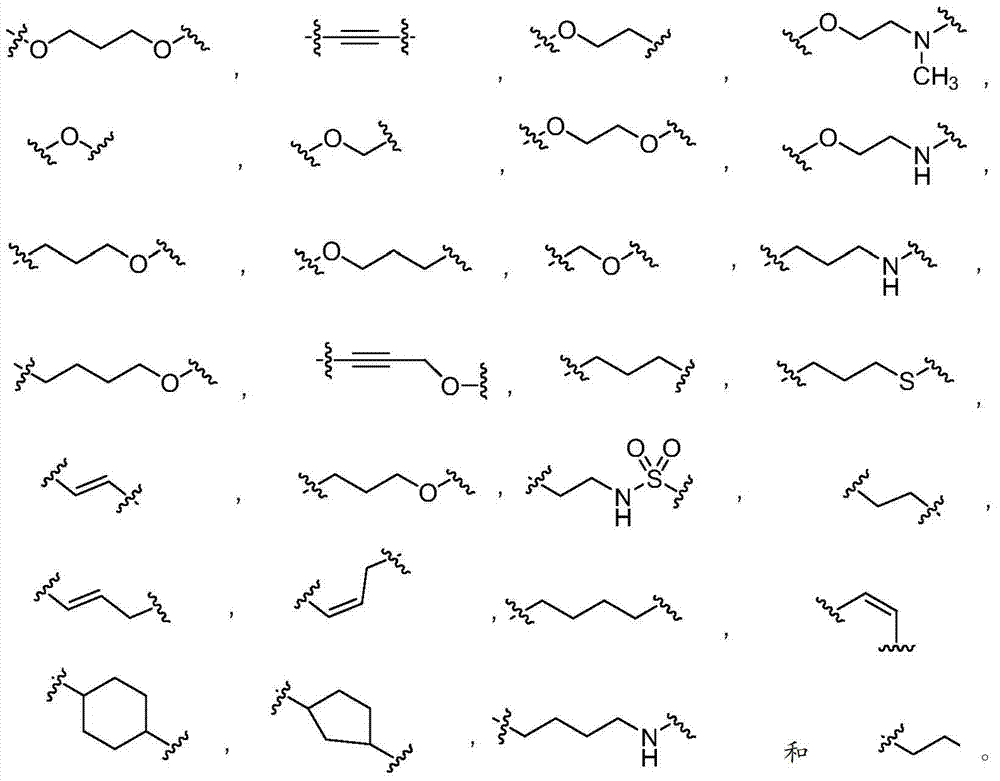
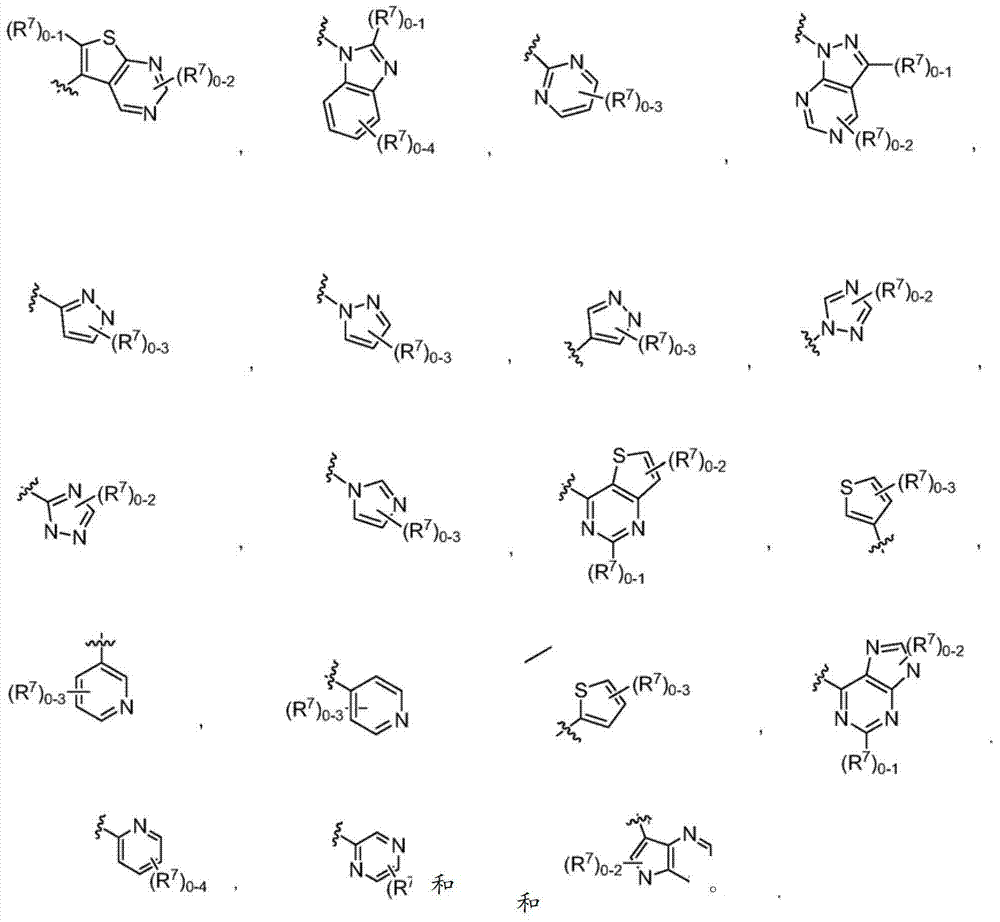
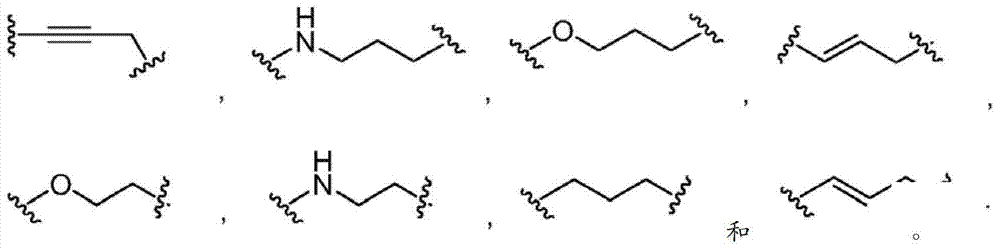

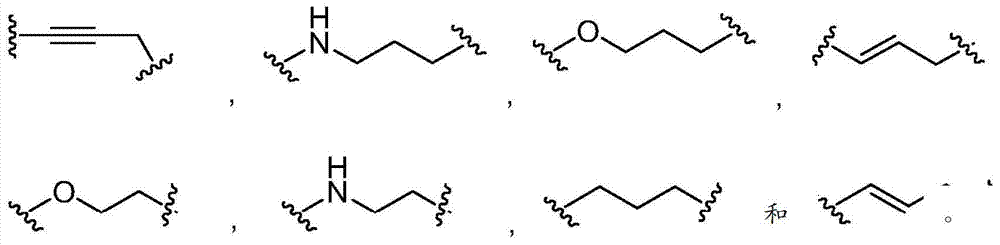
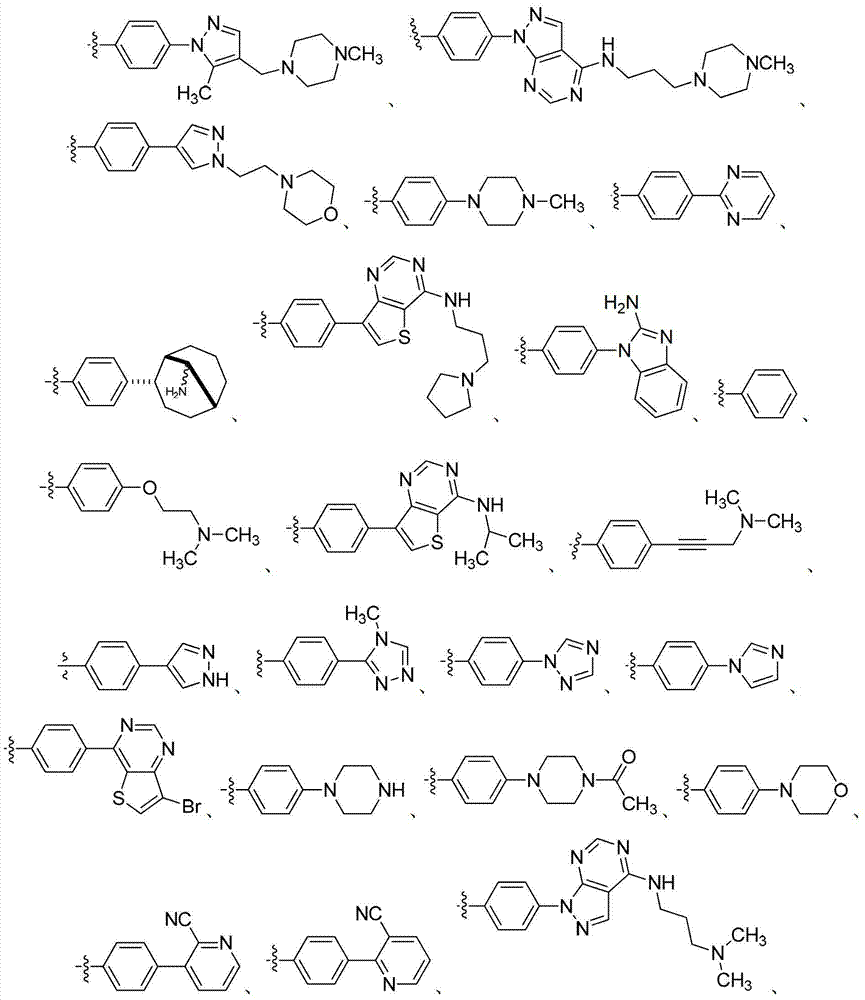
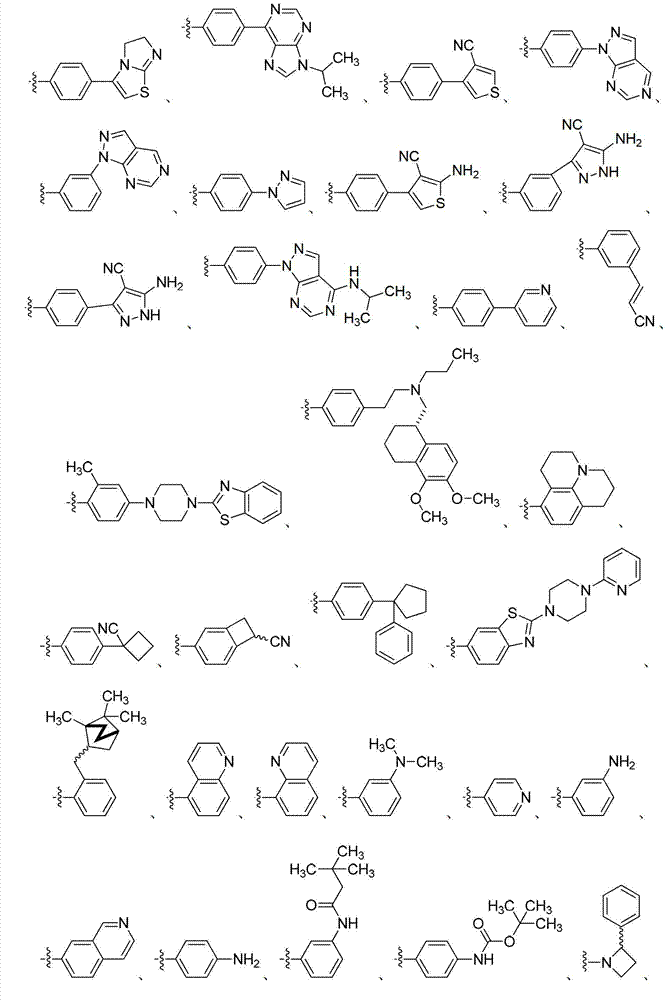
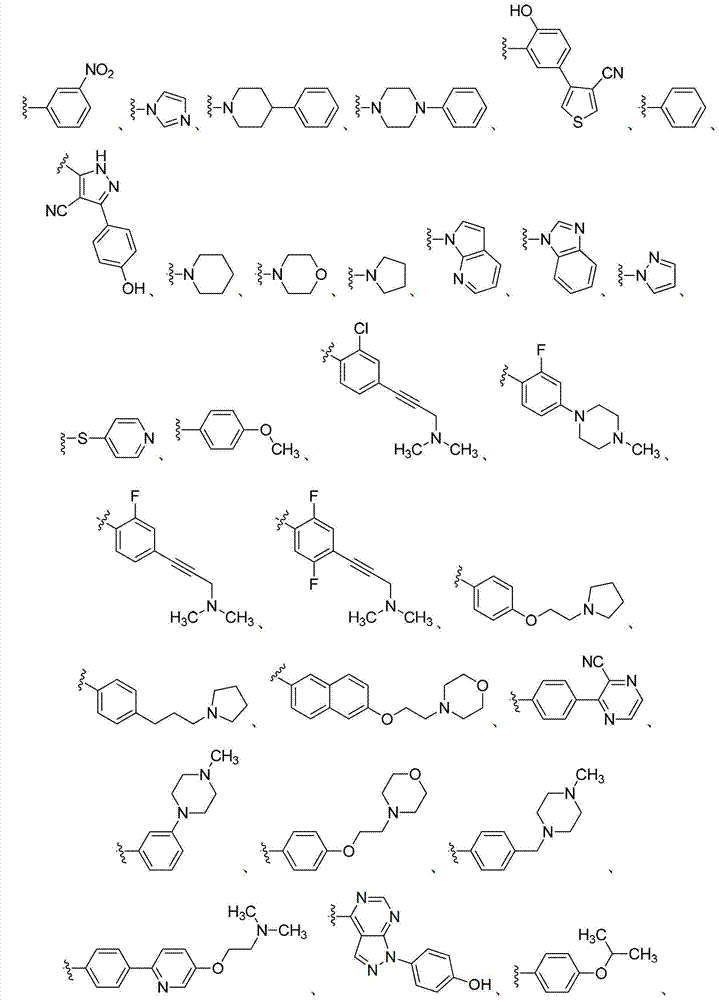


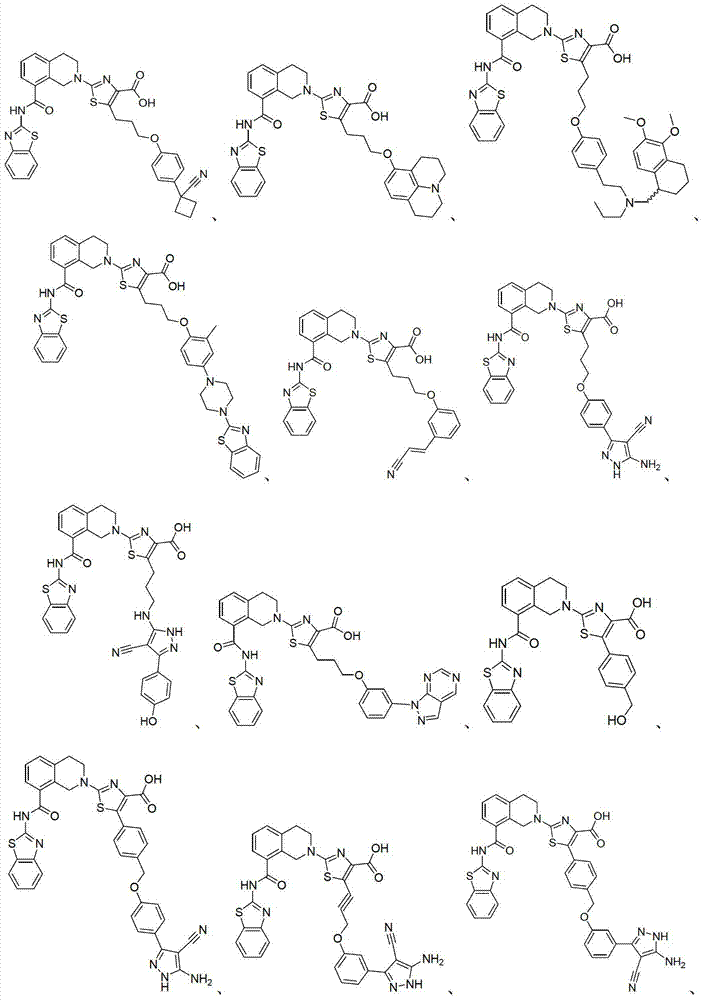

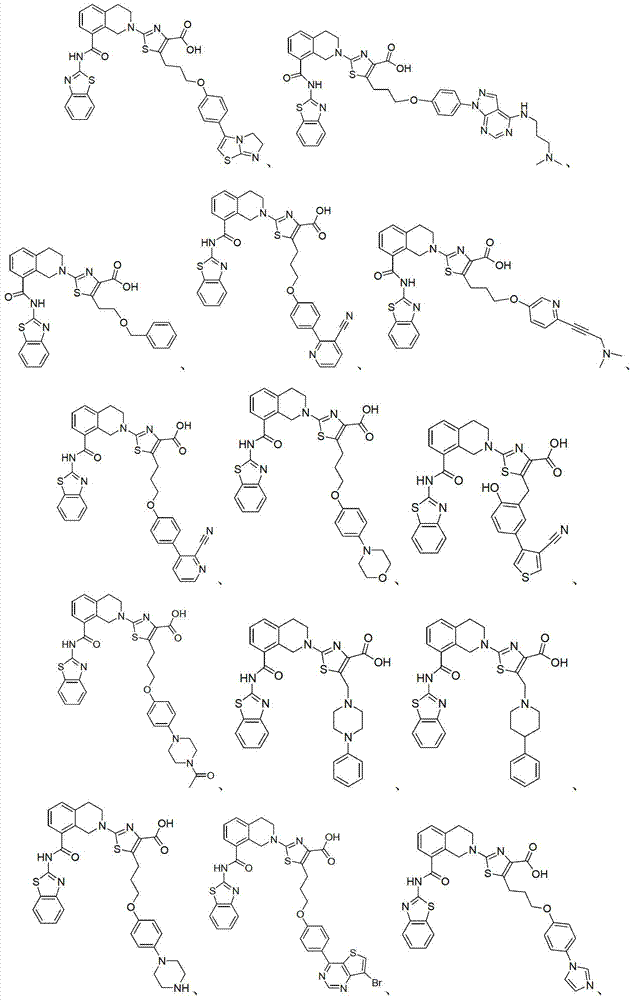

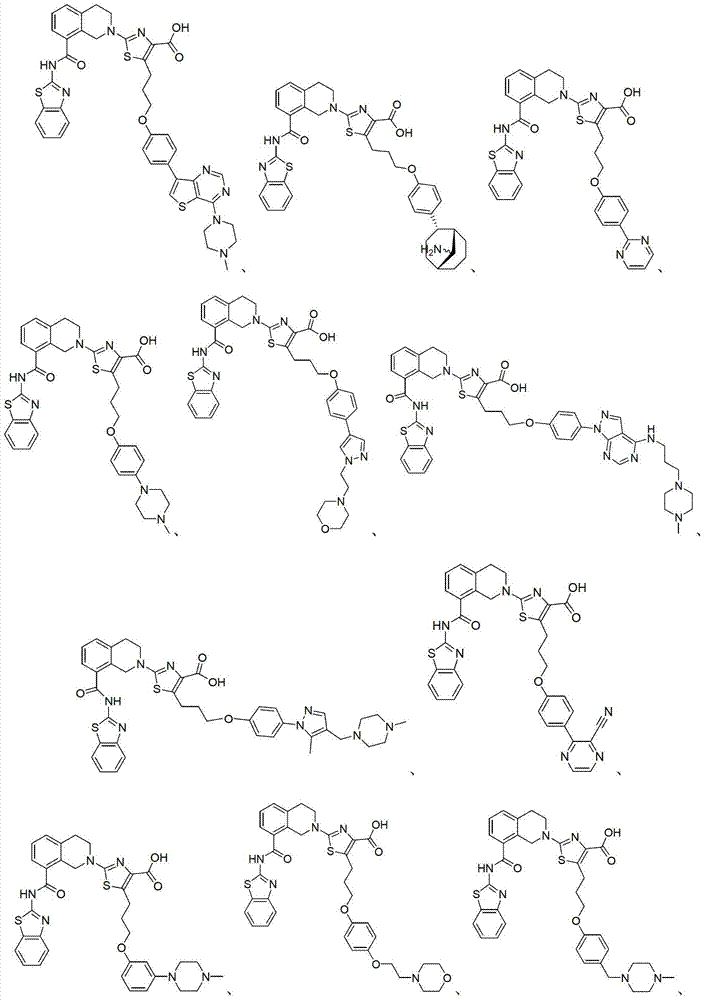
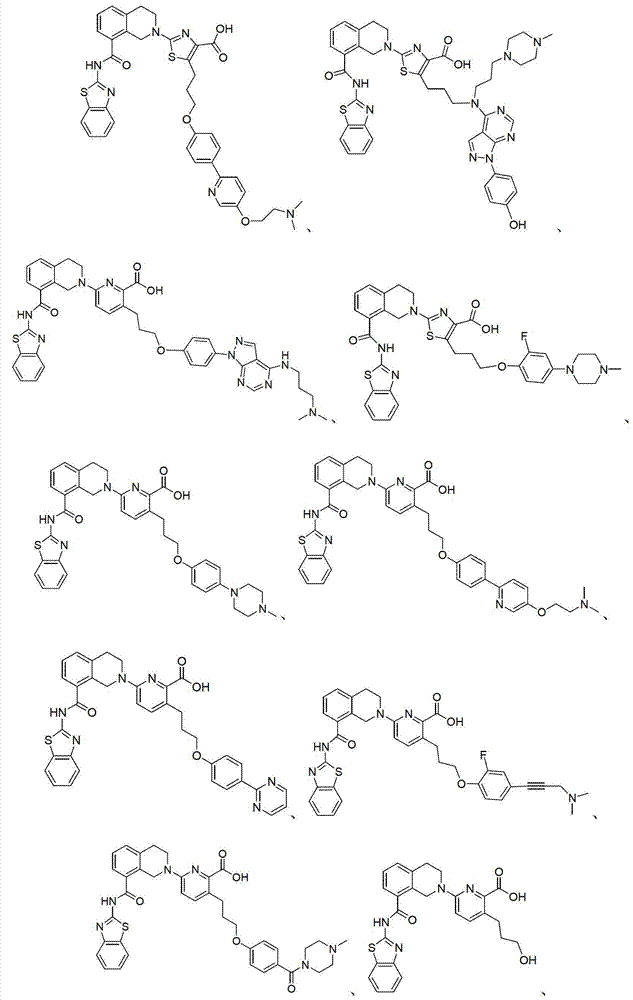
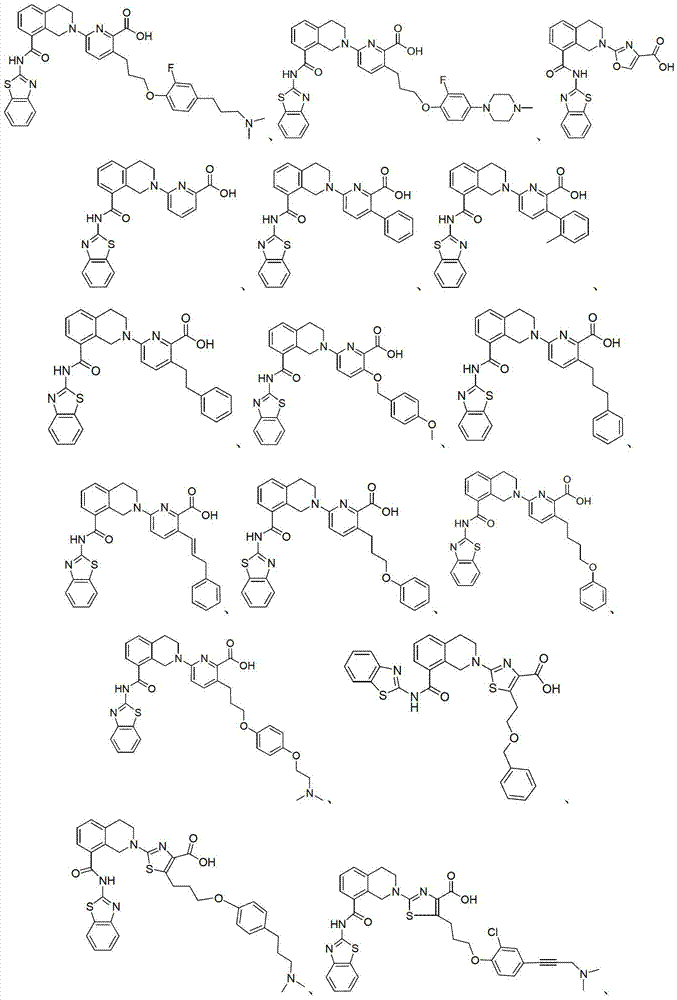
Applications Claiming Priority (3)
| Application Number | Priority Date | Filing Date | Title |
|---|---|---|---|
| US13949208P | 2008-12-19 | 2008-12-19 | |
| US61/139,492 | 2008-12-19 | ||
| PCT/US2009/068496 WO2010080503A1 (en) | 2008-12-19 | 2009-12-17 | Heterocyclic compounds and methods of use |
Publications (2)
| Publication Number | Publication Date |
|---|---|
| CN102316733A CN102316733A (en) | 2012-01-11 |
| CN102316733B true CN102316733B (en) | 2014-01-01 |
Family
ID=42316723
Family Applications (1)
| Application Number | Title | Priority Date | Filing Date |
|---|---|---|---|
| CN200980156732.7A Active CN102316733B (en) | 2008-12-19 | 2009-12-17 | Heterocyclic compounds and methods of use |
Country Status (22)
| Country | Link |
|---|---|
| US (1) | US8232273B2 (en) |
| EP (1) | EP2373163B1 (en) |
| JP (1) | JP5770102B2 (en) |
| KR (1) | KR101685718B1 (en) |
| CN (1) | CN102316733B (en) |
| AU (1) | AU2009335843A1 (en) |
| BR (1) | BRPI0918360A8 (en) |
| CA (1) | CA2747170C (en) |
| CL (1) | CL2011001485A1 (en) |
| CO (1) | CO6390075A2 (en) |
| CR (1) | CR20110388A (en) |
| DO (1) | DOP2011000199A (en) |
| EC (1) | ECSP11011213A (en) |
| ES (1) | ES2544452T3 (en) |
| IL (1) | IL213596A0 (en) |
| MX (1) | MX2011006509A (en) |
| NZ (1) | NZ593537A (en) |
| PE (1) | PE20120334A1 (en) |
| RU (1) | RU2525116C2 (en) |
| SG (1) | SG172259A1 (en) |
| WO (1) | WO2010080503A1 (en) |
| ZA (1) | ZA201104467B (en) |
Families Citing this family (90)
| Publication number | Priority date | Publication date | Assignee | Title |
|---|---|---|---|---|
| PL2134685T3 (en) | 2007-04-16 | 2016-02-29 | Abbvie Inc | 7-nonsubstituted indole derivatives as mcl-1 inhibitors |
| RU2561109C2 (en) | 2008-12-19 | 2015-08-20 | Дженентек, Инк. | Compounds and methods for using |
| US8628554B2 (en) | 2010-06-13 | 2014-01-14 | Virender K. Sharma | Intragastric device for treating obesity |
| US9526648B2 (en) | 2010-06-13 | 2016-12-27 | Synerz Medical, Inc. | Intragastric device for treating obesity |
| US10010439B2 (en) | 2010-06-13 | 2018-07-03 | Synerz Medical, Inc. | Intragastric device for treating obesity |
| US10420665B2 (en) | 2010-06-13 | 2019-09-24 | W. L. Gore & Associates, Inc. | Intragastric device for treating obesity |
| US8754114B2 (en) | 2010-12-22 | 2014-06-17 | Incyte Corporation | Substituted imidazopyridazines and benzimidazoles as inhibitors of FGFR3 |
| KR101919080B1 (en) * | 2011-05-20 | 2018-11-16 | 글락소스미스클라인 인털렉츄얼 프로퍼티 (넘버 2) 리미티드 | Novel compounds as diacylglycerol acyltransferase inhibitors |
| CN103958508B (en) * | 2011-10-14 | 2019-02-12 | 艾伯维公司 | Apoptosis inducers for the treatment of cancer and immune and autoimmune diseases |
| TWI561521B (en) * | 2011-10-14 | 2016-12-11 | Abbvie Inc | Apoptosis-inducing agents for the treatment of cancer and immune and autoimmune diseases |
| TWI571466B (en) * | 2011-10-14 | 2017-02-21 | 艾伯維有限公司 | Apoptosis-inducing agent for treating cancer and immune and autoimmune diseases |
| US8889675B2 (en) | 2011-10-14 | 2014-11-18 | Abbvie Inc. | Apoptosis-inducing agents for the treatment of cancer and immune and autoimmune diseases |
| JP5955531B2 (en) * | 2011-11-07 | 2016-07-20 | 千葉県 | Anticancer drug |
| CN107652289B (en) | 2012-06-13 | 2020-07-21 | 因塞特控股公司 | Substituted tricyclic compounds as FGFR inhibitors |
| CN103515415A (en) * | 2012-06-26 | 2014-01-15 | 群康科技(深圳)有限公司 | Lamination structure and manufacturing method thereof, and electronic device containing lamination structure |
| US9388185B2 (en) | 2012-08-10 | 2016-07-12 | Incyte Holdings Corporation | Substituted pyrrolo[2,3-b]pyrazines as FGFR inhibitors |
| JP6225187B2 (en) * | 2012-08-13 | 2017-11-01 | アッヴィ・インコーポレイテッド | Apoptosis-inducing agent |
| ES2889757T3 (en) * | 2012-09-06 | 2022-01-13 | Plexxikon Inc | Compounds and methods for the modulation of kinases and indications for these |
| MA38009B1 (en) * | 2012-10-11 | 2018-09-28 | Hoffmann La Roche | Substituted azaindoline compounds which have an inhibitory activity of the apoptosis protein for their uses in the treatment and / or prophylaxis of cancer |
| US9796729B2 (en) | 2012-11-23 | 2017-10-24 | Glaxosmithkline Llc | Compounds as diacylglycerol acyltransferase inhibitors |
| US9266892B2 (en) | 2012-12-19 | 2016-02-23 | Incyte Holdings Corporation | Fused pyrazoles as FGFR inhibitors |
| EP2970277B1 (en) | 2013-03-15 | 2021-07-28 | Knopp Biosciences LLC | Imidazo(4,5-b) pyridin-2-yl amides as kv7 channel activators |
| KR102269032B1 (en) | 2013-04-19 | 2021-06-24 | 인사이트 홀딩스 코포레이션 | Bicyclic heterocycles as fgfr inhibitors |
| FR3008975A1 (en) | 2013-07-23 | 2015-01-30 | Servier Lab | NOVEL PYRROLE DERIVATIVES, PROCESS FOR THEIR PREPARATION AND PHARMACEUTICAL COMPOSITIONS CONTAINING THEM |
| FR3008979B1 (en) * | 2013-07-23 | 2015-07-24 | Servier Lab | NOVEL PHOSPHATE DERIVATIVES, PROCESS FOR THEIR PREPARATION AND PHARMACEUTICAL COMPOSITIONS CONTAINING THEM |
| EP3669881B1 (en) | 2014-01-28 | 2022-03-30 | Buck Institute for Research on Aging | Compositions for use in the treatment of senescence-assiocated eye disease and disorders |
| EP3139942B1 (en) | 2014-05-05 | 2019-12-18 | Bioventures, Llc | COMPOSITIONS AND METHODS FOR INHIBITING ANTIAPOPTOTIC Bcl-2 PROTEINS AS ANTI-AGING AGENTS |
| US10071087B2 (en) | 2014-07-22 | 2018-09-11 | Bioventures, Llc | Compositions and methods for selectively depleting senescent cells |
| RS64708B1 (en) | 2014-09-12 | 2023-11-30 | Biohaven Therapeutics Ltd | Benzoimidazol-1,2-yl amides as kv7 channel activators |
| US10851105B2 (en) | 2014-10-22 | 2020-12-01 | Incyte Corporation | Bicyclic heterocycles as FGFR4 inhibitors |
| CA2970161A1 (en) * | 2014-12-09 | 2016-06-16 | Abbvie Inc. | Bcl-xl inhibitory compounds and antibody drug conjugates including the same |
| CN111620861A (en) * | 2014-12-09 | 2020-09-04 | 艾伯维公司 | BCL-XL inhibitory compound having low cell permeability and antibody drug conjugate including the same |
| WO2016131100A1 (en) * | 2015-02-18 | 2016-08-25 | The Walter And Eliza Hall Institute Of Medical Research | Methods of treating infectious diseases |
| PE20171514A1 (en) | 2015-02-20 | 2017-10-20 | Incyte Corp | BICYCLE HETEROCYCLES AS FGFR INHIBITORS |
| WO2016134294A1 (en) | 2015-02-20 | 2016-08-25 | Incyte Corporation | Bicyclic heterocycles as fgfr4 inhibitors |
| MA41551A (en) | 2015-02-20 | 2017-12-26 | Incyte Corp | BICYCLIC HETEROCYCLES USED AS FGFR4 INHIBITORS |
| US10195213B2 (en) | 2015-03-13 | 2019-02-05 | Unity Biotechnology, Inc. | Chemical entities that kill senescent cells for use in treating age-related disease |
| EP3285583B1 (en) * | 2015-04-20 | 2021-03-17 | The Regents of The University of Michigan | Small molecule inhibitors of mcl-1 and uses thereof |
| US10730842B2 (en) | 2015-09-03 | 2020-08-04 | Arizona Board Of Regents On Behalf Of The University Of Arizona | Small molecule inhibitors of DYRK1A and uses thereof |
| SG11201804210XA (en) * | 2015-11-20 | 2018-06-28 | Mingsight Pharmaceuticals Inc | Treatment of autoimmune disease |
| JP6936498B2 (en) | 2016-04-21 | 2021-09-15 | バイオベンチャーズ・リミテッド・ライアビリティ・カンパニーBioVentures, LLC | Compounds that induce degradation of anti-apoptotic Bcl-2 family proteins and their use |
| US10779980B2 (en) | 2016-04-27 | 2020-09-22 | Synerz Medical, Inc. | Intragastric device for treating obesity |
| EP3835322A3 (en) | 2016-06-08 | 2021-10-06 | AbbVie Inc. | Anti-b7-h3 antibodies and antibody drug conjugates |
| US11833203B2 (en) * | 2016-08-09 | 2023-12-05 | University Of Durham | Synthetic retinoids (in cell modulation) |
| US20180072718A1 (en) | 2016-09-09 | 2018-03-15 | Incyte Corporation | Pyrazolopyridine compounds and uses thereof |
| US20180072741A1 (en) | 2016-09-09 | 2018-03-15 | Incyte Corporation | Pyrazolopyrimidine compounds and uses thereof |
| ES2927104T3 (en) | 2016-09-09 | 2022-11-02 | Incyte Corp | Pyrazolopyridine derivatives as modulators of HPK1 and uses thereof for the treatment of cancer |
| WO2018092064A1 (en) * | 2016-11-18 | 2018-05-24 | Novartis Ag | Combinations of mdm2 inhibitors and bcl-xl inhibitors |
| WO2018152220A1 (en) | 2017-02-15 | 2018-08-23 | Incyte Corporation | Pyrazolopyridine compounds and uses thereof |
| AR111960A1 (en) | 2017-05-26 | 2019-09-04 | Incyte Corp | CRYSTALLINE FORMS OF A FGFR INHIBITOR AND PROCESSES FOR ITS PREPARATION |
| US10722495B2 (en) | 2017-09-08 | 2020-07-28 | Incyte Corporation | Cyanoindazole compounds and uses thereof |
| CN108186642B (en) * | 2018-01-11 | 2019-11-08 | 广西师范大学 | A pharmaceutical composition for synergistically treating lung cancer |
| JP7385284B2 (en) | 2018-01-22 | 2023-11-22 | バイオベンチャーズ・リミテッド・ライアビリティ・カンパニー | BCL-2 proteolytic agents for cancer treatment |
| US10745388B2 (en) | 2018-02-20 | 2020-08-18 | Incyte Corporation | Indazole compounds and uses thereof |
| LT3755703T (en) | 2018-02-20 | 2022-10-10 | Incyte Corporation | N-(PHENYL)-2-(PHENYL)PYRIMIDINE-4-CARBOXAMIDE DERIVATIVES AND RELATED COMPOUNDS AS HPK1 INHIBITORS FOR THE TREATMENT OF CANCER |
| WO2019164847A1 (en) | 2018-02-20 | 2019-08-29 | Incyte Corporation | Indazole compounds and uses thereof |
| US12528810B2 (en) | 2018-03-01 | 2026-01-20 | Arizona Board Of Regents On Behalf Of The University Of Arizona | Small molecule inhibitors of DYRK/CLK and uses thereof |
| BR112020018933A2 (en) | 2018-03-19 | 2020-12-29 | Knopp Biosciences Llc | COMPOUND, PHARMACEUTICAL COMPOSITION, METHOD OF TREATING A DISORDER ASSOCIATED WITH KV7 AND METHOD OF TREATING A DISORDER ASSOCIATED WITH A KCNQ2 MUTATION |
| US11299473B2 (en) | 2018-04-13 | 2022-04-12 | Incyte Corporation | Benzimidazole and indole compounds and uses thereof |
| SG11202010636VA (en) | 2018-05-04 | 2020-11-27 | Incyte Corp | Solid forms of an fgfr inhibitor and processes for preparing the same |
| BR112020022373A2 (en) | 2018-05-04 | 2021-02-02 | Incyte Corporation | salts of a fgfr inhibitor |
| WO2019221755A1 (en) | 2018-05-18 | 2019-11-21 | Bioventures, Llc | Piperlongumine analogues and uses thereof |
| US10899755B2 (en) | 2018-08-08 | 2021-01-26 | Incyte Corporation | Benzothiazole compounds and uses thereof |
| US11111247B2 (en) | 2018-09-25 | 2021-09-07 | Incyte Corporation | Pyrazolopyrimidine compounds and uses thereof |
| WO2020185532A1 (en) | 2019-03-08 | 2020-09-17 | Incyte Corporation | Methods of treating cancer with an fgfr inhibitor |
| WO2021007269A1 (en) | 2019-07-09 | 2021-01-14 | Incyte Corporation | Bicyclic heterocycles as fgfr inhibitors |
| AR119494A1 (en) * | 2019-07-29 | 2021-12-22 | Servier Lab | 6,7-DIHYDRO-5H-PYRIDO[2,3-c]PYRIDAZIN-8-YL DERIVATIVES, PHARMACEUTICAL COMPOSITIONS CONTAINING THEM AND THEIR USES AS PROAPOPTOTIC AGENTS |
| AU2020326703A1 (en) | 2019-08-06 | 2022-02-17 | Incyte Corporation | Solid forms of an HPK1 inhibitor |
| WO2021067374A1 (en) | 2019-10-01 | 2021-04-08 | Incyte Corporation | Bicyclic heterocycles as fgfr inhibitors |
| WO2021076602A1 (en) | 2019-10-14 | 2021-04-22 | Incyte Corporation | Bicyclic heterocycles as fgfr inhibitors |
| WO2021076728A1 (en) | 2019-10-16 | 2021-04-22 | Incyte Corporation | Bicyclic heterocycles as fgfr inhibitors |
| CN115151539A (en) | 2019-12-04 | 2022-10-04 | 因赛特公司 | Derivatives of FGFR Inhibitors |
| JP7720840B2 (en) | 2019-12-04 | 2025-08-08 | インサイト・コーポレイション | Tricyclic heterocycles as FGFR inhibitors |
| WO2021146424A1 (en) | 2020-01-15 | 2021-07-22 | Incyte Corporation | Bicyclic heterocycles as fgfr inhibitors |
| CN112079791A (en) * | 2020-08-21 | 2020-12-15 | 宁夏农林科学院农业资源与环境研究所(宁夏土壤与植物营养重点实验室) | Monocyclic beta-lactam antibiotic side chain acid and ester thereof, preparation method and application thereof |
| US20240269304A1 (en) | 2020-11-24 | 2024-08-15 | Novartis Ag | Bcl-xl inhibitor antibody-drug conjugates and methods of use thereof |
| AR124681A1 (en) | 2021-01-20 | 2023-04-26 | Abbvie Inc | ANTI-EGFR ANTIBODY-DRUG CONJUGATES |
| US20240376094A2 (en) | 2021-02-02 | 2024-11-14 | Les Laboratoires Servier | Selective bcl-xl protac compounds and methods of use |
| US12065494B2 (en) | 2021-04-12 | 2024-08-20 | Incyte Corporation | Combination therapy comprising an FGFR inhibitor and a Nectin-4 targeting agent |
| KR102605163B1 (en) * | 2021-06-01 | 2023-11-23 | 연세대학교 산학협력단 | Composition for preventing or treating brain cancer |
| AR126102A1 (en) | 2021-06-09 | 2023-09-13 | Incyte Corp | TRICYCLIC HETEROCYCLES AS FGFR INHIBITORS |
| CA3220155A1 (en) | 2021-06-09 | 2022-12-15 | Incyte Corporation | Tricyclic heterocycles as fgfr inhibitors |
| CN114294905B (en) * | 2021-11-19 | 2023-04-25 | 中粮生物科技股份有限公司 | Method for drying polyhydroxyalkanoate by infrared or microwave |
| CA3256012A1 (en) | 2022-05-20 | 2023-11-23 | Les Laboratoires Servier | Met bcl-xl inhibitor antibody-drug conjugates and methods of use thereof |
| KR20250027281A (en) | 2022-05-20 | 2025-02-25 | 노파르티스 아게 | EPHA2 BCL-XL inhibitor antibody-drug conjugates and methods of use thereof |
| PE20251072A1 (en) | 2022-05-20 | 2025-04-10 | Novartis Ag | Antibody-drug conjugates of antineoplastic compounds and methods of using them |
| EP4574175A1 (en) * | 2022-08-19 | 2025-06-25 | Beijing Suncell Bio-Medical Co., Ltd. | Prodrug for anti-aging related diseases and use method therefor |
| TW202540185A (en) | 2023-11-22 | 2025-10-16 | 法商施維雅藥廠 | Anti-cd74 antibody-drug conjugates and methods of use thereof |
| WO2025111431A1 (en) | 2023-11-22 | 2025-05-30 | Les Laboratoires Servier | Anti-cd7 antibody-drug conjugates and methods of use thereof |
| TW202527945A (en) * | 2023-12-18 | 2025-07-16 | 大陸商南京瑞初醫藥有限公司 | Nitrogen heterocyclic compounds and their applications |
Citations (5)
| Publication number | Priority date | Publication date | Assignee | Title |
|---|---|---|---|---|
| US20040077643A1 (en) * | 2000-08-01 | 2004-04-22 | Mikio Ogawa | 3,4 Dihydroisoquinoline derivative compounds and drugs containing these compounds as the active ingredient |
| US20050124614A1 (en) * | 2002-07-03 | 2005-06-09 | Axys Pharmaceuticals, Inc. | 3,4-Dihydroisoquinolin-1-one derivatives as inducers of apoptosis |
| US20060217448A1 (en) * | 2005-03-24 | 2006-09-28 | Kelly Michael G | Bicycloheteroaryl compounds as P2X7 modulators and uses thereof |
| US20070054892A1 (en) * | 2003-09-23 | 2007-03-08 | Richard Isaacs | Isoquinoline potassium channel inhibitors |
| US20070173506A1 (en) * | 2006-01-18 | 2007-07-26 | Amgen Inc. | Thiazole compounds and methods of use |
Family Cites Families (12)
| Publication number | Priority date | Publication date | Assignee | Title |
|---|---|---|---|---|
| DE3718570A1 (en) * | 1987-06-03 | 1988-12-15 | Boehringer Ingelheim Kg | Benzo- and thieno-3,4-dihydro-1-pyridinylacetic acid derivatives, process for their preparation, and medicaments containing these compounds |
| AU2001249399A1 (en) | 2000-03-24 | 2001-10-08 | Cor Therapeutics, Inc. | Isoquinolone inhibitors of factor xa |
| US7767684B2 (en) * | 2003-11-13 | 2010-08-03 | Abbott Laboratories | Apoptosis promoters |
| US7541357B2 (en) * | 2004-07-15 | 2009-06-02 | Amr Technology, Inc. | Aryl- and heteroaryl-substituted tetrahydroisoquinolines and use thereof to block reuptake of norepinephrine, dopamine, and serotonin |
| JP4968860B2 (en) * | 2006-10-31 | 2012-07-04 | シェーリング コーポレイション | Anilinopiperazine derivatives and methods using anilinopiperazine derivatives |
| ES2387471T3 (en) * | 2006-12-20 | 2012-09-24 | Amgen Inc. | Heterocyclic compounds and their use in the treatment of inflammation, angiogenesis and cancer |
| CA2682162C (en) * | 2007-04-02 | 2016-05-10 | Renovis, Inc. | Pyrid-2-yl fused heterocyclic compounds, and compositions and uses thereof |
| EP3243814B1 (en) * | 2007-04-16 | 2018-10-17 | AbbVie Inc. | 7-substituted indole as mcl-1 inhibitors |
| PL2134685T3 (en) * | 2007-04-16 | 2016-02-29 | Abbvie Inc | 7-nonsubstituted indole derivatives as mcl-1 inhibitors |
| NZ582708A (en) * | 2007-07-19 | 2012-04-27 | Schering Corp | Heterocyclic amide compounds as protein kinase inhibitors |
| EP2193127A4 (en) | 2007-09-27 | 2011-09-14 | Inst Medical W & E Hall | benzothiazole |
| RU2561109C2 (en) * | 2008-12-19 | 2015-08-20 | Дженентек, Инк. | Compounds and methods for using |
-
2009
- 2009-12-17 CN CN200980156732.7A patent/CN102316733B/en active Active
- 2009-12-17 AU AU2009335843A patent/AU2009335843A1/en not_active Abandoned
- 2009-12-17 CA CA2747170A patent/CA2747170C/en not_active Expired - Fee Related
- 2009-12-17 SG SG2011044856A patent/SG172259A1/en unknown
- 2009-12-17 MX MX2011006509A patent/MX2011006509A/en active IP Right Grant
- 2009-12-17 PE PE2011001254A patent/PE20120334A1/en not_active Application Discontinuation
- 2009-12-17 RU RU2011129776/04A patent/RU2525116C2/en active
- 2009-12-17 JP JP2011542439A patent/JP5770102B2/en active Active
- 2009-12-17 EP EP09837920.9A patent/EP2373163B1/en active Active
- 2009-12-17 ES ES09837920.9T patent/ES2544452T3/en active Active
- 2009-12-17 US US12/641,141 patent/US8232273B2/en active Active
- 2009-12-17 WO PCT/US2009/068496 patent/WO2010080503A1/en not_active Ceased
- 2009-12-17 KR KR1020117016722A patent/KR101685718B1/en not_active Expired - Fee Related
- 2009-12-17 BR BRPI0918360A patent/BRPI0918360A8/en not_active Application Discontinuation
- 2009-12-17 NZ NZ593537A patent/NZ593537A/en not_active IP Right Cessation
-
2011
- 2011-06-15 ZA ZA2011/04467A patent/ZA201104467B/en unknown
- 2011-06-16 IL IL213596A patent/IL213596A0/en unknown
- 2011-06-17 CL CL2011001485A patent/CL2011001485A1/en unknown
- 2011-06-20 DO DO2011000199A patent/DOP2011000199A/en unknown
- 2011-07-06 CO CO11084232A patent/CO6390075A2/en active IP Right Grant
- 2011-07-18 CR CR20110388A patent/CR20110388A/en unknown
- 2011-07-18 EC EC2011011213A patent/ECSP11011213A/en unknown
Patent Citations (5)
| Publication number | Priority date | Publication date | Assignee | Title |
|---|---|---|---|---|
| US20040077643A1 (en) * | 2000-08-01 | 2004-04-22 | Mikio Ogawa | 3,4 Dihydroisoquinoline derivative compounds and drugs containing these compounds as the active ingredient |
| US20050124614A1 (en) * | 2002-07-03 | 2005-06-09 | Axys Pharmaceuticals, Inc. | 3,4-Dihydroisoquinolin-1-one derivatives as inducers of apoptosis |
| US20070054892A1 (en) * | 2003-09-23 | 2007-03-08 | Richard Isaacs | Isoquinoline potassium channel inhibitors |
| US20060217448A1 (en) * | 2005-03-24 | 2006-09-28 | Kelly Michael G | Bicycloheteroaryl compounds as P2X7 modulators and uses thereof |
| US20070173506A1 (en) * | 2006-01-18 | 2007-07-26 | Amgen Inc. | Thiazole compounds and methods of use |
Also Published As
| Publication number | Publication date |
|---|---|
| KR20110102473A (en) | 2011-09-16 |
| NZ593537A (en) | 2013-07-26 |
| CR20110388A (en) | 2011-09-09 |
| CL2011001485A1 (en) | 2012-02-24 |
| PE20120334A1 (en) | 2012-04-16 |
| RU2011129776A (en) | 2013-01-27 |
| BRPI0918360A8 (en) | 2017-12-05 |
| AU2009335843A1 (en) | 2011-07-21 |
| CN102316733A (en) | 2012-01-11 |
| SG172259A1 (en) | 2011-07-28 |
| CO6390075A2 (en) | 2012-02-29 |
| CA2747170A1 (en) | 2010-07-15 |
| IL213596A0 (en) | 2011-07-31 |
| MX2011006509A (en) | 2011-10-19 |
| ES2544452T3 (en) | 2015-08-31 |
| WO2010080503A1 (en) | 2010-07-15 |
| ECSP11011213A (en) | 2011-09-30 |
| BRPI0918360A2 (en) | 2017-10-10 |
| EP2373163A4 (en) | 2012-10-24 |
| US8232273B2 (en) | 2012-07-31 |
| EP2373163B1 (en) | 2015-06-10 |
| DOP2011000199A (en) | 2011-10-15 |
| KR101685718B1 (en) | 2016-12-12 |
| JP2012512891A (en) | 2012-06-07 |
| JP5770102B2 (en) | 2015-08-26 |
| US20100210622A1 (en) | 2010-08-19 |
| EP2373163A1 (en) | 2011-10-12 |
| ZA201104467B (en) | 2012-10-31 |
| CA2747170C (en) | 2017-07-18 |
| RU2525116C2 (en) | 2014-08-10 |
Similar Documents
| Publication | Publication Date | Title |
|---|---|---|
| CN102316733B (en) | Heterocyclic compounds and methods of use | |
| CN102325531B (en) | Compounds and methods of use | |
| US8293738B2 (en) | Indazole inhibitors of kinase | |
| US9181239B2 (en) | Pyridopyrimidinone inhibitors of kinases | |
| CN104271576A (en) | pyridopyrimidinone inhibitors of kinases | |
| TW201026706A (en) | Kinase inhibitors with improved CYP safety profile | |
| TW201713645A (en) | Specific protein kinase inhibitor | |
| CN103443102A (en) | Bicyclic carboxamide inhibitors of kinases | |
| HK1161094B (en) | Compounds and methods of use |
Legal Events
| Date | Code | Title | Description |
|---|---|---|---|
| C06 | Publication | ||
| PB01 | Publication | ||
| C10 | Entry into substantive examination | ||
| SE01 | Entry into force of request for substantive examination | ||
| ASS | Succession or assignment of patent right |
Owner name: INST MEDICAL W. + E. HALL ABBVIE CORP. Free format text: FORMER OWNER: INST MEDICAL W. + E. HALL ABBOTT GMBH. + CO. KG Effective date: 20131204 |
|
| C41 | Transfer of patent application or patent right or utility model | ||
| TA01 | Transfer of patent application right |
Effective date of registration: 20131204 Address after: American California Applicant after: Genentech Inc. Applicant after: Inst Medical W. & E. Hall Applicant after: AbbVie Corp. Address before: American California Applicant before: Genentech Inc. Applicant before: Inst Medical W. & E. Hall Applicant before: Abbott GmbH. & Co. Kg |
|
| C14 | Grant of patent or utility model | ||
| GR01 | Patent grant |