WO2025072419A1 - Crosslinked alpha-glucan derivatives - Google Patents
Crosslinked alpha-glucan derivatives Download PDFInfo
- Publication number
- WO2025072419A1 WO2025072419A1 PCT/US2024/048530 US2024048530W WO2025072419A1 WO 2025072419 A1 WO2025072419 A1 WO 2025072419A1 US 2024048530 W US2024048530 W US 2024048530W WO 2025072419 A1 WO2025072419 A1 WO 2025072419A1
- Authority
- WO
- WIPO (PCT)
- Prior art keywords
- alpha
- composition
- glucan
- glucan derivative
- crosslinked
- Prior art date
- Legal status (The legal status is an assumption and is not a legal conclusion. Google has not performed a legal analysis and makes no representation as to the accuracy of the status listed.)
- Pending
Links
Classifications
-
- C—CHEMISTRY; METALLURGY
- C08—ORGANIC MACROMOLECULAR COMPOUNDS; THEIR PREPARATION OR CHEMICAL WORKING-UP; COMPOSITIONS BASED THEREON
- C08B—POLYSACCHARIDES; DERIVATIVES THEREOF
- C08B37/00—Preparation of polysaccharides not provided for in groups C08B1/00 - C08B35/00; Derivatives thereof
- C08B37/0006—Homoglycans, i.e. polysaccharides having a main chain consisting of one single sugar, e.g. colominic acid
- C08B37/0009—Homoglycans, i.e. polysaccharides having a main chain consisting of one single sugar, e.g. colominic acid alpha-D-Glucans, e.g. polydextrose, alternan, glycogen; (alpha-1,4)(alpha-1,6)-D-Glucans; (alpha-1,3)(alpha-1,4)-D-Glucans, e.g. isolichenan or nigeran; (alpha-1,4)-D-Glucans; (alpha-1,3)-D-Glucans, e.g. pseudonigeran; Derivatives thereof
-
- C—CHEMISTRY; METALLURGY
- C11—ANIMAL OR VEGETABLE OILS, FATS, FATTY SUBSTANCES OR WAXES; FATTY ACIDS THEREFROM; DETERGENTS; CANDLES
- C11D—DETERGENT COMPOSITIONS; USE OF SINGLE SUBSTANCES AS DETERGENTS; SOAP OR SOAP-MAKING; RESIN SOAPS; RECOVERY OF GLYCEROL
- C11D3/00—Other compounding ingredients of detergent compositions covered in group C11D1/00
- C11D3/16—Organic compounds
- C11D3/20—Organic compounds containing oxygen
- C11D3/22—Carbohydrates or derivatives thereof
- C11D3/222—Natural or synthetic polysaccharides, e.g. cellulose, starch, gum, alginic acid or cyclodextrin
Definitions
- Hardwater cations such as Ca 2+ and Mg 2+ can crystalize with carbonate and form insoluble salts that form deposits (also known as scaling) on surfaces such as dishware or appliance internal components (e.g., pipes, sprayers). Hardwater cations also play a role in soap scum formation.
- Bio-based ingredients such as sodium citrate, methylglycinediacetic acid trisodium salt (MGDA), and L-glutamic acid-N,N-diacetic acid (GLDA) can help prevent these unwanted deposits by sequestering hardwater cations and keeping them in solution. However, none of these ingredients are sufficient at preventing hardwater surface deposits after repetitive washing steps.
- the present disclosure concerns a composition/product comprising a crosslinked alpha-glucan derivative, wherein the crosslinked alpha-glucan derivative is produced by contacting ethylene glycol diglycidyl ether (EGDE) with a first alpha-glucan derivative, thereby crosslinking the first alpha-glucan derivative, wherein the ratio of the EGDE to the first alpha-glucan derivative is about 0.03 to 0.07 mole EGDE to about 1 mole first alpha-glucan derivative.
- EGDE ethylene glycol diglycidyl ether
- the present disclosure concerns a method of washing or treating a hard surface, the method comprising: (a) contacting the hard surface with a washing/treating composition that comprises a crosslinked alpha-glucan derivative as presently disclosed, and (b) removing all of, or a portion of, the washing/treating composition from the hard surface; thereby washing or treating the hard surface, wherein the washed/treated hard surface has reduced filming, spotting, haze, or other deposition, optionally wherein the hard surface is that of glass, plastic, ceramic, porcelain, metal, or stone.
- the present disclosure concerns a method of producing a crosslinked alpha-glucan derivative as presently disclosed, the method comprising: (a) contacting EGDE with a first alpha-glucan derivative (the first alpha-glucan derivative typically has already been derivatized herein, such as by etherification, sulfonation, or oxidation), thereby crosslinking the first alpha-glucan derivative, wherein the ratio of the EGDE to the first alpha-glucan derivative is about 0.03 to 0.07 mole EGDE to about 1 mole first alpha-glucan derivative, and (b) optionally isolating the crosslinked alpha- glucan derivative produced in step (a).
- FIG.1 Effect of using crosslinked alpha-1,3-glucan anionic derivatives on scale deposition in a simulated automatic dishwashing study.
- FIG.2 Effect of using crosslinked alpha-1,3-glucan anionic derivatives on scale deposition in a simulated automatic dishwashing study. Effects of increasing levels of crosslinking on the same CMG material (DoS 0.54-0.56) were examined.
- FIG.3 Effect of using carboxymethylated cellulose (CMC) (not crosslinked) on scale deposition in a simulated automatic dishwashing study. Effects of increasing molecular weight were examined. Refer to Example 1.
- CMC carboxymethylated cellulose
- FIG.4 Effect of using non-crosslinked alpha-1,3-glucan anionic derivatives on scale deposition in a simulated automatic dishwashing study. Effects of increasing levels of anionic charge of the derivatives were examined.
- FIG.5 Effect of using alpha-1,3-glucan anionic derivatives crosslinked with alternative crosslinkers (aside from EGDE) on scale deposition in a simulated automatic dishwashing study.
- FIG.6 Effect of using derivatives of alpha-1,2-branched alpha-1,6-glucan (not crosslinked) on scale deposition in a simulated automatic dishwashing study. Refer to Example 1.
- FIG.7 Effect of using carboxymethyl benzyl alpha-1,3-glucan ether derivative (not crosslinked) on scale deposition in a simulated automatic dishwashing study.
- FIG.8 Effect of using sulfonated alpha-1,3-glucan derivative (not crosslinked) on scale deposition in a simulated automatic dishwashing study.
- FIG.9 Results of transmittance testing on demineralized (demi) water.
- FIG.10 Results of transmittance testing on liquid containing ACUSOL 588 (long).
- FIG.11 Results of transmittance testing on liquid containing ACUSOL 588.
- FIG.12 Results of transmittance testing on liquid containing OPE 98 compound (an EGDE-crosslinked carboxymethylated alpha-1,3-glucan product).
- FIG.13 Results of transmittance testing on liquid containing I compound (a carboxymethylated alpha-1,2-branched alpha-1,6-glucan product).
- FIG.14 Results of automatic dishwashing test on MEPAL tubes.
- FIG.15 Results of automatic dishwashing test on melamine plates.
- FIG.16 Results of automatic dishwashing test on drinking glasses.
- FIG.17 Effect of polymer concentration on relative viscosity of crosslinked CMG (DoS 0.46) in comparison with synthetic carbomer (ULTREZ 30) and natural gum (xanthan).
- FIG.18 Effect of crosslinked CMG (DoS 0.46), at concentration 1% w/v, on relative viscosity stability upon increasing salt content (0.1% to 4% w/v) in comparison with synthetic carbomer (Ultrez 30).
- FIGs.19A-19D Rheological curves showing the variation of viscosity as function of shear rate for crosslinked CMG (FIG.19C, DoS 0.46; FIG.19D, DoS 0.48) at concentrations ranging from 0.25% to 2% w/v in comparison with carbomer (FIG.19A, ULTREZ 30; FIG.19B, ULTREZ 10).
- DoS 0.46 crosslinked CMG
- FIG.19A-19D Rheological curves showing the variation of viscosity as function of shear rate for crosslinked CMG (FIG.19C, DoS 0.46; FIG.19D, DoS 0.48) at concentrations ranging from 0.25% to 2% w/v in comparison with carbomer (FIG.19A,
- FIGs.20 and 21 Rheological profiles (FIG.20) and yield stress ranges (FIG.21) of aqueous dispersions of crosslinked CMG (DoS 0.4-0.5) or carbomer (highlighted with a star in each figure).
- FIG.22 Variation in the yield stress of crosslinked CMG at 0.5% w/v in aqueous dispersions as function of increase in carboxymethyl group DoS. Data collected at standardized pH of 6.5 from oscillatory sweep rheology curves. Refer to Example 2.
- FIG.23 Optical microscopy imaging (20X magnification) of polymer-stabilized O/W emulsions (0.5% polymer content) at ten-fold dilution in water, showing differences in droplet size and distribution.
- FIGs.24A-24B Rheological behavior of polymer-stabilized O/W emulsions containing crosslinked CMG of different DoS and concentrations (0.5% w/v, FIG.24A; 0.25% w/v, FIG.24B), compared to carbomer (ULTREZ 30) at 0.5% w/v (highlighted with a star in each figure).
- ULTREZ 30 carbomer
- polysaccharide means a polymeric carbohydrate molecule composed of long chains of monosaccharide units bound together by glycosidic linkages and on hydrolysis gives the polysaccharide’s constituent monosaccharides and/or oligosaccharides.
- a polysaccharide herein can be linear or branched, and/or can be a homopolysaccharide (comprised of only one type of constituent monosaccharide) or heteropolysaccharide (comprised of two or more different constituent monosaccharides). Examples of polysaccharides herein include alpha-glucan (polyglucose).
- a “glucan” herein is a type of polysaccharide that is a polymer of glucose (polyglucose).
- a glucan can be comprised of, for example, about, or at least about, 90%, 91%, 92%, 93%, 94%, 95%, 96%, 97%, 98%, 99%, or 100% by weight glucose monomeric units.
- Examples of glucans herein are alpha-glucan and beta-glucan.
- the terms “alpha-glucan”, “alpha-glucan polymer” and the like are used interchangeably herein.
- An alpha-glucan is a polymer comprising glucose monomeric units linked together by alpha-glycosidic linkages.
- the glycosidic linkages of an alpha-glucan herein are about, or at least about, 80%, 81%, 82%, 83%, 84%, 85%, 86%, 87%, 88%, 89%, 90%, 91%, 92%, 93%, 94%, 95%, 96%, 97%, 98%, 99%, or 100% alpha-glycosidic linkages.
- alpha-glucan polymers herein include alpha-1,3-glucan, alpha-1,4-glucan, and alpha-1,6-glucan.
- saccharide and other like terms herein refer to monosaccharides and/or disaccharides/oligosaccharides, unless otherwise noted.
- a “disaccharide” herein refers to a carbohydrate having two monosaccharides joined by a glycosidic linkage.
- An “oligosaccharide” herein can refer to a carbohydrate having 3 to 15 monosaccharides, for example, joined by glycosidic linkages.
- An oligosaccharide can also be referred to as an “oligomer”.
- Monosaccharides e.g., glucose and/or fructose
- monosaccharides comprised within disaccharides/oligosaccharides can be referred to as “monomeric units”, “monosaccharide units”, or other like terms.
- Alpha-1,3-glucan is an alpha- glucan comprising glucose monomeric units linked together by glycosidic linkages, wherein at least about 50% of the glycosidic linkages are alpha-1,3.
- Alpha-1,3-glucan in some aspects comprises about, or at least about, 90%, 95%, or 100% alpha-1,3 glycosidic linkages.
- Most or all of the other linkages, if present, in alpha-1,3-glucan herein typically are alpha-1,6, though some linkages may also be alpha-1,2 and/or alpha-1,4.
- Alpha-1,3-glucan herein is typically water-insoluble.
- alpha-1,6-glucan poly alpha-1,6-glucan”, “alpha-1,6-glucan polymer”, “dextran”, and the like herein refer to a water-soluble alpha-glucan comprising glucose monomeric units linked together by glycosidic linkages, wherein at least about 40% of the glycosidic linkages are alpha-1,6.
- Alpha-1,6-glucan in some aspects comprises about, or at least about, 90%, 95%, or 100% alpha-1,6 glycosidic linkages.
- Other linkages that can optionally be present in alpha-1,6-glucan include alpha-1,2, alpha-1,3, and/or alpha-1,4 linkages.
- alpha-1,2 branch typically comprises a glucose that is alpha-1,2-linked to a dextran backbone; thus, an alpha-1,2 branch herein can also be referred to as an alpha-1,2,6 linkage.
- An alpha-1,2 branch herein typically has one glucose group (can optionally be referred to as a pendant glucose).
- An “alpha-1,3 branch” (and like terms) as referred to herein typically comprises a glucose that is alpha-1,3-linked to a dextran backbone; thus, an alpha-1,3 branch herein can also be referred to as an alpha-1,3,6 linkage.
- An alpha-1,3 branch herein typically has one glucose group (can optionally be referred to as a pendant glucose).
- the percent branching in an alpha-glucan herein refers to that percentage of all the linkages in the alpha-glucan that represent branch points.
- the percent of alpha-1,2 branching in an alpha-glucan herein refers to that percentage of all the linkages in the glucan that represent alpha-1,2 branch points.
- linkage percentages disclosed herein are based on the total linkages of an alpha- glucan, or the portion of an alpha-glucan for which a disclosure specifically regards.
- linkage refers to the covalent bonds connecting the sugar monomers within a saccharide compound (oligosaccharides and/or polysaccharides).
- glycosidic linkages include 1,6- alpha-D-glycosidic linkages (herein also referred to as “alpha-1,6” linkages), 1,3-alpha- D-glycosidic linkages (herein also referred to as “alpha-1,3” linkages), 1,4-alpha-D- glycosidic linkages (herein also referred to as “alpha-1,4” linkages), and 1,2-alpha-D- glycosidic linkages (herein also referred to as “alpha-1,2” linkages).
- the glycosidic linkage profile of a polysaccharide or derivative thereof can be determined using any method known in the art.
- a linkage profile can be determined using methods using nuclear magnetic resonance (NMR) spectroscopy (e.g., 13 C NMR and/or 1 H NMR).
- NMR nuclear magnetic resonance
- 13 C NMR and/or 1 H NMR nuclear magnetic resonance
- the “molecular weight” of a polysaccharide or polysaccharide derivative herein can be represented as weight-average molecular weight (Mw) or number-average molecular weight (Mn), the units of which are in Daltons (Da) or grams/mole.
- molecular weight can be represented as DPw (weight average degree of polymerization) or DPn (number average degree of polymerization).
- the molecular weight of smaller polysaccharide polymers such as oligosaccharides can optionally be provided as “DP” (degree of polymerization), which simply refers to the number of monomers comprised within the polysaccharide; “DP” can also characterize the molecular weight of a polymer on an individual molecule basis.
- Mw of a polymer can be determined by other techniques such as static light scattering, mass spectrometry, MALDI-TOF (matrix-assisted laser desorption/ionization time-of-flight), small angle X-ray or neutron scattering, or ultracentrifugation.
- the Mn of a polymer can be determined by various colligative property methods such as vapor pressure osmometry, end-group determination by spectroscopic methods such as proton NMR, proton FTIR, or UV-Vis.
- crosslink refers to one or more covalent bonds (chemical bonds) that connect polymers.
- a crosslink having multiple bonds typically comprises one or more atoms that are part of a crosslinking agent (e.g., EGDE) that was used to form the crosslink.
- crosslinking reaction and like terms (e.g., “crosslinking composition”, “crosslinking preparation”) herein typically refer to a reaction comprising at least a solvent, crosslinking agent (e.g., EGDE), and alpha-glucan derivative.
- a crosslinking reaction in some aspects comprises an aqueous solvent such as water.
- a “crosslinked alpha-glucan derivative”, “EGDE-crosslinked alpha-glucan derivative”, and like terms herein typically refer to an alpha-glucan derivative (e.g., an alpha-glucan derivatized with ether-linked organic groups, sulfonate groups, and/or with groups borne from oxidation) that has been contacted with the crosslinking compound EGDE, typically under suitable conditions (typically including aqueous conditions) for the EGDE to react with and crosslink the alpha-glucan derivative.
- an alpha-glucan derivative e.g., an alpha-glucan derivatized with ether-linked organic groups, sulfonate groups, and/or with groups borne from oxidation
- suitable conditions typically including aqueous conditions
- an alpha-glucan derivative that serves as a substrate in an EGDE treatment/contacting reaction can be referred to as a “first alpha-glucan derivative”; typically, mention herein of any alpha-glucan derivative can refer to a first alpha-glucan derivative.
- An organic group herein typically is uncharged (nonionic) or charged (e.g., anionic); generally, such charge can be as it exists when the organic group is in an aqueous composition herein, further taking into account the pH of the aqueous composition (in some aspects, the pH can be 4-10 or 5-9, or any pH as disclosed herein).
- an organic group that comprises a carboxylic acid or carboxylate group can be a carboxylic acid or carboxylate group by itself (e.g., carbon 6 of glucose can be -COOH or -COO-), or can be an organic group that is (i) ether-, ester-, carbamate-, sulfonyl-, or carbonate-linked to the alpha- glucan and (ii) comprises a carboxylic acid or carboxylate group (e.g., a carboxy alkyl group such as carboxymethyl).
- DoS degree of substitution
- DS degree of substitution
- the DoS of an alpha-glucan derivative herein can be stated with reference to the DoS of a specific substituent, or the overall DoS, which is the sum of the DoS values of different substituent types. Unless otherwise disclosed, when DoS is not stated with reference to a specific substituent type, the overall DoS is meant.
- ethers e.g., alpha-glucan ether derivative
- ethers can be as disclosed, for example, in U.S. Patent Appl. Publ. Nos.2014/179913, 2016/0304629, 2015/0239995, 2018/0230241, 2018/0237816, 2020/0002646, 2023/0212325, 2023/0235097, or 2024/0301325, or Int. Patent Appl. Publ. No. WO2021/257786, which are each incorporated herein by reference.
- alpha-glucan ether derivative alpha-glucan ether compound
- alpha-glucan ether and the like are used interchangeably herein.
- compositions of the present disclosure can provide stability to a dispersion or emulsion in some aspects.
- the “stability” (or the quality of being “stable”) of a dispersion or emulsion herein is, for example, the ability of dispersed particles of a dispersion, or liquid droplets dispersed in another liquid (emulsion), to remain dispersed (e.g., about, or at least about, 70, 75, 80, 85, 90, 95, 96, 97, 98, 99, or 100 wt% of the particles of the dispersion or liquid droplets of the emulsion are in a dispersed state) for a period of about, or at least about, 2, 4, 6, 9, 12, 18, 24, 30, or 36 months following initial preparation of the dispersion or emulsion.
- a stable dispersion or emulsion in some aspects can resist total sedimentation, flocculation, and/or coalescence of dispersed/emulsified material.
- An alpha-glucan derivative herein that is “soluble”, “aqueous-soluble”, or “water- soluble” (and like terms) herein dissolves (or appreciably dissolves) in water or other aqueous conditions, optionally where the aqueous conditions are further characterized to have a pH of 4-9 (e.g., pH 6-8) and/or temperature of about 1 to 130 °C (e.g., 20-25 °C).
- an aqueous-soluble alpha-glucan derivative is soluble at 1% by weight or higher in pH 7 water at 25 °C.
- an alpha-glucan derivative that is “insoluble”, “aqueous-insoluble”, or “water-insoluble” (and like terms) does not dissolve under these conditions.
- less than 1.0 gram (e.g., no detectable amount) of an aqueous-insoluble alpha-glucan derivative dissolves in 1000 milliliters of such aqueous conditions (e.g., water at 23 °C).
- household care product typically refer to products, goods and services relating to the treatment, cleaning, caring and/or conditioning of a home and its contents. The foregoing include, for example, chemicals, compositions, products, or combinations thereof having application in such care.
- fabric refers to a woven material having a network of natural and/or artificial fibers. Such fibers can be in the form of thread or yarn, for example.
- a “fabric care composition” and like terms refer to any composition suitable for treating fabric in some manner. Examples of such a composition include laundry detergents and fabric softeners, which are examples of laundry care compositions.
- a “detergent composition” herein typically comprises at least a surfactant (detergent compound) and/or a builder.
- surfactant herein refers to a substance that tends to reduce the surface tension of a liquid in which the substance is dissolved.
- a surfactant may act as a detergent, wetting agent, emulsifier, foaming agent, and/or dispersant, for example.
- the terms “heavy duty detergent”, “all-purpose detergent” and the like are used interchangeably herein to refer to a detergent useful for regular washing of white and/or colored textiles at any temperature.
- the terms “low duty detergent”, “fine fabric detergent” and the like are used interchangeably herein to refer to a detergent useful for the care of delicate fabrics such as viscose, wool, silk, microfiber, or other fabric requiring special care. “Special care” can include conditions of using excess water, low agitation, and/or no bleach, for example.
- builder refers to compositions that, for example, can complex with hard water cations such as calcium and magnesium cations. Such complex formation is believed to prevent the formation of water-insoluble salts and/or other complexes by the cation(s).
- a builder added thereto typically can enhance or maintain the cleaning efficiency of a surfactant present in the detergent composition.
- builder capacity refers to the ability of an aqueous composition to exhibit features endowed by one or more builders present in the aqueous composition.
- a crosslinked alpha-glucan derivative in some aspects herein can be used as a builder.
- flocculant refers to substances that can promote agglomeration/clumping/coalescence of insoluble particles suspended in water or other aqueous liquid, thereby rendering the particles more easy to remove by settling/sedimentation, filtration, pelleting, and/or other suitable means.
- Flocculation of particles typically can be performed in a process of removing/separating particles from an aqueous suspension.
- a crosslinked alpha-glucan derivative in some aspects herein can be used as a flocculant.
- personal care product and like terms typically refer to products, goods and services relating to the treatment, cleaning, cleansing, caring or conditioning of a person.
- non-edible products refer to any composition that can be taken by the mouth for purposes other than food or beverage consumption.
- non-edible products include supplements, nutraceuticals, functional food products, pharmaceutical products, oral care products (e.g., dentifrices, mouthwashes), and cosmetic products such as sweetened lip balms.
- the term “medical product” and like terms typically refer to products, goods and services relating to the diagnosis, treatment, and/or care of patients.
- a “pharmaceutical product”, “medicine”, “medication”, “drug” or like term herein refers to a composition used to treat disease or injury, and can be administered enterally or parenterally.
- the term “industrial product” and like terms typically refer to products, goods and services used in industrial and/or institutional settings, but typically not by individual consumers.
- viscosity refers to the measure of the extent to which a fluid (aqueous or non-aqueous) resists a force tending to cause it to flow.
- Viscosity can be reported as “intrinsic viscosity” (IV, ⁇ , units of dL/g) in some aspects; this term refers to a measure of the contribution of a glucan polymer to the viscosity of a liquid (e.g., solution) comprising the glucan polymer. IV measurements herein can be obtained, for example, using any suitable method such as disclosed in U.S. Pat. Appl.
- IV can be measured, in part, by dissolving glucan polymer (optionally dissolved at about 100 °C for at least 2, 4, or 8 hours) in DMSO with about 0.9 to 2.5 wt% (e.g., 1, 2, 1-2 wt%) LiCl, for example. IV herein can optionally be used as a relative measure of molecular weight.
- sequence identity As used herein with respect to a polypeptide amino acid sequence (e.g., that of a glucosyltransferase) are as defined and determined in U.S. Patent Appl. Publ. No.2017/0002336, which is incorporated herein by reference.
- a composition herein that is “dry” or “dried” typically has less than 6, 5, 4, 3, 2, 1, 0.5, or 0.1 wt% water comprised therein.
- percent by volume “volume percent”, “vol %”, “v/v %” and the like are used interchangeably herein.
- the percent by volume of a solute in a solution can be determined using the formula: [(volume of solute)/(volume of solution)] x 100%.
- the terms “percent by weight”, “weight percentage (wt%)”, “weight-weight percentage (% w/w)” and the like are used interchangeably herein. Percent by weight refers to the percentage of a material on a mass basis as it is comprised in a composition, mixture, or solution.
- Weight/volume percent “w/v%” and the like are used interchangeably herein. Weight/volume percent can be calculated as: ((mass [g] of material)/(total volume [mL] of the material plus the liquid in which the material is placed)) x 100%.
- the material can be insoluble in the liquid (i.e., be a solid phase in a liquid phase, such as with a dispersion), or soluble in the liquid (i.e., be a solute dissolved in the liquid).
- isolated means a substance (or process) in a form or environment that does not occur in nature. Non-limiting examples of isolated substances include any alpha-glucan derivative or crosslinked alpha-glucan derivative disclosed herein. It is believed that the embodiments disclosed herein are synthetic/man-made (could not have been made or practiced except for human intervention/involvement), and/or have properties that are not naturally occurring.
- the term “increased” as used herein can refer to a quantity or activity that is at least about 1%, 2%, 3%, 4%, 5%, 6%, 7%, 8%, 9%, 10%, 11%, 12%, 13%, 14%, 15%, 16%, 17%, 18%, 19%, 20%, 50%, 100%, or 200% more than the quantity or activity for which the increased quantity or activity is being compared.
- the terms “increased”, “elevated”, “enhanced”, “greater than”, “improved” and the like are used interchangeably herein.
- such a crosslinked alpha-glucan derivative of the present disclosure is produced by contacting EGDE with a first alpha-glucan derivative (i.e., the first alpha-glucan derivative typically has already been derivatized, such as by etherification, sulfonation, or oxidation) under suitable conditions (typically including aqueous conditions) for the EGDE to react with and crosslink the first alpha-glucan derivative, thereby producing an EGDE-crosslinked alpha-glucan derivative.
- a first alpha-glucan derivative i.e., the first alpha-glucan derivative typically has already been derivatized, such as by etherification, sulfonation, or oxidation
- suitable conditions typically including aqueous conditions
- the ratio of EGDE to the first alpha-glucan derivative can be about 0.03 to 0.07 mole EGDE to about 1 mole of the first alpha-glucan derivative, for example. In some aspects, the ratio of EGDE to the first alpha-glucan derivative can be about 0.04-0.06, 0.04-0.065, 0.04-0.07, 0.035-0.06, 0.035-0.065, 0.035-0.07, 0.03-0.06, or 0.03-0.065 mole EGDE to about 1 mole of the first alpha-glucan derivative.
- the ratio of EGDE to the first alpha-glucan derivative can be about 0.03- 0.08, 0.03-0.09, 0.03-0.1, 0.04-0.08, 0.04-0.09, 0.04-0.1, 0.05-0.1, 0.05-0.09, 0.05-0.08, 0.06-0.1, 0.06-0.09, or 0.06-0.08 mole EGDE to about 1 mole of the first alpha-glucan derivative.
- Crosslinked alpha-glucan derivatives as presently disclosed have several advantageous features, such as being able to prevent/reduce the formation of unwanted deposits resulting from the interaction of hard water cations (e.g., Ca 2+ , Mg 2+ ) with anionic compounds (e.g., carbonate, stearate) in various aqueous applications.
- Crosslinks herein formed using EGDE (“EGDE-based” or “EGDE-derived” crosslinks) can be between two or more alpha-glucan derivative molecules (i.e., intermolecular crosslinks), for example.
- EGDE-based crosslinks in some aspects can also be intramolecular, i.e., crosslinking at different points within a single alpha-glucan derivative molecule.
- a crosslinked alpha-glucan derivative herein can comprise a homogenous or heterogenous alpha-glucan derivative component.
- a crosslinked alpha-glucan derivative with a homogenous alpha-glucan derivative component can be prepared using one form/type, lot, or preparation of alpha-glucan derivative, for example, such as that made using a particular enzymatic reaction and/or derivatization.
- a crosslinked alpha-glucan derivative with a heterogenous alpha-glucan derivative component typically can be prepared using two or more different forms/types, lots, or preparations of alpha- glucan derivatives, for example.
- a heterogenous crosslinked alpha-glucan derivative can comprise two or more alpha-glucan derivatives differing in substitution groups, DoS, molecular weight, and/or glycosidic linkage profile.
- a composition comprising a crosslinked alpha-glucan derivative herein can, in some aspects, further comprise one or more non-crosslinked alpha-glucan derivatives.
- Examples of a non-crosslinked alpha-glucan derivative can be the same derivative that was used for crosslinking (i.e., such a composition comprises crosslinked and non- crosslinked forms of the same alpha-glucan derivative) or a different alpha-glucan derivative from the one that was used for crosslinking.
- a first alpha-glucan derivative herein typically is not already chemically crosslinked prior to being used to produce an EGDE-crosslinked alpha-glucan derivative of the disclosure.
- an alpha-glucan derivative of the present disclosure has not been crosslinked.
- An alpha-glucan derivative in some aspects of the disclosure can be an alpha- 1,3-glucan derivative.
- an alpha-1,3-glucan derivative can serve as a first alpha-glucan derivative for producing an EGDE-crosslinked alpha-glucan derivative.
- An alpha-1,3-glucan derivative in some aspects can comprise about, or at least about, 50%, 60%, 70%, 80%, 85%, 90%, 91%, 92%, 93%, 94%, 95%, 96%, 97%, 98%, 99%, 99.5%, or 100% alpha-1,3 glycosidic linkages.
- an alpha-1,3- glucan derivative has about, or less than about, 50%, 40%, 30%, 20%, 15%, 10%, 9%, 8%, 7%, 6%, 5%, 4%, 3%, 2%, 1%, 0.5%, or 0% glycosidic linkages that are not alpha- 1,3.
- the glycosidic linkages that are not alpha-1,3 are mostly or entirely alpha- 1,6. It should be understood that the higher the percentage of alpha-1,3 linkages present in an alpha-1,3-glucan derivative, the greater the probability that the glucan derivative is linear, since there are lower occurrences of certain linkages that might be part of branch points.
- an alpha-1,3-glucan derivative has no branch points or less than about 5%, 4%, 3%, 2%, or 1% branch points as a percent of the glycosidic linkages in the alpha-1,3-glucan derivative.
- the DPw, DPn, or DP of the alpha-1,3-glucan portion of an alpha-1,3-glucan derivative in some aspects can be about, or at least about, 100, 150, 200, 300, 400, 500, 600, 700, 800, 900, 1000, 1100, 1200, 1300, 1400, 1500, 1600, 1700, 1800, 1900, 2000, 2500, 3000, 3500, or 4000.
- the DPw, DPn, or DP can optionally be expressed as a range between any two of these values.
- the DPw, DPn, or DP of the alpha-1,3-glucan portion of an alpha-1,3-glucan derivative can be about 100-1600, 200- 1600, 300-1600, 400-1600, 500-1600, 600-1600, 700-1600, 800-1600, 100-1250, 200- 1250, 300-1250, 400-1250, 500-1250, 600-1250, 700-1250, 800-1250, 100-1000, 200- 1000, 300-1000, 400-1000, 500-1000, 600-1000, 700-1000, 800-1000, 100-800, 200- 800, 300-800, 400-800, 500-800, or 600-800.
- the alpha-1,3-glucan portion of an alpha- 1,3-glucan derivative in some aspects can have a high molecular weight as reflected by high intrinsic viscosity (IV); e.g., IV can be about, or at least about 6, 7, 8, 9, 10, 11, 12, 13, 14, 15, 16, 17, 18, 19, 20, 21, 22, 6-8, 6-7, 6-22, 6-20, 6-17, 6-15, 6-12, 10-22, 10- 20, 10-17, 10-15, 10-12, 12-22, 12-20, 12-17, or 12-15 dL/g.
- IV of alpha-glucan with at least 90% (e.g., about 99% or 100%) alpha-1,3 linkages and a DPw of about 800 has an IV of about 2-2.5 dL/g.
- the molecular weight of a crosslinked alpha- 1,3-glucan derivative herein can be calculated or estimated based on the molecular weight of the first alpha-1,3-glucan derivative (e.g., based on its degree of polymerization and substitution group[s]), and the average number of first alpha-1,3- glucan derivative molecules that crosslinked together.
- alpha-1,3-glucan portion of an alpha-1,3-glucan derivative herein can be as disclosed (e.g., molecular weight, linkage profile, production method), for example, in U.S. Patent Nos.7000000, 8871474, 10301604, or 10260053, or U.S. Patent Appl. Publ. Nos.2019/0112456, 2019/0078062, 2019/0078063, 2018/0340199, 2018/0021238, 2018/0273731, 2017/0002335, 2015/0232819, 2015/0064748, 2020/0165360, 2019/0276806, or 2019/0185893, which are each incorporated herein by reference.
- An alpha-glucan derivative in some aspects of the disclosure can be an alpha- 1,6-glucan (dextran) derivative.
- an alpha-1,6-glucan (dextran) derivative can serve as a first alpha-glucan derivative for producing an EGDE-crosslinked alpha- glucan derivative.
- An alpha-1,6-glucan derivative in some aspects can comprise about 100% alpha-1,6-glycosidic linkages (i.e., be completely linear), or about, or at least about, 50%, 60%, 70%, 80%, 85%, 90%, 91%, 92%, 93%, 94%, 95%, 96%, 97%, 98%, 99%, or 99.5% alpha-1,6-glycosidic linkages.
- a substantially linear alpha-1,6-glucan derivative can comprise 5%, 4%, 3%, 2%, 1%, 0.5% or less branches. If present, branches from alpha-1,6-glucan typically are short, being one (pendant), two, or three glucose monomers in length.
- an alpha-1,6-glucan derivative can comprise, about, at least about, or less than about, 50%, 40%, 30%, 20%, 15%, 10%, 9%, 8%, 7%, 6%, 5%, 4%, 3%, 2%, 1%, 0.5%, or 0% alpha-1,4, alpha-1,3, and/or alpha-1,2 glycosidic linkages.
- alpha-1,6-glucan portion of an alpha-1,6-glucan derivative herein can have alpha-1,2, alpha-1,3, and/or alpha-1,4 branches, for example.
- alpha-1,6-glucan with alpha-1,2-branching can be produced enzymatically according to the procedures in U.S. Patent Appl. Publ. Nos.2017/0218093 or 2018/0282385 (both incorporated herein by reference) where, for example, an alpha-1,2-branching enzyme such as GTFJ18T1 or GTF9905 can be added during or after the production of the dextran. In some aspects, any other enzyme known to produce alpha-1,2-branching can be used.
- Alpha-1,6-glucan with alpha-1,3-branching can be prepared, for example, as disclosed in Vuillemin et al. (2016, J. Biol Chem.291:7687-7702) or U.S. Patent Appl. Publ. No.2022/0267745, which are incorporated herein by reference.
- the alpha-1,6-glucan portion of an alpha-1,6-glucan derivative herein can have a DPw, DPn, or DP of about, at least about, or less than about, 100, 150, 200, 300, 400, 500, 600, 700, 800, 900, 1000, 1100, 1200, 1300, 1400, 1500, 1600, 100-1600, 200- 1600, 300-1600, 400-1600, 500-1600, 600-1600, 700-1600, 800-1600, 100-1250, 200- 1250, 300-1250, 400-1250, 500-1250, 600-1250, 700-1250, 800-1250, 100-1000, 200- 1000, 300-1000, 400-1000, 500-1000, 600-1000, 700-1000, 800-1000, 100-800, 200- 800, 300-800, 400-800, 500-800, or 600-800, for example.
- the alpha- 1,6-glucan portion of an alpha-1,6-glucan derivative herein can have a Mw of about 5, 10, 15, 20, 25, 30, 50, 75, 100, 125, 150, 175, 200, 225, 250, 275, 300, 5-30, 5-25, 5-20, 10-30, 10-25, 10-20, 150-225, 150-200, 165-225, 165-200, 175-225, 175-200, 180-190, 5-250, 5-200, 10-250, or 10-200 kDa.
- any of the forgoing DPw, DPn, DP, or Mw values/ranges can characterize an alpha-1,6-glucan herein before, or after, it has optionally been branched (e.g., alpha-1,2 and/or alpha-1,3), for instance.
- any of the forgoing DPw, DPn, DP, or Mw values/ranges can characterize an alpha-1,6-glucan derivative herein.
- the molecular weight of a crosslinked alpha-1,6-glucan derivative herein can be calculated or estimated based on the molecular weight of the first alpha-1,6-glucan derivative (e.g., based on its degree of polymerization and substitution group[s]), and the average number of first alpha-1,6- glucan derivative molecules that are crosslinked together.
- the alpha-1,6-glucan portion of an alpha-1,6-glucan derivative herein can be as disclosed (e.g., molecular weight, linkage/branching profile, production method), for example, in U.S. Patent Appl. Publ.
- an alpha-1,6-glucan for derivatization herein can be one produced in a suitable reaction comprising glucosyltransferase (GTF) 0768 (SEQ ID NO:1 or 2 of US2016/0122445), GTF 8117, GTF 6831, or GTF 5604 (these latter three GTF enzymes are SEQ ID NOs:30, 32 and 33, respectively, of US2018/0282385), or a GTF comprising an amino acid sequence that is at least 90%, 91%, 92%, 93%, 94%, 95%, 96%, 97%, 98%, or 99% identical to the amino acid sequence of GTF 0768, GTF 8117, GTF 6831, or GTF 5604.
- GTF glucosyltransferase
- An alpha-glucan derivative in some aspects can have a degree of substitution (DoS) up to about 3.0 (e.g., 0.001 to 3.0) with at least one group, such as an organic group (e.g., via an ether, ester, sulfonyl, carbamate/carbamoyl, carbonate, or other linkage), sulfonate group, and/or oxidation- borne (oxidation-generated) group.
- DoS degree of substitution
- the DoS can be about, at least about, or up to about, 0.001, 0.0025, 0.005, 0.01, 0.025, 0.05, 0.075, 0.1, 0.2, 0.25, 0.3, 0.4, 0.5, 0.6, 0.7, 0.8, 0.9, 1.0, 1.1, 1.2, 1.3, 1.4, 1.5, 1.6, 1.7, 1.8, 1.9, 2.0, 2.1, 2.2, 2.3, 2.4, 2.5, 2.6, 2.7, 2.8, 2.9, or 3.0 (DoS can optionally be expressed as a range between any two of these values), for example.
- DoS ranges herein include 0.005-2.0, 0.005-1.6, 0.005-1.5, 0.005-1.25, 0.005-1.0, 0.005-0.9, 0.005-0.8, 0.005-0.7, 0.005-0.6, 0.005-0.5, 0.005-0.25, 0.005-0.1, 0.04-0.1, 0.05-2.0, 0.05-1.6, 0.05-1.5, 0.05-1.25, 0.05- 1.0, 0.05-0.9, 0.05-0.8, 0.05-0.7, 0.05-0.6, 0.05-0.5, 0.1-2.0, 0.1-1.6, 0.1-1.5, 0.1-1.25, 0.1-1.0, 0.1-0.9, 0.1-0.8, 0.1-0.7, 0.1-0.6, 0.1-0.5, 0.15-2.0, 0.15-1.6, 0.15-1.5, 0.15-1.25, 0.15-1.0, 0.15-0.9, 0.15-0.8, 0.15-0.7, 0.15-0.6, 0.15-0.5, 0.2-2.0, 0.15-1.6, 0.15-1.5, 0.15-1.
- a mixed alpha-glucan derivative herein such as one having two or more different organic groups (e.g., an ether-, ester-, carbamate/carbamoyl-, sulfonyl-, or carbonate-linked organic group) and/or other substituent groups (e.g., sulfonate or carboxylate group), can be characterized to have any of the foregoing DoS values/ranges (where this DoS value/range regards the total DoS of all the substituents combined, or the DoS of any one particular substituent [i.e., on an individual basis]).
- organic groups e.g., an ether-, ester-, carbamate/carbamoyl-, sulfonyl-, or carbonate-linked organic group
- substituent groups e.g., sulfonate or carboxylate group
- the overall DoS of an alpha-glucan derivative can be no higher than 3.0. It would be understood that, since a glucan derivative as presently disclosed has a DoS with at least one group that is not only hydrogen (e.g., between about 0.001 to about 3.0), such as an organic group, all the substituents of a glucan derivative cannot only be hydroxyl.
- a first alpha-glucan derivative has a DoS of about 0.35 to 2.5, 0.4 to 2.5, 0.4 to 1.0, or 0.35 to 1.0 with a group herein such as an etherified organic group, a sulfonate group, or a group resulting from oxidation (e.g., a carboxylate group), and/or where such a group is anionic (negatively charged).
- a group herein such as an etherified organic group, a sulfonate group, or a group resulting from oxidation (e.g., a carboxylate group), and/or where such a group is anionic (negatively charged).
- An etherified organic group can be a carboxyalkyl group such as a carboxymethyl group, for example.
- such a first alpha-glucan derivative can further be substituted (e.g., via ether linkage) with an organic group comprising an aryl group; such an organic group can be benzyl or a substituted benzyl (e.g., as above), for example.
- Such a first alpha-glucan derivative can be an alpha-1,3-glucan derivative herein, such as one comprising about, or at least about, 90%, 95%, 99%, or 100% alpha-1,3 glycosidic linkages.
- a first alpha-glucan derivative has a DoS of at least about 2.0, 2.25, or 2.5, or a DoS of about 2.3 to 2.6 with a group herein such as an etherified organic group, a sulfonate group, or a group resulting from oxidation (e.g., a carboxylate group), and/or where such a group is anionic (negatively charged).
- a group herein such as an etherified organic group, a sulfonate group, or a group resulting from oxidation (e.g., a carboxylate group), and/or where such a group is anionic (negatively charged).
- An etherified organic group can be a carboxyalkyl group such as a carboxymethyl group, for example.
- such a first alpha-glucan derivative can further be substituted (e.g., via ether linkage) with an organic group comprising an aryl group; such an organic group can be benzyl or a substituted benzyl (e.g., as below), for example.
- a first alpha-glucan derivative can be an alpha-1,6-glucan derivative herein having at least about 50% alpha- 1,6 glycosidic linkages and typically also having alpha-1,2 and/or alpha-1,3 branches (e.g., only alpha-1,2 branches present).
- An alpha-glucan derivative herein, such as a first alpha-glucan derivative can be substituted with at least one group, for example, such as an organic group.
- a substituting group can be linked to an alpha-glucan derivative via an ether linkage, ester linkage, carbamate/carbamoyl linkage, carbonate linkage, or sulfonyl linkage, for example.
- an alpha-glucan derivative in some aspects can also be characterized as an alpha-glucan ether, ester, carbamate, carbonate, or sulfonyl derivative.
- An organic group herein typically can be considered to comprise at least one carbon atom and at least one hydrogen atom.
- An organic group that is in ether-linkage to an alpha-glucan derivative herein can be an alkyl group, for example.
- an alkyl group can be a linear, branched, or cyclic (“cycloalkyl” or “cycloaliphatic”) in some aspects.
- an alkyl group is a C1 to C18 alkyl group, such as a C4 to C18 alkyl group, or a C 1 to C 10 alkyl group (in “C # ”, # refers to the number of carbon atoms in the alkyl group).
- An alkyl group can be, for example, a methyl, ethyl, propyl, butyl, pentyl, hexyl, heptyl, octyl, nonyl, decyl, undecyl, dodecyl, tridecanyl, tetradecanyl, pentadecanyl, hexadecanyl, heptadecanyl, or octadecanyl group; such alkyl groups typically are linear.
- One or more carbons of an alkyl group can be substituted with another alkyl group in some aspects, making the alkyl group branched.
- Suitable examples of branched chain isomers of linear alkyl groups include isopropyl, iso-butyl, tert-butyl, sec-butyl, isopentyl, neopentyl, isohexyl, neohexyl, 2-ethylhexyl, 2-propylheptyl, and isooctyl.
- an alkyl group is a cycloalkyl group such as a cyclopentyl, cyclohexyl, cycloheptyl, cyclooctyl, cyclononyl, or cyclodecyl group.
- an organic group that is in ether-linkage to an alpha-glucan derivative herein can be a substituted alkyl group in which there is a substitution on one or more carbons of the alkyl group.
- the substitution(s) can be one or more hydroxyl, aldehyde, ketone, and/or carboxyl groups.
- a substituted alkyl group may be a hydroxy alkyl group, dihydroxy alkyl group, or carboxy alkyl group.
- hydroxy alkyl groups examples include hydroxymethyl (-CH2OH), hydroxyethyl (e.g., -CH 2 CH 2 OH, -CH(OH)CH 3 ), hydroxypropyl (e.g., -CH 2 CH 2 CH 2 OH, -CH 2 CH(OH)CH 3 , -CH(OH)CH 2 CH 3 ), hydroxybutyl and hydroxypentyl groups.
- dihydroxy alkyl groups such as dihydroxymethyl, dihydroxyethyl (e.g., -CH(OH)CH2OH), dihydroxypropyl (e.g., -CH2CH(OH)CH2OH, -CH(OH)CH(OH)CH3), dihydroxybutyl and dihydroxypentyl groups.
- carboxy alkyl groups are carboxymethyl (-CH2COOH), carboxyethyl (e.g., -CH2CH2COOH, -CH(COOH)CH3), carboxypropyl (e.g., -CH 2 CH 2 CH 2 COOH, -CH 2 CH(COOH)CH 3 , -CH(COOH)CH 2 CH 3 ), carboxybutyl and carboxypentyl groups.
- one or more carbons of an alkyl group that is in ether-linkage to an alpha-glucan derivative herein can have a substitution(s) with another alkyl group.
- substituent alkyl groups are methyl, ethyl and propyl groups.
- an organic group can be -CH(CH3)CH2CH3 or -CH2CH(CH3)CH3, for example, which are both propyl groups having a methyl substitution.
- a substitution e.g., hydroxy or carboxy group
- an alkyl group in some aspects can be at the terminal carbon atom of the alkyl group, where the terminal carbon group is opposite the side of the alkyl group that is in ether linkage to a monomeric unit (e.g., glucose) of an alpha-glucan ether compound.
- a monomeric unit e.g., glucose
- a substitution can be on an internal carbon atom of an alkyl group.
- An example of an internal substitution is the hydroxypropyl group -CH 2 CH(OH)CH 3 .
- An alkyl group can have one or more substitutions, which may be the same (e.g., two hydroxyl groups [dihydroxy]) or different (e.g., a hydroxyl group and a carboxyl group).
- an etherified alkyl group herein can contain one or more heteroatoms such as oxygen, sulfur, and/or nitrogen within the hydrocarbon chain.
- alkyl groups containing an alkyl glycerol alkoxylate moiety include alkylene- OCH 2 CH(OH)CH 2 OH), a moiety derived from ring-opening of 2-ethylhexl glycidyl ether, and a tetrahydropyranyl group (e.g., as derived from dihydropyran).
- alkyl groups substituted at their termini with a cyano group (-C ⁇ N); such a substituted alkyl group can optionally be referred to as a nitrile or cyanoalkyl group.
- Examples of a cyanoalkyl group herein include cyanomethyl, cyanoethyl, cyanopropyl and cyanobutyl groups.
- an etherified organic group is a C2 to C18 (e.g., C4 to C18) alkenyl group, and the alkenyl group may be linear, branched, or cyclic.
- alkenyl group refers to a hydrocarbon group containing at least one carbon- carbon double bond. Examples of alkenyl groups include ethenyl, propenyl, butenyl, pentenyl, hexenyl, cyclohexyl, and allyl groups.
- one or more carbons of an alkenyl group can have substitution(s) with an alkyl group, hydroxyalkyl group, or dihydroxy alkyl group such as disclosed herein.
- substituent alkyl group include methyl, ethyl, and propyl groups.
- an alkenyl group herein can contain one or more heteroatoms such as oxygen, sulfur, and/or nitrogen within the hydrocarbon chain; for example, an alkenyl group can contain a moiety derived from ring-opening of an allyl glycidyl ether.
- an etherified organic group is a C 2 to C 18 alkynyl group.
- alkynyl refers to linear and branched hydrocarbon groups containing at least one carbon-carbon triple bond.
- An alkynyl group herein can be, for example, propynyl, butynyl, pentynyl, or hexynyl.
- An alkynyl group can optionally be substituted, such as with an alkyl, hydroxyalkyl, and/or dihydroxy alkyl group.
- an alkynyl group can contain one or more heteroatoms such as oxygen, sulfur, and/or nitrogen within the hydrocarbon chain.
- an etherified organic group is a polyether comprising repeat units of (-CH2CH2O-), (-CH2CH(CH3)O-), or a mixture thereof, wherein the total number of repeat units is in the range of 2 to 100.
- an organic group is a polyether group comprising (-CH 2 CH 2 O-) 3-100 or (-CH 2 CH 2 O-) 4-100 .
- an organic group is a polyether group comprising (-CH 2 CH(CH 3 )O-) 3-100 or (-CH 2 CH(CH 3 )O-) 4-100 .
- a polyether group As used herein for a polyether group, the subscript designating a range of values designates the potential number of repeat units; for example, (CH2CH2O)2-100 means a polyether group containing 2 to 100 repeat units.
- a polyether group herein can be capped such as with a methoxy, ethoxy, or propoxy group.
- an etherified organic group comprises an aryl group.
- aryl means an aromatic/carbocyclic group having a single ring (e.g., phenyl), multiple rings (e.g., biphenyl), or multiple condensed rings in which at least one is aromatic, (e.g., 1,2,3,4-tetrahydronaphthyl, naphthyl, anthryl, or phenanthryl), which is optionally mono-, di-, or trisubstituted with alkyl groups, such as a methyl, ethyl, or propyl group.
- an aryl group is a C 6 to C 20 aryl group.
- an aryl group is a methyl-substituted aryl group such as a tolyl (-C 6 H 4 CH 3 ) or xylyl [- C6H3(CH3)2] group.
- a tolyl group can be a p-tolyl group, for instance.
- an aryl group is a benzyl group (-CH2-phenyl).
- a benzyl group herein can optionally be substituted (typically on its phenyl ring) with one or more of a halogen, cyano, ester, amide, ether, alkyl (e.g., C 1 to C 6 ), aryl (e.g., phenyl), alkenyl (e.g., C 2 to C 6 ), or alkynyl (e.g., C 2 to C 6 ) group.
- alpha-glucan derivative that has an ether group in some aspects can contain one type of etherified organic group. Examples of such compounds contain a carboxy alkyl group (e.g., carboxymethyl) as the only etherified organic group.
- alpha-glucan ethers containing an alkyl group e.g., methyl, ethyl, propyl
- alpha-glucan ethers containing a dihydroxyalkyl e.g., dihydroxypropyl
- An alpha-glucan derivative that has an ether group in some aspects can contain two or more different types of etherified organic groups (i.e., mixed ether of the alpha- glucan).
- alpha-glucan ethers contain (i) two different alkyl groups as etherified organic groups, (ii) an alkyl group and a hydroxy alkyl group as etherified organic groups (alkyl hydroxyalkyl alpha-glucan), (iii) an alkyl group and a carboxy alkyl group as etherified organic groups (alkyl carboxyalkyl alpha-glucan), (iv) a hydroxy alkyl group and a carboxy alkyl group as etherified organic groups (hydroxyalkyl carboxyalkyl alpha-glucan), (v) two different hydroxy alkyl groups as etherified organic groups, (vi) two different carboxy alkyl groups as etherified organic groups, or (vii) a carboxy alkyl group (e.g., carboxymethyl) and an aryl (e.g., benzyl) group.
- a carboxy alkyl group e.g., carboxymethyl
- an aryl e.g.,
- Non-limiting examples of some of these types of mixed ethers include ethyl hydroxyethyl alpha-glucan, hydroxyalkyl methyl (e.g., hydroxypropyl methyl) alpha-glucan, carboxymethyl hydroxyethyl alpha-glucan, carboxymethyl hydroxypropyl alpha-glucan, and carboxymethyl benzyl alpha-glucan.
- the ether groups of a mixed alpha-glucan ether can be, in some instances, as disclosed in U.S. Patent Appl. Publ. No.2020/0002646, which is incorporated herein by reference.
- An alpha-glucan derivative herein can include one or more ester groups in some aspects.
- An ester group of an alpha-glucan derivative can comprise, for example, at least one acyl group -CO-R’, wherein R’ comprises a chain of 1 to 26 carbon atoms.
- R’ can be linear, branched, or cyclic, for example.
- acyl groups herein that are linear include ethanoyl, propanoyl, butanoyl, pentanoyl, hexanoyl, heptanoyl, octanoyl, nonanoyl, decanoyl, undecanoyl, dodecanoyl, tridecanoyl, tetradecanoyl, pentadecanoyl, hexadecanoyl, heptadecanoyl, octadecanoyl, nonadecanoyl, eicosanoyl, uneicosanoyl, docosanoyl, tricosanoyl, tetracosanoyl, pentacosanoyl, and hexacosanoyl.
- acyl groups Common names for some of the above-listed acyl groups are acetyl (ethanoyl group), propionyl (propanoyl group), butyryl (butanoyl group), valeryl (pentanoyl group), caproyl (hexanoyl group); enanthyl (heptanoyl group), caprylyl (octanoyl group), pelargonyl (nonanoyl group), capryl (decanoyl group), lauroyl (dodecanoyl group), myristyl (tetradecanoyl group), palmityl (hexadecanoyl group), stearyl (octadecanoyl group), arachidyl (eicosanoyl group), behenyl (docosanoyl group), lignoceryl (tetracosanoyl group), and cerotyl (hexacosanoyl group).
- an acyl group of an alpha-glucan derivative comprises an aryl group.
- An aryl acyl group can comprise a benzoyl group (-CO-C 6 H 5 ), for example, which can also be referred to as a benzoate group.
- An aryl acyl group in some aspects can comprise a benzoyl group substituted with at least one halogen (“X”; e.g., Cl, F), alkyl, halogenated alkyl, ether, cyano, or aldehyde group, or combinations thereof, such as represented by the following Structures III(a) through III(r):
- An alpha-glucan derivative that has an ester group in some aspects can contain one type of esterified acyl group.
- An example of such a derivative contains an acetyl group as the only esterified acyl group.
- an alpha-glucan derivative can contain two or more different types of esterified acyl groups (i.e., mixed ester of the alpha-glucan). Examples of such mixed esters include those with at least (i) acetyl and propionyl groups, (ii) acetyl and butyryl groups, and (iii) propionyl and butyryl groups.
- Acyl groups of an alpha-glucan ester derivative herein can be as disclosed, for example, in U.S. Patent Appl.
- An alpha-glucan derivative herein can include one or more carbamate/carbamoyl groups in some aspects.
- a carbamate group of an alpha-glucan derivative can be derived from an aliphatic, cycloaliphatic, or aromatic monoisocyanate.
- a substituent of an alpha-glucan derivative can be a carbamate-linked phenyl, benzyl, diphenyl methyl, or diphenyl ethyl group; these groups can optionally be derived, respectively, using an aromatic monoisocyanate such as phenyl, benzyl, diphenyl methyl, or diphenyl ethyl isocyanate.
- a substituent of an alpha-glucan derivative can be a carbamate-linked ethyl, propyl, butyl, tert-butyl, pentyl, hexyl, heptyl, octyl, nonyl, decyl, undecyl, or octadecyl group; these groups can optionally be derived, respectively, using an aliphatic monoisocyanate such as ethyl, propyl, butyl, tert-butyl, pentyl, hexyl, heptyl, octyl, nonyl, decyl, undecyl, or octadecyl isocyanate.
- a substituent of an alpha-glucan derivative can be a carbamate-linked cyclohexyl, cycloheptyl, or cyclododecyl group; these groups can optionally be derived, respectively, using a cycloaliphatic monoisocyanate such as cyclohexyl, cycloheptyl, or cyclododecyl isocyanate.
- Carbamate groups of an alpha-glucan derivative herein can be as disclosed, for example, in U.S. Pat. Appl. Publ. Nos.2022/0033531 or 2023/0212325, or Int. Pat. Appl. Publ. No.
- An alpha-glucan derivative herein can include one or more sulfonyl groups in some aspects. Sulfonyl groups of an alpha-glucan derivative herein can be as disclosed, for example, in Int. Pat. Appl. Publ. No. WO2021/252569 or U.S. Pat. Appl. Publ. No.2023/0212325, which are incorporated herein by reference.
- the present disclosure also concerns a method of producing a crosslinked alpha- glucan derivative.
- Such a method typically comprises: (a) contacting ethylene glycol diglycidyl ether (EGDE) with a first alpha-glucan derivative (under suitable conditions, typically including aqueous conditions, for the EGDE to react with and crosslink the first alpha-glucan derivative), thereby crosslinking the first alpha-glucan derivative (thus producing an EGDE-crosslinked alpha-glucan derivative), wherein the ratio of the EGDE to the first alpha-glucan derivative is about 0.03 to 0.07 mole (e.g., about 0.04 to 0.06 mole) EGDE to about 1 mole first alpha- glucan derivative; and (b) optionally isolating the crosslinked alpha-glucan derivative.
- EGDE ethylene glycol diglycidyl ether
- any of the features described herein regarding a crosslinked alpha-glucan derivative can characterize this crosslinking method.
- Methodology parameters e.g., incubation time, temperature, reagent [e.g., solvent, pH modifier/buffer], reagent [e.g., EGDE] concentration, alpha-glucan derivative substrate concentration, and/or step order
- reagent e.g., EGDE
- concentration concentration
- alpha-glucan derivative substrate concentration e.g., alpha-glucan derivative substrate concentration, and/or step order
- a crosslinked alpha-glucan derivative produced in a crosslinking reaction herein can optionally be isolated. In some aspects, such a product can first be precipitated from the aqueous conditions of the reaction.
- Precipitation, and/or washing of a solid product can be performed by adding an excess amount (e.g., at least 2-3 times the volume of the reaction volume) of an alcohol (e.g., 100% or 95% concentration) such as methanol, ethanol, or isopropanol to the reaction.
- an alcohol e.g., 100% or 95% concentration
- a product can then be isolated using a filtration funnel, centrifuge, press filter, or any other method or equipment that allows for removal of liquids from solids.
- the isolated product can be dried, such as by vacuum drying, air drying, or freeze drying.
- a crosslinked alpha-glucan derivative product can instead be isolated by including a step in which the completed reaction, or a water-diluted form thereof, is filtered by ultrafiltration (e.g., with a 5 or 10 molecular weight cut-off filter).
- a complete reaction or diluted form thereof can first be regularly filtered (i.e., not ultrafiltration), and then the filtrate can be subjected to ultrafiltration.
- the concentrated liquid obtained by ultrafiltration can then be dried down to its constituent solids such as by freeze-drying, or the solids can be precipitated from the liquid and then dried (e.g., freeze-drying).
- An alpha-glucan crosslinking reaction can be repeated using a crosslinked alpha- glucan derivative product herein as the starting material for further modification.
- An alpha-glucan derivative for crosslinking in some aspects is water-insoluble, whereas it is water-soluble in some aspects.
- a crosslinked alpha-glucan derivative product in some aspects is water-insoluble, whereas it is water-soluble in some aspects.
- a crosslinked alpha-glucan derivative of the present disclosure can be present in a composition/system, such as an aqueous composition/system or dry composition/system, at about, at least about, or less than about, 0.01, 0.05, 0.1, 0.2, 0.25, 0.3, 0.4, 0.5, 0.6, 0.7, 0.75, 0.8, 0.9, 1.0, 1.2, 1.25, 1.4, 1.5, 1.6, 1.75, 1.8, 2.0, 2.25, 2.5, 3.0, 3.5, 4.0, 4.5, 5, 6, 7, 8, 9, 10, 11, 12, 13, 14, 15, 16, 17, 18, 19, 20, 21, 22, 23, 24, 25, 26, 27, 28, 29, 30, 31, 32, 33, 34, 35, 36, 37, 38, 39, 40, 41, 42, 43, 44, 45, 46, 47, 48, 49, 50, 51, 52, 53, 55, 56, 57, 58, 59, 60, 61, 62, 63, 64, 65, 66, 67, 68, 69, 70, 71, 72, 73,
- the liquid component of an aqueous composition herein can be an aqueous fluid such as water or aqueous solution, for instance.
- the solvent of an aqueous solution typically is water, or can comprise about, or at least about, 10, 20, 30, 40, 50, 60, 70, 80, 90, 95, 98, or 99 wt% water, for example.
- Reference herein to an aqueous composition or dry composition can also be with respect to an aqueous system or dry system, respectively.
- a composition herein can comprise, or be in the form of, a solution, dispersion (e.g., emulsion), mixture, wet cake or wet powder, or dry powder.
- a solvent of a composition herein can, in some aspects, comprise water and at least about 40% (v/v or w/w) of one or more polar organic solvents, for example.
- a solvent comprises about, or at least about, 40, 41, 42, 43, 44, 45, 46, 47, 48, 49, 50, 51, 52, 53, 55, 56, 57, 58, 59, 60, 61, 62, 63, 64, 65, 66, 67, 68, 69, 70, 71, 72, 73, 74, 75, 76, 77, 78, 79, 80, 81, 82, 83, 84, 85, 86, 87, 88, 89, 90, 91, 92, 93, 94, 95, 96, 97, 40-90, 40-80, 40-70, 40-60, 50-90, 50-80, 50-70, 50-60, 60-90, 60-80, 60-70, 70-90, 70-80, 40-
- the balance of a solvent typically is water only (e.g., a solvent with about 75 v/v% polar organic solvent has about 25 v/v% water), but can optionally comprise (e.g., less than 2, 1, 0.5, or 0.25 v/v%) one or more other liquids aside from a polar organic solvent.
- a solvent herein can optionally be characterized as an aqueous solvent given its having water. While a solvent herein typically comprises one type of polar organic solvent, two, three, or more polar organic solvents can optionally be included; in such aspects, the polar organic solvent concentration typically is that of the combination of the polar organic solvents.
- a polar organic solvent in some aspects can be protic.
- protic polar organic solvents herein include an alcohol (e.g., methanol, ethanol, isopropanol, 1- propanol, tert-butyl alcohol, n-butanol, iso-butanol), methyl formamide and formamide.
- additional examples of protic polar organic solvents herein include n-butanol, ethylene glycol, 2-methoxyethanol, 1-methoxy-2-propanol, glycerol, 1,2-propanediol, and 1,3- propanetriol.
- a polar organic solvent in some aspects can be aprotic.
- Examples of aprotic polar organic solvents herein include acetonitrile, dimethyl sulfoxide, acetone, N,N- dimethylformamide, N,N-dimethylacetamide, tetrahydrofuran, propylene carbonate, and sulfolane. Additional examples of aprotic polar organic solvents herein include hexamethylphosphoramide, dimethylimidazolidinone (1,3-dimethyl-2-imidazolidinone), dioxane, nitromethane, and butanone. In general, ester, ketone and aldehyde solvents having no acidic hydrogen atom are other examples of aprotic polar organic solvents herein.
- An aqueous composition herein can have a viscosity of about, at least about, or less than about, 1, 5, 10, 100, 200, 300, 400, 500, 600, 700, 1000, 2000, 3000, 4000, 5000, 6000, 7000, 8000, 9000, 10000, 15000, 1-300, 10-300, 25-300, 50-300, 1-250, 10-250, 25-250, 50-250, 1-200, 10-200, 25-200, 50-200, 1-150, 10-150, 25-150, 50-150, 1-100, 10-100, 25-100, or 50-100 centipoise (cps), for example.
- centipoise centipoise
- Viscosity can be as measured with an aqueous composition herein at any temperature between about 3 °C to about 80 °C, for example (e.g., 4-30 °C, 15-30 °C, 15-25 °C). Viscosity typically is as measured at atmospheric pressure (about 760 torr) or a pressure that is ⁇ 10% thereof.
- Viscosity can be measured using a viscometer or rheometer, for example, and can optionally be as measured at a shear rate (rotational shear rate) of about 0.1, 0.5, 1.0, 5, 10, 50, 100, 500, 1000, 0.1-500, 0.1-100, 1.0-500, 1.0-1000, or 1.0-100 s -1 (1/s), or about 5, 10, 20, 25, 50, 100, 200, or 250 rpm (revolutions per minute), for example.
- a shear rate rotational shear rate
- a composition as presently disclosed can have a turbidity of about, or less than about, 1500, 1400, 1300, 1200, 1100, 1000, 900, 800, 700, 600, 500, 400, 300, 280, 260, 240, 220, 200, 190, 180, 170, 160, 150, 140, 130, 120, 110, 100, 90, 80, 70, 60, 50, 45, 40, 35, 30, 25, 20, 18, 16, 14, 12, 10, 9, 8, 7, 6, 5, 4, 3, 2, 1, 1-250, 1-200, 1-150, 1- 100, 1-50, 1-20, 1-15, 1-10, 1-5, 2-250, 2-200, 2-150, 2-100, 2-50, 2-20, 2-15, 2-10, 2-5, 10-250, 10-200, 10-150, 10-100, 10-50, or 10-20 NTU (nephelometric turbidity units), for example.
- any of these NTU values can optionally be with respect to a crosslinked alpha-glucan derivative and solvent ingredients portion of a composition herein.
- any of these NTU levels is contemplated to be (to persist) for a time (typically beginning from initial preparation) of about, at least about, or up to about, 0.5, 1, 2, 4, 6, 8, 10, 20, 30, 60, 90, 120, 150, 180, 210, 240, 270, 300, 330, or 360 days, or 1, 2, or 3 years.
- Any suitable method can be used to measure turbidity, such as the methodology disclosed in Progress in Filtration and Separation (Edition: 1, Chapter 16. Turbidity: Measurement of Filtrate and Supernatant Quality?, Publisher: Academic Press, Editors: E.S.
- An aqueous composition in some aspects comprising a crosslinked alpha-glucan derivative can have one or more salts/buffers (e.g., Na + , Cl-, NaCl, phosphate, tris, citrate) (e.g., ⁇ 0.1, 0.5, 1.0, 2.0, or 3.0 wt%) and/or a pH of about 4.0, 4.5, 5.0, 5.5, 6.0, 6.5, 7.0, 7.5, 8.0, 8.5, 9.0, 9.5, 10.0, 10.5, 11.0, 11.5, 12.0, 12.5, 13.0, 13.5, 4.0-10.0, 4.0-9.0, 4.0-8.0, 5.0-10.0, 5.0-9.0, 5.0-8.0, 6.0-10.0, 6.0-9.0, 6.0-8.0, 9.0-13.5, 10.0-13.5, 10.5-13.5, 11.0-13.5, 9.0-13.0, 10.0-13.0, 10.5, 10.5-13.5, 9.0-13.0, 10.0-13.0, 10.50.5
- a crosslinked alpha-glucan derivative herein typically is anionic, typically by virtue of having one or more anionic substitution groups (e.g., anionic organic group, sulfonate group, oxidized group).
- the charge of a crosslinked alpha-glucan derivative herein can be as it exists when the derivative is in an aqueous composition herein, for example, further taking into account the pH of the aqueous composition (in some aspects, the pH can be 4-10 or 5-9, or any pH as disclosed above).
- an aqueous composition that is an aqueous dispersion (e.g., emulsion) of particles of a crosslinked alpha-glucan derivative of the present disclosure
- the particles are dispersed through about, or at least about, 30%, 40%, 50%, 60%, 70%, 80%, 85%, 90%, 95%, 98%, 99%, or 100% of the volume of the dispersion.
- such a level of dispersion (e.g., emulsion) is contemplated to be for a time (typically beginning from initial preparation of the dispersion) of about, at least about, or up to about, 0.5, 1, 2, 4, 6, 8, 10, 20, 30, 60, 90, 120, 150, 180, 210, 240, 270, 300, 330, or 360 days, or 1, 2, or 3 years.
- the temperature of a composition herein comprising a crosslinked alpha-glucan derivative can be about, or up to about, or less than about, 0, 5, 10, 15, 20, 25, 30, 35, 40, 45, 50, 55, 60, 65, 70, 75, 80, 85, 90, 95, 100, 105, 110, 115, 120, 125, 130, 135, 140, 145, 150, 155, 160, 0-160, 0-150, 0-140, 0-130, 0-120, 0- 110, 0-100, 0-90, 0-80, 0-70, 0-60, 10-160, 10-150, 10-140, 10-130, 10-120, 10-110, 10- 100, 10-90, 10-80, 10-70, 10-60, 50-80, 50-75, 50-70, 50-65, 55-80, 55-75, 55-70, 55- 65, 60-80, 60-75, 60-70, 60-65, 5-50, 15-25, 20-25, 20-30, or 20-40 °C, for
- a composition herein comprising a crosslinked alpha-glucan derivative can, in some aspects, be non-aqueous (e.g., a dry composition).
- non-aqueous e.g., a dry composition
- examples of such embodiments include powders, granules, microcapsules, flakes, or any other form of particulate matter.
- Other examples include larger compositions such as pellets, bars, kernels, beads, tablets, sticks, or other agglomerates, or ointment or lotion (or any other form herein of a non-aqueous or dry composition).
- a non-aqueous or dry composition typically has about, or no more than about, 12, 10, 8, 6, 5, 4, 3, 2, 1.5, 1.0, 0.5, 0.25, 0.10, 0.05, or 0.01 wt% water comprised therein.
- a dry composition herein can be provided in a sachet, pouch, water-dispersible composition/carrier (e.g., fiber-containing composition such as a non-woven or other fibrous structure, a sponge or foam, an agglomerate), water-dissolvable composition/carrier (e.g., sheet or film, fiber-containing composition such as a non-woven or other fibrous structure, a sponge or foam, an agglomerate), or any other suitable unit dose form.
- a composition herein comprising a crosslinked alpha-glucan derivative can, in some aspects, be a detergent composition. Examples of such compositions are disclosed herein as detergents for dishwashing and detergents for fabric care.
- a composition herein comprising a crosslinked alpha-glucan derivative can, in some aspects, comprise one or more salts such as a sodium salt (e.g., NaCl, Na 2 SO 4 ).
- salts include those having (i) an aluminum, ammonium, barium, calcium, chromium (II or III), copper (I or II), iron (II or III), hydrogen, lead (II), lithium, magnesium, manganese (II or III), mercury (I or II), potassium, silver, sodium strontium, tin (II or IV), or zinc cation, and (ii) an acetate, borate, bromate, bromide, carbonate, chlorate, chloride, chlorite, chromate, cyanamide, cyanide, dichromate, dihydrogen phosphate, ferricyanide, ferrocyanide, fluoride, hydrogen carbonate, hydrogen phosphate, hydrogen sulfate, hydrogen sulfide, hydrogen sulfite, hydride, hydroxide, hypo
- any salt having a cation from (i) above and an anion from (ii) above can be in a composition, for example.
- a salt can be present in an aqueous composition herein at a wt% of about, or at least about, .01, .025, .05, .075, .1, .25, .5, .75, 1.0, 1.25, 1.5, 1.75, 2.0, 2.5, 3.0, 3.5, .01-3.5, .5-3.5, .5- 2.5, or .5-1.5 wt% (such wt% values typically refer to the total concentration of one or more salts), for example.
- a composition herein comprising a crosslinked alpha-glucan derivative can optionally contain one or more enzymes (active enzymes).
- suitable enzymes include proteases, cellulases, hemicellulases, peroxidases, lipolytic enzymes (e.g., metallolipolytic enzymes), xylanases, lipases, phospholipases, esterases (e.g., arylesterase, polyesterase), perhydrolases, cutinases, pectinases, pectate lyases, mannanases, keratinases, reductases, oxidases (e.g., choline oxidase), phenoloxidases, lipoxygenases, ligninases, pullulanases, tannases, pentosanases, malanases, beta- glucanases, arabinosidases, hyaluronidases, chondroitinases, lac
- an enzyme(s) can be comprised in a composition herein at about 0.0001-0.1 wt% (e.g., 0.01-0.03 wt%) active enzyme (e.g., calculated as pure enzyme protein), for example.
- an enzyme e.g., any of the above such as cellulase, protease, amylase, nuclease, and/or lipase
- an enzyme can be present in an aqueous composition in which a fabric or dish is treated (e.g., wash liquor, grey water) at a concentration that is minimally about 0.01-0.1 ppm total enzyme protein, or about 0.1-10 ppb total enzyme protein (e.g., less than 1 ppm), to maximally about 100, 200, 500, 1000, 2000, 3000, 4000, or 5000 ppm total enzyme protein, for example.
- a crosslinked alpha-glucan derivative and/or a composition comprising such a derivative is biodegradable in some aspects.
- biodegradability can be, for example, as determined by the Carbon Dioxide Evolution Test Method (OECD Guideline 301B, incorporated herein by reference), to be about, at least about, or at most about, 5%, 10%, 15%, 20%, 25%, 30%, 35%, 40%, 45%, 50%, 55%, 60%, 65%, 70%, 75%, 80%, 85%, 90%, 5-60%, 5-80%, 5-90%, 40-70%, 50-70%, 60-70%, 40-75%, 50-75%, 60-75%, 70-75%, 40-80%, 50-80%, 60-80%, 70-80%, 40-85%, 50-85%, 60-85%, 70-85%, 40- 90%, 50-90%, 60-90%, or 70-90%, or any value between 5% and 90%, after 15, 30, 45, 60, 75, or 90 days of testing.
- OECD Guideline 301B Carbon Dioxide Evolution Test
- a composition can comprise one, two, three, four or more different crosslinked alpha-glucan derivatives herein and, optionally, at least one non-crosslinked alpha- glucan derivative (e.g., as disclosed herein).
- a composition can comprise at least one type of crosslinked alpha-glucan derivative and at least one type of non- crosslinked alpha-glucan derivative; in some aspects, the latter can be (or can be capable of being) a precursor compound of the former.
- a non- crosslinked alpha-glucan derivative (e.g., precursor compound) is not present.
- an aqueous composition herein comprising a crosslinked alpha- glucan derivative further comprises at least one cation, and the derivative is bound to the cation. Such binding is typically via ionic bonding. Examples of a cation include one or more hard water cations such as Ca 2+ and/or Mg 2+ .
- the binding of a crosslinked alpha- glucan derivative herein to a cation in an aqueous composition/system can act to soften the water (act as a builder) of the aqueous composition/system, for instance.
- An aqueous composition/system in which a crosslinked alpha-glucan derivative herein can bind to at least one cation can be wash liquor / grey water being used to wash dishware herein (e.g., in an automatic dishwashing machine) or fabric-containing articles herein (e.g., clothes, such as in a laundry machine), or any other aqueous composition/system to which a detergent has been added for washing and/or providing maintenance, for example; such an aqueous composition/system typically can benefit from the ability of the crosslinked alpha-glucan derivative to prevent/reduce negative effects (e.g., scale deposition and/or scum formation) caused by the presence of one or more cations.
- a crosslinked alpha-glucan derivative typically can benefit from the ability of the crosslinked alpha-glucan derivative to prevent/reduce negative effects (e.g., scale deposition and/or scum formation) caused by the presence of one or more cations.
- an aqueous composition/system in which a crosslinked alpha-glucan derivative can bind to at least one cation can be any system disclosed herein in which water or an aqueous solution is circulated, transited, and/or stored (a detergent does not necessarily need to be present); such a system typically can also benefit for the same reasons as disclosed above.
- a crosslinked alpha-glucan derivative herein can act as a builder/softener by sequestering/chelating and/or precipitating cations.
- An aqueous-soluble crosslinked alpha-glucan derivative herein can, in some aspects, bind cations and remain aqueous-soluble.
- An aqueous-insoluble crosslinked alpha-glucan derivative herein that is dispersed can, in some aspects, bind cations and remain dispersed.
- the binding (or other interaction, whatever the case may be) between a crosslinked alpha-glucan derivative herein with a cation can prevent/reduce formation (e.g., by about, or at least about 10%, 20%, 30%, 40%, 50%, 60%, 70%, or 80%, as compared to not using the crosslinked alpha-glucan derivative) of undesired insoluble salts (e.g., carbonates such as CaCO 3 or MgCO 3 , hydroxides such as Mg(OH) 2 or Ca(OH) 2 , sulfates such a CaSO 4 ) and/or other insoluble compounds (e.g., calcium and/or magnesium salts of fatty acids such as stearate), and/or their deposits (e.g., scale, scum such as soap scum) that can
- scale can comprise CaCO3, MgCO3, CaSO4, Fe2O3, FeS, and/or FeS2.
- aqueous systems herein that can be treated with a crosslinked alpha-glucan derivative include those of an industrial setting.
- industrial settings herein include those of an energy (e.g., fossil fuel such as petroleum or natural gas), water (e.g., water treatment and/or purification, industrial water, wastewater treatment), agriculture (e.g., grain, fruits/vegetables, fishing, aquaculture, dairy, animal farming, timber, plants), chemical (e.g., pharmaceutical, chemical processing), food processing/manufacturing, mining, or transportation (e.g., fresh water and/or maritime shipping, train or truck container) industry.
- energy e.g., fossil fuel such as petroleum or natural gas
- water e.g., water treatment and/or purification, industrial water, wastewater treatment
- agriculture e.g., grain, fruits/vegetables, fishing, aquaculture, dairy, animal farming, timber, plants
- chemical e
- aqueous systems herein that can be treated with a crosslinked alpha-glucan derivative herein include those for water treatment, water storage, and/or other water-bearing system (e.g., piping/conduits, heat exchangers, condensers, filters/filtration systems, storage tanks, water cooling towers, water cooling systems/apparati, pasteurizers, boilers, sprayers, nozzles, ship hull, ballast water).
- water-bearing system e.g., piping/conduits, heat exchangers, condensers, filters/filtration systems, storage tanks, water cooling towers, water cooling systems/apparati, pasteurizers, boilers, sprayers, nozzles, ship hull, ballast water.
- a medical/dental/healthcare setting e.g., hospital, clinic, examination room, nursing home; e.g., instrument cleaning
- food service setting e.g., restaurant, commissary kitchen, cafeteria
- aqueous systems herein that can be treated with a crosslinked alpha-glucan derivative herein include those as disclosed in any of U.S. Patent Appl. Publ. Nos.2013/0029884, 2005/0238729, 2010/0298275, 2016/0152495, 2013/0052250, 2015/009891, 2016/0152495, 2017/0044468, 2012/0207699, 2020/0308592, 2024/0199766, or 2024/0150497, or U.S. Patent Nos.4552591, 4925582, 6478972, 6514458, 6395189, 7927496, or 8784659, or Int. Patent Appl. Publ. Nos.
- an aqueous system that can be treated herein comprises (i) salt water such as seawater, or (ii) an aqueous solution having about 2.0, 2.25, 2.5, 2.75, 3.0, 3.25.3.5, 3.75, 4.0, 2.5-4.0, 2.75-4.0, 3.0-4.0, 2.5-3.5, 2.75-3.5, 3.0-3.5, 3.0- 4.0, or 3.0-3.5 wt% of one or a combination of salts (e.g., including at least NaCl).
- salt water such as seawater
- an aqueous solution having about 2.0, 2.25, 2.5, 2.75, 3.0, 3.25.3.5, 3.75, 4.0, 2.5-4.0, 2.75-4.0, 3.0-4.0, 2.5-3.5, 2.75-3.5, 3.0-3.5, 3.0- 4.0, or 3.0-3.5 wt% of one or a combination of salts (e.g., including at least NaCl).
- a crosslinked alpha-glucan derivative can form a complex with a hard water salt herein (e.g., a carbonate such as CaCO3).
- a hard water salt herein (e.g., a carbonate such as CaCO3).
- Such a complex can, for example, comprise a hard water salt that is enveloped/covered (e.g., 100%, or at least 80%, 85%, 90%, 95%, 98%, or 99% enveloped/covered) by the crosslinked alpha- glucan derivative.
- Such a complex typically is water-insoluble; because of this feature, such a complex can be readily removed from an aqueous composition.
- a method comprising treating an aqueous composition having at least one hard water salt (e.g., a carbonate such as CaCO3 or MgCO3, a hydroxide such as Ca(OH) 2 or Mg(OH) 2 , a sulfate such a CaSO 4 ) with at least one crosslinked alpha- glucan derivative herein, where the treatment results in the formation of a water- insoluble complex comprising the hard water salt and the crosslinked alpha-glucan derivative.
- a water-insoluble complex can be stably dispersed or stably dispersible in some aspects.
- This method can optionally further comprise removing all or most of the water-insoluble complexes (that formed during the treatment step) from the aqueous composition.
- this method removes a water-insoluble hard water salt, such a method can optionally be considered as a flocculation method.
- a water-insoluble complex herein comprising at least one crosslinked alpha-glucan derivative and at least one hard water salt can be used as an ingredient in various products, such as a paper product.
- a product such as paper is disclosed herein comprising a complex that comprises a crosslinked alpha-glucan derivative and a hard water salt.
- a composition/product comprising at least one crosslinked alpha-glucan derivative herein, such as an aqueous composition or a non-aqueous composition can be in the form of a household care product, personal care product, industrial product, ingestible product (e.g., food product), medical product, or pharmaceutical product, for example, such as described in any of U.S. Patent Appl. Publ. Nos.2018/0022834, 2018/0237816, 2018/0230241, 20180079832, 2016/0311935, 2016/0304629, 2015/0232785, 2015/0368594, 2015/0368595, 2016/0122445, 2019/0202942, or 2019/0309096, or International Patent Appl. Publ. No.
- a composition can comprise at least one component/ingredient of a household care product, personal care product, industrial product, medical product, pharmaceutical product, or ingestible product (e.g., food product) as disclosed in any of the foregoing publications and/or as presently disclosed.
- a composition in some aspects is believed to be useful for providing one or more of the following physical properties to a personal care product, pharmaceutical product, household product, industrial product, medical product, or ingestible product (e.g., food product): thickening, freeze/thaw stability, lubricity, moisture retention and release, texture, consistency, shape retention, emulsification, binding, suspension, dispersion, gelation, reduced mineral hardness, for example.
- personal care products herein are not particularly limited and include, for example, skin care compositions, cosmetic compositions, antifungal compositions, and antibacterial compositions.
- Personal care products herein may be in the form of, for example, lotions, creams, foams, pastes, balms, ointments, pomades, gels, liquids, serums, combinations of these and the like.
- the personal care products disclosed herein can include at least one active ingredient, if desired.
- An active ingredient is generally recognized as an ingredient that causes an intended pharmacological effect.
- a personal care product in some aspects can be a skin care product.
- a skin care product can be used on, and/or be designed for, general body application or targeted application (e.g., to hands or feet), for example.
- a skin care product in some aspects can be used on hair and/or nails (or exclusively for nails) in some aspects.
- a skin care product can be applied to skin for addressing skin damage related to a lack of moisture.
- a skin care product may also be used to address the visual appearance of skin (e.g., reduce the appearance of flaky, cracked, and/or red skin) and/or the tactile feel of the skin (e.g., reduce roughness and/or dryness of the skin while improved the softness and subtleness of the skin).
- a skin care product typically may include at least one active ingredient for the treatment or prevention of skin ailments, providing a cosmetic effect, or for providing a moisturizing benefit to skin, such as zinc oxide, petrolatum, white petrolatum, mineral oil, cod liver oil, lanolin, dimethicone, hard fat, vitamin A, allantoin, calamine, kaolin, glycerin, or colloidal oatmeal, and combinations of these.
- active ingredient for the treatment or prevention of skin ailments, providing a cosmetic effect, or for providing a moisturizing benefit to skin, such as zinc oxide, petrolatum, white petrolatum, mineral oil, cod liver oil, lanolin, dimethicone, hard fat, vitamin A, allantoin, calamine, kaolin, glycerin, or colloidal oatmeal, and combinations of these.
- a skin care product may include one or more natural moisturizing factors such as ceramides, hyaluronic acid, glycerin, squalane, amino acids, cholesterol, fatty acids, triglycerides, phospholipids, glycosphingolipids, urea, linoleic acid, glycosaminoglycans, mucopolysaccharide, sodium lactate, or sodium pyrrolidone carboxylate, for example.
- natural moisturizing factors such as ceramides, hyaluronic acid, glycerin, squalane, amino acids, cholesterol, fatty acids, triglycerides, phospholipids, glycosphingolipids, urea, linoleic acid, glycosaminoglycans, mucopolysaccharide, sodium lactate, or sodium pyrrolidone carboxylate, for example.
- ingredients that may be included in a skin care product include, without limitation, glycerides, apricot kernel oil, canola oil, squalane, squalene, coconut oil, corn oil, jojoba oil, jojoba wax, lecithin, olive oil, safflower oil, sesame oil, shea butter, soybean oil, sweet almond oil, sunflower oil, tea tree oil, shea butter, palm oil, cholesterol, cholesterol esters, wax esters, fatty acids, and orange oil.
- a skin care product can be an ointment, lotion, or sanitizer (e.g., hand sanitizer) in some aspects.
- a skin care product/formulation that can be adapted to be an aqueous composition herein can be as disclosed in, for example, US20100189669, US20200093799, US20080014162, US20050002889, US20020039565, US20080213323, US20040022822, US20070166249, US20080152606, US20080008668, US20140256830, US20030206932, US20030114323, US20110152335, US20150202139, US20040180026, US4595586, US4268526, US4272519, US4285967, US4368189, US4372944, US4699780, US4816271, US4839164, US4464362, US5552135, US5693255, US5976555, US5607921, US5618523, US5798108, US5356627, US5811083, US5939085, US6280714, US8465973, US9867774, US11110049, US1054665
- a skin care product can comprise one or more ingredients/additives as disclosed in any of the foregoing references, for example.
- a personal care product herein can also be in the form of makeup, lipstick, mascara, rouge, foundation, blush, eyeliner, lip liner, lip gloss, other cosmetics, sunscreen, sun block, nail polish, nail conditioner, bath gel, shower gel, body wash, face wash, lip balm, skin conditioner, cream, foam, cold cream, moisturizer, body spray, soap, body scrub, exfoliant, astringent, scruffing lotion, depilatory, permanent waving solution, antidandruff formulation, antiperspirant composition, deodorant, shaving product, pre-shaving product, after-shaving product, cleanser, skin gel, serum (skin serum), rinse, dentifrice composition, toothpaste, or mouthwash, for example.
- An example of a personal care product (e.g., a cleanser, soap, scrub, cosmetic) comprises a carrier or exfoliation agent (e.g., jojoba beads [jojoba ester beads]) (e.g., about 1-10, 3-7, 4-6, or 5 wt%); such an agent may optionally be dispersed within the product.
- a personal care product in some aspects can be a hair care product.
- hair care products herein include shampoo, hair conditioner (leave-in or rinse-out), cream rinse, hair dye, hair coloring product, hair shine product, hair serum, hair anti-frizz product, hair split-end repair product, mousse, hair spray, and styling gel.
- a hair care product can be in the form of a liquid, paste, gel, cream, foam, solid, or powder in some embodiments.
- a hair care product as presently disclosed typically comprises one or more of the following ingredients, which are generally used to formulate hair care products: anionic surfactants such as polyoxyethylenelauryl ether sodium sulfate; cationic surfactants such as stearyltrimethylammonium chloride and/or distearyltrimethylammonium chloride; nonionic surfactants such as glyceryl monostearate, sorbitan monopalmitate and/or polyoxyethylenecetyl ether; wetting agents such as propylene glycol, 1,3-butylene glycol, glycerin, sorbitol, pyroglutamic acid salts, amino acids and/or trimethylglycine; hydrocarbons such as liquid paraffins, petrolatum, solid paraffins, squalane and/or olefin oligomers; higher alcohols such as stearyl alcohol
- An personal care product in some aspects can be a hair care composition such as a hair styling or hair setting composition (e.g., hair gel or lotion, hair mousse/foam, hair serum) (e.g., foam, crème, paste, non-runny gel, mousse, pomade, lacquer, hair wax).
- a hair styling or hair setting composition e.g., hair gel or lotion, hair mousse/foam, hair serum
- hair serum e.g., foam, crème, paste, non-runny gel, mousse, pomade, lacquer, hair wax
- a hair styling/setting composition/formulation that can be adapted to be an aqueous composition herein can be as disclosed in, for example, US20090074697, WO1999048462, US20130068849, JPH0454116A, US5304368, AU667246B2, US5413775, US5441728, US5939058, JP2001302458A, US6346234, US20020085988, US7169380, US20090060858, US20090326151, US20160008257, WO2020164769, or US20110217256, all of which are incorporated herein by reference.
- a hair care composition such as a hair styling/setting composition can comprise one or more ingredients/additives as disclosed in any of the foregoing references, and/or one or more of a fragrance/perfume, aroma therapy essence, herb, infusion, antimicrobial, stimulant (e.g., caffeine), essential oil, hair coloring, dying or tinting agent, anti-gray agent, anti- foam agent, sunscreen/UV-blocker (e.g., benzophenone-4), vitamin, antioxidant, surfactant or other wetting agent, mica, silica, metal flakes or other glitter-effect material, conditioning agent (e.g., a volatile or non-volatile silicone fluid), anti-static agent, opacifier, detackifying agent, penetrant, preservative (e.g., phenoxyethanol, ethylhexylglycerin, benzoate, diazolidinyl urea, iodopropynyl butylcarbamate), emollient (e.g., pan
- Optional hair fixing/styling agents herein include PVP (polyvinylpyrrolidone), octylacrylamide/acrylates/butylaminoethyl methacrylate copolymer, vinyl caprolactam/PVP/dimethylaminoethyl methacrylate copolymer, AMPHOMER, or any film former such as listed above.
- PVP polyvinylpyrrolidone
- octylacrylamide/acrylates/butylaminoethyl methacrylate copolymer vinyl caprolactam/PVP/dimethylaminoethyl methacrylate copolymer
- AMPHOMER AMPHOMER
- a hair styling/setting composition can comprise a solvent comprising water and optionally a water-miscible (typically polar) organic compound (e.g., liquid or gas) such as an alcohol (e.g., ethanol, propanol, isopropanol, n-butanol, iso-butanol, tert-butanol), an alkylene glycol alkyl ether, and/or a monoalkyl or dialkyl ether (e.g., dimethyl ether), for example.
- a solvent comprising water and optionally a water-miscible (typically polar) organic compound (e.g., liquid or gas) such as an alcohol (e.g., ethanol, propanol, isopropanol, n-butanol, iso-butanol, tert-butanol), an alkylene glycol alkyl ether, and/or a monoalkyl or dialkyl ether (e.g.,
- the amount of solvent in a hair styling/setting composition herein can be about 50-90, 60-90, 70-90, 80-90, 50-95, 60-95, 70-95, 80-95, or 90-95 wt%, for example.
- a pharmaceutical product herein can be in the form of an emulsion, liquid, elixir, gel, suspension, solution, cream, foam, serum, or ointment, for example.
- a pharmaceutical product herein can be in the form of any of the personal care products disclosed herein, such as an antibacterial or antifungal composition.
- a pharmaceutical product can further comprise one or more pharmaceutically acceptable carriers, diluents, and/or pharmaceutically acceptable salts.
- a composition herein can also be used in capsules, encapsulants, tablets, tablet coatings, and as an excipients for medicaments and drugs.
- a household care and/or industrial product herein can be in the form of drywall tape-joint compounds; mortars; grouts; cement plasters; spray plasters; cement stucco; adhesives; pastes; wall/ceiling texturizers; binders and processing aids for tape casting, extrusion forming, injection molding and ceramics; spray adherents and suspending/dispersing aids for pesticides, herbicides, and fertilizers; fabric care products such as fabric softeners and laundry detergents; hard surface cleaners; air fresheners; polymer emulsions; latex; gels such as water-based gels; surfactant solutions; paints such as water-based paints; protective coatings; adhesives; sealants and caulks; inks such as water-based ink; metal-working fluids; films or coatings; or emulsion-based metal cleaning
- a composition herein is comprised in a fluid as a viscosity modifier and/or friction reducer; such uses include downhole operations/fluids (e.g., in hydraulic fracturing and enhanced oil recovery).
- ingestible products herein include a food, beverage, animal feed, an animal health and/or nutrition product, and/or pharmaceutical product.
- the intended use of a composition as presently disclosed in an ingestible product can be to provide texture, add volume, and/or thicken, for example.
- salt water such as seawater
- an aqueous solution having about 2.0, 2.25, 2.5, 2.75, 3.0, 3.25.3.5, 3.75, 4.0, 2.5-4.0, 2.75-4.0, 3.0- 4.0, 2.5-3.5, 2.75-3.5, 3.0-3.5, 3.0-4.0, or 3.0-3.5 wt% of one or a combination of salts (e.g., including at least NaCl), having at least one crosslinked alpha-glucan derivative as presently disclosed.
- salts e.g., including at least NaCl
- the concentration of a crosslinked alpha-glucan derivative in such water of (i) or (ii) can be about, at least about, or below about, 0.1, 0.2, 0.3, 0.4, 0.5, 0.6, 0.7, 0.8, 0.9, 1.0, 0.1-0.6, 0.1-0.5, 0.1-0.4, 0.1-0.3, or 0.1-0.2 wt%, for example.
- a crosslinked alpha-glucan derivative in some aspects can remain completely or mostly in solution or dispersion and provide viscosity.
- Such a solution or dispersion of (i) or (ii) as viscosity-modified by a crosslinked alpha-glucan derivative herein can be as it is used within a system that utilizes such a solution or dispersion (e.g., any herein, such as a downhole operation).
- a composition of the present disclosure for ingestible products include use as: a bulking, binding and/or coating ingredient; a carrier for coloring agents, flavors/fragrances, and/or high intensity sweeteners; a spray drying adjunct; a bulking, bodying, dispersing and/or emulsification agent; and an ingredient for promoting moisture retention (humectant).
- Illustrative examples of products that can be prepared having a composition herein include food products, beverage products, pharmaceutical products, nutritional products, and sports products.
- beverage products herein include concentrated beverage mixes, carbonated beverages, non-carbonated beverages, fruit-flavored beverages, fruit juices, teas, coffee, milk nectars, powdered drinks, liquid concentrates, milk drinks, ready-to-drink (RTD) products, smoothies, alcoholic beverages, flavored waters and combinations thereof.
- Examples of food products herein include baked goods (e.g., breads), confectioneries, frozen dairy products, meats, artificial/synthetic/cultured meat, cereal products (e.g., breakfast cereals), dairy products (e.g., yogurt), condiments (e.g., mustard, ketchup, mayonnaise), snack bars, soups, dressings, mixes, prepared foods, baby foods, diet preparations, peanut butter, syrups, sweeteners, food coatings, pet food, animal feed, animal health and nutrition products, dried fruit, sauces, gravies, jams/jellies, dessert products, spreads, batters, breadings, spice mixes, frostings and the like.
- baked goods e.g., breads
- confectioneries frozen dairy products
- meats e.g., artificial/synthetic/cultured meat
- cereal products e.g., breakfast cereals
- dairy products e.g., yogurt
- condiments e.g., mustard, ketchup, mayonnaise
- snack bars
- a composition herein can provide or enhance the foaming of beverages such as dairy beverages, non-dairy alternative beverages (e.g., “vegan” milk such as soy milk, almond milk, or coconut milk), dairy creamers, and/or non-dairy creamers (e.g., for a hot beverage such as coffee [e.g., cappuccino], tea [e.g., chai tea]).
- a composition comprising at least one crosslinked alpha- glucan derivative herein can be in the form of a fabric care composition.
- a fabric care composition can be used for hand wash, machine wash and/or other purposes such as soaking and/or pretreatment of fabrics, for example.
- a fabric care composition may take the form of, for example, a laundry detergent; fabric conditioner; any wash-, rinse-, or dryer-added product; unit dose or spray.
- Fabric care compositions in a liquid form may be in the form of an aqueous composition.
- a fabric care composition can be in a dry form such as a granular detergent or dryer-added fabric softener sheet.
- Other non-limiting examples of fabric care compositions can include: granular or powder-form all-purpose or heavy-duty washing agents; liquid, gel or paste- form all-purpose or heavy-duty washing agents; liquid or dry fine-fabric (e.g.
- a composition herein can be in the form of a liquid, a gel, a powder, a hydrocolloid, an aqueous solution, a granule, a tablet, a capsule, a bead or pastille, a single compartment sachet, a multi-compartment sachet, a single compartment pouch, or a multi-compartment pouch.
- a detergent composition herein may be in any useful form, e.g., as powders, granules, pastes, bars, unit dose, or liquid.
- a liquid detergent may be aqueous, typically containing up to about 70 wt% of water and 0 wt% to about 30 wt% of organic solvent. It may also be in the form of a compact gel type containing only about 30 wt% water.
- a detergent composition typically comprises one or more surfactants, wherein the surfactant is selected from nonionic surfactants, anionic surfactants, cationic surfactants, ampholytic surfactants, zwitterionic surfactants, semi-polar nonionic surfactants and mixtures thereof.
- the surfactant is present at a level of from about 0.1% to about 60%, while in alternative embodiments the level is from about 1% to about 50%, while in still further embodiments the level is from about 5% to about 40%, by weight of the detergent composition.
- a detergent will usually contain 0 wt% to about 50 wt% of an anionic surfactant such as linear alkylbenzenesulfonate (LAS), alpha-olefinsulfonate (AOS), alkyl sulfate (fatty alcohol sulfate) (AS), alcohol ethoxysulfate (AEOS or AES), secondary alkanesulfonates (SAS), alpha-sulfo fatty acid methyl esters, alkyl- or alkenylsuccinic acid, or soap.
- an anionic surfactant such as linear alkylbenzenesulfonate (LAS), alpha-olefinsulfonate (AOS), alkyl sulfate (fatty alcohol sulfate) (AS), alcohol ethoxysulfate (AEOS or AES), secondary alkanesulfonates (SAS), alpha-sulfo fatty acid methyl esters, alkyl- or alkenylsuccinic
- a detergent composition may optionally contain 0 wt% to about 40 wt% of a nonionic surfactant such as alcohol ethoxylate (AEO or AE), carboxylated alcohol ethoxylates, nonylphenol ethoxylate, alkylpolyglycoside, alkyldimethylamineoxide, ethoxylated fatty acid monoethanolamide, fatty acid monoethanolamide, or polyhydroxy alkyl fatty acid amide (as described for example in WO92/06154, which is incorporated herein by reference).
- a nonionic surfactant such as alcohol ethoxylate (AEO or AE), carboxylated alcohol ethoxylates, nonylphenol ethoxylate, alkylpolyglycoside, alkyldimethylamineoxide, ethoxylated fatty acid monoethanolamide, fatty acid monoethanolamide, or polyhydroxy alkyl fatty acid amide (as described for example in WO92/06154,
- a detergent composition does not comprise a surfactant, or has less than 5, 4, 3, 2, 1, 0.5, 0.25, 0.1, 0.05, or 0.025 wt% of a surfactant (such a “detergent composition” can optionally be referred to as a “composition”, “washing composition”, or “treating composition”, for example; any disclosure herein of a detergent composition does not necessarily need to comprise a surfactant in some aspects).
- a detergent composition herein can optionally comprise one or more detergent builders or builder systems, in addition to a crosslinked alpha-glucan derivative disclosed herein that can function as a builder.
- oxidized alpha-1,3-glucan can be included as a co-builder; oxidized alpha-1,3-glucan compounds for use herein are disclosed in U.S. Patent Appl. Publ. No.2015/0259439.
- the cleaning compositions comprise at least about 1%, from about 3% to about 60%, or even from about 5% to about 40%, builder by weight of the composition.
- builders include alkali metal, ammonium and alkanolammonium salts of polyphosphates, alkali metal silicates, alkaline earth and alkali metal carbonates, aluminosilicates, polycarboxylate compounds, ether hydroxypolycarboxylates, copolymers of maleic anhydride with ethylene or vinyl methyl ether, 1,3,5-trihydroxy benzene-2,4,6-trisulphonic acid, and carboxymethyloxysuccinic acid, various alkali metal, ammonium and substituted ammonium salts of polyacetic acids such as ethylenediamine tetraacetic acid and nitrilotriacetic acid, as well as polycarboxylates such as mellitic acid, succinic acid, citric acid, oxydisuccinic acid, polymaleic acid, benzene 1,3,5-tricarboxylic acid, carboxymethyloxysuccinic acid, and soluble salts thereof.
- a detergent builder or complexing agent examples include zeolite, diphosphate, triphosphate, phosphonate, diphosphonate (e.g., 1- hydroxyethylidene-1,1-diphosphonic acid [HEDP]), citrate, nitrilotriacetic acid (NTA), ethylenediaminetetraacetic acid (EDTA), diethylenetriaminepentaacetic acid (DTMPA), alkyl- or alkenylsuccinic acid, soluble silicates or layered silicates (e.g., SKS-6 from Hoechst).
- zeolite diphosphate, triphosphate, phosphonate, diphosphonate (e.g., 1- hydroxyethylidene-1,1-diphosphonic acid [HEDP]), citrate, nitrilotriacetic acid (NTA), ethylenediaminetetraacetic acid (EDTA), diethylenetriaminepentaacetic acid (DTMPA), alkyl- or
- builders form water-soluble hardness ion complexes (e.g., sequestering builders), such as citrates and polyphosphates (e.g., sodium tripolyphosphate and sodium tripolyphospate hexahydrate, potassium tripolyphosphate, and mixed sodium and potassium tripolyphosphate, etc.). It is contemplated that any suitable builder will find use in the present disclosure, including those known in the art (See, e.g., EP2100949).
- suitable builders can include phosphate builders and non- phosphate builders.
- a builder is a phosphate builder.
- a builder is a non-phosphate builder.
- a builder can be used in a level of from 0.1% to 80%, or from 5% to 60%, or from 10% to 50%, by weight of the composition.
- the product comprises a mixture of phosphate and non-phosphate builders. Suitable phosphate builders include mono-phosphates, di- phosphates, tri-polyphosphates or oligomeric-polyphosphates, including the alkali metal salts of these compounds, including the sodium salts.
- a builder can be sodium tripolyphosphate (STPP).
- the composition can comprise carbonate and/or citrate, preferably citrate that helps to achieve a neutral pH composition.
- non-phosphate builders include homopolymers and copolymers of polycarboxylic acids and their partially or completely neutralized salts, monomeric polycarboxylic acids and hydroxycarboxylic acids and their salts.
- salts of the above mentioned compounds include ammonium and/or alkali metal salts, i.e., lithium, sodium, and potassium salts, including sodium salts.
- Suitable polycarboxylic acids include acyclic, alicyclic, hetero-cyclic and aromatic carboxylic acids, wherein in some embodiments, they can contain at least two carboxyl groups which are in each case separated from one another by, in some instances, no more than two carbon atoms.
- a detergent composition herein can comprise at least one chelating agent.
- Suitable chelating agents include, but are not limited to copper, iron and/or manganese chelating agents and mixtures thereof. In embodiments in which at least one chelating agent is used, the composition comprises from about 0.1% to about 15%, or even from about 3.0% to about 10%, chelating agent by weight of the composition.
- a detergent composition herein can comprise at least one deposition aid. Suitable deposition aids include, but are not limited to, polyethylene glycol, polypropylene glycol, polycarboxylate, soil release polymers such as polytelephthalic acid, clays such as kaolinite, montmorillonite, atapulgite, illite, bentonite, halloysite, and mixtures thereof.
- a detergent composition herein can comprise one or more dye transfer inhibiting agents.
- Suitable polymeric dye transfer inhibiting agents include, but are not limited to, polyvinylpyrrolidone polymers, polyamine N-oxide polymers, copolymers of N- vinylpyrrolidone and N-vinylimidazole, polyvinyloxazolidones and polyvinylimidazoles or mixtures thereof.
- Additional dye transfer inhibiting agents include manganese phthalocyanine, peroxidases, polyvinylpyrrolidone polymers, polyamine N-oxide polymers, copolymers of N-vinylpyrrolidone and N-vinylimidazole, polyvinyloxazolidones and polyvinylimidazoles and/or mixtures thereof; chelating agents examples of which include ethylene-diamine-tetraacetic acid (EDTA); diethylene triamine penta methylene phosphonic acid (DTPMP); hydroxy-ethane diphosphonic acid (HEDP); ethylenediamine N,N'-disuccinic acid (EDDS); methyl glycine diacetic acid (MGDA); diethylene triamine penta acetic acid (DTPA); propylene diamine tetraacetic acid (PDT A); 2- hydroxypyridine-N-oxide (HPNO); or methyl glycine diacetic acid (MGDA); glutamic acid N,N-d
- a composition herein may comprise from about 0.0001% to about 10%, from about 0.01% to about 5%, or even from about 0.1% to about 3%, by weight of the composition.
- a detergent composition herein can comprise silicates.
- sodium silicates e.g., sodium disilicate, sodium metasilicate, and/or crystalline phyllosilicates
- silicates are present at a level of from about 1% to about 20% by weight of the composition.
- silicates are present at a level of from about 5% to about 15% by weight of the composition.
- a detergent composition herein can comprise dispersants.
- Suitable water- soluble organic materials include, but are not limited to the homo- or co-polymeric acids or their salts, in which the polycarboxylic acid comprises at least two carboxyl radicals separated from each other by not more than two carbon atoms.
- a detergent composition herein may additionally comprise one or more enzymes as disclosed above, for example.
- a detergent composition can comprise one or more enzymes, each at a level from about 0.00001% to about 10% by weight of the composition and the balance of cleaning adjunct materials by weight of composition.
- a detergent composition can also comprise each enzyme at a level of about 0.0001% to about 10%, about 0.001% to about 5%, about 0.001% to about 2%, or about 0.005% to about 0.5%, by weight of the composition.
- Enzymes comprised in a detergent composition herein may be stabilized using conventional stabilizing agents, e.g., a polyol such as propylene glycol or glycerol; a sugar or sugar alcohol; lactic acid; boric acid or a boric acid derivative (e.g., an aromatic borate ester).
- a detergent composition in some aspects may comprise one or more other types of polymer in addition to a crosslinked alpha-glucan derivative as disclosed herein.
- a detergent composition herein may contain a bleaching system.
- a bleaching system can comprise an H 2 O 2 source such as perborate or percarbonate, which may be combined with a peracid-forming bleach activator such as tetraacetylethylenediamine (TAED) or nonanoyloxybenzenesulfonate (NOBS).
- TAED tetraacetylethylenediamine
- NOBS nonanoyloxybenzenesulfonate
- a bleaching system may comprise peroxyacids (e.g., amide, imide, or sulfone type peroxyacids).
- a bleaching system can be an enzymatic bleaching system comprising perhydrolase, for example, such as the system described in WO2005/056783.
- a detergent composition herein may also contain conventional detergent ingredients such as fabric conditioners, clays, foam boosters, suds suppressors, anti- corrosion agents, soil-suspending agents, anti-soil redeposition agents, dyes, bactericides, tarnish inhibiters, optical brighteners, or perfumes.
- the pH of a detergent composition herein is usually neutral or alkaline (e.g., pH of about 7.0 to about 11.0).
- suitable anti-redeposition and/or clay soil removal agents for a fabric care product herein include polyethoxy zwitterionic surfactants, water-soluble copolymers of acrylic or methacrylic acid with acrylic or methacrylic acid-ethylene oxide condensates (e.g., U.S. Patent No.3719647), cellulose derivatives such as carboxymethylcellulose and hydroxypropylcellulose (e.g., U.S.
- Patent Nos.3597416 and 3523088 and mixtures comprising nonionic alkyl polyethoxy surfactant, polyethoxy alkyl quaternary cationic surfactant and fatty amide surfactant (e.g., U.S. Patent No. 4228044).
- Non-limiting examples of other suitable anti-redeposition and clay soil removal agents are disclosed in U.S. Patent Nos.4597898 and 4891160, and International Patent Appl. Publ. No. WO95/32272, all of which are incorporated herein by reference.
- detergent compositions that can be adapted for purposes disclosed herein are disclosed in, for example, US20090209445A1, US20100081598A1, US7001878B2, EP1504994B1, WO2001085888A2, WO2003089562A1, WO2009098659A1, WO2009098660A1, WO2009112992A1, WO2009124160A1, WO2009152031A1, WO2010059483A1, WO2010088112A1, WO2010090915A1, WO2010135238A1, WO2011094687A1, WO2011094690A1, WO2011127102A1, WO2011163428A1, WO2008000567A1, WO2006045391A1, WO2006007911A1, WO2012027404A1, EP1740690B1, WO2012059336A1, US6730646B1, WO2008087426A1, WO2010116139A1, and WO2012104613A1, all of which are incorporated herein by
- Laundry detergent compositions herein can optionally be heavy duty (all purpose) laundry detergent compositions.
- exemplary heavy duty laundry detergent compositions comprise a detersive surfactant (10%-40% wt/wt), including an anionic detersive surfactant (selected from a group of linear or branched or random chain, substituted or unsubstituted alkyl sulphates, alkyl sulphonates, alkyl alkoxylated sulphate, alkyl phosphates, alkyl phosphonates, alkyl carboxylates, and/or mixtures thereof), and optionally non-ionic surfactant (selected from a group of linear or branched or random chain, substituted or unsubstituted alkyl alkoxylated alcohol, e.g., C8-C18 alkyl ethoxylated alcohols and/or C6-C12 alkyl phenol alkoxylates), where the weight ratio of anionic detersive surfactant (with a
- Suitable detersive surfactants also include cationic detersive surfactants (selected from a group of alkyl pyridinium compounds, alkyl quaternary ammonium compounds, alkyl quaternary phosphonium compounds, alkyl ternary sulphonium compounds, and/or mixtures thereof); zwitterionic and/or amphoteric detersive surfactants (selected from a group of alkanolamine sulpho- betaines); ampholytic surfactants; semi-polar non-ionic surfactants and mixtures thereof.
- cationic detersive surfactants selected from a group of alkyl pyridinium compounds, alkyl quaternary ammonium compounds, alkyl quaternary phosphonium compounds, alkyl ternary sulphonium compounds, and/or mixtures thereof
- zwitterionic and/or amphoteric detersive surfactants selected from a group of alkanolamine sulpho- betaines
- a detergent herein such as a heavy duty laundry detergent composition may optionally include, a surfactancy boosting polymer consisting of amphiphilic alkoxylated grease cleaning polymers (selected from a group of alkoxylated polymers having branched hydrophilic and hydrophobic properties, such as alkoxylated polyalkylenimines in the range of 0.05 wt% - 10 wt%) and/or random graft polymers (typically comprising of hydrophilic backbone comprising monomers selected from the group consisting of: unsaturated C1-C6 carboxylic acids, ethers, alcohols, aldehydes, ketones, esters, sugar units, alkoxy units, maleic anhydride, saturated polyalcohols such as glycerol, and mixtures thereof; and hydrophobic side chain(s) selected from the group consisting of: C4-C25 alkyl group, polypropylene, polybutylene, vinyl ester of a saturated C1-C6 mono- carboxylic acid,
- a detergent herein such as a heavy duty laundry detergent composition may optionally include additional polymers such as soil release polymers (include anionically end-capped polyesters, for example SRP1, polymers comprising at least one monomer unit selected from saccharide, dicarboxylic acid, polyol and combinations thereof, in random or block configuration, ethylene terephthalate-based polymers and co-polymers thereof in random or block configuration, for example REPEL-O-TEX SF, SF-2 AND SRP6, TEXCARE SRA100, SRA300, SRN100, SRN170, SRN240, SRN300 AND SRN325, MARLOQUEST SL), anti-redeposition agent(s) herein (0.1 wt% to 10 wt%), include carboxylate polymers, such as polymers comprising at least one monomer selected from acrylic acid, maleic acid (or maleic anhydride), fumaric acid, itaconic acid, aconitic acid, mesaconic acid, citraconic acid, m
- a detergent herein such as a heavy duty laundry detergent composition may optionally further include saturated or unsaturated fatty acids, preferably saturated or unsaturated C12-C24 fatty acids (0 wt% to 10 wt%); deposition aids (examples for which include polysaccharides, cellulosic polymers, poly diallyl dimethyl ammonium halides (DADMAC), and co-polymers of DAD MAC with vinyl pyrrolidone, acrylamides, imidazoles, imidazolinium halides, and mixtures thereof, in random or block configuration, cationic guar gum, cationic starch, cationic polyacrylamides, and mixtures thereof.
- deposition aids include polysaccharides, cellulosic polymers, poly diallyl dimethyl ammonium halides (DADMAC), and co-polymers of DAD MAC with vinyl pyrrolidone, acrylamides, imidazoles, imidazolinium halides, and mixtures
- a detergent herein such as a heavy duty laundry detergent composition may optionally further include dye transfer inhibiting agents, examples of which include manganese phthalocyanine, peroxidases, polyvinylpyrrolidone polymers, polyamine N- oxide polymers, copolymers of N-vinylpyrrolidone and N-vinylimidazole, polyvinyloxazolidones and polyvinylimidazoles and/or mixtures thereof; chelating agents, examples of which include ethylene-diamine-tetraacetic acid (EDTA), diethylene triamine penta methylene phosphonic acid (DTPMP), hydroxy-ethane diphosphonic acid (HEDP), ethylenediamine N,N'-disuccinic acid (EDDS), methyl glycine diacetic acid (MGDA), diethylene triamine penta acetic acid (DTPA), propylene diamine tetraacetic acid (PDTA), 2-hydroxypyridine-N-oxide (HPNO), or methyl g
- a detergent herein such as a heavy duty laundry detergent composition may optionally include silicone or fatty-acid based suds suppressors; hueing dyes, calcium and magnesium cations, visual signaling ingredients, anti-foam (0.001 wt% to about 4.0 wt%), and/or a structurant/thickener (0.01 wt% to 5 wt%) selected from the group consisting of diglycerides and triglycerides, ethylene glycol distearate, microcrystalline cellulose, microfiber cellulose, biopolymers, xanthan gum, gellan gum, and mixtures thereof).
- a structurant can also be referred to as a structural agent.
- a detergent herein can be in the form of a heavy duty dry/solid laundry detergent composition, for example.
- a detergent may include: (i) a detersive surfactant, such as any anionic detersive surfactant disclosed herein, any non-ionic detersive surfactant disclosed herein, any cationic detersive surfactant disclosed herein, any zwitterionic and/or amphoteric detersive surfactant disclosed herein, any ampholytic surfactant, any semi-polar non-ionic surfactant, and mixtures thereof; (ii) a builder, such as any phosphate-free builder (e.g., zeolite builders in the range of 0 wt% to less than 10 wt%), any phosphate builder (e.g., sodium tri-polyphosphate in the range of 0 wt% to less than 10 wt%), citric acid, citrate salts and nitrilotriacetic acid, any silicate salt (e.g., sodium
- a detergent herein such as that for fabric care can be comprised in a unit dose (e.g., sachet or pouch), for example.
- a unit dose form can comprise a water- soluble outer film that completely envelopes a liquid or solid detergent composition.
- a unit dose can comprise a single compartment, or at least two, three, or more (multiple) compartments. Multiple compartments can be arranged in a superposed orientation or a side-by-side orientation.
- a unit dose herein is typically a closed structure of any form/shape suitable for holding and protecting its contents without allowing contents release prior to contact with water.
- a unit dose can comprise water- dispersible fiber or water-dissolvable fiber.
- a composition comprising at least one crosslinked alpha-glucan derivative herein can be in the form of, or comprise, a fabric softener (liquid fabric softener).
- a fabric softener liquid fabric softener
- An example of such a composition is a rinse used in laundering a fabric- comprising material herein typically following cleaning of the fabric-comprising material with a laundry detergent composition (e.g., laundry rinse such as used in a laundry rinse cycle in a washing machine).
- the concentration of a crosslinked alpha-glucan derivative in a composition comprising fabric softener can be about, or at least about, 20, 30, 40, 50, 60, 70, 80, 20-80, 20-70, 20-60, 30-80, 30-70, 30-60, 40-80, 40-70, or 40- 60 ppm, for example.
- the concentration of a fabric softener in a composition can be about, or at least about, 50, 75, 100, 150, 200, 300, 400, 500, 600, 50-600, 50-500, 50-400, 50-300, 50-200, 100-600, 100-500, 100-400, 100-300, 100-200, 10-600, 50-500, 50-400, 50-300, 50-200, 200-600, 200-500, 200-400, or 200-300 ppm, for example.
- Fabric softener concentration can be based on the total fabric softener composition added (not necessarily based on an individual component of the fabric softener), or based on one or more fabric softening agents(s) in the fabric softener formulation.
- a fabric softener herein can further comprise, for example, one or more of a fabric softening agent (e.g., diethyl ester dimethyl ammonium chloride), anti-static agent, perfume, wetting agent, viscosity modifier (e.g., calcium chloride), pH buffer/buffering agent (e.g., formic acid), antimicrobial agent, anti-oxidant, radical scavenger (e.g., ammonium chloride), chelant/builder (e.g., diethylenetriamine pentaacetate), anti- foaming agent/lubricant (e.g., polydimethylsiloxane), preservative (e.g., benzisothiazolinone) and colorant.
- a fabric softening agent e.g., diethyl ester dimethyl ammonium chloride
- anti-static agent e.g., perfume, wetting agent, viscosity modifier (e.g., calcium chloride), pH buffer/buffering agent
- a fabric softener can further comprise one or more of a fabric softening agent, viscosity modifier, pH buffer/buffering agent, radical scavenger, chelant/builder and anti-foaming agent/lubricant.
- a fabric softener can be perfume-free and/or dye-free, or have less than about 0.1 wt% of a perfume and/or dye in some aspects.
- a fabric softener that can be adapted for use herein can be as disclosed in any of U.S. Patent Appl. Publ. Nos. 2014/0366282, 2001/0018410, 2006/0058214, 2021/0317384, or 2006/0014655, or Int. Patent Appl. Publ. Nos.
- WO2007/078782 WO1998/016538, WO1998/012293, WO1998007920, WO2000/070004, WO2009/146981, WO2000/70005, or WO2013087366, which are incorporated herein by reference.
- Some brands of fabric softeners that can be adapted for use herein, if desired, include DOWNY, DOWNY ULTRA, DOWNY INFUSIONS, ALL, SNUGGLE, LENOR and GAIN.
- a liquid fabric softener product e.g., as it exists before being used in a laundry rinse cycle
- a fabric softener in some aspects can be in a unit dose, such as disclosed herein for a detergent.
- Compositions disclosed herein comprising at least one crosslinked alpha-glucan derivative can be in the form of a dishwashing detergent composition, for example.
- dishwashing detergents include automatic dishwashing detergents (typically used in dishwasher machines) and hand-washing dish detergents.
- a dishwashing detergent composition can be in any dry or liquid/aqueous form as disclosed herein, for example.
- Components that may be included in some aspects of a dishwashing detergent composition include, for example, one or more of a phosphate; oxygen- or chlorine-based bleaching agent; non-ionic surfactant; alkaline salt (e.g., metasilicates, alkali metal hydroxides, sodium carbonate); any active enzyme disclosed herein; anti-corrosion agent (e.g., sodium silicate); anti-foaming agent; additives to slow down the removal of glaze and patterns from ceramics; perfume; anti-caking agent (in granular detergent); starch (in tablet-based detergents); gelling agent (in liquid/gel based detergents); and/or sand (powdered detergents).
- alkaline salt e.g., metasilicates, alkali metal hydroxides, sodium carbonate
- anti-corrosion agent e.g., sodium silicate
- anti-foaming agent additives to slow down the removal of glaze and patterns from ceramics
- perfume anti-caking agent (in
- Dishwashing detergents such as an automatic dishwasher detergent or liquid dishwashing detergent can comprise (i) a non-ionic surfactant, including any ethoxylated non-ionic surfactant, alcohol alkoxylated surfactant, epoxy-capped poly(oxyalkylated) alcohol, or amine oxide surfactant present in an amount from 0 to 10 wt%; (ii) a builder, in the range of about 5-60 wt%, including any phosphate builder (e.g., mono- phosphates, di-phosphates, tri-polyphosphates, other oligomeric-polyphosphates, sodium tripolyphosphate-STPP), any phosphate-free builder (e.g., amino acid-based compounds including methyl-glycine-diacetic acid [MGDA] and salts or derivatives thereof, glutamic-N,N-diacetic acid [GLDA] and salts or derivatives thereof, iminodisuccinic acid (IDS) and salt
- a dishwashing detergent ingredient or entire composition can be as disclosed in U.S. Patent Nos. 8575083 or 9796951, U.S. Pat. Appl. Publ. No.2017/0044468, or Int. Pat. Appl. Publ. Nos. WO2023/111170, WO2023/156427, WO2023/105006, WO2022/214385, or WO2022189536, which are each incorporated herein by reference.
- a crosslinked alpha-glucan derivative herein can replace or partially replace a builder ingredient(s) (e.g., acrylate compound[s], and/or any other non-renewable or non- biodegradable builder ingredient) in an automatic dishwashing detergent such as disclosed in any of the foregoing references or as embodied in a product brand disclosed herein.
- a dish detergent can comprise at least one other builder (e.g., any as disclosed in a laundry or dish detergent herein, e.g., HEDP) in addition to a crosslinked alpha-glucan derivative herein.
- a detergent herein such as that for dish care can be comprised in a unit dose (e.g., sachet or pouch) (e.g., water-soluble unit dose article, water-dispersible unit dose comprising fiber), for example, and can be as described above for a fabric care detergent, but rather comprise a suitable dish detergent composition. It is believed that numerous commercially available detergent formulations can be adapted to include at least one crosslinked alpha-glucan derivative as disclosed herein.
- compositions disclosed herein comprising at least one crosslinked alpha-glucan derivative can be in the form of an oral care composition, for example.
- oral care compositions include dentifrices, toothpaste, mouth wash, mouth rinse, chewing gum, and edible strips that provide some form of oral care (e.g., treatment or prevention of cavities [dental caries], gingivitis, plaque, tartar, and/or periodontal disease).
- An oral care composition can also be for treating an “oral surface”, which encompasses any soft or hard surface within the oral cavity including surfaces of the tongue, hard and soft palate, buccal mucosa, gums and dental surfaces.
- a “dental surface” herein is a surface of a natural tooth or a hard surface of artificial dentition including a crown, cap, filling, bridge, denture, or dental implant, for example.
- An oral care composition herein can comprise about 0.01-15.0 wt% (e.g., ⁇ 0.1-10 wt% or ⁇ 0.1-5.0 wt%, ⁇ 0.1-2.0 wt%) of a crosslinked alpha-glucan derivative as disclosed herein, for example.
- a crosslinked alpha-glucan derivative comprised in an oral care composition can sometimes be provided therein as a thickening agent and/or dispersion agent, which may be useful to impart a desired consistency and/or mouth feel to the composition.
- One or more other thickening or dispersion agents can also be provided in an oral care composition herein, such as a carboxyvinyl polymer, carrageenan (e.g., L-carrageenan), natural gum (e.g., karaya, xanthan, gum arabic, tragacanth), colloidal magnesium aluminum silicate, or colloidal silica, for example.
- An oral care composition herein may be a toothpaste or other dentifrice, for example.
- compositions can additionally comprise, without limitation, one or more of an anticaries agent, antimicrobial or antibacterial agent, anticalculus or tartar control agent, surfactant, abrasive, pH- modifying agent, foam modulator, humectant, flavorant, sweetener, pigment/colorant, whitening agent, and/or other suitable components.
- an anticaries agent herein can be an orally acceptable source of fluoride ions.
- Suitable sources of fluoride ions include fluoride, monofluorophosphate and fluorosilicate salts as well as amine fluorides, including olaflur (N’-octadecyltrimethylendiamine- N,N,N’- tris(2-ethanol)-dihydrofluoride), for example.
- An anticaries agent can be present in an amount providing a total of about 100-20000 ppm, about 200-5000 ppm, or about 500-2500 ppm, fluoride ions to the composition, for example.
- sodium fluoride is the sole source of fluoride ions
- an amount of about 0.01-5.0 wt%, about 0.05-1.0 wt%, or about 0.1-0.5 wt%, sodium fluoride can be present in the composition, for example.
- An antimicrobial or antibacterial agent suitable for use in an oral care composition herein includes, for example, phenolic compounds (e.g., 4-allylcatechol; p- hydroxybenzoic acid esters such as benzylparaben, butylparaben, ethylparaben, methylparaben and propylparaben; 2-benzylphenol; butylated hydroxyanisole; butylated hydroxytoluene; capsaicin; carvacrol; creosol; eugenol; guaiacol; halogenated bisphenolics such as hexachlorophene and bromochlorophene; 4-hexylresorcinol; 8- hydroxyquinoline and salts thereof; salicylic acid esters such as menthyl salicylate, methyl salicylate and phenyl salicylate; phenol; pyrocatechol; salicylanilide; thymol; halogenated diphenylether compounds such as
- cetylpyridinium chloride tetradecylpyridinium chloride, N-tetradecyl-4- ethylpyridinium chloride), iodine, sulfonamides, bisbiguanides (e.g., alexidine, chlorhexidine, chlorhexidine digluconate), piperidino derivatives (e.g., delmopinol, octapinol), magnolia extract, grapeseed extract, rosemary extract, menthol, geraniol, citral, eucalyptol, antibiotics (e.g., augmentin, amoxicillin, tetracycline, doxycycline, minocycline, metronidazole, neomycin, kanamycin, clindamycin), and/or any antibacterial agents disclosed in U.S.
- bisbiguanides e.g., alexidine, chlorhexidine, chlorhexidine digluconate
- Patent No.5776435 which is incorporated herein by reference.
- One or more antimicrobial agents can optionally be present at about 0.01- 10 wt% (e.g., 0.1-3 wt%), for example, in the disclosed oral care composition.
- An anticalculus or tartar control agent suitable for use in an oral care composition herein includes, for example, phosphates and polyphosphates (e.g., pyrophosphates), polyaminopropanesulfonic acid (AMPS), zinc citrate trihydrate, polypeptides (e.g., polyaspartic and polyglutamic acids), polyolefin sulfonates, polyolefin phosphates, diphosphonates (e.g.,azacycloalkane-2,2-diphosphonates such as azacycloheptane-2,2- diphosphonic acid), N-methyl azacyclopentane-2,3-diphosphonic acid, 1- hydroxyethylidene-1,1-di
- Useful inorganic phosphate and polyphosphate salts include, for example, monobasic, dibasic and tribasic sodium phosphates, sodium tripolyphosphate, tetrapolyphosphate, mono-, di-, tri- and tetra-sodium pyrophosphates, disodium dihydrogen pyrophosphate, sodium trimetaphosphate, sodium hexametaphosphate, or any of these in which sodium is replaced by potassium or ammonium.
- Other useful anticalculus agents in certain embodiments include anionic polycarboxylate polymers (e.g., polymers or copolymers of acrylic acid, methacrylic, and maleic anhydride such as polyvinyl methyl ether/maleic anhydride copolymers).
- Still other useful anticalculus agents include sequestering agents such as hydroxycarboxylic acids (e.g., citric, fumaric, malic, glutaric and oxalic acids and salts thereof) and aminopolycarboxylic acids (e.g., EDTA).
- One or more anticalculus or tartar control agents can optionally be present at about 0.01-50 wt% (e.g., about 0.05-25 wt% or about 0.1-15 wt%), for example, in the disclosed oral care composition.
- a surfactant suitable for use in an oral care composition herein may be anionic, non-ionic, or amphoteric, for example.
- Suitable anionic surfactants include, without limitation, water-soluble salts of C8-20 alkyl sulfates, sulfonated monoglycerides of C8-20 fatty acids, sarcosinates, and taurates.
- anionic surfactants include sodium lauryl sulfate, sodium coconut monoglyceride sulfonate, sodium lauryl sarcosinate, sodium lauryl isoethionate, sodium laureth carboxylate and sodium dodecyl benzenesulfonate.
- Suitable non-ionic surfactants include, without limitation, poloxamers, polyoxyethylene sorbitan esters, fatty alcohol ethoxylates, alkylphenol ethoxylates, tertiary amine oxides, tertiary phosphine oxides, and dialkyl sulfoxides.
- Suitable amphoteric surfactants include, without limitation, derivatives of C 8-20 aliphatic secondary and tertiary amines having an anionic group such as a carboxylate, sulfate, sulfonate, phosphate or phosphonate.
- An example of a suitable amphoteric surfactant is cocoamidopropyl betaine.
- One or more surfactants are optionally present in a total amount of about 0.01-10 wt% (e.g., about 0.05-5.0 wt% or about 0.1-2.0 wt%), for example, in the disclosed oral care composition.
- An abrasive suitable for use in an oral care composition herein may include, for example, silica (e.g., silica gel, hydrated silica, precipitated silica), alumina, insoluble phosphates, calcium carbonate, and resinous abrasives (e.g., a urea-formaldehyde condensation product).
- insoluble phosphates useful as abrasives herein are orthophosphates, polymetaphosphates and pyrophosphates, and include dicalcium orthophosphate dihydrate, calcium pyrophosphate, beta-calcium pyrophosphate, tricalcium phosphate, calcium polymetaphosphate and insoluble sodium polymetaphosphate.
- One or more abrasives are optionally present in a total amount of about 5-70 wt% (e.g., about 10-56 wt% or about 15-30 wt%), for example, in the disclosed oral care composition.
- the average particle size of an abrasive in certain embodiments is about 0.1-30 microns (e.g., about 1-20 microns or about 5-15 microns).
- An oral care composition in certain embodiments may comprise at least one pH- modifying agent.
- pH-modifying agents may be selected to acidify, make more basic, or buffer the pH of a composition to a pH range of about 2-10 (e.g., pH ranging from about 2-8, 3- 9, 4-8, 5-7, 6-10, or 7-9).
- pH-modifying agents useful herein include, without limitation, carboxylic, phosphoric and sulfonic acids; acid salts (e.g., monosodium citrate, disodium citrate, monosodium malate); alkali metal hydroxides (e.g.
- a foam modulator suitable for use in an oral care composition herein may be a polyethylene glycol (PEG), for example.
- PEG polyethylene glycol
- High molecular weight PEGs are suitable, including those having an average molecular weight of about 200000-7000000 (e.g., about 500000-5000000 or about 1000000-2500000), for example.
- One or more PEGs are optionally present in a total amount of about 0.1-10 wt% (e.g.
- An oral care composition in certain embodiments may comprise at least one humectant.
- a humectant in certain embodiments may be a polyhydric alcohol such as glycerin, sorbitol, xylitol, or a low molecular weight PEG. Most suitable humectants also may function as a sweetener herein.
- One or more humectants are optionally present in a total amount of about 1.0-70 wt% (e.g., about 1.0-50 wt%, about 2-25 wt%, or about 5- 15 wt%), for example, in the disclosed oral care composition.
- a natural or artificial sweetener may optionally be comprised in an oral care composition herein.
- suitable sweeteners include dextrose, sucrose, maltose, dextrin, invert sugar, mannose, xylose, ribose, fructose, levulose, galactose, corn syrup (e.g., high fructose corn syrup or corn syrup solids), partially hydrolyzed starch, hydrogenated starch hydrolysate, sorbitol, mannitol, xylitol, maltitol, isomalt, aspartame, neotame, saccharin and salts thereof, dipeptide-based intense sweeteners, and cyclamates.
- sweeteners are optionally present in a total amount of about 0.005-5.0 wt%, for example, in the disclosed oral care composition.
- a natural or artificial flavorant may optionally be comprised in an oral care composition herein.
- suitable flavorants include vanillin; sage; marjoram; parsley oil; spearmint oil; cinnamon oil; oil of wintergreen (methylsalicylate); peppermint oil; clove oil; bay oil; anise oil; eucalyptus oil; citrus oils; fruit oils; essences such as those derived from lemon, orange, lime, grapefruit, apricot, banana, grape, apple, strawberry, cherry, or pineapple; bean- and nut-derived flavors such as coffee, cocoa, cola, peanut, or almond; and adsorbed and encapsulated flavorants.
- ingredients that provide fragrance and/or other sensory effect in the mouth, including cooling or warming effects.
- Such ingredients include, without limitation, menthol, menthyl acetate, menthyl lactate, camphor, eucalyptus oil, eucalyptol, anethole, eugenol, cassia, oxanone, Irisone ® , propenyl guaiethol, thymol, linalool, benzaldehyde, cinnamaldehyde, N-ethyl-p-menthan-3-carboxamine, N,2,3- trimethyl-2-isopropylbutanamide, 3-(1-menthoxy)-propane-1,2-diol, cinnamaldehyde glycerol acetal (CGA), and menthone glycerol acetal (MGA).
- One or more flavorants are optionally present in a total amount of about 0.01-5.0 wt% (e.g., about 0.1-2.5 wt%), for example, in the disclosed oral care composition.
- An oral care composition in certain embodiments may comprise at least one bicarbonate salt. Any orally acceptable bicarbonate can be used, including alkali metal bicarbonates such as sodium or potassium bicarbonate, and ammonium bicarbonate, for example.
- One or more bicarbonate salts are optionally present in a total amount of about 0.1-50 wt% (e.g., about 1-20 wt%), for example, in the disclosed oral care composition.
- An oral care composition in certain embodiments may comprise at least one whitening agent and/or colorant.
- a suitable whitening agent is a peroxide compound such as any of those disclosed in U.S. Patent No.8540971, which is incorporated herein by reference.
- Suitable colorants herein include pigments, dyes, lakes and agents imparting a particular luster or reflectivity such as pearling agents, for example.
- Specific examples of colorants useful herein include talc; mica; magnesium carbonate; calcium carbonate; magnesium silicate; magnesium aluminum silicate; silica; titanium dioxide; zinc oxide; red, yellow, brown and black iron oxides; ferric ammonium ferrocyanide; manganese violet; ultramarine; titaniated mica; and bismuth oxychloride.
- One or more colorants are optionally present in a total amount of about 0.001-20 wt% (e.g., about 0.01-10 wt% or about 0.1-5.0 wt%), for example, in the disclosed oral care composition.
- Additional components that can optionally be included in an oral composition herein include one or more enzymes (above), vitamins, and anti-adhesion agents, for example.
- vitamins useful herein include vitamin C, vitamin E, vitamin B5, and folic acid.
- suitable anti-adhesion agents include solbrol, ficin, and quorum-sensing inhibitors.
- Additional examples of personal care, household care, and other products and ingredients herein can be any as disclosed in U.S. Patent No.8796196, which is incorporated herein by reference.
- Examples of personal care, household care, and other products and ingredients herein include perfumes, fragrances, air odor-reducing agents, insect repellents and insecticides, bubble-generating agents such as surfactants, pet deodorizers, pet insecticides, pet shampoos, disinfecting agents, hard surface (e.g., floor, tub/shower, sink, toilet bowl, door handle/panel, glass/window, car/automobile exterior or interior) treatment agents (e.g., cleaning, disinfecting, and/or coating agents), wipes and other non-woven materials, colorants, preservatives, antioxidants, emulsifiers, emollients, oils, medicaments, flavors, and suspending agents.
- the present disclosure also concerns a method of treating a material.
- This method typically comprises contacting a material with an aqueous composition comprising at least one crosslinked alpha-glucan derivative as disclosed herein.
- a material contacted with an aqueous composition in a contacting method herein can comprise a fabric in some aspects.
- a fabric herein can comprise natural fibers, synthetic fibers, semi-synthetic fibers, or any combination thereof.
- a semi-synthetic fiber herein is produced using naturally occurring material that has been chemically derivatized, an example of which is rayon.
- Non-limiting examples of fabric types herein include fabrics made of (i) cellulosic fibers such as cotton (e.g., broadcloth, canvas, chambray, chenille, chintz, corduroy, cretonne, damask, denim, flannel, gingham, jacquard, knit, matelassé, oxford, percale, poplin, plissé, sateen, seersucker, sheers, terry cloth, twill, velvet), rayon (e.g., viscose, modal, lyocell), linen, and Tencel ® ; (ii) proteinaceous fibers such as silk, wool and related mammalian fibers; (iii) synthetic fibers such as polyester, acrylic, nylon, and the like; (iv) long vegetable fibers from jute, flax, ramie, coir, kapok, sisal, henequen, abaca, hemp and sunn; and (v) any combination
- Fabric comprising a combination of fiber types include those with both a cotton fiber and polyester, for example.
- Materials/articles containing one or more fabrics herein include, for example, clothing, curtains, drapes, upholstery, carpeting, bed linens, bath linens, tablecloths, sleeping bags, tents, car interiors, etc.
- Other materials comprising natural and/or synthetic fibers include, for example, non-woven fabrics, paddings, paper, and foams.
- An aqueous composition that is contacted with a fabric can be, for example, a fabric care composition (e.g., laundry detergent, fabric softener).
- a treatment method in certain embodiments can be considered a fabric care method or laundry method if employing a fabric care composition therein.
- a fabric care composition herein is contemplated to effect one or more of the following fabric care benefits (i.e., surface substantive effects): wrinkle removal, wrinkle reduction, wrinkle resistance, fabric wear reduction, fabric wear resistance, fabric pilling reduction, extended fabric life, fabric color maintenance, fabric color fading reduction, reduced dye transfer, fabric color restoration, fabric soiling reduction, fabric soil release, fabric shape retention, fabric smoothness enhancement, anti-redeposition of soil on fabric, anti-greying of laundry, improved fabric hand/handle, and/or fabric shrinkage reduction.
- fabric care benefits i.e., surface substantive effects
- a material comprising fabric can be contacted with an aqueous composition herein: (i) for at least about 5, 10, 20, 30, 40, 50, 60, 70, 80, 90, 100, 110, or 120 minutes; (ii) at a temperature of at least about 10, 15, 20, 25, 30, 35, 40, 45, 50, 55, 60, 65, 70, 75, 80, 85, 90, or 95 °C (e.g., for laundry wash or rinse: a “cold” temperature of about 15-30 °C, a “warm” temperature of about 30-50 °C, a “hot” temperature of about 50-95 °C); (iii) at a pH of about 2, 3, 4, 5, 6, 7, 8, 9, 10, 11, or 12 (e.g., pH range of about 2-12, or about 3-11); (iv) at a salt (e.g., NaCl) concentration of at least about 0.5, 1.0, 1.5
- a salt e.g., NaCl
- the contacting step in a fabric care method or laundry method can comprise any of washing, soaking, and/or rinsing steps, for example.
- Contacting a material or fabric in still further embodiments can be performed by any means known in the art, such as dissolving, mixing, shaking, spraying, treating, immersing, flushing, pouring on or in, combining, painting, coating, applying, affixing to, and/or communicating an effective amount of a crosslinked alpha-glucan derivative herein with the fabric or material.
- contacting may be used to treat a fabric to provide a surface substantive effect.
- the term “fabric hand” or “handle” refers to a person’s tactile sensory response towards fabric which may be physical, physiological, psychological, social or any combination thereof.
- the fabric hand may be measured using a PhabrOmeter ® System for measuring relative hand value (available from Nu Cybertek, Inc. Davis, CA) (American Association of Textile Chemists and Colorists [AATCC test method “202-2012, Relative Hand Value of Textiles: Instrumental Method”]).
- a crosslinked alpha- glucan derivative component of the aqueous composition can adsorb to the fabric.
- a crosslinked alpha-glucan derivative herein useful as anti- redeposition agents and/or anti-greying agents in fabric care compositions disclosed (in addition to their viscosity-modifying and/or builder effects).
- An anti-redeposition agent or anti-greying agent herein helps keep soil from redepositing onto clothing in wash water after the soil has been removed. It is further contemplated that adsorption of a crosslinked alpha-glucan derivative herein to a fabric enhances mechanical properties of the fabric in some aspects. Adsorption of a crosslinked alpha-glucan derivative to a fabric herein can be measured using a colorimetric technique (e.g., Dubois et al., 1956, Anal.
- the treatment method in certain embodiments can be considered a dishwashing method or tableware washing method, for example.
- Other surfaces that can be contacted in a dishwashing method include those of internal dishwashing machine components such as of a washing chamber/compartment, piping/blades, pump(s), racks/holders, and sensors. Examples of conditions (e.g., time, temperature, wash volume) for conducting a dishwashing or tableware washing method herein are disclosed herein and in U.S. Patent No.8575083 and U.S. Pat. Appl. Publ. No.2017/0044468, which are incorporated herein by reference.
- a tableware article can be contacted with an aqueous composition herein under a suitable set of conditions such as any of those disclosed above with regard to contacting a fabric-comprising material.
- Other materials that can be contacted in the above treatment method include oral surfaces such as any soft or hard surface within the oral cavity including surfaces of the tongue, hard and soft palate, buccal mucosa, gums and dental surfaces (e.g., natural tooth or a hard surface of artificial dentition such as a crown, cap, filling, bridge, denture, or dental implant).
- a treatment method in certain embodiments can be considered an oral care method or dental care method, for example.
- Conditions for contacting an oral surface with an aqueous composition herein should be suitable for the intended purpose of making such contact.
- Other surfaces that can be contacted in a treatment method also include a surface of the integumentary system such as skin, hair or nails.
- material e.g., fabric, or a fiber-comprising product as disclosed herein
- Such material can be produced following a material treatment method as disclosed herein, for example.
- a material may comprise a crosslinked alpha-glucan derivative in some aspects if the crosslinked alpha-glucan derivative is adsorbed to, or otherwise in contact with, the surface of the material.
- Some aspects of a method of treating a material herein further comprise a drying step, in which a material is dried after being contacted with the aqueous composition.
- a drying step can be performed directly after the contacting step, or following one or more additional steps that might follow the contacting step (e.g., drying of fabric or tableware after being rinsed, in water for example, following a wash in an aqueous composition herein). Drying can be performed by any of several means known in the art, such as air drying (e.g., ⁇ 20-25 °C), or at a temperature of at least about 30, 40, 50, 60, 70, 80, 90, 100, 120, 140, 160, 170, 175, 180, or 200 °C, for example.
- a material that has been dried herein typically has less than 3, 2, 1, 0.5, or 0.1 wt% water comprised therein. Fabric is a preferred material for conducting an optional drying step.
- An aqueous composition used in a treatment method herein can be any aqueous composition disclosed herein. Examples of aqueous compositions include detergents (e.g., laundry detergent or dish detergent), fabric softeners, and water-containing dentifrices such as toothpaste.
- a hard surface that is washed or treated in a washing/treating composition comprising an anti-deposition detergent composition herein can have reduced filming, spotting, haze, or other deposition.
- a washing/treating composition in some aspects can be a wash liquor (grey water) to which an anti-deposition detergent composition has been added (e.g., the detergent can be provided in a concentrated form and diluted into a washing/treating composition when washing is to be performed).
- a washing/treating composition herein can be that used in an automatic dishwasher or a laundry machine, for example; features of such a washing/treating composition can be as disclosed herein for dishwashing and fabric care compositions.
- a washing/treating composition comprises at least one cation, and a crosslinked alpha-glucan derivative is bound to the cation; this aspect can have any feature disclosed herein with respect to cation binding.
- An anti-deposition detergent composition can be formulated according to any automatic dishwashing or fabric care composition as disclosed herein or in an incorporated reference, for example, and/or contain any disclosed ingredient (e.g., surfactant, enzyme, etc.), and/or be in any form disclosed herein (e.g., powder, flakes, liquid, unit dose, etc.).
- the amount of a crosslinked alpha-glucan derivative herein can be about, or at least about 4, 5, 6, 7, 8, 9, 10, 11, 12, 4-12, 4-10, 4-8, 5-12, 5-10, 5-8, 6- 12, 6-10, or 6-8 wt%, for example.
- an anti-deposition detergent composition has each of the ingredients listed in Table A below; the amount (wt%) of each ingredient in such a composition can be within (plus/minus) 5%, 10%, 15%, 5-10%, or 5-15% of the respective value in Table A.
- Table A Some aspects of the present disclosure concern a method of washing/cleaning or treating a hard surface.
- Such a washing/cleaning or treating method can comprise: (a) contacting the hard surface with a washing/treating composition that comprises an anti-deposition detergent composition herein, and (b) removing all of, or a portion of, the washing/treating composition from the hard surface (e.g., by rinsing with water with, or without, a rinse aid [water/liquid-removing aid] and/or added salts); thereby washing/cleaning or treating the hard surface, wherein the washed/cleaned/treated hard surface has reduced filming, spotting, haze, or other deposition.
- Such a method can include any condition (e.g., temperature, pH, time, salt/buffer, etc.) (e.g., those for automatic dishwashing machine) disclosed herein, for example, that are suitable for washing, treating a material/surface, and/or cation binding.
- a hard surface treated by a washing/cleaning method can be any hard surface, such as a hard surface of, or that is associated/interacting with, an aqueous composition or system as disclosed herein.
- Examples of a hard surface comprise or consist of glass, plastic (e.g., styrene-acrylonitrile, polystyrene, polypropylene, polyethylene, melamine), ceramic, porcelain, metal (e.g., steel, stainless steel, aluminum), or stone (e.g., marble, granite); any of these surfaces can be of a piece of dishware disclosed herein, for example.
- a hard surface in some aspects can be a surface found within (e.g., body/housing of) an automatic dishwasher, laundry machine, or similar device, and/or an internal component thereof (e.g., piping, sprayer, nozzle, rack, agitator).
- a wash cycle can comprise the following sequential periods: (i) optionally at least one pre-wash period during which water (e.g., at ⁇ 40-70, 45-70, 50- 70, or 60-70 °C) is circulated (e.g., for about 3-15, 3-10, or 3-6 minutes) to loosen food material on dishware; (ii) a main wash period during which an anti-deposition detergent composition herein (e.g., about 10-3010-25, 10-20, 15-30, 15-25, or 15-20 g, dry weight) is added (e.g., via automatic dispenser) to water (e.g., at ⁇ 40-70, 45-70, or 50- 70 °C) (e.g., about 1-2.5, 1-2, 1.5-2.5, or 1.5-2 gallons) for circulation (thereby rendering a washing composition) for a suitable amount of time (e.g., about 3-20, 3-15, 3-10, 5-20, 5-15),
- the circulated liquid typically is removed, such as by pumping and/or draining.
- a washing/cleaning method herein can be performed to wash dishware (e.g., using an automatic dishwasher, or manual/hand dishwashing).
- Dishware for example, can be as disclosed herein or in U.S. Patent No.8575083 or U.S. Pat. Appl. Publ. No. 2017/0044468, which are incorporated herein by reference.
- Dishware can include, for example, plates, cups, glasses, bowls, pots, cutlery, spoons, knives, forks, serving utensils, ceramics, plastics, cutting boards, china, chinaware, glassware, tableware, utensilware, and kitchenware.
- a hard surface washed by a washing/cleaning method herein has reduced filming, spotting, haze and/or other deposition.
- filming, spotting, haze, and related depositions typically contain one or more insoluble salts (e.g., carbonates such as CaCO3 or MgCO3, hydroxides such as Mg(OH)2 or Ca(OH)2, sulfates such a CaSO 4 ) and/or other insoluble compounds (e.g., calcium and/or magnesium salts of fatty acids such as stearate).
- insoluble salts e.g., carbonates such as CaCO3 or MgCO3, hydroxides such as Mg(OH)2 or Ca(OH)2, sulfates such a CaSO 4
- other insoluble compounds e.g., calcium and/or magnesium salts of fatty acids such as stearate
- Filming and/or spotting can optionally also be referred to as deposits of scale and/or scum (e.g., soap scum).
- a rinse aid can optionally be used during or after removing a washing/treating composition from a hard surface, such as in an automatic dishwashing process herein.
- a rinse aid generally is intended to remove remaining water/liquid from a hard surface, and thus can optionally be referred to as a water/liquid-removing aid.
- a rinse aid can improve removal, from a hard surface, of water/liquid containing any dissolved and/or dispersed compounds such as minerals and/or crosslinked alpha- glucan derivative-containing complexes.
- a rinse aid / water/liquid-removing aid in some aspects can be as disclosed in any of U.S.
- a rinse aid in some aspects can comprise an oxoalcohol (fatty alcohol alkoxylate); an example of such a rinse aid is GENAPOL EP 2564 (CAS no.120313-48-6).
- the present disclosure also concerns a method of preparing an aqueous composition having increased builder capacity. This method comprises, for instance, contacting at least one crosslinked alpha-glucan derivative as disclosed herein with an aqueous composition, wherein the builder capacity of the aqueous composition is increased by the derivative as compared to the builder capacity of the aqueous composition as it existed before the contacting step.
- Such a method can optionally be characterized as a water (or any other aqueous composition) softening method.
- An aqueous composition in this method can be any aqueous composition as disclosed herein, for example, such as a household care product, personal care product, industrial product, pharmaceutical product, or food product.
- suitable household care products include household care or industrial care products such as laundry detergent or fabric softener, and automatic dishwashing detergent.
- suitable personal care items include hair care products (e.g. shampoos, conditioners), dentifrice compositions (e.g., toothpaste, mouthwash), and skin care products (e.g., hand or body soap, lotion, cosmetics).
- an aqueous composition in this method is a detergent and/or surfactant composition.
- Such a composition herein can comprise at least one detergent/surfactant ingredient, such as any of the present disclosure, at about 0.01-10 wt% (e.g., about 0.05-5.0 wt% or about 0.1-2.0 wt%), for example.
- a skilled artisan would recognize all the various products disclosed herein that constitute examples of detergent/surfactant-comprising compositions such as certain household care products (e.g., laundry detergent, dishwashing detergent) and personal care products (e.g., hand/body soap, dentifrices), particularly those used in cleaning applications.
- Contacting an aqueous composition with one or more crosslinked alpha-glucan derivatives in some aspects can increase the builder capacity of the aqueous composition.
- This increase can be by about, or at least about 1%, 5%, 10%, 25%, 50%, 100%, 500%, or 1000% (or any integer between 1% and 1000%), for example, compared to the builder capacity of the aqueous composition before the contacting step.
- the degree of increased builder capacity achieved can be measured following any number of methods. For example, increased builder capacity effected by a crosslinked alpha-glucan derivative herein can be estimated by determining the extent to which the derivative supplies alkalinity to an aqueous composition, or buffers an aqueous composition to maintain alkalinity.
- increased builder capacity effected by a crosslinked alpha-glucan derivative herein can be estimated by determining the extent to which the derivative reduces hardness in an aqueous composition (by sequestering or chelating hard water cations) and/or helps to remove soil in suspension (this feature typically applies to fabric care compositions).
- increased builder capacity can be determined following methodology (e.g., calcium dispersing capacity, NTU assay, film reduction assay) disclosed in the below Examples and/or in U.S. Pat. Appl. Publ. Nos.2018/0022834, 2024/0199766, or 2024/0150497, or Int. Patent Appl. Publ. Nos.
- WO2022/178073 or WO2022/178075 which are incorporated herein by reference.
- Contacting a crosslinked alpha-glucan derivative herein with an aqueous composition can be done by dissolving, or dispersing, the derivative into the aqueous composition, for example.
- compositions and methods disclosed herein include: 1.
- a composition (product) comprising a crosslinked alpha-glucan derivative, wherein the crosslinked alpha-glucan derivative is produced by contacting ethylene glycol diglycidyl ether (EGDE) with a first alpha-glucan derivative (i.e., the first alpha- glucan derivative typically has already been derivatized herein, such as by etherification, sulfonation, or oxidation) (under suitable conditions [typically including aqueous conditions] for the ethylene glycol diglycidyl ether to react with and crosslink the first alpha-glucan derivative) thereby crosslinking the first alpha-glucan derivative (thus producing an EGDE-crosslinked alpha-glucan derivative), wherein the ratio of the EGDE to the first alpha-glucan derivative (for the contacting) is about 0.03 to 0.07 mole EGDE to about 1 mole first alpha-glucan derivative.
- EGDE ethylene glycol diglycidyl ether
- first alpha-glucan derivative typically has already
- a composition (product) comprising an EGDE (ethylene glycol diglycidyl ether)- crosslinked alpha-glucan derivative, optionally wherein the ratio of the EGDE to the alpha-glucan derivative in the EGDE-crosslinked alpha-glucan derivative is about 0.03 to 0.07 mole EGDE to about 1 mole first alpha-glucan derivative.
- EGDE ethylene glycol diglycidyl ether
- composition of embodiment 2 wherein at least about 90% (or about 100%) of the glycosidic linkages of the crosslinked alpha-glucan derivative are alpha-1,3 linkages (i.e., at least about 90% [or about 100%] of the glycosidic linkages of the first alpha-glucan derivative are alpha-1,3 linkages).
- composition of embodiment 1 or 1b wherein at least about 50% of the glycosidic linkages of the crosslinked alpha-glucan derivative are alpha-1,6 linkages (i.e., at least about 50% of the glycosidic linkages of the first alpha-glucan derivative are alpha-1,6 linkages). 5.
- composition of embodiment 1, 1b, or 4 wherein the crosslinked alpha-glucan derivative comprises at least 1% alpha-1,2 and/or alpha-1,3 branches (i.e., the first alpha-glucan derivative comprises at least 1% alpha-1,2 and/or alpha-1,3 branches).
- the composition of embodiment 1, 1b, 2, 3, 4, or 5, wherein the alpha-glucan from which the first alpha-glucan derivative was derived has a weight-average degree of polymerization (DPw) of at least about 200 (e.g., about, or at least about, 700 or 800). 7.
- DPw weight-average degree of polymerization
- the composition of embodiment 7, 8, or 9, wherein the organic group comprises a carboxymethyl group.
- composition of embodiment 9, 10, or 11, wherein the first alpha-glucan derivative comprises the carboxyalkyl group (e.g., a carboxymethyl group) and the aryl group (e.g., a benzyl group) (i.e., the first alpha-glucan derivative is a mixed ether).
- DoS is with an etherified organic group, a sulfonate group, and/or a group resulting from oxidation
- at least about 50% of the glycosidic linkages of the crosslinked alpha-glucan derivative are alpha-1,3 linkages (e.g., at least about 90%, or about 100%,
- DoS is with an etherified organic group, a sulfonate group, and/or a group resulting from oxidation
- 17b. The composition of embodiment 1, 1b, 2, 3, 4, 5, 6, 7, 8, 9, 10, 11, 12, 13, 14, 15, 16, or 17, wherein the crosslinked alpha-glucan derivative has a biodegradability as determined by a carbon dioxide evolution test method of at least 10% after 15, 60, or 90 days. 17c.
- composition of embodiment 1, 1b, 2, 3, 4, 5, 6, 7, 8, 9, 10, 11, 12, 13, 14, 15, 16, 17, 17b, or 17c wherein the composition is an aqueous composition.
- aqueous composition further comprises at least one cation, and the crosslinked polysaccharide derivative is bound to the cation.
- 20. The composition of embodiment 1, 1b, 2, 3, 4, 5, 6, 7, 8, 9, 10, 11, 12, 13, 14, 15, 16, 17, 17b, 17c, 18, or 19, wherein the composition is a household care product, personal care product, industrial product, medical product, or pharmaceutical product. 21.
- a liquid, gel, powder, hydrocolloid, granule, tablet, capsule, bead or pastille e.g., a fiber-containing composition such as a non-woven or
- surfactant i.e., the composition can optionally be considered to be a detergent composition.
- the enzyme is a cellulase, protease, amylase, lipase, or nuclease. 25.
- a complexing agent soil release polymer, surfactancy-boosting polymer, bleaching agent, bleach activator, bleaching catalyst, fabric conditioner, clay, foam booster, suds suppressor, anti-corrosion agent, soil-suspending agent, anti-
- a method of washing or treating a hard surface comprising: (a) contacting the hard surface with a washing/treating composition that comprises the composition of embodiment 1, 1b, 2, 3, 4, 5, 6, 7, 8, 9, 10, 11, 12, 13, 14, 15, 16, 17, 17b, 17c, 17d, 18, 19, 20, 21, 22, 23, 24, 25, or 26, and (b) removing all of, or a portion of, the washing/treating composition from the hard surface; thereby washing or treating the hard surface, wherein the washed/treated hard surface has reduced filming, spotting, haze, or other deposition, optionally wherein the hard surface is that of glass, plastic, ceramic, porcelain, metal, or stone.
- step (b) comprises rinsing the hard surface.
- a method of producing a crosslinked alpha-glucan derivative comprising: (a) contacting ethylene glycol diglycidyl ether (EGDE) with a first alpha-glucan derivative (i.e., the first alpha-glucan derivative typically has already been derivatized herein, such as by etherification, sulfonation, or oxidation) (under suitable conditions [typically including aqueous conditions] for the EGDE to react with and crosslink the first alpha-glucan derivative) thereby crosslinking the first alpha-glucan derivative (thus producing an EGDE-crosslinked alpha-glucan derivative), wherein the ratio of the EGDE to the first alpha-glucan derivative (for
- a slurry of alpha-1,3-glucan with ⁇ 100% alpha-1,3 glycosidic linkages was prepared from an aqueous solution (0.5 L) containing Streptococcus salivarius gtfJ enzyme (100 unit/L) as described in U.S. Patent Appl. Publ. No. 2013/0244288 (incorporated herein by reference), sucrose (100 g/L), potassium phosphate buffer (10 mM), and FermaSure® antimicrobial agent (100 ppm) adjusted to pH 5.5.
- the resulting enzyme reaction was maintained at 20-25 °C for 24 hours. A slurry was formed since the alpha-1,3-glucan synthesized in the reaction was aqueous- insoluble.
- alpha-1,3-glucan solids were then collected using a Buchner funnel fitted with a 325-mesh screen over 40-micrometer filter paper.
- Representative Preparation of Alpha-1,6-Glucan with Alpha-1,2 Branching Each alpha-1,2-branched alpha-1,6-glucan listed below comprises a 100%-alpha- 1,6-linked backbone upon which pendant (single) glucosyls have been linked via alpha- 1,2 linkages; thus, each pendant glucosyl is attached to the backbone via an alpha-1,2 linkage/branch-point.
- An example of an alpha-1,2-branched alpha-1,6-glucan herein has 40% alpha-1,2-branching and 60% alpha-1,6 linkages.
- alpha-1,6 linkages 60% of all the linkages of the alpha-glucan are alpha-1,6 linkages that are in the backbone, while the balance of the linkages (40%) are alpha-1,2 linkages to pendant glucosyls along the backbone.
- Methods to prepare alpha-1,6-glucan containing various amounts of alpha-1,2 branching are disclosed in U.S. Appl. Publ. No.2018/0282385, which is incorporated herein by reference. Reaction parameters such as sucrose concentration, temperature, and pH can be adjusted to provide alpha-1,6-glucan having various levels of alpha-1,2- branching and molecular weight.
- alpha-1,2-branched alpha-1,6-glucan containing 19% alpha-1,2- branching [i.e., 19% alpha-1,2 linkages] and 81% alpha-1,6 linkages).
- the 1D 1 H-NMR spectrum was used to quantify glycosidic linkage distribution. Additional samples of alpha-1,6-glucan with alpha-1,2-branching were prepared similarly. For example, one sample contained 32% alpha-1,2-branching and 68% alpha-1,6 linkages, and another contained 10% alpha-1,2-branching and 90% alpha-1,6 linkages.
- Soluble alpha-1,6-glucan with about 19% alpha-1,2 branching was prepared using stepwise combination of glucosyltransferase (dextransucrase) GTF8117 and alpha-1,2 branching enzyme GTFJ18T1, according to the following procedure.
- a reaction mixture (2 L) comprised of sucrose (450 g/L), GTF8117 (9.4 U/mL), and 50 mM sodium acetate was adjusted to pH 5.5 and stirred at 47 °C. Aliquots (0.2-1 mL) were withdrawn at predetermined times and quenched by heating at 90 °C for 15 minutes. The resulting heat-treated aliquots were passed through a 0.45- ⁇ m filter.
- the flow- through was analyzed by HPLC to determine the concentration of sucrose, glucose, fructose, leucrose, oligosaccharides and polysaccharides. After 23.5 hours, the reaction mixture was heated to 90 °C for 30 minutes. An aliquot of the heat-treated reaction mixture was passed through a 0.45- ⁇ m filter and the flow-through was analyzed for soluble mono/disaccharides, oligosaccharides, and polysaccharides. A major product was linear dextran (i.e., 100% alpha-1,6 linkages) with a DPw of 93.
- a second reaction mixture was prepared by adding 238.2 g of sucrose and 210 mL of alpha-1,2-branching enzyme GTFJ18T1 (5.0 U/mL) to the leftover heat-treated reaction mixture that was obtained from the GTF8117 reaction described immediately above. The mixture was stirred at 30 °C with a volume of ⁇ 2.2 L. Aliquots (0.2-1 mL) were withdrawn at predetermined times and quenched by heating at 90 °C for 15 minutes. The resulting heat-treated aliquots were passed through a 0.45- ⁇ m filter. The flow-through was analyzed by HPLC to determine the concentration of sucrose, glucose, fructose, leucrose, oligosaccharides and polysaccharides.
- reaction mixture was heated to 90 °C for 30 minutes.
- An aliquot of the heat-treated reaction mixture was passed through a 0.45- ⁇ m filter and the flow-through was analyzed for soluble mono/disaccharides, oligosaccharides, and polysaccharides.
- Leftover heat- treated mixture was centrifuged using 1-L centrifugation bottles. The supernatant was collected and cleaned more than 200-fold using an ultrafiltration system with 1- or 5-kDa MWCO cassettes and deionized water. The cleaned oligo/polysaccharide product solution was dried. Dry sample was then analyzed by 1 H-NMR spectroscopy to determine the anomeric linkages of the oligosaccharides and polysaccharides.
- alpha-1,2-branched alpha-1,6-glucans can be made following the above (or similar) enzymatic reaction strategy, for example.
- This type of alpha-glucan material can also be produced according to methodology disclosed in U.S. Pat. Appl. Publ. No.2018/0282385, for example, which is incorporated herein by reference.
- Examples of different alpha-1,2-branched alpha-1,6-glucans that have been produced are listed in Table 1.
- the alpha-1,6-glucan backbone from which there are alpha-1,2 branches
- the listed molecular weight is that of the alpha-1,6-glucan backbone.
- Each alpha-1,2-branch consists of a single (pendant) glucose unit.
- Table 1 Alpha-1,2-Branched Alpha-1,6-Glucan Any alpha-1,2-branched alpha-1,6-glucan as disclosed herein (e.g., Table 1) can be used as a substrate for a derivatization procedure as described below, for example.
- Representative Preparation of Carboxymethyl Alpha-1,6-Glucan A three-neck, 2-L round-bottom flask equipped with an overhead stirrer was charged with 267 g of a 37.5 wt% alpha-1,6-glucan solution (53 kDa, 6.4% alpha-1,2- branching).
- the degree of substitution of the thus prepared carboxymethyl alpha-1,6-glucan product was determined by 1 H-NMR analysis to be 0.51.
- Representative Preparation of Carboxymethyl Alpha-1,3-Glucan A 4-neck, 2 L round bottom flask containing a metal/mechanical stir rod, thermocouple, addition funnel and condenser with N 2 inlet on top, was charged with alpha-1,3-glucan (DPw ⁇ 650, 110 g) and water (110 g). The mixture was set at room temperature overnight. Ethanol (220 g, 92 wt%) was added at room temperature. The mixture was stirred at 200 rpm and sodium hydroxide (191.1 g, 50 wt% solution) was added over a 20 minute period (25 to 37 °C).
- the white slurry was stirred for an additional 10 minutes.
- a solution containing 112.2 g of chloroacetic acid in 50 g of 92 wt% ethanol was added over a 20 minute period (35 to 55 °C).
- the white slurry was heated by a heating mantel for 3 hours at 58-60 °C.
- the reaction mixture was cooled to 45 °C and sodium hydroxide (108.6 g, 50 wt% solution) was added over 10 minutes, followed by a solution containing 64.13 g of chloroacetic acid in 35 g of 92 wt% ethanol.
- the resulting mixture was heated for 2 hours at 58-65 °C. A large lump formed.
- the liquid ( ⁇ 500 mL) from the reaction mixture was decanted.
- the crude material was diluted in 1 gallon of DI-water, stirred at room temperature for 1 hour, filtered, purified by ultrafiltration (PELLICON MINI with 5 kDa MWCO cassettes), and freeze-dried to render 21.2 g of oxidized product.
- the total carboxy DoS of the oxidized carboxymethyl starch product as contributed by individual carboxymethyl groups and individual carboxy groups was determined by 13 C-NMR analysis to be 0.67. Its Mw was determined by SEC to be 53 kDa.
- the thus prepared oxidation reaction was stirred at room temperature for 1.5 hours.
- the crude material was diluted in 1 gallon of DI-water, stirred at room temperature for 1 hour, filtered, purified by ultrafiltration (PELLICON MINI with 5 kDa MWCO cassettes), and freeze-dried to render 17.8 g of oxidized product.
- the total carboxy DoS of the oxidized carboxymethyl dextran product (denoted herein as “ADW36”) as contributed by individual carboxymethyl groups and individual carboxy groups was determined by 13 C-NMR analysis to be 0.51. Its Mw was determined by SEC to be 49 kDa.
- the ADW36 product was found to be further substituted with carboxy groups, at least, as compared to its parent compound (ADW36- Comparative).
- Representative Synthesis of Oxidized Carboxymethyl Dextran A 4-neck, 500-mL round-bottom flask equipped with a stir rod, thermocouple, addition funnel, and air inlet was charged with dextran (30 g, Sigma-Aldrich cat. no. D5376, Leuconostoc mesenteroides, Mw 1.5-2.8 million Da) and DI-water (120 mL). To this was added sodium hydroxide solution (51 g of 50 wt% NaOH solution). This solution was stirred overnight.
- the solution was heated in a 50 °C oil bath, and monochloroacetic acid (MCA) solution was added (24 gram of MCA in 12 gram of DI- water) via the addition funnel. The solution was then heated in a 65 °C oil bath for 2 hours. The solution was cooled down to room temperature and neutralized with 18 wt% HCl (23 mL). A 10-mL sample of this reaction was harvested and the carboxymethyl dextran product thereof (denoted herein as “ADW39-Comparative”) was purified in methanol. The carboxymethyl DoS of this product was determined by 13 C NMR analysis to be 0.58. TEMPO (0.15 gram) and NaBr (1.5 gram) were added to the above reaction.
- MCA monochloroacetic acid
- Carboxyethyl groups were formed in the above reaction via hydrolysis of some cyano groups due to the basic aqueous conditions.
- a 4-neck, 250-mL round-bottom flask equipped with a stir rod, thermocouple, addition funnel, and air inlet was charged with an aqueous solution of the above- prepared cyanoethyl carboxyethyl alpha-1,3-glucan product (5 g, ADW7-Comparative) in 50 mL DI-water.
- TEMPO 0.1 gram
- NaBr (1 gram) were then added to the solution.
- NaClO (10-15 wt%, 25 mL) was added dropwise within 0.5 hour.
- Example 1 Summary of Example 1 In this Example, biopolymers are described that have been crosslinked in a particular manner, leading to a surprising and unexpected benefit in the application of automatic dishwashing (ADW) and particularly a shine benefit (i.e., a form of detergent builder activity is provided). For example, no calcium carbonate (CaCO3) and magnesium carbonate (MgCO3) were deposited on kitchenware in the dishwasher, thereby creating an advanced level of cleaned kitchenware and vision of shine. Calcium and magnesium ions were introduced via tap water having a relatively high hardness (°D, which typically indicates the level of Ca 2+ and Mg 2+ ).
- Alpha-1,3-glucan and alpha-1,2-branched alpha-1,6-glucan were used in this work, both with a weight-average degree of polymerization (DPw) of about 800 and 1600.
- These glucan polymers were functionalized with negatively charged groups (e.g., carboxyalkyl- or sulfonate-comprising organic groups), leading to anionic polymers; alternatively or additionally, the polymers could be oxidized to add negative charge.
- the crosslinker used to further boost performance of the glucan derivatives was ethylene glycol diglycidyl ether.
- the so-called transmittance of a liquid indicates how well light passes unhindered through it. The more suspended insoluble particles are, the more light will be scattered, thereby resulting in less light transmittance.
- the other method was evaluating the actual deposition of inorganic scale on a standardized glass matrix.
- Anti-deposition screening test protocol The anti-deposition screening test protocol aimed to mimic the cycles of a dishwasher. In simple terms, a dishwasher passes through four phases and when simplified, passes through three phases. A main wash, a primary rinse and then a secondary rinse followed by drying. An anti-deposition assay was developed to mimic a dishwash cycle. Three stirring plates were setup, each with a different temperature, each reflecting the different stages of a wash cycle; a drying rack was also included.
- the wash cycle mimicry was chosen to be as follows: a main wash was 20 minutes at 50 to 55 °C, then a cold rinse step of 5 minutes at 25 °C, followed by a hot rinse step of 5 minutes at 50 to 55 °C, followed by drying at ambient temperature. In each of the three phases, intermediate stirring was done to mimic some mechanical movement; this stirring was at 150 rounds per minute for the wash cycle, and 180 rounds per minute for the two rinse steps. On the three stirring plates, there were 15 places for a stirring beaker. It was chosen for each run to use 10 beakers to avoid, e.g., time lapsing of pipetting steps. During these runs, 150-mL glass beakers were deployed and filled with 100 mL of hard water with a hardness of 21 °D.
- the dishwash tablet is 18 grams, having the following features: - pH 10.2 to 10.5, - 30 weight percent of the tablet is carbonate (Na 2 CO 3 anhydrous), - 30 weight percent of the tablet is citrate (sodium citrate-tribasic.2H 2 O), - 5 weight percent of the tablet is the polymer of choice.
- the dishwash tablet was 18 grams, with the following values: - 30 weight percent of the tablet is carbonate (Na 2 CO 3 anhydrous) - 30 weight percent of the tablet is citrate (sodium citrate-tribasic .2H2O) - 5 weight percent of the tablet is the polymer of choice.
- each well now contained 4X the normal concentration of polymer found in the main wash of a dishwash run.
- the plate was then sealed and taken to a BIOMEK pipetting robot.
- Table 3 Steps on the pipetting robot and plate reader Example of synthesizing (crosslinked) carboxymethyl alpha-1,3-glucan
- Alpha-glucan with about 100% alpha-1,3 linkages was added to a thermostated 3-L glass lab reactor followed by addition of a mixed solvent (isopropanol, water, and methanol) under a constant stream of nitrogen to form an alpha-1,3-glucan slurry.
- caustic soda in form of solid prills, and optionally a crosslinker was/were added and the glucan was alkalized at 20 °C for 60 minutes while stirring.
- chloroacetic acid was added to the reactor and the reaction mixture was heated to 70 °C and allowed to react for 120 minutes.
- the reaction mixture was then cooled to 20 °C, followed by its neutralization to pH 7.0 by addition of acetic acid.
- Crude CMG product was separated by filtration and washed several times with a methanol/isopropanol/water mixture (50/30/20 vol%). The washed product was dried overnight in a cabinet oven at 55 °C followed by milling.
- Example regimes for crosslinking CMG using EGDE Crosslinked Product Designation OPE-94 OPE-95 OPE-96 OPE-97 OPE-98 OPE-99 n - 9 **UHDP refers to alpha-glucan with a DPw of about 1600 to 1800, and about 100% alpha- 1,3 linkages.
- Full dishwash trial (14 cycles) To fully evaluate the screening test assay, a full dish trial was performed to justify the screening test. Since the test setup had different parameters than used in the screening test, results were not 1:1 relatable, but were expected to show similar trends. Images were made after 14 washes. The dishwash trial was performed with a minimal detergent formulation in order to stress the crosslinked polymers above a level that is normally expected. Parameters of the run are shown in Table 6.
- crosslinkers (1,4-butanediol diglycidyl ether, trimethylolpropane triglycidyl ether, diethylene glycol diglycidyl ether) had little to no effect, or even a negative effect, on the shine benefit crosslinked alpha-glucan ether derivative. Only EGDE showed significantly improved performance in a narrow crosslinker content range. 6.
- the charged groups on an alpha-glucan derivative such as an alpha-1,3- glucan derivative can be carboxylate groups (e.g., as comprised in carboxyalkyl groups such as carboxymethyl groups), sulfonate groups, or oxidized groups. 8.
- hydrophobic modification e.g., hydrophobic etherification such as by benzylation
- hydrophobic etherification such as by benzylation
- derivative I which is an alpha-1,2-branched alpha-1,6-glucan derivatized with carboxymethyl groups (DoS of 2.3 to 2.6).
- results of increasing charge of alpha-1,3-glucan derivative A set of carboxymethylated alpha-1,3-glucan ether (CMG) derivatives were tested in the same anti-deposition study to test the effect of increasing anionic derivative charge. The results are shown in FIG.1. The results of three concentration runs of three polymers with an increasing charge density and crosslinking are shown in FIG.1. The CMG derivatives were as follows: - OPE 36B: DPw ⁇ 1600-1800, non-crosslinked, DoS 0.86 with carboxymethyl. - OPE 97: DPw ⁇ 1600-1800, crosslinked (0.05 mole EGDE to 1 mole CMG), DoS 0.56 with carboxymethyl.
- results of adding more anionic charge to alpha-1,3-glucan To show the effect of anionic charge addition on alpha-1,3-glucan, a set of CMG derivatives (each based on DPw ⁇ 1600-1800, ⁇ 100% alpha-1,3-linked glucan polymer), was selected for anti-deposition testing. Table 7 represents the selected CMG compounds, none of which were crosslinked. Results of the anti-deposition run are shown in FIG.4. What can be observed is that, as more anionic charge is added to the polymer, the better the anti-deposition behavior (i.e., the more transparent the slide is). This result correlates to the above data (FIG.1) in which increasing amounts of polymer was added to the study vessels, leading to increased shine benefit performance.
- OPE 97 which was a moderately crosslinked CMG (above), was included as a reference and again showed the advantage of moderate crosslinking FIG.4).
- Table 7. Selected CMG compounds of increasing level of anionic charge CMG designation DoS (all are non-crosslinked) OPE-079 0.25 0.52 0.86 Results of using other crosslinkers for crosslinking CMG As shown above, the majority of the EGDE-crosslinked CMG compounds showed improved results over non-crosslinked CMG samples when the crosslinking level was chosen correctly. To evaluate the effect of alternate crosslinkers aside from EGDE, the anti-deposition test was performed with CMG samples crosslinked with other crosslinkers (listed in Table 8).
- CMG compounds for crosslinking were chosen based on having a similar level of charge density as one of the CMG compounds (OPE 97) that was used for EGDE-crosslinking and that showed improved performance (Table 8). OPE 97 was chosen as a reference for this study. Results of the anti-deposition test are shown in FIG.5. What is shown is that using other crosslinkers did not lead to the same improvement in shine benefit as when CMG was crosslinked with EGDE. When crosslinked with 1,4-butanediol diglycidyl ether, large dendritic flocs appeared that precipitated as large crystals on the glass slide. All the crosslinked (non-EGDE) samples unexpectedly gave a performance similar to the no-polymer control.
- the crosslinked CMG compounds were characterized in terms of their viscosity and rheological properties in aqueous suspensions, showing viscosity and yield stress ranges comparable with synthetic carbomers and significantly higher than natural gums.
- O/W oil-in-water
- the positive rheological properties of crosslinked CMGs translated into improved emulsion stability, yield stress and more homogeneous emulsion droplet dispersions, allowing the use of significantly lower levels of polymer in the personal care formulations, when compared to widely used synthetic carbomers.
- This crosslinking preparation was stirred at room temperature for 15 minutes and then, using a feeding pump, the desired amount of chloroacetic acid (CAA) dissolved in IPA was added over a 40-minute period in CAA:glucan molar ratios ranging from 0.5 to 2.0 (to commence carboxymethylation). Heating was applied while feeding the CAA. After all the CAA was fed and the reactor temperature had reached 70 °C, the temperature was held for 2 hours. The reactor was then cooled down to 50 °C and the reaction was neutralized to pH 7 using acetic acid (glacial), thereby obtaining a white to off- white polymer slurry.
- CAA chloroacetic acid
- the polymer slurry was purified by successive vacuum filtration and washing with mixtures of IPA, methanol and water, followed by a final washing and filtration with methanol. Finally, the purified slurry was dried under vacuum overnight at 60 °C to yield a white to off-white crosslinked CMG powder.
- the crosslinked CMG samples were prepared using ethylene glycol diglycidyl ether (EGDE) as a crosslinking agent. EGDE was added for crosslinking at a molar ratio of 0.01 to 0.1 mol relative to the mol of CMG, and the selected candidates for testing had an EDGE-to-CMG mol ratio content of about 0.08.
- Xanthan gum (Clariant, Louisville, KY) and carbomer (ULTREZ 30, Lubrizol, Wickliffe, OH) were used as reference polymers for comparative analysis of viscosity, emulsion stability and yield stress.
- Control dispersions were prepared following the protocol described for the crosslinked CMG samples. The samples were stored at 23 °C for at least 3 days before carrying out viscosity and rheological characterization.
- FIGs.19A-D show the changes on viscosity curves as a function of shear rate for increasing concentrations (0.25% to 2% w/v) of crosslinked CMG polymer (DoS 0.4-0.5, FIGs.19C-D) and compared to the ones for synthetic carbomer (ULTREZ 10 or 30, FIGs.19A-B).
- FIG.20 shows rheological behavior (shear stress vs. shear rate), and FIG.21 shows storage modulus and yield stress, in aqueous dispersions of crosslinked CMG (DoS 0.4-0.5) as compared to carbomer (ULTREZ 30, highlighted with a star in each figure) at slightly higher concentrations (1.5x-2x) of crosslinked CMG, without the need for pH adjustment.
- Variation in yield stress for crosslinked CMG in aqueous dispersions as a function of DoS is shown in FIG.22, suggesting a direct linear increase in yield stress as function of the increase in DoS, until a maximum value around DoS 0.5 is reached and then the yield stress appeared to drop.
- Model personal care oil-in-water (O/W) emulsions were formulated containing crosslinked CMG, following the formula composition detailed in Table 10, to assess the effect of crosslinked CMG on rheological behavior and emulsion stability.
- Table 10 Formulation composition for testing oil-in-water emulsions containing crosslinked CMG as rheology modifier at 0.5% w/v Phase Content (%) Ingredient/ INCI Function Protocol Tradename A 69.5 Water Water Solvent A 0.5 Crosslinked Rheology C MG Modifier 1.
- FIG. 23 The O/W emulsions were diluted ten-fold in deionized water and applied to a glass slide prior to visualization under a microscope; results are shown in FIG. 23.
- Microscopy imaging (20X) suggested that crosslinked CMG (DoS 0.4-0.5) showed more homogeneous droplet distribution than carbomers and the results agree with the instability index obtained by LUMiSizer analysis, indicating smaller and more homogeneous droplet sizes observed in CMG samples may be driving its lower instability indices and improved emulsion stabilization, as compared to carbomers.
- FIGs.24A-B show the rheological analysis of model O/W emulsions containing crosslinked CMG (DoS 0.4-0.5) according to the above-described protocols.
Landscapes
- Chemical & Material Sciences (AREA)
- Health & Medical Sciences (AREA)
- Life Sciences & Earth Sciences (AREA)
- Molecular Biology (AREA)
- Organic Chemistry (AREA)
- Engineering & Computer Science (AREA)
- Chemical Kinetics & Catalysis (AREA)
- Wood Science & Technology (AREA)
- Oil, Petroleum & Natural Gas (AREA)
- Emergency Medicine (AREA)
- General Health & Medical Sciences (AREA)
- Biochemistry (AREA)
- Materials Engineering (AREA)
- Medicinal Chemistry (AREA)
- Polymers & Plastics (AREA)
- Polysaccharides And Polysaccharide Derivatives (AREA)
Abstract
Disclosed herein are compositions that comprise at least one crosslinked alpha-glucan derivative. Such a derivative can be produced by contacting ethylene glycol diglycidyl ether with an alpha-glucan derivative, thereby crosslinking the alpha-glucan derivative. Further disclosed are methods of producing crosslinked alpha-glucan derivatives, as well as their use in various applications and products.
Description
TITLE CROSSLINKED ALPHA-GLUCAN DERIVATIVES This application claims the benefit of U.S. Provisional Appl. Nos.63/587,005 (filed September 29, 2023) and 63/598,263 (filed November 13, 2023), which are each incorporated herein by reference in their entirety. FIELD The present disclosure is in the field of polysaccharide derivatives. For example, the disclosure pertains to crosslinked derivatized alpha-glucans, and use of this material in various applications. BACKGROUND Multifunctional detergent compositions have been produced that provide cleaning, water-softening, and rinsing benefits. To illustrate, detergent formulations for automatic dishwashers and other appliances have been designed to function under hardwater conditions. Hardwater cations such as Ca2+ and Mg2+ can crystalize with carbonate and form insoluble salts that form deposits (also known as scaling) on surfaces such as dishware or appliance internal components (e.g., pipes, sprayers). Hardwater cations also play a role in soap scum formation. Bio-based ingredients such as sodium citrate, methylglycinediacetic acid trisodium salt (MGDA), and L-glutamic acid-N,N-diacetic acid (GLDA) can help prevent these unwanted deposits by sequestering hardwater cations and keeping them in solution. However, none of these ingredients are sufficient at preventing hardwater surface deposits after repetitive washing steps. Inhibition of hardwater deposit formation has more successfully been addressed by incorporating completely synthetic polymers (often 100% petroleum- based) such as polyacrylates (e.g., sulfonated polyacrylates) or diphosphonates (e.g., 1- hydroxyethylidene-1,1-diphosphonic acid [HEDP]) in detergent compositions. These ingredients are non-renewable and not readily biodegradable; due to such environmental concerns, these and related ingredients are the subject of increasing governmental regulation. Several detergent products have been developed that comprise one or more environmentally friendly components, but these products often fail to deliver acceptable cleaning performance to consumers (e.g., the aforementioned bio-based agents). Thus, there remains a need for cleaning composition ingredients that are renewable and/or biodegradable, and that provide cleaning performance that is equal to, or better than, the performance of products with synthetic components. Polysaccharide derivatives and
detergent compositions comprising one or more of these polysaccharide derivatives, for example, are disclosed herein that address this need. SUMMARY In one embodiment, the present disclosure concerns a composition/product comprising a crosslinked alpha-glucan derivative, wherein the crosslinked alpha-glucan derivative is produced by contacting ethylene glycol diglycidyl ether (EGDE) with a first alpha-glucan derivative, thereby crosslinking the first alpha-glucan derivative, wherein the ratio of the EGDE to the first alpha-glucan derivative is about 0.03 to 0.07 mole EGDE to about 1 mole first alpha-glucan derivative. In another embodiment, the present disclosure concerns a method of washing or treating a hard surface, the method comprising: (a) contacting the hard surface with a washing/treating composition that comprises a crosslinked alpha-glucan derivative as presently disclosed, and (b) removing all of, or a portion of, the washing/treating composition from the hard surface; thereby washing or treating the hard surface, wherein the washed/treated hard surface has reduced filming, spotting, haze, or other deposition, optionally wherein the hard surface is that of glass, plastic, ceramic, porcelain, metal, or stone. In another embodiment, the present disclosure concerns a method of producing a crosslinked alpha-glucan derivative as presently disclosed, the method comprising: (a) contacting EGDE with a first alpha-glucan derivative (the first alpha-glucan derivative typically has already been derivatized herein, such as by etherification, sulfonation, or oxidation), thereby crosslinking the first alpha-glucan derivative, wherein the ratio of the EGDE to the first alpha-glucan derivative is about 0.03 to 0.07 mole EGDE to about 1 mole first alpha-glucan derivative, and (b) optionally isolating the crosslinked alpha- glucan derivative produced in step (a). BRIEF DESCRIPTION OF THE DRAWINGS FIG.1: Effect of using crosslinked alpha-1,3-glucan anionic derivatives on scale deposition in a simulated automatic dishwashing study. Refer to Example 1. FIG.2: Effect of using crosslinked alpha-1,3-glucan anionic derivatives on scale deposition in a simulated automatic dishwashing study. Effects of increasing levels of crosslinking on the same CMG material (DoS 0.54-0.56) were examined. Refer to Example 1. FIG.3: Effect of using carboxymethylated cellulose (CMC) (not crosslinked) on scale deposition in a simulated automatic dishwashing study. Effects of increasing molecular weight were examined. Refer to Example 1.
FIG.4: Effect of using non-crosslinked alpha-1,3-glucan anionic derivatives on scale deposition in a simulated automatic dishwashing study. Effects of increasing levels of anionic charge of the derivatives were examined. Refer to Example 1. FIG.5: Effect of using alpha-1,3-glucan anionic derivatives crosslinked with alternative crosslinkers (aside from EGDE) on scale deposition in a simulated automatic dishwashing study. Refer to Example 1. FIG.6: Effect of using derivatives of alpha-1,2-branched alpha-1,6-glucan (not crosslinked) on scale deposition in a simulated automatic dishwashing study. Refer to Example 1. FIG.7: Effect of using carboxymethyl benzyl alpha-1,3-glucan ether derivative (not crosslinked) on scale deposition in a simulated automatic dishwashing study. Refer to Example 1. FIG.8: Effect of using sulfonated alpha-1,3-glucan derivative (not crosslinked) on scale deposition in a simulated automatic dishwashing study. Refer to Example 1. FIG.9: Results of transmittance testing on demineralized (demi) water. y-axis (OD600), z-axis (time in seconds). Refer to Example 1. FIG.10: Results of transmittance testing on liquid containing ACUSOL 588 (long). y-axis (OD600), x-axis (normalized polymer amount), z-axis (time in seconds). Refer to Example 1. FIG.11: Results of transmittance testing on liquid containing ACUSOL 588. y- axis (OD600), x-axis (normalized polymer amount), z-axis (time in seconds). Refer to Example 1. FIG.12: Results of transmittance testing on liquid containing OPE 98 compound (an EGDE-crosslinked carboxymethylated alpha-1,3-glucan product). y-axis (OD600), x- axis (normalized polymer amount), z-axis (time in seconds). Refer to Example 1. FIG.13: Results of transmittance testing on liquid containing I compound (a carboxymethylated alpha-1,2-branched alpha-1,6-glucan product). y-axis (OD600), x- axis (normalized polymer amount), z-axis (time in seconds). Refer to Example 1. FIG.14: Results of automatic dishwashing test on MEPAL tubes. Refer to Example 1. FIG.15: Results of automatic dishwashing test on melamine plates. Refer to Example 1. FIG.16: Results of automatic dishwashing test on drinking glasses. Refer to Example 1.
FIG.17: Effect of polymer concentration on relative viscosity of crosslinked CMG (DoS 0.46) in comparison with synthetic carbomer (ULTREZ 30) and natural gum (xanthan). Refer to Example 2. FIG.18: Effect of crosslinked CMG (DoS 0.46), at concentration 1% w/v, on relative viscosity stability upon increasing salt content (0.1% to 4% w/v) in comparison with synthetic carbomer (Ultrez 30). Refer to Example 2. FIGs.19A-19D: Rheological curves showing the variation of viscosity as function of shear rate for crosslinked CMG (FIG.19C, DoS 0.46; FIG.19D, DoS 0.48) at concentrations ranging from 0.25% to 2% w/v in comparison with carbomer (FIG.19A, ULTREZ 30; FIG.19B, ULTREZ 10). Refer to Example 2. FIGs.20 and 21: Rheological profiles (FIG.20) and yield stress ranges (FIG.21) of aqueous dispersions of crosslinked CMG (DoS 0.4-0.5) or carbomer (highlighted with a star in each figure). Refer to Example 2. FIG.22: Variation in the yield stress of crosslinked CMG at 0.5% w/v in aqueous dispersions as function of increase in carboxymethyl group DoS. Data collected at standardized pH of 6.5 from oscillatory sweep rheology curves. Refer to Example 2. FIG.23: Optical microscopy imaging (20X magnification) of polymer-stabilized O/W emulsions (0.5% polymer content) at ten-fold dilution in water, showing differences in droplet size and distribution. Refer to Example 2. FIGs.24A-24B: Rheological behavior of polymer-stabilized O/W emulsions containing crosslinked CMG of different DoS and concentrations (0.5% w/v, FIG.24A; 0.25% w/v, FIG.24B), compared to carbomer (ULTREZ 30) at 0.5% w/v (highlighted with a star in each figure). Refer to Example 2. DETAILED DESCRIPTION The disclosures of all cited patent and non-patent literature are incorporated herein by reference in their entirety. Unless otherwise disclosed, the terms “a” and “an” as used herein are intended to encompass one or more (i.e., at least one) of a referenced feature. Where present, all ranges are inclusive and combinable, except as otherwise noted. For example, when a range of “1 to 5” (i.e., 1-5) is recited, the recited range should be construed as including ranges “1 to 4”, “1 to 3”, “1-2”, “1-2 & 4-5”, “1-3 & 5”, and the like. The numerical values of the various ranges in the present disclosure, unless expressly indicated otherwise, are stated as approximations as though the minimum and maximum values within the stated ranges were both proceeded by the word “about”. In this manner, slight variations above and below the stated ranges can
typically be used to achieve substantially the same results as values within the ranges. Also, the disclosure of these ranges is intended as a continuous range including each and every value between the minimum and maximum values. It is intended that every maximum numerical limitation given throughout this specification includes every lower numerical limitation, as if such lower numerical limitations were expressly written herein. Every minimum numerical limitation given throughout this specification will include every higher numerical limitation, as if such higher numerical limitations were expressly written herein. Every numerical range given throughout this specification will include every narrower numerical range that falls within such broader numerical range, as if such narrower numerical ranges were all expressly written herein. It is to be appreciated that certain features of the present disclosure, which are, for clarity, described above and below in the context of aspects/embodiments, may also be provided in combination in a single element. Conversely, various features of the disclosure that are, for brevity, described in the context of a single aspect/embodiment, can also be provided separately or in any sub-combination. The term “polysaccharide” (or “glycan”) means a polymeric carbohydrate molecule composed of long chains of monosaccharide units bound together by glycosidic linkages and on hydrolysis gives the polysaccharide’s constituent monosaccharides and/or oligosaccharides. A polysaccharide herein can be linear or branched, and/or can be a homopolysaccharide (comprised of only one type of constituent monosaccharide) or heteropolysaccharide (comprised of two or more different constituent monosaccharides). Examples of polysaccharides herein include alpha-glucan (polyglucose). A “glucan” herein is a type of polysaccharide that is a polymer of glucose (polyglucose). A glucan can be comprised of, for example, about, or at least about, 90%, 91%, 92%, 93%, 94%, 95%, 96%, 97%, 98%, 99%, or 100% by weight glucose monomeric units. Examples of glucans herein are alpha-glucan and beta-glucan. The terms “alpha-glucan”, “alpha-glucan polymer” and the like are used interchangeably herein. An alpha-glucan is a polymer comprising glucose monomeric units linked together by alpha-glycosidic linkages. In typical aspects, the glycosidic linkages of an alpha-glucan herein are about, or at least about, 80%, 81%, 82%, 83%, 84%, 85%, 86%, 87%, 88%, 89%, 90%, 91%, 92%, 93%, 94%, 95%, 96%, 97%, 98%, 99%, or 100% alpha-glycosidic linkages. Examples of alpha-glucan polymers herein include alpha-1,3-glucan, alpha-1,4-glucan, and alpha-1,6-glucan.
The term “saccharide” and other like terms herein refer to monosaccharides and/or disaccharides/oligosaccharides, unless otherwise noted. A “disaccharide” herein refers to a carbohydrate having two monosaccharides joined by a glycosidic linkage. An “oligosaccharide” herein can refer to a carbohydrate having 3 to 15 monosaccharides, for example, joined by glycosidic linkages. An oligosaccharide can also be referred to as an “oligomer”. Monosaccharides (e.g., glucose and/or fructose) comprised within disaccharides/oligosaccharides can be referred to as “monomeric units”, “monosaccharide units”, or other like terms. The terms “alpha-1,3-glucan”, “poly alpha-1,3-glucan”, “alpha-1,3-glucan polymer” and the like are used interchangeably herein. Alpha-1,3-glucan is an alpha- glucan comprising glucose monomeric units linked together by glycosidic linkages, wherein at least about 50% of the glycosidic linkages are alpha-1,3. Alpha-1,3-glucan in some aspects comprises about, or at least about, 90%, 95%, or 100% alpha-1,3 glycosidic linkages. Most or all of the other linkages, if present, in alpha-1,3-glucan herein typically are alpha-1,6, though some linkages may also be alpha-1,2 and/or alpha-1,4. Alpha-1,3-glucan herein is typically water-insoluble. The terms “alpha-1,6-glucan”, “poly alpha-1,6-glucan”, “alpha-1,6-glucan polymer”, “dextran”, and the like herein refer to a water-soluble alpha-glucan comprising glucose monomeric units linked together by glycosidic linkages, wherein at least about 40% of the glycosidic linkages are alpha-1,6. Alpha-1,6-glucan in some aspects comprises about, or at least about, 90%, 95%, or 100% alpha-1,6 glycosidic linkages. Other linkages that can optionally be present in alpha-1,6-glucan include alpha-1,2, alpha-1,3, and/or alpha-1,4 linkages. An “alpha-1,2 branch” (and like terms) as referred to herein typically comprises a glucose that is alpha-1,2-linked to a dextran backbone; thus, an alpha-1,2 branch herein can also be referred to as an alpha-1,2,6 linkage. An alpha-1,2 branch herein typically has one glucose group (can optionally be referred to as a pendant glucose). An “alpha-1,3 branch” (and like terms) as referred to herein typically comprises a glucose that is alpha-1,3-linked to a dextran backbone; thus, an alpha-1,3 branch herein can also be referred to as an alpha-1,3,6 linkage. An alpha-1,3 branch herein typically has one glucose group (can optionally be referred to as a pendant glucose). The percent branching in an alpha-glucan herein refers to that percentage of all the linkages in the alpha-glucan that represent branch points. For example, the percent of alpha-1,2 branching in an alpha-glucan herein refers to that percentage of all the linkages in the glucan that represent alpha-1,2 branch points. Except as otherwise
noted, linkage percentages disclosed herein are based on the total linkages of an alpha- glucan, or the portion of an alpha-glucan for which a disclosure specifically regards. The terms “linkage”, “glycosidic linkage”, “glycosidic bond” and the like refer to the covalent bonds connecting the sugar monomers within a saccharide compound (oligosaccharides and/or polysaccharides). Examples of glycosidic linkages include 1,6- alpha-D-glycosidic linkages (herein also referred to as “alpha-1,6” linkages), 1,3-alpha- D-glycosidic linkages (herein also referred to as “alpha-1,3” linkages), 1,4-alpha-D- glycosidic linkages (herein also referred to as “alpha-1,4” linkages), and 1,2-alpha-D- glycosidic linkages (herein also referred to as “alpha-1,2” linkages). The glycosidic linkage profile of a polysaccharide or derivative thereof can be determined using any method known in the art. For example, a linkage profile can be determined using methods using nuclear magnetic resonance (NMR) spectroscopy (e.g., 13C NMR and/or 1H NMR). These and other methods that can be used are disclosed in, for example, Food Carbohydrates: Chemistry, Physical Properties, and Applications (S. W. Cui, Ed., Chapter 3, S. W. Cui, Structural Analysis of Polysaccharides, Taylor & Francis Group LLC, Boca Raton, FL, 2005), which is incorporated herein by reference. The “molecular weight” of a polysaccharide or polysaccharide derivative herein can be represented as weight-average molecular weight (Mw) or number-average molecular weight (Mn), the units of which are in Daltons (Da) or grams/mole. Alternatively, molecular weight can be represented as DPw (weight average degree of polymerization) or DPn (number average degree of polymerization). The molecular weight of smaller polysaccharide polymers such as oligosaccharides can optionally be provided as “DP” (degree of polymerization), which simply refers to the number of monomers comprised within the polysaccharide; “DP” can also characterize the molecular weight of a polymer on an individual molecule basis. Various means are known in the art for calculating these various molecular weight measurements such as with high-pressure liquid chromatography (HPLC), size exclusion chromatography (SEC), or gel permeation chromatography (GPC). As used herein, Mw can be calculated as Mw = ΣNiMi2 / ΣNiMi; where Mi is the molecular weight of an individual chain i and Ni is the number of chains of that molecular weight. Besides SEC, the Mw of a polymer can be determined by other techniques such as static light scattering, mass spectrometry, MALDI-TOF (matrix-assisted laser desorption/ionization time-of-flight), small angle X-ray or neutron scattering, or ultracentrifugation. As used herein, Mn can be calculated as Mn = ΣNiMi / ΣNi where Mi is the molecular weight of a chain i and Ni is the number of chains of that molecular
weight. Besides SEC, the Mn of a polymer can be determined by various colligative property methods such as vapor pressure osmometry, end-group determination by spectroscopic methods such as proton NMR, proton FTIR, or UV-Vis. As used herein, DPw and DPn can be calculated from Mw and Mn, respectively, by dividing them by molar mass of the one monomer unit M1. In the case of unsubstituted glucan polymer, M1 = 162. In the case of a substituted (derivatized) glucan polymer, M1 = 162 + Mf x DoS, where Mf is molar mass of the substituting group, and DoS is degree of substitution (average number of substituted groups per one glucose unit of the glucan polymer). “Ethylene glycol diglycidyl ether” (EGDE), “1,2-bis(2,3-epoxypropoxy)ethane” and like terms herein refer to the compound of CAS no.2224-15-9, which has the following structure:
 EGDE can be used herein for crosslinking alpha-glucan derivatives. The terms “crosslink”, “crosslinked” and the like herein as applying to a crosslinked alpha-glucan derivative compound refer to one or more covalent bonds (chemical bonds) that connect polymers. A crosslink having multiple bonds typically comprises one or more atoms that are part of a crosslinking agent (e.g., EGDE) that was used to form the crosslink. The term “crosslinking reaction” and like terms (e.g., “crosslinking composition”, “crosslinking preparation”) herein typically refer to a reaction comprising at least a solvent, crosslinking agent (e.g., EGDE), and alpha-glucan derivative. A crosslinking reaction in some aspects comprises an aqueous solvent such as water. A “crosslinked alpha-glucan derivative”, “EGDE-crosslinked alpha-glucan derivative”, and like terms herein typically refer to an alpha-glucan derivative (e.g., an alpha-glucan derivatized with ether-linked organic groups, sulfonate groups, and/or with groups borne from oxidation) that has been contacted with the crosslinking compound EGDE, typically under suitable conditions (typically including aqueous conditions) for the EGDE to react with and crosslink the alpha-glucan derivative. For ease of reference herein, an alpha-glucan derivative that serves as a substrate in an EGDE treatment/contacting reaction can be referred to as a “first alpha-glucan derivative”; typically, mention herein of any alpha-glucan derivative can refer to a first alpha-glucan derivative. An organic group herein typically is uncharged (nonionic) or charged (e.g., anionic); generally, such charge can be as it exists when the organic group is in an
aqueous composition herein, further taking into account the pH of the aqueous composition (in some aspects, the pH can be 4-10 or 5-9, or any pH as disclosed herein). If present in a first alpha-glucan derivative herein, an organic group that comprises a carboxylic acid or carboxylate group can be a carboxylic acid or carboxylate group by itself (e.g., carbon 6 of glucose can be -COOH or -COO-), or can be an organic group that is (i) ether-, ester-, carbamate-, sulfonyl-, or carbonate-linked to the alpha- glucan and (ii) comprises a carboxylic acid or carboxylate group (e.g., a carboxy alkyl group such as carboxymethyl). The term “degree of substitution” (DoS, or DS) as used herein refers to the average number of hydroxyl groups that are substituted with one or more organic groups (e.g., via an ether, ester, or other linkage herein), sulfonate groups, and/or oxidation- borne groups in each monomeric unit of an alpha-glucan derivative. The DoS of an alpha-glucan derivative herein can be stated with reference to the DoS of a specific substituent, or the overall DoS, which is the sum of the DoS values of different substituent types. Unless otherwise disclosed, when DoS is not stated with reference to a specific substituent type, the overall DoS is meant. Terms used herein regarding “ethers” (e.g., alpha-glucan ether derivative) can be as disclosed, for example, in U.S. Patent Appl. Publ. Nos.2014/179913, 2016/0304629, 2015/0239995, 2018/0230241, 2018/0237816, 2020/0002646, 2023/0212325, 2023/0235097, or 2024/0301325, or Int. Patent Appl. Publ. No. WO2021/257786, which are each incorporated herein by reference. The terms “alpha-glucan ether derivative”, “alpha-glucan ether compound”, “alpha-glucan ether”, and the like are used interchangeably herein. An alpha-glucan ether derivative herein is an alpha-glucan that has been etherified with one or more organic groups (e.g., uncharged, anionic) such that the derivative has a DoS with one or more organic groups of up to about 3.0. An alpha- glucan ether derivative is termed an “ether” herein by virtue of comprising the substructure -CG-O-C-, where “-CG-” represents a carbon atom of a monomeric unit of the alpha-glucan ether derivative (where such carbon atom was bonded to a hydroxyl group [-OH] in the alpha-glucan precursor of the ether), and where “-C-” is a carbon atom of an organic group. A “sulfonate” group herein can be as disclosed, for example, in Int. Pat. Appl. Publ. No. WO2019/246228, or U.S. Pat. Appl. Publ. No.2021/0253977, which are each incorporated herein by reference. An “oxidized alpha-glucan derivative” (and like terms) herein refers to a compound resulting from oxidation of an alpha-glucan derivative such as presently
disclosed. Such oxidation can occur, for example, at one or more hydroxyl groups of monomeric units of a alpha-glucan derivative, and/or at one or more hydroxyl groups of substituting organic groups of the alpha-glucan derivative. Oxidation can independently convert hydroxyl groups to an aldehyde, ketone, or carboxylic group. An alpha-glucan derivative herein can be oxidized by contacting it with one or more oxidizing/oxidation agents under aqueous conditions, for example. In some aspects, an oxidized alpha- glucan derivative is one that has been produced by oxidizing an alpha-glucan derivative (e.g., an alpha-glucan ether herein), essentially thus further derivatizing the alpha- glucan. In some aspects, an alpha-glucan derivative can be oxidized before (typically), or after, it has been crosslinked herein and optionally further organic group-derivatized. An oxidation reaction herein can be performed, for example, as disclosed in the below Examples or as disclosed in Int. Pat. Appl. Publ. Nos. WO2022/178073 or WO2022/178075, or U.S. Pat. Appl. Publ. Nos.2024/0199766 or 2024/0150497, which are each incorporated herein by reference. The terms “aqueous liquid”, “aqueous fluid”, “aqueous conditions”, “aqueous reaction conditions”, “aqueous setting”, “aqueous system” and the like as used herein can refer to water or an aqueous solution. An “aqueous solution” herein can comprise one or more dissolved salts, where the maximal total salt concentration can be about 3.5 wt% in some aspects. Although aqueous liquids herein typically comprise water as the only solvent in the liquid, an aqueous liquid can optionally comprise one or more other solvents (e.g., polar organic solvent) that are miscible in water. Thus, an aqueous solution can comprise a solvent having at least about 10 wt% water. An “aqueous composition” herein has a liquid component that comprises about, or at least about, 10, 20, 30, 40, 50, 60, 70, 80, 90, 95, 99, or 100 wt% water, for example. Examples of aqueous compositions include mixtures, solutions, dispersions (e.g., suspensions, colloidal dispersions) and emulsions, for example. Compositions of the present disclosure can provide stability to a dispersion or emulsion in some aspects. The “stability” (or the quality of being “stable”) of a dispersion or emulsion herein is, for example, the ability of dispersed particles of a dispersion, or liquid droplets dispersed in another liquid (emulsion), to remain dispersed (e.g., about, or at least about, 70, 75, 80, 85, 90, 95, 96, 97, 98, 99, or 100 wt% of the particles of the dispersion or liquid droplets of the emulsion are in a dispersed state) for a period of about, or at least about, 2, 4, 6, 9, 12, 18, 24, 30, or 36 months following initial preparation of the dispersion or emulsion. A stable dispersion or emulsion in some
aspects can resist total sedimentation, flocculation, and/or coalescence of dispersed/emulsified material. An alpha-glucan derivative herein that is “soluble”, “aqueous-soluble”, or “water- soluble” (and like terms) herein dissolves (or appreciably dissolves) in water or other aqueous conditions, optionally where the aqueous conditions are further characterized to have a pH of 4-9 (e.g., pH 6-8) and/or temperature of about 1 to 130 °C (e.g., 20-25 °C). In some aspects, an aqueous-soluble alpha-glucan derivative is soluble at 1% by weight or higher in pH 7 water at 25 °C. In contrast, an alpha-glucan derivative that is “insoluble”, “aqueous-insoluble”, or “water-insoluble” (and like terms) does not dissolve under these conditions. In some aspects, less than 1.0 gram (e.g., no detectable amount) of an aqueous-insoluble alpha-glucan derivative dissolves in 1000 milliliters of such aqueous conditions (e.g., water at 23 °C). The term “household care product” and like terms typically refer to products, goods and services relating to the treatment, cleaning, caring and/or conditioning of a home and its contents. The foregoing include, for example, chemicals, compositions, products, or combinations thereof having application in such care. The terms “fabric”, “textile”, “cloth” and the like are used interchangeably herein to refer to a woven material having a network of natural and/or artificial fibers. Such fibers can be in the form of thread or yarn, for example. A “fabric care composition” and like terms refer to any composition suitable for treating fabric in some manner. Examples of such a composition include laundry detergents and fabric softeners, which are examples of laundry care compositions. A “detergent composition” herein typically comprises at least a surfactant (detergent compound) and/or a builder. A “surfactant” herein refers to a substance that tends to reduce the surface tension of a liquid in which the substance is dissolved. A surfactant may act as a detergent, wetting agent, emulsifier, foaming agent, and/or dispersant, for example. The terms “heavy duty detergent”, “all-purpose detergent” and the like are used interchangeably herein to refer to a detergent useful for regular washing of white and/or colored textiles at any temperature. The terms “low duty detergent”, “fine fabric detergent” and the like are used interchangeably herein to refer to a detergent useful for the care of delicate fabrics such as viscose, wool, silk, microfiber, or other fabric requiring special care. “Special care” can include conditions of using excess water, low agitation, and/or no bleach, for example.
The terms “builder”, “builder agent” and the like herein refer to compositions that, for example, can complex with hard water cations such as calcium and magnesium cations. Such complex formation is believed to prevent the formation of water-insoluble salts and/or other complexes by the cation(s). In the context of a detergent composition for cleaning or maintenance applications, a builder added thereto typically can enhance or maintain the cleaning efficiency of a surfactant present in the detergent composition. The terms “builder capacity”, “builder activity” and the like are used interchangeably herein and refer to the ability of an aqueous composition to exhibit features endowed by one or more builders present in the aqueous composition. A crosslinked alpha-glucan derivative in some aspects herein can be used as a builder. The terms “flocculant”, “flocculation agent”, “flocculation composition”, “agglomeration agent”, and the like herein refer to substances that can promote agglomeration/clumping/coalescence of insoluble particles suspended in water or other aqueous liquid, thereby rendering the particles more easy to remove by settling/sedimentation, filtration, pelleting, and/or other suitable means. Flocculation of particles typically can be performed in a process of removing/separating particles from an aqueous suspension. A crosslinked alpha-glucan derivative in some aspects herein can be used as a flocculant. The term “personal care product” and like terms typically refer to products, goods and services relating to the treatment, cleaning, cleansing, caring or conditioning of a person. The foregoing include, for example, chemicals, compositions, products, or combinations thereof having application in such care. The terms “ingestible product”, “ingestible composition” and the like refer to any substance that, either alone or together with another substance, may be taken orally (i.e., by mouth). “Non-edible products” (“non-edible compositions”) refer to any composition that can be taken by the mouth for purposes other than food or beverage consumption. Examples of non-edible products herein include supplements, nutraceuticals, functional food products, pharmaceutical products, oral care products (e.g., dentifrices, mouthwashes), and cosmetic products such as sweetened lip balms. The term “medical product” and like terms typically refer to products, goods and services relating to the diagnosis, treatment, and/or care of patients. A “pharmaceutical product”, “medicine”, “medication”, “drug” or like term herein refers to a composition used to treat disease or injury, and can be administered enterally or parenterally.
The term “industrial product” and like terms typically refer to products, goods and services used in industrial and/or institutional settings, but typically not by individual consumers. The term “viscosity” as used herein refers to the measure of the extent to which a fluid (aqueous or non-aqueous) resists a force tending to cause it to flow. Various units of viscosity that can be used herein include centipoise (cP, cps) and Pascal-second (Pa·s), for example. A centipoise is one one-hundredth of a poise; one poise is equal to 0.100 kg·m-1·s-1. Viscosity can be reported as “intrinsic viscosity” (IV, ^, units of dL/g) in some aspects; this term refers to a measure of the contribution of a glucan polymer to the viscosity of a liquid (e.g., solution) comprising the glucan polymer. IV measurements herein can be obtained, for example, using any suitable method such as disclosed in U.S. Pat. Appl. Publ. Nos.2017/0002335, 2017/0002336, or 2018/0340199, or Weaver et al. (J. Appl. Polym. Sci.35:1631-1637) or Chun and Park (Macromol. Chem. Phys. 195:701-711), which are all incorporated herein by reference. IV can be measured, in part, by dissolving glucan polymer (optionally dissolved at about 100 °C for at least 2, 4, or 8 hours) in DMSO with about 0.9 to 2.5 wt% (e.g., 1, 2, 1-2 wt%) LiCl, for example. IV herein can optionally be used as a relative measure of molecular weight. The terms “sequence identity”, “identity” and the like as used herein with respect to a polypeptide amino acid sequence (e.g., that of a glucosyltransferase) are as defined and determined in U.S. Patent Appl. Publ. No.2017/0002336, which is incorporated herein by reference. A composition herein that is “dry” or “dried” typically has less than 6, 5, 4, 3, 2, 1, 0.5, or 0.1 wt% water comprised therein. The terms “percent by volume”, “volume percent”, “vol %”, “v/v %” and the like are used interchangeably herein. The percent by volume of a solute in a solution can be determined using the formula: [(volume of solute)/(volume of solution)] x 100%. The terms “percent by weight”, “weight percentage (wt%)”, “weight-weight percentage (% w/w)” and the like are used interchangeably herein. Percent by weight refers to the percentage of a material on a mass basis as it is comprised in a composition, mixture, or solution. The terms “weight/volume percent”, “w/v%” and the like are used interchangeably herein. Weight/volume percent can be calculated as: ((mass [g] of material)/(total volume [mL] of the material plus the liquid in which the material is placed)) x 100%. The material can be insoluble in the liquid (i.e., be a solid phase in a liquid phase, such as with a dispersion), or soluble in the liquid (i.e., be a solute dissolved in the liquid).
The term “isolated” means a substance (or process) in a form or environment that does not occur in nature. Non-limiting examples of isolated substances include any alpha-glucan derivative or crosslinked alpha-glucan derivative disclosed herein. It is believed that the embodiments disclosed herein are synthetic/man-made (could not have been made or practiced except for human intervention/involvement), and/or have properties that are not naturally occurring. The term “increased” as used herein can refer to a quantity or activity that is at least about 1%, 2%, 3%, 4%, 5%, 6%, 7%, 8%, 9%, 10%, 11%, 12%, 13%, 14%, 15%, 16%, 17%, 18%, 19%, 20%, 50%, 100%, or 200% more than the quantity or activity for which the increased quantity or activity is being compared. The terms “increased”, “elevated”, “enhanced”, “greater than”, “improved” and the like are used interchangeably herein. Some aspects of the present disclosure concern a composition (product) comprising an ethylene glycol diglycidyl ether (EGDE)-crosslinked alpha-glucan derivative. Typically, such a crosslinked alpha-glucan derivative of the present disclosure is produced by contacting EGDE with a first alpha-glucan derivative (i.e., the first alpha-glucan derivative typically has already been derivatized, such as by etherification, sulfonation, or oxidation) under suitable conditions (typically including aqueous conditions) for the EGDE to react with and crosslink the first alpha-glucan derivative, thereby producing an EGDE-crosslinked alpha-glucan derivative. Regarding the relative amounts of EGDE and first alpha-glucan derivative used in such a crosslinking reaction, the ratio of EGDE to the first alpha-glucan derivative can be about 0.03 to 0.07 mole EGDE to about 1 mole of the first alpha-glucan derivative, for example. In some aspects, the ratio of EGDE to the first alpha-glucan derivative can be about 0.04-0.06, 0.04-0.065, 0.04-0.07, 0.035-0.06, 0.035-0.065, 0.035-0.07, 0.03-0.06, or 0.03-0.065 mole EGDE to about 1 mole of the first alpha-glucan derivative. Yet, in some aspects, the ratio of EGDE to the first alpha-glucan derivative can be about 0.03- 0.08, 0.03-0.09, 0.03-0.1, 0.04-0.08, 0.04-0.09, 0.04-0.1, 0.05-0.1, 0.05-0.09, 0.05-0.08, 0.06-0.1, 0.06-0.09, or 0.06-0.08 mole EGDE to about 1 mole of the first alpha-glucan derivative. Crosslinked alpha-glucan derivatives as presently disclosed have several advantageous features, such as being able to prevent/reduce the formation of unwanted deposits resulting from the interaction of hard water cations (e.g., Ca2+, Mg2+) with anionic compounds (e.g., carbonate, stearate) in various aqueous applications.
Crosslinks herein formed using EGDE (“EGDE-based” or “EGDE-derived” crosslinks) can be between two or more alpha-glucan derivative molecules (i.e., intermolecular crosslinks), for example. It is contemplated that EGDE-based crosslinks in some aspects can also be intramolecular, i.e., crosslinking at different points within a single alpha-glucan derivative molecule. A crosslinked alpha-glucan derivative herein can comprise a homogenous or heterogenous alpha-glucan derivative component. A crosslinked alpha-glucan derivative with a homogenous alpha-glucan derivative component can be prepared using one form/type, lot, or preparation of alpha-glucan derivative, for example, such as that made using a particular enzymatic reaction and/or derivatization. A crosslinked alpha-glucan derivative with a heterogenous alpha-glucan derivative component typically can be prepared using two or more different forms/types, lots, or preparations of alpha- glucan derivatives, for example. For example, a heterogenous crosslinked alpha-glucan derivative can comprise two or more alpha-glucan derivatives differing in substitution groups, DoS, molecular weight, and/or glycosidic linkage profile. A composition comprising a crosslinked alpha-glucan derivative herein can, in some aspects, further comprise one or more non-crosslinked alpha-glucan derivatives. Examples of a non-crosslinked alpha-glucan derivative can be the same derivative that was used for crosslinking (i.e., such a composition comprises crosslinked and non- crosslinked forms of the same alpha-glucan derivative) or a different alpha-glucan derivative from the one that was used for crosslinking. A first alpha-glucan derivative herein typically is not already chemically crosslinked prior to being used to produce an EGDE-crosslinked alpha-glucan derivative of the disclosure. Yet, in some alternative aspects herein, an alpha-glucan derivative of the present disclosure has not been crosslinked. An alpha-glucan derivative in some aspects of the disclosure can be an alpha- 1,3-glucan derivative. For example, an alpha-1,3-glucan derivative can serve as a first alpha-glucan derivative for producing an EGDE-crosslinked alpha-glucan derivative. An alpha-1,3-glucan derivative in some aspects can comprise about, or at least about, 50%, 60%, 70%, 80%, 85%, 90%, 91%, 92%, 93%, 94%, 95%, 96%, 97%, 98%, 99%, 99.5%, or 100% alpha-1,3 glycosidic linkages. In some aspects, accordingly, an alpha-1,3- glucan derivative has about, or less than about, 50%, 40%, 30%, 20%, 15%, 10%, 9%, 8%, 7%, 6%, 5%, 4%, 3%, 2%, 1%, 0.5%, or 0% glycosidic linkages that are not alpha- 1,3. Typically, the glycosidic linkages that are not alpha-1,3 are mostly or entirely alpha-
1,6. It should be understood that the higher the percentage of alpha-1,3 linkages present in an alpha-1,3-glucan derivative, the greater the probability that the glucan derivative is linear, since there are lower occurrences of certain linkages that might be part of branch points. In some aspects, an alpha-1,3-glucan derivative has no branch points or less than about 5%, 4%, 3%, 2%, or 1% branch points as a percent of the glycosidic linkages in the alpha-1,3-glucan derivative. The DPw, DPn, or DP of the alpha-1,3-glucan portion of an alpha-1,3-glucan derivative in some aspects can be about, or at least about, 100, 150, 200, 300, 400, 500, 600, 700, 800, 900, 1000, 1100, 1200, 1300, 1400, 1500, 1600, 1700, 1800, 1900, 2000, 2500, 3000, 3500, or 4000. DPw, DPn, or DP can optionally be expressed as a range between any two of these values. Merely as examples, the DPw, DPn, or DP of the alpha-1,3-glucan portion of an alpha-1,3-glucan derivative can be about 100-1600, 200- 1600, 300-1600, 400-1600, 500-1600, 600-1600, 700-1600, 800-1600, 100-1250, 200- 1250, 300-1250, 400-1250, 500-1250, 600-1250, 700-1250, 800-1250, 100-1000, 200- 1000, 300-1000, 400-1000, 500-1000, 600-1000, 700-1000, 800-1000, 100-800, 200- 800, 300-800, 400-800, 500-800, or 600-800. The alpha-1,3-glucan portion of an alpha- 1,3-glucan derivative in some aspects can have a high molecular weight as reflected by high intrinsic viscosity (IV); e.g., IV can be about, or at least about 6, 7, 8, 9, 10, 11, 12, 13, 14, 15, 16, 17, 18, 19, 20, 21, 22, 6-8, 6-7, 6-22, 6-20, 6-17, 6-15, 6-12, 10-22, 10- 20, 10-17, 10-15, 10-12, 12-22, 12-20, 12-17, or 12-15 dL/g. For comparison purposes, note that the IV of alpha-glucan with at least 90% (e.g., about 99% or 100%) alpha-1,3 linkages and a DPw of about 800 has an IV of about 2-2.5 dL/g. IV herein can be as measured with alpha-glucan polymer dissolved in DMSO with about 0.9 to 2.5 wt% (e.g., 1, 2, 1-2 wt%) LiCl, for example. If desired, the molecular weight of a crosslinked alpha- 1,3-glucan derivative herein can be calculated or estimated based on the molecular weight of the first alpha-1,3-glucan derivative (e.g., based on its degree of polymerization and substitution group[s]), and the average number of first alpha-1,3- glucan derivative molecules that crosslinked together. The alpha-1,3-glucan portion of an alpha-1,3-glucan derivative herein can be as disclosed (e.g., molecular weight, linkage profile, production method), for example, in U.S. Patent Nos.7000000, 8871474, 10301604, or 10260053, or U.S. Patent Appl. Publ. Nos.2019/0112456, 2019/0078062, 2019/0078063, 2018/0340199, 2018/0021238, 2018/0273731, 2017/0002335, 2015/0232819, 2015/0064748, 2020/0165360, 2019/0276806, or 2019/0185893, which are each incorporated herein by reference.
An alpha-glucan derivative in some aspects of the disclosure can be an alpha- 1,6-glucan (dextran) derivative. For example, an alpha-1,6-glucan (dextran) derivative can serve as a first alpha-glucan derivative for producing an EGDE-crosslinked alpha- glucan derivative. An alpha-1,6-glucan derivative in some aspects can comprise about 100% alpha-1,6-glycosidic linkages (i.e., be completely linear), or about, or at least about, 50%, 60%, 70%, 80%, 85%, 90%, 91%, 92%, 93%, 94%, 95%, 96%, 97%, 98%, 99%, or 99.5% alpha-1,6-glycosidic linkages. In some aspects, a substantially linear alpha-1,6-glucan derivative can comprise 5%, 4%, 3%, 2%, 1%, 0.5% or less branches. If present, branches from alpha-1,6-glucan typically are short, being one (pendant), two, or three glucose monomers in length. In some aspects, an alpha-1,6-glucan derivative can comprise, about, at least about, or less than about, 50%, 40%, 30%, 20%, 15%, 10%, 9%, 8%, 7%, 6%, 5%, 4%, 3%, 2%, 1%, 0.5%, or 0% alpha-1,4, alpha-1,3, and/or alpha-1,2 glycosidic linkages. Typically, such linkages exist entirely, or almost entirely, as branch points from alpha-1,6-glucan. The alpha-1,6-glucan portion of an alpha-1,6-glucan derivative herein can have alpha-1,2, alpha-1,3, and/or alpha-1,4 branches, for example. In some aspects, about, at least about, or less than about, 1%, 2%, 3%, 4%, 5%, 6%, 7%, 8%, 9%, 10%, 11%, 12%, 13%, 14%, 15%, 16%, 17%, 18%, 19%, 20%, 21%, 22%, 23%, 24%, 25%, 30%, 35%, 40%, 45%, 50%, 2-25%, 2-20%, 2-15%, 2-10%, 3-25%, 3-20%, 3-15%, 3-10%, 5- 30%, 5-25%, 5-20%, 5-15%, 5-10%, 7-13%, 8-12%, 9-11%, 10-30%, 10-25%, 10-22%, 10-20%, 10-15%, 12-20%, 12-18%, 14-20%, 14-18%, 15-30%, 15-25%, 15-20%, 15- 18%, 15-17%, 20-45%, 20-40%, 20-35%, 20-30%, 20-25%, 30-45%, or 30-40% of all the glycosidic linkages of a branched alpha-1,6-glucan are alpha-1,2, alpha-1,3, and/or alpha-1,4 glycosidic branch linkages (in some aspects, alpha-1,2 branches or alpha-1,3 branches are the only type of branches present). Such branches typically are mostly (>90% or >95%), or all (100%), a single glucose monomer in length. In some aspects, alpha-1,6-glucan with alpha-1,2-branching can be produced enzymatically according to the procedures in U.S. Patent Appl. Publ. Nos.2017/0218093 or 2018/0282385 (both incorporated herein by reference) where, for example, an alpha-1,2-branching enzyme such as GTFJ18T1 or GTF9905 can be added during or after the production of the dextran. In some aspects, any other enzyme known to produce alpha-1,2-branching can be used. Alpha-1,6-glucan with alpha-1,3-branching can be prepared, for example, as disclosed in Vuillemin et al. (2016, J. Biol Chem.291:7687-7702) or U.S. Patent Appl. Publ. No.2022/0267745, which are incorporated herein by reference.
The alpha-1,6-glucan portion of an alpha-1,6-glucan derivative herein can have a DPw, DPn, or DP of about, at least about, or less than about, 100, 150, 200, 300, 400, 500, 600, 700, 800, 900, 1000, 1100, 1200, 1300, 1400, 1500, 1600, 100-1600, 200- 1600, 300-1600, 400-1600, 500-1600, 600-1600, 700-1600, 800-1600, 100-1250, 200- 1250, 300-1250, 400-1250, 500-1250, 600-1250, 700-1250, 800-1250, 100-1000, 200- 1000, 300-1000, 400-1000, 500-1000, 600-1000, 700-1000, 800-1000, 100-800, 200- 800, 300-800, 400-800, 500-800, or 600-800, for example. In some aspects, the alpha- 1,6-glucan portion of an alpha-1,6-glucan derivative herein can have a Mw of about 5, 10, 15, 20, 25, 30, 50, 75, 100, 125, 150, 175, 200, 225, 250, 275, 300, 5-30, 5-25, 5-20, 10-30, 10-25, 10-20, 150-225, 150-200, 165-225, 165-200, 175-225, 175-200, 180-190, 5-250, 5-200, 10-250, or 10-200 kDa. Any of the forgoing DPw, DPn, DP, or Mw values/ranges can characterize an alpha-1,6-glucan herein before, or after, it has optionally been branched (e.g., alpha-1,2 and/or alpha-1,3), for instance. In some aspects, any of the forgoing DPw, DPn, DP, or Mw values/ranges can characterize an alpha-1,6-glucan derivative herein. If desired, the molecular weight of a crosslinked alpha-1,6-glucan derivative herein can be calculated or estimated based on the molecular weight of the first alpha-1,6-glucan derivative (e.g., based on its degree of polymerization and substitution group[s]), and the average number of first alpha-1,6- glucan derivative molecules that are crosslinked together. The alpha-1,6-glucan portion of an alpha-1,6-glucan derivative herein can be as disclosed (e.g., molecular weight, linkage/branching profile, production method), for example, in U.S. Patent Appl. Publ. Nos.2016/0122445, 2017/0218093, 2018/0282385, 2020/0165360, or 2019/0185893, which are each incorporated herein by reference. In some aspects, an alpha-1,6-glucan for derivatization herein can be one produced in a suitable reaction comprising glucosyltransferase (GTF) 0768 (SEQ ID NO:1 or 2 of US2016/0122445), GTF 8117, GTF 6831, or GTF 5604 (these latter three GTF enzymes are SEQ ID NOs:30, 32 and 33, respectively, of US2018/0282385), or a GTF comprising an amino acid sequence that is at least 90%, 91%, 92%, 93%, 94%, 95%, 96%, 97%, 98%, or 99% identical to the amino acid sequence of GTF 0768, GTF 8117, GTF 6831, or GTF 5604. An alpha-glucan derivative in some aspects, such as a first alpha-glucan derivative for producing an EGDE-crosslinked (or any type crosslinked) alpha-glucan derivative, can have a degree of substitution (DoS) up to about 3.0 (e.g., 0.001 to 3.0) with at least one group, such as an organic group (e.g., via an ether, ester, sulfonyl,
carbamate/carbamoyl, carbonate, or other linkage), sulfonate group, and/or oxidation- borne (oxidation-generated) group. The DoS can be about, at least about, or up to about, 0.001, 0.0025, 0.005, 0.01, 0.025, 0.05, 0.075, 0.1, 0.2, 0.25, 0.3, 0.4, 0.5, 0.6, 0.7, 0.8, 0.9, 1.0, 1.1, 1.2, 1.3, 1.4, 1.5, 1.6, 1.7, 1.8, 1.9, 2.0, 2.1, 2.2, 2.3, 2.4, 2.5, 2.6, 2.7, 2.8, 2.9, or 3.0 (DoS can optionally be expressed as a range between any two of these values), for example. Some examples of DoS ranges herein include 0.005-2.0, 0.005-1.6, 0.005-1.5, 0.005-1.25, 0.005-1.0, 0.005-0.9, 0.005-0.8, 0.005-0.7, 0.005-0.6, 0.005-0.5, 0.005-0.25, 0.005-0.1, 0.04-0.1, 0.05-2.0, 0.05-1.6, 0.05-1.5, 0.05-1.25, 0.05- 1.0, 0.05-0.9, 0.05-0.8, 0.05-0.7, 0.05-0.6, 0.05-0.5, 0.1-2.0, 0.1-1.6, 0.1-1.5, 0.1-1.25, 0.1-1.0, 0.1-0.9, 0.1-0.8, 0.1-0.7, 0.1-0.6, 0.1-0.5, 0.15-2.0, 0.15-1.6, 0.15-1.5, 0.15-1.25, 0.15-1.0, 0.15-0.9, 0.15-0.8, 0.15-0.7, 0.15-0.6, 0.15-0.5, 0.2-2.0, 0.2-1.6, 0.2-1.5, 0.2- 1.25, 0.2-1.0, 0.2-0.9, 0.2-0.8, 0.2-0.7, 0.2-0.6, 0.2-0.5, 0.25-2.0, 0.25-1.6, 0.25-1.5, 0.25-1.25, 0.25-1.0, 0.25-0.9, 0.25-0.8, 0.25-0.7, 0.25-0.6, 0.25-0.5, 0.3-2.0, 0.3-1.6, 0.3- 1.5, 0.3-1.25, 0.3-1.0, 0.3-0.9, 0.3-0.8, 0.3-0.7, 0.3-0.6, 0.3-0.5, 0.4-2.0, 0.4-1.6, 0.4-1.5, 0.4-1.25, 0.4-1.0, 0.4-0.9, 0.4-0.8, 0.4-0.7, 0.4-0.6, and 0.4-0.5. In some aspects, a mixed alpha-glucan derivative herein such as one having two or more different organic groups (e.g., an ether-, ester-, carbamate/carbamoyl-, sulfonyl-, or carbonate-linked organic group) and/or other substituent groups (e.g., sulfonate or carboxylate group), can be characterized to have any of the foregoing DoS values/ranges (where this DoS value/range regards the total DoS of all the substituents combined, or the DoS of any one particular substituent [i.e., on an individual basis]). Since there are at most three hydroxyl groups in a glucose monomeric unit of an alpha-glucan, the overall DoS of an alpha-glucan derivative can be no higher than 3.0. It would be understood that, since a glucan derivative as presently disclosed has a DoS with at least one group that is not only hydrogen (e.g., between about 0.001 to about 3.0), such as an organic group, all the substituents of a glucan derivative cannot only be hydroxyl. In some aspects, a first alpha-glucan derivative has a DoS of about 0.35 to 2.5, 0.4 to 2.5, 0.4 to 1.0, or 0.35 to 1.0 with a group herein such as an etherified organic group, a sulfonate group, or a group resulting from oxidation (e.g., a carboxylate group), and/or where such a group is anionic (negatively charged). An etherified organic group can be a carboxyalkyl group such as a carboxymethyl group, for example. Optionally, such a first alpha-glucan derivative can further be substituted (e.g., via ether linkage) with an organic group comprising an aryl group; such an organic group can be benzyl or a substituted benzyl (e.g., as above), for example. Such a first alpha-glucan derivative
can be an alpha-1,3-glucan derivative herein, such as one comprising about, or at least about, 90%, 95%, 99%, or 100% alpha-1,3 glycosidic linkages. In some aspects, a first alpha-glucan derivative has a DoS of at least about 2.0, 2.25, or 2.5, or a DoS of about 2.3 to 2.6 with a group herein such as an etherified organic group, a sulfonate group, or a group resulting from oxidation (e.g., a carboxylate group), and/or where such a group is anionic (negatively charged). An etherified organic group can be a carboxyalkyl group such as a carboxymethyl group, for example. Optionally, such a first alpha-glucan derivative can further be substituted (e.g., via ether linkage) with an organic group comprising an aryl group; such an organic group can be benzyl or a substituted benzyl (e.g., as below), for example. Such a first alpha-glucan derivative can be an alpha-1,6-glucan derivative herein having at least about 50% alpha- 1,6 glycosidic linkages and typically also having alpha-1,2 and/or alpha-1,3 branches (e.g., only alpha-1,2 branches present). An alpha-glucan derivative herein, such as a first alpha-glucan derivative, can be substituted with at least one group, for example, such as an organic group. A substituting group can be linked to an alpha-glucan derivative via an ether linkage, ester linkage, carbamate/carbamoyl linkage, carbonate linkage, or sulfonyl linkage, for example. Thus, an alpha-glucan derivative in some aspects can also be characterized as an alpha-glucan ether, ester, carbamate, carbonate, or sulfonyl derivative. An organic group herein typically can be considered to comprise at least one carbon atom and at least one hydrogen atom. An organic group that is in ether-linkage to an alpha-glucan derivative herein (e.g., a first alpha-glucan derivative) can be an alkyl group, for example. An alkyl group can be a linear, branched, or cyclic (“cycloalkyl” or “cycloaliphatic”) in some aspects. In some aspects, an alkyl group is a C1 to C18 alkyl group, such as a C4 to C18 alkyl group, or a C 1 to C 10 alkyl group (in “C # ”, # refers to the number of carbon atoms in the alkyl group). An alkyl group can be, for example, a methyl, ethyl, propyl, butyl, pentyl, hexyl, heptyl, octyl, nonyl, decyl, undecyl, dodecyl, tridecanyl, tetradecanyl, pentadecanyl, hexadecanyl, heptadecanyl, or octadecanyl group; such alkyl groups typically are linear. One or more carbons of an alkyl group can be substituted with another alkyl group in some aspects, making the alkyl group branched. Suitable examples of branched chain isomers of linear alkyl groups include isopropyl, iso-butyl, tert-butyl, sec-butyl, isopentyl, neopentyl, isohexyl, neohexyl, 2-ethylhexyl, 2-propylheptyl, and isooctyl. In some
aspects, an alkyl group is a cycloalkyl group such as a cyclopentyl, cyclohexyl, cycloheptyl, cyclooctyl, cyclononyl, or cyclodecyl group. In some aspects, an organic group that is in ether-linkage to an alpha-glucan derivative herein can be a substituted alkyl group in which there is a substitution on one or more carbons of the alkyl group. The substitution(s) can be one or more hydroxyl, aldehyde, ketone, and/or carboxyl groups. For example, a substituted alkyl group may be a hydroxy alkyl group, dihydroxy alkyl group, or carboxy alkyl group. Examples of suitable hydroxy alkyl groups are hydroxymethyl (-CH2OH), hydroxyethyl (e.g., -CH2CH2OH, -CH(OH)CH3), hydroxypropyl (e.g., -CH2CH2CH2OH, -CH2CH(OH)CH3, -CH(OH)CH2CH3), hydroxybutyl and hydroxypentyl groups. Other examples include dihydroxy alkyl groups (diols) such as dihydroxymethyl, dihydroxyethyl (e.g., -CH(OH)CH2OH), dihydroxypropyl (e.g., -CH2CH(OH)CH2OH, -CH(OH)CH(OH)CH3), dihydroxybutyl and dihydroxypentyl groups. Examples of suitable carboxy alkyl groups are carboxymethyl (-CH2COOH), carboxyethyl (e.g., -CH2CH2COOH, -CH(COOH)CH3), carboxypropyl (e.g., -CH2CH2CH2COOH, -CH2CH(COOH)CH3, -CH(COOH)CH2CH3), carboxybutyl and carboxypentyl groups. In some aspects, one or more carbons of an alkyl group that is in ether-linkage to an alpha-glucan derivative herein can have a substitution(s) with another alkyl group. Examples of such substituent alkyl groups are methyl, ethyl and propyl groups. To illustrate, an organic group can be -CH(CH3)CH2CH3 or -CH2CH(CH3)CH3, for example, which are both propyl groups having a methyl substitution. As should be clear from the above examples of various substituted alkyl groups, a substitution (e.g., hydroxy or carboxy group) on an alkyl group in some aspects can be at the terminal carbon atom of the alkyl group, where the terminal carbon group is opposite the side of the alkyl group that is in ether linkage to a monomeric unit (e.g., glucose) of an alpha-glucan ether compound. An example of this terminal substitution is the hydroxypropyl group -CH2CH2CH2OH. Alternatively, a substitution can be on an internal carbon atom of an alkyl group. An example of an internal substitution is the hydroxypropyl group -CH2CH(OH)CH3. An alkyl group can have one or more substitutions, which may be the same (e.g., two hydroxyl groups [dihydroxy]) or different (e.g., a hydroxyl group and a carboxyl group). Optionally, an etherified alkyl group herein can contain one or more heteroatoms such as oxygen, sulfur, and/or nitrogen within the hydrocarbon chain. Examples include alkyl groups containing an alkyl glycerol alkoxylate moiety (-alkylene- OCH2CH(OH)CH2OH), a moiety derived from ring-opening of 2-ethylhexl glycidyl ether,
and a tetrahydropyranyl group (e.g., as derived from dihydropyran). Further examples include alkyl groups substituted at their termini with a cyano group (-C≡N); such a substituted alkyl group can optionally be referred to as a nitrile or cyanoalkyl group. Examples of a cyanoalkyl group herein include cyanomethyl, cyanoethyl, cyanopropyl and cyanobutyl groups. In some aspects, an etherified organic group is a C2 to C18 (e.g., C4 to C18) alkenyl group, and the alkenyl group may be linear, branched, or cyclic. As used herein, the term “alkenyl group” refers to a hydrocarbon group containing at least one carbon- carbon double bond. Examples of alkenyl groups include ethenyl, propenyl, butenyl, pentenyl, hexenyl, cyclohexyl, and allyl groups. In some aspects, one or more carbons of an alkenyl group can have substitution(s) with an alkyl group, hydroxyalkyl group, or dihydroxy alkyl group such as disclosed herein. Examples of such a substituent alkyl group include methyl, ethyl, and propyl groups. Optionally, an alkenyl group herein can contain one or more heteroatoms such as oxygen, sulfur, and/or nitrogen within the hydrocarbon chain; for example, an alkenyl group can contain a moiety derived from ring-opening of an allyl glycidyl ether. In some aspects, an etherified organic group is a C2 to C18 alkynyl group. As used herein, the term “alkynyl” refers to linear and branched hydrocarbon groups containing at least one carbon-carbon triple bond. An alkynyl group herein can be, for example, propynyl, butynyl, pentynyl, or hexynyl. An alkynyl group can optionally be substituted, such as with an alkyl, hydroxyalkyl, and/or dihydroxy alkyl group. Optionally, an alkynyl group can contain one or more heteroatoms such as oxygen, sulfur, and/or nitrogen within the hydrocarbon chain. In some aspects, an etherified organic group is a polyether comprising repeat units of (-CH2CH2O-), (-CH2CH(CH3)O-), or a mixture thereof, wherein the total number of repeat units is in the range of 2 to 100. In some aspects, an organic group is a polyether group comprising (-CH2CH2O-)3-100 or (-CH2CH2O-)4-100. In some aspects, an organic group is a polyether group comprising (-CH2CH(CH3)O-)3-100 or (-CH2CH(CH3)O-)4-100. As used herein for a polyether group, the subscript designating a range of values designates the potential number of repeat units; for example, (CH2CH2O)2-100 means a polyether group containing 2 to 100 repeat units. In some aspects, a polyether group herein can be capped such as with a methoxy, ethoxy, or propoxy group. In some aspects, an etherified organic group comprises an aryl group. As used herein, the term “aryl” means an aromatic/carbocyclic group having a single ring (e.g.,
phenyl), multiple rings (e.g., biphenyl), or multiple condensed rings in which at least one is aromatic, (e.g., 1,2,3,4-tetrahydronaphthyl, naphthyl, anthryl, or phenanthryl), which is optionally mono-, di-, or trisubstituted with alkyl groups, such as a methyl, ethyl, or propyl group. In some aspects, an aryl group is a C6 to C20 aryl group. In some aspects, an aryl group is a methyl-substituted aryl group such as a tolyl (-C6H4CH3) or xylyl [- C6H3(CH3)2] group. A tolyl group can be a p-tolyl group, for instance. In some aspects, an aryl group is a benzyl group (-CH2-phenyl). A benzyl group herein can optionally be substituted (typically on its phenyl ring) with one or more of a halogen, cyano, ester, amide, ether, alkyl (e.g., C1 to C6), aryl (e.g., phenyl), alkenyl (e.g., C2 to C6), or alkynyl (e.g., C2 to C6) group. An alpha-glucan derivative that has an ether group in some aspects can contain one type of etherified organic group. Examples of such compounds contain a carboxy alkyl group (e.g., carboxymethyl) as the only etherified organic group. Further examples include alpha-glucan ethers containing an alkyl group (e.g., methyl, ethyl, propyl) as the only etherified organic group. Further examples include alpha-glucan ethers containing a dihydroxyalkyl (e.g., dihydroxypropyl) as the only etherified organic group. An alpha-glucan derivative that has an ether group in some aspects can contain two or more different types of etherified organic groups (i.e., mixed ether of the alpha- glucan). Examples of such alpha-glucan ethers contain (i) two different alkyl groups as etherified organic groups, (ii) an alkyl group and a hydroxy alkyl group as etherified organic groups (alkyl hydroxyalkyl alpha-glucan), (iii) an alkyl group and a carboxy alkyl group as etherified organic groups (alkyl carboxyalkyl alpha-glucan), (iv) a hydroxy alkyl group and a carboxy alkyl group as etherified organic groups (hydroxyalkyl carboxyalkyl alpha-glucan), (v) two different hydroxy alkyl groups as etherified organic groups, (vi) two different carboxy alkyl groups as etherified organic groups, or (vii) a carboxy alkyl group (e.g., carboxymethyl) and an aryl (e.g., benzyl) group. Non-limiting examples of some of these types of mixed ethers include ethyl hydroxyethyl alpha-glucan, hydroxyalkyl methyl (e.g., hydroxypropyl methyl) alpha-glucan, carboxymethyl hydroxyethyl alpha-glucan, carboxymethyl hydroxypropyl alpha-glucan, and carboxymethyl benzyl alpha-glucan. The ether groups of a mixed alpha-glucan ether can be, in some instances, as disclosed in U.S. Patent Appl. Publ. No.2020/0002646, which is incorporated herein by reference. An alpha-glucan derivative herein can include one or more ester groups in some aspects. An ester group of an alpha-glucan derivative can comprise, for example, at
least one acyl group -CO-R’, wherein R’ comprises a chain of 1 to 26 carbon atoms. R’ can be linear, branched, or cyclic, for example. Examples of acyl groups herein that are linear include ethanoyl, propanoyl, butanoyl, pentanoyl, hexanoyl, heptanoyl, octanoyl, nonanoyl, decanoyl, undecanoyl, dodecanoyl, tridecanoyl, tetradecanoyl, pentadecanoyl, hexadecanoyl, heptadecanoyl, octadecanoyl, nonadecanoyl, eicosanoyl, uneicosanoyl, docosanoyl, tricosanoyl, tetracosanoyl, pentacosanoyl, and hexacosanoyl. Common names for some of the above-listed acyl groups are acetyl (ethanoyl group), propionyl (propanoyl group), butyryl (butanoyl group), valeryl (pentanoyl group), caproyl (hexanoyl group); enanthyl (heptanoyl group), caprylyl (octanoyl group), pelargonyl (nonanoyl group), capryl (decanoyl group), lauroyl (dodecanoyl group), myristyl (tetradecanoyl group), palmityl (hexadecanoyl group), stearyl (octadecanoyl group), arachidyl (eicosanoyl group), behenyl (docosanoyl group), lignoceryl (tetracosanoyl group), and cerotyl (hexacosanoyl group). In some aspects, an acyl group of an alpha-glucan derivative comprises an aryl group. An aryl acyl group can comprise a benzoyl group (-CO-C6H5), for example, which can also be referred to as a benzoate group. An aryl acyl group in some aspects can comprise a benzoyl group substituted with at least one halogen (“X”; e.g., Cl, F), alkyl, halogenated alkyl, ether, cyano, or aldehyde group, or combinations thereof, such as represented by the following Structures III(a) through III(r):
EGDE can be used herein for crosslinking alpha-glucan derivatives. The terms “crosslink”, “crosslinked” and the like herein as applying to a crosslinked alpha-glucan derivative compound refer to one or more covalent bonds (chemical bonds) that connect polymers. A crosslink having multiple bonds typically comprises one or more atoms that are part of a crosslinking agent (e.g., EGDE) that was used to form the crosslink. The term “crosslinking reaction” and like terms (e.g., “crosslinking composition”, “crosslinking preparation”) herein typically refer to a reaction comprising at least a solvent, crosslinking agent (e.g., EGDE), and alpha-glucan derivative. A crosslinking reaction in some aspects comprises an aqueous solvent such as water. A “crosslinked alpha-glucan derivative”, “EGDE-crosslinked alpha-glucan derivative”, and like terms herein typically refer to an alpha-glucan derivative (e.g., an alpha-glucan derivatized with ether-linked organic groups, sulfonate groups, and/or with groups borne from oxidation) that has been contacted with the crosslinking compound EGDE, typically under suitable conditions (typically including aqueous conditions) for the EGDE to react with and crosslink the alpha-glucan derivative. For ease of reference herein, an alpha-glucan derivative that serves as a substrate in an EGDE treatment/contacting reaction can be referred to as a “first alpha-glucan derivative”; typically, mention herein of any alpha-glucan derivative can refer to a first alpha-glucan derivative. An organic group herein typically is uncharged (nonionic) or charged (e.g., anionic); generally, such charge can be as it exists when the organic group is in an
aqueous composition herein, further taking into account the pH of the aqueous composition (in some aspects, the pH can be 4-10 or 5-9, or any pH as disclosed herein). If present in a first alpha-glucan derivative herein, an organic group that comprises a carboxylic acid or carboxylate group can be a carboxylic acid or carboxylate group by itself (e.g., carbon 6 of glucose can be -COOH or -COO-), or can be an organic group that is (i) ether-, ester-, carbamate-, sulfonyl-, or carbonate-linked to the alpha- glucan and (ii) comprises a carboxylic acid or carboxylate group (e.g., a carboxy alkyl group such as carboxymethyl). The term “degree of substitution” (DoS, or DS) as used herein refers to the average number of hydroxyl groups that are substituted with one or more organic groups (e.g., via an ether, ester, or other linkage herein), sulfonate groups, and/or oxidation- borne groups in each monomeric unit of an alpha-glucan derivative. The DoS of an alpha-glucan derivative herein can be stated with reference to the DoS of a specific substituent, or the overall DoS, which is the sum of the DoS values of different substituent types. Unless otherwise disclosed, when DoS is not stated with reference to a specific substituent type, the overall DoS is meant. Terms used herein regarding “ethers” (e.g., alpha-glucan ether derivative) can be as disclosed, for example, in U.S. Patent Appl. Publ. Nos.2014/179913, 2016/0304629, 2015/0239995, 2018/0230241, 2018/0237816, 2020/0002646, 2023/0212325, 2023/0235097, or 2024/0301325, or Int. Patent Appl. Publ. No. WO2021/257786, which are each incorporated herein by reference. The terms “alpha-glucan ether derivative”, “alpha-glucan ether compound”, “alpha-glucan ether”, and the like are used interchangeably herein. An alpha-glucan ether derivative herein is an alpha-glucan that has been etherified with one or more organic groups (e.g., uncharged, anionic) such that the derivative has a DoS with one or more organic groups of up to about 3.0. An alpha- glucan ether derivative is termed an “ether” herein by virtue of comprising the substructure -CG-O-C-, where “-CG-” represents a carbon atom of a monomeric unit of the alpha-glucan ether derivative (where such carbon atom was bonded to a hydroxyl group [-OH] in the alpha-glucan precursor of the ether), and where “-C-” is a carbon atom of an organic group. A “sulfonate” group herein can be as disclosed, for example, in Int. Pat. Appl. Publ. No. WO2019/246228, or U.S. Pat. Appl. Publ. No.2021/0253977, which are each incorporated herein by reference. An “oxidized alpha-glucan derivative” (and like terms) herein refers to a compound resulting from oxidation of an alpha-glucan derivative such as presently
disclosed. Such oxidation can occur, for example, at one or more hydroxyl groups of monomeric units of a alpha-glucan derivative, and/or at one or more hydroxyl groups of substituting organic groups of the alpha-glucan derivative. Oxidation can independently convert hydroxyl groups to an aldehyde, ketone, or carboxylic group. An alpha-glucan derivative herein can be oxidized by contacting it with one or more oxidizing/oxidation agents under aqueous conditions, for example. In some aspects, an oxidized alpha- glucan derivative is one that has been produced by oxidizing an alpha-glucan derivative (e.g., an alpha-glucan ether herein), essentially thus further derivatizing the alpha- glucan. In some aspects, an alpha-glucan derivative can be oxidized before (typically), or after, it has been crosslinked herein and optionally further organic group-derivatized. An oxidation reaction herein can be performed, for example, as disclosed in the below Examples or as disclosed in Int. Pat. Appl. Publ. Nos. WO2022/178073 or WO2022/178075, or U.S. Pat. Appl. Publ. Nos.2024/0199766 or 2024/0150497, which are each incorporated herein by reference. The terms “aqueous liquid”, “aqueous fluid”, “aqueous conditions”, “aqueous reaction conditions”, “aqueous setting”, “aqueous system” and the like as used herein can refer to water or an aqueous solution. An “aqueous solution” herein can comprise one or more dissolved salts, where the maximal total salt concentration can be about 3.5 wt% in some aspects. Although aqueous liquids herein typically comprise water as the only solvent in the liquid, an aqueous liquid can optionally comprise one or more other solvents (e.g., polar organic solvent) that are miscible in water. Thus, an aqueous solution can comprise a solvent having at least about 10 wt% water. An “aqueous composition” herein has a liquid component that comprises about, or at least about, 10, 20, 30, 40, 50, 60, 70, 80, 90, 95, 99, or 100 wt% water, for example. Examples of aqueous compositions include mixtures, solutions, dispersions (e.g., suspensions, colloidal dispersions) and emulsions, for example. Compositions of the present disclosure can provide stability to a dispersion or emulsion in some aspects. The “stability” (or the quality of being “stable”) of a dispersion or emulsion herein is, for example, the ability of dispersed particles of a dispersion, or liquid droplets dispersed in another liquid (emulsion), to remain dispersed (e.g., about, or at least about, 70, 75, 80, 85, 90, 95, 96, 97, 98, 99, or 100 wt% of the particles of the dispersion or liquid droplets of the emulsion are in a dispersed state) for a period of about, or at least about, 2, 4, 6, 9, 12, 18, 24, 30, or 36 months following initial preparation of the dispersion or emulsion. A stable dispersion or emulsion in some
aspects can resist total sedimentation, flocculation, and/or coalescence of dispersed/emulsified material. An alpha-glucan derivative herein that is “soluble”, “aqueous-soluble”, or “water- soluble” (and like terms) herein dissolves (or appreciably dissolves) in water or other aqueous conditions, optionally where the aqueous conditions are further characterized to have a pH of 4-9 (e.g., pH 6-8) and/or temperature of about 1 to 130 °C (e.g., 20-25 °C). In some aspects, an aqueous-soluble alpha-glucan derivative is soluble at 1% by weight or higher in pH 7 water at 25 °C. In contrast, an alpha-glucan derivative that is “insoluble”, “aqueous-insoluble”, or “water-insoluble” (and like terms) does not dissolve under these conditions. In some aspects, less than 1.0 gram (e.g., no detectable amount) of an aqueous-insoluble alpha-glucan derivative dissolves in 1000 milliliters of such aqueous conditions (e.g., water at 23 °C). The term “household care product” and like terms typically refer to products, goods and services relating to the treatment, cleaning, caring and/or conditioning of a home and its contents. The foregoing include, for example, chemicals, compositions, products, or combinations thereof having application in such care. The terms “fabric”, “textile”, “cloth” and the like are used interchangeably herein to refer to a woven material having a network of natural and/or artificial fibers. Such fibers can be in the form of thread or yarn, for example. A “fabric care composition” and like terms refer to any composition suitable for treating fabric in some manner. Examples of such a composition include laundry detergents and fabric softeners, which are examples of laundry care compositions. A “detergent composition” herein typically comprises at least a surfactant (detergent compound) and/or a builder. A “surfactant” herein refers to a substance that tends to reduce the surface tension of a liquid in which the substance is dissolved. A surfactant may act as a detergent, wetting agent, emulsifier, foaming agent, and/or dispersant, for example. The terms “heavy duty detergent”, “all-purpose detergent” and the like are used interchangeably herein to refer to a detergent useful for regular washing of white and/or colored textiles at any temperature. The terms “low duty detergent”, “fine fabric detergent” and the like are used interchangeably herein to refer to a detergent useful for the care of delicate fabrics such as viscose, wool, silk, microfiber, or other fabric requiring special care. “Special care” can include conditions of using excess water, low agitation, and/or no bleach, for example.
The terms “builder”, “builder agent” and the like herein refer to compositions that, for example, can complex with hard water cations such as calcium and magnesium cations. Such complex formation is believed to prevent the formation of water-insoluble salts and/or other complexes by the cation(s). In the context of a detergent composition for cleaning or maintenance applications, a builder added thereto typically can enhance or maintain the cleaning efficiency of a surfactant present in the detergent composition. The terms “builder capacity”, “builder activity” and the like are used interchangeably herein and refer to the ability of an aqueous composition to exhibit features endowed by one or more builders present in the aqueous composition. A crosslinked alpha-glucan derivative in some aspects herein can be used as a builder. The terms “flocculant”, “flocculation agent”, “flocculation composition”, “agglomeration agent”, and the like herein refer to substances that can promote agglomeration/clumping/coalescence of insoluble particles suspended in water or other aqueous liquid, thereby rendering the particles more easy to remove by settling/sedimentation, filtration, pelleting, and/or other suitable means. Flocculation of particles typically can be performed in a process of removing/separating particles from an aqueous suspension. A crosslinked alpha-glucan derivative in some aspects herein can be used as a flocculant. The term “personal care product” and like terms typically refer to products, goods and services relating to the treatment, cleaning, cleansing, caring or conditioning of a person. The foregoing include, for example, chemicals, compositions, products, or combinations thereof having application in such care. The terms “ingestible product”, “ingestible composition” and the like refer to any substance that, either alone or together with another substance, may be taken orally (i.e., by mouth). “Non-edible products” (“non-edible compositions”) refer to any composition that can be taken by the mouth for purposes other than food or beverage consumption. Examples of non-edible products herein include supplements, nutraceuticals, functional food products, pharmaceutical products, oral care products (e.g., dentifrices, mouthwashes), and cosmetic products such as sweetened lip balms. The term “medical product” and like terms typically refer to products, goods and services relating to the diagnosis, treatment, and/or care of patients. A “pharmaceutical product”, “medicine”, “medication”, “drug” or like term herein refers to a composition used to treat disease or injury, and can be administered enterally or parenterally.
The term “industrial product” and like terms typically refer to products, goods and services used in industrial and/or institutional settings, but typically not by individual consumers. The term “viscosity” as used herein refers to the measure of the extent to which a fluid (aqueous or non-aqueous) resists a force tending to cause it to flow. Various units of viscosity that can be used herein include centipoise (cP, cps) and Pascal-second (Pa·s), for example. A centipoise is one one-hundredth of a poise; one poise is equal to 0.100 kg·m-1·s-1. Viscosity can be reported as “intrinsic viscosity” (IV, ^, units of dL/g) in some aspects; this term refers to a measure of the contribution of a glucan polymer to the viscosity of a liquid (e.g., solution) comprising the glucan polymer. IV measurements herein can be obtained, for example, using any suitable method such as disclosed in U.S. Pat. Appl. Publ. Nos.2017/0002335, 2017/0002336, or 2018/0340199, or Weaver et al. (J. Appl. Polym. Sci.35:1631-1637) or Chun and Park (Macromol. Chem. Phys. 195:701-711), which are all incorporated herein by reference. IV can be measured, in part, by dissolving glucan polymer (optionally dissolved at about 100 °C for at least 2, 4, or 8 hours) in DMSO with about 0.9 to 2.5 wt% (e.g., 1, 2, 1-2 wt%) LiCl, for example. IV herein can optionally be used as a relative measure of molecular weight. The terms “sequence identity”, “identity” and the like as used herein with respect to a polypeptide amino acid sequence (e.g., that of a glucosyltransferase) are as defined and determined in U.S. Patent Appl. Publ. No.2017/0002336, which is incorporated herein by reference. A composition herein that is “dry” or “dried” typically has less than 6, 5, 4, 3, 2, 1, 0.5, or 0.1 wt% water comprised therein. The terms “percent by volume”, “volume percent”, “vol %”, “v/v %” and the like are used interchangeably herein. The percent by volume of a solute in a solution can be determined using the formula: [(volume of solute)/(volume of solution)] x 100%. The terms “percent by weight”, “weight percentage (wt%)”, “weight-weight percentage (% w/w)” and the like are used interchangeably herein. Percent by weight refers to the percentage of a material on a mass basis as it is comprised in a composition, mixture, or solution. The terms “weight/volume percent”, “w/v%” and the like are used interchangeably herein. Weight/volume percent can be calculated as: ((mass [g] of material)/(total volume [mL] of the material plus the liquid in which the material is placed)) x 100%. The material can be insoluble in the liquid (i.e., be a solid phase in a liquid phase, such as with a dispersion), or soluble in the liquid (i.e., be a solute dissolved in the liquid).
The term “isolated” means a substance (or process) in a form or environment that does not occur in nature. Non-limiting examples of isolated substances include any alpha-glucan derivative or crosslinked alpha-glucan derivative disclosed herein. It is believed that the embodiments disclosed herein are synthetic/man-made (could not have been made or practiced except for human intervention/involvement), and/or have properties that are not naturally occurring. The term “increased” as used herein can refer to a quantity or activity that is at least about 1%, 2%, 3%, 4%, 5%, 6%, 7%, 8%, 9%, 10%, 11%, 12%, 13%, 14%, 15%, 16%, 17%, 18%, 19%, 20%, 50%, 100%, or 200% more than the quantity or activity for which the increased quantity or activity is being compared. The terms “increased”, “elevated”, “enhanced”, “greater than”, “improved” and the like are used interchangeably herein. Some aspects of the present disclosure concern a composition (product) comprising an ethylene glycol diglycidyl ether (EGDE)-crosslinked alpha-glucan derivative. Typically, such a crosslinked alpha-glucan derivative of the present disclosure is produced by contacting EGDE with a first alpha-glucan derivative (i.e., the first alpha-glucan derivative typically has already been derivatized, such as by etherification, sulfonation, or oxidation) under suitable conditions (typically including aqueous conditions) for the EGDE to react with and crosslink the first alpha-glucan derivative, thereby producing an EGDE-crosslinked alpha-glucan derivative. Regarding the relative amounts of EGDE and first alpha-glucan derivative used in such a crosslinking reaction, the ratio of EGDE to the first alpha-glucan derivative can be about 0.03 to 0.07 mole EGDE to about 1 mole of the first alpha-glucan derivative, for example. In some aspects, the ratio of EGDE to the first alpha-glucan derivative can be about 0.04-0.06, 0.04-0.065, 0.04-0.07, 0.035-0.06, 0.035-0.065, 0.035-0.07, 0.03-0.06, or 0.03-0.065 mole EGDE to about 1 mole of the first alpha-glucan derivative. Yet, in some aspects, the ratio of EGDE to the first alpha-glucan derivative can be about 0.03- 0.08, 0.03-0.09, 0.03-0.1, 0.04-0.08, 0.04-0.09, 0.04-0.1, 0.05-0.1, 0.05-0.09, 0.05-0.08, 0.06-0.1, 0.06-0.09, or 0.06-0.08 mole EGDE to about 1 mole of the first alpha-glucan derivative. Crosslinked alpha-glucan derivatives as presently disclosed have several advantageous features, such as being able to prevent/reduce the formation of unwanted deposits resulting from the interaction of hard water cations (e.g., Ca2+, Mg2+) with anionic compounds (e.g., carbonate, stearate) in various aqueous applications.
Crosslinks herein formed using EGDE (“EGDE-based” or “EGDE-derived” crosslinks) can be between two or more alpha-glucan derivative molecules (i.e., intermolecular crosslinks), for example. It is contemplated that EGDE-based crosslinks in some aspects can also be intramolecular, i.e., crosslinking at different points within a single alpha-glucan derivative molecule. A crosslinked alpha-glucan derivative herein can comprise a homogenous or heterogenous alpha-glucan derivative component. A crosslinked alpha-glucan derivative with a homogenous alpha-glucan derivative component can be prepared using one form/type, lot, or preparation of alpha-glucan derivative, for example, such as that made using a particular enzymatic reaction and/or derivatization. A crosslinked alpha-glucan derivative with a heterogenous alpha-glucan derivative component typically can be prepared using two or more different forms/types, lots, or preparations of alpha- glucan derivatives, for example. For example, a heterogenous crosslinked alpha-glucan derivative can comprise two or more alpha-glucan derivatives differing in substitution groups, DoS, molecular weight, and/or glycosidic linkage profile. A composition comprising a crosslinked alpha-glucan derivative herein can, in some aspects, further comprise one or more non-crosslinked alpha-glucan derivatives. Examples of a non-crosslinked alpha-glucan derivative can be the same derivative that was used for crosslinking (i.e., such a composition comprises crosslinked and non- crosslinked forms of the same alpha-glucan derivative) or a different alpha-glucan derivative from the one that was used for crosslinking. A first alpha-glucan derivative herein typically is not already chemically crosslinked prior to being used to produce an EGDE-crosslinked alpha-glucan derivative of the disclosure. Yet, in some alternative aspects herein, an alpha-glucan derivative of the present disclosure has not been crosslinked. An alpha-glucan derivative in some aspects of the disclosure can be an alpha- 1,3-glucan derivative. For example, an alpha-1,3-glucan derivative can serve as a first alpha-glucan derivative for producing an EGDE-crosslinked alpha-glucan derivative. An alpha-1,3-glucan derivative in some aspects can comprise about, or at least about, 50%, 60%, 70%, 80%, 85%, 90%, 91%, 92%, 93%, 94%, 95%, 96%, 97%, 98%, 99%, 99.5%, or 100% alpha-1,3 glycosidic linkages. In some aspects, accordingly, an alpha-1,3- glucan derivative has about, or less than about, 50%, 40%, 30%, 20%, 15%, 10%, 9%, 8%, 7%, 6%, 5%, 4%, 3%, 2%, 1%, 0.5%, or 0% glycosidic linkages that are not alpha- 1,3. Typically, the glycosidic linkages that are not alpha-1,3 are mostly or entirely alpha-
1,6. It should be understood that the higher the percentage of alpha-1,3 linkages present in an alpha-1,3-glucan derivative, the greater the probability that the glucan derivative is linear, since there are lower occurrences of certain linkages that might be part of branch points. In some aspects, an alpha-1,3-glucan derivative has no branch points or less than about 5%, 4%, 3%, 2%, or 1% branch points as a percent of the glycosidic linkages in the alpha-1,3-glucan derivative. The DPw, DPn, or DP of the alpha-1,3-glucan portion of an alpha-1,3-glucan derivative in some aspects can be about, or at least about, 100, 150, 200, 300, 400, 500, 600, 700, 800, 900, 1000, 1100, 1200, 1300, 1400, 1500, 1600, 1700, 1800, 1900, 2000, 2500, 3000, 3500, or 4000. DPw, DPn, or DP can optionally be expressed as a range between any two of these values. Merely as examples, the DPw, DPn, or DP of the alpha-1,3-glucan portion of an alpha-1,3-glucan derivative can be about 100-1600, 200- 1600, 300-1600, 400-1600, 500-1600, 600-1600, 700-1600, 800-1600, 100-1250, 200- 1250, 300-1250, 400-1250, 500-1250, 600-1250, 700-1250, 800-1250, 100-1000, 200- 1000, 300-1000, 400-1000, 500-1000, 600-1000, 700-1000, 800-1000, 100-800, 200- 800, 300-800, 400-800, 500-800, or 600-800. The alpha-1,3-glucan portion of an alpha- 1,3-glucan derivative in some aspects can have a high molecular weight as reflected by high intrinsic viscosity (IV); e.g., IV can be about, or at least about 6, 7, 8, 9, 10, 11, 12, 13, 14, 15, 16, 17, 18, 19, 20, 21, 22, 6-8, 6-7, 6-22, 6-20, 6-17, 6-15, 6-12, 10-22, 10- 20, 10-17, 10-15, 10-12, 12-22, 12-20, 12-17, or 12-15 dL/g. For comparison purposes, note that the IV of alpha-glucan with at least 90% (e.g., about 99% or 100%) alpha-1,3 linkages and a DPw of about 800 has an IV of about 2-2.5 dL/g. IV herein can be as measured with alpha-glucan polymer dissolved in DMSO with about 0.9 to 2.5 wt% (e.g., 1, 2, 1-2 wt%) LiCl, for example. If desired, the molecular weight of a crosslinked alpha- 1,3-glucan derivative herein can be calculated or estimated based on the molecular weight of the first alpha-1,3-glucan derivative (e.g., based on its degree of polymerization and substitution group[s]), and the average number of first alpha-1,3- glucan derivative molecules that crosslinked together. The alpha-1,3-glucan portion of an alpha-1,3-glucan derivative herein can be as disclosed (e.g., molecular weight, linkage profile, production method), for example, in U.S. Patent Nos.7000000, 8871474, 10301604, or 10260053, or U.S. Patent Appl. Publ. Nos.2019/0112456, 2019/0078062, 2019/0078063, 2018/0340199, 2018/0021238, 2018/0273731, 2017/0002335, 2015/0232819, 2015/0064748, 2020/0165360, 2019/0276806, or 2019/0185893, which are each incorporated herein by reference.
An alpha-glucan derivative in some aspects of the disclosure can be an alpha- 1,6-glucan (dextran) derivative. For example, an alpha-1,6-glucan (dextran) derivative can serve as a first alpha-glucan derivative for producing an EGDE-crosslinked alpha- glucan derivative. An alpha-1,6-glucan derivative in some aspects can comprise about 100% alpha-1,6-glycosidic linkages (i.e., be completely linear), or about, or at least about, 50%, 60%, 70%, 80%, 85%, 90%, 91%, 92%, 93%, 94%, 95%, 96%, 97%, 98%, 99%, or 99.5% alpha-1,6-glycosidic linkages. In some aspects, a substantially linear alpha-1,6-glucan derivative can comprise 5%, 4%, 3%, 2%, 1%, 0.5% or less branches. If present, branches from alpha-1,6-glucan typically are short, being one (pendant), two, or three glucose monomers in length. In some aspects, an alpha-1,6-glucan derivative can comprise, about, at least about, or less than about, 50%, 40%, 30%, 20%, 15%, 10%, 9%, 8%, 7%, 6%, 5%, 4%, 3%, 2%, 1%, 0.5%, or 0% alpha-1,4, alpha-1,3, and/or alpha-1,2 glycosidic linkages. Typically, such linkages exist entirely, or almost entirely, as branch points from alpha-1,6-glucan. The alpha-1,6-glucan portion of an alpha-1,6-glucan derivative herein can have alpha-1,2, alpha-1,3, and/or alpha-1,4 branches, for example. In some aspects, about, at least about, or less than about, 1%, 2%, 3%, 4%, 5%, 6%, 7%, 8%, 9%, 10%, 11%, 12%, 13%, 14%, 15%, 16%, 17%, 18%, 19%, 20%, 21%, 22%, 23%, 24%, 25%, 30%, 35%, 40%, 45%, 50%, 2-25%, 2-20%, 2-15%, 2-10%, 3-25%, 3-20%, 3-15%, 3-10%, 5- 30%, 5-25%, 5-20%, 5-15%, 5-10%, 7-13%, 8-12%, 9-11%, 10-30%, 10-25%, 10-22%, 10-20%, 10-15%, 12-20%, 12-18%, 14-20%, 14-18%, 15-30%, 15-25%, 15-20%, 15- 18%, 15-17%, 20-45%, 20-40%, 20-35%, 20-30%, 20-25%, 30-45%, or 30-40% of all the glycosidic linkages of a branched alpha-1,6-glucan are alpha-1,2, alpha-1,3, and/or alpha-1,4 glycosidic branch linkages (in some aspects, alpha-1,2 branches or alpha-1,3 branches are the only type of branches present). Such branches typically are mostly (>90% or >95%), or all (100%), a single glucose monomer in length. In some aspects, alpha-1,6-glucan with alpha-1,2-branching can be produced enzymatically according to the procedures in U.S. Patent Appl. Publ. Nos.2017/0218093 or 2018/0282385 (both incorporated herein by reference) where, for example, an alpha-1,2-branching enzyme such as GTFJ18T1 or GTF9905 can be added during or after the production of the dextran. In some aspects, any other enzyme known to produce alpha-1,2-branching can be used. Alpha-1,6-glucan with alpha-1,3-branching can be prepared, for example, as disclosed in Vuillemin et al. (2016, J. Biol Chem.291:7687-7702) or U.S. Patent Appl. Publ. No.2022/0267745, which are incorporated herein by reference.
The alpha-1,6-glucan portion of an alpha-1,6-glucan derivative herein can have a DPw, DPn, or DP of about, at least about, or less than about, 100, 150, 200, 300, 400, 500, 600, 700, 800, 900, 1000, 1100, 1200, 1300, 1400, 1500, 1600, 100-1600, 200- 1600, 300-1600, 400-1600, 500-1600, 600-1600, 700-1600, 800-1600, 100-1250, 200- 1250, 300-1250, 400-1250, 500-1250, 600-1250, 700-1250, 800-1250, 100-1000, 200- 1000, 300-1000, 400-1000, 500-1000, 600-1000, 700-1000, 800-1000, 100-800, 200- 800, 300-800, 400-800, 500-800, or 600-800, for example. In some aspects, the alpha- 1,6-glucan portion of an alpha-1,6-glucan derivative herein can have a Mw of about 5, 10, 15, 20, 25, 30, 50, 75, 100, 125, 150, 175, 200, 225, 250, 275, 300, 5-30, 5-25, 5-20, 10-30, 10-25, 10-20, 150-225, 150-200, 165-225, 165-200, 175-225, 175-200, 180-190, 5-250, 5-200, 10-250, or 10-200 kDa. Any of the forgoing DPw, DPn, DP, or Mw values/ranges can characterize an alpha-1,6-glucan herein before, or after, it has optionally been branched (e.g., alpha-1,2 and/or alpha-1,3), for instance. In some aspects, any of the forgoing DPw, DPn, DP, or Mw values/ranges can characterize an alpha-1,6-glucan derivative herein. If desired, the molecular weight of a crosslinked alpha-1,6-glucan derivative herein can be calculated or estimated based on the molecular weight of the first alpha-1,6-glucan derivative (e.g., based on its degree of polymerization and substitution group[s]), and the average number of first alpha-1,6- glucan derivative molecules that are crosslinked together. The alpha-1,6-glucan portion of an alpha-1,6-glucan derivative herein can be as disclosed (e.g., molecular weight, linkage/branching profile, production method), for example, in U.S. Patent Appl. Publ. Nos.2016/0122445, 2017/0218093, 2018/0282385, 2020/0165360, or 2019/0185893, which are each incorporated herein by reference. In some aspects, an alpha-1,6-glucan for derivatization herein can be one produced in a suitable reaction comprising glucosyltransferase (GTF) 0768 (SEQ ID NO:1 or 2 of US2016/0122445), GTF 8117, GTF 6831, or GTF 5604 (these latter three GTF enzymes are SEQ ID NOs:30, 32 and 33, respectively, of US2018/0282385), or a GTF comprising an amino acid sequence that is at least 90%, 91%, 92%, 93%, 94%, 95%, 96%, 97%, 98%, or 99% identical to the amino acid sequence of GTF 0768, GTF 8117, GTF 6831, or GTF 5604. An alpha-glucan derivative in some aspects, such as a first alpha-glucan derivative for producing an EGDE-crosslinked (or any type crosslinked) alpha-glucan derivative, can have a degree of substitution (DoS) up to about 3.0 (e.g., 0.001 to 3.0) with at least one group, such as an organic group (e.g., via an ether, ester, sulfonyl,
carbamate/carbamoyl, carbonate, or other linkage), sulfonate group, and/or oxidation- borne (oxidation-generated) group. The DoS can be about, at least about, or up to about, 0.001, 0.0025, 0.005, 0.01, 0.025, 0.05, 0.075, 0.1, 0.2, 0.25, 0.3, 0.4, 0.5, 0.6, 0.7, 0.8, 0.9, 1.0, 1.1, 1.2, 1.3, 1.4, 1.5, 1.6, 1.7, 1.8, 1.9, 2.0, 2.1, 2.2, 2.3, 2.4, 2.5, 2.6, 2.7, 2.8, 2.9, or 3.0 (DoS can optionally be expressed as a range between any two of these values), for example. Some examples of DoS ranges herein include 0.005-2.0, 0.005-1.6, 0.005-1.5, 0.005-1.25, 0.005-1.0, 0.005-0.9, 0.005-0.8, 0.005-0.7, 0.005-0.6, 0.005-0.5, 0.005-0.25, 0.005-0.1, 0.04-0.1, 0.05-2.0, 0.05-1.6, 0.05-1.5, 0.05-1.25, 0.05- 1.0, 0.05-0.9, 0.05-0.8, 0.05-0.7, 0.05-0.6, 0.05-0.5, 0.1-2.0, 0.1-1.6, 0.1-1.5, 0.1-1.25, 0.1-1.0, 0.1-0.9, 0.1-0.8, 0.1-0.7, 0.1-0.6, 0.1-0.5, 0.15-2.0, 0.15-1.6, 0.15-1.5, 0.15-1.25, 0.15-1.0, 0.15-0.9, 0.15-0.8, 0.15-0.7, 0.15-0.6, 0.15-0.5, 0.2-2.0, 0.2-1.6, 0.2-1.5, 0.2- 1.25, 0.2-1.0, 0.2-0.9, 0.2-0.8, 0.2-0.7, 0.2-0.6, 0.2-0.5, 0.25-2.0, 0.25-1.6, 0.25-1.5, 0.25-1.25, 0.25-1.0, 0.25-0.9, 0.25-0.8, 0.25-0.7, 0.25-0.6, 0.25-0.5, 0.3-2.0, 0.3-1.6, 0.3- 1.5, 0.3-1.25, 0.3-1.0, 0.3-0.9, 0.3-0.8, 0.3-0.7, 0.3-0.6, 0.3-0.5, 0.4-2.0, 0.4-1.6, 0.4-1.5, 0.4-1.25, 0.4-1.0, 0.4-0.9, 0.4-0.8, 0.4-0.7, 0.4-0.6, and 0.4-0.5. In some aspects, a mixed alpha-glucan derivative herein such as one having two or more different organic groups (e.g., an ether-, ester-, carbamate/carbamoyl-, sulfonyl-, or carbonate-linked organic group) and/or other substituent groups (e.g., sulfonate or carboxylate group), can be characterized to have any of the foregoing DoS values/ranges (where this DoS value/range regards the total DoS of all the substituents combined, or the DoS of any one particular substituent [i.e., on an individual basis]). Since there are at most three hydroxyl groups in a glucose monomeric unit of an alpha-glucan, the overall DoS of an alpha-glucan derivative can be no higher than 3.0. It would be understood that, since a glucan derivative as presently disclosed has a DoS with at least one group that is not only hydrogen (e.g., between about 0.001 to about 3.0), such as an organic group, all the substituents of a glucan derivative cannot only be hydroxyl. In some aspects, a first alpha-glucan derivative has a DoS of about 0.35 to 2.5, 0.4 to 2.5, 0.4 to 1.0, or 0.35 to 1.0 with a group herein such as an etherified organic group, a sulfonate group, or a group resulting from oxidation (e.g., a carboxylate group), and/or where such a group is anionic (negatively charged). An etherified organic group can be a carboxyalkyl group such as a carboxymethyl group, for example. Optionally, such a first alpha-glucan derivative can further be substituted (e.g., via ether linkage) with an organic group comprising an aryl group; such an organic group can be benzyl or a substituted benzyl (e.g., as above), for example. Such a first alpha-glucan derivative
can be an alpha-1,3-glucan derivative herein, such as one comprising about, or at least about, 90%, 95%, 99%, or 100% alpha-1,3 glycosidic linkages. In some aspects, a first alpha-glucan derivative has a DoS of at least about 2.0, 2.25, or 2.5, or a DoS of about 2.3 to 2.6 with a group herein such as an etherified organic group, a sulfonate group, or a group resulting from oxidation (e.g., a carboxylate group), and/or where such a group is anionic (negatively charged). An etherified organic group can be a carboxyalkyl group such as a carboxymethyl group, for example. Optionally, such a first alpha-glucan derivative can further be substituted (e.g., via ether linkage) with an organic group comprising an aryl group; such an organic group can be benzyl or a substituted benzyl (e.g., as below), for example. Such a first alpha-glucan derivative can be an alpha-1,6-glucan derivative herein having at least about 50% alpha- 1,6 glycosidic linkages and typically also having alpha-1,2 and/or alpha-1,3 branches (e.g., only alpha-1,2 branches present). An alpha-glucan derivative herein, such as a first alpha-glucan derivative, can be substituted with at least one group, for example, such as an organic group. A substituting group can be linked to an alpha-glucan derivative via an ether linkage, ester linkage, carbamate/carbamoyl linkage, carbonate linkage, or sulfonyl linkage, for example. Thus, an alpha-glucan derivative in some aspects can also be characterized as an alpha-glucan ether, ester, carbamate, carbonate, or sulfonyl derivative. An organic group herein typically can be considered to comprise at least one carbon atom and at least one hydrogen atom. An organic group that is in ether-linkage to an alpha-glucan derivative herein (e.g., a first alpha-glucan derivative) can be an alkyl group, for example. An alkyl group can be a linear, branched, or cyclic (“cycloalkyl” or “cycloaliphatic”) in some aspects. In some aspects, an alkyl group is a C1 to C18 alkyl group, such as a C4 to C18 alkyl group, or a C 1 to C 10 alkyl group (in “C # ”, # refers to the number of carbon atoms in the alkyl group). An alkyl group can be, for example, a methyl, ethyl, propyl, butyl, pentyl, hexyl, heptyl, octyl, nonyl, decyl, undecyl, dodecyl, tridecanyl, tetradecanyl, pentadecanyl, hexadecanyl, heptadecanyl, or octadecanyl group; such alkyl groups typically are linear. One or more carbons of an alkyl group can be substituted with another alkyl group in some aspects, making the alkyl group branched. Suitable examples of branched chain isomers of linear alkyl groups include isopropyl, iso-butyl, tert-butyl, sec-butyl, isopentyl, neopentyl, isohexyl, neohexyl, 2-ethylhexyl, 2-propylheptyl, and isooctyl. In some
aspects, an alkyl group is a cycloalkyl group such as a cyclopentyl, cyclohexyl, cycloheptyl, cyclooctyl, cyclononyl, or cyclodecyl group. In some aspects, an organic group that is in ether-linkage to an alpha-glucan derivative herein can be a substituted alkyl group in which there is a substitution on one or more carbons of the alkyl group. The substitution(s) can be one or more hydroxyl, aldehyde, ketone, and/or carboxyl groups. For example, a substituted alkyl group may be a hydroxy alkyl group, dihydroxy alkyl group, or carboxy alkyl group. Examples of suitable hydroxy alkyl groups are hydroxymethyl (-CH2OH), hydroxyethyl (e.g., -CH2CH2OH, -CH(OH)CH3), hydroxypropyl (e.g., -CH2CH2CH2OH, -CH2CH(OH)CH3, -CH(OH)CH2CH3), hydroxybutyl and hydroxypentyl groups. Other examples include dihydroxy alkyl groups (diols) such as dihydroxymethyl, dihydroxyethyl (e.g., -CH(OH)CH2OH), dihydroxypropyl (e.g., -CH2CH(OH)CH2OH, -CH(OH)CH(OH)CH3), dihydroxybutyl and dihydroxypentyl groups. Examples of suitable carboxy alkyl groups are carboxymethyl (-CH2COOH), carboxyethyl (e.g., -CH2CH2COOH, -CH(COOH)CH3), carboxypropyl (e.g., -CH2CH2CH2COOH, -CH2CH(COOH)CH3, -CH(COOH)CH2CH3), carboxybutyl and carboxypentyl groups. In some aspects, one or more carbons of an alkyl group that is in ether-linkage to an alpha-glucan derivative herein can have a substitution(s) with another alkyl group. Examples of such substituent alkyl groups are methyl, ethyl and propyl groups. To illustrate, an organic group can be -CH(CH3)CH2CH3 or -CH2CH(CH3)CH3, for example, which are both propyl groups having a methyl substitution. As should be clear from the above examples of various substituted alkyl groups, a substitution (e.g., hydroxy or carboxy group) on an alkyl group in some aspects can be at the terminal carbon atom of the alkyl group, where the terminal carbon group is opposite the side of the alkyl group that is in ether linkage to a monomeric unit (e.g., glucose) of an alpha-glucan ether compound. An example of this terminal substitution is the hydroxypropyl group -CH2CH2CH2OH. Alternatively, a substitution can be on an internal carbon atom of an alkyl group. An example of an internal substitution is the hydroxypropyl group -CH2CH(OH)CH3. An alkyl group can have one or more substitutions, which may be the same (e.g., two hydroxyl groups [dihydroxy]) or different (e.g., a hydroxyl group and a carboxyl group). Optionally, an etherified alkyl group herein can contain one or more heteroatoms such as oxygen, sulfur, and/or nitrogen within the hydrocarbon chain. Examples include alkyl groups containing an alkyl glycerol alkoxylate moiety (-alkylene- OCH2CH(OH)CH2OH), a moiety derived from ring-opening of 2-ethylhexl glycidyl ether,
and a tetrahydropyranyl group (e.g., as derived from dihydropyran). Further examples include alkyl groups substituted at their termini with a cyano group (-C≡N); such a substituted alkyl group can optionally be referred to as a nitrile or cyanoalkyl group. Examples of a cyanoalkyl group herein include cyanomethyl, cyanoethyl, cyanopropyl and cyanobutyl groups. In some aspects, an etherified organic group is a C2 to C18 (e.g., C4 to C18) alkenyl group, and the alkenyl group may be linear, branched, or cyclic. As used herein, the term “alkenyl group” refers to a hydrocarbon group containing at least one carbon- carbon double bond. Examples of alkenyl groups include ethenyl, propenyl, butenyl, pentenyl, hexenyl, cyclohexyl, and allyl groups. In some aspects, one or more carbons of an alkenyl group can have substitution(s) with an alkyl group, hydroxyalkyl group, or dihydroxy alkyl group such as disclosed herein. Examples of such a substituent alkyl group include methyl, ethyl, and propyl groups. Optionally, an alkenyl group herein can contain one or more heteroatoms such as oxygen, sulfur, and/or nitrogen within the hydrocarbon chain; for example, an alkenyl group can contain a moiety derived from ring-opening of an allyl glycidyl ether. In some aspects, an etherified organic group is a C2 to C18 alkynyl group. As used herein, the term “alkynyl” refers to linear and branched hydrocarbon groups containing at least one carbon-carbon triple bond. An alkynyl group herein can be, for example, propynyl, butynyl, pentynyl, or hexynyl. An alkynyl group can optionally be substituted, such as with an alkyl, hydroxyalkyl, and/or dihydroxy alkyl group. Optionally, an alkynyl group can contain one or more heteroatoms such as oxygen, sulfur, and/or nitrogen within the hydrocarbon chain. In some aspects, an etherified organic group is a polyether comprising repeat units of (-CH2CH2O-), (-CH2CH(CH3)O-), or a mixture thereof, wherein the total number of repeat units is in the range of 2 to 100. In some aspects, an organic group is a polyether group comprising (-CH2CH2O-)3-100 or (-CH2CH2O-)4-100. In some aspects, an organic group is a polyether group comprising (-CH2CH(CH3)O-)3-100 or (-CH2CH(CH3)O-)4-100. As used herein for a polyether group, the subscript designating a range of values designates the potential number of repeat units; for example, (CH2CH2O)2-100 means a polyether group containing 2 to 100 repeat units. In some aspects, a polyether group herein can be capped such as with a methoxy, ethoxy, or propoxy group. In some aspects, an etherified organic group comprises an aryl group. As used herein, the term “aryl” means an aromatic/carbocyclic group having a single ring (e.g.,
phenyl), multiple rings (e.g., biphenyl), or multiple condensed rings in which at least one is aromatic, (e.g., 1,2,3,4-tetrahydronaphthyl, naphthyl, anthryl, or phenanthryl), which is optionally mono-, di-, or trisubstituted with alkyl groups, such as a methyl, ethyl, or propyl group. In some aspects, an aryl group is a C6 to C20 aryl group. In some aspects, an aryl group is a methyl-substituted aryl group such as a tolyl (-C6H4CH3) or xylyl [- C6H3(CH3)2] group. A tolyl group can be a p-tolyl group, for instance. In some aspects, an aryl group is a benzyl group (-CH2-phenyl). A benzyl group herein can optionally be substituted (typically on its phenyl ring) with one or more of a halogen, cyano, ester, amide, ether, alkyl (e.g., C1 to C6), aryl (e.g., phenyl), alkenyl (e.g., C2 to C6), or alkynyl (e.g., C2 to C6) group. An alpha-glucan derivative that has an ether group in some aspects can contain one type of etherified organic group. Examples of such compounds contain a carboxy alkyl group (e.g., carboxymethyl) as the only etherified organic group. Further examples include alpha-glucan ethers containing an alkyl group (e.g., methyl, ethyl, propyl) as the only etherified organic group. Further examples include alpha-glucan ethers containing a dihydroxyalkyl (e.g., dihydroxypropyl) as the only etherified organic group. An alpha-glucan derivative that has an ether group in some aspects can contain two or more different types of etherified organic groups (i.e., mixed ether of the alpha- glucan). Examples of such alpha-glucan ethers contain (i) two different alkyl groups as etherified organic groups, (ii) an alkyl group and a hydroxy alkyl group as etherified organic groups (alkyl hydroxyalkyl alpha-glucan), (iii) an alkyl group and a carboxy alkyl group as etherified organic groups (alkyl carboxyalkyl alpha-glucan), (iv) a hydroxy alkyl group and a carboxy alkyl group as etherified organic groups (hydroxyalkyl carboxyalkyl alpha-glucan), (v) two different hydroxy alkyl groups as etherified organic groups, (vi) two different carboxy alkyl groups as etherified organic groups, or (vii) a carboxy alkyl group (e.g., carboxymethyl) and an aryl (e.g., benzyl) group. Non-limiting examples of some of these types of mixed ethers include ethyl hydroxyethyl alpha-glucan, hydroxyalkyl methyl (e.g., hydroxypropyl methyl) alpha-glucan, carboxymethyl hydroxyethyl alpha-glucan, carboxymethyl hydroxypropyl alpha-glucan, and carboxymethyl benzyl alpha-glucan. The ether groups of a mixed alpha-glucan ether can be, in some instances, as disclosed in U.S. Patent Appl. Publ. No.2020/0002646, which is incorporated herein by reference. An alpha-glucan derivative herein can include one or more ester groups in some aspects. An ester group of an alpha-glucan derivative can comprise, for example, at
least one acyl group -CO-R’, wherein R’ comprises a chain of 1 to 26 carbon atoms. R’ can be linear, branched, or cyclic, for example. Examples of acyl groups herein that are linear include ethanoyl, propanoyl, butanoyl, pentanoyl, hexanoyl, heptanoyl, octanoyl, nonanoyl, decanoyl, undecanoyl, dodecanoyl, tridecanoyl, tetradecanoyl, pentadecanoyl, hexadecanoyl, heptadecanoyl, octadecanoyl, nonadecanoyl, eicosanoyl, uneicosanoyl, docosanoyl, tricosanoyl, tetracosanoyl, pentacosanoyl, and hexacosanoyl. Common names for some of the above-listed acyl groups are acetyl (ethanoyl group), propionyl (propanoyl group), butyryl (butanoyl group), valeryl (pentanoyl group), caproyl (hexanoyl group); enanthyl (heptanoyl group), caprylyl (octanoyl group), pelargonyl (nonanoyl group), capryl (decanoyl group), lauroyl (dodecanoyl group), myristyl (tetradecanoyl group), palmityl (hexadecanoyl group), stearyl (octadecanoyl group), arachidyl (eicosanoyl group), behenyl (docosanoyl group), lignoceryl (tetracosanoyl group), and cerotyl (hexacosanoyl group). In some aspects, an acyl group of an alpha-glucan derivative comprises an aryl group. An aryl acyl group can comprise a benzoyl group (-CO-C6H5), for example, which can also be referred to as a benzoate group. An aryl acyl group in some aspects can comprise a benzoyl group substituted with at least one halogen (“X”; e.g., Cl, F), alkyl, halogenated alkyl, ether, cyano, or aldehyde group, or combinations thereof, such as represented by the following Structures III(a) through III(r):
Structures III(a) – III(r) In some aspects, an acyl group of an alpha-glucan derivative can be -CO-CH2-CH2-COOH, -CO-CH2-CH2-CH2-COOH, -CO-CH2-CH2-CH2-CH2-COOH, -CO-CH2-CH2-CH2-CH2-CH2-COOH, -CO-CH2-CH2-CH2-CH2-CH2-CH2-COOH, -CO-CH=CH-COOH, -CO-CH=CH-CH2-COOH, -CO-CH=CH-CH2-CH2-COOH, -CO-CH=CH-CH2-CH2-CH2-COOH, -CO-CH=CH-CH2-CH2-CH2-CH2-COOH, -CO-CH2-CH=CH-COOH, -CO-CH2-CH=CH-CH2-COOH, -CO-CH2-CH=CH-CH2-CH2-COOH, -CO-CH2-CH=CH-CH2-CH2-CH2-COOH,
-CO-CH2-CH2-CH=CH-COOH, -CO-CH2-CH2-CH=CH-CH2-COOH, -CO-CH2-CH2-CH=CH-CH2-CH2-COOH, -CO-CH2-CH2-CH2-CH=CH-COOH, -CO-CH2-CH2-CH2-CH=CH-CH2-COOH, -CO-CH2-CH2-CH2-CH2-CH=CH-COOH, -CO-CH2-CH-COOH | CH2-CH=CH-CH2-CH2-CH2-CH2-CH2-CH3, -CO-CH-CH2-COOH | CH2-CH=CH-CH2-CH2-CH2-CH2-CH2-CH3, or any other acyl group that can be formed using a cyclic organic anhydride, for example, as an esterification agent. An alpha-glucan derivative that has an ester group in some aspects can contain one type of esterified acyl group. An example of such a derivative contains an acetyl group as the only esterified acyl group. Yet, in some aspects, an alpha-glucan derivative can contain two or more different types of esterified acyl groups (i.e., mixed ester of the alpha-glucan). Examples of such mixed esters include those with at least (i) acetyl and propionyl groups, (ii) acetyl and butyryl groups, and (iii) propionyl and butyryl groups. Acyl groups of an alpha-glucan ester derivative herein can be as disclosed, for example, in U.S. Patent Appl. Publ. Nos.2014/0187767, 2018/0155455, 2020/0308371, or 2023/0287148, or Int. Patent Appl. Publ. No. WO2021/252575, which are each incorporated herein by reference. An alpha-glucan derivative herein can include one or more carbamate/carbamoyl groups in some aspects. A carbamate group of an alpha-glucan derivative can be derived from an aliphatic, cycloaliphatic, or aromatic monoisocyanate. In some aspects, a substituent of an alpha-glucan derivative can be a carbamate-linked phenyl, benzyl, diphenyl methyl, or diphenyl ethyl group; these groups can optionally be derived, respectively, using an aromatic monoisocyanate such as phenyl, benzyl, diphenyl methyl, or diphenyl ethyl isocyanate. In some aspects, a substituent of an alpha-glucan derivative can be a carbamate-linked ethyl, propyl, butyl, tert-butyl, pentyl, hexyl, heptyl, octyl, nonyl, decyl, undecyl, or octadecyl group; these groups can optionally be derived, respectively, using an aliphatic monoisocyanate such as ethyl, propyl, butyl, tert-butyl, pentyl, hexyl, heptyl, octyl, nonyl, decyl, undecyl, or octadecyl isocyanate. In some aspects, a substituent of an alpha-glucan derivative can be a carbamate-linked cyclohexyl, cycloheptyl, or cyclododecyl group; these groups can optionally be derived,
respectively, using a cycloaliphatic monoisocyanate such as cyclohexyl, cycloheptyl, or cyclododecyl isocyanate. Carbamate groups of an alpha-glucan derivative herein can be as disclosed, for example, in U.S. Pat. Appl. Publ. Nos.2022/0033531 or 2023/0212325, or Int. Pat. Appl. Publ. No. WO2021/252569, which are each incorporated herein by reference. An alpha-glucan derivative herein can include one or more sulfonyl groups in some aspects. Sulfonyl groups of an alpha-glucan derivative herein can be as disclosed, for example, in Int. Pat. Appl. Publ. No. WO2021/252569 or U.S. Pat. Appl. Publ. No.2023/0212325, which are incorporated herein by reference. The present disclosure also concerns a method of producing a crosslinked alpha- glucan derivative. Such a method typically comprises: (a) contacting ethylene glycol diglycidyl ether (EGDE) with a first alpha-glucan derivative (under suitable conditions, typically including aqueous conditions, for the EGDE to react with and crosslink the first alpha-glucan derivative), thereby crosslinking the first alpha-glucan derivative (thus producing an EGDE-crosslinked alpha-glucan derivative), wherein the ratio of the EGDE to the first alpha-glucan derivative is about 0.03 to 0.07 mole (e.g., about 0.04 to 0.06 mole) EGDE to about 1 mole first alpha- glucan derivative; and (b) optionally isolating the crosslinked alpha-glucan derivative. Any of the features described herein regarding a crosslinked alpha-glucan derivative can characterize this crosslinking method. Methodology parameters (e.g., incubation time, temperature, reagent [e.g., solvent, pH modifier/buffer], reagent [e.g., EGDE] concentration, alpha-glucan derivative substrate concentration, and/or step order) for EGDE-crosslinking an alpha-glucan derivative can be any of those as disclosed in the below Examples, or be within 5%-10% of any of those parameters, as appropriate. A crosslinked alpha-glucan derivative produced in a crosslinking reaction herein can optionally be isolated. In some aspects, such a product can first be precipitated from the aqueous conditions of the reaction. Precipitation, and/or washing of a solid product (regardless of whether it was initially precipitated or not), can be performed by adding an excess amount (e.g., at least 2-3 times the volume of the reaction volume) of an alcohol (e.g., 100% or 95% concentration) such as methanol, ethanol, or isopropanol to the reaction. A product can then be isolated using a filtration funnel, centrifuge, press filter, or any other method or equipment that allows for removal of liquids from solids.
The isolated product can be dried, such as by vacuum drying, air drying, or freeze drying. In some aspects, a crosslinked alpha-glucan derivative product can instead be isolated by including a step in which the completed reaction, or a water-diluted form thereof, is filtered by ultrafiltration (e.g., with a 5 or 10 molecular weight cut-off filter). Optionally, a complete reaction or diluted form thereof can first be regularly filtered (i.e., not ultrafiltration), and then the filtrate can be subjected to ultrafiltration. The concentrated liquid obtained by ultrafiltration can then be dried down to its constituent solids such as by freeze-drying, or the solids can be precipitated from the liquid and then dried (e.g., freeze-drying). An alpha-glucan crosslinking reaction can be repeated using a crosslinked alpha- glucan derivative product herein as the starting material for further modification. An alpha-glucan derivative for crosslinking in some aspects is water-insoluble, whereas it is water-soluble in some aspects. A crosslinked alpha-glucan derivative product in some aspects is water-insoluble, whereas it is water-soluble in some aspects. A crosslinked alpha-glucan derivative of the present disclosure can be present in a composition/system, such as an aqueous composition/system or dry composition/system, at about, at least about, or less than about, 0.01, 0.05, 0.1, 0.2, 0.25, 0.3, 0.4, 0.5, 0.6, 0.7, 0.75, 0.8, 0.9, 1.0, 1.2, 1.25, 1.4, 1.5, 1.6, 1.75, 1.8, 2.0, 2.25, 2.5, 3.0, 3.5, 4.0, 4.5, 5, 6, 7, 8, 9, 10, 11, 12, 13, 14, 15, 16, 17, 18, 19, 20, 21, 22, 23, 24, 25, 26, 27, 28, 29, 30, 31, 32, 33, 34, 35, 36, 37, 38, 39, 40, 41, 42, 43, 44, 45, 46, 47, 48, 49, 50, 51, 52, 53, 55, 56, 57, 58, 59, 60, 61, 62, 63, 64, 65, 66, 67, 68, 69, 70, 71, 72, 73, 74, 75, 76, 77, 78, 79, 80, 81, 82, 83, 84, 85, 86, 87, 88, 89, 90, 91, 92, 93, 94, 95, 96, 97, 98, 99, 0.01-0.1, 0.01-0.08, 0.01-0.06, 0.01-0.05, 0.03-0.1, 0.03-0.08, 0.03-0.06, 0.03-0.05, 4-12, 4-10, 4-8, 5-12, 5-10, 5-8, 6-12, 6-10, or 6-8 wt% or w/v%, for example, or a range between any two of these values. The liquid component of an aqueous composition herein can be an aqueous fluid such as water or aqueous solution, for instance. The solvent of an aqueous solution typically is water, or can comprise about, or at least about, 10, 20, 30, 40, 50, 60, 70, 80, 90, 95, 98, or 99 wt% water, for example. Reference herein to an aqueous composition or dry composition can also be with respect to an aqueous system or dry system, respectively. In some aspects, a composition herein can comprise, or be in the form of, a solution, dispersion (e.g., emulsion), mixture, wet cake or wet powder, or dry powder.
A solvent of a composition herein can, in some aspects, comprise water and at least about 40% (v/v or w/w) of one or more polar organic solvents, for example. In some aspects, a solvent comprises about, or at least about, 40, 41, 42, 43, 44, 45, 46, 47, 48, 49, 50, 51, 52, 53, 55, 56, 57, 58, 59, 60, 61, 62, 63, 64, 65, 66, 67, 68, 69, 70, 71, 72, 73, 74, 75, 76, 77, 78, 79, 80, 81, 82, 83, 84, 85, 86, 87, 88, 89, 90, 91, 92, 93, 94, 95, 96, 97, 40-90, 40-80, 40-70, 40-60, 50-90, 50-80, 50-70, 50-60, 60-90, 60-80, 60-70, 70-90, 70-80, 40-70, 40-60, 75-85, or 85-95 v/v% or w/w% of one or more polar organic solvents. The balance of a solvent typically is water only (e.g., a solvent with about 75 v/v% polar organic solvent has about 25 v/v% water), but can optionally comprise (e.g., less than 2, 1, 0.5, or 0.25 v/v%) one or more other liquids aside from a polar organic solvent. A solvent herein can optionally be characterized as an aqueous solvent given its having water. While a solvent herein typically comprises one type of polar organic solvent, two, three, or more polar organic solvents can optionally be included; in such aspects, the polar organic solvent concentration typically is that of the combination of the polar organic solvents. A polar organic solvent in some aspects can be protic. Examples of protic polar organic solvents herein include an alcohol (e.g., methanol, ethanol, isopropanol, 1- propanol, tert-butyl alcohol, n-butanol, iso-butanol), methyl formamide and formamide. Additional examples of protic polar organic solvents herein include n-butanol, ethylene glycol, 2-methoxyethanol, 1-methoxy-2-propanol, glycerol, 1,2-propanediol, and 1,3- propanetriol. A polar organic solvent in some aspects can be aprotic. Examples of aprotic polar organic solvents herein include acetonitrile, dimethyl sulfoxide, acetone, N,N- dimethylformamide, N,N-dimethylacetamide, tetrahydrofuran, propylene carbonate, and sulfolane. Additional examples of aprotic polar organic solvents herein include hexamethylphosphoramide, dimethylimidazolidinone (1,3-dimethyl-2-imidazolidinone), dioxane, nitromethane, and butanone. In general, ester, ketone and aldehyde solvents having no acidic hydrogen atom are other examples of aprotic polar organic solvents herein. An aqueous composition herein can have a viscosity of about, at least about, or less than about, 1, 5, 10, 100, 200, 300, 400, 500, 600, 700, 1000, 2000, 3000, 4000, 5000, 6000, 7000, 8000, 9000, 10000, 15000, 1-300, 10-300, 25-300, 50-300, 1-250, 10-250, 25-250, 50-250, 1-200, 10-200, 25-200, 50-200, 1-150, 10-150, 25-150, 50-150, 1-100, 10-100, 25-100, or 50-100 centipoise (cps), for example. Viscosity can be as measured with an aqueous composition herein at any temperature between about 3 °C
to about 80 °C, for example (e.g., 4-30 °C, 15-30 °C, 15-25 °C). Viscosity typically is as measured at atmospheric pressure (about 760 torr) or a pressure that is ±10% thereof. Viscosity can be measured using a viscometer or rheometer, for example, and can optionally be as measured at a shear rate (rotational shear rate) of about 0.1, 0.5, 1.0, 5, 10, 50, 100, 500, 1000, 0.1-500, 0.1-100, 1.0-500, 1.0-1000, or 1.0-100 s-1 (1/s), or about 5, 10, 20, 25, 50, 100, 200, or 250 rpm (revolutions per minute), for example. A composition as presently disclosed can have a turbidity of about, or less than about, 1500, 1400, 1300, 1200, 1100, 1000, 900, 800, 700, 600, 500, 400, 300, 280, 260, 240, 220, 200, 190, 180, 170, 160, 150, 140, 130, 120, 110, 100, 90, 80, 70, 60, 50, 45, 40, 35, 30, 25, 20, 18, 16, 14, 12, 10, 9, 8, 7, 6, 5, 4, 3, 2, 1, 1-250, 1-200, 1-150, 1- 100, 1-50, 1-20, 1-15, 1-10, 1-5, 2-250, 2-200, 2-150, 2-100, 2-50, 2-20, 2-15, 2-10, 2-5, 10-250, 10-200, 10-150, 10-100, 10-50, or 10-20 NTU (nephelometric turbidity units), for example. Any of these NTU values can optionally be with respect to a crosslinked alpha-glucan derivative and solvent ingredients portion of a composition herein. In some aspects, any of these NTU levels is contemplated to be (to persist) for a time (typically beginning from initial preparation) of about, at least about, or up to about, 0.5, 1, 2, 4, 6, 8, 10, 20, 30, 60, 90, 120, 150, 180, 210, 240, 270, 300, 330, or 360 days, or 1, 2, or 3 years. Any suitable method can be used to measure turbidity, such as the methodology disclosed in Progress in Filtration and Separation (Edition: 1, Chapter 16. Turbidity: Measurement of Filtrate and Supernatant Quality?, Publisher: Academic Press, Editors: E.S. Tarleton, July 2015), which is incorporated herein by reference, or as described in the below Examples. An aqueous composition in some aspects comprising a crosslinked alpha-glucan derivative can have one or more salts/buffers (e.g., Na+, Cl-, NaCl, phosphate, tris, citrate) (e.g., ≤ 0.1, 0.5, 1.0, 2.0, or 3.0 wt%) and/or a pH of about 4.0, 4.5, 5.0, 5.5, 6.0, 6.5, 7.0, 7.5, 8.0, 8.5, 9.0, 9.5, 10.0, 10.5, 11.0, 11.5, 12.0, 12.5, 13.0, 13.5, 4.0-10.0, 4.0-9.0, 4.0-8.0, 5.0-10.0, 5.0-9.0, 5.0-8.0, 6.0-10.0, 6.0-9.0, 6.0-8.0, 9.0-13.5, 10.0-13.5, 10.5-13.5, 11.0-13.5, 9.0-13.0, 10.0-13.0, 10.5-13.0, or 11.0-13.0, for example. A crosslinked alpha-glucan derivative herein typically is anionic, typically by virtue of having one or more anionic substitution groups (e.g., anionic organic group, sulfonate group, oxidized group). The charge of a crosslinked alpha-glucan derivative herein can be as it exists when the derivative is in an aqueous composition herein, for example, further taking into account the pH of the aqueous composition (in some aspects, the pH can be 4-10 or 5-9, or any pH as disclosed above).
In some aspects, with an aqueous composition that is an aqueous dispersion (e.g., emulsion) of particles of a crosslinked alpha-glucan derivative of the present disclosure, the particles are dispersed through about, or at least about, 30%, 40%, 50%, 60%, 70%, 80%, 85%, 90%, 95%, 98%, 99%, or 100% of the volume of the dispersion. In some aspects, such a level of dispersion (e.g., emulsion) is contemplated to be for a time (typically beginning from initial preparation of the dispersion) of about, at least about, or up to about, 0.5, 1, 2, 4, 6, 8, 10, 20, 30, 60, 90, 120, 150, 180, 210, 240, 270, 300, 330, or 360 days, or 1, 2, or 3 years. The temperature of a composition herein comprising a crosslinked alpha-glucan derivative (e.g., aqueous composition) can be about, or up to about, or less than about, 0, 5, 10, 15, 20, 25, 30, 35, 40, 45, 50, 55, 60, 65, 70, 75, 80, 85, 90, 95, 100, 105, 110, 115, 120, 125, 130, 135, 140, 145, 150, 155, 160, 0-160, 0-150, 0-140, 0-130, 0-120, 0- 110, 0-100, 0-90, 0-80, 0-70, 0-60, 10-160, 10-150, 10-140, 10-130, 10-120, 10-110, 10- 100, 10-90, 10-80, 10-70, 10-60, 50-80, 50-75, 50-70, 50-65, 55-80, 55-75, 55-70, 55- 65, 60-80, 60-75, 60-70, 60-65, 5-50, 15-25, 20-25, 20-30, or 20-40 °C, for example. A composition herein comprising a crosslinked alpha-glucan derivative can, in some aspects, be non-aqueous (e.g., a dry composition). Examples of such embodiments include powders, granules, microcapsules, flakes, or any other form of particulate matter. Other examples include larger compositions such as pellets, bars, kernels, beads, tablets, sticks, or other agglomerates, or ointment or lotion (or any other form herein of a non-aqueous or dry composition). A non-aqueous or dry composition typically has about, or no more than about, 12, 10, 8, 6, 5, 4, 3, 2, 1.5, 1.0, 0.5, 0.25, 0.10, 0.05, or 0.01 wt% water comprised therein. In some aspects (e.g., those directed to laundry or dish washing detergents), a dry composition herein can be provided in a sachet, pouch, water-dispersible composition/carrier (e.g., fiber-containing composition such as a non-woven or other fibrous structure, a sponge or foam, an agglomerate), water-dissolvable composition/carrier (e.g., sheet or film, fiber-containing composition such as a non-woven or other fibrous structure, a sponge or foam, an agglomerate), or any other suitable unit dose form. A composition herein comprising a crosslinked alpha-glucan derivative can, in some aspects, be a detergent composition. Examples of such compositions are disclosed herein as detergents for dishwashing and detergents for fabric care. A composition herein comprising a crosslinked alpha-glucan derivative can, in some aspects, comprise one or more salts such as a sodium salt (e.g., NaCl, Na2SO4). Other examples of salts include those having (i) an aluminum, ammonium, barium,
calcium, chromium (II or III), copper (I or II), iron (II or III), hydrogen, lead (II), lithium, magnesium, manganese (II or III), mercury (I or II), potassium, silver, sodium strontium, tin (II or IV), or zinc cation, and (ii) an acetate, borate, bromate, bromide, carbonate, chlorate, chloride, chlorite, chromate, cyanamide, cyanide, dichromate, dihydrogen phosphate, ferricyanide, ferrocyanide, fluoride, hydrogen carbonate, hydrogen phosphate, hydrogen sulfate, hydrogen sulfide, hydrogen sulfite, hydride, hydroxide, hypochlorite, iodate, iodide, nitrate, nitride, nitrite, oxalate, oxide, perchlorate, permanganate, peroxide, phosphate, phosphide, phosphite, silicate, stannate, stannite, sulfate, sulfide, sulfite, tartrate, or thiocyanate anion. Thus, any salt having a cation from (i) above and an anion from (ii) above can be in a composition, for example. A salt can be present in an aqueous composition herein at a wt% of about, or at least about, .01, .025, .05, .075, .1, .25, .5, .75, 1.0, 1.25, 1.5, 1.75, 2.0, 2.5, 3.0, 3.5, .01-3.5, .5-3.5, .5- 2.5, or .5-1.5 wt% (such wt% values typically refer to the total concentration of one or more salts), for example. A composition herein comprising a crosslinked alpha-glucan derivative can optionally contain one or more enzymes (active enzymes). Examples of suitable enzymes include proteases, cellulases, hemicellulases, peroxidases, lipolytic enzymes (e.g., metallolipolytic enzymes), xylanases, lipases, phospholipases, esterases (e.g., arylesterase, polyesterase), perhydrolases, cutinases, pectinases, pectate lyases, mannanases, keratinases, reductases, oxidases (e.g., choline oxidase), phenoloxidases, lipoxygenases, ligninases, pullulanases, tannases, pentosanases, malanases, beta- glucanases, arabinosidases, hyaluronidases, chondroitinases, laccases, metalloproteinases, amadoriases, glucoamylases, arabinofuranosidases, phytases, isomerases, transferases, nucleases, and amylases. If an enzyme(s) is included, it can be comprised in a composition herein at about 0.0001-0.1 wt% (e.g., 0.01-0.03 wt%) active enzyme (e.g., calculated as pure enzyme protein), for example. In fabric care or automatic dishwashing applications, an enzyme (e.g., any of the above such as cellulase, protease, amylase, nuclease, and/or lipase) can be present in an aqueous composition in which a fabric or dish is treated (e.g., wash liquor, grey water) at a concentration that is minimally about 0.01-0.1 ppm total enzyme protein, or about 0.1-10 ppb total enzyme protein (e.g., less than 1 ppm), to maximally about 100, 200, 500, 1000, 2000, 3000, 4000, or 5000 ppm total enzyme protein, for example. A crosslinked alpha-glucan derivative and/or a composition comprising such a derivative is biodegradable in some aspects. Such biodegradability can be, for example, as determined by the Carbon Dioxide Evolution Test Method (OECD Guideline 301B,
incorporated herein by reference), to be about, at least about, or at most about, 5%, 10%, 15%, 20%, 25%, 30%, 35%, 40%, 45%, 50%, 55%, 60%, 65%, 70%, 75%, 80%, 85%, 90%, 5-60%, 5-80%, 5-90%, 40-70%, 50-70%, 60-70%, 40-75%, 50-75%, 60-75%, 70-75%, 40-80%, 50-80%, 60-80%, 70-80%, 40-85%, 50-85%, 60-85%, 70-85%, 40- 90%, 50-90%, 60-90%, or 70-90%, or any value between 5% and 90%, after 15, 30, 45, 60, 75, or 90 days of testing. It is contemplated that such biodegradability can be about, at least about, or at most about, 10%, 25%, 50%, 75%, 100%, 150%, 200%, 250%, 500%, 750%, or 1000% higher than the biodegradability of an incumbent material. A composition can comprise one, two, three, four or more different crosslinked alpha-glucan derivatives herein and, optionally, at least one non-crosslinked alpha- glucan derivative (e.g., as disclosed herein). For example, a composition can comprise at least one type of crosslinked alpha-glucan derivative and at least one type of non- crosslinked alpha-glucan derivative; in some aspects, the latter can be (or can be capable of being) a precursor compound of the former. In some aspects, a non- crosslinked alpha-glucan derivative (e.g., precursor compound) is not present. In some aspects, an aqueous composition herein comprising a crosslinked alpha- glucan derivative further comprises at least one cation, and the derivative is bound to the cation. Such binding is typically via ionic bonding. Examples of a cation include one or more hard water cations such as Ca2+ and/or Mg2+. The binding of a crosslinked alpha- glucan derivative herein to a cation in an aqueous composition/system can act to soften the water (act as a builder) of the aqueous composition/system, for instance. An aqueous composition/system in which a crosslinked alpha-glucan derivative herein can bind to at least one cation can be wash liquor / grey water being used to wash dishware herein (e.g., in an automatic dishwashing machine) or fabric-containing articles herein (e.g., clothes, such as in a laundry machine), or any other aqueous composition/system to which a detergent has been added for washing and/or providing maintenance, for example; such an aqueous composition/system typically can benefit from the ability of the crosslinked alpha-glucan derivative to prevent/reduce negative effects (e.g., scale deposition and/or scum formation) caused by the presence of one or more cations. In some aspects, an aqueous composition/system in which a crosslinked alpha-glucan derivative can bind to at least one cation can be any system disclosed herein in which water or an aqueous solution is circulated, transited, and/or stored (a detergent does not necessarily need to be present); such a system typically can also benefit for the same reasons as disclosed above. Typically, a crosslinked alpha-glucan
derivative herein can act as a builder/softener by sequestering/chelating and/or precipitating cations. An aqueous-soluble crosslinked alpha-glucan derivative herein can, in some aspects, bind cations and remain aqueous-soluble. An aqueous-insoluble crosslinked alpha-glucan derivative herein that is dispersed (e.g., stably dispersed) can, in some aspects, bind cations and remain dispersed. The binding (or other interaction, whatever the case may be) between a crosslinked alpha-glucan derivative herein with a cation can prevent/reduce formation (e.g., by about, or at least about 10%, 20%, 30%, 40%, 50%, 60%, 70%, or 80%, as compared to not using the crosslinked alpha-glucan derivative) of undesired insoluble salts (e.g., carbonates such as CaCO3 or MgCO3, hydroxides such as Mg(OH)2 or Ca(OH)2, sulfates such a CaSO4) and/or other insoluble compounds (e.g., calcium and/or magnesium salts of fatty acids such as stearate), and/or their deposits (e.g., scale, scum such as soap scum) that can form in aqueous systems having hard water cations. In some aspects, scale can comprise CaCO3, MgCO3, CaSO4, Fe2O3, FeS, and/or FeS2. In addition to those mentioned above, some examples of aqueous systems herein that can be treated with a crosslinked alpha-glucan derivative include those of an industrial setting. Examples of industrial settings herein include those of an energy (e.g., fossil fuel such as petroleum or natural gas), water (e.g., water treatment and/or purification, industrial water, wastewater treatment), agriculture (e.g., grain, fruits/vegetables, fishing, aquaculture, dairy, animal farming, timber, plants), chemical (e.g., pharmaceutical, chemical processing), food processing/manufacturing, mining, or transportation (e.g., fresh water and/or maritime shipping, train or truck container) industry. Further examples of aqueous systems herein that can be treated with a crosslinked alpha-glucan derivative herein include those for water treatment, water storage, and/or other water-bearing system (e.g., piping/conduits, heat exchangers, condensers, filters/filtration systems, storage tanks, water cooling towers, water cooling systems/apparati, pasteurizers, boilers, sprayers, nozzles, ship hull, ballast water). Further examples of aqueous systems herein that can be treated with a crosslinked alpha-glucan derivative herein include those of a medical/dental/healthcare setting (e.g., hospital, clinic, examination room, nursing home; e.g., instrument cleaning), food service setting (e.g., restaurant, commissary kitchen, cafeteria), retail setting (e.g., grocery, soft drink machine/dispenser), hospitality/travel setting (e.g., hotel/motel), sports/recreational setting (e.g., aquatics/tubs, spa), or office/home setting (e.g., bathroom, tub/shower, kitchen, appliances [e.g., laundry machine, automatic dishwashing machine, fridge, freezer], sprinkler system, home/building water piping, water storage tank, water heater).
Further examples of aqueous systems herein that can be treated with a crosslinked alpha-glucan derivative herein include those as disclosed in any of U.S. Patent Appl. Publ. Nos.2013/0029884, 2005/0238729, 2010/0298275, 2016/0152495, 2013/0052250, 2015/009891, 2016/0152495, 2017/0044468, 2012/0207699, 2020/0308592, 2024/0199766, or 2024/0150497, or U.S. Patent Nos.4552591, 4925582, 6478972, 6514458, 6395189, 7927496, or 8784659, or Int. Patent Appl. Publ. Nos. WO2022/178073 or WO2022/178075, which are all incorporated herein by reference. In some aspects, an aqueous system that can be treated herein comprises (i) salt water such as seawater, or (ii) an aqueous solution having about 2.0, 2.25, 2.5, 2.75, 3.0, 3.25.3.5, 3.75, 4.0, 2.5-4.0, 2.75-4.0, 3.0-4.0, 2.5-3.5, 2.75-3.5, 3.0-3.5, 3.0- 4.0, or 3.0-3.5 wt% of one or a combination of salts (e.g., including at least NaCl). In some aspects, a crosslinked alpha-glucan derivative can form a complex with a hard water salt herein (e.g., a carbonate such as CaCO3). Such a complex can, for example, comprise a hard water salt that is enveloped/covered (e.g., 100%, or at least 80%, 85%, 90%, 95%, 98%, or 99% enveloped/covered) by the crosslinked alpha- glucan derivative. Such a complex typically is water-insoluble; because of this feature, such a complex can be readily removed from an aqueous composition. Thus, further disclosed herein is a method comprising treating an aqueous composition having at least one hard water salt (e.g., a carbonate such as CaCO3 or MgCO3, a hydroxide such as Ca(OH)2 or Mg(OH)2, a sulfate such a CaSO4) with at least one crosslinked alpha- glucan derivative herein, where the treatment results in the formation of a water- insoluble complex comprising the hard water salt and the crosslinked alpha-glucan derivative. Such a water-insoluble complex can be stably dispersed or stably dispersible in some aspects. This method can optionally further comprise removing all or most of the water-insoluble complexes (that formed during the treatment step) from the aqueous composition. To the extent that this method removes a water-insoluble hard water salt, such a method can optionally be considered as a flocculation method. A water-insoluble complex herein comprising at least one crosslinked alpha-glucan derivative and at least one hard water salt can be used as an ingredient in various products, such as a paper product. Thus, a product such as paper is disclosed herein comprising a complex that comprises a crosslinked alpha-glucan derivative and a hard water salt. A composition/product comprising at least one crosslinked alpha-glucan derivative herein, such as an aqueous composition or a non-aqueous composition, can
be in the form of a household care product, personal care product, industrial product, ingestible product (e.g., food product), medical product, or pharmaceutical product, for example, such as described in any of U.S. Patent Appl. Publ. Nos.2018/0022834, 2018/0237816, 2018/0230241, 20180079832, 2016/0311935, 2016/0304629, 2015/0232785, 2015/0368594, 2015/0368595, 2016/0122445, 2019/0202942, or 2019/0309096, or International Patent Appl. Publ. No. WO2016/133734, which are all incorporated herein by reference. In some aspects, a composition can comprise at least one component/ingredient of a household care product, personal care product, industrial product, medical product, pharmaceutical product, or ingestible product (e.g., food product) as disclosed in any of the foregoing publications and/or as presently disclosed. A composition in some aspects is believed to be useful for providing one or more of the following physical properties to a personal care product, pharmaceutical product, household product, industrial product, medical product, or ingestible product (e.g., food product): thickening, freeze/thaw stability, lubricity, moisture retention and release, texture, consistency, shape retention, emulsification, binding, suspension, dispersion, gelation, reduced mineral hardness, for example. Personal care products herein are not particularly limited and include, for example, skin care compositions, cosmetic compositions, antifungal compositions, and antibacterial compositions. Personal care products herein may be in the form of, for example, lotions, creams, foams, pastes, balms, ointments, pomades, gels, liquids, serums, combinations of these and the like. The personal care products disclosed herein can include at least one active ingredient, if desired. An active ingredient is generally recognized as an ingredient that causes an intended pharmacological effect. A personal care product in some aspects can be a skin care product. A skin care product can be used on, and/or be designed for, general body application or targeted application (e.g., to hands or feet), for example. A skin care product in some aspects can be used on hair and/or nails (or exclusively for nails) in some aspects. In some aspects, a skin care product can be applied to skin for addressing skin damage related to a lack of moisture. A skin care product may also be used to address the visual appearance of skin (e.g., reduce the appearance of flaky, cracked, and/or red skin) and/or the tactile feel of the skin (e.g., reduce roughness and/or dryness of the skin while improved the softness and subtleness of the skin). A skin care product typically may include at least one active ingredient for the treatment or prevention of skin ailments, providing a cosmetic effect, or for providing a moisturizing benefit to skin, such as zinc oxide, petrolatum, white petrolatum, mineral oil, cod liver oil, lanolin,
dimethicone, hard fat, vitamin A, allantoin, calamine, kaolin, glycerin, or colloidal oatmeal, and combinations of these. A skin care product may include one or more natural moisturizing factors such as ceramides, hyaluronic acid, glycerin, squalane, amino acids, cholesterol, fatty acids, triglycerides, phospholipids, glycosphingolipids, urea, linoleic acid, glycosaminoglycans, mucopolysaccharide, sodium lactate, or sodium pyrrolidone carboxylate, for example. Other ingredients that may be included in a skin care product include, without limitation, glycerides, apricot kernel oil, canola oil, squalane, squalene, coconut oil, corn oil, jojoba oil, jojoba wax, lecithin, olive oil, safflower oil, sesame oil, shea butter, soybean oil, sweet almond oil, sunflower oil, tea tree oil, shea butter, palm oil, cholesterol, cholesterol esters, wax esters, fatty acids, and orange oil. A skin care product can be an ointment, lotion, or sanitizer (e.g., hand sanitizer) in some aspects. A skin care product/formulation that can be adapted to be an aqueous composition herein can be as disclosed in, for example, US20100189669, US20200093799, US20080014162, US20050002889, US20020039565, US20080213323, US20040022822, US20070166249, US20080152606, US20080008668, US20140256830, US20030206932, US20030114323, US20110152335, US20150202139, US20040180026, US4595586, US4268526, US4272519, US4285967, US4368189, US4372944, US4699780, US4816271, US4839164, US4464362, US5552135, US5693255, US5976555, US5607921, US5618523, US5798108, US5356627, US5811083, US5939085, US6280714, US8465973, US9867774, US11110049, US10546658, US11033480, EP0321929, or WO2013092872, all of which are incorporated herein by reference. A skin care product can comprise one or more ingredients/additives as disclosed in any of the foregoing references, for example. A personal care product herein can also be in the form of makeup, lipstick, mascara, rouge, foundation, blush, eyeliner, lip liner, lip gloss, other cosmetics, sunscreen, sun block, nail polish, nail conditioner, bath gel, shower gel, body wash, face wash, lip balm, skin conditioner, cream, foam, cold cream, moisturizer, body spray, soap, body scrub, exfoliant, astringent, scruffing lotion, depilatory, permanent waving solution, antidandruff formulation, antiperspirant composition, deodorant, shaving product, pre-shaving product, after-shaving product, cleanser, skin gel, serum (skin serum), rinse, dentifrice composition, toothpaste, or mouthwash, for example. An example of a personal care product (e.g., a cleanser, soap, scrub, cosmetic) comprises a carrier or exfoliation agent (e.g., jojoba beads [jojoba ester beads]) (e.g., about 1-10, 3-7, 4-6, or 5 wt%); such an agent may optionally be dispersed within the product.
A personal care product in some aspects can be a hair care product. Examples of hair care products herein include shampoo, hair conditioner (leave-in or rinse-out), cream rinse, hair dye, hair coloring product, hair shine product, hair serum, hair anti-frizz product, hair split-end repair product, mousse, hair spray, and styling gel. A hair care product can be in the form of a liquid, paste, gel, cream, foam, solid, or powder in some embodiments. A hair care product as presently disclosed typically comprises one or more of the following ingredients, which are generally used to formulate hair care products: anionic surfactants such as polyoxyethylenelauryl ether sodium sulfate; cationic surfactants such as stearyltrimethylammonium chloride and/or distearyltrimethylammonium chloride; nonionic surfactants such as glyceryl monostearate, sorbitan monopalmitate and/or polyoxyethylenecetyl ether; wetting agents such as propylene glycol, 1,3-butylene glycol, glycerin, sorbitol, pyroglutamic acid salts, amino acids and/or trimethylglycine; hydrocarbons such as liquid paraffins, petrolatum, solid paraffins, squalane and/or olefin oligomers; higher alcohols such as stearyl alcohol and/or cetyl alcohol; superfatting agents; antidandruff agents; disinfectants; anti-inflammatory agents; crude drugs; water-soluble polymers such as methyl cellulose, hydroxycellulose and/or partially deacetylated chitin; antiseptics such as paraben; ultra-violet light absorbers; pearling agents; pH adjustors; perfumes; and pigments. An personal care product in some aspects can be a hair care composition such as a hair styling or hair setting composition (e.g., hair gel or lotion, hair mousse/foam, hair serum) (e.g., foam, crème, paste, non-runny gel, mousse, pomade, lacquer, hair wax). A hair styling/setting composition/formulation that can be adapted to be an aqueous composition herein can be as disclosed in, for example, US20090074697, WO1999048462, US20130068849, JPH0454116A, US5304368, AU667246B2, US5413775, US5441728, US5939058, JP2001302458A, US6346234, US20020085988, US7169380, US20090060858, US20090326151, US20160008257, WO2020164769, or US20110217256, all of which are incorporated herein by reference. A hair care composition such as a hair styling/setting composition can comprise one or more ingredients/additives as disclosed in any of the foregoing references, and/or one or more of a fragrance/perfume, aroma therapy essence, herb, infusion, antimicrobial, stimulant (e.g., caffeine), essential oil, hair coloring, dying or tinting agent, anti-gray agent, anti- foam agent, sunscreen/UV-blocker (e.g., benzophenone-4), vitamin, antioxidant, surfactant or other wetting agent, mica, silica, metal flakes or other glitter-effect material, conditioning agent (e.g., a volatile or non-volatile silicone fluid), anti-static agent,
opacifier, detackifying agent, penetrant, preservative (e.g., phenoxyethanol, ethylhexylglycerin, benzoate, diazolidinyl urea, iodopropynyl butylcarbamate), emollient (e.g., panthenol, isopropyl myristate), rheology-modifying or thickening polymer (e.g., acrylates/methacrylamide copolymer, polyacrylic acid [e.g., CARBOMER]), emulsified oil phase, petrolatum, fatty alcohols, diols and polyols, emulsifier (e.g., PEG-40 hydrogenated castor oil, Oleth-20), humectant (e.g., glycerin, caprylyl glycol), silicone derivative, protein, amino acid (e.g., isoleucine), conditioner, chelant (e.g., EDTA), solvent (e.g., see below), monosaccharide (e.g., dextrose), disaccharide, oligosaccharide, pH-stabilizing compound (e.g., aminomethyl propanol), film former (e.g., acrylates/hydroxyester acrylate copolymer, polyvinylpyrrolidone/vinyl acetate copolymer, triethyl acetate), and/or any other suitable material herein. Optional hair fixing/styling agents herein include PVP (polyvinylpyrrolidone), octylacrylamide/acrylates/butylaminoethyl methacrylate copolymer, vinyl caprolactam/PVP/dimethylaminoethyl methacrylate copolymer, AMPHOMER, or any film former such as listed above. A hair styling/setting composition can comprise a solvent comprising water and optionally a water-miscible (typically polar) organic compound (e.g., liquid or gas) such as an alcohol (e.g., ethanol, propanol, isopropanol, n-butanol, iso-butanol, tert-butanol), an alkylene glycol alkyl ether, and/or a monoalkyl or dialkyl ether (e.g., dimethyl ether), for example. If an organic compound is included, it can constitute about 10%, 20%, 30%, 40%, 50%, or 60% by weight or volume of the solvent (balance is water), for example. The amount of solvent in a hair styling/setting composition herein can be about 50-90, 60-90, 70-90, 80-90, 50-95, 60-95, 70-95, 80-95, or 90-95 wt%, for example. A pharmaceutical product herein can be in the form of an emulsion, liquid, elixir, gel, suspension, solution, cream, foam, serum, or ointment, for example. Also, a pharmaceutical product herein can be in the form of any of the personal care products disclosed herein, such as an antibacterial or antifungal composition. A pharmaceutical product can further comprise one or more pharmaceutically acceptable carriers, diluents, and/or pharmaceutically acceptable salts. A composition herein can also be used in capsules, encapsulants, tablets, tablet coatings, and as an excipients for medicaments and drugs. A household care and/or industrial product herein can be in the form of drywall tape-joint compounds; mortars; grouts; cement plasters; spray plasters; cement stucco; adhesives; pastes; wall/ceiling texturizers; binders and processing aids for tape casting,
extrusion forming, injection molding and ceramics; spray adherents and suspending/dispersing aids for pesticides, herbicides, and fertilizers; fabric care products such as fabric softeners and laundry detergents; hard surface cleaners; air fresheners; polymer emulsions; latex; gels such as water-based gels; surfactant solutions; paints such as water-based paints; protective coatings; adhesives; sealants and caulks; inks such as water-based ink; metal-working fluids; films or coatings; or emulsion-based metal cleaning fluids used in electroplating, phosphatizing, galvanizing and/or general metal cleaning operations, for example. In some aspects, a composition herein is comprised in a fluid as a viscosity modifier and/or friction reducer; such uses include downhole operations/fluids (e.g., in hydraulic fracturing and enhanced oil recovery). Examples of ingestible products herein include a food, beverage, animal feed, an animal health and/or nutrition product, and/or pharmaceutical product. The intended use of a composition as presently disclosed in an ingestible product can be to provide texture, add volume, and/or thicken, for example. Some aspects herein regard (i) salt water such as seawater, or (ii) an aqueous solution having about 2.0, 2.25, 2.5, 2.75, 3.0, 3.25.3.5, 3.75, 4.0, 2.5-4.0, 2.75-4.0, 3.0- 4.0, 2.5-3.5, 2.75-3.5, 3.0-3.5, 3.0-4.0, or 3.0-3.5 wt% of one or a combination of salts (e.g., including at least NaCl), having at least one crosslinked alpha-glucan derivative as presently disclosed. The concentration of a crosslinked alpha-glucan derivative in such water of (i) or (ii) can be about, at least about, or below about, 0.1, 0.2, 0.3, 0.4, 0.5, 0.6, 0.7, 0.8, 0.9, 1.0, 0.1-0.6, 0.1-0.5, 0.1-0.4, 0.1-0.3, or 0.1-0.2 wt%, for example. Despite the relatively high salt concentration in such aqueous compositions, it is contemplated that a crosslinked alpha-glucan derivative in some aspects can remain completely or mostly in solution or dispersion and provide viscosity. Such a solution or dispersion of (i) or (ii) as viscosity-modified by a crosslinked alpha-glucan derivative herein can be as it is used within a system that utilizes such a solution or dispersion (e.g., any herein, such as a downhole operation). Further examples of using a composition of the present disclosure for ingestible products include use as: a bulking, binding and/or coating ingredient; a carrier for coloring agents, flavors/fragrances, and/or high intensity sweeteners; a spray drying adjunct; a bulking, bodying, dispersing and/or emulsification agent; and an ingredient for promoting moisture retention (humectant). Illustrative examples of products that can be prepared having a composition herein include food products, beverage products, pharmaceutical products, nutritional products, and sports products. Examples of beverage products herein include concentrated beverage mixes, carbonated beverages,
non-carbonated beverages, fruit-flavored beverages, fruit juices, teas, coffee, milk nectars, powdered drinks, liquid concentrates, milk drinks, ready-to-drink (RTD) products, smoothies, alcoholic beverages, flavored waters and combinations thereof. Examples of food products herein include baked goods (e.g., breads), confectioneries, frozen dairy products, meats, artificial/synthetic/cultured meat, cereal products (e.g., breakfast cereals), dairy products (e.g., yogurt), condiments (e.g., mustard, ketchup, mayonnaise), snack bars, soups, dressings, mixes, prepared foods, baby foods, diet preparations, peanut butter, syrups, sweeteners, food coatings, pet food, animal feed, animal health and nutrition products, dried fruit, sauces, gravies, jams/jellies, dessert products, spreads, batters, breadings, spice mixes, frostings and the like. In some aspects, a composition herein can provide or enhance the foaming of beverages such as dairy beverages, non-dairy alternative beverages (e.g., “vegan” milk such as soy milk, almond milk, or coconut milk), dairy creamers, and/or non-dairy creamers (e.g., for a hot beverage such as coffee [e.g., cappuccino], tea [e.g., chai tea]). In some aspects, a composition comprising at least one crosslinked alpha- glucan derivative herein can be in the form of a fabric care composition. A fabric care composition can be used for hand wash, machine wash and/or other purposes such as soaking and/or pretreatment of fabrics, for example. A fabric care composition may take the form of, for example, a laundry detergent; fabric conditioner; any wash-, rinse-, or dryer-added product; unit dose or spray. Fabric care compositions in a liquid form may be in the form of an aqueous composition. In other embodiments, a fabric care composition can be in a dry form such as a granular detergent or dryer-added fabric softener sheet. Other non-limiting examples of fabric care compositions can include: granular or powder-form all-purpose or heavy-duty washing agents; liquid, gel or paste- form all-purpose or heavy-duty washing agents; liquid or dry fine-fabric (e.g. delicates) detergents; cleaning auxiliaries such as bleach additives, “stain-stick”, or pre-treatments; substrate-laden products such as dry and wetted wipes, pads, or sponges; sprays and mists; water-soluble unit dose articles; water-dispersible unit dose articles (e.g., article comprising dispersible fiber). As further examples, a composition herein can be in the form of a liquid, a gel, a powder, a hydrocolloid, an aqueous solution, a granule, a tablet, a capsule, a bead or pastille, a single compartment sachet, a multi-compartment sachet, a single compartment pouch, or a multi-compartment pouch. A detergent composition herein may be in any useful form, e.g., as powders, granules, pastes, bars, unit dose, or liquid. A liquid detergent may be aqueous, typically
containing up to about 70 wt% of water and 0 wt% to about 30 wt% of organic solvent. It may also be in the form of a compact gel type containing only about 30 wt% water. A detergent composition (e.g., of a fabric care product or any other product herein) typically comprises one or more surfactants, wherein the surfactant is selected from nonionic surfactants, anionic surfactants, cationic surfactants, ampholytic surfactants, zwitterionic surfactants, semi-polar nonionic surfactants and mixtures thereof. In some embodiments, the surfactant is present at a level of from about 0.1% to about 60%, while in alternative embodiments the level is from about 1% to about 50%, while in still further embodiments the level is from about 5% to about 40%, by weight of the detergent composition. A detergent will usually contain 0 wt% to about 50 wt% of an anionic surfactant such as linear alkylbenzenesulfonate (LAS), alpha-olefinsulfonate (AOS), alkyl sulfate (fatty alcohol sulfate) (AS), alcohol ethoxysulfate (AEOS or AES), secondary alkanesulfonates (SAS), alpha-sulfo fatty acid methyl esters, alkyl- or alkenylsuccinic acid, or soap. In addition, a detergent composition may optionally contain 0 wt% to about 40 wt% of a nonionic surfactant such as alcohol ethoxylate (AEO or AE), carboxylated alcohol ethoxylates, nonylphenol ethoxylate, alkylpolyglycoside, alkyldimethylamineoxide, ethoxylated fatty acid monoethanolamide, fatty acid monoethanolamide, or polyhydroxy alkyl fatty acid amide (as described for example in WO92/06154, which is incorporated herein by reference). However, in some aspects, a detergent composition does not comprise a surfactant, or has less than 5, 4, 3, 2, 1, 0.5, 0.25, 0.1, 0.05, or 0.025 wt% of a surfactant (such a “detergent composition” can optionally be referred to as a “composition”, “washing composition”, or “treating composition”, for example; any disclosure herein of a detergent composition does not necessarily need to comprise a surfactant in some aspects). A detergent composition herein can optionally comprise one or more detergent builders or builder systems, in addition to a crosslinked alpha-glucan derivative disclosed herein that can function as a builder. In some aspects, oxidized alpha-1,3-glucan can be included as a co-builder; oxidized alpha-1,3-glucan compounds for use herein are disclosed in U.S. Patent Appl. Publ. No.2015/0259439. In some aspects incorporating at least one builder, the cleaning compositions comprise at least about 1%, from about 3% to about 60%, or even from about 5% to about 40%, builder by weight of the composition. Examples of builders include alkali metal, ammonium and alkanolammonium salts of polyphosphates, alkali metal silicates, alkaline earth and alkali metal carbonates, aluminosilicates, polycarboxylate compounds, ether hydroxypolycarboxylates, copolymers of maleic anhydride with ethylene or vinyl methyl
ether, 1,3,5-trihydroxy benzene-2,4,6-trisulphonic acid, and carboxymethyloxysuccinic acid, various alkali metal, ammonium and substituted ammonium salts of polyacetic acids such as ethylenediamine tetraacetic acid and nitrilotriacetic acid, as well as polycarboxylates such as mellitic acid, succinic acid, citric acid, oxydisuccinic acid, polymaleic acid, benzene 1,3,5-tricarboxylic acid, carboxymethyloxysuccinic acid, and soluble salts thereof. Additional examples of a detergent builder or complexing agent include zeolite, diphosphate, triphosphate, phosphonate, diphosphonate (e.g., 1- hydroxyethylidene-1,1-diphosphonic acid [HEDP]), citrate, nitrilotriacetic acid (NTA), ethylenediaminetetraacetic acid (EDTA), diethylenetriaminepentaacetic acid (DTMPA), alkyl- or alkenylsuccinic acid, soluble silicates or layered silicates (e.g., SKS-6 from Hoechst). In some embodiments, builders form water-soluble hardness ion complexes (e.g., sequestering builders), such as citrates and polyphosphates (e.g., sodium tripolyphosphate and sodium tripolyphospate hexahydrate, potassium tripolyphosphate, and mixed sodium and potassium tripolyphosphate, etc.). It is contemplated that any suitable builder will find use in the present disclosure, including those known in the art (See, e.g., EP2100949). In some embodiments, suitable builders can include phosphate builders and non- phosphate builders. In some embodiments, a builder is a phosphate builder. In some embodiments, a builder is a non-phosphate builder. A builder can be used in a level of from 0.1% to 80%, or from 5% to 60%, or from 10% to 50%, by weight of the composition. In some embodiments, the product comprises a mixture of phosphate and non-phosphate builders. Suitable phosphate builders include mono-phosphates, di- phosphates, tri-polyphosphates or oligomeric-polyphosphates, including the alkali metal salts of these compounds, including the sodium salts. In some embodiments, a builder can be sodium tripolyphosphate (STPP). Additionally, the composition can comprise carbonate and/or citrate, preferably citrate that helps to achieve a neutral pH composition. Other suitable non-phosphate builders include homopolymers and copolymers of polycarboxylic acids and their partially or completely neutralized salts, monomeric polycarboxylic acids and hydroxycarboxylic acids and their salts. In some embodiments, salts of the above mentioned compounds include ammonium and/or alkali metal salts, i.e., lithium, sodium, and potassium salts, including sodium salts. Suitable polycarboxylic acids include acyclic, alicyclic, hetero-cyclic and aromatic carboxylic acids, wherein in some embodiments, they can contain at least two carboxyl groups
which are in each case separated from one another by, in some instances, no more than two carbon atoms. A detergent composition herein can comprise at least one chelating agent. Suitable chelating agents include, but are not limited to copper, iron and/or manganese chelating agents and mixtures thereof. In embodiments in which at least one chelating agent is used, the composition comprises from about 0.1% to about 15%, or even from about 3.0% to about 10%, chelating agent by weight of the composition. A detergent composition herein can comprise at least one deposition aid. Suitable deposition aids include, but are not limited to, polyethylene glycol, polypropylene glycol, polycarboxylate, soil release polymers such as polytelephthalic acid, clays such as kaolinite, montmorillonite, atapulgite, illite, bentonite, halloysite, and mixtures thereof. A detergent composition herein can comprise one or more dye transfer inhibiting agents. Suitable polymeric dye transfer inhibiting agents include, but are not limited to, polyvinylpyrrolidone polymers, polyamine N-oxide polymers, copolymers of N- vinylpyrrolidone and N-vinylimidazole, polyvinyloxazolidones and polyvinylimidazoles or mixtures thereof. Additional dye transfer inhibiting agents include manganese phthalocyanine, peroxidases, polyvinylpyrrolidone polymers, polyamine N-oxide polymers, copolymers of N-vinylpyrrolidone and N-vinylimidazole, polyvinyloxazolidones and polyvinylimidazoles and/or mixtures thereof; chelating agents examples of which include ethylene-diamine-tetraacetic acid (EDTA); diethylene triamine penta methylene phosphonic acid (DTPMP); hydroxy-ethane diphosphonic acid (HEDP); ethylenediamine N,N'-disuccinic acid (EDDS); methyl glycine diacetic acid (MGDA); diethylene triamine penta acetic acid (DTPA); propylene diamine tetraacetic acid (PDT A); 2- hydroxypyridine-N-oxide (HPNO); or methyl glycine diacetic acid (MGDA); glutamic acid N,N-diacetic acid (N,N-dicarboxymethyl glutamic acid tetrasodium salt (GLDA); nitrilotriacetic acid (NTA); 4,5-dihydroxy-m-benzenedisulfonic acid; citric acid and any salts thereof; N-hydroxyethyl ethylenediaminetri-acetic acid (HEDTA), triethylenetetraaminehexaacetic acid (TTHA), N-hydroxyethyliminodiacetic acid (HEIDA), dihydroxyethylglycine (DHEG), ethylenediaminetetrapropionic acid (EDTP) and derivatives thereof, which can be used alone or in combination with any of the above. In embodiments in which at least one dye transfer inhibiting agent is used, a composition herein may comprise from about 0.0001% to about 10%, from about 0.01% to about 5%, or even from about 0.1% to about 3%, by weight of the composition.
A detergent composition herein can comprise silicates. In some of these embodiments, sodium silicates (e.g., sodium disilicate, sodium metasilicate, and/or crystalline phyllosilicates) find use. In some embodiments, silicates are present at a level of from about 1% to about 20% by weight of the composition. In some embodiments, silicates are present at a level of from about 5% to about 15% by weight of the composition. A detergent composition herein can comprise dispersants. Suitable water- soluble organic materials include, but are not limited to the homo- or co-polymeric acids or their salts, in which the polycarboxylic acid comprises at least two carboxyl radicals separated from each other by not more than two carbon atoms. A detergent composition herein may additionally comprise one or more enzymes as disclosed above, for example. In some aspects, a detergent composition can comprise one or more enzymes, each at a level from about 0.00001% to about 10% by weight of the composition and the balance of cleaning adjunct materials by weight of composition. In some other aspects, a detergent composition can also comprise each enzyme at a level of about 0.0001% to about 10%, about 0.001% to about 5%, about 0.001% to about 2%, or about 0.005% to about 0.5%, by weight of the composition. Enzymes comprised in a detergent composition herein may be stabilized using conventional stabilizing agents, e.g., a polyol such as propylene glycol or glycerol; a sugar or sugar alcohol; lactic acid; boric acid or a boric acid derivative (e.g., an aromatic borate ester). A detergent composition in some aspects may comprise one or more other types of polymer in addition to a crosslinked alpha-glucan derivative as disclosed herein. Examples of other types of polymers useful herein include carboxymethyl cellulose (CMC), dextran, poly(vinylpyrrolidone) (PVP), polyethylene glycol (PEG), poly(vinyl alcohol) (PVA), polycarboxylates such as polyacrylates, maleic/acrylic acid copolymers and lauryl methacrylate/acrylic acid copolymers. A detergent composition herein may contain a bleaching system. For example, a bleaching system can comprise an H2O2 source such as perborate or percarbonate, which may be combined with a peracid-forming bleach activator such as tetraacetylethylenediamine (TAED) or nonanoyloxybenzenesulfonate (NOBS). Alternatively, a bleaching system may comprise peroxyacids (e.g., amide, imide, or sulfone type peroxyacids). Alternatively still, a bleaching system can be an enzymatic bleaching system comprising perhydrolase, for example, such as the system described in WO2005/056783.
A detergent composition herein may also contain conventional detergent ingredients such as fabric conditioners, clays, foam boosters, suds suppressors, anti- corrosion agents, soil-suspending agents, anti-soil redeposition agents, dyes, bactericides, tarnish inhibiters, optical brighteners, or perfumes. The pH of a detergent composition herein (measured in aqueous solution at use concentration) is usually neutral or alkaline (e.g., pH of about 7.0 to about 11.0). Examples of suitable anti-redeposition and/or clay soil removal agents for a fabric care product herein include polyethoxy zwitterionic surfactants, water-soluble copolymers of acrylic or methacrylic acid with acrylic or methacrylic acid-ethylene oxide condensates (e.g., U.S. Patent No.3719647), cellulose derivatives such as carboxymethylcellulose and hydroxypropylcellulose (e.g., U.S. Patent Nos.3597416 and 3523088), and mixtures comprising nonionic alkyl polyethoxy surfactant, polyethoxy alkyl quaternary cationic surfactant and fatty amide surfactant (e.g., U.S. Patent No. 4228044). Non-limiting examples of other suitable anti-redeposition and clay soil removal agents are disclosed in U.S. Patent Nos.4597898 and 4891160, and International Patent Appl. Publ. No. WO95/32272, all of which are incorporated herein by reference. Particular forms of detergent compositions that can be adapted for purposes disclosed herein are disclosed in, for example, US20090209445A1, US20100081598A1, US7001878B2, EP1504994B1, WO2001085888A2, WO2003089562A1, WO2009098659A1, WO2009098660A1, WO2009112992A1, WO2009124160A1, WO2009152031A1, WO2010059483A1, WO2010088112A1, WO2010090915A1, WO2010135238A1, WO2011094687A1, WO2011094690A1, WO2011127102A1, WO2011163428A1, WO2008000567A1, WO2006045391A1, WO2006007911A1, WO2012027404A1, EP1740690B1, WO2012059336A1, US6730646B1, WO2008087426A1, WO2010116139A1, and WO2012104613A1, all of which are incorporated herein by reference. Laundry detergent compositions herein can optionally be heavy duty (all purpose) laundry detergent compositions. Exemplary heavy duty laundry detergent compositions comprise a detersive surfactant (10%-40% wt/wt), including an anionic detersive surfactant (selected from a group of linear or branched or random chain, substituted or unsubstituted alkyl sulphates, alkyl sulphonates, alkyl alkoxylated sulphate, alkyl phosphates, alkyl phosphonates, alkyl carboxylates, and/or mixtures thereof), and optionally non-ionic surfactant (selected from a group of linear or branched or random chain, substituted or unsubstituted alkyl alkoxylated alcohol, e.g., C8-C18 alkyl
ethoxylated alcohols and/or C6-C12 alkyl phenol alkoxylates), where the weight ratio of anionic detersive surfactant (with a hydrophilic index (HIc) of from 6.0 to 9) to non-ionic detersive surfactant is greater than 1:1. Suitable detersive surfactants also include cationic detersive surfactants (selected from a group of alkyl pyridinium compounds, alkyl quaternary ammonium compounds, alkyl quaternary phosphonium compounds, alkyl ternary sulphonium compounds, and/or mixtures thereof); zwitterionic and/or amphoteric detersive surfactants (selected from a group of alkanolamine sulpho- betaines); ampholytic surfactants; semi-polar non-ionic surfactants and mixtures thereof. A detergent herein such as a heavy duty laundry detergent composition may optionally include, a surfactancy boosting polymer consisting of amphiphilic alkoxylated grease cleaning polymers (selected from a group of alkoxylated polymers having branched hydrophilic and hydrophobic properties, such as alkoxylated polyalkylenimines in the range of 0.05 wt% - 10 wt%) and/or random graft polymers (typically comprising of hydrophilic backbone comprising monomers selected from the group consisting of: unsaturated C1-C6 carboxylic acids, ethers, alcohols, aldehydes, ketones, esters, sugar units, alkoxy units, maleic anhydride, saturated polyalcohols such as glycerol, and mixtures thereof; and hydrophobic side chain(s) selected from the group consisting of: C4-C25 alkyl group, polypropylene, polybutylene, vinyl ester of a saturated C1-C6 mono- carboxylic acid, C1-C6 alkyl ester of acrylic or methacrylic acid, and mixtures thereof. A detergent herein such as a heavy duty laundry detergent composition may optionally include additional polymers such as soil release polymers (include anionically end-capped polyesters, for example SRP1, polymers comprising at least one monomer unit selected from saccharide, dicarboxylic acid, polyol and combinations thereof, in random or block configuration, ethylene terephthalate-based polymers and co-polymers thereof in random or block configuration, for example REPEL-O-TEX SF, SF-2 AND SRP6, TEXCARE SRA100, SRA300, SRN100, SRN170, SRN240, SRN300 AND SRN325, MARLOQUEST SL), anti-redeposition agent(s) herein (0.1 wt% to 10 wt%), include carboxylate polymers, such as polymers comprising at least one monomer selected from acrylic acid, maleic acid (or maleic anhydride), fumaric acid, itaconic acid, aconitic acid, mesaconic acid, citraconic acid, methylenemalonic acid, and any mixture thereof, vinylpyrrolidone homopolymer, and/or polyethylene glycol, molecular weight in the range of from 500 to 100,000 Da); and polymeric carboxylate (such as maleate/acrylate random copolymer or polyacrylate homopolymer). A detergent herein such as a heavy duty laundry detergent composition may optionally further include saturated or unsaturated fatty acids, preferably saturated or
unsaturated C12-C24 fatty acids (0 wt% to 10 wt%); deposition aids (examples for which include polysaccharides, cellulosic polymers, poly diallyl dimethyl ammonium halides (DADMAC), and co-polymers of DAD MAC with vinyl pyrrolidone, acrylamides, imidazoles, imidazolinium halides, and mixtures thereof, in random or block configuration, cationic guar gum, cationic starch, cationic polyacrylamides, and mixtures thereof. A detergent herein such as a heavy duty laundry detergent composition may optionally further include dye transfer inhibiting agents, examples of which include manganese phthalocyanine, peroxidases, polyvinylpyrrolidone polymers, polyamine N- oxide polymers, copolymers of N-vinylpyrrolidone and N-vinylimidazole, polyvinyloxazolidones and polyvinylimidazoles and/or mixtures thereof; chelating agents, examples of which include ethylene-diamine-tetraacetic acid (EDTA), diethylene triamine penta methylene phosphonic acid (DTPMP), hydroxy-ethane diphosphonic acid (HEDP), ethylenediamine N,N'-disuccinic acid (EDDS), methyl glycine diacetic acid (MGDA), diethylene triamine penta acetic acid (DTPA), propylene diamine tetraacetic acid (PDTA), 2-hydroxypyridine-N-oxide (HPNO), or methyl glycine diacetic acid (MGDA), glutamic acid N,N-diacetic acid (N,N-dicarboxymethyl glutamic acid tetrasodium salt (GLDA), nitrilotriacetic acid (NTA), 4,5-dihydroxy-m-benzenedisulfonic acid, citric acid and any salts thereof, N-hydroxyethylethylenediaminetriacetic acid (HEDTA), triethylenetetraaminehexaacetic acid (TTHA), N-hydroxyethyliminodiacetic acid (HEIDA), dihydroxyethylglycine (DHEG), ethylenediaminetetrapropionic acid (EDTP), and derivatives thereof. A detergent herein such as a heavy duty laundry detergent composition may optionally include silicone or fatty-acid based suds suppressors; hueing dyes, calcium and magnesium cations, visual signaling ingredients, anti-foam (0.001 wt% to about 4.0 wt%), and/or a structurant/thickener (0.01 wt% to 5 wt%) selected from the group consisting of diglycerides and triglycerides, ethylene glycol distearate, microcrystalline cellulose, microfiber cellulose, biopolymers, xanthan gum, gellan gum, and mixtures thereof). A structurant can also be referred to as a structural agent. A detergent herein can be in the form of a heavy duty dry/solid laundry detergent composition, for example. Such a detergent may include: (i) a detersive surfactant, such as any anionic detersive surfactant disclosed herein, any non-ionic detersive surfactant disclosed herein, any cationic detersive surfactant disclosed herein, any zwitterionic and/or amphoteric detersive surfactant disclosed herein, any ampholytic surfactant, any semi-polar non-ionic surfactant, and mixtures thereof; (ii) a builder, such
as any phosphate-free builder (e.g., zeolite builders in the range of 0 wt% to less than 10 wt%), any phosphate builder (e.g., sodium tri-polyphosphate in the range of 0 wt% to less than 10 wt%), citric acid, citrate salts and nitrilotriacetic acid, any silicate salt (e.g., sodium or potassium silicate or sodium meta-silicate in the range of 0 wt% to less than 10 wt%); any carbonate salt (e.g., sodium carbonate and/or sodium bicarbonate in the range of 0 wt% to less than 80 wt%), and mixtures thereof; (iii) a bleaching agent, such as any photobleach (e.g., sulfonated zinc phthalocyanines, sulfonated aluminum phthalocyanines, xanthenes dyes, and mixtures thereof), any hydrophobic or hydrophilic bleach activator (e.g., dodecanoyl oxybenzene sulfonate, decanoyl oxybenzene sulfonate, decanoyl oxybenzoic acid or salts thereof, 3,5,5-trimethy hexanoyl oxybenzene sulfonate, tetraacetyl ethylene diamine-TAED, nonanoyloxybenzene sulfonate-NOBS, nitrile quats, and mixtures thereof), any source of hydrogen peroxide (e.g., inorganic perhydrate salts, examples of which include mono or tetra hydrate sodium salt of perborate, percarbonate, persulfate, perphosphate, or persilicate), any preformed hydrophilic and/or hydrophobic peracids (e.g., percarboxylic acids and salts, percarbonic acids and salts, perimidic acids and salts, peroxymonosulfuric acids and salts, and mixtures thereof); and/or (iv) any other components such as a bleach catalyst (e.g., imine bleach boosters examples of which include iminium cations and polyions, iminium zwitterions, modified amines, modified amine oxides, N-sulphonyl imines, N- phosphonyl imines, N-acyl imines, thiadiazole dioxides, perfluoroimines, cyclic sugar ketones, and mixtures thereof), and a metal-containing bleach catalyst (e.g., copper, iron, titanium, ruthenium, tungsten, molybdenum, or manganese cations along with an auxiliary metal cations such as zinc or aluminum and a sequestrate such as EDTA, ethylenediaminetetra(methylenephosphonic acid). A detergent herein such as that for fabric care (e.g., laundry) can be comprised in a unit dose (e.g., sachet or pouch), for example. A unit dose form can comprise a water- soluble outer film that completely envelopes a liquid or solid detergent composition. A unit dose can comprise a single compartment, or at least two, three, or more (multiple) compartments. Multiple compartments can be arranged in a superposed orientation or a side-by-side orientation. A unit dose herein is typically a closed structure of any form/shape suitable for holding and protecting its contents without allowing contents release prior to contact with water. In some aspects, a unit dose can comprise water- dispersible fiber or water-dissolvable fiber.
In some aspects, a composition comprising at least one crosslinked alpha-glucan derivative herein can be in the form of, or comprise, a fabric softener (liquid fabric softener). An example of such a composition is a rinse used in laundering a fabric- comprising material herein typically following cleaning of the fabric-comprising material with a laundry detergent composition (e.g., laundry rinse such as used in a laundry rinse cycle in a washing machine). The concentration of a crosslinked alpha-glucan derivative in a composition comprising fabric softener (e.g., a rinse) can be about, or at least about, 20, 30, 40, 50, 60, 70, 80, 20-80, 20-70, 20-60, 30-80, 30-70, 30-60, 40-80, 40-70, or 40- 60 ppm, for example. The concentration of a fabric softener in a composition (e.g., a rinse) can be about, or at least about, 50, 75, 100, 150, 200, 300, 400, 500, 600, 50-600, 50-500, 50-400, 50-300, 50-200, 100-600, 100-500, 100-400, 100-300, 100-200, 10-600, 50-500, 50-400, 50-300, 50-200, 200-600, 200-500, 200-400, or 200-300 ppm, for example. Fabric softener concentration can be based on the total fabric softener composition added (not necessarily based on an individual component of the fabric softener), or based on one or more fabric softening agents(s) in the fabric softener formulation. A fabric softener herein can further comprise, for example, one or more of a fabric softening agent (e.g., diethyl ester dimethyl ammonium chloride), anti-static agent, perfume, wetting agent, viscosity modifier (e.g., calcium chloride), pH buffer/buffering agent (e.g., formic acid), antimicrobial agent, anti-oxidant, radical scavenger (e.g., ammonium chloride), chelant/builder (e.g., diethylenetriamine pentaacetate), anti- foaming agent/lubricant (e.g., polydimethylsiloxane), preservative (e.g., benzisothiazolinone) and colorant. In some aspects, a fabric softener can further comprise one or more of a fabric softening agent, viscosity modifier, pH buffer/buffering agent, radical scavenger, chelant/builder and anti-foaming agent/lubricant. A fabric softener can be perfume-free and/or dye-free, or have less than about 0.1 wt% of a perfume and/or dye in some aspects. In some aspects, a fabric softener that can be adapted for use herein can be as disclosed in any of U.S. Patent Appl. Publ. Nos. 2014/0366282, 2001/0018410, 2006/0058214, 2021/0317384, or 2006/0014655, or Int. Patent Appl. Publ. Nos. WO2007/078782, WO1998/016538, WO1998/012293, WO1998007920, WO2000/070004, WO2009/146981, WO2000/70005, or WO2013087366, which are incorporated herein by reference. Some brands of fabric softeners that can be adapted for use herein, if desired, include DOWNY, DOWNY ULTRA, DOWNY INFUSIONS, ALL, SNUGGLE, LENOR and GAIN. A liquid fabric softener product (e.g., as it exists before being used in a laundry rinse cycle) can be formulated to include one or more crosslinked alpha-glucan derivatives in some aspects.
A fabric softener in some aspects can be in a unit dose, such as disclosed herein for a detergent. Compositions disclosed herein comprising at least one crosslinked alpha-glucan derivative can be in the form of a dishwashing detergent composition, for example. Examples of dishwashing detergents include automatic dishwashing detergents (typically used in dishwasher machines) and hand-washing dish detergents. A dishwashing detergent composition can be in any dry or liquid/aqueous form as disclosed herein, for example. Components that may be included in some aspects of a dishwashing detergent composition include, for example, one or more of a phosphate; oxygen- or chlorine-based bleaching agent; non-ionic surfactant; alkaline salt (e.g., metasilicates, alkali metal hydroxides, sodium carbonate); any active enzyme disclosed herein; anti-corrosion agent (e.g., sodium silicate); anti-foaming agent; additives to slow down the removal of glaze and patterns from ceramics; perfume; anti-caking agent (in granular detergent); starch (in tablet-based detergents); gelling agent (in liquid/gel based detergents); and/or sand (powdered detergents). Dishwashing detergents such as an automatic dishwasher detergent or liquid dishwashing detergent can comprise (i) a non-ionic surfactant, including any ethoxylated non-ionic surfactant, alcohol alkoxylated surfactant, epoxy-capped poly(oxyalkylated) alcohol, or amine oxide surfactant present in an amount from 0 to 10 wt%; (ii) a builder, in the range of about 5-60 wt%, including any phosphate builder (e.g., mono- phosphates, di-phosphates, tri-polyphosphates, other oligomeric-polyphosphates, sodium tripolyphosphate-STPP), any phosphate-free builder (e.g., amino acid-based compounds including methyl-glycine-diacetic acid [MGDA] and salts or derivatives thereof, glutamic-N,N-diacetic acid [GLDA] and salts or derivatives thereof, iminodisuccinic acid (IDS) and salts or derivatives thereof, carboxy methyl inulin and salts or derivatives thereof, nitrilotriacetic acid [NTA], diethylene triamine penta acetic acid [DTPA], B-alaninediacetic acid [B-ADA] and salts thereof), homopolymers and copolymers of poly-carboxylic acids and partially or completely neutralized salts thereof, monomeric polycarboxylic acids and hydroxycarboxylic acids and salts thereof in the range of 0.5 wt% to 50 wt%, or sulfonated/carboxylated polymers in the range of about 0.1 wt% to about 50 wt%; (iii) a drying aid in the range of about 0.1 wt% to about 10 wt% (e.g., polyesters, especially anionic polyesters, optionally together with further monomers with 3 to 6 functionalities – typically acid, alcohol or ester functionalities which are conducive to polycondensation, polycarbonate-, polyurethane- and/or polyurea-
polyorganosiloxane compounds or precursor compounds thereof, particularly of the reactive cyclic carbonate and urea type); (iv) a silicate in the range from about 1 wt% to about 20 wt% (e.g., sodium or potassium silicates such as sodium disilicate, sodium meta-silicate and crystalline phyllosilicates); (v) an inorganic bleach (e.g., perhydrate salts such as perborate, percarbonate, perphosphate, persulfate and persilicate salts) and/or an organic bleach (e.g., organic peroxyacids such as diacyl- and tetraacylperoxides, especially diperoxydodecanedioic acid, diperoxytetradecanedioic acid, and diperoxyhexadecanedioic acid); (vi) a bleach activator (e.g., organic peracid precursors in the range from about 0.1 wt% to about 10 wt%) and/or bleach catalyst (e.g., manganese triazacyclononane and related complexes; Co, Cu, Mn, and Fe bispyridylamine and related complexes; and pentamine acetate cobalt(III) and related complexes); (vii) a metal care agent in the range from about 0.1 wt% to 5 wt% (e.g., benzatriazoles, metal salts and complexes, and/or silicates); (viii) a glass corrosion inhibitor in the range of about 0.1 wt% to 5 wt% (e.g., a salt and/or complex of magnesium, zinc, or bismuth); and/or (ix) any active enzyme disclosed herein in the range from about 0.01 to 5.0 mg of active enzyme per gram of automatic dishwashing detergent composition, and an enzyme stabilizer component (e.g., oligosaccharides, polysaccharides, and inorganic divalent metal salts). In some aspects, a dishwashing detergent ingredient or entire composition (but adapted accordingly to comprise a crosslinked alpha-glucan derivative herein) can be as disclosed in U.S. Patent Nos. 8575083 or 9796951, U.S. Pat. Appl. Publ. No.2017/0044468, or Int. Pat. Appl. Publ. Nos. WO2023/111170, WO2023/156427, WO2023/105006, WO2022/214385, or WO2022189536, which are each incorporated herein by reference. For example, a crosslinked alpha-glucan derivative herein can replace or partially replace a builder ingredient(s) (e.g., acrylate compound[s], and/or any other non-renewable or non- biodegradable builder ingredient) in an automatic dishwashing detergent such as disclosed in any of the foregoing references or as embodied in a product brand disclosed herein. In some aspects, a dish detergent can comprise at least one other builder (e.g., any as disclosed in a laundry or dish detergent herein, e.g., HEDP) in addition to a crosslinked alpha-glucan derivative herein. A detergent herein such as that for dish care can be comprised in a unit dose (e.g., sachet or pouch) (e.g., water-soluble unit dose article, water-dispersible unit dose comprising fiber), for example, and can be as described above for a fabric care detergent, but rather comprise a suitable dish detergent composition.
It is believed that numerous commercially available detergent formulations can be adapted to include at least one crosslinked alpha-glucan derivative as disclosed herein. Examples of commercially available detergent formulations include PUREX® ULTRAPACKS (Henkel), FINISH® QUANTUM (Reckitt Benckiser), CLOROX™ 2 PACKS (Clorox), OXICLEAN MAX FORCE POWER PAKS (Church & Dwight), TIDE® STAIN RELEASE, CASCADE® ACTIONPACS, and TIDE® PODS™ (Procter & Gamble). Compositions disclosed herein comprising at least one crosslinked alpha-glucan derivative can be in the form of an oral care composition, for example. Examples of oral care compositions include dentifrices, toothpaste, mouth wash, mouth rinse, chewing gum, and edible strips that provide some form of oral care (e.g., treatment or prevention of cavities [dental caries], gingivitis, plaque, tartar, and/or periodontal disease). An oral care composition can also be for treating an “oral surface”, which encompasses any soft or hard surface within the oral cavity including surfaces of the tongue, hard and soft palate, buccal mucosa, gums and dental surfaces. A “dental surface” herein is a surface of a natural tooth or a hard surface of artificial dentition including a crown, cap, filling, bridge, denture, or dental implant, for example. An oral care composition herein can comprise about 0.01-15.0 wt% (e.g., ~0.1-10 wt% or ~0.1-5.0 wt%, ~0.1-2.0 wt%) of a crosslinked alpha-glucan derivative as disclosed herein, for example. A crosslinked alpha-glucan derivative comprised in an oral care composition can sometimes be provided therein as a thickening agent and/or dispersion agent, which may be useful to impart a desired consistency and/or mouth feel to the composition. One or more other thickening or dispersion agents can also be provided in an oral care composition herein, such as a carboxyvinyl polymer, carrageenan (e.g., L-carrageenan), natural gum (e.g., karaya, xanthan, gum arabic, tragacanth), colloidal magnesium aluminum silicate, or colloidal silica, for example. An oral care composition herein may be a toothpaste or other dentifrice, for example. Such compositions, as well as any other oral care composition herein, can additionally comprise, without limitation, one or more of an anticaries agent, antimicrobial or antibacterial agent, anticalculus or tartar control agent, surfactant, abrasive, pH- modifying agent, foam modulator, humectant, flavorant, sweetener, pigment/colorant, whitening agent, and/or other suitable components. Examples of oral care compositions to which a crosslinked alpha-glucan derivative herein can be added are disclosed in U.S. Patent Appl. Publ. Nos.2006/0134025, 2002/0022006 and 2008/0057007, which are incorporated herein by reference.
An anticaries agent herein can be an orally acceptable source of fluoride ions. Suitable sources of fluoride ions include fluoride, monofluorophosphate and fluorosilicate salts as well as amine fluorides, including olaflur (N’-octadecyltrimethylendiamine- N,N,N’- tris(2-ethanol)-dihydrofluoride), for example. An anticaries agent can be present in an amount providing a total of about 100-20000 ppm, about 200-5000 ppm, or about 500-2500 ppm, fluoride ions to the composition, for example. In oral care compositions in which sodium fluoride is the sole source of fluoride ions, an amount of about 0.01-5.0 wt%, about 0.05-1.0 wt%, or about 0.1-0.5 wt%, sodium fluoride can be present in the composition, for example. An antimicrobial or antibacterial agent suitable for use in an oral care composition herein includes, for example, phenolic compounds (e.g., 4-allylcatechol; p- hydroxybenzoic acid esters such as benzylparaben, butylparaben, ethylparaben, methylparaben and propylparaben; 2-benzylphenol; butylated hydroxyanisole; butylated hydroxytoluene; capsaicin; carvacrol; creosol; eugenol; guaiacol; halogenated bisphenolics such as hexachlorophene and bromochlorophene; 4-hexylresorcinol; 8- hydroxyquinoline and salts thereof; salicylic acid esters such as menthyl salicylate, methyl salicylate and phenyl salicylate; phenol; pyrocatechol; salicylanilide; thymol; halogenated diphenylether compounds such as triclosan and triclosan monophosphate), copper (II) compounds (e.g., copper (II) chloride, fluoride, sulfate and hydroxide), zinc ion sources (e.g., zinc acetate, citrate, gluconate, glycinate, oxide, and sulfate), phthalic acid and salts thereof (e.g., magnesium monopotassium phthalate), hexetidine, octenidine, sanguinarine, benzalkonium chloride, domiphen bromide, alkylpyridinium chlorides (e.g. cetylpyridinium chloride, tetradecylpyridinium chloride, N-tetradecyl-4- ethylpyridinium chloride), iodine, sulfonamides, bisbiguanides (e.g., alexidine, chlorhexidine, chlorhexidine digluconate), piperidino derivatives (e.g., delmopinol, octapinol), magnolia extract, grapeseed extract, rosemary extract, menthol, geraniol, citral, eucalyptol, antibiotics (e.g., augmentin, amoxicillin, tetracycline, doxycycline, minocycline, metronidazole, neomycin, kanamycin, clindamycin), and/or any antibacterial agents disclosed in U.S. Patent No.5776435, which is incorporated herein by reference. One or more antimicrobial agents can optionally be present at about 0.01- 10 wt% (e.g., 0.1-3 wt%), for example, in the disclosed oral care composition. An anticalculus or tartar control agent suitable for use in an oral care composition herein includes, for example, phosphates and polyphosphates (e.g., pyrophosphates), polyaminopropanesulfonic acid (AMPS), zinc citrate trihydrate, polypeptides (e.g., polyaspartic and polyglutamic acids), polyolefin sulfonates, polyolefin phosphates,
diphosphonates (e.g.,azacycloalkane-2,2-diphosphonates such as azacycloheptane-2,2- diphosphonic acid), N-methyl azacyclopentane-2,3-diphosphonic acid, 1- hydroxyethylidene-1,1-diphosphonic acid (HEDP), ethane-1-amino-1,1-diphosphonate, and/or phosphonoalkane carboxylic acids and salts thereof (e.g., their alkali metal and ammonium salts). Useful inorganic phosphate and polyphosphate salts include, for example, monobasic, dibasic and tribasic sodium phosphates, sodium tripolyphosphate, tetrapolyphosphate, mono-, di-, tri- and tetra-sodium pyrophosphates, disodium dihydrogen pyrophosphate, sodium trimetaphosphate, sodium hexametaphosphate, or any of these in which sodium is replaced by potassium or ammonium. Other useful anticalculus agents in certain embodiments include anionic polycarboxylate polymers (e.g., polymers or copolymers of acrylic acid, methacrylic, and maleic anhydride such as polyvinyl methyl ether/maleic anhydride copolymers). Still other useful anticalculus agents include sequestering agents such as hydroxycarboxylic acids (e.g., citric, fumaric, malic, glutaric and oxalic acids and salts thereof) and aminopolycarboxylic acids (e.g., EDTA). One or more anticalculus or tartar control agents can optionally be present at about 0.01-50 wt% (e.g., about 0.05-25 wt% or about 0.1-15 wt%), for example, in the disclosed oral care composition. A surfactant suitable for use in an oral care composition herein may be anionic, non-ionic, or amphoteric, for example. Suitable anionic surfactants include, without limitation, water-soluble salts of C8-20 alkyl sulfates, sulfonated monoglycerides of C8-20 fatty acids, sarcosinates, and taurates. Examples of anionic surfactants include sodium lauryl sulfate, sodium coconut monoglyceride sulfonate, sodium lauryl sarcosinate, sodium lauryl isoethionate, sodium laureth carboxylate and sodium dodecyl benzenesulfonate. Suitable non-ionic surfactants include, without limitation, poloxamers, polyoxyethylene sorbitan esters, fatty alcohol ethoxylates, alkylphenol ethoxylates, tertiary amine oxides, tertiary phosphine oxides, and dialkyl sulfoxides. Suitable amphoteric surfactants include, without limitation, derivatives of C 8-20 aliphatic secondary and tertiary amines having an anionic group such as a carboxylate, sulfate, sulfonate, phosphate or phosphonate. An example of a suitable amphoteric surfactant is cocoamidopropyl betaine. One or more surfactants are optionally present in a total amount of about 0.01-10 wt% (e.g., about 0.05-5.0 wt% or about 0.1-2.0 wt%), for example, in the disclosed oral care composition. An abrasive suitable for use in an oral care composition herein may include, for example, silica (e.g., silica gel, hydrated silica, precipitated silica), alumina, insoluble phosphates, calcium carbonate, and resinous abrasives (e.g., a urea-formaldehyde
condensation product). Examples of insoluble phosphates useful as abrasives herein are orthophosphates, polymetaphosphates and pyrophosphates, and include dicalcium orthophosphate dihydrate, calcium pyrophosphate, beta-calcium pyrophosphate, tricalcium phosphate, calcium polymetaphosphate and insoluble sodium polymetaphosphate. One or more abrasives are optionally present in a total amount of about 5-70 wt% (e.g., about 10-56 wt% or about 15-30 wt%), for example, in the disclosed oral care composition. The average particle size of an abrasive in certain embodiments is about 0.1-30 microns (e.g., about 1-20 microns or about 5-15 microns). An oral care composition in certain embodiments may comprise at least one pH- modifying agent. Such agents may be selected to acidify, make more basic, or buffer the pH of a composition to a pH range of about 2-10 (e.g., pH ranging from about 2-8, 3- 9, 4-8, 5-7, 6-10, or 7-9). Examples of pH-modifying agents useful herein include, without limitation, carboxylic, phosphoric and sulfonic acids; acid salts (e.g., monosodium citrate, disodium citrate, monosodium malate); alkali metal hydroxides (e.g. sodium hydroxide, carbonates such as sodium carbonate, bicarbonates, sesquicarbonates); borates; silicates; phosphates (e.g., monosodium phosphate, trisodium phosphate, pyrophosphate salts); and imidazole. A foam modulator suitable for use in an oral care composition herein may be a polyethylene glycol (PEG), for example. High molecular weight PEGs are suitable, including those having an average molecular weight of about 200000-7000000 (e.g., about 500000-5000000 or about 1000000-2500000), for example. One or more PEGs are optionally present in a total amount of about 0.1-10 wt% (e.g. about 0.2-5.0 wt% or about 0.25-2.0 wt%), for example, in the disclosed oral care composition. An oral care composition in certain embodiments may comprise at least one humectant. A humectant in certain embodiments may be a polyhydric alcohol such as glycerin, sorbitol, xylitol, or a low molecular weight PEG. Most suitable humectants also may function as a sweetener herein. One or more humectants are optionally present in a total amount of about 1.0-70 wt% (e.g., about 1.0-50 wt%, about 2-25 wt%, or about 5- 15 wt%), for example, in the disclosed oral care composition. A natural or artificial sweetener may optionally be comprised in an oral care composition herein. Examples of suitable sweeteners include dextrose, sucrose, maltose, dextrin, invert sugar, mannose, xylose, ribose, fructose, levulose, galactose, corn syrup (e.g., high fructose corn syrup or corn syrup solids), partially hydrolyzed starch, hydrogenated starch hydrolysate, sorbitol, mannitol, xylitol, maltitol, isomalt, aspartame, neotame, saccharin and salts thereof, dipeptide-based intense sweeteners,
and cyclamates. One or more sweeteners are optionally present in a total amount of about 0.005-5.0 wt%, for example, in the disclosed oral care composition. A natural or artificial flavorant may optionally be comprised in an oral care composition herein. Examples of suitable flavorants include vanillin; sage; marjoram; parsley oil; spearmint oil; cinnamon oil; oil of wintergreen (methylsalicylate); peppermint oil; clove oil; bay oil; anise oil; eucalyptus oil; citrus oils; fruit oils; essences such as those derived from lemon, orange, lime, grapefruit, apricot, banana, grape, apple, strawberry, cherry, or pineapple; bean- and nut-derived flavors such as coffee, cocoa, cola, peanut, or almond; and adsorbed and encapsulated flavorants. Also encompassed within flavorants herein are ingredients that provide fragrance and/or other sensory effect in the mouth, including cooling or warming effects. Such ingredients include, without limitation, menthol, menthyl acetate, menthyl lactate, camphor, eucalyptus oil, eucalyptol, anethole, eugenol, cassia, oxanone, Irisone®, propenyl guaiethol, thymol, linalool, benzaldehyde, cinnamaldehyde, N-ethyl-p-menthan-3-carboxamine, N,2,3- trimethyl-2-isopropylbutanamide, 3-(1-menthoxy)-propane-1,2-diol, cinnamaldehyde glycerol acetal (CGA), and menthone glycerol acetal (MGA). One or more flavorants are optionally present in a total amount of about 0.01-5.0 wt% (e.g., about 0.1-2.5 wt%), for example, in the disclosed oral care composition. An oral care composition in certain embodiments may comprise at least one bicarbonate salt. Any orally acceptable bicarbonate can be used, including alkali metal bicarbonates such as sodium or potassium bicarbonate, and ammonium bicarbonate, for example. One or more bicarbonate salts are optionally present in a total amount of about 0.1-50 wt% (e.g., about 1-20 wt%), for example, in the disclosed oral care composition. An oral care composition in certain embodiments may comprise at least one whitening agent and/or colorant. A suitable whitening agent is a peroxide compound such as any of those disclosed in U.S. Patent No.8540971, which is incorporated herein by reference. Suitable colorants herein include pigments, dyes, lakes and agents imparting a particular luster or reflectivity such as pearling agents, for example. Specific examples of colorants useful herein include talc; mica; magnesium carbonate; calcium carbonate; magnesium silicate; magnesium aluminum silicate; silica; titanium dioxide; zinc oxide; red, yellow, brown and black iron oxides; ferric ammonium ferrocyanide; manganese violet; ultramarine; titaniated mica; and bismuth oxychloride. One or more colorants are optionally present in a total amount of about 0.001-20 wt% (e.g., about 0.01-10 wt% or about 0.1-5.0 wt%), for example, in the disclosed oral care composition.
Additional components that can optionally be included in an oral composition herein include one or more enzymes (above), vitamins, and anti-adhesion agents, for example. Examples of vitamins useful herein include vitamin C, vitamin E, vitamin B5, and folic acid. Examples of suitable anti-adhesion agents include solbrol, ficin, and quorum-sensing inhibitors. Additional examples of personal care, household care, and other products and ingredients herein can be any as disclosed in U.S. Patent No.8796196, which is incorporated herein by reference. Examples of personal care, household care, and other products and ingredients herein include perfumes, fragrances, air odor-reducing agents, insect repellents and insecticides, bubble-generating agents such as surfactants, pet deodorizers, pet insecticides, pet shampoos, disinfecting agents, hard surface (e.g., floor, tub/shower, sink, toilet bowl, door handle/panel, glass/window, car/automobile exterior or interior) treatment agents (e.g., cleaning, disinfecting, and/or coating agents), wipes and other non-woven materials, colorants, preservatives, antioxidants, emulsifiers, emollients, oils, medicaments, flavors, and suspending agents. The present disclosure also concerns a method of treating a material. This method typically comprises contacting a material with an aqueous composition comprising at least one crosslinked alpha-glucan derivative as disclosed herein. A material contacted with an aqueous composition in a contacting method herein can comprise a fabric in some aspects. A fabric herein can comprise natural fibers, synthetic fibers, semi-synthetic fibers, or any combination thereof. A semi-synthetic fiber herein is produced using naturally occurring material that has been chemically derivatized, an example of which is rayon. Non-limiting examples of fabric types herein include fabrics made of (i) cellulosic fibers such as cotton (e.g., broadcloth, canvas, chambray, chenille, chintz, corduroy, cretonne, damask, denim, flannel, gingham, jacquard, knit, matelassé, oxford, percale, poplin, plissé, sateen, seersucker, sheers, terry cloth, twill, velvet), rayon (e.g., viscose, modal, lyocell), linen, and Tencel®; (ii) proteinaceous fibers such as silk, wool and related mammalian fibers; (iii) synthetic fibers such as polyester, acrylic, nylon, and the like; (iv) long vegetable fibers from jute, flax, ramie, coir, kapok, sisal, henequen, abaca, hemp and sunn; and (v) any combination of a fabric of (i)-(iv). Fabric comprising a combination of fiber types (e.g., natural and synthetic) include those with both a cotton fiber and polyester, for example. Materials/articles containing one or more fabrics herein include, for example, clothing, curtains, drapes, upholstery, carpeting, bed linens, bath linens, tablecloths, sleeping
bags, tents, car interiors, etc. Other materials comprising natural and/or synthetic fibers include, for example, non-woven fabrics, paddings, paper, and foams. An aqueous composition that is contacted with a fabric can be, for example, a fabric care composition (e.g., laundry detergent, fabric softener). Thus, a treatment method in certain embodiments can be considered a fabric care method or laundry method if employing a fabric care composition therein. A fabric care composition herein is contemplated to effect one or more of the following fabric care benefits (i.e., surface substantive effects): wrinkle removal, wrinkle reduction, wrinkle resistance, fabric wear reduction, fabric wear resistance, fabric pilling reduction, extended fabric life, fabric color maintenance, fabric color fading reduction, reduced dye transfer, fabric color restoration, fabric soiling reduction, fabric soil release, fabric shape retention, fabric smoothness enhancement, anti-redeposition of soil on fabric, anti-greying of laundry, improved fabric hand/handle, and/or fabric shrinkage reduction. Examples of conditions (e.g., time, temperature, wash/rinse volumes) for conducting a fabric care method or laundry method herein are disclosed in WO1997/003161 and U.S. Patent Nos.4794661, 4580421 and 5945394, which are incorporated herein by reference. In other examples, a material comprising fabric can be contacted with an aqueous composition herein: (i) for at least about 5, 10, 20, 30, 40, 50, 60, 70, 80, 90, 100, 110, or 120 minutes; (ii) at a temperature of at least about 10, 15, 20, 25, 30, 35, 40, 45, 50, 55, 60, 65, 70, 75, 80, 85, 90, or 95 °C (e.g., for laundry wash or rinse: a “cold” temperature of about 15-30 °C, a “warm” temperature of about 30-50 °C, a “hot” temperature of about 50-95 °C); (iii) at a pH of about 2, 3, 4, 5, 6, 7, 8, 9, 10, 11, or 12 (e.g., pH range of about 2-12, or about 3-11); (iv) at a salt (e.g., NaCl) concentration of at least about 0.5, 1.0, 1.5, 2.0, 2.5, 3.0, 3.5, or 4.0 wt%; or any combination of (i)-(iv). The contacting step in a fabric care method or laundry method can comprise any of washing, soaking, and/or rinsing steps, for example. Contacting a material or fabric in still further embodiments can be performed by any means known in the art, such as dissolving, mixing, shaking, spraying, treating, immersing, flushing, pouring on or in, combining, painting, coating, applying, affixing to, and/or communicating an effective amount of a crosslinked alpha-glucan derivative herein with the fabric or material. In still further embodiments, contacting may be used to treat a fabric to provide a surface substantive effect. As used herein, the term “fabric hand” or “handle” refers to a person’s tactile sensory response towards fabric which may be physical, physiological, psychological, social or any combination thereof. In one embodiment, the fabric hand
may be measured using a PhabrOmeter® System for measuring relative hand value (available from Nu Cybertek, Inc. Davis, CA) (American Association of Textile Chemists and Colorists [AATCC test method “202-2012, Relative Hand Value of Textiles: Instrumental Method”]). In some aspects of treating a material comprising fabric, a crosslinked alpha- glucan derivative component of the aqueous composition can adsorb to the fabric. This feature is believed to render a crosslinked alpha-glucan derivative herein useful as anti- redeposition agents and/or anti-greying agents in fabric care compositions disclosed (in addition to their viscosity-modifying and/or builder effects). An anti-redeposition agent or anti-greying agent herein helps keep soil from redepositing onto clothing in wash water after the soil has been removed. It is further contemplated that adsorption of a crosslinked alpha-glucan derivative herein to a fabric enhances mechanical properties of the fabric in some aspects. Adsorption of a crosslinked alpha-glucan derivative to a fabric herein can be measured using a colorimetric technique (e.g., Dubois et al., 1956, Anal. Chem.28:350- 356; Zemljič et al., 2006, Lenzinger Berichte 85:68-76; both incorporated herein by reference), for example, or any other method known in the art. Other materials that can be contacted in the above treatment method include surfaces that can be treated with a dish detergent (e.g., automatic dishwashing detergent or hand dish detergent). Examples of such materials include surfaces of dishes, glasses, pots, pans, baking dishes, utensils and flatware made from ceramic material, china, metal, glass, plastic (e.g., polyethylene, polypropylene, polystyrene, melamine, etc.) and wood (collectively referred to herein as “tableware”). Thus, the treatment method in certain embodiments can be considered a dishwashing method or tableware washing method, for example. Other surfaces that can be contacted in a dishwashing method include those of internal dishwashing machine components such as of a washing chamber/compartment, piping/blades, pump(s), racks/holders, and sensors. Examples of conditions (e.g., time, temperature, wash volume) for conducting a dishwashing or tableware washing method herein are disclosed herein and in U.S. Patent No.8575083 and U.S. Pat. Appl. Publ. No.2017/0044468, which are incorporated herein by reference. In some aspects, a tableware article can be contacted with an aqueous composition herein under a suitable set of conditions such as any of those disclosed above with regard to contacting a fabric-comprising material. Other materials that can be contacted in the above treatment method include oral surfaces such as any soft or hard surface within the oral cavity including surfaces of the
tongue, hard and soft palate, buccal mucosa, gums and dental surfaces (e.g., natural tooth or a hard surface of artificial dentition such as a crown, cap, filling, bridge, denture, or dental implant). Thus, a treatment method in certain embodiments can be considered an oral care method or dental care method, for example. Conditions (e.g., time, temperature) for contacting an oral surface with an aqueous composition herein should be suitable for the intended purpose of making such contact. Other surfaces that can be contacted in a treatment method also include a surface of the integumentary system such as skin, hair or nails. Thus, some aspects of the present disclosure concern material (e.g., fabric, or a fiber-comprising product as disclosed herein) that comprises a crosslinked alpha-glucan derivative herein. Such material can be produced following a material treatment method as disclosed herein, for example. A material may comprise a crosslinked alpha-glucan derivative in some aspects if the crosslinked alpha-glucan derivative is adsorbed to, or otherwise in contact with, the surface of the material. Some aspects of a method of treating a material herein further comprise a drying step, in which a material is dried after being contacted with the aqueous composition. A drying step can be performed directly after the contacting step, or following one or more additional steps that might follow the contacting step (e.g., drying of fabric or tableware after being rinsed, in water for example, following a wash in an aqueous composition herein). Drying can be performed by any of several means known in the art, such as air drying (e.g., ~20-25 °C), or at a temperature of at least about 30, 40, 50, 60, 70, 80, 90, 100, 120, 140, 160, 170, 175, 180, or 200 °C, for example. A material that has been dried herein typically has less than 3, 2, 1, 0.5, or 0.1 wt% water comprised therein. Fabric is a preferred material for conducting an optional drying step. An aqueous composition used in a treatment method herein can be any aqueous composition disclosed herein. Examples of aqueous compositions include detergents (e.g., laundry detergent or dish detergent), fabric softeners, and water-containing dentifrices such as toothpaste. A hard surface that is washed or treated in a washing/treating composition comprising an anti-deposition detergent composition herein can have reduced filming, spotting, haze, or other deposition. A washing/treating composition in some aspects can be a wash liquor (grey water) to which an anti-deposition detergent composition has been added (e.g., the detergent can be provided in a concentrated form and diluted into a washing/treating composition when washing is to be performed). A washing/treating
composition herein can be that used in an automatic dishwasher or a laundry machine, for example; features of such a washing/treating composition can be as disclosed herein for dishwashing and fabric care compositions. In some aspects, a washing/treating composition comprises at least one cation, and a crosslinked alpha-glucan derivative is bound to the cation; this aspect can have any feature disclosed herein with respect to cation binding. An anti-deposition detergent composition can be formulated according to any automatic dishwashing or fabric care composition as disclosed herein or in an incorporated reference, for example, and/or contain any disclosed ingredient (e.g., surfactant, enzyme, etc.), and/or be in any form disclosed herein (e.g., powder, flakes, liquid, unit dose, etc.). The amount of a crosslinked alpha-glucan derivative herein can be about, or at least about 4, 5, 6, 7, 8, 9, 10, 11, 12, 4-12, 4-10, 4-8, 5-12, 5-10, 5-8, 6- 12, 6-10, or 6-8 wt%, for example. In some aspects, an anti-deposition detergent composition has each of the ingredients listed in Table A below; the amount (wt%) of each ingredient in such a composition can be within (plus/minus) 5%, 10%, 15%, 5-10%, or 5-15% of the respective value in Table A. Table A
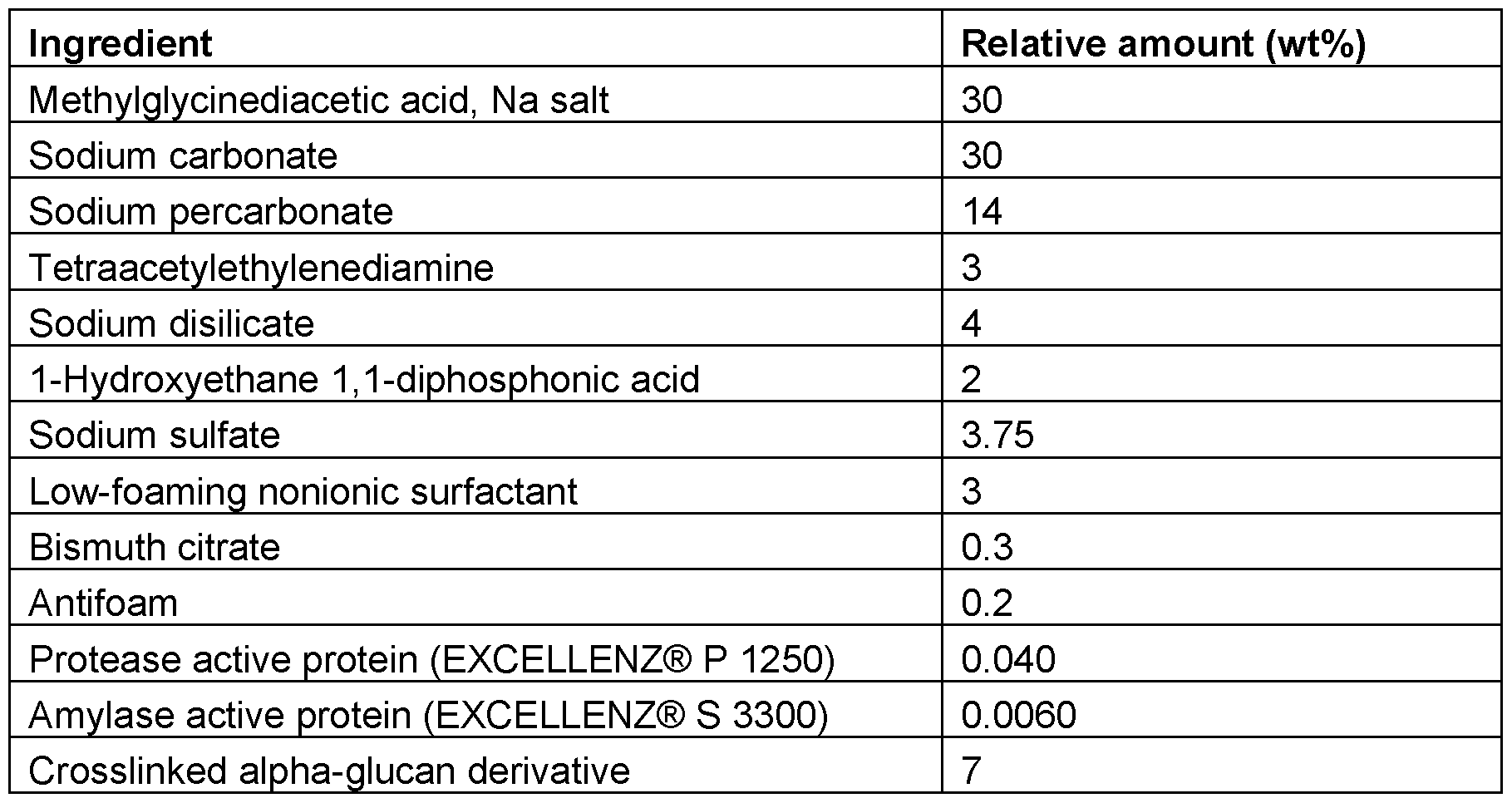 Some aspects of the present disclosure concern a method of washing/cleaning or treating a hard surface. Such a washing/cleaning or treating method can comprise: (a) contacting the hard surface with a washing/treating composition that comprises an anti-deposition detergent composition herein, and (b) removing all of, or a portion of, the washing/treating composition from the hard surface (e.g., by rinsing with water with, or without, a rinse aid [water/liquid-removing aid]
and/or added salts); thereby washing/cleaning or treating the hard surface, wherein the washed/cleaned/treated hard surface has reduced filming, spotting, haze, or other deposition. Such a method can include any condition (e.g., temperature, pH, time, salt/buffer, etc.) (e.g., those for automatic dishwashing machine) disclosed herein, for example, that are suitable for washing, treating a material/surface, and/or cation binding. A hard surface treated by a washing/cleaning method can be any hard surface, such as a hard surface of, or that is associated/interacting with, an aqueous composition or system as disclosed herein. Examples of a hard surface comprise or consist of glass, plastic (e.g., styrene-acrylonitrile, polystyrene, polypropylene, polyethylene, melamine), ceramic, porcelain, metal (e.g., steel, stainless steel, aluminum), or stone (e.g., marble, granite); any of these surfaces can be of a piece of dishware disclosed herein, for example. A hard surface in some aspects can be a surface found within (e.g., body/housing of) an automatic dishwasher, laundry machine, or similar device, and/or an internal component thereof (e.g., piping, sprayer, nozzle, rack, agitator). In some aspects in which a washing/cleaning method is performed in an automatic dishwasher, a wash cycle can comprise the following sequential periods: (i) optionally at least one pre-wash period during which water (e.g., at ~40-70, 45-70, 50- 70, or 60-70 °C) is circulated (e.g., for about 3-15, 3-10, or 3-6 minutes) to loosen food material on dishware; (ii) a main wash period during which an anti-deposition detergent composition herein (e.g., about 10-3010-25, 10-20, 15-30, 15-25, or 15-20 g, dry weight) is added (e.g., via automatic dispenser) to water (e.g., at ~40-70, 45-70, or 50- 70 °C) (e.g., about 1-2.5, 1-2, 1.5-2.5, or 1.5-2 gallons) for circulation (thereby rendering a washing composition) for a suitable amount of time (e.g., about 3-20, 3-15, 3-10, 5-20, 5-15, or 5-10 minutes); (iii) at least one rinse period during which water (e.g., at ~40-70, 45-70, 50-70, or 60-70 °C) is circulated (e.g., for about 3-15, 3-10, or 3-6 minutes); and (iv) optionally a drying period. After each of periods (ii) and (iii) (and optionally after optional period [i]) of a wash cycle, the circulated liquid typically is removed, such as by pumping and/or draining. A washing/cleaning method herein can be performed to wash dishware (e.g., using an automatic dishwasher, or manual/hand dishwashing). Dishware, for example, can be as disclosed herein or in U.S. Patent No.8575083 or U.S. Pat. Appl. Publ. No. 2017/0044468, which are incorporated herein by reference. Dishware can include, for example, plates, cups, glasses, bowls, pots, cutlery, spoons, knives, forks, serving utensils, ceramics, plastics, cutting boards, china, chinaware, glassware, tableware, utensilware, and kitchenware.
A hard surface washed by a washing/cleaning method herein has reduced filming, spotting, haze and/or other deposition. In some aspects, such reduction is by about, or at least about 10%, 20%, 30%, 40%, 50%, 60%, 70%, or 80% as compared to what would be observed with a washing/cleaning method using a detergent composition that does not have a crosslinked alpha-glucan derivative herein; all other features of the comparative washing/cleaning method can otherwise be the same. Filming, spotting, haze, and related depositions typically contain one or more insoluble salts (e.g., carbonates such as CaCO3 or MgCO3, hydroxides such as Mg(OH)2 or Ca(OH)2, sulfates such a CaSO4) and/or other insoluble compounds (e.g., calcium and/or magnesium salts of fatty acids such as stearate). Filming and/or spotting can optionally also be referred to as deposits of scale and/or scum (e.g., soap scum). A rinse aid can optionally be used during or after removing a washing/treating composition from a hard surface, such as in an automatic dishwashing process herein. A rinse aid generally is intended to remove remaining water/liquid from a hard surface, and thus can optionally be referred to as a water/liquid-removing aid. In this vein, a rinse aid can improve removal, from a hard surface, of water/liquid containing any dissolved and/or dispersed compounds such as minerals and/or crosslinked alpha- glucan derivative-containing complexes. A rinse aid / water/liquid-removing aid in some aspects can be as disclosed in any of U.S. Patent Nos.6630440, 5739099, 5516452, 8685911, 9567551, or 11118140, which are each incorporated herein by reference. A rinse aid in some aspects can comprise an oxoalcohol (fatty alcohol alkoxylate); an example of such a rinse aid is GENAPOL EP 2564 (CAS no.120313-48-6). The present disclosure also concerns a method of preparing an aqueous composition having increased builder capacity. This method comprises, for instance, contacting at least one crosslinked alpha-glucan derivative as disclosed herein with an aqueous composition, wherein the builder capacity of the aqueous composition is increased by the derivative as compared to the builder capacity of the aqueous composition as it existed before the contacting step. Such a method can optionally be characterized as a water (or any other aqueous composition) softening method. An aqueous composition in this method can be any aqueous composition as disclosed herein, for example, such as a household care product, personal care product, industrial product, pharmaceutical product, or food product. Examples of suitable household care products include household care or industrial care products such as laundry detergent or fabric softener, and automatic dishwashing detergent. Examples of
suitable personal care items include hair care products (e.g. shampoos, conditioners), dentifrice compositions (e.g., toothpaste, mouthwash), and skin care products (e.g., hand or body soap, lotion, cosmetics). In some aspects, an aqueous composition in this method is a detergent and/or surfactant composition. Such a composition herein can comprise at least one detergent/surfactant ingredient, such as any of the present disclosure, at about 0.01-10 wt% (e.g., about 0.05-5.0 wt% or about 0.1-2.0 wt%), for example. A skilled artisan would recognize all the various products disclosed herein that constitute examples of detergent/surfactant-comprising compositions such as certain household care products (e.g., laundry detergent, dishwashing detergent) and personal care products (e.g., hand/body soap, dentifrices), particularly those used in cleaning applications. Contacting an aqueous composition with one or more crosslinked alpha-glucan derivatives in some aspects can increase the builder capacity of the aqueous composition. This increase can be by about, or at least about 1%, 5%, 10%, 25%, 50%, 100%, 500%, or 1000% (or any integer between 1% and 1000%), for example, compared to the builder capacity of the aqueous composition before the contacting step. The degree of increased builder capacity achieved can be measured following any number of methods. For example, increased builder capacity effected by a crosslinked alpha-glucan derivative herein can be estimated by determining the extent to which the derivative supplies alkalinity to an aqueous composition, or buffers an aqueous composition to maintain alkalinity. As another example, increased builder capacity effected by a crosslinked alpha-glucan derivative herein can be estimated by determining the extent to which the derivative reduces hardness in an aqueous composition (by sequestering or chelating hard water cations) and/or helps to remove soil in suspension (this feature typically applies to fabric care compositions). As other examples, increased builder capacity can be determined following methodology (e.g., calcium dispersing capacity, NTU assay, film reduction assay) disclosed in the below Examples and/or in U.S. Pat. Appl. Publ. Nos.2018/0022834, 2024/0199766, or 2024/0150497, or Int. Patent Appl. Publ. Nos. WO2022/178073 or WO2022/178075, which are incorporated herein by reference. Contacting a crosslinked alpha-glucan derivative herein with an aqueous composition can be done by dissolving, or dispersing, the derivative into the aqueous composition, for example.
Non-limiting examples of compositions and methods disclosed herein include: 1. A composition (product) comprising a crosslinked alpha-glucan derivative, wherein the crosslinked alpha-glucan derivative is produced by contacting ethylene glycol diglycidyl ether (EGDE) with a first alpha-glucan derivative (i.e., the first alpha- glucan derivative typically has already been derivatized herein, such as by etherification, sulfonation, or oxidation) (under suitable conditions [typically including aqueous conditions] for the ethylene glycol diglycidyl ether to react with and crosslink the first alpha-glucan derivative) thereby crosslinking the first alpha-glucan derivative (thus producing an EGDE-crosslinked alpha-glucan derivative), wherein the ratio of the EGDE to the first alpha-glucan derivative (for the contacting) is about 0.03 to 0.07 mole EGDE to about 1 mole first alpha-glucan derivative. 1b. A composition (product) comprising an EGDE (ethylene glycol diglycidyl ether)- crosslinked alpha-glucan derivative, optionally wherein the ratio of the EGDE to the alpha-glucan derivative in the EGDE-crosslinked alpha-glucan derivative is about 0.03 to 0.07 mole EGDE to about 1 mole first alpha-glucan derivative. 2. The composition of embodiment 1 or 1b, wherein at least about 50% of the glycosidic linkages of the crosslinked alpha-glucan derivative are alpha-1,3 linkages (i.e., at least about 50% of the glycosidic linkages of the first alpha-glucan derivative are alpha-1,3 linkages). 3. The composition of embodiment 2, wherein at least about 90% (or about 100%) of the glycosidic linkages of the crosslinked alpha-glucan derivative are alpha-1,3 linkages (i.e., at least about 90% [or about 100%] of the glycosidic linkages of the first alpha-glucan derivative are alpha-1,3 linkages). 4. The composition of embodiment 1 or 1b, wherein at least about 50% of the glycosidic linkages of the crosslinked alpha-glucan derivative are alpha-1,6 linkages (i.e., at least about 50% of the glycosidic linkages of the first alpha-glucan derivative are alpha-1,6 linkages). 5. The composition of embodiment 1, 1b, or 4, wherein the crosslinked alpha-glucan derivative comprises at least 1% alpha-1,2 and/or alpha-1,3 branches (i.e., the first alpha-glucan derivative comprises at least 1% alpha-1,2 and/or alpha-1,3 branches). 6. The composition of embodiment 1, 1b, 2, 3, 4, or 5, wherein the alpha-glucan from which the first alpha-glucan derivative was derived has a weight-average degree of polymerization (DPw) of at least about 200 (e.g., about, or at least about, 700 or 800).
7. The composition of embodiment 1, 1b, 2, 3, 4, 5, or 6, wherein the first alpha- glucan derivative has a degree of substitution (DoS) up to about 3.0 with at least one organic group (typically wherein the DoS is at least about 0.005). 8. The composition of embodiment 7, wherein the organic group is in ether linkage to the first alpha-glucan derivative. 9. The composition of embodiment 7 or 8, wherein the organic group comprises a carboxyalkyl, alkyl, hydroxyalkyl, or aryl group. 10. The composition of embodiment 7, 8, or 9, wherein the organic group comprises a carboxymethyl group. 11. The composition of embodiment 7, 8, 9, or 10, wherein the organic group comprises a benzyl group. 12. The composition of embodiment 9, 10, or 11, wherein the first alpha-glucan derivative comprises the carboxyalkyl group (e.g., a carboxymethyl group) and the aryl group (e.g., a benzyl group) (i.e., the first alpha-glucan derivative is a mixed ether). 13. The composition of embodiment 1, 1b, 2, 3, 4, 5, 6, 7, 8, 9, 10, 11, or 12, wherein the first alpha-glucan derivative has a DoS up to about 3.0 with at least one sulfonate group. 14. The composition of embodiment 1, 1b, 2, 3, 4, 5, 6, 7, 8, 9, 10, 11, 12, or 13, wherein the first alpha-glucan derivative has been oxidized (prior to being crosslinked). 15. The composition of embodiment 1, 1b, 2, 3, 5, 6, 7, 8, 9, 10, 11, 12, 13, or 14, wherein the first alpha-glucan derivative has a DoS of about 0.35 to 2.5 (e.g., about 0.4 to 2.5, about 0.4 to 1.0, or about 0.35 to 1.0) (e.g., DoS is with an etherified organic group, a sulfonate group, and/or a group resulting from oxidation), and wherein at least about 50% of the glycosidic linkages of the crosslinked alpha-glucan derivative are alpha-1,3 linkages (e.g., at least about 90%, or about 100%, of the glycosidic linkages are alpha-1,3 linkages). 16. The composition of embodiment 1, 1b, 4, 5, 6, 7, 8, 9, 10, 11, 12, 13, or 14, wherein the first alpha-glucan derivative has a DoS of at least about 2.0 (e.g., at least about 2.25 or 2.5, or is about 2.3 to 2.6) (e.g., DoS is with an etherified organic group, a sulfonate group, and/or a group resulting from oxidation), and wherein at least about 50% of the glycosidic linkages of the crosslinked alpha-glucan derivative are alpha-1,6 linkages, optionally wherein the first alpha-glucan derivative comprises at least 1% alpha-1,2 and/or alpha-1,3 branches.
17. The composition of embodiment 1, 1b, 2, 3, 4, 5, 6, 7, 8, 9, 10, 11, 12, 13, 14, 15, or 16, wherein the ratio of the EGDE to the first alpha-glucan derivative is about 0.04 to 0.06 mole EGDE to about 1 mole first alpha-glucan derivative. 17b. The composition of embodiment 1, 1b, 2, 3, 4, 5, 6, 7, 8, 9, 10, 11, 12, 13, 14, 15, 16, or 17, wherein the crosslinked alpha-glucan derivative has a biodegradability as determined by a carbon dioxide evolution test method of at least 10% after 15, 60, or 90 days. 17c. The composition of embodiment 1, 1b, 2, 3, 4, 5, 6, 7, 8, 9, 10, 11, 12, 13, 14, 15, 16, or 17b, but wherein the alpha-glucan derivative has not been crosslinked (is not crosslinked) (in addition to, or instead of, using the EGDE-crosslinked alpha-glucan derivative) (i.e., as appropriate, a “crosslinked alpha-glucan derivative” [and like language] herein can be replaced with “alpha-glucan derivative” [and like language], where the derivative is not crosslinked]). 17d. The composition of embodiment 1, 1b, 2, 3, 6, 17, 17b, 18, 19, 20, 21, 22, 23, 24, 25, or 26, wherein at least about 50% of the glycosidic linkages of the crosslinked alpha- glucan derivative are alpha-1,3 linkages (i.e., at least about 50% of the glycosidic linkages of the first alpha-glucan derivative are alpha-1,3 linkages), wherein the first alpha-glucan derivative has a DoS of about 0.3 to about 0.6 (e.g., DoS 0.4-0.6 or 0.4- 0.5) with an ether-linked carboxyalkyl group (e.g., carboxymethyl), and optionally wherein the alpha-glucan from which the first alpha-glucan derivative was derived has a DPw of at least about 1400 (e.g., 1500-1900, 1600-1800); wherein however (i) the crosslinked alpha-glucan derivative is produced by contacting a crosslinking agent (e.g., EGDE) with the first alpha-glucan derivative (i.e., the crosslinking agent is not necessarily EGDE, but can be EGDE in some aspects), and (ii) optionally the ratio of the crosslinking agent to the first alpha-glucan derivative is about 0.01 to 0.1 (e.g., 0.06-0.1, 0.07-0.9) mole crosslinking agent to about 1 mole first alpha-glucan derivative (wherein any of the foregoing features can be drawn from the present disclosure, as appropriate); optionally wherein the composition is a personal care product (e.g., a lotion, gel, serum, or ointment). 18. The composition of embodiment 1, 1b, 2, 3, 4, 5, 6, 7, 8, 9, 10, 11, 12, 13, 14, 15, 16, 17, 17b, or 17c, wherein the composition is an aqueous composition. 19. The composition of embodiment 18, wherein the aqueous composition further comprises at least one cation, and the crosslinked polysaccharide derivative is bound to the cation.
20. The composition of embodiment 1, 1b, 2, 3, 4, 5, 6, 7, 8, 9, 10, 11, 12, 13, 14, 15, 16, 17, 17b, 17c, 18, or 19, wherein the composition is a household care product, personal care product, industrial product, medical product, or pharmaceutical product. 21. The composition of embodiment 1, 1b, 2, 3, 4, 5, 6, 7, 8, 9, 10, 11, 12, 13, 14, 15, 16, 17, 17b, 17c, 18, 19, or 20, wherein the composition is in the form of, or comprised in, a liquid, gel, powder, hydrocolloid, granule, tablet, capsule, bead or pastille, single- compartment sachet, multi-compartment sachet, single-compartment pouch, multi- compartment pouch, water-dispersible unit dose (e.g., a fiber-containing composition such as a non-woven or other fibrous structure, a sponge or foam, an agglomerate), or water-dissolvable unit dose (e.g., a sheet or film, a fiber-containing composition such as a non-woven or other fibrous structure, a sponge or foam, an agglomerate). 22. The composition of embodiment 1, 1b, 2, 3, 4, 5, 6, 7, 8, 9, 10, 11, 12, 13, 14, 15, 16, 17, 17b, 17c, 18, 19, 20, or 21, further comprising at least one surfactant (i.e., the composition can optionally be considered to be a detergent composition). 23. The composition of embodiment 1, 1b, 2, 3, 4, 5, 6, 7, 8, 9, 10, 11, 12, 13, 14, 15, 16, 17, 17b, 17c, 18, 19, 20, 21, or 22, further comprising at least one enzyme. 24. The composition of embodiment 23, wherein the enzyme is a cellulase, protease, amylase, lipase, or nuclease. 25. The composition of embodiment 1, 1b, 2, 3, 4, 5, 6, 7, 8, 9, 10, 11, 12, 13, 14, 15, 16, 17, 17b, 17c, 18, 19, 20, 21, 22, 23, or 24, further comprising at least one of a complexing agent, soil release polymer, surfactancy-boosting polymer, bleaching agent, bleach activator, bleaching catalyst, fabric conditioner, clay, foam booster, suds suppressor, anti-corrosion agent, soil-suspending agent, anti-soil re-deposition agent, dye, bactericide, tarnish inhibitor, optical brightener, perfume, saturated or unsaturated fatty acid, dye transfer-inhibiting agent, chelating agent, hueing dye, visual signaling ingredient, anti-foam, structurant, thickener, anti-caking agent, starch, sand, or gelling agent. 26. The composition of embodiment 1, 1b, 2, 3, 4, 5, 6, 7, 8, 9, 10, 11, 12, 13, 14, 15, 16, 17, 17b, 17c, 18, 19, 20, 21, 22, 23, 24, or 25, wherein the composition is in the form of, or comprised in, a dishwashing detergent composition or fabric care composition. 27. A method of washing or treating a hard surface, the method comprising: (a) contacting the hard surface with a washing/treating composition that comprises the composition of embodiment 1, 1b, 2, 3, 4, 5, 6, 7, 8, 9, 10, 11, 12, 13, 14, 15, 16, 17, 17b, 17c, 17d, 18, 19, 20, 21, 22, 23, 24, 25, or 26, and (b) removing all of, or a portion of, the washing/treating composition from the hard surface; thereby washing or treating
the hard surface, wherein the washed/treated hard surface has reduced filming, spotting, haze, or other deposition, optionally wherein the hard surface is that of glass, plastic, ceramic, porcelain, metal, or stone. 28. The method of embodiment 27, wherein step (b) comprises rinsing the hard surface. 29. The method of embodiment 27 or 28, wherein the hard surface is that of dishware. 30. The method of embodiment 27, 28, or 29, performed in an automatic dishwasher or a laundry machine. 31. A method of producing a crosslinked alpha-glucan derivative (e.g., as recited in embodiment 1, 1b, 2, 3, 4, 5, 6, 7, 8, 9, 10, 11, 12, 13, 14, 15, 16, 17, or 17b), the method comprising: (a) contacting ethylene glycol diglycidyl ether (EGDE) with a first alpha-glucan derivative (i.e., the first alpha-glucan derivative typically has already been derivatized herein, such as by etherification, sulfonation, or oxidation) (under suitable conditions [typically including aqueous conditions] for the EGDE to react with and crosslink the first alpha-glucan derivative) thereby crosslinking the first alpha-glucan derivative (thus producing an EGDE-crosslinked alpha-glucan derivative), wherein the ratio of the EGDE to the first alpha-glucan derivative (for the contacting) is about 0.03 to 0.07 mole (e.g., about 0.04 to 0.06 mole) EGDE to about 1 mole first alpha-glucan derivative, and (b) optionally isolating the crosslinked alpha-glucan derivative produced in step (a). EXAMPLES The present disclosure is further exemplified in the following Examples. It should be understood that these Examples, while indicating certain aspects herein, are given by way of illustration only. From the above discussion and these Examples, one skilled in the art can ascertain the essential characteristics of the disclosed embodiments, and without departing from the spirit and scope thereof, can make various changes and modifications to adapt the disclosed embodiments to various uses and conditions. Materials/Methods Representative Preparation of Alpha-1,3-Glucan: Alpha-1,3-glucan with ~100% alpha-1,3 glycosidic linkages can be synthesized, for example, following the procedures disclosed in U.S. Appl. Publ. No.2014/0179913 (see Example 12 therein, for example), which is incorporated herein by reference. As another example, a slurry of alpha-1,3-glucan with ~100% alpha-1,3 glycosidic linkages was prepared from an aqueous solution (0.5 L) containing Streptococcus
salivarius gtfJ enzyme (100 unit/L) as described in U.S. Patent Appl. Publ. No. 2013/0244288 (incorporated herein by reference), sucrose (100 g/L), potassium phosphate buffer (10 mM), and FermaSure® antimicrobial agent (100 ppm) adjusted to pH 5.5. The resulting enzyme reaction was maintained at 20-25 °C for 24 hours. A slurry was formed since the alpha-1,3-glucan synthesized in the reaction was aqueous- insoluble. The alpha-1,3-glucan solids were then collected using a Buchner funnel fitted with a 325-mesh screen over 40-micrometer filter paper. Representative Preparation of Alpha-1,6-Glucan with Alpha-1,2 Branching Each alpha-1,2-branched alpha-1,6-glucan listed below comprises a 100%-alpha- 1,6-linked backbone upon which pendant (single) glucosyls have been linked via alpha- 1,2 linkages; thus, each pendant glucosyl is attached to the backbone via an alpha-1,2 linkage/branch-point. An example of an alpha-1,2-branched alpha-1,6-glucan herein has 40% alpha-1,2-branching and 60% alpha-1,6 linkages. In this example, 60% of all the linkages of the alpha-glucan are alpha-1,6 linkages that are in the backbone, while the balance of the linkages (40%) are alpha-1,2 linkages to pendant glucosyls along the backbone. Methods to prepare alpha-1,6-glucan containing various amounts of alpha-1,2 branching are disclosed in U.S. Appl. Publ. No.2018/0282385, which is incorporated herein by reference. Reaction parameters such as sucrose concentration, temperature, and pH can be adjusted to provide alpha-1,6-glucan having various levels of alpha-1,2- branching and molecular weight. A representative procedure for the preparation of alpha-1,2-branched alpha-1,6-glucan is provided below (containing 19% alpha-1,2- branching [i.e., 19% alpha-1,2 linkages] and 81% alpha-1,6 linkages). The 1D 1H-NMR spectrum was used to quantify glycosidic linkage distribution. Additional samples of alpha-1,6-glucan with alpha-1,2-branching were prepared similarly. For example, one sample contained 32% alpha-1,2-branching and 68% alpha-1,6 linkages, and another contained 10% alpha-1,2-branching and 90% alpha-1,6 linkages. Soluble alpha-1,6-glucan with about 19% alpha-1,2 branching was prepared using stepwise combination of glucosyltransferase (dextransucrase) GTF8117 and alpha-1,2 branching enzyme GTFJ18T1, according to the following procedure. A reaction mixture (2 L) comprised of sucrose (450 g/L), GTF8117 (9.4 U/mL), and 50 mM sodium acetate was adjusted to pH 5.5 and stirred at 47 °C. Aliquots (0.2-1 mL) were withdrawn at predetermined times and quenched by heating at 90 °C for 15 minutes. The resulting heat-treated aliquots were passed through a 0.45-µm filter. The flow- through was analyzed by HPLC to determine the concentration of sucrose, glucose,
fructose, leucrose, oligosaccharides and polysaccharides. After 23.5 hours, the reaction mixture was heated to 90 °C for 30 minutes. An aliquot of the heat-treated reaction mixture was passed through a 0.45-µm filter and the flow-through was analyzed for soluble mono/disaccharides, oligosaccharides, and polysaccharides. A major product was linear dextran (i.e., 100% alpha-1,6 linkages) with a DPw of 93. A second reaction mixture was prepared by adding 238.2 g of sucrose and 210 mL of alpha-1,2-branching enzyme GTFJ18T1 (5.0 U/mL) to the leftover heat-treated reaction mixture that was obtained from the GTF8117 reaction described immediately above. The mixture was stirred at 30 °C with a volume of ~2.2 L. Aliquots (0.2-1 mL) were withdrawn at predetermined times and quenched by heating at 90 °C for 15 minutes. The resulting heat-treated aliquots were passed through a 0.45-µm filter. The flow-through was analyzed by HPLC to determine the concentration of sucrose, glucose, fructose, leucrose, oligosaccharides and polysaccharides. After 95 hours, the reaction mixture was heated to 90 °C for 30 minutes. An aliquot of the heat-treated reaction mixture was passed through a 0.45-µm filter and the flow-through was analyzed for soluble mono/disaccharides, oligosaccharides, and polysaccharides. Leftover heat- treated mixture was centrifuged using 1-L centrifugation bottles. The supernatant was collected and cleaned more than 200-fold using an ultrafiltration system with 1- or 5-kDa MWCO cassettes and deionized water. The cleaned oligo/polysaccharide product solution was dried. Dry sample was then analyzed by 1H-NMR spectroscopy to determine the anomeric linkages of the oligosaccharides and polysaccharides. Various water-soluble alpha-1,2-branched alpha-1,6-glucans can be made following the above (or similar) enzymatic reaction strategy, for example. This type of alpha-glucan material can also be produced according to methodology disclosed in U.S. Pat. Appl. Publ. No.2018/0282385, for example, which is incorporated herein by reference. Examples of different alpha-1,2-branched alpha-1,6-glucans that have been produced are listed in Table 1. In each of these alpha-glucans, the alpha-1,6-glucan backbone (from which there are alpha-1,2 branches) has 100% alpha-1,6 glycosidic linkages; the listed molecular weight is that of the alpha-1,6-glucan backbone. Each alpha-1,2-branch consists of a single (pendant) glucose unit. Table 1 Alpha-1,2-Branched Alpha-1,6-Glucan
Some aspects of the present disclosure concern a method of washing/cleaning or treating a hard surface. Such a washing/cleaning or treating method can comprise: (a) contacting the hard surface with a washing/treating composition that comprises an anti-deposition detergent composition herein, and (b) removing all of, or a portion of, the washing/treating composition from the hard surface (e.g., by rinsing with water with, or without, a rinse aid [water/liquid-removing aid]
and/or added salts); thereby washing/cleaning or treating the hard surface, wherein the washed/cleaned/treated hard surface has reduced filming, spotting, haze, or other deposition. Such a method can include any condition (e.g., temperature, pH, time, salt/buffer, etc.) (e.g., those for automatic dishwashing machine) disclosed herein, for example, that are suitable for washing, treating a material/surface, and/or cation binding. A hard surface treated by a washing/cleaning method can be any hard surface, such as a hard surface of, or that is associated/interacting with, an aqueous composition or system as disclosed herein. Examples of a hard surface comprise or consist of glass, plastic (e.g., styrene-acrylonitrile, polystyrene, polypropylene, polyethylene, melamine), ceramic, porcelain, metal (e.g., steel, stainless steel, aluminum), or stone (e.g., marble, granite); any of these surfaces can be of a piece of dishware disclosed herein, for example. A hard surface in some aspects can be a surface found within (e.g., body/housing of) an automatic dishwasher, laundry machine, or similar device, and/or an internal component thereof (e.g., piping, sprayer, nozzle, rack, agitator). In some aspects in which a washing/cleaning method is performed in an automatic dishwasher, a wash cycle can comprise the following sequential periods: (i) optionally at least one pre-wash period during which water (e.g., at ~40-70, 45-70, 50- 70, or 60-70 °C) is circulated (e.g., for about 3-15, 3-10, or 3-6 minutes) to loosen food material on dishware; (ii) a main wash period during which an anti-deposition detergent composition herein (e.g., about 10-3010-25, 10-20, 15-30, 15-25, or 15-20 g, dry weight) is added (e.g., via automatic dispenser) to water (e.g., at ~40-70, 45-70, or 50- 70 °C) (e.g., about 1-2.5, 1-2, 1.5-2.5, or 1.5-2 gallons) for circulation (thereby rendering a washing composition) for a suitable amount of time (e.g., about 3-20, 3-15, 3-10, 5-20, 5-15, or 5-10 minutes); (iii) at least one rinse period during which water (e.g., at ~40-70, 45-70, 50-70, or 60-70 °C) is circulated (e.g., for about 3-15, 3-10, or 3-6 minutes); and (iv) optionally a drying period. After each of periods (ii) and (iii) (and optionally after optional period [i]) of a wash cycle, the circulated liquid typically is removed, such as by pumping and/or draining. A washing/cleaning method herein can be performed to wash dishware (e.g., using an automatic dishwasher, or manual/hand dishwashing). Dishware, for example, can be as disclosed herein or in U.S. Patent No.8575083 or U.S. Pat. Appl. Publ. No. 2017/0044468, which are incorporated herein by reference. Dishware can include, for example, plates, cups, glasses, bowls, pots, cutlery, spoons, knives, forks, serving utensils, ceramics, plastics, cutting boards, china, chinaware, glassware, tableware, utensilware, and kitchenware.
A hard surface washed by a washing/cleaning method herein has reduced filming, spotting, haze and/or other deposition. In some aspects, such reduction is by about, or at least about 10%, 20%, 30%, 40%, 50%, 60%, 70%, or 80% as compared to what would be observed with a washing/cleaning method using a detergent composition that does not have a crosslinked alpha-glucan derivative herein; all other features of the comparative washing/cleaning method can otherwise be the same. Filming, spotting, haze, and related depositions typically contain one or more insoluble salts (e.g., carbonates such as CaCO3 or MgCO3, hydroxides such as Mg(OH)2 or Ca(OH)2, sulfates such a CaSO4) and/or other insoluble compounds (e.g., calcium and/or magnesium salts of fatty acids such as stearate). Filming and/or spotting can optionally also be referred to as deposits of scale and/or scum (e.g., soap scum). A rinse aid can optionally be used during or after removing a washing/treating composition from a hard surface, such as in an automatic dishwashing process herein. A rinse aid generally is intended to remove remaining water/liquid from a hard surface, and thus can optionally be referred to as a water/liquid-removing aid. In this vein, a rinse aid can improve removal, from a hard surface, of water/liquid containing any dissolved and/or dispersed compounds such as minerals and/or crosslinked alpha- glucan derivative-containing complexes. A rinse aid / water/liquid-removing aid in some aspects can be as disclosed in any of U.S. Patent Nos.6630440, 5739099, 5516452, 8685911, 9567551, or 11118140, which are each incorporated herein by reference. A rinse aid in some aspects can comprise an oxoalcohol (fatty alcohol alkoxylate); an example of such a rinse aid is GENAPOL EP 2564 (CAS no.120313-48-6). The present disclosure also concerns a method of preparing an aqueous composition having increased builder capacity. This method comprises, for instance, contacting at least one crosslinked alpha-glucan derivative as disclosed herein with an aqueous composition, wherein the builder capacity of the aqueous composition is increased by the derivative as compared to the builder capacity of the aqueous composition as it existed before the contacting step. Such a method can optionally be characterized as a water (or any other aqueous composition) softening method. An aqueous composition in this method can be any aqueous composition as disclosed herein, for example, such as a household care product, personal care product, industrial product, pharmaceutical product, or food product. Examples of suitable household care products include household care or industrial care products such as laundry detergent or fabric softener, and automatic dishwashing detergent. Examples of
suitable personal care items include hair care products (e.g. shampoos, conditioners), dentifrice compositions (e.g., toothpaste, mouthwash), and skin care products (e.g., hand or body soap, lotion, cosmetics). In some aspects, an aqueous composition in this method is a detergent and/or surfactant composition. Such a composition herein can comprise at least one detergent/surfactant ingredient, such as any of the present disclosure, at about 0.01-10 wt% (e.g., about 0.05-5.0 wt% or about 0.1-2.0 wt%), for example. A skilled artisan would recognize all the various products disclosed herein that constitute examples of detergent/surfactant-comprising compositions such as certain household care products (e.g., laundry detergent, dishwashing detergent) and personal care products (e.g., hand/body soap, dentifrices), particularly those used in cleaning applications. Contacting an aqueous composition with one or more crosslinked alpha-glucan derivatives in some aspects can increase the builder capacity of the aqueous composition. This increase can be by about, or at least about 1%, 5%, 10%, 25%, 50%, 100%, 500%, or 1000% (or any integer between 1% and 1000%), for example, compared to the builder capacity of the aqueous composition before the contacting step. The degree of increased builder capacity achieved can be measured following any number of methods. For example, increased builder capacity effected by a crosslinked alpha-glucan derivative herein can be estimated by determining the extent to which the derivative supplies alkalinity to an aqueous composition, or buffers an aqueous composition to maintain alkalinity. As another example, increased builder capacity effected by a crosslinked alpha-glucan derivative herein can be estimated by determining the extent to which the derivative reduces hardness in an aqueous composition (by sequestering or chelating hard water cations) and/or helps to remove soil in suspension (this feature typically applies to fabric care compositions). As other examples, increased builder capacity can be determined following methodology (e.g., calcium dispersing capacity, NTU assay, film reduction assay) disclosed in the below Examples and/or in U.S. Pat. Appl. Publ. Nos.2018/0022834, 2024/0199766, or 2024/0150497, or Int. Patent Appl. Publ. Nos. WO2022/178073 or WO2022/178075, which are incorporated herein by reference. Contacting a crosslinked alpha-glucan derivative herein with an aqueous composition can be done by dissolving, or dispersing, the derivative into the aqueous composition, for example.
Non-limiting examples of compositions and methods disclosed herein include: 1. A composition (product) comprising a crosslinked alpha-glucan derivative, wherein the crosslinked alpha-glucan derivative is produced by contacting ethylene glycol diglycidyl ether (EGDE) with a first alpha-glucan derivative (i.e., the first alpha- glucan derivative typically has already been derivatized herein, such as by etherification, sulfonation, or oxidation) (under suitable conditions [typically including aqueous conditions] for the ethylene glycol diglycidyl ether to react with and crosslink the first alpha-glucan derivative) thereby crosslinking the first alpha-glucan derivative (thus producing an EGDE-crosslinked alpha-glucan derivative), wherein the ratio of the EGDE to the first alpha-glucan derivative (for the contacting) is about 0.03 to 0.07 mole EGDE to about 1 mole first alpha-glucan derivative. 1b. A composition (product) comprising an EGDE (ethylene glycol diglycidyl ether)- crosslinked alpha-glucan derivative, optionally wherein the ratio of the EGDE to the alpha-glucan derivative in the EGDE-crosslinked alpha-glucan derivative is about 0.03 to 0.07 mole EGDE to about 1 mole first alpha-glucan derivative. 2. The composition of embodiment 1 or 1b, wherein at least about 50% of the glycosidic linkages of the crosslinked alpha-glucan derivative are alpha-1,3 linkages (i.e., at least about 50% of the glycosidic linkages of the first alpha-glucan derivative are alpha-1,3 linkages). 3. The composition of embodiment 2, wherein at least about 90% (or about 100%) of the glycosidic linkages of the crosslinked alpha-glucan derivative are alpha-1,3 linkages (i.e., at least about 90% [or about 100%] of the glycosidic linkages of the first alpha-glucan derivative are alpha-1,3 linkages). 4. The composition of embodiment 1 or 1b, wherein at least about 50% of the glycosidic linkages of the crosslinked alpha-glucan derivative are alpha-1,6 linkages (i.e., at least about 50% of the glycosidic linkages of the first alpha-glucan derivative are alpha-1,6 linkages). 5. The composition of embodiment 1, 1b, or 4, wherein the crosslinked alpha-glucan derivative comprises at least 1% alpha-1,2 and/or alpha-1,3 branches (i.e., the first alpha-glucan derivative comprises at least 1% alpha-1,2 and/or alpha-1,3 branches). 6. The composition of embodiment 1, 1b, 2, 3, 4, or 5, wherein the alpha-glucan from which the first alpha-glucan derivative was derived has a weight-average degree of polymerization (DPw) of at least about 200 (e.g., about, or at least about, 700 or 800).
7. The composition of embodiment 1, 1b, 2, 3, 4, 5, or 6, wherein the first alpha- glucan derivative has a degree of substitution (DoS) up to about 3.0 with at least one organic group (typically wherein the DoS is at least about 0.005). 8. The composition of embodiment 7, wherein the organic group is in ether linkage to the first alpha-glucan derivative. 9. The composition of embodiment 7 or 8, wherein the organic group comprises a carboxyalkyl, alkyl, hydroxyalkyl, or aryl group. 10. The composition of embodiment 7, 8, or 9, wherein the organic group comprises a carboxymethyl group. 11. The composition of embodiment 7, 8, 9, or 10, wherein the organic group comprises a benzyl group. 12. The composition of embodiment 9, 10, or 11, wherein the first alpha-glucan derivative comprises the carboxyalkyl group (e.g., a carboxymethyl group) and the aryl group (e.g., a benzyl group) (i.e., the first alpha-glucan derivative is a mixed ether). 13. The composition of embodiment 1, 1b, 2, 3, 4, 5, 6, 7, 8, 9, 10, 11, or 12, wherein the first alpha-glucan derivative has a DoS up to about 3.0 with at least one sulfonate group. 14. The composition of embodiment 1, 1b, 2, 3, 4, 5, 6, 7, 8, 9, 10, 11, 12, or 13, wherein the first alpha-glucan derivative has been oxidized (prior to being crosslinked). 15. The composition of embodiment 1, 1b, 2, 3, 5, 6, 7, 8, 9, 10, 11, 12, 13, or 14, wherein the first alpha-glucan derivative has a DoS of about 0.35 to 2.5 (e.g., about 0.4 to 2.5, about 0.4 to 1.0, or about 0.35 to 1.0) (e.g., DoS is with an etherified organic group, a sulfonate group, and/or a group resulting from oxidation), and wherein at least about 50% of the glycosidic linkages of the crosslinked alpha-glucan derivative are alpha-1,3 linkages (e.g., at least about 90%, or about 100%, of the glycosidic linkages are alpha-1,3 linkages). 16. The composition of embodiment 1, 1b, 4, 5, 6, 7, 8, 9, 10, 11, 12, 13, or 14, wherein the first alpha-glucan derivative has a DoS of at least about 2.0 (e.g., at least about 2.25 or 2.5, or is about 2.3 to 2.6) (e.g., DoS is with an etherified organic group, a sulfonate group, and/or a group resulting from oxidation), and wherein at least about 50% of the glycosidic linkages of the crosslinked alpha-glucan derivative are alpha-1,6 linkages, optionally wherein the first alpha-glucan derivative comprises at least 1% alpha-1,2 and/or alpha-1,3 branches.
17. The composition of embodiment 1, 1b, 2, 3, 4, 5, 6, 7, 8, 9, 10, 11, 12, 13, 14, 15, or 16, wherein the ratio of the EGDE to the first alpha-glucan derivative is about 0.04 to 0.06 mole EGDE to about 1 mole first alpha-glucan derivative. 17b. The composition of embodiment 1, 1b, 2, 3, 4, 5, 6, 7, 8, 9, 10, 11, 12, 13, 14, 15, 16, or 17, wherein the crosslinked alpha-glucan derivative has a biodegradability as determined by a carbon dioxide evolution test method of at least 10% after 15, 60, or 90 days. 17c. The composition of embodiment 1, 1b, 2, 3, 4, 5, 6, 7, 8, 9, 10, 11, 12, 13, 14, 15, 16, or 17b, but wherein the alpha-glucan derivative has not been crosslinked (is not crosslinked) (in addition to, or instead of, using the EGDE-crosslinked alpha-glucan derivative) (i.e., as appropriate, a “crosslinked alpha-glucan derivative” [and like language] herein can be replaced with “alpha-glucan derivative” [and like language], where the derivative is not crosslinked]). 17d. The composition of embodiment 1, 1b, 2, 3, 6, 17, 17b, 18, 19, 20, 21, 22, 23, 24, 25, or 26, wherein at least about 50% of the glycosidic linkages of the crosslinked alpha- glucan derivative are alpha-1,3 linkages (i.e., at least about 50% of the glycosidic linkages of the first alpha-glucan derivative are alpha-1,3 linkages), wherein the first alpha-glucan derivative has a DoS of about 0.3 to about 0.6 (e.g., DoS 0.4-0.6 or 0.4- 0.5) with an ether-linked carboxyalkyl group (e.g., carboxymethyl), and optionally wherein the alpha-glucan from which the first alpha-glucan derivative was derived has a DPw of at least about 1400 (e.g., 1500-1900, 1600-1800); wherein however (i) the crosslinked alpha-glucan derivative is produced by contacting a crosslinking agent (e.g., EGDE) with the first alpha-glucan derivative (i.e., the crosslinking agent is not necessarily EGDE, but can be EGDE in some aspects), and (ii) optionally the ratio of the crosslinking agent to the first alpha-glucan derivative is about 0.01 to 0.1 (e.g., 0.06-0.1, 0.07-0.9) mole crosslinking agent to about 1 mole first alpha-glucan derivative (wherein any of the foregoing features can be drawn from the present disclosure, as appropriate); optionally wherein the composition is a personal care product (e.g., a lotion, gel, serum, or ointment). 18. The composition of embodiment 1, 1b, 2, 3, 4, 5, 6, 7, 8, 9, 10, 11, 12, 13, 14, 15, 16, 17, 17b, or 17c, wherein the composition is an aqueous composition. 19. The composition of embodiment 18, wherein the aqueous composition further comprises at least one cation, and the crosslinked polysaccharide derivative is bound to the cation.
20. The composition of embodiment 1, 1b, 2, 3, 4, 5, 6, 7, 8, 9, 10, 11, 12, 13, 14, 15, 16, 17, 17b, 17c, 18, or 19, wherein the composition is a household care product, personal care product, industrial product, medical product, or pharmaceutical product. 21. The composition of embodiment 1, 1b, 2, 3, 4, 5, 6, 7, 8, 9, 10, 11, 12, 13, 14, 15, 16, 17, 17b, 17c, 18, 19, or 20, wherein the composition is in the form of, or comprised in, a liquid, gel, powder, hydrocolloid, granule, tablet, capsule, bead or pastille, single- compartment sachet, multi-compartment sachet, single-compartment pouch, multi- compartment pouch, water-dispersible unit dose (e.g., a fiber-containing composition such as a non-woven or other fibrous structure, a sponge or foam, an agglomerate), or water-dissolvable unit dose (e.g., a sheet or film, a fiber-containing composition such as a non-woven or other fibrous structure, a sponge or foam, an agglomerate). 22. The composition of embodiment 1, 1b, 2, 3, 4, 5, 6, 7, 8, 9, 10, 11, 12, 13, 14, 15, 16, 17, 17b, 17c, 18, 19, 20, or 21, further comprising at least one surfactant (i.e., the composition can optionally be considered to be a detergent composition). 23. The composition of embodiment 1, 1b, 2, 3, 4, 5, 6, 7, 8, 9, 10, 11, 12, 13, 14, 15, 16, 17, 17b, 17c, 18, 19, 20, 21, or 22, further comprising at least one enzyme. 24. The composition of embodiment 23, wherein the enzyme is a cellulase, protease, amylase, lipase, or nuclease. 25. The composition of embodiment 1, 1b, 2, 3, 4, 5, 6, 7, 8, 9, 10, 11, 12, 13, 14, 15, 16, 17, 17b, 17c, 18, 19, 20, 21, 22, 23, or 24, further comprising at least one of a complexing agent, soil release polymer, surfactancy-boosting polymer, bleaching agent, bleach activator, bleaching catalyst, fabric conditioner, clay, foam booster, suds suppressor, anti-corrosion agent, soil-suspending agent, anti-soil re-deposition agent, dye, bactericide, tarnish inhibitor, optical brightener, perfume, saturated or unsaturated fatty acid, dye transfer-inhibiting agent, chelating agent, hueing dye, visual signaling ingredient, anti-foam, structurant, thickener, anti-caking agent, starch, sand, or gelling agent. 26. The composition of embodiment 1, 1b, 2, 3, 4, 5, 6, 7, 8, 9, 10, 11, 12, 13, 14, 15, 16, 17, 17b, 17c, 18, 19, 20, 21, 22, 23, 24, or 25, wherein the composition is in the form of, or comprised in, a dishwashing detergent composition or fabric care composition. 27. A method of washing or treating a hard surface, the method comprising: (a) contacting the hard surface with a washing/treating composition that comprises the composition of embodiment 1, 1b, 2, 3, 4, 5, 6, 7, 8, 9, 10, 11, 12, 13, 14, 15, 16, 17, 17b, 17c, 17d, 18, 19, 20, 21, 22, 23, 24, 25, or 26, and (b) removing all of, or a portion of, the washing/treating composition from the hard surface; thereby washing or treating
the hard surface, wherein the washed/treated hard surface has reduced filming, spotting, haze, or other deposition, optionally wherein the hard surface is that of glass, plastic, ceramic, porcelain, metal, or stone. 28. The method of embodiment 27, wherein step (b) comprises rinsing the hard surface. 29. The method of embodiment 27 or 28, wherein the hard surface is that of dishware. 30. The method of embodiment 27, 28, or 29, performed in an automatic dishwasher or a laundry machine. 31. A method of producing a crosslinked alpha-glucan derivative (e.g., as recited in embodiment 1, 1b, 2, 3, 4, 5, 6, 7, 8, 9, 10, 11, 12, 13, 14, 15, 16, 17, or 17b), the method comprising: (a) contacting ethylene glycol diglycidyl ether (EGDE) with a first alpha-glucan derivative (i.e., the first alpha-glucan derivative typically has already been derivatized herein, such as by etherification, sulfonation, or oxidation) (under suitable conditions [typically including aqueous conditions] for the EGDE to react with and crosslink the first alpha-glucan derivative) thereby crosslinking the first alpha-glucan derivative (thus producing an EGDE-crosslinked alpha-glucan derivative), wherein the ratio of the EGDE to the first alpha-glucan derivative (for the contacting) is about 0.03 to 0.07 mole (e.g., about 0.04 to 0.06 mole) EGDE to about 1 mole first alpha-glucan derivative, and (b) optionally isolating the crosslinked alpha-glucan derivative produced in step (a). EXAMPLES The present disclosure is further exemplified in the following Examples. It should be understood that these Examples, while indicating certain aspects herein, are given by way of illustration only. From the above discussion and these Examples, one skilled in the art can ascertain the essential characteristics of the disclosed embodiments, and without departing from the spirit and scope thereof, can make various changes and modifications to adapt the disclosed embodiments to various uses and conditions. Materials/Methods Representative Preparation of Alpha-1,3-Glucan: Alpha-1,3-glucan with ~100% alpha-1,3 glycosidic linkages can be synthesized, for example, following the procedures disclosed in U.S. Appl. Publ. No.2014/0179913 (see Example 12 therein, for example), which is incorporated herein by reference. As another example, a slurry of alpha-1,3-glucan with ~100% alpha-1,3 glycosidic linkages was prepared from an aqueous solution (0.5 L) containing Streptococcus
salivarius gtfJ enzyme (100 unit/L) as described in U.S. Patent Appl. Publ. No. 2013/0244288 (incorporated herein by reference), sucrose (100 g/L), potassium phosphate buffer (10 mM), and FermaSure® antimicrobial agent (100 ppm) adjusted to pH 5.5. The resulting enzyme reaction was maintained at 20-25 °C for 24 hours. A slurry was formed since the alpha-1,3-glucan synthesized in the reaction was aqueous- insoluble. The alpha-1,3-glucan solids were then collected using a Buchner funnel fitted with a 325-mesh screen over 40-micrometer filter paper. Representative Preparation of Alpha-1,6-Glucan with Alpha-1,2 Branching Each alpha-1,2-branched alpha-1,6-glucan listed below comprises a 100%-alpha- 1,6-linked backbone upon which pendant (single) glucosyls have been linked via alpha- 1,2 linkages; thus, each pendant glucosyl is attached to the backbone via an alpha-1,2 linkage/branch-point. An example of an alpha-1,2-branched alpha-1,6-glucan herein has 40% alpha-1,2-branching and 60% alpha-1,6 linkages. In this example, 60% of all the linkages of the alpha-glucan are alpha-1,6 linkages that are in the backbone, while the balance of the linkages (40%) are alpha-1,2 linkages to pendant glucosyls along the backbone. Methods to prepare alpha-1,6-glucan containing various amounts of alpha-1,2 branching are disclosed in U.S. Appl. Publ. No.2018/0282385, which is incorporated herein by reference. Reaction parameters such as sucrose concentration, temperature, and pH can be adjusted to provide alpha-1,6-glucan having various levels of alpha-1,2- branching and molecular weight. A representative procedure for the preparation of alpha-1,2-branched alpha-1,6-glucan is provided below (containing 19% alpha-1,2- branching [i.e., 19% alpha-1,2 linkages] and 81% alpha-1,6 linkages). The 1D 1H-NMR spectrum was used to quantify glycosidic linkage distribution. Additional samples of alpha-1,6-glucan with alpha-1,2-branching were prepared similarly. For example, one sample contained 32% alpha-1,2-branching and 68% alpha-1,6 linkages, and another contained 10% alpha-1,2-branching and 90% alpha-1,6 linkages. Soluble alpha-1,6-glucan with about 19% alpha-1,2 branching was prepared using stepwise combination of glucosyltransferase (dextransucrase) GTF8117 and alpha-1,2 branching enzyme GTFJ18T1, according to the following procedure. A reaction mixture (2 L) comprised of sucrose (450 g/L), GTF8117 (9.4 U/mL), and 50 mM sodium acetate was adjusted to pH 5.5 and stirred at 47 °C. Aliquots (0.2-1 mL) were withdrawn at predetermined times and quenched by heating at 90 °C for 15 minutes. The resulting heat-treated aliquots were passed through a 0.45-µm filter. The flow- through was analyzed by HPLC to determine the concentration of sucrose, glucose,
fructose, leucrose, oligosaccharides and polysaccharides. After 23.5 hours, the reaction mixture was heated to 90 °C for 30 minutes. An aliquot of the heat-treated reaction mixture was passed through a 0.45-µm filter and the flow-through was analyzed for soluble mono/disaccharides, oligosaccharides, and polysaccharides. A major product was linear dextran (i.e., 100% alpha-1,6 linkages) with a DPw of 93. A second reaction mixture was prepared by adding 238.2 g of sucrose and 210 mL of alpha-1,2-branching enzyme GTFJ18T1 (5.0 U/mL) to the leftover heat-treated reaction mixture that was obtained from the GTF8117 reaction described immediately above. The mixture was stirred at 30 °C with a volume of ~2.2 L. Aliquots (0.2-1 mL) were withdrawn at predetermined times and quenched by heating at 90 °C for 15 minutes. The resulting heat-treated aliquots were passed through a 0.45-µm filter. The flow-through was analyzed by HPLC to determine the concentration of sucrose, glucose, fructose, leucrose, oligosaccharides and polysaccharides. After 95 hours, the reaction mixture was heated to 90 °C for 30 minutes. An aliquot of the heat-treated reaction mixture was passed through a 0.45-µm filter and the flow-through was analyzed for soluble mono/disaccharides, oligosaccharides, and polysaccharides. Leftover heat- treated mixture was centrifuged using 1-L centrifugation bottles. The supernatant was collected and cleaned more than 200-fold using an ultrafiltration system with 1- or 5-kDa MWCO cassettes and deionized water. The cleaned oligo/polysaccharide product solution was dried. Dry sample was then analyzed by 1H-NMR spectroscopy to determine the anomeric linkages of the oligosaccharides and polysaccharides. Various water-soluble alpha-1,2-branched alpha-1,6-glucans can be made following the above (or similar) enzymatic reaction strategy, for example. This type of alpha-glucan material can also be produced according to methodology disclosed in U.S. Pat. Appl. Publ. No.2018/0282385, for example, which is incorporated herein by reference. Examples of different alpha-1,2-branched alpha-1,6-glucans that have been produced are listed in Table 1. In each of these alpha-glucans, the alpha-1,6-glucan backbone (from which there are alpha-1,2 branches) has 100% alpha-1,6 glycosidic linkages; the listed molecular weight is that of the alpha-1,6-glucan backbone. Each alpha-1,2-branch consists of a single (pendant) glucose unit. Table 1 Alpha-1,2-Branched Alpha-1,6-Glucan

 Any alpha-1,2-branched alpha-1,6-glucan as disclosed herein (e.g., Table 1) can be used as a substrate for a derivatization procedure as described below, for example. Representative Preparation of Carboxymethyl Alpha-1,6-Glucan A three-neck, 2-L round-bottom flask equipped with an overhead stirrer was charged with 267 g of a 37.5 wt% alpha-1,6-glucan solution (53 kDa, 6.4% alpha-1,2- branching). To the solution was added 50 wt% sodium hydroxide solution via an addition funnel over 15 minutes (199 g) with stirring. To this stirring solution was added chloroacetic acid solution (116 g dissolved in 77 g water) via an addition funnel over 30 minutes. This solution was heated to 55 °C under nitrogen for 5 hours. The resulting amber solution was cooled and neutralized to pH 7 with 18 wt% HCl. The resulting light yellow solution was diluted to 3 L, and purified by diafiltration (3X MWCO 5-kDa PES membrane, ~9 L of water was passed through). The solution was concentrated with a rotary evaporator and freeze-dried to yield a white powder. The degree of substitution of the thus prepared carboxymethyl alpha-1,6-glucan product was determined by 1H-NMR analysis to be 0.51. Representative Preparation of Carboxymethyl Alpha-1,3-Glucan A 4-neck, 2 L round bottom flask containing a metal/mechanical stir rod, thermocouple, addition funnel and condenser with N2 inlet on top, was charged with alpha-1,3-glucan (DPw ~650, 110 g) and water (110 g). The mixture was set at room temperature overnight. Ethanol (220 g, 92 wt%) was added at room temperature. The mixture was stirred at 200 rpm and sodium hydroxide (191.1 g, 50 wt% solution) was added over a 20 minute period (25 to 37 °C). The white slurry was stirred for an additional 10 minutes. A solution containing 112.2 g of chloroacetic acid in 50 g of 92 wt% ethanol was added over a 20 minute period (35 to 55 °C). The white slurry was heated by a heating mantel for 3 hours at 58-60 °C. The reaction mixture was cooled to 45 °C and sodium hydroxide (108.6 g, 50 wt% solution) was added over 10 minutes, followed by a solution containing 64.13 g of chloroacetic acid in 35 g of 92 wt% ethanol. The resulting mixture was heated for 2 hours at 58-65 °C. A large lump formed. The
liquid (~500 mL) from the reaction mixture was decanted. Methanol (400 mL) was added and the pH of the mixture was adjusted to about 7 by adding HCl (18.5 wt%, 13.5 g). The liquid was decanted. The resulting solid was washed with methanol (90 wt%, 700 mL), twice with methanol (80 wt%, 700 mL each), and filtered to give a solid, which was dried under full vacuum overnight to give 148.5 g of desired product. The degree of substitution of the thus prepared carboxymethyl alpha-1,3-glucan product was determined by 1H-NMR analysis to be 0.91. Representative Preparation of Oxidized Carboxymethyl Starch A 4-neck, 500-mL round-bottom flask equipped with a stir rod, thermocouple, addition funnel and air inlet was charged with starch (20 g, Sigma-Aldrich cat. no. S9765, soluble starch). To this was added sodium hydroxide solution (34 g of 50 wt% NaOH solution). This solution was stirred overnight. The solution was heated in a 50 °C oil bath, and monochloroacetic acid (MCA) solution was added (16 gram of MCA in 8 gram of DI-water) via the addition funnel. The solution was then heated in a 65 °C oil bath for 2 hours. The solution was cooled down to room temperature and neutralized with 18 wt% HCl (13 mL). A 10-mL sample of this reaction was harvested and the carboxymethyl starch product thereof was purified in methanol. The carboxymethyl DoS of this product was determined by 13C-NMR analysis to be 0.62. TEMPO (0.1 gram) and NaBr (1.0 gram) were added to the above reaction. NaClO (10-15 wt%, 100 mL) was then added dropwise within 0.5 hour. NaOH (2 N, 17 mL) was used to adjust pH. The final pH was 9.9. The thus prepared oxidation reaction was stirred at room temperature for 1.5 hours. The crude material was diluted in 1 gallon of DI-water, stirred at room temperature for 1 hour, filtered, purified by ultrafiltration (PELLICON MINI with 5 kDa MWCO cassettes), and freeze-dried to render 21.2 g of oxidized product. The total carboxy DoS of the oxidized carboxymethyl starch product as contributed by individual carboxymethyl groups and individual carboxy groups was determined by 13C-NMR analysis to be 0.67. Its Mw was determined by SEC to be 53 kDa. Representative Synthesis of Oxidized Carboxymethyl Dextran A 4-neck, 500-mL round-bottom flask equipped with a stir rod, thermocouple, addition funnel and air inlet was charged with dextran (20 g) produced using glucosyltransferase (GTF) 0768 as described in U.S. Patent Appl. Publ. No. 2016/0122445 (incorporated herein by reference). To this was added sodium hydroxide solution (34 g of 50 wt% NaOH solution). This solution was stirred overnight. The solution was heated in a 50 °C oil bath, and monochloroacetic acid (MCA) solution was
added (16 gram of MCA in 8 gram of DI-water) via the addition funnel. The solution was then heated in a 65 °C oil bath for 2 hours. The solution was cooled down to room temperature and neutralized with 18 wt% HCl (17 mL). A 10-mL sample of this reaction was harvested and the carboxymethyl dextran product thereof (denoted herein as “ADW36-Comparative”) was purified in methanol. The carboxymethyl DoS of this product was determined by 13C-NMR analysis to be 0.46. TEMPO (0.1 gram) and NaBr (1.0 gram) were added to the above reaction. NaClO (10-15 wt%, 90 mL) was added dropwise within 0.5 hour. NaOH (2 N, 15 mL) was used to adjust pH. The final pH was 9.6. The thus prepared oxidation reaction was stirred at room temperature for 1.5 hours. The crude material was diluted in 1 gallon of DI-water, stirred at room temperature for 1 hour, filtered, purified by ultrafiltration (PELLICON MINI with 5 kDa MWCO cassettes), and freeze-dried to render 17.8 g of oxidized product. The total carboxy DoS of the oxidized carboxymethyl dextran product (denoted herein as “ADW36”) as contributed by individual carboxymethyl groups and individual carboxy groups was determined by 13C-NMR analysis to be 0.51. Its Mw was determined by SEC to be 49 kDa. Thus, the ADW36 product was found to be further substituted with carboxy groups, at least, as compared to its parent compound (ADW36- Comparative). Representative Synthesis of Oxidized Carboxymethyl Dextran A 4-neck, 500-mL round-bottom flask equipped with a stir rod, thermocouple, addition funnel, and air inlet was charged with dextran (30 g, Sigma-Aldrich cat. no. D5376, Leuconostoc mesenteroides, Mw 1.5-2.8 million Da) and DI-water (120 mL). To this was added sodium hydroxide solution (51 g of 50 wt% NaOH solution). This solution was stirred overnight. The solution was heated in a 50 °C oil bath, and monochloroacetic acid (MCA) solution was added (24 gram of MCA in 12 gram of DI- water) via the addition funnel. The solution was then heated in a 65 °C oil bath for 2 hours. The solution was cooled down to room temperature and neutralized with 18 wt% HCl (23 mL). A 10-mL sample of this reaction was harvested and the carboxymethyl dextran product thereof (denoted herein as “ADW39-Comparative”) was purified in methanol. The carboxymethyl DoS of this product was determined by 13C NMR analysis to be 0.58. TEMPO (0.15 gram) and NaBr (1.5 gram) were added to the above reaction. NaClO (10-15 wt%, 135 mL) was added dropwise within 0.5 hour. NaOH (2 N, 20 mL) was used to adjust pH. The final pH was 9.6. The thus prepared oxidation reaction was stirred at room temperature for 1.5 hrs. The crude material was diluted in 1 gallon of DI-
water, stirred at room temperature for 1 hour, filtered, purified by ultrafiltration (PELLICON MINI with 5 KDa MWCO cassettes), and freeze-dried to render 32.5 g of oxidized product. The total carboxy DoS of the oxidized carboxymethyl dextran product (denoted herein as “ADW39”) as contributed by individual carboxymethyl groups and individual carboxy groups was determined by 13C-NMR analysis to be 0.67. Its Mw was determined by SEC to be 27 kDa. Thus, the ADW39 product was found to be further substituted with carboxy groups, at least, as compared to its parent compound (ADW39- Comparative). Representative Synthesis of Oxidized Cyanoethyl Carboxyethyl Alpha-1,3-Glucan A 4-neck, 1-L round-bottom flask containing a mechanical stir rod, thermocouple and addition funnel was charged with 260 g of alpha-1,3-glucan (DPw 800) wet cake (38.5 wt% glucan) and 550 g of DI-water. The mixture was stirred at room temperature while 64 g of 50 wt% sodium hydroxide solution was added over a 15-minute period. Acrylonitrile (64 g) was then added slowly at 25 °C in 10 minutes. The thus prepared cyanoethylation reaction was stirred at room temperature for 3.5 hrs. HCl (18.5 wt%, 135 g) was then added to bring the pH of the reaction to about 7. The crude product was precipitated and washed in methanol to render 124 gram of cyanoethyl carboxyethyl alpha-1,3-glucan (denoted herein as “ADW7-Comparative”). The DoS of this product with cyanoethyl and carboxyethyl groups was determined by 13C NMR analysis to be 0.90 and 0.12, respectively. Carboxyethyl groups were formed in the above reaction via hydrolysis of some cyano groups due to the basic aqueous conditions. A 4-neck, 250-mL round-bottom flask equipped with a stir rod, thermocouple, addition funnel, and air inlet was charged with an aqueous solution of the above- prepared cyanoethyl carboxyethyl alpha-1,3-glucan product (5 g, ADW7-Comparative) in 50 mL DI-water. TEMPO (0.1 gram) and NaBr (1 gram) were then added to the solution. To this stirring solution, NaClO (10-15 wt%, 25 mL) was added dropwise within 0.5 hour. NaOH (2 N, 13 mL) was then used to adjust the pH of the solution to 10.5. The thus prepared oxidation reaction was stirred at room temperature for three hours. The crude material was then diluted in 1 gallon of DI-water, stirred at room temperature for 6 hours, filtered, purified by ultrafiltration (PELLICON MINI with 5 KDa MWCO cassettes), and freeze-dried to render 3.7 g of oxidized product. The DoS of the oxidized product (denoted herein as “ADW7”) was determined by 13C-NMR analysis to be 0.61/0.61 (cyanoethyl/carboxy) (carboxy DoS reported as a contributed by individual carboxyethyl groups and individual carboxy groups). Its Mw was determined by SEC to be 37 kDa.
Example 1 Summary of Example 1 In this Example, biopolymers are described that have been crosslinked in a particular manner, leading to a surprising and unexpected benefit in the application of automatic dishwashing (ADW) and particularly a shine benefit (i.e., a form of detergent builder activity is provided). For example, no calcium carbonate (CaCO3) and magnesium carbonate (MgCO3) were deposited on kitchenware in the dishwasher, thereby creating an advanced level of cleaned kitchenware and vision of shine. Calcium and magnesium ions were introduced via tap water having a relatively high hardness (°D, which typically indicates the level of Ca2+ and Mg2+). Alpha-1,3-glucan and alpha-1,2-branched alpha-1,6-glucan were used in this work, both with a weight-average degree of polymerization (DPw) of about 800 and 1600. These glucan polymers were functionalized with negatively charged groups (e.g., carboxyalkyl- or sulfonate-comprising organic groups), leading to anionic polymers; alternatively or additionally, the polymers could be oxidized to add negative charge. The crosslinker used to further boost performance of the glucan derivatives was ethylene glycol diglycidyl ether. A particular mole-to-mole ratio range of this crosslinker to the level of glucan dry solids (0.04:1 to 0.06:1) in the reactor during the manufacturing process was observed to be effective at providing the above-mentioned washing/builder benefit. Lower and higher amounts of crosslinking somewhat impacted performance, while other types of crosslinkers were shown to negatively impact performance. Lastly, addition of hydrophobic groups to the charged glucan polymers improved the shine benefit as well. Screening test methods for the evaluation of polymer effectiveness To evaluate polymer performance from a shine benefit, two separate screening methods were developed. One method was to evaluate the delay in haze formation in the liquid of the dishwasher. Haze formation typically is an indicator of the formation of inorganic scale. The so-called transmittance of a liquid indicates how well light passes unhindered through it. The more suspended insoluble particles are, the more light will be scattered, thereby resulting in less light transmittance. The other method was evaluating the actual deposition of inorganic scale on a standardized glass matrix. Anti-deposition screening test protocol The anti-deposition screening test protocol aimed to mimic the cycles of a dishwasher. In simple terms, a dishwasher passes through four phases and when
simplified, passes through three phases. A main wash, a primary rinse and then a secondary rinse followed by drying. An anti-deposition assay was developed to mimic a dishwash cycle. Three stirring plates were setup, each with a different temperature, each reflecting the different stages of a wash cycle; a drying rack was also included. The wash cycle mimicry was chosen to be as follows: a main wash was 20 minutes at 50 to 55 °C, then a cold rinse step of 5 minutes at 25 °C, followed by a hot rinse step of 5 minutes at 50 to 55 °C, followed by drying at ambient temperature. In each of the three phases, intermediate stirring was done to mimic some mechanical movement; this stirring was at 150 rounds per minute for the wash cycle, and 180 rounds per minute for the two rinse steps. On the three stirring plates, there were 15 places for a stirring beaker. It was chosen for each run to use 10 beakers to avoid, e.g., time lapsing of pipetting steps. During these runs, 150-mL glass beakers were deployed and filled with 100 mL of hard water with a hardness of 21 °D. Per beaker, a glass microscope slide was added as a proxy for glassware. The glass slide was passed through the different phases after each given timeframe. The setup is shown as a picture in Example 1 of U.S. Patent Appl. Nos. 63/587,005 and 63/598,263, which are incorporated herein by reference. The system chosen for the anti-deposition assay was based on the following assumptions: The dishwash tablet is 18 grams, having the following features: - pH 10.2 to 10.5, - 30 weight percent of the tablet is carbonate (Na2CO3 anhydrous), - 30 weight percent of the tablet is citrate (sodium citrate-tribasic.2H2O), - 5 weight percent of the tablet is the polymer of choice. The order of addition sequence is provided in Table 2. Table 2. Order of addition, steps & other information
Any alpha-1,2-branched alpha-1,6-glucan as disclosed herein (e.g., Table 1) can be used as a substrate for a derivatization procedure as described below, for example. Representative Preparation of Carboxymethyl Alpha-1,6-Glucan A three-neck, 2-L round-bottom flask equipped with an overhead stirrer was charged with 267 g of a 37.5 wt% alpha-1,6-glucan solution (53 kDa, 6.4% alpha-1,2- branching). To the solution was added 50 wt% sodium hydroxide solution via an addition funnel over 15 minutes (199 g) with stirring. To this stirring solution was added chloroacetic acid solution (116 g dissolved in 77 g water) via an addition funnel over 30 minutes. This solution was heated to 55 °C under nitrogen for 5 hours. The resulting amber solution was cooled and neutralized to pH 7 with 18 wt% HCl. The resulting light yellow solution was diluted to 3 L, and purified by diafiltration (3X MWCO 5-kDa PES membrane, ~9 L of water was passed through). The solution was concentrated with a rotary evaporator and freeze-dried to yield a white powder. The degree of substitution of the thus prepared carboxymethyl alpha-1,6-glucan product was determined by 1H-NMR analysis to be 0.51. Representative Preparation of Carboxymethyl Alpha-1,3-Glucan A 4-neck, 2 L round bottom flask containing a metal/mechanical stir rod, thermocouple, addition funnel and condenser with N2 inlet on top, was charged with alpha-1,3-glucan (DPw ~650, 110 g) and water (110 g). The mixture was set at room temperature overnight. Ethanol (220 g, 92 wt%) was added at room temperature. The mixture was stirred at 200 rpm and sodium hydroxide (191.1 g, 50 wt% solution) was added over a 20 minute period (25 to 37 °C). The white slurry was stirred for an additional 10 minutes. A solution containing 112.2 g of chloroacetic acid in 50 g of 92 wt% ethanol was added over a 20 minute period (35 to 55 °C). The white slurry was heated by a heating mantel for 3 hours at 58-60 °C. The reaction mixture was cooled to 45 °C and sodium hydroxide (108.6 g, 50 wt% solution) was added over 10 minutes, followed by a solution containing 64.13 g of chloroacetic acid in 35 g of 92 wt% ethanol. The resulting mixture was heated for 2 hours at 58-65 °C. A large lump formed. The
liquid (~500 mL) from the reaction mixture was decanted. Methanol (400 mL) was added and the pH of the mixture was adjusted to about 7 by adding HCl (18.5 wt%, 13.5 g). The liquid was decanted. The resulting solid was washed with methanol (90 wt%, 700 mL), twice with methanol (80 wt%, 700 mL each), and filtered to give a solid, which was dried under full vacuum overnight to give 148.5 g of desired product. The degree of substitution of the thus prepared carboxymethyl alpha-1,3-glucan product was determined by 1H-NMR analysis to be 0.91. Representative Preparation of Oxidized Carboxymethyl Starch A 4-neck, 500-mL round-bottom flask equipped with a stir rod, thermocouple, addition funnel and air inlet was charged with starch (20 g, Sigma-Aldrich cat. no. S9765, soluble starch). To this was added sodium hydroxide solution (34 g of 50 wt% NaOH solution). This solution was stirred overnight. The solution was heated in a 50 °C oil bath, and monochloroacetic acid (MCA) solution was added (16 gram of MCA in 8 gram of DI-water) via the addition funnel. The solution was then heated in a 65 °C oil bath for 2 hours. The solution was cooled down to room temperature and neutralized with 18 wt% HCl (13 mL). A 10-mL sample of this reaction was harvested and the carboxymethyl starch product thereof was purified in methanol. The carboxymethyl DoS of this product was determined by 13C-NMR analysis to be 0.62. TEMPO (0.1 gram) and NaBr (1.0 gram) were added to the above reaction. NaClO (10-15 wt%, 100 mL) was then added dropwise within 0.5 hour. NaOH (2 N, 17 mL) was used to adjust pH. The final pH was 9.9. The thus prepared oxidation reaction was stirred at room temperature for 1.5 hours. The crude material was diluted in 1 gallon of DI-water, stirred at room temperature for 1 hour, filtered, purified by ultrafiltration (PELLICON MINI with 5 kDa MWCO cassettes), and freeze-dried to render 21.2 g of oxidized product. The total carboxy DoS of the oxidized carboxymethyl starch product as contributed by individual carboxymethyl groups and individual carboxy groups was determined by 13C-NMR analysis to be 0.67. Its Mw was determined by SEC to be 53 kDa. Representative Synthesis of Oxidized Carboxymethyl Dextran A 4-neck, 500-mL round-bottom flask equipped with a stir rod, thermocouple, addition funnel and air inlet was charged with dextran (20 g) produced using glucosyltransferase (GTF) 0768 as described in U.S. Patent Appl. Publ. No. 2016/0122445 (incorporated herein by reference). To this was added sodium hydroxide solution (34 g of 50 wt% NaOH solution). This solution was stirred overnight. The solution was heated in a 50 °C oil bath, and monochloroacetic acid (MCA) solution was
added (16 gram of MCA in 8 gram of DI-water) via the addition funnel. The solution was then heated in a 65 °C oil bath for 2 hours. The solution was cooled down to room temperature and neutralized with 18 wt% HCl (17 mL). A 10-mL sample of this reaction was harvested and the carboxymethyl dextran product thereof (denoted herein as “ADW36-Comparative”) was purified in methanol. The carboxymethyl DoS of this product was determined by 13C-NMR analysis to be 0.46. TEMPO (0.1 gram) and NaBr (1.0 gram) were added to the above reaction. NaClO (10-15 wt%, 90 mL) was added dropwise within 0.5 hour. NaOH (2 N, 15 mL) was used to adjust pH. The final pH was 9.6. The thus prepared oxidation reaction was stirred at room temperature for 1.5 hours. The crude material was diluted in 1 gallon of DI-water, stirred at room temperature for 1 hour, filtered, purified by ultrafiltration (PELLICON MINI with 5 kDa MWCO cassettes), and freeze-dried to render 17.8 g of oxidized product. The total carboxy DoS of the oxidized carboxymethyl dextran product (denoted herein as “ADW36”) as contributed by individual carboxymethyl groups and individual carboxy groups was determined by 13C-NMR analysis to be 0.51. Its Mw was determined by SEC to be 49 kDa. Thus, the ADW36 product was found to be further substituted with carboxy groups, at least, as compared to its parent compound (ADW36- Comparative). Representative Synthesis of Oxidized Carboxymethyl Dextran A 4-neck, 500-mL round-bottom flask equipped with a stir rod, thermocouple, addition funnel, and air inlet was charged with dextran (30 g, Sigma-Aldrich cat. no. D5376, Leuconostoc mesenteroides, Mw 1.5-2.8 million Da) and DI-water (120 mL). To this was added sodium hydroxide solution (51 g of 50 wt% NaOH solution). This solution was stirred overnight. The solution was heated in a 50 °C oil bath, and monochloroacetic acid (MCA) solution was added (24 gram of MCA in 12 gram of DI- water) via the addition funnel. The solution was then heated in a 65 °C oil bath for 2 hours. The solution was cooled down to room temperature and neutralized with 18 wt% HCl (23 mL). A 10-mL sample of this reaction was harvested and the carboxymethyl dextran product thereof (denoted herein as “ADW39-Comparative”) was purified in methanol. The carboxymethyl DoS of this product was determined by 13C NMR analysis to be 0.58. TEMPO (0.15 gram) and NaBr (1.5 gram) were added to the above reaction. NaClO (10-15 wt%, 135 mL) was added dropwise within 0.5 hour. NaOH (2 N, 20 mL) was used to adjust pH. The final pH was 9.6. The thus prepared oxidation reaction was stirred at room temperature for 1.5 hrs. The crude material was diluted in 1 gallon of DI-
water, stirred at room temperature for 1 hour, filtered, purified by ultrafiltration (PELLICON MINI with 5 KDa MWCO cassettes), and freeze-dried to render 32.5 g of oxidized product. The total carboxy DoS of the oxidized carboxymethyl dextran product (denoted herein as “ADW39”) as contributed by individual carboxymethyl groups and individual carboxy groups was determined by 13C-NMR analysis to be 0.67. Its Mw was determined by SEC to be 27 kDa. Thus, the ADW39 product was found to be further substituted with carboxy groups, at least, as compared to its parent compound (ADW39- Comparative). Representative Synthesis of Oxidized Cyanoethyl Carboxyethyl Alpha-1,3-Glucan A 4-neck, 1-L round-bottom flask containing a mechanical stir rod, thermocouple and addition funnel was charged with 260 g of alpha-1,3-glucan (DPw 800) wet cake (38.5 wt% glucan) and 550 g of DI-water. The mixture was stirred at room temperature while 64 g of 50 wt% sodium hydroxide solution was added over a 15-minute period. Acrylonitrile (64 g) was then added slowly at 25 °C in 10 minutes. The thus prepared cyanoethylation reaction was stirred at room temperature for 3.5 hrs. HCl (18.5 wt%, 135 g) was then added to bring the pH of the reaction to about 7. The crude product was precipitated and washed in methanol to render 124 gram of cyanoethyl carboxyethyl alpha-1,3-glucan (denoted herein as “ADW7-Comparative”). The DoS of this product with cyanoethyl and carboxyethyl groups was determined by 13C NMR analysis to be 0.90 and 0.12, respectively. Carboxyethyl groups were formed in the above reaction via hydrolysis of some cyano groups due to the basic aqueous conditions. A 4-neck, 250-mL round-bottom flask equipped with a stir rod, thermocouple, addition funnel, and air inlet was charged with an aqueous solution of the above- prepared cyanoethyl carboxyethyl alpha-1,3-glucan product (5 g, ADW7-Comparative) in 50 mL DI-water. TEMPO (0.1 gram) and NaBr (1 gram) were then added to the solution. To this stirring solution, NaClO (10-15 wt%, 25 mL) was added dropwise within 0.5 hour. NaOH (2 N, 13 mL) was then used to adjust the pH of the solution to 10.5. The thus prepared oxidation reaction was stirred at room temperature for three hours. The crude material was then diluted in 1 gallon of DI-water, stirred at room temperature for 6 hours, filtered, purified by ultrafiltration (PELLICON MINI with 5 KDa MWCO cassettes), and freeze-dried to render 3.7 g of oxidized product. The DoS of the oxidized product (denoted herein as “ADW7”) was determined by 13C-NMR analysis to be 0.61/0.61 (cyanoethyl/carboxy) (carboxy DoS reported as a contributed by individual carboxyethyl groups and individual carboxy groups). Its Mw was determined by SEC to be 37 kDa.
Example 1 Summary of Example 1 In this Example, biopolymers are described that have been crosslinked in a particular manner, leading to a surprising and unexpected benefit in the application of automatic dishwashing (ADW) and particularly a shine benefit (i.e., a form of detergent builder activity is provided). For example, no calcium carbonate (CaCO3) and magnesium carbonate (MgCO3) were deposited on kitchenware in the dishwasher, thereby creating an advanced level of cleaned kitchenware and vision of shine. Calcium and magnesium ions were introduced via tap water having a relatively high hardness (°D, which typically indicates the level of Ca2+ and Mg2+). Alpha-1,3-glucan and alpha-1,2-branched alpha-1,6-glucan were used in this work, both with a weight-average degree of polymerization (DPw) of about 800 and 1600. These glucan polymers were functionalized with negatively charged groups (e.g., carboxyalkyl- or sulfonate-comprising organic groups), leading to anionic polymers; alternatively or additionally, the polymers could be oxidized to add negative charge. The crosslinker used to further boost performance of the glucan derivatives was ethylene glycol diglycidyl ether. A particular mole-to-mole ratio range of this crosslinker to the level of glucan dry solids (0.04:1 to 0.06:1) in the reactor during the manufacturing process was observed to be effective at providing the above-mentioned washing/builder benefit. Lower and higher amounts of crosslinking somewhat impacted performance, while other types of crosslinkers were shown to negatively impact performance. Lastly, addition of hydrophobic groups to the charged glucan polymers improved the shine benefit as well. Screening test methods for the evaluation of polymer effectiveness To evaluate polymer performance from a shine benefit, two separate screening methods were developed. One method was to evaluate the delay in haze formation in the liquid of the dishwasher. Haze formation typically is an indicator of the formation of inorganic scale. The so-called transmittance of a liquid indicates how well light passes unhindered through it. The more suspended insoluble particles are, the more light will be scattered, thereby resulting in less light transmittance. The other method was evaluating the actual deposition of inorganic scale on a standardized glass matrix. Anti-deposition screening test protocol The anti-deposition screening test protocol aimed to mimic the cycles of a dishwasher. In simple terms, a dishwasher passes through four phases and when
simplified, passes through three phases. A main wash, a primary rinse and then a secondary rinse followed by drying. An anti-deposition assay was developed to mimic a dishwash cycle. Three stirring plates were setup, each with a different temperature, each reflecting the different stages of a wash cycle; a drying rack was also included. The wash cycle mimicry was chosen to be as follows: a main wash was 20 minutes at 50 to 55 °C, then a cold rinse step of 5 minutes at 25 °C, followed by a hot rinse step of 5 minutes at 50 to 55 °C, followed by drying at ambient temperature. In each of the three phases, intermediate stirring was done to mimic some mechanical movement; this stirring was at 150 rounds per minute for the wash cycle, and 180 rounds per minute for the two rinse steps. On the three stirring plates, there were 15 places for a stirring beaker. It was chosen for each run to use 10 beakers to avoid, e.g., time lapsing of pipetting steps. During these runs, 150-mL glass beakers were deployed and filled with 100 mL of hard water with a hardness of 21 °D. Per beaker, a glass microscope slide was added as a proxy for glassware. The glass slide was passed through the different phases after each given timeframe. The setup is shown as a picture in Example 1 of U.S. Patent Appl. Nos. 63/587,005 and 63/598,263, which are incorporated herein by reference. The system chosen for the anti-deposition assay was based on the following assumptions: The dishwash tablet is 18 grams, having the following features: - pH 10.2 to 10.5, - 30 weight percent of the tablet is carbonate (Na2CO3 anhydrous), - 30 weight percent of the tablet is citrate (sodium citrate-tribasic.2H2O), - 5 weight percent of the tablet is the polymer of choice. The order of addition sequence is provided in Table 2. Table 2. Order of addition, steps & other information
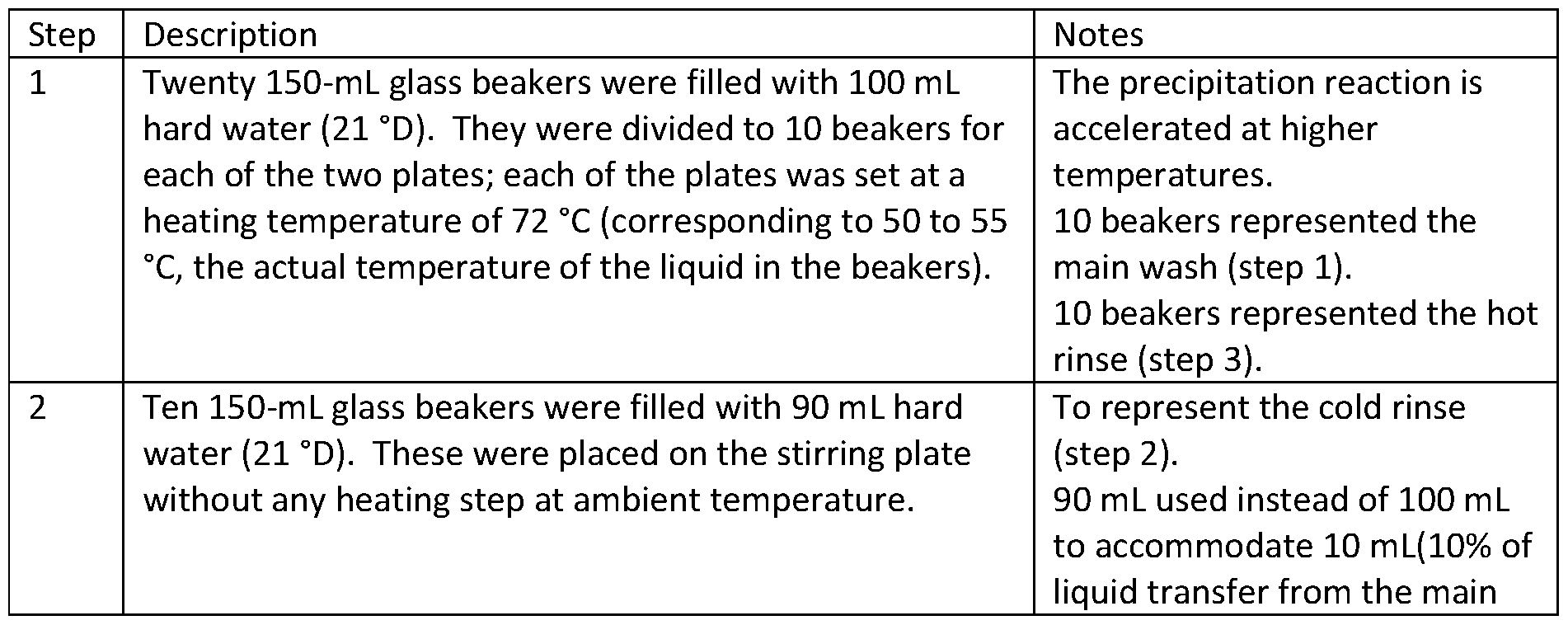
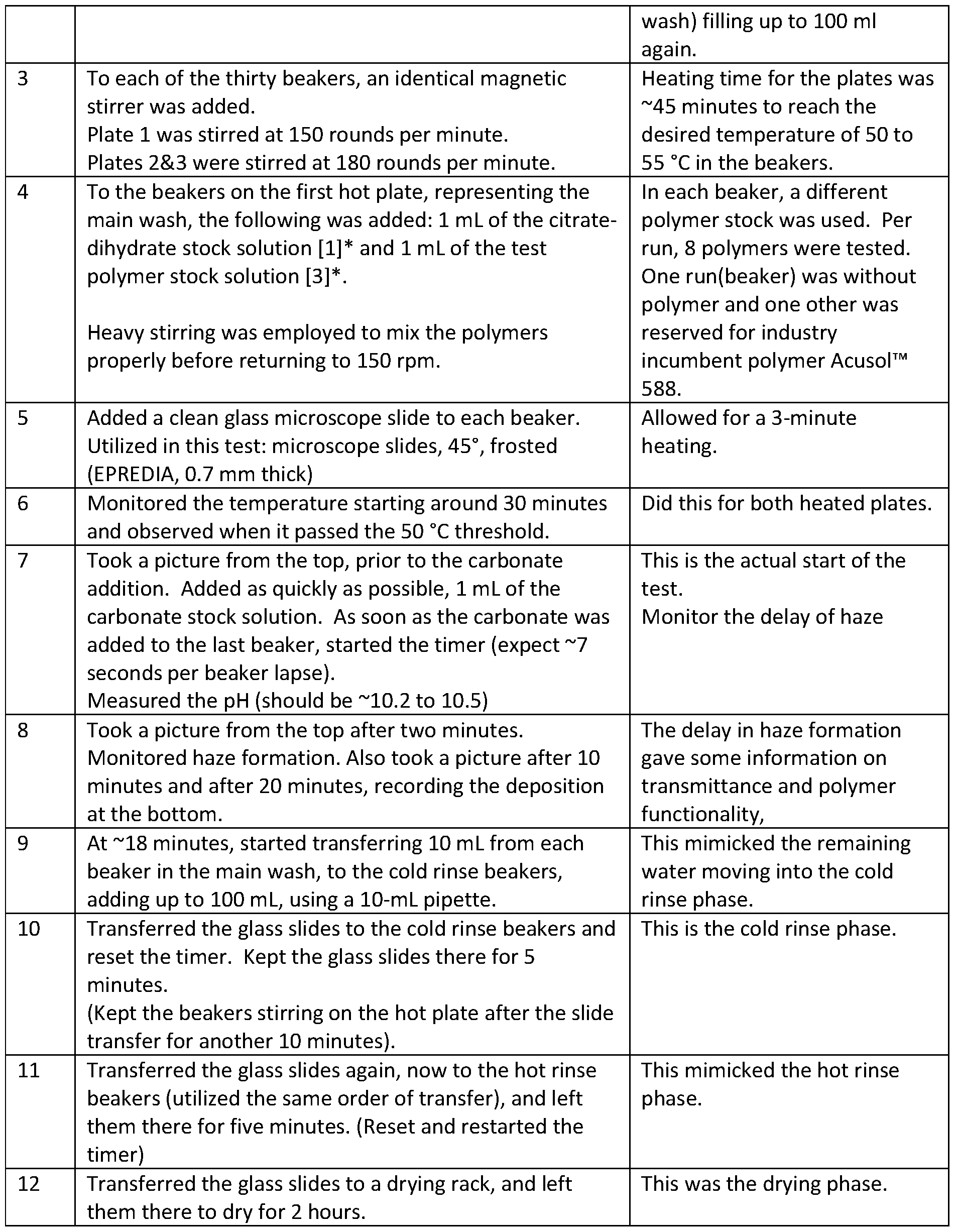
 *Refer to below text The washing volume taken was five liters for each step holding a replenishing volume of 90%, indicating that after the main wash, 4.5 liters would be pumped off, leaving behind 0.5 liters, adding 4.5 liters of new hard water to the dishwasher moving from the main wash to the cold rinse and from the cold rinse moving into the hot rinse. These chemical amounts have been calculated back to fit into 100 ml systems. Three types of stock solution were made: - 10.8 g citrate dihydrate in 100 mL hard water (100x citrate stock) [1] - 10.8 g sodium carbonate in 100 mL demineralized (“demi”) water (100x carbonate stock) [2] - Individual 100x stock solutions were made with 2.16 g of each polymer in 100 mL of hard water [3] In the anti-deposition setup, only 10% of volume was transferred from the main wash beakers to the first rinse beakers. Transmittance assay utilizing a pipetting robot and plate reader A second aspect of polymer performance is its effectiveness in delaying crystal (scale) formation. The transmittance relates to the amount of turbidity a specific liquid has. The more haze, the more suspended particles, the less the transmittance, and the higher the turbidity. Despite the end result, it is less relevant that during a wash, the liquid remains clear, as long as suspended solids can be washed away during the rinse phases of the dishwasher. Delay in crystal (scale) formation and the ability to cause crystal growth arrest has its reflection on an improved transmittance of the liquid. Also, smaller, or less crystals, wash off more easily. To evaluate the effectiveness of a polymer in the delay of haze formation in the liquid, a transmittance assay was developed herein. The assay utilizes 96-well plates. The main wash could be mimicked with this assay. The preparation setup is described below. In Table 3, the steps on the robot and plate reader are described. It was chosen
to make the below stock solutions, based on a similar setup of assumptions as the anti- deposition assay. The dishwash tablet was 18 grams, with the following values: - 30 weight percent of the tablet is carbonate (Na2CO3 anhydrous) - 30 weight percent of the tablet is citrate (sodium citrate-tribasic .2H2O) - 5 weight percent of the tablet is the polymer of choice. Sodium citrate 20X stock solution: 2.16 grams in 100 mL hard water [4] Sodium carbonate 20X stock solution: 2.16 grams in 100 mL demi water [5] Polymer 40X stock: 0.864 grams polymer in 100 mL hard water [6*] Plate preparation (manually): In the first row (A) – pipet 270 microliter of hard water (except well 12). In row A well 12, pipet 300 microliter of demi water. The to-be-tested polymers were tested in duplicate. In Row A well 1&2, added 30 microliters of polymer stock 1 [6] In Row A well 3&4, added 30 microliters of polymer stock 2 [6] In Row A well 5&6, added 30 microliters of polymer stock 3 [6] In Row A well 7&8, added 30 microliters of polymer stock 4 [6] In Row A well 9&10, added 30 microliters of polymer stock 5 [6] In Row A well 11, added 30 microliters of Acusol™ 588 stock [6] Pipetted up-and-down to ensure mixing. In all the other wells, Row B to H, except column 12, added 150 microliters of hard water using a multichannel pipet. Placed 150 microliters of demi water in each other well of column 12. In Row A (besides well 12), each well now contained 4X the normal concentration of polymer found in the main wash of a dishwash run. The plate was then sealed and taken to a BIOMEK pipetting robot. Table 3. Steps on the pipetting robot and plate reader
*Refer to below text The washing volume taken was five liters for each step holding a replenishing volume of 90%, indicating that after the main wash, 4.5 liters would be pumped off, leaving behind 0.5 liters, adding 4.5 liters of new hard water to the dishwasher moving from the main wash to the cold rinse and from the cold rinse moving into the hot rinse. These chemical amounts have been calculated back to fit into 100 ml systems. Three types of stock solution were made: - 10.8 g citrate dihydrate in 100 mL hard water (100x citrate stock) [1] - 10.8 g sodium carbonate in 100 mL demineralized (“demi”) water (100x carbonate stock) [2] - Individual 100x stock solutions were made with 2.16 g of each polymer in 100 mL of hard water [3] In the anti-deposition setup, only 10% of volume was transferred from the main wash beakers to the first rinse beakers. Transmittance assay utilizing a pipetting robot and plate reader A second aspect of polymer performance is its effectiveness in delaying crystal (scale) formation. The transmittance relates to the amount of turbidity a specific liquid has. The more haze, the more suspended particles, the less the transmittance, and the higher the turbidity. Despite the end result, it is less relevant that during a wash, the liquid remains clear, as long as suspended solids can be washed away during the rinse phases of the dishwasher. Delay in crystal (scale) formation and the ability to cause crystal growth arrest has its reflection on an improved transmittance of the liquid. Also, smaller, or less crystals, wash off more easily. To evaluate the effectiveness of a polymer in the delay of haze formation in the liquid, a transmittance assay was developed herein. The assay utilizes 96-well plates. The main wash could be mimicked with this assay. The preparation setup is described below. In Table 3, the steps on the robot and plate reader are described. It was chosen
to make the below stock solutions, based on a similar setup of assumptions as the anti- deposition assay. The dishwash tablet was 18 grams, with the following values: - 30 weight percent of the tablet is carbonate (Na2CO3 anhydrous) - 30 weight percent of the tablet is citrate (sodium citrate-tribasic .2H2O) - 5 weight percent of the tablet is the polymer of choice. Sodium citrate 20X stock solution: 2.16 grams in 100 mL hard water [4] Sodium carbonate 20X stock solution: 2.16 grams in 100 mL demi water [5] Polymer 40X stock: 0.864 grams polymer in 100 mL hard water [6*] Plate preparation (manually): In the first row (A) – pipet 270 microliter of hard water (except well 12). In row A well 12, pipet 300 microliter of demi water. The to-be-tested polymers were tested in duplicate. In Row A well 1&2, added 30 microliters of polymer stock 1 [6] In Row A well 3&4, added 30 microliters of polymer stock 2 [6] In Row A well 5&6, added 30 microliters of polymer stock 3 [6] In Row A well 7&8, added 30 microliters of polymer stock 4 [6] In Row A well 9&10, added 30 microliters of polymer stock 5 [6] In Row A well 11, added 30 microliters of Acusol™ 588 stock [6] Pipetted up-and-down to ensure mixing. In all the other wells, Row B to H, except column 12, added 150 microliters of hard water using a multichannel pipet. Placed 150 microliters of demi water in each other well of column 12. In Row A (besides well 12), each well now contained 4X the normal concentration of polymer found in the main wash of a dishwash run. The plate was then sealed and taken to a BIOMEK pipetting robot. Table 3. Steps on the pipetting robot and plate reader

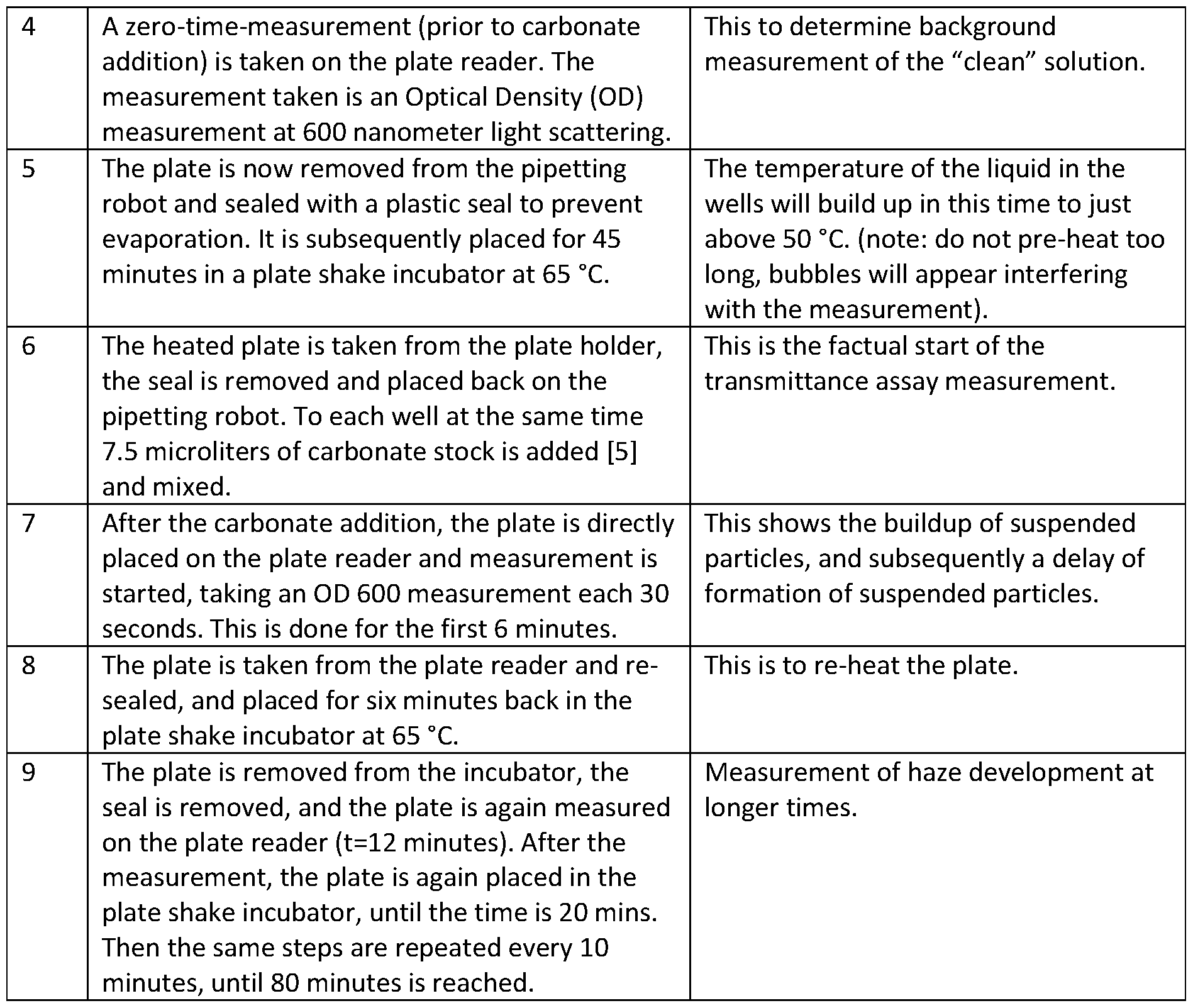 Example of synthesizing (crosslinked) carboxymethyl alpha-1,3-glucan Alpha-glucan with about 100% alpha-1,3 linkages was added to a thermostated 3-L glass lab reactor followed by addition of a mixed solvent (isopropanol, water, and methanol) under a constant stream of nitrogen to form an alpha-1,3-glucan slurry. Then, caustic soda in form of solid prills, and optionally a crosslinker, was/were added and the glucan was alkalized at 20 °C for 60 minutes while stirring. In the next step, chloroacetic acid was added to the reactor and the reaction mixture was heated to 70 °C and allowed to react for 120 minutes. The reaction mixture was then cooled to 20 °C, followed by its neutralization to pH 7.0 by addition of acetic acid. Crude CMG product was separated by filtration and washed several times with a methanol/isopropanol/water mixture (50/30/20 vol%). The washed product was dried overnight in a cabinet oven at 55 °C followed by milling. The amounts of reactants and solvents used in these syntheses are listed in the following table (Table B, split into left and right sides):
Table B (left side) Synthes produc mol/mo DS (CM Viscosi Brookfi LVT Viscosi Brookfi LVT turbidit Transm %] turbidit NTU] Transm
Example of synthesizing (crosslinked) carboxymethyl alpha-1,3-glucan Alpha-glucan with about 100% alpha-1,3 linkages was added to a thermostated 3-L glass lab reactor followed by addition of a mixed solvent (isopropanol, water, and methanol) under a constant stream of nitrogen to form an alpha-1,3-glucan slurry. Then, caustic soda in form of solid prills, and optionally a crosslinker, was/were added and the glucan was alkalized at 20 °C for 60 minutes while stirring. In the next step, chloroacetic acid was added to the reactor and the reaction mixture was heated to 70 °C and allowed to react for 120 minutes. The reaction mixture was then cooled to 20 °C, followed by its neutralization to pH 7.0 by addition of acetic acid. Crude CMG product was separated by filtration and washed several times with a methanol/isopropanol/water mixture (50/30/20 vol%). The washed product was dried overnight in a cabinet oven at 55 °C followed by milling. The amounts of reactants and solvents used in these syntheses are listed in the following table (Table B, split into left and right sides):
Table B (left side) Synthes produc mol/mo DS (CM Viscosi Brookfi LVT Viscosi Brookfi LVT turbidit Transm %] turbidit NTU] Transm
 %] 93,1
Table B (right side) OPE-0 SL-0 0, high gluc 6,2 1, 0, 91 0, 9, 0,0 -- -- 12, 0,4 619 30 7, 92 -- --
 ,
,
Polymer crosslinking and crosslinkers To determine the effectiveness of crosslinkers and their amounts applied per weight of polymer, several prototypes were prepared, with different crosslinkers and different amounts of crosslinker. Table 4 shows the different crosslinkers applied. Table 5 displays reaction regimes used for crosslinking a type of alpha-1,3-glucan ether. In particular, an increasing level of crosslinker (EGDE) was applied to various carboxymethyl alpha-1,3- glucan ethers (CMG). Table 4. Crosslinkers applied to alpha-glucan Crosslinker CAS No. Ethylene glycol diglycidyl ether (EGDE) 2224-15-9 T
 able 5. Example regimes for crosslinking CMG using EGDE Crosslinked Product Designation OPE-94 OPE-95 OPE-96 OPE-97 OPE-98 OPE-99 n - 9
 **UHDP refers to alpha-glucan with a DPw of about 1600 to 1800, and about 100% alpha- 1,3 linkages. Full dishwash trial (14 cycles)
To fully evaluate the screening test assay, a full dish trial was performed to justify the screening test. Since the test setup had different parameters than used in the screening test, results were not 1:1 relatable, but were expected to show similar trends. Images were made after 14 washes. The dishwash trial was performed with a minimal detergent formulation in order to stress the crosslinked polymers above a level that is normally expected. Parameters of the run are shown in Table 6. Table 6*. Dishwash plan and formulation as carried out during 14 runs Machine type / water: MIELE GSL2 / 21°dH (Ca:Mg @ 3:1) – based on demi water, no bicarbonate added Program: 65 °C / 10’ / 65 °C Repetitive cycles: visual check after every wash, pictures taken after 14 washes Salt: none Rinse aid: none Soil: 1X build-up test ballast soil (50 g) (Tensio protocol) Detergent: 17.7 g of ADD2d detergent (split sample) Polymer dosage: 1.3 g/wash Assessment: Photos in black booth of articles. Articles washed: MEPAL tube, melamine blue dish plate, long drink glass. * No rinse-aid was added to this detergent formulation Results Anti-deposition effect of different crosslinked alpha-glucan derivatives Over sixty different crosslinked polymer prototypes were tested, both at the common polymer concentration and including dose responses (indicating overdosing the crosslinked polymer to see an effect). The following trends were observed. 1. The more charge added to the water, the better the performance of delivering a “shine” benefit. Charge could be added in two ways, either with more polymer added to the water or the degree of substitution (chemical addition of charged groups to the polymer backbone). 2. These results applied to crosslinked carboxymethyl alpha-1,2-branched alpha-1,6-glucan ethers and crosslinked carboxymethyl alpha-1,3-glucan ethers, particularly when crosslinking was performed with EGDE. Results shown below. 3. Moderate crosslinking of alpha-glucan ether derivative had a surprising positive influence on the shine benefit, where little crosslinking had no effect and high crosslinking diminished the shine benefit. Results shown below.
4. The result summarized in point 2 was reinforced by the testing of carboxymethylated cellulose with increasing molecular weights, showing an improved shine benefit with increasing molecular weight. 5. The positive influence of crosslinking herein was only observed when using the crosslinker ethylene glycol diglycidyl ether (EGDE). Other crosslinkers (1,4-butanediol diglycidyl ether, trimethylolpropane triglycidyl ether, diethylene glycol diglycidyl ether) had little to no effect, or even a negative effect, on the shine benefit crosslinked alpha-glucan ether derivative. Only EGDE showed significantly improved performance in a narrow crosslinker content range. 6. The combination of increased charge density (e.g., provided by carboxyalkyl ether groups such as carboxymethyl ether groups) on alpha-1,3-glucan polymer backbone in combination with moderate crosslinking – specifically with EGDE crosslinker, where the ratio of EGDE to the charged alpha-1,3-glucan derivative was about 0.04 to 0.06 mole EGDE to about 1 mole alpha-glucan derivative – achieved the positive effect noted in point 5. 7. The charged groups on an alpha-glucan derivative such as an alpha-1,3- glucan derivative can be carboxylate groups (e.g., as comprised in carboxyalkyl groups such as carboxymethyl groups), sulfonate groups, or oxidized groups. 8. Additional types of functionalization such as hydrophobic modification (e.g., hydrophobic etherification such as by benzylation) were shown to positively contribute to providing a shine benefit to alpha-glucan derivatives substituted with charged groups. 9. The more charge an alpha-glucan derivative had, the better it was in delaying haze formation (i.e., providing shine benefit). This was shown, for example, using derivative I, which is an alpha-1,2-branched alpha-1,6-glucan derivatized with carboxymethyl groups (DoS of 2.3 to 2.6). Results of increasing charge of alpha-1,3-glucan derivative A set of carboxymethylated alpha-1,3-glucan ether (CMG) derivatives were tested in the same anti-deposition study to test the effect of increasing anionic derivative charge. The results are shown in FIG.1. The results of three concentration runs of three polymers with an increasing charge density and crosslinking are shown in FIG.1. The CMG derivatives were as follows: - OPE 36B: DPw ~1600-1800, non-crosslinked, DoS 0.86 with carboxymethyl.
- OPE 97: DPw ~1600-1800, crosslinked (0.05 mole EGDE to 1 mole CMG), DoS 0.56 with carboxymethyl. - OPE 149: DPw ~1600-1800, crosslinked (0.08 mole EGDE to 1 mole CMG), DoS 0.97 with carboxymethyl. Each series was performed with increasing (doubling) in polymer concentration (normal concentration ^ 2X normal ^ 4X normal). ACUSOL 420 was used as an industry incumbent positive control. Results of intermediate crosslinking on CMG To show the effect of moderate crosslinking, a series of CMG derivatives was made having an increasing level of EGDE crosslinking (produced in accordance with Table 5). The CMG that was subjected to crosslinking had a DoS of about 0.54 to 0.56 with carboxymethyl. The relative amount of EGDE to CMG (mol/mol) used here is listed below each slide in FIG.2. The method used was the anti-deposition test. What can be observed in FIG.2 is that there is an optimum in functionality with a crosslinker level of 0.04 to 0.05 mole crosslinker per one mole CMG. Results using carboxymethyl cellulose In addition, a series of carboxymethylated cellulose (CMC) derivatives was tested to show the effect of increasing polymer molecular weight on inhibition of scale formation. Results are shown in FIG.3. Here CMC with DoS 0.7 or 0.9 was applied in the same way as the CMG. However, the CMC samples were of increasing molecular weight, and not crosslinked. What is observed is an increased performance with increased molecular size. Results of adding more anionic charge to alpha-1,3-glucan To show the effect of anionic charge addition on alpha-1,3-glucan, a set of CMG derivatives (each based on DPw ~1600-1800, ~100% alpha-1,3-linked glucan polymer), was selected for anti-deposition testing. Table 7 represents the selected CMG compounds, none of which were crosslinked. Results of the anti-deposition run are shown in FIG.4. What can be observed is that, as more anionic charge is added to the polymer, the better the anti-deposition behavior (i.e., the more transparent the slide is). This result correlates to the above data (FIG.1) in which increasing amounts of polymer was added to the study vessels, leading to increased shine benefit performance. OPE 97, which was a moderately
crosslinked CMG (above), was included as a reference and again showed the advantage of moderate crosslinking FIG.4). Table 7. Selected CMG compounds of increasing level of anionic charge CMG designation DoS (all are non-crosslinked) OPE-079 0.25
**UHDP refers to alpha-glucan with a DPw of about 1600 to 1800, and about 100% alpha- 1,3 linkages. Full dishwash trial (14 cycles)
To fully evaluate the screening test assay, a full dish trial was performed to justify the screening test. Since the test setup had different parameters than used in the screening test, results were not 1:1 relatable, but were expected to show similar trends. Images were made after 14 washes. The dishwash trial was performed with a minimal detergent formulation in order to stress the crosslinked polymers above a level that is normally expected. Parameters of the run are shown in Table 6. Table 6*. Dishwash plan and formulation as carried out during 14 runs Machine type / water: MIELE GSL2 / 21°dH (Ca:Mg @ 3:1) – based on demi water, no bicarbonate added Program: 65 °C / 10’ / 65 °C Repetitive cycles: visual check after every wash, pictures taken after 14 washes Salt: none Rinse aid: none Soil: 1X build-up test ballast soil (50 g) (Tensio protocol) Detergent: 17.7 g of ADD2d detergent (split sample) Polymer dosage: 1.3 g/wash Assessment: Photos in black booth of articles. Articles washed: MEPAL tube, melamine blue dish plate, long drink glass. * No rinse-aid was added to this detergent formulation Results Anti-deposition effect of different crosslinked alpha-glucan derivatives Over sixty different crosslinked polymer prototypes were tested, both at the common polymer concentration and including dose responses (indicating overdosing the crosslinked polymer to see an effect). The following trends were observed. 1. The more charge added to the water, the better the performance of delivering a “shine” benefit. Charge could be added in two ways, either with more polymer added to the water or the degree of substitution (chemical addition of charged groups to the polymer backbone). 2. These results applied to crosslinked carboxymethyl alpha-1,2-branched alpha-1,6-glucan ethers and crosslinked carboxymethyl alpha-1,3-glucan ethers, particularly when crosslinking was performed with EGDE. Results shown below. 3. Moderate crosslinking of alpha-glucan ether derivative had a surprising positive influence on the shine benefit, where little crosslinking had no effect and high crosslinking diminished the shine benefit. Results shown below.
4. The result summarized in point 2 was reinforced by the testing of carboxymethylated cellulose with increasing molecular weights, showing an improved shine benefit with increasing molecular weight. 5. The positive influence of crosslinking herein was only observed when using the crosslinker ethylene glycol diglycidyl ether (EGDE). Other crosslinkers (1,4-butanediol diglycidyl ether, trimethylolpropane triglycidyl ether, diethylene glycol diglycidyl ether) had little to no effect, or even a negative effect, on the shine benefit crosslinked alpha-glucan ether derivative. Only EGDE showed significantly improved performance in a narrow crosslinker content range. 6. The combination of increased charge density (e.g., provided by carboxyalkyl ether groups such as carboxymethyl ether groups) on alpha-1,3-glucan polymer backbone in combination with moderate crosslinking – specifically with EGDE crosslinker, where the ratio of EGDE to the charged alpha-1,3-glucan derivative was about 0.04 to 0.06 mole EGDE to about 1 mole alpha-glucan derivative – achieved the positive effect noted in point 5. 7. The charged groups on an alpha-glucan derivative such as an alpha-1,3- glucan derivative can be carboxylate groups (e.g., as comprised in carboxyalkyl groups such as carboxymethyl groups), sulfonate groups, or oxidized groups. 8. Additional types of functionalization such as hydrophobic modification (e.g., hydrophobic etherification such as by benzylation) were shown to positively contribute to providing a shine benefit to alpha-glucan derivatives substituted with charged groups. 9. The more charge an alpha-glucan derivative had, the better it was in delaying haze formation (i.e., providing shine benefit). This was shown, for example, using derivative I, which is an alpha-1,2-branched alpha-1,6-glucan derivatized with carboxymethyl groups (DoS of 2.3 to 2.6). Results of increasing charge of alpha-1,3-glucan derivative A set of carboxymethylated alpha-1,3-glucan ether (CMG) derivatives were tested in the same anti-deposition study to test the effect of increasing anionic derivative charge. The results are shown in FIG.1. The results of three concentration runs of three polymers with an increasing charge density and crosslinking are shown in FIG.1. The CMG derivatives were as follows: - OPE 36B: DPw ~1600-1800, non-crosslinked, DoS 0.86 with carboxymethyl.
- OPE 97: DPw ~1600-1800, crosslinked (0.05 mole EGDE to 1 mole CMG), DoS 0.56 with carboxymethyl. - OPE 149: DPw ~1600-1800, crosslinked (0.08 mole EGDE to 1 mole CMG), DoS 0.97 with carboxymethyl. Each series was performed with increasing (doubling) in polymer concentration (normal concentration ^ 2X normal ^ 4X normal). ACUSOL 420 was used as an industry incumbent positive control. Results of intermediate crosslinking on CMG To show the effect of moderate crosslinking, a series of CMG derivatives was made having an increasing level of EGDE crosslinking (produced in accordance with Table 5). The CMG that was subjected to crosslinking had a DoS of about 0.54 to 0.56 with carboxymethyl. The relative amount of EGDE to CMG (mol/mol) used here is listed below each slide in FIG.2. The method used was the anti-deposition test. What can be observed in FIG.2 is that there is an optimum in functionality with a crosslinker level of 0.04 to 0.05 mole crosslinker per one mole CMG. Results using carboxymethyl cellulose In addition, a series of carboxymethylated cellulose (CMC) derivatives was tested to show the effect of increasing polymer molecular weight on inhibition of scale formation. Results are shown in FIG.3. Here CMC with DoS 0.7 or 0.9 was applied in the same way as the CMG. However, the CMC samples were of increasing molecular weight, and not crosslinked. What is observed is an increased performance with increased molecular size. Results of adding more anionic charge to alpha-1,3-glucan To show the effect of anionic charge addition on alpha-1,3-glucan, a set of CMG derivatives (each based on DPw ~1600-1800, ~100% alpha-1,3-linked glucan polymer), was selected for anti-deposition testing. Table 7 represents the selected CMG compounds, none of which were crosslinked. Results of the anti-deposition run are shown in FIG.4. What can be observed is that, as more anionic charge is added to the polymer, the better the anti-deposition behavior (i.e., the more transparent the slide is). This result correlates to the above data (FIG.1) in which increasing amounts of polymer was added to the study vessels, leading to increased shine benefit performance. OPE 97, which was a moderately
crosslinked CMG (above), was included as a reference and again showed the advantage of moderate crosslinking FIG.4). Table 7. Selected CMG compounds of increasing level of anionic charge CMG designation DoS (all are non-crosslinked) OPE-079 0.25
 0.52 0.86 Results of using other crosslinkers for crosslinking CMG As shown above, the majority of the EGDE-crosslinked CMG compounds showed improved results over non-crosslinked CMG samples when the crosslinking level was chosen correctly. To evaluate the effect of alternate crosslinkers aside from EGDE, the anti-deposition test was performed with CMG samples crosslinked with other crosslinkers (listed in Table 8). CMG compounds for crosslinking were chosen based on having a similar level of charge density as one of the CMG compounds (OPE 97) that was used for EGDE-crosslinking and that showed improved performance (Table 8). OPE 97 was chosen as a reference for this study. Results of the anti-deposition test are shown in FIG.5. What is shown is that using other crosslinkers did not lead to the same improvement in shine benefit as when CMG was crosslinked with EGDE. When crosslinked with 1,4-butanediol diglycidyl ether, large dendritic flocs appeared that precipitated as large crystals on the glass slide. All the crosslinked (non-EGDE) samples unexpectedly gave a performance similar to the no-polymer control. However, the EGDE-crosslinked sample exhibited anti- deposition activity, consistent with the above results. Table 8. CMG crosslinked with other types of crosslinkers CMG designation DoS Crosslinker* mol/mol** OPE 133 0.41 1,4-Butanediol diglycidyl ether 0.4 OPE 135 0.42 Trimethylolpropane triglycidyl ether 0.2 OPE 58 0.47 Diethyleneglycol diglycidyl ether 0.04 References OPE 97 0.56 EGDE 0.05 ACUSOL 420 sulfonated industry incumbent No polymer control *Crosslinker amounts vary, due to crosslinker efficiency. ** Mole crosslinker to mole CMG
Results of using other types of alpha-glucan derivatives Anti-deposition tests were performed using alpha-glucans (i) derivatized with carboxymethyl groups and hydrophobic groups (benzyl groups), (ii) derivatized by sulfonation, or (iii) derivatized by oxidizing an already-carboxymethylated alpha-glucan. Other derivatized alpha-glucan backbones were tested, such as derivatized alpha-1,2- branched alpha-1,6-glucan (alpha-1,2-1,6-glucan). Data on these various polymers are provided in Table 9. Shine benefit results using these polymers in anti-deposition testing are provided in FIGs.6, 7 and 8. What can be observed is that carboxymethylated alpha- 1,2-1,6-glucan (with or without inclusion of oxidation-derived carboxylate groups, which are in addition to the carboxylate groups of the carboxymethyl groups), which are highly anionically charged, provide a significant improvement in anti-deposition over the no- polymer control (FIG.6). The same result similarly applies to using carboxymethyl benzyl alpha-1,3-glucan ether derivative (FIG.7). Table 9. Alternate polymers for anti-deposition testing Polymer designation Backbone Derivatization DoS OPE-30-SL-25 Alpha-1,3-glucan Sulfonated 0.5 D105227-21 Alpha-1,3-glucan Carboxymethylated 0.6 Benzylated 0.6 I Alpha-1,2-1,6-glucan Carboxymethylated 2.4 (105 kDa, 5% alpha-1,2 branches) II Alpha-1,2-1,6-glucan Carboxymethylated 0.5 (12 kDa, 37% alpha-1,2 branches) Oxidized (carboxylate) 0.5 III Alpha-1,2-1,6-glucan Carboxymethylated ~1.5 total (145 kDa, 20% alpha-1,2 branches) Oxidized (carboxylate) carboxylate from CM + ox. Results of transmittance testing (see above: Transmittance assay utilizing a pipetting robot and plate reader) To determine how well a (crosslinked) glucan polymer of the Examples was able to reduce haze formation, a transmittance test assay was developed. Some of the results from this work are provided in FIGs.9-13. An optical density at 600 nanometers (OD600) was applied. These analyses gave a good indication of the level of suspended particles in a
liquid. Testing was done as well on 21 °D (hardness) and at 55 °C. Similar amounts of polymer were used as in the anti-deposition test. Results of automatic dishwashing test (14-cycle) A complete automatic dishwasher trial was performed in which polymers herein were used in a detergent formulation. Shine benefit of polymers was evaluated accordingly. The detergent formulation and method in which the full dish trial was performed are described above (including Table 6). Examples of results after 14 washes are provided in FIGs.14- 16. Three dishware substrates were chosen for this study: MEPAL tubes, melamine plates, and LIBBEY long drink glasses. It should be noted that the full dishwash test partially echoes the anti-deposition test and that improved performance is expected with the biopolymers when a rinse aid is added to the formulation used. Example 2 Summary of Example 2 Crosslinked carboxymethyl alpha-1,3-glucan (CMG) showed suitable properties as rheology modifiers in personal care applications. The crosslinked CMG compounds were characterized in terms of their viscosity and rheological properties in aqueous suspensions, showing viscosity and yield stress ranges comparable with synthetic carbomers and significantly higher than natural gums. When formulated in model personal care oil-in-water (O/W) emulsions, the positive rheological properties of crosslinked CMGs translated into improved emulsion stability, yield stress and more homogeneous emulsion droplet dispersions, allowing the use of significantly lower levels of polymer in the personal care formulations, when compared to widely used synthetic carbomers. Representative process for preparing crosslinked CMG Slurry powder of alpha-1,3-glucan (DPw ~1600-1800) with a particle size <100 µm was adjusted for a water content of 8% w/v and added to a reactor at a loading of 7% w/v in IPA/water. Under continuous overhead mixing, the glucan slurry was activated by adding a suitable amount of 50% NaOH in molar ratios ranging 0.5 to 3.0. This preparation was held at room temperature for 45 minutes and then the desired amount of crosslinker was added at molar ratios ranging from 0.01 to 0.2. Suitable crosslinkers included those listed in Table 4, among others. This crosslinking preparation was stirred at room temperature for 15 minutes and then, using a feeding pump, the desired amount of chloroacetic acid (CAA)
dissolved in IPA was added over a 40-minute period in CAA:glucan molar ratios ranging from 0.5 to 2.0 (to commence carboxymethylation). Heating was applied while feeding the CAA. After all the CAA was fed and the reactor temperature had reached 70 °C, the temperature was held for 2 hours. The reactor was then cooled down to 50 °C and the reaction was neutralized to pH 7 using acetic acid (glacial), thereby obtaining a white to off- white polymer slurry. The polymer slurry was purified by successive vacuum filtration and washing with mixtures of IPA, methanol and water, followed by a final washing and filtration with methanol. Finally, the purified slurry was dried under vacuum overnight at 60 °C to yield a white to off-white crosslinked CMG powder. In the below testing, the crosslinked CMG samples were prepared using ethylene glycol diglycidyl ether (EGDE) as a crosslinking agent. EGDE was added for crosslinking at a molar ratio of 0.01 to 0.1 mol relative to the mol of CMG, and the selected candidates for testing had an EDGE-to-CMG mol ratio content of about 0.08. Preparation of dispersions of crosslinked CMG Crosslinked CMG powder was dispersed in deionized water at concentrations ranging from 0.25 to 2.00% w/v under continuous stirring at 500 rpm using a DLS Digital Overhead Stirrer (Thermo Fisher Scientific, Waltham, MA) until homogeneity was reached; if necessary, heat could be applied up to 60 °C. After homogeneity was reached, the pH of the preparations was adjusted to 6.5 using either sodium hydroxide (5 N) or hydrochloric acid (5 N). The crosslinked CMG dispersions showed different ranges of viscosity from semi-fluid to thick gels, as a function of the final concentration. Xanthan gum (Clariant, Louisville, KY) and carbomer (ULTREZ 30, Lubrizol, Wickliffe, OH) were used as reference polymers for comparative analysis of viscosity, emulsion stability and yield stress. Control dispersions were prepared following the protocol described for the crosslinked CMG samples. The samples were stored at 23 °C for at least 3 days before carrying out viscosity and rheological characterization. Effect of crosslinked CMG on relative viscosity and rheological behavior in aqueous dispersions The relative viscosity of each polymer dispersion was determined at various shear rates ranging from 10 to 250 rpm, using a Brookfield DV2T Viscometer (Middleboro, MA) equipped with a recirculating bath to control temperature (20 °C) and an RV-6 spindle. The RV values for each sample were recorded and averaged for a period of 60 seconds for each determined shear rate value. Results, shown in FIG.17, demonstrate that crosslinked
CMG (0.46 DoS) showed an increase in dispersion viscosity as a function of the increase in polymer concentration, with values of relative viscosity significantly higher than natural gum (xanthan) and slightly lower than synthetic carbomer (ULTREZ 30), but reaching similar values of relative viscosity at higher polymer concentrations (2% w/v). The effect of crosslinked CMG on preserving dispersion stability despite addition of sodium chloride was determined in comparison to synthetic carbomer control (ULTREZ 30). Polymer dispersions at a concentration 1% w/v were prepared as described above and mixed with different amounts of sodium chloride to final salt concentrations of 0.1% to 4% w/v. The relative viscosity of the dispersions upon changing the salt concentration was determined using a Brookfield DV2T Viscometer as described above. Results, shown in FIG.18, demonstrate that crosslinked CMG (0.46 DoS) showed a significant advantage over synthetic carbomer (ULTREZ 30) in terms of maintaining viscosity stability despite an increase in salt content, which is an important property when formulating personal care products as well as other products. Synthetic carbomer dispersions showed a significant drop in relative viscosity when small amounts of salt were added to the system (0.1%), whereas, at the same polymer concentration, the crosslinked CMG was able to maintain significantly higher viscosity values; this was observed even up to 4% w/v sodium chloride addition (FIG.18). The rheological behavior of the polymer dispersions was evaluated under continuous and oscillatory flow programs using a Rheometer Discovery HR-20 (TA Instruments, New Castle, DE), equipped with an ARES G240-mm geometry with a fixed gap (0.098 mm). All the measurements were conducted at a controlled temperature of 23 °C. FIGs.19A-D show the changes on viscosity curves as a function of shear rate for increasing concentrations (0.25% to 2% w/v) of crosslinked CMG polymer (DoS 0.4-0.5, FIGs.19C-D) and compared to the ones for synthetic carbomer (ULTREZ 10 or 30, FIGs.19A-B). Results suggest the vertical gaps that separate the viscosity curves for each polymer concentration tended to narrow down for carbomer as a function of the increase in its concentration, aligning with the results obtained for Brookfield viscosity in FIG.17, that indicated viscosity values reached a plateau at concentrations higher than 1% w/v, whereas the gap for crosslinked CMG tended to become wider at the highest concentrations, suggesting a more effective linear increase in viscosity. Yield strength is important because it characterizes the highest stress a material can tolerate before permanent deformation occurs. In the chemical and cosmetic industries,
viscosity testing and determination of yield stress are very important parameters for quality control and performance assessments, allowing manufacturers to predict how products will behave once they are in the hands of the consumer. FIG.20 shows rheological behavior (shear stress vs. shear rate), and FIG.21 shows storage modulus and yield stress, in aqueous dispersions of crosslinked CMG (DoS 0.4-0.5) as compared to carbomer (ULTREZ 30, highlighted with a star in each figure) at slightly higher concentrations (1.5x-2x) of crosslinked CMG, without the need for pH adjustment. Variation in yield stress for crosslinked CMG in aqueous dispersions as a function of DoS is shown in FIG.22, suggesting a direct linear increase in yield stress as function of the increase in DoS, until a maximum value around DoS 0.5 is reached and then the yield stress appeared to drop. Effect of crosslinked CMG on rheological behavior and emulsion stability of formulated model personal care products Rheology modifiers are added to formulations to increase viscosity, promote yield stress, and to control the finished product’s properties and characteristics in a desired manner. Model personal care oil-in-water (O/W) emulsions were formulated containing crosslinked CMG, following the formula composition detailed in Table 10, to assess the effect of crosslinked CMG on rheological behavior and emulsion stability. Table 10. Formulation composition for testing oil-in-water emulsions containing crosslinked CMG as rheology modifier at 0.5% w/v Phase Content (%) Ingredient/ INCI Function Protocol Tradename A 69.5 Water Water Solvent A 0.5 Crosslinked Rheology CMG Modifier 1. Heat A to 75 °C A 10.0 Zemea Propanediol Humectant 2. Heat B to 75 °C 3. Add B to A with f CT Caprylic/Cap ast B 15.0 C’Ester M ric Triglyceride Emollient sharp-bladed propeller mixer Glyceryl Stearate B 5.0 Natragem Polyglyceryl-6 4. Homogenize briefly, EW Palmitate/Succinate Emulsifier
0.52 0.86 Results of using other crosslinkers for crosslinking CMG As shown above, the majority of the EGDE-crosslinked CMG compounds showed improved results over non-crosslinked CMG samples when the crosslinking level was chosen correctly. To evaluate the effect of alternate crosslinkers aside from EGDE, the anti-deposition test was performed with CMG samples crosslinked with other crosslinkers (listed in Table 8). CMG compounds for crosslinking were chosen based on having a similar level of charge density as one of the CMG compounds (OPE 97) that was used for EGDE-crosslinking and that showed improved performance (Table 8). OPE 97 was chosen as a reference for this study. Results of the anti-deposition test are shown in FIG.5. What is shown is that using other crosslinkers did not lead to the same improvement in shine benefit as when CMG was crosslinked with EGDE. When crosslinked with 1,4-butanediol diglycidyl ether, large dendritic flocs appeared that precipitated as large crystals on the glass slide. All the crosslinked (non-EGDE) samples unexpectedly gave a performance similar to the no-polymer control. However, the EGDE-crosslinked sample exhibited anti- deposition activity, consistent with the above results. Table 8. CMG crosslinked with other types of crosslinkers CMG designation DoS Crosslinker* mol/mol** OPE 133 0.41 1,4-Butanediol diglycidyl ether 0.4 OPE 135 0.42 Trimethylolpropane triglycidyl ether 0.2 OPE 58 0.47 Diethyleneglycol diglycidyl ether 0.04 References OPE 97 0.56 EGDE 0.05 ACUSOL 420 sulfonated industry incumbent No polymer control *Crosslinker amounts vary, due to crosslinker efficiency. ** Mole crosslinker to mole CMG
Results of using other types of alpha-glucan derivatives Anti-deposition tests were performed using alpha-glucans (i) derivatized with carboxymethyl groups and hydrophobic groups (benzyl groups), (ii) derivatized by sulfonation, or (iii) derivatized by oxidizing an already-carboxymethylated alpha-glucan. Other derivatized alpha-glucan backbones were tested, such as derivatized alpha-1,2- branched alpha-1,6-glucan (alpha-1,2-1,6-glucan). Data on these various polymers are provided in Table 9. Shine benefit results using these polymers in anti-deposition testing are provided in FIGs.6, 7 and 8. What can be observed is that carboxymethylated alpha- 1,2-1,6-glucan (with or without inclusion of oxidation-derived carboxylate groups, which are in addition to the carboxylate groups of the carboxymethyl groups), which are highly anionically charged, provide a significant improvement in anti-deposition over the no- polymer control (FIG.6). The same result similarly applies to using carboxymethyl benzyl alpha-1,3-glucan ether derivative (FIG.7). Table 9. Alternate polymers for anti-deposition testing Polymer designation Backbone Derivatization DoS OPE-30-SL-25 Alpha-1,3-glucan Sulfonated 0.5 D105227-21 Alpha-1,3-glucan Carboxymethylated 0.6 Benzylated 0.6 I Alpha-1,2-1,6-glucan Carboxymethylated 2.4 (105 kDa, 5% alpha-1,2 branches) II Alpha-1,2-1,6-glucan Carboxymethylated 0.5 (12 kDa, 37% alpha-1,2 branches) Oxidized (carboxylate) 0.5 III Alpha-1,2-1,6-glucan Carboxymethylated ~1.5 total (145 kDa, 20% alpha-1,2 branches) Oxidized (carboxylate) carboxylate from CM + ox. Results of transmittance testing (see above: Transmittance assay utilizing a pipetting robot and plate reader) To determine how well a (crosslinked) glucan polymer of the Examples was able to reduce haze formation, a transmittance test assay was developed. Some of the results from this work are provided in FIGs.9-13. An optical density at 600 nanometers (OD600) was applied. These analyses gave a good indication of the level of suspended particles in a
liquid. Testing was done as well on 21 °D (hardness) and at 55 °C. Similar amounts of polymer were used as in the anti-deposition test. Results of automatic dishwashing test (14-cycle) A complete automatic dishwasher trial was performed in which polymers herein were used in a detergent formulation. Shine benefit of polymers was evaluated accordingly. The detergent formulation and method in which the full dish trial was performed are described above (including Table 6). Examples of results after 14 washes are provided in FIGs.14- 16. Three dishware substrates were chosen for this study: MEPAL tubes, melamine plates, and LIBBEY long drink glasses. It should be noted that the full dishwash test partially echoes the anti-deposition test and that improved performance is expected with the biopolymers when a rinse aid is added to the formulation used. Example 2 Summary of Example 2 Crosslinked carboxymethyl alpha-1,3-glucan (CMG) showed suitable properties as rheology modifiers in personal care applications. The crosslinked CMG compounds were characterized in terms of their viscosity and rheological properties in aqueous suspensions, showing viscosity and yield stress ranges comparable with synthetic carbomers and significantly higher than natural gums. When formulated in model personal care oil-in-water (O/W) emulsions, the positive rheological properties of crosslinked CMGs translated into improved emulsion stability, yield stress and more homogeneous emulsion droplet dispersions, allowing the use of significantly lower levels of polymer in the personal care formulations, when compared to widely used synthetic carbomers. Representative process for preparing crosslinked CMG Slurry powder of alpha-1,3-glucan (DPw ~1600-1800) with a particle size <100 µm was adjusted for a water content of 8% w/v and added to a reactor at a loading of 7% w/v in IPA/water. Under continuous overhead mixing, the glucan slurry was activated by adding a suitable amount of 50% NaOH in molar ratios ranging 0.5 to 3.0. This preparation was held at room temperature for 45 minutes and then the desired amount of crosslinker was added at molar ratios ranging from 0.01 to 0.2. Suitable crosslinkers included those listed in Table 4, among others. This crosslinking preparation was stirred at room temperature for 15 minutes and then, using a feeding pump, the desired amount of chloroacetic acid (CAA)
dissolved in IPA was added over a 40-minute period in CAA:glucan molar ratios ranging from 0.5 to 2.0 (to commence carboxymethylation). Heating was applied while feeding the CAA. After all the CAA was fed and the reactor temperature had reached 70 °C, the temperature was held for 2 hours. The reactor was then cooled down to 50 °C and the reaction was neutralized to pH 7 using acetic acid (glacial), thereby obtaining a white to off- white polymer slurry. The polymer slurry was purified by successive vacuum filtration and washing with mixtures of IPA, methanol and water, followed by a final washing and filtration with methanol. Finally, the purified slurry was dried under vacuum overnight at 60 °C to yield a white to off-white crosslinked CMG powder. In the below testing, the crosslinked CMG samples were prepared using ethylene glycol diglycidyl ether (EGDE) as a crosslinking agent. EGDE was added for crosslinking at a molar ratio of 0.01 to 0.1 mol relative to the mol of CMG, and the selected candidates for testing had an EDGE-to-CMG mol ratio content of about 0.08. Preparation of dispersions of crosslinked CMG Crosslinked CMG powder was dispersed in deionized water at concentrations ranging from 0.25 to 2.00% w/v under continuous stirring at 500 rpm using a DLS Digital Overhead Stirrer (Thermo Fisher Scientific, Waltham, MA) until homogeneity was reached; if necessary, heat could be applied up to 60 °C. After homogeneity was reached, the pH of the preparations was adjusted to 6.5 using either sodium hydroxide (5 N) or hydrochloric acid (5 N). The crosslinked CMG dispersions showed different ranges of viscosity from semi-fluid to thick gels, as a function of the final concentration. Xanthan gum (Clariant, Louisville, KY) and carbomer (ULTREZ 30, Lubrizol, Wickliffe, OH) were used as reference polymers for comparative analysis of viscosity, emulsion stability and yield stress. Control dispersions were prepared following the protocol described for the crosslinked CMG samples. The samples were stored at 23 °C for at least 3 days before carrying out viscosity and rheological characterization. Effect of crosslinked CMG on relative viscosity and rheological behavior in aqueous dispersions The relative viscosity of each polymer dispersion was determined at various shear rates ranging from 10 to 250 rpm, using a Brookfield DV2T Viscometer (Middleboro, MA) equipped with a recirculating bath to control temperature (20 °C) and an RV-6 spindle. The RV values for each sample were recorded and averaged for a period of 60 seconds for each determined shear rate value. Results, shown in FIG.17, demonstrate that crosslinked
CMG (0.46 DoS) showed an increase in dispersion viscosity as a function of the increase in polymer concentration, with values of relative viscosity significantly higher than natural gum (xanthan) and slightly lower than synthetic carbomer (ULTREZ 30), but reaching similar values of relative viscosity at higher polymer concentrations (2% w/v). The effect of crosslinked CMG on preserving dispersion stability despite addition of sodium chloride was determined in comparison to synthetic carbomer control (ULTREZ 30). Polymer dispersions at a concentration 1% w/v were prepared as described above and mixed with different amounts of sodium chloride to final salt concentrations of 0.1% to 4% w/v. The relative viscosity of the dispersions upon changing the salt concentration was determined using a Brookfield DV2T Viscometer as described above. Results, shown in FIG.18, demonstrate that crosslinked CMG (0.46 DoS) showed a significant advantage over synthetic carbomer (ULTREZ 30) in terms of maintaining viscosity stability despite an increase in salt content, which is an important property when formulating personal care products as well as other products. Synthetic carbomer dispersions showed a significant drop in relative viscosity when small amounts of salt were added to the system (0.1%), whereas, at the same polymer concentration, the crosslinked CMG was able to maintain significantly higher viscosity values; this was observed even up to 4% w/v sodium chloride addition (FIG.18). The rheological behavior of the polymer dispersions was evaluated under continuous and oscillatory flow programs using a Rheometer Discovery HR-20 (TA Instruments, New Castle, DE), equipped with an ARES G240-mm geometry with a fixed gap (0.098 mm). All the measurements were conducted at a controlled temperature of 23 °C. FIGs.19A-D show the changes on viscosity curves as a function of shear rate for increasing concentrations (0.25% to 2% w/v) of crosslinked CMG polymer (DoS 0.4-0.5, FIGs.19C-D) and compared to the ones for synthetic carbomer (ULTREZ 10 or 30, FIGs.19A-B). Results suggest the vertical gaps that separate the viscosity curves for each polymer concentration tended to narrow down for carbomer as a function of the increase in its concentration, aligning with the results obtained for Brookfield viscosity in FIG.17, that indicated viscosity values reached a plateau at concentrations higher than 1% w/v, whereas the gap for crosslinked CMG tended to become wider at the highest concentrations, suggesting a more effective linear increase in viscosity. Yield strength is important because it characterizes the highest stress a material can tolerate before permanent deformation occurs. In the chemical and cosmetic industries,
viscosity testing and determination of yield stress are very important parameters for quality control and performance assessments, allowing manufacturers to predict how products will behave once they are in the hands of the consumer. FIG.20 shows rheological behavior (shear stress vs. shear rate), and FIG.21 shows storage modulus and yield stress, in aqueous dispersions of crosslinked CMG (DoS 0.4-0.5) as compared to carbomer (ULTREZ 30, highlighted with a star in each figure) at slightly higher concentrations (1.5x-2x) of crosslinked CMG, without the need for pH adjustment. Variation in yield stress for crosslinked CMG in aqueous dispersions as a function of DoS is shown in FIG.22, suggesting a direct linear increase in yield stress as function of the increase in DoS, until a maximum value around DoS 0.5 is reached and then the yield stress appeared to drop. Effect of crosslinked CMG on rheological behavior and emulsion stability of formulated model personal care products Rheology modifiers are added to formulations to increase viscosity, promote yield stress, and to control the finished product’s properties and characteristics in a desired manner. Model personal care oil-in-water (O/W) emulsions were formulated containing crosslinked CMG, following the formula composition detailed in Table 10, to assess the effect of crosslinked CMG on rheological behavior and emulsion stability. Table 10. Formulation composition for testing oil-in-water emulsions containing crosslinked CMG as rheology modifier at 0.5% w/v Phase Content (%) Ingredient/ INCI Function Protocol Tradename A 69.5 Water Water Solvent A 0.5 Crosslinked Rheology CMG Modifier 1. Heat A to 75 °C A 10.0 Zemea Propanediol Humectant 2. Heat B to 75 °C 3. Add B to A with f CT Caprylic/Cap ast B 15.0 C’Ester M ric Triglyceride Emollient sharp-bladed propeller mixer Glyceryl Stearate B 5.0 Natragem Polyglyceryl-6 4. Homogenize briefly, EW Palmitate/Succinate Emulsifier
 if required Cetearyl Alcohol The preliminary physicochemical stability of the formulated O/W emulsions containing crosslinked CMG was evaluated according to freezing (-5 ± 2 °C) and thawing (40 ± 2 °C) cycles of 24 hours, for 12 days, covering a total of three cycles. The formulations were tested for sedimentation by centrifugation, at the beginning of and at the end of each study,
using LUMiSizer equipment (LUM GmbH, Berlin, Germany). Samples were placed in the cuvette of 2 mm optical path and centrifuged at 4000 rpm (5976 g) for 60 minutes. While the samples were being exposed to the centrifugal force, a near-infrared light lamp illuminated the cuvette, allowing the measurement of the transmitted light intensity. This measurement was obtained as a function of time and position of the sample over the entire length of the cuvette, thereby providing transmittance profiles. The instability index (I) was determined by the transmittance profiles using software SepView 6.0 (LUM GmbH, Berlin, Germany). Results for emulsion stability are summarized in Table 11, suggesting that crosslinked CMG polymers of a wide range of DoS (0.2-0.5) had improved stabilizing activity on O/W emulsions at 0.5% polymer content, after successive cycles of freeze- thawing, when compared to carbomers (ULTREZ 10 and ULTREZ 30) and natural gum (xanthan). Table 11. Variation on instability index at 23 °C for O/W emulsions containing 0.5% w/v crosslinked CMG (DoS 0.2 to 0.5) as a function of successive cycles of freeze-thawing in comparison to synthetic carbomers (ULTREZ 10 and 30) and natural gum (xanthan) Sample ID Cycle 0 Cycle 1 Cycle 2 Cycle 3 Crosslinked CMG (DoS 0.21) 0.01 0.01 0.01 0.01 Crosslinked CMG (DoS 0.25) 0.01 0.01 0.01 0.01 Crosslinked CMG (DoS 0.32) 0.01 0.01 0.01 0.01 Crosslinked CMG (DoS 0.46) 0.01 0.01 0.01 0.01 Crosslinked CMG (DoS 0.50) 0.01 0.01 0.01 0.01 Natural Gum (xanthan) 0.01 0.04 0.05 0.09 Carbomer (ULTREZ 10) 0.12 0.38 0.75 0.96 Carbomer (ULTREZ 30) 0.04 0.08 0.12 0.32 Changes in droplet size of O/W emulsions containing crosslinked CMG at 0.5% w/v were evaluated by optical microscopy (Olympus BX41, Tokyo, Japan) and compared with carbomer (ULTREZ 30). The O/W emulsions were diluted ten-fold in deionized water and applied to a glass slide prior to visualization under a microscope; results are shown in FIG. 23. Microscopy imaging (20X) suggested that crosslinked CMG (DoS 0.4-0.5) showed more homogeneous droplet distribution than carbomers and the results agree with the instability index obtained by LUMiSizer analysis, indicating smaller and more homogeneous droplet sizes observed in CMG samples may be driving its lower instability indices and improved emulsion stabilization, as compared to carbomers.
FIGs.24A-B show the rheological analysis of model O/W emulsions containing crosslinked CMG (DoS 0.4-0.5) according to the above-described protocols. These results suggest significantly improved yield stress and rheological behavior, when compared to the carbomer (ULTREZ 30) formulation at the same polymer content (0.5% w/v) (FIG.24A). The range difference between the rheology curves for crosslinked CMG against carbomer allowed for reducing its polymer content by half to 0.25% w/v (FIG.24B), while keeping enhanced rheological properties when compared to carbomer at higher concentration (0.5% w/v, highlighted with star).
if required Cetearyl Alcohol The preliminary physicochemical stability of the formulated O/W emulsions containing crosslinked CMG was evaluated according to freezing (-5 ± 2 °C) and thawing (40 ± 2 °C) cycles of 24 hours, for 12 days, covering a total of three cycles. The formulations were tested for sedimentation by centrifugation, at the beginning of and at the end of each study,
using LUMiSizer equipment (LUM GmbH, Berlin, Germany). Samples were placed in the cuvette of 2 mm optical path and centrifuged at 4000 rpm (5976 g) for 60 minutes. While the samples were being exposed to the centrifugal force, a near-infrared light lamp illuminated the cuvette, allowing the measurement of the transmitted light intensity. This measurement was obtained as a function of time and position of the sample over the entire length of the cuvette, thereby providing transmittance profiles. The instability index (I) was determined by the transmittance profiles using software SepView 6.0 (LUM GmbH, Berlin, Germany). Results for emulsion stability are summarized in Table 11, suggesting that crosslinked CMG polymers of a wide range of DoS (0.2-0.5) had improved stabilizing activity on O/W emulsions at 0.5% polymer content, after successive cycles of freeze- thawing, when compared to carbomers (ULTREZ 10 and ULTREZ 30) and natural gum (xanthan). Table 11. Variation on instability index at 23 °C for O/W emulsions containing 0.5% w/v crosslinked CMG (DoS 0.2 to 0.5) as a function of successive cycles of freeze-thawing in comparison to synthetic carbomers (ULTREZ 10 and 30) and natural gum (xanthan) Sample ID Cycle 0 Cycle 1 Cycle 2 Cycle 3 Crosslinked CMG (DoS 0.21) 0.01 0.01 0.01 0.01 Crosslinked CMG (DoS 0.25) 0.01 0.01 0.01 0.01 Crosslinked CMG (DoS 0.32) 0.01 0.01 0.01 0.01 Crosslinked CMG (DoS 0.46) 0.01 0.01 0.01 0.01 Crosslinked CMG (DoS 0.50) 0.01 0.01 0.01 0.01 Natural Gum (xanthan) 0.01 0.04 0.05 0.09 Carbomer (ULTREZ 10) 0.12 0.38 0.75 0.96 Carbomer (ULTREZ 30) 0.04 0.08 0.12 0.32 Changes in droplet size of O/W emulsions containing crosslinked CMG at 0.5% w/v were evaluated by optical microscopy (Olympus BX41, Tokyo, Japan) and compared with carbomer (ULTREZ 30). The O/W emulsions were diluted ten-fold in deionized water and applied to a glass slide prior to visualization under a microscope; results are shown in FIG. 23. Microscopy imaging (20X) suggested that crosslinked CMG (DoS 0.4-0.5) showed more homogeneous droplet distribution than carbomers and the results agree with the instability index obtained by LUMiSizer analysis, indicating smaller and more homogeneous droplet sizes observed in CMG samples may be driving its lower instability indices and improved emulsion stabilization, as compared to carbomers.
FIGs.24A-B show the rheological analysis of model O/W emulsions containing crosslinked CMG (DoS 0.4-0.5) according to the above-described protocols. These results suggest significantly improved yield stress and rheological behavior, when compared to the carbomer (ULTREZ 30) formulation at the same polymer content (0.5% w/v) (FIG.24A). The range difference between the rheology curves for crosslinked CMG against carbomer allowed for reducing its polymer content by half to 0.25% w/v (FIG.24B), while keeping enhanced rheological properties when compared to carbomer at higher concentration (0.5% w/v, highlighted with star).
Claims
CLAIMS What is claimed is: 1. A composition comprising a crosslinked alpha-glucan derivative, wherein the crosslinked alpha-glucan derivative is produced by contacting ethylene glycol diglycidyl ether (EGDE) with a first alpha-glucan derivative, thereby crosslinking the first alpha-glucan derivative, wherein the ratio of the EGDE to the first alpha-glucan derivative is about 0.03 to 0.07 mole EGDE to about 1 mole first alpha-glucan derivative.
2. The composition of claim 1, wherein at least about 50% of the glycosidic linkages of the crosslinked alpha-glucan derivative are alpha-1,3 linkages. 3. The composition of claim 2, wherein at least about 90% of the glycosidic linkages of the crosslinked alpha-glucan derivative are alpha-1,
3 linkages.
4. The composition of claim 1, wherein at least about 50% of the glycosidic linkages of the crosslinked alpha-glucan derivative are alpha-1,6 linkages.
5. The composition of claim 4, wherein the crosslinked alpha-glucan derivative comprises at least 1% alpha-1,2 and/or alpha-1,3 branches.
6. The composition of claim 1, wherein the alpha-glucan from which the first alpha- glucan derivative was derived has a weight-average degree of polymerization (DPw) of at least about 200.
7. The composition of claim 1, wherein the first alpha-glucan derivative has a degree of substitution (DoS) up to about 3.0 with at least one organic group.
8. The composition of claim 7, wherein the organic group is in ether linkage to the first alpha-glucan derivative.
9. The composition of claim 8, wherein the organic group comprises a carboxyalkyl, alkyl, hydroxyalkyl, or aryl group.
10. The composition of claim 8, wherein the organic group comprises a carboxymethyl group.
11. The composition of claim 8, wherein the organic group comprises a benzyl group.
12. The composition of claim 9, wherein the first alpha-glucan derivative comprises the carboxyalkyl group and the aryl group.
13. The composition of claim 1, wherein the first alpha-glucan derivative has a DoS up to about 3.0 with at least one sulfonate group.
14. The composition of claim 1, wherein the first alpha-glucan derivative has been oxidized.
15. The composition of claim 1, wherein the first alpha-glucan derivative has a DoS of about 0.35 to 2.5, and wherein at least about 50% of the glycosidic linkages of the crosslinked alpha-glucan derivative are alpha-1,3 linkages.
16. The composition of claim 1, wherein the first alpha-glucan derivative has a DoS of at least about 2.0, and wherein at least about 50% of the glycosidic linkages of the crosslinked alpha-glucan derivative are alpha-1,6 linkages, optionally wherein the first alpha-glucan derivative comprises at least 1% alpha-1,2 and/or alpha-1,3 branches.
17. The composition of claim 1, wherein the ratio of the EGDE to the first alpha-glucan derivative is about 0.04 to 0.06 mole EGDE to about 1 mole first alpha-glucan derivative.
18. The composition of claim 1, wherein the composition is an aqueous composition.
19. The composition of claim 18, wherein the aqueous composition further comprises at least one cation, and the crosslinked polysaccharide derivative is bound to the cation.
20. The composition of claim 1, wherein the composition is a household care product, personal care product, industrial product, medical product, or pharmaceutical product.
21. The composition of claim 1, wherein the composition is in the form of, or comprised in, a liquid, gel, powder, hydrocolloid, granule, tablet, capsule, bead or pastille, single-compartment sachet, multi-compartment sachet, single-compartment pouch, or multi-compartment pouch.
22. The composition of claim 1, further comprising at least one surfactant.
23. The composition of claim 1, further comprising at least one enzyme.
24. The composition of claim 23, wherein the enzyme is a cellulase, protease, amylase, lipase, or nuclease.
25. The composition of claim 1, further comprising at least one of a complexing agent, soil release polymer, surfactancy-boosting polymer, bleaching agent, bleach activator, bleaching catalyst, fabric conditioner, clay, foam booster, suds suppressor, anti-corrosion agent, soil-suspending agent, anti-soil re-deposition agent, dye, bactericide, tarnish inhibitor, optical brightener, perfume, saturated or unsaturated fatty acid, dye transfer-inhibiting agent, chelating agent, hueing dye, visual signaling ingredient, anti-foam, structurant, thickener, anti-caking agent, starch, sand, or gelling agent.
26. The composition of claim 1, wherein the composition is in the form of, or comprised in, a dishwashing detergent composition.
27. A method of washing or treating a hard surface, said method comprising:
(a) contacting the hard surface with a washing/treating composition that comprises the composition of claim 1, and (b) removing all of, or a portion of, the washing/treating composition from the hard surface; thereby washing or treating the hard surface, wherein the washed/treated hard surface has reduced filming, spotting, haze, or other deposition, optionally wherein the hard surface is that of glass, plastic, ceramic, porcelain, metal, or stone.
28. The method of claim 27, wherein step (b) comprises rinsing the hard surface.
29. The method of claim 27, wherein the hard surface is that of dishware.
30. The method of claim 27, performed in an automatic dishwasher.
31. A method of producing a crosslinked alpha-glucan derivative, said method comprising: (a) contacting ethylene glycol diglycidyl ether (EGDE) with a first alpha-glucan derivative, thereby crosslinking the first alpha-glucan derivative, wherein the ratio of the EGDE to the first alpha-glucan derivative is about 0.03 to 0.07 mole EGDE to about 1 mole first alpha-glucan derivative, and (b) optionally isolating the crosslinked alpha-glucan derivative produced in step (a).
Applications Claiming Priority (4)
| Application Number | Priority Date | Filing Date | Title |
|---|---|---|---|
| US202363587005P | 2023-09-29 | 2023-09-29 | |
| US63/587,005 | 2023-09-29 | ||
| US202363598263P | 2023-11-13 | 2023-11-13 | |
| US63/598,263 | 2023-11-13 |
Publications (1)
| Publication Number | Publication Date |
|---|---|
| WO2025072419A1 true WO2025072419A1 (en) | 2025-04-03 |
Family
ID=93111173
Family Applications (1)
| Application Number | Title | Priority Date | Filing Date |
|---|---|---|---|
| PCT/US2024/048530 Pending WO2025072419A1 (en) | 2023-09-29 | 2024-09-26 | Crosslinked alpha-glucan derivatives |
Country Status (1)
| Country | Link |
|---|---|
| WO (1) | WO2025072419A1 (en) |
Citations (197)
| Publication number | Priority date | Publication date | Assignee | Title |
|---|---|---|---|---|
| US3523088A (en) | 1966-12-13 | 1970-08-04 | Procter & Gamble | Novel antiredeposition agent and built detergent compositions containing said antiredeposition agent |
| US3597416A (en) | 1968-05-31 | 1971-08-03 | Procter & Gamble | Soil anti-redeposition agents,their use and detergent compositions containing same |
| US3719647A (en) | 1971-01-25 | 1973-03-06 | Procter & Gamble | New polymers and detergent compositions containing them |
| US4228044A (en) | 1978-06-26 | 1980-10-14 | The Procter & Gamble Company | Laundry detergent compositions having enhanced particulate soil removal and antiredeposition performance |
| US4268526A (en) | 1980-08-20 | 1981-05-19 | Eli Lilly And Company | Cosmetic cream formulation |
| US4272519A (en) | 1980-08-20 | 1981-06-09 | Eli Lilly And Company | Cosmetic lotion formulation |
| US4285967A (en) | 1978-06-30 | 1981-08-25 | Estee Lauder Inc. | Cosmetic preparation for reducing redness of blemishes |
| US4368189A (en) | 1981-08-03 | 1983-01-11 | Eli Lilly And Company | Cosmetic moisturizer formulation |
| US4372944A (en) | 1981-08-03 | 1983-02-08 | Eli Lilly And Company | Cosmetic cream formulation |
| US4464362A (en) | 1980-06-27 | 1984-08-07 | Estee Lauder Inc. | Topical skin repair composition |
| US4552591A (en) | 1984-05-15 | 1985-11-12 | Petrolite Corporation | Oil field biocide composition |
| US4580421A (en) | 1983-12-06 | 1986-04-08 | Industri Zanussi S.P.A. | Laundry washing machine |
| US4595586A (en) | 1985-08-30 | 1986-06-17 | Eli Lilly And Company | Moisturizing lotion |
| US4597898A (en) | 1982-12-23 | 1986-07-01 | The Proctor & Gamble Company | Detergent compositions containing ethoxylated amines having clay soil removal/anti-redeposition properties |
| US4699780A (en) | 1985-05-29 | 1987-10-13 | Estee Lauder Inc. | Cosmetic composition |
| US4794661A (en) | 1986-03-11 | 1989-01-03 | Zanussi Elettrodomestici S.P.A. | Process for the treatment of laundry in a washing machine |
| US4816271A (en) | 1987-01-16 | 1989-03-28 | Adelia Scaffidi | Skin lotions and creams |
| US4839164A (en) | 1987-02-24 | 1989-06-13 | Estee Lauder, Inc. | Trehalose containing cosmetic composition and method of using it |
| EP0321929A1 (en) | 1987-12-21 | 1989-06-28 | Estee Lauder Inc. | Sunscreen composition containing copper 3,5-diisopropyl salicylate |
| US4891160A (en) | 1982-12-23 | 1990-01-02 | The Proctor & Gamble Company | Detergent compositions containing ethoxylated amines having clay soil removal/anti-redeposition properties |
| US4925582A (en) | 1988-06-06 | 1990-05-15 | Oxid, Incorporated | Methods and compositions for potentiating the activity of antimicrobal agents in industrial water based fluids |
| JPH0454116A (en) | 1990-06-19 | 1992-02-21 | Lion Corp | hair spray composition |
| WO1992006154A1 (en) | 1990-09-28 | 1992-04-16 | The Procter & Gamble Company | Polyhydroxy fatty acid amide surfactants to enhance enzyme performance |
| US5304368A (en) | 1993-02-19 | 1994-04-19 | American Telecast Corporation | Non-foaming, non-viscous, alcohol-free, water-based, pressurized hair spray product |
| US5356627A (en) | 1993-02-01 | 1994-10-18 | Estee Lauder, Inc. | Waterproof cosmetic compositions |
| US5413775A (en) | 1992-09-29 | 1995-05-09 | Amerchol Corporation | Hairsprays and acrylic polymer compositions for use therein |
| US5441728A (en) | 1994-06-22 | 1995-08-15 | Chesebrough-Pond's Usa Co., A Division Of Conopco, Inc. | Hairspray compositions |
| WO1995032272A1 (en) | 1994-05-25 | 1995-11-30 | The Procter & Gamble Company | Compositions comprising ethoxylated/propoxylated polyalkyleneamine polymers as soil dispersing agents |
| AU667246B2 (en) | 1992-10-28 | 1996-03-14 | L'oreal | Hair-setting composition |
| US5516452A (en) | 1994-06-14 | 1996-05-14 | Basf Corporation | Aqueous rinse - aid composition comprising a two - component blend of alkoxylated nonionic surfactants |
| US5552135A (en) | 1993-02-25 | 1996-09-03 | Estee Lauder, Inc. | Sunscreens containing plant extracts |
| WO1997003161A1 (en) | 1995-07-08 | 1997-01-30 | The Procter & Gamble Company | Laundry washing method |
| US5607921A (en) | 1994-01-31 | 1997-03-04 | L'oreal | Stabilized cosmetic or dermatological composition containing several precursors of the same active agent in order to maximize its release, and use thereof |
| US5618523A (en) | 1991-02-21 | 1997-04-08 | L'oreal | Ceramides, process for their preparation and their applications in the cosmetic and dermopharmaceutical fields |
| US5693255A (en) | 1993-03-15 | 1997-12-02 | Shiseido Co., Ltd. | Oil-in-water type emulsion composition |
| WO1998007920A1 (en) | 1996-08-16 | 1998-02-26 | Henkel Kommanditgesellschaft Auf Aktien | Textile finishing agent |
| WO1998012293A1 (en) | 1996-09-19 | 1998-03-26 | The Procter & Gamble Company | Concentrated quaternary ammonium fabric softener compositions containing cationic polymers |
| US5739099A (en) | 1995-12-06 | 1998-04-14 | Basf Corporation | Rinse aid compositions containing modified acrylic polymers |
| WO1998016538A1 (en) | 1996-10-16 | 1998-04-23 | Unilever Plc | Fabric softening composition |
| US5776435A (en) | 1987-01-30 | 1998-07-07 | Colgate-Palmolive Company | Antiplaque antibacterial oral composition |
| US5798108A (en) | 1992-07-17 | 1998-08-25 | L'oreal | Cosmetic composition in the form of a water/oil/water triple emulsion with gelled external phase |
| US5811083A (en) | 1996-03-26 | 1998-09-22 | Estee Lauder, Inc. | Tocopherol derivatives for use in cosmetic compositions |
| US5939085A (en) | 1996-02-02 | 1999-08-17 | E-L Management Corp | Skin smoothing compositions containing hydroxyacids and methods for using same |
| US5939058A (en) | 1994-10-03 | 1999-08-17 | Rohm And Haas Company | Hair styling compositions and method of enhancing the performance of hair fixative resins |
| US5945394A (en) | 1995-09-18 | 1999-08-31 | Stepan Company | Heavy duty liquid detergent compositions comprising salts of α-sulfonated fatty acid methyl esters and use of α-sulphonated fatty acid salts to inhibit redeposition of soil on fabric |
| WO1999048462A2 (en) | 1998-03-24 | 1999-09-30 | Unilever Plc | Aerosol hairspray composition |
| US5976555A (en) | 1994-09-07 | 1999-11-02 | Johnson & Johnson Consumer Products, Inc. | Topical oil-in-water emulsions containing retinoids |
| WO2000070005A1 (en) | 1999-05-17 | 2000-11-23 | Unilever Plc | Fabric softening compositions |
| WO2000070004A1 (en) | 1999-05-17 | 2000-11-23 | Unilever Plc | Fabric softening compositions |
| US6280714B1 (en) | 1998-01-13 | 2001-08-28 | L'oreal | Lip care composition containing acexamic acid, and uses thereof |
| US20010018410A1 (en) | 1999-12-22 | 2001-08-30 | Grainger David Stephen | Fabric softening compositions |
| JP2001302458A (en) | 2000-04-14 | 2001-10-31 | Daizo:Kk | Aerosol products for hair |
| WO2001085888A2 (en) | 2000-05-11 | 2001-11-15 | The Procter & Gamble Company | Laundry system having unitized dosing |
| US6346234B1 (en) | 1997-03-04 | 2002-02-12 | L'oreal, S.A. | Hair styling composition capable of being remodelled with a Tg of less than +10 °C |
| US20020022006A1 (en) | 1999-03-12 | 2002-02-21 | Myung Woo Jung | Tooth paste composition containing rose-seed oil |
| US20020039565A1 (en) | 2000-07-13 | 2002-04-04 | L'oreal | Water-in-oil emulsion and its use as a cosmetic |
| US6395189B1 (en) | 1999-03-01 | 2002-05-28 | Polymer Ventures, Inc. | Method for the control of biofilms |
| US20020085988A1 (en) | 1996-11-04 | 2002-07-04 | Takanori Nambu | Hair styling composition |
| US6478972B1 (en) | 1999-12-13 | 2002-11-12 | Acculab Co., Ltd. | Method of controlling microbial fouling |
| US6514458B1 (en) | 2000-02-25 | 2003-02-04 | Ge Betz, Inc. | Method for removing microbes from surfaces |
| US20030114323A1 (en) | 2001-08-16 | 2003-06-19 | Gregory Booker | Moisturizing detergent compositions |
| US6630440B1 (en) | 1998-08-03 | 2003-10-07 | The Procter & Gamble Company | Rinse-aid formulation |
| WO2003089562A1 (en) | 2002-04-19 | 2003-10-30 | The Procter & Gamble Company | Pouched cleaning compositions |
| US20030206932A1 (en) | 1994-09-07 | 2003-11-06 | Jue-Chen Liu | Novel topical compositions |
| US20040022822A1 (en) | 2000-06-19 | 2004-02-05 | Revlon Consumer Products Corporation | Cosmetic compositions containing keratinization modulators and methods for improving keratinous surfaces |
| US6730646B1 (en) | 1998-07-29 | 2004-05-04 | Reckitt Benckiser N.V. | Composition for use in a dishwasher |
| US20040180026A1 (en) | 2004-03-10 | 2004-09-16 | Tammy Ha | Topical skin care composition |
| US20050002889A1 (en) | 2003-04-08 | 2005-01-06 | L'oreal | Compositions suitable for topical application to the skin |
| WO2005056783A1 (en) | 2003-12-05 | 2005-06-23 | Government Of The United States Of America As Represented By The Secretary Of The Department Of Health And Human Services | Catalytic domains of beta(1,4)-galactosyltransferase i having altered metal ion specificity |
| US20050238729A1 (en) | 2004-04-26 | 2005-10-27 | Jenneman Gary E | Inhibition of biogenic sulfide production via biocide and metabolic inhibitor combination |
| US20060014655A1 (en) | 1999-12-22 | 2006-01-19 | The Procter & Gamble Company | Laundry and cleaning and/or fabric care composition |
| WO2006007911A1 (en) | 2004-07-20 | 2006-01-26 | Unilever Plc | Laundry product |
| US7000000B1 (en) | 1999-01-25 | 2006-02-14 | E. I. Du Pont De Nemours And Company | Polysaccharide fibers |
| US7001878B2 (en) | 2003-09-22 | 2006-02-21 | The Procter & Gamble Company | Liquid unit dose detergent composition |
| US20060058214A1 (en) | 2004-09-15 | 2006-03-16 | Zhang Shulin L | Fabric care compositions comprising polyol based fabric care materials and deposition agents |
| WO2006045391A1 (en) | 2004-10-29 | 2006-05-04 | Unilever Plc | Method of preparing a laundry product |
| US20060134025A1 (en) | 2004-12-17 | 2006-06-22 | Colgate-Palmolive Company | Oral compositions containing extracts of Rosmarinus and related methods |
| US7169380B2 (en) | 2000-07-27 | 2007-01-30 | L'oreal S.A. | Reshapable hair styling composition comprising polyurethane dispersions |
| EP1504994B1 (en) | 2000-11-27 | 2007-07-11 | The Procter & Gamble Company | Process for making a water-soluble pouch |
| WO2007078782A1 (en) | 2005-12-15 | 2007-07-12 | The Procter & Gamble Company | Fabric care compositions for softening, static control and fragrance benefits |
| US20070166249A1 (en) | 2003-08-25 | 2007-07-19 | Hans Meyer | Pharmaceutical and cosmetic formulations for treating fingernails |
| WO2008000567A1 (en) | 2006-06-30 | 2008-01-03 | Unilever Plc | Laundry articles |
| US20080008668A1 (en) | 2004-10-25 | 2008-01-10 | Conopco, Inc., D/B/A Unilever | Personal care compositions with glycerin and hydroxypropyl quaternary ammonium salts |
| US20080014162A1 (en) | 2006-07-03 | 2008-01-17 | L'oreal | Method to treat skin in need of a calmative using at least one C-Glycoside derivative |
| US20080057007A1 (en) | 2006-03-01 | 2008-03-06 | Dentech, Inc. | Oral hygiene products containing ascorbic acid and method of using the same |
| US20080152606A1 (en) | 2003-12-01 | 2008-06-26 | Revlon Consumer Products Corporation | Compositions for Treating Keratinous Surfaces |
| WO2008087426A1 (en) | 2007-01-18 | 2008-07-24 | Reckitt Benckiser N.V. | Dosage element and a method of manufacturing a dosage element |
| US20080213323A1 (en) | 2007-01-12 | 2008-09-04 | L'oreal | Use of active principles which are capable of enhancing the content of ceramides, as protective agent for delicate lips |
| US20090060858A1 (en) | 2006-03-16 | 2009-03-05 | Wacker Chemie Ag | Haircare composition |
| US20090074697A1 (en) | 2007-09-18 | 2009-03-19 | Henkel Ag & Co. Kgaa | Use of monosaccharides and disaccharides as complete replacements for synthetic fixative and styling polymers in hair styling products |
| WO2009098660A1 (en) | 2008-02-08 | 2009-08-13 | The Procter & Gamble Company | Water-soluble pouch |
| WO2009098659A1 (en) | 2008-02-08 | 2009-08-13 | The Procter & Gamble Company | Process for making a water-soluble pouch |
| US20090209445A1 (en) | 2006-03-22 | 2009-08-20 | The Procter & Gamble Company | Liquid treatment unitized dose composition |
| EP2100949A1 (en) | 2008-03-14 | 2009-09-16 | The Procter and Gamble Company | Automatic dishwashing detergent composition |
| WO2009112992A1 (en) | 2008-03-14 | 2009-09-17 | The Procter & Gamble Company | Automatic detergent dishwashing composition |
| WO2009124160A1 (en) | 2008-04-02 | 2009-10-08 | The Procter & Gamble Company | Water-soluble pouch comprising a detergent composition |
| WO2009146981A1 (en) | 2008-06-05 | 2009-12-10 | Unilever Plc | Improvements relating to fabric conditioners |
| WO2009152031A1 (en) | 2008-06-13 | 2009-12-17 | The Procter & Gamble Company | Multi-compartment pouch |
| US20090326151A1 (en) | 2006-07-03 | 2009-12-31 | Konishi Co., Ltd. | Hair cosmetic |
| US20100081598A1 (en) | 2000-11-27 | 2010-04-01 | The Procter & Gamble Company | Dishwashing method |
| WO2010059483A1 (en) | 2008-11-20 | 2010-05-27 | The Procter & Gamble Company | Cleaning products |
| US20100189669A1 (en) | 2009-01-29 | 2010-07-29 | Tomohiro Hakozaki | Regulation of Mammalian Keratinous Tissue Using Skin and/or Hair Care Actives |
| WO2010088112A1 (en) | 2009-01-28 | 2010-08-05 | The Procter & Gamble Company | Laundry multi-compartment pouch composition |
| WO2010090915A1 (en) | 2009-02-09 | 2010-08-12 | The Procter & Gamble Company | Detergent composition |
| WO2010116139A1 (en) | 2009-04-09 | 2010-10-14 | Reckitt Benckiser N.V. | Detergent composition |
| WO2010135238A1 (en) | 2009-05-19 | 2010-11-25 | The Procter & Gamble Company | A method for printing water-soluble film |
| US20100298275A1 (en) | 2007-07-24 | 2010-11-25 | Dow Global Technologies Inc. | Methods of and Formulations for Reducing and Inhibiting the Growth of the Concentration of Microbes in Water-Based Fluids and Systems Used with Them |
| US7927496B2 (en) | 2001-08-06 | 2011-04-19 | A.Y. Laboratories Ltd. | Control of development of biofilms in industrial process water |
| US20110152335A1 (en) | 1999-07-23 | 2011-06-23 | Alwyn Company, Inc. | Allantoin-containing skin cream |
| WO2011094690A1 (en) | 2010-01-29 | 2011-08-04 | The Procter & Gamble Company | Improved water-soluble film having blend of pvoh polymers, and packets made therefrom |
| US20110217256A1 (en) | 2008-11-18 | 2011-09-08 | Akzo Nobel | Clear hair gel fixatives |
| WO2011127102A1 (en) | 2010-04-06 | 2011-10-13 | The Procter & Gamble Company | Optimized release of bleaching systems in laundry detergents |
| WO2011163428A1 (en) | 2010-06-24 | 2011-12-29 | The Procter & Gamble Company | Soluble unit dose articles comprising a cationic polymer |
| WO2012027404A1 (en) | 2010-08-23 | 2012-03-01 | The Sun Products Corporation | Unit dose detergent compositions and methods of production and use thereof |
| WO2012059336A1 (en) | 2010-11-03 | 2012-05-10 | Henkel Ag & Co. Kgaa | Laundry article having cleaning properties |
| WO2012104613A1 (en) | 2011-01-31 | 2012-08-09 | Reckitt Benckiser N.V. | Cleaning article |
| US20120207699A1 (en) | 2011-02-15 | 2012-08-16 | Novozymes North America, Inc. | Mitigation of odor in cleaning machines and cleaning processes |
| EP1740690B1 (en) | 2004-04-28 | 2012-10-10 | Henkel AG & Co. KGaA | Method for producing detergent or cleaning products |
| US20130029884A1 (en) | 2011-07-27 | 2013-01-31 | Envirosystems, Inc. | Biocide formulations |
| US20130052250A1 (en) | 2010-02-12 | 2013-02-28 | University Of Newcastle Upon Tyne | Compounds and methods for biofilm disruption and prevention |
| US20130068849A1 (en) | 2011-09-15 | 2013-03-21 | Susanne Birkel | Aerosol Hairspray Product for Styling and/or Shaping Hair |
| US8465973B2 (en) | 2004-09-14 | 2013-06-18 | Estee Lauder Coordination Center N.V. | Topical compositions containing phosphorylated polyphenols |
| WO2013087366A1 (en) | 2011-12-16 | 2013-06-20 | Unilever Plc | Fabric treatment |
| WO2013092872A2 (en) | 2011-12-22 | 2013-06-27 | L'oreal | Cosmetic processes with glucosamine-based hydrogels |
| US20130244288A1 (en) | 2011-09-09 | 2013-09-19 | E I Du Pont De Nemours And Company | High titer production of poly (alpha 1,3 glucan) |
| US8540971B2 (en) | 2004-08-27 | 2013-09-24 | Colgate-Palmolive Company | Oral care composition with cross-linked polymer peroxide |
| US8575083B2 (en) | 2009-02-02 | 2013-11-05 | The Procter & Gamble Company | Liquid hand diswashing detergent composition |
| US8685911B2 (en) | 2009-11-30 | 2014-04-01 | The Procter & Gamble Company | Rinse aid compositions |
| US20140187767A1 (en) | 2012-12-27 | 2014-07-03 | E I Du Pont De Nemours And Company | Preparation of poly alpha-1,3-glucan esters and films made therefrom |
| US8784659B2 (en) | 2007-08-08 | 2014-07-22 | General Electric Company | Method for controlling microbial biofilm in aqueous systems |
| US8796196B2 (en) | 2010-02-26 | 2014-08-05 | Hercules Incorporated | Polysaccharide products with improved performance and clarity in surfactant-based aqueous formulations and process for preparation |
| US20140256830A1 (en) | 2013-03-08 | 2014-09-11 | Ampere Life Sciences, Inc. | Resorcinol compounds for dermatological use |
| US8871474B2 (en) | 2012-09-25 | 2014-10-28 | E. I. Du Pont De Nemours And Company | Glucosyltransferase enzymes for production of glucan polymers |
| US20140366282A1 (en) | 2012-02-21 | 2014-12-18 | Stepan Company | Fabric Softener Compositions |
| US20150009891A1 (en) | 2011-07-29 | 2015-01-08 | Viasat, Inc. | Payload for a multibeam communication satellite of a hub-spoke system with receive and transmit switching pattern synchronized over a frame for flexible forward and return capacity allocation |
| US20150064748A1 (en) | 2013-09-05 | 2015-03-05 | E I Du Pont De Nemours And Company | Process for producing aplha-1,3-glucan polymer with reduced molecular weight |
| US20150202139A1 (en) | 2014-01-21 | 2015-07-23 | Md Solarciences Corp. | Anti-aging skincare products |
| US20150232785A1 (en) | 2014-02-14 | 2015-08-20 | E I Du Pont De Nemours And Company | Polysaccharides for viscosity modification |
| US20150232819A1 (en) | 2014-02-14 | 2015-08-20 | E I Du Pont De Nemours And Company | Glucosyltransferase enzymes for production of glucan polymers |
| US20150239995A1 (en) | 2012-08-24 | 2015-08-27 | Croda International Plc | Carboxy-functionalized alternan |
| US20150259439A1 (en) | 2014-03-11 | 2015-09-17 | E I Du Pont De Nemours And Company | Oxidized poly alpha-1,3-glucan |
| US20150368595A1 (en) | 2014-06-19 | 2015-12-24 | E I Du Pont De Nemours And Company | Compositions containing one or more poly alpha-1,3-glucan ether compounds |
| US20150368594A1 (en) | 2014-06-19 | 2015-12-24 | E I Du Pont De Nemours And Company | Compositions containing one or more poly alpha-1,3-glucan ether compounds |
| US20160008257A1 (en) | 2013-03-15 | 2016-01-14 | Isp Investments Inc. | Hair care compositions containing polyelectrolyte complexes |
| US20160122445A1 (en) | 2014-11-05 | 2016-05-05 | E I Du Pont De Nemours And Company | Enzymatically polymerized gelling dextrans |
| US20160152495A1 (en) | 2014-08-01 | 2016-06-02 | Gordon & Rosenblatt, Llc | Methods for eradicating biofilms from plumbing systems |
| WO2016133734A1 (en) | 2015-02-18 | 2016-08-25 | E. I. Du Pont De Nemours And Company | Soy polysaccharide ethers |
| US20160304629A1 (en) | 2013-12-16 | 2016-10-20 | E. I. Du Pont De Nemours And Company | Use of poly alpha-1,3-glucan ethers as viscosity modifiers |
| US20160311935A1 (en) | 2013-12-18 | 2016-10-27 | E. I. Du Pont De Nemours And Company | Cationic poly alpha-1,3-glucan ethers |
| US20170002336A1 (en) | 2015-06-17 | 2017-01-05 | E I Du Pont De Nemours And Company | Modified glucosyltransferases for producing branched alpha-glucan polymers |
| US9567551B2 (en) | 2012-06-22 | 2017-02-14 | Ecolab Usa Inc. | Solid rinse aid composition and method of making same |
| US20170044468A1 (en) | 2014-05-02 | 2017-02-16 | Novozymes A/S | Detergent Composition |
| US20170218093A1 (en) | 2014-05-29 | 2017-08-03 | E I Du Pont De Nemours And Company | Enzymatic synthesis of soluble glucan fiber |
| US9796951B2 (en) | 2013-09-16 | 2017-10-24 | Basf Se | Use of modified polyaspartic acids in dishwashing detergents |
| US9867774B1 (en) | 2016-08-16 | 2018-01-16 | Noha N. Hakim | Body lotion |
| US20180021238A1 (en) | 2015-02-06 | 2018-01-25 | E I Du Pont De Nemours And Company | Colloidal dispersions of poly alpha-1,3-glucan based polymers |
| US20180022834A1 (en) | 2015-04-03 | 2018-01-25 | E I Du Pont De Nemours And Company | Oxidized dextran |
| US20180079832A1 (en) | 2015-04-03 | 2018-03-22 | E I Du Pont De Nemours And Company | Oxidized soy polysaccharide |
| US20180155455A1 (en) | 2015-06-30 | 2018-06-07 | E I Du Pont De Nemours And Company | Preparation of poly alpha-1,3-glucan esters using cyclic organic anhydrides |
| US20180230241A1 (en) | 2015-08-28 | 2018-08-16 | E I Du Pont De Nemours And Company | Benzyl alpha-(1->3)-glucan and fibers thereof |
| US20180237816A1 (en) | 2015-04-03 | 2018-08-23 | E I Du Pont De Nemours And Company | Gelling dextran ethers |
| US20180273731A1 (en) | 2015-02-06 | 2018-09-27 | Lenzing Ag | Polysaccharide suspension, method for its preparation, and use thereof |
| US20180282385A1 (en) | 2015-11-26 | 2018-10-04 | E I Du Pont De Nemours And Company | Polypeptides capable of producing glucans having alpha-1,2 branches and use of the same |
| US20180340199A1 (en) | 2017-05-23 | 2018-11-29 | E I Du Pont De Nemours And Company | Enzymatic production of alpha-1,3-glucan |
| US20190078063A1 (en) | 2017-09-13 | 2019-03-14 | E I Du Pont De Nemours And Company | Engineered glucosyltransferases |
| US20190078062A1 (en) | 2017-09-13 | 2019-03-14 | E I Du Pont De Nemours And Company | Engineered glucosyltransferases |
| US20190112456A1 (en) | 2017-10-13 | 2019-04-18 | E I Du Pont De Nemours And Company | Flowable bulk granular polysaccharide |
| US10301604B2 (en) | 2016-09-14 | 2019-05-28 | E I Du Pont De Nemours And Company | Engineered glucosyltransferases |
| US20190185893A1 (en) | 2017-12-14 | 2019-06-20 | E I Du Pont De Nemours And Company | Alpha-1,3-glucan graft copolymers |
| US20190202942A1 (en) | 2016-06-13 | 2019-07-04 | E I Du Pont De Nemours And Company | Detergent compositions |
| US20190276806A1 (en) | 2018-03-09 | 2019-09-12 | E I Du Pont De Nemours And Company | Engineered glucosyltransferases |
| US20190309096A1 (en) | 2016-06-13 | 2019-10-10 | E I Du Pont De Nemours And Company | Detergent compositions |
| WO2019246228A1 (en) | 2018-06-20 | 2019-12-26 | Dupont Industrial Biosciences Usa, Llc | Polysaccharide derivatives and compositions comprising same |
| US20200002646A1 (en) | 2016-12-16 | 2020-01-02 | E I Du Pont De Nemours And Company | Amphiphilic polysaccharide derivatives and compositions comprising same |
| US10546658B2 (en) | 2018-01-29 | 2020-01-28 | Atolla Skin Health, Inc. | Systems and methods for formulating personalized skincare products |
| US20200093799A1 (en) | 2013-03-13 | 2020-03-26 | Anteis S.A. | Peptides for Skin Rejuvenation and Methods of Using the Same |
| US20200165360A1 (en) | 2015-11-05 | 2020-05-28 | E I Du Pont De Nemours And Company | Dextran-poly alpha-1,3-glucan graft copolymers and synthesis methods thereof |
| WO2020164769A1 (en) | 2019-02-11 | 2020-08-20 | Henkel Ag & Co. Kgaa | Natural hair styling gel |
| US20200308371A1 (en) | 2016-11-22 | 2020-10-01 | Dupont Industrial Biosciences Usa, Llc | Polyalpha-1,3-glucan esters and articles made therefrom |
| US20200308592A1 (en) | 2019-02-21 | 2020-10-01 | DDP Specialty Electronic Materials US, Inc. | Controlling bacterial biofilms |
| US11033480B2 (en) | 2017-03-31 | 2021-06-15 | The Procter & Gamble Company | Skin care composition |
| US11110049B2 (en) | 2017-06-23 | 2021-09-07 | The Procter & Gamble Company | Composition and method for improving the appearance of skin |
| US11118140B2 (en) | 2014-08-29 | 2021-09-14 | Ecolab Usa Inc. | Solid rinse aid composition comprising polyacrylic acid |
| US20210317384A1 (en) | 2018-09-19 | 2021-10-14 | Taminco Bvba | Fabric softener compositions |
| WO2021252575A1 (en) | 2020-06-10 | 2021-12-16 | Nutrition & Biosciences USA 4, Inc. | Poly alpha-1,6-glucan esters and compositions comprising same |
| WO2021252569A1 (en) | 2020-06-10 | 2021-12-16 | Nutrition & Biosciences USA 4, Inc. | Poly alpha-1,6-glucan derivatives and compositions comprising same |
| WO2021257786A1 (en) | 2020-06-18 | 2021-12-23 | Nutrition & Biosciences USA 4, Inc. | Cationic poly alpha-1,6-glucan ethers and compositions comprising same |
| US20220033531A1 (en) | 2018-12-17 | 2022-02-03 | Dupont Industrial Biosciences Usa,Llc | Polysaccharide Derivatives and Compositions Comprising Same |
| US20220267745A1 (en) | 2019-07-09 | 2022-08-25 | Nutrition & Biosciences USA 4, Inc. | Engineered alpha-1,3 branching enzymes |
| WO2022178075A1 (en) | 2021-02-19 | 2022-08-25 | Nutrition & Biosciences USA 4, Inc. | Oxidized polysaccharide derivatives |
| WO2022189536A1 (en) | 2021-03-12 | 2022-09-15 | Reckitt Benckiser Finish B.V. | Automatic dishwashing composition |
| WO2022214385A1 (en) | 2021-04-07 | 2022-10-13 | Reckitt Benckiser Finish B.V. | Dishwashing machine cleaning composition |
| WO2023105006A1 (en) | 2021-12-09 | 2023-06-15 | Reckitt Benckiser Finish B.V. | Granular additive |
| WO2023111170A1 (en) | 2021-12-15 | 2023-06-22 | Reckitt Benckiser Finish B.V. | Functionalised polysaccharide |
| US20230235097A1 (en) | 2020-06-04 | 2023-07-27 | Nutrition & Biosciences USA 4, Inc. | Dextran-alpha-glucan graft copolymers and derivatives thereof |
| WO2023156427A1 (en) | 2022-02-15 | 2023-08-24 | Reckitt Benckiser Finish B.V. | Dishwashing detergent composition |
| AU2023240144A1 (en) * | 2022-03-21 | 2024-08-22 | Nutrition & Biosciences USA 4, Inc. | Compositions comprising insoluble alpha-glucan. |
-
2024
- 2024-09-26 WO PCT/US2024/048530 patent/WO2025072419A1/en active Pending
Patent Citations (208)
| Publication number | Priority date | Publication date | Assignee | Title |
|---|---|---|---|---|
| US3523088A (en) | 1966-12-13 | 1970-08-04 | Procter & Gamble | Novel antiredeposition agent and built detergent compositions containing said antiredeposition agent |
| US3597416A (en) | 1968-05-31 | 1971-08-03 | Procter & Gamble | Soil anti-redeposition agents,their use and detergent compositions containing same |
| US3719647A (en) | 1971-01-25 | 1973-03-06 | Procter & Gamble | New polymers and detergent compositions containing them |
| US4228044A (en) | 1978-06-26 | 1980-10-14 | The Procter & Gamble Company | Laundry detergent compositions having enhanced particulate soil removal and antiredeposition performance |
| US4285967A (en) | 1978-06-30 | 1981-08-25 | Estee Lauder Inc. | Cosmetic preparation for reducing redness of blemishes |
| US4464362A (en) | 1980-06-27 | 1984-08-07 | Estee Lauder Inc. | Topical skin repair composition |
| US4272519A (en) | 1980-08-20 | 1981-06-09 | Eli Lilly And Company | Cosmetic lotion formulation |
| US4268526A (en) | 1980-08-20 | 1981-05-19 | Eli Lilly And Company | Cosmetic cream formulation |
| US4368189A (en) | 1981-08-03 | 1983-01-11 | Eli Lilly And Company | Cosmetic moisturizer formulation |
| US4372944A (en) | 1981-08-03 | 1983-02-08 | Eli Lilly And Company | Cosmetic cream formulation |
| US4891160A (en) | 1982-12-23 | 1990-01-02 | The Proctor & Gamble Company | Detergent compositions containing ethoxylated amines having clay soil removal/anti-redeposition properties |
| US4597898A (en) | 1982-12-23 | 1986-07-01 | The Proctor & Gamble Company | Detergent compositions containing ethoxylated amines having clay soil removal/anti-redeposition properties |
| US4580421A (en) | 1983-12-06 | 1986-04-08 | Industri Zanussi S.P.A. | Laundry washing machine |
| US4552591A (en) | 1984-05-15 | 1985-11-12 | Petrolite Corporation | Oil field biocide composition |
| US4699780A (en) | 1985-05-29 | 1987-10-13 | Estee Lauder Inc. | Cosmetic composition |
| US4595586A (en) | 1985-08-30 | 1986-06-17 | Eli Lilly And Company | Moisturizing lotion |
| US4794661A (en) | 1986-03-11 | 1989-01-03 | Zanussi Elettrodomestici S.P.A. | Process for the treatment of laundry in a washing machine |
| US4816271A (en) | 1987-01-16 | 1989-03-28 | Adelia Scaffidi | Skin lotions and creams |
| US5776435A (en) | 1987-01-30 | 1998-07-07 | Colgate-Palmolive Company | Antiplaque antibacterial oral composition |
| US4839164A (en) | 1987-02-24 | 1989-06-13 | Estee Lauder, Inc. | Trehalose containing cosmetic composition and method of using it |
| EP0321929A1 (en) | 1987-12-21 | 1989-06-28 | Estee Lauder Inc. | Sunscreen composition containing copper 3,5-diisopropyl salicylate |
| US4925582A (en) | 1988-06-06 | 1990-05-15 | Oxid, Incorporated | Methods and compositions for potentiating the activity of antimicrobal agents in industrial water based fluids |
| JPH0454116A (en) | 1990-06-19 | 1992-02-21 | Lion Corp | hair spray composition |
| WO1992006154A1 (en) | 1990-09-28 | 1992-04-16 | The Procter & Gamble Company | Polyhydroxy fatty acid amide surfactants to enhance enzyme performance |
| US5618523A (en) | 1991-02-21 | 1997-04-08 | L'oreal | Ceramides, process for their preparation and their applications in the cosmetic and dermopharmaceutical fields |
| US5798108A (en) | 1992-07-17 | 1998-08-25 | L'oreal | Cosmetic composition in the form of a water/oil/water triple emulsion with gelled external phase |
| US5413775A (en) | 1992-09-29 | 1995-05-09 | Amerchol Corporation | Hairsprays and acrylic polymer compositions for use therein |
| AU667246B2 (en) | 1992-10-28 | 1996-03-14 | L'oreal | Hair-setting composition |
| US5356627A (en) | 1993-02-01 | 1994-10-18 | Estee Lauder, Inc. | Waterproof cosmetic compositions |
| US5304368A (en) | 1993-02-19 | 1994-04-19 | American Telecast Corporation | Non-foaming, non-viscous, alcohol-free, water-based, pressurized hair spray product |
| US5552135A (en) | 1993-02-25 | 1996-09-03 | Estee Lauder, Inc. | Sunscreens containing plant extracts |
| US5693255A (en) | 1993-03-15 | 1997-12-02 | Shiseido Co., Ltd. | Oil-in-water type emulsion composition |
| US5607921A (en) | 1994-01-31 | 1997-03-04 | L'oreal | Stabilized cosmetic or dermatological composition containing several precursors of the same active agent in order to maximize its release, and use thereof |
| WO1995032272A1 (en) | 1994-05-25 | 1995-11-30 | The Procter & Gamble Company | Compositions comprising ethoxylated/propoxylated polyalkyleneamine polymers as soil dispersing agents |
| US5516452A (en) | 1994-06-14 | 1996-05-14 | Basf Corporation | Aqueous rinse - aid composition comprising a two - component blend of alkoxylated nonionic surfactants |
| US5441728A (en) | 1994-06-22 | 1995-08-15 | Chesebrough-Pond's Usa Co., A Division Of Conopco, Inc. | Hairspray compositions |
| US20030206932A1 (en) | 1994-09-07 | 2003-11-06 | Jue-Chen Liu | Novel topical compositions |
| US5976555A (en) | 1994-09-07 | 1999-11-02 | Johnson & Johnson Consumer Products, Inc. | Topical oil-in-water emulsions containing retinoids |
| US5939058A (en) | 1994-10-03 | 1999-08-17 | Rohm And Haas Company | Hair styling compositions and method of enhancing the performance of hair fixative resins |
| WO1997003161A1 (en) | 1995-07-08 | 1997-01-30 | The Procter & Gamble Company | Laundry washing method |
| US5945394A (en) | 1995-09-18 | 1999-08-31 | Stepan Company | Heavy duty liquid detergent compositions comprising salts of α-sulfonated fatty acid methyl esters and use of α-sulphonated fatty acid salts to inhibit redeposition of soil on fabric |
| US5739099A (en) | 1995-12-06 | 1998-04-14 | Basf Corporation | Rinse aid compositions containing modified acrylic polymers |
| US5939085A (en) | 1996-02-02 | 1999-08-17 | E-L Management Corp | Skin smoothing compositions containing hydroxyacids and methods for using same |
| US5811083A (en) | 1996-03-26 | 1998-09-22 | Estee Lauder, Inc. | Tocopherol derivatives for use in cosmetic compositions |
| WO1998007920A1 (en) | 1996-08-16 | 1998-02-26 | Henkel Kommanditgesellschaft Auf Aktien | Textile finishing agent |
| WO1998012293A1 (en) | 1996-09-19 | 1998-03-26 | The Procter & Gamble Company | Concentrated quaternary ammonium fabric softener compositions containing cationic polymers |
| WO1998016538A1 (en) | 1996-10-16 | 1998-04-23 | Unilever Plc | Fabric softening composition |
| US20020085988A1 (en) | 1996-11-04 | 2002-07-04 | Takanori Nambu | Hair styling composition |
| US6346234B1 (en) | 1997-03-04 | 2002-02-12 | L'oreal, S.A. | Hair styling composition capable of being remodelled with a Tg of less than +10 °C |
| US6280714B1 (en) | 1998-01-13 | 2001-08-28 | L'oreal | Lip care composition containing acexamic acid, and uses thereof |
| WO1999048462A2 (en) | 1998-03-24 | 1999-09-30 | Unilever Plc | Aerosol hairspray composition |
| US6730646B1 (en) | 1998-07-29 | 2004-05-04 | Reckitt Benckiser N.V. | Composition for use in a dishwasher |
| US6630440B1 (en) | 1998-08-03 | 2003-10-07 | The Procter & Gamble Company | Rinse-aid formulation |
| US7000000B1 (en) | 1999-01-25 | 2006-02-14 | E. I. Du Pont De Nemours And Company | Polysaccharide fibers |
| US6395189B1 (en) | 1999-03-01 | 2002-05-28 | Polymer Ventures, Inc. | Method for the control of biofilms |
| US20020022006A1 (en) | 1999-03-12 | 2002-02-21 | Myung Woo Jung | Tooth paste composition containing rose-seed oil |
| WO2000070005A1 (en) | 1999-05-17 | 2000-11-23 | Unilever Plc | Fabric softening compositions |
| WO2000070004A1 (en) | 1999-05-17 | 2000-11-23 | Unilever Plc | Fabric softening compositions |
| US20110152335A1 (en) | 1999-07-23 | 2011-06-23 | Alwyn Company, Inc. | Allantoin-containing skin cream |
| US6478972B1 (en) | 1999-12-13 | 2002-11-12 | Acculab Co., Ltd. | Method of controlling microbial fouling |
| US20060014655A1 (en) | 1999-12-22 | 2006-01-19 | The Procter & Gamble Company | Laundry and cleaning and/or fabric care composition |
| US20010018410A1 (en) | 1999-12-22 | 2001-08-30 | Grainger David Stephen | Fabric softening compositions |
| US6514458B1 (en) | 2000-02-25 | 2003-02-04 | Ge Betz, Inc. | Method for removing microbes from surfaces |
| JP2001302458A (en) | 2000-04-14 | 2001-10-31 | Daizo:Kk | Aerosol products for hair |
| WO2001085888A2 (en) | 2000-05-11 | 2001-11-15 | The Procter & Gamble Company | Laundry system having unitized dosing |
| US20040022822A1 (en) | 2000-06-19 | 2004-02-05 | Revlon Consumer Products Corporation | Cosmetic compositions containing keratinization modulators and methods for improving keratinous surfaces |
| US20020039565A1 (en) | 2000-07-13 | 2002-04-04 | L'oreal | Water-in-oil emulsion and its use as a cosmetic |
| US7169380B2 (en) | 2000-07-27 | 2007-01-30 | L'oreal S.A. | Reshapable hair styling composition comprising polyurethane dispersions |
| US20100081598A1 (en) | 2000-11-27 | 2010-04-01 | The Procter & Gamble Company | Dishwashing method |
| EP1504994B1 (en) | 2000-11-27 | 2007-07-11 | The Procter & Gamble Company | Process for making a water-soluble pouch |
| US7927496B2 (en) | 2001-08-06 | 2011-04-19 | A.Y. Laboratories Ltd. | Control of development of biofilms in industrial process water |
| US20030114323A1 (en) | 2001-08-16 | 2003-06-19 | Gregory Booker | Moisturizing detergent compositions |
| WO2003089562A1 (en) | 2002-04-19 | 2003-10-30 | The Procter & Gamble Company | Pouched cleaning compositions |
| US20050002889A1 (en) | 2003-04-08 | 2005-01-06 | L'oreal | Compositions suitable for topical application to the skin |
| US20070166249A1 (en) | 2003-08-25 | 2007-07-19 | Hans Meyer | Pharmaceutical and cosmetic formulations for treating fingernails |
| US7001878B2 (en) | 2003-09-22 | 2006-02-21 | The Procter & Gamble Company | Liquid unit dose detergent composition |
| US20080152606A1 (en) | 2003-12-01 | 2008-06-26 | Revlon Consumer Products Corporation | Compositions for Treating Keratinous Surfaces |
| WO2005056783A1 (en) | 2003-12-05 | 2005-06-23 | Government Of The United States Of America As Represented By The Secretary Of The Department Of Health And Human Services | Catalytic domains of beta(1,4)-galactosyltransferase i having altered metal ion specificity |
| US20040180026A1 (en) | 2004-03-10 | 2004-09-16 | Tammy Ha | Topical skin care composition |
| US20050238729A1 (en) | 2004-04-26 | 2005-10-27 | Jenneman Gary E | Inhibition of biogenic sulfide production via biocide and metabolic inhibitor combination |
| EP1740690B1 (en) | 2004-04-28 | 2012-10-10 | Henkel AG & Co. KGaA | Method for producing detergent or cleaning products |
| WO2006007911A1 (en) | 2004-07-20 | 2006-01-26 | Unilever Plc | Laundry product |
| US8540971B2 (en) | 2004-08-27 | 2013-09-24 | Colgate-Palmolive Company | Oral care composition with cross-linked polymer peroxide |
| US8465973B2 (en) | 2004-09-14 | 2013-06-18 | Estee Lauder Coordination Center N.V. | Topical compositions containing phosphorylated polyphenols |
| US20060058214A1 (en) | 2004-09-15 | 2006-03-16 | Zhang Shulin L | Fabric care compositions comprising polyol based fabric care materials and deposition agents |
| US20080008668A1 (en) | 2004-10-25 | 2008-01-10 | Conopco, Inc., D/B/A Unilever | Personal care compositions with glycerin and hydroxypropyl quaternary ammonium salts |
| WO2006045391A1 (en) | 2004-10-29 | 2006-05-04 | Unilever Plc | Method of preparing a laundry product |
| US20060134025A1 (en) | 2004-12-17 | 2006-06-22 | Colgate-Palmolive Company | Oral compositions containing extracts of Rosmarinus and related methods |
| WO2007078782A1 (en) | 2005-12-15 | 2007-07-12 | The Procter & Gamble Company | Fabric care compositions for softening, static control and fragrance benefits |
| US20080057007A1 (en) | 2006-03-01 | 2008-03-06 | Dentech, Inc. | Oral hygiene products containing ascorbic acid and method of using the same |
| US20090060858A1 (en) | 2006-03-16 | 2009-03-05 | Wacker Chemie Ag | Haircare composition |
| US20090209445A1 (en) | 2006-03-22 | 2009-08-20 | The Procter & Gamble Company | Liquid treatment unitized dose composition |
| WO2008000567A1 (en) | 2006-06-30 | 2008-01-03 | Unilever Plc | Laundry articles |
| US20080014162A1 (en) | 2006-07-03 | 2008-01-17 | L'oreal | Method to treat skin in need of a calmative using at least one C-Glycoside derivative |
| US20090326151A1 (en) | 2006-07-03 | 2009-12-31 | Konishi Co., Ltd. | Hair cosmetic |
| US20080213323A1 (en) | 2007-01-12 | 2008-09-04 | L'oreal | Use of active principles which are capable of enhancing the content of ceramides, as protective agent for delicate lips |
| WO2008087426A1 (en) | 2007-01-18 | 2008-07-24 | Reckitt Benckiser N.V. | Dosage element and a method of manufacturing a dosage element |
| US20100298275A1 (en) | 2007-07-24 | 2010-11-25 | Dow Global Technologies Inc. | Methods of and Formulations for Reducing and Inhibiting the Growth of the Concentration of Microbes in Water-Based Fluids and Systems Used with Them |
| US8784659B2 (en) | 2007-08-08 | 2014-07-22 | General Electric Company | Method for controlling microbial biofilm in aqueous systems |
| US20090074697A1 (en) | 2007-09-18 | 2009-03-19 | Henkel Ag & Co. Kgaa | Use of monosaccharides and disaccharides as complete replacements for synthetic fixative and styling polymers in hair styling products |
| WO2009098660A1 (en) | 2008-02-08 | 2009-08-13 | The Procter & Gamble Company | Water-soluble pouch |
| WO2009098659A1 (en) | 2008-02-08 | 2009-08-13 | The Procter & Gamble Company | Process for making a water-soluble pouch |
| WO2009112992A1 (en) | 2008-03-14 | 2009-09-17 | The Procter & Gamble Company | Automatic detergent dishwashing composition |
| EP2100949A1 (en) | 2008-03-14 | 2009-09-16 | The Procter and Gamble Company | Automatic dishwashing detergent composition |
| WO2009124160A1 (en) | 2008-04-02 | 2009-10-08 | The Procter & Gamble Company | Water-soluble pouch comprising a detergent composition |
| WO2009146981A1 (en) | 2008-06-05 | 2009-12-10 | Unilever Plc | Improvements relating to fabric conditioners |
| WO2009152031A1 (en) | 2008-06-13 | 2009-12-17 | The Procter & Gamble Company | Multi-compartment pouch |
| US20110217256A1 (en) | 2008-11-18 | 2011-09-08 | Akzo Nobel | Clear hair gel fixatives |
| WO2010059483A1 (en) | 2008-11-20 | 2010-05-27 | The Procter & Gamble Company | Cleaning products |
| WO2010088112A1 (en) | 2009-01-28 | 2010-08-05 | The Procter & Gamble Company | Laundry multi-compartment pouch composition |
| US20100189669A1 (en) | 2009-01-29 | 2010-07-29 | Tomohiro Hakozaki | Regulation of Mammalian Keratinous Tissue Using Skin and/or Hair Care Actives |
| US8575083B2 (en) | 2009-02-02 | 2013-11-05 | The Procter & Gamble Company | Liquid hand diswashing detergent composition |
| WO2010090915A1 (en) | 2009-02-09 | 2010-08-12 | The Procter & Gamble Company | Detergent composition |
| WO2010116139A1 (en) | 2009-04-09 | 2010-10-14 | Reckitt Benckiser N.V. | Detergent composition |
| WO2010135238A1 (en) | 2009-05-19 | 2010-11-25 | The Procter & Gamble Company | A method for printing water-soluble film |
| US8685911B2 (en) | 2009-11-30 | 2014-04-01 | The Procter & Gamble Company | Rinse aid compositions |
| WO2011094687A1 (en) | 2010-01-29 | 2011-08-04 | The Procter & Gamble Company | Water-soluble film having improved dissolution and stress properties, and packets made therefrom |
| WO2011094690A1 (en) | 2010-01-29 | 2011-08-04 | The Procter & Gamble Company | Improved water-soluble film having blend of pvoh polymers, and packets made therefrom |
| US20130052250A1 (en) | 2010-02-12 | 2013-02-28 | University Of Newcastle Upon Tyne | Compounds and methods for biofilm disruption and prevention |
| US8796196B2 (en) | 2010-02-26 | 2014-08-05 | Hercules Incorporated | Polysaccharide products with improved performance and clarity in surfactant-based aqueous formulations and process for preparation |
| WO2011127102A1 (en) | 2010-04-06 | 2011-10-13 | The Procter & Gamble Company | Optimized release of bleaching systems in laundry detergents |
| WO2011163428A1 (en) | 2010-06-24 | 2011-12-29 | The Procter & Gamble Company | Soluble unit dose articles comprising a cationic polymer |
| WO2012027404A1 (en) | 2010-08-23 | 2012-03-01 | The Sun Products Corporation | Unit dose detergent compositions and methods of production and use thereof |
| WO2012059336A1 (en) | 2010-11-03 | 2012-05-10 | Henkel Ag & Co. Kgaa | Laundry article having cleaning properties |
| WO2012104613A1 (en) | 2011-01-31 | 2012-08-09 | Reckitt Benckiser N.V. | Cleaning article |
| US20120207699A1 (en) | 2011-02-15 | 2012-08-16 | Novozymes North America, Inc. | Mitigation of odor in cleaning machines and cleaning processes |
| US20130029884A1 (en) | 2011-07-27 | 2013-01-31 | Envirosystems, Inc. | Biocide formulations |
| US20150009891A1 (en) | 2011-07-29 | 2015-01-08 | Viasat, Inc. | Payload for a multibeam communication satellite of a hub-spoke system with receive and transmit switching pattern synchronized over a frame for flexible forward and return capacity allocation |
| US20130244288A1 (en) | 2011-09-09 | 2013-09-19 | E I Du Pont De Nemours And Company | High titer production of poly (alpha 1,3 glucan) |
| US20130068849A1 (en) | 2011-09-15 | 2013-03-21 | Susanne Birkel | Aerosol Hairspray Product for Styling and/or Shaping Hair |
| WO2013087366A1 (en) | 2011-12-16 | 2013-06-20 | Unilever Plc | Fabric treatment |
| WO2013092872A2 (en) | 2011-12-22 | 2013-06-27 | L'oreal | Cosmetic processes with glucosamine-based hydrogels |
| US20140366282A1 (en) | 2012-02-21 | 2014-12-18 | Stepan Company | Fabric Softener Compositions |
| US9567551B2 (en) | 2012-06-22 | 2017-02-14 | Ecolab Usa Inc. | Solid rinse aid composition and method of making same |
| US20150239995A1 (en) | 2012-08-24 | 2015-08-27 | Croda International Plc | Carboxy-functionalized alternan |
| US8871474B2 (en) | 2012-09-25 | 2014-10-28 | E. I. Du Pont De Nemours And Company | Glucosyltransferase enzymes for production of glucan polymers |
| US20140187767A1 (en) | 2012-12-27 | 2014-07-03 | E I Du Pont De Nemours And Company | Preparation of poly alpha-1,3-glucan esters and films made therefrom |
| US20140256830A1 (en) | 2013-03-08 | 2014-09-11 | Ampere Life Sciences, Inc. | Resorcinol compounds for dermatological use |
| US20200093799A1 (en) | 2013-03-13 | 2020-03-26 | Anteis S.A. | Peptides for Skin Rejuvenation and Methods of Using the Same |
| US20160008257A1 (en) | 2013-03-15 | 2016-01-14 | Isp Investments Inc. | Hair care compositions containing polyelectrolyte complexes |
| US20150064748A1 (en) | 2013-09-05 | 2015-03-05 | E I Du Pont De Nemours And Company | Process for producing aplha-1,3-glucan polymer with reduced molecular weight |
| US9796951B2 (en) | 2013-09-16 | 2017-10-24 | Basf Se | Use of modified polyaspartic acids in dishwashing detergents |
| US20160304629A1 (en) | 2013-12-16 | 2016-10-20 | E. I. Du Pont De Nemours And Company | Use of poly alpha-1,3-glucan ethers as viscosity modifiers |
| US20160311935A1 (en) | 2013-12-18 | 2016-10-27 | E. I. Du Pont De Nemours And Company | Cationic poly alpha-1,3-glucan ethers |
| US20150202139A1 (en) | 2014-01-21 | 2015-07-23 | Md Solarciences Corp. | Anti-aging skincare products |
| US20150232785A1 (en) | 2014-02-14 | 2015-08-20 | E I Du Pont De Nemours And Company | Polysaccharides for viscosity modification |
| US20150232819A1 (en) | 2014-02-14 | 2015-08-20 | E I Du Pont De Nemours And Company | Glucosyltransferase enzymes for production of glucan polymers |
| US10260053B2 (en) | 2014-02-14 | 2019-04-16 | E I Du Pont De Nemours And Company | Glucosyltransferase enzymes for production of glucan polymers |
| US20150259439A1 (en) | 2014-03-11 | 2015-09-17 | E I Du Pont De Nemours And Company | Oxidized poly alpha-1,3-glucan |
| US20170044468A1 (en) | 2014-05-02 | 2017-02-16 | Novozymes A/S | Detergent Composition |
| US20170218093A1 (en) | 2014-05-29 | 2017-08-03 | E I Du Pont De Nemours And Company | Enzymatic synthesis of soluble glucan fiber |
| US20150368594A1 (en) | 2014-06-19 | 2015-12-24 | E I Du Pont De Nemours And Company | Compositions containing one or more poly alpha-1,3-glucan ether compounds |
| US20150368595A1 (en) | 2014-06-19 | 2015-12-24 | E I Du Pont De Nemours And Company | Compositions containing one or more poly alpha-1,3-glucan ether compounds |
| US11015150B2 (en) * | 2014-06-19 | 2021-05-25 | Nutrition & Biosciences USA 4, Inc. | Compositions containing one or more poly alpha-1,3-glucan ether compounds |
| US20160152495A1 (en) | 2014-08-01 | 2016-06-02 | Gordon & Rosenblatt, Llc | Methods for eradicating biofilms from plumbing systems |
| US11118140B2 (en) | 2014-08-29 | 2021-09-14 | Ecolab Usa Inc. | Solid rinse aid composition comprising polyacrylic acid |
| US20160122445A1 (en) | 2014-11-05 | 2016-05-05 | E I Du Pont De Nemours And Company | Enzymatically polymerized gelling dextrans |
| US20180273731A1 (en) | 2015-02-06 | 2018-09-27 | Lenzing Ag | Polysaccharide suspension, method for its preparation, and use thereof |
| US20180021238A1 (en) | 2015-02-06 | 2018-01-25 | E I Du Pont De Nemours And Company | Colloidal dispersions of poly alpha-1,3-glucan based polymers |
| WO2016133734A1 (en) | 2015-02-18 | 2016-08-25 | E. I. Du Pont De Nemours And Company | Soy polysaccharide ethers |
| US20180022834A1 (en) | 2015-04-03 | 2018-01-25 | E I Du Pont De Nemours And Company | Oxidized dextran |
| US20180079832A1 (en) | 2015-04-03 | 2018-03-22 | E I Du Pont De Nemours And Company | Oxidized soy polysaccharide |
| US20180237816A1 (en) | 2015-04-03 | 2018-08-23 | E I Du Pont De Nemours And Company | Gelling dextran ethers |
| US20170002335A1 (en) | 2015-06-17 | 2017-01-05 | E I Du Pont De Nemours And Company | Glucosyltransferase amino acid motifs for enzymatic production of linear poly alpha-1,3-glucan |
| US20170002336A1 (en) | 2015-06-17 | 2017-01-05 | E I Du Pont De Nemours And Company | Modified glucosyltransferases for producing branched alpha-glucan polymers |
| US20180155455A1 (en) | 2015-06-30 | 2018-06-07 | E I Du Pont De Nemours And Company | Preparation of poly alpha-1,3-glucan esters using cyclic organic anhydrides |
| US20180230241A1 (en) | 2015-08-28 | 2018-08-16 | E I Du Pont De Nemours And Company | Benzyl alpha-(1->3)-glucan and fibers thereof |
| US20200165360A1 (en) | 2015-11-05 | 2020-05-28 | E I Du Pont De Nemours And Company | Dextran-poly alpha-1,3-glucan graft copolymers and synthesis methods thereof |
| US20180282385A1 (en) | 2015-11-26 | 2018-10-04 | E I Du Pont De Nemours And Company | Polypeptides capable of producing glucans having alpha-1,2 branches and use of the same |
| US20190202942A1 (en) | 2016-06-13 | 2019-07-04 | E I Du Pont De Nemours And Company | Detergent compositions |
| US20190309096A1 (en) | 2016-06-13 | 2019-10-10 | E I Du Pont De Nemours And Company | Detergent compositions |
| US9867774B1 (en) | 2016-08-16 | 2018-01-16 | Noha N. Hakim | Body lotion |
| US10301604B2 (en) | 2016-09-14 | 2019-05-28 | E I Du Pont De Nemours And Company | Engineered glucosyltransferases |
| US20200308371A1 (en) | 2016-11-22 | 2020-10-01 | Dupont Industrial Biosciences Usa, Llc | Polyalpha-1,3-glucan esters and articles made therefrom |
| US20200002646A1 (en) | 2016-12-16 | 2020-01-02 | E I Du Pont De Nemours And Company | Amphiphilic polysaccharide derivatives and compositions comprising same |
| US11033480B2 (en) | 2017-03-31 | 2021-06-15 | The Procter & Gamble Company | Skin care composition |
| US20180340199A1 (en) | 2017-05-23 | 2018-11-29 | E I Du Pont De Nemours And Company | Enzymatic production of alpha-1,3-glucan |
| US11110049B2 (en) | 2017-06-23 | 2021-09-07 | The Procter & Gamble Company | Composition and method for improving the appearance of skin |
| US20190078062A1 (en) | 2017-09-13 | 2019-03-14 | E I Du Pont De Nemours And Company | Engineered glucosyltransferases |
| US20190078063A1 (en) | 2017-09-13 | 2019-03-14 | E I Du Pont De Nemours And Company | Engineered glucosyltransferases |
| US20190112456A1 (en) | 2017-10-13 | 2019-04-18 | E I Du Pont De Nemours And Company | Flowable bulk granular polysaccharide |
| US20190185893A1 (en) | 2017-12-14 | 2019-06-20 | E I Du Pont De Nemours And Company | Alpha-1,3-glucan graft copolymers |
| US10546658B2 (en) | 2018-01-29 | 2020-01-28 | Atolla Skin Health, Inc. | Systems and methods for formulating personalized skincare products |
| US20190276806A1 (en) | 2018-03-09 | 2019-09-12 | E I Du Pont De Nemours And Company | Engineered glucosyltransferases |
| WO2019246228A1 (en) | 2018-06-20 | 2019-12-26 | Dupont Industrial Biosciences Usa, Llc | Polysaccharide derivatives and compositions comprising same |
| US20210253977A1 (en) | 2018-06-20 | 2021-08-19 | Dupont Industrial Biosciences Usa, Llc | Polysaccharide derivatives and compositions comprising same |
| US20210317384A1 (en) | 2018-09-19 | 2021-10-14 | Taminco Bvba | Fabric softener compositions |
| US20220033531A1 (en) | 2018-12-17 | 2022-02-03 | Dupont Industrial Biosciences Usa,Llc | Polysaccharide Derivatives and Compositions Comprising Same |
| WO2020164769A1 (en) | 2019-02-11 | 2020-08-20 | Henkel Ag & Co. Kgaa | Natural hair styling gel |
| US20200308592A1 (en) | 2019-02-21 | 2020-10-01 | DDP Specialty Electronic Materials US, Inc. | Controlling bacterial biofilms |
| US20220267745A1 (en) | 2019-07-09 | 2022-08-25 | Nutrition & Biosciences USA 4, Inc. | Engineered alpha-1,3 branching enzymes |
| US20230235097A1 (en) | 2020-06-04 | 2023-07-27 | Nutrition & Biosciences USA 4, Inc. | Dextran-alpha-glucan graft copolymers and derivatives thereof |
| US20230287148A1 (en) | 2020-06-10 | 2023-09-14 | Nutrition & Biosciences USA 4, Inc. | Poly alpha-1,6-glucan esters and compositions comprising same |
| US20230212325A1 (en) | 2020-06-10 | 2023-07-06 | Nutrition & Biosciences USA 4, Inc. | Poly Alpha-1,6-Glucan Derivatives and Compositions Comprising Same |
| WO2021252569A1 (en) | 2020-06-10 | 2021-12-16 | Nutrition & Biosciences USA 4, Inc. | Poly alpha-1,6-glucan derivatives and compositions comprising same |
| WO2021252575A1 (en) | 2020-06-10 | 2021-12-16 | Nutrition & Biosciences USA 4, Inc. | Poly alpha-1,6-glucan esters and compositions comprising same |
| WO2021257786A1 (en) | 2020-06-18 | 2021-12-23 | Nutrition & Biosciences USA 4, Inc. | Cationic poly alpha-1,6-glucan ethers and compositions comprising same |
| US20240301325A1 (en) | 2020-06-18 | 2024-09-12 | Nutrition & Biosciences USA 4, Inc. | Cationic Poly Alpha-1,6-Glucan Ethers and Compositions Comprising Same |
| US20240199766A1 (en) | 2021-02-19 | 2024-06-20 | Nutrition & Biosciences USA 4, Inc. | Oxidized polysaccharide derivatives |
| WO2022178075A1 (en) | 2021-02-19 | 2022-08-25 | Nutrition & Biosciences USA 4, Inc. | Oxidized polysaccharide derivatives |
| WO2022178073A1 (en) | 2021-02-19 | 2022-08-25 | Nutrition & Biosciences USA 4, Inc. | Polysaccharide derivatives for detergent compositions |
| US20240150497A1 (en) | 2021-02-19 | 2024-05-09 | Nutrition & Biosciences USA 4, Inc. | Polysaccharide derivatives for detergent compositions |
| WO2022189536A1 (en) | 2021-03-12 | 2022-09-15 | Reckitt Benckiser Finish B.V. | Automatic dishwashing composition |
| WO2022214385A1 (en) | 2021-04-07 | 2022-10-13 | Reckitt Benckiser Finish B.V. | Dishwashing machine cleaning composition |
| WO2023105006A1 (en) | 2021-12-09 | 2023-06-15 | Reckitt Benckiser Finish B.V. | Granular additive |
| WO2023111170A1 (en) | 2021-12-15 | 2023-06-22 | Reckitt Benckiser Finish B.V. | Functionalised polysaccharide |
| WO2023156427A1 (en) | 2022-02-15 | 2023-08-24 | Reckitt Benckiser Finish B.V. | Dishwashing detergent composition |
| AU2023240144A1 (en) * | 2022-03-21 | 2024-08-22 | Nutrition & Biosciences USA 4, Inc. | Compositions comprising insoluble alpha-glucan. |
Non-Patent Citations (9)
| Title |
|---|
| "Food Carbohydrates: Chemistry, Physical Properties, and Applications", 2005, TAYLOR & FRANCIS GROUP LLC |
| "Turbidity: Measurement of Filtrate and Supernatant Quality?", July 2015, ACADEMIC PRESS |
| CHUNPARK, P.4ACROMOL. CHEM. PHYS., vol. 195, pages 701 - 711 |
| DUBOIS ET AL., ANAL. CHEM., vol. 28, 1956, pages 350 - 356 |
| HE QINFENG ET AL: "Highly swellable hydrogel of regioselectively aminated (1->3)-[alpha]-d-glucan crosslinked with ethylene glycol diglycidyl ether", CARBOHYDRATE POLYMERS, APPLIED SCIENCE PUBLISHERS , LTD BARKING, GB, vol. 237, 16 March 2020 (2020-03-16), XP086112993, ISSN: 0144-8617, [retrieved on 20200316], DOI: 10.1016/J.CARBPOL.2020.116189 * |
| no. 120313-48-6 |
| VUILLEMIN ET AL., J. BIOL CHEM., vol. 291, 2016, pages 7687 - 7702 |
| WEAVER ET AL., J. APPL. POLYM. SCI., vol. 35, no. 2224-15-9, pages 1631 - 1637 |
| ZEMLJIČ ET AL., LENZINGER BERICHTE, vol. 85, 2006, pages 68 - 76 |
Similar Documents
| Publication | Publication Date | Title |
|---|---|---|
| AU2021284362A1 (en) | Dextran-alpha-glucan graft copolymers and derivatives thereof | |
| US20240309120A1 (en) | Alpha-1,3-glucan graft copolymers | |
| US20240199766A1 (en) | Oxidized polysaccharide derivatives | |
| US20240307288A1 (en) | Cationic glucan ester derivatives | |
| WO2015095046A1 (en) | Use of poly alpha-1,3-glucan ethers as viscosity modifiers | |
| US20240294737A1 (en) | Compositions comprising insoluble alpha-glucan | |
| WO2024015769A1 (en) | Amphiphilic glucan ester derivatives | |
| WO2024129951A1 (en) | Esterification of alpha-glucan comprising alpha-1,6 glycosidic linkages | |
| WO2025072419A1 (en) | Crosslinked alpha-glucan derivatives | |
| US20250032390A1 (en) | Compositions comprising cationic alpha-glucan ethers in aqueous polar organic solvents | |
| CN116897167A (en) | Polysaccharide derivatives for use in detergent compositions | |
| WO2025072416A1 (en) | Polysaccharide derivatives | |
| WO2025072417A1 (en) | Polysaccharide derivatives | |
| WO2025199079A1 (en) | Esterification of alpha-glucan comprising alpha-1,6 glycosidic linkages | |
| WO2025117349A1 (en) | Esterification of alpha-glucan comprising alpha-1,6 glycosidic linkages | |
| WO2024081773A1 (en) | Compositions comprising water, cationic alpha-1,6-glucan ether and organic solvent |
Legal Events
| Date | Code | Title | Description |
|---|---|---|---|
| 121 | Ep: the epo has been informed by wipo that ep was designated in this application |
Ref document number: 24790053 Country of ref document: EP Kind code of ref document: A1 |