WO2006045391A1 - Method of preparing a laundry product - Google Patents
Method of preparing a laundry product Download PDFInfo
- Publication number
- WO2006045391A1 WO2006045391A1 PCT/EP2005/010402 EP2005010402W WO2006045391A1 WO 2006045391 A1 WO2006045391 A1 WO 2006045391A1 EP 2005010402 W EP2005010402 W EP 2005010402W WO 2006045391 A1 WO2006045391 A1 WO 2006045391A1
- Authority
- WO
- WIPO (PCT)
- Prior art keywords
- water soluble
- ester
- composition
- fatty acid
- fabric treatment
- Prior art date
- Legal status (The legal status is an assumption and is not a legal conclusion. Google has not performed a legal analysis and makes no representation as to the accuracy of the status listed.)
- Ceased
Links
Classifications
-
- C—CHEMISTRY; METALLURGY
- C11—ANIMAL OR VEGETABLE OILS, FATS, FATTY SUBSTANCES OR WAXES; FATTY ACIDS THEREFROM; DETERGENTS; CANDLES
- C11D—DETERGENT COMPOSITIONS; USE OF SINGLE SUBSTANCES AS DETERGENTS; SOAP OR SOAP-MAKING; RESIN SOAPS; RECOVERY OF GLYCEROL
- C11D3/00—Other compounding ingredients of detergent compositions covered in group C11D1/00
- C11D3/16—Organic compounds
- C11D3/20—Organic compounds containing oxygen
- C11D3/2003—Alcohols; Phenols
- C11D3/2065—Polyhydric alcohols
-
- C—CHEMISTRY; METALLURGY
- C11—ANIMAL OR VEGETABLE OILS, FATS, FATTY SUBSTANCES OR WAXES; FATTY ACIDS THEREFROM; DETERGENTS; CANDLES
- C11D—DETERGENT COMPOSITIONS; USE OF SINGLE SUBSTANCES AS DETERGENTS; SOAP OR SOAP-MAKING; RESIN SOAPS; RECOVERY OF GLYCEROL
- C11D1/00—Detergent compositions based essentially on surface-active compounds; Use of these compounds as a detergent
- C11D1/02—Anionic compounds
- C11D1/04—Carboxylic acids or salts thereof
-
- C—CHEMISTRY; METALLURGY
- C11—ANIMAL OR VEGETABLE OILS, FATS, FATTY SUBSTANCES OR WAXES; FATTY ACIDS THEREFROM; DETERGENTS; CANDLES
- C11D—DETERGENT COMPOSITIONS; USE OF SINGLE SUBSTANCES AS DETERGENTS; SOAP OR SOAP-MAKING; RESIN SOAPS; RECOVERY OF GLYCEROL
- C11D17/00—Detergent materials or soaps characterised by their shape or physical properties
- C11D17/04—Detergent materials or soaps characterised by their shape or physical properties combined with or containing other objects
- C11D17/041—Compositions releasably affixed on a substrate or incorporated into a dispensing means
- C11D17/042—Water soluble or water disintegrable containers or substrates containing cleaning compositions or additives for cleaning compositions
- C11D17/043—Liquid or thixotropic (gel) compositions
-
- C—CHEMISTRY; METALLURGY
- C11—ANIMAL OR VEGETABLE OILS, FATS, FATTY SUBSTANCES OR WAXES; FATTY ACIDS THEREFROM; DETERGENTS; CANDLES
- C11D—DETERGENT COMPOSITIONS; USE OF SINGLE SUBSTANCES AS DETERGENTS; SOAP OR SOAP-MAKING; RESIN SOAPS; RECOVERY OF GLYCEROL
- C11D3/00—Other compounding ingredients of detergent compositions covered in group C11D1/00
- C11D3/16—Organic compounds
- C11D3/20—Organic compounds containing oxygen
- C11D3/2093—Esters; Carbonates
Definitions
- This invention relates to a method of preparing laundry products, and in particular relates to a method of preparing unit dose fabric treatment systems.
- Detergent compositions manufactured in the form of compacted detergent powder are known.
- US 5,225,100 for example, describes a tablet of compacted powder comprising an anionic detergent compound, which will adequately disperse in the wash water.
- Laundry detergent compositions which further include a fabric softener to provide softening or conditioning of fabrics in the wash cycle of the laundering operation are well-known and described in the patent literature. See, for example, US 4,605,506 (Wixon) ; US 4,818,421 (Boris) et al . and US 4,569,773 (Ramachandran et al . ) and US 4,851,138.
- US 5,972,870 (Anderson) describes a multi-layered laundry tablet for washing which may include a detergent in the outer layer and a fabric softener, or water softener or fragrance in the inner layer.
- wash cycle active fabric softeners typically in powder form.
- these type products are characterised by the same inconvenience inherent with the use of powered detergents, namely, problems of handling, caking in the container or wash cycle dispenser, and the need for a dosing device to deliver the desired amount of active softener material to the wash water.
- unit dose fabric softening compositions contained in a water soluble container such as a sachet
- a unit dose fabric softening composition contained in a water soluble container such as a sachet
- the unit dose fabric softening compositions, contained in a sachet must be able to disperse in the wash liquor in a short period of time to avoid any residue at the end of the wash cycle.
- the wash cycle time can be as short as 12 minutes and as long as 90 minutes (in typical European washers) depending on the type of washer and the wash conditions. Therefore, the water-soluble sachet must be soluble in the wash liquor before the end of the cycle.
- Liquid unit dose softeners have been disclosed in our co- pending applications WO-A-02/102955, WO-A-02/102956 and GB 0222964.9.
- the aim of this invention is to seek to overcome one or more of the aforementioned disadvantages and/or to provide one or more of the aforementioned benefits.
- a method of preparing a composition for use in a fabric treatment system in the form of a unit dose comprising:
- a water soluble container which is formed from a water soluble polymer selected from the group consisting of polyvinyl alcohols, polyvinyl alcohol copolymers, partially hydrolyzed polyvinyl acetate, polyvinyl pyrrolidone, alkyl celluloses, ethers and esters of alkyl cellulosics, hydroxy alkyl, carboxy methyl cellulose sodium, dextrin, maltodextrin, water soluble polyacrylates, water soluble polyacrylamides and acrylic acid/maleic anhydride copolymers; and
- the method comprising the steps of reacting together, in the presence of water,
- composition is present in an amount within the water- soluble container which is sufficient to form a unit dose capable of providing effective softening, conditioning or other laundry treatment of fabrics in said washing machine.
- the present invention relates to a method of preparing a composition for use in a water soluble sachet.
- the water soluble sachet is formed from a single layer of water soluble thermoplastic film.
- the film is advantageously formed from a water soluble polymer which is preferably selected from the group consisting of polyvinyl alcohols, polyvinyl alcohol copolymers such as polyvinyl alcohol/polyvinyl pyrrolidone, partially hydrolyzed polyvinyl acetate, polyvinyl pyrrolidone, alkylhydroxy cellulosic such as hydroxy ethylcellulose, hydroxypropyl cellulose, carboxy- methylcellulose sodium, dextrin, maltodextrin, alkyl cellulosics such as methyl cellulose, ethyl cellulose and propyl cellulose, ethers and esters of alkyl cellulosics such as methyl cellulose, ethyl cellulose and propyl cellulose, water soluble polyacrylates, water soluble polyacrylamides and acrylic acid/maleic anhydride copolymers.
- polyvinyl alcohols polyvinyl alcohol copolymers
- Especially preferred water soluble plastics which may be considered for forming the container include low molecular weight and/or chemically modified polylactides; such polymers have been produced by Chronopol, Inc. and sold under the Heplon trademark. Also included in the water soluble polymer family are melt processable poly(vinyl) alcohol resins (PVA) ; such resins are produced by Texas Polymer Services, Inc., tradenamed Vinex, and are produced under license from Air Products and Chemicals, Inc. and
- Monosol film produced by Monosol LLC Other suitable resins include poly (ethylene oxide) and cellulose derived water soluble carbohydrates .
- the former are produced by Union Carbide, Inc. and sold under the tradename Polyox,- the latter are produced by Dow Chemical, Inc. and sold under the Methocel trademark.
- the cellulose derived water soluble polymers are not readily melt processable.
- the preferred water soluble thermoplastic resin for this application is PVA produced by Monosol LLC. Any number or combination of PVA resins can be used.
- the preferred grade, considering resin processability, container durability, water solubility characteristics, and commercial viability is Monosol film having a weight average molecular weight range of about 55,000 to 65,000 and a number average molecular weight range of about 27,000 to 33,000.
- the inner surface of the film is in contact with the laundry- treatment composition and the external surface of the film does not have a water soluble glue disposed thereon.
- the water soluble container can be in the form of a pouch, sachet, a blow moulded capsule or other blow moulded shapes, an injected moulded ampoule or other injection moulded shapes, or rotationally moulded spheres or capsules.
- the pelletized, pre-dried, melt processable polyvinyl alcohol (PVA) resin is fed to a film extruder.
- the feed material may also contain pre-dried colour concentrate which uses a PVA carrier resin.
- Other additives, similarly prepared, such as antioxidants, UV stabilizers, anti ⁇ blocking additives, etc. may also be added to the extruder.
- the resin and concentrate are melt blended in the extruder.
- the extruder die may consist of a circular die for producing blown film or a coat hanger die for producing cast film. Circular dies may have rotating die lips and/or mandrels to modify visual appearance and/or properties.
- the PVA resins can also be dissolved and formed into film through a solution-casting process, wherein the PVA resin or resins are dissolved and mixed in an aqueous solution along with additives.
- This solution is cast through a coat hanger die, or in front of a doctor blade or through a casting box to produce a layer of solution of consistent thickness.
- This layer of solution is cast or coated onto a drum or casting band or appropriate substrate to convey it through an oven or series of ovens to reduce the moisture content to an appropriate level .
- the extruded or cast film is slit to the appropriate width and wound on cores. Each core holds one reel of film.
- form fill seal machines that can convert water soluble films into containers, including vertical, horizontal and rotary machines.
- form fill seal machines that can convert water soluble films into containers, including vertical, horizontal and rotary machines.
- one or multiple films can be used.
- the film can be folded into the sachet shape, mechanically deformed into the sachet shape, or thermally deformed into the sachet shape.
- the sachet forming can also utilize thermal bonding of multiple layers of film, or solvent bonding of multiple layers of film.
- poly(vinyl) alcohol the most common solvent is water.
- the sachet can be sealed using either thermal bonding of the film, or solvent bonding of the film.
- Blow moulded capsules can be formed from the poly(vinyl) alcohol resin having a molecular weight of about 50,000 to about 70,000 and a glass transition temperature of about 28 to 33°C.
- Pelletized resin and concentrate (s) are fed into an extruder having a circular, oval, square or rectangular die and an appropriate mandrel.
- the molten polymer mass exits the die and assumes the shape of the die/mandrel combination.
- Air is blown into the interior volume of the extrudate (parison) while the extrudate contacts a pair of split moulds.
- the moulds control the final shape of the package. While in the mould, the package is filled with the appropriate volume of liquid. The mould quenches the plastic.
- the liquid is contained within the interior volume of the blow moulded package.
- An injection moulded ampoule or capsule can be formed from the poly(vinyl) alcohol resin having a molecular weight of about 50,000 to about 70,000 and a glass transition temperature of about 28 to 38 0 C.
- Pelletized resin and concentrate (s) are fed to the throat of an reciprocating screw, injection moulding machine.
- the rotation of the screw pushes the pelletized mass forward while the increasing diameter of the screw compresses the pellets and forces them to contact the machine's heated barrel.
- the molten polymer mass collects in front of the screw as the screw rotates and begins to retract to the rear of the machine.
- the screw moves forward forcing the melt through the nozzle at the tip of the machine and into a mould or hot runner system which feeds several moulds.
- the moulds control the shape of the finished package.
- the package may be filled with liquid either while in the mould or after ejection from the mould.
- the filling port of the package is heat sealed after filling is completed. This process may be conducted either in-line or off-line.
- a rotationally moulded sphere or capsule can be formed from the poly(vinyl) alcohol resin having a molecular weight of about 50,000 to about 70,000 and a glass transition temperature of about 28 to 38 0 C.
- Pelletized resin and concentrate are pulverized to an appropriate mesh size, typically 35 mesh.
- a specific weight of the pulverized resin is fed to a cold mould having the desired shape and volume. The mould is sealed and heated while simultaneously rotating in three directions. The powder melts and coats the entire inside surface of the mould. While continuously rotating, the mould is cooled so that the resin solidifies into a shape which replicates the size and texture of the mould.
- Typical unit dose compositions for use herein may vary from about 5 to about 40 ml corresponding on a weight basis to about 5 to about 40 grams (which includes the weight of the capsule) .
- the composition comprises a soap which is formed in situ.
- the method of preparing the composition comprises the steps of reacting together, in the presence of water, an ester- containing soap precursor, a base material, and optionally a solvent to produce one or more soaps and a plasticiser.
- the precursor is an agent which, under the desired conditions, liberates soap and a lower alcohol plasticiser.
- ester-containing soap precursors include fatty acid esters, particularly fatty acid triglycerides and alkylated sugar esters, particularly sucrose polyesters.
- Suitable fatty acid esters are fatty esters of mono or polyhydric alcohols having from 8 to about 24 carbon atoms in the fatty acid chain. Such fatty esters are preferably substantially odourless.
- the average proportion of C18 chains is less than 60%, preferably less than 50%, more preferably less than 40%, e.g. less than 30% by weight of the total weight of fatty acid chains in the fatty acid ester.
- C18 chains denotes the combined amount of C18, C18:l and C18:2 chains.
- the average proportion of C18 chains in sunflower oil, for instance, is typically above 70wt%.
- At least one of the fatty acid esters is not sunflower oil so that the odour of the composition is not adversely affected.
- the fatty acid ester is a fatty acid glyceride or mixtures of fatty acid glycerides.
- Especially preferred materials are triglycerides, most preferred are palm oil, palm kernel oil, and coconut oil.
- Sunflower oil may also be present but preferably only in combination with one or more of the fatty acid esters defined above.
- Blending different fatty triglycerides together can be advantageous since certain blends, such as coconut oil and sunflower oil, provide the composition with reduced viscosity when compared with compositions comprising only one oil. This has been found to provide the composition with better flow characteristics for the filling of capsules, which is particularly important when operating on an industrial scale.
- An alkylated sugar ester also referred to as an oily sugar derivative, is a liquid or soft solid derivative of a cyclic polyol or of a reduced saccharide.
- the sugar is typically derivatised by esterifying from 10 to 100%, more preferably 20 to 100%, e.g. from 35 to 100% of the hydroxyl groups in the polyol or saccharide.
- the derivative usually has two or more ester or ether groups independently attached to a C 8 -C 22 alkyl or alkenyl chain.
- alkylated sugar ester contains 35% by weight tri or higher esters, e.g. at least 40%.
- the tetra, penta etc prefixes only indicate the average degrees of esterification or etherification.
- the compounds exist as a mixture of materials ranging from the monoester to the fully esterified ester. It is the average degree of esterification as determined by weight that is referred to herein.
- the sugar ester is preferably in a liquid or soft solid state, as hereinbelow defined, at 20 0 C.
- the sugar ester has 3 or more, preferably 4 or more, for example 3 to 8, e.g. 3 to 5, ester groups or mixtures thereof. It is preferred if two or more of the ester or ether groups of the derivative-CP and derivative-RS are independently of one another attached to a Cs to C 22 alkyl or alkenyl chain.
- the alkyl or alkenyl groups may be branched or linear carbon chains.
- Examples of preferred saccharides for the sugar ester are those derived from are monosaccharides and disaccharides.
- Examples of monosaccharides include xylose, arabinose, galactose, fructose, sorbose and glucose. Glucose is especially preferred.
- An example of a reduced saccharide is sorbitan.
- Examples of disaccharides include maltose, lactose, cellobiose and sucrose. Sucrose is especially preferred.
- Particularly preferred examples include sucrose tri, tetra and penta esters .
- the HLB of the sugar ester is typically between 1 and 3.
- the sugar ester may have branched or linear alkyl or alkenyl chains (with varying degrees of branching) , mixed chain lengths and/or unsaturation. Those having unsaturated and/or mixed alkyl chain lengths are preferred.
- One or more of the alkyl or alkenyl chains may contain at least one unsaturated bond.
- predominantly unsaturated fatty chains may be attached to the ester groups, e.g. those attached may be derived from rape oil, palm kernel oil, cotton seed oil, soybean oil, oleic, tallow, palmitoleic, linoleic, erucic or other sources of unsaturated vegetable fatty acids. Palm kernel oil is particularly preferred.
- sucrose tetratallowate sucrose tetrarapeate, sucrose tetraoleate, sucrose tetraesters of soybean oil or cotton seed oil
- cellobiose tetraoleate sucrose trioleate
- sucrose triapeate sucrose pentaoleate, sucrose pentarapeate, sucrose hexaoleate, sucrose hexarapeate, sucrose triesters, pentaesters and hexaesters of palm kernal oil, soybean oil or cotton seed oil
- glucose trioleate glucose tetraoleate, xylose trioleate
- liquid or soft solid sugar esters are characterised as materials having a solid:liquid ratio of between 50:50 and
- T 2 relaxation time NMR preferably between 43:57 and 0:100, most preferably between 40:60 and 0:100, such as, 20:80 and 0:100.
- the T 2 NMR relaxation time is commonly used for characterising solid:liquid ratios in soft solid products such as fats and margarines.
- any component of the NMR signal with a T 2 of less than 100 microsecond is considered to be a solid component and any component with T 2 greater than 100 microseconds is considered to be a liquid component.
- the level of ester-containing soap precursor is from 0.5 to 60wt%, more preferably from 2 to 30wt%, most preferably from 5 to 20wt%, e.g. from 8 to 15wt%, based on the total weight of the premix.
- a base which may be either inorganic or organic is present in the premix.
- inorganic bases are particularly preferred. Suitable examples of inorganic bases include alkali metal hydroxides or alkaline earth metal hydroxides. Potassium hydroxide and sodium hydroxide are particularly preferred.
- Organic bases suitable for use in the method of the present invention include secondary, and tertiary amines, such as dimethylamine and triethanolamine.
- the level of base material is from 0.5 to 20wt%, more preferably from 2 to 15wt%, most preferably from 4 to 10wt%, e.g. from 5 to 8wt%, based on the total weight of the premix.
- the weight ratio of ester-containing soap precursor to base material is from 80 to 1, more preferably from 60 to 1, most preferably from 30 to 1, e.g. from 15 to 1.
- the reaction takes place in the presence of water.
- the level of water in the premix is from 0.1 to 20wt%, more preferably from 1 to 10wt%, most preferably from 2 to 5wt%, e.g. from 1 to 4wt%, based on the total weight of the premix.
- Solvents can be present in the premix and/or the final composition.
- Preferred solvents include ethers, polyethers, alkylamines and fatty amines, (especially di- and trialkyl- and/or fatty-N- substituted amines) , alkyl (or fatty) amides and mono- and di- N-alkyl substituted derivatives thereof, alkyl (or fatty) carboxylic acid lower alkyl esters, ketones, aldehydes, polyols, and glycerides .
- di-alkyl ethers examples include respectively, di-alkyl ethers, polyethylene glycols, alkyl ketones (such as acetone) and glyceryl trialkylcarboxylates (such as glyceryl tri ⁇ acetate) , glycerol, propylene glycol, dipropylene glycol and sorbitol.
- Dipropylene glycol is particularly preferred.
- Glycerol is particularly preferred since it provides the additional benefit of plasticising the water soluble film.
- Suitable solvents are lower (C14) alcohols, such as ethanol, or higher (C5-9) alcohols, such as hexanol, as well as alkanes and olefins. It is often desirable to include them for lowering the viscosity of the product and/or assisting soil removal during cleaning.
- the solvent is present in the premix at a level of at least 0.1% by weight of the total premix.
- the amount of the solvent present may be as high as about 60%, but in most cases the practical amount will lie between 1 and 30% and sometimes, between 2 and 20% by weight of the premix.
- plasticisers e.g. lower alcohols and polyols
- plasticisers e.g. lower alcohols and polyols
- the reaction takes place at elevated temperature.
- the reaction is preferably carried out at a temperature of from 50 to 100°C, more preferably 60 to 80 0 C in order that the process is more economically viable.
- the soap precursor is heated to 60 to 80 0 C, after which the base material is added and the mixture stirred for between 10 minutes and 4 hours. After this time, other optional ingredients are added.
- the soap precursor and base material preferably provide from 1 to 80wt%, more preferably from 3 to 60wt%, most preferably from 10 to 30wt%, e.g. from 15 to 20wt% of soap in the final composition.
- the reactants preferably provide from 0.1 to 15wt%, more preferably from 0.5 to 10wt%, most preferably from 1 to 5wt%, e.g. from 2 to 4wt% of plasticiser in the final composition.
- a soap is present in the final composition.
- Useful soap compounds include the alkali metal soaps such as the sodium, potassium, ammonium and substituted ammonium (for example monoethanolamine) salts or any combinations of this, of higher fatty acids containing from about 8 to 24 carbon atoms.
- the soap has a carbon chain length of from Cio to C 22 / more preferably C 12 to C 20 -
- coconut or palm kernel oil and for example palm oil, olive oil, sunflower oil or tallow can be used as precursors for the soap.
- palmitate with 16 carbon atoms, stearate with 18 carbon atoms, palmitoleate with 16 carbon atoms and with one double bond, oleate with 18 carbon atoms and with one double bond and/or linoleate with 18 carbon atoms and with two double bonds are present.
- the soap may be saturated or unsaturated.
- the reaction of the soap precursor and the base material preferably liberate a plasticiser.
- the plasticiser is a lower alcohol .
- the level of plasticiser is at least 0.1% by weight of the total composition.
- the amount of the solvent present in the composition may be as high as about 60%, but in most cases the practical amount will lie between 1 and 30% and sometimes, between 2 and 20% by weight of the composition.
- a fatty acid is preferably present in the composition.
- fatty acid herein means “free fatty acid” unless otherwise stated and it is to be understood that any fatty acid which is reacted with another ingredient is not defined as a fatty acid in the final composition, except insofar as free fatty acid remains after the reaction.
- Preferred fatty acids are those where the weighted average number of carbons in the alkyl/alkenyl chains is from 8 to 24, more preferably from 10 to 22, most preferably from 12 to 18.
- the fatty acid can be saturated or unsaturated.
- the fatty acid may be an alkyl or alkenyl mono- or polycarboxylic acid, though monocarboxylic acids are particularly preferred.
- the fatty acid can be linear or branched.
- suitable branching groups include alkyl or alkenyl groups having from 1 to 8 carbon atoms, hydroxyl groups, amines, amides, and nitriles.
- Suitable fatty acids include both linear and branched stearic, oleic, lauric, linoleic, and tallow - especially hardened tallow - acids, and mixtures thereof.
- the amount of fatty acid is preferably from 0.5 to 40wt%, more preferably from 2.5 to 30wt%, most preferably from 5 to 25wt%, based on the total weight of the composition.
- Nonionic surfactants suitable for use in the compositions include any of the alkoxylated materials of the particular type described hereinafter can be used as the nonionic surfactant.
- R is selected from the group consisting of primary, secondary and branched chain alkyl and/or acyl hydrocarbyl groups; primary, secondary and branched chain alkenyl hydrocarbyl groups; and primary, secondary and branched chain alkenyl-substituted phenolic hydrocarbyl groups; the hydrocarbyl groups having a chain length of from 8 to about 25, preferably 10 to 20, e.g. 14 to 18 carbon atoms.
- Y is typically:
- R has the meaning given above or can be hydrogen; and Z is at least about 3, preferably about 5, more preferably at least about 7 or 11.
- the nonionic surfactant has an HLB of from about 7 to about 20, more preferably from 10 to 18, e.g. 12 to 16.
- HLB a low-density lipoprotein
- the integer defines the number of ethoxy (EO) groups in the molecule.
- the deca-, undeca-, dodeca-, tetradeca-, and pentadecaethoxylates of n-hexadecanol, and n-octadecanol having an HLB within the range recited herein are useful viscosity/dispersibility modifiers in the context of this invention.
- Exemplary ethoxylated primary alcohols useful herein as the viscosity/dispersibility modifiers of the compositions are Ci ⁇ EO(IO) ; and C ⁇ Q EO(Il) .
- the ethoxylates of mixed natural or synthetic alcohols in the "tallow" chain length range are also useful herein. Specific examples of such materials include tallow alcohol-EO(11) , tallow alcohol-EO(18) , and tallow alcohol-EO (25) .
- deca-, undeca-, dodeca-, tetradeca-, pentadeca-, octadeca-, and nonadeca-ethoxylates of 3-hexadecanol, 2-octadecanol, 4-eicosanol, and 5-eicosanol having an HLB within the range recited herein are useful viscosity and/or dispersibility modifiers in the context of this invention.
- Exemplary ethoxylated secondary alcohols useful herein as the viscosity and/or dispersibility modifiers of the compositions are: C 1 ⁇ EO(Il) ; C 2 o EO(Il) ; and Ci 6 EO(14) .
- the hexa- to octadeca-ethoxylates of alkylated phenols, particularly monohydric alkylphenols, having an HLB within the range recited herein are useful as the viscosity and/or dispersibility modifiers of the instant compositions.
- the hexa- to octadeca-ethoxylates of p-tri-decylphenol, m- pentadecylphenol, and the like, are useful herein.
- Exemplary ethoxylated alkylphenols useful as the viscosity and/or dispersibility modifiers of the mixtures herein are: p-tridecylphenol EO(Il) and p-pentadecylphenol E0(18) .
- a phenylene group in the nonionic formula is the equivalent of an alkylene group containing from 2 to 4 carbon atoms.
- nonionics containing a phenylene group are considered to contain an equivalent number of carbon atoms calculated as the sum of the carbon atoms in the alkyl group plus about 3.3 carbon atoms for each phenylene group.
- alkenyl alcohols both primary and secondary, and alkenyl phenols corresponding to those disclosed immediately hereinabove can be ethoxylated to an HLB within the range recited herein and used as the viscosity and/or dispersibility modifiers of the instant compositions.
- E. Branched Chain Alkoxylates E. Branched Chain Alkoxylates
- Branched chain primary and secondary alcohols which are available from the well-known "0X0" process can be ethoxylated and employed as the viscosity and/or dispersibility modifiers of compositions herein.
- nonionic surfactant encompasses mixed nonionic surface active agents.
- the nonionic surfactant is preferably present in an amount from 1 to 30%, more preferably 2 to 12%, most preferably 3 to 9%, e.g. 4 to 8% by weight, based on the total weight of the composition.
- compositions of the present invention also comprise one or more perfumes.
- perfume ingredients include those disclosed in "Perfume and Flavour Chemicals (Aroma Chemicals)", by Steffen Arctander, published by the author in 1969, the contents of which are incorporated herein by reference.
- the perfume is preferably present in the composition at a level of from 0.5 to 15wt%, more preferably from 1 to 10wt%, most preferably from 2 to 5wt%, based on the total weight of the composition.
- perfume is used in its ordinary sense to refer to and include any non-water soluble fragrant substance or mixture of substances including natural (i.e. obtained by extraction of flower, herb, blossom or plant), artificial (i.e. mixture of natural oils or oil constituents) and synthetically produced odoriferous substances.
- perfumes are complex mixtures of blends of various organic compounds such as alcohols, aldehydes, ethers, aromatic compounds and varying amounts of essential oils (e.g., terpenes) such as from 0% to 80%, usually from 1% to 70% by weight, the essential oils themselves being volatile odoriferous compounds and also serving to dissolve the other components of the perfume.
- essential oils e.g., terpenes
- composition further comprises a cationic polymer.
- the cationic polymer significantly boosts softening performance on fabrics delivered by the composition.
- a particularly preferred class of cationic polymer is cationic celloluse ethers.
- Such ethers are commercially available under the tradename Ucare LR-400 ([2-hydroxy- 3 (trimethylammonio)propyl] -w-hydroxypoly(oxy-1, 2- ethanediyl) chloride) .
- the polymer is preferably present at a level of from 0.1 to 5wt%, more preferably from 0.2 to 2wt%, most preferably from 0.25 to lwt%, based on the total weight of the composition.
- the final composition preferably comprises a low level of water.
- water is preferably present at a level of from 0.1 to 10wt%, more preferably from 2 to 10wt%, most preferably from 3 to 7wt%, based on the total weight of the composition.
- compositions of the invention are preferably substantially free, more preferably entirely free of cationic surfactants, since the compositions are primarily for use in the wash cycle of an automatic washing machine.
- the maximum amount of cationic surfactant present in the composition is 5wt% or less, more preferably 4wt% or less, even more preferably 3wt% or less, most preferably 2wt% or less, e.g. lwt% or less, based on the total weight of the composition.
- anionic surfactants are typically present in the wash detergent and so would complex undesirably with any cationic surfactant in the composition thereby reducing the effectiveness of the wash detergent .
- compositions may also contain one or more optional ingredients conventionally included in fabric treatment compositions such as pH buffering agents, perfume carriers, fluorescers, colourants, hydrotropes, antifoaming agents, antiredeposition agents, polyelectrolytes, enzymes, optical brightening agents, pearlescers, anti-shrinking agents, anti-wrinkle agents, anti-spotting agents, germicides, fungicides, anti-corrosion agents, drape imparting agents, anti-static agents, ironing aids crystal growth inhibitors, anti-oxidants, anti-reducing agents, dyes, and water activity modifiers such as sugars, salts, proteins and water soluble homo- and co-polymers.
- optional ingredients conventionally included in fabric treatment compositions such as pH buffering agents, perfume carriers, fluorescers, colourants, hydrotropes, antifoaming agents, antiredeposition agents, polyelectrolytes, enzymes, optical brightening agents, pearlescers, anti-shrinking agents, anti-wrinkle agents, anti-spotting
- Examples of the invention are denoted by a number and comparative examples are denoted by a letter.
- compositions and films are by weight.
- composition was prepared according to the method of the invention using the following ingredients:
- Pristerene 4916 a hardened tallow fatty acid (ex Uniqema)
- the method of preparing the composition was as follows.
- the coconut oil, fatty acid (60% of the total amount) and dipropylene glycol were heated together to 60 0 C.
- the potassium hydroxide was added and the mixture was stirred for about 15 minutes.
- the remaining fatty acid (40% of total) was added and the mixture stirred until molten.
- the temperature was reduced to 50°C and the nonionic surfactant added.
- the temperature was further reduced to 40 0 C and the remaining ingredients added with stirring.
- the mixture was then allowed to cool under constant stirring.
- the composition was analysed for soaps and glycerol using free fatty acid titration. The following ingredients were present in the final formulation.
- composition prepared according to the method of the invention was compared to a commercial branded unit dose fabric treatment product, Soupline Hearts (ex Colgate Palmolive purchased in France July 2004) . This is referred to as example A.
- a mixed ballast load comprising 25 % Terry towel, 25 % jersey, 25 % poly-cotton, and 25 % cotton sheeting together with eight 20 cm x 20 cm Terry Towel monitors was added to a Miele 820 front loading automatic machine. The machine was set to a 40 0 C cotton cycle.
- Example A (1 Soupline Heart) was added to the drum in a net bag provided with the product and used with 110 g of Persil non-biological powder, which was un-perfumed.
- Example 1 25 ml was encapsulated in M8630 poly(vinylalcohol) film of 76 micron thickness via a simple heat sealing process was added to the drum and placed at the back on top of the ballast. After the wash, rinse and spin cycles were complete the monitors were extracted, and left to dry on a line for 24 hours prior to softness and perfume assessment .
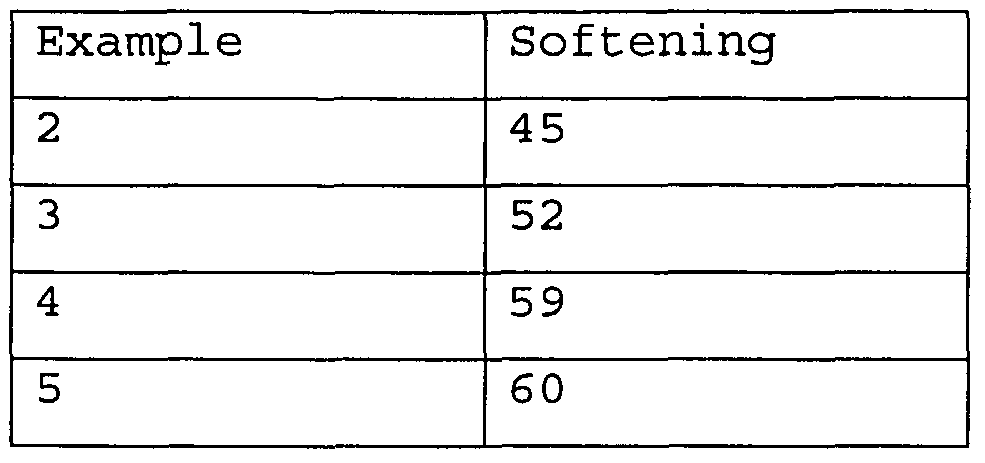
- Softening assessment was conducted by a trained panel of at least six panellists who were asked to rank the monitors on a scale 0-100, by placing a mark along a line which had ends marked 0 and 100 respectively. 0 denotes not at all soft and 100 denotes extremely soft.
- compositions were prepared according to the method of the invention.
- Neodol 25-7E and the SPE-PR were added as a melt over 2 minutes.
- the perfume, Baypure (50% aqueous solution) , dye and BHT were added.
- the product was then left to cool to below 3O 0 C before the agitation was stopped.
- the final product was an opaque fatty acid structured oil.
- compositions (25ml) were encapsulated in M8630 poly(vinylalcohol) film of 76 micron thickness via a simple heat sealing process.
- a mixed ballast load comprising 25% Terry towel, 25% jersey, 25% poly-cotton, and 25% cotton sheeting together with eight 20cm x 20cm Terry towel monitors was added to a Miel 820 front loading automatic machine.
- the machine was set to a 40 0 C cotton cycle and used with llOg of Persil non- biological.
- the encapsulated composition (25ml) was added to the drum and placed at the back on top of the ballast. After the wash, rinse and spin cycles were complete the monitors were extracted, and left to dry on a line for 24 hours prior to softness assessment.
- Softening assessment was also conducted by a trained panel of at least six panellists who were asked to rank the monitors on a scale 0 to 100, when 0 denotes 0 not at all soft and 100 denotes extremely soft. Each panellist placed a mark along a line which had each end marked 0 and 100. The results were statistically analysed again using the Tukey-hamer HSD package.
Landscapes
- Chemical & Material Sciences (AREA)
- Life Sciences & Earth Sciences (AREA)
- Engineering & Computer Science (AREA)
- Chemical Kinetics & Catalysis (AREA)
- Oil, Petroleum & Natural Gas (AREA)
- Wood Science & Technology (AREA)
- Organic Chemistry (AREA)
- Health & Medical Sciences (AREA)
- Emergency Medicine (AREA)
- Dispersion Chemistry (AREA)
- Detergent Compositions (AREA)
- Seasonings (AREA)
Abstract
Description


Claims
Priority Applications (6)
| Application Number | Priority Date | Filing Date | Title |
|---|---|---|---|
| CA2583298A CA2583298C (en) | 2004-10-29 | 2005-09-23 | Method of preparing a laundry product |
| US11/665,859 US7763579B2 (en) | 2004-10-29 | 2005-09-23 | Method of preparing a laundry product |
| CN2005800372821A CN101048485B (en) | 2004-10-29 | 2005-09-23 | Method of making laundry products |
| EP05793775A EP1807491B1 (en) | 2004-10-29 | 2005-09-23 | Method of preparing a laundry product |
| AT05793775T ATE449153T1 (en) | 2004-10-29 | 2005-09-23 | METHOD FOR PRODUCING A DETERGENT |
| DE602005017811T DE602005017811D1 (en) | 2004-10-29 | 2005-09-23 | METHOD FOR PRODUCING A DETERGENT |
Applications Claiming Priority (2)
| Application Number | Priority Date | Filing Date | Title |
|---|---|---|---|
| GBGB0423986.9A GB0423986D0 (en) | 2004-10-29 | 2004-10-29 | Method of preparing a laundry product |
| GB0423986.9 | 2004-10-29 |
Publications (1)
| Publication Number | Publication Date |
|---|---|
| WO2006045391A1 true WO2006045391A1 (en) | 2006-05-04 |
Family
ID=33515732
Family Applications (1)
| Application Number | Title | Priority Date | Filing Date |
|---|---|---|---|
| PCT/EP2005/010402 Ceased WO2006045391A1 (en) | 2004-10-29 | 2005-09-23 | Method of preparing a laundry product |
Country Status (10)
| Country | Link |
|---|---|
| US (1) | US7763579B2 (en) |
| EP (1) | EP1807491B1 (en) |
| CN (1) | CN101048485B (en) |
| AT (1) | ATE449153T1 (en) |
| CA (1) | CA2583298C (en) |
| DE (1) | DE602005017811D1 (en) |
| ES (1) | ES2334807T3 (en) |
| GB (1) | GB0423986D0 (en) |
| WO (1) | WO2006045391A1 (en) |
| ZA (1) | ZA200703155B (en) |
Cited By (46)
| Publication number | Priority date | Publication date | Assignee | Title |
|---|---|---|---|---|
| US7691801B2 (en) | 2006-05-31 | 2010-04-06 | The Sun Products Corporation | Laundry product |
| US7718596B2 (en) | 2004-07-20 | 2010-05-18 | The Sun Products Corporation | Unit dose laundry products containing fatty acid esters |
| US7763579B2 (en) | 2004-10-29 | 2010-07-27 | The Sun Products Corporation | Method of preparing a laundry product |
| EP2476744A1 (en) * | 2011-01-12 | 2012-07-18 | The Procter & Gamble Company | Method for controlling the plasticization of a water soluble film |
| WO2013096653A1 (en) | 2011-12-22 | 2013-06-27 | Danisco Us Inc. | Compositions and methods comprising a lipolytic enzyme variant |
| WO2014099525A1 (en) | 2012-12-21 | 2014-06-26 | Danisco Us Inc. | Paenibacillus curdlanolyticus amylase, and methods of use, thereof |
| WO2014099523A1 (en) | 2012-12-21 | 2014-06-26 | Danisco Us Inc. | Alpha-amylase variants |
| WO2014164800A1 (en) | 2013-03-11 | 2014-10-09 | Danisco Us Inc. | Alpha-amylase combinatorial variants |
| US8969421B2 (en) * | 2006-11-21 | 2015-03-03 | Au Optronics Corporation | Solid defoaming agent |
| WO2015095358A1 (en) | 2013-12-18 | 2015-06-25 | E. I. Du Pont De Nemours And Company | Cationic poly alpha-1,3-glucan ethers |
| WO2015123323A1 (en) | 2014-02-14 | 2015-08-20 | E. I. Du Pont De Nemours And Company | Poly-alpha-1,3-1,6-glucans for viscosity modification |
| WO2015138283A1 (en) | 2014-03-11 | 2015-09-17 | E. I. Du Pont De Nemours And Company | Oxidized poly alpha-1,3-glucan as detergent builder |
| WO2015195960A1 (en) | 2014-06-19 | 2015-12-23 | E. I. Du Pont De Nemours And Company | Compositions containing one or more poly alpha-1,3-glucan ether compounds |
| WO2015195777A1 (en) | 2014-06-19 | 2015-12-23 | E. I. Du Pont De Nemours And Company | Compositions containing one or more poly alpha-1,3-glucan ether compounds |
| WO2016106011A1 (en) | 2014-12-23 | 2016-06-30 | E. I. Du Pont De Nemours And Company | Enzymatically produced cellulose |
| WO2016160738A2 (en) | 2015-04-03 | 2016-10-06 | E I Du Pont De Nemours And Company | Gelling dextran ethers |
| WO2017083226A1 (en) | 2015-11-13 | 2017-05-18 | E. I. Du Pont De Nemours And Company | Glucan fiber compositions for use in laundry care and fabric care |
| WO2017083229A1 (en) | 2015-11-13 | 2017-05-18 | E. I. Du Pont De Nemours And Company | Glucan fiber compositions for use in laundry care and fabric care |
| WO2017091533A1 (en) | 2015-11-26 | 2017-06-01 | E. I. Du Pont De Nemours And Company | Polypeptides capable of producing glucans having alpha-1,2 branches and use of the same |
| WO2017100720A1 (en) | 2015-12-09 | 2017-06-15 | Danisco Us Inc. | Alpha-amylase combinatorial variants |
| WO2018184004A1 (en) | 2017-03-31 | 2018-10-04 | Danisco Us Inc | Alpha-amylase combinatorial variants |
| WO2019036721A2 (en) | 2017-08-18 | 2019-02-21 | Danisco Us Inc | Alpha-amylase variants |
| WO2019118674A1 (en) | 2017-12-14 | 2019-06-20 | E. I. Du Pont De Nemours And Company | Alpha-1,3-glucan graft copolymers |
| WO2020028443A1 (en) | 2018-07-31 | 2020-02-06 | Danisco Us Inc | Variant alpha-amylases having amino acid substitutions that lower the pka of the general acid |
| WO2020077331A2 (en) | 2018-10-12 | 2020-04-16 | Danisco Us Inc | Alpha-amylases with mutations that improve stability in the presence of chelants |
| WO2020086935A1 (en) | 2018-10-25 | 2020-04-30 | Dupont Industrial Biosciences Usa, Llc | Alpha-1,3-glucan graft copolymers |
| EP3696264A1 (en) | 2013-07-19 | 2020-08-19 | Danisco US Inc. | Compositions and methods comprising a lipolytic enzyme variant |
| US10844324B2 (en) | 2015-11-13 | 2020-11-24 | Dupont Industrial Biosciences Usa, Llc | Glucan fiber compositions for use in laundry care and fabric care |
| WO2021080948A2 (en) | 2019-10-24 | 2021-04-29 | Danisco Us Inc | Variant maltopentaose/maltohexaose-forming alpha-amylases |
| WO2021092228A1 (en) | 2019-11-06 | 2021-05-14 | Nutrition & Biosciences USA 4, Inc. | Highly crystalline alpha-1,3-glucan |
| WO2021158543A1 (en) | 2020-02-04 | 2021-08-12 | Nutrition & Biosciences USA 4, Inc. | Aqueous dispersions of insoluble alpha-glucan comprising alpha-1,3 glycosidic linkages |
| WO2021247810A1 (en) | 2020-06-04 | 2021-12-09 | Nutrition & Biosciences USA 4, Inc. | Dextran-alpha-glucan graft copolymers and derivatives thereof |
| WO2022178073A1 (en) | 2021-02-19 | 2022-08-25 | Nutrition & Biosciences USA 4, Inc. | Polysaccharide derivatives for detergent compositions |
| WO2022235655A1 (en) | 2021-05-04 | 2022-11-10 | Nutrition & Biosciences USA 4, Inc. | Compositions comprising insoluble alpha-glucan |
| WO2023287684A1 (en) | 2021-07-13 | 2023-01-19 | Nutrition & Biosciences USA 4, Inc. | Cationic glucan ester derivatives |
| EP4163305A1 (en) | 2013-12-16 | 2023-04-12 | Nutrition & Biosciences USA 4, Inc. | Use of poly alpha-1,3-glucan ethers as viscosity modifiers |
| WO2023114942A1 (en) | 2021-12-16 | 2023-06-22 | Nutrition & Biosciences USA 4, Inc. | Compositions comprising cationic alpha-glucan ethers in aqueous polar organic solvents |
| WO2023114988A2 (en) | 2021-12-16 | 2023-06-22 | Danisco Us Inc. | Variant maltopentaose/maltohexaose-forming alpha-amylases |
| WO2024015769A1 (en) | 2022-07-11 | 2024-01-18 | Nutrition & Biosciences USA 4, Inc. | Amphiphilic glucan ester derivatives |
| WO2024081773A1 (en) | 2022-10-14 | 2024-04-18 | Nutrition & Biosciences USA 4, Inc. | Compositions comprising water, cationic alpha-1,6-glucan ether and organic solvent |
| WO2024129953A1 (en) | 2022-12-16 | 2024-06-20 | Nutrition & Biosciences USA 4, Inc. | Esterification of alpha-glucan comprising alpha-1,6 glycosidic linkages |
| WO2025072419A1 (en) | 2023-09-29 | 2025-04-03 | Nutrition & Biosciences Usa 1, Llc | Crosslinked alpha-glucan derivatives |
| WO2025072416A1 (en) | 2023-09-29 | 2025-04-03 | Nutrition & Biosciences USA 4, Inc. | Polysaccharide derivatives |
| WO2025072417A1 (en) | 2023-09-29 | 2025-04-03 | Nutrition & Biosciences USA 4, Inc. | Polysaccharide derivatives |
| WO2025117349A1 (en) | 2023-11-28 | 2025-06-05 | Nutrition & Biosciences USA 4, Inc. | Esterification of alpha-glucan comprising alpha-1,6 glycosidic linkages |
| WO2025199079A1 (en) | 2024-03-20 | 2025-09-25 | Nutrition & Biosciences USA 4, Inc. | Esterification of alpha-glucan comprising alpha-1,6 glycosidic linkages |
Families Citing this family (3)
| Publication number | Priority date | Publication date | Assignee | Title |
|---|---|---|---|---|
| US8110815B2 (en) * | 2006-06-12 | 2012-02-07 | Semequip, Inc. | Vapor delivery to devices under vacuum |
| WO2017197260A1 (en) | 2016-05-12 | 2017-11-16 | Applied Silver, Inc. | Articles and methods for dispensing metal ions into laundry systems |
| US11622557B2 (en) | 2016-10-31 | 2023-04-11 | Applied Silver, Inc. | Dispensing of metal ions into batch laundry washers and dryers |
Citations (7)
| Publication number | Priority date | Publication date | Assignee | Title |
|---|---|---|---|---|
| US2566359A (en) * | 1946-01-21 | 1951-09-04 | Lever Brothers Ltd | Continuous saponification of fats |
| GB1235292A (en) * | 1967-12-11 | 1971-06-09 | Unilever Ltd | Liquid soap composition |
| US4775492A (en) * | 1986-02-11 | 1988-10-04 | Lever Brothers Company | Thickened liquid bleaching composition |
| JP2001040398A (en) * | 1999-08-03 | 2001-02-13 | Lion Corp | Fatty acid alkali metal salt solution and method for producing the same |
| US6566115B1 (en) * | 1999-07-22 | 2003-05-20 | The Procter & Gamble Company | Protease conjugates having sterically protected clip sites |
| US20030199415A1 (en) * | 2002-04-19 | 2003-10-23 | Colgate-Palmolive Company | Cleaning system including a liquid cleaning composition disposed in a water soluble container |
| WO2004011589A1 (en) * | 2002-07-31 | 2004-02-05 | Colgate-Palmolive Company | Unit dose nonaqueous liquid softener disposed in water soluble container |
Family Cites Families (56)
| Publication number | Priority date | Publication date | Assignee | Title |
|---|---|---|---|---|
| US2435829A (en) * | 1944-11-13 | 1948-02-10 | J B Williams Company | Alpha-hydroxy-ether of fatty acid soap |
| US2948697A (en) * | 1958-04-23 | 1960-08-09 | Du Pont | Plasticized polyvinyl alcohol composition |
| US3822145A (en) * | 1971-11-15 | 1974-07-02 | Colgate Palmolive Co | Fabric softening |
| US3844952A (en) * | 1972-05-03 | 1974-10-29 | Procter & Gamble | Detergent compositions |
| GB1598102A (en) | 1978-03-07 | 1981-09-16 | Tate & Lyle Ltd | Cleansing composition |
| DE3004242C2 (en) * | 1980-02-06 | 1981-10-08 | Fa. Carl Freudenberg, 6940 Weinheim | Vibration-damping clutch disc |
| DE3027611A1 (en) | 1980-07-21 | 1982-02-18 | Bayer Ag, 5090 Leverkusen | DI- AND OLIGO-1,2,4-TRIAZOLIDINE-3,5-DIONE AND METHOD FOR THE PRODUCTION THEREOF |
| US4569773A (en) | 1982-12-13 | 1986-02-11 | Colgate Palmolive Co. | Particulate fabric softening detergent composition |
| US4605506A (en) | 1984-06-01 | 1986-08-12 | Colgate-Palmolive Company | Fabric softening built detergent composition |
| EP0258923B1 (en) | 1986-09-02 | 1993-10-06 | Akzo Nobel N.V. | Fabric softening composition and detergent-composition comprising the same |
| JPS63282372A (en) | 1987-05-08 | 1988-11-18 | 花王株式会社 | Softening finish agent |
| US4818421A (en) | 1987-09-17 | 1989-04-04 | Colgate-Palmolive Co. | Fabric softening detergent composition and article comprising such composition |
| GB8921168D0 (en) * | 1989-09-19 | 1989-11-08 | Unilever Plc | Fabric softening |
| GB9015504D0 (en) | 1990-07-13 | 1990-08-29 | Unilever Plc | Detergents composition |
| GB9016526D0 (en) | 1990-07-27 | 1990-09-12 | Unilever Plc | Soap composition |
| US5507970A (en) | 1992-05-29 | 1996-04-16 | Lion Corporation | Detergent composition |
| GB9403242D0 (en) | 1994-02-21 | 1994-04-13 | Unilever Plc | Fabric softening composition |
| US6103687A (en) * | 1995-02-10 | 2000-08-15 | Elementis Specialties, Rheox Inc. | Non-volatile quaternary ammonium compositions and their uses |
| EP0758641B1 (en) * | 1995-08-11 | 2000-08-30 | Daicel Chemical Industries, Ltd. | A fatty acid esters composition of a polyglycerine, a process for the preparation thereof, a process for the preparation of a highly-purified fatty acid esters composition of a polyglycerine, a highly-purified fatty acid esters composition of a polyglycerine, an additive for food-stuffs, a resin composition, and a composition for cosmetics or detergents |
| TR199900801T2 (en) | 1996-10-16 | 1999-07-21 | Unilever N.V. | Combine softener compound. |
| EP0845523A3 (en) | 1996-11-28 | 1999-01-27 | Givaudan-Roure (International) S.A. | Ingredient preventing the viscosity problem encountered in a perfumed concentrated fabric softener |
| US5972870A (en) | 1997-08-21 | 1999-10-26 | Vision International Production, Inc. | Multi-layered laundry tablet |
| ATE244296T1 (en) | 1997-11-10 | 2003-07-15 | Procter & Gamble | METHOD FOR PRODUCING A DETERGENT TABLET |
| CA2311503C (en) | 1997-11-26 | 2004-03-16 | The Procter & Gamble Company | Detergent tablet |
| FR2780411A1 (en) | 1998-06-29 | 1999-12-31 | Eric Gilles Guerin | Saponifiable composition for making hard toilet soap |
| GB9911437D0 (en) | 1999-05-17 | 1999-07-14 | Unilever Plc | Fabric softening compositions |
| GB9930435D0 (en) | 1999-12-22 | 2000-02-16 | Unilever Plc | Fabric softening compositions |
| GB9930437D0 (en) * | 1999-12-22 | 2000-02-16 | Unilever Plc | Fabric softening compositions and compounds |
| AU2001262160A1 (en) * | 2000-04-14 | 2001-10-30 | Hewitt, Malcolm | Water soluble package of liquid cleaning composition |
| WO2001079417A1 (en) * | 2000-04-14 | 2001-10-25 | Unilever N.V. | Water soluble package and liquid contents thereof |
| WO2001085892A1 (en) | 2000-05-11 | 2001-11-15 | The Procter & Gamble Company | Highly concentrated fabric softener compositions and articles containing such compositions |
| EP1170356A1 (en) * | 2000-07-06 | 2002-01-09 | The Procter & Gamble Company | Laundry additive sachet |
| CN1209366C (en) | 2001-01-18 | 2005-07-06 | 赵仁浩 | Preparation of carbohydrate fatty acid esters |
| GB2374580B (en) | 2001-04-20 | 2003-07-16 | Reckitt Benckiser | Water-soluble containers |
| GB2375768B (en) | 2001-05-25 | 2004-02-18 | Reckitt Benckiser Nv | Encapsulated liquid detergent compositions |
| GB0114847D0 (en) | 2001-06-18 | 2001-08-08 | Unilever Plc | Water soluble package and liquid contents thereof |
| GB0114850D0 (en) | 2001-06-18 | 2001-08-08 | Unilever Plc | Water soluble package and liquid contents thereof |
| GB0200154D0 (en) * | 2002-01-04 | 2002-02-20 | Unilever Plc | Fabric conditioning kit |
| EP1354939A1 (en) * | 2002-04-19 | 2003-10-22 | The Procter & Gamble Company | Pouched cleaning compositions |
| US6495503B1 (en) * | 2002-07-31 | 2002-12-17 | Colgate-Palmolive Company | Unit dose nonaqueous liquid softener disposed in water soluble container |
| US6610640B1 (en) | 2002-07-31 | 2003-08-26 | Colgate Palmolive Company | Unit dose nonaqueous liquid softener disposed in water soluble container |
| EP1396536B1 (en) | 2002-09-05 | 2005-10-19 | The Procter & Gamble Company | Structuring systems for fabric treatment compostions |
| GB0222964D0 (en) | 2002-10-03 | 2002-11-13 | Unilever Plc | Polymeric film for water soluble package |
| US20050205574A1 (en) * | 2002-11-15 | 2005-09-22 | Alexander Lambotte | Water-soluble portion packaging with a filling |
| WO2004050981A1 (en) * | 2002-12-05 | 2004-06-17 | Unilever Plc | Fabric treatment |
| EP1431381A1 (en) | 2002-12-19 | 2004-06-23 | The Procter & Gamble Company | Single compartment unit dose fabric treatment product comprising pouched compositions with cationic fabric softener actives |
| EP1431383B1 (en) | 2002-12-19 | 2006-03-22 | The Procter & Gamble Company | Single compartment unit dose fabric treatment product comprising pouched compositions with cationic fabric softener actives |
| US7838479B2 (en) | 2003-06-09 | 2010-11-23 | Unilever Home & Personal Care Usa, Division Of Conopco, Inc. | Packaged product containing an extrudable multiphase composition of a free fatty acid phase and a soap phase |
| GB2412914A (en) | 2004-04-08 | 2005-10-12 | Unilever Plc | Delivery system for an active agent |
| DE602004031090D1 (en) * | 2004-06-08 | 2011-03-03 | Procter & Gamble | detergent pack |
| GB0416155D0 (en) | 2004-07-20 | 2004-08-18 | Unilever Plc | Laundry product |
| GB0416153D0 (en) * | 2004-07-20 | 2004-08-18 | Unilever Plc | Laundry product |
| GB0422026D0 (en) | 2004-10-05 | 2004-11-03 | Unilever Plc | Laundry product |
| GB0423986D0 (en) | 2004-10-29 | 2004-12-01 | Unilever Plc | Method of preparing a laundry product |
| GB0501006D0 (en) | 2005-01-18 | 2005-02-23 | Unilever Plc | Fabric conditioning compositions |
| GB0610801D0 (en) | 2006-05-31 | 2006-07-12 | Unilever Plc | Laundry product |
-
2004
- 2004-10-29 GB GBGB0423986.9A patent/GB0423986D0/en not_active Ceased
-
2005
- 2005-09-23 AT AT05793775T patent/ATE449153T1/en not_active IP Right Cessation
- 2005-09-23 DE DE602005017811T patent/DE602005017811D1/en not_active Expired - Lifetime
- 2005-09-23 WO PCT/EP2005/010402 patent/WO2006045391A1/en not_active Ceased
- 2005-09-23 CN CN2005800372821A patent/CN101048485B/en not_active Expired - Fee Related
- 2005-09-23 CA CA2583298A patent/CA2583298C/en not_active Expired - Fee Related
- 2005-09-23 ES ES05793775T patent/ES2334807T3/en not_active Expired - Lifetime
- 2005-09-23 ZA ZA200703155A patent/ZA200703155B/en unknown
- 2005-09-23 US US11/665,859 patent/US7763579B2/en not_active Expired - Lifetime
- 2005-09-23 EP EP05793775A patent/EP1807491B1/en not_active Expired - Lifetime
Patent Citations (7)
| Publication number | Priority date | Publication date | Assignee | Title |
|---|---|---|---|---|
| US2566359A (en) * | 1946-01-21 | 1951-09-04 | Lever Brothers Ltd | Continuous saponification of fats |
| GB1235292A (en) * | 1967-12-11 | 1971-06-09 | Unilever Ltd | Liquid soap composition |
| US4775492A (en) * | 1986-02-11 | 1988-10-04 | Lever Brothers Company | Thickened liquid bleaching composition |
| US6566115B1 (en) * | 1999-07-22 | 2003-05-20 | The Procter & Gamble Company | Protease conjugates having sterically protected clip sites |
| JP2001040398A (en) * | 1999-08-03 | 2001-02-13 | Lion Corp | Fatty acid alkali metal salt solution and method for producing the same |
| US20030199415A1 (en) * | 2002-04-19 | 2003-10-23 | Colgate-Palmolive Company | Cleaning system including a liquid cleaning composition disposed in a water soluble container |
| WO2004011589A1 (en) * | 2002-07-31 | 2004-02-05 | Colgate-Palmolive Company | Unit dose nonaqueous liquid softener disposed in water soluble container |
Non-Patent Citations (2)
| Title |
|---|
| PATENT ABSTRACTS OF JAPAN vol. 2000, no. 19 5 June 2001 (2001-06-05) * |
| THOMSSEN E.G. AND MC CUTCHEON J.W.: "Soaps and Detergents", 1949, MAC NAIR - DORLAND COMPAGNY, NEW YORK, XP002358559 * |
Cited By (66)
| Publication number | Priority date | Publication date | Assignee | Title |
|---|---|---|---|---|
| US7718596B2 (en) | 2004-07-20 | 2010-05-18 | The Sun Products Corporation | Unit dose laundry products containing fatty acid esters |
| US7763579B2 (en) | 2004-10-29 | 2010-07-27 | The Sun Products Corporation | Method of preparing a laundry product |
| US7691801B2 (en) | 2006-05-31 | 2010-04-06 | The Sun Products Corporation | Laundry product |
| US8969421B2 (en) * | 2006-11-21 | 2015-03-03 | Au Optronics Corporation | Solid defoaming agent |
| EP2821474A1 (en) * | 2011-01-12 | 2015-01-07 | The Procter and Gamble Company | Method for controlling the plasticization of a water soluble film |
| EP2476744A1 (en) * | 2011-01-12 | 2012-07-18 | The Procter & Gamble Company | Method for controlling the plasticization of a water soluble film |
| WO2012097025A1 (en) * | 2011-01-12 | 2012-07-19 | The Procter & Gamble Company | Method for controlling the plasticization of a water soluble film |
| JP2014507518A (en) * | 2011-01-12 | 2014-03-27 | ザ プロクター アンド ギャンブル カンパニー | Method for adjusting plasticization of water-soluble film |
| US9624457B2 (en) | 2011-01-12 | 2017-04-18 | The Procter & Gamble Company | Method for controlling the plasticization of a water soluble film |
| RU2569309C2 (en) * | 2011-01-12 | 2015-11-20 | Дзе Проктер Энд Гэмбл Компани | Method for controlling plastification of water-soluble film |
| WO2013096653A1 (en) | 2011-12-22 | 2013-06-27 | Danisco Us Inc. | Compositions and methods comprising a lipolytic enzyme variant |
| WO2014099525A1 (en) | 2012-12-21 | 2014-06-26 | Danisco Us Inc. | Paenibacillus curdlanolyticus amylase, and methods of use, thereof |
| WO2014099523A1 (en) | 2012-12-21 | 2014-06-26 | Danisco Us Inc. | Alpha-amylase variants |
| EP3354728A1 (en) | 2012-12-21 | 2018-08-01 | Danisco US Inc. | Alpha-amylase variants |
| EP3336183A1 (en) | 2013-03-11 | 2018-06-20 | Danisco US Inc. | Alpha-amylase conbinatorial variants |
| WO2014164800A1 (en) | 2013-03-11 | 2014-10-09 | Danisco Us Inc. | Alpha-amylase combinatorial variants |
| WO2014164777A1 (en) | 2013-03-11 | 2014-10-09 | Danisco Us Inc. | Alpha-amylase combinatorial variants |
| EP3978604A1 (en) | 2013-03-11 | 2022-04-06 | Danisco US Inc. | Alpha-amylase combinatorial variants |
| EP3696264A1 (en) | 2013-07-19 | 2020-08-19 | Danisco US Inc. | Compositions and methods comprising a lipolytic enzyme variant |
| EP4163305A1 (en) | 2013-12-16 | 2023-04-12 | Nutrition & Biosciences USA 4, Inc. | Use of poly alpha-1,3-glucan ethers as viscosity modifiers |
| EP3789407A1 (en) | 2013-12-18 | 2021-03-10 | Nutrition & Biosciences USA 4, Inc. | Cationic poly alpha-1,3-glucan ethers |
| WO2015095358A1 (en) | 2013-12-18 | 2015-06-25 | E. I. Du Pont De Nemours And Company | Cationic poly alpha-1,3-glucan ethers |
| WO2015123323A1 (en) | 2014-02-14 | 2015-08-20 | E. I. Du Pont De Nemours And Company | Poly-alpha-1,3-1,6-glucans for viscosity modification |
| WO2015138283A1 (en) | 2014-03-11 | 2015-09-17 | E. I. Du Pont De Nemours And Company | Oxidized poly alpha-1,3-glucan as detergent builder |
| WO2015195777A1 (en) | 2014-06-19 | 2015-12-23 | E. I. Du Pont De Nemours And Company | Compositions containing one or more poly alpha-1,3-glucan ether compounds |
| EP3919599A1 (en) | 2014-06-19 | 2021-12-08 | Nutrition & Biosciences USA 4, Inc. | Compositions containing one or more poly alpha-1,3-glucan ether compounds |
| WO2015195960A1 (en) | 2014-06-19 | 2015-12-23 | E. I. Du Pont De Nemours And Company | Compositions containing one or more poly alpha-1,3-glucan ether compounds |
| WO2016106011A1 (en) | 2014-12-23 | 2016-06-30 | E. I. Du Pont De Nemours And Company | Enzymatically produced cellulose |
| WO2016160738A2 (en) | 2015-04-03 | 2016-10-06 | E I Du Pont De Nemours And Company | Gelling dextran ethers |
| WO2017083226A1 (en) | 2015-11-13 | 2017-05-18 | E. I. Du Pont De Nemours And Company | Glucan fiber compositions for use in laundry care and fabric care |
| US10822574B2 (en) | 2015-11-13 | 2020-11-03 | Dupont Industrial Biosciences Usa, Llc | Glucan fiber compositions for use in laundry care and fabric care |
| WO2017083229A1 (en) | 2015-11-13 | 2017-05-18 | E. I. Du Pont De Nemours And Company | Glucan fiber compositions for use in laundry care and fabric care |
| US10876074B2 (en) | 2015-11-13 | 2020-12-29 | Dupont Industrial Biosciences Usa, Llc | Glucan fiber compositions for use in laundry care and fabric care |
| US10844324B2 (en) | 2015-11-13 | 2020-11-24 | Dupont Industrial Biosciences Usa, Llc | Glucan fiber compositions for use in laundry care and fabric care |
| WO2017091533A1 (en) | 2015-11-26 | 2017-06-01 | E. I. Du Pont De Nemours And Company | Polypeptides capable of producing glucans having alpha-1,2 branches and use of the same |
| US12480110B2 (en) | 2015-12-09 | 2025-11-25 | Danisco Us Inc. | Alpha-amylase combinatorial variants |
| WO2017100720A1 (en) | 2015-12-09 | 2017-06-15 | Danisco Us Inc. | Alpha-amylase combinatorial variants |
| US11920170B2 (en) | 2015-12-09 | 2024-03-05 | Danisco Us Inc. | Alpha-amylase combinatorial variants |
| EP3901257A1 (en) | 2015-12-09 | 2021-10-27 | Danisco US Inc. | Alpha-amylase combinatorial variants |
| WO2018184004A1 (en) | 2017-03-31 | 2018-10-04 | Danisco Us Inc | Alpha-amylase combinatorial variants |
| WO2019036721A2 (en) | 2017-08-18 | 2019-02-21 | Danisco Us Inc | Alpha-amylase variants |
| WO2019118674A1 (en) | 2017-12-14 | 2019-06-20 | E. I. Du Pont De Nemours And Company | Alpha-1,3-glucan graft copolymers |
| EP4467599A2 (en) | 2017-12-14 | 2024-11-27 | Nutrition & Biosciences USA 4, Inc. | Alpha-1,3-glucan graft copolymers |
| WO2020028443A1 (en) | 2018-07-31 | 2020-02-06 | Danisco Us Inc | Variant alpha-amylases having amino acid substitutions that lower the pka of the general acid |
| WO2020077331A2 (en) | 2018-10-12 | 2020-04-16 | Danisco Us Inc | Alpha-amylases with mutations that improve stability in the presence of chelants |
| WO2020086935A1 (en) | 2018-10-25 | 2020-04-30 | Dupont Industrial Biosciences Usa, Llc | Alpha-1,3-glucan graft copolymers |
| WO2021080948A2 (en) | 2019-10-24 | 2021-04-29 | Danisco Us Inc | Variant maltopentaose/maltohexaose-forming alpha-amylases |
| WO2021092228A1 (en) | 2019-11-06 | 2021-05-14 | Nutrition & Biosciences USA 4, Inc. | Highly crystalline alpha-1,3-glucan |
| US11608388B2 (en) | 2019-11-06 | 2023-03-21 | Nutrition & Biosciences USA 4, Inc. | Highly crystalline alpha-1,3-glucan |
| WO2021158543A1 (en) | 2020-02-04 | 2021-08-12 | Nutrition & Biosciences USA 4, Inc. | Aqueous dispersions of insoluble alpha-glucan comprising alpha-1,3 glycosidic linkages |
| WO2021247810A1 (en) | 2020-06-04 | 2021-12-09 | Nutrition & Biosciences USA 4, Inc. | Dextran-alpha-glucan graft copolymers and derivatives thereof |
| WO2022178075A1 (en) | 2021-02-19 | 2022-08-25 | Nutrition & Biosciences USA 4, Inc. | Oxidized polysaccharide derivatives |
| WO2022178073A1 (en) | 2021-02-19 | 2022-08-25 | Nutrition & Biosciences USA 4, Inc. | Polysaccharide derivatives for detergent compositions |
| WO2022235655A1 (en) | 2021-05-04 | 2022-11-10 | Nutrition & Biosciences USA 4, Inc. | Compositions comprising insoluble alpha-glucan |
| WO2023287684A1 (en) | 2021-07-13 | 2023-01-19 | Nutrition & Biosciences USA 4, Inc. | Cationic glucan ester derivatives |
| WO2023114942A1 (en) | 2021-12-16 | 2023-06-22 | Nutrition & Biosciences USA 4, Inc. | Compositions comprising cationic alpha-glucan ethers in aqueous polar organic solvents |
| WO2023114988A2 (en) | 2021-12-16 | 2023-06-22 | Danisco Us Inc. | Variant maltopentaose/maltohexaose-forming alpha-amylases |
| WO2024015769A1 (en) | 2022-07-11 | 2024-01-18 | Nutrition & Biosciences USA 4, Inc. | Amphiphilic glucan ester derivatives |
| WO2024081773A1 (en) | 2022-10-14 | 2024-04-18 | Nutrition & Biosciences USA 4, Inc. | Compositions comprising water, cationic alpha-1,6-glucan ether and organic solvent |
| WO2024129951A1 (en) | 2022-12-16 | 2024-06-20 | Nutrition & Biosciences USA 4, Inc. | Esterification of alpha-glucan comprising alpha-1,6 glycosidic linkages |
| WO2024129953A1 (en) | 2022-12-16 | 2024-06-20 | Nutrition & Biosciences USA 4, Inc. | Esterification of alpha-glucan comprising alpha-1,6 glycosidic linkages |
| WO2025072419A1 (en) | 2023-09-29 | 2025-04-03 | Nutrition & Biosciences Usa 1, Llc | Crosslinked alpha-glucan derivatives |
| WO2025072416A1 (en) | 2023-09-29 | 2025-04-03 | Nutrition & Biosciences USA 4, Inc. | Polysaccharide derivatives |
| WO2025072417A1 (en) | 2023-09-29 | 2025-04-03 | Nutrition & Biosciences USA 4, Inc. | Polysaccharide derivatives |
| WO2025117349A1 (en) | 2023-11-28 | 2025-06-05 | Nutrition & Biosciences USA 4, Inc. | Esterification of alpha-glucan comprising alpha-1,6 glycosidic linkages |
| WO2025199079A1 (en) | 2024-03-20 | 2025-09-25 | Nutrition & Biosciences USA 4, Inc. | Esterification of alpha-glucan comprising alpha-1,6 glycosidic linkages |
Also Published As
| Publication number | Publication date |
|---|---|
| CA2583298C (en) | 2013-01-15 |
| EP1807491A1 (en) | 2007-07-18 |
| EP1807491B1 (en) | 2009-11-18 |
| ZA200703155B (en) | 2008-08-27 |
| GB0423986D0 (en) | 2004-12-01 |
| US20080242580A1 (en) | 2008-10-02 |
| CN101048485B (en) | 2012-05-16 |
| DE602005017811D1 (en) | 2009-12-31 |
| ATE449153T1 (en) | 2009-12-15 |
| ES2334807T3 (en) | 2010-03-16 |
| US7763579B2 (en) | 2010-07-27 |
| CN101048485A (en) | 2007-10-03 |
| CA2583298A1 (en) | 2006-05-04 |
Similar Documents
| Publication | Publication Date | Title |
|---|---|---|
| CA2583298C (en) | Method of preparing a laundry product | |
| US7718596B2 (en) | Unit dose laundry products containing fatty acid esters | |
| US6605581B1 (en) | Unit dose nonaqueous liquid softener disposed in water soluble container | |
| US20060019866A1 (en) | Laundry product | |
| US6605582B1 (en) | Unit dose softener disposed in water soluble container | |
| US6608014B1 (en) | Unit dose nonaqueous softener disposed in water soluble container | |
| US6610640B1 (en) | Unit dose nonaqueous liquid softener disposed in water soluble container | |
| US20080261850A1 (en) | Laundry Product | |
| US6495503B1 (en) | Unit dose nonaqueous liquid softener disposed in water soluble container | |
| CA2494533A1 (en) | Unit dose nonaqueous liquid softener disposed in water soluble container | |
| EP1525298A1 (en) | Unit dose nonaqueous softener disposed in water soluble container | |
| WO2004011586A1 (en) | Unit dose softener disposed in water soluble container | |
| WO2009068417A1 (en) | Laundry product | |
| EP2220201A1 (en) | Laundry product |
Legal Events
| Date | Code | Title | Description |
|---|---|---|---|
| AK | Designated states |
Kind code of ref document: A1 Designated state(s): AE AG AL AM AT AU AZ BA BB BG BW BY BZ CA CH CN CO CR CU CZ DK DM DZ EC EE EG ES FI GB GD GH GM HR HU ID IL IN IS JP KE KG KP KR KZ LC LK LR LS LT LU LV LY MD MG MK MN MW MX MZ NA NG NO NZ OM PG PH PL PT RO RU SC SD SG SK SL SM SY TJ TM TN TR TT TZ UG US UZ VC VN YU ZA ZM |
|
| AL | Designated countries for regional patents |
Kind code of ref document: A1 Designated state(s): BW GH GM KE LS MW MZ NA SD SZ TZ UG ZM ZW AM AZ BY KG MD RU TJ TM AT BE BG CH CY DE DK EE ES FI FR GB GR HU IE IS IT LU LV MC NL PL PT RO SE SI SK TR BF BJ CF CG CI CM GA GN GQ GW MR NE SN TD TG |
|
| 121 | Ep: the epo has been informed by wipo that ep was designated in this application | ||
| DPE1 | Request for preliminary examination filed after expiration of 19th month from priority date (pct application filed from 20040101) | ||
| WWE | Wipo information: entry into national phase |
Ref document number: 2005793775 Country of ref document: EP |
|
| WWE | Wipo information: entry into national phase |
Ref document number: 2583298 Country of ref document: CA |
|
| WWE | Wipo information: entry into national phase |
Ref document number: 594/MUMNP/2007 Country of ref document: IN |
|
| WWE | Wipo information: entry into national phase |
Ref document number: 200580037282.1 Country of ref document: CN |
|
| NENP | Non-entry into the national phase |
Ref country code: DE |
|
| WWP | Wipo information: published in national office |
Ref document number: 2005793775 Country of ref document: EP |
|
| WWE | Wipo information: entry into national phase |
Ref document number: 11665859 Country of ref document: US |