Attorney Docket No.14640.0093-00304 COMPOSITIONS AND METHODS FOR THE TREATMENT OF DISORDERS RELATED TO ATAXIN-2 RELATED APPLICATIONS [01] This application claims the benefit of and priority to US Provisional Application Serial No. 63/519,948, filed August 16, 2023, the contents of which are incorporated herein by reference in their entirety. SEQUENCE LISTING [02] The present application is being filed along with a Sequence Listing in electronic format. The Sequence Listing file, entitled 14640_0093-00304_SL.xml, was created on June 18, 2024, and is 2,602,685 bytes in size. The information in electronic format of the Sequence Listing is incorporated herein by reference in its entirety. FIELD OF THE DISCLOSURE [03] Described herein are compositions and methods relating to adeno-associated virus (AAV) viral particles for the delivery of polynucleotides, e.g., modulatory polynucleotides for reducing or eliminating expression of Ataxin-2 (ATXN2) mRNA, thereby reducing or eliminating ATXN2 protein, and their use in the treatment of spinocerebellar ataxia type 2 (SCA2) and other disorders associated with aberrant ATXN2 protein expression or activity or mutated ATXN2 protein. In some embodiments, compositions described herein may be used to treat a subject in need thereof, such as a human subject having SCA2 or another condition resulting from or associated with mutant ATXN2 protein or aberrant ATXN2 protein expression or activity. BACKGROUND [04] The Ataxin-2 protein (also referred to herein as ATXN2 protein) is encoded by the ATXN2 gene (Ensembl Gene ID No. ENSG00000204842), which is also known as ATX2 and TNRC13. It is located on chromosome 12 of the human genome. [05] The function of Ataxin-2 is not known, but it is found in the cytoplasm and is thought to interact with the endoplasmic reticulum. [06] Mutations in ATXN2 cause disease in human subjects. ATXN2 mutations are known to cause spinocerebellar ataxia type 2 (SCA2). SCA2 is an autosomal dominant cerebellar ataxia. ATXN2 mutations also play a role in other ATXN2-related disorders, including amyotrophic lateral sclerosis (ALS), Parkinson’s disease (PD), and frontotemporal lobar degeneration (FTLD). [07] SCA2 is typically caused by CAG trinucleotide repeat expansions in the ATXN2 gene on 12q24.1. Patients with SCA2 have ATXN2 alleles with 32 or more trinucleotide repeats, resulting in ATXN2 protein with polyQ expansions. PolyQ expansions in ATXN2 (e.g., intermediate length polyQ expansions) have been associated with other diseases, like ALS, as well.
Attorney Docket No.14640.0093-00304 [08] The age of onset of SCA2 is thought to correlate with the number of CAG trinucleotide repeats. Onset is typically later than age 60 in subjects with 32-34 CAG repeats (SEQ ID NO: 6434). Onset is typically between ages 20 and 60 in subjects with 35-40 CAG repeats (SEQ ID NO: 6435). Onset is typically before age 20 for patients with 45 or more CAG repeats (SEQ ID NO: 6436). [09] Mutated ATXN2 is thought to produce an Ataxin-2 protein with an abnormally long stretch of glutamine residues. The cellular impact of mutant Ataxin-2 protein is not confirmed. Without wishing to be bound by any particular theory, mutant Ataxin-2 (e.g., Ataxin-2 with a polyQ expansion) may accumulate in cells and cause cell death. [010] SCA2 is characterized by progressive cerebellar ataxia, including nystagmus, and slow saccadic eye movements. It may also present with ophthalmoparesis and/or parkinsonism. Later stages of SCA2 mainly involve the brainstem and cerebellum. [011] There are no specific treatments for SCA2. Trials have considered riluzole, which inhibits glutamic acid release, for treating SCA2. However, there are no treatments targeting the cause of SCA2. Thus, there remains a long-felt need to develop pharmaceutical compositions and methods for the treatment of SCA2. In particular, a need exists for treatments of SCA2 targeting the brainstem and cerebellum. [012] There remains a need for effective methods of treatment using AAV capsids that are capable of delivering a modulatory polynucleotide for reducing or eliminating expression of ATXN2 mRNA (thereby reducing or eliminating ATXN2 protein), to a target cell or tissue, e.g., a CNS cell or tissue. SUMMARY [013] The present disclosure addresses these challenges by providing AAV-based compositions, AAV-based compositions for use in methods for treating an ATXN2-related disorder in subjects, and methods for treating an ATXN2-related disorder in subjects, wherein the ATXN2-related disorder is, e.g., SCA2. Disclosed herein are compositions and methods directed to AAV-based gene delivery of modulatory polynucleotides for reducing or eliminating expression of ATXN2 to treat an ATXN2-related disorder, such as SCA2. In some embodiments, the compositions and methods reduce or eliminate expression of ATXN2 mRNA, and thereby reduce or eliminate ATXN2 protein, to treat an ATXN2- related disorder, such as SCA2. The compositions and methods are useful to reduce the effects of mutant ATXN2 or aberrant ATXN2 protein expression or activity, and to slow, halt, or reverse muscular and other symptoms of an ATXN2-related disorder, such as SCA2. In some embodiments, the compositions and methods disclosed herein may reduce or eliminate the expression of aberrant or mutated ATXN2. In some embodiments, aberrant ATXN2 expression refers to expression of ATXN2 mRNA comprising 32 or more CAG trinucleotide repeats (SEQ ID NO: 6437) and thus resulting in ATXN2 protein comprising polyQ expansions. In some embodiments, mutated ATXN2 refers to ATXN2 mRNA comprising 32 or more CAG trinucleotide repeats (SEQ ID NO: 6437) and/or to ATXN2 protein comprising polyQ expansions. As used herein, the terms “ATXN2,” “ATX2,” and “TNRC13” are synonymous terms.
Attorney Docket No.14640.0093-00304 [014] In some embodiments, the present disclosure provides an AAV particle comprising a nucleotide sequence encoding a modulatory polynucleotide for reducing or eliminating expression of ATXN2, and an AAV capsid. In some embodiments, the nucleotide sequence encoding the modulatory polynucleotide is comprised in a viral genome. In some embodiments, the modulatory polynucleotide reduces or eliminates ATXN2 mRNA. In some embodiments, the modulatory polynucleotide reduces or eliminates ATXN2 protein by reducing or eliminating ATXN2 mRNA. In some embodiments, the AAV capsid is an AAV capsid variant. In some embodiments, the AAV capsid variant is an AAV5 capsid variant. [015] In some embodiments, the AAV capsid variant (e.g., an AAV5 capsid variant) comprises a peptide that has replaced amino acid position 577 as numbered according to SEQ ID NO: 138. In some embodiments, the AAV capsid variant is an AAV5 capsid variant comprising a peptide comprising the amino acid sequence of VQK in loop VIII, wherein, optionally, the amino acid sequence of VQK has replaced a threonine at amino acid position 577 as numbered according to SEQ ID NO: 138. In some embodiments, the AAV capsid variant comprises a peptide comprising the amino acid sequence of YPAEVVQK (SEQ ID NO: 943) in loop VIII, or a peptide comprising one, two, or three—but no more than three—substitutions relative to the amino acid sequence of YPAEVVQK (SEQ ID NO: 943), wherein, optionally, the amino acid sequence has replaced a threonine at amino acid position 577 as numbered according to SEQ ID NO: 138. In some embodiments, the AAV capsid variant comprises a peptide comprising the amino acid sequence of YPAEVVQK (SEQ ID NO: 943) in loop VIII, wherein, optionally, the peptide has replaced a threonine at amino acid position 577 as numbered according to SEQ ID NO: 138. In some embodiments, the peptide is present in a VP1 protein, a VP2 protein, and/or a VP3 protein of the AAV capsid variant. In some embodiments, the peptide is present in the VP1, VP2, and VP3 proteins of the AAV capsid variant. [016] In some embodiments, the present disclosure provides an adeno-associated virus (AAV) particle comprising an AAV capsid variant and a viral genome, wherein the viral genome comprises a nucleic acid sequence encoding a modulatory polynucleotide for reducing or eliminating expression of Ataxin-2 (ATXN2) mRNA, optionally wherein the modulatory polynucleotide comprises an RNAi agent targeting ATXN2 mRNA; and wherein the AAV capsid variant comprises an amino acid sequence having the formula [N2]-[N3], wherein: (i) [N2] comprises positions X
1, X
2, X
3, X
4, and X
5, wherein: (a) position X
1 is Y, N, or C; (b) position X
2 is P, K, T, or Q; (c) position X
3 is A or P; (d) position X
4 is E, S, or A; and (e) position X
5 is V, L, or E; and (ii) [N3] comprises the amino acid sequence VQK, EQK, VKK, VHK, VQQ, or LQK; and wherein the AAV capsid variant comprises the amino acid sequence of SEQ ID NO: 739, or an amino acid sequence at least 95% identical thereto. [017] In some embodiments, [N2]-[N3] is present in loop VIII, wherein loop VIII is present at amino acids comprising those corresponding to positions 571-599 of the amino acid sequence SEQ ID NO: 982. In some embodiments, [N2]-[N3] is present immediately subsequent to an amino acid corresponding to position 576 of the amino acid sequence of SEQ ID NO: 982. In some embodiments,
Attorney Docket No.14640.0093-00304 the AAV capsid variant is an AAV5 capsid variant comprising [N2]-[N3] in place of an amino acid corresponding to T577 of the amino acid sequence of SEQ ID NO: 138. In some embodiments, [N2] comprises the amino acid sequence YP, YPA, YPAE (SEQ ID NO: 21), or YPAEV (SEQ ID NO: 1). In some embodiments, [N3] comprises the amino acid sequence VQK. In some embodiments, [N2]-[N3] comprises the amino acid sequence AEVVQK (SEQ ID NO: 36) or PAEVVQK (SEQ ID NO: 20). In some embodiments, [N2]-[N3] comprises the amino acid sequence YPAEVVQK (SEQ ID NO: 943). [018] In some embodiments, the AAV capsid variant further comprises [N1] comprising positions X
D, X
E, and X
F, wherein: (a) position X
D of [N1] is Q, T, S, A, I, L, or H; (b) position X
E of [N1] is S, G, A, or R; and (c) position X
F of [N1] is S, K, L, R, A, or T; wherein [N1] immediately precedes [N2]- [N3]. In some embodiments, [N1] comprises the amino acid sequence QS, SS, or QSS. In some embodiments, [N1]-[N2] comprises the amino acid sequence QSSYPAEV (SEQ ID NO: 96). In some embodiments, [N1]-[N2]-[N3] comprises the amino acid sequence SSYPAEVVQ (SEQ ID NO: 121) or QSSYPAEVVQK (SEQ ID NO: 150). [019] In some embodiments, the AAV capsid variant further comprises [N0] comprising positions X
A, X
B, and X
C, wherein: (a) position X
A of [N0] is T, I, or N; (b) position X
B of [N0] is N; and (c) position X
C of [N0] is N, T, S, or K; wherein [N0] immediately precedes [N1]. In some embodiments, [N0] comprises the amino acid sequence TN, NN, or TNN. In some embodiments, [N0]-[N1] comprises the amino acid sequence TNNQSS (SEQ ID NO: 183). In some embodiments, [N0]-[N1]-[N2]-[N3] comprises the amino acid sequence TNNQSSYPAEVVQK (SEQ ID NO: 500). [020] In some embodiments, the AAV capsid variant further comprises [N4] comprising positions X
G and X
H, wherein: (a) position X
G of [N4] is T, P, or N; and (b) position X
H of [N4] is A; wherein [N4] is present immediately subsequent to [N3]. In some embodiments, [N4] comprises the amino acid sequence TA. In some embodiments, [N0]-[N1]-[N2]-[N3]-[N4] comprises the amino acid sequence TNNQSSYPAEVVQKTA (SEQ ID NO: 1533). [021] In some embodiments, [N0]-[N1]-[N2]-[N3]-[N4] is present in loop VIII, wherein loop VIII is present at amino acids comprising those corresponding to positions 571-599 of the amino acid sequence of SEQ ID NO: 982. In some embodiments, [N0] is present at amino acids corresponding to positions 571-573 of the amino acid sequence of SEQ ID NO: 982; [N1] is present at amino acids corresponding to positions 574-576 of the amino acid sequence of SEQ ID NO: 982; [N2] is present at amino acids corresponding to positions 577-581 of the amino acid sequence of SEQ ID NO: 982; [N3] is present at amino acids corresponding to positions 582-584 of the amino acid sequence of SEQ ID NO: 982; and [N4] is present at amino acids corresponding to positions 585-586 of the amino acid sequence of SEQ ID NO: 982. [022] In some aspects, the present disclosure provides an adeno-associated virus (AAV) particle comprising: (i) a viral genome comprising a nucleic acid sequence encoding a modulatory polynucleotide for reducing or eliminating expression of Ataxin-2 (ATXN2) mRNA, optionally wherein the modulatory polynucleotide comprises an RNAi agent targeting ATXN2 mRNA sequence; and (ii) an AAV capsid
Attorney Docket No.14640.0093-00304 variant comprising an amino acid sequence at least 95% identical to the amino acid sequence of SEQ ID NO: 739, wherein the AAV capsid variant comprises at least 4, 5, 6, 7, or 8 consecutive amino acids from the amino acid sequence YPAEVVQK (SEQ ID NO: 943). In some embodiments, (i) the at least 4 consecutive amino acids comprise the amino acid sequence YPAE (SEQ ID NO: 21), optionally present at amino acids corresponding to positions 577-580 of the amino acid sequence of SEQ ID NO: 982; (ii) the at least 5 consecutive amino acids comprise the amino acid sequence YPAEV (SEQ ID NO: 1), optionally present at amino acids corresponding to positions 577-581 of the amino acid sequence of SEQ ID NO: 982; (iii) the at least 6 consecutive amino acids comprise the amino acid sequence YPAEVV (SEQ ID NO: 725), optionally present at amino acids corresponding to positions 577-582 of the amino acid sequence of SEQ ID NO: 982; or (iv) the at least 7 consecutive amino acids comprise the amino acid sequence YPAEVVQ (SEQ ID NO: 726), optionally present at amino acids corresponding to positions 577-583 of the amino acid sequence of SEQ ID NO: 982. In some embodiments, the AAV capsid variant comprises the amino acid sequence YPAEVVQK (SEQ ID NO: 943) present at amino acids corresponding to positions 577-584 of the amino acid sequence of SEQ ID NO: 982. [023] In some aspects, the present disclosure provides an adeno-associated virus (AAV) particle comprising: (i) a viral genome comprising a nucleic acid sequence encoding a modulatory polynucleotide for reducing or eliminating expression of Ataxin-2 (ATXN2) mRNA, optionally wherein the modulatory polynucleotide comprises an RNAi agent targeting ATXN2 mRNA; and (ii) an AAV capsid variant comprising an amino acid sequence at least 95% identical to the amino acid sequence of SEQ ID NO: 739, wherein the AAV capsid variant comprises the amino acid sequence YPAEVVQK (SEQ ID NO: 943) at amino acids corresponding to positions 577-584 of the amino acid sequence of SEQ ID NO: 982. In some embodiments, the AAV capsid variant further comprises (i) an amino acid sequence having at least 95% identity to the amino acid sequence of SEQ ID NO: 738, wherein the AAV capsid variant comprises the amino acid sequence YPAEVVQK (SEQ ID NO: 943); and/or (ii) an amino acid sequence having at least 95% identity to the amino acid sequence of SEQ ID NO: 982, wherein the AAV capsid variant comprises the amino acid sequence YPAEVVQK (SEQ ID NO: 943). [024] In some aspects, the present disclosure provides an adeno-associated virus (AAV) particle comprising an AAV capsid variant and a viral genome, wherein the viral genome comprises a modulatory polynucleotide for reducing or eliminating expression of Ataxin-2 (ATXN2) mRNA and the AAV capsid variant comprises (i) an amino acid sequence having at least 99% identity to the amino acid sequence of SEQ ID NO: 982, wherein the AAV capsid variant comprises the amino acid sequence YPAEVVQK (SEQ ID NO: 943); (ii) an amino acid sequence having at least 99% identity to the amino acid sequence of SEQ ID NO: 738, wherein the AAV capsid variant comprises the amino acid sequence YPAEVVQK (SEQ ID NO: 943); and/or (iii) an amino acid sequence having at least 99% identity to the amino acid sequence of SEQ ID NO: 739, wherein the AAV capsid variant comprises the amino acid sequence YPAEVVQK (SEQ ID NO: 943), wherein, optionally, the modulatory polynucleotide comprises an RNAi agent targeting ATXN2 mRNA. In some embodiments, the AAV capsid variant
Attorney Docket No.14640.0093-00304 comprises (i) the amino acid sequence of SEQ ID NO: 982; (ii) the amino acid sequence of SEQ ID NO: 738; and/or (iii) the amino acid sequence of SEQ ID NO: 739. [025] In some embodiments, the modulatory polynucleotide comprises a molecular scaffold, wherein the molecular scaffold comprises: (a) a 5’ flanking region comprising any one of SEQ ID NOs: 6413-6416 or a nucleic acid sequence at least 95% identical thereto; (b) a loop region comprising any one of SEQ ID NOs: 6417-6421 or a nucleic acid sequence at least 95% identical thereto; and (c) a 3’ flanking region comprising any one of SEQ ID NOs: 6422-6427 or a nucleic acid sequence at least 95% identical thereto. [026] In some embodiments, (a) the 5’ flanking region of the molecular scaffold comprises SEQ ID NO: 6414 or SEQ ID NO: 6415, or a nucleic acid sequence at least 95% identical thereto; (b) the loop region of the molecular scaffold comprises SEQ ID NO: 6417, SEQ ID NO: 6418, or SEQ ID NO: 6421, or a nucleic acid sequence at least 95% identical thereto; and (c) the 3’ flanking region of the molecular scaffold comprises SEQ ID NO: 6423, SEQ ID NO: 6424, or SEQ ID NO: 6425, or a nucleic acid sequence at least 95% identical thereto. [027] In some embodiments, the 5’ flanking region comprises SEQ ID NO: 6414 or a nucleic acid sequence at least 95% identical thereto, the loop region comprises SEQ ID NO: 6417 or a nucleic acid sequence at least 95% identical thereto, and the 3’ flanking region comprises SEQ ID NO: 6423 or a nucleic acid sequence at least 95% identical thereto. [028] In some embodiments, the 5’ flanking region comprises SEQ ID NO: 6415 or a nucleic acid sequence at least 95% identical thereto, the loop region comprises SEQ ID NO: 6421 or a nucleic acid sequence at least 95% identical thereto, and the 3’ flanking region comprises SEQ ID NO: 6425 or a nucleic acid sequence at least 95% identical thereto. [029] In some embodiments, the 5’ flanking region comprises SEQ ID NO: 6414 or a nucleic acid sequence at least 95% identical thereto, the loop region comprises SEQ ID NO: 6417 or a nucleic acid sequence at least 95% identical thereto, and the 3’ flanking region comprises SEQ ID NO: 6424 or a nucleic acid sequence at least 95% thereto. [030] In some embodiments, the 5’ flanking region comprises SEQ ID NO: 6414 or a nucleic acid sequence at least 95% identical thereto, the loop region comprises SEQ ID NO: 6418 or a nucleic acid sequence at least 95% identical thereto, and the 3’ flanking region comprises SEQ ID NO: 6423 or a nucleic acid sequence at least 95% thereto. [031] In some embodiments, the modulatory polynucleotide comprises siRNA or shRNA. [032] In some embodiments, the modulatory polynucleotide further comprises a passenger strand and a guide strand, wherein the guide strand binds to and reduces or eliminates expression of one or more ATXN2 mRNA transcripts, wherein the modulatory polynucleotide comprises from 5' to 3': the 5' flanking region, the passenger strand, the loop region, the guide strand, and the 3' flanking region. [033] In some embodiments, the modulatory polynucleotide further comprises a passenger strand and a guide strand, wherein the guide strand binds to and reduces or eliminates expression of one or more
Attorney Docket No.14640.0093-00304 ATXN2 mRNA transcripts, wherein the modulatory polynucleotide comprises from 5' to 3': the 5' flanking region, the guide strand, the loop region, the passenger strand, and the 3' flanking region. [034] In some embodiments, the passenger strand is 15-30 nucleotides in length. In some embodiments, the guide strand is 15-30 nucleotides in length. In some embodiments, the guide strand is 21-25 nucleotides in length and/or the passenger strand is 21-25 nucleotides in length. In some embodiments, the passenger strand is at least 70%, 80%, 90%, or 95%, or is 100%, complementary to the guide strand. [035] In some embodiments, the one or more ATXN2 mRNA transcripts comprises SEQ ID NO: 6428, SEQ ID NO: 6429, SEQ ID NO: 6430, SEQ ID NO: 6431, SEQ ID NO: 6434, SEQ ID NO: 6435, SEQ ID NO: 6436, and/or SEQ ID NO: 6437, or a trinucleotide repeat expansion thereof. [036] In some embodiments, the viral genome comprises a promoter operably linked to the nucleic acid sequence encoding the modulatory polynucleotide. In some embodiments, the viral genome further comprises an inverted terminal repeat (ITR) sequence. In some embodiments, the viral genome comprises an ITR sequence positioned 5’ relative to the nucleic acid sequence encoding the modulatory polynucleotide. In some embodiments, the viral genome comprises an ITR sequence positioned 3’ relative to the nucleic acid sequence encoding the modulatory polynucleotide. In some embodiments, the viral genome comprises an ITR sequence positioned 5’ relative to the nucleic acid sequence encoding the modulatory polynucleotide, and an ITR sequence positioned 3’ relative to the nucleic acid sequence encoding the modulatory polynucleotide. [037] In some embodiments, the present disclosure provides a cell disclosed herein, optionally wherein the cell is a mammalian cell (e.g., an HEK293 cell), an insect cell (e.g., an Sf9 cell), or a bacterial cell. [038] In some embodiments, the present disclosure provides a method of making an AAV particle disclosed herein, wherein the method comprises: (i) providing a cell comprising the viral genome comprising a nucleic acid sequence encoding a modulatory polynucleotide for reducing or eliminating expression of ATXN2 mRNA and a nucleic acid encoding an AAV capsid variant disclosed herein; and (ii) incubating the cell under conditions suitable to encapsulate the viral genome in the AAV capsid variant; thereby making the AAV particle. [039] In some embodiments, the viral genome comprises: (a) a 5’ flanking region comprising the nucleic acid sequence of SEQ ID NO: 6414 or a nucleic acid sequence at least 95% identical thereto, a loop region comprising the nucleic acid sequence of SEQ ID NO: 6417 or a nucleic acid sequence at least 95% identical thereto, and a 3’ flanking region comprising the nucleic acid sequence of SEQ ID NO: 6423 or a nucleic acid sequence at least 95% identical thereto; (b) a 5’ flanking region comprising the nucleic acid sequence of SEQ ID NO: 6415 or a nucleic acid sequence at least 95% identical thereto, a loop region comprising the nucleic acid sequence of SEQ ID NO: 6421 or a nucleic acid sequence at least 95% identical thereto, and a 3’ flanking region comprising the nucleic acid sequence of SEQ ID NO: 6425 or a nucleic acid sequence at least 95% identical thereto; (c) a 5’ flanking region comprising the
Attorney Docket No.14640.0093-00304 nucleic acid sequence of SEQ ID NO: 6414 or a nucleic acid sequence at least 95% identical thereto, a loop region comprising the nucleic acid sequence of SEQ ID NO: 6417 or a nucleic acid sequence at least 95% identical thereto, and a 3’ flanking region comprising the nucleic acid sequence of SEQ ID NO: 6424 or a nucleic acid sequence at least 95% thereto; or (d) a 5’ flanking region comprising the nucleic acid sequence of SEQ ID NO: 6414 or a nucleic acid sequence at least 95% identical thereto, a loop region comprising the nucleic acid sequence of SEQ ID NO: 6418 or a nucleic acid sequence at least 95% identical thereto, and a 3’ flanking region comprising the nucleic acid sequence of SEQ ID NO: 6423 or a nucleic acid sequence at least 95% thereto; and wherein the AAV capsid variant comprises (i) the amino acid sequence of SEQ ID NO: 982 or an amino acid sequence having at least 90% identity (e.g., at least 90%, 91%, 92%, 93%, 94%, 95%, 96%, 97%, 98%, or 99% identity) thereto, wherein the AAV capsid variant comprises the amino acid sequence YPAEVVQK (SEQ ID NO: 943); (ii) the amino acid sequence of SEQ ID NO: 738 or an amino acid sequence having at least 90% identity (e.g., at least 90%, 91%, 92%, 93%, 94%, 95%, 96%, 97%, 98%, 99% identity) thereto, wherein the AAV capsid variant comprises the amino acid sequence YPAEVVQK (SEQ ID NO: 943); or (iii) the amino acid sequence of SEQ ID NO: 739 or an amino acid sequence having at least 90% identity (e.g., at least 90%, 91%, 92%, 93%, 94%, 95%, 96%, 97%, 98%, or 99% identity) thereto, wherein the AAV capsid variant comprises the amino acid sequence YPAEVVQK (SEQ ID NO: 943). [040] In some embodiments, the viral genome comprises: (a) a 5’ flanking region comprising the nucleic acid sequence of SEQ ID NO: 6414 or a nucleic acid sequence at least 95% identical thereto, a loop region comprising the nucleic acid sequence of SEQ ID NO: 6417 or a nucleic acid sequence at least 95% identical thereto, and a 3’ flanking region comprising the nucleic acid sequence of SEQ ID NO: 6423 or a nucleic acid sequence at least 95% identical thereto; (b) a 5’ flanking region comprising the nucleic acid sequence of SEQ ID NO: 6415 or a nucleic acid sequence at least 95% identical thereto, a loop region comprising the nucleic acid sequence of SEQ ID NO: 6421 or a nucleic acid sequence at least 95% identical thereto, and a 3’ flanking region comprising the nucleic acid sequence of SEQ ID NO: 6425 or a nucleic acid sequence at least 95% identical thereto; (c) a 5’ flanking region comprising the nucleic acid sequence of SEQ ID NO: 6414 or a nucleic acid sequence at least 95% identical thereto, a loop region comprising the nucleic acid sequence of SEQ ID NO: 6417 or a nucleic acid sequence at least 95% identical thereto, and a 3’ flanking region comprising the nucleic acid sequence of SEQ ID NO: 6424 or a nucleic acid sequence at least 95% thereto; or (d) a 5’ flanking region comprising the nucleic acid sequence of SEQ ID NO: 6414 or a nucleic acid sequence at least 95% identical thereto, a loop region comprising the nucleic acid sequence of SEQ ID NO: 6418 or a nucleic acid sequence at least 95% identical thereto, and a 3’ flanking region comprising the nucleic acid sequence of SEQ ID NO: 6423 or a nucleic acid sequence at least 95% thereto; and wherein the AAV capsid variant comprises the amino acid sequence of SEQ ID NO: 982, the amino acid sequence of SEQ ID NO: 738, and/or the amino acid sequence of SEQ ID NO: 739. In some embodiments, the AAV capsid variant comprises the amino acid sequence of SEQ ID NO: 982.
Attorney Docket No.14640.0093-00304 [041] In some embodiments, the method of making the AAV particle further comprises, prior to step (i), introducing a nucleic acid molecule comprising the viral genome into the cell. In some embodiments, the method further comprises, prior to step (i) introducing the nucleic acid encoding the AAV capsid variant into the cell. [042] In some embodiments, the cell comprises a mammalian cell (e.g., an HEK293 cell), an insect cell (e.g., an Sf9 cell), or a bacterial cell. [043] In some aspects, the present disclosure provides a pharmaceutical composition comprising an AAV particle disclosed herein and a pharmaceutically acceptable excipient. [044] In some aspects, the present disclosure provides a method of delivering an AAV particle encoding a modulatory polynucleotide for reducing or eliminating expression of ATXN2 mRNA to a cell, comprising administering an effective amount of a pharmaceutical composition or AAV particle disclosed herein. In some embodiments, the cell is in a subject. In some embodiments, the method reduces or eliminates ATXN2 protein in the subject. In some embodiments, the subject has, has been diagnosed with having, or is at risk of having an ATXN2-related disorder. In some embodiments, the ATXN2-related disorder is spinocerebellar ataxia type 2 (SCA2). [045] In some aspects, the present disclosure provides a method of delivering an AAV particle encoding a modulatory polynucleotide for reducing or eliminating expression of ATXN2 mRNA to a subject, comprising administering to the subject an effective amount of a pharmaceutical composition or AAV particle disclosed herein. In some embodiments, the method reduces or eliminates ATXN2 protein in the subject. In some embodiments, the subject has, has been diagnosed with having, or is at risk of having an ATXN2-related disorder. In some embodiments, the ATXN2-related disorder is spinocerebellar ataxia type 2 (SCA2). [046] In some aspects, the present disclosure provides a method of treating an ATXN2-related disorder in a subject, comprising administering to the subject an effective amount of a pharmaceutical composition or AAV particle disclosed herein. In some embodiments, the subject has, has been diagnosed with having, or is at risk of having the ATXN2-related disorder. In some embodiments, the subject has one or more mutations in the ATXN2 gene. In some embodiments, the one or more mutations in the ATXN2 gene comprises a trinucleotide repeat expansion. In some embodiments, the trinucleotide repeat expansion in the ATXN2 gene comprises 32 or more CAG repeats (SEQ ID NO: 6437). [047] In some embodiments, the treating results in prevention of progression of the ATXN2-related disorder in the subject. In some embodiments, the treating results in amelioration of at least one symptom of the ATXN2-related disorder in the subject. In some embodiments, the at least one symptom comprises progressive cerebellar ataxia, nystagmus, slow saccadic eye movements, ophthalmoparesis, parkinsonism, or a combination thereof. In some embodiments, the ATXN2-related disorder is spinocerebellar ataxia type 2 (SCA2). [048] In some aspects, the present disclosure provides a method of treating spinocerebellar ataxia type 2 (SCA2) in a subject, comprising administering to the subject an effective amount of a
Attorney Docket No.14640.0093-00304 pharmaceutical composition or AAV particle disclosed herein. In some embodiments, the subject has, has been diagnosed with having, or is at risk of having SCA2. [049] In some embodiments, the subject is a human. [050] In some embodiments, the AAV particle or the pharmaceutical composition is delivered to a cell or tissue of the central nervous system (CNS) in the subject. In some embodiments, the cell or tissue of the CNS is a cell or tissue of the spinal cord, temporal cortex, perirhinal cortex, globus pallidus, putamen, caudate, thalamus, hippocampus, geniculate nucleus, Purkinje cell layer, deep cerebellar nuclei, dentate nucleus, brainstem, and/or cerebellum. In some embodiments, the AAV particle or the pharmaceutical composition is delivered to the subject via intravenous administration. [051] In some embodiments, the method of delivering or treating further comprises evaluating, e.g., measuring, the level of modulatory polynucleotide expression, and/or the level of ATXN2 expression, e.g., ATXN2 gene expression, ATXN2 mRNA expression, and/or ATXN2 protein expression, in the subject, e.g., in a cell, tissue, or fluid of the subject. In some embodiments, the level of ATXN2 protein is measured by an ELISA, a Western blot, or an immunohistochemistry assay. In some embodiments, the AAV particle or the pharmaceutical composition is delivered to a cell or tissue of the central nervous system (CNS) in the subject. In some embodiments, the cell or tissue of the CNS is a cell or tissue of the spinal cord, temporal cortex, perirhinal cortex, globus pallidus, putamen, caudate, thalamus, hippocampus, geniculate nucleus, Purkinje cell layer, deep cerebellar nuclei, dentate nucleus, brainstem, and/or cerebellum. In some embodiments, the evaluating of the subject’s level of modulatory polynucleotide expression and/or level of ATXN2 expression is performed prior to and/or subsequent to administration of the pharmaceutical composition or AAV particle, optionally wherein the subject’s level of modulatory polynucleotide expression and/or the subject’s level of ATXN2 expression prior to administration is compared to the subject’s level of modulatory polynucleotide expression and/or the subject’s level of ATXN2 expression subsequent to administration. In some embodiments, the subject’s level of ATXN2 protein expression subsequent to administration is decreased relative to the subject’s level of ATXN2 protein expression prior to administration. [052] In some embodiments, administering the pharmaceutical composition or the AAV particle to the subject results in: (i) a decrease in ATXN2 protein expression in a cell, tissue, (e.g., a cell or tissue of the CNS, e.g., spinal cord, temporal cortex, perirhinal cortex, globus pallidus, putamen, caudate, thalamus, hippocampus, geniculate nucleus, Purkinje cell layer, deep cerebellar nuclei, dentate nucleus, brainstem, and/or cerebellum), and/or fluid (e.g., CSF and/or serum) of the subject relative to baseline and/or relative to ATXN2 protein expression in a cell, tissue, or fluid of an individual with an ATXN2- related disorder who has not been administered the pharmaceutical composition or AAV particle; (ii) an increase in the number and/or level of viral genomes (VG) per cell in a CNS tissue (e.g., spinal cord, temporal cortex, perirhinal cortex, globus pallidus, putamen, caudate, thalamus, hippocampus, geniculate nucleus, Purkinje cell layer, deep cerebellar nuclei, dentate nucleus, brainstem, and/or cerebellum) of the subject relative to the number and/or level of VG per cell in a peripheral tissue of the subject; and/or (iii)
Attorney Docket No.14640.0093-00304 a decrease in ATXN2 mRNA expression in a cell or tissue (e.g., a cell or tissue of the CNS, e.g., spinal cord, temporal cortex, perirhinal cortex, globus pallidus, putamen, caudate, thalamus, hippocampus, geniculate nucleus, Purkinje cell layer, deep cerebellar nuclei, dentate nucleus, brainstem, and/or cerebellum) of the subject relative to baseline and/or relative to ATXN2 mRNA expression in a cell or tissue of an individual with an ATXN2-related disorder who has not been administered the pharmaceutical composition or AAV particle. [053] In some embodiments, the method of delivering or treating further comprises administering to the subject at least one additional therapeutic agent and/or therapy. In some embodiments, the at least one additional therapeutic agent and/or therapy comprises an agent and/or therapy suitable for treating the ATXN2-related disorder. In some embodiments, the at least one additional therapeutic agent and/or therapy comprises one or more of: growth and trophic factors, cytokines, hormones, neurotransmitters, enzymes, anti-apoptotic factors, angiogenic factors, modulatory polynucleotides, and any protein known to be mutated in pathological disorders such as ATXN2-related disorders. [054] In some embodiments, the ATXN2-related disorder is spinocerebellar ataxia type 2 (SCA2), amyotrophic lateral sclerosis (ALS), Parkinson’s disease (PD), or frontotemporal lobar degeneration (FTLD). In some embodiments, the ATXN2-related disorder is spinocerebellar ataxia type 2 (SCA2). [055] In some embodiments, the method of delivering or treating further comprises administering an immunosuppressant to the subject. In some embodiments, the immunosuppressant comprises a corticosteroid (e.g., prednisone, prednisolone, methylprednisolone, and/or dexamethasone), rapamycin, mycophenolate mofetil, tacrolimus, rituximab, and/or eculizumab hydroxychloroquine. [056] In some embodiments, the present disclosure provides a method of treating a subject having or diagnosed with having amyotrophic lateral sclerosis (ALS), Parkinson’s disease (PD), or frontotemporal lobar degeneration (FTLD), comprising administering to the subject an effective amount of a pharmaceutical composition or AAV particle disclosed herein. In some embodiments, the method further comprises administering to the subject at least one additional therapeutic agent and/or therapy. In some embodiments, the at least one additional therapeutic agent and/or therapy comprises one or more of: growth and trophic factors, cytokines, hormones, neurotransmitters, enzymes, anti-apoptotic factors, angiogenic factors, modulatory polynucleotides, and any protein known to be mutated in pathological disorders such as ATXN2-related disorders. In some embodiments, the method further comprises administering an immunosuppressant to the subject. In some embodiments, the immunosuppressant comprises a corticosteroid (e.g., prednisone, prednisolone, methylprednisolone, and/or dexamethasone), rapamycin, mycophenolate mofetil, tacrolimus, rituximab, and/or eculizumab hydroxychloroquine. [057] In some embodiments, the present disclosure provides a pharmaceutical composition or AAV particle disclosed herein for use in a method of treating a disorder as disclosed herein. [058] In some embodiments, the present disclosure provides a pharmaceutical composition or AAV particle disclosed hereinfor use in treating an ATXN2-related disorder, optionally wherein the ATXN2- related disorder is spinocerebellar ataxia type 2 (SCA2). In some embodiments, the subject has, has been
Attorney Docket No.14640.0093-00304 diagnosed with having, or is at risk of having the ATXN2-related disorder, optionally wherein the ATXN2-related disorder is SCA2. [059] In some embodiments, the present disclosure provides a use of a pharmaceutical composition or AAV particle disclosed herein in the manufacture of a medicament for the treatment of an ATXN2- related disorder in a subject, optionally wherein the ATXN2-related disorder is spinocerebellar ataxia type 2 (SCA2). In some embodiments, the subject has, has been diagnosed with having, or is at risk of having the ATXN2-related disorder, optionally wherein the ATXN2-related disorder is SCA2. Enumerated Embodiments 1. An AAV particle comprising an AAV capsid variant (e.g., an AAV5 capsid variant) and a viral genome, wherein the viral genome comprises a nucleic acid sequence encoding a modulatory polynucleotide for reducing or eliminating expression of Ataxin-2 (ATXN2) mRNA; and wherein the AAV capsid variant comprises the formula [N2]-[N3], wherein: (i) [N2] comprises positions X
1, X
2, X
3, X
4, and X
5, wherein: (a) position X
1 is Y, N, C, or T; (b) position X
2 is P, E, K, T, or Q; (c) position X3 is A or P; (d) position X4 is E, S, D, or A; and (e) position X5 is V, L, or E; and (ii) [N3] comprises the amino acid sequence of VQK, VQN, EQK, VKK, VHK, VQQ, or LQK; wherein, optionally, the modulatory polynucleotide comprises an RNAi agent targeting ATXN2 mRNA. 2. An AAV particle comprising an AAV capsid variant (e.g., an AAV5 capsid variant) and a viral genome, wherein the viral genome comprises a nucleic acid sequence encoding a modulatory polynucleotide for reducing or eliminating expression of Ataxin-2 (ATXN2) mRNA; and wherein the AAV capsid variant comprises the formula [N2]-[N3], wherein: (i) [N2] comprises positions X1, X2, X3, X4, and X5, wherein: (a) position X1 is Y, N, or C; (b) position X2 is P, K, T, or Q; (c) position X3 is A or P; (d) position X4 is E, S, or A; and (e) position X5 is V, L, or E; and (ii) [N3] comprises the amino acid sequence of VQK, EQK, VKK, VHK, VQQ, or LQK;
Attorney Docket No.14640.0093-00304 wherein, optionally, the modulatory polynucleotide comprises an RNAi agent targeting ATXN2 mRNA. 3. An AAV particle comprising an AAV capsid variant (e.g., an AAV5 capsid variant) and a viral genome, wherein the viral genome comprises a nucleic acid sequence encoding a modulatory polynucleotide for reducing or eliminating expression of Ataxin-2 (ATXN2) mRNA; and wherein the AAV capsid variant comprises one, two, three, four, or all of: (i) an [N0] comprising TNN, TNT, INN, TNS, NNN, or TNK; (ii) an [N1] comprising QSS, QSK, TSL, SSS, QSR, AGA, IGS, QAS, ASS, LGS, QST, HSS, LSS, or QRS; (iii) an [N2] comprising YPAEV (SEQ ID NO: 1), YPPSL (SEQ ID NO: 2), NKAEV (SEQ ID NO: 3), YTAEV (SEQ ID NO: 4), YPAEE (SEQ ID NO: 5), YQAEV (SEQ ID NO: 6), YTPSL (SEQ ID NO: 7), YPAAV (SEQ ID NO: 8), NPAEV (SEQ ID NO: 9), CPAEV (SEQ ID NO: 10), or YQAEE (SEQ ID NO: 11); (iv) an [N3] comprising VQK, EQK, VKK, VHK, VQQ, or LQK; and (v) an [N4] comprising TA, PA, or NA; wherein, optionally, the modulatory polynucleotide comprises an RNAi agent targeting ATXN2 mRNA. 4. The AAV particle of embodiment 1 or 2, wherein: (a) position X
1 is Y or N; (b) position X
2 is P, T or Q; (c) position X3 is A; (d) position X4 is E or S; and/or (e) position X5 is V or L. 5. The AAV particle of any one of embodiments 1, 2, and 4, wherein [N2] comprises YP, NK, YT, YQ, NP, CP, TH, AE, PS, AA, AS, PA, PP, KA, TA, QA, TP, HA, EV, SL, EE, AV, or SH. 6. The AAV particle any one of embodiments 1, 2, 4, and 5, wherein [N2] comprises YPA, YPP, NKA, YTA, YQA, YTP, NPA, CPA, THA, PAE, PPS, KAE, TAE, QAE, TPS, PAA, HAS, AEV, PSL, AEE, or AAV. 7. The AAV particle of any one of embodiments 1, 2, 4, and 6, wherein [N2] comprises YPAE (SEQ ID NO: 21), YPPS (SEQ ID NO: 22), NKAE (SEQ ID NO: 23), YTAE (SEQ ID NO: 24), YQAE (SEQ ID NO: 25), YTPS (SEQ ID NO: 26), YPAA (SEQ ID NO: 27), NPAE (SEQ ID NO: 28), CPAE (SEQ ID
Attorney Docket No.14640.0093-00304 NO: 29), THAS (SEQ ID NO: 30), PAEV (SEQ ID NO: 17), PPSL (SEQ ID NO: 31), KAEV (SEQ ID NO: 32), TAEV (SEQ ID NO: 16), PAEE (SEQ ID NO: 18), QAEV (SEQ ID NO: 15), TPSL (SEQ ID NO: 33), PAAV (SEQ ID NO: 34), or QAEE (SEQ ID NO: 35). 8. The AAV particle of any one of embodiments 1-7, wherein [N2] is or comprises YPAEV (SEQ ID NO: 1), YPPSL (SEQ ID NO: 2), NKAEV (SEQ ID NO: 3), YTAEV (SEQ ID NO: 4), YPAEE (SEQ ID NO: 5), YQAEV (SEQ ID NO: 6), YTPSL (SEQ ID NO: 7), YPAAV (SEQ ID NO: 8), NPAEV (SEQ ID NO: 9), CPAEV (SEQ ID NO: 10), or YQAEE (SEQ ID NO: 11). 9. The AAV particle of any one of embodiments 1, 2, 4, and 8, wherein [N3] comprises the amino acid sequence of VQK, EQK, or VKK. 10. The AAV particle of embodiment 1 or 2 or any one of embodiments 4-9, wherein [N3] comprises VQK. 11. The AAV particle of embodiment 1 or 2 or any one of embodiments 4-9, wherein [N3] comprises EQK. 12. The AAV particle of embodiment 1 or 2 or any one of embodiments 4-9, wherein [N3] comprises VKK. 13. The AAV particle of any one of embodiments 1-12, wherein [N2] is or comprises the amino acid sequence of YPAEV (SEQ ID NO: 1) and [N3] is or comprises the amino acid sequence of VQK. 14. The AAV particle of any one of embodiments 1-12, wherein: (i) [N2] is or comprises the amino acid sequence of YTPSL (SEQ ID NO: 7) and [N3] is or comprises the amino acid sequence of VQK; (ii) [N2] is or comprises the amino acid sequence of YPPSL (SEQ ID NO: 2) and [N3] is or comprises the amino acid sequence of VQK; (iii) [N2] is or comprises the amino acid sequence of YPPSL (SEQ ID NO: 2) and [N3] is or comprises the amino acid sequence of EQK; or (iv) [N2] is or comprises the amino acid sequence of YPPSL (SEQ ID NO: 2) and [N3] is or comprises the amino acid sequence of VKK. 15. The AAV particle of embodiment 1 or 2 or any one of embodiments 4-14, wherein [N2]-[N3] comprises:
Attorney Docket No.14640.0093-00304 (i) AEVVQK (SEQ ID NO: 36), PSLVQK (SEQ ID NO: 37), AEVEQK (SEQ ID NO: 38), AEEVQK (SEQ ID NO: 39), PSLEQK (SEQ ID NO: 40), PSLVKK (SEQ ID NO: 41), AEVVKK (SEQ ID NO: 42), AEVVHK (SEQ ID NO: 43), AAVVQK (SEQ ID NO: 44), AEVVQQ (SEQ ID NO: 45), or AEVLQK (SEQ ID NO: 46); (ii) an amino acid sequence comprising any portion of an amino acid sequence in (i), e.g., any 2, 3, 4, or 5 amino acids, e.g., consecutive amino acids, thereof; (iii) an amino acid sequence comprising one, two, or three but no more than four modifications, e.g., substitutions (e.g., conservative substitutions), insertions, or deletions, relative to any of the amino acid sequences in (i); or (iv) an amino acid sequence comprising one, two, or three but no more than four different amino acids, relative to any one of the amino acid sequences in (i). 16. The AAV particle of embodiment 1 or 2 or any one of embodiments 4-15, wherein [N2]-[N3] comprises: (i) PAEVVQK (SEQ ID NO: 20), PPSLVQK (SEQ ID NO: 47), KAEVVQK (SEQ ID NO: 48), TAEVVQK (SEQ ID NO: 49), PAEVEQK (SEQ ID NO: 50), PAEEVQK (SEQ ID NO: 51), QAEVVQK (SEQ ID NO: 52), TPSLVQK (SEQ ID NO: 53), PPSLEQK (SEQ ID NO: 54), PPSLVKK (SEQ ID NO: 55), PAEVVKK (SEQ ID NO: 56), PAEVVHK (SEQ ID NO: 57), PAAVVQK (SEQ ID NO: 58), PAEVVQQ (SEQ ID NO: 59), TAEVVKK (SEQ ID NO: 60), PAEVLQK (SEQ ID NO: 61), or QAEEVQK (SEQ ID NO: 62); (ii) an amino acid sequence comprising any portion of an amino acid sequence in (i), e.g., any 2, 3, 4, 5, or 6 amino acids, e.g., consecutive amino acids, thereof; (iii) an amino acid sequence comprising one, two, or three but no more than four modifications, e.g., substitutions (e.g., conservative substitutions), insertions, or deletions, relative to any of the amino acid sequences in (i); or (iv) an amino acid sequence comprising one, two, or three but no more than four different amino acids, relative to any one of the amino acid sequences in (i). 17. The AAV particle of any one of embodiments 1-16, wherein [N2]-[N3] is or comprises: (i) YPAEVVQK (SEQ ID NO: 943), YPPSLVQK (SEQ ID NO: 946), NKAEVVQK (SEQ ID NO: 947), YTAEVVQK (SEQ ID NO: 948), YPAEVEQK (SEQ ID NO: 949), YPAEEVQK (SEQ ID NO: 950), YQAEVVQK (SEQ ID NO: 951), YTPSLVQK (SEQ ID NO: 952), YPPSLEQK (SEQ ID NO: 953), YPPSLVKK (SEQ ID NO: 954), YPAEVVKK (SEQ ID NO: 955), YPAEVVHK (SEQ ID NO: 956), YPAAVVQK (SEQ ID NO: 957), NPAEVVQK (SEQ ID NO: 958), YPAEVVQQ (SEQ ID NO: 959), CPAEVVQK (SEQ ID NO: 960), YTAEVVKK (SEQ ID NO: 961), YPAEVLQK (SEQ ID NO: 962), or YQAEEVQK (SEQ ID NO: 963);
Attorney Docket No.14640.0093-00304 (ii) an amino acid sequence comprising any portion of an amino acid sequence in (i), e.g., any 2, 3, 4, 5, 6, or 7 amino acids, e.g., consecutive amino acids, thereof; (iii) an amino acid sequence comprising one, two, or three but no more than four modifications, e.g., substitutions (e.g., conservative substitutions), insertions, or deletions, relative to any of the amino acid sequences in (i); or (iv) an amino acid sequence comprising one, two, or three but no more than four different amino acids, relative to any one of the amino acid sequences in (i). 18. The AAV particle of any one of embodiments 1-17, which further comprises one, two, three or all of an amino acid other than Q at position 574 (e.g., T, S, A, I, L, or H), an amino acid other than S at position 575 (e.g., G, A, or R), and/or an amino acid other than S at position 576 (e.g., K, L, R, A, or T), relative to a reference sequence numbered according to the amino acid sequence of SEQ ID NO: 138 or 982. 19. The AAV particle of any one of embodiments 1-17, which further comprises: (i) a Q at position 574, an S at position 575, and/or an S at position 576, relative to a reference sequence numbered according to the amino acid sequence of SEQ ID NO: 138 or 982; (ii) a T at position 574, an S at position 575, and/or a L at position 576, relative to a reference sequence numbered according to the amino acid sequence of SEQ ID NO: 138 or 982; (iii) an S at position 574, an S at position 575, and/or an S at position 576, relative to a reference sequence numbered according to the amino acid sequence of SEQ ID NO: 138 or 982; (iv) a Q at position 574, an S at position 575, and/or an R at position 576, relative to a reference sequence numbered according to the amino acid sequence of SEQ ID NO: 138 or 982; (v) a Q at position 574, an S at position 575, and/or a K at position 576, relative to a reference sequence numbered according to the amino acid sequence of SEQ ID NO: 138 or 982; (vi) an A at position 574, a G at position 575, and/or an A at position 576, relative to a reference sequence numbered according to the amino acid sequence of SEQ ID NO: 138 or 982; (vii) an I at position 574, a G at position 575, and/or an S at position 576, relative to a reference sequence numbered according to the amino acid sequence of SEQ ID NO: 138 or 982; (viii) a Q at position 574, an A at position 575, and/or an S at position 576, relative to a reference sequence numbered according to the amino acid sequence of SEQ ID NO: 138 or 982; (ix) an A at position 574, an S at position 575, and/or an S at position 576, relative to a reference sequence numbered according to the amino acid sequence of SEQ ID NO: 138 or 982; (x) an L at position 574, a G at position 575, and/or an S at position 576, relative to a reference sequence numbered according to the amino acid sequence of SEQ ID NO: 138 or 982; (xi) a Q at position 574, an S at position 575, and/or a T at position 576, relative to a reference sequence numbered according to the amino acid sequence of SEQ ID NO: 138 or 982;
Attorney Docket No.14640.0093-00304 (xii) an H at position 574, an S at position 575, and/or an S at position 576, relative to a reference sequence numbered according to the amino acid sequence of SEQ ID NO: 138 or 982; (xiii) an L at position 574, an S at position 575, and/or an S at position 576, relative to a reference sequence numbered according to the amino acid sequence of SEQ ID NO: 138 or 982; or (xiv) a Q at position 574, an R at position 575, and/or an S at position 576, relative to a reference sequence numbered according to the amino acid sequence of SEQ ID NO: 138 or 982. 20. The AAV particle of any one of embodiments 1-19, which further comprises [N1], wherein [N1] comprises positions X
D, X
E, and X
F, wherein: (a) position X
D is Q, T, S, A, I, L, or H; (b) position X
E is S, G, A, or R; and (c) position X
F is S, K, L, R, A, or T; and optionally wherein the AAV capsid variant comprises an amino acid modification, e.g., a conservative substitution, of any of the aforesaid amino acids in (a)-(c). 21. The AAV particle of embodiment 20, wherein [N1] comprises SK, SL, SS, SR, GA, GS, AS, ST, RS, QS, TS, AG, IG, QA, LG, HS, LS, or QR. 22. The AAV particle of any one of embodiments 3, 20, and 21, wherein [N1] is or comprises QSS, QSK, TSL, SSS, QSR, AGA, IGS, QAS, ASS, LGS, QST, HSS, LSS, or QRS. 23. The AAV particle of any one of embodiments 20-22, wherein [N1]-[N2] comprises: (i) SSYPA (SEQ ID NO: 63), SKYPA (SEQ ID NO: 64), SLYPA (SEQ ID NO: 65), SRYPA (SEQ ID NO: 66), SSYPP (SEQ ID NO: 67), GAYPA (SEQ ID NO: 68), GSYPA (SEQ ID NO: 69), ASYPA (SEQ ID NO: 70), STNKA (SEQ ID NO: 71), SSYTA (SEQ ID NO: 72), SSYQA (SEQ ID NO: 73), SSYTP (SEQ ID NO: 74), SSNPA (SEQ ID NO: 75), SLCPA (SEQ ID NO: 76), RSYTA (SEQ ID NO: 77), or SSTHA (SEQ ID NO: 78); (ii) an amino acid sequence comprising any portion of an amino acid sequence in (i), e.g., any 2, 3, or 4 amino acids, e.g., consecutive amino acids, thereof; (iii) an amino acid sequence comprising one, two, or three but no more than four modifications, e.g., substitutions (e.g., conservative substitutions), insertions, or deletions, relative to any of the amino acid sequences in (i); or (iv) an amino acid sequence comprising one, two, or three but no more than four different amino acids, relative to any one of the amino acid sequences in (i). 24. The AAV particle of any one of embodiments 20-23, wherein [N1]-[N2] comprises:
Attorney Docket No.14640.0093-00304 (i) SSYPAE (SEQ ID NO: 79), SKYPAE (SEQ ID NO: 80), SLYPAE (SEQ ID NO: 81), SRYPAE (SEQ ID NO: 82), SSYPPS (SEQ ID NO: 83), GAYPAE (SEQ ID NO: 84), GSYPAE (SEQ ID NO: 85), ASYPAE (SEQ ID NO: 86), STNKAE (SEQ ID NO: 87), SSYTAE (SEQ ID NO: 88), SSYQAE (SEQ ID NO: 89), SSYTPS (SEQ ID NO: 90), SSYPAA (SEQ ID NO: 91), SSNPAE (SEQ ID NO: 92), SLCPAE (SEQ ID NO: 93), RSYTAE (SEQ ID NO: 94), SSTHAS (SEQ ID NO: 95); (ii) an amino acid sequence comprising any portion of an amino acid sequence in (i), e.g., any 2, 3, 4, or 5 amino acids, e.g., consecutive amino acids, thereof; (iii) an amino acid sequence comprising one, two, or three but no more than four modifications, e.g., substitutions (e.g., conservative substitutions), insertions, or deletions, relative to any of the amino acid sequences in (i); or (iv) an amino acid sequence comprising one, two, or three but no more than four different amino acids, relative to any one of the amino acid sequences in (i). 25. The AAV particle of embodiment 3 or any one of embodiments 20-24, wherein [N1]-[N2] is or comprises: (i) QSSYPAEV (SEQ ID NO: 96), QSKYPAEV (SEQ ID NO: 97), TSLYPAEV (SEQ ID NO: 98), SSSYPAEV (SEQ ID NO: 99), QSRYPAEV (SEQ ID NO: 100), QSSYPPSL (SEQ ID NO: 101), AGAYPAEV (SEQ ID NO: 102), IGSYPAEV (SEQ ID NO: 103), QASYPAEV (SEQ ID NO: 104), ASSYPAEV (SEQ ID NO: 105), LGSYPAEV (SEQ ID NO: 106), QSTNKAEV (SEQ ID NO: 107), HSSYPAEV (SEQ ID NO: 108), SSSYTAEV (SEQ ID NO: 109), TSLYPAEE (SEQ ID NO: 110), ASSYQAEV (SEQ ID NO: 111), QSSYTPSL (SEQ ID NO: 112), QSRYPAEE (SEQ ID NO: 113), LSSYQAEV (SEQ ID NO: 114), HSSYPAAV (SEQ ID NO: 115), QSSNPAEV (SEQ ID NO: 116), QSSYTAEV (SEQ ID NO: 117), TSLCPAEV (SEQ ID NO: 118), QRSYTAEV (SEQ ID NO: 119), or QSSYQAEE (SEQ ID NO: 120); (ii) an amino acid sequence comprising any portion of an amino acid sequence in (i), e.g., any 2, 3, 4, 5, 6, or 7 amino acids, e.g., consecutive amino acids, thereof; (iii) an amino acid sequence comprising one, two, or three but no more than four modifications, e.g., substitutions (e.g., conservative substitutions), insertions, or deletions, relative to any of the amino acid sequences in (i); or (iv) an amino acid sequence comprising one, two, or three but no more than four different amino acids, relative to any one of the amino acid sequences in (i). 26. The AAV particle of any one of embodiments 20-25, wherein [N1]-[N2]-[N3] comprises: (i) SSYPAEVVQ (SEQ ID NO: 121), SKYPAEVVQ (SEQ ID NO: 122), SLYPAEVVQ (SEQ ID NO: 123), SRYPAEVVQ (SEQ ID NO: 124), SSYPPSLVQ (SEQ ID NO: 125), GAYPAEVVQ (SEQ ID NO: 126), GSYPAEVVQ (SEQ ID NO: 127), ASYPAEVVQ (SEQ ID NO: 128), STNKAEVVQ (SEQ ID NO: 129), SSYTAEVVQ (SEQ ID NO: 130), SKYPAEVEQ (SEQ ID NO:
Attorney Docket No.14640.0093-00304 131), SLYPAEEVQ (SEQ ID NO: 132), SSYQAEVVQ (SEQ ID NO: 133), SSYTPSLVQ (SEQ ID NO: 134), SRYPAEEVQ (SEQ ID NO: 135), SSYPPSLEQ (SEQ ID NO: 136), SSYPPSLVK (SEQ ID NO: 140), SSYPAEVVK (SEQ ID NO: 141), SKYPAEVVH (SEQ ID NO: 142), SSYPAAVVQ (SEQ ID NO: 143), SSNPAEVVQ (SEQ ID NO: 144), SLCPAEVVQ (SEQ ID NO: 145), RSYTAEVVQ (SEQ ID NO: 146), SSYTAEVVK (SEQ ID NO: 147), SSYPAEVLQ (SEQ ID NO: 148), or SSYQAEEVQ (SEQ ID NO: 149); (ii) an amino acid sequence comprising any portion of an amino acid sequence in (i), e.g., any 2, 3, 4, 5, 6, 7, or 8 amino acids, e.g., consecutive amino acids, thereof; (iii) an amino acid sequence comprising one, two, or three but no more than four modifications, e.g., substitutions (e.g., conservative substitutions), insertions, or deletions, relative to any of the amino acid sequences in (i); or (iv) an amino acid sequence comprising one, two, or three but no more than four different amino acids, relative to any one of the amino acid sequences in (i). 27. The AAV particle of embodiment 3 or any one of embodiments 20-26, wherein [N1]-[N2]-[N3] is or comprises: (i) QSSYPAEVVQK (SEQ ID NO: 150), QSKYPAEVVQK (SEQ ID NO: 151), TSLYPAEVVQK (SEQ ID NO: 152), SSSYPAEVVQK (SEQ ID NO: 153), QSRYPAEVVQK (SEQ ID NO: 154), QSSYPPSLVQK (SEQ ID NO: 155), AGAYPAEVVQK (SEQ ID NO: 156), IGSYPAEVVQK (SEQ ID NO: 157), QASYPAEVVQK (SEQ ID NO: 158), ASSYPAEVVQK (SEQ ID NO: 159), LGSYPAEVVQK (SEQ ID NO: 160), QSTNKAEVVQK (SEQ ID NO: 161), HSSYPAEVVQK (SEQ ID NO: 162), SSSYTAEVVQK (SEQ ID NO: 163), QSKYPAEVEQK (SEQ ID NO: 164), TSLYPAEEVQK (SEQ ID NO: 165), ASSYQAEVVQK (SEQ ID NO: 166), QSSYTPSLVQK (SEQ ID NO: 167), QSRYPAEEVQK (SEQ ID NO: 168), QSSYPPSLEQK (SEQ ID NO: 169), QSSYPPSLVKK (SEQ ID NO: 170), LSSYQAEVVQK (SEQ ID NO: 171), SSSYPAEVVKK (SEQ ID NO: 172), QSKYPAEVVHK (SEQ ID NO: 173), HSSYPAAVVQK (SEQ ID NO: 174), QSSNPAEVVQK (SEQ ID NO: 175), SSSYPAEVVQQ (SEQ ID NO: 176), QSSYTAEVVQK (SEQ ID NO: 177), TSLCPAEVVQK (SEQ ID NO: 178), QRSYTAEVVQK (SEQ ID NO: 179), QSSYTAEVVKK (SEQ ID NO: 180), HSSYPAEVLQK (SEQ ID NO: 181), or QSSYQAEEVQK (SEQ ID NO: 182); (ii) an amino acid sequence comprising any portion of an amino acid sequence in (i), e.g., any 2, 3, 4, 5, 6, 7, 8, 9, or 10 amino acids, e.g., consecutive amino acids, thereof; (iii) an amino acid sequence comprising one, two, or three but no more than four modifications, e.g., substitutions (e.g., conservative substitutions), insertions, or deletions, relative to any of the amino acid sequences in (i); or (iv) an amino acid sequence comprising one, two, or three but no more than four different amino acids, relative to any one of the amino acid sequences in (i).
Attorney Docket No.14640.0093-00304 28. The AAV particle of any one of embodiments 1-27, which further comprises [N0], wherein [N0] comprises positions XA, XB, and XC, wherein: (a) position X
A is T, I, or N; (b) position X
B is N; (c) position XC is N, T, S, or K; and optionally, wherein the AAV capsid variant comprises an amino acid modification, e.g., a conservative substitution, of any of the aforesaid amino acids in (a)-(c). 29. The AAV particle of embodiment 28, wherein [N0] comprises TN, IN, NN, NT, NS, or NK. 30. The AAV particle of embodiment 3, 28, or 29, wherein [N0] is or comprises TNN, TNT, INN, TNS, NNN, or TNK. 31. The AAV particle of embodiment 3 or any one of embodiments 28-30, wherein [N0]-[N1] is or comprises: (i) TNNQSS (SEQ ID NO: 183), TNNQSK (SEQ ID NO: 184), TNNTSL (SEQ ID NO: 185), TNNSSS (SEQ ID NO: 186), TNNQSR (SEQ ID NO: 187), TNNAGA (SEQ ID NO: 188), TNNIGS (SEQ ID NO: 189), TNNQAS (SEQ ID NO: 190), TNTASS (SEQ ID NO: 191), TNNLGS (SEQ ID NO: 192), TNNQST (SEQ ID NO: 193), TNNHSS (SEQ ID NO: 194), TNNQSK (SEQ ID NO: 184), TNNLSS (SEQ ID NO: 195), INNQSS (SEQ ID NO: 196), TNSQSS (SEQ ID NO: 197), NNNQSR (SEQ ID NO: 198), TNSTSL (SEQ ID NO: 199), TNNQRS (SEQ ID NO: 200), or TNKQAS (SEQ ID NO: 201); (ii) an amino acid sequence comprising any portion of an amino acid sequence in (i), e.g., any 2, 3, 4, or 5 amino acids, e.g., consecutive amino acids, thereof; (iii) an amino acid sequence comprising one, two, or three but no more than four modifications, e.g., substitutions (e.g., conservative substitutions), insertions, or deletions, relative to any of the amino acid sequences in (i); or (iv) an amino acid sequence comprising one, two, or three but no more than four different amino acids, relative to any one of the amino acid sequences in (i). 32. The AAV particle of embodiment 3 or any one of embodiments 28-31, wherein [N0]-[N1]-[N2]-[N3] is or comprises: (i) TNNQSSYPAEVVQK (SEQ ID NO: 500), TNNQSKYPAEVVQK (SEQ ID NO: 503), TNNTSLYPAEVVQK (SEQ ID NO: 506), TNNSSSYPAEVVQK (SEQ ID NO: 508), TNNQSRYPAEVVQK (SEQ ID NO: 510), TNNQSSYPPSLVQK (SEQ ID NO: 512), TNNAGAYPAEVVQK (SEQ ID NO: 513), TNNIGSYPAEVVQK (SEQ ID NO: 514),
Attorney Docket No.14640.0093-00304 TNNQASYPAEVVQK (SEQ ID NO: 517), TNTASSYPAEVVQK (SEQ ID NO: 520), TNNLGSYPAEVVQK (SEQ ID NO: 523), TNNQSTNKAEVVQK (SEQ ID NO: 524), TNNHSSYPAEVVQK (SEQ ID NO: 525), TNNSSSYTAEVVQK (SEQ ID NO: 526), TNNQSKYPAEVEQK (SEQ ID NO: 529), TNNTSLYPAEEVQK (SEQ ID NO: 530), TNTASSYQAEVVQK (SEQ ID NO: 531), TNNQSSYTPSLVQK (SEQ ID NO: 533), TNNQSRYPAEEVQK (SEQ ID NO: 534), TNNQSSYPPSLEQK (SEQ ID NO: 535), TNNQSSYPPSLVKK (SEQ ID NO: 536), TNNLSSYQAEVVQK (SEQ ID NO: 539), TNNSSSYPAEVVKK (SEQ ID NO: 540), TNNQSKYPAEVVHK (SEQ ID NO: 542), INNQSSYPAEVVQK (SEQ ID NO: 543), TNNHSSYPAAVVQK (SEQ ID NO: 545), TNSQSSNPAEVVQK (SEQ ID NO: 548), TNNSSSYPAEVVQQ (SEQ ID NO: 551), NNNQSRYPAEVVQK (SEQ ID NO: 552), TNNQSSYTAEVVQK (SEQ ID NO: 553), TNNTSLCPAEVVQK (SEQ ID NO: 554), TNSTSLYPAEVVQK (SEQ ID NO: 556), TNNQRSYTAEVVQK (SEQ ID NO: 557), TNNQSSYTAEVVKK (SEQ ID NO: 558), TNNHSSYPAEVLQK (SEQ ID NO: 560), TNNQSSYQAEEVQK (SEQ ID NO: 562), or TNKQASYPAEVVQK (SEQ ID NO: 563); (ii) an amino acid sequence comprising any portion of an amino acid sequence in (i), e.g., any 2, 3, 4, 5, 6, 7, 8, 9, 10, 11, 12, or 13 amino acids, e.g., consecutive amino acids, thereof; (iii) an amino acid sequence comprising one, two, or three but no more than four modifications, e.g., substitutions (e.g., conservative substitutions), insertions, or deletions, relative to any of the amino acid sequences in (i); or (iv) an amino acid sequence comprising one, two, or three but no more than four different amino acids, relative to any one of the amino acid sequences in (i). 33. The AAV particle of embodiment 3 or 32, wherein [N0]-[N1]-[N2]-[N3] is or comprises TNNQSSYPAEVVQK (SEQ ID NO: 500). 34. The AAV particle of embodiment 3 or 32, wherein [N0]-[N1]-[N2]-[N3] is or comprises TNNAGAYPAEVVQK (SEQ ID NO: 513), TNNTSLYPAEVVQK (SEQ ID NO: 506), TNNQSKYPAEVVQK (SEQ ID NO: 503), TNNQSSYTPSLVQK (SEQ ID NO: 533), TNNQSSYPPSLVQK (SEQ ID NO: 512), TNNQSRYPAEVVQK (SEQ ID NO: 510), TNNQSSYPPSLEQK (SEQ ID NO: 535), TNNQSSYPPSLVKK (SEQ ID NO: 536), or INNQSSYPAEVVQK (SEQ ID NO: 543). 35. The AAV particle of any one of embodiments 1-34, which further comprises [N4], wherein [N4] comprises positions X
G and X
H, wherein: (a) position X
G is T, P, or N; and (b) position X
H is A; and
Attorney Docket No.14640.0093-00304 optionally wherein the AAV capsid variant comprises an amino acid modification, e.g., a conservative substitution, of any of the aforesaid amino acids in (a) or (b). 36. The AAV particle of embodiment 35, wherein [N4] is or comprises TA, PA, or NA. 37. The AAV particle of any one of embodiments 3, 35, and 36, wherein [N3]-[N4] is or comprises: (i) VQKTA (SEQ ID NO: 564), EQKTA (SEQ ID NO: 565), VKKTA (SEQ ID NO: 566), VQKPA (SEQ ID NO: 567), VHKTA (SEQ ID NO: 568), VQQTA (SEQ ID NO: 569), VQKNA (SEQ ID NO: 570), or LQKTA (SEQ ID NO: 571); (ii) an amino acid sequence comprising any portion of an amino acid sequence in (i), e.g., any 2, 3, or 4 amino acids, e.g., consecutive amino acids, thereof; (iii) an amino acid sequence comprising one, two, or three but no more than four modifications, e.g., substitutions (e.g., conservative substitutions), insertions, or deletions, relative to any of the amino acid sequences in (i); or (iv) an amino acid sequence comprising one, two, or three but no more than four different amino acids, relative to any one of the amino acid sequences in (i). 38. The AAV particle of embodiment 3 or any one of embodiments 35-37, wherein [N0]-[N1]-[N2]- [N3]-[N4] is or comprises: (i) TNNQSSYPAEVVQKTA (SEQ ID NO: 1533), TNNQSKYPAEVVQKTA (SEQ ID NO: 1538), TNNTSLYPAEVVQKTA (SEQ ID NO: 1232), TNNSSSYPAEVVQKTA (SEQ ID NO: 1539), TNNQSRYPAEVVQKTA (SEQ ID NO: 1327), TNNQSSYPPSLVQKTA (SEQ ID NO: 1300), TNNAGAYPAEVVQKTA (SEQ ID NO: 1021), TNNIGSYPAEVVQKTA (SEQ ID NO: 1112), TNNQASYPAEVVQKTA (SEQ ID NO: 1194), TNTASSYPAEVVQKTA (SEQ ID NO: 1575), TNNLGSYPAEVVQKTA (SEQ ID NO: 1027), TNNQSTNKAEVVQKTA (SEQ ID NO: 1578), TNNHSSYPAEVVQKTA (SEQ ID NO: 1310), TNNQSKYPAEVVQKTA (SEQ ID NO: 1538), TNNSSSYTAEVVQKTA (SEQ ID NO: 1214), TNNQSKYPAEVEQKTA (SEQ ID NO: 1254), TNNTSLYPAEEVQKTA (SEQ ID NO: 1583), TNTASSYQAEVVQKTA (SEQ ID NO: 1584), TNNQSSYTPSLVQKTA (SEQ ID NO: 1585), TNNQSRYPAEEVQKTA (SEQ ID NO: 1342), TNNQSSYPPSLEQKTA (SEQ ID NO: 1590), TNNQSSYPPSLVKKTA (SEQ ID NO: 1591), TNNLSSYQAEVVQKTA (SEQ ID NO: 1592), TNNQSSYPPSLVQKPA (SEQ ID NO: 1593), TNNSSSYPAEVVKKTA (SEQ ID NO: 1331), TNNQSKYPAEVVHKTA (SEQ ID NO: 1453), TNNSSSYPAEVVQKPA (SEQ ID NO: 1142), INNQSSYPAEVVQKTA (SEQ ID NO: 1024), TNNHSSYPAAVVQKTA (SEQ ID NO: 1598), TNSQSSNPAEVVQKTA (SEQ ID NO: 1599), TNNSSSYPAEVVQQTA (SEQ ID NO: 1419), NNNQSRYPAEVVQKTA (SEQ ID NO: 1601), TNNQSSYTAEVVQKNA (SEQ ID NO: 1602), TNNTSLCPAEVVQKTA (SEQ ID NO: 1603), TNSTSLYPAEVVQKTA (SEQ ID NO: 1605), TNNQRSYTAEVVQKTA (SEQ ID NO: 1604),
Attorney Docket No.14640.0093-00304 TNNQSSYTAEVVKKTA (SEQ ID NO: 1606), TNNHSSYPAEVLQKTA (SEQ ID NO: 1607), TNNQSSYQAEEVQKTA (SEQ ID NO: 1608), , TNKQASYPAEVVQKTA (SEQ ID NO: 1587); (ii) an amino acid sequence comprising any portion of an amino acid sequence in (i), e.g., any 2, 3, 4, 5, 6, 7, 8, 9, 10, 11, 12, 13, 14, or 15 amino acids, e.g., consecutive amino acids, thereof; (iii) an amino acid sequence comprising one, two, or three but no more than four modifications, e.g., substitutions (e.g., conservative substitutions), insertions, or deletions, relative to any of the amino acid sequences in (i); or (iv) an amino acid sequence comprising one, two, or three but no more than four different amino acids, relative to any one of the amino acid sequences in (i). 39. The AAV particle of embodiment 3 or any one of embodiments 35-38, wherein [N0]-[N1]-[N2]- [N3]-[N4] is or comprises TNNQSSYPAEVVQKTA (SEQ ID NO: 1533). 40. The AAV particle of embodiment 3 or any one of embodiments 35-38, wherein [N0]-[N1]-[N2]- [N3]-[N4] is or comprises TNNAGAYPAEVVQKTA (SEQ ID NO: 1021), TNNTSLYPAEVVQKTA (SEQ ID NO: 1232), TNNQSKYPAEVVQKTA (SEQ ID NO: 1538), TNNQSSYTPSLVQKTA (SEQ ID NO: 1585), TNNQSSYPPSLVQKTA (SEQ ID NO: 1300), TNNQSRYPAEVVQKTA (SEQ ID NO: 1327), TNNQSSYPPSLEQKTA (SEQ ID NO: 1590), TNNQSSYPPSLVKKTA (SEQ ID NO: 1591), or INNQSSYPAEVVQKTA (SEQ ID NO: 1024). 41. An AAV particle comprising an AAV capsid variant (e.g., an AAV5 capsid variant) and a viral genome, wherein the viral genome comprises a nucleic acid sequence encoding a modulatory polynucleotide for reducing or eliminating expression of Ataxin-2 (ATXN2) mRNA; and wherein the AAV capsid variant comprises the formula [B]-[C] (SEQ ID NO: 6432), wherein (i) [B] comprises positions X1, X2, and X3, wherein: (a) position X1 is Q, T, S, A, I, L, or H; (b) position X
2 is S, G, or A; and (c) position X
3 is S, K, L, R, or A; and (ii) [C] comprises the amino acid sequence of YPAEVVQK (SEQ ID NO: 943); wherein, optionally, the modulatory polynucleotide comprises an RNAi agent targeting ATXN2 mRNA. 42. An AAV particle comprising an AAV capsid variant (e.g., an AAV5 capsid variant) and a viral genome, wherein the viral genome comprises a nucleic acid sequence encoding a modulatory polynucleotide for reducing or eliminating expression of Ataxin-2 (ATXN2) mRNA; and
Attorney Docket No.14640.0093-00304 wherein the AAV capsid variant comprises one, two, three, four, or all of: (i) an [A], wherein [A] comprises the amino acid sequence of TNN, TNT, INN, NNN, TNS, or TNK; (ii) a [B], wherein [B] comprises the amino acid sequence of QSS, TSL, SSS, QSR, QSK, AGA, IGS, QAS, ASS, LGS, or HSS; (iii) a [C], wherein [C] comprises the amino acid sequence of YPAEVVQK (SEQ ID NO: 943); and (iv) a [D], wherein [D] comprises the amino acid sequence of TA or PA; and wherein, optionally, [C] replaces position 577 relative to a reference sequence numbered according to the amino acid sequence of SEQ ID NO: 138; and wherein, further optionally, the modulatory polynucleotide comprises an RNAi agent targeting ATXN2 mRNA. 43. The AAV particle of embodiment 41, wherein: (a) position X1 is Q, T, S, A, or H; (b) position X2 is S or G; and (c) position X
3 is S, K, L, or R. 44. The AAV particle of embodiment 41 or 43, wherein [B] comprises QS, TS, SS, AG, IG, QA, AS, LG, HS, SK, SL, SR, GA, or GS. 45. The AAV particle of any one of embodiments 41-44, wherein [B] is or comprises QSS, TSL, SSS, QSR, QSK, AGA, IGS, QAS, ASS, LGS, or HSS. 46. The AAV particle of embodiment 41 or any one of embodiments 43-45, wherein [B]-[C] comprises: (i) SSYPAEVVQK (SEQ ID NO: 572), SKYPAEVVQK (SEQ ID NO: 573), SLYPAEVVQK (SEQ ID NO: 574), SRYPAEVVQK (SEQ ID NO: 575), GAYPAEVVQK (SEQ ID NO: 576), GSYPAEVVQK (SEQ ID NO: 580), or ASYPAEVVQK (SEQ ID NO: 582); (ii) an amino acid sequence comprising any portion of an amino acid sequence in (i), e.g., any 2, 3, 4, 5, 6, 7, 8, or 9 amino acids, e.g., consecutive amino acids, thereof; (iii) an amino acid sequence comprising one, two, or three but no more than four modifications, e.g., substitutions (e.g., conservative substitutions), insertions, or deletions, relative to any of the amino acid sequences in (i); or (iv) an amino acid sequence comprising one, two, or three but no more than four different amino acids, relative to any one of the amino acid sequences in (i). 47. The AAV particle of any one of embodiments 41-46, wherein [B]-[C] is or comprises:
Attorney Docket No.14640.0093-00304 (i) QSSYPAEVVQK (SEQ ID NO: 150), QSKYPAEVVQK (SEQ ID NO: 151), TSLYPAEVVQK (SEQ ID NO: 152), SSSYPAEVVQK (SEQ ID NO: 153), QSRYPAEVVQK (SEQ ID NO: 154), AGAYPAEVVQK (SEQ ID NO: 156), IGSYPAEVVQK (SEQ ID NO: 157), QASYPAEVVQK (SEQ ID NO: 158), ASSYPAEVVQK (SEQ ID NO: 159), LGSYPAEVVQK (SEQ ID NO: 160), or HSSYPAEVVQK (SEQ ID NO: 162); (ii) an amino acid sequence comprising any portion of an amino acid sequence in (i), e.g., any 2, 3, 4, 5, 6, 7, 8, 9, or 10 amino acids, e.g., consecutive amino acids, thereof; (iii) an amino acid sequence comprising one, two, or three but no more than four modifications, e.g., substitutions (e.g., conservative substitutions), insertions, or deletions, relative to any of the amino acid sequences in (i); or (iv) an amino acid sequence comprising one, two, or three but no more than four different amino acids, relative to any one of the amino acid sequences in (i). 48. The AAV particle of any one of embodiments 41-47, wherein [B]-[C] is or comprises QSSYPAEVVQK (SEQ ID NO: 150). 49. The AAV particle of any one of embodiments embodiment 41-47, wherein [B]-[C] is or comprises AGAYPAEVVQK (SEQ ID NO: 156), TSLYPAEVVQK (SEQ ID NO: 152), QSKYPAEVVQK (SEQ ID NO: 151), or QSRYPAEVVQK (SEQ ID NO: 154). 50. The AAV particle of any one of embodiments 1-49, which further comprises one or both of an amino acid other than T at position 571 (e.g., I or N), and/or an amino acid other than N at position 573 (e.g., T, S, or K), relative to a reference sequence numbered according to the amino acid sequence of SEQ ID NO: 138 or 982. 51. The AAV particle of any one of embodiments 1-49, which further comprises: (i) a T at position 571, an N at position 572, and/or an N at position 573, relative to a reference sequence numbered according to the amino acid sequence of SEQ ID NO: 138 or 982; (ii) a T at position 571, an N at position 572, and/or a T at position 573, relative to a reference sequence numbered according to the amino acid sequence of SEQ ID NO: 138 or 982; (iii) an I at position 571, an N at position 572, and/or an N at position 573, relative to a reference sequence numbered according to the amino acid sequence of SEQ ID NO: 138 or 982; (iv) a T at position 571, an N at position 572, and/or an S at position 573, relative to a reference sequence numbered according to the amino acid sequence of SEQ ID NO: 138 or 982; (v) an N at position 571, an N at position 572, and/or an N at position 573, relative to a reference sequence numbered according to the amino acid sequence of SEQ ID NO: 138 or 982; or
Attorney Docket No.14640.0093-00304 (vi) a T at position 571, an N at position 572, and/or a K at position 573, relative to a reference sequence numbered according to the amino acid sequence of SEQ ID NO: 138 or 982. 52. The AAV particle of any one of embodiments 41-51, which further comprises [A], wherein [A] comprises positions X
A, X
B, and X
C, wherein: (a) position XA is T, I, or N; (b) position X
B is N; and (c) position X
C is N, T, S, or K; and optionally wherein the AAV capsid variant comprises an amino acid modification, e.g., a conservative substitution, of any of the aforesaid amino acids in (a)-(c). 53. The AAV particle of embodiment 52, wherein [A] comprises TN, IN, NN, NT, NS, or NK. 54. The AAV particle of any one of embodiments 42, 52, and 53, wherein [A] is or comprises TNN, TNT, INN, NNN, TNS, or TNK. 55. The AAV particle of embodiment 42 or any one of embodiments 52-54, wherein [A]-[B] is or comprises: (i) TNNQSS (SEQ ID NO: 183), TNNQSK (SEQ ID NO: 184), TNNTSL (SEQ ID NO: 185), TNNSSS (SEQ ID NO: 186), TNNQSR (SEQ ID NO: 187), TNNAGA (SEQ ID NO: 188), TNNIGS (SEQ ID NO: 189), TNNQAS (SEQ ID NO: 190), TNTASS (SEQ ID NO: 191), TNNLGS (SEQ ID NO: 192), TNNHSS (SEQ ID NO: 194), INNQSS (SEQ ID NO: 196), NNNQSR (SEQ ID NO: 198), TNSTSL (SEQ ID NO: 199), or TNKQAS (SEQ ID NO: 201); (ii) an amino acid sequence comprising any portion of an amino acid sequence in (i), e.g., any 2, 3, 4, or 5 amino acids, e.g., consecutive amino acids, thereof; (iii) an amino acid sequence comprising one, two, or three but no more than four modifications, e.g., substitutions (e.g., conservative substitutions), insertions, or deletions, relative to any of the amino acid sequences in (i); or (iv) an amino acid sequence comprising one, two, or three but no more than four different amino acids, relative to any one of the amino acid sequences in (i). 56. The AAV particle of embodiment 42 or any one of embodiments 52-55, wherein [A]-[B]-[C] is or comprises: (i) TNNQSSYPAEVVQK (SEQ ID NO: 500), TNNQSKYPAEVVQK (SEQ ID NO: 503), TNNTSLYPAEVVQK (SEQ ID NO: 506), TNNSSSYPAEVVQK (SEQ ID NO: 508), TNNQSRYPAEVVQK (SEQ ID NO: 510), TNNAGAYPAEVVQK (SEQ ID NO: 513), TNNIGSYPAEVVQK (SEQ ID NO: 514), TNNQASYPAEVVQK (SEQ ID NO: 517),
Attorney Docket No.14640.0093-00304 TNTASSYPAEVVQK (SEQ ID NO: 520), TNNLGSYPAEVVQK (SEQ ID NO: 523), TNNHSSYPAEVVQK (SEQ ID NO: 525), INNQSSYPAEVVQK (SEQ ID NO: 543), NNNQSRYPAEVVQK (SEQ ID NO: 552), TNSTSLYPAEVVQK (SEQ ID NO: 556), or TNKQASYPAEVVQK (SEQ ID NO: 563); (ii) an amino acid sequence comprising any portion of an amino acid sequence in (i), e.g., any 2, 3, 4, 5, 6, 7, 8, 9, 10, 11, 12, or 13 amino acids, e.g., consecutive amino acids, thereof; (iii) an amino acid sequence comprising one, two, or three but no more than four modifications, e.g., substitutions (e.g., conservative substitutions), insertions, or deletions, relative to any of the amino acid sequences in (i); or (iv) an amino acid sequence comprising one, two, or three but no more than four different amino acids, relative to any one of the amino acid sequences in (i). 57. The AAV particle of embodiment 42 or any one of embodiments 52-54, wherein [A]-[B]-[C] is or comprises TNNQSSYPAEVVQK (SEQ ID NO: 500). 58. The AAV particle of embodiment 42 or any one of embodiments 52-54, wherein [A]-[B]-[C] is or comprises TNNAGAYPAEVVQK (SEQ ID NO: 513), TNNTSLYPAEVVQK (SEQ ID NO: 506), TNNQSKYPAEVVQK (SEQ ID NO: 503), TNNQSRYPAEVVQK (SEQ ID NO: 510), or INNQSSYPAEVVQK (SEQ ID NO: 543). 59. The AAV particle of any one of embodiments 1-58, which further comprises: (i) an amino acid other than T at position 578 (e.g., P or N), relative to a reference sequence numbered according to the amino acid sequence of SEQ ID NO: 138; or (ii) an amino acid other than T at position 585 (e.g., P or N), relative to a reference sequence numbered according to the amino acid sequence of SEQ ID NO: 982. 60. The AAV particle of any one of embodiments 1-58, which further comprises: (i) a T at position 578 and/or an A at position 579, relative to a reference sequence numbered according to the amino acid sequence of SEQ ID NO: 138; or a T at position 585 and/or an A at position 586 relative to a reference sequence numbered according to SEQ ID NO: 982; (ii) a P at position 578 and/or an A at position 579, relative to a reference sequence numbered according to the amino acid sequence of SEQ ID NO: 138; or a P at position 585 and/or an A at position 586 relative to a reference sequence numbered according to SEQ ID NO: 982; or (iii) an N at position 578 and/or an A at position 579, relative to a reference sequence numbered according to the amino acid sequence of SEQ ID NO: 138; or an N at position 585 and/or an A at position 586 relative to a reference sequence numbered according to SEQ ID NO: 982.
Attorney Docket No.14640.0093-00304 61. The AAV particle of any one of embodiments 41-60, which further comprises [D], wherein [D] comprises positions X4 and X5, wherein: (a) position X4 is T or N; and (b) position X5 is A. 62. The AAV particle of embodiment 42 or 61, wherein [D] is or comprises TA or PA. 63. The AAV particle of any one of embodiments 42, 61, and 62, wherein [C]-[D] is or comprises: (i) YPAEVVQKTA (SEQ ID NO: 584) or YPAEVVQKPA (SEQ ID NO: 586); (ii) an amino acid sequence comprising any portion of an amino acid sequence in (i), e.g., any 2, 3, 4, 5, 6, 7, 8, or 9 amino acids, e.g., consecutive amino acids, thereof; (iii) an amino acid sequence comprising one, two, or three but no more than four modifications, e.g., substitutions (e.g., conservative substitutions), insertions, or deletions, relative to any of the amino acid sequences in (i); or (iv) an amino acid sequence comprising one, two, or three but no more than four different amino acids, relative to any one of the amino acid sequences in (i). 64. The AAV particle of embodiment 42 or any one of embodiments 61-63, wherein [A]-[B]-[C]-[D] is or comprises: (i) TNNQSSYPAEVVQKTA (SEQ ID NO: 1533), TNNQSKYPAEVVQKTA (SEQ ID NO: 1538), TNNTSLYPAEVVQKTA (SEQ ID NO: 1232), TNNSSSYPAEVVQKTA (SEQ ID NO: 1539), TNNQSRYPAEVVQKTA (SEQ ID NO: 1327), TNNAGAYPAEVVQKTA (SEQ ID NO: 1021), TNNIGSYPAEVVQKTA (SEQ ID NO: 1112), TNNQASYPAEVVQKTA (SEQ ID NO: 1194), TNTASSYPAEVVQKTA (SEQ ID NO: 1575), TNNLGSYPAEVVQKTA (SEQ ID NO: 1027), TNNHSSYPAEVVQKTA (SEQ ID NO: 1310), TNNSSSYPAEVVQKPA (SEQ ID NO: 1142), INNQSSYPAEVVQKTA (SEQ ID NO: 1024), NNNQSRYPAEVVQKTA (SEQ ID NO: 1601), TNSTSLYPAEVVQKTA (SEQ ID NO: 1605), or TNKQASYPAEVVQKTA (SEQ ID NO: 1587); (ii) an amino acid sequence comprising any portion of an amino acid sequence in (i), e.g., any 2, 3, 4, 5, 6, 7, 8, 9, 10, 11, 12, 13, 14, or 15 amino acids, e.g., consecutive amino acids, thereof; (iii) an amino acid sequence comprising one, two, or three but no more than four modifications, e.g., substitutions (e.g., conservative substitutions), insertions, or deletions, relative to any of the amino acid sequences in (i); or (iv) an amino acid sequence comprising one, two, or three but no more than four different amino acids, relative to any one of the amino acid sequences in (i). 65. The AAV particle of embodiment 42 or any one of embodiments 61-64, wherein [A]-[B]-[C]-[D] is or comprises TNNQSSYPAEVVQKTA (SEQ ID NO: 1533).
Attorney Docket No.14640.0093-00304 66. The AAV particle of embodiment 42 or any one of embodiments 61-64, wherein [A]-[B]-[C]-[D] is or comprises TNNAGAYPAEVVQKTA (SEQ ID NO: 1021), TNNTSLYPAEVVQKTA (SEQ ID NO: 1232), TNNQSKYPAEVVQKTA (SEQ ID NO: 1538), TNNQSRYPAEVVQKTA (SEQ ID NO: 1327), or INNQSSYPAEVVQKTA (SEQ ID NO: 1024). 67. An AAV particle comprising an AAV capsid variant (e.g., an AAV5 capsid variant) and a viral genome, wherein the viral genome comprises a nucleic acid sequence encoding a modulatory polynucleotide for reducing or eliminating expression of Ataxin-2 (ATXN2) mRNA; and wherein the AAV capsid variant comprises an amino sequence comprising the formula [N2]- [N3], wherein: (i) [N2] comprises positions X1, X2, X3, X4, and X5, wherein: (a) position X1 is Y or T; (b) position X2 is Q, T, P, or E; (c) position X3 is A; (d) position X4 is E or D; and (e) position X5 is V or E; and (ii) [N3] comprises the amino acid sequence of VQK or VQN; wherein, optionally, the modulatory polynucleotide comprises an RNAi agent targeting ATXN2 mRNA. 68. An AAV particle comprising an AAV capsid variant (e.g., an AAV5 capsid variant) and a viral genome, wherein the viral genome comprises a nucleic acid sequence encoding a modulatory polynucleotide for reducing or eliminating expression of Ataxin-2 (ATXN2) mRNA; and wherein the AAV capsid variant comprises one, two, three, four, or all of: (i) an [N0] comprising TNN, TNS, TNT, or TNK; (ii) an [N1] comprising QSS, SLS, SLY, SAT, or QTS; (iii) an [N2] comprising YPAEV (SEQ ID NO: 1), YQAEV (SEQ ID NO: 6), YTAEV (SEQ ID NO: 4), YPAEE (SEQ ID NO: 5), TEAEV (SEQ ID NO: 12), or YPADV (SEQ ID NO: 13); (iv) an [N3] comprising VQK or VQN; and (v) an [N4] comprising TA, PA, TD, NA, or PA; wherein, optionally, the modulatory polynucleotide comprises an RNAi agent targeting ATXN2 mRNA.
Attorney Docket No.14640.0093-00304 69. The AAV particle of embodiment 1 or 67, wherein [N2] comprises YP, YQ, YT, TE, QA, TA, PA, EA, EV, EE, DV, AE, or AD. 70. The AAV particle of any one of embodiments 1, 67, and 69, wherein [N2] comprises^YPA, YQA, YTA, TEA, QAE, TAE, PAE, EAE, PAD, AEV, AEE, or ADV. 71. The AAV particle of any one of embodiments 1, 67, 69, and 70, wherein [N2] comprises YPAE (SEQ ID NO: 21), YQAE (SEQ ID NO: 25), YTAE (SEQ ID NO: 24), TEAE (SEQ ID NO: 587), YPAD (SEQ ID NO: 588), QAEV (SEQ ID NO: 15), TAEV (SEQ ID NO: 16), PAEV (SEQ ID NO: 17), PAEE (SEQ ID NO: 18), EAEV (SEQ ID NO: 590), or PADV (SEQ ID NO: 19). 72. The AAV particle of embodiment 1 or any one of embodiments 67-71, wherein [N2] is or comprises

73. The AAV particle of embodiment 1 or any one of embodiments 67-72, wherein [N3] comprises the amino acid sequence of VQK. 74. The AAV particle of embodiment 1 or 67 or any one of embodiments 69-73, wherein [N2]-[N3] comprises: (i) AEVVQK (SEQ ID NO: 36), AEEVQK (SEQ ID NO: 39), AEVVQN (SEQ ID NO: 591), or ADVVQK (SEQ ID NO: 593); (ii) an amino acid sequence comprising any portion of an amino acid sequence in (i), e.g., any 2, 3, 4, or 5 amino acids, e.g., consecutive amino acids, thereof; (iii) an amino acid sequence comprising one, two, or three but no more than four modifications, e.g., substitutions (e.g., conservative substitutions), insertions, or deletions, relative to any of the amino acid sequences in (i); or (iv) an amino acid sequence comprising one, two, or three but no more than four different amino acids, relative to any one of the amino acid sequences in (i). 75. The AAV particle of embodiment 1 or 67 or any one of embodiments 69-74, wherein [N2]-[N3] comprises: (i) PAEVVQN (SEQ ID NO: 594), QAEVVQK (SEQ ID NO: 52), TAEVVQK (SEQ ID NO: 49), PAEVVQK (SEQ ID NO: 20), PAEEVQK (SEQ ID NO: 51), EAEVVQK (SEQ ID NO: 595), or PADVVQK (SEQ ID NO: 596); (ii) an amino acid sequence comprising any portion of an amino acid sequence in (i), e.g., any 2, 3, 4, 5, or 6 amino acids, e.g., consecutive amino acids, thereof;
Attorney Docket No.14640.0093-00304 (iii) an amino acid sequence comprising one, two, or three but no more than four modifications, e.g., substitutions (e.g., conservative substitutions), insertions, or deletions, relative to any of the amino acid sequences in (i); or (iv) an amino acid sequence comprising one, two, or three but no more than four different amino acids, relative to any one of the amino acid sequences in (i). 76. The AAV particle of embodiment 1 or any one of embodiments 57-75, wherein [N2]-[N3] is or comprises: (i) YPAEVVQK (SEQ ID NO: 943), YQAEVVQK (SEQ ID NO: 951), YTAEVVQK (SEQ ID NO: 948), YPAEEVQK (SEQ ID NO: 950), YPAEVVQN (SEQ ID NO: 964), TEAEVVQK (SEQ ID NO: 965), or YPADVVQK (SEQ ID NO: 966); (ii) an amino acid sequence comprising any portion of an amino acid sequence in (i), e.g., any 2, 3, 4, 5, 6, or 7 amino acids, e.g., consecutive amino acids, thereof; (iii) an amino acid sequence comprising one, two, or three but no more than four modifications, e.g., substitutions (e.g., conservative substitutions), insertions, or deletions, relative to any of the amino acid sequences in (i); or (iv) an amino acid sequence comprising one, two, or three but no more than four different amino acids, relative to any one of the amino acid sequences in (i). 77. The AAV particle of embodiment 1 or any one of embodiments 67-76, wherein [N2]-[N3] is or comprises YPAEVVQK (SEQ ID NO: 943). 78. The AAV particle of any one of embodiments 1-77, wherein [N2]-[N3] replaces position 577, relative to a reference sequence numbered according to the amino acid sequence of SEQ ID NO: 138. 79. The AAV particle of embodiment 1 or any one of embodiments 67-78, which further comprises one, two, three or all of an amino acid other than Q at position 574 (e.g., S), an amino acid other than S at position 575 (e.g., L, A, or T), and/or an amino acid other than S at position 576 (e.g., Y or T), relative to a reference sequence numbered according to the amino acid sequence of SEQ ID NO: 138 or 982. 80. The AAV particle of embodiment 1 or any one of embodiments 67-78, which further comprises: (i) a Q at position 574, an S at position 575, and/or an S at position 576, relative to a reference sequence numbered according to the amino acid sequence of SEQ ID NO: 138 or 982; (ii) an S at position 574, an L at position 575, and/or an S at position 576, relative to a reference sequence numbered according to the amino acid sequence of SEQ ID NO: 138 or 982; (iii) an S at position 574, an L at position 575, and/or a Y at position 576, relative to a reference sequence numbered according to the amino acid sequence of SEQ ID NO: 138 or 982;
Attorney Docket No.14640.0093-00304 (iv) an S at position 574, an A at position 575, and/or a T at position 576, relative to a reference sequence numbered according to the amino acid sequence of SEQ ID NO: 138 or 982; or (v) a Q at position 574, a T at position 575, and/or an S at position 576, relative to a reference sequence numbered according to the amino acid sequence of SEQ ID NO: 138 or 982. 81. The AAV particle of embodiment 1 or any one of embodiments 67-80, which further comprises [N1], wherein [N1] comprises positions X
D, X
E, and X
F, wherein: (a) position X
D is Q or S; (b) position X
E is S, L, A, or T; and (c) position X
F is S, Y, or T;^and optionally wherein the AAV capsid variant comprises an amino acid modification, e.g., a conservative substitution, of any of the aforesaid amino acids in (a)-(c). 82. The AAV particle of embodiment 81, wherein [N1] comprises QS, SL, SA, QT, LS, LY, AT, TS, or SS. 83. The AAV particle of any one of embodiments 68, 81, and 82, wherein [N1] is or comprises QSS, SLS, SLY, SAT, or QTS. 84. The AAV particle of any one of embodiments 81-83, wherein [N1]-[N2] comprises: (i) SSYPA (SEQ ID NO: 63), LSYQA (SEQ ID NO: 597), LSYTA (SEQ ID NO: 598), LYYPA (SEQ ID NO: 600), ATYPA (SEQ ID NO: 601), LSYPA (SEQ ID NO: 603), or TSTEA (SEQ ID NO: 605); (ii) an amino acid sequence comprising any portion of an amino acid sequence in (i), e.g., any 2, 3, or 4 amino acids, e.g., consecutive amino acids, thereof; (iii) an amino acid sequence comprising one, two, or three but no more than four modifications, e.g., substitutions (e.g., conservative substitutions), insertions, or deletions, relative to any of the amino acid sequences in (i); or (iv) an amino acid sequence comprising one, two, or three but no more than four different amino acids, relative to any one of the amino acid sequences in (i). 85. The AAV particle of any one of embodiments 81-84, wherein [N1]-[N2] comprises: (i) SSYPAE (SEQ ID NO: 79), LSYQAE (SEQ ID NO: 607), LSYTAE (SEQ ID NO: 610), LYYPAE (SEQ ID NO: 611), ATYPAE (SEQ ID NO: 613), LSYPAE (SEQ ID NO: 616), TSTEAE (SEQ ID NO: 619), or LSYPAD (SEQ ID NO: 621); (ii) an amino acid sequence comprising any portion of an amino acid sequence in (i), e.g., any 2, 3, 4, or 5 amino acids, e.g., consecutive amino acids, thereof;
Attorney Docket No.14640.0093-00304 (iii) an amino acid sequence comprising one, two, or three but no more than four modifications, e.g., substitutions (e.g., conservative substitutions), insertions, or deletions, relative to any of the amino acid sequences in (i); or (iv) an amino acid sequence comprising one, two, or three but no more than four different amino acids, relative to any one of the amino acid sequences in (i). 86. The AAV particle of embodiment 68 or any one of embodiments 81-85, wherein [N1]-[N2] is or comprises: (i)^QSSYPAEV (SEQ ID NO: 96), SLSYQAEV (SEQ ID NO: 622), SLSYTAEV (SEQ ID NO: 623), SLYYPAEV (SEQ ID NO: 624), SATYPAEV (SEQ ID NO: 625), SLSYPAEV (SEQ ID NO: 629), SLSYPAEE (SEQ ID NO: 632), QTSTEAEV (SEQ ID NO: 633), or SLSYPADV (SEQ ID NO: 634); (ii) an amino acid sequence comprising any portion of an amino acid sequence in (i), e.g., any 2, 3, 4, 5, 6, or 7 amino acids, e.g., consecutive amino acids, thereof; (iii) an amino acid sequence comprising one, two, or three but no more than four modifications, e.g., substitutions (e.g., conservative substitutions), insertions, or deletions, relative to any of the amino acid sequences in (i); or (iv) an amino acid sequence comprising one, two, or three but no more than four different amino acids, relative to any one of the amino acid sequences in (i). 87. The AAV particle of embodiment 68 or any one of embodiments 81-86, wherein [N1]-[N2]-[N3] is or comprises: (i) QSSYPAEVVQK (SEQ ID NO: 150), SLSYQAEVVQK (SEQ ID NO: 635), SLSYTAEVVQK (SEQ ID NO: 637), SLYYPAEVVQK (SEQ ID NO: 639), SATYPAEVVQK (SEQ ID NO: 641), SLSYPAEVVQK (SEQ ID NO: 642), SLSYPAEEVQK (SEQ ID NO: 643), SLSYPAEVVQN (SEQ ID NO: 644), QTSTEAEVVQK (SEQ ID NO: 645), or SLSYPADVVQK (SEQ ID NO: 646); (ii) an amino acid sequence comprising any portion of an amino acid sequence in (i), e.g., any 2, 3, 4, 5, 6, 7, 8, 9, 10, 11, or 12 amino acids, e.g., consecutive amino acids, thereof; (iii) an amino acid sequence comprising one, two, or three but no more than four modifications, e.g., substitutions (e.g., conservative substitutions), insertions, or deletions, relative to any of the amino acid sequences in (i); or (iv) an amino acid sequence comprising one, two, or three but no more than four different amino acids, relative to any one of the amino acid sequences in (i). 88. The AAV particle of embodiment 68 or any one of embodiments 81-87, wherein [N1]-[N2]-[N3] is or comprises QSSYPAEVVQK (SEQ ID NO: 150).
Attorney Docket No.14640.0093-00304 89. The AAV particle of embodiment 1 or any one of embodiments 67-88, which further comprises [N0], wherein [N0] comprises positions X
A, X
B, and X
C, wherein: (a) position XA is T; (b) position X
B is N; and (c) position X
C is N, T, S, or K; and optionally wherein the AAV capsid comprises an amino acid modification, e.g., a conservative substitution, of any of the aforesaid amino acids in (a)-(c). 90. The AAV particle of embodiment 89, wherein [N0]: (i) comprises TN, NS, NT, NN, or NK; and/or (ii) is or comprises TNS, TNT, TNN, or TNK. 91. The AAV particle of any one of embodiments 68, 89, and 90, wherein [N0]-[N1] is or comprises: (i) TNNQSS (SEQ ID NO: 183), TNSSLS (SEQ ID NO: 647), TNSSLY (SEQ ID NO: 648), TNTSAT (SEQ ID NO: 649), TNNQTS (SEQ ID NO: 650), or TNKSAT (SEQ ID NO: 651); (ii) an amino acid sequence comprising any portion of an amino acid sequence in (i), e.g., any 2, 3, 4, or 5 amino acids, e.g., consecutive amino acids, thereof; (iii) an amino acid sequence comprising one, two, or three but no more than four modifications, e.g., substitutions (e.g., conservative substitutions), insertions, or deletions, relative to any of the amino acid sequences in (i); or (iv) an amino acid sequence comprising one, two, or three but no more than four different amino acids, relative to any one of the amino acid sequences in (i). 92. The AAV particle of embodiment 68 or any one of embodiments 89-91, wherein [N0]-[N1]-[N2]- [N3] is or comprises: (i) TNNQSSYPAEVVQK (SEQ ID NO: 500), TNSSLSYQAEVVQK (SEQ ID NO: 652), TNSSLSYTAEVVQK (SEQ ID NO: 654), TNSSLYYPAEVVQK (SEQ ID NO: 655), TNTSATYPAEVVQK (SEQ ID NO: 656), TNSSLSYPAEVVQK (SEQ ID NO: 657), TNSSLSYPAEEVQK (SEQ ID NO: 658), TNSSLSYPAEVVQN (SEQ ID NO: 660), TNNQTSTEAEVVQK (SEQ ID NO: 662), TNKSATYPAEVVQK (SEQ ID NO: 663), or TNSSLSYPADVVQK (SEQ ID NO: 665); (ii) an amino acid sequence comprising any portion of an amino acid sequence in (i), e.g., any 2, 3, 4, 5, 6, 7, 8, 9, 10, 11, 12, or 13 amino acids, e.g., consecutive amino acids, thereof; (iii) an amino acid sequence comprising one, two, or three but no more than four modifications, e.g., substitutions (e.g., conservative substitutions), insertions, or deletions, relative to any of the amino acid sequences in (i); or
Attorney Docket No.14640.0093-00304 (iv) an amino acid sequence comprising one, two, or three but no more than four different amino acids, relative to any one of the amino acid sequences in (i). 93. The AAV particle of embodiment 68 or any one of embodiments 89-92, wherein [N0]-[N1]-[N2]- [N3] is or comprises TNNQSSYPAEVVQK (SEQ ID NO: 500). 94. The AAV particle of embodiment 1 or any one of embodiments 67-93, which further comprises [N4], wherein [N4] comprises positions X
G and X
H, wherein: (a) position X
G is T, P, or N; and (b) position X
H is A or D; and optionally wherein the AAV capsid variant comprise an amino acid modification, e.g., a conservative substitution, of any of the aforesaid amino acids in (a) or (b). 95. The AAV particle of embodiment 94, wherein [N4] is or comprises TA, TD, PA, or NA. 96. The AAV particle of embodiment 68, 94, and 95, wherein [N3]-[N4] is or comprises:

(ii) an amino acid sequence comprising any portion of an amino acid sequence in (i), e.g., any 2, 3, or 4 amino acids, e.g., consecutive amino acids, thereof; (iii) an amino acid sequence comprising one, two, or three but no more than four modifications, e.g., substitutions (e.g., conservative substitutions), insertions, or deletions, relative to any of the amino acid sequences in (i); or (iv) an amino acid sequence comprising one, two, or three but no more than four different amino acids, relative to any one of the amino acid sequences in (i). 97. The AAV particle of embodiment 68 or any one of embodiments 94-96, wherein [N0]-[N1]-[N2]- [N3]-[N4] is or comprises: (i) TNNQSSYPAEVVQKTA (SEQ ID NO: 1533), TNSSLSYQAEVVQKTA (SEQ ID NO: 2064), TNSSLSYTAEVVQKTA (SEQ ID NO: 2065), TNSSLYYPAEVVQKTA (SEQ ID NO: 2066), TNTSATYPAEVVQKTA (SEQ ID NO: 2067), TNSSLSYPAEVVQKTA (SEQ ID NO: 2068), TNSSLSYPAEEVQKTA (SEQ ID NO: 2069), TNSSLSYPAEVVQKTD (SEQ ID NO: 2070), TNSSLSYPAEVVQNTA (SEQ ID NO: 2071), TNSSLSYPAEVVQKNA (SEQ ID NO: 2072), TNSSLSYPAEVVQKPA (SEQ ID NO: 2073), TNNQTSTEAEVVQKTA (SEQ ID NO: 2074), TNKSATYPAEVVQKTA (SEQ ID NO: 2075), or TNSSLSYPADVVQKTA (SEQ ID NO: 2076);
Attorney Docket No.14640.0093-00304 (ii) an amino acid sequence comprising any portion of an amino acid sequence in (i), e.g., any 2, 3, 4, 5, 6, 7, 8, 9, 10, 11, 12, 13, 14, or 15 amino acids, e.g., consecutive amino acids, thereof; (iii) an amino acid sequence comprising one, two, or three but no more than four modifications, e.g., substitutions (e.g., conservative substitutions), insertions, or deletions, relative to any of the amino acid sequences in (i); or (iv) an amino acid sequence comprising one, two, or three but no more than four different amino acids, relative to any one of the amino acid sequences in (i). 98. The AAV particle of embodiment 68 or any one of embodiments 94-97, wherein [N0]-[N1]-[N2]- [N3]-[N4] is or comprises TNNQSSYPAEVVQKTA (SEQ ID NO: 1533). 99. An AAV particle comprising an AAV capsid variant (e.g., an AAV5 capsid variant) and a viral genome, wherein the viral genome comprises a nucleic acid sequence encoding a modulatory polynucleotide for reducing or eliminating expression of Ataxin-2 (ATXN2) mRNA; and wherein the AAV capsid variant comprises the formula [K1]-[K2], wherein: (i) [K1] comprises LSY or LYY; and (ii) [K2] comprises positions X1, X2, X3, and X4, wherein: (a) position X1 is Q, T, or P; (b) position X2 is A; (c) position X3 is E or D; and (d) position X
4 is V or E; wherein, optionally, the modulatory polynucleotide comprises an RNAi agent targeting ATXN2 mRNA. 100. An AAV particle comprising an AAV capsid variant (e.g., an AAV5 capsid variant) and a viral genome, wherein the viral genome comprises a nucleic acid sequence encoding a modulatory polynucleotide for reducing or eliminating expression of Ataxin-2 (ATXN2) mRNA; and wherein the AAV capsid variant comprises one, two, three, four, or all of: (i) an [K0], which comprises TNNS (SEQ ID NO: 14); (ii) an [K1], which comprises LSY or LYY; (iii) an [K2], which comprises QAEV (SEQ ID NO: 15), TAEV (SEQ ID NO: 16), PAEV (SEQ ID NO: 17), PAEE (SEQ ID NO: 18), or PADV (SEQ ID NO: 19); (iv) an [K3], which comprise VQK or VQN; and (v) an [K4], which comprises TA, TD, NA, or PA;
Attorney Docket No.14640.0093-00304 wherein, optionally, the modulatory polynucleotide comprises an RNAi agent targeting ATXN2 mRNA. 101. The AAV particle of embodiment 99 or 100, wherein [K1] comprises LSY. 102. The AAV particle of embodiment 99 or 101, wherein [K2] comprises QA, TA, PA, EV, EE, DV, AE, or AD. 103. The AAV particle of any one of embodiments 99, 101, and 102, wherein [K2] comprises QAE, TAE, PAE, PAD, AEV, AEE, or ADV. 104. The AAV particle of any one of embodiments 99-103, wherein [K2] is or comprises QAEV (SEQ ID NO: 15), TAEV (SEQ ID NO: 16), PAEV (SEQ ID NO: 17), PAEE (SEQ ID NO: 18), or PADV (SEQ ID NO: 19). 105. The AAV particle of embodiment 99 or any one of embodiments 101-104, wherein [K1]-[K2] comprises LSYQA (SEQ ID NO: 597), LSYTA (SEQ ID NO: 598), LYYPA (SEQ ID NO: 600), or LSYPA (SEQ ID NO: 603). 106. The AAV particle of embodiment 99 or any one of embodiments 101-105, wherein [K1]-[K2] comprises: (i) LSYQAE (SEQ ID NO: 607), LSYTAE (SEQ ID NO: 610), LYYPAE (SEQ ID NO: 611), LSYPAE (SEQ ID NO: 616), or LSYPAD (SEQ ID NO: 621); (ii) an amino acid sequence comprising any portion of an amino acid sequence in (i), e.g., any 2, 3, 4, or 5 amino acids, e.g., consecutive amino acids, thereof; (iii) an amino acid sequence comprising one, two, or three but no more than four modifications, e.g., substitutions (e.g., conservative substitutions), insertions, or deletions, relative to any of the amino acid sequences in (i); or (iv) an amino acid sequence comprising one, two, or three but no more than four different amino acids, relative to any one of the amino acid sequences in (i). 107. The AAV particle of any one of embodiments 99-106, wherein [K1]-[K2] is or comprises: (i) LSYQAEV (SEQ ID NO: 667), LSYTAEV (SEQ ID NO: 668), LYYPAEV (SEQ ID NO: 669), LSYPAEV (SEQ ID NO: 671), LSYPAEE (SEQ ID NO: 673), or LSYPADV (SEQ ID NO: 674); (ii) an amino acid sequence comprising any portion of an amino acid sequence in (i), e.g., any 2, 3, 4, 5, or 6 amino acids, e.g., consecutive amino acids, thereof;
Attorney Docket No.14640.0093-00304 (iii) an amino acid sequence comprising one, two, or three but no more than four modifications, e.g., substitutions (e.g., conservative substitutions), insertions, or deletions, relative to any of the amino acid sequences in (i); or (iv) an amino acid sequence comprising one, two, or three but no more than four different amino acids, relative to any one of the amino acid sequences in (i). 108. The AAV particle of any one of embodiments 99-107, which further comprises an amino acid other than Q at position 574 (e.g., S), relative to a reference sequence numbered according to the amino acid sequence of SEQ ID NO: 138. 109. The AAV particle of any one of embodiments 99-108, which further comprises S at position 574, relative to a reference sequence numbered according to the amino acid sequence of SEQ ID NO: 138. 110. The AAV particle of any one of embodiments 99-109, which further comprises [K0], wherein [K0] is or comprises TNNS (SEQ ID NO: 14); an amino acid sequence comprising any portion of an amino acid sequence, e.g., any 2 or 3 amino acids, e.g., consecutive amino acids, thereof; an amino acid sequence comprising one, two, or three but no more than four modifications, e.g., substitutions (e.g., conservative substitutions), insertions, or deletions, relative to the amino acid sequence of TNNS (SEQ ID NO: 14); or an amino acid sequence comprising one, two, or three but no more than four different amino acids, relative to the amino acid sequence of TNNS (SEQ ID NO: 14). 111. The AAV particle of embodiment 110, wherein [K0]-[K1] comprises: (i) TNSSLS (SEQ ID NO: 647) or TNSSLY (SEQ ID NO: 648); (ii) an amino acid sequence comprising any portion of an amino acid sequence in (i), e.g., any 2, 3, 4, or 5 amino acids, e.g., consecutive amino acids, thereof; (iii) an amino acid sequence comprising one, two, or three but no more than four modifications, e.g., substitutions (e.g., conservative substitutions), insertions, or deletions, relative to any of the amino acid sequences in (i); or (iv) an amino acid sequence comprising one, two, or three but no more than four different amino acids, relative to any one of the amino acid sequences in (i). 112. The AAV particle of any one of embodiments 100, 110, and 111, wherein [K0]-[K1] is or comprises: (i) TNSSLSY (SEQ ID NO: 676) or TNSSLYY (SEQ ID NO: 678); (ii) an amino acid sequence comprising any portion of an amino acid sequence in (i), e.g., any 2, 3, 4, 5, or 6 amino acids, e.g., consecutive amino acids, thereof;
Attorney Docket No.14640.0093-00304 (iii) an amino acid sequence comprising one, two, or three but no more than four modifications, e.g., substitutions (e.g., conservative substitutions), insertions, or deletions, relative to any of the amino acid sequences in (i); or (iv) an amino acid sequence comprising one, two, or three but no more than four different amino acids, relative to any one of the amino acid sequences in (i). 113. The AAV particle of any one of embodiments 110-112, wherein [K0]-[K1]-[K2] comprises: (i) TNSSLSYQA (SEQ ID NO: 679), TNSSLSYTA (SEQ ID NO: 681), TNSSLYYPA (SEQ ID NO: 682), or TNSSLSYPA (SEQ ID NO: 683); (ii) an amino acid sequence comprising any portion of an amino acid sequence in (i), e.g., any 2, 3, 4, 5, 6, 7, or 8 amino acids, e.g., consecutive amino acids, thereof; (iii) an amino acid sequence comprising one, two, or three but no more than four modifications, e.g., substitutions (e.g., conservative substitutions), insertions, or deletions, relative to any of the amino acid sequences in (i); or (iv) an amino acid sequence comprising one, two, or three but no more than four different amino acids, relative to any one of the amino acid sequences in (i). 114. The AAV particle of any one of embodiments 110-113, wherein [K0]-[K1]-[K2] comprises: (i) TNSSLSYQAE (SEQ ID NO: 684), TNSSLSYTAE (SEQ ID NO: 685), TNSSLYYPAE (SEQ ID NO: 686), TNSSLSYPAE (SEQ ID NO: 687), or TNSSLSYPAD (SEQ ID NO: 689); (ii) an amino acid sequence comprising any portion of an amino acid sequence in (i), e.g., any 2, 3, 4, 5, 6, 7, 8, or 9 amino acids, e.g., consecutive amino acids, thereof; (iii) an amino acid sequence comprising one, two, or three but no more than four modifications, e.g., substitutions (e.g., conservative substitutions), insertions, or deletions, relative to any of the amino acid sequences in (i); or (iv) an amino acid sequence comprising one, two, or three but no more than four different amino acids, relative to any one of the amino acid sequences in (i). 115. The AAV particle of embodiment 100 or any one of embodiments 110-114, wherein [K0]-[K1]- [K2] is or comprises: (i) TNSSLSYQAEV (SEQ ID NO: 692), TNSSLSYTAEV (SEQ ID NO: 693), TNSSLYYPAEV (SEQ ID NO: 696), TNSSLSYPAEV (SEQ ID NO: 697), TNSSLSYPAEE (SEQ ID NO: 698), or TNSSLSYPADV (SEQ ID NO: 699); (ii) an amino acid sequence comprising any portion of an amino acid sequence in (i), e.g., any 2, 3, 4, 5, 6, 7, 8, 9, or 10 amino acids, e.g., consecutive amino acids, thereof;
Attorney Docket No.14640.0093-00304 (iii) an amino acid sequence comprising one, two, or three but no more than four modifications, e.g., substitutions (e.g., conservative substitutions), insertions, or deletions, relative to any of the amino acid sequences in (i); or (iv) an amino acid sequence comprising one, two, or three but no more than four different amino acids, relative to any one of the amino acid sequences in (i). 116. The AAV particle of any one of embodiments 99-115, which further comprises [K3], wherein [K3] comprises positions X
A, X
B, and X
C, wherein: (a) position X
A is V; (b) position X
B is Q; and (c) position X
C is K or N; and optionally wherein the AAV capsid comprises an amino acid modification, e.g., a conservative substitution, of any of the aforesaid amino acids in (a)-(c). 117. The AAV particle of embodiment 116, wherein [K3]: (i) comprises VQ, QK, or QN; (ii) is or comprises VQK or VQN. 118. The AAV particle of embodiment 100, 116, or 117, wherein [K2]-[K3] is or comprises: (i) QAEVVQK (SEQ ID NO: 52), TAEVVQK (SEQ ID NO: 49), PAEVVQK (SEQ ID NO: 20), PAEEVQK (SEQ ID NO: 51), PAEVVQN (SEQ ID NO: 594), or PADVVQK (SEQ ID NO: 596); (ii) an amino acid sequence comprising any portion of an amino acid sequence in (i), e.g., any 2, 3, 4, 5, or 6 amino acids, e.g., consecutive amino acids, thereof; (iii) an amino acid sequence comprising one, two, or three but no more than four modifications, e.g., substitutions (e.g., conservative substitutions), insertions, or deletions, relative to any of the amino acid sequences in (i); or (iv) an amino acid sequence comprising one, two, or three but no more than four different amino acids, relative to any one of the amino acid sequences in (i). 119. The AAV particle of embodiment 100 or any one of embodiments 116-118, wherein [K1]-[K2]- [K3] is or comprises: (i) LSYQAEVVQK (SEQ ID NO: 700), LSYTAEVVQK (SEQ ID NO: 701), LYYPAEVVQK (SEQ ID NO: 702), LSYPAEVVQK (SEQ ID NO: 703), LSYPAEEVQK (SEQ ID NO: 704), LSYPAEVVQN (SEQ ID NO: 706), or LSYPADVVQK (SEQ ID NO: 708); (ii) an amino acid sequence comprising any portion of an amino acid sequence in (i), e.g., any 2, 3, 4, 5, 6, 7, 8, or 9 amino acids, e.g., consecutive amino acids, thereof;
Attorney Docket No.14640.0093-00304 (iii) an amino acid sequence comprising one, two, or three but no more than four modifications, e.g., substitutions (e.g., conservative substitutions), insertions, or deletions, relative to any of the amino acid sequences in (i); or (iv) an amino acid sequence comprising one, two, or three but no more than four different amino acids, relative to any one of the amino acid sequences in (i). 120. The AAV particle of embodiment 100 or any one of embodiments 116-119, wherein [K0]-[K1]- [K2]-[K3] is or comprises: (i) TNSSLSYQAEVVQK (SEQ ID NO: 652), TNSSLSYTAEVVQK (SEQ ID NO: 654), TNSSLYYPAEVVQK (SEQ ID NO: 655), TNSSLSYPAEVVQK (SEQ ID NO: 657), TNSSLSYPAEEVQK (SEQ ID NO: 658), TNSSLSYPAEVVQN (SEQ ID NO: 660), or TNSSLSYPADVVQK (SEQ ID NO: 665); (ii) an amino acid sequence comprising any portion of an amino acid sequence in (i), e.g., any 2, 3, 4, 5, 6, 7, 8, 9, 10, 11, 12, or 13 amino acids, e.g., consecutive amino acids, thereof; (iii) an amino acid sequence comprising one, two, or three but no more than four modifications, e.g., substitutions (e.g., conservative substitutions), insertions, or deletions, relative to any of the amino acid sequences in (i); or (iv) an amino acid sequence comprising one, two, or three but no more than four different amino acids, relative to any one of the amino acid sequences in (i). 121. The AAV particle of any one of embodiments 99-120, which further comprises [K4], wherein [K4] comprises positions X
D and X
E, wherein: (a) position X
D is T, P, or N; and (b) position X
E is A or D; and optionally wherein the AAV capsid variant comprise an amino acid modification, e.g., a conservative substitution, of any of the aforesaid amino acids in (a) or (b). 122. The AAV particle of embodiment 100 or 121, wherein [K4] is or comprises TA, TD, PA, or NA. 123. The AAV particle of embodiment 100, 121, or 122, wherein [K3]-[K4] is or comprises: (i) VQKTA (SEQ ID NO: 564), VQKTD (SEQ ID NO: 714), VQNTA (SEQ ID NO: 715), VQKNA (SEQ ID NO: 570), or VQKPA (SEQ ID NO: 567); (ii) an amino acid sequence comprising any portion of an amino acid sequence in (i), e.g., any 2, 3, or 4 amino acids, e.g., consecutive amino acids, thereof; (iii) an amino acid sequence comprising one, two, or three but no more than four modifications, e.g., substitutions (e.g., conservative substitutions), insertions, or deletions, relative to any of the amino acid sequences in (i); or
Attorney Docket No.14640.0093-00304 (iv) an amino acid sequence comprising one, two, or three but no more than four different amino acids, relative to any one of the amino acid sequences in (i). 124. The AAV particle of embodiments 100 or any one of embodiments 121-123, wherein [K0]-[K1]- [K2]-[K3]-[K4] is or comprises: (i) TNSSLSYQAEVVQKTA (SEQ ID NO: 2064), TNSSLSYTAEVVQKTA (SEQ ID NO: 2065), TNSSLYYPAEVVQKTA (SEQ ID NO: 2066), TNSSLSYPAEVVQKTA (SEQ ID NO: 2068), TNSSLSYPAEEVQKTA (SEQ ID NO: 2069), TNSSLSYPAEVVQKTD (SEQ ID NO: 2070), TNSSLSYPAEVVQNTA (SEQ ID NO: 2071), TNSSLSYPAEVVQKNA (SEQ ID NO: 2072), TNSSLSYPAEVVQKPA (SEQ ID NO: 2073), or TNSSLSYPADVVQKTA (SEQ ID NO: 2076); (ii) an amino acid sequence comprising any portion of an amino acid sequence in (i), e.g., any 2, 3, 4, 5, 6, 7, 8, 9, 10, 11, 12, 13, 14, or 15 amino acids, e.g., consecutive amino acids, thereof; (iii) an amino acid sequence comprising one, two, or three but no more than four modifications, e.g., substitutions (e.g., conservative substitutions), insertions, or deletions, relative to any of the amino acid sequences in (i); or (iv) an amino acid sequence comprising one, two, or three but no more than four different amino acids, relative to any one of the amino acid sequences in (i). 125. An AAV particle comprising an AAV capsid variant (e.g., an AAV5 capsid variant) and a viral genome, wherein the viral genome comprises a nucleic acid sequence encoding a modulatory polynucleotide for reducing or eliminating expression of Ataxin-2 (ATXN2) mRNA; and wherein the AAV capsid variant comprises [B]-[C] (SEQ ID NO: 6433), wherein: (i) [B] comprises positions X1, X2, and X3, wherein: (a) position X1 is Q or S; (b) position X2 is S, L, or A; and (c) position X3 is S, Y, or T; and (ii) [C] comprises the amino acid sequence of YPAEVVQK (SEQ ID NO: 943); wherein, optionally, the modulatory polynucleotide comprises an RNAi agent targeting ATXN2 mRNA. 126. An AAV particle comprising an AAV capsid variant (e.g., an AAV5 capsid variant) and a viral genome, wherein the viral genome comprises a nucleic acid sequence encoding a modulatory polynucleotide for reducing or eliminating expression of Ataxin-2 (ATXN2) mRNA; and wherein the AAV capsid variant comprises one, two, three, four, or all of: (i) an [A] comprising TNN, TNS, TNT, or TNK;
Attorney Docket No.14640.0093-00304 (ii) a [B] comprising QSS, SLY, SAT, or SLS; (iii) a [C] comprising YPAEVVQK (SEQ ID NO: 943); and (iv) a [D] comprising TA, TD, NA, or PA; wherein, optionally, [C] replaces position 577 relative to reference sequence numbered according to the amino acid sequence of SEQ ID NO: 138; wherein, further optionally, the modulatory polynucleotide comprises an RNAi agent targeting ATXN2 mRNA. 127. The AAV particle of embodiment 125, comprising wherein [B] comprises QS, SL, SA, LY, AT, LS, or SS. 128. The AAV particle of any one of embodiments 125-127, comprising wherein [B] is or comprises QSS, SLY, SAT, or SLS. 129. The AAV particle of any one of embodiments 125, 127, and 128, wherein

comprises: (i) SSYPAEVVQK (SEQ ID NO: 572), LYYPAEVVQK (SEQ ID NO: 702), ATYPAEVVQK (SEQ ID NO: 718), or LSYPAEVVQK (SEQ ID NO: 703); (ii) an amino acid sequence comprising any portion of an amino acid sequence in (i), e.g., any 2, 3, 4, 5, 6, 7, 8, or 9 amino acids, e.g., consecutive amino acids, thereof; (iii) an amino acid sequence comprising one, two, or three but no more than four modifications, e.g., substitutions (e.g., conservative substitutions), insertions, or deletions, relative to any of the amino acid sequences in (i); or (iv) an amino acid sequence comprising one, two, or three but no more than four different amino acids, relative to any one of the amino acid sequences in (i). 130. The AAV particle of any one of embodiments 125-129, wherein [B]-[C] is or comprises: (i) QSSYPAEVVQK (SEQ ID NO: 150), SLYYPAEVVQK (SEQ ID NO: 639), SATYPAEVVQK (SEQ ID NO: 641), or SLSYPAEVVQK (SEQ ID NO: 642); (ii) an amino acid sequence comprising any portion of an amino acid sequence in (i), e.g., any 2, 3, 4, 5, 6, 7, 8, 9, or 10 amino acids, e.g., consecutive amino acids, thereof; (iii) an amino acid sequence comprising one, two, or three but no more than four modifications, e.g., substitutions (e.g., conservative substitutions), insertions, or deletions, relative to any of the amino acid sequences in (i); or (iv) an amino acid sequence comprising one, two, or three but no more than four different amino acids, relative to any one of the amino acid sequences in (i).
Attorney Docket No.14640.0093-00304 131. The AAV particle of embodiment 126 or 130, wherein

is or comprises QSSYPAEVVQK (SEQ ID NO: 150). 132. The AAV particle of any one of embodiments 67-98 or any one of embodiments 125-131, which further comprises an amino acid other than N at position 573 (e.g., T, S, or K), relative to a reference sequence numbered according to the amino acid sequence of SEQ ID NO: 138. 133. The AAV particle of any one of embodiments 67-98 or any one of embodiments 125-131, which further comprises: (i) a T at position 571, an N at position 572, and/or an N at position 573, relative to a reference sequence numbered according to the amino acid sequence of SEQ ID NO: 138; (ii) a T at position 571, an N at position 572, and/or a T at position 573, relative to a reference sequence numbered according to the amino acid sequence of SEQ ID NO: 138; (iii) a T at position 571, an N at position 572, and/or a S at position 573, relative to a reference sequence numbered according to the amino acid sequence of SEQ ID NO: 138; or (iv) a T at position 571, an N at position 572, and/or a K at position 573, relative to a reference sequence numbered according to the amino acid sequence of SEQ ID NO: 138. 134. The AAV particle of any one of embodiments 125-133, which further comprises [A], wherein [A] comprises positions XA, XB, and XC, wherein: (a) position X
A is T; (b) position X
B is N; and (c) position X
C is N, T, S, or K; and optionally wherein the AAV capsid variant comprises an amino acid modification, e.g., a conservative substitution, of any of the aforesaid amino acids in (a)-(c). 135. The AAV particle of embodiment 126 or 134, wherein [A]: (i) comprises TN, NS, NT, NK, or NN; (ii) is or comprises TNN, TNS, TNT, or TNK. 136. The AAV particle of any one of embodiments 126, 134, and 135, wherein [A]-[B] is or comprises: (i) TNNQSS (SEQ ID NO: 183), TNSSLY (SEQ ID NO: 648), TNTSAT (SEQ ID NO: 649), TNSSLS (SEQ ID NO: 647), or TNKSAT (SEQ ID NO: 651); (ii) an amino acid sequence comprising any portion of an amino acid sequence in (i), e.g., any 2, 3, 4, or 5 amino acids, e.g., consecutive amino acids, thereof;
Attorney Docket No.14640.0093-00304 (iii) an amino acid sequence comprising one, two, or three but no more than four modifications, e.g., substitutions (e.g., conservative substitutions), insertions, or deletions, relative to any of the amino acid sequences in (i); or (iv) an amino acid sequence comprising one, two, or three but no more than four different amino acids, relative to any one of the amino acid sequences in (i). 137. The AAV particle of embodiment 126 or any one of embodiments 134-136, wherein [A]-[B]-[C] is or comprises: (i) TNNQSSYPAEVVQK (SEQ ID NO: 500), TNSSLYYPAEVVQK (SEQ ID NO: 655), TNTSATYPAEVVQK (SEQ ID NO: 656), TNSSLSYPAEVVQK (SEQ ID NO: 657), or TNKSATYPAEVVQK (SEQ ID NO: 663); (ii) an amino acid sequence comprising any portion of an amino acid sequence in (i), e.g., any 2, 3, 4, 5, 6, 7, 8, 9, 10, 11, 12, or 13 amino acids, e.g., consecutive amino acids, thereof; (iii) an amino acid sequence comprising one, two, or three but no more than four modifications, e.g., substitutions (e.g., conservative substitutions), insertions, or deletions, relative to any of the amino acid sequences in (i); or (iv) an amino acid sequence comprising one, two, or three but no more than four different amino acids, relative to any one of the amino acid sequences in (i). 138. The AAV particle of embodiment 126 or any one of embodiments 134-137, wherein [A]-[B]-[C] is or comprises TNNQSSYPAEVVQK (SEQ ID NO: 500). 139. The AAV particle of any one of embodiments 67-98 or any one of embodiments 125-138, which further comprises one or both of an amino acid other than T at position 578 (e.g., P or N) and/or an amino acid other than A at position 579 (e.g., D), relative to a reference sequence numbered according to the amino acid sequence of SEQ ID NO: 138. 140. The AAV particle of any one of embodiments 67-98 or any one of embodiments 125-138, which further comprises: (i) a T at position 578 and/or an A at position 579, relative to a reference sequence numbered according to the amino acid sequence of SEQ ID NO: 138; (ii) a T at position 578 and/or a D at position 579, relative to a reference sequence numbered according to the amino acid sequence of SEQ ID NO: 138; (iii) a P at position 578 and/or an A at position 579, relative to a reference sequence numbered according to the amino acid sequence of SEQ ID NO: 138; or (iv) an N at position 578 and/or an A at position 579, relative to a reference sequence numbered according to the amino acid sequence of SEQ ID NO: 138.
Attorney Docket No.14640.0093-00304 141. The AAV particle of any one of embodiments 125-140, which further comprises [D], wherein [D] comprises positions X
4 and X
5, wherein: (a) position X
4 is T, N, or P; and (b) position X
5 is A or D; and optionally wherein the AAV capsid variant comprises an amino acid modification, e.g., a conservative substitution, of any of the aforesaid amino acids in (a) or (b). 142. The AAV particle of embodiment 141, wherein [D] is or comprises TA, TD, NA, or PA. 143. The AAV particle of embodiment 126, 141, or 142, wherein [C]-[D] is or comprises: (i) YPAEVVQKTA (SEQ ID NO: 584), YPAEVVQKTD (SEQ ID NO: 719), YPAEVVQKNA (SEQ ID NO: 724), or YPAEVVQKPA (SEQ ID NO: 586); (ii) an amino acid sequence comprising any portion of an amino acid sequence in (i), e.g., any 2, 3, 4, 5, 6, 7, 8, or 9 amino acids, e.g., consecutive amino acids, thereof; (iii) an amino acid sequence comprising one, two, or three but no more than four modifications, e.g., substitutions (e.g., conservative substitutions), insertions, or deletions, relative to any of the amino acid sequences in (i); or (iv) an amino acid sequence comprising one, two, or three but no more than four different amino acids, relative to any one of the amino acid sequences in (i). 144. The AAV particle of embodiment 126 or any one of embodiments 141-143, wherein [A]-[B]-[C]- [D] is or comprises: (i) TNNQSSYPAEVVQKTA (SEQ ID NO: 1533), TNSSLYYPAEVVQKTA (SEQ ID NO: 2066), TNTSATYPAEVVQKTA (SEQ ID NO: 2067), TNSSLSYPAEVVQKTA (SEQ ID NO: 2068), TNSSLSYPAEVVQKTD (SEQ ID NO: 2070), TNSSLSYPAEVVQKNA (SEQ ID NO: 2072), TNSSLSYPAEVVQKPA (SEQ ID NO: 2073), or TNKSATYPAEVVQKTA (SEQ ID NO: 2075); (ii) (ii) an amino acid sequence comprising any portion of an amino acid sequence in (i), e.g., any 2, 3, 4, 5, 6, 7, 8, 9, 10, 11, 12, 13, 14, or 15 amino acids, e.g., consecutive amino acids, thereof; (iii) an amino acid sequence comprising one, two, or three but no more than four modifications, e.g., substitutions (e.g., conservative substitutions), insertions, or deletions, relative to any of the amino acid sequences in (i); or (iv) an amino acid sequence comprising one, two, or three but no more than four different amino acids, relative to any one of the amino acid sequences in (i). 145. The AAV particle of embodiment 126 or any one of embodiments 141-144, wherein [A]-[B]-[C]- [D] is or comprises TNNQSSYPAEVVQKTA (SEQ ID NO: 1533).
Attorney Docket No.14640.0093-00304 146. The AAV particle of any one of the embodiments 1-40, 59, 60, 67-98, 139, and 140, wherein [N2]- [N3] is present in loop VIII, optionally wherein loop VIII comprises positions 571-592 (e.g., amino acids TNNQSSTTAPATGTYNLQEIVP (SEQ ID NO: 736)) numbered according to SEQ ID NO: 138, or positions 571-599, numbered according to SEQ ID NO: 982. 147. The AAV particle of any one of embodiments 2, 15-40, 59, 60, 68, 79-98, 139, 137, and 146 wherein [N0], [N1], and/or [N4] is present in loop VIII, optionally wherein loop VIII comprises positions 571-592 (e.g., amino acids TNNQSSTTAPATGTYNLQEIVP (SEQ ID NO: 736)) numbered according to SEQ ID NO: 138, or positions 571-599, numbered according to SEQ ID NO: 982. 148. The AAV particle of any one of embodiments 2, 15-40, 59, 60, 68, 79-98, 139, 140, 146, and 147, wherein [N0]-[N1]-[N2]-[N3]-[N4] is present in loop VIII, optionally wherein loop VIII comprises positions 571-592 (e.g., amino acids TNNQSSTTAPATGTYNLQEIVP (SEQ ID NO: 736)) numbered according to SEQ ID NO: 138, or positions 571-599, numbered according to SEQ ID NO: 982. 149. The AAV particle of any one of embodiments 1-40, 59, 60, 67-98, 139, 140, and 146-148, wherein [N2] is present immediately subsequent to position 576, relative to a reference sequence numbered according to the amino acid sequence of SEQ ID NO: 138 or 982. 150. The AAV particle of any one of embodiments 1-40, 59, 60, 67-98, 139, 140, and 146-149, wherein [N2] replaces position 577 (e.g., T577), relative to a reference sequence numbered according to the amino acid sequence of SEQ ID NO: 138. 151. The AAV particle of any one of embodiments 1-40, 59, 60, 67-98, 139, 140, and 146-150, wherein [N2] is present immediately subsequent to position 576, and wherein [N2] replaces position 577 (e.g., T577), relative to a reference sequence numbered according to the amino acid sequence of SEQ ID NO: 138. 152. The AAV particle of any one of 1-40, 59, 60, 67-98, 139, 140, and 146-151, wherein [N2] corresponds to positions 577-581 (e.g., Y577, P578, A579, E580, V581) of SEQ ID NO: 982. 153. The AAV particle of any one of embodiments 1-152, wherein the capsid variant comprises an amino acid other than T at position 577, relative to a reference sequence numbered according to the amino acid sequence of SEQ ID NO: 138.
Attorney Docket No.14640.0093-00304 154. The AAV particle of any one of embodiments 1-153, wherein the capsid variant comprises a Y at position 577, relative to a reference sequence numbered according to the amino acid sequence of SEQ ID NO: 138 or 982. 155. The AAV particle of any one of embodiments 1-40, 59, 60, 67-98, 139, 140, and 146-154, wherein X
1 of [N2] is present at position 577 (e.g., T577), and positions X
2-X
5 of [N2] are present immediately subsequent to position 577, relative to a reference sequence numbered according to the amino acid sequence of SEQ ID NO: 138 or 982. 156. The AAV particle of any one of embodiments 1-40, 59, 60, 67-98, 139, 140, and 146-155, wherein X1 of [N2] corresponds to position 577 (e.g., Y577), X2 of [N2] corresponds to position 578 (e.g., P588), X3 of [N2] corresponds to position 579 (e.g., A579), X4 of [N2] corresponds to position 580 (e.g., E580), and X5 of [N2] corresponds to position 581 (e.g., V581) of SEQ ID NO: 982. 157. The AAV particle of any one of embodiments 1-40, 59, 60, 67-98, 139, 140, and 146-156, wherein [N2]-[N3] is present immediately subsequent to position 576, relative to a reference sequence numbered according to the amino acid sequence of SEQ ID NO: 138 or 982. 158. The AAV particle of any one of embodiments 1-40, 59, 60, 67-98, 139, 140, and 146-157, wherein [N2]-[N3] replaces position 577 relative to a reference sequence numbered according to the amino acid sequence of SEQ ID NO: 138. 159. The AAV particle of any one of embodiments 1-40, 59, 60, 67-98, 139, 140, and 146-158, wherein [N2]-[N3] is present immediately subsequent to position 576, and wherein [N2]-[N3] replaces position 577 (e.g., T577), relative to a reference sequence numbered according to the amino acid sequence of SEQ ID NO: 138. 160. The AAV particle of any one of embodiments 1-40, 59, 60, 67-98, 139, 140, and 146-159, wherein [N2]-[N3] corresponds to positions 577-584 (e.g., Y577, P578, A579, E580, V581, V582, Q583, K584) of SEQ ID NO: 982. 161. The AAV particle of any one of embodiments 1-40, 59, 60, 67-98, 139, 140, and 146-160, wherein [N2]-[N3]-[N4] is present immediately subsequent to position 576, relative to a reference sequence numbered according to the amino acid sequence of SEQ ID NO: 138 or 982.
Attorney Docket No.14640.0093-00304 162. The AAV particle of any one of embodiments 1-40, 59, 60, 67-98, 139, 140, and 146-161, wherein [N2]-[N3]-[N4] replaces positions 577-579 (e.g., T577, T578, and A579), relative to a reference sequence numbered according to the amino acid sequence of SEQ ID NO: 138. 163. The AAV particle of any one of embodiments 1-40, 59, 60, 67-98, 139, 140, and 146-162, wherein [N2]-[N3]-[N4] is present immediately subsequent to position 576, and wherein [N2]-[N3]-[N4] replaces positions 577-579 (e.g., T577, T578, and A579), relative to a reference sequence numbered according to the amino acid sequence of SEQ ID NO: 138. 164. The AAV particle of any one of embodiments 1-40, 59, 60, 67-98, 139, 140, and 146-163, wherein [N2]-[N3]-[N4] corresponds to positions 577-586 (e.g., Y577, P578, A579, E580, V581, V582, Q583, K584, T585, A586) of SEQ ID NO: 982. 165. The AAV particle of any one of embodiments 3, 18-40, 59, 60, 68, 79-98, 139, 140, and 146-164, wherein [N1] is present immediately subsequent to position 573, relative to a reference sequence numbered according to the amino acid sequence of SEQ ID NO: 138 or 982. 166. The AAV particle of any one of embodiments 3, 18-40, 59, 60, 68, 79-98, 139, 140, and 146-165, wherein [N1] replaces positions 574-576 (e.g., Q574, S575, and S576), relative to a reference sequence numbered according to the amino acid sequence of SEQ ID NO: 138. 167. The AAV particle of any one of embodiments 3, 18-40, 59, 60, 68, 79-98, 139, 140, and 146-166, wherein [N1] is present immediately subsequent to position 573, and wherein [N1] replaces positions 574-576 (e.g., Q574, S575, and S576), relative to a reference sequence numbered according to the amino acid sequence of SEQ ID NO: 138. 168. The AAV particle of any one of embodiments 3, 18-40, 59, 60, 68, 79-98, 139, 140, and 146-167, wherein [N1] replaces positions 574-576 (e.g., Q574, S575, and S576), relative to a reference sequence numbered according to the amino acid sequence of SEQ ID NO: 982. 169. The AAV particle of any one of embodiments 3, 18-40, 59, 60, 68, 79-98, 139, 140, and 146-168, wherein [N1] is present immediately subsequent to position 573, and wherein [N1] replaces positions 574-576 (e.g., Q574, S575, and S576), relative to a reference sequence numbered according to the amino acid sequence of SEQ ID NO: 982. 170. The AAV particle of any one of embodiments 3, 18-40, 59, 60, 68, 79-98, 139, 140, and 146-169, wherein [N1] corresponds to positions 574-576 (e.g., Q574, S575, and S576) of SEQ ID NO: 982.
Attorney Docket No.14640.0093-00304 171. The AAV particle of any one of embodiments 3, 18-40, 59, 60, 68, 79-98, 139, 140, and 146-170, wherein [N1]-[N2]-[N3]-[N4] is present immediately subsequent to position 573, relative to a reference sequence numbered according to the amino acid sequence of SEQ ID NO: 138 or 982. 172. The AAV particle of any one of embodiments 3, 18-40, 59, 60, 68, 79-98, 139, 140, and 146-171, wherein [N1]-[N2]-[N3]-[N4] replaces positions 574-579 (e.g., Q574, S575, S576, T577, T578, and A579), relative to a reference sequence numbered according to the amino acid sequence of SEQ ID NO: 138. 173. The AAV particle of any one of embodiments 3, 18-40, 59, 60, 68, 79-98, 139, 140, and 146-171, wherein [N1]-[N2]-[N3]-[N4] is present immediately subsequent to position 573, and wherein [N1]- [N2]-[N3]-[N4] replaces positions 574-579 (e.g., Q574, S575, S576, T577, T578, and A579), relative to a reference sequence numbered according to the amino acid sequence of SEQ ID NO: 138. 174. The AAV particle of any one of embodiments 3, 18-40, 59, 60, 68, 79-98, 139, 140, and 146-173, wherein [N1]-[N2]-[N3]-[N4] corresponds to positions 574-586 (e.g., Q574, S575, S576, Y577, P578, A579, E580, V581, V582, Q583, K584, T585, A586) of SEQ ID NO: 982. 175. The AAV particle of any one of embodiments 3, 18-40, 59, 60, 68, 79-98, 139, 140, and 146-174 wherein [N0] is present immediately subsequent to position 570, relative to a reference sequence numbered according to the amino acid sequence of SEQ ID NO: 138. 176. The AAV particle of any one of embodiments 3, 18-40, 59, 60, 68, 79-98, 139, 140, and 146-175, wherein [N0] replaces positions 571-573 (e.g., T571, N572, and N573), relative to a reference sequence numbered according to the amino acid sequence of SEQ ID NO: 138. 177. The AAV particle of any one of embodiments 3, 18-40, 59, 60, 68, 79-98, 139, 140, and 146-176, wherein [N0] is present immediately subsequent to position 570, and wherein [N0] replaces positions 571-573 (e.g., T571, N572, and N573), relative to a reference sequence numbered according to the amino acid sequence of SEQ ID NO: 138. 178. The AAV particle of any one of embodiments 3, 18-40, 59, 60, 68, 79-98, 139, 140, and 146-177 wherein [N0] is present immediately subsequent to position 570, relative to a reference sequence numbered according to the amino acid sequence of SEQ ID NO: 982.
Attorney Docket No.14640.0093-00304 179. The AAV particle of any one of embodiments 3, 18-40, 59, 60, 68, 79-98, 139, 140, and 146-178, wherein [N0] replaces positions 571-573 (e.g., T571, N572, and N573), relative to a reference sequence numbered according to the amino acid sequence of SEQ ID NO: 982. 180. The AAV particle of any one of embodiments 3, 18-40, 59, 60, 68, 79-98, 139, 140, and 146-179, wherein [N0] is present immediately subsequent to position 570, and wherein [N0] replaces positions 571-573 (e.g., T571, N572, and N573), relative to a reference sequence numbered according to the amino acid sequence of SEQ ID NO: 982. 181. The AAV particle of any one of embodiments 3, 18-40, 59, 60, 68, 79-98, 139, 140, and 146-181, wherein [N0] corresponds to positions 571-573 (e.g., T571, N572, and N573) of SEQ ID NO: 982. 182. The AAV particle of any one of embodiments 3, 18-40, 59, 60, 68, 79-98, 139, 140, and 146-181, wherein [N0]-[N1]-[N2]-[N3]-[N4] is present immediately subsequent to position 570, relative to a reference sequence numbered according to the amino acid sequence of SEQ ID NO: 138 or 982. 183. The AAV particle of any one of embodiments 3, 18-40, 59, 60, 68, 79-98, 139, 140, and 146-182, wherein [N0]-[N1]-[N2]-[N3]-[N4] replaces positions 571-579 (e.g., T571, N572, N573, Q574, S575, S576, T577, T578, and A579), relative to a reference sequence numbered according to the amino acid sequence of SEQ ID NO: 138. 184. The AAV particle of any one of embodiments 3, 18-40, 59, 60, 68, 79-98, 139, 140, and 146-183, wherein [N0]-[N1]-[N2]-[N3]-[N4] is present immediately subsequent to position 570, and wherein [N0]-[N1]-[N2]-[N3]-[N4] replaces positions 571-579 (e.g., T571, N572, N573, Q574, S575, S576, T577, T578, and A579), relative to a reference sequence numbered according to the amino acid sequence of SEQ ID NO: 138. 185. The AAV particle of any one of embodiments 3, 18-40, 59, 60, 68, 79-98, 139, 140, and 146-184, wherein [N0]-[N1]-[N2]-[N3]-[N4] corresponds to positions 571-586 (e.g., T571, N572, N573, Q574, S575, S576, Y577, P578, A579, E580, V581, V582, Q583, K584, T585, A586), of SEQ ID NO: 982. 186. The AAV particle of any one of embodiments 3, 31-40, 68, 94-98, 139, 140, and 146-185, wherein [N4] is present immediately subsequent to position 584, numbered according to SEQ ID NO: 982. 187. The AAV particle of any one of embodiments 3, 31-40, 68, 94-98, 139, 140, and 146-186, wherein [N4] replaces position 578 and 579, numbered according to SEQ ID NO: 138; or positions 585 and 586 numbered according to SEQ ID NO: 982.
Attorney Docket No.14640.0093-00304 188. The AAV particle of any one of embodiments 3, 31-40, 68, 94-98, 139, 140, and 146-187, wherein [N4] is present immediately subsequent to position 584 and replaces positions 585 and 586 numbered according to SEQ ID NO: 982. 189. The AAV particle of any one of embodiments 3, 31-40, 68, 94-98, 139, 140, and 146-188, wherein: (i) X
A of [N0] is present at position 571, X
B of [N0] is present at position 572, and X
C of [N0] is present at position 573, numbered according to SEQ ID NO: 982; (ii) X
D of [N1] is present at position 574, X
E of [N1] is present at position 575, and X
F of [N1] is present at position 576, numbered according to SEQ ID NO: 982; (iii) X
1 of [N2] is present at position 577, X
2 of [N2] is present at position 578, X
3 of [N2] is present at position 579, X
4 of [N2] is present at position 580, and X
5 of [N2] is present at position 581, numbered according to SEQ ID NO: 982; (iv) [N3] is present at positions 582-584, numbered according to SEQ ID NO: 982; and/or (v) X
G of [N4] is present at position 585 and X
H of [N4] is present at position 586, numbered according to SEQ ID NO: 982. 190. The AAV particle of any one of embodiments 3, 31-40, 68, 94-98, 139, 140, and 146-189, wherein: (i) [N0] is present at positions 571-573, numbered according to SEQ ID NO: 982; (ii) [N1] is present at positions 574-576, numbered according to SEQ ID NO: 982; (iii) [N2] is present at positions 577-581, numbered according to SEQ ID NO: 982; (iv) [N3] is present at positions 582-584, numbered according to SEQ ID NO: 982; (v) [N4] is present at positions 585-586, numbered according to SEQ ID NO: 982; (vi) [N2]-[N3] is present at positions 577-584, numbered according to SEQ ID NO: 982; and/or (vii) [N0]-[N1]-[N2]-[N3]-[N4] is present at positions 571-586, numbered according to SEQ ID NO: 982. 191. The AAV particle of any one of embodiments 1-40, 59, 60, 67-98, 139, 140, and 146-190, wherein [N3] is present immediately subsequent to [N2]. 192. The AAV particle of any one of embodiments 3, 31-40, 68, 94-98, 139, 140, and 146-191, wherein [N4] is present immediately subsequent to [N3]. 193. The AAV particle of any one of embodiments 1-40, 59, 60, 67-98, 139, 140, and 146-192, wherein the capsid variant comprises from N-terminus to C-terminus [N2]-[N3].
Attorney Docket No.14640.0093-00304 194. The AAV particle of any one of embodiments 1-40, 59, 60, 67-98, 139, 140, and 146-193, wherein the capsid variant comprises from N-terminus to C-terminus [N1]-[N2]-[N3]. 195. The AAV particle of any one of embodiments 3, 18, 19, 28-40, 59, 60, 68, 89-98, 139, 140, and 146-194, wherein the capsid variant comprises from N-terminus to C-terminus [N0]-[N1]-[N2]-[N3]. 196. The AAV particle of any one of embodiments 3, 18-40, 59, 60, 68, 79-98, 139, 140, and 146-195, wherein the capsid variant comprises from N-terminus to C-terminus [N1]-[N2]-[N3]-[N4]. 197. The AAV particle of any one of embodiments 3, 18, 19, 28-40, 59, 60, 68, 89-98, 139, 140, and 146-196, wherein the capsid variant comprises from N-terminus to C-terminus [N0]-[N1]-[N2]-[N3]- [N4]. 198. The AAV particle of any one of embodiments 41-66 or any one of embodiments 125-145, wherein [B]-[C] is present in loop VIII, optionally wherein loop VIII comprises positions 571-592 (e.g., amino acids TNNQSSTTAPATGTYNLQEIVP (SEQ ID NO: 736)) numbered according to SEQ ID NO: 138, or positions 571-599, numbered according to SEQ ID NO: 982. 199. The AAV particle of any one of embodiments 42, 52-66, 126, 134-145, and 198, wherein [A] and/or [D] is present in loop VIII, optionally wherein loop VIII comprises positions 571-592 (e.g., amino acids TNNQSSTTAPATGTYNLQEIVP (SEQ ID NO: 736)) numbered according to SEQ ID NO: 138, or positions 571-599, numbered according to SEQ ID NO: 982. 200. The AAV particle of any one of embodiments 42, 52-66, 126, 134-145, 198, and 199, wherein [A]- [B]-[C]-[D] is present in loop VIII, optionally wherein loop VIII comprises positions 571-592 (e.g., amino acids TNNQSSTTAPATGTYNLQEIVP (SEQ ID NO: 736)) numbered according to SEQ ID NO: 138, or positions 571-599, numbered according to SEQ ID NO: 982. 201. The AAV particle of any one of embodiments 41-66, any one of embodiments 125-145, or any one of embodiments 198-200, wherein [B] is present immediately subsequent to position 573, relative to a reference sequence numbered according to the amino acid sequence of SEQ ID NO: 138. 202. The AAV particle of any one of embodiments 41-66, 125-145, and 198-201, wherein [B] replaces positions 574-576 (e.g., Q574, S575, and S576), relative to a reference sequence numbered according to the amino acid sequence of SEQ ID NO: 138.
Attorney Docket No.14640.0093-00304 203. The AAV particle of any one of embodiments 41-66, any one of embodiments 125-145, or any one of embodiments 198-202, wherein [B] is present immediately subsequent to position 573, and wherein [B] replaces positions 574-576 (e.g., Q574, S575, and S576), relative to a reference sequence numbered according to the amino acid sequence of SEQ ID NO: 138. 204. The AAV particle of any one of embodiments 41-66, any one of embodiments 125-145, or any one of embodiments 198-203, wherein [B] is present immediately subsequent to position 573, relative to a reference sequence numbered according to the amino acid sequence of SEQ ID NO: 982. 205. The AAV particle of any one of embodiments 41-66, any one of embodiments 125-145, or any one of embodiments 198-204, wherein [B] replaces positions 574-576 (e.g., Q574, S575, and S576), relative to a reference sequence numbered according to the amino acid sequence of SEQ ID NO: 982. 206. The AAV particle of any one of embodiments 41-66, any one of embodiments 125-145, or any one of embodiments 198-205, wherein [B] is present immediately subsequent to position 573, and wherein [B] replaces positions 574-576 (e.g., Q574, S575, and S576), relative to a reference sequence numbered according to the amino acid sequence of SEQ ID NO: 982. 207. The AAV particle of any one of embodiments 41-66, any one of embodiments 125-145, or any one of embodiments 198-206, wherein [B] corresponds to positions 574-576 (e.g., Q574, S575, and S576) of SEQ ID NO: 982. 208. The AAV particle of any one of embodiments 41-66, any one of embodiments 125-145, or any one of embodiments 198-207, wherein [B]-[C] is present immediately subsequent to position 573, relative to a reference sequence numbered according to the amino acid sequence of SEQ ID NO: 138 or 982. 209. The AAV particle of any one of embodiments 41-66, any one of embodiments 125-145, or any one of embodiments 198-208, wherein [B]-[C] replaces positions 574-577 (e.g., Q574, S575, S576, and T577), relative to a reference sequence numbered according to the amino acid sequence of SEQ ID NO: 138. 210. The AAV particle of any one of embodiments 41-66, any one of embodiments 125-145, or any one of embodiments 198-209, wherein [B]-[C] is present immediately subsequent to position 573, and wherein [B]-[C] replaces positions 574-577 (e.g., Q574, S575, S576, and T577), relative to a reference sequence numbered according to the amino acid sequence of SEQ ID NO: 138.
Attorney Docket No.14640.0093-00304 211. The AAV particle of any one of embodiments 41-66, any one of embodiments 125-145, or any one of embodiments 198-210, wherein [B]-[C] corresponds to positions 574-584 (e.g., Q574, S575, S576, Y577, P578, A579, E580, V581, V582, Q583, K584) of SEQ ID NO: 982. 212. The AAV particle of any one of embodiments 41-66, any one of embodiments 125-145, or any one of embodiments 198-211, wherein [B]-[C]-[D] is present immediately subsequent to position 573, relative to a reference sequence numbered according to the amino acid sequence of SEQ ID NO: 138 or 982. 213. The AAV particle of any one of embodiments 41-66, any one of embodiments 125-145, or any one of embodiments 198-212, wherein [B]-[C]-[D] replaces positions 574-579 (e.g., Q574, S575, S576, T577, T578, and A579), relative to a reference sequence numbered according to the amino acid sequence of SEQ ID NO: 138. 214. The AAV particle of any one of embodiments 41-66, any one of embodiments 125-145, or any one of embodiments 198-213, wherein [B]-[C]-[D] is present immediately subsequent to position 573, and wherein [B]-[C]-[D] replaces positions 574-579 (e.g., Q574, S575, S576, T577, T578, and A579), relative to a reference sequence numbered according to the amino acid sequence of SEQ ID NO: 138. 215. The AAV particle of any one of embodiments 41-66, any one of embodiments 125-145, or any one of embodiments 198-214, wherein [B]-[C]-[D] corresponds to positions 574-586 (e.g., Q574, S575, S576, Y577, P578, A579, E580, V581, V582, Q583, K584, T585, A586) of SEQ ID NO: 982. 216. The AAV particle of any one of embodiments 41-66, any one of embodiments 125-145, or any one of embodiments 198-215, wherein [C] is present immediately subsequent to position 576, relative to a reference sequence numbered according to the amino acid sequence of SEQ ID NO: 138. 217. The AAV particle of any one of embodiments 41-66, any one of embodiments 125-145, or any one of embodiments 198-216, wherein [C] replaces position 577 (e.g., T577), relative to a reference sequence numbered according to the amino acid sequence of SEQ ID NO: 138. 218. The AAV particle of any one of embodiments 41-66, any one of embodiments 125-145, or any one of embodiments 198-217, wherein [C] is present immediately subsequent to position 576, and wherein [C] replaces 577 (e.g., T577), relative to a reference sequence numbered according to the amino acid sequence of SEQ ID NO: 138.
Attorney Docket No.14640.0093-00304 219. The AAV particle of any one of embodiments 41-66, any one of embodiments 125-145, or any one of embodiments 198-218, wherein [C] corresponds to positions 577-584 (e.g., Y577, P578, A579, E580, V581, V582, Q583, K584) of SEQ ID NO: 982. 220. The AAV particle of any one of embodiments 42, 52-66, 126, 134-145, and 198-219, wherein [A] is present immediately subsequent to position 570, relative to a reference sequence numbered according to the amino acid sequence of SEQ ID NO: 138. 221. The AAV particle of any one of embodiments 42, 52-66, 126, 134-145, and 198-220, wherein [A] replaces positions 571-573 (e.g., T571, N572, and N573), relative to a reference sequence numbered according to the amino acid sequence of SEQ ID NO: 138. 222. The AAV particle of any one of embodiments 42, 52-66, 126, 134-145, and 198-221, wherein [A] is present immediately subsequent to position 570, and wherein [A] replaces positions 571-573 (e.g., T571, N572, and N573), relative to a reference sequence numbered according to the amino acid sequence of SEQ ID NO: 138. 223. The AAV particle of any one of embodiments 42, 52-66, 126, 134-145, and 198-222, wherein [A] is present immediately subsequent to position 570, relative to a reference sequence numbered according to the amino acid sequence of SEQ ID NO: 982. 224. The AAV particle of any one of embodiments 42, 52-66, 126, 134-145, and 198-223, wherein [A] replaces positions 571-573 (e.g., T571, N572, and N573), relative to a reference sequence numbered according to the amino acid sequence of SEQ ID NO: 982. 225. The AAV particle of any one of embodiments 42, 52-66, 126, 134-145, and 198-224, wherein [A] is present immediately subsequent to position 570, and wherein [A] replaces positions 571-573 (e.g., T571, N572, and N573), relative to a reference sequence numbered according to the amino acid sequence of SEQ ID NO: 982. 226. The AAV particle of any one of embodiments 42, 52-66, 126, 134-145, and 198-225, wherein [A] corresponds to positions 571-573 (e.g., T571, N572, and N573) of SEQ ID NO: 982. 227. The AAV particle of any one of embodiments 42, 52-66, 126, 134-145, and 198-226, wherein [D] is present immediately subsequent to position 584, numbered according to SEQ ID NO: 982.
Attorney Docket No.14640.0093-00304 228. The AAV particle of any one of embodiments 42, 52-66, 126, 134-145, and 198-227, wherein [D] replaces positions 578 and 579 numbered according to SEQ ID NO: 138; or positions 585 and 586, numbered according to SEQ ID NO: 982. 229. The AAV particle of any one of embodiments 42, 52-66, 126, 134-145, and 198-228, wherein [D] is present immediately subsequent to position 584 and replaces positions 585 and 586, numbered according to SEQ ID NO: 982. 230. The AAV particle of any one of embodiments 42, 52-66, 126, 134-145, and 198-229, wherein [A]- [B]-[C]-[D] is present immediately subsequent to position 570, relative to a reference sequence numbered according to the amino acid sequence of SEQ ID NO: 138 or 982. 231. The AAV particle of any one of embodiments 42, 52-66, 126, 134-145, and 198-230, wherein [A]- [B]-[C]-[D] replaces positions 571-579 (e.g., T571, N572, N573, Q574, S575, S576, T577, T578, and A579), relative to a reference sequence numbered according to the amino acid sequence of SEQ ID NO: 138. 232. The AAV particle of any one of embodiments 42, 52-66, 126, 134-145, and 198-231, wherein [A]- [B]-[C]-[D] is present immediately subsequent to position 570, and wherein [A]-[B]-[C]-[D] replaces positions 571-579 (e.g., T571, N572, N573, Q574, S575, S576, T577, T578, and A579), relative to a reference sequence numbered according to the amino acid sequence of SEQ ID NO: 138. 233. The AAV particle of any one of embodiments 42, 52-66, 126, 134-145, and 198-232, wherein [A]- [B]-[C]-[D] corresponds to positions 571-586 (e.g., T571, N572, N573, Q574, S575, S576, Y577, P578, A579, E580, V581, V582, Q583, K584, T585, A586) of SEQ ID NO: 982. 234. The AAV particle of any one of embodiments 42, 52-66, 126, 134-145, and 198-233, wherein: (i) X
A of [A] is present at position 571, X
B of [A] is present at position 572, and X
C of [A] is present at position 573, numbered according to SEQ ID NO: 982; (ii) X1 of [B] is present at position 574, X2 of [B] is present at position 575, and X3 of [B] is present at position 576, numbered according to SEQ ID NO: 982; (iii) [C] is present at positions 577-584, numbered according to SEQ ID NO: 982; and/or (iv) X4 of [D] is present at position 585 and position X5 of [D] is present at position 586, numbered according to SEQ ID NO: 982. 235. The AAV particle of any one of embodiments 42, 52-66, 126, 134-145, and 198-234, wherein: (i) [A] is present at positions 571-573, numbered according to SEQ ID NO: 982;
Attorney Docket No.14640.0093-00304 (ii) [B] is present at positions 574-576, numbered according to SEQ ID NO: 982; (iii) [C] is present at positions 577-584, numbered according to SEQ ID NO: 982; (iv) [D] is present at positions 585-586, numbered according to SEQ ID NO: 982; and/or (v) [A]-[B]-[C]-[D] is present at positions 571-586, numbered according to SEQ ID NO: 982. 236. The AAV particle of any one of embodiments 41-66, any one of embodiments 125-145, or any one of embodiments 198-235, wherein [C] is present immediately subsequent to [B]. 237. The AAV particle of any one of embodiments 42, 61-66, 126, 141-145, and 198-236 wherein [D] is present immediately subsequent to [C]. 238. The AAV particle of any one of embodiments 41-66, any one of embodiments 125-145, or any one of embodiments 198-237, wherein the capsid variant comprises from N-terminus to C-terminus [B]-[C]. 239. The AAV particle of any one of embodiments 42, 52-66, 126, 134-145, and 198-238, wherein the AAV capsid variant comprises from N-terminus to C-terminus [A]-[B]-[C]. 240. The AAV particle of any one of embodiments 42, 61-66, 126, 141-145, and 198-239, wherein the AAV capsid variant comprises from N-terminus to C-terminus [B]-[C]-[D]. 241. The AAV particle of any one of embodiments 42, 61-66, 126, 141-145, and 198-240, wherein the AAV capsid variant comprises from N-terminus to C-terminus [A]-[B]-[C]-[D]. 242. The AAV particle of any one of the embodiments 99-124, wherein [K1]-[K2] is present in loop VIII. 243. The AAV particle of any one of embodiments 92-124 or embodiment 242, wherein [K0], [K3], and/or [K4] is present in loop VIII, optionally wherein loop VIII comprises positions 571-592 (e.g., amino acids TNNQSSTTAPATGTYNLQEIVP (SEQ ID NO: 736)) numbered according to SEQ ID NO: 138, or positions 571-599, numbered according to SEQ ID NO: 982. 244. The AAV particle of any one of embodiments 92-124 embodiment 242, or embodiment 243, wherein [K0]-[K1]-[K2]-[K3]-[K4] is present in loop VIII, optionally wherein loop VIII comprises positions 571-592 (e.g., amino acids TNNQSSTTAPATGTYNLQEIVP (SEQ ID NO: 736)) numbered according to SEQ ID NO: 138, or positions 571-599, numbered according to SEQ ID NO: 982.
Attorney Docket No.14640.0093-00304 245. The AAV particle of any one of embodiments 99-124 or any one of embodiments 242-244, wherein [K1] is present immediately subsequent to position 574, relative to a reference sequence numbered according to the amino acid sequence of SEQ ID NO: 138. 246. The AAV particle of any one of embodiments 99-124 or any one of embodiments 242-245, wherein [K1] replaces positions 575-577 (e.g., S575, S576, and T577), relative to a reference sequence numbered according to the amino acid sequence of SEQ ID NO: 138. 247. The AAV particle of any one of embodiments 99-124 or any one of embodiments 242-246, wherein [K1] is present immediately subsequent to position 574, and wherein [K1] replaces positions 575-577 (e.g., S575, S576, and T577), relative to a reference sequence numbered according to the amino acid sequence of SEQ ID NO: 138. 248. The AAV particle of any one of embodiments 100, 116-124, and 242-247, wherein [K1]-[K2]-[K3] is present immediately subsequent to position 574, relative to a reference sequence numbered according to the amino acid sequence of SEQ ID NO: 138. 249. The AAV particle of any one of embodiments 100, 116-124, and 242-248, wherein [K1]-[K2]-[K3] replaces positions 575-577 (e.g., S575, S576, and T577), relative to a reference sequence numbered according to the amino acid sequence of SEQ ID NO: 138. 250. The AAV particle of any one of embodiments 100, 116-124, and 242-249, wherein [K1]-[K2]-[K3] is present immediately subsequent to position 574, and wherein [K1]-[K2]-[K3] replaces positions 575- 577 (e.g., S575, S576, and T577), relative to a reference sequence numbered according to the amino acid sequence of SEQ ID NO: 138. 251. The AAV particle of any one of embodiments 100, 121-124, and 242-250, wherein [K1]-[K2]-[K3]- [K4] is present immediately subsequent to position 574, relative to a reference sequence numbered according to the amino acid sequence of SEQ ID NO: 138. 252. The AAV particle of any one of embodiments 100, 121-124, and 242-251, wherein [K1]-[K2]-[K3]- [K4] replaces positions 575-579 (e.g., S575, S576, T577, T578, and A579), relative to a reference sequence numbered according to the amino acid sequence of SEQ ID NO: 138. 253. The AAV particle of any one of embodiments 100, 121-124, and 242-252, wherein [K1]-[K2]-[K3]- [K4] is present immediately subsequent to position 574, and wherein [K1]-[K2]-[K3]-[K4] replaces
Attorney Docket No.14640.0093-00304 positions 575-579 (e.g., S575, S576, T577, T578, and A579), relative to a reference sequence numbered according to the amino acid sequence of SEQ ID NO: 138. 254. The AAV particle of any one of embodiments 100, 110-124, and 242-253, wherein [K0] is present immediately subsequent to position 570, relative to a reference sequence numbered according to the amino acid sequence of SEQ ID NO: 138. 255. The AAV particle of any one of embodiments 100, 110-124, and 242-254, wherein [K0] replaces positions 571 to 574 (e.g., T571, N572, N573, and Q574), relative to a reference sequence numbered according to the amino acid sequence of SEQ ID NO: 138. 256. The AAV particle of any one of embodiments 100, 110-124, and 242-255, wherein [K0] is present immediately subsequent to position 570, and wherein [K0] replaces positions 571 to 574 (e.g., T571, N572, N573, and Q574), relative to a reference sequence numbered according to the amino acid sequence of SEQ ID NO: 138. 257. The AAV particle of any one of embodiments 100, 121-124, and 242-256, wherein [K0]-[K1]-[K2]- [K3]-[K4] is present immediately subsequent to position 570, relative to a reference sequence numbered according to the amino acid sequence of SEQ ID NO: 138. 258. The AAV particle of any one of embodiments 100, 121-124, and 242-257, wherein [K0]-[K1]-[K2]- [K3]-[K4] replaces positions 571-579 (e.g., T571, N572, N573, Q574, S575, S576, T577, T578, and A579), relative to a reference sequence numbered according to the amino acid sequence of SEQ ID NO: 138. 259. The AAV particle of any one of embodiments 100, 121-124, and 242-258, wherein [K0]-[K1]-[K2]- [K3]-[K4] is present immediately subsequent to position 570, and wherein [K0]-[K1]-[K2]-[K3]-[K4] replaces positions 571-579 (e.g., T571, N572, N573, Q574, S575, S576, T577, T578, and A579), relative to a reference sequence numbered according to the amino acid sequence of SEQ ID NO: 138. 260. The AAV particle of any one of embodiments 100, 116-124, and 242-259, wherein [K3] is present immediately subsequent [K2]. 261. The AAV particle of any one of embodiments 100, 121-124, and 242-260, wherein [K4] is present immediately subsequent [K3].
Attorney Docket No.14640.0093-00304 262. The AAV particle of any one of embodiments 100, 121-124, and 242-261, wherein the AAV capsid variant comprises from N-terminus to C-terminus [K1]-[K2]. 263. The AAV particle of any one of embodiments 100, 116-124, and 242-262, wherein the AAV capsid variant comprises from N-terminus to C-terminus [K1]-[K2]-[K3]. 264. The AAV particle of any one of embodiments 100, 116-124, and 242-263, wherein the AAV capsid variant comprises from N-terminus to C-terminus [K0]-[K1]-[K2]-[K3]. 265. The AAV particle of any one of embodiments 100, 121-124, and 242-264, wherein the AAV capsid variant comprises from N-terminus to C-terminus [K1]-[K2]-[K3]-[K4]. 266. The AAV particle of any one of embodiments 100, 121-124, and 242-265, wherein the AAV capsid variant comprises from N-terminus to C-terminus [K0]-[K1]-[K2]-[K3]-[K4]. 267. An AAV particle comprising a viral genome comprising a nucleic acid sequence encoding a modulatory polynucleotide for reducing or eliminating expression of Ataxin-2 (ATXN2) mRNA; and an AAV capsid variant (e.g., an AAV5 capsid variant) comprising: (a) any one of the amino acid sequences provided in Tables 1, 2A, 2B, 11, or 20-25; (b) an amino acid sequence comprising at least 3, 4, 5, 6, 7, 8, 9, 10, 11, 12, 13, 14, or 15 consecutive amino acids from any one of the amino acid sequences provided in Tables 1, 2A, 2B, 11, or 20-25; (c) an amino acid sequence comprising one, two, or three but no more than four different amino acids, relative to any one of the amino acid sequences provided in Tables 1, 2A, 2B, 11, or 20-25; or (d) an amino sequence comprising one, two, or three but no more than four modifications, e.g., substitutions (e.g., conservative substitutions), insertions, or deletions, relative to any one of the amino acid sequences provided in Tables 1, 2A, 2B, 11, or 20-25; wherein, optionally, the modulatory polynucleotide comprises an RNAi agent targeting ATXN2 mRNA. 268. An AAV particle comprising a viral genome comprising a nucleic acid sequence encoding a modulatory polynucleotide for reducing or eliminating expression of Ataxin-2 (ATXN2) mRNA; and an AAV capsid variant (e.g., an AAV5 capsid variant) comprising: (a) the amino acid sequence of any one of SEQ ID NOs: 943, 1021, 1024, 1027, 1112, 1142, 1214, 1232, 1254, 1300, 1310, 1327, 1331, 1342, 1419, 1453, 1533, 1538, 1539, 1575, 1578, 1583-1587, 1590, 1591-1593, 1598-1608, and 1610-1624;
Attorney Docket No.14640.0093-00304 (b) an amino acid sequence comprising at least 3, 4, 5, 6, 7, 8, 9, 10, 11, 12, 13, 14, or 15 consecutive amino acids from any one of SEQ ID NOs: 943, 1021, 1024, 1027, 1112, 1142, 1214, 1232, 1254, 1300, 1310, 1327, 1331, 1342, 1419, 1453, 1533, 1538, 1539, 1575, 1578, 1583-1587, 1590, 1591- 1593, 1598-1608, and 1610-1624; (c) an amino acid sequence comprising one, two, or three but no more than four different amino acids, relative to the amino acid sequence of any one of SEQ ID NOs: 943, 1021, 1024, 1027, 1112, 1142, 1214, 1232, 1254, 1300, 1310, 1327, 1331, 1342, 1419, 1453, 1533, 1538, 1539, 1575, 1578, 1583- 1587, 1590, 1591-1593, 1598-1608, and 1610-1624; or (d) an amino sequence comprising one, two, or three but no more than four modifications, e.g., substitutions (e.g., conservative substitutions), insertions, or deletions, relative to the amino acid sequence of any one of SEQ ID NOs: 943, 1021, 1024, 1027, 1112, 1142, 1214, 1232, 1254, 1300, 1310, 1327, 1331, 1342, 1419, 1453, 1533, 1538, 1539, 1575, 1578, 1583-1587, 1590, 1591-1593, 1598-1608, and 1610-1624; wherein, optionally, the modulatory polynucleotide comprises an RNAi agent targeting ATXN2 mRNA. 269. An AAV particle comprising a viral genome comprising a nucleic acid sequence encoding a modulatory polynucleotide for reducing or eliminating expression of Ataxin-2 (ATXN2) mRNA; and an AAV capsid variant (e.g., an AAV5 capsid variant) comprising: (a) the amino acid sequence of SEQ ID NOs: 943 or any one of SEQ ID NOs: 2064-2080; (b) an amino acid sequence comprising at least 3, 4, 5, 6, 7, 8, 9, 10, 11, 12, 13, 14, or 15 consecutive amino acids from SEQ ID NOs: 943 or any one of SEQ ID NOs: 2064-2080; (c) an amino acid sequence comprising one, two, or three but no more than four different amino acids, relative to the amino acid sequence of SEQ ID NOs: 943 or any one of SEQ ID NOs: 2064-2080; or (d) an amino sequence comprising one, two, or three but no more than four modifications, e.g., substitutions (e.g., conservative substitutions), insertions, or deletions, relative to the amino acid sequence of SEQ ID NOs: 943 or any one of SEQ ID NOs: 2064-2080; wherein, optionally, the modulatory polynucleotide comprises an RNAi agent targeting ATXN2 mRNA. 270. An AAV particle comprising a viral genome comprising a nucleic acid sequence encoding a modulatory polynucleotide for reducing or eliminating expression of Ataxin-2 (ATXN2) mRNA; and an AAV capsid variant (e.g., an AAV5 capsid variant) comprising: (a) the amino acid sequence of any one of SEQ ID NOs: 1021, 1024, 1232, 1300, 1327, 1533, 1538, 1585, 1590, and 1591;
Attorney Docket No.14640.0093-00304 (b) an amino acid sequence comprising at least 3, 4, 5, 6, 7, 8, 9, 10, 11, 12, 13, 14, or 15 consecutive amino acids from any one of SEQ ID NOs: 1021, 1024, 1232, 1300, 1327, 1533, 1538, 1585, 1590, and 1591; (c) an amino acid sequence comprising one, two, or three but no more than four different amino acids, relative to the amino acid sequence of any one of SEQ ID NOs: 1021, 1024, 1232, 1300, 1327, 1533, 1538, 1585, 1590, and 1591; or (d) an amino sequence comprising one, two, or three but no more than four modifications, e.g., substitutions (e.g., conservative substitutions), insertions, or deletions, relative to the amino acid sequence of any one of SEQ ID NOs: 1021, 1024, 1232, 1300, 1327, 1533, 1538, 1585, 1590, and 1591; wherein, optionally, the modulatory polynucleotide comprises an RNAi agent targeting ATXN2 mRNA. 271. The AAV particle of any one of embodiments 267-270, wherein the AAV capsid variant comprises at least 3, 4, 5, 6, or 7 consecutive amino acids from SEQ ID NO: 943 or any one of SEQ ID NOs: 946- 966. 272. The AAV particle of embodiment 271, wherein the at least 3 consecutive amino acids comprise YPA. 273. The AAV particle of embodiment 271, wherein the at least 4 consecutive amino acids comprise YPAE (SEQ ID NO: 21). 274. The AAV particle of embodiment 271, wherein the at least 5 consecutive amino acids comprise YPAEV (SEQ ID NO: 1). 275. The AAV particle of embodiment 271, wherein the at least 6 consecutive amino acids comprise YPAEVV (SEQ ID NO: 725). 276. The AAV particle of embodiment 271, wherein the at least 7 consecutive amino acids comprise YPAEVVQ (SEQ ID NO: 726). 277. The AAV particle of embodiment 271, wherein the amino acid sequence comprises YPAEVVQK (SEQ ID NO: 943). 278. The AAV particle of any one of embodiments 267, 268, and 270, wherein the AAV capsid variant comprises: (i) YTP;
Attorney Docket No.14640.0093-00304 (ii) YTPS (SEQ ID NO: 26); (iii) YTPSL (SEQ ID NO: 7); (iv) YTPSLV (SEQ ID NO: 727); (v) YTPSLVQ (SEQ ID NO: 728); and/or (vi) YTPSLVQK (SEQ ID NO: 952). 279. The AAV capsid variant of any one of embodiments 267, 268, and 270, wherein: (i) the 3 consecutive amino acids comprise YPP; (ii) the 4 consecutive amino acids comprise YPPS (SEQ ID NO: 22); (iii) the 5 consecutive amino acids comprise YPPSL (SEQ ID NO: 2); (iv) the 6 consecutive amino acids comprise YPPSLV (SEQ ID NO: 729); (v) the 7 consecutive amino acids comprise YPPSLVQ (SEQ ID NO: 732); and/or (vi) the amino acid sequence comprises YPPSLVQK (SEQ ID NO: 946). 280. The AAV capsid variant of any one of embodiments 267, 268, and 270, wherein: (i) the 3 consecutive amino acids comprise YPP; (ii) the 4 consecutive amino acids comprise YPPS (SEQ ID NO: 22); (iii) the 5 consecutive amino acids comprise YPPSL (SEQ ID NO: 2); (iv) the 6 consecutive amino acids comprise YPPSLE (SEQ ID NO: 733); (v) the 7 consecutive amino acids comprise YPPSLEQ (SEQ ID NO: 734); and/or (vi) the amino acid sequence comprises YPPSLEQK (SEQ ID NO: 953). 281. The AAV capsid variant of any one of embodiments 267, 268, and 270, wherein: (i) the 3 consecutive amino acids comprise YPP; (ii) the 4 consecutive amino acids comprise YPPS (SEQ ID NO: 22); (iii) the 5 consecutive amino acids comprise YPPSL (SEQ ID NO: 2); (iv) the 6 consecutive amino acids comprise YPPSLV (SEQ ID NO: 729); (v) the 7 consecutive amino acids comprise YPPSLVK (SEQ ID NO: 735); and/or (vi) the amino acid sequence comprises YPPSLVKK (SEQ ID NO: 954). 282. The AAV particle of any one of embodiments 267-277, wherein the AAV capsid variant comprises an amino acid sequence comprising one, two, or three but no more than four different amino acids, relative to the amino acid sequence of YPAEVVQK (SEQ ID NO: 943). 283. The AAV particle of any one of embodiments 267, 268, 270, and 278-281, wherein the AAV capsid variant comprises an amino acid sequence comprising one, two, or three but no more than four different
Attorney Docket No.14640.0093-00304 amino acids, relative to the amino acid sequence of any of SEQ ID NOs: 1021, 1024, 1232, 1300, 1327, 1533, 1538, 1585, 1590, and 1591. 284. The AAV particle of any one of embodiments 267, 268, 270, and 378-281, wherein the AAV capsid variant comprises an amino acid sequence comprising one, two, or three but no more than four different amino acids, relative to the amino acid sequence of any of SEQ ID NOs: 946, 952, 953, and 954. 285. The AAV particle of any one of embodiments 267-277 or embodiment 282, wherein the AAV capsid variant comprises an amino acid sequence comprising one, two, or three but no more than four modifications, e.g., substitutions (e.g., conservative substitutions), insertions, or deletions, relative to the amino acid sequence of YPAEVVQK (SEQ ID NO: 943). 286. The AAV particle of any one of embodiments 267, 268, 270, 278-281, and 283, wherein the AAV capsid variant comprises an amino acid sequence comprising one, two, or three but no more than four modifications, e.g., substitutions (e.g., conservative substitutions), insertions, or deletions, relative to the amino acid sequence of any one of SEQ ID NOs: 1021, 1024, 1232, 1300, 1327, 1533, 1538, 1585, 1590, and 1591. 287. The AAV particle of any one of embodiments 267, 268, 270, 278-281, and 284, wherein the AAV capsid variant comprises an amino acid sequence comprising one, two, or three but no more than four modifications, e.g., substitutions (e.g., conservative substitutions), insertions, or deletions, relative to the amino acid sequence of any one of SEQ ID NOs: 946, 952, 953, and 954. 288. The AAV particle of any prior embodiment, e.g., any one of embodiments 267-277, 282, and 285, wherein the AAV capsid variant comprises an amino acid sequence encoded by: (i) a nucleotide sequence comprising SEQ ID NO: 944 or a nucleotide sequence that comprises at least one, two, three, four, five, six, seven, eight, nine, or ten modifications, e.g., substitutions, but no more than ten modifications, e.g., substitutions, relative to the nucleotide sequence of SEQ ID NO: 944; or (ii) a nucleotide sequence comprising at least one, two, three, four, five, six, or seven, eight, nine, or ten, but no more than ten different nucleotides relative to the nucleotide sequence of SEQ ID NO: 944. 289. The AAV particle of any one of embodiments 267-277, 282, 285, and 289, wherein the AAV capsid variant is encoded by: (i) a nucleotide sequence comprising at least one, two, three, four, five, six, or seven modifications, e.g., substitutions, but no more than ten modifications, e.g., substitutions, relative to the nucleotide sequence of SEQ ID NO: 944; or
Attorney Docket No.14640.0093-00304 (ii) a nucleotide sequence comprising at least one, two, three, four, five, six, or seven, but no more than ten different nucleotides relative to the nucleotide sequence of SEQ ID NO: 944. 290. The AAV particle of embodiment 267, wherein the capsid variant comprises: (a) the amino acid sequence of any one of SEQ ID NOs: 2024-2063; (b) an amino acid sequence comprising at least 3, 4, 5, 6, 7, 8, 9, 10, 11, 12, 13, 14, or 15 consecutive amino acids from any one of SEQ ID NOs: 2024-2063; (c) an amino acid sequence comprising one, two, or three but no more than four different amino acids, relative to the amino acid sequence of any one of SEQ ID NOs: 2024-2063; or (d) an amino sequence comprising one, two, or three but no more than four modifications, e.g., substitutions (e.g., conservative substitutions), insertions, or deletions, relative to the amino acid sequence of any one of SEQ ID NOs: 2024-2063. 291. The AAV particle of embodiment 267 or 290, wherein the different amino acids of the amino acid sequence comprising one, two, or three but no more than four different amino acids, relative to the amino acid sequence of any one of SEQ ID NOs: 2024-2063, are present at one or more of the following positions: (i) position 1, wherein the different amino acid is T or L; (ii) position 2, wherein the different amino acid is N, L, K, A, T, or P; (iii) position 3, wherein the different amino acid is N, K, L, A, Y, or S; (iv) position 4, wherein the different amino acid is Q, L, T, S, F, Y, K, or A; (v) position 5, wherein the different amino acid is S, H, A, M, Q, T, V, or F; (vi) position 6, wherein the different amino acid is S, P, V, A, Q, L, T, N, or M; (vii) position 7, wherein the different amino acid is Y, H, S, V, A, L, or T; (viii) position 8, wherein the different amino acid is D, P, A, Q, F, L, S, H, or M; (ix) position 9, wherein the different amino acid is F, A, L, D, or Q; (x) position 10, wherein the different amino acid is T, E, I, or S; (xi) position 11, wherein the different amino acid is V, A, N, or S; (xii) position 12, wherein the different amino acid is V, L, or P; (xiii) position 13, wherein the different amino acid is Q, E, or P; (xiv) position 14, wherein the different amino acid is K, N, S, or L; (xv) position 15, wherein the different amino acid is T, V, M, or L; and/or (xvi) position 16, wherein the different amino acid is A, G, or R. 292. The AAV particle of embodiment 267, wherein the capsid variant comprises: (a) the amino acid sequence of any one of SEQ ID NOs: 1632-2023;
Attorney Docket No.14640.0093-00304 (b) an amino acid sequence comprising at least 3, 4, 5, 6, 7, 8, 9, 10, 11, 12, 13, 14, or 15 consecutive amino acids from any one of SEQ ID NOs: 1632-2023; (c) an amino acid sequence comprising one, two, or three but no more than four different amino acids, relative to the amino acid sequence of any one of SEQ ID NOs: 1632-2023; or (d) an amino sequence comprising one, two, or three but no more than four modifications, e.g., substitutions (e.g., conservative substitutions), insertions, or deletions, relative to the amino acid sequence of any one of SEQ ID NOs: 1632-2023. 293. The AAV particle of embodiment 268 or 292, wherein the different amino acids of the amino acid sequence comprising one, two, or three but no more than four different amino acids, relative to the amino acid sequence of any one of SEQ ID NOs: 1632-2023, are present at one or more of the following positions: (i) position 1, wherein the different amino acid is T, G, N, S, E, L, Y, V, or I; (ii) position 2, wherein the different amino acid is D, N, K, E, V, G, R, L, H, F, P, T, A, S, I, or Y; (iii) position 3, wherein the different amino acid is Y, N, K, T, W, Q, M, V, C, A, L, F, H, G, R, S, or P; (iv) position 4, wherein the different amino acid is H, Q, P, E, R, K, A, S, V, L, T, D, I, G, M, or N; (v) position 5, wherein the different amino acid is R, S, K, N, H, G, W, A, P, V, Q, Y, L, or F; (vi) position 6, wherein the different amino acid is G, S, F, R, W, H, I, C, M, A, Y, K, N, Q, V, P, E, D, T, or L; (vii) position 7, wherein the different amino acid is D, Y, S, I, H, F, P, K, R, G, L, Q, A, M, T, N, V, W, C, or E; (viii) position 8, wherein the different amino acid is P, L, Q, T, W, V, G, K, I, Y, N, H, R, D, S, M, A, F, or E; (ix) position 9, wherein the different amino acid is A, R, T, Q, S, M, L, E, K, V, G, D, N, H, F, P, or I; (x) position 10, wherein the different amino acid is K, E, Q, H, V, G, R, S, P, I, N, M, A, L, D, or T; (xi) position 11, wherein the different amino acid is V, A, E, N, R, L, M, T, Q, S, K, C, G, D, Y, P, H, F, or I; (xii) position 12, wherein the different amino acid is V, P, L, S, T, N, A, G, K, R, I, H, E, Q, or M; (xiii) position 13, wherein the different amino acid is Q, K, N, A, H, R, T, V, E, I, P, G, S, or L; (xiv) position 14, wherein the different amino acid is K, E, I, Y, Q, R, G, D, L, N, or S; (xv) position 15, wherein the different amino acid is S, T, N, Q, I, P, E, G, K, M, or H; and/or
Attorney Docket No.14640.0093-00304 (xvi) position 16, wherein the different amino acid is A, D, L, Y, Q, or T. 294. The AAV particle of any one of embodiments 267-293, wherein the amino acid sequence is present in loop VIII of the AAV capsid variant. 295. The AAV particle of any one of embodiments 267-294, wherein the amino acid sequence is present immediately subsequent to position 570, 571, 572, 573, 574, 575, or 576, relative to a reference sequence numbered according to the amino acid sequence of SEQ ID NO: 138 or 982. 296. The AAV particle of any one of embodiments 267-295, wherein the amino acid sequence replaces one, two, three, four, five or all of positions 571, 572, 573, 574, 575, and/or 576 (e.g., positions T571, N572, N573, Q574, S575, S576, T577, T578, and/or A579), relative to a reference sequence numbered according to the amino acid sequence of SEQ ID NO: 138. 297. The AAV particle of any one of embodiments 267-296, wherein the amino acid sequence is present immediately subsequent to position 576, relative to a reference sequence numbered according to the amino acid sequence of SEQ ID NO: 138 or 982. 298. The AAV particle of any one of embodiments 267-297, wherein the AAV capsid variant comprises an amino acid residue other than T at position 577, relative to a reference sequence numbered according to the amino acid sequence of SEQ ID NO: 138. 299. The AAV particle of any one of embodiments 267-298, wherein the AAV capsid variant comprises the amino acid Y at position 577, relative to a reference sequence numbered according to the amino acid sequence of SEQ ID NO: 138 or 982. 300. The AAV particle of any one of embodiments 267-299, wherein the AAV capsid variant comprises the substitution T577Y, numbered according to SEQ ID NO: 138. 300. The AAV particle of any one of embodiments 267-299, wherein the AAV capsid variant comprises the substitution T577Y, numbered according to SEQ ID NO: 138. 301. The AAV particle of embodiment 298 or 299, wherein the amino acid sequence is or comprises YPAEVVQK (SEQ ID NO: 943), and starts at position 577, relative to a reference sequence numbered according to the amino acid sequence of SEQ ID NO: 138 or 982.
Attorney Docket No.14640.0093-00304 302. The AAV particle of any one of embodiments 267-277, 282, 285, 288, 289, and 294-301, wherein the AAV capsid variant comprises an amino acid other than T at position 577, and further comprises the amino acid sequence of PAEVVQK (SEQ ID NO: 20), which is present immediately subsequent to position 577, numbered relative to SEQ ID NO: 138. 303. The AAV particle of any one of embodiments 267-277, 282, 285, 288, 289, and 294-302, wherein the AAV capsid variant comprises the amino acid Y at position 577, and further comprises the amino acid sequence of PAEVVQK (SEQ ID NO: 20), which is present immediately subsequent to position 577, numbered relative to SEQ ID NO: 138. 304. The AAV particle of any one of embodiments 267-277, 282, 285, 288, 289, and 294-303, wherein the AAV capsid variant comprises the amino acid Y at position 577, and further comprises the amino acid sequence of PAEVVQK (SEQ ID NO: 20), which is present immediately subsequent to position 577 (e.g., at positions 578-584), numbered relative to SEQ ID NO: 982. 305. The AAV particle of any one of embodiments 267-277, 282, 285, 288, 289, and 294-304, wherein the AAV capsid variant comprises the amino acid sequence of YPAEVVQK (SEQ ID NO: 943), wherein the amino acid sequence replaces position 577 (e.g., T577), relative to a reference sequence numbered according to the amino acid sequence of SEQ ID NO: 138. 306. The AAV particle of any one of embodiments 267-277, 282, 285, 288, 289, and 294-305, wherein the AAV capsid variant comprises the amino acid sequence of YPAEVVQK (SEQ ID NO: 943), wherein the amino acid sequence: (i) is present immediately subsequent to position 576; and (ii) replaces position 577 (e.g., T577), wherein in (i) and (ii) are numbered relative to SEQ ID NO: 138. 307. The AAV particle of any one of embodiments 267-277, 282, 285, 288, 289, and 294-306, wherein the AAV capsid variant further comprises an amino acid other than T at position 571 (e.g., I), numbered relative to SEQ ID NO: 138 or SEQ ID NO: 982. 308. The AAV particle of any one of embodiments 267-277, 272, 275, 278, 289, and 294-307, wherein the AAV capsid variant further comprises I at position 571, numbered relative to SEQ ID NO: 138 or SEQ ID NO: 982. 309. The AAV particle of any one of embodiments 267-277, 282, 285, 288, 289, and 294-308, wherein the AAV capsid variant further comprises one, two, or all of an amino acid other than Q at position 574
Attorney Docket No.14640.0093-00304 (e.g., A or T), S at position 575 (e.g., G), and/or S (e.g., A, L, K, or R) at position 576, numbered relative to SEQ ID NO: 138 or SEQ ID NO: 982. 310. The AAV particle of any one of embodiments 267-277, 282, 285, 288, 289, and 294-309, wherein the AAV capsid variant further comprises: (i) A at position 574, G at position 575, and A at position 576, numbered relative to SEQ ID NO: 138 or 982; or (ii) T at position 574 and L at position 576, numbered relative to SEQ ID NO: 138 or 982. 311. The AAV particle of any one of embodiments 267-277, 282, 285, 288, 289, and 294-309, wherein the AAV capsid variant further comprises: (i) K at position 576, numbered relative to SEQ ID NO: 138 or 982; or (ii) R at position 576, numbered relative to SEQ ID NO: 138 or 982. 312. The AAV particle of any one of embodiments 267-277, 282, 285, 288, 289, and 294-310, wherein the capsid variant comprises: (i) A at position 574, G at position 575, A at position 576, and Y at position 577, numbered relative to SEQ ID NO: 138 or 982; and (ii) the amino acid sequence of PAEVVQK (SEQ ID NO: 20), which is present immediately subsequent to position 577, numbered according to SEQ ID NO: 138 or 982. 313. The AAV particle of any one of embodiments 267-277, 282, 285, 288, 289, and 294-310, wherein the AAV capsid variant comprises: (i) T at position 574, L at position 576, and Y at position 577, numbered relative to SEQ ID NO: 138 or 982; and (ii) the amino acid sequence of PAEVVQK (SEQ ID NO: 20), which is present immediately subsequent to position 577, numbered according to SEQ ID NO: 138 or 982. 314. The AAV particle of any one of embodiments 267-277, 282, 285, 288, 289, 294-309, and 311, wherein the AAV capsid variant comprises: (i) K at position 576 and Y at position 577, numbered relative to SEQ ID NO: 138 or 982; and (ii) the amino acid sequence of PAEVVQK (SEQ ID NO: 20), which is present immediately subsequent to position 577, numbered according to SEQ ID NO: 138 or 982. 315. The AAV particle of any one of embodiments 267-277, 282, 285, 288, 289, 295-309, and 311, wherein the AAV capsid variant comprises: (i) R at position 576 and Y at position 577, numbered relative to SEQ ID NO: 138 or 982; and
Attorney Docket No.14640.0093-00304 (ii) the amino acid sequence of PAEVVQK (SEQ ID NO: 20), which is present immediately subsequent to position 577, numbered according to SEQ ID NO: 138 or 982. 316. The AAV particle of any one of embodiments 267-277, 282, 285, 288, 289, and 294-308, wherein the AAV capsid variant comprises: (i) I at position 571 and Y at position 577, numbered relative to SEQ ID NO: 138 or 982; and (ii) the amino acid sequence of PAEVVQK (SEQ ID NO: 20), which is present immediately subsequent to position 577, numbered according to SEQ ID NO: 138 or 982. 317. The AAV particle of any one of embodiments 267, 268, 270, 278, 283, 284, 286, and 287, wherein the AAV capsid variant comprises Y at position 577 and the amino acid sequence TPSLVQK (SEQ ID NO: 53), which is present immediately subsequent to position 577, all numbered according to SEQ ID NO: 138 or 982. 318. The AAV particle of any one of embodiments 267, 268, 270, 279, 283, 284, 286, and 287, wherein the AAV capsid variant comprises Y at position 577 and the amino acid sequence PPSLVQK (SEQ ID NO: 47), which is present immediately subsequent to position 577, all numbered according to SEQ ID NO: 138 or 982. 319. The AAV particle of any one of embodiments 267, 268, 270, 280, 283, 284, 286, and 287, wherein the AAV capsid variant comprises Y at position 577 and the amino acid sequence PPSLEQK (SEQ ID NO: 54), which is present immediately subsequent to position 577, all numbered according to SEQ ID NO: 138 or 982. 320. The AAV particle of any one of embodiments 267, 268, 270, 281, 283, 284, 286, and 287, wherein the AAV capsid variant comprises Y at position 577 and the amino acid sequence PPSLVKK (SEQ ID NO: 55), which is present immediately subsequent to position 577, all numbered according to SEQ ID NO: 138 or 982. 321. The AAV particle of any one of the embodiments provided herein, wherein the AAV capsid variant further comprises a modification, e.g., an insertion, substitution (e.g., conservative substitution), and/or deletion, in loop I, II, IV, and/or VI. 322. The AAV particle of any one of the embodiments provided herein, wherein the AAV capsid variant comprises an amino acid sequence comprising at least one, two or three modifications, e.g., substitutions (e.g., conservative substitutions), insertions, or deletions, but not more than 30, 20 or 10 modifications,
Attorney Docket No.14640.0093-00304 e.g., substitutions (e.g., conservative substitutions), insertions, or deletions, relative to the amino acid sequence of SEQ ID NO: 138. 323. The AAV particle of any one of the embodiments provided herein, wherein the AAV capsid variant comprises an amino acid sequence comprising at least one, two or three, but no more than 30, 20 or 10 different amino acids relative to the amino acid sequence of SEQ ID NO: 138. 324. The AAV particle of any one of the embodiments provided herein, wherein the AAV capsid variant comprises an amino acid sequence with at least 80% (e.g., at least about 85, 90, 95, 96, 97, 98, or 99%) sequence identity to SEQ ID NO: 138. [Embodiments 325-327 are intentionally absent.] 328. The AAV particle of any one of the embodiments provided herein, wherein the capsid variant comprises a VP1 protein, a VP2 protein, a VP3 protein, or a combination thereof. 329. The AAV particle of any one of embodiments 1-98, 125-242, 267-277, 282, 285, 288, 289, 294-306, and 321-328, wherein the AAV capsid variant comprises the amino acid sequence corresponding to positions 137-731, e.g., a VP2, of SEQ ID NO: 982, or a sequence with at least 80% (e.g., at least about 85, 90, 95, 96, 97, 98, or 99%) sequence identity thereto. 330. The AAV particle of any one of embodiments 1-98, 125-242, 267-277, 282, 285, 288, 289, 294-306, and 321-329, wherein the AAV capsid variant comprises the amino acid sequence corresponding to positions 193-731, e.g., a VP3, of SEQ ID NO: 982, or a sequence with at least 80% (e.g., at least about 85, 90, 95, 96, 97, 98, or 99%) sequence identity thereto. 331. The AAV particle of any one of embodiments 1-321, wherein the AAV capsid variant comprises a sequence with at least 80% (e.g., at least about 85, 90, 95, 96, 97, 98, or 99%) sequence identity to the amino acid sequence corresponding to positions 137-724, e.g., a VP2, of SEQ ID NO: 138. 332. The AAV particle of any one of embodiments 1-321, wherein the AAV capsid variant comprises a sequence with at least 80% (e.g., at least about 85, 90, 95, 96, 97, 98, or 99%) sequence identity to the amino acid sequence corresponding to positions 193-724, e.g., a VP3, of SEQ ID NO: 138. 333. The AAV particle of any one of embodiments 267-277, 282, 285, 288, 289, 294-306, and 321-328, wherein the AAV capsid variant comprises an amino acid sequence comprising at least 3, 4, 5, or 6 consecutive amino acids from the amino acid sequence of YPAEVVQK (SEQ ID NO: 943), wherein:
Attorney Docket No.14640.0093-00304 (i) the at least 3 consecutive amino acids comprise YPA; (ii) the at least 4 consecutive amino acids comprise YPAE (SEQ ID NO: 21); (iii) the at least 5 consecutive amino acids comprise YPAEV (SEQ ID NO: 1); (iv) the at least 6 consecutive amino acids comprise YPAEVV (SEQ ID NO: 725); or (v) the at least 7 consecutive amino acids comprise YPAEVVQ (SEQ ID NO: 726); wherein the AAV capsid variant comprises the amino acid sequence of SEQ ID NO: 739, or an amino acid sequence at least 90%, 95%, 96%, 97%, 98%, or 99% identical to SEQ ID NO: 739. 334. The AAV particle of any one of embodiments 267-277, 282, 285, 288, 289, 294-306, 321-328, and 333, wherein the AAV capsid variant comprises an amino acid sequence comprising at least 3, 4, 5, or 6 consecutive amino acids from the amino acid sequence of YPAEVVQK (SEQ ID NO: 943), wherein: (i) the at least 3 consecutive amino acids comprise YPA; (ii) the at least 4 consecutive amino acids comprise YPAE (SEQ ID NO: 21); (iii) the at least 5 consecutive amino acids comprise YPAEV (SEQ ID NO: 1); (iv) the at least 6 consecutive amino acids comprise YPAEVV (SEQ ID NO: 725); or (v) the at least 7 consecutive amino acids comprise YPAEVVQ (SEQ ID NO: 726); wherein the AAV capsid variant comprises: (a) a VP1 protein comprising the amino acid sequence of SEQ ID NO: 982; (b) a VP2 protein comprising the amino acid sequence of positions 137- 731 of SEQ ID NO: 982; (c) a VP3 protein comprising the amino acid sequence of positions 193-731 of SEQ ID NO: 982; or (d) an amino acid sequence with at least 90% (e.g., at least about 95, 96, 97, 98, or 99%) sequence identity to any of the amino acid sequences in (a)-(c). 335. The AAV particle of any one of embodiments 267-277, 282, 285, 288, 289, 294-306, 321-328, and 334, wherein the AAV capsid variant comprises one, two, or three but no more than four different amino acids, relative to the amino acid sequence of YPAEVVQK (SEQ ID NO: 943), wherein the AAV capsid variant comprises: (a) a VP1 protein comprising the amino acid sequence of SEQ ID NO: 982; (b) a VP2 protein comprising the amino acid sequence of positions 137-731 of SEQ ID NO: 982; (c) a VP3 protein comprising the amino acid sequence of positions 193-731 of SEQ ID NO: 982; or (d) an amino acid sequence with at least 90% (e.g., at least about 95, 96, 97, 98, or 99%) sequence identity to any of the amino acid sequences in (a)-(c). 336. The AAV particle of any one of embodiments 267-277, 282, 285, 288, 289, 294-306, 321-328, and 333-335, comprising one, two, or three but no more than four different amino acids, relative to the amino acid sequence of YPAEVVQK (SEQ ID NO: 943), wherein the AAV capsid variant comprises the amino
Attorney Docket No.14640.0093-00304 acid sequence of SEQ ID NO: 739; or an amino acid sequence at least 90%, 95%, 96%, 97%, 98%, or 99% sequence identity to the amino acid sequence of SEQ ID NO: 739. 337. The AAV particle of any one of embodiments 267-277, 282, 285, 288, 289, 294-306, 321-328, and 333-336, comprising one or two, but no more than three substitutions relative to the amino acid sequence of YPAEVVQK (SEQ ID NO: 943), wherein the AAV capsid variant comprises an amino acid sequence at least 90% (e.g., at least about 95, 96, 97, 98, or 99%) identical to the amino acid sequence of SEQ ID NO: 982. 338. The AAV particle of any one of embodiments 1-98, 125-241, 267-277, 282, 285, 288, 289, 294-306, 321-328, and 333-337, wherein the AAV capsid variant comprises the amino acid sequence of SEQ ID NO: 982, or an amino acid sequence with at least 80% (e.g., at least about 85, 90, 95, 96, 97, 98, or 99%) sequence identity thereto. 339. The AAV particle of any one of embodiments 1-98, 125-241, 267-277, 282, 285, 288, 289, 294-306, 321-328, and 333-338, wherein the capsid variant comprises the amino acid sequence of SEQ ID NO: 982 or an amino acid sequence with at least 95% identity thereto. 340. The AAV particle of any one of embodiments 1-98, 125-241, 267-277, 282, 285, 288, 289, 294-306, 321-328, and 333-339, wherein the capsid variant comprises the amino acid sequence of SEQ ID NO: 982 or an amino acid sequence with at least 98% identity thereto. 341. The AAV particle of any one of embodiments 1-98, 125-241, 267-277, 282, 285, 288, 289, 294-306, 321-328, or 333-340, wherein the AAV capsid variant comprises an amino acid sequence comprising at least one, two or three modifications, e.g., substitutions (e.g., conservative substitutions), insertions, or deletions, but not more than 30, 20 or 10 modifications, e.g., substitutions (e.g., conservative substitutions), insertions, or deletions, relative to the amino acid sequence of SEQ ID NO: 982. 342. The AAV particle of any one of embodiments 1-98, 125-241, 267-277, 282, 285, 288, 289, 294-306, 321-328, and 333-341, wherein the capsid variant comprises an amino acid sequence comprising at least one, two or three, but not more than 30, 20 or 10 different amino acids, relative to the amino acid sequence of SEQ ID NO: 982. 343. The AAV particle of any one of embodiments 1-98, 125-241, 267-277, 282, 285, 288, 289, 294-306, 321-328, and 333-342, wherein the nucleotide sequence encoding the AAV capsid variant comprises the nucleotide sequence of SEQ ID NO: 984, or a nucleotide sequence with at least 80% (e.g., at least about 85, 90, 95, 96, 97, 98, or 99%) sequence identity thereto.
Attorney Docket No.14640.0093-00304 344. The AAV particle of any one of the embodiments provided herein, wherein the nucleotide sequence encoding the AAV capsid variant is codon-optimized. [Embodiments 345-349 are intentionally absent.] 350. The AAV particle of any one of embodiments 1-66, 139, 140, 146-241, 267, 268, 270-289, and 294- 344, which has an increased tropism for a CNS cell or tissue, e.g., a brain cell, brain tissue, spinal cord cell, or spinal cord tissue, relative to the tropism of a reference sequence comprising the amino acid sequence of SEQ ID NO: 138. 351. The AAV particle of any one of embodiments 1-66, 139, 140, 146-241, 267, 268, 270-289, and 294- 344, which has an increased tropism for a CNS cell or tissue, e.g., a brain cell, brain tissue, spinal cord cell, or spinal cord tissue, relative to the tropism of a reference sequence comprising the amino acid sequence of SEQ ID NO: 982. 352. The AAV particle of any one of embodiments 1-66, 139, 140, 146-241, 267, 268, 270-289, and 294- 344, which has an increased tropism for a CNS cell or tissue, e.g., a brain cell, brain tissue, spinal cord cell, or spinal cord tissue, relative to the tropism of a reference sequence comprising the amino acid sequence of SEQ ID NO: 139. 353. The AAV particle of any one of embodiments 1-66, 139, 140, 146-241, 267, 268, 270-289, and 294- 344, which transduces a brain region, e.g., a temporal cortex, perirhinal cortex, globus pallidus, putamen, caudate, thalamus, hippocampus, geniculate nucleus, Purkinje cell layer, deep cerebellar nuclei, dentate nucleus, brainstem, and/or cerebellum, optionally wherein the level of transduction is at least 1.5, 2.2, 2.4, 2.5, 2.6, 2.7, 3.0, 3.2, 3.5, 3.7, 4.0, 4.2, 4.5, 4.7, 4.9, 5, 10, 15, 20, 25, 30, 35-fold greater as compared to a reference sequence of SEQ ID NO: 139, e.g., when measured by an assay, e.g., an immunohistochemistry assay or a qPCR assay, e.g., as described in Example 2. 354. The AAV particle of any one of embodiments 1-66, 139, 140, 146-241, 267, 268, 270-289, and 294- 353, which is enriched at least about 2, 3, 4, 5, 6, 7, 8, 9, 10, 12, 15, 17, 20, 25, 30, 35, 40, 45, 50, 55, 60, or 65-fold in the brain compared to a reference sequence of SEQ ID NO: 138, e.g., when measured by an assay as described in Example 1. 355. The AAV particle of any one of embodiments 1-66, 139, 140, 146-241, 267, 268, 270-289, and 294- 354, which is enriched at least about 10, 12, 15, 17, 20, 25, 30, 35, 40, 45, 50, 55, 60, 61, 62, 63, 64, or
Attorney Docket No.14640.0093-00304 65-fold in the brain compared to a reference sequence of SEQ ID NO: 138, e.g., when measured by an assay as described in Example 1. 356. The AAV particle of any one of embodiments 1-66, 139, 140, 146-241, 267, 268, 270-289, and 294- 355, which is enriched in the brain of at least two to three species, e.g., a non-human primate and rodent (e.g., rat and/or mouse), e.g., as compared to a reference sequence of SEQ ID NO: 138. 357. The AAV particle of any one of embodiments 1-66, 139, 140, 146-241, 267, 268, 270-289, and 294- 356, which is enriched at least about 2, 3, 4, 5, 6, 7, 8, 9, 10, 12, 15, 17, 20, 25, 30, 35, 40, 45-fold in the brain of at least two to three species, e.g., a non-human primate and rodent (e.g., rat and/or mouse), compared to a reference sequence of SEQ ID NO: 138, e.g., when measured by an assay as described in Examples 1, 2, 4, and 5. 358. The AAV particle of embodiment 356 or 357, wherein the at least two to three species are Macaca fascicularis, Chlorocebus sabaeus, Callithrix jacchus, rat, and/or mouse (e.g., BALB/c mice). 359. The AAV particle of any one of embodiments 1-66, 139, 140, 146-241, 267, 268, 270-289, and 294- 358, which is enriched at least about 5, 10, 15, 20, 25, 30, 35, 40, 45, 50, 55, 60, 65, 70, 75, 80, 85, 90, 100, 125, 150, 175, 200, or 225-fold, in the brain compared to a reference sequence of SEQ ID NO: 982, e.g., when measured by an assay as described in Example 4. 360. The AAV particle of any one of embodiments 1-66, 139, 140, 146-241, 267, 268, 270-289, and 294- 359, which delivers an increased level of a payload to a brain region, optionally wherein the level of the payload is increased by at least 20, 25, 30, or 35-fold, as compared to a reference sequence of SEQ ID NO: 139, e.g., when measured by an assay, e.g., a qRT-PCR or a qPCR assay (e.g., as described in Example 2). 361. The AAV particle of any one of embodiments 1-66, 139, 140, 146-241, 267, 268, 270-289, and 294- 360, which delivers an increased number and/or level of viral genomes to a brain region, optionally wherein the number and/or level of viral genomes is increased by at least 1.5, 2.2, 2.4, 2.5, 2.6, 2.7, 3.0, 3.2, 3.5, 3.7, 4.0, 4.2, 4.5, 4.7, 4.9, or 5-fold as compared to a reference sequence of SEQ ID NO: 139, e.g., when measured by an assay, e.g., a qRT-PCR or a qPCR assay (e.g., as described in Example 2). 362. The AAV particle of any one of embodiments 350-361, wherein the brain region is a temporal cortex, perirhinal cortex, globus pallidus, putamen, caudate, thalamus, hippocampus, geniculate nucleus, Purkinje cell layer, deep cerebellar nuclei, cerebellum, or a combination thereof.
Attorney Docket No.14640.0093-00304 363. The AAV particle of any one of embodiments 1-66, 139, 140, 146-241, 267, 268, 270-289, and 294- 362, which is enriched at least about 3, 3.5, 4.0, 4.5, 5, 5.0, 6.0, or 6.5-fold in a spinal cord region compared to a reference sequence of SEQ ID NO: 139, e.g., when measured by an assay as described in Example 2. 364. The AAV particle of any one of embodiments 363, wherein the spinal cord region is a cervical region, a lumbar region, a thoracic region, or a combination thereof. 365. The AAV particle of any one of the embodiments provided herein, which shows preferential transduction in a brain region relative to transduction in the dorsal root ganglia (DRG). 366. The AAV particle of any one of embodiments 1-66, 139, 140, 146-241, 267, 268, 270-289, and 294- 365, which is capable of transducing neuronal cells. 367. The AAV particle of any one of embodiments 1-66, 139, 140, 146-241, 267, 268, 270-289, and 294- 366, which is capable of transducing non-neuronal cells, e.g., glial cells (e.g., oligodendrocytes). 368. The AAV particle of any one of embodiments 1-66, 139, 140, 146-241, 267, 268, 270-289, and 294- 367, which shows preferential transduction in a brain region relative to transduction in the liver. 369. The AAV particle of any one of embodiments 67-267, 269, 271-277, 282, 285, 288, 289, 294-306, and 321-349, which has an increased tropism for a heart cell or heart tissue, e.g., a heart ventricle or heart atrium, relative to the tropism of a reference sequence comprising the amino acid sequence of SEQ ID NO: 138. 370. The AAV particle of any one of embodiments 67-267, 269, 271-277, 282, 285, 288, 289, 294-306, 321-349, and 369, which has an increased tropism for a heart cell or tissue, e.g., a heart ventricle or heart atrium, relative to the tropism of a reference sequence comprising the amino acid sequence of SEQ ID NO: 139. 371. The AAV particle of any one of embodiments 67-267, 269, 271-277, 282, 285, 288, 289, 294-306, 321-349, 369, and 370, which delivers an increased level of a payload to a heart region, optionally wherein the level of the payload is increased by at least 1.5, 2, or 2.5-fold, as compared to a reference sequence of SEQ ID NO: 139, e.g., when measured by an assay, e.g., an IHC assay or a RT-ddPCR assay (e.g., as described in Example 2).
Attorney Docket No.14640.0093-00304 372. The AAV particle of any one of embodiments 67-267, 269, 271-277, 282, 285, 288, 289, 294-306, 321-349, and 369-371, which has an increased tropism for a heart cell or tissue, e.g., a heart ventricle or heart atrium, relative to the tropism of a reference sequence comprising the amino acid sequence of SEQ ID NO: 982. 373. The AAV particle of any one of embodiments 67-267, 269, 271-277, 282, 285, 288, 289, 294-306, 321-349, and 369-372, which is enriched at least about 4, 5, 10, 15, 20, 25, 30, 35, 40, 45, or 50-fold in the heart compared to a reference sequence of SEQ ID NO: 982, e.g., when measured by an assay as described in Example 4. 374. The AAV particle of any one of embodiments 267, 290, 291, 321-328, 331, 332, and 344, which has an increased tropism for a muscle cell or tissue, relative to the tropism of a reference sequence comprising the amino acid sequence of SEQ ID NO: 982. 375. The AAV particle of any one of embodiments 267, 290, 291, 321-328, 331, 332, 344, and 374, which is enriched at least about 2, 3, 4, 5, 10, 15, 20, 25, 30, or 35-fold in the muscle compared to a reference sequence of SEQ ID NO: 982, e.g., when measured by an assay as described in Example 4. 376.^The AAV particle of embodiment 374 or 375, wherein the muscle cell or tissue is a heart muscle (e.g., a heart ventricle or a heart atrium, or both), a quadriceps muscle, or both. 377. The AAV particle of any one of embodiments 267, 292, 293, 321-328, 331, 332, and 344, which has an increased tropism for a liver cell or tissue, relative to the tropism of a reference sequence comprising the amino acid sequence of SEQ ID NO: 982. 378. The AAV particle of any one of embodiments 267, 292, 293, 321-328, 331, 332, 344, and 377, which is enriched at least about 10, 15, 20, 25, 30, 35, 40, 45, 50, 55, 60, 65, 70, 75, 80, 85, 90, 95, 100, 110, 115, 120, 130, 140, 150, 160, 170, 180, 185, or 190-fold in the liver compared to a reference sequence of SEQ ID NO: 982, e.g., when measured by an assay as described in Example 4. 379. The AAV particle of any one of embodiments 1-378, wherein the AAV particle comprises a viral genome comprising a nucleotide sequence encoding a Rep protein, e.g., a non-structural protein, wherein the Rep protein comprises a Rep78 protein, a Rep68, Rep52 protein, and/or a Rep40 protein (e.g., a Rep78 and a Rep52 protein). 380. The AAV particle of any one of the embodiments provided herein, wherein the AAV particle comprises a nucleotide sequence encoding a Rep protein, e.g., a non-structural protein, wherein the Rep
Attorney Docket No.14640.0093-00304 protein comprises a Rep78 protein, a Rep68, Rep52 protein, and/or a Rep40 protein (e.g., a Rep78 and a Rep52 protein). 381. The AAV particle of embodiment 379 or 380, wherein the Rep78 protein, the Rep68 protein, the Rep52 protein, and/or the Rep40 protein are encoded by at least one Rep gene. [Embodiments 382-445 are intentionally absent.] 446. A cell, e.g., a host cell, comprising the AAV particle of any one of embodiments 1-381. 447. The cell of embodiment 446, wherein the cell is a mammalian cell or an insect cell. 448. The cell of embodiment 446 or 447, wherein the cell is a cell of the CNS and/or the spinal cord. 449. The cell of any one of embodiments 446-448, wherein the cell is a cell of the spinal cord, temporal cortex, perirhinal cortex, globus pallidus, putamen, caudate, thalamus, hippocampus, geniculate nucleus, Purkinje cell layer, deep cerebellar nuclei, dentate nucleus, brainstem, cerebellum. 450. A method of making an AAV particle of embodiment 381, comprising: (i) providing a host cell comprising a viral genome comprising a nucleotide sequence encoding a modulatory polynucleotide for reducing or eliminating expression of ATXN2 mRNA and a nucleic acid encoding an AAV capsid variant; and (ii) incubating the cell under conditions suitable to encapsulate the viral genome in the AAV capsid variant; thereby making the AAV particle. 451. The method of embodiment 450, further comprising, prior to step (i), introducing a nucleic acid comprising the viral genome into the host cell. 452. The method of embodiment 450 or 451, further comprising, prior to step (i), introducing the nucleic acid encoding the AAV capsid variant into the cell. 453. The method of embodiment 452, wherein the second nucleic acid molecule is introduced into the host cell prior to, concurrently with, or after the first nucleic acid molecule. 454. A pharmaceutical composition comprising the AAV particle of any one of embodiments 1-381, and a pharmaceutically acceptable excipient.
Attorney Docket No.14640.0093-00304 455. A method of delivering to a subject a modulatory polynucleotide for reducing or eliminating expression of ATXN2 mRNA, comprising administering an effective amount of the pharmaceutical composition of embodiment 454 or the AAV particle of any one of embodiments 1-381, thereby delivering the modulatory polynucleotide. 456. The method of embodiment 455, wherein the modulatory polynucleotide is delivered to a cell or tissue of the central nervous system (CNS). 457. The method of embodiment 456, wherein the cell or tissue of the CNS is a cell or tissue of a brain or spinal cord region. 458. The method of embodiment 456 or embodiment 457, wherein the cell or tissue of the CNS is a cell or tissue of the spinal cord, temporal cortex, perirhinal cortex, globus pallidus, putamen, caudate, thalamus, hippocampus, geniculate nucleus, Purkinje cell layer, deep cerebellar nuclei, dentate nucleus, brainstem, or cerebellum. 459. The method of any one of embodiments 456-458, wherein the cell or tissue of the CNS comprises a neuron, a sensory neuron, a motor neuron, an astrocyte, a glial cell, or an oligodendrocyte. 460. The method of any one of embodiments 455-459, wherein the subject is a human. 461. The method of embodiment 460, wherein the subject has, has been diagnosed with having, or is at risk of having a genetic disorder. 462. The method of embodiment 460 or 461, wherein the subject has, has been diagnosed with having, or is at risk of having a neurological (e.g., a neurodegenerative disorder) or a neuromuscular disorder. 463. The method of embodiment 460 or 461, wherein the subject has, has been diagnosed with having, or is at risk of having an ATXN2-related disorder. 464. The method of any one of embodiments 460-463, wherein the subject has, has been diagnosed with having, or is at risk of having spinocerebellar ataxia type 2 (SCA2). 465. A method of treating an ATXN2-related disorder in a subject, comprising administering to the subject an effective amount of the pharmaceutical composition of embodiment 454 or the AAV particle
Attorney Docket No.14640.0093-00304 of any one of embodiments 1-381, optionally wherein the subject has, has been diagnosed with having, or is at risk of having the ATXN2-related disorder. 466. A method of treating a neurological disorder, e.g., a neurodegenerative disorder, in a subject, comprising administering to the subject an effective amount of the pharmaceutical composition of embodiment 454 or the AAV particle of any one of embodiments 1-381, optionally wherein the subject has, has been diagnosed with having, or is at risk of having the neurological disorder. 467. A method of treating a muscular disorder or a neuromuscular disorder in a subject, comprising administering to the subject an effective amount of the pharmaceutical composition of embodiment 454 or the AAV particle of any one of embodiments 1-381, optionally wherein the subject has, has been diagnosed with having, or is at risk of having the muscular disorder or the neuromuscular disorder. 468. The method of any one of embodiments 465-467, wherein the genetic disorder, neurological disorder, neurodegenerative disorder, muscular disorder, or neuromuscular disorder is SCA2. 469. The method of any one of embodiments 465-468, wherein the treatment comprises prevention of progression of the disease or disorder in the subject. 470. The method of any one of embodiments 460-469, wherein the subject is a human. 471. The method of any one of embodiments 465-470, wherein the AAV particle is administered to the subject intravenously, via intra-cisterna magna injection (ICM), intracerebrally, intrathecally, intracerebroventricularly, via intraparenchymal administration, or intramuscularly. 472. The method of any one of embodiments 465-471, wherein the AAV particle is administered to the subject via focused ultrasound (FUS), e.g., coupled with the intravenous administration of microbubbles (FUS-MB), or MRI-guided FUS coupled with intravenous administration. 473. The method of any one of embodiments 465-471, wherein the AAV particle is administered to the subject intravenously. 474. The method of any one of embodiments 455-473, wherein the subject has aberrant expression or activity of ATXN2, e.g., of an ATXN2 gene, ATXN2 mRNA, and/or ATXN2 protein. 475. The method of any one of embodiments 455-474, wherein the subject has a mutated ATXN2 protein.
Attorney Docket No.14640.0093-00304 476. The method of any one of embodiments 465-474, wherein administration of the AAV particle results in amelioration of at least one symptom of the ATXN2-related disorder in the subject. 477. The pharmaceutical composition of embodiment 454 or the AAV particle of any one of embodiments 1-381, for use in a method of delivering a payload to a cell or tissue. 478. The pharmaceutical composition of embodiment 454 or the AAV particle of any one of embodiments 1-381, for use in a method of treating a genetic disorder, a neurological disorder, a neurodegenerative disorder, a muscular disorder, a neuromuscular disorder, or a neuro-oncological disorder. 479. The pharmaceutical composition of embodiment 454 or the AAV particle of any one of embodiments 1-381, for use in the manufacture of a medicament. 480. Use of the pharmaceutical composition of embodiment 454 or the AAV particle of any one of embodiments 1-381 in the manufacture of a medicament. 481. Use of the pharmaceutical composition of embodiment 454 or the AAV particle of any one of embodiments 1-381 in the manufacture of a medicament for treating a genetic disorder, a neurological disorder, a neurodegenerative disorder, a muscular disorder, a neuromuscular disorder, or a neuro- oncological disorder. 482. The AAV particle, pharmaceutical composition, cell, method, or use of any one of the embodiments provided herein, wherein the viral genome comprises a modulatory polynucleotide comprising a molecular scaffold, wherein the molecular scaffold comprises: (a) a 5’ flanking region, optionally comprising any one of SEQ ID NOs: 6413-6416; (b) a loop region, optionally comprising any one of SEQ ID NOs: 6417-6421; and (c) a 3’ flanking region, optionally comprising any one of SEQ ID NOs: 6422-6427. 483. The AAV particle of embodiment 482, wherein: (a) the 5’ flanking region of the molecular scaffold comprises SEQ ID NO: 6414 or SEQ ID NO: 6415; (b) the loop region of the molecular scaffold comprises SEQ ID NO: 6417, SEQ ID NO: 6418, or SEQ ID NO: 6421; and (c) the 3’ flanking region of the molecular scaffold comprises SEQ ID NO: 6423, SEQ ID NO: 6424, or SEQ ID NO: 6425.
Attorney Docket No.14640.0093-00304 484. The AAV particle of embodiment 482 or embodiment 483, wherein the 5’ flanking region of the molecular scaffold comprises SEQ ID NO: 6414, the loop region of the molecular scaffold comprises SEQ ID NO: 6417, and the 3’ flanking region of the molecular scaffold comprises SEQ ID NO: 6423. 485. The AAV particle of embodiment 482 or embodiment 483, wherein the 5’ flanking region of the molecular scaffold comprises SEQ ID NO: 6415, the loop region of the molecular scaffold comprises SEQ ID NO: 6421, and the 3’ flanking region of the molecular scaffold comprises SEQ ID NO: 6425. 486. The AAV particle of embodiment 482 or embodiment 483, wherein the 5’ flanking region of the molecular scaffold comprises SEQ ID NO: 6414, the loop region of the molecular scaffold comprises SEQ ID NO: 6417, and the 3’ flanking region of the molecular scaffold comprises SEQ ID NO: 6424. 487. The AAV particle of embodiment 482 or embodiment 483, wherein the 5’ flanking region of the molecular scaffold comprises SEQ ID NO: 6414, the loop region of the molecular scaffold comprises SEQ ID NO: 6418, and the 3’ flanking region of the molecular scaffold comprises SEQ ID NO: 6423. 488. The AAV particle of any one of embodiments 482-488, wherein the modulatory polynucleotide comprises an siRNA. 489. The AAV particle of embodiment 488, wherein the modulatory polynucleotide further comprises a passenger strand and a guide strand, wherein the guide strand binds to and reduces or eliminates expression of one or more ATXN2 mRNA transcripts, and wherein the passenger strand and the guide strand are located, respectively, on a 5’ arm and a 3’ arm of a stem loop structure, wherein the passenger strand is located between the 5’ flanking region and the loop region and the guide strand is located between the loop region and the 3’ flanking region. 490. The AAV particle of embodiment 488, wherein the modulatory polynucleotide further comprises a passenger strand and a guide strand, wherein the guide strand binds to and reduces or eliminates expression of one or more ATXN2 mRNA transcripts, and wherein the guide strand and the passenger strand are located, respectively, on a 5’ arm and a 3’ arm of a stem loop structure, wherein the guide strand is located between the 5’ flanking region and the loop region and the passenger strand is located between the loop region and the 3’ flanking region. 491. The AAV particle of embodiment 489 or embodiment 490, wherein the passenger strand is 15-30 nucleotides in length.
Attorney Docket No.14640.0093-00304 492. The AAV particle of any one of embodiments 489-491, wherein the guide strand is 15-30 nucleotides in length. 493. The AAV particle of embodiment 492, wherein the guide strand is 21-25 nucleotides in length. 494. The AAV particle of any one of embodiments 489-493, wherein the passenger strand is at least 70% complementary to the guide strand. 495. The AAV particle of any one of embodiments 489-494, wherein the one or more ATXN2 mRNA transcripts comprises SEQ ID NO: 6428, SEQ ID NO: 6429, SEQ ID NO: 6430, and/or SEQ ID NO: 6431, or a trinucleotide repeat expansion thereof. 496. The AAV particle of any one of embodiments 482-495, wherein the viral genome comprises a promoter operably linked to the sequence encoding the modulatory polynucleotide. 497. The AAV particle of any one of embodiments 482-496, wherein the viral genome further comprises an inverted terminal repeat (ITR) sequence. 498. The AAV particle of embodiment 497, wherein the viral genome comprises an ITR sequence positioned 5’ relative to the sequence encoding the modulatory polynucleotide. 499. The AAV particle of embodiment 497 or embodiment 498, wherein the viral genome comprises an ITR sequence positioned 3’ relative to the sequence encoding the modulatory polynucleotide. 500. The AAV particle of any of embodiments 497-499, wherein the viral genome comprises an ITR sequence positioned 5’ relative to the sequence encoding the modulatory polynucleotide, and an ITR sequence positioned 3’ relative to the sequence encoding the modulatory polynucleotide. 501. The AAV particle of any one of embodiments 482-500, wherein the AAV capsid variant comprises the amino acid sequence of YPAEVVQK (SEQ ID NO: 943) present at positions 577-584 numbered according to SEQ ID NO: 982. 502. The AAV particle of any one of embodiments 482-501, wherein the AAV capsid variant comprises a VP1 protein comprising an amino acid sequence at least 95% identical to SEQ ID NO: 982, wherein the AAV capsid variant comprises the amino acid sequence YPAEVVQK (SEQ ID NO: 943) at positions 577-584 numbered according to SEQ ID NO: 982.
Attorney Docket No.14640.0093-00304 503. The AAV particle of embodiment 502, wherein the AAV capsid variant further comprises (i) a VP2 protein comprising an amino acid sequence having at least 95% identity to SEQ ID NO: 738, wherein the VP2 protein comprises the amino acid sequence YPAEVVQK (SEQ ID NO: 943); and/or (ii) a VP3 protein comprising an amino acid sequence having at least 95% identity to SEQ ID NO: 739, wherein the VP3 protein comprises the amino acid sequence YPAEVVQK (SEQ ID NO: 943). 504. The AAV particle of any one of embodiments 482-503, wherein the AAV capsid variant comprises: (i) a VP1 protein comprising an amino acid sequence having at least 99% identity to SEQ ID NO: 982, wherein the VP1 protein comprises the amino acid sequence YPAEVVQK (SEQ ID NO: 943); (ii) a VP2 protein comprising an amino acid sequence having at least 99% identity to SEQ ID NO: 738, wherein the VP2 protein comprises the amino acid sequence YPAEVVQK (SEQ ID NO: 943); and/or (iii) a VP3 protein comprising an amino acid sequence having at least 99% identity to SEQ ID NO: 739, wherein the VP3 protein comprises the amino acid sequence YPAEVVQK (SEQ ID NO: 943). 505. The AAV particle of any one of embodiments 482-504, wherein the AAV variant capsid comprises: (i) a VP1 protein comprising or consisting of the amino acid sequence of SEQ ID NO: 982; (ii) a VP2 protein comprising or consisting of the amino acid sequence of SEQ ID NO: 738; and/or (iii) a VP3 protein comprising or consisting of the amino acid sequence of SEQ ID NO: 739. 506. A cell comprising the AAV particle of any one of embodiments 482-505, optionally wherein the cell is a mammalian cell (e.g., an HEK293 cell), an insect cell (e.g., an Sf9 cell), or a bacterial cell. 507. A method of making the AAV particle of any one of embodiments 482-505, wherein the method comprises: (i) providing a cell comprising a viral genome comprising a nucleotide sequence encoding a modulatory polynucleotide for reducing or eliminating expression of ATXN2 mRNA and a nucleic acid encoding an AAV capsid variant; and (ii) incubating the cell under conditions suitable to encapsulate the viral genome in the AAV capsid variant; thereby making the AAV particle. 508. The method of embodiment 507, wherein the AAV capsid variant comprises the amino acid sequence of SEQ ID NO: 982.
Attorney Docket No.14640.0093-00304 509. The method of embodiment 507 or embodiment 508, further comprising, prior to step (i), introducing a nucleic acid comprising the viral genome into the cell. 510. The method of any one of embodiments 507-509, further comprising, prior to step (i), introducing the nucleic acid encoding the AAV capsid variant into the cell. 511. The method of any one of embodiments 507-510, wherein the cell comprises a mammalian cell (e.g., an HEK293 cell), an insect cell (e.g., an Sf9 cell), or a bacterial cell. 512. A pharmaceutical composition comprising the AAV particle of any one of embodiments 482-505 and a pharmaceutically acceptable excipient. 513. A method of delivering a modulatory polynucleotide for reducing or eliminating expression of ATXN2 mRNA to a subject, comprising administering to the subject an effective amount of the pharmaceutical composition of embodiment 512 or the AAV particle of any one of embodiments 482- 505, thereby delivering the modulatory polynucleotide. 514. The method of embodiment 512, wherein the method reduces or eliminates ATXN2 protein in the subject. 515. The method of embodiment 513 or embodiment 514, wherein the subject has, has been diagnosed with having, or is at risk of having a disease associated with an ATXN2-related disorder. 516. The method of embodiment 515, wherein the disease is spinocerebellar ataxia type 2 (SCA2). 517. A method of treating an ATXN2-related disorder in a subject, comprising administering to the subject an effective amount of the pharmaceutical composition of embodiment 512 or the AAV particle of any one of embodiments 482-505, thereby treating the ATXN2-related disorder. 518. The method of embodiment 517, wherein the subject has, has been diagnosed with having, or is at risk of having the ATXN2-related disorder. 519. The method of embodiment 517 or embodiment 518, wherein the subject has one or more mutations in the ATXN2 gene. 520. The method of embodiment 519, wherein the one or more mutations in the ATXN2 gene comprises a trinucleotide repeat expansion.
Attorney Docket No.14640.0093-00304 521. The method of embodiment 520, wherein the trinucleotide repeat expansion in the ATXN2 gene is 32 or more CAG repeats (SEQ ID NO: 6437). 522. The method of any one of embodiments 517-521, wherein the administration results in prevention of progression of the ATXN2-related disorder in the subject. 523. The method of any one of embodiments 517-522, wherein administration results in amelioration of at least one symptom of the ATXN2-related disorder in the subject. 524. The method of embodiment 523, wherein the at least one symptom comprises progressive cerebellar ataxia, nystagmus, slow saccadic eye movements, ophthalmoparesis, parkinsonism, or a combination thereof. 525. The method of any one of embodiments 513-524, further comprising administering at least one additional therapeutic agent and/or therapy comprising an agent and/or therapy for treating the ATXN2- related disorder. 526. The method of any one of embodiments 515-525, wherein the ATXN2-related disorder is SCA2. 527. A method of treating spinocerebellar ataxia type 2 (SCA2) in a subject, comprising administering to the subject an effective amount of the pharmaceutical composition of embodiment 512 or the AAV particle of any one of embodiments 482-505, thereby treating SCA2. 528. The method of embodiment 527, wherein the subject has, has been diagnosed with having, or is at risk of having SCA2. 529. The method of any one of embodiments 513-528, wherein the subject is a human subject. 530. The method of any one of embodiments 513-529, wherein the AAV particle or the pharmaceutical composition is delivered to a cell or tissue of the CNS. 531. The method of embodiment 530, wherein the cell or tissue of the CNS is a cell or tissue of the spinal cord, temporal cortex, perirhinal cortex, globus pallidus, putamen, caudate, thalamus, hippocampus, geniculate nucleus, Purkinje cell layer, deep cerebellar nuclei, dentate nucleus, brainstem, and/or cerebellum.
Attorney Docket No.14640.0093-00304 532. The method of any one of embodiments 513-531, further comprising evaluating, e.g., measuring, the level of modulatory polynucleotide expression, and/or the level of ATXN2 expression, e.g., ATXN2 gene, ATXN2 mRNA, and/or ATXN2 protein expression, in the subject, e.g., in a cell, tissue, or fluid, of the subject. 533. The method of embodiment 532, wherein the level of ATXN2 protein is measured by an ELISA, a Western blot, or an immunohistochemistry assay. 534. The method of embodiment 532 or embodiment 533, wherein the evaluating of the subject’s level of modulatory polynucleotide expression and/or level of ATXN2 expression is performed prior to and/or subsequent to administration of the pharmaceutical composition or AAV particle, optionally wherein the subject’s level of modulatory polynucleotide expression and/or the subject’s level of ATXN2 expression prior to administration is compared to the subject’s level of modulatory polynucleotide expression and/or the subject’s level of ATXN2 expression subsequent to administration. 535. The method of any one of embodiments 532-534, wherein subject’s level of ATXN2 protein expression subsequent to administration is decreased relative to the subject’s level of ATXN2 protein expression prior to administration. 536. The method of any one of embodiments 532-535, further comprising evaluating, e.g., measuring, the level of modulatory polynucleotide activity and/or ATXN2 activity in the subject, e.g., in a cell or tissue of the subject. 537. The method of any one of embodiments 513-536, wherein the administration results in: (i) a decrease in ATXN2 protein expression in a cell, tissue, (e.g., a cell or tissue of the CNS, e.g., spinal cord, temporal cortex, perirhinal cortex, globus pallidus, putamen, caudate, thalamus, hippocampus, geniculate nucleus, Purkinje cell layer, deep cerebellar nuclei, dentate nucleus, brainstem, and/or cerebellum), and/or fluid (e.g., CSF and/or serum) of the subject relative to baseline and/or ATXN2 protein expression in a cell, tissue, or fluid of an individual with an ATXN2-related disorder who has not been administered the pharmaceutical composition or AAV particle; (ii) an increase in the number and/or level of viral genomes (VG) per cell in a CNS tissue (e.g., spinal cord, temporal cortex, perirhinal cortex, globus pallidus, putamen, caudate, thalamus, hippocampus, geniculate nucleus, Purkinje cell layer, deep cerebellar nuclei, dentate nucleus, brainstem, and/or cerebellum) of the subject relative to the number and/or level of VG per cell in a peripheral tissue of the subject; and/or (iii) a decrease in ATXN2 mRNA expression in a cell or tissue (e.g., a cell or tissue of the CNS, e.g., spinal cord, temporal cortex, perirhinal cortex, globus pallidus, putamen, caudate, thalamus,
Attorney Docket No.14640.0093-00304 hippocampus, geniculate nucleus, Purkinje cell layer, deep cerebellar nuclei, dentate nucleus, brainstem, and/or cerebellum) of the subject relative to baseline and/or ATXN2 mRNA expression in a cell or tissue of an individual with an ATXN2-related disorder who has not been administered the pharmaceutical composition or AAV particle. 538. The method of any one of embodiments 513-537, further comprising administering to the subject at least one additional therapeutic agent and/or therapy. 539. The method of embodiment 538, wherein the at least one additional therapeutic agent and/or therapy comprises an agent and/or therapy for treating the ATXN2-related disorder, optionally wherein the at least one additional therapeutic agent and/or therapy comprises growth and trophic factors, cytokines, hormones, neurotransmitters, enzymes, anti-apoptotic factors, angiogenic factors, modulatory polynucleotides, and/or any protein known to be mutated in pathological disorders such as ATXN2- related disorders. 540. The method of embodiment 538, wherein the at least one additional therapeutic agent and/or therapy comprises an immunosuppressant, optionally wherein the immunosuppressant is a corticosteroid (e.g., prednisone, prednisolone, methylprednisolone, and/or dexamethasone), rapamycin, mycophenolate mofetil, tacrolimus, rituximab, and/or eculizumab hydroxychloroquine. 541. A method of treating a subject having or diagnosed with having amyotrophic lateral sclerosis (ALS), Parkinson’s disease (PD), or frontotemporal lobar degeneration (FTLD), comprising administering to the subject an effective amount of the pharmaceutical composition of embodiment 512 or the AAV particle of any one of embodiments 482-505. 542. The pharmaceutical composition of embodiment 512 or the AAV particle of any one of embodiments 482-505 for use in a method of treating a disorder according to any one of embodiments 517-538. 543. The pharmaceutical composition of embodiment 512 or the AAV particle of any one of embodiments 482-505 for use in treating an ATXN2-related disorder, optionally wherein the ATXN2- related disorder is SCA2. 544. The pharmaceutical composition or the AAV particle for use of embodiment 542 or embodiment 543, wherein the subject has, has been diagnosed with having, or is at risk of having the ATXN2-related disorder, optionally wherein the ATXN2-related disorder is SCA2.
Attorney Docket No.14640.0093-00304 545. Use of the pharmaceutical composition of embodiment 512 or the AAV particle of any one of embodiments 482-505 in the manufacture of a medicament for treatment of an ATXN2-related disorder in a subject, optionally wherein the ATXN2-related disorder is SCA2. 546. The use of embodiment 545, wherein the subject has, has been diagnosed with having, or is at risk of having the ATXN2-related disorder, optionally wherein the ATXN2-related disorder is SCA2. [060] The details of various aspects or embodiments of the present disclosure are set forth below. Other features, objects, and advantages of the disclosure will be apparent from the description and the claims. In the description, the singular forms also include the plural unless the context clearly dictates otherwise. Unless defined otherwise, all technical and scientific terms used herein have the same meaning as commonly understood by one of ordinary skill in the art in the field of this disclosure. In the case of conflict, the present description will control. BRIEF DESCRIPTION OF THE DRAWINGS [061] FIGs.1A-1D show immunohistochemistry images from various CNS and peripheral tissues isolated from NHPs (cynomolgus macaques) at 28 days post intravenous administration of AAV particles comprising the TTN-002 capsid variant (top panels) or AAV9 control capsid (bottom panels) and a self- complementary genome encoding a cynomolgus frataxin protein fused to an HA tag driven by a chicken beta actin (CBA) heterologous promoter. FIG.1A shows, from left to right, the cerebellum (Purkinje cell layer), spinal cord (cervical), cortex (temporal), and the brainstem. FIG.1B shows, from left to right, the globus pallidus, the hippocampus, the thalamus, the putamen, and the dentate. FIG.1C shows, from left to right, the whole brain (level H), the whole brain (level K), and the cerebellum. FIG.1D shows, from left to right, the spinal cord (thoracic), the DRG (thoracic), the liver, and the heart. DETAILED DESCRIPTION Overview [062] Described herein, inter alia, are compositions comprising an AAV capsid variant for delivery of modulatory polynucleotides for reducing or eliminating expression of ATXN2 to treat SCA2 or other disorders associated with aberrant ATXN2 protein expression or activity or mutant ATXN2 protein. In some embodiments, the modulatory polynucleotides reduce or eliminate expression of ATXN2 mRNA, thereby reducing or eliminating ATXN2 protein. The AAV capsid variants described herein have enhanced tropism for a cell or tissue, e.g., for the delivery of a payload to said cell or tissue, for example a CNS tissue or a CNS cell. [063] AAVs have proven to be useful as a biological tool due to their relatively simple structure, their ability to infect a wide range of cells (including quiescent and dividing cells) without integration into the host genome and without replicating, and their relatively benign immunogenic profile. Engineered adeno-associated virus (AAV) capsids with improved brain tropism represent an attractive
Attorney Docket No.14640.0093-00304 solution to the limitations of CNS delivery. AAV-derived vectors are promising tools for clinical gene transfer because of their non-pathogenic nature, their low immunogenic profile, low rate of integration into the host genome, and long-term transgene expression in non-dividing cells. However, the transduction efficiency of naturally occurring AAVs in certain organs is too low for clinical applications, and capsid neutralization by pre-existing neutralizing antibodies may prevent treatment of a large proportion of patients. For these reasons, considerable efforts have been devoted to obtaining capsid variants with enhanced properties. Of many approaches tested so far, significant advances have resulted from directed evolution of AAV capsids using in vitro or in vivo selection of capsid variants created by capsid sequence randomization using either error-prone PCR, shuffling of various parent serotypes, or insertion of fully randomized short peptides at defined positions. [064] The genome of the virus may be modified to contain a minimum of components for the assembly of a functional recombinant virus, or viral particle, which is loaded with or engineered to target a particular tissue and express or deliver a desired payload. The genome of the virus may encode a modulatory polynucleotide, e.g., a modulatory polynucleotide for reducing or eliminating expression of ATXN2 mRNA, thereby reducing or eliminating ATXN2 protein, and the viral particle comprising said genome may be delivered to a target cell, tissue, or organism. In some embodiments, the genome encodes a modulatory polynucleotide for reducing or eliminating expression of ATXN2 mRNA, thereby reducing or eliminating ATXN2 protein. In some embodiments, the target cell is a CNS cell. In some embodiments, the target tissue is a CNS tissue. In some embodiments, the target CNS tissue is brain tissue. In some embodiments, the target CNS tissue comprises spinal cord, temporal cortex, perirhinal cortex, globus pallidus, putamen, caudate, thalamus, hippocampus, geniculate nucleus, Purkinje cell layer, deep cerebellar nuclei, dentate nucleus, brainstem, and cerebellum, or a combination thereof. In some embodiments, the target CNS tissue is in the forebrain. In some embodiments, the target CNS tissue is brainstem. In some embodiments, the target CNS tissue is cerebellum. In some embodiments, the target CNS tissues are brainstem and cerebellum. [065] Gene therapy presents an alternative approach for SCA2 and related diseases sharing single- gene etiology. AAVs are commonly used in gene therapy approaches as a result of a number of advantageous features. Without wishing to be bound by theory, it is believed in some embodiments, that an AAV particle described herein can be used to administer and/or deliver a modulatory polynucleotide, in order to achieve sustained, high concentrations, allowing for longer lasting efficacy, fewer dose treatments, broad biodistribution, and/or more consistent levels of the modulatory polynucleotide, relative to a non-AAV therapy. [066] Provided herein are compositions and methods which may provide for improved features compared to prior AAV-mediated enzyme replacement approaches, including (i) increased biodistribution throughout the CNS (e.g., the cortex, striatum, thalamus, cerebellum, brainstem, and/or spinal cord), (ii) elevated modulatory polynucleotide expression in multiple brain regions (e.g., cortex,
Attorney Docket No.14640.0093-00304 thalamus, and brainstem); and (iii) preferential biodistribution in the CNS over the liver and/or DRG, of the subject. [067] Also provided herein are AAV capsid variants (e.g., AAV5 capsid variants) with improved properties compared to wildtype AAV5 and/or wildtype AAV9, such as (i) increased penetrance through the blood brain barrier following intravenous administration, (ii) wider distribution throughout the multiple brain regions, e.g., temporal cortex, perirhinal cortex, globus pallidus, putamen, caudate, thalamus, hippocampus, geniculate nucleus, Purkinje cell layer, deep cerebellar nuclei, dentate nucleus, brainstem, and/or cerebellum, and/or (iii) and/or elevated modulatory polynucleotide expression in multiple brain regions. In some embodiments, the AAV capsids described herein enhance the delivery of a modulatory polynucleotide to multiple regions of the brain including, for example, the temporal cortex, perirhinal cortex, globus pallidus, putamen, caudate, thalamus, hippocampus, geniculate nucleus, Purkinje cell layer, deep cerebellar nuclei, dentate nucleus, brainstem, and/or cerebellum. In some embodiments, the AAV capsids described herein enhance the delivery of a modulatory polynucleotide to the spinal cord. In some embodiments, the AAV capsid variants with enhanced brain tropism described herein are capable of significantly increasing modulatory polynucleotide expression in the brain. In some embodiments, the AAV capsid variants with enhanced brain tropism described herein are capable of significantly reducing or eliminating expression of ATXN2 mRNA in the brain. [068] Thus, the compositions and methods described herein can be used in the treatment of ATXN2-related disorders (e.g., SCA2). In some embodiments, the disclosure provides an AAV particle comprising a AAV capsid variants disclosed herein and an AAV viral genome comprising a nucleotide sequence comprising a promoter and a sequence encoding a modulatory polynucleotide for use in treating an ATXN2-related disorder. In some embodiments, the modulatory polynucleotide reduces or eliminates expression of Ataxin-2 (ATXN2) mRNA, e.g., a modulatory polynucleotide comprising an RNAi agent targeting ATXN2 mRNA. In some embodiments, the ATXN2-related disorder is SCA2. I. Compositions Adeno-associated viral (AAV) vectors [069] AAVs have a genome of about 5,000 nucleotides in length and contains two open reading frames encoding the proteins responsible for replication (Rep) and the structural protein of the capsid (Cap). The open reading frames are flanked by two Inverted Terminal Repeat (ITR) sequences, which serve as the origin of replication of the viral genome. The wild-type AAV viral genome comprises nucleotide sequences for two open reading frames, one for the four non-structural Rep proteins (Rep78, Rep68, Rep52, Rep40, encoded by Rep genes) and one for the three capsid, or structural, proteins (VP1, VP2, VP3, encoded by capsid genes or Cap genes). The Rep proteins are important for replication and packaging, while the capsid proteins are assembled to create the protein shell of the AAV, or AAV capsid. Alternative splicing and alternate initiation codons and promoters result in the generation of four different Rep proteins from a single open reading frame and the generation of three capsid proteins from a single open reading frame. Though it varies by AAV serotype, as a non-limiting example, for AAV5
Attorney Docket No.14640.0093-00304 (SEQ ID NO: 138 and 137) VP1 refers to amino acids 1-724, VP2 refers to amino acids 137-724, and VP3 refers to amino acids 193-724. In some embodiments, e.g., for the amino acid sequence of SEQ ID NO: 982, VP1 comprises amino acids 1-731, VP2 comprises amino acids 137-731, and VP3 comprises amino acids 193-731. In other words, VP1 is the full-length capsid protein sequence, while VP2 and VP3 are shorter components of the whole. As a result, changes in the sequence in the VP3 region, are also changes to VP1 and VP2, however, the percent difference as compared to the parent sequence will be greatest for VP3 since it is the shortest sequence of the three. Though described here in relation to the amino acid sequence, the nucleic acid sequence encoding these proteins can be similarly described. Together, the three capsid proteins assemble to create the AAV capsid. While not wishing to be bound by theory, the AAV capsid typically comprises a molar ratio of 1:1:10 of VP1:VP2:VP3. [070] The AAV particle typically requires a co-helper (e.g., adenovirus) to undergo productive infection in cells. In the absence of such helper functions, the AAV virions essentially enter host cells but do not integrate into the cells’ genome. [071] AAV particles have been investigated for delivery of gene therapeutics because of several unique features. Non-limiting examples of the features include (i) the ability to infect both dividing and non-dividing cells; (ii) a broad host range for infectivity, including human cells; (iii) wild-type AAV has not been associated with any disease and has not been shown to replicate in infected cells; (iv) the lack of cell-mediated immune response against the vector, and (v) the non-integrative nature in a host chromosome thereby reducing potential for long-term genetic alterations. Moreover, infection with AAV particles has minimal influence on changing the pattern of cellular gene expression (Stilwell and Samulski et al., Biotechniques, 2003, 34, 148, the contents of which are herein incorporated by reference in their entirety). [072] Typically, AAV particles for delivery of a modulatory polynucleotide may be recombinant viral vectors which are replication defective as they lack sequences encoding functional Rep and Cap proteins within the viral genome. In some cases, the replication defective AAV particles may lack most or all coding sequences and essentially only contain one or two AAV ITR sequences and a nucleic acid sequence encoding a modulatory polynucleotide (e.g., a modulatory polynucleotide for reducing or eliminating ATXN2). [073] In some embodiments, the AAV particles of the present disclosure may be introduced into mammalian cells. [074] AAV particles may be modified to enhance the efficiency of delivery. Such modified AAV particles of the present disclosure can be packaged efficiently and can be used to successfully infect the target cells at high frequency and with minimal toxicity. [075] In other embodiments, AAV particles of the present disclosure may be used to deliver a modulatory polynucleotide to the central nervous system (see, e.g., U.S. Pat. No.6,180,613; the contents of which are herein incorporated by reference in their entirety) or to specific tissues of the CNS.
Attorney Docket No.14640.0093-00304 [076] It is understood that the compositions described herein may have additional conservative or non-essential amino acid substitutions, which do not have a substantial effect on their functions. [077] In some embodiments, AAV capsid variants disclosed herein comprise one or more modifications (e.g., one or more substitutions) in the loop VIII region of AAV5. In some embodiments, the AAV5 loop VIII region comprises amino acid positions 571-579, e.g., position 577, numbered relative to SEQ ID NO: 138. In some embodiments, the AAV5 loop VIII region (e.g., positions 571-579, e.g., position 577) protrudes above the 3-fold axis of symmetry, e.g., is a surface-exposed location in the AAV5 capsid, e.g., as described in Govindasamy et al. “Structural Insights into Adeno-Associated Virus Serotype 5,” Journal of Virology, 2013, 87(20):11187-11199 (the contents of which are hereby incorporated by reference in their entirety). In some embodiments, the term “loop” (e.g., as used in loop VIII) is used interchangeably herein with the term "variable region" (e.g., variable region VIII), or “VR” (e.g., VR-VIII). In some embodiments, loop VIII (e.g., VR-VIII) comprises positions 571-599 (e.g., amino acids TNNQSSYPAEVVQKTAPATGTYNLQEIVP (SEQ ID NO: 756)), numbered according to SEQ ID NO: 982. In some embodiments, loop VIII or variable region VIII (VR-VIII) is as described in Govindasamy et al. (supra) (the contents of which are hereby incorporated by reference in their entirety). [078] The AAV particles and payloads of the disclosure may be delivered to one or more target cells, tissues, organs, or organisms. In some embodiments, the AAV particles of the disclosure demonstrate enhanced tropism for a target cell type, tissue, or organ. As a non-limiting example, the AAV particle may have enhanced tropism for cells and tissues of the central or peripheral nervous systems (CNS and PNS, respectively). In some embodiments, an AAV particle of the disclosure may, in addition, or alternatively, have decreased tropism for a cell-type, tissue or organ. [079] In some embodiments, AAV are used as a biological tool due to a relatively simple structure, their ability to infect a wide range of cells (including quiescent and dividing cells) without integration into the host genome and without replicating, and their relatively benign immunogenic profile. The genome of the virus may be manipulated to contain a minimum of components for the assembly of a functional recombinant virus, or viral particle, which is loaded with or engineered to target a particular tissue and express or deliver a desired payload. [080] In some embodiments, the AAV is a recombinant AAV. In some embodiments, the wild-type AAV viral genome is a linear, single-stranded DNA (ssDNA) molecule approximately 5,000 nucleotides (nt) in length. In some embodiments, inverted terminal repeats (ITRs) cap the viral genome at both the 5’ and the 3’ end, providing origins of replication for the viral genome. In some embodiments, an AAV viral genome comprises two ITR sequences. In some embodiments, the ITRs have a characteristic T- shaped hairpin structure defined by a self-complementary region (145nt in wild-type AAV) at the 5’ and 3’ ends of the ssDNA which form an energetically stable double stranded region. In some embodiments, the double stranded hairpin structures comprise multiple functions including, but not limited to, acting as an origin for DNA replication by functioning as primers for the endogenous DNA polymerase complex of the host viral replication cell.
Attorney Docket No.14640.0093-00304 [081] AAV particles of the present disclosure may be produced recombinantly and may be based on adeno-associated virus (AAV) reference sequences. In addition to single-stranded AAV viral genomes (e.g., ssAAVs), the present disclosure also provides for self-complementary AAV (scAAVs) viral genomes. scAAV viral genomes contain DNA strands which anneal together to form double-stranded DNA. By skipping second strand synthesis, scAAVs allow for rapid expression in the transduced cell. In some embodiments, the AAV particle of the present disclosure is an scAAV. In some embodiments, the AAV particle of the present disclosure is an ssAAV. [082] Methods for producing and/or modifying AAV particles are disclosed in the art such as pseudotyped AAV vectors (PCT Patent Publication Nos. WO200028004; WO200123001; WO2004112727; WO2005005610; and WO2005072364, the content of each of which is incorporated herein by reference in its entirety). [083] As described herein, the AAV particles of the disclosure comprising an AAV capsid variant and a viral genome have enhanced tropism for a cell-type or a tissue, e.g., a CNS cell-type, region, or tissue. Capsid Peptides [084] Disclosed herein are AAV particles comprising an AAV capsid variant comprising a peptide (e.g., inserted into a wildtype AAV capsid and/or in substitution of an amino acid or peptide in a wildtype AAV capsid) for enhanced or improved transduction of a target tissue (e.g., cells of the CNS or PNS). In some embodiments, the nucleic acid encoding the peptide is an isolated nucleic acid. In some embodiments, the nucleic acid encoding the peptide is a recombinant nucleic acid. [085] In some embodiments, the peptide may increase distribution of an AAV particle to a cell, region, or tissue of the CNS. The cell of the CNS may be, but is not limited to, neurons (e.g., excitatory, inhibitory, motor, sensory, autonomic, sympathetic, parasympathetic, Purkinje, Betz, etc.), glial cells (e.g., microglia, astrocytes, oligodendrocytes) and/or supporting cells of the brain such as immune cells (e.g., T cells). The tissue of the CNS may be, but is not limited to, the cortex (e.g., frontal, parietal, occipital, temporal), thalamus, hypothalamus, striatum, putamen, caudate nucleus, hippocampus, entorhinal cortex, basal ganglia, or deep cerebellar nuclei. In some embodiments, the tissue of the CNS is spinal cord, temporal cortex, perirhinal cortex, globus pallidus, putamen, caudate, thalamus, hippocampus, geniculate nucleus, Purkinje cell layer, deep cerebellar nuclei, dentate nucleus, brainstem, cerebellum. [086] In some embodiments, the peptide may modulate distribution of an AAV particle to a cell, region, or tissue of the CNS. In some embodiments, the peptide may decrease distribution of an AAV particle to the DRG. [087] In some embodiments, the peptide may increase distribution of an AAV particle to the CNS (e.g., the cortex) after intravenous administration. In some embodiments, the peptide may increase distribution of an AAV particle to the CNS (e.g., the cortex) following focused ultrasound (FUS), e.g.,
Attorney Docket No.14640.0093-00304 coupled with the intravenous administration of microbubbles (FUS-MB), or MRI-guided FUS coupled with intravenous administration. [088] In some embodiments, the peptide may modulate distribution of an AAV particle to the PNS (e.g., DRG) after intravenous administration. In some embodiments, the peptide may increase distribution of an AAV particle to non-DRG cells of the PNS following focused ultrasound (FUS), e.g., coupled with the intravenous administration of microbubbles (FUS-MB), or MRI-guided FUS coupled with intravenous administration. In some embodiments, the peptide may decrease distribution of an AAV particle to the DRG following focused ultrasound (FUS), e.g., coupled with the intravenous administration of microbubbles (FUS-MB), or MRI-guided FUS coupled with intravenous administration. [089] In some embodiments, the peptide may increase distribution of an AAV particle to a cell, region, or tissue of a heart, e.g., a heart atrium or a heart ventricle. In some embodiments, the peptide may increase distribution of an AAV particle to a heart cell, region, or tissue after intravenous administration. [090] In some embodiments, the peptide may increase distribution of an AAV particle to a cell, region, or tissue of a muscle. In some embodiments, the muscle is a heart muscle (e.g., a heart atrium or a heart ventricle) or a quadriceps. In some embodiments, the peptide may increase distribution of an AAV particle to a muscle cell, region, or tissue after intravenous administration. [091] In some embodiments, a peptide may comprise a sequence as set forth in Table 1 (e.g., comprising the amino acid sequence of any of SEQ ID NOs: 1021, 1024, 1027, 1112, 1142, 1214, 1232, 1254, 1300, 1310, 1327, 1331, 1342, 1419, 1453, 1533, 1538, 1539, 1575, 1578, 1583-1587, 1590-1593, 1598-1624, or 2064-2079). In some embodiments, a peptide may comprise a sequence as set forth in Table 2A or 2B. In some embodiments, the peptide may comprise a sequence set forth in Table 11 or 20-25. Table 1. Exemplary Peptide Sequences

Attorney Docket No.14640.0093-00304
Table 2A. Exemplary Peptide Sequences
Table 2B. Exemplary Peptide Sequences
[092] In some embodiments, a peptide described herein comprises an amino acid sequence having the formula [N2]-[N3], wherein [N2] comprises positions X
1, X
2, X
3, X
4, and X
5 and [N3] comprises the amino acid sequence of VQK, VQN, EQK, VKK, VHK, VQQ, or LQK. In some embodiments, position X
1 of [N2] is Y, N, C, or T. In some embodiments, position X
2 of [N2] is P, E, K, T, or Q. In some embodiments, position X
3 of [N2] is A or P. In some embodiments, position X
4 of [N2] is E, S, D, or A. In some embodiments, position X
5 of [N2] is V, L, or E. In some embodiments, [N2] comprises Y at position X
1. In some embodiments, [N2] comprises P at position X
2. In some embodiments, [N2] comprises A at position X
3. In some embodiments, [N2] comprises E at position X
4. In some embodiments, [N2] comprises V at position X
5. In some embodiments, the amino acid sequence of [N3] comprises VQK. In some embodiments, the amino acid sequence of [N3] consists of VQK. [093] In some embodiments, a peptide described herein comprises an amino acid sequence having the formula [N2]-[N3], wherein [N2] comprises positions X1, X2, X3, X4, and X5 and [N3] comprises the amino acid sequence of VQK, EQK, VKK, VHK, VQQ, or LQK. In some embodiments, [N3] comprises the amino acid sequence of VQK, EQK, or VKK. In some embodiments, [N3] comprises the amino acid sequence VQK. In some embodiments, [N3] consists of the amino acid sequence VQK. In some embodiments, position X
1 of [N2] is Y, N, or C. In some embodiments, position X
1 of [N2] is Y or N. In some embodiments, position X
2 of [N2] is P, K, T, or Q. In some embodiments, position X
2 of [N2] is P, T, or Q. In some embodiments, position X
3 of [N2] is A or P. In some embodiments, position X
3 of [N2]
Attorney Docket No.14640.0093-00304 is A. In some embodiments, position X
4 of [N2] is E, S, or A. In some embodiments, position X
5 of [N2] is V, L, or E. In some embodiments, position X
5 of [N2] is V or L. In some embodiments, [N2] comprises Y at position X1. In some embodiments, [N2] comprises P at position X2. In some embodiments, [N2] comprises A at position X
3. In some embodiments, [N2] comprises E at position X
4. In some embodiments, [N2] comprises V at position X
5. In some embodiments, [N2] comprises YPA, YPP, NKA, YTA, YQA, YTP, NPA, CPA, THA, PAE, PPS, KAE, TAE, QAE, TPS, PAA, HAS, AEV, PSL, AEE, or AAV. In some embodiments, [N2] comprises YPAE (SEQ ID NO: 21), YPPS (SEQ ID NO: 22), NKAE (SEQ ID NO: 23), YTAE (SEQ ID NO: 24), YQAE (SEQ ID NO: 25), YTPS (SEQ ID NO: 26), YPAA (SEQ ID NO: 27), NPAE (SEQ ID NO: 28), CPAE (SEQ ID NO: 29), THAS (SEQ ID NO: 30), PAEV (SEQ ID NO: 17), PPSL (SEQ ID NO: 31), KAEV (SEQ ID NO: 32), TAEV (SEQ ID NO: 16), PAEE (SEQ ID NO: 18), QAEV (SEQ ID NO: 15), TPSL (SEQ ID NO: 33), PAAV (SEQ ID NO: 34), or QAEE (SEQ ID NO: 35). In some embodiments, [N2] is or comprises YPAEV (SEQ ID NO: 1), YPPSL (SEQ ID NO: 2), NKAEV (SEQ ID NO: 3), YTAEV (SEQ ID NO: 4), YPAEE (SEQ ID NO: 5), YQAEV (SEQ ID NO: 6), YTPSL (SEQ ID NO: 7), YPAAV (SEQ ID NO: 8), NPAEV (SEQ ID NO: 9), CPAEV (SEQ ID NO: 10), or YQAEE (SEQ ID NO: 11). In some embodiments, [N2] comprises the amino acid sequence of YPAEV (SEQ ID NO: 1). In some embodiments, the amino acid sequence of [N2] consists of YPAEV (SEQ ID NO: 1). In some embodiments, [N2]-[N3] comprises the amino acid sequence of AEVVQK (SEQ ID NO: 36), PSLVQK (SEQ ID NO: 37), AEVEQK (SEQ ID NO: 38), AEEVQK (SEQ ID NO: 39), PSLEQK (SEQ ID NO: 40), PSLVKK (SEQ ID NO: 41), AEVVKK (SEQ ID NO: 42), AEVVHK (SEQ ID NO: 43), AAVVQK (SEQ ID NO: 44), AEVVQQ (SEQ ID NO: 45), or AEVLQK (SEQ ID NO: 46). In some embodiments, [N2]-[N3] comprises the amino acid sequence PAEVVQK (SEQ ID NO: 20), PPSLVQK (SEQ ID NO: 47), KAEVVQK (SEQ ID NO: 48), TAEVVQK (SEQ ID NO: 49), PAEVEQK (SEQ ID NO: 50), PAEEVQK (SEQ ID NO: 51), QAEVVQK (SEQ ID NO: 52), TPSLVQK (SEQ ID NO: 53), PPSLEQK (SEQ ID NO: 54), PPSLVKK (SEQ ID NO: 55), PAEVVKK (SEQ ID NO: 56), PAEVVHK (SEQ ID NO: 57), PAAVVQK (SEQ ID NO: 58), PAEVVQQ (SEQ ID NO: 59), TAEVVKK (SEQ ID NO: 60), PAEVLQK (SEQ ID NO: 61), or QAEEVQK (SEQ ID NO: 62). In some embodiments, [N2]-[N3] is or comprises YPAEVVQK (SEQ ID NO: 943), YPPSLVQK (SEQ ID NO: 946), NKAEVVQK (SEQ ID NO: 947), YTAEVVQK (SEQ ID NO: 948), YPAEVEQK (SEQ ID NO: 949), YPAEEVQK (SEQ ID NO: 950), YQAEVVQK (SEQ ID NO: 951), YTPSLVQK (SEQ ID NO: 952), YPPSLEQK (SEQ ID NO: 953), YPPSLVKK (SEQ ID NO: 954), YPAEVVKK (SEQ ID NO: 955), YPAEVVHK (SEQ ID NO: 956), YPAAVVQK (SEQ ID NO: 957), NPAEVVQK (SEQ ID NO: 958), YPAEVVQQ (SEQ ID NO: 959), CPAEVVQK (SEQ ID NO: 960), YTAEVVKK (SEQ ID NO: 961), YPAEVLQK (SEQ ID NO: 962), or YQAEEVQK (SEQ ID NO: 963); an amino acid sequence comprising any portion of any of the aforesaid amino acid sequences (e.g., any 2, 3, 4, 5, 6, or 7 amino acids, e.g., consecutive amino acids) thereof; an amino acid sequence comprising one, two, or three but no more than four modifications, e.g., substitutions (e.g., conservative substitutions), insertions, or deletions, relative to any of the aforesaid amino acid sequences; or an amino
Attorney Docket No.14640.0093-00304 acid sequence comprising one, two, or three but no more than four different amino acids, relative to any one of the aforesaid amino acid sequences. In some embodiments, [N2]-[N3] is YPAEVVQK (SEQ ID NO: 943). In some embodiments, [N2]-[N3] comprises the amino acid sequence YPAEVVQK (SEQ ID NO: 943). [094] In some embodiments, the peptide comprising the amino acid sequence comprising the formula of [N2]-[N3], further comprises [N1], which comprises positions XD, XE, and XF. In some embodiments, position X
D of [N1] is Q, T, S, A, I, L, or H. In some embodiments, position X
E of [N1] is S, G, A, or R. In some embodiments, position X
F of [N1] is S, K, L, R, A, or T. In some embodiments, [N1] comprises SK, SL, SS, SR, GA, GS, AS, ST, RS, QS, TS, AG, IG, QA, LG, HS, LS, or QR. In some embodiments, [N1] is or comprises QSS, QSK, TSL, SSS, QSR, AGA, IGS, QAS, ASS, LGS, QST, HSS, LSS, or QRS. In some embodiments, the amino acid sequence of [N1] is QSS. In some embodiments, [N1]-[N2] comprises SSYPA (SEQ ID NO: 63), SKYPA (SEQ ID NO: 64), SLYPA (SEQ ID NO: 65), SRYPA (SEQ ID NO: 66), SSYPP (SEQ ID NO: 67), GAYPA (SEQ ID NO: 68), GSYPA (SEQ ID NO: 69), ASYPA (SEQ ID NO: 70), STNKA (SEQ ID NO: 71), SSYTA (SEQ ID NO: 72), SSYQA (SEQ ID NO: 73), SSYTP (SEQ ID NO: 74), SSNPA (SEQ ID NO: 75), SLCPA (SEQ ID NO: 76), RSYTA (SEQ ID NO: 77), or SSTHA (SEQ ID NO: 78). In some embodiments, [N1]-[N2] comprises SSYPAE (SEQ ID NO: 79), SKYPAE (SEQ ID NO: 80), SLYPAE (SEQ ID NO: 81), SRYPAE (SEQ ID NO: 82), SSYPPS (SEQ ID NO: 83), GAYPAE (SEQ ID NO: 84), GSYPAE (SEQ ID NO: 85), ASYPAE (SEQ ID NO: 86), STNKAE (SEQ ID NO: 87), SSYTAE (SEQ ID NO: 88), SSYQAE (SEQ ID NO: 89), SSYTPS (SEQ ID NO: 90), SSYPAA (SEQ ID NO: 91), SSNPAE (SEQ ID NO: 92), SLCPAE (SEQ ID NO: 93), RSYTAE (SEQ ID NO: 94), SSTHAS (SEQ ID NO: 95). In some embodiments, [N1]-[N2] is or comprises QSSYPAEV (SEQ ID NO: 96), QSKYPAEV (SEQ ID NO: 97), TSLYPAEV (SEQ ID NO: 98), SSSYPAEV (SEQ ID NO: 99), QSRYPAEV (SEQ ID NO: 100), QSSYPPSL (SEQ ID NO: 101), AGAYPAEV (SEQ ID NO: 102), IGSYPAEV (SEQ ID NO: 103), QASYPAEV (SEQ ID NO: 104), ASSYPAEV (SEQ ID NO: 105), LGSYPAEV (SEQ ID NO: 106), QSTNKAEV (SEQ ID NO: 107), HSSYPAEV (SEQ ID NO: 108), SSSYTAEV (SEQ ID NO: 109), TSLYPAEE (SEQ ID NO: 110), ASSYQAEV (SEQ ID NO: 111), QSSYTPSL (SEQ ID NO: 112), QSRYPAEE (SEQ ID NO: 113), LSSYQAEV (SEQ ID NO: 114), HSSYPAAV (SEQ ID NO: 115), QSSNPAEV (SEQ ID NO: 116), QSSYTAEV (SEQ ID NO: 117), TSLCPAEV (SEQ ID NO: 118), QRSYTAEV (SEQ ID NO: 119), or QSSYQAEE (SEQ ID NO: 120); an amino acid sequence comprising any portion of any of the aforesaid amino acid sequences (e.g., any 2, 3, 4, 5, 6, or 7 amino acids, e.g., consecutive amino acids) thereof; an amino acid sequence comprising one, two, or three but no more than four modifications, e.g., substitutions (e.g., conservative substitutions), insertions, or deletions, relative to any of the aforesaid amino acid sequences; or an amino acid sequence comprising one, two, or three but no more than four different amino acids, relative to any one of the aforesaid amino acid sequences. In some embodiments, the amino acid sequence of [N1]-[N2] is QSSYPAEV (SEQ ID NO: 96). In some embodiments, [N1]-[N2]-[N3] comprises SSYPAEVVQ (SEQ ID NO: 121),
Attorney Docket No.14640.0093-00304 SKYPAEVVQ (SEQ ID NO: 122), SLYPAEVVQ (SEQ ID NO: 123), SRYPAEVVQ (SEQ ID NO: 124), SSYPPSLVQ (SEQ ID NO: 125), GAYPAEVVQ (SEQ ID NO: 126), GSYPAEVVQ (SEQ ID NO: 127), ASYPAEVVQ (SEQ ID NO: 128), STNKAEVVQ (SEQ ID NO: 129), SSYTAEVVQ (SEQ ID NO: 130), SKYPAEVEQ (SEQ ID NO: 131), SLYPAEEVQ (SEQ ID NO: 132), SSYQAEVVQ (SEQ ID NO: 133), SSYTPSLVQ (SEQ ID NO: 134), SRYPAEEVQ (SEQ ID NO: 135), SSYPPSLEQ (SEQ ID NO: 136), SSYPPSLVK (SEQ ID NO: 140), SSYPAEVVK (SEQ ID NO: 141), SKYPAEVVH (SEQ ID NO: 142), SSYPAAVVQ (SEQ ID NO: 143), SSNPAEVVQ (SEQ ID NO: 144), SLCPAEVVQ (SEQ ID NO: 145), RSYTAEVVQ (SEQ ID NO: 146), SSYTAEVVK (SEQ ID NO: 147), SSYPAEVLQ (SEQ ID NO: 148), or SSYQAEEVQ (SEQ ID NO: 149). In some embodiments, [N1]-[N2]-[N3] is or comprises QSSYPAEVVQK (SEQ ID NO: 150), QSKYPAEVVQK (SEQ ID NO: 151), TSLYPAEVVQK (SEQ ID NO: 152), SSSYPAEVVQK (SEQ ID NO: 153), QSRYPAEVVQK (SEQ ID NO: 154), QSSYPPSLVQK (SEQ ID NO: 155), AGAYPAEVVQK (SEQ ID NO: 156), IGSYPAEVVQK (SEQ ID NO: 157), QASYPAEVVQK (SEQ ID NO: 158), ASSYPAEVVQK (SEQ ID NO: 159), LGSYPAEVVQK (SEQ ID NO: 160), QSTNKAEVVQK (SEQ ID NO: 161), HSSYPAEVVQK (SEQ ID NO: 162), SSSYTAEVVQK (SEQ ID NO: 163), QSKYPAEVEQK (SEQ ID NO: 164), TSLYPAEEVQK (SEQ ID NO: 165), ASSYQAEVVQK (SEQ ID NO: 166), QSSYTPSLVQK (SEQ ID NO: 167), QSRYPAEEVQK (SEQ ID NO: 168), QSSYPPSLEQK (SEQ ID NO: 169), QSSYPPSLVKK (SEQ ID NO: 170), LSSYQAEVVQK (SEQ ID NO: 171), SSSYPAEVVKK (SEQ ID NO: 172), QSKYPAEVVHK (SEQ ID NO: 173), HSSYPAAVVQK (SEQ ID NO: 174), QSSNPAEVVQK (SEQ ID NO: 175), SSSYPAEVVQQ (SEQ ID NO: 176), QSSYTAEVVQK (SEQ ID NO: 177), TSLCPAEVVQK (SEQ ID NO: 178), QRSYTAEVVQK (SEQ ID NO: 179), QSSYTAEVVKK (SEQ ID NO: 180), HSSYPAEVLQK (SEQ ID NO: 181), or QSSYQAEEVQK (SEQ ID NO: 182); an amino acid sequence comprising any portion of any of the aforesaid amino acid sequences (e.g., any 2, 3, 4, 5, 6, 7, 8, 9, or 10 amino acids, e.g., consecutive amino acids) thereof; an amino acid sequence comprising one, two, or three but no more than four modifications, e.g., substitutions (e.g., conservative substitutions), insertions, or deletions, relative to any of the aforesaid amino acid sequences; or an amino acid sequence comprising one, two, or three but no more than four different amino acids, relative to any one of the aforesaid amino acid sequences. In some embodiments, the amino acid sequence of [N1]-[N2]-[N3] is QSSYPAEVVQK (SEQ ID NO: 150). [095] In some embodiments, the peptide comprising the amino acid sequence comprising the formula [N2]-[N3], further comprises [N0], wherein [N0] comprises positions X
A, X
B, and X
C. In some embodiments, position X
A of [N0] is T, I, or N. In some embodiments, positions X
B of [N0] is N. In some embodiments, position X
C of [N0] is N, T, S, or K. In some embodiments, [N0] comprises TN, IN, NN, NT, NS, or NK. In some embodiments, [N0] is or comprises TNN, TNT, INN, TNS, NNN, or TNK. In some embodiments, the amino acid sequence of [N0] is TNN. In some embodiments, [N0]-[N1] is or comprises TNNQSS (SEQ ID NO: 183), TNNQSK (SEQ ID NO: 184), TNNTSL (SEQ ID NO: 185), TNNSSS (SEQ ID NO: 186), TNNQSR (SEQ ID NO: 187), TNNAGA (SEQ ID NO: 188), TNNIGS
Attorney Docket No.14640.0093-00304 (SEQ ID NO: 189), TNNQAS (SEQ ID NO: 190), TNTASS (SEQ ID NO: 191), TNNLGS (SEQ ID NO: 192), TNNQST (SEQ ID NO: 193), TNNHSS (SEQ ID NO: 194), TNNQSK (SEQ ID NO: 184), TNNLSS (SEQ ID NO: 195), INNQSS (SEQ ID NO: 196), TNSQSS (SEQ ID NO: 197), NNNQSR (SEQ ID NO: 198), TNSTSL (SEQ ID NO: 199), TNNQRS (SEQ ID NO: 200), or TNKQAS (SEQ ID NO: 201); an amino acid sequence comprising any portion of any of the aforesaid amino acid sequences (e.g., any 2, 3, 4, or 5 amino acids, e.g., consecutive amino acids) thereof; an amino acid sequence comprising one, two, or three but no more than four modifications, e.g., substitutions (e.g., conservative substitutions), insertions, or deletions, relative to any of the aforesaid amino acid sequences; or an amino acid sequence comprising one, two, or three but no more than four different amino acids, relative to any one of the aforesaid amino acid sequences. In some embodiments, [N0]-[N1] is TNNQSS (SEQ ID NO: 183). In some embodiments, [N0]-[N1]-[N2]-[N3] is or comprises TNNQSSYPAEVVQK (SEQ ID NO: 500), TNNQSKYPAEVVQK (SEQ ID NO: 503), TNNTSLYPAEVVQK (SEQ ID NO: 506), TNNSSSYPAEVVQK (SEQ ID NO: 508), TNNQSRYPAEVVQK (SEQ ID NO: 510), TNNQSSYPPSLVQK (SEQ ID NO: 512), TNNAGAYPAEVVQK (SEQ ID NO: 513), TNNIGSYPAEVVQK (SEQ ID NO: 514), TNNQASYPAEVVQK (SEQ ID NO: 517), TNTASSYPAEVVQK (SEQ ID NO: 520), TNNLGSYPAEVVQK (SEQ ID NO: 523), TNNQSTNKAEVVQK (SEQ ID NO: 524), TNNHSSYPAEVVQK (SEQ ID NO: 525), TNNSSSYTAEVVQK (SEQ ID NO: 526), TNNQSKYPAEVEQK (SEQ ID NO: 529), TNNTSLYPAEEVQK (SEQ ID NO: 530), TNTASSYQAEVVQK (SEQ ID NO: 531), TNNQSSYTPSLVQK (SEQ ID NO: 533), TNNQSRYPAEEVQK (SEQ ID NO: 534), TNNQSSYPPSLEQK (SEQ ID NO: 535), TNNQSSYPPSLVKK (SEQ ID NO: 536), TNNLSSYQAEVVQK (SEQ ID NO: 539), TNNSSSYPAEVVKK (SEQ ID NO: 540), TNNQSKYPAEVVHK (SEQ ID NO: 542), INNQSSYPAEVVQK (SEQ ID NO: 543), TNNHSSYPAAVVQK (SEQ ID NO: 545), TNSQSSNPAEVVQK (SEQ ID NO: 548), TNNSSSYPAEVVQQ (SEQ ID NO: 551), NNNQSRYPAEVVQK (SEQ ID NO: 552), TNNQSSYTAEVVQK (SEQ ID NO: 553), TNNTSLCPAEVVQK (SEQ ID NO: 554), TNSTSLYPAEVVQK (SEQ ID NO: 556), TNNQRSYTAEVVQK (SEQ ID NO: 557), TNNQSSYTAEVVKK (SEQ ID NO: 558), TNNHSSYPAEVLQK (SEQ ID NO: 560), TNNQSSYQAEEVQK (SEQ ID NO: 562) or TNKQASYPAEVVQK (SEQ ID NO: 563); an amino acid sequence comprising any portion of any of the aforesaid amino acid sequences (e.g., any 2, 3, 4, 5, 6, 7, 8, 9, 10, 11, 12, or 13 amino acids, e.g., consecutive amino acids) thereof; an amino acid sequence comprising one, two, or three but no more than four modifications, e.g., substitutions (e.g., conservative substitutions), insertions, or deletions, relative to any of the aforesaid amino acid sequences; or an amino acid sequence comprising one, two, or three but no more than four different amino acids, relative to any one of the aforesaid amino acid sequences. In some embodiments, [N0]-[N1]-[N2]-[N3] is TNNQSSYPAEVVQK (SEQ ID NO: 500).
Attorney Docket No.14640.0093-00304 [096] In some embodiments, the peptide comprising the amino acid sequence comprising the formula [N2]-[N3], further comprises [N4], which comprises positions X
G and X
H. In some embodiments, position XG of [N4] is T, P, or N. In some embodiments, position XG of [N4] is T. In some embodiments, position X
H of [N4] is A. In some embodiments, [N4] is or comprises TA, PA, or NA. In some embodiments, [N4] is TA. In some embodiments, [N3]-[N4] is or comprises VQKTA (SEQ ID NO: 564), EQKTA (SEQ ID NO: 565), VKKTA (SEQ ID NO: 566), VQKPA (SEQ ID NO: 567), VHKTA (SEQ ID NO: 568), VQQTA (SEQ ID NO: 569), VQKNA (SEQ ID NO: 570), or LQKTA (SEQ ID NO: 571); an amino acid sequence comprising any portion of any of the aforesaid amino acid sequences (e.g., any 2, 3, or 4 amino acids, e.g., consecutive amino acids) thereof; an amino acid sequence comprising one, two, or three but no more than four modifications, e.g., substitutions (e.g., conservative substitutions), insertions, or deletions, relative to any of the aforesaid amino acid sequences; or an amino acid sequence comprising one, two, or three but no more than four different amino acids, relative to any one of the aforesaid amino acid sequences. In some embodiments, [N3]-[N4] is VQKTA (SEQ ID NO: 564). In some embodiments, [N0]-[N1]-[N2]-[N3]-[N4] is or comprises TNNQSSYPAEVVQKTA (SEQ ID NO: 1533), TNNQSKYPAEVVQKTA (SEQ ID NO: 1538), TNNTSLYPAEVVQKTA (SEQ ID NO: 1232), TNNSSSYPAEVVQKTA (SEQ ID NO: 1539), TNNQSRYPAEVVQKTA (SEQ ID NO: 1327), TNNQSSYPPSLVQKTA (SEQ ID NO: 1300), TNNAGAYPAEVVQKTA (SEQ ID NO: 1021), TNNIGSYPAEVVQKTA (SEQ ID NO: 1112), TNNQASYPAEVVQKTA (SEQ ID NO: 1194), TNTASSYPAEVVQKTA (SEQ ID NO: 1575), TNNLGSYPAEVVQKTA (SEQ ID NO: 1027), TNNQSTNKAEVVQKTA (SEQ ID NO: 1578), TNNHSSYPAEVVQKTA (SEQ ID NO: 1310), TNNQSKYPAEVVQKTA (SEQ ID NO: 1538), TNNSSSYTAEVVQKTA (SEQ ID NO: 1214), TNNQSKYPAEVEQKTA (SEQ ID NO: 1254), TNNTSLYPAEEVQKTA (SEQ ID NO: 1583), TNTASSYQAEVVQKTA (SEQ ID NO: 1584), TNNQSSYTPSLVQKTA (SEQ ID NO: 1585), TNNQSRYPAEEVQKTA (SEQ ID NO: 1342), TNNQSSYPPSLEQKTA (SEQ ID NO: 1590), TNNQSSYPPSLVKKTA (SEQ ID NO: 1591), TNNLSSYQAEVVQKTA (SEQ ID NO: 1592), TNNQSSYPPSLVQKPA (SEQ ID NO: 1593), TNNSSSYPAEVVKKTA (SEQ ID NO: 1331), TNNQSKYPAEVVHKTA (SEQ ID NO: 1453), TNNSSSYPAEVVQKPA (SEQ ID NO: 1142), INNQSSYPAEVVQKTA (SEQ ID NO: 1024), TNNHSSYPAAVVQKTA (SEQ ID NO: 1598), TNSQSSNPAEVVQKTA (SEQ ID NO: 1599), TNNSSSYPAEVVQQTA (SEQ ID NO: 1419), NNNQSRYPAEVVQKTA (SEQ ID NO: 1601), TNNQSSYTAEVVQKNA (SEQ ID NO: 1602), TNNTSLCPAEVVQKTA (SEQ ID NO: 1603), TNSTSLYPAEVVQKTA (SEQ ID NO: 1605), TNNQRSYTAEVVQKTA (SEQ ID NO: 1604), TNNQSSYTAEVVKKTA (SEQ ID NO: 1606), TNNHSSYPAEVLQKTA (SEQ ID NO: 1607), TNNQSSYQAEEVQKTA (SEQ ID NO: 1608), or TNKQASYPAEVVQKTA (SEQ ID NO: 1587); an amino acid sequence comprising any portion of any of the aforesaid amino acid sequences (e.g., any 2, 3, 4, 5, 6, 7, 8, 9, 10, 11, 12, 13, 14, or 15 amino acids, e.g., consecutive amino acids) thereof; an amino acid sequence comprising one, two, or three but no more than four modifications, e.g., substitutions (e.g.,
Attorney Docket No.14640.0093-00304 conservative substitutions), insertions, or deletions, relative to any of the aforesaid amino acid sequences; or an amino acid sequence comprising one, two, or three but no more than four different amino acids, relative to any one of the aforesaid amino acid sequences. In some embodiments, [N0]-[N1]-[N2]-[N3]- [N4] is TNNQSSYPAEVVQKTA (SEQ ID NO: 1533). [097] In some embodiments, a peptide described herein comprises the formula [N2]-[N3], wherein [N2] comprises positions X1, X2, X3, X4, and X5 and [N3] comprises the amino acid sequence of VQK or VQN. In some embodiments, [N3] comprises the amino acid sequence VQK. In some embodiments, position X
1 of [N2] is Y or T. In some embodiments, position X
2 of [N2] is Q, T, P, or E. In some embodiments, position X
3 of [N2] is A. In some embodiments, position X
4 of [N2] is E or D. In some embodiments, position X
4 of [N2] is E or D. In some embodiments, position X
5 of [N2] is V or E. In some embodiments, [N2] comprises Y at position X
1. In some embodiments, [N2] comprises P at position X
2. In some embodiments, [N2] comprises A at position X
3. In some embodiments, [N2] comprises E at position X
4. In some embodiments, [N2] comprises V at position X
5. In some embodiments, [N2] comprises YP, YQ, YT, TE, QA, TA, PA, EA, EV, EE, DV, AE, or AD. In some embodiments, [N2] comprises YPA, YQA, YTA, TEA, QAE, TAE, PAE, EAE, PAD, AEV, AEE, or ADV. In some embodiments, [N2] comprises YPAE (SEQ ID NO: 21), YQAE (SEQ ID NO: 25), YTAE (SEQ ID NO: 24), TEAE (SEQ ID NO: 587), YPAD (SEQ ID NO: 588), QAEV (SEQ ID NO: 15), TAEV (SEQ ID NO: 16), PAEV (SEQ ID NO: 17), PAEE (SEQ ID NO: 18), EAEV (SEQ ID NO: 590), or PADV (SEQ ID NO: 19). In some embodiments, [N2] is or comprises YPAEV (SEQ ID NO: 1), YQAEV (SEQ ID NO: 6), YTAEV (SEQ ID NO: 4), YPAEE (SEQ ID NO: 5), TEAEV (SEQ ID NO: 12), or YPADV (SEQ ID NO: 13). In some embodiments, [N2] is YPAEV (SEQ ID NO: 1). In some embodiments, [N2]-[N3] comprises AEVVQK (SEQ ID NO: 36), AEEVQK (SEQ ID NO: 39), AEVVQN (SEQ ID NO: 591), or ADVVQK (SEQ ID NO: 593). In some embodiments, [N2]-[N3] comprises PAEVVQN (SEQ ID NO: 594), QAEVVQK (SEQ ID NO: 52), TAEVVQK (SEQ ID NO: 49), PAEVVQK (SEQ ID NO: 20), PAEEVQK (SEQ ID NO: 51), EAEVVQK (SEQ ID NO: 595), or PADVVQK (SEQ ID NO: 596). In some embodiments, [N2]-[N3] is or comprises YPAEVVQK (SEQ ID NO: 943), YQAEVVQK (SEQ ID NO: 951), YTAEVVQK (SEQ ID NO: 948), YPAEEVQK (SEQ ID NO: 950), YPAEVVQN (SEQ ID NO: 964), TEAEVVQK (SEQ ID NO: 965), or YPADVVQK (SEQ ID NO: 966); an amino acid sequence comprising any portion of any of the aforesaid amino acid sequences (e.g., any 2, 3, 4, 5, 6, or 7 amino acids, e.g., consecutive amino acids) thereof; an amino acid sequence comprising one, two, or three but no more than four modifications, e.g., substitutions (e.g., conservative substitutions), insertions, or deletions, relative to any of the aforesaid amino acid sequences; or an amino acid sequence comprising one, two, or three but no more than four different amino acids, relative to any one of the aforesaid amino acid sequences. In some embodiments, [N2]-[N3] is YPAEVVQK (SEQ ID NO: 943). [098] In some embodiments, the peptide comprising the amino acid sequence comprising the formula of [N2]-[N3], further comprises [N1], which comprises positions X
D, X
E, and X
F. In some
Attorney Docket No.14640.0093-00304 embodiments, position X
D of [N1] is Q or S. In some embodiments, position X
E of [N1] is S, L, A, or T. In some embodiments, position X
F of [N1] is S, Y, or T. In some embodiments, [N1] comprises QS, SL, SA, QT, LS, LY, AT, TS, or SS. In some embodiments, [N1] is or comprises QSS, SLS, SLY, SAT, or QTS. In some embodiments, [N1] is QSS. In some embodiments, [N1]-[N2] comprises SSYPA (SEQ ID NO: 63), LSYQA (SEQ ID NO: 597), LSYTA (SEQ ID NO: 598), LYYPA (SEQ ID NO: 600), ATYPA (SEQ ID NO: 601), LSYPA (SEQ ID NO: 603), or TSTEA (SEQ ID NO: 605). In some embodiments, [N1]-[N2] comprises SSYPAE (SEQ ID NO: 79), LSYQAE (SEQ ID NO: 607), LSYTAE (SEQ ID NO: 610), LYYPAE (SEQ ID NO: 611), ATYPAE (SEQ ID NO: 613), LSYPAE (SEQ ID NO: 616), TSTEAE (SEQ ID NO: 619), or LSYPAD (SEQ ID NO: 621). In some embodiments, [N1]-[N2] is or comprises QSSYPAEV (SEQ ID NO: 96), SLSYQAEV (SEQ ID NO: 622), SLSYTAEV (SEQ ID NO: 623), SLYYPAEV (SEQ ID NO: 624), SATYPAEV (SEQ ID NO: 625), SLSYPAEV (SEQ ID NO: 629), SLSYPAEE (SEQ ID NO: 632), QTSTEAEV (SEQ ID NO: 633), or SLSYPADV (SEQ ID NO: 634); an amino acid sequence comprising any portion of any of the aforesaid amino acid sequences (e.g., any 2, 3, 4, 5, 6, or 7 amino acids, e.g., consecutive amino acids) thereof; an amino acid sequence comprising one, two, or three but no more than four modifications, e.g., substitutions (e.g., conservative substitutions), insertions, or deletions, relative to any of the aforesaid amino acid sequences; or an amino acid sequence comprising one, two, or three but no more than four different amino acids, relative to any one of the aforesaid amino acid sequences. In some embodiments, [N1]-[N2] is QSSYPAEV (SEQ ID NO: 96). In some embodiments, [N1]-[N2]-[N3] is or comprises QSSYPAEVVQK (SEQ ID NO: 150), SLSYQAEVVQK (SEQ ID NO: 635), SLSYTAEVVQK (SEQ ID NO: 637), SLYYPAEVVQK (SEQ ID NO: 639), SATYPAEVVQK (SEQ ID NO: 641), SLSYPAEVVQK (SEQ ID NO: 642), SLSYPAEEVQK (SEQ ID NO: 643), SLSYPAEVVQN (SEQ ID NO: 644), QTSTEAEVVQK (SEQ ID NO: 645), or SLSYPADVVQK (SEQ ID NO: 646); an amino acid sequence comprising any portion of any of the aforesaid amino acid sequences (e.g., any 2, 3, 4, 5, 6, 7, 8, 9, or 10 amino acids, e.g., consecutive amino acids) thereof; an amino acid sequence comprising one, two, or three but no more than four modifications, e.g., substitutions (e.g., conservative substitutions), insertions, or deletions, relative to any of the aforesaid amino acid sequences; or an amino acid sequence comprising one, two, or three but no more than four different amino acids, relative to any one of the aforesaid amino acid sequences. In some embodiments, [N1]-[N2]-[N3] is QSSYPAEVVQK (SEQ ID NO: 150). [099] In some embodiments, the peptide comprising the amino acid sequence comprising the formula [N2]-[N3], further comprises [N0], wherein [N0] comprises positions X
A, X
B, and X
C. In some embodiments, position X
A of [N0] is T. In some embodiments, positions X
B of [N0] is N. In some embodiments, position X
C of [N0] is N, T, S, or K. In some embodiments, [N0] comprises TN, NS, NT, NN, or NK. In some embodiments, [N0] is or comprises TNS, TNT, TNN, or TNK. In some embodiment, [N0] is TNN. In some embodiments, [N0]-[N1] is or comprises TNNQSS (SEQ ID NO: 183), TNSSLS (SEQ ID NO: 647), TNSSLY (SEQ ID NO: 648), TNTSAT (SEQ ID NO: 649), TNNQTS (SEQ ID NO: 650), or TNKSAT (SEQ ID NO: 651); an amino acid sequence comprising any
Attorney Docket No.14640.0093-00304 portion of any of the aforesaid amino acid sequences (e.g., any 2, 3, 4, or 5 amino acids, e.g., consecutive amino acids) thereof; an amino acid sequence comprising one, two, or three but no more than four modifications, e.g., substitutions (e.g., conservative substitutions), insertions, or deletions, relative to any of the aforesaid amino acid sequences; or an amino acid sequence comprising one, two, or three but no more than four different amino acids, relative to any one of the aforesaid amino acid sequences. In some embodiments, [N0]-[N1] is TNNQSS (SEQ ID NO: 183). In some embodiments, [N0]-[N1]-[N2]-[N3] is or comprises TNNQSSYPAEVVQK (SEQ ID NO: 500), TNSSLSYQAEVVQK (SEQ ID NO: 652), TNSSLSYTAEVVQK (SEQ ID NO: 654), TNSSLYYPAEVVQK (SEQ ID NO: 655), TNTSATYPAEVVQK (SEQ ID NO: 656), TNSSLSYPAEVVQK (SEQ ID NO: 657), TNSSLSYPAEEVQK (SEQ ID NO: 658), TNSSLSYPAEVVQN (SEQ ID NO: 660), TNNQTSTEAEVVQK (SEQ ID NO: 662), TNKSATYPAEVVQK (SEQ ID NO: 663), or TNSSLSYPADVVQK (SEQ ID NO: 665); an amino acid sequence comprising any portion of any of the aforesaid amino acid sequences (e.g., any 2, 3, 4, 5, 6, 7, 8, 9, 10, 11, 12, or 13 amino acids, e.g., consecutive amino acids) thereof; an amino acid sequence comprising one, two, or three but no more than four modifications, e.g., substitutions (e.g., conservative substitutions), insertions, or deletions, relative to any of the aforesaid amino acid sequences; or an amino acid sequence comprising one, two, or three but no more than four different amino acids, relative to any one of the aforesaid amino acid sequences. In some embodiments, [N0]-[N1]-[N2]-[N3] is TNNQSSYPAEVVQK (SEQ ID NO: 500). [0100] In some embodiments, the peptide comprising the amino acid sequence comprising the formula [N2]-[N3], further comprises [N4], which comprises positions XG and XH. In some embodiments, position X
G of [N4] is T, P, or N. In some embodiments, position X
H of [N4] is A or D. In some embodiments, [N4] is or comprises TA, TD, PA, or NA. In some embodiments, [N4] is TA. In some embodiments, [N3]-[N4] is or comprises VQKTA (SEQ ID NO: 564), EQKTA (SEQ ID NO: 565), VKKTA (SEQ ID NO: 566), VQKPA (SEQ ID NO: 567), VHKTA (SEQ ID NO: 568), VQQTA (SEQ ID NO: 569), VQKNA (SEQ ID NO: 570), or LQKTA (SEQ ID NO: 571); an amino acid sequence comprising any portion of any of the aforesaid amino acid sequences (e.g., any 2, 3, or 4 amino acids, e.g., consecutive amino acids) thereof; an amino acid sequence comprising one, two, or three but no more than four modifications, e.g., substitutions (e.g., conservative substitutions), insertions, or deletions, relative to any of the aforesaid amino acid sequences; or an amino acid sequence comprising one, two, or three but no more than four different amino acids, relative to any one of the aforesaid amino acid sequences. In some embodiments, [N3]-[N4] is VQKTA (SEQ ID NO: 564). In some embodiments, [N0]-[N1]-[N2]-[N3]-[N4] is or comprises TNNQSSYPAEVVQKTA (SEQ ID NO: 1533), TNSSLSYQAEVVQKTA (SEQ ID NO: 2064), TNSSLSYTAEVVQKTA (SEQ ID NO: 2065), TNSSLYYPAEVVQKTA (SEQ ID NO: 2066), TNTSATYPAEVVQKTA (SEQ ID NO: 2067), TNSSLSYPAEVVQKTA (SEQ ID NO: 2068), TNSSLSYPAEEVQKTA (SEQ ID NO: 2069), TNSSLSYPAEVVQKTD (SEQ ID NO: 2070), TNSSLSYPAEVVQNTA (SEQ ID NO: 2071), TNSSLSYPAEVVQKNA (SEQ ID NO: 2072), TNSSLSYPAEVVQKPA (SEQ ID NO: 2073),
Attorney Docket No.14640.0093-00304 TNNQTSTEAEVVQKTA (SEQ ID NO: 2074), TNKSATYPAEVVQKTA (SEQ ID NO: 2075), or TNSSLSYPADVVQKTA (SEQ ID NO: 2076); an amino acid sequence comprising any portion of any of the aforesaid amino acid sequences (e.g., any 2, 3, 4, 5, 6, 7, 8, 9, 10, 11, 12, 13, 14, or 15 amino acids, e.g., consecutive amino acids) thereof; an amino acid sequence comprising one, two, or three but no more than four modifications, e.g., substitutions (e.g., conservative substitutions), insertions, or deletions, relative to any of the aforesaid amino acid sequences; or an amino acid sequence comprising one, two, or three but no more than four different amino acids, relative to any one of the aforesaid amino acid sequences. In some embodiments, [N0]-[N1]-[N2]-[N3]-[N4] is TNNQSSYPAEVVQKTA (SEQ ID NO: 1533). [0101] In some embodiments, [N1] is present immediately subsequent to [N0]. In some embodiments, [N2] is present immediately subsequent to [N1]. In some embodiments, [N3] is present immediately subsequent to [N2]. In some embodiments, [N4] is present immediately subsequent to [N3]. In some embodiments, the peptide comprises from N-terminus to C-terminus, [N2]-[N3]. In some embodiments, the peptide comprises from N-terminus to C-terminus, [N1]-[N2]-[N3]. In some embodiments, the peptide comprises from N-terminus to C-terminus, [N1]-[N2]-[N3]-[N4]. In some embodiments, the peptide comprises from N-terminus to C-terminus, [N0]-[N1]-[N2]-[N3]. In some embodiments, the peptide comprises from N-terminus to C-terminus, [N0]-[N1]-[N2]-[N3]-[N4]. [0102] In some embodiments, a peptide described herein comprises an amino acid sequence having the formula [B]-[C], wherein [B] comprises positions X
1, X
2, and X
3, and [C] comprises the amino acid sequence YPAEVVQK (SEQ ID NO: 943). In some embodiments, position X1 of [B] X1 is Q, T, S, A, I, L, or H. In some embodiments, position X
1 of [B] X
1 is Q, T, S, A, or H. In some embodiments, position X
2 of [B] is S, G, or A. In some embodiments, position X
2 of [B] is S or G. In some embodiments, position X
3 of [B] is S, K, L, R, or A. In some embodiments, position X
3 of [B] is S, K, L, or R. In some embodiments, [B] comprises Q at position X
1. In some embodiments, [B] comprises S at position X
2. In some embodiments, [B] comprises S at position X
3. In some embodiments, [B] comprises QS, TS, SS, AG, IG, QA, AS, LG, HS, SK, SL, SR, GA, or GS. In some embodiments, [B] is or comprises QSS, TSL, SSS, QSR, QSK, AGA, IGS, QAS, ASS, LGS, or HSS. In some embodiments, the amino acid sequence of [B] is QSS. In some embodiments, [B]-[C] comprises SSYPAEVVQK (SEQ ID NO: 572), SKYPAEVVQK (SEQ ID NO: 573), SLYPAEVVQK (SEQ ID NO: 574), SRYPAEVVQK (SEQ ID NO: 575), GAYPAEVVQK (SEQ ID NO: 576), GSYPAEVVQK (SEQ ID NO: 580), or ASYPAEVVQK (SEQ ID NO: 582). In some embodiments, [B]-[C] is or comprises QSSYPAEVVQK (SEQ ID NO: 150), QSKYPAEVVQK (SEQ ID NO: 151), TSLYPAEVVQK (SEQ ID NO: 152), SSSYPAEVVQK (SEQ ID NO: 153), QSRYPAEVVQK (SEQ ID NO: 154), AGAYPAEVVQK (SEQ ID NO: 156), IGSYPAEVVQK (SEQ ID NO: 157), QASYPAEVVQK (SEQ ID NO: 158), ASSYPAEVVQK (SEQ ID NO: 159), LGSYPAEVVQK (SEQ ID NO: 160), or HSSYPAEVVQK (SEQ ID NO: 162); an amino acid sequence comprising any portion of any of the aforesaid amino acid sequences (e.g., any 2, 3, 4, 5, 6, 7, 8, 9, or 10 amino acids, e.g., consecutive amino acids) thereof; an
Attorney Docket No.14640.0093-00304 amino acid sequence comprising one, two, or three but no more than four modifications, e.g., substitutions (e.g., conservative substitutions), insertions, or deletions, relative to any of the aforesaid amino acid sequences; or an amino acid sequence comprising one, two, or three but no more than four different amino acids, relative to any one of the aforesaid amino acid sequences. In some embodiments, [B]-[C] is QSSYPAEVVQK (SEQ ID NO: 150). [0103] In some embodiments, a peptide comprising the formula [B]-[C], further comprises [A], which comprises positions X
A, X
B, and X
C. In some embodiments, position X
A of [A] is T, I, or N. In some embodiments, position X
B of [A] is N. In some embodiments, position X
C of [A] is N, T, S, or K. In some embodiments, [A] comprises TN, IN, NN, NT, NS, or NK. In some embodiments, [A] is or comprises TNN, TNT, INN, NNN, TNS, or TNK. In some embodiments, [A] is TNN. In some embodiments, [A]-[B] is or comprises TNNQSS (SEQ ID NO: 183), TNNQSK (SEQ ID NO: 184), TNNTSL (SEQ ID NO: 185), TNNSSS (SEQ ID NO: 186), TNNQSR (SEQ ID NO: 187), TNNAGA (SEQ ID NO: 188), TNNIGS (SEQ ID NO: 189), TNNQAS (SEQ ID NO: 190), TNTASS (SEQ ID NO: 191), TNNLGS (SEQ ID NO: 192), TNNHSS (SEQ ID NO: 194), INNQSS (SEQ ID NO: 196), NNNQSR (SEQ ID NO: 198), TNSTSL (SEQ ID NO: 199), or TNKQAS (SEQ ID NO: 201); an amino acid sequence comprising any portion of any of the aforesaid amino acid sequences (e.g., any 2, 3, 4, or 5 amino acids, e.g., consecutive amino acids) thereof; an amino acid sequence comprising one, two, or three but no more than four modifications, e.g., substitutions (e.g., conservative substitutions), insertions, or deletions, relative to any of the aforesaid amino acid sequences; or an amino acid sequence comprising one, two, or three but no more than four different amino acids, relative to any one of the aforesaid amino acid sequences. In some embodiments, the amino acid sequence of [A]-[B] is TNNQSS (SEQ ID NO: 183). In some embodiments, [A]-[B]-[C] is or comprises TNNQSSYPAEVVQK (SEQ ID NO: 500), TNNQSKYPAEVVQK (SEQ ID NO: 503), TNNTSLYPAEVVQK (SEQ ID NO: 506), TNNSSSYPAEVVQK (SEQ ID NO: 508), TNNQSRYPAEVVQK (SEQ ID NO: 510), TNNAGAYPAEVVQK (SEQ ID NO: 513), TNNIGSYPAEVVQK (SEQ ID NO: 514), TNNQASYPAEVVQK (SEQ ID NO: 517), TNTASSYPAEVVQK (SEQ ID NO: 520), TNNLGSYPAEVVQK (SEQ ID NO: 523), TNNHSSYPAEVVQK (SEQ ID NO: 525), INNQSSYPAEVVQK (SEQ ID NO: 543), NNNQSRYPAEVVQK (SEQ ID NO: 552), TNSTSLYPAEVVQK (SEQ ID NO: 556), or TNKQASYPAEVVQK (SEQ ID NO: 563); an amino acid sequence comprising any portion of any of the aforesaid amino acid sequences (e.g., any 2, 3, 4, 5, 6, 7, 8, 9, 10, 11, 12, or 13 amino acids, e.g., consecutive amino acids) thereof; an amino acid sequence comprising one, two, or three but no more than four modifications, e.g., substitutions (e.g., conservative substitutions), insertions, or deletions, relative to any of the aforesaid amino acid sequences; or an amino acid sequence comprising one, two, or three but no more than four different amino acids, relative to any one of the aforesaid amino acid sequences. In some embodiments, [A]-[B] is TNNQSS (SEQ ID NO: 183). In some embodiments, [A]-[B]-[C] is TNNQSSYPAEVVQK (SEQ ID NO: 500).
Attorney Docket No.14640.0093-00304 [0104] In some embodiments, a peptide comprising the formula [B]-[C], further comprises [D], wherein [D] comprises position X
4 and X
5. In some embodiments, position X
4 of [D] is T or N. In some embodiments, position X5 of [D] is A. In some embodiments, [D] is or comprises TA or PA. In some embodiments, the amino acid sequence of [D] is TA. In some embodiments, [C]-[D] is or comprises YPAEVVQKTA (SEQ ID NO: 584) or YPAEVVQKPA (SEQ ID NO: 586); an amino acid sequence comprising any portion of any of the aforesaid amino acid sequences (e.g., any 2, 3, 4, 5, 6, 7, 8, or 9 amino acids, e.g., consecutive amino acids) thereof; an amino acid sequence comprising one, two, or three but no more than four modifications, e.g., substitutions (e.g., conservative substitutions), insertions, or deletions, relative to any of the aforesaid amino acid sequences; or an amino acid sequence comprising one, two, or three but no more than four different amino acids, relative to any one of the aforesaid amino acid sequences. In some embodiments, the amino acid sequence of

is YPAEVVQKTA (SEQ ID NO: 584). In some embodiments, [A]-[B]-[C]-[D] is or comprises TNNQSSYPAEVVQKTA (SEQ ID NO: 1533), TNNQSKYPAEVVQKTA (SEQ ID NO: 1538), TNNTSLYPAEVVQKTA (SEQ ID NO: 1232), TNNSSSYPAEVVQKTA (SEQ ID NO: 1539), TNNQSRYPAEVVQKTA (SEQ ID NO: 1327), TNNAGAYPAEVVQKTA (SEQ ID NO: 1021), TNNIGSYPAEVVQKTA (SEQ ID NO: 1112), TNNQASYPAEVVQKTA (SEQ ID NO: 1194), TNTASSYPAEVVQKTA (SEQ ID NO: 1575), TNNLGSYPAEVVQKTA (SEQ ID NO: 1027), TNNHSSYPAEVVQKTA (SEQ ID NO: 1310), TNNSSSYPAEVVQKPA (SEQ ID NO: 1142), INNQSSYPAEVVQKTA (SEQ ID NO: 1024), NNNQSRYPAEVVQKTA (SEQ ID NO: 1601), TNSTSLYPAEVVQKTA (SEQ ID NO: 1605), or TNKQASYPAEVVQKTA (SEQ ID NO: 1587); an amino acid sequence comprising any portion of any of the aforesaid amino acid sequences (e.g., any 2, 3, 4, 5, 6, 7, 8, 9, 11, 12, 13, 14, or 15 amino acids, e.g., consecutive amino acids) thereof; an amino acid sequence comprising one, two, or three but no more than four modifications, e.g., substitutions (e.g., conservative substitutions), insertions, or deletions, relative to any of the aforesaid amino acid sequences; or an amino acid sequence comprising one, two, or three but no more than four different amino acids, relative to any one of the aforesaid amino acid sequences. In some embodiments, [C]-[D] is YPAEVVQKTA (SEQ ID NO: 584). In some embodiments, [A]-[B]-[C]-[D] is TNNQSSYPAEVVQKTA (SEQ ID NO: 1533). [0105] In some embodiments, a peptide described herein comprises an amino acid sequence having the formula [B]-[C], wherein [B] comprises positions X
1, X
2, and X
3, and [C] comprises the amino acid sequence YPAEVVQK (SEQ ID NO: 943). In some embodiments, position X
1 of [B] is Q or S. In some embodiments, position X
2 of [B] is S, L, or A. In some embodiments, position X
3 of [B] is S, Y, or T. In some embodiments, [B] comprises Q at position X
1. In some embodiments, [B] comprises S at position X
2. In some embodiments, [B] comprises S at position X
3. In some embodiments, [B] comprises QS, SL, SA, LY, AT, LS, or SS. In some embodiments, [B] is or comprises QSS, SLY, SAT, or SLS. In some embodiments, [B] is QSS. In some embodiments, [B]-[C] comprises SSYPAEVVQK (SEQ ID NO: 572), LYYPAEVVQK (SEQ ID NO: 702), ATYPAEVVQK (SEQ ID NO: 718), or LSYPAEVVQK (SEQ ID NO: 703). In some embodiments, [B]-[C] is or comprises QSSYPAEVVQK (SEQ ID NO: 150),
Attorney Docket No.14640.0093-00304 SLYYPAEVVQK (SEQ ID NO: 639), SATYPAEVVQK (SEQ ID NO: 641), or SLSYPAEVVQK (SEQ ID NO: 642); an amino acid sequence comprising any portion of any of the aforesaid amino acid sequences (e.g., any 2, 3, 4, 5, 6, 7, 8, 9, or 10 amino acids, e.g., consecutive amino acids) thereof; an amino acid sequence comprising one, two, or three but no more than four modifications, e.g., substitutions (e.g., conservative substitutions), insertions, or deletions, relative to any of the aforesaid amino acid sequences; or an amino acid sequence comprising one, two, or three but no more than four different amino acids, relative to any one of the aforesaid amino acid sequences. In some embodiments, [B]-[C] is QSSYPAEVVQK (SEQ ID NO: 150). [0106] In some embodiments, a peptide comprising the formula [B]-[C], further comprises [A], which comprises positions X
A, X
B, and X
C. In some embodiments, position X
A of [A] is T. In some embodiments, position X
B of [A] is N. In some embodiments, position X
C of [A] is N, T, S, or K. In some embodiments, [A] comprises TN, NS, NT, NK, or NN. In some embodiments, [A] is or comprises TNN, TNS, TNT, or TNK. In some embodiments, the amino acid sequence of [A] is TNN. In some embodiments, [A]-[B] is or comprises TNNQSS (SEQ ID NO: 183), TNSSLY (SEQ ID NO: 648), TNTSAT (SEQ ID NO: 649), TNSSLS (SEQ ID NO: 647), or TNKSAT (SEQ ID NO: 651); an amino acid sequence comprising any portion of any of the aforesaid amino acid sequences (e.g., any 2, 3, 4, or 5 amino acids, e.g., consecutive amino acids) thereof; an amino acid sequence comprising one, two, or three but no more than four modifications, e.g., substitutions (e.g., conservative substitutions), insertions, or deletions, relative to any of the aforesaid amino acid sequences; or an amino acid sequence comprising one, two, or three but no more than four different amino acids, relative to any one of the aforesaid amino acid sequences. In some embodiments, [A]-[B] is TNNQSS (SEQ ID NO: 183). In some embodiments, [A]-[B]-[C] is or comprises TNNQSSYPAEVVQK (SEQ ID NO: 500), TNSSLYYPAEVVQK (SEQ ID NO: 655), TNTSATYPAEVVQK (SEQ ID NO: 656), TNSSLSYPAEVVQK (SEQ ID NO: 657), or TNKSATYPAEVVQK (SEQ ID NO: 663); an amino acid sequence comprising any portion of any of the aforesaid amino acid sequences (e.g., any 2, 3, 4, 5, 6, 7, 8, 9, 10, 11, 12, or 13 amino acids, e.g., consecutive amino acids) thereof; an amino acid sequence comprising one, two, or three but no more than four modifications, e.g., substitutions (e.g., conservative substitutions), insertions, or deletions, relative to any of the aforesaid amino acid sequences; or an amino acid sequence comprising one, two, or three but no more than four different amino acids, relative to any one of the aforesaid amino acid sequences. In some embodiments, [A]-[B] is TNNQSS (SEQ ID NO: 183). In some embodiments, [A]-[B]-[C] is TNNQSSYPAEVVQK (SEQ ID NO: 500). [0107] In some embodiments, a peptide comprising the formula [B]-[C], further comprises [D], wherein [D] comprises position X
4 and X
5. In some embodiments, position X
4 of [D] is T, N, or P. In some embodiments, position X5 of [D] is A or D. In some embodiments, [D] is or comprises TA, TD, NA, or PA. In some embodiments, the amino acid sequence of [D] is TA. In some embodiments, [C]-[D] is or comprises YPAEVVQKTA (SEQ ID NO: 584), YPAEVVQKTD (SEQ ID NO: 719), YPAEVVQKNA (SEQ ID NO: 724), or YPAEVVQKPA (SEQ ID NO: 586); an amino acid sequence
Attorney Docket No.14640.0093-00304 comprising any portion of any of the aforesaid amino acid sequences (e.g., any 2, 3, 4, 5, 6, 7, 8, or 9 amino acids, e.g., consecutive amino acids) thereof; an amino acid sequence comprising one, two, or three but no more than four modifications, e.g., substitutions (e.g., conservative substitutions), insertions, or deletions, relative to any of the aforesaid amino acid sequences; or an amino acid sequence comprising one, two, or three but no more than four different amino acids, relative to any one of the aforesaid amino acid sequences. In some embodiments, [C]-[D] is YPAEVVQKTA (SEQ ID NO: 584). In some embodiments, [A]-[B]-[C]-[D] is or comprises TNNQSSYPAEVVQKTA (SEQ ID NO: 1533), TNSSLYYPAEVVQKTA (SEQ ID NO: 2066), TNTSATYPAEVVQKTA (SEQ ID NO: 2067), TNSSLSYPAEVVQKTA (SEQ ID NO: 2068), TNSSLSYPAEVVQKTD (SEQ ID NO: 2070), TNSSLSYPAEVVQKNA (SEQ ID NO: 2072), TNSSLSYPAEVVQKPA (SEQ ID NO: 2073), or TNKSATYPAEVVQKTA (SEQ ID NO: 2075); an amino acid sequence comprising any portion of any of the aforesaid amino acid sequences (e.g., any 2, 3, 4, 5, 6, 7, 8, 9, 11, 12, 13, 14, or 15 amino acids, e.g., consecutive amino acids) thereof; an amino acid sequence comprising one, two, or three but no more than four modifications, e.g., substitutions (e.g., conservative substitutions), insertions, or deletions, relative to any of the aforesaid amino acid sequences; or an amino acid sequence comprising one, two, or three but no more than four different amino acids, relative to any one of the aforesaid amino acid sequences. In some embodiments, [A]-[B]-[C]-[D] is TNNQSSYPAEVVQKTA (SEQ ID NO: 1533). [0108] In some embodiments, [B] is present immediately subsequent to [A]. In some embodiments, [C] is present immediately subsequent to [B]. In some embodiments, [D] is present immediately subsequent to [C]. In some embodiments, the peptide comprises from N-terminus to C-terminus, [B]-[C]. In some embodiments, the peptide comprises from N-terminus to C-terminus, [B]-[C]. In some embodiments, the peptide comprises from N-terminus to C-terminus, [A]-[B]-[C]. In some embodiments, the peptide comprises from N-terminus to C-terminus, [B]-[C]-[D]. In some embodiments, the peptide comprises from N-terminus to C-terminus, [A]-[B]-[C]-[D]. [0109] In some embodiments, a peptide described herein comprises the formula [K1]-[K2], wherein, [K1] comprises LSY or LYY, and [K2] comprises positions X
1, X
2, X
3, and X
4. In some embodiments, [K1] comprises LSY. In some embodiments, position X
1 of [K2] is Q, T or P. In some embodiments, position X
2 of [K2] is A, in some embodiments, position X
3 of [K2] is E or D. In some embodiments, position X
4 of [K2] is V or E. In some embodiments, [K2] comprises QA, TA, PA, EV, EE, DV, AE, or AD. In some embodiments, [K2] comprises QAE, TAE, PAE, PAD, AEV, AEE, or ADV. In some embodiments, [K2] is or comprises QAEV (SEQ ID NO: 15), TAEV (SEQ ID NO: 16), PAEV (SEQ ID NO: 17), PAEE (SEQ ID NO: 18), or PADV (SEQ ID NO: 19). In some embodiments, [K1]-[K2] comprises LSYQA (SEQ ID NO: 597), LSYTA (SEQ ID NO: 598), LYYPA (SEQ ID NO: 600), or LSYPA (SEQ ID NO: 603). In some embodiments, [K1]-[K2] comprises LSYQAE (SEQ ID NO: 607), LSYTAE (SEQ ID NO: 610), LYYPAE (SEQ ID NO: 611), LSYPAE (SEQ ID NO: 616), or LSYPAD (SEQ ID NO: 621). In some embodiments, [K1]-[K2] is or comprises LSYQAEV (SEQ ID NO: 667), LSYTAEV (SEQ ID NO: 668), LYYPAEV (SEQ ID NO: 669), LSYPAEV (SEQ ID NO: 671),
Attorney Docket No.14640.0093-00304 LSYPAEE (SEQ ID NO: 673), or LSYPADV (SEQ ID NO: 674); an amino acid sequence comprising any portion of any of the aforesaid amino acid sequences (e.g., any 2, 3, 4, 5, or 6 amino acids, e.g., consecutive amino acids) thereof; an amino acid sequence comprising one, two, or three but no more than four modifications, e.g., substitutions (e.g., conservative substitutions), insertions, or deletions, relative to any of the aforesaid amino acid sequences; or an amino acid sequence comprising one, two, or three but no more than four different amino acids, relative to any one of the aforesaid amino acid sequences. [0110] In some embodiments, the peptide comprising the amino acid sequence comprising the formula of [K1]-[K2], further comprises [K0], which comprises TNNS (SEQ ID NO: 14). In some embodiments, [K0]-[K1] comprises TNSSLS (SEQ ID NO: 647) or TNSSLY (SEQ ID NO: 648). In some embodiments, [K0]-[K1] is or comprises TNSSLSY (SEQ ID NO: 676) or TNSSLYY (SEQ ID NO: 678); an amino acid sequence comprising any portion of any of the aforesaid amino acid sequences (e.g., any 2, 3, 4, 5, or 6 amino acids, e.g., consecutive amino acids) thereof; an amino acid sequence comprising one, two, or three but no more than four modifications, e.g., substitutions (e.g., conservative substitutions), insertions, or deletions, relative to any of the aforesaid amino acid sequences; or an amino acid sequence comprising one, two, or three but no more than four different amino acids, relative to any one of the aforesaid amino acid sequences. In some embodiments, [K0]-[K1]-[K2] comprises TNSSLSYQA (SEQ ID NO: 679), TNSSLSYTA (SEQ ID NO: 681), TNSSLYYPA (SEQ ID NO: 682), or TNSSLSYPA (SEQ ID NO: 683). In some embodiments, [K0]-[K1]-[K2] comprises TNSSLSYQAE (SEQ ID NO: 684), TNSSLSYTAE (SEQ ID NO: 685), TNSSLYYPAE (SEQ ID NO: 686), TNSSLSYPAE (SEQ ID NO: 687), or TNSSLSYPAD (SEQ ID NO: 689). In some embodiments, [K0]- [K1]-[K2] is or comprises TNSSLSYQAEV (SEQ ID NO: 692), TNSSLSYTAEV (SEQ ID NO: 693), TNSSLYYPAEV (SEQ ID NO: 696), TNSSLSYPAEV (SEQ ID NO: 697), TNSSLSYPAEE (SEQ ID NO: 698), or TNSSLSYPADV (SEQ ID NO: 699); an amino acid sequence comprising any portion of any of the aforesaid amino acid sequences (e.g., any 2, 3, 4, 5, 6, 7, 8, 9, or 10 amino acids, e.g., consecutive amino acids) thereof; an amino acid sequence comprising one, two, or three but no more than four modifications, e.g., substitutions (e.g., conservative substitutions), insertions, or deletions, relative to any of the aforesaid amino acid sequences; or an amino acid sequence comprising one, two, or three but no more than four different amino acids, relative to any one of the aforesaid amino acid sequences. [0111] In some embodiments, peptide comprising the amino acid sequence comprising the formula of [K1]-[K2], further comprises [K3], wherein [K3] comprises positions X
A, X
B, and X
C. In some embodiments, position X
A of [K3] is V. In some embodiments, position X
B of [K3] is Q. In some embodiments, position X
C of [K3] is K or N. In some embodiments, [K3] comprises VQ, QK, or QN. In some embodiments, [K3] is or comprises VQK or VQN. In some embodiments, K2]-[K3] is or comprises QAEVVQK (SEQ ID NO: 52), TAEVVQK (SEQ ID NO: 49), PAEVVQK (SEQ ID NO: 20), PAEEVQK (SEQ ID NO: 51) ,PAEVVQN (SEQ ID NO: 594), or PADVVQK (SEQ ID NO: 596); an amino acid sequence comprising any portion of any of the aforesaid amino acid sequences (e.g., any 2, 3, 4, 5, or 6 amino acids, e.g., consecutive amino acids) thereof; an amino acid sequence comprising one,
Attorney Docket No.14640.0093-00304 two, or three but no more than four modifications, e.g., substitutions (e.g., conservative substitutions), insertions, or deletions, relative to any of the aforesaid amino acid sequences; or an amino acid sequence comprising one, two, or three but no more than four different amino acids, relative to any one of the aforesaid amino acid sequences. In some embodiments, [K1]-[K2]-[K3] is or comprises LSYQAEVVQK (SEQ ID NO: 700), LSYTAEVVQK (SEQ ID NO: 701), LYYPAEVVQK (SEQ ID NO: 702), LSYPAEVVQK (SEQ ID NO: 703), LSYPAEEVQK (SEQ ID NO: 704), LSYPAEVVQN (SEQ ID NO: 706), or LSYPADVVQK (SEQ ID NO: 708); an amino acid sequence comprising any portion of any of the aforesaid amino acid sequences (e.g., any 2, 3, 4, 5, 6, 7, 8, or 9 amino acids, e.g., consecutive amino acids) thereof; an amino acid sequence comprising one, two, or three but no more than four modifications, e.g., substitutions (e.g., conservative substitutions), insertions, or deletions, relative to any of the aforesaid amino acid sequences; or an amino acid sequence comprising one, two, or three but no more than four different amino acids, relative to any one of the aforesaid amino acid sequences. In some embodiments, [K0]-[K1]-[K2]-[K3] is or comprises TNSSLSYQAEVVQK (SEQ ID NO: 652), TNSSLSYTAEVVQK (SEQ ID NO: 654), TNSSLYYPAEVVQK (SEQ ID NO: 655), TNSSLSYPAEVVQK (SEQ ID NO: 657), TNSSLSYPAEEVQK (SEQ ID NO: 658), TNSSLSYPAEVVQN (SEQ ID NO: 660), or TNSSLSYPADVVQK (SEQ ID NO: 665); an amino acid sequence comprising any portion of any of the aforesaid amino acid sequences (e.g., any 2, 3, 4, 5, 6, 7, 8, 9, 10, 11, 12, or 13 amino acids, e.g., consecutive amino acids) thereof; an amino acid sequence comprising one, two, or three but no more than four modifications, e.g., substitutions (e.g., conservative substitutions), insertions, or deletions, relative to any of the aforesaid amino acid sequences; or an amino acid sequence comprising one, two, or three but no more than four different amino acids, relative to any one of the aforesaid amino acid sequences. [0112] In some embodiments, the peptide comprising the amino acid sequence comprising the formula of [K1]-[K2], further comprises [K4], wherein [K4] comprises positions X
D and X
E. In some embodiments, position X
D of [K4] is T, P, or N. In some embodiments, position X
E of [K4] is A or D. In some embodiments, [K4] is or comprises TA, TD, PA, or NA. In some embodiments, [K3]-[K4] is or comprises VQKTA (SEQ ID NO: 564), VQKTD (SEQ ID NO: 714), VQNTA (SEQ ID NO: 715), VQKNA (SEQ ID NO: 570), or VQKPA (SEQ ID NO: 567); an amino acid sequence comprising any portion of any of the aforesaid amino acid sequences (e.g., any 2, 3, or 4 amino acids, e.g., consecutive amino acids) thereof; an amino acid sequence comprising one, two, or three but no more than four modifications, e.g., substitutions (e.g., conservative substitutions), insertions, or deletions, relative to any of the aforesaid amino acid sequences; or an amino acid sequence comprising one, two, or three but no more than four different amino acids, relative to any one of the aforesaid amino acid sequences. In some embodiments, [N0]-[N1]-[N2]-[N3]-[N4] is or comprises TNSSLSYQAEVVQKTA (SEQ ID NO: 2064), TNSSLSYTAEVVQKTA (SEQ ID NO: 2065), TNSSLYYPAEVVQKTA (SEQ ID NO: 2066), TNSSLSYPAEVVQKTA (SEQ ID NO: 2068), TNSSLSYPAEEVQKTA (SEQ ID NO: 2069), TNSSLSYPAEVVQKTD (SEQ ID NO: 2070), TNSSLSYPAEVVQNTA (SEQ ID NO: 2071),
Attorney Docket No.14640.0093-00304 TNSSLSYPAEVVQKNA (SEQ ID NO: 2072), TNSSLSYPAEVVQKPA (SEQ ID NO: 2073), or TNSSLSYPADVVQKTA (SEQ ID NO: 2076); an amino acid sequence comprising any portion of any of the aforesaid amino acid sequences (e.g., any 2, 3, 4, 5, 6, 7, 8, 9, 10, 11, 12, 13, 14, or 15 amino acids, e.g., consecutive amino acids) thereof; an amino acid sequence comprising one, two, or three but no more than four modifications, e.g., substitutions (e.g., conservative substitutions), insertions, or deletions, relative to any of the aforesaid amino acid sequences; or an amino acid sequence comprising one, two, or three but no more than four different amino acids, relative to any one of the aforesaid amino acid sequences. [0113] In some embodiments, [K2] is present immediately subsequent to [K1]. In some embodiments, [K1] is present immediately subsequent to [K0]. In some embodiments, [K3] is present immediately subsequent to [K2]. In some embodiments, [K4] is present immediately subsequent to [K3]. In some embodiments, the peptide comprises from N-terminus to C-terminus, [K1]-[K2]. In some embodiments, the peptide comprises from N-terminus to C-terminus, [K0]-[K1]-[K2]. In some embodiments, the peptide comprises from N-terminus to C-terminus, [K1]-[K2]-[K3]. In some embodiments, the peptide comprises from N-terminus to C-terminus, [K0]-[K1]-[K2]-[K3]. In some embodiments, the peptide comprises from N-terminus to C-terminus, [K1]-[K2]-[K3]-[K4]. In some embodiments, the peptide comprises from N-terminus to C-terminus, [K0]-[K1]-[K2]-[K3]-[K4]. [0114] In some embodiments, a peptide described herein comprises an amino acid sequence comprising at least 3, 4, 5, 6, 7, 8, 9, 10, 11, 12, 13, 14, or 15 consecutive amino acids from any one of the sequences provided in Tables 1, 2A, 2B, 11, and 20-25. In some embodiments, the peptide comprises an amino acid sequence comprising at least 3, 4, 5, 6, 7, 8, 9, 10, 11, 12, 13, 14, or 15 consecutive amino acids from any one of SEQ ID Nos: 943, 1021, 1024, 1027, 1112, 1142, 1214, 1232, 1254, 1300, 1310, 1327, 1331, 1342, 1419, 1453, 1533, 1538, 1539, 1575, 1578, 1583- 1587, 1590, 1591-1593, 1598-1608, and 1610-1624. In some embodiments, the peptide comprises an amino acid sequence comprising at least 3, 4, 5, 6, 7, 8, 9, 10, 11, 12, 13, 14, or 15 consecutive amino acids from any one of SEQ ID Nos: 943 or 2064-2080. In some embodiments, the peptide comprises at least 3, 4, 5, 6, or 7 consecutive amino acids from SEQ ID Nos: 943 or any one of SEQ ID Nos: 946-966. [0115] In some embodiments, the 3 consecutive amino acids comprise YPA. In some embodiments, the at least 4 consecutive amino acids comprise YPAE (SEQ ID NO: 21). In some embodiments, the at least 5 consecutive amino acids comprise YPAEV (SEQ ID NO: 1). In some embodiments, the at least 6 consecutive amino acids comprise YPAEVV (SEQ ID NO: 725). In some embodiments, the at least 7 consecutive amino acids comprise YPAEVVQ (SEQ ID NO: 726). In some embodiments, the amino acid sequence comprises YPAEVVQK (SEQ ID NO: 943). In some embodiments, the amino acid sequence consists of YPAEVVQK (SEQ ID NO: 943). [0116] In some embodiments, a peptide described herein comprises an amino acid sequence comprising one, two, or three but no more than four modifications, e.g., substitutions (e.g., conservative substitutions), insertions, or deletions, relative to the amino acid sequence of any one of the sequences
Attorney Docket No.14640.0093-00304 provided in Tables 1, 2A, 2B, 11, and 20-25. In some embodiments, the peptide comprises an amino acid sequence comprising one, two, or three but no more than four different amino acids, relative to the amino acid sequence of any one of the sequences provided in Tables 1, 2A, 2B, 11, and 20-25. In some embodiments, the peptide comprises an amino acid sequence comprising one, two, or three but no more than four modifications, e.g., substitutions (e.g., conservative substitutions), insertions, or deletions, relative to the amino acid sequence of any one of SEQ ID NOs: 943, 1021, 1024, 1027, 1112, 1142, 1214, 1232, 1254, 1300, 1310, 1327, 1331, 1342, 1419, 1453, 1533, 1538, 1539, 1575, 1578, 1583- 1587, 1590, 1591-1593, 1598-1608, and 1610-1624. In some embodiments, the peptide comprises an amino acid sequence comprising one, two, or three but no more than four different amino acids, relative to the amino acid sequence of any one of SEQ ID NOs: 943, 1021, 1024, 1027, 1112, 1142, 1214, 1232, 1254, 1300, 1310, 1327, 1331, 1342, 1419, 1453, 1533, 1538, 1539, 1575, 1578, 1583- 1587, 1590, 1591-1593, 1598-1608, and 1610-1624. In some embodiments, the peptide comprises an amino acid sequence comprising one, two, or three but no more than four modifications, e.g., substitutions (e.g., conservative substitutions), insertions, or deletions, relative to the amino acid sequence of any one of SEQ ID Nos: 943 and 2064-2080. In some embodiments, the peptide comprises an amino acid sequence comprising one, two, or three but no more than four different amino acids relative to the amino acid sequence of SEQ ID Nos: 943 or any one of SEQ ID NOs: 2064-2080. [0117] In some embodiments, the peptide comprises an amino acid sequence comprising one, two, or three but no more than four modifications, e.g., substitutions (e.g., conservative substitutions), insertions, or deletions, relative to the amino acid sequence of YPAEVVQK (SEQ ID NO: 943). In some embodiments, the peptide comprises an amino acid sequence comprising one, two, or three but no more than four different amino acids relative to the amino acid sequence of YPAEVVQK (SEQ ID NO: 943). [0118] In some embodiments, the peptide comprises an amino sequence comprising one, two, or three but no more than four modifications, e.g., substitutions (e.g., conservative substitutions), insertions, or deletions, relative to the amino acid sequence of any one of SEQ ID Nos: 2024-2063. In some embodiments, the peptide comprises an amino acid sequence comprising one, two, or three but no more than four different amino acids, relative to the amino acid sequence of any one of SEQ ID Nos: 2024- 2063. In some embodiments, the different amino acids of the amino acid sequence comprising one, two, or three but no more than four different amino acids, relative to the amino acid sequence of any one of SEQ ID Nos: 2024-2063, are present at one or more of the following positions: (i) position 1, wherein the different amino acid is T or L; (ii) position 2, wherein the different amino acid is N, L, K, A, T, or P; (iii) position 3, wherein the different amino acid is N, K, L, A, Y, or S; (iv) position 4, wherein the different amino acid is Q, L, T, S, F, Y, K, or A; (v) position 5, wherein the different amino acid is S, H, A, M, Q, T, V, or F; (vi) position 6, wherein the different amino acid is S, P, V, A, Q, L, T, N, or M; (vii) position 7, wherein the different amino acid is Y, H, S, V, A, L, or T; (viii) position 8, wherein the different amino acid is D, P, A, Q, F, L, S, H, or M; (ix) position 9, wherein the different amino acid is F, A, L, D, or Q; (x) position 10, wherein the different amino acid is T, E, I, or S; (xi) position 11, wherein the
Attorney Docket No.14640.0093-00304 different amino acid is V, A, N, or S; (xii) position 12, wherein the different amino acid is V, L, or P; (xiii) position 13, wherein the different amino acid is Q, E, or P; (xiv) position 14, wherein the different amino acid is K, N, S, or L; (xv) position 15, wherein the different amino acid is T, V, M, or L; and/or (xvi) position 16, wherein the different amino acid is A, G, or R. [0119] In some embodiments, the peptide comprises an amino sequence comprising one, two, or three but no more than four modifications, e.g., substitutions (e.g., conservative substitutions), insertions, or deletions, relative to the amino acid sequence of any one of SEQ ID NOs: 1632-2023. In some embodiments, the peptide comprises an amino acid sequence comprising one, two, or three but no more than four different amino acids, relative to the amino acid sequence of any one of SEQ ID NOs: 1632- 2023. In some embodiments, the different amino acids of the amino acid sequence comprising one, two, or three but no more than four different amino acids, relative to the amino acid sequence of any one of SEQ ID Nos: 1623-2023, are present at one or more of the following positions: (i) position 1, wherein the different amino acid is T, G, N, S, E, L, Y, V, or I; (ii) position 2, wherein the different amino acid is D, N, K, E, V, G, R, L, H, F, P, T, A, S, I, or Y; (iii) position 3, wherein the different amino acid is Y, N, K, T, W, Q, M, V, C, A, L, F, H, G, R, S, or P; (iv) position 4, wherein the different amino acid is H, Q, P, E, R, K, A, S, V, L, T, D, I, G, M, or N; (v) position 5, wherein the different amino acid is R, S, K, N, H, G, W, A, P, V, Q, Y, L, or F; (vi) position 6, wherein the different amino acid is G, S, F, R, W, H, I, C, M, A, Y, K, N, Q, V, P, E, D, T, or L; (vii) position 7, wherein the different amino acid is D, Y, S, I, H, F, P, K, R, G, L, Q, A, M, T, N, V, W, C, or E; (viii) position 8, wherein the different amino acid is P, L, Q, T, W, V, G, K, I, Y, N, H, R, D, S, M, A, F, or E; (ix) position 9, wherein the different amino acid is A, R, T, Q, S, M, L, E, K, V, G, D, N, H, F, P, or I; (x) position 10, wherein the different amino acid is K, E, Q, H, V, G, R, S, P, I, N, M, A, L, D, or T; (xi) position 11, wherein the different amino acid is V, A, E, N, R, L, M, T, Q, S, K, C, G, D, Y, P, H, F, or I; (xii) position 12, wherein the different amino acid is V, P, L, S, T, N, A, G, K, R, I, H, E, Q, or M; (xiii) position 13, wherein the different amino acid is Q, K, N, A, H, R, T, V, E, I, P, G, S, or L; (xiv) position 14, wherein the different amino acid is K, E, I, Y, Q, R, G, D, L, N, or S; (xv) position 15, wherein the different amino acid is S, T, N, Q, I, P, E, G, K, M, or H; and/or (xvi) position 16, wherein the different amino acid is A, D, L, Y, Q, or T. [0120] In some embodiments, the peptide comprises the amino acid sequence of any one of the sequences provided in Tables 1, 2A, 2B, 11, and 20-25. In some embodiments, the peptide comprises the amino acid sequence of any one of SEQ ID Nos: 943, 1021, 1024, 1027, 1112, 1142, 1214, 1232, 1254, 1300, 1310, 1327, 1331, 1342, 1419, 1453, 1533, 1538, 1539, 1575, 1578, 1583- 1587, 1590, 1591-1593, 1598-1608, and 1610-1624. In some embodiments, the peptide comprises the amino acid sequence of SEQ ID Nos: 943 or any one of SEQ ID Nos: 2064-2080. In some embodiments, the peptide comprises the amino acid sequence of any one of SEQ ID Nos: 2024-2063. In some embodiments, the peptide comprises the amino acid sequence of any one of SEQ ID Nos: 1632-2023. In some embodiments, the peptide comprises the amino acid sequence of SEQ ID NO: 943.
Attorney Docket No.14640.0093-00304 [0121] In some embodiments, the peptide comprises an amino acid sequence encoded by a nucleotide sequence described herein, e.g., a nucleotide sequence of Table 2A. In some embodiments, the peptide comprises an amino acid sequence encoded by a nucleotide sequence comprising at least one, two, three, four, five, six, or seven modifications, e.g., substitutions, insertions, or deletions, but no more than ten modifications, e.g., substitutions, insertions, or deletions, relative to the nucleotide sequence of SEQ ID NO: 944. In some embodiments, the peptide comprises an amino acid sequence encoded by a nucleotide sequence comprising at least one, two, three, four, five, six, or seven, but no more than ten different nucleotides, relative to the nucleotide sequence of SEQ ID NO: 944. In some embodiments, the peptide comprises an amino acid sequence encoded by the nucleotide sequence of SEQ ID NO: 944, or a nucleotide sequence substantially identical (e.g., having at least 70%, 75%, 80%, 85%, 90%, 92%, 95%, 97%, 98%, or 99% sequence identity) thereto. [0122] In some embodiments, the nucleotide sequence encoding a peptide described herein comprises a nucleotide sequence described herein, e.g., as described in Table 2A. In some embodiments, the nucleotide sequence encoding a peptide described herein is codon optimized. In some embodiments, the nucleotide sequence encoding a peptide described herein is isolated. In some embodiments, the nucleotide sequence encoding a peptide described herein is recombinant. [0123] In some embodiments, the nucleotide sequence encoding a peptide described herein comprises the nucleotide sequence of SEQ ID NO: 944, or a nucleotide sequence comprising at least one, two, three, four, five, six, or seven modifications, e.g., substitutions, insertions, or deletions, but no more than ten modifications, e.g., substitutions, insertions, or deletions, relative to the nucleotide sequence of SEQ ID NO: 944. In some embodiments, the nucleotide sequence encoding a peptide described herein comprises a nucleotide sequence comprising at least one, two, three, four, five, six, or seven, but no more than ten different nucleotides, relative to the nucleotide sequence of SEQ ID NO: 944. In some embodiments, the nucleic acid encoding a peptide described herein comprises a nucleotide sequence comprising the nucleotide sequence of SEQ ID NO: 944, or a nucleotide sequence substantially identical (e.g., having at least 70%, 75%, 80%, 85%, 90%, 92%, 95%, 97%, 98%, or 99% sequence identity) thereto. [0124] The present disclosure also provides a nucleic acid or polynucleotide encoding any of the peptides described herein and AAV capsid variants, AAV particles, vectors, and cells comprising the same. AAV Capsid Variant [0125] In some embodiments, an AAV capsid variant described herein (e.g., an AAV5 capsid variant) comprises an amino acid other than T at position 577 (e.g., Y, N, or C), numbered relative to SEQ ID NO: 138. In some embodiments, the AAV capsid variant comprises Y at position 577, numbered relative to SEQ ID NO: 138. In some embodiments, the AAV capsid variant comprises N at position 577, numbered relative to SEQ ID NO: 138. In some embodiments, the AAV capsid variant comprises C at position 577, numbered relative to SEQ ID NO: 138.
Attorney Docket No.14640.0093-00304 [0126] In some embodiments, an AAV capsid variant described herein (e.g., an AAV5 capsid variant) comprises more than one amino acid that replaces the threonine (T) at position 577, numbered relative to SEQ ID NO: 138. In some embodiments, an insert of two, three, four, five, six, seven, eight, nine, or ten amino acids replaces the T at position 577, numbered relative to SEQ ID NO: 138. In some embodiments, an insert of eight amino acids replaces the T at position 577, numbered relative to SEQ ID NO: 138. [0127] In some embodiments, an AAV particle described herein comprises an AAV capsid variant, e.g., an AAV capsid variant described herein (e.g., an AAV capsid variant comprising a peptide or an amino acid sequence described herein). In some embodiments, an AAV capsid variant comprises a peptide disclosed herein. In some embodiments, the peptide is present in VP1, VP2, and/or VP3 proteins of the AAV capsid variant. In some embodiments, the peptide is present in VP1, VP2, and VP3 proteins of the AAV capsid variant. [0128] In some embodiments, the AAV capsid variant comprises a peptide comprising the amino acid sequence of any one of SEQ ID NOs: 943, 1021, 1024, 1027, 1112, 1142, 1214, 1232, 1254, 1300, 1310, 1327, 1331, 1342, 1419, 1453, 1533, 1538, 1539, 1575, 1578, 1583- 1587, 1590, 1591-1593, 1598- 1608, and 1610-1624. In some embodiments, the AAV capsid variant comprises a peptide comprising the amino acid sequence of SEQ ID NOs: 943 or any one of SEQ ID NOs: 2064-2080. In some embodiments, the AAV capsid variant comprises a peptide comprising the amino acid sequence of any one of SEQ ID NOs: 2024-2063. In some embodiments, the AAV capsid variant comprises a peptide comprising the amino acid sequence of any one of SEQ ID NOs: 1632-2023. In some embodiments, the AAV capsid variant comprises a peptide comprising the amino acid sequence of SEQ ID NO: 943. In some embodiments, the peptide is present in loop VIII. In some embodiments, the peptide is present immediately subsequent to position 570, relative to a reference sequence numbered according to the amino acid sequence of SEQ ID NO: 138. In some embodiments, the peptide replaces positions 571-579 (e.g., T571, N572, N573, Q574, S575, S576, T577, T578, and T579), relative to a reference sequence numbered according to SEQ ID NO 138. In some embodiments, the peptide is present immediately subsequent to position 570, and the peptide replaces positions 571-579 (e.g., T571, N572, N573, Q574, S575, S576, T577, T578, and T579), relative to a reference sequence numbered according to SEQ ID NO 138. In some embodiments, the peptide is present immediately subsequent to position 571, relative to a reference sequence numbered according to the amino acid sequence of SEQ ID NO: 138. In some embodiments, the peptide replaces positions 572-579 (e.g., N572, N573, Q574, S575, S576, T577, T578, and T579), relative to a reference sequence numbered according to SEQ ID NO 138. In some embodiments, the peptide is present immediately subsequent to position 571, and the peptide replaces positions 572-579 (e.g., N572, N573, Q574, S575, S576, T577, T578, and T579), relative to a reference sequence numbered according to SEQ ID NO 138. In some embodiments, the peptide is present immediately subsequent to position 572, relative to a reference sequence numbered according to the amino acid sequence of SEQ ID NO: 138. In some embodiments, the peptide replaces positions 573-579
Attorney Docket No.14640.0093-00304 (e.g., N573, Q574, S575, S576, T577, T578, and T579), relative to a reference sequence numbered according to SEQ ID NO 138. In some embodiments, the peptide is present immediately subsequent to position 572, and the peptide replaces positions 573-579 (e.g., N573, Q574, S575, S576, T577, T578, and T579), relative to a reference sequence numbered according to SEQ ID NO 138. In some embodiments, the peptide is present immediately subsequent to position 573, relative to a reference sequence numbered according to the amino acid sequence of SEQ ID NO: 138. In some embodiments, the peptide replaces positions 574-579 (e.g., Q574, S575, S576, T577, T578, and T579), relative to a reference sequence numbered according to SEQ ID NO 138. In some embodiments, the peptide is present immediately subsequent to position 573, and the peptide replaces positions 574-579 (e.g., Q574, S575, S576, T577, T578, and T579), relative to a reference sequence numbered according to SEQ ID NO 138. In some embodiments, the peptide is present immediately subsequent to position 574, relative to a reference sequence numbered according to the amino acid sequence of SEQ ID NO: 138. In some embodiments, the peptide replaces positions 575-579 (e.g., S575, S576, T577, T578, and T579), relative to a reference sequence numbered according to SEQ ID NO 138. In some embodiments, the peptide is present immediately subsequent to position 574, and the peptide replaces positions 575-579 (e.g., S575, S576, T577, T578, and T579), relative to a reference sequence numbered according to SEQ ID NO 138. In some embodiments, the peptide is present immediately subsequent to position 575, relative to a reference sequence numbered according to the amino acid sequence of SEQ ID NO: 138. In some embodiments, the peptide replaces positions 576-579 (e.g., S576, T577, T578, and T579), relative to a reference sequence numbered according to SEQ ID NO 138. In some embodiments, the peptide is present immediately subsequent to position 575, and the amino acid sequence replaces positions 576-579 (e.g., S575, S576, T577, T578, and T579), relative to a reference sequence numbered according to SEQ ID NO 138. In some embodiments, the peptide is present immediately subsequent to position 576, relative to a reference sequence numbered according to the amino acid sequence of SEQ ID NO: 138. In some embodiments, the peptide replaces position 577 (e.g., T577), numbered relative to SEQ ID NO: 138. In some embodiments, the peptide replaces positions 577-579 (e.g., T577, T578, and T579), relative to a reference sequence numbered according to SEQ ID NO 138. In some embodiments, the peptide is present immediately subsequent to position 576, and the peptide replaces position 577 (e.g., T577), relative to a reference sequence numbered according to SEQ ID NO 138. In some embodiments, the peptide is present immediately subsequent to position 576, and the peptide replaces positions 577-579 (e.g., T577, T578, and T579), relative to a reference sequence numbered according to SEQ ID NO 138. [0129] In some embodiments, the AAV capsid variant comprises a peptide comprising the amino acid sequence of SEQ ID NOs: 943 or any one of SEQ ID NOs: 946-966, wherein the peptide replaces position 577 (e.g., T577), numbered relative to SEQ ID NO: 138. In some embodiments, the AAV capsid variant comprises a peptide comprising the amino acid sequence of SEQ ID NOs: 943 or any one of SEQ ID NOs: 946-966, wherein the peptide is present immediately subsequent to position 576, numbered relative to SEQ ID NO: 138. In some embodiments, the AAV capsid variant comprises a peptide
Attorney Docket No.14640.0093-00304 comprising the amino acid sequence of SEQ ID NOs: 943 or any one of SEQ ID NOs: 946-966, wherein the peptide is present immediately subsequent to position 576, and wherein the peptide replaces position 577 (e.g., T577), numbered relative to SEQ ID NO: 138. [0130] In some embodiments, the AAV capsid variant (e.g., an AAV capsid variant described herein), comprises an amino acid sequence encoded by the nucleotide sequence of SEQ ID NO: 944, or a nucleotide sequence having at least 70%, 75%, 80%, 85%, 90%, 92%, 95%, 97%, 98%, or 99% sequence identity thereto. In some embodiments, the AAV capsid variant described herein comprises an amino acid sequence encoded by the nucleotide sequence of SEQ ID NO: 944, or a nucleotide sequence comprising at least one, two, three, four, five, six, or seven modifications, e.g., substitutions, insertions, or deletions, but no more than ten modifications, e.g., substitutions, insertions, or deletions, relative to the nucleotide sequence of SEQ ID NO: 944. In some embodiments, the AAV capsid variant comprises an amino acid sequence encoded by a nucleotide sequence comprising at least one, two, three, four, five, six, or seven, but no more than ten different nucleotides relative to the nucleotide sequence of SEQ ID NO: 944. [0131] In some embodiments, the nucleotide sequence encoding the AAV capsid variant (e.g., an AAV capsid variant described herein), comprises the nucleotide sequence of SEQ ID NO: 944, or a nucleotide sequence substantially identical (e.g., having at least 70%, 75%, 80%, 85%, 90%, 92%, 95%, 97%, 98%, or 99% sequence identity) thereto. In some embodiments, the nucleic acid sequence encoding the AAV capsid variant comprises a nucleotide sequence comprising at least one, two, three, four, five, six, or seven modifications, e.g., substitutions, insertions, or deletions, but no more than ten modifications, e.g., substitutions, insertions, or deletions, relative to the nucleotide sequences of SEQ ID NO: 944. In some embodiments, the nucleotide sequence encoding an AAV capsid variant described herein comprises a nucleotide sequence comprising at least one, two, three, four, five, six, or seven, but no more than ten different nucleotides relative to the nucleotide sequence of SEQ ID NO: 944. [0132] In some embodiments, an AAV capsid variant described herein comprises a peptide comprising the amino acid sequence of YPAEVVQK (SEQ ID NO: 943), wherein the amino acid sequence is present in loop VIII. In some embodiments, an AAV capsid variant described herein comprises a peptide comprising the amino acid sequence of YPAEVVQK (SEQ ID NO: 943), wherein the amino acid sequence is present immediately subsequent to position 576, relative to a reference sequence numbered according to the amino acid sequence of SEQ ID NO: 138. In some embodiments, an AAV capsid variant described herein comprises a peptide comprising the amino acid sequence of YPAEVVQK (SEQ ID NO: 943), wherein the amino acid sequence of YPAEVVQK (SEQ ID NO: 943) replaces position 577 (e.g., T577), relative to a reference sequence numbered according to the amino acid sequence of SEQ ID NO: 138. In some embodiments, an AAV capsid variant described herein comprises a peptide comprising the amino acid sequence of YPAEVVQK (SEQ ID NO: 943), wherein the amino acid sequence of YPAEVVQK (SEQ ID NO: 943) is present immediately subsequent to position 576, and wherein the amino acid sequence of YPAEVVQK (SEQ ID NO: 943) replaces position 577 (e.g.,
Attorney Docket No.14640.0093-00304 T577), relative to a reference sequence numbered according to the amino acid sequence of SEQ ID NO: 138. In some embodiments, the peptide is present in a VP1 protein, a VP2 protein, and/or a VP3 protein of the AAV capsid variant. In some embodiments, the peptide is present in the VP1, VP2, and VP3 proteins of the AAV capsid variant. [0133] In some embodiments, an AAV capsid variant described herein comprises a peptide comprising the amino acid Y at position 577, and further comprises the amino acid sequence of PAEVVQK (SEQ ID NO: 20), which is present immediately subsequent to position 577, numbered relative to SEQ ID NO: 138. [0134] In some embodiments, an AAV capsid variant described herein comprises a peptide comprising the amino acid Y at position 577 and the amino acid sequence of PAEVVQK (SEQ ID NO: 20) at positions 578-584, numbered relative to SEQ ID NO: 982. [0135] In some embodiments, an AAV capsid variant described herein comprises a peptide comprising the amino acid sequence of TNNQSSYPAEVVQKTA (SEQ ID NO: 1533), wherein the amino acid sequence is present in loop VIII. In some embodiments, the AAV capsid variant comprises a peptide comprising the amino acid sequence of TNNQSSYPAEVVQKTA (SEQ ID NO: 1533), which is present immediately subsequent to position 570, numbered relative to SEQ ID NO: 138, wherein YPAEVVQK (SEQ ID NO: 943) replaces position 577 (e.g., replaces T577) numbered relative to SEQ ID NO: 138. In some embodiments, the peptide is present in a VP1 protein, a VP2 protein, and/or a VP3 protein of the AAV capsid variant. In some embodiments, the peptide is present in the VP1, VP2, and VP3 proteins of the AAV capsid variant. [0136] In some embodiments, the AAV capsid variant comprises: (a) a VP1 protein comprising an amino acid sequence that is at least 95% identical, e.g., at least 95%, 96%, 97%, 98%, 99%, or 100% identical, to the amino acid sequence of SEQ ID NO: 982; (b) a VP2 protein comprising an amino acid sequence that is at least 95% identical, e.g., at least 95%, 96%, 97%, 98%, 99%, or 100% identical, to the amino acid sequence of SEQ ID NO: 738; and/or (c) a VP3 protein comprising an amino acid sequence that is at least 95% identical, e.g., at least 95%, 96%, 97%, 98%, 99%, or 100% identical, to the amino acid sequence of SEQ ID NO: 739, wherein the AAV capsid variant comprises a peptide comprising the amino acid sequence of YPAEVVQK (SEQ ID NO: 943) or a peptide comprising one, two, or three—but no more than three—substitutions relative to the amino acid sequence of YPAEVVQK (SEQ ID NO: 943). [0137] In some embodiments, the AAV capsid variant comprises: (a) a VP1 protein comprising an amino acid sequence that is at least 95% identical, e.g., at least 95%, 96%, 97%, 98%, 99%, or 100% identical, to SEQ ID NO: 982; (b) a VP2 protein comprising an amino acid sequence that is at least 95% identical, e.g., at least 95%, 96%, 97%, 98%, 99%, or 100% identical, to the amino acid sequence of SEQ ID NO: 738; and/or (c) a VP3 protein comprising an amino acid sequence that is at least 95% identical, e.g., at least 95%, 96%, 97%, 98%, 99%, or 100% identical, to the amino acid sequence of SEQ ID NO:
Attorney Docket No.14640.0093-00304 739, wherein the AAV capsid variant comprises a peptide comprising the amino acid sequence of YPAEVVQK (SEQ ID NO: 943). [0138] In some embodiments, the AAV capsid variant comprises: (a) a VP1 protein comprising an amino acid sequence that is at least 98% identical, e.g., at least 98%, 99%, or 100% identical, to SEQ ID SEQ ID NO: 982; (b) a VP2 protein comprising an amino acid sequence that is at least 98% identical, e.g., at least 98%, 99%, or 100% identical, to SEQ ID NO: 738; and/or (c) a VP3 protein comprising an amino acid sequence that is at least 98% identical, e.g., at least 98%, 99%, or 100% identical, to SEQ ID NO: 739, wherein the AAV capsid variant comprises a peptide comprising the amino acid sequence of YPAEVVQK (SEQ ID NO: 943) or a peptide comprising one, two, or three—but no more than three— substitutions relative to the amino acid sequence of YPAEVVQK (SEQ ID NO: 943). [0139] In some embodiments, the AAV capsid variant comprises: (a) a VP1 protein comprising the amino acid sequence of SEQ ID NO: 982; (b) a VP2 protein comprising the amino acid sequence of SEQ ID NO: 738; and/or (c) a VP3 protein comprising the amino acid sequence of SEQ ID NO: 739. In some embodiments, the AAV capsid variant is encoded by the nucleotide sequence of SEQ ID NO: 984 or a sequence that is at least 90% identical (e.g., at least 90%, 91%, 92%, 93%, 94%, 95%, 96%, 97%, 98%, or 99% identical) to SEQ ID NO: 984. [0140] In some embodiments, the present disclosure provides an AAV particle comprising an AAV capsid variant and a viral genome, wherein the viral genome comprises a modulatory polynucleotide and the AAV capsid variant comprises an amino acid sequence having the formula [N2]-[N3], wherein: (i) [N2] comprises positions X1, X2, X3, X4, and X5, wherein: (a) position X1 is Y, N, or C; (b) position X2 is P, K, T, or Q; (c) position X
3 is A or P; (d) position X
4 is E, S, or A; and (e) position X
5 is V, L, or E; and (ii) [N3] comprises the amino acid sequence VQK, EQK, VKK, VHK, VQQ, or LQK; and wherein the AAV capsid variant comprises the amino acid sequence of SEQ ID NO: 739, or an amino acid sequence at least 95% identical (e.g., at least 95%, 96%, 97%, 98%, or 99% identical) thereto, wherein, optionally, the modulatory polynucleotide comprises an RNAi agent targeting ATXN2 mRNA. In some embodiments, the amino acid sequence [N2]-[N3] is present in a VP1 protein, a VP2 protein, and/or a VP3 protein of the AAV capsid variant. In some embodiments, the amino acid sequence [N2]-[N3] is present in the VP1, VP2, and VP3 proteins of the AAV capsid variant. [0141] In some embodiments, [N2]-[N3] is present in loop VIII of the AAV capsid variant, wherein loop VIII comprises positions 571-599 of SEQ ID NO: 982. In some embodiments, [N2]-[N3] is immediately subsequent to amino acid position 576 as numbered according to SEQ ID NO: 982. In some embodiments, the capsid variant is an AAV5 variant comprising [N2]-[N3] in place of T577 as numbered according to SEQ ID NO: 138. In some embodiments, [N2] comprises the amino acid sequence YP, YPA, YPAE (SEQ ID NO: 21), or YPAEV (SEQ ID NO: 1). In some embodiments, the amino acid sequence VQK. In some embodiments, [N2]-[N3] comprises the amino acid sequence AEVVQK (SEQ ID NO: 36) or PAEVVQK (SEQ ID NO: 20). In some embodiments, [N2]-[N3] comprises the amino acid sequence YPAEVVQK (SEQ ID NO: 943). In some embodiments, [N2]-[N3] is present in loop VIII
Attorney Docket No.14640.0093-00304 of a VP1 protein, a VP2 protein, and/or a VP3 protein of the AAV capsid variant. In some embodiments, [N2]-[N3] is present in loop VIII of the VP1, VP2, and VP3 proteins of the AAV capsid variant. [0142] In some embodiments, the AAV capsid variant further comprises [N1] comprising positions X
D, X
E, and X
F, wherein: (a) position X
D is Q, T, S, A, I, L, or H; (b) position X
E is S, G, A, or R; and (c) position X
F is S, K, L, R, A, or T; and wherein [N1] immediately precedes [N2]-[N3]. In some embodiments, [N1] comprises the amino acid sequence QS, SS, or QSS. In some embodiments, [N1]- [N2] comprises the amino acid sequence QSSYPAEV (SEQ ID NO: 96). In some embodiments, [N1]- [N2]-[N3] comprises the amino acid sequence SSYPAEVVQ (SEQ ID NO: 121) or QSSYPAEVVQK (SEQ ID NO: 150). In some embodiments, [N1]-[N2]-[N3] is present in a VP1 protein, a VP2 protein, and/or a VP3 protein of the AAV capsid variant. In some embodiments, [N1]-[N2]-[N3] is present in the VP1, VP2, and VP3 proteins of the AAV capsid variant. [0143] In some embodiments, the AAV capsid variant further comprises [N0] comprising positions X
A, X
B, and X
C, wherein: (a) position X
A is T, I, or N; (b) position X
B is N; and (c) position X
C is N, T, S, or K; and wherein [N0] immediately precedes [N1]. In some embodiments, [N0] comprises the amino acid sequence TN, NN, or TNN. In some embodiments, [N0]-[N1] comprises the amino acid sequence TNNQSS (SEQ ID NO: 183). In some embodiments, [N0]-[N1]-[N2]-[N3] comprises the amino acid sequence TNNQSSYPAEVVQK (SEQ ID NO: 500). In some embodiments, [N0]-[N1]-[N2]-[N3] is present in a VP1 protein, a VP2 protein, and/or a VP3 protein of the AAV capsid variant. In some embodiments, [N0]-[N1]-[N2]-[N3] is present in the VP1, VP2, and VP3 proteins of the AAV capsid variant. [0144] In some embodiments, the AAV capsid variant further comprises [N4] comprising positions X
G and X
H, wherein: (a) position X
G is T, P, or N; and (b) position X
H is A; and wherein [N4] is immediately subsequent to [N3]. In some embodiments, [N4] comprises the amino acid sequence TA. In some embodiments, [N4] is present in a VP1 protein, a VP2 protein, and/or a VP3 protein of the AAV capsid variant. In some embodiments, [N4] is present in the VP1, VP2, and VP3 proteins of the AAV capsid variant. In some embodiments, the AAV capsid variant comprises [N2]-[N3]-[N4], wherein each of [N2], [N3] and [N4] are as described herein. In some embodiments, the AAV capsid variant comprises [N1]-[N2]-[N3]-[N4], wherein each of [N1], [N2], [N3] and [N4] are as described herein. In some embodiments, the AAV capsid variant comprises [N0]-[N1]-[N2]-[N3]-[N4], wherein each of [N0], [N1], [N2], [N3] and [N4] are as described herein. [0145] In some embodiments, [N0]-[N1]-[N2]-[N3]-[N4] comprises TNNQSSYPAEVVQKTA (SEQ ID NO: 1533). In some embodiments, the AAV capsid variant is an AAV5 capsid variant that comprises SEQ ID NO: 1533. In some embodiments, [N0]-[N1]-[N2]-[N3]-[N4] is present in loop VIII, wherein loop VIII comprises positions 571-599 of SEQ ID NO: 982. [0146] In some embodiments, [N0] is present at amino acid positions 571-573; [N1] is present at amino acid positions 574-576; [N2] is present at amino acid positions 577- 581; [N3] is present at amino
Attorney Docket No.14640.0093-00304 acid positions 582-584; and [N4] is present at amino acid positions 585-586; wherein amino acid positions are numbered according to SEQ ID NO: 982. [0147] In some embodiments, the present disclosure provides an AAV particle comprising: (i) a viral genome comprising a modulatory polynucleotide for reducing or eliminating expression of Ataxin-2 (ATXN2) mRNA; and (ii) an AAV capsid variant comprising an amino acid sequence at least 95% identical to SEQ ID NO: 739, wherein the AAV capsid variant comprises at least 4, 5, 6, 7, or 8 consecutive amino acids from the amino acid sequence of YPAEVVQK (SEQ ID NO: 943). In some embodiments, the modulatory polynucleotide comprises an RNAi agent targeting ATXN2 mRNA. In some embodiments, the at least 4 consecutive amino acids comprise YPAE (SEQ ID NO: 21), optionally wherein YPAE (SEQ ID NO: 21) is present at positions 577-580 numbered according to SEQ ID NO: 982. In some embodiments, the at least 5 consecutive amino acids comprise YPAEV (SEQ ID NO: 1), optionally wherein YPAEV (SEQ ID NO: 1) is present at positions 577-581 numbered according to SEQ ID NO: 982. In some embodiments, the at least 6 consecutive amino acids comprise YPAEVV (SEQ ID NO: 725), optionally wherein YPAEVV (SEQ ID NO: 725) is present at positions 577-582 numbered according to SEQ ID NO: 982. In some embodiments, the at least 7 consecutive amino acids comprise YPAEVVQ (SEQ ID NO: 726), optionally wherein YPAEVVQ (SEQ ID NO: 726) is present at positions 577-583 numbered according to SEQ ID NO: 982. [0148] In some embodiments, the AAV capsid variant comprises the amino acid sequence of YPAEVVQK (SEQ ID NO: 943) present at positions 577-584 numbered according to SEQ ID NO: 982. [0149] In some embodiments, the present disclosure provides an AAV particle comprising: (i) a viral genome comprising a modulatory polynucleotide for reducing or eliminating expression of Ataxin-2 (ATXN2) mRNA; and (ii) an AAV capsid variant comprising an amino acid sequence at least 95% identical (e.g., at least 95%, 96%, 97%, 98%, or 99% identical, or 100% identical) to SEQ ID NO: 982, wherein the AAV capsid variant comprises the amino acid sequence YPAEVVQK (SEQ ID NO: 943) at positions 577-584 numbered according to SEQ ID NO: 982. In some embodiments, the modulatory polynucleotide comprises an RNAi agent targeting ATXN2 mRNA. [0150] In some embodiments, the AAV capsid variant comprises (i) a VP1 protein comprising an amino acid sequence having at least 95% identity (e.g., at least 95%, 96%, 97%, 98%, or 99% identity, or 100% identity) to SEQ ID NO: 982, wherein the VP1 protein comprises the amino acid sequence of YPAEVVQK (SEQ ID NO: 943); (ii) a VP2 protein comprising an amino acid sequence having at least 95% identity (e.g., at least 95%, 96%, 97%, 98%, or 99% identity, or 100% identity) to SEQ ID NO: 738, wherein the VP2 protein comprises the amino acid sequence of YPAEVVQK (SEQ ID NO: 943); and/or (iii) a VP3 protein comprising an amino acid sequence having at least 95% identity (e.g., at least 95%, 96%, 97%, 98%, or 99% identity, or 100% identity) to SEQ ID NO: 739, wherein the VP3 protein comprises the amino acid sequence of YPAEVVQK (SEQ ID NO: 943). [0151] In some embodiments, the AAV capsid variant comprises (i) a VP1 protein comprising an amino acid sequence having at least 99% identity to SEQ ID NO: 982, wherein the VP1 protein
Attorney Docket No.14640.0093-00304 comprises the amino acid sequence of YPAEVVQK (SEQ ID NO: 943); (ii) a VP2 protein comprising an amino acid sequence having at least 99% identity to SEQ ID NO: 738, wherein the VP2 protein comprises the amino acid sequence of YPAEVVQK (SEQ ID NO: 943); and/or (iii) a VP3 protein comprising an amino acid sequence having at least 99% identity to SEQ ID NO: 739, wherein the VP3 protein comprises the amino acid sequence of YPAEVVQK (SEQ ID NO: 943). [0152] In some embodiments, the AAV variant capsid comprises (i) a VP1 protein comprising or consisting of the amino acid sequence of SEQ ID NO: 982; (ii) a VP2 protein comprising or consisting of the amino acid sequence of SEQ ID NO: 738; and/or (iii) a VP3 protein comprising or consisting of the amino acid sequence of SEQ ID NO: 739. [0153] In some embodiments, the AAV capsid variant further one, two, three or all of an amino acid other than Q at position 574 (e.g., T, S, A, I, L, or H), an amino acid other than S at position 575 (e.g., G, A, L, T, or R), and/or an amino acid other than S at position 576 (e.g., K, L, R, A, Y, or T), relative to a reference sequence numbered according to the amino acid sequence of SEQ ID NO: 138. In some embodiments, the AAV capsid variant further comprises a Q at position 574, an S at position 575, and/or an S at position 576, relative to a reference sequence numbered according to the amino acid sequence of SEQ ID NO: 138. In some embodiments, the AAV capsid variant further comprises a T at position 574, an S at position 575, and/or a L at position 576, relative to a reference sequence numbered according to the amino acid sequence of SEQ ID NO: 138. In some embodiments, the AAV capsid variant further comprises an S at position 574, an S at position 575, and/or an S at position 576, relative to a reference sequence numbered according to the amino acid sequence of SEQ ID NO: 138. In some embodiments, the AAV capsid variant further comprises a Q at position 574, an S at position 575, and/or an R at position 576, relative to a reference sequence numbered according to the amino acid sequence of SEQ ID NO: 138. In some embodiments, the AAV capsid variant further comprises Q at position 574, an S at position 575, and/or a K at position 576, relative to a reference sequence numbered according to the amino acid sequence of SEQ ID NO: 138. In some embodiments, the AAV capsid variant further comprises an A at position 574, a G at position 575, and/or an A at position 576, relative to a reference sequence numbered according to the amino acid sequence of SEQ ID NO: 138. In some embodiments, the AAV capsid variant further comprises an I at position 574, a G at position 575, and/or an S at position 576, relative to a reference sequence numbered according to the amino acid sequence of SEQ ID NO: 138. In some embodiments, the AAV capsid variant further comprises a Q at position 574, an A at position 575, and/or an S at position 576, relative to a reference sequence numbered according to the amino acid sequence of SEQ ID NO: 138. In some embodiments, the AAV capsid variant further comprises an A at position 574, an S at position 575, and/or an S at position 576, relative to a reference sequence numbered according to the amino acid sequence of SEQ ID NO: 138. In some embodiments, the AAV capsid variant further comprises an L at position 574, a G at position 575, and/or an S at position 576, relative to a reference sequence numbered according to the amino acid sequence of SEQ ID NO: 138. In some embodiments, the AAV capsid variant further comprises a Q at position 574, an S at
Attorney Docket No.14640.0093-00304 position 575, and/or a T at position 576, relative to a reference sequence numbered according to the amino acid sequence of SEQ ID NO: 138. In some embodiments, the AAV capsid variant further comprises an H at position 574, an S at position 575, and/or an S at position 576, relative to a reference sequence numbered according to the amino acid sequence of SEQ ID NO: 138. In some embodiments, the AAV capsid variant further comprises an L at position 574, an S at position 575, and/or an S at position 576, relative to a reference sequence numbered according to the amino acid sequence of SEQ ID NO: 138. In some embodiments, the AAV capsid variant further comprises a Q at position 574, an R at position 575, and/or an S at position 576, relative to a reference sequence numbered according to the amino acid sequence of SEQ ID NO: 138. In some embodiments, the AAV capsid variant further comprises an S at position 574, an L at position 575, and/or an S at position 576, relative to a reference sequence numbered according to the amino acid sequence of SEQ ID NO: 138. In some embodiments, the AAV capsid variant further comprises an S at position 574, an L at position 575, and/or a Y at position 576, relative to a reference sequence numbered according to the amino acid sequence of SEQ ID NO: 138. In some embodiments, the AAV capsid variant further comprises an S at position 574, an A at position 575, and/or a T at position 576, relative to a reference sequence numbered according to the amino acid sequence of SEQ ID NO: 138. In some embodiments, the AAV capsid variant further comprises a Q at position 574, a T at position 575, and/or an S at position 576, relative to a reference sequence numbered according to the amino acid sequence of SEQ ID NO: 138. [0154] In some embodiments, the AAV capsid variant comprises amino acid other than Q at position 574 (e.g., S), relative to a reference sequence numbered according to the amino acid sequence of SEQ ID NO: 138. In some embodiments, the AAV capsid variant comprises S at position 574, relative to a reference sequence numbered according to the amino acid sequence of SEQ ID NO: 138. [0155] In some embodiments, the AAV capsid variant further comprises one or both of an amino acid other than T at position 571 (e.g., I or N), and/or an amino acid other than N at position 573 (e.g., T, S, or K), relative to a reference sequence numbered according to the amino acid sequence of SEQ ID NO: 138. In some embodiments, the AAV capsid variant further comprises an R at position 456, relative to a reference sequence numbered according to the amino acid sequence of SEQ ID NO: 138. In some embodiments, the AAV capsid variant further comprises a T at position 571, an N at position 572, and/or an N at position 573, relative to a reference sequence numbered according to the amino acid sequence of SEQ ID NO: 138. In some embodiments, the AAV capsid variant further comprises a T at position 571, an N at position 572, and/or a T at position 573, relative to a reference sequence numbered according to the amino acid sequence of SEQ ID NO: 138. In some embodiments, the AAV capsid variant further comprises an I at position 571, an N at position 572, and/or an N at position 573, relative to a reference sequence numbered according to the amino acid sequence of SEQ ID NO: 138. In some embodiments, the AAV capsid variant further comprises a T at position 571, an N at position 572, and/or an S at position 573, relative to a reference sequence numbered according to the amino acid sequence of SEQ ID NO: 138. In some embodiments, the AAV capsid variant further comprises an N at position 571, an N at
Attorney Docket No.14640.0093-00304 position 572, and/or an N at position 573, relative to a reference sequence numbered according to the amino acid sequence of SEQ ID NO: 138. In some embodiments, the AAV capsid variant further comprises a T at position 571, an N at position 572, and/or a K at position 573, relative to a reference sequence numbered according to the amino acid sequence of SEQ ID NO: 138. [0156] In some embodiments, the AAV capsid variant further comprises an amino acid other than T at position 578 (e.g., P or N), relative to a reference sequence numbered according to the amino acid sequence of SEQ ID NO: 138. In some embodiments, the AAV capsid variant further comprises one or both of an amino acid other than T at position 578 (e.g., P or N), and/or an amino acid other than A at position 589 (e.g., D), relative to a reference sequence numbered according to the amino acid sequence of SEQ ID NO: 138. In some embodiments, the AAV capsid variant further comprises a T at position 578 and/or an A at position 579, relative to a reference sequence numbered according to the amino acid sequence of SEQ ID NO: 138. In some embodiments, the AAV capsid variant further comprises a P at position 578 and/or an A at position 579, relative to a reference sequence numbered according to the amino acid sequence of SEQ ID NO: 138. In some embodiments, the AAV capsid variant further comprises an N at position 578 and/or an A at position 579, relative to a reference sequence numbered according to the amino acid sequence of SEQ ID NO: 138. In some embodiments, the AAV capsid variant further comprises a T at position 578 and/or a D at position 579, relative to a reference sequence numbered according to the amino acid sequence of SEQ ID NO: 138. [0157] In some embodiments, the AAV capsid variant further comprises an amino acid other than T (e.g., Y) at position 577, relative to a reference sequence numbered according to the amino acid sequence of SEQ ID NO: 138. In some embodiments, the AAV capsid variant comprises Y at position 577, relative to a reference sequence numbered according to the amino acid sequence of SEQ ID NO: 138. [0158] In some embodiments, the AAV capsid variant further comprises a modification, e.g., an insertion, substitution, and/or deletion in loop I, II, IV, and/or VI. In some embodiments, loop I, II, IV, VI, and VIII can be identified as described in Govindasamy et al. Structurally Mapping the Diverse Phenotype of Adeno-Associated Virus Serotype 4. Journal of Virology.2006 Dec.80(23):11556-11570; and Govindasamy et al. Structural Insights into Adeno-Associated Virus Serotype 5. Journal of Virology. 2013 Oct.87(20):11187-11199; the contents of which are each hereby incorporated by reference in their entirety. [0159] In some embodiments, additional modifications, e.g., substitutions (e.g., conservative substitutions), insertions, and/or deletions can be introduced into an AAV capsid variant described herein at positions determined using a structural map of wild-type AAV5, e.g., a structural map described and generated by Govindasamy et al. et al. Structural Insights into Adeno-Associated Virus Serotype 5. Journal of Virology.2013 Oct.87(20):11187-11199 (the contents of which are hereby incorporated herein by reference in their entirety) or Walters et al. “Structure of Adeno-Associated Virus Serotype 5,” Journal of Virology, 2004, 78(7):3361-3371 (the contents of which are hereby incorporated by reference in their entirety).
Attorney Docket No.14640.0093-00304 [0160] In some embodiments, an AAV capsid variant described herein comprises a modification as described in Jose et al. “High-Resolution Structural Characterization of a New Adenoassociated Virus Serotype 5 Antibody Epitope toward Engineering Antibody-Resistant Recombinant Gene Delivery Vectors,” Journal of Virology, 2020, 93(1): e01394-18; Qian et al. “Directed Evolution of AAV Serotype 5 for Increased Hepatocyte Transduction and Retained Low Humoral Seroreactivity,” Molecular Therapy: Methods and Clinical Development, 2021, 20:122-132; Afione et al. “Identification and Mutagenesis of the Adeno-Associated Virus 5 Sialic Acid Binding Region,” Journal of Virology, 2015, 89(3):1660-1672; and/or Wang et al. “Directed evolution of adeno-associated virus 5 capsid enables specific liver tropism,” Mol Ther Nucleic Acids, 2022, 28:293-306; the contents of each of which are hereby incorporated by reference in their entirety. [0161] In some embodiments, the AAV capsid variant, further comprises an amino acid sequence comprising at least three modifications, e.g., substitutions (e.g., conservative substitutions), insertions, or deletions, but not more than 30, 20, or 10 modifications, e.g., substitutions (e.g., conservative substitutions), insertions, or deletions, of the amino acid sequence of SEQ ID NO: 138. In some embodiments, the AAV capsid variant, further comprises an amino acid sequence comprising at least three, but not more than 30, 20, or 10 different amino acids relative to the amino acid sequence of SEQ ID NO: 138. In some embodiments, the AAV capsid variant is a variant of SEQ ID NO: 138, wherein the AAV capsid variant comprises an amino acid sequence having at least 70% (e.g., at least about 80, 85, 90, 95, 96, 97, 98, or 99%) sequence identity to SEQ ID NO: 138. [0162] In some embodiments, an AAV capsid variant of the present disclosure comprises an amino acid sequence as described herein, e.g., an amino acid sequence of an AAV capsid variant of TTN-002, TTN-003, TTN-004, TTN-005, or TTN-006, e.g., as described in Tables 3 and 4. In some embodiments, an AAV capsid variant of the present disclosure comprises an amino acid sequence as described herein, e.g., an amino acid sequence of an AAV capsid variant of TTN-002, e.g., as described in Tables 3 and 4. [0163] In some embodiments, an AAV capsid variant described herein comprises a VP1, VP2, and/or VP3 protein comprising an amino acid sequence described herein, e.g., an amino acid sequence of an AAV capsid variant of TTN-002, TTN-003, TTN-004, TTN-005, or TTN-006, e.g., as described in Tables 3 and 4. In some embodiments, an AAV capsid variant described herein comprises a VP1, VP2, and/or VP3 protein comprising an amino acid sequence described herein, e.g., an amino acid sequence of an AAV capsid variant of TTN-002, e.g., as described in Tables 3 and 4. [0164] In some embodiments, an AAV capsid variant described herein comprises an amino acid sequence encoded by a nucleotide sequence as described herein, e.g., a nucleotide sequence of an AAV capsid variant of TTN-002, e.g., as described in Tables 3 and 5. [0165] In some embodiments, a polynucleotide or nucleic acid encoding an AAV capsid variant, of the present disclosure comprises a nucleotide sequence described herein, e.g., a nucleotide sequence of an AAV capsid variant of TTN-002, e.g., as described in Tables 3 and 5.
Attorney Docket No.14640.0093-00304 Table 3. Exemplary full length capsid sequences

Table 4. Exemplary full length capsid amino acid sequences
Attorney Docket No.14640.0093-00304
Table 5. Exemplary full length capsid nucleic acid sequences
Attorney Docket No.14640.0093-00304

[0166] In some embodiments, an AAV capsid variant described herein comprises the amino acid sequence of SEQ ID NO: 982, or an amino acid sequence with at least 70% (e.g., at least about 80, 85, 90, 95, 96, 97, 98, or 99%) sequence identity thereto. In some embodiments, an AAV capsid variant described herein comprises the amino acid sequence of SEQ ID NO: 982 or an amino acid sequence with at least 90% sequence identity thereto. In some embodiments, an AAV capsid variant described herein comprises the amino acid sequence of SEQ ID NO: 982 or an amino acid sequence with at least 95% sequence identity thereto. In some embodiments, an AAV capsid variant described herein comprises the amino acid sequence of SEQ ID NO: 982 or an amino acid sequence with at least 96% sequence identity thereto. In some embodiments, an AAV capsid variant described herein comprises the amino acid sequence of SEQ ID NO: 982 or an amino acid sequence with at least 97% sequence identity thereto. In some embodiments, an AAV capsid variant described herein comprises the amino acid sequence of SEQ ID NO: 982 or an amino acid sequence with at least 98% sequence identity thereto. In some embodiments, an AAV capsid variant described herein comprises the amino acid sequence of SEQ ID NO: 982 or an amino acid sequence with at least 99% sequence identity thereto. In some embodiments, an AAV capsid variant described herein comprises an amino acid sequence comprising at least one, two, or three modifications, e.g., substitutions (e.g., conservative substitutions), insertions, or deletions, but not more than 30, 20 or 10 modifications, e.g., substitutions (e.g., conservative substitutions), insertions, or deletions, relative to the amino acid sequence of SEQ ID NO: 982. In some embodiments, the AAV capsid variant, comprises an amino acid sequence comprising at least one, two or three, but not more than 30, 20 or 10 different amino acids, relative to the amino acid sequence of SEQ ID NO: 982. [0167] In some embodiments, an AAV capsid variant described herein comprises the amino acid sequence of any one of SEQ ID NOs: 740-743, or an amino acid sequence with at least 70% (e.g., at least
Attorney Docket No.14640.0093-00304 about 80, 85, 90, 95, 96, 97, 98, or 99%) sequence identity thereto. In some embodiments, an AAV capsid variant described herein comprises an amino acid sequence comprising at least one, two, or three modifications, e.g., substitutions (e.g., conservative substitutions), insertions, or deletions, but not more than 30, 20 or 10 modifications, e.g., substitutions (e.g., conservative substitutions), insertions, or deletions, relative to the amino acid sequence of any one of SEQ ID NOs: 740-743. In some embodiments, the AAV capsid variant, comprises an amino acid sequence comprising at least one, two or three, but not more than 30, 20 or 10 different amino acids, relative to the amino acid sequence of any one of SEQ ID NOs: 740-743. [0168] In some embodiments, an AAV capsid variant described herein comprises an amino acid sequence encoded by the nucleotide sequence of SEQ ID NO: 984, or a nucleotide sequence with at least 70% (e.g., at least about 80, 85, 90, 95, 96, 97, 98, or 99%) sequence identity thereto. In some embodiments, an AAV capsid variant described herein comprises an amino acid sequence encoded by a nucleotide sequence comprising at least one, two or three, but not more than 30, 20 or 10 different nucleotides, relative to the amino acid sequence of SEQ ID NO: 984. In some embodiments, an AAV capsid variant described herein comprises an amino acid sequence encoded by a nucleotide sequence comprising at least one, two or three modifications, e.g., substitutions, insertions, or deletions, but not more than 30, 20 or 10 modifications, e.g., substitutions, insertions, or deletions, relative to the nucleotide sequence of SEQ ID NO: 984. [0169] In some embodiments, the nucleotide sequence encoding an AAV capsid variant, described herein comprises the nucleotide sequence of SEQ ID NO: 984, or a nucleotide sequence with at least 70% (e.g., at least about 80, 85, 90, 95, 96, 97, 98, or 99%) sequence identity thereto. In some embodiments, the nucleotide sequence encoding an AAV capsid variant described herein comprises the nucleotide sequence of SEQ ID NO: 984, or a nucleotide sequence with at least 70% (e.g., at least about 80, 85, 90, 95, 96, 97, 98, or 99%) sequence identity thereto. In some embodiments, the nucleotide sequence encoding an AAV capsid variant described herein, comprises a nucleotide sequence comprising at least one, two or three modifications, e.g., substitutions, insertions, or deletions, but not more than 30, 20 or 10 modifications, e.g., substitutions, insertions, or deletions, relative to the nucleotide sequence of SEQ ID NO: 984. In some embodiments, the nucleotide sequence encoding an AAV capsid variant described herein, comprises a nucleotide sequence comprising at least one, two or three, but not more than 30, 20 or 10 different nucleotides, relative to the amino acid sequence of SEQ ID NO: 984. In some embodiments, the nucleic acid sequence encoding an AAV capsid variant described herein is codon optimized. [0170] In some embodiments, an AAV capsid variant described herein comprises a VP1, VP2, VP3 protein, or a combination thereof. In some embodiments, an AAV capsid variant comprises the amino acid sequence corresponding to positions 137-731, e.g., a VP2, of SEQ ID NO: 982, or a sequence with at least 70% (e.g., at least about 80, 85, 90, 95, 96, 97, 98, or 99%) sequence identity thereto. In some embodiments, the AAV capsid protein comprises the amino acid sequence corresponding to positions
Attorney Docket No.14640.0093-00304 193-731, e.g., a VP3, of SEQ ID NO: 982, or a sequence with at least 70% (e.g., at least about 80, 85, 90, 95, 96, 97, 98, or 99%) sequence identity thereto. In some embodiments, the AAV capsid variant comprises the amino acid sequence corresponding to positions 1-731, e.g., a VP1, of SEQ ID NO: 982, or an amino acid sequence with at least 70% (e.g., at least about 80, 85, 90, 95, 96, 97, 98, or 99%) sequence identity thereto. [0171] In some embodiments, an AAV capsid variant described herein comprises the amino acid sequence of SEQ ID NO: 739, or an amino acid sequence at least 95% (e.g., at least 95, 96, 97, 98, or 99%) identical thereto. In some embodiments, the AAV capsid variant comprises the amino acid sequence of SEQ ID NO: 738, or an amino acid sequence at least 95% (e.g., at least 95, 96, 97, 98, or 99%) identical thereto. In some embodiments, the AAV capsid variant comprises the amino acid sequence of SEQ ID NO: 982, or an amino acid sequence at least 95% (e.g., at least 95, 96, 97, 98, or 99%) identical thereto. [0172] In some embodiments, an AAV capsid variant described herein comprises the amino acid sequence of SEQ ID NO: 739 (e.g., VP3). In some embodiments, the AAV capsid variant comprises the amino acid sequence of SEQ ID NO: 738 (e.g., VP2). In some embodiments, the AAV capsid variant comprises the amino acid sequence of SEQ ID NO: 982 (e.g., VP1). In some embodiments, the AAV capsid variant has an increased tropism for a CNS cell or tissue, e.g., a brain cell, brain tissue, spinal cord cell, or spinal cord tissue, relative to the tropism of a reference sequence that does not comprise the amino acid sequence of YPAEVVQK (SEQ ID NO: 943) present at positions 577-584 numbered according to SEQ ID NO: 982. [0173] In some embodiments, an AAV capsid variant, described herein has an increased tropism for a CNS cell or tissue, e.g., a brain cell, brain tissue, spinal cord cell, or spinal cord tissue, relative to the tropism of a reference sequence comprising the amino acid sequence of SEQ ID NO: 138. [0174] In some embodiments, an AAV capsid variant described herein has an increased tropism for a CNS cell or tissue, e.g., a brain cell, brain tissue, spinal cord cell, or spinal cord tissue, relative to the tropism of a reference sequence comprising the amino acid sequence of SEQ ID NO: 982. [0175] In some embodiments, an AAV capsid variant described herein has an increased tropism for a CNS cell or tissue, e.g., a brain cell, brain tissue, spinal cord cell, or spinal cord tissue, relative to the tropism of a reference sequence comprising the amino acid sequence of SEQ ID NO: 139. [0176] In some embodiments, an AAV capsid variant described herein transduces a brain region, e.g., a temporal cortex, perirhinal cortex, globus pallidus, putamen, caudate, thalamus, hippocampus, geniculate nucleus, Purkinje cell layer, deep cerebellar nuclei, and/or cerebellum. In some embodiments, the level of transduction is at least 0.5, 2.2, 2.4, 2.5, 2.6, 2.7, 3.0, 3.2, 3.5, 3.7, 4.0, 4.2, 4.5, 4.7, 4.9, 5, 10, 15, 20, 25, 30, or 35-fold greater as compared to a reference sequence of SEQ ID NO: 139. [0177] In some embodiments, an AAV capsid variant described herein is enriched at least about 2, 3, 4, 5, 6, 7, 8, 9, 10, 12, 15, 17, 20, 25, 30, 35, 40, 45, 50, 55, 60, or 65-fold in the brain compared to a reference sequence of SEQ ID NO: 138. In some embodiments, an AAV capsid variant described herein
Attorney Docket No.14640.0093-00304 is enriched at least about 10, 12, 15, 17, 20, 25, 30, 35, 40, 45, 50, 55, 60, 61, 62, 63, 64, or 65-fold in the brain compared to a reference sequence of SEQ ID NO: 138. [0178] In some embodiments, an AAV capsid variant described herein is enriched in the brain of at least two to three species, e.g., a non-human primate and rodent (e.g., mouse and/or rat) species, compared to a reference sequence of SEQ ID NO: 138. In some embodiments, an AAV capsid variant described herein is enriched at least about 2, 3, 4, 5, 6, 7, 8, 9, 10, 12, 15, 17, 20, 25, 30, 35, 40, 45, 50, 60, 70, 80, 90, or 100-fold in the brain of at least two to three species, e.g., a non-human primate and rodent (e.g., mouse and/or rat) species, compared to a reference sequence of SEQ ID NO: 138. In some embodiments, the at least two to three species are Macaca fascicularis, Chlorocebus sabaeus, Callithrix jacchus, rat and/or mouse (e.g., BALB/c mice). [0179] In some embodiments, an AAV capsid variant described herein is enriched about 5, 10, 15, 20, 25, 30, 35, 40, 45, 50, 55, 60, 65, 70, 75, 80, 85, 90, 100, 125, 150, 175, 200, or 225-fold in the brain compared to a reference sequence of SEQ ID NO: 982. [0180] In some embodiments, delivery of an AAV particle comprising an AAV capsid variant described herein results in an increased number and/or level of viral genomes to a brain region. In some embodiments, the number and/or level of viral genomes is increased by at least 1.5, 2.2, 2.4, 2.5, 2.6, 2.7, 3.0, 3.2, 3.5, 3.7, 4.0, 4.2, 4.5, 4.7, 4.9, or 5-fold, as compared to a reference sequence of SEQ ID NO: 139. In some embodiments, the brain region comprises a midbrain region (e.g., the hippocampus or thalamus) and/or the brainstem. [0181] In some embodiments, delivery of an AAV particle comprising an AAV capsid variant described herein results in an increased level of modulatory polynucleotide in a brain region. In some embodiments, the level of modulatory polynucleotide is increased by at least 20, 25, 30, 35-fold, as compared to a reference sequence of SEQ ID NO: 139. In some embodiments, the brain region comprises a temporal cortex, perirhinal cortex, globus pallidus, putamen, caudate, thalamus, hippocampus, geniculate nucleus, Purkinje cell layer, deep cerebellar nuclei, cerebellum, or a combination thereof. [0182] In some embodiments, an AAV capsid variant described herein is enriched at least about 3, 3.5, 4.0, 4.5, 5, 5.0, 6.0, or 6.5-fold, in a spinal cord region compared to a reference sequence of SEQ ID NO: 139. In some embodiments, the spinal cord region comprises a cervical spinal cord region, a lumbar spinal cord region, a thoracic spinal cord region, or a combination thereof. [0183] In some embodiments, an AAV capsid variant described herein shows preferential transduction in a brain region relative to the transduction in the dorsal root ganglia (DRG). In some embodiments, an AAV capsid variant described herein shows preferential transduction in a brain region relative to the transduction in the liver. [0184] In some embodiments, an AAV capsid variant described herein is capable of transducing neuronal cells. [0185] In some embodiments, an AAV capsid variant described herein is capable of transducing non- neuronal cells, e.g., glial cells (e.g., oligodendrocytes or astrocytes). In some embodiments, the AAV
Attorney Docket No.14640.0093-00304 capsid variant is capable of transducing neuronal cells and non-neuronal cells, e.g., glial cells (e.g., oligodendrocytes or astrocytes). In some embodiments, the non-neuronal cells are glial cells (e.g., oligodendrocytes or astrocytes). [0186] In some embodiments, an AAV capsid variant described herein has an increased tropism for a heart cell or heart tissue, e.g., a heart cell or a heart tissue of a heart atrium or a heart ventricle relative to the tropism of a reference sequence comprising the amino acid sequence of SEQ ID NO: 138. In some embodiments, an AAV capsid variant described herein has an increased tropism for a heart cell or heart tissue, e.g., a heart cell or a heart tissue of a heart atrium or a heart ventricle relative to the tropism of a reference sequence comprising the amino acid sequence of SEQ ID NO: 139. [0187] In some embodiments, delivery of an AAV particle comprising an AAV capsid variant described herein results in an increased level of modulatory polynucleotide to a heart region. In some embodiments, the level of modulatory polynucleotide is increased by at least 1.5, 2, or 2.5-fold, as compared to a reference sequence of SEQ ID NO: 139. [0188] In some embodiments, an AAV capsid variant described herein has decreased tropism for the liver. In some embodiments, an AAV capsid variant comprises a modification, e.g., substitution, insertion, or deletion, that results in preferential tropism and/or activity in the CNS over the liver (e.g., de-targets the liver). In some embodiments, the AAV capsid variant provides reduced tropism in the liver as compared to an otherwise similar capsid that does not comprise the modification, e.g., a wild-type capsid polypeptide. In some embodiments, an AAV capsid variant described comprises a modification, e.g., substitution, insertion, or deletion, that results in one or more of the following properties: (1) reduced tropism in the liver; (2) de-targeted expression in the liver; (3) reduced activity in the liver; and/or (4) reduced binding to galactose. In some embodiments, the reduction in any one or all of properties (1)-(3) is compared to an otherwise similar AAV capsid variant that does not comprise the modification. In some embodiments, the AAV capsid variant, e.g., the AAV capsid variant having reduced tropism in the liver, comprises one or more of: an amino acid other than A, G, K, M, N, Q, R, S, and/or T at position 581; an amino acid other than A, C, H, I, K, S, T, and/or V at position 582; an amino acid other than A, G, H, K, M, N, Q, R, S, T, and/or V at position 583; an amino acid other than L, M, P, Q, R. T and/or W at position 584; an amino acid other than F, H, I, K, M, T and/or Y at position 585; an amino acid other than E, G, H, L, M, N, Q, T, and/or W at position 586; an amino acid other than A, C, G, H, L, M, R, and/or S at position 587; an amino acid other than A, C, D, F, G, H, M, Q, S, V, W, and/or Y at position 588; and/or an amino acid other than A, C, E, G, H, M, N, P, Q, S, V, and/or W at position 589, all numbered relative to SEQ ID NO: 138. [0189] In some embodiments, an AAV capsid variant of the present disclosure is isolated. In some embodiments, an AAV capsid variant of the present disclosure is recombinant. In some embodiments, a polynucleotide encoding an AAV capsid polypeptide, e.g., an AAV capsid variant, of the present disclosure is isolated.
Attorney Docket No.14640.0093-00304 [0190] Also provided herein are polynucleotide sequences encoding any of the AAV capsid variants described above and AAV particles, vectors, and cells comprising the same. AAV serotypes and capsids [0191] In some embodiments, an AAV particle of the present disclosure may comprise a capsid protein or variant of any natural or recombinant AAV serotype. AAV serotypes may differ in characteristics such as, but not limited to, packaging, tropism, transduction, and immunogenic profiles. While not wishing to be bound by theory, it is believed that, in some embodiments, the AAV capsid protein, e.g., an AAV capsid variant, can modulate AAV particle tropism in a particular tissue. [0192] In some embodiments, an AAV capsid variant described herein allows for blood brain barrier penetration following intravenous administration. In some embodiments, the AAV capsid variant allows for blood brain barrier penetration following intravenous administration, focused ultrasound (FUS), e.g., coupled with the intravenous administration of microbubbles (FUS-MB), or MRI-guided FUS coupled with intravenous administration. In some embodiments, the AAV capsid variant allows for increased distribution to a brain region. In some embodiments, the brain region comprises a temporal cortex, perirhinal cortex, globus pallidus, putamen, caudate, thalamus, hippocampus, geniculate nucleus, Purkinje cell layer, deep cerebellar nuclei, cerebellum, frontal cortex, sensory cortex, motor cortex, dentate nucleus, cerebellar cortex, cerebral cortex, brain stem, or a combination thereof. In some embodiments, the AAV capsid variant allows for preferential transduction in a brain region relative to the transduction in the dorsal root ganglia (DRG). In some embodiments, the AAV capsid variant allows for preferential transduction in a brain region relative to the transduction in the liver. In some embodiments, the AAV capsid variant allows for transduction in neuronal cells. In some embodiments, the AAV capsid variant allows for transduction in a non-neuronal cell, e.g., a glial cell (e.g., an astrocyte, an oligodendrocyte, or a combination thereof). In some embodiments, the AAV capsid variant allows for transduction in both neuronal cells and non-neuronal cell, e.g., a glial cell (e.g., an astrocyte, an oligodendrocyte, or a combination thereof). [0193] In some embodiments, an AAV capsid variant allows for increased distribution to a spinal cord region. In some embodiments, the spinal region comprises a cervical spinal cord region, thoracic spinal cord region, and/or lumbar spinal cord region. [0194] In some embodiments, the AAV capsid variant, allows for increased distribution to a heart region. [0195] In some embodiments, the AAV capsid variant, is suitable for intramuscular administration and/or transduction of muscle fibers. In some embodiments, the AAV capsid variant, allows for increased distribution to a muscle region. In some embodiments, the muscle region comprises a heart muscle, quadriceps muscle, a diaphragm muscle region, or a combination thereof. [0196] In some embodiments, an AAV capsid described herein comprises a modification as described in Jose et al. High-Resolution Structural Characterization of a New Adenoassociated Virus Serotype 5 Antibody Epitope toward Engineering Antibody-Resistant Recombinant Gene Delivery
Attorney Docket No.14640.0093-00304 Vectors. Journal of Virology.2019 Jan.93(1):e01394-18; Qian et al. Directed Evolution of AAV Serotype 5 for Increased Hepatocyte Transduction and Retained Low Humoral Seroreactivity. Molecular Therapy: Methods & Clinical Development.2020 Oct.20:122-132; Afione et al. Identification and Mutagenesis of the Adeno-Associated Virus 5 Sialic Binding Region. Journal of Virology.2015 Feb. 89(3):1660-1672; the contents of which are each hereby incorporated by reference in their entirety. [0197] In some embodiments, the initiation codon for translation of the AAV VP1 capsid protein, e.g., a capsid variant, described herein may be CTG, TTG, or GTG as described in US Patent No. US8163543, the contents of which are herein incorporated by reference in its entirety. [0198] The present disclosure refers to structural capsid proteins (including VP1, VP2 and VP3) which are encoded by capsid (Cap) genes. These capsid proteins form an outer protein structural shell (e.g. capsid) of a viral vector such as AAV. VP capsid proteins synthesized from Cap polynucleotides generally include a methionine as the first amino acid in the peptide sequence (Met1), which is associated with the start codon (AUG or ATG) in the corresponding Cap nucleotide sequence. However, it is common for a first-methionine (Met1) residue or generally any first amino acid (AA1) to be cleaved off after or during polypeptide synthesis by protein processing enzymes such as Met-aminopeptidases. This “Met/AA-clipping” process often correlates with a corresponding acetylation of the second amino acid in the polypeptide sequence (e.g., alanine, valine, serine, threonine, etc.). Met-clipping commonly occurs with VP1 and VP3 capsid proteins but can also occur with VP2 capsid proteins. [0199] Where the Met/AA-clipping is incomplete, a mixture of one or more (one, two or three) VP capsid proteins comprising the viral capsid may be produced, some of which may include a Met1/AA1 amino acid (Met+/AA+) and some of which may lack a Met1/AA1 amino acid as a result of Met/AA- clipping (Met-/AA-). For further discussion regarding Met/AA-clipping in capsid proteins, see Jin, et al. Direct Liquid Chromatography/Mass Spectrometry Analysis for Complete Characterization of Recombinant Adeno-Associated Virus Capsid Proteins. Hum Gene Ther Methods.2017 Oct.28(5):255- 267; Hwang, et al. N-Terminal Acetylation of Cellular Proteins Creates Specific Degradation Signals. Science.2010 February 19.327(5968): 973–977; the contents of which are each incorporated herein by reference in its entirety. [0200] According to the present disclosure, references to capsid proteins, e.g., AAV capsid variants, is not limited to either clipped (Met-/AA-) or unclipped (Met+/AA+) and may, in context, refer to independent capsid proteins, viral capsids comprised of a mixture of capsid proteins, and/or polynucleotide sequences (or fragments thereof) which encode, describe, produce or result in capsid proteins of the present disclosure. A direct reference to a capsid protein or capsid polypeptide (such as VP1, VP2 or VP2) may also comprise VP capsid proteins which include a Met1/AA1 amino acid (Met+/AA+) as well as corresponding VP capsid proteins which lack the Met1/AA1 amino acid as a result of Met/AA-clipping (Met-/AA-). [0201] Further according to the present disclosure, a reference to a specific SEQ ID NO: (whether a protein or nucleic acid) which comprises or encodes, respectively, one or more capsid proteins which
Attorney Docket No.14640.0093-00304 include a Met1/AA1 amino acid (Met+/AA+) should be understood to teach the VP capsid proteins which lack the Met1/AA1 amino acid as upon review of the sequence, it is readily apparent any sequence which merely lacks the first listed amino acid (whether or not Met1/AA1). [0202] As a non-limiting example, reference to a VP1 polypeptide sequence which is 736 amino acids in length and which includes a “Met1” amino acid (Met+) encoded by the AUG/ATG start codon may also be understood to teach a VP1 polypeptide sequence which is 735 amino acids in length and which does not include the “Met1” amino acid (Met-) of the 736 amino acid Met+ sequence. As a second non-limiting example, reference to a VP1 polypeptide sequence which is 736 amino acids in length and which includes an “AA1” amino acid (AA1+) encoded by any NNN initiator codon may also be understood to teach a VP1 polypeptide sequence which is 735 amino acids in length and which does not include the “AA1” amino acid (AA1-) of the 736 amino acid AA1+ sequence. [0203] References to viral capsids formed from VP capsid proteins (such as reference to specific AAV capsid serotypes), can incorporate VP capsid proteins which include a Met1/AA1 amino acid (Met+/AA1+), corresponding VP capsid proteins which lack the Met1/AA1 amino acid as a result of Met/AA1-clipping (Met-/AA1-), and combinations thereof (Met+/AA1+ and Met-/AA1-). [0204] As a non-limiting example, an AAV capsid serotype can include VP1 (Met+/AA1+), VP1 (Met-/AA1-), or a combination of VP1 (Met+/AA1+) and VP1 (Met-/AA1-). An AAV capsid serotype can also include VP3 (Met+/AA1+), VP3 (Met-/AA1-), or a combination of VP3 (Met+/AA1+) and VP3 (Met-/AA1-); and can also include similar optional combinations of VP2 (Met+/AA1) and VP2 (Met- /AA1-). Additional AAV Capsid Sequences [0205] In some embodiments, the AAV capsid variant, comprises immediately subsequent to position 570, 571, 572, 573, 574, 575, or 576, numbered relative to SEQ ID NO: 138, at least 3, 4, 5, 6, 7, 8, 9, 10, 11, 12, 13, 14, 15, or 16 consecutive amino acids of any one of the amino acid sequences provided in Table 1, 2A, 2B, 11, or 20-25. [0206] In some embodiments, the AAV capsid variant, comprises immediately subsequent to position 570, 571, 572, 573, 574, 575, 576, or 577, numbered relative to SEQ ID NO: 138 or corresponding to equivalent positions in any other AAV serotype (e.g., AAV1, AAV2, AAV3, AAV3b, AAV4, AAV6, AAV7, AAV8, AAV9, AAVrh8, AAVrh10, AAVrh32.33, AAVrh74, SEQ ID NO: 139, PHP.N, PHP.B, or an AAV serotype as provided in Table 6 of WO 2021/230987 (the contents of which are hereby incorporated by reference in their entirety)), at least 3, 4, 5, 6, 7, 8, 9, 10, 11, 12, 13, 14, 15, or 16 consecutive amino acids of any one of the amino acid sequence provided in Table 1, 2A, 2B, 11, or 20-25. In some embodiments, the at least 3, 4, 5, 6, 7, 8, 9, 10, 11, 12, 13, 14, 15, or 16 consecutive amino acids of any one of the amino acid sequences provided in Table 1, 2A, 2B, 11, or 20-25 replaces at least one, two, three, four, five, six, seven, eight, or all of positions T571, N572, N573, Q574, S575, S576, T577, T578, and/or A579, numbered according to SEQ ID NO: 138 or corresponding to equivalent positions in any other AAV serotype (e.g., AAV1, AAV2, AAV3, AAV3b, AAV4, AAV6, AAV7,
Attorney Docket No.14640.0093-00304 AAV8, AAV9, AAVrh8, AAVrh10, AAVrh32.33, AAVrh74, SEQ ID NO: 139, PHP.N, PHP.B, or an AAV serotype as provided in Table 6 of WO 2021/230987 (the contents of which are hereby incorporated by reference in their entirety)). In some embodiments, the at least 3, 4, 5, 6, 7, 8, 9, 10, 11, 12, 13, 14, 15, or 16 consecutive amino acids of any one of the amino acid sequences provided in Table 1, 2A, 2B, 11, or 20-25 replaces positions T577, numbered according to SEQ ID NO: 138 or corresponding to equivalent positions in any other AAV serotype (e.g., AAV1, AAV2, AAV3, AAV3b, AAV4, AAV6, AAV7, AAV8, AAV9, AAVrh8, AAVrh10, AAVrh32.33, AAVrh74, SEQ ID NO: 139, PHP.N, PHP.B, or an AAV serotype as provided in Table 6 of WO 2021/230987 (the contents of which are hereby incorporated by reference in their entirety)). In some embodiments, the AAV capsid variant comprises an amino acid other than the wild-type, e.g., native, amino acid, at one, two, three, four, five, six, seven, eight, or all of positions T571, N572, N573, Q574, S575, S576, T577, T578, and/or A579, numbered according to SEQ ID NO: 138 or corresponding to equivalent positions in any other AAV serotype (e.g., AAV1, AAV2, AAV3, AAV3b, AAV4, AAV6, AAV7, AAV8, AAV9, AAVrh8, AAVrh10, AAVrh32.33, AAVrh74, SEQ ID NO: 139, PHP.N, PHP.B, or an AAV serotype as provided in Table 6 of WO 2021/230987 (the contents of which are hereby incorporated by reference in their entirety)). In some embodiments, the AAV capsid variant comprises an amino acid other than the wild- type, e.g., native, amino acid, at position T577, numbered according to SEQ ID NO: 138 or corresponding to equivalent positions in any other AAV serotype (e.g., AAV1, AAV2, AAV3, AAV3b, AAV4, AAV6, AAV7, AAV8, AAV9, AAVrh8, AAVrh10, AAVrh32.33, AAVrh74, SEQ ID NO: 139, PHP.N, PHP.B, or an AAV serotype as provided in Table 6 of WO 2021/230987 (the contents of which are hereby incorporated by reference in their entirety)). In some embodiments, the AAV capsid variant comprises a modification, e.g., substitution, at one, two, three, four, five, six, seven, eight, or all of positions T571, N572, N573, Q574, S575, S576, T577, T578, and/or A579, numbered according to SEQ ID NO: 138 or corresponding to equivalent positions in any other AAV serotype (e.g., AAV1, AAV2, AAV3, AAV3b, AAV4, AAV6, AAV7, AAV8, AAV9, AAVrh8, AAVrh10, AAVrh32.33, AAVrh74, SEQ ID NO: 139, PHP.N, PHP.B, or an AAV serotype as provided in Table 6 of WO 2021/230987 (the contents of which are hereby incorporated by reference in their entirety). In some embodiments, the AAV capsid variant comprises a modification, e.g., substitution, at position T577, numbered according to SEQ ID NO: 138 or corresponding to equivalent positions in any other AAV serotype (e.g., AAV1, AAV2, AAV3, AAV3b, AAV4, AAV6, AAV7, AAV8, AAV9, AAVrh8, AAVrh10, AAVrh32.33, AAVrh74, SEQ ID NO: 139, PHP.N, PHP.B, or an AAV serotype as provided in Table 6 of WO 2021/230987 (the contents of which are hereby incorporated by reference in their entirety). [0207] In some embodiments, the AAV capsid variant described herein comprises a modification, e.g., substitution, at position 569 (e.g., M569V), 652 (e.g., D652A), 362 (e.g., T362M), 359 (e.g., Q359D), 350 (e.g., E350Q), 533 (e.g., P533S), 585 (e.g., Y585V), 587 (e.g., L587T), 581 (e.g., A581T), 582 (e.g., T582A), 584 (e.g., T584A), or a combination thereof, all numbered relative to SEQ ID NO:
Attorney Docket No.14640.0093-00304 [0208] In some embodiments, an AAV capsid variant described herein comprises an amino acid from a wild-type AAV5 sequence, e.g., the amino acid sequence of SEQ ID NO: 138, at one or more of positions 581 to 589, numbered relative to SEQ ID NO: 138. In some embodiments, the AAV capsid variant comprises 1, 2, 3, 4, 5, 6, 7, 8, or all of: the amino acid from a wild-type AAV5 sequence (e.g., SEQ ID NO: 138) at position 581 (e.g., comprises the amino acid A at position 581); the amino acid from a wild-type AAV5 sequence (e.g., SEQ ID NO: 138) at position 582 (e.g., comprises the amino acid T at position 582); the amino acid from a wild-type AAV5 sequence (e.g., SEQ ID NO: 138) at position 583 (e.g., comprises the amino acid G at position 583); the amino acid from a wild-type AAV5 sequence (e.g., SEQ ID NO: 138) at position 584 (e.g., comprises the amino acid T at position 584); the amino acid from a wild-type AAV5 sequence (e.g., SEQ ID NO: 138) at position 585 (e.g., comprises the amino acid Y at position 585); the amino acid from a wild-type AAV5 sequence (e.g., SEQ ID NO: 138) at position 586 (e.g., comprises the amino acid N at position 586); the amino acid from a wild-type AAV5 sequence (e.g., SEQ ID NO: 138) at position 587 (e.g., comprises the amino acid L at position 587); the amino acid from a wild-type AAV5 sequence (e.g., SEQ ID NO: 138) at position 588 (e.g., comprises the amino acid Q at position 588); and/or the amino acid from a wild-type AAV5 sequence (e.g., SEQ ID NO: 138) at position 589 (e.g., comprises the amino acid E at position 589). [0209] In certain embodiments, an AAV capsid described herein does not comprise a T at position 581, an A at position 582, an A at position 584, a V at position 585, a T at position 585, a V at position 569, an A at position 652, an M at position 362, a Q at position 359, a Q at position 350, an S at position 533, or a combination thereof, all numbered relative to SEQ ID NO: 138. [0210] In some embodiments, an AAV capsid described herein does not comprise a modification, e.g., substitution, at positions 581-589 (numbered according to SEQ ID NO: 138), wherein the modification has the amino acid sequence of any of the sequences provided in Tables 2, 7, 8, 10, 12, 14, 16, 18, 20, 22, 24, 26, 28, 30, 32, 34, 36, 39, 41, 43, 45, 47, 49, 51, 53, 55, 57, 59, 61, 63, 65, 67, 69, or 71-86 of WO 2021/242909. [0211] In any of the embodiments described herein, a position numbered relative to SEQ ID NO: 138 can be identified by providing an alignment of a reference sequence and a query sequence, wherein the reference sequence is SEQ ID NO: 138, and identifying the residues corresponding to the positions in the query sequence that correspond to positions in the reference sequence. Table 6. AAV Sequences
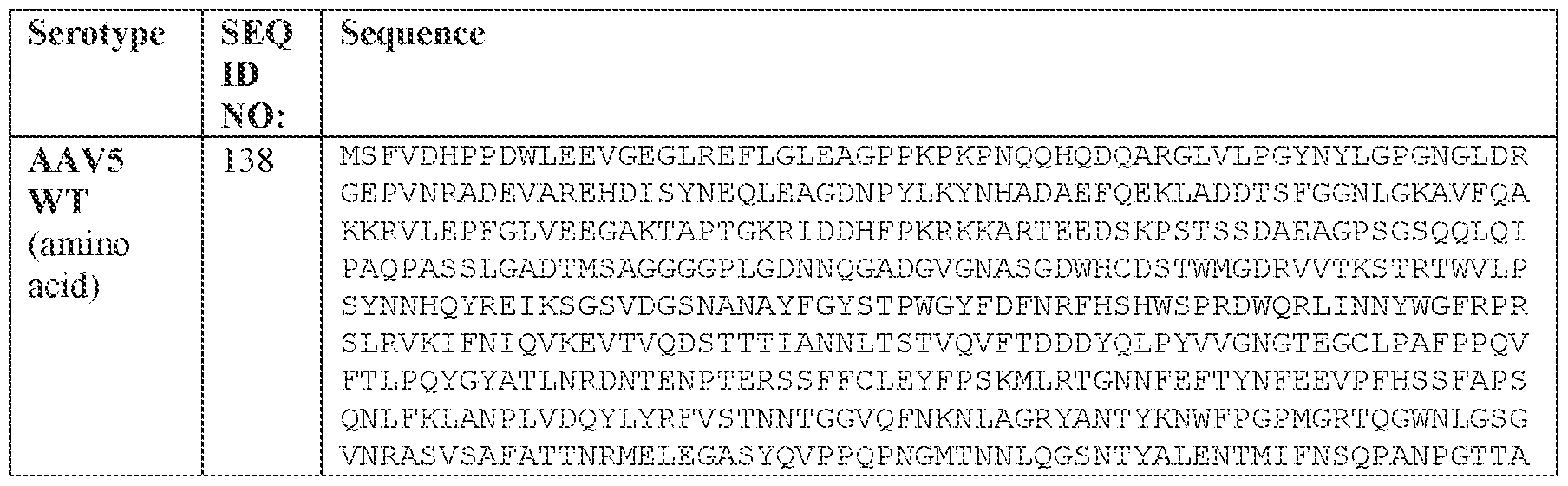
Attorney Docket No.14640.0093-00304
Attorney Docket No.14640.0093-00304
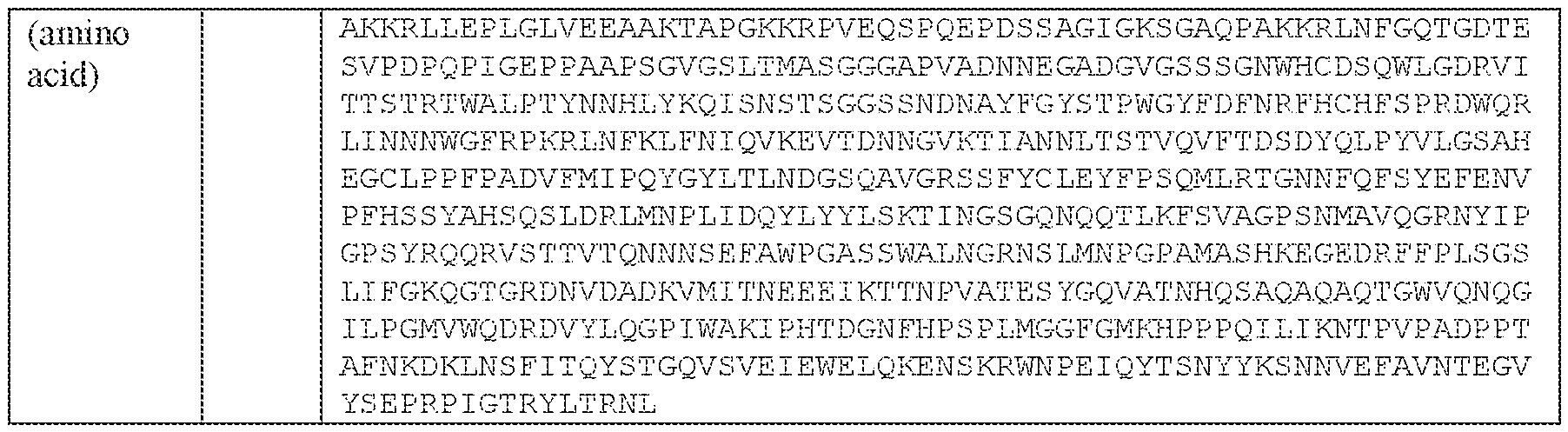
AAV Viral Genome [0212] In some embodiments, the AAV particle of the present disclosure serves as an expression vector comprising a viral genome that encodes a modulatory polynucleotide. [0213] In some embodiments, an AAV particle, e.g., an AAV particle for the vectorized delivery of a modulatory polynucleotide described herein, comprises a viral genome, e.g., an AAV viral genome (e.g., a vector genome or AAV vector genome). In some embodiments, the viral genome, e.g., the AAV viral genome, further comprises an inverted terminal repeat (ITR) region, an enhancer, a promoter, an intron region, an exon region, a nucleic acid encoding a modulatory polynucleotide (e.g., a modulatory polynucleotide for reducing or eliminating expression of ATXN2 described herein), a polyA region, or a combination thereof. In some embodiments, the viral genome, e.g., the AAV viral genome, further comprises at least one miRNA binding site. Viral Genome Component: Inverted Terminal Repeats (ITRs) [0214] In some embodiments, the viral genome may comprise at least one inverted terminal repeat (ITR) region. The AAV particles of the present disclosure comprise a viral genome with at least one ITR region and a region encoding a modulatory polynucleotide (e.g., a modulatory polynucleotide for reducing or eliminating expression of ATXN2). In some embodiments, the viral genome has two ITRs. These two ITRs flank the region comprising the modulatory polynucleotide at the 5’ and 3’ ends. In some embodiments, the ITR functions as an origin of replication comprising a recognition site for replication. In some embodiments, the ITR comprises a sequence region which can be complementary and symmetrically arranged. In some embodiments, the ITR incorporated into a viral genome described herein may be comprised of a naturally occurring polynucleotide sequence or a recombinantly derived polynucleotide sequence. [0215] In some embodiments, the ITR is of the same serotype as the capsid, selected from any of the serotypes described herein, or a derivative thereof. In some embodiments, the ITR is of a different serotype than the capsid. In some embodiments, the AAV particle has more than one ITR. In some embodiments, the AAV particle comprises a viral genome comprising two ITRs. In some embodiments, the ITRs are of the same serotype as one another. In some embodiments, the ITRs are of different serotypes. Non-limiting examples include zero, one, or both of the ITRs having the same serotype as the capsid.
Attorney Docket No.14640.0093-00304 Viral Genome Component: Promoters and Enhancers [0216] In some embodiments, the viral genome comprises at least one element to enhance the transgene target specificity and expression. See, e.g., Powell et al. Viral Expression Cassette Elements to Enhance Transgene Target Specificity and Expression in Gene Therapy, 2015; the contents of which are herein incorporated by reference in their entirety. Non-limiting examples of elements to enhance the transgene target specificity and expression include promoters, endogenous miRNAs, post-transcriptional regulatory elements (PREs), polyadenylation (polyA) region, upstream enhancers (USEs), CMV enhancers, and introns. [0217] In some embodiments, expression of the polypeptides in a target cell may be driven by a specific promoter, including but not limited to, a promoter that is species specific, inducible, tissue- specific, or cell cycle-specific (Parr et al., Nat. Med.3:1145-9 (1997); the contents of which are herein incorporated by reference in their entirety). [0218] In some embodiments, the viral genome comprises a promoter that is sufficient for expression, e.g., in a target cell, of a modulatory polynucleotide (e.g., a modulatory polynucleotide for reducing or eliminating expression of ATXN2). In some embodiments, the promoter is deemed to be efficient when it drives expression of the modulatory polynucleotide encoded in the viral genome of the AAV particle. [0219] In some embodiments, the promoter is deemed to be efficient when it drives expression of the modulatory polynucleotide in the cell or tissue being targeted. [0220] Promoters may be naturally occurring or non-naturally occurring. Non-limiting examples of promoters include viral promoters, plant promoters and mammalian promoters. In some embodiments, the promoters may be human promoters. In some embodiments, the promoter may be truncated. [0221] In some embodiments, the viral genome comprises a promoter that results in expression in one or more cells and/or tissues. In some embodiments, the promoter is a ubiquitous promoter. In some embodiments, a promoter which drives or promotes expression in most mammalian tissues includes, but is not limited to, human elongation factor 1Į-subunit (EF1Į) promoter, a cytomegalovirus (CMV) immediate-early enhancer and/or promoter, a chicken ȕ-actin (CBA) promoter, a CAG promoter, a ȕ glucuronidase (GUSB) promoter, and a ubiquitin C (UBC) promoter. [0222] In some embodiments, the viral genome comprises a nervous system specific promoter, e.g., a promoter that results in expression of a payload in a neuron, an astrocyte, and/or an oligodendrocyte. Non-limiting examples of tissue-specific expression elements for neurons include synapsin (Syn) or synapsin 1 (Syn1), e.g., human synapsin or synapsin 1. [0223] In some embodiments, the promoter may be less than 1 kb. [0224] In some embodiments, the promoter may be a combination of two or more components of the same or different starting or parental promoters. [0225] In some embodiments, the viral genome comprises an enhancer. [0226] In some embodiments, the viral genome comprises a CMVie enhancer, a CBA promoter or
Attorney Docket No.14640.0093-00304 functional variant thereof, and an intron. [0227] In some embodiments, the viral genome comprises an engineered promoter. Viral Genome Component: Introns [0228] In some embodiments, the viral genome comprises at least one intron or a fragment or derivative thereof. In some embodiments, the viral genome comprises at least one exon or a fragment or derivative thereof. [0229] In some embodiments, the intron may be 100-600 nucleotides in length. [0230] In some embodiments, the modulatory polynucleotide-encoding sequence may be located within 1, 2, 3, 4, 5, 6, 7, 8, 9, 10, 11, 12, 13, 14, 15, 16, 17, 18, 19, 20, 21, 22, 23, 24, 25, 26, 27, 28, 29, 30, or more than 30 nucleotides downstream from a promoter comprising an intron (e.g., 3’ relative to the promoter comprising an intron) and/or upstream of the polyadenylation sequence (e.g., 5’ relative to the polyadenylation sequence) in an expression vector. In some embodiments, the modulatory polynucleotide-encoding sequence may be located within 1-5, 1-10, 1-15, 1-20, 1-25, 1-30, 5-10, 5-15, 5- 20, 5-25, 5-30, 10-15, 10-20, 10-25, 10-30, 15-20, 15-25, 15-30, 20-25, 20-30, or 25-30 nucleotides downstream from the intron (e.g., 3’ relative to the intron) and/or upstream of the polyadenylation sequence (e.g., 5’ relative to the polyadenylation sequence) in an expression vector. In some embodiments, the modulatory polynucleotide-encoding sequence may be located within the first 1%, 2%, 3%, 4%, 5%, 6%, 7%, 8%, 9%, 10%, 15%, 20%, 25%, or more than 25% of the nucleotides downstream from the intron (e.g., 3’ relative to the intron) and/or upstream of the polyadenylation sequence (e.g., 5’ relative to the polyadenylation sequence) in an expression vector. In some embodiments, the modulatory polynucleotide-encoding sequence may be located within the first 1-5%, 1-10%, 1-15%, 1-20%, 1-25%, 5-10%, 5-15%, 5-20%, 5-25%, 10-15%, 10-20%, 10-25%, 15-20%, 15-25%, or 20-25% of the sequence downstream from the intron (e.g., 3’ relative to the intron) and/or upstream of the polyadenylation sequence (e.g., 5’ relative to the polyadenylation sequence) in an expression vector. [0231] In certain embodiments, the intron sequence is not an enhancer sequence. In some embodiments, the intron sequence is not a sub-component of a promoter sequence. In some embodiments, the intron sequence is a sub-component of a promoter sequence. Viral Genome Component: Untranslated Regions (UTRs) [0232] In some embodiments, a wildtype untranslated region (UTR) of a gene is transcribed but not translated. Generally, the 5’ UTR starts at the transcription start site and ends at the start codon and the 3’ UTR starts immediately following the stop codon and continues until the termination signal for transcription. [0233] Features typically found in abundantly expressed genes of specific target organs may be engineered into UTRs to enhance the stability and protein production. [0234] In some embodiments, the viral genome encoding a modulatory polynucleotide described herein (e.g., a modulatory polynucleotide for reducing or eliminating expression of ATXN2 mRNA) comprises a Kozak sequence. While not wishing to be bound by theory, wild-type 5’ untranslated regions
Attorney Docket No.14640.0093-00304 (UTRs) include features that play roles in translation initiation. Kozak sequences, which are commonly known to be involved in the process by which the ribosome initiates translation of many genes, are usually included in 5’ UTRs. Kozak sequences have the consensus CCR(A/G)CCAUGG, where R is a purine (adenine or guanine) three bases upstream of the start codon (ATG), which is followed by another “G”. [0235] In some embodiments, the 5’UTR in the viral genome includes a Kozak sequence. [0236] In some embodiments, the 5’UTR in the viral genome does not include a Kozak sequence. [0237] While not wishing to be bound by theory, wild-type 3’ UTRs are known to have stretches of adenosines and uridines embedded therein. These AU rich signatures are particularly prevalent in genes with high rates of turnover. Based on their sequence features and functional properties, the AU rich elements (AREs) can be separated into three classes (Chen et al, 1995, the contents of which are herein incorporated by reference in their entirety): Class I AREs, such as, but not limited to, c-Myc and MyoD, contain several dispersed copies of an AUUUA motif within U-rich regions. Class II AREs, such as, but not limited to, GM-CSF and TNF-a, possess two or more overlapping UUAUUUA(U/A)(U/A) nonamers. Class III ARES, such as, but not limited to, c-Jun and Myogenin, are less well defined. These U rich regions do not contain an AUUUA motif. Most proteins binding to the AREs are known to destabilize the messenger, whereas members of the ELAV family, most notably HuR, have been documented to increase the stability of mRNA. HuR binds to AREs of all the three classes. Engineering the HuR specific binding sites into the 3ƍ UTR of nucleic acid molecules will lead to HuR binding and thus, stabilization of the message in vivo. [0238] Introduction, removal, or modification of 3ƍ UTR AU rich elements (AREs) can be used to modulate the stability of polynucleotides. When engineering specific polynucleotides, one or more copies of an ARE can be introduced to make polynucleotides less stable and thereby curtail translation and decrease production of the resultant protein. Likewise, AREs can be identified and removed or mutated to increase the intracellular stability and thus increase translation and production of the resultant protein. [0239] In some embodiments, the 3’ UTR of the viral genome may include an oligo(dT) sequence for templated addition of a polyadenylation (polyA) sequence. [0240] Any UTR from any gene known in the art may be incorporated into the viral genome of the AAV particle. These UTRs, or portions thereof, may be placed in the same orientation as in the gene from which they were selected or they may be altered in orientation or location. In some embodiments, the UTR used in the viral genome of the AAV particle may be inverted, shortened, lengthened, or made with one or more other 5ƍ UTRs or 3ƍ UTRs known in the art. As used herein, the term “altered,” as it relates to a UTR, means that the UTR has been changed in some way in relation to a reference sequence. For example, a 3ƍ or 5ƍ UTR may be altered relative to a wild type or native UTR by the change in orientation or location as taught above or may be altered by the inclusion of additional nucleotides, deletion of nucleotides, swapping or transposition of nucleotides. [0241] In some embodiments, the viral genome of the AAV particle comprises at least one artificial
Attorney Docket No.14640.0093-00304 UTR, which is not a variant of a wild type UTR. [0242] In some embodiments, the viral genome of the AAV particle comprises UTRs which have been selected from a family of transcripts whose proteins share a common function, structure, feature, or property. Viral Genome Component: Filler (Stuffer) Sequence [0243] As used herein, the terms “stuffer sequence” and “filler sequence” are used interchangeably. In some embodiments, the AAV particle viral genome comprises at least one filler sequence. [0244] In some embodiments, the viral genome comprises one or more filler sequences. The filler sequence may be a wild-type sequence or an engineered sequence. A filler sequence may be a variant of a wild-type sequence. [0245] In some embodiments, the viral genome comprises one or more filler sequences in order to have the length of the viral genome be the optimal size for packaging. In some embodiments, the viral genome comprises at least one filler sequence in order to have the length of the viral genome be about 2.3 kb. In some embodiments, the viral genome comprises at least one filler sequence in order to have the length of the viral genome be about 4.6 kb. Viral Genome Component: Modulatory polynucleotide-encoding sequences [0246] In some embodiments, the disclosure provides an AAV particle comprising a viral genome encoding a modulatory polynucleotide, e.g., a modulatory polynucleotide for reducing or eliminating expression of ATXN2, thereby reducing or eliminating ATXN2 protein. In some embodiments, the modulatory polynucleotide comprises or encodes an inhibitory polynucleotide, e.g., an RNAi agent or an ASO. In some embodiments, the modulatory polynucleotide comprises or encodes an RNAi agent, e.g., an siRNA. [0247] In some embodiments, the modulatory polynucleotides of the disclosure reduce or eliminate ATXN2 mRNA, thereby reducing or eliminating ATXN2 protein. Exemplary ATXN2 mRNA sequences are provided in Table 7. In some embodiments, the modulatory polynucleotide of the disclosure reduces or eliminates expression of one or more of (e.g., one, two, three or all four of) SEQ ID NOs: 6428, 6429, 6430, and 6431, or a trinucleotide repeat expansion of any of the foregoing. The exemplary ATXN2 sequence information from the National Center for Biotechnology Information cited in Table 7 is hereby incorporated by reference in its entirety. Table 7. Exemplary ATXN2 mRNA transcripts

Attorney Docket No.14640.0093-00304
Attorney Docket No.14640.0093-00304
Attorney Docket No.14640.0093-00304
Attorney Docket No.14640.0093-00304

Attorney Docket No.14640.0093-00304 [0248] In some embodiments, the modulatory polynucleotide comprises a guide strand and a passenger strand, wherein the guide strand targets and thus reduces or eliminates expression of one or more of (e.g., one, two, three or all four of) SEQ ID NOs: 6428-6431 or a trinucleotide repeat expansion thereof. In some embodiments, the passenger strand and guide strand are fully complementary. In some embodiments, the passenger strand and guide strand are partially complementary (e.g., at least 70%, 75%, 80%, 85%, 90%, 95%, or 99%, or 100%) complementary to the guide strand. In some embodiments, the passenger strand has up to 1, 2, 3, 4, 5, 6, 7, 8, 9, or 10 mismatches relative to the guide strand. In some embodiments, the guide strand targeting any one of SEQ ID NOs: 6428-6431 or a trinucleotide repeat expansion thereof is fully complementary to a region of that ATXN2 mRNA sequence. In some embodiments, the guide strand targeting any one of SEQ ID NOs: 6428-6431 or a trinucleotide repeat expansion thereof is partially complementary (e.g., at least 70%, 75%, 80%, 85%, 90%, 95%, or 99% complementary) to a region of that ATXN2 mRNA sequence. In some embodiments, the guide strand has up to 1, 2, 3, 4, 5, 6, 7, 8, 9, or 10 mismatches relative to a region of ATXN2 mRNA, e.g., to a region of any one of SEQ ID NOs: 6428-6431 or a trinucleotide repeat expansion thereof. [0249] In some embodiments, the modulatory polynucleotide binds to a coding region of ATXN2 mRNA. In some embodiments, the modulatory polynucleotide binds to a noncoding region of ATXN2 mRNA. [0250] In some embodiments, the disclosure herein provides constructs that allow for improved expression of a modulatory polynucleotide delivered by gene therapy vectors. [0251] In some embodiments, the disclosure provides constructs that allow for improved biodistribution of a modulatory polynucleotide delivered by gene therapy vectors. [0252] In some embodiments, the disclosure provides constructs that allow for improved sub-cellular distribution or trafficking of a modulatory polynucleotide delivered by gene therapy vectors. [0253] In some embodiments, the disclosure provides constructs that allow for improved trafficking of a modulatory polynucleotide to lysosomal membranes delivered by gene therapy vectors. [0254] In some embodiments, the present disclosure relates to a composition containing or comprising a nucleic acid sequence encoding modulatory polynucleotide for reducing or eliminating expression of ATXN2 mRNA or a functional fragment or variant thereof and methods of administering the composition in vitro or in vivo in a subject, e.g., a human subject and/or an animal model of disease, e.g., an ATXN2-related disorder. [0255] In some embodiments, the disclosure provides a nucleotide sequence encoding a modulatory polynucleotide for use in an AAV genome. In some embodiments, the nucleotide sequence further comprises one or more, e.g., all of, a 5’ ITR sequence, an enhancer sequence, a promoter sequence, an intron sequence, a polyA sequence, and a 3’ ITR sequence. [0256] In some embodiments, the AAV genome encodes a payload construct that comprises a combination of coding and non-coding nucleic acid sequences. [0257] In some embodiments, the viral genome encodes more than one payload. As a non-limiting
Attorney Docket No.14640.0093-00304 example, a viral genome encoding more than one payload may be replicated and packaged into a viral particle. A target cell transduced with a viral particle comprising more than one payload may express each of the payloads in a single cell. [0258] In some embodiments, the payload comprises a gene therapy product including, but not limited to, a polypeptide, protein, DNA molecule, RNA molecule, or other gene product that, when expressed in a target cell, provides a desired therapeutic effect. In some embodiments, a gene therapy product may comprise a modulatory polynucleotide. In some embodiments, the modulatory agent is an inhibitory polynucleotide, e.g., an antisense oligonucleotide (ASO) or RNAi agent (e.g., a dsRNA, siRNA, shRNA, pre-miRNA, pri-miRNA, miRNA, stRNA, lncRNA, piRNA, or snoRNA). In some embodiments, the modulatory agent is an RNAi agent. In some embodiments, the RNAi agent is a siRNA. In some embodiments, the modulatory agent is an ASO. In some embodiments, the ASO or siRNA comprises at least one (e.g., one or more or all) modified nucleotides. [0259] A payload construct encoding a modulatory polynucleotide may comprise or encode a selectable marker. A selectable marker may comprise a gene sequence or a protein or polypeptide encoded by a gene sequence expressed in a host cell that allows for the identification, selection, and/or purification of the host cell from a population of cells that may or may not express the selectable marker. In some embodiments, the selectable marker provides resistance to survive a selection process that would otherwise kill the host cell, such as treatment with an antibiotic. In some embodiments, an antibiotic selectable marker may comprise one or more antibiotic resistance factors, including but not limited to neomycin resistance (e.g., neo), hygromycin resistance, kanamycin resistance, and/or puromycin resistance. [0260] In some embodiments, a payload construct encoding a modulatory polynucleotide may comprise a selectable marker including, but not limited to, ȕ-lactamase, luciferase, ȕ-galactosidase, or any other reporter gene as that term is understood in the art, including cell-surface markers, such as CD4 or the truncated nerve growth factor (NGFR) (for GFP, see WO 96/23810; Heim et al., Current Biology 2:178-182 (1996); Heim et al., Proc. Natl. Acad. Sci. USA (1995); or Heim et al., Science 373:663-664 (1995); for ȕ-lactamase, see WO 96/30540); the contents of each of which are herein incorporated by reference in their entirety. [0261] In some embodiments, a payload construct encoding a selectable marker may comprise a fluorescent protein. A fluorescent protein as herein described may comprise any fluorescent marker including but not limited to green, yellow, and/or red fluorescent protein (GFP, YFP, and/or RFP). In some embodiments, a payload construct encoding a selectable marker may comprise a human influenza hemagglutinin (HA) tag. [0262] In certain embodiments, a nucleic acid for expression of a modulatory polynucleotide in a target cell will be incorporated into the viral genome and located between two ITR sequences.
Attorney Docket No.14640.0093-00304 Viral Genome Component: Molecular Scaffolds [0263] In some embodiments, the molecular scaffold of the modulatory polynucleotide is a known or wild type pri- or pre-microRNA. In other embodiments, the molecular scaffold of the modulatory polynucleotide is designed ab initio. In some embodiments, the molecular scaffold along with the payload (e.g., passenger strand and guide strand) form a stem loop structure. [0264] In some embodiments, the molecular scaffold comprises a 5’ flanking region. In some embodiments, the molecular scaffold comprises a 3’ flanking region. In some embodiments, the molecular scaffold comprises a loop region, wherein the loop region is present between the passenger and guide strand of the stem loop structure. In some embodiments, the molecular scaffold comprises one or more spacers between one or more modules of the modulatory polynucleotide. A module of the modulatory polynucleotide may include a 5’ flanking region, a 5’ arm, a loop region, a 3’ arm, or a 3’ flanking region. In some embodiments, a spacer is of sufficient length to form approximately one helical turn of the sequence. [0265] In some embodiments, the molecular scaffold comprises a 5’ flanking region, a loop region, and a 3’ flanking region. In some embodiments, the modulatory polynucleotide comprises, in the 5ƍ to 3ƍ direction, a 5ƍ flanking sequence, a 5ƍ arm comprising a passenger strand or guide strand, a loop region, a 3ƍ arm comprising a guide strand or passenger strand, respectively, and a 3ƍ flanking sequence. [0266] Exemplary sequences for the 5ƍ flanking region, the loop region, and the 3ƍ flanking region that may be used in the molecular scaffolds described herein are shown in Tables 8-10. Table 8. Exemplary 5’ Flanking Regions for Molecular Scaffold

Table 9. Exemplary Loop Regions for Molecular Scaffold
Attorney Docket No.14640.0093-00304 Table 10. Exemplary 3’ Flanking Regions for Molecular Scaffold.

[0267] In some embodiments, the molecular scaffold comprises a 5’ flanking region comprising any one of SEQ ID NOs: 6413-6416, or a nucleotide sequence at least 75%, 80%, 85%, 90%, 95% 96%, 97%, 98%, 99% identical to any one of SEQ ID NOs: 6413-6416; a loop region comprising any one of SEQ ID NOs: 6417-6421, or a nucleotide sequence at least 75%, 80%, 85%, 90%, 95% 96%, 97%, 98%, 99% identical to any one of SEQ ID NOs: 6417-6421; and a 3’ flanking region comprising any one of SEQ ID NOs: 6422-6427, or a nucleotide sequence at least 75%, 80%, 85%, 90%, 95% 96%, 97%, 98%, 99% identical to any one of SEQ ID NOs: 6422-6427. [0268] In some embodiments, the molecular scaffold comprises a 5’ flanking region comprising any one of SEQ ID NOs: 6413-6416; a loop region comprising any one of SEQ ID NOs: 6417-6421; and a 3’ flanking region comprising any one of SEQ ID NOs: 6422-6427. [0269] In some embodiments, the molecular scaffold comprises a 5’ flanking region comprising SEQ ID NO: 6414 or SEQ ID NO: 6415; a loop region comprising SEQ ID NO: 6417, SEQ ID NO: 6418, or SEQ ID NO: 6421; and a 3’ flanking region comprising SEQ ID NO: 6422, SEQ ID NO: 6423, SEQ ID NO: 6424, or SEQ ID NO: 6425. In some embodiments, the molecular scaffold comprises a 5’ flanking region comprising SEQ ID NO: 6414 or SEQ ID NO: 6415; a loop region comprising SEQ ID NO: 6417, SEQ ID NO: 6418, or SEQ ID NO: 6421; and a 3’ flanking region comprising SEQ ID NO: 6423, SEQ ID NO: 6424, or SEQ ID NO: 6425. [0270] In some embodiments, the molecular scaffold comprises a 5’ flanking region comprising SEQ ID NO: 6414, a loop region comprising SEQ ID NO: 6417, and a 3’ flanking region comprising SEQ ID NO: 6423. In some embodiments, the molecular scaffold comprises a 5’ flanking region comprising SEQ ID NO: 6415, a loop region comprising SEQ ID NO: 6421, and a 3’ flanking region comprising SEQ ID NO: 6425. In some embodiments, the molecular scaffold comprises a 5’ flanking region comprising SEQ ID NO: 6414, a loop region comprising SEQ ID NO: 6417, and a 3’ flanking region comprising SEQ ID NO: 6424. In some embodiments, the molecular scaffold comprises a 5’ flanking region comprises SEQ
Attorney Docket No.14640.0093-00304 ID NO: 6414, a loop region comprising SEQ ID NO: 6418, and a 3’ flanking region comprising SEQ ID NO: 6423. Exemplary AAV Capsid Sequences [0271] In some embodiments, the AAV viral genome further comprises a nucleic acid encoding a capsid protein, e.g., a structural protein. In some embodiments, the capsid protein comprises a VP1 polypeptide, a VP2 polypeptide, and/or a VP3 polypeptide. In some embodiments, the VP1 polypeptide, the VP2 polypeptide, and/or the VP3 polypeptide are encoded by at least one Cap gene. [0272] In some embodiments, the capsid comprises the amino acid sequence of SEQ ID NO: 982. [0273] In some embodiments, the AAV particle comprises a capsid comprising an amino acid sequence selected from Table 4. [0274] In some embodiments, the AAV particle comprises a capsid comprising the amino acid sequence of SEQ ID NO: 982, or a sequence that is at least 98% or at least 99% sequence identical thereto. In some embodiments, the capsid is encoded by the nucleic acid sequence of SEQ ID NO: 984. [0275] The present disclosure provides in some embodiments, vectors, cells, and/or AAV particles comprising the above identified viral genomes. Self-Complementary and Single-Stranded Vectors [0276] In some embodiments, the AAV viral genome used in the present disclosure is single- stranded. [0277] In some embodiments, the AAV viral genome is capable of forming double-stranded DNA. In some embodiments, the AAV viral genome is self-complementary. See, e.g., US Patent No.7,465,583. Self-complementary AAVs (scAAVs) contain both DNA strands that anneal together to form double stranded DNA. By skipping second strand synthesis, scAAVs allow for rapid expression in the cell. [0278] Methods for producing and/or modifying AAV viral genomes and particles are disclosed in the art such as pseudotyped AAV vectors (International Patent Publication Nos. WO200028004; WO200123001; WO2004112727; WO 2005005610 and WO 2005072364, the content of each of which are incorporated herein by reference in their entirety). II. AAV Production [0279] Viral production disclosed herein describes processes and methods for producing AAV particles (with enhanced, improved and/or increased tropism for a target tissue), e.g., an AAV particle comprising an AAV capsid variant that may be used to contact a target cell to deliver a payload. [0280] In some embodiments, disclosed herein is a method of making an AAV particle of the present disclosure, e.g., an AAV particle comprising an AAV capsid variant disclosed herein, wherein the method comprises: (i) providing a host cell comprising a viral genome comprising a nucleotide sequence encoding a modulatory polynucleotide for reducing or eliminating expression of ATXN2 mRNA and a nucleic acid encoding an AAV capsid variant and (ii) incubating the cell under conditions suitable to encapsulate the viral genome in the AAV capsid variant, e.g., an AAV capsid variant described herein (e.g., an AAV capsid variant listed in Tables 3, 4, or 5), thereby making the AAV particle. In some
Attorney Docket No.14640.0093-00304 embodiments, the AAV capsid variant comprises the amino acid sequence of SEQ ID NO: 982. In some embodiments, the method comprises, prior to step (i), introducing a nucleic acid comprising the viral genome into the cell. In some embodiments, the method comprises, prior to step (i), introducing the nucleic acid encoding the AAV capsid variant into the cell. In some embodiments, the AAV particle described herein is an isolated AAV particle. In some embodiments, the AAV particle described herein is a recombinant AAV particle. [0281] Any method known in the art may be used for the preparation of AAV particles. In some embodiments, AAV particles are produced in mammalian cells (e.g., HEK293 cells). In some embodiments, AAV particles are produced in insect cells (e.g., Sf9 cells). [0282] Methods of making AAV particles are well known in the art and are described in e.g., U.S. Patent Nos. US6204059, US5756283, US6258595, US6261551, US6270996, US6281010, US6365394, US6475769, US6482634, US6485966, US6943019, US6953690, US7022519, US7238526, US7291498 and US7491508, US5064764, US6194191, US6566118, US8137948; or International Publication Nos. WO1996039530, WO1998010088, WO1999014354, WO1999015685, WO1999047691, WO2000055342, WO2000075353 and WO2001023597; Methods In Molecular Biology, ed. Richard, Humana Press, NJ (1995); O'Reilly et al., Baculovirus Expression Vectors, A Laboratory Manual, Oxford Univ. Press (1994); Samulski et al., J. Vir.63:3822-8 (1989); Kajigaya et al., Proc. Nat'l. Acad. Sci. USA 88: 4646-50 (1991); Ruffing et al., J. Vir.66:6922-30 (1992); Kimbauer et al., Vir., 219:37-44 (1996); Zhao et al., Vir.272:382-93 (2000); the contents of each of which are herein incorporated by reference in their entirety. In some embodiments, the AAV particles are made using the methods described in International Patent Publication WO2015191508, the contents of which are herein incorporated by reference in their entirety. III. Pharmaceutical Compositions [0283] The present disclosure additionally provides a method for treating a ATXN2-related disorder, e.g., in a human subject, comprising administering to the subject any of the AAV polynucleotides or AAV genomes described herein (i.e., “vector genomes,” “viral genomes,” or “VGs”) or administering to the subject a particle comprising said AAV polynucleotide or AAV genome, or administering to the subject any of the described compositions, including pharmaceutical compositions. [0284] Although the descriptions of pharmaceutical compositions provided herein are principally directed to pharmaceutical compositions which are suitable for administration to humans, it will be understood by the skilled artisan that such compositions are generally suitable for administration to any other animal, e.g., non-human mammals. Modification of pharmaceutical compositions suitable for administration to humans in order to render the compositions suitable for administration to various animals is well understood, and the ordinarily skilled veterinary pharmacologist can design and/or perform such modification with merely ordinary, if any, experimentation. Subjects to which administration of the pharmaceutical compositions is contemplated include, but are not limited to, humans and/or other primates; mammals, including commercially relevant mammals such as cattle, pigs,
Attorney Docket No.14640.0093-00304 horses, sheep, cats, dogs, mice, and/or rats; and/or birds, including commercially relevant birds such as poultry, chickens, ducks, geese, and/or turkeys. [0285] In some embodiments, compositions are administered to humans, e.g., human patients or human subjects. [0286] In some embodiments, the AAV particle formulations described herein may contain a nucleic acid encoding at least one payload. In some embodiments, the formulations may contain a nucleic acid encoding 1, 2, 3, 4, or 5 payloads. In some embodiments, the formulation comprises a nucleic acid encoding a modulatory polynucleotide. In some embodiments, the modulatory polynucleotide is a modulatory polynucleotide for reducing or eliminating expression of ATXN2 mRNA, thereby reducing or eliminating ATXN2 protein. [0287] A pharmaceutical composition in accordance with the present disclosure may be prepared, packaged, and/or sold in bulk, as a single unit dose, and/or as a plurality of single unit doses. As used herein, a “unit dose” refers to a discrete amount of the pharmaceutical composition comprising a predetermined amount of the active ingredient. The amount of the active ingredient is generally equal to the dosage of the active ingredient which would be administered to a subject and/or a convenient fraction of such a dosage such as, for example, one-half or one-third of such a dosage. IV. Formulations [0288] Formulations of the AAV pharmaceutical compositions described herein may be prepared by any method known or hereafter developed in the art of pharmacology. In general, such preparatory methods include the step of bringing the active ingredient into association with an excipient and/or one or more other accessory ingredients, and then, if necessary and/or desirable, dividing, shaping and/or packaging the product into a desired single- or multi-dose unit. [0289] Relative amounts of the active ingredient, the pharmaceutically acceptable excipient, and/or any additional ingredients in a pharmaceutical composition in accordance with the disclosure will vary, depending upon the identity, size, and/or condition of the subject treated and further depending upon the route by which the composition is to be administered. [0290] For example, the composition may comprise between 0.1% and 99% (w/w) of the active ingredient. By way of example, the composition may comprise between 0.1% and 100%, e.g., between .5% and 50%, between 1-30%, between 5-80%, or at least 80% (w/w) active ingredient. [0291] The AAV particles of the disclosure can be formulated using one or more excipients to: (1) increase stability; (2) increase cell transfection or transduction; (3) permit the sustained or delayed release; (4) alter the biodistribution (e.g., target the viral particle to specific tissues or cell types); (5) increase the translation of encoded protein in vivo; (6) alter the release profile of the modulatory polynucleotide in vivo and/or (7) allow for regulatable expression of the modulatory polynucleotide. [0292] Formulations of the present disclosure can include, without limitation, saline, lipidoids, liposomes, lipid nanoparticles, polymers, lipoplexes, core-shell nanoparticles, peptides, proteins, cells transfected with viral vectors (e.g., for transplantation into a subject), nanoparticle mimics and
Attorney Docket No.14640.0093-00304 combinations thereof. Further, the viral vectors of the present disclosure may be formulated using self- assembled nucleic acid nanoparticles. [0293] In some embodiments, a viral vector encoding a modulatory polynucleotide may be formulated to optimize baricity and/or osmolality. In some embodiments, the baricity and/or osmolality of the formulation may be optimized to ensure optimal drug distribution in the central nervous system or a region or component of the central nervous system. Excipients [0294] The formulations of the disclosure can include one or more excipients, each in an amount that together increases the stability of the AAV particle, increases cell transfection or transduction by the viral particle, increases the expression of viral particle encoded protein, and/or alters the release profile of AAV particle encoded proteins. In some embodiments, a pharmaceutically acceptable excipient may be at least 95%, at least 96%, at least 97%, at least 98%, at least 99%, or 100% pure. In some embodiments, an excipient is approved for use for humans and for veterinary use. In some embodiments, an excipient may be approved by United States Food and Drug Administration. In some embodiments, an excipient may be of pharmaceutical grade. In some embodiments, an excipient may meet the standards of the United States Pharmacopoeia (USP), the European Pharmacopoeia (EP), the British Pharmacopoeia, and/or the International Pharmacopoeia. [0295] Excipients, which, as used herein, include, but are not limited to, any and all solvents, dispersion media, diluents, or other liquid vehicles, dispersion or suspension aids, surface active agents, isotonic agents, thickening or emulsifying agents, preservatives, and the like, as suited to the particular dosage form desired. Various excipients for formulating pharmaceutical compositions and techniques for preparing the composition are known in the art (see Remington: The Science and Practice of Pharmacy, 21st Edition, A. R. Gennaro, Lippincott, Williams & Wilkins, Baltimore, MD, 2006; the contents of which are herein incorporated by reference in their entirety). The use of a conventional excipient medium may be contemplated within the scope of the present disclosure, except insofar as any conventional excipient medium may be incompatible with a substance or its derivatives, such as by producing any undesirable biological effect or otherwise interacting in a deleterious manner with any other component(s) of the pharmaceutical composition. Inactive Ingredients [0296] In some embodiments, AAV formulations may comprise at least one excipient which is an inactive ingredient. As used herein, the term “inactive ingredient” refers to one or more agents that do not contribute to the activity of the pharmaceutical composition included in formulations. In some embodiments, all, none, or some of the inactive ingredients which may be used in the formulations of the present disclosure may be approved by the US Food and Drug Administration (FDA). [0297] Formulations of AAV particles disclosed herein may include cations or anions. In one embodiment, the formulations include metal cations such as, but not limited to, Zn
2+, Ca
2+, Cu
2+, Mg
+, or combinations thereof. In some embodiments, formulations may include polymers or polynucleotides
Attorney Docket No.14640.0093-00304 complexed with a metal cation (See, e.g., U.S. Pat. Nos.6,265,389 and 6,555,525, the contents of each of which are herein incorporated by reference in their entirety). V. Uses and Applications [0298] The compositions of the disclosure may be administered to a subject or used in the manufacture of a medicament for administration to a subject having an ATXN2-related disorder. The ATXN2-related disorder may be a disorder of the central nervous system, and/or a neurological and/or neuromuscular disorder. Also specifically contemplated herein is spinocerebellar ataxia type 2 (SCA2) and other disorder that arise from expression of an ATXN2 gene product with trinucleotide repeat expansions, e.g., ATXN2 with 32 or more CAG repeats (SEQ ID NO: 6437) (polyQ expansions). [0299] The present disclosure addresses the need for new technologies by providing ATXN2-related treatment deliverable by AAV-based compositions and complexes for the treatment of ATXN2-related disorders. [0300] The compositions of the disclosure may be administered to a subject, e.g., to deliver a modulatory polynucleotide, e.g., to a subject who has, has been diagnosed with having, or is at risk of having an ATXN2-related disorder (e.g., SCA2). The compositions may similarly be used in the manufacture of a medicament for administration to a subject having an ATXN2-related disorder (e.g., SCA2). [0301] In some embodiments, the disclosure provides a method of delivering a modulatory polynucleotide to a subject comprising administering to the subject an effective amount of a pharmaceutical composition or AAV particle disclosed herein that comprises a viral genome encoding a modulatory polynucleotide, thereby delivering the modulatory polynucleotide. In some embodiments, the subject has, has been diagnosed with having, or is at risk of having an ATXN2-related disorder. In some embodiments, the ATXN2-related disorder is SCA2. [0302] In some embodiments, the disclosure provides a method for treating an ATXN2-related disorder (e.g., SCA2). In certain embodiments, a pharmaceutical composition or AAV particle disclosed herein, comprising a viral genome encoding a modulatory polynucleotide, may be administered to a subject to treat an ATXN2-related disorder (e.g., SCA2), thereby treating the disease (e.g., SCA2). In some embodiments, the subject has, has been diagnosed with having, or is at risk of having an ATXN2- related disorder. In some embodiments, the treatment results in a reduction in the subject’s ATXN2 protein level (e.g., levels of aberrantly expressed, aberrantly active, and/or mutant ATXN2 protein) as compared to baseline. [0303] In some embodiments, the disclosure provides an AAV particle or pharmaceutical composition according to any one of the embodiments disclosed herein for treating an ATXN2-related disorder, such as SCA2. In some embodiments, the present disclosure provides the pharmaceutical composition or the AAV particle of any one the embodiments disclosed herein for use in a method of treating a disorder as disclosed herein, such as SCA2.
Attorney Docket No.14640.0093-00304 [0304] In some embodiments, the disclosure provides a method of treating SCA2 in a subject. In certain embodiments, a pharmaceutical composition or AAV particle disclosed herein that comprises a viral genome encoding a modulatory polynucleotide may be administered to a subject to treat SCA2. In some embodiments, the subject has, has been diagnosed with having, or is at risk of having SCA2. [0305] In some embodiments, the disclosure provides a method of treating a subject having or diagnosed with having amyotrophic lateral sclerosis (ALS), Parkinson’s disease (PD), or frontotemporal lobar degeneration (FTLD). [0306] In some embodiments, a pharmaceutical composition or AAV particle may be administered to a subject may have one or more mutations in the ATXN2 gene. In some embodiments, the one or more mutations in the ATXN2 gene comprises a trinucleotide repeat expansion. In some embodiments, the trinucleotide repeat expansion in the ATXN2 gene is 32 or more CAG repeats (SEQ ID NO: 6437). [0307] In some embodiments, the treatment may result in prevention of progression of an ATXN2- related disorder. For example, the treatment may result in amelioration of at least one symptom of the disease associated with aberrant ATXN2 protein expression or activity or with a mutated ATXN2 protein in the subject (e.g., SCA2). In some embodiments, at least one symptom comprises progressive cerebellar ataxia, nystagmus, slow saccadic eye movements, ophthalmoparesis, parkinsonism, or a combination thereof. [0308] In some embodiments, the methods disclosed herein further comprise evaluating, e.g., measuring, the level of modulatory polynucleotide expression, and/or the level of ATXN2 expression, e.g., ATXN2 gene, ATXN2 mRNA, and/or ATXN2 protein expression, in the subject, e.g., in a cell, tissue, or fluid of the subject. In some embodiments, the level of ATXN2 protein is measured by an ELISA, a Western blot, or an immunohistochemistry assay. In some embodiments, evaluating the subject’s level of modulatory polynucleotide expression and/or the level of ATXN2 expression is performed prior to and/or subsequent to administration of the pharmaceutical composition or AAV particle, optionally wherein the subject’s level of the modulatory polynucleotide expression and/or the level of ATXN2 expression prior to administration is compared to the subject’s level of ATXN2 expression subsequent to administration. In some embodiments, the level of modulatory polynucleotide expression may be evaluated in a cell or tissue of the central nervous system. In some embodiments, subject’s level of ATXN2 protein expression subsequent to administration is decreased relative to the subject’s level of ATXN2 protein expression prior to administration. [0309] In some embodiments, the administration of the effective amount of a pharmaceutical composition or AAV particle disclosed herein that comprises a viral genome encoding a modulatory polynucleotide may be a treatment that results in: (i) a decrease in ATXN2 protein expression in a cell, tissue, (e.g., a cell or tissue of the CNS, e.g., spinal cord, temporal cortex, perirhinal cortex, globus pallidus, putamen, caudate, thalamus, hippocampus, geniculate nucleus, Purkinje cell layer, deep cerebellar nuclei, dentate nucleus, brainstem, and/or cerebellum), and/or fluid (e.g., CSF and/or serum) of the subject relative to baseline and/or relative to ATXN2 protein expression in a cell, tissue, or fluid of an
Attorney Docket No.14640.0093-00304 individual with an ATXN2-related disorder who has not been administered the pharmaceutical composition or AAV particle; and/or (ii) an increase in the number and/or level of viral genomes (VG) per cell in a CNS tissue (e.g., spinal cord, temporal cortex, perirhinal cortex, globus pallidus, putamen, caudate, thalamus, hippocampus, geniculate nucleus, Purkinje cell layer, deep cerebellar nuclei, dentate nucleus, brainstem, and/or cerebellum) of the subject relative to the number and/or level of VG per cell in a peripheral tissue of the subject; and/or (iii) a decrease in ATXN2 mRNA expression in a cell or tissue (e.g., a cell or tissue of the CNS, e.g., spinal cord, temporal cortex, perirhinal cortex, globus pallidus, putamen, caudate, thalamus, hippocampus, geniculate nucleus, Purkinje cell layer, deep cerebellar nuclei, dentate nucleus, brainstem, and/or cerebellum) of the subject relative to baseline and/or relative to ATXN2 mRNA expression in a cell or tissue of an individual with an ATXN2-related disorder who has not been administered the pharmaceutical composition or AAV particle. [0310] In some embodiments, at least one additional agent for treating an ATXN2-related disorder (e.g., SCA2) may be administered together with the effective amount of a pharmaceutical composition or AAV particle disclosed herein. [0311] In some embodiments, the present disclosure encompasses the delivery of pharmaceutical, prophylactic, diagnostic, or imaging compositions in combination with agents that may improve their bioavailability, reduce and/or modify their metabolism, and/or modify their distribution within the body. [0312] In certain embodiments, the pharmaceutical compositions described herein are used as research tools, particularly in in vitro investigations using human cell lines such as HEK293T and in vivo testing in nonhuman primates which will occur prior to human clinical trials. [0313] The present disclosure provides a method for treating a disease, disorder and/or condition in a mammalian subject, including a human subject, comprising administering to the subject any of the AAV particles that produces a modulatory polynucleotide described herein or administering to the subject a composition or formulation comprising said AAV particle. [0314] Delivery of a payload construct comprising a modulatory polynucleotide-encoding sequence may alleviate or reduce symptoms that result from abnormal level and/or function of a gene product (e.g., an absence or defect in a protein) in a subject in need thereof or that otherwise confers a benefit to a CNS disorder in a subject in need thereof. Neurological and neuromuscular diseases [0315] In some embodiments, AAV particles of the present disclosure, through delivery of a modulatory polynucleotide, can reduce or eliminate ATXN2 expression in the CNS. In some embodiments, AAV particles of the present disclosure can reduce or eliminate the level of aberrant or mutant ATXN2 mRNA, thereby reducing or eliminating the level of aberrantly expressed, aberrantly active, and/or mutant ATXN2 protein in the CNS. [0316] In some embodiments, AAV particles of the present disclosure may be used to treat diseases that are associated with impairments of the growth and development of the CNS, e.g., neurodevelopmental disorders. In some embodiments, such neurodevelopmental disorders may be caused
Attorney Docket No.14640.0093-00304 by one or more genetic mutations. [0317] In some embodiments, the neurological disorders may be functional neurological disorders with motor and/or sensory symptoms which have neurological origin in the CNS. As non-limiting examples, functional neurological and/or neuromuscular disorders may be chronic pain, seizures, speech problems, involuntary movements, sleep disturbances, myotonia, muscle weakness, cardiac conduction abnormalities, learning difficulties, or hypotonia. [0318] In some embodiments, the neurological or neuromuscular disease, disorder, and/or condition is ATXN2-related disorders. In some embodiments, the delivery of the AAV particles may halt or slow the disease progression of ATXN2-related disorders as assessed using a known analysis method and comparator group for ATXN2-related disorders. As a non-limiting example, the delivery of the AAV particles may halt or slow progression of SCA2. [0319] In some embodiments, the AAV particle encoding a payload may decrease the amount of ATXN2 protein in a tissue effective to reduce one or more symptoms of an ATXN2-related disorder, optionally caused by trinucleotide repeat (and thus polyQ) expansion. [0320] In some embodiments, the AAV particles and AAV viral genomes described herein, upon administration to subject or introduction to a target cell, decrease ATXN2 activity compared to baseline ATXN2 activity. In some embodiments, the administration or introduction of the AAV particles results in decreased levels of aggregates formed by aberrant ATXN2. In the case of subjects or target cells with aberrant ATXN2 activity, as in the case of certain subjects having a ATXN2-related disorder or cells or tissues harboring one or more mutation in a ATXN2 gene, the AAV particles and AAV viral genomes described herein deliver a modulatory polynucleotide to inhibit, decrease, or eliminate activity of aberrant ATXN2, relative to ATXN2 activity levels in subjects, tissues, and cells not afflicted with a ATXN2-related disorder or not harboring a ATXN2 gene mutation. Therapeutic applications [0321] The present disclosure additionally provides methods for treating non-infectious diseases and/or disorders in a mammalian subject, including a human subject, comprising administering to the subject any of the AAV particles or pharmaceutical compositions described herein. In some embodiments, non-infectious diseases and/or disorders treated according to the methods described herein include, but are not limited to spinocerebellar ataxia type 2 (SCA2). [0322] The present disclosure provides a method for administering to a subject in need thereof, including a human subject, a therapeutically effective amount of the AAV particles of the invention to slow, stop or reverse disease progression. As a non-limiting example, disease progression may be measured by tests or diagnostic tool(s) known to those skilled in the art. As another non-limiting example, disease progression may be measured by change in the pathological features of the brain, CSF, muscle, or other tissues of the subject.
Attorney Docket No.14640.0093-00304 VI. Delivery of AAV Particles Delivery to Cells [0323] In some aspects, the present disclosure provides a method of delivering to a cell or tissue any of the above-described AAV particles, comprising contacting the cell or tissue with said AAV particle or contacting the cell or tissue with a formulation comprising said AAV particle, or contacting the cell or tissue with any of the described compositions, including pharmaceutical compositions. The method of delivering the AAV particle to a cell or tissue can be accomplished in vitro, ex vivo, or in vivo. [0324] In some embodiments, the AAV particles are delivered to a cell, tissue, or region of the CNS. In some embodiments, the AAV particles are delivered to a cell or tissue of the spinal cord, temporal cortex, perirhinal cortex, globus pallidus, putamen, caudate, thalamus, hippocampus, geniculate nucleus, Purkinje cell layer, deep cerebellar nuclei, dentate nucleus, brainstem, cerebellum, or a combination thereof. In some embodiments, the AAV particles are delivered to brainstem and/or cerebellum. Delivery to Subjects [0325] In some aspects, the present disclosure additionally provides a method of delivering to a subject, including a mammalian subject, any of the above-described AAV particles comprising administering to the subject said AAV particle, or administering to the subject a formulation comprising said AAV particle, or administering to the subject any of the described compositions, including pharmaceutical compositions. [0326] In some embodiments, the AAV particles may be delivered to bypass anatomical blockages (e.g., the blood brain barrier). [0327] In some embodiments, the AAV particles may be formulated and delivered to a subject by a route which increases the speed of drug effect as compared to oral delivery. [0328] In some embodiments, the AAV particles may be delivered using intrathecal infusion. [0329] In some embodiments, a subject may be administered the AAV particles described herein using a bolus infusion. [0330] In some embodiments, the AAV particles may be delivered in a continuous and/or bolus infusion. Each site of delivery may use a different dosing regimen or the same dosing regimen may be used for each site of delivery. As a non-limiting example, the sites of delivery may be in the cervical and the lumbar region. As another non-limiting example, the sites of delivery may be in the cervical region. As another non-limiting example, the sites of delivery may be in the lumbar region. [0331] In some embodiments, the AAV particles may be delivered to a subject via a single route of administration. [0332] In some embodiments, the AAV particles may be delivered to a subject via a multi-site route of administration. For example, a subject may be administered the AAV particles at 2, 3, 4, 5, or more than 5 sites. [0333] In some embodiments, a subject may be administered the AAV particles described herein using sustained delivery over a period of minutes, hours, or days. The infusion rate may be changed
Attorney Docket No.14640.0093-00304 depending on the subject, distribution, formulation, or another delivery parameter known to those in the art. [0334] In some embodiments, if continuous delivery (continuous infusion) of the AAV particles is used, the continuous infusion may be for 1 hour, 2, hours, 3 hours, 4 hours, 5 hours, 6 hours, 7 hours, 8 hours, 9 hours, 10 hours, 11 hours, 12 hours, 13 hours, 14 hours, 15 hours, 16 hours, 17 hours, 18 hours, 19 hours, 20 hours, 21 hours, 22 hours, 23 hours, 24 hours, or more than 24 hours. [0335] In some embodiments, the intracranial pressure may be evaluated prior to administration. The route, volume, AAV particle concentration, infusion duration and/or vector titer may be optimized based on the intracranial pressure of a subject. [0336] In some embodiments, the AAV particles may be delivered by systemic delivery. In some embodiments, the systemic delivery may be by intravascular administration. [0337] In some embodiments, the AAV particles may be delivered by injection into the CSF pathway. Non-limiting examples of delivery to the CSF pathway include intrathecal and intracerebroventricular administration. [0338] In some embodiments, the AAV particles may be delivered by direct (intraparenchymal) injection into the substance of an organ, e.g., one or more regions of the brain. [0339] In some embodiments, the AAV particles may be delivered by subpial injection into the spinal cord. For example, subjects may be placed into a spinal immobilization apparatus. A dorsal laminectomy may be performed to expose the spinal cord. Guiding tubes and XYZ manipulators may be used to assist catheter placement. Subpial catheters may be placed into the subpial space by advancing the catheter from the guiding tube and AAV particles may be injected through the catheter (Miyanohara et al., Mol Ther Methods Clin Dev.2016; 3: 16046). In some cases, the AAV particles may be injected into the cervical subpial space. In some cases, the AAV particles may be injected into the thoracic subpial space. [0340] In some embodiments, the AAV particles may be delivered by direct injection to the CNS of a subject. In some embodiments, direct injection is intracerebral injection, intraparenchymal injection, intrathecal injection, intra-cisterna magna injection, or any combination thereof. In some embodiments, direct injection to the CNS of a subject comprises convection enhanced delivery (CED). In some embodiments, administration comprises peripheral injection. In some embodiments, peripheral injection is intravenous injection. [0341] In some embodiments, the AAV particles may be delivered to a subject in order to increase a modulatory polynucleotide level in the CNS (e.g., the spinal cord, temporal cortex, perirhinal cortex, globus pallidus, putamen, caudate, thalamus, hippocampus, geniculate nucleus, Purkinje cell layer, deep cerebellar nuclei, dentate nucleus, brainstem, and/or cerebellum) as compared to a baseline level in the subject. [0342] In some embodiments, the AAV particles may be delivered to a subject in order to reduce or eliminate a ATXN2 mRNA and/or protein level in the CNS (e.g., the spinal cord, temporal cortex,
Attorney Docket No.14640.0093-00304 perirhinal cortex, globus pallidus, putamen, caudate, thalamus, hippocampus, geniculate nucleus, Purkinje cell layer, deep cerebellar nuclei, dentate nucleus, brainstem, and/or cerebellum) as compared to a baseline level in the subject. [0343] In some embodiments, the AAV particles are delivered by transducing cells in these CNS regions. Transduction may also be referred to as the number of cells that are positive for modulatory polynucleotide. [0344] In some embodiments, delivery of AAV particles comprising a viral genome encoding a modulatory polynucleotide as described herein to neurons in the brain (e.g., neurons in the temporal cortex, perirhinal cortex, globus pallidus, putamen, caudate, thalamus, hippocampus, geniculate nucleus, Purkinje cell layer, deep cerebellar nuclei, dentate nucleus, brainstem, and/or cerebellum) may lead to an increased expression of the modulatory polynucleotide in one or more of those neurons. In some embodiments, the increased modulatory polynucleotide expression may lead to improved survival and/or function of various cell types in these CNS regions and/or improvement of at least one symptom of an ATXN2-related disorder in a subject (e.g., SCA2). [0345] In some embodiments, the AAV particles may be delivered to a subject in order to establish widespread distribution of modulatory polynucleotides throughout the CNS, e.g., by administering the AAV particles to the thalamus of the subject. In some embodiments, the increased expression of modulatory polynucleotide may lead to a reduction in at least one symptom of an ATXN2-related disorder in a subject (e.g., SCA2), the at least one symptom includes progressive cerebellar ataxia, nystagmus, slow saccadic eye movements, ophthalmoparesis, parkinsonism, or a combination thereof. Administration [0346] In some embodiments, the present disclosure provides methods comprising administering a viral vector in accordance with the disclosure to a subject in need thereof. Viral vector pharmaceutical, diagnostic, or prophylactic compositions thereof, may be administered to a subject using any amount and any route of administration effective for treating, or diagnosing an ATXN2-related disorder. In some embodiments, the ATXN2-related disorder is SCA2. [0347] Compositions in accordance with the disclosure may be formulated in unit dosage form for ease of administration and uniformity of dosage. It will be understood, however, that the total daily usage of the compositions of the present disclosure may be decided by the attending physician within the scope of sound medical judgment. The specific therapeutically effective, prophylactically effective, or appropriate imaging dose level for any particular patient will depend upon a variety of factors including the disorder being treated and the severity of the disorder; the activity of the specific compound employed; the specific composition employed; the age, body weight, general health, sex, and diet of the patient; the time of administration, route of administration, and rate of excretion of the specific protein employed; the duration of the treatment; drugs used in combination or coincidental with the specific compound employed; and like factors well known in the medical arts.
Attorney Docket No.14640.0093-00304 [0348] In certain embodiments, the desired dosage may be delivered using multiple administrations (e.g., two, three, four, five, six, seven, eight, nine, ten, eleven, twelve, thirteen, fourteen, or more administrations). When multiple administrations are employed, split dosing regimens such as those described herein may be used. As used herein, a “split dose” is the division of single unit dose or total daily dose into two or more doses, e.g., two or more administrations of the single unit dose. As used herein, a “single unit dose” is a dose of any therapeutic composition administered in one dose/at one time/single route/single point of contact, i.e., single administration event. In some embodiments, a single unit dose is provided as a discrete dosage form (e.g., a tablet, capsule, patch, loaded syringe, vial, etc.). As used herein, a “total daily dose” is an amount given or prescribed in 24-hour period. It may be administered as a single unit dose. The viral particles may be formulated in buffer only or in a formulation described herein. [0349] In some embodiments, a pharmaceutical composition described herein can be formulated into a topical, intranasal, pulmonary, intratracheal, or injectable dosage form. In some embodiments, a pharmaceutical composition described herein can be formulated in a dosage form suitable for intravenous, intraocular, intravitreal, intramuscular, intracardiac, intraperitoneal, and/or subcutaneous administration. [0350] In some embodiments, delivery of the AAV particles described herein results in minimal serious adverse events (SAEs) as a result of the delivery of the AAV particles. Combinations [0351] The AAV particles may be used in combination with one or more other therapeutic, prophylactic, diagnostic, or imaging agents. The phrase “in combination with,” is not intended to require that the agents must be administered at the same time and/or formulated for delivery together, although these methods of delivery are within the scope of the present disclosure. Compositions can be administered concurrently with, prior to, or subsequent to, one or more other desired therapeutics or medical procedures. In general, each agent will be administered at a dose and/or on a time schedule determined for that agent. In some embodiments, the present disclosure encompasses the delivery of pharmaceutical, prophylactic, diagnostic, or imaging compositions in combination with agents that may improve their bioavailability, reduce and/or modify their metabolism, and/or modify their distribution within the body. [0352] The therapeutic agents may be approved by the US Food and Drug Administration or may be in clinical trial or at the preclinical research stage. The therapeutic agents may utilize any therapeutic modality known in the art, with non-limiting examples including gene silencing or interference (e.g., RNAi such as miRNA, siRNA, or shRNA; ASO), gene editing (i.e., TALEN, CRISPR/Cas9 systems, zinc finger nucleases), and gene, protein, or enzyme replacement. [0353] In some embodiments, an AAV particle described herein, or a pharmaceutical composition comprising the AAV particle, may be administered in combination with at least one additional
Attorney Docket No.14640.0093-00304 therapeutic agent and/or therapy. In some embodiments, the at least one additional therapeutic agent and/or therapy comprises an agent and/or therapy for treating an ATXN2-related disorder, e.g., SCA2. [0354] In some embodiments, the at least one additional therapeutic agent and/or therapy comprises one or more of: growth and trophic factors, cytokines, hormones, neurotransmitters, enzymes, anti- apoptotic factors, angiogenic factors, modulatory polynucleotides, and any protein known to be mutated in pathological disorders such as ATXN2-related disorders. [0355] In some embodiments, the at least one additional therapeutic agent and/or therapy comprises an immunosuppressant. In some embodiments, the immunosuppressant may be administered to the subject prior to administration of an AAV particle or pharmaceutical composition described herein. In some embodiments, the immunosuppressant may be administered to the subject simultaneously with administration of an AAV particle or pharmaceutical composition described herein. In some embodiments, the immunosuppressant may be administered to the subject after administration of an AAV particle or pharmaceutical composition described herein. In some embodiments, the AAV particle or pharmaceutical composition is administered to a subject who is receiving or has received an immunosuppressant. In some embodiments, the immunosuppressant comprises a corticosteroid (e.g., prednisone, prednisolone, methylprednisolone, and/or dexamethasone), rapamycin, mycophenolate mofetil, tacrolimus, rituximab, and/or eculizumab hydroxychloroquine. Measurement of Expression [0356] In some embodiments, expression of the modulatory polynucleotide as described herein and/or expression of ATXN2 protein may be determined using various methods known in the art such as, but not limited to immunochemistry (e.g., IHC), enzyme-linked immunosorbent assay (ELISA), affinity ELISA, ELISPOT, flow cytometry, immunocytology, surface plasmon resonance analysis, kinetic exclusion assay, liquid chromatography-mass spectrometry (LCMS), high-performance liquid chromatography (HPLC), BCA assay, immunoelectrophoresis, Western blot, SDS-PAGE, protein immunoprecipitation, PCR, and/or in situ hybridization (ISH). In some embodiments, modulatory polynucleotides delivered using different AAV capsids may have different expression levels in dorsal root ganglion (DRG). [0357] In certain embodiments, ATXN2 protein is detectable by an enzyme-linked immunosorbent assay (ELISA). [0358] In certain embodiments, ATXN2 protein is detectable by an immunohistochemistry assay. [0359] In certain embodiments, ATXN2 protein is detectable by Western blot. [0360] In certain embodiments, expression of a modulatory polynucleotide as described herein and/or expression of ATXN2 mRNA or protein is measured in a cell or tissue of a subject who is receiving or has received an AAV particle described herein. In certain embodiments, expression of the modulatory polynucleotide and/or ATXN2 mRNA or protein is measured in a cell or tissue of the CNS, such as the spinal cord, temporal cortex, perirhinal cortex, globus pallidus, putamen, caudate, thalamus,
Attorney Docket No.14640.0093-00304 hippocampus, geniculate nucleus, Purkinje cell layer, deep cerebellar nuclei, dentate nucleus, brainstem, and/or cerebellum. In certain embodiments, expression of the modulatory polynucleotide and/or ATXN2 mRNA or protein is measured in the brainstem. In certain embodiments, expression of the modulatory polynucleotide and/or ATXN2 mRNA or protein is measured in the cerebellum. In certain embodiments, expression of the modulatory polynucleotide and/or ATXN2 mRNA or protein is measured in the brainstem and cerebellum. In certain embodiments, expression of the modulatory polynucleotide and/or ATXN2 protein is measured in a peripheral cell or tissue, such as the liver, heart, and/or muscle. VII. Kits and Devices Kits [0361] In some aspects, the present disclosure provides a variety of kits for conveniently and/or effectively carrying out methods of the present disclosure. Typically, kits will comprise sufficient amounts and/or numbers of components to allow a user to perform multiple treatments of a subject(s) and/or to perform multiple experiments. [0362] Any of the vectors, constructs, or modulatory polynucleotides of the present disclosure may be comprised in a kit. In some embodiments, kits may further include reagents and/or instructions for creating and/or synthesizing compounds and/or compositions of the present disclosure. In some embodiments, kits may also include one or more buffers. In some embodiments, kits of the disclosure may include components for making protein or nucleic acid arrays or libraries and thus, may include, for example, solid supports. [0363] In some embodiments, kit components may be packaged either in aqueous media or in lyophilized form. The container means of the kits will generally include at least one vial, test tube, flask, bottle, syringe or other container means, into which a component may be placed, and suitably aliquoted. Where there is more than one kit component, (labeling reagent and label may be packaged together), kits may also generally contain second, third or other additional containers into which additional components may be separately placed. In some embodiments, kits may also comprise second container means for containing sterile, pharmaceutically acceptable buffers and/or other diluents. In some embodiments, various combinations of components may be comprised in one or more vial. Kits of the present disclosure may also typically include means for containing compounds and/or compositions of the present disclosure, e.g., proteins, nucleic acids, and any other reagent containers in close confinement for commercial sale. Such containers may include injection or blow-molded plastic containers into which desired vials are retained. [0364] In some embodiments, kit components are provided in one and/or more liquid solutions. In some embodiments, liquid solutions are aqueous solutions, with sterile aqueous solutions being particularly used. In some embodiments, kit components may be provided as dried powder(s). When reagents and/or components are provided as dry powders, such powders may be reconstituted by the addition of suitable volumes of solvent. In some embodiments, it is envisioned that solvents may also be provided in another container means. In some embodiments, labeling dyes are provided as dried powders.
Attorney Docket No.14640.0093-00304 In some embodiments, it is contemplated that 10, 20, 30, 40, 50, 60, 70, 80, 90, 100, 120, 120, 130, 140, 150, 160, 170, 180, 190, 200, 300, 400, 500, 600, 700, 800, 900, 1000 micrograms or at least or at most those amounts of dried dye are provided in kits of the disclosure. In such embodiments, dye may then be resuspended in any suitable solvent, such as DMSO. [0365] In some embodiments, kits may include instructions for employing kit components as well the use of any other reagent not included in the kit. Instructions may include variations that may be implemented. Devices [0366] In some embodiments, compounds and/or compositions of the present disclosure may be combined with, coated onto, or embedded in a device. Devices may include, but are not limited to, dental implants, stents, bone replacements, artificial joints, valves, pacemakers and/or other implantable therapeutic device. [0367] The present disclosure provides for devices which may incorporate viral vectors that encode one or more modulatory polynucleotides. These devices contain in a stable formulation the viral vectors which may be immediately delivered to a subject in need thereof, such as a human patient. [0368] Devices for administration may be employed to deliver the viral vectors encoding a modulatory polynucleotide of the present disclosure according to single, multi-, or split-dosing regimens taught herein. [0369] Method and devices known in the art for multi-administration to cells, organs and tissues are contemplated for use in conjunction with the methods and compositions disclosed herein as embodiments of the present disclosure. VIII. Definitions [0370] At various places in the present specification, substituents of compounds of the present disclosure are disclosed in groups or in ranges. It is specifically intended that the present disclosure include each and every individual sub-combination of the members of such groups and ranges. The following is a non-limiting list of term definitions. [0371] Unless defined otherwise, all technical and scientific terms used herein have the same meaning as commonly understood by one of ordinary skill in the art to which the invention pertains. [0372] The articles “a,” “an,” and “the” may mean one or more than one unless indicated to the contrary or otherwise evident from the context. Claims or descriptions that include “or” between one or more members of a group are considered satisfied if one, more than one, or all of the group members are present in, employed in, or otherwise relevant to a given product or process unless indicated to the contrary or otherwise evident from the context. The disclosure includes embodiments in which exactly one member of the group is present in, employed in, or otherwise relevant to a given product or process. The disclosure includes embodiments in which more than one, or the entire group members are present in, employed in, or otherwise relevant to a given product or process.
Attorney Docket No.14640.0093-00304 [0373] The term “comprising” is intended to be open and permits but does not require the inclusion of additional elements or steps. [0374] Where ranges are given, endpoints are included. Furthermore, it is to be understood that unless otherwise indicated or otherwise evident from the context and understanding of one of ordinary skill in the art, values that are expressed as ranges can assume any specific value or subrange within the stated ranges in different embodiments of the disclosure, to the tenth of the unit of the lower limit of the range, unless the context clearly dictates otherwise. [0375] Adeno-associated virus: As used herein, the term “adeno-associated virus” or “AAV” refers to members of the dependovirus genus or a functional variant thereof. Unless stated otherwise, “AAV” may refer to wildtype (i.e., naturally occurring) AAV or recombinant AAV. [0376] AAV Particle: As used herein, an “AAV particle” refers to a particle comprising an AAV capsid, e.g., an AAV capsid variant (such as a parent capsid sequence with at least one peptide insert), and a polynucleotide, e.g., a viral genome or a vector genome. The AAV particle may be capable of delivering a viral genome encoding a modulatory polynucleotide to cells. The cells may be mammalian cells, e.g., human cells. In some embodiments, an AAV particle of the present disclosure may be produced recombinantly. In some embodiments, an AAV particle may be derived from any serotype, described herein or known in the art, including combinations of serotypes (e.g., “pseudotyped” AAV) or from various genomes (e.g., single stranded or self-complementary). In some embodiments, the AAV particle may be replication defective and/or targeted. In some embodiments, the AAV particle may comprise a peptide present in, e.g., inserted into and/or replacing a wildtype amino acid of, the capsid to enhance tropism for a desired target tissue. It is to be understood that reference to the AAV particle of the disclosure also includes pharmaceutical compositions thereof, even if not explicitly recited. [0377] Administering: As used herein, the term “administering” refers to providing a pharmaceutical agent or composition to a subject. [0378] Amelioration: As used herein, the term “amelioration” or “ameliorating” refers to a lessening of severity of at least one indicator of a condition or disease. For example, in the context of a neurodegenerative disorder, amelioration includes the reduction or stabilization of neuron loss. [0379] Approximately: As used herein, the term “approximately” or “about,” as applied to one or more values of interest, refers to a value that is similar to, i.e., within 10% of, a stated reference value. [0380] ATXN2: As used herein, and unless indicated otherwise by context, the terms “ATXN2” and “ATXN2 protein” are used interchangeably to refer to a protein product or portion thereof of the ATXN2 gene (Ensembl Gene ID No. ENSG00000204842). [0381] ATXN2-related disorder: As used herein, an “ATXN2-related disorder” refers to a disease, disorder, or condition in which one or more symptoms is caused by or associated with a mutant ATXN2 protein or aberrant ATXN2 protein expression or activity in a subject. [0382] Baseline: The term “baseline,” when used to describe a measurement in a subject receiving or about to receive a treatment, refers to a measurement made before starting the treatment.
Attorney Docket No.14640.0093-00304 [0383] Capsid: As used herein, the term “capsid” refers to the exterior, e.g., a protein shell, of a virus particle, e.g., an AAV particle, that is substantially (e.g., >50%, >60%, >70%, >80%, >90%, >95%, >99%, or 100%) protein. In some embodiments, the capsid is an AAV capsid comprising an AAV capsid protein described herein, e.g., a VP1, VP2, and/or VP3 polypeptide. The AAV capsid protein can be a wild-type AAV capsid protein or a variant, e.g., a structural and/or functional variant from a wild-type or a reference capsid protein, referred to herein as an “AAV capsid variant.” For example, and without limitation, an AAV capsid variant may refer to at least a VP1 protein, a VP2 protein, or a VP3 protein (e.g., all of the VP1, VP2, and VP3 proteins forming the AAV capsid) as will be clear from context. In some embodiments, the AAV capsid variant described herein may comprise a peptide insertion and/or substitution (i.e., replacement). In some embodiments, the AAV capsid variant described herein may have modified tropism compared to that of a wild-type AAV capsid, e.g., the corresponding wild-type capsid. [0384] Cis-Elements: As used herein, cis-elements or the synonymous term “cis-regulatory elements” refer to regions of non-coding DNA which regulate the transcription of nearby genes. The Latin prefix “cis” translates to “on this side.” Cis-elements are found in the vicinity of the gene, or genes, they regulate. Examples of cis-elements include a Kozak sequence, SV40 introns, or a portion of the backbone. [0385] CNS structures: As used herein, “CNS structures” refers to structures of the central nervous system and sub-structures thereof. Non-limiting examples of structures in the spinal cord may include ventral horn, dorsal horn, white matter, and nervous system pathways or nuclei within. Non-limiting examples of structures in the brain include, forebrain, midbrain, hindbrain, diencephalon, telencephalon, myelencephalon, metencephalon, mesencephalon, prosencephalon, rhombencephalon, cortices, frontal lobe, parietal lobe, temporal lobe, occipital lobe, cerebrum, thalamus, hypothalamus, tectum, tegmentum, cerebellum, pons, medulla, amygdala, hippocampus, basal ganglia, corpus callosum, pituitary gland, putamen, striatum, ventricles, and sub-structures thereof. [0386] CNS Cells: As used herein, “CNS cells” refers to cells of the central nervous system and sub- structures thereof. Non-limiting examples of CNS cells include neurons and sub-types thereof, glia, microglia, oligodendrocytes, ependymal cells, and astrocytes. Non-limiting examples of neurons include sensory neurons, motor neurons, interneurons, unipolar cells, bipolar cells, multipolar cells, pseudounipolar cells, pyramidal cells, basket cells, stellate cells, Purkinje cells, Betz cells, amacrine cells, granule cell, ovoid cell, medium aspiny neurons and large aspiny neurons, GABAergic neurons and/or glutamatergic neurons. [0387] Codon optimization: As used herein, the term “codon optimization” refers to a process of changing codons of a given gene in such a manner that the polypeptide sequence encoded by the gene remains the same. [0388] Complementary and substantially complementary: As used herein, the term “complementary” refers to the ability of polynucleotides to form base pairs with one another. Perfect complementarity or
Attorney Docket No.14640.0093-00304 100% complementarity refers to the situation in which each nucleotide unit of one polynucleotide strand can form a hydrogen bond with a nucleotide unit of a second polynucleotide strand. Less than perfect complementarity refers to the situation in which some, but not all, nucleotide units of two strands can form hydrogen bond with each other. For example, for two 20-mers, if only two base pairs on each strand can form a hydrogen bond with each other, the polynucleotide strands exhibit 10% complementarity. In the same example, if 18 base pairs on each strand can form hydrogen bonds with each other, the polynucleotide strands exhibit 90% complementarity. The term “complementary” as used herein can encompass fully complementary or partially (e.g., substantially complementary). “Fully complementary”, “perfect complementarity”, or “100% complementarity” refers to the situation in which each nucleotide unit of one polynucleotide or oligonucleotide strand can base-pair with a nucleotide unit of a second polynucleotide or oligonucleotide strand. As used herein, the term “substantially complementary” means that >50% of the nucleotide units of a first polynucleotide strand can base pair with nucleotide units on a second polynucleotide strand. When used in the context of RNA silencing, “substantially complementary” refers to an siRNA that has a sequence (e.g., in the antisense strand) that is sufficient to bind the desired target mRNA and to trigger the RNA silencing of the target mRNA. [0389] Conservative substitution: As used herein, a conservative substitution, as applied to an amino acid sequence, also referred to as a “conservative amino acid substitution,” is one in which the amino acid residue is replaced with an amino acid residue having similar biochemical properties. When used in reference to a nucleic acid sequence, the term “conservative substitution” refers to a nucleotide replacement that results in an amino acid residue having similar biochemical properties compared to a reference sequence. Families of amino acid residues having similar biochemical properties have been defined in the art. These families include amino acids with basic side chains (e.g., lysine, arginine, histidine), acidic side chains (e.g., aspartic acid, glutamic acid), uncharged polar side chains (e.g., glycine, asparagine, glutamine, serine, threonine, tyrosine, cysteine), nonpolar side chains (e.g., alanine, valine, leucine, isoleucine, proline, phenylalanine, methionine, tryptophan), beta-branched side chains (e.g., threonine, valine, isoleucine) and aromatic side chains (e.g., tyrosine, phenylalanine, tryptophan, histidine). [0390] Corresponding to: As used herein, the phrase “corresponding to” in the context of an amino acid sequence refers to the location of an amino acid in a reference sequence or the equivalent position in a modified sequence when aligned. For example, an amino acid corresponding to position 577 of SEQ ID NO: 138 refers to the amino acid at the 577th position from the N-terminus in SEQ ID NO: 138 or the equivalent position in an aligned sequence. As used herein, an amino acid at a position corresponding to that in a designated sequence may also be referred to as an amino acid at a particular position, numbered according or numbered relative to the designated sequence. For instance, an amino acid corresponding to position 577 of SEQ ID NO: 138 may also be referred to as an amino acid at position 577, numbered according to SEQ ID NO: 138 or as numbered according to a sequence corresponding to SEQ ID NO: 138 (i.e., relative to a reference sequence of SEQ ID NO: 138). For further example, in some
Attorney Docket No.14640.0093-00304 embodiments, a peptide (e.g., the peptide [N2]-[N3]) replaces an amino acid at a position corresponding to position 577 of SEQ ID NO: 138, i.e., said peptide (e.g., the peptide [N2]-[N3]) replaces position 577 numbered according to SEQ ID NO: 138. [0391] Derivative: As used herein, the term “derivative” refers to a composition (e.g., sequence, compound, formulation, etc.) that is derived from, or finds its basis in, a parent composition. Non- limiting examples of a parent composition include a wild-type or original amino acid or nucleic acid sequence, or an undiluted formulation. In some embodiments, a derivative is a variant of a parent composition. A derivative may differ from the parent composition by less than about 1%, less than about 5%, less than about 10%, less than about 15%, less than about 20%, less than about 25%, less than about 30%, less than about 35%, less than about 40%, less than about 45%, or less than about 50%. In certain embodiments, a derivative may differ from a parent composition by more than about 50%. In certain embodiments, a derivative may differ from a parent composition by more than about 75%. In some embodiments, a derivative may be a fragment or truncation of a parent amino acid or nucleotide sequence. As a non-limiting example, a derivative may be a sequence with a nucleotide or peptide substitution and/or insert as compared to a parent nucleic acid or amino acid sequence (e.g., as compared to AAV5 or AAV9). [0392] Effective amount: As used herein, the term “effective amount” or “therapeutically effective amount” of an agent is that amount sufficient to effect beneficial or desired results. An effective amount is provided in a single dose or multiple doses to treat, improve symptoms of, delay progression of symptoms, diagnose, prevent, and/or delay the onset of the infection, disease, disorder, and/or condition. [0393] Excipient: As used herein, the term “excipient” refers to an inactive substance that serves as the vehicle or medium for an active pharmaceutical agent or other active substance. [0394] Formulation: As used herein, a “formulation” includes at least one active ingredient (e.g., an AAV particle) and at least one inactive ingredient (e.g., a pharmaceutically acceptable excipient). [0395] Fragment: A “fragment,” as used herein, refers to a contiguous portion of a reference sequence that retains at least one activity of the reference sequence. For example, fragments of proteins may comprise polypeptides obtained by digesting full-length protein isolated from cultured cells. A fragment may also refer to a truncation (e.g., an N-terminal and/or C-terminal truncation) of a protein or a truncation (e.g., at the 5’ and/or 3’ end) of a nucleic acid. A protein fragment may be obtained by expression of a truncated nucleic acid, such that the nucleic acid encodes a portion of the full-length protein. [0396] Identity: As used herein, the term “identity” refers to the overall relatedness between polymeric molecules, e.g., between oligonucleotide molecules (e.g., DNA molecules and/or RNA molecules) and/or between polypeptide molecules. Calculation of the percent identity of two polynucleotide sequences, for example, may be performed by aligning the two sequences for optimal comparison purposes (e.g., gaps can be introduced in one or both of a first and a second nucleic acid sequences for optimal alignment and non-identical sequences can be disregarded for comparison
Attorney Docket No.14640.0093-00304 purposes). The nucleotides at corresponding nucleotide positions are then compared. When a position in the first sequence is occupied by the same nucleotide as the corresponding position in the second sequence, then the molecules are identical at that position. The percent identity between the two sequences is a function of the number of identical positions shared by the sequences, taking into account the number of gaps, and the length of each gap, which needs to be introduced for optimal alignment of the two sequences. The comparison of sequences and determination of percent identity between two sequences can be accomplished using a mathematical algorithm. For example, the percent identity between two nucleotide sequences can be determined using methods such as those described in Computational Molecular Biology, Lesk, A. M., ed., Oxford University Press, New York, 1988; Biocomputing: Informatics and Genome Projects, Smith, D. W., ed., Academic Press, New York, 1993; Sequence Analysis in Molecular Biology, von Heinje, G., Academic Press, 1987; Computer Analysis of Sequence Data, Part I, Griffin, A. M., and Griffin, H. G., eds., Humana Press, New Jersey, 1994; and Sequence Analysis Primer, Gribskov, M. and Devereux, J., eds., M Stockton Press, New York, 1991; each of which is incorporated herein by reference in its entirety. For example, the percent identity between two nucleotide sequences can be determined, using the algorithm of Myers and Miller (CABIOS, 1989, 4:11-17), which has been incorporated into the ALIGN program (version 2.0) using a PAM120 weight residue table, a gap length penalty of 12 and a gap penalty of 4. The percent identity between two nucleotide sequences can, alternatively, be determined using the GAP program in the GCG software package using an NWSgapdna.CMP matrix. Methods commonly employed to determine percent identity between sequences include, but are not limited to those disclosed in Carillo, H., and Lipman, D., SIAM J Applied Math., 48:1073 (1988); incorporated herein by reference in its entirety. Techniques for determining identity are codified in publicly available computer programs. Computer software to determine homology between two sequences include, but are not limited to, GCG program package, Devereux, J., et al., Nucleic Acids Research, 12(1), 387 (1984)), the Basic Local Alignment Search Tool (BLAST, which includes, e.g., BLASTP for protein sequences and BLASTN for nucleic acid sequences), and FASTA Altschul, S. F. et al., J. Molecular Biol., 215, 403 (1990)), EMBOSS Needle, Clustal Omega, Benchling, and Geneious. In preferred embodiments, sequence identity may be determined using BLAST, Clustal Omega, or EMBOSS Needle. [0397] Inhibit expression of a gene: As used herein, the phrase “inhibit expression of a gene” means to cause a reduction in the amount of an expression product of the gene. The expression product can be an RNA transcribed from the gene (e.g., an mRNA) or a polypeptide translated from an mRNA transcribed from the gene. Typically, a reduction in the level of an mRNA results in a reduction in the level of a polypeptide translated therefrom. The level of expression may be determined using standard techniques for measuring mRNA or protein. [0398] Inverted terminal repeat: As used herein, the term “inverted terminal repeat” or “ITR” refers to a cis-regulatory element for the packaging of polynucleotide sequences into viral capsids.
Attorney Docket No.14640.0093-00304 [0399] Isolated: As used herein, the term “isolated” refers to a substance or entity that is altered or removed from the natural state, e.g., altered or removed from at least some of component with which it is associated in the natural state. For example, a nucleic acid or a peptide naturally present in a living animal is not “isolated,” but the same nucleic acid or peptide partially or completely separated from the coexisting materials of its natural state is “isolated.” An isolated nucleic acid or protein can exist in substantially purified form, or can exist in a non-native environment such as, for example, a host cell. Such polynucleotides could be part of a vector and/or such polynucleotides or polypeptides could be part of a composition, and still be isolated in that such vector or composition is not part of the environment in which it is found in nature. In some embodiments, an isolated nucleic acid is recombinant, e.g., incorporated into a vector. [0400] Modulatory polynucleotide: As used herein, a modulatory polynucleotide reduces or eliminates expression of a target gene, e.g., thereby reducing or eliminated the protein encoded by the target gene. RNAi agents or ASOs are exemplary modulatory polynucleotides. [0401] Molecular scaffold: As used herein, a “molecular scaffold” is a nucleic acid framework within which an inhibitory nucleic acid molecule is provided. For example, in the context of an siRNA molecule, a molecular scaffold is a nucleic acid framework within with a passenger strand and a guide strand is provided to form a stem loop structure. [0402] miRNA binding site: As used herein, a “miRNA binding site” or “miR binding site” refers either to a DNA sequence corresponding to an RNA sequence that is bound by a microRNA, or to the RNA sequence that is bound by the microRNA. The miR binding site is capable of binding, or binds, in whole or in part to a microRNA (miRNA, miR) through complete or partial hybridization. A miR binding site may be encoded or transcribed in series, also referred to as a “miR binding site series” or “miR BSs”, which includes two or more miR binding sites having the same or a different nucleic acid sequence. [0403] Neurological disease: As used herein, a “neurological disease” is any disease associated with the central or peripheral nervous system and components thereof (e.g., neurons). [0404] Operably linked: As used herein, the phrase “operably linked” refers to a functional connection between two or more molecules, constructs, transcripts, entities, moieties or the like. [0405] Payload: As used herein, “payload,” “payload sequence,” or “payload region” refers to one or more polynucleotides or polynucleotide regions encoded by or within a viral genome, or an expression product of such polynucleotide or polynucleotide region, e.g., an encoded modulatory polynucleotide. [0406] Payload construct: As used herein, “payload construct” is one or more polynucleotide regions encoding or comprising a payload that is flanked on one or both sides by an inverted terminal repeat (ITR) sequence. The payload construct is a template that is replicated in a viral production cell to produce a viral genome. [0407] Payload construct vector: As used herein, “payload construct vector” is a vector encoding or comprising a payload construct, and regulatory regions for replication and expression in bacterial cells.
Attorney Docket No.14640.0093-00304 The payload construct vector may also comprise a component for viral expression in a viral replication cell. [0408] Pharmaceutically acceptable: The phrase “pharmaceutically acceptable” is employed herein to refer to those compounds, materials, compositions, and/or dosage forms which are suitable for use in contact with the tissues of human beings and animals. [0409] Pharmaceutically acceptable excipients: As used herein, the term “pharmaceutically acceptable excipient,” as used herein, refers to any ingredient other than active agents (e.g., as described herein) present in pharmaceutical compositions that can function as vehicles for suspending and/or dissolving active agents. [0410] Pharmaceutically acceptable salts: Pharmaceutically acceptable salts of the compounds described herein are forms of the disclosed compounds wherein the acid or base moiety is in its salt form (e.g., as generated by reacting a free base group with a suitable organic acid). Examples of pharmaceutically acceptable salts include, but are not limited to, mineral or organic acid salts of basic residues such as amines; alkali or organic salts of acidic residues such as carboxylic acids; and the like. [0411] Pharmaceutical Composition: As used herein, the term “pharmaceutical composition” or pharmaceutically acceptable composition” comprises AAV polynucleotides, AAV genomes, or AAV particle and one or more pharmaceutically acceptable excipients, solvents, adjuvants, and/or the like. [0412] Position: The term “position,” as used herein in the context of an amino acid sequence, refers to the location of a particular amino acid or set of amino acids relative to a larger sequence. A position or positions of amino acids may interchangeably be referred to by an amino acid number or numbers of a reference sequence. For example, and unless otherwise specified, “positions 1-731, as numbered according to SEQ ID NO: 982” is interchangeable with “amino acids 1-731, as numbered according to SEQ ID NO: 982.” Within a sequence, an amino acid position is counted from the N-terminus. [0413] Preventing: As used herein, the term “preventing” refers to partially or completely delaying onset of an infection, disease, disorder and/or condition; partially or completely delaying onset of one or more symptoms, features, or clinical manifestations of a particular infection, disease, disorder, and/or condition; partially or completely delaying onset of one or more symptoms, features, or manifestations of a particular infection, disease, disorder, and/or condition; partially or completely delaying progression from an infection, a particular disease, disorder and/or condition; and/or decreasing the risk of developing pathology associated with the infection, the disease, disorder, and/or condition. The term “prevention” or “preventing” of an infection, disease, disorder and/or condition may be considered a subset within the meaning with the term “treatment” or “treating” of the infection, disease, disorder and/or condition. [0414] Reduce or eliminate expression: As used herein, the term “reduce or eliminate expression” refers to the action of a modulatory polynucleotide to reduce the amount of the target gene expression product (e.g., ATXN2 mRNA or protein). Reduction may be partial reduction, or complete reduction (i.e., elimination). Reducing or eliminating expression may comprise targeting the mRNA and may have the impact of thus reducing or elimination expression of the corresponding protein. In some
Attorney Docket No.14640.0093-00304 embodiments, reduced expression is reduced expression compared to the subject prior to administration. In some embodiments, reduced expression is reduced expression compared to a subject with SCA2 to whom a modulatory polynucleotide, AAV particle, or pharmaceutical composition as described herein has not been provided. In some embodiments, reduced expression is reduced expression compared to a known reference level. In some embodiments, eliminating expression results in ATXN2 mRNA or protein being undetectable. [0415] Region: As used herein, the term “region” refers to a zone or general area. In some embodiments, when referring to a protein or protein module, a region may comprise a linear sequence of amino acids along the protein or protein module or may comprise a three-dimensional area. In some embodiments, regions comprise terminal regions. As used herein, the term “terminal region” refers to regions located at the ends or termini of a given agent. When referring to proteins, terminal regions may comprise N- and/or C-termini. N-termini refer to the end of a protein comprising an amino acid with a free amino group. C-termini refer to the end of a protein comprising an amino acid with a free carboxyl group. N- and/or C-terminal regions may comprise the N- and/or C-termini as well as surrounding amino acids. When referring to a polynucleotide, a region may comprise a linear sequence of nucleic acids along the polynucleotide or may comprise a three-dimensional area, secondary structure, or tertiary structure. In some embodiments, regions comprise terminal regions. As used herein, the term “terminal region” refers to regions located at the ends or termini of a given agent. When referring to polynucleotides, terminal regions may comprise 5’ and/or 3’ termini. [0416] RNA interfering or RNAi: As used herein, the term “RNA interfering” or “RNAi” refers to a sequence specific regulatory mechanism mediated by RNA molecules which results in the inhibition, interfering, or “silencing” of the expression of a corresponding protein-coding gene. RNAi may result in the knocking down (i.e., decreasing) or knocking out (i.e., eliminating) of gene expression, which may be detected at the RNA level and/or protein level. RNAi has been observed in many types of organisms, including plants, animals and fungi. RNAi occurs in cells naturally to remove foreign RNAs (e.g., viral RNAs). Natural RNAi proceeds via fragments cleaved from free dsRNA which direct the degradative mechanism to other similar RNA sequences. The dsRNA molecules can be introduced into cells exogenously. Exogenous dsRNA initiates RNAi by activating the ribonuclease protein Dicer, which binds and cleaves dsRNAs to produce double-stranded fragments of 21-25 base pairs with a few unpaired overhang bases on each end. These short double stranded fragments are called small interfering RNAs (siRNAs). [0417] RNAi agent: As used herein, the term “RNAi agent” refers to an RNA molecule, or its derivative, that can induce inhibition, interfering, or “silencing” of the expression of a target gene and/or its protein product. An RNAi agent may knock-out (eliminate) expression, or knock-down (lessen or decrease) expression. The RNAi agent may be, but is not limited to, dsRNA, siRNA, shRNA, pre- miRNA, pri-miRNA, miRNA, stRNA, lncRNA, piRNA, or snoRNA.
Attorney Docket No.14640.0093-00304 [0418] Sample: As used herein, the term “sample” or “biological sample” refers to a subset of tissues, cells, nucleic acids, or a component or part of the body (e.g., a body fluid, including but not limited to blood, mucus, lymphatic fluid, synovial fluid, cerebrospinal fluid, saliva, amniotic fluid, amniotic cord blood, urine, vaginal fluid, and semen). [0419] Self-complementary AAV: As used herein, the term “self-complementary AAV” refers to an AAV comprising at least a protein capsid and a self-complementary viral genome. [0420] Sense Strand: As used herein, the term “the sense strand” or “the second strand” or “the passenger strand” of an inhibitory polynucleotide, e.g., an siRNA, refers to a strand that is capable of hybridizing to an antisense strand (also referred to as the first strand or the guide strand). As used herein, a “siRNA duplex” includes a siRNA strand having sufficient complementarity to a section of about 10-50 nucleotides of the mRNA of the gene targeted for silencing and a siRNA strand having sufficient complementarity to form a duplex with the other siRNA strand. [0421] Serotype: As used herein, the term “serotype” refers to distinct variations in a capsid of an AAV based on surface antigens which allow epidemiologic classifications of the AAVs at the sub- species level. [0422] Silent Mutation: As used herein, a “silent mutation” or “silent substitution” refers to a nucleotide replacement that results in the same amino acid residue as a reference sequence. [0423] Similarity: As used herein, the term “similarity” refers to the overall relatedness between polymeric molecules, e.g., between polynucleotide molecules (e.g., DNA molecules and/or RNA molecules) and/or between polypeptide molecules. Calculation of percent similarity of polymeric molecules to one another can be performed in the same manner as a calculation of percent identity, except that calculation of percent similarity takes into account conservative substitutions as is understood in the art. [0424] Short interfering RNA or siRNA: As used herein, the terms “short interfering RNA,” “small interfering RNA” or “siRNA” refer to an RNA molecule (or RNA analog) comprising about 5-60 nucleotides (or nucleotide analogs) and which is capable of directing or mediating RNAi. The term “short” siRNA refers to a siRNA comprising 5-23 nucleotides. The term “long” siRNA refers to a siRNA comprising 24-60 nucleotides. siRNAs can be single stranded RNA molecules (ss-siRNAs) or double stranded RNA molecules (ds-siRNAs) comprising a sense strand and an antisense strand which hybridized to form a duplex structure called an siRNA duplex. [0425] Spacer: As used herein, a “spacer” is generally any selected nucleic acid sequence of, e.g., 1, 2, 3, 4, 5, 6, 7, 8, 9, or 10 nucleotides in length, which is located between two or more consecutive miR binding site sequences. In some embodiments, spacers may also be more than 10 nucleotides in length, e.g., 20, 30, 40, or 50 or more than 50 nucleotides. [0426] Subject: As used herein, the term “subject” or “patient” refers to any organism to which a composition in accordance with the disclosure may be administered, e.g., for experimental, diagnostic, prophylactic, and/or therapeutic purposes. Similarly, “subject” or “patient” refers to an organism who
Attorney Docket No.14640.0093-00304 may seek, who may require, who is receiving, or who will receive treatment or who is under care by a trained professional for a particular disease or condition. Typical subjects include animals (e.g., mammals such as mice, rats, rabbits, non-human primates, and humans). As used herein, a subject or patient may be susceptible to, suspected of having, or have an ATXN2-related disorder. [0427] Substantially: As used herein, the term “substantially” refers to the qualitative condition of exhibiting total or near-total extent or degree of a characteristic or property of interest. One of ordinary skill in the biological arts will understand that biological and chemical phenomena rarely, if ever, go to completion and/or proceed to completeness or achieve or avoid an absolute result. The term “substantially” is therefore used herein to capture the potential lack of completeness inherent in many biological and chemical phenomena. [0428] Suffering from: An individual who is “suffering from” a disease, disorder, and/or condition has been diagnosed with or displays one or more symptoms of a disease, disorder, and/or condition. [0429] Susceptible to: An individual who is “susceptible to” a disease, disorder, and/or condition has not been diagnosed with and/or may not exhibit symptoms of the disease, disorder, and/or condition but harbors a propensity to develop a disease or its symptoms. In some embodiments, an individual who is susceptible to a disease, disorder, and/or condition may be characterized by one or more of the following: (1) a genetic mutation associated with development of the disease, disorder, and/or condition; (2) a genetic polymorphism associated with development of the disease, disorder, and/or condition; (3) increased and/or decreased expression and/or activity of a protein and/or nucleic acid associated with the disease, disorder, and/or condition; (4) habits and/or lifestyles associated with development of the disease, disorder, and/or condition; (5) a family history of the disease, disorder, and/or condition; and (6) exposure to and/or infection with a microbe associated with development of the disease, disorder, and/or condition. In some embodiments, an individual who is susceptible to a disease, disorder, and/or condition will develop the disease, disorder, and/or condition. In some embodiments, an individual who is susceptible to a disease, disorder, and/or condition will not develop the disease, disorder, and/or condition. [0430] Target Cells: As used herein, “target cells” refers to any one or more cells of interest. The cells may be found in vitro, in vivo, in situ or in the tissue or organ of an organism. The organism may be an animal, preferably a mammal, more preferably a human and most preferably a human patient. [0431] Target Tissue: As used herein, “target tissue” refers to a tissue of interest that may be found in vitro, in situ, or as part of an animal, preferably a mammal, more preferably a human and most preferably a human patient. [0432] Therapeutic Agent: The term “therapeutic agent” refers to any agent that, when administered to a subject, elicits a desired biological and/or pharmacological effect. [0433] Therapeutically Effective Outcome: As used herein, the term “therapeutically effective outcome” means an outcome that is sufficient in a subject suffering from or susceptible to an infection,
Attorney Docket No.14640.0093-00304 disease, disorder, and/or condition, to treat, improve symptoms of, delay progression of symptoms, diagnose, prevent, and/or delay the onset of the infection, disease, disorder, and/or condition. [0434] Treating: As used herein, the term “treating” refers to partially or completely alleviating, ameliorating, improving, relieving, delaying onset of, inhibiting progression of, reducing severity of, reducing incidence of, and/or preventing one or more symptoms or features of a particular infection, disease, disorder, and/or condition. Treatment may be administered to a subject who does not exhibit signs of a disease, disorder, and/or condition and/or to a subject who exhibits only early signs of a disease, disorder, and/or condition for the purpose of decreasing the risk of developing pathology associated with the disease, disorder, and/or condition. [0435] Unmodified: As used herein, “unmodified” refers to any substance, compound or molecule prior to being changed in any way. Unmodified may, but does not always, refer to the wild-type or native form of a biomolecule or entity. Molecules or entities may undergo a series of modifications whereby each modified product may serve as the “unmodified” starting molecule or entity for a subsequent modification. [0436] Variant: The term “variant” refers to a polypeptide or polynucleotide that has an amino acid or a nucleotide sequence that is at least 90%, 95% or 99% sequence identity to a reference sequence. The variant may be a functional variant. As used herein, the term “functional variant” refers to a polypeptide variant or a polynucleotide variant that has at least one activity of the reference sequence. [0437] Vector: As used herein, a “vector” is any molecule or moiety which transports, transduces, or otherwise acts as a carrier of a heterologous molecule. Vectors of the present disclosure may be produced recombinantly and may be based on and/or may comprise adeno-associated virus (AAV) parent or reference sequence(s). [0438] Viral genome: As used herein, a “viral genome” or “vector genome” is a polynucleotide comprising at least one inverted terminal repeat (ITR) and at least one nucleic acid sequence encoding a payload. A viral genome encodes at least one copy of the payload. EXAMPLES [0439] The present disclosure is further illustrated by the following non-limiting examples. Example 1. High-throughput screen of TRACER AAV library in NHP and Rats [0440] A TRACER based method as described in WO 2020/072683, WO 2021/202651, and WO 2021/230987, the contents of which are herein incorporated by reference in their entirety, was used to generate the AAV capsid variants described herein. An orthogonal evolution approach was combined with high throughput screening by NGS. Briefly, the library of AAV capsid variants was generated using a mutagenesis approach, where sequences of 7 to 8 amino acids in length were inserted into different positions across loop VIII of AAV5, including between residues 570-584, relative to a reference sequence numbered according to SEQ ID NO: 138. The initial library was passed three times through non-human primates (NHP), specifically cynomolgus macaques (Macaca fascicularis), rats, or human brain microvascular endothelial cells (hBMVECs). Following the third passage in each system, 572
Attorney Docket No.14640.0093-00304 variants from the NHPs, 80 variants from the rats, and 99 variants from the hBMVECs were pooled into a passage 3 synthetic library of 747 total variants. This library was then passaged in NHPs and rats. After this passage (e.g., one-month post injection into two NHPs and the rats), RNA was extracted from three brain regions. Following RNA recovery and RT-PCR amplification, a systematic NGS enrichment analysis was performed to calculate fold enrichment relative to an AAV5 wild-type control in NHPs (Table 11, left column) and rats (Table 11, right column) and the peptides comprised within the variants were identified in both animals. Fold enrichment values above 1 indicate an increase in expression relative to AAV5. All libraries of AAV5 variants generated and passaged in the different hosts were under the control of the synapsin promoter. [0441] As shown in Table 11, approximately 288 variants were identified with an average fold change greater than wild-type AAV5 in the brain of NHPs. Of the 288 NHP variants, 27 demonstrated a fold-change of greater than 5 compared to wild-type, with 1 variant demonstrating a fold change of greater than 60. For instance, the variant comprising YPAEVVQK (SEQ ID NO: 943) demonstrated a 64.9-fold enrichment in the brain of NHPs. [0442] As shown in Table 11, approximately 98 variants were identified with an average fold change greater than wild-type AAV5 in the brain of rats. Of the 98 variants, 33 demonstrated a fold-change of greater than 2 compared to wild-type, with one variant demonstrating a fold change of greater than 40. For instance, the variant comprising YPAEVVQK (SEQ ID NO: 943) demonstrated a 41.1-fold enrichment in the brain of rats. [0443] The variant comprising YPAEVVQK (SEQ ID NO: 943) which demonstrated a high fold enrichment in the brains of NHPs relative to wild-type AAV5 (64.9-fold enrichment), also demonstrated a high fold-change in the brains of rats (41.1-fold enrichment). This indicates that this AAV capsid variant comprising SEQ ID NO: 943 is able to cross species, as evidenced by increased expression and tropism in both the NHP and rat brain. Table 11. NGS fold-enrichment of AAV capsid variants in NHPs and rats
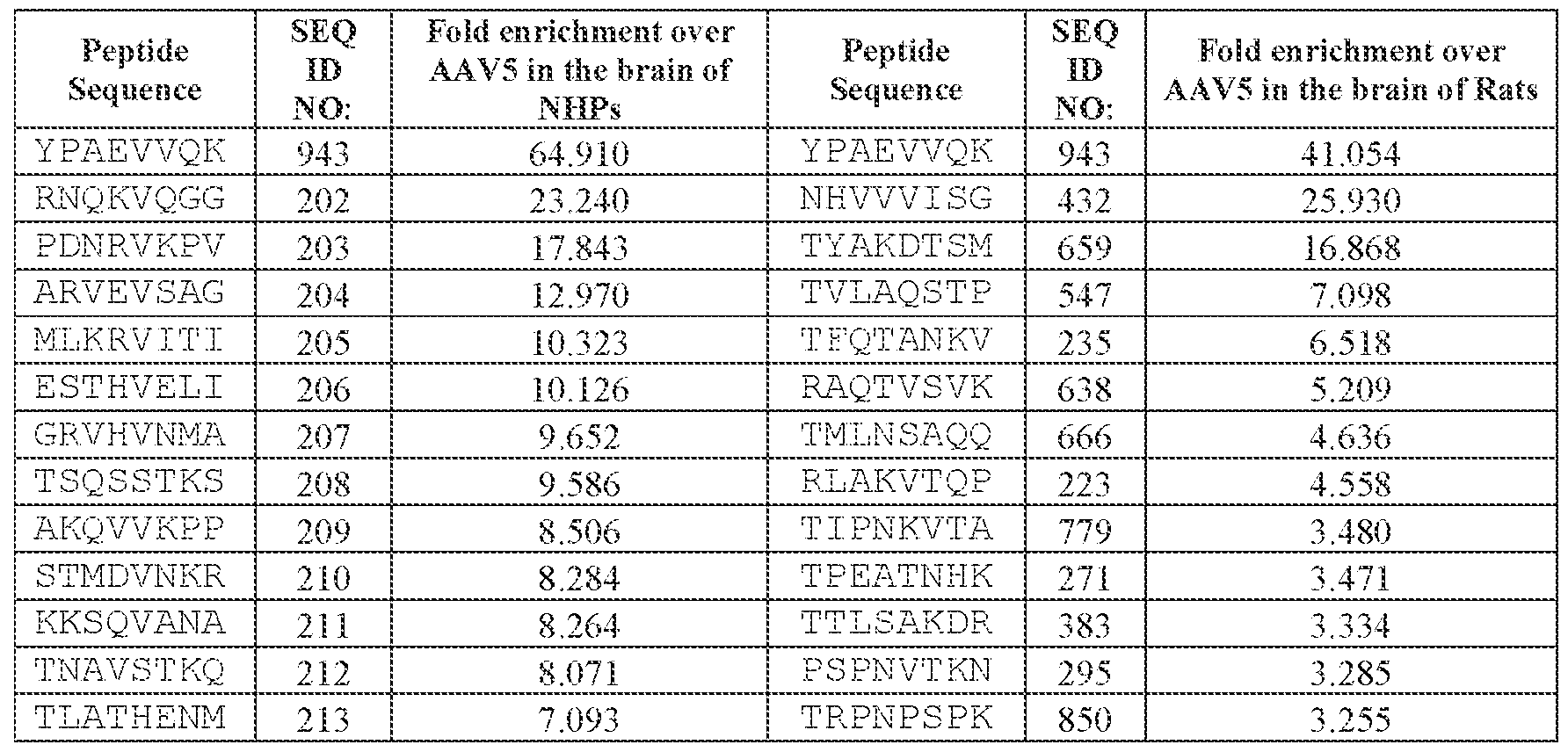
Attorney Docket No.14640.0093-00304
Attorney Docket No.14640.0093-00304
Attorney Docket No.14640.0093-00304
Attorney Docket No.14640.0093-00304
Attorney Docket No.14640.0093-00304
Attorney Docket No.14640.0093-00304
[0444] Taken together, these results demonstrate that after 3 rounds of screening of this AAV5 variant library with loop VIII modifications in NHP and rats, many AAV capsid variants outperformed the wild-type AAV5, for example, in penetration of the blood brain barrier (BBB) and expression in the brain. Also, capsid variants were identified that could infect both rats and NHPs, indicating cross-species tropism and compatibility. Example 2. Individual capsid

[0445] This Example describes the transduction level, tropism, ability to cross the blood brain barrier, and overall spatial distribution in the central nervous system (CNS) of an AAV capsid variant selected from the study described in Example 1, relative to wild-type AAV5, following intravenous injection in cynomolgus macaques (Macaca fascicularis), Norway rats, and BALB/c mice. The capsid
Attorney Docket No.14640.0093-00304 variant was TTN-002 (SEQ ID NO: 982 (amino acid) and 984 (DNA), comprising SEQ ID NO: 943 (encoded by SEQ ID NO: 944)), as outlined in Table 3 above. The amino acid and DNA sequence of TTN-002 is provided, e.g., in Tables 4 and 5, respectively. [0446] AAV particles were generated with this capsid variant encapsulating a luciferase-EGFP transgene or a cynomolgus monkey frataxin payload fused to a hemagglutinin (HA) tag driven by a chicken beta actin (CBA) heterologous promoter. Each capsid variant and control AAV5 and/or AAV9 capsids were tested by intravenously administering the AAV particle formulation at 5e13 VG/kg to NHPs (n=2), 1e13 VG per rat (n=3; 3e13 VG/kg), and/or 5e11 VG per mouse (n=3; 2e13 VG/kg). The in-life period was 28 days for NHPs and mice, and 25 days for rats. Various CNS and peripheral tissues were then collected for measuring transgene mRNA, transgene protein, and/or viral DNA (biodistribution). The AAV particles administered to the NHPs and rats comprised self-complementary viral genomes and the AAV particles administered to mice comprised a single-stranded viral genome. A. Individual capsid characterization in NHPs [0447] The brains, spinal cord, and peripheral tissues including the heart, liver, and quadriceps, were isolated from NHPs (cynomolgus macaques (Macaca fascicularis)) at 28 days post intravenous administration of the AAV particles comprising the TTN-002 capsid variant and were assayed by qPCR for the presence of transgene RNA as a measure of transgene expression and compared to the AAV9 control. Data were provided as average mRNA fold change for the transgene relative to a housekeeping gene as well as the fold change relative to the AAV9 control (Table 12). As shown in Table 12, mRNA transgene expression from the TTN-002 capsid variant, which is an AAV5 capsid variant, was significantly higher in the brain of NHPs relative to the wild-type AAV9 control. More specifically, mRNA expression was approximately 20-25-fold higher from the TTN-002 capsid variant compared to wild-type AAV9 in the brain of NHPs. Additionally, mRNA expression was approximately 4-5-fold higher from the TTN-002 capsid variants compared to wild-type AAV9 in the spinal cord of the NHPs. TTN-002 also demonstrated lower mRNA expression in the liver and DRG relative the AAV9 control (Table 12). [0448] The brains, spinal cord, and peripheral tissues isolated from the NHPs were also assayed for the presence of viral DNA as a measure of viral genome levels. Data are provided in Table 13 as average DNA (viral genome (VG)) copies per diploid genome as well as fold change relative to the AAV9 control. As shown in Table 13, biodistribution of the AAV5 capsid variant, TTN-002, was significantly higher in the NHP brain relative to the wild-type AAV9 control. Biodistribution of TTN-002 was lower in the NHP liver relative to the wild-type AAV9 control. [0449] The brain tissues and spinal cords of the NHPs were also subjected to immunohistochemistry staining to evaluate overall CNS tropism and biodistribution in various regions (FIGs.1A-1D). Immunohistochemical staining correlated with the qPCR analysis, as TTN-002 showed significantly stronger staining and payload expression in the brain (e.g., across the entire cerebrum and cerebellum, FIG.1A-1C) and spinal cord (FIG.1A and 1D), as compared to the AAV9 control. More specifically,
Attorney Docket No.14640.0093-00304 TTN-002 demonstrated localization, strong payload expression, and transduction in both neurons and glial cells in the temporal cortex, perirhinal cortex, globus pallidus, putamen, caudate, thalamus, hippocampus, geniculate nucleus, Purkinje cell layer, deep cerebellar nuclei, dentate nucleus, brainstem, and cerebellum (FIGs.1A-1C). Payload expression was also observed in astrocytes in the dentate nucleus. Additionally, quantification of co-expression of the payload and the pan-neuronal marker SMI- 311 showed payload expression in approximately 73.4% of the large neurons in the dentate nucleus of the deep cerebral nucleus in the cerebellum at 28-days post intravenous administration the AAV particles comprising the TTN-002 capsid variant. In the spinal cord, TTN-002 demonstrated localization, strong payload expression, and transduction in the cervical region (e.g., C2), thoracic region (e.g., T10), and lumbar region (e.g., L2) (FIG.1A and 1D). Additionally, TTN-002 showed less staining in the DRG relative to the wild-type AAV9 control (approximately 2-fold less) (FIG.1D). Both TTN-002 and AAV9 appeared to transduce the liver and heart with similarly high efficiency, by IHC analysis (FIG.1D). Additionally, the histopathology of these samples isolated from the NHPs showed no signs of toxicity in the NHPs, following intravenous administration of AAV particles comprising the TTN-002 capsid variant at a dose of 5e13 VG/kg with a self-complementary viral genome. Table 12. Transgene mRNA expression with the TTN-002 capsid variant in NHPs
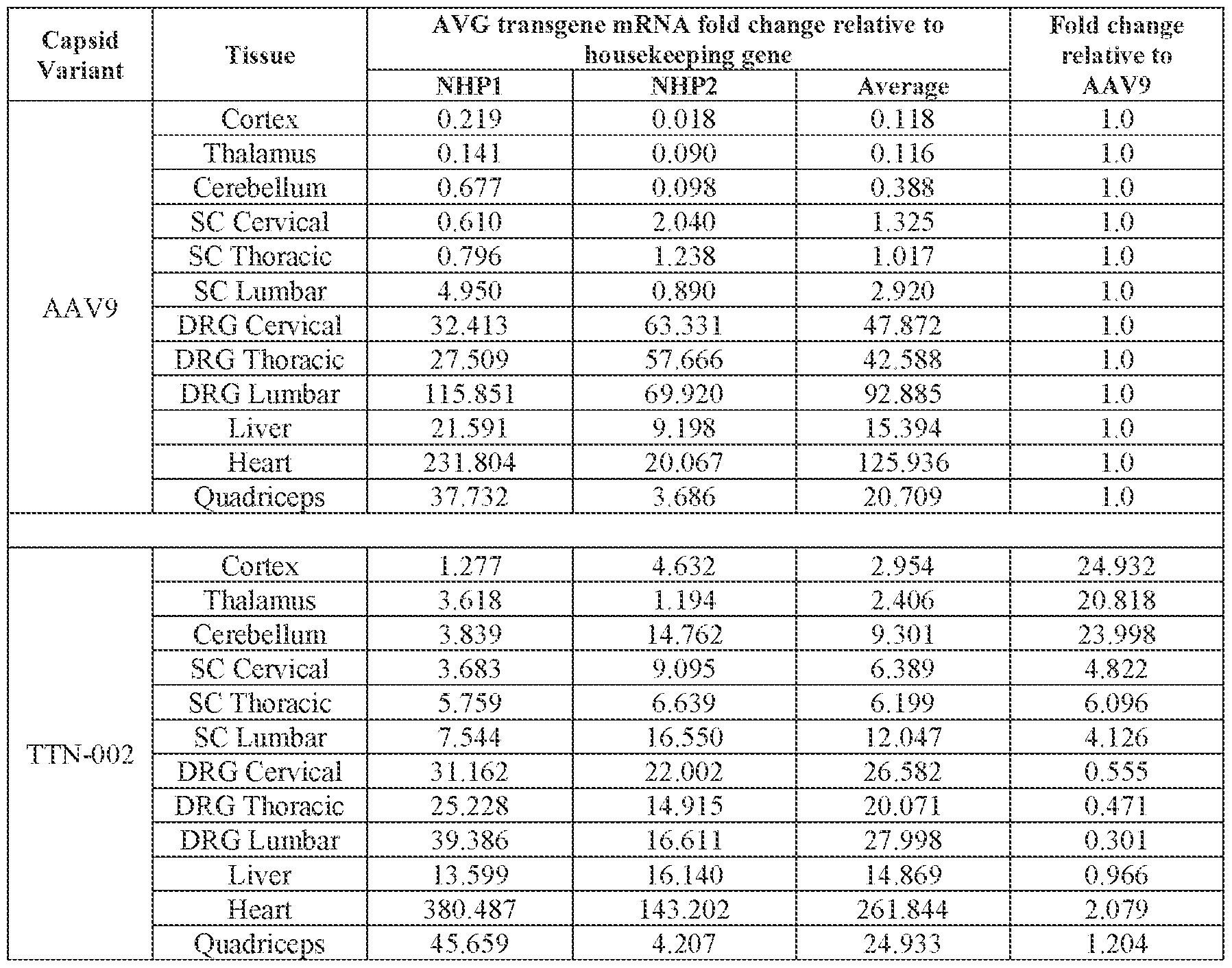
Attorney Docket No.14640.0093-00304 Table 13. Viral DNA biodistribution with the TTN-002 capsid variant in NHPs
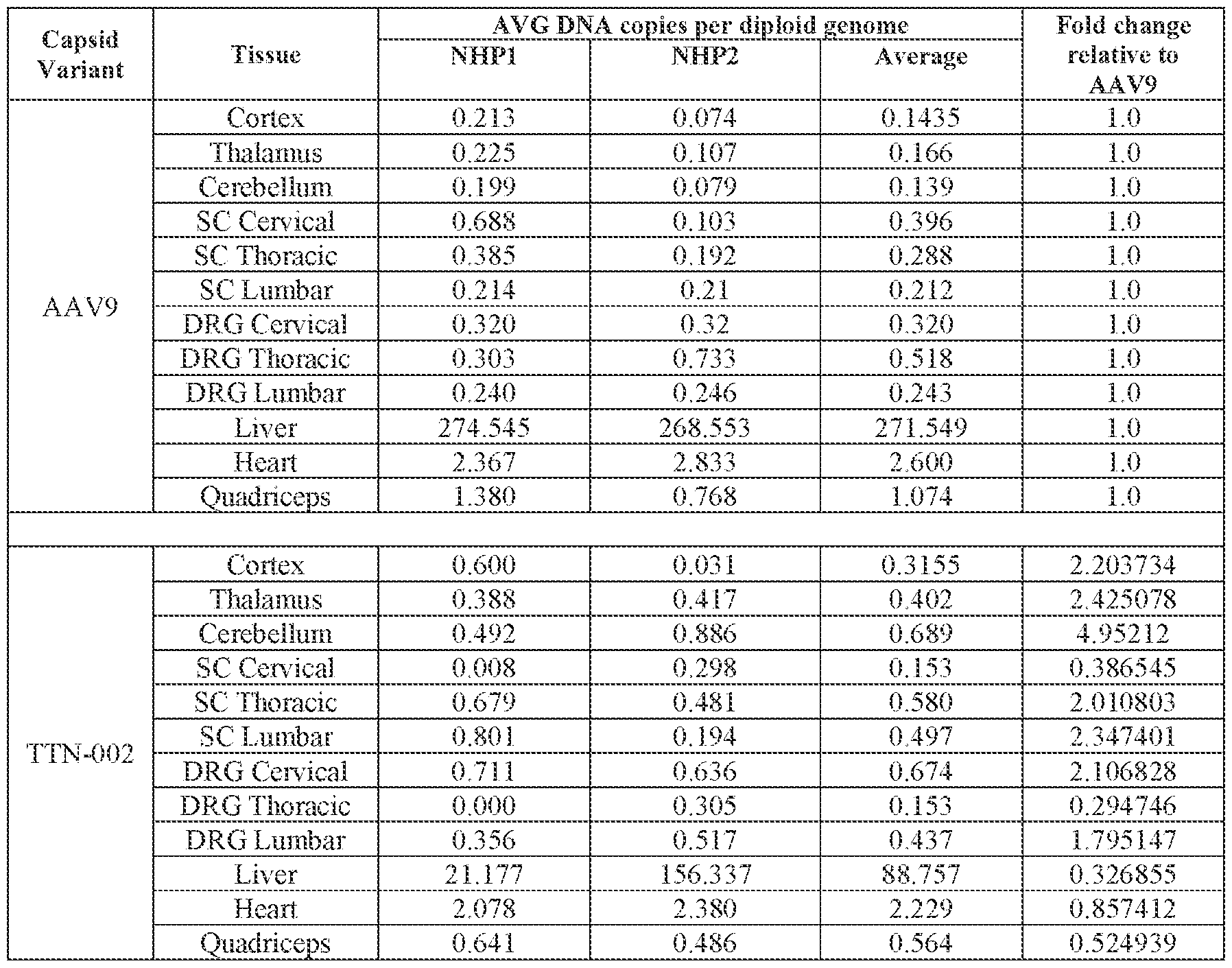
B. Individual capsid characterization in rats [0450] The brains and spinal cords were isolated from rats at 25 days post intravenous administration of AAV particles comprising the TTN-002 capsid variant (AAV5 variant) and assayed for the presence of transgene RNA as a measure of transgene expression, relative to a wild-type AAV5 control capsid or a wild-type AAV9 control capsid (Table 14). Data were provided as average mRNA fold change for the transgene relative to a housekeeping gene as well as the fold change relative to the AAV5 and AAV9 controls (Table 14). As shown in Table 14, mRNA transgene expression from the TTN-002 capsid variant was higher in both the brains and spinal cords relative to the AAV5 and AAV9 controls. More specifically, transgene mRNA expression was approximately 40- to 67-fold higher from the TTN-002 variant in the rat brain and spinal cord regions (cervical, thoracic, and lumbar) compared to wild-type AAV5 and transgene mRNA expression was approximately 5-7-fold higher in the rat brain and spinal cord regions (cervical, thoracic and lumbar) compared to wild-type AAV9. [0451] The brain and spinal cord tissues, as well as the heart peripheral tissue were subject to immunohistochemistry staining to evaluate overall tropism and biodistribution. Immunohistochemical staining correlated with the qPCR analysis, as TTN-002 showed increased staining relative to both
Attorney Docket No.14640.0093-00304 AAV9 and AAV5 in the cortex, hippocampus, cerebellum, and spinal cord of the rat. TTN-002 showed increased staining in the heart of the rat relative to AAV5 but decreased staining relative to AAV9. Table 14. Transgene mRNA expression with TTN-002 capsid variant in rats


[0452] The brains and livers were isolated from BALB/c mice 28 days post intravenous injection of following intravenous administration of AAV particles comprising the TTN-002 capsid variant and were assayed by qPCR for the presence of transgene RNA as a measure of transgene expression and compared to an AAV9 and AAV5 control. Data were provided as average mRNA fold change for the transgene relative to a housekeeping gene (Table 15) and as fold change in transgene mRNA expression relative AAV9 and AAV5 controls (Table 16). As shown in Table 15 and Table 16, the AAV5 capsid variant TTN-002 demonstrated similar levels of transgene expression relative to AAV9 in the brain and higher expression than wild-type AAV5. Transgene mRNA expression in the mouse brain was 265.9-fold higher with the TTN-002 capsid variant as compared to wild-type AAV5 (Table 16). Additionally, wild-type AAV5 and the AAV5 capsid variant, TTN-002, both resulted in lower transgene expression in the liver, as compared to wild-type AAV9. [0453] The brains and livers isolated from the mice were also assayed for the presence of viral DNA as a measure of viral genome levels. Data are provided in Table 15 as average DNA (viral genome (VG)) copies per diploid genome and in Table 16 as fold change in DNA copies per diploid genome relative AAV9 and AAV5 controls. The AAV5 capsid variant TTN-002 demonstrated comparable biodistribution relative to AAV9 in the mouse brain and increased biodistribution and viral genome levels than wild-type AAV5. More specifically, in the brain, the TTN-002 capsid variant led to 9-fold higher DNA (viral genome (VG)) copies per diploid genome relative to the AAV5 control (Table 16). Furthermore, wild- type AAV5 and the AAV5 capsid variant, TTN-002, resulted in decreased biodistribution and DNA (viral genome (VG)) copies per diploid genome in the liver relative to AAV9 (Table 16). Table 15. Transgene mRNA expression with the TTN-002 capsid variant in mice

Attorney Docket No.14640.0093-00304
Table 16. Fold-change in transgene mRNA expression and DNA copies per diploid genome relative to AAV9 and AAV5 in the brain and liver of mice
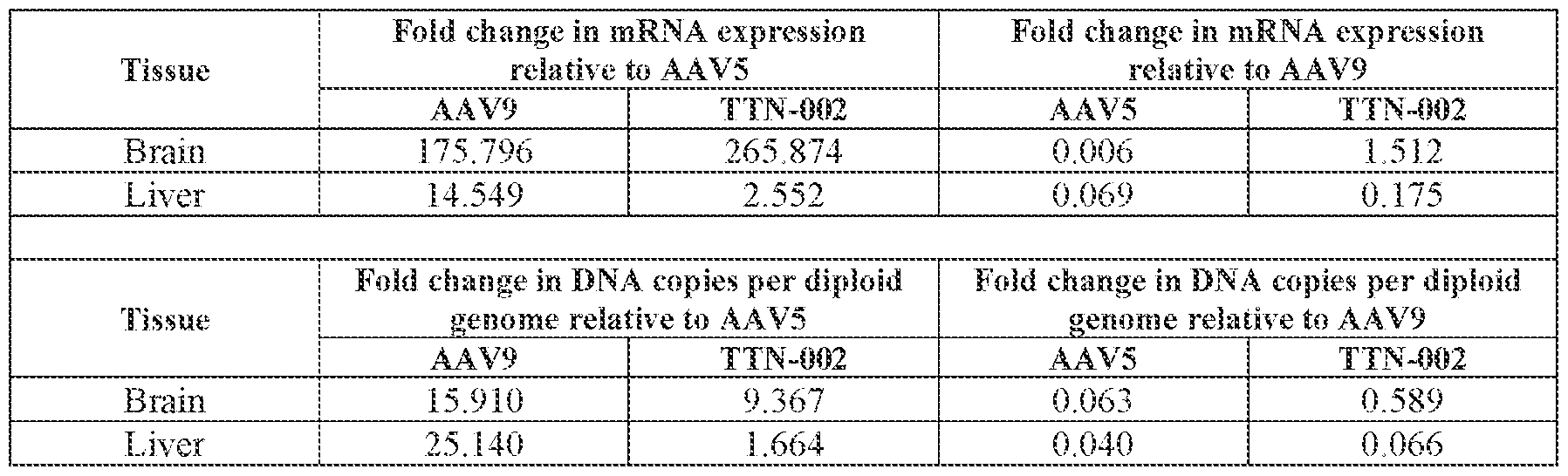
D. Individual capsid characterization in Marmosets (Callithrix jacchus) [0454] AAV particles were generated with the TTN-002 capsid variant, the AAV5 capsid control, or the AAV9 capsid control which comprised a self-complementary viral genome encoding a histone H2b protein with an HPC4 tag (TTN-002 capsid variant), T7 tag (AAV5 capsid control), or HA tag (AAV9 control capsid) driven by a ubiquitous CAG promoter. The AAV particles comprising the TTN-002 capsid variant, the AAV5 capsid control, or the AAV9 capsid control were administered to the marmosets (Callithrix jacchus) (n=3) intravenously in a single solution, at the doses indicated in Table 17. The in-life period was 28 days and then various CNS and peripheral tissues were collected for measuring transgene mRNA (expression) by RT-qPCR, protein expression by IHC, and viral DNA (biodistribution) by ddPCR. Data were then normalized to the dose of each viral vector in the dosing solution. Table 17. Titer of the AAV particles comprising the various capsids in solution dosed in marmosets

Attorney Docket No.14640.0093-00304 [0455] Table 18 shows the quantification of viral genome copies per diploid genome (biodistribution) by ddPCR following intravenous administration of AAV particles comprising a TTN- 002 capsid, which is normalized to the actual titer of the viral vector in the dosing solution (vg/dg = viral genome copies/ diploid genome). Table 19 shows the quantification of transgene mRNA by RT-qPCR following intravenous administration of AAV particles comprising a TTN-002 capsid, normalized to the actual titer of the viral vector in the dosing solution (mRNA = transgene mRNA fold over housekeeping gene; rel. to AAV9= transgene mRNA fold over housekeeping gene relative to AAV9; rel. to AAV5 transgene mRNA fold over housekeeping gene relative to AAV5). [0456] As shown in Table 18, the TTN-002 capsid variant, an AAV5 capsid variant, demonstrated increased biodistribution in the caudate and motor cortex in the brain of the marmosets relative to the AAV5 capsid control, as well as the AAV9 control. The TTN-002 capsid variant also demonstrated increased transgene expression relative to AAV5 in the caudate and motor cortex, increased transgene expression relative to AAV9 in the caudate, and comparable transgene expression relative to AAV9 in the motor cortex (Tables 18 and 19). Similar expression and distribution was observed by immunohistochemistry. More specifically, staining for TTN-002 was detected in the caudate, putamen, thalamus, and cerebellum, and this staining was increased relative to AAV5. Staining for TTN-002 was also observed in the molecular and granule layer of the cerebellum. [0457] Biodistribution and transgene expression were also measured in the peripheral tissues of the liver, heart, and quadriceps, as shown in Table 18 and Table 19, respectively. In the liver, the TTN-002 capsid variant exhibited lower biodistribution (Table 18) and transgene expression (Table 19) relative to AAV5 and AAV9, indicating that the TTN-002 capsid variant was detargeted in the liver relative to AAV5 and AAV9 in marmosets. TTN-002 led to increased biodistribution (Table 18) in the heart relative to AAV5 and AAV9, increased transgene expression in the heart relative to AAV5, and decreased transgene expression in the heart relative to AAV9 (Table 19). In the muscle, the TTN-002 capsid variant exhibited higher biodistribution (Table 18) and transgene expression (Table 19) relative to AAV9. The TTN-002 capsid variant also demonstrated decreased biodistribution (Table 18) but increased transgene expression (Table 19) in the muscle relative to AAV5. Table 18. Quantification of viral genome copies per diploid genome (biodistribution) by ddPCR following intravenous administration of AAV particles comprising a TTN-002 capsid normalized to the actual titer of the viral vector in the dosing solution (vg/dg = viral genome copies/ diploid genome)

Attorney Docket No.14640.0093-00304
Table 19. Quantification of transgene mRNA by RT-qPCR following intravenous administration of AAV particles comprising a TTN-002 capsid normalized to the actual titer of the viral vector in the dosing solution (mRNA = transgene mRNA fold over housekeeping gene; rel. to AAV9= transgene mRNA fold over housekeeping gene relative to AAV9; rel. to AAV5 transgene mRNA fold over housekeeping gene relative to AAV5)

Attorney Docket No.14640.0093-00304 Conclusions [0458] Taken together, these data demonstrate that TTN-002, which is an AAV5 capsid variant, is an enhanced CNS tropic capsid, in both NHPs and rodents (e.g., rats and mice), and was able to successfully penetrate the blood brain barrier. More specifically, TTN-002 demonstrated the ability to cross species, demonstrating improved CNS tropism and biodistribution in both NHPs and rats relative to AAV5 in mice. Example 3. Maturation of the TTN-002 capsid in mice [0459] This Example describes maturation of the TTN-002 (SEQ ID NO: 982 (amino acid) and 984 (DNA), comprising SEQ ID NO: 943) capsid variant in mice to further enhance its transduction and biodistribution in the central nervous system, evolve the AAV capsid variant further, and to provide cross-species compatibility. Two approaches were used to mature the TTN-002 capsid sequence in order to randomize and mutate within and around the peptide insert comprised within loop VIII of the capsid variant. In the first maturation approach, mutagenic primers were used to introduce point mutations at a low frequency, scattered across the mutagenesis region in the TTN-002 sequence ranging from approximately position 571 to position 586, numbered according to SEQ ID NO: 982. In the second maturation approach, sets of three contiguous amino acids were randomized across the mutagenesis region in the TTN-002 sequence, which spanned from approximately position 571 to position 586, numbered according to SEQ ID NO: 982. AAV capsid variants arising from each maturation approach for TTN-002 were pooled together, for subsequent testing and characterization in mice. [0460] The library of pooled matured AAV capsid variants generated from TTN-002 using the first maturation approach and the library of pooled matured AAV capsid variants generated from TTN-002 using the second maturation approach were each injected into three CD-1 Outbred mice. After a period in life, the brains of the mice were isolated and RNA was extracted. Following RNA recovery and RT-PCR amplification, a systematic NGS enrichment analysis was performed to calculate the fold enrichment ratio relative to the TTN-002 control, and the peptides comprised within the matured variants were identified. The data from the first maturation approach are provided in Table 20 and the data from the second maturation approach is provided in Table 21. [0461] Following the RNA recovery and NGS analysis from the first maturation approach, the matured capsid variants were filtered based on their coefficient of variance (CV), which was calculated for each peptide across six brain samples taken (two per mouse). Those that had a CV value <1 were identified, as these were the peptides that were reliably detected in 5/6 or 6/6 brain samples isolated from the three mice. Table 20 provides the peptide sequences of these matured capsid variants and the fold enrichment of the matured capsid variant relative to the non-matured TTN-002 control. As shown in Table 20, approximately 28 TTN-002 matured capsid variants demonstrated an increase in expression relative to the non-matured TTN-002 control, with approximately 16 variants demonstrating at least a 2-
Attorney Docket No.14640.0093-00304 fold increase in expression. Several variants demonstrated at least an 8-fold to 15-fold increase in expression relative to the non-matured TTN-002 control. Table 20. NGS fold-enrichment of TTN-002 matured AAV capsid variants in the brain of outbred mice following first mutagenesis approach

[0462] Following the RNA recovery and NGS analysis from the second maturation approach, the matured capsid variants were filtered for those that were detectable in all samples from all mice injected with the matured capsid variants. Table 21 provides the peptide sequences of these matured capsid variants, the fold enrichment of the matured capsid variant relative to the non-matured TTN-002 control, as well as the predicted capsid of origin from which the variant was matured. As shown in Table 21, approximately 526 TTN-002 matured capsid variants demonstrated an increase in expression relative to the non-matured TTN-002 control, with approximately 358 variants demonstrated at least a 2-fold increase in expression. Several variants demonstrated a 20-711-fold or greater increase in expression relative to the non-matured TTN-002 control.
Attorney Docket No.14640.0093-00304 Table 21. NGS fold-enrichment of TTN-002 matured AAV capsid variants in the brain of outbred mice following second mutagenesis approach

Attorney Docket No.14640.0093-00304
Attorney Docket No.14640.0093-00304
Attorney Docket No.14640.0093-00304
Attorney Docket No.14640.0093-00304

[0463] These data demonstrate that following two maturation approaches, matured TTN-002 capsid variants with loop VIII modifications were generated with significantly enhanced CNS tropism in mice compared to the corresponding non-matured capsid variants, which already exhibited a significant fold enrichment over AAV5 and/or AAV9 in the brain of mice, rats, and/or NHPs. Example 4. Maturation of the TTN-002 capsid in NHPs [0464] This Example describes maturation of TTN-002 (SEQ ID NO: 982 (amino acid) and 984 (DNA), comprising SEQ ID NO: 943 (encoded by SEQ ID NO: 944)) capsid variant in NHPs, specifically cynomolgus macaques (Macaca fascicularis), to further enhance its transduction and biodistribution in the central nervous system and peripheral tissues and to evolve the AAV capsid variant further. Two approaches were used to mature the TTN-002 capsid sequences in order to randomize and mutate within and around the peptide insert comprised within loop VIII of the capsid variant. In the first maturation approach, mutagenic primers were used to introduce point mutations at a low frequency, scattered across the mutagenesis region in the TTN-002 sequence ranging from approximately position 571 to position 586, numbered according to SEQ ID NO: 982. In the second maturation approach, sets of three contiguous amino acids were randomized across the mutagenesis region in the TTN-002 sequence,
Attorney Docket No.14640.0093-00304 which spanned from approximately position 571 to position 586, numbered according to SEQ ID NO: 982. AAV capsid variants arising from each maturation approach for TTN-002 were pooled together, for subsequent testing and characterization in NHPs. [0465] The library of pooled matured AAV capsid variants generated from TTN-002 using the first maturation approach and the library of pooled matured AAV capsid variants generated from TTN-002 using the second maturation approach were each injected into two NHPs. After a period in life, the brains, heart, liver, muscle, and DRG of the NHPs were isolated and RNA was extracted. Following RNA recovery and RT-PCR amplification, a systematic NGS enrichment analysis was performed to calculate the fold enrichment ratio relative to the TTN-002 control, and the peptides comprised within the variants were identified. [0466] Following the RNA recovery and NGS analysis from the second maturation approach, the matured capsid variants were filtered based on their coefficient of variance (CV), which was calculated for each peptide across the brain, heart, liver, muscle and DRG samples taken from the two NHPs. Those that had a CV value <2 were identified, as these were the peptides that were reliably detected in the majority of samples isolated from the brains of the two NHPs. [0467] Table 22 provides the peptide sequences of these matured capsid variants and the fold enrichment of the matured capsid variant relative to the non-matured TTN-002 control that demonstrated the greatest fold-change in expression relative to the non-matured TTN-002 capsid variant in the brain of NHPs, following the first maturation approach and the second maturation approach. As shown in Table 22, following the first maturation approach, approximately 5 TTN-002 matured capsid variants demonstrated an increase in expression relative to the non-matured TTN-002 control, which demonstrated at least a 5-fold to 53-fold increase in expression in the NHP brain relative to the non- matured TTN-002 control. Following the second maturation approach, approximately 38 TTN-002 matured capsid variants demonstrated an increase in expression in the NHP brain relative to the non- matured TTN-002 control, with at least 27 demonstrating at least a 2-fold increase in expression (Table 22). Several variants demonstrated at least a 12-fold to 222-fold increase in expression in the NHP brain relative to the non-matured TTN-002 control (Table 22). [0468] Fold-change in expression for the TTN-002 matured variants in Table 22 were also calculated for the DRG, muscle, liver (RNA and DNA), and heart of the NHPs following each maturation approach. Several variants that led to increased expression relative to the non-matured TTN-002 variant in the brain of the NHP also led to increased expression in other tissues. For instance, the matured TTN-002 capsid variant comprising the amino acid sequence TNNQSSYTPSLVQKTA (SEQ ID NO: 1585) demonstrated increased expression in the brain, heart, and liver relative to the non-matured TTN-002 control. Similarly, the matured TTN-002 capsid variants comprising the amino acid sequence TNNQSSYPPSLVKKTA (SEQ ID NO: 1591) and TNNQSSYPPSLVQKPA (SEQ ID NO: 1593), demonstrated increased expression in the brain and heart relative to the non-matured TTN-002 control. Additionally, the matured TTN-002 capsid variant comprising the amino acid sequence INNQSSYPAEVVQKTA (SEQ ID NO:
Attorney Docket No.14640.0093-00304 1024) demonstrated increased expression in the brain and the muscle relative to the non-matured TTN- 002 control. Also, as shown in Table 22, many of the TTN-002 capsid variants that had increased expression in the brain, were de-targeted in the DRG. Therefore, several matured variants demonstrated increased tropism in more than one tissue type in the NHPs, with many showing reduced expression in the DRG. Table 22. NGS fold-enrichment of the TTN-002 matured AAV capsid variants in the brain of NHPs following first and second mutagenesis approaches as compared to other NHP and mouse tissues

Attorney Docket No.14640.0093-00304

[0469] Furthermore, several of the TTN-002 matured capsid variants demonstrating an increase in expression relative to the non-matured TTN-002 control following the first and second maturation approaches in the brain of NHPs as shown in Table 22, also demonstrated an increase in expression in the brain of mice following the first and second maturation approach in mice. For instance, the matured TTN-002 capsid variant comprising the amino acid sequence TNNQSKYPAEVVQKTA (SEQ ID NO: 1538) demonstrated a 53.7-fold increase in expression relative to the non-matured TTN-002 following the first maturation approach in brain of NHPs, demonstrated a 20.86-fold increase in expression relative to the non-matured TTN-002 following the second maturation approach in brain of NHPs, a 10.26-fold increase in expression relative to the non-matured TTN-002 following the first maturation approach in brain of mice, and a 5.47-fold increase in increase in expression relative to the non-matured TTN-002 following the second maturation approach in brain of mice. Similarly, the matured TTN-002 capsid variant comprising the amino acid sequence TNNSSSYPAEVVQKTA (SEQ ID NO: 1539) demonstrated an 18.997-fold increase in expression relative to the non-matured TTN-002 following the first maturation approach in brain of NHPs, an 8.093-fold increase in expression relative to the non- matured TTN-002 following the second maturation approach in brain of NHPs, an 8.539-fold increase in expression relative to the non-matured TTN-002 following the first maturation approach in brain of mice, and a 5.903-fold increase in increase in expression relative to the non-matured TTN-002 following the second maturation approach in brain of mice. Matured TTN-002 capsid variants comprising the amino acid sequences of SEQ ID NOs: 1021, 1024, 1027, 1112, 1142, 1214, 1232, 1254, 1300, 1310, 1327, 1331, 1342, and 1593 also demonstrated an increase in expression in the brain of both NHPs and mice, relative to the non-matured TTN-002 control. Therefore, several matured variants demonstrated increased expression relative to the non-matured controls in at least two different species, indicating cross-species tropism. [0470] Table 23 provides the peptide sequences of these matured capsid variants, and the fold enrichment of the matured capsid variant relative to the non-matured TTN-002 control that demonstrated
Attorney Docket No.14640.0093-00304 increased expression in the heart of NHPs following the second maturation approach. As shown in Table 23, approximately 17 TTN-002 matured capsid variants demonstrated an increase in expression in the heart relative to the non-matured TTN-002 control, with at least 13 demonstrating at least a 2-fold increase in expression. Several variants demonstrated at least a 10-fold to 47-fold increase in expression in the heart relative to the non-matured TTN-002 control. Fold-change in expression for the TTN-002 matured variants in Table 23 were also calculated for the brain, DRG, muscle, and liver (RNA and DNA), of the NHPs and in the brains of mice. Table 23. NGS fold-enrichment of the TTN-002 matured AAV capsid variants in the heart of NHPs following the second mutagenesis approach as compared to other NHP and mouse tissues
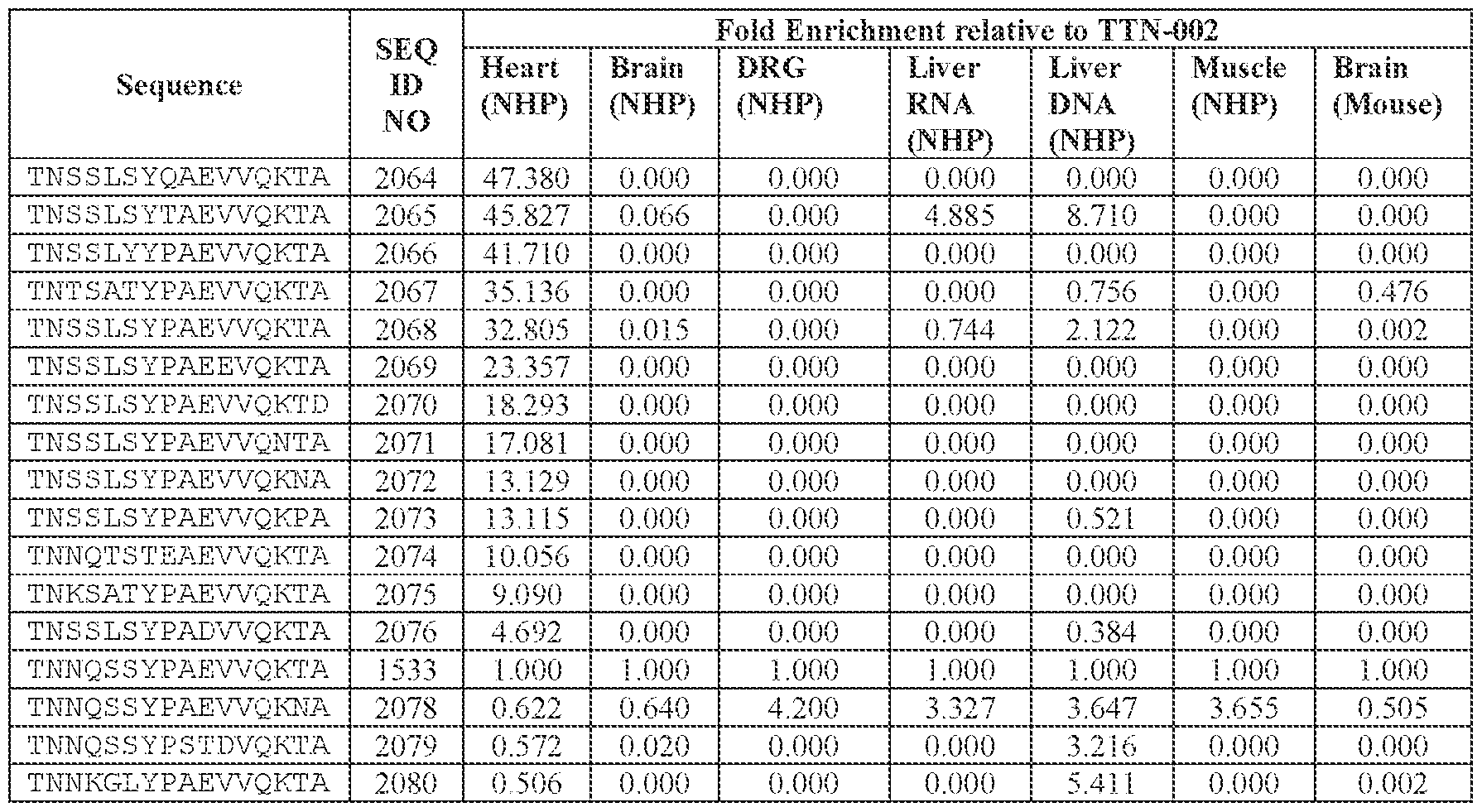
[0471] Table 24 provides the peptide sequences of these matured capsid variants, and the fold enrichment of the matured capsid variant relative to the non-matured TTN-002 control that demonstrated increased expression in the muscle of NHPs following the second maturation approach. As shown in Table 24, approximately 33 TTN-002 matured capsid variants demonstrated an increase in expression in the muscle relative to the non-matured TTN-002 control, with at least 19 demonstrating at least a 2-fold increase in expression. Several variants demonstrated at least a 7-fold to 38-fold increase in expression in the muscle relative to the non-matured TTN-002 control. Fold-change in expression for the TTN-002 matured variants in Table 24 were also calculated for the brain, DRG, heart, and liver (RNA and DNA), of the NHPs and in the brains of mice.
Attorney Docket No.14640.0093-00304 Table 24. NGS fold-enrichment of the TTN-002 matured AAV capsid variants in the muscle of NHPs following the second mutagenesis approach
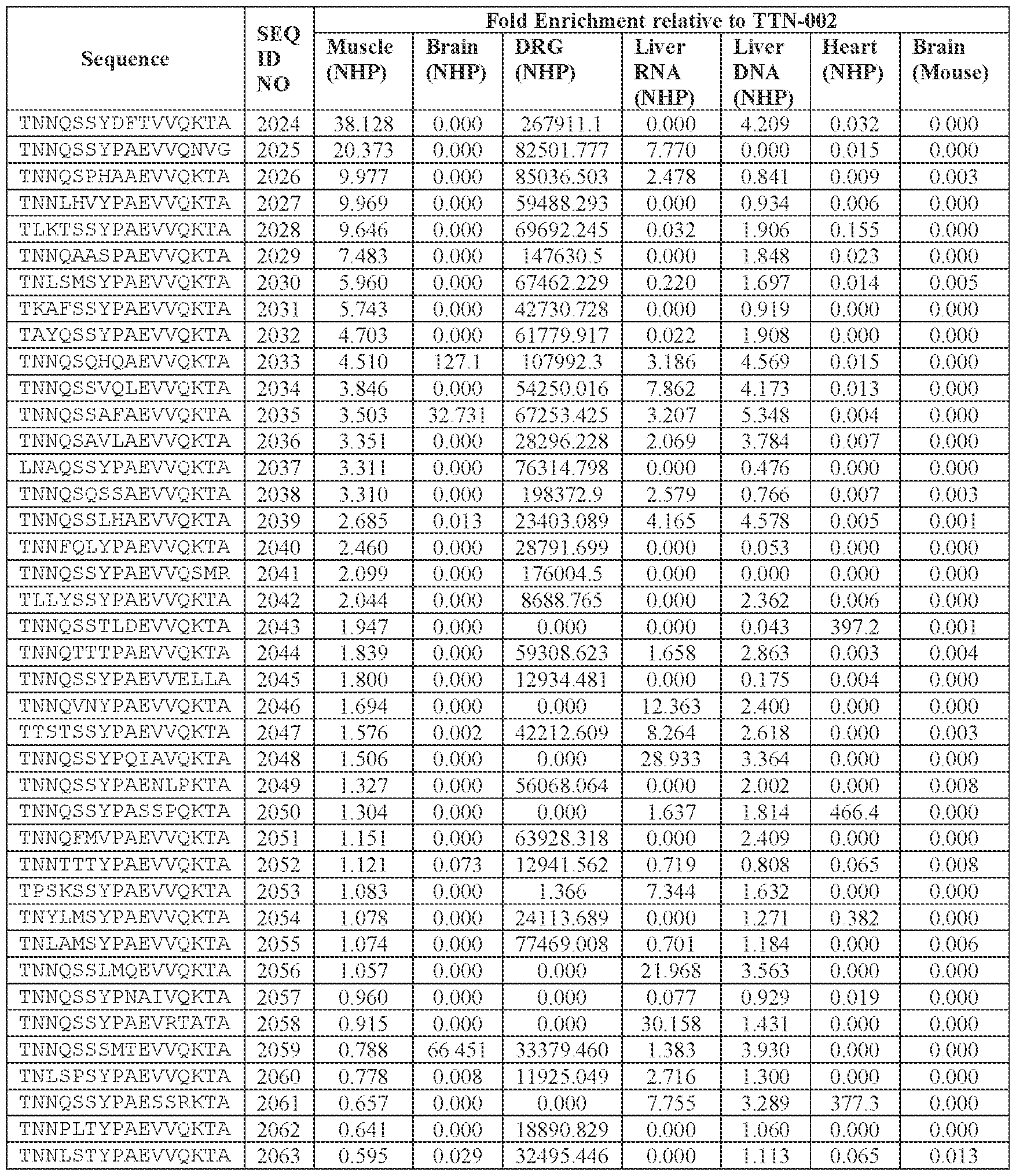
[0472] Table 25 provides the peptide sequences of these matured capsid variants, and the fold enrichment of the matured capsid variant relative to the non-matured TTN-002 control that demonstrated increased expression in the liver of NHPs following the first and second maturation approach. As shown in Table 25, following the first maturation approach, approximately 7 TTN-002 matured capsid variants demonstrated an 11-fold to 189-fold increase in expression in the liver relative to the non-matured TTN- 002 control. Following the second maturation approach, approximately 395 TTN-002 matured capsid variants demonstrated an increase in expression in the liver of at least 9-fold relative to the non-matured
Attorney Docket No.14640.0093-00304 TTN-002 control (Table 25). Several variants demonstrated at least a 50-fold to 114-fold increase in expression in the liver relative to the non-matured TTN-002 control (Table 25). Fold-change in expression for the TTN-002 matured variants in Table 25 were also calculated for the brain, DRG, heart, and muscle of the NHPs and in the brains of mice. Table 25. NGS fold-enrichment of the TTN-002 matured AAV capsid variants in the liver of NHPs following both mutagenesis approaches

Attorney Docket No.14640.0093-00304
Attorney Docket No.14640.0093-00304
Attorney Docket No.14640.0093-00304
Attorney Docket No.14640.0093-00304
Attorney Docket No.14640.0093-00304
Attorney Docket No.14640.0093-00304
Attorney Docket No.14640.0093-00304

[0473] These data demonstrate that following two maturation approaches, matured TTN-002 capsid variants (AAV5 capsid variants) with loop VIII modifications were generated with significantly enhanced CNS, heart, muscle, and liver tropism in NHPs compared to the corresponding non-matured capsid variants, which already exhibited a significant fold enrichment over AAV5 and/or AAV9 in the brain of mice, rats, and/or NHPs. Also, several of the resulting matured variants demonstrated cross- species CNS tropism in both NHPs and mice. Example 5. Evaluation of TTN-002 AAV capsid variant in diverse primate species [0474] This Example evaluates the tropism and cross-species compatibility of the TTN-002 (SEQ ID NO: 982 (amino acid) and 984 (DNA), comprising SEQ ID NO: 943) capsid variant in two diverse primate species, marmosets (Callithrix jacchus) and African green monkeys (Chlorocebus sabaeus), as compared to their tropism in cynomolgus macaques (Macaca fascicularis) provided in Example 1 and 2. The amino acid and DNA sequences of the TTN-002 capsid variant are provided, e.g., in Tables 4 and 5, respectively. [0475] To investigate tropism in African green monkeys, AAV particles comprising the TTN-002 capsid variant or an AAV5 control under the control of a synapsin promoter, were intravenously injected into the African green monkeys (n=2, 3-12 years of age) at a dose of 2E13 vg/kg. After 14-days in life, the brains and tissues (liver, DRG, quadriceps, and heart) of the NHPs were collected and RNA was extracted. Following RNA recovery and RT-PCR amplification, a systematic NGS enrichment analysis was performed to calculate the fold enrichment ratio relative to the AAV5 wild-type control. [0476] To investigate tropism in marmoset monkeys, AAV particles comprising the TTN-002 capsid variant, or an AAV5 control, were intravenously injected into marmosets (n=2, >10 months of age) at a dose of 2E13 vg/kg. After 28-days in life, the brains and tissues (liver quadriceps, and heart) of the NHPs were collected and RNA was extracted. Following RNA recovery and RT-PCR amplification, a systematic NGS enrichment analysis was performed to calculate the fold enrichment ratio relative to the AAV5 wild-type control. [0477] As provided in Table 26 (African green monkeys) and Table 27 (marmosets), the TTN-002 capsid variant demonstrated increased CNS tropism in diverse primate species. The TTN-002 capsid variant demonstrated a 64.9-fold increase in expression relative to AAV5 in the brain of cynomolgus macaques (Table 11, Example 1), a 7.5-fold increase in expression relative to AAV5 in the brain of African green monkeys, and a 40.4-fold increase in expression relative to AAV5 in the brain of marmosets. Furthermore, TTN-002 also resulted in increased expression in the brain of rats (Table 11, Example 1), demonstrating an average fold change in expression relative to AAV5 of 41.1. Table 26. NGS-Fold Enrichment of TTN-002 in African green monkeys

Attorney Docket No.14640.0093-00304 Y
PAEVVQK 943 7.462 3.9674 0.3592
0.0543
0.0227 0.6982 Table 27. NGS-Fold Enrichment of TTN-002 in Marmosets

[0478] Taken together, these data demonstrate that the AAV5 capsid variant TTN-002 demonstrated increased CNS tropism relative to the AAV5 control in the CNS across three diverse primate species and rats, providing evidence of strong cross-species capacity. Equivalents and Scope [0479] Those skilled in the art will recognize, or be able to ascertain using no more than routine experimentation, many equivalents to the specific embodiments in accordance with the Detailed Description provided herein. The scope of the present disclosure is not intended to be limited to the above Detailed Description, but rather is as set forth in the appended claims. [0480] Where ranges are given, endpoints are included. Furthermore, it is to be understood that unless otherwise indicated or otherwise evident from the context and understanding of one of ordinary skill in the art, values that are expressed as ranges can assume any specific value or subrange within the stated ranges in different embodiments of the disclosure, to the tenth of the unit of the lower limit of the range, unless the context clearly dictates otherwise. [0481] In addition, it is to be understood that any particular embodiment of the present disclosure that falls within the prior art may be explicitly excluded from any one or more of the claims. Since such embodiments are deemed to be known to one of ordinary skill in the art, they may be excluded even if the exclusion is not set forth explicitly herein. Any particular embodiment of the compositions of the disclosure (e.g., any, composition, therapeutic or active ingredient; any method of production; any method of use; etc.) can be excluded from any one or more claims, for any reason, whether or not related to the existence of prior art. [0482] It is to be understood that the words which have been used are words of description rather than limitation, and that changes may be made within the purview of the appended claims without departing from the true scope and spirit of the disclosure in its broader aspects. [0483] While the present disclosure has been described at some length and with some particularity with respect to the several described embodiments, it is not intended that it should be limited to any such particulars or embodiments or any particular embodiment, but it is to be construed with references to the appended claims so as to provide the broadest possible interpretation of such claims in view of the prior art and, therefore, to effectively encompass the intended scope of the disclosure. [0484] All publications, patent applications, patents, and other references mentioned herein are incorporated by reference in their entirety. In case of conflict, the present specification, including
Attorney Docket No.14640.0093-00304 definitions, will control. In addition, section headings, the materials, methods, and examples are illustrative only and not intended to be limiting.
 Table 2A. Exemplary Peptide Sequences
 Table 2B. Exemplary Peptide Sequences
 [092] In some embodiments, a peptide described herein comprises an amino acid sequence having the formula [N2]-[N3], wherein [N2] comprises positions X1, X2, X3, X4, and X5 and [N3] comprises the amino acid sequence of VQK, VQN, EQK, VKK, VHK, VQQ, or LQK. In some embodiments, position X1 of [N2] is Y, N, C, or T. In some embodiments, position X2 of [N2] is P, E, K, T, or Q. In some embodiments, position X3 of [N2] is A or P. In some embodiments, position X4 of [N2] is E, S, D, or A. In some embodiments, position X5 of [N2] is V, L, or E. In some embodiments, [N2] comprises Y at position X1. In some embodiments, [N2] comprises P at position X2. In some embodiments, [N2] comprises A at position X3. In some embodiments, [N2] comprises E at position X4. In some embodiments, [N2] comprises V at position X5. In some embodiments, the amino acid sequence of [N3] comprises VQK. In some embodiments, the amino acid sequence of [N3] consists of VQK. [093] In some embodiments, a peptide described herein comprises an amino acid sequence having the formula [N2]-[N3], wherein [N2] comprises positions X1, X2, X3, X4, and X5 and [N3] comprises the amino acid sequence of VQK, EQK, VKK, VHK, VQQ, or LQK. In some embodiments, [N3] comprises the amino acid sequence of VQK, EQK, or VKK. In some embodiments, [N3] comprises the amino acid sequence VQK. In some embodiments, [N3] consists of the amino acid sequence VQK. In some embodiments, position X1 of [N2] is Y, N, or C. In some embodiments, position X1 of [N2] is Y or N. In some embodiments, position X2 of [N2] is P, K, T, or Q. In some embodiments, position X2 of [N2] is P, T, or Q. In some embodiments, position X3 of [N2] is A or P. In some embodiments, position X3 of [N2]
Attorney Docket No.14640.0093-00304 is A. In some embodiments, position X4 of [N2] is E, S, or A. In some embodiments, position X5 of [N2] is V, L, or E. In some embodiments, position X5 of [N2] is V or L. In some embodiments, [N2] comprises Y at position X1. In some embodiments, [N2] comprises P at position X2. In some embodiments, [N2] comprises A at position X3. In some embodiments, [N2] comprises E at position X4. In some embodiments, [N2] comprises V at position X5. In some embodiments, [N2] comprises YPA, YPP, NKA, YTA, YQA, YTP, NPA, CPA, THA, PAE, PPS, KAE, TAE, QAE, TPS, PAA, HAS, AEV, PSL, AEE, or AAV. In some embodiments, [N2] comprises YPAE (SEQ ID NO: 21), YPPS (SEQ ID NO: 22), NKAE (SEQ ID NO: 23), YTAE (SEQ ID NO: 24), YQAE (SEQ ID NO: 25), YTPS (SEQ ID NO: 26), YPAA (SEQ ID NO: 27), NPAE (SEQ ID NO: 28), CPAE (SEQ ID NO: 29), THAS (SEQ ID NO: 30), PAEV (SEQ ID NO: 17), PPSL (SEQ ID NO: 31), KAEV (SEQ ID NO: 32), TAEV (SEQ ID NO: 16), PAEE (SEQ ID NO: 18), QAEV (SEQ ID NO: 15), TPSL (SEQ ID NO: 33), PAAV (SEQ ID NO: 34), or QAEE (SEQ ID NO: 35). In some embodiments, [N2] is or comprises YPAEV (SEQ ID NO: 1), YPPSL (SEQ ID NO: 2), NKAEV (SEQ ID NO: 3), YTAEV (SEQ ID NO: 4), YPAEE (SEQ ID NO: 5), YQAEV (SEQ ID NO: 6), YTPSL (SEQ ID NO: 7), YPAAV (SEQ ID NO: 8), NPAEV (SEQ ID NO: 9), CPAEV (SEQ ID NO: 10), or YQAEE (SEQ ID NO: 11). In some embodiments, [N2] comprises the amino acid sequence of YPAEV (SEQ ID NO: 1). In some embodiments, the amino acid sequence of [N2] consists of YPAEV (SEQ ID NO: 1). In some embodiments, [N2]-[N3] comprises the amino acid sequence of AEVVQK (SEQ ID NO: 36), PSLVQK (SEQ ID NO: 37), AEVEQK (SEQ ID NO: 38), AEEVQK (SEQ ID NO: 39), PSLEQK (SEQ ID NO: 40), PSLVKK (SEQ ID NO: 41), AEVVKK (SEQ ID NO: 42), AEVVHK (SEQ ID NO: 43), AAVVQK (SEQ ID NO: 44), AEVVQQ (SEQ ID NO: 45), or AEVLQK (SEQ ID NO: 46). In some embodiments, [N2]-[N3] comprises the amino acid sequence PAEVVQK (SEQ ID NO: 20), PPSLVQK (SEQ ID NO: 47), KAEVVQK (SEQ ID NO: 48), TAEVVQK (SEQ ID NO: 49), PAEVEQK (SEQ ID NO: 50), PAEEVQK (SEQ ID NO: 51), QAEVVQK (SEQ ID NO: 52), TPSLVQK (SEQ ID NO: 53), PPSLEQK (SEQ ID NO: 54), PPSLVKK (SEQ ID NO: 55), PAEVVKK (SEQ ID NO: 56), PAEVVHK (SEQ ID NO: 57), PAAVVQK (SEQ ID NO: 58), PAEVVQQ (SEQ ID NO: 59), TAEVVKK (SEQ ID NO: 60), PAEVLQK (SEQ ID NO: 61), or QAEEVQK (SEQ ID NO: 62). In some embodiments, [N2]-[N3] is or comprises YPAEVVQK (SEQ ID NO: 943), YPPSLVQK (SEQ ID NO: 946), NKAEVVQK (SEQ ID NO: 947), YTAEVVQK (SEQ ID NO: 948), YPAEVEQK (SEQ ID NO: 949), YPAEEVQK (SEQ ID NO: 950), YQAEVVQK (SEQ ID NO: 951), YTPSLVQK (SEQ ID NO: 952), YPPSLEQK (SEQ ID NO: 953), YPPSLVKK (SEQ ID NO: 954), YPAEVVKK (SEQ ID NO: 955), YPAEVVHK (SEQ ID NO: 956), YPAAVVQK (SEQ ID NO: 957), NPAEVVQK (SEQ ID NO: 958), YPAEVVQQ (SEQ ID NO: 959), CPAEVVQK (SEQ ID NO: 960), YTAEVVKK (SEQ ID NO: 961), YPAEVLQK (SEQ ID NO: 962), or YQAEEVQK (SEQ ID NO: 963); an amino acid sequence comprising any portion of any of the aforesaid amino acid sequences (e.g., any 2, 3, 4, 5, 6, or 7 amino acids, e.g., consecutive amino acids) thereof; an amino acid sequence comprising one, two, or three but no more than four modifications, e.g., substitutions (e.g., conservative substitutions), insertions, or deletions, relative to any of the aforesaid amino acid sequences; or an amino
Attorney Docket No.14640.0093-00304 acid sequence comprising one, two, or three but no more than four different amino acids, relative to any one of the aforesaid amino acid sequences. In some embodiments, [N2]-[N3] is YPAEVVQK (SEQ ID NO: 943). In some embodiments, [N2]-[N3] comprises the amino acid sequence YPAEVVQK (SEQ ID NO: 943). [094] In some embodiments, the peptide comprising the amino acid sequence comprising the formula of [N2]-[N3], further comprises [N1], which comprises positions XD, XE, and XF. In some embodiments, position XD of [N1] is Q, T, S, A, I, L, or H. In some embodiments, position XE of [N1] is S, G, A, or R. In some embodiments, position XF of [N1] is S, K, L, R, A, or T. In some embodiments, [N1] comprises SK, SL, SS, SR, GA, GS, AS, ST, RS, QS, TS, AG, IG, QA, LG, HS, LS, or QR. In some embodiments, [N1] is or comprises QSS, QSK, TSL, SSS, QSR, AGA, IGS, QAS, ASS, LGS, QST, HSS, LSS, or QRS. In some embodiments, the amino acid sequence of [N1] is QSS. In some embodiments, [N1]-[N2] comprises SSYPA (SEQ ID NO: 63), SKYPA (SEQ ID NO: 64), SLYPA (SEQ ID NO: 65), SRYPA (SEQ ID NO: 66), SSYPP (SEQ ID NO: 67), GAYPA (SEQ ID NO: 68), GSYPA (SEQ ID NO: 69), ASYPA (SEQ ID NO: 70), STNKA (SEQ ID NO: 71), SSYTA (SEQ ID NO: 72), SSYQA (SEQ ID NO: 73), SSYTP (SEQ ID NO: 74), SSNPA (SEQ ID NO: 75), SLCPA (SEQ ID NO: 76), RSYTA (SEQ ID NO: 77), or SSTHA (SEQ ID NO: 78). In some embodiments, [N1]-[N2] comprises SSYPAE (SEQ ID NO: 79), SKYPAE (SEQ ID NO: 80), SLYPAE (SEQ ID NO: 81), SRYPAE (SEQ ID NO: 82), SSYPPS (SEQ ID NO: 83), GAYPAE (SEQ ID NO: 84), GSYPAE (SEQ ID NO: 85), ASYPAE (SEQ ID NO: 86), STNKAE (SEQ ID NO: 87), SSYTAE (SEQ ID NO: 88), SSYQAE (SEQ ID NO: 89), SSYTPS (SEQ ID NO: 90), SSYPAA (SEQ ID NO: 91), SSNPAE (SEQ ID NO: 92), SLCPAE (SEQ ID NO: 93), RSYTAE (SEQ ID NO: 94), SSTHAS (SEQ ID NO: 95). In some embodiments, [N1]-[N2] is or comprises QSSYPAEV (SEQ ID NO: 96), QSKYPAEV (SEQ ID NO: 97), TSLYPAEV (SEQ ID NO: 98), SSSYPAEV (SEQ ID NO: 99), QSRYPAEV (SEQ ID NO: 100), QSSYPPSL (SEQ ID NO: 101), AGAYPAEV (SEQ ID NO: 102), IGSYPAEV (SEQ ID NO: 103), QASYPAEV (SEQ ID NO: 104), ASSYPAEV (SEQ ID NO: 105), LGSYPAEV (SEQ ID NO: 106), QSTNKAEV (SEQ ID NO: 107), HSSYPAEV (SEQ ID NO: 108), SSSYTAEV (SEQ ID NO: 109), TSLYPAEE (SEQ ID NO: 110), ASSYQAEV (SEQ ID NO: 111), QSSYTPSL (SEQ ID NO: 112), QSRYPAEE (SEQ ID NO: 113), LSSYQAEV (SEQ ID NO: 114), HSSYPAAV (SEQ ID NO: 115), QSSNPAEV (SEQ ID NO: 116), QSSYTAEV (SEQ ID NO: 117), TSLCPAEV (SEQ ID NO: 118), QRSYTAEV (SEQ ID NO: 119), or QSSYQAEE (SEQ ID NO: 120); an amino acid sequence comprising any portion of any of the aforesaid amino acid sequences (e.g., any 2, 3, 4, 5, 6, or 7 amino acids, e.g., consecutive amino acids) thereof; an amino acid sequence comprising one, two, or three but no more than four modifications, e.g., substitutions (e.g., conservative substitutions), insertions, or deletions, relative to any of the aforesaid amino acid sequences; or an amino acid sequence comprising one, two, or three but no more than four different amino acids, relative to any one of the aforesaid amino acid sequences. In some embodiments, the amino acid sequence of [N1]-[N2] is QSSYPAEV (SEQ ID NO: 96). In some embodiments, [N1]-[N2]-[N3] comprises SSYPAEVVQ (SEQ ID NO: 121),
Attorney Docket No.14640.0093-00304 SKYPAEVVQ (SEQ ID NO: 122), SLYPAEVVQ (SEQ ID NO: 123), SRYPAEVVQ (SEQ ID NO: 124), SSYPPSLVQ (SEQ ID NO: 125), GAYPAEVVQ (SEQ ID NO: 126), GSYPAEVVQ (SEQ ID NO: 127), ASYPAEVVQ (SEQ ID NO: 128), STNKAEVVQ (SEQ ID NO: 129), SSYTAEVVQ (SEQ ID NO: 130), SKYPAEVEQ (SEQ ID NO: 131), SLYPAEEVQ (SEQ ID NO: 132), SSYQAEVVQ (SEQ ID NO: 133), SSYTPSLVQ (SEQ ID NO: 134), SRYPAEEVQ (SEQ ID NO: 135), SSYPPSLEQ (SEQ ID NO: 136), SSYPPSLVK (SEQ ID NO: 140), SSYPAEVVK (SEQ ID NO: 141), SKYPAEVVH (SEQ ID NO: 142), SSYPAAVVQ (SEQ ID NO: 143), SSNPAEVVQ (SEQ ID NO: 144), SLCPAEVVQ (SEQ ID NO: 145), RSYTAEVVQ (SEQ ID NO: 146), SSYTAEVVK (SEQ ID NO: 147), SSYPAEVLQ (SEQ ID NO: 148), or SSYQAEEVQ (SEQ ID NO: 149). In some embodiments, [N1]-[N2]-[N3] is or comprises QSSYPAEVVQK (SEQ ID NO: 150), QSKYPAEVVQK (SEQ ID NO: 151), TSLYPAEVVQK (SEQ ID NO: 152), SSSYPAEVVQK (SEQ ID NO: 153), QSRYPAEVVQK (SEQ ID NO: 154), QSSYPPSLVQK (SEQ ID NO: 155), AGAYPAEVVQK (SEQ ID NO: 156), IGSYPAEVVQK (SEQ ID NO: 157), QASYPAEVVQK (SEQ ID NO: 158), ASSYPAEVVQK (SEQ ID NO: 159), LGSYPAEVVQK (SEQ ID NO: 160), QSTNKAEVVQK (SEQ ID NO: 161), HSSYPAEVVQK (SEQ ID NO: 162), SSSYTAEVVQK (SEQ ID NO: 163), QSKYPAEVEQK (SEQ ID NO: 164), TSLYPAEEVQK (SEQ ID NO: 165), ASSYQAEVVQK (SEQ ID NO: 166), QSSYTPSLVQK (SEQ ID NO: 167), QSRYPAEEVQK (SEQ ID NO: 168), QSSYPPSLEQK (SEQ ID NO: 169), QSSYPPSLVKK (SEQ ID NO: 170), LSSYQAEVVQK (SEQ ID NO: 171), SSSYPAEVVKK (SEQ ID NO: 172), QSKYPAEVVHK (SEQ ID NO: 173), HSSYPAAVVQK (SEQ ID NO: 174), QSSNPAEVVQK (SEQ ID NO: 175), SSSYPAEVVQQ (SEQ ID NO: 176), QSSYTAEVVQK (SEQ ID NO: 177), TSLCPAEVVQK (SEQ ID NO: 178), QRSYTAEVVQK (SEQ ID NO: 179), QSSYTAEVVKK (SEQ ID NO: 180), HSSYPAEVLQK (SEQ ID NO: 181), or QSSYQAEEVQK (SEQ ID NO: 182); an amino acid sequence comprising any portion of any of the aforesaid amino acid sequences (e.g., any 2, 3, 4, 5, 6, 7, 8, 9, or 10 amino acids, e.g., consecutive amino acids) thereof; an amino acid sequence comprising one, two, or three but no more than four modifications, e.g., substitutions (e.g., conservative substitutions), insertions, or deletions, relative to any of the aforesaid amino acid sequences; or an amino acid sequence comprising one, two, or three but no more than four different amino acids, relative to any one of the aforesaid amino acid sequences. In some embodiments, the amino acid sequence of [N1]-[N2]-[N3] is QSSYPAEVVQK (SEQ ID NO: 150). [095] In some embodiments, the peptide comprising the amino acid sequence comprising the formula [N2]-[N3], further comprises [N0], wherein [N0] comprises positions XA, XB, and XC. In some embodiments, position XA of [N0] is T, I, or N. In some embodiments, positions XB of [N0] is N. In some embodiments, position XC of [N0] is N, T, S, or K. In some embodiments, [N0] comprises TN, IN, NN, NT, NS, or NK. In some embodiments, [N0] is or comprises TNN, TNT, INN, TNS, NNN, or TNK. In some embodiments, the amino acid sequence of [N0] is TNN. In some embodiments, [N0]-[N1] is or comprises TNNQSS (SEQ ID NO: 183), TNNQSK (SEQ ID NO: 184), TNNTSL (SEQ ID NO: 185), TNNSSS (SEQ ID NO: 186), TNNQSR (SEQ ID NO: 187), TNNAGA (SEQ ID NO: 188), TNNIGS
Attorney Docket No.14640.0093-00304 (SEQ ID NO: 189), TNNQAS (SEQ ID NO: 190), TNTASS (SEQ ID NO: 191), TNNLGS (SEQ ID NO: 192), TNNQST (SEQ ID NO: 193), TNNHSS (SEQ ID NO: 194), TNNQSK (SEQ ID NO: 184), TNNLSS (SEQ ID NO: 195), INNQSS (SEQ ID NO: 196), TNSQSS (SEQ ID NO: 197), NNNQSR (SEQ ID NO: 198), TNSTSL (SEQ ID NO: 199), TNNQRS (SEQ ID NO: 200), or TNKQAS (SEQ ID NO: 201); an amino acid sequence comprising any portion of any of the aforesaid amino acid sequences (e.g., any 2, 3, 4, or 5 amino acids, e.g., consecutive amino acids) thereof; an amino acid sequence comprising one, two, or three but no more than four modifications, e.g., substitutions (e.g., conservative substitutions), insertions, or deletions, relative to any of the aforesaid amino acid sequences; or an amino acid sequence comprising one, two, or three but no more than four different amino acids, relative to any one of the aforesaid amino acid sequences. In some embodiments, [N0]-[N1] is TNNQSS (SEQ ID NO: 183). In some embodiments, [N0]-[N1]-[N2]-[N3] is or comprises TNNQSSYPAEVVQK (SEQ ID NO: 500), TNNQSKYPAEVVQK (SEQ ID NO: 503), TNNTSLYPAEVVQK (SEQ ID NO: 506), TNNSSSYPAEVVQK (SEQ ID NO: 508), TNNQSRYPAEVVQK (SEQ ID NO: 510), TNNQSSYPPSLVQK (SEQ ID NO: 512), TNNAGAYPAEVVQK (SEQ ID NO: 513), TNNIGSYPAEVVQK (SEQ ID NO: 514), TNNQASYPAEVVQK (SEQ ID NO: 517), TNTASSYPAEVVQK (SEQ ID NO: 520), TNNLGSYPAEVVQK (SEQ ID NO: 523), TNNQSTNKAEVVQK (SEQ ID NO: 524), TNNHSSYPAEVVQK (SEQ ID NO: 525), TNNSSSYTAEVVQK (SEQ ID NO: 526), TNNQSKYPAEVEQK (SEQ ID NO: 529), TNNTSLYPAEEVQK (SEQ ID NO: 530), TNTASSYQAEVVQK (SEQ ID NO: 531), TNNQSSYTPSLVQK (SEQ ID NO: 533), TNNQSRYPAEEVQK (SEQ ID NO: 534), TNNQSSYPPSLEQK (SEQ ID NO: 535), TNNQSSYPPSLVKK (SEQ ID NO: 536), TNNLSSYQAEVVQK (SEQ ID NO: 539), TNNSSSYPAEVVKK (SEQ ID NO: 540), TNNQSKYPAEVVHK (SEQ ID NO: 542), INNQSSYPAEVVQK (SEQ ID NO: 543), TNNHSSYPAAVVQK (SEQ ID NO: 545), TNSQSSNPAEVVQK (SEQ ID NO: 548), TNNSSSYPAEVVQQ (SEQ ID NO: 551), NNNQSRYPAEVVQK (SEQ ID NO: 552), TNNQSSYTAEVVQK (SEQ ID NO: 553), TNNTSLCPAEVVQK (SEQ ID NO: 554), TNSTSLYPAEVVQK (SEQ ID NO: 556), TNNQRSYTAEVVQK (SEQ ID NO: 557), TNNQSSYTAEVVKK (SEQ ID NO: 558), TNNHSSYPAEVLQK (SEQ ID NO: 560), TNNQSSYQAEEVQK (SEQ ID NO: 562) or TNKQASYPAEVVQK (SEQ ID NO: 563); an amino acid sequence comprising any portion of any of the aforesaid amino acid sequences (e.g., any 2, 3, 4, 5, 6, 7, 8, 9, 10, 11, 12, or 13 amino acids, e.g., consecutive amino acids) thereof; an amino acid sequence comprising one, two, or three but no more than four modifications, e.g., substitutions (e.g., conservative substitutions), insertions, or deletions, relative to any of the aforesaid amino acid sequences; or an amino acid sequence comprising one, two, or three but no more than four different amino acids, relative to any one of the aforesaid amino acid sequences. In some embodiments, [N0]-[N1]-[N2]-[N3] is TNNQSSYPAEVVQK (SEQ ID NO: 500).
Attorney Docket No.14640.0093-00304 [096] In some embodiments, the peptide comprising the amino acid sequence comprising the formula [N2]-[N3], further comprises [N4], which comprises positions XG and XH. In some embodiments, position XG of [N4] is T, P, or N. In some embodiments, position XG of [N4] is T. In some embodiments, position XH of [N4] is A. In some embodiments, [N4] is or comprises TA, PA, or NA. In some embodiments, [N4] is TA. In some embodiments, [N3]-[N4] is or comprises VQKTA (SEQ ID NO: 564), EQKTA (SEQ ID NO: 565), VKKTA (SEQ ID NO: 566), VQKPA (SEQ ID NO: 567), VHKTA (SEQ ID NO: 568), VQQTA (SEQ ID NO: 569), VQKNA (SEQ ID NO: 570), or LQKTA (SEQ ID NO: 571); an amino acid sequence comprising any portion of any of the aforesaid amino acid sequences (e.g., any 2, 3, or 4 amino acids, e.g., consecutive amino acids) thereof; an amino acid sequence comprising one, two, or three but no more than four modifications, e.g., substitutions (e.g., conservative substitutions), insertions, or deletions, relative to any of the aforesaid amino acid sequences; or an amino acid sequence comprising one, two, or three but no more than four different amino acids, relative to any one of the aforesaid amino acid sequences. In some embodiments, [N3]-[N4] is VQKTA (SEQ ID NO: 564). In some embodiments, [N0]-[N1]-[N2]-[N3]-[N4] is or comprises TNNQSSYPAEVVQKTA (SEQ ID NO: 1533), TNNQSKYPAEVVQKTA (SEQ ID NO: 1538), TNNTSLYPAEVVQKTA (SEQ ID NO: 1232), TNNSSSYPAEVVQKTA (SEQ ID NO: 1539), TNNQSRYPAEVVQKTA (SEQ ID NO: 1327), TNNQSSYPPSLVQKTA (SEQ ID NO: 1300), TNNAGAYPAEVVQKTA (SEQ ID NO: 1021), TNNIGSYPAEVVQKTA (SEQ ID NO: 1112), TNNQASYPAEVVQKTA (SEQ ID NO: 1194), TNTASSYPAEVVQKTA (SEQ ID NO: 1575), TNNLGSYPAEVVQKTA (SEQ ID NO: 1027), TNNQSTNKAEVVQKTA (SEQ ID NO: 1578), TNNHSSYPAEVVQKTA (SEQ ID NO: 1310), TNNQSKYPAEVVQKTA (SEQ ID NO: 1538), TNNSSSYTAEVVQKTA (SEQ ID NO: 1214), TNNQSKYPAEVEQKTA (SEQ ID NO: 1254), TNNTSLYPAEEVQKTA (SEQ ID NO: 1583), TNTASSYQAEVVQKTA (SEQ ID NO: 1584), TNNQSSYTPSLVQKTA (SEQ ID NO: 1585), TNNQSRYPAEEVQKTA (SEQ ID NO: 1342), TNNQSSYPPSLEQKTA (SEQ ID NO: 1590), TNNQSSYPPSLVKKTA (SEQ ID NO: 1591), TNNLSSYQAEVVQKTA (SEQ ID NO: 1592), TNNQSSYPPSLVQKPA (SEQ ID NO: 1593), TNNSSSYPAEVVKKTA (SEQ ID NO: 1331), TNNQSKYPAEVVHKTA (SEQ ID NO: 1453), TNNSSSYPAEVVQKPA (SEQ ID NO: 1142), INNQSSYPAEVVQKTA (SEQ ID NO: 1024), TNNHSSYPAAVVQKTA (SEQ ID NO: 1598), TNSQSSNPAEVVQKTA (SEQ ID NO: 1599), TNNSSSYPAEVVQQTA (SEQ ID NO: 1419), NNNQSRYPAEVVQKTA (SEQ ID NO: 1601), TNNQSSYTAEVVQKNA (SEQ ID NO: 1602), TNNTSLCPAEVVQKTA (SEQ ID NO: 1603), TNSTSLYPAEVVQKTA (SEQ ID NO: 1605), TNNQRSYTAEVVQKTA (SEQ ID NO: 1604), TNNQSSYTAEVVKKTA (SEQ ID NO: 1606), TNNHSSYPAEVLQKTA (SEQ ID NO: 1607), TNNQSSYQAEEVQKTA (SEQ ID NO: 1608), or TNKQASYPAEVVQKTA (SEQ ID NO: 1587); an amino acid sequence comprising any portion of any of the aforesaid amino acid sequences (e.g., any 2, 3, 4, 5, 6, 7, 8, 9, 10, 11, 12, 13, 14, or 15 amino acids, e.g., consecutive amino acids) thereof; an amino acid sequence comprising one, two, or three but no more than four modifications, e.g., substitutions (e.g.,
Attorney Docket No.14640.0093-00304 conservative substitutions), insertions, or deletions, relative to any of the aforesaid amino acid sequences; or an amino acid sequence comprising one, two, or three but no more than four different amino acids, relative to any one of the aforesaid amino acid sequences. In some embodiments, [N0]-[N1]-[N2]-[N3]- [N4] is TNNQSSYPAEVVQKTA (SEQ ID NO: 1533). [097] In some embodiments, a peptide described herein comprises the formula [N2]-[N3], wherein [N2] comprises positions X1, X2, X3, X4, and X5 and [N3] comprises the amino acid sequence of VQK or VQN. In some embodiments, [N3] comprises the amino acid sequence VQK. In some embodiments, position X1 of [N2] is Y or T. In some embodiments, position X2 of [N2] is Q, T, P, or E. In some embodiments, position X3 of [N2] is A. In some embodiments, position X4 of [N2] is E or D. In some embodiments, position X4 of [N2] is E or D. In some embodiments, position X5 of [N2] is V or E. In some embodiments, [N2] comprises Y at position X1. In some embodiments, [N2] comprises P at position X2. In some embodiments, [N2] comprises A at position X3. In some embodiments, [N2] comprises E at position X4. In some embodiments, [N2] comprises V at position X5. In some embodiments, [N2] comprises YP, YQ, YT, TE, QA, TA, PA, EA, EV, EE, DV, AE, or AD. In some embodiments, [N2] comprises YPA, YQA, YTA, TEA, QAE, TAE, PAE, EAE, PAD, AEV, AEE, or ADV. In some embodiments, [N2] comprises YPAE (SEQ ID NO: 21), YQAE (SEQ ID NO: 25), YTAE (SEQ ID NO: 24), TEAE (SEQ ID NO: 587), YPAD (SEQ ID NO: 588), QAEV (SEQ ID NO: 15), TAEV (SEQ ID NO: 16), PAEV (SEQ ID NO: 17), PAEE (SEQ ID NO: 18), EAEV (SEQ ID NO: 590), or PADV (SEQ ID NO: 19). In some embodiments, [N2] is or comprises YPAEV (SEQ ID NO: 1), YQAEV (SEQ ID NO: 6), YTAEV (SEQ ID NO: 4), YPAEE (SEQ ID NO: 5), TEAEV (SEQ ID NO: 12), or YPADV (SEQ ID NO: 13). In some embodiments, [N2] is YPAEV (SEQ ID NO: 1). In some embodiments, [N2]-[N3] comprises AEVVQK (SEQ ID NO: 36), AEEVQK (SEQ ID NO: 39), AEVVQN (SEQ ID NO: 591), or ADVVQK (SEQ ID NO: 593). In some embodiments, [N2]-[N3] comprises PAEVVQN (SEQ ID NO: 594), QAEVVQK (SEQ ID NO: 52), TAEVVQK (SEQ ID NO: 49), PAEVVQK (SEQ ID NO: 20), PAEEVQK (SEQ ID NO: 51), EAEVVQK (SEQ ID NO: 595), or PADVVQK (SEQ ID NO: 596). In some embodiments, [N2]-[N3] is or comprises YPAEVVQK (SEQ ID NO: 943), YQAEVVQK (SEQ ID NO: 951), YTAEVVQK (SEQ ID NO: 948), YPAEEVQK (SEQ ID NO: 950), YPAEVVQN (SEQ ID NO: 964), TEAEVVQK (SEQ ID NO: 965), or YPADVVQK (SEQ ID NO: 966); an amino acid sequence comprising any portion of any of the aforesaid amino acid sequences (e.g., any 2, 3, 4, 5, 6, or 7 amino acids, e.g., consecutive amino acids) thereof; an amino acid sequence comprising one, two, or three but no more than four modifications, e.g., substitutions (e.g., conservative substitutions), insertions, or deletions, relative to any of the aforesaid amino acid sequences; or an amino acid sequence comprising one, two, or three but no more than four different amino acids, relative to any one of the aforesaid amino acid sequences. In some embodiments, [N2]-[N3] is YPAEVVQK (SEQ ID NO: 943). [098] In some embodiments, the peptide comprising the amino acid sequence comprising the formula of [N2]-[N3], further comprises [N1], which comprises positions XD, XE, and XF. In some
Attorney Docket No.14640.0093-00304 embodiments, position XD of [N1] is Q or S. In some embodiments, position XE of [N1] is S, L, A, or T. In some embodiments, position XF of [N1] is S, Y, or T. In some embodiments, [N1] comprises QS, SL, SA, QT, LS, LY, AT, TS, or SS. In some embodiments, [N1] is or comprises QSS, SLS, SLY, SAT, or QTS. In some embodiments, [N1] is QSS. In some embodiments, [N1]-[N2] comprises SSYPA (SEQ ID NO: 63), LSYQA (SEQ ID NO: 597), LSYTA (SEQ ID NO: 598), LYYPA (SEQ ID NO: 600), ATYPA (SEQ ID NO: 601), LSYPA (SEQ ID NO: 603), or TSTEA (SEQ ID NO: 605). In some embodiments, [N1]-[N2] comprises SSYPAE (SEQ ID NO: 79), LSYQAE (SEQ ID NO: 607), LSYTAE (SEQ ID NO: 610), LYYPAE (SEQ ID NO: 611), ATYPAE (SEQ ID NO: 613), LSYPAE (SEQ ID NO: 616), TSTEAE (SEQ ID NO: 619), or LSYPAD (SEQ ID NO: 621). In some embodiments, [N1]-[N2] is or comprises QSSYPAEV (SEQ ID NO: 96), SLSYQAEV (SEQ ID NO: 622), SLSYTAEV (SEQ ID NO: 623), SLYYPAEV (SEQ ID NO: 624), SATYPAEV (SEQ ID NO: 625), SLSYPAEV (SEQ ID NO: 629), SLSYPAEE (SEQ ID NO: 632), QTSTEAEV (SEQ ID NO: 633), or SLSYPADV (SEQ ID NO: 634); an amino acid sequence comprising any portion of any of the aforesaid amino acid sequences (e.g., any 2, 3, 4, 5, 6, or 7 amino acids, e.g., consecutive amino acids) thereof; an amino acid sequence comprising one, two, or three but no more than four modifications, e.g., substitutions (e.g., conservative substitutions), insertions, or deletions, relative to any of the aforesaid amino acid sequences; or an amino acid sequence comprising one, two, or three but no more than four different amino acids, relative to any one of the aforesaid amino acid sequences. In some embodiments, [N1]-[N2] is QSSYPAEV (SEQ ID NO: 96). In some embodiments, [N1]-[N2]-[N3] is or comprises QSSYPAEVVQK (SEQ ID NO: 150), SLSYQAEVVQK (SEQ ID NO: 635), SLSYTAEVVQK (SEQ ID NO: 637), SLYYPAEVVQK (SEQ ID NO: 639), SATYPAEVVQK (SEQ ID NO: 641), SLSYPAEVVQK (SEQ ID NO: 642), SLSYPAEEVQK (SEQ ID NO: 643), SLSYPAEVVQN (SEQ ID NO: 644), QTSTEAEVVQK (SEQ ID NO: 645), or SLSYPADVVQK (SEQ ID NO: 646); an amino acid sequence comprising any portion of any of the aforesaid amino acid sequences (e.g., any 2, 3, 4, 5, 6, 7, 8, 9, or 10 amino acids, e.g., consecutive amino acids) thereof; an amino acid sequence comprising one, two, or three but no more than four modifications, e.g., substitutions (e.g., conservative substitutions), insertions, or deletions, relative to any of the aforesaid amino acid sequences; or an amino acid sequence comprising one, two, or three but no more than four different amino acids, relative to any one of the aforesaid amino acid sequences. In some embodiments, [N1]-[N2]-[N3] is QSSYPAEVVQK (SEQ ID NO: 150). [099] In some embodiments, the peptide comprising the amino acid sequence comprising the formula [N2]-[N3], further comprises [N0], wherein [N0] comprises positions XA, XB, and XC. In some embodiments, position XA of [N0] is T. In some embodiments, positions XB of [N0] is N. In some embodiments, position XC of [N0] is N, T, S, or K. In some embodiments, [N0] comprises TN, NS, NT, NN, or NK. In some embodiments, [N0] is or comprises TNS, TNT, TNN, or TNK. In some embodiment, [N0] is TNN. In some embodiments, [N0]-[N1] is or comprises TNNQSS (SEQ ID NO: 183), TNSSLS (SEQ ID NO: 647), TNSSLY (SEQ ID NO: 648), TNTSAT (SEQ ID NO: 649), TNNQTS (SEQ ID NO: 650), or TNKSAT (SEQ ID NO: 651); an amino acid sequence comprising any
Attorney Docket No.14640.0093-00304 portion of any of the aforesaid amino acid sequences (e.g., any 2, 3, 4, or 5 amino acids, e.g., consecutive amino acids) thereof; an amino acid sequence comprising one, two, or three but no more than four modifications, e.g., substitutions (e.g., conservative substitutions), insertions, or deletions, relative to any of the aforesaid amino acid sequences; or an amino acid sequence comprising one, two, or three but no more than four different amino acids, relative to any one of the aforesaid amino acid sequences. In some embodiments, [N0]-[N1] is TNNQSS (SEQ ID NO: 183). In some embodiments, [N0]-[N1]-[N2]-[N3] is or comprises TNNQSSYPAEVVQK (SEQ ID NO: 500), TNSSLSYQAEVVQK (SEQ ID NO: 652), TNSSLSYTAEVVQK (SEQ ID NO: 654), TNSSLYYPAEVVQK (SEQ ID NO: 655), TNTSATYPAEVVQK (SEQ ID NO: 656), TNSSLSYPAEVVQK (SEQ ID NO: 657), TNSSLSYPAEEVQK (SEQ ID NO: 658), TNSSLSYPAEVVQN (SEQ ID NO: 660), TNNQTSTEAEVVQK (SEQ ID NO: 662), TNKSATYPAEVVQK (SEQ ID NO: 663), or TNSSLSYPADVVQK (SEQ ID NO: 665); an amino acid sequence comprising any portion of any of the aforesaid amino acid sequences (e.g., any 2, 3, 4, 5, 6, 7, 8, 9, 10, 11, 12, or 13 amino acids, e.g., consecutive amino acids) thereof; an amino acid sequence comprising one, two, or three but no more than four modifications, e.g., substitutions (e.g., conservative substitutions), insertions, or deletions, relative to any of the aforesaid amino acid sequences; or an amino acid sequence comprising one, two, or three but no more than four different amino acids, relative to any one of the aforesaid amino acid sequences. In some embodiments, [N0]-[N1]-[N2]-[N3] is TNNQSSYPAEVVQK (SEQ ID NO: 500). [0100] In some embodiments, the peptide comprising the amino acid sequence comprising the formula [N2]-[N3], further comprises [N4], which comprises positions XG and XH. In some embodiments, position XG of [N4] is T, P, or N. In some embodiments, position XH of [N4] is A or D. In some embodiments, [N4] is or comprises TA, TD, PA, or NA. In some embodiments, [N4] is TA. In some embodiments, [N3]-[N4] is or comprises VQKTA (SEQ ID NO: 564), EQKTA (SEQ ID NO: 565), VKKTA (SEQ ID NO: 566), VQKPA (SEQ ID NO: 567), VHKTA (SEQ ID NO: 568), VQQTA (SEQ ID NO: 569), VQKNA (SEQ ID NO: 570), or LQKTA (SEQ ID NO: 571); an amino acid sequence comprising any portion of any of the aforesaid amino acid sequences (e.g., any 2, 3, or 4 amino acids, e.g., consecutive amino acids) thereof; an amino acid sequence comprising one, two, or three but no more than four modifications, e.g., substitutions (e.g., conservative substitutions), insertions, or deletions, relative to any of the aforesaid amino acid sequences; or an amino acid sequence comprising one, two, or three but no more than four different amino acids, relative to any one of the aforesaid amino acid sequences. In some embodiments, [N3]-[N4] is VQKTA (SEQ ID NO: 564). In some embodiments, [N0]-[N1]-[N2]-[N3]-[N4] is or comprises TNNQSSYPAEVVQKTA (SEQ ID NO: 1533), TNSSLSYQAEVVQKTA (SEQ ID NO: 2064), TNSSLSYTAEVVQKTA (SEQ ID NO: 2065), TNSSLYYPAEVVQKTA (SEQ ID NO: 2066), TNTSATYPAEVVQKTA (SEQ ID NO: 2067), TNSSLSYPAEVVQKTA (SEQ ID NO: 2068), TNSSLSYPAEEVQKTA (SEQ ID NO: 2069), TNSSLSYPAEVVQKTD (SEQ ID NO: 2070), TNSSLSYPAEVVQNTA (SEQ ID NO: 2071), TNSSLSYPAEVVQKNA (SEQ ID NO: 2072), TNSSLSYPAEVVQKPA (SEQ ID NO: 2073),
Attorney Docket No.14640.0093-00304 TNNQTSTEAEVVQKTA (SEQ ID NO: 2074), TNKSATYPAEVVQKTA (SEQ ID NO: 2075), or TNSSLSYPADVVQKTA (SEQ ID NO: 2076); an amino acid sequence comprising any portion of any of the aforesaid amino acid sequences (e.g., any 2, 3, 4, 5, 6, 7, 8, 9, 10, 11, 12, 13, 14, or 15 amino acids, e.g., consecutive amino acids) thereof; an amino acid sequence comprising one, two, or three but no more than four modifications, e.g., substitutions (e.g., conservative substitutions), insertions, or deletions, relative to any of the aforesaid amino acid sequences; or an amino acid sequence comprising one, two, or three but no more than four different amino acids, relative to any one of the aforesaid amino acid sequences. In some embodiments, [N0]-[N1]-[N2]-[N3]-[N4] is TNNQSSYPAEVVQKTA (SEQ ID NO: 1533). [0101] In some embodiments, [N1] is present immediately subsequent to [N0]. In some embodiments, [N2] is present immediately subsequent to [N1]. In some embodiments, [N3] is present immediately subsequent to [N2]. In some embodiments, [N4] is present immediately subsequent to [N3]. In some embodiments, the peptide comprises from N-terminus to C-terminus, [N2]-[N3]. In some embodiments, the peptide comprises from N-terminus to C-terminus, [N1]-[N2]-[N3]. In some embodiments, the peptide comprises from N-terminus to C-terminus, [N1]-[N2]-[N3]-[N4]. In some embodiments, the peptide comprises from N-terminus to C-terminus, [N0]-[N1]-[N2]-[N3]. In some embodiments, the peptide comprises from N-terminus to C-terminus, [N0]-[N1]-[N2]-[N3]-[N4]. [0102] In some embodiments, a peptide described herein comprises an amino acid sequence having the formula [B]-[C], wherein [B] comprises positions X1, X2, and X3, and [C] comprises the amino acid sequence YPAEVVQK (SEQ ID NO: 943). In some embodiments, position X1 of [B] X1 is Q, T, S, A, I, L, or H. In some embodiments, position X1 of [B] X1 is Q, T, S, A, or H. In some embodiments, position X2 of [B] is S, G, or A. In some embodiments, position X2 of [B] is S or G. In some embodiments, position X3 of [B] is S, K, L, R, or A. In some embodiments, position X3 of [B] is S, K, L, or R. In some embodiments, [B] comprises Q at position X1. In some embodiments, [B] comprises S at position X2. In some embodiments, [B] comprises S at position X3. In some embodiments, [B] comprises QS, TS, SS, AG, IG, QA, AS, LG, HS, SK, SL, SR, GA, or GS. In some embodiments, [B] is or comprises QSS, TSL, SSS, QSR, QSK, AGA, IGS, QAS, ASS, LGS, or HSS. In some embodiments, the amino acid sequence of [B] is QSS. In some embodiments, [B]-[C] comprises SSYPAEVVQK (SEQ ID NO: 572), SKYPAEVVQK (SEQ ID NO: 573), SLYPAEVVQK (SEQ ID NO: 574), SRYPAEVVQK (SEQ ID NO: 575), GAYPAEVVQK (SEQ ID NO: 576), GSYPAEVVQK (SEQ ID NO: 580), or ASYPAEVVQK (SEQ ID NO: 582). In some embodiments, [B]-[C] is or comprises QSSYPAEVVQK (SEQ ID NO: 150), QSKYPAEVVQK (SEQ ID NO: 151), TSLYPAEVVQK (SEQ ID NO: 152), SSSYPAEVVQK (SEQ ID NO: 153), QSRYPAEVVQK (SEQ ID NO: 154), AGAYPAEVVQK (SEQ ID NO: 156), IGSYPAEVVQK (SEQ ID NO: 157), QASYPAEVVQK (SEQ ID NO: 158), ASSYPAEVVQK (SEQ ID NO: 159), LGSYPAEVVQK (SEQ ID NO: 160), or HSSYPAEVVQK (SEQ ID NO: 162); an amino acid sequence comprising any portion of any of the aforesaid amino acid sequences (e.g., any 2, 3, 4, 5, 6, 7, 8, 9, or 10 amino acids, e.g., consecutive amino acids) thereof; an
Attorney Docket No.14640.0093-00304 amino acid sequence comprising one, two, or three but no more than four modifications, e.g., substitutions (e.g., conservative substitutions), insertions, or deletions, relative to any of the aforesaid amino acid sequences; or an amino acid sequence comprising one, two, or three but no more than four different amino acids, relative to any one of the aforesaid amino acid sequences. In some embodiments, [B]-[C] is QSSYPAEVVQK (SEQ ID NO: 150). [0103] In some embodiments, a peptide comprising the formula [B]-[C], further comprises [A], which comprises positions XA, XB, and XC. In some embodiments, position XA of [A] is T, I, or N. In some embodiments, position XB of [A] is N. In some embodiments, position XC of [A] is N, T, S, or K. In some embodiments, [A] comprises TN, IN, NN, NT, NS, or NK. In some embodiments, [A] is or comprises TNN, TNT, INN, NNN, TNS, or TNK. In some embodiments, [A] is TNN. In some embodiments, [A]-[B] is or comprises TNNQSS (SEQ ID NO: 183), TNNQSK (SEQ ID NO: 184), TNNTSL (SEQ ID NO: 185), TNNSSS (SEQ ID NO: 186), TNNQSR (SEQ ID NO: 187), TNNAGA (SEQ ID NO: 188), TNNIGS (SEQ ID NO: 189), TNNQAS (SEQ ID NO: 190), TNTASS (SEQ ID NO: 191), TNNLGS (SEQ ID NO: 192), TNNHSS (SEQ ID NO: 194), INNQSS (SEQ ID NO: 196), NNNQSR (SEQ ID NO: 198), TNSTSL (SEQ ID NO: 199), or TNKQAS (SEQ ID NO: 201); an amino acid sequence comprising any portion of any of the aforesaid amino acid sequences (e.g., any 2, 3, 4, or 5 amino acids, e.g., consecutive amino acids) thereof; an amino acid sequence comprising one, two, or three but no more than four modifications, e.g., substitutions (e.g., conservative substitutions), insertions, or deletions, relative to any of the aforesaid amino acid sequences; or an amino acid sequence comprising one, two, or three but no more than four different amino acids, relative to any one of the aforesaid amino acid sequences. In some embodiments, the amino acid sequence of [A]-[B] is TNNQSS (SEQ ID NO: 183). In some embodiments, [A]-[B]-[C] is or comprises TNNQSSYPAEVVQK (SEQ ID NO: 500), TNNQSKYPAEVVQK (SEQ ID NO: 503), TNNTSLYPAEVVQK (SEQ ID NO: 506), TNNSSSYPAEVVQK (SEQ ID NO: 508), TNNQSRYPAEVVQK (SEQ ID NO: 510), TNNAGAYPAEVVQK (SEQ ID NO: 513), TNNIGSYPAEVVQK (SEQ ID NO: 514), TNNQASYPAEVVQK (SEQ ID NO: 517), TNTASSYPAEVVQK (SEQ ID NO: 520), TNNLGSYPAEVVQK (SEQ ID NO: 523), TNNHSSYPAEVVQK (SEQ ID NO: 525), INNQSSYPAEVVQK (SEQ ID NO: 543), NNNQSRYPAEVVQK (SEQ ID NO: 552), TNSTSLYPAEVVQK (SEQ ID NO: 556), or TNKQASYPAEVVQK (SEQ ID NO: 563); an amino acid sequence comprising any portion of any of the aforesaid amino acid sequences (e.g., any 2, 3, 4, 5, 6, 7, 8, 9, 10, 11, 12, or 13 amino acids, e.g., consecutive amino acids) thereof; an amino acid sequence comprising one, two, or three but no more than four modifications, e.g., substitutions (e.g., conservative substitutions), insertions, or deletions, relative to any of the aforesaid amino acid sequences; or an amino acid sequence comprising one, two, or three but no more than four different amino acids, relative to any one of the aforesaid amino acid sequences. In some embodiments, [A]-[B] is TNNQSS (SEQ ID NO: 183). In some embodiments, [A]-[B]-[C] is TNNQSSYPAEVVQK (SEQ ID NO: 500).
Attorney Docket No.14640.0093-00304 [0104] In some embodiments, a peptide comprising the formula [B]-[C], further comprises [D], wherein [D] comprises position X4 and X5. In some embodiments, position X4 of [D] is T or N. In some embodiments, position X5 of [D] is A. In some embodiments, [D] is or comprises TA or PA. In some embodiments, the amino acid sequence of [D] is TA. In some embodiments, [C]-[D] is or comprises YPAEVVQKTA (SEQ ID NO: 584) or YPAEVVQKPA (SEQ ID NO: 586); an amino acid sequence comprising any portion of any of the aforesaid amino acid sequences (e.g., any 2, 3, 4, 5, 6, 7, 8, or 9 amino acids, e.g., consecutive amino acids) thereof; an amino acid sequence comprising one, two, or three but no more than four modifications, e.g., substitutions (e.g., conservative substitutions), insertions, or deletions, relative to any of the aforesaid amino acid sequences; or an amino acid sequence comprising one, two, or three but no more than four different amino acids, relative to any one of the aforesaid amino acid sequences. In some embodiments, the amino acid sequence of
[092] In some embodiments, a peptide described herein comprises an amino acid sequence having the formula [N2]-[N3], wherein [N2] comprises positions X1, X2, X3, X4, and X5 and [N3] comprises the amino acid sequence of VQK, VQN, EQK, VKK, VHK, VQQ, or LQK. In some embodiments, position X1 of [N2] is Y, N, C, or T. In some embodiments, position X2 of [N2] is P, E, K, T, or Q. In some embodiments, position X3 of [N2] is A or P. In some embodiments, position X4 of [N2] is E, S, D, or A. In some embodiments, position X5 of [N2] is V, L, or E. In some embodiments, [N2] comprises Y at position X1. In some embodiments, [N2] comprises P at position X2. In some embodiments, [N2] comprises A at position X3. In some embodiments, [N2] comprises E at position X4. In some embodiments, [N2] comprises V at position X5. In some embodiments, the amino acid sequence of [N3] comprises VQK. In some embodiments, the amino acid sequence of [N3] consists of VQK. [093] In some embodiments, a peptide described herein comprises an amino acid sequence having the formula [N2]-[N3], wherein [N2] comprises positions X1, X2, X3, X4, and X5 and [N3] comprises the amino acid sequence of VQK, EQK, VKK, VHK, VQQ, or LQK. In some embodiments, [N3] comprises the amino acid sequence of VQK, EQK, or VKK. In some embodiments, [N3] comprises the amino acid sequence VQK. In some embodiments, [N3] consists of the amino acid sequence VQK. In some embodiments, position X1 of [N2] is Y, N, or C. In some embodiments, position X1 of [N2] is Y or N. In some embodiments, position X2 of [N2] is P, K, T, or Q. In some embodiments, position X2 of [N2] is P, T, or Q. In some embodiments, position X3 of [N2] is A or P. In some embodiments, position X3 of [N2]
Attorney Docket No.14640.0093-00304 is A. In some embodiments, position X4 of [N2] is E, S, or A. In some embodiments, position X5 of [N2] is V, L, or E. In some embodiments, position X5 of [N2] is V or L. In some embodiments, [N2] comprises Y at position X1. In some embodiments, [N2] comprises P at position X2. In some embodiments, [N2] comprises A at position X3. In some embodiments, [N2] comprises E at position X4. In some embodiments, [N2] comprises V at position X5. In some embodiments, [N2] comprises YPA, YPP, NKA, YTA, YQA, YTP, NPA, CPA, THA, PAE, PPS, KAE, TAE, QAE, TPS, PAA, HAS, AEV, PSL, AEE, or AAV. In some embodiments, [N2] comprises YPAE (SEQ ID NO: 21), YPPS (SEQ ID NO: 22), NKAE (SEQ ID NO: 23), YTAE (SEQ ID NO: 24), YQAE (SEQ ID NO: 25), YTPS (SEQ ID NO: 26), YPAA (SEQ ID NO: 27), NPAE (SEQ ID NO: 28), CPAE (SEQ ID NO: 29), THAS (SEQ ID NO: 30), PAEV (SEQ ID NO: 17), PPSL (SEQ ID NO: 31), KAEV (SEQ ID NO: 32), TAEV (SEQ ID NO: 16), PAEE (SEQ ID NO: 18), QAEV (SEQ ID NO: 15), TPSL (SEQ ID NO: 33), PAAV (SEQ ID NO: 34), or QAEE (SEQ ID NO: 35). In some embodiments, [N2] is or comprises YPAEV (SEQ ID NO: 1), YPPSL (SEQ ID NO: 2), NKAEV (SEQ ID NO: 3), YTAEV (SEQ ID NO: 4), YPAEE (SEQ ID NO: 5), YQAEV (SEQ ID NO: 6), YTPSL (SEQ ID NO: 7), YPAAV (SEQ ID NO: 8), NPAEV (SEQ ID NO: 9), CPAEV (SEQ ID NO: 10), or YQAEE (SEQ ID NO: 11). In some embodiments, [N2] comprises the amino acid sequence of YPAEV (SEQ ID NO: 1). In some embodiments, the amino acid sequence of [N2] consists of YPAEV (SEQ ID NO: 1). In some embodiments, [N2]-[N3] comprises the amino acid sequence of AEVVQK (SEQ ID NO: 36), PSLVQK (SEQ ID NO: 37), AEVEQK (SEQ ID NO: 38), AEEVQK (SEQ ID NO: 39), PSLEQK (SEQ ID NO: 40), PSLVKK (SEQ ID NO: 41), AEVVKK (SEQ ID NO: 42), AEVVHK (SEQ ID NO: 43), AAVVQK (SEQ ID NO: 44), AEVVQQ (SEQ ID NO: 45), or AEVLQK (SEQ ID NO: 46). In some embodiments, [N2]-[N3] comprises the amino acid sequence PAEVVQK (SEQ ID NO: 20), PPSLVQK (SEQ ID NO: 47), KAEVVQK (SEQ ID NO: 48), TAEVVQK (SEQ ID NO: 49), PAEVEQK (SEQ ID NO: 50), PAEEVQK (SEQ ID NO: 51), QAEVVQK (SEQ ID NO: 52), TPSLVQK (SEQ ID NO: 53), PPSLEQK (SEQ ID NO: 54), PPSLVKK (SEQ ID NO: 55), PAEVVKK (SEQ ID NO: 56), PAEVVHK (SEQ ID NO: 57), PAAVVQK (SEQ ID NO: 58), PAEVVQQ (SEQ ID NO: 59), TAEVVKK (SEQ ID NO: 60), PAEVLQK (SEQ ID NO: 61), or QAEEVQK (SEQ ID NO: 62). In some embodiments, [N2]-[N3] is or comprises YPAEVVQK (SEQ ID NO: 943), YPPSLVQK (SEQ ID NO: 946), NKAEVVQK (SEQ ID NO: 947), YTAEVVQK (SEQ ID NO: 948), YPAEVEQK (SEQ ID NO: 949), YPAEEVQK (SEQ ID NO: 950), YQAEVVQK (SEQ ID NO: 951), YTPSLVQK (SEQ ID NO: 952), YPPSLEQK (SEQ ID NO: 953), YPPSLVKK (SEQ ID NO: 954), YPAEVVKK (SEQ ID NO: 955), YPAEVVHK (SEQ ID NO: 956), YPAAVVQK (SEQ ID NO: 957), NPAEVVQK (SEQ ID NO: 958), YPAEVVQQ (SEQ ID NO: 959), CPAEVVQK (SEQ ID NO: 960), YTAEVVKK (SEQ ID NO: 961), YPAEVLQK (SEQ ID NO: 962), or YQAEEVQK (SEQ ID NO: 963); an amino acid sequence comprising any portion of any of the aforesaid amino acid sequences (e.g., any 2, 3, 4, 5, 6, or 7 amino acids, e.g., consecutive amino acids) thereof; an amino acid sequence comprising one, two, or three but no more than four modifications, e.g., substitutions (e.g., conservative substitutions), insertions, or deletions, relative to any of the aforesaid amino acid sequences; or an amino
Attorney Docket No.14640.0093-00304 acid sequence comprising one, two, or three but no more than four different amino acids, relative to any one of the aforesaid amino acid sequences. In some embodiments, [N2]-[N3] is YPAEVVQK (SEQ ID NO: 943). In some embodiments, [N2]-[N3] comprises the amino acid sequence YPAEVVQK (SEQ ID NO: 943). [094] In some embodiments, the peptide comprising the amino acid sequence comprising the formula of [N2]-[N3], further comprises [N1], which comprises positions XD, XE, and XF. In some embodiments, position XD of [N1] is Q, T, S, A, I, L, or H. In some embodiments, position XE of [N1] is S, G, A, or R. In some embodiments, position XF of [N1] is S, K, L, R, A, or T. In some embodiments, [N1] comprises SK, SL, SS, SR, GA, GS, AS, ST, RS, QS, TS, AG, IG, QA, LG, HS, LS, or QR. In some embodiments, [N1] is or comprises QSS, QSK, TSL, SSS, QSR, AGA, IGS, QAS, ASS, LGS, QST, HSS, LSS, or QRS. In some embodiments, the amino acid sequence of [N1] is QSS. In some embodiments, [N1]-[N2] comprises SSYPA (SEQ ID NO: 63), SKYPA (SEQ ID NO: 64), SLYPA (SEQ ID NO: 65), SRYPA (SEQ ID NO: 66), SSYPP (SEQ ID NO: 67), GAYPA (SEQ ID NO: 68), GSYPA (SEQ ID NO: 69), ASYPA (SEQ ID NO: 70), STNKA (SEQ ID NO: 71), SSYTA (SEQ ID NO: 72), SSYQA (SEQ ID NO: 73), SSYTP (SEQ ID NO: 74), SSNPA (SEQ ID NO: 75), SLCPA (SEQ ID NO: 76), RSYTA (SEQ ID NO: 77), or SSTHA (SEQ ID NO: 78). In some embodiments, [N1]-[N2] comprises SSYPAE (SEQ ID NO: 79), SKYPAE (SEQ ID NO: 80), SLYPAE (SEQ ID NO: 81), SRYPAE (SEQ ID NO: 82), SSYPPS (SEQ ID NO: 83), GAYPAE (SEQ ID NO: 84), GSYPAE (SEQ ID NO: 85), ASYPAE (SEQ ID NO: 86), STNKAE (SEQ ID NO: 87), SSYTAE (SEQ ID NO: 88), SSYQAE (SEQ ID NO: 89), SSYTPS (SEQ ID NO: 90), SSYPAA (SEQ ID NO: 91), SSNPAE (SEQ ID NO: 92), SLCPAE (SEQ ID NO: 93), RSYTAE (SEQ ID NO: 94), SSTHAS (SEQ ID NO: 95). In some embodiments, [N1]-[N2] is or comprises QSSYPAEV (SEQ ID NO: 96), QSKYPAEV (SEQ ID NO: 97), TSLYPAEV (SEQ ID NO: 98), SSSYPAEV (SEQ ID NO: 99), QSRYPAEV (SEQ ID NO: 100), QSSYPPSL (SEQ ID NO: 101), AGAYPAEV (SEQ ID NO: 102), IGSYPAEV (SEQ ID NO: 103), QASYPAEV (SEQ ID NO: 104), ASSYPAEV (SEQ ID NO: 105), LGSYPAEV (SEQ ID NO: 106), QSTNKAEV (SEQ ID NO: 107), HSSYPAEV (SEQ ID NO: 108), SSSYTAEV (SEQ ID NO: 109), TSLYPAEE (SEQ ID NO: 110), ASSYQAEV (SEQ ID NO: 111), QSSYTPSL (SEQ ID NO: 112), QSRYPAEE (SEQ ID NO: 113), LSSYQAEV (SEQ ID NO: 114), HSSYPAAV (SEQ ID NO: 115), QSSNPAEV (SEQ ID NO: 116), QSSYTAEV (SEQ ID NO: 117), TSLCPAEV (SEQ ID NO: 118), QRSYTAEV (SEQ ID NO: 119), or QSSYQAEE (SEQ ID NO: 120); an amino acid sequence comprising any portion of any of the aforesaid amino acid sequences (e.g., any 2, 3, 4, 5, 6, or 7 amino acids, e.g., consecutive amino acids) thereof; an amino acid sequence comprising one, two, or three but no more than four modifications, e.g., substitutions (e.g., conservative substitutions), insertions, or deletions, relative to any of the aforesaid amino acid sequences; or an amino acid sequence comprising one, two, or three but no more than four different amino acids, relative to any one of the aforesaid amino acid sequences. In some embodiments, the amino acid sequence of [N1]-[N2] is QSSYPAEV (SEQ ID NO: 96). In some embodiments, [N1]-[N2]-[N3] comprises SSYPAEVVQ (SEQ ID NO: 121),
Attorney Docket No.14640.0093-00304 SKYPAEVVQ (SEQ ID NO: 122), SLYPAEVVQ (SEQ ID NO: 123), SRYPAEVVQ (SEQ ID NO: 124), SSYPPSLVQ (SEQ ID NO: 125), GAYPAEVVQ (SEQ ID NO: 126), GSYPAEVVQ (SEQ ID NO: 127), ASYPAEVVQ (SEQ ID NO: 128), STNKAEVVQ (SEQ ID NO: 129), SSYTAEVVQ (SEQ ID NO: 130), SKYPAEVEQ (SEQ ID NO: 131), SLYPAEEVQ (SEQ ID NO: 132), SSYQAEVVQ (SEQ ID NO: 133), SSYTPSLVQ (SEQ ID NO: 134), SRYPAEEVQ (SEQ ID NO: 135), SSYPPSLEQ (SEQ ID NO: 136), SSYPPSLVK (SEQ ID NO: 140), SSYPAEVVK (SEQ ID NO: 141), SKYPAEVVH (SEQ ID NO: 142), SSYPAAVVQ (SEQ ID NO: 143), SSNPAEVVQ (SEQ ID NO: 144), SLCPAEVVQ (SEQ ID NO: 145), RSYTAEVVQ (SEQ ID NO: 146), SSYTAEVVK (SEQ ID NO: 147), SSYPAEVLQ (SEQ ID NO: 148), or SSYQAEEVQ (SEQ ID NO: 149). In some embodiments, [N1]-[N2]-[N3] is or comprises QSSYPAEVVQK (SEQ ID NO: 150), QSKYPAEVVQK (SEQ ID NO: 151), TSLYPAEVVQK (SEQ ID NO: 152), SSSYPAEVVQK (SEQ ID NO: 153), QSRYPAEVVQK (SEQ ID NO: 154), QSSYPPSLVQK (SEQ ID NO: 155), AGAYPAEVVQK (SEQ ID NO: 156), IGSYPAEVVQK (SEQ ID NO: 157), QASYPAEVVQK (SEQ ID NO: 158), ASSYPAEVVQK (SEQ ID NO: 159), LGSYPAEVVQK (SEQ ID NO: 160), QSTNKAEVVQK (SEQ ID NO: 161), HSSYPAEVVQK (SEQ ID NO: 162), SSSYTAEVVQK (SEQ ID NO: 163), QSKYPAEVEQK (SEQ ID NO: 164), TSLYPAEEVQK (SEQ ID NO: 165), ASSYQAEVVQK (SEQ ID NO: 166), QSSYTPSLVQK (SEQ ID NO: 167), QSRYPAEEVQK (SEQ ID NO: 168), QSSYPPSLEQK (SEQ ID NO: 169), QSSYPPSLVKK (SEQ ID NO: 170), LSSYQAEVVQK (SEQ ID NO: 171), SSSYPAEVVKK (SEQ ID NO: 172), QSKYPAEVVHK (SEQ ID NO: 173), HSSYPAAVVQK (SEQ ID NO: 174), QSSNPAEVVQK (SEQ ID NO: 175), SSSYPAEVVQQ (SEQ ID NO: 176), QSSYTAEVVQK (SEQ ID NO: 177), TSLCPAEVVQK (SEQ ID NO: 178), QRSYTAEVVQK (SEQ ID NO: 179), QSSYTAEVVKK (SEQ ID NO: 180), HSSYPAEVLQK (SEQ ID NO: 181), or QSSYQAEEVQK (SEQ ID NO: 182); an amino acid sequence comprising any portion of any of the aforesaid amino acid sequences (e.g., any 2, 3, 4, 5, 6, 7, 8, 9, or 10 amino acids, e.g., consecutive amino acids) thereof; an amino acid sequence comprising one, two, or three but no more than four modifications, e.g., substitutions (e.g., conservative substitutions), insertions, or deletions, relative to any of the aforesaid amino acid sequences; or an amino acid sequence comprising one, two, or three but no more than four different amino acids, relative to any one of the aforesaid amino acid sequences. In some embodiments, the amino acid sequence of [N1]-[N2]-[N3] is QSSYPAEVVQK (SEQ ID NO: 150). [095] In some embodiments, the peptide comprising the amino acid sequence comprising the formula [N2]-[N3], further comprises [N0], wherein [N0] comprises positions XA, XB, and XC. In some embodiments, position XA of [N0] is T, I, or N. In some embodiments, positions XB of [N0] is N. In some embodiments, position XC of [N0] is N, T, S, or K. In some embodiments, [N0] comprises TN, IN, NN, NT, NS, or NK. In some embodiments, [N0] is or comprises TNN, TNT, INN, TNS, NNN, or TNK. In some embodiments, the amino acid sequence of [N0] is TNN. In some embodiments, [N0]-[N1] is or comprises TNNQSS (SEQ ID NO: 183), TNNQSK (SEQ ID NO: 184), TNNTSL (SEQ ID NO: 185), TNNSSS (SEQ ID NO: 186), TNNQSR (SEQ ID NO: 187), TNNAGA (SEQ ID NO: 188), TNNIGS
Attorney Docket No.14640.0093-00304 (SEQ ID NO: 189), TNNQAS (SEQ ID NO: 190), TNTASS (SEQ ID NO: 191), TNNLGS (SEQ ID NO: 192), TNNQST (SEQ ID NO: 193), TNNHSS (SEQ ID NO: 194), TNNQSK (SEQ ID NO: 184), TNNLSS (SEQ ID NO: 195), INNQSS (SEQ ID NO: 196), TNSQSS (SEQ ID NO: 197), NNNQSR (SEQ ID NO: 198), TNSTSL (SEQ ID NO: 199), TNNQRS (SEQ ID NO: 200), or TNKQAS (SEQ ID NO: 201); an amino acid sequence comprising any portion of any of the aforesaid amino acid sequences (e.g., any 2, 3, 4, or 5 amino acids, e.g., consecutive amino acids) thereof; an amino acid sequence comprising one, two, or three but no more than four modifications, e.g., substitutions (e.g., conservative substitutions), insertions, or deletions, relative to any of the aforesaid amino acid sequences; or an amino acid sequence comprising one, two, or three but no more than four different amino acids, relative to any one of the aforesaid amino acid sequences. In some embodiments, [N0]-[N1] is TNNQSS (SEQ ID NO: 183). In some embodiments, [N0]-[N1]-[N2]-[N3] is or comprises TNNQSSYPAEVVQK (SEQ ID NO: 500), TNNQSKYPAEVVQK (SEQ ID NO: 503), TNNTSLYPAEVVQK (SEQ ID NO: 506), TNNSSSYPAEVVQK (SEQ ID NO: 508), TNNQSRYPAEVVQK (SEQ ID NO: 510), TNNQSSYPPSLVQK (SEQ ID NO: 512), TNNAGAYPAEVVQK (SEQ ID NO: 513), TNNIGSYPAEVVQK (SEQ ID NO: 514), TNNQASYPAEVVQK (SEQ ID NO: 517), TNTASSYPAEVVQK (SEQ ID NO: 520), TNNLGSYPAEVVQK (SEQ ID NO: 523), TNNQSTNKAEVVQK (SEQ ID NO: 524), TNNHSSYPAEVVQK (SEQ ID NO: 525), TNNSSSYTAEVVQK (SEQ ID NO: 526), TNNQSKYPAEVEQK (SEQ ID NO: 529), TNNTSLYPAEEVQK (SEQ ID NO: 530), TNTASSYQAEVVQK (SEQ ID NO: 531), TNNQSSYTPSLVQK (SEQ ID NO: 533), TNNQSRYPAEEVQK (SEQ ID NO: 534), TNNQSSYPPSLEQK (SEQ ID NO: 535), TNNQSSYPPSLVKK (SEQ ID NO: 536), TNNLSSYQAEVVQK (SEQ ID NO: 539), TNNSSSYPAEVVKK (SEQ ID NO: 540), TNNQSKYPAEVVHK (SEQ ID NO: 542), INNQSSYPAEVVQK (SEQ ID NO: 543), TNNHSSYPAAVVQK (SEQ ID NO: 545), TNSQSSNPAEVVQK (SEQ ID NO: 548), TNNSSSYPAEVVQQ (SEQ ID NO: 551), NNNQSRYPAEVVQK (SEQ ID NO: 552), TNNQSSYTAEVVQK (SEQ ID NO: 553), TNNTSLCPAEVVQK (SEQ ID NO: 554), TNSTSLYPAEVVQK (SEQ ID NO: 556), TNNQRSYTAEVVQK (SEQ ID NO: 557), TNNQSSYTAEVVKK (SEQ ID NO: 558), TNNHSSYPAEVLQK (SEQ ID NO: 560), TNNQSSYQAEEVQK (SEQ ID NO: 562) or TNKQASYPAEVVQK (SEQ ID NO: 563); an amino acid sequence comprising any portion of any of the aforesaid amino acid sequences (e.g., any 2, 3, 4, 5, 6, 7, 8, 9, 10, 11, 12, or 13 amino acids, e.g., consecutive amino acids) thereof; an amino acid sequence comprising one, two, or three but no more than four modifications, e.g., substitutions (e.g., conservative substitutions), insertions, or deletions, relative to any of the aforesaid amino acid sequences; or an amino acid sequence comprising one, two, or three but no more than four different amino acids, relative to any one of the aforesaid amino acid sequences. In some embodiments, [N0]-[N1]-[N2]-[N3] is TNNQSSYPAEVVQK (SEQ ID NO: 500).
Attorney Docket No.14640.0093-00304 [096] In some embodiments, the peptide comprising the amino acid sequence comprising the formula [N2]-[N3], further comprises [N4], which comprises positions XG and XH. In some embodiments, position XG of [N4] is T, P, or N. In some embodiments, position XG of [N4] is T. In some embodiments, position XH of [N4] is A. In some embodiments, [N4] is or comprises TA, PA, or NA. In some embodiments, [N4] is TA. In some embodiments, [N3]-[N4] is or comprises VQKTA (SEQ ID NO: 564), EQKTA (SEQ ID NO: 565), VKKTA (SEQ ID NO: 566), VQKPA (SEQ ID NO: 567), VHKTA (SEQ ID NO: 568), VQQTA (SEQ ID NO: 569), VQKNA (SEQ ID NO: 570), or LQKTA (SEQ ID NO: 571); an amino acid sequence comprising any portion of any of the aforesaid amino acid sequences (e.g., any 2, 3, or 4 amino acids, e.g., consecutive amino acids) thereof; an amino acid sequence comprising one, two, or three but no more than four modifications, e.g., substitutions (e.g., conservative substitutions), insertions, or deletions, relative to any of the aforesaid amino acid sequences; or an amino acid sequence comprising one, two, or three but no more than four different amino acids, relative to any one of the aforesaid amino acid sequences. In some embodiments, [N3]-[N4] is VQKTA (SEQ ID NO: 564). In some embodiments, [N0]-[N1]-[N2]-[N3]-[N4] is or comprises TNNQSSYPAEVVQKTA (SEQ ID NO: 1533), TNNQSKYPAEVVQKTA (SEQ ID NO: 1538), TNNTSLYPAEVVQKTA (SEQ ID NO: 1232), TNNSSSYPAEVVQKTA (SEQ ID NO: 1539), TNNQSRYPAEVVQKTA (SEQ ID NO: 1327), TNNQSSYPPSLVQKTA (SEQ ID NO: 1300), TNNAGAYPAEVVQKTA (SEQ ID NO: 1021), TNNIGSYPAEVVQKTA (SEQ ID NO: 1112), TNNQASYPAEVVQKTA (SEQ ID NO: 1194), TNTASSYPAEVVQKTA (SEQ ID NO: 1575), TNNLGSYPAEVVQKTA (SEQ ID NO: 1027), TNNQSTNKAEVVQKTA (SEQ ID NO: 1578), TNNHSSYPAEVVQKTA (SEQ ID NO: 1310), TNNQSKYPAEVVQKTA (SEQ ID NO: 1538), TNNSSSYTAEVVQKTA (SEQ ID NO: 1214), TNNQSKYPAEVEQKTA (SEQ ID NO: 1254), TNNTSLYPAEEVQKTA (SEQ ID NO: 1583), TNTASSYQAEVVQKTA (SEQ ID NO: 1584), TNNQSSYTPSLVQKTA (SEQ ID NO: 1585), TNNQSRYPAEEVQKTA (SEQ ID NO: 1342), TNNQSSYPPSLEQKTA (SEQ ID NO: 1590), TNNQSSYPPSLVKKTA (SEQ ID NO: 1591), TNNLSSYQAEVVQKTA (SEQ ID NO: 1592), TNNQSSYPPSLVQKPA (SEQ ID NO: 1593), TNNSSSYPAEVVKKTA (SEQ ID NO: 1331), TNNQSKYPAEVVHKTA (SEQ ID NO: 1453), TNNSSSYPAEVVQKPA (SEQ ID NO: 1142), INNQSSYPAEVVQKTA (SEQ ID NO: 1024), TNNHSSYPAAVVQKTA (SEQ ID NO: 1598), TNSQSSNPAEVVQKTA (SEQ ID NO: 1599), TNNSSSYPAEVVQQTA (SEQ ID NO: 1419), NNNQSRYPAEVVQKTA (SEQ ID NO: 1601), TNNQSSYTAEVVQKNA (SEQ ID NO: 1602), TNNTSLCPAEVVQKTA (SEQ ID NO: 1603), TNSTSLYPAEVVQKTA (SEQ ID NO: 1605), TNNQRSYTAEVVQKTA (SEQ ID NO: 1604), TNNQSSYTAEVVKKTA (SEQ ID NO: 1606), TNNHSSYPAEVLQKTA (SEQ ID NO: 1607), TNNQSSYQAEEVQKTA (SEQ ID NO: 1608), or TNKQASYPAEVVQKTA (SEQ ID NO: 1587); an amino acid sequence comprising any portion of any of the aforesaid amino acid sequences (e.g., any 2, 3, 4, 5, 6, 7, 8, 9, 10, 11, 12, 13, 14, or 15 amino acids, e.g., consecutive amino acids) thereof; an amino acid sequence comprising one, two, or three but no more than four modifications, e.g., substitutions (e.g.,
Attorney Docket No.14640.0093-00304 conservative substitutions), insertions, or deletions, relative to any of the aforesaid amino acid sequences; or an amino acid sequence comprising one, two, or three but no more than four different amino acids, relative to any one of the aforesaid amino acid sequences. In some embodiments, [N0]-[N1]-[N2]-[N3]- [N4] is TNNQSSYPAEVVQKTA (SEQ ID NO: 1533). [097] In some embodiments, a peptide described herein comprises the formula [N2]-[N3], wherein [N2] comprises positions X1, X2, X3, X4, and X5 and [N3] comprises the amino acid sequence of VQK or VQN. In some embodiments, [N3] comprises the amino acid sequence VQK. In some embodiments, position X1 of [N2] is Y or T. In some embodiments, position X2 of [N2] is Q, T, P, or E. In some embodiments, position X3 of [N2] is A. In some embodiments, position X4 of [N2] is E or D. In some embodiments, position X4 of [N2] is E or D. In some embodiments, position X5 of [N2] is V or E. In some embodiments, [N2] comprises Y at position X1. In some embodiments, [N2] comprises P at position X2. In some embodiments, [N2] comprises A at position X3. In some embodiments, [N2] comprises E at position X4. In some embodiments, [N2] comprises V at position X5. In some embodiments, [N2] comprises YP, YQ, YT, TE, QA, TA, PA, EA, EV, EE, DV, AE, or AD. In some embodiments, [N2] comprises YPA, YQA, YTA, TEA, QAE, TAE, PAE, EAE, PAD, AEV, AEE, or ADV. In some embodiments, [N2] comprises YPAE (SEQ ID NO: 21), YQAE (SEQ ID NO: 25), YTAE (SEQ ID NO: 24), TEAE (SEQ ID NO: 587), YPAD (SEQ ID NO: 588), QAEV (SEQ ID NO: 15), TAEV (SEQ ID NO: 16), PAEV (SEQ ID NO: 17), PAEE (SEQ ID NO: 18), EAEV (SEQ ID NO: 590), or PADV (SEQ ID NO: 19). In some embodiments, [N2] is or comprises YPAEV (SEQ ID NO: 1), YQAEV (SEQ ID NO: 6), YTAEV (SEQ ID NO: 4), YPAEE (SEQ ID NO: 5), TEAEV (SEQ ID NO: 12), or YPADV (SEQ ID NO: 13). In some embodiments, [N2] is YPAEV (SEQ ID NO: 1). In some embodiments, [N2]-[N3] comprises AEVVQK (SEQ ID NO: 36), AEEVQK (SEQ ID NO: 39), AEVVQN (SEQ ID NO: 591), or ADVVQK (SEQ ID NO: 593). In some embodiments, [N2]-[N3] comprises PAEVVQN (SEQ ID NO: 594), QAEVVQK (SEQ ID NO: 52), TAEVVQK (SEQ ID NO: 49), PAEVVQK (SEQ ID NO: 20), PAEEVQK (SEQ ID NO: 51), EAEVVQK (SEQ ID NO: 595), or PADVVQK (SEQ ID NO: 596). In some embodiments, [N2]-[N3] is or comprises YPAEVVQK (SEQ ID NO: 943), YQAEVVQK (SEQ ID NO: 951), YTAEVVQK (SEQ ID NO: 948), YPAEEVQK (SEQ ID NO: 950), YPAEVVQN (SEQ ID NO: 964), TEAEVVQK (SEQ ID NO: 965), or YPADVVQK (SEQ ID NO: 966); an amino acid sequence comprising any portion of any of the aforesaid amino acid sequences (e.g., any 2, 3, 4, 5, 6, or 7 amino acids, e.g., consecutive amino acids) thereof; an amino acid sequence comprising one, two, or three but no more than four modifications, e.g., substitutions (e.g., conservative substitutions), insertions, or deletions, relative to any of the aforesaid amino acid sequences; or an amino acid sequence comprising one, two, or three but no more than four different amino acids, relative to any one of the aforesaid amino acid sequences. In some embodiments, [N2]-[N3] is YPAEVVQK (SEQ ID NO: 943). [098] In some embodiments, the peptide comprising the amino acid sequence comprising the formula of [N2]-[N3], further comprises [N1], which comprises positions XD, XE, and XF. In some
Attorney Docket No.14640.0093-00304 embodiments, position XD of [N1] is Q or S. In some embodiments, position XE of [N1] is S, L, A, or T. In some embodiments, position XF of [N1] is S, Y, or T. In some embodiments, [N1] comprises QS, SL, SA, QT, LS, LY, AT, TS, or SS. In some embodiments, [N1] is or comprises QSS, SLS, SLY, SAT, or QTS. In some embodiments, [N1] is QSS. In some embodiments, [N1]-[N2] comprises SSYPA (SEQ ID NO: 63), LSYQA (SEQ ID NO: 597), LSYTA (SEQ ID NO: 598), LYYPA (SEQ ID NO: 600), ATYPA (SEQ ID NO: 601), LSYPA (SEQ ID NO: 603), or TSTEA (SEQ ID NO: 605). In some embodiments, [N1]-[N2] comprises SSYPAE (SEQ ID NO: 79), LSYQAE (SEQ ID NO: 607), LSYTAE (SEQ ID NO: 610), LYYPAE (SEQ ID NO: 611), ATYPAE (SEQ ID NO: 613), LSYPAE (SEQ ID NO: 616), TSTEAE (SEQ ID NO: 619), or LSYPAD (SEQ ID NO: 621). In some embodiments, [N1]-[N2] is or comprises QSSYPAEV (SEQ ID NO: 96), SLSYQAEV (SEQ ID NO: 622), SLSYTAEV (SEQ ID NO: 623), SLYYPAEV (SEQ ID NO: 624), SATYPAEV (SEQ ID NO: 625), SLSYPAEV (SEQ ID NO: 629), SLSYPAEE (SEQ ID NO: 632), QTSTEAEV (SEQ ID NO: 633), or SLSYPADV (SEQ ID NO: 634); an amino acid sequence comprising any portion of any of the aforesaid amino acid sequences (e.g., any 2, 3, 4, 5, 6, or 7 amino acids, e.g., consecutive amino acids) thereof; an amino acid sequence comprising one, two, or three but no more than four modifications, e.g., substitutions (e.g., conservative substitutions), insertions, or deletions, relative to any of the aforesaid amino acid sequences; or an amino acid sequence comprising one, two, or three but no more than four different amino acids, relative to any one of the aforesaid amino acid sequences. In some embodiments, [N1]-[N2] is QSSYPAEV (SEQ ID NO: 96). In some embodiments, [N1]-[N2]-[N3] is or comprises QSSYPAEVVQK (SEQ ID NO: 150), SLSYQAEVVQK (SEQ ID NO: 635), SLSYTAEVVQK (SEQ ID NO: 637), SLYYPAEVVQK (SEQ ID NO: 639), SATYPAEVVQK (SEQ ID NO: 641), SLSYPAEVVQK (SEQ ID NO: 642), SLSYPAEEVQK (SEQ ID NO: 643), SLSYPAEVVQN (SEQ ID NO: 644), QTSTEAEVVQK (SEQ ID NO: 645), or SLSYPADVVQK (SEQ ID NO: 646); an amino acid sequence comprising any portion of any of the aforesaid amino acid sequences (e.g., any 2, 3, 4, 5, 6, 7, 8, 9, or 10 amino acids, e.g., consecutive amino acids) thereof; an amino acid sequence comprising one, two, or three but no more than four modifications, e.g., substitutions (e.g., conservative substitutions), insertions, or deletions, relative to any of the aforesaid amino acid sequences; or an amino acid sequence comprising one, two, or three but no more than four different amino acids, relative to any one of the aforesaid amino acid sequences. In some embodiments, [N1]-[N2]-[N3] is QSSYPAEVVQK (SEQ ID NO: 150). [099] In some embodiments, the peptide comprising the amino acid sequence comprising the formula [N2]-[N3], further comprises [N0], wherein [N0] comprises positions XA, XB, and XC. In some embodiments, position XA of [N0] is T. In some embodiments, positions XB of [N0] is N. In some embodiments, position XC of [N0] is N, T, S, or K. In some embodiments, [N0] comprises TN, NS, NT, NN, or NK. In some embodiments, [N0] is or comprises TNS, TNT, TNN, or TNK. In some embodiment, [N0] is TNN. In some embodiments, [N0]-[N1] is or comprises TNNQSS (SEQ ID NO: 183), TNSSLS (SEQ ID NO: 647), TNSSLY (SEQ ID NO: 648), TNTSAT (SEQ ID NO: 649), TNNQTS (SEQ ID NO: 650), or TNKSAT (SEQ ID NO: 651); an amino acid sequence comprising any
Attorney Docket No.14640.0093-00304 portion of any of the aforesaid amino acid sequences (e.g., any 2, 3, 4, or 5 amino acids, e.g., consecutive amino acids) thereof; an amino acid sequence comprising one, two, or three but no more than four modifications, e.g., substitutions (e.g., conservative substitutions), insertions, or deletions, relative to any of the aforesaid amino acid sequences; or an amino acid sequence comprising one, two, or three but no more than four different amino acids, relative to any one of the aforesaid amino acid sequences. In some embodiments, [N0]-[N1] is TNNQSS (SEQ ID NO: 183). In some embodiments, [N0]-[N1]-[N2]-[N3] is or comprises TNNQSSYPAEVVQK (SEQ ID NO: 500), TNSSLSYQAEVVQK (SEQ ID NO: 652), TNSSLSYTAEVVQK (SEQ ID NO: 654), TNSSLYYPAEVVQK (SEQ ID NO: 655), TNTSATYPAEVVQK (SEQ ID NO: 656), TNSSLSYPAEVVQK (SEQ ID NO: 657), TNSSLSYPAEEVQK (SEQ ID NO: 658), TNSSLSYPAEVVQN (SEQ ID NO: 660), TNNQTSTEAEVVQK (SEQ ID NO: 662), TNKSATYPAEVVQK (SEQ ID NO: 663), or TNSSLSYPADVVQK (SEQ ID NO: 665); an amino acid sequence comprising any portion of any of the aforesaid amino acid sequences (e.g., any 2, 3, 4, 5, 6, 7, 8, 9, 10, 11, 12, or 13 amino acids, e.g., consecutive amino acids) thereof; an amino acid sequence comprising one, two, or three but no more than four modifications, e.g., substitutions (e.g., conservative substitutions), insertions, or deletions, relative to any of the aforesaid amino acid sequences; or an amino acid sequence comprising one, two, or three but no more than four different amino acids, relative to any one of the aforesaid amino acid sequences. In some embodiments, [N0]-[N1]-[N2]-[N3] is TNNQSSYPAEVVQK (SEQ ID NO: 500). [0100] In some embodiments, the peptide comprising the amino acid sequence comprising the formula [N2]-[N3], further comprises [N4], which comprises positions XG and XH. In some embodiments, position XG of [N4] is T, P, or N. In some embodiments, position XH of [N4] is A or D. In some embodiments, [N4] is or comprises TA, TD, PA, or NA. In some embodiments, [N4] is TA. In some embodiments, [N3]-[N4] is or comprises VQKTA (SEQ ID NO: 564), EQKTA (SEQ ID NO: 565), VKKTA (SEQ ID NO: 566), VQKPA (SEQ ID NO: 567), VHKTA (SEQ ID NO: 568), VQQTA (SEQ ID NO: 569), VQKNA (SEQ ID NO: 570), or LQKTA (SEQ ID NO: 571); an amino acid sequence comprising any portion of any of the aforesaid amino acid sequences (e.g., any 2, 3, or 4 amino acids, e.g., consecutive amino acids) thereof; an amino acid sequence comprising one, two, or three but no more than four modifications, e.g., substitutions (e.g., conservative substitutions), insertions, or deletions, relative to any of the aforesaid amino acid sequences; or an amino acid sequence comprising one, two, or three but no more than four different amino acids, relative to any one of the aforesaid amino acid sequences. In some embodiments, [N3]-[N4] is VQKTA (SEQ ID NO: 564). In some embodiments, [N0]-[N1]-[N2]-[N3]-[N4] is or comprises TNNQSSYPAEVVQKTA (SEQ ID NO: 1533), TNSSLSYQAEVVQKTA (SEQ ID NO: 2064), TNSSLSYTAEVVQKTA (SEQ ID NO: 2065), TNSSLYYPAEVVQKTA (SEQ ID NO: 2066), TNTSATYPAEVVQKTA (SEQ ID NO: 2067), TNSSLSYPAEVVQKTA (SEQ ID NO: 2068), TNSSLSYPAEEVQKTA (SEQ ID NO: 2069), TNSSLSYPAEVVQKTD (SEQ ID NO: 2070), TNSSLSYPAEVVQNTA (SEQ ID NO: 2071), TNSSLSYPAEVVQKNA (SEQ ID NO: 2072), TNSSLSYPAEVVQKPA (SEQ ID NO: 2073),
Attorney Docket No.14640.0093-00304 TNNQTSTEAEVVQKTA (SEQ ID NO: 2074), TNKSATYPAEVVQKTA (SEQ ID NO: 2075), or TNSSLSYPADVVQKTA (SEQ ID NO: 2076); an amino acid sequence comprising any portion of any of the aforesaid amino acid sequences (e.g., any 2, 3, 4, 5, 6, 7, 8, 9, 10, 11, 12, 13, 14, or 15 amino acids, e.g., consecutive amino acids) thereof; an amino acid sequence comprising one, two, or three but no more than four modifications, e.g., substitutions (e.g., conservative substitutions), insertions, or deletions, relative to any of the aforesaid amino acid sequences; or an amino acid sequence comprising one, two, or three but no more than four different amino acids, relative to any one of the aforesaid amino acid sequences. In some embodiments, [N0]-[N1]-[N2]-[N3]-[N4] is TNNQSSYPAEVVQKTA (SEQ ID NO: 1533). [0101] In some embodiments, [N1] is present immediately subsequent to [N0]. In some embodiments, [N2] is present immediately subsequent to [N1]. In some embodiments, [N3] is present immediately subsequent to [N2]. In some embodiments, [N4] is present immediately subsequent to [N3]. In some embodiments, the peptide comprises from N-terminus to C-terminus, [N2]-[N3]. In some embodiments, the peptide comprises from N-terminus to C-terminus, [N1]-[N2]-[N3]. In some embodiments, the peptide comprises from N-terminus to C-terminus, [N1]-[N2]-[N3]-[N4]. In some embodiments, the peptide comprises from N-terminus to C-terminus, [N0]-[N1]-[N2]-[N3]. In some embodiments, the peptide comprises from N-terminus to C-terminus, [N0]-[N1]-[N2]-[N3]-[N4]. [0102] In some embodiments, a peptide described herein comprises an amino acid sequence having the formula [B]-[C], wherein [B] comprises positions X1, X2, and X3, and [C] comprises the amino acid sequence YPAEVVQK (SEQ ID NO: 943). In some embodiments, position X1 of [B] X1 is Q, T, S, A, I, L, or H. In some embodiments, position X1 of [B] X1 is Q, T, S, A, or H. In some embodiments, position X2 of [B] is S, G, or A. In some embodiments, position X2 of [B] is S or G. In some embodiments, position X3 of [B] is S, K, L, R, or A. In some embodiments, position X3 of [B] is S, K, L, or R. In some embodiments, [B] comprises Q at position X1. In some embodiments, [B] comprises S at position X2. In some embodiments, [B] comprises S at position X3. In some embodiments, [B] comprises QS, TS, SS, AG, IG, QA, AS, LG, HS, SK, SL, SR, GA, or GS. In some embodiments, [B] is or comprises QSS, TSL, SSS, QSR, QSK, AGA, IGS, QAS, ASS, LGS, or HSS. In some embodiments, the amino acid sequence of [B] is QSS. In some embodiments, [B]-[C] comprises SSYPAEVVQK (SEQ ID NO: 572), SKYPAEVVQK (SEQ ID NO: 573), SLYPAEVVQK (SEQ ID NO: 574), SRYPAEVVQK (SEQ ID NO: 575), GAYPAEVVQK (SEQ ID NO: 576), GSYPAEVVQK (SEQ ID NO: 580), or ASYPAEVVQK (SEQ ID NO: 582). In some embodiments, [B]-[C] is or comprises QSSYPAEVVQK (SEQ ID NO: 150), QSKYPAEVVQK (SEQ ID NO: 151), TSLYPAEVVQK (SEQ ID NO: 152), SSSYPAEVVQK (SEQ ID NO: 153), QSRYPAEVVQK (SEQ ID NO: 154), AGAYPAEVVQK (SEQ ID NO: 156), IGSYPAEVVQK (SEQ ID NO: 157), QASYPAEVVQK (SEQ ID NO: 158), ASSYPAEVVQK (SEQ ID NO: 159), LGSYPAEVVQK (SEQ ID NO: 160), or HSSYPAEVVQK (SEQ ID NO: 162); an amino acid sequence comprising any portion of any of the aforesaid amino acid sequences (e.g., any 2, 3, 4, 5, 6, 7, 8, 9, or 10 amino acids, e.g., consecutive amino acids) thereof; an
Attorney Docket No.14640.0093-00304 amino acid sequence comprising one, two, or three but no more than four modifications, e.g., substitutions (e.g., conservative substitutions), insertions, or deletions, relative to any of the aforesaid amino acid sequences; or an amino acid sequence comprising one, two, or three but no more than four different amino acids, relative to any one of the aforesaid amino acid sequences. In some embodiments, [B]-[C] is QSSYPAEVVQK (SEQ ID NO: 150). [0103] In some embodiments, a peptide comprising the formula [B]-[C], further comprises [A], which comprises positions XA, XB, and XC. In some embodiments, position XA of [A] is T, I, or N. In some embodiments, position XB of [A] is N. In some embodiments, position XC of [A] is N, T, S, or K. In some embodiments, [A] comprises TN, IN, NN, NT, NS, or NK. In some embodiments, [A] is or comprises TNN, TNT, INN, NNN, TNS, or TNK. In some embodiments, [A] is TNN. In some embodiments, [A]-[B] is or comprises TNNQSS (SEQ ID NO: 183), TNNQSK (SEQ ID NO: 184), TNNTSL (SEQ ID NO: 185), TNNSSS (SEQ ID NO: 186), TNNQSR (SEQ ID NO: 187), TNNAGA (SEQ ID NO: 188), TNNIGS (SEQ ID NO: 189), TNNQAS (SEQ ID NO: 190), TNTASS (SEQ ID NO: 191), TNNLGS (SEQ ID NO: 192), TNNHSS (SEQ ID NO: 194), INNQSS (SEQ ID NO: 196), NNNQSR (SEQ ID NO: 198), TNSTSL (SEQ ID NO: 199), or TNKQAS (SEQ ID NO: 201); an amino acid sequence comprising any portion of any of the aforesaid amino acid sequences (e.g., any 2, 3, 4, or 5 amino acids, e.g., consecutive amino acids) thereof; an amino acid sequence comprising one, two, or three but no more than four modifications, e.g., substitutions (e.g., conservative substitutions), insertions, or deletions, relative to any of the aforesaid amino acid sequences; or an amino acid sequence comprising one, two, or three but no more than four different amino acids, relative to any one of the aforesaid amino acid sequences. In some embodiments, the amino acid sequence of [A]-[B] is TNNQSS (SEQ ID NO: 183). In some embodiments, [A]-[B]-[C] is or comprises TNNQSSYPAEVVQK (SEQ ID NO: 500), TNNQSKYPAEVVQK (SEQ ID NO: 503), TNNTSLYPAEVVQK (SEQ ID NO: 506), TNNSSSYPAEVVQK (SEQ ID NO: 508), TNNQSRYPAEVVQK (SEQ ID NO: 510), TNNAGAYPAEVVQK (SEQ ID NO: 513), TNNIGSYPAEVVQK (SEQ ID NO: 514), TNNQASYPAEVVQK (SEQ ID NO: 517), TNTASSYPAEVVQK (SEQ ID NO: 520), TNNLGSYPAEVVQK (SEQ ID NO: 523), TNNHSSYPAEVVQK (SEQ ID NO: 525), INNQSSYPAEVVQK (SEQ ID NO: 543), NNNQSRYPAEVVQK (SEQ ID NO: 552), TNSTSLYPAEVVQK (SEQ ID NO: 556), or TNKQASYPAEVVQK (SEQ ID NO: 563); an amino acid sequence comprising any portion of any of the aforesaid amino acid sequences (e.g., any 2, 3, 4, 5, 6, 7, 8, 9, 10, 11, 12, or 13 amino acids, e.g., consecutive amino acids) thereof; an amino acid sequence comprising one, two, or three but no more than four modifications, e.g., substitutions (e.g., conservative substitutions), insertions, or deletions, relative to any of the aforesaid amino acid sequences; or an amino acid sequence comprising one, two, or three but no more than four different amino acids, relative to any one of the aforesaid amino acid sequences. In some embodiments, [A]-[B] is TNNQSS (SEQ ID NO: 183). In some embodiments, [A]-[B]-[C] is TNNQSSYPAEVVQK (SEQ ID NO: 500).
Attorney Docket No.14640.0093-00304 [0104] In some embodiments, a peptide comprising the formula [B]-[C], further comprises [D], wherein [D] comprises position X4 and X5. In some embodiments, position X4 of [D] is T or N. In some embodiments, position X5 of [D] is A. In some embodiments, [D] is or comprises TA or PA. In some embodiments, the amino acid sequence of [D] is TA. In some embodiments, [C]-[D] is or comprises YPAEVVQKTA (SEQ ID NO: 584) or YPAEVVQKPA (SEQ ID NO: 586); an amino acid sequence comprising any portion of any of the aforesaid amino acid sequences (e.g., any 2, 3, 4, 5, 6, 7, 8, or 9 amino acids, e.g., consecutive amino acids) thereof; an amino acid sequence comprising one, two, or three but no more than four modifications, e.g., substitutions (e.g., conservative substitutions), insertions, or deletions, relative to any of the aforesaid amino acid sequences; or an amino acid sequence comprising one, two, or three but no more than four different amino acids, relative to any one of the aforesaid amino acid sequences. In some embodiments, the amino acid sequence of
 Attorney Docket No.14640.0093-00304
 Table 5. Exemplary full length capsid nucleic acid sequences
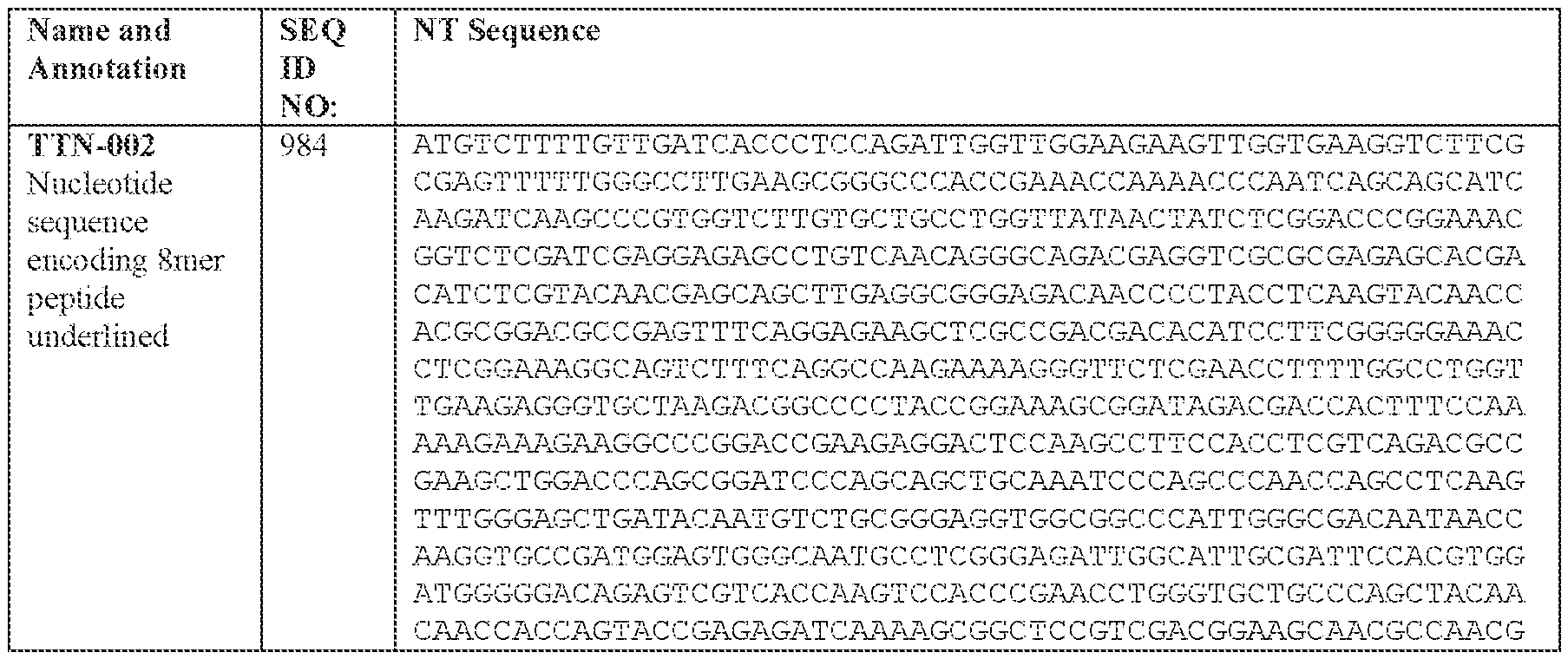 Attorney Docket No.14640.0093-00304
 Attorney Docket No.14640.0093-00304
 Attorney Docket No.14640.0093-00304
 Attorney Docket No.14640.0093-00304
 Attorney Docket No.14640.0093-00304
 Attorney Docket No.14640.0093-00304 Table 10. Exemplary 3’ Flanking Regions for Molecular Scaffold.
 Attorney Docket No.14640.0093-00304
 Attorney Docket No.14640.0093-00304
 Attorney Docket No.14640.0093-00304
 Attorney Docket No.14640.0093-00304
 Attorney Docket No.14640.0093-00304
 [0444] Taken together, these results demonstrate that after 3 rounds of screening of this AAV5 variant library with loop VIII modifications in NHP and rats, many AAV capsid variants outperformed the wild-type AAV5, for example, in penetration of the blood brain barrier (BBB) and expression in the brain. Also, capsid variants were identified that could infect both rats and NHPs, indicating cross-species tropism and compatibility. Example 2. Individual capsid
 Table 16. Fold-change in transgene mRNA expression and DNA copies per diploid genome relative to AAV9 and AAV5 in the brain and liver of mice
 Table 19. Quantification of transgene mRNA by RT-qPCR following intravenous administration of AAV particles comprising a TTN-002 capsid normalized to the actual titer of the viral vector in the dosing solution (mRNA = transgene mRNA fold over housekeeping gene; rel. to AAV9= transgene mRNA fold over housekeeping gene relative to AAV9; rel. to AAV5 transgene mRNA fold over housekeeping gene relative to AAV5)
 Attorney Docket No.14640.0093-00304
 Attorney Docket No.14640.0093-00304
 Attorney Docket No.14640.0093-00304
 Attorney Docket No.14640.0093-00304
 Attorney Docket No.14640.0093-00304
 Attorney Docket No.14640.0093-00304
 Attorney Docket No.14640.0093-00304
 Attorney Docket No.14640.0093-00304
 Attorney Docket No.14640.0093-00304
 0.0543
 0.0227 0.6982 Table 27. NGS-Fold Enrichment of TTN-002 in Marmosets