WO2019076744A1 - AQUEOUS SUSPENSION CONCENTRATES BASED ON 2 - [(2,4-DICHLORPHENYL) -METHYL] -4,4'-DIMETHYL-3-ISOXAZOLIDINONE - Google Patents
AQUEOUS SUSPENSION CONCENTRATES BASED ON 2 - [(2,4-DICHLORPHENYL) -METHYL] -4,4'-DIMETHYL-3-ISOXAZOLIDINONE Download PDFInfo
- Publication number
- WO2019076744A1 WO2019076744A1 PCT/EP2018/077846 EP2018077846W WO2019076744A1 WO 2019076744 A1 WO2019076744 A1 WO 2019076744A1 EP 2018077846 W EP2018077846 W EP 2018077846W WO 2019076744 A1 WO2019076744 A1 WO 2019076744A1
- Authority
- WO
- WIPO (PCT)
- Prior art keywords
- weight
- methyl
- proportion
- plants
- chloro
- Prior art date
- Legal status (The legal status is an assumption and is not a legal conclusion. Google has not performed a legal analysis and makes no representation as to the accuracy of the status listed.)
- Ceased
Links
Classifications
-
- A—HUMAN NECESSITIES
- A01—AGRICULTURE; FORESTRY; ANIMAL HUSBANDRY; HUNTING; TRAPPING; FISHING
- A01N—PRESERVATION OF BODIES OF HUMANS OR ANIMALS OR PLANTS OR PARTS THEREOF; BIOCIDES, e.g. AS DISINFECTANTS, AS PESTICIDES OR AS HERBICIDES; PEST REPELLANTS OR ATTRACTANTS; PLANT GROWTH REGULATORS
- A01N43/00—Biocides, pest repellants or attractants, or plant growth regulators containing heterocyclic compounds
- A01N43/72—Biocides, pest repellants or attractants, or plant growth regulators containing heterocyclic compounds having rings with nitrogen atoms and oxygen or sulfur atoms as ring hetero atoms
- A01N43/80—Biocides, pest repellants or attractants, or plant growth regulators containing heterocyclic compounds having rings with nitrogen atoms and oxygen or sulfur atoms as ring hetero atoms five-membered rings with one nitrogen atom and either one oxygen atom or one sulfur atom in positions 1,2
-
- A—HUMAN NECESSITIES
- A01—AGRICULTURE; FORESTRY; ANIMAL HUSBANDRY; HUNTING; TRAPPING; FISHING
- A01N—PRESERVATION OF BODIES OF HUMANS OR ANIMALS OR PLANTS OR PARTS THEREOF; BIOCIDES, e.g. AS DISINFECTANTS, AS PESTICIDES OR AS HERBICIDES; PEST REPELLANTS OR ATTRACTANTS; PLANT GROWTH REGULATORS
- A01N25/00—Biocides, pest repellants or attractants, or plant growth regulators, characterised by their forms, or by their non-active ingredients or by their methods of application, e.g. seed treatment or sequential application; Substances for reducing the noxious effect of the active ingredients to organisms other than pests
- A01N25/02—Biocides, pest repellants or attractants, or plant growth regulators, characterised by their forms, or by their non-active ingredients or by their methods of application, e.g. seed treatment or sequential application; Substances for reducing the noxious effect of the active ingredients to organisms other than pests containing liquids as carriers, diluents or solvents
- A01N25/04—Dispersions, emulsions, suspoemulsions, suspension concentrates or gels
-
- A—HUMAN NECESSITIES
- A01—AGRICULTURE; FORESTRY; ANIMAL HUSBANDRY; HUNTING; TRAPPING; FISHING
- A01N—PRESERVATION OF BODIES OF HUMANS OR ANIMALS OR PLANTS OR PARTS THEREOF; BIOCIDES, e.g. AS DISINFECTANTS, AS PESTICIDES OR AS HERBICIDES; PEST REPELLANTS OR ATTRACTANTS; PLANT GROWTH REGULATORS
- A01N43/00—Biocides, pest repellants or attractants, or plant growth regulators containing heterocyclic compounds
- A01N43/48—Biocides, pest repellants or attractants, or plant growth regulators containing heterocyclic compounds having rings with two nitrogen atoms as the only ring hetero atoms
- A01N43/56—1,2-Diazoles; Hydrogenated 1,2-diazoles
-
- A—HUMAN NECESSITIES
- A01—AGRICULTURE; FORESTRY; ANIMAL HUSBANDRY; HUNTING; TRAPPING; FISHING
- A01N—PRESERVATION OF BODIES OF HUMANS OR ANIMALS OR PLANTS OR PARTS THEREOF; BIOCIDES, e.g. AS DISINFECTANTS, AS PESTICIDES OR AS HERBICIDES; PEST REPELLANTS OR ATTRACTANTS; PLANT GROWTH REGULATORS
- A01N43/00—Biocides, pest repellants or attractants, or plant growth regulators containing heterocyclic compounds
- A01N43/72—Biocides, pest repellants or attractants, or plant growth regulators containing heterocyclic compounds having rings with nitrogen atoms and oxygen or sulfur atoms as ring hetero atoms
- A01N43/82—Biocides, pest repellants or attractants, or plant growth regulators containing heterocyclic compounds having rings with nitrogen atoms and oxygen or sulfur atoms as ring hetero atoms five-membered rings with three ring hetero atoms
Definitions
- the present invention relates to aqueous suspension concentrates based on 2 - [(2,4-dichlorophenyl) methyl] -4,4'-dimethyl-3-isoxazolidinone, their preparation and their mixtures with suspension concentrates and their use as an agrochemical formulation having reduced volatility and less damage to neighboring crops (non-target plants).
- the active ingredient 2 - [(2,4-dichlorophenyl) methyl] -4,4'-dimethyl-3-isoxazolidinone (CAS number 81777-95-9 or IPUAC 2- (2,4-dichlorobenzyl) -4,4 -dimethyl-1,2-oxazolidin-3-one, hereinafter abbreviated DCPMI), is a chemical relative of the clomazone (hereinafter abbreviated to CPMI, CAS 81777-89-1, IUPAC 2- (2-chlorobenzyl) -4,4 -dimethyl-l, 2-oxazolidin-3-one).
- DCPMI Compared to Clomazone, DCPMI has a significantly lower water solubility (39.5 ppm instead of 1000 ppm) and a slightly lower vapor pressure (0.88 mPa instead of 19.2 mPa), so that the calculated Henry volatility constant (distribution of the active ingredient over the Water gas phase) at a similar level. Both agents belong to the class of volatile agents that can cause undesirable damage to neighboring crops. Associated with the high vapor pressure can also lead to an undesirable wide distribution, which should be prevented for human and ecotoxicological and economic reasons.
- DCPMI is used in herbicidal compositions and mixtures or used as a selective grass herbicide, as described for example in WO-A 2015/127259 or WO-A 2012/148689.
- Capsule suspensions (CS) and suspension concentrates (SC) of DCPMI are known from PCT / EP 2017/0690701 and WO 2015/127259.
- a disadvantage of the suspension concentrates known from this prior art is their volatility and the resulting damage to neighboring and crop plants.
- a disadvantage of CS formulations is further that the active ingredient must be encapsulated.
- An encapsulation process is technically more complex and more expensive than the preparation of a suspension concentrate.
- the encapsulation leads to a slow and often delayed release of the active substance, which can impair the effect, so that weeds can recover or develop resistance.
- DCPMI is preferably combined with other non-encapsulated herbicidal active substances which are likewise present as suspension concentrate.
- a rapid action is desired, thereby too late onset effect, the weeds and grasses may already have progressed too far in growth, so that a successful fight is no longer possible.
- the object of the present invention was therefore to provide a suspension concentrate of DCPMI which significantly reduces the volatility of the active ingredient, preferably by at least 20% (relative).
- a better effect than in a comparable capsule suspension should be achieved, with damage to neighboring crops and crops compared to the known from the prior art formulations are reduced or ideally completely avoided.
- the present invention thus provides an aqueous suspension concentrate comprising a) 2- [(2,4-dichlorophenyl) methyl-4,4'-dimethyl] -3-isoxazolidinone,
- the SC according to the invention contains the components d and e), more preferably the
- the SC according to the invention contains the components a) to d) as essential constituents, more preferably the components a) -f) and particularly preferably the
- the dispersant b) is a mixture of an ionic dispersant b2) and a nonionic dispersant bl).
- the agrochemical active ingredients d) other than a) can be selected from the group of herbicides, insecticides, fungicides and nematocides, preferably d) another herbicide, preferably selected from the group, the auxins, inhibitors of the pigment synthesis, DOXP synthase inhibitors and VLCFA inhibitor covers.
- the present invention further provides a process for the component a) 2- [(2,4-dichlorophenyl) methyl-4,4'-dimethyl] -3-isoxazolidinone in an aqueous solution containing a dispersant b, and a support material c) is added with stirring. More preferably, the aqueous solution contains an ionic and a nonionic dispersing agent. Furthermore, the components d) to g) can be added in the combinations described above. Likewise provided by the present invention are water-dispersible suspension concentrates (SC) obtainable by the process according to the invention.
- SC water-dispersible suspension concentrates
- the preparation of the SC according to the invention can be carried out by methods known in the art, e.g. by wet milling the components in bead mills (such as discontinuous bead mills, or continuous bead mills) or colloid mills (such as tooth colloid mills).
- bead mills such as discontinuous bead mills, or continuous bead mills
- colloid mills such as tooth colloid mills
- the proportion of water in the formulations according to the invention can generally be from 25 to 98% by weight, preferably from 35 to 85% by weight, with water supplementing the proportion of components a) to g) to 100% by weight.
- weight% (weight percent), unless otherwise defined, refers to the relative weight of the particular component based on the total weight of the concentrate formulation.
- the formulation may typically contain residues of organic solvents from the additives of from 0 to 5.0% by weight, preferably from 0.1 to 2.5% by weight.
- the proportion of DCPMI (component a) in the formulations according to the invention is from 0.5 to 35% by weight, preferably from 5 to 30% by weight, particularly preferably from 10 to 30% by weight and very particularly preferably from 15 to 25% by weight. -%.
- the total proportion of components a) and d) is from 0.5 to 35.0% by weight, preferably from 5 to 30% by weight, particularly preferably from 10.0 to 30.0 Wt .-% and most preferably 15.0 to 25.0 wt .-%, that is, the proportion of component a) is reduced by the component d).
- the proportion of dispersant (component b) is preferably 1.0 to 15.0 wt .-%, more preferably 2.0 to 10.0 wt .-% and most preferably 2.5 to 8.0 wt .-% ,
- a mixture of b1) and b2 is preferably used, the proportion of the anionic dispersing aid b1) in the suspension concentrates according to the invention being from 0.1 to 10% by weight, preferably from 0.2 to 7.0% by weight and very particularly preferably 0 , 3 to 4.0 wt .-%, and the proportion of the nonionic dispersing aid b2) in the suspension concentrates according to the invention 1.0 to 15.0 wt .-%, preferably 2.0 to 10.0 wt. % and very particularly preferably 2.5 to 8.0 wt .-%, wherein the total proportion as defined above in the sum of bl) and b2) is not exceeded.
- the proportion of support material (component c) in the SCs according to the invention is preferably 0.1 to 10.0% by weight, more preferably 0.3 to 8.0% by weight and very particularly preferably 1.0 to 7.0 wt .-%.
- the ratio of a) to c) is from 1 to 10, more preferably from 2 to 8, more preferably 3 to 6, and most preferably from 4.
- the proportion of agrochemical active ingredients (component d) other than a) is as defined above.
- the proportion of safener (component e) is preferably 1.0 to 5.0% by weight, more preferably 2.0 to 12.0% by weight, and particularly preferably 3.0 to 8.0% by weight.
- the proportion of thickeners f) in the SCs according to the invention is preferably from 0 to 2.0% by weight, preferably from 0.01 to 1.00% by weight, particularly preferably from 0.01 to 0.60% by weight. , very particularly preferably 0.04 to 0.50% by weight and very particularly preferably 0.05 to 0.3% by weight.
- the proportion of optionally added further auxiliaries and additives g) in the dispersions according to the invention is preferably 0 to 20.0% by weight, preferably 1.0 to 15.0% by weight, more preferably 3.0 to 10.0 Wt .-%, and particularly preferably 5.0 to 10.0 wt .-%.
- the proportion of component a) is 0.5 to 35% by weight.
- the proportion of component a) is 5 to 30% by weight
- the proportion of component a) is 10 to 30% by weight.
- the proportion of component a) is 15 to 25% by weight.
- the total proportion of components a) and d) is from 0.5 to 35% by weight, preferably from 5 to 30% by weight, particularly preferably from 10 to 30% by weight .-% and most preferably 15.0 to 25.0 wt .-%, that is, the proportion of component a) is reduced by the component d).
- b) is preferably also a mixture of b1) and b2, the proportion of the anionic dispersing aid b1) in the suspension concentrates according to the invention being 0.1 to 10% by weight, preferably 0.2 to 7% by weight. and very particularly preferably 0.3 to 4.0 wt .-%, and the proportion of the nonionic dispersing aid b2) in the suspension concentrates according to the invention 1.0 to 15.0 wt .-%, preferably 2.0 to 10 , 0 wt .-% and most preferably 2.5 to 8.0 wt .-%, wherein the total proportion as defined above in the sum of bl) and b2) is not exceeded.
- Suitable anionic dispersants bl such as emulsifiers, surfactants, wetting agents and dispersants, are, for example, alkali metal, alkaline earth metal or ammonium salts of sulfonates, sulfates, phosphates, carboxylates and mixtures thereof, such as e.g.
- alkylsulphonic acids or alkylphosphoric acids and Alkylarylsulphon- or Alkylarylphosphorklaren diphenylsulfonates, alpha-olefinsulfonates, lignosulfonates, sulfonates of fatty acids and oils, sulfonates of ethoxylated alkylphenols, sulfonates of alkoxylated arylphenols, sulfonates of condensed naphthalenes, sulfonates of dodecyl and Tridecylbenzolen, sulfonates of Naphthalenes and alkylnaphthalenes, sulfosuccinates or sulfosuccinamates.
- Examples of sulfates are sulfates of fatty acids and oils, of ethoxylated alkylphenols, of alcohols, of ethoxylated alcohols or of fatty acid esters.
- Examples of phosphates are phosphate esters.
- Examples of carboxylates are alkylcarboxylates and carboxylated alcohol or alkylphenol ethoxylates.
- Examples are calcium dodecylbenzenesulfonate such as Rhodocal® 70 / B (Solvay), phenylsulfonate CA100 (Clariant) or isopropylammonium dodecylbenzenesulfonates such as Atlox® 3300B (Croda).
- Rhodocal® 70 / B Solvay
- phenylsulfonate CA100 Clariant
- isopropylammonium dodecylbenzenesulfonates such as Atlox® 3300B (Croda).
- Typical representatives include phenylsulfonate CA (Ca-dodecylbenzenesulfonate), Soprophor® types (optionally esterified derivatives of tristyrylphenoxy ethoxylates), Emmulsogen® 3510 (alkylated EO / PO copolymer), Emuisogen® EL 400 (ethoxylated castor oil), Tween® grades (fatty acylated sorbitan ethoxylates), Calsogen® AR 100 (calcium dodecylbenzenesulfonate).
- CA Ca-dodecylbenzenesulfonate
- Soprophor® types optionally esterified derivatives of tristyrylphenoxy ethoxylates
- Emmulsogen® 3510 alkylated EO / PO copolymer
- Emuisogen® EL 400 ethoxylated castor oil
- Tween® grades fatty acylated sorbitan eth
- alkylated copolymers of ethylene oxide and propylene oxide such as Emuisogen® 3510.
- Examples of further anionic emulsifiers bl) from the group of naphthalenesulfonates are Galoryl® MT 800 (sodium dibutylnaphthalenesulfonic acid), Morwet® IP (sodium diisopropylnaphthalenesulfonate) and Nekal® BX (alkylnaphthalenesulfonate).
- anionic surfactants from the group of condensation products of naphthalenesulfonates with formaldehyde are Galoryl® DT 201 (naphthalenesulfonic acid hydroxypolymer with formaldeyde and methylphenol sodium salt), Galoryl® DT 250 (condensation product of phenol and naphthalenesulfonates), Reserve® C (condensation product of phenol and Naphthalenesulfonates) or Morwet® D-425, Tersperse® 2020.
- naphthalenesulfonates such as Products such as Galoryl® MT 800 (CFPI-Nufarm) and Nekal® BX (BASF).
- Other typical surfactants are Soprophor® 3D33, Soprophor® 4D384, Soprophor® BSU, Soprophor® CY / 8 (Solvay) and Hoe® S3474 and in the form of the Sapogenat® T products (Clariant), for example Sapogenat® T 100.
- Other typical representatives are based on lignin (such as lignosulfonates, Borresperse®NA, REAX® 88 or Kraftsperse 25 S).
- anionic dispersants bl various sulfonates are preferably used, more preferably those based on naphthalene.
- Suitable nonionic dispersants b2) such as emulsifiers, wetting agents, surfactants and dispersants are customary surface-active substances present in formulations of agrochemical active compounds. Examples which may be mentioned are ethoxylated nonylphenols, reaction products of linear or branched alcohols with ethylene oxide and / or propylene oxide, ethylene oxide-propylene oxide block copolymers, end-capped and non-end-capped alkoxylated linear and branched, saturated and unsaturated alcohols (eg butoxypolyethylenepropylene glycols), reaction products of alkylphenols with ethylene oxide and / or propylene oxide, ethylene oxide-propylene oxide block copolymers, polyethylene glycols and polypropylene glycols, furthermore fatty acid esters, fatty acid polyglycol ether esters, alkyl sulfonates, alkyl sulfates, aryl sulfates, ethoxylated arylal
- tristrylphenol alkoxylates and fatty acid polyglycol ether esters Particular preference is given to tristyrylphenol alkoxylates and fatty acid polyglycol ether esters. Very particular preference is given to tristyrylphenol ethoxylates, tristyrylphenolethoxypropoxylates and castor oil polyglycol ether esters, in each case individually or in mixtures.
- additives such as surfactants or esters of fatty acids, which may be added to the Improvements in biological effectiveness contribute.
- Suitable nonionic emulsifiers b2) are, for example, Soprophor® 796 / P, Fabricamul® CO30, Targetamul® HOT, Targetamul® PSI 100 or Synperonic® T304.
- Suitable nonionic dispersants b2) can also be selected from the group comprising polyvinylpyrrolidone (PVP), polyvinyl alcohol, co-polymer of PVP and dimethylaminoethyl methacrylate, butylated PVP, co-polymer of vinyl chloride and vinyl acetate, and partially hydrolyzed vinyl acetate, phenolic resins, modified cellulose Types such as Luviskol® (polyvinylpyrrolidone), Mowiol® (polyvinyl alcohol) or modified cellulose.
- Preferred are polyvinylpyrrolidone types, particularly preferred are low molecular weight types such as Luviskol® K30 or Sokalan® K30.
- nonionic emulsifiers b2) which are preferably used are selected from the group of di- and tri-block copolymers of alkylene oxides.
- Compounds in question based on ethylene oxide and propylene oxide having average molecular weights between 200 and 10,000, preferably 1000 to 4000 g / mol, the mass fraction of the polyethoxylated block varying between 10 and 80%, e.g. Synperonic® PE series (Uniqema), Pluronic® PE series (BASF), VOP® 32 or Genapol® PF series (Clariant).
- the support materials c) are preferably selected from the group comprising minerals, carbonates, sulfates and phosphates of alkaline earth and earth metals, such as calcium carbonate, polymeric carbohydrates, silicic acids, (natural) framework silicates, such as kaolin.
- suitable fillers c) are, for example, Agsorb® LVM®-GA (attapulgite), Harborlite® 300 (perlite), Collys® HV (modified starch), Omya® chalk (calcium carbonate), kaolin® tea 1 (kaolin, aluminum hydrosilicate) , Steamic® OOS (talc, magnesium silicate).
- c) here are natural skeletal silicates and calcium carbonate types such as Omya® chalk (calcium carbonate), kaolin tea 1® (kaolin) and Harborlite® 300 (perlite), more preferably natural skeletal silicates such as kaolin®, tee® 1 (kaolin , Aluminum hydrosilicate) and Harborlite® 300 (perlite).
- Further fillers in the SC formulation formulations of the invention are selected from the group comprising minerals, carbonates, sulfates and phosphates of alkaline earth and earth metals such as calcium carbonate, polymeric carbohydrates, framework silicates such as low absorbency precipitated silicas and natural framework silicates such as kaolin.
- Typical representatives of suitable fillers c) are, for example, Agsorb® LVM®-GA (attapulgite), Harborlite® 300 (perlite), Collys® HV (modified starch), Omya® chalk (calcium carbonate), kaolin® tea 1 (kaolin, aluminum hydrosilicate) , Steamic® OOS (talc, magnesium silicate).
- Suitable examples are modified natural silicates, such as chemically modified bentonites, hectorites, attapulgites, montmorillonites, smectites or others Silicate minerals, such as Bentone ® (Elementis), Attagel ® (Engelhard), Agsorb ® (Oil-Dri Corporation) or Hectorite ® (Akzo Nobel) or the Van Gel series (RT Vanderbilt).
- modified natural silicates such as chemically modified bentonites, hectorites, attapulgites, montmorillonites, smectites or others Silicate minerals, such as Bentone ® (Elementis), Attagel ® (Engelhard), Agsorb ® (Oil-Dri Corporation) or Hectorite ® (Akzo Nobel) or the Van Gel series (RT Vanderbilt).
- support materials c) selected from the group of superabsorbent supports having a capacity of at least 200 g of dibutyl phthalate per 100 g of support material (BET surface area in accordance with ISO 9277).
- support materials c) selected from the group of superabsorbent supports having a capacity of at least 200 g of dibutyl phthalate per 100 g of support material (BET surface area in accordance with ISO 9277).
- high-absorbency synthetic precipitated silica Sipernat® grades
- fumed silica Adrosil® grades
- Agrochemical active ingredients (component d) other than component a) are herbicides, fungicides, insecticides, plant growth regulators, and the like.
- Fungicidal agents are e.g. 1) inhibitors of ergosterol biosynthesis, for example, (1,001) cyproconazole, (1,002) difenoconazole, (1,003) epoxiconazole, (1,004) fenhexamide, (1,005) fenpropidin, (1,006) fenpropimorph, (1,007) fenpyrazamine, (1,008) fluquinconazole, ( 1,009) flutriafol, (1,010) imazalil, (1,011) imazalil sulfate, (1,012) ipconazole, (1,013) metconazole, (1,014) myclobutanil, (1,015) paclobutrazole, (1,016) prochlorazole, (1,017) propiconazole, (1,018) prothioconazole, (1.019) pyrisoxazole, (1.020) spiroxamine, (1.021) tebu
- inhibitors of the respiratory chain on complex I or II for example (2.001) benzovindiflupyr, (2.002) bixafen, (2.003) boscalid, (2.004) carboxin, (2.005) fluopyram, (2.006) flutolanil, (2.007) fluxapyroxad, (2.008) furametpyr , (2.009) isofetamide, (2.010) isopyrazam (anti-epimeric enantiomer 1R, 4S, 9S), (2.011) isopyrazam (anti-epimeric enantiomer 1S, 4R, 9R), (2.012) isopyrazam (anti-epimeric racemate 1RS, 4SR, 9SR), (2.013) isopyrazam (mixture of the syn-epimeric racemate 1RS, 4SR, 9RS and the anti-epimeric racemate 1RS, 4SR, 9SR), (2.014) isopyrazam (syn-epimeric enantiomer 1R,
- 3) respiratory chain inhibitors on complex III for example, (3,001) ametoctradine, (3,002) amisulbrom, (3,003) azoxystrobin, (3,004) coumethoxystrobin, (3,005) coumoxystrobin, (3,006) cyazofamide, (3,007) dimoxystrobin, (3,008) enoxastrobin, (3,009) famoxadone, (3,010) fenamidone, (3,011) flufenoxystrobin, (3,012) fluoxastrobin, (3,013) kresoxime methyl, (3,014) metominostrobin, (3,015) orysastrobin, (3,016) picoxystrobin, (3,017) pyraclostrobin, (3,018) Pyrametostrobin, (3.019) Pyraoxystrobin, (3.020) Trifloxystrobin (3.021) (2E) -2- ⁇ 2 - [( ⁇ [(IE)
- inhibitors of mitosis and cell division for example, (4,001) carbendazim, (4,002) diethofencarb, (4,003) ethaboxam, (4,004) fluopicolide, (4,005) pencycuron, (4,006) thiabendazole, (4,007) thiophanate-methyl, (4,008) zoxamide , (4.009) 3-Chloro-4- (2,6-difluorophenyl) -6-methyl-5-phenylpyridazine, (4.010) 3-chloro-5- (4-chlorophenyl) -4- (2,6-difluorophenyl ) -6-methylpyridazine, (4.011) 3-chloro-5- (6-chloropyridin-3-yl) -
- inhibitors of amino acid and / or protein biosynthesis for example, (7,001) cyprodinil, (7,002) kasugamycin, (7,003) kasugamycin hydrochloride hydrate, (7,004) oxytetracycline (7,005) pyrimethanil, (7,006) 3- (5-fluoro) 3,3,4,4-tetramethyl-3,4-dihydroisoquinoline-l-yl) quinoline.
- Inhibitors of ATP production for example, (8,001) silthiofam.
- inhibitors of cell wall synthesis for example (9.001) Benthiavalicarb, (9.002) ⁇ ,
- Inhibitors of lipid and membrane synthesis for example (10,001) propamocarb, (10,002) propamocarb hydrochloride, (10,003) tolclofos-methyl.
- Inhibitors of melanin biosynthesis for example (11.001) tricyclazole, (11.002) 2,2,2-trifluoroethyl ⁇ 3-methyl-1 - [(4-methylbenzoyl) amino] butan-2-yl ⁇ carbamate.
- 12) inhibitors of nucleic acid synthesis for example, (12.001) benalaxyl, (12.002) benalaxyl-M (kiralaxyl), (12.003) metalaxyl, (12.004) metalaxyl-M (mefenoxam).
- inhibitors of signal transduction for example (13.001) fludioxonil, (13.002) iprodione, (13.003) procymidone, (13.004) proquinazide, (13.005) quinoxyfen, (13.006) vinclozolin.
- Insecticidal agents are, for example: (1) Acetylcholinesterase (AChE) inhibitors such as carbamates, eg Alanycarb, Ald icarb, Bendiocarb, Benfuracarb, Butocarboxime, Butoxycarboxim, Carbaryl, Carbofuran, Carbosulfan, Ethiofencarb, Fenobucarb, Formetanate, Furathiocarb, Isoprocarb, Methiocarb, Methomyl, Metolcarb, Oxamyl, Pirimicarb, Propoxur, Thiodicarb, Thiofanox, Triazamate, Trimethacarb, XMC and Xylylcarb or organophosphates, eg, acephates, azamethiphos, azinphos-ethyl, azinphos-methyl, cadusafos, chloroethoxyfos, chlorfenvinphos, chlor
- GABA-controlled chloride channel antagonists such as cyclodiene organochlorines, e.g. Chlordanes and endosulfan or phenylpyrazoles (fiproles), e.g. Ethiprole and fipronil.
- Sodium channel modulators / voltage dependent sodium channel blockers such as pyrethroids such as acrinathrin, allethrin, d-cis-trans allethrin, d-trans allethrin, bifenthrin, bioallethrin, bioallethrin S-cyclopentenyl isomer, bioresmethrin, cycloprothrin , Cyfluthrin, beta-cyfluthrin, cyhalothrin, lambda-cyhalothrin, gamma-cyhalothrin, cypermethrin, alpha-cypermethrin, beta-cypermethrin, theta-cypermethrin, zeta-cypermethrin, cyphenothrin [(lR) -trans isomers], deltamethrin, empenthrin [ (EZ) - (lR) -iso
- nicotinergic acetylcholine receptor (nAChR) agonists such as neonicotinoids, eg acetamiprid, clothianidin, dinotefuran, imidacloprid, nitenpyram, thiacloprid and thiamethoxam or nicotine or sulfoxaflor or flupyradifurone.
- nAChR nicotinergic acetylcholine receptor
- nicotinergic acetylcholine receptor (nAChR) allosteric activators such as spinosines, e.g. Spinetoram and spinosad.
- chloride channel activators such as avermectins / milbemycins, e.g. Abamectin, Emamectin benzoate, Lepimectin and Milbemectin.
- Juvenile hormone mimics such as juvenile hormone analogs, e.g. Hydroprene, Kinoprene and Methoprene or Fenoxycarb or Pyriproxyfen.
- agents with unknown or nonspecific modes of action such as alkyl halides, e.g. Methyl bromide and other alkyl halides; or chloropicrin or sulfuryl fluoride or borax or tartar emetic.
- mite growth inhibitors e.g. Clofentezine, hexythiazox and diflovidazine or etoxazole.
- Insect intestinal membrane microbial disruptors e.g. Bacillus thuringiensis subspecies israelensis, Bacillus sphaericus, Bacillus thuringiensis subspecies aizawai, Bacillus thuringiensis subspecies kurstaki, Bacillus thuringiensis subspecies tenebrionis and BT plant proteins: CrylAb, CrylAc, CrylFa, Cry2Ab, mCry3A, Cry3Ab, Cry3Bb, Cry34 / 35Abl.
- Inhibitors of oxidative phosphorylation, ATP disruptors such as diafenthiuron or organotin compounds, e.g. Azocyclotin, Cyhexatin and fenbutatin oxide or propargite or
- Nicotinergic acetylcholine receptor antagonists such as Bensultap, Cartap hydrochloride, thiocyclam and thiosultap sodium.
- Type 0 inhibitors of chitin biosynthesis such as bistrifluron, chlorofluorazuron, diflubenzuron, flucycloxuron, flufenoxuron, hexaflumuron, lufenuron, novaluron, noviflumuron, teflubenzuron and triflumuron.
- inhibitors of chitin biosynthesis type 1, such as buprofezin.
- Moulting agents dipteran, such as cyromazine.
- ecdysone receptor agonists such as chromafenozides, halofenozides, methoxyfenozides, and tebufenozides.
- Octopaminergic agonists such as amitraz.
- (21) complex I electron transport inhibitors for example, METI acaricides, e.g. Fenazaquin, Fenpyroximate, Pyrimidifen, Pyridaben, Tebufenpyrad and Tolfenpyrad or Rotenone (Derris).
- METI acaricides e.g. Fenazaquin, Fenpyroximate, Pyrimidifen, Pyridaben, Tebufenpyrad and Tolfenpyrad or Rotenone (Derris).
- (23) inhibitors of acetyl-CoA carboxylase such as tetronic and tetramic acid derivatives, e.g. Spirobudiclofen, spirodiclofen, spiromesifen and spirotetramat.
- complex IV electron transport inhibitors such as phosphines, e.g. Aluminum phosphide, calcium phosphide, phosphine and zinc phosphide or cyanide.
- ryanodine receptor effectors such as diamides, e.g. Chlorantraniliprole, Cyantraniliprole, Flubendiamide and Tetrachloroantraniliprole.
- insecticidal active ingredients with unknown or ambiguous mechanism of action, such as afidopyropene, afoxolaner, azadirachtin, benclothiaz, benzoximate, bifenazate, broflanilide, bromopropylate, quinomethionate, Cryolite, cyclaniliprole, cycloxapride, cyhalodiamide dicloromezotiaz, dicofol, diflovidazine, flometoquine, fluazaindolizine, fluensulfone, flufenerim , Flufenoxystrobin, Flufiprole, Fluhexafon, fluopyram, fluralaner, Fluxametamide, Fufenozide, Guadipyr, Heptafluthrin, Imidaclothiz, iprodione, Lotilaner, Meperfluthrin, Paichongding, Pyflu
- plant growth regulators as possible mixing partners are:
- component a) with an active ingredient d) from the group of herbicides preferably from the group of auxines such as halauxifen-methyl (0.05-5% by weight) and / or from the group of inhibitors of the pigment Synthesis (pigment bleacher, "bleacher") such as diflufenican 5-30% and from the group of DOXP synthase inhibitors such as clomazone and / or from the group of VLCFA inhibitors (inhibition of cell division for the production of fatty acids) Flufenacet (5-30 wt .-%) or Pyroxasulfone combined. Flufenacet and / or Dilflufenikan are preferably used.
- SCs of the invention may contain a safener e).
- safener e The following groups of compounds are suitable, for example, as safeners (component e):
- S 1 a compounds of the type dichlorophenylpyrazoline-3-carboxylic acid (S 1 a ), preferably
- S 1 d compounds of the type of triazolecarboxylic acids (S 1 d ), preferably compounds such as
- Fenchlorazole ethyl ester
- Sl e compounds of the type of 5-benzyl- or 5-phenyl-2-isoxazoline-3-carboxylic acid, or of 5,5-diphenyl-2-isoxazoline-3-carboxylic acid (Sl e ), preferably compounds such as
- S2 a compounds of the 8-quinolinoxyacetic acid type (S2 a ), preferably
- S2 b compounds of the type of (5-chloro-8-quinolinoxy) malonic acid (S2 b ), preferably
- Active substances of the dichloroacetamide (S3) type which are often used as pre-emergence safeners (soil-active safeners), such as: B.
- R-29148 (3-dichloroacetyl-2,2,5-trimethyl-1,3-oxazolidine) from Stauffer (S3-2),
- R-28725" (3-dichloroacetyl-2,2, -dimethyl-1,3-oxazolidine) from Stauffer (S3-3),
- Benoxacor (4-dichloroacetyl-3,4-dihydro-3-methyl-2H-1,4-benzoxazine) (S3 -4), "PPG-1292” (N-allyl-N - [(1,3-dioxolan-2-yl) -methyl] -dichloroacetamide) from PPG Industries (S3-5),
- AD-67 or "MON 4660” (3-dichloroacetyl-1-oxa-3-aza-spiro [4,5] decane) from Nitrokemia or Monsanto (S3-7),
- TI-35 (1-dichloroacetyl-azepane) from TRI-Chemical RT (S3-8),
- RA 1 (C 1 -C 6) -alkyl, (C 3 -C 6) -cycloalkyl, where the 2 last-mentioned radicals are represented by VA substituents from the group consisting of halogen, (C 1 -C 10) -alkoxy, (C 1 -C 6) -haloalkoxy and (C 1 -C 4) -alkylthio and in the case of cyclic radicals are also substituted by (Ci-C i) alkyl and (Ci-C4) haloalkyl;
- RA 2 halogen (C 1 -C 4 ) alkyl, (C 1 -C 4 ) alkoxy, CF 3; mA l or 2;
- VA is 0, 1, 2 or 3;
- Verbindun conditions the type of 4- benzoylsulfamoyl) benzamide of the formula (S4 b) and salts thereof, as they are in the WO-A-99/16744 describes Wonn
- RB 1 , RB 2 independently of one another are hydrogen, (C 1 -C 6) alkyl, (C 3 -C 6) cycloalkyl, (C 3 -C 6) alkenyl,
- RB 3 is halogen, (C 1 -C 4 ) alkyl, (C 1 -C 4 ) haloalkyl or (C 1 -C 4 ) alkoxy and niB is 1 or 2, for example those in which
- RB 1 cyclopropyl
- R B 2 hydrogen
- (RB 3 ) 5-Cl-2-OMe (S4-2)
- RB 1 isopropyl
- R B 2 hydrogen
- (RB 3 ) 5-Cl-2-OMe is (S4-4) and
- RB 1 isopropyl
- R B 2 hydrogen
- (RB 3 ) 2-OMe (S4-5);
- Rc 1 , Rc 2 are independently hydrogen, (Ci-Cg) alkyl, (C3-Cg) cycloalkyl, (C3
- R c 3 is halogen, (C 1 -C 4 ) alkyl, (C 1 -C 4 ) alkoxy, CF 3 and mc are 1 or 2; for example
- R D 4 is halogen, (C 1 -C 4 ) alkyl, (C 1 -C 4 ) alkoxy, CF 3; mD 1 or 2;
- R D 5 is hydrogen, (C 1 -C 6 ) alkyl, (C 3 -C 6 ) cycloalkyl, (C 2 -C 6 ) alkenyl, (C 2 -C 6 ) alkynyl, (C 5 -C 6 ) cycloalkenyl.
- Carboxylic acid derivatives (S5) e.g.
- S7 compounds from the class of diphenylmethoxyacetic acid derivatives (S7), e.g.
- Methyl diphenylmethoxyacetate (CAS No. 41858-19-9) (S7-1), Diphenylmethoxyessigklareethylester or Diphenylmethoxyessigklare as described in WO-A-98/38856.
- RD 1 is halogen, (C 1 -C 4 ) alkyl, (C 1 -C 4 ) haloalkyl, (C 1 -C 4 ) alkoxy, (C 1 -C 4 ) haloalkoxy, R D 2 is hydrogen or (C 1 -C 4 ) alkyl .
- RD 3 is hydrogen, (Ci-Cg) alkyl, (C 2 -C 4 ) alkenyl, (C 2 -C 4 ) alkynyl, or aryl, wherein each of the
- nD is an integer from 0 to 2.
- Halogen, (C 1 -C 4 ) alkyl, methoxy, nitro, cyano, CF 3 , OCF 3 YE, ZE independently of one another are O or S, ⁇ is an integer from 0 to 4,
- RE 2 (C 1 -C 6 ) alkyl, (C 2 -C 6 ) alkenyl, (C 3 -C 6 ) cycloalkyl, aryl; Benzyl, halobenzyl, RE 3 is hydrogen or (Ci-C6) alkyl.
- Oxabetrinil ((Z) -l, 3-dioxolan-2-ylmethoxyimino (phenyl) acetonitrile) (S l l -1), which is known as a seed safener for millet against damage by metolachlor,
- Cyometrine or “CGA-43089” ((Z) -cyanomethoxyimino (phenyl) acetonitrile) (S1-l3), which is known as a seed dressing safener for millet against damage by metolachlor.
- Isothiochromanone (S12) class agents e.g. Methyl- [(3-oxo-1H-2-benzothiopyran-4 (3H) -ylidene) methoxy] acetate (CAS Reg. No. 205121-04-6) (S12-1) and related compounds of WO-A- 1998/13361.
- Naphthalene anhydride (1,8-naphthalenedicarboxylic anhydride) (S13-1), which is known as a seed safener for corn against damage by thiocarbamate herbicides.
- MG 191 (CAS Reg. No. 96420-72-3) (2-dichloromethyl-2-methyl-1,3-dioxolane) (S13-5) from Nitrokemia, which is known as safener for corn,
- CSB (1-Bromo-4- (chloromethylsulfonyl) benzene) from Kumiai, (CAS Registry No. 54091-06-4), which is known as a safener against damage of some herbicides in rice.
- RH 1 is a (Ci-C6) haloalkyl radical and RH 2 is hydrogen or halogen and
- R 3 , R 4 independently of one another denote hydrogen, (C 1 -C 16) alkyl, (C 2 -C 6) alkenyl or (C 2 -C 6) alkynyl, where each of the last-mentioned 3 radicals is unsubstituted or substituted by one Hydroxy, cyano, (Ci-C i) alkoxy, (Ci-C i) haloalkoxy, (C 1 -C 4 ) alkylthio, (C 1 -C 4 ) alkylamino, di [(C 1 -C 4 ) alkyl] amino, [(C 1 -C 4 ) alkoxy] carbonyl, [(C 1 -C 4 ) haloalkoxy] -carbonyl, (C3-C6) cycloalkyl which is unsubstituted or substituted, is phenyl which is unsubstituted or substituted, and heterocyclyl which is unsubstituted
- RH 3 is (C 1 -C 4 ) -alkoxy, (C 2 -C 4 ) -alkenyloxy, (C 2 -C 6) -alkinyloxy or (C 2 -C 4 ) -haloalkoxy and RH 4 is hydrogen or (C 1 -C 4 ) -alkyl or
- RH 3 and RH 4 together with the directly attached N atom form a four- to eight-membered heterocyclic ring which, in addition to the N atom, may also contain further hetero ring atoms, preferably up to two further hetero ring atoms from the group consisting of N, O and S, and which may be unsubstituted or by one or more radicals from the group halogen, cyano, nitro, (Ci-C 4) alkyl, (Ci-C 4) haloalkyl, (Ci-C 4) alkoxy, (Ci-C 4) haloalkoxy and (Ci- C 4 ) alkylthio is substituted, means.
- Preferred safeners for the purposes of the present invention are safeners based on the esters of cloquintocet (preferably mexyl ester) and / or mefenpyr (preferably as diethyl ester), particularly preferably mefenpyr diethyl ester.
- Preferred thickeners f) are organic thickeners, which may be natural or biotechnologically modified or organically synthetic thickeners.
- Typical synthetic thickeners are Rheostrux® (Croda), Thixin® or Thixatrol® series (Elementis). These are typically based on acrylates.
- Typical organic thickeners are based on xanthan or cellulose (such as hydroxyethyl or carboxymethylcellulose) or a combination thereof. Preference is given to using natural modified thickeners based on xanthan. Typical representatives are for example Rhodopol® (Solvay) and Kelzan® (Kelco Corp.) as well as Satiaxane® (Cargill).
- additives and auxiliaries g) are wetting agents, pH adjusters, defoamers, biocides, disintegrants, adhesion promoters, antifreeze agents, preservatives, dyes or fertilizers, as well as component b) various surfactants and c) various fillers, antifreeze agents are preferred, Defoamers and biocides added.
- Suitable defoamers are silicone-based or silane-based surface-active compounds such as the Tegopren® products (Goldschmidt), the SE® products (Wacker), as well as the Bevaloid® (Kemira), Rhodorsil® (Solvay) and Silcolapse® products (Blustar Silicones) preferred are SE® (Wacker), Rhodorsil® and Silcolapse® products, particularly preferred are, for example Products like Silcolapse® 5020.
- Suitable antifreeze agents are those from the group of ureas, diols and polyols, such as ethylene glycol and propylene glycol, glycerol, preferably propylene glycol or glycerol.
- Suitable biocides are e.g. Products such as Acticide® MBS (Biocide, Thor Chemie), CIT, MIT or BIT such as Proxel® GXL (BIT), Acticide® SPX (MIT, CIT).
- Suitable adhesion promoters can be selected from the group consisting of polyvinylpyrrolidone (PVP), polyvinyl alcohol, co-polymer of PVP and dimethylaminoethyl methacrylate, butylated PVP, co-polymer of vinyl chloride and vinyl acetate, Na salt of the co-polymer of propensulanic acid and partially hydrolyzed vinyl acetate, sodium caseinate, Phenolic resins, modified cellulose types such as Luviskol® (polyvinylpyrrolidone), Mowiol® (polyvinyl alcohol), modified cellulose Preferred are polyvinylpyrrolidone types, particularly preferred are low molecular weight types such as Luviskol® K30.
- Suitable disintegrating agents can be selected from the group of modified carbohydrates such as microcrystalline cellulose and crosslinked polyvinylpyrrolidones such as Avicel® PH 101 (microcrystalline cellulose), Agrimer® XLF (crosslinked polyvinylpyrrolidone), Disintex® 200 (crosslinked polyvinylpyrrolidone). Preference is given to cross-linked polyvinylpyrrolidones, such as Agrimer® XLF.
- Suitable antifoam agents can be selected from the group of esters of phosphoric acid with lower alcohols, C6-C10 alcohols, silicone surfactants (suspoemulsions of hydrophobicized silica particles in aqueous emulsion concentrates based on liquid silicone surfactants), such as polydimethylsiloxane, and their absorbents on solid support material such as Rhodorsil® 432 (silicone surfactant), butyl phosphate, isobutyl phosphate, n-octanol, Wacker ASP 15 (polydimethylsiloxane, absorbed on solid support), antifoam agent® SE (polydimethylsiloxane).
- liquid silicone surfactants such as antifoam agent SE (polydimethylsiloxane)
- antifoam agent SE polydimethylsiloxane
- solid antifoaming agents such as Wacker ASP 15 (polydimethylsiloxane).
- the invention further relates to a herbicidal composition which can be prepared from the SCs according to the invention by dilution with liquids, preferably water.
- herbicidal compositions thus obtained with further active ingredients, preferably agrochemical active compounds (for example as tank mix partners in the form of corresponding formulations) and / or customary auxiliaries and additives, e.g. self-emulsifying oils such as vegetable oils or paraffin oils and / or fertilizers.
- active ingredients preferably agrochemical active compounds (for example as tank mix partners in the form of corresponding formulations) and / or customary auxiliaries and additives, e.g. self-emulsifying oils such as vegetable oils or paraffin oils and / or fertilizers.
- auxiliaries and additives e.g. self-emulsifying oils such as vegetable oils or paraffin oils and / or fertilizers.
- present invention therefore also relates to such agents, preferably herbicides, based on the formulations according to the invention.
- a particular embodiment of the invention relates to the use of the herbicidal compositions obtainable from the SCs according to the invention for controlling undesired plant growth, hereinafter referred to as "herbicidal agent”.
- the herbicidal compositions have an excellent herbicidal activity against a broad spectrum of economically important monocotyledonous and dicotyledonous harmful plants. Even hard-to-control perennial weeds that sprout from rhizomes, rhizomes or other permanent organs are well recorded.
- the herbicidal agents can be applied, for example, in the pre-seed, pre-emergence or post-emergence method. Specifically, by way of example, some representatives of the monocotyledonous and dicotyledonous weed flora can be mentioned, which can be controlled by the herbicidal agents, without it being intended to restrict them to certain species.
- Apera spica venti On the monocotyledonous weed side, for example, Apera spica venti, Avena spp., Alopecurus spp., Brachiaria spp., Digitaria spp., Lolium spp., Echinochloa spp., Panicum spp., Phalaris spp., Poa spp., Setaria spp , and Bromus spp.
- Echinochloa, Sagittaria, Alisma, Eleocharis, Scirpus and Cyperus are also excellently controlled by the herbicidal agents.
- the herbicidal agents When the herbicidal agents are applied to the surface of the earth prior to germination, either weed seedling emergence is completely prevented or the weeds grow to the cotyledon stage, but then cease to grow and finally die completely after three to four weeks.
- the herbicidal compositions are characterized by a rapidly onset and long-lasting herbicidal activity.
- the rainfastness of the active ingredients in the herbicidal compositions is generally favorable.
- a particular advantage is the fact that the effective and used in the herbicidal compositions dosages of herbicidal compounds can be set so low that their soil effect is optimally low. Thus, their use is not only possible in sensitive cultures, but groundwater contamination is virtually avoided.
- the combination of active substances according to the invention enables a considerable reduction in the required application rate of the active substances.
- the herbicidal compositions have excellent herbicidal activity against monocotyledonous and dicotyledonous weeds, crops of economically important crops, eg dicotyledonous crops such as soybean, cotton, oilseed rape, sugarbeet, or graminaceous crops such as wheat, barley, rye, oats, millet, rice or maize, only marginally or not at all damaged.
- crops of economically important crops eg dicotyledonous crops such as soybean, cotton, oilseed rape, sugarbeet, or graminaceous crops such as wheat, barley, rye, oats, millet, rice or maize, only marginally or not at all damaged.
- the present herbicidal compositions are very well suited for the selective control of undesired plant growth in agricultural crops or in ornamental plantings.
- the corresponding herbicidal agents have excellent growth regulatory properties depending on the crop.
- the herbicidal compositions can also be employed for controlling harmful plants in crops of known or yet to be developed genetically modified plants.
- the transgenic plants are usually characterized by particular advantageous properties, for example by resistance to certain pesticides, especially certain herbicides, resistance to plant diseases or pathogens of plant diseases such as certain insects or microorganisms such as fungi, bacteria or viruses.
- Other special properties relate to z. B. the crop in terms of quantity, quality, shelf life, composition and special ingredients.
- transgenic plants with increased starch content or altered quality of the starch or those with other fatty acid composition of the crop are known.
- the application of the herbicidal agents in economically important transgenic crops of useful and ornamental plants eg. B. Graminaceous crops such as wheat, barley, rye, oats, millet, rice and corn or even cultures of sugar beet, cotton, soybeans, rape, potato, tomato, pea and other vegetables.
- the herbicidal agents can be used in crops which are resistant to the phytotoxic effects of the herbicides or have been made genetically resistant.
- the present invention thus also provides a method for controlling undesired plant growth, preferably in crops such as cereals (eg wheat, barley, rye, oats, rice, maize, millet), sugar beet, sugar cane, oilseed rape, cotton and soybeans, more preferably in monocotyledonous crops such as cereals, for example wheat, barley, rye, oats, crossings thereof such as triticale, rice, maize and millet, characterized in that the herbicidal compositions according to the invention are harmful to the harmful plants, plant parts, plant seeds or the area on which the plants grow, eg the acreage, applied.
- crops such as cereals (eg wheat, barley, rye, oats, rice, maize, millet), sugar beet, sugar cane, oilseed rape, cotton and soybeans, more preferably in monocotyledonous crops such as cereals, for example wheat, barley, rye, oats, crossing
- the plant cultures may also be genetically engineered or obtained by mutation selection and are preferably tolerant to acetolactate synthase (ALS) inhibitors.
- ALS acetolactate synthase
- the SCs of the present invention show excellent plant tolerance, such as a reduced propensity to cause phytotoxic damage.
- SCs according to the invention as special combination drug formulations (synonymous: mixture formulations, co-formulations) have further advantages, such as e.g. a smaller packaging than with the use of individual active ingredients, which simplifies the production, transport and storage, and the preparation of the sprays used in agriculture can be handled better by the smaller amounts and the already set, effective proportions, such. during the measuring and stirring process.
- the SCs according to the invention additionally show outstanding dispersing and stabilizing properties after further dilution with liquids, preferably water.
- SCs may exert various effects on plants The effect of the substances depends essentially on the time of application relative to the stage of development of the plant and also on the amounts of active substance applied to the plants or their plants In any case, growth regulators should exert a particular desired effect on crops, such as early germination, better emergence, more developed root system and / or improved root growth, increased tillering capacity, more productive tillers, earlier ones Flowering, increased plant height and / or biomass, stalk shortening, shoot growth improvements, number of grains / ears, number of ears / m 2 , number Sto ions and / or number of flowers, increased harvest index, larger leaves, less dead basal leaves, improved phyllotaxis, earlier maturity / earlier fruiting, homogeneous maturity, increased grain filling time, better fruiting, larger fruit / vegetable size, shoot resistance and reduced storage.
- crops such as early germination, better emergence, more developed root system and / or improved root growth, increased tillering capacity, more productive tillers, earlier ones
- Flowering increased plant height and
- Increased or improved yield refers to total biomass per hectare, yield per hectare, grain / fruit weight, seed size and / or hectoliter weight, as well as improved product quality, which includes: improved processability in size distribution (kernel, fruit, etc.), homogeneous ripeness, grain moisture, better grinding, better vinification, better brewing, increased juice yield, increased harvestability, increased digestibility, increased sedimentation value, increased drop numbers, increased pod stability, increased storage stability, improved fiber length / strength / uniformity, increase in milk and / or meat quality of silage-fed animals , Adaptation to cooking and frying; further comprising better marketability in terms of increased fruit / grain quality, size distribution (core, fruit, etc.), increased shelf life / shelf life, firmness / softness, flavor (aroma, texture, etc.), grade (size, shape, number of berries, etc .), Number of berries / fruits per bunch, crunchiness, freshness, wax coverage, frequency of physiological disorders, color, etc .; further comprising
- plant growth regulating formulations can be used to slow the vegetative growth of the plants. Such suppression of growth is of economic interest to, for example, grasses, as it is thereby possible to reduce the frequency of lawn cutting in ornamental gardens, parks and sports facilities, on roadsides, at airports or in crops. Also of importance is the inhibition of the growth of herbaceous and woody plants on roadsides and near pipelines or overground cables, or more generally where vigorous plant growth is undesirable. Also of importance is the use of growth regulators to inhibit grain elongation. This completely reduces or eliminates the risk of storing the plants before harvesting. In addition, grain growth regulators can strengthen the stalk, which also counteracts storage. The use of growth regulators to shorten and strengthen The stalks allow the application of higher amounts of fertilizer to increase the yield without the risk of grain crops being at risk.
- the reduction in vegetative plant growth may also result in increased or improved yields since the nutrients and assimilates are of greater benefit to flowering and fruiting than to the vegetative parts of the plants.
- growth regulators may also be used to promote vegetative growth. This is of great benefit when the vegetative parts of plants are harvested. However, promotion of vegetative growth may also require generative growth in that more assimilates are formed resulting in more or larger fruits.
- beneficial effects on growth or yield can be achieved through improved nutrient utilization, in particular nitrogen (N) utilization, phosphorus (P) utilization, water utilization, improved transpiration, respiration and / or CO 2 assimilation rate, better nodule formation to achieve improved Ca metabolism and so on.
- growth regulators can be used to alter the composition of the plants, which in turn can lead to an improvement in the quality of the crop. Under the influence of growth regulators parthenocarp fruits can be formed. Besides, it is possible to influence the sex of the flowers. It is also possible to produce sterile pollen, which is of great importance in the breeding and production of hybrid seed.
- growth regulators can control the branching of the plants.
- side shoots which may be very desirable especially in the cultivation of ornamental plants, also in combination with growth inhibition.
- the amount of leaves on the plant can be controlled so that defoliation of the plants takes place at a certain time.
- Such defoliation plays an essential role in the mechanical harvesting of cotton, but it is also of interest in harvest relief in other crops, for example in viticulture.
- the defoliation of the Plants can also be made to lower the transpiration of the plants before they are reacted.
- growth regulators may modulate plant senescence, which may result in prolonged green leaf area, a longer grain filling phase, improved yield quality, and so on.
- growth regulators can be used to regulate the crop fall. On the one hand, it is possible to prevent premature fruit fall. On the other hand, it is also possible to promote fruit fall, even flower shedding, to achieve a desired mass (“thinning out.") In addition, it is possible to use growth regulators at harvest time to obtain the force needed to peel the fruit to reduce to allow mechanical harvesting or to facilitate the harvest by hand.
- Growth regulators may also be used to achieve faster or delayed harvesting of the crop before or after harvesting. This is particularly advantageous as it allows an optimal adjustment to the needs of the market. Furthermore, growth regulators may in some cases improve fruit color. In addition, growth regulators can also be used to synchronize the maturity within a certain period of time. This is the prerequisite for complete mechanical harvesting or harvesting by hand in a single operation, for example, tobacco, tomatoes or coffee.
- growth regulators it is possible to influence the seed or bud dormancy of the plants such that plants such as pineapples or ornamental plants in garden centers, for example, germinate, sprout or flower if they would not normally tend to. Where there is a risk of frost, it may be desirable to delay the budding or germination of seeds by means of growth regulators to avoid late frost damage.
- growth regulators can induce plant resistance to frost, dryness, or high soil salinity. This allows the cultivation of plants in regions that are not normally suitable for this purpose.
- the formulations according to the invention also exert a strong strengthening effect on plants. Accordingly, they can be used to mobilize the plant's resistance to attack by unwanted microorganisms.
- Plant-strengthening (resistance-inducing) substances in the present context are substances which are able to stimulate the defense system of plants in such a way that the treated plants, when subsequently inoculated with undesired microorganisms, give rise to a high degree of resistance to these microorganisms.
- plant physiological effects in the context of the present invention include the following:
- Tolerance of abiotic stress including tolerance to high or low temperatures, drought tolerance and recovery from drought stress, water use (correlated with reduced water absorption), waterlogging tolerance, ozone stress and UV tolerance, tolerance to chemicals such as heavy metals, salts, pesticides, etc.
- the tolerance to biotic stress preferably comprises increased fungal resistance and increased resistance to nematodes.
- the present invention accordingly provides for the use of the SCs according to the invention for increasing the resistance of plants to abiotic stress factors, preferably to drought stress, in particular for strengthening plant growth and / or for increasing plant yield.
- Soche terms are, for example, the following: phytotonic effect, resistance to stress factors, less plant stress, plant health, healthy plants, plant fitness, plant wellness, plant concept, vigor effect, stress Shield, Shield, Crop Health, Crop Health Properties, Crop Health Management, Crop Health Therapy, Plant Health, Plant Health Properties, Plant Health Products, Plant Health Management ",” Plant Health Therapy ",” Greening Effect “or” Re-greening Effect “),” Freshness "or other terms that are well known to a person skilled in the art.
- Rhodopof G Xanthan derivative (Solvay)
- Comparative Example 3 was prepared analogously to Example 5 of PCT / EP2017 / 069701 as a capsule suspension. Determination of relative volatility and cuticle penetration of the drug
- a spray mixture (0.5 g of active ingredient / L) is placed on three Teflon membranes in an open-topped glass box in a fume hood under constant air flow of 1.6 m / s at 22 ° C and 60% relative humidity.
- the residue on the Teflon membranes is determined after drying after 0 and 24 h by HPLC.
- the volatility is based on the 0 h value.
- Bioavailability is determined by apple cuticle penetration.
- a spray mixture (0.5 g of active ingredient / L) is added to each of three apple cuticles. The amount of active ingredient in the cuticle is measured; after drying after 0 and 24 h determined by HPLC.
- 100% relative volatility means that no drug has been lost on volatility.
- Comparative Example 1 shows that too low a ratio of active ingredient to sipernate is insufficient to reduce the volatility.
- Comparative Example 2 shows that while capsules are capable of reducing the volatility by 100%), the active ingredient is hardly bioavailable (10%> cuticle penetration).
- the examples of the invention not only show a reduction in volatility (35-65%) but also show an increase in cuticle penetration. Thus, the drug is at the same time less volatile and more bioavailable. Glasshouse
Landscapes
- Life Sciences & Earth Sciences (AREA)
- Health & Medical Sciences (AREA)
- General Health & Medical Sciences (AREA)
- Dentistry (AREA)
- Plant Pathology (AREA)
- Engineering & Computer Science (AREA)
- Pest Control & Pesticides (AREA)
- Agronomy & Crop Science (AREA)
- Wood Science & Technology (AREA)
- Zoology (AREA)
- Environmental Sciences (AREA)
- Chemical & Material Sciences (AREA)
- Dispersion Chemistry (AREA)
- Toxicology (AREA)
- Agricultural Chemicals And Associated Chemicals (AREA)
Abstract
La présente invention concerne des suspensions concentrées aqueuses à base de 2-[(2,4-dichlorophényl)-méthyl]-4,4'-diméthyl-3-isoxazolidinone, ainsi que leur préparation, leurs mélanges avec des suspensions concentrées et leur utilisation comme formulation agrochimique présentant une faible volatilité et provoquant peu de dégâts sur les cultures avoisinantes.The present invention relates to aqueous concentrated suspensions based on 2 - [(2,4-dichlorophenyl) methyl] -4,4'-dimethyl-3-isoxazolidinone, as well as their preparation, their mixtures with concentrated suspensions and their use. as an agrochemical formulation having low volatility and causing little damage to neighboring crops.
Description
Wässrige Suspensionskonzentrate auf Basis von 2-[(2,4-dichlorphenyl)-methyll-4,4'-dimethyl-3- isoxazolidinone Aqueous suspension concentrates based on 2 - [(2,4-dichlorophenyl) methyll-4,4'-dimethyl-3-isoxazolidinone
Die vorliegende Erfindung betrifft wässrige Suspensionskonzentrate auf Basis von 2-[(2,4-Dichlorphenyl)- methyl]-4,4'-dimethyl-3-isoxazolidinone, deren Herstellung sowie deren Mischungen mit Suspensionskonzentraten und deren Verwendung als agrochemische Formulierung mit reduzierter Flüchtigkeit und weniger Schäden an Nachbarkulturen („non-target-plants"). The present invention relates to aqueous suspension concentrates based on 2 - [(2,4-dichlorophenyl) methyl] -4,4'-dimethyl-3-isoxazolidinone, their preparation and their mixtures with suspension concentrates and their use as an agrochemical formulation having reduced volatility and less damage to neighboring crops (non-target plants).
Der Wirkstoff 2-[(2,4-Dichlorphenyl)-methyl]-4,4'-dimethyl-3-isoxazolidinone (CAS Nummer 81777-95- 9 bzw. IPUAC 2-(2,4-dichlorobenzyl)-4,4-dimethyl-l,2-oxazolidin-3-one, im Folgenden abgekürzt DCPMI), ist ein chemischer Verwandter des Clomazone (im Folgenden abgekürzt CPMI, CAS 81777-89- 1, IUPAC 2-(2-chlorobenzyl)-4,4-dimethyl-l,2-oxazolidin-3-one). Im Vergleich zu Clomazone hat DCPMI eine deutlich geringere Wasserlöslichkeit (39,5 ppm statt 1000 ppm) und einen etwas geringeren Dampfdruck (0,88 mPa statt 19,2 mPa), so dass die berechnete Henry Flüchtigkeits-Konstante (Verteilung des Wirkstoffes über die Wassergasphase) auf ähnlichem Niveau ist. Beide Wirkstoffe gehören zur Klasse der flüchtigen Wirkstoffe, die unerwünschte Schäden an Nachbarkulturen verursachen können. Verbunden mit dem hohen Dampfdruck kann es auch zu einer unerwünschten breiten Verteilung kommen, was aus human- und ökotoxikologischen sowie ökonomischen Gründen verhindert werden sollte. The active ingredient 2 - [(2,4-dichlorophenyl) methyl] -4,4'-dimethyl-3-isoxazolidinone (CAS number 81777-95-9 or IPUAC 2- (2,4-dichlorobenzyl) -4,4 -dimethyl-1,2-oxazolidin-3-one, hereinafter abbreviated DCPMI), is a chemical relative of the clomazone (hereinafter abbreviated to CPMI, CAS 81777-89-1, IUPAC 2- (2-chlorobenzyl) -4,4 -dimethyl-l, 2-oxazolidin-3-one). Compared to Clomazone, DCPMI has a significantly lower water solubility (39.5 ppm instead of 1000 ppm) and a slightly lower vapor pressure (0.88 mPa instead of 19.2 mPa), so that the calculated Henry volatility constant (distribution of the active ingredient over the Water gas phase) at a similar level. Both agents belong to the class of volatile agents that can cause undesirable damage to neighboring crops. Associated with the high vapor pressure can also lead to an undesirable wide distribution, which should be prevented for human and ecotoxicological and economic reasons.
DCPMI wird in herbiziden Zusammensetzungen und Mischungen eingesetzt oder als selektives Grasherbizid verwendet, wie beispielsweise in der WO-A 2015/127259 oder WO-A 2012/148689 beschrieben. Kapselsuspensionen (CS) und Suspensionskonzentrate (SC) von DCPMI sind aus der PCT/EP 2017/0690701 sowie der WO 2015/127259 bekannt. Nachteilig an den aus diesem Stand der Technik bekannten Suspensionskonzentraten ist ihre Flüchtigkeit sowie die daraus resultierenden Schäden an Nachbar- und Kulturpflanzen. DCPMI is used in herbicidal compositions and mixtures or used as a selective grass herbicide, as described for example in WO-A 2015/127259 or WO-A 2012/148689. Capsule suspensions (CS) and suspension concentrates (SC) of DCPMI are known from PCT / EP 2017/0690701 and WO 2015/127259. A disadvantage of the suspension concentrates known from this prior art is their volatility and the resulting damage to neighboring and crop plants.
Nachteilig an CS Formulierungen ist ferner, dass der Wirkstoff verkapselt werden muss. Ein Verkapselungsverfahren ist technisch aufwändiger und teurer als die Herstellung eines Suspensionskonzentrates. Darüber hinaus ist Nachteilig, dass die Verkapselung zu einer langsamen und oft verspäteten Freisetzung des Wirkstoffes führt, was die Wirkung beeinträchtigen kann, , so dass sich Unkräuter erholen oder Resistenzen bilden können.A disadvantage of CS formulations is further that the active ingredient must be encapsulated. An encapsulation process is technically more complex and more expensive than the preparation of a suspension concentrate. In addition, it is disadvantageous that the encapsulation leads to a slow and often delayed release of the active substance, which can impair the effect, so that weeds can recover or develop resistance.
Damit das Herbizid dann dennoch seine Wirkung entfalten kann, muß es in höheren Konzentrationen eingesetzt werden, was wiederum ökologisch und ökonomisch nicht wünschenswert ist. However, in order for the herbicide to be able to exert its effect, it must be used in higher concentrations, which in turn is not desirable ecologically and economically.
Bevorzugt wird DCPMI mit weiteren unverkapselten herbiziden Wirkstoffen kombiniert, welche ebenfalls als Suspensionskonzentrat vorliegen. Bei dieser Art der Anwendung ist eine schnelle Wirkung erwünscht, dabei einer zu spät einsetzenden Wirkung, die Unkräuter und Gräser schon zu weit im Wachstum fortgeschritten sein können, so dass eine erfolgreiche Bekämpfung nicht mehr möglich ist. Die Aufgabe der vorliegenden Erfindung bestand daher in der Bereitstellung eines Suspensionskonzentrates von DCPMI, die die Flüchtigkeit des Wirkstoffs deutlich reduziert, vorzugsweise um mindestens 20% (relativ). Darüber hinaus soll eine bessere Wirkung als bei einer vergleichbaren Kapselsuspension erzielt werden, wobei Schäden an Nachbarkulturen sowie Kulturpflanzen im Vergleich zu den aus dem Stand der Technik bekannten Formulierungen vermindert oder im Idealfall vollständig vermieden werden. DCPMI is preferably combined with other non-encapsulated herbicidal active substances which are likewise present as suspension concentrate. In this type of application, a rapid action is desired, thereby too late onset effect, the weeds and grasses may already have progressed too far in growth, so that a successful fight is no longer possible. The object of the present invention was therefore to provide a suspension concentrate of DCPMI which significantly reduces the volatility of the active ingredient, preferably by at least 20% (relative). In addition, a better effect than in a comparable capsule suspension should be achieved, with damage to neighboring crops and crops compared to the known from the prior art formulations are reduced or ideally completely avoided.
Die Aufgabe wurde mit den erfindungsgemäßen Suspensionskonzentraten (SC) gelöst. The object was achieved with the suspension concentrates (SC) according to the invention.
Gegenstand der vorliegenden Erfindung ist somit ein wäßriges Suspensionskonzentrat enthaltend a) 2- [(2,4-dichlorphenyl)-methyl-4,4 ' -dimethyl] -3 -isoxazolidinone, The present invention thus provides an aqueous suspension concentrate comprising a) 2- [(2,4-dichlorophenyl) methyl-4,4'-dimethyl] -3-isoxazolidinone,
b) mindestens ein Dispergiermittel, b) at least one dispersant,
c) Trägermaterial, c) carrier material,
d) optional mindestens einen von a) verschiedenen agrochemischen Wirkstoff, d) optionally at least one of a) different agrochemical active ingredient,
e) optional mindestens einen Safener, e) optionally at least one safener,
f) optional mindestens einen Verdicker, und f) optionally at least one thickener, and
g) optional weitere Zusatz und Hilfsstoffe. g) optionally further additives and auxiliaries.
Vorzugsweise enthält das erfindungsgemäße SC die Komponenten d und e), weiter bevorzugt die Preferably, the SC according to the invention contains the components d and e), more preferably the
Komponenten d), e und f) als weitere essentielle Bestandteile. In einer weiteren Ausführungsform enthält das erfindungsgemäße SC die Komponenten a) bis d) als essentielle Bestandteile, weiter bevorzugt die Komponenten a) -f) und besonders bevorzugt die Components d), e and f) as further essential components. In a further embodiment, the SC according to the invention contains the components a) to d) as essential constituents, more preferably the components a) -f) and particularly preferably the
Komponente a) bis g). Component a) to g).
Vorzugsweise ist das Dispergiermittel b) ein Gemisch eines ionischen Dispergiermittels b2) und eines nicht-ionisches Dispergiermittel bl). Preferably, the dispersant b) is a mixture of an ionic dispersant b2) and a nonionic dispersant bl).
Die von a) verschiedenen agrochemische Wirkstoffe d) können ausgewählt sein aus der Gruppe der Herbizide, Insektizide, Fungizide und Nematozide, vorzugsweise ist d) ein weiteres Herbizid, bevorzugt ausgewählt aus der Gruppe, die Auxine, Inhibitoren der Pigment Synthese, DOXP Synthase Hemmer und VLCFA Hemmer umfaßt. The agrochemical active ingredients d) other than a) can be selected from the group of herbicides, insecticides, fungicides and nematocides, preferably d) another herbicide, preferably selected from the group, the auxins, inhibitors of the pigment synthesis, DOXP synthase inhibitors and VLCFA inhibitor covers.
Gegenstand der vorliegenden Erfindung ist ferner ein Verfahren bei dem Komponente a) 2- [(2,4- dichlorphenyl)-methyl-4,4' -dimethyl] -3 -isoxazolidinone in eine wässrige Lösung, enthaltend ein Dispergiermittel b, und ein Trägermaterial c) unter Rühren gegeben wird. Weiter bevorzugt enthält die wässrige Lösung ein ionisches und ein nicht-ionisches Dispergiermittel. Weiterhin können die Komponenten d) bis g) in den oben beschriebenen Kombinationen zugegeben werden. Ebenfalls Gegenstand der vorliegenden Erfindung sind wasserdispergierbare Suspensionskonzentrate (SC) erhältlich nach dem erfindungsgemäßen Verfahren. The present invention further provides a process for the component a) 2- [(2,4-dichlorophenyl) methyl-4,4'-dimethyl] -3-isoxazolidinone in an aqueous solution containing a dispersant b, and a support material c) is added with stirring. More preferably, the aqueous solution contains an ionic and a nonionic dispersing agent. Furthermore, the components d) to g) can be added in the combinations described above. Likewise provided by the present invention are water-dispersible suspension concentrates (SC) obtainable by the process according to the invention.
Die Herstellung des erfindungsgemäßen SC kann nach denen im Stand der Technik bekannten Verfahren erfolgen, z.B. durch Nassvermahlung der Komponenten in Perlmühlen (wie z.B. diskontinuierliche Perlmühlen, oder kontinuierliche Perlmühlen), oder Kolloidmühlen (wie z.B. Zahnkolloidmühlen). The preparation of the SC according to the invention can be carried out by methods known in the art, e.g. by wet milling the components in bead mills (such as discontinuous bead mills, or continuous bead mills) or colloid mills (such as tooth colloid mills).
Der Anteil an Wasser in den erfindungsgemäßen Formulierungen kann im Allgemeinen 25 bis 98 Gew.- %, bevorzugt 35 bis 85 Gew.-% betragen, wobei Wasser den Anteil der Komponenten a) - g) zu 100 Gew.-% ergänzt. The proportion of water in the formulations according to the invention can generally be from 25 to 98% by weight, preferably from 35 to 85% by weight, with water supplementing the proportion of components a) to g) to 100% by weight.
Dabei bezieht sich die Angabe "Gew.- %" (Gewichtsprozent) hier und in der gesamten Beschreibung, wenn nicht anders definiert, auf das relative Gewicht der jeweiligen Komponente bezogen auf das Gesamtgewicht des Konzentrats Formulierung. As used herein, the term "weight%" (weight percent), unless otherwise defined, refers to the relative weight of the particular component based on the total weight of the concentrate formulation.
Die Formulierung kann typischerweise Reste organischer Lösemitteln aus den Zusatzstoffen von 0 bis 5,0 Gew.-% enthalten, vorzugsweise von 0,1 bis 2,5 Gew.-% . The formulation may typically contain residues of organic solvents from the additives of from 0 to 5.0% by weight, preferably from 0.1 to 2.5% by weight.
Der Anteil an DCPMI (Komponente a) in den erfindungsgemäßen Formulierungen beträgt 0,5 bis 35 Gew.-%, bevorzugt 5 bis 30 Gew.-%, besonders bevorzugt 10 bis 30 Gew.-% und ganz besonders bevorzugt 15 bis 25 Gew.-%. The proportion of DCPMI (component a) in the formulations according to the invention is from 0.5 to 35% by weight, preferably from 5 to 30% by weight, particularly preferably from 10 to 30% by weight and very particularly preferably from 15 to 25% by weight. -%.
Sofern weitere Wirkstoffe d) im SC enthalten sind, beträgt der Gesamtanteil der Komponenten a) und d) 0,5 bis 35,0 Gew.-%, bevorzugt 5 bis 30 Gew.-%, besonders bevorzugt 10,0 bis 30,0 Gew.-% und ganz besonders bevorzugt 15,0 bis 25,0 Gew.-%, das heißt der Anteil der Komponente a) wird durch die Komponente d) verringert. If further active ingredients d) are contained in the SC, the total proportion of components a) and d) is from 0.5 to 35.0% by weight, preferably from 5 to 30% by weight, particularly preferably from 10.0 to 30.0 Wt .-% and most preferably 15.0 to 25.0 wt .-%, that is, the proportion of component a) is reduced by the component d).
Der Anteil an Dispergiermittel (Komponente b) beträgt vorzugsweise 1,0 bis 15,0 Gew.-%, weiter bevorzugt 2,0 bis 10,0 Gew.-% und ganz besonders bevorzugt 2,5 bis 8,0 Gew.-%. The proportion of dispersant (component b) is preferably 1.0 to 15.0 wt .-%, more preferably 2.0 to 10.0 wt .-% and most preferably 2.5 to 8.0 wt .-% ,
Bevorzugt wird eine Mischung aus bl) und b2 verwendet, wobei der Anteil des anionischen Dispergierhilfsmittel bl) in den erfindungsgemäßen Suspensionskonzentraten 0,1 bis 10 Gew.-%, bevorzugt 0,2 bis 7,0 Gew.-% und ganz besonders bevorzugt 0,3 bis 4,0 Gew.-%, beträgt, und der Anteil des nicht-ionischen Dispergierhilfsmittel b2) in den erfindungsgemäßen Suspensionskonzentraten 1,0 bis 15,0 Gew.-%, bevorzugt 2,0 bis 10,0 Gew.-% und ganz besonders bevorzugt 2,5 bis 8,0 Gew.-% beträgt, wobei der Gesamtanteil wie oben definiert in der Summe von bl) und b2) nicht überschritten wird. A mixture of b1) and b2 is preferably used, the proportion of the anionic dispersing aid b1) in the suspension concentrates according to the invention being from 0.1 to 10% by weight, preferably from 0.2 to 7.0% by weight and very particularly preferably 0 , 3 to 4.0 wt .-%, and the proportion of the nonionic dispersing aid b2) in the suspension concentrates according to the invention 1.0 to 15.0 wt .-%, preferably 2.0 to 10.0 wt. % and very particularly preferably 2.5 to 8.0 wt .-%, wherein the total proportion as defined above in the sum of bl) and b2) is not exceeded.
In einer besonders bevorzugten Ausführungsform beträgt der Anteil an bl) 0,3 bis 1,5 Gew.-%, und der Anteil an b2) 2,5 bis 7,5 Gew.-% Der Anteil an Trägermaterial (Komponente c) in den erfindungsgemäßen SCs beträgt vorzugsweise 0,1 bis 10,0 Gew.-% , weiter bevorzugt 0,3 bis 8,0 Gew.-% und ganz besonders bevorzugt 1,0 bis 7,0 Gew.-%. In a particularly preferred embodiment, the proportion of bl) 0.3 to 1.5 wt .-%, and the proportion of b2) 2.5 to 7.5 wt .-% The proportion of support material (component c) in the SCs according to the invention is preferably 0.1 to 10.0% by weight, more preferably 0.3 to 8.0% by weight and very particularly preferably 1.0 to 7.0 wt .-%.
Bevorzugt ist das Verhältnis von a) zu c) von 1 bis 10, weiter bevorzugt von 2 bis 8, besonders bevorzugt 3 - 6, und am meisten bevorzugt von 4. Der Anteil an von a) verschiedenen agrochemischen Wirkstoffen (Komponente d) ist wie oben definiert. Der Anteil an Safener (Komponente e) beträgt vorzugsweise 1,0 bisl5,0 Gew.-%, weiter bevorzugt 2,0 - bis 12,0 Gew.-%, und besonders bevorzugt 3,0 bis 8,0 Gew.-%. Preferably, the ratio of a) to c) is from 1 to 10, more preferably from 2 to 8, more preferably 3 to 6, and most preferably from 4. The proportion of agrochemical active ingredients (component d) other than a) is as defined above. The proportion of safener (component e) is preferably 1.0 to 5.0% by weight, more preferably 2.0 to 12.0% by weight, and particularly preferably 3.0 to 8.0% by weight. ,
Der Anteil der Verdicker f) in den erfindungsgemäßen SC 's vorzugsweise von 0 bis 2,0 Gew.-%, bevorzugt 0,01 bis 1,00 Gew.-%, besonders bevorzugt 0,01 bis 0,60 Gew.-%, ganz besonders bevorzugt 0,04 bis 0,50 Gew.- % und ganz besonders bevorzugt 0,05 bis 0,3 Gew.- %. The proportion of thickeners f) in the SCs according to the invention is preferably from 0 to 2.0% by weight, preferably from 0.01 to 1.00% by weight, particularly preferably from 0.01 to 0.60% by weight. , very particularly preferably 0.04 to 0.50% by weight and very particularly preferably 0.05 to 0.3% by weight.
Der Anteil der gegebenenfalls zugesetzten weiteren Hilfs- und Zusatzstoffe g) in den erfindungsgemäßen Dispersionen beträgt vorzugsweise 0 bis 20,0 Gew.-%, bevorzugt 1,0 bis 15,0 Gew.-%, weiter bevorzugt 3,0 bis 10,0 Gew.-%, und besonders bevorzugt 5,0 bis 10,0 Gew.-%. The proportion of optionally added further auxiliaries and additives g) in the dispersions according to the invention is preferably 0 to 20.0% by weight, preferably 1.0 to 15.0% by weight, more preferably 3.0 to 10.0 Wt .-%, and particularly preferably 5.0 to 10.0 wt .-%.
Bei den oben genannten Anteilen der jeweiligen Inhaltsstoffe ist dem Fachmann klar, daß die Vorzugsbereiche der einzelnen Inhaltsstoffe frei miteinander kombiniert werden können, so daß auch diese Zusammensetzungen unterschiedlicher Vorzugsbereiche einzelner Inhaltsstoffe offenbart sein sollen. In the abovementioned proportions of the respective ingredients, it is clear to the person skilled in the art that the preferred ranges of the individual ingredients can be freely combined with one another, so that these compositions should also be disclosed with different preferred ranges of individual ingredients.
Besonders bevorzugt sind jedoch, sofern nichts anderes offenbart, Vorzugsbereiche gleicher Ebene, also z.B. alle bevorzugten oder besonders bevorzugten Bereiche, wobei eine spezielle Offenbarung diese allgemeinen Kombinationen nicht ersetzen sondern ergänzen soll. Insbesondere bevorzugt ist eine Kombination der am stärksten bevorzugten (kleinsten) Vorzugsbereiche. Unless otherwise disclosed, however, it is particularly preferred to have preferred ranges of the same level, e.g. all preferred or particularly preferred ranges, wherein a specific disclosure is not intended to replace but to supplement these general combinations. Especially preferred is a combination of the most preferred (smallest) preferred ranges.
Dasselbe gilt für andere Angaben von Vorzugsbereichen an anderen Stellen der vorliegenden Beschreibung. In einer bevorzugten Ausführungsform beträgt der Anteil der Komponente The same applies to other indications of preferred areas elsewhere in the present description. In a preferred embodiment, the proportion of the component
a) 0,5 bis 35 Gew.-% a) 0.5 to 35% by weight
b) 1,0 bis 15 Gew.-%, b) 1.0 to 15% by weight,
c) 0,1 bis 10 Gew.-% c) 0.1 to 10% by weight
d) 0% d) 0%
e) 1-15 Gew. -%, e) 1-15% by weight,
f) 0,01 bis 1,00 Gew.-%, und f) 0.01 to 1.00 wt .-%, and
g) 0 bis 20 Gew.-%, g) 0 to 20% by weight,
wobei Wasser auf 100 Gew. % hinzuaddiert wird. In einer weiter bevorzugten Ausführungsform beträgt der Anteil der Komponente a) 0,5 bis 35 Gew.-% wherein water is added to 100 wt.%. In a further preferred embodiment, the proportion of component a) is 0.5 to 35% by weight.
b) 1,0 bis 15 Gew.-%, b) 1.0 to 15% by weight,
c) 0,1 bis 10 Gew.-% c) 0.1 to 10% by weight
d) optional mindestens einen von a) verschiedenen agrochemischen Wirkstoff, e) 1,0 bis 15,0 Gew. -%, d) optionally at least one agrochemical active ingredient other than a), e) 1.0 to 15.0% by weight,
f) 0,01 bis 1,00 Gew.-%, und f) 0.01 to 1.00 wt .-%, and
g) 1 bis 15 Gew.-%, g) 1 to 15% by weight,
wobei Wasser auf 100 Gew. % hinzuaddiert wird. wherein water is added to 100 wt.%.
In einer weiteren bevorzugten Ausführungsform beträgt der Anteil der Komponente a) 5 bis 30 Gew.-%, In a further preferred embodiment, the proportion of component a) is 5 to 30% by weight,
b) 2,0 bis 10 Gew.-%, b) 2.0 to 10% by weight,
c) 0,3 bis 8,0 Gew.-% c) 0.3 to 8.0% by weight
d) optional mindestens einen von a) verschiedenen agrochemischen Wirkstoff, e) 2,0 bis 12,0 Gew. -%, d) optionally at least one agrochemical active ingredient other than a), e) from 2.0 to 12.0% by weight,
f) 0,01 bis 0,60 Gew.-%, und f) 0.01 to 0.60 wt .-%, and
g) 3,0 bis 10,0 Gew. -%, g) 3.0 to 10.0% by weight,
wobei Wasser auf 100 Gew. % hinzuaddiert wird. wherein water is added to 100 wt.%.
In einer weiteren bevorzugten Ausführungsform beträgt der Anteil der Komponente a) 10 bis 30 Gew. -% In a further preferred embodiment, the proportion of component a) is 10 to 30% by weight.
b) 2,50 bis 8,0 Gew.-%, b) 2.50 to 8.0% by weight,
c) 1,0 bis 7,0 Gew. -% c) 1.0 to 7.0% by weight
d) optional mindestens einen von a) verschiedenen agrochemischen Wirkstoff, e) 3,0 bis 8,0 Gew.-%, d) optionally at least one of a) different agrochemical active ingredient, e) 3.0 to 8.0 wt .-%,
f) 0,04 bis 0,50 Gew.-%, und f) 0.04 to 0.50 wt .-%, and
g) 5,0 bis 10,0 Gew. -%, g) 5.0 to 10.0% by weight,
wobei Wasser auf 100 Gew. % hinzuaddiert wird. wherein water is added to 100 wt.%.
In einer besonders bevorzugten Ausführungsform beträgt der Anteil der Komponente a) 15 bis 25 Gew. -% In a particularly preferred embodiment, the proportion of component a) is 15 to 25% by weight.
b) 2,5,0 bis 8,0 Gew.-%, b) 2.5 to 8.0% by weight,
c) 1,0 bis 7,0 Gew.-% c) 1.0 to 7.0% by weight
d) optional mindestens einen von a) verschiedenen agrochemischen Wirkstoff, e) 3,0 bis 8,0 Gew.-%, d) optionally at least one of a) different agrochemical active ingredient, e) 3.0 to 8.0 wt .-%,
f) 0,05 bis 0,30 Gew.-%, und f) 0.05 to 0.30 wt .-%, and
g) 5,0 bis 10,0 Gew.-%, wobei Wasser auf 100 Gew. % hinzuaddiert wird. g) 5.0 to 10.0% by weight, wherein water is added to 100 wt.%.
Sofern in den oben genannten Ausführungsformen weitere Wirkstoffe d) im SC enthalten sind, beträgt der Gesamtanteil der Komponenten a) und d) 0,5 bis 35 Gew.-%, bevorzugt 5 bis 30 Gew.-%, besonders bevorzugt 10 bis 30 Gew.-% und ganz besonders bevorzugt 15,0 bis 25,0 Gew.-%, das heißt der Anteil der Komponente a) wird durch die Komponente d) verringert. If, in the abovementioned embodiments, further active ingredients d) are contained in the SC, the total proportion of components a) and d) is from 0.5 to 35% by weight, preferably from 5 to 30% by weight, particularly preferably from 10 to 30% by weight .-% and most preferably 15.0 to 25.0 wt .-%, that is, the proportion of component a) is reduced by the component d).
In den oben beschriebenen Ausführungsformen ist b) bevorzugt ferner eine Mischung aus bl) und b2, wobei der Anteil des anionischen Dispergierhilfsmittel bl) in den erfindungsgemäßen Suspensionskonzentraten 0,1 bis 10 Gew.-%, bevorzugt 0,2 bis 7 Gew.-% und ganz besonders bevorzugt 0,3 bis 4,0 Gew.-%, beträgt, und der Anteil des nicht-ionischen Dispergierhilfsmittel b2) in den erfindungsgemäßen Suspensionskonzentraten 1,0 bis 15,0 Gew.-%, bevorzugt 2,0 bis 10,0 Gew.-% und ganz besonders bevorzugt 2,5 bis 8,0 Gew.-% beträgt, wobei der Gesamtanteil wie oben definiert in der Summe von bl) und b2) nicht überschritten wird. In the embodiments described above, b) is preferably also a mixture of b1) and b2, the proportion of the anionic dispersing aid b1) in the suspension concentrates according to the invention being 0.1 to 10% by weight, preferably 0.2 to 7% by weight. and very particularly preferably 0.3 to 4.0 wt .-%, and the proportion of the nonionic dispersing aid b2) in the suspension concentrates according to the invention 1.0 to 15.0 wt .-%, preferably 2.0 to 10 , 0 wt .-% and most preferably 2.5 to 8.0 wt .-%, wherein the total proportion as defined above in the sum of bl) and b2) is not exceeded.
In einer besonders bevorzugten Ausführungsform beträgt der Anteil an bl) 0,3 bis 1,5 Gew.-%, und der Anteil an b2) 2,5 bis 7,5 Gew.-% In a particularly preferred embodiment, the proportion of bl) 0.3 to 1.5 wt .-%, and the proportion of b2) 2.5 to 7.5 wt .-%
Geeignete anionische Dispergiermittel bl) wie Emulgatoren, Tenside, Netzmittel und Dispergatoren sind beispielweise Alkali-, Erdalkali- oder Ammoniumsalze von Sulfonaten, Sulfaten, Phosphaten, Carboxylaten und deren Mischungen wie z.B. die Salze der Alkylsulphonsäuren oder Alkylphosphorsäuren sowie Alkylarylsulphon- oder Alkylarylphosphorsäuren, Diphenylsulfonate, alpha- Olefinsulfonate, Ligninsulfonate, Sulfonate von Fettsäuren und Ölen, Sulfonate von ethoxylierten Alkylphenolen, Sulfonate von alkoxylierten Arylphenolen, Sulfonate von kondensierten Naphthalinen, Sulfonate von Dodecyl- und Tridecylbenzolen, Sulfonate von Naphthalinen und Alkylnaphthalinen, Sulfosuccinate oder Sulfosuccinamate. Beispiele für Sulfate sind Sulfate von Fettsäuren und Ölen, von ethoxylierten Alkylphenolen, von Alkoholen, von ethoxylierten Alkoholen oder von Fettsäureestern. Beispiele für Phosphate sind Phosphatester. Beispiele für Carboxylate sind Alkylcarboxylate sowie carboxylierte Alkohol- oder Alkylphenolethoxylate. Ebenfalls geeignet ist die Gruppe der anionischen Emulgatoren der Alkalimetall-, Erdalkalimetall- und Ammoniumsalze der Polystyrolsulfonsäuren, Salze der Polyvinylsulphonsäuren, Salze der Alkylnaphthalinsulphonsäuren, Salze von Alkylnaphthalinsulphonsäure-Formaldehyd Kondensationsprodukte, Salze von Kondensationsprodukte der Naphthalinsulphonsäure, Phenolsulphonsäure und Formaldehyd. Beispiele sind Kalziumdodecylbenzensulfonat wie Rhodocal® 70/B (Solvay), Phenylsulfonat CA100 (Clariant) oder Isopropylammoniumdodecylbenzenesulfonate wie Atlox® 3300B (Croda). Suitable anionic dispersants bl), such as emulsifiers, surfactants, wetting agents and dispersants, are, for example, alkali metal, alkaline earth metal or ammonium salts of sulfonates, sulfates, phosphates, carboxylates and mixtures thereof, such as e.g. the salts of alkylsulphonic acids or alkylphosphoric acids and Alkylarylsulphon- or Alkylarylphosphorsäuren, diphenylsulfonates, alpha-olefinsulfonates, lignosulfonates, sulfonates of fatty acids and oils, sulfonates of ethoxylated alkylphenols, sulfonates of alkoxylated arylphenols, sulfonates of condensed naphthalenes, sulfonates of dodecyl and Tridecylbenzolen, sulfonates of Naphthalenes and alkylnaphthalenes, sulfosuccinates or sulfosuccinamates. Examples of sulfates are sulfates of fatty acids and oils, of ethoxylated alkylphenols, of alcohols, of ethoxylated alcohols or of fatty acid esters. Examples of phosphates are phosphate esters. Examples of carboxylates are alkylcarboxylates and carboxylated alcohol or alkylphenol ethoxylates. Also suitable is the group of anionic emulsifiers of the alkali metal, alkaline earth metal and ammonium salts of polystyrenesulfonic acids, salts of polyvinylsulphonic acids, salts of alkylnaphthalenesulphonic acids, salts of alkylnaphthalenesulphonic acid-formaldehyde condensation products, salts of condensation products of naphthalenesulphonic acid, phenolsulphonic acid and formaldehyde. Examples are calcium dodecylbenzenesulfonate such as Rhodocal® 70 / B (Solvay), phenylsulfonate CA100 (Clariant) or isopropylammonium dodecylbenzenesulfonates such as Atlox® 3300B (Croda).
Weitere typische Vertreter sind unter anderem Phenylsulfonat CA (Ca-Dodecylbenzolsulfonat), Soprophor®-Typen (gegebenenfalls veresterte Derivate von Tristyrylphenoi-Ethoxylaten), Emmulsogen® 3510 (alkyliertes EO/PO Copolymerisat), Emuisogen® EL 400 (ethoxyliertes Ricinusöl), Tween®-Typen (fettacylierte Sorbitan-Ethoxylate), Calsogen® AR 100 (Ca-Dodecylbenzolsulfonat). Bevorzugt sind Kombinationen aus Salzen alkylierter aromatischer Sulfonsäuren, wie Phenylsulfonat Ca und/oder Calsogen® AR 100, mit alkylierten Copolymerisaten aus Ethylen- und Propylenoxid, wie Emuisogen® 3510. Besonders bevorzugt sind Kombinationen aus Salzen der Dodecylbenzolsulfonsäure, wie Calsogen® AR 1 00 mit alkyliertem Copolymerisat aus Ethylen- und Propylenoxid, wie Emuisogen® 3510. Other typical representatives include phenylsulfonate CA (Ca-dodecylbenzenesulfonate), Soprophor® types (optionally esterified derivatives of tristyrylphenoxy ethoxylates), Emmulsogen® 3510 (alkylated EO / PO copolymer), Emuisogen® EL 400 (ethoxylated castor oil), Tween® grades (fatty acylated sorbitan ethoxylates), Calsogen® AR 100 (calcium dodecylbenzenesulfonate). Preference is given to combinations of salts of alkylated aromatic sulfonic acids, such as phenyl sulfonate Ca and / or Calsogen® AR 100, with alkylated copolymers of ethylene oxide and propylene oxide, such as Emuisogen® 3510. Particular preference is given to combinations of salts of dodecylbenzenesulfonic acid, such as Calsogen® AR 100 with alkylated copolymer of ethylene and propylene oxide, such as Emuisogen® 3510.
Beispiele für weitere anionische Emulgatoren bl) aus der Gruppe der Naphthalinsulfonate sind Galoryl® MT 800 (Natrium-Dibutylnaphthalinsulfonsäure), Morwet® IP (Natriumdiisopropylnaphthalinsulfonat) und Nekal® BX (Alkylnaphthalinsulfonat). Beispiele für anionische Tenside aus der Gruppe der Kondensationsprodukte von Naphthalinsulfonaten mit Formaldehyd sind Galoryl® DT 201 (Naphthalinsulfonsäure Hydroxypolymer mit Formaldeyd und Methylphenol Natriumsalz), Galoryl® DT 250 (Kondensationsprodukt aus Phenol- und Naphthalinsulfonaten), Reserve® C (Kondensationsprodukt aus Phenol- und Naphthalinsulfonaten) oder Morwet® D-425, Tersperse® 2020. Bevorzugt sind 1,2 mit Di-Butyl- oder Di-Isobutyl-substituierte Naphthalinsulfonate, wie z.B. Produkte wie Galoryl® MT 800 (CFPI-Nufarm) und Nekal® BX (BASF). Weitere typische Tenside sind Soprophor® 3D33, Soprophor® 4D384, Soprophor® BSU, Soprophor® CY/8 (Solvay) und Hoe® S3474 und in Form der Sapogenat® T- Produkte (Clariant), beispielsweise Sapogenat® T 100. Weitere typische Vertreter sind auf Basis von Lignin (wie Ligninsulfonate, Borresperse®NA, REAX® 88 oder Kraftsperse 25 S). Von den oben genannten anionischen Dispergierhilfsmittem bl) werden vorzugsweise verschiedenen Sulfonate verwendet, besonders bevorzugt solche auf Naphthalinbasis. Examples of further anionic emulsifiers bl) from the group of naphthalenesulfonates are Galoryl® MT 800 (sodium dibutylnaphthalenesulfonic acid), Morwet® IP (sodium diisopropylnaphthalenesulfonate) and Nekal® BX (alkylnaphthalenesulfonate). Examples of anionic surfactants from the group of condensation products of naphthalenesulfonates with formaldehyde are Galoryl® DT 201 (naphthalenesulfonic acid hydroxypolymer with formaldeyde and methylphenol sodium salt), Galoryl® DT 250 (condensation product of phenol and naphthalenesulfonates), Reserve® C (condensation product of phenol and Naphthalenesulfonates) or Morwet® D-425, Tersperse® 2020. Preference is given to 1,2 with di-butyl or di-isobutyl-substituted naphthalenesulfonates, such as Products such as Galoryl® MT 800 (CFPI-Nufarm) and Nekal® BX (BASF). Other typical surfactants are Soprophor® 3D33, Soprophor® 4D384, Soprophor® BSU, Soprophor® CY / 8 (Solvay) and Hoe® S3474 and in the form of the Sapogenat® T products (Clariant), for example Sapogenat® T 100. Other typical representatives are based on lignin (such as lignosulfonates, Borresperse®NA, REAX® 88 or Kraftsperse 25 S). Of the above-mentioned anionic dispersants bl), various sulfonates are preferably used, more preferably those based on naphthalene.
Als nichtionische Dispergiermittel b2) wie Emulgatoren, Netzmittel, Tenside und Dispergatoren kommen übliche, in Formulierungen von agrochemischen Wirkstoffen vorhandene oberflächenative Substanzen in Frage. Beispielhaft genannt seien ethoxylierte Nonylphenole, Umsetzungsprodukte von linearen oder verzweigten Alkoholen mit Ethylenoxid und/oder Propylenoxid, Ethylenoxid-Propylenoxid- Blockcopolymere, Endgruppen-verschlossene und nicht Endgruppen-verschlossene alkoxylierte lineare und verzweigte, gesättigte und ungesättigte Alkohole (z.B. Butoxypolyethylenpropylenglycole), Umsetzungsprodukte von Alkylphenolen mit Ethylenoxid und/oder Propylenoxid, Ethylenoxid- Propylenoxid-Blockcopolymere, Polyethylenglykole und Polypropylenglykole, weiterhin Fettsäureester, Fettsäurepolyglykoletherester, Alkylsulfonate, Alkylsulfate, Arylsulfate, ethoxylierte Arylalkylphenole, wie zum Beispiel Tristyryl-phenol-ethoxylat mit durchschnittlich 16 Ethylenoxid-Einheiten pro Molekül, weiterhin ethoxylierte und propoxylierte Arylalkylphenole sowie sulfatierte oder phosphatierte Arylalkylphenol-ethoxylate bzw. -ethoxy- und -propoxylate. Besonders bevorzugt sind Tristryl-phenol- alkoxylate und Fettsäurepolyglykoletherester. Ganz besonders bevorzugt sind Tristyryl-phenol-ethoxylate, Tristyryl-phenol-ethoxy-propoxylate und Ricinusölpolyglykoletherestern, jeweils einzeln oder in Mischungen. Hinzu kommen gegebenenfalls Additive, wie Tenside oder Ester von Fettsäuren, die zur Verbesserang der biologischen Wirksamkeit beitragen. Geeignete nichtionische Emulgatoren b2) sind beispielsweise Soprophor® 796/P, Lucramul® CO30, Lucramul® HOT, Lucramul® PSI 100 oder Synperonic® T304. Geeignete nicht-ionische Dispergatoren b2) können ebenfalls ausgewählt werden aus der Gruppe enthaltend Polyvinylpyrrolidon (PVP), Polyvinylalkohol, Co-Polymer aus PVP und Dimethylaminoethylmethacrylat, butyliertes PVP, Co-Polymer aus Vinylchlorid und Vinylacetat, und partiell hydrolysiertem Vinylacetat, Phenolharze, modifizierte Cellulose Typen wie beispielsweise Luviskol® (Polyvinylpyrrolidon), Mowiol® (Polyvinylalkohol) oder modifizierte Cellulose. Bevorzugt sind Polyvinylpyrrolidon-Typen, besonders bevorzugt sind Typen von niedrigem Molekulargewicht wie Luviskol® K30 oder Sokalan® K30. Suitable nonionic dispersants b2) such as emulsifiers, wetting agents, surfactants and dispersants are customary surface-active substances present in formulations of agrochemical active compounds. Examples which may be mentioned are ethoxylated nonylphenols, reaction products of linear or branched alcohols with ethylene oxide and / or propylene oxide, ethylene oxide-propylene oxide block copolymers, end-capped and non-end-capped alkoxylated linear and branched, saturated and unsaturated alcohols (eg butoxypolyethylenepropylene glycols), reaction products of alkylphenols with ethylene oxide and / or propylene oxide, ethylene oxide-propylene oxide block copolymers, polyethylene glycols and polypropylene glycols, furthermore fatty acid esters, fatty acid polyglycol ether esters, alkyl sulfonates, alkyl sulfates, aryl sulfates, ethoxylated arylalkylphenols, such as tristyrylphenol ethoxylate having an average of 16 ethylene oxide units per molecule, further ethoxylated and propoxylated arylalkylphenols and sulfated or phosphated arylalkylphenol ethoxylates or ethoxy and propoxylates. Particular preference is given to tristrylphenol alkoxylates and fatty acid polyglycol ether esters. Very particular preference is given to tristyrylphenol ethoxylates, tristyrylphenolethoxypropoxylates and castor oil polyglycol ether esters, in each case individually or in mixtures. In addition, additives, such as surfactants or esters of fatty acids, which may be added to the Improvements in biological effectiveness contribute. Suitable nonionic emulsifiers b2) are, for example, Soprophor® 796 / P, Lucramul® CO30, Lucramul® HOT, Lucramul® PSI 100 or Synperonic® T304. Suitable nonionic dispersants b2) can also be selected from the group comprising polyvinylpyrrolidone (PVP), polyvinyl alcohol, co-polymer of PVP and dimethylaminoethyl methacrylate, butylated PVP, co-polymer of vinyl chloride and vinyl acetate, and partially hydrolyzed vinyl acetate, phenolic resins, modified cellulose Types such as Luviskol® (polyvinylpyrrolidone), Mowiol® (polyvinyl alcohol) or modified cellulose. Preferred are polyvinylpyrrolidone types, particularly preferred are low molecular weight types such as Luviskol® K30 or Sokalan® K30.
Als weitere nicht-ionische Emulgatoren b2), die vorzugsweise verwendet werden, aus der Gruppe der Di- und Tri-block-copolymere aus Alkylenoxiden kommen z.B. Verbindungen in Frage, die auf Basis von Ethylen- und Propylenoxid aufgebaut sind, mit mittleren Molmassen zwischen 200 und 10000, bevorzugt 1000 bis 4000 g/mol, wobei der Massenanteil des polyethoxylierte Blocks zwischen 10 und 80% variiert, wie z.B. Synperonic® PE-Reihe (Uniqema), Pluronic® PE-Reihe (BASF), VOP® 32- oder Genapol® PF- Reihe (Clariant). Die Trägermaterialien c) sind vorzugsweise ausgewählt aus der Gruppe enthaltend Mineralien, Carbonate, Sulfate und Phosphate von Erdalkali- und Erdmetallen, wie Calciumcarbonat, polymere Kohlenhydrate, Kieselsäuren, (natürliche) Gerüstsilikate, wie Kaolin. Typische Vertreter geeigneter Füllstoffe c) sind beispielsweise Agsorb® LVM®-GA (Attapulgit), Harborlite® 300 (Perlit), Collys® HV (modifizierte Stärke), Omya®-Kreide (Calciumcarbonat), Kaolin® Tee 1 (Kaolin, Aluminiumhydrosilicat), Steamic® OOS (Talk, Magnesiumsilicat). Other nonionic emulsifiers b2) which are preferably used are selected from the group of di- and tri-block copolymers of alkylene oxides. Compounds in question based on ethylene oxide and propylene oxide having average molecular weights between 200 and 10,000, preferably 1000 to 4000 g / mol, the mass fraction of the polyethoxylated block varying between 10 and 80%, e.g. Synperonic® PE series (Uniqema), Pluronic® PE series (BASF), VOP® 32 or Genapol® PF series (Clariant). The support materials c) are preferably selected from the group comprising minerals, carbonates, sulfates and phosphates of alkaline earth and earth metals, such as calcium carbonate, polymeric carbohydrates, silicic acids, (natural) framework silicates, such as kaolin. Typical representatives of suitable fillers c) are, for example, Agsorb® LVM®-GA (attapulgite), Harborlite® 300 (perlite), Collys® HV (modified starch), Omya® chalk (calcium carbonate), kaolin® tea 1 (kaolin, aluminum hydrosilicate) , Steamic® OOS (talc, magnesium silicate).
Weiter bevorzugt für c) sind hier natürliche Gerüstsilikate und Calciumcarbonat-Typen wie Omya®- Kreide (Calciumcarbonat), Kaolin Tee 1® (Kaolin) und Harborlite® 300 (Perlit), besonders bevorzugt natürliche Gerüstsilikate wie Kaolin®, Tee® 1 (Kaolin, Aluminiumhydrosilicat) und Harborlite® 300 (Perlit). Weitere Füllstoffe in den erfindungsgemäßen SC Formulierangen sind ausgewählt aus der Gruppe enthaltend Mineralien, Carbonate, Sulfate und Phosphate von Erdalkali- und Erdmetallen, wie Calciumcarbonat, polymere Kohlenhydrate, Gerüstsilikate, wie Fällungskieselsäuren mit geringer Saugfähigkeit und natürliche Gerüstsilikate, wie Kaolin. Typische Vertreter geeigneter Füllstoffe c) sind beispielsweise Agsorb® LVM®-GA (Attapulgit), Harborlite® 300 (Perlit), Collys® HV (modifizierte Stärke), Omya®-Kreide (Calciumcarbonat), Kaolin® Tee 1 (Kaolin, Aluminiumhydrosilicat), Steamic® OOS (Talk, Magnesiumsilicat). Geeignet sind beispielsweise modifizierte natürliche Silikate, wie chemisch modifizierte Bentonite, Hectorite, Attapulgite, Montmorillonite, Smektite oder andere Silikatmineralien, wie Bentone® (Elementis), Attagel® (Engelhard), Agsorb® (Oil-Dri Corporation) oder Hectorite® (Akzo Nobel) oder der Van Gel-Reihe (R.T. Vanderbilt). Further preferred for c) here are natural skeletal silicates and calcium carbonate types such as Omya® chalk (calcium carbonate), kaolin tea 1® (kaolin) and Harborlite® 300 (perlite), more preferably natural skeletal silicates such as kaolin®, tee® 1 (kaolin , Aluminum hydrosilicate) and Harborlite® 300 (perlite). Further fillers in the SC formulation formulations of the invention are selected from the group comprising minerals, carbonates, sulfates and phosphates of alkaline earth and earth metals such as calcium carbonate, polymeric carbohydrates, framework silicates such as low absorbency precipitated silicas and natural framework silicates such as kaolin. Typical representatives of suitable fillers c) are, for example, Agsorb® LVM®-GA (attapulgite), Harborlite® 300 (perlite), Collys® HV (modified starch), Omya® chalk (calcium carbonate), kaolin® tea 1 (kaolin, aluminum hydrosilicate) , Steamic® OOS (talc, magnesium silicate). Suitable examples are modified natural silicates, such as chemically modified bentonites, hectorites, attapulgites, montmorillonites, smectites or others Silicate minerals, such as Bentone ® (Elementis), Attagel ® (Engelhard), Agsorb ® (Oil-Dri Corporation) or Hectorite ® (Akzo Nobel) or the Van Gel series (RT Vanderbilt).
Besonders bevorzugt sind Trägermaterialien c) ausgewählt aus der Gruppe der hochsaugfähigen Träger mit einer Aufnahmefähigkeit von wenigstens 200 g Dibutylphthalat pro 100 g Trägermaterial (BET Oberfläche nach ISO 9277). wie beispielsweise synthetische Fällungskieselsäure von hoher Saugfähigkeit (Sipernat®-Typen) sowie pyrogene Kieselsäure (Aerosil® Typen). Particular preference is given to support materials c) selected from the group of superabsorbent supports having a capacity of at least 200 g of dibutyl phthalate per 100 g of support material (BET surface area in accordance with ISO 9277). such as high-absorbency synthetic precipitated silica (Sipernat® grades) and fumed silica (Aerosil® grades).
Von Komponente a) verschiedene agrochemische Wirkstoffe (Komponente d) sind Herbizide, Fungizide, Insektizide, Pflanzenwachstums-regulatoren, und dergleichen. Agrochemical active ingredients (component d) other than component a) are herbicides, fungicides, insecticides, plant growth regulators, and the like.
Fungizide Wirkstoffe sind z.B. 1) Inhibitoren der Ergosterol-Biosynthese, beispielsweise (1.001) Cyproconazol, (1.002) Difenoconazol, (1.003) Epoxiconazol, (1.004) Fenhexamid, (1.005) Fenpropidin, (1.006) Fenpropimorph, (1.007) Fenpyrazamin, (1.008) Fluquinconazol, (1.009) Flutriafol, (1.010) Imazalil, (1.011) Imazalil Sulfat, (1.012) Ipconazol, (1.013) Metconazol, (1.014) Myclobutanil, (1.015) Paclobutrazol, (1.016) Prochloraz, (1.017) Propiconazol, (1.018) Prothioconazol, (1.019) Pyrisoxazol, (1.020) Spiroxamin, (1.021) Tebuconazol, (1.022) Tetraconazol, (1.023) Triadimenol, (1.024) Tridemorph, (1.025) Triticonazol, (1.026) (lR,2S,5S)-5-(4-Chlorbenzyl)-2-(chlormethyl)-2-methyl-l-(lH-l,2,4-triazol- l-ylmethyl)cyclopentanol, (1.027) (lS,2R,5R)-5-(4-Chlorbenzyl)-2-(chlormethyl)-2-methyl-l-(lH-l,2,4- triazol-l-ylmethyl)cyclopentanol, (1.028) (2R)-2-(l-Chlorcyclopropyl)-4-[(lR)-2,2-dichlorcyclopropyl]-l- (lH-l,2,4-triazol-l-yl)butan-2-ol (1.029) (2R)-2-(l-Chlorcyclopropyl)-4-[(lS)-2,2-dichlorcyclopropyl]-l- ( 1 H- 1 ,2,4-triazol- 1 -yl)butan-2-ol, (1.030) (2R)-2- [4-(4-Chlorphenoxy)-2-(trifluormethyl)phenyl] - 1 -( 1 H- l,2,4-triazol-l-yl)propan-2-ol, (1.031) (2S)-2-(l-Chlorcyclopropyl)-4-[(lR)-2,2-dichlorcyclopropyl]-l- (1H-1 ,2,4-triazol- 1 -yl)butan-2-ol, (1.032) (2S)-2-(l -Chlorcyclopropyl)-4-[(l S)-2,2-dichlorcyclopropyl]-l - (lH-l,2,4-triazol-l-yl)butan-2-ol, (1.033) (2S)-2-[4-(4-Chlorphenoxy)-2-(trifluormethyl)phenyl]-l-(lH- l,2,4-triazol-l-yl)propan-2-ol, (1.034) (R)-[3-(4-Chlor-2-fluorphenyl)-5-(2,4-difluorphenyl)-l,2-oxazol-4- yl](pyridin-3-yl)methanol, (1.035) (S)-[3-(4-Chlor-2-fluorphenyl)-5-(2,4-difluorphenyl)-l,2-oxazol-4- yl](pyridin-3-yl)methanol, (1.036) [3-(4-Chlor-2-fluorphenyl)-5-(2,4-difluorphenyl)-l,2-oxazol-4- yl](pyridin-3-yl)methanol, (1.037) 1 -( {(2R,4S)-2-[2-Chlor-4-(4-chlorphenoxy)phenyl]-4-methyl-l ,3- dioxolan-2-yl}methyl)-lH-l,2,4-triazol, (1.038) l-({(2S,4S)-2-[2-Chlor-4-(4-chlorphenoxy)phenyl]-4- methyl-l,3-dioxolan-2-yl}methyl)-lH-l,2,4-triazol, (1.039) l-{[3-(2-Chlorphenyl)-2-(2,4- difluorphenyl)oxiran-2-yl]methyl} - 1 H- 1 ,2,4-triazol-5-yl-thiocyanat, (1.040) 1 - { [rel(2R,3R)-3-(2- Chlorphenyl)-2-(2,4-difluorphenyl)oxiran-2-yl]methyl} - 1 H- 1 ,2,4-triazol-5-yl-thiocyanat, ( 1.041 ) 1 - { [rel(2R,3 S)-3 -(2-Chlorphenyl)-2-(2,4-difluorphenyl)oxiran-2-yl]methyl} - 1 H- 1 ,2,4-triazol-5-yl- thiocyanat, (1.042) 2-[(2R,4R,5R)-l-(2,4-Dichlorphenyl)-5-hydroxy-2,6,6-trimethylheptan-4-yl]-2,4- dihydro-3H-l ,2,4-triazol-3-thion, (1.043) 2-[(2R,4R,5S)-l -(2,4-Dichlorphenyl)-5-hydroxy-2,6,6- trimethylheptan-4-yl]-2,4-dihydro-3H-l,2,4-triazol-3-thion, (1.044) 2-[(2R,4S,5R)-l-(2,4-Fungicidal agents are e.g. 1) inhibitors of ergosterol biosynthesis, for example, (1,001) cyproconazole, (1,002) difenoconazole, (1,003) epoxiconazole, (1,004) fenhexamide, (1,005) fenpropidin, (1,006) fenpropimorph, (1,007) fenpyrazamine, (1,008) fluquinconazole, ( 1,009) flutriafol, (1,010) imazalil, (1,011) imazalil sulfate, (1,012) ipconazole, (1,013) metconazole, (1,014) myclobutanil, (1,015) paclobutrazole, (1,016) prochlorazole, (1,017) propiconazole, (1,018) prothioconazole, (1.019) pyrisoxazole, (1.020) spiroxamine, (1.021) tebuconazole, (1.022) tetraconazole, (1.023) triadimenol, (1.024) tridemorph, (1.025) triticonazole, (1.026) (IR, 2S, 5S) -5- (4 -Chlorobenzyl) -2- (chloromethyl) -2-methyl-1- (1H-l, 2,4-triazol-1-ylmethyl) cyclopentanol, (1.027) (IS, 2R, 5R) -5- (4-chlorobenzyl ) -2- (chloromethyl) -2-methyl-1- (1H-l, 2,4-triazol-1-ylmethyl) cyclopentanol, (1.028) (2R) -2- (1-chlorocyclopropyl) -4 - [( lR) -2,2-dichlorocyclopropyl] -1- (1H-l, 2,4-triazol-1-yl) butan-2-ol (1.029) (2R) -2- (1-chlorocyclopropyl) -4- [ (1S) -2,2-dichlorocyclopropyl] -1- (1H-1, 2 , 4-triazol-1-yl) butan-2-ol, (1.030) (2R) -2- [4- (4-chlorophenoxy) -2- (trifluoromethyl) phenyl] -1 - (1H-l, 2 , 4-triazol-1-yl) propan-2-ol, (1.031) (2S) -2- (1-chlorocyclopropyl) -4 - [(1R) -2,2-dichlorocyclopropyl] -1- (1H-1 , 2,4-triazol-1-yl) butan-2-ol, (1.032) (2S) -2- (1-chlorocyclopropyl) -4 - [(1S) -2,2-dichlorocyclopropyl] -1 - ( lH-l, 2,4-triazol-1-yl) butan-2-ol, (1.033) (2S) -2- [4- (4-chlorophenoxy) -2- (trifluoromethyl) phenyl] -1- (1H - l, 2,4-triazol-1-yl) propan-2-ol, (1.034) (R) - [3- (4-chloro-2-fluorophenyl) -5- (2,4-difluorophenyl) -l , 2-oxazol-4-yl] (pyridin-3-yl) -methanol, (1035) (S) - [3- (4-chloro-2-fluorophenyl) -5- (2,4-difluorophenyl) -l, 2-oxazol-4-yl] (pyridin-3-yl) -methanol, (1.036) [3- (4-chloro-2-fluorophenyl) -5- (2,4-difluorophenyl) -1,2-oxazole-4 - yl] (pyridin-3-yl) methanol, (1.037) 1 - ({(2R, 4S) -2- [2-chloro-4- (4-chlorophenoxy) phenyl] -4-methyl-1, 3 dioxolan-2-yl} methyl) -1H-l, 2,4-triazole, (1038) 1 - ({(2S, 4S) -2- [2-chloro-4- (4-chlorophenoxy) phenyl] -4 - methyl-1,3-dioxolan-2-yl} methyl) -1H-l, 2,4-triazole, (1039) 1 - {[3- (2-Ch lorophenyl) -2- (2,4-difluorophenyl) oxiran-2-yl] methyl} -1 H -1,2,4-triazol-5-yl thiocyanate, (1040) 1 - {[rel (2R, 3R ) -3- (2-chlorophenyl) -2- (2,4-difluorophenyl) oxiran-2-yl] methyl} -1 H -1, 2,4-triazol-5-yl thiocyanate, (1.041) 1 - {[rel (2R, 3S) -3- (2-chlorophenyl) -2- (2,4-difluorophenyl) oxiran-2-yl] methyl} -1H-1,2,4-triazol-5-yl - thiocyanate, (1.042) 2 - [(2R, 4R, 5R) -1- (2,4-dichlorophenyl) -5-hydroxy-2,6,6-trimethylheptan-4-yl] -2,4-dihydro- 3H-l, 2,4-triazole-3-thione, (1043) 2 - [(2R, 4R, 5S) -1- (2,4-dichlorophenyl) -5-hydroxy-2,6,6-trimethylheptane 4-yl] -2,4-dihydro-3H-l, 2,4-triazole-3-thione, (1.044) 2 - [(2R, 4S, 5R) -l- (2,4-)
Dichlorophenyl)-5-hydroxy-2,6,6-trimethylheptan-4-yl]-2,4-dihydro-3H-l,2,4-triazol-3-thion, (1.045) 2- [(2R,4S,5S)-l-(2,4-Dich^henyl)-5-hydroxy-2,6,6-M^ Dichlorophenyl) -5-hydroxy-2,6,6-trimethylheptan-4-yl] -2,4-dihydro-3H-l, 2,4-triazole-3-thione, (1.045) 2- [(2R, 4S, 5S) -l- (2,4-Dich ^ henyl) -5-hydroxy-2,6,6-M ^
thion, (1.046) 2-[(2S,4R,5R)-l -(2,4-Dich^henyl)-5-hydroxy-2,6,6-trimethylheptan-4-yl]-2,4-dihydro- 3H-l,2,4-triazol-3-thion, (1.047) 2-[(2S,4R,5S)-l-(2,4-Dich^henyl)-5-hydroxy-2,6,6-trimethylheptan-4- yl]-2,4-dihydro-3H-l,2,4-triazol-3-thion, (1.048) 2-[(2S,4S,5R)-l-(2,4-Dich^henyl)-5-hydroxy-2,6,6- trimethylheptan-4-yl]-2,4-dihydro-3H-l,2,4-triazol-3-thion, (1.049) 2-[(2S,4S,5S)-l-(2,4-Dichlorphenyl)- 5-hydroxy-2,6,6-trimethylheptan-4-yl]-2,4-dihydro-3H-l ,2,4-triazol-3 -thion, (1.050) 2-[l -(2,4- Dichloφhenyl)-5-hydroxy-2,6,6-trimethylheptan-4-yl]-2,4-dihydro-3H-l ,2,4-triazo 1-3 -thion, (1.051) 2-[2- Chlor-4-(2,4-dichlorophenoxy)phenyl]-l-(lH-l,2,4-triazol-l-yl)propan-2-ol, (1.052) 2-[2-Chlor-4-(4- chlorphenoxy)phenyl]-l-(lH-l,2,4-triazol-l-yl)butan-2-ol, (1.053) 2-[4-(4-Chlorphenoxy)-2-thion, (1046) 2 - [(2S, 4R, 5R) -1- (2,4-dichloro) -5-hydroxy-2,6,6-trimethylheptan-4-yl] -2,4-dihydro 3H-l, 2,4-triazole-3-thione, (1047) 2 - [(2S, 4R, 5S) -1- (2,4-dichloro) -5-hydroxy-2,6,6 -trimethylheptan-4-yl] -2,4-dihydro-3H-l, 2,4-triazole-3-thione, (1048) 2 - [(2S, 4S, 5R) -1- (2,4-dichloro (phenyl) -5-hydroxy-2,6,6-trimethylheptan-4-yl] -2,4-dihydro-3H-1,2,4-triazole-3-thione, (1049) 2 - [(2S, 4S, 5S) -l- (2,4-dichlorophenyl) -5-hydroxy-2,6,6-trimethylheptan-4-yl] -2,4-dihydro-3H-l, 2,4-triazole-3 - thion, (1050) 2- [1- (2,4-Dichloro-phenyl) -5-hydroxy-2,6,6-trimethylheptan-4-yl] -2,4-dihydro-3H-1,2,4-triazo 1-3 -thione, (1.051) 2- [2- Chloro-4- (2,4-dichlorophenoxy) phenyl] -1- (1H-l, 2,4-triazol-1-yl) propan-2-ol , (1.052) 2- [2-Chloro-4- (4-chlorophenoxy) phenyl] -1- (1H-1,2,4-triazol-1-yl) butan-2-ol, (1053) 2- [ 4- (4-chlorophenoxy) -2-
(trifluormethyl)phenyl] - 1 -( 1 H- 1 ,2,4-triazol- 1 -yl)butan-2-ol, ( 1.054) 2- [4-(4-Chlorphenoxy)-2- (trifluormethyl)phenyl] - 1 -( 1 H- 1 ,2,4-triazol- 1 -yl)pentan-2-ol, ( 1.055) 2- [4-(4-Chlorphenoxy)-2- (trifluormethyl)phenyl] - 1 -( 1 H- 1 ,2,4-triazol- 1 -yl)propan-2-ol, ( 1.056) 2- { [3-(2-Chlorphenyl)-2-(2,4- difluorphenyl)oxiran-2-yl]methyl} -2,4-dihydro-3H-l ,2,4-triazol-3 -thion, (1.057) 2- {[rel(2R,3R)-3-(2- Chlo^henyl)-2-(2,4-difluo^henyl)oxiran-2-yl]methyl}-2,4-dihydro-3H-l,2,4-triazol-3-th^ (1.058) 2- { [rel(2R,3 S)-3 -(2-Chlorphenyl)-2-(2,4-difluorphenyl)oxiran-2-yl]methyl} -2,4-dihydro-3H- 1 ,2,4-triazol-3- thion, (1.059) 5-(4-Chlorbenzyl)-2-(chlormethyl)-2-methyl- 1 -( 1 H- 1 ,2,4-triazol- 1 -ylmethyl)cyclopentanol, (1.060) 5-(Allylsulfanyl)- 1 - { [3 -(2-chlorphenyl)-2-(2,4-difluorphenyl)oxiran-2-yl]methyl} - 1 H- 1 ,2,4- triazol, (1.061) 5-(Allylsulfanyl)-l- {[rel(2R,3R)-3-(2-ch^henyl)-2-(2,4-difluorphenyl)oxiran-2- yl]methyl} - 1 H- 1 ,2,4-triazol, ( 1.062) 5-(Allylsulfanyl)- 1 - { [rel(2R,3 S)-3 -(2-chlorphenyl)-2-(2,4- difluorphenyl)oxiran-2-yl]methyl} - 1 H- 1 ,2,4-triazol, ( 1.063) N'-(2,5-Dimethyl-4- { [3 -( 1 , 1 ,2,2- tetrafluorethoxy)phenyl]sulfanyl}phenyl)-N-ethyl-N-methylimidoformamid, (1.064) N'-(2,5-Dimethyl-4- {[3-(2,2,2-trifluorethoxy)phenyl]sulfanyl}phenyl)-N-ethyl-N-methylimidoformamid, (1.065) N'-(2,5- Dimethyl-4- {[3-(2,2,3,3-tetrafluo^ropoxy)phenyl]sulfanyl}phenyl)-N-ethyl-N-methylimidoformami (1.066) N'-(2,5-Dimethyl-4- {[3-(pentafluorethoxy)phenyl]sulfanyl}phenyl)-N-ethyl-N- methylimidoformamid, (1.067) N'-(2,5-Dimethyl-4- {3-[(l,l,2,2-tetrafluorethyl)sulfanyl]phenoxy}phenyl)- N-ethyl-N-methylimidoformamid, (1.068) N'-(2,5-Dimethyl-4- {3-[(2,2,2- trifluorethyl)sulfanyl]phenoxy}phenyl)-N-ethyl-N-methylimidoformamid, (1.069) N'-(2,5-Dimethyl-4- {3- [(2,2,3,3-tetrafluorpropyl)sulfanyl]phenoxy}phenyl)-N-ethyl-N-methylimidoformamid, (1.070) N'-(2,5- Dimethyl-4- {3-[(pentafluorethyl)sulfanyl]phenoxy}phenyl)-N-ethyl-N-methylimidoformamid, (1.071) N'- (2,5-Dimethyl-4-phenoxyphenyl)-N-ethyl-N-methylimidoformamid, (1.072) N'-(4- {[3-(trifluoromethyl) phenyl] -1- (1H-1,2,4-triazol-1-yl) butan-2-ol, (1.054) 2- [4- (4-chlorophenoxy) -2- (trifluoromethyl) phenyl ] - 1 - (1H-1,2,4-triazol-1-yl) pentan-2-ol, (1.055) 2- [4- (4-chlorophenoxy) -2- (trifluoromethyl) phenyl] -1 - (1 H -1,4,4-triazol-1-yl) propan-2-ol, (1.056) 2- {[3- (2-chlorophenyl) -2- (2,4-difluorophenyl) oxirane-2] yl] methyl} -2,4-dihydro-3H-l, 2,4-triazole-3-thione, (1.057) 2- {[rel (2R, 3R) -3- (2-chloro-1-yl) -2 - (2,4-difluoro-1-yl) oxiran-2-yl] methyl} -2,4-dihydro-3H-1, 2,4-triazole-3-th ^ (1.058) 2- {[rel (2R, 3S) -3- (2-chlorophenyl) -2- (2,4-difluorophenyl) oxiran-2-yl] methyl} -2,4-dihydro-3H-1,2,4-triazole-3-thione, (1.059) 5- (4-Chlorobenzyl) -2- (chloromethyl) -2-methyl-1- (1H-1,2,4-triazol-1-ylmethyl) cyclopentanol, (1.060) 5- (allylsulfanyl) - 1 - {[3- (2-chlorophenyl) -2- (2,4-difluorophenyl) oxiran-2-yl] methyl} -1 H -1, 2,4-triazole, (1061) 5- (allylsulfanyl) - l- {[rel (2R, 3R) -3- (2-chloro-1-yl) -2- (2,4-difluorophenyl) -oxiran-2-yl] -methyl} -1 H-1,2,4-triazole, (1.062) 5- ( Allylsulfanyl) - 1 - {[rel (2R, 3S) -3 - (2-chlorophenyl) -2- (2,4-difluorophenyl) oxiran-2-yl] methyl} -1 H- 1, 2,4- triazole, (1.063) N '- (2,5-Dimethyl-4- {[3- (1,1,2,2-tetrafluoroethoxy) phenyl] sulfanyl} phenyl) -N-ethyl-N-methylimidoformamide, (1.064) N '- (2,5-dimethyl-4- {[3- (2,2,2-trifluoroethoxy) phenyl] sulfanyl} phenyl) -N-ethyl-N-methylimidoformamide, (1.065) N' - (2.5 Dimethyl-4- {[3- (2,2,3,3-tetrafluoroproxy) phenyl] sulfanyl} phenyl) -N-ethyl-N-methylimidoformamide (1.066) N '- (2,5-dimethyl-4 - {[3- (pentafluoroethoxy) phenyl] sulfanyl} phenyl) -N-ethyl-N-methylimidoformamide, (1.067) N '- (2,5-dimethyl-4- {3 - [(1, 1, 2.2 tetrafluoroethyl) sulfanyl] phenoxy} phenyl) - N -ethyl-N-methylimidoformamide, (1.068) N '- (2,5-dimethyl-4- {3 - [(2,2,2-trifluoroethyl) sulfanyl] phenoxy} phenyl) -N-ethyl-N-methylimidoformamide, (1.069) N '- (2,5-dimethyl-4- {3- [(2,2,3,3-tetrafluoropropyl) sulfanyl] phenoxy} phenyl) -N- ethyl N -methylimidoformamide, (1.070) N '- (2,5-dimethyl-4- {3 - [(pentafluoroethyl) sulfanyl] phenoxy} phenyl) -N-ethyl-N-methylimi doformamide, (1.071) N '- (2,5-dimethyl-4-phenoxyphenyl) -N-ethyl-N-methylimidoformamide, (1.072) N' - (4- {[3-
(Difluormethoxy)phenyl]sulfanyl} -2,5-dimethylphenyl)-N-ethyl-N-methylimidoformamid, (1.073) N'-(4- {3-[(Difluormethyl)sulfanyl]phenoxy} -2,5-dimethylphenyl)-N-ethyl-N-methylimidoformamid, (1.074) N'- [5-Brom-6-(2,3 -dihydro- 1 H-inden-2-yloxy)-2-methylpyridin-3 -yl] -N-ethyl-N-methylimidoformamid,(Difluoromethoxy) phenyl] sulfanyl} -2,5-dimethylphenyl) -N-ethyl-N-methylimidoformamide, (1.073) N '- (4- {3 - [(Difluoromethyl) sulfanyl] phenoxy} -2,5-dimethylphenyl) N-ethyl-N-methylimidoformamide, (1.074) N '- [5-bromo-6- (2,3-dihydro-1H-inden-2-yloxy) -2-methylpyridin-3-yl] -N- ethyl-N-methylimidoformamid,
(1.075) N'- {4-[(4,5-Dichlor-l,3-thiazol-2-yl)oxy]-2,5-dimethylphenyl}-N-ethyl-N-methylimidofo(1.075) N '- {4 - [(4,5-dichloro-l, 3-thiazol-2-yl) oxy] -2,5-dimethylphenyl} -N-ethyl-N-methylimidofo
(1.076) N'- {5-Brom-6-[(lR)-l-(3,5-difluorophenyl)ethoxy]-2-methylpyridin-3-yl}-N-ethyl-N- methylimidoformamid, (1.077) N'- {5-Brom-6- [( 1 S)-l -(3 ,5-difluorphenyl)ethoxy] -2-methylpyridin-3 -yl} - N-ethyl-N-methylimidoformamid, (1.078) N'- {5-Brom-6-[(cis-4-isopropylcyclohexyl)oxy]-2- methylpyridin-3-yl} -N-ethyl-N-methylimidoformamid, (1.079) N'- {5-Brom-6-[(trans-4- isopropylcyclohexyl)oxy]-2-methylpyridin-3-yl} -N-ethyl-N-methylimidoformamid, (1.080) N'- {5-Bromo- 6-[l -(3,5-difluorphenyl)ethoxy]-2-methylpyridin-3-yl} -N-ethyl-N-methylimidoformamid, (1.081) Mefentrifluconazole, (1.082) Ipfentrifluconazole. (1.076) N '- {5-Bromo-6 - [(1R) -l- (3,5-difluorophenyl) ethoxy] -2-methylpyridin-3-yl} -N-ethyl-N-methylimidoformamide, (1.077) N '- {5-bromo-6- [(1S) -1- (3,5-difluorophenyl) ethoxy] -2-methylpyridin-3-yl} -N-ethyl-N-methylimidoformamide, (1.078) N' - {5-bromo-6 - [(cis-4-isopropylcyclohexyl) oxy] -2-methylpyridin-3-yl} -N-ethyl-N-methylimidoformamide, (1.079) N '- {5-bromo-6- [ (trans-4- isopropylcyclohexyl) oxy] -2-methylpyridin-3-yl} -N-ethyl-N-methylimidoformamide, (1080) N '- {5-bromo-6- [1- (3,5-difluorophenyl) -ethoxy] -2- methylpyridin-3-yl} -N-ethyl-N-methylimidoformamide, (1.081) Mefentrifluconazole, (1.082) Ipfentrifluconazole.
2) Inhibitoren der Atmungskette am Komplex I oder II beispielsweise (2.001) Benzovindiflupyr, (2.002) Bixafen, (2.003) Boscalid, (2.004) Carboxin, (2.005) Fluopyram, (2.006) Flutolanil, (2.007) Fluxapyroxad, (2.008) Furametpyr, (2.009) Isofetamid, (2.010) Isopyrazam (anti-epimeres Enantiomer 1R,4S,9S), (2.011) Isopyrazam (anti-epimeres Enantiomer 1 S,4R,9R), (2.012) Isopyrazam (anti-epimeres Racemat 1RS,4SR,9SR), (2.013) Isopyrazam (Mischung des syn-epimeren Razemates 1RS,4SR,9RS und des anti- epimeren Razemates 1RS,4SR,9SR), (2.014) Isopyrazam (syn-epimeres Enantiomer 1R,4S,9R), (2.015) Isopyrazam (syn-epimeres Enantiomer 1 S,4R,9S), (2.016) Isopyrazam (syn-epimeres Racemat 1RS,4SR,9RS), (2.017) Penflufen, (2.018) Penthiopyrad, (2.019) Pydiflumetofen, (2.020) Pyraziflumid, (2.021 ) Sedaxane, (2.022) 1 ,3-Dimethyl-N-(l , 1 ,3-trimethyl-2,3-dihydro- 1 H-inden-4-yl)- 1 H-pyrazol-4- carboxamid, (2.023) l,3-Dimethyl-N-[(3R)-l,l,3-trimethyl-2,3-dihydro-lH-inden-4-yl]-lH-pyrazol-4- carboxamid, (2.024) 1 ,3 -Dimethyl-N- [(3 S)- 1 , 1 ,3-trimethyl-2,3-dihydro- 1 H-inden-4-yl] - 1 H-pyrazol-4- carboxamid, (2.025) l-Methyl-3-(trifluormethyl)-N-[2'-(trifluormethyl)biphenyl-2-yl]-lH-pyrazol-4- carboxamid, (2.026) 2-Fluor-6-(trifluoromethyl)-N-(l , 1 ,3-trimethyl-2,3-dihydro- 1 H-inden-4-yl)benzamid, (2.027) 3-(Difluormethyl)- 1 -methyl-N-(l , 1 ,3-trimethyl-2,3-dihydro- 1 H-inden-4-yl)- 1 H-pyrazol-4- carboxamid, (2.028) 3 -(Difluormethyl)- 1 -methyl-N- [(3R)- 1 , 1 ,3 -trimethyl-2,3 -dihydro- 1 H-inden-4-yl] - 1 H- pyrazol-4-carboxamid, (2.029) 3 -(Difluormethyl)- 1 -methyl-N- [(3 S)- 1 , 1 ,3 -trimethyl-2,3 -dihydro- 1 H- inden-4-yl]-lH-pyrazol-4-carboxamid, (2.030) 3-(Difluormethyl)-N-(7-fluor-l,l,3-trimethyl-2,3-dihydro- 1 H-inden-4-yl)- 1 -methyl- 1 H-pyrazol-4-carboxamid, (2.031) 3 -(Difluormethyl)-N- [(3R)-7-fluor- 1,1,3- trimethyl-2,3-dihydro-lH-inden-4-yl]-l-methyl-lH-pyrazol-4-carboxamid, (2.032) 3-(Difluoromethyl)-N- [(3 S)-7-fluor- 1 , 1 ,3-trimethyl-2,3-dihydro- 1 H-inden-4-yl]- 1 -methyl- 1 H-pyrazol-4-carboxamid, (2.033) 5,8- Difluor-N-[2-(2-fluor-4-{[4-(trifluormethyl)pyridin-2-yl]oxy}phenyl)ethyl]quinazolin-4-ami (2.034) N- (2-Cyclopentyl-5-fluorbenzyl)-N-cyclopropyl-3-(difluormethyl)-5-fluor-l-methyl-lH-pyrazol-4- carboxamid, (2.035) N-(2-tert-Butyl-5-methylbenzyl)-N-cyclopropyl-3-(difluormethyl)-5-fluor-l-methyl- lH-pyrazol-4-carboxamid, (2.036) N-(2-tert-Butylbenzyl)-N-cyclopropyl-3-(difluormethyl)-5-fluor-l- methyl-lH-pyrazol-4-carboxamid, (2.037) N-(5-Chlor-2-ethylbenzyl)-N-cyclopropyl-3-(difluormethyl)-5- fluor-1 -methyl- lH-pyrazol-4-carboxamid, (2.038) N-(5-Chlor-2-isopropylbenzyl)-N-cyclopropyl-3- (difluormethyl)-5-fluor-l -methyl- lH-pyrazol-4-carboxamid, (2.039) N-[(lR,4S)-9-(Dichlormethylen)- 1 ,2,3 ,4-tetrahydro- 1 ,4-methanonaphthalen-5-yl] -3 -(difluormethyl)- 1 -methyl- 1 H-pyrazol-4-carboxamid, (2.040) N-[(lS,4R)-9-(Dichlormethylen)-l,2,3,4-tetrahydro-l,4-methanonaphthalen-5-yl]-3- (difluormethyl)- 1 -methyl- 1 H-pyrazol-4-carboxamid, (2.041 ) N-[ 1 -(2,4-Dichlorphenyl)- 1 -methoxypropan- 2-yl] -3 -(difluormethyl)- 1 -methyl- 1 H-pyrazol-4-carboxamid, (2.042) N- [2-Chlor-6-(trifluormethyl)benzyl] - N-cyclopropyl-3-(difluormethyl)-5-fluor-l-methyl-lH-pyrazol-4-carboxamid, (2.043) N-[3-Chlor-2-fluor- 6-(trifluormethyl)benzyl] -N-cyclopropyl-3 -(difluormethyl)-5-fluor- 1 -methyl- 1 H-pyrazol-4-carboxamid, (2.044) N-[5-Chlor-2-(trifluormethyl)benzyl]-N-cyclopropyl-3-(difluormethyl)-5-fluor-l-methyl-lH- pyrazol-4-carboxamid, (2.045) N-Cyclopropyl-3-(difluormethyl)-5-fluor-l -methyl-N-[5-methyl-2- (trifluormethyl)benzyl]-lH-pyrazol-4-carboxamid, (2.046) N-Cyclopropyl-3-(difluormethyl)-5-fluor-N-(2- fluor-6-isopropylbenzyl)-l-methyl-lH-pyrazol-4-carboxamid, (2.047) N-Cyclopropyl-3-(difluormethyl)-5- fluor-N-(2-isopropyl-5-methylbenzyl)- 1 -methyl- 1 H-pyrazol-4-carboxamid, (2.048) N-Cyclopropyl-3- (difluormethyl)-5-fluor-N-(2-isopropylbenzyl)- 1 -methyl- 1 H-pyrazol-4-carbothioamid, (2.049) N- Cyclopropyl-3-(difluoromethyl)-5-fluor-N-(2-isopropylbenzyl)-l-methyl-lH-pyrazol-4-carboxamid, (2.050) N-Cyclopropyl-3-(difluormethyl)-5-fluor-N-(5-fluor-2-isopropylbenzyl)-l-methyl-lH-pyrazol-4- carboxamid, (2.051) N-Cyclopropyl-3-(difluomiethyl)-N-(2-ethyl-4,5-dimethylbenzyl)-5-fluor-l-methyl- lH-pyrazol-4-carboxamid, (2.052) N-Cyclopropyl-3-(difluormethyl)-N-(2-ethyl-5-fluorbenzyl)-5-fluor-l- methyl-lH-pyrazol-4-carboxamid, (2.053) N-Cyclopropyl-3-(difluormethyl)-N-(2-ethyl-5-methylbenzyl)-2) inhibitors of the respiratory chain on complex I or II, for example (2.001) benzovindiflupyr, (2.002) bixafen, (2.003) boscalid, (2.004) carboxin, (2.005) fluopyram, (2.006) flutolanil, (2.007) fluxapyroxad, (2.008) furametpyr , (2.009) isofetamide, (2.010) isopyrazam (anti-epimeric enantiomer 1R, 4S, 9S), (2.011) isopyrazam (anti-epimeric enantiomer 1S, 4R, 9R), (2.012) isopyrazam (anti-epimeric racemate 1RS, 4SR, 9SR), (2.013) isopyrazam (mixture of the syn-epimeric racemate 1RS, 4SR, 9RS and the anti-epimeric racemate 1RS, 4SR, 9SR), (2.014) isopyrazam (syn-epimeric enantiomer 1R, 4S, 9R), (2.015) isopyrazam (syn-epimeric enantiomer 1S, 4R, 9S), (2.016) isopyrazam (syn-epimeric racemate 1RS, 4SR, 9RS), (2.017) penflufen, (2.018) penthiopyrad, (2.019) pydiflumetofen, (2.020 ) Pyra-Cidulate, (2.021) Sedaxanes, (2.022) 1, 3-Dimethyl-N- (l, 1, 3-trimethyl-2,3-dihydro-1H-inden-4-yl) -1 H-pyrazole-4 - carboxamide, (2.023) l, 3-dimethyl-N - [(3R) -l, l, 3-trimethyl-2,3-dihydro-1H-inden-4-yl] -1H-pyrazole-4-carboxamide d, (2.024) 1, 3-dimethyl-N- [(3S) -1,1,3-trimethyl-2,3-dihydro-1H-inden-4-yl] -1H-pyrazole-4 carboxamide, (2.025) 1-methyl-3- (trifluoromethyl) -N- [2 '- (trifluoromethyl) biphenyl-2-yl] -1H-pyrazole-4-carboxamide, (2.026) 2-fluoro-6- (trifluoromethyl ) -N- (1,1,3-trimethyl-2,3-dihydro-1H-inden-4-yl) benzamide, (2.027) 3- (difluoromethyl) -1-methyl-N- (1, 1, 3-trimethyl-2,3-dihydro-1H-inden-4-yl) -1H-pyrazole-4-carboxamide, (2.028) 3 - (difluoromethyl) -1-methyl-N- [(3R) -1 , 1, 3-trimethyl-2,3-dihydro-1H-inden-4-yl] - 1H-pyrazole-4-carboxamide, (2.029) 3- (difluoromethyl) -1-methyl-N- [(3 S) - 1, 1, 3-trimethyl-2,3-dihydro-1 H -inden-4-yl] -1H-pyrazole-4-carboxamide, (2.030) 3- (difluoromethyl) -N- (7-fluoro -l, l, 3-trimethyl-2,3-dihydro-1H-inden-4-yl) -1-methyl-1H-pyrazole-4-carboxamide, (2,031) 3 - (difluoromethyl) -N- [ (3R) -7-fluoro-1,1,3-trimethyl-2,3-dihydro-1H-inden-4-yl] -1-methyl-1H-pyrazole-4-carboxamide, (2.032) 3- (difluoromethyl ) -N- [(3S) -7-fluoro-1,1,3-trimethyl-2,3-dihydro-1 H-inden-4-yl] -1-methyl-1H-pyrazole-4-carboxamide, (2.033) 5,8-difluoro-N- [2- (2-fluoro-4 - {[4- (trifluoromethyl) pyridin-2-yl] oxy} phenyl) ethyl] quinazolin-4-amino (2.034) N- (2-cyclopentyl-5-fluorobenzyl) -N-cyclopropyl-3- (difluoromethyl) -5-fluoro-1-methyl 1H-pyrazole-4-carboxamide, (2.035) N- (2-tert-butyl-5-methylbenzyl) -N-cyclopropyl-3- (difluoromethyl) -5-fluoro-1-methyl-1H-pyrazole-4-carboxamide , (2.036) N- (2-tert-butylbenzyl) -N-cyclopropyl-3- (difluoromethyl) -5-fluoro-1-methyl-1H-pyrazole-4-carboxamide, (2.037) N- (5-chloro) 2-ethylbenzyl) -N-cyclopropyl-3- (difluoromethyl) -5-fluoro-1-methyl-1H-pyrazole-4-carboxamide, (2.038) N- (5-chloro-2-isopropylbenzyl) -N-cyclopropyl- 3- (difluoromethyl) -5-fluoro-1-methyl-1H-pyrazole-4-carboxamide, (2.039) N - [(IR, 4S) -9- (dichloromethylene) -1,3,3,4-tetrahydro- 1, 4-methanonaphthalene-5-yl] -3- (difluoromethyl) -1-methyl-1H-pyrazole-4-carboxamide, (2.040) N - [(IS, 4R) -9- (dichloromethylene) -1, 2,3,4-tetrahydro-1,4-methanonaphthalene-5-yl] -3- (difluoromethyl) -1-methyl-1H-pyrazole-4-c arboxamide, (2.041) N - [1- (2,4-dichlorophenyl) -1-methoxypropan-2-yl] -3- (difluoromethyl) -1-methyl-1H-pyrazole-4-carboxamide, (2.042) N - [2-chloro-6- (trifluoromethyl) benzyl] -N-cyclopropyl-3- (difluoromethyl) -5-fluoro-1-methyl-1H-pyrazole-4-carboxamide, (2.043) N- [3-chloro 2-fluoro-6- (trifluoromethyl) benzyl] -N-cyclopropyl-3 - (difluoromethyl) -5-fluoro-1-methyl-1H-pyrazole-4-carboxamide, (2.044) N- [5-chloro-2 - (trifluoromethyl) benzyl] -N-cyclopropyl-3- (difluoromethyl) -5-fluoro-l-methyl-LH pyrazole-4-carboxamide, (2.045) N-cyclopropyl-3- (difluoromethyl) -5-fluoro-1-methyl-N- [5-methyl-2- (trifluoromethyl) benzyl] -1H-pyrazole-4-carboxamide, (2.046) N-Cyclopropyl-3- (difluoromethyl) -5-fluoro-N- (2-fluoro-6-isopropylbenzyl) -l-methyl-1H-pyrazole-4-carboxamide, (2.047) N-cyclopropyl-3- (difluoromethyl) -5-fluoro-N- (2-isopropyl-5-methylbenzyl) -1-methyl-1H-pyrazole-4-carboxamide, (2,048) N-cyclopropyl-3- (difluoromethyl) -5-fluoro N- (2-isopropylbenzyl) -1-methyl-1H-pyrazole-4-carbothioamide, (2.049) N-cyclopropyl-3- (difluoromethyl) -5-fluoro-N- (2-isopropylbenzyl) -l-methyl- 1H-pyrazole-4-carboxamide, (2.050) N-cyclopropyl-3- (difluoromethyl) -5-fluoro-N- (5-fluoro-2-isopropylbenzyl) -l-methyl-1H-pyrazole-4-carboxamide, ( 2.051) N-Cyclopropyl-3- (difluoromethyl) -N- (2-ethyl-4,5-dimethylbenzyl) -5-fluoro-1-methyl-1H-pyrazole-4-carboxamide, (2.052) N-cyclopropyl-3 - (difluoromethyl) - N - (2-ethyl-5-fluorobenzyl) -5-fluoro-1-methyl-1H-pyrazole-4-carboxamide, (2.053) N-cyclopropyl-3- (difluoromethyl) -N- (2 ethyl-5-methyl-benzyl) -
5- fluor-l -methyl- lH-pyrazole-4-carboxamid, (2.054) N-Cyclopropyl-N-(2-cyclopropyl-5-fluorbenzyl)-3- (difluormethyl)-5-fluor- 1 -methyl- 1 H-pyrazole-4-carboxamid, (2.055) N-Cyclopropyl-N-(2-cyclopropyl-5- methylbenzyl)-3-(difluormethyl)-5-fluor-l-methyl-lH-pyrazole-4-carboxamid, (2.056) N-Cyclopropyl-N- (2-cyclopropylbenzyl)-3-(difluormethyl)-5-fluor-l-methyl-lH-pyrazole-4-carboxamid. 5-fluoro-1-methyl-1H-pyrazole-4-carboxamide, (2.054) N-cyclopropyl-N- (2-cyclopropyl-5-fluorobenzyl) -3- (difluoromethyl) -5-fluoro-1-methyl-1 H-pyrazole-4-carboxamide, (2.055) N-cyclopropyl-N- (2-cyclopropyl-5-methylbenzyl) -3- (difluoromethyl) -5-fluoro-1-methyl-1H-pyrazole-4-carboxamide, ( 2,056) N-cyclopropyl-N- (2-cyclopropylbenzyl) -3- (difluoromethyl) -5-fluoro-1-methyl-1H-pyrazole-4-carboxamide.
3) Inhibitoren der Atmungskette am Komplex III, beispielsweise (3.001) Ametoctradin, (3.002) Amisulbrom, (3.003) Azoxystrobin, (3.004) Coumethoxystrobin, (3.005) Coumoxystrobin, (3.006) Cyazofamid, (3.007) Dimoxystrobin, (3.008) Enoxastrobin, (3.009) Famoxadon, (3.010) Fenamidon, (3.011) Flufenoxystrobin, (3.012) Fluoxastrobin, (3.013) Kresoxim-Methyl, (3.014) Metominostrobin, (3.015) Orysastrobin, (3.016) Picoxystrobin, (3.017) Pyraclostrobin, (3.018) Pyrametostrobin, (3.019) Pyraoxystrobin, (3.020) Trifloxystrobin (3.021) (2E)-2- {2-[({[(lE)-l-(3- {[(E)-l-Fluor-2- phenylvinyl] oxy} phenyl)ethyliden] amino } oxy)methyl]phenyl} -2-(methoxyimino)-N-methylacetamid,3) respiratory chain inhibitors on complex III, for example, (3,001) ametoctradine, (3,002) amisulbrom, (3,003) azoxystrobin, (3,004) coumethoxystrobin, (3,005) coumoxystrobin, (3,006) cyazofamide, (3,007) dimoxystrobin, (3,008) enoxastrobin, (3,009) famoxadone, (3,010) fenamidone, (3,011) flufenoxystrobin, (3,012) fluoxastrobin, (3,013) kresoxime methyl, (3,014) metominostrobin, (3,015) orysastrobin, (3,016) picoxystrobin, (3,017) pyraclostrobin, (3,018) Pyrametostrobin, (3.019) Pyraoxystrobin, (3.020) Trifloxystrobin (3.021) (2E) -2- {2 - [({[(IE) -l- (3- {[(E) -l-fluoro-2-phenylvinyl] oxy} phenyl) ethylidene] amino} oxy) methyl] phenyl} -2- (methoxyimino) -N-methylacetamide,
(3.022) (2E,3Z)-5- { [ 1 -(4-Chlorphenyl)- 1 H-pyrazol-3 -yl] oxy} -2-(methoxyimino)-N,3 -dimethylpent-3 - enamid, (3.023) (2R)-2- {2-[(2,5-Dimethylphenoxy)methyl]phenyl} -2-methoxy-N-methylacetamid, (3.024) (2S)-2- {2-[(2,5-Dimethylphenoxy)methyl]phenyl}-2-methoxy-N-methylacetamid, (3.025) (3S,6S,7R,8R)- 8-Benzyl-3-[({3-[(isobutyryloxy)methoxy]-4-methoxypyridin-2-yl}carbonyl)amino]-6-methyl-4,9-dioxo- 1 ,5-dioxonan-7-yl-2-methylpropanoat, (3.026) 2- {2-[(2,5-Dimethylphenoxy)methyl]phenyl} -2-methoxy- N-methylacetamid, (3.027) N-(3-Ethyl-3,5,5-trimethylcyclohexyl)-3-formamido-2-hydroxybenzamid, (3.028) (2E,3Z)-5- {[l-(4-Chlor-2-fluorphenyl)-lH-pyrazol-3-yl]oxy}-2-(methoxyimino)-N,3- dimethylpent-3 -enamid, (3.029) Methyl {5-[3-(2,4-dimethylphenyl)-lH-pyrazol-l-yl]-2- methylbenzyljcarbamate. (3.022) (2E, 3Z) -5- {[1- (4-chlorophenyl) -1 H -pyrazol-3-yl] oxy} -2- (methoxyimino) -N, 3-dimethylpent-3-enamide, ( 3.023) (2R) -2- {2 - [(2,5-dimethylphenoxy) methyl] phenyl} -2-methoxy-N-methylacetamide, (3.024) (2S) -2- {2 - [(2,5-) Dimethylphenoxy) methyl] phenyl} -2-methoxy-N-methylacetamide, (3.025) (3S, 6S, 7R, 8R) - 8-Benzyl-3 - [({3 - [(isobutyryloxy) methoxy] -4-methoxy-pyridine; 2-yl} carbonyl) amino] -6-methyl-4,9-dioxo-1, 5-dioxonan-7-yl-2-methylpropanoate, (3.026) 2- {2 - [(2,5-dimethylphenoxy) methyl ] phenyl} -2-methoxy-N-methylacetamide, (3.027) N- (3-ethyl-3,5,5-trimethylcyclohexyl) -3-formamido-2-hydroxybenzamide, (3.028) (2E, 3Z) -5- {[1- (4-Chloro-2-fluorophenyl) -1H-pyrazol-3-yl] oxy} -2- (methoxyimino) -N, 3-dimethylpent-3-enamide, (3.029) methyl {5- [3 - (2,4-dimethylphenyl) -1H-pyrazol-1-yl] -2-methylbenzyl carbamate.
4) Inhibitoren der Mitose und Zellteilung, beispielsweise (4.001) Carbendazim, (4.002) Diethofencarb, (4.003) Ethaboxam, (4.004) Fluopicolid, (4.005) Pencycuron, (4.006) Thiabendazol, (4.007) Thiophanat- Methyl, (4.008) Zoxamid, , (4.009) 3-Chlor-4-(2,6-difluorphenyl)-6-methyl-5-phenylpyridazin, (4.010) 3- Chlor-5-(4-chlorphenyl)-4-(2,6-difluorphenyl)-6-methylpyridazin, (4.011) 3-Chlor-5-(6-chlorpyridin-3-yl)-4) inhibitors of mitosis and cell division, for example, (4,001) carbendazim, (4,002) diethofencarb, (4,003) ethaboxam, (4,004) fluopicolide, (4,005) pencycuron, (4,006) thiabendazole, (4,007) thiophanate-methyl, (4,008) zoxamide , (4.009) 3-Chloro-4- (2,6-difluorophenyl) -6-methyl-5-phenylpyridazine, (4.010) 3-chloro-5- (4-chlorophenyl) -4- (2,6-difluorophenyl ) -6-methylpyridazine, (4.011) 3-chloro-5- (6-chloropyridin-3-yl) -
6- methyl-4-(2,4,6-trifluoφhenyl)pyridazin, (4.012) 4-(2-Brom-4-fluoφhenyl)-N-(2,6-difluorphenyl)-l,3- dimethyl- 1 H-pyrazol-5-amin, (4.013) 4-(2-Brom-4-fluorphenyl)-N-(2-brom-6-fluoφhenyl)- 1 ,3-dimethyl- 1 H-pyrazol-5-amin, (4.014) 4-(2-Brom-4-fluorphenyl)-N-(2-bromphenyl)- 1 ,3-dimethyl- 1 H-pyrazol-5- amin, (4.015) 4-(2-Brom-4-fluoφhenyl)-N-(2-chlor-6-fluorphenyl)- 1 ,3-dimethyl- 1 H-pyrazol-5-amin, (4.016) 4-(2-Brom-4-fluoφhenyl)-N-(2-chloφhenyl)-l,3-dimethyl-lH-pyrazol-5-amin, (4.017) 4-(2- Brom-4-fluoφhenyl)-N-(2-fluoφhenyl)- 1 ,3-dimethyl- 1 H-pyrazol-5-amin, (4.018) 4-(2-Chlor-4- Αηοφηε^1)-Ν-(2,6^ίί1νιθφη6^1)- 1 ,3-dimethyl- 1 H-pyrazol-5-amin, (4.019) 4-(2-Chlor-4-fluc^henyl)- N-(2-chlor-6-fluoφhenyl)- 1 ,3-dimethyl- 1 H-pyrazol-5-amin, (4.020) 4-(2-Chlor-4-fhK^henyl)-N-(2- chloφhenyl)-l,3-dimethyl-lH-pyrazol-5-amin, (4.021) 4-(2-Οη1θΓ-4-Αηοφηε^1)-Ν-(2-Αηοφηε^1)-1,3- dimethyl-lH-pyrazol-5-amin, (4.022) 4-(4-Chloφhenyl)-5-(2,6-difluoφhenyl)-3,6-dimethylpyridazin, (4.023) N-(2-Brom-6-fluoφhenyl)-4-(2-chlor-4-fluoφhenyl)-l,3-dimethyl-lH-pyrazol-5-amin, (4.024) N- (2-Bromphenyl)-4-(2-chlor-4-fluoφhenyl)- 1 ,3-dimethyl- 1 H-pyrazol-5-amin, (4.025) N-(4-Chlor-2,6- difluoφhenyl)-4-(2-chlor-4-fluoφhenyl)- 1 ,3-dimethyl- 1 H-pyrazol-5-amin. 6-methyl-4- (2,4,6-trifluorophenyl) pyridazine, (4.012) 4- (2-bromo-4-fluoro-phenyl) -N- (2,6-difluorophenyl) -1,3-dimethyl-1H pyrazole-5-amine, (4.013) 4- (2-bromo-4-fluorophenyl) -N- (2-bromo-6-fluoro-phenyl) -1,3-dimethyl 1 H-pyrazole-5-amine, (4.014) 4- (2-bromo-4-fluorophenyl) -N- (2-bromophenyl) -1,3-dimethyl-1H-pyrazole-5-amine, (4.015) 4- (2-Bromo-4-fluoro-phenyl) -N- (2-chloro-6-fluorophenyl) -1,3-dimethyl-1H-pyrazol-5-amine, (4.016) 4- (2-bromo-4 -fluorophenyl) -N- (2-chloro-phenyl) -l, 3-dimethyl-1H-pyrazol-5-amine, (4.017) 4- (2-bromo-4-fluoro-phenyl) -N- (2-fluoro-phenyl) -1 , 3-dimethyl-1H-pyrazol-5-amine, (4.018) 4- (2-chloro-4-ηηφηε ^ 1) -Ν- (2,6 ^ ίί1νιθφη6 ^ 1) - 1, 3-dimethyl-1 H-pyrazol-5-amine, (4.019) 4- (2-chloro-4-fluorophenyl) -N- (2-chloro-6-fluorophenyl) -1,3-dimethyl-1H-pyrazole-5- amine, (4.020) 4- (2-chloro-4-fhKhenyl) -N- (2-chlorophenyl) -1,3-dimethyl-1H-pyrazol-5-amine, (4,021) 4- (2-ηηιΓΓ 4-Αηοφηε ^ 1) -Ν- (2-Αηοφηε ^ 1) -1,3-dimethyl-lH-pyrazol-5-amine, (4,022) 4- (4-chlorophenyl) -5- (2,6- difluorophenyl) -3,6-dimethylpyridazine, (4.023) N- (2-bromo-6-fluoro-phenyl) -4- (2-chloro-4-fluoro-phenyl) -l, 3-dimethyl-1H-pyrazole-5-amine, (4.024) N- (2-bromophenyl) -4- (2-chloro-4-fluoro-phenyl) -1,3-dimethyl-1H-pyrazol-5-amine, (4.025) N- (4-Chloro-2,6-difluoro-phenyl) -4- (2-chloro-4-fluoro-phenyl) -1,3-dimethyl-1H-pyrazole-5-amine.
5) Verbindungen mit Befähigung zu Multisite-Aktivität, beispielsweise (5.001) Bordeauxmischung,5) Compounds capable of multisite activity, for example (5.001) Bordeaux mixture,
(5.002) Captafol, (5.003) Captan, (5.004) Chlorthalonil, (5.005) Kupferhydroxid, (5.006) Kupfernaphthenat, (5.007) Kupferoxid, (5.008) Kupferoxychlorid, (5.009) Kupfer(2+)-sulfat, (5.010) Dithianon, (5.011) Dodin, (5.012) Folpet, (5.013) Mancozeb, (5.014) Maneb, (5.015) Metiram, (5.016) Zinkmetiram, (5.017) Kupfer-Oxin, (5.018) Propineb, (5.019) Schwefel und Schwefelzubereitungen einschließlich Calciumpolysulfid, (5.020) Thiram, (5.021) Zineb, (5.022) Ziram, (5.023) 6-Ethyl-5,7- dioxo-6,7-dihydro-5H-pyrrolo[3^4':5,6][l,4]dithiino[2,3-c][l,2]thiazole-3-carbonitrile. (5.002) captafol, (5.003) captan, (5.004) chlorothalonil, (5.005) copper hydroxide, (5.006) copper naphthenate, (5.007) copper oxide, (5.008) copper oxychloride, (5.009) copper (2 +) sulphate, (5.010) dithianon , (5.011) Dodin, (5.012) Folpet, (5.013) Mancozeb, (5.014) Maneb, (5.015) Metiram, (5.016) Zincmetiram, (5.017) Copper-Oxine, (5.018) Propineb, (5.019) Sulfur and sulfur compounds including Calcium polysulfide, (5.020) thiram, (5.021) zineb, (5.022) ziram, (5.023) 6-ethyl-5,7-dioxo-6,7-dihydro-5H-pyrrolo [3 ^ 4 ': 5.6] [ l, 4] dithiino [2,3-c] [l, 2] thiazole-3-carbonitrile.
6) Verbindungen, die zum Auslösen einer Wirtsabwehr befähigt sind, beispielsweise (6.001) Acibenzolar- S-Methyl, (6.002) Isotianil, (6.003) Probenazol, (6.004) Tiadinil. 6) Compounds capable of inducing host defense, for example, (6.001) acibenzolar S-methyl, (6.002) isotianil, (6.003) probenazole, (6.004) tiadinil.
7) Inhibitoren der Aminosäure- und/oder Protein-Biosynthese, beispielsweise (7.001) Cyprodinil, (7.002) Kasugamycin, (7.003) Kasugamycinhydrochlorid-hydrat, (7.004) Oxytetracyclin (7.005) Pyrimethanil, (7.006) 3-(5-Fluor-3,3,4,4-tetramethyl-3,4-dihydroisochinolin-l-yl)chinolin. 7) inhibitors of amino acid and / or protein biosynthesis, for example, (7,001) cyprodinil, (7,002) kasugamycin, (7,003) kasugamycin hydrochloride hydrate, (7,004) oxytetracycline (7,005) pyrimethanil, (7,006) 3- (5-fluoro) 3,3,4,4-tetramethyl-3,4-dihydroisoquinoline-l-yl) quinoline.
(8) Inhibitoren der ATP -Produktion, beispielsweise (8.001) Silthiofam. (8) Inhibitors of ATP production, for example, (8,001) silthiofam.
9) Inhibitoren der Zellwandsynthese, beispielsweise (9.001) Benthiavalicarb, (9.002) ϋίιηεΐΐιοηιοφη,9) inhibitors of cell wall synthesis, for example (9.001) Benthiavalicarb, (9.002) ϋίιηεΐΐιοηιοφη,
(9.003) Flun^h, (9.004) Iprovalicarb, (9.005) Mandipropamid, (9.006) Ρ}τίιηοφη, (9.007) Valifenalat, (9.008) (2E)-3-(4-tert.-Butylphenyl)-3-(2-chloφyridin-4-yl)-l-(moφholin-4-yl)prop-2-en-l-on, (9.009) (2Z)-3 -(4-tert.-Butylphenyl)-3 -(2-chloφyridin-4-yl)- 1

10) Inhibitoren der Lipid- und Membran- Synthese, beispielsweise (10.001) Propamocarb, (10.002) Propamocarbhydrochlorid, (10.003) Tolclofos-Methyl. 10) Inhibitors of lipid and membrane synthesis, for example (10,001) propamocarb, (10,002) propamocarb hydrochloride, (10,003) tolclofos-methyl.
11) Inhibitoren der Melanin-Biosynthese, beispielsweise (11.001) Tricyclazol, (11.002) 2,2,2- Trifluorethyl- {3-methyl-l-[(4-methylbenzoyl)amino]butan-2-yl}carbamat. 12) Inhibitoren der Nukleinsäuresynthese, beispielsweise (12.001) Benalaxyl, (12.002) Benalaxyl-M (Kiralaxyl), (12.003) Metalaxyl, (12.004) Metalaxyl-M (Mefenoxam). 11) Inhibitors of melanin biosynthesis, for example (11.001) tricyclazole, (11.002) 2,2,2-trifluoroethyl {3-methyl-1 - [(4-methylbenzoyl) amino] butan-2-yl} carbamate. 12) inhibitors of nucleic acid synthesis, for example, (12.001) benalaxyl, (12.002) benalaxyl-M (kiralaxyl), (12.003) metalaxyl, (12.004) metalaxyl-M (mefenoxam).
13) Inhibitoren der Signaltransduktion, beispielsweise (13.001) Fludioxonil, (13.002) Iprodion, (13.003) Procymidon, (13.004) Proquinazid, (13.005) Quinoxyfen, (13.006) Vinclozolin. 13) inhibitors of signal transduction, for example (13.001) fludioxonil, (13.002) iprodione, (13.003) procymidone, (13.004) proquinazide, (13.005) quinoxyfen, (13.006) vinclozolin.
14) Verbindungen, die als Entkoppler wirken können, beispielsweise (14.001) Fluazinam, (14.002) Meptyldinocap. 14) compounds which may act as decouplers, for example (14.001) fluazinam, (14.002) meptyldinocap.
15) Weitere Verbindungen, beispielsweise (15.001) Abscisinsäure, (15.002) Benthiazol, (15.003) Bethoxazin, (15.004) Capsimycin, (15.005) Carvon, (15.006) Chinomethionat, (15.007) Cufraneb, (15.008) Cyflufenamid, (15.009) Cymoxanil, (15.010) Cyprosulfamid, (15.011) Flutianil, (15.012) Fosetyl-Aluminium, (15.013) Fosetyl-Calcium, (15.014) Fosetyl-Natrium, (15.015) Methylisothiocyanat, (15.016) Metrafenon, (15.017) Mildiomycin, (15.018) Natamycin, (15.019) Nickel- Dimethyldithiocarbamat, (15.020) Nitrothal-Isopropyl, (15.021) Oxamocarb, (15.022) Oxathiapiprolin, (15.023) Oxyfenthiin, (15.024) Pentachlorphenol und Salze, (15.025) Phosphonsäure und deren Salze, (15.026) Propamocarb-fosetylat, (15.027) Pyriofenone (Chlazafenone) (15.028) Tebufloquin, (15.029) Tecloftalam, (15.030) Tolnifanide, (15.031) l-(4- {4-[(5R)-5-(2,6-Difluoφhenyl)-4,5-dihydro-l,2-oxazol- 3-yl]-l,3 hiazol-2-yl}piperidin-l-yl)-2-[5-methyl-3-(trifluormethyl)-lH-pyrazol-l-yl]eth^ (15.032) 1- (4- {4-[(5S)-5-(2,6-Difluo^henyl)-4,5-dihydro-l,2-oxazol-3-yl]-l,3 hiazol-2-yl}piperidin-l^ 15) Further compounds, for example (15.001) abscisic acid, (15.002) benthiazole, (15.003) bethoxazine, (15.004) capsimycin, (15.005) carvone, (15.006) quinomethionate, (15.007) Cufraneb, (15.008) cyflufenamid, (15.009) cymoxanil , (15,010) Cyprosulfamide, (15,011) Flutianil, (15,012) Fosetyl-aluminum, (15,013) Fosetyl-calcium, (15,014) Fosetyl-sodium, (15,015) Methylisothiocyanate, (15,016) Metrafenone, (15,017) Mildiomycin, (15,018) Natamycin, (15.019) nickel dimethyldithiocarbamate, (15.020) nitrothal isopropyl, (15.021) oxamocarb, (15.022) oxathiapiproline, (15.023) oxyfenthiine, (15.024) pentachlorophenol and salts, (15.025) phosphonic acid and its salts, (15.026) propamocarb -fosetylate, (15.027) pyriofenone (Chlazafenone) (15.028) tebufloquine, (15.029) tecloftalam, (15.030) tolnifanide, (15.031) 1- (4- {4 - [(5R) -5- (2,6-difluorophenyl) 4,5-dihydro-1,2-oxazol-3-yl] -1,3-hiazol-2-yl} piperidin-1-yl) -2- [5-methyl-3- (trifluoromethyl) -1H-pyrazole -l-yl] eth ^ (15.032) 1- (4- {4 - [(5S) -5- (2,6-difluoro ^ henyl) -4,5-dihydro-l, 2-oxazol-3-yl] -1,3-hiazol-2-yl} piperidine-l ^
methyl-3-(trifluormethyl)-lH-pyrazol-l-yl]ethanon, (15.033) 2-(6-Benzylpyridin-2-yl)quinazolin, (15.034) 2,6-Dimethyl-lH,5H-[l,4]dithiino[2,3-c:5,6-c']dipyrrol-l,3,5,7(2H,6H)-tetron, (15.035) 2-[3,5- Bis(difluormethyl)- 1 H-pyrazol- 1 -yl] - 1 -[4-(4- {5- [2-(prop-2-in- 1 -yloxy)phenyl] -4,5-dihydro- 1 ,2-oxazol-3 - yl} - 1 ,3 -thiazol-2-yl)piperidin- 1 -yl]ethanon, ( 15.036) 2- [3 ,5-Bis(difluormethyl)- 1 H-pyrazol- 1 -yl] - 1 - [4-(4- {5-[2-chlor-6-(prop-2-in-l-yloxy)phenyl]-4,5-dihydro-l,2-oxazol-3-yl}-l,3-thiazol-2-yl)piperidin-l- yl] ethanon, ( 15.037) 2- [3,5-Bis(difluormethyl)- 1 H-pyrazol- 1 -yl] - 1 - [4-(4- {5- [2-fluor-6-(prop-2-in- 1 - yloxy)phenyl] -4,5-dihydro- 1 ,2-oxazol-3 -yl} - 1 ,3 -thiazol-2-yl)piperidin- 1 -yl] ethanon, (15.038) 2- [6-(3 - Fluor-4-methoxyphenyl)-5-methylpyridin-2-yl]quinazolin, (15.039) 2- {(5R)-3-[2-(l - {[3,5-methyl-3- (trifluoromethyl) -1H-pyrazol-1-yl] ethanone, (15.033) 2- (6-benzylpyridin-2-yl) quinazoline, (15.034) 2,6-dimethyl-1H, 5H- [l, 4] dithiino [2,3-c: 5,6-c '] dipyrrole-l, 3,5,7 (2H, 6H) -tetrone, (15,035) 2- [3,5-bis (difluoromethyl) -1 H -pyrazol-1-yl] -1- [4- (4- {5- [2- (prop-2-yn-1-ynyloxy) phenyl] -4,5-dihydro-1,2-oxazole-3 - yl} - 1, 3-thiazol-2-yl) piperidin-1-yl] ethanone, (15.036) 2- [3,5-bis (difluoromethyl) -1H-pyrazol-1-yl] - 1 - [ 4- (4- {2- [2-chloro-6- (prop-2-yn-1-yloxy) phenyl] -4,5-dihydro-1,2-oxazol-3-yl} -l, 3 thiazol-2-yl) piperidin-1-yl] ethanone, (15.037) 2- [3,5-bis (difluoromethyl) -1 H -pyrazol-1-yl] -1- [4- (4- {5- [2-fluoro-6- (prop-2-yn-1-yloxy) phenyl] -4,5-dihydro-1,2-oxazol-3-yl} -1,3-thiazol-2-yl) piperidine 1 -yl] ethanone, (15.038) 2- [6- (3-fluoro-4-methoxyphenyl) -5-methylpyridin-2-yl] quinazoline, (15.039) 2- {(5R) -3- [2- (5H) l - {[3,5-
Bis(difluormethyl)- 1 H-pyrazol- 1 -yl]acetyl}piperidin-4-yl)- 1 ,3-thiazol-4-yl]-4,5-dihydro- 1 ,2-oxazol-5-yl} - 3-chlorphenyl methanesulfonat, (15.040) 2-{(5S)-3-[2-(l- {[3,5-Bis(difluormethyl)-lH-pyrazol-l- yl]acetyl}piperidin-4-yl)-l,3-thiazol-4-yl]-4,5-dihydro-l,2-oxazol-5-yl}-3-chloφhenyl methanesulfonat, (15.041) 2- {2-[(7,8-Difluor-2-methylquinolin-3-yl)oxy]-6-fluorphenyl}propan-2-ol, (15.042) 2-{2-Fluor- 6-[(8-fluor-2-methylquinolin-3-yl)oxy]phenyl}propan-2-ol, (15.043) 2- {3-[2-(l - {[3,5-Bis(difluormethyl)- lH-pyrazol-l-yl]acetyl}piperidin-4-yl)-l,3-thiazol-4-yl]-4,5-dihydro-l,2-oxazol-5-yl} -3-chlorphenyl- methansulfonat, ( 15.044) 2- {3 - [2-( 1 - { [3 ,5-Bis(difluormethyl)- 1 H-pyrazol- 1 -yl]acetyl}piperidin-4-yl)- 1,3- thiazol-4-yl]-4,5-dihydro-l,2-oxazol-5-yl}phenyl methanesulfonat, (15.045) 2-Phenylphenol und deren Salze, (15.046) 3-(4,4,5-Trifluor-3,3-dimethyl-3,4-dihydroisoquinolin-l-yl)quinolin, (15.047) 3-(4,4- Difluor-3,3-dimethyl-3,4-dihydroisoquinolin-l-yl)quinolin, (15.048) 4-Amino-5-fluorpyrimidin-2-ol (Tautomere Form: 4-Amino-5-fluorpyrimidin-2(lH)-on), (15.049) 4-Oxo-4-[(2- phenylethyl)amino]buttersäure, (15.050) 5-Amino-l,3,4-thiadiazol-2-thiol, (15.051) 5-Chlor-N'-phenyl-N'- (prop-2-yn-l-yl)thiophen-2-sulfonohydrazid, (15.052) 5-Fluor-2-[(4-fluorbenzyl)oxy]pyrimidin-4-amin, (15.053) 5-Fluor-2-[(4-methylbenzyl)oxy]pyrimidin-4-amin, (15.054) 9-Fluor-2,2-dimethyl-5-(quinolin-3- yl)-2,3-dihydro-l,4-benzoxazepin, (15.055) But-3-yn-l-yl {6-[({[(Z)-(l-methyl-lH-tetrazol-5- yl)(phenyl)methylen]amino}oxy)methyl]pyridin-2-yl}carbamat, (15.056) Ethyl (2Z)-3-amino-2-cyano-3- phenylacrylat, (15.057) Phenazin-1 -carbonsäure, (15.058) Propyl 3,4,5-trihydroxybenzoat, (15.059) Quinolin-8-ol, (15.060) Quinolin-8-ol sulfat (2: 1), (15.061) tert-Butyl {6-[({[(l-methyl-lH-tetrazol-5- yl)(phenyl)methylene]amino}oxy)methyl]pyridin-2-yl}carbamat, (15.062) 5-Fluor-4-imino-3-methyl-l- [(4-methylphenyl)sulfonyl]-3,4-dihydropyrimidin-2(lH)-one.Insektizide Wirkstoffe sind beispielsweise : (1) Acetylcholinesterase (AChE) Inhibitoren, wie beispielsweise Carbamate, z.B. Alanycarb, Aldicarb, Bendiocarb, Benfuracarb, Butocarboxim, Butoxycarboxim, Carbaryl, Carbofuran, Carbosulfan, Ethiofencarb, Fenobucarb, Formetanate, Furathiocarb, Isoprocarb, Methiocarb, Methomyl, Metolcarb, Oxamyl, Pirimicarb, Propoxur, Thiodicarb, Thiofanox, Triazamate, Trimethacarb, XMC und Xylylcarb oder organophosphate, z.B. Acephate, Azamethiphos, Azinphos-ethyl, Azinphos-methyl, Cadusafos, Chlorethoxyfos, Chlorfenvinphos, Chlormephos, Chlorpyrifos, Chloφyrifos-methyl, Coumaphos, Cyanophos, Demeton-S-methyl, Diazinon, Dichlorvos/DDVP, Dicrotophos, Dimethoate, Dimethylvinphos, Disulfoton, EPN, Ethion, Ethoprophos, Famphur, Fenamiphos, Fenitrothion, Fenthion, Fosthiazate, Heptenophos, Imicyafos, Isofenphos, Isopropyl O-(methoxyaminothio-phosphoryl) salicylat, Isoxathion, Malathion, Mecarbam, Methamidophos, Methidathion, Mevinphos, Monocrotophos, Naled, Omethoate, Oxydemeton-methyl, Parathion, Parathion-methyl, Phenthoate, Phorate, Phosalone, Phosmet, Phosphamidon, Phoxim, Pirimiphos-methyl, Profenofos, Propetamphos, Prothiofos, Pyraclofos, Pyridaphenthion, Quinalphos, Sulfotep, Tebupirimfos, Temephos, Terbufos, Tetrachlorvinphos, Thiometon, Triazophos, Triclorfon und Vamidothion. Bis (difluoromethyl) -1 H -pyrazol-1-yl] acetyl} piperidin-4-yl) -1,3-thiazol-4-yl] -4,5-dihydro-1,2-oxazol-5-yl} - 3-chlorophenyl methanesulfonate, (15.040) 2 - {(5S) -3- [2- (1 - {[3,5-bis (difluoromethyl) -1H-pyrazol-1-yl] -acetyl} -piperidin-4-yl ) -l, 3-thiazol-4-yl] -4,5-dihydro-l, 2-oxazol-5-yl} -3-chlorophenyl methanesulfonate, (15.041) 2- {2 - [(7,8-difluoro 2-methylquinolin-3-yl) oxy] -6-fluorophenyl} -propan-2-ol, (15.042) 2- {2-fluoro-6 - [(8-fluoro-2-methylquinolin-3-yl) oxy] phenyl} propan-2-ol, (15.043) 2- {3- [2- (1 - {[3,5-bis (difluoromethyl) -1H-pyrazol-1-yl] -acetyl} -piperidin-4-yl) - 1,3-thiazol-4-yl] -4,5-dihydro-l, 2-oxazol-5-yl} -3-chlorophenylmethanesulfonate, (15.044) 2- {3 - [2- (1 - {[ 3, 5-bis (difluoromethyl) -1 H -pyrazol-1-yl] acetyl} piperidin-4-yl) -1,3-thiazol-4-yl] -4,5-dihydro-1,2-oxazole 5-yl} phenyl methanesulfonate, (15.045) 2-phenylphenol and its salts, (15.046) 3- (4,4,5-trifluoro-3,3-dimethyl-3,4-dihydroisoquinolin-1-yl) quinoline, ( 15.047) 3- (4,4-difluoro-3,3-dimethyl-3,4-dihydroisoquinolin-1-yl) qu inoline, (15.048) 4-amino-5-fluoropyrimidin-2-ol (tautomeric form: 4-amino-5-fluoropyrimidine-2 (1H) -one), (15.049) 4-oxo-4 - [(2 phenylethyl) amino] butyric acid, (15.050) 5-amino-l, 3,4-thiadiazole-2-thiol, (15.051) 5-chloro-N'-phenyl-N'- (prop-2-yn-1-yl ) thiophene-2-sulfonohydrazide, (15.052) 5-fluoro-2 - [(4-fluorobenzyl) oxy] pyrimidin-4-amine, (15.053) 5-fluoro-2 - [(4-methylbenzyl) oxy] pyrimidine-4 -amine, (15.054) 9-Fluoro-2,2-dimethyl-5- (quinolin-3-yl) -2,3-dihydro-1,4-benzoxazepine, (15,055) but-3-yn-1-yl {6 - [({[(Z) - (1-methyl-1H-tetrazol-5-yl) (phenyl) methylene] amino} oxy) methyl] pyridin-2-yl} carbamate, (15.056) ethyl (2Z) 3-amino-2-cyano-3-phenylacrylate, (15.057) phenazine-1-carboxylic acid, (15.058) propyl 3,4,5-trihydroxybenzoate, (15.059) quinolin-8-ol, (15.060) quinoline-8- ol sulfate (2: 1), (15.061) tert -butyl {6 - [({[(1-methyl-1H-tetrazol-5-yl) (phenyl) methylene] amino} oxy) methyl] pyridin-2-yl } carbamate, (15.062) 5-Fluoro-4-imino-3-methyl-1- [(4-methylphenyl) sulfonyl] -3,4-dihydropyrimidine-2 (1H) -one. Insecticidal agents are, for example: (1) Acetylcholinesterase (AChE) inhibitors such as carbamates, eg Alanycarb, Ald icarb, Bendiocarb, Benfuracarb, Butocarboxime, Butoxycarboxim, Carbaryl, Carbofuran, Carbosulfan, Ethiofencarb, Fenobucarb, Formetanate, Furathiocarb, Isoprocarb, Methiocarb, Methomyl, Metolcarb, Oxamyl, Pirimicarb, Propoxur, Thiodicarb, Thiofanox, Triazamate, Trimethacarb, XMC and Xylylcarb or organophosphates, eg, acephates, azamethiphos, azinphos-ethyl, azinphos-methyl, cadusafos, chloroethoxyfos, chlorfenvinphos, chlormephos, chlorpyrifos, chloφyrifos-methyl, coumaphos, cyanophos, demeton-S-methyl, diazinon, dichlorvos / DDVP, dicrotophos, dimethoates, dimethylvinphos , Disulfoton, EPN, Ethion, Ethoprophos, Famphur, Fenamiphos, Fenitrothion, Fenthion, Fosthiazate, Heptenophos, Imicyafos, Isofenphos, Isopropyl O- (methoxyaminothio-phosphoryl) salicylate, Isoxathion, Malathion, Mecarbam, Methamidophos, Methidathione, Mevinphos, Monocrotophos, Naled , Omethoate, Oxydemeton-methyl, Parathion, Parathion-methyl, Phenthoate, Phorate, Phosalone, Phosmet, Phosphamidone, Phoxim, Pirimiphos-methyl, Prof enofos, propetamphos, prothiofos, pyraclofos, pyridaphenthion, quinalphos, sulfotep, tebupirimfos, temephos, terbufos, tetrachlorvinphos, thiometone, triazophos, triclorfone and vamidothion.
(2) GABA-gesteuerte Chlorid-Kanal-Antagonisten, wie beispielsweise Cyclodien-organochlorine, z.B. Chlordane und Endosulfan oder Phenylpyrazole (Fiprole), z.B. Ethiprole und Fipronil. (2) GABA-controlled chloride channel antagonists, such as cyclodiene organochlorines, e.g. Chlordanes and endosulfan or phenylpyrazoles (fiproles), e.g. Ethiprole and fipronil.
(3) Natrium-Kanal-Modulatoren / Spannungsabhängige Natrium-Kanal-Blocker, wie beispielsweise Pyrethroide, z.B. Acrinathrin, Allethrin, d-cis-trans Allethrin, d-trans Allethrin, Bifenthrin, Bioallethrin, Bioallethrin S-cyclopentenyl Isomer, Bioresmethrin, Cycloprothrin, Cyfluthrin, beta-Cyfluthrin, Cyhalothrin, lambda-Cyhalothrin, gamma-Cyhalothrin, Cypermethrin, alpha-Cypermethrin, beta- Cypermethrin, theta-Cypermethrin, zeta-Cypermethrin, Cyphenothrin [(lR)-trans-Isomere], Deltamethrin, Empenthrin [(EZ)-(lR)-Isomere), Esfenvalerate, Etofenprox, Fenpropathrin, Fenvalerate, Flucythrinate, Flumethrin, tau-Fluvalinate, Halfenprox, Imiprothrin, Kadethrin, Momfluorothrin, Permethrin, Phenothrin [(lR)-trans-Isomer), Prallethrin, Pyrethrine (pyrethrum), Resmethrin, Silafluofen, Tefluthrin, Tetramethrin, Tetramethrin [(1R)- Isomere)], Tralomethrin und Transfluthrin oder DDT oder Methoxychlor. (4) Nikotinerge Acetylcholin-Rezeptor (nAChR) Agonisten, wie beispielsweise Neonikotinoide, z.B. Acetamiprid, Clothianidin, Dinotefuran, Imidacloprid, Nitenpyram, Thiacloprid und Thiamethoxam oder Nikotin oder Sulfoxaflor oder Flupyradifurone. (3) Sodium channel modulators / voltage dependent sodium channel blockers such as pyrethroids such as acrinathrin, allethrin, d-cis-trans allethrin, d-trans allethrin, bifenthrin, bioallethrin, bioallethrin S-cyclopentenyl isomer, bioresmethrin, cycloprothrin , Cyfluthrin, beta-cyfluthrin, cyhalothrin, lambda-cyhalothrin, gamma-cyhalothrin, cypermethrin, alpha-cypermethrin, beta-cypermethrin, theta-cypermethrin, zeta-cypermethrin, cyphenothrin [(lR) -trans isomers], deltamethrin, empenthrin [ (EZ) - (lR) -isomers), esfenvalerates, etofenprox, fenpropathrin, fenvalerates, flucythrinates, flumethrin, tau-fluvalinates, halfenprox, imiprothrin, kadethrin, momfluorothrin, permethrin, phenothrin [(lR) -trans-isomer), clallethrin, Pyrethrins (pyrethrum), resmethrin, silafluofen, tefluthrin, tetramethrin, tetramethrin [(1R) - isomers)], tralomethrin and transfluthrin, or DDT or methoxychlor. (4) nicotinergic acetylcholine receptor (nAChR) agonists, such as neonicotinoids, eg acetamiprid, clothianidin, dinotefuran, imidacloprid, nitenpyram, thiacloprid and thiamethoxam or nicotine or sulfoxaflor or flupyradifurone.
(5) Nikotinerge Acetylcholin-Rezeptor (nAChR) allosterische Aktivatoren, wie beispielsweise Spinosine, z.B. Spinetoram und Spinosad. (5) nicotinergic acetylcholine receptor (nAChR) allosteric activators such as spinosines, e.g. Spinetoram and spinosad.
(6) Chlorid-Kanal-Aktivatoren, wie beispielsweise Avermectine/Milbemycine, z.B. Abamectin, Emamectin-benzoat, Lepimectin und Milbemectin. (6) chloride channel activators, such as avermectins / milbemycins, e.g. Abamectin, Emamectin benzoate, Lepimectin and Milbemectin.
(7) Juvenilhormon-Imitatoren, wie beispielsweise Juvenilhormon- Analoge, z.B. Hydroprene, Kinoprene und Methoprene oder Fenoxycarb oder Pyriproxyfen. (8) Wirkstoffe mit unbekannten oder nicht spezifischen Wirkmechanismen, wie beispielsweise Alkylhalide, z.B. Methylbromid und andere Alkylhalide; oderChloropicrin oder Sulfurylfluorid oder Borax oder Brechweinstein. (7) Juvenile hormone mimics, such as juvenile hormone analogs, e.g. Hydroprene, Kinoprene and Methoprene or Fenoxycarb or Pyriproxyfen. (8) agents with unknown or nonspecific modes of action, such as alkyl halides, e.g. Methyl bromide and other alkyl halides; or chloropicrin or sulfuryl fluoride or borax or tartar emetic.
(9) Selektive Fraßhemmer, z.B. Pymetrozine oder Flonicamid. (9) Selective feeding inhibitors, e.g. Pymetrozine or flonicamide.
(10) Milbenwachstumsinhibitoren, z.B. Clofentezine, Hexythiazox und Diflovidazin oder Etoxazole. (11) Mikrobielle Disruptoren der Insektendarmmembran, z.B. Bacillus thuringiensis Subspezies israelensis, Bacillus sphaericus, Bacillus thuringiensis Subspezies aizawai, Bacillus thuringiensis Subspezies kurstaki, Bacillus thuringiensis Subspezies tenebrionis und BT Pflanzenproteine: CrylAb, CrylAc, CrylFa, Cry2Ab, mCry3A, Cry3Ab, Cry3Bb, Cry34/35Abl . (10) mite growth inhibitors, e.g. Clofentezine, hexythiazox and diflovidazine or etoxazole. (11) Insect intestinal membrane microbial disruptors, e.g. Bacillus thuringiensis subspecies israelensis, Bacillus sphaericus, Bacillus thuringiensis subspecies aizawai, Bacillus thuringiensis subspecies kurstaki, Bacillus thuringiensis subspecies tenebrionis and BT plant proteins: CrylAb, CrylAc, CrylFa, Cry2Ab, mCry3A, Cry3Ab, Cry3Bb, Cry34 / 35Abl.
(12) Inhibitoren der oxidativen Phosphorylierung, ATP-Disruptoren, wie beispielsweise Diafenthiuron oder organozinnverbindungen, z.B. Azocyclotin, Cyhexatin und Fenbutatin-oxid oder Propargite oder(12) Inhibitors of oxidative phosphorylation, ATP disruptors such as diafenthiuron or organotin compounds, e.g. Azocyclotin, Cyhexatin and fenbutatin oxide or propargite or
Tetradifon. Tetradifon.
(13) Entkoppler der oxidativen Phoshorylierung durch Unterbrechung des H-Protongradienten, wie beispielsweise Chlorfenapyr, DNOC und Sulfluramid. (13) Decoupling of oxidative phosphorylation by interruption of the H proton gradient, such as chlorfenapyr, DNOC, and sulfluramide.
(14) Nikotinerge Acetylcholin-Rezeptor- Antagonisten, wie beispielsweise Bensultap, Cartap-hydrochlorid, Thiocyclam und Thiosultap-Natrium. (14) Nicotinergic acetylcholine receptor antagonists such as Bensultap, Cartap hydrochloride, thiocyclam and thiosultap sodium.
(15) Inhibitoren der Chitinbiosynthese, Typ 0, wie beispielsweise Bistrifluron, Chlorfluazuron, Diflubenzuron, Flucycloxuron, Flufenoxuron, Hexaflumuron, Lufenuron, Novaluron, Noviflumuron, Teflubenzuron und Triflumuron. (15) Type 0 inhibitors of chitin biosynthesis, such as bistrifluron, chlorofluorazuron, diflubenzuron, flucycloxuron, flufenoxuron, hexaflumuron, lufenuron, novaluron, noviflumuron, teflubenzuron and triflumuron.
(16) Inhibitoren der Chitinbiosynthese, Typ 1, wie beispielsweise Buprofezin. (17) Häutungsstörende Wirkstoffe, Dipteran, wie beispielsweise Cyromazine. (16) inhibitors of chitin biosynthesis, type 1, such as buprofezin. (17) Moulting agents, dipteran, such as cyromazine.
(18) Ecdyson-Rezeptor Agonisten, wie beispielsweise Chromafenozide, Halofenozide, Methoxyfenozide und Tebufenozide. (18) ecdysone receptor agonists, such as chromafenozides, halofenozides, methoxyfenozides, and tebufenozides.
(19) Oktopaminerge Agonisten, wie beispielsweise Amitraz. (19) Octopaminergic agonists, such as amitraz.
(20) Komplex-III-Elektronentransportinhibitoren, wie beispielsweise Hydramethylnon oder Acequinocyl oder Fluacrypyrim. (20) Complex III electron transport inhibitors such as, for example, hydramethylnone or acequinocyl or fluacrypyrim.
(21) Komplex-I-Elektronentransportinhibitoren, beispielsweise METI-Akarizide, z.B. Fenazaquin, Fenpyroximate, Pyrimidifen, Pyridaben, Tebufenpyrad und Tolfenpyrad oder Rotenone (Derris). (21) complex I electron transport inhibitors, for example, METI acaricides, e.g. Fenazaquin, Fenpyroximate, Pyrimidifen, Pyridaben, Tebufenpyrad and Tolfenpyrad or Rotenone (Derris).
(22) Spannungsabhängige Natriumkanal-Blocker, z.B. Indoxacarb oder Metaflumizone. (22) voltage dependent sodium channel blockers, e.g. Indoxacarb or metaflumizone.
(23) Inhibitoren der Acetyl-CoA-Carboxylase, wie beispielsweise Tetron- und Tetramsäurederivate, z.B. Spirobudiclofen, Spirodiclofen, Spiromesifen und Spirotetramat. (23) inhibitors of acetyl-CoA carboxylase, such as tetronic and tetramic acid derivatives, e.g. Spirobudiclofen, spirodiclofen, spiromesifen and spirotetramat.
(24) Komplex-IV-Elektronentransportinhibitoren, wie beispielsweise Phosphine, z.B. Aluminiumphosphid, Calciumphosphid, Phosphin und Zinkphosphid oder Cyanid. (24) complex IV electron transport inhibitors such as phosphines, e.g. Aluminum phosphide, calcium phosphide, phosphine and zinc phosphide or cyanide.
(25) Komplex-II-Elektronentransportinhibitoren, wie beispielsweise Cyenopyrafen und Cyflumetofen. (25) Complex II electron transport inhibitors such as cyenopyrafen and cyflumetofen.
(28) Ryanodinrezeptor-Effektoren, wie beispielsweise Diamide, z.B. Chlorantraniliprole, Cyantraniliprole, Flubendiamide und Tetrachloroantraniliprole. (28) ryanodine receptor effectors such as diamides, e.g. Chlorantraniliprole, Cyantraniliprole, Flubendiamide and Tetrachloroantraniliprole.
Weitere Insektizide Wirkstoffe mit unbekanntem oder nicht eindeutigem Wirkmechanismus, wie beispielsweise Afidopyropen, Afoxolaner, Azadirachtin, Benclothiaz, Benzoximate, Bifenazate, Broflanilide, Bromopropylate, Chinomethionat, Cryolite, Cyclaniliprole, Cycloxaprid, Cyhalodiamide Dicloromezotiaz, Dicofol, Diflovidazin, Flometoquin, Fluazaindolizine, Fluensulfone, Flufenerim, Flufenoxystrobin, Flufiprole, Fluhexafon, Fluopyram, Fluralaner, Fluxametamide, Fufenozide, Guadipyr, Heptafluthrin, Imidaclothiz, Iprodione, Lotilaner, Meperfluthrin, Paichongding, Pyflubumide, Pyridalyl, Pyrifluquinazon, Pyriminostrobin, Sarolaner, Tetramethylfluthrin, Tetraniliprole, Tetrachlorantraniliprole, Tioxazafen, Thiofluoximate, Triflumezopyrim und lodmethane; desweiteren Präparate auf Basis vonBacillus firmus (1-1582, BioNeem, Votivo) , sowie folgende bekannte wirksame Verbindungen: l- {2- Fluor-4-methyl-5- [(2,2,2-trifluorethyl)sulfinyl]phenyl} -3 -(trifluormethyl)- 1 H- 1 ,2,4-triazol-5-amin (bekannt aus WO2006/043635), {l'-[(2E)-3-(4-Chlorphenyl)prop-2-en-l-yl]-5-fluorspiro[indol-3,4'- piperidin]-l(2H)-yl}(2-chlorpyridin-4-yl)methanon (bekannt aus WO2003/106457), 2-Chlor-N-[2- {l- [(2E)-3-(4-chlo^henyl)prop-2-en-l-yl]piperidin-4-yl}-4-(trifluormethyl)phenyl]isonicotinamid (bekannt aus WO2006/003494), 3-(2,5-Dimethylphenyl)-4-hydroxy-8-methoxy-l,8-diazaspiro[4.5]dec-3-en-2-on (bekannt aus WO2009/049851), 3-(2,5-Dimethylphenyl)-8-methoxy-2-oxo-l,8-diazaspiro[4.5]dec-3-en-4- yl-ethylcarbonat (bekannt aus WO2009/049851), 4-(But-2-in-l-yloxy)-6-(3,5-dimethylpiperidin-l-yl)-5- fluorpyrimidin (bekannt aus WO2004/099160), 4-(But-2-in-l-yloxy)-6-(3-chlorphenyl)pyrimidin (bekannt aus WO2003/076415), PF1364 (CAS-Reg.No. 1204776-60-2), Methyl-2-[2-({[3-brom-l-(3-chlorpyridin-Other insecticidal active ingredients with unknown or ambiguous mechanism of action, such as afidopyropene, afoxolaner, azadirachtin, benclothiaz, benzoximate, bifenazate, broflanilide, bromopropylate, quinomethionate, Cryolite, cyclaniliprole, cycloxapride, cyhalodiamide dicloromezotiaz, dicofol, diflovidazine, flometoquine, fluazaindolizine, fluensulfone, flufenerim , Flufenoxystrobin, Flufiprole, Fluhexafon, fluopyram, fluralaner, Fluxametamide, Fufenozide, Guadipyr, Heptafluthrin, Imidaclothiz, iprodione, Lotilaner, Meperfluthrin, Paichongding, Pyflubumide, pyridalyl, Pyrifluquinazon, Pyriminostrobin, Sarolaner, Tetramethylfluthrin, Tetraniliprole, Tetrachlorantraniliprole, Tioxazafen, Thiofluoximate, Triflumezopyrim and iodomethane; furthermore preparations based on Bacillus firmus (1-1582, BioNeem, Votivo) and the following known active compounds: 1- {2-fluoro-4-methyl-5- [(2,2,2-trifluoroethyl) sulfinyl] phenyl} 3 - (trifluoromethyl) -1 H -1,2,4-triazol-5-amine (known from WO2006 / 043635), {1 '- [(2E) -3- (4-chlorophenyl) prop-2-ene 1-yl] -5-fluorospiro [indole-3,4'-piperidin] -1 (2H) -yl} (2-chloropyridin-4-yl) -methanone (known from WO2003 / 106457), 2-chloro-N- [2- {1- [(2E) -3- (4-chloro-1-yl) prop-2-en-1-yl] -piperidin-4-yl} -4- (trifluoromethyl) -phenyl] isonicotinamide (known from WO2006 / No. 003494), 3- (2,5-dimethylphenyl) -4-hydroxy-8-methoxy-1,8-diazaspiro [4.5] dec-3-en-2-one (known from WO2009 / 049851), 3- (2 , 5-dimethylphenyl) -8-methoxy-2-oxo-l, 8-diazaspiro [4.5] dec-3-en-4- yl ethyl carbonate (known from WO2009 / 049851), 4- (but-2-yn-1-yloxy) -6- (3,5-dimethylpiperidin-1-yl) -5-fluoropyrimidine (known from WO2004 / 099160), 4- (But-2-yn-1-yloxy) -6- (3-chlorophenyl) pyrimidine (known from WO2003 / 076415), PF1364 (CAS Reg. No. 1204776-60-2), methyl 2- [ 2 - ({[3-bromo-l- (3-chloropyridin
2- yl)-lH-pyrazol-5-yl]carbonyl}amino)-5-chlor-3-methylbenzoyl]-2-methylhydrazincarboxylat (bekannt aus WO2005/085216), Methyl-2- [2-( { [3 -brom- 1 -(3 -chlorpyridin-2-yl)- 1 H-pyrazol-5-yl]carbonyl} amino)- 5-cyan-3-methylbenzoyl]-2-ethylhydrazincarboxylat (bekannt aus WO2005/085216), Methyl-2-[2-({[3- brom-l-(3-chlorpyridin-2-yl)-lH-pyrazol-5-yl]carbonyl}amino)-5-cyan-3-methylbenzoyl]-2- methylhydrazincarboxylat (bekannt aus WO2005/085216), Methyl-2-[3,5-dibrom-2-({[3-brom-l-(3- chlorpyridin-2-yl)-lH-pyrazol-5-yl]carbonyl}amino)benzoyl]-2-ethylhydrazincarboxylat (bekannt aus WO2005/085216), N-[2-(5-Amino-l,3,4-thiadiazol-2-yl)-4-chlor-6-methylphenyl]-3-brom-l-(3- chlorpyridin-2-yl)-lH-pyrazol-5-carboxamid (bekannt aus CN102057925), 4-[5-(3,5-Dichk^henyl)-5- (trifluormethyl)-4,5-dihydro-l,2-oxazol-3-yl]-2-methyl-N-(l-oxidothietan-3-yl)benzamid (bekannt aus WO2009/080250), N-[(2E)-l-[(6-Chlo^yridin-3-yl)methyl]pyridin-2(lH)-yliden]-2,2,2-trifluoracetamid (bekannt aus WO2012/029672), l-[(2-Chlor-l,3-thiazol-5-yl)methyl]-4-oxo-3-phenyl-4H-pyrido[l,2- a]pyrimidin-l-ium-2-olat (bekannt aus WO2009/099929), l-[(6-Chlorpyridin-3-yl)methyl]-4-oxo-3- phenyl-4H-pyrido[l,2-a]pyrimidin-l-ium-2-olat (bekannt aus WO2009/099929), 4-(3- {2,6-Dichlor-4- [(3,3-dichloφrop-2-en-l-yl)oxy]phenoxy}propoxy)-2-methoxy-6-(trifluormethyl)pyrimidin (bekannt aus CN101337940), N- [2-(tert-Butylcarbamoyl)-4-chlor-6-methylphenyl] - 1 -(3 -chlorpyridin-2-yl)-3 - (fluormethoxy)-lH-pyrazol-5-carboxamid (bekannt aus WO2008/134969), Butyl-[2-(2,4-dichlorphenyl)-2-yl) -1H-pyrazol-5-yl] carbonyl} amino) -5-chloro-3-methylbenzoyl] -2-methylhydrazinecarboxylate (known from WO2005 / 085216), methyl 2- [2- ({ bromo-1- (3-chloropyridin-2-yl) -1-H-pyrazol-5-yl] carbonyl} amino) -5-cyano-3-methylbenzoyl] -2-ethylhydrazinecarboxylate (known from WO2005 / 085216), methyl 2- [2 - ({[3-bromo-1- (3-chloropyridin-2-yl) -1H-pyrazol-5-yl] carbonyl} amino) -5-cyano-3-methylbenzoyl] -2-methylhydrazinecarboxylate ( known from WO2005 / 085216), methyl 2- [3,5-dibromo-2 - ({[3-bromo-1- (3-chloropyridin-2-yl) -1H-pyrazol-5-yl] carbonyl} amino ) benzoyl] -2-ethylhydrazinecarboxylate (known from WO2005 / 085216), N- [2- (5-amino-1, 3,4-thiadiazol-2-yl) -4-chloro-6-methylphenyl] -3-bromo -l- (3-chloropyridin-2-yl) -1H-pyrazole-5-carboxamide (known from CN102057925), 4- [5- (3,5-dichlorophenyl) -5- (trifluoromethyl) -4,5 dihydro-l, 2-oxazol-3-yl] -2-methyl-N- (1-oxidothietan-3-yl) benzamide (known from WO2009 / 080250), N - [(2E) -l - [(6 -Chlorothiazine-3-yl) methyl] pyridine-2 (1H) -ylidene] -2,2,2-trifluoroacetamide (known from WO2012 / 029672), l - [(2-chloro-1,3-thiazol-5-yl) methyl] -4-oxo-3-phenyl-4H-pyrido [l, 2-a] pyrimidin-1-ium-2-olate (known from WO2009 / 099929), l - [(6-chloropyridin-3-yl) methyl] -4-oxo-3-phenyl-4H-pyrido [l, 2-a] pyrimidin-1-ium-2-olate (known from WO2009 / 099929), 4- (3- {2,6-dichloro-4- [(3,3-dichloφrop-2-en-1-yl) oxy] phenoxy} propoxy) -2-methoxy-6- (trifluoromethyl ) pyrimidine (known from CN101337940), N- [2- (tert-butylcarbamoyl) -4-chloro-6-methylphenyl] -1- (3-chloropyridin-2-yl) -3- (fluoromethoxy) -1H-pyrazole 5-carboxamide (known from WO2008 / 134969), butyl [2- (2,4-dichlorophenyl) -
3- oxo-4-oxaspiro[4.5]dec-l-en-l-yl]-carbonat (bekannt aus CN 102060818), 3E)-3-[l-[(6-Chlor-3- pyridyl)methyl]-2-pyridyliden]-l,l,l-trifluor-propan-2-on (bekannt aus WO2013/144213), N- (Methylsulfonyl)-6-[2-(pyridin-3-yl)-l,3-thiazol-5-yl]pyridin-2-carboxamid (bekannt aus WO2012/000896), N- [3 -(Benzylcarbamoyl)-4-chlorphenyl] - 1 -methyl-3 -(pentafluorethyl)-4- (trifluormethyl)-lH-pyrazol-5-carboxamid (bekannt aus WO2010/051926), 5-Brom-4-chlor-N-[4-chlor-2- methyl-6-(methylcarbamoyl)phenyl] -2-(3 -chlor-2-pyridyl)pyrazole-3 -carboxamid (bekannt aus CN103232431), Tioxazafen, 4-[5-(3,5-Dichlorphenyl)-4,5-dihydro-5-(trifluormethyl)-3-isoxazolyl]-2- methyl-N-(cis-l-oxido-3-thietanyl)-benzamid, 4-[5-(3,5-Dichloφhenyl)-4,5-dihydro-5-(trifluormethyl)-3- isoxazolyl]-2-methyl-N-(trans-l-oxido-3-thietanyl)-benzamid und 4-[(5S)-5-(3,5-Dichlorphenyl)-4,5- dihydro-5-(trifluormethyl)-3-isoxazolyl]-2-methyl-N-(cis-l-oxido-3-thietanyl)benzamid (bekannt aus WO 2013050317 AI ), N- [3 -Chlor- 1 -(3 -pyridinyl)- 1 H-pyrazol-4-yl] -N-ethyl-3 - [(3 ,3 ,3 -trifluorpropyl)sulfmyl] - propanamid, (+)-N- [3 -Chlor- 1 -(3 -pyridinyl)- 1 H-pyrazol-4-yl] -N-ethyl-3 - [(3 ,3 ,3 -trifluorpropyl)sulfinyl] - propanamid und (-)-N- [3 -Chlor- 1 -(3 -pyridinyl)- 1 H-pyrazol-4-yl] -N-ethyl-3 - [(3,3,3- trifluorpropyl)sulfmyl] -propanamid (bekannt aus WO 2013162715 A2, WO 2013162716 A2, US 20140213448 AI ), 5- [[(2E)-3 -Chlor-2-propen- 1 -yl]amino] - 1 - [2,6-dichlor-4-(trifluoromethyl)phenyl] -4- [(trifluormethyl)sulfinyl]-lH-pyrazol-3-carbonitril (bekannt aus CN 101337937 A), 3-Brom-N-[4-chlor-2- methyl-6- [(methylamino)thioxomethyl]phenyl] - 1 -(3 -chlor-2-pyridinyl)- 1 H-pyrazol-5-carboxamid, (Liudaibenjiaxuanan, bekannt aus CN 103109816 A); N-[4-Chlor-2-[[(l,l- dimethylethyl)amino]carbonyl] -6-methylphenyl] - 1 -(3 -chlor-2-pyridinyl)-3 -(fluormethoxy)- 1 H-pyrazol-5- carboxamid (bekannt aus WO 2012034403 AI), N-[2-(5-Amino-l,3,4-thiadiazol-2-yl)-4-chlor-6- methylphenyl]-3-brom-l-(3-chlor-2-pyridinyl)-lH-pyrazol-5-carboxamid (bekannt aus WO 2011085575 AI), 4-[3-[2,6-Dichlor-4-[(3,3-dichlor-2-propen-l-yl)oxy]phenoxy]propoxy]-2-methoxy-6- (trifluormethyl)-pyrimidin (bekannt aus CN 101337940 A); (2E)- und 2(Z)-2-[2-(4-Cyanophenyl)-l-[3- (trifluormethyl)phenyl]ethylidene]-N-[4-(difluormethoxy)phenyl]-hydrazine-carboxamid (bekannt aus CN 101715774 A); 3 -(2,2-Dichloroethenyl)-2,2-dimethyl-4-( 1 H-benzimidazol-2-yl)phenyl-cyclopropan- carbonsäureester (bekannt aus CN 103524422 A); (4aS)-7-Chlor-2,5-dihydro-2-[[(methoxycarbonyl)[4- [(trifluormethyl)thio]phenyl] amino]carbonyl] -indeno [1 ,2-e] [ 1 ,3,4] oxadiazine-4a(3H)- carbosäuremethylester (bekannt aus CN 102391261 A). Beispiele für herbiziden Mischungspartner sind: 3-oxo-4-oxaspiro [4.5] dec-1-en-1-yl] carbonate (known from CN 102060818), 3E) -3- [1 - [(6-chloro-3-pyridyl) methyl] - 2-pyridylidene] -1,1-trifluoro-propan-2-one (known from WO2013 / 144213), N- (methylsulfonyl) -6- [2- (pyridin-3-yl) -l, 3-thiazole -5-yl] pyridine-2-carboxamide (known from WO2012 / 000896), N- [3 - (benzylcarbamoyl) -4-chlorophenyl] -1-methyl-3 - (pentafluoroethyl) -4- (trifluoromethyl) -lH- pyrazole-5-carboxamide (known from WO2010 / 051926), 5-bromo-4-chloro-N- [4-chloro-2-methyl-6- (methylcarbamoyl) phenyl] -2- (3-chloro-2-pyridyl ) pyrazole-3-carboxamide (known from CN103232431), tioxazafen, 4- [5- (3,5-dichlorophenyl) -4,5-dihydro-5- (trifluoromethyl) -3-isoxazolyl] -2-methyl-N- (cis-1-oxido-3-thietanyl) benzamide, 4- [5- (3,5-dichloro-phenyl) -4,5-dihydro-5- (trifluoromethyl) -3-isoxazolyl] -2-methyl-N- (trans-1-oxido-3-thietanyl) benzamide and 4 - [(5S) -5- (3,5-dichlorophenyl) -4,5-dihydro-5- (trifluoromethyl) -3-isoxazolyl] -2- methyl-N- (cis-1-oxido-3-thietanyl) -benzamide (known from WO 2013050317 A1), N- [3-chloro-1 - (3 - pyridinyl) -1 H -pyrazol-4-yl] -N-ethyl-3 - [(3,3,3-trifluoropropyl) sulfomyl] -propanamide, (+) - N- [3-chloro-1 - (3 - pyridinyl) - 1H-pyrazol-4-yl] -N-ethyl-3 - [(3,3,3-trifluoropropyl) sulfinyl] propanamide and (-) - N- [3-chloro-1 - (3 '') pyridinyl) -1 H -pyrazol-4-yl] -N-ethyl-3 - [(3,3,3-trifluoropropyl) sulfmyl] -propanamide (known from WO 2013162715 A2, WO 2013162716 A2, US 20140213448 A1), 5 - [[(2E) -3-chloro-2-propene-1-yl] -amino] -1- [2,6-dichloro-4- (trifluoromethyl) phenyl] -4- [(trifluoromethyl) sulfinyl] -lH- pyrazole-3-carbonitrile (known from CN 101337937 A), 3-bromo-N- [4-chloro-2-methyl-6- [(methylamino) thioxomethyl] phenyl] -1- (3-chloro-2-pyridinyl) - 1 H-pyrazole-5-carboxamide, (Liudaibenjiaxuanan, known from CN 103109816 A); N- [4-chloro-2 - [[(1, 1-dimethylethyl) amino] carbonyl] -6-methylphenyl] -1- (3-chloro-2-pyridinyl) -3- (fluoromethoxy) -1 H -pyrazole -5- carboxamide (known from WO 2012034403 Al), N- [2- (5-amino-l, 3,4-thiadiazol-2-yl) -4-chloro-6-methylphenyl] -3-bromo-1-one (3 chloro-2-pyridinyl) -1H-pyrazole-5-carboxamide (known from WO 2011085575 A1), 4- [3- [2,6-dichloro-4 - [(3,3-dichloro-2-propene-1-one yl) oxy] phenoxy] propoxy] -2-methoxy-6- (trifluoromethyl) pyrimidine (known from CN 101337940 A); (2E) - and 2 (Z) -2- [2- (4-cyanophenyl) -1- [3- (trifluoromethyl) phenyl] ethylidenes] - N - [4- (difluoromethoxy) phenyl] hydrazine carboxamide (known from CN 101715774 A); 3 - (2,2-dichloroethenyl) -2,2-dimethyl-4- (1H-benzimidazol-2-yl) -phenyl-cyclopropane-carboxylic acid ester (known from CN 103524422 A); (4aS) -7-chloro-2,5-dihydro-2 - [[(methoxycarbonyl) [4- [(trifluoromethyl) thio] phenyl] amino] carbonyl] indeno [1, 2-e] [1, 3, 4] oxadiazine-4a (3H) -carboxylic acid methyl ester (known from CN 102391261 A). Examples of herbicidal mixture partners are:
Acetochlor, acifluorfen, acifluorfen-sodium, aclonifen, alachlor, allidochlor, alloxydim, alloxydim- sodium, ametryn, amicarbazone, amidochlor, amidosulfüron, 4-amino-3-chloro-6-(4-chloro-2-fluoro-3- methylphenyl)-5-fluoropyridine-2-carboxylic acid, aminocyclopyrachlor, aminocyclopyrachlor- potassium, aminocyclopyrachlor-methyl, aminopyralid, amitrole, ammoniumsulfamate, anilofos, asulam, atrazine, azafenidin, azimsulfuron, beflubutamid, benazolin, benazolin-ethyl, benfluralin, benfuresate, bensulfüron, bensulfuron-methyl, bensulide, bentazone, benzobicyclon, benzofenap, bicyclopyron, bifenox, bilanafos, bilanafos-sodium, bispyribac, bispyribac-sodium, bromacil, bromobutide, bromofenoxim, bromoxynil, bromoxynil-butyrate, -potassium, -heptanoate und -octanoate, busoxinone, butachlor, butafenacil, butamifos, butenachlor, butralin, butroxydim, butylate, cafenstrole, carbetamide, carfentrazone, carfentrazone-ethyl, chloramben, chlorbromuron, chlorfenac, chlorfenac- sodium, chlorfenprop, chlorflurenol, chlorflurenol-methyl, chloridazon, chlorimuron, chlorimuron-ethyl, chlorophthalim, chlorotoluron, chlorthal-dimethyl, chlorsulfuron, cinidon, cinidon-ethyl, cinmethylin, cinosulfuron, clacyfos, clethodim, clodinafop, clodinafop-propargyl, clomazone, clomeprop, clopyralid, cloransulam, cloransulam-methyl, cumyluron, cyanamide, cyanazine, cycloate, cyclopyrimorate, cyclosulfamuron, cycloxydim, cyhalofop, cyhalofop-butyl, cyprazine, 2,4-D, 2,4-D-butotyl, -butyl, - dimethylammonium, -diolamin, -ethyl, 2-ethylhexyl, -isobutyl, -isooctyl, -isopropylammonium, - potassium, -triisopropanolammonium und -trolamine, 2,4-DB, 2,4-DB-butyl, -dimethylammonium, isooctyl, -potassium und -sodium, daimuron (dymron), dalapon, dazomet, n-decanol, desmedipham, detosyl-pyrazolate (DTP), dicamba, dichlobenil, 2-(2,4-dichlorobenzyl)-4,4-dimethyl-l,2-oxazolidin-3- one, 2-(2,5-dichlorobenzyl)-4,4-dimethyl-l,2-oxazolidin-3-one, dichlorprop, dichlorprop-P, diclofop, diclofop-methyl, diclofop-P-methyl, diclosulam, difenzoquat, diflufenican, diflufenzopyr, diflufenzopyr- sodium, dimefüron, dimepiperate, dimethachlor, dimethametryn, dimethenamid, dimethenamid-P, dimetrasulfuron, dinitramine, dinoterb, diphenamid, diquat, diquat-dibromid, dithiopyr, diuron, DNOC, endothal, EPTC, esprocarb, ethalfluralin, ethametsulfüron, ethametsulfüron-methyl, ethiozin, ethofümesate, ethoxyfen, ethoxyfen- ethyl, ethoxysulfuron, etobenzanid, F-9600, F-5231, i.e. N-[2- Chlor-4-fluor-5-[4-(3-fluorpropyl)-4,5-dihydro-5-oxo-lH-tetrazol-l-yl]-phenyl]-ethansulfonamid, F- 7967, i.e. 3-[7-Chlor-5-fluor-2-(trifluormethyl)-lH-benzimidazol-4-yl]-l-methyl-6-Acetochlor, acifluorfen, acifluorfen-sodium, aclonifen, alachlor, allidochlor, alloxydim, alloxydim-sodium, ametryn, amicarbazone, amidochlor, amidosulfuron, 4-amino-3-chloro-6- (4-chloro-2-fluoro-3-methylphenyl ) -5-fluoropyridines-2-carboxylic acid, aminocyclopyrachlor, aminocyclopyrachloro-potassium, aminocyclopyrachloromethyl, aminopyralid, amitrole, ammonium sulfamates, anilofos, asulam, atrazine, azafenidin, azimsulfuron, beflubutamid, benazolin, benazolin-ethyl, benfluralin, benfuresate, bensulfuron , bensulphon-methyl, bensulide, bentazone, benzobicyclone, benzofenap, bicyclopyrone, bifenox, bilanafos, bilanafos-sodium, bispyribac, bispyribac-sodium, bromacil, bromobutide, bromofenoxime, bromoxynil, bromoxynil-butyrate, -potassium, -heptanoates and -octanoates, busoxinone, butachlor, butafenacil, butamifos, butenachlor, butraline, butroxydim, butylate, cafenstrole, carbetamide, carfentrazone, carfentrazone-ethyl, chloramben, chlorobromuron, chlorfenac, chlorfenac-sodium, chlorfenprop, chlorflurenol, chlorofurenol-methyl, chloridazon, chlorimuron, chlorimuron-ethyl, chlorophthalim, chlorotoluron, chlorothal-dimethyl, chlorosulfuron, cinidone, cinidon-ethyl, cinmethylin, cinosulfuron, clacyfos, clethodim, clodinafop, clodinafop-propargyl, clomazone, clomeprop, clopyralid, cloransulam, cloransulam-methyl, cumyluron, cyanamide, cyanazine, cycloate, cyclopyrimorate, cyclosulfamuron, cycloxydim, cyhalofop, cyhalofop-butyl, cyprazine, 2,4-D, 2,4-D-butotyl, -butyl, - dimethylammonium, -diolamine , -ethyl, 2-ethylhexyl, -isobutyl, -isooctyl, -isopropylammonium, -potassium, -triisopropanolammonium and -trolamine, 2,4-DB, 2,4-DB-butyl, -dimethylammonium, isooctyl, -potassium and -sodium , daimuron (dymron), dalapon, dazomet, n-decanol, desmedipham, detosyl-pyrazolate (DTP), dicamba, dichlobenil, 2- (2,4-dichlorobenzyl) -4,4-dimethyl-1,2-oxazolidine-3 - one, 2- (2,5-dichlorobenzyl) -4,4-dimethyl-l, 2-oxazolidin-3-one, dichloroprop, dichloroprop-P, diclofop, diclofop-methyl, diclofop-P-methyl , diclosulam, difenzoquat, diflufenican, diflufenzopyr, diflufenzopyr-sodium, dimefuron, dimepiperate, dimethachlor, dimethametryn, dimethenamid, dimethenamid-P, dimetrasulfuron, dinitramine, dinoterb, diphenamid, diquat, diquat-dibromide, dithiopyr, diuron, DNOC, endothal, EPTC , esprocarb, ethalfluralin, ethametsulfuron, ethametsulfuron-methyl, ethiozine, ethofumesate, ethoxyfen, ethoxyfenethyl, ethoxysulfuron, etobenzanide, F-9600, F-5231, ie N- [2-chloro-4-fluoro-5- [4- (3-fluoropropyl) -4,5-dihydro-5-oxo-1H-tetrazol-1-yl] -phenyl] -ethanesulfonamide, F- 7967, ie 3- [7-chloro-5-fluoro-2- (trifluoromethyl) -1H-benzimidazol-4-yl] -l-methyl-6-
(trifluormethyl)pyrimidin-2,4(lH,3H)-dion, fenoxaprop, fenoxaprop-P, fenoxaprop-ethyl, fenoxaprop-P- ethyl, fenoxasulfone, fenquinotrione, fentrazamide, flamprop, flamprop-M-isopropyl, flamprop-M- methyl, flazasulfuron, florasulam, fluazifop, fluazifop-P, fluazifop-butyl, fluazifop-P-butyl, flucarbazone, flucarbazone-sodium, flucetosulfuron, fluchloralin, flufenacet, flufenpyr, flufenpyr-ethyl, flumetsulam, flumiclorac, flumiclorac-pentyl, flumioxazin, fluometuron, flurenol, flurenol-butyl, - dimethylammonium und -methyl, fluoroglycofen, fluoroglycofen-ethyl, flupropanate, flupyrsulfuron, flupyrsulfuron-methyl-sodium, fluridone, flurochloridone, fluroxypyr, fluroxypyr-meptyl, flurtamone, fluthiacet, fluthiacet-methyl, fomesafen, fomesafen-sodium, foramsulfuron, fosamine, glufosinate, glufosinate-ammonium, glufosinate-P-sodium, glufosinate-P-ammonium, glufosinate-P-sodium, glyphosate, glyphosate-ammonium, -isopropylammonium, -diammonium, -dimethylammonium, - potassium, -sodium und -trimesium, H-9201, i.e. 0-(2,4-Dimethyl-6-nitrophenyl)-0-ethyl- isopropylphosphoramidothioat, halauxifen, halauxifen-methyl, halosafen, halosulfuron, halosulfuron- methyl, haloxyfop, haloxyfop-P, haloxyfop -ethoxyethyl, haloxyfop-P-ethoxyethyl, haloxyfop-methyl, haloxyfop-P-methyl, hexazinone, HW-02, i.e. l-(Dimethoxyphosphoryl)-ethyl-(2,4- dichlorphenoxy)acetat, imazamethabenz, Imazamethabenz-methyl, imazamox, imazamox-ammonium, imazapic, imazapic-ammonium, imazapyr, imazapyr-isopropylammonium, imazaquin, imazaquin- ammonium, imazethapyr, imazethapyr-immonium, imazosulfuron, indanofan, indaziflam, iodosulfuron, iodosulfuron-methyl-sodium, ioxynil, ioxynil-octanoate, -potassium und sodium, ipfencarbazone, isoproturon, isouron, isoxaben, isoxaflutole, karbutilate, KUH-043, i.e. 3-({[5-(Difluormethyl)-l- methyl-3-(trifluormethyl)- 1 H-pyrazol-4-yl]methyl} sulfonyl)-5,5-dimethyl-4,5-dihydro- 1 ,2-oxazol, ketospiradox, lactofen, lenacil, linuron, MCPA, MCPA-butotyl, -dimethylammonium, -2-ethylhexyl, - isopropylammonium, -potassium und -sodium, MCPB, MCPB-methyl, -ethyl und -sodium, mecoprop, mecoprop-sodium, und -butotyl, mecoprop-P, mecoprop-P-butotyl, -dimethylammonium, -2-ethylhexyl und -potassium, mefenacet, mefluidide, mesosulfuron, mesosulfuron-methyl, mesotrione, methabenzthiazuron, metam, metamifop, metamitron, metazachlor, metazosulfuron, methabenzthiazuron, methiopyrsulfuron, methiozolin, methyl isothiocyanate, metobromuron, metolachlor, S-metolachlor, metosulam, metoxuron, metribuzin, metsulfuron, metsulfuron-methyl, molinat, monolinuron, monosulfuron, monosulfuron-ester, MT-5950, i.e. N-[3-chlor-4-(l -methylethyl)- phenyl]-2-methylpentanamid, NGGC-011 , napropamide, NC-310, i.e. 4-(2,4-Dichlorbenzoyl)-l-methyl- 5-benzyloxypyrazol, neburon, nicosulfuron, nonanoic acid (Pelargonsäure), norflurazon, oleic acid (fatty acids), orbencarb, orthosulfamuron, oryzalin, oxadiargyl, oxadiazon, oxasulfuron, oxaziclomefon, oxyfluorfen, paraquat, paraquat dichloride, pebulate, pendimethalin, penoxsulam, pentachlorphenol, pentoxazone, pethoxamid, petroleum oils, phenmedipham, picloram, picolinafen, pinoxaden, piperophos, pretilachlor, primisulfuron, primisulfuron-methyl, prodiamine, profoxydim, prometon, prometryn, propachlor, propanil, propaquizafop, propazine, propham, propisochlor, propoxycarbazone, propoxycarbazone-sodium, propyrisulfuron, propyzamide, prosulfocarb, prosulfuron, pyraclonil, pyraflufen, pyraflufen- ethyl, pyrasulfotole, pyrazolynate (pyrazolate), pyrazosulfuron, pyrazosulfuron- ethyl, pyrazoxyfen, pyribambenz, pyribambenz-isopropyl, pyribambenz-propyl, pyribenzoxim, pyributicarb, pyridafol, pyridate, pyriftalid, pyriminobac, pyriminobac-methyl, pyrimisulfan, pyrithiobac, pyrithiobac-sodium, pyroxasulfone, pyroxsulam, quinclorac, quinmerac, quinoclamine, quizalofop, quizalofop-ethyl, quizalofop-P, quizalofop-P-ethyl, quizalofop-P-tefuryl, rimsulfuron, saflufenacil, sethoxydim, siduron, simazine, simetryn, SL-261, sulcotrion, sulfentrazone, sulfometuron, sulfometuron-methyl, sulfosulfuron, , SYN-523, SYP-249, i.e. l-Ethoxy-3-methyl-l-oxobut-3-en-2-yl- 5-[2-chlor-4-(trifluormethyl)phenoxy]-2-nitrobenzoat, SYP-300, i.e. 1 -[7-Fluor-3-oxo-4-(prop-2-in-l - yl)-3,4-dihydro-2H-l,4-benzoxazin-6-yl]-3-propyl-2-thioxoimidazolidin-4,5-dion, 2,3,6-TBA, TCA (Trifluoressigsäure), TCA-sodium, tebuthiuron, tefuryltrione, tembotrione, tepraloxydim, terbacil, terbucarb, terbumeton, terbuthylazin, terbutryn, thenylchlor, thiazopyr, thiencarbazone, thiencarbazone- methyl, thifensulfuron, thifensulfuron-methyl, thiobencarb, tiafenacil, tolpyralate, topramezone, tralkoxydim, triafamone, tri-allate, triasulfuron, triaziflam, tribenuron, tribenuron-methyl, triclopyr, trietazine, trifloxysulfuron, trifloxysulfuron-sodium, trifludimoxazin, trifluralin, triflusulfuron, triflusulfuron-methyl, tritosulfuron, urea sulfate, vernolate, XDE-848, ZJ-0862, i.e. 3,4-Dichlor-N- {2- -dimethoxypyrimidin-2-yl)oxy]benzyl}anilin, sowie die folgenden Verbindungen: (trifluoromethyl) pyrimidine-2,4 (1H, 3H) -dione, fenoxaprop, fenoxaprop-P, fenoxaprop-ethyl, fenoxaprop-P-ethyl, fenoxasulfone, fenquinotrione, fentrazamide, flamprop, flamprop-M-isopropyl, flamprop-M methyl, flazasulfuron, florasulam, fluazifop, fluazifop-P, fluazifop-butyl, fluazifop-p-butyl, flucarbazone, flucarbazone-sodium, flucetosulfuron, fluchloralin, flufenacet, flufenpyr, flufenpyr-ethyl, flumetsulam, flumiclorac, flumiclorac-pentyl, flumioxazine, fluorometuron, flurenol, flurenol-butyl, - dimethylammonium and -methyl, fluoroglycofen, fluoroglycofen-ethyl, flupropanate, flupyrsulfuron, flupyrsulfuron-methyl-sodium, fluridone, flurochloridone, fluroxypyr, fluroxypyr-meptyl, flurtamone, fluthiacet, fluthiacet-methyl, fomesafen, fomesafen-sodium, foramsulfuron, fosamine, glufosinate, glufosinate-ammonium, glufosinate-P-sodium, glufosinate-P-ammonium, glufosinate-P-sodium, glyphosate, glyphosate-ammonium, -isopropylammonium, -diammonium, -dimethylammonium, - potassium, -sodium and -trim esium, H-9201, ie 0- (2,4-dimethyl-6-nitrophenyl) -0-ethyl-isopropylphosphoramidothioate, halauxifen, halauxifen-methyl, halosafen, halosulfuron, halosulfuron-methyl, haloxyfop, haloxyfop-P, haloxyfop -ethoxyethyl , haloxyfop-P-ethoxyethyl, haloxyfop-methyl, haloxyfop-P-methyl, hexazinone, HW-02, ie, 1- (dimethoxyphosphoryl) -ethyl- (2,4-dichlorophenoxy) -acetate, imazamethabenz, imazamethabenz-methyl, imazamox, imazamox ammonium, imazapic, imazapicammonium, imazapyr, imazapyrisopropylammonium, imazaquin, imazaquinammonium, imazethapyr, imazethapyrimmonium, imazosulfuron, indanofan, indaziflam, iodosulfuron, iodosulfuron-methyl-sodium, ioxynil, ioxynil-octanoate, -potassium and sodium, ipfencarbazone, isoproturon, isourone, isoxaben, isoxaflutole, karbutilate, KUH-043, ie 3 - ({[5- (difluoromethyl) -1-methyl-3- (trifluoromethyl) -1H-pyrazol-4-yl] methyl sulfonyl) -5,5-dimethyl-4,5-dihydro-1,2-oxazole, ketospiradox, lactofen, lenacil, linuron, MCPA, MCPA-butotyl, -dimethylammonium, 2-ethylhexyl, - isopropylammonium, -potassium and -sodium, MCPB, MCPB-methyl, -ethyl and -sodium, mecoprop, mecoprop-sodium, and -butotyl, mecoprop-P, mecoprop-P-butotyl, -dimethylammonium, 2-ethylhexyl and - potassium, mefenacet, mefluidide, mesosulfuron, mesosulfuron-methyl, mesotrione, methabenzthiazuron, metam, metamifop, metamitron, metazachlor, metazosulfuron, methabenzthiazuron, methiopyrsulfuron, methiozoline, methyl isothiocyanate, metobromuron, metolachlor, S-metolachlor, metosulam, metoxuron, metribuzin, metsulfuron , metsulfuron-methyl, molinate, monolinuron, monosulfuron, monosulfuron ester, MT-5950, ie N- [3-chloro-4- (1-methylethyl) phenyl] -2-methylpentanamide, NGGC-011, napropamide, NC 310, ie 4- (2,4-dichlorobenzoyl) -l-methyl-5-benzyloxypyrazole, neburon, nicosulfuron, nonanoic acid (pelargonic acid), norflurazon, oleic acid (fatty acids), orbencarb, orthosulfamuron, oryzalin, oxadiargyl, oxadiazon, oxasulfuron, oxaziclomefon, oxyfluorfen, paraquat, paraquat dichloride, pebulate, pendimet halin, penoxsulam, pentachlorophenol, pentoxazone, pethoxamide, petroleum oils, phenmedipham, picloram, picolinafen, pinoxaden, piperophos, pretilachlor, primisulfuron, primisulfuron-methyl, prodiamine, profoxydim, prometon, prometryn, propachlor, propanil, propaquizafop, propazine, propham, propisochlor , propoxycarbazone, propoxycarbazone-sodium, propyrisulfuron, propyzamide, prosulfocarb, prosulfuron, pyraclonil, pyraflufen, pyraflufen-ethyl, pyrasulfotole, pyrazolynate (pyrazolate), pyrazosulfuron, pyrazosulfuron- ethyl, pyrazoxyfen, pyribambenz, pyribambenz-isopropyl, pyribambenz-propyl, pyribenzoxime, pyributicarb, pyridafol, pyridate, pyramidalid, pyriminobac, pyriminobac-methyl, pyrimisulfan, pyrithiobac, pyrithiobac-sodium, pyroxasulfone, pyroxsulam, quinclorac, quinmerac, quinoclamine, quizalofop, quizalofop-ethyl, quizalofop-P, quizalofop-P-ethyl, quizalofop-P-tefuryl, rimsulfuron, saflufenacil, sethoxydim, siduron, simazine, simetryn, SL-261, sulcotrione, sulfentrazone, sulfometuron, sulfometuron-methyl, sulfosulfuron,, SYN -523, SYP-249, ie, 1-ethoxy-3-methyl-1-oxobut-3-en-2-yl-5- [2-chloro-4- (trifluoromethyl) phenoxy] -2-nitrobenzoate, SYP-300 , ie, 1- [7-fluoro-3-oxo-4- (prop-2-yn-1-yl) -3,4-dihydro-2H-1,4-benzoxazin-6-yl] -3-propyl 2-thioxoimidazolidine-4,5-dione, 2,3,6-TBA, TCA (trifluoroacetic acid), TCA-sodium, tebuthiuron, tefuryltrione, tembotrione, tepraloxydim, terbacil, terbucarb, terbumetone, terbuthylazine, terbutryn, thenylchloro, thiazopyr, thiencarbazone , thiencarbazone-methyl, thifensulf uron, thifensulfuron-methyl, thiobencarb, tiafenacil, tolpyralate, topramezone, tralkoxydim, triafamone, tri-allate, triasulfuron, triaziflam, tribenuron, tribenuron-methyl, triclopyr, trietazine, trifloxysulfuron, trifloxysulfuron-sodium, trifludimoxazine, trifluralin, triflusulfuron, triflusulfuron methyl, tritosulfuron, urea sulfate, vernolate, XDE-848, ZJ-0862, ie 3,4-dichloro-N- {2- (dimethoxypyrimidin-2-yl) oxy] benzyl} aniline, and the following compounds:

Beispiele für Pflanzenwachstumsregulatoren als mögliche Mischungspartner sind: Examples of plant growth regulators as possible mixing partners are:
Acibenzolar, acibenzolar-S-methyl, 5-Aminolävulinsäure, ancymidol, 6-benzylaminopurine, Brassinolid, Catechin, chlormequat chloride, cloprop, cyclanilide, 3-(Cycloprop-l-enyl)propionsäure, daminozide, dazomet, n-decanol, dikegulac, dikegulac-sodium, endothal, endothal-dipotassium, -disodium, und mono(N,N-dimethylalkylammonium), ethephon, flumetralin, flurenol, flurenol-butyl, flurprimidol, forchlorfenuron, gibberellic acid, inabenfide, indol-3-acetic acid (IAA), 4-indol-3-ylbutyric acid, isoprothiolane, probenazole, Jasmonsäure, Jasmonsäuremethylester, maleic hydrazide, mepiquat chloride, 1 -methylcyclopropene, 2-(l-naphthyl)acetamide, 1 -naphthylacetic acid, 2- naphthyloxyacetic acid, nitrophenolate-mixture, 4-Oxo-4[(2-phenylethyl)amino]buttersäure, paclobutrazol, N-phenylphthalamic acid, prohexadione, prohexadione-calcium, prohydrojasmone, Salicylsäure, Strigolacton, tecnazene, thidiazuron, triacontanol, trinexapac, trinexapac-ethyl, tsitodef, uniconazole, uniconazole-P. Acibenzolar, acibenzolar-S-methyl, 5-aminolevulinic acid, ancymidol, 6-benzylaminopurine, brassinolide, catechol, chloroformate, cloprop, cyclanilide, 3- (cycloprop-1-enyl) propionic acid, daminozide, dazomet, n-decanol, dikegulac, dikegulac-sodium, endothal, endothal-dipotassium, -disodium, and mono (N, N-dimethylalkylammonium), ethephon, flumetralin, flurenol, flurenol-butyl, flurprimidol, forchlorfenuron, gibberellic acid, inabenfide, indole-3-acetic acid (IAA ), 4-indol-3-yl-butyric acid, isoprothiolanes, probenazoles, jasmonic acid, methyl jasmonate, maleic hydrazides, mepiquat chloride, 1-methylcyclopropenes, 2- (1-naphthyl) acetamides, 1 -naphthylacetic acid, 2-naphthyloxyacetic acid, nitrophenolate- mixture, 4-oxo-4 [(2-phenylethyl) amino] butyric acid, paclobutrazole, N-phenylphthalamic acid, prohexadione, prohexadione-calcium, prohydrojasmone, salicylic acid, strigolactone, tecnazene, thidiazuron, triacontanol, trinexapac, trinexapac-ethyl, tsitodef, uniconazole, uniconazole-P.
Ganz besonders bevorzugt wird komponente a) mit einem Wirkstoff d) aus der Gruppe der Herbizide, bevorzugt aus der Gruppe der Auxine wie etwa Halauxifen-methyl (0,05-5 Gew.-%) und/oder aus der Gruppe der Inhibitoren der Pigment Synthese (Pigment Bleicher,„bleacher") wie etwa Diflufenican 5-30% und aus der Gruppe der DOXP Synthase Hemmer wie etwa Clomazone und/oder aus der Gruppe der VLCFA Hemmer („very long chain fatty acid", Hemmung der Zellteilung zur Herstellung von Fettsäuren) Flufenacet (5-30 Gew.-%) oder Pyroxasulfone kombiniert. Bevorzugt werden Flufenacet und/oder Dilflufenikan verwendet. Very particular preference is given to component a) with an active ingredient d) from the group of herbicides, preferably from the group of auxines such as halauxifen-methyl (0.05-5% by weight) and / or from the group of inhibitors of the pigment Synthesis (pigment bleacher, "bleacher") such as diflufenican 5-30% and from the group of DOXP synthase inhibitors such as clomazone and / or from the group of VLCFA inhibitors (inhibition of cell division for the production of fatty acids) Flufenacet (5-30 wt .-%) or Pyroxasulfone combined. Flufenacet and / or Dilflufenikan are preferably used.
Darüber hinaus können die erfindungsgemäßen SC's einen Safener e) enthalten. Folgende Gruppen von Verbindungen kommen beispielsweise als Safener (Komponente e) in Frage: In addition, the SCs of the invention may contain a safener e). The following groups of compounds are suitable, for example, as safeners (component e):
S 1 ) Verbindungen aus der Gruppe heterocyclischer Carbonsäurederivate: S 1) compounds from the group of heterocyclic carboxylic acid derivatives:
S 1 a) Verbindungen vom Typ der Dichlorphenylpyrazolin-3 -carbonsäure (S 1 a), vorzugsweise S 1 a ) compounds of the type dichlorophenylpyrazoline-3-carboxylic acid (S 1 a ), preferably
Verbindungen wie l-(2,4-Dichlorphenyl)-5-(ethoxycarbonyl)-5-methyl-2-pyrazolin-3-carbonsäure, Compounds such as 1- (2,4-dichlorophenyl) -5- (ethoxycarbonyl) -5-methyl-2-pyrazoline-3-carboxylic acid,
l-(2,4-Dichlorphenyl)-5-(ethoxycarbonyl)-5-methyl-2-pyrazolin-3-carbonsäureethylester (Sl-1) ("Mefenpyr-diethyl"), und verwandte Verbindungen, wie sie in der WO-A-91/07874 beschrieben sind; 1- (2,4-dichlorophenyl) -5- (ethoxycarbonyl) -5-methyl-2-pyrazoline-3-carboxylic acid ethyl ester (Sl-1) ("mefenpyr-diethyl"), and related compounds as described in the A-91/07874 are described;
S 1 b) Derivate der Dichlorphenylpyrazolcarbonsäure (S 1 b), vorzugsweise Verbindungen wie S 1 b ) Derivatives of Dichlorphenylpyrazolcarbonsäure (S 1 b ), preferably compounds such as
l-(2,4-Dichlorphenyl)-5-methylpyrazol-3-carbonsäureethylester (Sl-2), Ethyl l- (2,4-dichlorophenyl) -5-methylpyrazole-3-carboxylate (Sl-2),
l-(2,4-Dichlorphenyl)-5-isopropylpyrazol-3-carbonsäureethylester (Sl-3), Ethyl l- (2,4-dichlorophenyl) -5-isopropylpyrazole-3-carboxylate (Sl-3),
1 -(2,4-Dichlorphenyl)-5-( 1 , 1 -dimethyl-ethyl)pyrazol-3 -carbonsäureethylester (S 1 -4) und verwandte Verbindungen, wie sie in EP-A-333 131 und EP-A-269 806 beschrieben sind; 1- (2,4-dichlorophenyl) -5- (1,1-dimethyl-ethyl) -pyrazole-3-carboxylic acid ethyl ester (S 1 -4) and related compounds as described in EP-A-333 131 and EP-A- 269,806;
Slc) Derivate der l,5-Diphenylpyrazol-3-carbonsäure (Slc), vorzugsweise Verbindungen wie Sl c ) derivatives of l, 5-diphenylpyrazole-3-carboxylic acid (Sl c ), preferably compounds such as
l-(2,4-Dichlorphenyl)-5-phenylpyrazol-3-carbonsäureethylester (Sl-5), Ethyl l- (2,4-dichlorophenyl) -5-phenylpyrazole-3-carboxylate (Sl-5),
l-(2-Chlorphenyl)-5-phenylpyrazol-3-carbonsäuremethylester (Sl-6) und verwandte 1- (2-chlorophenyl) -5-phenylpyrazole-3-carboxylic acid methyl ester (Sl-6) and related
Verbindungen wie sie beispielsweise in der EP-A-268554 beschrieben sind; Compounds as described, for example, in EP-A-268554;
S 1 d) Verbindungen vom Typ der Triazolcarbonsäuren (S 1 d), vorzugsweise Verbindungen wie S 1 d ) compounds of the type of triazolecarboxylic acids (S 1 d ), preferably compounds such as
Fenchlorazol(-ethylester), d.h. 1 -(2,4-Dichlorphenyl)-5-trichlormethyl-( 1 H)- 1 ,2,4-triazol-3 - carbonsäureethylester (Sl-7), und verwandte Verbindungen, wie sie in EP-A-174 562 und EP-A-346 620 beschrieben sind; Sle) Verbindungen vom Typ der 5-Benzyl- oder 5-Phenyl-2-isoxazolin-3- carbonsäure, oder der 5,5- Diphenyl-2-isoxazolin-3-carbonsäure(Sle), vorzugsweise Verbindungen wie Fenchlorazole (ethyl ester), ie 1- (2,4-dichlorophenyl) -5-trichloromethyl- (1 H) -1,2,4-triazole-3-carboxylic acid ethyl ester (Sl-7), and related compounds as described in EP-A-174 562 and EP-A-346 620 are described; Sl e ) compounds of the type of 5-benzyl- or 5-phenyl-2-isoxazoline-3-carboxylic acid, or of 5,5-diphenyl-2-isoxazoline-3-carboxylic acid (Sl e ), preferably compounds such as
5-(2,4-Dichlorbenzyl)-2-isoxazolin-3-carbonsäureethylester (Sl-8) oder 5-Phenyl-2-isoxazolin-3- carbonsäureethylester (Sl-9) und verwandte Verbindungen, wie sie in WO-A-91/08202 beschrieben sind, bzw. 5,5-Diphenyl-2-isoxazolin-carbonsäure (Sl-10) oder 5,5-Diphenyl-2- isoxazolin-3-carbonsäureethylester (Sl-11) ("Isoxadifen-ethyl") oder -n-propylester (Sl-12) oder 5-(4-Fluoφhenyl)-5-phenyl-2-isoxazolin-3-carbonsäureethylester (Sl-13), wie sie in der Patentanmeldung WO-A-95/07897 beschrieben sind. 5- (2,4-dichlorobenzyl) -2-isoxazoline-3-carboxylic acid ethyl ester (Sl-8) or 5-phenyl-2-isoxazoline-3-carboxylic acid ethyl ester (Sl-9) and related compounds as described in WO-A- Or 5,5-diphenyl-2-isoxazoline-carboxylic acid (Sl-10) or ethyl 5,5-diphenyl-2-isoxazoline-3-carboxylate (Sl-11) ("isoxadifen-ethyl") or n-propyl ester (Sl-12) or 5- (4-fluoro-phenyl) -5-phenyl-2-isoxazoline-3-carboxylic acid ethyl ester (Sl-13), as described in the patent application WO-A-95/07897 ,
52) Verbindungen aus der Gruppe der 8-Chinolinoxyderivate (S2): 52) Compounds from the group of the 8-quinolinoxy derivatives (S2):
S2a) Verbindungen vom Typ der 8-Chinolinoxyessigsäure (S2a), vorzugsweise S2 a ) compounds of the 8-quinolinoxyacetic acid type (S2 a ), preferably
(5-Chlor-8-chinolinoxy)essigsäure-(l-methylhexyl)-ester ("Cloquintocet-mexyl") (S2-1), (5-Chlor-8-chinolinoxy)essigsäure-(l,3-dimethyl-but-l-yl)-ester (S2-2), (5-Chloro-8-quinolinoxy) acetic acid (1-methylhexyl) ester ("cloquintocet-mexyl") (S2-1), (5-chloro-8-quinolinoxy) acetic acid (1,3-dimethyl-but -l-yl) ester (S2-2),
(5-Chlor-8-chinolinoxy)essigsäure-4-allyl-oxy-butylester (S2-3), (5-chloro-8-quinolinoxy) acetic acid 4-allyl oxy-butyl ester (S2-3),
(5-Chlor-8-chinolinoxy)essigsäure- 1 -allyloxy-prop-2-ylester (S2-4), (5-chloro-8-quinolinoxy) acetic acid 1 -allyloxy-prop-2-yl ester (S2-4),
(5-Chlor-8-chinolinoxy)essigsäureethylester (S2-5), (5-chloro-8-quinolinoxy) acetic acid ethyl ester (S2-5),
(5-Chlor-8-chinolinoxy)essigsäuremethylester (S2-6), (5-chloro-8-quinolinoxy) acetic acid methyl ester (S2-6),
(5-Chlor-8-chinolinoxy)essigsäureallylester (S2-7), Allyl (5-chloro-8-quinolinoxy) acetates (S2-7),
(5-Chlor-8-chinolinoxy)essigsäure-2-(2-propyliden-iminoxy)- 1 -ethylester (S2-8), (5-chloro-8-quinolinoxy) acetic acid 2- (2-propylidene-iminoxy) -1-ethyl ester (S2-8),
(5-Chlor-8-chinolinoxy)essigsäure-2-oxo-prop-l-ylester (S2-9) und verwandte Verbindungen, wie sie in EP-A-86 750, EP-A-94 349 und EP-A-191 736 oder EP-A-0 492 366 beschrieben sind, sowie (5-Chlor-8-chinolinoxy)essigsäure (S2-10), deren Hydrate und Salze, beispielsweise deren Lithium-, Natrium- Kalium-, Kalzium-, Magnesium-, Aluminium-, Eisen-, Ammonium-, quartäre Ammonium-, Sulfonium-, oder Phosphoniumsalze wie sie in der WO-A-2002/34048 beschrieben sind; (5-chloro-8-quinolinoxy) acetic acid 2-oxo-prop-1-yl-ester (S2-9) and related compounds as described in EP-A-86 750, EP-A-94 349 and EP-A- 191 736 or EP-A-0 492 366, and (5-chloro-8-quinolinoxy) acetic acid (S2-10), their hydrates and salts, for example their lithium, sodium, potassium, calcium, magnesium Aluminum, iron, ammonium, quaternary ammonium, sulfonium or phosphonium salts as described in WO-A-2002/34048;
S2b) Verbindungen vom Typ der (5-Chlor-8-chinolinoxy)malonsäure (S2b), vorzugsweise S2 b ) compounds of the type of (5-chloro-8-quinolinoxy) malonic acid (S2 b ), preferably
Verbindungen wie (5-Chlor-8-chinolinoxy)malonsäurediethylester, Compounds such as diethyl (5-chloro-8-quinolinoxy) malonate,
(5-Chlor-8-chinolinoxy)malonsäurediallylester, (5-chloro-8-quinolinoxy) malonate,
(5-Chlor-8-chinolinoxy)malonsäure-methyl-ethylester und verwandte Verbindungen, wie sie in EP-A-0 582 198 beschrieben sind. (5-chloro-8-quinolinoxy) malonic acid methyl ethyl ester and related compounds as described in EP-A-0 582 198.
53) Wirkstoffe vom Typ der Dichloracetamide (S3), die häufig als Vorauflaufsafener (bodenwirksame Safener) angewendet werden, wie z. B. 53) Active substances of the dichloroacetamide (S3) type, which are often used as pre-emergence safeners (soil-active safeners), such as: B.
"Dichlormid" (N,N-Diallyl-2,2-dichloracetamid) (S3-1), "Dichloromid" (N, N-diallyl-2,2-dichloroacetamide) (S3-1),
"R-29148" (3-Dichloracetyl-2,2,5-trimethyl-l,3-oxazolidin) der Firma Stauffer (S3-2), "R-29148" (3-dichloroacetyl-2,2,5-trimethyl-1,3-oxazolidine) from Stauffer (S3-2),
"R-28725" (3-Dichloracetyl-2,2,-dimethyl-l,3-oxazolidin) der Firma Stauffer (S3-3), "R-28725" (3-dichloroacetyl-2,2, -dimethyl-1,3-oxazolidine) from Stauffer (S3-3),
"Benoxacor" (4-Dichloracetyl-3 ,4-dihydro-3 -methyl-2H- 1 ,4-benzoxazin) (S3 -4), "PPG-1292" (N-Allyl-N-[(l ,3-dioxolan-2-yl)-methyl]-dichloracetamid) der Firma PPG Industries (S3-5), "Benoxacor" (4-dichloroacetyl-3,4-dihydro-3-methyl-2H-1,4-benzoxazine) (S3 -4), "PPG-1292" (N-allyl-N - [(1,3-dioxolan-2-yl) -methyl] -dichloroacetamide) from PPG Industries (S3-5),
"DKA-24" (N-Allyl-N-[(allylaminocarbonyl)methyl]-dichloracetamid) der Firma Sagro-Chem (S3-6), "DKA-24" (N-allyl-N - [(allylaminocarbonyl) methyl] -dichloroacetamide) from Sagro-Chem (S3-6),
"AD-67" oder "MON 4660" (3-Dichloracetyl-l -oxa-3-aza-spiro[4,5]decan) der Firma Nitrokemia bzw. Monsanto (S3-7), "AD-67" or "MON 4660" (3-dichloroacetyl-1-oxa-3-aza-spiro [4,5] decane) from Nitrokemia or Monsanto (S3-7),
"TI-35" (1 -Dichloracetyl-azepan) der Firma TRI-Chemical RT (S3-8), "TI-35" (1-dichloroacetyl-azepane) from TRI-Chemical RT (S3-8),
"Diclonon" (Dicyclonon) oder "BAS145138" oder "LAB145138" (S3-9) "Diclonone" (dicyclonone) or "BAS145138" or "LAB145138" (S3-9)
((RS)-l -Dichloracetyl-3,3,8a-trimethylperhydropyrrolo[l ,2-a]pyrimidin-6-on) der Firma BASF, "Furilazol" oder "MON 13900" ((RS)-3-Dichloracetyl-5-(2-ruryl)-2,2-dimethyloxazolidin) (S3-10), sowie dessen (R)-Isomer (S3-11). ((RS) -1-dichloroacetyl-3,3,8a-trimethylperhydropyrrolo [1,2-a] pyrimidin-6-one) from BASF, "furilazole" or "MON 13900" ((RS) -3-dichloroacetyl) 5- (2-ruryl) -2,2-dimethyloxazolidine) (S3-10) and its (R) isomer (S3-11).
S4) Verbindungen aus der Klasse der Acylsulfonamide (S4): S4) Compounds of the class of acylsulfonamides (S4):
N-Acylsulfonamide der Formel (S4a) und deren Salze wie sie in der WO-A-97/45016 beschrieben sind, N-acylsulfonamides of the formula (S4 a ) and salts thereof as described in WO-A-97/45016,

RA1 (Ci-C6)Alkyl, (C3-C6)Cycloalkyl, wobei die 2 letztgenannten Reste durch VA Substituenten aus der Gruppe Halogen, (Ci-C i)Alkoxy, (Ci-C6)Haloalkoxy und (Ci-C4)Alkylthio und im Falle cyclischer Reste auch durch (Ci-C i)Alkyl und (Ci-C4)Haloalkyl substituiert sind; RA 1 (C 1 -C 6) -alkyl, (C 3 -C 6) -cycloalkyl, where the 2 last-mentioned radicals are represented by VA substituents from the group consisting of halogen, (C 1 -C 10) -alkoxy, (C 1 -C 6) -haloalkoxy and (C 1 -C 4) -alkylthio and in the case of cyclic radicals are also substituted by (Ci-C i) alkyl and (Ci-C4) haloalkyl;
RA2 Halogen, (Ci-C4)Alkyl, (Ci-C4)Alkoxy, CF3; mA l oder 2; RA 2 halogen, (C 1 -C 4 ) alkyl, (C 1 -C 4 ) alkoxy, CF 3; mA l or 2;
VA ist 0, 1 , 2 oder 3 bedeuten; VA is 0, 1, 2 or 3;
S4b) Verbindun gen vom Typ der 4-(Benzoylsulfamoyl)benzamide der Formel (S4b) und deren Salze, wie sie in der WO-A-99/16744 beschrieben sind,
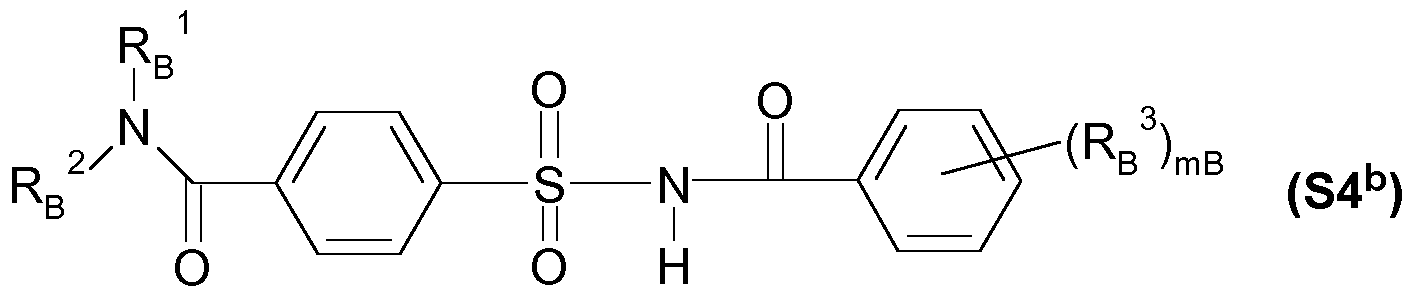
RB1, RB2 unabhängig voneinander Wasserstoff, (Ci-C6)Alkyl, (C3-C6)Cycloalkyl, (C3-C6)Alkenyl, RB 1 , RB 2 independently of one another are hydrogen, (C 1 -C 6) alkyl, (C 3 -C 6) cycloalkyl, (C 3 -C 6) alkenyl,
(C3-C6)Alkinyl, (C 3 -C 6 ) alkynyl,
RB3 Halogen, (Ci-C4)Alkyl, (Ci-C4)Haloalkyl oder (Ci-C4)Alkoxy und niB 1 oder 2 bedeuten, z.B. solche worin RB 3 is halogen, (C 1 -C 4 ) alkyl, (C 1 -C 4 ) haloalkyl or (C 1 -C 4 ) alkoxy and niB is 1 or 2, for example those in which
RB1 = Cyclopropyl, RB 2 = Wasserstoff und (RB3) = 2-OMe ist ("Cyprosulfamide", S4-1), RB 1 = cyclopropyl, R B 2 = hydrogen and (RB 3 ) = 2-OMe ("Cyprosulfamide", S4-1),
RB1 = Cyclopropyl, RB 2 = Wasserstoff und (RB3) = 5-Cl-2-OMe ist (S4-2), RB 1 = cyclopropyl, R B 2 = hydrogen and (RB 3 ) = 5-Cl-2-OMe (S4-2),
RB1 = Ethyl, RB 2 = Wasserstoff und (RB3) = 2-OMe ist (S4-3), RB 1 = ethyl, R B 2 = hydrogen and (RB 3 ) = 2-OMe (S4-3),
RB1 = Isopropyl, RB 2 = Wasserstoff und (RB3) = 5-Cl-2-OMe ist (S4-4) und RB 1 = isopropyl, R B 2 = hydrogen and (RB 3 ) = 5-Cl-2-OMe is (S4-4) and
RB1 = Isopropyl, RB 2 = Wasserstoff und (RB3) = 2-OMe ist (S4-5); RB 1 = isopropyl, R B 2 = hydrogen and (RB 3 ) = 2-OMe (S4-5);
S4C) Verbindungen aus der Klasse der Benzoylsulfamoylphenylharnstoffe der Formel (S4C), wie sie in der EP-A-365484 beschrieben sind, S4 C ) compounds from the class of the benzoylsulfamoylphenylureas of the formula (S4 C ) as described in EP-A-365484,

Rc1, Rc2 unabhängig voneinander Wasserstoff, (Ci-Cg)Alkyl, (C3-Cg)Cycloalkyl, (C3 Rc 1 , Rc 2 are independently hydrogen, (Ci-Cg) alkyl, (C3-Cg) cycloalkyl, (C3
C6)Alkenyl, (C3-C6)Alkinyl, C 6 ) alkenyl, (C 3 -C 6 ) alkynyl,
Rc3 Halogen, (Ci-C4)Alkyl, (Ci-C4)Alkoxy, CF3 und mc 1 oder 2 bedeuten; beispielsweise R c 3 is halogen, (C 1 -C 4 ) alkyl, (C 1 -C 4 ) alkoxy, CF 3 and mc are 1 or 2; for example
1 - [4-(N-2-Methoxybenzoylsulfamoyl)phenyl] -3 -methylharnstoff, 1 - [4- (N-2-methoxybenzoylsulfamoyl) phenyl] -3-methylurea,
1 - [4-(N-2-Methoxybenzoylsulfamoyl)phenyl] -3 ,3 -dimethylharnstoff, 1 - [4- (N-2-methoxybenzoylsulfamoyl) phenyl] -3,3-dimethylurea,
1 - [4-(N-4,5-Dimethylbenzoylsulfamoyl)phenyl] -3 -methylharnstoff; 1 - [4- (N-4,5-dimethylbenzoylsulfamoyl) phenyl] -3-methylurea;
Verbindungen vom Typ der N-Phenylsulfonylterephthalamide der Formel (S4d) und deren Salze, die z.B. bekannt sind aus CN 101838227, Compounds of the N-phenylsulfonylterephthalamide type of the formula (S4 d ) and salts thereof which are known, for example, from CN 101838227,

RD 4 Halogen, (Ci-C4)Alkyl, (Ci-C4)Alkoxy, CF3; mD 1 oder 2; R D 4 is halogen, (C 1 -C 4 ) alkyl, (C 1 -C 4 ) alkoxy, CF 3; mD 1 or 2;
RD 5 Wasserstoff, (Ci-C6)Alkyl, (C3-C6)Cycloalkyl, (C2-C6)Alkenyl, (C2-C6)Alkinyl, (C5 C6)Cycloalkenyl bedeutet. R D 5 is hydrogen, (C 1 -C 6 ) alkyl, (C 3 -C 6 ) cycloalkyl, (C 2 -C 6 ) alkenyl, (C 2 -C 6 ) alkynyl, (C 5 -C 6 ) cycloalkenyl.
55) Wirkstoffe aus der Klasse der Hydroxyaromaten und der aromatisch-aliphatischen 55) active ingredients from the class of hydroxyaromatic and aromatic-aliphatic
Carbonsäurederivate (S5), z.B. Carboxylic acid derivatives (S5), e.g.
3 ,4,5-Triacetoxybenzoesäureethylester, 3 ,5-Dimethoxy-4-hydroxybenzoesäure, 3,5- Dihydroxybenzoesäure, 4-Hydroxysalicylsäure, 4-Fluorsalicyclsäure, 2-Hydroxyzimtsäure, 2,4- Dichlorzimtsäure, wie sie in der WO-A-2004/084631, WO-A-2005/015994, WO-A-2005/016001 beschrieben sind. 3, 4,5-Triacetoxybenzoic acid ethyl ester, 3,5-dimethoxy-4-hydroxybenzoic acid, 3,5-dihydroxybenzoic acid, 4-hydroxysalicylic acid, 4-fluorosalicyclic acid, 2-hydroxycinnamic acid, 2,4-dichlorocinnamic acid, as described in WO-A- 2004/084631, WO-A-2005/015994, WO-A-2005/016001.
56) Wirkstoffe aus der Klasse der l,2-Dihydrochinoxalin-2-one (S6), z.B. 56) Agents from the class of 1,2-dihydroquinoxaline-2-ones (S6), e.g.
1 -Methyl-3 -(2-thienyl)- 1 ,2-dihydrochinoxalin-2-on, 1 -Methyl-3 -(2-thienyl)- 1 ,2-dihydro- chinoxalin-2-thion, 1 -(2 -Aminoethyl)-3 -(2-thienyl)- 1 ,2-dihydro-chinoxalin-2-on-hydrochlorid, l -(2-Methylsulfonylaminoethyl)-3-(2-thienyl)-l ,2-dihydro-chinoxalin-2-on, wie sie in der WO-A- 2005/1 12630 beschrieben sind. 1-Methyl-3 - (2-thienyl) -1,2-dihydroquinoxaline-2-one, 1-methyl-3 - (2-thienyl) -1,2-dihydroquinoxaline-2-thione, 1- (2 Aminoethyl) -3- (2-thienyl) -1,2-dihydroquinoxaline-2-one hydrochloride, 1- (2-methylsulfonylaminoethyl) -3- (2-thienyl) -1,2-dihydroquinoxaline 2-on, as described in WO-A-2005/12630.
S7) Verbindungen aus der Klasse der Diphenylmethoxyessigsäurederivate (S7), z.B. S7) compounds from the class of diphenylmethoxyacetic acid derivatives (S7), e.g.
Diphenylmethoxyessigsäuremethylester (CAS-Reg.Nr. 41858-19-9) (S7-1), Diphenylmethoxyessigsäureethylester oder Diphenylmethoxyessigsäure wie sie in der WO-A- 98/38856 beschrieben sind. Methyl diphenylmethoxyacetate (CAS No. 41858-19-9) (S7-1), Diphenylmethoxyessigsäureethylester or Diphenylmethoxyessigsäure as described in WO-A-98/38856.
S8) Verbindungen der Formel (S8),wie sie in der WO-A-98/27049 beschrieben sind, S8) compounds of the formula (S8) as described in WO-A-98/27049,
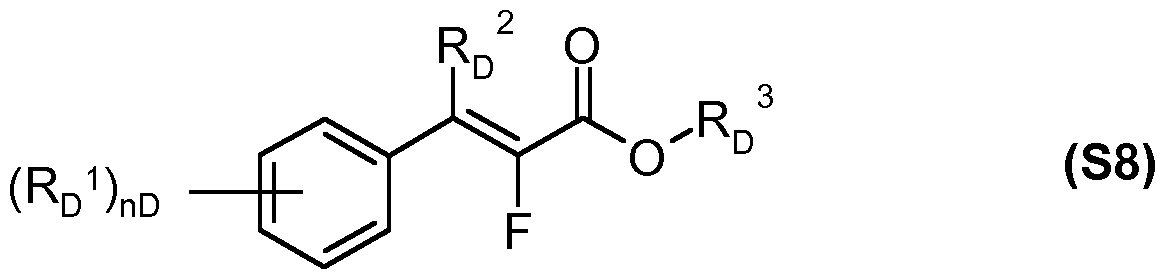
worin die Symbole und Indizes folgende Bedeutungen haben: wherein the symbols and indices have the following meanings:
RD1 ist Halogen, (Ci-C4)Alkyl, (Ci-C4)Haloalkyl, (Ci-C4)Alkoxy, (Ci-C4)Haloalkoxy, RD 2 ist Wasserstoff oder (Ci-C4)Alkyl, RD 1 is halogen, (C 1 -C 4 ) alkyl, (C 1 -C 4 ) haloalkyl, (C 1 -C 4 ) alkoxy, (C 1 -C 4 ) haloalkoxy, R D 2 is hydrogen or (C 1 -C 4 ) alkyl .
RD3 ist Wasserstoff, (Ci-Cg)Alkyl, (C2-C4)Alkenyl, (C2-C4)Alkinyl, oder Aryl, wobei jeder der RD 3 is hydrogen, (Ci-Cg) alkyl, (C 2 -C 4 ) alkenyl, (C 2 -C 4 ) alkynyl, or aryl, wherein each of the
vorgenannten C-haltigen Reste unsubstituiert oder durch einen oder mehrere, vorzugsweise bis zu drei gleiche oder verschiedene Reste aus der Gruppe, bestehend aus Halogen und Alkoxy substituiert ist; oder deren Salze, nD ist eine ganze Zahl von 0 bis 2. said C-containing radicals unsubstituted or substituted by one or more, preferably up to three identical or different radicals selected from the group consisting of halogen and alkoxy; or their salts, nD is an integer from 0 to 2.
S9) Wirkstoffe aus der Klasse der 3-(5-Tetrazolylcarbonyl)-2-chinolone (S9), z.B. S9) Agents from the class of 3- (5-tetrazolylcarbonyl) -2-quinolones (S9), e.g.
1 ,2-Dihydro-4-hydroxy- 1 -ethyl-3-(5-tetrazolylcarbonyl)-2-chinolon (CAS-Reg.Nr. : 219479- 18-2), l,2-Dihydro-4-hydroxy-l-methyl-3-(5-tetrazolyl-carbonyl)-2-chinolon (CAS-Reg.Nr. 95855-00- 8), wie sie in der WO-A- 1999/000020 beschrieben sind. 1, 2-dihydro-4-hydroxy-1-ethyl-3- (5-tetrazolylcarbonyl) -2-quinolone (CAS Reg. No. 219479-18-2), 1,2-dihydro-4-hydroxy 1-methyl-3- (5-tetrazolyl-carbonyl) -2-quinolone (CAS No. 95855-00-8) as described in WO-A-1999/000020.
S 10) Verbindungen der Formeln (S 10a) oder (S 10b), wie sie in der WO-A-2007/023719 und WO-A-2007/023764 beschrieben sind, S 10) compounds of the formulas (S 10 a ) or (S 10 b ), as described in WO-A-2007/023719 and WO-A-2007/023764,

(S10a) (S10 a)
Halogen, (Ci-C4)Alkyl, Methoxy, Nitro, Cyano, CF3, OCF3 YE, ZE unabhängig voneinander O oder S, ηε eine ganze Zahl von 0 bis 4, Halogen, (C 1 -C 4 ) alkyl, methoxy, nitro, cyano, CF 3 , OCF 3 YE, ZE independently of one another are O or S, ηε is an integer from 0 to 4,
RE2 (Ci-Ci6)Alkyl, (C2-C6)Alkenyl, (C3-C6)Cycloalkyl, Aryl; Benzyl, Halogenbenzyl, RE3 Wasserstoff oder (Ci-C6)Alkyl bedeuten. RE 2 (C 1 -C 6 ) alkyl, (C 2 -C 6 ) alkenyl, (C 3 -C 6 ) cycloalkyl, aryl; Benzyl, halobenzyl, RE 3 is hydrogen or (Ci-C6) alkyl.
51 1) Wirkstoffe vom Typ der Oxyimino- Verbindungen (Si l), die als Saatbeizmittel bekannt sind, wie z. B. 51 1) Active ingredients of the type of oxyimino compounds (Si l), which are known as seed dressing, such. B.
"Oxabetrinil" ((Z)-l ,3-Dioxolan-2-ylmethoxyimino(phenyl)acetonitril) (S l l -1), das als Saatbeiz- Safener für Hirse gegen Schäden von Metolachlor bekannt ist, "Oxabetrinil" ((Z) -l, 3-dioxolan-2-ylmethoxyimino (phenyl) acetonitrile) (S l l -1), which is known as a seed safener for millet against damage by metolachlor,
"Fluxofenim" (1 -(4-Chlorphenyl)-2,2,2-trifluor-l -ethanon-0-(l ,3-dioxolan-2-ylmethyl)-oxim) (Sl 1 -2), das als Saatbeiz-Safener für Hirse gegen Schäden von Metolachlor bekannt ist, und "Fluxofenim" (1- (4-chlorophenyl) -2,2,2-trifluoro-1-ethanone-O- (1,3-dioxolan-2-ylmethyl) -oxime) (Sl 1 -2), which was used as seed dressing -Safener for millet is known against damage from metolachlor, and
"Cyometrinü" oder "CGA-43089" ((Z)-Cyanomethoxyimino(phenyl)acetonitril) (S i l -3), das als Saatbeiz-Safener für Hirse gegen Schäden von Metolachlor bekannt ist. "Cyometrine" or "CGA-43089" ((Z) -cyanomethoxyimino (phenyl) acetonitrile) (S1-l3), which is known as a seed dressing safener for millet against damage by metolachlor.
512) Wirkstoffe aus der Klasse der Isothiochromanone (S12), wie z.B. Methyl- [(3 -oxo-lH-2- benzothiopyran-4(3H)-yliden)methoxy]acetat (CAS-Reg.Nr. 205121-04-6) (S12-1) und verwandte Verbindungen aus WO-A-1998/13361. 512) Isothiochromanone (S12) class agents, e.g. Methyl- [(3-oxo-1H-2-benzothiopyran-4 (3H) -ylidene) methoxy] acetate (CAS Reg. No. 205121-04-6) (S12-1) and related compounds of WO-A- 1998/13361.
513) Eine oder mehrere Verbindungen aus Gruppe (S13): 513) One or more compounds from group (S13):
"Naphthalic anhydrid" (1 ,8-Naphthalindicarbonsäureanhydrid) (S13-1), das als Saatbeiz-Safener für Mais gegen Schäden von Thiocarbamatherbiziden bekannt ist, "Naphthalene anhydride" (1,8-naphthalenedicarboxylic anhydride) (S13-1), which is known as a seed safener for corn against damage by thiocarbamate herbicides.
"Fenclorim" (4,6-Dichlor-2-phenylpyrimidin) (S 13-2), das als Safener für Pretilachlor in gesätem Reis bekannt ist, "Fenclorim" (4,6-dichloro-2-phenylpyrimidine) (S 13-2), known as safener for pretilachlor in sown rice,
"Flurazole" (Benzyl-2-chlor-4-trifluormethyl-l ,3-thiazol-5-carboxylat) (S13-3), das als Saatbeiz- Safener für Hirse gegen Schäden von Alachlor und Metolachlor bekannt ist, "Flurazole" (benzyl-2-chloro-4-trifluoromethyl-1,3-thiazole-5-carboxylate) (S13-3), which is known as a seeder seed safener for millet against damage by alachlor and metolachlor,
"CL 304415" (CAS-Reg.Nr. 31541-57-8) "CL 304415" (CAS No. 31541-57-8)
(4-Carboxy-3,4-dihydro-2H-l -benzopyran-4-essigsäure) (S 13-4) der Firma American Cyanamid, das als Safener für Mais gegen Schäden von Imidazolinonen bekannt ist, (4-carboxy-3,4-dihydro-2H-1-benzopyran-4-acetic acid) (S 13-4) from American Cyanamid, which is known as a safener for corn against damage of imidazolinones,
"MG 191 " (CAS-Reg.Nr. 96420-72-3) (2-Dichlormethyl-2-methyl-l ,3-dioxolan) (S13-5) der Firma Nitrokemia, das als Safener für Mais bekannt ist, "MG 191" (CAS Reg. No. 96420-72-3) (2-dichloromethyl-2-methyl-1,3-dioxolane) (S13-5) from Nitrokemia, which is known as safener for corn,
"MG 838" (CAS-Reg.Nr. 133993-74-5) "MG 838" (CAS Reg. No. 133993-74-5)
(2-propenyl l -oxa-4-azaspiro[4.5]decan-4-carbodithioat) (S13-6) der Firma Nitrokemia "Disulfoton" (Ο,Ο-Diethyl S-2-ethylthioethyl phosphordithioat) (S13-7), "Dietholate" (0,0-Diethyl-O-phenylphosphorothioat) (S 13-8), "Mephenate" (4-Chlorphenyl-methylcarbamat) (S 13-9). (2-propenyl 1 -oxa-4-azaspiro [4.5] decane-4-carbodithioate) (S13-6) from Nitrokemia "Disulfonone" (Ο, Ο-diethyl S-2-ethylthioethyl phosphorodithioate) (S13-7), "dietholate" (0,0-diethyl-O-phenyl phosphorothioate) (S 13-8), "mephenate" (4-chlorophenyl methyl carbamate) (S 13-9).
S14) Wirkstoffe, die neben einer herbiziden Wirkung gegen Schadpflanzen auch Safenerwirkung an Kulturpflanzen wie Reis aufweisen, wie z. B. S14) active substances, in addition to a herbicidal activity against harmful plants and safener action on crop plants such as rice, such as. B.
"Dimepiperate" oder "MY-93" (S-\ -Methyl- 1 -phenylethyl-piperidin-l -carbothioat), das als Safener für Reis gegen Schäden des Herbizids Molinate bekannt ist, "Dimepiperate" or "MY-93" (S-methyl-1-phenylethyl-piperidine-1-carbothioate) known as a safener for rice against damage by the herbicide Molinate,
"Daimuron" oder "SK 23" (l-(l -Methyl-l -phenylethyl)-3-p-tolyl-harnstoff), das als Safener für Reis gegen Schäden des Herbizids Imazosulfuron bekannt ist, "Daimuron" or "SK 23" (1- (1-methyl-1-phenylethyl) -3-p-tolyl-urea) known as a safener for rice against damage by the herbicide imazosulfuron,
"Cumyluron" = "JC-940" (3-(2-Chlorphenylmethyl)-l -(l -methyl-l -phenyl-ethyl)harnstoff, siehe JP-A-60087254), das als Safener für Reis gegen Schäden einiger Herbizide bekannt ist, "Cumyluron" = "JC-940" (3- (2-chlorophenylmethyl) -1- (1-methyl-1-phenyl-ethyl) urea, see JP-A-60087254) used as safener for rice against damage of some herbicides is known
"Methoxyphenon" oder "NK 049" (3,3'-Dimethyl-4-methoxy-benzophenon), das als Safener für Reis gegen Schäden einiger Herbizide bekannt ist, "Methoxyphenone" or "NK 049" (3,3'-dimethyl-4-methoxy-benzophenone), which is known as safener for rice against damage of some herbicides,
"CSB" (l -Brom-4-(chlormethylsulfonyl)benzol) von Kumiai, (CAS-Reg.Nr. 54091 -06-4), das als Safener gegen Schäden einiger Herbizide in Reis bekannt ist. "CSB" (1-Bromo-4- (chloromethylsulfonyl) benzene) from Kumiai, (CAS Registry No. 54091-06-4), which is known as a safener against damage of some herbicides in rice.
S15) Verbindungen der Formel (S15) oder deren Tautomere, S15) compounds of the formula (S15) or their tautomers,
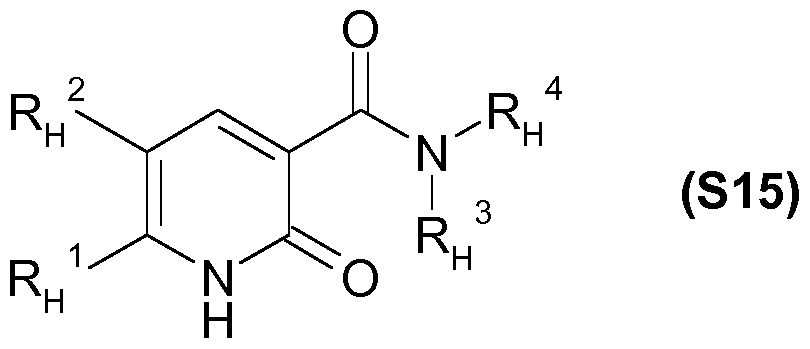
wie sie in der WO-A-2008/131861 und WO-A-2008/131860 beschrieben sind, worin as described in WO-A-2008/131861 and WO-A-2008/131860, in which
RH1 einen (Ci-C6)Haloalkylrest bedeutet und RH2 Wasserstoff oder Halogen bedeutet und RH 1 is a (Ci-C6) haloalkyl radical and RH 2 is hydrogen or halogen and
RH3, RH4 unabhängig voneinander Wasserstoff, (Ci-Ci6)Alkyl, (C2-Ci6)Alkenyl oder (C2-Ci6)Alkinyl, wobei jeder der letztgenannten 3 Reste unsubstituiert oder durch einen oder mehrere Reste aus der Gruppe Halogen, Hydroxy, Cyano, (Ci-C i)Alkoxy, (Ci-C i)Haloalkoxy, (Ci-C4)Alkylthio, (Ci-C4)Alkylamino, Di[(Ci-C4)alkyl]-amino, [(Ci-C4)Alkoxy]-carbonyl, [(Ci-C4)Haloalkoxy]-carbonyl, (C3-C6)Cycloalkyl, das unsubstituiert oder substituiert ist, Phenyl, das unsubstituiert oder substituiert ist, und Heterocyclyl, das unsubstituiert oder substituiert ist, substituiert ist, oder (C3-C6)Cycloalkyl, (C4-C6)Cycloalkenyl, (C3-C6)Cycloalkyl, das an einer Seite des Rings mit einem 4 bis 6-gliedrigen gesättigten oder ungesättigten carbocyclischen Ring kondensiert ist, oder (C4-C6)Cycloalkenyl, das an einer Seite des Rings mit einem 4 bis 6-gliedrigen gesättigten oder ungesättigten carbocyclischen Ring kondensiert ist, wobei jeder der letztgenannten 4 Reste unsubstituiert oder durch einen oder mehrere Reste aus der Gruppe Halogen, Hydroxy, Cyano, (Ci-C4)Alkyl, (Ci-C4)Haloalkyl, (Ci-C4)Alkoxy, (Ci-C4)Haloalkoxy, (Ci-C4)Alkylthio, (Ci-C4)Alkylamino, Di[(Ci- C4)alkyl] -amino, [(C i-C4)Alkoxy] -carbonyl, [(C i-C4)Haloalkoxy] -carbonyl,R 3 , R 4 independently of one another denote hydrogen, (C 1 -C 16) alkyl, (C 2 -C 6) alkenyl or (C 2 -C 6) alkynyl, where each of the last-mentioned 3 radicals is unsubstituted or substituted by one Hydroxy, cyano, (Ci-C i) alkoxy, (Ci-C i) haloalkoxy, (C 1 -C 4 ) alkylthio, (C 1 -C 4 ) alkylamino, di [(C 1 -C 4 ) alkyl] amino, [(C 1 -C 4 ) alkoxy] carbonyl, [(C 1 -C 4 ) haloalkoxy] -carbonyl, (C3-C6) cycloalkyl which is unsubstituted or substituted, is phenyl which is unsubstituted or substituted, and heterocyclyl which is unsubstituted or substituted substituted, or (C3-C6) cycloalkyl, (C 4 -C 6) Cycloalkenyl, (C 3 -C 6) cycloalkyl fused on one side of the ring with a 4 to 6 membered saturated or unsaturated carbocyclic ring, or (C 4 -C 6) cycloalkenyl attached to one side of the ring of 4 to 6 fused saturated or unsaturated carbocyclic ring, each of the last-mentioned 4 unsubstituted or by one or more radicals selected from the group halogen, hydroxy, cyano, (Ci-C 4 ) alkyl, (Ci-C 4 ) haloalkyl, (Ci -C 4) alkoxy, (Ci-C 4) haloalkoxy, (Ci-C 4) alkylthio, (Ci-C 4) alkylamino, di [(Ci- C4) alkyl] -amino, [(C iC 4) alkoxy ] carbonyl, [(C iC 4 ) haloalkoxy] -carbony l,
(C3-C6)Cycloalkyl, das unsubstituiert oder substituiert ist, Phenyl, das unsubstituiert oder substituiert ist, und Heterocyclyl, das unsubstituiert oder substituiert ist, substituiert ist, bedeutet oder (C 3 -C 6) cycloalkyl which is unsubstituted or substituted, phenyl which is unsubstituted or substituted, and heterocyclyl which is unsubstituted or substituted, or denotes
RH3 (Ci-C4)-Alkoxy, (C2-C4)Alkenyloxy, (C2-C6)Alkinyloxy oder (C2-C4)Haloalkoxy bedeutet und RH4 Wasserstoff oder (Ci-C4)-Alkyl bedeutet oder RH 3 is (C 1 -C 4 ) -alkoxy, (C 2 -C 4 ) -alkenyloxy, (C 2 -C 6) -alkinyloxy or (C 2 -C 4 ) -haloalkoxy and RH 4 is hydrogen or (C 1 -C 4 ) -alkyl or
RH3 und RH4 zusammen mit dem direkt gebundenen N-Atom einen vier- bis achtgliedrigen heterocyclischen Ring, der neben dem N-Atom auch weitere Heteroringatome, vorzugsweise bis zu zwei weitere Heteroringatome aus der Gruppe N, O und S enthalten kann und der unsubstituiert oder durch einen oder mehrere Reste aus der Gruppe Halogen, Cyano, Nitro, (Ci-C4)Alkyl, (Ci-C4)Haloalkyl, (Ci-C4)Alkoxy, (Ci-C4)Haloalkoxy und (Ci-C4)Alkylthio substituiert ist, bedeutet. RH 3 and RH 4 together with the directly attached N atom form a four- to eight-membered heterocyclic ring which, in addition to the N atom, may also contain further hetero ring atoms, preferably up to two further hetero ring atoms from the group consisting of N, O and S, and which may be unsubstituted or by one or more radicals from the group halogen, cyano, nitro, (Ci-C 4) alkyl, (Ci-C 4) haloalkyl, (Ci-C 4) alkoxy, (Ci-C 4) haloalkoxy and (Ci- C 4 ) alkylthio is substituted, means.
S 16) Wirkstoffe, die vorrangig als Herbizide eingesetzt werden, jedoch auch Safenerwirkung auf S 16) active substances, which are used primarily as herbicides, but also safeners on
Kulturpflanzen aufweisen, z. B. Have crops, z. B.
(2,4-Dichlorphenoxy)essigsäure (2,4-D), (2,4-dichlorophenoxy) acetic acid (2,4-D),
(4-Chlorphenoxy)essigsäure, (4-chlorophenoxy) acetic acid,
(R, S)-2-(4-Chlor-o-tolyloxy)propionsäure (Mecoprop), (R, S) -2- (4-chloro-o-tolyloxy) propionic acid (mecoprop),
4-(2,4-Dichlorphenoxy)buttersäure (2,4-DB), 4- (2,4-dichlorophenoxy) butyric acid (2,4-DB),
(4-Chlor-o-tolyloxy)essigsäure (MCPA), (4-chloro-o-tolyloxy) acetic acid (MCPA),
4-(4-Chlor-o-tolyloxy)buttersäure, 4- (4-chloro-o-tolyloxy) butyric acid,
4-(4-Chlorphenoxy)buttersäure, 3 ,6-Dichlor-2-methoxybenzoesäure (Dicamba), 4- (4-chlorophenoxy) butyric acid, 3, 6-dichloro-2-methoxybenzoic acid (Dicamba),
l-(Ethoxycarbonyl)ethyl-3,6-dichlor-2-methoxybenzoat (Lactidichlor-ethyl). 1- (ethoxycarbonyl) ethyl 3,6-dichloro-2-methoxybenzoate (lactidichloroethyl).
Bevorzugte Safener im Sinne der vorliegenden Erfmdungs sind Safener auf Basis der Ester von Cloquintocet (bevorzugt Mexyl-ester) und/oder Mefenpyr (bevorzugt als diethyl-ester), besonders bevorzugt Mefenpyr-Diethylester.. Preferred safeners for the purposes of the present invention are safeners based on the esters of cloquintocet (preferably mexyl ester) and / or mefenpyr (preferably as diethyl ester), particularly preferably mefenpyr diethyl ester.
Als Verdicker f) kommen bevorzugt organische Verdicker in Frage, wobei diese natürliche oder, biotechnologisch modifizierte oder organisch synthetische Verdicker sein können. Preferred thickeners f) are organic thickeners, which may be natural or biotechnologically modified or organically synthetic thickeners.
Typische synthetische Verdicker sind Rheostrux® (Croda), Thixin®- oder Thixatrol®-Reihe (Elementis). Diese sind typischerweise auf Basis von Acrylaten. Typische organische Verdicker sind auf Basis von Xanthan oder Cellulose (wie etwa Hydroxyethyl oder Carboxymethylcellulose) oder einer Kombination davon. Bevorzugt werden natürliche modifzierte Verdicker auf Basis von Xanthan verwendet. Typische Vertreter sind beispielsweise Rhodopol® (Solvay) und Kelzan® (Kelco Corp.) sowie Satiaxane® (Cargill). Typical synthetic thickeners are Rheostrux® (Croda), Thixin® or Thixatrol® series (Elementis). These are typically based on acrylates. Typical organic thickeners are based on xanthan or cellulose (such as hydroxyethyl or carboxymethylcellulose) or a combination thereof. Preference is given to using natural modified thickeners based on xanthan. Typical representatives are for example Rhodopol® (Solvay) and Kelzan® (Kelco Corp.) as well as Satiaxane® (Cargill).
Weitere Zusatz- und Hilfsstoffe g) sind Netzmittel, pH- Wert-Einstellungsmittel, Entschäumer, Biozide, Desintegrationsmittel, Haftvermittler, Frostschutzmittel, Konservierungsmittel, Farbstoffe oder Dünger, sowie von Komponente b) verschiedene Tenside und von c) verschiedene Füllstoffe, bevorzugt werden Frostschutzmittel, Entschäumer und Biozide zugesetzt. Further additives and auxiliaries g) are wetting agents, pH adjusters, defoamers, biocides, disintegrants, adhesion promoters, antifreeze agents, preservatives, dyes or fertilizers, as well as component b) various surfactants and c) various fillers, antifreeze agents are preferred, Defoamers and biocides added.
Geeignete Entschäumer sind oberflächenaktive Verbindungen auf Silikon- bzw. Silanbasis wie die Tegopren®-Produkte (Goldschmidt), die SE®-Produkte (Wacker), sowie die Bevaloid®- (Kemira), Rhodorsil®- (Solvay) und Silcolapse®-Produkte (Blustar Silicones) bevorzugt sind SE®- (Wacker), Rhodorsil®-und Silcolapse®-Produkte, besonders bevorzugt sind z.B. Produkte wie Silcolapse® 5020. Suitable defoamers are silicone-based or silane-based surface-active compounds such as the Tegopren® products (Goldschmidt), the SE® products (Wacker), as well as the Bevaloid® (Kemira), Rhodorsil® (Solvay) and Silcolapse® products (Blustar Silicones) preferred are SE® (Wacker), Rhodorsil® and Silcolapse® products, particularly preferred are, for example Products like Silcolapse® 5020.
Geeignete Frostschutzmittel sind solche aus der Gruppe der Harnstoffe, Diole und Polyole, wie Ethylenglycol und Propylenglycol, Glycerin bevorzugt Propylenglycol oder Glycerin. Geeignete Biozide sind z.B. Produkte wie Acticide® MBS (Biozid, Thor Chemie), CIT, MIT oder BIT wie etwa Proxel® GXL (BIT), Acticide® SPX (MIT, CIT). Suitable antifreeze agents are those from the group of ureas, diols and polyols, such as ethylene glycol and propylene glycol, glycerol, preferably propylene glycol or glycerol. Suitable biocides are e.g. Products such as Acticide® MBS (Biocide, Thor Chemie), CIT, MIT or BIT such as Proxel® GXL (BIT), Acticide® SPX (MIT, CIT).
Geeignete Haftvermittler können ausgewählt werden aus der Gruppe Polyvinylpyrrolidon (PVP), Polyvinylalkohol, Co-Polymer aus PVP und Dimethylaminoethylmethacrylat, butyliertes PVP, Co- Polymer aus Vinylchlorid und Vinylacetat, Na-Salz des Co-Polymers aus Propensultansäure und partiell hydrolysiertem Vinylacetat, Natriumcaseinat, Phenolharze, modifizierte CelluloseTypen wie beispielsweise Luviskol® (Polyvinylpyrrolidon), Mowiol® (Polyvinylalkohol), modifizierte Cellulose Bevorzugt sind Polyvinylpyrrolidon-Typen, besonders bevorzugt sind Typen von niedrigem Molekulargewicht wie Luviskol® K30. Suitable adhesion promoters can be selected from the group consisting of polyvinylpyrrolidone (PVP), polyvinyl alcohol, co-polymer of PVP and dimethylaminoethyl methacrylate, butylated PVP, co-polymer of vinyl chloride and vinyl acetate, Na salt of the co-polymer of propensulanic acid and partially hydrolyzed vinyl acetate, sodium caseinate, Phenolic resins, modified cellulose types such as Luviskol® (polyvinylpyrrolidone), Mowiol® (polyvinyl alcohol), modified cellulose Preferred are polyvinylpyrrolidone types, particularly preferred are low molecular weight types such as Luviskol® K30.
Geeignete Desintegrationsmittel können ausgewählt werden aus der Gruppe der modifizierten Kohlenhydrate, wie mikrokristalline Cellulose und quervernetzten Polyvinylpyrrolidone, wie beispielsweise Avicel® PH 101 (mikrokristalline Cellulose), Agrimer® XLF (quervemetztes Polyvinylpyrrolidon), Disintex® 200 (quervemetztes Polyvinylpyrrolidon). Bevorzugt sind quervernetzte Polyvinylpyrrolidone, wie Agrimer® XLF. Suitable disintegrating agents can be selected from the group of modified carbohydrates such as microcrystalline cellulose and crosslinked polyvinylpyrrolidones such as Avicel® PH 101 (microcrystalline cellulose), Agrimer® XLF (crosslinked polyvinylpyrrolidone), Disintex® 200 (crosslinked polyvinylpyrrolidone). Preference is given to cross-linked polyvinylpyrrolidones, such as Agrimer® XLF.
Geeignete Antischaum-Mittel können ausgewählt werden aus der Gruppe der Ester der Phosphorsäure mit niederen Alkoholen, C6-C10 Alkohole, Silicontenside (Suspoemulsionen von hydrophobisierten Kieselsäurepartikeln in wässrigen Emulsionskonzentraten auf der Basis flüssiger Silicontenside), wie Polydimethylsiloxan, sowie deren Absorbate an festes Trägermaterial wie beispielsweise Rhodorsil® 432 (Silicontensid), Butylphosphat, iso-Butylphosphat, n-Octanol, Wacker ASP 15 (Polydimethylsiloxan, an festem Träger absorbiert), Antischaum-Mittel® SE (Polydimethylsiloxan). Bevorzugt sind Suspoemulsionen von hydrophobisierten Kieselsäurepartikeln in wässrigen Emulsionskonzentraten auf der Basis flüssiger Silicontenside, wie Antischaum-Mittel® SE (Polydimethylsiloxan), und feste Antischaum- Mittel, wie Wacker ASP 15 (Polydimethylsiloxan). Suitable antifoam agents can be selected from the group of esters of phosphoric acid with lower alcohols, C6-C10 alcohols, silicone surfactants (suspoemulsions of hydrophobicized silica particles in aqueous emulsion concentrates based on liquid silicone surfactants), such as polydimethylsiloxane, and their absorbents on solid support material such as Rhodorsil® 432 (silicone surfactant), butyl phosphate, isobutyl phosphate, n-octanol, Wacker ASP 15 (polydimethylsiloxane, absorbed on solid support), antifoam agent® SE (polydimethylsiloxane). Preference is given to suspoemulsions of hydrophobized silica particles in aqueous emulsion concentrates based on liquid silicone surfactants, such as antifoam agent SE (polydimethylsiloxane), and solid antifoaming agents, such as Wacker ASP 15 (polydimethylsiloxane).
Die Erfindung betrifft weiterhin ein herbizides Mittel, welches aus den erfindungsgemäßen SC's durch Verdünnen mit Flüssigkeiten, bevorzugt Wasser, hergestellt werden kann. The invention further relates to a herbicidal composition which can be prepared from the SCs according to the invention by dilution with liquids, preferably water.
Es kann vorteilhaft sein, den so erhaltenen herbiziden Mitteln weitere Wirkstoffe, bevorzugt agrochemische Wirkstoffe (z.B. als Tankmischpartner in Form entsprechender Formulierungen) und/oder zur Anwendung übliche Hilfs- und Zusatzstoffe, z.B. selbstemulgierende Öle wie Pflanzenöle oder Paraffinöle und/oder Düngemittel zuzugeben. Gegenstand der vorliegenden Erfindung sind daher auch solche Mittel, bevorzugt herbizide, auf Basis der erfindungsgemäßen Formulierungen. It may be advantageous to provide the herbicidal compositions thus obtained with further active ingredients, preferably agrochemical active compounds (for example as tank mix partners in the form of corresponding formulations) and / or customary auxiliaries and additives, e.g. self-emulsifying oils such as vegetable oils or paraffin oils and / or fertilizers. The present invention therefore also relates to such agents, preferably herbicides, based on the formulations according to the invention.
Eine besondere Ausführungsform der Erfindung betrifft die Verwendung der aus den erfindungsgemäßen SC's erhältlichen herbiziden Mittel zur Bekämpfung von unerwünschtem Pflanzenwuchs, im Folgenden als "herbizides Mittel" bezeichnet. A particular embodiment of the invention relates to the use of the herbicidal compositions obtainable from the SCs according to the invention for controlling undesired plant growth, hereinafter referred to as "herbicidal agent".
Die herbiziden Mittel weisen eine ausgezeichnete herbizide Wirksamkeit gegen ein breites Spektrum wirtschaftlich wichtiger mono- und dikotyler Schadpflanzen auf. Auch schwer bekämpfbare perennierende Unkräuter, die aus Rhizomen, Wurzelstöcken oder anderen Dauerorganen austreiben, werden gut erfasst. Dabei können die herbiziden Mittel z.B. im Vorsaat-, Vorauflauf- oder Nachauftaufverfahren ausgebracht werden. Im einzelnen seien beispielhaft einige Vertreter der mono- und dikotylen Unkrautflora genannt, die durch die herbiziden Mittel kontrolliert werden können, ohne dass durch die Nennung eine Beschränkung auf bestimmte Arten erfolgen soll. Auf der Seite der monokotylen Unkrautarten werden z.B. Apera spica venti, Avena spp., Alopecurus spp., Brachiaria spp., Digitaria spp., Lolium spp., Echinochloa spp.,Panicum spp., Phalaris spp., Poa spp., Setaria spp. sowie Bromus spp. wie Bromus catharticus, Bromus secalinus, Bromus erectus, Bromus tectorum und Bromus japonicus und Cyperusarten aus der annuellen Gruppe und auf Seiten der perennierenden Spezies Agropyron, Cynodon, lmperata sowie Sorghum und auch ausdauernde Cyperusarten gut erfaßt. Bei dikotylen Unkrautarten erstreckt sich das Wirkungsspektrum auf Arten wie z.B. Abutilon spp., Amaranthus spp., Chenopodium spp., Chrysanthemum spp., Galium spp. wie Galium aparine, lpomoea spp., Kochia spp., Lamium spp., Matricaria spp., Pharbitis spp., Polygonum spp., Sida spp., Sinapis spp., Solanum spp., Stellaria spp., Veronica spp. und Viola spp., Xanthium spp., auf der annuellen Seite sowie Convolvulus, Cirsium, Rumex und Artemisia bei den perennierenden Unkräutern. The herbicidal compositions have an excellent herbicidal activity against a broad spectrum of economically important monocotyledonous and dicotyledonous harmful plants. Even hard-to-control perennial weeds that sprout from rhizomes, rhizomes or other permanent organs are well recorded. The herbicidal agents can be applied, for example, in the pre-seed, pre-emergence or post-emergence method. Specifically, by way of example, some representatives of the monocotyledonous and dicotyledonous weed flora can be mentioned, which can be controlled by the herbicidal agents, without it being intended to restrict them to certain species. On the monocotyledonous weed side, for example, Apera spica venti, Avena spp., Alopecurus spp., Brachiaria spp., Digitaria spp., Lolium spp., Echinochloa spp., Panicum spp., Phalaris spp., Poa spp., Setaria spp , and Bromus spp. such as Bromus catharticus, Bromus secalinus, Bromus erectus, Bromus tectorum and Bromus japonicus and Cyperus species from the annuelle group and on the part of the perennial species Agropyron, Cynodon, lmperata and Sorghum and also perennial Cyperusarten well. For dicotyledonous weed species, the spectrum of activity extends to species such as, for example, Abutilon spp., Amaranthus spp., Chenopodium spp., Chrysanthemum spp., Galium spp. Galium aparine, lpomoea spp., Kochia spp., Lamium spp., Matricaria spp., Pharitis spp., Polygonum spp., Sida spp., Sinapis spp., Solanum spp., Stellaria spp., Veronica spp. and Viola spp., Xanthium spp., on the annual side, as well as Convolvulus, Cirsium, Rumex, and Artemisia in perennial weeds.
Unter den spezifischen Kulturbedingungen im Reis vorkommende Schadpflanzen wie z.B. Echinochloa, Sagittaria, Alisma, Eleocharis, Scirpus und Cyperus werden von den herbiziden Mitteln ebenfalls hervorragend bekämpft. Werden die herbiziden Mittel vor dem Keimen auf die Erdoberfläche appliziert, so wird entweder das Auflaufen der Unkrautkeimlinge vollständig verhindert oder die Unkräuter wachsen bis zum Keimblattstadium heran, stellen jedoch dann ihr Wachstum ein und sterben schließlich nach Ablauf von drei bis vier Wochen vollkommen ab. Under the specific culture conditions occurring in rice harmful plants such. Echinochloa, Sagittaria, Alisma, Eleocharis, Scirpus and Cyperus are also excellently controlled by the herbicidal agents. When the herbicidal agents are applied to the surface of the earth prior to germination, either weed seedling emergence is completely prevented or the weeds grow to the cotyledon stage, but then cease to grow and finally die completely after three to four weeks.
Bei Applikation der herbiziden Mittel auf die grünen Pflanzenteile im Nachauflaufverfahren tritt ebenfalls sehr rasch nach der Behandlung ein drastischer Wachstumsstop ein und die Unkrautpflanzen bleiben in dem zum Applikationszeitpunkt vorhandenen Wachstumsstadium stehen oder sterben nach einer gewissen Zeit ganz ab, so dass auf diese Weise eine für die Kulturpflanzen schädliche Unkrautkonkurrenz sehr früh und nachhaltig beseitigt wird. Upon application of the herbicidal agents to the green parts of the plants postemergence also occurs very quickly after treatment, a drastic halt in growth and the weed plants remain in the existing stage of application growth stage or die after a certain time completely off, so that in this way one for the Crops harmful weed competition is eliminated very early and sustainably.
Die herbiziden Mittel zeichnen sich durch eine schnell einsetzende und lang andauernde herbizide Wirkung aus. Die Regenfestigkeit der Wirkstoffe in den herbiziden Mitteln ist in der Regel günstig. Als besonderer Vorteil fällt ins Gewicht, dass die in den herbiziden Mittel verwendeten und wirksamen Dosierungen von herbiziden Verbindungen so gering eingestellt werden können, dass ihre Bodenwirkung optimal niedrig ist. Somit wird deren Einsatz nicht nur in empfindlichen Kulturen erst möglich, sondern Grundwasser-Kontaminationen werden praktisch vermieden. Durch die erfindungsgemäße Kombination von Wirkstoffen wird eine erhebliche Reduzierung der nötigen Aufwandmenge der Wirkstoffe ermöglicht. The herbicidal compositions are characterized by a rapidly onset and long-lasting herbicidal activity. The rainfastness of the active ingredients in the herbicidal compositions is generally favorable. A particular advantage is the fact that the effective and used in the herbicidal compositions dosages of herbicidal compounds can be set so low that their soil effect is optimally low. Thus, their use is not only possible in sensitive cultures, but groundwater contamination is virtually avoided. The combination of active substances according to the invention enables a considerable reduction in the required application rate of the active substances.
Die genannten Eigenschaften und Vorteile sind in der praktischen Unkrautbekämpfung von Nutzen, um landwirtschaftliche Kulturen von unerwünschten Konkurrenzpflanzen freizuhalten und damit die Erträge qualitativ und quantitativ zu sichern und/oder zu erhöhen. Der technische Standard wird durch diese neuen herbiziden Mittel hinsichtlich der beschriebenen Eigenschaften deutlich übertroffen. The said properties and advantages are useful in the practical weed control in order to keep agricultural crops free from undesired competing plants and thus to secure and / or increase the yields qualitatively and quantitatively. The technical standard is significantly exceeded by these new herbicidal compositions in terms of the properties described.
Obgleich die herbiziden Mittel eine ausgezeichnete herbizide Aktivitätgegenüber mono- und dikotylen Unkräutern aufweisen, werden Kulturpflanzen wirtschaftlich bedeutender Kulturen z.B. zweikeimblättriger Kulturen wie Soja, Baumwolle, Raps, Zuckerrüben, oder Gramineen-Kulturen wie Weizen, Gerste, Roggen, Hafer, Hirse, Reis oder Mais, nur unwesentlich oder gar nicht geschädigt. Die vorliegenden herbiziden Mittel eignen sich aus diesen Gründen sehr gut zur selektiven Bekämpfung von unerwünschtem Pflanzenwuchs in landwirtschaftlichen Nutzpflanzungen oder in Zierpflanzungen. Darüber hinaus weisen die entsprechenden herbiziden Mittel je nach Kulturpflanze hervorragende Wachstumsregulatorische Eigenschaften auf. Sie greifen regulierend in den pflanzeneigenen Stoffwechsel ein und können damit zur gezielten Beeinflussung von Pflanzeninhaltsstoffen und zur Ernteerleichterung wie z.B. durch Auslösen von Desikkation und Wuchsstauchung eingesetzt werden. Desweiteren eignen sie sich potentiell auch zur generellen Steuerung und Hemmung von unerwünschtem vegetativen Wachstum, ohne dabei die Pflanzen abzutöten. Eine Hemmung des vegetativen Wachstums spielt bei vielen mono- und dikotylen Kulturen eine große Rolle, da das Lagern hierdurch verringert oder völlig verhindert werden kann. Although the herbicidal compositions have excellent herbicidal activity against monocotyledonous and dicotyledonous weeds, crops of economically important crops, eg dicotyledonous crops such as soybean, cotton, oilseed rape, sugarbeet, or graminaceous crops such as wheat, barley, rye, oats, millet, rice or maize, only marginally or not at all damaged. For these reasons, the present herbicidal compositions are very well suited for the selective control of undesired plant growth in agricultural crops or in ornamental plantings. In addition, the corresponding herbicidal agents have excellent growth regulatory properties depending on the crop. They regulate the plant's metabolism and can thus be used to specifically influence plant ingredients and facilitate harvesting, eg by triggering desiccation and stunted growth. Furthermore, they are potentially also useful for general control and inhibition of undesirable vegetative growth without killing the plants. Inhibition of vegetative growth plays an important role in many monocotyledonous and dicotyledonous cultures, as storage can be reduced or completely prevented.
Aufgrund ihrer herbiziden und pflanzenwachstumsregulatorischen-Eigenschaften können die herbiziden Mittel -wie bereits erwähnt- auch zur Bekämpfung von Schadpflanzen in Kulturen von bekannten oder noch zu entwickelnden gentechnisch veränderten Pflanzen eingesetzt werden. Die transgenen Pflanzen zeichnen sich in der Regel durch besondere vorteilhafte Eigenschaften aus, beispielsweise durch Resistenzen gegenüber bestimmten Pestiziden, vor allem bestimmten Herbiziden, Resistenzen gegenüber Pflanzenkrankheiten oder Erregern von Pflanzenkrankheiten wie bestimmten Insekten oder Mikroorganismen wie Pilzen, Bakterien oder Viren. Andere besondere Eigenschaften betreffen z. B. das Erntegut hinsichtlich Menge, Qualität, Lagerfähigkeit, Zusammensetzung und spezieller Inhaltsstoffe. So sind transgene Pflanzen mit erhöhtem Stärkegehalt oder veränderter Qualität der Stärke oder solche mit anderer Fettsäurezusammensetzung des Ernteguts bekannt. Due to their herbicidal and plant growth-regulating properties, the herbicidal compositions, as already mentioned, can also be employed for controlling harmful plants in crops of known or yet to be developed genetically modified plants. The transgenic plants are usually characterized by particular advantageous properties, for example by resistance to certain pesticides, especially certain herbicides, resistance to plant diseases or pathogens of plant diseases such as certain insects or microorganisms such as fungi, bacteria or viruses. Other special properties relate to z. B. the crop in terms of quantity, quality, shelf life, composition and special ingredients. Thus, transgenic plants with increased starch content or altered quality of the starch or those with other fatty acid composition of the crop are known.
Bevorzugt ist die Anwendung der herbiziden Mittel in wirtschaftlich bedeutenden transgenen Kulturen von Nutz- und Zierpflanzen, z. B. von Gramineen-Kulturen wie Weizen, Gerste, Roggen, Hafer, Hirse, Reis und Mais oder auch Kulturen von Zuckerrübe, Baumwolle, Soja, Raps, Kartoffel, Tomate, Erbse und anderen Gemüsesorten. Bevorzugt können die herbiziden Mittel in Nutzpflanzenkulturen eingesetzt werden, welche gegenüber den phytotoxischen Wirkungen der Herbizide resistent sind bzw. gentechnisch resistent gemacht worden sind. Preferably, the application of the herbicidal agents in economically important transgenic crops of useful and ornamental plants, eg. B. Graminaceous crops such as wheat, barley, rye, oats, millet, rice and corn or even cultures of sugar beet, cotton, soybeans, rape, potato, tomato, pea and other vegetables. Preferably, the herbicidal agents can be used in crops which are resistant to the phytotoxic effects of the herbicides or have been made genetically resistant.
Bei der Anwendung der herbiziden Mittel in transgenen Kulturen treten neben den in anderen Kulturen zu beobachtenden Wirkungen gegenüber Schadpflanzen oftmals Wirkungen auf, die für die Applikation in der jeweiligen transgenen Kultur spezifisch sind, beispielsweise ein verändertes oder speziell erweitertes Unkrautspektrum, das bekämpft werden kann, veränderte Aufwandmengen, die für die Applikation eingesetzt werden können, bevorzugt gute Kombinierbarkeit mit den weiteren herbiziden Wirkstoffen, gegenüber denen die transgene Kultur resistent ist, sowie Beeinflussung von Wuchs und Ertrag der transgenen Kulturpflanzen. Gegenstand der vorliegenden Erfindung ist somit auch ein Verfahren zur Bekämpfung von unerwünschtem Pflanzenwuchs, vorzugsweise in Pflanzenkulturen wie Getreide (z.B. Weizen, Gerste, Roggen, Hafer, Reis, Mais, Hirse), Zuckerrübe, Zuckerrohr, Raps, Baumwolle und Soja, besonders bevorzugt in monokotylen Kulturen wie Getreide, z.B. Weizen, Gerste, Roggen, Hafer, Kreuzungen davon wie Triticale, Reis, Mais und Hirse, dass dadurch gekennzeichnet ist, dass man die erfindungsgemäßen herbiziden Mittel auf die Schadpflanzen, Pflanzenteile, Pflanzensamen oder die Fläche auf der die Pflanzen wachsen, z.B. die Anbaufläche, appliziert. Die Pflanzenkulturen können auch gentechnisch verändert oder durch Mutationsselektion erhalten sein und sind bevorzugt tolerant gegenüber Acetolactatsynthase (ALS)-Inhibitoren. Mit den erfindungsgemäßen WGs sowie SCs kann bei gleicher Aufwandmenge eine bessere biologische Wirkung erzielt werden. Vorteilhafterweise zeigen die erfindungsgemäßen SC's eine ausgezeichnete Pflanzenverträglichkeit wie eine reduzierte Neigung phytotoxische Schäden zu verursachen. In the application of the herbicidal agents in transgenic crops, in addition to the effects observed in other crops on harmful plants, effects which are specific for the application in the respective transgenic crop often occur, for example a modified or specially extended weed spectrum which can be controlled Application rates that can be used for the application, preferably good compatibility with the other herbicidal active ingredients to which the transgenic culture is resistant, and influencing the growth and yield of transgenic crops. The present invention thus also provides a method for controlling undesired plant growth, preferably in crops such as cereals (eg wheat, barley, rye, oats, rice, maize, millet), sugar beet, sugar cane, oilseed rape, cotton and soybeans, more preferably in monocotyledonous crops such as cereals, for example wheat, barley, rye, oats, crossings thereof such as triticale, rice, maize and millet, characterized in that the herbicidal compositions according to the invention are harmful to the harmful plants, plant parts, plant seeds or the area on which the plants grow, eg the acreage, applied. The plant cultures may also be genetically engineered or obtained by mutation selection and are preferably tolerant to acetolactate synthase (ALS) inhibitors. With the WGs and SCs according to the invention, a better biological effect can be achieved with the same application rate. Advantageously, the SCs of the present invention show excellent plant tolerance, such as a reduced propensity to cause phytotoxic damage.
Daneben haben die erfindungsgemäßen SC's als spezielle Wirkstoff-Kombinations-Formulierungen (synonym: Mischungs-Formulierungen, Co-Formulierungen) weitere Vorteile, wie z.B. ein geringerer Verpackungsaufwand als bei Verwendung der Einzelwirkstoffe, wodurch sich der Aufwand für Herstellung, Transport und Lagerung vereinfacht und die Zubereitung der in der Landwirtschaft eingesetzten Spritzbrühen durch die kleineren Mengen und die bereits eingestellten, wirksamen Mengenverhältnisse besser gehandhabt werden können, wie z.B. beim Mess- und Verrührvorgang. In addition, the SCs according to the invention as special combination drug formulations (synonymous: mixture formulations, co-formulations) have further advantages, such as e.g. a smaller packaging than with the use of individual active ingredients, which simplifies the production, transport and storage, and the preparation of the sprays used in agriculture can be handled better by the smaller amounts and the already set, effective proportions, such. during the measuring and stirring process.
Die erfindungsgemäßen SC's zeigen zusätzlich überraschenderweise hervorragende dispergierende und stabilisierende Eigenschaften nach dem weiteren Verdünnen mit Flüssigkeiten, bevorzugt Wasser. Surprisingly, the SCs according to the invention additionally show outstanding dispersing and stabilizing properties after further dilution with liquids, preferably water.
Daneben ergeben die SC's Langzeit-lagerstabile und anwendungstechnisch einwandfreie Formulierungen. In addition, the SC's long-term storage-stable and application-technically flawless formulations.
Eine weitere bevorzugte Ausführungsform ist die Verwendung der erfindungsgemäßen SC's als Wachstumsregulator (Phytotonic). Bevorzugt werden diese Kombinationen eingesetzt um das „greening" der Pflanze zu verbessern Pflanzenwachstumsregulatoren können verschiedene Wirkungen auf Pflanzen ausüben. Die Wirkung der Substanzen hängt im Wesentlichen vom Zeitpunkt der Applikation relativ zum Entwicklungsstadium der Pflanze und auch von den Wirkstoffmengen, die auf die Pflanzen oder ihre Umwelt ausgebracht werden und von der Ausbringungsart ab. In jedem Fall sollten Wachstumsregulatoren eine bestimmte gewünschte Wirkung auf die Kulturpflanzen ausüben. Zu den wachstumsregulierenden Wirkungen zählen frühere Keimung, besseres Auflaufen, stärker entwickeltes Wurzelsystem und/oder verbessertes Wurzelwachstum, verstärkte Bestockungsfähigkeit, produktivere Bestockungstriebe, frühere Blüte, erhöhte Pflanzenhöhe und/oder Biomasse, Stängelverkürzung, Verbesserungen des Sproßwachstums, Anzahl Körner/Ähre, Anzahl Ähren/m2, Anzahl Sto Ionen und/oder Anzahl Blüten, erhöhter Harvest Index, größere Blätter, weniger tote Basalblätter, verbesserte Phyllotaxie, frühere Reife/frühere Fruchtausbildung, homogene Reife, erhöhte Kornfüllungsdauer, bessere Fruchtausbildung, größere Frucht/Gemüsegröße, Sproßresistenz und verringerte Lagerung. Erhöhter oder verbesserter Ertrag bezieht sich auf Gesamtbiomasse pro Hektar, Ertrag pro Hektar, Korn/Fruchtgewicht, Samengröße und/oder Hektolitergewicht sowie auf verbesserte Produktqualität, was Folgendes umfasst: verbesserte Verarbeitbarkeit bezüglich Größenverteilung (Kern, Frucht usw.), homogene Reife, Kornfeuchtigkeit, besseres Mahlen, bessere Weinbereitung, besseres Brauen, erhöhter Saftertrag, erhöhte Erntbarkeit, erhöhte Verdaulichkeit, erhöhter Sedimentationswert, erhöhte Fallzahl, erhöhte Schotenstabilität, erhöhte Lagerstabilität, verbesserte Faserlänge/Stärke/Einheitlichkeit, Erhöhung der Milch- und/oder Fleischqualität von mit Silage gefütterten Tieren, Anpassung an Kochen und Braten; weiterhin umfassend bessere Vermarktbarkeit in Bezug auf erhöhte Frucht-/Kornqualität, Größenverteilung (Kern, Frucht usw.), erhöhte Lagerfähigkeit/Haltbarkeit, Festigkeit/Weiche, Geschmack (Aroma, Textur, usw.), Klasse (Größe, Form, Anzahl Beeren usw.), Anzahl Beeren/Früchte pro Traube, Knackigkeit, Frische, Wachsbedeckung, Häufigkeit von physiologischen Störungen, Farbe usw.; weiterhin umfassend Erhöhung der gewünschten Bestandteile wie z.B. Proteingehalt, Fettsäuren, Ölgehalt, Ölqualität, Aminosäurezusammensetzung, Zuckergehalt, Säuregehalt (pH- Wert), Zucker/Säure- Verhältnis (Brix), Polyphenole, Stärkegehalt, Nährwert, Glutengehalt/Index, Energiegehalt, Geschmack usw.; und weiterhin umfassend eine Verringerung an unerwünschten Bestandteilen wie z.B. weniger Mycotoxine, weniger Aflatoxine, Geosmingehalt, Phenolaromen, Lacchase, Polyphenoloxidasen und Peroxidasen oder Nitratgehalt. Another preferred embodiment is the use of SCs according to the invention as growth regulators (phytotonic). Plant growth regulators may exert various effects on plants The effect of the substances depends essentially on the time of application relative to the stage of development of the plant and also on the amounts of active substance applied to the plants or their plants In any case, growth regulators should exert a particular desired effect on crops, such as early germination, better emergence, more developed root system and / or improved root growth, increased tillering capacity, more productive tillers, earlier ones Flowering, increased plant height and / or biomass, stalk shortening, shoot growth improvements, number of grains / ears, number of ears / m 2 , number Sto ions and / or number of flowers, increased harvest index, larger leaves, less dead basal leaves, improved phyllotaxis, earlier maturity / earlier fruiting, homogeneous maturity, increased grain filling time, better fruiting, larger fruit / vegetable size, shoot resistance and reduced storage. Increased or improved yield refers to total biomass per hectare, yield per hectare, grain / fruit weight, seed size and / or hectoliter weight, as well as improved product quality, which includes: improved processability in size distribution (kernel, fruit, etc.), homogeneous ripeness, grain moisture, better grinding, better vinification, better brewing, increased juice yield, increased harvestability, increased digestibility, increased sedimentation value, increased drop numbers, increased pod stability, increased storage stability, improved fiber length / strength / uniformity, increase in milk and / or meat quality of silage-fed animals , Adaptation to cooking and frying; further comprising better marketability in terms of increased fruit / grain quality, size distribution (core, fruit, etc.), increased shelf life / shelf life, firmness / softness, flavor (aroma, texture, etc.), grade (size, shape, number of berries, etc .), Number of berries / fruits per bunch, crunchiness, freshness, wax coverage, frequency of physiological disorders, color, etc .; further comprising increasing the desired ingredients such as protein content, fatty acids, oil content, oil quality, amino acid composition, sugar content, acidity (pH), sugar / acid ratio (Brix), polyphenols, starch content, nutritional value, gluten content / index, energy content, flavor, etc . and further comprising a reduction in undesired components such as less mycotoxins, less aflatoxins, geosmine content, phenol aromas, lacchase, polyphenol oxidases and peroxidases or nitrate content.
Pflanzenwachstumsregulierende Formulierungen können zum Beispiel dazu verwendet werden, um das vegetative Wachstum der Pflanzen zu verlangsamen. Solch eine Unterdrückung des Wachstums ist von wirtschaftlichem Interesse zum Beispiel bei Gräsern, da es dadurch möglich ist, die Häufigkeit des Rasenschnitts in Ziergärten, Parks und Sportanlagen, an Straßenrändern, auf Flughäfen oder in Fruchtkulturen zu verringern. Ebenfalls von Wichtigkeit ist die Hemmung des Wachstums von krautigen und holzigen Pflanzen an Straßenrändern und in der Nähe von Rohrleitungen oder oberirdischen Kabeln, oder ganz allgemein dort, wo kräftiger Pflanzenwuchs unerwünscht ist. Ebenfalls von Wichtigkeit ist die Verwendung von Wachstumsregulatoren zur Hemmung des Längenwachstums von Getreide. Dies reduziert bzw. eliminiert vollständig das Risiko des Lagerns der Pflanzen vor der Ernte. Außerdem können Wachstumsregulatoren bei Getreide den Halm stärken, was ebenfalls dem Lagern entgegenwirkt. Der Einsatz von Wachstumsregulatoren zum Verkürzen und Stärken der Halme gestattet die Ausbringung von höheren Düngermengen, um den Ertrag zu erhöhen, ohne dass ein Lagerrisiko der Getreidekultur besteht. For example, plant growth regulating formulations can be used to slow the vegetative growth of the plants. Such suppression of growth is of economic interest to, for example, grasses, as it is thereby possible to reduce the frequency of lawn cutting in ornamental gardens, parks and sports facilities, on roadsides, at airports or in crops. Also of importance is the inhibition of the growth of herbaceous and woody plants on roadsides and near pipelines or overground cables, or more generally where vigorous plant growth is undesirable. Also of importance is the use of growth regulators to inhibit grain elongation. This completely reduces or eliminates the risk of storing the plants before harvesting. In addition, grain growth regulators can strengthen the stalk, which also counteracts storage. The use of growth regulators to shorten and strengthen The stalks allow the application of higher amounts of fertilizer to increase the yield without the risk of grain crops being at risk.
Bei vielen Kulturpflanzen gestattet die Unterdrückung des vegetativen Wachstums eine größere Pflanzendichte, und es ist daher möglich, höhere Beträge in Bezug auf die Bodenoberfläche zu erzielen. Ein weiterer Vorteil der auf diese Art und Weise erhaltenen kleineren Pflanzen besteht darin, dass die Kultur leichter zu kultivieren und zu ernten ist. In many crops, the suppression of vegetative growth allows greater plant density, and it is therefore possible to obtain higher amounts in relation to the soil surface. Another advantage of the smaller plants obtained in this way is that the culture is easier to cultivate and harvest.
Die Verringerung des vegetativen Pflanzenwachstums kann auch zu erhöhten oder verbesserten Erträgen führen, da die Nährstoffe und Assimilate von größerem Nutzen für Blüten- und Fruchtbildung als für die vegetativen Teile der Pflanzen sind. The reduction in vegetative plant growth may also result in increased or improved yields since the nutrients and assimilates are of greater benefit to flowering and fruiting than to the vegetative parts of the plants.
Alternativ dazu können Wachstumsregulatoren auch dazu verwendet werden, um das vegetative Wachstum zu fordern. Dies ist dann von großem Nutzen, wenn die vegetativen Pflanzenteile geerntet werden. Die Förderung des vegetativen Wachstums kann jedoch auch das generative Wachstum insofern fordern, als mehr Assimilate gebildet werden, was zu mehr oder größeren Früchten führt. Alternatively, growth regulators may also be used to promote vegetative growth. This is of great benefit when the vegetative parts of plants are harvested. However, promotion of vegetative growth may also require generative growth in that more assimilates are formed resulting in more or larger fruits.
Weiterhin lassen sich nutzbringende Wirkungen auf das Wachstum oder den Ertrag durch eine verbesserte Nährstoffverwertung, insbesondere Stickstoff (N)-Verwertung, Phosphor(P)-Verwertung, Wasserverwertung, verbesserte Transpirations-, Respirations- und/oder C02-Assimilationsrate, bessere Knöllchenbildung, einen verbesserten Ca-Metabolismus usw. erzielen. Furthermore, beneficial effects on growth or yield can be achieved through improved nutrient utilization, in particular nitrogen (N) utilization, phosphorus (P) utilization, water utilization, improved transpiration, respiration and / or CO 2 assimilation rate, better nodule formation to achieve improved Ca metabolism and so on.
Ebenso können Wachstumsregulatoren dazu verwendet werden, um die Zusammensetzung der Pflanzen zu verändern, was wiederum zu einer Verbesserung der Qualität des Ernteguts führen kann. Unter dem Einfluss von Wachstumsregulatoren können parthenokarpe Früchte gebildet werden. Außerdem ist es möglich, das Geschlecht der Blüten zu beeinflussen. Es ist auch möglich, sterilen Pollen zu produzieren, was von großer Wichtigkeit in der Züchtung und Produktion von Hybridsaatgut ist. Similarly, growth regulators can be used to alter the composition of the plants, which in turn can lead to an improvement in the quality of the crop. Under the influence of growth regulators parthenocarp fruits can be formed. Besides, it is possible to influence the sex of the flowers. It is also possible to produce sterile pollen, which is of great importance in the breeding and production of hybrid seed.
Die Verwendung von Wachstumsregulatoren kann die Verzweigung der Pflanzen kontrollieren. Einerseits kann man durch Brechen der Apikaidominanz die Entwicklung von Nebentrieben fordern, was insbesondere beim Anbau von Zierpflanzen, auch in Kombination mit einer Wachstumshemmung, sehr erwünscht sein kann. Andererseits kann man jedoch auch das Wachstum der Nebentriebe hemmen. Diese Wirkung ist zum Beispiel beim Anbau von Tabak oder beim Anbau von Tomaten von besonderem Interesse. The use of growth regulators can control the branching of the plants. On the one hand, by breaking the apicidal dominance, it is possible to demand the development of side shoots, which may be very desirable especially in the cultivation of ornamental plants, also in combination with growth inhibition. On the other hand, however, one can also inhibit the growth of the side shoots. This effect is of particular interest, for example, when growing tobacco or when growing tomatoes.
Unter dem Einfluss von Wachstumsregulatoren kann die Menge an Blättern an der Pflanze derart kontrolliert werden, dass eine Entlaubung der Pflanzen zu einem bestimmten Zeitpunkt erfolgt. Solch eine Entlaubung spielt bei der mechanischen Ernte von Baumwolle eine wesentliche Rolle, ist jedoch auch bei der Ernteerleichterung in anderen Kulturen, zum Beispiel im Weinbau, von Interesse. Die Entlaubung der Pflanzen kann auch vorgenommen werden, um die Transpiration der Pflanzen zu erniedrigen, bevor sie umgesetzt werden. Under the influence of growth regulators, the amount of leaves on the plant can be controlled so that defoliation of the plants takes place at a certain time. Such defoliation plays an essential role in the mechanical harvesting of cotton, but it is also of interest in harvest relief in other crops, for example in viticulture. The defoliation of the Plants can also be made to lower the transpiration of the plants before they are reacted.
Weiterhin können Wachstumsregulatoren die Pflanzenseneszenz modulieren, was zu einer verlängerten Dauer der grünen Blattfläche, einer längeren Kornfüllungsphase, einer verbesserten Ertragsqualität usw. führen kann. In addition, growth regulators may modulate plant senescence, which may result in prolonged green leaf area, a longer grain filling phase, improved yield quality, and so on.
Ebenso können Wachstumsregulatoren zum Regulieren des Fruchtfalls verwendet werden. Einerseits ist es möglich, vorzeitigen Fruchtfall zu verhindern. Andererseits ist es auch möglich, Fruchtfall, ja sogar den Blütenabwurf, zu fördern, um eine gewünschte Masse zu erzielen („Ausdünnen"). Zusätzlich ist es möglich, Wachstumsregulatoren zum Erntezeitpunkt einzusetzen, um die Kraft, die erforderlich ist, um die Früchte abzulösen, zu reduzieren, um ein mechanisches Beernten zu gestatten oder um die Ernte von Hand zu erleichtern. Likewise, growth regulators can be used to regulate the crop fall. On the one hand, it is possible to prevent premature fruit fall. On the other hand, it is also possible to promote fruit fall, even flower shedding, to achieve a desired mass ("thinning out.") In addition, it is possible to use growth regulators at harvest time to obtain the force needed to peel the fruit to reduce to allow mechanical harvesting or to facilitate the harvest by hand.
Wachstumsregulatoren können auch dazu verwendet werden, um eine schnellere oder auch verzögerte Abreife des Ernteguts vor oder nach der Ernte zu erzielen. Dies ist besonders vorteilhaft, als es eine optimale Einstellung auf die Erfordernisse des Markts gestattet. Weiterhin können Wachstumsregulatoren in manchen Fällen die Fruchtfärbung verbessern. Zusätzlich können Wachstumsregulatoren auch dazu verwendet werden, um die Abreife innerhalb eines bestimmten Zeitraums zu synchronisieren. Dies bildet die Voraussetzung für eine vollständige mechanische Beerntung oder Ernte von Hand in einem einzigen Arbeitsgang, zum Beispiel bei Tabak, Tomaten oder Kaffee. Growth regulators may also be used to achieve faster or delayed harvesting of the crop before or after harvesting. This is particularly advantageous as it allows an optimal adjustment to the needs of the market. Furthermore, growth regulators may in some cases improve fruit color. In addition, growth regulators can also be used to synchronize the maturity within a certain period of time. This is the prerequisite for complete mechanical harvesting or harvesting by hand in a single operation, for example, tobacco, tomatoes or coffee.
Durch die Verwendung von Wachstumsregulatoren ist es zusätzlich möglich, die Samen- oder Knospenruhe der Pflanzen derart zu beeinflussen, dass Pflanzen wie Ananas oder Zierpflanzen in Gärtnereien zum Beispiel dann keimen, sprießen oder blühen, wenn sie normalerweise nicht dazu tendieren würden. Dort, wo ein Frostrisiko besteht, kann es wünschenswert sein, die Knospenbildung oder Keimung von Samen mit Hilfe von Wachstumsregulatoren zu verzögern, um Spätfrostschäden zu vermeiden. Schließlich können Wachstumsregulatoren eine Resistenz der Pflanzen gegenüber Frost, Trockenheit oder hohen Salzgehalt des Bodens induzieren. Dies gestattet den Anbau von Pflanzen in Regionen, die sich normalerweise nicht zu diesem Zweck eignen. In addition, by using growth regulators it is possible to influence the seed or bud dormancy of the plants such that plants such as pineapples or ornamental plants in garden centers, for example, germinate, sprout or flower if they would not normally tend to. Where there is a risk of frost, it may be desirable to delay the budding or germination of seeds by means of growth regulators to avoid late frost damage. Finally, growth regulators can induce plant resistance to frost, dryness, or high soil salinity. This allows the cultivation of plants in regions that are not normally suitable for this purpose.
Die erfindungsgemäßen Formulierungen üben auch eine starke Kräftigungswirkung auf Pflanzen aus. Demgemäß können sie zum Mobilisieren der Abwehrkräfte der Pflanze gegen Befall durch unerwünschte Mikroorganismen verwendet werden. Pflanzenkräftigende (resisistenzinduzierende) Substanzen sind im vorliegenden Zusammenhang Substanzen, die fähig sind, das Abwehrsystem von Pflanzen so zu stimulieren, dass bei den behandelten Pflanzen, wenn sie anschließend mit unerwünschten Mikroorganismen inokuliert werden, ein hohes Ausmaß an Resistenz gegen diese Mikroorganismen entsteht. Weiterhin umfassen pflanzenphysiologische Wirkungen im Zusammenhang mit der vorliegenden Erfindung die Folgenden: The formulations according to the invention also exert a strong strengthening effect on plants. Accordingly, they can be used to mobilize the plant's resistance to attack by unwanted microorganisms. Plant-strengthening (resistance-inducing) substances in the present context are substances which are able to stimulate the defense system of plants in such a way that the treated plants, when subsequently inoculated with undesired microorganisms, give rise to a high degree of resistance to these microorganisms. Furthermore, plant physiological effects in the context of the present invention include the following:
Toleranz von abiotischem Stress, einschließlich Toleranz gegen hohe oder niedrige Temperaturen, Trockenheitstoleranz und Erholung nach Trockenstress, Wassernutzung (die mit reduzierter Wasseraufnahme korreliert ist), Staunässe-toleranz, Ozonstress und UV-Toleranz, Toleranz gegen Chemikalien wie Schwermetalle, Salze, Pestizide usw. Tolerance of abiotic stress, including tolerance to high or low temperatures, drought tolerance and recovery from drought stress, water use (correlated with reduced water absorption), waterlogging tolerance, ozone stress and UV tolerance, tolerance to chemicals such as heavy metals, salts, pesticides, etc.
Toleranz von biotischem Stress, einschließlich erhöhter Pilzresistenz und erhöhter Resistenz gegen Nematoden, Viren und Bakterien. Im Zusammenhang mit der vorliegenden Erfindung umfasst die Toleranz gegen biotischen Stress vorzugsweise erhöhte Pilzresistenz und erhöhte Resistenz gegen Nematoden. Tolerance of biotic stress, including increased fungal resistance and increased resistance to nematodes, viruses and bacteria. In the context of the present invention, the tolerance to biotic stress preferably comprises increased fungal resistance and increased resistance to nematodes.
Erhöhte Pflanzenwüchsigkeit, einschließlich Pflanzengesundheit/Pflanzenqualität und Triebkraft von Saatgut, reduzierten Umfallens, verbesserten Erscheinungsbilds, verbesserten Erholens nach Stressperioden, verbesserter Pigmentierung (z.B. Chlorophyllgehalt, Stay-Green- Wirkungen, usw.) und verbesserter Photosyntheseeffizienz. Gegenstand der vorliegenden Erfindung ist demnach die Verwendung der erfindungsgemäßen SC 's zur Steigerung der Widerstandsfähigkeit von Pflanzen gegenüber abiotischen Stressfaktoren, bevorzugt gegenüber Trockenstress, insbesondere zur Stärkung des Pflanzenwachstums und/oder zur Erhöhung des Pflanzenertrags. Increased plant growth, including plant health / plant quality and seed motive power, reduced tumbling, improved appearance, improved post-stress recovery, improved pigmentation (e.g., chlorophyll content, stay-green effects, etc.), and improved photosynthetic efficiency. The present invention accordingly provides for the use of the SCs according to the invention for increasing the resistance of plants to abiotic stress factors, preferably to drought stress, in particular for strengthening plant growth and / or for increasing plant yield.
Die weiter oben genannten verschiedenartigen Vorteile für Pflanzen lassen sich bekannterweise partiell zusammenfassen und mit allgemein gültigen Begriffen belegen. Soche Begriffe sind beispielsweise die nachfolgend aufgeführten Bezeichnungen: phytotonischer Effekt, Widerstandsfähigkeit gegenüber Stressfaktoren, weniger Pflanzenstress, Pflanzengesundheit, gesunde Pflanzen, Pflanzenfitness, („Plant Fitness"), „Plant Wellness", „Plant Concept", „Vigor Effect", „Stress Shield", Schutzschild, „Crop Health",„Crop Health Properties",„Crop Health Products",„Crop Health Management",„Crop Health Therapy",„Plant Health", Plant Health Properties", Plant Health Products",„Plant Health Management", „Plant Health Therapy", Grünungseffekt („Greening Effect" oder„Re-greening Effect"),„Freshness" oder andere Begriffe, die einem Fachmann durchaus bekannt sind. The various advantages for plants mentioned above can, as is known, be partially summarized and substantiated by generally valid terms. Soche terms are, for example, the following: phytotonic effect, resistance to stress factors, less plant stress, plant health, healthy plants, plant fitness, plant wellness, plant concept, vigor effect, stress Shield, Shield, Crop Health, Crop Health Properties, Crop Health Management, Crop Health Therapy, Plant Health, Plant Health Properties, Plant Health Products, Plant Health Management "," Plant Health Therapy "," Greening Effect "or" Re-greening Effect ")," Freshness "or other terms that are well known to a person skilled in the art.
Im nachfolgenden wird zusammenfassend für erfindungsgemäße SC 's von erfindungsgemäßen Formulierungen gesprochen. In the following, summary is made of inventive formulations of formulations according to the invention.
Die Erfindung wird durch die nachfolgenden Beispiele näher erläutert, ohne sie dadurch einzuschränken. Beispiele The invention will be explained in more detail by the following examples, without thereby restricting them. Examples
Verwendete Substanzen und Abkürzungen: Die in den nachfolgenden Beispielen verwendeten Begriffe haben folgende Bedeutung: Substances used and abbreviations: The terms used in the following examples have the following meanings:
Mefenpyr-diethyl Diethyl (RS)-l-(2,4-dichlorophenyl)-5-methyl-2-pyrazoline-3,5-dicarboxylate, Mefenpyr diethyl diethyl (RS) -1- (2,4-dichlorophenyl) -5-methyl-2-pyrazoline-3,5-dicarboxylate,
(Bayer CropScience AG), Schmelzbereich 50-55°C (Bayer CropScience AG), melting range 50-55 ° C
Flufenacet 4'-Fluoro-N-isopropyl-2-(5-trifluoromethyl-l,3,4-thiadiazol-2-yloxy)acetanilide Flufenacet 4'-fluoro-N-isopropyl-2- (5-trifluoromethyl-l, 3,4-thiadiazol-2-yloxy) acetanilide
(Bayer CropScience AG) Diflufenican 2',4'-Difluoro-2-(a,a,a-trifluoro-m-tolyloxy)nicotinanilide (Bayer CropScience (Bayer CropScience AG) Diflufenican 2 ', 4'-difluoro-2- (a, a, a-trifluoro-m-tolyloxy) nicotinanilides (Bayer CropScience
AG) AG)
DCPMI 2- [(2,4-Dichlorphenyl)-methyl] -4,4 ' -dimethyl-3 -isoxazolidinone (CAS Nummer DCPMI 2- [(2,4-dichlorophenyl) methyl] -4,4'-dimethyl-3-isoxazolidinone (CAS number
81777-95-9 bzw. IPUAC 2-(2,4-dichlorobenzyl)-4,4-dimethyl-l,2-oxazolidin-3- one, im Folgenden abgekürzt DCPMI) Morwet® D-425 Naphthalinsulfonsäure-formaldehyd-kondensat Natriumsalz (Akzo Nobel) 81777-95-9 IPUAC or 2- (2,4-dichlorobenzyl) DCPMI -4,4-dimethyl-l, 2-oxazolidin-3-one, hereinafter abbreviated) Morwet ® D-425 naphthalenesulfonic acid-formaldehyde condensate sodium salt (Akzo Nobel)
Pluronic® PE 10500 Propylenoxid-Ethylenoxid-(PO-EO)-Blockpolymer (BASF) Pluronic ® PE 10500 propylene oxide-ethylene oxide (EO-PO) block polymer (BASF)
Citronensäure mehrbasige organische Säure Citric acid polybasic organic acid
Rhodopof G Xanthan Derivat (Solvay) Rhodopof G Xanthan derivative (Solvay)
Silcolapse 426R, 411 Silikon-Entschäumer (Solvay) Sipernat 50S Hochdisperse Kieselsäure, Evonik, BET Oberfläche nach ISO 9277: 400-600 mA2/g Silcolapse 426R, 411 Silicone defoamer (Solvay) Sipernat 50S Highly disperse silica, Evonik, BET Surface to ISO 9277: 400-600 m A 2 / g
Glycerin Frostschutzmittel Glycerin antifreeze
Proxel® GXL Konservierungsmittel (Biozid, Proxel) Herstellungsbeispiel Proxel ® GXL preservative (biocide, Proxel) Preparation example
Herstellung eines Suspensionskonzentrats (SC): Preparation of a suspension concentrate (SC):
Es wird zunächst Wasser bei Raumtemperatur vorgelegt. Unter Rühren werden anschließend die Komponenten a), b), c), d) und g) sowie e) zugegeben. Im Falle von e) = Mefenpyr-diethyl wird dieses warm bei 65°C zugegeben und es wird 2 bis 24 h gerührt, bis sich Kristalle bilden. Anschließend erfolgt eine Nassvermahlung beispielsweise mittels einer Perlmühle. Abschließend wird der organische Verdicker (Komponente f) zugegeben. It is initially submitted to water at room temperature. With stirring, the components a), b), c), d) and g) and e) are then added. In the case of e) = mefenpyr-diethyl this is added warm at 65 ° C and it is stirred for 2 to 24 hours until crystals form. Subsequently, a wet grinding takes place for example by means of a bead mill. Finally, the organic thickener (component f) is added.
Tabelle 1 : Hergestellte Formulierungen (Angaben erfolgen in Gewichtsprozent, Gew.-%) TABLE 1 Prepared formulations (details are given in percent by weight,% by weight)

Vergleichsbeispiel 3 wurde analog Beispiel 5 aus PCT/EP2017/069701 als Kapselsuspension hergestellt. Bestimmung der relativen Flüchtigkeit und Cuticle Penetration des Wirkstoffes Comparative Example 3 was prepared analogously to Example 5 of PCT / EP2017 / 069701 as a capsule suspension. Determination of relative volatility and cuticle penetration of the drug
Es wird eine Spritzbrühe (0,5 g Wirkstoff/L) auf je drei Teflonmebranen in einer nach oben offenen Glasbox in einem Laborabzug unter konstantem Luftstrom von 1,6 m/s bei 22°C und 60% relativer Luftfeuchtigkeit gegeben. Der Rückstand auf den Teflonmembranen wird nach Trocknung nach 0 und 24 h per HPLC bestimmt. Die Flüchtigkeit wird bezogen auf den 0 h Wert. Die Bioverfügbarkeit wird anhand einer Apfelkutikelpenetration bestimmt. Es wird eine Spritzbrühe (0,5 g Wirkstoff/L) auf je drei Apfelkutikel gegeben. Es wird die Menge an Wirkstoff in den Kutikel gemessen; nach Trocknung nach 0 und 24 h per HPLC bestimmt. A spray mixture (0.5 g of active ingredient / L) is placed on three Teflon membranes in an open-topped glass box in a fume hood under constant air flow of 1.6 m / s at 22 ° C and 60% relative humidity. The residue on the Teflon membranes is determined after drying after 0 and 24 h by HPLC. The volatility is based on the 0 h value. Bioavailability is determined by apple cuticle penetration. A spray mixture (0.5 g of active ingredient / L) is added to each of three apple cuticles. The amount of active ingredient in the cuticle is measured; after drying after 0 and 24 h determined by HPLC.
100%) relative Flüchtigkeit bedeutet, dass kein Wirkstoff über die Flüchtigkeit verloren gegangen ist. 100% Cuticle Penetration bedeutet, dass der Wirkstoff vollständig in die Pflanze penetriert ist. Wünschenswert ist eine hohe Penetration (= biologische Verfügbarkeit des Wirkstoffes in der Pflanze) sowie eine niedrige Flüchtigkeit. Idealerweise sind daher beide Werte bei 100%. Allerdings ist keine 100% Reduktion der Flüchtigkeit notwendig, sofern der Wirkstoff schnell genug in die Pflanze penetriert. Je höher die Penetration in die Pflanze, umso weniger Wirkstoff steht allgemein zur Verflüchtigung zur Verfügung. 100%) relative volatility means that no drug has been lost on volatility. 100% cuticle penetration means that the active ingredient is completely penetrated into the plant. Desirable is a high penetration (= biological availability of the active ingredient in the plant) and a low volatility. Ideally, therefore, both values are at 100%. However, no 100% reduction in volatility is necessary if the drug penetrates into the plant fast enough. The higher the penetration into the plant, the less active ingredient is generally available for volatilization.
Tabelle 2: Bestimmung der Flüchtigkeit und Cuticle Penetration Table 2: Determination of volatility and cuticle penetration

Vergleichsbeispiel 1 zeigt, dass ein zu geringes Verhältnis an Wirkstoff zu Sipernat nicht ausreicht, um die Flüchtigkeit zu reduzieren. Vergleichsbeispiel 2 zeigt, dass Kapseln zwar in der Lage sind, die Flüchtigkeit um 100%) zu reduzieren, allerdings ist der Wirkstoff kaum bioverfügbar (10%> Cuticle Penetration). Die erfindungsgemäßen Beispiele zeigen nicht nur eine Reduzierung der Flüchtigkeit (35-65%) sondern zeigen darüberhinaus auch eine Zunahme der Cuticle Penetration. Somit ist der Wirkstoff zeitgleich weniger flüchtig und höher Bioverfügbar. Gewächshaus Comparative Example 1 shows that too low a ratio of active ingredient to sipernate is insufficient to reduce the volatility. Comparative Example 2 shows that while capsules are capable of reducing the volatility by 100%), the active ingredient is hardly bioavailable (10%> cuticle penetration). The examples of the invention not only show a reduction in volatility (35-65%) but also show an increase in cuticle penetration. Thus, the drug is at the same time less volatile and more bioavailable. Glasshouse
Um die Ergebnisse aus der Cuticle Penetration und Flüchigkeit aus dem Labor zu bestägigen, wurden Gewächshaus Versuche gemacht. Ziel war es nicht nur die Ergebnisse unter realen Bedingungen zu überprüfen, sondern auch zusätzlich die Effizienz (Unkrautbekämpfung am Gras ALOMY = Alopecurus myosuroides = Ackerfuchsschwanz) sowie die Phytoxizität (Schäden an der Nutzpflanze, Winterweizen) zu differnzieren. In einem Gewächshaus wurde in einem 4*4*mA3 mit PE Folie geschützten Bereich eine 1% Spritzbrühe in Wasser auf Winterweizen appliziert. In 1 m Entfernung des Weizens wurden Stellaria Media Pflanzen gestellt. Der jeweilige Boden war mit typischen Unkräutern versehen. Gemessen wurden phytotoxische Schäden an Winterweizen sowie der Bekämpfungsgrad am Umkraut. Die Flüchtigkeit wurde an Schäden an Stellaria Media (STEME) bewertet. To endorse the results from the cuticle penetration and creeping out of the lab, greenhouse experiments were made. The aim was not only to check the results under real conditions, but also to differentiate the efficiency (weed control in the grass ALOMY = Alopecurus myosuroides = field foxtail) as well as the phytoxicity (damage to the crop, winter wheat). In a greenhouse, a 1% spray mixture in water was applied to winter wheat in a 4 * 4 * m A 3 protected area with PE film. Stellaria Media plants were planted 1 m away from the wheat. The respective soil was provided with typical weeds. Measured were phytotoxic damage to winter wheat as well as the degree of control of the weed. The volatility was assessed for damage to Stellaria Media (STEME).

Die erfindungsgemäßen Formulierungen mit den herbiziden Wirkstoffen zeigen eine verbesserte The formulations according to the invention with the herbicidal active compounds show an improved
Reduzierung der Schäden an Nachbarkulturen bei hhöherer Wirkung und reduzierter Phytotoxizität. Reduction of damage to neighboring crops with higher impact and reduced phytotoxicity.
Claims
Priority Applications (5)
| Application Number | Priority Date | Filing Date | Title |
|---|---|---|---|
| BR112020007680-5A BR112020007680B1 (en) | 2017-10-17 | 2018-10-12 | AQUEOUS SUSPENSION CONCENTRATES BASED ON [2-(2,4-DICHLOROPHENYL) METHYL]-4,4-DIMETHYL-3-ISOXAZOLIDINONE, THEIR USES, AND METHOD FOR CONTROLLING UNWANTED PLANTS IN VEGETABLE CROPS |
| CN201880067593.XA CN111225565B (en) | 2017-10-17 | 2018-10-12 | Aqueous suspension concentrates |
| AU2018352050A AU2018352050B2 (en) | 2017-10-17 | 2018-10-12 | Aqueous (2-(2,4-dichlorophenyl)methyl)-4,4-dimethyl-3-isoxazolidinone-based suspension concentrates |
| CN202310013472.XA CN115885985A (en) | 2017-10-17 | 2018-10-12 | Aqueous suspension concentrates |
| EP18782764.7A EP3697221B1 (en) | 2017-10-17 | 2018-10-12 | Aqueous suspension concentrates based on 2-[(2,4-dichlorophenyl)-methyl]-4,4'-dimethyl-3-isoxazolidinone |
Applications Claiming Priority (2)
| Application Number | Priority Date | Filing Date | Title |
|---|---|---|---|
| EP17196900.9 | 2017-10-17 | ||
| EP17196900.9A EP3473103A1 (en) | 2017-10-17 | 2017-10-17 | Aqueous suspension concentrates based on 2- [(2,4-dichlorophenyl) -methyl] -4,4 '-dimethyl-3-isoxazolidinone |
Publications (1)
| Publication Number | Publication Date |
|---|---|
| WO2019076744A1 true WO2019076744A1 (en) | 2019-04-25 |
Family
ID=60138249
Family Applications (1)
| Application Number | Title | Priority Date | Filing Date |
|---|---|---|---|
| PCT/EP2018/077846 Ceased WO2019076744A1 (en) | 2017-10-17 | 2018-10-12 | AQUEOUS SUSPENSION CONCENTRATES BASED ON 2 - [(2,4-DICHLORPHENYL) -METHYL] -4,4'-DIMETHYL-3-ISOXAZOLIDINONE |
Country Status (6)
| Country | Link |
|---|---|
| EP (2) | EP3473103A1 (en) |
| CN (2) | CN111225565B (en) |
| AR (1) | AR113453A1 (en) |
| AU (1) | AU2018352050B2 (en) |
| CL (1) | CL2020001044A1 (en) |
| WO (1) | WO2019076744A1 (en) |
Cited By (3)
| Publication number | Priority date | Publication date | Assignee | Title |
|---|---|---|---|---|
| WO2021048188A1 (en) | 2019-09-11 | 2021-03-18 | Bayer Aktiengesellschaft | Highly effective formulations on the basis of 2-[(2,4-dichlorphenyl)-methyl]-4,4'-dimethyl-3-isoxazolidinones and preemergence herbicides |
| WO2022072650A1 (en) | 2020-10-01 | 2022-04-07 | Corteva Agriscience Llc | Polymorphs of compounds having pesticidal activity |
| WO2025240808A1 (en) | 2024-05-16 | 2025-11-20 | Corteva Agriscience Llc | Crystalline forms of oxathiazolidine urea compounds having pesticidal activity |
Families Citing this family (1)
| Publication number | Priority date | Publication date | Assignee | Title |
|---|---|---|---|---|
| CN114041470A (en) * | 2021-11-29 | 2022-02-15 | 陕西上格之路生物科学有限公司 | Herbicidal composition containing dichloroclomazone |
Citations (62)
| Publication number | Priority date | Publication date | Assignee | Title |
|---|---|---|---|---|
| EP0086750A2 (en) | 1982-02-17 | 1983-08-24 | Ciba-Geigy Ag | Use of quinoline derivatives in the protection of crop plants |
| EP0094349A2 (en) | 1982-05-07 | 1983-11-16 | Ciba-Geigy Ag | Use of quinoline derivatives for the protection of cultivated plants |
| JPS6087254A (en) | 1983-10-19 | 1985-05-16 | Japan Carlit Co Ltd:The | Novel urea compound and herbicide containing the same |
| EP0174562A2 (en) | 1984-09-11 | 1986-03-19 | Hoechst Aktiengesellschaft | Plant protecting agents based on 1,2,4 - triazole derivatives as well as 1,2,4-triazole derivatives |
| EP0191736A2 (en) | 1985-02-14 | 1986-08-20 | Ciba-Geigy Ag | Use of quinoline derivatives for the protection of crop plants |
| EP0268554A2 (en) | 1986-10-22 | 1988-05-25 | Ciba-Geigy Ag | 1,5-Diphenyl pyrazole-3-carbonic-acid derivatives for the protection of cultured plants |
| EP0269806A1 (en) | 1986-10-04 | 1988-06-08 | Hoechst Aktiengesellschaft | Phenylpyrazole carbonic acid derivatives, their preparation and use as plant growth regulators and antidotes |
| EP0333131A1 (en) | 1988-03-17 | 1989-09-20 | Hoechst Aktiengesellschaft | Plant protective agent based on pyrazolecarboxylic acid derivatives |
| EP0346620A1 (en) | 1988-05-20 | 1989-12-20 | Hoechst Aktiengesellschaft | Plant protection agents containing 1,2,4-triazole derivatives, and the 1,2,4-triazole derivatives |
| EP0365484A1 (en) | 1988-10-20 | 1990-04-25 | Ciba-Geigy Ag | Sulfamoyl phenyl ureas |
| WO1991008202A1 (en) | 1989-11-25 | 1991-06-13 | Hoechst Aktiengesellschaft | Isoxazolines, method of preparation thereof, and their use as plant-protection agents |
| WO1991007874A1 (en) | 1989-11-30 | 1991-06-13 | Hoechst Aktiengesellschaft | Pyrazolines for the protection of crops against herbicides |
| EP0492366A2 (en) | 1990-12-21 | 1992-07-01 | Hoechst Schering AgrEvo GmbH | New 5-chloroquinolin-8-oxyalkanecarbonic acid derivatives, process for their preparation and their use as antidotes for herbicides |
| EP0582198A2 (en) | 1992-08-01 | 1994-02-09 | Hoechst Schering AgrEvo GmbH | Substituted (hetero-)aryle compounds, process for their preparation, those containing compositions and their use as safeners |
| WO1995007897A1 (en) | 1993-09-16 | 1995-03-23 | Hoechst Schering Agrevo Gmbh | Substituted isoxazolines, process for producing them, agents containing them and their use as safeners |
| WO1997045016A1 (en) | 1996-05-29 | 1997-12-04 | Hoechst Schering Agrevo Gmbh | Novel n-acyl sulphonamides, novel mixtures of herbicides and antidotes and their use |
| WO1998013361A1 (en) | 1996-09-26 | 1998-04-02 | Novartis Ag | Herbicidal composition |
| WO1998027049A1 (en) | 1996-12-19 | 1998-06-25 | Hoechst Schering Agrevo Gmbh | Novel 2-fluoroacrylic acid derivatives, novel mixtures of herbicides and antidotes and the use thereof |
| WO1998038856A1 (en) | 1997-03-04 | 1998-09-11 | Zeneca Limited | Compositions for safening rice against acetochlor |
| WO1999000020A1 (en) | 1997-06-27 | 1999-01-07 | Hoechst Schering Agrevo Gmbh | 3-(5-tetrazolyl carbonyl)-2-quinolones and products for protecting useful plants containing the same |
| WO1999016744A1 (en) | 1997-09-29 | 1999-04-08 | Aventis Cropscience Gmbh | Acylsulfamoyl benzoic acid amides, plant protection agents containing said acylsulfamoyl benzoic acid amides, and method for producing the same |
| WO2002034048A1 (en) | 2000-10-23 | 2002-05-02 | Syngenta Participations Ag | Agrochemical compositions with quinoline safeners |
| WO2003076415A1 (en) | 2002-03-12 | 2003-09-18 | Sumitomo Chemical Company, Limited | Pyrimidine compounds and their use as pesticides |
| WO2003106457A1 (en) | 2002-06-14 | 2003-12-24 | Syngenta Limited | Spiroindolinepiperidine derivatives |
| WO2004084631A1 (en) | 2003-03-26 | 2004-10-07 | Bayer Cropscience Gmbh | Use of aromatic hydroxy compounds as safeners |
| WO2004099160A1 (en) | 2003-05-12 | 2004-11-18 | Sumitomo Chemical Company, Limited | Pyrimidine compounds and pests controlling composition containing the same |
| WO2005015994A1 (en) | 2003-08-05 | 2005-02-24 | Bayer Cropscience Gmbh | Use of aromatic compounds as safeners |
| WO2005016001A1 (en) | 2003-08-05 | 2005-02-24 | Bayer Cropscience Gmbh | Safener based on aromatic-aliphatic carboxylic acid derivatives |
| WO2005085216A1 (en) | 2004-03-05 | 2005-09-15 | Nissan Chemical Industries, Ltd. | Isoxazoline-substituted benzamide compound and noxious organism control agent |
| WO2005112630A1 (en) | 2004-05-12 | 2005-12-01 | Bayer Cropscience Gmbh | Quinoxalin-2-one derivatives crop protection agents comprising the same and method for production and use therof |
| WO2006003494A2 (en) | 2004-06-28 | 2006-01-12 | Syngenta Participations Ag | Piperidine derivatives and their use as insecticides, acaricides, molluscicides or nematicides |
| WO2006043635A1 (en) | 2004-10-20 | 2006-04-27 | Kumiai Chemical Industry Co., Ltd. | 3-triazolylphenyl sulfide derivative and insecticide/acaricide/nematicide containing the same as active ingredient |
| WO2007023719A1 (en) | 2005-08-22 | 2007-03-01 | Kumiai Chemical Industry Co., Ltd. | Agent for reducing chemical injury and herbicide composition with reduced chemical injury |
| WO2007023764A1 (en) | 2005-08-26 | 2007-03-01 | Kumiai Chemical Industry Co., Ltd. | Agent for reduction of harmful effect of herbicide and herbicide composition having reduced harmful effect |
| WO2008131860A2 (en) | 2007-04-30 | 2008-11-06 | Bayer Cropscience Ag | Pyridonecarboxamides crop protection agents containing the same method for production and use thereof |
| WO2008131861A1 (en) | 2007-04-30 | 2008-11-06 | Bayer Cropscience Ag | Use of pyridine-2-oxy-3-carbonamides as safeners |
| WO2008134969A1 (en) | 2007-04-30 | 2008-11-13 | Sinochem Corporation | Benzamide compounds and applications thereof |
| CN101337940A (en) | 2008-08-12 | 2009-01-07 | 国家农药创制工程技术研究中心 | Nitrogen heterocyclic ring dichloro allyl ether compound with insecticidal activity |
| CN101337937A (en) | 2008-08-12 | 2009-01-07 | 国家农药创制工程技术研究中心 | N-benz-3-substituted amino pyrazoles compounds with insecticidal activity |
| WO2009049851A1 (en) | 2007-10-15 | 2009-04-23 | Syngenta Participations Ag | Spiroheterocyclic pyrrolidine dione derivatives useful as pesticides |
| WO2009080250A2 (en) | 2007-12-24 | 2009-07-02 | Syngenta Participations Ag | Insecticidal compounds |
| WO2009099929A1 (en) | 2008-02-06 | 2009-08-13 | E. I. Du Pont De Nemours And Company | Mesoionic pesticides |
| WO2010051926A2 (en) | 2008-11-05 | 2010-05-14 | Bayer Cropscience Aktiengesellschaft | New halogen-substituted bonds |
| CN101715774A (en) | 2008-10-09 | 2010-06-02 | 浙江化工科技集团有限公司 | Preparation and use of compound having insecticidal activity |
| CN101838227A (en) | 2010-04-30 | 2010-09-22 | 孙德群 | Safener of benzamide herbicide |
| CN102060818A (en) | 2011-01-07 | 2011-05-18 | 青岛科技大学 | Novel spirodiclofen compound and preparation method and application thereof |
| CN102057925A (en) | 2011-01-21 | 2011-05-18 | 陕西上格之路生物科学有限公司 | Insecticidal composition containing thiacloprid amide and biogenic insecticide |
| WO2011085575A1 (en) | 2010-01-15 | 2011-07-21 | 江苏省农药研究所股份有限公司 | Ortho-heterocyclyl formanilide compounds, their synthesis methods and use |
| WO2012000896A2 (en) | 2010-06-28 | 2012-01-05 | Bayer Cropscience Ag | Heterocyclic compounds as agents for pest control |
| WO2012029672A1 (en) | 2010-08-31 | 2012-03-08 | Meiji Seikaファルマ株式会社 | Noxious organism control agent |
| WO2012034403A1 (en) | 2010-09-14 | 2012-03-22 | 中化蓝天集团有限公司 | Fluoromethoxypyrazole anthranilamide compounds, synthesization methods and uses thereof |
| CN102391261A (en) | 2011-10-14 | 2012-03-28 | 上海交通大学 | N-substituted dioxazine compound as well as preparation method and application thereof |
| WO2012148689A2 (en) | 2011-04-29 | 2012-11-01 | Fmc Corporation | Use of 3-isoxazolidinones as selective herbicides in grass and brassica crops |
| WO2013050317A1 (en) | 2011-10-03 | 2013-04-11 | Syngenta Limited | Polymorphs of an isoxazoline derivative |
| CN103109816A (en) | 2013-01-25 | 2013-05-22 | 青岛科技大学 | Thiobenzamide compounds and application thereof |
| CN103232431A (en) | 2013-01-25 | 2013-08-07 | 青岛科技大学 | Dihalogenated pyrazole amide compound and its use |
| WO2013144213A1 (en) | 2012-03-30 | 2013-10-03 | Basf Se | N-substituted pyridinylidene compounds and derivatives for combating animal pests |
| WO2013162715A2 (en) | 2012-04-27 | 2013-10-31 | Dow Agrosciences Llc | Pesticidal compositions and processes related thereto |
| CN103524422A (en) | 2013-10-11 | 2014-01-22 | 中国农业科学院植物保护研究所 | Benzimidazole derivative, and preparation method and purpose thereof |
| US20140213448A1 (en) | 2012-04-27 | 2014-07-31 | Dow Agrosciences Llc | Pesticidal compositions and processes related thereto |
| WO2015127259A1 (en) | 2014-02-23 | 2015-08-27 | Fmc Corporation | Use of 3-isoxazolidinones compounds as selective herbicides |
| EP3210468A1 (en) * | 2016-02-26 | 2017-08-30 | Bayer CropScience Aktiengesellschaft | Solvent-free formulations of low-melting point agents |
-
2017
- 2017-10-17 EP EP17196900.9A patent/EP3473103A1/en not_active Ceased
-
2018
- 2018-10-12 AU AU2018352050A patent/AU2018352050B2/en active Active
- 2018-10-12 CN CN201880067593.XA patent/CN111225565B/en active Active
- 2018-10-12 CN CN202310013472.XA patent/CN115885985A/en active Pending
- 2018-10-12 WO PCT/EP2018/077846 patent/WO2019076744A1/en not_active Ceased
- 2018-10-12 EP EP18782764.7A patent/EP3697221B1/en active Active
- 2018-10-17 AR ARP180103013A patent/AR113453A1/en unknown
-
2020
- 2020-04-17 CL CL2020001044A patent/CL2020001044A1/en unknown
Patent Citations (64)
| Publication number | Priority date | Publication date | Assignee | Title |
|---|---|---|---|---|
| EP0086750A2 (en) | 1982-02-17 | 1983-08-24 | Ciba-Geigy Ag | Use of quinoline derivatives in the protection of crop plants |
| EP0094349A2 (en) | 1982-05-07 | 1983-11-16 | Ciba-Geigy Ag | Use of quinoline derivatives for the protection of cultivated plants |
| JPS6087254A (en) | 1983-10-19 | 1985-05-16 | Japan Carlit Co Ltd:The | Novel urea compound and herbicide containing the same |
| EP0174562A2 (en) | 1984-09-11 | 1986-03-19 | Hoechst Aktiengesellschaft | Plant protecting agents based on 1,2,4 - triazole derivatives as well as 1,2,4-triazole derivatives |
| EP0191736A2 (en) | 1985-02-14 | 1986-08-20 | Ciba-Geigy Ag | Use of quinoline derivatives for the protection of crop plants |
| EP0269806A1 (en) | 1986-10-04 | 1988-06-08 | Hoechst Aktiengesellschaft | Phenylpyrazole carbonic acid derivatives, their preparation and use as plant growth regulators and antidotes |
| EP0268554A2 (en) | 1986-10-22 | 1988-05-25 | Ciba-Geigy Ag | 1,5-Diphenyl pyrazole-3-carbonic-acid derivatives for the protection of cultured plants |
| EP0333131A1 (en) | 1988-03-17 | 1989-09-20 | Hoechst Aktiengesellschaft | Plant protective agent based on pyrazolecarboxylic acid derivatives |
| EP0346620A1 (en) | 1988-05-20 | 1989-12-20 | Hoechst Aktiengesellschaft | Plant protection agents containing 1,2,4-triazole derivatives, and the 1,2,4-triazole derivatives |
| EP0365484A1 (en) | 1988-10-20 | 1990-04-25 | Ciba-Geigy Ag | Sulfamoyl phenyl ureas |
| WO1991008202A1 (en) | 1989-11-25 | 1991-06-13 | Hoechst Aktiengesellschaft | Isoxazolines, method of preparation thereof, and their use as plant-protection agents |
| WO1991007874A1 (en) | 1989-11-30 | 1991-06-13 | Hoechst Aktiengesellschaft | Pyrazolines for the protection of crops against herbicides |
| EP0492366A2 (en) | 1990-12-21 | 1992-07-01 | Hoechst Schering AgrEvo GmbH | New 5-chloroquinolin-8-oxyalkanecarbonic acid derivatives, process for their preparation and their use as antidotes for herbicides |
| EP0582198A2 (en) | 1992-08-01 | 1994-02-09 | Hoechst Schering AgrEvo GmbH | Substituted (hetero-)aryle compounds, process for their preparation, those containing compositions and their use as safeners |
| WO1995007897A1 (en) | 1993-09-16 | 1995-03-23 | Hoechst Schering Agrevo Gmbh | Substituted isoxazolines, process for producing them, agents containing them and their use as safeners |
| WO1997045016A1 (en) | 1996-05-29 | 1997-12-04 | Hoechst Schering Agrevo Gmbh | Novel n-acyl sulphonamides, novel mixtures of herbicides and antidotes and their use |
| WO1998013361A1 (en) | 1996-09-26 | 1998-04-02 | Novartis Ag | Herbicidal composition |
| WO1998027049A1 (en) | 1996-12-19 | 1998-06-25 | Hoechst Schering Agrevo Gmbh | Novel 2-fluoroacrylic acid derivatives, novel mixtures of herbicides and antidotes and the use thereof |
| WO1998038856A1 (en) | 1997-03-04 | 1998-09-11 | Zeneca Limited | Compositions for safening rice against acetochlor |
| WO1999000020A1 (en) | 1997-06-27 | 1999-01-07 | Hoechst Schering Agrevo Gmbh | 3-(5-tetrazolyl carbonyl)-2-quinolones and products for protecting useful plants containing the same |
| WO1999016744A1 (en) | 1997-09-29 | 1999-04-08 | Aventis Cropscience Gmbh | Acylsulfamoyl benzoic acid amides, plant protection agents containing said acylsulfamoyl benzoic acid amides, and method for producing the same |
| WO2002034048A1 (en) | 2000-10-23 | 2002-05-02 | Syngenta Participations Ag | Agrochemical compositions with quinoline safeners |
| WO2003076415A1 (en) | 2002-03-12 | 2003-09-18 | Sumitomo Chemical Company, Limited | Pyrimidine compounds and their use as pesticides |
| WO2003106457A1 (en) | 2002-06-14 | 2003-12-24 | Syngenta Limited | Spiroindolinepiperidine derivatives |
| WO2004084631A1 (en) | 2003-03-26 | 2004-10-07 | Bayer Cropscience Gmbh | Use of aromatic hydroxy compounds as safeners |
| WO2004099160A1 (en) | 2003-05-12 | 2004-11-18 | Sumitomo Chemical Company, Limited | Pyrimidine compounds and pests controlling composition containing the same |
| WO2005015994A1 (en) | 2003-08-05 | 2005-02-24 | Bayer Cropscience Gmbh | Use of aromatic compounds as safeners |
| WO2005016001A1 (en) | 2003-08-05 | 2005-02-24 | Bayer Cropscience Gmbh | Safener based on aromatic-aliphatic carboxylic acid derivatives |
| WO2005085216A1 (en) | 2004-03-05 | 2005-09-15 | Nissan Chemical Industries, Ltd. | Isoxazoline-substituted benzamide compound and noxious organism control agent |
| WO2005112630A1 (en) | 2004-05-12 | 2005-12-01 | Bayer Cropscience Gmbh | Quinoxalin-2-one derivatives crop protection agents comprising the same and method for production and use therof |
| WO2006003494A2 (en) | 2004-06-28 | 2006-01-12 | Syngenta Participations Ag | Piperidine derivatives and their use as insecticides, acaricides, molluscicides or nematicides |
| WO2006043635A1 (en) | 2004-10-20 | 2006-04-27 | Kumiai Chemical Industry Co., Ltd. | 3-triazolylphenyl sulfide derivative and insecticide/acaricide/nematicide containing the same as active ingredient |
| WO2007023719A1 (en) | 2005-08-22 | 2007-03-01 | Kumiai Chemical Industry Co., Ltd. | Agent for reducing chemical injury and herbicide composition with reduced chemical injury |
| WO2007023764A1 (en) | 2005-08-26 | 2007-03-01 | Kumiai Chemical Industry Co., Ltd. | Agent for reduction of harmful effect of herbicide and herbicide composition having reduced harmful effect |
| WO2008131860A2 (en) | 2007-04-30 | 2008-11-06 | Bayer Cropscience Ag | Pyridonecarboxamides crop protection agents containing the same method for production and use thereof |
| WO2008131861A1 (en) | 2007-04-30 | 2008-11-06 | Bayer Cropscience Ag | Use of pyridine-2-oxy-3-carbonamides as safeners |
| WO2008134969A1 (en) | 2007-04-30 | 2008-11-13 | Sinochem Corporation | Benzamide compounds and applications thereof |
| WO2009049851A1 (en) | 2007-10-15 | 2009-04-23 | Syngenta Participations Ag | Spiroheterocyclic pyrrolidine dione derivatives useful as pesticides |
| WO2009080250A2 (en) | 2007-12-24 | 2009-07-02 | Syngenta Participations Ag | Insecticidal compounds |
| WO2009099929A1 (en) | 2008-02-06 | 2009-08-13 | E. I. Du Pont De Nemours And Company | Mesoionic pesticides |
| CN101337940A (en) | 2008-08-12 | 2009-01-07 | 国家农药创制工程技术研究中心 | Nitrogen heterocyclic ring dichloro allyl ether compound with insecticidal activity |
| CN101337937A (en) | 2008-08-12 | 2009-01-07 | 国家农药创制工程技术研究中心 | N-benz-3-substituted amino pyrazoles compounds with insecticidal activity |
| CN101715774A (en) | 2008-10-09 | 2010-06-02 | 浙江化工科技集团有限公司 | Preparation and use of compound having insecticidal activity |
| WO2010051926A2 (en) | 2008-11-05 | 2010-05-14 | Bayer Cropscience Aktiengesellschaft | New halogen-substituted bonds |
| WO2011085575A1 (en) | 2010-01-15 | 2011-07-21 | 江苏省农药研究所股份有限公司 | Ortho-heterocyclyl formanilide compounds, their synthesis methods and use |
| CN101838227A (en) | 2010-04-30 | 2010-09-22 | 孙德群 | Safener of benzamide herbicide |
| WO2012000896A2 (en) | 2010-06-28 | 2012-01-05 | Bayer Cropscience Ag | Heterocyclic compounds as agents for pest control |
| WO2012029672A1 (en) | 2010-08-31 | 2012-03-08 | Meiji Seikaファルマ株式会社 | Noxious organism control agent |
| WO2012034403A1 (en) | 2010-09-14 | 2012-03-22 | 中化蓝天集团有限公司 | Fluoromethoxypyrazole anthranilamide compounds, synthesization methods and uses thereof |
| CN102060818A (en) | 2011-01-07 | 2011-05-18 | 青岛科技大学 | Novel spirodiclofen compound and preparation method and application thereof |
| CN102057925A (en) | 2011-01-21 | 2011-05-18 | 陕西上格之路生物科学有限公司 | Insecticidal composition containing thiacloprid amide and biogenic insecticide |
| WO2012148689A2 (en) | 2011-04-29 | 2012-11-01 | Fmc Corporation | Use of 3-isoxazolidinones as selective herbicides in grass and brassica crops |
| EP2856872A1 (en) * | 2011-04-29 | 2015-04-08 | Fmc Corporation | Use of 3-isoxazolidinones as selective herbicides in grass and brassica crops |
| WO2013050317A1 (en) | 2011-10-03 | 2013-04-11 | Syngenta Limited | Polymorphs of an isoxazoline derivative |
| CN102391261A (en) | 2011-10-14 | 2012-03-28 | 上海交通大学 | N-substituted dioxazine compound as well as preparation method and application thereof |
| WO2013144213A1 (en) | 2012-03-30 | 2013-10-03 | Basf Se | N-substituted pyridinylidene compounds and derivatives for combating animal pests |
| US20140213448A1 (en) | 2012-04-27 | 2014-07-31 | Dow Agrosciences Llc | Pesticidal compositions and processes related thereto |
| WO2013162715A2 (en) | 2012-04-27 | 2013-10-31 | Dow Agrosciences Llc | Pesticidal compositions and processes related thereto |
| WO2013162716A2 (en) | 2012-04-27 | 2013-10-31 | Dow Agrosciences Llc | Pesticidal compositions and processes related thereto |
| CN103232431A (en) | 2013-01-25 | 2013-08-07 | 青岛科技大学 | Dihalogenated pyrazole amide compound and its use |
| CN103109816A (en) | 2013-01-25 | 2013-05-22 | 青岛科技大学 | Thiobenzamide compounds and application thereof |
| CN103524422A (en) | 2013-10-11 | 2014-01-22 | 中国农业科学院植物保护研究所 | Benzimidazole derivative, and preparation method and purpose thereof |
| WO2015127259A1 (en) | 2014-02-23 | 2015-08-27 | Fmc Corporation | Use of 3-isoxazolidinones compounds as selective herbicides |
| EP3210468A1 (en) * | 2016-02-26 | 2017-08-30 | Bayer CropScience Aktiengesellschaft | Solvent-free formulations of low-melting point agents |
Cited By (3)
| Publication number | Priority date | Publication date | Assignee | Title |
|---|---|---|---|---|
| WO2021048188A1 (en) | 2019-09-11 | 2021-03-18 | Bayer Aktiengesellschaft | Highly effective formulations on the basis of 2-[(2,4-dichlorphenyl)-methyl]-4,4'-dimethyl-3-isoxazolidinones and preemergence herbicides |
| WO2022072650A1 (en) | 2020-10-01 | 2022-04-07 | Corteva Agriscience Llc | Polymorphs of compounds having pesticidal activity |
| WO2025240808A1 (en) | 2024-05-16 | 2025-11-20 | Corteva Agriscience Llc | Crystalline forms of oxathiazolidine urea compounds having pesticidal activity |
Also Published As
| Publication number | Publication date |
|---|---|
| EP3473103A1 (en) | 2019-04-24 |
| CL2020001044A1 (en) | 2020-10-23 |
| EP3697221A1 (en) | 2020-08-26 |
| AR113453A1 (en) | 2020-05-06 |
| AU2018352050B2 (en) | 2024-08-01 |
| BR112020007680A2 (en) | 2020-10-06 |
| EP3697221B1 (en) | 2024-01-24 |
| CN115885985A (en) | 2023-04-04 |
| CN111225565A (en) | 2020-06-02 |
| BR112020007680A8 (en) | 2022-10-18 |
| AU2018352050A1 (en) | 2020-04-30 |
| CN111225565B (en) | 2023-01-31 |
Similar Documents
| Publication | Publication Date | Title |
|---|---|---|
| WO2020021082A1 (en) | Controlled release formulations for agrochemicals | |
| EP3419418B1 (en) | Solvent-free formulations comprising crystalline mefenpyr-diethyl | |
| US20240032532A1 (en) | Agrochemical composition with improved drift, uptake and rainfastness properties | |
| US20230172197A1 (en) | High spreading ulv formulations for agrochemical compounds ii | |
| US20240000069A1 (en) | Agrochemical composition with improved drift, spreading, uptake and rainfastness properties | |
| US20240268387A1 (en) | Agrochemical composition with improved drift, spreading and rainfastness properties | |
| EP3697221B1 (en) | Aqueous suspension concentrates based on 2-[(2,4-dichlorophenyl)-methyl]-4,4'-dimethyl-3-isoxazolidinone | |
| EP3829298A1 (en) | Controlled release formulations with lignin for agrochemicals | |
| US20240268376A1 (en) | Agrochemical composition with improved drift, spreading and uptake properties | |
| EP4068968A1 (en) | Highly effective formulations on the basis of 2-[(2,4-dichlorphenyl)-methyl]-4,4'-dimethyl-3-isoxazolidinones and preemergence herbicides | |
| EP3994986A1 (en) | Agrochemical composition with improved drift and spreading properties | |
| EP3994987A1 (en) | Agrochemical composition with improved drift and uptake properties | |
| BR112020007680B1 (en) | AQUEOUS SUSPENSION CONCENTRATES BASED ON [2-(2,4-DICHLOROPHENYL) METHYL]-4,4-DIMETHYL-3-ISOXAZOLIDINONE, THEIR USES, AND METHOD FOR CONTROLLING UNWANTED PLANTS IN VEGETABLE CROPS | |
| EA049275B1 (en) | SOLVENT-FREE PREPARATION FORMS OF ACTIVE SUBSTANCES WITH LOW MELTING POINT |
Legal Events
| Date | Code | Title | Description |
|---|---|---|---|
| 121 | Ep: the epo has been informed by wipo that ep was designated in this application |
Ref document number: 18782764 Country of ref document: EP Kind code of ref document: A1 |
|
| NENP | Non-entry into the national phase |
Ref country code: DE |
|
| ENP | Entry into the national phase |
Ref document number: 2018352050 Country of ref document: AU Date of ref document: 20181012 Kind code of ref document: A |
|
| ENP | Entry into the national phase |
Ref document number: 2018782764 Country of ref document: EP Effective date: 20200518 |
|
| REG | Reference to national code |
Ref country code: BR Ref legal event code: B01A Ref document number: 112020007680 Country of ref document: BR |
|
| ENP | Entry into the national phase |
Ref document number: 112020007680 Country of ref document: BR Kind code of ref document: A2 Effective date: 20200417 |