WO2017205496A1 - Processes for preparing oligomers - Google Patents
Processes for preparing oligomers Download PDFInfo
- Publication number
- WO2017205496A1 WO2017205496A1 PCT/US2017/034235 US2017034235W WO2017205496A1 WO 2017205496 A1 WO2017205496 A1 WO 2017205496A1 US 2017034235 W US2017034235 W US 2017034235W WO 2017205496 A1 WO2017205496 A1 WO 2017205496A1
- Authority
- WO
- WIPO (PCT)
- Prior art keywords
- formula
- compound
- group
- support
- medium
- Prior art date
- Legal status (The legal status is an assumption and is not a legal conclusion. Google has not performed a legal analysis and makes no representation as to the accuracy of the status listed.)
- Ceased
Links
- 0 CC(Cc(ccc(C(N(CC1)CCN1C(CCC(OCCOCCOCCOC(N1CCN(*)CC1)=O)=O)=O)=O)c1)c1[N+]([O-])=O)OC(NC*)=O Chemical compound CC(Cc(ccc(C(N(CC1)CCN1C(CCC(OCCOCCOCCOC(N1CCN(*)CC1)=O)=O)=O)=O)c1)c1[N+]([O-])=O)OC(NC*)=O 0.000 description 46
- BFHWWEDAJGPMSA-UHFFFAOYSA-N CC(C)N(C=C(C)C(N1)=O)C1=O Chemical compound CC(C)N(C=C(C)C(N1)=O)C1=O BFHWWEDAJGPMSA-UHFFFAOYSA-N 0.000 description 13
- GHLNFLBYBAMEHM-UHFFFAOYSA-N CC(C)[n]1c(N=CNC2=O)c2nc1 Chemical compound CC(C)[n]1c(N=CNC2=O)c2nc1 GHLNFLBYBAMEHM-UHFFFAOYSA-N 0.000 description 10
- HZFSRDAQTDJZPU-UHFFFAOYSA-N CC(C)[n]1c(nc(NC(Cc2ccccc2)=O)nc2OCc(cc3)ccc3OC(C(C)(C)C)=O)c2nc1 Chemical compound CC(C)[n]1c(nc(NC(Cc2ccccc2)=O)nc2OCc(cc3)ccc3OC(C(C)(C)C)=O)c2nc1 HZFSRDAQTDJZPU-UHFFFAOYSA-N 0.000 description 9
- XBCXJKGHPABGSD-UHFFFAOYSA-N CN(C=CC(N1)=O)C1=O Chemical compound CN(C=CC(N1)=O)C1=O XBCXJKGHPABGSD-UHFFFAOYSA-N 0.000 description 9
- HVLRQKQXHLCUHS-UHFFFAOYSA-N C[n]1c(nc(NC(Cc2ccccc2)=O)nc2OCCC#N)c2nc1 Chemical compound C[n]1c(nc(NC(Cc2ccccc2)=O)nc2OCCC#N)c2nc1 HVLRQKQXHLCUHS-UHFFFAOYSA-N 0.000 description 5
- QRYGFYRELPQJRU-UHFFFAOYSA-N CC(C)N(C=C(C)C(NC(c1ccccc1)=O)=N1)C1=O Chemical compound CC(C)N(C=C(C)C(NC(c1ccccc1)=O)=N1)C1=O QRYGFYRELPQJRU-UHFFFAOYSA-N 0.000 description 3
- FXTRRSMEFIQGKS-UHFFFAOYSA-N CC(C)[n]1c(nc(NC(Cc2ccccc2)=O)nc2OCCC#N)c2nc1 Chemical compound CC(C)[n]1c(nc(NC(Cc2ccccc2)=O)nc2OCCC#N)c2nc1 FXTRRSMEFIQGKS-UHFFFAOYSA-N 0.000 description 3
- JOFWDEWWVIEUQE-UHFFFAOYSA-N CC(C)(C)C(Oc1ccc(COc2nc(NC(Cc3ccccc3)=O)nc3c2nc[n]3C)cc1)=O Chemical compound CC(C)(C)C(Oc1ccc(COc2nc(NC(Cc3ccccc3)=O)nc3c2nc[n]3C)cc1)=O JOFWDEWWVIEUQE-UHFFFAOYSA-N 0.000 description 2
- XZAICWVMQSHYFJ-UHFFFAOYSA-N CC(C)N(C=CC(N1)=O)C1=O Chemical compound CC(C)N(C=CC(N1)=O)C1=O XZAICWVMQSHYFJ-UHFFFAOYSA-N 0.000 description 2
- ZUGZZOKLTHCPFV-UHFFFAOYSA-N CC[n]1c(nc(NC(Cc2ccccc2)=O)nc2OCCC#N)c2nc1 Chemical compound CC[n]1c(nc(NC(Cc2ccccc2)=O)nc2OCCC#N)c2nc1 ZUGZZOKLTHCPFV-UHFFFAOYSA-N 0.000 description 2
- MERIBHYEHUWMAZ-XFFZJAGNSA-N C/C(/O)=C(/C(OC)=O)\c(ccc(C(OC)=O)c1)c1[N+]([O-])=O Chemical compound C/C(/O)=C(/C(OC)=O)\c(ccc(C(OC)=O)c1)c1[N+]([O-])=O MERIBHYEHUWMAZ-XFFZJAGNSA-N 0.000 description 1
- GKMIDMKPBOUSBQ-UHFFFAOYSA-N CC(C(N1)=O)=CN(C)C1=O Chemical compound CC(C(N1)=O)=CN(C)C1=O GKMIDMKPBOUSBQ-UHFFFAOYSA-N 0.000 description 1
- KIOWVGHGURLAGC-UHFFFAOYSA-N CC(C)N(C=C(C)C(N)=N1)C1=O Chemical compound CC(C)N(C=C(C)C(N)=N1)C1=O KIOWVGHGURLAGC-UHFFFAOYSA-N 0.000 description 1
- XAJWURMNWLYNKO-UHFFFAOYSA-N CC(C)N(CC1)CCN1C(OCCOCCOCCOC(C)C)=O Chemical compound CC(C)N(CC1)CCN1C(OCCOCCOCCOC(C)C)=O XAJWURMNWLYNKO-UHFFFAOYSA-N 0.000 description 1
- MMVXHMIFFAGTTP-UHFFFAOYSA-N CC(C)[n]1c(N=C(N)NC2=O)c2nc1 Chemical compound CC(C)[n]1c(N=C(N)NC2=O)c2nc1 MMVXHMIFFAGTTP-UHFFFAOYSA-N 0.000 description 1
- BCMZIPWCRGOWEV-UHFFFAOYSA-N CC(C)[n]1c2ncnc(N)c2nc1 Chemical compound CC(C)[n]1c2ncnc(N)c2nc1 BCMZIPWCRGOWEV-UHFFFAOYSA-N 0.000 description 1
- STAOERVIVXMYHC-UHFFFAOYSA-N CC(CC(C(C)(C1)[N+]([O-])=O)=CC=C1C(N(CC1)CCN1C(CCC(OCCOCCOCCOC(N1CCNCC1)=O)=O)=O)=O)OC(NC)=O Chemical compound CC(CC(C(C)(C1)[N+]([O-])=O)=CC=C1C(N(CC1)CCN1C(CCC(OCCOCCOCCOC(N1CCNCC1)=O)=O)=O)=O)OC(NC)=O STAOERVIVXMYHC-UHFFFAOYSA-N 0.000 description 1
- ZMVSTOCIPIMSAQ-UHFFFAOYSA-N CC(Cc(ccc(C(N(CC1)CCN1C(c1ccccc1)(c1ccccc1)c1ccccc1)=O)c1)c1[N+]([O-])=O)=O Chemical compound CC(Cc(ccc(C(N(CC1)CCN1C(c1ccccc1)(c1ccccc1)c1ccccc1)=O)c1)c1[N+]([O-])=O)=O ZMVSTOCIPIMSAQ-UHFFFAOYSA-N 0.000 description 1
- MLENBYOQUVLOFO-UHFFFAOYSA-N CC(Cc(ccc(C(N(CC1)CCN1C(c1ccccc1)(c1ccccc1)c1ccccc1)=O)c1)c1[N+]([O-])=O)O Chemical compound CC(Cc(ccc(C(N(CC1)CCN1C(c1ccccc1)(c1ccccc1)c1ccccc1)=O)c1)c1[N+]([O-])=O)O MLENBYOQUVLOFO-UHFFFAOYSA-N 0.000 description 1
- YAWMWNIZJIECLY-UHFFFAOYSA-N CC(Cc(ccc(C(N(CC1)CCN1[Tl])=O)c1)c1[N+]([O-])=O)O Chemical compound CC(Cc(ccc(C(N(CC1)CCN1[Tl])=O)c1)c1[N+]([O-])=O)O YAWMWNIZJIECLY-UHFFFAOYSA-N 0.000 description 1
- MDINGXALLSPIST-UHFFFAOYSA-N CC(Cc(ccc(C(N(CC1)CCN1[Tl])=O)c1)c1[N+]([O-])=O)OC(ON(C(CC1)=O)C1=O)=O Chemical compound CC(Cc(ccc(C(N(CC1)CCN1[Tl])=O)c1)c1[N+]([O-])=O)OC(ON(C(CC1)=O)C1=O)=O MDINGXALLSPIST-UHFFFAOYSA-N 0.000 description 1
- YNBKULIGNMZLAD-UHFFFAOYSA-N CCN1C=CC(NC(c2ccccc2)=O)=NC1O Chemical compound CCN1C=CC(NC(c2ccccc2)=O)=NC1O YNBKULIGNMZLAD-UHFFFAOYSA-N 0.000 description 1
- HWPZZUQOWRWFDB-UHFFFAOYSA-N CN(C=CC(N)=N1)C1=O Chemical compound CN(C=CC(N)=N1)C1=O HWPZZUQOWRWFDB-UHFFFAOYSA-N 0.000 description 1
- CNJJSTPBUHAEFH-UHFFFAOYSA-N COC(c(cc1[N+]([O-])=O)ccc1F)=O Chemical compound COC(c(cc1[N+]([O-])=O)ccc1F)=O CNJJSTPBUHAEFH-UHFFFAOYSA-N 0.000 description 1
- QIAGWBDCSUYAHR-UHFFFAOYSA-N C[n]1c(ncnc2NC(c3ccccc3)=O)c2nc1 Chemical compound C[n]1c(ncnc2NC(c3ccccc3)=O)c2nc1 QIAGWBDCSUYAHR-UHFFFAOYSA-N 0.000 description 1
Classifications
-
- C—CHEMISTRY; METALLURGY
- C07—ORGANIC CHEMISTRY
- C07F—ACYCLIC, CARBOCYCLIC OR HETEROCYCLIC COMPOUNDS CONTAINING ELEMENTS OTHER THAN CARBON, HYDROGEN, HALOGEN, OXYGEN, NITROGEN, SULFUR, SELENIUM OR TELLURIUM
- C07F9/00—Compounds containing elements of Groups 5 or 15 of the Periodic Table
- C07F9/02—Phosphorus compounds
- C07F9/547—Heterocyclic compounds, e.g. containing phosphorus as a ring hetero atom
- C07F9/6561—Heterocyclic compounds, e.g. containing phosphorus as a ring hetero atom containing systems of two or more relevant hetero rings condensed among themselves or condensed with a common carbocyclic ring or ring system, with or without other non-condensed hetero rings
- C07F9/65616—Heterocyclic compounds, e.g. containing phosphorus as a ring hetero atom containing systems of two or more relevant hetero rings condensed among themselves or condensed with a common carbocyclic ring or ring system, with or without other non-condensed hetero rings containing the ring system having three or more than three double bonds between ring members or between ring members and non-ring members, e.g. purine or analogs
-
- C—CHEMISTRY; METALLURGY
- C07—ORGANIC CHEMISTRY
- C07F—ACYCLIC, CARBOCYCLIC OR HETEROCYCLIC COMPOUNDS CONTAINING ELEMENTS OTHER THAN CARBON, HYDROGEN, HALOGEN, OXYGEN, NITROGEN, SULFUR, SELENIUM OR TELLURIUM
- C07F9/00—Compounds containing elements of Groups 5 or 15 of the Periodic Table
- C07F9/02—Phosphorus compounds
- C07F9/547—Heterocyclic compounds, e.g. containing phosphorus as a ring hetero atom
- C07F9/6558—Heterocyclic compounds, e.g. containing phosphorus as a ring hetero atom containing at least two different or differently substituted hetero rings neither condensed among themselves nor condensed with a common carbocyclic ring or ring system
- C07F9/65583—Heterocyclic compounds, e.g. containing phosphorus as a ring hetero atom containing at least two different or differently substituted hetero rings neither condensed among themselves nor condensed with a common carbocyclic ring or ring system each of the hetero rings containing nitrogen as ring hetero atom
Definitions
- Antisense technology provides a means for modulating the expression of one or more specific gene products, including alternative splice products, and is uniquely useful in a number of therapeutic, diagnostic, and research applications.
- the principle behind antisense technology is that an antisense compound, e.g., an oligonucleotide, which hybridizes to a target nucleic acid, modulates gene expression activities such as transcription, splicing or translation through any one of a number of antisense mechanisms.
- the sequence specificity of antisense compounds makes them attractive as tools for target validation and gene functionalization, as well as therapeutics to selectively modulate the expression of genes involved in disease.
- Duchenne muscular dystrophy is caused by a defect in the expression of the protein dystrophin.
- the gene encoding the protein contains 79 exons spread out over more than 2 million nucleotides of DNA. Any exonic mutation that changes the reading frame of the exon, or introduces a stop codon, or is characterized by removal of an entire out of frame exon or exons, or duplications of one or more exons, has the potential to disrupt production of functional dystrophin, resulting in DMD.
- oligonucleotides for the treatment of DMD are based on SSO technology to induce alternative splicing of pre-mRNAs by steric blockade of the spliceosome (Cirak et al., 2011; Goemans et al., 2011; Kinali et al., 2009; van Deutekom et al., 2007).
- SSOs oligonucleotides
- Eteplirsen is a phosphorodiamidate morpholino oligomer (PMO) designed to skip exon 51 of the human dystrophin gene in patients with DMD who are amendable to exon 51 skipping to restore the read frame and produce a functional shorter form of the dystrophin protein.
- PMO phosphorodiamidate morpholino oligomer
- PMOs phosphorodiamidate morpholino oligomers
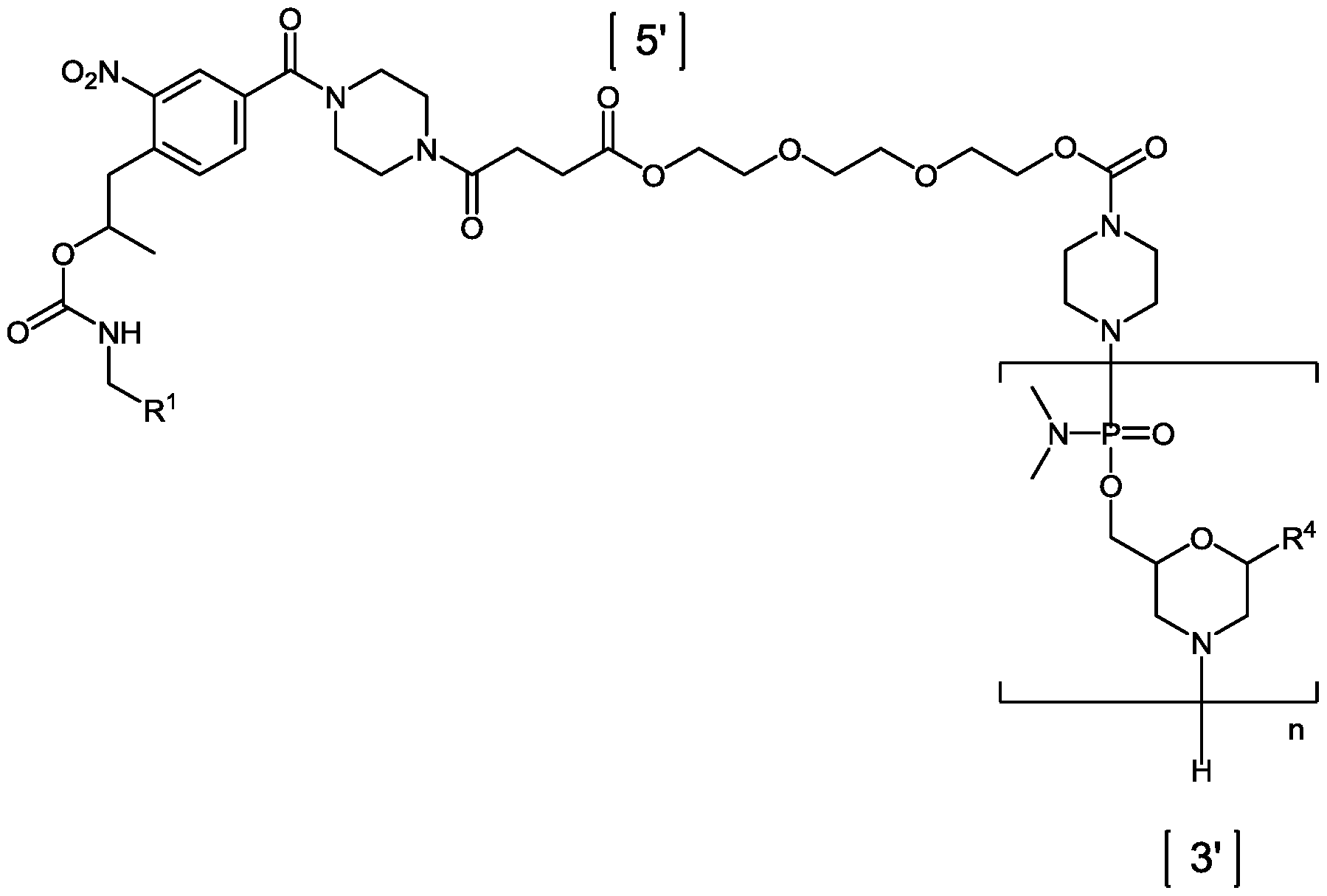
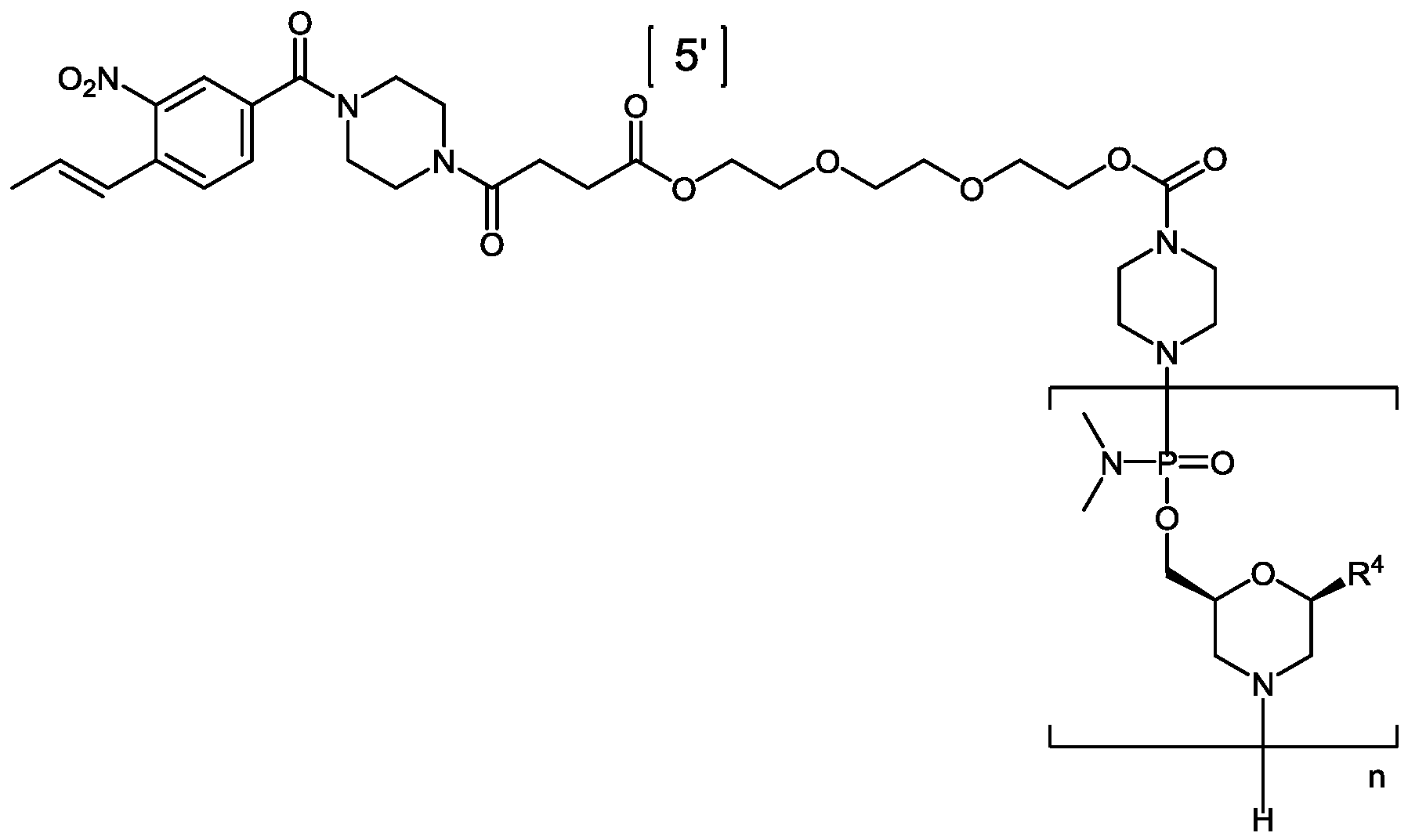
- the disclosure provides a process for preparing an oligomeric compound of Formula (B):
- the disclosure provides a process for preparing an oligomeric compound of Formula (A):
- the oligomeric compound of the disclosure including, for example, some embodiments of an oligomeric compound of Formula (E), is an oligomeric compound of Formula (XII):
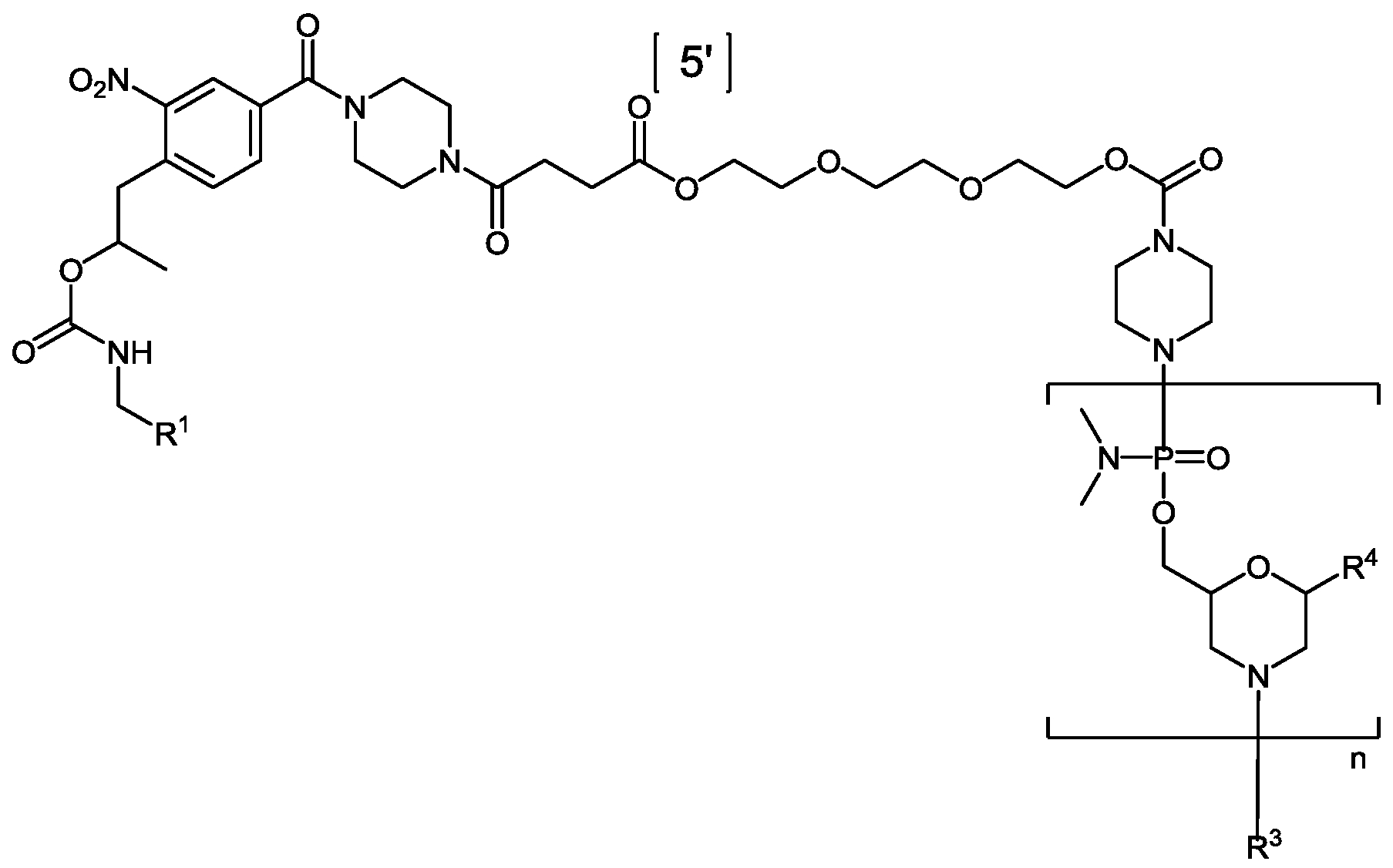
- the structural formulas including, for example, oligomeric compound of Formula (E) and Eteplirsen depicted by Formula (XII), are a continuous structural formula from 5’ to 3’, and, for the convenience of depicting the entire formula in a compact form in the above structural formulas, Applicants have included various illustration breaks labeled “BREAK A,”“BREAK B,”“BREAK C,” and“BREAK D.” As would be understood by the skilled artisan, for example, each indication of“BREAK A” shows a continuation of the illustration of the structural formula at these points. The skilled artisan understands that the same is true for each instance of“BREAK B,”“BREAK C,” and“BREAK D” in the structural formulas above including Eteplirsen. None of the illustration breaks, however, are intended to indicate, nor would the skilled artisan understand them to mean, an actual discontinuation of the structural formulas above including Eteplirsen.
- R 1 , R 2 , R 4 -R 7 , X, and n are as defined herein.
- the oligomeric compound of Formula (D) is of Formula (G):
- R 2 , X, and n are as defined herein.
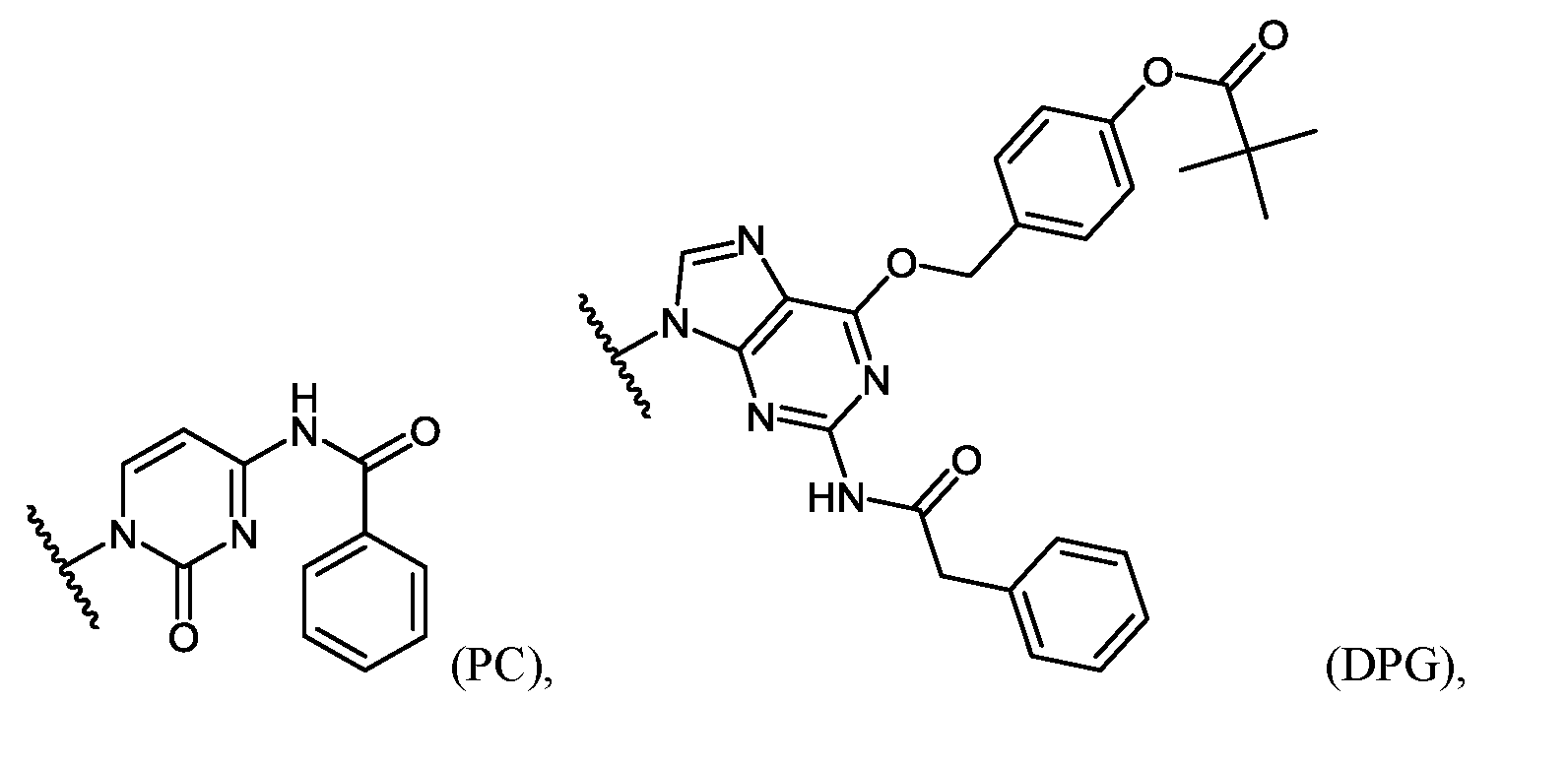
- each A is, independently for each occurrence, selected from the group consisting of:
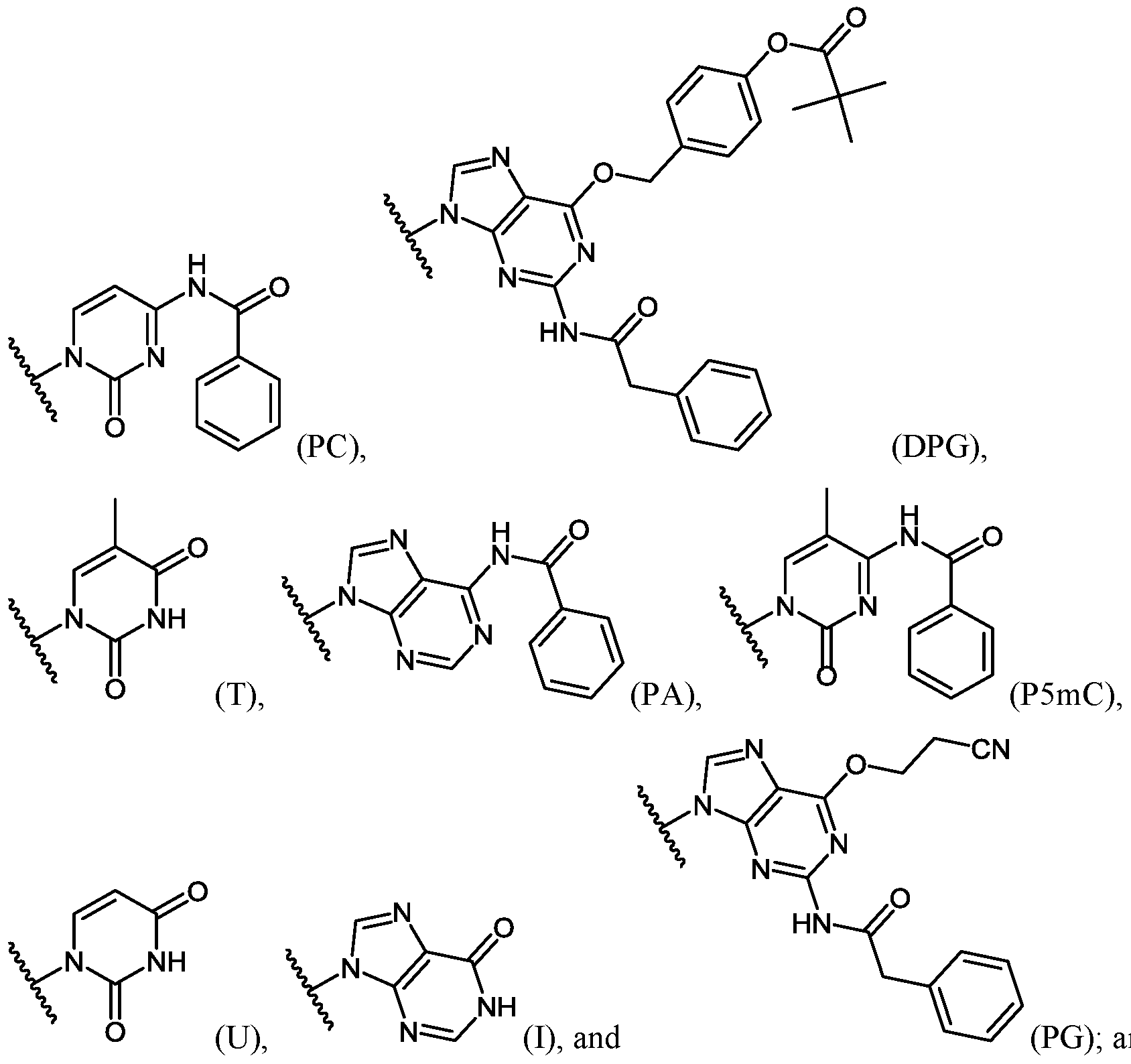
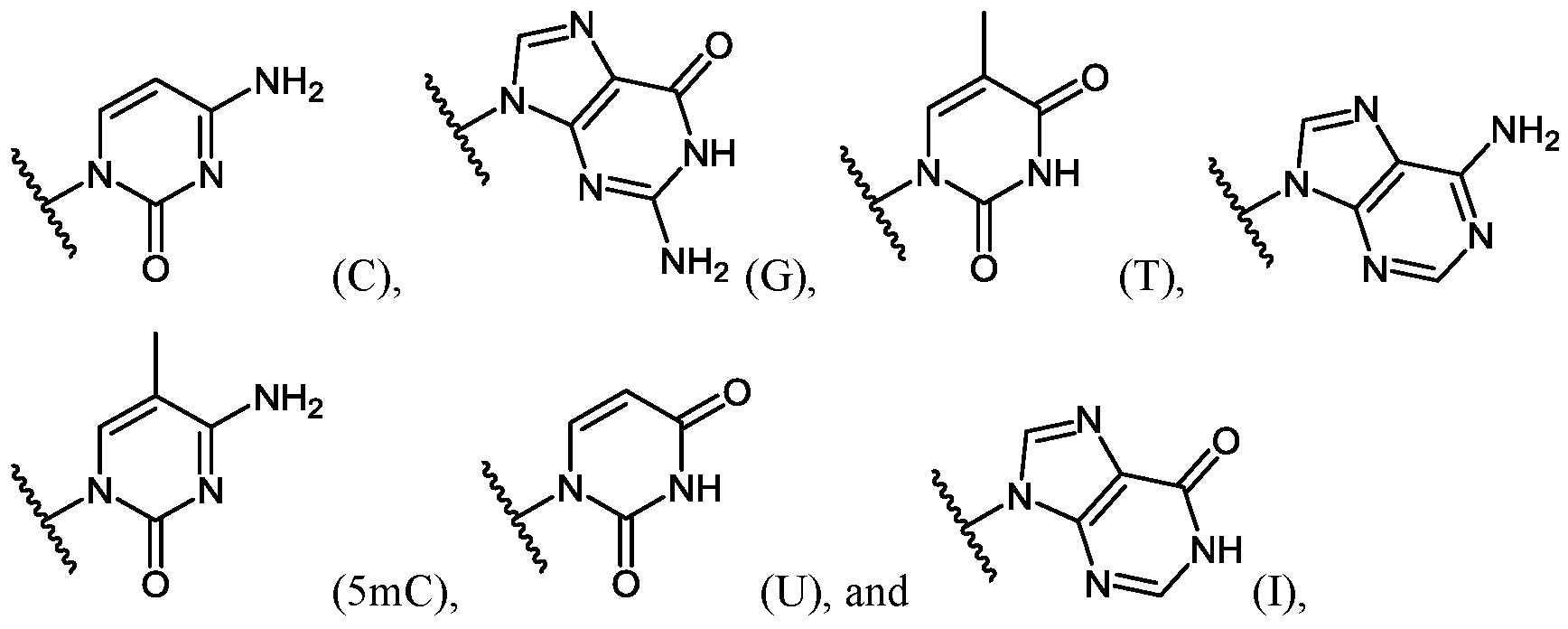
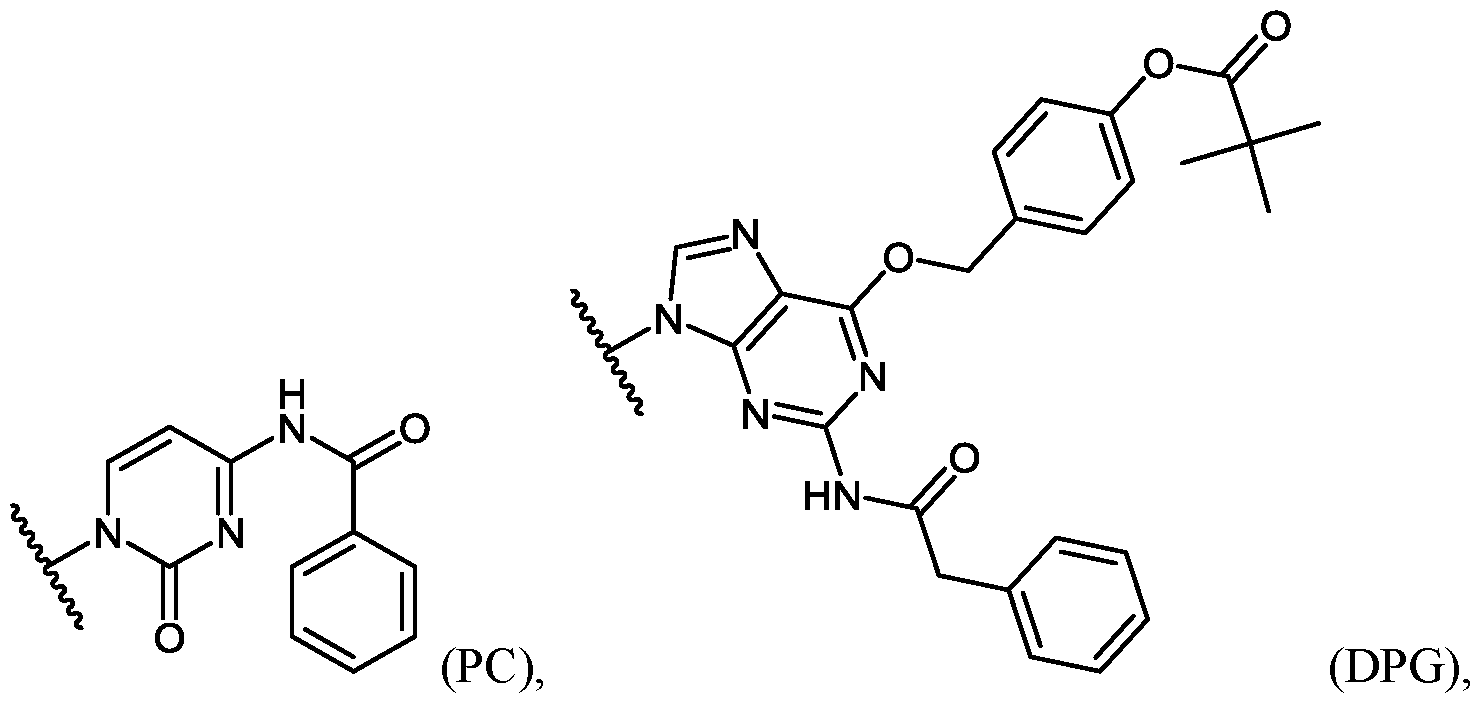
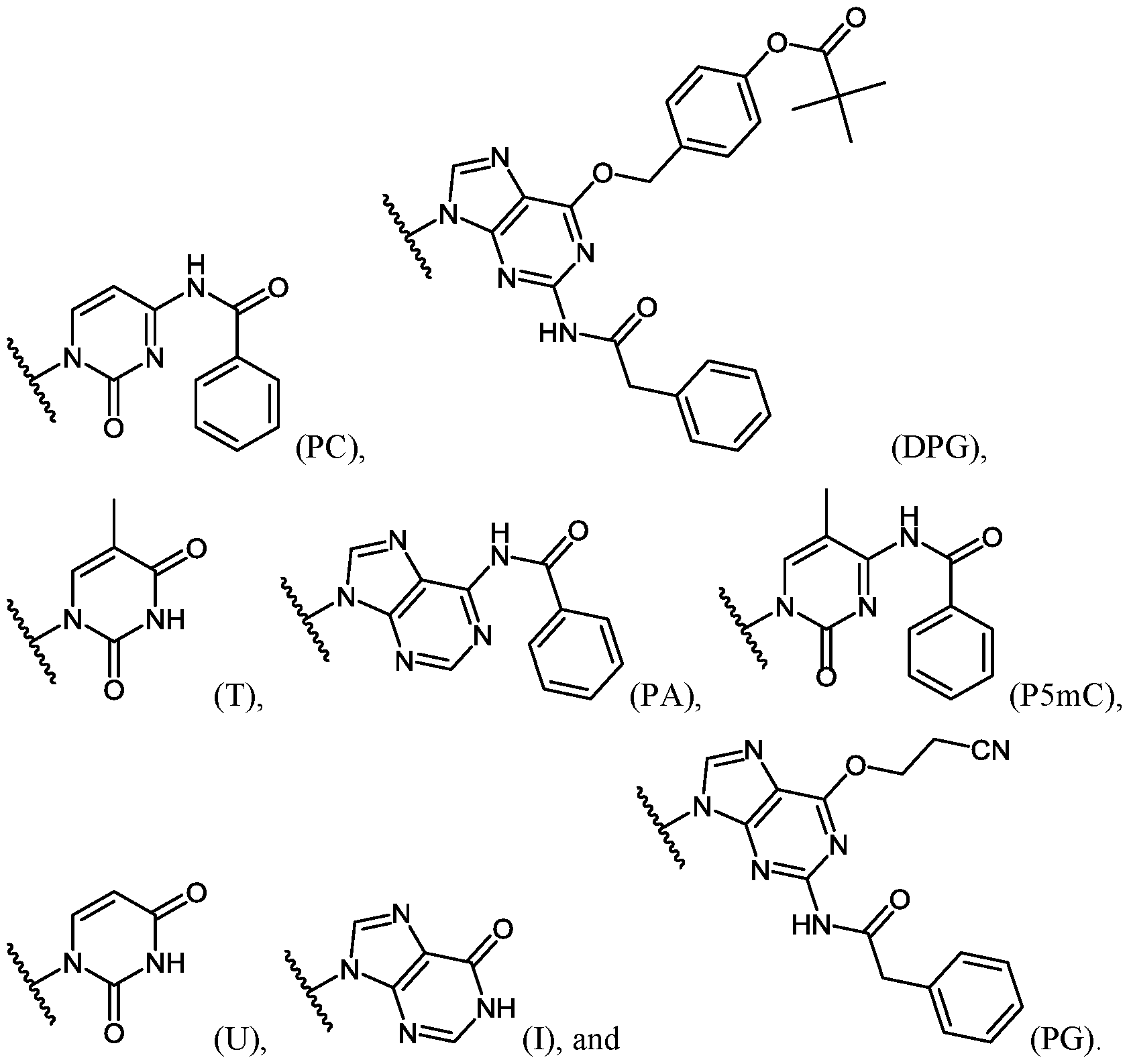
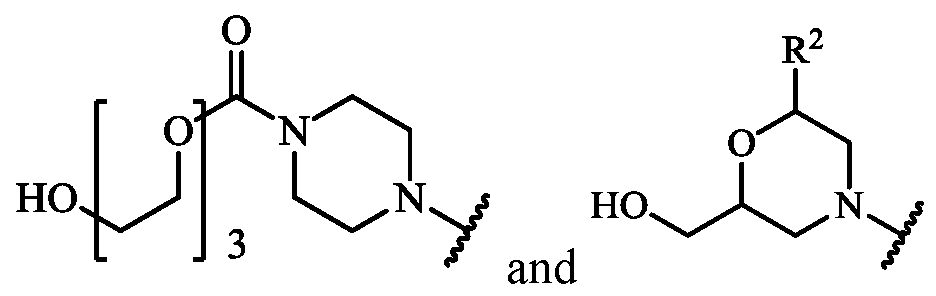
- each R 2 is, independently for each occurrence, selected from the group consisting of:
- n is an integer from 10 to 40;
- R is H or acetyl.
- Figure 1 shows a representative analytical high performance liquid chromatography (HPLC) chromatogram of a synthesized and deprotected Eteplirsen (AVI-4658) crude drug substance (see Example 4).
- Figure 2 shows a representative analytical HPLC chromatogram of a purified
- Figure 3 shows a representative analytical HPLC chromatogram of a desalted and lyophilized Eteplirsen drug substance (see Example 5).
- a morpholino oligomer described herein displays stronger affinity for DNA and RNA without compromising sequence selectivity, relative to native or unmodified oligonucleotides.
- the morpholino oligomer of the disclosure minimizes or prevents cleavage by RNase H. In some embodiments, the morpholino oligomer of the disclosure does not activate RNase H.
- Base-protected or“base protection” refers to protection of the base-pairing groups, e.g., purine or pyrimidine bases, on the morpholino subunits with protecting groups suitable to prevent reaction or interference of the base-pairing groups during stepwise oligomer synthesis.
- An example of a base-protected morpholino subunit is the activated C subunit Compound (C) having a CBZ protecting group on the cytosine amino group depicted below.
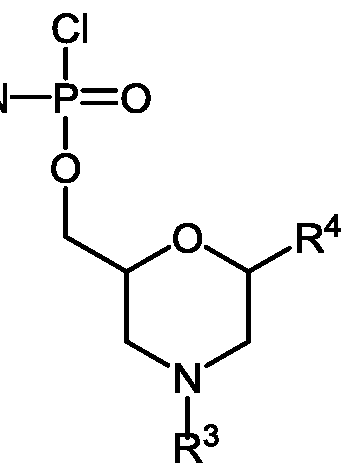
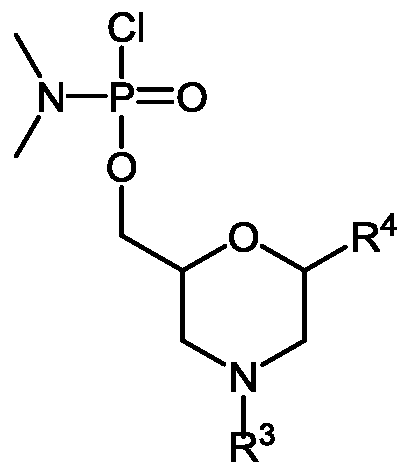
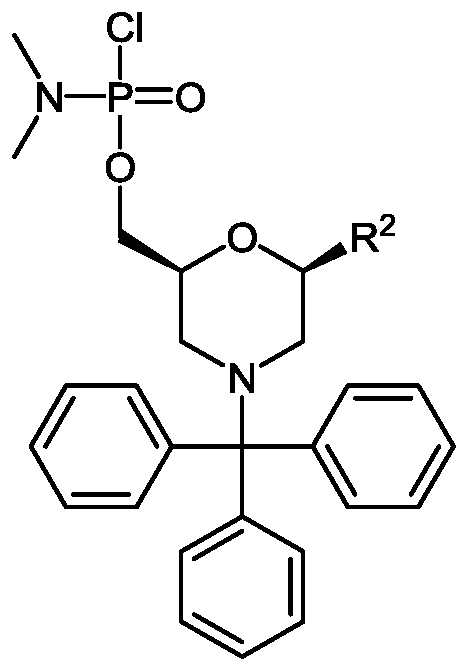
- An“activated phosphoramidate group” is typically a chlorophosphoramidate group, having substitution at nitrogen which is desired in the eventual phosphorodiamidate linkage in the oligomer.
- support-bound refers to a chemical entity that is covalently linked to a support-medium.
- support-medium refers to any material including, for example, any particle, bead, or surface, upon which an oligomer can be attached or synthesized upon, or can be modified for attachment or synthesis of an oligomer.
- Representative substrates include, but are not limited to, inorganic supports and organic supports such as glass and modified or functionalized glass, plastics (including acrylics, polystyrene and copolymers of styrene and other materials, polypropylene, polyethylene, polybutylene, polyurethanes, TEFLON, etc.), polysaccharides, nylon or nitrocellulose, ceramics, resins, silica or silica- based materials including silicon and modified silicon, carbon, metals, inorganic glasses, plastics, optical fiber bundles, and a variety of other polymers.
- Particularly useful support- medium and solid surfaces for some embodiments are located within a flow cell apparatus.
- the support-medium comprises polystyrene with 1% cross
- representative support-medium comprise at least one reactive site for attachment or synthesis of an oligomer.
- a support-medium of the disclosure comprises one or more terminal amino or hydroxyl groups capable of forming a chemical bond with an incoming subunit or other activated group for attaching or synthesizing an oligomer.
- CPG controlled pore glass
- oxalyl- controlled pore glass see, e.g., Alul et al., Nucleic Acids Research 1991, 19, 1527
- silica- containing particles such as porous glass beads and silica gel such as that formed by the reaction of trichloro-[3-(4-chloromethyl)phenyl]propylsilane and porous glass beads (see Parr and Grohmann, Angew. Chem. Internatl.
- hydroxypropylacrylate-coated polypropylene membranes (Daniels et al., Tetrahedron Lett.1989, 4345); acrylic acid-grafted polyethylene-rods (Geysen et al., Proc. Natl. Acad. Sci. USA 1984, 81, 3998); a“tea bag” containing traditionally-used polymer beads
- flow cell apparatus refers to a chamber comprising a surface (e.g., solid surface) across which one or more fluid reagents (e.g., liquid or gas) can be flowed.
- a surface e.g., solid surface
- fluid reagents e.g., liquid or gas
- deblocking agent refers to a composition (e.g., a solution) comprising a chemical acid or combination of chemical acids for removing protecting groups.
- exemplary chemical acids used in deblocking agents include halogenated acids, e.g., chloroacetic acid, dichloroacetic acid, trichloroacetic acid, fluoroacetic acid, difluoroacetic acid, and
- a deblocking agent removes one or more trityl groups from, for example, an oligomer, a support-bound oligomer, a support-bound subunit, or other protected nitrogen or oxygen moiety.
- halogen and“halo” refer to an atom selected from the group consisting of fluorine, chlorine, bromine, and iodine.
- capping agent refers to a composition (e.g., a solution) comprising an acid anhydride (e.g., benzoic anhydride, acetic anhydride, phenoxyacetic anhydride, and the like) useful for blocking a reactive cite of, for example, a support-medium forming a chemical bond with an incoming subunit or other activated group.
- an acid anhydride e.g., benzoic anhydride, acetic anhydride, phenoxyacetic anhydride, and the like
- cleavage agent refers to a composition (e.g., a liquid solution or gaseous mixture) comprising a chemical base (e.g., ammonia or 1,8-diazabicycloundec-7-ene) or a combination of chemical bases useful for cleaving, for example, a support-bound oligomer from a support-medium.
- a chemical base e.g., ammonia or 1,8-diazabicycloundec-7-ene
- a combination of chemical bases useful for cleaving, for example, a support-bound oligomer from a support-medium.
- deprotecting agent refers to a composition (e.g., a liquid solution or gaseous mixture) comprising a chemical base (e.g., ammonia, 1,8-diazabicycloundec-7-ene or potassium carbonate) or a combination of chemical bases useful for removing protecting groups.
- a deprotecting agent in some embodiments, can remove the base protection from, for example, a morpholino subunit, morpholino subunits of a morpholino oligomer, or support-bound versions thereof.
- solvent refers to a component of a solution or mixture in which a solute is dissolved.
- Solvents may be inorganic or organic (e.g., acetic acid, acetone, acetonitrile, acetyl acetone, 2-aminoethanol, aniline, anisole, benzene, benzonitrile, benzyl alcohol, 1- butanol, 2-butanol, i-butanol, 2-butanone, t-butyl alcohol, carbon disulfide,
- acetoacetate, ethyl benzoate ethylene glycol, glycerin, heptane, 1-heptanol, hexane, 1- hexanol, methanol, methyl acetate, methyl t-butyl ether, methylene chloride, 1-octanol, pentane, 1-pentanol, 2-pentanol, 3-pentanol, 2-pentanone, 3-pentanone, 1-propanol, 2- propanol, pyridine, tetrahydrofuran, toluene, water, p-xylene).
- phrases“morpholino oligomer” and“phosphorodiamidate morpholino oligomer” or“PMO” refers to an oligomer having morpholino subunits linked together by
- Each morpholino subunit comprises a nucleobase- pairing moiety effective to bind, by nucleobase-specific hydrogen bonding, to a nucleobase in a target.
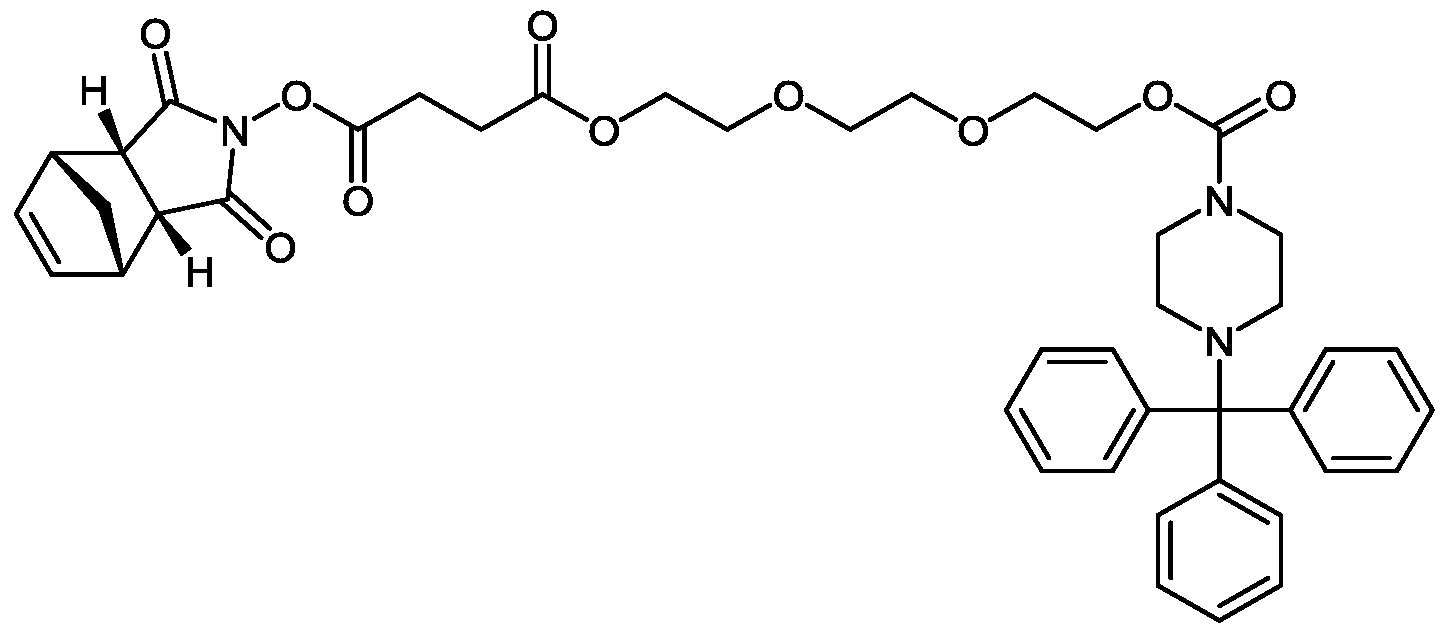
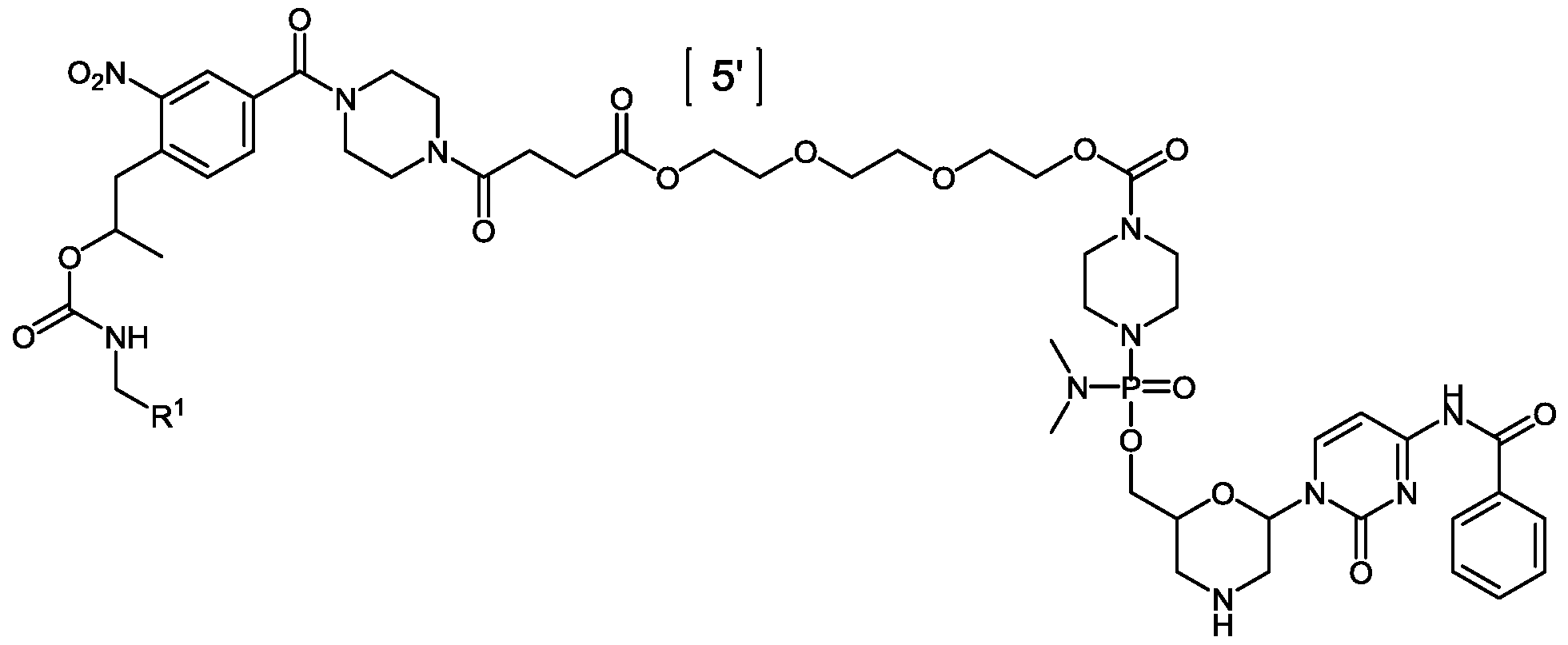
- “EG3 tail” refers to triethylene glycol moieties conjugated to the oligomer, e.g., at its 3’- or 5’-end.
- “EG3 tail” conjugated to the 3’ end of an oligomer can be of the structure:
- an oligomeric compound prepared by the methods of the disclosure can have a length from 10 to 50 nucleotides, 10 to 40 nucleotides, 10 to 30 nucleotides, 10 to 25 nucleotides, 10 to 24 nucleotides, 10 to 23 nucleotides, 10 to 22 nucleotides, 10 to 21 nucleotides, 10 to 20 nucleotides, 15 to 30 nucleotides, 15 to 25 nucleotides, 15 to 24 nucleotides, 15 to 23 nucleotides, 15 to 22 nucleotides, 15 to 21 nucleotides, 15 to 20 nucleotides, 20 to 30 nucleotides, 20 to 25 nucleotides, 20 to 24 nucleotides, 20 to 23 nucleotides, or 20 to 22 nucleotides in length, including all integers in between these ranges.
- an oligomeric compound prepared by the methods of the disclosure is of 8, 9, 10, 11, 12, 13, 14, 15, 16, 17, 18, 19, 20, 21, 22, 23, 24, 25, 26, 27, 28, 29, 30, 31, 32, 33, 34, 35, 36, 37, 38, 39, or 40 nucleotides in length.
- an oligomeric compound prepared by the methods of the disclosure is 20 nucleotides in length.
- an oligomeric compound prepared by the methods of the disclosure is 21 nucleotides in length.
- an oligomeric compound prepared by the methods of the disclosure is 22 nucleotides in length.
- an oligomeric compound prepared by the methods of the disclosure is 23 nucleotides in length.
- an oligomeric compound prepared by the methods of the disclosure is 24 nucleotides in length. In some embodiments, an oligomeric compound prepared by the methods of the disclosure is 25 nucleotides in length. In some embodiments, an oligomeric compound prepared by the methods of the disclosure is 26 nucleotides in length. In some embodiments, an oligomeric compound prepared by the methods of the disclosure is 27 nucleotides in length. In some embodiments, an oligomeric compound prepared by the methods of the disclosure is 28 nucleotides in length. In some embodiments, an oligomeric compound prepared by the methods of the disclosure is 29 nucleotides in length. In some embodiments, an oligomeric compound prepared by the methods of the disclosure is 30 nucleotides in length.
- n is an integer ranging from 10 to 50, 10 to 40, 10 to 30, 10 to 25, 10 to 24, 10 to 23, 10 to 22, 10 to 21, 10 to 20, 15 to 30, 15 to 25, 15 to 24, 15 to 23, 15 to 22, 15 to 21, 15 to 20, 20 to 30, 20 to 25, 20 to 24, 20 to 23, or 20 to 22.
- n is 8, 9, 10, 11, 12, 13, 14, 15, 16, 17, 18, 19, 20, 21, 22, 23, 24, 25, 26, 27, 28, 29, 30, 31, 32, 33, 34, 35, 36, 37, 38, 39, or 40.
- n is 10.
- n is 11. In some embodiments, n is 12. In some embodiments, n is 15. In some embodiments, n is 18. In some embodiments, n is 20. In some embodiments, n is 21. In some embodiments, n is 22. In some embodiments, n is 23. In some embodiments, n is 24. In some embodiments, n is 25. In some embodiments, n is 26. In some embodiments, n is 27. In some embodiments, n is 28. In some embodiments, n is 29. In some embodiments, n is 30.
- Synthesis is generally prepared, as described herein, on a support-medium.
- a first synthon e.g., a monomer, such as a morpholino subunit
- a support-medium In general a first synthon (e.g., a monomer, such as a morpholino subunit) is first attached to a support- medium, and the oligomer is then synthesized by sequentially coupling subunits to the support-bound synthon. This iterative elongation eventually results in a final oligomeric compound.
- Suitable support-media can be soluble or insoluble, or may possess variable solubility in different solvents to allow the growing support-bound polymer to be either in or out of solution as desired.
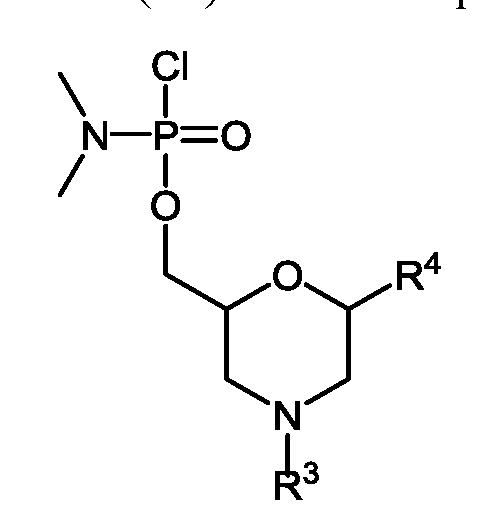
- R 1 is a support-medium and R 3 is selected from the group consisting of trityl, monomethoxytrityl, dimethoxytrityl and trimethoxytrityl;
- R 1 is a support-medium
- R 3 is selected from the group consisting of trityl, monomethoxytrityl, dimethoxytrityl and trimethoxytrityl
- R 1 is a support-medium; with a compound of Formula (A2):
- R 3 is selected from the group consisting of trityl, monomethoxytrityl, dimethoxytrityl and trimethoxytrityl;
- R 1 is a support-medium
- R 1 is a support-medium
- R 3 is selected from the group consisting of trityl, monomethoxytrityl, dimethoxytrityl and trimethoxytrityl
- R 1 is a support-medium
- R 3 is selected from the group consisting of trityl, monomethoxytrityl, dimethoxytrityl and trimethoxytrityl, and
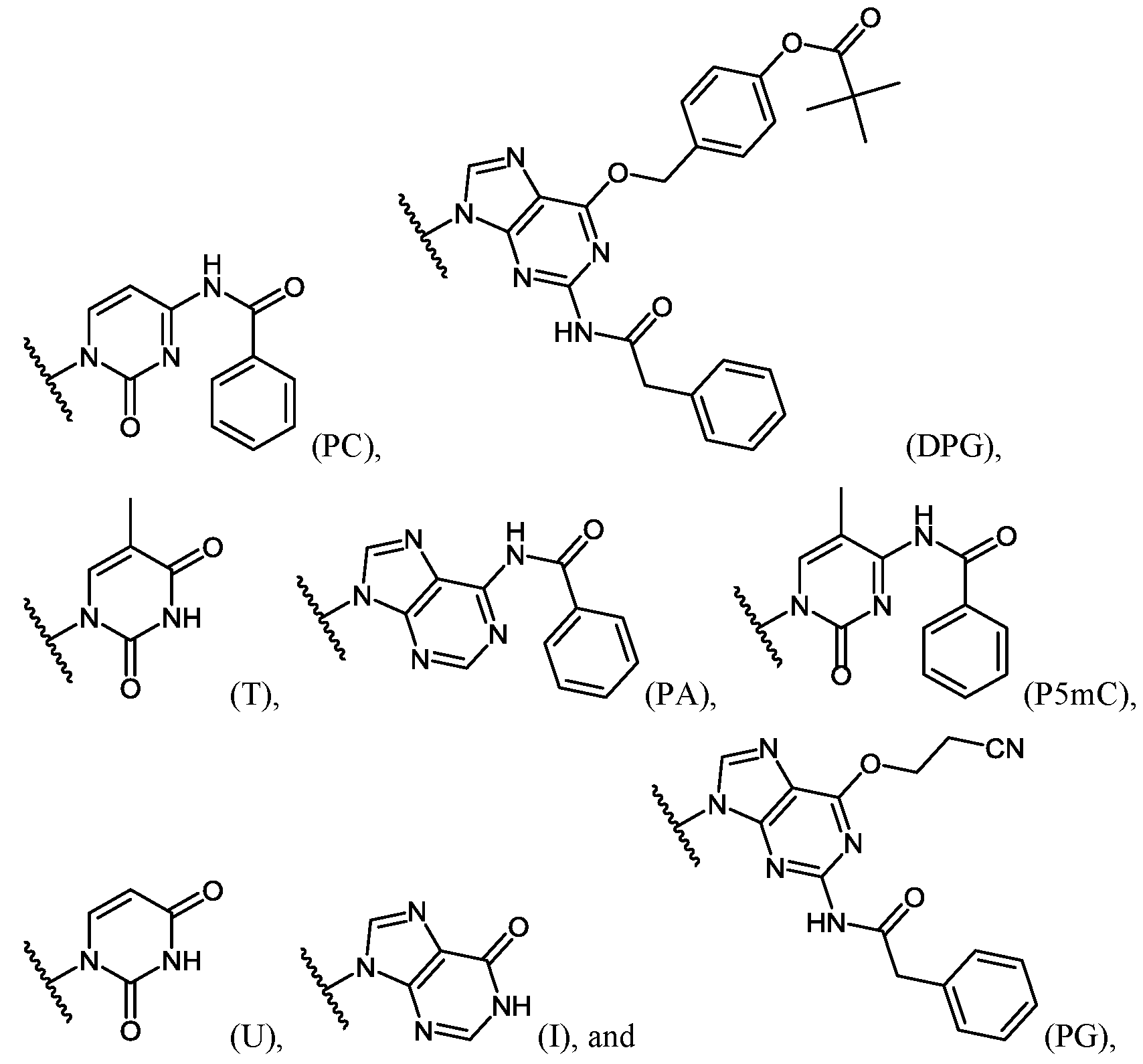
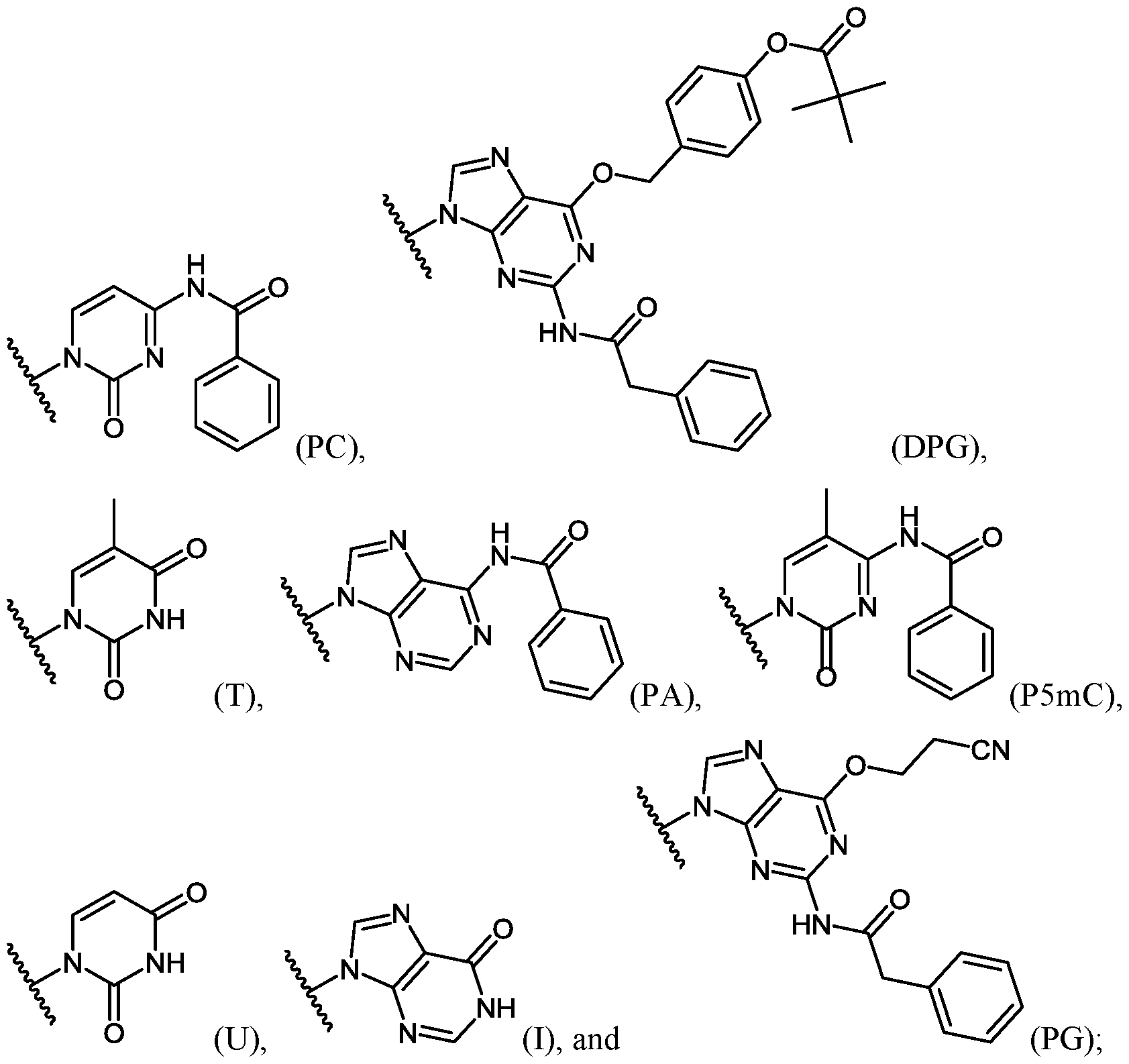
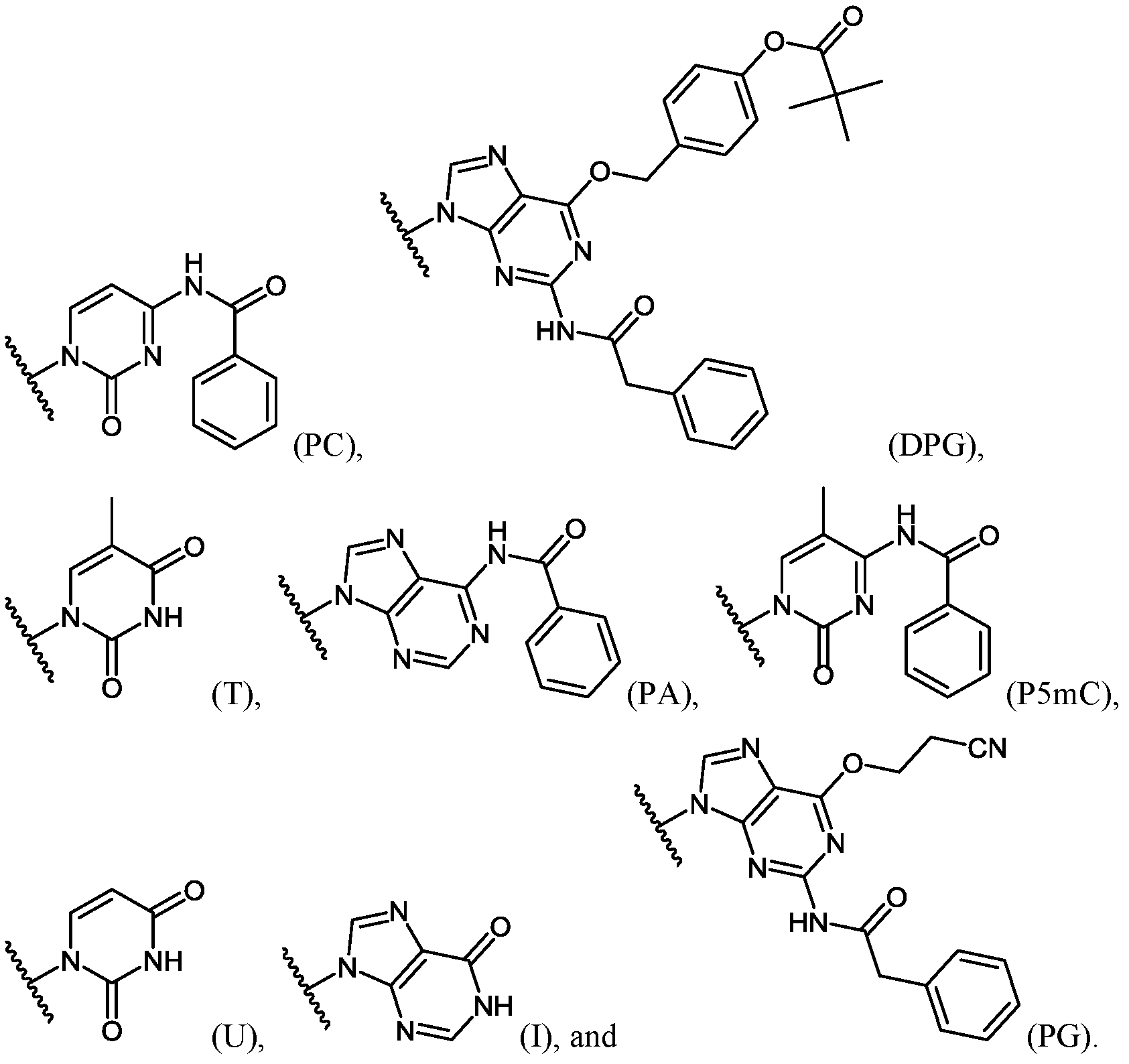
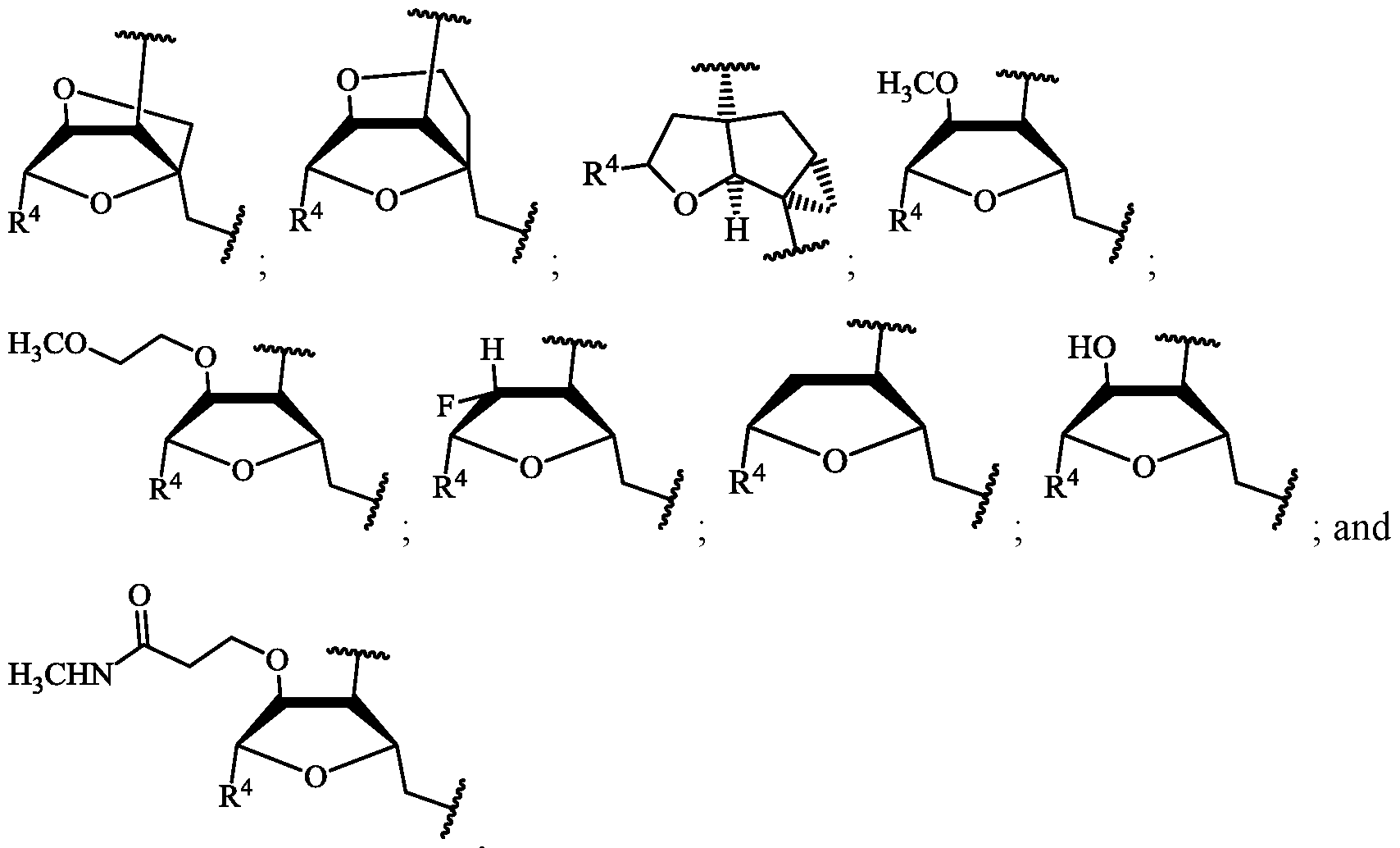
- R 4 is selected from the group consisting of:
- R 1 is a support-medium
- R 3 is selected from the group consisting of trityl, monomethoxytrityl, dimethoxytrityl and trimethoxytrityl
- R 4 is selected from the group consisting of:
- n is an integer from 10 to 40
- R 1 is a support-medium
- R 3 is selected from the group consisting of trityl, monomethoxytrityl, dimethoxytrityl and trimethoxytrityl
- R 4 is, independently for each occurrence, selected from the group consisting of:
- R 1 is a support-medium
- R 3 is selected from the group consisting of trityl, monomethoxytrityl, dimethoxytrityl and trimethoxytrityl
- R 4 is selected from the group consisting of: wherein R 1 is a support-medium, R 3 is selected from the group consisting of trityl, monomethoxytrityl, dimethoxytrityl and trimethoxytrityl, and
- R 4 is selected from the group consisting of:
- R 3 is selected from the group consisting of trityl, monomethoxytrityl, dimethoxytrityl and trimethoxytrityl
- R 4 is selected from the group consisting of:
- n is an integer from 10 to 40
- R 1 is a support-medium
- R 4 is, independently for each occurrence, selected from the group consisting of:
- n is an integer from 10 to 40
- R 1 is a support-medium
- R 3 is selected from the group consisting of trityl, monomethoxytrityl, dimethoxytrityl and trimethoxytrityl
- R 4 is, independently for each occurrence, selected from the group consisting of:
- n is an integer from 10 to 40
- R 1 is a support-medium
- R 4 is, independently for each occurrence, selected from the group consisting of:
- n is an integer from 10 to 40, and each R 2 is, independently for each occurrence, selected from the group consisting of:
- n is an integer from 10 to 40, and R 4 is, independently for each occurrence, selected from the group consisting of:
- n is an integer from 10 to 40, and each R 2 is, independently for each occurrence, selected from the group consisting of: (A),
- R 1 is a support-medium and R 3 is selected from the group consisting of trityl, monomethoxytrityl, dimethoxytrityl and trimethoxytrityl;
- R 1 is a support-medium
- R 3 is selected from the group consisting of trityl, monomethoxytrityl, dimethoxytrityl and trimethoxytrityl;
- R 1 is a support-medium
- R 3 is selected from the group consisting of trityl, monomethoxytrityl, dimethoxytrityl and trimethoxytrityl
- R 1 is a support-medium
- R 3 is selected from the group consisting of trityl, monomethoxytrityl, dimethoxytrityl and trimethoxytrityl
- R 4 is selected from the group consisting of:
- R 1 is a support-medium
- R 3 is selected from the group consisting of trityl, monomethoxytrityl, dimethoxytrityl and trimethoxytrityl, and
- R 4 is selected from the group consisting of:
- R 3 is selected from the group consisting of trityl, monomethoxytrityl, dimethoxytrityl and trimethoxytrityl
- R 4 is, independently for each compound of Formula (A8), selected from the group consisting of:
- n is an integer from 10 to 40
- R 1 is a support-medium
- R 3 is selected from the group consisting of trityl, monomethoxytrityl, dimethoxytrityl and trimethoxytrityl
- R 4 is, independently for each occurrence, selected from the group consisting of:
- n is an integer from 10 to 40
- R 1 is a support-medium
- R 4 is, independently for each occurrence, selected from the group consisting of:
- n is an integer from 10 to 40, and R 4 is, independently for each occurrence, selected from the group consisting of:
- step (d) or step (e2) further comprises contacting the compound of Formula (IV) or the compound formed by the immediately prior step, respectively, with a capping agent.
- each step is performed in the presence of at least one solvent.
- the deblocking agent used in each step is a solution comprising a halogenated acid.
- the deblocking agent used in each step is cyanoacetic acid.
- the halogenated acid is selected from the group consisting of chloroacetic acid, dichloroacetic acid, trichloroacetic acid, fluoroacetic acid, difluoroacetic acid, and trifluoroacetic acid.
- the halogenated acid is trifluoroacetic acid.
- at least one of steps (a), (c), (e1), and (f) further comprises the step of contacting the deblocked compound of each step with a neutralization agent.
- each of steps (a), (c), (e1), and (f) further comprises the step of contacting the deblocked compound of each step with a neutralization agent.
- the neutralization agent is in a solution comprising dichloromethane and isopropyl alcohol.
- the neutralization agent is a monoalkyl, dialkyl, or trialkyl amine.
- the neutralization agent is N,N-diisopropylethylamine.
- the deblocking agent used in each step is a solution comprising 4-cyanopyridine, dichloromethane, trifluoroacetic acid, trifluoroethanol, and water.
- the capping agent is in a solution comprising
- the capping agent is an acid anhydride.
- the acid anhydride is benzoic anhydride.
- the compounds of Formula (A4) and Formula (A8) are each, independently, in a solution comprising ethylmorpholine and dimethylimidazolidinone.
- the cleavage agent comprises dithiothreitol and 1,8- diazabicyclo[5.4.0]undec-7-ene.
- the cleavage agent is in a solution comprising N-methyl- 2-pyrrolidone.
- the deprotecting agent comprises NH 3 .
- the deprotecting agent is in an aqueous solution.
- the support-medium comprises polystyrene with 1% crosslinked divinylbenzene.
- the compound of Formula (A4) is of Formula (A4a):
- R 3 is selected from the group consisting of trityl, monomethoxytrityl, dimethoxytrityl and trimethoxytrityl, and
- R 4 is selected from:
- the compound of Formula (A5) is of Formula (A5a):
- R 1 is a support-medium
- R 3 is selected from the group consisting of trityl, monomethoxytrityl, dimethoxytrityl and trimethoxytrityl, and
- R 4 is selected from:
- the compound of Formula (A8) is of Formula (A8a):
- R 3 is selected from the group consisting of trityl, monomethoxytrityl, dimethoxytrityl and trimethoxytrityl, and
- R 4 is, independently at each occurrence of the compound of Formula (A8a), selected from the rou consistin of:
- the compound of formula (A9) is of Formula (A9a):
- n is an integer from 10 to 40
- R 1 is a support-medium
- R 3 is selected from the group consisting of trityl, monomethoxytrityl, dimethoxytrityl and trimethoxytrityl, and
- R 4 is, independently for each occurrence, selected from the group consisting of:
- the compound of Formula (A10) is of Formula (A10a):
- n is an integer from 10 to 40
- R 1 is a support-medium
- R 4 is, independently for each occurrence, selected from the group consisting of:
- the compound of Formula (A11) is of Formula (A11a):
- n is an integer from 10 to 40
- R 4 is, independently for each occurrence, selected from the group consisting of:
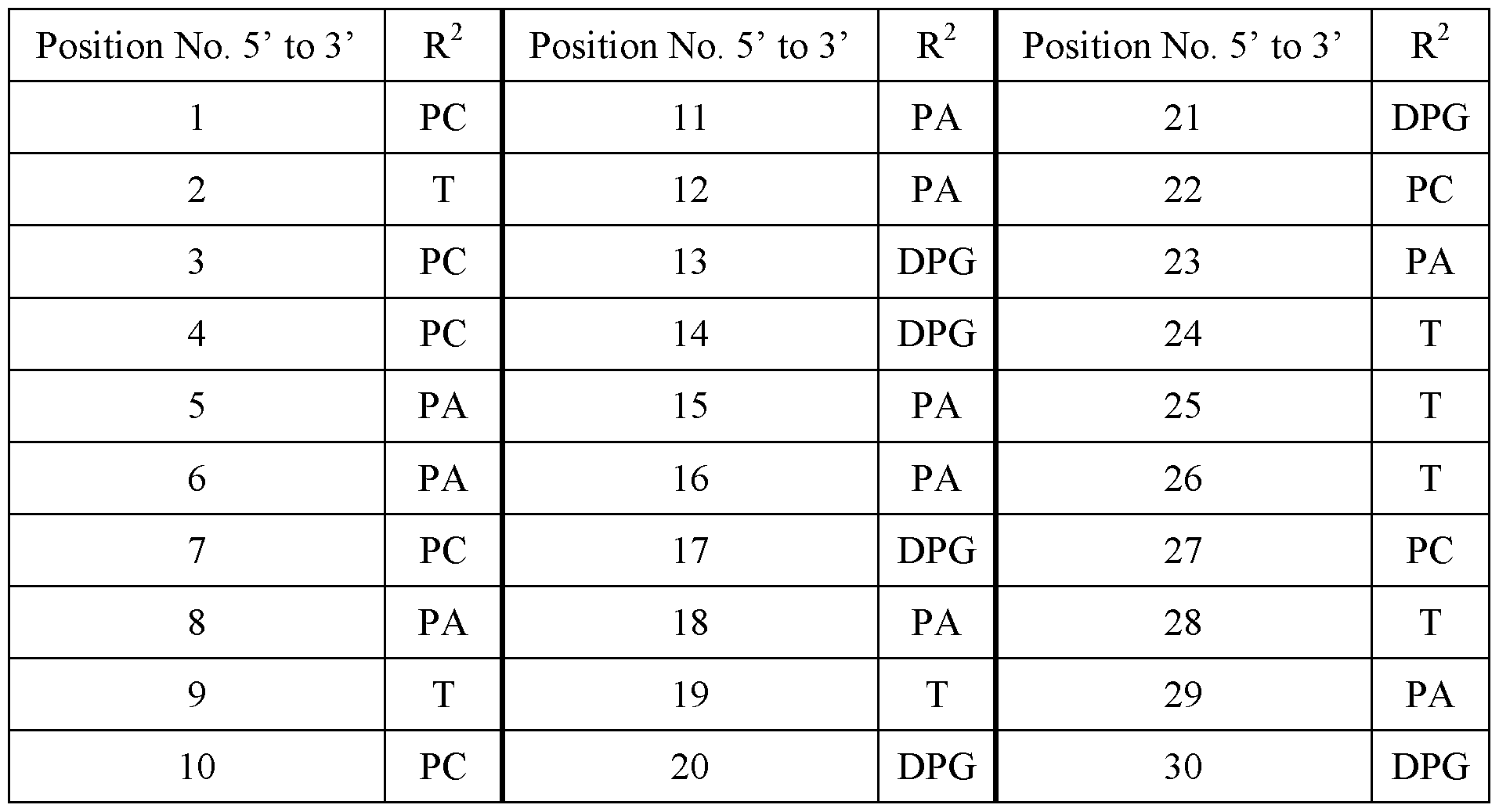
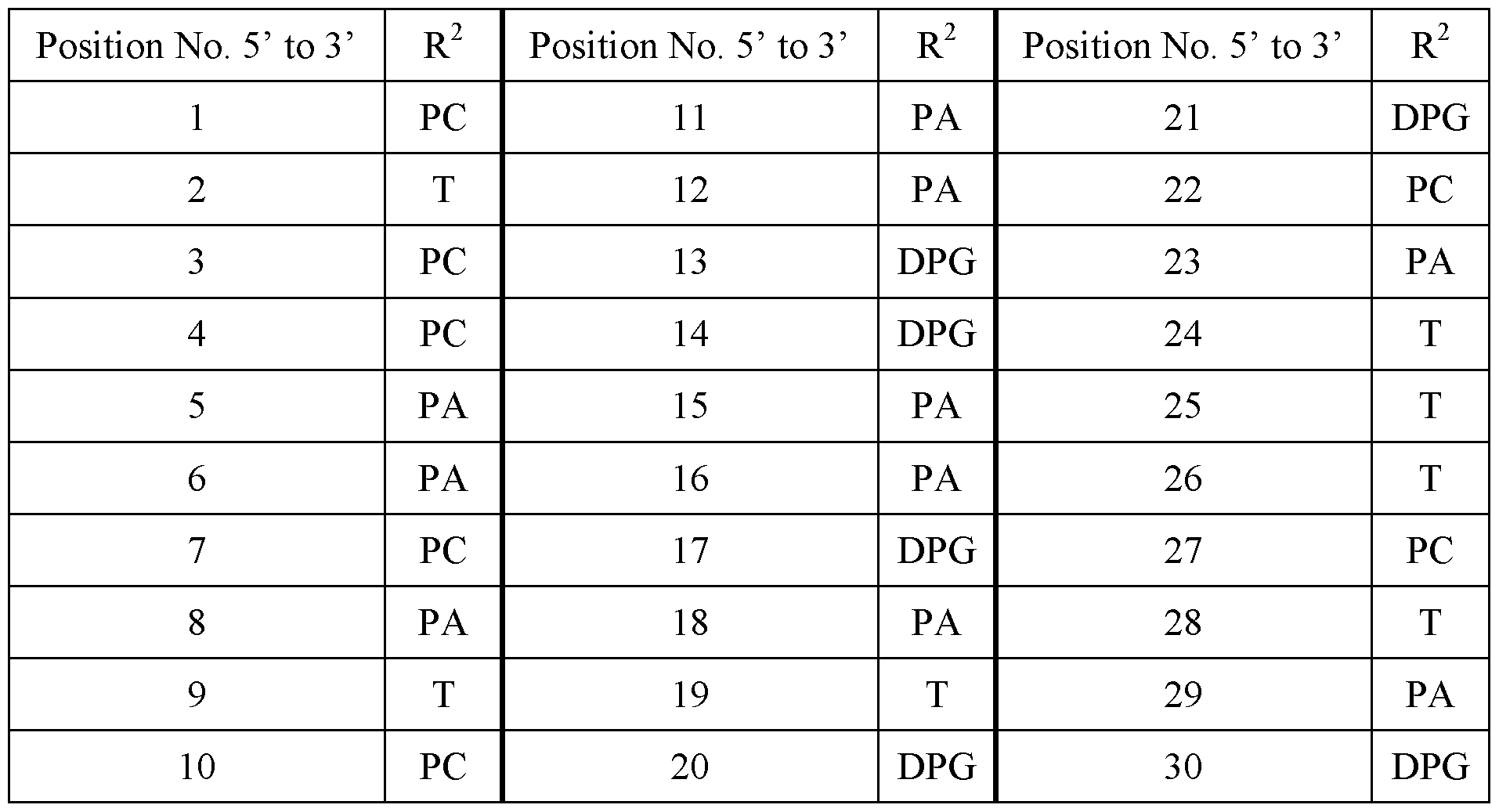
- n is 30, and R 2 is at each position from 1 to 30 and 5’ to 3’:
- oligomeric compound of Formula (A) is a compound of Formula (E):
- Eteplirsen is a phosphorodiamidate mopholino oligomer (PMO).
- the dystrophin therapeutic“Eteplirsen,” also known as“AVI-4658” is a PMO having the base sequence 5’- CTCCAACATCAAGGAAGATGGCATTTCTAG-3’ (SEQ ID NO:1). Eteplirsen is registered under CAS Registry Number 1173755-55-9.
- Chemical names include: RNA, [P- deoxy-P-(dimethylamino)](2’,3’-dideoxy-2’,3’-imino-2’,3’-seco)(2’a ⁇ 5’)(C-m5U-C-C-A-A-C-A-A- C-A-m5U-C-A-A-G-G-A-A-G-A-m5U-G-G-C-A-m5U-m5U-m5U-C-m5U-A-G) (SEQ ID NO:2), 5’-[P-[4-[[2-[2-(2-hydroxyethoxy)ethoxy]ethoxy]carbonyl]-1-piperazinyl]-N,N- dimethylphosphonamidate] and P,2',3'-trideoxy-P-(dimethylamino)-5'-O- ⁇ P-[4-(10-hydroxy- 2,5,8- trioxadecanoyl)
- Eteplirsen has the following structure:
- Eteplirsen can also be depicted by the structure of Formula (XII):
- the oligomeric compound of Formula (A) is a compound of Formula (E):
- the oligomeric compound of Formula (E) is an oligomeric compound of Formula (XII):
- R 3 is, at each occurrence, trityl.
- n is an integer from 10 to 40, and each R 2 is, independently for each occurrence, selected from the group consisting of: (A),
- R 1 is a support-medium
- R 4 is selected from the group consisting of:
- R 3 is selected from the group consisting of trityl, monomethoxytrityl, dimethoxytrityl and trimethoxytrityl;
- R 1 is a support-medium
- R 3 is selected from the group consisting of trityl, monomethoxytrityl, dimethoxytrityl and trimethoxytrityl
- R 4 is selected from the group consisting of:
- R 1 is a support-medium
- R 3 is selected from the group consisting of trityl, monomethoxytrityl, dimethoxytrityl and trimethoxytrityl
- R 4 is selected from the group consisting of:
- R 3 is selected from the group consisting of trityl, monomethoxytrityl, dimethoxytrityl and trimethoxytrityl
- R 4 is selected from the group consisting of:
- R 1 is a support-medium
- R 3 is selected from the group consisting of trityl, monomethoxytrityl, dimethoxytrityl and trimethoxytrityl
- R 4 independently at each occurrence, is selected from the group consisting of:
- R 3 is selected from the group consisting of trityl, monomethoxytrityl, dimethoxytrityl and trimethoxytrityl
- R 4 is, independently for each compound of Formula (A8), selected from the group consisting of:
- n is an integer from 10 to 40
- R 1 is a support-medium
- R 3 is selected from the group consisting of trityl, monomethoxytrityl, dimethoxytrityl and trimethoxytrityl
- R 4 is, independently for each occurrence, selected from the group consisting of:
- n is an integer from 10 to 40, R 1 is a support-medium, and R 4 is,
- n is an integer from 10 to 40, and R 4 is, independently for each occurrence, selected from the group consisting of:
- R 1 is a support-medium
- R 1 is a support-medium
- R 1 is a support-medium
- R 1 is a support-medium
- R 1 is a support-medium
- R 1 is a support-medium
- R 1 is a support-medium
- R 2 is, independently for each compound of Formula (VIII), selected from the group consisting of:
- R 2 is:
- R 1 is a support-medium
- R 2 is, independently for each occurrence, selected from the group consisting of:
- R 2 is at each position from 1 to 30 and 5’ to 3’:
- R 2 is at each position from 1 to 30 and 5’ to 3’:
- R 2 is, independently for each occurrence, selected from the group consisting of:
- R 2 is at each position from 1 to 30 and 5’ to 3’:
- step (d), step (f), step g(2), or combinations thereof further comprises contacting the compound of Formula (IV), Formula (VI), or the compound formed by the immediately prior step, respectively, with a capping agent.
- each of step (d), step (f) and step g(2) further comprises contacting the compound of Formula (IV), Formula (VI), or the compound formed by the immediately prior step, respectively, with a capping agent.
- each step is performed in the presence of at least one solvent.
- the deblocking agent used in each step is a solution comprising a halogenated acid.
- the deblocking agent used in each step is cyanoacetic acid.
- the halogenated acid is selected from the group consisting of chloroacetic acid, dichloroacetic acid, trichloroacetic acid, fluoroacetic acid, difluoroacetic acid, and trifluoroacetic acid.
- the halogenated acid is trifluoroacetic acid.
- steps (c), (e1), and (f) further comprise the step of contacting the deblocked compound of each step with a neutralization agent.
- each of steps (c), (e1), and (f) further comprise the step of contacting the deblocked compound of each step with a neutralization agent.
- the neutralization agent is in a solution comprising dichloromethane and isopropyl alcohol.
- the neutralization agent is a monoalkyl, dialkyl, or trialkyl amine.
- the neutralization agent is N,N-diisopropylethylamine.
- the deblocking agent used in each step is a solution comprising 4-cyanopyridine, dichloromethane, trifluoroacetic acid, trifluoroethanol, and water.
- the capping agent is in a solution comprising
- the capping agent is an acid anhydride.
- the acid anhydride is benzoic anhydride.
- the compound of Formula (VIII), compound (C), and compound (F) are each, independently, in a solution comprising ethylmorpholine and dimethylimidazolidinone.
- the cleavage agent comprises dithiothreitol and 1,8- diazabicyclo[5.4.0]undec-7-ene. In yet another embodiment, the cleavage agent is in a solution comprising N-methyl- 2-pyrrolidone.
- the deprotecting agent comprises NH 3 .
- the deprotecting agent is in an aqueous solution.
- the support-medium comprises polystyrene with 1% crosslinked divinylbenzene.
- the compound of Formula (C) is of Formula (C1):
- the compound of Formula (V) is of Formula (Va):
- R 1 is a support-medium.
- the compound of Formula (F) is of Formula (F1):
- the compound of Formula (VII) is of Formula (VIIa):
- R 1 is a support-medium.
- the compound of Formula (VIII) is of Formula (VIIIa):
- R 2 is, independently for each compound of Formula (VIIIa), selected from the group consisting of:
- the compound of Formula (IX) is of Formula (IXa):
- R 1 is a support-medium
- R 2 is, independently at each occurrence, selected from the group consisting of:
- R 2 is at each position from 1 to 30 and 5’ to 3’:
- the compound of Formula (X) is of Formula (Xa):
- R 1 is a support-medium
- R 2 is, independently at each occurrence, selected from the group consisting of:
- R 2 is at each position from 1 to 30 and 5’ to 3’:
- the compound of Formula (XI) is of Formula (XIa):
- R 2 is, independently at each occurrence, selected from the group consisting of:
- R 2 is at each position from 1 to 30 and 5’ to 3’:
- the compound of Formula (VI) is of Formula (VIa):
- R 1 is a support-medium.
- the oligomeric compound of Formula (E) is an oligomeric compound of Formula (XII):
- R 1 is a support-medium
- R 2 is, independently at each occurrence, selected from the group consisting of:
- R 2 is at each position from 1 to 30 and 5’ to 3’:
- R 1 is a support-medium
- R 2 is, independently at each occurrence, selected from the group consisting of:
- R 2 is at each position from 1 to 30 and 5’ to 3’:
- n is an integer from 10 to 40;
- R 1 is a support-medium
- R 3 is selected from the group consisting of trityl, monomethoxytrityl, dimethoxytrityl and trimethoxytrityl;
- R 4 is, independently at each occurrence, selected from the group consisting of:
- the compound of Formula (A9) is of Formula (A9a):
- n is an integer from 10 to 40;
- R 1 is a support-medium
- R 3 is selected from the group consisting of trityl, monomethoxytrityl, dimethoxytrityl and trimethoxytrityl;
- R 4 is, independently at each occurrence, selected from the group consisting of: (X);
- R 1 is a support-medium
- R 2 is, independently at each occurrence, selected from the group consisting of:
- R 2 is at each position from 1 to 30 and 5’ to 3’:
- the compound of Formula (X) is of Formula (Xa):
- R 1 is a support-medium
- R 2 is, independently at each occurrence, selected from the group consisting of:
- R 2 is at each position from 1 to 30 and 5’ to 3’:
- n is an integer from 10 to 40;
- R 1 is a support-medium
- R 4 is, independently at each occurrence, selected from the group consisting of:
- the compound of Formula (A10) is of Formula (A10a):
- n is an integer from 10 to 40;
- R 1 is a support-medium
- R 4 is, independently at each occurrence, selected from the group consisting of:
- the support-medium comprises polystyrene with 1% crosslinked divinylbenzene.
- R 2 is, independently at each occurrence, selected from the group consisting of:
- R 2 is at each position from 1 to 30 and 5’ to 3’:
- the compound of Formula (XI) is of Formula (XIa):
- R 2 is, independently at each occurrence, selected from the group consisting of:
- R 2 is at each position from 1 to 30 and 5’ to 3’:
- n is an integer from 10 to 40;
- R 1 is a support-medium
- R 4 is, independently at each occurrence, selected from the group consisting of:
- the compound of Formula (A11) is of formula (A11a):
- n is an integer from 10 to 40;
- R 1 is a support-medium
- R 4 is, independently at each occurrence, selected from the group consisting of:
- Oligomers prepared by the process of the disclosure may contain a variety of nucleotide analog subunits.
- R 1 is selected from–O(C 1 -C 6 alkyl), halo, - O(C 1 -C 6 alkyl)-O(C 1 -C 6 alkyl), and -O(C 1 -C 6 alkyl)-C(O)-NH-C 1 -C 6 alkyl;
- R 2 is H or R 1 and R 2 join to form a cycloalkyl or heterocyclic ring having from 4 to 7 ring atoms optionally containing an oxygen;
- R 5 , R 6 , and R 7 are each hydrogen, or R 5 and R 7 join to form a cycloalkyl ring having from 4 to 7 ring atoms and R 6 and R 7 join to for a cycloalkyl ring having from 3 to 4 ring atoms;
- R 4 is, independently at each occurrence, selected from the group consisting of: (A),
- R 8 is, independently at each occurrence, selected from the group consisting of H, trityl, monomethoxytrityl, dimethoxytrityl and trimethoxytrityl;
- n 10 to 40
- X is O or S.
- the oligomeric compound of Formula (D) is of Formula (G):
- R 2 is, independently at each occurrence, selected from the group consisting of:
- n 10 to 40.
- Embodiments of the compounds of Formula D and G include, for example:
- LNAs Locked Nucleic Acids
- Modified antisense oligomer compounds may also contain“locked nucleic acid” subunits (LNAs).“LNAs” are a member of a class of modifications called bridged nucleic acid (BNA). BNA is characterized by a covalent linkage that locks the conformation of the ribose ring in a C30-endo (northern) sugar pucker. For LNA, the bridge is composed of a methylene between the 2’-O and the 4’-C positions. LNA enhances backbone
- LNAs can be found, for example, in Singh et al., Chem. Commun. 1998, 455; Wengel, Tetrahedron 1998, 54, 3607; Wengel, Acc. Chem. Res.1999, 32, 301; Obika et al., Tetrahedron Lett.1997, 38, 8735; Obika et al., Tetrahedron Lett.1998, 39, 5401; and Obika et al., Bioorg. Med. Chem.2008, 16, 9230, which are hereby incorporated by reference in their entirety.
- a non-limiting example of an LNA oligomer comprising LNA subunits and phosphodiester internucleoside linkages is depicted below:
- LNAs may incorporate one or more LNAs; in some cases, the compounds may be entirely composed of LNAs.
- Methods for the synthesis of individual LNA nucleoside subunits and their incorporation into oligomers are described, for example, in U.S. Patent Nos.7,572,582, 7,569,575, 7,084,125, 7,060,809, 7,053,207, 7,034,133, 6,794,499, and 6,670,461, which are hereby incorporated by reference in their entirety.
- Typical internucleoside linkers include phosphodiester and phosphorothioate moieties
- non-phosphorous containing linkers may be employed.
- Further embodiments include an LNA containing compound where each LNA subunit is separated by a DNA subunit.
- Certain compounds are composed of alternating LNA and DNA subunits where the internucleoside linker is phosphorothioate.
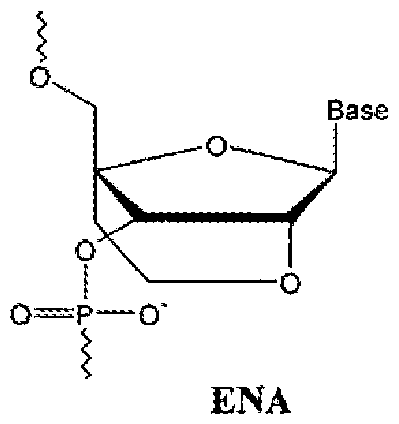
- 2'O,4'C-ethylene-bridged nucleic acids (ENAs) are another member of the class of BNAs.
- ENAs 2'O,4'C-ethylene-bridged nucleic acids
- ENA oligomers and their preparation are described in Obika et al., Tetrahedron Lett. 1997, 38, 8735, which is hereby incorporated by reference in its entirety.
- Compounds of the disclosure may incorporate one or more ENA subunits.
- Phosphorothioates are a variant of native DNA or RNA in which one of the nonbridging oxygens of the phosphodiester internucleoside linkages is replaced by sulfur.
- a non-limiting example of a phosphorothioate DNA (left), comprising deoxyribose subunits and phosphorothioate internucleoside linkages, and phosphorothioate RNA (right), comprising ribose subunits and phosophorothioate internucleoside linkages, are depicted below:
- the sulfurization of the internucleoside bond reduces the action of endo- and exonucleases including 5’ to 3’ and 3’ to 5’ DNA Pol 1 exonuclease, nucleases S1 and P1, RNases, serum nucleases and snake venom phosphodiesterase.
- Phosphorothioates may be made by two principal routes: by the action of a solution of elemental sulfur in carbon disulfide on a hydrogen phosphonate, or by the method of sulfurizing phosphite triesters with either tetraethylthiuram disulfide (TETD) or 3H-1, 2-bensodithiol-3-one 1, 1-dioxide (BDTD) (see, e.g., Iyer et al., J. Org. Chem.1990, 55, 4693-4699, which is hereby incorporated by reference in its entirety).
- TETD tetraethylthiuram disulfide
- BDTD 2-bensodithiol-3-one 1, 1-dioxide
- Tricyclo-DNAs are a class of constrained DNA analogs in which each nucleotide is modified by the introduction of a cyclopropane ring to restrict conformational flexibility of the backbone and to optimize the backbone geometry of the torsion angle ⁇ .
- Homobasic adenine- and thymine-containing tc-DNAs form extraordinarily stable A-T base pairs with complementary RNAs.
- Tricyclo-DNAs and their synthesis are described in PCT Publication No. WO 2010/115993, which is hereby incorporated by reference in its entirety.
- Compounds of the disclosure may incorporate one or more tricyclo-DNA subunits; in some cases, the compounds may be entirely composed of tricyclo-DNA subunits.
- Tricyclo-phosphorothioate nucleotides are tricyclo-DNA subunits with
- Tricyclo-phosphorothioate nucleoside linkages Tricyclo-phosphorothioate nucleotides and their synthesis are described in PCT Publication No. WO 2013/053928, which is hereby incorporated by reference in its entirety.
- Compounds of the disclosure may incorporate one or more tricyclo-DNA subunits; in some cases, the compounds may be entirely composed of tricyclo-DNA nucleotides.
- a non-limiting example of a tricyclo-DNA/tricycle subunit and phosphodiester internucleoside linka e is de icted below:
- “2’O-Me oligomer” molecules comprise subunits that carry a methyl group at the 2’- OH residue of the ribose molecule.
- 2’-O-Me-RNAs show the same (or similar) behavior as DNA, but are protected against nuclease degradation.
- 2’-O-Me-RNAs can also be combined with phosphorothioate oligomers (PTOs) for further stabilization.
- 2’O-Me oligomers (wherein the 2’-OMe subunits are connected by phosphodiester or phosphorothioate internucleoside linkages) can be synthesized according to routine techniques in the art (see, e.g., Yoo et al., Nucleic Acids Res.2004, 32, 2008-16, which is hereby incorporated by reference in its entirety).
- a non-limiting example of a 2’ O-Me oligomer comprising 2’-OMe subunits and phosphodiester intersubunit linkages is depicted below:
- 2’ O-Me oligomers may also comprise a phosphorothioate linkage (2’ O-Me phosphorothioate oligomers).
- 2’ O-Methoxyethyl oligomers (2’-O MOE), like 2’ O-Me oligomers, comprise subunits that carry a methoxyethyl group at the 2’-OH residue of the ribose molecule and are discussed in Martin et al., Helv. Chim. Acta 1995, 78, 486-504, which is hereby incorporated by reference in its entirety.
- a non-limiting example of a 2’ O- MOE subunit is depicted below:
- 2’-fluoro oligomers comprise subunits that have a fluoro radical at the 2’ position in place of the 2’OH.
- a non- limiting example of a 2’-F oligomer comprising 2’-F subunits and phosphodiester internucleoside linkages is depicted below:
- 2’-fluoro oligomers are further described in WO 2004/043977, which is hereby incorporated by reference in its entirety.
- Compounds of the disclosure may incorporate one or more 2’O-Methyl, 2’ O-MOE, and 2’-F subunits and may utilize any of the internucleoside linkages described here.
- a compound of the disclosure could be composed of entirely 2’O-Methyl, 2’ O-MOE, or 2’-F subunits.
- One embodiment of a compound of the disclosure is composed entirely of 2’O-methyl subunits. 5.
- MCEs are another example of 2’O modified ribonucleotides useful in the compounds of the disclosure.
- the 2’OH is derivatized to a 2-(N-methylcarbamoyl)ethyl moiety to increase nuclease resistance.
- a non-limiting example of an MCE oligomer comprising MCE subunits and phosphodiester internucleoside linkages is depicted below:
- MCEs and their synthesis are described in Yamada et al., J. Org. Chem.2011, 76(9), 3042-53, which is hereby incorporated by reference in its entirety.
- Compounds of the disclosure may incorporate one or more MCE subunits.
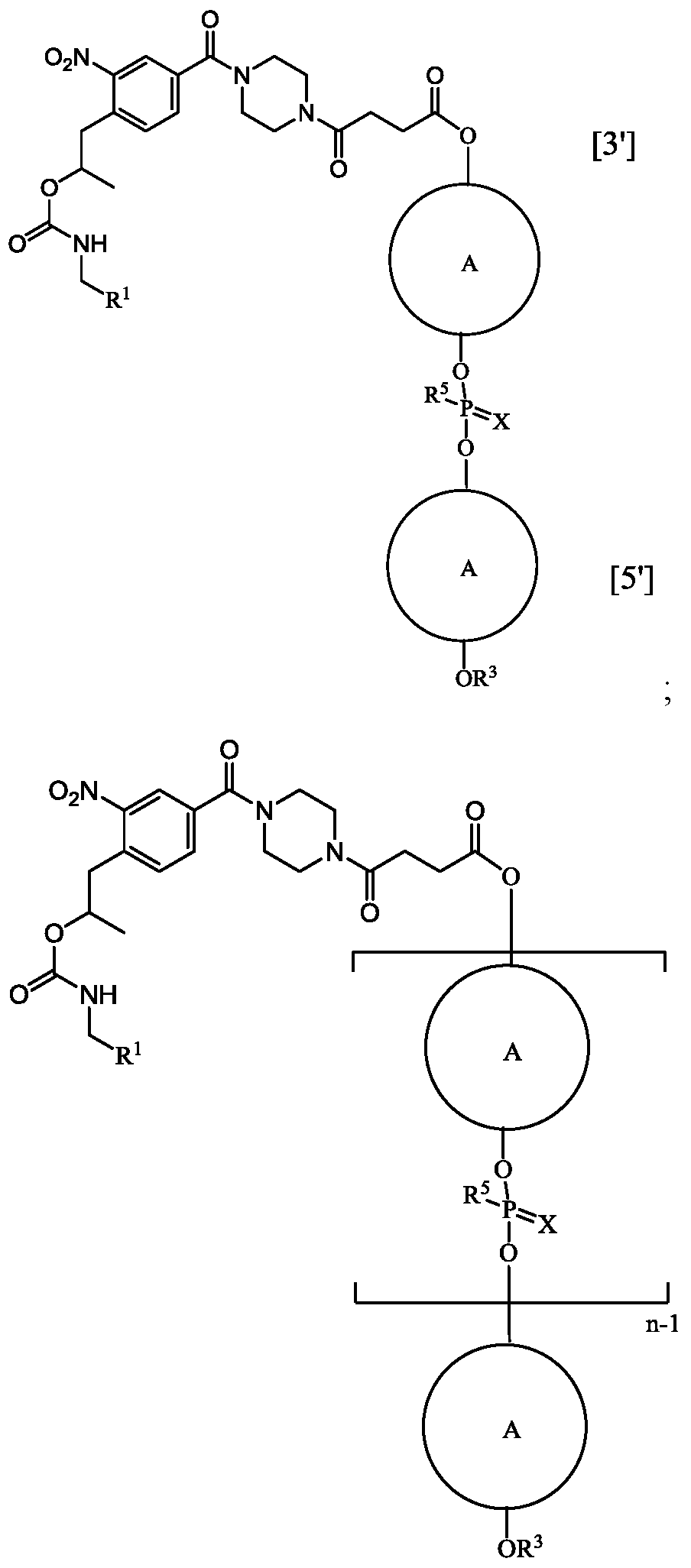
- each A is, independently for each occurrence, selected from the group consisting of:
- each R 2 is, independently for each occurrence, selected from the group consisting of:
- n is an integer from 10 to 40
- R is H or acetyl
- R 1 is a support-medium with a compound of Formula (F2):
- A is selected from the group consisting of:
- R 4 is selected from the group consisting of:
- R 3 is selected from the group consisting of trityl, monomethoxytrityl, dimethoxytrityl and trimethoxytrityl, and PG is a protecting group;
- R 1 is a support-medium
- A is selected from the group consisting of:
- R 4 is selected from the group consisting of: 5
- R 3 is selected from the group consisting of trityl, monomethoxytrityl, dimethoxytrityl and trimethoxytrityl, and PG is a protecting group;
- R 1 is a support-medium
- A is selected from the group consisting of:
- R 4 is selected from the group consisting of:
- R 4 is selected from the group consisting of: 5
- R 3 is selected from the group consisting of trityl, monomethoxytrityl, dimethoxytrityl and trimethoxytrityl
- PG is a protecting group
- R 1 is a support-medium
- each A is, independently at each occurrence, selected from the group consisting of:
- each R 4 is, independently at each occurrence, selected from the group consisting of:
- R 3 is selected from the group consisting of trityl, monomethoxytrityl, dimethoxytrityl and trimethoxytrityl,
- X is O or S
- step (d) further comprises a sulfurization step, or where X is O, then step (d) further comprises an oxidation step;
- each A is, independently for each iteration of (F8), selected from the group consisting of:
- R 4 is, independently for each iteration of (F8), selected from the group consisting of:
- nd R 3 is, independently for each iteration of (F8), selected from the group consisting of trityl, monomethoxytrityl, dimethoxytrityl and trimethoxytrityl, and PG is a protecting group,
- R 3 is selected from the group consisting of trityl, monomethoxytrityl, dimethoxytrityl and trimethoxytrityl
- R 4 is, independently for each occurrence, selected from the group consisting of:
- each iteration further comprises a sulfurization step, or where X is O, then each iteration further comprises an oxidation step;
- R 4 is, independently for each occurrence, selected from the group consisting of:
- n is an integer from 10 to 40
- X is O or S
- each A independently at each occurrence, is selected from the group consisting of:
- R 4 is, independently for each occurrence, selected from the group consisting of: 5 (h) contacting the compound of Formula (F11) with a deprotecting agent to form the oligomeric compound of Formula (F).
- the disclosure further provides a compound selected from:
- n is an integer from 10 to 40
- R 1 is a support-medium
- X is O or S
- each A independently at each occurrence, is selected from the group consisting of:
- R 3 is selected from the group consisting of trityl, monomethoxytrityl, dimethoxytrityl and trimethoxytrityl
- R 4 is, independently for each occurrence, selected from the group consisting of:
- Important properties of morpholino-based subunits include: 1) the ability to be linked in an oligomeric form by stable, uncharged or positively charged backbone linkages; 2) the ability to support a nucleotide base (e.g. adenine, cytosine, guanine, thymidine, uracil, 5- methyl-cytosine and hypoxanthine) such that the polymer formed can hybridize with a complementary-base target nucleic acid, including target RNA; 3) the ability of the oligomer to be actively or passively transported into mammalian cells; and 4) the ability of the oligomer and oligomer:RNA heteroduplex to resist RNAse and RNase H degradation, respectively.
- a nucleotide base e.g. adenine, cytosine, guanine, thymidine, uracil, 5- methyl-cytosine and hypoxanthine
- the antisense oligomers contain base modifications or substitutions.
- certain nucleo-bases may be selected to increase the binding affinity of the antisense oligomers described herein.
- 5-methylcytosine substitutions have been shown to increase nucleic acid duplex stability by 0.6-1.2°C, and may be incorporated into the antisense oligomers described herein.
- at least one pyrimidine base of the oligomer comprises a 5-substituted pyrimidine base, wherein the pyrimidine base is selected from the group consisting of cytosine, thymine and uracil.
- the 5-substituted pyrimidine base is 5-methylcytosine.
- at least one purine base of the oligomer comprises hypoxanthine.
- Morpholino-based oligomers are detailed, for example, in U.S. Patent Nos.5,698,685, 5,217,866, 5,142,047, 5,034,506, 5,166,315, 5,185,444, 5,521,063, 5,506,337, 8,299,206, and 8,076,476; International Patent Application Publication Nos. WO/2009/064471 and WO/2012/043730; and Summerton et al., Antisense Nucleic Acid Drug Dev.1997, 7, 187-195, each of which are hereby incorporated by reference in their entirety.
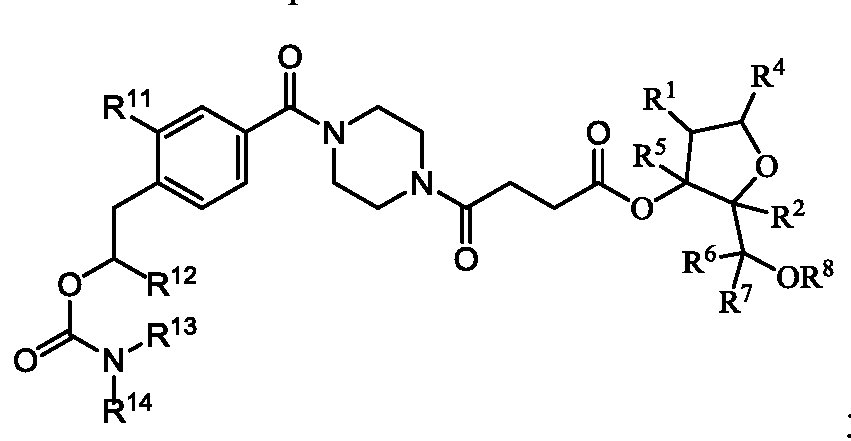
- the disclosure provides a process for preparing an oligomeric compound of Formula (B):
- n is an integer from 10 to 40
- T is selected from ;
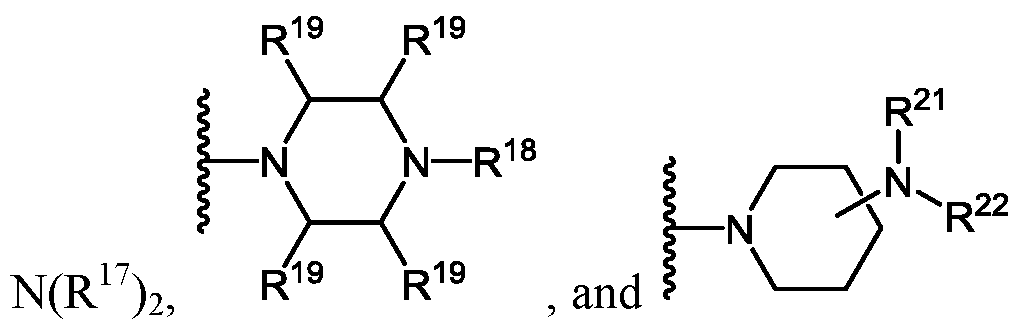
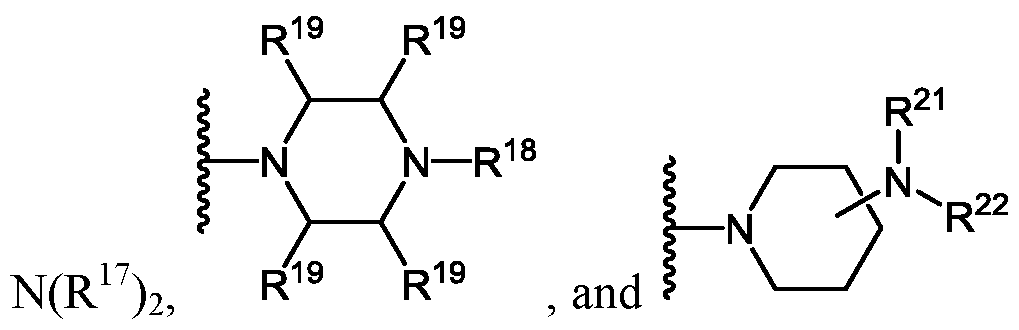
- X is, independently at each occurrence, selected from H, OH, -OCH 2 CH 2 CN, N(R 17 ) 2 ,
- R 17 is, independently for each occurrence, H or C 1-6 -alkyl
- R 19 is, independently for each occurrence, H or methyl
- R 20 is H or C 1-6 -alkyl
- R 22 is H or C 1-6 -alkyl
- R 23 is H or C 1-6 -alkyl; and r is 1, 2, 3, 4, or 5;
- each R 2 is, independently for each occurrence, selected from the group consisting of:
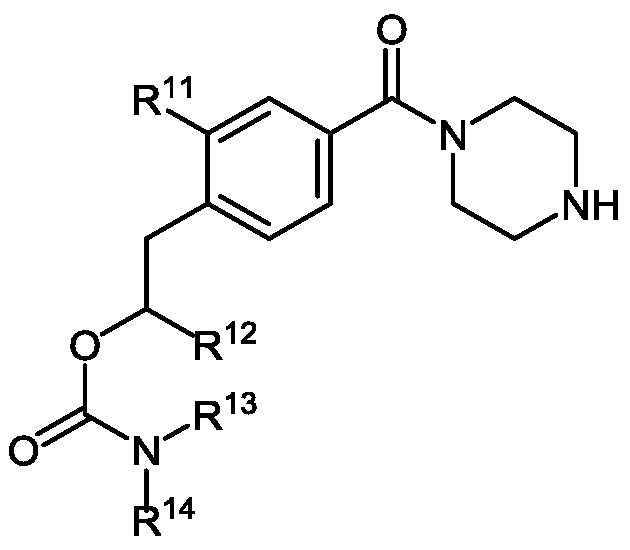
- R 11 is selected from the group consisting of halo, CN, and NO 2 ;
- R 12 is C 1-6 -alkyl;
- R 13 is H or C 1-6 -alkyl
- R 14 is a first linker bound to a support-medium
- R 3 is selected from the group consisting of trityl, monomethoxytrityl, dimethoxytrityl and trimethoxytrityl;
- R 11 is selected from the group consisting of halo, CN, and NO 2 ;
- R 12 is C 1-6 -alkyl;
- R 13 is H or C 1-6 -alkyl
- R 14 is a first linker bound to a support-medium
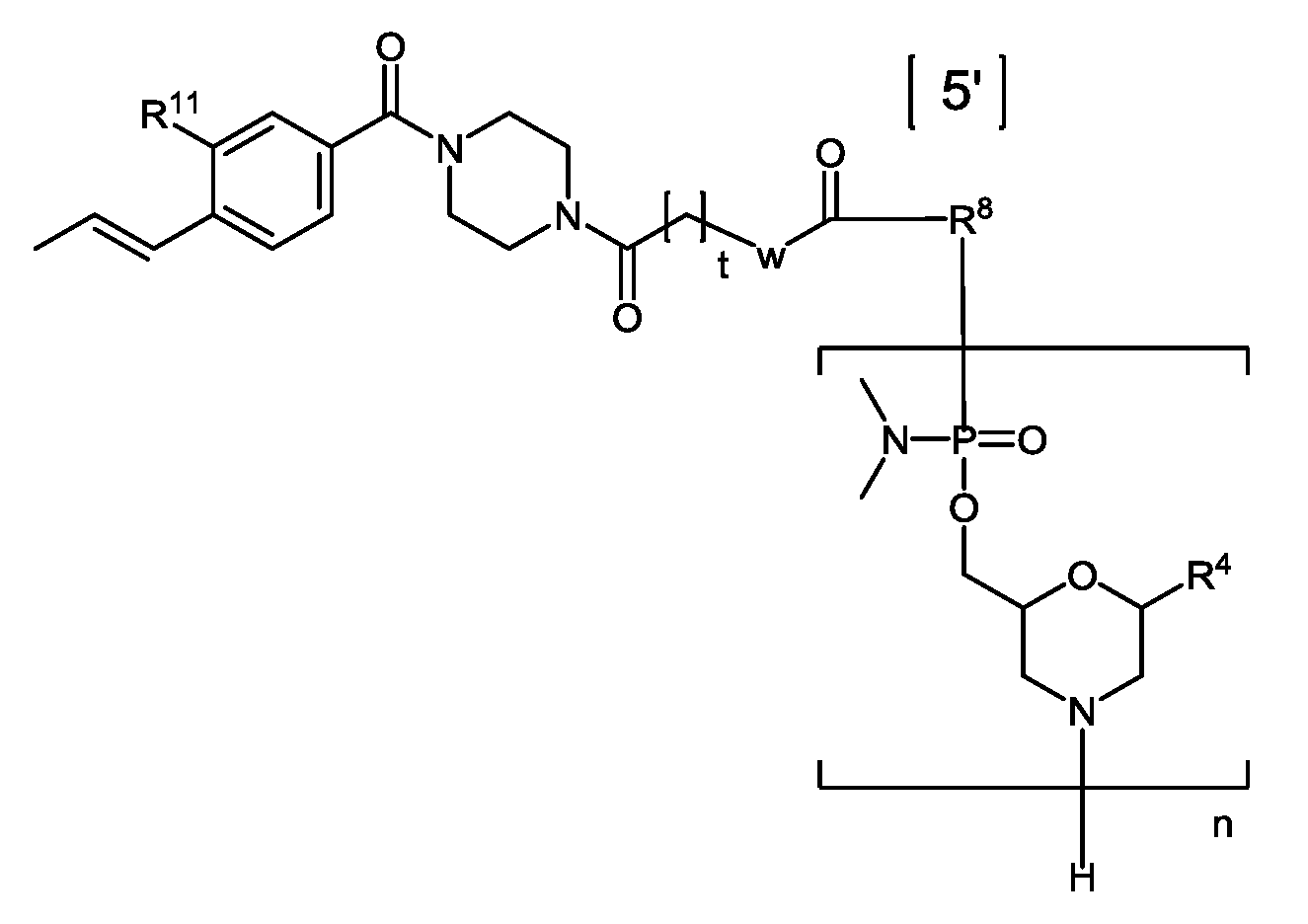
- w is selected from O or C
- t is 1, 2, 3, 4, or 5;
- R 8 is selected from:
- R 4 is selected from the group consisting of:
- R 3 is, independently at each occurrence, selected from the group consisting of trityl, monomethoxytrityl, dimethoxytrityl and trimethoxytrityl;
- R 9 and R 10 are, independently, C 1-6 -alkyl, or R 9 and R 10 , together with the atoms to which they are attached, form a cyclic or polycyclic ring comprising 4-10 carbon atoms to form a compound of Formula (B3):
- R 11 is selected from the group consisting of halo, CN, and NO 2 ;
- R 12 is C 1-6 -alkyl;
- R 13 is H or C 1-6 -alkyl
- R 14 is a first linker bound to a support-medium
- R 8 is selected from:
- R 4 is selected from the group consisting of:
- R 3 is selected from the group consisting of trityl, monomethoxytrityl, dimethoxytrityl and trimethoxytrityl; (c) contacting the compound of Formula (A3) with a deblocking agent to form a compound of Formula (IV-B):
- w is selected from O or C
- t is 1, 2, 3, 4, or 5;
- R 11 is selected from the group consisting of halo, CN, and NO 2 ;
- R 12 is C 1-6 -alkyl
- R 13 is H or C 1-6 -alkyl
- R 14 is a first linker bound to a support-medium
- R 4 is selected from the group consisting of:
- X is, independently at each occurrence, selected from H, OH, -OCH 2 CH 2 CN,
- R 17 is, independently for each occurrence, H or C 1-6 -alkyl
- R 19 is, independently for each occurrence, H or methyl
- R 20 is H or C 1-6 -alkyl
- R 22 is H or C 1-6 -alkyl
- R 23 is H or C 1-6 -alkyl
- r is 1, 2, 3, 4, or 5;
- R 3 is selected from the group consisting of trityl, monomethoxytrityl, dimethoxytrityl and trimethoxytrityl, and
- R 4 is selected from the group consisting of:
- w is selected from O or C
- t is 1, 2, 3, 4, or 5;
- R 11 is selected from the group consisting of halo, CN, and NO 2 ;
- R 12 is C 1-6 -alkyl
- R 13 is H or C 1-6 -alkyl
- R 14 is a first linker bound to a support-medium
- X is, independently at each occurrence, selected from H, OH, -OCH 2 CH 2 CN,
- R 17 is, independently for each occurrence, H or C 1-6 -alkyl
- q is 1, 2, 3, 4, or 5;
- R 19 is, independently for each occurrence, H or methyl;
- R 20 is H or C 1-6 -alkyl;
- R 21 is selected from the group consisting of H, C 1-6 -alkyl,
- R 22 is H or C 1-6 -alkyl
- R 23 is H or C 1-6 -alkyl
- r is 1, 2, 3, 4, or 5;
- R 3 is selected from the group consisting of trityl, monomethoxytrityl, dimethoxytrityl and trimethoxytrityl,
- R 8 is selected from:
- R 4 is, independently at each occurrence, selected from:
- X is selected from H, OH, -OCH 2 CH 2 CN, N(R 17 ) 2 , , and ;
- R 17 is, independently for each occurrence, H or C 1-6 -alkyl
- q is 1, 2, 3, 4, or 5;
- R 19 is, independently for each occurrence, H or methyl
- R 20 is H or C 1-6 -alkyl
- R 22 is H or C 1-6 -alkyl
- R 23 is H or C 1-6 -alkyl
- r is 1, 2, 3, 4, or 5;
- R 3 is selected from the group consisting of trityl, monomethoxytrityl, dimethoxytrityl and trimethoxytrityl, and
- R 4 is, independently for each compound of Formula (A8), selected from the group consisting of:
- w is selected from O or C
- t is 1, 2, 3, 4, or 5;
- R 11 is selected from the group consisting of halo, CN, and NO 2 ;
- R 12 is C 1-6 -alkyl
- R 13 is H or C 1-6 -alkyl
- R 14 is a first linker bound to a support-medium
- n is an integer from 10 to 40
- X is, independently at each occurrence, selected from H, OH, -OCH 2 CH 2 CN,
- R 17 is, independently for each occurrence, H or C 1-6 -alkyl
- q is 1, 2, 3, 4, or 5;
- R 19 is, independently for each occurrence, H or methyl;
- R 20 is H or C 1-6 -alkyl
- R 22 is H or C 1-6 -alkyl
- R 23 is H or C 1-6 -alkyl
- r is 1, 2, 3, 4, or 5;
- R 3 is selected from the group consisting of trityl, monomethoxytrityl, dimethoxytrityl and trimethoxytrityl,
- R 8 is selected from:
- R 4 is, independently for each occurrence, selected from the group consisting of:
- w is selected from O or C
- t is 1, 2, 3, 4, or 5;
- R 11 is selected from the group consisting of halo, CN, and NO 2 ;
- R 12 is C 1-6 -alkyl;
- R 13 is H or C 1-6 -alkyl
- R 14 is a first linker bound to a support-medium
- n is an integer from 10 to 40
- X is, independently at each occurrence, selected from H, OH, -OCH 2 CH 2 CN,
- q is 1, 2, 3, 4, or 5;
- R 19 is, independently for each occurrence, H or methyl
- R 20 is H or C 1-6 -alkyl
- R 22 is H or C 1-6 -alkyl
- R 23 is H or C 1-6 -alkyl
- r is 1, 2, 3, 4, or 5;
- R 8 is selected from:
- R 4 is, independently for each occurrence, selected from the group consisting of:
- w is selected from O or C
- t is 1, 2, 3, 4, or 5;
- R 11 is selected from the group consisting of halo, CN, and NO 2 ;
- n is an integer from 10 to 40
- X is, independently at each occurrence, selected from H, OH, -OCH 2 CH 2 CN,
- q is 1, 2, 3, 4, or 5;
- R 19 is, independently for each occurrence, H or methyl
- R 20 is H or C 1-6 -alkyl
- R 22 is H or C 1-6 -alkyl
- R 23 is H or C 1-6 -alkyl
- r is 1, 2, 3, 4, or 5;
- R 8 is selected from:
- R 4 is, independently for each occurrence, selected from the group consisting of:
- step (j) contacting the compound of Formula (B11) with a deprotecting agent to form the oligomeric compound of Formula (B).
- step (d) or step (e2) further comprises contacting the compound of Formula (IV-B) or the compound formed by the immediately prior step, respectively, with a capping agent.
- each step is performed in the presence of at least one solvent.
- the deblocking agent used in each step is a solution comprising a halogenated acid.
- the deblocking agent used in each step is cyanoacetic acid.
- the halogenated acid is selected from the group consisting of chloroacetic acid, dichloroacetic acid, trichloroacetic acid, fluoroacetic acid, difluoroacetic acid, and trifluoroacetic acid. In some embodiments, the halogenated acid is trifluoroacetic acid.
- steps (a), (c), (e1), and (f) further comprise the step of contacting the deblocked compound of each step with a neutralization agent.
- each of steps (a), (c), (e1), and (f) further comprise the step of contacting the deblocked compound of each step with a neutralization agent.
- the neutralization agent is in a solution comprising dichloromethane and isopropyl alcohol.
- the neutralization agent is a monoalkyl, dialkyl, or trialkyl amine.
- the neutralization agent is N,N-diisopropylethylamine.
- the deblocking agent used in each step is a solution comprising 4-cyanopyridine, dichloromethane, trifluoroacetic acid, trifluoroethanol, and water.
- the capping agent is in a solution comprising ethylmorpholine and methylpyrrolidinone.
- the capping agent is an acid anhydride.
- the acid anhydride is benzoic anhydride.
- the compounds of Formula (B4) and Formula (B8) are each, independently, in a solution comprising ethylmorpholine and dimethylimidazolidinone.
- the cleavage agent comprises dithiothreitol and 1,8- diazabicyclo[5.4.0]undec-7-ene. In some embodiments, the cleavage agent is in a solution comprising N-methyl-2-pyrrolidone.
- the deprotecting agent comprises NH 3 . In some embodiments, the deprotecting agent is in an aqueous solution.
- the support-medium comprises polystyrene with 1% crosslinked divinylbenzene.
- Oligomeric compounds of the disclosure may have asymmetric centers, chiral axes, and chiral planes (as described, for example, in: E. L. Eliel and S. H. Wilen, Stereo-chemistry of Carbon Compounds, John Wiley & Sons, New York, 1994, pages 1119-1190, and March, J. , Advanced Organic Chemistry, 3d. Ed., Chap.4, John Wiley & Sons, New York (1985)), and may occur as racemates, racemic mixtures, and as individual diastereomers, with all possible isomers and mixtures thereof, including optical isomers. Oligomeric compounds of the disclosure herein specifically mentioned, without any indication of its stereo-chemistry, are intended to represent all possible isomers and mixtures thereof.
- oligomeric compounds of the disclosure are prepared, as discussed herein, from activated morpholino subunits including such non-limiting examples such as a compound of Formula (VIII):
- R 2 is, independently for each compound of Formula (VIII), selected from the group consisting of:
- Each of the above-mentioned compounds of Formula (VIII) may be prepared, for example, from the corresponding beta-D-ribofuranosyl as depicted below:
- each morpholino subunit may be produced based on selection of, for example, an alpha-L- ribofuranosyl, alpha-D-ribofuranosyl, beta-L-ribofuranosyl, or beta-D-ribofuranosyl starting material.
- a compound of Formula (VIII) of the disclosure may be of Formula (VIIIa):
- R 2 is, independently for each compound of Formula (VIIIa), selected from the group consisting of:
- oligomeric compounds of the disclosure comprise one or more phosphorous-containing intersubunit linkages, which create a chiral center at each phosphorus, each of which is designated as either an“Sp” or“Rp” configuration as understood in the art. Without wishing to be bound by any particular theory, this chirality creates stereoisomers, which have identical chemical composition but different three-dimensional arrangement of their atoms.
- each phosphorous-containing intersubunit linkage occurs randomly during synthesis of, for example, oligomeric compounds of the disclosure.
- the synthesis process generates an exponentially large number of stereoisomers of an oligomeric compound of the disclosure because oligomeric compounds of the disclosure are comprised of numerous phosphorous-containing intersubunit linkages– with each phosphorous-containing intersubunit linkage having a random chiral configuration.
- each intersubunit linkage of an additional morpholino subunit doubles the number of stereoisomers of the product, so that a conventional preparation of an oligomeric compound of the disclosure is in fact a highly heterogeneous mixtures of 2 N stereoisomers, where N represents the number of phosphorous-containing intersubunit linkages.
- Table 1 depicts various embodiments of morpholino subunits provided in the processes described herein.
- Table 1 Various embodiments of morpholino subunits.
- the combined organic layers were washed with a solution of 1.08kg sodium chloride in 4.08kg purified water. The organic layers were dried over 1.068kg of sodium sulfate and filtered. The sodium sulfate was washed with 1.3kg of DCM. The combined organic layers were slurried with 252g of silica gel and filtered through a filter funnel containing a bed of 252g of silica gel. The silica gel bed was washed with 2kg of DCM. The combined organic layers were evaporated on a rotovap. 4.8kg of THF was added to the residue and then evaporated on the rotovap until 2.5 volumes of the crude 1-(2-nitro-4(4-tritylpiperazine-1- carbonyl)phenyl)propan-2-one in THF was reached.
Landscapes
- Chemical & Material Sciences (AREA)
- Organic Chemistry (AREA)
- Biochemistry (AREA)
- Health & Medical Sciences (AREA)
- General Health & Medical Sciences (AREA)
- Molecular Biology (AREA)
- Life Sciences & Earth Sciences (AREA)
- Pharmaceuticals Containing Other Organic And Inorganic Compounds (AREA)
- Macromolecular Compounds Obtained By Forming Nitrogen-Containing Linkages In General (AREA)
- Heterocyclic Carbon Compounds Containing A Hetero Ring Having Nitrogen And Oxygen As The Only Ring Hetero Atoms (AREA)
- Organic Low-Molecular-Weight Compounds And Preparation Thereof (AREA)
- Saccharide Compounds (AREA)
- Heterocyclic Compounds That Contain Two Or More Ring Oxygen Atoms (AREA)
- Polymers With Sulfur, Phosphorus Or Metals In The Main Chain (AREA)
Abstract
Description















































Claims












Priority Applications (22)
| Application Number | Priority Date | Filing Date | Title |
|---|---|---|---|
| HRP20241428TT HRP20241428T1 (en) | 2016-05-24 | 2017-05-24 | PROCEDURES FOR PREPARATION OF OLIGOMERS |
| MA45154A MA45154B1 (en) | 2016-05-24 | 2017-05-24 | PROCESSES FOR THE PREPARATION OF OLIGOMERS |
| EP17731336.8A EP3464305B1 (en) | 2016-05-24 | 2017-05-24 | Processes for preparing oligomers |
| EP19174995.1A EP3564248A1 (en) | 2016-05-24 | 2017-05-24 | Processes for preparing phosphorodiamidate morpholino oligomers |
| US16/303,356 US10875880B2 (en) | 2016-05-24 | 2017-05-24 | Processes for preparing oligomers |
| KR1020187036117A KR102506298B1 (en) | 2016-05-24 | 2017-05-24 | Oligomer preparation method |
| MX2021008539A MX2021008539A (en) | 2016-05-24 | 2017-05-24 | Processes for preparing oligomers. |
| MX2018014472A MX384727B (en) | 2016-05-24 | 2017-05-24 | PROCESSES FOR PREPARING OLIGOMERS |
| BR122022014984-7A BR122022014984B1 (en) | 2016-05-24 | 2017-05-24 | MORPHOLINE PHOSPHORODIAMIDATE OLIGOMER COMPOUNDS |
| AU2017269355A AU2017269355B2 (en) | 2016-05-24 | 2017-05-24 | Processes for preparing oligomers |
| DK17731336.8T DK3464305T3 (en) | 2016-05-24 | 2017-05-24 | PROCESSES FOR THE PRODUCTION OF OLIGOMERS |
| CN201780037531.XA CN109563114B (en) | 2016-05-24 | 2017-05-24 | Methods for preparing oligomers |
| CA3025339A CA3025339A1 (en) | 2016-05-24 | 2017-05-24 | Processes for preparing oligomers |
| JP2018562078A JP7008642B2 (en) | 2016-05-24 | 2017-05-24 | Process for oligomer preparation |
| BR112018074346-1A BR112018074346B1 (en) | 2016-05-24 | 2017-05-24 | OLIGOMER COMPOUND AND PROCESS FOR PREPARING AN OLIGOMER COMPOUND |
| MDE20190423T MD3464305T2 (en) | 2016-05-24 | 2017-05-24 | Processes for preparing oligomers |
| ES17731336T ES2993738T3 (en) | 2016-05-24 | 2017-05-24 | Processes for preparing oligomers |
| FIEP17731336.8T FI3464305T3 (en) | 2016-05-24 | 2017-05-24 | Processes for preparing oligomers |
| IL263149A IL263149B2 (en) | 2016-05-24 | 2018-11-20 | Processes for preparing oligomers |
| SA518400500A SA518400500B1 (en) | 2016-05-24 | 2018-11-24 | Processes for Preparing Oligomers |
| CONC2018/0013838A CO2018013838A2 (en) | 2016-05-24 | 2018-12-19 | Processes for preparing oligomers |
| US17/098,935 US11384105B2 (en) | 2016-05-24 | 2020-11-16 | Processes for preparing oligomers |
Applications Claiming Priority (12)
| Application Number | Priority Date | Filing Date | Title |
|---|---|---|---|
| US201662341049P | 2016-05-24 | 2016-05-24 | |
| US62/341,049 | 2016-05-24 | ||
| US201662357072P | 2016-06-30 | 2016-06-30 | |
| US201662357166P | 2016-06-30 | 2016-06-30 | |
| US201662356923P | 2016-06-30 | 2016-06-30 | |
| US201662357153P | 2016-06-30 | 2016-06-30 | |
| US62/356,923 | 2016-06-30 | ||
| US62/357,153 | 2016-06-30 | ||
| US62/357,072 | 2016-06-30 | ||
| US62/357,166 | 2016-06-30 | ||
| US201762508256P | 2017-05-18 | 2017-05-18 | |
| US62/508,256 | 2017-05-18 |
Related Child Applications (2)
| Application Number | Title | Priority Date | Filing Date |
|---|---|---|---|
| US16/303,356 A-371-Of-International US10875880B2 (en) | 2016-05-24 | 2017-05-24 | Processes for preparing oligomers |
| US17/098,935 Continuation US11384105B2 (en) | 2016-05-24 | 2020-11-16 | Processes for preparing oligomers |
Publications (1)
| Publication Number | Publication Date |
|---|---|
| WO2017205496A1 true WO2017205496A1 (en) | 2017-11-30 |
Family
ID=59078165
Family Applications (1)
| Application Number | Title | Priority Date | Filing Date |
|---|---|---|---|
| PCT/US2017/034235 Ceased WO2017205496A1 (en) | 2016-05-24 | 2017-05-24 | Processes for preparing oligomers |
Country Status (21)
| Country | Link |
|---|---|
| US (2) | US10875880B2 (en) |
| EP (2) | EP3564248A1 (en) |
| JP (2) | JP7008642B2 (en) |
| KR (1) | KR102506298B1 (en) |
| CN (1) | CN109563114B (en) |
| AU (1) | AU2017269355B2 (en) |
| BR (2) | BR112018074346B1 (en) |
| CA (1) | CA3025339A1 (en) |
| CO (1) | CO2018013838A2 (en) |
| DK (1) | DK3464305T3 (en) |
| ES (1) | ES2993738T3 (en) |
| FI (1) | FI3464305T3 (en) |
| HR (1) | HRP20241428T1 (en) |
| IL (1) | IL263149B2 (en) |
| MA (2) | MA45154B1 (en) |
| MD (1) | MD3464305T2 (en) |
| MX (2) | MX384727B (en) |
| SA (1) | SA518400500B1 (en) |
| SG (1) | SG10202101830WA (en) |
| TW (2) | TWI738784B (en) |
| WO (1) | WO2017205496A1 (en) |
Cited By (7)
| Publication number | Priority date | Publication date | Assignee | Title |
|---|---|---|---|---|
| US10385092B2 (en) | 2010-09-01 | 2019-08-20 | Nippon Shinyaku Co., Ltd. | Antisense nucleic acids |
| WO2019209764A3 (en) * | 2018-04-26 | 2019-12-05 | Sarepta Therapeutics, Inc. | Exon skipping oligomers and oligomer conjugates for muscular dystrophy |
| US10875880B2 (en) | 2016-05-24 | 2020-12-29 | Sarepta Therapeutics, Inc. | Processes for preparing oligomers |
| US10947533B2 (en) | 2016-05-24 | 2021-03-16 | Sarepta Therapeutics, Inc. | Processes for preparing phosphorodiamidate morpholino oligomers |
| US10961262B2 (en) | 2016-05-24 | 2021-03-30 | Sarepta Therapeutics, Inc. | Processes for preparing phosphorodiamidate morpholino oligomers |
| US11472824B2 (en) | 2016-05-24 | 2022-10-18 | Sarepta Therapeutics, Inc. | Processes for preparing phosphorodiamidate morpholino oligomers |
| US12297219B2 (en) | 2016-05-24 | 2025-05-13 | Sarepta Therapeutics, Inc. | Phosphorodiamidate morpholino oligomers |
Families Citing this family (4)
| Publication number | Priority date | Publication date | Assignee | Title |
|---|---|---|---|---|
| AU2017270598B2 (en) * | 2016-05-24 | 2022-12-01 | Sarepta Therapeutics, Inc. | Processes for preparing phosphorodiamidate morpholino oligomers |
| CN109152775B (en) * | 2016-06-30 | 2022-04-26 | 萨勒普塔医疗公司 | Process for preparing phosphoric acid diamide morpholino oligomer |
| ES2963336T3 (en) * | 2017-09-25 | 2024-03-26 | Sarepta Therapeutics Inc | Processes for preparing morpholino phosphorodiamidate oligomers by rapid flow synthesis |
| EP4658280A2 (en) * | 2023-02-01 | 2025-12-10 | Alnylam Pharmaceuticals, Inc. | Six membered ring containing oligomers |
Citations (26)
| Publication number | Priority date | Publication date | Assignee | Title |
|---|---|---|---|---|
| WO1990002749A1 (en) | 1988-09-01 | 1990-03-22 | Forskningscenter Risø | Peptide synthesis method and solid support for use in the method |
| US5034506A (en) | 1985-03-15 | 1991-07-23 | Anti-Gene Development Group | Uncharged morpholino-based polymers having achiral intersubunit linkages |
| US5142047A (en) | 1985-03-15 | 1992-08-25 | Anti-Gene Development Group | Uncharged polynucleotide-binding polymers |
| US5166315A (en) | 1989-12-20 | 1992-11-24 | Anti-Gene Development Group | Sequence-specific binding polymers for duplex nucleic acids |
| US5185444A (en) | 1985-03-15 | 1993-02-09 | Anti-Gene Deveopment Group | Uncharged morpolino-based polymers having phosphorous containing chiral intersubunit linkages |
| US5217866A (en) | 1985-03-15 | 1993-06-08 | Anti-Gene Development Group | Polynucleotide assay reagent and method |
| US5506337A (en) | 1985-03-15 | 1996-04-09 | Antivirals Inc. | Morpholino-subunit combinatorial library and method |
| US5521063A (en) | 1985-03-15 | 1996-05-28 | Antivirals Inc. | Polynucleotide reagent containing chiral subunits and methods of use |
| US6670461B1 (en) | 1997-09-12 | 2003-12-30 | Exiqon A/S | Oligonucleotide analogues |
| WO2004043977A2 (en) | 2002-11-05 | 2004-05-27 | Isis Pharmaceuticals, Inc. | 2’-fluoro substituted oligomeric compounds and compositions for use in gene modulations |
| WO2006000057A1 (en) | 2004-06-28 | 2006-01-05 | SMITHKLINE BEECHAM CORPORATION, doing business as GLAXOSMITHKLINE | Antisense oligonucleotides for inducing exon skipping and methods of use thereof |
| US7053207B2 (en) | 1999-05-04 | 2006-05-30 | Exiqon A/S | L-ribo-LNA analogues |
| US7060809B2 (en) | 2001-09-04 | 2006-06-13 | Exiqon A/S | LNA compositions and uses thereof |
| US7084125B2 (en) | 1999-03-18 | 2006-08-01 | Exiqon A/S | Xylo-LNA analogues |
| WO2009064471A1 (en) | 2007-11-15 | 2009-05-22 | Avi Biopharma, Inc. | Method of synthesis of morpholino oligomers |
| US7569575B2 (en) | 2002-05-08 | 2009-08-04 | Santaris Pharma A/S | Synthesis of locked nucleic acid derivatives |
| US7572582B2 (en) | 1997-09-12 | 2009-08-11 | Exiqon A/S | Oligonucleotide analogues |
| WO2010115993A1 (en) | 2009-04-10 | 2010-10-14 | Association Institut De Myologie | Tricyclo-dna antisense oligonucleotides, compositions, and methods for the treatment of disease |
| US8067571B2 (en) | 2005-07-13 | 2011-11-29 | Avi Biopharma, Inc. | Antibacterial antisense oligonucleotide and method |
| WO2011150408A2 (en) * | 2010-05-28 | 2011-12-01 | Avi Biopharma, Inc. | Oligonucleotide analogues having modified intersubunit linkages and/or terminal groups |
| US8076476B2 (en) | 2007-11-15 | 2011-12-13 | Avi Biopharma, Inc. | Synthesis of morpholino oligomers using doubly protected guanine morpholino subunits |
| WO2012043730A1 (en) | 2010-09-30 | 2012-04-05 | 日本新薬株式会社 | Morpholino nucleic acid derivative |
| US8299206B2 (en) | 2007-11-15 | 2012-10-30 | Avi Biopharma, Inc. | Method of synthesis of morpholino oligomers |
| WO2013053928A1 (en) | 2011-10-13 | 2013-04-18 | Association Institut De Myologie | Tricyclo-phosphorothioate dna |
| WO2013082551A1 (en) | 2011-11-30 | 2013-06-06 | Sarepta Therapeutics, Inc. | Induced exon inclusion in spinal muscle atrophy |
| WO2014153240A2 (en) * | 2013-03-14 | 2014-09-25 | Sarepta Therapeutics, Inc. | Exon skipping compositions for treating muscular dystrophy |
Family Cites Families (27)
| Publication number | Priority date | Publication date | Assignee | Title |
|---|---|---|---|---|
| WO1995018128A1 (en) | 1993-12-29 | 1995-07-06 | Fujisawa Pharmaceutical Co., Ltd. | Pyrazolopyridine adenosine antagonists |
| KR20020097241A (en) | 2000-05-04 | 2002-12-31 | 에이브이아이 바이오파마 인코포레이티드 | Splice-region antisense composition and method |
| US7759513B2 (en) | 2003-02-21 | 2010-07-20 | Nigu Chemie Gmbh | Photolabile protective groups for improved processes to prepare oligonucleotide arrays |
| EP2735568B8 (en) * | 2006-05-10 | 2017-09-27 | Sarepta Therapeutics, Inc. | Oligonucleotide analogs having cationic intersubunit linkages |
| US9371348B2 (en) | 2006-11-27 | 2016-06-21 | The Trustees Of The University Of Pennsylvania | Photocleavable oligonucleotide and uses thereof |
| CA3066050A1 (en) | 2008-10-24 | 2010-04-29 | Sarepta Therapeutics, Inc. | Multiple exon skipping compositions for dmd |
| WO2011057350A1 (en) | 2009-11-12 | 2011-05-19 | The University Of Western Australia | Antisense molecules and methods for treating pathologies |
| TWI463423B (en) * | 2010-05-28 | 2014-12-01 | Poynt Corp | Method of using location information for advertising system based on 3-dimensional shapes |
| TWI541024B (en) * | 2010-09-01 | 2016-07-11 | 日本新藥股份有限公司 | Antisense nucleic acid |
| MX2013009191A (en) * | 2011-02-08 | 2013-11-04 | Charlotte Mecklenburg Hospital | Antisense oligonucleotides. |
| SG11201400135SA (en) | 2011-08-23 | 2014-03-28 | Univ Mcgill | Ionic tags for synthesis of oligoribonucleotides |
| EA202090338A1 (en) | 2011-11-18 | 2021-04-30 | Сарепта Терапьютикс, Инк. | Functionally Modified Oligonucleotides and Their Subunits |
| CN117721110A (en) * | 2011-12-28 | 2024-03-19 | 日本新药株式会社 | antisense nucleic acid |
| EP2820155B1 (en) | 2012-02-28 | 2017-07-26 | Population Genetics Technologies Ltd. | Method for attaching a counter sequence to a nucleic acid sample |
| CN102702265A (en) * | 2012-05-14 | 2012-10-03 | 天津特安化学科技有限公司 | Phosphorodiamidate morpholino oligomer synthetized by solid phase and method thereof |
| MX366485B (en) * | 2013-03-14 | 2019-07-10 | Sarepta Therapeutics Inc | COMPOSITIONS FOR EXON JUMPING FOR THE TREATMENT OF MUSCULAR DYSTROPHY. |
| US20140329762A1 (en) | 2013-03-15 | 2014-11-06 | Sarepta Therapeutics, Inc. | Compositions for treating muscular dystrophy |
| EP3015467B1 (en) | 2013-05-24 | 2024-12-04 | Ajinomoto Co., Inc. | Morpholino oligonucleotide manufacturing method |
| SG10202101836TA (en) | 2016-05-24 | 2021-03-30 | Sarepta Therapeutics Inc | Processes for preparing phosphorodiamidate morpholino oligomers |
| HRP20241428T1 (en) | 2016-05-24 | 2025-01-03 | Sarepta Therapeutics, Inc. | PROCEDURES FOR PREPARATION OF OLIGOMERS |
| PT3464306T (en) * | 2016-05-24 | 2024-05-17 | Sarepta Therapeutics Inc | Processes for preparing phosphorodiamidate morpholino oligomers |
| MA45362A (en) | 2016-05-24 | 2019-04-10 | Sarepta Therapeutics Inc | PROCESSES FOR THE PREPARATION OF MORPHOLINO OLIGOMERS OF PHOSPHORODIAMIDATE |
| US11472824B2 (en) | 2016-05-24 | 2022-10-18 | Sarepta Therapeutics, Inc. | Processes for preparing phosphorodiamidate morpholino oligomers |
| PL3554554T3 (en) | 2016-12-19 | 2022-12-19 | Sarepta Therapeutics, Inc. | Exon-skipping oligomer conjugates in muscular dystrophy |
| DK3554552T3 (en) | 2016-12-19 | 2022-10-24 | Sarepta Therapeutics Inc | EXON SKIPPING OLIGOMER CONJUGATES AGAINST MUSCULAR DYSTROPHY |
| LT3554553T (en) | 2016-12-19 | 2022-08-25 | Sarepta Therapeutics, Inc. | Exon skipping oligomer conjugates for muscular dystrophy |
| EA201991450A1 (en) | 2017-09-22 | 2019-12-30 | Сарепта Терапьютикс, Инк. | OLIGOMER CONJUGATES FOR EXONISM SKIP IN MUSCULAR DYSTROPHY |
-
2017
- 2017-05-24 HR HRP20241428TT patent/HRP20241428T1/en unknown
- 2017-05-24 AU AU2017269355A patent/AU2017269355B2/en active Active
- 2017-05-24 JP JP2018562078A patent/JP7008642B2/en active Active
- 2017-05-24 MD MDE20190423T patent/MD3464305T2/en unknown
- 2017-05-24 MA MA45154A patent/MA45154B1/en unknown
- 2017-05-24 MX MX2018014472A patent/MX384727B/en unknown
- 2017-05-24 CA CA3025339A patent/CA3025339A1/en active Pending
- 2017-05-24 EP EP19174995.1A patent/EP3564248A1/en active Pending
- 2017-05-24 WO PCT/US2017/034235 patent/WO2017205496A1/en not_active Ceased
- 2017-05-24 TW TW106117189A patent/TWI738784B/en active
- 2017-05-24 KR KR1020187036117A patent/KR102506298B1/en active Active
- 2017-05-24 DK DK17731336.8T patent/DK3464305T3/en active
- 2017-05-24 SG SG10202101830WA patent/SG10202101830WA/en unknown
- 2017-05-24 CN CN201780037531.XA patent/CN109563114B/en active Active
- 2017-05-24 TW TW110113938A patent/TWI801843B/en active
- 2017-05-24 US US16/303,356 patent/US10875880B2/en active Active
- 2017-05-24 ES ES17731336T patent/ES2993738T3/en active Active
- 2017-05-24 EP EP17731336.8A patent/EP3464305B1/en active Active
- 2017-05-24 BR BR112018074346-1A patent/BR112018074346B1/en active IP Right Grant
- 2017-05-24 FI FIEP17731336.8T patent/FI3464305T3/en active
- 2017-05-24 BR BR122022014984-7A patent/BR122022014984B1/en active IP Right Grant
- 2017-05-24 MX MX2021008539A patent/MX2021008539A/en unknown
- 2017-05-24 MA MA049775A patent/MA49775A/en unknown
-
2018
- 2018-11-20 IL IL263149A patent/IL263149B2/en unknown
- 2018-11-24 SA SA518400500A patent/SA518400500B1/en unknown
- 2018-12-19 CO CONC2018/0013838A patent/CO2018013838A2/en unknown
-
2020
- 2020-11-16 US US17/098,935 patent/US11384105B2/en active Active
-
2021
- 2021-07-15 JP JP2021117392A patent/JP2021176967A/en active Pending
Patent Citations (29)
| Publication number | Priority date | Publication date | Assignee | Title |
|---|---|---|---|---|
| US5698685A (en) | 1985-03-15 | 1997-12-16 | Antivirals Inc. | Morpholino-subunit combinatorial library and method |
| US5034506A (en) | 1985-03-15 | 1991-07-23 | Anti-Gene Development Group | Uncharged morpholino-based polymers having achiral intersubunit linkages |
| US5142047A (en) | 1985-03-15 | 1992-08-25 | Anti-Gene Development Group | Uncharged polynucleotide-binding polymers |
| US5185444A (en) | 1985-03-15 | 1993-02-09 | Anti-Gene Deveopment Group | Uncharged morpolino-based polymers having phosphorous containing chiral intersubunit linkages |
| US5217866A (en) | 1985-03-15 | 1993-06-08 | Anti-Gene Development Group | Polynucleotide assay reagent and method |
| US5506337A (en) | 1985-03-15 | 1996-04-09 | Antivirals Inc. | Morpholino-subunit combinatorial library and method |
| US5521063A (en) | 1985-03-15 | 1996-05-28 | Antivirals Inc. | Polynucleotide reagent containing chiral subunits and methods of use |
| WO1990002749A1 (en) | 1988-09-01 | 1990-03-22 | Forskningscenter Risø | Peptide synthesis method and solid support for use in the method |
| US5166315A (en) | 1989-12-20 | 1992-11-24 | Anti-Gene Development Group | Sequence-specific binding polymers for duplex nucleic acids |
| US6670461B1 (en) | 1997-09-12 | 2003-12-30 | Exiqon A/S | Oligonucleotide analogues |
| US7572582B2 (en) | 1997-09-12 | 2009-08-11 | Exiqon A/S | Oligonucleotide analogues |
| US6794499B2 (en) | 1997-09-12 | 2004-09-21 | Exiqon A/S | Oligonucleotide analogues |
| US7034133B2 (en) | 1997-09-12 | 2006-04-25 | Exiqon A/S | Oligonucleotide analogues |
| US7084125B2 (en) | 1999-03-18 | 2006-08-01 | Exiqon A/S | Xylo-LNA analogues |
| US7053207B2 (en) | 1999-05-04 | 2006-05-30 | Exiqon A/S | L-ribo-LNA analogues |
| US7060809B2 (en) | 2001-09-04 | 2006-06-13 | Exiqon A/S | LNA compositions and uses thereof |
| US7569575B2 (en) | 2002-05-08 | 2009-08-04 | Santaris Pharma A/S | Synthesis of locked nucleic acid derivatives |
| WO2004043977A2 (en) | 2002-11-05 | 2004-05-27 | Isis Pharmaceuticals, Inc. | 2’-fluoro substituted oligomeric compounds and compositions for use in gene modulations |
| WO2006000057A1 (en) | 2004-06-28 | 2006-01-05 | SMITHKLINE BEECHAM CORPORATION, doing business as GLAXOSMITHKLINE | Antisense oligonucleotides for inducing exon skipping and methods of use thereof |
| US8067571B2 (en) | 2005-07-13 | 2011-11-29 | Avi Biopharma, Inc. | Antibacterial antisense oligonucleotide and method |
| WO2009064471A1 (en) | 2007-11-15 | 2009-05-22 | Avi Biopharma, Inc. | Method of synthesis of morpholino oligomers |
| US8076476B2 (en) | 2007-11-15 | 2011-12-13 | Avi Biopharma, Inc. | Synthesis of morpholino oligomers using doubly protected guanine morpholino subunits |
| US8299206B2 (en) | 2007-11-15 | 2012-10-30 | Avi Biopharma, Inc. | Method of synthesis of morpholino oligomers |
| WO2010115993A1 (en) | 2009-04-10 | 2010-10-14 | Association Institut De Myologie | Tricyclo-dna antisense oligonucleotides, compositions, and methods for the treatment of disease |
| WO2011150408A2 (en) * | 2010-05-28 | 2011-12-01 | Avi Biopharma, Inc. | Oligonucleotide analogues having modified intersubunit linkages and/or terminal groups |
| WO2012043730A1 (en) | 2010-09-30 | 2012-04-05 | 日本新薬株式会社 | Morpholino nucleic acid derivative |
| WO2013053928A1 (en) | 2011-10-13 | 2013-04-18 | Association Institut De Myologie | Tricyclo-phosphorothioate dna |
| WO2013082551A1 (en) | 2011-11-30 | 2013-06-06 | Sarepta Therapeutics, Inc. | Induced exon inclusion in spinal muscle atrophy |
| WO2014153240A2 (en) * | 2013-03-14 | 2014-09-25 | Sarepta Therapeutics, Inc. | Exon skipping compositions for treating muscular dystrophy |
Non-Patent Citations (30)
| Title |
|---|
| ALUL ET AL., NUCLEIC ACIDS RESEARCH, vol. 19, 1991, pages 1527 |
| ATHERTON ET AL., BIOORG. CHEM., vol. 8, 1979, pages 351 |
| ATHERTON ET AL., J. AM. CHEM. SOC., vol. 97, 1975, pages 6584 |
| ATHERTON ET AL., J. CHEM. SOC. PERKIN I, 1981, pages 538 |
| BAYER; JUNG, TETRAHEDRON LETT., vol. 51, 1970, pages 4503 |
| BERG ET AL., J. AM. CHEM. SOC., vol. 111, 1989, pages 8024 |
| BONORA ET AL., ORGANIC PROCESS RESEARCH & DEVELOPMENT, vol. 4, 2000, pages 225 - 231 |
| DANIELS ET AL., TETRAHEDRON LETT., 1989, pages 4345 |
| E. L. ELIEL; S. H. WILEN: "Stereo-chemistry of Carbon Compounds", 1994, JOHN WILEY & SONS, pages: 1119 - 1190 |
| GEYSEN ET AL., PROC. NATL. ACAD. SCI. USA, vol. 81, 1984, pages 3998 |
| GRAVERT ET AL., CHEM. REV., vol. 97, 1997, pages 489 - 510 |
| HOUGHTEN, PROC. NATL. ACAD. SCI. USA, vol. 82, 1985, pages 5131 |
| IYER ET AL., J. ORG. CHEM., vol. 55, 1990, pages 4693 - 4699 |
| KENT; MERRIFIELD, ISRAEL J. CHEM., vol. 17, 1978, pages 243 |
| MARCH, J.: "Advanced Organic Chemistry", 1985, JOHN WILEY & SONS |
| MARTIN ET AL., HELV. CHIM. ACTA, vol. 78, 1995, pages 486 - 504 |
| OBIKA ET AL., BIOORG. MED. CHEM., vol. 16, 2008, pages 9230 |
| OBIKA ET AL., TETRAHEDRON LETT., vol. 38, 1997, pages 8735 |
| OBIKA ET AL., TETRAHEDRON LETT., vol. 39, 1998, pages 5401 |
| PARR; GROHMANN, ANGEW. CHEM. INTERNATL. ED., vol. 11, 1972, pages 314 |
| RIETSCHOTEN: "Peptides", 1974, WILEY AND SONS, pages: 113 - 116 |
| SCOTT ET AL., J. CHROM. SCI., vol. 9, 1971, pages 577 |
| SINGH ET AL., CHEM. COMMUN., 1998, pages 455 |
| SUMMERTON ET AL., ANTISENSE NUCLEIC ACID DRUG DEV., vol. 7, 1997, pages 187 - 195 |
| VIRTA P ET AL: "Solid-supported synthesis of oligomeric bioconjugates", TETRAHE, ELSEVIER SCIENCE PUBLISHERS, AMSTERDAM, NL, vol. 59, no. 28, 7 July 2003 (2003-07-07), pages 5137 - 5174, XP004434882, ISSN: 0040-4020, DOI: 10.1016/S0040-4020(03)00704-X * |
| WENGEL, ACC. CHEM. RES., vol. 32, 1999, pages 301 |
| WENGEL, TETRAHEDRON, vol. 54, 1998, pages 3607 |
| WRIGHT ET AL., TETRAHEDRON LETT., vol. 34, 1993, pages 3373 |
| YAMADA ET AL., J. ORG. CHEM., vol. 76, no. 9, 2011, pages 3042 - 53 |
| YOO ET AL., NUCLEIC ACIDS RES., vol. 32, 2004, pages 2008 - 16 |
Cited By (16)
| Publication number | Priority date | Publication date | Assignee | Title |
|---|---|---|---|---|
| US10385092B2 (en) | 2010-09-01 | 2019-08-20 | Nippon Shinyaku Co., Ltd. | Antisense nucleic acids |
| US10407461B2 (en) | 2010-09-01 | 2019-09-10 | Nippon Shinyaku Co., Ltd. | Antisense nucleic acids |
| US10487106B2 (en) | 2010-09-01 | 2019-11-26 | Nippon Shinyaku Co., Ltd. | Antisense nucleic acids |
| US11028122B1 (en) | 2010-09-01 | 2021-06-08 | Nippon Shinyaku Co., Ltd. | Antisense nucleic acids |
| US10647741B2 (en) | 2010-09-01 | 2020-05-12 | Nippon Shinyaku Co., Ltd. | Antisense nucleic acids |
| US10662217B2 (en) | 2010-09-01 | 2020-05-26 | Nippon Shinyaku Co., Ltd. | Antisense nucleic acids |
| US10683322B2 (en) | 2010-09-01 | 2020-06-16 | Nippon Shinyaku Co., Ltd. | Antisense nucleic acids |
| US10870676B2 (en) | 2010-09-01 | 2020-12-22 | Nippon Shinyaku Co., Ltd. | Antisense nucleic acids |
| US10875880B2 (en) | 2016-05-24 | 2020-12-29 | Sarepta Therapeutics, Inc. | Processes for preparing oligomers |
| US10947533B2 (en) | 2016-05-24 | 2021-03-16 | Sarepta Therapeutics, Inc. | Processes for preparing phosphorodiamidate morpholino oligomers |
| US10961262B2 (en) | 2016-05-24 | 2021-03-30 | Sarepta Therapeutics, Inc. | Processes for preparing phosphorodiamidate morpholino oligomers |
| US11384105B2 (en) | 2016-05-24 | 2022-07-12 | Sarepta Therapeutics, Inc. | Processes for preparing oligomers |
| US11472824B2 (en) | 2016-05-24 | 2022-10-18 | Sarepta Therapeutics, Inc. | Processes for preparing phosphorodiamidate morpholino oligomers |
| US12258362B2 (en) | 2016-05-24 | 2025-03-25 | Sarepta Therapeutics, Inc. | Processes for preparing phosphorodiamidate morpholino oligomers |
| US12297219B2 (en) | 2016-05-24 | 2025-05-13 | Sarepta Therapeutics, Inc. | Phosphorodiamidate morpholino oligomers |
| WO2019209764A3 (en) * | 2018-04-26 | 2019-12-05 | Sarepta Therapeutics, Inc. | Exon skipping oligomers and oligomer conjugates for muscular dystrophy |
Also Published As
Similar Documents
| Publication | Publication Date | Title |
|---|---|---|
| EP3464306B1 (en) | Processes for preparing phosphorodiamidate morpholino oligomers | |
| US11384105B2 (en) | Processes for preparing oligomers | |
| WO2017205880A1 (en) | Processes for preparing phosphorodiamidate morpholino oligomers | |
| KR102523522B1 (en) | Method for preparing phosphorodiamidate morpholino oligomers | |
| KR102523527B1 (en) | Method for preparing phosphorodiamidate morpholino oligomers | |
| HK40016300A (en) | Processes for preparing phosphorodiamidate morpholino oligomers | |
| HK40114872A (en) | Process for preparing phosphorodiamidate morpholino oligomers | |
| HK40007452A (en) | Processes for preparing phosphorodiamidate morpholino oligomers | |
| HK40007452B (en) | Processes for preparing phosphorodiamidate morpholino oligomers | |
| HK40005805A (en) | Processes for preparing oligomers |
Legal Events
| Date | Code | Title | Description |
|---|---|---|---|
| ENP | Entry into the national phase |
Ref document number: 3025339 Country of ref document: CA |
|
| ENP | Entry into the national phase |
Ref document number: 2018562078 Country of ref document: JP Kind code of ref document: A |
|
| WWE | Wipo information: entry into national phase |
Ref document number: 122022014984 Country of ref document: BR |
|
| NENP | Non-entry into the national phase |
Ref country code: DE |
|
| 121 | Ep: the epo has been informed by wipo that ep was designated in this application |
Ref document number: 17731336 Country of ref document: EP Kind code of ref document: A1 |
|
| REG | Reference to national code |
Ref country code: BR Ref legal event code: B01A Ref document number: 112018074346 Country of ref document: BR |
|
| ENP | Entry into the national phase |
Ref document number: 20187036117 Country of ref document: KR Kind code of ref document: A |
|
| WWE | Wipo information: entry into national phase |
Ref document number: NC2018/0013838 Country of ref document: CO |
|
| ENP | Entry into the national phase |
Ref document number: 2017269355 Country of ref document: AU Date of ref document: 20170524 Kind code of ref document: A |
|
| WWP | Wipo information: published in national office |
Ref document number: NC2018/0013838 Country of ref document: CO |
|
| ENP | Entry into the national phase |
Ref document number: 2017731336 Country of ref document: EP Effective date: 20190102 |
|
| ENP | Entry into the national phase |
Ref document number: 112018074346 Country of ref document: BR Kind code of ref document: A2 Effective date: 20181126 |
|
| WWG | Wipo information: grant in national office |
Ref document number: NC2018/0013838 Country of ref document: CO |