[go: up one dir, main page]

US12297219B2 - Phosphorodiamidate morpholino oligomers - Google Patents

Phosphorodiamidate morpholino oligomers Download PDF

Info

Publication number
US12297219B2
US12297219B2 US17/841,185 US202217841185A US12297219B2 US 12297219 B2 US12297219 B2 US 12297219B2 US 202217841185 A US202217841185 A US 202217841185A US 12297219 B2 US12297219 B2 US 12297219B2
Authority
US
United States
Prior art keywords
formula
compound
dpg
group
solution
Prior art date
Legal status (The legal status is an assumption and is not a legal conclusion. Google has not performed a legal analysis and makes no representation as to the accuracy of the status listed.)
Active, expires
Application number
US17/841,185
Other versions
US20230045831A1 (en
Inventor
Baozhong CAI
Mitchell MARTINI
Katie THOMAS
Ross SHIMABUKU
Current Assignee (The listed assignees may be inaccurate. Google has not performed a legal analysis and makes no representation or warranty as to the accuracy of the list.)
Sarepta Therapeutics Inc
Original Assignee
Sarepta Therapeutics Inc
Priority date (The priority date is an assumption and is not a legal conclusion. Google has not performed a legal analysis and makes no representation as to the accuracy of the date listed.)
Filing date
Publication date
Application filed by Sarepta Therapeutics Inc filed Critical Sarepta Therapeutics Inc
Priority to US17/841,185 priority Critical patent/US12297219B2/en
Publication of US20230045831A1 publication Critical patent/US20230045831A1/en
Assigned to SAREPTA THERAPEUTICS, INC. reassignment SAREPTA THERAPEUTICS, INC. ASSIGNMENT OF ASSIGNORS INTEREST (SEE DOCUMENT FOR DETAILS). Assignors: THOMAS, Katie, SHIMABUKU, Ross, CAI, BAOZHONG, MARTINI, Mitchell
Assigned to JPMORGAN CHASE BANK, N.A. AS ADMINISTRATIVE AGENT reassignment JPMORGAN CHASE BANK, N.A. AS ADMINISTRATIVE AGENT SECURITY INTEREST (SEE DOCUMENT FOR DETAILS). Assignors: SAREPTA THERAPEUTICS, INC.
Application granted granted Critical
Publication of US12297219B2 publication Critical patent/US12297219B2/en
Active legal-status Critical Current
Adjusted expiration legal-status Critical

Links

Images

Classifications

    • CCHEMISTRY; METALLURGY
    • C07ORGANIC CHEMISTRY
    • C07FACYCLIC, CARBOCYCLIC OR HETEROCYCLIC COMPOUNDS CONTAINING ELEMENTS OTHER THAN CARBON, HYDROGEN, HALOGEN, OXYGEN, NITROGEN, SULFUR, SELENIUM OR TELLURIUM
    • C07F9/00Compounds containing elements of Groups 5 or 15 of the Periodic Table
    • C07F9/02Phosphorus compounds
    • C07F9/547Heterocyclic compounds, e.g. containing phosphorus as a ring hetero atom
    • C07F9/645Heterocyclic compounds, e.g. containing phosphorus as a ring hetero atom having two nitrogen atoms as the only ring hetero atoms
    • C07F9/6509Six-membered rings
    • C07F9/6512Six-membered rings having the nitrogen atoms in positions 1 and 3
    • CCHEMISTRY; METALLURGY
    • C07ORGANIC CHEMISTRY
    • C07FACYCLIC, CARBOCYCLIC OR HETEROCYCLIC COMPOUNDS CONTAINING ELEMENTS OTHER THAN CARBON, HYDROGEN, HALOGEN, OXYGEN, NITROGEN, SULFUR, SELENIUM OR TELLURIUM
    • C07F9/00Compounds containing elements of Groups 5 or 15 of the Periodic Table
    • C07F9/02Phosphorus compounds
    • C07F9/547Heterocyclic compounds, e.g. containing phosphorus as a ring hetero atom
    • C07F9/6527Heterocyclic compounds, e.g. containing phosphorus as a ring hetero atom having nitrogen and oxygen atoms as the only ring hetero atoms
    • C07F9/6533Six-membered rings
    • CCHEMISTRY; METALLURGY
    • C07ORGANIC CHEMISTRY
    • C07FACYCLIC, CARBOCYCLIC OR HETEROCYCLIC COMPOUNDS CONTAINING ELEMENTS OTHER THAN CARBON, HYDROGEN, HALOGEN, OXYGEN, NITROGEN, SULFUR, SELENIUM OR TELLURIUM
    • C07F9/00Compounds containing elements of Groups 5 or 15 of the Periodic Table
    • C07F9/02Phosphorus compounds
    • C07F9/547Heterocyclic compounds, e.g. containing phosphorus as a ring hetero atom
    • C07F9/6558Heterocyclic compounds, e.g. containing phosphorus as a ring hetero atom containing at least two different or differently substituted hetero rings neither condensed among themselves nor condensed with a common carbocyclic ring or ring system
    • C07F9/65583Heterocyclic compounds, e.g. containing phosphorus as a ring hetero atom containing at least two different or differently substituted hetero rings neither condensed among themselves nor condensed with a common carbocyclic ring or ring system each of the hetero rings containing nitrogen as ring hetero atom
    • CCHEMISTRY; METALLURGY
    • C07ORGANIC CHEMISTRY
    • C07FACYCLIC, CARBOCYCLIC OR HETEROCYCLIC COMPOUNDS CONTAINING ELEMENTS OTHER THAN CARBON, HYDROGEN, HALOGEN, OXYGEN, NITROGEN, SULFUR, SELENIUM OR TELLURIUM
    • C07F9/00Compounds containing elements of Groups 5 or 15 of the Periodic Table
    • C07F9/02Phosphorus compounds
    • C07F9/547Heterocyclic compounds, e.g. containing phosphorus as a ring hetero atom
    • C07F9/6561Heterocyclic compounds, e.g. containing phosphorus as a ring hetero atom containing systems of two or more relevant hetero rings condensed among themselves or condensed with a common carbocyclic ring or ring system, with or without other non-condensed hetero rings
    • C07F9/65616Heterocyclic compounds, e.g. containing phosphorus as a ring hetero atom containing systems of two or more relevant hetero rings condensed among themselves or condensed with a common carbocyclic ring or ring system, with or without other non-condensed hetero rings containing the ring system having three or more than three double bonds between ring members or between ring members and non-ring members, e.g. purine or analogs
    • CCHEMISTRY; METALLURGY
    • C12BIOCHEMISTRY; BEER; SPIRITS; WINE; VINEGAR; MICROBIOLOGY; ENZYMOLOGY; MUTATION OR GENETIC ENGINEERING
    • C12NMICROORGANISMS OR ENZYMES; COMPOSITIONS THEREOF; PROPAGATING, PRESERVING, OR MAINTAINING MICROORGANISMS; MUTATION OR GENETIC ENGINEERING; CULTURE MEDIA
    • C12N15/00Mutation or genetic engineering; DNA or RNA concerning genetic engineering, vectors, e.g. plasmids, or their isolation, preparation or purification; Use of hosts therefor
    • C12N15/09Recombinant DNA-technology
    • C12N15/11DNA or RNA fragments; Modified forms thereof; Non-coding nucleic acids having a biological activity
    • C12N15/113Non-coding nucleic acids modulating the expression of genes, e.g. antisense oligonucleotides; Antisense DNA or RNA; Triplex- forming oligonucleotides; Catalytic nucleic acids, e.g. ribozymes; Nucleic acids used in co-suppression or gene silencing
    • CCHEMISTRY; METALLURGY
    • C12BIOCHEMISTRY; BEER; SPIRITS; WINE; VINEGAR; MICROBIOLOGY; ENZYMOLOGY; MUTATION OR GENETIC ENGINEERING
    • C12NMICROORGANISMS OR ENZYMES; COMPOSITIONS THEREOF; PROPAGATING, PRESERVING, OR MAINTAINING MICROORGANISMS; MUTATION OR GENETIC ENGINEERING; CULTURE MEDIA
    • C12N2310/00Structure or type of the nucleic acid
    • C12N2310/10Type of nucleic acid
    • C12N2310/11Antisense
    • CCHEMISTRY; METALLURGY
    • C12BIOCHEMISTRY; BEER; SPIRITS; WINE; VINEGAR; MICROBIOLOGY; ENZYMOLOGY; MUTATION OR GENETIC ENGINEERING
    • C12NMICROORGANISMS OR ENZYMES; COMPOSITIONS THEREOF; PROPAGATING, PRESERVING, OR MAINTAINING MICROORGANISMS; MUTATION OR GENETIC ENGINEERING; CULTURE MEDIA
    • C12N2310/00Structure or type of the nucleic acid
    • C12N2310/30Chemical structure
    • C12N2310/31Chemical structure of the backbone
    • C12N2310/314Phosphoramidates
    • CCHEMISTRY; METALLURGY
    • C12BIOCHEMISTRY; BEER; SPIRITS; WINE; VINEGAR; MICROBIOLOGY; ENZYMOLOGY; MUTATION OR GENETIC ENGINEERING
    • C12NMICROORGANISMS OR ENZYMES; COMPOSITIONS THEREOF; PROPAGATING, PRESERVING, OR MAINTAINING MICROORGANISMS; MUTATION OR GENETIC ENGINEERING; CULTURE MEDIA
    • C12N2310/00Structure or type of the nucleic acid
    • C12N2310/30Chemical structure
    • C12N2310/32Chemical structure of the sugar
    • C12N2310/323Chemical structure of the sugar modified ring structure
    • C12N2310/3233Morpholino-type ring
    • CCHEMISTRY; METALLURGY
    • C12BIOCHEMISTRY; BEER; SPIRITS; WINE; VINEGAR; MICROBIOLOGY; ENZYMOLOGY; MUTATION OR GENETIC ENGINEERING
    • C12NMICROORGANISMS OR ENZYMES; COMPOSITIONS THEREOF; PROPAGATING, PRESERVING, OR MAINTAINING MICROORGANISMS; MUTATION OR GENETIC ENGINEERING; CULTURE MEDIA
    • C12N2310/00Structure or type of the nucleic acid
    • C12N2310/50Physical structure
    • C12N2310/51Physical structure in polymeric form, e.g. multimers, concatemers

Definitions

  • Antisense technology provides a means for modulating the expression of one or more specific gene products, including alternative splice products, and is uniquely useful in a number of therapeutic, diagnostic, and research applications.
  • the principle behind antisense technology is that an antisense compound, e.g., an oligonucleotide, which hybridizes to a target nucleic acid, modulates gene expression activities such as transcription, splicing or translation through any one of a number of antisense mechanisms.
  • the sequence specificity of antisense compounds makes them attractive as tools for target validation and gene functionalization, as well as therapeutics to selectively modulate the expression of genes involved in disease.
  • Duchenne muscular dystrophy is caused by a defect in the expression of the protein dystrophin.
  • the gene encoding the protein contains 79 exons spread out over more than 2 million nucleotides of DNA. Any exonic mutation that changes the reading frame of the exon, or introduces a stop codon, or is characterized by removal of an entire out of frame exon or exons, or duplications of one or more exons, has the potential to disrupt production of functional dystrophin, resulting in DMD.
  • SSOs splice switching oligonucleotides
  • Golodirsen is a phosphorodiamidate morpholino oligomer (PMO) designed to skip exon 53 of the human dystrophin gene in patients with DMD who are amendable to exon 53 skipping to restore the read frame and produce a functional shorter form of the dystrophin protein.
  • PMO phosphorodiamidate morpholino oligomer
  • PMOs phosphorodiamidate morpholino oligomers
  • the oligomeric compound of the disclosure including, for example, some embodiments of an oligomeric compound of Formula (G), is an oligomeric compound of Formula (XII):
  • the structural formulas including, for example, oligomeric compound of Formula (C) and Golodirsen depicted by Formula (XII), are a continuous structural formula from 5′ to 3′, and, for the convenience of depicting the entire formula in a compact form in the above structural formulas, Applicants have included various illustration breaks labeled “BREAK A” and “BREAK B.” As would be understood by the skilled artisan, for example, each indication of “BREAK A” shows a continuation of the illustration of the structural formula at these points. The skilled artisan understands that the same is true for each instance of “BREAK B” in the structural formulas above including Golodirsen. None of the illustration breaks, however, are intended to indicate, nor would the skilled artisan understand them to mean, an actual discontinuation of the structural formulas above including Golodirsen.
  • FIG. 1 and FIG. 2 show a representative analytical high performance liquid chromatography (HPLC) chromatogram of a synthesized and deprotected Golodirsen (SRP-4053) crude drug substance (see Example 4).
  • HPLC high performance liquid chromatography
  • FIG. 3 and FIG. 4 show a representative analytical HPLC chromatogram of a purified Golodirsen drug substance solution (see Example 5).
  • FIG. 5 and FIG. 6 show a representative analytical HPLC chromatogram of a desalted and lyophilized Golodirsen drug substance (see Example 5).
  • a morpholino oligomer described herein displays stronger affinity for DNA and RNA without compromising sequence selectivity, relative to native or unmodified oligonucleotides.
  • the morpholino oligomer of the disclosure minimizes or prevents cleavage by RNase H. In some embodiments, the morpholino oligomer of the disclosure does not activate RNase H.
  • Base-protected or “base protection” refers to protection of the base-pairing groups, eg purine or pyrimidine bases, on the morpholino subunits with protecting groups suitable to prevent reaction or interference of the base-pairing groups during stepwise oligomer synthesis.
  • base-protected morpholino subunit is the activated C subunit Compound (C) having a CBZ protecting group on the cytosine amino group depicted below.
  • an “activated phosphoramidate group” is typically a chlorophosphoramidate group, having substitution at nitrogen which is desired in the eventual phosphorodiamidate linkage in the oligomer.
  • An example is (dimethylamino)chlorophosphoramidate, i.e. —O—P( ⁇ O)(NMe 2 )Cl.
  • support-bound refers to a chemical entity that is covalently linked to a support-medium.
  • support-medium refers to any material including, for example, any particle, bead, or surface, upon which an oligomer can be attached or synthesized upon, or can be modified for attachment or synthesis of an oligomer.
  • Representative substrates include, but are not limited to, inorganic supports and organic supports such as glass and modified or functionalized glass, plastics (including acrylics, polystyrene and copolymers of styrene and other materials, polypropylene, polyethylene, polybutylene, polyurethanes, TEFLON, etc.), polysaccharides, nylon or nitrocellulose, ceramics, resins, silica or silica-based materials including silicon and modified silicon, carbon, metals, inorganic glasses, plastics, optical fiber bundles, and a variety of other polymers.
  • Particularly useful support-medium and solid surfaces for some embodiments are located within a flow cell apparatus.
  • the support-medium comprises polystyrene with 1% cross
  • representative support-medium comprise at least one reactive site for attachment or synthesis of an oligomer.
  • a support-medium of the disclosure comprises one or more terminal amino or hydroxyl groups capable of forming a chemical bond with an incoming subunit or other activated group for attaching or synthesizing an oligomer.
  • CPG controlled pore glass
  • oxalyl-controlled pore glass see, e.g., Alul, et al., Nucleic Acids Research 1991, 19, 1527
  • silica-containing particles such as porous glass beads and silica gel such as that formed by the reaction of trichloro-[3-(4-chloromethyl)phenyl]propylsilane and porous glass beads (see Parr and Grohmann, Angew. Chem. Internal . Ed.
  • flow cell apparatus refers to a chamber comprising a surface (e.g., solid surface) across which one or more fluid reagents (e.g., liquid or gas) can be flowed.
  • a surface e.g., solid surface
  • fluid reagents e.g., liquid or gas
  • deblocking agent refers to a composition (e.g., a solution) comprising a chemical acid or combination of chemical acids for removing protecting groups.
  • exemplary chemical acids used in deblocking agents include halogenated acids, e.g., chloroacetic acid, dichloroacetic acid, trichloroacetic acid, fluoroacetic acid, difluoroacetic acid, and trifluoroacetic acid.
  • a deblocking agent removes one or more trityl groups from, for example, an oligomer, a support-bound oligomer, a support-bound subunit, or other protected nitrogen or oxygen moiety.
  • halogen and “halo” refer to an atom selected from the group consisting of fluorine, chlorine, bromine, and iodine.
  • capping agent refers to a composition (e.g., a solution) comprising an acid anhydride (e.g., benzoic anhydride, acetic anhydride, phenoxyacetic anhydride, and the like) useful for blocking a reactive cite of, for example, a support-medium forming a chemical bond with an incoming subunit or other activated group.
  • an acid anhydride e.g., benzoic anhydride, acetic anhydride, phenoxyacetic anhydride, and the like
  • cleavage agent refers to a composition (e.g., a liquid solution or gaseous mixture) comprising a chemical base (e.g., ammonia or 1,8-diazabicycloundec-7-ene) or a combination of chemical bases useful for cleaving, for example, a support-bound oligomer from a support-medium.
  • a chemical base e.g., ammonia or 1,8-diazabicycloundec-7-ene
  • a combination of chemical bases useful for cleaving, for example, a support-bound oligomer from a support-medium.
  • deprotecting agent refers to a composition (e.g., a liquid solution or gaseous mixture) comprising a chemical base (e.g., ammonia, 1,8-diazabicycloundec-7-ene or potassium carbonate) or a combination of chemical bases useful for removing protecting groups.
  • a deprotecting agent in some embodiments, can remove the base protection from, for example, a morpholino subunit, morpholino subunits of a morpholino oligomer, or support-bound versions thereof.
  • solvent refers to a component of a solution or mixture in which a solute is dissolved.
  • Solvents may be inorganic or organic (e.g., acetic acid, acetone, acetonitrile, acetyl acetone, 2-aminoethanol, aniline, anisole, benzene, benzonitrile, benzyl alcohol, 1-butanol, 2-butanol, i-butanol, 2-butanone, t-butyl alcohol, carbon disulfide, carbon tetrachloride, chlorobenzene, chloroform, cyclohexane, cyclohexanol, cyclohexanone, di-n-butylphthalate, 1,1-dichloroethane, 1,2-dichloroethane, diethylamine, diethylene glycol, diglyme, dimethoxyethane (glyme), N,N-dimethylaniline, dimethylformamide, di
  • morpholino oligomer and “phosphorodiamidate morpholino oligomer” or “PMO” refers to an oligomer having morpholino subunits linked together by phosphorodiamidate linkages, joining the morpholino nitrogen of one subunit to the 5′-exocyclic carbon of an adjacent subunit.
  • Each morpholino subunit comprises a nucleobase-pairing moiety effective to bind, by nucleobase-specific hydrogen bonding, to a nucleobase in a target.
  • EG3 tail refers to triethylene glycol moieties conjugated to the oligomer, e.g., at its 3′- or 5′-end.
  • EG3 tail conjugated to the 3′ end of an oligomer can be of the structure:
  • Synthesis is generally prepared, as described herein, on a support-medium.
  • a first synthon e.g. a monomer, such as a morpholino subunit
  • the oligomer is then synthesized by sequentially coupling subunits to the support-bound synthon. This iterative elongation eventually results in a final oligomeric compound.
  • Suitable support-media can be soluble or insoluble, or may possess variable solubility in different solvents to allow the growing support-bound polymer to be either in or out of solution as desired.
  • n is an integer from 10 to 40, and each R 2 is, independently for each occurrence, selected from the group consisting of:
  • step (d) or step (e2) further comprises contacting the compound of Formula (IV) or the compound formed by the immediately prior step, respectively, with a capping agent.
  • each step is performed in the presence of at least one solvent.
  • the deblocking agent used in each step is a solution comprising a halogenated acid.
  • the deblocking agent used in each step is cyanoacetic acid.
  • the halogenated acid is selected from the group consisting of chloroacetic acid, dichloroacetic acid, trichloroacetic acid, fluoroacetic acid, difluoroacetic acid, and trifluoroacetic acid.
  • the halogenated acid is trifluoroacetic acid.
  • steps (a), (c), (e), and (g1) further comprise the step of contacting the deblocked compound of each step with a neutralization agent.
  • each of steps (a), (c), (e), and (g1) further comprise the step of contacting the deblocked compound of each step with a neutralization agent.
  • the neutralization agent is in a solution comprising dichloromethane and isopropyl alcohol.
  • the neutralization agent is a monoalkyl, dialkyl, or trialkyl amine.
  • the neutralization agent is N,N-diisopropylethylamine.
  • the deblocking agent used in each step is a solution comprising 4-cyanopyridine, dichloromethane, trifluoroacetic acid, trifluoroethanol, and water.
  • the capping agent is in a solution comprising ethylmorpholine and methylpyrrolidinone.
  • the capping agent is an acid anhydride.
  • the acid anhydride is benzoic anhydride.
  • the compounds of Formula (A4) and Formula (A8) are each, independently, in a solution comprising ethylmorpholine and dimethylimidazolidinone.
  • the cleavage agent comprises dithiothreitol and 1,8-diazabicyclo[5.4.0]undec-7-ene.
  • the cleavage agent is in a solution comprising N-methyl-2-pyrrolidone.
  • the deprotecting agent comprises NH 3 .
  • the deprotecting agent is in an aqueous solution.
  • the support-medium comprises polystyrene with 1% crosslinked divinylbenzene.
  • the compound of Formula (A4) is of Formula (A4a):
  • the compound of Formula (A5) is of Formula (A5a):
  • the compound of Formula (A8) is of Formula (A8a):
  • the compound of formula (A9) is of Formula (A9a):
  • the compound of Formula (A10) is of Formula (A10a):
  • the compound of Formula (A11) is of Formula (A11a):
  • n is 30, and R 2 is at each position from 1 to 25 and 5′ to 3′:
  • Golodirsen formerly known by its code name “SPR-4053,” is a PMO having the base sequence 5′-GTTGCCTCCGGTTCTGAAGGTGTTC-3′(SEQ TD NO: 1). Golodirsen is registered under CAS Registry Number 1422959-91-8. Chemical names include:
  • Golodirsen has the following structure:
  • the oligomeric compound of Formula (A) is a compound of Formula (G):
  • the oligomeric compound of Formula (G) is an oligomeric compound of Formula (XII):
  • R 3 is, at each occurrence, trityl.
  • step (d), step (f), step (g2), or combinations thereof further comprises contacting the compound of Formula (IV), Formula (VI), or the compound formed by the immediately prior step, respectively, with a capping agent.
  • each of step (d), step (f) and step (g2) further comprises contacting the compound of Formula (IV), Formula (VI), or the compound formed by the immediately prior step, respectively, with a capping agent.
  • each step is performed in the presence of at least one solvent.
  • the deblocking agent used in each step is a solution comprising a halogenated acid.
  • the deblocking agent used in each step is cyanoacetic acid.
  • the halogenated acid is selected from the group consisting of chloroacetic acid, dichloroacetic acid, trichloroacetic acid, fluoroacetic acid, difluoroacetic acid, and trifluoroacetic acid.
  • the halogenated acid is trifluoroacetic acid.
  • steps (c), (e), and (g1) further comprise the step of contacting the deblocked compound of each step with a neutralization agent.
  • each of steps (c), (e), and (g1) further comprise the step of contacting the deblocked compound of each step with a neutralization agent.
  • the neutralization agent is in a solution comprising dichloromethane and isopropyl alcohol.
  • the neutralization agent is a monoalkyl, dialkyl, or trialkyl amine.
  • the neutralization agent is N,N-diisopropylethylamine.
  • the deblocking agent used in each step is a solution comprising 4-cyanopyridine, dichloromethane, trifluoroacetic acid, trifluoroethanol, and water.
  • the capping agent is in a solution comprising ethylmorpholine and methylpyrrolidinone.
  • the capping agent is an acid anhydride.
  • the acid anhydride is benzoic anhydride.
  • the compound of Formula (VIII), compound of Formula (DPG), and compound (F) are each, independently, in a solution comprising ethylmorpholine and dimethylimidazolidinone.
  • the cleavage agent comprises dithiothreitol and 1,8-diazabicyclo[5.4.0]undec-7-ene.
  • the cleavage agent is in a solution comprising N-methyl-2-pyrrolidone.
  • the deprotecting agent comprises NH 3 .
  • the deprotecting agent is in an aqueous solution.
  • the support-medium comprises polystyrene with 1% crosslinked divinylbenzene.
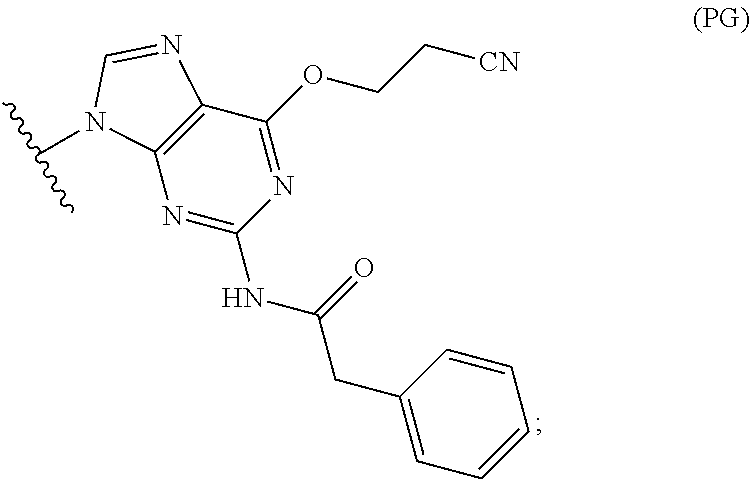
  • the compound of Formula (DPG) is of Formula (DPG1):
  • the compound of Formula (V) is of Formula (Va):
  • R 1 is a support-medium.
  • the compound of Formula (T) is of Formula (T1):
  • the compound of Formula (VII) is of Formula (VIIa):
  • R 1 is a support-medium.
  • the compound of Formula (VIII) is of Formula (VIIIa):
  • the compound of Formula (IX) is of Formula (IXa):
  • the compound of Formula (X) is of Formula (Xa):
  • the compound of Formula (XI) is of Formula (XIa):
  • the compound of Formula (VI) is of Formula (VIa):
  • R 1 is a support-medium.
  • the oligomeric compound of Formula (G) is an oligomeric compound of Formula (XII):
  • the compound of Formula (A5) is of Formula (A5a):
  • the compound of Formula (V) is of Formula (Va):
  • the compound of Formula (VI) is of Formula (VIa):
  • the compound of Formula (VII) is of Formula (VIIa):
  • the compound of Formula (IX) is of Formula (IXa):
  • the compound of Formula (A9) is of Formula (A9a):
  • the compound of Formula (X) is of Formula (Xa):
  • the compound of Formula (A10) is of Formula (A10a):
  • the support-medium comprises polystyrene with 1% crosslinked divinylbenzene.
  • the compound of Formula (XI) is of Formula (XIa):
  • the compound of Formula (A11) is of formula (A11a):
  • Important properties of morpholino-based subunits include: 1) the ability to be linked in an oligomeric form by stable, uncharged or positively charged backbone linkages; 2) the ability to support a nucleotide base (e.g. adenine, cytosine, guanine, thymidine, uracil, 5-methyl-cytosine and hypoxanthine) such that the polymer formed can hybridize with a complementary-base target nucleic acid, including target RNA; 3) the ability of the oligomer to be actively or passively transported into mammalian cells; and 4) the ability of the oligomer and oligomer:RNA heteroduplex to resist RNAse and RNase H degradation, respectively.
  • a nucleotide base e.g. adenine, cytosine, guanine, thymidine, uracil, 5-methyl-cytosine and hypoxanthine
  • the antisense oligomers contain base modifications or substitutions.
  • certain nucleo-bases may be selected to increase the binding affinity of the antisense oligomers described herein.
  • 5-methylcytosine substitutions have been shown to increase nucleic acid duplex stability by 0.6-1.2° C., and may be incorporated into the antisense oligomers described herein.
  • at least one pyrimidine base of the oligomer comprises a 5-substituted pyrimidine base, wherein the pyrimidine base is selected from the group consisting of cytosine, thymine and uracil.
  • the 5-substituted pyrimidine base is 5-methylcytosine.
  • at least one purine base of the oligomer comprises hypoxanthine.
  • Morpholino-based oligomers are detailed, for example, in U.S. Pat. Nos. 5,698,685, 5,217,866, 5,142,047, 5,034,506, 5,166,315, 5,185,444, 5,521,063, 5,506,337, 8,299,206, and 8,076,476, International Patent Application Publication Nos. WO/2009/064471 and WO/2012/043730, and Summerton et al. (1997 , Antisense and Nucleic Acid Drug Development, 7, 187-195), each of which are hereby incorporated by reference in their entirety.
  • Oligomeric compounds of the disclosure may have asymmetric centers, chiral axes, and chiral planes (as described, for example, in: E L. Eliel and S. H. Wilen, Stereo - chemistry of Carbon Compounds , John Wiley & Sons, New York, 1994, pages 1119-1190, and March, J., Advanced Organic Chemistry, 3d. Ed., Chap. 4, John Wiley & Sons, New York (1985)), and may occur as racemates, racemic mixtures, and as individual diastereomers, with all possible isomers and mixtures thereof, including optical isomers. Oligomeric compounds of the disclosure herein specifically mentioned, without any indication of its stereo-chemistry, are intended to represent all possible isomers and mixtures thereof.
  • oligomeric compounds of the disclosure are prepared, as discussed herein, from activated morpholino subunits including such non-limiting examples such as a compound of Formula (VIII):
  • Each of the above-mentioned compounds of Formula (VIII), may be prepared, for example, from the corresponding beta-D-ribofuranosyl as depicted below:
  • each morpholino subunit may be produced based on selection of, for example, an alpha-L-ribofuranosyl, alpha-D-ribofuranosyl, beta-L-ribofuranosyl, or beta-D-ribofuranosyl starting material.
  • a compound of Formula (VIII) of the disclosure may be of Formula (VIIIa):
  • incorporation of 10 to 40 compounds of Formula (VIII), for example, into an oligomeric compound of the disclosure may result in numerous possible stereo isomers.
  • oligomeric compounds of the disclosure comprise one or more phosphorous-containing intersubunits, which create a chiral center at each phosphorus, each of which is designated as either an “Sp” or “Rp” configuration as understood in the art. Without wishing to be bound by any particular theory, this chirality creates stereoisomers, which have identical chemical composition but different three-dimensional arrangement of their atoms.
  • each phosphorous intersubunit linkage occurs randomly during synthesis of, for example, oligomeric compounds of the disclosure.
  • the synthesis process generates an exponentially large number of stereoisomers of an oligomeric compound of the disclosure because oligomeric compounds of the disclosure are comprised of numerous phosphorous intersubunit linkages—with each phosphorous intersubunit linkage having a random chiral configuration.
  • each intersubunit linkage of an additional morpholino subunit doubles the number of stereoisomers of the product, so that a conventional preparation of an oligomeric compound of the disclosure is in fact a highly heterogeneous mixtures of 2 N stereoisomers, where N represents the number of phosphorous intersubunit linkages.
  • Table 1 depicts various embodiments of morpholino subunits provided in the processes described herein.
  • the solid was returned to the 100 L flask with 39.9 kg of DCM and refluxed with stirring for 1 hour. 1.5 kg of purified water was added to dissolve the remaining solids.
  • the bottom organic layer was split to a pre-warmed 72 L flask, then returned to a clean dry 100 L flask.
  • the solution was cooled to 0° C., held for 1 hour, then filtered.
  • the solid filter cake was washed twice each with a solution of 9.8 kg DCM and 5 kg heptane, then dried on the funnel.
  • the solid was transferred to trays and dried to a constant weight of 1.855 kg 3-Nitro-4-(2-oxopropyl)benzoic Acid. Overall yield 42% from compound 1. HPLC 99.45%.
  • N-Tritylpiperazine Succinate N-Tritylpiperazine Succinate
  • the remaining organic layer was cooled to 18° C. and a solution of 847 g of succinic acid in 10.87 kg of purified water was added slowly in portions to the organic layer.
  • the mixture was stirred for 1.75 hours at 20+/ ⁇ 5° C.
  • the mixture was filtered, and the solids were washed with 2 kg TBME and 2 kg of acetone then dried on the funnel.
  • the filter cake was triturated twice with 5.7 kg each of acetone and filtered and washed with 1 kg of acetone between triturations.
  • the solid was dried on the funnel, then transferred to trays and dried in a vacuum oven at room temperature to a constant weight of 2.32 kg of NTP. Yield 80%.
  • the combined organic layers were washed with a solution of 1.08 kg sodium chloride in 4.08 kg purified water. The organic layers were dried over 1.068 kg of sodium sulfate and filtered. The sodium sulfate was washed with 1.3 kg of DCM. The combined organic layers were slurried with 252 g of silica gel and filtered through a filter funnel containing a bed of 252 g of silica gel. The silica gel bed was washed with 2 kg of DCM. The combined organic layers were evaporated on a rotovap. 4.8 kg of THE was added to the residue and then evaporated on the rotovap until 2.5 volumes of the crude 1-(2-nitro-4(4-tritylpiperazine-1-carbonyl)phenyl)propan-2-one in THE was reached.
  • the organic layer was separated and the aqueous was twice more extracted with 4.7 kg of DCM each.
  • the combined organic layers were washed with a solution of about 800 g of sodium chloride in about 3 kg of water, then dried over 2.7 kg of sodium sulfate.
  • the suspension was filtered and the filter cake was washed with 2 kg of DCM.
  • the combined filtrates were concentrated to 2.0 volumes, diluted with about 360 g of ethyl acetate, and evaporated.
  • the crude product was loaded onto a silica gel column of 4 kg of silica packed with DCM under nitrogen and eluted with 2.3 kg ethyl acetate in 7.2 kg of DCM.
  • the combined fractions were evaporated and the residue was taken up in 11.7 kg of toluene.
  • the toluene solution was filtered and the filter cake was washed twice with 2 kg of toluene each.
  • the filter cake was dried to a constant weight of 2.275 kg of compound 5 (4
  • the combined solids were charged to a 100 L jacketed flask and dissolved in 28 kg of DCM and washed with a solution of 900 g of potassium carbonate in 4.3 kg of water. After 1 hour, the layers were allowed to separate and the aqueous layer was removed. The organic layer was washed with 10 kg of water, separated, and dried over 3.5 kg of sodium sulfate. The DCM was filtered, evaporated, and dried under vacuum to 6.16 kg of NCP2 Anchor (114% yield).
  • the resin was treated and stirred with 1 ⁇ 2 the DEDC Capping Solution for 30 minutes, drained, and was treated and stirred with the 2 nd 1 ⁇ 2 of the DEDC Capping Solution for 30 minutes and drained.
  • the resin was washed six times with 39 L of DCM per wash then dried in an oven to constant weight of 3573.71 g of Anchor Loaded Resin.
  • the dichloromethane solution underwent solvent exchange to acetone and then to N,N-dimethylformamide, and the product was isolated by precipitation from acetone/N,N-dimethylformamide into saturated aqueous sodium chloride.
  • Anchor Loaded Resin 750 g of Anchor Loaded Resin and 10.5 L of NMP were charged to a 50 L silanized reactor and stirred for 3 hours. The NMP was drained and the Anchor Loaded Resin was washed twice with 5.5 L each of DCM and twice with 5.5 L each of 30% TFE/DCM.
  • the Anchor Loaded Resin was washed three times with 5.5 L each of 30% TFE/DCM and drained, washed with 5.5 L of CYFTA solution for 15 minutes and drained, and again washed with 5.5 L of CYTFA Solution for 15 minutes without draining to which 122 mL of 1:1 NEM/DCM was charged and the suspension stirred for 2 minutes and drained.
  • the resin was washed once with 5.5 L Neutralization Solution for 10 minutes and drained, twice with 5.5 L of Neutralization Solution for 5 minutes and drained, then twice with 5.5 L each of DCM and drained.
  • a solution of 374.8 g of benzoic anhydride and 195 mL NEM in 2680 mL NMP was charged and stirred for 15 minutes and drained.
  • the resin was once with 5.5 L of Neutralization Solution for 10 minutes and drained, once with 5.5 L of Neutralization Solution for 5 minutes and drained, and once with 5.5 L of DCM and drained and twice with 5.5 L each of 30% TFE/DCM.
  • the resin was suspended in 5.5 L of 30% TFE/DCM and held for 14 hours.
  • the resin Prior to each coupling cycle as described in FIG. 1 , the resin was: 1) washed with 30% TFE/DCM; 2) a) treated with CYTFA Solution 15 minutes and drained, and b) treated with CYTFA solution for 15 minutes to which was added 1:1 NEM/DCM, stirred, and drained; 3) stirred three times with Neutralization Solution; and 4) washed twice with DCM. See Table 4.
  • the resin was: 1) washed with DCM; and 2) washed three times with 30% TFE/DCM. If the resin was held for a time period prior to the next coupling cycle, the third TFE/DCM wash was not drained and the resin was retained in said TFE/DCM wash solution. See Table 4.
  • the resin was washed 8 times with 19.5 L each of IPA, and dried under vacuum at room temperature for about 63.5 hours to a dried weight of 4857.9 g.
  • the above resin bound Eteplisen Crude Drug Substance was divided into two lots, each lot was treated as follows.
  • a 1619.3 g lot of resin was: 1) stirred with 10 L of NMP for 2 hrs, then the NMP was drained; 2) washed tree times with 10 L each of 30% TFE/DCM; 3) treated with 10 L CYTFA Solution for 15 minutes; and 4) 10 L of CYTFA Solution for 15 minutes to which 130 ml 1:1 NEM/DCM was then added and stirred for 2 minutes and drained.
  • the resin was treated three times with 10 L each of Neutralization Solution, washed six times with 10 L of DCM, and eight times with 10 L each of NMP.
  • the resin was treated with a Cleaving Solution of 1530.4 g DTT and 2980 DBU in 6.96 L NMP for 2 hours to detach the Eteplisen Crude Drug Substance from the resin.
  • the Cleaving Solution was drained and retained in a separate vessel.
  • the reactor and resin were washed with 4.97 L of NMP which was combined with the Cleaving Solution.
  • the combined Cleaving Solution and NMP wash were transferred to a pressure vessel to which was added 39.8 L of NH 4 OH (NH 3 ⁇ H 2 O) that had been chilled to a temperature of ⁇ 100 to ⁇ 25° C. in a freezer.
  • the pressure vessel was sealed and heated to 45° C. for 16 hrs then allowed to cool to 25° C.
  • This deprotection solution containing the Golodirsen crude drug substance was diluted 3:1 with purified water prior to solvent removal. During solvent removal, the deprotection solution was pH adjusted to 3.0 with 2M phosphoric acid, then to pH 8.03 with NH 4 OH.
  • HPLC C18 77.552% ( FIG. 1 ) and SCX-10 73.768% ( FIG. 2 ).
  • Example 4 The deprotection solution from Example 4, part E, containing the Golodirsen crude drug substance was loaded onto a column of ToyoPearl Super-Q 650S anion exchange resin (Tosoh Bioscience) and eluted with a gradient of 0-35% B over 17 column volume (Buffer A: 10 mM sodium hydroxide; Buffer B: 1 M sodium chloride in 10 mM sodium hydroxide) and fractions of acceptable purity (C18 and SCX HPLC) were pooled to a purified drug product solution. HPLC: 93.571% (C18; FIG. 3 ) 88.270% (SCX; FIG. 4 ).
  • the purified drug substance solution was desalted and lyophilized to 1450.72 g purified Golodirsen drug substance. Yield 54.56%; HPLC: 93.531% ( FIG. 5 ; C18) 88.354% ( FIG. 6 ; SCX).

Landscapes

  • Chemical & Material Sciences (AREA)
  • Organic Chemistry (AREA)
  • Health & Medical Sciences (AREA)
  • Life Sciences & Earth Sciences (AREA)
  • Molecular Biology (AREA)
  • General Health & Medical Sciences (AREA)
  • Biochemistry (AREA)
  • Engineering & Computer Science (AREA)
  • Genetics & Genomics (AREA)
  • Biomedical Technology (AREA)
  • General Engineering & Computer Science (AREA)
  • Bioinformatics & Cheminformatics (AREA)
  • Wood Science & Technology (AREA)
  • Zoology (AREA)
  • Biotechnology (AREA)
  • Microbiology (AREA)
  • Plant Pathology (AREA)
  • Biophysics (AREA)
  • Physics & Mathematics (AREA)
  • Pharmaceuticals Containing Other Organic And Inorganic Compounds (AREA)
  • Macromolecular Compounds Obtained By Forming Nitrogen-Containing Linkages In General (AREA)

Abstract

Provided herein are processes for preparing an oligomer (e.g., a morpholino oligomer). The synthetic processes described herein may be advantageous to scaling up oligomer synthesis while maintaining overall yield and purity of a synthesized oligomer.

Description

RELATED APPLICATIONS
This patent application is a continuation of U.S. patent application Ser. No. 16/302,529, having a 371(c) date of Nov. 16, 2018, now pending, which is a U.S. national phase of International Application No. PCT/US2017/040318, filed on Jun. 30, 2017, which claims the benefit of U.S. Provisional Patent Application Ser. No. 62/508,256, filed May 18, 2017, U.S. Provisional Patent Application Ser. No. 62/341,049, filed May 24, 2016, U.S. Provisional Patent Application Ser. No. 62/340,953, filed May 24, 2016, U.S. Provisional Patent Application Ser. No. 62/357,134, filed Jun. 30, 2016, and U.S. Provisional Patent Application Ser. No. 62/357,166, filed Jun. 30, 2016. The entire contents of the above-referenced provisional patent applications are incorporated herein by reference.
STATEMENT REGARDING SEQUENCE LISTING
The Sequence Listing associated with this application has been submitted electronically in ASCII format, and is hereby incorporated by reference into the specification in its entirety. The name of the text file containing the Sequence Listing is 4140_0280006_Seqlisting_ST25. The text file is 806 bytes, was created on Jun. 15, 2022, and is being submitted electronically via EFS-Web.
BACKGROUND
Antisense technology provides a means for modulating the expression of one or more specific gene products, including alternative splice products, and is uniquely useful in a number of therapeutic, diagnostic, and research applications. The principle behind antisense technology is that an antisense compound, e.g., an oligonucleotide, which hybridizes to a target nucleic acid, modulates gene expression activities such as transcription, splicing or translation through any one of a number of antisense mechanisms. The sequence specificity of antisense compounds makes them attractive as tools for target validation and gene functionalization, as well as therapeutics to selectively modulate the expression of genes involved in disease.
Duchenne muscular dystrophy (DMD) is caused by a defect in the expression of the protein dystrophin. The gene encoding the protein contains 79 exons spread out over more than 2 million nucleotides of DNA. Any exonic mutation that changes the reading frame of the exon, or introduces a stop codon, or is characterized by removal of an entire out of frame exon or exons, or duplications of one or more exons, has the potential to disrupt production of functional dystrophin, resulting in DMD.
Recent clinical trials testing the safety and efficacy of splice switching oligonucleotides (SSOs) for the treatment of DMD are based on SSO technology to induce alternative splicing of pre-mRNAs by steric blockade of the spliceosome (Cirak et al., 2011; Goemans et al., 2011; Kinali et al., 2009; van Deutekom et al., 2007). However, despite these successes, the pharmacological options available for treating DMD are limited.
Golodirsen is a phosphorodiamidate morpholino oligomer (PMO) designed to skip exon 53 of the human dystrophin gene in patients with DMD who are amendable to exon 53 skipping to restore the read frame and produce a functional shorter form of the dystrophin protein.
Although significant progress has been made in the field of antisense technology, there remains a need in the art for methods of preparing phosphorodiamidate morpholino oligomers with improved antisense or antigene performance.
SUMMARY
Provided herein are processes for preparing phosphorodiamidate morpholino oligomers (PMOs). The synthetic processes described herein allow for a scaled-up PMO synthesis while maintaining overall yield and purity of a synthesized PMO.
Accordingly, in one aspect, provided herein is a process for preparing an oligomeric compound of Formula (A):
Figure US12297219-20250513-C00001
In certain embodiments, provided herein is a process for preparing an oligomeric compound of Formula (G):
Figure US12297219-20250513-C00002
In yet another embodiment, the oligomeric compound of the disclosure including, for example, some embodiments of an oligomeric compound of Formula (G), is an oligomeric compound of Formula (XII):
Figure US12297219-20250513-C00003
For clarity, the structural formulas including, for example, oligomeric compound of Formula (C) and Golodirsen depicted by Formula (XII), are a continuous structural formula from 5′ to 3′, and, for the convenience of depicting the entire formula in a compact form in the above structural formulas, Applicants have included various illustration breaks labeled “BREAK A” and “BREAK B.” As would be understood by the skilled artisan, for example, each indication of “BREAK A” shows a continuation of the illustration of the structural formula at these points. The skilled artisan understands that the same is true for each instance of “BREAK B” in the structural formulas above including Golodirsen. None of the illustration breaks, however, are intended to indicate, nor would the skilled artisan understand them to mean, an actual discontinuation of the structural formulas above including Golodirsen.
BRIEF DESCRIPTION OF THE FIGURES
FIG. 1 and FIG. 2 show a representative analytical high performance liquid chromatography (HPLC) chromatogram of a synthesized and deprotected Golodirsen (SRP-4053) crude drug substance (see Example 4).
FIG. 3 and FIG. 4 show a representative analytical HPLC chromatogram of a purified Golodirsen drug substance solution (see Example 5).
FIG. 5 and FIG. 6 show a representative analytical HPLC chromatogram of a desalted and lyophilized Golodirsen drug substance (see Example 5).
DETAILED DESCRIPTION
Provided herein are processes for preparing a morpholino oligomer. The a morpholino oligomer described herein displays stronger affinity for DNA and RNA without compromising sequence selectivity, relative to native or unmodified oligonucleotides. In some embodiments, the morpholino oligomer of the disclosure minimizes or prevents cleavage by RNase H. In some embodiments, the morpholino oligomer of the disclosure does not activate RNase H.
The processes described herein are advantageous in an industrial-scale process and can be applied to preparing quantities of a morpholino oligomer in high yield and scale (e.g., about 1 kg, about 1-10 kg, about 2-10 kg, about 5-20 kg, about 10-20 kg, or about 10-50 kg).
Definitions
Listed below are definitions of various terms used to describe this disclosure. These definitions apply to the terms as they are used throughout this specification and claims, unless otherwise limited in specific instances, either individually or as part of a larger group.
“Base-protected” or “base protection” refers to protection of the base-pairing groups, eg purine or pyrimidine bases, on the morpholino subunits with protecting groups suitable to prevent reaction or interference of the base-pairing groups during stepwise oligomer synthesis. (An example of a base-protected morpholino subunit is the activated C subunit Compound (C) having a CBZ protecting group on the cytosine amino group depicted below.)
An “activated phosphoramidate group” is typically a chlorophosphoramidate group, having substitution at nitrogen which is desired in the eventual phosphorodiamidate linkage in the oligomer. An example is (dimethylamino)chlorophosphoramidate, i.e. —O—P(═O)(NMe2)Cl.
The term “support-bound” refers to a chemical entity that is covalently linked to a support-medium.
The term “support-medium” refers to any material including, for example, any particle, bead, or surface, upon which an oligomer can be attached or synthesized upon, or can be modified for attachment or synthesis of an oligomer. Representative substrates include, but are not limited to, inorganic supports and organic supports such as glass and modified or functionalized glass, plastics (including acrylics, polystyrene and copolymers of styrene and other materials, polypropylene, polyethylene, polybutylene, polyurethanes, TEFLON, etc.), polysaccharides, nylon or nitrocellulose, ceramics, resins, silica or silica-based materials including silicon and modified silicon, carbon, metals, inorganic glasses, plastics, optical fiber bundles, and a variety of other polymers. Particularly useful support-medium and solid surfaces for some embodiments are located within a flow cell apparatus. In some embodiments of the processes described herein, the support-medium comprises polystyrene with 1% crosslinked divinylbenzene.
In some embodiments, representative support-medium comprise at least one reactive site for attachment or synthesis of an oligomer. For example, in some embodiments, a support-medium of the disclosure comprises one or more terminal amino or hydroxyl groups capable of forming a chemical bond with an incoming subunit or other activated group for attaching or synthesizing an oligomer.
Some representative support-medium that are amenable to the processes described herein include, but are not limited to, the following: controlled pore glass (CPG); oxalyl-controlled pore glass (see, e.g., Alul, et al., Nucleic Acids Research 1991, 19, 1527); silica-containing particles, such as porous glass beads and silica gel such as that formed by the reaction of trichloro-[3-(4-chloromethyl)phenyl]propylsilane and porous glass beads (see Parr and Grohmann, Angew. Chem. Internal. Ed. 1972, 11, 314, sold under the trademark “PORASIL E” by Waters Associates, Framingham, Mass., USA); a mono ester of 1,4-dihydroxymethylbenzene and silica (see Bayer and Jung, Tetrahedron Lett., 1970, 4503, sold under the trademark “BIOPAK” by Waters Associates); TENTAGEL (see, e.g., Wright, et al., Tetrahedron Letters 1993, 34, 3373); cross-linked styrene/divinylbenzene copolymer beaded matrix, or POROS, a copolymer of polystyrene/divinylbenzene (available from Perceptive Biosystems); soluble support-medium such as polyethylene glycol PEG's (see Bonora et al., Organic Process Research & Development, 2000, 4, 225-231); PEPS support, which is a polyethylene (PE) film with pendant long-chain polystyrene (PS) grafts (see Berg, et al., J. Am. Chem. Soc., 1989, 111, 8024 and International Patent Application WO 1990/02749); copolymers of dimethylacrylamide cross-linked with N,N′-bisacryloylethylenediamine, including a known amount of N-tertbutoxycarbonyl-beta-alanyl-N′-acryloylhexamethylenediamine (see Atherton, et al., J. Am. Chem. Soc., 1975, 97, 6584, Bioorg. Chem. 1979, 8, 351, and J. C. S. Perkin I 538 (1981)); glass particles coated with a hydrophobic cross-linked styrene polymer (see Scott, et al., J. Chrom. Sci., 1971, 9, 577); fluorinated ethylene polymer onto which has been grafted polystyrene (see Kent and Merrifield, Israel J. Chem. 1978, 17, 243 and van Rietschoten in Peptides 1974, Y. Wolman, Ed., Wiley and Sons, New York, 1975, pp. 113-116); hydroxypropylacrylate-coated polypropylene membranes (Daniels, et al., Tetrahedron Lett. 1989, 4345); acrylic acid-grafted polyethylene-rods (Geysen, et al., Proc. Natl. Acad. Sci. USA, 1984, 81, 3998); a “tea bag” containing traditionally-used polymer beads (Houghten, Proc. Natl. Acad. Sci. USA, 1985, 82, 5131); and combinations thereof.
The term “flow cell apparatus” refers to a chamber comprising a surface (e.g., solid surface) across which one or more fluid reagents (e.g., liquid or gas) can be flowed.
The term “deblocking agent” refers to a composition (e.g., a solution) comprising a chemical acid or combination of chemical acids for removing protecting groups. Exemplary chemical acids used in deblocking agents include halogenated acids, e.g., chloroacetic acid, dichloroacetic acid, trichloroacetic acid, fluoroacetic acid, difluoroacetic acid, and trifluoroacetic acid. In some embodiments, a deblocking agent removes one or more trityl groups from, for example, an oligomer, a support-bound oligomer, a support-bound subunit, or other protected nitrogen or oxygen moiety.
The terms “halogen” and “halo” refer to an atom selected from the group consisting of fluorine, chlorine, bromine, and iodine.
The term “capping agent” refers to a composition (e.g., a solution) comprising an acid anhydride (e.g., benzoic anhydride, acetic anhydride, phenoxyacetic anhydride, and the like) useful for blocking a reactive cite of, for example, a support-medium forming a chemical bond with an incoming subunit or other activated group.
The term “cleavage agent” refers to a composition (e.g., a liquid solution or gaseous mixture) comprising a chemical base (e.g., ammonia or 1,8-diazabicycloundec-7-ene) or a combination of chemical bases useful for cleaving, for example, a support-bound oligomer from a support-medium.
The term “deprotecting agent” refers to a composition (e.g., a liquid solution or gaseous mixture) comprising a chemical base (e.g., ammonia, 1,8-diazabicycloundec-7-ene or potassium carbonate) or a combination of chemical bases useful for removing protecting groups. For example, a deprotecting agent, in some embodiments, can remove the base protection from, for example, a morpholino subunit, morpholino subunits of a morpholino oligomer, or support-bound versions thereof.
The term “solvent” refers to a component of a solution or mixture in which a solute is dissolved. Solvents may be inorganic or organic (e.g., acetic acid, acetone, acetonitrile, acetyl acetone, 2-aminoethanol, aniline, anisole, benzene, benzonitrile, benzyl alcohol, 1-butanol, 2-butanol, i-butanol, 2-butanone, t-butyl alcohol, carbon disulfide, carbon tetrachloride, chlorobenzene, chloroform, cyclohexane, cyclohexanol, cyclohexanone, di-n-butylphthalate, 1,1-dichloroethane, 1,2-dichloroethane, diethylamine, diethylene glycol, diglyme, dimethoxyethane (glyme), N,N-dimethylaniline, dimethylformamide, dimethylphthalate, dimethylsulfoxide, dioxane, ethanol, ether, ethyl acetate, ethyl acetoacetate, ethyl benzoate, ethylene glycol, glycerin, heptane, 1-heptanol, hexane, 1-hexanol, methanol, methyl acetate, methyl t-butyl ether, methylene chloride, 1-octanol, pentane, 1-pentanol, 2-pentanol, 3-pentanol, 2-pentanone, 3-pentanone, 1-propanol, 2-propanol, pyridine, tetrahydrofuran, toluene, water, p-xylene).
The phrases “morpholino oligomer” and “phosphorodiamidate morpholino oligomer” or “PMO” refers to an oligomer having morpholino subunits linked together by phosphorodiamidate linkages, joining the morpholino nitrogen of one subunit to the 5′-exocyclic carbon of an adjacent subunit. Each morpholino subunit comprises a nucleobase-pairing moiety effective to bind, by nucleobase-specific hydrogen bonding, to a nucleobase in a target.
The term “EG3 tail” refers to triethylene glycol moieties conjugated to the oligomer, e.g., at its 3′- or 5′-end. For example, in some embodiments, “EG3 tail” conjugated to the 3′ end of an oligomer can be of the structure:
Figure US12297219-20250513-C00004
The terms “about” or “approximately” are generally understood by persons knowledgeable in the relevant subject area, but in certain circumstances can mean within ±10%, or within ±5%, of a given value or range.
Processes for Preparing Morpholino Oligomers
Synthesis is generally prepared, as described herein, on a support-medium. In general a first synthon (e.g. a monomer, such as a morpholino subunit) is first attached to a support-medium, and the oligomer is then synthesized by sequentially coupling subunits to the support-bound synthon. This iterative elongation eventually results in a final oligomeric compound. Suitable support-media can be soluble or insoluble, or may possess variable solubility in different solvents to allow the growing support-bound polymer to be either in or out of solution as desired. Traditional support-media are for the most part insoluble and are routinely placed in reaction vessels while reagents and solvents react with and/or wash the growing chain until the oligomer has reached the target length, after which it is cleaved from the support, and, if necessary, further worked up to produce the final polymeric compound. More recent approaches have introduced soluble supports including soluble polymer supports to allow precipitating and dissolving the iteratively synthesized product at desired points in the synthesis (Gravert et al., Chem. Rev., 1997, 97,489-510).
Provided herein are processes for preparing morpholino oligomers).
Thus, in one aspect, provided herein is a process for preparing a compound of Formula (II):
Figure US12297219-20250513-C00005
    • wherein R1 is a support-medium;
      wherein the process comprises contacting a compound of Formula (A1):
Figure US12297219-20250513-C00006
    • wherein R1 is a support-medium and R3 is selected from the group consisting of trityl,
    • monomethoxytrityl, dimethoxytrityl and trimethoxytrityl;
      with a deblocking agent to form the compound of Formula (II).
In another aspect, provided herein is a process for preparing a compound of Formula (A3):
Figure US12297219-20250513-C00007
    • wherein R1 is a support-medium, and R3 is selected from the group consisting of trityl,
    • monomethoxytrityl, dimethoxytrityl and trimethoxytrityl;
      wherein the process comprises contacting a compound of Formula (II):
Figure US12297219-20250513-C00008
    • wherein R1 is a support-medium;
      with a compound of Formula (A2):
Figure US12297219-20250513-C00009
    • wherein R3 is selected from the group consisting of trityl, monomethoxytrityl,
    • dimethoxytrityl and trimethoxytrityl;
      to form the compound of Formula (A3).
In still another aspect, provided herein is a process for preparing a compound of Formula (IV):
Figure US12297219-20250513-C00010
    • wherein R1 is a support-medium;
      wherein the process comprises contacting a compound of Formula (A3):
Figure US12297219-20250513-C00011
    • wherein R1 is a support-medium, and R3 is selected from the group consisting of trityl,
    • monomethoxytrityl, dimethoxytrityl and trimethoxytrityl;
      with a deblocking agent to form a compound of Formula (IV).
In yet another aspect, provided herein is a process for preparing a compound of Formula (A5):
Figure US12297219-20250513-C00012
    • wherein R1 is a support-medium, R3 is selected from the group consisting of trityl, monomethoxytrityl, dimethoxytrityl and trimethoxytrityl, and
    • R4 is selected from the group consisting of:
Figure US12297219-20250513-C00013
Figure US12297219-20250513-C00014

wherein the process comprises contacting a compound of Formula (IV):
Figure US12297219-20250513-C00015
    • wherein R1 is a support-medium;
      with a compound of Formula (A4):
Figure US12297219-20250513-C00016
    • wherein R3 is selected from the group consisting of trityl, monomethoxytrityl, dimethoxytrityl and trimethoxytrityl, and R4 is selected from the group consisting of:
Figure US12297219-20250513-C00017
Figure US12297219-20250513-C00018

to form a compound of Formula (A5).
In another aspect, provided herein is a process for preparing a compound of Formula (A9):
Figure US12297219-20250513-C00019
    • wherein n is an integer from 10 to 40, R1 is a support-medium, R3 is selected from the group consisting of trityl, monomethoxytrityl, dimethoxytrityl and trimethoxytrityl, and R4 is, independently for each occurrence, selected from the group consisting of:
Figure US12297219-20250513-C00020
Figure US12297219-20250513-C00021
    •  and wherein the process comprises the sequential steps of:
      (a) contacting a compound of Formula (IV):
Figure US12297219-20250513-C00022
    • wherein R1 is a support-medium;
      with a compound of Formula (A4):
Figure US12297219-20250513-C00023
    • wherein R3 is selected from the group consisting of trityl, monomethoxytrityl, dimethoxytrityl and trimethoxytrityl, and R4 is selected from the group consisting of:
Figure US12297219-20250513-C00024
Figure US12297219-20250513-C00025

to form a compound of Formula (A5):
Figure US12297219-20250513-C00026
    • wherein R1 is a support-medium, R3 is selected from the group consisting of trityl, monomethoxytrityl, dimethoxytrityl and trimethoxytrityl, and
    • R4 is selected from the group consisting of:
Figure US12297219-20250513-C00027
Figure US12297219-20250513-C00028
    •  and (b) performing n−1 iterations of the sequential steps of:
    • (b1) contacting the product formed by the immediately prior step with a deblocking agent; and
    • (b2) contacting the compound formed by the immediately prior step with a compound of Formula (A8):
Figure US12297219-20250513-C00029
    • wherein R3 is selected from the group consisting of trityl, monomethoxytrityl, dimethoxytrityl and trimethoxytrityl, and R4 is selected from the group consisting of:
Figure US12297219-20250513-C00030
Figure US12297219-20250513-C00031

to form a compound of Formula (A9).
In yet another aspect, provided herein is a process for preparing a compound of Formula (A10):
Figure US12297219-20250513-C00032
    • wherein n is an integer from 10 to 40, R1 is a support-medium, and R4 is, independently for each occurrence, selected from the group consisting of:
Figure US12297219-20250513-C00033
Figure US12297219-20250513-C00034
    • wherein the process comprises contacting a compound of Formula (A9):
Figure US12297219-20250513-C00035
    • wherein n is an integer from 10 to 40, R1 is a support-medium, R3 is selected from the group consisting of trityl, monomethoxytrityl, dimethoxytrityl and trimethoxytrityl, and R4 is, independently for each occurrence, selected from the group consisting of:
Figure US12297219-20250513-C00036
Figure US12297219-20250513-C00037
    •  and with a deblocking agent to form a compound of Formula (A10).
In still another aspect, provided herein is a process for preparing a compound of Formula (A11):
Figure US12297219-20250513-C00038
    • wherein n is an integer from 10 to 40, and R4 is, for each occurrence independently selected from the group consisting of:
Figure US12297219-20250513-C00039
Figure US12297219-20250513-C00040
    •  and wherein the process comprises contacting the compound of Formula (A10):
Figure US12297219-20250513-C00041
    • wherein n is an integer from 10 to 40, R1 is a support-medium, and R4 is, independently for each occurrence, selected from the group consisting of:
Figure US12297219-20250513-C00042

with a cleaving agent to form a compound of Formula (A11).
In another aspect, provided herein is a process for preparing an oligomeric compound of Formula (A):
Figure US12297219-20250513-C00043

wherein n is an integer from 10 to 40, and each R2 is, independently for each occurrence, selected from the group consisting of:
Figure US12297219-20250513-C00044

wherein the process comprises contacting a compound of Formula (A11):
Figure US12297219-20250513-C00045
    • wherein n is an integer from 10 to 40, and R4 is, independently for each occurrence, selected from the group consisting of:
Figure US12297219-20250513-C00046
    •  and with a deprotecting agent to form the oligomeric compound of Formula (A).
In another aspect, provided herein is a process for preparing an oligomeric compound of Formula (A):
Figure US12297219-20250513-C00047
    • wherein n is an integer from 10 to 40, and each R2 is, independently for each occurrence, selected from the group consisting of:
Figure US12297219-20250513-C00048
    • wherein the process comprises the sequential steps of:
    • (a) contacting a compound of Formula (A1):
Figure US12297219-20250513-C00049
      • wherein R1 is a support-medium and R3 is selected from the group consisting of trityl,
      • monomethoxytrityl, dimethoxytrityl and trimethoxytrityl;
    • with a deblocking agent to form the compound of Formula (II):
Figure US12297219-20250513-C00050
      • wherein R1 is a support-medium;
    • (b) contacting the compound of Formula (II) with a compound of Formula (A2):
Figure US12297219-20250513-C00051
      • wherein R3 is selected from the group consisting of trityl, monomethoxytrityl,
      • dimethoxytrityl and trimethoxytrityl;
    • to form a compound of Formula (A3):
Figure US12297219-20250513-C00052
      • wherein R is a support-medium, an R is selected from the group consisting of trityl,
      • monomethoxytrityl, dimethoxytrityl and trimethoxytrityl;
    • (c) contacting the compound of Formula (A3) with a deblocking agent to form a compound of Formula (IV):
Figure US12297219-20250513-C00053
      • wherein R1 is a support-medium;
    • (d) contacting the compound of Formula (IV) with a compound of Formula (A4):
Figure US12297219-20250513-C00054
      • wherein R3 is selected from the group consisting of trityl, monomethoxytrityl, dimethoxytrityl and trimethoxytrityl, and R4 is selected from the group consisting of:
Figure US12297219-20250513-C00055
Figure US12297219-20250513-C00056
    • to form a compound of Formula (A5):
Figure US12297219-20250513-C00057
      • wherein R1 is a support-medium, R3 is selected from the group consisting of trityl, monomethoxytrityl, dimethoxytrityl and trimethoxytrityl, and
      • R4 is selected from the group consisting of:
Figure US12297219-20250513-C00058
Figure US12297219-20250513-C00059
    • (e) performing n−1 iterations of the sequential steps of:
      • (e1) contacting the product formed by the immediately prior step with a deblocking agent; and
      • (e2) contacting the compound formed by the immediately prior step with a compound of Formula (A8):
Figure US12297219-20250513-C00060
      • wherein R3 is selected from the group consisting of trityl, monomethoxytrityl, dimethoxytrityl and trimethoxytrityl, and R4 is, independently for each compound of Formula (A8), selected from the group consisting of:
Figure US12297219-20250513-C00061
Figure US12297219-20250513-C00062
      • to form a compound of Formula (A9):
Figure US12297219-20250513-C00063
      • wherein n is an integer from 10 to 40, R1 is a support-medium, R3 is selected from the group consisting of trityl, monomethoxytrityl, dimethoxytrityl and trimethoxytrityl, and R4 is, independently for each occurrence, selected from the group consisting of:
Figure US12297219-20250513-C00064
Figure US12297219-20250513-C00065
      •  and (f) contacting the compound of Formula (A9) with a deblocking agent to form a compound of Formula (A10):
Figure US12297219-20250513-C00066
      • wherein n is an integer from 10 to 40, R1 is a support-medium, and R4 is, independently for each occurrence, selected from the group consisting of:
Figure US12297219-20250513-C00067
Figure US12297219-20250513-C00068
    • (g) contacting the compound of Formula (A10) with a cleaving agent to form a compound of Formula (A11):
Figure US12297219-20250513-C00069
      • wherein n is an integer from 10 to 40, and R4 is, independently for each occurrence, selected from the group consisting of:
Figure US12297219-20250513-C00070
Figure US12297219-20250513-C00071
      •  and (h) contacting the compound of Formula (A11) with a deprotecting agent to form the oligomeric compound of Formula (A).
In one embodiment, step (d) or step (e2) further comprises contacting the compound of Formula (IV) or the compound formed by the immediately prior step, respectively, with a capping agent.
In another embodiment, each step is performed in the presence of at least one solvent.
In yet another embodiment, the deblocking agent used in each step is a solution comprising a halogenated acid.
In still another embodiment, the deblocking agent used in each step is cyanoacetic acid.
In another embodiment, the halogenated acid is selected from the group consisting of chloroacetic acid, dichloroacetic acid, trichloroacetic acid, fluoroacetic acid, difluoroacetic acid, and trifluoroacetic acid.
In another embodiment, the halogenated acid is trifluoroacetic acid.
In yet another embodiment, at least one of steps (a), (c), (e), and (g1) further comprise the step of contacting the deblocked compound of each step with a neutralization agent.
In still another embodiment, each of steps (a), (c), (e), and (g1) further comprise the step of contacting the deblocked compound of each step with a neutralization agent.
In another embodiment, the neutralization agent is in a solution comprising dichloromethane and isopropyl alcohol.
In yet another embodiment, the neutralization agent is a monoalkyl, dialkyl, or trialkyl amine.
In still another embodiment, the neutralization agent is N,N-diisopropylethylamine.
In another embodiment, the deblocking agent used in each step is a solution comprising 4-cyanopyridine, dichloromethane, trifluoroacetic acid, trifluoroethanol, and water.
In yet another embodiment, the capping agent is in a solution comprising ethylmorpholine and methylpyrrolidinone.
In still another embodiment, the capping agent is an acid anhydride.
In another embodiment, the acid anhydride is benzoic anhydride.
In another embodiment, the compounds of Formula (A4) and Formula (A8) are each, independently, in a solution comprising ethylmorpholine and dimethylimidazolidinone.
In another embodiment, the cleavage agent comprises dithiothreitol and 1,8-diazabicyclo[5.4.0]undec-7-ene.
In still another embodiment, the cleavage agent is in a solution comprising N-methyl-2-pyrrolidone.
In yet another embodiment, the deprotecting agent comprises NH3.
In still another embodiment, the deprotecting agent is in an aqueous solution.
In yet another embodiment, the support-medium comprises polystyrene with 1% crosslinked divinylbenzene.
In another embodiment, the compound of Formula (A4) is of Formula (A4a):
Figure US12297219-20250513-C00072
    • wherein:
    • R3 is selected from the group consisting of trityl, monomethoxytrityl, dimethoxytrityl and trimethoxytrityl, and
    • R4 is selected from:
Figure US12297219-20250513-C00073
Figure US12297219-20250513-C00074
In another embodiment, the compound of Formula (A5) is of Formula (A5a):
Figure US12297219-20250513-C00075
    • wherein:
    • R1 is a support-medium
    • R3 is selected from the group consisting of trityl, monomethoxytrityl, dimethoxytrityl and trimethoxytrityl, and
    • R4 is selected from:
Figure US12297219-20250513-C00076
Figure US12297219-20250513-C00077
In yet another embodiment, the compound of Formula (A8) is of Formula (A8a):
Figure US12297219-20250513-C00078
    • wherein:
    • R3 is selected from the group consisting of trityl, monomethoxytrityl, dimethoxytrityl and trimethoxytrityl, and
    • R4 is, independently at each occurrence of the compound of Formula (A8a), selected from the group consisting of:
Figure US12297219-20250513-C00079
Figure US12297219-20250513-C00080
In still another embodiment, the compound of formula (A9) is of Formula (A9a):
Figure US12297219-20250513-C00081
    • wherein:
    • n is an integer from 10 to 40,
    • R1 is a support-medium,
    • R3 is selected from the group consisting of trityl, monomethoxytrityl, dimethoxytrityl and trimethoxytrityl, and
    • R4 is, independently for each occurrence, selected from the group consisting of:
Figure US12297219-20250513-C00082
Figure US12297219-20250513-C00083
In another embodiment, the compound of Formula (A10) is of Formula (A10a):
Figure US12297219-20250513-C00084
    • wherein:
    • n is an integer from 10 to 40,
    • R1 is a support-medium, and
    • R4 is, independently for each occurrence, selected from the group consisting of:
Figure US12297219-20250513-C00085
Figure US12297219-20250513-C00086
In another embodiment, the compound of Formula (A11) is of Formula (A11a):
Figure US12297219-20250513-C00087
    • wherein:
      • n is an integer from 10 to 40, and
      • R4 is, independently for each occurrence, selected from the group consisting of:
Figure US12297219-20250513-C00088
Figure US12297219-20250513-C00089
In an embodiment of the oligomeric compound of Formula (A), n is 30, and R2 is at each position from 1 to 25 and 5′ to 3′:
Position No. 5′ to 3′ R2
1 G
2 T
3 T
4 G
5 C
6 C
7 T
8 C
9 C
10 G
11 G
12 T
13 T
14 C
15 T
16 G
17 A
18 A
19 G
20 G
21 T
22 G
23 T
24 T
25 C

wherein the oligomeric compound of Formula (A) is a compound of Formula (G):
Figure US12297219-20250513-C00090
Figure US12297219-20250513-C00091
Figure US12297219-20250513-C00092

or a pharmaceutically acceptable salt thereof.
Golodirsen, formerly known by its code name “SPR-4053,” is a PMO having the base sequence 5′-GTTGCCTCCGGTTCTGAAGGTGTTC-3′(SEQ TD NO: 1). Golodirsen is registered under CAS Registry Number 1422959-91-8. Chemical names include:
    • all-P-ambo-[P,2′,3′-trideoxy-P-(dimethylamino)-2′,3′-imino-2′,3′-seco](2′a→5′)(G-T-T-G-C-C-T-C-C-G-G-T-T-C-T-G-A-A-G-G-T-G-T-T-C) 5′-[4-({2-[2-(2-hydroxyethoxy)ethoxy]ethoxy}carbonyl)-N,N-dimethylpiperazine-1-phosphonamidate]
Golodirsen has the following structure:
Figure US12297219-20250513-C00093

and also is represented by the following chemical structure:
Figure US12297219-20250513-C00094
Golodirsen can also be depicted by the structure of Formula (XII):
Figure US12297219-20250513-C00095
Thus, in one embodiment of the process described above, the oligomeric compound of Formula (A) is a compound of Formula (G):
Figure US12297219-20250513-C00096

or a pharmaceutically acceptable salt thereof.
In yet another embodiment, the oligomeric compound of Formula (G) is an oligomeric compound of Formula (XII):
Figure US12297219-20250513-C00097

or a pharmaceutically acceptable salt thereof.
In still another embodiment, R3 is, at each occurrence, trityl.
Processes for Preparing Golodirsen
Provided herein are processes for preparing Golodirsen.
In one aspect, provided herein is a process for preparing an oligomeric compound of Formula (G):
Figure US12297219-20250513-C00098
Figure US12297219-20250513-C00099
Figure US12297219-20250513-C00100
    • wherein the process comprises the sequential steps of:
    • (a) contacting a compound of Formula (I):
Figure US12297219-20250513-C00101
      • wherein R1 is a support-medium,
    • with a deblocking agent to form the compound of Formula (II):
Figure US12297219-20250513-C00102
      • wherein R1 is a support-medium;
    • (b) contacting the compound of Formula (II) with compound (B):
Figure US12297219-20250513-C00103
    • to form a compound of Formula (III):
Figure US12297219-20250513-C00104
      • wherein R is a support-medium;
    • (c) contacting the compound of Formula (III) with a deblocking agent to form a compound of Formula (IV):
Figure US12297219-20250513-C00105
      • wherein R1 is a support-medium;
    • (d) contacting the compound of Formula (IV) with a compound of Formula (DPG):
Figure US12297219-20250513-C00106
    • to form a compound of Formula (V):
Figure US12297219-20250513-C00107
      • wherein R1 is a support-medium;
    • (e) contacting the compound of Formula (V) with a deblocking agent to form a compound of Formula (VI):
Figure US12297219-20250513-C00108
      • wherein R1 is a support-medium;
    • (f) contacting the compound of Formula (VI) with a compound of Formula (T):
Figure US12297219-20250513-C00109
    • to form a compound of Formula (VII):
Figure US12297219-20250513-C00110
      • wherein R1 is a support-medium;
    • (g) performing 23 iterations of the sequential steps of:
      • (g1) contacting the product formed by the immediately prior step with a deblocking agent; and
      • (g2) contacting the compound formed by the immediately prior step with a compound of Formula (VIII):
Figure US12297219-20250513-C00111
      • wherein R2 is, independently for each compound of Formula (VIII), selected from the group consisting of:
Figure US12297219-20250513-C00112
      • wherein, for each iteration from 1 to 23, R2 is:
Iteration No. R2
1 T
2 DPG
3 PC
4 PC
5 T
6 PC
7 PC
8 DPG
9 DPG
10 T
11 T
12 PC
13 T
14 DPG
15 PA
16 PA
17 DPG
18 DPG
19 T
20 DPG
21 T
22 T
23 PC
      • to form a compound of Formula (IX):
Figure US12297219-20250513-C00113
      • wherein R1 is a support-medium,
      • wherein R2 is, independently for each occurrence, selected from the group consisting of:
Figure US12297219-20250513-C00114
      •  and
      • wherein R2 is at each position from 1 to 25 and 5′ to 3′:
Position No. 5′ to 3′ R2
1 DPG
2 T
3 T
4 DPG
5 PC
6 PC
7 T
8 PC
9 PC
10 DPG
11 DPG
12 T
13 T
14 PC
15 T
16 DPG
17 PA
18 PA
19 DPG
20 DPG
21 T
22 DPG
23 T
24 T
25 PC
    • (h) contacting the compound of Formula (IX) with a deblocking agent to form a compound of Formula (X):
Figure US12297219-20250513-C00115
      • wherein R1 is a support-medium,
      • wherein R2 is, independently for each occurrence, selected from the group consisting of:
Figure US12297219-20250513-C00116
      •  and
      • wherein R is at each position from 1 to 25 an 5′ to 3′:
Position No. 5′ to 3′ R2
1 DPG
2 T
3 T
4 DPG
5 PC
6 PC
7 T
8 PC
9 PC
10 DPG
11 DPG
12 T
13 T
14 PC
15 T
16 DPG
17 PA
18 PA
19 DPG
20 DPG
21 T
22 DPG
23 T
24 T
25 PC
    • (i) contacting the compound of Formula (X) with a cleaving agent to form a compound of Formula (XI):
Figure US12297219-20250513-C00117
      • wherein R2 is, independently for each occurrence, selected from the group consisting of:
Figure US12297219-20250513-C00118
      •  and
      • wherein R2 is at each position from 1 to 25 and 5′ to 3′:
Position No. 5′ to 3′ R2
1 DPG
2 T
3 T
4 DPG
5 PC
6 PC
7 T
8 PC
9 PC
10 DPG
11 DPG
12 T
13 T
14 PC
15 T
16 DPG
17 PA
18 PA
19 DPG
20 DPG
21 T
22 DPG
23 T
24 T
25 PC
    • and
    • (j) contacting the compound of Formula (XI) with a deprotecting agent to form the oligomeric compound of Formula (G).
In an embodiment, step (d), step (f), step (g2), or combinations thereof further comprises contacting the compound of Formula (IV), Formula (VI), or the compound formed by the immediately prior step, respectively, with a capping agent.
In certain embodiments, each of step (d), step (f) and step (g2) further comprises contacting the compound of Formula (IV), Formula (VI), or the compound formed by the immediately prior step, respectively, with a capping agent.
In another embodiment, each step is performed in the presence of at least one solvent.
In yet another embodiment, the deblocking agent used in each step is a solution comprising a halogenated acid.
In still another embodiment, the deblocking agent used in each step is cyanoacetic acid.
In another embodiment, the halogenated acid is selected from the group consisting of chloroacetic acid, dichloroacetic acid, trichloroacetic acid, fluoroacetic acid, difluoroacetic acid, and trifluoroacetic acid.
In yet another embodiment, the halogenated acid is trifluoroacetic acid.
In still another embodiment, at least one of steps (c), (e), and (g1) further comprise the step of contacting the deblocked compound of each step with a neutralization agent.
In another embodiment, each of steps (c), (e), and (g1) further comprise the step of contacting the deblocked compound of each step with a neutralization agent.
In yet another embodiment, the neutralization agent is in a solution comprising dichloromethane and isopropyl alcohol.
In still another embodiment, the neutralization agent is a monoalkyl, dialkyl, or trialkyl amine.
In another embodiment, the neutralization agent is N,N-diisopropylethylamine.
In yet another embodiment, the deblocking agent used in each step is a solution comprising 4-cyanopyridine, dichloromethane, trifluoroacetic acid, trifluoroethanol, and water.
In still another embodiment, the capping agent is in a solution comprising ethylmorpholine and methylpyrrolidinone.
In another embodiment, the capping agent is an acid anhydride.
In yet another embodiment, the acid anhydride is benzoic anhydride.
In still another embodiment, the compound of Formula (VIII), compound of Formula (DPG), and compound (F) are each, independently, in a solution comprising ethylmorpholine and dimethylimidazolidinone.
In another embodiment, the cleavage agent comprises dithiothreitol and 1,8-diazabicyclo[5.4.0]undec-7-ene.
In yet another embodiment, the cleavage agent is in a solution comprising N-methyl-2-pyrrolidone.
In still another embodiment, the deprotecting agent comprises NH3.
In another embodiment, the deprotecting agent is in an aqueous solution.
In yet another embodiment, the support-medium comprises polystyrene with 1% crosslinked divinylbenzene.
In another embodiment, the compound of Formula (DPG) is of Formula (DPG1):
Figure US12297219-20250513-C00119
In another embodiment, the compound of Formula (V) is of Formula (Va):
Figure US12297219-20250513-C00120

wherein R1 is a support-medium.
In another embodiment, the compound of Formula (T) is of Formula (T1):
Figure US12297219-20250513-C00121
In another embodiment, the compound of Formula (VII) is of Formula (VIIa):
Figure US12297219-20250513-C00122

wherein R1 is a support-medium.
In another embodiment, the compound of Formula (VIII) is of Formula (VIIIa):
Figure US12297219-20250513-C00123
    • wherein R2 is, independently for each compound of Formula (VIIIa), selected from the group consisting of:
Figure US12297219-20250513-C00124
In another embodiment, the compound of Formula (IX) is of Formula (IXa):
Figure US12297219-20250513-C00125
    • or a pharmaceutically acceptable salt thereof, wherein
    • R1 is a support-medium, and
    • R2 is, independently at each occurrence, selected from the group consisting of:
Figure US12297219-20250513-C00126
    •  and
    • wherein R2 is at each position from 1 to 25 and 5′ to 3′:
Position No. 5′ to 3′ R2
1 DPG
2 T
3 T
4 DPG
5 PC
6 PC
7 T
8 PC
9 PC
10 DPG
11 DPG
12 T
13 T
14 PC
15 T
16 DPG
17 PA
18 PA
19 DPG
20 DPG
21 T
22 DPG
23 T
24 T
25 PC
In another embodiment, the compound of Formula (X) is of Formula (Xa):
Figure US12297219-20250513-C00127
    • or a pharmaceutically acceptable salt thereof, wherein
    • R1 is a support-medium, and
    • R2 is, independently at each occurrence, selected from the group consisting of:
Figure US12297219-20250513-C00128
    •  and
    • wherein R2 is at each position from 1 to 25 and 5′ to 3′:
Position No. 5′ to 3′ R2
1 DPG
2 T
3 T
4 DPG
5 PC
6 PC
7 T
8 PC
9 PC
10 DPG
11 DPG
12 T
13 T
14 PC
15 T
16 DPG
17 PA
18 PA
19 DPG
20 DPG
21 T
22 DPG
23 T
24 T
25 PC
In another embodiment, the compound of Formula (XI) is of Formula (XIa):
Figure US12297219-20250513-C00129
    • or a pharmaceutically acceptable salt thereof, wherein:
    • R2 is, independently at each occurrence, selected from the group consisting of:
Figure US12297219-20250513-C00130
    •  and
    • wherein R2 is at each position from 1 to 25 and 5′ to 3′:
Position No. 5′ to 3′ R2
1 DPG
2 T
3 T
4 DPG
5 PC
6 PC
7 T
8 PC
9 PC
10 DPG
11 DPG
12 T
13 T
14 PC
15 T
16 DPG
17 PA
18 PA
19 DPG
20 DPG
21 T
22 DPG
23 T
24 T
25 PC
In another embodiment, the compound of Formula (VI) is of Formula (VIa):
Figure US12297219-20250513-C00131

wherein R1 is a support-medium.
In still another embodiment, the oligomeric compound of Formula (G) is an oligomeric compound of Formula (XII):
Figure US12297219-20250513-C00132
Figure US12297219-20250513-C00133
Figure US12297219-20250513-C00134
In another aspect, provided herein is a compound of Formula (A5):
Figure US12297219-20250513-C00135
    • or a pharmaceutically acceptable salt thereof, wherein R1 is a support-medium, R3 is selected from the group consisting of trityl, monomethoxytrityl, dimethoxytrityl and trimethoxytrityl, and R4 is selected from the group consisting of:
Figure US12297219-20250513-C00136
Figure US12297219-20250513-C00137
In some embodiments, the compound of Formula (A5) is of Formula (A5a):
Figure US12297219-20250513-C00138
    • or a pharmaceutically acceptable salt thereof, wherein R1 is a support-medium, R3 is selected from the group consisting of trityl, monomethoxytrityl, dimethoxytrityl and trimethoxytrityl, and R4 is selected from the group consisting of:
Figure US12297219-20250513-C00139
Figure US12297219-20250513-C00140
In another aspect, provided herein is a compound of Formula (V):
Figure US12297219-20250513-C00141
    • or a pharmaceutically acceptable salt thereof, wherein R1 is a support-medium.
In some embodiments, the compound of Formula (V) is of Formula (Va):
Figure US12297219-20250513-C00142
    • or a pharmaceutically acceptable salt thereof, wherein R1 is a support-medium.
In another aspect, provided herein is a compound of Formula (VI):
Figure US12297219-20250513-C00143
    • or a pharmaceutically acceptable salt thereof, wherein R1 is a support-medium.
In some embodiments, the compound of Formula (VI) is of Formula (VIa):
Figure US12297219-20250513-C00144
    • or a pharmaceutically acceptable salt thereof, wherein R1 is a support-medium.
In another aspect, provided herein is a compound of Formula (VII):
Figure US12297219-20250513-C00145
    • or a pharmaceutically acceptable salt thereof, wherein R1 is a support-medium.
In some embodiments, the compound of Formula (VII) is of Formula (VIIa):
Figure US12297219-20250513-C00146
    • or a pharmaceutically acceptable salt thereof, wherein R1 is a support-medium.
In another aspect, provided herein is a compound of Formula (IX):
Figure US12297219-20250513-C00147
    • or a pharmaceutically acceptable salt thereof, wherein:
    • R1 is a support-medium, and
    • R2 is, independently at each occurrence, selected from the group consisting of:
Figure US12297219-20250513-C00148
    •  and
    • wherein R2 is at each position from 1 to 25 and 5′ to 3′:
Position No. 5′ to 3′ R2
1 DPG
2 T
3 T
4 DPG
5 PC
6 PC
7 T
8 PC
9 PC
10 DPG
11 DPG
12 T
13 T
14 PC
15 T
16 DPG
17 PA
18 PA
19 DPG
20 DPG
21 T
22 DPG
23 T
24 T
25 PC
In one embodiment, the compound of Formula (IX) is of Formula (IXa):
Figure US12297219-20250513-C00149
    • or a pharmaceutically acceptable salt thereof, wherein
    • R1 is a support-medium, and
    • R2 is, independently at each occurrence, selected from the group consisting of:
Figure US12297219-20250513-C00150
    • wherein R2 is at each position from 1 to 25 and 5′ to 3′:
Position No. 5′ to 3′ R2
1 DPG
2 T
3 T
4 DPG
5 PC
6 PC
7 T
8 PC
9 PC
10 DPG
11 DPG
12 T
13 T
14 PC
15 T
16 DPG
17 PA
18 PA
19 DPG
20 DPG
21 T
22 DPG
23 T
24 T
25 PC
In another aspect, provided herein is a compound of Formula (A9):
Figure US12297219-20250513-C00151
    • or a pharmaceutically acceptable salt thereof, wherein:
    • n is an integer from 10 to 40;
    • R1 is a support-medium;
    • R3 is selected from the group consisting of trityl, monomethoxytrityl, dimethoxytrityl and trimethoxytrityl; and
    • R4 is, independently at each occurrence, selected from the group consisting of:
Figure US12297219-20250513-C00152
Figure US12297219-20250513-C00153
In one embodiment, the compound of Formula (A9) is of Formula (A9a):
Figure US12297219-20250513-C00154
    • or a pharmaceutically acceptable salt thereof, wherein:
    • n is an integer from 10 to 40;
    • R1 is a support-medium;
    • R3 is selected from the group consisting of trityl, monomethoxytrityl, dimethoxytrityl and trimethoxytrityl; and
    • R4 is, independently at each occurrence, selected from the group consisting of:
Figure US12297219-20250513-C00155
Figure US12297219-20250513-C00156
In another aspect, provided herein is a compound of Formula (X):
Figure US12297219-20250513-C00157
    • or a pharmaceutically acceptable salt thereof, wherein
    • R1 is a support-medium, and
    • R2 is, independently at each occurrence, selected from the group consisting of:
Figure US12297219-20250513-C00158
    •  and
    • wherein R2 is at each position from 1 to 25 and 5′ to 3′:
Position No. 5′ to 3′ R2
1 DPG
2 T
3 T
4 DPG
5 PC
6 PC
7 T
8 PC
9 PC
10 DPG
11 DPG
12 T
13 T
14 PC
15 T
16 DPG
17 PA
18 PA
19 DPG
20 DPG
21 T
22 DPG
23 T
24 T
25 PC
In one embodiment, the compound of Formula (X) is of Formula (Xa):
Figure US12297219-20250513-C00159
    • or a pharmaceutically acceptable salt thereof, wherein
    • R1 is a support-medium, and
    • R2 is, independently at each occurrence, selected from the group consisting of:
Figure US12297219-20250513-C00160
    •  and
    • wherein R2 is at each position from 1 to 25 and 5′ to 3′:
Position No. 5′ to 3′ R2
1 DPG
2 T
3 T
4 DPG
5 PC
6 PC
7 T
8 PC
9 PC
10 DPG
11 DPG
12 T
13 T
14 PC
15 T
16 DPG
17 PA
18 PA
19 DPG
20 DPG
21 T
22 DPG
23 T
24 T
25 PC
In another aspect, provided herein is a compound of Formula (A10):
Figure US12297219-20250513-C00161
    • or a pharmaceutically acceptable salt thereof, wherein:
    • n is an integer from 10 to 40;
    • R1 is a support-medium; and
    • R4 is, independently at each occurrence, selected from the group consisting of:
Figure US12297219-20250513-C00162
Figure US12297219-20250513-C00163
In one embodiment, the compound of Formula (A10) is of Formula (A10a):
Figure US12297219-20250513-C00164
    • or a pharmaceutically acceptable salt thereof, wherein:
    • n is an integer from 10 to 40;
    • R1 is a support-medium; and
    • R4 is, independently at each occurrence, selected from the group consisting of:
Figure US12297219-20250513-C00165
Figure US12297219-20250513-C00166
In another embodiment of these compounds, the support-medium comprises polystyrene with 1% crosslinked divinylbenzene.
In another aspect, provided herein is a compound of Formula (XI):
Figure US12297219-20250513-C00167
    • or a pharmaceutically acceptable salt thereof, wherein:
    • R2 is, independently at each occurrence, selected from the group consisting of:
Figure US12297219-20250513-C00168
    •  and
    • wherein R2 is at each position from 1 to 25 and 5′ to 3′:
Position No. 5′ to 3′ R2
1 DPG
2 T
3 T
4 DPG
5 PC
6 PC
7 T
8 PC
9 PC
10 DPG
11 DPG
12 T
13 T
14 PC
15 T
16 DPG
17 PA
18 PA
19 DPG
20 DPG
21 T
22 DPG
23 T
24 T
25 PC
In one embodiment, the compound of Formula (XI) is of Formula (XIa):
Figure US12297219-20250513-C00169
    • or a pharmaceutically acceptable salt thereof, wherein
    • R2 is, independently at each occurrence, selected from the group consisting of:
Figure US12297219-20250513-C00170
    •  and
    • wherein R2 is at each position from 1 to 25 and 5′ to 3′:
Position No. 5′ to 3′ R2
1 DPG
2 T
3 T
4 DPG
5 PC
6 PC
7 T
8 PC
9 PC
10 DPG
11 DPG
12 T
13 T
14 PC
15 T
16 DPG
17 PA
18 PA
19 DPG
20 DPG
21 T
22 DPG
23 T
24 T
25 PC
In another aspect, provided herein is a compound of Formula (A11):
Figure US12297219-20250513-C00171
    • or a pharmaceutically acceptable salt thereof, wherein:
    • n is an integer from 10 to 40; and
    • R4 is, independently at each occurrence, selected from the group consisting of:
Figure US12297219-20250513-C00172
Figure US12297219-20250513-C00173
In one embodiment, the compound of Formula (A11) is of formula (A11a):
Figure US12297219-20250513-C00174
    • or a pharmaceutically acceptable salt thereof, wherein:
    • n is an integer from 10 to 40; and
    • R4 is, independently at each occurrence, selected from the group consisting of:
Figure US12297219-20250513-C00175
Figure US12297219-20250513-C00176

Oligomers
Important properties of morpholino-based subunits include: 1) the ability to be linked in an oligomeric form by stable, uncharged or positively charged backbone linkages; 2) the ability to support a nucleotide base (e.g. adenine, cytosine, guanine, thymidine, uracil, 5-methyl-cytosine and hypoxanthine) such that the polymer formed can hybridize with a complementary-base target nucleic acid, including target RNA; 3) the ability of the oligomer to be actively or passively transported into mammalian cells; and 4) the ability of the oligomer and oligomer:RNA heteroduplex to resist RNAse and RNase H degradation, respectively.
In some embodiments, the antisense oligomers contain base modifications or substitutions. For example, certain nucleo-bases may be selected to increase the binding affinity of the antisense oligomers described herein. 5-methylcytosine substitutions have been shown to increase nucleic acid duplex stability by 0.6-1.2° C., and may be incorporated into the antisense oligomers described herein. In one embodiment, at least one pyrimidine base of the oligomer comprises a 5-substituted pyrimidine base, wherein the pyrimidine base is selected from the group consisting of cytosine, thymine and uracil. In one embodiment, the 5-substituted pyrimidine base is 5-methylcytosine. In another embodiment, at least one purine base of the oligomer comprises hypoxanthine.
Morpholino-based oligomers (including antisense oligomers) are detailed, for example, in U.S. Pat. Nos. 5,698,685, 5,217,866, 5,142,047, 5,034,506, 5,166,315, 5,185,444, 5,521,063, 5,506,337, 8,299,206, and 8,076,476, International Patent Application Publication Nos. WO/2009/064471 and WO/2012/043730, and Summerton et al. (1997, Antisense and Nucleic Acid Drug Development, 7, 187-195), each of which are hereby incorporated by reference in their entirety.
Oligomeric compounds of the disclosure may have asymmetric centers, chiral axes, and chiral planes (as described, for example, in: E L. Eliel and S. H. Wilen, Stereo-chemistry of Carbon Compounds, John Wiley & Sons, New York, 1994, pages 1119-1190, and March, J., Advanced Organic Chemistry, 3d. Ed., Chap. 4, John Wiley & Sons, New York (1985)), and may occur as racemates, racemic mixtures, and as individual diastereomers, with all possible isomers and mixtures thereof, including optical isomers. Oligomeric compounds of the disclosure herein specifically mentioned, without any indication of its stereo-chemistry, are intended to represent all possible isomers and mixtures thereof.
Specifically, without wishing to be bound by any particular theory, oligomeric compounds of the disclosure are prepared, as discussed herein, from activated morpholino subunits including such non-limiting examples such as a compound of Formula (VIII):
Figure US12297219-20250513-C00177
    • wherein R2 is, independently for each compound of Formula (VIII), selected from the group consisting of:
Figure US12297219-20250513-C00178
Each of the above-mentioned compounds of Formula (VIII), may be prepared, for example, from the corresponding beta-D-ribofuranosyl as depicted below:
Figure US12297219-20250513-C00179

See Summerton et al., Antisense & Nucleic Acid Drug Dev. 7:187-195 (1997). Without being bound by any particular theory, the stereo chemistry of the two chiral carbons is retained under the synthetic conditions such that a number of possible stereo isomers of each morpholino subunit may be produced based on selection of, for example, an alpha-L-ribofuranosyl, alpha-D-ribofuranosyl, beta-L-ribofuranosyl, or beta-D-ribofuranosyl starting material.
For example, in some embodiments, a compound of Formula (VIII) of the disclosure may be of Formula (VIIIa):
Figure US12297219-20250513-C00180
    • wherein R2 is, independently for each compound of Formula (VIIIa), selected from the group consisting of:
Figure US12297219-20250513-C00181
Without wishing to be bound by any particular theory, incorporation of 10 to 40 compounds of Formula (VIII), for example, into an oligomeric compound of the disclosure may result in numerous possible stereo isomers.
Without wishing to be bound by any particular theory, oligomeric compounds of the disclosure comprise one or more phosphorous-containing intersubunits, which create a chiral center at each phosphorus, each of which is designated as either an “Sp” or “Rp” configuration as understood in the art. Without wishing to be bound by any particular theory, this chirality creates stereoisomers, which have identical chemical composition but different three-dimensional arrangement of their atoms.
Without wishing to be bound by any particular theory, the configuration of each phosphorous intersubunit linkage occurs randomly during synthesis of, for example, oligomeric compounds of the disclosure. Without wishing to be bound by any particular theory, the synthesis process generates an exponentially large number of stereoisomers of an oligomeric compound of the disclosure because oligomeric compounds of the disclosure are comprised of numerous phosphorous intersubunit linkages—with each phosphorous intersubunit linkage having a random chiral configuration. Specifically, without wishing to be bound by any particular theory, each intersubunit linkage of an additional morpholino subunit doubles the number of stereoisomers of the product, so that a conventional preparation of an oligomeric compound of the disclosure is in fact a highly heterogeneous mixtures of 2N stereoisomers, where N represents the number of phosphorous intersubunit linkages.
Thus, unless otherwise indicated, all such isomers, including diastereomeric and enantiomeric mixtures, and pure enantiomers and diastereomers are included such as, for example, when one or more bonds from one or more stereo center is indicated by “−” or “˜˜” or an equivalent as would be understood in the art.
Table 1 depicts various embodiments of morpholino subunits provided in the processes described herein.
TABLE 1
Various embodiments of morpholino subunits.
Figure US12297219-20250513-C00182
Figure US12297219-20250513-C00183
Figure US12297219-20250513-C00184
Figure US12297219-20250513-C00185
Figure US12297219-20250513-C00186
Figure US12297219-20250513-C00187
Figure US12297219-20250513-C00188
EXAMPLES
Examples have been set forth below for the purpose of illustration and to describe certain specific embodiments of the disclosure. However, the scope of the claims is not to be in any way limited by the examples set forth herein. Various changes and modifications to the disclosed embodiments will be apparent to those skilled in the art and such changes and modifications including, without limitation, those relating to the chemical structures, substituents, derivatives, formulations or methods of the disclosure may be made without departing from the spirit of the disclosure and the scope of the appended claims. Definitions of the variables in the structures in the schemes herein are commensurate with those of corresponding positions in the formulae presented herein.
Example 1: NCP2 Anchor Synthesis 1. Preparation of Methyl 4-Fluoro-3-Nitrobenzoate (1)
Figure US12297219-20250513-C00189
To a 100 L flask was charged 12.7 kg of 4-fluoro-3-nitrobenzoic acid was added 40 kg of methanol and 2.82 kg concentrated sulfuric acid. The mixture was stirred at reflux (65° C.) for 36 hours. The reaction mixture was cooled to 0° C. Crystals formed at 38° C. The mixture was held at 0° C. for 4 hrs then filtered under nitrogen. The 100 L flask was washed and filter cake was washed with 10 kg of methanol that had been cooled to 0° C. The solid filter cake was dried on the funnel for 1 hour, transferred to trays, and dried in a vacuum oven at room temperature to a constant weight of 13.695 kg methyl 4-fluoro-3-nitrobenzoate (100% yield; HPLC 99%).
2. Preparation of 3-Nitro-4-(2-oxopropyl)benzoic Acid A. (Z)-Methyl 4-(3-Hydroxy-1-Methoxy-1-Oxobut-2-en-2-yl)-3-Nitrobenzoate (2)
Figure US12297219-20250513-C00190
To a 100 L flask was charged 3.98 kg of methyl 4-fluoro-3-nitrobenzoate (1) from the previous step 9.8 kg DMF, 2.81 kg methyl acetoacetate. The mixture was stirred and cooled to 0° C. To this was added 3.66 kg DBU over about 4 hours while the temperature was maintained at or below 5° C. The mixture was stirred an additional 1 hour. To the reaction flask was added a solution of 8.15 kg of citric acid in 37.5 kg of purified water while the reaction temperature was maintained at or below 15° C. After the addition, the reaction mixture was stirred an addition 30 minutes then filtered under nitrogen. The wet filter cake was returned to the 100 L flask along with 14.8 kg of purified water. The slurry was stirred for 10 minutes then filtered. The wet cake was again returned to the 100 L flask, slurried with 14.8 kg of purified water for 10 minutes, and filtered to crude (Z)-methyl 4-(3-hydroxy-1-methoxy-1-oxobut-2-en-2-yl)-3-nitrobenzoate.
B. 3-Nitro-4-(2-oxopropyl)benzoic Acid
Figure US12297219-20250513-C00191
The crude (Z)-methyl 4-(3-hydroxy-1-methoxy-1-oxobut-2-en-2-yl)-3-nitrobenzoate was charged to a 100 L reaction flask under nitrogen. To this was added 14.2 kg 1,4-dioxane and the stirred. To the mixture was added a solution of 16.655 kg concentrated HCl and 13.33 kg purified water (6M HCl) over 2 hours while the temperature of the reaction mixture was maintained below 15° C. When the addition was complete, the reaction mixture was heated at reflux (80° C.) for 24 hours, cooled to room temperature, and filtered under nitrogen. The solid filter cake was triturated with 14.8 kg of purified water, filtered, triturated again with 14.8 kg of purified water, and filtered. The solid was returned to the 100 L flask with 39.9 kg of DCM and refluxed with stirring for 1 hour. 1.5 kg of purified water was added to dissolve the remaining solids. The bottom organic layer was split to a pre-warmed 72 L flask, then returned to a clean dry 100 L flask. The solution was cooled to 0° C., held for 1 hour, then filtered. The solid filter cake was washed twice each with a solution of 9.8 kg DCM and 5 kg heptane, then dried on the funnel. The solid was transferred to trays and dried to a constant weight of 1.855 kg 3-Nitro-4-(2-oxopropyl)benzoic Acid. Overall yield 42% from compound 1. HPLC 99.45%.
Figure US12297219-20250513-C00192
3. Preparation of N-Tritylpiperazine Succinate (NTP)
To a 72 L jacketed flask was charged under nitrogen 1.805 kg triphenylmethyl chloride and 8.3 kg of toluene (TPC solution). The mixture was stirred until the solids dissolved. To a 100 L jacketed reaction flask was added under nitrogen 5.61 kg piperazine, 19.9 kg toluene, and 3.72 kg methanol. The mixture was stirred and cooled to 0° C. To this was slowly added in portions the TPC solution over 4 hours while the reaction temperature was maintained at or below 10° C. The mixture was stirred for 1.5 hours at 10° C., then allowed to warm to 14° C. 32.6 kg of purified water was charged to the 72 L flask, then transferred to the 100 L flask while the internal batch temperature was maintained at 20+/−5° C. The layers were allowed to split and the bottom aqueous layer was separated and stored. The organic layer was extracted three times with 32 kg of purified water each, and the aqueous layers were separated and combined with the stored aqueous solution.
The remaining organic layer was cooled to 18° C. and a solution of 847 g of succinic acid in 10.87 kg of purified water was added slowly in portions to the organic layer. The mixture was stirred for 1.75 hours at 20+/−5° C. The mixture was filtered, and the solids were washed with 2 kg TBME and 2 kg of acetone then dried on the funnel. The filter cake was triturated twice with 5.7 kg each of acetone and filtered and washed with 1 kg of acetone between triturations. The solid was dried on the funnel, then transferred to trays and dried in a vacuum oven at room temperature to a constant weight of 2.32 kg of NTP. Yield 80%.
4. Preparation of (4-(2-Hydroxypropyl)-3-NitrophenyI)(4-Tritylpiperazin-1-yl)Methanone A. Preparation of 1-(2-Nitro-4(4-Tritylpiperazine-1-Carbonyl)Phenyl)Propan-2-one
Figure US12297219-20250513-C00193
To a 100 L jacketed flask was charged under nitrogen 2 kg of 3-Nitro-4-(2-oxopropyl)benzoic Acid (3), 18.3 kg DCM, 1.845 kg N-(3-dimethylaminopropyl)-N′-ethylcarbodiimide hydrochloride (EDC.HCl). The solution was stirred until a homogenous mixture was formed. 3.048 kg of NTP was added over 30 minutes at room temperature and stirred for 8 hours. 5.44 kg of purified water was added to the reaction mixture and stirred for 30 minutes. The layers were allowed to separate and the bottom organic layer containing the product was drained and stored. The aqueous layer was extracted twice with 5.65 kg of DCM. The combined organic layers were washed with a solution of 1.08 kg sodium chloride in 4.08 kg purified water. The organic layers were dried over 1.068 kg of sodium sulfate and filtered. The sodium sulfate was washed with 1.3 kg of DCM. The combined organic layers were slurried with 252 g of silica gel and filtered through a filter funnel containing a bed of 252 g of silica gel. The silica gel bed was washed with 2 kg of DCM. The combined organic layers were evaporated on a rotovap. 4.8 kg of THE was added to the residue and then evaporated on the rotovap until 2.5 volumes of the crude 1-(2-nitro-4(4-tritylpiperazine-1-carbonyl)phenyl)propan-2-one in THE was reached.
B. Preparation of (4-(2-Hydroxypropyl)-3-NitrophenyI)(4-Tritylpiperazin-1-yl)Methanone (5)
Figure US12297219-20250513-C00194
To a 100 L jacketed flask was charged under nitrogen 3600 g of 4 from the previous step and 9800 g THF. The stirred solution was cooled to ≤5° C. The solution was diluted with 11525 g ethanol and 194 g of sodium borohydride was added over about 2 hours at ≤5° C. The reaction mixture was stirred an additional 2 hours at ≤5° C. The reaction was quenched with a solution of about 1.1 kg ammonium chloride in about 3 kg of water by slow addition to maintain the temperature at ≤10° C. The reaction mixture was stirred an additional 30 minutes, filtered to remove inorganics, and recharged to a 100 L jacketed flask and extracted with 23 kg of DCM. The organic layer was separated and the aqueous was twice more extracted with 4.7 kg of DCM each. The combined organic layers were washed with a solution of about 800 g of sodium chloride in about 3 kg of water, then dried over 2.7 kg of sodium sulfate. The suspension was filtered and the filter cake was washed with 2 kg of DCM. The combined filtrates were concentrated to 2.0 volumes, diluted with about 360 g of ethyl acetate, and evaporated. The crude product was loaded onto a silica gel column of 4 kg of silica packed with DCM under nitrogen and eluted with 2.3 kg ethyl acetate in 7.2 kg of DCM. The combined fractions were evaporated and the residue was taken up in 11.7 kg of toluene. The toluene solution was filtered and the filter cake was washed twice with 2 kg of toluene each. The filter cake was dried to a constant weight of 2.275 kg of compound 5 (46% yield from compound 3) HPLC 96.99%.
5. Preparation of 2,5-Dioxopyrrolidin-1-yl(1-(2-Nitro-4-(4-triphenylmethylpiperazine-1 Carbonyl)Phenyl)Propan-2-yl) Carbonate (NCP2 Anchor)
Figure US12297219-20250513-C00195
To a 100 L jacketed flask was charged under nitrogen 4.3 kg of compound 5 (weight adjusted based on residual toluene by 1H NMR; all reagents here after were scaled accordingly) and 12.7 kg pyridine. To this was charged 3.160 kg of DSC (78.91 weight % by 1H NMR) while the internal temperature was maintained at ≤35° C. The reaction mixture was aged for about 22 hours at ambience then filtered. The filter cake was washed with 200 g of pyridine. In two batches each comprising 1%2 the filtrate volume, filtrate wash charged slowly to a 100 L jacketed flask containing a solution of about 11 kg of citric acid in about 50 kg of water and stirred for 30 minutes to allow for solid precipitation. The solid was collected with a filter funnel, washed twice with 4.3 kg of water per wash, and dried on the filter funnel under vacuum.
The combined solids were charged to a 100 L jacketed flask and dissolved in 28 kg of DCM and washed with a solution of 900 g of potassium carbonate in 4.3 kg of water. After 1 hour, the layers were allowed to separate and the aqueous layer was removed. The organic layer was washed with 10 kg of water, separated, and dried over 3.5 kg of sodium sulfate. The DCM was filtered, evaporated, and dried under vacuum to 6.16 kg of NCP2 Anchor (114% yield).
Example 2: Anchor Loaded Resin Synthesis
To a 75 L solid phase synthesis reactor was charged about 52 L of NMP and 2600 g of aminomethyl polystyrene resin. The resin was stirred in the NMP to swell for about 2 hours then drained. The resin was washed twice with about 39 L DCM per wash, then twice with 39 L Neutralization Solution per wash, then twice with 39 L of DCM per wash. The NCP2 Anchor Solution was slowly added to the stirring resin solution, stirred for 24 hours at room temperature, and drained. The resin was washed four times with 39 L of NMP per wash, and six times with 39 L of DCM per wash. The resin was treated and stirred with ½ the DEDC Capping Solution for 30 minutes, drained, and was treated and stirred with the 2nd ½ of the DEDC Capping Solution for 30 minutes and drained. The resin was washed six times with 39 L of DCM per wash then dried in an oven to constant weight of 3573.71 g of Anchor Loaded Resin.
Example 3: Preparation of Activated EG3 Tail 1. Preparation of Trityl Piperazine Phenyl Carbamate 35
Figure US12297219-20250513-C00196
To a cooled suspension of NTP in dichloromethane (6 mL/g NTP) was added a solution of potassium carbonate (3.2 eq) in water (4 mL/g potassium carbonate). To this two-phase mixture was slowly added a solution of phenyl chloroformate (1.03 eq) in dichloromethane (2 g/g phenyl chloroformate). The reaction mixture was warmed to 20° C. Upon reaction completion (1-2 hr), the layers were separated. The organic layer was washed with water, and dried over anhydrous potassium carbonate. The product 35 was isolated by crystallization from acetonitrile. Yield=80%
2. Preparation of Carbamate Alcohol (36)
Figure US12297219-20250513-C00197
Sodium hydride (1.2 eq) was suspended in 1-methyl-2-pyrrolidinone (32 mL/g sodium hydride). To this suspension were added triethylene glycol (10.0 eq) and compound 35 (1.0 eq). The resulting slurry was heated to 95° C. Upon reaction completion (1-2 hr), the mixture was cooled to 20° C. To this mixture was added 30% dichloromethane/methyl tert-butyl ether (v:v) and water. The product-containing organic layer was washed successively with aqueous NaOH, aqueous succinic acid, and saturated aqueous sodium chloride. The product 36 was isolated by crystallization from dichloromethane/methyl tert-butyl ether/heptane. Yield=90%.
3. Preparation of EG3 Tail Acid (37)
Figure US12297219-20250513-C00198
To a solution of compound 36 in tetrahydrofuran (7 mL/g 36) was added succinic anhydride (2.0 eq) and DMAP (0.5 eq). The mixture was heated to 50° C. Upon reaction completion (5 hr), the mixture was cooled to 20° C. and adjusted to pH 8.5 with aqueous NaHCO3. Methyl tert-butyl ether was added, and the product was extracted into the aqueous layer. Dichloromethane was added, and the mixture was adjusted to pH 3 with aqueous citric acid. The product-containing organic layer was washed with a mixture of pH=3 citrate buffer and saturated aqueous sodium chloride. This dichloromethane solution of 37 was used without isolation in the preparation of compound 38.
4. Preparation of Activated EG3 Tail (38)
Figure US12297219-20250513-C00199
To the solution of compound 37 was added N-hydroxy-5-norbornene-2,3-dicarboxylic acid imide (HONB) (1.02 eq), 4-dimethylaminopyridine (DMAP) (0.34 eq), and then 1-(3-dimethylaminopropyl)-N′-ethylcarbodiimide hydrochloride (EDC) (1.1 eq). The mixture was heated to 55° C. Upon reaction completion (4-5 hr), the mixture was cooled to 20° C. and washed successively with 1:1 0.2 M citric acid/brine and brine. The dichloromethane solution underwent solvent exchange to acetone and then to N,N-dimethylformamide, and the product was isolated by precipitation from acetone/N,N-dimethylformamide into saturated aqueous sodium chloride. The crude product was reslurried several times in water to remove residual N,N-dimethylformamide and salts. Yield=70% of Activated EG3 Tail 38 from compound 36.
Example 4: 50 L Solid-phase Synthesis of Golodirsen [Oligomeric Compound (XII)] Crude Drug Substance
1. Materials
TABLE 2
Starting Materials
Material Chemical Molecular
Name Chemical Name CAS Number Formula Weight
Activated Phosphoramidochloridic acid, 1155373-30-0 C38H37ClN7O4P 722.2
A Subunit N,N-dimethyl-,[6-[6-
(benzoylamino)-9H-purin-9-yl]-
4-(triphenylmethyl)-2-
morpholinyl]methyl ester
Activated Phosphoramidochloridic acid, 1155373-31-1 C37H37ClN5O5P 698.2
C Subunit N,N-dimethyl-,[6-[4-
(benzoylamino)-2-oxo-1(2H)-
pyrimidinyl]-4-
(triphenylmethyl)-2-
morpholinyl]methyl ester
Activated Propanoic Acid, 2,2-dimethyl-, 1155309-89-9 C51H53ClN7O7p 942.2
DPG Subunit 4-[[[9-[6-[[[chloro(dimethyl-
amino)phosphinyl]oxy]methyl]-
4-(triphenylmethyl)-2-
morpholinyl]-2-[(2-
phenylacetyl)amino]-9H-purin-
6-yl]oxy]methyl]phenyl ester
Activated Phosphoramidochloridic acid, 1155373-34-4 C31H34ClN4O5p 609.1
T Subunit N,N-dimethyl-,[6-(3,4-dihydro-
5-methyl-2,4-dioxo-1(2H)-
pyrimidinyl)]-4-
(triphenylmethyl)-2-
morpholinyl]methyl ester
Activated Butanedioic acid, 1- 1380600-06-5 C43H47N3O10 765.9
EG3 Tail [3aR,4S,7R,7aS)-1,3,3a,4,7,7a-
hexahydro-1,3-dioxo-4,7-
methano-2H-isoindol-2-yl] 4-
[2-[2-[2-[[[4-(triphenylmethyl)-1-
piperazinyl]carbonyl]oxy]eth-
oxy]ethoxy]ethyl] ester

Chemical Structures of Starting Materials:
A. Activated EG3 Tail
Figure US12297219-20250513-C00200

B. Activated C Subunit (for Preparation, See U.S. Pat. No. 8,067,571)
Figure US12297219-20250513-C00201

C. Activated A Subunit (for Preparation, See U.S. Pat. No. 8,067,571)
Figure US12297219-20250513-C00202

D. Activated DPG Subunit (for Preparation, See WO 2009/064471)
Figure US12297219-20250513-C00203

E. Activated T Subunit (for Preparation, See WO 2013/082551)
Figure US12297219-20250513-C00204

F. Anchor Loaded Resin
Figure US12297219-20250513-C00205
    • wherein R1 is a support-medium.
      Table 3: Description of Solutions for Solid Phase Oligomer Synthesis of Golodirsen Crude Drug Substance
Solution
Name Solution Composition
NCP2 Anchor 37.5 L NMP and 1292 g NCP2 Anchor
Solution
DEDC Capping 4.16 L Diethyl Dicarbonate (DEDC), 3.64 L NEM,
Solution and 33.8 L DCM
CYTFA 2.02 kg 4-cyanopyridine, 158 L DCM, 1.42 L TFA,
Solution 39 L TFE, and 2 L purified water
Neutralization 35.3 L IPA, 7.5 L DIPEA, and 106.5 L DCM
Solution
Cleavage 1,530.04 g DTT, 6.96 L NMP, and 2.98 L DBU
Solution

2. Synthesis of Golodirsen Crude Drug Substance
A. Resin Swelling
750 g of Anchor Loaded Resin and 10.5 L of NMP were charged to a 50 L silanized reactor and stirred for 3 hours. The NMP was drained and the Anchor Loaded Resin was washed twice with 5.5 L each of DCM and twice with 5.5 L each of 30% TFE/DCM.
B. Cycle 0: EG3 Tail Coupling
The Anchor Loaded Resin was washed three times with 5.5 L each of 30% TFE/DCM and drained, washed with 5.5 L of CYFTA solution for 15 minutes and drained, and again washed with 5.5 L of CYTFA Solution for 15 minutes without draining to which 122 mL of 1:1 NEM/DCM was charged and the suspension stirred for 2 minutes and drained. The resin was washed once with 5.5 L Neutralization Solution for 10 minutes and drained, twice with 5.5 L of Neutralization Solution for 5 minutes and drained, then twice with 5.5 L each of DCM and drained. A solution of 706.2 g of activated EG3 Tail (MW 765.85) and 234 mL of NEM in 3 L of DMI was charged to the resin and stirred for 3 hours at RT and drained. The resin was washed once with 5.5 L of Neutralization Solution for 10 minutes and drained, once with 5.5 L of Neutralization Solution for 5 minutes and drained, and once with 5.5 L of DCM and drained. A solution of 374.8 g of benzoic anhydride and 195 mL NEM in 2680 mL NMP was charged and stirred for 15 minutes and drained. The resin was once with 5.5 L of Neutralization Solution for 10 minutes and drained, once with 5.5 L of Neutralization Solution for 5 minutes and drained, and once with 5.5 L of DCM and drained and twice with 5.5 L each of 30% TFE/DCM. The resin was suspended in 5.5 L of 30% TFE/DCM and held for 14 hours.
C. Subunit Coupling Cycles 1-30
i. Pre-Coupling Treatments
Prior to each coupling cycle as described in FIG. 1 , the resin was: 1) washed with 30% TFE/DCM; 2) a) treated with CYTFA Solution 15 minutes and drained, and b) treated with CYTFA solution for 15 minutes to which was added 1:1 NEM/DCM, stirred, and drained; 3) stirred three times with Neutralization Solution; and 4) washed twice with DCM. See Table 4.
ii. Post Coupling Treatments
After each subunit solution was drained as described in Table 4, the resin was: 1) washed with DCM; and 2) washed three times with 30% TFE/DCM. If the resin was held for a time period prior to the next coupling cycle, the third TFE/DCM wash was not drained and the resin was retained in said TFE/DCM wash solution. See Table 4.
iii. Activated Subunit Coupling Cycles
The coupling cycles were performed as described in Table 4.
iv. Final IPA Washing
After the final coupling step was performed as described in Table 4, the resin was washed 8 times with 19.5 L each of IPA, and dried under vacuum at room temperature for about 63.5 hours to a dried weight of 4857.9 g.
D. Cleavage
The above resin bound Eteplisen Crude Drug Substance was divided into two lots, each lot was treated as follows. A 1619.3 g lot of resin was: 1) stirred with 10 L of NMP for 2 hrs, then the NMP was drained; 2) washed tree times with 10 L each of 30% TFE/DCM; 3) treated with 10 L CYTFA Solution for 15 minutes; and 4) 10 L of CYTFA Solution for 15 minutes to which 130 ml 1:1 NEM/DCM was then added and stirred for 2 minutes and drained. The resin was treated three times with 10 L each of Neutralization Solution, washed six times with 10 L of DCM, and eight times with 10 L each of NMP. The resin was treated with a Cleaving Solution of 1530.4 g DTT and 2980 DBU in 6.96 L NMP for 2 hours to detach the Eteplisen Crude Drug Substance from the resin. The Cleaving Solution was drained and retained in a separate vessel. The reactor and resin were washed with 4.97 L of NMP which was combined with the Cleaving Solution.
TABLE 4
Pre-coupling Treatment Coupling Cycle Post-Coupling Treatment
1 Quantity RT 2
30% 2 3 4 SU (g) Coupling 1 30%
Cycle No.: TFE/DCM CYTFA Neutralization DCM NEM (L) Time DCM TFE/DCM
Subunit (SU) Wash Solution1 Solution Wash DMI (L) (Hrs.) Wash Wash
 1: DPG 5.5 L a) 5.5 L 3 × 5.5 L 5.5 L 536.7 g; 5 5.5 L 3 × 5.5 L
b) 5.5 L, 195 ml NEM;
122 ml 3.2 L DMI
 2: T 7.0 L a) 7 L 3 × 7 L 2 × 7 L 468.2 g and 4.25 7 L 3 × 7 L
b) 7 L, 195 ml NEM
158 ml 3.2 L DMI
 3: T 8 L a) 8 L 3 × 8 L 2 × 8 L 536.7 g; 4.25 8 L 3 × 8 L
b) 8 L, 195 ml NEM;
182 ml 3.4 L DMI
 4: DPG 9 L a) 9 L 3 × 9 L 2 × 9 L 536.7 g; 4.25 9 L 3 × 9 L
b) 9 L, 195 ml NEM;
206 ml 3.6 L DMI
 5: C 9.5 L a) 9.5 L 3 × 9.5 L 2 × 9.5 L 555.2 g; 4.25 9.5 L 3 × 9.5 L
b) 9.5 L, 195 ml NEM;
220 ml 3.4 L DMI
 6: C 10 L a) 10 L 3 × 10 L 2 × 10 L 555.2 g; 4.25 10 L 3 × 10 L
b) 10 L, 195 ml NEM;
232 ml 3.45 L DMI
 7: T 11 L a) 11 L 3 × 11 L 2 × 11 L 536.7 g; 4.25 11 L 3 × 11 L
b) 11 L, 195 ml NEM;
256 ml 3.57 L DMI
 8: C 11 L a) 11 L 3 × 11 L 2 × 11 L 555.2 g; 4.25 11 L 3 × 11 L
b) 11 L, 195 ml NEM;
256 ml 3.64 L DMI
 9: C 11.5 L a) 11.5 L 3 × 11.5 L 2 × 11.5 L 468.2 g; 4.25 11.5 L 3 × 11.5 L
b) 11.5 L 195 ml NEM;
268 ml 3.72 L DMI
10: DPG 12 L a) 12 L 3 × 12 L 2 × 12 L 536.7 g; 4.25 12 L 3 × 12 L
b) 12 L, 195 ml NEM;
280 ml 3.96 L DMI
11: DPG 13.5 L a) 13.5 L 3 × 13.5 L 2 × 13.5 L 721.7 g; 4.25 13.5 L 3 × 13.5 L
b) 13.5 L, 253 ml NEM;
204 ml 4.02 L DMI
12: T 13.5 L a) 13.5 L 3 × 13.5 L 2 × 13.5 L 721.7 g; 4.25 13.5 L 3 × 13.5 L
b) 13.5 L, 253 ml NEM;
204 ml 4.02 L DMI
13: T 14 L a) 14 L 3 × 14 L 2 × 14 L 941.9 g; 4.25 14 L 3 × 14 L
b) 14 L, 253 ml NEM;
216 ml 4.02 L DMI
14: C 14.5 L a) 14.5 L 3 × 14.5 L 2 × 14.5 L 941.9 g; 4.25 14.5 L 3 × 14.5 L
b) 14.5 L, 253 ml NEM;
228 ml 4.1 L DMI
15: T 15.5 L a) 15.5 L 3 × 15.5 L 2 × 15.5 L 721.7 g; 4.25 15.5 L 3 × 15.5 L
b) 15.5 L, 253 ml NEM;
254 ml 4.26 L DMI
16: DPG 15.5 L a) 15.5 L 3 × 15.5 L 2 × 15.5 L 721.7 g; 4.25 15.5 L 3 × 15.5 L
b) 15.5 L, 253 ml NEM;
254 ml 4.26 L DMI
17: A 16 L a) 16 L 3 × 16 L 2 × 16 L 941.9 g; 4.75 16 L 3 × 16 L
b) 16 L, 253 ml NEM;
366 ml 4.4 L DMI
18: A 16.5 L a) 16.5 L 3 × 16.5 L 2 × 16.5 L 721.7 g; 4.25 16.5 L 3 × 16.5 L
b) 16.5 L, 253 ml NEM;
378 ml 4.4 L DMI
19: DPG 16.5 L a) 16.5 L 3 × 16.5 L 2 × 16.5 L 608.7 g; 4.25 16.5 L 3 × 16.5 L
b) 16.5 L, 253 ml NEM;
378 ml 4.57 L DMI
20: DPG 17 L a) 17 L 3 × 17 L 2 × 17 L 941.9 g; 4.75 17 L 3 × 17 L
b) 17 L, 253 ml NEM;
390 ml 4.57 L DMI
21: T 17 L a) 17 L 3 × 17 L 2 × 17 L 1159.2 g; 4.25 17 L 3 × 17 L
b) 17 L, 311 ml NEM;
390 ml 4.72 L DMI
22: DPG 17.5 L a) 17.5 L 3 × 17.5 L 2 × 17.5 L 858.7 g; 4.75 17.5 L 3 × 17.5 L
b) 17.5 L, 311 ml NEM;
402 ml 4.72 L DMI
23: T 17.5 L a) 17.5 L 3 × 17.5 L 2 × 17.5 L 888.3 g; 4.25 17.5 L 3 × 17.5 L
b) 17.5 L, 311 ml NEM;
402 ml 4.88 L DMI
24: T 18 L a) 18 L 3 × 18 L 2 × 18 L 749.1 g; 4.25 18 L 3 × 18 L
b) 18 L, 311 ml NEM;
414 ml 4.95 L DMI
25: C 18 L a) 18 L 3 × 18 L 2 × 18 L 749.1 g; 4.25 18 L 3 × 18 L
b) 18 L, 311 ml NEM;
414 ml 5.1 L DMI
1ml indicates the amount of 1:1 NEM/DCM

E. Deprotection
The combined Cleaving Solution and NMP wash were transferred to a pressure vessel to which was added 39.8 L of NH4OH (NH3·H2O) that had been chilled to a temperature of −100 to −25° C. in a freezer. The pressure vessel was sealed and heated to 45° C. for 16 hrs then allowed to cool to 25° C. This deprotection solution containing the Golodirsen crude drug substance was diluted 3:1 with purified water prior to solvent removal. During solvent removal, the deprotection solution was pH adjusted to 3.0 with 2M phosphoric acid, then to pH 8.03 with NH4OH. HPLC: C18 77.552% (FIG. 1 ) and SCX-10 73.768% (FIG. 2 ).
Example 5: Purification of Golodirsen Crude Drug Substance
The deprotection solution from Example 4, part E, containing the Golodirsen crude drug substance was loaded onto a column of ToyoPearl Super-Q 650S anion exchange resin (Tosoh Bioscience) and eluted with a gradient of 0-35% B over 17 column volume (Buffer A: 10 mM sodium hydroxide; Buffer B: 1 M sodium chloride in 10 mM sodium hydroxide) and fractions of acceptable purity (C18 and SCX HPLC) were pooled to a purified drug product solution. HPLC: 93.571% (C18; FIG. 3 ) 88.270% (SCX; FIG. 4 ).
The purified drug substance solution was desalted and lyophilized to 1450.72 g purified Golodirsen drug substance. Yield 54.56%; HPLC: 93.531% (FIG. 5 ; C18) 88.354% (FIG. 6 ; SCX).
TABLE 5
Acronyms
Acronym Name
DBU 1,8-Diazabicycloundec-7-ene
DCM Dichloromethane
DIPEA N,N-Diisopropylethylamine
DMI 1,3-Dimethyl-2-imidazolidinone
DTT Dithiothreitol
IPA Isopropyl alcohol
MW Molecular weight
NEM N-Ethylmorpholine
NMP N-Methyl-2-pyrrolidone
RT Room temperature
TFA
2,2,2- Trifluoroacetic acid
TFE
2,2,2-Trifluoroethanol
Incorporation by Reference
The contents of all references (including literature references, issued patents, published patent applications, and co-pending patent applications) cited throughout this application are hereby expressly incorporated herein in their entireties. Unless otherwise defined, all technical and scientific terms used herein are accorded the meaning commonly known to one with ordinary skill in the art.
EQUIVALENTS
Those skilled in the art will recognize, or be able to ascertain using no more than routine experimentation, many equivalents of the specific embodiments of the disclosure described herein. Such equivalents are intended to be encompassed by the following claims.

Claims (2)

The invention claimed is:
1. A compound of Formula (X):
Figure US12297219-20250513-C00206
or a pharmaceutically acceptable salt thereof, wherein
R1 is a support-medium, and
R2 is, independently at each occurrence, selected from the group consisting of:
Figure US12297219-20250513-C00207
 and
wherein R2 is at each position from 1 to 25 and 5′ to 3′:
Position No. 5′ to 3′ R2 1 DPG 2 T 3 T 4 DPG 5 PC 6 PC 7 T 8 PC 9 PC 10 DPG 11 DPG 12 T 13 T 14 PC 15 T 16 DPG 17 PA 18 PA 19 DPG 20 DPG 21 T 22 DPG 23 T 24 T 25 PC.
2. The compound of claim 1, wherein the compound of Formula (X) is of Formula (Xa):
Figure US12297219-20250513-C00208
or a pharmaceutically acceptable salt thereof, wherein
R1 is a support-medium, and
R2 is, independently at each occurrence, selected from the group consisting of:
Figure US12297219-20250513-C00209
 and
wherein R2 is at each position from 1 to 25 and 5′ to 3′:
Position No. 5′ to 3′ R2 1 DPG 2 T 3 T 4 DPG 5 PC 6 PC 7 T 8 PC 9 PC 10 DPG 11 DPG 12 T 13 T 14 PC 15 T 16 DPG 17 PA 18 PA 19 DPG 20 DPG 21 T 22 DPG 23 T 24 T 25 PC.
US17/841,185 2016-05-24 2022-06-15 Phosphorodiamidate morpholino oligomers Active 2038-03-18 US12297219B2 (en)

Priority Applications (1)

Application Number Priority Date Filing Date Title
US17/841,185 US12297219B2 (en) 2016-05-24 2022-06-15 Phosphorodiamidate morpholino oligomers

Applications Claiming Priority (8)

Application Number Priority Date Filing Date Title
US201662340953P 2016-05-24 2016-05-24
US201662341049P 2016-05-24 2016-05-24
US201662357166P 2016-06-30 2016-06-30
US201662357134P 2016-06-30 2016-06-30
US201762508256P 2017-05-18 2017-05-18
PCT/US2017/040318 WO2017205880A1 (en) 2016-05-24 2017-06-30 Processes for preparing phosphorodiamidate morpholino oligomers
US201816302529A 2018-11-16 2018-11-16
US17/841,185 US12297219B2 (en) 2016-05-24 2022-06-15 Phosphorodiamidate morpholino oligomers

Related Parent Applications (2)

Application Number Title Priority Date Filing Date
US16/302,529 Continuation US11472824B2 (en) 2016-05-24 2017-06-30 Processes for preparing phosphorodiamidate morpholino oligomers
PCT/US2017/040318 Continuation WO2017205880A1 (en) 2016-05-24 2017-06-30 Processes for preparing phosphorodiamidate morpholino oligomers

Publications (2)

Publication Number Publication Date
US20230045831A1 US20230045831A1 (en) 2023-02-16
US12297219B2 true US12297219B2 (en) 2025-05-13

Family

ID=60412589

Family Applications (1)

Application Number Title Priority Date Filing Date
US17/841,185 Active 2038-03-18 US12297219B2 (en) 2016-05-24 2022-06-15 Phosphorodiamidate morpholino oligomers

Country Status (11)

Country Link
US (1) US12297219B2 (en)
EP (1) EP3463363A4 (en)
AU (1) AU2017270975B2 (en)
CA (1) CA3024456A1 (en)
CO (1) CO2018013834A2 (en)
IL (1) IL263044B2 (en)
MA (1) MA45183A (en)
MX (1) MX390906B (en)
SA (1) SA518400467B1 (en)
SG (2) SG10202101836TA (en)
WO (1) WO2017205880A1 (en)

Families Citing this family (11)

* Cited by examiner, † Cited by third party
Publication number Priority date Publication date Assignee Title
TWI541024B (en) 2010-09-01 2016-07-11 日本新藥股份有限公司 Antisense nucleic acid
SG10202101836TA (en) 2016-05-24 2021-03-30 Sarepta Therapeutics Inc Processes for preparing phosphorodiamidate morpholino oligomers
MA45362A (en) 2016-05-24 2019-04-10 Sarepta Therapeutics Inc PROCESSES FOR THE PREPARATION OF MORPHOLINO OLIGOMERS OF PHOSPHORODIAMIDATE
PT3464306T (en) 2016-05-24 2024-05-17 Sarepta Therapeutics Inc Processes for preparing phosphorodiamidate morpholino oligomers
HRP20241428T1 (en) 2016-05-24 2025-01-03 Sarepta Therapeutics, Inc. PROCEDURES FOR PREPARATION OF OLIGOMERS
US11472824B2 (en) 2016-05-24 2022-10-18 Sarepta Therapeutics, Inc. Processes for preparing phosphorodiamidate morpholino oligomers
CN120249271A (en) 2017-06-02 2025-07-04 波涛生命科学有限公司 Oligonucleotide compositions and methods of use thereof
WO2018223056A1 (en) 2017-06-02 2018-12-06 Wave Life Sciences Ltd. Oligonucleotide compositions and methods of use thereof
TWI844541B (en) 2018-05-11 2024-06-11 新加坡商波濤生命科學有限公司 Oligonucleotide compositions and methods of use thereof
WO2021025899A1 (en) 2019-08-02 2021-02-11 Sarepta Therapeutics, Inc. Phosphorodiamidate morpholino oligomer pharmaceutical compositions
EP4153604A4 (en) * 2020-05-22 2024-11-27 Wave Life Sciences Ltd. OLIGONUCLEOTIDE COMPOSITIONS AND METHODS THEREFOR

Citations (48)

* Cited by examiner, † Cited by third party
Publication number Priority date Publication date Assignee Title
WO1990002749A1 (en) 1988-09-01 1990-03-22 Forskningscenter Risø Peptide synthesis method and solid support for use in the method
US5034506A (en) 1985-03-15 1991-07-23 Anti-Gene Development Group Uncharged morpholino-based polymers having achiral intersubunit linkages
US5142047A (en) 1985-03-15 1992-08-25 Anti-Gene Development Group Uncharged polynucleotide-binding polymers
US5166315A (en) 1989-12-20 1992-11-24 Anti-Gene Development Group Sequence-specific binding polymers for duplex nucleic acids
US5185444A (en) 1985-03-15 1993-02-09 Anti-Gene Deveopment Group Uncharged morpolino-based polymers having phosphorous containing chiral intersubunit linkages
US5217866A (en) 1985-03-15 1993-06-08 Anti-Gene Development Group Polynucleotide assay reagent and method
US5506337A (en) 1985-03-15 1996-04-09 Antivirals Inc. Morpholino-subunit combinatorial library and method
US5521063A (en) 1985-03-15 1996-05-28 Antivirals Inc. Polynucleotide reagent containing chiral subunits and methods of use
US6355640B1 (en) 1993-12-29 2002-03-12 Fujisawa Pharmaceutical Co., Ltd. Pyrazolopyridine adenosine antagonists
US6670461B1 (en) 1997-09-12 2003-12-30 Exiqon A/S Oligonucleotide analogues
WO2004043977A2 (en) 2002-11-05 2004-05-27 Isis Pharmaceuticals, Inc. 2’-fluoro substituted oligomeric compounds and compositions for use in gene modulations
WO2006000057A1 (en) 2004-06-28 2006-01-05 SMITHKLINE BEECHAM CORPORATION, doing business as GLAXOSMITHKLINE Antisense oligonucleotides for inducing exon skipping and methods of use thereof
US7053207B2 (en) 1999-05-04 2006-05-30 Exiqon A/S L-ribo-LNA analogues
US7060809B2 (en) 2001-09-04 2006-06-13 Exiqon A/S LNA compositions and uses thereof
US7084125B2 (en) 1999-03-18 2006-08-01 Exiqon A/S Xylo-LNA analogues
US20080227742A1 (en) 2006-11-27 2008-09-18 Ivan Dmochowski Photocleavable oligonucleotide and uses thereof
WO2009064471A1 (en) 2007-11-15 2009-05-22 Avi Biopharma, Inc. Method of synthesis of morpholino oligomers
US7569575B2 (en) 2002-05-08 2009-08-04 Santaris Pharma A/S Synthesis of locked nucleic acid derivatives
US7572582B2 (en) 1997-09-12 2009-08-11 Exiqon A/S Oligonucleotide analogues
WO2010115993A1 (en) 2009-04-10 2010-10-14 Association Institut De Myologie Tricyclo-dna antisense oligonucleotides, compositions, and methods for the treatment of disease
US20100292458A1 (en) 2003-02-21 2010-11-18 Nigu Chemie Gmbh Novel photolabile protective groups for improved processes to prepare oligonucleotide arrays
US8067571B2 (en) 2005-07-13 2011-11-29 Avi Biopharma, Inc. Antibacterial antisense oligonucleotide and method
WO2011150408A2 (en) 2010-05-28 2011-12-01 Avi Biopharma, Inc. Oligonucleotide analogues having modified intersubunit linkages and/or terminal groups
WO2011150324A1 (en) 2010-05-28 2011-12-01 Poynt Corporation Method of using location information for advertising system based on 3-dimensional shapes
US8076476B2 (en) 2007-11-15 2011-12-13 Avi Biopharma, Inc. Synthesis of morpholino oligomers using doubly protected guanine morpholino subunits
WO2012043730A1 (en) 2010-09-30 2012-04-05 日本新薬株式会社 Morpholino nucleic acid derivative
US8299206B2 (en) 2007-11-15 2012-10-30 Avi Biopharma, Inc. Method of synthesis of morpholino oligomers
WO2013053928A1 (en) 2011-10-13 2013-04-18 Association Institut De Myologie Tricyclo-phosphorothioate dna
WO2013082551A1 (en) 2011-11-30 2013-06-06 Sarepta Therapeutics, Inc. Induced exon inclusion in spinal muscle atrophy
US20130211062A1 (en) 2010-09-01 2013-08-15 National Center Of Neurology And Psychiatry Antisense nucleic acids
US8637483B2 (en) 2009-11-12 2014-01-28 The University Of Western Australia Antisense molecules and methods for treating pathologies
US20140256926A1 (en) 2011-08-23 2014-09-11 Hong Kong Polytechnic University Ionic Tags for Synthesis of Oligoribonucleotides
WO2014153240A2 (en) 2013-03-14 2014-09-25 Sarepta Therapeutics, Inc. Exon skipping compositions for treating muscular dystrophy
US20140303238A1 (en) 2011-11-30 2014-10-09 Sarepta Therapeutics, Inc. Oligonucleotides for treating expanded repeat diseases
US8865883B2 (en) 2008-10-24 2014-10-21 Sarepta Therapeutics, Inc. Multiple exon skipping compositions for DMD
US20140330006A1 (en) 2011-11-18 2014-11-06 Sarepta Therapeutics, Inc. Functionally-modified oligonucleotides and subunits thereof
US20150197786A1 (en) 2012-02-28 2015-07-16 Population Genetics Technologies Ltd. Method for Attaching a Counter Sequence to a Nucleic Acid Sample
US20160076033A1 (en) 2013-05-24 2016-03-17 Ajinomoto Co., Inc. Morpholino oligonucleotide manufacturing method
JP2016517279A (en) 2013-03-14 2016-06-16 サレプタ セラピューティクス, インコーポレイテッド Exon skipping composition for treating muscular dystrophy
US9416361B2 (en) 2000-05-04 2016-08-16 Sarepta Therapeutics, Inc. Splice-region antisense composition and method
US9506058B2 (en) 2013-03-15 2016-11-29 Sarepta Therapeutics, Inc. Compositions for treating muscular dystrophy
CA3024153A1 (en) 2016-06-30 2017-11-30 Sarepta Therapeutics, Inc. Processes for preparing phosphorodiamidate morpholino oligomers
WO2017205513A1 (en) 2016-05-24 2017-11-30 Sarepta Therapeutics, Inc. Processes for preparing phosphorodiamidate morpholino oligomers
WO2017205496A1 (en) 2016-05-24 2017-11-30 Sarepta Therapeutics, Inc. Processes for preparing oligomers
WO2017205880A1 (en) 2016-05-24 2017-11-30 Sarepta Therapeutics, Inc. Processes for preparing phosphorodiamidate morpholino oligomers
US20180271993A1 (en) 2016-12-19 2018-09-27 Sarepta Therapeutics, Inc. Exon skipping oligomer conjugates for muscular dystrophy
US20190292208A1 (en) 2016-05-24 2019-09-26 Sarepta Therapeutics, Inc. Processes for preparing phosphorodiamidate morpholino oligomers
US20200080079A1 (en) 2016-05-24 2020-03-12 Sarepta Therapeutics, Inc. Processes for preparing phosphorodiamidate morpholino oligomers

Patent Citations (122)

* Cited by examiner, † Cited by third party
Publication number Priority date Publication date Assignee Title
US5034506A (en) 1985-03-15 1991-07-23 Anti-Gene Development Group Uncharged morpholino-based polymers having achiral intersubunit linkages
US5142047A (en) 1985-03-15 1992-08-25 Anti-Gene Development Group Uncharged polynucleotide-binding polymers
US5185444A (en) 1985-03-15 1993-02-09 Anti-Gene Deveopment Group Uncharged morpolino-based polymers having phosphorous containing chiral intersubunit linkages
US5217866A (en) 1985-03-15 1993-06-08 Anti-Gene Development Group Polynucleotide assay reagent and method
US5506337A (en) 1985-03-15 1996-04-09 Antivirals Inc. Morpholino-subunit combinatorial library and method
US5521063A (en) 1985-03-15 1996-05-28 Antivirals Inc. Polynucleotide reagent containing chiral subunits and methods of use
US5698685A (en) 1985-03-15 1997-12-16 Antivirals Inc. Morpholino-subunit combinatorial library and method
WO1990002749A1 (en) 1988-09-01 1990-03-22 Forskningscenter Risø Peptide synthesis method and solid support for use in the method
US5166315A (en) 1989-12-20 1992-11-24 Anti-Gene Development Group Sequence-specific binding polymers for duplex nucleic acids
US6355640B1 (en) 1993-12-29 2002-03-12 Fujisawa Pharmaceutical Co., Ltd. Pyrazolopyridine adenosine antagonists
US6670461B1 (en) 1997-09-12 2003-12-30 Exiqon A/S Oligonucleotide analogues
US6794499B2 (en) 1997-09-12 2004-09-21 Exiqon A/S Oligonucleotide analogues
US7034133B2 (en) 1997-09-12 2006-04-25 Exiqon A/S Oligonucleotide analogues
US7572582B2 (en) 1997-09-12 2009-08-11 Exiqon A/S Oligonucleotide analogues
US7084125B2 (en) 1999-03-18 2006-08-01 Exiqon A/S Xylo-LNA analogues
US7053207B2 (en) 1999-05-04 2006-05-30 Exiqon A/S L-ribo-LNA analogues
US9416361B2 (en) 2000-05-04 2016-08-16 Sarepta Therapeutics, Inc. Splice-region antisense composition and method
US7060809B2 (en) 2001-09-04 2006-06-13 Exiqon A/S LNA compositions and uses thereof
US7569575B2 (en) 2002-05-08 2009-08-04 Santaris Pharma A/S Synthesis of locked nucleic acid derivatives
WO2004043977A2 (en) 2002-11-05 2004-05-27 Isis Pharmaceuticals, Inc. 2’-fluoro substituted oligomeric compounds and compositions for use in gene modulations
US20100292458A1 (en) 2003-02-21 2010-11-18 Nigu Chemie Gmbh Novel photolabile protective groups for improved processes to prepare oligonucleotide arrays
US8450474B2 (en) 2004-06-28 2013-05-28 The University Of Western Australia Antisense oligonucleotides for inducing exon skipping and methods of use thereof
US9175286B2 (en) 2004-06-28 2015-11-03 The University Of Western Australia Antisense oligonucleotides for inducing exon skipping and methods of use thereof
US9441229B2 (en) 2004-06-28 2016-09-13 The University Of Western Australia Antisense oligonucleotides for inducing exon skipping and methods of use thereof
US9422555B2 (en) 2004-06-28 2016-08-23 The University Of Western Australia Antisense oligonucleotides for inducing exon skipping and methods of use thereof
US7960541B2 (en) 2004-06-28 2011-06-14 The University Of Western Australia Antisense oligonucleotides for inducing exon skipping and methods of use thereof
US20110263686A1 (en) 2004-06-28 2011-10-27 The University Of Western Australia Antisense oligonucleotides for inducing exon skipping and methods of use thereof
WO2006000057A1 (en) 2004-06-28 2006-01-05 SMITHKLINE BEECHAM CORPORATION, doing business as GLAXOSMITHKLINE Antisense oligonucleotides for inducing exon skipping and methods of use thereof
USRE47769E1 (en) 2004-06-28 2019-12-17 The University Of Western Australia Antisense oligonucleotides for inducing exon skipping and methods of use thereof
US9447415B2 (en) 2004-06-28 2016-09-20 The University Of Western Australia Antisense oligonucleotides for inducing exon skipping and methods of use thereof
US9605262B2 (en) 2004-06-28 2017-03-28 The University Of Western Australia Antisense oligonucleotides for inducing exon skipping and methods of use thereof
USRE47751E1 (en) 2004-06-28 2019-12-03 The University Of Western Australia Antisense oligonucleotides for inducing exon skipping and methods of use thereof
US8232384B2 (en) 2004-06-28 2012-07-31 University Of Western Australia Antisense oligonucleotides for inducing exon skipping and methods of use thereof
US9249416B2 (en) 2004-06-28 2016-02-02 The University Of Western Australia Antisense oligonucleotides for inducing exon skipping and methods of use thereof
USRE47691E1 (en) 2004-06-28 2019-11-05 The University Of Western Australia Antisense oligonucleotides for inducing exon skipping and methods of use thereof
US7807816B2 (en) 2004-06-28 2010-10-05 University Of Western Australia Antisense oligonucleotides for inducing exon skipping and methods of use thereof
US8455635B2 (en) 2004-06-28 2013-06-04 The University Of Western Australia Antisense oligonucleotides for inducing exon skipping and methods of use thereof
US8455636B2 (en) 2004-06-28 2013-06-04 The University Of Western Australia Antisense oligonucleotides for inducing exon skipping and methods of use thereof
US8455634B2 (en) 2004-06-28 2013-06-04 The University Of Western Australia Antisense oligonucleotides for inducing exon skipping and methods of use thereof
US20190323010A1 (en) 2004-06-28 2019-10-24 The University Of Western Australia Antisense oligonucleotides for inducing exon skipping and methods of use thereof
US8476423B2 (en) 2004-06-28 2013-07-02 The University of Western Austrailia Antisense oligonucleotides for inducing exon skipping and methods of use thereof
US8486907B2 (en) 2004-06-28 2013-07-16 The University Of Western Australia Antisense oligonucleotides for inducing exon skipping and methods of use thereof
US10421966B2 (en) 2004-06-28 2019-09-24 The University Of Western Australia Antisense oligonucleotides for inducing exon skipping and methods of use thereof
US8524880B2 (en) 2004-06-28 2013-09-03 The University Of Western Australia Antisense oligonucleotides for inducing exon skipping and methods of use thereof
US9035040B2 (en) 2004-06-28 2015-05-19 The University Of Western Australia Antisense oligonucleotides for inducing exon skipping and methods of use thereof
US9024007B2 (en) 2004-06-28 2015-05-05 The University Of Western Australia Antisense oligonucleotides for inducing exon skipping and methods of use thereof
US9018368B2 (en) 2004-06-28 2015-04-28 The University Of Western Australia Antisense oligonucleotides for inducing exon skipping and methods of use thereof
US9994851B2 (en) 2004-06-28 2018-06-12 The University Of Western Australia Antisense oligonucleotides for inducing exon skipping and methods of use thereof
US10266827B2 (en) 2004-06-28 2019-04-23 The University Of Western Australia Antisense oligonucleotides for inducing exon skipping and methods of use thereof
US20180163205A1 (en) 2004-06-28 2018-06-14 The University Of Western Australia Antisense oligonucleotides for inducing exon skipping and methods of use thereof
US10227590B2 (en) 2004-06-28 2019-03-12 The University Of Western Australia Antisense oligonucleotides for inducing exon skipping and methods of use thereof
US8067571B2 (en) 2005-07-13 2011-11-29 Avi Biopharma, Inc. Antibacterial antisense oligonucleotide and method
US20080227742A1 (en) 2006-11-27 2008-09-18 Ivan Dmochowski Photocleavable oligonucleotide and uses thereof
WO2009064471A1 (en) 2007-11-15 2009-05-22 Avi Biopharma, Inc. Method of synthesis of morpholino oligomers
US8076476B2 (en) 2007-11-15 2011-12-13 Avi Biopharma, Inc. Synthesis of morpholino oligomers using doubly protected guanine morpholino subunits
US8299206B2 (en) 2007-11-15 2012-10-30 Avi Biopharma, Inc. Method of synthesis of morpholino oligomers
US9234198B1 (en) 2008-10-24 2016-01-12 Sarepta Therapeutics, Inc. Multiple exon skipping compositions for DMD
US9434948B2 (en) 2008-10-24 2016-09-06 Sarepta Therapeutics, Inc. Multiple exon skipping compositions for DMD
US9447417B2 (en) 2008-10-24 2016-09-20 Sarepta Therapeutics, Inc. Multiple exon skipping compositions for DMD
US8871918B2 (en) 2008-10-24 2014-10-28 Sarepta Therapeutics, Inc. Multiple exon skipping compositions for DMD
US20190127738A1 (en) 2008-10-24 2019-05-02 Sarepta Therapeutics, Inc. Multiple exon skipping compositions for dmd
US8865883B2 (en) 2008-10-24 2014-10-21 Sarepta Therapeutics, Inc. Multiple exon skipping compositions for DMD
US9453225B2 (en) 2008-10-24 2016-09-27 Sarepta Therapeutics, Inc. Multiple exon skipping compositions for DMD
US9447416B2 (en) 2008-10-24 2016-09-20 Sarepta Therapeutics, Inc. Multiple exon skipping compositions for DMD
WO2010115993A1 (en) 2009-04-10 2010-10-14 Association Institut De Myologie Tricyclo-dna antisense oligonucleotides, compositions, and methods for the treatment of disease
US8637483B2 (en) 2009-11-12 2014-01-28 The University Of Western Australia Antisense molecules and methods for treating pathologies
US9228187B2 (en) 2009-11-12 2016-01-05 The University Of Western Australia Antisense molecules and methods for treating pathologies
US9758783B2 (en) 2009-11-12 2017-09-12 The University Of Western Australia Antisense molecules and methods for treating pathologies
US20190270994A1 (en) 2009-11-12 2019-09-05 The University Of Western Australia Antisense molecules and methods for treating pathologies
US10287586B2 (en) 2009-11-12 2019-05-14 The University Of Western Australia Antisense molecules and methods for treating pathologies
WO2011150324A1 (en) 2010-05-28 2011-12-01 Poynt Corporation Method of using location information for advertising system based on 3-dimensional shapes
KR20130118227A (en) 2010-05-28 2013-10-29 사렙타 쎄러퓨틱스, 인코퍼레이티드 Oligonucleotide analogues having modified intersubunit linkages and/or terminal groups
US9469664B2 (en) 2010-05-28 2016-10-18 Sarepta Therapeutics, Inc. Oligonucleotide analogues having modified intersubunit linkages and/or terminal groups
WO2011150408A2 (en) 2010-05-28 2011-12-01 Avi Biopharma, Inc. Oligonucleotide analogues having modified intersubunit linkages and/or terminal groups
US20130211062A1 (en) 2010-09-01 2013-08-15 National Center Of Neurology And Psychiatry Antisense nucleic acids
WO2012043730A1 (en) 2010-09-30 2012-04-05 日本新薬株式会社 Morpholino nucleic acid derivative
US8969551B2 (en) 2010-09-30 2015-03-03 Nippon Shinyaku Co., Ltd. Morpholino nucleic acid derivatives
US20140256926A1 (en) 2011-08-23 2014-09-11 Hong Kong Polytechnic University Ionic Tags for Synthesis of Oligoribonucleotides
WO2013053928A1 (en) 2011-10-13 2013-04-18 Association Institut De Myologie Tricyclo-phosphorothioate dna
US20140330006A1 (en) 2011-11-18 2014-11-06 Sarepta Therapeutics, Inc. Functionally-modified oligonucleotides and subunits thereof
US11674139B2 (en) 2011-11-30 2023-06-13 Sarepta Therapeutics, Inc. Oligonucleotides for treating expanded repeat diseases
WO2013082551A1 (en) 2011-11-30 2013-06-06 Sarepta Therapeutics, Inc. Induced exon inclusion in spinal muscle atrophy
JP2015506669A (en) 2011-11-30 2015-03-05 サレプタ セラピューティクス, インコーポレイテッド Oligonucleotides for treating prolonged repeat disease
US20140303238A1 (en) 2011-11-30 2014-10-09 Sarepta Therapeutics, Inc. Oligonucleotides for treating expanded repeat diseases
US9944926B2 (en) 2011-11-30 2018-04-17 Sarepta Therapeutics, Inc. Induced exon inclusion in spinal muscle atrophy
US20150197786A1 (en) 2012-02-28 2015-07-16 Population Genetics Technologies Ltd. Method for Attaching a Counter Sequence to a Nucleic Acid Sample
WO2014153240A2 (en) 2013-03-14 2014-09-25 Sarepta Therapeutics, Inc. Exon skipping compositions for treating muscular dystrophy
JP2016517279A (en) 2013-03-14 2016-06-16 サレプタ セラピューティクス, インコーポレイテッド Exon skipping composition for treating muscular dystrophy
US20220364093A1 (en) 2013-03-14 2022-11-17 Sarepta Therapeutics, Inc. Exon skipping compositions for treating muscular dystrophy
JP2016521119A (en) 2013-03-14 2016-07-21 サレプタ セラピューティクス, インコーポレイテッド Exon skipping composition for treating muscular dystrophy
US20160040162A1 (en) 2013-03-14 2016-02-11 Sarepta Therapeutics, Inc. Exon skipping compositions for treating muscular dystrophy
US10364431B2 (en) 2013-03-15 2019-07-30 Sarepta Therapeutics, Inc. Compositions for treating muscular dystrophy
US20200040337A1 (en) 2013-03-15 2020-02-06 Sarepta Therapeutics, Inc. Compositions for treating muscular dystrophy
US9506058B2 (en) 2013-03-15 2016-11-29 Sarepta Therapeutics, Inc. Compositions for treating muscular dystrophy
US20190359982A1 (en) 2013-03-15 2019-11-28 Sarepta Therapeutics, Inc. Compositions for treating muscular dystrophy
US10337003B2 (en) 2013-03-15 2019-07-02 Sarepta Therapeutics, Inc. Compositions for treating muscular dystrophy
US20160076033A1 (en) 2013-05-24 2016-03-17 Ajinomoto Co., Inc. Morpholino oligonucleotide manufacturing method
CA3024182A1 (en) 2016-05-24 2017-11-30 Sarepta Therapeutics, Inc. Processes for preparing phosphorodiamidate morpholino oligomers
US20200040020A1 (en) 2016-05-24 2020-02-06 Sarepta Therapeutics, Inc. Processes for preparing oligomers
JP2019518832A (en) 2016-05-24 2019-07-04 サレプタ セラピューティクス, インコーポレイテッド Process for the preparation of oligomers
JP2019523754A (en) 2016-05-24 2019-08-29 サレプタ セラピューティクス, インコーポレイテッド Process for preparing phosphorodiamidate morpholino oligomers
WO2017205496A1 (en) 2016-05-24 2017-11-30 Sarepta Therapeutics, Inc. Processes for preparing oligomers
US20190276480A1 (en) 2016-05-24 2019-09-12 Sarepta Therapeutics, Inc. Processes for preparing phosphorodiamidate morpholino oligomers
WO2017205513A1 (en) 2016-05-24 2017-11-30 Sarepta Therapeutics, Inc. Processes for preparing phosphorodiamidate morpholino oligomers
US20190292208A1 (en) 2016-05-24 2019-09-26 Sarepta Therapeutics, Inc. Processes for preparing phosphorodiamidate morpholino oligomers
KR20190013844A (en) 2016-05-24 2019-02-11 사렙타 쎄러퓨틱스 인코퍼레이티드 Process for preparing phosphorodiamidate morpholino oligomer
WO2017205880A1 (en) 2016-05-24 2017-11-30 Sarepta Therapeutics, Inc. Processes for preparing phosphorodiamidate morpholino oligomers
CA3025339A1 (en) 2016-05-24 2017-11-30 Sarepta Therapeutics, Inc. Processes for preparing oligomers
WO2017205879A2 (en) 2016-05-24 2017-11-30 Sarepta Therapeutics, Inc. Processes for preparing phosphorodiamidate morpholino oligomers
US20220340605A1 (en) 2016-05-24 2022-10-27 Sarepta Therapeutics, Inc. Processes for preparing phosphorodiamidate morpholino oligomers
US11472824B2 (en) 2016-05-24 2022-10-18 Sarepta Therapeutics, Inc. Processes for preparing phosphorodiamidate morpholino oligomers
KR20190015311A (en) 2016-05-24 2019-02-13 사렙타 쎄러퓨틱스 인코퍼레이티드 Process for the preparation of oligomers
US20200080079A1 (en) 2016-05-24 2020-03-12 Sarepta Therapeutics, Inc. Processes for preparing phosphorodiamidate morpholino oligomers
US10875880B2 (en) 2016-05-24 2020-12-29 Sarepta Therapeutics, Inc. Processes for preparing oligomers
US10947533B2 (en) 2016-05-24 2021-03-16 Sarepta Therapeutics, Inc. Processes for preparing phosphorodiamidate morpholino oligomers
US10961262B2 (en) 2016-05-24 2021-03-30 Sarepta Therapeutics, Inc. Processes for preparing phosphorodiamidate morpholino oligomers
US20220112491A1 (en) 2016-05-24 2022-04-14 Sarepta Therapeutics, Inc. Processes for preparing phosphorodiamidate morpholino oligomers
US11384105B2 (en) 2016-05-24 2022-07-12 Sarepta Therapeutics, Inc. Processes for preparing oligomers
JP2019518748A (en) 2016-06-30 2019-07-04 サレプタ セラピューティクス, インコーポレイテッド Process for preparing phosphorodiamidato morpholino oligomers
KR20190020674A (en) 2016-06-30 2019-03-04 사렙타 쎄러퓨틱스 인코퍼레이티드 Process for preparing phosphorodiamidate morpholino oligomer
CA3024153A1 (en) 2016-06-30 2017-11-30 Sarepta Therapeutics, Inc. Processes for preparing phosphorodiamidate morpholino oligomers
US20180271993A1 (en) 2016-12-19 2018-09-27 Sarepta Therapeutics, Inc. Exon skipping oligomer conjugates for muscular dystrophy

Non-Patent Citations (52)

* Cited by examiner, † Cited by third party
Title
Alul, R.H., et al., "Oxalyl-CPG: A Labile Support for Synthesis of Sensitive Oligonucleotide Derivatives," Nucleic Acids Research 19(7):1527-1532, Oxford University Press, United Kingdom (Apr. 1991).
Atherton, E., et al., "Letter: Polyamide Supports for Polypeptide Synthesis," Journal of the American Chemical Society, 97(22):6584-6585, American Chemical Society, United States (Oct. 1975).
Atherton, E., et al., "Peptide Synthesis. Part 2. Procedures for Solid-phase Synthesis Using Nα-fluorenylmethoxycarbonylamino-acids on Polyamide Supports. Synthesis of Substance P and of Acyl Carrier Protein 65-74 Decapeptide," Journal of the Chemical Society, Perkin Transactions 1, 0:538-546, Royal Society of Chemistry, United Kingdom (Jan. 1981).
Atherton, E., et al., "The Polyamide Method of Solid Phase Peptide and Oligonucleotide Synthesis," Bioorganic Chemistry 8(3):351-370, Elsevier, Netherlands (Sep. 1979).
Bayer, E., et al., "A New Support for Polypeptide Synthesis in Columns," Tetrahedron Letters 51:4503-4505, Elsevier, Netherlands (Nov. 1970).
Berg, R.H., et al., "Long-chain polystrene-grafted polyethylene film matrix: A new support for solid phase peptide synthesis," Journal of the American Chemical Society 111(20):8024-8026, American Chemical Society, United States (1989).
Bonora, G.M., et al., "A Liquid-Phase Process Suitable for Large-Scale Synthesis of Phosphorothioate Oligonucleotides," Organic Process Research & Development 4(3):225-231, American Chemical Society, United States (2000).
Cirak, S., et al., "Exon Skipping and Dystrophin Restoration in Patients With Duchenne Muscular Dystrophy After Systemic Phosphorodiamidate Morpholino Oligomer Treatment: An Open-label, Phase 2, Dose-escalation Study," Lancet 378(9791):595-605, Elsevier, Netherlands (Aug. 2011).
Daniels, S.B., et al., "Membranes as Solid Supporters for Peptide Synthesis," Tetrahedron Letters 30:4345-4348, Elsevier, Netherlands (1989).
Eliel, E.L., and Wilen, S.H., eds., "Chirality in Molecules Devoid of Chiral Center," Chapter 14 in Stereochemistry of Carbon Compounds, pp. 1119-1190, John Wiley & Sons, New York, United States (1994).
Geysen, H.M., et al., "Use of Peptide Synthesis to Probe Viral Antigens for Epitopes to a Resolution of a Single Amino Acid," Proceedings of the National Academy of Sciences of the United States of America 81(13):3998-4002, National Academy of Sciences, United States (Jul. 1984).
Goemans, N.M., et al., "Systemic Administration of PRO051 in Duchenne's Muscular Dystrophy," The New England Journal of Medicine 364(16):1513-1522, Massachusetts Medical Society, United States (Apr. 2011).
Gravert, D.J., et al., "Organic Synthesis on Soluble Polymer Supports: Liquid-phase Methodologies," Chemical Reviews 97(2):489-510, American Chemical Society, United States (Apr. 1997).
Houghten, R.A, "General Method for the Rapid Solid-phase Synthesis of Large Numbers of Peptides: Specificity of Antigen-antibody Interaction at the Level of Individual Amino Acids," Proceedings of the National Academy of Sciences of the United States of America 82(15):5131-5135, National Academy of Sciences, United States (Aug. 1985).
International Preliminary Report on Patentability for Application No. PCT/US2017/034284, WIPO, Switzerland, mailed on Nov. 27, 2018, 6 pages.
International Preliminary Report on Patentability for Application No. PCT/US2017/040311, International Search Authority, United States, mailed Nov. 27, 2018, 10 pages.
International Preliminary Report on Patentability for International Application No. PCT/US2017/034235, WIPO, Switzerland, mailed Nov. 27, 2018, 6 pages.
International Search Report and Written Opinion for Application No. PCT/US2017/040318, International Search Authority, United States, mailed on Sep. 26, 2017, 10 pages.
International Search Report and Written Opinion for International Application No. PCT/US2017/034235, European Patent Office, Netherlands, mailed Jul. 31, 2017, 9 pages.
International Search Report and Written opinion for International Application No. PCT/US2017/034284, European Patent Office, Netherlands, mailed on Jul. 27, 2017, 9 pages.
International Search Report and Written Opinion for International Application No. PCT/US2017/040311, International Search Authority, United States, mailed Dec. 8, 2017, 10 pages.
Iyer, R.P., et al., "The Automated Synthesis of Sulfur-Containing Oligodeoxyribonucleotides Using 3H-1,2-Benzodithiol-3-one 1,1-Dioxide as a Sulfur-Transfer Reagent," The Journal of Organic Chemistry 55(15):4693-4699, American Chemical Society, United States (1990).
Johnson, R., et al., "New Light Labile Linker for Solid Phase Synthesis of 2′-O-Acetalester Oligonucleotides and Applications to Sirna Prodrug Development," Bioorganic & Medicinal Chemistry Letters 21(12):3721-3725, Elsevier, Netherlands (Jun. 2011).
Kent, S.B.H., and Merrifield, R.B., "Preparation and Properties of Tert-butyloxycarbonylaminoacy1-4-(Oxymethyl) Phenylacetamidomethyl-(Kel F-g-styrene) Resin, an Insoluble, Noncrosslinked Support for Solid Phase Peptide Synthesis," Israel Journal of Chemistry 17(4):243-247, John Wiley & Sons, Inc., United States (1978).
Kinali, M., et al., "Local Restoration of Dystrophin Expression With the Morpholino Oligomer AVI-4658 in Duchenne Muscular Dystrophy: a single-blind, placebo-controlled, dose-escalation, proof-of-concept study," The Lancet Neurology 8(10):918-928, Lancet Pub. Group, United Kingdom (Oct. 2009).
Koshkin, A.A., et al., "LNA (Locked Nucleic Acids): Synthesis of the Adenine, Cytosine, Guanine, 5-methylcytosine, Thymine and Uracil Bicyclonucleoside Monomers, Oligomerisation and Unprecedented Nucleic Acid Recognition," Tetrahedron 54(14):3607-3630, Elsevier, United Kingdom (1998).
March, J., ed., "Stereochemistry," Chapter 4 in Advanced Organic Chemistry, 3rd Edition, John Wiley & Sons Inc., New York, United States (1985).
Martin, P., "A New Access to 2-O-Alkylated Ribonucleosides and Properties of 2-O-Alkylated Oligoribonucleotides," Helvetica Chimica Acta 78(2):486-504, John Wiley & Sons, Switzerland (Aug. 1995).
Notice of Allowance mailed Apr. 29, 2020, in U.S. Appl. No. 16/303,356, Cai, B. et al., filed Nov. 20, 2018.
Notice of Allowance mailed Aug. 14, 2020, in U.S. Appl. No. 16/303,356, Cai, B., et al., filed Nov. 20, 2018, 9 pages.
Notice of Allowance mailed Dec. 21, 2020, in U.S. Appl. No. 16/302,443, Cai, B. et al., filed Nov. 16, 2018, 7 pages.
Notice of Allowance mailed Mar. 16, 2022, in U.S. Appl. No. 17/098,935, Cai, B., et al., filed Nov. 16, 2020, 8 pages.
Notice of Allowance mailed Nov. 2, 2020, in U.S. Appl. No. 16/302,443, Cai, B., et al., filed Nov. 16, 2018, 10 pages.
Notice of Allowance mailed Sep. 25, 2020, in U.S. Appl. No. 16/302,018, Cai, B., et al., filed Nov. 15, 2018, 9 pages.
Obika, S., et al., "Stability and Structural Features of the Duplexes Containing Nucleoside Analogues With a Fixed N-type Conformation, 2′-0,4′- C-methyleneribonucleosides," Tetrahedron Letters 39:5401-5404, Elsevier, United Kingdom (Jul. 1998).
Obika, S., et al., "Synthesis and Properties of 3′-amino-2′,4′-BNA, a Bridged Nucleic Acid with a N3′—P5′ Phosphoramidate Linkage," Bioorganic Medicinal Chemistry 16(20):9230-9237, Elsevier, United Kingdom (Oct. 2008).
Obika, S., et al., "Synthesis of 2′-O,4′-C-methyleneuridine and -cytidine. Novel Bicyclic Nucleosides having a Fixed C3, -endo Sugar Puckering," Tetrahedron Letters 38(50):8735-8738, Elsevier, United Kingdom (Dec. 1997).
Office Action mailed Apr. 28, 2020, in U.S. Appl. No. 16/302,443, Cai, B. et al., filed Nov. 16, 2018.
Office Action mailed Feb. 6, 2020, in U.S. Appl. No. 16/302,018, Cai, B., et al., filed Nov. 15, 2018, 15 pages.
Office Action mailed Nov. 22, 2021, in U.S. Appl. No. 17/098,935, Cai, B., et al., filed Nov. 16, 2020, 8 pages.
Parr, W., and Grohmann, K., "Solid-phase Peptide Synthesis on an Inorganic Matrix Having Organic Groups on the Surface," Applied Chemistry (International ed. in English) 11(4):314-315, Wiley-VCH, Germany (Apr. 1972).
Restriction Requirement mailed Jan. 27, 2020, in U.S. Appl. No. 16/302,443, Cai, B. et al., filed Nov. 16, 2018, 9 pages.
Scott, R.P.W., et al., "Use of Resin Coated Glass Beads in the Form of a Packed Bed for the Solid Phase Synthesis of Peptides," Journal of Chromatographic Science 9(10):577-591, Oxford University Press, United Kingdom (Sep. 1971).
Singh, S.K., et al., "LNA (locked nucleic acids): Synthesis and High-affinity Nucleic acid Recognition," Chemical Communications 4:455-456, Royal Society of Chemistry, United Kingdom (1998).
Summerton, J., and Weller, D., "Morpholino Antisense Oligomers: Design, Preparation, and Properties," Antisense & Nucleic Acid Drug Development 7(3):187-195, Mary Ann Liebert, Inc., United States (Jun. 1997).
Van Deutekom, J.C., et al., "Local Dystrophin Restoration with Antisense Oligonucleotide PRO051," The New England Journal of Medicine 357(26):2677-2686, Massachusetts Medical Society, United States (Dec. 2007).
Van Rietschoien, et al., "Simultaneous Synthesis of Two Peptide Analogs on Different Insoluble Supports," in Peptides, pp. 113-116, Y. Wolman, Ed., Wiley and Sons, United States (1974).
Virta, P., et al., "Solid-Supported Synthesis of Oligomeric Bioconjugates," Tetrahedron 59(28):5137-5174, Pergamon, England (Jul. 2003).
Wengel, J., "Synthesis of 3′-c- and 4′-c-branched Oligodeoxynucleotides and the Development of Locked Nucleic Acid (LNA)," Accounts of Chemical Research 32(4):301-310, American Chemical Society, United States (Apr. 1999).
Wright, P., et al., "Large Scale Synthesis of Oligonucleotides via Phosphoramidite Nucleosides and a High-loaded Polystyrene Support," Tetrahedron Letters 34(21):3373-3376, Elsevier, Netherlands (1993).
Yamada, T., et al., "Synthesis of 2′-O-[2-(N-methylcarbamoyl)ethyl]ribonucleosides Using Oxa-michael Reaction and Chemical and Biological Properties of Oligonucleotide Derivatives Incorporating These Modified Ribonucleosides," The Journal of Organic Chemistry 76(9):3042-3053, American Chemical Society, United States (May 2011).
Yoo, H.B., et al., "2′-o-methyl-modified Phosphorothioate Antisense Oligonucleotides Have Reduced Non-specific Effects in Vitro," Nucleic Acids Research 32(6):2008-2016, Oxford University Press, United Kingdom (Apr. 2004).

Also Published As

Publication number Publication date
EP3463363A1 (en) 2019-04-10
SG11201809497RA (en) 2018-12-28
MA45183A (en) 2019-04-10
SG10202101836TA (en) 2021-03-30
SA518400467B1 (en) 2023-03-12
IL263044A (en) 2018-12-31
EP3463363A4 (en) 2020-02-19
MX2018014123A (en) 2019-04-29
CO2018013834A2 (en) 2019-01-18
CA3024456A1 (en) 2017-11-30
BR112018074340A2 (en) 2019-03-06
US20230045831A1 (en) 2023-02-16
MX390906B (en) 2025-03-21
WO2017205880A1 (en) 2017-11-30
AU2017270975B2 (en) 2021-04-15
IL263044B1 (en) 2024-02-01
AU2017270975A1 (en) 2019-01-17
IL263044B2 (en) 2024-06-01

Similar Documents

Publication Publication Date Title
US12258362B2 (en) Processes for preparing phosphorodiamidate morpholino oligomers
US12297219B2 (en) Phosphorodiamidate morpholino oligomers
US11384105B2 (en) Processes for preparing oligomers
US20220112491A1 (en) Processes for preparing phosphorodiamidate morpholino oligomers
US11472824B2 (en) Processes for preparing phosphorodiamidate morpholino oligomers
US20250043283A1 (en) Processes for preparing phosphorodiamidate morpholino oligomers via fast-flow synthesis
KR102523522B1 (en) Method for preparing phosphorodiamidate morpholino oligomers
KR102523527B1 (en) Method for preparing phosphorodiamidate morpholino oligomers
HK40114872A (en) Process for preparing phosphorodiamidate morpholino oligomers
HK40007452A (en) Processes for preparing phosphorodiamidate morpholino oligomers
HK40007452B (en) Processes for preparing phosphorodiamidate morpholino oligomers
HK40005805A (en) Processes for preparing oligomers

Legal Events

Date Code Title Description
FEPP Fee payment procedure

Free format text: ENTITY STATUS SET TO UNDISCOUNTED (ORIGINAL EVENT CODE: BIG.); ENTITY STATUS OF PATENT OWNER: LARGE ENTITY

STPP Information on status: patent application and granting procedure in general

Free format text: DOCKETED NEW CASE - READY FOR EXAMINATION

STPP Information on status: patent application and granting procedure in general

Free format text: NON FINAL ACTION MAILED

STPP Information on status: patent application and granting procedure in general

Free format text: RESPONSE TO NON-FINAL OFFICE ACTION ENTERED AND FORWARDED TO EXAMINER

STPP Information on status: patent application and granting procedure in general

Free format text: NOTICE OF ALLOWANCE MAILED -- APPLICATION RECEIVED IN OFFICE OF PUBLICATIONS

AS Assignment

Owner name: SAREPTA THERAPEUTICS, INC., MASSACHUSETTS

Free format text: ASSIGNMENT OF ASSIGNORS INTEREST;ASSIGNORS:CAI, BAOZHONG;MARTINI, MITCHELL;THOMAS, KATIE;AND OTHERS;SIGNING DATES FROM 20190719 TO 20191121;REEL/FRAME:070154/0732

STCF Information on status: patent grant

Free format text: PATENTED CASE

AS Assignment

Owner name: JPMORGAN CHASE BANK, N.A. AS ADMINISTRATIVE AGENT, ILLINOIS

Free format text: SECURITY INTEREST;ASSIGNOR:SAREPTA THERAPEUTICS, INC.;REEL/FRAME:071218/0445

Effective date: 20250213