WO2016183845A1 - Transferring method, manufacturing method, device and electronic apparatus of micro-led - Google Patents
Transferring method, manufacturing method, device and electronic apparatus of micro-led Download PDFInfo
- Publication number
- WO2016183845A1 WO2016183845A1 PCT/CN2015/079508 CN2015079508W WO2016183845A1 WO 2016183845 A1 WO2016183845 A1 WO 2016183845A1 CN 2015079508 W CN2015079508 W CN 2015079508W WO 2016183845 A1 WO2016183845 A1 WO 2016183845A1
- Authority
- WO
- WIPO (PCT)
- Prior art keywords
- micro
- substrate
- led
- leds
- transferring
- Prior art date
- Legal status (The legal status is an assumption and is not a legal conclusion. Google has not performed a legal analysis and makes no representation as to the accuracy of the status listed.)
- Ceased
Links
Images


Classifications
-
- H—ELECTRICITY
- H10—SEMICONDUCTOR DEVICES; ELECTRIC SOLID-STATE DEVICES NOT OTHERWISE PROVIDED FOR
- H10H—INORGANIC LIGHT-EMITTING SEMICONDUCTOR DEVICES HAVING POTENTIAL BARRIERS
- H10H20/00—Individual inorganic light-emitting semiconductor devices having potential barriers, e.g. light-emitting diodes [LED]
- H10H20/01—Manufacture or treatment
- H10H20/011—Manufacture or treatment of bodies, e.g. forming semiconductor layers
- H10H20/018—Bonding of wafers
-
- H—ELECTRICITY
- H10—SEMICONDUCTOR DEVICES; ELECTRIC SOLID-STATE DEVICES NOT OTHERWISE PROVIDED FOR
- H10H—INORGANIC LIGHT-EMITTING SEMICONDUCTOR DEVICES HAVING POTENTIAL BARRIERS
- H10H20/00—Individual inorganic light-emitting semiconductor devices having potential barriers, e.g. light-emitting diodes [LED]
- H10H20/80—Constructional details
- H10H20/83—Electrodes
- H10H20/831—Electrodes characterised by their shape
-
- H—ELECTRICITY
- H10—SEMICONDUCTOR DEVICES; ELECTRIC SOLID-STATE DEVICES NOT OTHERWISE PROVIDED FOR
- H10H—INORGANIC LIGHT-EMITTING SEMICONDUCTOR DEVICES HAVING POTENTIAL BARRIERS
- H10H20/00—Individual inorganic light-emitting semiconductor devices having potential barriers, e.g. light-emitting diodes [LED]
- H10H20/80—Constructional details
- H10H20/84—Coatings, e.g. passivation layers or antireflective coatings
-
- H—ELECTRICITY
- H10—SEMICONDUCTOR DEVICES; ELECTRIC SOLID-STATE DEVICES NOT OTHERWISE PROVIDED FOR
- H10H—INORGANIC LIGHT-EMITTING SEMICONDUCTOR DEVICES HAVING POTENTIAL BARRIERS
- H10H20/00—Individual inorganic light-emitting semiconductor devices having potential barriers, e.g. light-emitting diodes [LED]
- H10H20/80—Constructional details
- H10H20/85—Packages
- H10H20/852—Encapsulations
-
- H—ELECTRICITY
- H10—SEMICONDUCTOR DEVICES; ELECTRIC SOLID-STATE DEVICES NOT OTHERWISE PROVIDED FOR
- H10H—INORGANIC LIGHT-EMITTING SEMICONDUCTOR DEVICES HAVING POTENTIAL BARRIERS
- H10H20/00—Individual inorganic light-emitting semiconductor devices having potential barriers, e.g. light-emitting diodes [LED]
- H10H20/80—Constructional details
- H10H20/85—Packages
- H10H20/857—Interconnections, e.g. lead-frames, bond wires or solder balls
-
- H10P72/74—
-
- H10W72/00—
-
- H10W90/00—
-
- H—ELECTRICITY
- H10—SEMICONDUCTOR DEVICES; ELECTRIC SOLID-STATE DEVICES NOT OTHERWISE PROVIDED FOR
- H10H—INORGANIC LIGHT-EMITTING SEMICONDUCTOR DEVICES HAVING POTENTIAL BARRIERS
- H10H20/00—Individual inorganic light-emitting semiconductor devices having potential barriers, e.g. light-emitting diodes [LED]
- H10H20/01—Manufacture or treatment
- H10H20/032—Manufacture or treatment of electrodes
-
- H—ELECTRICITY
- H10—SEMICONDUCTOR DEVICES; ELECTRIC SOLID-STATE DEVICES NOT OTHERWISE PROVIDED FOR
- H10H—INORGANIC LIGHT-EMITTING SEMICONDUCTOR DEVICES HAVING POTENTIAL BARRIERS
- H10H20/00—Individual inorganic light-emitting semiconductor devices having potential barriers, e.g. light-emitting diodes [LED]
- H10H20/01—Manufacture or treatment
- H10H20/034—Manufacture or treatment of coatings
-
- H—ELECTRICITY
- H10—SEMICONDUCTOR DEVICES; ELECTRIC SOLID-STATE DEVICES NOT OTHERWISE PROVIDED FOR
- H10H—INORGANIC LIGHT-EMITTING SEMICONDUCTOR DEVICES HAVING POTENTIAL BARRIERS
- H10H20/00—Individual inorganic light-emitting semiconductor devices having potential barriers, e.g. light-emitting diodes [LED]
- H10H20/01—Manufacture or treatment
- H10H20/036—Manufacture or treatment of packages
-
- H—ELECTRICITY
- H10—SEMICONDUCTOR DEVICES; ELECTRIC SOLID-STATE DEVICES NOT OTHERWISE PROVIDED FOR
- H10H—INORGANIC LIGHT-EMITTING SEMICONDUCTOR DEVICES HAVING POTENTIAL BARRIERS
- H10H20/00—Individual inorganic light-emitting semiconductor devices having potential barriers, e.g. light-emitting diodes [LED]
- H10H20/01—Manufacture or treatment
- H10H20/036—Manufacture or treatment of packages
- H10H20/0362—Manufacture or treatment of packages of encapsulations
-
- H—ELECTRICITY
- H10—SEMICONDUCTOR DEVICES; ELECTRIC SOLID-STATE DEVICES NOT OTHERWISE PROVIDED FOR
- H10H—INORGANIC LIGHT-EMITTING SEMICONDUCTOR DEVICES HAVING POTENTIAL BARRIERS
- H10H20/00—Individual inorganic light-emitting semiconductor devices having potential barriers, e.g. light-emitting diodes [LED]
- H10H20/01—Manufacture or treatment
- H10H20/036—Manufacture or treatment of packages
- H10H20/0364—Manufacture or treatment of packages of interconnections
-
- H10P72/0446—
-
- H10P72/7414—
-
- H10P72/7428—
-
- H10P72/7434—
-
- H10P72/744—
-
- H10W72/0198—
-
- H10W72/07207—
-
- H10W90/724—
Definitions
- the present invention relates to Micro-Light Emitting Diode (micro LED) array for display, and in particular, to a method for transferring micro-LED, a method for manufacturing a micro-LED device, a micro-LED device and an electronic apparatus containing a micro-LED device.
- micro LED Micro-Light Emitting Diode
- the micro-LED technology refers to the LED array of small size integrated on a substrate with high density.
- the micro-LED technology is starting development, and it is expected in the industry that a high-quality micro-LED product comes into the market.
- High-quality micro-LED will have a deep affection on the conventional display products such as LCD/OLED that have already been put into the market.
- micro-LEDs are first formed on a donor wafer, and then the micro-LEDs are transferred to a receiving substrate.
- the receiving substrate is a display screen, for example.
- thermo budget of a micro-LED for phase change which is generally lower than 350°C, or more specifically, lower than 200°C; otherwise, the performance of the micro-LED will be degraded. It generally requires two transfers during the manufacturing with transfer head array, i.e., the transfer from a donor wafer to a carrier wafer and the transfer from the carrier wafer to a receiving substrate.
- US patent No. 8,333,860B1 discloses an array of transfer headsfor transferring micro devices, in which a voltage is applied to the electrode in the transfer head to pick-up a micro device. This patent is fully incorporated hereby as reference herein.
- US patent No. 8,426,227B1 discloses a method of forming a micro light emitting diode array, in which a micro-LED array is transferred to a receiving substrate by using a transfer head array. This patent is fully incorporated hereby as reference herein.
- One object of this invention is to provide a new technical solution for transferring a micro-LED.
- a method for transferring micro-LED comprising: forming micro-LEDs on a laser-transparent original substrate; providing an anisotropic conductive layer on a receiving substrate; bringing the micro-LEDs into contact with the anisotropic conductive layer on the receiving substrate; irradiating the original substrate with laser from the original substrate side to lift-off the micro-LEDs from the original substrate; and processing the anisotropic conductive layer, to electrically connect the micro-LEDs with the pads on the receiving substrate.
- the step of processing the anisotropic conductive layer further comprises: applying pressure on the anisotropic conductive layer from the micro-LED side by using an auxiliary substrate.
- the temperature of processing the anisotropic conductive layer is between 150°C and 200°C
- the applied pressure is between 1 MPa and 4 MPa
- the time period of applying pressure is between 10 second and 30 second.
- the auxiliary substrate is a flat rigid substrate.
- the surface of the auxiliary substrate is coated with temporary bonding polymer
- the step of processing the anisotropic conductive layer comprises: bonding the auxiliary substrate with the anisotropic conductive layer via the temporary bonding polymer; and after applying pressure, de-bonding the auxiliary substrate via the temporary bonding polymer, to remove the auxiliary substrate.
- the method further comprises: etching the temporary bonding polymer, to expose the epitaxial layers of the micro-LEDs; forming N-metal electrodes on the epitaxial layers of the micro-LEDs; and performing encapsulation on the N-metal electrodes.
- the anisotropic conductive layer is at least one of an anisotropic conductive film, an anisotropic conductive paste and an anisotropic conductive tape.
- a method for manufacturing a micro-LED device comprising transferring a micro-LED to a receiving substrate by using the method according to the present invention.
- a micro-LED device which is manufactured by using the method according to the present invention, wherein the micro-LEDs come into electronic contact with the pads on the receiving substrate via the anisotropic conductive layer.
- an electronic apparatus containing a micro-LED device according to the present invention.
- a method for transferring micro-LED comprising: transferring at least one micro-LED from an original substrate to a support body; transferring the at least one micro-LED from the support body to a backup substrate; and transferring the at least one micro-LED from the backup substrate to a receiving substrate.
- the original substrate is laser-transparent
- the step of transferring at least one micro-LED from an original substrate to a support body comprises: mounting the original substrate onto the support body, wherein the micro-LEDs are formed on the original substrate, the support body has light-release adhesive on its surface, and the micro-LEDs are adhered to the support body via the light-release adhesive, irradiating the original substrate with laser from the original substrate side, for lifting-off the at least one micro-LED from the original substrate, andirradiating light from the support body side, to release un-lifted-off micro-LEDs; wherein, the step of transferring the at least one micro-LED from the support body to a backup substrate comprises: bonding the support body with the at least one micro-LED to the backup substrate, and irradiating light from the support body side, to release the at least one micro-LED.
- the light-release adhesive is a UV tape
- the support body is stiff.
- the material of the support body is PET.
- the backup substrate has elastomer or polymer on its surface
- the step of transferring the at least one micro-LED from the support body to a backup substrate further comprises: bonding the at least one micro-LED to the backup substrate through the elastomer or polymer; wherein the step of transferring the at least one micro-LED from the backup substrate to a receiving substrate further comprises: aligning the at least one micro-LED with the pads on the receiving substrate; and lifting-off the at least one micro-LED via the elastomer or polymer.
- the method further comprises: forming red micro-LEDs on a growth substrate; transferring the red micro-LEDs to an intermediate substrate; and transferring the red micro-LEDs from the intermediate substrate to an original substrate.
- the method further comprises: coating polymer on the receiving substrate with micro-LEDs; curing the polymer; etching the polymer, to expose the epitaxial layers of the micro-LEDs; forming N-metal electrodes on the epitaxial layers of the micro-LEDs; and performing encapsulation on the N-metal electrodes.
- a method for manufacturing a micro-LED device comprising transferring micro-LEDs to a receiving substrate by using the method according to the present invention.
- micro-LED device which is manufactured by using the method according to the present invention.
- an electronic apparatus containing a micro-LED device according to the present invention.
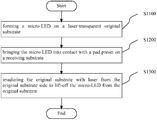
- Figure 1 shows a flow chart of an illustrative embodiment of the method according to the present invention.
- Figure 2A to 2G shows an example for transferring a micro-LED according to the present invention.
- Figure 3 shows a flow chart of another illustrative embodiment of the method according to the present invention.
- Figure 4A to 4L shows another example for transferring a micro-LED according to the present invention.
- Figure 5 shows a flow chart of still another illustrative embodiment of the method according to the present invention.
- Figure 6A to 6F shows an example for transferring red micro-LEDs according to the present invention.
- Figure 7A to 7L shows still another example for transferring a micro-LED according to the present invention.
- Fig. 1 shows a flow chart of an illustrative embodiment of the method for transfer micro-LED according to the present invention.
- a micro-LED is formed on a laser-transparent original substrate.
- the laser-transparent original substrate can be a sapphire substrate, SiC substrate and so on, for example.
- the micro-LED can be used for being mounted on a display screenpanel.
- micro-LED could be formed on the original substrate, or a plurality of micro-LED could be formed on the original substrate.
- a plurality of micro-LEDs can be formed on the laser-transparent original substrate.
- the plurality of micro-LEDs can form an array.
- the original substrate in a case where a plurality of micro-LEDs are formed on the laser-transparent original substrate, the original substrate can be singulated or divided into multiple pieces for more flexible transferring.
- the micro-LED is brought into contact with a pad preset on a receiving substrate.
- the receiving substrate is a display screen panel.
- the pad can be set for red pixel array, yellow pixel array or blue pixel array.
- At least one micro-LED of the plurality of micro-LEDs can be brought into contact with at least one pad preset on the receiving substrate.
- the at least one micro-LED could be one, several or all of the plurality of micro-LEDs. It should be understood by a person skilled in the art that, although it is just described here that at least one micro-LED, which is expected to be lifted-off, is in contact with a pad, a remaining micro-LED of the plurality of micro-LEDs can also be in contact with a pad.
- the micro-LED in the step of contact (S1200) , can be brought into contact with the pad preset on the receiving substrate via a liquid thin film.
- the liquid thin film can include flux.
- the lift-off of a micro-LED will be easy through the surface tension force of the liquid thin film (flux) , and the successful rate is high.
- the original substrate is irradiated with laser from the original substrate side to lift-off the micro-LED from the original substrate.
- At least one area on the original substrate can be irradiated with laser from the original substrate side to lift-off the at least one micro-LED from the original substrate.
- a technician can select the at least one area.
- the at least one area corresponds to the at least micro-LED, respectively.
- the at least one area can be just partial area on the original substrate, or can be the whole area.
- the original substrate can be offset for transferring additional micro-LEDs.
- an additional laser-transparent backup substrate can be used to cope with a situation in which micro-LEDs are missing at some points on the display screen panel.
- a micro-LED can be formed on an additional laser-transparent backup substrate; the micro-LED on the backup substrate is brought into contact with a pad preset on a receiving substrate; and the backup substrate is irradiated with laser from the backup substrate side to lift-off the micro-LED from the backup substrate. In such a way, the quality of a display screen can further be improved.
- An array of micro-LEDs can be formed on the receiving substrate after the transferring of micro-LEDs to the receiving substrate.
- the present invention can further include subsequent steps.
- the lifted-off micro-LEDs can be reflow-soldered on the receiving substrate.
- Anegative electrode can be deposited on the micro-LEDs.
- the reflow-soldering can be performed after micro-LEDs of each color are transferred. Alternatively, The reflow-soldering can be performed after micro-LEDs of all colors are transferred.
- soldered micro-LED can be filledwith polymer.
- a confocal dielectric deposition can be used in stead of polymer filling.
- the present invention further includes a method for manufacturing a micro-LED device.
- the manufacturing method comprises transferring a micro-LED to a receiving substrate by using the method for transferring a micro-LED according to the present invention.
- the present invention further includes a micro-LED device, such as a display screen device.
- a micro-LED device such as a display screen device.
- the micro-LED device can be manufactured by using the method for manufacturing a micro-LED device according to the present invention.
- the micro-LED manufactured by using the solution of the present invention is relatively simple and reliable while maintaining a high quality, and the through put thereof is relatively high with low cost.
- the present invention further includes an electronic apparatus.
- the electronic apparatus contains a micro-LED device according to the present invention.
- the electronic apparatus can be a mobile phone, a pad computer and so on.
- a micro-LED is formed directly on the original substrate and it is transferred to a receiving substrate by means of laser lift-off.
- the solution of this invention have not been conceived by the prior art.
- micro-LED can be selectively transferred through the present invention.
- the transfer can be performed only once while two transfers are needed in the prior art.
- the solution of the present invention is relatively efficient, the cost is relatively low and product performance degrade due to an extra thermal budget will not occur.
- the present invention does not need a complicated pick-up system, and thus the cost of product manufactured using the present invention will relatively low and reliable.
- the manufacturing method of the present invention can have a relatively high through put and the extra thermal load limitation will be less. Consequently, under the similar conditions, the manufactured micro-LED will have a higher performance.
- micro-LEDs 2 are formed on a laser-transparent original substrate 1 such as sapphire substrate.
- the micro-LEDs 2 have a vertical micro-LED structure, for example.
- the micro-LEDs 2 contains, for example, a n-doped GaN layer, a multiple quantum well structure, a p-doped GaN layer, a p metal electrode, a bump, and so on.
- the plurality of micro-LEDs 2 can be singulated.
- the original substrate 1 is flipped over, and is aligned with a receiving substrate 4 with liquid thin film (for example, containing flux) 5.
- the micro bumps on the mircro-LEDs are in contact with the flux.
- Pads 3 are preset on the receiving substrate 4.
- the pads 3 include pad 3r for receiving red micro-LED, pad 3b for receiving blue micro-LED and pad 3g for receiving green micro-LED.
- partial areas 7 on the original substrate are selectively irradiated with laser 7, to lift off the selected micro-LEDs 2a, 2b of the plurality of formed micro-LEDs from the original substrate.
- the original substrate 1 is lifted up. Because of the function of the surface tension force of the liquid thin film, the selected micro-LEDs 2a, 2b are lifted-off easily, while the other micro-LEDs are remained on the original substrate 1.
- the plurality of micro-LEDs are transferred to the receiving substrate 4.
- the plurality of micro-LEDs are soldered onto the receiving substrate through reflow soldering. Then, the flux is cleaned.
- the receiving substrate is filled with polymer 8 and is sealed. Then, n-metal electrode 9 is deposited, for example, using ITO material.
- Figure 3 shows a flow chart of another illustrative embodiment of the method for transferring a micro-LED according to the present invention.
- micro-LEDs are formed on a laser-transparent original substrate.
- an anisotropic conductive layer is provided on a receiving substrate.
- the anisotropic conductive layer is at least one of an anisotropic conductive film (ACF) , an anisotropic conductive paste (ACP) and an anisotropic conductive tape (ACT) .
- ACF anisotropic conductive film
- ACP anisotropic conductive paste
- ACT anisotropic conductive tape
- the micro-LEDs are brought into contact with the anisotropic conductive layer on the receiving substrate.
- the micro-LEDs are adhered to the anisotropic conductive layer on the receiving substrate.
- the micro-LEDs can be aligned with the receiving substrate in advance, for example.
- the original substrate is irradiated with laser from the original substrate side to lift-off the micro-LEDs from the original substrate.
- the above steps can be performed with respect to red micro-LEDs, green micro-LEDs and blue micro-LEDs, respectively. Since the transfer with respect to the three micro-LEDs can be regarded as a simple repeat of the above steps, they are not repeated here. As long as each of the above steps are performed in a solution, the solution will be covered by this invention.
- the anisotropic conductive layer is processed to electrically connect the micro-LEDs (its electrodes) with the pads on the receiving substrate.
- pressure can be applied on the anisotropic conductive layer from the micro-LED side by using an auxiliary substrate.
- the temperature of processing the anisotropic conductive layer can be between 150°C and 200°C.
- the applied pressure is between 1 MPa and 4 MPa.
- the time period of applying pressure is between 10 second and 30 second.
- the auxiliary substrate can be a flat rigid substrate.
- the inventors of the present application have found that the possible displacement of the micro-LEDs can be reduced by using a rigid substrate. This point have not noticed by a person skilled in the art.
- the surface of the auxiliary substrate can be coated with temporary bonding polymer.
- the step S2500 can further comprises: bonding the auxiliary substrate with the anisotropic conductive layer via the temporary bonding polymer; and after applying pressure, de-bonding the auxiliary substrate via the temporary bonding polymer, to remove the auxiliary substrate.
- the advantage of temporarily bonding the auxiliary substrate with the anisotropic conductive layer lies in that, the positions of the micro-LEDs can be relatively fixed, and the displacement of micro-LEDs during processing the anisotropic conductive layer is reduced.
- the subsequent processes include: etching the temporary bonding polymer, to expose the epitaxial layers of the micro-LEDs; forming N-metal electrodes on the epitaxial layers of the micro-LEDs; and performing encapsulation on the N-metal electrodes.
- the receiving substrate can be a display substrate.
- Leads and pads can be set on the receiving substrate in advance, to be electronically connect with the micro-LEDs.
- the micro-LEDs and the receiving substrate are connected through a anisotropic conductive layer.
- This approach of processing is relatively simple and is more suitable for production in large bulk.
- the present invention further provides a method for manufacturing a micro-LED device.
- the manufacturing method comprises transferring micro-LEDs to a receiving substrate by using the method according to the present invention.
- the receiving substrate is a display screen or display substrate.
- the micro-LED device is a display device, for example.
- the present invention further provides a micro-LED device, such as a display device.
- the micro-LED device can be manufactured by using the method for manufacturing a micro-LED device according to the present invention.
- the micro-LEDs come into electronic contact with the pads on the receiving substrate via the anisotropic conductive layer, which is different from the micro-LED device in the prior art.
- the present invention further provides an electronic apparatus.
- the electronic apparatus contains a micro-LED device according to the embodiment.
- the electronic apparatus can be a mobile phone, a pad and so on.
- Figure 4A to 4L shows another example for transferring a micro-LED according to the present invention.
- an original substrate 201 such as a sapphire substrate has red micro-LEDs 202 thereon.
- the receiving substrate 204 such as display substrate has an anisotropic conductive film (ACF) 203 thereon.
- the receiving substrate 204 has signal leads 205 and pads 205’ for connecting micro-LEDs.
- the original substrate 201 (red micro-LED 202) is brought into contact with the anisotropic conductive film 203 with a light force.
- the red micro-LEDs 202 to be transferred can be aligned with the pads on the receiving substrate 204.
- the original substrate 201 is irradiated with laser 206, to selectively lift-off red micro-LEDs.
- Figure 4C shows lifted-off red micro-LEDs 202r.
- Figure 4D shows an original substrate 207 and the green micro-LEDs 208 thereof.
- the green micro-LEDs to be lifted-off are aligned with the pads on the receiving substrate 204.
- Figure 4E shows the situation in which the green micro-LEDs 208 are in contact with the anisotropic conductive film 203 with a light force. At least one green micro-LED is selectively lifted-off by using laser 209.
- Figure 4F shows lifted-off red micro-LEDs 202r and green micro-LEDs 208g.
- Figure 4G shows an original substrate 210 and the blue micro-LEDs 211 thereof.
- the blue micro-LEDs to be lifted-off are aligned with the pads on the receiving substrate 204.
- Figure 4H shows the situation in which the blue micro-LEDs 211 are in contact with the anisotropic conductive film 203 with a light force. At least one blue micro-LED is selectively lifted-off by using laser 212.
- Figure 4F shows lifted-off red micro-LEDs 202r, green micro-LEDs 208g and blue micro-LEDs 211b.
- Figure 4J shows an auxiliary substrate 213.
- the auxiliary substrate 213 is a flat rigid substrate, such a glass substrate.
- Polymer 214 such as 3M LC5200/5320 is coated on the auxiliary substrate 213.
- the polymer can be cured through UV and can be de-bonded through red laser.
- the ACF 203 is processed through the auxiliary substrate 213.
- the processing condition is that the temperature is be between 150°C and 200°C, the applied pressure is between 1 MPa and 4 MPa, the time period of applying pressure is between 10 second and 30 second.
- the ACF 203 interconnects the micro-LEDs with corresponding pad in the vertical direction.
- the auxiliary substrate 213 is de-bonded (through the polymer 214) .
- the normal subsequent processes are performed: etching the polymer 214, to expose the epitaxial layers of the micro-LEDs; forming N-metal electrodes 215 (for example, ITO electrodes) on the epitaxial layers of the micro-LEDs; and performing encapsulation 216 on the N-metal electrodes (for example, PET lamination) .
- Figure 5 shows a flow chart of still another illustrative embodiment of the method for transferring a micro-LED according to the present invention.
- At step S3100 at least one micro-LED is transferred from an original substrate to a support body.
- the original substrate is laser-transparent.
- this step can comprises: mounting the original substrate onto the support body, wherein the micro-LEDs are formed on the original substrate, the support body has light-release adhesive on its surface, and the micro-LEDs are adhered to the support body via the light-release adhesive; irradiating the original substrate with laser from the original substrate side, for lifting-off the at least one micro-LED from the original substrate, and irradiating light from the support body side, to release un-lifted-off micro-LEDs.
- the support body is transparent.
- the light-release adhesive can be a UV tape.
- the support body is stiff. The displacement of micro-LEDs during transfer will have affect on the quality of the final product. The inventors of this application have found that this displacement can be reduced by using a stiff support body. This point has not been noticed by a person skilled in the art.
- the material of the support body can be PET.
- red micro-LEDs are formed in advance and then are transferred to an original substrate, for being finally transferred to a receiving substrate.
- red micro-LEDs can be formed on a growth substrate. Then, the red micro-LEDs are transferred to an intermediate substrate. After that, the red micro-LEDs are transferred from the intermediate substrate to the original substrate.
- the at least one micro-LED are transferred from the support body to a backup substrate.
- the backup substrate has elastomer or polymer on its surface.
- the at least one micro-LED are bonded to the backup substrate through the elastomer or polymer.
- this step can further comprises: bonding the support body with the at least one micro-LED to the backup substrate, and irradiating light from the support body side, to release the at least one micro-LED.
- the at least one micro-LED are transferred from the backup substrate to a receiving substrate.
- the step can further comprises: aligning the at least one micro-LED with the pads on the receiving substrate; and lifting-off the at least one micro-LED via the elastomer or polymer.
- the above transfer steps can be performed with respect to red micro-LEDs, blue micro-LEDs and greed micro-LEDs, respectively. They will not be repeatedly described here.
- the subsequent processes include: coating polymer on the receiving substrate with micro-LEDs; curing the polymer; etching the polymer, to expose the epitaxial layers of the micro-LEDs; forming N-metal electrodes on the epitaxial layers of the micro-LEDs; and performing encapsulation on the N-metal electrodes.
- the inventors of this invention have found that during the transfer of micro-LEDs, usually, only part of the micro-LEDs on the original substrate are transferred. If the micro-LEDs are directly transferred to a receiving substrate, the remaining micro-LEDs on the original substrate are often contaminated. In this embodiment, this contamination can reduced through the transfer via an intermediate support body.
- the present invention further provides a method for manufacturing a micro-LED device.
- the manufacturing method comprises transferring micro-LEDs to a receiving substrate by using the method for transferring micro-LEDs according to this embodiment.
- the receiving substrate is a display screen or display substrate.
- the micro-LED device is a display device, for example.
- the present invention further provides a micro-LED device, such as a display device.
- a micro-LED device such as a display device.
- the micro-LED device can be manufactured by using the method for manufacturing a micro-LED device according to said embodiment.
- the present invention further provides an electronic apparatus.
- the electronic apparatus contains a micro-LED device according to the embodiment.
- the electronic apparatus can be a mobile phone, a pad and so on.
- red micro-LEDs cannot be directly formed on a laser-transparent original substrate such as sapphire substrate. Thus, it is required that red micro-LEDs are formed on an additional substrate in advance, and then are transferred to a sapphire substrate.
- Figure 6A to 6F shows an example for transferring red micro-LEDs according to the present invention.
- red micro-LEDs 302 are formed on a growth substrate 301 such as GaAs substrate.
- the red micro-LEDs 302 are bonded with intermediate substrate 304 such as silicon substrate, through temporary bonding polymer 303.
- the polymer 303 is a thermal release tape (TRT) , for example.
- the growth substrate 301 is removed by a wet etching method, for example.
- a light resist 305 is coated on an original substrate 306 suc as sapphire substrate.
- the original substrate 306 and the red micro-LEDs 302 are bonded through the resist 305.
- the resist 305 can endure the temperature above 200°C; generally above 250°C.
- the polymer 303 is processed under a temperature less than 200°C, to remove the intermediate substrate 304.
- a O2 plasma etching is performed on the resist 305, to isolate the respective red micro-LEDs302.
- Figure 7A to 7L shows still another example for transferring a micro-LED according to the present invention.
- the original substrate 406 has resist 405 and red micro-LEDs 402 thereon.
- the red micro-LEDs 402 are mounted onto a UV tape 411.
- the UV tape 411 is located on a stiff PET support body 402.
- the red micro-LEDs are selectively lifted-off through laser 413.
- a ultraviolet is irradiated from the support body 412 side, to release un-lifted-off red micro-LEDs.
- the lifted-off red micro-LEDs 402r are easily separated from the original substrate 406. As shown in Figure 7C, the lifted-off red micro-LEDs 402r are adhered on the UV tape 411, while other red micro-LEDs remain on the original substrate 406.
- the backup substrate 415 such as glass substrate has elastomer/polymer 416 thereon.
- the elastomer/polymer 416 is coated on the backup substrate 415 through spin coating.
- the elastomer/polymer 416 is PDMS or 3M LC 5320, and can be cured through ultraviolet, for example.
- the support body is fully irradiated with ultraviolet, to release the red micro-LEDs and elastomer/polymer 416.
- the micro-LEDs on the backup substrate 415 can be screen-printed using silver paste.
- the red micro-LEDs on the backup substrate 415 are aligned with the pads 419 on the receiving substrate 417.
- the receiving substrate is a display substrate, and includes signal leads 418.
- the red micro-LEDs are bonded to the pads 419 through reflow.
- the temperature of reflow can be more than 260°C. Then, the backup substrate 415 is separated from the receiving substrate 417 through laser lift-off.
- FIG. 7G shows separated receiving substrate 417.
- the receiving substrate 417 has pads 419 and red micro-LEDs 402r thereon.
- Figure 7H shows a schematic diagram of transferring red micro-LEDs 422g from a backup substrate 420 to the receiving substrate 417.
- the backup substrate 420 has elastomer/polymer 421.
- FIG. 7I shows the separated receiving substrate 417.
- the receiving substrate 417 has pads 419, red micro-LEDs 402r and green micro-LEDs 402r thereon.
- Figure 7J shows a schematic diagram of transferring blue micro-LEDs 425b from a backup substrate 423 to the receiving substrate 417.
- the backup substrate 423 has elastomer/polymer 424.
- Figure 7K shows the separated receiving substrate 417.
- the receiving substrate 417 has pads 419, red micro-LEDs 402r, green micro-LEDs 402r and blue micro-LEDs 425b thereon
- the normal subsequent processes are performed on the transferred micro-LEDs: coating polymer 426 on the receiving substrate with micro-LEDs; curing the polymer426; etching the polymer, to expose the epitaxial layers of the micro-LEDs; forming N-metal electrodes 427 on the epitaxial layers of the micro-LEDs; and performing encapsulation (not shown) on the N-metal electrodes.
Landscapes
- Engineering & Computer Science (AREA)
- Led Device Packages (AREA)
- Microelectronics & Electronic Packaging (AREA)
- Power Engineering (AREA)
- Computer Hardware Design (AREA)
- Physics & Mathematics (AREA)
- Condensed Matter Physics & Semiconductors (AREA)
- General Physics & Mathematics (AREA)
- Electroluminescent Light Sources (AREA)
- Manufacturing & Machinery (AREA)
- Electric Connection Of Electric Components To Printed Circuits (AREA)
- Die Bonding (AREA)
Abstract
A transferring method, a manufacturing method, a device and an electronic apparatus of micro-LED (402) are disclosed. The method for transferring micro-LED (402) comprises: transferring at least one micro-LED (402) from an original substrate (406) to a support body (412); transferring the at least one micro-LED (402) from the support body (412) to a backup substrate (415); and transferring the at least one micro-LED (402) from the backup substrate (415) to a receiving substrate (417).
Description
The present invention relates to Micro-Light Emitting Diode (micro LED) array for display, and in particular, to a method for transferring micro-LED, a method for manufacturing a micro-LED device, a micro-LED device and an electronic apparatus containing a micro-LED device.
The micro-LED technology refers to the LED array of small size integrated on a substrate with high density. Currently, the micro-LED technology is starting development, and it is expected in the industry that a high-quality micro-LED product comes into the market. High-quality micro-LED will have a deep affection on the conventional display products such as LCD/OLED that have already been put into the market.
In the process of manufacturing micro-LEDs, micro-LEDs are first formed on a donor wafer, and then the micro-LEDs are transferred to a receiving substrate. The receiving substrate is a display screen, for example.
One difficulty during manufacturing a micro-LED lies in how to transfer a micro-LED from a donor wafer to a receiving substrate. In the prior art, the transfer is generally performed by means of electrostaticpick-up. A transfer head array will be needed during the electrostatic pick-up. The structure of the transfer head array is relatively complicated, and the stability thereof shall be considered. An extra cost shall be paid for manufacturing a transfer head array. A phase change shall be made before pick-up with the transfer head array. In addition, during manufacturing with a transfer head array, limitations apply to the thermo budget of a micro-LED for phase change, which is generally lower than 350℃, or more specifically, lower than 200℃; otherwise, the performance of the micro-LED will be degraded. It generally requires two transfers during the manufacturing with transfer head array, i.e., the transfer from a donor wafer to a carrier wafer and the transfer from the carrier wafer to a receiving substrate.
US patent No. 8,333,860B1 discloses an array of transfer headsfor transferring micro devices, in which a voltage is applied to the electrode in the transfer head to pick-up a micro device. This patent is fully incorporated hereby as reference herein.
US patent No. 8,426,227B1 discloses a method of forming a micro light emitting diode array, in which a micro-LED array is transferred to a receiving substrate by using a transfer head array. This patent is fully incorporated hereby as reference herein.
SUMMARY OF THE INVENTION
One object of this invention is to provide a new technical solution for transferring a micro-LED.
According to an embodiment of the present invention, there is provided a method for transferring micro-LED, comprising: forming micro-LEDs on a laser-transparent original substrate; providing an anisotropic conductive layer on a receiving substrate; bringing the micro-LEDs into contact with the anisotropic conductive layer on the receiving substrate; irradiating the original substrate with laser from the original substrate side to lift-off the micro-LEDs from the original substrate; and processing the anisotropic conductive layer, to electrically connect the micro-LEDs with the pads on the receiving substrate.
Preferably, the step of processing the anisotropic conductive layer further comprises: applying pressure on the anisotropic conductive layer from the micro-LED side by using an auxiliary substrate.
Preferably, the temperature of processing the anisotropic conductive layer is between 150℃ and 200℃, the applied pressure is between 1 MPa and 4 MPa, and the time period of applying pressure is between 10 second and 30 second.
Preferably, the auxiliary substrate is a flat rigid substrate.
Preferably, the surface of the auxiliary substrate is coated with temporary bonding polymer, and the step of processing the anisotropic conductive layer comprises: bonding the auxiliary substrate with the anisotropic conductive layer via the temporary bonding polymer; and after applying pressure, de-bonding the auxiliary substrate via the temporary bonding polymer, to remove the auxiliary substrate.
Preferably, the method further comprises: etching the temporary bonding polymer, to expose the epitaxial layers of the micro-LEDs; forming N-metal electrodes on the epitaxial layers of the micro-LEDs; and performing encapsulation on the N-metal electrodes.
Preferably, the anisotropic conductive layer is at least one of an anisotropic conductive film, an anisotropic conductive paste and an anisotropic conductive tape.
According to another embodiment of the present invention, there is provided a method for manufacturing a micro-LED device, comprising transferring a micro-LED to a receiving substrate by using the method according to the present invention.
According to another embodiment of the present invention, there is provided a micro-LED device, which is manufactured by using the method according to the present invention, wherein the micro-LEDs come into electronic contact with the pads on the receiving substrate via the anisotropic conductive layer.
According to another embodiment of the present invention, there is provided an electronic apparatus, containing a micro-LED device according to the present invention.
According to another embodiment of the present invention, there is provided a method for transferring micro-LED, comprising: transferring at least one micro-LED from an original substrate to a support body; transferring the at least one micro-LED from the support body to a backup substrate; and transferring the at least one micro-LED from the backup substrate to a receiving substrate.
Preferably, the original substrate is laser-transparent, and the step of transferring at least one micro-LED from an original substrate to a support body comprises: mounting the original substrate onto the support body, wherein the micro-LEDs are formed on the original substrate, the support body has light-release adhesive on its surface, and the micro-LEDs are adhered to the support body via the light-release adhesive, irradiating the original substrate with laser from the original substrate side, for lifting-off the at least one micro-LED from the original substrate, andirradiating light from the support body side, to release un-lifted-off micro-LEDs; wherein, the step of transferring the at least one micro-LED from the support body to a backup substrate comprises: bonding the support body with the at least one micro-LED to the backup substrate, and irradiating light from the support body side, to release the at least one micro-LED.
Preferably, the light-release adhesive is a UV tape, and the support body is stiff.
Preferably, the material of the support body is PET.
Preferably, the backup substrate has elastomer or polymer on its surface, and the step of transferring the at least one micro-LED from the support body to a backup substrate further comprises: bonding the at least one micro-LED to the backup substrate through the elastomer or polymer; wherein the step of transferring the at least one micro-LED from the backup substrate to a receiving substrate further comprises: aligning the at least one micro-LED with the pads on the receiving substrate; and lifting-off the at least one micro-LED via the elastomer or polymer.
Preferably, the method further comprises: forming red micro-LEDs on a growth substrate; transferring the red micro-LEDs to an intermediate substrate; and transferring the red micro-LEDs from the intermediate substrate to an original substrate.
Preferably, the method further comprises: coating polymer on the receiving substrate with micro-LEDs; curing the polymer; etching the polymer, to expose the epitaxial layers of the micro-LEDs; forming N-metal electrodes on the epitaxial layers of the micro-LEDs; and performing encapsulation on the N-metal electrodes.
According to another embodiment of the present invention, there is provided a method for manufacturing a micro-LED device, comprising transferring micro-LEDs to a receiving substrate by using the method according to the present invention.
According to another embodiment of the present invention, there is provided a micro-LED device, which is manufactured by using the method according to the present invention.
According to another embodiment of the present invention, there is provided an electronic apparatus, containing a micro-LED device according to the present invention.
In addition, it should be understood by a person skilled in the art that, although a lot of problems exist in the prior art, the solution of each embodiment or each claim could just improve in one or several aspects, and it is not necessary for it to solve all the technical problems listed in the Background of the Invention or in the prior art. It should be understood by a person skilled in the art that content which is not mentioned in a claim should not be regarded as a limitation to said claim.
Further features of the present invention and advantages thereof will become apparent from the following detailed description of exemplary embodiments according to the present invention with reference to the attached drawings.
BRIEF DISCRIPTION OF THE DRAWINGS
The accompanying drawings, which are incorporated in and constitute a part of the specification, illustrate embodiments of the invention and, together with the description thereof, serve to explain the principles of the invention.
Figure 1 shows a flow chart of an illustrative embodiment of the method according to the present invention.
Figure 2A to 2G shows an example for transferring a micro-LED according to the present invention.
Figure 3 shows a flow chart of another illustrative embodiment of the method according to the present invention.
Figure 4A to 4L shows another example for transferring a micro-LED according to the present invention.
Figure 5 shows a flow chart of still another illustrative embodiment of the method according to the present invention.
Figure 6A to 6F shows an example for transferring red micro-LEDs according to the present invention.
Figure 7A to 7L shows still another example for transferring a micro-LED according to the present invention.
DETAILED DESCRIPTION OF THE EMBODIMENTS
Various exemplary embodiments of the present invention will now be described in detail with reference to the drawings. It should be noted that the relative arrangement of the components and steps, the numerical expressions, and numerical values set forth in these embodiments do not limit the scope of the present invention unless it is specifically stated otherwise.
The following description of at least one exemplary embodiment is merely illustrative in nature and is in no way intended to limit the invention, its application, or uses.
Techniques, methods and apparatus as known by one of ordinary skill in the relevant art may not be discussed in detail but are intended to be part of the specificationwhere appropriate.
In all of the examples illustrated and discussed herein, any specific values should be interpreted to be illustrative only and non-limiting. Thus, other examples of the exemplary embodiments could have different values.
Notice that similar reference numerals and letters refer to similar items in the following figures, and thus once an item is defined in one figure, it is possible that it need not be further discussed for following figures.
Embodiments and examples of the present invention will be described below with reference to the drawings.
Fig. 1 shows a flow chart of an illustrative embodiment of the method for transfer micro-LED according to the present invention.
As shown in Fig. 1, at step S1100, a micro-LED is formed on a laser-transparent original substrate.
The laser-transparent original substrate can be a sapphire substrate, SiC substrate and so on, for example. The micro-LED can be used for being mounted on a display screenpanel.
It should be understood by a person skilled in the art that one micro-LED could be formed on the original substrate, or a plurality of micro-LED could be formed on the original substrate. For example, a plurality of micro-LEDs can be formed on the laser-transparent original substrate. The plurality of micro-LEDs can form an array.
In an example, in a case where a plurality of micro-LEDs are formed on the laser-transparent original substrate, the original substrate can be singulated or divided into multiple pieces for more flexible transferring.
At step S1200, the micro-LED is brought into contact with a pad preset on a receiving substrate.
For example, the receiving substrate is a display screen panel.
For example, the pad can be set for red pixel array, yellow pixel array or blue pixel array.
In an example, in a case where a plurality of micro-LED are formed, at least one micro-LED of the plurality of micro-LEDs can be brought into contact with at least one pad preset on the receiving substrate. The at least one micro-LED could be one, several or all of the plurality of micro-LEDs. It should be understood by a person skilled in the art that, although it is just described here that at least one micro-LED, which is expected to be lifted-off, is in contact with a pad, a remaining micro-LED of the plurality of micro-LEDs can also be in contact with a pad.
For example, in the step of contact (S1200) , the micro-LED can be brought into contact with the pad preset on the receiving substrate via a liquid thin film. For example, the liquid thin film can include flux. Herein, the lift-off of a micro-LED will be easy through the surface tension force of the liquid thin film (flux) , and the successful rate is high.
At step S1300, the original substrate is irradiated with laser from the original substrate side to lift-off the micro-LED from the original substrate.
In an example, in a case where at least one micro-LED is in contact with pad, at least one area on the original substrate can be irradiated with laser from the original substrate side to lift-off the at least one micro-LED from the original substrate. For example, a technician can select the at least one area. For example, the at least one area corresponds to the at least micro-LED, respectively. The at least one area can be just partial area on the original substrate, or can be the whole area.
In another example, the original substrate can be offset for transferring additional micro-LEDs.
In another example, after the transferring using the original substrate, an additional laser-transparent backup substrate can be used to cope with a situation in which micro-LEDs are missing at some points on the display screen panel. For example, a micro-LED can be formed on an additional laser-transparent backup substrate; the micro-LED on the backup substrate is brought into contact with a pad preset on a receiving substrate; and the backup
substrate is irradiated with laser from the backup substrate side to lift-off the micro-LED from the backup substrate. In such a way, the quality of a display screen can further be improved.
An array of micro-LEDs can be formed on the receiving substrate after the transferring of micro-LEDs to the receiving substrate.
After the transferring of micro-LEDs to the receiving substrate, the present invention can further include subsequent steps.
For example, the lifted-off micro-LEDs can be reflow-soldered on the receiving substrate. Anegative electrode can be deposited on the micro-LEDs. The reflow-soldering can be performed after micro-LEDs of each color are transferred. Alternatively, The reflow-soldering can be performed after micro-LEDs of all colors are transferred.
In addition, the soldered micro-LED can be filledwith polymer. For example, a confocal dielectric deposition can be used in stead of polymer filling.
In another embodiment, the present invention further includes a method for manufacturing a micro-LED device. The manufacturing method comprises transferring a micro-LED to a receiving substrate by using the method for transferring a micro-LED according to the present invention.
In another embodiment, the present invention further includes a micro-LED device, such as a display screen device. The micro-LED device can be manufactured by using the method for manufacturing a micro-LED device according to the present invention.
In comparison with the prior art, under the similar conditions, the micro-LED manufactured by using the solution of the present invention is relatively simple and reliable while maintaining a high quality, and the through put thereof is relatively high with low cost.
In another embodiment, the present invention further includes an electronic apparatus. The electronic apparatus contains a micro-LED device according to the present invention. For example, the electronic apparatus can be a mobile phone, a pad computer and so on.
In the solution of the present invention, a micro-LED is formed directly on the
original substrate and it is transferred to a receiving substrate by means of laser lift-off. The solution of this invention have not been conceived by the prior art.
In addition, the micro-LED can be selectively transferred through the present invention.
In addition, in the solution of the present invention, the transfer can be performed only once while two transfers are needed in the prior art.
In addition, in comparison with the prior art, the solution of the present invention is relatively efficient, the cost is relatively low and product performance degrade due to an extra thermal budget will not occur.
In addition, in comparison with the prior art using a pick-up head, the present invention does not need a complicated pick-up system, and thus the cost of product manufactured using the present invention will relatively low and reliable.
In addition, since it does not need the temporary bonding in the prior art between the micro-LED and the intermediate carrier substrate, the cost can be further decreased by this invention.
Since it is not necessary to consider the phase change of bonding layer considered in the prior art using pick-up head, the manufacturing method of the present invention can have a relatively high through put and the extra thermal load limitation will be less. Consequently, under the similar conditions, the manufactured micro-LED will have a higher performance.
An example for transferring a micro-LED according to the present invention will be described below with reference to Figs. 2A to 2G.
As shown in Fig. 2A, micro-LEDs 2 are formed on a laser-transparent original substrate 1 such as sapphire substrate. The micro-LEDs 2 have a vertical micro-LED structure, for example. The micro-LEDs 2 contains, for example, a n-doped GaN layer, a multiple quantum well structure, a p-doped GaN layer, a p metal electrode, a bump, and so on.
As shown in Fig. 2A, the plurality of micro-LEDs 2 can be singulated.
As shown in Fig. 2B, the original substrate 1 is flipped over, and is aligned with a
receiving substrate 4 with liquid thin film (for example, containing flux) 5. The micro bumps on the mircro-LEDs are in contact with the flux. Pads 3 are preset on the receiving substrate 4. For example, the pads 3 include pad 3r for receiving red micro-LED, pad 3b for receiving blue micro-LED and pad 3g for receiving green micro-LED.
As shown in Fig. 2C, partial areas 7 on the original substrate are selectively irradiated with laser 7, to lift off the selected micro-LEDs 2a, 2b of the plurality of formed micro-LEDs from the original substrate.
As shown in Fig. 2D, the original substrate 1 is lifted up. Because of the function of the surface tension force of the liquid thin film, the selected micro-LEDs 2a, 2b are lifted-off easily, while the other micro-LEDs are remained on the original substrate 1.
Then, the original substrate is moved and the operations of Figs. 2C to 2D are repeated, so that a plurality of micro-LEDs are transferred to the receiving substrate.
As shown in Fig. 2E, the plurality of micro-LEDs are transferred to the receiving substrate 4.
As shown in Fig. 2F, for example, the plurality of micro-LEDs are soldered onto the receiving substrate through reflow soldering. Then, the flux is cleaned.
As shown in Fig. 2G, the receiving substrate is filled with polymer 8 and is sealed. Then, n-metal electrode 9 is deposited, for example, using ITO material.
Figure 3 shows a flow chart of another illustrative embodiment of the method for transferring a micro-LED according to the present invention.
As shown in Figure 3, at step S2100, micro-LEDs are formed on a laser-transparent original substrate.
At step S2200, an anisotropic conductive layer is provided on a receiving substrate.
For example, the anisotropic conductive layer is at least one of an anisotropic conductive film (ACF) , an anisotropic conductive paste (ACP) and an anisotropic conductive tape (ACT) .
At step S2300, the micro-LEDs are brought into contact with the anisotropic conductive layer on the receiving substrate. For example, the micro-LEDs are adhered to the anisotropic conductive layer on the receiving substrate. At this step, the micro-LEDs can be
aligned with the receiving substrate in advance, for example.
At step S2400, the original substrate is irradiated with laser from the original substrate side to lift-off the micro-LEDs from the original substrate.
For example, the above steps can be performed with respect to red micro-LEDs, green micro-LEDs and blue micro-LEDs, respectively. Since the transfer with respect to the three micro-LEDs can be regarded as a simple repeat of the above steps, they are not repeated here. As long as each of the above steps are performed in a solution, the solution will be covered by this invention.
At step S2500, the anisotropic conductive layer is processed to electrically connect the micro-LEDs (its electrodes) with the pads on the receiving substrate.
In an example, pressure can be applied on the anisotropic conductive layer from the micro-LED side by using an auxiliary substrate. For example, the temperature of processing the anisotropic conductive layer can be between 150℃ and 200℃. For example, the applied pressure is between 1 MPa and 4 MPa. For example, the time period of applying pressure is between 10 second and 30 second.
In an example, the auxiliary substrate can be a flat rigid substrate. The inventors of the present application have found that the possible displacement of the micro-LEDs can be reduced by using a rigid substrate. This point have not noticed by a person skilled in the art.
For example, the surface of the auxiliary substrate can be coated with temporary bonding polymer. In this situation, the step S2500 can further comprises: bonding the auxiliary substrate with the anisotropic conductive layer via the temporary bonding polymer; and after applying pressure, de-bonding the auxiliary substrate via the temporary bonding polymer, to remove the auxiliary substrate. The advantage of temporarily bonding the auxiliary substrate with the anisotropic conductive layer lies in that, the positions of the micro-LEDs can be relatively fixed, and the displacement of micro-LEDs during processing the anisotropic conductive layer is reduced.
After the above processes, normal subsequent processes can be done on the micro-LEDs. For example, the subsequent processes include: etching the temporary bonding polymer, to expose the epitaxial layers of the micro-LEDs; forming N-metal electrodes on
the epitaxial layers of the micro-LEDs; and performing encapsulation on the N-metal electrodes.
For example, the receiving substrate can be a display substrate. Leads and pads can be set on the receiving substrate in advance, to be electronically connect with the micro-LEDs.
In this embodiment, the micro-LEDs and the receiving substrate are connected through a anisotropic conductive layer. This approach of processing is relatively simple and is more suitable for production in large bulk.
In another embodiment, the present invention further provides a method for manufacturing a micro-LED device. The manufacturing method comprises transferring micro-LEDs to a receiving substrate by using the method according to the present invention. For example, the receiving substrate is a display screen or display substrate. The micro-LED device is a display device, for example.
In another embodiment, the present invention further provides a micro-LED device, such as a display device. The micro-LED device can be manufactured by using the method for manufacturing a micro-LED device according to the present invention. In the micro-LED device according to the embodiment, the micro-LEDs come into electronic contact with the pads on the receiving substrate via the anisotropic conductive layer, which is different from the micro-LED device in the prior art.
In another embodiment, the present invention further provides an electronic apparatus. The electronic apparatus contains a micro-LED device according to the embodiment. For example, the electronic apparatus can be a mobile phone, a pad and so on.
Figure 4A to 4L shows another example for transferring a micro-LED according to the present invention.
As shown in Figure 4A, an original substrate 201 such as a sapphire substrate has red micro-LEDs 202 thereon. The receiving substrate 204 such as display substrate has an anisotropic conductive film (ACF) 203 thereon. The receiving substrate 204 has signal leads 205 and pads 205’ for connecting micro-LEDs.
As shown in Figure 4B, the original substrate 201 (red micro-LED 202) is brought
into contact with the anisotropic conductive film 203 with a light force. For example, the red micro-LEDs 202 to be transferred can be aligned with the pads on the receiving substrate 204. The original substrate 201 is irradiated with laser 206, to selectively lift-off red micro-LEDs.
Figure 4C shows lifted-off red micro-LEDs 202r.
Figure 4D shows an original substrate 207 and the green micro-LEDs 208 thereof. The green micro-LEDs to be lifted-off are aligned with the pads on the receiving substrate 204.
Figure 4E shows the situation in which the green micro-LEDs 208 are in contact with the anisotropic conductive film 203 with a light force. At least one green micro-LED is selectively lifted-off by using laser 209.
Figure 4F shows lifted-off red micro-LEDs 202r and green micro-LEDs 208g.
Figure 4G shows an original substrate 210 and the blue micro-LEDs 211 thereof. The blue micro-LEDs to be lifted-off are aligned with the pads on the receiving substrate 204.
Figure 4H shows the situation in which the blue micro-LEDs 211 are in contact with the anisotropic conductive film 203 with a light force. At least one blue micro-LED is selectively lifted-off by using laser 212.
Figure 4F shows lifted-off red micro-LEDs 202r, green micro-LEDs 208g and blue micro-LEDs 211b.
After the transfer of micro-LEDs in the three colors, an inspection and repair can be performed with respect to any defect.
Figure 4J shows an auxiliary substrate 213. The auxiliary substrate 213 is a flat rigid substrate, such a glass substrate. Polymer 214 such as 3M LC5200/5320 is coated on the auxiliary substrate 213. The polymer can be cured through UV and can be de-bonded through red laser.
In Figure 4K, the ACF 203 is processed through the auxiliary substrate 213. For example, the processing condition is that the temperature is be between 150℃ and 200℃, the applied pressure is between 1 MPa and 4 MPa, the time period of applying pressure is
between 10 second and 30 second. Through these processes, the ACF 203 interconnects the micro-LEDs with corresponding pad in the vertical direction.
Then, the auxiliary substrate 213 is de-bonded (through the polymer 214) .
In Figure 4L, the normal subsequent processes are performed: etching the polymer 214, to expose the epitaxial layers of the micro-LEDs; forming N-metal electrodes 215 (for example, ITO electrodes) on the epitaxial layers of the micro-LEDs; and performing encapsulation 216 on the N-metal electrodes (for example, PET lamination) .
Figure 5 shows a flow chart of still another illustrative embodiment of the method for transferring a micro-LED according to the present invention.
As shown in Figure 5, at step S3100, at least one micro-LED is transferred from an original substrate to a support body. For example, the original substrate is laser-transparent.
In an example, this step can comprises: mounting the original substrate onto the support body, wherein the micro-LEDs are formed on the original substrate, the support body has light-release adhesive on its surface, and the micro-LEDs are adhered to the support body via the light-release adhesive; irradiating the original substrate with laser from the original substrate side, for lifting-off the at least one micro-LED from the original substrate, and irradiating light from the support body side, to release un-lifted-off micro-LEDs. In this example, the support body is transparent.
For example, the light-release adhesive can be a UV tape. For example, the support body is stiff. The displacement of micro-LEDs during transfer will have affect on the quality of the final product. The inventors of this application have found that this displacement can be reduced by using a stiff support body. This point has not been noticed by a person skilled in the art. For example, the material of the support body can be PET.
Generally, it is difficult to form red micro-LEDs on a laser-transparent substrate such as a sapphire substrate. Accordingly, in an example, the red micro-LEDs are formed in advance and then are transferred to an original substrate, for being finally transferred to a receiving substrate. For example, in this embodiment, red micro-LEDs can be formed on a growth substrate. Then, the red micro-LEDs are transferred to an intermediate substrate. After that, the red micro-LEDs are transferred from the intermediate substrate to the original
substrate.
At step S3200, the at least one micro-LED are transferred from the support body to a backup substrate.
For example, the backup substrate has elastomer or polymer on its surface. For example, the at least one micro-LED are bonded to the backup substrate through the elastomer or polymer.
In an example, this step can further comprises: bonding the support body with the at least one micro-LED to the backup substrate, and irradiating light from the support body side, to release the at least one micro-LED.
At step S3300, the at least one micro-LED are transferred from the backup substrate to a receiving substrate.
In an example, the step can further comprises: aligning the at least one micro-LED with the pads on the receiving substrate; and lifting-off the at least one micro-LED via the elastomer or polymer.
For example, the above transfer steps can be performed with respect to red micro-LEDs, blue micro-LEDs and greed micro-LEDs, respectively. They will not be repeatedly described here.
After the above processes, normal subsequent processes can be done on the micro-LEDs. For example, the subsequent processes include: coating polymer on the receiving substrate with micro-LEDs; curing the polymer; etching the polymer, to expose the epitaxial layers of the micro-LEDs; forming N-metal electrodes on the epitaxial layers of the micro-LEDs; and performing encapsulation on the N-metal electrodes.
The inventors of this invention have found that during the transfer of micro-LEDs, usually, only part of the micro-LEDs on the original substrate are transferred. If the micro-LEDs are directly transferred to a receiving substrate, the remaining micro-LEDs on the original substrate are often contaminated. In this embodiment, this contamination can reduced through the transfer via an intermediate support body.
In another embodiment, the present invention further provides a method for manufacturing a micro-LED device. The manufacturing method comprises transferring
micro-LEDs to a receiving substrate by using the method for transferring micro-LEDs according to this embodiment. For example, the receiving substrate is a display screen or display substrate. The micro-LED device is a display device, for example.
In another embodiment, the present invention further provides a micro-LED device, such as a display device. The micro-LED device can be manufactured by using the method for manufacturing a micro-LED device according to said embodiment.
In another embodiment, the present invention further provides an electronic apparatus. The electronic apparatus contains a micro-LED device according to the embodiment. For example, the electronic apparatus can be a mobile phone, a pad and so on.
Generally, red micro-LEDs cannot be directly formed on a laser-transparent original substrate such as sapphire substrate. Thus, it is required that red micro-LEDs are formed on an additional substrate in advance, and then are transferred to a sapphire substrate. Figure 6A to 6F shows an example for transferring red micro-LEDs according to the present invention.
As shown in Figure 6A, red micro-LEDs 302 are formed on a growth substrate 301 such as GaAs substrate.
As shown in Figure 6B, the red micro-LEDs 302 are bonded with intermediate substrate 304 such as silicon substrate, through temporary bonding polymer 303. The polymer 303 is a thermal release tape (TRT) , for example.
As shown in Figure 6C, the growth substrate 301 is removed by a wet etching method, for example.
As shown in Figure 6D, a light resist 305 is coated on an original substrate 306 suc as sapphire substrate. The original substrate 306 and the red micro-LEDs 302 are bonded through the resist 305. The resist 305 can endure the temperature above 200℃; generally above 250℃.
As shown in Figure 6E, the polymer 303 is processed under a temperature less than 200℃, to remove the intermediate substrate 304.
As shown in Figure 6F, a O2 plasma etching is performed on the resist 305, to isolate the respective red micro-LEDs302.
Figure 7A to 7L shows still another example for transferring a micro-LED according to the present invention.
As shown in Figure 7A, the original substrate 406 has resist 405 and red micro-LEDs 402 thereon. The red micro-LEDs 402 are mounted onto a UV tape 411. The UV tape 411 is located on a stiff PET support body 402. The red micro-LEDs are selectively lifted-off through laser 413.
As shown in Figure 7B, a ultraviolet is irradiated from the support body 412 side, to release un-lifted-off red micro-LEDs.
The lifted-off red micro-LEDs 402r are easily separated from the original substrate 406. As shown in Figure 7C, the lifted-off red micro-LEDs 402r are adhered on the UV tape 411, while other red micro-LEDs remain on the original substrate 406.
As shown in Figure 7D, the backup substrate 415 such as glass substrate has elastomer/polymer 416 thereon. For example, the elastomer/polymer 416 is coated on the backup substrate 415 through spin coating. For example, the elastomer/polymer 416 is PDMS or 3M LC 5320, and can be cured through ultraviolet, for example.
As shown in Figure 7E, the support body is fully irradiated with ultraviolet, to release the red micro-LEDs and elastomer/polymer 416.
After that, for example, if the micro-LEDs do not have bumps thereon, the micro-LEDs on the backup substrate 415 can be screen-printed using silver paste.
As shown in 7F, the red micro-LEDs on the backup substrate 415 are aligned with the pads 419 on the receiving substrate 417. For example, the receiving substrate is a display substrate, and includes signal leads 418. For example, the red micro-LEDs are bonded to the pads 419 through reflow. The temperature of reflow can be more than 260℃. Then, the backup substrate 415 is separated from the receiving substrate 417 through laser lift-off.
Figure 7G shows separated receiving substrate 417. The receiving substrate 417 has pads 419 and red micro-LEDs 402r thereon.
Figure 7H shows a schematic diagram of transferring red micro-LEDs 422g from a backup substrate 420 to the receiving substrate 417. The backup substrate 420 has
elastomer/polymer 421.
Figure 7I shows the separated receiving substrate 417. The receiving substrate 417 has pads 419, red micro-LEDs 402r and green micro-LEDs 402r thereon.
Figure 7J shows a schematic diagram of transferring blue micro-LEDs 425b from a backup substrate 423 to the receiving substrate 417. The backup substrate 423 has elastomer/polymer 424.
Figure 7K shows the separated receiving substrate 417. The receiving substrate 417 has pads 419, red micro-LEDs 402r, green micro-LEDs 402r and blue micro-LEDs 425b thereon
In Figure 7L, the normal subsequent processes are performed on the transferred micro-LEDs: coating polymer 426 on the receiving substrate with micro-LEDs; curing the polymer426; etching the polymer, to expose the epitaxial layers of the micro-LEDs; forming N-metal electrodes 427 on the epitaxial layers of the micro-LEDs; and performing encapsulation (not shown) on the N-metal electrodes.
Although some specific embodiments of the present invention have been demonstrated in detail with examples, it should be understood bya personskilled in the art that the above examples are only intended to be illustrative but not to limit the scope of the present invention. It should be understood bya personskilled in the art thatthe above embodiments can be modified without departing from the scope and spirit of the present invention. The scope of the present invention is defined by the attached claims.
Claims (10)
- A method for transferring micro-LED, comprising:transferring at least one micro-LED from an original substrate to a support body;transferring the at least one micro-LED from the support body to a backup substrate; andtransferring the at least one micro-LED from the backup substrate to a receiving substrate.
- The method according to claim 1, wherein the original substrate is laser-transparent, and the step of transferring at least one micro-LED from an original substrate to a support body comprises:mounting the original substrate onto the support body, wherein the micro-LEDs are formed on the original substrate, the support body has light-release adhesive on its surface, and the micro-LEDs are adhered to the support body via the light-release adhesive,irradiating the original substrate with laser from the original substrate side, for lifting-off the at least one micro-LED from the original substrate, andirradiating light from the support body side, to release un-lifted-off micro-LEDs;wherein, the step of transferring the at least one micro-LED from the support body to a backup substrate comprises:bonding the support body with the at least one micro-LED to the backup substrate, andirradiating light from the support body side, to release the at least one micro-LED.
- The method according to claim 2, wherein the light-release adhesive is a UV tape, and the support body is stiff.
- The method according to claim 2, wherein the material of the support body is PET.
- The method according to claim 1 or 2, wherein the backup substrate has elastomer or polymer on its surface, and the step of transferring the at least one micro-LED from the support body to a backup substrate further comprises:bonding the at least one micro-LED to the backup substrate through the elastomer or polymer;wherein the step of transferring the at least one micro-LED from the backup substrate to a receiving substrate further comprises:aligning the at least one micro-LED with the pads on the receiving substrate; andlifting-off the at least one micro-LED via the elastomer or polymer.
- The method according to claim 1, further comprising:forming red micro-LEDs on a growth substrate;transferring the red micro-LEDs to an intermediate substrate; andtransferring the red micro-LEDs from the intermediate substrate to an original substrate.
- The method according to claim 1, further comprising:coating polymer on the receiving substrate with micro-LEDs;curing the polymer;etching the polymer, to expose the epitaxial layers of the micro-LEDs;forming N-metal electrodes on the epitaxial layers of the micro-LEDs; andperforming encapsulation on the N-metal electrodes.
- A method for manufacturing a micro-LED device, comprising transferring micro-LEDs to a receiving substrate by using the method according to claim 1.
- A micro-LED device, which is manufactured by using the method according to claim 8.
- An electronic apparatus, containing a micro-LED device according to claim 9.
Priority Applications (5)
| Application Number | Priority Date | Filing Date | Title |
|---|---|---|---|
| EP15892224.5A EP3271951B1 (en) | 2015-05-21 | 2015-05-21 | Transferring method, manufacturing method of micro-led |
| JP2017528419A JP6546278B2 (en) | 2015-05-21 | 2015-05-21 | Method of transporting micro light emitting diode, manufacturing method, apparatus and electronic device |
| CN201580001214.3A CN107889540B (en) | 2015-05-21 | 2015-05-21 | Transfer method, manufacturing method, apparatus and electronic device of micro-light emitting diode |
| PCT/CN2015/079508 WO2016183845A1 (en) | 2015-05-21 | 2015-05-21 | Transferring method, manufacturing method, device and electronic apparatus of micro-led |
| US15/536,040 US10193012B2 (en) | 2015-05-21 | 2015-05-21 | Transferring method, manufacturing method, device and electronic apparatus of micro-LED |
Applications Claiming Priority (1)
| Application Number | Priority Date | Filing Date | Title |
|---|---|---|---|
| PCT/CN2015/079508 WO2016183845A1 (en) | 2015-05-21 | 2015-05-21 | Transferring method, manufacturing method, device and electronic apparatus of micro-led |
Publications (1)
| Publication Number | Publication Date |
|---|---|
| WO2016183845A1 true WO2016183845A1 (en) | 2016-11-24 |
Family
ID=57319143
Family Applications (1)
| Application Number | Title | Priority Date | Filing Date |
|---|---|---|---|
| PCT/CN2015/079508 Ceased WO2016183845A1 (en) | 2015-05-21 | 2015-05-21 | Transferring method, manufacturing method, device and electronic apparatus of micro-led |
Country Status (5)
| Country | Link |
|---|---|
| US (1) | US10193012B2 (en) |
| EP (1) | EP3271951B1 (en) |
| JP (1) | JP6546278B2 (en) |
| CN (1) | CN107889540B (en) |
| WO (1) | WO2016183845A1 (en) |
Cited By (13)
| Publication number | Priority date | Publication date | Assignee | Title |
|---|---|---|---|---|
| US9871023B2 (en) | 2015-03-20 | 2018-01-16 | Rohinni, LLC | Method for transfer of semiconductor devices |
| US20180033768A1 (en) * | 2016-07-26 | 2018-02-01 | Ananda H. Kumar | Flat panel display formed by self aligned assembly |
| JP2018088459A (en) * | 2016-11-28 | 2018-06-07 | 株式会社ディスコ | LED assembly method |
| CN108140664A (en) * | 2017-04-19 | 2018-06-08 | 歌尔股份有限公司 | Micro light emitting diode array transfer method, manufacturing method and display device |
| US10062588B2 (en) | 2017-01-18 | 2018-08-28 | Rohinni, LLC | Flexible support substrate for transfer of semiconductor devices |
| CN108695412A (en) * | 2017-04-10 | 2018-10-23 | 英属开曼群岛商錼创科技股份有限公司 | The method for transmitting micro component |
| US10141215B2 (en) | 2016-11-03 | 2018-11-27 | Rohinni, LLC | Compliant needle for direct transfer of semiconductor devices |
| US10410905B1 (en) | 2018-05-12 | 2019-09-10 | Rohinni, LLC | Method and apparatus for direct transfer of multiple semiconductor devices |
| US10471545B2 (en) | 2016-11-23 | 2019-11-12 | Rohinni, LLC | Top-side laser for direct transfer of semiconductor devices |
| US10504767B2 (en) | 2016-11-23 | 2019-12-10 | Rohinni, LLC | Direct transfer apparatus for a pattern array of semiconductor device die |
| EP3555927A4 (en) * | 2016-12-13 | 2020-07-29 | Hong Kong Beida Jade Bird Display Limited | MASS TRANSFER OF MICROSTRUCTURES USING ADHESIVES |
| US11094571B2 (en) | 2018-09-28 | 2021-08-17 | Rohinni, LLC | Apparatus to increase transferspeed of semiconductor devices with micro-adjustment |
| WO2025145256A1 (en) * | 2024-01-05 | 2025-07-10 | Vuereal Inc. | Improving uniformity in microdevice transfer |
Families Citing this family (115)
| Publication number | Priority date | Publication date | Assignee | Title |
|---|---|---|---|---|
| CN102388464B (en) | 2009-02-09 | 2016-09-07 | 森普留斯公司 | Concentrator photovoltaic (CPV) modules, receivers and sub-receivers and methods of forming same |
| US8877648B2 (en) | 2009-03-26 | 2014-11-04 | Semprius, Inc. | Methods of forming printable integrated circuit devices by selective etching to suspend the devices from a handling substrate and devices formed thereby |
| US9899329B2 (en) | 2010-11-23 | 2018-02-20 | X-Celeprint Limited | Interconnection structures and methods for transfer-printed integrated circuit elements with improved interconnection alignment tolerance |
| CN113035850B (en) | 2014-06-18 | 2022-12-06 | 艾克斯展示公司技术有限公司 | Micro-assembly LED display |
| EP3157858B1 (en) | 2014-06-18 | 2018-12-26 | X-Celeprint Limited | Systems and methods for controlling release of transferable semiconductor structures |
| US9761754B2 (en) | 2014-06-18 | 2017-09-12 | X-Celeprint Limited | Systems and methods for preparing GaN and related materials for micro assembly |
| US9929053B2 (en) | 2014-06-18 | 2018-03-27 | X-Celeprint Limited | Systems and methods for controlling release of transferable semiconductor structures |
| KR102181010B1 (en) | 2014-07-20 | 2020-11-20 | 엑스-셀레프린트 리미티드 | Apparatus and methods for micro-transfer printing |
| US9799719B2 (en) | 2014-09-25 | 2017-10-24 | X-Celeprint Limited | Active-matrix touchscreen |
| US9640715B2 (en) | 2015-05-15 | 2017-05-02 | X-Celeprint Limited | Printable inorganic semiconductor structures |
| US9704821B2 (en) | 2015-08-11 | 2017-07-11 | X-Celeprint Limited | Stamp with structured posts |
| US10255834B2 (en) | 2015-07-23 | 2019-04-09 | X-Celeprint Limited | Parallel redundant chiplet system for controlling display pixels |
| US10468363B2 (en) | 2015-08-10 | 2019-11-05 | X-Celeprint Limited | Chiplets with connection posts |
| US9640108B2 (en) | 2015-08-25 | 2017-05-02 | X-Celeprint Limited | Bit-plane pulse width modulated digital display system |
| US10380930B2 (en) | 2015-08-24 | 2019-08-13 | X-Celeprint Limited | Heterogeneous light emitter display system |
| US10230048B2 (en) | 2015-09-29 | 2019-03-12 | X-Celeprint Limited | OLEDs for micro transfer printing |
| US10418501B2 (en) | 2015-10-02 | 2019-09-17 | X-Celeprint Limited | Wafer-integrated, ultra-low profile concentrated photovoltaics (CPV) for space applications |
| EP3262694B1 (en) * | 2015-10-20 | 2019-08-21 | Goertek. Inc | Method for transferring micro-leds and method for manufacturing micro-led device |
| CN105723528A (en) * | 2015-11-04 | 2016-06-29 | 歌尔声学股份有限公司 | Transfer method, manufacturing method, device and electronic equipment of micro light emitting diode |
| GB2544335A (en) * | 2015-11-13 | 2017-05-17 | Oculus Vr Llc | A method and apparatus for use in the manufacture of a display element |
| US10066819B2 (en) | 2015-12-09 | 2018-09-04 | X-Celeprint Limited | Micro-light-emitting diode backlight system |
| US11230471B2 (en) | 2016-02-05 | 2022-01-25 | X-Celeprint Limited | Micro-transfer-printed compound sensor device |
| US10361677B2 (en) | 2016-02-18 | 2019-07-23 | X-Celeprint Limited | Transverse bulk acoustic wave filter |
| US10200013B2 (en) | 2016-02-18 | 2019-02-05 | X-Celeprint Limited | Micro-transfer-printed acoustic wave filter device |
| TWI681508B (en) | 2016-02-25 | 2020-01-01 | 愛爾蘭商艾克斯瑟樂普林特有限公司 | Efficiently micro-transfer printing micro-scale devices onto large-format substrates |
| US10150325B2 (en) | 2016-02-29 | 2018-12-11 | X-Celeprint Limited | Hybrid banknote with electronic indicia |
| US10153256B2 (en) | 2016-03-03 | 2018-12-11 | X-Celeprint Limited | Micro-transfer printable electronic component |
| US10917953B2 (en) | 2016-03-21 | 2021-02-09 | X Display Company Technology Limited | Electrically parallel fused LEDs |
| US10199546B2 (en) | 2016-04-05 | 2019-02-05 | X-Celeprint Limited | Color-filter device |
| US10008483B2 (en) | 2016-04-05 | 2018-06-26 | X-Celeprint Limited | Micro-transfer printed LED and color filter structure |
| CN105870265A (en) | 2016-04-19 | 2016-08-17 | 京东方科技集团股份有限公司 | Light-emitting diode substrate and preparation method thereof and display device |
| US10622700B2 (en) | 2016-05-18 | 2020-04-14 | X-Celeprint Limited | Antenna with micro-transfer-printed circuit element |
| US10453826B2 (en) | 2016-06-03 | 2019-10-22 | X-Celeprint Limited | Voltage-balanced serial iLED pixel and display |
| US11137641B2 (en) | 2016-06-10 | 2021-10-05 | X Display Company Technology Limited | LED structure with polarized light emission |
| US10475876B2 (en) * | 2016-07-26 | 2019-11-12 | X-Celeprint Limited | Devices with a single metal layer |
| US11064609B2 (en) | 2016-08-04 | 2021-07-13 | X Display Company Technology Limited | Printable 3D electronic structure |
| US11220066B2 (en) | 2016-10-03 | 2022-01-11 | Altec Industries, Inc. | Spacer for use in precision bonding applications that provides enhanced shear strength |
| US10347168B2 (en) | 2016-11-10 | 2019-07-09 | X-Celeprint Limited | Spatially dithered high-resolution |
| US10600671B2 (en) | 2016-11-15 | 2020-03-24 | X-Celeprint Limited | Micro-transfer-printable flip-chip structures and methods |
| US10395966B2 (en) | 2016-11-15 | 2019-08-27 | X-Celeprint Limited | Micro-transfer-printable flip-chip structures and methods |
| US10224231B2 (en) | 2016-11-15 | 2019-03-05 | X-Celeprint Limited | Micro-transfer-printable flip-chip structures and methods |
| US10297502B2 (en) | 2016-12-19 | 2019-05-21 | X-Celeprint Limited | Isolation structure for micro-transfer-printable devices |
| US10438859B2 (en) | 2016-12-19 | 2019-10-08 | X-Celeprint Limited | Transfer printed device repair |
| US10832609B2 (en) | 2017-01-10 | 2020-11-10 | X Display Company Technology Limited | Digital-drive pulse-width-modulated output system |
| WO2018137139A1 (en) * | 2017-01-24 | 2018-08-02 | Goertek. Inc | Micro-led device, display apparatus and method for manufacturing a micro-led device |
| US10468391B2 (en) | 2017-02-08 | 2019-11-05 | X-Celeprint Limited | Inorganic light-emitting-diode displays with multi-ILED pixels |
| US10403537B2 (en) | 2017-03-10 | 2019-09-03 | Facebook Technologies, Llc | Inorganic light emitting diode (ILED) assembly via direct bonding |
| US10396137B2 (en) | 2017-03-10 | 2019-08-27 | X-Celeprint Limited | Testing transfer-print micro-devices on wafer |
| US11024608B2 (en) | 2017-03-28 | 2021-06-01 | X Display Company Technology Limited | Structures and methods for electrical connection of micro-devices and substrates |
| US10468397B2 (en) | 2017-05-05 | 2019-11-05 | X-Celeprint Limited | Matrix addressed tiles and arrays |
| US10804880B2 (en) | 2018-12-03 | 2020-10-13 | X-Celeprint Limited | Device structures with acoustic wave transducers and connection posts |
| US10943946B2 (en) | 2017-07-21 | 2021-03-09 | X Display Company Technology Limited | iLED displays with substrate holes |
| US10836200B2 (en) | 2017-11-13 | 2020-11-17 | X Display Company Technology Limited | Rigid micro-modules with ILED and light conductor |
| TWI706554B (en) * | 2017-12-13 | 2020-10-01 | 友達光電股份有限公司 | Pixel array substrate and manufacturing method thereof |
| KR102113200B1 (en) * | 2017-12-22 | 2020-06-03 | 엘씨스퀘어(주) | Transfer Method using Deformable Film |
| KR102536305B1 (en) * | 2018-01-05 | 2023-05-24 | (주)포인트엔지니어링 | Micro led structure and manufactureing method of the same |
| US10690920B2 (en) | 2018-02-28 | 2020-06-23 | X Display Company Technology Limited | Displays with transparent bezels |
| US11189605B2 (en) | 2018-02-28 | 2021-11-30 | X Display Company Technology Limited | Displays with transparent bezels |
| WO2019173986A1 (en) * | 2018-03-14 | 2019-09-19 | Boe Technology Group Co., Ltd. | Method of transferring a plurality of micro light emitting diodes to a target substrate, array substrate and display apparatus thereof |
| KR102076904B1 (en) * | 2018-03-16 | 2020-02-12 | 한국광기술원 | Led transfer tool |
| US10910355B2 (en) | 2018-04-30 | 2021-02-02 | X Display Company Technology Limited | Bezel-free displays |
| US10505079B2 (en) | 2018-05-09 | 2019-12-10 | X-Celeprint Limited | Flexible devices and methods using laser lift-off |
| TWI878222B (en) * | 2018-05-14 | 2025-04-01 | 晶元光電股份有限公司 | Light-emitting device and manufacturing method thereof |
| KR102503622B1 (en) * | 2018-05-31 | 2023-02-24 | 인스티튜트 오브 플렉서블 일렉트로닉스 테크놀로지 오브 투, 저장 | Transient device of flexible element, manufacturing method and manufacturing method of flexible element |
| US10714001B2 (en) | 2018-07-11 | 2020-07-14 | X Display Company Technology Limited | Micro-light-emitting-diode displays |
| TWI660524B (en) * | 2018-07-17 | 2019-05-21 | 友達光電股份有限公司 | Light emitting device and method of manufacturing same |
| TW202008558A (en) * | 2018-07-23 | 2020-02-16 | 飛傳科技股份有限公司 | Die transfer method and die transfer system thereof |
| KR20200015082A (en) * | 2018-08-02 | 2020-02-12 | (주)포인트엔지니어링 | Micro led structure and manufacturing method of the same |
| US12236825B2 (en) | 2018-08-13 | 2025-02-25 | X Display Company Technology Limited | Redundant pixel layouts |
| CN109192821A (en) * | 2018-08-31 | 2019-01-11 | 华灿光电(浙江)有限公司 | Transfer method, transfer base substrate and the light emitting diode matrix of light-emitting diode chip for backlight unit |
| CN109273565B (en) * | 2018-10-15 | 2021-02-02 | 华映科技(集团)股份有限公司 | Transfer method of micro light-emitting diode chip |
| US10796938B2 (en) * | 2018-10-17 | 2020-10-06 | X Display Company Technology Limited | Micro-transfer printing with selective component removal |
| US10573544B1 (en) * | 2018-10-17 | 2020-02-25 | X-Celeprint Limited | Micro-transfer printing with selective component removal |
| US11164905B2 (en) | 2018-10-18 | 2021-11-02 | Facebook Technologies, Llc | Manufacture of semiconductor display device |
| US11227970B1 (en) | 2018-10-18 | 2022-01-18 | Facebook Technologies, Llc | Light emitting diodes manufacture and assembly |
| US11257982B1 (en) | 2018-10-18 | 2022-02-22 | Facebook Technologies, Llc | Semiconductor display device |
| CN111129235B (en) * | 2018-10-31 | 2021-10-22 | 成都辰显光电有限公司 | A batch transfer method of micro components |
| CN111199908A (en) | 2018-11-20 | 2020-05-26 | 昆山工研院新型平板显示技术中心有限公司 | Transfer method and transfer device of micro light-emitting device |
| US10790173B2 (en) | 2018-12-03 | 2020-09-29 | X Display Company Technology Limited | Printed components on substrate posts |
| US12162747B2 (en) | 2018-12-03 | 2024-12-10 | X-Celeprint Limited | Enclosed cavity structures |
| US11274035B2 (en) | 2019-04-24 | 2022-03-15 | X-Celeprint Limited | Overhanging device structures and related methods of manufacture |
| US11528808B2 (en) | 2018-12-03 | 2022-12-13 | X Display Company Technology Limited | Printing components to substrate posts |
| US11482979B2 (en) | 2018-12-03 | 2022-10-25 | X Display Company Technology Limited | Printing components over substrate post edges |
| US11282786B2 (en) | 2018-12-12 | 2022-03-22 | X Display Company Technology Limited | Laser-formed interconnects for redundant devices |
| US11483937B2 (en) * | 2018-12-28 | 2022-10-25 | X Display Company Technology Limited | Methods of making printed structures |
| US11322460B2 (en) | 2019-01-22 | 2022-05-03 | X-Celeprint Limited | Secure integrated-circuit systems |
| US11251139B2 (en) | 2019-01-22 | 2022-02-15 | X-Celeprint Limited | Secure integrated-circuit systems |
| US11088121B2 (en) | 2019-02-13 | 2021-08-10 | X Display Company Technology Limited | Printed LED arrays with large-scale uniformity |
| US10748793B1 (en) | 2019-02-13 | 2020-08-18 | X Display Company Technology Limited | Printing component arrays with different orientations |
| CN109887867B (en) * | 2019-03-08 | 2021-03-09 | 京东方科技集团股份有限公司 | Micro device transfer device and micro device transfer method |
| US11164934B2 (en) | 2019-03-12 | 2021-11-02 | X Display Company Technology Limited | Tiled displays with black-matrix support screens |
| US11094870B2 (en) | 2019-03-12 | 2021-08-17 | X Display Company Technology Limited | Surface-mountable pixel packages and pixel engines |
| CN111834239B (en) * | 2019-04-23 | 2024-02-02 | 美科米尚技术有限公司 | Methods for transferring micro components |
| US10714374B1 (en) | 2019-05-09 | 2020-07-14 | X Display Company Technology Limited | High-precision printed structures |
| CN110265348B (en) * | 2019-06-17 | 2021-07-20 | 上海天马微电子有限公司 | A transport substrate, a transport method for light-emitting diodes, and transport equipment |
| CN110444480A (en) * | 2019-07-24 | 2019-11-12 | 浙江荷清柔性电子技术有限公司 | Method for manufacturing flexible chip, flexible chip |
| CN110581216B (en) * | 2019-08-02 | 2021-08-31 | 潍坊歌尔微电子有限公司 | Manufacturing method of magnetic sensor, magnetic sensor and electronic device |
| US11101417B2 (en) | 2019-08-06 | 2021-08-24 | X Display Company Technology Limited | Structures and methods for electrically connecting printed components |
| KR20210019323A (en) | 2019-08-12 | 2021-02-22 | 삼성전자주식회사 | Micro led display and manufacturing method thereof |
| US11626856B2 (en) | 2019-10-30 | 2023-04-11 | X-Celeprint Limited | Non-linear tethers for suspended devices |
| US11637540B2 (en) | 2019-10-30 | 2023-04-25 | X-Celeprint Limited | Non-linear tethers for suspended devices |
| US11127889B2 (en) * | 2019-10-30 | 2021-09-21 | X Display Company Technology Limited | Displays with unpatterned layers of light-absorbing material |
| US11315909B2 (en) | 2019-12-20 | 2022-04-26 | X Display Company Technology Limited | Displays with embedded light emitters |
| US11037912B1 (en) | 2020-01-31 | 2021-06-15 | X Display Company Technology Limited | LED color displays with multiple LEDs connected in series and parallel in different sub-pixels of a pixel |
| CN111403329B (en) * | 2020-03-26 | 2023-02-03 | 京东方科技集团股份有限公司 | Micro light emitting diode transfer method, display panel and preparation method thereof |
| CN111477650B (en) * | 2020-04-16 | 2020-11-10 | 广东工业大学 | Micro-LED bulk transfer method and transfer device |
| US11538849B2 (en) | 2020-05-28 | 2022-12-27 | X Display Company Technology Limited | Multi-LED structures with reduced circuitry |
| CN112133210B (en) * | 2020-09-27 | 2022-06-17 | 湖北长江新型显示产业创新中心有限公司 | Micro LED ink-jet printing device, transferring method, display panel and display device |
| US11952266B2 (en) | 2020-10-08 | 2024-04-09 | X-Celeprint Limited | Micro-device structures with etch holes |
| US12006205B2 (en) | 2020-10-08 | 2024-06-11 | X-Celeprint Limited | Micro-device structures with etch holes |
| KR20230161410A (en) | 2021-03-26 | 2023-11-27 | 린텍 가부시키가이샤 | Work handling sheets and device manufacturing methods |
| JP7325634B2 (en) | 2021-03-26 | 2023-08-14 | リンテック株式会社 | Work handling sheet and device manufacturing method |
| US12074583B2 (en) | 2021-05-11 | 2024-08-27 | X Display Company Technology Limited | Printing components to adhesive substrate posts |
| TWI766699B (en) * | 2021-05-25 | 2022-06-01 | 台灣愛司帝科技股份有限公司 | Method for transferring electronic elements |
| JP2025133321A (en) | 2024-03-01 | 2025-09-11 | リンテック株式会社 | Work Handling Sheet |
Citations (7)
| Publication number | Priority date | Publication date | Assignee | Title |
|---|---|---|---|---|
| US20020043923A1 (en) * | 2000-08-18 | 2002-04-18 | Takehisa Natori | Image display unit and production method thereof |
| CN1177252C (en) * | 2000-10-06 | 2004-11-24 | 索尼株式会社 | Device Mounting Method |
| CN102244087A (en) * | 2011-07-29 | 2011-11-16 | 贵州大学 | Controllable power flip array light emitting diode (LED) chip and manufacturing method thereof |
| US20140027709A1 (en) * | 2012-07-30 | 2014-01-30 | John A. Higginson | Method and structure for receiving a micro device |
| US20140061687A1 (en) * | 2011-11-18 | 2014-03-06 | LuxVue Technology Corporation | Led array |
| CN104115266A (en) * | 2012-02-09 | 2014-10-22 | 勒克斯维科技公司 | Method of transferring and bonding an array of micro devices |
| US20140312368A1 (en) * | 2013-04-19 | 2014-10-23 | Lextar Electronics Corporation | Led display and manufacturing method thereof |
Family Cites Families (6)
| Publication number | Priority date | Publication date | Assignee | Title |
|---|---|---|---|---|
| JP3906653B2 (en) * | 2000-07-18 | 2007-04-18 | ソニー株式会社 | Image display device and manufacturing method thereof |
| JP2010177390A (en) * | 2009-01-29 | 2010-08-12 | Sony Corp | Method of transferring device and method of manufacturing display apparatus |
| JP2010251360A (en) * | 2009-04-10 | 2010-11-04 | Sony Corp | Display device manufacturing method and display device |
| JP5185344B2 (en) | 2010-09-06 | 2013-04-17 | 株式会社東芝 | Semiconductor light emitting device manufacturing method and semiconductor light emitting device |
| US9166114B2 (en) * | 2012-12-11 | 2015-10-20 | LuxVue Technology Corporation | Stabilization structure including sacrificial release layer and staging cavity |
| EP3235347B1 (en) | 2014-12-19 | 2020-05-13 | Glo Ab | Method of making a light emitting diode array on a backplane |
-
2015
- 2015-05-21 WO PCT/CN2015/079508 patent/WO2016183845A1/en not_active Ceased
- 2015-05-21 JP JP2017528419A patent/JP6546278B2/en active Active
- 2015-05-21 EP EP15892224.5A patent/EP3271951B1/en active Active
- 2015-05-21 US US15/536,040 patent/US10193012B2/en active Active
- 2015-05-21 CN CN201580001214.3A patent/CN107889540B/en active Active
Patent Citations (7)
| Publication number | Priority date | Publication date | Assignee | Title |
|---|---|---|---|---|
| US20020043923A1 (en) * | 2000-08-18 | 2002-04-18 | Takehisa Natori | Image display unit and production method thereof |
| CN1177252C (en) * | 2000-10-06 | 2004-11-24 | 索尼株式会社 | Device Mounting Method |
| CN102244087A (en) * | 2011-07-29 | 2011-11-16 | 贵州大学 | Controllable power flip array light emitting diode (LED) chip and manufacturing method thereof |
| US20140061687A1 (en) * | 2011-11-18 | 2014-03-06 | LuxVue Technology Corporation | Led array |
| CN104115266A (en) * | 2012-02-09 | 2014-10-22 | 勒克斯维科技公司 | Method of transferring and bonding an array of micro devices |
| US20140027709A1 (en) * | 2012-07-30 | 2014-01-30 | John A. Higginson | Method and structure for receiving a micro device |
| US20140312368A1 (en) * | 2013-04-19 | 2014-10-23 | Lextar Electronics Corporation | Led display and manufacturing method thereof |
Cited By (38)
| Publication number | Priority date | Publication date | Assignee | Title |
|---|---|---|---|---|
| US10910354B2 (en) | 2015-03-20 | 2021-02-02 | Rohinni, LLC | Apparatus for direct transfer of semiconductor device die |
| US10490532B2 (en) | 2015-03-20 | 2019-11-26 | Rohinni, LLC | Apparatus and method for direct transfer of semiconductor devices |
| US9985003B2 (en) | 2015-03-20 | 2018-05-29 | Rohinni, LLC | Substrate with array of LEDs for backlighting a display device |
| US11562990B2 (en) | 2015-03-20 | 2023-01-24 | Rohinni, Inc. | Systems for direct transfer of semiconductor device die |
| US11515293B2 (en) | 2015-03-20 | 2022-11-29 | Rohinni, LLC | Direct transfer of semiconductor devices from a substrate |
| US11488940B2 (en) | 2015-03-20 | 2022-11-01 | Rohinni, Inc. | Method for transfer of semiconductor devices onto glass substrates |
| US11152339B2 (en) | 2015-03-20 | 2021-10-19 | Rohinni, LLC | Method for improved transfer of semiconductor die |
| US9871023B2 (en) | 2015-03-20 | 2018-01-16 | Rohinni, LLC | Method for transfer of semiconductor devices |
| US10636770B2 (en) | 2015-03-20 | 2020-04-28 | Rohinni, LLC | Apparatus and method for direct transfer of semiconductor devices from a substrate and stacking semiconductor devices on each other |
| US10622337B2 (en) | 2015-03-20 | 2020-04-14 | Rohinni, LLC | Method and apparatus for transfer of semiconductor devices |
| US10170454B2 (en) | 2015-03-20 | 2019-01-01 | Rohinni, LLC | Method and apparatus for direct transfer of semiconductor device die from a mapped wafer |
| US10242971B2 (en) | 2015-03-20 | 2019-03-26 | Rohinni, LLC | Apparatus for direct transfer of semiconductor devices with needle retraction support |
| US10290615B2 (en) | 2015-03-20 | 2019-05-14 | Rohinni, LLC | Method and apparatus for improved direct transfer of semiconductor die |
| US10325885B2 (en) | 2015-03-20 | 2019-06-18 | Rohinni, LLC | Semiconductor device on string circuit and method of making the same |
| US10615152B2 (en) | 2015-03-20 | 2020-04-07 | Rohinni, LLC | Semiconductor device on glass substrate |
| US10361176B2 (en) | 2015-03-20 | 2019-07-23 | Rohinni, LLC | Substrate with array of LEDs for backlighting a display device |
| US10373937B2 (en) | 2015-03-20 | 2019-08-06 | Rohinni, LLC | Apparatus for multi-direct transfer of semiconductors |
| US10615153B2 (en) | 2015-03-20 | 2020-04-07 | Rohinni, LLC | Apparatus for direct transfer of semiconductor device die |
| US10566319B2 (en) | 2015-03-20 | 2020-02-18 | Rohinni, LLC | Apparatus for direct transfer of semiconductor device die |
| US10157896B2 (en) | 2015-03-20 | 2018-12-18 | Rohinni, LLC | Method and apparatus for light diffusion |
| US20180033768A1 (en) * | 2016-07-26 | 2018-02-01 | Ananda H. Kumar | Flat panel display formed by self aligned assembly |
| US11069551B2 (en) | 2016-11-03 | 2021-07-20 | Rohinni, LLC | Method of dampening a force applied to an electrically-actuatable element |
| US10141215B2 (en) | 2016-11-03 | 2018-11-27 | Rohinni, LLC | Compliant needle for direct transfer of semiconductor devices |
| US11462433B2 (en) | 2016-11-23 | 2022-10-04 | Rohinni, LLC | Direct transfer apparatus for a pattern array of semiconductor device die |
| US10504767B2 (en) | 2016-11-23 | 2019-12-10 | Rohinni, LLC | Direct transfer apparatus for a pattern array of semiconductor device die |
| US10471545B2 (en) | 2016-11-23 | 2019-11-12 | Rohinni, LLC | Top-side laser for direct transfer of semiconductor devices |
| JP2018088459A (en) * | 2016-11-28 | 2018-06-07 | 株式会社ディスコ | LED assembly method |
| EP3555927A4 (en) * | 2016-12-13 | 2020-07-29 | Hong Kong Beida Jade Bird Display Limited | MASS TRANSFER OF MICROSTRUCTURES USING ADHESIVES |
| US10062588B2 (en) | 2017-01-18 | 2018-08-28 | Rohinni, LLC | Flexible support substrate for transfer of semiconductor devices |
| US10354895B2 (en) | 2017-01-18 | 2019-07-16 | Rohinni, LLC | Support substrate for transfer of semiconductor devices |
| CN108695412A (en) * | 2017-04-10 | 2018-10-23 | 英属开曼群岛商錼创科技股份有限公司 | The method for transmitting micro component |
| WO2018191883A1 (en) * | 2017-04-19 | 2018-10-25 | Goertek.Inc | Micro-led array transfer method, manufacturing method and display device |
| CN108140664A (en) * | 2017-04-19 | 2018-06-08 | 歌尔股份有限公司 | Micro light emitting diode array transfer method, manufacturing method and display device |
| CN108140664B (en) * | 2017-04-19 | 2023-04-14 | 歌尔股份有限公司 | Micro light emitting diode array transfer method, manufacturing method and display device |
| US10410905B1 (en) | 2018-05-12 | 2019-09-10 | Rohinni, LLC | Method and apparatus for direct transfer of multiple semiconductor devices |
| US11094571B2 (en) | 2018-09-28 | 2021-08-17 | Rohinni, LLC | Apparatus to increase transferspeed of semiconductor devices with micro-adjustment |
| US11728195B2 (en) | 2018-09-28 | 2023-08-15 | Rohinni, Inc. | Apparatuses for executing a direct transfer of a semiconductor device die disposed on a first substrate to a second substrate |
| WO2025145256A1 (en) * | 2024-01-05 | 2025-07-10 | Vuereal Inc. | Improving uniformity in microdevice transfer |
Also Published As
| Publication number | Publication date |
|---|---|
| EP3271951A4 (en) | 2018-02-21 |
| EP3271951B1 (en) | 2019-03-20 |
| US20170338374A1 (en) | 2017-11-23 |
| EP3271951A1 (en) | 2018-01-24 |
| US10193012B2 (en) | 2019-01-29 |
| CN107889540B (en) | 2019-06-21 |
| JP2018504771A (en) | 2018-02-15 |
| CN107889540A (en) | 2018-04-06 |
| JP6546278B2 (en) | 2019-07-17 |
Similar Documents
| Publication | Publication Date | Title |
|---|---|---|
| EP3271951B1 (en) | Transferring method, manufacturing method of micro-led | |
| EP3271953B1 (en) | Transferring method and manufacturing method of micro-led | |
| US10224308B2 (en) | Transferring method, manufacturing method, device and electronic apparatus of micro-LED | |
| US10141287B2 (en) | Transferring method, manufacturing method, device and electronic apparatus of micro-LED | |
| EP3218939B1 (en) | Pre-screening method of micro-led | |
| EP3218938B1 (en) | Repairing method and manufacturing method of micro-led | |
| US10163869B2 (en) | Transferring method, manufacturing method, device and electronic apparatus of micro-LED | |
| EP3248226B1 (en) | Micro-led transferring method and manufacturing method of micro-led device | |
| JP2017539097A5 (en) |
Legal Events
| Date | Code | Title | Description |
|---|---|---|---|
| 121 | Ep: the epo has been informed by wipo that ep was designated in this application |
Ref document number: 15892224 Country of ref document: EP Kind code of ref document: A1 |
|
| ENP | Entry into the national phase |
Ref document number: 2017528419 Country of ref document: JP Kind code of ref document: A |
|
| REEP | Request for entry into the european phase |
Ref document number: 2015892224 Country of ref document: EP |
|
| NENP | Non-entry into the national phase |
Ref country code: DE |