[go: up one dir, main page]

WO2012172061A1 - Compositions comprising fungicidal substituted dithiines and further actives - Google Patents

Compositions comprising fungicidal substituted dithiines and further actives Download PDF

Info

Publication number
WO2012172061A1
WO2012172061A1 PCT/EP2012/061469 EP2012061469W WO2012172061A1 WO 2012172061 A1 WO2012172061 A1 WO 2012172061A1 EP 2012061469 W EP2012061469 W EP 2012061469W WO 2012172061 A1 WO2012172061 A1 WO 2012172061A1
Authority
WO
WIPO (PCT)
Prior art keywords
compound
methyl
inhibitors
phenyl
acid
Prior art date
Legal status (The legal status is an assumption and is not a legal conclusion. Google has not performed a legal analysis and makes no representation as to the accuracy of the status listed.)
Ceased
Application number
PCT/EP2012/061469
Other languages
French (fr)
Inventor
Nadege Boudet
Wassilios Grammenos
Jochen Dietz
Egon Haden
Richard Riggs
Bernd Müller
Jan Klaas Lohmann
Jurith Montag
Ian Robert CRAIG
Current Assignee (The listed assignees may be inaccurate. Google has not performed a legal analysis and makes no representation or warranty as to the accuracy of the list.)
BASF SE
Original Assignee
BASF SE
Priority date (The priority date is an assumption and is not a legal conclusion. Google has not performed a legal analysis and makes no representation as to the accuracy of the date listed.)
Filing date
Publication date
Priority to CN201280029827.4A priority Critical patent/CN103607890A/en
Priority to AU2012268976A priority patent/AU2012268976A1/en
Priority to US14/126,644 priority patent/US20140121103A1/en
Priority to BR112013030476A priority patent/BR112013030476A2/en
Priority to EP12728506.2A priority patent/EP2720541A1/en
Priority to JP2014515211A priority patent/JP2014518208A/en
Priority to KR1020147000970A priority patent/KR20140040223A/en
Priority to EA201400027A priority patent/EA201400027A1/en
Application filed by BASF SE filed Critical BASF SE
Priority to CA2836020A priority patent/CA2836020A1/en
Priority to MX2013013239A priority patent/MX2013013239A/en
Publication of WO2012172061A1 publication Critical patent/WO2012172061A1/en
Priority to IL229499A priority patent/IL229499A0/en
Anticipated expiration legal-status Critical
Priority to ZA2014/00313A priority patent/ZA201400313B/en
Ceased legal-status Critical Current

Links

Classifications

    • AHUMAN NECESSITIES
    • A01AGRICULTURE; FORESTRY; ANIMAL HUSBANDRY; HUNTING; TRAPPING; FISHING
    • A01NPRESERVATION OF BODIES OF HUMANS OR ANIMALS OR PLANTS OR PARTS THEREOF; BIOCIDES, e.g. AS DISINFECTANTS, AS PESTICIDES OR AS HERBICIDES; PEST REPELLANTS OR ATTRACTANTS; PLANT GROWTH REGULATORS
    • A01N43/00Biocides, pest repellants or attractants, or plant growth regulators containing heterocyclic compounds
    • A01N43/02Biocides, pest repellants or attractants, or plant growth regulators containing heterocyclic compounds having rings with one or more oxygen or sulfur atoms as the only ring hetero atoms
    • A01N43/24Biocides, pest repellants or attractants, or plant growth regulators containing heterocyclic compounds having rings with one or more oxygen or sulfur atoms as the only ring hetero atoms with two or more hetero atoms
    • A01N43/32Biocides, pest repellants or attractants, or plant growth regulators containing heterocyclic compounds having rings with one or more oxygen or sulfur atoms as the only ring hetero atoms with two or more hetero atoms six-membered rings
    • AHUMAN NECESSITIES
    • A01AGRICULTURE; FORESTRY; ANIMAL HUSBANDRY; HUNTING; TRAPPING; FISHING
    • A01NPRESERVATION OF BODIES OF HUMANS OR ANIMALS OR PLANTS OR PARTS THEREOF; BIOCIDES, e.g. AS DISINFECTANTS, AS PESTICIDES OR AS HERBICIDES; PEST REPELLANTS OR ATTRACTANTS; PLANT GROWTH REGULATORS
    • A01N37/00Biocides, pest repellants or attractants, or plant growth regulators containing organic compounds containing a carbon atom having three bonds to hetero atoms with at the most two bonds to halogen, e.g. carboxylic acids
    • A01N37/34Nitriles
    • AHUMAN NECESSITIES
    • A01AGRICULTURE; FORESTRY; ANIMAL HUSBANDRY; HUNTING; TRAPPING; FISHING
    • A01NPRESERVATION OF BODIES OF HUMANS OR ANIMALS OR PLANTS OR PARTS THEREOF; BIOCIDES, e.g. AS DISINFECTANTS, AS PESTICIDES OR AS HERBICIDES; PEST REPELLANTS OR ATTRACTANTS; PLANT GROWTH REGULATORS
    • A01N43/00Biocides, pest repellants or attractants, or plant growth regulators containing heterocyclic compounds
    • A01N43/34Biocides, pest repellants or attractants, or plant growth regulators containing heterocyclic compounds having rings with one nitrogen atom as the only ring hetero atom
    • A01N43/40Biocides, pest repellants or attractants, or plant growth regulators containing heterocyclic compounds having rings with one nitrogen atom as the only ring hetero atom six-membered rings
    • AHUMAN NECESSITIES
    • A01AGRICULTURE; FORESTRY; ANIMAL HUSBANDRY; HUNTING; TRAPPING; FISHING
    • A01NPRESERVATION OF BODIES OF HUMANS OR ANIMALS OR PLANTS OR PARTS THEREOF; BIOCIDES, e.g. AS DISINFECTANTS, AS PESTICIDES OR AS HERBICIDES; PEST REPELLANTS OR ATTRACTANTS; PLANT GROWTH REGULATORS
    • A01N43/00Biocides, pest repellants or attractants, or plant growth regulators containing heterocyclic compounds
    • A01N43/48Biocides, pest repellants or attractants, or plant growth regulators containing heterocyclic compounds having rings with two nitrogen atoms as the only ring hetero atoms
    • A01N43/501,3-Diazoles; Hydrogenated 1,3-diazoles
    • A01N43/521,3-Diazoles; Hydrogenated 1,3-diazoles condensed with carbocyclic rings, e.g. benzimidazoles
    • AHUMAN NECESSITIES
    • A01AGRICULTURE; FORESTRY; ANIMAL HUSBANDRY; HUNTING; TRAPPING; FISHING
    • A01NPRESERVATION OF BODIES OF HUMANS OR ANIMALS OR PLANTS OR PARTS THEREOF; BIOCIDES, e.g. AS DISINFECTANTS, AS PESTICIDES OR AS HERBICIDES; PEST REPELLANTS OR ATTRACTANTS; PLANT GROWTH REGULATORS
    • A01N43/00Biocides, pest repellants or attractants, or plant growth regulators containing heterocyclic compounds
    • A01N43/48Biocides, pest repellants or attractants, or plant growth regulators containing heterocyclic compounds having rings with two nitrogen atoms as the only ring hetero atoms
    • A01N43/561,2-Diazoles; Hydrogenated 1,2-diazoles
    • AHUMAN NECESSITIES
    • A01AGRICULTURE; FORESTRY; ANIMAL HUSBANDRY; HUNTING; TRAPPING; FISHING
    • A01NPRESERVATION OF BODIES OF HUMANS OR ANIMALS OR PLANTS OR PARTS THEREOF; BIOCIDES, e.g. AS DISINFECTANTS, AS PESTICIDES OR AS HERBICIDES; PEST REPELLANTS OR ATTRACTANTS; PLANT GROWTH REGULATORS
    • A01N43/00Biocides, pest repellants or attractants, or plant growth regulators containing heterocyclic compounds
    • A01N43/64Biocides, pest repellants or attractants, or plant growth regulators containing heterocyclic compounds having rings with three nitrogen atoms as the only ring hetero atoms
    • A01N43/647Triazoles; Hydrogenated triazoles
    • A01N43/6531,2,4-Triazoles; Hydrogenated 1,2,4-triazoles
    • AHUMAN NECESSITIES
    • A01AGRICULTURE; FORESTRY; ANIMAL HUSBANDRY; HUNTING; TRAPPING; FISHING
    • A01NPRESERVATION OF BODIES OF HUMANS OR ANIMALS OR PLANTS OR PARTS THEREOF; BIOCIDES, e.g. AS DISINFECTANTS, AS PESTICIDES OR AS HERBICIDES; PEST REPELLANTS OR ATTRACTANTS; PLANT GROWTH REGULATORS
    • A01N43/00Biocides, pest repellants or attractants, or plant growth regulators containing heterocyclic compounds
    • A01N43/72Biocides, pest repellants or attractants, or plant growth regulators containing heterocyclic compounds having rings with nitrogen atoms and oxygen or sulfur atoms as ring hetero atoms
    • A01N43/74Biocides, pest repellants or attractants, or plant growth regulators containing heterocyclic compounds having rings with nitrogen atoms and oxygen or sulfur atoms as ring hetero atoms five-membered rings with one nitrogen atom and either one oxygen atom or one sulfur atom in positions 1,3
    • A01N43/781,3-Thiazoles; Hydrogenated 1,3-thiazoles
    • AHUMAN NECESSITIES
    • A01AGRICULTURE; FORESTRY; ANIMAL HUSBANDRY; HUNTING; TRAPPING; FISHING
    • A01NPRESERVATION OF BODIES OF HUMANS OR ANIMALS OR PLANTS OR PARTS THEREOF; BIOCIDES, e.g. AS DISINFECTANTS, AS PESTICIDES OR AS HERBICIDES; PEST REPELLANTS OR ATTRACTANTS; PLANT GROWTH REGULATORS
    • A01N43/00Biocides, pest repellants or attractants, or plant growth regulators containing heterocyclic compounds
    • A01N43/90Biocides, pest repellants or attractants, or plant growth regulators containing heterocyclic compounds having two or more relevant hetero rings, condensed among themselves or with a common carbocyclic ring system

Definitions

  • the present invention relates to synergistic mixtures comprising at least one compound I and at least one active compound II as defined herein and to the use of these mixtures for combating phytopathogenic fungi, and to seeds coated with at least one such mixture.
  • the invention also relates methods for combating harmful fungi using such mixtures.
  • the present invention relates to a mixture comprising as active components:
  • R is CN
  • strobilurins e.g. strobilurins: azoxystrobin, coumethoxy- strobin, coumoxystrobin, dimoxystrobin, enestroburin, fenaminstrobin, fenoxy- strobin/flufenoxystrobin, fluoxastrobin, kresoxim-methyl, metominostrobin, orysas- trobin, picoxystrobin, pyraclostrobin, pyrametostrobin, pyraoxystrobin, triflox- ystrobin, 2-[2-(2,5-dimethyl-phenoxymethyl)-phenyl]-3-methoxy-acrylic acid methyl ester and 2-(2-(3-(2,6-dichlorophenyl)-1 -methyl-allylideneaminooxymethyl)-phenyl)- 2-methoxyimino-N-methyl-acetamide, pyribencarb, triclopyric
  • inhibitors of complex II e. g. carboxamides: benodanil, bixafen, boscalid, carboxin, fenfuram, fluopyram, flutolanil, fluxapyroxad, furametpyr, isopyrazam, mepronil, ox- ycarboxin, penflufen, penthiopyrad, sedaxane, tecloftalam, thifluzamide, N-(4'-tri- fluoromethylthiobiphenyl-2-yl)-3-difluoromethyl-1 -methyl-1 H-pyrazole-4-carbox- amide, N-(2-(1 ,3,3-trimethyl-butyl)-phenyl)-1 ,3-dimethyl-5-fluoro-1 H-pyrazole- 4-carboxamide, N-[9-(dichloromethylene)-1 ,2,3,4-tetrahydro-1 ,4-methanonaph-
  • respiration inhibitors e.g. complex I, uncouplers: diflumetorim, (5,8-difluoro- quinazolin-4-yl)- ⁇ 2-[2-fluoro-4-(4-trifluoromethylpyridin-2-yloxy)-phenyl]-ethyl ⁇ - amine; nitrophenyl derivates: binapacryl, dinobuton, dinocap, fluazinam; ferimzone; organometal compounds: fentin salts, such as fentin-acetate, fentin chloride or fen- tin hydroxide; ametoctradin; and silthiofam;
  • complex I uncouplers
  • DMI fungicides triazoles: azaconazole, bitertanol, bromuconazole, cyproconazole, difenoconazole, diniconazole, diniconazole-M, ep- oxiconazole, fenbuconazole, fluquinconazole, flusilazole, flutriafol, hexaconazole, imibenconazole, ipconazole, metconazole, myclobutanil, oxpoconazole, paclobutra- zole, penconazole, propiconazole, prothioconazole, simeconazole, tebuconazole, tetraconazole, triadimefon, triadimenol, triticonazole, uniconazole,
  • Delta14-reductase inhibitors aldimorph, dodemorph, dodemorph-acetate, fen- propimorph, tridemorph, fenpropidin, piperalin, spiroxamine;
  • - phenylamides or acyl amino acid fungicides benalaxyl, benalaxyl-M, kiralaxyl, met- alaxyl, metalaxyl-M (mefenoxam), ofurace, oxadixyl;
  • tubulin inhibitors such as benzimidazoles, thiophanates: benomyl, carbendazim, fuberidazole, thiabendazole, thiophanate-methyl; triazolopyrimidines: 5-chloro-
  • cell division inhibitors diethofencarb, ethaboxam, pencycuron, fluopicolide, zoxamide, metrafenone, pyriofenone;
  • - methionine synthesis inhibitors anilino-pyrimidines: cyprodinil, mepanipyrim, py- rimethanil;
  • blasticidin-S blasticidin-S, kasugamycin, kasugamycin hydrochloride- hydrate, mildiomycin, streptomycin, oxytetracyclin, polyoxine, validamycin A;
  • MAP / histidine kinase inhibitors fluoroimid, iprodione, procymidone, vinclozolin, fenpiclonil, fludioxonil;
  • - Phospholipid biosynthesis inhibitors edifenphos, iprobenfos, pyrazophos, iso- prothiolane;
  • organochlorine compounds e.g. phthalimides, sulfamides, chloronitriles: anilazine, chlorothalonil, captafol, captan, folpet, dichlofluanid, dichlorophen, flusulfamide, hexachlorobenzene, pentachlorphenole and its salts, phthalide, tolylfluanid, N-(4- chloro-2-nitro-phenyl)-N-ethyl-4-methyl-benzenesulfonamide;
  • organochlorine compounds e.g. phthalimides, sulfamides, chloronitriles
  • guanidines and others guanidine, dodine, dodine free base, guazatine, guazatine- acetate, iminoctadine, iminoctadine-triacetate, iminoctadine-tris(albesilate), di- thianon, 2,6-dimethyl-1 H,5H-[1 ,4]dithiino[2,3-c:5,6-c']dipyrrole-1 ,3,5,7(2H,6H)-tetra- one;
  • glucan synthesis validamycin, polyoxin B; melanin synthesis inhibitors: pyroquilon, tricyclazole, carpropamid, dicyclomet, fenoxanil;
  • Antifungal biocontrol agents plant bioactivators: Ampelomyces quisqualis, Aspergil- lus flavus, Aureobasidium pullulans, Bacillus pumilus, Bacillus subtilis, Bacillus sub- tilis var. amyloliquefaciens FZB24, Candida saitoana, Clonostachys rosea f.
  • catenu- lata also named Gliocladium catenulatum, Coniothyrium minitans, Cryphonectria parasitica, Cryptococcus albidus, Fusarium oxysporum, Metschnikowia fructicola, Microdochium dimerum, Phlebiopsis gigantea, Pseudozyma flocculosa, Pythium oligandrum DMlA, Reynoutria sachlinensis, Talaromyces flavus V1 17b, Tricho- derma asperellum SKT-1 , T. atroviride LC52, T. harzianum T-22, T. harzianum TH 35, T.
  • abscisic acid amidochlor, ancymidol, 6-benzylaminopurine, brassinolide, butralin, chlormequat (chlormequat chloride), choline chloride, cyclanilide, daminozide, dike- gulac, dimethipin, 2,6-dimethylpuridine, ethephon, flumetralin, flurprimidol, fluthiacet, forchlorfenuron, gibberellic acid, inabenfide, indole-3-acetic acid , maleic hydrazide, mefluidide, mepiquat (mepiquat chloride), naphthaleneacetic acid, N-6-benzyladenine, paclobutrazol, prohexadione (prohexadione-calcium), prohydrojasmon, thidiazuron, triapenthenol, tributyl phosphorotrithioate, 2,3,5-tri-
  • acetochlor alachlor, butachlor, dimethachlor, dimethenamid, flufena- cet, mefenacet, metolachlor, metazachlor, napropamide, naproanilide, pethoxamid, pretilachlor, propachlor, thenylchlor;
  • - (thio)carbamates asulam, butylate, carbetamide, desmedipham, dimepiperate, ep- tam (EPTC), esprocarb, molinate, orbencarb, phenmedipham, prosulfocarb, pyribu- ticarb, thiobencarb, triallate;
  • - dinitroanilines benfluralin, ethalfluralin, oryzalin, pendimethalin, prodiamine, triflu- ralin;
  • - diphenyl ethers acifluorfen, aclonifen, bifenox, diclofop, ethoxyfen, fomesafen, lac- tofen, oxyfluorfen;
  • imidazolinones imazamethabenz, imazamox, imazapic, imazapyr, imazaquin, ima- zethapyr;
  • - phenoxy acetic acids clomeprop, 2,4-dichlorophenoxyacetic acid (2,4-D), 2,4-DB, dichlorprop, MCPA, MCPA-thioethyl, MCPB, Mecoprop;
  • - pyridines aminopyralid, clopyralid, diflufenican, dithiopyr, fluridone, fluroxypyr, pi- cloram, picolinafen, thiazopyr;
  • - sulfonyl ureas amidosulfuron, azimsulfuron, bensulfuron, chlorimuron-ethyl, chlor- sulfuron, cinosulfuron, cyclosulfamuron, ethoxysulfuron, flazasulfuron, flucetosulfu- ron, flupyrsulfuron, foramsulfuron, halosulfuron, imazosulfuron, iodosulfuron, meso- sulfuron, metazosulfuron, metsulfuron-methyl, nicosulfuron, oxasulfuron, primisulfu- ron, prosulfuron, pyrazosulfuron, rimsulfuron, sulfometuron, sulfosulfuron, thifensul- furon, triasulfuron, tribenuron, trifloxysulfuron, triflusulfuron
  • - triazines ametryn, atrazine, cyanazine, dimethametryn, ethiozin, hexazinone, met- amitron, metribuzin, prometryn, simazine, terbuthylazine, terbutryn, triaziflam;
  • ureas chlorotoluron, daimuron, diuron, fluometuron, isoproturon, linuron, metha- benzthiazuron,tebuthiuron;
  • acetolactate synthase inhibitors bispyribac-sodium, cloransulam-methyl, di- closulam, florasulam, flucarbazone, flumetsulam, metosulam, ortho-sulfamuron, pe- noxsulam, propoxycarbazone, pyribambenz-propyl, pyribenzoxim, pyriftalid, pyrimi- nobac-methyl, pyrimisulfan, pyrithiobac, pyroxasulfone, pyroxsulam;
  • organo(thio)phosphates acephate, azamethiphos, azinphos-methyl, chlorpyrifos, chlorpyrifos-methyl, chlorfenvinphos, diazinon, dichlorvos, dicrotophos, dimethoate, disulfoton, ethion, fenitrothion, fenthion, isoxathion, malathion, methamidophos, me- thidathion, methyl-parathion, mevinphos, monocrotophos, oxydemeton-methyl, paraoxon, parathion, phenthoate, phosalone, phosmet, phosphamidon, phorate, phoxim, pirimiphos-methyl, profenofos, prothiofos, sulprophos, tetrachlorvinphos, terbufos, triazophos, trichlorfon;
  • - pyrethroids allethrin, bifenthrin, cyfluthrin, cyhalothrin, cyphenothrin, cypermethrin, alpha-cypermethrin, beta-cypermethrin, zeta-cypermethrin, deltamethrin, esfen- valerate, etofenprox, fenpropathrin, fenvalerate, imiprothrin, lambda-cyhalothrin, permethrin, prallethrin, pyrethrin I and II, resmethrin, silafluofen, tau-fluvalinate, te- fluthrin, tetramethrin, tralomethrin, transfluthrin, profluthrin, dimefluthrin;
  • - insect growth regulators a) chitin synthesis inhibitors: benzoylureas: chlorfluazuron, cyramazin, diflubenzuron, flucycloxuron, flufenoxuron, hexaflumuron, lufenuron, no- valuron, teflubenzuron, triflumuron; buprofezin, diofenolan, hexythiazox, etoxazole, clofentazine; b) ecdysone antagonists: halofenozide, methoxyfenozide, te- bufenozide, azadirachtin; c) juvenoids: pyriproxyfen, methoprene, fenoxycarb; d) lipid biosynthesis inhibitors: spirodiclofen, spiromesifen, spirotetramat;
  • nicotinic receptor agonists/antagonists compounds clothianidin, dinotefuran, imida- cloprid, thiamethoxam, nitenpyram, acetamiprid, thiacloprid, 1 -(2-chloro-thiazol-5- ylmethyl)-2-nitrimino-3,5-dimethyl-[1 ,3,5]triazinane;
  • GABA antagonist compounds endosulfan, ethiprole, fipronil, vaniliprole, pyraflu- prole, pyriprole, 5-amino-1 -(2,6-dichloro-4-methyl-phenyl)-4-sulfinamoyl-
  • - macrocyclic lactone insecticides abamectin, emamectin, milbemectin, lepimectin, spinosad, spinetoram;
  • - mitochondrial electron transport inhibitor I acaricides: fenazaquin, pyridaben, tebufenpyrad, tolfenpyrad, flufenerim;
  • - oxidative phosphorylation inhibitors cyhexatin, diafenthiuron, fenbutatin oxide, pro- pargite;
  • cryomazine cryomazine
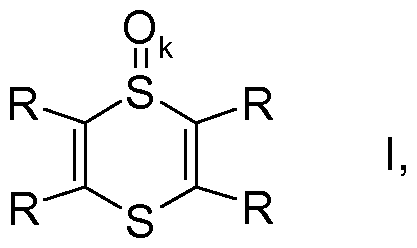
  • compounds I refers to compounds of formula I. Likewise, this terminology applies to all sub-formulae, e. g. "compounds I .A” refers to compounds of formula I .A or “compounds I.B” refers to compounds of formula I.B, etc..
  • Cyano compound I .A is commercially available or may be obtained by various routes in analogy to prior art processes known (US 3,753,677; J. Am. Chem. Soc. (1962) 84, 4746-56).
  • the compound IA wherein R ic CN and k is 0, can subsequently be oxidized e.g. with nitric acid to form compound I, wherein k is 1 , which is of formula I.B:
  • Agriculturally acceptable salts of compounds I encompass especially the salts of those cations or the acid addition salts of those acids whose cations and anions, respectively, have no adverse effect on the fungicidal action of the compounds I.
  • Suitable cations are thus in particular the ions of the alkali metals, preferably sodium and potassium, of the alkaline earth metals, preferably calcium, magnesium and barium, of the transition metals, preferably manganese, copper, zinc and iron, and also the ammonium ion which, if desired, may carry one to four Ci-C4-alkyl substituents and/or one phenyl or benzyl substituent, preferably diisopropylammonium, tetramethylammonium, tetrabutylammonium, trimethylbenzylammonium, furthermore phosphonium ions, sulfo- nium ions, preferably tri(Ci-C4-alkyl)sulfonium, and sulfoxonium ions, preferably tri(Ci-C4-alkyl)sulfoxonium.
  • Anions of useful acid addition salts are primarily chloride, bromide, fluoride, hydrogensulfate, sulfate, dihydrogenphosphate, hydrogenphosphate, phosphate, nitrate, bicarbonate, carbonate, hexafluorosilicate, hexafluorophosphate, benzoate, and the anions of Ci-C4-alkanoic acids, preferably formate, acetate, propionate and butyrate. They can be formed by reacting a compound of formula I with an acid of the corresponding anion, preferably of hydrochloric acid, hydrobromic acid, sulfuric acid, phosphoric acid or nitric acid.
  • the compounds of formula I can be present in atropisomers arising from restricted rotation about a single bond of asymmetric groups. They also form part of the subject matter of the present invention.
  • One embodiment relates to compound I, wherein k is 0, which compound is of formula I.A: k is 1 , which compound is of
  • either individual components of the composition according to the invention or partially premixed components e. g. components comprising compounds I and/or active substances from the groups A) to O
  • mixtures comprising a compound I (component 1 ) and at least one active substance selected from group A) (component 2) and particularly selected from azoxystrobin, dimoxystrobin, fluoxastrobin, kresoxim-methyl, orysastrobin, picoxystrobin, pyraclostrobin, trifloxystrobin; famoxadone, fenamidone; bixafen, bos- calid, fluopyram, fluxapyroxad, isopyrazam, penflufen, penthiopyrad, sedaxane; ame- toctradin, cyazofamid, fluazinam, fentin salts, such as fentin acetate.
  • azoxystrobin dimoxystrobin, fluoxastrobin, kresoxim-methyl, orysastrobin, picoxystrobin, pyraclostrobin, trifloxystrobin
  • mixtures comprising a compound of formula I (component 1 ) and at least one active substance selected from group B) (component 2) and particularly selected from cyproconazole, difenoconazole, epoxiconazole, fluquinconazole, flusilazole, flutriafol, metconazole, myclobutanil, penconazole, propiconazole, prothioconazole, triadimefon, triadimenol, tebuconazole, tetraconazole, triticonazole, 2-[re/-(2S;3R)-3-(2-chlorophenyl)-2-(2,4-difluorophenyl)-oxiranylmethyl]-2H-[1 ,2,4]tri- azole-3-thiol, prochloraz, fenarimol, triforine; dodemorph, fenpropimorph, tridemorph, fenpropidin,
  • mixtures comprising a compound of formula I (component 1 ) and at least one active substance selected from group C) (component 2) and particu- larly selected from metalaxyl, (metalaxyl-M) mefenoxam, ofurace.
  • mixtures comprising a compound of formula I (component 1 ) and at least one active substance selected from group D) (component 2) and particularly selected from benomyl, carbendazim, thiophanate-methyl, ethaboxam, fluopi- colide, zoxamide, metrafenone, pyriofenone.
  • mixtures comprising a compound I (component 1 ) and at least one active substance selected from group E) (component 2) and particularly selected from cyprodinil, mepanipyrim, pyrimethanil.
  • mixtures comprising a compound I (component 1 ) and at least one active substance selected from group F) (component 2) and particularly se- lected from iprodione, fludioxonil, vinclozolin, quinoxyfen.
  • mixtures comprising a compound I (component 1 ) and at least one active substance selected from group G) (component 2) and particularly selected from dimethomorph, flumorph, iprovalicarb, benthiavalicarb, mandipropamid, propamocarb.
  • mixtures comprising a compound I (component 1 ) and at least one active substance selected from group H) (component 2) and particularly selected from copper acetate, copper hydroxide, copper oxychloride, copper sulfate, sul- fur, mancozeb, metiram, propineb, thiram, captafol, folpet, chlorothalonil, dichlofluanid, dithianon and 2,6-dimethyl-1 H,5H-[1 ,4]dithiino[2,3-c:5,6-c']dipyrrole-1 ,3,5,7(2H,6H)-te- traone.
  • mixtures comprising a compound I (component 1 ) and at least one active substance selected from group I) (component 2) and particularly se- lected from carpropamid and fenoxanil.
  • mixtures comprising a compound I (component 1 ) and at least one active substance selected from group J) (component 2) and particularly selected from acibenzolar-S-methyl, probenazole, tiadinil, fosetyl, fosetyl-aluminium, H3PO3 and salts thereof.
  • mixtures comprising a compound I (component 1 ) and at least one active substance selected from group K) (component 2) and particularly selected from cymoxanil, proquinazid and A/-methyl-2- ⁇ 1 -[(5-methyl-3-trifluoromethyl-1 H- pyrazol-1 -yl)-acetyl]-piperidin-4-yl ⁇ -A/-[(1 R)-1 ,2,3,4-tetrahydronaphthalen-1 -yl]- 4-thiazolecarboxamide.
  • mixtures comprising a compound I (component 1 ) and at least one active substance selected from group L) (component 2) and particularly selected from Bacillus subtilis strain NRRL No. B-21661 , Bacillus pumilus strain NRRL No. B-30087 and Ulocladium oudemansii .
  • the present invention furthermore relates to compositions comprising compound I. A and one active compound II from groups A) to O) (component 2), which compound II is selected from the column "Component 2" of the lines B-1 to B-363 of Table B.
  • Table B Composition comprising one indiviualized compound I.A and one further ac- tive substance from groups A) to O).
  • B-261 Compound I .A Bacillus subtilis NRRL No. B-21661
  • a further embodiment relates to the compositions C-1 to C-363 listed in a further Table C, where a row of Table C corresponds in each case to a fungicidal composition comprising compound I.B instead of compound I.A (as component 1 ) and the respec- tive further active substance from groups A) to O) (component 2) stated in the Table B rows B-1 to B-360 mentioned above.
  • the compositions described comprise the active substances in synergistically effective amounts.
  • the mixtures and the compositions according to the invention, respectively, are suitable as fungicides. They are distinguished by an outstanding effectiveness against a broad spectrum of phytopathogenic fungi, including soil-borne fungi, which derive especially from the classes of the Plasmodiophoromycetes, Peronosporomycetes (syn. Oomycetes), Chytridiomycetes, Zygomycetes, Ascomycetes, Basidiomycetes and Deu- teromycetes (syn. Fungi imperfecti). Some are systemically effective and they can be used in crop protection as foliar fungicides, fungicides for seed dressing and soil fungicides. Moreover, they are suitable for controlling harmful fungi, which inter alia occur in wood or roots of plants.
  • the mixtures and the compositions according to the invention are particularly important in the control of a multitude of phytopathogenic fungi on various cultivated plants, such as cereals, e. g. wheat, rye, barley, triticale, oats or rice; beet, e. g. sugar beet or fodder beet; fruits, such as pomes, stone fruits or soft fruits, e. g.
  • cereals e. g. wheat, rye, barley, triticale, oats or rice
  • beet e. g. sugar beet or fodder beet
  • fruits such as pomes, stone fruits or soft fruits, e. g.
  • mixtures and compositions thereof are used for controlling a multitude of fungi on field crops, such as potatoes sugar beets, tobacco, wheat, rye, barley, oats, rice, corn, cotton, soybeans, rape, legumes, sunflowers, coffee or sugar cane; fruits; vines; ornamentals; or vegetables, such as cucumbers, tomatoes, beans or squashes.
  • field crops such as potatoes sugar beets, tobacco, wheat, rye, barley, oats, rice, corn, cotton, soybeans, rape, legumes, sunflowers, coffee or sugar cane; fruits; vines; ornamentals; or vegetables, such as cucumbers, tomatoes, beans or squashes.
  • plant propagation material is to be understood to denote all the generative parts of the plant such as seeds and vegetative plant material such as cuttings and tubers (e. g. potatoes), which can be used for the multiplication of the plant. This in- eludes seeds, roots, fruits, tubers, bulbs, rhizomes, shoots, sprouts and other parts of plants, including seedlings and young plants, which are to be transplanted after germination or after emergence from soil. These young plants may also be protected before transplantation by a total or partial treatment by immersion or pouring.
  • treatment of plant propagation materials with compounds I and compo- sitions thereof, respectively is used for controlling a multitude of fungi on cereals, such as wheat, rye, barley and oats; rice, corn, cotton and soybeans.
  • cultiva plants is to be understood as including plants which have been modified by breeding, mutagenesis or genetic engineering including but not limiting to agricultural biotech products on the market or in development (cf.
  • Genetically modified plants are plants, which genetic material has been so modified by the use of recombinant DNA techniques that under natural circumstances cannot readily be obtained by cross breeding, mutations or natural recombination. Typically, one or more genes have been integrated into the genetic material of a genetically modified plant in order to improve certain properties of the plant.
  • Such genetic modifications also include but are not limited to targeted post-translational modification of protein(s), oligo- or polypeptides e. g. by glycosylation or polymer additions such as prenylated, acetylated or farnesylated moieties or PEG moieties.
  • herbicides e. bromoxynil or ioxynil herbicides as a result of conventional methods of breeding or genetic engineering. Furthermore, plants have been made resistant to multiple classes of herbicides through multiple genetic modifications, such as resistance to both glyphosate and glufosinate or to both glyphosate and a herbicide from another class such as ALS inhibitors, HPPD inhibitors, auxin herbicides, or ACCase inhibitors.
  • ALS inhibitors e.g. described in Pest Managem. Sci.
  • cultivated plants have been rendered tolerant to herbicides by conventional methods of breeding (mutagenesis), e. g. Clearfield ® summer rape (Canola, BASF SE, Germany) being tolerant to imidazolinones, e. g.
  • plants are also covered that are by the use of recombinant DNA techniques capable to synthesize one or more insecticidal proteins, especially those known from the bacterial genus Bacillus, particularly from Bacillus thuringiensis, such as ⁇ - endotoxins, e. g. CrylA(b), CrylA(c), CrylF, CrylF(a2), CryllA(b), CrylllA, CrylllB(bl ) or Cry9c; vegetative insecticidal proteins (VIP), e. g. VIP1 , VIP2, VIP3 or VIP3A; insecticidal proteins of bacteria colonizing nematodes, e. g. Photorhabdus spp.
  • VIP1 , VIP2, VIP3 or VIP3A vegetative insecticidal proteins
  • toxins produced by animals such as scorpion toxins, arachnid toxins, wasp toxins, or other insect-specific neurotoxins
  • toxins produced by fungi such Streptomy- cetes toxins, plant lectins, such as pea or barley lectins; agglutinins
  • proteinase inhibitors such as trypsin inhibitors, serine protease inhibitors, patatin, cystatin or papain inhibitors
  • ribosome-inactivating proteins (RIP) such as ricin, maize-RIP, abrin, luffin, saporin or bryodin
  • steroid metabolism enzymes such as 3-hydroxysteroid oxidase, ecdysteroid-IDP-glycosyl-transferase, cholesterol oxidases, ecdysone inhibitors or HMG-CoA-reductase
  • ion channel blockers such as blockers of sodium
  • these insecticidal proteins or toxins are to be understood expressly also as pre-toxins, hybrid proteins, truncated or otherwise modified proteins.
  • Hybrid proteins are characterized by a new combination of protein domains, (see, e. g. WO 02/015701 ).
  • Further examples of such toxins or genetically modified plants capable of synthesizing such toxins are disclosed, e. g., in EP-A 374 753, WO 93/007278, WO 95/34656, EP-A 427 529, EP-A 451 878, WO 03/18810 und WO 03/52073.
  • the methods for producing such genetically modified plants are generally known to the person skilled in the art and are described, e. g.
  • insecticidal proteins contained in the genetically modified plants impart to the plants producing these proteins tolerance to harmful pests from all taxonomic groups of athropods, especially to beetles (Coeloptera), two-winged insects (Diptera), and moths (Lepidoptera) and to nematodes (Nematoda).
  • Genetically modified plants capable to synthesize one or more insecticidal proteins are, e.
  • WO 03/018810 MON 863 from Mon- santo Europe S.A., Belgium (corn cultivars producing the Cry3Bb1 toxin), IPC 531 from Monsanto Europe S.A., Belgium (cotton cultivars producing a modified version of the CrylAc toxin) and 1507 from Pioneer Overseas Corporation, Belgium (corn cultivars producing the Cry1 F toxin and PAT enzyme).
  • plants are also covered that are by the use of recombinant DNA tech- niques capable to synthesize one or more proteins to increase the resistance or tolerance of those plants to bacterial, viral or fungal pathogens.
  • proteins are the so-called "pathogenesis-related proteins" (PR proteins, see, e. g.
  • EP-A 392 225 plant disease resistance genes (e. g. potato cultivars, which express resistance genes acting against Phytophthora infestans derived from the mexican wild potato Solanum bulbocastanum) or T4-lysozym (e. g. potato cultivars capable of synthesizing these proteins with increased resistance against bacteria such as Erwinia amylvora).
  • plant disease resistance genes e. g. potato cultivars, which express resistance genes acting against Phytophthora infestans derived from the mexican wild potato Solanum bulbocastanum
  • T4-lysozym e. g. potato cultivars capable of synthesizing these proteins with increased resistance against bacteria such as Erwinia amylvora.
  • the methods for producing such genetically modified plants are generally known to the person skilled in the art and are described, e. g. in the publications mentioned above.
  • plants are also covered that are by the use of recombinant DNA techniques capable to synthesize one or more proteins to increase the productivity (e. g. bio mass production, grain yield, starch content, oil content or protein content), tolerance to drought, salinity or other growth-limiting environmental factors or tolerance to pests and fungal, bacterial or viral pathogens of those plants.
  • productivity e. g. bio mass production, grain yield, starch content, oil content or protein content
  • plants are also covered that contain by the use of recombinant DNA techniques a modified amount of substances of content or new substances of content, specifically to improve human or animal nutrition, e. g. oil crops that produce health- promoting long-chain omega-3 fatty acids or unsaturated omega-9 fatty acids (e. g. Nexera ® rape, DOW Agro Sciences, Canada).
  • plants are also covered that contain by the use of recombinant DNA techniques a modified amount of substances of content or new substances of content, specifically to improve raw material production, e. g. potatoes that produce increased amounts of amylopectin (e. g. Amflora ® potato, BASF SE, Germany).
  • a modified amount of substances of content or new substances of content specifically to improve raw material production, e. g. potatoes that produce increased amounts of amylopectin (e. g. Amflora ® potato, BASF SE, Germany).
  • the mixtures and compositions thereof, respectively, are particularly suitable for controlling the following plant diseases:
  • Albugo spp. white rust on ornamentals, vegetables (e. g. A. Candida) and sunflowers (e. g. A. tragopogonis); Altemaria spp. (Alternaria leaf spot) on vegetables, rape (A. brassicola or brassicae), sugar beets (A. tenuis), fruits, rice, soybeans, potatoes (e. g. A. solani or A. alternata), tomatoes (e. g. A. solani or A. alternata) and wheat; Aphano- myces spp. on sugar beets and vegetables; Ascochyta spp. on cereals and vegetables, e. g. A. tritici (anthracnose) on wheat and A.
  • Bipolaris and Drechslera spp. (teleomorph: Cochliobolus spp.), e. g. Southern leaf blight (D. maydis) or Northern leaf blight (B. zeicola) on corn, e. g. spot blotch (B. sorokiniana) on cereals and e.g. B. oryzae on rice and turfs; Blumeria (formerly Erysiphe) graminis (powdery mildew) on cereals (e. g. on wheat or barley); Botrytis cinerea (teleomorph: Botryotinia fuckeliana: grey mold) on fruits and berries (e. g.
  • strawberries strawberries
  • vegetables e. g. lettuce, carrots, celery and cabbages
  • rape flowers, vines, forestry plants and wheat
  • Bremia lactucae downy mildew
  • Ceratocystis syn. Ophiostoma
  • spp. rot or wilt
  • broad- leaved trees and evergreens e. g. C. ulmi (Dutch elm disease) on elms
  • Cercospora spp. Cercospora leaf spots
  • corn e.g. Gray leaf spot: C. zeae-maydis
  • sugar beets e. g. C.
  • Colletotrichum teleomorph: Glomerella
  • spp. anthracnose
  • cotton e. g. C. gossypii
  • corn e. g. C. graminicola: Anthracnose stalk rot
  • soft fruits e. g. C. coccodes: black dot
  • beans e. g. C. Iindemuthianum
  • soybeans e. g. C. truncatum or C. gloeosporioides
  • Corticium spp. e. g. C.
  • sa- sakii sheath blight
  • Corynespora cassiicola leaf spots
  • Cycloconium spp. e. g. C. oleaginum on olive trees
  • Cylindrocarpon spp. e. g. fruit tree canker or young vine decline, teleomorph: Nectria or Neonectria spp.
  • liriodendri Neonectria liriodendri: Black Foot Disease) and ornamentals; Dematophora (teleomorph: Rosellinia) necatrix (root and stem rot) on soybeans; Diaporthe spp., e. g. D. phaseolorum (damping off) on soybeans; Drechslera (syn. Helminthosporium, teleomorph: Pyrenophora) spp. on corn, cereals, such as barley (e. g. D. teres, net blotch) and wheat (e. g. D. D.
  • tritici-repentis tan spot), rice and turf; Esca (dieback, apoplexy) on vines, caused by Formitiporia (syn. Phellinus) punctata, F. mediterranea, Phaeomoniella chlamydospora (earlier Phaeo- acremonium chlamydosporum), Phaeoacremonium aleophilum and/or Botryosphaeria obtusa; Elsinoe spp. on pome fruits (£. pyri), soft fruits (£. veneta: anthracnose) and vines (£.
  • ampelina anthracnose
  • Entyloma oryzae leaf smut
  • Epicoccum spp. black mold
  • Erysiphe spp. potowdery mildew
  • sugar beets £. betae
  • vegetables e. g. E. pisi
  • cucurbits e. g. E. cichoracearum
  • cabbages e. g. E. cruciferarum
  • Eutypa lata Eutypa canker or dieback, anamorph: Cytosporina lata, syn.
  • Drechslera, teleomorph Cochliobolus) on corn, cereals and rice; Hemileia spp., e. g. H. vastatrix (coffee leaf rust) on coffee; Isariopsis clavispora (syn. Cladosporium vitis) on vines; Macrophomina phaseolina (syn. phaseoli) (root and stem rot) on soybeans and cotton; Microdochium (syn. Fusarium) nivale (pink snow mold) on cereals (e. g. wheat or barley); Microsphaera diffusa (powdery mildew) on soybeans; Monilinia spp., e. g. M.
  • viticola can and leaf spot
  • soybeans e. g. stem rot: P. phaseoli, teleomorph: Diaporthe phaseolorum
  • Physoderma maydis brown spots
  • Phy- tophthora spp. wilt, root, leaf, fruit and stem root
  • paprika and cucurbits e. g. P. capsici
  • soybeans e. g. P. megasperma, syn. P. sojae
  • potatoes and tomatoes e. g. P. infestans: late blight
  • broad-leaved trees e. g. P.
  • Plasmodiophora brassicae club root
  • Plasmopara spp. e. g. P. viticola (grapevine downy mildew) on vines and P. halstedii on sunflowers
  • Podosphaera spp. powdery mildew on rosaceous plants, hop, pome and soft fruits, e. g. P. leucotricha on apples
  • Polymyxa spp. e. g. on cereals, such as barley and wheat (P. graminis) and sugar beets (P.
  • Pseudocercosporella herpotrichoides eyespot, teleomorph: Tapesia yallundae
  • Pseudoperonospora downy mildew
  • Pseudopezicula tracheiphila red fire disease or .rotbrenner', anamorph: Phialophora
  • Puccinia spp. rusts on various plants, e. g. P. triticina (brown or leaf rust), P.
  • striiformis stripe or yellow rust
  • P. hordei dwarf rust
  • P. graminis seed or black rust
  • P. recondita brown or leaf rust
  • cereals such as e. g. wheat, barley or rye
  • P. kuehnii range rust
  • Pyrenophora an- amorph: Drechslera
  • tritici-repentis tan spot
  • P. teres net blotch
  • oryzae (teleomorph: Magnaporthe grisea, rice blast) on rice and P. grisea on turf and cereals; Pythium spp. (damping-off) on turf, rice, corn, wheat, cotton, rape, sunflowers, soybeans, sugar beets, vegetables and various other plants (e. g. P. ultimum or P. aphanidermatum); Ramularia spp., e. g. R. collo-cygni (Ramularia leaf spots, Physiological leaf spots) on barley and R. beticola on sugar beets; Rhizoctonia spp.
  • R. solani root and stem rot
  • S. solani silk and stem rot
  • S. solani silk and stem rot
  • S. solani silk blight
  • R. cerealis Rhizoctonia spring blight
  • Rhizopus stolonifer black mold, soft rot
  • Rhynchosporium secalis scald
  • Sarocladium oryzae and S. attenuatum sheath rot) on rice
  • Sclerotinia spp e. g.
  • R. solani root and stem rot
  • S. solani silk blight
  • R. cerealis Rhizoctonia spring blight
  • Rhizopus stolonifer black mold, soft rot
  • Rhynchosporium secalis scald
  • Sarocladium oryzae and S. attenuatum sheath rot
  • Sclerotinia spp Sclerotinia spp.
  • seed rot or white mold on vegetables and field crops, such as rape, sunflowers (e. g. S. sclerotiorum) and soybeans (e. g. S. rolfsii or S. sclerotiorum); Septoria spp. on various plants, e. g. S. glycines (brown spot) on soybeans, S. tritici (Septoria blotch) on wheat and S. (syn. Stagonospora) nodorum (Stagonospora blotch) on cereals; Uncinula (syn.
  • Erysiphe) necator prowdery mildew, anamorph: Oidium tuckeri
  • Setospaeria spp. (leaf blight) on corn (e. g. S. turcicum, syn. Helminthosporium turcicum) and turf; Sphacelotheca spp. (smut) on corn, (e. g. S. reiliana: head smut), sorghum und sugar cane; Sphaerotheca fuliginea (powdery mildew) on cucurbits; Spongospora subterra- nea (powdery scab) on potatoes and thereby transmitted viral diseases; Stagonospora spp.
  • S. nodorum Stagonospora blotch, teleomorph: Leptosphaeria [syn. Phaeosphaeria] nodorum
  • wheat Synchytrium endobioticum on potatoes (potato wart disease)
  • Taphrina spp. e. g. T. deformans (leaf curl disease) on peaches and T. pruni (plum pocket) on plums
  • Thielaviopsis spp. black root rot
  • tobacco, pome fruits, vegetables, soybeans and cotton e. g. T. basicola (syn. Chalara elegans); Tilletia spp.
  • the compounds I and compositions thereof, respectively, are also suitable for controlling harmful fungi in the protection of stored products or harvest and in the protection of materials.
  • the term "protection of materials” is to be understood to denote the protection of technical and non-living materials, such as adhesives, glues, wood, paper and paperboard, textiles, leather, paint dispersions, plastics, colling lubricants, fiber or fabrics, against the infestation and destruction by harmful microorganisms, such as fungi and bacteria.
  • Ascomycetes such as Ophiostoma spp., Ceratocystis spp., Aureobasidium pullulans, Sclerophoma spp., Chaetomium spp., Humicola spp., Petriella spp., Trichurus spp.; Basidiomycetes such as Coniophora spp., Coriolus spp., Gloeophyllum spp., Lentinus spp., Pleurotus spp., Poria spp., Ser- pula spp.
  • yeast fungi are worthy of note: Candida spp. and Saccharo- myces cerevisae.
  • the mixtures and compositions thereof, resepectively, may be used for improving the health of a plant.
  • the invention also relates to a method for improving plant health by treating a plant, its propagation material and/or the locus where the plant is growing or is to grow with an effective amount of compounds I and compositions thereof, respectively.
  • plant health is to be understood to denote a condition of the plant and/or its products which is determined by several indicators alone or in combination with each other such as yield (e. g. increased biomass and/or increased content of valuable ingredients), plant vigor (e. g. improved plant growth and/or greener leaves ("greening effect")), quality (e. g. improved content or composition of certain ingredients) and tolerance to abiotic and/or biotic stress.
  • yield e. g. increased biomass and/or increased content of valuable ingredients
  • plant vigor e. g. improved plant growth and/or greener leaves ("greening effect")
  • quality e. g. improved content or composition of certain ingredients
  • tolerance to abiotic and/or biotic stress e. g. improved content or composition of certain ingredients
  • the compounds of formula I can be present in different crystal modifications whose biological activity may differ. They are likewise subject matter of the present invention.
  • the mixtures are employed as such or in form of compositions by treating the fungi or the plants, plant propagation materials, such as seeds, soil, surfaces, materials or rooms to be protected from fungal attack with a fungicidally effective amount of the active substances.
  • the application can be carried out both before and after the infection of the plants, plant propagation materials, such as seeds, soil, surfaces, materials or rooms by the fungi.
  • Plant propagation materials may be treated with the mixtures as such or a composition comprising at least one compound I prophylactically either at or before planting or transplanting.
  • the invention also relates to agrochemical compositions comprising a solvent or solid carrier and at least one mixture according to the invention and to the use for controlling harmful fungi.
  • An agrochemical composition comprises a fungicidally effective amount of a mix- tures.
  • effective amount denotes an amount of the composition or of the mixture according to the invention, which is sufficient for controlling harmful fungi on cultivated plants or in the protection of materials and which does not result in a substantial damage to the treated plants. Such an amount can vary in a broad range and is de- pendent on various factors, such as the fungal species to be controlled, the treated cultivated plant or material, the climatic conditions and the specific mixture used.
  • the compounds I and compounds II, their N-oxides and salts can be converted into customary types of agrochemical compositions, e. g. solutions, emulsions, suspen- sions, dusts, powders, pastes and granules.
  • agrochemical compositions e. g. solutions, emulsions, suspen- sions, dusts, powders, pastes and granules.
  • the composition type depends on the particular intended purpose; in each case, it should ensure a fine and uniform distribution of the compound according to the invention.
  • composition types are suspensions (SC, OD, FS), emulsifiable concentrates (EC), emulsions (EW, EO, ES), pastes, pastilles, wettable powders or dusts (WP, SP, SS, WS, DP, DS) or granules (GR, FG, GG, MG), which can be water- soluble or wettable, as well as gel formulations for the treatment of plant propagation materials such as seeds (GF).
  • composition types e. g. SC, OD, FS, EC, WG, SG, WP, SP, SS, WS, GF
  • composition types such as DP, DS, GR, FG, GG and MG are usually used undiluted.
  • compositions are prepared in a known manner (cf. US 3,060,084,
  • the agrochemical compositions may also comprise auxiliaries which are customary in agrochemical compositions.
  • auxiliaries depend on the particular application form and active substance, respectively.
  • auxiliaries are solvents, solid carriers, dispersants or emulsi- fiers (such as further solubilizers, protective colloids, surfactants and adhesion agents), organic and anorganic thickeners, bactericides, anti-freezing agents, anti-foaming agents, if appropriate colorants and tackifiers or binders (e. g. for seed treatment formulations).
  • Suitable solvents are water, organic solvents such as mineral oil fractions of medium to high boiling point, such as kerosene or diesel oil, furthermore coal tar oils and oils of vegetable or animal origin, aliphatic, cyclic and aromatic hydrocarbons, e. g.
  • Solid carriers are mineral earths such as silicates, silica gels, talc, kaolins, limestone, lime, chalk, bole, loess, clays, dolomite, diatomaceous earth, calcium sulfate, magnesium sulfate, magnesium oxide, ground synthetic materials, fertilizers, such as, e. g., ammonium sulfate, ammonium phosphate, ammonium nitrate, ureas, and products of vegetable origin, such as cereal meal, tree bark meal, wood meal and nutshell meal, cellulose powders and other solid carriers.
  • mineral earths such as silicates, silica gels, talc, kaolins, limestone, lime, chalk, bole, loess, clays, dolomite, diatomaceous earth, calcium sulfate, magnesium sulfate, magnesium oxide, ground synthetic materials, fertilizers, such as, e. g., ammonium sulfate, ammonium phosphat
  • Suitable surfactants are al- kali metal, alkaline earth metal and ammonium salts of aromatic sulfonic acids, such as ligninsoulfonic acid (Borresperse ® types, Borregard, Norway) phenolsulfonic acid, naphthalenesulfonic acid (Morwet ® types, Akzo Nobel, U.S.A.), dibutylnaphthalene- sulfonic acid (Nekal ® types, BASF, Germany), and fatty acids, alkylsulfonates, alkyl- arylsulfonates, alkyl sulfates, laurylether sulfates, fatty alcohol sulfates, and sulfated hexa-, hepta- and octadecanolates, sulfated fatty alcohol glycol ether
  • methylcellulose g. methylcellulose
  • hydrophobically modified starches polyvinyl alcohols (Mowiol ® types, Clariant, Switzerland), polycarboxylates (Sokolan ® types, BASF, Germany), polyalkoxylates, polyvinyl- amines (Lupasol ® types, BASF, Germany), polyvinylpyrrolidone and the copolymers therof.
  • thickeners i. e. compounds that impart a modified flowability to compositions, i. e. high viscosity under static conditions and low viscosity during agitation
  • thickeners are polysaccharides and organic and anorganic clays such as Xanthan gum (Kelzan ® , CP Kelco, U.S.A.), Rhodopol ® 23 (Rhodia, France), Veegum ® (R.T. Vanderbilt, U.S.A.) or Attaclay ® (Engelhard Corp., NJ, USA).
  • Bactericides may be added for preservation and stabilization of the composition.
  • suitable bactericides are those based on dichlorophene and benzyl- alcohol hemi formal (Proxel ® from ICI or Acticide ® RS from Thor Chemie and Kathon ® MK from Rohm & Haas) and isothiazolinone derivatives such as alkylisothiazolinones and benzisothiazolinones (Acticide ® MBS from Thor Chemie).
  • Suitable anti-freezing agents are ethylene glycol, propylene glycol, urea and glycerin.
  • anti-foaming agents examples include silicone emulsions (such as e. g. Silikon ® SRE, Wacker, Germany or Rhodorsil ® , Rhodia, France), long chain alcohols, fatty acids, salts of fatty acids, fluoroorganic compounds and mixtures thereof.
  • Suitable colorants are pigments of low water solubility and water-soluble dyes. Examples to be mentioned und the designations rhodamin B, C. I. pigment red 1 12, C. I. solvent red 1 , pigment blue 15:4, pigment blue 15:3, pigment blue 15:2, pigment blue 15:1 , pigment blue 80, pigment yellow 1 , pigment yellow 13, pigment red 1 12, pigment red 48:2, pigment red 48:1 , pigment red 57:1 , pigment red 53:1 , pigment orange 43, pigment orange 34, pigment orange 5, pigment green 36, pigment green 7, pigment white 6, pigment brown 25, basic violet 10, basic violet 49, acid red 51 , acid red 52, acid red 14, acid blue 9, acid yellow 23, basic red 10, basic red 108.
  • tackifiers or binders examples include polyvinylpyrrolidons, polyvinylacetates, polyvinyl alcohols and cellulose ethers (Tylose ® , Shin-Etsu, Japan).
  • Powders, materials for spreading and dusts can be prepared by mixing or conco- mitantly grinding the compounds I and, if appropriate, further active substances, with at least one solid carrier.
  • Granules e. g. coated granules, impregnated granules and homogeneous granules, can be prepared by binding the active substances to solid carriers.
  • solid carriers are mineral earths such as silica gels, silicates, talc, kaolin, attaclay, limestone, lime, chalk, bole, loess, clay, dolomite, diatomaceous earth, calcium sulfate, magnesium sulfate, magnesium oxide, ground synthetic materials, fertilizers, such as, e.
  • ammonium sulfate ammonium phosphate, ammonium nitrate, ureas
  • products of vegetable origin such as cereal meal, tree bark meal, wood meal and nutshell meal, cellulose powders and other solid carriers.
  • composition types and their preparation are (wherein active substances denote at least one compound I and one compound II):
  • active substances 10-60 wt% active substances and 5-15 wt% wetting agent (e.g. alcohol alkoxylates) are dissolved in water and/or in a water-soluble solvent (e.g. alcohols) ad 100 wt%.
  • wetting agent e.g. alcohol alkoxylates
  • the active substance dissolves upon dilution with water.
  • dispersant e.g. polyvinylpyrrolidone
  • organic solvent e.g. cyclohexanone
  • emulsifiers e.g. calcium dodecylben- zenesulfonate and castor oil ethoxylate
  • 20-40 wt% water-insoluble organic solvent e.g. aromatic hydrocarbon
  • This mixture is introduced into water ad 100 wt% by means of an emulsifying machine and made into a homogeneous emul- sion. Dilution with water gives an emulsion.
  • active substances are comminuted with addition of 2-10 wt% dispersants and wetting agents (e.g. sodium lignosulfonate and alcohol ethoxylate), 0.1 -2 wt% thickener (e.g. xanthan gum) and ad water ad 100 wt% to give a fine active substance suspension. Dilution with water gives a stable suspension of the active substance.
  • dispersants and wetting agents e.g. sodium lignosulfonate and alcohol ethoxylate
  • 0.1 -2 wt% thickener e.g. xanthan gum
  • ad water ad 100 wt%
  • Water-dispersible granules and water-soluble granules (WG, SG) 50-80 wt% active substances are ground finely with addition of dispersants and wetting agents (e.g. sodium lignosulfonate and alcohol ethoxylate) ad 100 wt% and prepared as water-dispersible or water-soluble granules by means of technical appliances (e. g. extrusion, spray tower, fluidized bed). Dilution with water gives a stable disper- sion or solution of the active substance.
  • dispersants and wetting agents e.g. sodium lignosulfonate and alcohol ethoxylate
  • active substances are ground in a rotor-stator mill with addition of 1 -5 wt% dispersants (e.g. sodium lignosulfonate), 1 -3 wt% wetting agents (e.g. alcohol ethoxylate) and solid carrier (e.g. silica gel) ad 100 wt%. Dilution with water gives a stable dispersion or solution of the active substance.
  • dispersants e.g. sodium lignosulfonate
  • wetting agents e.g. alcohol ethoxylate
  • solid carrier e.g. silica gel
  • active substances are comminuted with addition of 3-10 wt% dispersants (e.g. sodium lignosulfonate), 1 -5 wt% thickener (e.g. carboxy- methylcellulose) and water ad 100 wt% to give a fine suspension of the active sub- stance. Dilution with water gives a stable suspension of the active substance, iv) Microemulsion (ME)
  • dispersants e.g. sodium lignosulfonate
  • 1 -5 wt% thickener e.g. carboxy- methylcellulose
  • 5-20 wt% active substances are added to 5-30 wt% organic solvent blend (e.g. fatty acid dimethylamide and cyclohexanone), 10-25 wt% surfactant blend (e.g. alcohol ethoxylate and arylphenol ethoxylate), and water ad 100 wt%. This mixture is stirred for 1 h to produce spontaneously a thermodynamically stable microemulsion.
  • organic solvent blend e.g. fatty acid dimethylamide and cyclohexanone
  • surfactant blend e.g. alcohol ethoxylate and arylphenol ethoxylate
  • An oil phase comprising 5-50 wt% active substances, 0-40 wt% water insoluble organic solvent (e.g. aromatic hydrocarbon), 2-15 wt% acrylic monomers (e.g. methylmethac- rylate, methacrylic acid and a di- or triacrylate) are dispersed into an aqueous solution of a protective colloid (e.g. polyvinyl alcohol). Radical polymerization initiated by a radical initiator results in the formation of poly(meth)acrylate microcapsules.
  • an oil phase comprising 5-50 wt% of a compound I according to the invention, 0-40 wt% water insoluble organic solvent (e.g. aromatic hydrocarbon), and an isocyanate monomer (e.g.
  • diphenylmethene-4,4'-diisocyanatae are dispersed into an aqueous solution of a protective colloid (e.g. polyvinyl alcohol).
  • a protective colloid e.g. polyvinyl alcohol.
  • the addition of a polyamine results in the formation of polyurea microcapsules.
  • the monomers amount to 1 -10 wt%.
  • the wt% relate to the total CS composition.
  • Dustable powders (DP, DS)
  • active substances are ground finely and mixed intimately with solid carrier (e.g. finely divided kaolin) ad 100 wt%.
  • solid carrier e.g. finely divided kaolin
  • active substances are ground finely and associated with solid carrier (e.g. silicate) ad 100 wt%.
  • solid carrier e.g. silicate
  • Granulation is achieved by extrusion, spray-drying or fluidized bed.
  • organic solvent e.g. aromatic hydrocarbon
  • compositions types i) to xi) may optionally comprise further auxiliaries, such as 0.1 -1 wt% bactericides, 5-15 wt% anti-freezing agents, 0.1 -1 wt% anti-foaming agents, and 0.1 -1 wt% colorants.
  • auxiliaries such as 0.1 -1 wt% bactericides, 5-15 wt% anti-freezing agents, 0.1 -1 wt% anti-foaming agents, and 0.1 -1 wt% colorants.
  • the agrochemical compositions generally comprise between 0.01 and 95%, pref- erably between 0.1 and 90%, most preferably between 0.5 and 90%, by weight of active substance.
  • the active substances are employed in a purity of from 90% to 100%, preferably from 95% to 100% (according to NMR spectrum).
  • Water-soluble concentrates (LS), flowable concentrates (FS), powders for dry treatment (DS), water-dispersible powders for slurry treatment (WS), water-soluble powders (SS), emulsions (ES) emulsifiable concentrates (EC) and gels (GF) are usually employed for the purposes of treatment of plant propagation materials, particularly seeds.
  • These compositions can be applied to plant propagation materials, particularly seeds, diluted or undiluted.
  • the compositions in question give, after two-to-tenfold dilution, active substance concentrations of from 0.01 to 60% by weight, preferably from 0.1 to 40% by weight, in the ready-to-use preparations. Application can be carried out before or during sowing.
  • Methods for applying or treating agrochemical compounds and compositions thereof, respectively, on to plant propagation material, especially seeds, are known in the art, and include dressing, coating, pelleting, dusting, soaking and in-furrow application methods of the propagation material.
  • the compounds I and II or the compositions thereof, respectively are applied on to the plant propagation material by a method such that germination is not induced, e. g. by seed dressing, pelleting, coating and dusting.
  • a suspension-type (FS) composition is used for seed treatment.
  • a FS composition may comprise 1 -800 g/l of active substances, 1 -200 g/l Surfactant, 0 to 200 g/l antifreezing agent, 0 to 400 g/l of binder, 0 to 200 g/l of a pigment and up to 1 liter of a solvent, preferably water.
  • the active substances can be used as such or in the form of their compositions, e. g. in the form of directly sprayable solutions, powders, suspensions, dispersions, emulsions, oil dispersions, pastes, dustable products, materials for spreading, or gran- ules, by means of spraying, atomizing, dusting, spreading, brushing, immersing or pouring.
  • the application forms depend entirely on the intended purposes; it is intended to ensure in each case the finest possible distribution of the active substances according to the invention.
  • Aqueous application forms can be prepared from emulsion concentrates, pastes or wettable powders (sprayable powders, oil dispersions) by adding water.
  • emulsions, pastes or oil dispersions the substances, as such or dissolved in an oil or solvent, can be homogenized in water by means of a wetter, tackifier, dispersant or emulsifier.
  • concentrates composed of active substance, wetter, tackifier, dispersant or emulsifier and, if appropriate, solvent or oil and such concentrates are suitable for dilution with water.
  • the active substances concentrations in the ready-to-use preparations can be varied within relatively wide ranges. In general, they are from 0.0001 to 10%, preferably from 0.001 to 1 % by weight of active substance.
  • the active substances may also be used successfully in the ultra-low-volume process (ULV), it being possible to apply compositions comprising over 95% by weight of active substance, or even to apply the active substance without additives.
  • UUV ultra-low-volume process
  • the amounts of active substances applied are, depending on the kind of effect desired, from 0.001 to 2 kg per ha, preferably from 0.005 to 2 kg per ha, more preferably from 0.05 to 0.9 kg per ha, in particular from 0.1 to 0.75 kg per ha.
  • amounts of active substance of from 0.1 to 10000 g, preferably from 1 to 1000 g, more preferably from 1 to 100 g and most preferably from 5 to 100 g, per 100 kilogram of plant propagation material (preferably seed) are generally required.
  • the amount of active substance applied depends on the kind of application area and on the desired effect. Amounts customarily applied in the protection of materials are, e. g., 0.001 g to 2 kg, preferably 0.005 g to 1 kg, of active substance per cubic meter of treated material.
  • oils, wetters, adjuvants, herbicides, bactericides, other fungicides and/or pesticides may be added to the active substances or the compositions comprising them, if appropriate not until immediately prior to use (tank mix).
  • These agents can be admixed with the compositions according to the invention in a weight ratio of 1 :100 to 100:1 , preferably 1 :10 to 10:1.
  • Adjuvants which can be used are in particular organic modified polysiloxanes such as Break Thru S 240 ® ; alcohol alkoxylates such as Atplus 245 ® , Atplus MBA 1303 ® , Plurafac LF 300 ® and Lutensol ON 30 ® ; EO/PO block polymers, e. g. Pluronic RPE 2035 ® and Genapol B ® ; alcohol ethoxylates such as Lutensol XP 80 ® ; and dioctyl sulfo- succinate sodium such as Leophen RA ® .
  • organic modified polysiloxanes such as Break Thru S 240 ®
  • alcohol alkoxylates such as Atplus 245 ® , Atplus MBA 1303 ® , Plurafac LF 300 ® and Lutensol ON 30 ®
  • EO/PO block polymers e. g. Pluronic RPE 2035 ® and Genapol B ®
  • the binary mixtures and compositions according to the invention can, in the use form as fungicides, also be present together with other active substances, e. g. with herbicides, insecticides, growth regulators, fungicides or else with fertilizers, as pre-mix or, if appropriate, not until immeadiately prior to use (tank mix).
  • active substances e. g. with herbicides, insecticides, growth regulators, fungicides or else with fertilizers, as pre-mix or, if appropriate, not until immeadiately prior to use (tank mix).
  • the mixtures comprise besides one compound I and one compound II as component 3) a further active compound III which is different from compound II in each of the resulting ternary mixtures, preferably in a synergistically effective amount.
  • component 3) is an active compound III selected from groups A') to O'):
  • strobilurins e.g. strobilurins: azoxystrobin, coumethoxy- strobin, coumoxystrobin, dimoxystrobin, enestroburin, fenaminstrobin, fenoxy- strobin/flufenoxystrobin, fluoxastrobin, kresoxim-methyl, metominostrobin, orysas- trobin, picoxystrobin, pyraclostrobin, pyrametostrobin, pyraoxystrobin, triflox- ystrobin, 2-[2-(2,5-dimethyl-phenoxymethyl)-phenyl]-3-methoxy-acrylic acid methyl ester and 2-(2-(3-(2,6-dichlorophenyl)-1 -methyl-allylideneaminooxymethyl)-phenyl)- 2-methoxyimino-N-methyl-acetamide, pyribencarb, triclopyric
  • - inhibitors of complex II e. g. carboxamides: benodanil, bixafen, boscalid, carboxin, fenfuram, fluopyram, flutolanil, fluxapyroxad, furametpyr, isopyrazam, mepronil, ox- ycarboxin, penflufen, penthiopyrad, sedaxane, tecloftalam, thifluzamide, N-(4'- trifluoromethylthiobiphenyl-2-yl)-3-difluoromethyl-1-methyl-1 H-pyrazole-4- carboxamide, N-(2-(1 ,3,3-trimethyl-butyl)-phenyl)-1 ,3-dimethyl-5-fluoro-1 H- pyrazole-4-carboxamide, N-[9-(dichloromethylene)-1 ,2,3,4-tetrahydro-1 ,4-me- thanonaphthalen-5-y
  • respiration inhibitors e.g. complex I, uncouplers: diflumetorim, (5,8-difluoro- quinazolin-4-yl)- ⁇ 2-[2-fluoro-4-(4-trifluoromethylpyridin-2-yloxy)-phenyl]-ethyl ⁇ - amine; nitrophenyl derivates: binapacryl, dinobuton, dinocap, fluazinam; ferimzone; organometal compounds: fentin salts, such as fentin-acetate, fentin chloride or fen- tin hydroxide; ametoctradin; and silthiofam;
  • complex I uncouplers
  • DMI fungicides triazoles: azaconazole, bitertanol, bromuconazole, cyproconazole, difenoconazole, diniconazole, diniconazole-M, ep- oxiconazole, fenbuconazole, fluquinconazole, flusilazole, flutriafol, hexaconazole, imibenconazole, ipconazole, metconazole, myclobutanil, oxpoconazole, paclobutra- zole, penconazole, propiconazole, prothioconazole, simeconazole, tebuconazole, tetraconazole, triadimefon, triadimenol, triticonazole, uniconazole,
  • - phenylamides or acyl amino acid fungicides benalaxyl, benalaxyl-M, kiralaxyl, met- alaxyl, metalaxyl-M (mefenoxam), ofurace, oxadixyl;
  • tubulin inhibitors such as benzimidazoles, thiophanates: benomyl, carbendazim, fuberidazole, thiabendazole, thiophanate-methyl; triazolopyrimidines: 5-chloro- 7-(4-methylpiperidin-1 -yl)-6-(2,4,6-trifluorophenyl)-[1 ,2,4]triazolo[1 ,5-a]pyrimidine
  • cell division inhibitors diethofencarb, ethaboxam, pencycuron, fluopicolide, zoxamide, metrafenone, pyriofenone;
  • - methionine synthesis inhibitors anilino-pyrimidines: cyprodinil, mepanipyrim, py- rimethanil;
  • blasticidin-S blasticidin-S, kasugamycin, kasugamycin hydrochloride- hydrate, mildiomycin, streptomycin, oxytetracyclin, polyoxine, validamycin A;
  • MAP / histidine kinase inhibitors fluoroimid, iprodione, procymidone, vinclozolin, fenpiclonil, fludioxonil;
  • - Phospholipid biosynthesis inhibitors edifenphos, iprobenfos, pyrazophos, iso- prothiolane;
  • organochlorine compounds e.g. phthalimides, sulfamides, chloronitriles: anilazine, chlorothalonil, captafol, captan, folpet, dichlofluanid, dichlorophen, flusulfamide, hexachlorobenzene, pentachlorphenole and its salts, phthalide, tolylfluanid, N-(4- chloro-2-nitro-phenyl)-N-ethyl-4-methyl-benzenesulfonamide;
  • organochlorine compounds e.g. phthalimides, sulfamides, chloronitriles
  • guanidines and others guanidine, dodine, dodine free base, guazatine, guazatine- acetate, iminoctadine, iminoctadine-triacetate, iminoctadine-tris(albesilate), di- thianon, 2,6-dimethyl-1 H,5H-[1 ,4]dithiino[2,3-c:5,6-c']dipyrrole-1 ,3,5,7(2H,6H)- tetraone;
  • glucan synthesis validamycin, polyoxin B; melanin synthesis inhibitors: pyroquilon, tricyclazole, carpropamid, dicyclomet, fenoxanil;
  • Antifungal biocontrol agents plant bioactivators: Ampelomyces quisqualis (e.g. AQ 10 ® from Intrachem Bio GmbH & Co. KG, Germany), Aspergillus flavus (e.g.
  • AFLAGUARD ® from Syngenta, CH
  • Aureobasidium pullulans e.g. BOTECTOR ® from bio-ferm GmbH, Germany
  • Bacillus pumilus e.g. NRRL Accession No.
  • Bacillus sub- tilis e.g. isolate NRRL-Nr. B-21661 in RHAPSODY ® , SERENADE ® MAX and SERENADE ® ASO from AgraQuest Inc., USA
  • Bacillus subtilis var. amylolique- faciens FZB24 e.g. TAEGRO ® from Novozyme Biologicals, Inc., USA
  • Candida oleophila I-82 e.g. ASPIRE ® from Ecogen Inc., USA
  • Candida saitoana e.g.
  • BIOCURE ® in mixture with lysozyme
  • BIOCOAT ® from Micro Flo Company, USA (BASF SE) and Arysta
  • Chitosan e.g. ARMOUR-ZEN from BotriZen Ltd., NZ
  • Clonostachys rosea f. catenulata also named Gliocladium catenulatum (e.g. isolate J1446: PRESTOP ® from Verdera, Finland), Coniothyrium minitans (e.g. CONTANS ® from Prophyta, Germany), Cryphonectria parasitica (e.g. Endothia par- asitica from CNICM, France), Cryptococcus albidus (e.g.
  • YIELD PLUS ® from Anchor Bio-Technologies, South Africa Fusarium oxysporum (e.g. BIOFOX ® from S.I.A.P.A., Italy, FUSACLEAN ® from Natural Plant Protection, France), Metschni- kowia fructicola (e.g. SHEMER ® from Agrogreen, Israel), Microdochium dimerum (e.g. ANTIBOT ® from Agrauxine, France), Phlebiopsis gigantea (e.g. ROTSOP ® from Verdera, Finland), Pseudozyma flocculosa (e.g. SPORODEX ® from Plant
  • Pythium oligandrum DV74 e.g. POLYVERSUM ® from Remeslo SSRO, Biopreparaty, Czech Rep.
  • Reynoutria sachlinensis e.g.
  • T. atroviride LC52 e.g. SENTINEL ® from Agrimm Technologies Ltd, NZ
  • T. harzianum T-22 e.g.
  • PLANTSHIELD ® der Firma BioWorks Inc., USA), T. harzianum JH 35 (e.g. ROOT PRO ® from Mycontrol Ltd., Israel), T. harzianum T-39 (e.g. TRICHODEX ® and TRICHODERMA 2000 ® from Mycontrol Ltd., Israel and Makhteshim Ltd., Israel), T. harzianum and T. viride (e.g. TRICHOPEL from Agrimm Technologies Ltd, NZ), T. harzianum ICC012 and T. viride ICC080 (e.g. REMEDIER ® WP from Isagro Ri- cerca, Italy), T. polysporum and T. harzianum (e.g.
  • T. stromaticum e.g. TRICOVAB ® from C.E.P.L.A.C., Brazil
  • T. virens GL-21 e.g. SOILGARD ® from Certis LLC, USA
  • T. viride ⁇ e.g.
  • T. viride TV1 e.g. T. viride TV1 from Agribiotec srl, Italy
  • Ulocladium oudemansii ⁇ RU3 e.g. BOTRY-ZEN ® from Botry-Zen Ltd, NZ
  • M' Growth regulators
  • abscisic acid amidochlor, ancymidol, 6-benzylaminopurine, brassinolide, butralin, chlormequat (chlormequat chloride), choline chloride, cyclanilide, daminozide, dike- gulac, dimethipin, 2,6-dimethylpuridine, ethephon, flumetralin, flurprimidol, fluthiacet, forchlorfenuron, gibberellic acid, inabenfide, indole-3-acetic acid , maleic hydrazide, mefluidide, mepiquat (mepiquat chloride), naphthaleneacetic acid, N-6-benzyladenine, paclobutrazol, prohexadione (prohexadione-calcium), prohydrojasmon, thidiazuron, triapenthenol, tributyl phosphorotrithioate, 2,3,5-tri-
  • acetochlor alachlor, butachlor, dimethachlor, dimethenamid, flufena- cet, mefenacet, metolachlor, metazachlor, napropamide, naproanilide, pethoxamid, pretilachlor, propachlor, thenylchlor;
  • - aryloxyphenoxypropionates clodinafop, cyhalofop-butyl, fenoxaprop, fluazifop, ha- loxyfop, metamifop, propaquizafop, quizalofop, quizalofop-P-tefuryl;
  • - (thio)carbamates asulam, butylate, carbetamide, desmedipham, dimepiperate, ep- tam (EPTC), esprocarb, molinate, orbencarb, phenmedipham, prosulfocarb, pyribu- ticarb, thiobencarb, triallate;
  • acifluorfen acifluorfen, aclonifen, bifenox, diclofop, ethoxyfen, fomesafen, lac- tofen, oxyfluorfen;
  • imidazolinones imazamethabenz, imazamox, imazapic, imazapyr, imazaquin, ima- zethapyr;
  • - phenoxy acetic acids clomeprop, 2,4-dichlorophenoxyacetic acid (2,4-D), 2,4-DB, dichlorprop, MCPA, MCPA-thioethyl, MCPB, Mecoprop;
  • - pyridines aminopyralid, clopyralid, diflufenican, dithiopyr, fluridone, fluroxypyr, pi- cloram, picolinafen, thiazopyr;
  • - sulfonyl ureas amidosulfuron, azimsulfuron, bensulfuron, chlorimuron-ethyl, chlor- sulfuron, cinosulfuron, cyclosulfamuron, ethoxysulfuron, flazasulfuron, flucetosulfu- ron, flupyrsulfuron, foramsulfuron, halosulfuron, imazosulfuron, iodosulfuron, meso- sulfuron, metazosulfuron, metsulfuron-methyl, nicosulfuron, oxasulfuron, primisulfu- ron, prosulfuron, pyrazosulfuron, rimsulfuron, sulfometuron, sulfosulfuron, thifensul- furon, triasulfuron, tribenuron, trifloxysulfuron, triflusulfuron
  • - triazines ametryn, atrazine, cyanazine, dimethametryn, ethiozin, hexazinone, met- amitron, metribuzin, prometryn, simazine, terbuthylazine, terbutryn, triaziflam;
  • ureas chlorotoluron, daimuron, diuron, fluometuron, isoproturon, linuron, metha- benzthiazuron,tebuthiuron;
  • acetolactate synthase inhibitors bispyribac-sodium, cloransulam-methyl, di- closulam, florasulam, flucarbazone, flumetsulam, metosulam, ortho-sulfamuron, pe- noxsulam, propoxycarbazone, pyribambenz-propyl, pyribenzoxim, pyriftalid, pyrimi- nobac-methyl, pyrimisulfan, pyrithiobac, pyroxasulfone, pyroxsulam;
  • organo(thio)phosphates acephate, azamethiphos, azinphos-methyl, chlorpyrifos, chlorpyrifos-methyl, chlorfenvinphos, diazinon, dichlorvos, dicrotophos, dimethoate, disulfoton, ethion, fenitrothion, fenthion, isoxathion, malathion, methamidophos, me- thidathion, methyl-parathion, mevinphos, monocrotophos, oxydemeton-methyl, paraoxon, parathion, phenthoate, phosalone, phosmet, phosphamidon, phorate, phoxim, pirimiphos-methyl, profenofos, prothiofos, sulprophos, tetrachlorvinphos, terbufos, triazophos, trichlorfon;
  • - pyrethroids allethrin, bifenthrin, cyfluthrin, cyhalothrin, cyphenothrin, cypermethrin, alpha-cypermethrin, beta-cypermethrin, zeta-cypermethrin, deltamethrin, esfen- valerate, etofenprox, fenpropathrin, fenvalerate, imiprothrin, lambda-cyhalothrin, permethrin, prallethrin, pyrethrin I and II, resmethrin, silafluofen, tau-fluvalinate, te- fluthrin, tetramethrin, tralomethrin, transfluthrin, profluthrin, dimefluthrin;
  • - insect growth regulators a) chitin synthesis inhibitors: benzoylureas: chlorfluazuron, cyramazin, diflubenzuron, flucycloxuron, flufenoxuron, hexaflumuron, lufenuron, no- valuron, teflubenzuron, triflumuron; buprofezin, diofenolan, hexythiazox, etoxazole, clofentazine; b) ecdysone antagonists: halofenozide, methoxyfenozide, te- bufenozide, azadirachtin; c) juvenoids: pyriproxyfen, methoprene, fenoxycarb; d) lipid biosynthesis inhibitors: spirodiclofen, spiromesifen, spirotetramat;
  • - nicotinic receptor agonists/antagonists compounds clothianidin, dinotefuran, flu- pyradifurone, imidacloprid, thiamethoxam, nitenpyram, acetamiprid, thiacloprid, 1 -2- chloro-thiazol-5-ylmethyl)-2-nitrimino-3,5-dimethyl-[1 ,3,5]triazinane;
  • GABA antagonist compounds endosulfan, ethiprole, fipronil, vaniliprole, pyraflu- prole, pyriprole, 5-amino-1 -(2,6-dichloro-4-methyl-phenyl)-4-sulfinamoyl- 1 H-pyrazole-3-carbothioic acid amide;
  • - macrocyclic lactone insecticides abamectin, emamectin, milbemectin, lepimectin, spinosad, spinetoram;
  • - mitochondrial electron transport inhibitor I acaricides: fenazaquin, pyridaben, tebufenpyrad, tolfenpyrad, flufenerim;
  • - oxidative phosphorylation inhibitors cyhexatin, diafenthiuron, fenbutatin oxide, pro- pargite;
  • cryomazine cryomazine
  • the ternary mixtures wherein active component 2) is different from component 3) comprise as compounds III fungicidal compounds that are independently of each other selected from the groups A'), B'), C), D'), E'), F'), G'), H'), I'), J'), K') and L').
  • mixtures comprise as compound Ili a herbicidal compound that is selected from the group N').
  • mixtures comprise as compound III an insecti- cidal compound that is selected from the group O').
  • mixtures comprise as compound III (component 3) at least one active substance selected from group A) and particularly selected from azox- ystrobin, dimoxystrobin, fluoxastrobin, kresoxim-methyl, orysastrobin, picoxystrobin, pyraclostrobin, trifloxystrobin; famoxadone, fenamidone; bixafen, boscalid, fluopyram, fluxapyroxad, isopyrazam, penflufen, penthiopyrad, sedaxane; ametoctradin, cyazo- famid, fluazinam, fentin salts, such as fentin acetate.
  • mixtures comprise as compound III (component 3) at least one active substance selected from group B') and particularly selected from cy- proconazole, difenoconazole, epoxiconazole, fluquinconazole, flusilazole, flutriafol, metconazole, myclobutanil, penconazole, propiconazole, prothioconazole, triadimefon, triadimenol, tebuconazole, tetraconazole, triticonazole, prochloraz, fenarimol, triforine; dodemorph, fenpropimorph, tridemorph, fenpropidin, spiroxamine; fenhexamid.
  • mixtures comprise as compound III (component 3) at least one active substance selected from group C) and particularly selected from met- alaxyl, (metalaxyl-M) mefenoxam, ofurace.
  • mixtures comprise as compound III (component 3) at least one active substance selected from group D') and particularly selected from be- nomyl, carbendazim, thiophanate-methyl, ethaboxam, fluopicolide, zoxamide, met- rafenone, pyriofenone.
  • mixtures comprise as compound III (component 3) at least one active substance selected from group E') and particularly selected from cy- prodinil, mepanipyrim, pyrimethanil.
  • mixtures comprise as compound III (component 3) at least one active substance selected from group F') and particularly selected from iprodione, fludioxonil, vinclozolin, quinoxyfen.
  • mixtures comprise as compound III (component 3) at least one active substance selected from group G') and particularly selected from di- methomorph, flumorph, iprovalicarb, benthiavalicarb, mandipropamid, propamocarb.
  • mixtures comprise as compound III (component 3) at least one active substance selected from group H') and particularly selected from cop- per acetate, copper hydroxide, copper oxychloride, copper sulfate, sulfur, mancozeb, metiram, propineb, thiram, captafol, folpet, chlorothalonil, dichlofluanid, dithianon.
  • mixtures comprise as compound III (component 3) at least one active substance selected from group ⁇ ) and particularly selected from car- propamid and fenoxanil.
  • mixtures comprise as compound III (component 3) at least one active substance selected from group J') and particularly selected from aci- benzolar-S-methyl, probenazole, tiadinil, fosetyl, fosetyl-aluminium, H3PO3 and salts thereof.
  • mixtures comprise as compound III (component 3) at least one active substance selected from group K') and particularly selected from cy- moxanil, proquinazid and A/-methyl-2- ⁇ 1 -[(5-methyl-3-trifluoromethyl-1 H-pyrazol-1 -yl)- acetyl]-piperidin-4-yl ⁇ -A/-[(1 R)-1 ,2,3,4-tetrahydronaphthalen-1 -yl]-4-thiazolecarbox- amide.
  • mixtures comprise as compound III (component 3) at least one active substance selected from group L') and particularly selected from Bacillus subtilis strain NRRL No. B-21661 , Bacillus pumilus strain NRRL No. B-30087 and Ulocladium oudemansii .
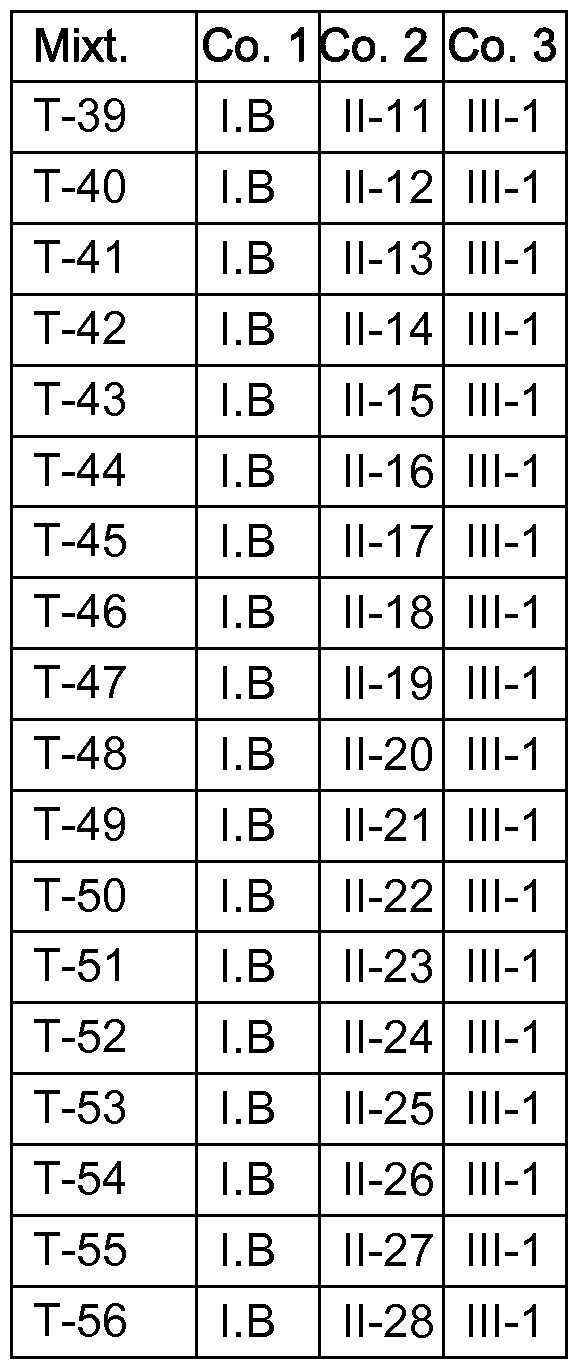
  • the present invention furthermore to the mixtures T-1 to T-xxx as defined in Tables 1 to yyyy, where a row corresponds in each case to a fungicidal composition comprising as component 1 ) one of the compounds I as defined and numbered above (Co. 1 ), and as component 2) one of the compounds II as139d and numbered above (Co. 2), and as component 3) the respective compound III from groups A) to F) as defined in table B (Co. 3) stated in the row in question.
  • the compositions described comprise the active substances in synergistically effective amounts.
  • Table 1 Ternary mixtures T-1 to T-396 comprising one compound I as defined and numbered above as component 1 ) (Co. 1 ) and one compound II as defined and num bered above as component 2) (Co. 2) and one compound III from groups A) to L) as defined and numbered in Table B as component 3) (Co. 3).
  • Table 2 Mixtures T-57 to T-1 12 as defined in Table 1 wherein component 3 (Co. 3) is compound III-2 instead of 111-1 .
  • Table 3 Mixtures T-1 13 to T-168 as defined in Table 1 wherein component 3 (Co. 3) is compound III-3 instead of 111-1 .
  • Table 4 Mixtures T-169 to T-224 as defined in Table 1 wherein component 3 (Co. 3) is compound I I I-4 instead of II 1-1 .
  • Table 5 Mixtures T-225 to T-280 as defined in Table 1 wherein component 3 (Co. 3) is compound I I I-5 instead of II 1-1 .
  • Table 6 Mixtures T-281 to T-336 as defined in Table 1 wherein component 3 (Co. 3) is compound 111-6 instead of II 1-1 .
  • Table 7 Mixtures T-337 to T-392 as defined in Table 1 wherein component 3 (Co. 3) is compound 111-7 instead of II 1-1 .
  • Table 8 Mixtures T-393 to T-448 as defined in Table 1 wherein component 3 (Co. 3) is compound II I-8 instead of 111-1 .
  • Table 9 Mixtures T-449 to T-504 as defined in Table 1 wherein component 3 (Co. 3) is compound I I I-9 instead of II 1-1 .
  • Table 10 Mixtures T-505 to T-560 as defined in Table 1 wherein component 3 (Co. 3) is compound 111-10 instead of 111-1 .
  • Table 1 1 Mixtures T-561 to T-616 as defined in Table 1 wherein component 3 (Co. 3) is compound 111-1 1 instead of 111-1 .
  • Table 12 Mixtures T-617 to T-672 as defined in Table 1 wherein component 3 (Co. 3) is compound 111-12 instead of 111-1 .
  • Table 13 Mixtures T-673 to T-728 as defined in Table 1 wherein component 3 (Co. 3) is compound 111-13 instead of 111-1 .
  • Table 14 Mixtures T-729 to T-784 as defined in Table 1 wherein component 3 (Co. 3) is compound 111-14 instead of 111-1 .
  • Table 15 Mixtures T-785 to T-840 as defined in Table 1 wherein component 3 (Co. 3) is compound 111-15 instead of 111-1 .
  • Table 16 Mixtures T-841 to T-896 as defined in Table 1 wherein component 3 (Co. 3) is compound 111-16 instead of 111-1 .
  • Table 17 Mixtures T-897 to T-952 as defined in Table 1 wherein component 3 (Co. 3) is compound 111-17 instead of 111-1 .
  • Table 18 Mixtures T-953 to T-1008 as defined in Table 1 wherein component 3 (Co. 3) is compound 111-18 instead of 111-1 .
  • Table 19 Mixtures T-1009 to T-1064 as defined in Table 1 wherein component 3 (Co. 3) is compound 111-19 instead of 111-1 .
  • Table 20 Mixtures T-1065 to T-1 120 as defined in Table 1 wherein component 3 (Co. 3) is compound 111 -20 instead of 111-1 .
  • Table 21 Mixtures T-1 121 to T-1 176 as defined in Table 1 wherein component 3 (Co. 3) is compound 111-21 instead of 111-1 .
  • Table 22 Mixtures T-1 177 to T-1232 as defined in Table 1 wherein component 3 (Co. 3) is compound 111 -22 instead of 111-1 .
  • Table 23 Mixtures T-1233 to T-1288 as defined in Table 1 wherein component 3 (Co. 3) is compound 111 -23 instead of 111-1 .
  • Table 24 Mixtures T-1289 to T-1344 as defined in Table 1 wherein component 3 (Co. 3) is compound II I-24 instead of 111-1 .
  • Table 25 Mixtures T-1345 to T-1400 as defined in Table 1 wherein component 3 (Co. 3) is compound 111 -25 instead of 111-1 .
  • Table 26 Mixtures T-1401 to T-1456 as defined in Table 1 wherein component 3 (Co. 3) is compound 111 -26 instead of 111-1 .
  • Table 27 Mixtures T-1457 to T-1512 as defined in Table 1 wherein component 3 (Co. 3) is compound III-27 instead of 111-1 .
  • Table 28 Mixtures T-1513 to T-1568 as defined in Table 1 wherein component 3 (Co. 3) is compound 111 -28 instead of 111-1 .
  • component 3 Co. 3
  • individual components of the composition according to the invention such as parts of a kit or parts of a binary or ternary mixture may be mixed by the user himself in a spray tank and further auxiliaries may be added, if appropriate.
  • the weight ratio of compound I and compound II generally depends from the properties of the active substances used, usually it is in the range of from 1 :100 to 100:1 , regularly in the range of from 1 :50 to 50:1 , preferably in the range of from 1 :20 to 20:1 , more preferably in the range of from 1 :10 to 10:1 , even more preferably in the range of from 1 :4 to 4:1 and in particular in the range of from 1 :2 to 2:1.
  • the weight ratio of compound I versus compound II usually is in the range of from 100:1 to 1 :1 , regularly in the range of from 50:1 to 1 :1 , preferably in the range of from 20:1 to 1 :1 , more preferably in the range of from 10: 1 to 1 :1 , even more preferably in the range of from 4:1 to 1 :1 and in particular in the range of from 2:1 to 1 :1.
  • the weight ratio of compound I versus compound II usually is in the range of from 1 :1 to 1 :100, regularly in the range of from 1 :1 to 1 :50, preferably in the range of from 1 :1 to 1 :20, more preferably in the range of from 1 :1 to 1 :10, even more preferably in the range of from 1 :1 to 1 :4 and in particular in the range of from 1 :1 to 1 :2.
  • the weight ratio of component 1 ) and component 2) depends from the properties of the active substances used, usually it is in the range of from 1 :100 to 100:1 , regularly in the range of from 1 :50 to 50:1 , preferably in the range of from 1 :20 to 20:1 , more preferably in the range of from 1 :10 to 10:1 and in particular in the range of from 1 :4 to 4:1 , and the weight ratio of component 1 ) and component 3) usually it is in the range of from 1 :100 to 100:1 , regularly in the range of from 1 :50 to 50:1 , prefera- bly in the range of from 1 :20 to 20:1 , more preferably in the range of from 1 :10 to 10:1 and in particular in the range of from 1 :4 to 4:1.
  • any further active components are, if desired, added in a ratio of from 20:1 to 1 :20 to the compound I.
  • the active substances referred to as component 2) or 3), their preparation and their activity against harmful fungi is known (cf.: http://www.alanwood.net/pesticides/); these substances are commercially available.
  • the compounds described by lUPAC nomenclature, their preparation and their fungicidal activity are also known (cf. Can. J. Plant Sci.
  • the mixtures of active substances can be prepared as compositions comprising besides the active ingridients at least one inert ingredient by usual means, e. g. by the means given for the compositions of compounds I.
  • the mixtures of active substances according to the present invention are suitable as fungicides, as are the compounds of formula I. They are distinguished by an outstanding effectiveness against a broad spectrum of phytopathogenic fungi, especially from the classes of the Ascomycetes, Basidiomycetes, Deuteromycetes and Perono- sporomycetes (syn. Oomycetes). In addition, it is refered to the explanations regarding the fungicidal activity of the compounds and the compositions containing compounds I, respectively.
  • the compound ratios e. g. compound l/compound I l/compound III ratio
  • the compound ratios are advantageously chosen so as to produce a synergistic effect.
  • the term "synergstic effect” is understood to refer in particular to that defined by Colby's formula (Colby, S. R., “Calculating synergistic and antagonistic responses of herbicide combinations", Weeds, 15, pp. 20-22, 1967).
  • the components can be used individually or already partially or completely mixed with one another to prepare the composition according to the invention. It is also possible for them to be packaged and used as combination such as a kit of parts.
  • compositions according to the invention can be shown by the tests described below.
  • the active compounds are prepared as a stock solution comprising 25 mg of active compound which is made up to 10 ml using a mixture of acetone and/or DMSO and the emulsifier Uniperol ® EL (wetting agent having an emulsifying and dispersing action based on ethoxylated alkylphenols) in a ratio by volume of solvent/emulsifier of 99:1 .
  • the mixture is then made up to 100 ml with water.
  • This stock solution is diluted with the solvent/em ulsifier/water mixture described to give the concentration of active compound stated below.
  • the visually determined percentages of infected leaf areas are converted into efficacies in % of the untreated control.
  • the efficacy (E) is calculated as follows using Abbot's formula:
  • a corresponds to the fungicidal infection of the treated plants in %
  • corresponds to the fungicidal infection of the untreated (control) plants in %
  • An efficacy of 0 means that the infection level of the treated plants corresponds to that of the untreated control plants; an efficacy of 100 means that the treated plants were not infected.
  • the active compounds were formulated separately as a stock solution having a concentration of 10000 ppm in dimethyl sulfoxide.
  • the product orysastrobin was used as commercial finished formulation and diluted with water to the stated concentration of the active compound.
  • the stock solutions were mixed according to the ratio, pipetted onto a micro titer plate (MTP) and diluted with water to the stated concentrations. A spore suspension of the respective pathogen in the respective nutrient medium was then added. The plates were placed in a water vapor-saturated chamber at a temperature of 18°C. Using an absorption photometer, the MTPs were measured at 405 nm 7 days after the inoculation.
  • MTP micro titer plate
  • the measured parameters were compared to the growth of the active compound-free control variant (100%) and the fungus-free and active compound-free blank value to determine the relative growth in % of the pathogens in the respective active compounds. These percentages were converted into efficacies.
  • the stock solutions were mixed according to the ratio, pipetted onto a micro titer plate (MTP) and diluted with water to the stated concentrations.
  • MTP micro titer plate
  • a spore suspension of Botrci cinerea in an aqueous biomalt or yeast-bactopeptone-sodiumacetate solution was then added.
  • the plates were placed in a water vapor-saturated chamber at a temperature of 18°C. Using an absorption photometer, the MTPs were measured at 405 nm 7 days after the inoculation.
  • the stock solutions were mixed according to the ratio, pipetted onto a micro titer plate (MTP) and diluted with water to the stated concentrations.
  • MTP micro titer plate
  • a spore suspension of Pyricularia oryzae in an aqueous biomalt or yeast-bactopeptone-glycerine solution was then added.
  • the plates were placed in a water vapor-saturated chamber at a tempera- ture of 18°C. Using an absorption photometer, the MTPs were measured at 405 nm 7 days after the inoculation.
  • the stock solutions were mixed according to the ratio, pipetted onto a micro titer plate (MTP) and diluted with water to the stated concentrations.
  • MTP micro titer plate
  • a spore suspension of Sep- toria tritici in an aqueous biomalt or yeast-bactopeptone-glycerine solution was then added.
  • the plates were placed in a water vapor-saturated chamber at a temperature of 18°C. Using an absorption photometer, the MTPs were measured at 405 nm 7 days after the inoculation.
  • the stock solutions were mixed according to the ratio, pipetted onto a micro titer plate (MTP) and diluted with water to the stated concentrations.
  • MTP micro titer plate
  • a spore suspension of Alternaria solani in an aqueous biomalt or yeast-bactopeptone-glycerine solution was then added.
  • the plates were placed in a water vapor-saturated chamber at a temperature of 18°C. Using an absorption photometer, the MTPs were measured at 405 nm 7 days after the inoculation.

Landscapes

  • Life Sciences & Earth Sciences (AREA)
  • Agronomy & Crop Science (AREA)
  • Pest Control & Pesticides (AREA)
  • Plant Pathology (AREA)
  • Health & Medical Sciences (AREA)
  • Engineering & Computer Science (AREA)
  • Dentistry (AREA)
  • General Health & Medical Sciences (AREA)
  • Wood Science & Technology (AREA)
  • Zoology (AREA)
  • Environmental Sciences (AREA)
  • Agricultural Chemicals And Associated Chemicals (AREA)
  • Pretreatment Of Seeds And Plants (AREA)
  • Cultivation Of Plants (AREA)
  • Pharmaceuticals Containing Other Organic And Inorganic Compounds (AREA)

Abstract

The present invention relates to synergistic mixtures comprising at least one compound I and at least one active compound II as defined herein and to the use of these mixtures for combating phytopathogenic fungi, and to seeds coated with at least one such mixture. The invention also relates methods for combating harmful fungi using such mixtures.

Description

IMPOSITIONS COMPRISING FUNGICIDAL SUBSTITUTED DITHIINES AND FURTHER ACTIVES
Description
The present invention relates to synergistic mixtures comprising at least one compound I and at least one active compound II as defined herein and to the use of these mixtures for combating phytopathogenic fungi, and to seeds coated with at least one such mixture. The invention also relates methods for combating harmful fungi using such mixtures.
The preparation of 2,3,5,6-tetracyano-[1 ,4]dithiine and its use to control bacteria and algae is disclosed in US 3,753,677. The fungicdal use of this compound against Sclerotinia fructigena and Stempophyllum sarcinaeforme has been disclosed in
US 3,265,565. Mixtures of 2,3,5, 6-tetracyano-[1 ,4]dithiine with other fungicdal compounds are not disclosed therein.
Practical agricultural experience has shown that the repeated and exclusive
application of an individual active compound in the control of harmful fungi or insects or other pests leads in many cases to a rapid selection of those fungus strains which have developed natural or adapted resistance against the active compound in question.
Effective control of these fungi or pests with the active compound in question is then no longer possible.
To reduce the risk of the selection of resistant fungus strains or insect isolates, mixtures of different active compounds are nowadays conventionally employed for controlling harmful fungi. By combining active compounds having different mechanisms of action, it is possible to ensure successful control over a relatively long period of time.
It is an object of the present invention to provide, with a view to effective resistance management and effective control of phytopathogenic harmful fungi, insects or other pests, at application rates which are as low as possible, compositions which, at a reduced total amount of active compounds applied, have improved activity against the harmful fungi (synergistic mixtures) and a broadened activity spectrum, in particular for certain indications.
Moreover, we have found that simultaneous, that is joint or separate, application of at least one compound I and at least one compound II or successive application of boscalid and of a compound II allows better control of harmful fungi than is possible with the individual compounds alone (synergistic mixtures). Furthermore, synergistic effects in relation with the insecticidal and/or herbicidal action has been found with the inventive mixtures.
Accordingly, the present invention relates to a mixture comprising as active components:
1 ) at least one compound of formula I:
Figure imgf000002_0001
wherein: k indicates the number of the oxygen atoms bound to one sulfur atom of the dithiine moiety and k is 0 or 1 ; all four R substituents being identical;
R is CN and
2) at least one active compound II selected from groups A) to O):
A) Respiration inhibitors
- Inhibitors of complex III at Q0 site (e.g. strobilurins): azoxystrobin, coumethoxy- strobin, coumoxystrobin, dimoxystrobin, enestroburin, fenaminstrobin, fenoxy- strobin/flufenoxystrobin, fluoxastrobin, kresoxim-methyl, metominostrobin, orysas- trobin, picoxystrobin, pyraclostrobin, pyrametostrobin, pyraoxystrobin, triflox- ystrobin, 2-[2-(2,5-dimethyl-phenoxymethyl)-phenyl]-3-methoxy-acrylic acid methyl ester and 2-(2-(3-(2,6-dichlorophenyl)-1 -methyl-allylideneaminooxymethyl)-phenyl)- 2-methoxyimino-N-methyl-acetamide, pyribencarb, triclopyricarb/chlorodincarb, fa- moxadone, fenamidone;
- inhibitors of complex III at Q, site: cyazofamid, amisulbrom, [(3S,6S,7R,8R)-8-benz- yl-3-[(3-acetoxy-4-methoxy-pyridine-2-carbonyl)amino]-6-methyl-4,9-dioxo-1 ,5-di- oxonan-7-yl] 2-methylpropanoate, [(3S,6S,7R,8R)-8-benzyl-3-[[3-(acetoxymethoxy)- 4-methoxy-pyridine-2-carbonyl]amino]-6-methyl-4,9-dioxo-1 ,5-dioxonan-7-yl] 2-methylpropanoate, [(3S,6S,7R,8R)-8-benzyl-3-[(3-isobutoxycarbonyloxy-4-meth- oxy-pyridine-2-carbonyl)amino]-6-methyl-4,9-dioxo-1 ,5-dioxonan-7-yl] 2-methylpropanoate, [(3S,6S,7R,8R)-8-benzyl-3-[[3-(1 ,3-benzodioxol-5-ylmethoxy)-4-methoxy- pyridine-2-carbonyl]amino]-6-methyl-4,9-dioxo-1 ,5-dioxonan-7-yl] 2-methylpropanoate, (3S,6S,7R,8R)-3-[[(3-hydroxy-4-methoxy-2-pyridinyl)carbonyl]amino]- 6-methyl-4,9-dioxo-8-(phenylmethyl)-1 ,5-dioxonan-7-yl 2-methylpropanoate;
- inhibitors of complex II (e. g. carboxamides): benodanil, bixafen, boscalid, carboxin, fenfuram, fluopyram, flutolanil, fluxapyroxad, furametpyr, isopyrazam, mepronil, ox- ycarboxin, penflufen, penthiopyrad, sedaxane, tecloftalam, thifluzamide, N-(4'-tri- fluoromethylthiobiphenyl-2-yl)-3-difluoromethyl-1 -methyl-1 H-pyrazole-4-carbox- amide, N-(2-(1 ,3,3-trimethyl-butyl)-phenyl)-1 ,3-dimethyl-5-fluoro-1 H-pyrazole- 4-carboxamide, N-[9-(dichloromethylene)-1 ,2,3,4-tetrahydro-1 ,4-methanonaph- thalen-5-yl]-3-(difluoromethyl)-1 -methyl-1 H-pyrazole-4-carboxamide;
- other respiration inhibitors (e.g. complex I, uncouplers): diflumetorim, (5,8-difluoro- quinazolin-4-yl)-{2-[2-fluoro-4-(4-trifluoromethylpyridin-2-yloxy)-phenyl]-ethyl}- amine; nitrophenyl derivates: binapacryl, dinobuton, dinocap, fluazinam; ferimzone; organometal compounds: fentin salts, such as fentin-acetate, fentin chloride or fen- tin hydroxide; ametoctradin; and silthiofam;
B) Sterol biosynthesis inhibitors (SBI fungicides)
- C14 demethylase inhibitors (DMI fungicides): triazoles: azaconazole, bitertanol, bromuconazole, cyproconazole, difenoconazole, diniconazole, diniconazole-M, ep- oxiconazole, fenbuconazole, fluquinconazole, flusilazole, flutriafol, hexaconazole, imibenconazole, ipconazole, metconazole, myclobutanil, oxpoconazole, paclobutra- zole, penconazole, propiconazole, prothioconazole, simeconazole, tebuconazole, tetraconazole, triadimefon, triadimenol, triticonazole, uniconazole,
1 - [re/-(2S;3R)-3-(2-chlorophenyl)-2-(2,4-difluorophenyl)-oxiranylmethyl]-5-thio- cyanato-1 H-[1 ,2,4]triazole, 2-[re/-(2S;3R)-3-(2-chlorophenyl)-2-(2,4-difluorophenyl)- oxiranylmethyl]-2H-[1 ,2,4]triazole-3-thiol; imidazoles: imazalil, pefurazoate, pro- chloraz, triflumizol; pyrimidines, pyridines and piperazines: fenarimol, nuarimol, pyri- fenox, triforine;
- Delta14-reductase inhibitors: aldimorph, dodemorph, dodemorph-acetate, fen- propimorph, tridemorph, fenpropidin, piperalin, spiroxamine;
- Inhibitors of 3-keto reductase: fenhexamid;
C) Nucleic acid synthesis inhibitors
- phenylamides or acyl amino acid fungicides: benalaxyl, benalaxyl-M, kiralaxyl, met- alaxyl, metalaxyl-M (mefenoxam), ofurace, oxadixyl;
- others: hymexazole, octhilinone, oxolinic acid, bupirimate, 5-fluorocytosine, 5-fluoro-
2- (p-tolylmethoxy)pyrimidin-4-amine, 5-fluoro-2-(4-fluorophenylmethoxy)pyrimidin- 4-amine;
D) Inhibitors of cell division and cytoskeleton
- tubulin inhibitors, such as benzimidazoles, thiophanates: benomyl, carbendazim, fuberidazole, thiabendazole, thiophanate-methyl; triazolopyrimidines: 5-chloro-
7-(4-methylpiperidin-1 -yl)-6-(2,4,6-trifluorophenyl)-[1 ,2,4]triazolo[1 ,5-a]pyrimidine
- other cell division inhibitors: diethofencarb, ethaboxam, pencycuron, fluopicolide, zoxamide, metrafenone, pyriofenone;
E) Inhibitors of amino acid and protein synthesis
- methionine synthesis inhibitors (anilino-pyrimidines): cyprodinil, mepanipyrim, py- rimethanil;
- protein synthesis inhibitors: blasticidin-S, kasugamycin, kasugamycin hydrochloride- hydrate, mildiomycin, streptomycin, oxytetracyclin, polyoxine, validamycin A;
F) Signal transduction inhibitors
- MAP / histidine kinase inhibitors: fluoroimid, iprodione, procymidone, vinclozolin, fenpiclonil, fludioxonil;
- G protein inhibitors: quinoxyfen;
G) Lipid and membrane synthesis inhibitors
- Phospholipid biosynthesis inhibitors: edifenphos, iprobenfos, pyrazophos, iso- prothiolane;
- lipid peroxidation: dicloran, quintozene, tecnazene, tolclofos-methyl, biphenyl,
chloroneb, etridiazole;
- phospholipid biosynthesis and cell wall deposition: dimethomorph, flumorph, man- dipropamid, pyrimorph, benthiavalicarb, iprovalicarb, valifenalate and N-(1 -(1 -(4- cyano-phenyl)ethanesulfonyl)-but-2-yl) carbamic acid-(4-fluorophenyl) ester;
- compounds affecting cell membrane permeability and fatty acides: propamocarb, propamocarb-hydrochlorid
- fatty acid amide hydrolase inhibitors: 1 -[4-[4-[5-(2,6-difluorophenyl)-4,5-dihydro- 3-isoxazolyl]-2-thiazolyl]-1 -piperidinyl]-2-[5-methyl-3-(trifluoromethyl)-1 H-pyrazol- 1 -yl]ethanone
H) Inhibitors with Multi Site Action
- inorganic active substances: Bordeaux mixture, copper acetate, copper hydroxide, copper oxychloride, basic copper sulfate, sulfur;
- thio- and dithiocarbamates: ferbam, mancozeb, maneb, metam, metiram, propineb, thiram, zineb, ziram;
- organochlorine compounds (e.g. phthalimides, sulfamides, chloronitriles): anilazine, chlorothalonil, captafol, captan, folpet, dichlofluanid, dichlorophen, flusulfamide, hexachlorobenzene, pentachlorphenole and its salts, phthalide, tolylfluanid, N-(4- chloro-2-nitro-phenyl)-N-ethyl-4-methyl-benzenesulfonamide;
- guanidines and others: guanidine, dodine, dodine free base, guazatine, guazatine- acetate, iminoctadine, iminoctadine-triacetate, iminoctadine-tris(albesilate), di- thianon, 2,6-dimethyl-1 H,5H-[1 ,4]dithiino[2,3-c:5,6-c']dipyrrole-1 ,3,5,7(2H,6H)-tetra- one;
I) Cell wall synthesis inhibitors
- inhibitors of glucan synthesis: validamycin, polyoxin B; melanin synthesis inhibitors: pyroquilon, tricyclazole, carpropamid, dicyclomet, fenoxanil;
J) Plant defence inducers
- acibenzolar-S-methyl, probenazole, isotianil, tiadinil, prohexadione-calcium; phos- phonates: fosetyl, fosetyl-aluminum, phosphorous acid and its salts;
K) Unknown mode of action
- bronopol, chinomethionat, cyflufenamid, cymoxanil, dazomet, debacarb, diclo- mezine, difenzoquat, difenzoquat-methylsulfate, diphenylamin, fenpyrazamine, flu- metover, flusulfamide, flutianil, methasulfocarb, nitrapyrin, nitrothal-isopropyl, oxin- copper, proquinazid, tebufloquin, tecloftalam, triazoxide, 2-butoxy-6-iodo- 3-propylchromen-4-one, N-(cyclopropylmethoxyimino-(6-difluoro-methoxy-2,3-di- fluoro-phenyl)-methyl)-2-phenyl acetamide, N'-(4-(4-chloro-3-trifluoromethyl-phen- oxy)-2,5-dimethyl-phenyl)-N-ethyl-N-methyl formamidine, N'-(4-(4-fluoro-3-trifluoro- methyl-phenoxy)-2,5-dimethyl-phenyl)-N-ethyl-N-methyl formamidine, N'-(2-methyl- 5-trifluoromethyl-4-(3-trimethylsilanyl-propoxy)-phenyl)-N-ethyl-N-methyl formamidine, N'-(5-difluoromethyl-2-methyl-4-(3-trimethylsilanyl-propoxy)-phenyl)-N-ethyl- N-methyl formamidine, 2-{1 -[2-(5-methyl-3-trifluoromethyl-pyrazole-1 -yl)-acetyl]- piperidin-4-yl}-thiazole-4-carboxylic acid methyl-(1 ,2,3,4-tetrahydro-naphthalen- 1 -yl)-amide, 2-{1 -[2-(5-methyl-3-trifluoromethyl-pyrazole-1 -yl)-acetyl]-piperidin-4-yl}- thiazole-4-carboxylic acid methyl-(R)-1 ,2,3,4-tetrahydro-naphthalen-1 -yl-amide,
1 - [4-[4-[5-(2,6-difluorophenyl)-4,5-dihydro-3-isoxazolyl]-2-thiazolyl]-1 -piperidinyl]-
2- [5-methyl-3-(trifluoromethyl)-1 H-pyrazol-1 -yl]ethanone, methoxy-acetic acid 6-tert-butyl-8-fluoro-2,3-dimethyl-quinolin-4-yl ester, A/-Methyl-2-{1 -[(5-methyl-3-tri- fluoromethyl-1 H-pyrazol-1 -yl)-acetyl]-piperidin-4-yl}-A/-[(1 R)-1 ,2,3,4-tetrahydro- naphthalen-1 -yl]-4-thiazolecarboxamide, 3-[5-(4-methylphenyl)-2,3-dimethyl- isoxazolidin-3-yl]-pyridine, 3-[5-(4-chloro-phenyl)-2,3-dimethyl-isoxazolidin-3-yl]- pyridine (pyrisoxazole), N-(6-methoxy-pyridin-3-yl) cyclopropanecarboxylic acid amide, 5-chloro-1 -(4,6-dimethoxy-pyrimidin-2-yl)-2-methyl-1 H-benzoimidazole, 2-(4-chloro-phenyl)-N-[4-(3,4-dimethoxy-phenyl)-isoxazol-5-yl]-2-prop-2-ynyloxy- acetamide;
L) Antifungal biocontrol agents, plant bioactivators: Ampelomyces quisqualis, Aspergil- lus flavus, Aureobasidium pullulans, Bacillus pumilus, Bacillus subtilis, Bacillus sub- tilis var. amyloliquefaciens FZB24, Candida saitoana, Clonostachys rosea f. catenu- lata, also named Gliocladium catenulatum, Coniothyrium minitans, Cryphonectria parasitica, Cryptococcus albidus, Fusarium oxysporum, Metschnikowia fructicola, Microdochium dimerum, Phlebiopsis gigantea, Pseudozyma flocculosa, Pythium oligandrum DMlA, Reynoutria sachlinensis, Talaromyces flavus V1 17b, Tricho- derma asperellum SKT-1 , T. atroviride LC52, T. harzianum T-22, T. harzianum TH 35, T. harzianum T-39, T. harzianum and T. viride, T. harzianum ICC012 and T. viride ICC080, T. polysporum and T. harzianum, T. stromaticum, T. virens GL-21 , T. viride, T. viride TV1 , Ulocladium oudemansii HRU3;
M) Growth regulators
abscisic acid, amidochlor, ancymidol, 6-benzylaminopurine, brassinolide, butralin, chlormequat (chlormequat chloride), choline chloride, cyclanilide, daminozide, dike- gulac, dimethipin, 2,6-dimethylpuridine, ethephon, flumetralin, flurprimidol, fluthiacet, forchlorfenuron, gibberellic acid, inabenfide, indole-3-acetic acid , maleic hydrazide, mefluidide, mepiquat (mepiquat chloride), naphthaleneacetic acid, N-6-benzyladenine, paclobutrazol, prohexadione (prohexadione-calcium), prohydrojasmon, thidiazuron, triapenthenol, tributyl phosphorotrithioate, 2,3,5-tri-iodobenzoic acid , trinexapac-ethyl and uniconazole;
N) Herbicides
- acetamides: acetochlor, alachlor, butachlor, dimethachlor, dimethenamid, flufena- cet, mefenacet, metolachlor, metazachlor, napropamide, naproanilide, pethoxamid, pretilachlor, propachlor, thenylchlor;
- amino acid derivatives: bilanafos, glyphosate, glufosinate, sulfosate;
- aryloxyphenoxypropionat.es: clodinafop, cyhalofop-butyl, fenoxaprop, fluazifop, ha- loxyfop, metamifop, propaquizafop, quizalofop, quizalofop-P-tefuryl;
- Bipyridyls: diquat, paraquat;
- (thio)carbamates: asulam, butylate, carbetamide, desmedipham, dimepiperate, ep- tam (EPTC), esprocarb, molinate, orbencarb, phenmedipham, prosulfocarb, pyribu- ticarb, thiobencarb, triallate;
- cyclohexanediones: butroxydim, clethodim, cycloxydim, profoxydim, sethoxydim, tepraloxydim, tralkoxydim;
- dinitroanilines: benfluralin, ethalfluralin, oryzalin, pendimethalin, prodiamine, triflu- ralin; - diphenyl ethers: acifluorfen, aclonifen, bifenox, diclofop, ethoxyfen, fomesafen, lac- tofen, oxyfluorfen;
- hydroxybenzonitriles: bomoxynil, dichlobenil, ioxynil;
- imidazolinones: imazamethabenz, imazamox, imazapic, imazapyr, imazaquin, ima- zethapyr;
- phenoxy acetic acids: clomeprop, 2,4-dichlorophenoxyacetic acid (2,4-D), 2,4-DB, dichlorprop, MCPA, MCPA-thioethyl, MCPB, Mecoprop;
- pyrazines: chloridazon, flufenpyr-ethyl, fluthiacet, norflurazon, pyridate;
- pyridines: aminopyralid, clopyralid, diflufenican, dithiopyr, fluridone, fluroxypyr, pi- cloram, picolinafen, thiazopyr;
- sulfonyl ureas: amidosulfuron, azimsulfuron, bensulfuron, chlorimuron-ethyl, chlor- sulfuron, cinosulfuron, cyclosulfamuron, ethoxysulfuron, flazasulfuron, flucetosulfu- ron, flupyrsulfuron, foramsulfuron, halosulfuron, imazosulfuron, iodosulfuron, meso- sulfuron, metazosulfuron, metsulfuron-methyl, nicosulfuron, oxasulfuron, primisulfu- ron, prosulfuron, pyrazosulfuron, rimsulfuron, sulfometuron, sulfosulfuron, thifensul- furon, triasulfuron, tribenuron, trifloxysulfuron, triflusulfuron, tritosulfuron, 1 -((2- chloro-6-propyl-imidazo[1 ,2-b]pyridazin-3-yl)sulfonyl)-3-(4,6-dimethoxy-pyrimidin-2- yl)urea;
- triazines: ametryn, atrazine, cyanazine, dimethametryn, ethiozin, hexazinone, met- amitron, metribuzin, prometryn, simazine, terbuthylazine, terbutryn, triaziflam;
- ureas: chlorotoluron, daimuron, diuron, fluometuron, isoproturon, linuron, metha- benzthiazuron,tebuthiuron;
- other acetolactate synthase inhibitors: bispyribac-sodium, cloransulam-methyl, di- closulam, florasulam, flucarbazone, flumetsulam, metosulam, ortho-sulfamuron, pe- noxsulam, propoxycarbazone, pyribambenz-propyl, pyribenzoxim, pyriftalid, pyrimi- nobac-methyl, pyrimisulfan, pyrithiobac, pyroxasulfone, pyroxsulam;
- others: amicarbazone, aminotriazole, anilofos, beflubutamid, benazolin, bencarba- zone,benfluresate, benzofenap, bentazone, benzobicyclon, bicyclopyrone, bromacil, bromobutide, butafenacil, butamifos, cafenstrole, carfentrazone, cinidon-ethyl, chlorthal, cinmethylin, clomazone, cumyluron, cyprosulfamide, dicamba, difenzo- quat, diflufenzopyr, Drechslera monoceras, endothal, ethofumesate, etobenzanid, fenoxasulfone, fentrazamide, flumiclorac-pentyl, flumioxazin, flupoxam, flurochlori- done, flurtamone, indanofan, isoxaben, isoxaflutole, lenacil, propanil, propyzamide, quinclorac, quinmerac, mesotrione, methyl arsonic acid, naptalam, oxadiargyl, oxadiazon, oxaziclomefone, pentoxazone, pinoxaden, pyraclonil, pyraf I uf en-ethyl, pyrasulfotole, pyrazoxyfen, pyrazolynate, quinoclamine, saflufenacil, sulcotrione, sulfentrazone, terbacil, tefuryltrione, tembotrione, thiencarbazone, topramezone, (3-[2-chloro-4-fluoro-5-(3-methyl-2,6-dioxo-4-trifluoromethyl-3,6-dihydro-2H- pyrimidin-1 -yl)-phenoxy]-pyridin-2-yloxy)-acetic acid ethyl ester, 6-amino-5-chloro-2- cyclopropyl-pyrimidine-4-carboxylic acid methyl ester, 6-chloro-3-(2-cyclopropyl-6- methyl-phenoxy)-pyridazin-4-ol, 4-amino-3-chloro-6-(4-chloro-phenyl)-5-fluoro- pyridine-2-carboxylic acid, 4-amino-3-chloro-6-(4-chloro-2-fluoro-3-methoxy- phenyl)-pyridine-2-carboxylic acid methyl ester, and 4-amino-3-chloro-6-(4-chloro-3- dimethylamino-2-fluoro-phenyl)-pyridine-2-carboxylic acid methyl ester.
O) Insecticides
- organo(thio)phosphates: acephate, azamethiphos, azinphos-methyl, chlorpyrifos, chlorpyrifos-methyl, chlorfenvinphos, diazinon, dichlorvos, dicrotophos, dimethoate, disulfoton, ethion, fenitrothion, fenthion, isoxathion, malathion, methamidophos, me- thidathion, methyl-parathion, mevinphos, monocrotophos, oxydemeton-methyl, paraoxon, parathion, phenthoate, phosalone, phosmet, phosphamidon, phorate, phoxim, pirimiphos-methyl, profenofos, prothiofos, sulprophos, tetrachlorvinphos, terbufos, triazophos, trichlorfon;
- carbamates: alanycarb, aldicarb, bendiocarb, benfuracarb, carbaryl, carbofuran, carbosulfan, fenoxycarb, furathiocarb, methiocarb, methomyl, oxamyl, pirimicarb, propoxur, thiodicarb, triazamate;
- pyrethroids: allethrin, bifenthrin, cyfluthrin, cyhalothrin, cyphenothrin, cypermethrin, alpha-cypermethrin, beta-cypermethrin, zeta-cypermethrin, deltamethrin, esfen- valerate, etofenprox, fenpropathrin, fenvalerate, imiprothrin, lambda-cyhalothrin, permethrin, prallethrin, pyrethrin I and II, resmethrin, silafluofen, tau-fluvalinate, te- fluthrin, tetramethrin, tralomethrin, transfluthrin, profluthrin, dimefluthrin;
- insect growth regulators: a) chitin synthesis inhibitors: benzoylureas: chlorfluazuron, cyramazin, diflubenzuron, flucycloxuron, flufenoxuron, hexaflumuron, lufenuron, no- valuron, teflubenzuron, triflumuron; buprofezin, diofenolan, hexythiazox, etoxazole, clofentazine; b) ecdysone antagonists: halofenozide, methoxyfenozide, te- bufenozide, azadirachtin; c) juvenoids: pyriproxyfen, methoprene, fenoxycarb; d) lipid biosynthesis inhibitors: spirodiclofen, spiromesifen, spirotetramat;
- nicotinic receptor agonists/antagonists compounds: clothianidin, dinotefuran, imida- cloprid, thiamethoxam, nitenpyram, acetamiprid, thiacloprid, 1 -(2-chloro-thiazol-5- ylmethyl)-2-nitrimino-3,5-dimethyl-[1 ,3,5]triazinane;
- GABA antagonist compounds: endosulfan, ethiprole, fipronil, vaniliprole, pyraflu- prole, pyriprole, 5-amino-1 -(2,6-dichloro-4-methyl-phenyl)-4-sulfinamoyl-
1 H-pyrazole-3-carbothioic acid amide;
- macrocyclic lactone insecticides: abamectin, emamectin, milbemectin, lepimectin, spinosad, spinetoram;
- mitochondrial electron transport inhibitor (METI) I acaricides: fenazaquin, pyridaben, tebufenpyrad, tolfenpyrad, flufenerim;
- METI II and III compounds: acequinocyl, fluacyprim, hydramethylnon;
- Uncouplers: chlorfenapyr;
- oxidative phosphorylation inhibitors: cyhexatin, diafenthiuron, fenbutatin oxide, pro- pargite;
- moulting disruptor compounds: cryomazine;
- mixed function oxidase inhibitors: piperonyl butoxide;
- sodium channel blockers: indoxacarb, metaflumizone;
- others: benclothiaz, bifenazate, cartap, flonicamid, pyridalyl, pymetrozine, sulfur, thiocyclam, flubendiamide, chlorantraniliprole, cyazypyr (HGW86), cyenopyrafen, flupyrazofos, cyflumetofen, amidoflumet, imicyafos, bistrifluron, and pyrifluquinazon; in a synergistically effective amount.
The term "compounds I" refers to compounds of formula I. Likewise, this terminology applies to all sub-formulae, e. g. "compounds I .A" refers to compounds of formula I .A or "compounds I.B" refers to compounds of formula I.B, etc..
Cyano compound I .A is commercially available or may be obtained by various routes in analogy to prior art processes known (US 3,753,677; J. Am. Chem. Soc. (1962) 84, 4746-56).
Figure imgf000009_0001
LA
If appropriate, the compound IA, wherein R ic CN and k is 0, can subsequently be oxidized e.g. with nitric acid to form compound I, wherein k is 1 , which is of formula I.B:
Figure imgf000009_0002
Agriculturally acceptable salts of compounds I encompass especially the salts of those cations or the acid addition salts of those acids whose cations and anions, respectively, have no adverse effect on the fungicidal action of the compounds I. Suitable cations are thus in particular the ions of the alkali metals, preferably sodium and potassium, of the alkaline earth metals, preferably calcium, magnesium and barium, of the transition metals, preferably manganese, copper, zinc and iron, and also the ammonium ion which, if desired, may carry one to four Ci-C4-alkyl substituents and/or one phenyl or benzyl substituent, preferably diisopropylammonium, tetramethylammonium, tetrabutylammonium, trimethylbenzylammonium, furthermore phosphonium ions, sulfo- nium ions, preferably tri(Ci-C4-alkyl)sulfonium, and sulfoxonium ions, preferably tri(Ci-C4-alkyl)sulfoxonium. Anions of useful acid addition salts are primarily chloride, bromide, fluoride, hydrogensulfate, sulfate, dihydrogenphosphate, hydrogenphosphate, phosphate, nitrate, bicarbonate, carbonate, hexafluorosilicate, hexafluorophosphate, benzoate, and the anions of Ci-C4-alkanoic acids, preferably formate, acetate, propionate and butyrate. They can be formed by reacting a compound of formula I with an acid of the corresponding anion, preferably of hydrochloric acid, hydrobromic acid, sulfuric acid, phosphoric acid or nitric acid.
The compounds of formula I can be present in atropisomers arising from restricted rotation about a single bond of asymmetric groups. They also form part of the subject matter of the present invention.
One embodiment relates to compound I, wherein k is 0, which compound is of formula I.A: k is 1 , which compound is of
Figure imgf000010_0001
In a further embodiment, either individual components of the composition according to the invention or partially premixed components, e. g. components comprising compounds I and/or active substances from the groups A) to O), can be applied jointly (e. .g. after tankmix) or consecutively.
Preference is also given to mixtures comprising a compound I (component 1 ) and at least one active substance selected from group A) (component 2) and particularly selected from azoxystrobin, dimoxystrobin, fluoxastrobin, kresoxim-methyl, orysastrobin, picoxystrobin, pyraclostrobin, trifloxystrobin; famoxadone, fenamidone; bixafen, bos- calid, fluopyram, fluxapyroxad, isopyrazam, penflufen, penthiopyrad, sedaxane; ame- toctradin, cyazofamid, fluazinam, fentin salts, such as fentin acetate.
Preference is given to mixtures comprising a compound of formula I (component 1 ) and at least one active substance selected from group B) (component 2) and particularly selected from cyproconazole, difenoconazole, epoxiconazole, fluquinconazole, flusilazole, flutriafol, metconazole, myclobutanil, penconazole, propiconazole, prothioconazole, triadimefon, triadimenol, tebuconazole, tetraconazole, triticonazole, 2-[re/-(2S;3R)-3-(2-chlorophenyl)-2-(2,4-difluorophenyl)-oxiranylmethyl]-2H-[1 ,2,4]tri- azole-3-thiol, prochloraz, fenarimol, triforine; dodemorph, fenpropimorph, tridemorph, fenpropidin, spiroxamine; fenhexamid.
Preference is given to mixtures comprising a compound of formula I (component 1 ) and at least one active substance selected from group C) (component 2) and particu- larly selected from metalaxyl, (metalaxyl-M) mefenoxam, ofurace.
Preference is given to mixtures comprising a compound of formula I (component 1 ) and at least one active substance selected from group D) (component 2) and particularly selected from benomyl, carbendazim, thiophanate-methyl, ethaboxam, fluopi- colide, zoxamide, metrafenone, pyriofenone.
Preference is also given to mixtures comprising a compound I (component 1 ) and at least one active substance selected from group E) (component 2) and particularly selected from cyprodinil, mepanipyrim, pyrimethanil.
Preference is also given to mixtures comprising a compound I (component 1 ) and at least one active substance selected from group F) (component 2) and particularly se- lected from iprodione, fludioxonil, vinclozolin, quinoxyfen.
Preference is also given to mixtures comprising a compound I (component 1 ) and at least one active substance selected from group G) (component 2) and particularly selected from dimethomorph, flumorph, iprovalicarb, benthiavalicarb, mandipropamid, propamocarb.
Preference is also given to mixtures comprising a compound I (component 1 ) and at least one active substance selected from group H) (component 2) and particularly selected from copper acetate, copper hydroxide, copper oxychloride, copper sulfate, sul- fur, mancozeb, metiram, propineb, thiram, captafol, folpet, chlorothalonil, dichlofluanid, dithianon and 2,6-dimethyl-1 H,5H-[1 ,4]dithiino[2,3-c:5,6-c']dipyrrole-1 ,3,5,7(2H,6H)-te- traone.
Preference is also given to mixtures comprising a compound I (component 1 ) and at least one active substance selected from group I) (component 2) and particularly se- lected from carpropamid and fenoxanil.
Preference is also given to mixtures comprising a compound I (component 1 ) and at least one active substance selected from group J) (component 2) and particularly selected from acibenzolar-S-methyl, probenazole, tiadinil, fosetyl, fosetyl-aluminium, H3PO3 and salts thereof.
Preference is also given to mixtures comprising a compound I (component 1 ) and at least one active substance selected from group K) (component 2) and particularly selected from cymoxanil, proquinazid and A/-methyl-2-{1 -[(5-methyl-3-trifluoromethyl-1 H- pyrazol-1 -yl)-acetyl]-piperidin-4-yl}-A/-[(1 R)-1 ,2,3,4-tetrahydronaphthalen-1 -yl]- 4-thiazolecarboxamide.
Preference is also given to mixtures comprising a compound I (component 1 ) and at least one active substance selected from group L) (component 2) and particularly selected from Bacillus subtilis strain NRRL No. B-21661 , Bacillus pumilus strain NRRL No. B-30087 and Ulocladium oudemansii .
Accordingly, the present invention furthermore relates to compositions comprising compound I. A and one active compound II from groups A) to O) (component 2), which compound II is selected from the column "Component 2" of the lines B-1 to B-363 of Table B.
Table B: Composition comprising one indiviualized compound I.A and one further ac- tive substance from groups A) to O).
Mixture Component 1 Component 2
B-1 Compound I.A Azoxystrobin
B-2 Compound I.A Coumethoxystrobin
B-3 Compound I.A Coumoxystrobin
B-4 Compound I.A Dimoxystrobin
B-5 Compound I.A Enestroburin
B-6 Compound I.A Fenaminstrobin
B-7 Compound I.A Fenoxystrobin/Flufenoxystrobin
B-8 Compound I.A Fluoxastrobin
B-9 Compound I.A Kresoxim-methyl
B-10 Compound I.A Metominostrobin
B-1 1 Compound I.A Orysastrobin Mixture Component 1 Component 2
B-12 Compound I.A Picoxystrobin
B-13 Compound I.A Pyraclostrobin
B-14 Compound I.A Pyrametostrobin
B-15 Compound I.A Pyraoxystrobin
B-16 Compound I.A Pyribencarb
B-17 Compound I.A Trifloxystrobin
B-18 Compound I.A Triclopyrica rb/Ch I o rod i n ca rb
2-[2-(2,5-dimethyl-phenoxymethyl)-
B-19 Compound I.A phenyl]-3-methoxy-acrylic acid methyl ester
2-(2-(3-(2,6-dichlorophenyl)-1 -methyl-
B-20 Compound I.A allylideneaminooxymethyl)-phenyl)-
2-methoxyimino-N-methyl-acetamide
B-21 Compound I.A Benalaxyl
B-22 Compound I.A Benalaxyl-M
B-23 Compound I.A Benodanil
B-24 Compound I.A Bixafen
B-25 Compound I.A Boscalid
B-26 Compound I.A Carboxin
B-27 Compound I.A Fenfuram
B-28 Compound I.A Fenhexamid
B-29 Compound I.A Flutolanil
B-30 Compound I.A Fluxapyroxad
B-31 Compound I.A Furametpyr
B-32 Compound I.A Isopyrazam
B-33 Compound I.A Isotianil
B-34 Compound I.A Kiralaxyl
B-35 Compound I.A Mepronil
B-36 Compound I.A Metalaxyl
B-37 Compound I.A Metalaxyl-M
B-38 Compound I.A Of u race
B-39 Compound I.A Oxadixyl
B-40 Compound I.A Oxycarboxin
B-41 Compound I.A Penflufen
B-42 Compound I.A Penthiopyrad
B-43 Compound I.A Sedaxane
B-44 Compound I.A Tecloftalam
B-45 Compound I.A Thifluzamide
B-46 Compound I.A Tiadinil
2-Amino-4-methyl-thiazole-5-carboxylic
B-47 Compound I.A
acid anilide Mixture Component 1 Component 2
N-(4'-trifluoromethylthiobiphenyl-2-yl)-
B-48 Compound I.A 3- difluoromethyl-1 -methyl-1 H-pyrazole-
4- carboxamide
N-(2-(1 ,3,3-trimethyl-butyl)-phenyl)-
B-49 Compound I.A 1 ,3-dimethyl-5-fluoro-1 H-pyrazole- 4-carboxamide
N-[9-(dichloromethylene)-1 ,2,3,4-tetra- hydro-1 ,4-methanonaphthalen-5-yl]-
B-50 Compound I.A
3-(difluoromethyl)-1 -methyl-1 H-pyr- azole-4-carboxamide
B-51 Compound I.A Dimethomorph
B-52 Compound I.A Flumorph
B-53 Compound I.A Pyrimorph
B-54 Compound I.A Flumetover
B-55 Compound I.A Fluopicolide
B-56 Compound I.A Fluopyram
B-57 Compound I.A Zoxamide
B-58 Compound I.A Carpropamid
B-59 Compound I.A Diclocymet
B-60 Compound I.A Mandipropamid
B-61 Compound I.A Oxytetracyclin
B-62 Compound I.A Silthiofam
N-(6-methoxy-pyridin-3-yl) cyclopro-
B-63 Compound I.A
panecarboxylic acid amide
B-64 Compound I.A Azaconazole
B-65 Compound I.A Bitertanol
B-66 Compound I.A Bromuconazole
B-67 Compound I.A Cyproconazole
B-68 Compound I.A Difenoconazole
B-69 Compound I.A Diniconazole
B-70 Compound I.A Diniconazole-M
B-71 Compound I.A Epoxiconazole
B-72 Compound I.A Fenbuconazole
B-73 Compound I.A Fluquinconazole
B-74 Compound I.A Flusilazole
B-75 Compound I.A Flutriafol
B-76 Compound I.A Hexaconazol
B-77 Compound I.A Imibenconazole
B-78 Compound I.A Ipconazole
B-79 Compound I.A Metconazole
B-80 Compound I.A Myclobutanil Mixture Component 1 Component 2
B-81 Compound I.A Oxpoconazol
B-82 Compound I.A Paclobutrazol
B-83 Compound I.A Penconazole
B-84 Compound I.A Propiconazole
B-85 Compound I.A Prothioconazole
B-86 Compound I.A Simeconazole
B-87 Compound I.A Tebuconazole
B-88 Compound I.A Tetraconazole
B-89 Compound I.A Triadimefon
B-90 Compound I.A Triadimenol
B-91 Compound I.A Triticonazole
B-92 Compound I.A Uniconazole
1 -[re/-(2S;3R)-3-(2-chlorophenyl)-2-
B-93 Compound I.A (2,4-difluorophenyl)-oxiranylmethyl]- 5-thiocyanato-1 H-[1 ,2,4]triazole
2-[re/-(2S;3R)-3-(2-chlorophenyl)-2-
B-94 Compound I.A (2,4-difluorophenyl)-oxiranylmethyl]- 2H-[1 ,2,4]triazole-3-thiol
B-95 Compound I.A Cyazofamid
B-96 Compound I.A Imazalil
B-97 Compound I.A Imazalil-sulfate
B-98 Compound I.A Pefurazoate
B-99 Compound I.A Prochloraz
B-100 Compound I.A Triflumizole
B-101 Compound I.A Benomyl
B-102 Compound I.A Carbendazim
B-103 Compound I.A Fuberidazole
B-104 Compound I.A Thiabendazole
B-105 Compound I.A Ethaboxam
B-106 Compound I.A Etridiazole
B-107 Compound I.A Hymexazole
2-(4-Chloro-phenyl)-N-[4-(3,4-dimeth-
B-108 Compound I.A oxy-phenyl)-isoxazol-5-yl]-2-prop-2-yn- yloxy-acetamide
B-109 Compound I.A Fluazinam
B-1 10 Compound I.A Pyrifenox
3-[5-(4-Chloro-phenyl)-2,3-dimethyl-is-
B-1 1 1 Compound I.A
oxazolidin-3-yl]-pyridine (Pyrisoxazole)
3-[5-(4-Methyl-phenyl)-2,3-dimethyl-
B-1 12 Compound I.A
isoxazolidin-3-yl]-pyridine
B-1 13 Compound I.A Bupirimate Mixture Component 1 Component 2
B-1 14 Compound I.A Cyprodinil
B-1 15 Compound I.A 5-Fluorocytosine
5-Fluoro-2-(p-tolylmethoxy)pyrimidin-
B-1 16 Compound I.A
4-amine
5-Fluoro-2-(4-fluorophenylmethoxy)-
B-1 17 Compound I.A
pyrimidin-4-amine
B-1 18 Compound I.A Diflumetorim
(5,8-Difluoroquinazolin-4-yl)-{2-[2-fluo-
B-1 19 Compound I.A ro-4-(4-trifluoromethylpyridin-2-yloxy)- phenyl]-ethyl}-amine
B-120 Compound I.A Fenarimol
B-121 Compound I.A Ferimzone
B-122 Compound I.A Mepanipyrim
B-123 Compound I.A Nitra pyrin
B-124 Compound I.A Nuarimol
B-125 Compound I.A Pyrimethanil
B-126 Compound I.A Triforine
B-127 Compound I.A Fenpiclonil
B-128 Compound I.A Fludioxonil
B-129 Compound I.A Aldimorph
B-130 Compound I.A Dodemorph
B-131 Compound I.A Dodemorph-acetate
B-132 Compound I.A Fenpropimorph
B-133 Compound I.A Tridemorph
B-134 Compound I.A Fenpropidin
B-135 Compound I.A Fluoroimid
B-136 Compound I.A Iprodione
B-137 Compound I.A Procymidone
B-138 Compound I.A Vinclozolin
B-139 Compound I.A Famoxadone
B-140 Compound I.A Fenamidone
B-141 Compound I.A Flutianil
B-142 Compound I.A Octhilinone
B-143 Compound I.A Probenazole
B-144 Compound I.A Fenpyrazamine
B-145 Compound I.A Acibenzolar-S-methyl
B-146 Compound I.A Ametoctradin
B-147 Compound I.A Amisulbrom Mixture Component 1 Component 2
[(3S,6S,7R,8R)-8-benzyl-3-[(3-isobuty- ryloxymethoxy-4-methoxypyridine-
B-148 Compound I.A
2-carbonyl)amino]-6-methyl-4,9-dioxo- [1 ,5]dioxonan-7-yl] 2-methylpropanoate
[(3S,6S,7R,8R)-8-benzyl-3-[(3-acetoxy- 4-methoxy-pyridine-2-carbonyl)amino]-
B-149 Compound I.A
6-methyl-4,9-dioxo-1 ,5-dioxonan-7-yl] 2-methylpropanoate
[(3S,6S,7R,8R)-8-benzyl-3-[[3-(acet- oxymethoxy)-4-methoxy-pyridine-
B-150 Compound I.A
2-carbonyl]amino]-6-methyl-4,9-dioxo- 1 ,5-dioxonan-7-yl] 2-methylpropanoate
[(3S,6S,7R,8R)-8-benzyl-3-[(3-isobut- oxycarbonyloxy-4-methoxy-pyridine-
B-151 Compound I.A
2-carbonyl)amino]-6-methyl-4,9-dioxo- 1 ,5-dioxonan-7-yl] 2-methylpropanoate
[(3S,6S,7R,8R)-8-benzyl-3-[[3-(1 ,3-ben- zodioxol-5-ylmethoxy)-4-methoxy-pyri-
B-152 Compound I.A dine-2-carbonyl]amino]-6-methyl-4,9-di- oxo-1 ,5-dioxonan-7-yl] 2-methylpropanoate
B-153 Compound I.A Anilazin
B-154 Compound I.A Blasticidin-S
B-155 Compound I.A Captafol
B-156 Compound I.A Captan
B-157 Compound I.A Chinomethionat
B-158 Compound I.A Dazomet
B-159 Compound I.A Debacarb
B-160 Compound I.A Diclomezine
B-161 Compound I.A Difenzoquat,
B-162 Compound I.A Difenzoquat-methylsulfate
B-163 Compound I.A Fenoxanil
B-164 Compound I.A Folpet
B-165 Compound I.A Oxolinsaure
B-166 Compound I.A Piperalin
B-167 Compound I.A Proquinazid
B-168 Compound I.A Pyroquilon
B-169 Compound I.A Quinoxyfen
B-170 Compound I.A Triazoxid
B-171 Compound I.A Tricyclazole
2-Butoxy-6-iodo-3-propyl-chromen-4-
B-172 Compound I.A
one Mixture Component 1 Component 2
5-Chloro-1 -(4,6-dimethoxy-pyrimidin-2-
B-173 Compound I.A
yl)-2-methyl-1 H-benzoimidazole
5- Chloro-7-(4-methyl-piperidin-1 -yl)-
B-174 Compound I.A 6- (2,4,6-trifluoro-phenyl)-[1 ,2,4]tri- azolo[1 ,5-a]pyrimidine
B-175 Compound I.A Ferbam
B-176 Compound I.A Mancozeb
B-177 Compound I.A Maneb
B-178 Compound I.A Metam
B-179 Compound I.A Methasulphocarb
B-180 Compound I.A Metiram
B-181 Compound I.A Propineb
B-182 Compound I.A Thiram
B-183 Compound I.A Zineb
B-184 Compound I.A Ziram
B-185 Compound I.A Diethofencarb
B-186 Compound I.A Benthiavalicarb
B-187 Compound I.A Iprovalicarb
B-188 Compound I.A Propamocarb
B-189 Compound I.A Propamocarb hydrochlorid
B-190 Compound I.A Valifenalate
N-(1 -(1 -(4-cyanophenyl)ethanesulfon-
B-191 Compound I.A yl)-but-2-yl) carbamic acid-(4-fluoro- phenyl) ester
B-192 Compound I.A Dodine
B-193 Compound I.A Dodine free base
B-194 Compound I.A Guazatine
B-195 Compound I.A Guazatine-acetate
B-196 Compound I.A Iminoctadine
B-197 Compound I.A Iminoctadine-triacetate
B-198 Compound I.A Iminoctadine-tris(albesilate)
B-199 Compound I.A Kasugamycin
B-200 Compound I.A Kasugamycin-hydrochloride-hydrate
B-201 Compound I.A Polyoxine
B-202 Compound I.A Streptomycin
B-203 Compound I.A Validamycin A
B-204 Compound I.A Binapacryl
B-205 Compound I.A Dicloran
B-206 Compound I.A Dinobuton
B-207 Compound I.A Dinocap
B-208 Compound I.A Nitrothal-isopropyl Mixture Component 1 Component 2
B-209 Compound I .A Tecnazen
B-210 Compound I .A Fentin salts
B-21 1 Compound I .A Dithianon
2,6-dimethyl-1 H,5H-[1 ,4]dithiino-
B-212 Compound I .A [2,3-c:5,6-c']dipyrrole-1 ,3,5,7(2H,6H)- tetraone
B-213 Compound I .A Isoprothiolane
B-214 Compound I .A Edifenphos
B-215 Compound I .A Fosetyl, Fosetyl-aluminium
B-216 Compound I .A Iprobenfos
Phosphorous acid (H3PO3) and deriva¬
B-217 Compound I .A
tives
B-218 Compound I .A Pyrazophos
B-219 Compound I .A Tolclofos-methyl
B-220 Compound I .A Chlorothalonil
B-221 Compound I .A Dichlofluanid
B-222 Compound I .A Dichlorophen
B-223 Compound I .A Flusulfamide
B-224 Compound I .A Hexachlorbenzene
B-225 Compound I .A Pencycuron
B-226 Compound I .A Pentachlorophenol and salts
B-227 Compound I .A Phthalide
B-228 Compound I .A Quintozene
B-229 Compound I .A Thiophanate Methyl
B-230 Compound I .A Tolylfluanid
N-(4-chloro-2-nitro-phenyl)-N-ethyl-
B-231 Compound I .A
4-methyl-benzenesulfonamide
B-232 Compound I .A Bordeaux mixture
B-233 Compound I .A Copper acetate
B-234 Compound I .A Copper hydroxide
B-235 Compound I .A Copper oxychloride
B-236 Compound I .A basic Copper sulfate
B-237 Compound I .A Sulfur
B-238 Compound I .A Biphenyl
B-239 Compound I .A Bronopol
B-240 Compound I .A Cyflufenamid
B-241 Compound I .A Cymoxanil
B-242 Compound I .A Diphenylamin
B-243 Compound I .A Metrafenone
B-244 Compound I .A Pyriofenone
B-245 Compound I .A Mildiomycin Mixture Component 1 Component 2
B-246 Compound I .A Oxin-copper
B-247 Compound I .A Prohexadione calcium
B-248 Compound I .A Spiroxamine
B-249 Compound I .A Tebufloquin
B-250 Compound I .A Tolylfluanid
N-(Cyclopropylmethoxyimino-(6-
B-251 Compound I .A difluoromethoxy-2,3-difluoro-phenyl)- methyl)-2-phenyl acetamide
N'-(4-(4-chloro-3-trifluoromethyl-
B-252 Compound I .A phenoxy)-2,5-dimethyl-phenyl)-N-ethyl- N-methyl formamidine
N'-(4-(4-fluoro-3-trifluoromethyl-
B-253 Compound I .A phenoxy)-2,5-dimethyl-phenyl)-N-ethyl- N-methyl formamidine
N'-(2-methyl-5-trifluoromethyl-4-(3-tri-
B-254 Compound I .A methylsilanyl-propoxy)-phenyl)-N-ethyl- N-methyl formamidine
N'-(5-difluoromethyl-2-methyl-4-(3-tri-
B-255 Compound I .A methylsilanyl-propoxy)-phenyl)-N-ethyl- N-methyl formamidine
2-{1 -[2-(5-Methyl-3-trifluoromethyl- pyrazole-1 -yl)-acetyl]-piperidin-4-yl}-
B-256 Compound I .A thiazole-4-carboxylic acid methyl- (1 ,2,3,4-tetrahydro-naphthalen-1 -yl)- amide
2-{1 -[2-(5-Methyl-3-trifluoromethyl- pyrazole-1 -yl)-acetyl]-piperidin-4-yl}-
B-257 Compound I .A thiazole-4-carboxylic acid methyl-(R)- 1 ,2,3,4-tetrahydro-naphthalen-1 -yl- amide
1 -[4-[4-[5-(2,6-difluorophenyl)-4,5-di- hydro-3-isoxazolyl]-2-thiazolyl]-1 -pi-
B-258 Compound I .A
peridinyl]-2-[5-methyl-3-(trifluoro- methyl)-1 H-pyrazol-1 -yl]ethanone
Methoxy-acetic acid 6-tert-butyl-8-
B-259 Compound I .A
fluoro-2,3-dimethyl-quinolin-4-yl ester
A/-Methyl-2-{1 -[(5-methyl-3-trifluoro- methyl-1 H-pyrazol-1 -yl)-acetyl]-piperi-
B-260 Compound I .A
din-4-yl}-A/-[(1 R)-1 ,2,3,4-tetrahydro- naphthalen-1 -yl]-4-thiazolecarboxamide
B-261 Compound I .A Bacillus subtilis NRRL No. B-21661
B-262 Compound I .A Bacillus pumilus NRRL No. B-30087 Mixture Component 1 Component 2
B-263 Compound I .A Ulocladium oudemansii
B-264 Compound I .A Carbaryl
B-265 Compound I .A Carbofuran
B-266 Compound I .A Carbosulfan
B-267 Compound I .A Methomylthiodicarb
B-268 Compound I .A Bifenthrin
B-269 Compound I .A Cyfluthrin
B-270 Compound I .A Cypermethrin
B-271 Compound I .A alpha-Cypermethrin
B-272 Compound I .A zeta-Cypermethrin
B-273 Compound I .A Deltamethrin
B-274 Compound I .A Esfenvalerate
B-275 Compound I .A Lambda-cyhalothrin
B-276 Compound I .A Permethrin
B-277 Compound I .A Tefluthrin
B-278 Compound I .A Diflubenzuron
B-279 Compound I .A Flufenoxuron
B-280 Compound I .A Lufenuron
B-281 Compound I .A Teflubenzuron
B-282 Compound I .A Spirotetramate
B-283 Compound I .A Clothianidin
B-284 Compound I .A Dinotefuran
B-285 Compound I .A Imidacloprid
B-286 Compound I .A Thiamethoxam
B-287 Compound I .A Acetamiprid
B-288 Compound I .A Thiacloprid
B-289 Compound I .A Endosulfan
B-290 Compound I .A Fipronil
B-291 Compound I .A Abamectin
B-292 Compound I .A Emamectin
B-293 Compound I .A Spinosad
B-294 Compound I .A Spinetoram
B-295 Compound I .A Hydramethylnon
B-296 Compound I .A Chlorfenapyr
B-297 Compound I .A Fenbutatin oxide
B-298 Compound I .A Indoxacarb
B-299 Compound I .A Metaflumizone
B-300 Compound I .A Flonicamid
B-301 Compound I .A Lubendiamide
B-302 Compound I .A Chlorantraniliprole
B-303 Compound I .A Cyazypyr (HGW86) Mixture Component 1 Component 2
B-304 Compound I.A Cyflumetofen
B-305 Compound I.A Acetochlor
B-306 Compound I.A Dimethenamid
B-307 Compound I.A metolachlor
B-308 Compound I.A Metazachlor
B-309 Compound I.A Glyphosate
B-310 Compound I.A Glufosinate
B-31 1 Compound I.A Sulfosate
B-312 Compound I.A Clodinafop
B-313 Compound I.A Fenoxaprop
B-314 Compound I.A Fluazifop
B-315 Compound I.A Haloxyfop
B-316 Compound I.A Paraquat
B-317 Compound I.A Phenmedipham
B-318 Compound I.A Clethodim
B-319 Compound I.A Cycloxydim
B-320 Compound I.A Profoxydim
B-321 Compound I.A Sethoxydim
B-322 Compound I.A Tepraloxydim
B-323 Compound I.A Pendimethalin
B-324 Compound I.A Prodiamine
B-325 Compound I.A Trifluralin
B-326 Compound I.A Acifluorfen
B-327 Compound I.A Bromoxynil
B-328 Compound I.A Imazamethabenz
B-329 Compound I.A Imazamox
B-330 Compound I.A Imazapic
B-331 Compound I.A Imazapyr
B-332 Compound I.A Imazaquin
B-333 Compound I.A Imazethapyr
B-334 Compound I.A 2,4-Dichlorophenoxyacetic acid (2,4-D)
B-335 Compound I.A Chloridazon
B-336 Compound I.A Clopyralid
B-337 Compound I.A Fluroxypyr
B-338 Compound I.A Picloram
B-339 Compound I.A Picolinafen
B-340 Compound I.A Bensulfuron
B-341 Compound I.A Chlorimuron-ethyl
B-342 Compound I.A Cyclosulfamuron
B-343 Compound I.A lodosulfuron
B-344 Compound I.A Mesosulfuron Mixture Component 1 Component 2
B-345 Compound I.A Metsulfuron-methyl
B-346 Compound I.A Nicosulfuron
B-347 Compound I.A Rimsulfuron
B-348 Compound I.A Triflusulfuron
B-349 Compound I.A Atrazine
B-350 Compound I.A Hexazinone
B-351 Compound I.A Diuron
B-352 Compound I.A Florasulam
B-353 Compound I.A Pyroxasulfone
B-354 Compound I.A Bentazone
B-355 Compound I.A Cinidon-ethyl
B-356 Compound I.A Cinmethylin
B-357 Compound I.A Dicamba
B-358 Compound I.A Diflufenzopyr
B-359 Compound I.A Quinclorac
B-360 Compound I.A Quinmerac
B-361 Compound I.A Mesotrione
B-362 Compound I.A Saflufenacil
B-363 Compound I.A Topramezone
A further embodiment relates to the compositions C-1 to C-363 listed in a further Table C, where a row of Table C corresponds in each case to a fungicidal composition comprising compound I.B instead of compound I.A (as component 1 ) and the respec- tive further active substance from groups A) to O) (component 2) stated in the Table B rows B-1 to B-360 mentioned above. Preferably, the compositions described comprise the active substances in synergistically effective amounts.
The mixtures and the compositions according to the invention, respectively, are suitable as fungicides. They are distinguished by an outstanding effectiveness against a broad spectrum of phytopathogenic fungi, including soil-borne fungi, which derive especially from the classes of the Plasmodiophoromycetes, Peronosporomycetes (syn. Oomycetes), Chytridiomycetes, Zygomycetes, Ascomycetes, Basidiomycetes and Deu- teromycetes (syn. Fungi imperfecti). Some are systemically effective and they can be used in crop protection as foliar fungicides, fungicides for seed dressing and soil fungicides. Moreover, they are suitable for controlling harmful fungi, which inter alia occur in wood or roots of plants.
The mixtures and the compositions according to the invention are particularly important in the control of a multitude of phytopathogenic fungi on various cultivated plants, such as cereals, e. g. wheat, rye, barley, triticale, oats or rice; beet, e. g. sugar beet or fodder beet; fruits, such as pomes, stone fruits or soft fruits, e. g. apples, pears, plums, peaches, almonds, cherries, strawberries, raspberries, blackberries or gooseberries; leguminous plants, such as lentils, peas, alfalfa or soybeans; oil plants, such as rape, mustard, olives, sunflowers, coconut, cocoa beans, castor oil plants, oil palms, ground nuts or soybeans; cucurbits, such as squashes, cucumber or melons; fiber plants, such as cotton, flax, hemp or jute; citrus fruit, such as oranges, lemons, grapefruits or mandarins; vegetables, such as spinach, lettuce, asparagus, cabbages, carrots, onions, tomatoes, potatoes, cucurbits or paprika; lauraceous plants, such as avocados, cinnamon or camphor; energy and raw material plants, such as corn, soybean, rape, sugar cane or oil palm; corn; tobacco; nuts; coffee; tea; bananas; vines (table grapes and grape juice grape vines); hop; turf; sweet leaf (also called Stevia); natural rubber plants or ornamental and forestry plants, such as flowers, shrubs, broad-leaved trees or ever- greens, e. g. conifers; and on the plant propagation material, such as seeds, and the crop material of these plants.
Preferably, mixtures and compositions thereof, respectively are used for controlling a multitude of fungi on field crops, such as potatoes sugar beets, tobacco, wheat, rye, barley, oats, rice, corn, cotton, soybeans, rape, legumes, sunflowers, coffee or sugar cane; fruits; vines; ornamentals; or vegetables, such as cucumbers, tomatoes, beans or squashes.
The term "plant propagation material" is to be understood to denote all the generative parts of the plant such as seeds and vegetative plant material such as cuttings and tubers (e. g. potatoes), which can be used for the multiplication of the plant. This in- eludes seeds, roots, fruits, tubers, bulbs, rhizomes, shoots, sprouts and other parts of plants, including seedlings and young plants, which are to be transplanted after germination or after emergence from soil. These young plants may also be protected before transplantation by a total or partial treatment by immersion or pouring.
Preferably, treatment of plant propagation materials with compounds I and compo- sitions thereof, respectively, is used for controlling a multitude of fungi on cereals, such as wheat, rye, barley and oats; rice, corn, cotton and soybeans.
The term "cultivated plants" is to be understood as including plants which have been modified by breeding, mutagenesis or genetic engineering including but not limiting to agricultural biotech products on the market or in development (cf.
http://www.bio.org/speeches/pubs/er/agri_products.asp). Genetically modified plants are plants, which genetic material has been so modified by the use of recombinant DNA techniques that under natural circumstances cannot readily be obtained by cross breeding, mutations or natural recombination. Typically, one or more genes have been integrated into the genetic material of a genetically modified plant in order to improve certain properties of the plant. Such genetic modifications also include but are not limited to targeted post-translational modification of protein(s), oligo- or polypeptides e. g. by glycosylation or polymer additions such as prenylated, acetylated or farnesylated moieties or PEG moieties.
Plants that have been modified by breeding, mutagenesis or genetic engineering, e. g. have been rendered tolerant to applications of specific classes of herbicides, such as auxin herbicides such as dicamba or 2,4-D; bleacher herbicides such as hydroxyl- phenylpyruvate dioxygenase (HPPD) inhibitors or phytoene desaturase (PDS) inhibit- tors; acetolactate synthase (ALS) inhibitors such as sulfonyl ureas or imidazolinones; enolpyruvylshikimate-3-phosphate synthase (EPSPS) inhibitors, such as glyphosate; glutamine synthetase (GS) inhibitors such as glufosinate; protoporphyrinogen-IX oxidase inhibitors; lipid biosynthesis inhibitors such as acetyl CoA carboxylase (ACCase) inhibitors; or oxynil (i. e. bromoxynil or ioxynil) herbicides as a result of conventional methods of breeding or genetic engineering. Furthermore, plants have been made resistant to multiple classes of herbicides through multiple genetic modifications, such as resistance to both glyphosate and glufosinate or to both glyphosate and a herbicide from another class such as ALS inhibitors, HPPD inhibitors, auxin herbicides, or ACCase inhibitors. These herbicide resistance technologies are e. g. described in Pest Managem. Sci. 61 , 2005, 246; 61 , 2005, 258; 61 , 2005, 277; 61 , 2005, 269; 61 , 2005, 286; 64, 2008, 326; 64, 2008, 332; Weed Sci. 57, 2009, 108; Austral. J. Agricult. Res. 58, 2007, 708; Science 316, 2007, 1 185; and references quoted therein. Several cultivated plants have been rendered tolerant to herbicides by conventional methods of breeding (mutagenesis), e. g. Clearfield® summer rape (Canola, BASF SE, Germany) being tolerant to imidazolinones, e. g. imazamox, or ExpressSun® sunflowers (DuPont, USA) being tolerant to sulfonyl ureas, e. g. tribenuron. Genetic engineering methods have been used to render cultivated plants such as soybean, cotton, corn, beets and rape, tolerant to herbicides such as glyphosate and glufosinate, some of which are commercially available under the trade names RoundupReady® (glyphosate-tolerant, Monsanto, U.S.A.), Cultivance® (imidazolinone tolerant, BASF SE, Germany) and Lib- ertyLink® (glufosinate-tolerant, Bayer CropScience, Germany).
Furthermore, plants are also covered that are by the use of recombinant DNA techniques capable to synthesize one or more insecticidal proteins, especially those known from the bacterial genus Bacillus, particularly from Bacillus thuringiensis, such as δ- endotoxins, e. g. CrylA(b), CrylA(c), CrylF, CrylF(a2), CryllA(b), CrylllA, CrylllB(bl ) or Cry9c; vegetative insecticidal proteins (VIP), e. g. VIP1 , VIP2, VIP3 or VIP3A; insecticidal proteins of bacteria colonizing nematodes, e. g. Photorhabdus spp. or Xenorhab- dus spp.; toxins produced by animals, such as scorpion toxins, arachnid toxins, wasp toxins, or other insect-specific neurotoxins; toxins produced by fungi, such Streptomy- cetes toxins, plant lectins, such as pea or barley lectins; agglutinins; proteinase inhibitors, such as trypsin inhibitors, serine protease inhibitors, patatin, cystatin or papain inhibitors; ribosome-inactivating proteins (RIP), such as ricin, maize-RIP, abrin, luffin, saporin or bryodin; steroid metabolism enzymes, such as 3-hydroxysteroid oxidase, ecdysteroid-IDP-glycosyl-transferase, cholesterol oxidases, ecdysone inhibitors or HMG-CoA-reductase; ion channel blockers, such as blockers of sodium or calcium channels; juvenile hormone esterase; diuretic hormone receptors (helicokinin receptors); stilben synthase, bibenzyl synthase, chitinases or glucanases. In the context of the present invention these insecticidal proteins or toxins are to be understood expressly also as pre-toxins, hybrid proteins, truncated or otherwise modified proteins. Hybrid proteins are characterized by a new combination of protein domains, (see, e. g. WO 02/015701 ). Further examples of such toxins or genetically modified plants capable of synthesizing such toxins are disclosed, e. g., in EP-A 374 753, WO 93/007278, WO 95/34656, EP-A 427 529, EP-A 451 878, WO 03/18810 und WO 03/52073. The methods for producing such genetically modified plants are generally known to the person skilled in the art and are described, e. g. in the publications mentioned above. These insecticidal proteins contained in the genetically modified plants impart to the plants producing these proteins tolerance to harmful pests from all taxonomic groups of athropods, especially to beetles (Coeloptera), two-winged insects (Diptera), and moths (Lepidoptera) and to nematodes (Nematoda). Genetically modified plants capable to synthesize one or more insecticidal proteins are, e. g., described in the publications mentioned above, and some of which are commercially available such as YieldGard® (corn cultivars producing the CrylAb toxin), YieldGard® Plus (corn cultivars producing CrylAb and Cry3Bb1 toxins), Starlink® (corn cultivars producing the Cry9c toxin), Her- culex® RW (corn cultivars producing Cry34Ab1 , Cry35Ab1 and the enzyme Phosphi- nothricin-N-Acetyltransferase [PAT]); NuCOTN® 33B (cotton cultivars producing the Cry1 Ac toxin), Bollgard® I (cotton cultivars producing the Cry1 Ac toxin), Bollgard® II (cotton cultivars producing CrylAc and Cry2Ab2 toxins); VIPCOT® (cotton cultivars producing a VIP-toxin); NewLeaf® (potato cultivars producing the Cry3A toxin); Bt- Xtra®, NatureGard®, KnockOut®, BiteGard®, Protecta®, Bt1 1 (e. g. Agrisure® CB) and Bt176 from Syngenta Seeds SAS, France, (corn cultivars producing the CrylAb toxin and PAT enyzme), MIR604 from Syngenta Seeds SAS, France (corn cultivars producing a modified version of the Cry3A toxin, c.f. WO 03/018810), MON 863 from Mon- santo Europe S.A., Belgium (corn cultivars producing the Cry3Bb1 toxin), IPC 531 from Monsanto Europe S.A., Belgium (cotton cultivars producing a modified version of the CrylAc toxin) and 1507 from Pioneer Overseas Corporation, Belgium (corn cultivars producing the Cry1 F toxin and PAT enzyme).
Furthermore, plants are also covered that are by the use of recombinant DNA tech- niques capable to synthesize one or more proteins to increase the resistance or tolerance of those plants to bacterial, viral or fungal pathogens. Examples of such proteins are the so-called "pathogenesis-related proteins" (PR proteins, see, e. g.
EP-A 392 225), plant disease resistance genes (e. g. potato cultivars, which express resistance genes acting against Phytophthora infestans derived from the mexican wild potato Solanum bulbocastanum) or T4-lysozym (e. g. potato cultivars capable of synthesizing these proteins with increased resistance against bacteria such as Erwinia amylvora). The methods for producing such genetically modified plants are generally known to the person skilled in the art and are described, e. g. in the publications mentioned above.
Furthermore, plants are also covered that are by the use of recombinant DNA techniques capable to synthesize one or more proteins to increase the productivity (e. g. bio mass production, grain yield, starch content, oil content or protein content), tolerance to drought, salinity or other growth-limiting environmental factors or tolerance to pests and fungal, bacterial or viral pathogens of those plants.
Furthermore, plants are also covered that contain by the use of recombinant DNA techniques a modified amount of substances of content or new substances of content, specifically to improve human or animal nutrition, e. g. oil crops that produce health- promoting long-chain omega-3 fatty acids or unsaturated omega-9 fatty acids (e. g. Nexera® rape, DOW Agro Sciences, Canada).
Furthermore, plants are also covered that contain by the use of recombinant DNA techniques a modified amount of substances of content or new substances of content, specifically to improve raw material production, e. g. potatoes that produce increased amounts of amylopectin (e. g. Amflora® potato, BASF SE, Germany).
The mixtures and compositions thereof, respectively, are particularly suitable for controlling the following plant diseases:
Albugo spp. (white rust) on ornamentals, vegetables (e. g. A. Candida) and sunflowers (e. g. A. tragopogonis); Altemaria spp. (Alternaria leaf spot) on vegetables, rape (A. brassicola or brassicae), sugar beets (A. tenuis), fruits, rice, soybeans, potatoes (e. g. A. solani or A. alternata), tomatoes (e. g. A. solani or A. alternata) and wheat; Aphano- myces spp. on sugar beets and vegetables; Ascochyta spp. on cereals and vegetables, e. g. A. tritici (anthracnose) on wheat and A. hordei on barley; Bipolaris and Drechslera spp. (teleomorph: Cochliobolus spp.), e. g. Southern leaf blight (D. maydis) or Northern leaf blight (B. zeicola) on corn, e. g. spot blotch (B. sorokiniana) on cereals and e.g. B. oryzae on rice and turfs; Blumeria (formerly Erysiphe) graminis (powdery mildew) on cereals (e. g. on wheat or barley); Botrytis cinerea (teleomorph: Botryotinia fuckeliana: grey mold) on fruits and berries (e. g. strawberries), vegetables (e. g. lettuce, carrots, celery and cabbages), rape, flowers, vines, forestry plants and wheat; Bremia lactucae (downy mildew) on lettuce; Ceratocystis (syn. Ophiostoma) spp. (rot or wilt) on broad- leaved trees and evergreens, e. g. C. ulmi (Dutch elm disease) on elms; Cercospora spp. (Cercospora leaf spots) on corn (e.g. Gray leaf spot: C. zeae-maydis), rice, sugar beets (e. g. C. beticola), sugar cane, vegetables, coffee, soybeans (e. g. C. sojina or C. kikuchii) and rice; Cladosporium spp. on tomatoes (e. g. C. fulvum: leaf mold) and ce- reals, e. g. C. herbarum (black ear) on wheat; Claviceps purpurea (ergot) on cereals; Cochliobolus (anamorph: Helminthosporium of Bipolaris) spp. (leaf spots) on corn (C. carbonum), cereals (e. g. C. sativus, anamorph: B. sorokiniana) and rice (e. g. C. miy- abeanus, anamorph: H. oryzae); Colletotrichum (teleomorph: Glomerella) spp. (anthracnose) on cotton (e. g. C. gossypii), corn (e. g. C. graminicola: Anthracnose stalk rot), soft fruits, potatoes (e. g. C. coccodes: black dot), beans (e. g. C. Iindemuthianum) and soybeans (e. g. C. truncatum or C. gloeosporioides); Corticium spp., e. g. C. sa- sakii (sheath blight) on rice; Corynespora cassiicola (leaf spots) on soybeans and ornamentals; Cycloconium spp., e. g. C. oleaginum on olive trees; Cylindrocarpon spp. (e. g. fruit tree canker or young vine decline, teleomorph: Nectria or Neonectria spp.) on fruit trees, vines (e. g. C. liriodendri, teleomorph: Neonectria liriodendri: Black Foot Disease) and ornamentals; Dematophora (teleomorph: Rosellinia) necatrix (root and stem rot) on soybeans; Diaporthe spp., e. g. D. phaseolorum (damping off) on soybeans; Drechslera (syn. Helminthosporium, teleomorph: Pyrenophora) spp. on corn, cereals, such as barley (e. g. D. teres, net blotch) and wheat (e. g. D. tritici-repentis: tan spot), rice and turf; Esca (dieback, apoplexy) on vines, caused by Formitiporia (syn. Phellinus) punctata, F. mediterranea, Phaeomoniella chlamydospora (earlier Phaeo- acremonium chlamydosporum), Phaeoacremonium aleophilum and/or Botryosphaeria obtusa; Elsinoe spp. on pome fruits (£. pyri), soft fruits (£. veneta: anthracnose) and vines (£. ampelina: anthracnose); Entyloma oryzae (leaf smut) on rice; Epicoccum spp. (black mold) on wheat; Erysiphe spp. (powdery mildew) on sugar beets (£. betae), vegetables (e. g. E. pisi), such as cucurbits (e. g. E. cichoracearum), cabbages, rape (e. g. E. cruciferarum); Eutypa lata (Eutypa canker or dieback, anamorph: Cytosporina lata, syn. Libertella blepharis) on fruit trees, vines and ornamental woods; Exserohilum (syn. Helminthosporium) spp. on corn (e. g. E. turcicum); Fusarium (teleomorph: Gib- berella) spp. (wilt, root or stem rot) on various plants, such as F. graminearum or F. culmorum (root rot, scab or head blight) on cereals (e. g. wheat or barley), F. oxy- sporum on tomatoes, F. solani on soybeans and F verticillioides on corn; Gaeumanno- myces graminis (take-all) on cereals (e. g. wheat or barley) and corn; Gibberella spp. on cereals (e. g. G. zeae) and rice (e. g. G. fujikuroi: Bakanae disease); Glomerella cingulata on vines, pome fruits and other plants and G. gossypii on cotton; Grain- staining complex on rice; Guignardia bidwellii (black rot) on vines; Gymnosporangium spp. on rosaceous plants and junipers, e. g. G. sabinae (rust) on pears; Helmintho- sporium spp. (syn. Drechslera, teleomorph: Cochliobolus) on corn, cereals and rice; Hemileia spp., e. g. H. vastatrix (coffee leaf rust) on coffee; Isariopsis clavispora (syn. Cladosporium vitis) on vines; Macrophomina phaseolina (syn. phaseoli) (root and stem rot) on soybeans and cotton; Microdochium (syn. Fusarium) nivale (pink snow mold) on cereals (e. g. wheat or barley); Microsphaera diffusa (powdery mildew) on soybeans; Monilinia spp., e. g. M. laxa, M. fructicola and M. fructigena (bloom and twig blight, brown rot) on stone fruits and other rosaceous plants; Mycosphaerella spp. on cereals, bananas, soft fruits and ground nuts, such as e. g. M. graminicola (anamorph: Septoria tritici, Septoria blotch) on wheat or M. fijiensis (black Sigatoka disease) on bananas; Peronospora spp. (downy mildew) on cabbage (e. g. P. brassicae), rape (e. g. P. para- sitica), onions (e. g. P. destructor), tobacco (P. tabacina) and soybeans (e. g. P. mans- hurica); Phakopsora pachyrhizi and P. meibomiae (soybean rust) on soybeans; Phialo- phora spp. e. g. on vines (e. g. P. tracheiphila and P. tetraspora) and soybeans (e. g. P. gregata: stem rot); Phoma lingam (root and stem rot) on rape and cabbage and P. betae (root rot, leaf spot and damping-off) on sugar beets; Phomopsis spp. on sunflow- ers, vines (e. g. P. viticola: can and leaf spot) and soybeans (e. g. stem rot: P. phaseoli, teleomorph: Diaporthe phaseolorum); Physoderma maydis (brown spots) on corn; Phy- tophthora spp. (wilt, root, leaf, fruit and stem root) on various plants, such as paprika and cucurbits (e. g. P. capsici), soybeans (e. g. P. megasperma, syn. P. sojae), potatoes and tomatoes (e. g. P. infestans: late blight) and broad-leaved trees (e. g. P. ra- morum: sudden oak death); Plasmodiophora brassicae (club root) on cabbage, rape, radish and other plants; Plasmopara spp., e. g. P. viticola (grapevine downy mildew) on vines and P. halstedii on sunflowers; Podosphaera spp. (powdery mildew) on rosaceous plants, hop, pome and soft fruits, e. g. P. leucotricha on apples; Polymyxa spp., e. g. on cereals, such as barley and wheat (P. graminis) and sugar beets (P. betae) and thereby transmitted viral diseases; Pseudocercosporella herpotrichoides (eyespot, teleomorph: Tapesia yallundae) on cereals, e. g. wheat or barley; Pseudoperonospora (downy mildew) on various plants, e. g. P. cubensis on cucurbits or P. humili on hop; Pseudopezicula tracheiphila (red fire disease or .rotbrenner', anamorph: Phialophora) on vines; Puccinia spp. (rusts) on various plants, e. g. P. triticina (brown or leaf rust), P. striiformis (stripe or yellow rust), P. hordei (dwarf rust), P. graminis (stem or black rust) or P. recondita (brown or leaf rust) on cereals, such as e. g. wheat, barley or rye, P. kuehnii (orange rust) on sugar cane and P. asparagi on asparagus; Pyrenophora (an- amorph: Drechslera) tritici-repentis (tan spot) on wheat or P. teres (net blotch) on barley; Pyricularia spp., e. g. P. oryzae (teleomorph: Magnaporthe grisea, rice blast) on rice and P. grisea on turf and cereals; Pythium spp. (damping-off) on turf, rice, corn, wheat, cotton, rape, sunflowers, soybeans, sugar beets, vegetables and various other plants (e. g. P. ultimum or P. aphanidermatum); Ramularia spp., e. g. R. collo-cygni (Ramularia leaf spots, Physiological leaf spots) on barley and R. beticola on sugar beets; Rhizoctonia spp. on cotton, rice, potatoes, turf, corn, rape, potatoes, sugar beets, vegetables and various other plants, e. g. R. solani (root and stem rot) on soybeans, R. solani (sheath blight) on rice or R. cerealis (Rhizoctonia spring blight) on wheat or barley; Rhizopus stolonifer (black mold, soft rot) on strawberries, carrots, cabbage, vines and tomatoes; Rhynchosporium secalis (scald) on barley, rye and triti- cale; Sarocladium oryzae and S. attenuatum (sheath rot) on rice; Sclerotinia spp. (stem rot or white mold) on vegetables and field crops, such as rape, sunflowers (e. g. S. sclerotiorum) and soybeans (e. g. S. rolfsii or S. sclerotiorum); Septoria spp. on various plants, e. g. S. glycines (brown spot) on soybeans, S. tritici (Septoria blotch) on wheat and S. (syn. Stagonospora) nodorum (Stagonospora blotch) on cereals; Uncinula (syn. Erysiphe) necator (powdery mildew, anamorph: Oidium tuckeri) on vines; Setospaeria spp. (leaf blight) on corn (e. g. S. turcicum, syn. Helminthosporium turcicum) and turf; Sphacelotheca spp. (smut) on corn, (e. g. S. reiliana: head smut), sorghum und sugar cane; Sphaerotheca fuliginea (powdery mildew) on cucurbits; Spongospora subterra- nea (powdery scab) on potatoes and thereby transmitted viral diseases; Stagonospora spp. on cereals, e. g. S. nodorum (Stagonospora blotch, teleomorph: Leptosphaeria [syn. Phaeosphaeria] nodorum) on wheat; Synchytrium endobioticum on potatoes (potato wart disease); Taphrina spp., e. g. T. deformans (leaf curl disease) on peaches and T. pruni (plum pocket) on plums; Thielaviopsis spp. (black root rot) on tobacco, pome fruits, vegetables, soybeans and cotton, e. g. T. basicola (syn. Chalara elegans); Tilletia spp. (common bunt or stinking smut) on cereals, such as e. g. T. tritici (syn. T. caries, wheat bunt) and T. controversa (dwarf bunt) on wheat; Typhula incarnata (grey snow mold) on barley or wheat; Urocystis spp., e. g. U. occulta (stem smut) on rye; Uromyces spp. (rust) on vegetables, such as beans (e. g. U. appendiculatus, syn. U. phaseoli) and sugar beets (e. g. U. betae); Ustilago spp. (loose smut) on cereals (e. g. U. nuda and U. avaenae), corn (e. g. U. maydis: corn smut) and sugar cane; Venturia spp. (scab) on apples (e. g. V. inaequalis) and pears; and Verticillium spp. (wilt) on various plants, such as fruits and ornamentals, vines, soft fruits, vegetables and field crops, e. g. V. dahliae on strawberries, rape, potatoes and tomatoes.
The compounds I and compositions thereof, respectively, are also suitable for controlling harmful fungi in the protection of stored products or harvest and in the protection of materials. The term "protection of materials" is to be understood to denote the protection of technical and non-living materials, such as adhesives, glues, wood, paper and paperboard, textiles, leather, paint dispersions, plastics, colling lubricants, fiber or fabrics, against the infestation and destruction by harmful microorganisms, such as fungi and bacteria. As to the protection of wood and other materials, the particular attention is paid to the following harmful fungi: Ascomycetes such as Ophiostoma spp., Ceratocystis spp., Aureobasidium pullulans, Sclerophoma spp., Chaetomium spp., Humicola spp., Petriella spp., Trichurus spp.; Basidiomycetes such as Coniophora spp., Coriolus spp., Gloeophyllum spp., Lentinus spp., Pleurotus spp., Poria spp., Ser- pula spp. and Tyromyces spp., Deuteromycetes such as Aspergillus spp., Cladospo- rium spp., Penicillium spp., Trichorma spp., Altemaria spp., Paecilomyces spp. and Zygomycetes such as /Wucor spp., and in addition in the protection of stored products and harvest the following yeast fungi are worthy of note: Candida spp. and Saccharo- myces cerevisae.
The mixtures and compositions thereof, resepectively, may be used for improving the health of a plant. The invention also relates to a method for improving plant health by treating a plant, its propagation material and/or the locus where the plant is growing or is to grow with an effective amount of compounds I and compositions thereof, respectively.
The term "plant health" is to be understood to denote a condition of the plant and/or its products which is determined by several indicators alone or in combination with each other such as yield (e. g. increased biomass and/or increased content of valuable ingredients), plant vigor (e. g. improved plant growth and/or greener leaves ("greening effect")), quality (e. g. improved content or composition of certain ingredients) and tolerance to abiotic and/or biotic stress.The above identified indicators for the health condition of a plant may be interdependent or may result from each other.
The compounds of formula I can be present in different crystal modifications whose biological activity may differ. They are likewise subject matter of the present invention.
The mixtures are employed as such or in form of compositions by treating the fungi or the plants, plant propagation materials, such as seeds, soil, surfaces, materials or rooms to be protected from fungal attack with a fungicidally effective amount of the active substances. The application can be carried out both before and after the infection of the plants, plant propagation materials, such as seeds, soil, surfaces, materials or rooms by the fungi.
Plant propagation materials may be treated with the mixtures as such or a composition comprising at least one compound I prophylactically either at or before planting or transplanting.
The invention also relates to agrochemical compositions comprising a solvent or solid carrier and at least one mixture according to the invention and to the use for controlling harmful fungi.
An agrochemical composition comprises a fungicidally effective amount of a mix- tures. The term "effective amount" denotes an amount of the composition or of the mixture according to the invention, which is sufficient for controlling harmful fungi on cultivated plants or in the protection of materials and which does not result in a substantial damage to the treated plants. Such an amount can vary in a broad range and is de- pendent on various factors, such as the fungal species to be controlled, the treated cultivated plant or material, the climatic conditions and the specific mixture used.
The compounds I and compounds II, their N-oxides and salts can be converted into customary types of agrochemical compositions, e. g. solutions, emulsions, suspen- sions, dusts, powders, pastes and granules. The composition type depends on the particular intended purpose; in each case, it should ensure a fine and uniform distribution of the compound according to the invention.
Examples for composition types are suspensions (SC, OD, FS), emulsifiable concentrates (EC), emulsions (EW, EO, ES), pastes, pastilles, wettable powders or dusts (WP, SP, SS, WS, DP, DS) or granules (GR, FG, GG, MG), which can be water- soluble or wettable, as well as gel formulations for the treatment of plant propagation materials such as seeds (GF).
Usually the composition types (e. g. SC, OD, FS, EC, WG, SG, WP, SP, SS, WS, GF) are employed diluted. Composition types such as DP, DS, GR, FG, GG and MG are usually used undiluted.
The compositions are prepared in a known manner (cf. US 3,060,084,
EP-A 707 445 (for liquid concentrates), Browning: "Agglomeration", Chemical Engineering, Dec. 4, 1967, 147-48, Perry's Chemical Engineer's Handbook, 4th Ed., McGraw-Hill, New York, 1963, S. 8-57 und ff. WO 91/13546, US 4,172,714,
US 4,144,050, US 3,920,442, US 5,180,587, US 5,232,701 , US 5,208,030,
GB 2,095,558, US 3,299,566, Klingman: Weed Control as a Science (J. Wiley & Sons, New York, 1961 ), Hance et al.: Weed Control Handbook (8th Ed., Blackwell Scientific, Oxford, 1989) and Mollet, H. and Grubemann, A.: Formulation technology (Wiley VCH Verlag, Weinheim, 2001 ).
The agrochemical compositions may also comprise auxiliaries which are customary in agrochemical compositions. The auxiliaries used depend on the particular application form and active substance, respectively.
Examples for suitable auxiliaries are solvents, solid carriers, dispersants or emulsi- fiers (such as further solubilizers, protective colloids, surfactants and adhesion agents), organic and anorganic thickeners, bactericides, anti-freezing agents, anti-foaming agents, if appropriate colorants and tackifiers or binders (e. g. for seed treatment formulations).
Suitable solvents are water, organic solvents such as mineral oil fractions of medium to high boiling point, such as kerosene or diesel oil, furthermore coal tar oils and oils of vegetable or animal origin, aliphatic, cyclic and aromatic hydrocarbons, e. g. toluene, xylene, paraffin, tetrahydronaphthalene, alkylated naphthalenes or their derivatives, alcohols such as methanol, ethanol, propanol, butanol and cyclohexanol, glycols, ketones such as cyclohexanone and gamma-butyrolactone, fatty acid dimethylamides, fatty acids and fatty acid esters and strongly polar solvents, e. g. amines such as N- methylpyrrolidone.
Solid carriers are mineral earths such as silicates, silica gels, talc, kaolins, limestone, lime, chalk, bole, loess, clays, dolomite, diatomaceous earth, calcium sulfate, magnesium sulfate, magnesium oxide, ground synthetic materials, fertilizers, such as, e. g., ammonium sulfate, ammonium phosphate, ammonium nitrate, ureas, and products of vegetable origin, such as cereal meal, tree bark meal, wood meal and nutshell meal, cellulose powders and other solid carriers.
Suitable surfactants (adjuvants, wtters, tackifiers, dispersants or emulsifiers) are al- kali metal, alkaline earth metal and ammonium salts of aromatic sulfonic acids, such as ligninsoulfonic acid (Borresperse® types, Borregard, Norway) phenolsulfonic acid, naphthalenesulfonic acid (Morwet® types, Akzo Nobel, U.S.A.), dibutylnaphthalene- sulfonic acid (Nekal® types, BASF, Germany), and fatty acids, alkylsulfonates, alkyl- arylsulfonates, alkyl sulfates, laurylether sulfates, fatty alcohol sulfates, and sulfated hexa-, hepta- and octadecanolates, sulfated fatty alcohol glycol ethers, furthermore condensates of naphthalene or of naphthalenesulfonic acid with phenol and formaldehyde, polyoxy-ethylene octylphenyl ether, ethoxylated isooctylphenol, octylphenol, nonylphenol, alkylphenyl polyglycol ethers, tributylphenyl polyglycol ether, tristearyl- phenyl polyglycol ether, alkylaryl polyether alcohols, alcohol and fatty alcohol/ethylene oxide condensates, ethoxylated castor oil, polyoxyethylene alkyl ethers, ethoxylated polyoxypropylene, lauryl alcohol polyglycol ether acetal, sorbitol esters, lignin-sulfite waste liquors and proteins, denatured proteins, polysaccharides (e. g. methylcellulose), hydrophobically modified starches, polyvinyl alcohols (Mowiol® types, Clariant, Switzerland), polycarboxylates (Sokolan® types, BASF, Germany), polyalkoxylates, polyvinyl- amines (Lupasol® types, BASF, Germany), polyvinylpyrrolidone and the copolymers therof.
Examples for thickeners (i. e. compounds that impart a modified flowability to compositions, i. e. high viscosity under static conditions and low viscosity during agitation) are polysaccharides and organic and anorganic clays such as Xanthan gum (Kelzan®, CP Kelco, U.S.A.), Rhodopol® 23 (Rhodia, France), Veegum® (R.T. Vanderbilt, U.S.A.) or Attaclay® (Engelhard Corp., NJ, USA).
Bactericides may be added for preservation and stabilization of the composition. Examples for suitable bactericides are those based on dichlorophene and benzyl- alcohol hemi formal (Proxel® from ICI or Acticide® RS from Thor Chemie and Kathon® MK from Rohm & Haas) and isothiazolinone derivatives such as alkylisothiazolinones and benzisothiazolinones (Acticide® MBS from Thor Chemie).
Examples for suitable anti-freezing agents are ethylene glycol, propylene glycol, urea and glycerin.
Examples for anti-foaming agents are silicone emulsions (such as e. g. Silikon® SRE, Wacker, Germany or Rhodorsil®, Rhodia, France), long chain alcohols, fatty acids, salts of fatty acids, fluoroorganic compounds and mixtures thereof.
Suitable colorants are pigments of low water solubility and water-soluble dyes. Examples to be mentioned und the designations rhodamin B, C. I. pigment red 1 12, C. I. solvent red 1 , pigment blue 15:4, pigment blue 15:3, pigment blue 15:2, pigment blue 15:1 , pigment blue 80, pigment yellow 1 , pigment yellow 13, pigment red 1 12, pigment red 48:2, pigment red 48:1 , pigment red 57:1 , pigment red 53:1 , pigment orange 43, pigment orange 34, pigment orange 5, pigment green 36, pigment green 7, pigment white 6, pigment brown 25, basic violet 10, basic violet 49, acid red 51 , acid red 52, acid red 14, acid blue 9, acid yellow 23, basic red 10, basic red 108.
Examples for tackifiers or binders are polyvinylpyrrolidons, polyvinylacetates, polyvinyl alcohols and cellulose ethers (Tylose®, Shin-Etsu, Japan).
Powders, materials for spreading and dusts can be prepared by mixing or conco- mitantly grinding the compounds I and, if appropriate, further active substances, with at least one solid carrier.
Granules, e. g. coated granules, impregnated granules and homogeneous granules, can be prepared by binding the active substances to solid carriers. Examples of solid carriers are mineral earths such as silica gels, silicates, talc, kaolin, attaclay, limestone, lime, chalk, bole, loess, clay, dolomite, diatomaceous earth, calcium sulfate, magnesium sulfate, magnesium oxide, ground synthetic materials, fertilizers, such as, e. g., ammonium sulfate, ammonium phosphate, ammonium nitrate, ureas, and products of vegetable origin, such as cereal meal, tree bark meal, wood meal and nutshell meal, cellulose powders and other solid carriers.
Examples for composition types and their preparation are (wherein active substances denote at least one compound I and one compound II):
i) Water-soluble concentrates (SL, LS)
10-60 wt% active substances and 5-15 wt% wetting agent (e.g. alcohol alkoxylates) are dissolved in water and/or in a water-soluble solvent (e.g. alcohols) ad 100 wt%. The active substance dissolves upon dilution with water.
ii) Dispersible concentrates (DC)
5-25 wt% active substances and 1 -10 wt% dispersant (e. g. polyvinylpyrrolidone) are dissolved in organic solvent (e.g. cyclohexanone) ad 100 wt%. Dilution with water gives a dispersion.
iii) Emulsifiable concentrates (EC)
15-70 wt% active substances and 5-10 wt% emulsifiers (e.g. calcium dodecylben- zenesulfonate and castor oil ethoxylate) are dissolved in water-insoluble organic solvent (e.g. aromatic hydrocarbon) ad 100 wt%. Dilution with water gives an emulsion. iv) Emulsions (EW, EO, ES)
5-40 wt% active substances and 1 -10 wt% emulsifiers (e.g. calcium dodecylben- zenesulfonate and castor oil ethoxylate) are dissolved in 20-40 wt% water-insoluble organic solvent (e.g. aromatic hydrocarbon). This mixture is introduced into water ad 100 wt% by means of an emulsifying machine and made into a homogeneous emul- sion. Dilution with water gives an emulsion.
v) Suspensions (SC, OD, FS)
In an agitated ball mill, 20-60 wt% active substances are comminuted with addition of 2-10 wt% dispersants and wetting agents (e.g. sodium lignosulfonate and alcohol ethoxylate), 0.1 -2 wt% thickener (e.g. xanthan gum) and ad water ad 100 wt% to give a fine active substance suspension. Dilution with water gives a stable suspension of the active substance. For FS type composition up to 40 wt% binder (e.g. polyvinylalcohol) is added.
vi) Water-dispersible granules and water-soluble granules (WG, SG) 50-80 wt% active substances are ground finely with addition of dispersants and wetting agents (e.g. sodium lignosulfonate and alcohol ethoxylate) ad 100 wt% and prepared as water-dispersible or water-soluble granules by means of technical appliances (e. g. extrusion, spray tower, fluidized bed). Dilution with water gives a stable disper- sion or solution of the active substance.
vii) Water-dispersible powders and water-soluble powders (WP, SP, WS)
50-80 wt% active substances are ground in a rotor-stator mill with addition of 1 -5 wt% dispersants (e.g. sodium lignosulfonate), 1 -3 wt% wetting agents (e.g. alcohol ethoxylate) and solid carrier (e.g. silica gel) ad 100 wt%. Dilution with water gives a stable dispersion or solution of the active substance.
viii) Gel (GW, GF)
In an agitated ball mill, 5-25 wt% active substances are comminuted with addition of 3-10 wt% dispersants (e.g. sodium lignosulfonate), 1 -5 wt% thickener (e.g. carboxy- methylcellulose) and water ad 100 wt% to give a fine suspension of the active sub- stance. Dilution with water gives a stable suspension of the active substance, iv) Microemulsion (ME)
5-20 wt% active substances are added to 5-30 wt% organic solvent blend (e.g. fatty acid dimethylamide and cyclohexanone), 10-25 wt% surfactant blend (e.g. alcohol ethoxylate and arylphenol ethoxylate), and water ad 100 wt%. This mixture is stirred for 1 h to produce spontaneously a thermodynamically stable microemulsion.
iv) Microcapsules (CS)
An oil phase comprising 5-50 wt% active substances, 0-40 wt% water insoluble organic solvent (e.g. aromatic hydrocarbon), 2-15 wt% acrylic monomers (e.g. methylmethac- rylate, methacrylic acid and a di- or triacrylate) are dispersed into an aqueous solution of a protective colloid (e.g. polyvinyl alcohol). Radical polymerization initiated by a radical initiator results in the formation of poly(meth)acrylate microcapsules. Alternatively, an oil phase comprising 5-50 wt% of a compound I according to the invention, 0-40 wt% water insoluble organic solvent (e.g. aromatic hydrocarbon), and an isocyanate monomer (e.g. diphenylmethene-4,4'-diisocyanatae) are dispersed into an aqueous solution of a protective colloid (e.g. polyvinyl alcohol). The addition of a polyamine (e.g. hexamethylenediamine) results in the formation of polyurea microcapsules. The monomers amount to 1 -10 wt%. The wt% relate to the total CS composition.
ix) Dustable powders (DP, DS)
1 -10 wt% active substances are ground finely and mixed intimately with solid carrier (e.g. finely divided kaolin) ad 100 wt%.
x) Granules (GR, FG)
0.5-30 wt% active substances are ground finely and associated with solid carrier (e.g. silicate) ad 100 wt%. Granulation is achieved by extrusion, spray-drying or fluidized bed.
xi) Ultra-low volume liquids (UL)
1 -50 wt% active substances are dissolved in organic solvent (e.g. aromatic hydrocarbon) ad 100 wt%.
The compositions types i) to xi) may optionally comprise further auxiliaries, such as 0.1 -1 wt% bactericides, 5-15 wt% anti-freezing agents, 0.1 -1 wt% anti-foaming agents, and 0.1 -1 wt% colorants.
The agrochemical compositions generally comprise between 0.01 and 95%, pref- erably between 0.1 and 90%, most preferably between 0.5 and 90%, by weight of active substance. The active substances are employed in a purity of from 90% to 100%, preferably from 95% to 100% (according to NMR spectrum).
Water-soluble concentrates (LS), flowable concentrates (FS), powders for dry treatment (DS), water-dispersible powders for slurry treatment (WS), water-soluble powders (SS), emulsions (ES) emulsifiable concentrates (EC) and gels (GF) are usually employed for the purposes of treatment of plant propagation materials, particularly seeds. These compositions can be applied to plant propagation materials, particularly seeds, diluted or undiluted. The compositions in question give, after two-to-tenfold dilution, active substance concentrations of from 0.01 to 60% by weight, preferably from 0.1 to 40% by weight, in the ready-to-use preparations. Application can be carried out before or during sowing. Methods for applying or treating agrochemical compounds and compositions thereof, respectively, on to plant propagation material, especially seeds, are known in the art, and include dressing, coating, pelleting, dusting, soaking and in-furrow application methods of the propagation material. In a preferred embodi- ment, the compounds I and II or the compositions thereof, respectively, are applied on to the plant propagation material by a method such that germination is not induced, e. g. by seed dressing, pelleting, coating and dusting.
In a preferred embodiment, a suspension-type (FS) composition is used for seed treatment. Typcially, a FS composition may comprise 1 -800 g/l of active substances, 1 -200 g/l Surfactant, 0 to 200 g/l antifreezing agent, 0 to 400 g/l of binder, 0 to 200 g/l of a pigment and up to 1 liter of a solvent, preferably water.
The active substances can be used as such or in the form of their compositions, e. g. in the form of directly sprayable solutions, powders, suspensions, dispersions, emulsions, oil dispersions, pastes, dustable products, materials for spreading, or gran- ules, by means of spraying, atomizing, dusting, spreading, brushing, immersing or pouring. The application forms depend entirely on the intended purposes; it is intended to ensure in each case the finest possible distribution of the active substances according to the invention.
Aqueous application forms can be prepared from emulsion concentrates, pastes or wettable powders (sprayable powders, oil dispersions) by adding water. To prepare emulsions, pastes or oil dispersions, the substances, as such or dissolved in an oil or solvent, can be homogenized in water by means of a wetter, tackifier, dispersant or emulsifier. Alternatively, it is possible to prepare concentrates composed of active substance, wetter, tackifier, dispersant or emulsifier and, if appropriate, solvent or oil, and such concentrates are suitable for dilution with water.
The active substances concentrations in the ready-to-use preparations can be varied within relatively wide ranges. In general, they are from 0.0001 to 10%, preferably from 0.001 to 1 % by weight of active substance. The active substances may also be used successfully in the ultra-low-volume process (ULV), it being possible to apply compositions comprising over 95% by weight of active substance, or even to apply the active substance without additives.
When employed in plant protection, the amounts of active substances applied are, depending on the kind of effect desired, from 0.001 to 2 kg per ha, preferably from 0.005 to 2 kg per ha, more preferably from 0.05 to 0.9 kg per ha, in particular from 0.1 to 0.75 kg per ha.
In treatment of plant propagation materials such as seeds, e. g. by dusting, coating or drenching seed, amounts of active substance of from 0.1 to 10000 g, preferably from 1 to 1000 g, more preferably from 1 to 100 g and most preferably from 5 to 100 g, per 100 kilogram of plant propagation material (preferably seed) are generally required.
When used in the protection of materials or stored products, the amount of active substance applied depends on the kind of application area and on the desired effect. Amounts customarily applied in the protection of materials are, e. g., 0.001 g to 2 kg, preferably 0.005 g to 1 kg, of active substance per cubic meter of treated material.
Various types of oils, wetters, adjuvants, herbicides, bactericides, other fungicides and/or pesticides may be added to the active substances or the compositions comprising them, if appropriate not until immediately prior to use (tank mix). These agents can be admixed with the compositions according to the invention in a weight ratio of 1 :100 to 100:1 , preferably 1 :10 to 10:1.
Adjuvants which can be used are in particular organic modified polysiloxanes such as Break Thru S 240®; alcohol alkoxylates such as Atplus 245®, Atplus MBA 1303®, Plurafac LF 300® and Lutensol ON 30®; EO/PO block polymers, e. g. Pluronic RPE 2035® and Genapol B®; alcohol ethoxylates such as Lutensol XP 80®; and dioctyl sulfo- succinate sodium such as Leophen RA®.
The binary mixtures and compositions according to the invention can, in the use form as fungicides, also be present together with other active substances, e. g. with herbicides, insecticides, growth regulators, fungicides or else with fertilizers, as pre-mix or, if appropriate, not until immeadiately prior to use (tank mix).
Mixing the binary mixtures comprising a compound I and a compound II or the compositions thereof in the use form as fungicides with other fungicides results in many cases in an expansion of the fungicidal spectrum of activity being obtained or in a prevention of fungicide resistance development. Furthermore, in many cases, synergistic effects are obtained.
According to the present invention, it may be preferred that the mixtures comprise besides one compound I and one compound II as component 3) a further active compound III which is different from compound II in each of the resulting ternary mixtures, preferably in a synergistically effective amount. Another embodiment relates to mixtures wherein the component 3) is an active compound III selected from groups A') to O'):
The following list of active substances, in conjunction with which the binary mixtures according to the invention can be used, is intended to illustrate the possible combinations but does not limit them: A') Respiration inhibitors
- Inhibitors of complex III at Q0 site (e.g. strobilurins): azoxystrobin, coumethoxy- strobin, coumoxystrobin, dimoxystrobin, enestroburin, fenaminstrobin, fenoxy- strobin/flufenoxystrobin, fluoxastrobin, kresoxim-methyl, metominostrobin, orysas- trobin, picoxystrobin, pyraclostrobin, pyrametostrobin, pyraoxystrobin, triflox- ystrobin, 2-[2-(2,5-dimethyl-phenoxymethyl)-phenyl]-3-methoxy-acrylic acid methyl ester and 2-(2-(3-(2,6-dichlorophenyl)-1 -methyl-allylideneaminooxymethyl)-phenyl)- 2-methoxyimino-N-methyl-acetamide, pyribencarb, triclopyricarb/chlorodincarb, fa- moxadone, fenamidone;
- inhibitors of complex III at Q, site: cyazofamid, amisulbrom, [(3S,6S,7R,8R)-8-benz- yl-3-[(3-acetoxy-4-methoxy-pyridine-2-carbonyl)amino]-6-methyl-4,9-dioxo-1 ,5-di- oxonan-7-yl] 2-methylpropanoate, [(3S,6S,7R,8R)-8-benzyl-3-[[3-(acetoxymethoxy)- 4-methoxy-pyridine-2-carbonyl]amino]-6-methyl-4,9-dioxo-1 ,5-dioxonan-7-yl] 2-methylpropanoate, [(3S,6S,7R,8R)-8-benzyl-3-[(3-isobutoxycarbonyloxy-4-meth- oxy-pyridine-2-carbonyl)amino]-6-methyl-4,9-dioxo-1 ,5-dioxonan-7-yl] 2-methylpropanoate, [(3S,6S,7R,8R)-8-benzyl-3-[[3-(1 ,3-benzodioxol-5-ylmethoxy)-4-methoxy- pyridine-2-carbonyl]amino]-6-methyl-4,9-dioxo-1 ,5-dioxonan-7-yl] 2-methylpropanoate, (3S,6S,7R,8R)-3-[[(3-hydroxy-4-methoxy-2-pyridinyl)carbonyl]amino]- 6-methyl-4,9-dioxo-8-(phenylmethyl)-1 ,5-dioxonan-7-yl 2-methylpropanoate;
- inhibitors of complex II (e. g. carboxamides): benodanil, bixafen, boscalid, carboxin, fenfuram, fluopyram, flutolanil, fluxapyroxad, furametpyr, isopyrazam, mepronil, ox- ycarboxin, penflufen, penthiopyrad, sedaxane, tecloftalam, thifluzamide, N-(4'- trifluoromethylthiobiphenyl-2-yl)-3-difluoromethyl-1-methyl-1 H-pyrazole-4- carboxamide, N-(2-(1 ,3,3-trimethyl-butyl)-phenyl)-1 ,3-dimethyl-5-fluoro-1 H- pyrazole-4-carboxamide, N-[9-(dichloromethylene)-1 ,2,3,4-tetrahydro-1 ,4-me- thanonaphthalen-5-yl]-3-(difluoromethyl)-1 -methyl-1 H-pyrazole-4-carboxamide;
- other respiration inhibitors (e.g. complex I, uncouplers): diflumetorim, (5,8-difluoro- quinazolin-4-yl)-{2-[2-fluoro-4-(4-trifluoromethylpyridin-2-yloxy)-phenyl]-ethyl}- amine; nitrophenyl derivates: binapacryl, dinobuton, dinocap, fluazinam; ferimzone; organometal compounds: fentin salts, such as fentin-acetate, fentin chloride or fen- tin hydroxide; ametoctradin; and silthiofam;
B') Sterol biosynthesis inhibitors (SBI fungicides)
- C14 demethylase inhibitors (DMI fungicides): triazoles: azaconazole, bitertanol, bromuconazole, cyproconazole, difenoconazole, diniconazole, diniconazole-M, ep- oxiconazole, fenbuconazole, fluquinconazole, flusilazole, flutriafol, hexaconazole, imibenconazole, ipconazole, metconazole, myclobutanil, oxpoconazole, paclobutra- zole, penconazole, propiconazole, prothioconazole, simeconazole, tebuconazole, tetraconazole, triadimefon, triadimenol, triticonazole, uniconazole,
1 -[re/-(2S;3R)-3-(2-chlorophenyl)-2-(2,4-difluorophenyl)-oxiranylmethyl]-5-thio- cyanato-1 H-[1 ,2,4]triazole, 2-[re/-(2S;3R)-3-(2-chlorophenyl)-2-(2,4-difluorophenyl)- oxiranylmethyl]-2H-[1 ,2,4]triazole-3-thiol; imidazoles: imazalil, pefurazoate, pro- chloraz, triflumizol; pyrimidines, pyridines and piperazines: fenarimol, nuarimol, pyri- fenox, triforine; - Delta 14-reductase inhibitors: aldimorph, dodemorph, dodemorph-acetate, fen- propimorph, tridemorph, fenpropidin, piperalin, spiroxamine;
- Inhibitors of 3-keto reductase: fenhexamid;
C) Nucleic acid synthesis inhibitors
- phenylamides or acyl amino acid fungicides: benalaxyl, benalaxyl-M, kiralaxyl, met- alaxyl, metalaxyl-M (mefenoxam), ofurace, oxadixyl;
- others: hymexazole, octhilinone, oxolinic acid, bupirimate, 5-fluorocytosine, 5-fluoro-
2- (p-tolylmethoxy)pyrimidin-4-amine, 5-fluoro-2-(4-fluorophenylmethoxy)pyrimidin- 4-amine;
D') Inhibitors of cell division and cytoskeleton
- tubulin inhibitors, such as benzimidazoles, thiophanates: benomyl, carbendazim, fuberidazole, thiabendazole, thiophanate-methyl; triazolopyrimidines: 5-chloro- 7-(4-methylpiperidin-1 -yl)-6-(2,4,6-trifluorophenyl)-[1 ,2,4]triazolo[1 ,5-a]pyrimidine
- other cell division inhibitors: diethofencarb, ethaboxam, pencycuron, fluopicolide, zoxamide, metrafenone, pyriofenone;
E') Inhibitors of amino acid and protein synthesis
- methionine synthesis inhibitors (anilino-pyrimidines): cyprodinil, mepanipyrim, py- rimethanil;
- protein synthesis inhibitors: blasticidin-S, kasugamycin, kasugamycin hydrochloride- hydrate, mildiomycin, streptomycin, oxytetracyclin, polyoxine, validamycin A;
F') Signal transduction inhibitors
- MAP / histidine kinase inhibitors: fluoroimid, iprodione, procymidone, vinclozolin, fenpiclonil, fludioxonil;
- G protein inhibitors: quinoxyfen;
G') Lipid and membrane synthesis inhibitors
- Phospholipid biosynthesis inhibitors: edifenphos, iprobenfos, pyrazophos, iso- prothiolane;
- lipid peroxidation: dicloran, quintozene, tecnazene, tolclofos-methyl, biphenyl,
chloroneb, etridiazole;
- phospholipid biosynthesis and cell wall deposition: dimethomorph, flumorph, man- dipropamid, pyrimorph, benthiavalicarb, iprovalicarb, valifenalate and N-(1 -(1 -(4- cyano-phenyl)ethanesulfonyl)-but-2-yl) carbamic acid-(4-fluorophenyl) ester;
- compounds affecting cell membrane permeability and fatty acides: propamocarb, propamocarb-hydrochlorid
- fatty acid amide hydrolase inhibitors: 1 -[4-[4-[5-(2,6-difluorophenyl)-4,5-dihydro-
3- isoxazolyl]-2-thiazolyl]-1 -piperidinyl]-2-[5-methyl-3-(trifluoromethyl)-1 H-pyrazol- 1 -yl]ethanone
H') Inhibitors with Multi Site Action
- inorganic active substances: Bordeaux mixture, copper acetate, copper hydroxide, copper oxychloride, basic copper sulfate, sulfur;
- thio- and dithiocarbamates: ferbam, mancozeb, maneb, metam, metiram, propineb, thiram, zineb, ziram;
- organochlorine compounds (e.g. phthalimides, sulfamides, chloronitriles): anilazine, chlorothalonil, captafol, captan, folpet, dichlofluanid, dichlorophen, flusulfamide, hexachlorobenzene, pentachlorphenole and its salts, phthalide, tolylfluanid, N-(4- chloro-2-nitro-phenyl)-N-ethyl-4-methyl-benzenesulfonamide;
- guanidines and others: guanidine, dodine, dodine free base, guazatine, guazatine- acetate, iminoctadine, iminoctadine-triacetate, iminoctadine-tris(albesilate), di- thianon, 2,6-dimethyl-1 H,5H-[1 ,4]dithiino[2,3-c:5,6-c']dipyrrole-1 ,3,5,7(2H,6H)- tetraone;
Γ) Cell wall synthesis inhibitors
- inhibitors of glucan synthesis: validamycin, polyoxin B; melanin synthesis inhibitors: pyroquilon, tricyclazole, carpropamid, dicyclomet, fenoxanil;
J') Plant defence inducers
- acibenzolar-S-methyl, probenazole, isotianil, tiadinil, prohexadione-calcium; phos- phonates: fosetyl, fosetyl-aluminum, phosphorous acid and its salts;
K') Unknown mode of action
- bronopol, chinomethionat, cyflufenamid, cymoxanil, dazomet, debacarb, diclo- mezine, difenzoquat, difenzoquat-methylsulfate, diphenylamin, fenpyrazamine, flu- metover, flusulfamide, flutianil, methasulfocarb, nitrapyrin, nitrothal-isopropyl, oxin- copper, proquinazid, tebufloquin, tecloftalam, triazoxide, 2-butoxy-6-iodo- 3-propylchromen-4-one, N-(cyclopropylmethoxyimino-(6-difluoro-methoxy-2,3-di- fluoro-phenyl)-methyl)-2-phenyl acetamide, N'-(4-(4-chloro-3-trifluoromethyl-phen- oxy)-2,5-dimethyl-phenyl)-N-ethyl-N-methyl formamidine, N'-(4-(4-fluoro-3-trifluoro- methyl-phenoxy)-2,5-dimethyl-phenyl)-N-ethyl-N-methyl formamidine, N'-(2-methyl-
5- trifluoromethyl-4-(3-trimethylsilanyl-propoxy)-phenyl)-N-ethyl-N-methyl formamidine, N'-(5-difluoromethyl-2-methyl-4-(3-trimethylsilanyl-propoxy)-phenyl)-N-ethyl- N-methyl formamidine, 2-{1 -[2-(5-methyl-3-trifluoromethyl-pyrazole-1 -yl)-acetyl]- piperidin-4-yl}-thiazole-4-carboxylic acid methyl-(1 ,2,3,4-tetrahydro-naphthalen- 1 -yl)-amide, 2-{1 -[2-(5-methyl-3-trifluoromethyl-pyrazole-1 -yl)-acetyl]-piperidin-4-yl}- thiazole-4-carboxylic acid methyl-(R)-1 ,2,3,4-tetrahydro-naphthalen-1 -yl-amide,
1 - [4-[4-[5-(2,6-difluorophenyl)-4,5-dihydro-3-isoxazolyl]-2-thiazolyl]-1 -piperidinyl]- 2-[5-methyl-3-(trifluoromethyl)-1 H-pyrazol-1 -yl]ethanone, methoxy-acetic acid
6- tert-butyl-8-fluoro-2,3-dimethyl-quinolin-4-yl ester, A/-Methyl-2-{1 -[(5-methyl-3-tri- fluoromethyl-1 H-pyrazol-1 -yl)-acetyl]-piperidin-4-yl}-A/-[(1 R)-1 ,2,3,4-tetrahydro- naphthalen-1 -yl]-4-thiazolecarboxamide, 3-[5-(4-methylphenyl)-2,3-dimethyl- isoxazolidin-3-yl]-pyridine, 3-[5-(4-chloro-phenyl)-2,3-dimethyl-isoxazolidin-3-yl]- pyridine (pyrisoxazole), N-(6-methoxy-pyridin-3-yl) cyclopropanecarboxylic acid amide, 5-chloro-1 -(4,6-dimethoxy-pyrimidin-2-yl)-2-methyl-1 H-benzoimidazole,
2- (4-chloro-phenyl)-N-[4-(3,4-dimethoxy-phenyl)-isoxazol-5-yl]-2-prop-2-ynyloxy- acetamide;
L') Antifungal biocontrol agents, plant bioactivators: Ampelomyces quisqualis (e.g. AQ 10® from Intrachem Bio GmbH & Co. KG, Germany), Aspergillus flavus (e.g.
AFLAGUARD® from Syngenta, CH), Aureobasidium pullulans (e.g. BOTECTOR® from bio-ferm GmbH, Germany), Bacillus pumilus (e.g. NRRL Accession No.
B-30087 in SONATA® and BALLAD® Plus from AgraQuest Inc., USA), Bacillus sub- tilis (e.g. isolate NRRL-Nr. B-21661 in RHAPSODY®, SERENADE® MAX and SERENADE® ASO from AgraQuest Inc., USA), Bacillus subtilis var. amylolique- faciens FZB24 (e.g. TAEGRO® from Novozyme Biologicals, Inc., USA), Candida oleophila I-82 (e.g. ASPIRE® from Ecogen Inc., USA), Candida saitoana (e.g.
BIOCURE® (in mixture with lysozyme) and BIOCOAT® from Micro Flo Company, USA (BASF SE) and Arysta), Chitosan (e.g. ARMOUR-ZEN from BotriZen Ltd., NZ), Clonostachys rosea f. catenulata, also named Gliocladium catenulatum (e.g. isolate J1446: PRESTOP® from Verdera, Finland), Coniothyrium minitans (e.g. CONTANS® from Prophyta, Germany), Cryphonectria parasitica (e.g. Endothia par- asitica from CNICM, France), Cryptococcus albidus (e.g. YIELD PLUS® from Anchor Bio-Technologies, South Africa), Fusarium oxysporum (e.g. BIOFOX® from S.I.A.P.A., Italy, FUSACLEAN® from Natural Plant Protection, France), Metschni- kowia fructicola (e.g. SHEMER® from Agrogreen, Israel), Microdochium dimerum (e.g. ANTIBOT® from Agrauxine, France), Phlebiopsis gigantea (e.g. ROTSOP® from Verdera, Finland), Pseudozyma flocculosa (e.g. SPORODEX® from Plant
Products Co. Ltd., Canada), Pythium oligandrum DV74 (e.g. POLYVERSUM® from Remeslo SSRO, Biopreparaty, Czech Rep.), Reynoutria sachlinensis (e.g.
REGALIA® from Marrone Biolnnovations, USA), Talaromyces flavus V1 17b (e.g. PROTUS® from Prophyta, Germany), Trichoderma asperellum SKT-1 (e.g. ECO- HOPE® from Kumiai Chemical Industry Co., Ltd., Japan), T. atroviride LC52 (e.g. SENTINEL® from Agrimm Technologies Ltd, NZ), T. harzianum T-22 (e.g.
PLANTSHIELD® der Firma BioWorks Inc., USA), T. harzianum JH 35 (e.g. ROOT PRO® from Mycontrol Ltd., Israel), T. harzianum T-39 (e.g. TRICHODEX® and TRICHODERMA 2000® from Mycontrol Ltd., Israel and Makhteshim Ltd., Israel), T. harzianum and T. viride (e.g. TRICHOPEL from Agrimm Technologies Ltd, NZ), T. harzianum ICC012 and T. viride ICC080 (e.g. REMEDIER® WP from Isagro Ri- cerca, Italy), T. polysporum and T. harzianum (e.g. BINAB® from BINAB Bio- Innovation AB, Sweden), T. stromaticum (e.g. TRICOVAB® from C.E.P.L.A.C., Brazil), T. virens GL-21 (e.g. SOILGARD® from Certis LLC, USA), T. viride {e.g.
TRIECO® from Ecosense Labs. (India) Pvt. Ltd., Indien, BIO-CURE® F from T.
Stanes & Co. Ltd., Indien), T. viride TV1 (e.g. T. viride TV1 from Agribiotec srl, Italy), Ulocladium oudemansii ΉRU3 (e.g. BOTRY-ZEN® from Botry-Zen Ltd, NZ); M') Growth regulators
abscisic acid, amidochlor, ancymidol, 6-benzylaminopurine, brassinolide, butralin, chlormequat (chlormequat chloride), choline chloride, cyclanilide, daminozide, dike- gulac, dimethipin, 2,6-dimethylpuridine, ethephon, flumetralin, flurprimidol, fluthiacet, forchlorfenuron, gibberellic acid, inabenfide, indole-3-acetic acid , maleic hydrazide, mefluidide, mepiquat (mepiquat chloride), naphthaleneacetic acid, N-6-benzyladenine, paclobutrazol, prohexadione (prohexadione-calcium), prohydrojasmon, thidiazuron, triapenthenol, tributyl phosphorotrithioate, 2,3,5-tri-iodobenzoic acid , trinexapac-ethyl and uniconazole;
N') Herbicides
- acetamides: acetochlor, alachlor, butachlor, dimethachlor, dimethenamid, flufena- cet, mefenacet, metolachlor, metazachlor, napropamide, naproanilide, pethoxamid, pretilachlor, propachlor, thenylchlor;
- amino acid derivatives: bilanafos, glyphosate, glufosinate, sulfosate;
- aryloxyphenoxypropionates: clodinafop, cyhalofop-butyl, fenoxaprop, fluazifop, ha- loxyfop, metamifop, propaquizafop, quizalofop, quizalofop-P-tefuryl;
- Bipyridyls: diquat, paraquat;
- (thio)carbamates: asulam, butylate, carbetamide, desmedipham, dimepiperate, ep- tam (EPTC), esprocarb, molinate, orbencarb, phenmedipham, prosulfocarb, pyribu- ticarb, thiobencarb, triallate;
- cyclohexanediones: butroxydim, clethodim, cycloxydim, profoxydim, sethoxydim, tepraloxydim, tralkoxydim;
- dinitroanilines: benfluralin, ethalfluralin, oryzalin, pendimethalin, prodiamine, triflu- ralin;
- diphenyl ethers: acifluorfen, aclonifen, bifenox, diclofop, ethoxyfen, fomesafen, lac- tofen, oxyfluorfen;
- hydroxybenzonitriles: bomoxynil, dichlobenil, ioxynil;
- imidazolinones: imazamethabenz, imazamox, imazapic, imazapyr, imazaquin, ima- zethapyr;
- phenoxy acetic acids: clomeprop, 2,4-dichlorophenoxyacetic acid (2,4-D), 2,4-DB, dichlorprop, MCPA, MCPA-thioethyl, MCPB, Mecoprop;
- pyrazines: chloridazon, flufenpyr-ethyl, fluthiacet, norflurazon, pyridate;
- pyridines: aminopyralid, clopyralid, diflufenican, dithiopyr, fluridone, fluroxypyr, pi- cloram, picolinafen, thiazopyr;
- sulfonyl ureas: amidosulfuron, azimsulfuron, bensulfuron, chlorimuron-ethyl, chlor- sulfuron, cinosulfuron, cyclosulfamuron, ethoxysulfuron, flazasulfuron, flucetosulfu- ron, flupyrsulfuron, foramsulfuron, halosulfuron, imazosulfuron, iodosulfuron, meso- sulfuron, metazosulfuron, metsulfuron-methyl, nicosulfuron, oxasulfuron, primisulfu- ron, prosulfuron, pyrazosulfuron, rimsulfuron, sulfometuron, sulfosulfuron, thifensul- furon, triasulfuron, tribenuron, trifloxysulfuron, triflusulfuron, tritosulfuron, 1 -((2- chloro-6-propyl-imidazo[1 ,2-b]pyridazin-3-yl)sulfonyl)-3-(4,6-dimethoxy-pyrimidin-2- yl)urea;
- triazines: ametryn, atrazine, cyanazine, dimethametryn, ethiozin, hexazinone, met- amitron, metribuzin, prometryn, simazine, terbuthylazine, terbutryn, triaziflam;
- ureas: chlorotoluron, daimuron, diuron, fluometuron, isoproturon, linuron, metha- benzthiazuron,tebuthiuron;
- other acetolactate synthase inhibitors: bispyribac-sodium, cloransulam-methyl, di- closulam, florasulam, flucarbazone, flumetsulam, metosulam, ortho-sulfamuron, pe- noxsulam, propoxycarbazone, pyribambenz-propyl, pyribenzoxim, pyriftalid, pyrimi- nobac-methyl, pyrimisulfan, pyrithiobac, pyroxasulfone, pyroxsulam;
- others: amicarbazone, aminotriazole, anilofos, beflubutamid, benazolin, bencarba- zone,benfluresate, benzofenap, bentazone, benzobicyclon, bicyclopyrone, bromacil, bromobutide, butafenacil, butamifos, cafenstrole, carfentrazone, cinidon-ethyl, chlorthal, cinmethylin, clomazone, cumyluron, cyprosulfamide, dicamba, difenzo- quat, diflufenzopyr, Drechslera monoceras, endothal, ethofumesate, etobenzanid, fenoxasulfone, fentrazamide, flumiclorac-pentyl, flumioxazin, flupoxam, flurochlori- done, flurtamone, indanofan, isoxaben, isoxaflutole, lenacil, propanil, propyzamide, quinclorac, quinmerac, mesotrione, methyl arsonic acid, naptalam, oxadiargyl, oxadiazon, oxaziclomefone, pentoxazone, pinoxaden, pyraclonil, pyraf I uf en-ethyl, pyrasulfotole, pyrazoxyfen, pyrazolynate, quinoclamine, saflufenacil, sulcotrione, sulfentrazone, terbacil, tefuryltrione, tembotrione, thiencarbazone, topramezone, (3-[2-chloro-4-fluoro-5-(3-methyl-2,6-dioxo-4-trifluoromethyl-3,6-dihydro-2H- pyrimidin-1 -yl)-phenoxy]-pyridin-2-yloxy)-acetic acid ethyl ester, 6-amino-5-chloro-2- cyclopropyl-pyrimidine-4-carboxylic acid methyl ester, 6-chloro-3-(2-cyclopropyl-6- methyl-phenoxy)-pyridazin-4-ol, 4-amino-3-chloro-6-(4-chloro-phenyl)-5-fluoro- pyridine-2-carboxylic acid, 4-amino-3-chloro-6-(4-chloro-2-fluoro-3-methoxy- phenyl)-pyridine-2-carboxylic acid methyl ester, and 4-amino-3-chloro-6-(4-chloro-3- dimethylamino-2-fluoro-phenyl)-pyridine-2-carboxylic acid methyl ester.
O') Insecticides
- organo(thio)phosphates: acephate, azamethiphos, azinphos-methyl, chlorpyrifos, chlorpyrifos-methyl, chlorfenvinphos, diazinon, dichlorvos, dicrotophos, dimethoate, disulfoton, ethion, fenitrothion, fenthion, isoxathion, malathion, methamidophos, me- thidathion, methyl-parathion, mevinphos, monocrotophos, oxydemeton-methyl, paraoxon, parathion, phenthoate, phosalone, phosmet, phosphamidon, phorate, phoxim, pirimiphos-methyl, profenofos, prothiofos, sulprophos, tetrachlorvinphos, terbufos, triazophos, trichlorfon;
- carbamates: alanycarb, aldicarb, bendiocarb, benfuracarb, carbaryl, carbofuran, carbosulfan, fenoxycarb, furathiocarb, methiocarb, methomyl, oxamyl, pirimicarb, propoxur, thiodicarb, triazamate;
- pyrethroids: allethrin, bifenthrin, cyfluthrin, cyhalothrin, cyphenothrin, cypermethrin, alpha-cypermethrin, beta-cypermethrin, zeta-cypermethrin, deltamethrin, esfen- valerate, etofenprox, fenpropathrin, fenvalerate, imiprothrin, lambda-cyhalothrin, permethrin, prallethrin, pyrethrin I and II, resmethrin, silafluofen, tau-fluvalinate, te- fluthrin, tetramethrin, tralomethrin, transfluthrin, profluthrin, dimefluthrin;
- insect growth regulators: a) chitin synthesis inhibitors: benzoylureas: chlorfluazuron, cyramazin, diflubenzuron, flucycloxuron, flufenoxuron, hexaflumuron, lufenuron, no- valuron, teflubenzuron, triflumuron; buprofezin, diofenolan, hexythiazox, etoxazole, clofentazine; b) ecdysone antagonists: halofenozide, methoxyfenozide, te- bufenozide, azadirachtin; c) juvenoids: pyriproxyfen, methoprene, fenoxycarb; d) lipid biosynthesis inhibitors: spirodiclofen, spiromesifen, spirotetramat;
- nicotinic receptor agonists/antagonists compounds: clothianidin, dinotefuran, flu- pyradifurone, imidacloprid, thiamethoxam, nitenpyram, acetamiprid, thiacloprid, 1 -2- chloro-thiazol-5-ylmethyl)-2-nitrimino-3,5-dimethyl-[1 ,3,5]triazinane;
- GABA antagonist compounds: endosulfan, ethiprole, fipronil, vaniliprole, pyraflu- prole, pyriprole, 5-amino-1 -(2,6-dichloro-4-methyl-phenyl)-4-sulfinamoyl- 1 H-pyrazole-3-carbothioic acid amide;
- macrocyclic lactone insecticides: abamectin, emamectin, milbemectin, lepimectin, spinosad, spinetoram;
- mitochondrial electron transport inhibitor (METI) I acaricides: fenazaquin, pyridaben, tebufenpyrad, tolfenpyrad, flufenerim;
- METI II and III compounds: acequinocyl, fluacyprim, hydramethylnon;
- Uncouplers: chlorfenapyr;
- oxidative phosphorylation inhibitors: cyhexatin, diafenthiuron, fenbutatin oxide, pro- pargite;
- moulting disruptor compounds: cryomazine;
- mixed function oxidase inhibitors: piperonyl butoxide;
- sodium channel blockers: indoxacarb, metaflumizone;
- others: benclothiaz, bifenazate, cartap, flonicamid, pyridalyl, pymetrozine, sulfur, thiocyclam, flubendiamide, chlorantraniliprole, cyazypyr (HGW86), cyenopyrafen, flupyrazofos, cyflumetofen, amidoflumet, imicyafos, bistrifluron, and pyrifluquinazon. It ispreferred that the ternary mixtures wherein active component 2) is different from component 3) comprise as compounds III fungicidal compounds that are independently of each other selected from the groups A'), B'), C), D'), E'), F'), G'), H'), I'), J'), K') and L').
According to another embodiment of the invention, mixtures comprise as compound Ili a herbicidal compound that is selected from the group N').
According to a further embodiment, mixtures comprise as compound III an insecti- cidal compound that is selected from the group O').
Preference is also given to mixtures comprise as compound III (component 3) at least one active substance selected from group A) and particularly selected from azox- ystrobin, dimoxystrobin, fluoxastrobin, kresoxim-methyl, orysastrobin, picoxystrobin, pyraclostrobin, trifloxystrobin; famoxadone, fenamidone; bixafen, boscalid, fluopyram, fluxapyroxad, isopyrazam, penflufen, penthiopyrad, sedaxane; ametoctradin, cyazo- famid, fluazinam, fentin salts, such as fentin acetate.
Preference is also given to mixtures comprise as compound III (component 3) at least one active substance selected from group B') and particularly selected from cy- proconazole, difenoconazole, epoxiconazole, fluquinconazole, flusilazole, flutriafol, metconazole, myclobutanil, penconazole, propiconazole, prothioconazole, triadimefon, triadimenol, tebuconazole, tetraconazole, triticonazole, prochloraz, fenarimol, triforine; dodemorph, fenpropimorph, tridemorph, fenpropidin, spiroxamine; fenhexamid.
Preference is also given to mixtures comprise as compound III (component 3) at least one active substance selected from group C) and particularly selected from met- alaxyl, (metalaxyl-M) mefenoxam, ofurace.
Preference is also given to mixtures comprise as compound III (component 3) at least one active substance selected from group D') and particularly selected from be- nomyl, carbendazim, thiophanate-methyl, ethaboxam, fluopicolide, zoxamide, met- rafenone, pyriofenone.
Preference is also given to mixtures comprise as compound III (component 3) at least one active substance selected from group E') and particularly selected from cy- prodinil, mepanipyrim, pyrimethanil.
Preference is also given to mixtures comprise as compound III (component 3) at least one active substance selected from group F') and particularly selected from iprodione, fludioxonil, vinclozolin, quinoxyfen.
Preference is also given to mixtures comprise as compound III (component 3) at least one active substance selected from group G') and particularly selected from di- methomorph, flumorph, iprovalicarb, benthiavalicarb, mandipropamid, propamocarb.
Preference is also given to mixtures comprise as compound III (component 3) at least one active substance selected from group H') and particularly selected from cop- per acetate, copper hydroxide, copper oxychloride, copper sulfate, sulfur, mancozeb, metiram, propineb, thiram, captafol, folpet, chlorothalonil, dichlofluanid, dithianon.
Preference is also given to mixtures comprise as compound III (component 3) at least one active substance selected from group Γ) and particularly selected from car- propamid and fenoxanil.
Preference is also given to mixtures comprise as compound III (component 3) at least one active substance selected from group J') and particularly selected from aci- benzolar-S-methyl, probenazole, tiadinil, fosetyl, fosetyl-aluminium, H3PO3 and salts thereof.
Preference is also given to mixtures comprise as compound III (component 3) at least one active substance selected from group K') and particularly selected from cy- moxanil, proquinazid and A/-methyl-2-{1 -[(5-methyl-3-trifluoromethyl-1 H-pyrazol-1 -yl)- acetyl]-piperidin-4-yl}-A/-[(1 R)-1 ,2,3,4-tetrahydronaphthalen-1 -yl]-4-thiazolecarbox- amide.
Preference is also given to mixtures comprise as compound III (component 3) at least one active substance selected from group L') and particularly selected from Bacillus subtilis strain NRRL No. B-21661 , Bacillus pumilus strain NRRL No. B-30087 and Ulocladium oudemansii .
With respect to their use as compenent 2) (Co. 2) in the inventive ternary mixtures, preference is given to the compounds III which are compiled in the Table B below. Table D: Preferred compounds II for use as component 2) (Co. 2).
No. Co. 2 (compound II)
1-1 Fluxapyroxad
I-2 Pyraclostrobin
I-3 Azoxystrobin
I-4 Bixafen
I-5 Boscalid
I-6 Isopyrazam
I -7 Fluopyram
I-8 Penflufen
I-9 Sedaxane
Figure imgf000043_0001
1-10 Difenoconazole
1-1 1 Epoxiconazole No. Co. 2 (compound II) No. Co. 2 (compound II)
A/-methyl-2-{1 -[(5-methyl-3-tri- 2-[re/-(2S;3R)-3-(2-chloro- fluoromethyl-1 H-pyrazol-1 -yl)- phenyl)-2-(2,4-difluorophenyl)-
II-25
11-21 acetyl]-piperidin-4-yl}-A/-[(1 R)- oxiranylmethyl]-2H-[1 ,2,4]tri- 1 ,2,3,4-tetrahydronaphthalen- azole-3-thiol
1 -yl]-4-thiazolecarboxamide 2,6-dimethyl-1 H,5H-[1 ,4]dithi-
II-22 Phosphorous acid and its salts II-26 ino[2,3-c:5,6-c']dipyrrole-
(3S,6S,7R,8R)-3-[[(3-hydroxy- 1 ,3,5,7(2H,6H)-tetraone 4-methoxy-2-pyridinyl)carbon- Bacillus subtilis strain NRRL
II-27
II-23 yl]-amino]-6-methyl-4,9-dioxo- No. B-21661
8-(phenylmethyl)-1 ,5-dioxo- Bacillus pumilus strain NRRL
II-28
nan-7-yl 2-methylpropanoate No. B-30087
1 -[re/-(2S;3R)-3-(2-chloro- phenyl)-2-(2,4-difluorophenyl)-
II-24
oxiranylmethyl]-5-thiocyanato- 1 H-[1 ,2,4]triazole
With respect to their use as compene
preference is given to the compounds III
Table E: Preferred compounds III for use
No. Co. 3 (compound III) No. Co. 3 (compound III)
I 1-1 Fluxapyroxad A/-methyl-2-{1 -[(5-methyl-3-tri-
I I-2 Pyraclostrobin fluoromethyl-1 H-pyrazol-1 -yl)-
I I-3 Azoxystrobin 111-21 acetyl]-piperidin-4-yl}-A/-[(1 R)-
I I-4 Bixafen 1 ,2,3,4-tetrahydronaphthalen-
I I-5 Boscalid 1 -yl]-4-thiazolecarboxamide
I I-6 Isopyrazam III-22 Phosphorous acid and its salts
I I -7 Fluopyram (3S,6S,7R,8R)-3-[[(3-hydroxy-
I I-8 Penflufen 4-methoxy-2-pyridinyl)carbon-
I I-9 Sedaxane III-23 yl]-amino]-6-methyl-4,9-dioxo-
I 1-10 8-(phenylmethyl)-1 ,5-dioxo-
Difenoconazole
I 1-1 1 nan-7-yl 2-methylpropanoate
Epoxiconazole
I 1-12 1 -[re/-(2S;3R)-3-(2-chloro-
Metconazole
I 1-13 phenyl)-2-(2,4-difluorophenyl)-
Prothioconazole III-24
1-14 oxiranylmethyl]-5-thiocyanato-
I Dimethomorph
1 H-[1 ,2,4]triazole
I 1-15 Ametoctradin
2-[re/-(2S;3R)-3-(2-chloro-
I 1-16 Mancozeb
phenyl)-2-(2,4-difluorophenyl)-
I 1-17 Metiram III-25
oxiranylmethyl]-2H-[1 ,2,4]tri-
I 1-18 Chlorothalonil
azole-3-thiol
I 1-19 Copper salts
2,6-dimethyl-1 H,5H-[1 ,4]dithi-
I I-20 Sulfur
III-26 ino[2,3-c:5,6-c']dipyrrole-
1 ,3,5,7(2H,6H)-tetraone No. Co. 3 (compound III) No. Co. 3 (compound III)
Bacillus subtilis strain NRRL Bacillus pumilus strain NRRL
111-27 III-28
No. B-21661 No. B-30087
Accordingly, the present invention furthermore to the mixtures T-1 to T-xxx as defined in Tables 1 to yyyy, where a row corresponds in each case to a fungicidal composition comprising as component 1 ) one of the compounds I as defined and numbered above (Co. 1 ), and as component 2) one of the compounds II as deined and numbered above (Co. 2), and as component 3) the respective compound III from groups A) to F) as defined in table B (Co. 3) stated in the row in question. Preferably, the compositions described comprise the active substances in synergistically effective amounts.
Table 1 : Ternary mixtures T-1 to T-396 comprising one compound I as defined and numbered above as component 1 ) (Co. 1 ) and one compound II as defined and num bered above as component 2) (Co. 2) and one compound III from groups A) to L) as defined and numbered in Table B as component 3) (Co. 3).
Figure imgf000045_0003
Figure imgf000045_0001
Figure imgf000045_0002
Table 2: Mixtures T-57 to T-1 12 as defined in Table 1 wherein component 3 (Co. 3) is compound III-2 instead of 111-1 .
Table 3: Mixtures T-1 13 to T-168 as defined in Table 1 wherein component 3 (Co. 3) is compound III-3 instead of 111-1 . Table 4: Mixtures T-169 to T-224 as defined in Table 1 wherein component 3 (Co. 3) is compound I I I-4 instead of II 1-1 .
Table 5: Mixtures T-225 to T-280 as defined in Table 1 wherein component 3 (Co. 3) is compound I I I-5 instead of II 1-1 .
Table 6: Mixtures T-281 to T-336 as defined in Table 1 wherein component 3 (Co. 3) is compound 111-6 instead of II 1-1 .
Table 7: Mixtures T-337 to T-392 as defined in Table 1 wherein component 3 (Co. 3) is compound 111-7 instead of II 1-1 .
Table 8: Mixtures T-393 to T-448 as defined in Table 1 wherein component 3 (Co. 3) is compound II I-8 instead of 111-1 .
Table 9: Mixtures T-449 to T-504 as defined in Table 1 wherein component 3 (Co. 3) is compound I I I-9 instead of II 1-1 .
Table 10: Mixtures T-505 to T-560 as defined in Table 1 wherein component 3 (Co. 3) is compound 111-10 instead of 111-1 .
Table 1 1 : Mixtures T-561 to T-616 as defined in Table 1 wherein component 3 (Co. 3) is compound 111-1 1 instead of 111-1 .
Table 12: Mixtures T-617 to T-672 as defined in Table 1 wherein component 3 (Co. 3) is compound 111-12 instead of 111-1 .
Table 13: Mixtures T-673 to T-728 as defined in Table 1 wherein component 3 (Co. 3) is compound 111-13 instead of 111-1 .
Table 14: Mixtures T-729 to T-784 as defined in Table 1 wherein component 3 (Co. 3) is compound 111-14 instead of 111-1 .
Table 15: Mixtures T-785 to T-840 as defined in Table 1 wherein component 3 (Co. 3) is compound 111-15 instead of 111-1 .
Table 16: Mixtures T-841 to T-896 as defined in Table 1 wherein component 3 (Co. 3) is compound 111-16 instead of 111-1 .
Table 17: Mixtures T-897 to T-952 as defined in Table 1 wherein component 3 (Co. 3) is compound 111-17 instead of 111-1 .
Table 18: Mixtures T-953 to T-1008 as defined in Table 1 wherein component 3 (Co. 3) is compound 111-18 instead of 111-1 .
Table 19: Mixtures T-1009 to T-1064 as defined in Table 1 wherein component 3 (Co. 3) is compound 111-19 instead of 111-1 .
Table 20: Mixtures T-1065 to T-1 120 as defined in Table 1 wherein component 3 (Co. 3) is compound 111 -20 instead of 111-1 .
Table 21 : Mixtures T-1 121 to T-1 176 as defined in Table 1 wherein component 3 (Co. 3) is compound 111-21 instead of 111-1 .
Table 22: Mixtures T-1 177 to T-1232 as defined in Table 1 wherein component 3 (Co. 3) is compound 111 -22 instead of 111-1 .
Table 23: Mixtures T-1233 to T-1288 as defined in Table 1 wherein component 3 (Co. 3) is compound 111 -23 instead of 111-1 .
Table 24: Mixtures T-1289 to T-1344 as defined in Table 1 wherein component 3 (Co. 3) is compound II I-24 instead of 111-1 . Table 25: Mixtures T-1345 to T-1400 as defined in Table 1 wherein component 3 (Co. 3) is compound 111 -25 instead of 111-1 .
Table 26: Mixtures T-1401 to T-1456 as defined in Table 1 wherein component 3 (Co. 3) is compound 111 -26 instead of 111-1 .
Table 27: Mixtures T-1457 to T-1512 as defined in Table 1 wherein component 3 (Co. 3) is compound III-27 instead of 111-1 .
Table 28: Mixtures T-1513 to T-1568 as defined in Table 1 wherein component 3 (Co. 3) is compound 111 -28 instead of 111-1 . According to one embodiment, individual components of the composition according to the invention such as parts of a kit or parts of a binary or ternary mixture may be mixed by the user himself in a spray tank and further auxiliaries may be added, if appropriate.
In the binary mixtures and compositions according to the invention the weight ratio of compound I and compound II generally depends from the properties of the active substances used, usually it is in the range of from 1 :100 to 100:1 , regularly in the range of from 1 :50 to 50:1 , preferably in the range of from 1 :20 to 20:1 , more preferably in the range of from 1 :10 to 10:1 , even more preferably in the range of from 1 :4 to 4:1 and in particular in the range of from 1 :2 to 2:1.
According to further embodiments of the binary mixtures and compositions according to the invention, the weight ratio of compound I versus compound II usually is in the range of from 100:1 to 1 :1 , regularly in the range of from 50:1 to 1 :1 , preferably in the range of from 20:1 to 1 :1 , more preferably in the range of from 10: 1 to 1 :1 , even more preferably in the range of from 4:1 to 1 :1 and in particular in the range of from 2:1 to 1 :1.
According to further embodiments of the binary mixtures and compositions according to the invention, the weight ratio of compound I versus compound II usually is in the range of from 1 :1 to 1 :100, regularly in the range of from 1 :1 to 1 :50, preferably in the range of from 1 :1 to 1 :20, more preferably in the range of from 1 :1 to 1 :10, even more preferably in the range of from 1 :1 to 1 :4 and in particular in the range of from 1 :1 to 1 :2.
In the ternary mixtures, i.e. compositions according to the invention comprising one compound I (component 1 ) and a compound II (component 2) and a compound III (component 3), the weight ratio of component 1 ) and component 2) depends from the properties of the active substances used, usually it is in the range of from 1 :100 to 100:1 , regularly in the range of from 1 :50 to 50:1 , preferably in the range of from 1 :20 to 20:1 , more preferably in the range of from 1 :10 to 10:1 and in particular in the range of from 1 :4 to 4:1 , and the weight ratio of component 1 ) and component 3) usually it is in the range of from 1 :100 to 100:1 , regularly in the range of from 1 :50 to 50:1 , prefera- bly in the range of from 1 :20 to 20:1 , more preferably in the range of from 1 :10 to 10:1 and in particular in the range of from 1 :4 to 4:1.
Any further active components are, if desired, added in a ratio of from 20:1 to 1 :20 to the compound I. The active substances referred to as component 2) or 3), their preparation and their activity against harmful fungi is known (cf.: http://www.alanwood.net/pesticides/); these substances are commercially available. The compounds described by lUPAC nomenclature, their preparation and their fungicidal activity are also known (cf. Can. J. Plant Sci. 48(6), 587-94, 1968; EP-A 141 317; EP-A 152 031 ; EP-A 226 917; EP-A 243 970; EP-A 256 503; EP-A 428 941 ; EP-A 532 022; EP-A 1 028 125; EP-A 1 035 122;
EP-A 1 201 648; EP-A 1 122 244, JP 2002316902; DE 19650197; DE 10021412; DE 102005009458; US 3,296,272; US 3,325,503; WO 98/46608; WO 99/14187; WO 99/24413; WO 99/27783; WO 00/29404; WO 00/46148; WO 00/65913; WO 01/54501 ; WO 01/56358; WO 02/22583; WO 02/40431 ; WO 03/10149; WO 03/1 1853;
WO 03/14103; WO 03/16286; WO 03/53145; WO 03/61388; WO 03/66609;
WO 03/74491 ; WO 04/49804; WO 04/83193; WO 05/120234; WO 05/123689;
WO 05/123690; WO 05/63721 ; WO 05/87772; WO 05/87773; WO 06/15866;
WO 06/87325; WO 06/87343; WO 07/82098; WO 07/90624, WO 11/028657).
The mixtures of active substances can be prepared as compositions comprising besides the active ingridients at least one inert ingredient by usual means, e. g. by the means given for the compositions of compounds I.
Concerning usual ingredients of such compositions reference is made to the explanations given for the compositions containing compounds I.
The mixtures of active substances according to the present invention are suitable as fungicides, as are the compounds of formula I. They are distinguished by an outstanding effectiveness against a broad spectrum of phytopathogenic fungi, especially from the classes of the Ascomycetes, Basidiomycetes, Deuteromycetes and Perono- sporomycetes (syn. Oomycetes). In addition, it is refered to the explanations regarding the fungicidal activity of the compounds and the compositions containing compounds I, respectively.
In the mixtures and compositions, the compound ratios (e. g. compound l/compound I l/compound III ratio) are advantageously chosen so as to produce a synergistic effect. The term "synergstic effect" is understood to refer in particular to that defined by Colby's formula (Colby, S. R., "Calculating synergistic and antagonistic responses of herbicide combinations", Weeds, 15, pp. 20-22, 1967).
The term "synergistic effect" is also understood to refer to that defined by application of the Tammes method, (Tammes, P. M. L, "Isoboles, a graphic representation of syn- ergism in pesticides", Netherl. J. Plant Pathol. 70, 1964).
The components can be used individually or already partially or completely mixed with one another to prepare the composition according to the invention. It is also possible for them to be packaged and used as combination such as a kit of parts.
The fungicidal action of the compositions according to the invention can be shown by the tests described below.
The active compounds, separately or jointly, are prepared as a stock solution comprising 25 mg of active compound which is made up to 10 ml using a mixture of acetone and/or DMSO and the emulsifier Uniperol® EL (wetting agent having an emulsifying and dispersing action based on ethoxylated alkylphenols) in a ratio by volume of solvent/emulsifier of 99:1 . The mixture is then made up to 100 ml with water. This stock solution is diluted with the solvent/em ulsifier/water mixture described to give the concentration of active compound stated below.
The visually determined percentages of infected leaf areas are converted into efficacies in % of the untreated control.
The efficacy (E) is calculated as follows using Abbot's formula:
E = (1 - α/β) 100
a corresponds to the fungicidal infection of the treated plants in % and
β corresponds to the fungicidal infection of the untreated (control) plants in %
An efficacy of 0 means that the infection level of the treated plants corresponds to that of the untreated control plants; an efficacy of 100 means that the treated plants were not infected.
The expected efficacies of active compound combinations were determined using Colby's formula (Colby, S. . "Calculating synergistic and antagonistic responses of herbicide combinations", Weeds, pp. 20-22, 1967) and compared with the observed efficacies.
Colby's formula: E = x + y - x -y/100
E expected efficacy, expressed in % of the untreated control, when using the
mixture of the active compounds A and B at the concentrations a and b x efficacy, expressed in % of the untreated control, when using the active
compound A at the concentration a
y efficacy, expressed in % of the untreated control, when using the active
compound B at the concentration b.
Microtests
The active compounds were formulated separately as a stock solution having a concentration of 10000 ppm in dimethyl sulfoxide.
The product orysastrobin was used as commercial finished formulation and diluted with water to the stated concentration of the active compound.
The stock solutions were mixed according to the ratio, pipetted onto a micro titer plate (MTP) and diluted with water to the stated concentrations. A spore suspension of the respective pathogen in the respective nutrient medium was then added. The plates were placed in a water vapor-saturated chamber at a temperature of 18°C. Using an absorption photometer, the MTPs were measured at 405 nm 7 days after the inoculation.
The measured parameters were compared to the growth of the active compound- free control variant (100%) and the fungus-free and active compound-free blank value to determine the relative growth in % of the pathogens in the respective active compounds. These percentages were converted into efficacies.
The expected efficacies of active compound mixtures were determined using Colby's formula [R.S. Colby, "Calculating synergistic and antagonistic responses of herbicide combinations", Weeds 15, 20-22 (1967)] and compared with the observed efficacies.
1.Activity against the grey mold Botrytis cinerea in the microtiterplate test
The stock solutions were mixed according to the ratio, pipetted onto a micro titer plate (MTP) and diluted with water to the stated concentrations. A spore suspension of Botrci cinerea in an aqueous biomalt or yeast-bactopeptone-sodiumacetate solution was then added. The plates were placed in a water vapor-saturated chamber at a temperature of 18°C. Using an absorption photometer, the MTPs were measured at 405 nm 7 days after the inoculation.
Figure imgf000050_0002
2. Activity against rice blast Pyricularia oryzae in the microtiterplate test
The stock solutions were mixed according to the ratio, pipetted onto a micro titer plate (MTP) and diluted with water to the stated concentrations. A spore suspension of Pyricularia oryzae in an aqueous biomalt or yeast-bactopeptone-glycerine solution was then added. The plates were placed in a water vapor-saturated chamber at a tempera- ture of 18°C. Using an absorption photometer, the MTPs were measured at 405 nm 7 days after the inoculation.
Active compound Concentration Mixture Observed Calculated efficacy / active mixture (ppm) efficacy according to Colby
(%)
Figure imgf000050_0001
S CN 4 20
Figure imgf000051_0001
Figure imgf000052_0001
3. Activity against leaf blotch on wheat caused by Septoria tritici
The stock solutions were mixed according to the ratio, pipetted onto a micro titer plate (MTP) and diluted with water to the stated concentrations. A spore suspension of Sep- toria tritici in an aqueous biomalt or yeast-bactopeptone-glycerine solution was then added. The plates were placed in a water vapor-saturated chamber at a temperature of 18°C. Using an absorption photometer, the MTPs were measured at 405 nm 7 days after the inoculation.
Figure imgf000052_0002
Figure imgf000053_0001
. Activity against wheat leaf spots caused by Leptosphaeria nodorum The stock solutions were mixed according to the ratio, pipetted onto a micro titer plate (MTP) and diluted with water to the stated concentrations. A spore suspension of Lep- tosphaeria nodorum in an aqueous biomalt or yeast-bactopeptone-glycerine solution was then added. The plates were placed in a water vapor-saturated chamber at a temperature of 18°C. Using an absorption photometer, the MTPs were measured at 405 nm 7 days after the inoculation.
Figure imgf000054_0001
Figure imgf000055_0001
5. Activity against early blight caused by Alternaria solani
The stock solutions were mixed according to the ratio, pipetted onto a micro titer plate (MTP) and diluted with water to the stated concentrations. A spore suspension of Alternaria solani in an aqueous biomalt or yeast-bactopeptone-glycerine solution was then added. The plates were placed in a water vapor-saturated chamber at a temperature of 18°C. Using an absorption photometer, the MTPs were measured at 405 nm 7 days after the inoculation.
Active compound Concentration Mixture Observed Calculated efficacy
/ active mixture (ppm) efficacy according to Colby
(%)
Figure imgf000055_0002
4 - 46
Figure imgf000056_0001

Claims

We claim:
1. A mixture comprising, as active components:
1 ) at least one compound of formula I:
Figure imgf000057_0001
wherein: k indicates the number of the oxygen atoms bound to one sulfur atom of the dithiine moiety and k is 0 or 1 ; all four R substituents being identical;
R is CN
2) at least one active compound II selected from groups A) to O):
A) Respiration inhibitors
- Inhibitors of complex III at Q0 site (e.g. strobilurins): azoxystrobin, coumethox- ystrobin, coumoxystrobin, dimoxystrobin, enestroburin, fenaminstrobin, fenox- ystrobin/flufenoxystrobin, fluoxastrobin, kresoxim-methyl, metominostrobin, orysastrobin, picoxystrobin, pyraclostrobin, pyrametostrobin, pyraoxystrobin, trifloxystrobin, 2-[2-(2,5-dimethyl-phenoxymethyl)-phenyl]-3-methoxy-acrylic acid methyl ester and 2-(2-(3-(2,6-dichlorophenyl)-1 -methyl-allylidene- aminooxymethyl)-phenyl)-2-methoxyimino-N-methyl-acetamide, pyribencarb, triclopyricarb/chlorodincarb, famoxadone, fenamidone;
- inhibitors of complex III at Q, site: cyazofamid, amisulbrom,
[(3S,6S,7R,8R)-8-benzyl-3-[(3-acetoxy-4-methoxy-pyridine-2-carbonyl)amino]- 6-methyl-4,9-dioxo-1 ,5-dioxonan-7-yl] 2-methylpropanoate,
[(3S,6S,7R,8R)-8-benzyl-3-[[3-(acetoxymethoxy)-4-methoxy-pyridine- 2-carbonyl]amino]-6-methyl-4,9-dioxo-1 ,5-dioxonan-7-yl] 2-methylpropanoate, [(3S,6S,7R,8R)-8-benzyl-3-[(3-isobutoxycarbonyloxy-4-methoxy-pyridine- 2-carbonyl)amino]-6-methyl-4,9-dioxo-1 ,5-dioxonan-7-yl] 2-methylpropanoate, [(3S,6S,7R,8R)-8-benzyl-3-[[3-(1 ,3-benzodioxol-5-ylmethoxy)-4-methoxy-pyri- dine-2-carbonyl]amino]-6-methyl-4,9-dioxo-1 ,5-dioxonan-7-yl] 2-methylpropanoate, (3S,6S,7R,8R)-3-[[(3-hydroxy-4-methoxy-2-pyridinyl)carbonyl]amino]- 6-methyl-4,9-dioxo-8-(phenylmethyl)-1 ,5-dioxonan-7-yl 2-methylpropanoate;
- inhibitors of complex II (e. g. carboxamides): benodanil, bixafen, boscalid, carboxin, fenfuram, fluopyram, flutolanil, fluxapyroxad, furametpyr, isopyra- zam, mepronil, oxycarboxin, penflufen, penthiopyrad, sedaxane, tecloftalam, thifluzamide, N-(4'-trifluoromethylthiobiphenyl-2-yl)-3-difluoromethyl-1 -methyl-
1 H-pyrazole-4-carboxamide, N-(2-(1 ,3,3-trimethyl-butyl)-phenyl)-1 ,3-dimethyl- 5-fluoro-1 H-pyrazole-4-carboxamide, N-[9-(dichloromethylene)-1 ,2,3,4-tetra- hydro-1 ,4-methanonaphthalen-5-yl]-3-(difluoromethyl)-1 -methyl-1 H-pyrazole- 4-carboxamide;
- other respiration inhibitors (e.g. complex I, uncouplers): diflumetorim,
(5,8-difluoroquinazolin-4-yl)-{2-[2-fluoro-4-(4-trifluoromethylpyridin-2-yloxy)- phenyl]-ethyl}-amine; nitrophenyl derivates: binapacryl, dinobuton, dinocap, fluazinam; ferimzone; organometal compounds: fentin salts, such as fentin- acetate, fentin chloride or fentin hydroxide; ametoctradin; and silthiofam; B) Sterol biosynthesis inhibitors (SBI fungicides)
- C14 demethylase inhibitors (DMI fungicides): triazoles: azaconazole, biter- tanol, bromuconazole, cyproconazole, difenoconazole, diniconazole, dini- conazole-M, epoxiconazole, fenbuconazole, fluquinconazole, flusilazole, flutriafol, hexaconazole, imibenconazole, ipconazole, metconazole, myclobutanil, oxpoconazole, paclobutrazole, penconazole, propiconazole, prothioconazole, simeconazole, tebuconazole, tetraconazole, triadimefon, triadimenol, triticonazole, uniconazole, 1 -[re/-(2S;3R)-3-(2-chlorophenyl)-2- (2,4-difluorophenyl)-oxiranylmethyl]-5-thiocyanato-1 H-[1 ,2,4]triazole, 2-[re/- (2S;3R)-3-(2-chlorophenyl)-2-(2,4-difluorophenyl)-oxiranylmethyl]- 2H-[1 ,2,4]triazole-3-thiol; imidazoles: imazalil, pefurazoate, prochloraz, triflumizol; pyrimidines, pyridines and piperazines: fenarimol, nuarimol, pyri- fenox, triforine;
- Delta14-reductase inhibitors: aldimorph, dodemorph, dodemorph-acetate, fenpropimorph, tridemorph, fenpropidin, piperalin, spiroxamine;
- Inhibitors of 3-keto reductase: fenhexamid;
C) Nucleic acid synthesis inhibitors
- phenylamides or acyl amino acid fungicides: benalaxyl, benalaxyl-M, kiralaxyl, metalaxyl, metalaxyl-M (mefenoxam), ofurace, oxadixyl;
- others: hymexazole, octhilinone, oxolinic acid, bupirimate, 5-fluorocytosine, 5-fluoro-2-(p-tolylmethoxy)pyrimidin-4-amine, 5-fluoro-2-(4-fluorophenylmeth- oxy) pyri m id i n-4-a m i ne ;
D) Inhibitors of cell division and cytoskeleton
- tubulin inhibitors, such as benzimidazoles, thiophanates: benomyl, carben- dazim, fuberidazole, thiabendazole, thiophanate-methyl; triazolopyrimidines: 5-chloro-7-(4-methylpiperidin-1 -yl)-6-(2,4,6-trifluorophenyl)-[1 ,2,4]tri- azolo[1 ,5-a]pyrimidine
- other cell division inhibitors: diethofencarb, ethaboxam, pencycuron, fluopi- colide, zoxamide, metrafenone, pyriofenone;
E) Inhibitors of amino acid and protein synthesis
- methionine synthesis inhibitors (anilino-pyrimidines): cyprodinil, mepanipyrim, pyrimethanil;
- protein synthesis inhibitors: blasticidin-S, kasugamycin, kasugamycin hydro- chloride-hydrate, mildiomycin, streptomycin, oxytetracyclin, polyoxine, valida- mycin A;
F) Signal transduction inhibitors
- MAP / histidine kinase inhibitors: fluoroimid, iprodione, procymidone, vinclo- zolin, fenpiclonil, fludioxonil;
- G protein inhibitors: quinoxyfen;
G) Lipid and membrane synthesis inhibitors
- Phospholipid biosynthesis inhibitors: edifenphos, iprobenfos, pyrazophos, iso- prothiolane;
- lipid peroxidation: dicloran, quintozene, tecnazene, tolclofos-methyl, biphenyl, chloroneb, etridiazole;
- phospholipid biosynthesis and cell wall deposition: dimethomorph, flumorph, mandipropamid, pyrimorph, benthiavalicarb, iprovalicarb, valifenalate and N- (1 -(1 -(4-cyano-phenyl)ethanesulfonyl)-but-2-yl) carbamic acid-(4-fluorophenyl) ester;
- compounds affecting cell membrane permeability and fatty acides: propamo- carb, propamocarb-hydrochlorid
- fatty acid amide hydrolase inhibitors: 1 -[4-[4-[5-(2,6-difluorophenyl)-4,5-di- hydro-3-isoxazolyl]-2-thiazolyl]-1 -piperidinyl]-2-[5-methyl-3-(trifluoromethyl)- 1 H-pyrazol-1 -yl]ethanone
H) Inhibitors with Multi Site Action
- inorganic active substances: Bordeaux mixture, copper acetate, copper hydroxide, copper oxychloride, basic copper sulfate, sulfur;
- thio- and dithiocarbamates: ferbam, mancozeb, maneb, metam, metiram, pro- pineb, thiram, zineb, ziram;
- organochlorine compounds (e.g. phthalimides, sulfamides, chloronitriles): anilazine, chlorothalonil, captafol, captan, folpet, dichlofluanid, dichlorophen, flusulfamide, hexachlorobenzene, pentachlorphenole and its salts, phthalide, tolylfluanid, N-(4-chloro-2-nitro-phenyl)-N-ethyl-4-methyl-benzenesulfonamide;
- guanidines and others: guanidine, dodine, dodine free base, guazatine,
guazatine-acetate, iminoctadine, iminoctadine-triacetate, iminoctadine- tris(albesilate), dithianon, 2,6-dimethyl-1 H,5H-[1 ,4]dithiino[2,3-c:5,6-c']di- pyrrole-1 ,3,5,7(2H,6H)-tetraone;
I) Cell wall synthesis inhibitors
- inhibitors of glucan synthesis: validamycin, polyoxin B; melanin synthesis in- hibitors: pyroquilon, tricyclazole, carpropamid, dicyclomet, fenoxanil;
J) Plant defence inducers
- acibenzolar-S-methyl, probenazole, isotianil, tiadinil, prohexadione-calcium; phosphonates: fosetyl, fosetyl-aluminum, phosphorous acid and its salts;
K) Unknown mode of action
- bronopol, chinomethionat, cyflufenamid, cymoxanil, dazomet, debacarb, diclo- mezine, difenzoquat, difenzoquat-methylsulfate, diphenylamin, fen- pyrazamine, flumetover, flusulfamide, flutianil, methasulfocarb, nitrapyrin, nitrothal-isopropyl, oxin-copper, proquinazid, tebufloquin, tecloftalam, triazoxide,
2-butoxy-6-iodo-3-propylchromen-4-one, N-(cyclopropylmethoxyimino-
(6-difluoro-methoxy-2,3-difluoro-phenyl)-methyl)-2-phenyl acetamide,
N'-(4-(4-chloro-3-trifluoromethyl-phenoxy)-2,5-dimethyl-phenyl)-N-ethyl- N-methyl formamidine, N'-(4-(4-fluoro-3-trifluoromethyl-phenoxy)-2,5-di- methyl-phenyl)-N-ethyl-N-methyl formamidine, N'-(2-methyl-5-trifluoromethyl- 4-(3-trimethylsilanyl-propoxy)-phenyl)-N-ethyl-N-methyl formamidine,
N'-(5-difluoromethyl-2-methyl-4-(3-trimethylsilanyl-propoxy)-phenyl)-N-ethyl- N-methyl formamidine, 2-{1 -[2-(5-methyl-3-trifluoromethyl-pyrazole-1 -yl)- acetyl]-piperidin-4-yl}-thiazole-4-carboxylic acid methyl-(1 ,2,3,4-tetrahydro- naphthalen-1 -yl)-amide, 2-{1 -[2-(5-methyl-3-trifluoromethyl-pyrazole-1 -yl)- acetyl]-piperidin-4-yl}-thiazole-4-carboxylic acid methyl-(R)-1 ,2,3,4-tetrahydro- naphthalen-1 -yl-amide, 1 -[4-[4-[5-(2,6-difluorophenyl)-4,5-dihydro-3-isoxazol- yl]-2-thiazolyl]-1 -piperidinyl]-2-[5-methyl-3-(trifluoromethyl)-1 H-pyrazol- 1 -yl]ethanone, methoxy-acetic acid 6-tert-butyl-8-fluoro-2,3-dimethyl-quinolin- 4-yl ester, A/-Methyl-2-{1 -[(5-methyl-3-trifluoromethyl-1 H-pyrazol-1 -yl)-acetyl]- piperidin-4-yl}-A/-[(1 R)-1 ,2,3,4-tetrahydronaphthalen-1 -yl]-4-thiazolecarbox- amide, 3-[5-(4-methylphenyl)-2,3-dimethyl-isoxazolidin-3-yl]-pyridine,
3-[5-(4-chloro-phenyl)-2,3-dimethyl-isoxazolidin-3-yl]-pyridine (pyrisoxazole), N-(6-methoxy-pyridin-3-yl) cyclopropanecarboxylic acid amide, 5-chloro- 1 -(4,6-dimethoxy-pyrimidin-2-yl)-2-methyl-1 H-benzoimidazole, 2-(4-chloro- phenyl)-N-[4-(3,4-dimethoxy-phenyl)-isoxazol-5-yl]-2-prop-2-ynyloxy-
L) i¾ i*ifeirrng¾t>iocontrol agents, plant bioactivators: Ampelomyces quisqualis, Aspergillus flavus, Aureobasidium pullulans, Bacillus pumilus, Bacillus subtilis, Bacillus subtilis var. amyloliquefaciens FZB24, Candida saitoana, Clonosta- chys rosea f. catenulata, also named Gliocladium catenulatum, Coniothyrium minitans, Cryphonectria parasitica, Cryptococcus albidus, Fusarium ox- ysporum, Metschnikowia fructicola, Microdochium dimerum, Phlebiopsis gi- gantea, Pseudozyma flocculosa, Pythium oligandrum DV74, Reynoutria sach- linensis, Talaromyces f/avus VH 7b, Trichoderma aspere//um SKT-1 , T. atro- viride LC52, T. harzianum T-22, T. harzianum TH 35, T. harzianum T-39,
T. harzianum and T. viride, T. harzianum ICC012 and T. viride ICC080, T. polyspo rum and T. harzianum, T. stromaticum, T. virens GL-21 , T. viride, T. viride TV1 , Ulocladium oudemansii HRU3;
M) Growth regulators
abscisic acid, amidochlor, ancymidol, 6-benzylaminopurine, brassinolide, butralin, chlormequat (chlormequat chloride), choline chloride, cyclanilide, daminozide, dikegulac, dimethipin, 2,6-dimethylpuridine, ethephon, flumetralin, flurprimidol, fluthiacet, forchlorfenuron, gibberellic acid, inabenfide, indole-3-acetic acid , ma- leic hydrazide, mefluidide, mepiquat (mepiquat chloride), naphthaleneacetic acid, N-6-benzyladenine, paclobutrazol, prohexadione (prohexadione-calcium), prohy- drojasmon, thidiazuron, triapenthenol, tributyl phosphorotrithioate,
2,3,5-tri-iodobenzoic acid , trinexapac-ethyl and uniconazole;
N) Herbicides
- acetamides: acetochlor, alachlor, butachlor, dimethachlor, dimethenamid, flufenacet, mefenacet, metolachlor, metazachlor, napropamide, naproanilide, pethoxamid, pretilachlor, propachlor, thenylchlor;
- amino acid derivatives: bilanafos, glyphosate, glufosinate, sulfosate;
- aryloxyphenoxypropionat.es: clodinafop, cyhalofop-butyl, fenoxaprop, fluazi- fop, haloxyfop, metamifop, propaquizafop, quizalofop, quizalofop-P-tefuryl; - Bipyridyls: diquat, paraquat;
- (thio)carbamates: asulam, butylate, carbetamide, desmedipham, dimepiper- ate, eptam (EPTC), esprocarb, molinate, orbencarb, phenmedipham, prosul- focarb, pyributicarb, thiobencarb, triallate;
- cyclohexanediones: butroxydim, clethodim, cycloxydim, profoxydim, sethoxy- dim, tepraloxydim, tralkoxydim;
- dinitroanilines: benfluralin, ethalfluralin, oryzalin, pendimethalin, prodiamine, trifluralin;
- diphenyl ethers: acifluorfen, aclonifen, bifenox, diclofop, ethoxyfen, fome- safen, lactofen, oxyfluorfen;
- hydroxybenzonitriles: bomoxynil, dichlobenil, ioxynil;
- imidazolinones: imazamethabenz, imazamox, imazapic, imazapyr, imazaquin, imazethapyr;
- phenoxy acetic acids: clomeprop, 2,4-dichlorophenoxyacetic acid (2,4-D), 2,
4-DB, dichlorprop, MCPA, MCPA-thioethyl, MCPB, Mecoprop; - pyrazines: chloridazon, flufenpyr-ethyl, fluthiacet, norflurazon, pyridate;
- pyridines: aminopyralid, clopyralid, diflufenican, dithiopyr, fluridone, fluroxypyr, picloram, picolinafen, thiazopyr;
- sulfonyl ureas: amidosulfuron, azimsulfuron, bensulfuron, chlorimuron-ethyl, chlorsulfuron, cinosulfuron, cyclosulfamuron, ethoxysulfuron, flazasulfuron, flucetosulfuron, flupyrsulfuron, foramsulfuron, halosulfuron, imazosulfuron, io- dosulfuron, mesosulfuron, metazosulfuron, metsulfuron-methyl, nicosulfuron, oxasulfuron, primisulfuron, prosulfuron, pyrazosulfuron, rimsulfuron, sulfome- turon, sulfosulfuron, thifensulfuron, triasulfuron, tribenuron, trifloxysulfuron, triflusulfuron, tritosulfuron, 1 -((2-chloro-6-propyl-imidazo[1 ,2-b]pyridazin-3- yl)sulfonyl)-3-(4,6-dimethoxy-pyrimidin-2-yl)urea;
- triazines: ametryn, atrazine, cyanazine, dimethametryn, ethiozin, hexazinone, metamitron, metribuzin, prometryn, simazine, terbuthylazine, terbutryn, tri- aziflam;
- ureas: chlorotoluron, daimuron, diuron, fluometuron, isoproturon, linuron, methabenzthiazuron,tebuthiuron;
- other acetolactate synthase inhibitors: bispyribac-sodium, cloransulam- methyl, diclosulam, florasulam, flucarbazone, flumetsulam, metosulam, ortho- sulfamuron, penoxsulam, propoxycarbazone, pyribambenz-propyl, pyriben- zoxim, pyriftalid, pyriminobac-methyl, pyrimisulfan, pyrithiobac, pyroxasulfone, pyroxsulam;
- others: amicarbazone, aminotriazole, anilofos, beflubutamid, benazolin, ben- carbazone,benfluresate, benzofenap, bentazone, benzobicyclon, bicyclopy- rone, bromacil, bromobutide, butafenacil, butamifos, cafenstrole, carfentra- zone, cinidon-ethyl, chlorthal, cinmethylin, clomazone, cumyluron, cyprosul- famide, dicamba, difenzoquat, diflufenzopyr, Drechslera monoceras, en- dothal, ethofumesate, etobenzanid, fenoxasulfone, fentrazamide, flumiclorac- pentyl, flumioxazin, flupoxam, flurochloridone, flurtamone, indanofan, isoxa- ben, isoxaflutole, lenacil, propanil, propyzamide, quinclorac, quinmerac, mes- otrione, methyl arsonic acid, naptalam, oxadiargyl, oxadiazon, oxaziclome- fone, pentoxazone, pinoxaden, pyraclonil, pyraf I uf en-ethyl, pyrasulfotole, py- razoxyfen, pyrazolynate, quinoclamine, saflufenacil, sulcotrione, sulfentra- zone, terbacil, tefuryltrione, tembotrione, thiencarbazone, topramezone, (3-[2-chloro-4-fluoro-5-(3-methyl-2,6-dioxo-4-trifluoromethyl-3,6-dihydro- 2H-pyrimidin-1 -yl)-phenoxy]-pyridin-2-yloxy)-acetic acid ethyl ester, 6-amino-
5- chloro-2-cyclopropyl-pyrimidine-4-carboxylic acid methyl ester, 6-chloro- 3-(2-cyclopropyl-6-methyl-phenoxy)-pyridazin-4-ol, 4-amino-3-chloro-
6- (4-chloro-phenyl)-5-fluoro-pyridine-2-carboxylic acid, 4-amino-3-chloro- 6-(4-chloro-2-fluoro-3-methoxy-phenyl)-pyridine-2-carboxylic acid methyl es- ter, and 4-amino-3-chloro-6-(4-chloro-3-dimethylamino-2-fluoro-phenyl)- pyridine-2-carboxylic acid methyl ester.
O) Insecticides
- organo(thio)phosphates: acephate, azamethiphos, azinphos-methyl, chlorpyri- fos, chlorpyrifos-methyl, chlorfenvinphos, diazinon, dichlorvos, dicrotophos, dimethoate, disulfoton, ethion, fenitrothion, fenthion, isoxathion, malathion, methamidophos, methidathion, methyl-parathion, mevinphos, monocrotophos, oxydemeton-methyl, paraoxon, parathion, phenthoate, phosalone, phosmet, phosphamidon, phorate, phoxim, pirimiphos-methyl, profenofos, prothiofos, sulprophos, tetrachlorvinphos, terbufos, triazophos, trichlorfon;
- carbamates: alanycarb, aldicarb, bendiocarb, benfuracarb, carbaryl, carbofu- ran, carbosulfan, fenoxycarb, furathiocarb, methiocarb, methomyl, oxamyl, pi- rimicarb, propoxur, thiodicarb, triazamate;
- pyrethroids: allethrin, bifenthrin, cyfluthrin, cyhalothrin, cyphenothrin, cyper- methrin, alpha-cypermethrin, beta-cypermethrin, zeta-cypermethrin, deltame- thrin, esfenvalerate, etofenprox, fenpropathrin, fenvalerate, imiprothrin, lamb- da-cyhalothrin, permethrin, prallethrin, pyrethrin I and II, resmethrin, si- lafluofen, tau-fluvalinate, tefluthrin, tetramethrin, tralomethrin, transfluthrin, profluthrin, dimefluthrin;
- insect growth regulators: a) chitin synthesis inhibitors: benzoylureas: chlor- fluazuron, cyramazin, diflubenzuron, flucycloxuron, flufenoxuron, hexaflu- muron, lufenuron, novaluron, teflubenzuron, triflumuron; buprofezin, dio- fenolan, hexythiazox, etoxazole, clofentazine; b) ecdysone antagonists: halo- fenozide, methoxyfenozide, tebufenozide, azadirachtin; c) juvenoids:
pyriproxyfen, methoprene, fenoxycarb; d) lipid biosynthesis inhibitors: spirodi- clofen, spiromesifen, spirotetramat;
- nicotinic receptor agonists/antagonists compounds: clothianidin, dinotefuran, imidacloprid, thiamethoxam, nitenpyram, acetamiprid, thiacloprid, 1 -(2-chloro- thiazol-5-ylmethyl)-2-nitrimino-3,5-dimethyl-[1 ,3,5]triazinane;
- GABA antagonist compounds: endosulfan, ethiprole, fipronil, vaniliprole, pyra- fluprole, pyriprole, 5-amino-1 -(2,6-dichloro-4-methyl-phenyl)-4-sulfinamoyl- 1 H-pyrazole-3-carbothioic acid amide;
- macrocyclic lactone insecticides: abamectin, emamectin, milbemectin, le- pimectin, spinosad, spinetoram;
- mitochondrial electron transport inhibitor (METI) I acaricides: fenazaquin, pyridaben, tebufenpyrad, tolfenpyrad, flufenerim;
- METI II and III compounds: acequinocyl, fluacyprim, hydramethylnon;
- Uncouplers: chlorfenapyr;
- oxidative phosphorylation inhibitors: cyhexatin, diafenthiuron, fenbutatin oxide, propargite;
- moulting disruptor compounds: cryomazine;
- mixed function oxidase inhibitors: piperonyl butoxide;
- sodium channel blockers: indoxacarb, metaflumizone;
- others: benclothiaz, bifenazate, cartap, flonicamid, pyridalyl, pymetrozine, sulfur, thiocyclam, flubendiamide, chlorantraniliprole, cyazypyr (HGW86), cyeno- pyrafen, flupyrazofos, cyflumetofen, amidoflumet, imicyafos, bistrifluron, and pyrifluquinazon; in a synergistically effective amount.
The mixture according to claim 1 , wherein component 1 ) and component 2) are present in a total weight ratio of from 100:1 to 1 :100.
The mixture according to any of the claims 1 to 2, wherein component 1 ) and component 2) are present in a total weight ratio of from 10:1 to 1 :10.
The mixture according to any of the claims 1 to 3, wherein compound of formula I is of formula I. A
Figure imgf000064_0001
The mixture according to any of the claims 1 to 4, wherein compound II is selected from azoxystrobin, dimoxystrobin, fluoxastrobin, kresoxim-methyl, orysas- trobin, picoxystrobin, pyraclostrobin, trifloxystrobin; famoxadone, fenamidone; bixafen, boscalid, fluopyram, fluxapyroxad, isopyrazam, penflufen, penthiopyrad, sedaxane; ametoctradin, cyazofamid, fluazinam and fentin salts, such as fentin acetate.
The mixture according to any of the claims 1 to 4, wherein compound II is selected from cyproconazole, difenoconazole, epoxiconazole, fluquinconazole, flusilazole, flutriafol, metconazole, myclobutanil, penconazole, propiconazole, prothioconazole, triadimefon, triadimenol, tebuconazole, tetraconazole, triti- conazole,
2-[re/-(2S;3R)-3-(2-chlorophenyl)-2-(2,4-difluorophenyl)-oxiranylmethyl]- 2H-[1 ,2,4]triazole-3-thiol, prochloraz, fenarimol, triforine; dodemorph, fenpropi- morph, tridemorph, fenpropidin, spiroxamine; and fenhexamid.
The mixture according to any of the claims 1 to 4, wherein compound II is selected from copper acetate, copper hydroxide, copper oxychloride, copper sul- fate, sulfur, mancozeb, metiram, propineb, thiram, captafol, folpet, chlorothalonil, dichlofluanid, dithianon and 2,6-dimethyl-1 H,5H-[1 ,4]dithiino[2,3-c:5,6- c']dipyrrole-1 ,3,5,
7(2H,6H)-tetraone.
8. An agrochemical composition, comprising an auxiliary and a mixture as defined in any one of claims 1 to 7.
9. An agrochemical composition according to claim 8, further comprising as component 3) a further active compound.
10. A method for controlling phytopathogenic harmful fungi, comprising treating the fungi, their habitat or the seed, the soil or the plants to be protected against fungal attack with an effective amount of the mixture as defined in any one of claims 1 to 7 or of the composition as defined in any of the claims 8 to 9.
1 1 . A plant propagation material, comprising the mixture as defined in any one of claims 1 to 7 or the composition as defined in any of the claims 8 to 9 in an amount of from 0.01 g to 10 kg per 100 kg of plant propagation material.
PCT/EP2012/061469 2011-06-17 2012-06-15 Compositions comprising fungicidal substituted dithiines and further actives Ceased WO2012172061A1 (en)

Priority Applications (12)

Application Number Priority Date Filing Date Title
KR1020147000970A KR20140040223A (en) 2011-06-17 2012-06-15 Compositions comprising fungicidal substituted dithiines and further actives
US14/126,644 US20140121103A1 (en) 2011-06-17 2012-06-15 Compositions comprising fungicidal substituted dithiines and further actives
BR112013030476A BR112013030476A2 (en) 2011-06-17 2012-06-15 mixture, agrochemical composition, method for controlling phytopathogenic harmful fungi and plant propagation material
EP12728506.2A EP2720541A1 (en) 2011-06-17 2012-06-15 Compositions comprising fungicidal substituted dithiines and further actives
JP2014515211A JP2014518208A (en) 2011-06-17 2012-06-15 Composition comprising a bactericidal substituted dithiin and a further active substance
EA201400027A EA201400027A1 (en) 2011-06-17 2012-06-15 COMPOSITIONS CONTAINING FUNGICIDE SUBSTITUTED DITHIINS AND ADDITIONAL ACTIVE SUBSTANCES
CA2836020A CA2836020A1 (en) 2011-06-17 2012-06-15 Compositions comprising fungicidal substituted dithiines and further actives
CN201280029827.4A CN103607890A (en) 2011-06-17 2012-06-15 Compositions comprising fungicidal substituted dithiines and further actives
AU2012268976A AU2012268976A1 (en) 2011-06-17 2012-06-15 Compositions comprising fungicidal substituted dithiines and further actives
MX2013013239A MX2013013239A (en) 2011-06-17 2012-06-15 Compositions comprising fungicidal substituted dithiines and further actives.
IL229499A IL229499A0 (en) 2011-06-17 2013-11-19 Synergistic fungicidal mixtures comprising 2,3,5,6-tetracyano-[1,4]-dithiine
ZA2014/00313A ZA201400313B (en) 2011-06-17 2014-01-15 Compositions comprising fungicidal substituted dithiines and further actives

Applications Claiming Priority (4)

Application Number Priority Date Filing Date Title
EP11170337 2011-06-17
EP11170337.7 2011-06-17
EP11194040.9 2011-12-16
EP11194040 2011-12-16

Publications (1)

Publication Number Publication Date
WO2012172061A1 true WO2012172061A1 (en) 2012-12-20

Family

ID=46320956

Family Applications (1)

Application Number Title Priority Date Filing Date
PCT/EP2012/061469 Ceased WO2012172061A1 (en) 2011-06-17 2012-06-15 Compositions comprising fungicidal substituted dithiines and further actives

Country Status (17)

Country Link
US (1) US20140121103A1 (en)
EP (1) EP2720541A1 (en)
JP (1) JP2014518208A (en)
KR (1) KR20140040223A (en)
CN (1) CN103607890A (en)
AR (1) AR086961A1 (en)
AU (1) AU2012268976A1 (en)
BR (1) BR112013030476A2 (en)
CA (1) CA2836020A1 (en)
CO (1) CO6852077A2 (en)
CR (1) CR20130622A (en)
EA (1) EA201400027A1 (en)
IL (1) IL229499A0 (en)
MX (1) MX2013013239A (en)
UY (1) UY34136A (en)
WO (1) WO2012172061A1 (en)
ZA (1) ZA201400313B (en)

Cited By (6)

* Cited by examiner, † Cited by third party
Publication number Priority date Publication date Assignee Title
CN103053624A (en) * 2012-12-27 2013-04-24 浙江大学 Method for control of phytophthora blight of pepper by mixed application of trichoderma preparation and fungicides
CN103314955A (en) * 2013-07-17 2013-09-25 中国中化股份有限公司 Water emulsion composition containing SYP-Z048 bactericide
CN104498369A (en) * 2014-12-05 2015-04-08 中国农业科学院植物保护研究所 Trichoderma koningii and bacterial agent containing same and application thereof in prevention of cylindrocarpon destructans
WO2015141867A1 (en) 2014-03-20 2015-09-24 Mitsui Chemicals Agro, Inc. Plant disease control composition and method for controlling plant disease by application of same
WO2016034706A1 (en) * 2014-09-05 2016-03-10 Lesaffre Et Compagnie Anti-botrytis compositions
CN105638682A (en) * 2014-11-11 2016-06-08 牡丹江佰佳信生物科技有限公司 Bactericidal composition comprising kasugamycin and bismerthiazol

Families Citing this family (7)

* Cited by examiner, † Cited by third party
Publication number Priority date Publication date Assignee Title
BR112016015158A2 (en) * 2013-12-31 2017-08-08 Adama Makhteshim Ltd SYNERGISTIC FUNGICIDIAL MIXTURES FOR CONTROL OF FUNGI IN CEREALS
CN104120100B (en) * 2014-07-11 2016-08-24 湖南省农业科学院 Raw bacillus megaterium and the application in repairing dichloro quinolinic acid poisoning thereof in one strain
JP2017165655A (en) * 2014-08-04 2017-09-21 Meiji Seikaファルマ株式会社 Novel bactericide for agricultural and horticultural use, pf1451 material, and method for producing the same
UY36478A (en) * 2014-12-29 2017-07-31 Fmc Corp MICROBIAL COMPOSITIONS AND METHODS TO USE TO BENEFIT THE GROWTH OF PLANTS AND TREAT PLANT DISEASE
US10743535B2 (en) 2017-08-18 2020-08-18 H&K Solutions Llc Insecticide for flight-capable pests
KR102121441B1 (en) 2019-06-05 2020-06-10 장인국 Plant growth regulating compositions comprising 6-Benzylaminopurine, methods of preparation and use thereof
US20250160326A1 (en) * 2022-02-09 2025-05-22 Gowan Company, L.L.C. Methods of controlling causal agents of sheath blight in rice

Citations (74)

* Cited by examiner, † Cited by third party
Publication number Priority date Publication date Assignee Title
US3060084A (en) 1961-06-09 1962-10-23 Du Pont Improved homogeneous, readily dispersed, pesticidal concentrate
US3265565A (en) 1959-08-14 1966-08-09 American Cyanamid Co Preparation and fungicidal use of tetracyanodithiadiene
US3296272A (en) 1965-04-01 1967-01-03 Dow Chemical Co Sulfinyl- and sulfonylpyridines
US3299566A (en) 1964-06-01 1967-01-24 Olin Mathieson Water soluble film containing agricultural chemicals
US3325503A (en) 1965-02-18 1967-06-13 Diamond Alkali Co Polychloro derivatives of mono- and dicyano pyridines and a method for their preparation
US3753677A (en) 1970-12-16 1973-08-21 American Cyanamid Co Tetracyanodithiadiene and its salts as bactericides and algicides
US3920442A (en) 1972-09-18 1975-11-18 Du Pont Water-dispersible pesticide aggregates
US4144050A (en) 1969-02-05 1979-03-13 Hoechst Aktiengesellschaft Micro granules for pesticides and process for their manufacture
US4172714A (en) 1976-12-20 1979-10-30 E. I. Du Pont De Nemours And Company Dry compactible, swellable herbicidal compositions and pellets produced therefrom
GB2095558A (en) 1981-03-30 1982-10-06 Avon Packers Ltd Formulation of agricultural chemicals
EP0141317A2 (en) 1983-10-21 1985-05-15 BASF Aktiengesellschaft 7-Amino-azolo[1,5-a]pyrimidines and fungicides containing them
EP0152031A2 (en) 1984-02-03 1985-08-21 Shionogi & Co., Ltd. Azolyl cycloalkanol derivatives and agricultural fungicides
EP0226917A1 (en) 1985-12-20 1987-07-01 BASF Aktiengesellschaft Acrylic acid esters and fungicides containing these compounds
EP0243970A1 (en) 1986-05-02 1987-11-04 Stauffer Chemical Company Fungicidal pyridyl imidates
EP0256503A2 (en) 1986-08-12 1988-02-24 Mitsubishi Kasei Corporation Pyridinecarboxamide derivatives and their use as fungicide
EP0374753A2 (en) 1988-12-19 1990-06-27 American Cyanamid Company Insecticidal toxines, genes coding therefor, antibodies binding them, transgenic plant cells and plants expressing these toxines
EP0392225A2 (en) 1989-03-24 1990-10-17 Ciba-Geigy Ag Disease-resistant transgenic plants
EP0427529A1 (en) 1989-11-07 1991-05-15 Pioneer Hi-Bred International, Inc. Larvicidal lectins and plant insect resistance based thereon
EP0428941A1 (en) 1989-11-10 1991-05-29 Agro-Kanesho Co., Ltd. Hexahydrotriazine compounds and insecticides
WO1991013546A1 (en) 1990-03-12 1991-09-19 E.I. Du Pont De Nemours And Company Water-dispersible or water-soluble pesticide granules from heat-activated binders
EP0451878A1 (en) 1985-01-18 1991-10-16 Plant Genetic Systems, N.V. Modifying plants by genetic engineering to combat or control insects
US5180587A (en) 1988-06-28 1993-01-19 E. I. Du Pont De Nemours And Company Tablet formulations of pesticides
EP0532022A1 (en) 1991-09-13 1993-03-17 Ube Industries, Ltd. Acrylate compound, preparation process thereof and fungicide using the same
WO1993007278A1 (en) 1991-10-04 1993-04-15 Ciba-Geigy Ag Synthetic dna sequence having enhanced insecticidal activity in maize
US5208030A (en) 1989-08-30 1993-05-04 Imperial Chemical Industries Plc Active ingredient dosage device
US5232701A (en) 1990-10-11 1993-08-03 Sumitomo Chemical Company, Limited Boron carbonate and solid acid pesticidal composition
WO1995034656A1 (en) 1994-06-10 1995-12-21 Ciba-Geigy Ag Novel bacillus thuringiensis genes coding toxins active against lepidopteran pests
EP0707445A1 (en) 1993-07-03 1996-04-24 Basf Ag READY-TO-USE, STABLE, MULTI-PHASE AQUEOUS FORMULATION FOR PHYTOSANITARY PRODUCTS AND METHOD OF PREPARATION
DE19650197A1 (en) 1996-12-04 1998-06-10 Bayer Ag 3-thiocarbamoylpyrazole derivatives
WO1998046608A1 (en) 1997-04-14 1998-10-22 American Cyanamid Company Fungicidal trifluoromethylalkylamino-triazolopyrimidines
WO1999014187A1 (en) 1997-09-18 1999-03-25 Basf Aktiengesellschaft Benzamidoxim derivatives, intermediate products and methods for preparing and using them as fungicides
WO1999024413A2 (en) 1997-11-12 1999-05-20 Bayer Aktiengesellschaft Isothiazole carboxylic acid amides and the application thereof in order to protect plants
WO1999027783A1 (en) 1997-12-04 1999-06-10 Dow Agrosciences Llc Fungicidal compositions and methods, and compounds and methods for the preparation thereof
WO2000029404A1 (en) 1998-11-17 2000-05-25 Kumiai Chemical Industry Co., Ltd. Pyrimidinylbenzimidazole and triazinylbenzimidazole derivatives and agricultura/horticultural bactericides
WO2000046148A1 (en) 1999-02-02 2000-08-10 Sintokogio, Ltd. Silica gel carrying titanium oxide photocatalyst in high concentration and method for preparation thereof
EP1028125A1 (en) 1998-11-30 2000-08-16 Isagro Ricerca S.r.l. Dipeptide compounds having fungicidal activity and their agronomic use
EP1035122A1 (en) 1999-03-11 2000-09-13 Rohm And Haas Company Heterocyclic subsituted isoxazolidines and their use as fungicides
WO2000065913A1 (en) 1999-04-28 2000-11-09 Takeda Chemical Industries, Ltd. Sulfonamide derivatives
DE10021412A1 (en) 1999-12-13 2001-06-21 Bayer Ag Fungicidal active ingredient combinations
WO2001054501A2 (en) 2000-01-25 2001-08-02 Syngenta Participations Ag Herbicidal composition
EP1122244A1 (en) 2000-02-04 2001-08-08 Sumitomo Chemical Company, Limited Uracil compounds and their use
WO2001056358A2 (en) 2000-01-28 2001-08-09 Rohm And Haas Company Enhanced propertied pesticides
WO2002015701A2 (en) 2000-08-25 2002-02-28 Syngenta Participations Ag Bacillus thuringiensis crystal protein hybrids
WO2002022583A2 (en) 2000-09-18 2002-03-21 E. I. Du Pont De Nemours And Company Pyridinyl amides and imides for use as fungicides
EP1201648A1 (en) 1999-08-05 2002-05-02 Kumiai Chemical Industry Co., Ltd. Carbamate derivatives and agricultural/horticultural bactericides
WO2002040431A2 (en) 2000-11-17 2002-05-23 Dow Agrosciences Llc Compounds having fungicidal activity and processes to make and use same
JP2002316902A (en) 2001-04-20 2002-10-31 Sumitomo Chem Co Ltd Plant disease control agent composition
WO2003010149A1 (en) 2001-07-25 2003-02-06 Bayer Cropscience Ag Pyrazolylcarboxanilides as fungicides
WO2003011853A1 (en) 2001-07-30 2003-02-13 Dow Agrosciences Llc 6-aryl-4-aminopicolinates and their use as herbicides
WO2003014103A1 (en) 2001-08-03 2003-02-20 Bayer Cropscience S.A. Iodobenzopyran-4-one derivatives having fungicidal activity
WO2003016286A1 (en) 2001-08-17 2003-02-27 Sankyo Agro Company, Limited 3-phenoxy-4-pyridazinol derivative and herbicide composition containing the same
WO2003018810A2 (en) 2001-08-31 2003-03-06 Syngenta Participations Ag Modified cry3a toxins and nucleic acid sequences coding therefor
WO2003052073A2 (en) 2001-12-17 2003-06-26 Syngenta Participations Ag Novel corn event
WO2003053145A1 (en) 2001-12-21 2003-07-03 Nissan Chemical Industries, Ltd. Bactericidal composition
WO2003061388A1 (en) 2002-01-18 2003-07-31 Sumitomo Chemical Takeda Agro Company, Limited Fused heterocyclic sulfonylurea compound, herbicide containing the same, and method of controlling weed with the same
WO2003066609A1 (en) 2002-02-04 2003-08-14 Bayer Cropscience Aktiengesellschaft Disubstituted thiazolyl carboxanilides and their use as microbicides
WO2003074491A1 (en) 2002-03-05 2003-09-12 Syngenta Participations Ag O-cyclopropyl-carboxanilides and their use as fungicides
WO2004049804A2 (en) 2002-11-29 2004-06-17 Syngenta Participations Ag Fungicidal combinations for crop potection
WO2004083193A1 (en) 2003-03-17 2004-09-30 Sumitomo Chemical Company, Limited Amide compound and bactericide composition containing the same
WO2005063721A1 (en) 2003-12-19 2005-07-14 E.I. Dupont De Nemours And Company Herbicidal pyrimidines
WO2005087772A1 (en) 2004-03-10 2005-09-22 Basf Aktiengesellschaft 5,6-dialkyl-7-amino-triazolopyrimidines, method for their production, their use for controlling pathogenic fungi and agents containing said compounds
WO2005087773A1 (en) 2004-03-10 2005-09-22 Basf Aktiengesellschaft 5,6-dialkyl-7-amino-triazolopyrimidines, method for their production, their use for controlling pathogenic fungi and agents containing said compounds
WO2005120234A2 (en) 2004-06-03 2005-12-22 E.I. Dupont De Nemours And Company Fungicidal mixtures of amidinylphenyl compounds
WO2005123689A1 (en) 2004-06-18 2005-12-29 Basf Aktiengesellschaft 1-methyl-3-trifluoromethyl-pyrazole-4-carboxylic acid (ortho-phenyl)-anilides and to use thereof as fungicide
WO2005123690A1 (en) 2004-06-18 2005-12-29 Basf Aktiengesellschaft 1-methyl-3-difluoromethyl-pyrazol-4-carbonic acid-(ortho-phenyl)-anilides, and use thereof as a fungicide
WO2006015866A1 (en) 2004-08-12 2006-02-16 Syngenta Participations Ag Method for protecting useful plants or plant propagation material
WO2006087325A1 (en) 2005-02-16 2006-08-24 Basf Aktiengesellschaft 5-alkoxyalkyl-6-alkyl-7-amino-azolopyrimidines, method for their production, their use for controlling pathogenic fungi and agents containing said substances
WO2006087343A1 (en) 2005-02-16 2006-08-24 Basf Aktiengesellschaft Pyrazole carboxylic acid anilides, method for the production thereof and agents containing them for controlling pathogenic fungi
DE102005009458A1 (en) 2005-03-02 2006-09-07 Bayer Cropscience Ag pyrazolylcarboxanilides
WO2007082098A2 (en) 2006-01-13 2007-07-19 Dow Agrosciences Llc 6-(poly-substituted aryl)-4-aminopicolinates and their use as herbicides
WO2007090624A2 (en) 2006-02-09 2007-08-16 Syngenta Participations Ag A method of protecting a plant propagation material, a plant, and/or plant organs
WO2011028657A1 (en) 2009-09-01 2011-03-10 Dow Agrosciences Llc Synergistic fungicidal compositions containing a 5-fluoropyrimidine derivative for fungal control in cereals
WO2011029551A2 (en) * 2009-09-14 2011-03-17 Bayer Cropscience Aktiengesellschaft Active compound combinations
WO2011128301A1 (en) * 2010-04-14 2011-10-20 Bayer Cropscience Ag Dithiin derivatives as fungicides

Patent Citations (74)

* Cited by examiner, † Cited by third party
Publication number Priority date Publication date Assignee Title
US3265565A (en) 1959-08-14 1966-08-09 American Cyanamid Co Preparation and fungicidal use of tetracyanodithiadiene
US3060084A (en) 1961-06-09 1962-10-23 Du Pont Improved homogeneous, readily dispersed, pesticidal concentrate
US3299566A (en) 1964-06-01 1967-01-24 Olin Mathieson Water soluble film containing agricultural chemicals
US3325503A (en) 1965-02-18 1967-06-13 Diamond Alkali Co Polychloro derivatives of mono- and dicyano pyridines and a method for their preparation
US3296272A (en) 1965-04-01 1967-01-03 Dow Chemical Co Sulfinyl- and sulfonylpyridines
US4144050A (en) 1969-02-05 1979-03-13 Hoechst Aktiengesellschaft Micro granules for pesticides and process for their manufacture
US3753677A (en) 1970-12-16 1973-08-21 American Cyanamid Co Tetracyanodithiadiene and its salts as bactericides and algicides
US3920442A (en) 1972-09-18 1975-11-18 Du Pont Water-dispersible pesticide aggregates
US4172714A (en) 1976-12-20 1979-10-30 E. I. Du Pont De Nemours And Company Dry compactible, swellable herbicidal compositions and pellets produced therefrom
GB2095558A (en) 1981-03-30 1982-10-06 Avon Packers Ltd Formulation of agricultural chemicals
EP0141317A2 (en) 1983-10-21 1985-05-15 BASF Aktiengesellschaft 7-Amino-azolo[1,5-a]pyrimidines and fungicides containing them
EP0152031A2 (en) 1984-02-03 1985-08-21 Shionogi & Co., Ltd. Azolyl cycloalkanol derivatives and agricultural fungicides
EP0451878A1 (en) 1985-01-18 1991-10-16 Plant Genetic Systems, N.V. Modifying plants by genetic engineering to combat or control insects
EP0226917A1 (en) 1985-12-20 1987-07-01 BASF Aktiengesellschaft Acrylic acid esters and fungicides containing these compounds
EP0243970A1 (en) 1986-05-02 1987-11-04 Stauffer Chemical Company Fungicidal pyridyl imidates
EP0256503A2 (en) 1986-08-12 1988-02-24 Mitsubishi Kasei Corporation Pyridinecarboxamide derivatives and their use as fungicide
US5180587A (en) 1988-06-28 1993-01-19 E. I. Du Pont De Nemours And Company Tablet formulations of pesticides
EP0374753A2 (en) 1988-12-19 1990-06-27 American Cyanamid Company Insecticidal toxines, genes coding therefor, antibodies binding them, transgenic plant cells and plants expressing these toxines
EP0392225A2 (en) 1989-03-24 1990-10-17 Ciba-Geigy Ag Disease-resistant transgenic plants
US5208030A (en) 1989-08-30 1993-05-04 Imperial Chemical Industries Plc Active ingredient dosage device
EP0427529A1 (en) 1989-11-07 1991-05-15 Pioneer Hi-Bred International, Inc. Larvicidal lectins and plant insect resistance based thereon
EP0428941A1 (en) 1989-11-10 1991-05-29 Agro-Kanesho Co., Ltd. Hexahydrotriazine compounds and insecticides
WO1991013546A1 (en) 1990-03-12 1991-09-19 E.I. Du Pont De Nemours And Company Water-dispersible or water-soluble pesticide granules from heat-activated binders
US5232701A (en) 1990-10-11 1993-08-03 Sumitomo Chemical Company, Limited Boron carbonate and solid acid pesticidal composition
EP0532022A1 (en) 1991-09-13 1993-03-17 Ube Industries, Ltd. Acrylate compound, preparation process thereof and fungicide using the same
WO1993007278A1 (en) 1991-10-04 1993-04-15 Ciba-Geigy Ag Synthetic dna sequence having enhanced insecticidal activity in maize
EP0707445A1 (en) 1993-07-03 1996-04-24 Basf Ag READY-TO-USE, STABLE, MULTI-PHASE AQUEOUS FORMULATION FOR PHYTOSANITARY PRODUCTS AND METHOD OF PREPARATION
WO1995034656A1 (en) 1994-06-10 1995-12-21 Ciba-Geigy Ag Novel bacillus thuringiensis genes coding toxins active against lepidopteran pests
DE19650197A1 (en) 1996-12-04 1998-06-10 Bayer Ag 3-thiocarbamoylpyrazole derivatives
WO1998046608A1 (en) 1997-04-14 1998-10-22 American Cyanamid Company Fungicidal trifluoromethylalkylamino-triazolopyrimidines
WO1999014187A1 (en) 1997-09-18 1999-03-25 Basf Aktiengesellschaft Benzamidoxim derivatives, intermediate products and methods for preparing and using them as fungicides
WO1999024413A2 (en) 1997-11-12 1999-05-20 Bayer Aktiengesellschaft Isothiazole carboxylic acid amides and the application thereof in order to protect plants
WO1999027783A1 (en) 1997-12-04 1999-06-10 Dow Agrosciences Llc Fungicidal compositions and methods, and compounds and methods for the preparation thereof
WO2000029404A1 (en) 1998-11-17 2000-05-25 Kumiai Chemical Industry Co., Ltd. Pyrimidinylbenzimidazole and triazinylbenzimidazole derivatives and agricultura/horticultural bactericides
EP1028125A1 (en) 1998-11-30 2000-08-16 Isagro Ricerca S.r.l. Dipeptide compounds having fungicidal activity and their agronomic use
WO2000046148A1 (en) 1999-02-02 2000-08-10 Sintokogio, Ltd. Silica gel carrying titanium oxide photocatalyst in high concentration and method for preparation thereof
EP1035122A1 (en) 1999-03-11 2000-09-13 Rohm And Haas Company Heterocyclic subsituted isoxazolidines and their use as fungicides
WO2000065913A1 (en) 1999-04-28 2000-11-09 Takeda Chemical Industries, Ltd. Sulfonamide derivatives
EP1201648A1 (en) 1999-08-05 2002-05-02 Kumiai Chemical Industry Co., Ltd. Carbamate derivatives and agricultural/horticultural bactericides
DE10021412A1 (en) 1999-12-13 2001-06-21 Bayer Ag Fungicidal active ingredient combinations
WO2001054501A2 (en) 2000-01-25 2001-08-02 Syngenta Participations Ag Herbicidal composition
WO2001056358A2 (en) 2000-01-28 2001-08-09 Rohm And Haas Company Enhanced propertied pesticides
EP1122244A1 (en) 2000-02-04 2001-08-08 Sumitomo Chemical Company, Limited Uracil compounds and their use
WO2002015701A2 (en) 2000-08-25 2002-02-28 Syngenta Participations Ag Bacillus thuringiensis crystal protein hybrids
WO2002022583A2 (en) 2000-09-18 2002-03-21 E. I. Du Pont De Nemours And Company Pyridinyl amides and imides for use as fungicides
WO2002040431A2 (en) 2000-11-17 2002-05-23 Dow Agrosciences Llc Compounds having fungicidal activity and processes to make and use same
JP2002316902A (en) 2001-04-20 2002-10-31 Sumitomo Chem Co Ltd Plant disease control agent composition
WO2003010149A1 (en) 2001-07-25 2003-02-06 Bayer Cropscience Ag Pyrazolylcarboxanilides as fungicides
WO2003011853A1 (en) 2001-07-30 2003-02-13 Dow Agrosciences Llc 6-aryl-4-aminopicolinates and their use as herbicides
WO2003014103A1 (en) 2001-08-03 2003-02-20 Bayer Cropscience S.A. Iodobenzopyran-4-one derivatives having fungicidal activity
WO2003016286A1 (en) 2001-08-17 2003-02-27 Sankyo Agro Company, Limited 3-phenoxy-4-pyridazinol derivative and herbicide composition containing the same
WO2003018810A2 (en) 2001-08-31 2003-03-06 Syngenta Participations Ag Modified cry3a toxins and nucleic acid sequences coding therefor
WO2003052073A2 (en) 2001-12-17 2003-06-26 Syngenta Participations Ag Novel corn event
WO2003053145A1 (en) 2001-12-21 2003-07-03 Nissan Chemical Industries, Ltd. Bactericidal composition
WO2003061388A1 (en) 2002-01-18 2003-07-31 Sumitomo Chemical Takeda Agro Company, Limited Fused heterocyclic sulfonylurea compound, herbicide containing the same, and method of controlling weed with the same
WO2003066609A1 (en) 2002-02-04 2003-08-14 Bayer Cropscience Aktiengesellschaft Disubstituted thiazolyl carboxanilides and their use as microbicides
WO2003074491A1 (en) 2002-03-05 2003-09-12 Syngenta Participations Ag O-cyclopropyl-carboxanilides and their use as fungicides
WO2004049804A2 (en) 2002-11-29 2004-06-17 Syngenta Participations Ag Fungicidal combinations for crop potection
WO2004083193A1 (en) 2003-03-17 2004-09-30 Sumitomo Chemical Company, Limited Amide compound and bactericide composition containing the same
WO2005063721A1 (en) 2003-12-19 2005-07-14 E.I. Dupont De Nemours And Company Herbicidal pyrimidines
WO2005087772A1 (en) 2004-03-10 2005-09-22 Basf Aktiengesellschaft 5,6-dialkyl-7-amino-triazolopyrimidines, method for their production, their use for controlling pathogenic fungi and agents containing said compounds
WO2005087773A1 (en) 2004-03-10 2005-09-22 Basf Aktiengesellschaft 5,6-dialkyl-7-amino-triazolopyrimidines, method for their production, their use for controlling pathogenic fungi and agents containing said compounds
WO2005120234A2 (en) 2004-06-03 2005-12-22 E.I. Dupont De Nemours And Company Fungicidal mixtures of amidinylphenyl compounds
WO2005123689A1 (en) 2004-06-18 2005-12-29 Basf Aktiengesellschaft 1-methyl-3-trifluoromethyl-pyrazole-4-carboxylic acid (ortho-phenyl)-anilides and to use thereof as fungicide
WO2005123690A1 (en) 2004-06-18 2005-12-29 Basf Aktiengesellschaft 1-methyl-3-difluoromethyl-pyrazol-4-carbonic acid-(ortho-phenyl)-anilides, and use thereof as a fungicide
WO2006015866A1 (en) 2004-08-12 2006-02-16 Syngenta Participations Ag Method for protecting useful plants or plant propagation material
WO2006087325A1 (en) 2005-02-16 2006-08-24 Basf Aktiengesellschaft 5-alkoxyalkyl-6-alkyl-7-amino-azolopyrimidines, method for their production, their use for controlling pathogenic fungi and agents containing said substances
WO2006087343A1 (en) 2005-02-16 2006-08-24 Basf Aktiengesellschaft Pyrazole carboxylic acid anilides, method for the production thereof and agents containing them for controlling pathogenic fungi
DE102005009458A1 (en) 2005-03-02 2006-09-07 Bayer Cropscience Ag pyrazolylcarboxanilides
WO2007082098A2 (en) 2006-01-13 2007-07-19 Dow Agrosciences Llc 6-(poly-substituted aryl)-4-aminopicolinates and their use as herbicides
WO2007090624A2 (en) 2006-02-09 2007-08-16 Syngenta Participations Ag A method of protecting a plant propagation material, a plant, and/or plant organs
WO2011028657A1 (en) 2009-09-01 2011-03-10 Dow Agrosciences Llc Synergistic fungicidal compositions containing a 5-fluoropyrimidine derivative for fungal control in cereals
WO2011029551A2 (en) * 2009-09-14 2011-03-17 Bayer Cropscience Aktiengesellschaft Active compound combinations
WO2011128301A1 (en) * 2010-04-14 2011-10-20 Bayer Cropscience Ag Dithiin derivatives as fungicides

Non-Patent Citations (21)

* Cited by examiner, † Cited by third party
Title
"Perry's Chemical Engineer's Handbook, 4th Ed.,", 1963, MCGRAW-HILL, pages: 8 - 57
AUSTRAL. J. AGRICULT. RES., vol. 58, 2007, pages 708
BROWNING: "Agglomeration", CHEMICAL ENGINEERING, 4 December 1967 (1967-12-04), pages 147 - 48
CAN. J. PLANT SCI., vol. 48, no. 6, 1968, pages 587 - 94
COLBY, S. R.: "Calculating synergistic and antagonistic responses of herbicide combinations", WEEDS, vol. 15, 1967, pages 20 - 22, XP001112961
COLBY, S.R.: "Calculating synergistic and antagonistic responses of herbicide combinations", WEEDS, vol. 15, 1967, pages 20 - 22, XP001112961
HANCE ET AL.: "Weed Control Handbook(8th Ed.)", 1989, BLACKWELL SCIENTIFIC
J. AM. CHEM. SOC., vol. 84, 1962, pages 4746 - 56
KLINGMAN: "Weed Control as a Science", 1961, J. WILEY & SONS
MOLLET, H.; GRUBEMANN, A.: "Formulation technology", 2001, WILEY VCH VERLAG
PEST MANAGEM. SCI., vol. 61, 2005, pages 246
PEST MANAGEM. SCI., vol. 61, 2005, pages 258
PEST MANAGEM. SCI., vol. 61, 2005, pages 269
PEST MANAGEM. SCI., vol. 61, 2005, pages 277
PEST MANAGEM. SCI., vol. 61, 2005, pages 286
PEST MANAGEM. SCI., vol. 64, 2008, pages 326
PEST MANAGEM. SCI., vol. 64, 2008, pages 332
R.S. COLBY: "Calculating synergistic and antagonistic responses of herbicide combinations", WEEDS, vol. 15, 1967, pages 20 - 22, XP001112961
SCIENCE, vol. 316, 2007, pages 1185
TAMMES, P. M. L.: "Isoboles, a graphic representation of synergism in pesticides", NETHERL. J. PLANT PATHOL., vol. 70, 1964, XP009013480, DOI: doi:10.1007/BF01974412
WEED SCI., vol. 57, 2009, pages 108

Cited By (9)

* Cited by examiner, † Cited by third party
Publication number Priority date Publication date Assignee Title
CN103053624A (en) * 2012-12-27 2013-04-24 浙江大学 Method for control of phytophthora blight of pepper by mixed application of trichoderma preparation and fungicides
CN103053624B (en) * 2012-12-27 2014-03-12 浙江大学 Method for control of phytophthora blight of pepper by mixed application of trichoderma preparation and fungicides
CN103314955A (en) * 2013-07-17 2013-09-25 中国中化股份有限公司 Water emulsion composition containing SYP-Z048 bactericide
CN103314955B (en) * 2013-07-17 2015-06-17 中国中化股份有限公司 Water emulsion composition containing SYP-Z048 bactericide
WO2015141867A1 (en) 2014-03-20 2015-09-24 Mitsui Chemicals Agro, Inc. Plant disease control composition and method for controlling plant disease by application of same
WO2016034706A1 (en) * 2014-09-05 2016-03-10 Lesaffre Et Compagnie Anti-botrytis compositions
FR3025401A1 (en) * 2014-09-05 2016-03-11 Lesaffre & Cie ANTI-BOTRYTIS COMPOSITIONS
CN105638682A (en) * 2014-11-11 2016-06-08 牡丹江佰佳信生物科技有限公司 Bactericidal composition comprising kasugamycin and bismerthiazol
CN104498369A (en) * 2014-12-05 2015-04-08 中国农业科学院植物保护研究所 Trichoderma koningii and bacterial agent containing same and application thereof in prevention of cylindrocarpon destructans

Also Published As

Publication number Publication date
KR20140040223A (en) 2014-04-02
ZA201400313B (en) 2015-06-24
IL229499A0 (en) 2014-01-30
JP2014518208A (en) 2014-07-28
EA201400027A1 (en) 2014-04-30
CR20130622A (en) 2014-02-28
CA2836020A1 (en) 2012-12-20
MX2013013239A (en) 2014-01-08
AU2012268976A1 (en) 2014-01-16
UY34136A (en) 2013-01-03
CO6852077A2 (en) 2014-01-30
US20140121103A1 (en) 2014-05-01
AR086961A1 (en) 2014-02-05
BR112013030476A2 (en) 2017-06-20
EP2720541A1 (en) 2014-04-23
CN103607890A (en) 2014-02-26

Similar Documents

Publication Publication Date Title
EP2731438B1 (en) Fungicidal alkyl-substituted 2-[2-chloro-4-(4-chloro-phenoxy)-phenyl]-1-[1,2,4]triazol-1-yl-ethanol compounds
US9137996B2 (en) Fungicidal alkyl- and aryl-substituted 2[-2-chloro-4-(dihalo-phenoxy)-phenyl]-1-[1,2,4]triazol-1-yl-ethanol compounds
EP2744791B1 (en) Fungicidal substituted 1-{2-[2-halo-4-(4-halogen-phenoxy)-phenyl]-2-alkoxy-3-methyl-butyl}-1h-[1,2,4]triazole compounds
EP2744793B1 (en) Fungicidal substituted 1-{2-[2-halo-4-(4-halogen-phenoxy)-phenyl]-2-ethoxy-ethyl}-1h- [1,2,4]triazole compounds
EP2744792B1 (en) Fungicidal substituted 1-{2-[2-halo-4-(4-halogen-phenoxy)-phenyl]-2-alkynyloxy-ethyl}-1h-[1,2,4]triazole compounds
EP2720541A1 (en) Compositions comprising fungicidal substituted dithiines and further actives
EP2731936A1 (en) Fungicidal phenylalkyl-substituted 2-[2-chloro-4-(4-chloro-phenoxy)-phenyl]-1-[1,2,4]triazol-1-yl-ethanol compounds
EP2731935A1 (en) Fungicidal substituted 2-[2-halogenalkyl-4-(phenoxy)-phenyl]-1-[1,2,4]triazol-1-yl-ethanol compounds
EP2744789A1 (en) Fungicidal substituted 1-{2-[2-halo-4-(4-halogen-phenoxy)-phenyl]-2-alkoxy-hexyl}-1h [1,2,4]triazole compounds
EP2559688A1 (en) Fungicidal substituted 1-{2-[2-halo-4-(4-halogen-phenoxy)-phenyl]-2-butoxy-ethyl}-1h [1,2,4]triazole compounds
EP2696688B1 (en) Use of substituted dithiine-dicarboximides for combating phytopathogenic fungi
US9253980B2 (en) Use of substituted dithiine-tetracarboximides for combating phytopathogenic fungi
WO2013124250A2 (en) Fungicidal substituted thiophenes
DE102011017541A1 (en) Composition useful for controlling phytopathogenic harmful fungi, and protecting a plant propagation material, comprises2',4'-dimethoxy-4-cyclopropyl-1,2,3-thiadiazole-5-carboxanilide and silthiofam
DE102011017670A1 (en) Composition, useful e.g. for combating phytopathogenic harmful fungi, e.g. soil-borne pathogens, from classes of Plasmodiophoromycetes, comprises 2',4'-dimethoxy-4-cyclopropyl-1,2,3-thiadiazol-5-carboxanilide and fluxapyroxad
EP2815648A1 (en) Novel strobilurin-type compounds for combating phytopathogenic fungi
EP2746266A1 (en) New substituted triazoles and imidazoles and their use as fungicides
EP2746275A1 (en) New substituted triazoles and imidazoles and their use as fungicides
DE102011017715A1 (en) Composition useful for controlling phytopathogenic harmful fungi, and protecting plant propagation materials, comprises 2',4'-dimethoxy-4-cyclopropyl-1,2,3-thiadiazol-5-carboxanilide and pyrimethanil as active ingredients
DE102011017669A1 (en) Composition, useful e.g. for combating phytopathogenic harmful fungi, e.g. soil-borne pathogens, from classes of Plasmodiophoromycetes, comprises 2',4'-dimethoxy-4-cyclopropyl-1,2,3-thiadiazol-5-carboxanilide and fludioxonil
DE102011017716A1 (en) Composition, useful e.g. for combating phytopathogenic harmful fungi, e.g. soil-borne pathogens, from classes of Plasmodiophoromycetes, comprises 2',4'-dimethoxy-4-cyclopropyl-1,2,3-thiadiazol-5-carboxanilide and triticonazole

Legal Events

Date Code Title Description
121 Ep: the epo has been informed by wipo that ep was designated in this application

Ref document number: 12728506

Country of ref document: EP

Kind code of ref document: A1

ENP Entry into the national phase

Ref document number: 2836020

Country of ref document: CA

WWE Wipo information: entry into national phase

Ref document number: MX/A/2013/013239

Country of ref document: MX

WWE Wipo information: entry into national phase

Ref document number: 2013003273

Country of ref document: CL

WWE Wipo information: entry into national phase

Ref document number: CR2013-000622

Country of ref document: CR

WWE Wipo information: entry into national phase

Ref document number: 2012728506

Country of ref document: EP

ENP Entry into the national phase

Ref document number: 2014515211

Country of ref document: JP

Kind code of ref document: A

WWE Wipo information: entry into national phase

Ref document number: 14126644

Country of ref document: US

NENP Non-entry into the national phase

Ref country code: DE

WWE Wipo information: entry into national phase

Ref document number: 002823-2013

Country of ref document: PE

ENP Entry into the national phase

Ref document number: 20147000970

Country of ref document: KR

Kind code of ref document: A

ENP Entry into the national phase

Ref document number: 2012268976

Country of ref document: AU

Date of ref document: 20120615

Kind code of ref document: A

WWE Wipo information: entry into national phase

Ref document number: 14007812

Country of ref document: CO

Ref document number: 201400027

Country of ref document: EA

REG Reference to national code

Ref country code: BR

Ref legal event code: B01A

Ref document number: 112013030476

Country of ref document: BR

ENP Entry into the national phase

Ref document number: 112013030476

Country of ref document: BR

Kind code of ref document: A2

Effective date: 20131127