WO2012120399A1 - Spirocyclic isoxazoline derivatives as antiparasitic agents - Google Patents
Spirocyclic isoxazoline derivatives as antiparasitic agents Download PDFInfo
- Publication number
- WO2012120399A1 WO2012120399A1 PCT/IB2012/050842 IB2012050842W WO2012120399A1 WO 2012120399 A1 WO2012120399 A1 WO 2012120399A1 IB 2012050842 W IB2012050842 W IB 2012050842W WO 2012120399 A1 WO2012120399 A1 WO 2012120399A1
- Authority
- WO
- WIPO (PCT)
- Prior art keywords
- trifluoromethyl
- azetidine
- spiro
- dihydroisoxazol
- isobenzofuran
- Prior art date
- Legal status (The legal status is an assumption and is not a legal conclusion. Google has not performed a legal analysis and makes no representation as to the accuracy of the status listed.)
- Ceased
Links
- 0 **(C1)CC11OCC(C2)=C1C=CC2C(C1)=*OC1(*)c1cc(N)c(*)c(*)c1 Chemical compound **(C1)CC11OCC(C2)=C1C=CC2C(C1)=*OC1(*)c1cc(N)c(*)c(*)c1 0.000 description 5
- WEGCHOHSBONOFB-UHFFFAOYSA-N CC(C)(C)OC(N(C1)CC1(c(c1c2)ccc2C(C2)=NOC2(C(F)(F)F)c2cc(C(F)(F)F)cc(C(F)(F)F)c2)NC1=O)=O Chemical compound CC(C)(C)OC(N(C1)CC1(c(c1c2)ccc2C(C2)=NOC2(C(F)(F)F)c2cc(C(F)(F)F)cc(C(F)(F)F)c2)NC1=O)=O WEGCHOHSBONOFB-UHFFFAOYSA-N 0.000 description 1
- GMIQZBXZKUZPFG-UHFFFAOYSA-N CCOC(c1cc(C(NC2(C3)CN3C(c3ccccc3)c3ccccc3)=O)c2cc1)OCC Chemical compound CCOC(c1cc(C(NC2(C3)CN3C(c3ccccc3)c3ccccc3)=O)c2cc1)OCC GMIQZBXZKUZPFG-UHFFFAOYSA-N 0.000 description 1
- JYEPRXORSDNHKQ-UHFFFAOYSA-N FC(C(C1)(c(cc2Cl)cc(Cl)c2F)ON=C1c1ccc(C2(CNC2)OC2)c2c1)(F)F Chemical compound FC(C(C1)(c(cc2Cl)cc(Cl)c2F)ON=C1c1ccc(C2(CNC2)OC2)c2c1)(F)F JYEPRXORSDNHKQ-UHFFFAOYSA-N 0.000 description 1
- VRPKAWZUDITUFR-UHFFFAOYSA-N O=C(C(F)(F)F)c(cc1F)cc(F)c1Cl Chemical compound O=C(C(F)(F)F)c(cc1F)cc(F)c1Cl VRPKAWZUDITUFR-UHFFFAOYSA-N 0.000 description 1
Classifications
-
- C—CHEMISTRY; METALLURGY
- C07—ORGANIC CHEMISTRY
- C07D—HETEROCYCLIC COMPOUNDS
- C07D491/00—Heterocyclic compounds containing in the condensed ring system both one or more rings having oxygen atoms as the only ring hetero atoms and one or more rings having nitrogen atoms as the only ring hetero atoms, not provided for by groups C07D451/00 - C07D459/00, C07D463/00, C07D477/00 or C07D489/00
- C07D491/02—Heterocyclic compounds containing in the condensed ring system both one or more rings having oxygen atoms as the only ring hetero atoms and one or more rings having nitrogen atoms as the only ring hetero atoms, not provided for by groups C07D451/00 - C07D459/00, C07D463/00, C07D477/00 or C07D489/00 in which the condensed system contains two hetero rings
- C07D491/10—Spiro-condensed systems
-
- C—CHEMISTRY; METALLURGY
- C07—ORGANIC CHEMISTRY
- C07D—HETEROCYCLIC COMPOUNDS
- C07D491/00—Heterocyclic compounds containing in the condensed ring system both one or more rings having oxygen atoms as the only ring hetero atoms and one or more rings having nitrogen atoms as the only ring hetero atoms, not provided for by groups C07D451/00 - C07D459/00, C07D463/00, C07D477/00 or C07D489/00
- C07D491/02—Heterocyclic compounds containing in the condensed ring system both one or more rings having oxygen atoms as the only ring hetero atoms and one or more rings having nitrogen atoms as the only ring hetero atoms, not provided for by groups C07D451/00 - C07D459/00, C07D463/00, C07D477/00 or C07D489/00 in which the condensed system contains two hetero rings
- C07D491/10—Spiro-condensed systems
- C07D491/107—Spiro-condensed systems with only one oxygen atom as ring hetero atom in the oxygen-containing ring
-
- A—HUMAN NECESSITIES
- A01—AGRICULTURE; FORESTRY; ANIMAL HUSBANDRY; HUNTING; TRAPPING; FISHING
- A01N—PRESERVATION OF BODIES OF HUMANS OR ANIMALS OR PLANTS OR PARTS THEREOF; BIOCIDES, e.g. AS DISINFECTANTS, AS PESTICIDES OR AS HERBICIDES; PEST REPELLANTS OR ATTRACTANTS; PLANT GROWTH REGULATORS
- A01N43/00—Biocides, pest repellants or attractants, or plant growth regulators containing heterocyclic compounds
- A01N43/90—Biocides, pest repellants or attractants, or plant growth regulators containing heterocyclic compounds having two or more relevant hetero rings, condensed among themselves or with a common carbocyclic ring system
-
- A—HUMAN NECESSITIES
- A01—AGRICULTURE; FORESTRY; ANIMAL HUSBANDRY; HUNTING; TRAPPING; FISHING
- A01N—PRESERVATION OF BODIES OF HUMANS OR ANIMALS OR PLANTS OR PARTS THEREOF; BIOCIDES, e.g. AS DISINFECTANTS, AS PESTICIDES OR AS HERBICIDES; PEST REPELLANTS OR ATTRACTANTS; PLANT GROWTH REGULATORS
- A01N53/00—Biocides, pest repellants or attractants, or plant growth regulators containing cyclopropane carboxylic acids or derivatives thereof
-
- A—HUMAN NECESSITIES
- A61—MEDICAL OR VETERINARY SCIENCE; HYGIENE
- A61K—PREPARATIONS FOR MEDICAL, DENTAL OR TOILETRY PURPOSES
- A61K31/00—Medicinal preparations containing organic active ingredients
- A61K31/33—Heterocyclic compounds
- A61K31/395—Heterocyclic compounds having nitrogen as a ring hetero atom, e.g. guanethidine or rifamycins
- A61K31/41—Heterocyclic compounds having nitrogen as a ring hetero atom, e.g. guanethidine or rifamycins having five-membered rings with two or more ring hetero atoms, at least one of which being nitrogen, e.g. tetrazole
- A61K31/42—Oxazoles
- A61K31/422—Oxazoles not condensed and containing further heterocyclic rings
-
- A—HUMAN NECESSITIES
- A61—MEDICAL OR VETERINARY SCIENCE; HYGIENE
- A61P—SPECIFIC THERAPEUTIC ACTIVITY OF CHEMICAL COMPOUNDS OR MEDICINAL PREPARATIONS
- A61P33/00—Antiparasitic agents
-
- A—HUMAN NECESSITIES
- A61—MEDICAL OR VETERINARY SCIENCE; HYGIENE
- A61P—SPECIFIC THERAPEUTIC ACTIVITY OF CHEMICAL COMPOUNDS OR MEDICINAL PREPARATIONS
- A61P33/00—Antiparasitic agents
- A61P33/02—Antiprotozoals, e.g. for leishmaniasis, trichomoniasis, toxoplasmosis
-
- A—HUMAN NECESSITIES
- A61—MEDICAL OR VETERINARY SCIENCE; HYGIENE
- A61P—SPECIFIC THERAPEUTIC ACTIVITY OF CHEMICAL COMPOUNDS OR MEDICINAL PREPARATIONS
- A61P33/00—Antiparasitic agents
- A61P33/14—Ectoparasiticides, e.g. scabicides
-
- C—CHEMISTRY; METALLURGY
- C07—ORGANIC CHEMISTRY
- C07D—HETEROCYCLIC COMPOUNDS
- C07D487/00—Heterocyclic compounds containing nitrogen atoms as the only ring hetero atoms in the condensed system, not provided for by groups C07D451/00 - C07D477/00
- C07D487/02—Heterocyclic compounds containing nitrogen atoms as the only ring hetero atoms in the condensed system, not provided for by groups C07D451/00 - C07D477/00 in which the condensed system contains two hetero rings
- C07D487/10—Spiro-condensed systems
Definitions
- This invention relates to spirocyclic isoxazoline derivatives having parasiticidal activity.
- the compounds of interest are spirocyclic isoxazoline derivatives with an azetidine moiety.
- the invention also relates to processes of making said spirocyclic isoxazoline derivatives, compositions and methods of use thereof.
- antiparasitic agents which can be used to effectively treat ectoparasites, such as insects (e.g., fleas, lice, and flies) and acarids (e.g., mites and ticks).
- insects e.g., fleas, lice, and flies
- acarids e.g., mites and ticks.
- Such products would be particularly useful for the treatment of animals including: birds (e.g., chickens and turkeys), fish, companion animals (e.g., cats, dogs, llamas, and horses), and livestock (e.g., cattle, bison, swine, sheep, deer, elk, and goats).
- Isoxazoline derivatives have been disclosed in the art as having insecticidal and acaricidal activity.
- WO2007/105814, WO2008/122375, and WO2009/035004 recite certain alkylene linked amides.
- WO2010/032437 discloses that the benzyl amide can be moved to the position ortho to the isoxazoline.
- WO2007/075459 discloses phenyl isoxazolines substituted with 5- to 6-membered heterocycles
- WO2010/084067 and WO2010/025998 disclose phenyl isoxazolines substituted with 10- to 1 1 -membered fused aryl and heteroaryls.
- the present invention overcomes one or more of the various aspects of the various aspects of the various aspects
- the present invention develops new spirocyclic isoxazoline substituted azetidine compounds which demonstrate such properties.
- the present invention provides Formula (V.1 ), Formula (V.2), Formula (V.1 .1 ), and Formula (1 ) compounds, stereoisomers thereof, which act as parasiticides, in particular, ectoparasiticides; therefore may be used to prevent, treat, repel, and control acarids and insect infection and infestation in animals.
- the invention contemplates the control and prevention of tick borne diseases, for example, Lyme disease, canine and bovine anaplasmosis, canine ehrlichiosis, canine rickettsiosis, canine and bovine babesiosis, epizootic bovine abortion, and theileriosis.
- tick borne diseases for example, Lyme disease, canine and bovine anaplasmosis, canine ehrlichiosis, canine rickettsiosis, canine and bovine babesiosis, epizootic bovine abortion, and theileriosis.
- tick borne diseases for example, Lyme disease,
- Y and Z are each independently C or N;
- W 1 , W 2 , and W 3 are each independently C or N;
- V is C, N, O, or S
- R 1a , R 1b , and R 1c are each independently hydrogen, halo, cyano, hydroxyl, nitro, Ci-C 6 alkyl, C-i-Cehaloalkyl, C-i-Cealkoxy, Co-C 3 alkylC 3 -C 6 cycloalkyl, d-Cehaloalkoxy, -C(0)NH 2 , -SF 5 , or -S(0) p R;
- R 2 is halo, cyano, C C 6 alkyl, C C 6 haloalkyl, nitro, hydroxyl, -C(0)NR a R b , C 2 -C 6 alkenyl, C 2 -C 6 alkynyl, -S(0) p R, or -OR;
- R 3 is cyano, C C 6 alkyl, C C 6 haloalkyl, -C(0)NR a R b , C 2 -C 6 alkenyl, C 2 -C 6 alkynyl, C 2 -Cehaloalkenyl, or C 2 -Cehaloalkynyl;
- R 4 is hydrogen, C C 6 alkyl, Co-C 6 alkylC 3 -C 6 cycloalkyl, -C(0)R 5 , -C(S)R 5 , -C(0)NR a R 5 , -C(0)C(0)NR a R 5 , -S(0) p R c , -S(0) 2 NR a R 5 , -C(NR 7 )R 5 ,
- R 5 is hydrogen, d-Cealkyl, C 2 -C 6 alkenyl, Co-C 6 alkylC 3 -C 6 cycloalkyl, Co-C 6 alkylphenyl, Co-C 6 alkylheteroaryl, or Co-C 6 alkylheterocycle;
- R 6 is hydrogen, d-Cealkyl, hydroxyl, or d-Cealkoxy
- R 7 is hydrogen, d-Cealkyl, hydroxyl, cyano, nitro, -S(0) p R c , or d-Cealkoxy;
- R is C Cealkyl or d-Cecycloalkyl optionally substituted with at least one halo substituent
- R a is hydrogen, d-Cealkyl, or Co-dalkyld-Cecycloalkyl; wherein the alkyl and alkylcycloalkyl is optionally substituted by cyano or at least one halo substituent;
- R b is hydrogen, d-Cealkyl, d-Cecycloalkyl, Co-dalkylphenyl,
- R c is d-Cealkyl, Ci-Cehaloalkyl, Ci-CehaloalkylCs-Cecycloalkyl,
- Co-dalkyld-Cecycloalkyl Co-C 3 alkylphenyl, Co-C 3 alkylheteroaryl, or
- Co-dalkylheterocycle each optionally substituted with at least one substituent selected from cyano, halo, hydroxyl, oxo, d-Cealkoxy, d-Cehaloalkoxy, d-Cehaloalkyl, -S(0) p R, -SH, -S(0) p NR a R b , -NR a R b , -NR a C(0)R b , -SC(0)R, -SCN, or -C(0)NR a R b ;
- each of R 4 and R 5 d-Cealkyl or Co-Cealkyld-Cecycloalkyl moiety can be optionally and independently substituted by at least one substituent selected from cyano, halo, hydroxyl, oxo, d-Cealkoxy, d-Cehaloalkoxy, d-Cehaloalkyl, d-Cealkyl, hydroxylCi-C 6 alkyl-, -S(0) p R c , -SH, -S(0) p NR a R b , -NR a R b ,
- n is the integer 0, 1 , or 2, and when n is 2, each R 2 may be identical or different from each other;
- p is the integer 0, 1 , or 2;
- — is a single or double bond
- W 1 , W 2 , and W 3 are each independently C or N;
- X and W are each independently -0-, -S-, -NR 6 -, -CH 2 -, -C(O)-, -C(NR 7 )-, or -C(S)-, when X is -0-, -S-, or -NR 6 -, then W is -CH 2 -, -C(O)-, -C(NR 7 )-, or -C(S)-, and when W is -0-, -S-, or -NR 6 -, then X is -CH 2 -, -C(O)-, -C(NR 7 )-, or -C(S)-;
- R 1a , R 1b , and R 1c are each independently hydrogen, halo, hydroxyl, cyano, nitro, d-C6alkyl, d-Cehaloalkyl, d-Cealkoxy, Co-dalkyld-Ce cycloalkyl,
- R 2 is fluoro, chloro, or d-Cealkyl
- R 3 is cyano, d-C 6 alkyl, C C 6 haloalkyl, -C(0)NR a R b , C 2 -C 6 alkenyl, d-C 6 alkynyl, C 2 -Cehaloalkenyl, or C 2 -Cehaloalkynyl
- R 4 is hydrogen, C C 6 alkyl, Co-C 6 alkylC3-C 6 cycloalkyl, -C(0)R 5 , -C(S)R 5 , -C(0)NR a R 5 , -C(0)C(0)NR a R 5 , -S(0) p R c , -S(0) 2 NR a R 5 , -C(NR 7 )R 5 ,
- R 5 is hydrogen, d-Cealkyl, C 2 -C6alkenyl, Co-C6alkylC3-C6cycloalkyl, Co-C6alkylphenyl, Co-C6alkylheteroaryl, or Co-C6alkylheterocycle;
- R 6 is hydrogen, d-Cealkyl, hydroxyl, or d-Cealkoxy
- R 7 is hydrogen, C-
- R is C Cealkyl or C3-C6cycloalkyl optionally substituted with at least one halo substituent
- R a is hydrogen, d-Cealkyl, or Co-dalkyld-Cecycloalkyl; wherein the alkyl and alkylcycloalkyl is optionally substituted by cyano or at least one halo substituent;
- R b is hydrogen, d-C 6 alkyl, C 3 -C6cycloalkyl, C 0 -C 3 alkylphenyl,
- R c is d-Cealkyl, d-C 6 haloalkyl, Ci-C 6 haloalkylC3-C 6 cycloalkyl,
- Co-dalkyld-Cecycloalkyl Co-C3alkylphenyl, Co-C3alkylheteroaryl, or
- Co-dalkylheterocycle each optionally substituted with at least one substituent selected from cyano, halo, hydroxyl, oxo, d-C6alkoxy, d-Cehaloalkoxy, d-Cehaloalkyl, -S(0) p R, -SH, -S(0) p NR a R b , -NR a R b , -NR a C(0)R b , -SC(0)R,
- each of R 4 and R 5 d-Cealkyl or Co-Cealkyld-Cecycloalkyl moiety can be optionally and independently substituted by at least one substituent selected from cyano, halo, hydroxyl, oxo, d-Cealkoxy, d-Cehaloalkoxy, d-Cehaloalkyl, d-Cealkyl, hydroxylCi-C 6 alkyl-, -S(0) p R c , -SH, -S(0) p NR a R b , -NR a R b ,
- R 4 and R 5 are Co-Cealkylphenyl, Co-Cealkylheteroaryl, or
- Ci-C6haloalkoxy is the integer 0, 1 , or 2, and when n is 2, each R 2 may be identical or different from each other; and
- p is the integer 0, 1 , or 2, stereoisomers thereof, and veterinarily acceptable salts thereof.
- W 1 is N and W 2 and W 3 are each C, or W 2 is N and W 1 and W 3 are each C, or W 3 is N and W and W 2 are each C.
- W 1 is N and W 2 and W 3 are each C.
- W 2 is N and W 1 and W 3 are each C.
- W 3 is N and W 1 and W 2 are each C.
- X is O and W is -C(O)- or -CH 2 -, or W is O and X is -C(O)- or -CH 2 -, or X is -NR 6 - and W is -CH 2 - or -C(O)-, or W is -NR 6 - and X is -CH 2 - or -C(O)-.
- X is O and W is -C(O)-.
- X is O and W is -CH 2 -.
- X is -NR 6 - and W is -CH 2 -.
- X is -NR 6 - and W is -C(O)-.
- W is O and X is -C(O)-. In another embodiment, W is O and X is -CH 2 -. In another embodiment, W is -NR 6 - and X is -CH 2 -. In yet another embodiment, W is -NR 6 - and X is -C(O)-, stereoisomers thereof, and veterinarily acceptable salts thereof.
- X and W are each independently -0-, -S-, -NR 6 -, -CH 2 -, -C(O)-, -C(NR 7 )- or -C(S)-, when X is -0-, -S-, or -NR 6 -, then W is -CH 2 -, -C(O)-, -C(NR 7 )-, or -C(S)-, and when W is -0-, -S-, or -NR 6 -, then X is -CH 2 -, -C(O)-, -C(NR 7 )-, or -C(S)-;
- R 1a , R 1 b , and R 1c are each independently hydrogen, halo, hydroxyl, cyano, nitro, Ci-C 6 alkyl, Ci-Cehaloalkyl, d-Cealkoxy, Co-C 3 alkylC 3 -C 6 cycloal
- R 2 is fluoro, chloro, or d-Cealkyl
- R 3 is cyano, d-C 6 alkyl, C C 6 haloalkyl, -C(0)NR a R b , C 2 -C 6 alkenyl, d-C 6 alkynyl, C 2 -Cehaloalkenyl, or C 2 -Cehaloalkynyl;
- R 4 is hydrogen, C C 6 alkyl, C 0 -C 6 alkyld-C 6 cycloalkyl, -C(0)R 5 , -C(S)R 5 , -C(0)NR a R 5 , -C(0)C(0)NR a R 5 , -S(0) p R c , -S(0) 2 NR a R 5 , -C(NR 7 )R 5 ,
- R 5 is hydrogen, d-Cealkyl, C 2 -Cealkenyl, Co-Cealkyld-Cecycloalkyl, Co-C 6 alkylphenyl, Co-C 6 alkylheteroaryl, or Co-C 6 alkylheterocycle;
- R 6 is hydrogen, d-Cealkyl, hydroxyl, or d-Cealkoxy
- R 7 is hydrogen, d-C 6 alkyl, hydroxyl, cyano, nitro, -S(0) p R c , or d-C 6 alkoxy;
- R is d-Cealkyl or d-Cecycloalkyl optionally substituted with at least one halo substituent
- R a is hydrogen, d-Cealkyl, or Co-dalkyld-Cecycloalkyl; wherein the alkyl and alkylcycloalkyl is optionally substituted by cyano or at least one halo substituent;
- R b is hydrogen, d-Cealkyl, d-Cecycloalkyl, Co-dalkylphenyl,
- R c is Ci-Cealkyl, Ci-Cehaloalkyl, Ci-CehaloalkylCs-Cecycloalkyl,
- Co-dalkyld-Cecycloalkyl Co-C 3 alkylphenyl, Co-C 3 alkylheteroaryl, or
- Co-C 3 alkylheterocycle each optionally substituted with at least one substituent selected from cyano, halo, hydroxyl, oxo, Ci-C 6 alkoxy, d-Cehaloalkoxy,
- Ci-Cehaloalkyl -S(0) p R, -SH, -S(0) p NR a R b , -NR a R b , -NR a C(0)R b , -SC(0)R, -SCN, or -C(0)NR a R b ;
- each of R 4 and R 5 Ci-Cealkyl or Co-C 6 alkylC 3 -C 6 cycloalkyl moiety can be optionally and independently substituted by at least one substituent selected from cyano, halo, hydroxyl, oxo, d-C 6 alkoxy, Ci-C 6 haloalkoxy, Ci-Cehaloalkyl, Ci-C 6 alkyl, hydroxylCrC 6 alkyl-, -S(0) p R c , -SH, -S(0) p NR a R b , -NR a R b ,
- n is the integer 0, 1 , or 2, and when n is 2, each R 2 may be identical or different from each other; and
- p is the integer 0, 1 , or 2;
- X is -O- and W is -C(O)-.
- the compound of Formula (1 ) when X is -O- and W is -C(O)- is also represented as Formula (1 ) when X is -O- and W is -C(O)- is also represented as Formula (1 ) when X is -O- and W is -C(O)- is also represented as Formula (1 ) when X is -O- and W is -C(O)- is also represented as Formula
- X is -O- and W is -C(S)- In another aspect of the invention of Formula (1 ), X is -O- and W is -CH 2 -.
- R 6 when W is -C(O)- and X is NR 6 , then R 6 is hydrogen or C-i-Cealkyl. In yet another aspect of the invention, when W is -C(O)- and X is NR 6 , then R 6 is hydrogen, methyl, ethyl, isopropyl, propyl, or t- butyl. In yet another aspect of the invention, when W is -C(O)- and X is NR 6 , then R 6 is hydrogen, methyl, ethyl, or isopropyl.
- R 6 when W is -C(O)- and X is NR 6 , then R 6 is hydrogen, methyl, or ethyl. In yet another aspect of the invention, when W is -C(O)- and X is NR 6 , then R 6 is hydrogen or methyl. In yet another aspect of the invention, when W is -C(O)- and X is NR 6 , then R 6 is hydrogen. In yet another aspect of the invention, when W is -C(O)- and X is NR 6 , then R 6 is methyl.
- X is -NR 6 - and W is
- X is -NR 6 - and W is
- X is -NR 6 - and W is
- X is -S- and W is -C(S)-.
- X is -S- and W is -C(O)-
- X is -S- and W is -CH 2 -.
- W is -O- and X is -C(O)-
- W is -O- and X is -C(S)-.
- W is -O- and X is -CH 2 -.
- the compound of Formula (1 ) when W is -O- and X is -CH 2 - is also represented as Formula (1.5)
- W is -NR - and X is
- W is -NR - and X is -C(O)-
- W is -NR - and X is -CH 2 -.
- W is -NR 6 - and X is
- W is -NR 6 - and X is
- W is -S- and X is -C(S)- In another aspect of the invention of Formula (1 ), W is -S- and X is -C(O)- In another aspect of the invention of Formula (1 ), W is -S- and X is
- W is -S- and X is -CH 2 -.
- each of R 1a , R 1b , and R 1c are independently selected from hydrogen, halo, cyano, C-i-Ce haloalkyl, and
- each of R 1a , R 1b , and R 1c are independently selected from hydrogen, halo, cyano, and C-
- each of R 1a , R 1b , and R 1c are independently selected from hydrogen, fluoro, chloro, bromo, cyano, and C-1-C6 haloalkyl.
- each of R 1a , R 1b , and R 1c are independently selected from hydrogen, fluoro, chloro, bromo, and CrCe haloalkyl.
- each of R 1a , R 1b , and R 1c are independently selected from hydrogen, fluoro, chloro, bromo, and -CF 3 .
- R 1a and R 1c are both chloro and R 1b is fluoro.
- the integer n of (R 2 ) n is 0. In another aspect of the invention, the integer n of (R 2 ) n is 1 . When the integer n is 1 , then R 2 is fluoro, chloro, methyl, or ethyl. In another aspect of the invention, when the integer n is 1 , then R 2 is fluoro. In yet another aspect of the invention, when the integer n is 1 , then R 2 is chloro. In yet another aspect of the invention, when the integer n is 1 , then R 2 is methyl. In yet another aspect of the invention, when the integer n is 1 , then R 2 is ethyl. In yet another aspect of the invention, the integer n of (R 2 ) n is 2. When the integer n is 2, then each R 2 is independently fluoro or chloro.
- R 3 is cyano, C-i-Cealkyl
- R 3 is cyano, CrCealkyl, or CrCehaloalkyl. In yet another aspect of the invention, R 3 is cyano, methyl, ethyl, or CrCehaloalkyl. In yet another aspect of the invention, R 3 is cyano, methyl, or CrCehaloalkyl. In yet another aspect of the invention, R 3 is cyano or CrCehaloalkyl. In yet another aspect of the invention, R 3 is
- R 3 is -CF 3 , -CHF 2 , -CH 2 F, and -CF 2 CI. In yet another aspect of the invention, R 3 is -CF 3 , -CHF 2 , and -CH 2 F. In yet another aspect of the invention, R 3 is -CF 3 . In yet another aspect of the invention, R 4 is hydrogen, d-Cealkyl,
- R 4 is hydrogen, Ci-C 6 alkyl, Co-C 6 alkylC 3 -C 6 cycloalkyl, -C(0)R 5 , -C(S)R 5 , -C(0)NR a R 5 , -S(0) p R c , -S(0) 2 NR a R 5 , or -C(NR 7 )R 5 .
- R 4 is hydrogen, C-
- R 4 is hydrogen, d-Cealkyl, or -C(0)R 5 . In yet another aspect of the invention, R 4 is hydrogen or -C(0)R 5 . In yet another aspect of the invention, R 4 is hydrogen. In yet another aspect of the invention, R 4 is -C(0)R 5 . R 4 can be optionally substituted as defined herein.
- R 5 is C-i-Cealkyl
- R 5 is C-i-Cealkyl.
- R 5 is methyl, ethyl, propyl, isopropyl, t-butyl, and isobutyl.
- R 5 C Cealkyls can be optionally substituted as defined herein, for example, with at least one substituent selected from hydroxyl, halo, trifluoromethyl, thiomethyl, thiotrifluoromethyl, -S0 2 CH 3 , -S0 2 CF 3 , and -N HCHO.
- R 5 is Co-C 6 alkylC 3 -C 6 cycloalkyl.
- R 5 is cyclopropyl, cyclobutyl, cyclopropylmethyl, cyclopropylethyl,
- R 5 Co-C 6 alkylC 3 -C 6 cycloalkyls can be optionally substituted as defined herein, for example, with at least one substituent selected from hydroxyl, -CH 2 OH, halo, methyl, ethyl, and
- R 5 is Co-C 6 alkylheteroaryl.
- R 5 is -CH 2 pyrazole, and -CH 2 pyridazine.
- Each of the R 5 Co-C 6 alkylheteroaryl moieties can be optionally substituted as defined herein, for example, with at least one substituent selected from hydroxyl, methyl, halo, and trifluoromethyl.
- R 5 is Co-C 6 alkylheterocycle.
- R 5 is oxetane, thiatane, azetidine, tetrahydrofuran, tetrahydrothiophene, and pyrrolidine.
- Each of the R 5 Co-C 6 alkylheterocycle moieties can be optionally substituted as defined herein, for example, with at least one substituent selected from halo, -CH 2 OH, methyl, oxo, and trifluoromethyl.
- R 1a , R 1 b , and R 1c are each independently hydrogen, halo, or d-Cehaloalkyl, R 3 is -CF 3 , and R 4 is -C(0)R 5 ; stereoisomers thereof, and veterinarily acceptable salts thereof.
- R 1a , R 1 b , and R 1c are each independently hydrogen, halo, or C-i-Cehaloalkyl, R 3 is -CF 3 , R 4 is -C(0)R 5 , and R 5 is C C 6 alkyl, Co-C 6 alkylC 3 -C 6 cycloalkyl,
- Co-C 6 alkylheteroaryl, or Co-C 6 alkylheterocycle wherein each of R 5 CrCealkyl or Co-C 6 alkylC 3 -C 6 cycloalkyl moiety can be optionally and independently substituted by at least one substituent selected from cyano, halo, hydroxyl, -CH 2 OH, oxo, C C 6 alkoxy, C C 6 haloalkoxy, C C 6 haloalkyl, -S(0) p R c , -SH, -S(0) p NR a R b , -NR a R b , -NR a C(0)R b , -SC(0)R, -SCN, or -C(0)NR a R b , and wherein each of R 5 Co-C 6 alkylheteroaryl or Co-C 6 alkylheterocycle moiety can be further optionally substituted with at least one substituent selected from cyano,
- the R 5 d-Cealkyl or Co-C 6 alkylC 3 -C 6 cycloalkyl moiety can be optionally and independently substituted by at least one substituent selected from halo, hydroxyl, C C 6 haloalkyl, -S(0) p R c , and -NR a C(0)R b .
- the R 5 Co-C 6 alkylheteroaryl or Co-C 6 alkylheterocycle moiety can be further optionally substituted with at least one substituent selected from halo, oxo, and C Cealkyl.
- Formula (1 ) compounds selected from:
- Formula (1 ) compounds selected from:
- Formula (1 ) compounds selected from:
- R 1a , R 1b , and R 1c are each independently hydrogen, halo, hydroxyl, cyano, nitro, Ci-C 6 alkyl, d-Cehaloalkyl, d-Cealkoxy, Co-C 3 alkylC 3 -C 6 cycloalkyl, d-Cehaloalkoxy, -C(0)NH 2 , -SF 5 , or -S(0) p R;
- R 2 is halo, cyano, C C 6 alkyl, C C 6 haloalkyl, nitro, hydroxyl, -C(0)NR a R b , C 2 -C 6 alkenyl, C 2 -C 6 alkynyl, -S(0) p R, or -OR;
- R 5 is hydrogen, d-Cealkyl, C2-C6alkenyl, Co-C6alkylC3-C6cycloalkyl, Co-C6alkylphenyl, Co-C6alkylheteroaryl, or Co-C6alkylheterocycle;
- R 7 is hydrogen, d-Cealkyl, hydroxyl, cyano, nitro, -S(0) p R c , or d-Cealkoxy;
- R is d-Cealkyl or d-Cecycloalkyl optionally substituted with at least one halo substituent
- R a is hydrogen, d-Cealkyl, or Co-dalkyld-Cecycloalkyl; wherein the alkyl and alkylcycloalkyl is optionally substituted by cyano or at least one halo substituent;
- R b is hydrogen, d-Cealkyl, d-Cecycloalkyl, Co-dalkylphenyl,
- R c is d-Cealkyl, d-C 6 haloalkyl, d-Cehaloalkyld-Cecycloalkyl,
- Co-dalkyld-Cecycloalkyl Co-C3alkylphenyl, Co-C3alkylheteroaryl, or
- Co-dalkylheterocycle each optionally substituted with at least one substituent selected from cyano, halo, hydroxyl, oxo, Ci-C 6 alkoxy, d-Cehaloalkoxy, d-Cehaloalkyl, -S(0) p R, -SH, -S(0) p NR a R b , -NR a R b , -NR a C(0)R b , -SC(0)R,
- R 5 Ci-C6alkyl or Co-C6alkylC3-C6cycloalkyl moiety can be optionally and independently substituted by at least one substituent selected from cyano, halo, hydroxyl, oxo, d-Cealkoxy, Ci-Cehaloalkoxy, hydroxyd-Cealkyl-,
- Ci-Cehaloalkyl -S(0) p R c , -SH, -S(0) p NR a R b , -NR a R b , -NR a C(0)R b , -SC(0)R,
- R 5 Co-C6alkylphenyl, Co-C6alkylheteroaryl, or
- n is the integer 0, 1 , or 2, and when n is 2, each R 2 may be identical or different from each other;
- p is the integer 0, 1 , or 2; and * depicts a chiral center, stereoisomers thereof, and veterinarily acceptable salts thereof, said process comprising, optionally in a solvent,
- Ci-C 6 alkyl or Co-C 6 alkylC 3 -C 6 cycloalkyl moiety can be optionally and independently substituted by at least one substituent selected from halo, hydroxyl, hydroxyCi-C 6 alkyl-, d-Cehaloalkyl, or -S(0) p R c ; and wherein R 5
- Co-Cealkylheteroaryl or Co-C 6 alkylheterocycle moiety can be further optionally substituted with at least one substituent selected from oxo, hydroxyl,
- R c is d-Cealkyl
- n is the integer 0
- p is the integer 0, 1 , or 2; stereoisomers thereof, and veterinarily acceptable salts thereof.
- R 1a , R 1 b , and R 1c are each independently hydrogen, chloro, fluoro, bromo, or trifluoromethyl;
- R 5 is methyl, ethyl, propyl, isopropyl, butyl, isobutyl, t-butyl, cyclopropyl, or cyclobutyl, wherein each substituent can be optionally and independently substituted by at least one substituent selected from halo, hydroxyl,
- R 5 is thietanyl, pyrazolyl, or -CH 2 pyrazolyl, wherein each substituent can be further optionally substituted with at least one substituent selected from oxo, or C-i-Cealkyl; and R c is methyl or ethyl; stereoisomers thereof, and veterinarily acceptable salts thereof.
- a process for preparing the chiral spiroisoxazolines of Formula (63) of Scheme 16 comprising, optionally in a solvent, wherein the iodobromobenzyl derivative is 4-bromo-2-(chloromethyl)-1 - iodobenzene and the protected azetidinone is 3-oxooazetidine-1 -carboxylic acid tert-butyl ester or 1 -benzhydrylazetidin-3-one.
- a veterinary composition that comprises a) a Formula (V.1 ), Formula Formula (V.2), Formula (V.1 .1 ), and Formula (1 ) compounds, stereoisomers thereof, or a veterinarily acceptable salt thereof, and (b) a veterinarily acceptable excipient, diluent, or carrier.
- the composition comprises a therapeutically effective amount of a Formula (V.1 ), Formula (V.2), Formula (V.1 .1 ), and Formula (1 ) compounds, stereoisomer thereof, or veterinarily acceptable salt thereof, and a veterinarily acceptable excipient, diluent, or carrier.
- composition may comprise at least one additional veterinary agent.
- additional veterinary agents include endoparasiticides, endectocides, ectoparasiticides, insecticides, and anthelmintics, and are described herein.
- the composition may comprise at least one additional veterinary agent.
- additional veterinary agents include endoparasiticides, endectocides, ectoparasiticides, insecticides, and anthelmintics, and are described herein.
- the additional veterinary agent is selected from amitraz, amino acetonitriles, anthelmintics (e.g., albendazole, cambendazole, fenbendazole, flubendazole, mebendazole, octadepsipeptides, oxfendazole, oxibendazole, paraherquamide, parbendazole, piperazines, praziquantel, thiabendazole, tetramisole, triclabendazole, levamisole, pyrantel pamoate, oxantel, morantel, and the like), avermectins (e.g., abamectin, dorame
- amitraz
- the additional agent is selected from an amino acetonitrile, paraherquamide, praziquantel, abamectin, doramectin, emamectin, eprinomectin, ivermectin, moxidectin, selamectin, milbemycin, and milbemycin oxime.
- the additional agent is selected from abamectin, doramectin, emamectin, eprinomectin, ivermectin, moxidectin, selamectin, milbemycin, and milbemycin oxime.
- the additional agent is selected from abamectin, doramectin, eprinomectin, ivermectin, moxidectin, selamectin, milbemycin, and milbemycin oxime. In yet another aspect of the invention, the additional agent is selected from moxidectin, selamectin, and milbemycin oxime. In yet another aspect of the invention, the additional agent is selected from moxidectin and milbemycin oxime. In yet another aspect of the invention is the use of a Formula (V.1 ), Formula (V.2), Formula (V.1.1 ), and Formula (1 ) compound for the manufacture of a medicament.
- the animal is a mammal, specifically a companion animal (for example, dog, cat, or horse) or livestock (for example, sheep, goat, cattle, and pig).
- livestock for example, sheep, goat, cattle, and pig.
- the animal is a bird, specifically, fowl (for example, chicken, turkey, duck, and geese).
- the animal is a fish.
- the compounds of the present invention, and compositions thereof, can be administered to the animal orally or topically.
- the compounds of the present invention, and compositions thereof can also be administered to the animal by intramuscular-, intraperitoneal-, or subcutaneous-injection.
- the compounds of the present invention, and compositions thereof can be administered to the animal orally or topically.
- the animal is a mammal, specifically a companion animal (for example, dog, cat, or horse) or livestock (for example, sheep, goat, cattle, and pig).
- livestock for example, sheep, goat, cattle, and pig.
- the animal is a bird, specifically, fowl (for example, chicken, turkey, duck, and geese).
- the animal is a fish.
- the compounds of the present invention, and compositions thereof, can be
- the compounds of the present invention, and compositions thereof can also be administered to the animal by intramuscular-, intraperitoneal-, or subcutaneous-injection.
- the compounds of the present invention, and compositions thereof can be administered to the animal orally or topically.
- the compounds of the present invention can be administered by injection.
- Compounds of the present invention alone, or in combination with an additional veterinary agent(s) may be administered as (a) a single veterinary composition which comprises a compound of the present invention, stereoisomer thereof, veterinarily acceptable salt thereof, and optionally, at least one additional veterinary agent as described herein and a veterinarily acceptable excipient, diluent, or carrier; or (b) two separate veterinary compositions comprising (i) a first composition comprising a compound of the present invention, stereoisomer thereof, veterinarily acceptable salt thereof, and a veterinarily acceptable excipient, diluent, or carrier, and (ii) a second composition comprising at least one additional veterinary agent, as described herein and a veterinarily acceptable excipient, diluent, or carrier.
- the veterinary compositions may be administered simultaneously or sequentially and in any order.
- Additional veterinary agent(s) refers to other veterinary or pharmaceutical compounds or products that provide a therapeutically effective amount of said agents that are useful for the treatment of a parasitic infection in an animal, as described herein.
- Alkoxy refers to an oxygen moiety having a further alkyl substituent.
- the alkyl portion (i.e., alkyl moiety) of an alkoxy group has the same definition as below. Non-limiting examples include: -OCH3, -OCH2CH3, and the like.
- Alkyl refers to saturated monovalent hydrocarbon alkane radicals of the general formula CnH 2n +i .
- the alkane radical may be straight or branched and may be unsubstituted or substituted.
- (CrC6)alkyl refers to a monovalent, straight or branched aliphatic group containing 1 to 6 carbon atoms.
- Non-exclusive examples of (CrC6) alkyl groups include, but are not limited to methyl, ethyl, propyl, isopropyl, sec-butyl, t-butyl, n-propyl, n-butyl, i-butyl, s-butyl, n-pentyl, 1-methylbutyl, 2-methylbutyl, 3-methylbutyl, neopentyl, 3,3-dimethylpropyl, 2-methylpentyl, hexyl, and the like.
- the alkyl moiety may be attached to the chemical moiety by any one of the carbon atoms of the aliphatic chain. Alkyl groups are optionally substituted as described herein.
- alkylphenyl when used in compound words such as alkylphenyl, said alkyl moiety has the same meaning as herein defined and may be attached to the chemical moiety by any one of the carbon atoms of the aliphatic chain.
- alkylphenyl include: C-ialkylphenyl is -CH 2 phenyl, C 2 alkylphenyl is
- Cophenyl is phenyl, and the like.
- alkenyl include: ethenyl, 1-propenyl, 2-propenyl, isopropenyl, 1 -butenyl, 2-butenyl, 3-butenyl, 2-pentenyl, and the like.
- Alkynyl refers to straight or branched aliphatic hydrocarbon chain having 2- to 6-carbon atoms and containing at least one carbon-carbon triple bond (for example, -C ⁇ C- or -C ⁇ CH).
- alkynyl include: ethynyl, 2-propynyl, 1-methyl-2-propynyl, 2- butynyl, 3-butynyl, 2-methyl-3-butynyl, and the like.
- Animal(s) refers to an individual animal that is a mammal, bird, or fish. Specifically, mammal refers to a vertebrate animal that is human and non-human, which are members of the taxonomic class Mammalia.
- Non-exclusive examples of non-human mammals include companion animals and livestock.
- Non-exclusive examples of a companion animal include: dog, cat, llama, and horse.
- Preferred companion animals are dog, cat, and horse. More preferred is dog.
- Non-exclusive examples of livestock include: swine, camel, rabbits, goat, sheep, deer, elk, bovine (cattle), and bison.
- Preferred livestock is cattle and swine.
- bird refers to a vertebrate animal of the taxonomic class Aves. Birds are feathered, winged, bipedal, endothermic, and egg-laying.
- Non-exclusive examples of bird include, poultry (e.g., chicken, turkey, duck, and geese), all of which are also referred to herein as fowl.
- fish refers to the taxonomic class Chondrichthyes (cartilaginous fishes, e.g., sharks and rays) and Osteichthyes (bony fishes) which live in water, have gills or mucus-covered skin for respiration, fins, and may have scales.
- Non-exclusive examples of fish include shark, salmon, trout, whitefish, catfish, tilapia, sea bass, tuna, halibut, turbot, flounder, sole, striped bass, eel, yellowtail, grouper, and the like.
- Carbocyclic refers to a partially saturated or saturated 5- to 7-membered ring containing only carbon atoms and can be monocyclic or part of a fused ring or spiro ring moiety.
- carbocyclic rings examples include cyclopentane, cyclohexane, and
- cycloheptane The carbocyclic ring is optionally substituted as described herein.
- Chiral refers to the structural characteristic of a molecule that makes it impossible to superimpose it on its mirror image, (e.g., "R” and “S” enantiomers).
- the term is also depicted as an asterisk (i.e., * ) in the Eamples and preparations and refers to a chiral center which includes both the S and R enantiomers.
- Compounds of the present invention refers to compounds of Formula (V.1 ), Formula (V.2), Formula (V.1 .1 ), and Formula (1 ) compounds, and stereoisomers thereof.
- Cycloalkyi as used herein, unless otherwise indicated, includes fully saturated or partially saturated carbocyclic alkyl moieties.
- Non-limiting examples of partially saturated cycloalkyls include: cyclopropene, cyclobutene,
- cycloheptene cyclooctene
- cyclohepta-1 ,3-diene and the like.
- Preferred cycloalkyls are 3- to 6-membered saturated monocyclic rings including
- cyclopropyl cyclobutyl, cyclopentyl, and cyclohexyl.
- the cycloalkyi group may be attached to the chemical moiety by any one of the carbon atoms within the carbocyclic ring.
- Cycloalkyi groups are optionally substituted with at least one substituent. Further when used in compound words such as alkylcycloalkyl, said alkyl and cycloalkyi moiety has the same meaning as herein defined and may be attached to the chemical moiety by any one of the carbon atoms of the aliphatic chain.
- Co-C6alkylC3-C6cycloalkyl examples include, methylcyclopropane (CialkylC3cycloalkyl or -CH 2 cyclopropane), ethylcyclopropane (C2alkylC3cycloalkyl or -CH 2 CH 2 cyclopropane), methylcyclobutane (CialkylC 4 cycloalkyl or
- cyclobutane ethylcyclobutane (C 2 alkylC 4 cycloalkyl or -CH 2 CH 2 cyclobutane), methylcyclohexane (CialkylCecycloalkyl or -CH 2 cyclohexane), and the like.
- CoalkylC3-C6cycloalkyl is C3-C6cycloalkyl. Cycloalkyl moieties are optionally substituted as described herein.
- Halogen or "halo”, as used herein, unless otherwise indicated, refers to fluorine, chlorine, bromine and iodine. Further, when used in compound words such as “haloalkyl”, “haloalkoxy”, “haloalkenyl”, or “haloalkynyl”, said alkyl, alkoxy, alkenyl, and alkynyl may be partially or fully substituted with halogen atoms which may be the same or different and said alkyl, alkoxy, alkenyl, and alkynyl moiety has the same meaning as above and may be attached to the chemical moiety by any one of the carbon atoms of the aliphatic chain.
- haloalkyl examples include F 3 C-, CICH 2 -, CF 3 CH 2 - and CF 3 CCI 2 -, and the like.
- haloalkoxy is defined analogously to the term “haloalkyl”. Examples of “haloalkoxy” include CF3O-, CCI 3 CH 2 0-, HCF 2 CH 2 CH 2 0- and CF 3 CH 2 0-, and the like.
- haloalkenyl is defined analogously to the term “haloalkyl” except that the aliphatic chain contains at least one carbon-carbon double bond. Examples of
- haloalkynyl is defined analogously to the term “haloalkyl” except that the aliphatic chain contains at least one carbon-carbon triple bond. Examples of “haloalkynyl” include CF 3 C ⁇ C-, CCI 3 C ⁇ C-, HCF 2 C ⁇ C- and CF 3 C ⁇ CC-, and the like.
- Heteroaryl or Het, as used herein, unless otherwise indicated, refers to a
- monocyclic heteroaryls include pyrrolyl, furanyl, thiophenyl, pyrazolyl, imidazolyl, triazolyl, tetrazolyl, thiazolyl, isoxazolyl, oxazolyl, oxadiazolyl, thiadiazolyl, pyridinyl, pyridazinyl, pyrimidinyl, pyrazinyl, and the like.
- fused heteroaryls include: benzofuranyl, benzothiophenyl, indolyl, benzimidazolyl, indazolyl, benzotriazolyl, thieno[2,3-c]pyridine, thieno[3,2-b]pyridine, benzo[1 ,2,5]thiadiazole, and the like.
- the heteroaryl group may be attached to the chemical moiety by any one of the carbon atoms or nitrogen heteroatoms within the monocyclic or fused ring.
- alkyl and heteroaryl moiety have the same meaning as herein defined and may be attached to the chemical moiety by any one of the carbon atoms of the aliphatic chain.
- Coalkylheteroaryl is heteroaryl
- dalkylheteroaryl is -CH 2 heteroaryl
- C 2 alkylheteroaryl is -CH 2 CH 2 heteroaryl
- Heteroaryls are optionally substituted as described herein.
- Heterocycle refers to a partially saturated or saturated 3- to 7-membered monocyclic ring containing one or more heteroatoms each independently selected from N, O, or S, preferably from one to four heteroatoms.
- the heterocyclic ring can be part of a fused ring or spiro-ring moiety.
- Non-exclusive examples of heterocycle include oxirane, thiarane, aziridine, oxetane, azetidine, thiatane, tetrahydrofuran,
- heterocycle group may be attached to the chemical moiety by any one of the carbon atoms or nitrogen heteroatoms within the ring. Further when used in compound words such as alkylheterocycle, said alkyl and heterocycle moiety have the same meaning as herein defined and may be attached to the chemical moiety by any one of the carbon atoms of the aliphatic chain. For example,
- Coalkylheterocycle is heterocycle
- C-ialkylheterocycle is -CH 2 heterocycle
- C 2 alkylheterocycle is -CH 2 CH 2 heterocycle, and the like. Heterocycles are optionally substituted as described herein.
- Optionally substituted is used herein interchangeably with the phrase substituted or unsubstituted. Unless otherwise indicated, an optionally substituted group may have a substituent at each substitutable position of the group, and each substitution is independent of the other. An optionally substituted group also may have no substituents. Therefore, the phrase "optionally substituted with at least one substituent" means that the number of substituents may vary from zero up to a number of available positions for substitution.
- Parasite(s) refers to endoparasites and ectoparasites.
- Endoparasites are parasites that live within the body of its host and include helminths (e.g., trematodes, cestodes, and nematodes) and protozoa.
- Ectoparasites are organisms of the Arthropoda phylum (e.g., arachnids, insects, and crustaceans (e.g., copepods-sea lice) which feed through or upon the skin of its host.
- Preferred arachnids are of the order Acarina, e.g., ticks and mites.
- Preferred insects are midges, fleas, mosquitos, biting flies (stable fly, horn fly, blow fly, horse fly, and the like), bed bugs, and lice.
- Preferred compounds of the present invention can be used for the treatment of parasites, i.e., treatment of a parasitic infection or infestation.
- Protecting group refers to a substituent that is commonly employed to block or protect an amine on the compound thereby protecting its functionality while allowing for the reaction of other functional groups on the compound.
- Non-exclusive examples of an amine- protecting group include: acyl groups (e.g., formyl, acetyl, chloroacetyl, trichloro- acetyl, o-nitrophenylacetyl, o-nitrophenoxyacetyl, trifluoroacetyl, acetoacetyl, 4- chlorobutyryl, isobutyryl, o-nitrocinnamoyl, picolinoyl, acylisothiocyanate, aminocaproyl, benzoyl, and the like), acyloxy groups (e.g., 1-ferf-butyloxycarbonyl (Boc), methoxycarbonyl, 9-fluorenyl-methoxycarbonyl,
- acyloxy groups e.g., 1-fer
- Sulfonate leaving group refers to anions with the general formula RS0 2 0 " .
- “Therapeutically effective amount” refers to an amount of the compounds of the present invention that (i) treat the particular parasitic infection or infestation, (ii) attenuates, ameliorates, or eliminates one or more symptoms of the particular parasitic infection or infestation, or (iii) prevents or delays the onset of one or more symptoms of the particular parasitic infection or infestation described herein.
- Treatment refers to reversing, alleviating, or inhibiting the parasitic infection, infestation, or condition. As used herein, these terms also encompass, depending on the condition of the animal, preventing the onset of a disorder or condition, or of symptoms associated with a disorder or condition, including reducing the severity of a disorder or condition or symptoms associated therewith prior to affliction with said infection or infestation. Thus, treatment can refer to
- Treating also encompasses preventing the recurrence of an infection or infestation or of symptoms associated therewith as well as references to "control” (e.g., kill, repel, expel, incapacitate, deter, eliminate, alleviate, minimize, and eradicate).
- control e.g., kill, repel, expel, incapacitate, deter, eliminate, alleviate, minimize, and eradicate.
- Veterinary acceptable indicates that the substance or composition must be compatible chemically and/or toxicologically, with the other ingredients comprising a formulation, composition, and/or the animal being treated therewith.
- pharmaceutically acceptable has the same meaning as that recited for “veterinarily” acceptable.
- the present invention provides Formula (V.1 ), Formula (V.2), Formula (V.1 .1 ), and Formula (1 ) compounds, stereoisomers thereof, as well as veterinary compositions that are useful as antiparasitic agents for animals, in particular, compounds that act as ectoparasiticides.
- Compounds of the present invention may be synthesized by synthetic routes that include processes analogous to those well known in the chemical arts, particularly in light of the description contained herein.
- the starting materials are generally available from commercial sources such as Aldrich Chemicals
- Enantiomeric mixtures can be separated into their individual enantiomers on the basis of their physical chemical differences by methods well known to those skilled in the art, such as chromatography and/or fractional crystallization.
- chromatography and/or fractional crystallization A more detailed description of techniques that can be used to resolve stereoisomers of compounds from their racemic mixture can be found in Jean Jacques Andre Collet, Samuel H. Wilen, Enantiomers, Racemates and Resolutions, John Wiley and Sons, Inc. (1981 ).
- Compounds of this invention can exist as one or more stereoisomers.
- the various stereoisomers include enantiomers, diastereomers and atropisomers.
- one stereoisomer may be more active and/or may exhibit beneficial effects when enriched relative to the other stereoisomer(s) or when separated from the other stereoisomer(s). Additionally, the skilled artisan knows how to separate, enrich, and/or to selectively prepare said stereoisomers.
- the compounds of the invention may be present as a mixture of stereoisomers, individual stereo isomers or as an optically active form.
- protecting group refers to a substituent that is commonly employed to block or protect a particular functionality while reacting other functional groups on the compound.
- an amine-protecting group is a substituent attached to an amine that blocks or protects the amine-functionality of the compound or intermediate.
- Suitable amine protecting groups include: 1-ferf-butyloxycarbonyl (Boc), acyl groups including: formyl, acetyl, chloroacetyl, trichloro-acetyl, o-nitrophenylacetyl, o-nitrophenoxyacetyl, trifluoroacetyl, acetoacetyl, 4-chlorobutyryl, isobutyryl, o- nitrocinnamoyl, picolinoyi, acylisothiocyanate, aminocaproyi, benzoyl, and the like; and acyloxy groups including: methoxycarbonyl, 9-fluorenyl-methoxycarbonyl, 2,2,2-trifluoroethoxycarbonyl, 2-trimethylsilylethxoycarbonyl, vinyloxycarbonyl, allyloxycarbonyl, 1 ,1 -dimethyl-propynyloxycarbonyl, benzyloxy-carbonyl
- diphenylmethane and benzylcarbamates can be used as amine protecting groups.
- Suitable protecting groups and their respective uses are readily determined by one skilled in the art. For a general description of protecting groups and their use, see T. W. Greene, Protective Groups in Organic Synthesis, John Wiley & Sons, New York, 1991.
- catalysts/reactants and miscellaneous abbreviations include: mobile phase (MP); supercritical fluid chromatography (SFC); ⁇ , ⁇ -dimethyl formamide (DMF); dimethyl acetamide (DMA); acetonitrile (ACN or Acn); formic acid (FA); dichloromethane (DCM); N- chloro-succinimide (NCS); ethanol (EtOH); methyl tert-butyl ether (MTBE);
- TAA triethylamine
- MeOH methanol
- EtOAc tetrahydrofuran
- EtOAc ethyl acetate
- TFA trifluoroacetic acid
- Pd(PPh 3 ) 4 triphenylphosphine palladium
- TEMPO (2,2,6,6-tetramethylpiperidin-1 -yl)oxyl
- DIBAL-H diisobutylaluminium hydride
- DIBAL-H 4-dimethylaminopyridine
- KHMDS potassium bis(trimethylsilyl)
- NCS N-chlorosuccinimide
- DPPP amidecarbonyldiimidazole
- CDI 1-hydroxybenzotriazole hydrate
- HOBt 1-hydroxybenzotriazole hydrate
- HATU hexafluorophosphate
- methanesulfonyl chloride methanesulfonyl chloride
- MsCI methanesulfonyl chloride
- iPrMgCI isopropylmagnesium chloride
- BOC t-butyloxycarbonyl
- Pd(OAc) 2 palladium(ll) acetate
- LiBH 4 lithium borohydride
- R 1a , R 1b , and R 1c are as defined herein.
- the aryl olefins (1AB) can be prepared according to Scheme 1.
- the requisite organoborates can be prepared as boronate ester intermediates (1 B2) from literature methods (Org. Lett. 2007, 9, 761-764) or purchased as boronic acids (1A1 ) such as 3,5-dichloroboronic acid from Aldrich.
- Intermediate 1A1 or 1 B2 compounds can be added to dioxane or THF and water, followed by 2-bromo- 3,3,3-trifluoropropene, potassium carbonate, and bis (triphenylphosphine) palladium II chloride to afford the intermediate olefin (1AB) compounds.
- R 1a , R 1b , R 1c , R 2 , and n are as defined herein.
- the iodoester 2 can be prepared by treatment of the aminoester 1 with sodium nitrite and potassium iodide. Reduction of the ester to the alcohol with diisobutylaluminum hydride followed by oxidation with TEMPO or Dess-Martin affords the iodoaldehyde 4. This aldehyde can undergo condensation with hydroxylamine, chlorination and cyclization to give the isoxazoline 6. Grignard formation using iPrMgCI occurs selectively with the iodine and the resulting organometallic adds to the N-protected azetidinone to afford the phenylazetidine 7.
- Lactone 8 can be prepared through metal-catalyzed cyanation followed by intramolecular cyclization upon aqueous work-up. Removal of the benzhydryl protecting group with chloroethylchloroformate provides the spirocyclic azetidine 9.
- R 1a , R 1b , R 1c , R 2 , and n are as defined herein.
- the acetal 3.2 can be prepared by treatment of the aldehyde 3.1 with tetrabutyl ammonium tribromide (TBATB) and triethyl orthoformate in EtOH.
- TATB tetrabutyl ammonium tribromide
- a S N Ar reaction of 3.2 with a cyano-azetidine and KHMDS in THF affords intermediate 3.3.
- Base mediated hydrolysis of intermediate 3.3 using aqueous NaOH in EtOH at reflux provides acid 3.4.
- the acid can be converted to an acyl azide using a coupling reagent such as 1-chloro-N,N,2-trimethyl-1-propen-amine followed by sodium azide addition.
- the subsequent acyl azide can be heated in toluene to form an isocyanate which can be reacted with f-BuLi to undergo an intramolecular Curtius reaction (WO 2007/006688) to give spiro-lactam 10a.
- a transfer hydrogenation using a hydrogen source such as ammonium formate in the presence of Pd and in-situ reprotection with Boc anhydride will give intermediate 10b.
- Acetal 10b can undergo condensation with hydroxylamine, chlorination and cyclization to give the isoxazoline 12. Removal of the Boc protecting group with HCI in methanol provides azetidine 13.
- Intermediate 14 can be prepared by treating 7 with mesyl chloride, followed by subsequent addition of thioacetate (Tetrahedron, 1995, 3045-3050). Metal- catalyzed cyanation followed by acidic aqueous removal of the acetate group will result in an intramolecular cyclization to afford intermediate 16. Removal of the benzhydryl protecting group with chloroethylchloroformate provides the azetidine
- R 1a , R 1b , R 1c , R 2 , X, and n are as defined herein.
- R 1a , R 1b , R 1c , R 2 , and n are as defined herein.
- Phenylazetidine 7 can undergo a metal-catalyzed intramolecular cyclization in the presence of carbon monoxide to afford lactone 21. Reduction of 21 using a reducing agent such as LiBH 4 provides bis-alcohol 22. Subsequent mesylation using methanesulfonyl chloride followed by displacement of the leaving group gives ether 23. Additionally, nitrogen or sulfur analogs of ether 23 can be made in a similar manner employing an amine derivative or thioacetate. Removal of the benzhydryl protecting group with chloroethyl-chloroformate provides the azetidine 24. cheme 7
- R 1c are as defined herein
- Nitrile 31 can be hydrolyzed in the presence of NaOH in an alcoholic solvent such as methanol to provide carboxylic acid 32 after acidic workup. Acid 32 can be subsequently converted to amide 33 using a suitable amine with a coupling agent such as HATU or EDC.
- Spiro lactam 34 can be formed from an intramolecular cross-coupling reaction (Tett. Lett. 2008, 48, 4461 -4465) of amide 34 using Pd(OAc)2, X-Phos, and base such as K2CO3. Boc removal with HCI or TFA will afford the spiro lactam 35.
- R 1a , R 1b , and R 1c are as defined herein.
- bromophenyl isoxazoline 31 can be converted to phenol
- R 1a , R 1b , and R 1c are as defined herein.
- R 1a , R 1b , R 1c , R 2 , R 5 , X, W, and n are as defined herein.
- Amide analogs of the azetidine ring can be prepared as shown in Scheme 10. Acylation of the azetidine ring can be accomplished by reaction of the azetidine 43 with an acid chloride in pyridine/DMA or by a condensation with a carboxylic acid utilizing a condensing agent such as HATU or HOBt to afford the substituted azetidine 44.
- a condensing agent such as HATU or HOBt
- R 1a , R 1b , R 1c , R 2 , R 5 , X, W, and n are as defined herein.
- Sulfonamide analogs of the azetidine ring can be prepared as shown in Scheme 1 1. Reaction of azetidine 43 with sulfonyl chlorides in the presence of triethylamine can give the desired sulfonamide substituted azetidines 45.
- R 1a , R 1b , R 1c , R 2 , R 4 , X, W, and n are as defined herein.
- R 4 is alkyl or substituted alkyl
- azetidine 43 by standard alkylation chemistry or by reductive amination with the corresponding aldehydes as shown in Scheme 12 to prepare the alkyl substituted azetidines 46 and 47.
- R 1a , R 1b , R 1c , R 2 , R 3 , R 4 , R 5 , X, W, and n are as defined herein.
- Urea analogs can be prepared as shown in Scheme 13. Reaction of the azetidine 43 with an isocyanate or preformed carbamoyl chloride in the presence of a tertiary amine base provides the ureas 48.
- R 1a , R 1b , R 1c , R 4 , X, and W are as defined herein.
- the azetidine 43 intermediate can be converted to the thioamide 49 using Lawesson's reagent in refluxing toluene.
- the thioamide 49 can subsequently be treated with methyl triflate in CH2CI2 to form a thio-imidate intermediate which can be directly treated with cyanamide in a solution of THF/Hunig's base to afford the cyanoamidine 50.
- Scheme 15
- R 5 C0 2 H, CDI 54 - single enantiomer R 1a , R 1b , R 1c , R 2 , R 5 , and n are as defined herein.
- the single enantiomers of the compounds described herein can be obtained from chiral supercritical fluid chromatography (SFC) separation.
- Chiral SFC separation of intermediate 53 provides a chiral intermediate which may be carried on to the single enantiomer of the described spiroazetidines.
- chiral separation may be performed on the final racemic product to provide both enantiomers of 54 as discreet products. Conditions for the chiral separation can be found in the examples section. - Chiral synthesis
- R 1a , R 1b , R 1c , R 2 , R 5 , and n are as defined herein.
- the R 8 substituent depicts a Ci-C 6 alkyl moiety (e.g., methyl, ethyl, propyl, isopropyl, butyl, and the like).
- Pg is a protecting group, for example Boc, diphenylmethane, or a benzylcarbamate and Y 2 can be bromine, chlorine, iodine, hydroxyl, or a sulfonate leaving group.
- the asterisk ( * ) depicts a chiral center, (i.e., R or S stereochemistry).
- organometallic adds to the N-protected azetidinone. Upon aqueous work-up, an intramolecular cyclization and hydrolysis will occur to give spiro-lactone 67.
- the present invention includes all veterinarily acceptable isotopically- labelled Formula (V.1 ), Formula (V.2), Formula (V.1 .1 ), and Formula (1 ) compounds wherein one or more atoms are replaced by atoms having the same atomic number, but an atomic mass or mass number different from the atomic mass or mass number usually found in nature.
- isotopes suitable for inclusion in the compounds of the present invention include isotopes of hydrogen, such as 2 H and 3 H, carbon, such as 11 C, 13 C and 14 C, chlorine, such as 36 CI, fluorine, such as 18 F, iodine, such as 123 l and 125 l, nitrogen, such as 13 N and 15 N , oxygen, such as 15 0, 17 0 and 18 0, and sulphur, such as 35 S.
- the Formula (V.1 ), Formula (V.1 .1 ), Formula (V.2), and Formula (1 ) compounds are useful as antiparasitic agents, therefore, another embodiment of the present invention is a veterinary composition comprising a therapeutically effective amount of a Formula (V.1 ), Formula (V.1 .1 ), Formula (V.2), and Formula (1 ) compound, stereoisomer thereof, and a veterinarily acceptable excipient, diluent or carrier.
- the compounds of the present invention (including the compositions and processes used therein) may also be used in the manufacture of a medicament for the therapeutic applications described herein.
- a typical formulation is prepared by mixing a Formula (V.1 ), Formula (V.1 .1 ), Formula (V.2), and Formula (1 ) compound with a carrier, diluent or excipient.
- Suitable carriers, diluents and excipients are well known to those skilled in the art and include materials such as carbohydrates, waxes, water soluble and/or swellable polymers, hydrophilic or hydrophobic materials, gelatin, oils, solvents, water, and the like.
- the particular carrier, diluent or excipient used will depend upon the means and purpose for which the compound of the present invention is being applied. Solvents are generally selected based on solvents recognized by persons skilled in the art as safe to be administered to an animal.
- the formulations may also include one or more buffers, stabilizing agents, surfactants, wetting agents, lubricating agents, emulsifiers, suspending agents, preservatives, antioxidants, opaquing agents, glidants, processing aids, colorants, sweeteners, perfuming agents, flavoring agents and other known additives to provide an elegant presentation of the drug (i.e., a compound of the present invention or veterinary composition thereof) or aid in the manufacturing of the veterinary product (i.e., medicament).
- buffers stabilizing agents, surfactants, wetting agents, lubricating agents, emulsifiers, suspending agents, preservatives, antioxidants, opaquing agents, glidants, processing aids, colorants, sweeteners, perfuming agents, flavoring agents and other known additives to provide an elegant presentation of the drug (i.e., a compound of the present invention or veterinary composition thereof) or aid in the manufacturing of the veterinary product (i.e.
- the formulations can be prepared using conventional dissolution and mixing procedures. Such compositions and methods for their preparation may be found, for example, in 'Remington's Veterinary Sciences', 19th Edition (Mack Publishing Company, 1995; and "Veterinary Dosage Forms: Tablets, Vol. 1 ", by H. Lieberman and L. Lachman, Marcel Dekker, N.Y., 1980 (ISBN 0-8247-6918-X).
- the bulk drug substance i.e., compound of the present invention or stabilized form of the compound (e.g., complex with a cyclodextrin derivative or other known complexation agent)
- the compounds of the present invention are typically formulated into veterinary dosage forms to provide an easily controllable dosage form for administration.
- the compounds may be administered alone or in a formulation appropriate to the specific use envisaged, the particular species of host animal being treated and the parasite involved. Generally, they will be administered as a formulation in association with one or more veterinarily acceptable excipients, diluents, or carriers.
- excipient means any ingredient other than the Formula (V.1 ), Formula (V.1.1 ), Formula (V.2), or Formula (1 ) compounds or any additional antiparasitic agent.
- the choice of excipient, diluent, or carrier will to a large extent depend on factors such as the particular mode of administration, the effect of the excipient, carrier, or diluent on solubility and stability, and the nature of the dosage form.
- the methods by which the compounds of the present invention may be administered include oral, topical, and subcutaneous administration.
- the preferred method of administration of the Formula (V.1 ), Formula (V.1 .1 ), Formula (V.2), and Formula (1 ) compounds is in an oral solid dosage form or oral liquid dosage form.
- the Formula (V.1 ), Formula (V.1 .1 ), Formula (V.2), and Formula (1 ) compounds can be administered orally by capsule, bolus, tablet, powders, lozenges, chews, multi and nanoparticulates, gels, solid solution, films, sprays, or liquid form. This is a preferred method of administration and as such it is desirable to develop active Formula (V.1 ), Formula (V.1 .1 ), Formula (V.2), and Formula (1 ) compounds that are particularly suited to such formulations.
- Such formulations may be employed as fillers in soft or hard capsules and typically comprise a carrier, for example, water, ethanol, polyethylene glycol, N- methylpyrrolidone, propylene glycol, methylcellulose, or a suitable oil, and one or more emulsifying agents and/or suspending agents.
- a carrier for example, water, ethanol, polyethylene glycol, N- methylpyrrolidone, propylene glycol, methylcellulose, or a suitable oil
- emulsifying agents and/or suspending agents include suspensions, solutions, syrups, drenches and elixirs.
- Liquid formulations may also be prepared by the reconstitution of a solid, for example, from a sachet. Oral drenches are commonly prepared by dissolving or suspending the active ingredient in a suitable medium.
- Oral formulations can comprise from about 0.5 mg/kg to 50 mg/kg of a Formula (V.1 ), Formula (V.1 .1 ), Formula (V.2), and Formula (1 ) compound, and preferably about 1 mg/kg to 30 mg/kg of a Formula (V.1 ), Formula (V.1 .1 ), Formula (V.2), and Formula (1 ) compound.
- the compounds may be administered topically to the skin or mucosa, that is dermally or transdermally. This is a preferred method of administration and as such it is desirable to develop active Formula (V.1 ), Formula (V.1 .1 ), Formula (V.2), and Formula (1 ) compounds that are particularly suited to such
- Typical formulations for example liquid forms.
- Typical formulations for this purpose include pour-on, spot-on, multi-spot-on, stripe-on, comb-on, roll-on, dip, spray, mousse, shampoo, powder formulation, gels, hydrogels, lotions, solutions, creams, ointments, dusting powders, dressings, foams, films, skin patches, wafers, implants, sponges, fibers, bandages and micro emulsions.
- Liposomes may also be used.
- Typical carriers include alcohol, water, mineral oil, liquid petrolatum, white petrolatum, glycerin, N-methyl formamide, glycol monomethyl ethers, polyethylene glycol, propylene glycol, and the like.
- Penetration enhancers may be incorporated - see, for example, J Pharm Sci, 88 (10), 955-958 by Finnin and Morgan (October 1999).
- Pour-on or spot-on formulations may be prepared by dissolving the active ingredients in an acceptable liquid carrier vehicle such as butyl digol, liquid paraffin or a non-volatile ester, optionally with the addition of a volatile component such as propan-2-ol or a glycol ether.
- pour-on, spot-on or spray formulations can be prepared by encapsulation, to leave a residue of active agent on the surface of the animal, this effect may ensure that the Formula (V.1 ), Formula (V.1 .1 ), Formula (V.2), and Formula (1 ) compounds have increased persistence of action and are more durable, for example they may be more water fast.
- Topical formulations of the combination contemplated herein can comprise from about 0.5 mg/kg to 50 mg/kg of a Formula (V.1 ), Formula
- the compounds of the present invention can also be administered topically via a support matrix for example, a synthetic or natural resin, plastic, cloth, leather, or other such polymeric system in the shape of a collar or ear tag.
- Said collar or ear tag may be coated, impregnated, layered, by any means so as to provide a veterinarily acceptable amount of a compound of the present invention alone, or with a veterinarily acceptable excipient, diluent, or carrier, and optionally an additional veterinary agent, or veterinarily acceptable salt thereof.
- compositions suitable for spot-on application according to the invention can be prepared by conventional mixing means.
- the volume of the applied composition can be from about 0.5 mL/kg to 5 mL/kg and preferably from about 1 ml_/kg to 3ml_/kg.
- Agents may be added to the formulations of the present invention to improve the persistence of such formulations on the surface of the animal to which they are applied, for example to improve their persistence on the coat of the animal. It is particularly preferred to include such agents in a formulation which is to be applied as a pour-on or spot-on formulation.
- agents include acrylic copolymers and in particular fluorinated acrylic copolymers.
- a particular suitable reagent is the trademark reagent "Foraperle” (Redline Products Inc, Texas, USA).
- Certain topical formulations may include unpalatable additives to minimize oral exposure.
- Subcutaneous injectable formulations may be prepared in the form of a sterile solution, which may contain other substances, for example enough salts or glucose to make the solution isotonic with blood.
- Acceptable liquid carriers include vegetable oils such as sesame oil, glycerides such as triacetin, esters such as benzyl benzoate, isopropyl myristate and fatty acid derivatives of propylene glycol, as well as organic solvents such as pyrrolidin-2-one and glycerol formal.
- the formulations are prepared by dissolving or suspending compounds of the instant invention alone or with an additional veterinary agent in the liquid carrier such that the final formulation contains from about 0.01 to10% by weight of the active ingredients.
- Suitable devices for subcutaneous administration include needle (including micro needle) injectors, needle-free injectors and infusion techniques.
- Subcutaneous formulations are typically aqueous solutions which may contain excipients such as salts, carbohydrates and buffering agents (preferably to a pH of from 3 to 9), but, for some applications, they may be more suitably formulated as a sterile non-aqueous solution or as a dry powder form to be used in conjunction with a suitable vehicle such as sterile, pyrogen-free water.
- a suitable vehicle such as sterile, pyrogen-free water.
- the preparation of subcutaneous formulations under sterile conditions for example, by lyophilisation, may readily be accomplished using standard veterinary techniques well known to those skilled in the art.
- solubility of compounds of Formula (V.1 ), Formula (V.1 .1 ), Formula (V.2), and Formula (1 ) used in the preparation of subcutaneous solutions may be increased by the use of appropriate formulation techniques, such as the incorporation of solubility-enhancing agents.
- Such formulations are prepared in a conventional manner in accordance with standard medicinal or veterinary practice. Further, these formulations will vary with regard to the weight of active compound contained therein, depending on the species of host animal to be treated, the severity and type of infection or infestation, and the body weight of the animal.
- compounds of the present invention may be administered alone or in combination with at least one additional veterinary agent including insecticides, acaricides, anthelmintics, fungicides, nematocides, antiprotozoals, bactericides, and growth regulators to form a multi-component agent giving an even broader spectrum of veterinary utility.
- the present invention also pertains to a composition comprising an effective amount of a Formula (V.1 ), Formula (V.1 .1 ), Formula (V.2), or Formula (1 ) compound, a stereoisomer thereof, and an effective amount of at least one additional veterinary agent and can further comprise one or more of a veterinarily acceptable excipient, diluent, or carrier.
- additional veterinary agents include: amitraz, arylpyrazoles as recited in publications W01998/24767 and WO2005/060749, amino acetonitriles, anthelmintics (e.g., albendazole, cambendazole, fenbendazole, flubendazole, mebendazole, octadepsipeptides, oxfendazole, oxibendazole, paraherquamide, parbendazole, piperazines, praziquantel, thiabendazole, tetramisole,
- anthelmintics e.g., albendazole, cambendazole, fenbendazole, flubendazole, mebendazole, octadepsipeptides, oxfendazole, oxibendazole, paraherquamide, parbendazole, piperazines, praziquantel, thiabendazole,
- triclabendazole levamisole, pyrantel pamoate, oxantel, morantel, and the like
- avermectins e.g., abamectin, doramectin, emamectin, eprinomectin, ivermectin, moxidectin, selamectin, and the like
- milbemycin milbemycin oxime
- DEET demiditraz, diethylcarbamazine
- fipronil insect growth regulators
- insect growth regulators e.g., hydroprene, kinoprene, methoprene, and the like
- metaflumizone niclosamide, permethrin, pyrethrins, pyriproxyfen, spinosad, and the like.
- combinations of a Formula (V.1 ), Formula (V.1.1 ), Formula (V.2), and Formula (1 ) compound with an additional veterinary agent(s) can result in a greater-than- additive effect. Reducing the quantity of active ingredients released in the environment while ensuring effective pest control is always desirable.
- a compound of the present invention stereoisomers thereof, alone or in a composition comprising a veterinarily acceptable excipient, diluent, or carrier, for example, for the purpose of treating a particular parasitic infection or infestation or condition associated therewith.
- two or more veterinary compositions at least one of which contains a Formula (V.1 ), Formula (V.1 .1 ), Formula (V.2), and Formula (1 ) compound in accordance with the invention, and the other, an additional veterinary agent, may conveniently be combined in the form of a kit suitable for coadministration of the compositions.
- the compounds of the present invention may also be used in the manufacture of a medicament for the therapeutic applications described herein.
- the compounds of the present invention stereoisomers thereof, and compositions comprising a therapeutically effective amount of a Formula (V.1 ), Formula (V.1 .1 ), Formula (V.2), and Formula (1 ) compound and a veterinarily acceptable excipient, diluent, or carrier are useful as ectoparasiticides for the control and treatment of infections or infestations manifested by said ectoparasite in an animal.
- the compounds of the present invention have utility as an ectoparasiticide, in particular, as an acaricide and insecticide.
- They may, in particular, be used in the fields of veterinary medicine, livestock husbandry and the maintenance of public health: against acarids, insects, and copepods which are parasitic upon vertebrates, particularly warm-blooded vertebrates, including companion animals, livestock, and fowl and cold-blooded vertebrates like fish.
- ticks e.g., Ixodes spp., Rhipicephalus spp., Boophilus spp., Amblyomma spp., Hyalomma spp., Haemaphysalis spp., Dermacentor spp., Ornithodorus spp., and the like
- mites e.g., Dermanyssus spp., Sarcoptes spp., Psoroptes spp.,
- Chorioptes spp., Demodex spp. , and the like chewing and sucking lice (e.g., Damalinia spp., Linognathus spp., and the like); copepods (e.g., sea lice within the Order Siphonostomatoida, including genera Lepeophtheirus and Caligus); fleas (e.g., Siphonaptera spp., Ctenocephalides spp., and the like); biting flies and midges (e.g., Tabanidae spp., Haematobia spp., Stomoxys spp., Dermatobia spp., Simuliidae spp., Ceratopogonidae spp., Psychodidae spp., and the like); and bed bugs (e.g., insects within the genus Cimex and family Cimicidae).
- lice e.g., Damalinia
- the compounds of the invention can also be used for the treatment of endoparasites, for example, heartworms, roundworms, hookworms, whipworms, and tapeworms.
- compositions comprising compounds of the present invention in conjunction with at least one other veterinary agent are of particular value in the control of ectoparasites
- ectoparasites, insects, and endoparasites which are injurious to, or spread or act as vectors of diseases in companion animals, livestock, birds, and fish.
- the ectoparasites, insects, and endoparasites which can be treated with a combination of a Formula (V.1 ), Formula (V.1.1 ), Formula (V.2), and Formula (1 ) compound and an additional veterinary agent include those as herein before described and including helminthes of the phylum platyhelminthes (e.g., trematodes, eucestoda, and cestoda), and nemathelminthes (e.g., nematodes).
- Any of the compounds of the present invention, or a suitable combination of a compound of the present invention and optionally, with at least one additional veterinary agent may be administered directly to the animal and/or indirectly by applying it to the local environment in which the animal dwells (such as bedding, enclosures, and the like).
- Direct administration includes contacting the skin, fur, or feathers of a subject animal with the compound(s), or by feeding or injecting the compounds into the animal.
- the Formula (V.1 ), Formula (V.1.1 ), Formula (V.2), and Formula (1 ) compounds, stereoisomers thereof, and combinations with at least one additional veterinary agent, as described herein, are of value for the treatment and control of the various lifecycle stages of insects and parasites including egg, nymph, larvae, juvenile and adult stages.
- the present invention also relates to a method of administering a compound of the present invention alone or in combination with at least one additional veterinary agent, and optionally a veterinarily acceptable excipient, diluent, or carrier, to animals in good health comprising the application to said animal to reduce or eliminate the potential for human parasitic infection or infestation from parasities carried by the animal and to improve the environment in which the animals inhabit.
- TLC chromatography
- RediSep Rf silica gel 60 F 254 precoated plates and eluted with appropriate solvent ratios (v/v). Reactions were assayed by TLC or LCMS and terminated as judged by the consumption of starting material. Visualization of the TLC plates was done with UV light (254 nM wavelength) or with an appropriate TLC visualizing solvent and activated with heat. Flash column chromatography (Still et al., J. Org. Chem. 43, 2923, (1978) was performed using silica gel (RediSep Rf) or various MPLC systems, such as Biotage or ISCO purification system.
- the reaction mixture was separated and the organic phase was treated with 1.0x Dess-Martin periodinane (2.1 g, 4.9mmol) while stirring. TLC after 10 minutes showed complete conversion to less polar spot.
- the organic phase was washed with saturated NaHC0 3 , dried over Na 2 S0 4 , filtered and evaporated to give an orange solid.
- the crude material was chromatographed (80g Redi-Sep column) eluting from 100% heptane to 50:50 EtOAc/heptane to give the intermediate (2.7g, 87%) as a white solid.
- reaction mixture was concentrated under vacuum, re-dissolved in anhydrous MeOH (50ml_), and refluxed for 1 hour.
- the reaction was cooled, concentrated under reduced pressure, and diethyl ether was added to the residue.
- the resulting precipitate was filtered, rinsed with diethyl ether, and air dried to afford the intermediate (148mg, 71 %) as a solid, m/z (CI) 491 [M+H] + .
- Example 1 1 -(cyclopropanecarbonyl)-5'-(3,4,5-trichlorophenyl)-5- (trifluoromethyl)-4,5-dihydroisoxazol-3-yl)-3'H-spiro ⁇ azetidine-3, 1 '-isobenzofuran ⁇ - 3'-one
- the compound was prepared similarly to that of Example 1 except that the cyclopropanecarbonyl chloride was replaced with propionyl chloride (10mg, O. l mmol) and the olefin (1AB) was 1 ,3-dichloro-2-fluoro-5-(1 -trifluoromethyl-vinyl)- benzene rather than 1 ,2,3-trichloro-(1 -trifluoromethyl-vinyl)-benzene.
- the reaction was injected directly onto a 24g Redi Sep column.
- the crude material was chromatographed eluting from 100% heptane to 50:50
- a stream of carbon monoxide gas was bubbled through a solution of of 1 - benzhydryl-3-(2-bromo-4-(5-(3,5-dichlorophenyl-4-fluoro)-5-(trifluoromethyl)-4,5- dihydroisoxazol-3-yl)phenyl)azetidin-3-ol (Preparation 9, 50g, 72mmol) in toluene (100ml_) and triethylamine (100mL) for 30 seconds. To this was added palladium acetate (260mg) and Xantphos (680mg, 1 .2mmol).
- Example 3 1 -(5'-(5-(3,5-dichloro-4-fluorophenyl)-5-(trifluoromethyl)-4,5- dihydroisoxazol-3-yl)-3'H-spiro[azetidine-3, 1 '-isobenzofuran]-1 -yl)-2- ((trifluoromethyl)thio)ethanone
- Example 5 (5'-(5-(3,5-dichloro-4-fluorophenyl)-5-(trifluoromethyl)-4,5- dihydroisoxazol-3-yl)-3'H-spiro[azetidine-3, 1 '-isobenzofuran]-1 -yl)(1 , 1 - dioxidothietan-3-yl)methanone
- HPLC conditions Instrument: Waters Alliance 2795 with ZQ MS-ESI+; Column: 4.6 x 100 NXC18, 5 ⁇ ; Flow Rate: 1 .0 mL/minute; solvent A 0.05% TFA in water; solvent B ACN; Gradient: 50 to 95 %B from 0 to 10 minutes; Injection Volume: 2 ⁇ ; Run time: 12 minutes; Detection: 254 nm, and appropriate mass.
- Example 6 5'-(5-(3,5-bis(trifluoromethyl)phenyl)-5-(trifluoromethyl)-4,5- dihydroisoxazol-3-yl)-1 -(2-(methylsulfonyl)acetyl)spiro[azetidine-3, 1 '-isoindolin]-3'- one
- Butyl vinyl ether (190uL, 1.5mmol) was subsequently added and the reaction was heated to 90°C for 4 hours under nitrogen. The reaction was cooled and 1 .0N HCI (2ml_) was added at room temperature and stirred for 2 hours. The reaction was neutralized with saturated NaHC03 and extracted with EtOAc. The organic phase was dried (Na 2 S04) and concentrated under vacuum. The crude material was chromatographed (12g Redi-Sep column) eluting from 100% hexanes to 35:65 EtOAc:hexanes to afford the intermediate (172mg, 77%) as a solid.
- One neck was equipped with a modified short path Dean-Stark head with a condenser on top, and the other with a very low flow nitrogen input (the nitrogen input is off at the beginning of the reaction).
- the reaction was heated to 1 10°C.
- the starting material quickly dissolved and CS2CO3 (5g, 16 mmols) was then added. A vigorous effervescence was observed and the nitrogen flow was connected.
- the reaction was stirred for 1 hour, emptying the Dean-Stark trap as necessary.
- HPLC-MS shows about 75% progress. Another 1 g of Cs 2 C0 3 was added to the crude mixture and the reaction was stirred for an additional 1 hour. An HPLC-MS shows >95% conversion.
- the crude reaction was then poured into 500ml_ TBME and filtered through a 2" cake of silica. The solvents are removed under vacuum, and the resulting brown gum is re-dissolved in a 1 : 1 mix of TBME:hexanes, filtered over a 5" cake of silica, and eluted with 2L of the same solution. The organics were concentrated to dryness. The solids were dissolved in a 95:5 mix of hot heptane:TBME (c.a. 250ml).
- the solution was then slowly cooled to 0°C with stirring and seeded with solids from previous batches.
- a beige solid formed after 30 minutes.
- the slurry was left stirring at 0°C for 2 hours.
- a pale beige solid was filtered (90g, 83% yield), showed >99% purity by HPLC, and 85: 15 ratio of double bond isomers.
- the remaining mother liquor was concentrated to an oil (c.a. 30g) and was purified on a silica cartridge. (400g, 10-100% TBME in hexanes over 12CV, 100ml/minute, ⁇ 254nm). An additional 13g of material is isolated.
- Example 7 Chiral-1 -(5'-(5-(3,5-dichloro-4-fluorophenyl)-5-(trifluoromethyl)-4,5- dihydroisoxazol-3-yl)-3'H-spiro[azetidine-3, 1 '-isobenzofuran]-1 -yl)-2- (methylthio)ethanone
- Example 8 Chiral-1 -(5'-(5-(3,5-dichloro-4-fluorophenyl)-5-(trifluoromethyl)-4,5- dihydroisoxazol-3-yl)-3'H-spiro[azetidine-3, 1 '-isobenzofuran]-1 -yl)-2- (methylsulfinyl)ethan foxide
- Example 9 Chiral -1 -(5'-(5-(3,5-dichloro-4-fluorophenyl)-5-(trifluoromethyl)-4,5- dihydroisoxazol-3-yl)-3'H-spiro[azetidine-3, 1 '-isobenzofuran]-1 -yl)-2-
- the mixture is then filtered through filter aid (Celite 545) to remove the racemic material.
- the sulfonamide remaining in solution is greater than 99% of a single isomer.
- the organic solution is washed with water twice (2x1 L) and concentrated to an off-white solid. (138.2gm, 96%) Residual color can be removed by dissolving material in ethanol, stirring with 10 wt% charcoal (Darco G-60), filtering, and concentrating to a solid.
- Table 1 The Examples of Table 1 were named using ChemBioDraw Ultra 12.0 of ChemBioOffice 2010 and include: 1-(cyclopropanecarbonyl)-5'-(5-(3,5-dichloro-4-fluorophenyl)-5-(trifluoromethyl)-
- ⁇ indicates single enantiomer obtained by chiral SFC separation of racemic product.
- the biological activity of the compounds of the present invention can be tested against hard tick larvae, soft ticks, fleas, and horn flies using the test methods described below.
- Formula (1 ) compounds were dissolved in DMSO and aliquots added to citrated bovine blood in a membrane covered Petri dish pre-warmed to 37 C.
- Feeding tubes containing approximately 30-35 adult fleas were placed onto the Petri dishes. The fleas were allowed to feed for approximately 2 hours. Fleas were observed for knockdown and/or death at approximately 2 and 24 hours.
- Endpoint data were recorded as a lethal dose 80% (LD 80 ) in ⁇ g/mL.
- LD 80 lethal dose 80%
- Examples 1 -3, 5, 9, 13, 20, 21 , 27-30, 35, 37, 42-43, 45-46, 48, 49a, 52, and 54-60 had an LD 80 ⁇ 1 g/mL
- Examples 8, 10-1 1 , 36, 48b, 51 , and 53 had an LD 80 ⁇ 3 g/mL
- Examples 14-19 and 25 had an LD 80 ⁇ 30 g/mL; and
- Examples 61-64 had an LD 80 ⁇ 100 g/mL.
- Formula (1 ) compounds were dissolved in dimethylsulfoxide (DMSO) and aliquots added to citrated bovine blood in a membrane covered Petri dish.
- the Petri dish was placed on a warming tray. Approximately 5 nymph stage ticks were placed onto the membrane, covered, and left to feed. Fed ticks were removed and placed into a Petri dish with sand. Fed ticks were observed at approximately 24, 48 and 72 hours for paralysis and/or death. Endpoint data was recorded as an ED 100 and/or an LD 100 in ⁇ g/mL. Positive control was fipronil and DMSO was used as the negative control.
- DMSO dimethylsulfoxide
- Examples 5, 9, 29, 35, 49a, and 51 -59 had an LD 100 ⁇ 0.01 g/mL;
- Examples 3, 13, 21 , 28, 30, 36-37, 42-43, 45-46, 48, 50, and 60 had an LD 100 ⁇ 0.03 g/mL; and
- Examples 1 -2, 1 1 , and 27 had an LD 100 ⁇ 0.1 g/mL.
- Formula (1 ) compounds were dissolved in DMSO and aliquots added to citrated bovine blood in a membrane covered Petri dish. Approximately ten horn flies were placed onto each Petri dish and covered. The flies were then allowed to feed on the treated blood cell. Flies were held at approximately 80°F with a minimum of approximately 50% relative humidity. Flies were examined for knockdown and mortality at approximately 2 and 24 hours. Endpoint data was recorded as a lethal dose 90% (LD 90 ) in ⁇ / ⁇ ..
- LD 90 lethal dose 90%
- Examples 9, 35, 37, and 49a had an LD 90 of ⁇ 0.3 g/mL; Examples 2, 29, 30, 45, 46, and 48 had an LD 90 of ⁇ 1 g/mL; and Examples 1 , 3, 5, 42, and 43 had an LD 90 of ⁇ 3 g/mL.
Landscapes
- Chemical & Material Sciences (AREA)
- Organic Chemistry (AREA)
- Life Sciences & Earth Sciences (AREA)
- Health & Medical Sciences (AREA)
- General Health & Medical Sciences (AREA)
- Veterinary Medicine (AREA)
- Public Health (AREA)
- Pest Control & Pesticides (AREA)
- Wood Science & Technology (AREA)
- Zoology (AREA)
- Environmental Sciences (AREA)
- Agronomy & Crop Science (AREA)
- Engineering & Computer Science (AREA)
- Plant Pathology (AREA)
- Animal Behavior & Ethology (AREA)
- Pharmacology & Pharmacy (AREA)
- Medicinal Chemistry (AREA)
- Dentistry (AREA)
- Nuclear Medicine, Radiotherapy & Molecular Imaging (AREA)
- General Chemical & Material Sciences (AREA)
- Chemical Kinetics & Catalysis (AREA)
- Tropical Medicine & Parasitology (AREA)
- Epidemiology (AREA)
- Pharmaceuticals Containing Other Organic And Inorganic Compounds (AREA)
- Nitrogen Condensed Heterocyclic Rings (AREA)
- Plural Heterocyclic Compounds (AREA)
- Nitrogen And Oxygen Or Sulfur-Condensed Heterocyclic Ring Systems (AREA)
- Heterocyclic Carbon Compounds Containing A Hetero Ring Having Nitrogen And Oxygen As The Only Ring Hetero Atoms (AREA)
- Thiazole And Isothizaole Compounds (AREA)
Abstract
Description


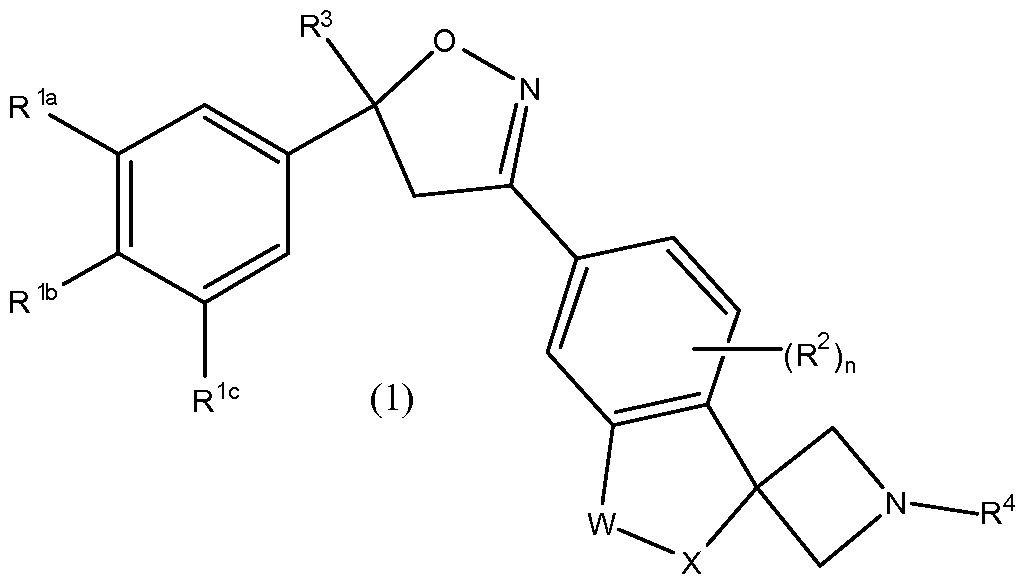


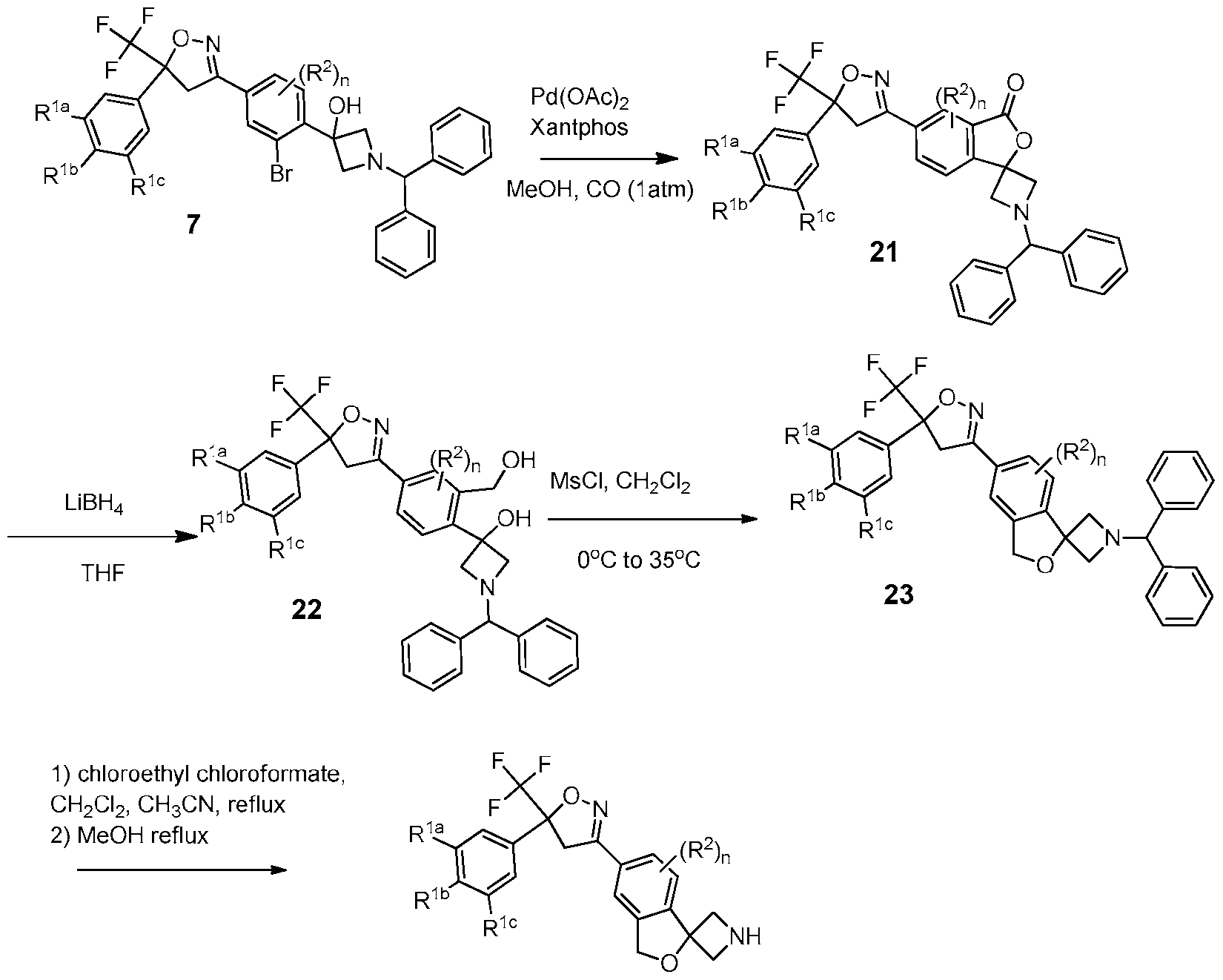


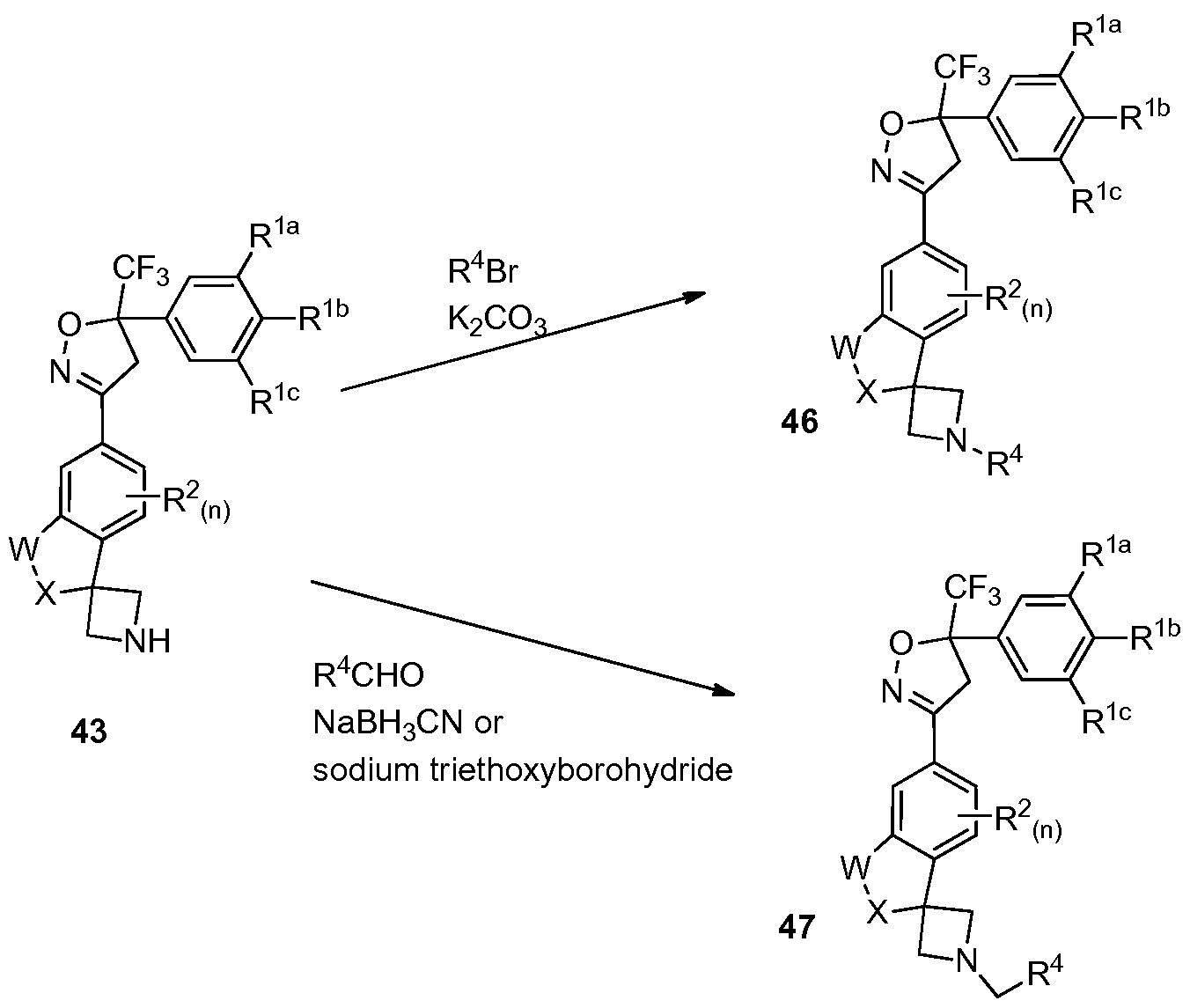


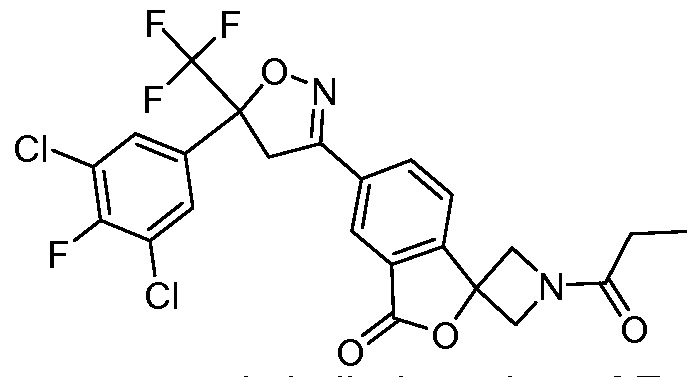


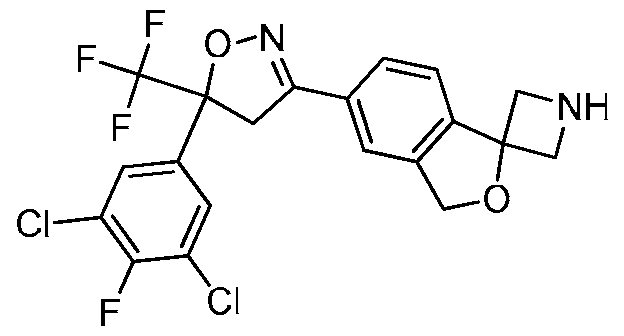


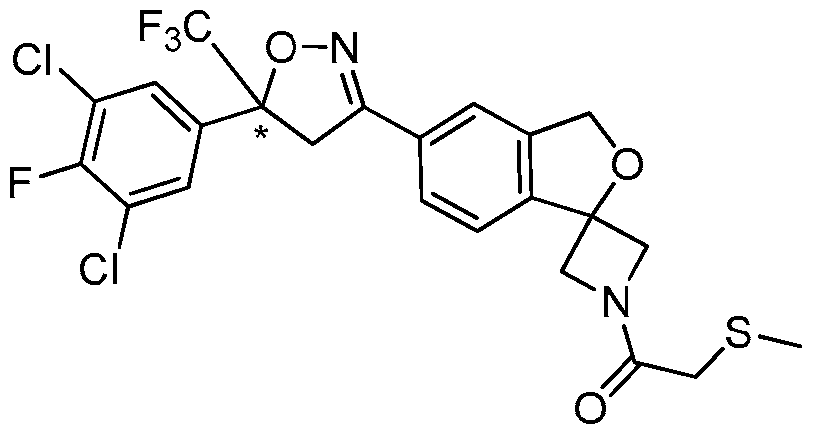


Claims


Priority Applications (19)
| Application Number | Priority Date | Filing Date | Title |
|---|---|---|---|
| RS20160432A RS54860B1 (en) | 2011-03-10 | 2012-02-23 | SPIROCYCLIC ISOXAZOLINE DERIVATIVES AS ANTIPARASITIC AGENTS |
| RU2013139630A RU2566083C3 (en) | 2011-03-10 | 2012-02-23 | Spirocyclic derivatives of isoxazoline as antiparasitic agents |
| EP12709376.3A EP2683723B1 (en) | 2011-03-10 | 2012-02-23 | Spirocyclic isoxazoline derivatives as antiparasitic agents |
| NZ614547A NZ614547B2 (en) | 2011-03-10 | 2012-02-23 | Spirocyclic isoxazoline derivatives as antiparasitic agents |
| MEP-2016-125A ME02412B (en) | 2011-03-10 | 2012-02-23 | SPIROCYCLIC ISOXAZOLINE DERIVATIVES AS ANTIPARASITICS |
| BR112013023068A BR112013023068B8 (en) | 2011-03-10 | 2012-02-23 | SPYROCYCLIC ISOXAZOLINE DERIVATIVES, THEIR USE AND PREPARATION PROCESS, AND VETERINARY COMPOSITIONS |
| PH1/2013/501831A PH12013501831B1 (en) | 2011-03-10 | 2012-02-23 | Spirocyclic isoxazoline derivatives as antiparasitic agents |
| JP2013557191A JP5806743B2 (en) | 2011-03-10 | 2012-02-23 | Spirocyclic isoxazoline derivatives as antiparasitic agents |
| HK14103441.3A HK1190393B (en) | 2011-03-10 | 2012-02-23 | Spirocyclic isoxazoline derivatives as antiparasitic agents |
| CN201280022404.XA CN103517907B (en) | 2011-03-10 | 2012-02-23 | Volution isoxazolines derivative as antiparasitic |
| SI201230583A SI2683723T1 (en) | 2011-03-10 | 2012-02-23 | Spirocyclic isoxazoline derivatives as antiparasitic agents |
| KR1020137026527A KR101565853B1 (en) | 2011-03-10 | 2012-02-23 | Spirocyclic isoxazoline derivatives as antiparasitic agents |
| ES12709376.3T ES2585555T3 (en) | 2011-03-10 | 2012-02-23 | Spirocyclic derivatives of isoxazoline as antiparasitic agents |
| CA2828397A CA2828397C (en) | 2011-03-10 | 2012-02-23 | Spirocyclic isoxazoline derivatives as antiparasitic agents |
| MX2013010336A MX2013010336A (en) | 2011-03-10 | 2012-02-23 | Spirocyclic isoxazoline derivatives as antiparasitic agents. |
| HRP20160601TT HRP20160601T1 (en) | 2011-03-10 | 2012-02-23 | Spirocyclic isoxazoline derivatives as antiparasitic agents |
| AU2012226475A AU2012226475C1 (en) | 2011-03-10 | 2012-02-23 | Spirocyclic isoxazoline derivatives as antiparasitic agents |
| ZA2013/06817A ZA201306817B (en) | 2011-03-10 | 2013-09-10 | Spirocyclic isoxazoline derivatives as antiparasitic agents |
| CY20161100723T CY1117987T1 (en) | 2011-03-10 | 2016-07-22 | SPIRACULAR CYCLING ISOXAZOLIN PRODUCTS AS ANTIPARASING AGENTS |
Applications Claiming Priority (6)
| Application Number | Priority Date | Filing Date | Title |
|---|---|---|---|
| US201161451256P | 2011-03-10 | 2011-03-10 | |
| US61/451,256 | 2011-03-10 | ||
| US201161489913P | 2011-05-25 | 2011-05-25 | |
| US61/489,913 | 2011-05-25 | ||
| US201161490804P | 2011-05-27 | 2011-05-27 | |
| US61/490,804 | 2011-05-27 |
Publications (1)
| Publication Number | Publication Date |
|---|---|
| WO2012120399A1 true WO2012120399A1 (en) | 2012-09-13 |
Family
ID=45852624
Family Applications (1)
| Application Number | Title | Priority Date | Filing Date |
|---|---|---|---|
| PCT/IB2012/050842 Ceased WO2012120399A1 (en) | 2011-03-10 | 2012-02-23 | Spirocyclic isoxazoline derivatives as antiparasitic agents |
Country Status (26)
| Country | Link |
|---|---|
| US (1) | US8466115B2 (en) |
| EP (1) | EP2683723B1 (en) |
| JP (1) | JP5806743B2 (en) |
| KR (1) | KR101565853B1 (en) |
| CN (1) | CN103517907B (en) |
| AR (1) | AR085649A1 (en) |
| AU (1) | AU2012226475C1 (en) |
| BR (1) | BR112013023068B8 (en) |
| CA (1) | CA2828397C (en) |
| CL (1) | CL2013002516A1 (en) |
| CO (1) | CO6761337A2 (en) |
| CY (1) | CY1117987T1 (en) |
| ES (1) | ES2585555T3 (en) |
| HR (1) | HRP20160601T1 (en) |
| HU (1) | HUE029810T2 (en) |
| ME (1) | ME02412B (en) |
| MX (1) | MX2013010336A (en) |
| PH (1) | PH12013501831B1 (en) |
| PL (1) | PL2683723T3 (en) |
| PT (1) | PT2683723T (en) |
| RS (1) | RS54860B1 (en) |
| RU (1) | RU2566083C3 (en) |
| SI (1) | SI2683723T1 (en) |
| UY (1) | UY33943A (en) |
| WO (1) | WO2012120399A1 (en) |
| ZA (1) | ZA201306817B (en) |
Cited By (49)
| Publication number | Priority date | Publication date | Assignee | Title |
|---|---|---|---|---|
| WO2014036056A1 (en) | 2012-08-31 | 2014-03-06 | Zoetis Llc | Crystalline forms of 1-(5'-(5-(3,5-dichloro-4-fluorophenyl)-5-(trifluoromethyl)-4,5-dihydroisoxazol-3-yl)-3'h-spiro[azetidine-3,1'-isobenzofuran]-1-yl)-2-(methylsulfonyl)ethanone |
| WO2014039484A1 (en) * | 2012-09-07 | 2014-03-13 | Zoetis Llc | Spirocyclic isoxazolines as antiparasitic agents |
| WO2014039422A1 (en) | 2012-09-04 | 2014-03-13 | Zoetis Llc | Spirocyclic isoxazoline derivatives for treatment of sea lice |
| WO2014039489A1 (en) * | 2012-09-07 | 2014-03-13 | Zoetis Llc | Spirocyclic derivatives as antiparasitic agents |
| WO2014039475A1 (en) * | 2012-09-07 | 2014-03-13 | Zoetis Llc | Spirocyclic isoxazoline parasiticidal combinations |
| WO2014081800A1 (en) | 2012-11-21 | 2014-05-30 | Zoetis Llc | Synthesis of spirocyclic isoxazoline derivatives |
| WO2014122083A1 (en) | 2013-02-06 | 2014-08-14 | Bayer Cropscience Ag | Halogen-substituted pyrazol derivatives as pest-control agents |
| WO2015048371A1 (en) | 2013-09-30 | 2015-04-02 | Zoetis Llc | Long-acting spiro-isoxazoline formulations |
| EP2865369A1 (en) | 2013-10-25 | 2015-04-29 | Sumitomo Chemical Co., Ltd. | Solid dispersions of isoxazoline compounds |
| WO2015101622A1 (en) | 2014-01-03 | 2015-07-09 | Bayer Cropscience Ag | Novel pyrazolyl-heteroarylamides as pesticides |
| WO2016008830A1 (en) | 2014-07-15 | 2016-01-21 | Bayer Cropscience Aktiengesellschaft | Aryl-triazolyl pyridines as pest control agents |
| US9420793B2 (en) | 2015-01-16 | 2016-08-23 | Avista Pharma Solutions | Antiparasitic compounds |
| WO2016138339A1 (en) | 2015-02-26 | 2016-09-01 | Merial, Inc. | Long-acting injectable formulations comprising an isoxazoline active agent, methods and uses thereof |
| WO2016164487A1 (en) | 2015-04-08 | 2016-10-13 | Merial, Inc. | Extended release injectable formulations comprising an isoxazoline active agent, methods and uses thereof |
| WO2017147352A1 (en) | 2016-02-24 | 2017-08-31 | Merial, Inc. | Antiparasitic isoxazoline compounds, long-acting injectable formulations comprising them, methods and uses thereof |
| WO2017153217A1 (en) | 2016-03-09 | 2017-09-14 | Basf Se | Spirocyclic derivatives |
| WO2017153218A1 (en) | 2016-03-11 | 2017-09-14 | Basf Se | Method for controlling pests of plants |
| WO2017176948A1 (en) * | 2016-04-06 | 2017-10-12 | Merial, Inc. | Process for the preparation of enantiomerically enriched isoxazoline compounds - crystalline toluene solvate of (s)-afoxolaner |
| WO2018039508A1 (en) | 2016-08-25 | 2018-03-01 | Merial, Inc. | Method for reducing unwanted effects in parasiticidal treatments |
| WO2018071535A1 (en) | 2016-10-14 | 2018-04-19 | Merial, Inc. | Pesticidal and parasiticidal vinyl isoxazoline compounds |
| WO2018162312A1 (en) * | 2017-03-10 | 2018-09-13 | Basf Se | Spirocyclic derivatives |
| WO2019036407A1 (en) | 2017-08-14 | 2019-02-21 | Merial, Inc. | Pesticidal and parasiticidal pyrazole-isoxazoline compounds |
| WO2019048381A1 (en) | 2017-09-06 | 2019-03-14 | Bayer Animal Health Gmbh | Topically administrable formulation for the control and prevention of animal parasites |
| WO2020088949A1 (en) | 2018-10-29 | 2020-05-07 | Basf Se | Process for preparation of optically enriched aldol compounds |
| WO2020094434A1 (en) | 2018-11-06 | 2020-05-14 | Basf Se | Process for preparation of optically enriched isoxazolines |
| WO2020114813A1 (en) | 2018-12-04 | 2020-06-11 | Basf Se | Process for preparation of 5-bromo-1,3-dichloro-2-fluoro-benzene |
| US10799483B2 (en) | 2014-12-22 | 2020-10-13 | Intervet Inc. | Use of isoxazoline compounds for treating demodicosis |
| US10807992B2 (en) | 2017-11-16 | 2020-10-20 | Avista Pharma Solutions, Inc. | Single enantiomer antiparasitic compounds |
| WO2021127188A1 (en) | 2019-12-18 | 2021-06-24 | Elanco Tiergesundheit Ag | Isoxazoline derivatives as pesticides |
| WO2021242481A1 (en) | 2020-05-28 | 2021-12-02 | Boehringer Ingelheim Animal Health USA Inc. | Bi-modal release intra-ruminal capsule device and methods of use thereof |
| WO2022140728A1 (en) | 2020-12-21 | 2022-06-30 | Boehringer Ingelheim Animam Health Usa Inc. | Parasiticidal collar comprising isoxazoline compounds |
| WO2022238575A1 (en) | 2021-05-14 | 2022-11-17 | Syngenta Crop Protection Ag | Insect, acarina and nematode pest control |
| WO2022263573A1 (en) | 2021-06-16 | 2022-12-22 | Elanco Tiergesundheit Ag | Isoxazoline pesticides |
| WO2022263530A1 (en) | 2021-06-16 | 2022-12-22 | Elanco Tiergesundheit Ag | (thi)oxazoline pesticides |
| WO2022268815A1 (en) | 2021-06-24 | 2022-12-29 | Syngenta Crop Protection Ag | Insect, acarina and nematode pest control |
| WO2022268813A1 (en) | 2021-06-24 | 2022-12-29 | Syngenta Crop Protection Ag | Insect, acarina and nematode pest control |
| WO2023046853A1 (en) | 2021-09-23 | 2023-03-30 | Syngenta Crop Protection Ag | Insect, acarina and nematode pest control |
| WO2023203038A1 (en) | 2022-04-19 | 2023-10-26 | Syngenta Crop Protection Ag | Insect, acarina and nematode pest control |
| US11883530B2 (en) | 2013-12-20 | 2024-01-30 | Intervet Inc. | Isoxazoline compositions and use thereof in the prevention or treatment of parasite infestations in animals |
| WO2024192071A1 (en) | 2023-03-13 | 2024-09-19 | Zoetis Services Llc | Degradation of isoxazolines in ozonated sea water |
| US12304903B2 (en) | 2020-07-24 | 2025-05-20 | Elanco Us Inc. | Process for making an isoxazoline compound and intermediate thereof |
| US12344597B2 (en) | 2018-06-07 | 2025-07-01 | Idorsia Pharmaceuticals Ltd | Alkoxy-substituted pyridinyl derivatives as LPA1 receptor antagonists and their use in the treatment of fibrosis |
| US12479820B2 (en) | 2019-06-18 | 2025-11-25 | Idorsia Pharmaceuticals Ltd | Pyridin-3-yl derivatives |
| WO2025257633A1 (en) | 2024-06-12 | 2025-12-18 | Boehringer Ingelheim Vetmedica Gmbh | Long-acting castor oil-containing injectable formulations and methods of use thereof |
| WO2026006414A1 (en) | 2024-06-25 | 2026-01-02 | Elanco Us Inc. | Isoxazol-benzamide compounds as antiparasitic compounds |
| WO2026006412A1 (en) | 2024-06-25 | 2026-01-02 | Elanco Us Inc. | Isooxazoline compounds as antiparasitic agents |
| WO2026024600A1 (en) | 2024-07-22 | 2026-01-29 | Zoetis Services Llc | Isoxazoline and macrocyclic lactone microspheres |
| US12539294B2 (en) | 2019-12-04 | 2026-02-03 | Idorsia Pharmaceuticals Ltd | Combination of an azetidine LPA1 receptor antagonist with pirfenidone and/or nintedanib for use in the treatment of fibrotic diseases |
| US12544336B2 (en) | 2021-09-02 | 2026-02-10 | Elanco Us Inc. | Palatable formulations |
Families Citing this family (27)
| Publication number | Priority date | Publication date | Assignee | Title |
|---|---|---|---|---|
| ES2720201T3 (en) | 2012-02-06 | 2019-07-18 | Merial Inc | Veterinary oral parasiticidal compositions comprising active agents of systemic action and uses thereof |
| JO3626B1 (en) | 2012-02-23 | 2020-08-27 | Merial Inc | Topical formulations containing fipronil and permethrin and how to use them |
| US20160081986A1 (en) * | 2013-05-20 | 2016-03-24 | Zoetis Services Llc | Long-acting spiro-isoxazoline antiparasitic compositions |
| SG11201603430XA (en) | 2013-11-01 | 2016-05-30 | Merial Ltd | Antiparasitic and pesticidal isoxazoline compounds |
| AU2015247463B2 (en) | 2014-04-17 | 2018-03-29 | Basf, Se | Use of malononitrile compounds for protecting animals from parasites |
| WO2016022066A1 (en) | 2014-08-04 | 2016-02-11 | Jerry Tan Eye Surgery Pte Ltd | Pharmaceutical compositions for demodex related blepharitis and eyelid crusting |
| AU2015339096B2 (en) | 2014-10-31 | 2018-08-02 | Boehringer Ingelheim Animal Health USA Inc. | Parasiticidal composition comprising fipronil |
| SG10202103403SA (en) | 2015-05-20 | 2021-05-28 | Boehringer Ingelheim Animal Health Usa Inc | Anthelmintic depsipeptide compounds |
| WO2017201134A1 (en) * | 2016-05-20 | 2017-11-23 | Avista Pharma Solutions, Inc. | Synthetic process and novel intermediates |
| WO2018009751A1 (en) * | 2016-07-08 | 2018-01-11 | Avista Pharma Solutions, Inc. | Antiparasitic compounds |
| US11382949B2 (en) | 2016-11-16 | 2022-07-12 | Boehringer Ingelheim Animal Health USA Inc. | Anthelmintic depsipeptide compounds |
| WO2018166855A1 (en) | 2017-03-16 | 2018-09-20 | Basf Se | Heterobicyclic substituted dihydroisoxazoles |
| SI3723739T1 (en) | 2017-12-15 | 2024-08-30 | Tarsus Pharmaceuticals, Inc. | PARASITICIDE PREPARATIONS BASED ON ISOXAZOLINE AND THEIR USE FOR THE TREATMENT OF BLEPHARITIS |
| EP3749096A1 (en) | 2018-02-08 | 2020-12-16 | Boehringer Ingelheim Animal Health USA Inc. | Parasiticidal compositions comprising eprinomectin and praziquantel, methods and uses thereof |
| IL279977B2 (en) | 2018-07-09 | 2024-06-01 | Boehringer Ingelheim Animal Health Usa Inc | Anthelminthic heterocyclic compounds |
| US11773066B2 (en) | 2018-11-20 | 2023-10-03 | Boehringer Ingelheim Animal Health USA Inc. | Indazolylcyanoethylamino compound, compositions of same, method of making, and methods of using thereof |
| AU2020208145B2 (en) | 2019-01-16 | 2023-02-02 | Boehringer Ingelheim Vetmedica Gmbh | Topical compositions comprising a neonicotinoid and a macrocyclic lactone, methods and uses thereof |
| US11560388B2 (en) | 2019-03-19 | 2023-01-24 | Boehringer Ingelheim Vetmedica Gmbh | Anthelmintic aza-benzothiophene and aza-benzofuran compounds |
| US12502377B2 (en) | 2019-04-04 | 2025-12-23 | Tarsus Pharmaceuticals, Inc. | Method of eradicating ticks that attach to humans using lotilaner formulations |
| CN111253331B (en) * | 2020-03-17 | 2022-03-08 | 南京林业大学 | Method for synthesizing spiroisoxazoline by using dihydrochalcone as raw material |
| CA3183100A1 (en) | 2020-05-29 | 2021-12-02 | Boehringer Ingelheim Pharma Gmbh & Co. Kg | Anthelmintic heterocyclic compounds |
| CN111675668B (en) * | 2020-06-28 | 2022-09-13 | 南京林业大学 | A TEMPO-catalyzed reaction method for synthesizing spiroisoxazolines with oxime compounds as raw materials |
| CA3209562A1 (en) | 2021-01-27 | 2022-08-04 | Intervet International B.V. | Cyclopropylamide compounds against parasites in fish |
| US20240116854A1 (en) | 2021-01-27 | 2024-04-11 | Intervet Inc. | Cyclopropylamide compounds against parasites in fish |
| JP2025507585A (en) | 2022-02-17 | 2025-03-21 | ベーリンガー インゲルハイム フェトメディカ ゲーエムベーハー | Method and system for providing a fluid product mailer - Patents.com |
| FI20225388A1 (en) | 2022-05-05 | 2023-11-06 | Equinorm Ltd | Novel heterocycles, preparation methods and uses thereof |
| NO20240925A1 (en) | 2023-09-15 | 2025-03-17 | Evah Atlantic Inc | Dihydroisoxazole compound for use in reducing ectoparasite infestations on fish |
Citations (13)
| Publication number | Priority date | Publication date | Assignee | Title |
|---|---|---|---|---|
| WO1998024767A1 (en) | 1996-12-05 | 1998-06-11 | Pfizer Limited | Parasiticidal pyrazoles |
| WO2005060749A1 (en) | 2003-12-18 | 2005-07-07 | Pfizer Limited | Substituted arylpyrazoles as parasiticidal agents |
| WO2007006688A1 (en) | 2005-07-14 | 2007-01-18 | F. Hoffmann-La Roche Ag | Indol-3-carbonyl-spiro-piperidine derivatives as v1a receptor antagonists |
| WO2007075459A2 (en) | 2005-12-16 | 2007-07-05 | E. I. Du Pont De Nemours And Company | 5-aryl isoxazolines for controlling invertebrate pests |
| WO2007105814A1 (en) | 2006-03-10 | 2007-09-20 | Nissan Chemical Industries, Ltd. | Substituted isoxazoline compound and pest control agent |
| WO2008096746A1 (en) | 2007-02-06 | 2008-08-14 | Takeda Pharmaceutical Company Limited | Spiro compound and use thereof |
| WO2008122375A2 (en) | 2007-04-10 | 2008-10-16 | Bayer Cropscience Ag | Insecticidal aryl isoxazoline derivatives |
| WO2009035004A1 (en) | 2007-09-10 | 2009-03-19 | Nissan Chemical Industries, Ltd. | Substituted isoxazoline compound and pest control agent |
| WO2009063910A1 (en) | 2007-11-12 | 2009-05-22 | Nissan Chemical Industries, Ltd. | Method for catalytic asymmetric synthesis of optically active isoxazoline compound |
| WO2010025998A1 (en) | 2008-09-04 | 2010-03-11 | Syngenta Participations Ag | Insecticidal compounds |
| WO2010032437A1 (en) | 2008-09-18 | 2010-03-25 | 日本曹達株式会社 | Nitrogen-containing heterocyclic compound and pest control agent |
| WO2010084067A2 (en) | 2009-01-22 | 2010-07-29 | Syngenta Participations Ag | Insecticidal compounds |
| WO2011104089A1 (en) | 2010-02-25 | 2011-09-01 | Syngenta Participations Ag | Process for the preparation of isoxazoline derivatives |
Family Cites Families (5)
| Publication number | Priority date | Publication date | Assignee | Title |
|---|---|---|---|---|
| US5554753A (en) | 1993-08-25 | 1996-09-10 | Indiana University Foundation | Catalytic enantioselective synthesis of α-amino acid derivatives by phase-transfer catalysis |
| CN102558082B (en) * | 2004-03-05 | 2015-09-30 | 日产化学工业株式会社 | Isoxazoline-substituted benzamide compound prepare intermediate |
| JP5184057B2 (en) * | 2007-08-10 | 2013-04-17 | 日本曹達株式会社 | Nitrogen-containing heterocyclic compounds and pest control agents |
| JP2009286773A (en) * | 2008-03-14 | 2009-12-10 | Bayer Cropscience Ag | Insecticidal condensed-ring aryl compounds |
| WO2010027051A1 (en) * | 2008-09-04 | 2010-03-11 | 日産化学工業株式会社 | Substituted acetophenone compound, process for producing same, and use of same |
-
2012
- 2012-02-23 WO PCT/IB2012/050842 patent/WO2012120399A1/en not_active Ceased
- 2012-02-23 AU AU2012226475A patent/AU2012226475C1/en active Active
- 2012-02-23 JP JP2013557191A patent/JP5806743B2/en active Active
- 2012-02-23 RU RU2013139630A patent/RU2566083C3/en active
- 2012-02-23 BR BR112013023068A patent/BR112013023068B8/en active IP Right Grant
- 2012-02-23 CN CN201280022404.XA patent/CN103517907B/en active Active
- 2012-02-23 EP EP12709376.3A patent/EP2683723B1/en active Active
- 2012-02-23 MX MX2013010336A patent/MX2013010336A/en active IP Right Grant
- 2012-02-23 CA CA2828397A patent/CA2828397C/en active Active
- 2012-02-23 PT PT127093763T patent/PT2683723T/en unknown
- 2012-02-23 HU HUE12709376A patent/HUE029810T2/en unknown
- 2012-02-23 RS RS20160432A patent/RS54860B1/en unknown
- 2012-02-23 ES ES12709376.3T patent/ES2585555T3/en active Active
- 2012-02-23 HR HRP20160601TT patent/HRP20160601T1/en unknown
- 2012-02-23 SI SI201230583A patent/SI2683723T1/en unknown
- 2012-02-23 ME MEP-2016-125A patent/ME02412B/en unknown
- 2012-02-23 PL PL12709376T patent/PL2683723T3/en unknown
- 2012-02-23 PH PH1/2013/501831A patent/PH12013501831B1/en unknown
- 2012-02-23 KR KR1020137026527A patent/KR101565853B1/en active Active
- 2012-03-08 US US13/414,764 patent/US8466115B2/en active Active
- 2012-03-09 AR ARP120100780A patent/AR085649A1/en active IP Right Grant
- 2012-03-09 UY UY0001033943A patent/UY33943A/en active IP Right Grant
-
2013
- 2013-08-30 CL CL2013002516A patent/CL2013002516A1/en unknown
- 2013-09-06 CO CO13211877A patent/CO6761337A2/en unknown
- 2013-09-10 ZA ZA2013/06817A patent/ZA201306817B/en unknown
-
2016
- 2016-07-22 CY CY20161100723T patent/CY1117987T1/en unknown
Patent Citations (13)
| Publication number | Priority date | Publication date | Assignee | Title |
|---|---|---|---|---|
| WO1998024767A1 (en) | 1996-12-05 | 1998-06-11 | Pfizer Limited | Parasiticidal pyrazoles |
| WO2005060749A1 (en) | 2003-12-18 | 2005-07-07 | Pfizer Limited | Substituted arylpyrazoles as parasiticidal agents |
| WO2007006688A1 (en) | 2005-07-14 | 2007-01-18 | F. Hoffmann-La Roche Ag | Indol-3-carbonyl-spiro-piperidine derivatives as v1a receptor antagonists |
| WO2007075459A2 (en) | 2005-12-16 | 2007-07-05 | E. I. Du Pont De Nemours And Company | 5-aryl isoxazolines for controlling invertebrate pests |
| WO2007105814A1 (en) | 2006-03-10 | 2007-09-20 | Nissan Chemical Industries, Ltd. | Substituted isoxazoline compound and pest control agent |
| WO2008096746A1 (en) | 2007-02-06 | 2008-08-14 | Takeda Pharmaceutical Company Limited | Spiro compound and use thereof |
| WO2008122375A2 (en) | 2007-04-10 | 2008-10-16 | Bayer Cropscience Ag | Insecticidal aryl isoxazoline derivatives |
| WO2009035004A1 (en) | 2007-09-10 | 2009-03-19 | Nissan Chemical Industries, Ltd. | Substituted isoxazoline compound and pest control agent |
| WO2009063910A1 (en) | 2007-11-12 | 2009-05-22 | Nissan Chemical Industries, Ltd. | Method for catalytic asymmetric synthesis of optically active isoxazoline compound |
| WO2010025998A1 (en) | 2008-09-04 | 2010-03-11 | Syngenta Participations Ag | Insecticidal compounds |
| WO2010032437A1 (en) | 2008-09-18 | 2010-03-25 | 日本曹達株式会社 | Nitrogen-containing heterocyclic compound and pest control agent |
| WO2010084067A2 (en) | 2009-01-22 | 2010-07-29 | Syngenta Participations Ag | Insecticidal compounds |
| WO2011104089A1 (en) | 2010-02-25 | 2011-09-01 | Syngenta Participations Ag | Process for the preparation of isoxazoline derivatives |
Non-Patent Citations (13)
| Title |
|---|
| "Beilsteins Handbuch der orqanischen Chemie", SPRINGER-VERLAG |
| "Remington's Veterinary Sciences", 1995, MACK PUBLISHING COMPANY |
| ANGEW. CHEM. INT. ED., vol. 48, 2009, pages 918 - 921 |
| FINNIN; MORGAN, J PHARM SCI, vol. 88, no. 10, October 1999 (1999-10-01), pages 955 - 958 |
| H. LIEBERMAN; L. LACHMAN: "Veterinary Dosage Forms: Tablets", vol. 1, 1980, MARCEL DEKKER |
| JEAN JACQUES ANDRE COLLET; SAMUEL H. WILEN: "Enantiomers, Racemates and Resolutions", 1981, JOHN WILEY AND SONS, INC. |
| LOUIS F. FIESER; MARY FIESER: "Reagents for Organic Synthesis", vol. 1, 1967, WILEY, pages: 19 |
| ORG. LETT., vol. 9, 2007, pages 761 - 764 |
| RC LAROCK: "Comprehensive Organic Transformations - A Guide to Functional Group Transformations", 1999, WILEY-VCH |
| STILL ET AL., J. PRO. CHEM., vol. 43, 1978, pages 2923 |
| T. W. GREENE: "Protective Groups in Organic Synthesis", 1991, JOHN WILEY & SONS |
| TETRAHEDRON, 1995, pages 3045 - 3050 |
| TETT. LETT., vol. 48, 2008, pages 4461 - 4465 |
Cited By (81)
| Publication number | Priority date | Publication date | Assignee | Title |
|---|---|---|---|---|
| US9200003B2 (en) | 2012-08-31 | 2015-12-01 | Zoetis Services Llc | Crystalline forms of 1-(5′-(5-(3,5-dichloro-4-fluorophenyl)-5-(trifluoro-methyl)-4,5-dihydroisoxazol-3-yl)-3′H-spiro[azetidine-3,1′-isobenzofuran]-1-yl)-2-(methylsulfonyl) ethanone |
| CN104812758A (en) * | 2012-08-31 | 2015-07-29 | 硕腾有限责任公司 | 1-(5'-(5-(3,5-dichloro-4-fluorophenyl)-5-(trifluoromethyl)-4,5-dihydroisoxazol-3-yl)-3' Crystal form of H-spiro[azetidine-3,1′-isobenzofuran]-1-yl)-2-(methylsulfonyl)ethanone |
| CN104812758B (en) * | 2012-08-31 | 2017-05-03 | 硕腾服务有限责任公司 | 1-(5'-(5-(3,5-dichloro-4-fluorophenyl)-5-(trifluoromethyl)-4,5-dihydroisoxazol-3-yl)-3' Crystal form of H-spiro[azetidine-3,1′-isobenzofuran]-1-yl)-2-(methylsulfonyl)ethanone |
| AU2013308887B2 (en) * | 2012-08-31 | 2015-11-12 | Zoetis Services Llc | Crystalline forms of 1-(5'-(5-(3,5-dichloro-4-fluorophenyl)-5-(trifluoromethyl)-4,5-dihydroisoxazol-3-yl)-3'H-spiro[azetidine-3,1'-isobenzofuran]-1-yl)-2-(methylsulfonyl)ethanone |
| WO2014036056A1 (en) | 2012-08-31 | 2014-03-06 | Zoetis Llc | Crystalline forms of 1-(5'-(5-(3,5-dichloro-4-fluorophenyl)-5-(trifluoromethyl)-4,5-dihydroisoxazol-3-yl)-3'h-spiro[azetidine-3,1'-isobenzofuran]-1-yl)-2-(methylsulfonyl)ethanone |
| WO2014039422A1 (en) | 2012-09-04 | 2014-03-13 | Zoetis Llc | Spirocyclic isoxazoline derivatives for treatment of sea lice |
| WO2014039475A1 (en) * | 2012-09-07 | 2014-03-13 | Zoetis Llc | Spirocyclic isoxazoline parasiticidal combinations |
| US9221835B2 (en) | 2012-09-07 | 2015-12-29 | Zoetis Services Llc | Spirocyclic derivatives as antiparasitic agents |
| WO2014039489A1 (en) * | 2012-09-07 | 2014-03-13 | Zoetis Llc | Spirocyclic derivatives as antiparasitic agents |
| WO2014039484A1 (en) * | 2012-09-07 | 2014-03-13 | Zoetis Llc | Spirocyclic isoxazolines as antiparasitic agents |
| AU2013312882B2 (en) * | 2012-09-07 | 2015-11-05 | Zoetis Services Llc | Spirocyclic isoxazoline parasiticidal combinations |
| US9131697B2 (en) | 2012-09-07 | 2015-09-15 | Zoetis Services Llc | Spirocyclic isoxazolines as antiparasitic agents |
| US9226928B2 (en) | 2012-09-07 | 2016-01-05 | Zoetis Services Llc | Spirocyclic isoxazoline parasiticidal combinations |
| JP2015529223A (en) * | 2012-09-07 | 2015-10-05 | ゾエティス・エルエルシー | Spirocyclic isoxazoline parasite control formulation |
| US9593126B2 (en) | 2012-11-21 | 2017-03-14 | Zoetis Services Llc | Synthesis of spirocyclic isoxazoline derivatives |
| AU2013348091B2 (en) * | 2012-11-21 | 2017-04-13 | Zoetis Services Llc | Synthesis of spirocyclic isoxazoline derivatives |
| EP4056572A1 (en) | 2012-11-21 | 2022-09-14 | Zoetis Services LLC | Synthesis of spirocyclic isoxazoline derivatives |
| CN104918944A (en) * | 2012-11-21 | 2015-09-16 | 硕腾服务有限责任公司 | Synthesis of spirocyclic isoxazoline derivatives |
| WO2014081800A1 (en) | 2012-11-21 | 2014-05-30 | Zoetis Llc | Synthesis of spirocyclic isoxazoline derivatives |
| JP2016500106A (en) * | 2012-11-21 | 2016-01-07 | ゾエティス・サービシーズ・エルエルシー | Synthesis of spirocyclic isoxazoline derivatives |
| CN104918944B (en) * | 2012-11-21 | 2017-05-10 | 硕腾服务有限责任公司 | synthesis of spirocyclic isoxazoline derivatives |
| WO2014122083A1 (en) | 2013-02-06 | 2014-08-14 | Bayer Cropscience Ag | Halogen-substituted pyrazol derivatives as pest-control agents |
| US10350196B2 (en) | 2013-09-30 | 2019-07-16 | Zoetis Services Llc | Long-acting spiro-isoxazoline formulations |
| JP2016536272A (en) * | 2013-09-30 | 2016-11-24 | ゾエティス・サービシーズ・エルエルシー | Long-acting spiroisoxazoline formulation |
| EP4628077A2 (en) | 2013-09-30 | 2025-10-08 | Zoetis Services LLC | Long-acting spiro-isoxazoline formulations |
| WO2015048371A1 (en) | 2013-09-30 | 2015-04-02 | Zoetis Llc | Long-acting spiro-isoxazoline formulations |
| EP2865369A1 (en) | 2013-10-25 | 2015-04-29 | Sumitomo Chemical Co., Ltd. | Solid dispersions of isoxazoline compounds |
| US11883530B2 (en) | 2013-12-20 | 2024-01-30 | Intervet Inc. | Isoxazoline compositions and use thereof in the prevention or treatment of parasite infestations in animals |
| WO2015101622A1 (en) | 2014-01-03 | 2015-07-09 | Bayer Cropscience Ag | Novel pyrazolyl-heteroarylamides as pesticides |
| WO2016008830A1 (en) | 2014-07-15 | 2016-01-21 | Bayer Cropscience Aktiengesellschaft | Aryl-triazolyl pyridines as pest control agents |
| US10799483B2 (en) | 2014-12-22 | 2020-10-13 | Intervet Inc. | Use of isoxazoline compounds for treating demodicosis |
| US9420793B2 (en) | 2015-01-16 | 2016-08-23 | Avista Pharma Solutions | Antiparasitic compounds |
| US10772331B2 (en) | 2015-01-16 | 2020-09-15 | Avista Pharma Solutions, Inc. | Antiparasitic compounds |
| US9883674B2 (en) | 2015-01-16 | 2018-02-06 | Avista Pharma Solutions, Inc. | Antiparasitic compounds |
| US9686991B2 (en) | 2015-01-16 | 2017-06-27 | Avista Pharma Solutions, Inc. | Antiparasitic compounds |
| US10342234B2 (en) | 2015-01-16 | 2019-07-09 | Avista Pharma Solutions, Inc. | Antiparasitic compounds |
| US10092001B2 (en) | 2015-01-16 | 2018-10-09 | Avista Pharma Solutions, Inc. | Antiparasitic compounds |
| WO2016138339A1 (en) | 2015-02-26 | 2016-09-01 | Merial, Inc. | Long-acting injectable formulations comprising an isoxazoline active agent, methods and uses thereof |
| WO2016164487A1 (en) | 2015-04-08 | 2016-10-13 | Merial, Inc. | Extended release injectable formulations comprising an isoxazoline active agent, methods and uses thereof |
| US12083100B1 (en) | 2016-02-24 | 2024-09-10 | Boehringer Ingelheim Animal Health USA Inc. | Antiparasitic isoxazoline compounds, long-acting injectable formulations comprising them, methods and uses thereof |
| WO2017147352A1 (en) | 2016-02-24 | 2017-08-31 | Merial, Inc. | Antiparasitic isoxazoline compounds, long-acting injectable formulations comprising them, methods and uses thereof |
| EP3763211A1 (en) | 2016-02-24 | 2021-01-13 | Boehringer Ingelheim Animal Health USA Inc. | Antiparasitic isoxazoline compounds, long-acting injectable formulations comprising them, methods and uses thereof |
| EA036716B1 (en) * | 2016-02-24 | 2020-12-11 | БЁРИНГЕР ИНГЕЛЬХАЙМ ЭНИМАЛ ХЕЛТ ЮЭсЭй ИНК. | Antiparasitic isoxazoline compounds, long-acting injectable formulations comprising them, methods and uses thereof |
| US11497732B2 (en) | 2016-02-24 | 2022-11-15 | Boehringer Ingelheim Animal Health USA Inc. | Antiparasitic isoxazoline compounds, long-acting injectable formulations comprising them, methods and uses thereof |
| WO2017153217A1 (en) | 2016-03-09 | 2017-09-14 | Basf Se | Spirocyclic derivatives |
| WO2017153218A1 (en) | 2016-03-11 | 2017-09-14 | Basf Se | Method for controlling pests of plants |
| WO2017176948A1 (en) * | 2016-04-06 | 2017-10-12 | Merial, Inc. | Process for the preparation of enantiomerically enriched isoxazoline compounds - crystalline toluene solvate of (s)-afoxolaner |
| US10433552B2 (en) | 2016-04-06 | 2019-10-08 | Merial, Inc. | Process for the preparation of isoxazoline compounds |
| US10750744B2 (en) | 2016-04-06 | 2020-08-25 | Boehringer Ingelheim Animal Health USA Inc. | Process for the preparation of isoxazoline compounds |
| US11324220B2 (en) | 2016-04-06 | 2022-05-10 | Boehringer Ingelheim Animal Health USA Inc. | Process for the preparation of isoxazoline compounds |
| WO2018039508A1 (en) | 2016-08-25 | 2018-03-01 | Merial, Inc. | Method for reducing unwanted effects in parasiticidal treatments |
| WO2018071535A1 (en) | 2016-10-14 | 2018-04-19 | Merial, Inc. | Pesticidal and parasiticidal vinyl isoxazoline compounds |
| WO2018162312A1 (en) * | 2017-03-10 | 2018-09-13 | Basf Se | Spirocyclic derivatives |
| WO2019036407A1 (en) | 2017-08-14 | 2019-02-21 | Merial, Inc. | Pesticidal and parasiticidal pyrazole-isoxazoline compounds |
| US11344532B2 (en) | 2017-09-06 | 2022-05-31 | Bayer Animal Health Gmbh | Topically administrable formulation for the control and prevention of animal parasites |
| WO2019048381A1 (en) | 2017-09-06 | 2019-03-14 | Bayer Animal Health Gmbh | Topically administrable formulation for the control and prevention of animal parasites |
| US10807992B2 (en) | 2017-11-16 | 2020-10-20 | Avista Pharma Solutions, Inc. | Single enantiomer antiparasitic compounds |
| US12344597B2 (en) | 2018-06-07 | 2025-07-01 | Idorsia Pharmaceuticals Ltd | Alkoxy-substituted pyridinyl derivatives as LPA1 receptor antagonists and their use in the treatment of fibrosis |
| WO2020088949A1 (en) | 2018-10-29 | 2020-05-07 | Basf Se | Process for preparation of optically enriched aldol compounds |
| WO2020094434A1 (en) | 2018-11-06 | 2020-05-14 | Basf Se | Process for preparation of optically enriched isoxazolines |
| WO2020114813A1 (en) | 2018-12-04 | 2020-06-11 | Basf Se | Process for preparation of 5-bromo-1,3-dichloro-2-fluoro-benzene |
| US12479820B2 (en) | 2019-06-18 | 2025-11-25 | Idorsia Pharmaceuticals Ltd | Pyridin-3-yl derivatives |
| US12539294B2 (en) | 2019-12-04 | 2026-02-03 | Idorsia Pharmaceuticals Ltd | Combination of an azetidine LPA1 receptor antagonist with pirfenidone and/or nintedanib for use in the treatment of fibrotic diseases |
| WO2021127188A1 (en) | 2019-12-18 | 2021-06-24 | Elanco Tiergesundheit Ag | Isoxazoline derivatives as pesticides |
| US12497370B2 (en) | 2019-12-18 | 2025-12-16 | Elanco Tiergesundheit Ag | Isoxazoline derivatives |
| WO2021242481A1 (en) | 2020-05-28 | 2021-12-02 | Boehringer Ingelheim Animal Health USA Inc. | Bi-modal release intra-ruminal capsule device and methods of use thereof |
| US12304903B2 (en) | 2020-07-24 | 2025-05-20 | Elanco Us Inc. | Process for making an isoxazoline compound and intermediate thereof |
| WO2022140728A1 (en) | 2020-12-21 | 2022-06-30 | Boehringer Ingelheim Animam Health Usa Inc. | Parasiticidal collar comprising isoxazoline compounds |
| WO2022238575A1 (en) | 2021-05-14 | 2022-11-17 | Syngenta Crop Protection Ag | Insect, acarina and nematode pest control |
| WO2022263530A1 (en) | 2021-06-16 | 2022-12-22 | Elanco Tiergesundheit Ag | (thi)oxazoline pesticides |
| WO2022263573A1 (en) | 2021-06-16 | 2022-12-22 | Elanco Tiergesundheit Ag | Isoxazoline pesticides |
| WO2022268813A1 (en) | 2021-06-24 | 2022-12-29 | Syngenta Crop Protection Ag | Insect, acarina and nematode pest control |
| WO2022268815A1 (en) | 2021-06-24 | 2022-12-29 | Syngenta Crop Protection Ag | Insect, acarina and nematode pest control |
| US12544336B2 (en) | 2021-09-02 | 2026-02-10 | Elanco Us Inc. | Palatable formulations |
| WO2023046853A1 (en) | 2021-09-23 | 2023-03-30 | Syngenta Crop Protection Ag | Insect, acarina and nematode pest control |
| WO2023203038A1 (en) | 2022-04-19 | 2023-10-26 | Syngenta Crop Protection Ag | Insect, acarina and nematode pest control |
| WO2024192071A1 (en) | 2023-03-13 | 2024-09-19 | Zoetis Services Llc | Degradation of isoxazolines in ozonated sea water |
| WO2025257633A1 (en) | 2024-06-12 | 2025-12-18 | Boehringer Ingelheim Vetmedica Gmbh | Long-acting castor oil-containing injectable formulations and methods of use thereof |
| WO2026006414A1 (en) | 2024-06-25 | 2026-01-02 | Elanco Us Inc. | Isoxazol-benzamide compounds as antiparasitic compounds |
| WO2026006412A1 (en) | 2024-06-25 | 2026-01-02 | Elanco Us Inc. | Isooxazoline compounds as antiparasitic agents |
| WO2026024600A1 (en) | 2024-07-22 | 2026-01-29 | Zoetis Services Llc | Isoxazoline and macrocyclic lactone microspheres |
Also Published As
Similar Documents
| Publication | Publication Date | Title |
|---|---|---|
| AU2012226475C1 (en) | Spirocyclic isoxazoline derivatives as antiparasitic agents | |
| US9131697B2 (en) | Spirocyclic isoxazolines as antiparasitic agents | |
| CA2881844A1 (en) | Spirocyclic derivatives as antiparasitic agents | |
| AU2013215374A1 (en) | Process for the preparation of chiral isoxazoline azetidine derivatives as antiparasitic agents | |
| JP6049866B2 (en) | Azetidine derivatives as antiparasitic agents | |
| US9133172B2 (en) | Dihydrofuran azetidine derivatives as antiparasitic agents | |
| NZ614547B2 (en) | Spirocyclic isoxazoline derivatives as antiparasitic agents | |
| HK1190393B (en) | Spirocyclic isoxazoline derivatives as antiparasitic agents |
Legal Events
| Date | Code | Title | Description |
|---|---|---|---|
| 121 | Ep: the epo has been informed by wipo that ep was designated in this application |
Ref document number: 12709376 Country of ref document: EP Kind code of ref document: A1 |
|
| ENP | Entry into the national phase |
Ref document number: 2828397 Country of ref document: CA |
|
| WWE | Wipo information: entry into national phase |
Ref document number: 2013002516 Country of ref document: CL |
|
| WWE | Wipo information: entry into national phase |
Ref document number: 13211877 Country of ref document: CO |
|
| WWE | Wipo information: entry into national phase |
Ref document number: MX/A/2013/010336 Country of ref document: MX |
|
| ENP | Entry into the national phase |
Ref document number: 2013557191 Country of ref document: JP Kind code of ref document: A |
|
| NENP | Non-entry into the national phase |
Ref country code: DE |
|
| ENP | Entry into the national phase |
Ref document number: 2012226475 Country of ref document: AU Date of ref document: 20120223 Kind code of ref document: A |
|
| ENP | Entry into the national phase |
Ref document number: 20137026527 Country of ref document: KR Kind code of ref document: A |
|
| WWE | Wipo information: entry into national phase |
Ref document number: 2012709376 Country of ref document: EP |
|
| ENP | Entry into the national phase |
Ref document number: 2013139630 Country of ref document: RU Kind code of ref document: A |
|
| REG | Reference to national code |
Ref country code: BR Ref legal event code: B01A Ref document number: 112013023068 Country of ref document: BR |
|
| WWE | Wipo information: entry into national phase |
Ref document number: P-2016/0432 Country of ref document: RS |
|
| ENP | Entry into the national phase |
Ref document number: 112013023068 Country of ref document: BR Kind code of ref document: A2 Effective date: 20130909 |