WO2009095429A1 - Process for degrading organic substances in an aqueous composition - Google Patents
Process for degrading organic substances in an aqueous composition Download PDFInfo
- Publication number
- WO2009095429A1 WO2009095429A1 PCT/EP2009/050982 EP2009050982W WO2009095429A1 WO 2009095429 A1 WO2009095429 A1 WO 2009095429A1 EP 2009050982 W EP2009050982 W EP 2009050982W WO 2009095429 A1 WO2009095429 A1 WO 2009095429A1
- Authority
- WO
- WIPO (PCT)
- Prior art keywords
- equal
- carried out
- reaction medium
- process according
- aqueous composition
- Prior art date
- Legal status (The legal status is an assumption and is not a legal conclusion. Google has not performed a legal analysis and makes no representation as to the accuracy of the status listed.)
- Ceased
Links
Classifications
-
- C—CHEMISTRY; METALLURGY
- C02—TREATMENT OF WATER, WASTE WATER, SEWAGE, OR SLUDGE
- C02F—TREATMENT OF WATER, WASTE WATER, SEWAGE, OR SLUDGE
- C02F1/00—Treatment of water, waste water, or sewage
- C02F1/72—Treatment of water, waste water, or sewage by oxidation
- C02F1/722—Oxidation by peroxides
-
- C—CHEMISTRY; METALLURGY
- C02—TREATMENT OF WATER, WASTE WATER, SEWAGE, OR SLUDGE
- C02F—TREATMENT OF WATER, WASTE WATER, SEWAGE, OR SLUDGE
- C02F1/00—Treatment of water, waste water, or sewage
- C02F1/46—Treatment of water, waste water, or sewage by electrochemical methods
- C02F1/461—Treatment of water, waste water, or sewage by electrochemical methods by electrolysis
- C02F1/467—Treatment of water, waste water, or sewage by electrochemical methods by electrolysis by electrochemical disinfection; by electrooxydation or by electroreduction
- C02F1/4672—Treatment of water, waste water, or sewage by electrochemical methods by electrolysis by electrochemical disinfection; by electrooxydation or by electroreduction by electrooxydation
- C02F1/4674—Treatment of water, waste water, or sewage by electrochemical methods by electrolysis by electrochemical disinfection; by electrooxydation or by electroreduction by electrooxydation with halogen or compound of halogens, e.g. chlorine, bromine
-
- C—CHEMISTRY; METALLURGY
- C01—INORGANIC CHEMISTRY
- C01D—COMPOUNDS OF ALKALI METALS, i.e. LITHIUM, SODIUM, POTASSIUM, RUBIDIUM, CAESIUM, OR FRANCIUM
- C01D3/00—Halides of sodium, potassium or alkali metals in general
- C01D3/14—Purification
-
- C—CHEMISTRY; METALLURGY
- C02—TREATMENT OF WATER, WASTE WATER, SEWAGE, OR SLUDGE
- C02F—TREATMENT OF WATER, WASTE WATER, SEWAGE, OR SLUDGE
- C02F1/00—Treatment of water, waste water, or sewage
- C02F1/46—Treatment of water, waste water, or sewage by electrochemical methods
- C02F1/461—Treatment of water, waste water, or sewage by electrochemical methods by electrolysis
-
- C—CHEMISTRY; METALLURGY
- C02—TREATMENT OF WATER, WASTE WATER, SEWAGE, OR SLUDGE
- C02F—TREATMENT OF WATER, WASTE WATER, SEWAGE, OR SLUDGE
- C02F1/00—Treatment of water, waste water, or sewage
- C02F1/50—Treatment of water, waste water, or sewage by addition or application of a germicide or by oligodynamic treatment
-
- C—CHEMISTRY; METALLURGY
- C02—TREATMENT OF WATER, WASTE WATER, SEWAGE, OR SLUDGE
- C02F—TREATMENT OF WATER, WASTE WATER, SEWAGE, OR SLUDGE
- C02F1/00—Treatment of water, waste water, or sewage
- C02F1/58—Treatment of water, waste water, or sewage by removing specified dissolved compounds
-
- C—CHEMISTRY; METALLURGY
- C02—TREATMENT OF WATER, WASTE WATER, SEWAGE, OR SLUDGE
- C02F—TREATMENT OF WATER, WASTE WATER, SEWAGE, OR SLUDGE
- C02F1/00—Treatment of water, waste water, or sewage
- C02F1/72—Treatment of water, waste water, or sewage by oxidation
- C02F1/76—Treatment of water, waste water, or sewage by oxidation with halogens or compounds of halogens
-
- C—CHEMISTRY; METALLURGY
- C02—TREATMENT OF WATER, WASTE WATER, SEWAGE, OR SLUDGE
- C02F—TREATMENT OF WATER, WASTE WATER, SEWAGE, OR SLUDGE
- C02F1/00—Treatment of water, waste water, or sewage
- C02F1/02—Treatment of water, waste water, or sewage by heating
- C02F1/04—Treatment of water, waste water, or sewage by heating by distillation or evaporation
- C02F1/048—Purification of waste water by evaporation
-
- C—CHEMISTRY; METALLURGY
- C02—TREATMENT OF WATER, WASTE WATER, SEWAGE, OR SLUDGE
- C02F—TREATMENT OF WATER, WASTE WATER, SEWAGE, OR SLUDGE
- C02F1/00—Treatment of water, waste water, or sewage
- C02F1/22—Treatment of water, waste water, or sewage by freezing
-
- C—CHEMISTRY; METALLURGY
- C02—TREATMENT OF WATER, WASTE WATER, SEWAGE, OR SLUDGE
- C02F—TREATMENT OF WATER, WASTE WATER, SEWAGE, OR SLUDGE
- C02F1/00—Treatment of water, waste water, or sewage
- C02F1/30—Treatment of water, waste water, or sewage by irradiation
-
- C—CHEMISTRY; METALLURGY
- C02—TREATMENT OF WATER, WASTE WATER, SEWAGE, OR SLUDGE
- C02F—TREATMENT OF WATER, WASTE WATER, SEWAGE, OR SLUDGE
- C02F1/00—Treatment of water, waste water, or sewage
- C02F1/30—Treatment of water, waste water, or sewage by irradiation
- C02F1/32—Treatment of water, waste water, or sewage by irradiation with ultraviolet light
-
- C—CHEMISTRY; METALLURGY
- C02—TREATMENT OF WATER, WASTE WATER, SEWAGE, OR SLUDGE
- C02F—TREATMENT OF WATER, WASTE WATER, SEWAGE, OR SLUDGE
- C02F2101/00—Nature of the contaminant
- C02F2101/10—Inorganic compounds
-
- C—CHEMISTRY; METALLURGY
- C02—TREATMENT OF WATER, WASTE WATER, SEWAGE, OR SLUDGE
- C02F—TREATMENT OF WATER, WASTE WATER, SEWAGE, OR SLUDGE
- C02F2101/00—Nature of the contaminant
- C02F2101/30—Organic compounds
-
- C—CHEMISTRY; METALLURGY
- C02—TREATMENT OF WATER, WASTE WATER, SEWAGE, OR SLUDGE
- C02F—TREATMENT OF WATER, WASTE WATER, SEWAGE, OR SLUDGE
- C02F2103/00—Nature of the water, waste water, sewage or sludge to be treated
- C02F2103/34—Nature of the water, waste water, sewage or sludge to be treated from industrial activities not provided for in groups C02F2103/12 - C02F2103/32
- C02F2103/36—Nature of the water, waste water, sewage or sludge to be treated from industrial activities not provided for in groups C02F2103/12 - C02F2103/32 from the manufacture of organic compounds
-
- C—CHEMISTRY; METALLURGY
- C02—TREATMENT OF WATER, WASTE WATER, SEWAGE, OR SLUDGE
- C02F—TREATMENT OF WATER, WASTE WATER, SEWAGE, OR SLUDGE
- C02F2201/00—Apparatus for treatment of water, waste water or sewage
- C02F2201/46—Apparatus for electrochemical processes
- C02F2201/461—Electrolysis apparatus
- C02F2201/46105—Details relating to the electrolytic devices
- C02F2201/46115—Electrolytic cell with membranes or diaphragms
-
- C—CHEMISTRY; METALLURGY
- C02—TREATMENT OF WATER, WASTE WATER, SEWAGE, OR SLUDGE
- C02F—TREATMENT OF WATER, WASTE WATER, SEWAGE, OR SLUDGE
- C02F2209/00—Controlling or monitoring parameters in water treatment
- C02F2209/02—Temperature
-
- C—CHEMISTRY; METALLURGY
- C02—TREATMENT OF WATER, WASTE WATER, SEWAGE, OR SLUDGE
- C02F—TREATMENT OF WATER, WASTE WATER, SEWAGE, OR SLUDGE
- C02F2209/00—Controlling or monitoring parameters in water treatment
- C02F2209/03—Pressure
-
- C—CHEMISTRY; METALLURGY
- C02—TREATMENT OF WATER, WASTE WATER, SEWAGE, OR SLUDGE
- C02F—TREATMENT OF WATER, WASTE WATER, SEWAGE, OR SLUDGE
- C02F2209/00—Controlling or monitoring parameters in water treatment
- C02F2209/06—Controlling or monitoring parameters in water treatment pH
Definitions
- the present patent application claims the benefit of the European patent application EP08150925.9 filed on 31 January 2008 and of the European patent application EP 08171544.3 filed on 12 December 2008, the content of both of which is incorporated herein by reference.
- the present invention is related to a process for degrading substances in an aqueous composition. More specifically it relates to a process for degrading organic substances present in aqueous compositions, by oxidation.
- Organic substances are typical contaminants of aqueous effluents originating in chemical processes. Degrading organic contaminants in waste water is a prerequisite before the disposal of such effluent, e.g., before the rejection in environment, since the organic contaminants contributes to the Chemical Oxygen Demand of the effluents, a measure of their oxygen depleting impact on the environment, or when a recycling of the effluent in the chemical process is envisioned.
- Chlorine is a reactant currently used for degrading organic contaminants in water by oxidation. Such a process is described in US 5,445,741 of SOLVAY DEUTSCHLAND GmbH. Using chlorine as a source of oxidation agent presents however several drawbacks. Chlorine is a toxic gas. It also reacts with organic compounds to substitute chlorine for hydrogen, yielding chlorinated organic compounds, usually both toxic and more difficult to oxidize. It can also lead to undesirable production of chlorates.
- the goal of the present invention is to provide a process for degrading organic compounds which does not present the above drawbacks.
- the invention therefore relates to a process for degrading organic substances in an aqueous composition
- a process for degrading organic substances in an aqueous composition comprising a step (a) wherein, in a liquid reaction medium, said aqueous composition is reacted with at least one composition comprising hydroxide ions (OH " ) and hypochlorite in a molar ratio between hydroxide and hypochlorite higher than or equal to 0.001 and lower than 1.5, in order to oxidize said organic substances.
- OH " hydroxide ions
- hypochlorite in a molar ratio between hydroxide and hypochlorite higher than or equal to 0.001 and lower than 1.5, in order to oxidize said organic substances.
- One of the characteristics of the invention is related to the ratio between hydroxide and hypochlorite in the aqueous composition comprising hydroxide ions and hypochlorite.
- the aqueous solution containing the organic substances to be degraded will also be referred as the aqueous solution to be treated, subsequently in the description.
- the organic substances which are present in the aqueous composition to be treated can be organic aliphatic substances, organic aromatic substances, or mixtures thereof. Those substances can optionally contain at least one heteroatom, selected from halogens, preferably fluorine, chlorine, bromine, iodine, chalcogens, preferably oxygen or sulfur, nitrogen, phosphorus and mixture thereof, and selected more preferably from chlorine, oxygen and mixture thereof.
- halogens preferably fluorine, chlorine, bromine, iodine, chalcogens, preferably oxygen or sulfur, nitrogen, phosphorus and mixture thereof, and selected more preferably from chlorine, oxygen and mixture thereof.
- the aliphatic substances can be cyclic, acyclic, saturated or unsaturated hydrocarbons.
- hydrocarbons are cyclic or acyclic alkanes and alkenes, halogenated cyclic or acyclic alkanes and alkenes, preferably chlorinated, saturated and/or unsaturated aliphatic and/or alicyclic ethers, saturated and/or unsaturated halogenated aliphatic and/or alicyclic ethers, preferably chlorinated, alcohols and halogenated alcohols, preferably chlorinated, ketones and halogenated ketones, preferably chlorinated, aldehydes and halogenated aldehydes, preferably chlorinated, and/or carboxylic acids and halogenated, carboxylic acids, preferably chlorinated.
- the aliphatic substances are preferably selected from trichloropropane, preferably 1,2,3-trichloropropane, chloropropenol, preferably 2-chloro-2-propen- l-ol, dichloropropenes, preferably 1,3-dichloropropene cis and 1,3-dichloropropene trans, dichloropropane, preferably 1,3-dichloropropane, dichloropropanols, preferably, l,3-dichloro-2-propanol and 2,3-dichloro-l- propanol, monochloropropanediols, more preferably 2-chloro-l,3-propanediol and 3-chloro-l,2-propanediol, 2-chloro-l -propanol, l-chloro-2-propanol, chloroethanol, chloroethers, more preferably chloroethers of crude formula C 6 Hi
- the aromatic substances comprise at least one ring of aromatic nature. They are preferably halogenated aromatic hydrocarbons comprising at least one ring of aromatic nature and one halogen atom.
- the halogen may be chosen from fluorine, chlorine, bromine, iodine, and is preferably chlorine.
- the aromatic ring may be mono or polynuclear and is preferably mononuclear.
- the aromatic substances are preferably selected from mono-, di-, tri-, tetra-, penta- and hexachloro-benzenes and/or naphthalenes, and mixture thereof.
- the aromatic substance is preferably monochlorobenzene.
- the aromatic substance may also be oxygenated like phenol, mono- and polychlorophenol, preferably phenol.
- the content of the organic substance in the aqueous composition to be treated is usually such that the total organic carbon (TOC) of the aqueous composition to be treated is higher than or equal to 0.1 g C/kg, preferably higher than or equal to 0.5 g C/kg and more preferably higher than or equal to 1 g C/kg. That TOC is usually lower than or equal to 20 g C/kg, preferably lower than or equal to 10 g C/kg and more preferably lower than or equal to 5 g C/kg.
- TOC total organic carbon
- the content of the organic substance in the aqueous composition to be treated is usually such that the chemical oxygen demand (COD) of the aqueous composition to be treated is higher than or equal to 0.25 g O/kg, preferably higher than or equal to 1.25 g O/kg and more preferably higher than or equal to 2.5 g O/kg. That COD is usually lower than or equal to 50 g O/kg, preferably lower than or equal to 25 g O/kg and more preferably lower than or equal to 15 g O/kg.
- the aqueous composition to be treated generally contains inorganic compounds, like salts for instance.
- the salts can be organic salts, inorganic salts or mixture thereof. The inorganic salts are preferred.
- Inorganic salts are salts for which the constitutive cations and anions do no contain any carbon-hydrogen bond and any carbon-heteroatom bond with the exception of carbon-oxygen bonds.
- Metal cyanides for instance, are not considered as inorganic salts.
- the inorganic salts are selected from alkaline or alkaline-earth chlorides, sulfates, hydrogen sulfates, hydroxides, carbonates, hydrogen carbonates, phosphates, hydrogen phosphates, borates and any mixture thereof, preferably from alkaline or alkaline-earth chlorides, more preferably from sodium and potassium chloride and the salt is most preferably sodium chloride.
- sodium chloride are also known as brines.
- the aqueous solution to be treated according to the process of the invention is often a brine.
- the salt content of the aqueous composition to be treated is usually higher than or equal to 5 g/kg, often higher than or equal to 10 g/kg, frequently higher than or equal to 20 g/kg, commonly higher than or equal to 30 g/kg of composition to be treated, preferably higher than or equal to 50 g/kg, more preferably higher than or equal to 100 g/kg, still more preferably higher than or equal to 140 g/kg, yet more preferably higher than or equal to 160 g/kg and most preferably higher than or equal to 200 g/kg.
- That salt content is usually lower than or equal to 270 g/kg of composition to be treated, preferably lower than or equal to 250 g/kg and most preferably lower than or equal to 230 g/kg.
- the aqueous solution to be treated can originate from any process, preferably from processes generating brines contaminated by organic substances.
- epoxides preferably ethylene oxide, propylene oxide, butylene oxide or epichlorohydrin
- chlorinated organic compounds preferably dichloroethane
- mono- and polyisocyanates preferably
- the aqueous composition to be treated can be a mixture of aqueous compositions originating from at least two different manufacturing processes.
- the aqueous composition containing the organic substances to be treated originates preferably from a process for manufacturing an epoxide, more preferably for manufacturing an epoxide from glycerol, and most preferably for manufacturing epichlorohydrine from glycerol or from a process for manufacturing a chlorinated organic compound, preferably 1,2-dichloroethane, or from both processes.
- the composition containing hypochlorite can be a solid, a solution or a suspension. It is preferably a solid or a solution, and more preferably a solution.
- the expression hypochlorite is here intended to designate any compound selected from hypochlorous acid (HOCl), a salt from hypochlorous acid, or a mixture thereof.
- the salt from hypochlorous acid can be an organic salt, an inorganic salt or a mixture thereof.
- This salt is preferably an inorganic salt, preferably selected from ammonium hypochlorite, metal salts of hypochlorite and mixture thereof, more preferably selected from alkaline and alkaline-earth metal hypochlorite, and mixture thereof, still more preferably selected from sodium and calcium hypochlorite, and mixture thereof and this salt is most preferably sodium hypochlorite.
- the aqueous composition containing hypochlorite is preferably a solution containing sodium hypochlorite.
- the aqueous composition containing hypochlorite and hydroxide ions may in addition contain chlorate.
- chlorate is here intended to designate any compound selected from chloric acid (HCIO 3 ), a salt from chloric acid, or a mixture thereof.
- the salt from chloric acid can be an organic salt, an inorganic salt or a mixture thereof.
- This salt is preferably an inorganic salt, preferably selected from ammonium chlorate, metal salts of chlorate and mixture thereof, more preferably selected from alkaline and alkaline-earth metal chlorate, and mixture thereof, still more preferably selected from sodium and calcium chlorate, and mixture thereof and this salt is most preferably sodium chlorate.
- the aqueous composition containing hypochlorite and hydroxide ions is preferably a solution containing sodium chlorate.
- the chlorate molar content of the aqueous composition containing chlorate, hypochlorite and hydroxide ions is usually higher than or equal to 0.1 mmol chlorate/kg, often higher than or equal to 1 mmol/kg, frequently higher than or equal to 2 mmol/kg and more specifically higher than or equal to 5 mmol/kg. That content is usually lower than or equal to 100 mmol chlorate/kg, often lower than or equal to 50 mmol/kg, frequently lower than or equal to 20 mmol/kg and more specifically lower than or equal to 10 mmol/kg.
- the aqueous composition containing hypochlorite also contains hydroxide ions OH " in a molar ratio between hydroxide and hypochlorite ([OH ] / [ClO " ]') higher than or equal to 0.001 and lower than to 1.5.
- the molar content of hypochlorite ([ClO " ]') is here intended to designate the sum of the molar contents of hypochlorous acid and salt of hypochlorous acid in the aqueous composition containing hypochlorite.
- That molar ratio ([OH " ]/[C1O ]') is preferably higher than or equal to 0.01 and more preferably higher than or equal to 0.05, still more preferably higher than or equal to 0.1, yet more preferably higher than or equal to 0.2 and most preferably higher than or equal to 0.75. That molar ratio is preferably lower than or equal to 1.4, more preferably lower than or equal to 1.2 and most preferably lower than or equal to 1.0.
- the aqueous composition containing hypochlorite and hydroxide ions can contain other compounds, like a salt different from the hypochlorous acid salt. That salt can be an organic salt, an inorganic salt or a mixture thereof.
- the salt is preferably an inorganic salt, preferably selected alkaline or alkaline-earth chlorides, sulfates, hydrogen sulfates, carbonates, hydrogen carbonates, phosphates, hydrogen phosphates, borates and any mixture thereof, preferably from alkaline or alkaline-earth chlorides, more preferably from sodium and potassium chloride and the salt is most preferably sodium chloride.
- This salt usually results from the process used for preparing the aqueous composition containing hypochlorite.
- the salt content, not including the possible salt of hypochlorous acid, of the aqueous composition containing hypochlorite and hydroxide ions is usually higher than or equal to 30 g/kg of composition to be treated, preferably higher than or equal to 50 g/kg, more preferably higher than or equal to 100 g/kg, still more preferably higher than or equal to 140 g/kg, yet more preferably higher than or equal to 160 g/kg and most preferably higher than or equal to 200 g/kg.
- That salt content is usually lower than or equal to 270 g/kg of composition to be treated, preferably lower than or equal to 250 g/kg and most preferably lower than or equal to 230 g/kg.
- the aqueous composition containing hypochlorite and hydroxide ions can be obtained by any means, preferably by dissolving gaseous chlorine in water containing a basic compound like for instance, ammonium hydroxide, an alkaline hydroxide, an alkaline earth hydroxide, or a mixture thereof.
- a basic compound like for instance, ammonium hydroxide, an alkaline hydroxide, an alkaline earth hydroxide, or a mixture thereof.
- Water containing a sodium hydroxide or a calcium hydroxide or a mixture thereof is preferred and water containing sodium hydroxide is more preferred.
- hypochlorite molar content of the aqueous composition containing hypochlorite and hydroxide ions is usually higher than or equal to 0.1 mol hypochlorite/kg, preferably higher than or equal to 0.5 mol/kg, more preferably higher than or equal to 1 mol/kg and most preferably higher than or equal to 1.3 mol/kg. That content is usually lower than or equal to 5 mol hypochlorite/kg, preferably lower than or equal to 3 mol/kg, more preferably lower than or equal to 2 mol/kg and most preferably lower than or equal to 1.7 mol/kg.
- the amount of the aqueous composition containing hypochlorite and hydroxide ions added to the aqueous composition to be treated is usually such that the molar ratio between the hypochlorite added and the COD (expressed in mol of O) of the aqueous composition to be treated, before reaction, is higher than or equal to 1, preferably higher than or equal to 1.2 and most preferably higher than or equal to 1.4. That amount is usually such that the molar ratio between the hypochlorite added and the COD (expressed in mol of O) of the aqueous composition to be treated, before reaction, is lower than or equal to 8, preferably lower than or equal to 4 and most preferably lower than or equal to 3.
- the liquid reaction medium may be a single-phase or multi-phase medium.
- the liquid reaction medium is composed of all of the dissolved or dispersed solid compounds, dissolved or dispersed liquid compounds and dissolved or dispersed gaseous compounds at the temperature and pressure of the reaction.
- the liquid reaction medium is preferably a multi-phase medium.
- the process according to the invention can be carried out in a discontinuous, continuous or semi-continuous mode.
- the continuous mode is preferred.
- continuous mode one intends to denote a mode wherein the aqueous composition to be treated and the composition comprising hydroxide ions and hypochlorite are continuously fed to the process and wherein the liquid reaction medium is continuously withdrawn from the process.
- discontinuous mode one intends to denote any other mode.
- the semi-continuous mode can be considered as a discontinuous mode.
- continuously one intends to denote without substantial interruption.
- the pH at which the reaction of step (a) is carried out is preferably controlled. That pH is preferably controlled and maintained in a given range.
- the lowest limit of the pH range is generally higher than or equal to 6, preferably higher than or equal to 7 and most preferably higher than or equal to 8.
- the highest limit of the pH range is generally lower than or equal to 11, preferably lower than or equal to 10 and most preferably lower than or equal to 9.
- the pH has to be maintained at such set values since pH changes occur during the course of the oxidation reaction.
- the pH values are given for the reaction conditions of step (a), i.e., temperature, pressure and ionic strength.
- the pH is measured and adjusted if necessary.
- the pH measurement can be done either continuously or periodically. In this last case, the measurement is usually carried out at a frequency sufficiently high to maintain the pH in the set range during at least 80 % of the duration of step (a) of the process, often during at least 90 %, frequently during at least 95 % and in particular during at least 99 %.
- the pH measurement can be carried out “in situ” in the reaction medium under the reaction conditions or “ex situ” in a sample withdrawn from the reaction medium and brought to an adequate temperature and an adequate pressure to assure a good longevity to the pH measurement equipment.
- a temperature 25 0 C and a pressure of 1 bar are examples of adequate temperature and pressure.
- the pH measurement can be carried out by any means. Measurement with a pH sensitive electrode is convenient. Such an electrode should be stable in the reaction medium under the reaction conditions and should not contaminate the reaction medium. Glass electrodes for measuring pH are more particularly convenient. Examples of such electrodes are given in Ullmann's Encyclopedia of Industrial Chemistry, ® 2005, Wiley- VCH Verlag GmbH & Co. KGaA, Weinheim 10.1002/14356007.el9_e01, pp. 8-15. Electrodes of the type 405-DPAS-SC-K85 supplied by METTLER TOLEDO ® or of the types Ceragel CPS71 and Orbisint CPSIl supplied by ENDRESS + HAUSER ® are examples of electrodes that can be used.
- the pH can be adjusted and maintained at said values either by addition of an acidic compound or by addition of a basic compound. Any acidic or basic compounds can be used to maintain the pH. Inorganic acids and inorganic bases are preferred. Hydrogen chloride, gaseous and/or in aqueous solution, is a more preferred acidic compound. Sodium or calcium hydroxides, solids and/or in aqueous solution and/or suspensions, are more preferred basic compounds, with sodium hydroxide aqueous solutions being most preferred.
- control loop a closed circuit known as control loop.
- control loops are described in Ullmann's Encyclopedia of Industrial Chemistry, ® 2005, Wiley- VCH Verlag GmbH & Co. KGaA,
- a PROMINENT ® DULCOMETER ® system type PHD is an example of an automated pH control and adjustment apparatus that can be used.
- the temperature at which the reaction of step (a) is carried out is usually higher than or equal to 1O 0 C, preferably higher than or equal to 3O 0 C, more preferably higher than or equal to 6O 0 C and most preferably higher than or equal to 8O 0 C. That temperature is usually lower than or equal to 200 0 C, preferably lower than or equal to 18O 0 C, more preferably lower than or equal to 16O 0 C and most preferably lower than or equal to 135 0 C.
- the reaction of step (a) can be carried out under a pressure of 1 bar absolute, under a pressure above 1 bar absolute or under a pressure below 1 bar absolute. It is preferred to carry out the reaction of step (a) under a pressure that is regulated or set between 1 and 11 bar absolute, more preferably under a pressure of 1.1 to 7 bar and most preferably under a pressure of 1.1 to 4 bar.
- step (a) of the process is carried out in a discontinuous mode
- the duration of the reaction of step (a) is generally higher than or equal to 0.05 h, preferably higher than or equal to 0.1 h, more preferably higher than or equal to 0.2 h and most preferably higher than or equal to 0.5 h. That duration is usually lower than or equal to 8 h, preferably lower than or equal to 4 h, more preferably lower than or equal to 2 h and most preferably lower than or equal to 1 h.
- the duration is counted from the time of addition of the composition containing hypochlorite to the aqueous solution to be treated.
- the residence time of the reaction of step (a) is usually higher than or equal to 0.05 h, preferably higher than or equal to 0.1 h, more preferably higher than or equal to 0.2 h and most preferably higher than or equal to 0.5 h. That residence time is usually lower than or equal to 8 h, preferably lower than or equal to 4 h, more preferably lower than or equal to 2 h and most preferably lower than or equal to 1 h.
- the residence time is defined by the ratio between the volume of the liquid reaction medium and the flow of the liquid reaction medium.
- the reaction of step (a) can be carried out in one or more reaction zones, preferably in at least two reaction zones and more preferably in at least three reaction zones.
- the reactions zones may be composed of volumes assembled in a single jacket or volumes in separate jackets. In the case where the volumes are assembled in a single jacket, the reaction zones may be positioned horizontally or vertically with respect to one another. In any case, the transfer from one zone to another may take place by gravity or by forced circulation.
- These reaction zones may be placed in any configuration, in series, in parallel or some in series and others in parallel.
- These reactions zones can be operated under any type of regime, like for instance, mixed regime, preferably perfectly mixed regime or plug flow regime.
- At least one of the zone is operated under mixed regime, preferably perfectly mixed regime and at least another one is operated under plug flow regime, and it is more preferred that the zone operating under plug flow regime is located after the zone operating under mixed regime, preferably perfectly mixed regime.
- Such conditions are especially well suited when the process is carried out under continuous mode.
- the reaction zones may be supplied independently of one another, with the aqueous composition to be treated, with the aqueous composition containing the hypochlorite, with any other compositions, or with at least two of these compositions.
- the other composition may comprise for instance the acidic or the basic compound used to adjust the pH of the liquid reaction medium, or a stripping gas to remove volatile reactions products.
- the pH of the liquid reaction medium is preferably adjusted independently in the different reaction zones of the series.
- reaction zones is understood to mean zones where all the conditions needed for the oxidation reaction are found.
- the aqueous composition obtained after the reaction of step (a) exhibits usually reduced COD and TOC levels.
- the TOC of the aqueous composition after the reaction step is usually lower than or equal to 100 mg C/kg, preferably lower than or equal to 60 mg C/kg and more preferably lower than or equal to 20 mg C/kg. That TOC is usually higher than or equal to 0.1 mg C/kg.
- the COD of the aqueous composition after the reaction step is usually lower than or equal to 250 mg O/kg, preferably lower than or equal to 150 mg O/kg and more preferably lower than or equal to 50 mg O/kg. That COD is usually higher than or equal to 1 mg O/kg.
- the compounds responsible for the COD and TOC in the aqueous composition after the reaction of step (a) may be selected from the organic compounds present in the aqueous composition to be treated mentioned above and that have not been oxidized, but also selected from the group consisting of carboxylic acids, aldehydes, ketones or any mixtures thereof.
- the carboxylic acid is preferably selected from the group consisting of monocarboxylic, polycarboxylic acids, and mixtures thereof.
- the monocarboxylic acid and the polycarboxylic acids contain usually from 1 to 10 carbon atoms.
- the carboxylic acids can contain hetero atoms in their molecule. Oxygen, sulfur, halogens and nitrogen are examples of such heteroatoms.
- the monocarboxylic acid is more preferably selected from the group consisting of formic acid, acetic acid, dichloracetic acid, propionic acid, butyric acid, glycolic acid, lactic acid and any mixture thereof.
- the polycarboxylic acid is more preferably selected from the group consisting of oxalic acid, succinic acid, adipic acid, and any mixture thereof.
- the ketone is usually selected from the group consisting of acetone, hydroxyacetone , dihydroxyacetone and mixture thereof.
- the ketone is often hydroxyacetone.
- the aldehydes are preferably selected from the group consisting of formaldehyde, acetaldehyde, propionaldehyde, butyraldehyde, glyceraldehyde, acrolein, and any mixture thereof.
- the aqueous composition obtained after the reaction of step (a) exhibits usually a chlorate ([ClO 3 " ]') content which is usually lower than or equal to 200 mmol Cl ⁇ 3 ⁇ /kg, preferably lower than or equal to 100 mmol Cl ⁇ 3 ⁇ /kg and more preferably lower than or equal to 50 mmol Cl ⁇ 3 ⁇ /kg. That chlorate content is usually higher than or equal to 0.01 mmol Cl ⁇ 3 ⁇ /kg.
- the molar content of chlorate ([ClO 3 " ]') is here intended to designate the sum of the molar contents of chloric acid and salt of chloric acid in the aqueous composition.
- the aqueous composition obtained after the reaction of step (a) exhibits usually a hypochlorite ([ClO " ]') content which is usually lower than or equal to 100 mmol C10 " /kg, preferably lower than or equal to 50 mmol C10 " /kg and more preferably lower than or equal to 20 mmol C10 " /kg. That hypochlorite content is usually higher than or equal to 0.001 mmol ClOTkg.
- the aqueous composition obtained after the reaction step exhibits usually a salt content, preferably an inorganic salt, preferably selected from alkaline or alkaline-earth chlorides, sulfates, hydrogen sulfates, carbonates, hydrogen carbonates, phosphates, hydrogen phosphates, borates, chlorates, hypochlorites and any mixture thereof, more preferably from alkaline or alkaline-earth chlorides, still more preferably from sodium and potassium chloride and most preferably from sodium chloride, usually higher than or equal to 30 g/kg of composition obtained after the reaction step, preferably higher than or equal to 50 g/kg, more preferably higher than or equal to 100 g/kg, still more preferably higher than or equal to 140 g/kg, yet more preferably higher than or equal to 160 g/kg and most preferably higher than or equal to 200 g/kg.
- a salt content preferably an inorganic salt, preferably selected from alkaline or alkaline-earth chlorides, sulfates,
- That salt content is usually lower than or equal to 270 g/kg of composition, preferably lower than or equal to 250 g/kg and most preferably lower than or equal to 230 g/kg.
- the aqueous composition obtained after the reaction step can be used as such as a starting material in an electrolysis process, preferably in an electrolysis process for producing chlorine.
- the aqueous composition containing the organic substances contains at least one salt and the process for degrading organic substances in the aqueous composition comprises a further step (bl), wherein, at least part of the reaction medium of step (a) is subjected to an operation selected from the group consisting of cooling, evaporative crystallization, and any combination thereof, in order to precipitate at least part of the salt, followed by a step wherein at least part of the precipitated salt and at least part of the water present in the aqueous composition are recovered.
- the operation is a cooling operation.
- This operation consists of setting and maintaining the temperature of the reaction medium of step (a) to a temperature lower than the temperature of the reaction of step (a). That temperature is generally lower than 25 0 C, often lower than or equal to 1O 0 C, frequently lower than or equal to O 0 C and in particular lower than -1O 0 C. That temperature is generally higher than or equal to -22 0 C and often higher than or equal to - 2O 0 C.
- the cooling operation can be carried out in a continuous or discontinuous mode.
- the continuous mode is preferred.
- the duration of the cooling operation is usually higher than or equal to 1 min, often higher than or equal to 10 min and frequently higher than or equal to 20 min. That duration is usually lower than or equal to 6 h, often lower than or equal to 3 h and frequently lower than or equal to 2 h.
- the residence time of the cooling operation is usually higher than or equal to 1 min, often higher than or equal to 10 min and frequently higher than or equal to 20 min. That residence time is usually lower than or equal to 6 h, often lower than or equal to 3 h and frequently lower than or equal to 2 h.
- the pressure at which the cooling operation is carried out is usually higher than or equal to 0.1 bar, often higher than or equal to 0.5 bar and frequently higher than or equal to 0.9 bar. That pressure is usually lower than or equal to 10 bar, often lower than or equal to 5 bar and frequently lower than or equal to 2 bar.
- This operation is usually carried out when the concentration of the salt in the reaction medium of step (a) is high, i.e. higher than or equal to 230 g/kg, in particular higher than or equal to 240 g/kg and more particularly higher than or equal to 250 g/kg.
- This operation can be carried out at the pH of the reaction medium of step (a) as such or at a modified pH.
- the operation is preferably carried out after acidification to a pH lower than 5 to eliminate carbonate salts.
- the pH is then possibly adjusted to a higher value before or during the precipitation.
- the pH can be modified or adjusted either by addition of an acidic compound or by addition of a basic compound. Any acidic or basic compounds can be used to maintain the pH.
- Inorganic acids and inorganic bases are preferred.
- Hydrogen chloride, gaseous and/or in aqueous solution is a more preferred acidic compound.
- Sodium or potassium hydroxides, solids and/or in aqueous solution and/or suspensions are more preferred basic compounds, with sodium hydroxide aqueous solutions being most preferred.
- the operation is a evaporative crystallization operation.
- evaporative crystallization is intended to denote a process resulting in the crystallization of a compound by removing, by evaporation, a compound which promotes its dissolution in the medium. This process is described in "Perry's Chemical Engineers' Handbook" in the 11th section of the 7th edition, 1997.
- the temperature at which the evaporative crystallization is carried out is generally higher than 2O 0 C, usually higher than or equal to 4O 0 C, often higher than or equal to 6O 0 C and frequently higher than or equal to 9O 0 C. That temperature is generally lower than or equal to 200 0 C and often lower than or equal to 15O 0 C.
- the evaporative crystallization can be carried out at the pH of the reaction medium of step (a) as such or at a modified pH.
- the operation is preferably carried out after acidification to a pH lower than 5 to eliminate carbonate salts.
- the pH is then possibly adjusted to a higher value before or during the precipitation.
- the pH can be modified or adjusted either by addition of an acidic compound or by addition of a basic compound. Any acidic or basic compounds can be used to maintain the pH. Inorganic acids and inorganic bases are preferred.
- Hydrogen chloride, gaseous and/or in aqueous solution is a more preferred acidic compound.
- Sodium or potassium hydroxides, solids and/or in aqueous solution and/or suspensions are more preferred basic compounds, with sodium hydroxide aqueous solutions being most preferred.
- the evaporative crystallization operation can be carried out in a discontinuous or continuous mode.
- the continuous mode is preferred.
- the duration of the operation is usually higher than or equal to 1 min, often higher than or equal to 10 min and frequently higher than or equal to 20 min. That duration is usually lower than or equal to 6 h, often lower than or equal to 3 h and frequently lower than or equal to 2 h.
- the residence time of the operation is usually higher than or equal to 1 min, often higher than or equal to 10 min and frequently higher than or equal to 20 min. That duration is usually lower than or equal to 6 h, often lower than or equal to 3 h and frequently lower than or equal to 2 h.
- the pressure at which the evaporative crystallization operation is carried out is generally higher than or equal to 0.001 bar absolute. This pressure is generally lower than or equal to 15 bar, usually lower than or equal to 4 bar often lower than or equal to 1 bar, frequently lower than or equal to 0.5 bar and more specifically lower than or equal to 0.1 bar.
- This operation is usually carried out when the concentration of the salt in the reaction medium of step (a) is low, i.e. lower than or equal to 270 g/kg, in particular lower than or equal to 250 g/kg and more particularly lower than or equal to 230 g/kg.
- a solid is generally precipitated in the reaction medium submitted to the cooling operation.
- the reaction medium can be further submitted to a separation operation in order to recover at least one solid and at least one aqueous residue.
- the separation operation can be selected from the group consisting of decantation, filtration, centrifugation, and any combination of at least two of them.
- the separation operation may contain a washing of the separated solid. This washing can be carried out with any liquid. Water is preferred, deionized water is more preferred and distilled water is most preferred. A filtration operation is preferred.
- the recovered solid comprises at least one salt.
- the salt is preferably an inorganic salt, preferably selected from the group consisting of alkaline or alkaline-earth chlorides, sulfates, hydrogen sulfates, carbonates, hydrogen carbonates, phosphates, hydrogen phosphates, borates and any mixture thereof, more preferably from alkaline and alkaline-earth chlorides, still more preferably from sodium and potassium chloride and the salt is most preferably sodium chloride.
- the recovered solid is usually a crystalline solid, i.e., a solid of which the
- X-ray diffraction pattern exhibits well defined diffraction lines.
- the salt content of the solid is usually higher than or equal to 300 g/kg, commonly higher than or equal to 400 g/kg, in many cases higher than or equal to 500 g/kg, often higher than or equal to 550 g/kg, frequently higher than or equal to 590 g/kg, specifically higher than or equal to 600 g/kg and in particular higher than or equal to 610 g/kg.
- the recovered solid may comprise organic substances. These substances can be those already present in the aqueous composition to be treated, like as defined above, or organic substances formed during the reaction of step (a).
- the TOC of the recovered solid is usually lower than or equal to 10 mg C/kg, preferably lower than or equal to 5 mg C/kg and more preferably lower than or equal to 2 mg C/kg. That TOC is usually higher than or equal to 0.1 mg C/kg.
- the separation operation can be carried out in a continuous or discontinuous mode. The continuous mode is preferred.
- the recovered solid can be disposed off or used in solution preparation and/or in solution resaturation, for use in an electrolysis process. This is particularly the case when the solid consists essentially of sodium chloride and is used for brine preparation and/or resaturation.
- the recovered aqueous residue can be disposed off, send to a biological treatment, recycled to the treatment of step (bl), recycled to the treatment of the first variant and any combination of at least two of these operations.
- one usually obtains at least one evaporate and at least one evaporation residue.
- the evaporate comprises water as the major component.
- the water content is usually higher than or equal to 900 g/kg, commonly higher than or equal to 950 g/kg, in many cases higher than or equal to 990 g/kg, often higher than or equal to 995 g/kg, frequently higher than or equal to 999 g/kg, specifically higher than or equal to 999.9 g/kg and in particular higher than or equal to 999.99 g/kg. That content is usually lower than or equal to 99.999 g/kg.
- the evaporate may comprise a salt, often an inorganic salt.
- the salt content is usually lower than or equal to 1 g/kg, commonly lower than or equal to 0.5 g/kg, in many cases lower than or equal to 0.1 g/kg, often lower than or equal to 0.05 g/kg, frequently lower than or equal to 0.01 g/kg, specifically lower than or equal to 0.005 g/kg and in particular lower than or equal to 0.001 g/kg. That content is usually higher than or equal to 0.001 mg/kg.
- the evaporate may comprise organic substances. These substances can be those already present in the aqueous composition to be treated, like as defined above, or organic substances formed during the reaction of step (a).
- the TOC of the evaporate is usually lower than or equal to 10 mg C/kg, preferably lower than or equal to 5 mg C/kg and more preferably lower than or equal to 2 mg C/kg. That TOC is usually higher than or equal to 0.1 mg C/kg.
- the evaporate residue generally comprises at least one solid and at least one aqueous phase.
- This residue can be further submitted to a separation operation in order to recover at least one solid and at least one aqueous residue.
- the separation operation and the characteristics of the recovered solid are as described hereabove for the first variant of the second embodiment except that the salt content of the solid is usually higher than or equal to 900 g/kg, commonly higher than or equal to 950 g/kg, in many cases higher than or equal to 980 g/kg, often higher than or equal to 990 g/kg, frequently higher than or equal to 999 g/kg, specifically higher than or equal to 999.5 g/kg and in particular higher than or equal to 999.9 g/kg.
- the aqueous residue is usually more concentrated in organic substances than the aqueous composition submitted to the treatment of step (bl). These substances can be those already present in the aqueous composition to be treated, like as defined above or organic substances formed during the reaction of step (a).
- the TOC of the aqueous residue is usually higher than or equal to 50 mg C/kg, generally higher than or equal to 100 mg C/kg, in many cases higher than or equal to 200 mg C/kg, often higher than or equal to 400 mg C/kg and frequently higher than or equal to 600 mg C/kg.
- That recovered aqueous residue can be disposed off, send to a biological treatment, recycled to the treatment of the second variant, recycled to the treatment of the first variant and any combination of at least two of these operations.
- the recovered solid and/or the evaporate can be disposed off or used in solution preparation and/or in solution resaturation, for use in an electrolysis process. This is particularly the case when the solid consists essentially of sodium chloride and is used for brine preparation and/or saturation.
- the use of the evaporate has the advantage of requiring no extra water which is especially important for processes, like electrolysis processes located in countries with limited water supply. Further variants of the second embodiment can be obtained by combining in any way the treatments of the first and the second variants.
- step (a) of the process according to the invention is carried out at a first pH value and the process for degrading organic substances in an aqueous composition comprises a further step (b2), wherein, at least part of the reaction medium of step (a) is subjected to an acidification operation in order to bring the pH at a second value lower than the pH value of step (a) and the organic substances are further oxidized.
- step (a) At the higher pH of step (a), the oxidation of the organic substances proceed at a slower rate but the chlorination of the organic substances to give chlorinated organic substances highly resistant to oxidation is disfavored
- step (b2) At the lower pH of step (b2), the oxidation of the remaining organic substances is more rapid and the chlorination of those remaining organic substances is reduced due to their lower concentration. In other words, it is better to carry out step (b2) on an aqueous composition with a reduced Total Organic Content.
- the reaction of step (b2) is carried out at a pH controlled and maintained in a given range.
- the lowest limit of that pH range is generally higher than or equal to 0.01, preferably higher than or equal to 1, more preferably higher than or equal to 2 and most preferably higher than or equal to 3.
- the highest limit of that pH range is generally lower than 6, preferably lower than or equal to 5.5, more preferably lower than or equal to 5 and most preferably lower than or equal to 4.
- the pH has generally to be maintained at such set values since pH changes occur during the course of the oxidation reaction.
- the pH can be maintained at said values either by addition of an acidic compound or by addition of a basic compound.
- the acidic operation can be carried out by adding an acidic compound to the reaction medium from step (a), as the one described above.
- the temperature at which the reaction of step (b2) is carried out is usually higher than or equal to 1O 0 C, preferably higher than or equal to 3O 0 C, more preferably higher than or equal to 6O 0 C and most preferably higher than or equal to 8O 0 C.
- a temperature higher than or equal to 9O 0 C is convenient.
- a temperature higher than or equal to 100 0 C suits well. That temperature is usually lower than or equal to 200 0 C, preferably lower than or equal to 18O 0 C, more preferably lower than or equal to 16O 0 C and most preferably lower than or equal to 135 0 C.
- a temperature lower than or equal to 12O 0 C is convenient.
- a temperature lower than or equal to HO 0 C suits well.
- the reaction of step (b2) is usually carried out under a pressure of 1 bar absolute, under a pressure above 1 bar absolute or under a pressure below 1 bar absolute. It is preferred to carry out the oxidation operation under a pressure that is regulated or set between 1 and 11 bar absolute, more preferably under a pressure of 1.1 to 7 bar and most preferably under a pressure of 1.1 to 4 bar.
- the duration of the reaction of step (b2) is usually higher than or equal to 0.05 h, preferably higher than or equal to 0.1 h, more preferably higher than or equal to 0.2 h and most preferably higher than or equal to 0.5 h.
- That duration is usually lower than or equal to 8 h, preferably lower than or equal to 4 h, more preferably lower than or equal to 2 h and most preferably lower than or equal to 1 h.
- the duration is counted from the time of pH change of the reaction medium arising from step (a) to be treated.
- the residence time of the reaction of step (b2) is usually higher than or equal to 0.05 h, preferably higher than or equal to 0.1 h, more preferably higher than or equal to 0.2 h and most preferably higher than or equal to 0.5 h. That residence time is usually lower than or equal to 8 h, preferably lower than or equal to 4 h, more preferably lower than or equal to 2 h and most preferably lower than or equal to 1 h.
- the residence time is defined by the ratio between the volume of the liquid reaction medium and the flow of the liquid reaction medium.
- step (b2) can be carried in one or more reaction zones, as described for the reaction of step (a).
- step (b2) no additional compounds are added to step (b2) except the acidic compound if necessary to lower the pH, and the acidic or the basic compounds used if necessary to regulate the pH of step (b2).
- the chlorates ions and/or the active chlorine which are present in the reaction mixture at the end of step (a) are able to oxidize the remaining organic compounds, for instance carboxylic acids still present in the reaction medium after step (a) of the process.
- active chlorine is understood to mean molecular chlorine and its reaction products with water, chloride ions or with a basic agent, such as hypochlorous acid, trichloride ion and sodium hypochlorite for example.
- the content of active chlorine can be expressed in g of Cl 2 /kg or mol of Q 2 /kg.
- at least one compound is added to step (b2) in addition to the acidic compound if necessary to lower the pH, and the acidic or the basic compounds used if necessary to regulate the pH of step (b2). That compound can be selected from the group consisting of chlorine, oxygenated chlorine compounds, and any mixture thereof.
- the oxygenated chlorine compound can be selected from the group consisting of hypochlorite, chlorate, chlorine dioxide, dichlorine monoxide, and any mixture thereof.
- the hypochlorite can be as described above.
- the chlorine can liquid or gaseous, preferably gaseous. It can be use pure or diluted by any inert gas like nitrogen, for instance.
- the chlorine dioxide is generally used as a gas. It can be produced in situ by addition of chlorine and chlorite (CIO2 ).
- the pH is maintained at a value higher than or equal to 2 and lower than 6, preferably at a value higher than or equal to 3 and lower than or equal to 5.
- the pH is maintained at a value higher than or equal to 0.01 and lower than 3, preferably at a value higher than or equal to 0.01 and lower than 2.
- the additional compound is selected from the group consisting of chlorine, oxygenated chlorine compounds, and any mixture thereof, and the pH is maintained at a value higher than or equal to 2 and lower than 6, preferably at a value higher than or equal to 3 and lower than or equal to 5.
- Oxygenated chlorine compounds can be selected from the group consisting of hypochlorite, chlorate, chlorine dioxide, dichlorine monoxide, and any mixture thereof.
- the additional compound is selected from the group the group consisting of chlorine, oxygenated chlorine compounds, and any mixture thereof, and the pH is maintained at a value higher than or equal to 0.01 and lower than 3, preferably at a value higher than or equal to 0.01 and lower than 2.
- Oxygenated chlorine compounds can be selected from the group consisting of hypochlorite, chlorate, chlorine dioxide, dichlorine monoxide, and any mixture thereof.
- the partial pressure of chlorine is generally higher than or equal to 0.001 bar, often higher than or equal to 0.01 bar, frequently higher than or equal to 0.1 bar and in particular higher than or equal to 0.5 bar.
- the partial pressure of chlorine is generally lower than or equal to 10 bar, often lower than or equal to 5 bar, frequently lower than or equal to 3 bar and in particular lower than or equal to 2 bar.
- the partial pressure of chlorine is as defined above more particularly in the first and second aspects in the second variant of the third embodiment.
- a treatment with UV (Ultra Violet)-visible light is carried out on the reaction medium. That third variant will be referred hereafter as a chloro-photolysis treatment.
- the wavelength of the UV- visible light used is generally higher than or equal to 100 nm, often higher than or equal to 150 nm and frequently higher than or equal to 200 nm. That wavelength is generally lower than or equal to 600 nm, often lower than or equal to 500 nm, frequently lower than or equal to 400 nm and in particular lower than or equal to 300 nm.
- the variation of the light intensity over the wavelength spectrum of the UV- visible light used can be continuous or discontinuous. UV-visible light with a discontinuous spectrum of wavelength is often used.
- the UV-visible light used in that third aspect can be produced by any source, like UV-visible lamps for instance.
- Medium pressure UV lamps like High Tech DQ or QC from Heraeus-Noblelight are examples of such sources.
- the ratio between the electrical energy consumed by the source in Wh and the volume of the treated part of the reaction medium of step (a) in liter is usually higher than or equal to 1 Wh/1, often higher than or equal to 5 Wh/1, frequently higher than or equal to 10 Wh/1 and particularly higher than or equal to 15 Wh/1. That ratio is usually lower than or equal to 100 Wh/1, often lower than or equal to 75Wh/l, frequently lower than or equal to 50 Wh/1, and particularly lower than or equal to 40 Wh/1.
- the concentration of "active chlorine" of the part of the reaction medium of step (a), preferably after acidification is usually higher than or equal to 0.1 g of Q 2 /kg of the reaction medium of step (a), commonly higher than 0.2 g/kg and often higher than or equal to 0.3 g/kg. That concentration is usually lower than or equal to 100 g/kg, often lower than or equal to 10 g/kg, frequently lower than or equal to 1 g/kg, commonly lower than 0.8 g/kg and often lower than or equal to 0.5 g/kg.
- the pH of step (b2), at which the chloro-photolysis treatment is carried out is generally maintained at a value higher than or equal to 1, usually higher than or equal to 2, preferably higher than or equal to 3 and more preferably higher than or equal to 4. That pH is usually maintained at a value lower than or equal to 6, preferably lower than or equal to 5 and more preferably lower than or equal to 4.5.
- the chloro-photolysis treatment can be carried out in a discontinuous, continuous or semi-continuous mode. Those modes of operation are as defined above for the first embodiment.
- the chloro-photolysis treatment can be carried out in one or more reaction zones. Those reaction zones are as defined above for the first embodiment.
- the chloro-photolysis treatment can also be carried out on the reaction medium after step (b2). This can be in a third step (c) consecutive to step (b2).
- the chloro-photolysis treatment could also be carried out in place of step (a) or of step (b2). This embodiment would be useful when the content of the organic substances in the aqueous solution to be treated is low.
- the conversion rate of the TOC content of the reaction medium after step (b2) is usually higher than or equal to 50 %, often higher than or equal to 70 %, frequently higher than or equal to 80 % and in particular higher than or equal to 90 %.
- the TOC content of the reaction medium after step (b2) is usually lower than or equal to 30 mg C/l, preferably lower than or equal to 20 mg C/l, more preferably lower than or equal to 15 mg C/l and most preferably lower than or equal to 10 mg C/l. That TOC is usually higher than or equal to 0.1 mg C/kg.
- the COD content of the reaction medium after step (b2) is usually lower than or equal to 250 mg O/kg, preferably lower than or equal to 150 mg O/kg and more preferably lower than or equal to 50 mg O/kg. That COD is usually higher than or equal to 1 mg O/kg.
- At least one additional compound selected the group consisting of chlorine, oxygenated chlorine compounds, and any mixture thereof is added to step (b2) and a treatment with UV- visible light is carried out during step (b2).
- the oxygenated chlorine compound can be selected from the group consisting of hypochlorite, chlorate, chlorine dioxide, dichlorine monoxide, and any mixture thereof.
- the concentration of "active chlorine" of the part of the reaction medium of step (a), preferably after acidification and after the additional compound addition is usually higher than or equal to 0.1 g of Q 2 /kg of aqueous composition, commonly higher than 0.2 g/kg and often higher than or equal to 0.3 g/kg. That concentration is generally lower than or equal to 100 g/kg, often lower than or equal to 10 g/kg, frequently lower than or equal to 1 g/kg of aqueous composition, commonly lower than 0.8 g/kg and often lower than or equal to 0.5 g/kg.
- step (b2) at least one additional compound selected the group consisting of chlorine, oxygenated chlorine compounds, and any mixture thereof is added to step (b2) and a treatment with UV- visible light is carried out after step (b2).
- the oxygenated chlorine compound can be selected from the group consisting of hypochlorite, chlorate, chlorine dioxide, dichlorine monoxide, and any mixture thereof. This can be in a third step (c) consecutive to step (b2).
- the chloro-photolysis treatment could also be carried out in place of step (a) or of step (b2). This would however be useful when the content of the organic substances in the aqueous solution to be treated is low.
- a treatment by electrolysis is carried out on the reaction medium.
- This treatment will be referred hereafter as an electrolysis treatment.
- the electrolysis treatment generally comprises passing a direct current through the reaction medium of step (b2) or applying a direct voltage across the reaction medium of step (b2).
- This treatment preferably comprises passing a direct current through through the reaction medium of step (b2).
- the temperature is often lower than or equal to 12O 0 C, frequently lower than or equal to 100 0 C and particularly lower than or equal to 9O 0 C. That temperature is usually higher than or equal to O 0 C, often higher than or equal to 25 0 C, frequently higher than or equal to 5O 0 C, particularly higher than or equal to 6O 0 C and specifically higher than or equal to 7O 0 C. A temperature of 85 0 C is particularly convenient.
- the pressure is often lower than or equal to 5 bar absolute, frequently lower than or equal to 2 bar, particularly lower than or equal to 1.8 bar and specifically lower than or equal to 1.5 bar. That pressure is usually higher than or equal to 0.01 bar absolute, often higher than or equal to 0.1 bar, frequently higher than or equal to 0.5 bar, particularly higher than or equal to 0.6 bar and specifically higher than or equal to 0.7 bar.
- the pH of the part of the reaction medium of step (a) is generally maintained at a value higher than or equal to 2, often higher than or equal to 3 and frequently higher than or equal to 3.5. That pH is generally maintained at a value lower than or equal to 6, often lower than or equal to 5 and frequently lower than or equal to 4.5.
- That pH can be adjusted before or during the electrolysis treatment, by adding an acidic or a basic compound.
- the electrolysis treatment can be carried out in a discontinuous, continuous or semi-continuous mode. Those modes of operation are as defined above for the first embodiment.
- the electrolysis treatment can be carried out in one or more reaction zones. Those reaction zones are as defined above for the first embodiment.
- the reaction time is generally lower than or equal to 1O h, often lower than or equal to 5 h, frequently lower than or equal to 2 h, particularly lower than or equal to 1 h and specifically lower than or equal to 0.5 h. That time is usually higher than or equal to 0.005 h, often higher than or equal to 0.05 h, frequently higher than or equal to 0.1 h, particularly higher than or equal to 0.15 h and specifically higher than or equal to 0.2 h.
- the residence time is generally lower than or equal to 1O h, often lower than or equal to 5 h, frequently lower than or equal to 2 h, particularly lower than or equal to 1 h and specifically lower than or equal to 0.5 h.
- That residence time is usually higher than or equal to 0.005 h, often higher than or equal to 0.5 h, frequently higher than or equal to 0.1 h, particularly higher than or equal to 0.15 h and specifically higher than or equal to 0.2 h.
- the residence time is defined as the ratio between the volume of the zone where the electrolysis treatment is carried out and the flow rate of the reaction medium fed to that zone.
- the electrolysis process of the seventh variant is usually carried out in an electrolysis cell (or unit) comprising at least one anode and at least one cathode.
- the current density passed through the reaction medium is generally higher than or equal to 1 A/m 2 of electrode, preferably of anode, often higher than or equal to 100 A/m 2 , frequently higher than or equal to 1000 A/m 2 and specifically higher than or equal to 5000 A/m 2 .
- That current density is generally lower than or equal to 25000 A/m 2 of electrode, preferably of anode, often lower than or equal to 20000 A/m 2 , frequently lower than or equal to 15000 A/m 2 and specifically lower than or equal to 10000 A/m 2 .
- the voltage applied between the anode and the cathode is generally higher than or equal to 2.3 V, often higher than or equal to 2.4 V and frequently higher than or equal to 2.5 V. That voltage is generally lower than or equal to 6 V, often lower than or equal to 5 V and frequently lower than or equal to 4 V.
- the electrolysis treatment of the seventh variant generally comprises applying a direct current or applying a direct voltage between the cathode and the anode, often comprises applying a direct current between the cathode and the anode.
- the electrolysis cell can be a divided cell or an undivided cell.
- a divided cell is a cell where the anode and the cathode are separated, like in a mercury cell, a diaphragm cell, a membrane cell or a cell where the anodic compartment and cathodic compartments are linked by an electrolytic bridge.
- the electrolysis cell is often a divided cell. It is often a diaphragm cell or a membrane cell, and frequently a membrane cell.
- a mercury cell is also convenient. The advantage of using a divided cell is to avoid the contact between the products formed at the anode and the products formed at the cathode.
- the electrolysis cell When the electrolysis cell is a diaphragm or a membrane cell, it generally comprises an anolyte compartment containing at least one anode and a catholyte compartment containing at least one cathode, the compartments being separated by a least one diaphragm or at least one membrane.
- the part of the reaction medium of step (a) to be submitted to the electrolysis treatment can be fed to the anolyte compartment, to the catholyte compartment or to both compartments of the electrolysis cell. It is preferably fed to the anolyte compartment.
- the ratio between the surface of the electrode, preferably the anode, and the volume of the reaction medium of step (b2) is usually higher than or equal to 0.001 cm “1 , often higher than or equal to 0.005 cm “1 , frequently higher than or equal to 0.01 cm “1 , in many cases higher than or equal to 0.1 cm “1 , and in particular higher than or equal to 0.2 cm “1 .
- That surface to volume ratio is usually lower than or equal to 1 cm “1 , often lower than or equal to 0.5 cm “1 , frequently lower than or equal to 0.4 cm “1 and in particular higher than or equal to 0.3 cm “1 .
- the volume of the reaction medium of step (b2) is the volume of that medium in the electrolysis cell.
- the volume of the reaction medium of step (b2) is the volume of that medium in the anodic compartment or in the cathodic compartment of the electrolysis cell, preferably in the anodic compartment.
- the conversion rate of the TOC content of the reaction medium after step (b2) is usually higher than or equal to 25 %, often higher than or equal to 30 %, frequently higher than or equal to 50 % and in particular higher than or equal to 70 %.
- the electrolysis treatment can also be carried out on the reaction medium after step (b2). This can be in a third step (c'") consecutive to step (b2).
- At least one additional compound selected from the group consisting of chlorine, oxygenated chlorine compounds, and any mixture thereof is added to step (b2) and during step (b2) and a treatment by electrolysis is carried out.
- the oxygenated chlorine compound can be selected from the group consisting of hypochlorite, chlorate, chlorine dioxide, dichlorine monoxide, and any mixture thereof.
- At least one additional compound selected from the group consisting of chlorine, oxygenated chlorine compounds, and any mixture thereof is added to step (b2) and after step (b2) and a treatment by electrolysis is carried out.
- the oxygenated chlorine compound can be selected from the group consisting of hypochlorite, chlorate, chlorine dioxide, dichlorine monoxide, and any mixture thereof.
- the treatment by electrolysis of the ninth and tenth variants are as described in the seventh variant of the third embodiment.
- step (b2) The electrolysis treatment could also be carried out in place of step (a) or of step (b2). This embodiment would be useful when the content of the organic substances in the aqueous solution to be treated is low.
- a treatment with UV- visible light and an electrolysis treatment are carried out during step (b2).
- step (b2) a treatment with UV-visible light and an electrolysis treatment are carried out.
- the two treatments are carried out simultaneously, after step (b2).
- the two treatments are carried out sequentially, after step (b2). Any sequence is convenient.
- step (b2) a treatment with UV-visible light is carried out and, after step (b2) an electrolysis treatment is carried out.
- step (b2) an electrolysis treatment is carried out and after step (b2), a treatment with UV- visible light is carried out.
- At least one additional compound selected from the group consisting of chlorine, oxygenated chlorine compounds, and any mixture thereof is added to step (b2) and the UV and electrolysis treatments of the variants 11 to 14 are carried out.
- the oxygenated chlorine compound can be selected from the group consisting of hypochlorite, chlorate, chlorine dioxide, dichlorine monoxide, and any mixture thereof.
- step (b2) is subjected to an operation selected from the group consisting of cooling, evaporative crystallization, and any combination thereof, in order to recover at least one salt that might be present in the reaction medium of step (b2) and at least one aqueous composition.
- step (bl) is carried out on the reaction medium obtained at the end of step (b2).
- At least one of the steps (a), (bl) and (b2) is carried out in a continuous mode.
- all of the steps (a), (bl) and (b2) are carried out in a continuous mode.
- the various steps are preferably carried out in equipment produced from or covered with materials that are resistant to the treatment conditions. Those materials are such as described in the
- the reaction medium obtained after the treatments of the first and third embodiments, the salt recovered in the second embodiment and the solution obtained by combining the salt and the evaporate recovered in the second variant of the second embodiment can be used as a starting material in an electrolysis process, preferably in an electrolysis process for producing chlorine, preferably an electrolysis process for industrially producing chlorine, and more preferably for an electrolysis process for industrially producing chlorine from brine, as disclosed in the International application WO 2008/152043of SOLVAY SA, the content of which is incorporated herein by reference, more specifically the passage from page 31, line 2 to page 35, line 2.
- the reaction medium can be submitted to classical treatment before being used in such electrolysis processes like for instance dechlorination, NaCl saturation or ion-exchange resin treatments.
- the transfer of the reaction medium obtained after the treatments of the first and third embodiments and of the solution obtained in the second variant of the second embodiment to the electrolysis process is usually carried in equipment produced from or covered with materials that do not release components which could be detrimental to the electrolysis process.
- enamelled steel polymers like, polyolefins such as polypropylene and polyethylene, chlorinated polymers such as polyvinyl chloride and chlorinated polyvinyl chloride, fluorinated polymers such as totally fluorinated polymers like, polytetrafluoroethylene, copolymers of tetrafluorethylene and hexafluoropropylene, and poly(perfluoropropylvinylether), such as partially fluorinated polymers like poly(vinylidene fluoride), copolymers of ethylene and chlorotrifluoroethylene, polymers comprising sulphur, such as polysulphones or polysulphides, in particular aromatic, coatings by means of resins among which, epoxy resins or phenolic resins, metals such as tantalum, titanium, copper, gold and silver, nickel and molybdenum, or alloys thereof, more particularly alloys containing nickel and molybdenum.
- resins among which, epoxy resins or phenolic resins
- Polyolefins, in particular polypropylene are particularly convenient when the reaction medium does not contain any remaining "active chlorine", i.e., the "active chlorine” content is lower than or equal to 1 mg of Q 2 /kg, preferably lower than or equal to 0.5 mg of Q 2 /kg and more preferably lower than or equal
- the reaction medium still contains remaining “active chlorine", i.e., the "active chlorine content is higher than 1 mg of Cl 2 /kg, preferably higher than or equal to 10 mg of Cl 2 ⁇ g and more preferably higher than or equal to 100 mg of Cli/kg, it is preferred to use chlorinated polymers, fluorinated polymers, metals or alloys.
- Polyvinyl chloride, polyvinylidene fluoride, and copolymers of ethylene and chlorotrifluoroethylene are particularly suitable when the pH of the reaction medium or of the solution is lower than or equal to 5, preferably lower than or equal to 4 and more preferably lower than or equal to 3.
- Perfluorinated polymers such as polytetrafluoroethylene, copolymers of tetrafluorethylene and hexafluoropropylene, and poly(perfluoropropylvinylether) can be used in the presence of active chlorine at any pH but they are particularly convenient when the pH of the reaction medium or of the solution is higher than
- Metals like tantalum and titanium, alloys like Hastelloy C, and enamelled steel can be used in the presence of active chlorine at any pH but they are particularly convenient when the pH of the reaction medium or of the solution is higher than 5, preferably higher than or equal to 7 and more preferably higher than or equal to 9.
- the electrolysis treatment can be carried out in an electrolysis cell for producing chlorine.
- This has the advantage of combining the production of chlorine and the degradation of the organic compounds present in the aqueous composition to be treated.
- the degradation of the organic compounds during the electrolysis for producing chlorine has the following advantages. Firstly, it can reduce the TOC in the depleted brine to be recycled to the electrolysis cell. Secondly, it can concomitantly reduce the frequency of the purge of the recycled brine and the TOC of that purge.
- a glass thermo stated jacketed reactor having a working volume of 1 1 and fitted with a vertical condenser has been supplied with 269 g of a brine containing per kg, 4.76 g of 3-chloropropane-l,2-diol, 5.03 g of l,3-dichloro-2- propanol, 2.39 g of 2,3-dichloro-l-propanol, 0.17 g of glycerol
- the pH of the resulting mixtures has been maintained at a value of 8 (+/- 0.1) at 106 0 C (8.5 +/- 0.1 at 25 0 C) by regular addition of a sodium hydroxide solution (1 M) during the first 20 minutes (45 ml of NaOH 1 M added), and by regular addition of a hydrogen chloride solution (1 M) after the first 20 minutes. After 45 min, samples have been regularly withdrawn from the reaction mixture for analysis.
- the samples have been analyzed by iodometry (ClO “ and ClO 3 " ) and mercurimetry (Cl " ).
- the samples have been treated with an excess of sodium sulfite and then analyzed for their TOC content according to the methods mentioned above.
- the calculated TOC of that brine was 1.70 g C/l and the calculated COD was 3.81 g O/kg (16.91 g Cl 2 /kg).
- a third glass thermo stated jacketed reactor (R3) having a working volume of 307 ml and fitted with a vertical refrigerant has been supplied continuously with : the liquid mixture exiting the second reactor by continuous overflow.
- the reaction medium in the first and second reactor have been heated at reflux ( ⁇ 105 0 C) under atmospheric pressure ( ⁇ 1013 mbar absolute) and under stirring (magnetic bar).
- the reaction medium in the third reactor has been heated to a temperature just below its boiling point under atmospheric pressure with no stirring.
- the first two reactor simulate perfectly stirred tanks reactors while the third one simulate a plug-flow reactor.
- the pH of the reaction medium in the first two reactors is regulated by addition of a 37 % hydrogen chloride aqueous solution.
- the top of the vertical refrigerants has continuously been flushed with nitrogen, and the flushed gas has been trapped in a scrubber containing an aqueous solution of NaOH 3M.
- the samples have been analyzed by iodometry (ClO " and CIO 3 " ) and mercurimetry (Cl " ).
- the samples have been treated with an excess of sodium sulfite and then analyzed for their TOC content according to the methods mentioned above.
- Carboxylic acids have been measured by ionic chromatography and aldehydes have been measured by high performance liquid chromatography (HPLC) after derivatization into hydrazone.
- HPLC high performance liquid chromatography
- the flushed gas have been analyzed by gas chromatography and the scrubber content has been analyzed for hypochlorite by iodometry and for weak bases by acidimetry.
- hypochlorite solution contained per kg, 1.327 mol of sodium hypochlorite (NaOCl, 94.10 g Cl 2 Z-Cg)), 0.0037 mol of sodium chlorate (NaClO 3 ), 0.58 mol of sodium hydroxide, 1.914 mol of sodium chloride, the balance being demineralized water.
- the treatment has been carried out in a glass thermostated reactor equipped with a magnetic stirring bar coated with polytetrafluoroethylene, a thermocouple sensor in a glass jacket, a pH electrode, a tube for chlorine gas addition and a vertical condenser connected to a scrubber.
- Example 13 The procedure of example 8 has been followed.
- the brine engaged in the treatment contained per kg, 0.69 g of glycerol, 0.59 g of l-chloro-2,3-propanediol, 0.08 g of 2-chloro-l,3-propanediol, 0.39 g of epichlorohydrin, 0.08 g of hydroxy acetone, 0.073 g of acetic acid, 0.050 g of formic acid, 0.018 g of lactic acid, 0.012 g of propionic acid and 16.53 g of sodium chloride.
- the sodium chloride content of the brine was 176 g/1 and the balance was water.
- the measured TOC of that brine was 1.4 g C/l and the measured COD was 3.9 g O/l.
- hypochlorite solution contained per kg, 1.39 mol of sodium hypochlorite (NaOCl, 98.7 g Cl 2 /kg)), 0.010 mol of sodium chlorate (NaClO 3 ), 0.55 mol of sodium hydroxide, 1.45 mol of sodium chloride, the balance being demineralized water.
- the pH of the reaction medium in the first two reactors has been regulated by addition of a 6 % hydrogen chloride aqueous solution.
- a brine with a TOC value of 0.085 g C/l has been recovered at the output of the third reactor. That brine contained per kg, 2.65 mol of NaCl, 0.016 mol of sodium hypochlorite, 0.033 mol of sodium chlorate, 0.12 g of acetic acid, 0.012 g of propionic acid, 0.008 g of formic acid, 0.005 g of lactic acid, 0.006 g of succinic acid and 0.003 g of adipic acid.
- a sample of 1873 g of this brine has been transferred in a thermostated glass reactor equipped with a magnetic stirring rod covered with polytetrafluoroethylene, a pH electrode, a thermocouple sensor in a glass jacket, a medium UV lamp in a quartz jacket and a vertical condenser connected to a scrubber.
- the UV lamp was a HERAEUS UV immersion lamp TQ 150 with an input rating of 150W.
- the brine has been heated at 8O 0 C under stirring and the pH has been adjusted at 4.4 by addition of 55 ml of HCl 6N.
- the irradiation has then been started.
- the TOC value has decreased to 0.013 g/1 and 0.009 g/1 after respectively 20 min and 35 min of irradiation time.
- Example 14 A glass reactor of 5 1 fitted with a magnetic bar for stirring, a Medium pressure High Tech QC lamp from Heraeus-Noblelight with an input rating of 150W in a centrally positioned quartz jacket, a vertical condenser connected to a scrubber, means for introducing liquids and an overflow system has been used.
- the reactor has been fed with an aqueous solution containing 0.74 g/kg of active chlorine, 3.06 g/kg of sodium chlorate, 170 g/kg of sodium chloride, 0.162 g/1 of acetic acid, 0.020 g/1 of glycolic acid, 0.018 g/1 of formic acid, 0.015 g/1 of lactic acid and 0.005 g/1 of propionic acid (TOC content of 0.092 g C/l) at a rate of 5 1/h and with an aqueous solution of sodium hypochlorite at the concentration of 2.03 mol/kg at a rate of 50 ml/h.
- the aqueous solution was a reaction medium obtained after the treatment of step (a) according to the first embodiment of the invention.
- the pH has been regulated at 4.2 with the addition of HCl 37 % by weight.
- the temperature has been set between 80 and 85 0 C.
- the total pressure was 1 bar.
- the residence time of the liquid in the reactor was 60 min.
- the lamp has been operated at an energy dissipation of 30 Wh/1.
- the brine collected at the output of the photoreactor contained 0.05 g/kg of active chlorine, 4.35 g/kg of sodium chlorate, 0.009 g/1 of acetic acid and 0.001 g/1 of formic acid.
- the TOC content was 0.015 g C/l.
- the conditions of example 14 have been used excepted that the brine flow rate has been increased to 10 1/h, so that the energy dissipation of the lamp has been of 15 Wh/1.
- the brine before the treatment contained 3.36 g/kg of active chlorine, 3.86 g/kg of sodium chlorate, 170 g/kg of sodium chloride, 0.145 g/1 of acetic acid, 0.023 g/1 of glycolic acid and 0.035 g/1 of formic acid (TOC content of 0.066 g C/l).
- TOC content of 0.066 g C/l
- No additional active chlorine has been added to the reactor and the pH has been regulated at 4.2 with the addition of HCl 37 % by weight.
- the temperature has been set at 95 0 C.
- the residence time of the liquid in the reactor was 30 min.
- the brine collected at the output of the reactor contained 0.55 g/kg of active chlorine, 4.3 g/kg of sodium chlorate, 0.042 g/1 of acetic
- An undivided electrolysis cell of 1 liter, comprising an anode and a cathode and a stirring device has been used.
- the anode consisted of a Titanium substrate on which an electrochemical coating has been applied.
- the test has been carried out under discontinuous mode.
- the cell has been filled with an aqueous composition comprising per kg of composition, 163 g of sodium chloride, and per liter of composition 135 mg of acetic acid, 46 mg of glycolic acid and 2 mg of formic acid, and a TOC of 130 mg of C/l.
- the aqueous solution was a reaction medium obtained after the treatment of step (a) according to the first embodiment of the invention.
- Example 18 The conditions of example 16 have been used except that the ratio between the anode surface and the volume of the aqueous composition was 0.28 cm "1 . The results are presented in Table 7.
- Example 18 The results are presented in Table 7.
- Example 16 The conditions of example 16 have been used except that the ratio between the anode surface and the volume of the aqueous composition was 0.28 cm "1 . The acetic acid conversion has been recorded as a function of the electrical charge passed. The results are presented in Table 8.
- Example 21 The conditions of example 19 have been used except that direct current density of 0.5 kA per m 2 of electrode. The results are presented in Table 8.
- Example 21 The results are presented in Table 8.
- An electrolysis cell of 0.6 liter, comprising an anolyte compartment with one anode and a catholyte compartment with one cathode, separated by a membrane, has been used.
- the anode consisted of a Titanium substrate on which an electrochemical coating has been applied.
- the cathode consisted of a nickel substrate on which an electrochemical coating has been applied.
- the membrane was an Asahi Glass Company - Flemion F8020 membrane.
- the NaOH concentration in the catholyte compartment has been set to 32 % by weight of NaOH by continuously feeding the catholyte compartment with an aqueous composition containing 29 % by weight of NaOH.
- the NaCl concentration in the anolyte compartment has been set to 19 % by weight by continuously feeding the anolyte compartment with an aqueous composition comprising per kg of composition, 250 g of sodium chloride, and per liter of composition 120 mg of acetic acid, 21 mg of dichloracetic acid, 20 mg of glycerol, 1.5 mg of succinic acid, 1.5 mg of oxalic acid, 1 mg of glyceraldehyde, 0.5 mg of formaldehyde, and a TOC of 70 mg of C/l.
- the aqueous solution was a reaction medium obtained after the treatment of step (a) according to the first embodiment of the invention.
- the solution has been submitted to typical dechlorination, NaCl saturation and ion-exchange resin treatments before being fed to the cell.
- a direct current density of 4 kA per m 2 of electrode has been applied between the anode and the cathode.
- the temperature of cell has been maintained at 85 0 C and at a total pressure at 1 bar absolute.
- the TOC value in the brine at the outlet of the anolyte compartment of the cell was 58 mg of C/l.
- example 22 The conditions of example 22 have been used except that the anolyte compartment has been fed with an aqueous composition comprising per kg of composition, 250 g of sodium chloride, and per liter of composition 130 mg of acetic acid, 32 mg of dichloracetic acid, 22 mg of glycerol, 12 mg of propionic acid, 3.1 mg of succinic acid, 2.7 mg of oxalic acid, 0.3 mg of glyceraldehyde, 0.6 mg of formaldehyde, and a TOC of 85 mg of C/l.
- an aqueous composition comprising per kg of composition, 250 g of sodium chloride, and per liter of composition 130 mg of acetic acid, 32 mg of dichloracetic acid, 22 mg of glycerol, 12 mg of propionic acid, 3.1 mg of succinic acid, 2.7 mg of oxalic acid, 0.3 mg of glyceraldehyde, 0.6 mg of formaldehyde, and a TOC of
- the aqueous solution was a reaction medium obtained after the treatment of step (a) according to the first embodiment of the invention.
- the solution has been submitted to typical dechlorination, NaCl saturation and ion-exchange resin treatments before being fed to the cell.
- the TOC value in the brine at the outlet of the anolyte compartment of the cell was 75 mg of C/l.
- example 22 The conditions of example 22 have been used except that the anolyte compartment has been fed with an aqueous composition comprising per kg of composition, 250 g of sodium chloride, and per liter of composition 70 mg of acetic acid, 25 mg of formic acid, 10 mg of oxalic acid and 5 mg of dichloroacetic acid, and a TOC of 65 mg of C/l.
- an aqueous composition comprising per kg of composition, 250 g of sodium chloride, and per liter of composition 70 mg of acetic acid, 25 mg of formic acid, 10 mg of oxalic acid and 5 mg of dichloroacetic acid, and a TOC of 65 mg of C/l.
- the aqueous solution was a reaction medium obtained after the treatment of step (a) according to the first embodiment of the invention.
- the solution has been submitted to typical dechlorination, NaCl saturation and ion-exchange resin treatments before being fed to the cell.
- the TOC value in the brine at the outlet of the anolyte compartment of the cell was 24 mg of C/l.
- the brine engaged in the treatment contained per kg, 0.69 g of glycerol, 0.59 g of l-chloro-2,3-propanediol, 0.08 g of 2-chloro-l,3-propanediol, 0.39 g of epichlorohydrin, 0.08 g of hydroxy acetone, 0.073 g of acetic acid, 0.050 g of formic acid, 0.018 g of lactic acid, 0.012 g of propionic acid and 16.53 g of sodium chloride.
- the sodium chloride content of the brine was 176 g/1 and the balance was water.
- the measured TOC of that brine was 1.4 g C/l and the measured COD was 3.9 g O/l.
- hypochlorite solution contained per kg, 1.39 mol of sodium hypochlorite (NaOCl, 98.7 g Cl 2 /kg)), 0.010 mol of sodium chlorate (NaClO 3 ), 0.55 mol of sodium hydroxide, 1.45 mol of sodium chloride, the balance being demineralized water.
- the pH of the reaction medium in the first two reactors has been regulated by addition of a 6 % hydrogen chloride aqueous solution.
- a brine with a TOC value of 0.085 g C/l has been recovered at the output of the third reactor. That brine contained per kg, 2.65 mol of NaCl, 0.016 mol of sodium hypochlorite, 0.033 mol of sodium chlorate, 0.12 g of acetic acid, 0.012 g of propionic acid, 0.008 g of formic acid, 0.005 g of lactic acid, 0.006 g of succinic acid and 0.003 g of adipic acid.
- the pH of the brine was 7.1.
- the brine has been acidified to pH 1.6 by addition of concentrated hydrochloric acid and chlorine was stripped by flushing nitrogen. After that, pellets of caustic soda have been added to set the pH of the brine at 7.6.
- a sample of 505.8 g of that brine has been submitted to evaporative crystallization treatment by heating to boil at normal pressure in a 1 liter glass flask equipped with a polytetrafluoroethylene coated magnetic rod, with a thermocouple sensor in a glass jacket and with a head of distillation connected to a condenser cooled with water at 25 0 C.
- a second fraction of crystallized sodium chloride has been recovered by filtration of the second residue of evaporation and washed with 25 g of demineralized water.
- the second wet salt recovered after washing weighted 41.33 g.
- the second filtrate weighted 32.46 g.
- the brine used in the example 25 has been submitted to the evaporative crystallization treatment of example 25 directly i.e. without applying the hypochlorite treatment.
- a sample of 508.7 g of that brine has been submitted to evaporative crystallization treatment by heating to boil at normal pressure in a 1 liter glass flask equipped with a polytetrafluoroethylene coated magnetic rod, with a thermocouple sensor in a glass jacket and with a head of distillation connected to a condenser cooled with water at 25 0 C. 249 g of a first water evaporate have been collected and a first residue of evaporation has been obtained.
- a first fraction of crystallized sodium chloride has been recovered by filtration of the first residue of evaporation and washed with 12.2 g of demineralized water.
- the first wet salt recovered after washing weighted 15.95 g.
- the first filtrate weighted 250.1 g.
- a second fraction of crystallized sodium chloride has been recovered by filtration of the second residue of evaporation and washed with 11.5 g of demineralized water.
- the second wet salt recovered after washing weighted 47.23 g.
- the second filtrate weighted 50.6 g.
Landscapes
- Chemical & Material Sciences (AREA)
- Organic Chemistry (AREA)
- Engineering & Computer Science (AREA)
- Life Sciences & Earth Sciences (AREA)
- Hydrology & Water Resources (AREA)
- Environmental & Geological Engineering (AREA)
- Water Supply & Treatment (AREA)
- Inorganic Chemistry (AREA)
- Materials Engineering (AREA)
- Chemical Kinetics & Catalysis (AREA)
- Electrochemistry (AREA)
- General Chemical & Material Sciences (AREA)
- Treatment Of Water By Oxidation Or Reduction (AREA)
- Organic Low-Molecular-Weight Compounds And Preparation Thereof (AREA)
- Physical Water Treatments (AREA)
- Water Treatment By Electricity Or Magnetism (AREA)
- Heat Treatment Of Water, Waste Water Or Sewage (AREA)
Abstract
Description


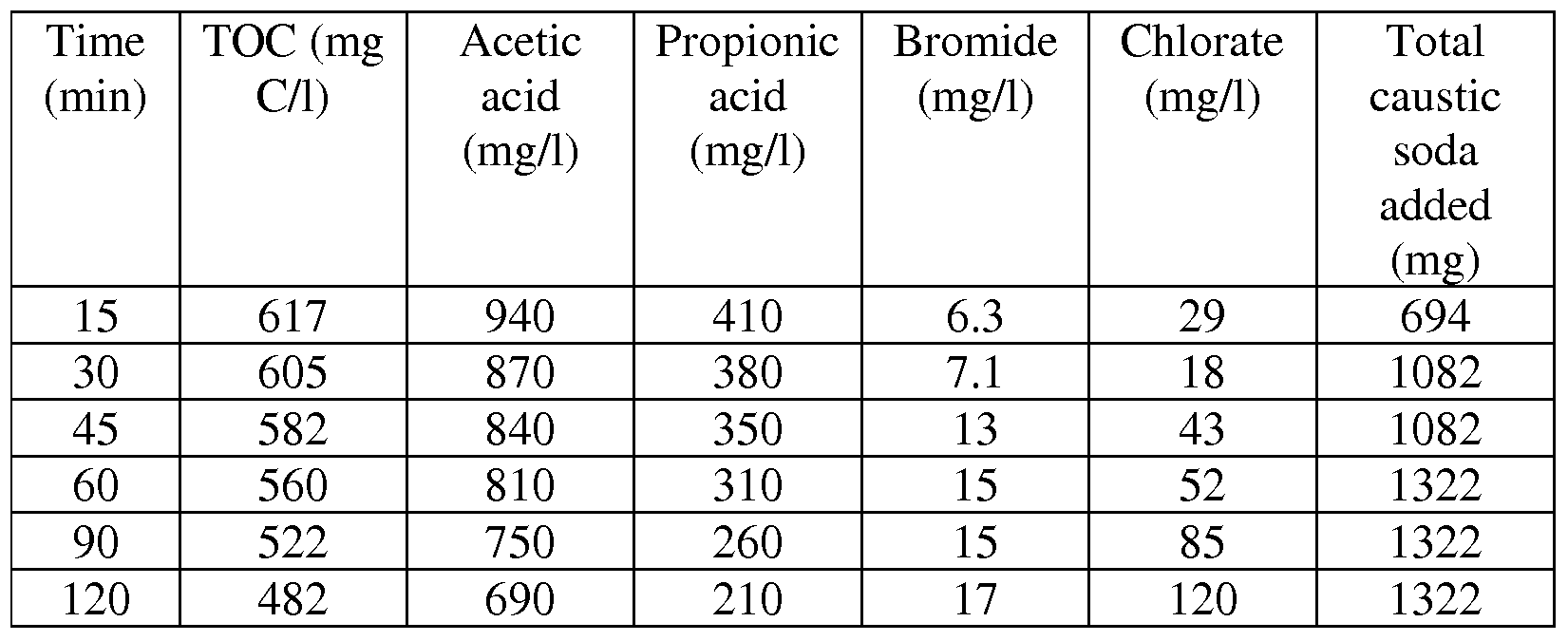


Claims
Priority Applications (6)
| Application Number | Priority Date | Filing Date | Title |
|---|---|---|---|
| CN200980103352.7A CN101925539B (en) | 2008-01-31 | 2009-01-29 | Process for degrading organic substances in aqueous composition |
| PL09705451T PL2240414T3 (en) | 2008-01-31 | 2009-01-29 | Process for degrading organic substances in an sodium chloride containing aqueous composition |
| EP09705451.4A EP2240414B1 (en) | 2008-01-31 | 2009-01-29 | Process for degrading organic substances in an sodium chloride containing aqueous composition |
| EA201070905A EA201070905A1 (en) | 2008-01-31 | 2009-01-29 | METHOD FOR DECOMPOSITION OF ORGANIC SUBSTANCES IN WATER COMPOSITION |
| US12/864,211 US8795536B2 (en) | 2008-01-31 | 2009-01-29 | Process for degrading organic substances in an aqueous composition |
| JP2010544692A JP2011510807A (en) | 2008-01-31 | 2009-01-29 | Method for decomposing organic substances in aqueous compositions |
Applications Claiming Priority (4)
| Application Number | Priority Date | Filing Date | Title |
|---|---|---|---|
| EP08150925.9 | 2008-01-31 | ||
| EP08150925A EP2085364A1 (en) | 2008-01-31 | 2008-01-31 | Process for degrading organic substances in an aqueous composition |
| EP08171544.3 | 2008-12-12 | ||
| EP08171544 | 2008-12-12 |
Publications (1)
| Publication Number | Publication Date |
|---|---|
| WO2009095429A1 true WO2009095429A1 (en) | 2009-08-06 |
Family
ID=40612803
Family Applications (1)
| Application Number | Title | Priority Date | Filing Date |
|---|---|---|---|
| PCT/EP2009/050982 Ceased WO2009095429A1 (en) | 2008-01-31 | 2009-01-29 | Process for degrading organic substances in an aqueous composition |
Country Status (9)
| Country | Link |
|---|---|
| US (1) | US8795536B2 (en) |
| EP (1) | EP2240414B1 (en) |
| JP (2) | JP2011510807A (en) |
| KR (1) | KR20100107513A (en) |
| CN (1) | CN101925539B (en) |
| EA (1) | EA201070905A1 (en) |
| PL (1) | PL2240414T3 (en) |
| TW (1) | TWI478875B (en) |
| WO (1) | WO2009095429A1 (en) |
Cited By (18)
| Publication number | Priority date | Publication date | Assignee | Title |
|---|---|---|---|---|
| WO2012016872A1 (en) | 2010-08-02 | 2012-02-09 | Solvay Sa | Electrolysis process |
| US8124814B2 (en) | 2006-06-14 | 2012-02-28 | Solvay (Societe Anonyme) | Crude glycerol-based product, process for its purification and its use in the manufacture of dichloropropanol |
| WO2012025468A1 (en) | 2010-08-27 | 2012-03-01 | Solvay Sa | Brine purification process |
| US8197665B2 (en) | 2007-06-12 | 2012-06-12 | Solvay (Societe Anonyme) | Aqueous composition containing a salt, manufacturing process and use |
| US8258350B2 (en) | 2007-03-07 | 2012-09-04 | Solvay (Societe Anonyme) | Process for the manufacture of dichloropropanol |
| US8273923B2 (en) | 2007-06-01 | 2012-09-25 | Solvay (Societe Anonyme) | Process for manufacturing a chlorohydrin |
| US8314205B2 (en) | 2007-12-17 | 2012-11-20 | Solvay (Societe Anonyme) | Glycerol-based product, process for obtaining same and use thereof in the manufacturing of dichloropropanol |
| US8378130B2 (en) | 2007-06-12 | 2013-02-19 | Solvay (Societe Anonyme) | Product containing epichlorohydrin, its preparation and its use in various applications |
| US8471074B2 (en) | 2007-03-14 | 2013-06-25 | Solvay (Societe Anonyme) | Process for the manufacture of dichloropropanol |
| WO2013092338A1 (en) | 2011-12-19 | 2013-06-27 | Solvay Sa | Process for reducing the total organic carbon of aqueous compositions |
| US8507643B2 (en) | 2008-04-03 | 2013-08-13 | Solvay S.A. | Composition comprising glycerol, process for obtaining same and use thereof in the manufacture of dichloropropanol |
| US8536381B2 (en) | 2008-09-12 | 2013-09-17 | Solvay Sa | Process for purifying hydrogen chloride |
| WO2013144227A1 (en) * | 2012-03-27 | 2013-10-03 | Industrie De Nora S.P.A. | Method and apparatus for the treatment of effluents from production plants of epoxy compounds |
| EP2669305A1 (en) | 2012-06-01 | 2013-12-04 | Solvay Sa | Process for manufacturing an epoxy resin |
| US8715568B2 (en) | 2007-10-02 | 2014-05-06 | Solvay Sa | Use of compositions containing silicon for improving the corrosion resistance of vessels |
| US9309209B2 (en) | 2010-09-30 | 2016-04-12 | Solvay Sa | Derivative of epichlorohydrin of natural origin |
| US9663427B2 (en) | 2003-11-20 | 2017-05-30 | Solvay (Société Anonyme) | Process for producing epichlorohydrin |
| WO2020020389A1 (en) | 2018-07-27 | 2020-01-30 | Spolek Pro Chemickou A Hutni Vyrobu, Akciova Spolecnost | Process to treat waste brine |
Families Citing this family (16)
| Publication number | Priority date | Publication date | Assignee | Title |
|---|---|---|---|---|
| KR20080037615A (en) | 2005-05-20 | 2008-04-30 | 솔베이(소시에떼아노님) | Method for producing chlorohydrin |
| BRPI0618325A2 (en) * | 2005-11-08 | 2011-08-23 | Solvay | process stop dichloropropanol production |
| TWI478875B (en) | 2008-01-31 | 2015-04-01 | Solvay | Process for degrading organic substances in an aqueous composition |
| KR20110080393A (en) * | 2010-01-05 | 2011-07-13 | 삼성전자주식회사 | Method for producing electrode for electrosorption deionization apparatus, electrode for electrosorption deionization apparatus and electrosorption deionization apparatus comprising the electrode |
| JP5752636B2 (en) * | 2012-04-17 | 2015-07-22 | 月島機械株式会社 | Water treatment method |
| US9084975B2 (en) * | 2012-08-20 | 2015-07-21 | Sabic Global Technologies B.V. | Real-time online determination of caustic in process scrubbers using near infrared spectroscopy and chemometrics |
| JP6284188B2 (en) * | 2014-04-14 | 2018-02-28 | 学校法人神奈川大学 | Method for decomposing fluorine organic compounds and apparatus for decomposing fluorine organic compounds |
| JP6318974B2 (en) * | 2014-08-20 | 2018-05-09 | 住友金属鉱山株式会社 | Treatment method of waste liquid containing triethanolamine |
| TWI583634B (en) * | 2016-10-18 | 2017-05-21 | 義芳化學工業股份有限公司 | A method for reducing chemical oxygen demand of the waste water |
| EP3351505A1 (en) * | 2017-01-20 | 2018-07-25 | Covestro Deutschland AG | Method for flexible control of the use of hydrochloric acid from chemical production |
| EP3351513A1 (en) * | 2017-01-20 | 2018-07-25 | Covestro Deutschland AG | Method and device for continuous hydrochloric acid neutralization |
| FR3070383B1 (en) * | 2017-08-31 | 2021-08-20 | Solable | WATER TREATMENT UNIT |
| CA3033255A1 (en) | 2019-02-04 | 2020-08-04 | Rodney HERRING | Photoreactor and formulations for environmental remediation and methods of use thereof |
| CN110615572A (en) * | 2019-09-29 | 2019-12-27 | 田雨春 | Organic wastewater treatment method |
| CN115947442B (en) * | 2021-10-08 | 2025-02-18 | 香港科技大学 | Method for in-situ formation of dichloro monoxide in high chlorine water environment |
| CN115093542B (en) * | 2022-07-20 | 2023-12-05 | 智仑超纯环氧树脂(西安)有限公司 | Method for reducing total chlorine content of epoxy resin, ultra-high purity epoxy resin and application thereof |
Citations (9)
| Publication number | Priority date | Publication date | Assignee | Title |
|---|---|---|---|---|
| US4220529A (en) | 1975-08-22 | 1980-09-02 | Produits Chimiques Ugine Kuhlmann | Oxidative purification of water |
| US4415460A (en) * | 1979-07-30 | 1983-11-15 | The Lummus Company | Oxidation of organics in aqueous salt solutions |
| EP0568389A1 (en) * | 1992-04-30 | 1993-11-03 | Tosoh Corporation | Process for removing oxidizable substance or reducible substance, composite supporting metal oxide or hydroxide, and process for production thereof |
| US5445741A (en) | 1992-12-30 | 1995-08-29 | Solvay Deutschland Gmbh | Process for treating waste water |
| GB2336584A (en) | 1998-04-21 | 1999-10-27 | Solvay | Process for the purification of brines |
| EP1106237A1 (en) | 1999-05-17 | 2001-06-13 | Mitsubishi Heavy Industries, Ltd. | Method for flue gas desulfurization and flue gas desulfurization system |
| US20030209490A1 (en) | 2002-05-13 | 2003-11-13 | Camp Carl Eugene | Organic sulfur reduction in wastewater |
| US20040232007A1 (en) | 2001-10-09 | 2004-11-25 | Carson Roger W | Mediated electrochemical oxidation of food waste materials |
| WO2008152043A1 (en) | 2007-06-12 | 2008-12-18 | Solvay (Société Anonyme) | Aqueous composition containing a salt, manufacturing process and use |
Family Cites Families (285)
| Publication number | Priority date | Publication date | Assignee | Title |
|---|---|---|---|---|
| US280893A (en) | 1883-07-10 | Treating waters containing glycerine obtained by the decomposition of fatty matters | ||
| DE197308C (en) | ||||
| DE238341C (en) | ||||
| DE58396C (en) | Dr. P. FRITSCH in Rostock i. M., Augustenstr. 40 | Process for the preparation of glycerides of aromatic acids | ||
| US3061615A (en) | 1962-10-30 | Process for the production of alpha-epichlorhydrin | ||
| DE197309C (en) | ||||
| DE1075103B (en) | 1960-02-11 | VEB Leuna-Werke "Walter Ulbricht", Leuna (Kr. Merseburg) | Process for the continuous production of epichlorohydrin from glycerine | |
| DE180668C (en) | ||||
| US865727A (en) | 1907-08-09 | 1907-09-10 | Augustin L J Queneau | Method of making and utilizing gas. |
| GB406345A (en) | 1931-08-24 | 1934-02-26 | Du Pont | Improvements in or relating to the production of formic acid |
| US2063891A (en) | 1932-07-15 | 1936-12-15 | Dreyfus Henry | Manufacture of chlorhydrins and their ethers |
| GB404938A (en) | 1932-07-15 | 1934-01-15 | Henry Dreyfus | Manufacture of chlorhydrins and ethers thereof |
| US2060715A (en) | 1933-01-13 | 1936-11-10 | Du Pont | Synthetic resins |
| GB467481A (en) | 1935-09-12 | 1937-06-14 | Eastman Kodak Co | Processes of removing water from aqueous aliphatic acids |
| US2198600A (en) | 1936-09-10 | 1940-04-30 | Dow Chemical Co | Glycerol dichlorohydrin |
| US2144612A (en) | 1936-09-10 | 1939-01-24 | Dow Chemical Co | Preparation of glycerol dichlorohydrin |
| BE422877A (en) | 1937-07-28 | 1937-08-31 | ||
| US2319876A (en) | 1937-12-04 | 1943-05-25 | Celanese Corp | Preparation of aromatic sulphonamide-phenol-dihalide reaction products |
| GB541357A (en) | 1939-02-24 | 1941-11-24 | Du Pont | Improvements in or relating to the production of glycerol |
| US2248635A (en) | 1939-06-20 | 1941-07-08 | Shell Dev | Treatment of halogenated polyhydric alcohols |
| NL59974C (en) | 1943-06-16 | |||
| DE869193C (en) | 1944-08-22 | 1953-03-05 | Chloberag Chlor Betr Rheinfeld | Process for purifying hydrogen chloride |
| US2463850A (en) | 1946-07-20 | 1949-03-08 | Standard Oil Dev Co | Process for the production of chlorohydrins |
| GB679536A (en) | 1947-06-11 | 1952-09-17 | Devoe & Raynolds Co | Improvements in epoxide preparation |
| US2505735A (en) | 1948-05-22 | 1950-04-25 | Harshaw Chem Corp | Purufication of crude glycerine |
| DE848799C (en) | 1948-12-23 | 1956-08-02 | Elektrochemische Werke Rheinfe | Device for the absorption of gases by liquids, in particular for the production of hydrochloric acid |
| GB702143A (en) | 1949-10-25 | 1954-01-13 | Hoechst Ag | Cold-hardening compositions containing phenol-formaldehyde condensation products, and a process for making such compositions |
| GB724222A (en) | 1951-06-23 | 1955-02-16 | Henkel & Cie Gmbh | Improvements in and relating to the separation of fatty acid mixtures |
| FR1056360A (en) | 1952-03-03 | 1954-02-26 | Alsthom Cgee | Method and devices for securing the axles of a vehicle, in particular for railway vehicles |
| US2735829A (en) | 1952-07-05 | 1956-02-21 | Compositions containing a mixture of | |
| GB758665A (en) | 1953-10-09 | 1956-10-10 | Petrochemicals Ltd | Process for the oxidation of mono-methyl naphthalenes |
| DE955233C (en) | 1954-02-19 | 1957-01-03 | Degussa | Process for the preparation of pentaerythritol trichlorohydrin |
| DE1041488B (en) | 1954-03-19 | 1958-10-23 | Huels Chemische Werke Ag | Process for the production of oxido alcohols |
| US2733195A (en) | 1954-09-01 | 1956-01-31 | Process for concentrating aqueous | |
| US2811227A (en) | 1955-01-20 | 1957-10-29 | Houdaille Industries Inc | Flutter damper |
| US2860146A (en) | 1955-04-14 | 1958-11-11 | Shell Dev | Manufacture of epihalohydrins |
| US2829124A (en) | 1955-12-23 | 1958-04-01 | Borden Co | Epoxide resin |
| GB799567A (en) | 1956-04-30 | 1958-08-13 | Solvay | Process for the production of alpha-epichlorhydrin |
| US2945004A (en) | 1956-05-29 | 1960-07-12 | Devoe & Raynolds Co | Epoxide resins reacted with polyhydric phenols |
| US2876217A (en) | 1956-12-31 | 1959-03-03 | Corn Products Co | Starch ethers containing nitrogen and process for making the same |
| US2960447A (en) | 1957-07-15 | 1960-11-15 | Shell Oil Co | Purification of synthetic glycerol |
| US3026270A (en) | 1958-05-29 | 1962-03-20 | Hercules Powder Co Ltd | Cross-linking of polymeric epoxides |
| US3135705A (en) | 1959-05-11 | 1964-06-02 | Hercules Powder Co Ltd | Polymeric epoxides |
| SU123153A3 (en) | 1958-11-18 | 1958-11-30 | Словак Гельмут | Method for continuous production of epichlorohydrin |
| US3052612A (en) | 1959-02-16 | 1962-09-04 | Olin Mathieson | Recovery of chlorine from electrol ysis of brine |
| US3158580A (en) | 1960-03-11 | 1964-11-24 | Hercules Powder Co Ltd | Poly (epihalohydrin) s |
| GB984446A (en) | 1960-07-05 | 1965-02-24 | Pfaudler Permutit Inc | Improvements relating to semicrystalline glass and to the coating of metal therewith |
| US3158581A (en) | 1960-07-27 | 1964-11-24 | Hercules Powder Co Ltd | Polymeric epoxides |
| NL270270A (en) | 1960-10-17 | |||
| FR1306231A (en) | 1960-10-17 | 1962-10-13 | Shell Int Research | Process for the preparation of glycidic polyethers |
| FR1279331A (en) | 1960-11-07 | 1961-12-22 | Electrochimie Soc | Process and manufacture of epoxy resins and products obtained |
| US3247227A (en) | 1962-04-24 | 1966-04-19 | Ott Chemical Company | Epoxidation of organic halohydrins |
| US3328331A (en) | 1963-01-22 | 1967-06-27 | Hoechst Ag | Epoxy resin masses and process for preparing them |
| US3341491A (en) | 1963-09-10 | 1967-09-12 | Hercules Inc | Vulcanized epihalohydrin polymers |
| FR1417388A (en) | 1963-10-21 | 1965-11-12 | Hooker Chemical Corp | Purification of hydrochloric acid |
| NL129282C (en) | 1963-10-21 | |||
| CH460734A (en) | 1963-11-19 | 1968-08-15 | Shell Int Research | Production of new epoxy ethers |
| DE1226554B (en) | 1964-06-06 | 1966-10-13 | Henkel & Cie Gmbh | Process for the production of glycid from glycerol monochlorohydrin |
| US3355511A (en) | 1965-04-09 | 1967-11-28 | Shell Oil Co | Flame retardant epoxy compositions containing polyglycidyl ethers of hexahalo bicycloheptadiene bisphenols |
| FR1476073A (en) | 1965-04-09 | 1967-04-07 | Shell Int Research | Epoxy resin retarding the propagation of flames |
| US3445197A (en) | 1966-05-27 | 1969-05-20 | Continental Oil Co | Removing benzene from aqueous muriatic acid using a liquid paraffin |
| US3457282A (en) | 1966-06-01 | 1969-07-22 | Olin Mathieson | Glycidol recovery process |
| DE1643497C3 (en) | 1967-09-02 | 1979-06-21 | Hoechst Ag, 6000 Frankfurt | Process for the production of glycidyl ethers of monohydric and polyhydric phenols |
| US3968178A (en) | 1967-11-08 | 1976-07-06 | Stauffer Chemical Company | Chlorination of hydrocarbons |
| DE1809607C3 (en) | 1968-11-19 | 1974-01-10 | Deutsche Gold- Und Silber-Scheideanstalt Vormals Roessler, 6000 Frankfurt | Process for the absorptive separation of mixtures of cyanogen chloride and hydrogen chloride obtained in the gas phase reaction of chlorine and hydrogen cyanide |
| BE744659A (en) | 1969-01-27 | 1970-07-01 | Haveg Industries Inc | COATED METAL ARTICLE AND METHOD FOR MANUFACTURING IT |
| US3867166A (en) | 1969-01-27 | 1975-02-18 | Tycon Spa | Coated metal article and method of making the same |
| CH544801A (en) | 1970-03-16 | 1973-11-30 | Reichhold Albert Chemie Ag | Process for the preparation of glycidyl ethers |
| US3711388A (en) | 1970-12-11 | 1973-01-16 | Dow Chemical Co | Oxidation step in electrolysis of aqueous hci |
| CH545778A (en) | 1971-03-26 | 1974-02-15 | ||
| US3839169A (en) | 1971-08-11 | 1974-10-01 | Dow Chemical Co | Photooxidizing organic contaminants in aqueous brine solutions |
| DE2143994A1 (en) | 1971-09-02 | 1973-03-15 | Bayer Ag | METHOD FOR PURIFICATION OF HYDROGEN CHLORINE |
| BE792326A (en) | 1971-12-07 | 1973-03-30 | Degussa | PROCESS FOR THE PREPARATION OF HALOGENOHYDRINS |
| DE2163096B2 (en) | 1971-12-18 | 1974-02-14 | Gutehoffnungshuette Sterkrade Ag, 4200 Oberhausen | Process for reheating a compressed gas stream above the dew point |
| LU67005A1 (en) | 1973-02-12 | 1974-10-01 | ||
| US4173710A (en) | 1972-05-15 | 1979-11-06 | Solvay & Cie | Halogenated polyether polyols and polyurethane foams produced therefrom |
| DE2241393A1 (en) | 1972-08-23 | 1974-02-28 | Bayer Ag | Polyglycidyl ethers of polyhydric phenols - esp of bisphenol A and epichloro-hydrin prepd in presence of ethanol or methanol |
| CH575405A5 (en) | 1973-02-15 | 1976-05-14 | Inventa Ag | |
| US3865886A (en) | 1973-06-20 | 1975-02-11 | Lummus Co | Production of allyl chloride |
| US4104434A (en) | 1974-01-30 | 1978-08-01 | Owens-Corning Fiberglas Corporation | Sizing composition and glass fibers sized therewith |
| CH593272A5 (en) | 1974-05-24 | 1977-11-30 | Inventa Ag | |
| LU70739A1 (en) | 1974-08-14 | 1976-08-19 | ||
| US4011251A (en) | 1975-03-13 | 1977-03-08 | Boris Konstantinovich Tjurin | Method of preparing esters of glycerol and polyglycerols and C5-C9 monocarboxylic fatty acids |
| US4024301A (en) | 1975-05-02 | 1977-05-17 | The B. F. Goodrich Company | Internally coated reaction vessel for use in olefinic polymerization |
| DE2522286C3 (en) | 1975-05-20 | 1978-05-18 | Hoechst Ag, 6000 Frankfurt | Process for the purification of crude hydrogen chloride |
| US3954581A (en) | 1975-07-22 | 1976-05-04 | Ppg Industries, Inc. | Method of electrolysis of brine |
| US4255470A (en) | 1977-07-15 | 1981-03-10 | The B. F. Goodrich Company | Process for preventing polymer buildup in a polymerization reactor |
| US4127594A (en) | 1978-02-21 | 1978-11-28 | Shell Oil Company | Selective hydrogenation of olefinic impurities in epichlorohydrin |
| FR2455580A1 (en) | 1979-05-04 | 1980-11-28 | Propylox Sa | PROCESS FOR THE PURIFICATION OF ORGANIC SOLUTIONS OF CARBOXYLIC PERACIDS |
| JPS55157607A (en) | 1979-05-25 | 1980-12-08 | Ryonichi Kk | Suspension polymerization of vinyl chloride |
| US4240885A (en) | 1979-07-30 | 1980-12-23 | The Lummus Company | Oxidation of organics in aqueous salt solutions |
| US4322367A (en) | 1979-11-26 | 1982-03-30 | Colgate-Palmolive Company | Deoiling of aqueous solutions of sodium lauryl sulfate |
| DE3003819A1 (en) | 1980-02-02 | 1981-08-13 | Basf Ag, 6700 Ludwigshafen | Electrode, esp. cathode for electrolysis of brine - has active coating of iron with specified nickel and/or cobalt content to reduce hydrogen overvoltage |
| US4309394A (en) | 1980-04-09 | 1982-01-05 | Monsanto Company | Method of preparing ultraphosphoric acid |
| US4609751A (en) | 1981-12-14 | 1986-09-02 | General Electric Company | Method of hydrolyzing chlorosilanes |
| US4390680A (en) | 1982-03-29 | 1983-06-28 | The Dow Chemical Company | Phenolic hydroxyl-containing compositions and epoxy resins prepared therefrom |
| US4405465A (en) | 1982-06-30 | 1983-09-20 | Olin Corporation | Process for the removal of chlorate and hypochlorite from spent alkali metal chloride brines |
| US4499255B1 (en) | 1982-09-13 | 2000-01-11 | Dow Chemical Co | Preparation of epoxy resins |
| SU1125226A1 (en) | 1982-10-15 | 1984-11-23 | Башкирский государственный научно-исследовательский и проектный институт нефтяной промышленности | Method for treating clayey drilling and plugging muds |
| DE3243617A1 (en) | 1982-11-25 | 1984-05-30 | Hermetic-Pumpen Gmbh, 7803 Gundelfingen | Pump for conveying highly corrosive media |
| US4595469A (en) | 1983-05-31 | 1986-06-17 | Chevron Research Company | Electrolytic process for production of gaseous hydrogen chloride and aqueous alkali metal hydroxide |
| SU1159716A1 (en) | 1983-07-13 | 1985-06-07 | Чувашский государственный университет им.И.Н.Ульянова | Binder for making heat-hardened moulds and cores |
| DE3339051A1 (en) | 1983-10-28 | 1985-05-09 | Henkel KGaA, 4000 Düsseldorf | METHOD FOR IMPROVED DISTILLATIVE WORKING UP OF GLYCERIN |
| JPS60258171A (en) | 1984-06-04 | 1985-12-20 | Showa Denko Kk | Preparation of epichlorohydrin |
| PL136598B2 (en) | 1984-07-11 | 1986-03-31 | Method of removing impurities in the form of organic chlorine compounds from hydrogen chloride | |
| US4599178A (en) | 1984-07-16 | 1986-07-08 | Shell Oil Company | Recovery of glycerine from saline waters |
| JPS61120688A (en) * | 1984-11-19 | 1986-06-07 | Tohoku Richo Kk | Treatment of high concentrated waste solution |
| US4560812A (en) | 1984-12-10 | 1985-12-24 | Shell Oil Company | Recovery of glycerine from saline waters |
| GB2173496B (en) | 1985-04-04 | 1989-01-05 | Inst Ciezkiej Syntezy Orga | Method for producing epichlorohydrin |
| JPH0737677B2 (en) | 1986-05-26 | 1995-04-26 | 日本鋼管株式会社 | Electrogalvanizing bath |
| DE3721003C1 (en) | 1987-06-25 | 1988-12-01 | Solvay Werke Gmbh | Process for the preparation of polyglycerols |
| DE3811826A1 (en) | 1987-06-25 | 1989-10-19 | Solvay Werke Gmbh | METHOD FOR PRODUCING POLYGLYCERINES |
| MX172267B (en) | 1987-11-13 | 1993-12-09 | Ppg Industries Inc | IMPROVEMENTS TO COATING COMPOSITIONS BASED ON POLYAXIDE AND POLYEPOXIDE SETTING AGENTS |
| CA1340155C (en) | 1987-11-13 | 1998-12-01 | Ppg Industries, Inc. | Coating composition based on polyepoxides and urethane-containing polyacid curing agents |
| DE3809882A1 (en) | 1988-03-24 | 1989-10-05 | Solvay Werke Gmbh | METHOD FOR PRODUCING POLYGLYCERINES |
| US4898644A (en) | 1988-05-02 | 1990-02-06 | Qo Chemicals, Inc. | Removal of volatile acids from aqueous solutions |
| DE3816783A1 (en) | 1988-05-17 | 1989-11-30 | Wacker Chemie Gmbh | METHOD FOR PURIFYING RAW, GASEOUS CHLORINE |
| US4882098A (en) | 1988-06-20 | 1989-11-21 | General Signal Corporation | Mass transfer mixing system especially for gas dispersion in liquids or liquid suspensions |
| KR900006513Y1 (en) | 1988-07-06 | 1990-07-26 | 주식회사 불티나종합상사 | Writer lock |
| CA1329782C (en) | 1988-08-09 | 1994-05-24 | Thomas Buenemann | Process for purifying crude glycerol |
| DE3842692A1 (en) | 1988-12-19 | 1990-06-21 | Solvay Werke Gmbh | METHOD FOR PRODUCING POLYGLYCERINES |
| US4936220A (en) * | 1989-07-03 | 1990-06-26 | The United States Of America As Represented By The Secretary Of The Army | Solid propellant-carrying caboted projectile |
| SU1685969A1 (en) | 1989-07-26 | 1991-10-23 | Всесоюзный научно-исследовательский и проектный институт галургии | Method for suppressing dust from water soluble salts |
| KR910007854A (en) | 1989-10-04 | 1991-05-30 | 리챠드 지. 워터만 | Method of producing monoepoxide |
| WO1991009924A1 (en) | 1989-12-29 | 1991-07-11 | The Procter & Gamble Company | Ultra mild surfactant with good lather |
| KR0168057B1 (en) | 1990-04-12 | 1999-03-20 | 베르너 발데크 | Process ror the preparation of epoxy resins |
| US5278260A (en) | 1990-04-12 | 1994-01-11 | Ciba-Geigy Corporation | Process for the preparation of epoxy resins with concurrent addition of glycidol and epihalohydrin |
| PL162910B1 (en) | 1990-05-24 | 1994-01-31 | Politechnika Szczecinska | Method of recovering hadrogen chloride and organic chlorine derivatives |
| JP2627100B2 (en) * | 1990-08-10 | 1997-07-02 | 株式会社オムコ | Method and apparatus for producing sterilized water |
| DE4039750A1 (en) | 1990-12-13 | 1992-06-17 | Basf Ag | METHOD FOR REMOVING PHOSGEN FROM EXHAUST GAS |
| FR2677643B1 (en) | 1991-06-12 | 1993-10-15 | Onidol | PROCESS FOR OBTAINING POLYGLYCEROLS AND ESTERS OF POLYGLYCEROLS. |
| IT1248564B (en) | 1991-06-27 | 1995-01-19 | Permelec Spa Nora | ELECTROCHEMICAL DECOMPOSITION OF NEUTRAL SALTS WITHOUT HALOGEN OR ACID CO-PRODUCTION AND ELECTROLYSIS CELL SUITABLE FOR ITS REALIZATION. |
| US5139622A (en) | 1991-10-03 | 1992-08-18 | Texaco Chemical Company | Purification of propylene oxide by extractive distillation |
| BE1005719A3 (en) | 1992-03-17 | 1993-12-28 | Solvay | Method for producing epichlorohydrin. |
| DE4210997C1 (en) | 1992-04-02 | 1993-01-14 | Krupp Vdm Gmbh, 5980 Werdohl, De | |
| DE4225870A1 (en) | 1992-08-05 | 1994-02-10 | Basf Ag | Process for the preparation of glycerol carbonate |
| EP0586998B1 (en) | 1992-09-06 | 1998-01-07 | Solvay Deutschland GmbH | Process for the treatment of waste water containing organic matter, especially chlorinated organic compounds from the production of epichlorohydrine |
| US5286354A (en) | 1992-11-30 | 1994-02-15 | Sachem, Inc. | Method for preparing organic and inorganic hydroxides and alkoxides by electrolysis |
| DE4302306A1 (en) | 1993-01-28 | 1994-08-04 | Erdoelchemie Gmbh | Reducing content of adsorbable organic halogen in waste water |
| DE4309741A1 (en) | 1993-03-25 | 1994-09-29 | Henkel Kgaa | Process for the preparation of diglycerin |
| EP0618170B1 (en) | 1993-03-31 | 1996-09-04 | Basf Corporation | Process for producing reagent grade hydrochloric acid from the manufacture of organic isocyanates |
| DE4314108A1 (en) | 1993-04-29 | 1994-11-03 | Solvay Deutschland | Process for the treatment of waste water containing organic and inorganic compounds, preferably from the production of epichlorohydrin |
| DE4335311A1 (en) | 1993-10-16 | 1995-04-20 | Chema Balcke Duerr Verfahrenst | Gas-introduction agitation system |
| US5532389A (en) | 1993-11-23 | 1996-07-02 | The Dow Chemical Company | Process for preparing alkylene oxides |
| DE4401635A1 (en) | 1994-01-21 | 1995-07-27 | Bayer Ag | Substituted 1,2,3,4-tetrahydro-5-nitro-pyrimidines |
| FR2723585B1 (en) | 1994-08-12 | 1996-09-27 | Rhone Poulenc Chimie | PROCESS FOR THE PREPARATION OF AROMATIC POLYISOCYANATE COMPOUNDS IN THE GASEOUS PHASE. |
| ATE174009T1 (en) | 1994-09-08 | 1998-12-15 | Solvay Umweltchemie Gmbh | METHOD FOR REMOVAL OF CHLORATE AND BROMATE COMPOUNDS FROM WATER BY CATALYTIC REDUCTION |
| US5486627A (en) | 1994-12-02 | 1996-01-23 | The Dow Chemical Company | Method for producing epoxides |
| US5578740A (en) | 1994-12-23 | 1996-11-26 | The Dow Chemical Company | Process for preparation of epoxy compounds essentially free of organic halides |
| US5731476A (en) | 1995-01-13 | 1998-03-24 | Arco Chemical Technology, L.P. | Poly ether preparation |
| JPH0975925A (en) * | 1995-09-18 | 1997-03-25 | Kurita Water Ind Ltd | Treatment of flue gas desulfurization wastewater |
| US6177599B1 (en) | 1995-11-17 | 2001-01-23 | Oxy Vinyls, L.P. | Method for reducing formation of polychlorinated aromatic compounds during oxychlorination of C1-C3 hydrocarbons |
| CN1101475C (en) | 1996-01-16 | 2003-02-12 | 中国科学院化工冶金研究所 | Method for recovering cobalt |
| US5766270A (en) | 1996-05-21 | 1998-06-16 | Tg Soda Ash, Inc. | Solution mining of carbonate/bicarbonate deposits to produce soda ash |
| US5744655A (en) | 1996-06-19 | 1998-04-28 | The Dow Chemical Company | Process to make 2,3-dihalopropanols |
| FR2752242B1 (en) | 1996-08-08 | 1998-10-16 | Inst Francais Du Petrole | PROCESS FOR THE MANUFACTURE OF ESTERS FROM VEGETABLE OR ANIMAL OILS AND ALCOHOLS |
| US5955043A (en) | 1996-08-29 | 1999-09-21 | Tg Soda Ash, Inc. | Production of sodium carbonate from solution mine brine |
| JP4392862B2 (en) | 1997-02-20 | 2010-01-06 | ゾルファイ ドイチュラント ゲゼルシャフト ミット ベシュレンクテル ハフツング | Method for removing chlorate ions from solution |
| US5879522A (en) * | 1997-08-22 | 1999-03-09 | The United States Of America As Represented By The Secretary Of The Air Force | Electrolysis cell |
| BE1011456A3 (en) | 1997-09-18 | 1999-09-07 | Solvay | METHOD OF MANUFACTURING an oxirane. |
| US6024839A (en) | 1997-11-06 | 2000-02-15 | Shell Oil Company | Hydroquinone to inhibit fouling of epichlorohydrin equipment |
| EP0916624B1 (en) | 1997-11-11 | 2001-07-25 | Kawasaki Steel Corporation | Porcelain-enameled steel sheets and frits for enameling |
| BE1011576A3 (en) | 1997-11-27 | 1999-11-09 | Solvay | Epichlorohydrin based product and method for manufacturing this product. |
| EP1042219A1 (en) | 1997-12-22 | 2000-10-11 | The Dow Chemical Company | Production of one or more useful products from lesser value halogenated materials |
| US6024829A (en) * | 1998-05-21 | 2000-02-15 | Lucent Technologies Inc. | Method of reducing agglomerate particles in a polishing slurry |
| FR2782277B1 (en) | 1998-08-11 | 2001-09-21 | Krebs Speichim | PROCESS AND DEVICE FOR PURIFYING BROMINE POLLUTED CHLORINE |
| US6103092A (en) | 1998-10-23 | 2000-08-15 | General Electric Company | Method for reducing metal ion concentration in brine solution |
| US6142458A (en) | 1998-10-29 | 2000-11-07 | General Signal Corporation | Mixing system for dispersion of gas into liquid media |
| KR100715882B1 (en) | 1998-12-18 | 2007-05-09 | 다우 글로벌 테크놀로지스 인크. | Method for preparing 2,3-dihalopropanol |
| US6111153A (en) | 1999-06-01 | 2000-08-29 | Dow Corning Corporation | Process for manufacturing methyl chloride |
| EP1059278B1 (en) | 1999-06-08 | 2004-12-01 | Showa Denko Kabushiki Kaisha | Process for producing epichlorohydrin and intermediate thereof |
| EP1200359B1 (en) | 1999-06-18 | 2004-02-25 | Bayer Aktiengesellschaft | Method of decomposing organic compounds in water |
| JP2001037469A (en) | 1999-07-27 | 2001-02-13 | Nissan Chem Ind Ltd | Biodegradation of epichlorohydrin |
| CN1119320C (en) | 1999-11-10 | 2003-08-27 | 中国石化集团齐鲁石油化工公司 | Process for separation of organic by-products of 3-chloro-2-hydroxypropyl trimethyl ammonium chloride |
| AU1935601A (en) | 1999-12-10 | 2001-06-18 | Inca International S.P.A. | Impeller draft tube agitation system for gas-liquid mixing in a stirred tank reactor |
| IL150129A0 (en) | 1999-12-16 | 2002-12-01 | Lilly Co Eli | Polypeptide compositions with improved stability |
| JP3712903B2 (en) | 2000-01-28 | 2005-11-02 | 花王株式会社 | Method for producing glycerin |
| JP3284347B2 (en) * | 2000-02-15 | 2002-05-20 | 東京都 | Removal of boron from wastewater with high salt concentration |
| JP4389327B2 (en) | 2000-03-16 | 2009-12-24 | 東亞合成株式会社 | How to recover hydrochloric acid |
| JP2001276572A (en) | 2000-04-04 | 2001-10-09 | Nkk Corp | Method and apparatus for decomposing harmful polyhalogenated compound |
| US6428759B1 (en) | 2000-05-02 | 2002-08-06 | Fmc Wyoming Corporation | Production of feed liquors for sodium carbonate crystallization processes |
| US6613127B1 (en) | 2000-05-05 | 2003-09-02 | Dow Global Technologies Inc. | Quench apparatus and method for the reformation of organic materials |
| CN1427879A (en) | 2000-05-05 | 2003-07-02 | 陶氏环球技术公司 | Refractory pressure vessel |
| JP5407100B2 (en) | 2000-05-08 | 2014-02-05 | 東ソー株式会社 | Purification method for inorganic salt containing organic substance and purified salt for salt electrolysis |
| US6740633B2 (en) | 2000-05-09 | 2004-05-25 | Basf Aktiengesellschaft | Polyelectrolyte complexes and a method for production thereof |
| JP3825959B2 (en) | 2000-06-16 | 2006-09-27 | キヤノン株式会社 | Pollutant decomposition method and apparatus |
| AU2001292985A1 (en) | 2000-09-28 | 2002-04-08 | Honeywell International, Inc. | Fluorination process |
| JP2002256494A (en) | 2000-12-28 | 2002-09-11 | Fuji Kogyo Co Ltd | Method of forming anodized film on magnesium alloy |
| EP1930318B1 (en) | 2001-01-22 | 2017-03-08 | Nippon Soda Co., Ltd. | Process for producing diphenyl sulfone compound |
| EP1229015B1 (en) | 2001-02-02 | 2007-01-10 | Nippon Shokubai Co., Ltd. | Method for production of aromatic compounds |
| EP1231189B2 (en) | 2001-02-08 | 2018-03-07 | Pfaudler GmbH | Highly corrosion-resistant enamel composition free from heavy metals, method for its production, use and coated bodies |
| JP4219608B2 (en) | 2001-04-05 | 2009-02-04 | 日本曹達株式会社 | Method for producing diphenylsulfone compound |
| DE10124386A1 (en) | 2001-05-18 | 2002-11-28 | Basf Ag | Distillation column for mixtures, with toxic component, has packing with variable inner geometry to form lower bubbling layer with dispersed gas phase and an upper film layer with a continuous gas phase |
| US6589497B2 (en) | 2001-06-13 | 2003-07-08 | Fmc Wyoming Corporation | Process for preparing soda ash from solution mined bicarbonate brines |
| EP1411027A4 (en) | 2001-06-28 | 2009-07-29 | Sumitomo Chemical Co | CHLORINE PURIFICATION METHOD AND PROCESS FOR PRODUCING 1,2-DICHLOROETHANE |
| JP2003081891A (en) | 2001-06-28 | 2003-03-19 | Sumitomo Chem Co Ltd | Method for producing 1,2-dichloroethane |
| US6794478B2 (en) | 2001-09-28 | 2004-09-21 | Dainippon Ink And Chemicals, Inc. | Preparing epoxy resin by distilling two fractions to recover and reuse epihalohydrin without glycidol |
| TW200300131A (en) * | 2001-11-08 | 2003-05-16 | Nihon Parkerizing | Process for treating hydrogen ion-containing waste liquid |
| US6806396B2 (en) | 2001-12-18 | 2004-10-19 | E. I. Du Pont De Nemours And Company | Disposal of fluoroform (HFC-23) |
| JP3981556B2 (en) | 2001-12-20 | 2007-09-26 | 株式会社トクヤマ | Method for producing methyl chloride |
| JP2003206473A (en) | 2002-01-15 | 2003-07-22 | Mitsubishi Heavy Ind Ltd | Sealing material and cracker for organic halogen compound utilizing the sealing material |
| DE10203914C1 (en) | 2002-01-31 | 2003-10-02 | Degussa | Recovery of hydrogen chloride, used directly as raw material e.g. in chlorosilane production, involves cooling waste gas from organosilane ester production from chlorosilane and alcohol and/or glycol without condensing hydrogen chloride |
| DE10207442A1 (en) | 2002-02-22 | 2003-09-11 | Bayer Ag | Treatment of waste water containing table salt for use in chlor-alkali electrolysis |
| US6719957B2 (en) | 2002-04-17 | 2004-04-13 | Bayer Corporation | Process for purification of anhydrous hydrogen chloride gas |
| US6745726B2 (en) | 2002-07-29 | 2004-06-08 | Visteon Global Technologies, Inc. | Engine thermal management for internal combustion engine |
| DE10235476A1 (en) | 2002-08-02 | 2004-02-12 | Basf Ag | Integrated process for the production of isocyanates |
| US7037481B2 (en) | 2002-09-09 | 2006-05-02 | United Brine Services Company, Llc | Production of ultra pure salt |
| JP2004130263A (en) | 2002-10-11 | 2004-04-30 | Kao Corp | Hypochlorous acid generating sprayer |
| DE10254709A1 (en) | 2002-11-23 | 2004-06-09 | Reinhold Denz | Electrolysis assembly has series of enclosed tanks each with electrode electrically linked in cascade arrangement to adjacent electrode |
| DE10260084A1 (en) | 2002-12-19 | 2004-07-01 | Basf Ag | Separation of a mixture of hydrogen chloride and phosgene |
| JP2004216246A (en) | 2003-01-14 | 2004-08-05 | Toshiba Corp | High frequency plasma processing apparatus and high frequency plasma processing method |
| CZ20032346A3 (en) | 2003-09-01 | 2005-04-13 | Spolek Pro Chemickou A Hutní Výrobu,A.S. | Process for preparing dichloropropanols from glycerin |
| EP2053034B1 (en) | 2003-11-20 | 2018-01-24 | Solvay Sa | Process for producing a chlorohydrin |
| ES2367572T3 (en) | 2003-11-20 | 2011-11-04 | Solvay (Société Anonyme) | PROCESS FOR PRODUCTION OF DICLOROPROPANOL FROM GLICEROL AND A CHLORIDED AGENT AND IN THE PRESENCE OF A SELECTED CATALYST OF ADYPIC ACID AND GLUTARIC ACID. |
| FR2862644B1 (en) | 2003-11-20 | 2007-01-12 | Solvay | USE OF RENEWABLE RESOURCES |
| FR2868419B1 (en) | 2004-04-05 | 2008-08-08 | Solvay Sa Sa Belge | PROCESS FOR PRODUCING DICHLOROPROPANOL |
| JP4398706B2 (en) | 2003-11-21 | 2010-01-13 | 花王株式会社 | Method for producing acyloxybenzene sulfonate |
| GB0402221D0 (en) | 2004-02-02 | 2004-03-03 | L & L Products Inc | Improvements in or relating to composite materials |
| JP2005224771A (en) | 2004-02-16 | 2005-08-25 | Mitsubishi Heavy Ind Ltd | Wastewater treatment apparatus |
| AU2005218690A1 (en) * | 2004-03-10 | 2005-09-15 | Trojan Technologies Inc. | System for predicting reduction in concentration of a target material in a flow of fluid |
| EP1593732A1 (en) | 2004-05-03 | 2005-11-09 | Institut Français du Pétrole | Process for the transesterification of plant or animal oil using a catalyst based on zinc or bismuth, titanium and aluminium |
| FR2869613B1 (en) | 2004-05-03 | 2008-08-29 | Inst Francais Du Petrole | PROCESS FOR THE TRANSESTERIFICATION OF VEGETABLE OR ANIMAL OILS USING HETEROGENEOUS CATALYSTS BASED ON BISMUTH, TITANIUM AND ALUMINUM |
| FR2869612B1 (en) | 2004-05-03 | 2008-02-01 | Inst Francais Du Petrole | PROCESS FOR THE TRANSESTERIFICATION OF VEGETABLE OR ANIMAL OILS USING HETEROGENEOUS CATALYSTS BASED ON ZINC, TITANIUM AND ALUMINUM |
| FR2872504B1 (en) | 2004-06-30 | 2006-09-22 | Arkema Sa | PURIFICATION OF THE HYDROCHLORIC ACID BY-PRODUCT OF THE SYNTHESIS OF METHANE SULFONIC ACID |
| CN102516205B (en) | 2004-07-21 | 2016-05-04 | 兰科知识产权有限责任公司 | Multihydroxylated-aliphatic hydrocarbon or its ester are to the conversion of chloropharin |
| JP2006052434A (en) | 2004-08-10 | 2006-02-23 | Kaneka Corp | Method for recovering capability of salt solution electrolysis cell, and method for producing raw caustic soda solution and chlorine using fluorine-containing cation-exchange membrane treated by the method |
| EP1632558A1 (en) | 2004-09-06 | 2006-03-08 | The Procter & Gamble | A composition comprising a surface deposition enhancing cationic polymer |
| DE102004044592A1 (en) | 2004-09-13 | 2006-03-30 | Basf Ag | Process for the separation of hydrogen chloride and phosgene |
| JP2008516048A (en) | 2004-10-08 | 2008-05-15 | ザ プロクター アンド ギャンブル カンパニー | Oligomer alkyl glyceryl sulfonate and / or sulfate surfactant mixture and detergent composition comprising the same |
| DE102004058405B4 (en) * | 2004-12-03 | 2008-03-13 | Delta Uv Service Systeme | Device for UV irradiation of absorbing liquids in the flow |
| FR2881732B1 (en) | 2005-02-08 | 2007-11-02 | Solvay | PROCESS FOR THE PURIFICATION OF HYDROGEN CHLORIDE |
| TW200630385A (en) | 2005-02-09 | 2006-09-01 | Vinnolit Gmbh & Co Kg | Process for the polymerisation of vinyl-containing monomers |
| KR20070114119A (en) * | 2005-02-23 | 2007-11-29 | 비타 인코포레이티드 | Method and apparatus for producing sterilized water mainly composed of hypochlorous acid or chlorite |
| JP4915761B2 (en) * | 2005-03-25 | 2012-04-11 | 株式会社竹中工務店 | Flowing water electrolyzer |
| TWI333945B (en) | 2005-05-20 | 2010-12-01 | Solvay | Process for preparing a chlorohydrin by converting polyhydroxylated aliphatic hydrocarbons |
| KR20080037615A (en) | 2005-05-20 | 2008-04-30 | 솔베이(소시에떼아노님) | Method for producing chlorohydrin |
| EP1762556A1 (en) | 2005-05-20 | 2007-03-14 | SOLVAY (Société Anonyme) | Process for producing dichloropropanol from glycerol |
| FR2885903B1 (en) | 2005-05-20 | 2015-06-26 | Solvay | PROCESS FOR THE PRODUCTION OF EPICHLORHYDRIN |
| JP4904730B2 (en) | 2005-07-04 | 2012-03-28 | 住友化学株式会社 | Separation and recovery of aromatic compounds and hydrogen chloride |
| US7453008B2 (en) | 2005-08-23 | 2008-11-18 | Lg Chem Ltd. | Synthetic method of glycol diesters from reaction of glycol monoesters and linear aliphatic carboxylic acids |
| BRPI0618325A2 (en) | 2005-11-08 | 2011-08-23 | Solvay | process stop dichloropropanol production |
| JP4920255B2 (en) * | 2006-01-12 | 2012-04-18 | 三菱重工環境・化学エンジニアリング株式会社 | Water treatment method and system |
| US7126032B1 (en) | 2006-03-23 | 2006-10-24 | Sunoco, Inc. (R&M) | Purification of glycerin |
| WO2007130851A2 (en) | 2006-04-29 | 2007-11-15 | Electrolytic Technologies Corporation | Process for the on-site production of chlorine and high strength hypochlorite |
| US20080021209A1 (en) | 2006-06-01 | 2008-01-24 | New Jersey Institute Of Technology | Ethers of bisanhydrohexitols |
| US7619056B2 (en) | 2006-06-02 | 2009-11-17 | New Jersey Institute Of Technology | Thermoset epoxy polymers from renewable resources |
| BRPI0712775A2 (en) | 2006-06-14 | 2012-09-04 | Solvay | PRODUCT BASED ON RAW GLYCEROL, AND, PROCESSES FOR PURIFICATION OF PRODUCT BASED ON RAW GLYCEROL, FOR THE MANUFACTURING OF DICHLOROPROPANOL STARTING FROM GLYCEROL, FOR THE MANUFACTURING OF EPOCCHLOROHYDRIN, FOR THE MANUFACTURING OF EPOXY RESINS, AND FOR THE MANUFACTURING DICHLOROPROPANOL |
| FR2913683A1 (en) | 2007-03-15 | 2008-09-19 | Solvay | Crude glycerol-based product useful for producing dichloropropanol which is useful for producing epichlorohydrin and epoxy resins comprises glycerol alkyl ethers in specified amounts |
| DE102006041465A1 (en) | 2006-09-02 | 2008-03-06 | Bayer Materialscience Ag | Process for the preparation of diaryl carbonate |
| US20100032617A1 (en) | 2007-02-20 | 2010-02-11 | Solvay (Societe Anonyme) | Process for manufacturing epichlorohydrin |
| FR2912743B1 (en) | 2007-02-20 | 2009-04-24 | Solvay | PROCESS FOR THE PRODUCTION OF EPICHLORHYDRIN |
| FR2913421B1 (en) | 2007-03-07 | 2009-05-15 | Solvay | PROCESS FOR PRODUCING DICHLOROPROPANOL |
| FR2913684B1 (en) | 2007-03-14 | 2012-09-14 | Solvay | PROCESS FOR PRODUCING DICHLOROPROPANOL |
| CN101041421A (en) | 2007-03-22 | 2007-09-26 | 广东富远稀土新材料股份有限公司 | Method for industrial hydrochloric acid purification by liquid extraction |
| TW200911740A (en) | 2007-06-01 | 2009-03-16 | Solvay | Process for manufacturing a chlorohydrin |
| TWI500609B (en) | 2007-06-12 | 2015-09-21 | Solvay | Product containing epichlorohydrin, its preparation and its use in various applications |
| FR2917411B1 (en) | 2007-06-12 | 2012-08-03 | Solvay | EPICHLORHYDRIN, PROCESS FOR PRODUCTION AND USE |
| FR2918058A1 (en) | 2007-06-28 | 2009-01-02 | Solvay | GLYCEROL-BASED PRODUCT, PROCESS FOR ITS PURIFICATION AND USE IN THE MANUFACTURE OF DICHLOROPROPANOL |
| FR2919609A1 (en) | 2007-07-30 | 2009-02-06 | Solvay | PROCESS FOR PRODUCING GLYCIDOL |
| BRPI0814904A2 (en) | 2007-08-23 | 2015-02-03 | Dow Global Technologies Inc | PROCESS TO REDUCE ORGANIC CONTENT OF A PICKLE SOLUTION |
| KR20100089835A (en) | 2007-10-02 | 2010-08-12 | 솔베이(소시에떼아노님) | Use of compositions containing silicon for improving the corrosion resistance of vessels |
| DE102007058701A1 (en) | 2007-12-06 | 2009-06-10 | Bayer Materialscience Ag | Process for the preparation of diaryl carbonate |
| FR2925045B1 (en) | 2007-12-17 | 2012-02-24 | Solvay | GLYCEROL-BASED PRODUCT, PROCESS FOR OBTAINING THE SAME AND USE THEREOF IN THE MANUFACTURE OF DICHLOROPROPANOL |
| TWI478875B (en) | 2008-01-31 | 2015-04-01 | Solvay | Process for degrading organic substances in an aqueous composition |
| EP2085364A1 (en) | 2008-01-31 | 2009-08-05 | SOLVAY (Société Anonyme) | Process for degrading organic substances in an aqueous composition |
| FR2927083B1 (en) | 2008-02-01 | 2011-04-01 | Roquette Freres | PROCESS FOR PREPARING THERMOPLASTIC COMPOSITIONS BASED ON SOLUBLE AMYLACEOUS MATERIAL. |
| FR2927084B1 (en) | 2008-02-01 | 2011-02-25 | Roquette Freres | PROCESS FOR THE PREPARATION OF THERMOPLASTIC COMPOSITIONS BASED ON PLASTICIZED STARCH AND COMPOSITIONS THUS OBTAINED |
| FR2927087B1 (en) | 2008-02-01 | 2011-02-11 | Roquette Freres | SOLUBLE STARCH THERMOPLASTIC COMPOSITIONS AND PROCESS FOR PREPARING SUCH COMPOSITIONS. |
| FR2927088B1 (en) | 2008-02-01 | 2011-02-25 | Roquette Freres | PLASTICIZED STARCH THERMOPLASTIC COMPOSITIONS AND PROCESS FOR THE PREPARATION OF SUCH COMPOSITIONS. |
| JP2009263338A (en) | 2008-03-12 | 2009-11-12 | Daiso Co Ltd | Novel manufacturing method of epichlorohydrin |
| FR2929611B3 (en) | 2008-04-03 | 2010-09-03 | Solvay | COMPOSITION COMPRISING GLYCEROL, PROCESS FOR OBTAINING THE SAME AND USE THEREOF IN THE MANUFACTURE OF DICHLOROPROPANOL |
| EA201071157A1 (en) | 2008-04-03 | 2011-04-29 | Солвей (Сосьете Аноним) | COMPOSITION CONTAINING GLYCERIN, METHOD OF ITS RECEPTION AND APPLICATION IN PRODUCTION OF DICHLORPROPANOL |
| FR2932488B1 (en) | 2008-06-13 | 2012-10-26 | Roquette Freres | CIPO - Patent - 2581626 Canadian Intellectual Property Office Symbol of the Government of Canada CA 2461392 STARCH - BASED THERMOPLASTIC OR ELASTOMERIC COMPOSITIONS AND PROCESS FOR THE PREPARATION OF SUCH COMPOSITIONS. |
| FR2934272B1 (en) | 2008-07-24 | 2013-08-16 | Roquette Freres | PROCESS FOR THE PREPARATION OF COMPOSITIONS BASED ON AMYLACEOUS MATERIAL AND SYNTHETIC POLYMER |
| TWI368616B (en) | 2008-08-01 | 2012-07-21 | Dow Global Technologies Llc | Process for producing epoxides |
| FR2935699A1 (en) | 2008-09-10 | 2010-03-12 | Solvay | PROCESS FOR PRODUCING A CHEMICAL |
| FR2935968B1 (en) | 2008-09-12 | 2010-09-10 | Solvay | PROCESS FOR THE PURIFICATION OF HYDROGEN CHLORIDE |
| FR2937040B1 (en) | 2008-10-13 | 2012-07-27 | Roquette Freres | THERMOPLASTIC OR ELASTOMERIC COMPOSITIONS BASED ON ESTERS OF AMYLACEOUS MATERIAL AND PROCESS FOR PREPARING SUCH COMPOSITIONS |
| FR2939434B1 (en) | 2008-12-08 | 2012-05-18 | Solvay | PROCESS FOR TREATING GLYCEROL |
| FR2946049B1 (en) | 2009-05-27 | 2013-01-18 | Chaire Europ De Chimie Nouvelle Pour Un Dev Durable | NATURAL PHENOLIC COMPOUNDS AND THEIR ACTIVATION MODE FOR THE FORMULATION OF THERMOSETTING RESINS |
| EP2496625A1 (en) | 2009-11-04 | 2012-09-12 | Solvay Sa | Process for manufacturing an epoxy resin |
| FR2952060B1 (en) | 2009-11-04 | 2011-11-18 | Solvay | PROCESS FOR THE PRODUCTION OF A PRODUCT DERIVED FROM EPICHLORHYDRIN |
| FR2963338B1 (en) | 2010-08-02 | 2014-10-24 | Solvay | ELECTROLYSIS METHOD |
| FR2964096A1 (en) | 2010-08-27 | 2012-03-02 | Solvay | PROCESS FOR PURIFYING BRINE |
| EP2621911A1 (en) | 2010-09-30 | 2013-08-07 | Solvay Sa | Derivative of epichlorohydrin of natural origin |
-
2009
- 2009-01-22 TW TW098102619A patent/TWI478875B/en not_active IP Right Cessation
- 2009-01-29 JP JP2010544692A patent/JP2011510807A/en active Pending
- 2009-01-29 EP EP09705451.4A patent/EP2240414B1/en not_active Not-in-force
- 2009-01-29 WO PCT/EP2009/050982 patent/WO2009095429A1/en not_active Ceased
- 2009-01-29 CN CN200980103352.7A patent/CN101925539B/en active Active
- 2009-01-29 PL PL09705451T patent/PL2240414T3/en unknown
- 2009-01-29 KR KR1020107019199A patent/KR20100107513A/en not_active Ceased
- 2009-01-29 EA EA201070905A patent/EA201070905A1/en unknown
- 2009-01-29 US US12/864,211 patent/US8795536B2/en not_active Expired - Fee Related
-
2013
- 2013-11-05 JP JP2013229095A patent/JP5792260B2/en active Active
Patent Citations (9)
| Publication number | Priority date | Publication date | Assignee | Title |
|---|---|---|---|---|
| US4220529A (en) | 1975-08-22 | 1980-09-02 | Produits Chimiques Ugine Kuhlmann | Oxidative purification of water |
| US4415460A (en) * | 1979-07-30 | 1983-11-15 | The Lummus Company | Oxidation of organics in aqueous salt solutions |
| EP0568389A1 (en) * | 1992-04-30 | 1993-11-03 | Tosoh Corporation | Process for removing oxidizable substance or reducible substance, composite supporting metal oxide or hydroxide, and process for production thereof |
| US5445741A (en) | 1992-12-30 | 1995-08-29 | Solvay Deutschland Gmbh | Process for treating waste water |
| GB2336584A (en) | 1998-04-21 | 1999-10-27 | Solvay | Process for the purification of brines |
| EP1106237A1 (en) | 1999-05-17 | 2001-06-13 | Mitsubishi Heavy Industries, Ltd. | Method for flue gas desulfurization and flue gas desulfurization system |
| US20040232007A1 (en) | 2001-10-09 | 2004-11-25 | Carson Roger W | Mediated electrochemical oxidation of food waste materials |
| US20030209490A1 (en) | 2002-05-13 | 2003-11-13 | Camp Carl Eugene | Organic sulfur reduction in wastewater |
| WO2008152043A1 (en) | 2007-06-12 | 2008-12-18 | Solvay (Société Anonyme) | Aqueous composition containing a salt, manufacturing process and use |
Non-Patent Citations (4)
| Title |
|---|
| "Perry's Chemical Engineers' Handbook", 1997 |
| "Ullmaiin's Encyclopedia of Industrial Chemistry,®", 2005, WILEY-VCH VERLAG GMBH & CO., pages: 8 - 15 |
| "Ullmann's Encyclopedia of lndustrial Chemistry,C", 2005, WILEY-VCH VERLAG GMBH & CO. KGAA, pages: 24 - 27 |
| D. F. LAINE ET AL: "The destruction of organic pollutants under mild reaction conditions: A review", MICROCHEMICAL JOURNAL, vol. 85, no. 2, 17 August 2006 (2006-08-17) - April 2007 (2007-04-01), pages 183 - 193, XP002528281, Retrieved from the Internet <URL:http://www.sciencedirect.com/science> [retrieved on 20090515], DOI: doi:10.1016/j.microc.2006.07.002 * |
Cited By (27)
| Publication number | Priority date | Publication date | Assignee | Title |
|---|---|---|---|---|
| US9663427B2 (en) | 2003-11-20 | 2017-05-30 | Solvay (Société Anonyme) | Process for producing epichlorohydrin |
| US8124814B2 (en) | 2006-06-14 | 2012-02-28 | Solvay (Societe Anonyme) | Crude glycerol-based product, process for its purification and its use in the manufacture of dichloropropanol |
| US8258350B2 (en) | 2007-03-07 | 2012-09-04 | Solvay (Societe Anonyme) | Process for the manufacture of dichloropropanol |
| US8471074B2 (en) | 2007-03-14 | 2013-06-25 | Solvay (Societe Anonyme) | Process for the manufacture of dichloropropanol |
| US8273923B2 (en) | 2007-06-01 | 2012-09-25 | Solvay (Societe Anonyme) | Process for manufacturing a chlorohydrin |
| US8197665B2 (en) | 2007-06-12 | 2012-06-12 | Solvay (Societe Anonyme) | Aqueous composition containing a salt, manufacturing process and use |
| US8378130B2 (en) | 2007-06-12 | 2013-02-19 | Solvay (Societe Anonyme) | Product containing epichlorohydrin, its preparation and its use in various applications |
| US8399692B2 (en) | 2007-06-12 | 2013-03-19 | Solvay (Societe Anonyme) | Epichlorohydrin, manufacturing process and use |
| US8715568B2 (en) | 2007-10-02 | 2014-05-06 | Solvay Sa | Use of compositions containing silicon for improving the corrosion resistance of vessels |
| US8314205B2 (en) | 2007-12-17 | 2012-11-20 | Solvay (Societe Anonyme) | Glycerol-based product, process for obtaining same and use thereof in the manufacturing of dichloropropanol |
| US8507643B2 (en) | 2008-04-03 | 2013-08-13 | Solvay S.A. | Composition comprising glycerol, process for obtaining same and use thereof in the manufacture of dichloropropanol |
| US8536381B2 (en) | 2008-09-12 | 2013-09-17 | Solvay Sa | Process for purifying hydrogen chloride |
| WO2012016872A1 (en) | 2010-08-02 | 2012-02-09 | Solvay Sa | Electrolysis process |
| WO2012025468A1 (en) | 2010-08-27 | 2012-03-01 | Solvay Sa | Brine purification process |
| US9309209B2 (en) | 2010-09-30 | 2016-04-12 | Solvay Sa | Derivative of epichlorohydrin of natural origin |
| WO2013092338A1 (en) | 2011-12-19 | 2013-06-27 | Solvay Sa | Process for reducing the total organic carbon of aqueous compositions |
| CN104080737A (en) * | 2011-12-19 | 2014-10-01 | 索尔维公司 | Process for reducing the total organic carbon of aqueous compositions |
| KR20140139084A (en) * | 2012-03-27 | 2014-12-04 | 인두스트리에 데 노라 에스.피.에이. | Method and apparatus for the treatment of effluents from production plants of epoxy compounds |
| CN104169223A (en) * | 2012-03-27 | 2014-11-26 | 德诺拉工业有限公司 | Method and apparatus for the treatment of effluents from production plants of epoxy compounds |
| JP2015520295A (en) * | 2012-03-27 | 2015-07-16 | インドゥストリエ・デ・ノラ・ソチエタ・ペル・アツィオーニ | Method and apparatus for treating an effluent stream from an epoxy compound production plant |
| AU2013241820B2 (en) * | 2012-03-27 | 2017-01-19 | Industrie De Nora S.P.A. | Method and apparatus for the treatment of effluents from production plants of epoxy compounds |
| EA026299B1 (en) * | 2012-03-27 | 2017-03-31 | Индустрие Де Нора С.П.А. | Method and apparatus for the treatment of effluents from production plants of epoxy compounds |
| WO2013144227A1 (en) * | 2012-03-27 | 2013-10-03 | Industrie De Nora S.P.A. | Method and apparatus for the treatment of effluents from production plants of epoxy compounds |
| KR102031015B1 (en) * | 2012-03-27 | 2019-10-11 | 인두스트리에 데 노라 에스.피.에이. | Method and apparatus for the treatment of effluents from production plants of epoxy compounds |
| US10883184B2 (en) | 2012-03-27 | 2021-01-05 | Industrie De Nora S.P.A. | Method and apparatus for treatment of effluents from production plants of epoxy compounds |
| EP2669305A1 (en) | 2012-06-01 | 2013-12-04 | Solvay Sa | Process for manufacturing an epoxy resin |
| WO2020020389A1 (en) | 2018-07-27 | 2020-01-30 | Spolek Pro Chemickou A Hutni Vyrobu, Akciova Spolecnost | Process to treat waste brine |
Also Published As
| Publication number | Publication date |
|---|---|
| US8795536B2 (en) | 2014-08-05 |
| PL2240414T3 (en) | 2014-04-30 |
| JP2011510807A (en) | 2011-04-07 |
| TWI478875B (en) | 2015-04-01 |
| CN101925539B (en) | 2014-03-12 |
| EA201070905A1 (en) | 2011-02-28 |
| JP2014028372A (en) | 2014-02-13 |
| KR20100107513A (en) | 2010-10-05 |
| US20100294727A1 (en) | 2010-11-25 |
| EP2240414A1 (en) | 2010-10-20 |
| CN101925539A (en) | 2010-12-22 |
| JP5792260B2 (en) | 2015-10-07 |
| EP2240414B1 (en) | 2013-11-13 |
| TW200944480A (en) | 2009-11-01 |
Similar Documents
| Publication | Publication Date | Title |
|---|---|---|
| US8795536B2 (en) | Process for degrading organic substances in an aqueous composition | |
| JP5259702B2 (en) | Aqueous composition containing salt, process and use | |
| US5385650A (en) | Recovery of bromine and preparation of hypobromous acid from bromide solution | |
| US20100206744A1 (en) | Brine purification | |
| EP2085364A1 (en) | Process for degrading organic substances in an aqueous composition | |
| CN103052596B (en) | electrolytic method | |
| US20100193443A1 (en) | Total organic carbon (toc) reduction in brine via chlorinolysis | |
| CN109563632B (en) | Electrochemical purification of chloride-containing process solutions | |
| WO2019158463A1 (en) | Process for the work-up and reuse of salt-containing process water | |
| WO2013092338A1 (en) | Process for reducing the total organic carbon of aqueous compositions | |
| HK1149541A (en) | Process for degrading organic substances in an aqueous composition |
Legal Events
| Date | Code | Title | Description |
|---|---|---|---|
| WWE | Wipo information: entry into national phase |
Ref document number: 200980103352.7 Country of ref document: CN |
|
| 121 | Ep: the epo has been informed by wipo that ep was designated in this application |
Ref document number: 09705451 Country of ref document: EP Kind code of ref document: A1 |
|
| WWE | Wipo information: entry into national phase |
Ref document number: 12864211 Country of ref document: US |
|
| WWE | Wipo information: entry into national phase |
Ref document number: 2009705451 Country of ref document: EP |
|
| WWE | Wipo information: entry into national phase |
Ref document number: 2010544692 Country of ref document: JP |
|
| NENP | Non-entry into the national phase |
Ref country code: DE |
|
| WWE | Wipo information: entry into national phase |
Ref document number: PI 2010003333 Country of ref document: MY |
|
| WWE | Wipo information: entry into national phase |
Ref document number: 5309/CHENP/2010 Country of ref document: IN |
|
| ENP | Entry into the national phase |
Ref document number: 20107019199 Country of ref document: KR Kind code of ref document: A |
|
| WWE | Wipo information: entry into national phase |
Ref document number: 201070905 Country of ref document: EA |