[go: up one dir, main page]

WO2007096576A1 - Herbicidal isoxazoline compounds - Google Patents

Herbicidal isoxazoline compounds Download PDF

Info

Publication number
WO2007096576A1
WO2007096576A1 PCT/GB2007/000184 GB2007000184W WO2007096576A1 WO 2007096576 A1 WO2007096576 A1 WO 2007096576A1 GB 2007000184 W GB2007000184 W GB 2007000184W WO 2007096576 A1 WO2007096576 A1 WO 2007096576A1
Authority
WO
WIPO (PCT)
Prior art keywords
formula
compound
methyl
triazole
hydrogen
Prior art date
Legal status (The legal status is an assumption and is not a legal conclusion. Google has not performed a legal analysis and makes no representation as to the accuracy of the status listed.)
Ceased
Application number
PCT/GB2007/000184
Other languages
French (fr)
Inventor
Jutta Elisabeth Boehmer
Matthew Murdoch Woodhead Mclachlan
Current Assignee (The listed assignees may be inaccurate. Google has not performed a legal analysis and makes no representation or warranty as to the accuracy of the list.)
Syngenta Ltd
Original Assignee
Syngenta Ltd
Priority date (The priority date is an assumption and is not a legal conclusion. Google has not performed a legal analysis and makes no representation as to the accuracy of the date listed.)
Filing date
Publication date
Priority to CA002640962A priority Critical patent/CA2640962A1/en
Priority to US12/280,877 priority patent/US20100004128A1/en
Priority to JP2008555855A priority patent/JP2009536149A/en
Priority to DE602007013185T priority patent/DE602007013185D1/en
Priority to PL07704963T priority patent/PL1991542T3/en
Priority to AP2008004580A priority patent/AP2008004580A0/en
Priority to AU2007217252A priority patent/AU2007217252A1/en
Priority to BRPI0707973-7A priority patent/BRPI0707973A2/en
Application filed by Syngenta Ltd filed Critical Syngenta Ltd
Priority to EA200870299A priority patent/EA200870299A1/en
Priority to AT07704963T priority patent/ATE502033T1/en
Priority to EP07704963A priority patent/EP1991542B1/en
Publication of WO2007096576A1 publication Critical patent/WO2007096576A1/en
Priority to IL193468A priority patent/IL193468A0/en
Anticipated expiration legal-status Critical
Ceased legal-status Critical Current

Links

Classifications

    • CCHEMISTRY; METALLURGY
    • C07ORGANIC CHEMISTRY
    • C07DHETEROCYCLIC COMPOUNDS
    • C07D261/00Heterocyclic compounds containing 1,2-oxazole or hydrogenated 1,2-oxazole rings
    • C07D261/02Heterocyclic compounds containing 1,2-oxazole or hydrogenated 1,2-oxazole rings not condensed with other rings
    • C07D261/04Heterocyclic compounds containing 1,2-oxazole or hydrogenated 1,2-oxazole rings not condensed with other rings having one double bond between ring members or between a ring member and a non-ring member
    • AHUMAN NECESSITIES
    • A01AGRICULTURE; FORESTRY; ANIMAL HUSBANDRY; HUNTING; TRAPPING; FISHING
    • A01NPRESERVATION OF BODIES OF HUMANS OR ANIMALS OR PLANTS OR PARTS THEREOF; BIOCIDES, e.g. AS DISINFECTANTS, AS PESTICIDES OR AS HERBICIDES; PEST REPELLANTS OR ATTRACTANTS; PLANT GROWTH REGULATORS
    • A01N43/00Biocides, pest repellants or attractants, or plant growth regulators containing heterocyclic compounds
    • A01N43/72Biocides, pest repellants or attractants, or plant growth regulators containing heterocyclic compounds having rings with nitrogen atoms and oxygen or sulfur atoms as ring hetero atoms
    • A01N43/80Biocides, pest repellants or attractants, or plant growth regulators containing heterocyclic compounds having rings with nitrogen atoms and oxygen or sulfur atoms as ring hetero atoms five-membered rings with one nitrogen atom and either one oxygen atom or one sulfur atom in positions 1,2
    • CCHEMISTRY; METALLURGY
    • C07ORGANIC CHEMISTRY
    • C07DHETEROCYCLIC COMPOUNDS
    • C07D413/00Heterocyclic compounds containing two or more hetero rings, at least one ring having nitrogen and oxygen atoms as the only ring hetero atoms
    • C07D413/02Heterocyclic compounds containing two or more hetero rings, at least one ring having nitrogen and oxygen atoms as the only ring hetero atoms containing two hetero rings
    • C07D413/12Heterocyclic compounds containing two or more hetero rings, at least one ring having nitrogen and oxygen atoms as the only ring hetero atoms containing two hetero rings linked by a chain containing hetero atoms as chain links

Definitions

  • the present invention relates to novel, herbicidal isoxazoline compounds, to processes for their preparation, to compositions comprising those compounds, and to their use in controlling plants or in inhibiting plant growth. . •
  • Isoxazoline compounds which display a herbicidal action are described, for example, in WO 01/012613, WO 02/062770, WO 03/000686, WO 04/010165, JP 2005/035924, JP 2005/213168 and WO 06/024820. The preparation of these compounds is also described in WO 04/013106 and WO 05/095352. Novel isoxazoline compounds which display herbicidal and growth-inhibiting properties have now been found.
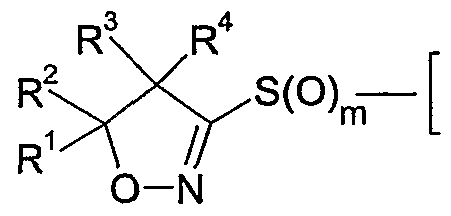
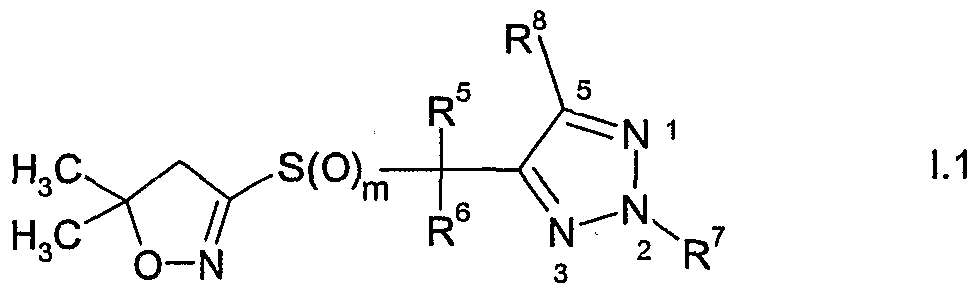
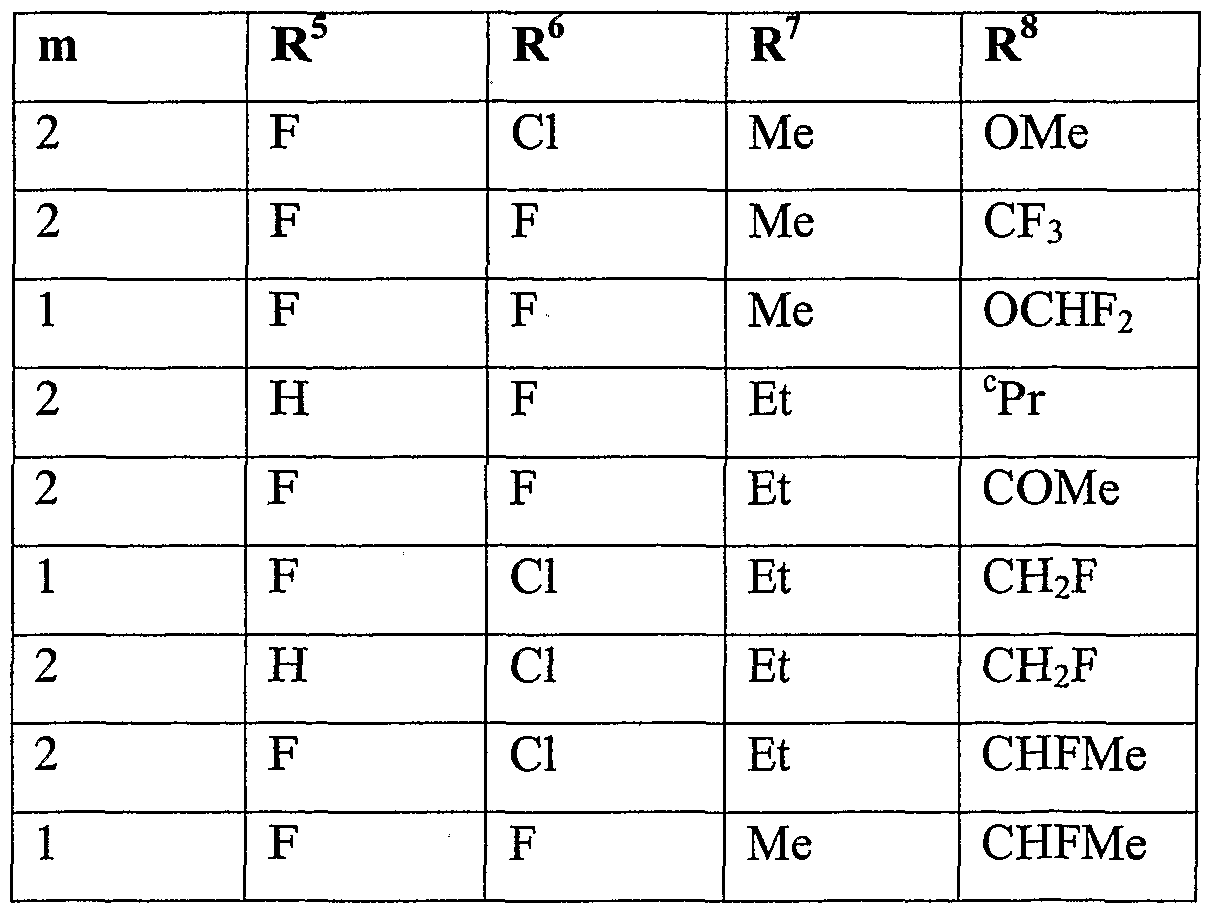
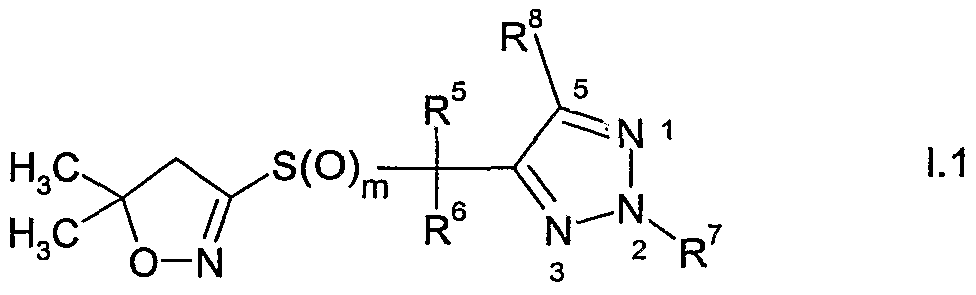
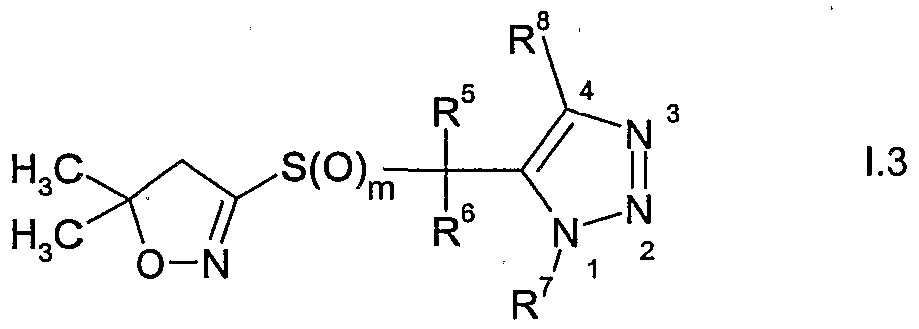
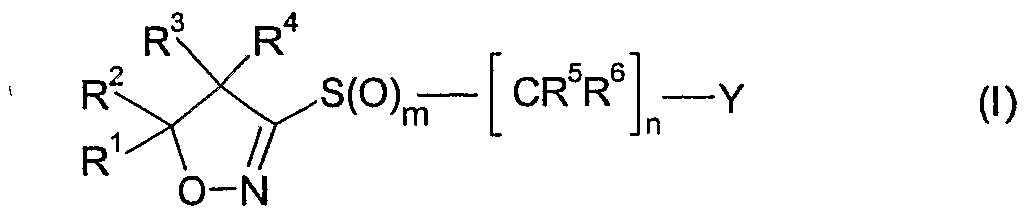
  • the present invention accordingly relates to compounds of formula I
  • R and R are each independently of the other hydrogen, Q-Qoalkyl, Ci-Qohaloalkyl,
  • R 1 and R 2 together with the carbon atom to which they are bonded form a C 3 -C 7 ring
  • R 3 and R 4 are each independently of the other hydrogen, Q-Qoalkyl, Ci-Ciohaloalkyl,
  • R 5 is halogen or Ci-C 6 haloalkyl
  • R 6 is hydrogen, cyano, C 1 -QaIkVl, Ci-C 6 alkoxycarbonyl, halogen or Ci-C 6 haloalkyl; m is 0, 1 or 2; n is 1, 2 or 3; and
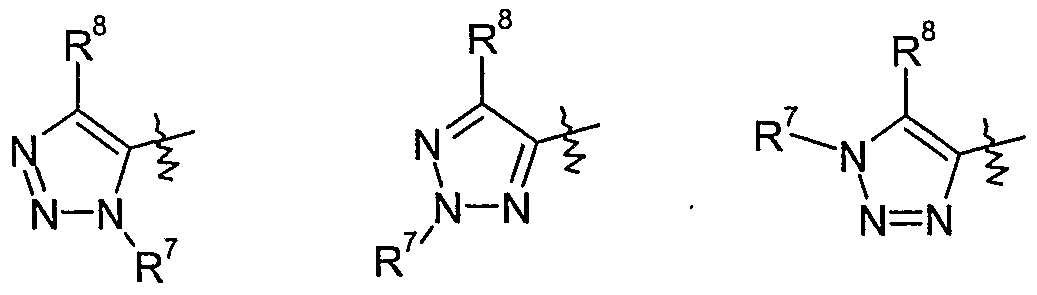
  • Y is one of the following groups wherein
  • R 7 is hydrogen, Ci-Cioalkyl, Ci-Cioalkylcarbonyl, formyl, d-Ciohaloalkylcarbonyl, C 1 - C 10 alkoxycarbonyl, d-Cjohaloalkyl, cyano, C 2 -C 10 alkenyl, C 2 -C 10 alkynyl, C 3 - C 10 cycloalkyl, C 3 -C 10 cycloalkyl-Ci-C 10 alkyl, d-doalkylcarbonyl-d-doalkyl, C 1 -
  • R 13 and R 14 are independently of each other hydrogen, C 1 -QaIkVl, d-C 6 haloalkyl, d-C 6 cycloalkyl, d-C 6 alkylcarbonyl, d-C 6 halo- alkylcarbonyl, d-C 6 alkylsulfonyl, d-C 6 haloalkylsulfonyl, or R 13 and R 14 together form a C 3 -C 8 alkylene group which optionally contains one oxygen, sulfur, amino or
  • R 1 and R 2 are independently d-Cioalkyl or d-Ciohaloalkyl, more preferably C 1 -C 6 alkyl or Ci -C 6 haloalkyl, most preferably methyl.
  • R 3 and R 4 are independently hydrogen, Ci-Cioalkyl or Ci-Ciohaloalkyl, more preferably hydrogen, Ci-C 6 alkyl or Ci-C 6 haloalkyl, most preferably hydrogen.
  • R 5 is halogen or trifluoromethyl, more preferably fluoro, chloro or trifluoromethyl, most preferably fluoro or chloro.
  • R 6 is hydrogen, methoxycarbonyl, Ci-C 6 alkyl or halogen, more preferably hydrogen, methyl, fluoro or chloro, most preferably hydrogen or fluoro.
  • m is 1 or 2, more preferably 2.
  • n is 1.
  • Y is one of the following groups
  • R 7 is hydrogen, C 1 -C 1O aIlCyI, Ci-Qohaloalkyl, C 2 -C 1 oalkenyl, C 2 - Cioalkynyl, C 3 -C 10 cycloalkyl, Q-docycloalkyl-Q-doalkyl, d-Qoalkoxy-Q-Cioalkyl or phenyl which is optionally substituted by one to five substituents selected from cyano, d-doalkyl, d-dohaloalkyl or halogen, more preferably hydrogen, methyl, ethyl, iso- propyl, tert-butyl, monofluoromethyl, difluoromethyl, trifluoromethyl, allyl, propargyl, cyclopropyl, cyclopentyl, cyclopropylmethyl, cyclobutyhnethyl, methoxymethyl, 2- methoxy-ethyl
  • R 8 is hydrogen, C 1 -C 1O aUCyI, Ci-C 10 alkylcarbonyl, formyl, C 1 - doalkoxycarbonyl, Ci-C 10 haloalkyl, C 3 -C 10 cycloalkyl, halogen, cyano, C 1 -C 1O aIkOXy or d-dohaloalkoxy, more preferably hydrogen, methyl, ethyl, acetyl, formyl, methoxy- carbonyl, monofluoromethyl, difluoromethyl, trifluoromethyl, bromodifluoromethyl, 1- fluoro-ethyl, cyclopropyl, fluoro, chloro, bromo, cyano, methoxy, difluoromethoxy, trifluoromethoxy or 2,2,2-trifluoroethoxy, even more preferably hydrogen, methyl, ethyl, acetyl, methoxycarbonyl, monoflu
  • a group of preferred compounds of formula I comprises those wherein Y is 1,2,3- triazolyl which is optionally substituted by one to two substituents independently selected from Ci-C 6 alkyl, Ci-C 6 haloalkyl, Ci-C 6 alkylcarbonyl, formyl, Q-C ⁇ alkoxycarbonyl, C 2 - C 6 alkenyl, C 3 -C 6 cycloalkyl, C 3 -C 6 cycloalkyl-Ci-C 6 -alkyl, Ci-C 6 alkoxy-C]-C 6 alkyl, halogen, cyano, Ci-C 6 alkoxy, C 1 -C 6 IIaIOaIkOXy or phenyl which is optionally substituted by one to five substituents selected from cyano, Ci-Cioalkyl, Q-Qohaloalkyl or halogen, more preferably wherein Y is 1,2,3-triazolyl which is optionally substituted by one to two
  • a group of especially preferred compounds of formula I comprises those wherein Y is l,2,3-triazol-4-yl which is optionally substituted by one to two substituents independently selected from Ci-C ⁇ alkyl, Ci-C 6 haloalkyl, d-C 6 alkylcarbonyl, formyl, Q- C 6 alkoxycarbonyl, C 2 -C 6 alkenyl, C 3 -C 6 cycloalkyl, Cs-C ⁇ cycloalkyl-Ci-C ⁇ -alkyl, C 1 -
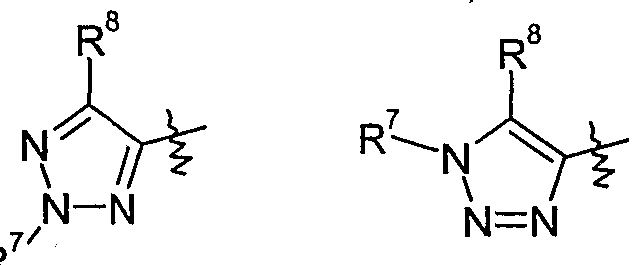
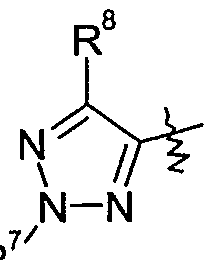
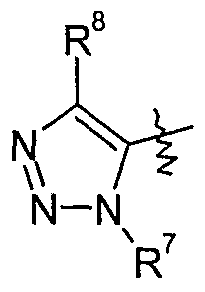
  • a group of especially preferred compounds of formula I comprises those wherein Y is
  • a group of especially preferred compounds of formula I comprises those wherein
  • Y is 5-monofluoromethyl-2-methyl-l,2,3-triazol-4-yl.
  • a group of especially preferred compounds of formula I comprises those wherein
  • Y is 2,5-dimethyl-l,2,3-triazol-4-yl.
  • a group of especially preferred compounds of formula I comprises those wherein
  • Y is 5-cycloproyl-2-methyl-l,2,3-triazol-4-yl.
  • a group of especially preferred compounds of formula I comprises those wherein Y is 2,5-diethyl-l,2,3-triazol-4-yl.
  • a group of especially preferred compounds of formula I comprises those wherein
  • Y is 2-difluoromethyl-5-methyl-l,2,3-triazol-4-yl.
  • a group of especially preferred compounds of formula I comprises those wherein
  • Y is 2-allyl-5-trifluoromethyl-l ,2,3-triazol-4-yl.
  • a group of especially preferred compounds of formula I comprises those wherein
  • Y is 2-cyclopentyl-5-trifluoromethyl-l,2,3-triazol-4-yl.
  • a group of especially preferred compounds of formula I comprises those wherein
  • Y is 2-cyclobutylmethyl-5-trifluoromethyl-l,2,3-triazol-4-yl.
  • a group of especially preferred compounds of formula I comprises those wherein Y is 2-(2-methoxy-ethyl)-5-trifluoromethyl-l,2,3-triazol-4-yl.
  • a group of especially preferred compounds of formula I comprises those wherein
  • Y is 2-methyl-l,2,3-triazol-4-yl.
  • a group of especially preferred compounds of formula I comprises those wherein
  • Y is 2-wo-propyl-5-trifluoromethyl-l,2,3-triazol-4-yl.
  • a group of especially preferred compounds of formula I comprises those wherein
  • Y is 2-ethyl-5-trifluoromethyl-l,2,3-triazol-4-yl.
  • a group of especially preferred compounds of formula I comprises those wherein
  • Y is 5-ethyl-2-methyl-l,2,3-triazol-4-yl.
  • a group of especially preferred compounds of formula I comprises those wherein
  • Y is 2-ethyl-l,2,3-triazol-4-yl.
  • a group of especially preferred compounds of formula I comprises those wherein
  • Y is 2-z ' so-propyl-5-methyl-l,2,3-triazol-4-yl.
  • a group of especially preferred compounds of formula I comprises those wherein Y is 2-methyl-5-trifluoromethyl-l,2,3-triazol-4-yl.
  • a group of especially preferred compounds of formula I comprises those wherein
  • Y is 5-methoxy-2-methyl-l,2,3-triazol-4-yl.
  • a group of especially preferred compounds of formula I comprises those wherein
  • Y is 5-bromo-2-methyl-l,2,3-triazol-4-yl.
  • a group of especially preferred compounds of formula I comprises those wherein
  • Y is 2-ethyl-5-methyl-l,2,3-triazol-4-yl.
  • a group of especially preferred compounds of formula I comprises those wherein
  • Y is 5-difluoromethoxy-2-methyl-l,2,3-triazol-4-yl.
  • a group of especially preferred compounds of formula I comprises those wherein Y is 5-methoxycarbonyl-2-methyl-l,2,3-triazol-4-yl.
  • a group of especially preferred compounds of formula I comprises those wherein
  • Y is 5-acetyl-2-methyl-l,2,3-triazol-4-yl.
  • a group of especially preferred compounds of formula I comprises those wherein
  • Y is 5-bromodifluoromethyl-2-methyl-l,2,3-triazol-4-yl.
  • a group of especially preferred compounds of formula I comprises those wherein
  • Y is 5-difluoromethyl-2-methyl-l,2,3-triazol-4-yl.
  • a group of especially preferred compounds of formula I comprises those wherein
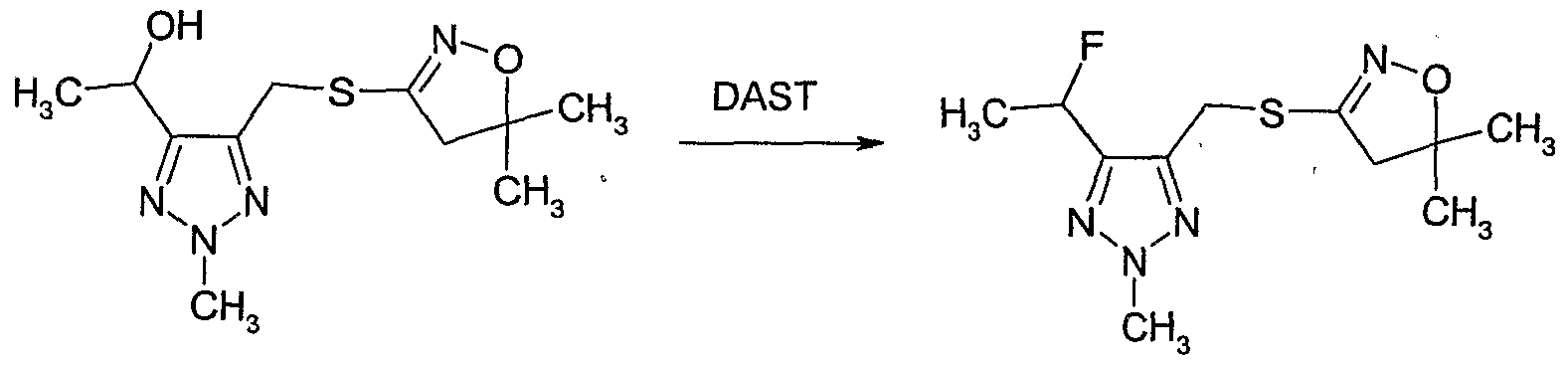
  • Y is 5-(l-fluoro-ethyl)-2-methyl-l,2,3-triazol-4-yl.
  • a group of especially preferred compounds of formula I comprises those wherein Y is 5-methyl-2-phenyl-l ,2,3-triazol-4-yl.
  • a group of especially preferred compounds of formula I comprises those wherein Y is
  • a group of especially preferred compounds of formula I comprises those wherein Y is 1 -tert-butyl-1 ,2,3-triazol-4-yl.
  • a group of especially preferred compounds of formula I comprises those wherein
  • Y is l,5-dimethyl-l,2,3-triazol-4-yl.
  • a group of especially preferred compounds of formula I comprises those wherein
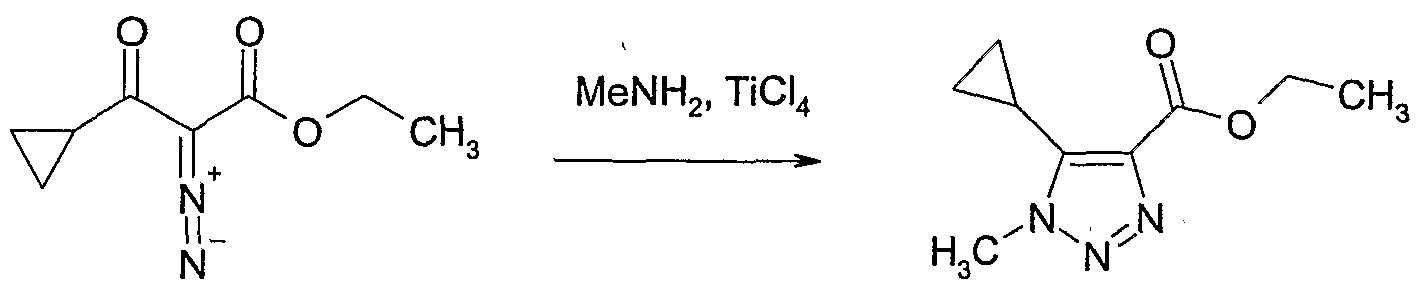
  • Y is 5-cyclopropyl-l-methyl-l,2,3-triazol-4-yl.
  • a group of especially preferred compounds of formula I comprises those wherein
  • Y is l,2,3-triazol-5-yl which is optionally substituted by one to two substituents independently selected from Ci-C ⁇ alkyl, Q-C ⁇ haloalkyl, d-Cealkylcarbonyl, formyl, C 1 - C 6 alkoxycarbonyl, C 2 -C 6 alkenyl, C 3 -C 6 cycloalkyl, C 3 -C 6 cycloalkyl-Ci-C 6 -alkyl, C 1 - C ⁇ alkoxy-Q-C ⁇ alkyl, halogen, cyano, C 1 -QaIkOXy, C 1 -C 6 IIaIOaIkOXy or phenyl which is optionally substituted by one to five substituents selected from cyano, Ci-Qoalkyl, C 1 - C 10 haloalkyl or halogen, more preferably wherein Y is l,2,3-triazol-5-yl which is
  • a group of especially preferred compounds of formula I comprises those wherein Y is
  • a group of especially preferred compounds of formula I comprises those wherein
  • Y is 4-bromo-l-methyl-l,2,3-triazol-5-yl.
  • a group of especially preferred compounds of formula I comprises those wherein Y is 4-methyl-l -zs ⁇ -propyl-l ,2,3-triazol-5-yl.
  • a group of especially preferred compounds of formula I comprises those wherein
  • Y is l-methyl-4-trifluoromethyl-l,2,3-triazol-5-yl.
  • a group of especially preferred compounds of formula I comprises those wherein
  • Y is 4-cyclopropyl-l-methyl-l,2,3-triazol-5-yl.
  • a group of especially preferred compounds of formula I comprises those wherein
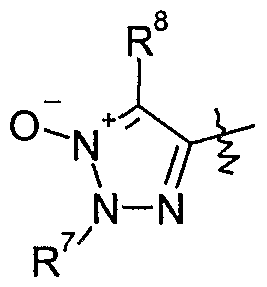
  • Y is l,2,3-triazol-4-yl-l-oxide which is optionally substituted by one to two substituents independently selected from Q-C ⁇ alkyl, d-C 6 haloalkyl, Ci-Qalkylcarbonyl, formyl, Q- C 6 alkoxycarbonyl, C 2 -C 6 alkenyl, C 3 -C ⁇ cycloalkyl, CrC ⁇ cycloalkyl-Q-C ⁇ -alkyl, C 1 - Cealkoxy-C t -C ⁇ alkyl, halogen, cyano, Ci-C 6 alkoxy, d-C 6 haloalkoxy or phenyl which is optionally substituted by one to five substituents selected from cyano, Ci-C 10 alkyl, C 1 - C 10 haloalkyl or halogen, more preferably wherein Y is 1 ,2,3-triazol-4-yl-l-oxide which is optionally
  • a group of especially preferred compounds of formula I comprises those wherein Y is
  • a group of especially preferred compounds of formula I comprises those wherein
  • Y is 2,5-dimethyl-l,2,3-triazol-4-yl-l -oxide.
  • the invention relates to a compound of formula I wherein R 1 and R 2 are each independently of the other hydrogen, Ci-doalkyl, Ci-C 10 haloalkyl,
  • R 1 and R 2 together with the carbon atom to which they are bonded form a C 3 -C 7 ring
  • R 3 and R 4 are each independently of the other hydrogen, Ci-C 10 alkyl, Ci-C 10 haloalkyl,
  • R 5 is halogen or C ⁇ -C 6 haloalkyl
  • R 6 is hydrogen, cyano, d-C 6 alkyl, d-C 6 alkoxycarbonyl, halogen or Ci-C 6 haloalkyl; m is 0, 1 or 2; n is 1, 2 or 3; and
  • Y is one of the following groups
  • R 7 is hydrogen, d-doalkyl, d-Ci 0 alkylcarbonyl, d-dohaloalkylcarbonyl, C 1 - Cioalkoxycarbonyl, Ci-dohaloalkyl, C 2 -Ci 0 alkenyl, C 2 -Ci 0 alkynyl, C 3 -C 10 cycloalkyl, C 3 - Ciocycloalkyl-d-Cioalkyl, Ci-Cioalkylcarbonyl-d-doalkyl, Q-Cioalkylsulfonyl, C 1 - Ciohaloalkylsulfonyl or CrCioalkoxy-Ci-doalkyl;
  • R is hydrogen, Q-Cioalkyl, Crdoalkylcarbonyl, d-dohaloalkylcarbonyl, C 1 - Cioalkoxycarbonyl, Ci-Ciohaloalkyl, C 2 -Ci 0 alkenyl, C 2 -Ci 0 alkynyl, C 3 -C ! ocycloalkyl, C 3 - Ciocycloalkyl-Ci-Cioalkyl, halogen, d-Ci 0 alkoxy or Ci-Ciohaloalkoxy; and to N-oxides, salts and optical isomers of compounds of formula I.
  • R 7 is hydrogen, Q-Cioalkyl, Ci-Ciohaloalkyl, C2-C ⁇ oalkenyl, C 2 - Cioalkynyl, C 3 -Ci 0 cycloalkyl, C 3 -C 10 cycloalkyl-Ci-C 10 alkyl or Ci-C t oalkoxy-d- Cioalkyl, more preferably hydrogen, methyl, ethyl, allyl, propargyl, cyclopropyl, cyclopropylmethyl, methoxymethyl, methoxymethyl, difluoromethyl or trifluoromethyl, most preferably methyl.
  • R 8 is hydrogen, C 1 -C 1O aUCyI, Ci-Qohaloalkyl, C 3 -C 10 cycloalkyl, halogen, Ci-Ci 0 alkoxy or d-Ciohaloalkoxy, more preferably hydrogen, methyl, ethyl, trifluoromethyl, difluoromethyl, monofluoromethyl, cyclopropyl, fluoro, chloro, trifluoromethoxy or 2,2,2-trifluoroethoxy, most preferably methyl, trifluoromethyl or monofluoromethyl.
  • the compounds of the invention may contain one or more asymmetric carbon atoms, for example, in the -CR 5 R 6 - group or in the -CR 3 R 4 -group and may exist as enantiomers (or as pairs of diastereomers) or as mixtures of such.
  • m 1, the compounds of the invention are sulfoxides, which can exists in two enantiomeric forms, the adjacent carbon can also exists in two enantiomeric forms and the -CR 3 R 4 - group can also exist in two enantiomeric forms.
  • Compounds of general formula I can therefore exist as racemates, diastereoisomers, or single enantiomers, and the invention includes all possible isomers or isomer mixtures in all proportions. It is to be expected that for any given compound, one isomer may be more herbicidal than another.
  • Alkyl groups, haloalkyl groups, hydroxyalkyl groups, alkoxy groups, haloalkoxy groups and alkylene groups can be straight or branched chain.
  • Preferred alkyl groups, haloalkyl groups, hydroxyalkyl groups, alkoxy groups, haloalkoxy groups and alkylene groups each independently contain 1 to 4 carbons.
  • alkyl groups are methyl, ethyl, «-and z ' so-propyl and n ⁇ , sec-, iso- and tert-butyl, hexyl, nonyl and decyl.
  • Examples of haloalkyl groups are difluoromethyl and 2,2,2-trifluoroethyl.
  • Examples of hydroxyalkyl groups are 1,2-dihydroxyethyl and 3-hydroxypropyl.
  • Examples of alkoxy groups are methoxy, ethoxy, propoxy, butoxy, hexyloxy, nonyloxy and decyloxy.
  • Examples of haloalkoxy groups are difluoromethoxy and 2,2,2-trifluoroethoxy.
  • Examples of alkylene groups are methylene, ethylene, «-and zs ⁇ -propylene and n-, sec-, iso- and fert-butylene.
  • Cycloalkyl groups can be in mono-, bi- or tri-cyclic form. Preferred cycloalkyl groups independently contain 3 to 8 carbons. Examples of monocyclic cycloalkyl groups are cyclopropyl, cyclobutyl, cyclopentyl, cyclohexyl, cycloheptyl and cyclooctyl. Alkenyl and alkynyl groups and haloalkenyl groups and haloalkynyl groups can be straight or branched chain. Examples of alkenyl and alkynyl groups are allyl, but-2- enyl, 3-methylbut-2-enyl, ethynyl, propargyl and but-2-ynyl.
  • haloalkenyl and haloalkynyl groups are trifluoroallyl and l-chloroprop-l-yn-3-yl.
  • Halogen means fluoro, chloro, bromo and iodo, preferably fluoro, chloro or bromo, more preferably fluoro or chloro.
  • the invention relates likewise to the salts which the compounds of formula I are able to form with amines, alkali metal and alkaline earth metal bases and quarternary ammonium bases.
  • alkali metal and alkaline earth metal hydroxides as salt formers, special mention should be made of the hydroxides of lithium, sodium, potassium, magnesium and calcium, but especially the hydroxides of sodium and potassium.
  • the compounds of formula I according to the invention also include hydrates which may be formed during the salt formation.
  • amines suitable for ammonium salt formation include ammonia as well as primary, secondary and tertiary Ci-Qsalkylamines, CrC 4 hydroxyalkylamines and C 2 -C 4 alkoxyalkylamines, for example methylamine, ethylamine, n-propylamine, isopropylamine, the four butylamine isomers, n-amylamine, isoamylamine, hexylamine, heptylamine, octylamine, nonylamine, decylamine, pentadecylamine, hexadecylamine, heptadecylamine, octadecylamine, methylethylamine, methylisopropylamine, methylhexylamine, methylnonylamine, methylpentadecylamine, methyloctadecylamine, ethylbutylamine
  • Preferred quarternary ammonium bases suitable for salt formation correspond, for example, to the formula [N(Ra R b RcRd )]OH wherein R a , Rb, R 0 and Rd are each independently of the others CrQalkyl.
  • Other suitable tetraalkylammonium bases with other anions can be obtained, for example, by anion exchange reactions.
  • herbicide as used herein means a compound that controls or modifies the growth of plants.
  • herbicidally effective amount means the quantity of such a compound or combination of such compounds that is capable of producing a controlling or modifying effect on the growth of plants. Controlling or modifying effects include all deviation from natural development, for example: killing, retardation, leaf burn, albinism, dwarfing and the like.
  • plants refers to all physical parts of a plant, including seeds, seedlings, saplings, roots, tubers, stems, stalks, foliage, and fruits.
  • locus is intended to include soil, seeds, and seedlings, as well as established vegetation.
  • the compounds of the invention may be made by a variety of methods.
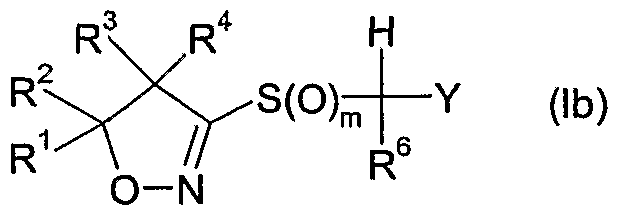
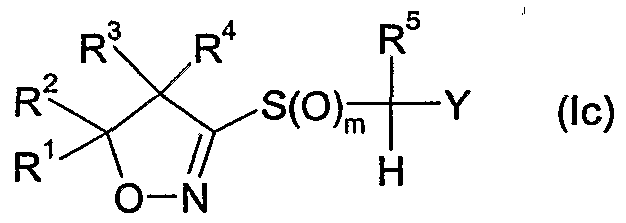
  • R 1 , R 2 , R 3 , R 4 and Y are as defined above and m is 1 or 2, in a single step or stepwise in succession with compounds of the formula R 5 -X and/or R 6 -X, wherein R 5 is halogen and R 6 is cyano, Ci-C ⁇ alkyl, CrC ⁇ alkoxycarbonyl or halogen and X is a suitable leaving group e.g.
  • halide such as bromide or iodide
  • a carboxylate such as acetate
  • an alkylsulfonate such as methylsulfonate
  • an arylsulfonate such as p-toluenesulfonate
  • a haloalkylsulfonate such as trifluoromethylsulfonate
  • an imide such as succinimide, a sulfonimide, such as bis(phenylsulfonyl)imide, or an arylsulfinate, such as p-toluene- sulfinate, in the presence of abase, e.g.
  • an alkyl-lithium compound such as methyl- lithium, H-butyl-lithium or tert-butyl-lithium, a lithium dialkylamide, such as lithium diisopropylamide
  • a metal hydride preferably an alkali metal hydride, such as sodium hydride, or an alkali metal amide, such as sodium amide, a metal bis(tri(C 1 -C 6 alkyl)- silyl)amide, such as lithium bis(trimethylsilyl)amide, a metal alkoxide, such as potassium tert-butoxide, or a phosphazene base, such as N'-tert-butyl-N,N,N',N',N",N"-hexamethyl- phosphorimidic triamide (P ⁇ -t-Bu), l-tert-butyl-2,2,4,4,4-pentakis(dimethylamino)-2- Iambda 5 ,41ambda 5
  • a hydrocarbon such as a hydrocarbon, an ether, such as tetrahydrofuran, an amide, such as N,N-dimethylformamide, or a halogenated hydrocarbon, such as dichloromethane, or mixtures thereof and optionally in the presence of a complexing agent, such as hexamethylphosphoramide or tetramethylethylenediamine in a temperature range of from -12CPC to lOCPC, preferably from -8CPC to 5CPC.
  • a complexing agent such as hexamethylphosphoramide or tetramethylethylenediamine in a temperature range of from -12CPC to lOCPC, preferably from -8CPC to 5CPC.
  • R 1 ; R 2 , R 3 , R 4 , R 6 and Y are as defined above and m is 1 or 2, with compounds of the formula R 5 -X, wherein R 5 is halogen and X is a suitable leaving group as defined in 1), in the presence of a base as defined in 1), optionally in the presence of a diluent as defined in 1), preferably an inert solvent, and optionally in the presence of a complexing agent as defined in 1) in a temperature range of from -12CPC to 10(PC, preferably from -8(TC to 5CPC.
  • R 1 , R 2 , R 3 , R 4 , R 5 and Y are as defined above and m is 1 or 2, with compounds of the formula R 6 -X, wherein R 6 is cyano, Q-C ⁇ alkyl, Ci-C 6 alkoxycarbonyl or halogen and X is a suitable leaving group as defined in 1), in the presence of a base as defined in 1), optionally in the presence of a diluent as defined in 1) and optionally in the presence of a complexing agent as defined in 1) in a temperature range of from -120C to lOCPC, preferably from -8CPC to 5CPC.
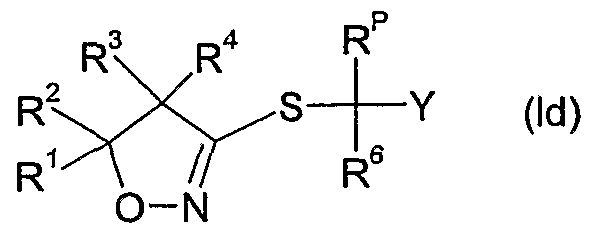
  • R 1 , R 2 , R 3 , R 4 , R 6 and Y are as defined above and R p is hydrogen, halogen or Ci-C 6 haloalkyl, and reacting those compounds with a suitable organic or inorganic oxidising agent, e.g. a peroxy acid, such as 3-chloroperoxybenzoic acid, peracetic acid or hydrogen peroxide, an alkoxyperoxide or a periodate, such as sodium periodate, optionally in the presence of a catalyst, such as ruthenium(III) chloride, optionally in the presence of a diluent, such as a halogenated hydrocarbon, e.g.
  • a suitable organic or inorganic oxidising agent e.g. a peroxy acid, such as 3-chloroperoxybenzoic acid, peracetic acid or hydrogen peroxide, an alkoxyperoxide or a periodate, such as sodium periodate, optionally in the presence of a catalyst, such as ruthenium
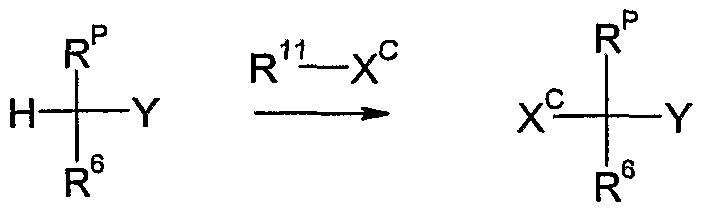
  • halogenating agent e.g. bromine or an N-halo- succinimide, such as N-chlorosuccinimide or N-bromosuccinimide, to form compounds of formula If wherein R 1 , R 2 , R 3 , R 4 and Y are as defined above, and X c is halogen, optionally in the presence of a diluent, e.g. acetic acid or a halogenated hydrocarbon, such as cabon tetrachloride or dichloromethane, in a temperature range of from -8OXU to 12CPC, preferably from -2CPC to 6CPC.
  • a halogenating agent e.g. bromine or an N-halo- succinimide, such as N-chlorosuccinimide or N-bromosuccinimide
  • R 5 is fluoro and M-R 5 is a suitable salt or an organometal compound in which M is e.g. Li, MgBr, Na, K, Ag or tetraalkylammonium, optionally in the presence of a Lewis acid, e.g. SnCl 4 , optionally in the presence of a complexing agent, e.g. hexa- methylphosphoramide (HMPA) or l,3-dimethyl-3,4,5,6-tetrahydro-2(lH)-pyrimidinone (DMPU), and optionally in the presence of a diluent, e.g.
  • M e.g. Li, MgBr, Na, K, Ag or tetraalkylammonium
  • a Lewis acid e.g. SnCl 4
  • a complexing agent e.g. hexa- methylphosphoramide (HMPA) or l,3-dimethyl-3,4,5,6-tetra
  • halogenating agent e.g. bromine or an N-halo- succinimide, such as N-chlorosuccinimide or N-bromosuccinimide
  • a halogenating agent e.g. bromine or an N-halo- succinimide, such as N-chlorosuccinimide or N-bromosuccinimide
  • X c is halogen, optionally in the presence of a diluent, e.g. acetic acid or a halogenated hydrocarbon, such as carbon tetrachloride or dichloromethane, in a temperature range of from -8CPC to 12CPC, preferably from -2CPC to 6CFC.
  • R 5 and / or R 6 are fluoro and M-R 5 and / or M-R 6 are a suitable salt or an organometal compound in which M is e.g. Li, MgBr, Na, K, Ag or tetraalkylammonium, optionally in the presence of a Lewis acid, e.g. SnCl 4 , optionally in the presence of a complexing agent, e.g. hexamethylphosphoramide (HMPA) or l,3-dimethyl-3 ,4,5,6- tetrahydro-2(lH)-pyrimidinone (DMPU), and optionally in the presence of a diluent, e.g.
  • HMPA hexamethylphosphoramide
  • DMPU l,3-dimethyl-3 ,4,5,6- tetrahydro-2(lH)-pyrimidinone
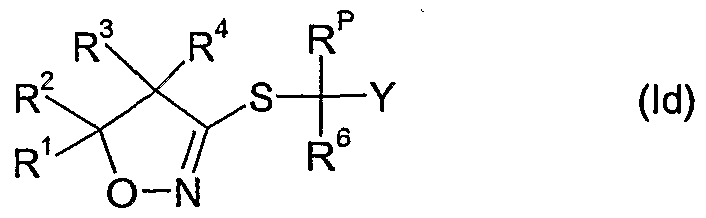
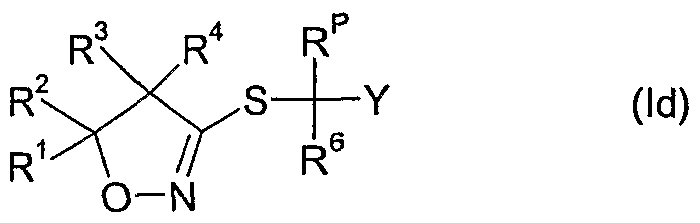
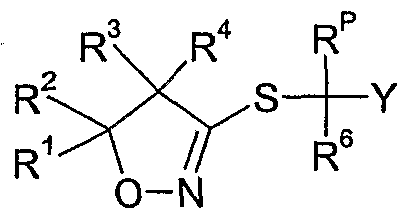
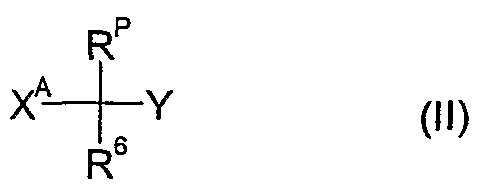
  • the compounds of formula Id as defined in 4) can be prepared by reacting a compound of formula II wherein R 6 and Y are as defined above, R p is as defined in 4) and X A is a leaving group such as halide e.g. bromide or chloride, an alkylsulfonate, e.g. methylsulfonate, an arylsulfonate, e.g. p-toluenesulfonate, or a haloalkylsulfonate, e.g. trifluoromethylsulfonate, with thiourea, optionally in the presence of a diluent e.g.
  • a diluent e.g.
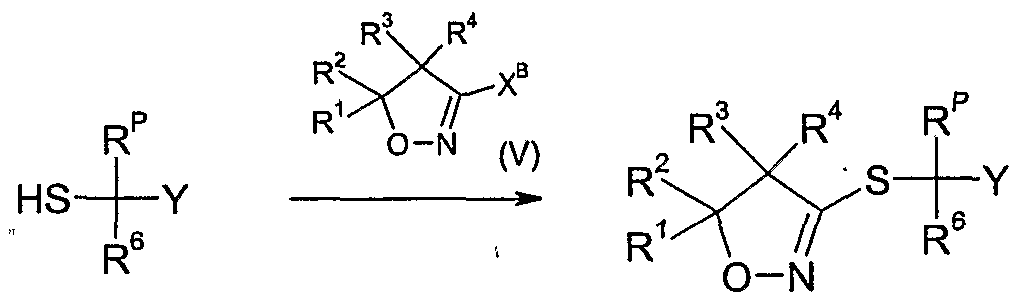
  • R ! , R 2 , R 3 and R 4 are as defined above, and X B is a suitable leaving group such as halogen, e.g. chloro, an alkylsulfinyl group, an arylsulfmyl group, a haloalkylsulfinyl group, an alkylsulfonyl group, e.g. methylsulfonyl, an arylsulfonyl group, e.g. p-toluene- sulfonyl, a haloalkylsulfonyl group, e.g.
  • a base such as a carbonate, e.g. potassium carbonate, sodium carbonate or potassium hydrogencarbonate, or a hydroxide, e.g. potassium hydroxide, or an alkoxide, e.g. sodium alkoxide, optionally in the presence of an alkali iodide, e.g. sodium iodide or sodium bromide, optionally in the presence of a diluent, such as an alcohol, e.g. ethanol, an ether, e.g. 1,4-dioxane or tetrahydrofuran, a polar solvent, e.g.
  • a base such as a carbonate, e.g. potassium carbonate, sodium carbonate or potassium hydrogencarbonate, or a hydroxide, e.g. potassium hydroxide, or an alkoxide, e.g. sodium alkoxide, optionally in the presence of an alkali iodide, e.g. sodium iodide
  • a further method of preparing intermediates of formula IV, wherein R 6 and Y are as defined above and R p is as defined in 4), is to react a compound of the formula III, wherein R 6 and Y are as defined above and R p is as defined in 4), with thiourea in the presence of an acid, for example a mineral acid, such as hydrochloric acid or hydrobromic acid, or sulfuric acid, or an organic acid, such as trifluoroacetic acid, and optionally in the presence of a diluent, such as an ether, e.g. 1,4-dioxane or tetrahydrofuran, a polar solvent, e.g.
  • an acid for example a mineral acid, such as hydrochloric acid or hydrobromic acid, or sulfuric acid, or an organic acid, such as trifluoroacetic acid
  • a diluent such as an ether, e.g. 1,4-dioxane or tetrahydrofur
  • the compounds of formula Id as defined in 4) can be prepared by reacting a compound of formula V as defined in 7) with thiourea, optionally in the . presence of a diluent e.g. an alcohol, e.g. ethanol, in a temperature range of from -3CPC to 15 CPC, preferably from OC to 8CFC, to give an isothiourea intermediate of formula VII,
  • a diluent e.g. an alcohol, e.g. ethanol
  • a temperature range of from -3CPC to 15 CPC preferably from OC to 8CFC
  • a base such as a carbonate, e.g. potassium carbonate, sodium carbonate or potassium hydrogencarbonate, or a hydroxide, e.g. potassium hydroxide, or an alkoxide, e.g. sodium alkoxide, optionally in the presence of a diluent, such as an alcohol, e.g. ethanol, a polar solvent, e.g. water or N,N-dimethylformamide, or a mixture of solvents, in a temperature range of from CPC to 200C, preferably from CPC to lOCPC.
  • a base such as a carbonate, e.g. potassium carbonate, sodium carbonate or potassium hydrogencarbonate, or a hydroxide, e.g. potassium hydroxide, or an alkoxide, e.g. sodium alkoxide, optionally in the presence of a diluent, such as an alcohol, e.g. ethanol, a polar solvent, e.g. water or N,N-
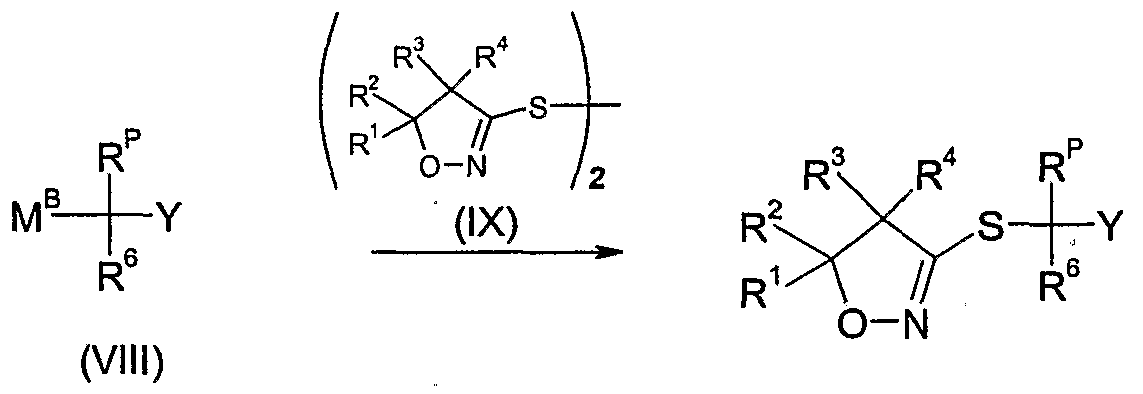
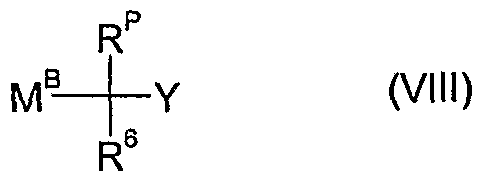
  • a further method of preparing the compounds of formula Id as defined in 4) is to react an organometal reagent of the formula VIII wherein R 6 and Y are as defined above, R p is as defined in 4) and M B is a group such as MgCl, MgBr, ZnBr or Li,
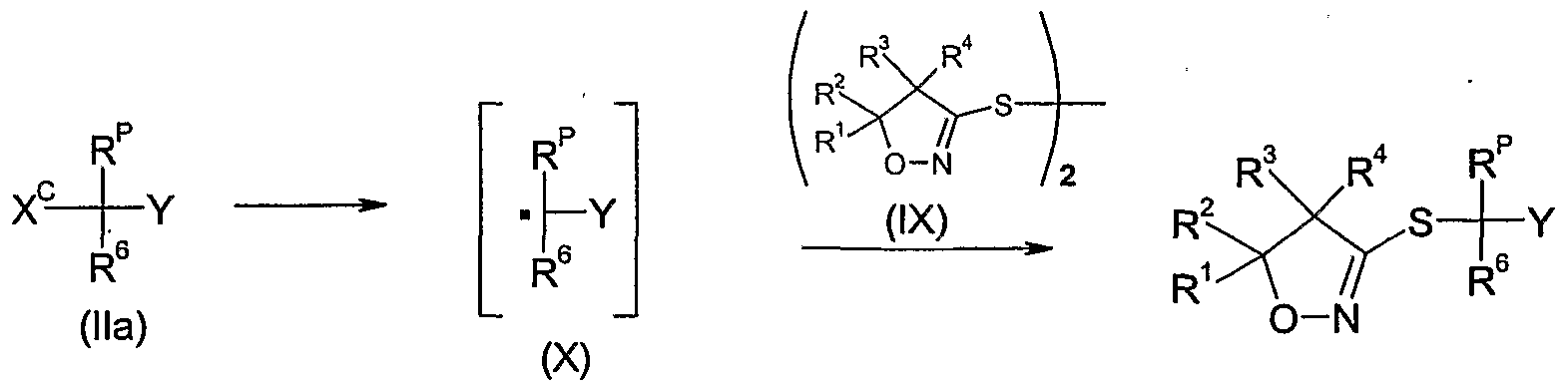
  • a further method of preparing the compounds of formula Id as defined in 4) is to react a compound of the formula Ha wherein R 6 and Y are as defined above, R p is as defined in 4) and X c is functional group that may be cleaved as a radical, e.g. a halogen, such as bromo or chloro,
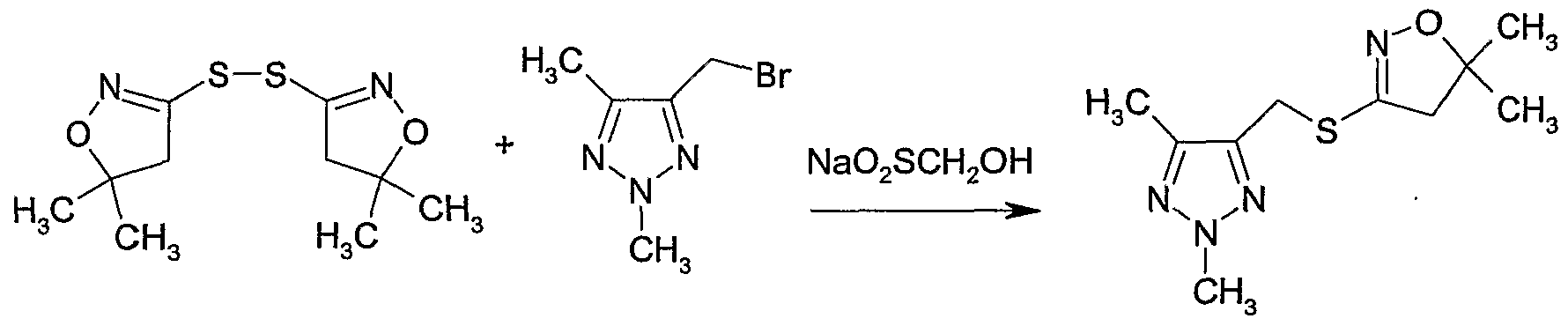
  • radical initiator or a precursor thereof and with a compound of formula IX as defined in 11 optionally in the presence of a base, e.g. a phosphate or hydrogen phosphate such as disodium hydrogen phosphate, a carbonate, e.g. potassium carbonate, sodium carbonate or potassium hydrogencarbonate, optionally in the presence of a diluent, e.g. a polar solvent, such as water or N,N-dimethylformamide, or mixtures thereof, in a temperature range of from -5CPC to 18CPC, preferably from -2CPC to 5CfC, and optionally under an inert atmosphere, e.g. nitrogen.
  • radical initiator or precursors can be used e.g. sodium dithionite or sodium hydroxymethylsulfinate.
  • a further method of preparing the compounds of formula Id as defined in 4) is to react a compound of the formula II as defined in 7),
  • a reducing agent e.g. a hydride, such as sodium borohydride, a metal, such as zinc, or a hydrosulfite, such as sodium hydrosulfite, optionally in the presence of a base, e.g. a hydroxide, such as sodium hydroxide, a phosphate or hydrogen phosphate, such as disodium hydrogen phosphate, or an amine, such as triethylamine, optionally in the presence of a diluent, e.g.
  • R p is Q-C ⁇ haloalkyl, in particular perfluoroalkyl, for example trifluoromethyl
  • the compounds of the formula III wherein Y is as defined above and R 6 is hydrogen, CrQalkyl or d-C ⁇ haloalkyl can be conveniently prepared by reacting carbonyl compounds of the formula XI wherein Y is as defined above and R 6 is hydrogen, Q-C ⁇ alkyl or CrC ⁇ haloalkyl, with a reagent R P -X D , wherein X D is a trialkylsilyl group, e.g. trimethylsilyl, in the presence of an initiator, such as a fluoride salt, e.g.
  • caesium fluoride tetrabutylammonium fluoride or potassium fluoride, or an alkoxide salt
  • an optional diluent such as an ether, e.g. tetrahydrofuran, 1,4-dioxane, in a temperature range of from CPC to lOCPC, preferably from 2CPC to 3CPC, to form the silylated intermediate of the formula XII.
  • the silylated intermediate of formula XII is desilylated without isolation or purification in the presence of an acid, e.g. hydrochloric acid or hydrobromic acid, or acetic acid, and optionally in the presence of an additional diluent, such as an ether, e.g. tetrahydrofuran or 1,4-dioxane, a polar solvent, e.g. water or N,N-dimethylformarnide, or a mixture of solvents, in a temperature range of from CPC to 1 OCPC, preferably from 2CPC to 3CPC, to form the compounds of the formula III.
  • an acid e.g. hydrochloric acid or hydrobromic acid, or acetic acid
  • an additional diluent such as an ether, e.g. tetrahydrofuran or 1,4-dioxane, a polar solvent, e.g. water or N,N-dimethylformarnide, or a
  • halogenating agent such as hydrogen chloride, hydrogen bromide, phosphorous tribromide, phosphorous trichloride or thionyl chloride, or with an alkyl-, aryl- or halo- alkylsulfonyl chloride, such as methanesulfonyl chloride, p-toluenesulfonyl chloride or trifluoromethylsulfonyl chloride, or with a combination of carbon tetrabromide and triphenyl phosphine, optionally in the presence of an inert solvent, e.g.
  • an inert solvent e.g.
  • halogenated hydrocarbon such as dichloromethane, 1,2-dichloroethane or carbon tetrachloride
  • an , ether such as diethyl ether or tetrahydrofuran
  • an acid such as acetic acid
  • a base e.g. an amine, such as triethyl amine, in a temperature range from -5CPC to 1 OCPC, preferably from CPC to 5CPC.
  • R -X Suitable compounds of formula R -X include compounds in which R n is a succinimido group, e.g.
  • a reducing agent e.g. a metal hydride, such as diisobutyl aluminium hydride, lithium aluminium hydride, sodium borohydride, lithium borohydride, or diborane, optionally in the presence of an inert solvent, e.g. an ether, such as diethyl ether, 1,4-dioxane or tetrahydrofuran, an alcohol, such as methanol or ethanol, or an aromatic hydrocarbon, such as toluene.
  • a metal hydride such as diisobutyl aluminium hydride, lithium aluminium hydride, sodium borohydride, lithium borohydride, or diborane
  • an inert solvent e.g. an ether, such as diethyl ether, 1,4-dioxane or tetrahydrofuran, an alcohol, such as methanol or ethanol, or an aromatic hydrocarbon, such as toluene.
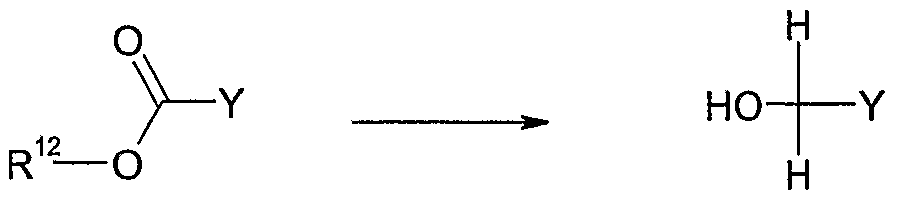
  • Y is as defined above and R 12 is hydrogen or C 1 -C 1O aIlCyI, with a reducing agent, e.g. a metal hydride, such as diisobutyl aluminium hydride, lithium aluminium hydride, sodium borohydride, lithium borohydride, or diborane, optionally in the presence of an inert solvent, e.g. an ether, such as diethyl ether, 1,4-dioxane or tetrahydrofuran, an alcohol, such as methanol or ethanol, or an aromatic hydrocarbon, such as toluene.
  • a metal hydride such as diisobutyl aluminium hydride, lithium aluminium hydride, sodium borohydride, lithium borohydride, or diborane
  • an inert solvent e.g. an ether, such as diethyl ether, 1,4-dioxane or tetrahydrofuran, an alcohol, such
  • Such reactions are usually carried out in a temperature range from -5CPC to 10(FC, preferably from CPC to 8CPC.
  • Such processes are known in the literature and are described, for example, in Tetrahedron Asymmetry 2004 (15) 3719-3722, J. Med. Chem., 2004 (47) 2176-2179, Heterocyclic Communications 2002 (8) 385-390, J. Antibiotics, 1995 (48) 1320-1329.
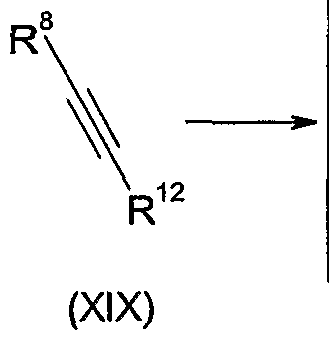
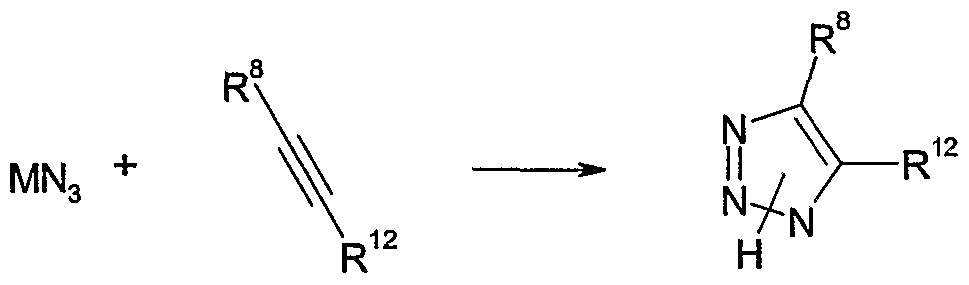
  • R 12 is hydrogen, Ci-Cioalkyl, Ci-Ciohaloalkyl, tetrahydro-pyran-2-yloxymethyl, C 1 - doalkoxycarbonyl, formyl, or the group Q
  • a catalyst e.g. a transition metal catalyst, such as CuCl, CuI, CuBr 2 , copper powder
  • a diluent such as a halogenated hydrocarbon, e.g. 1,2-dichloroethane or carbon tetrachloride, an ether, e.g. tetrahydrofuran or 1,4-dioxane, an aromatic compound, e.g.
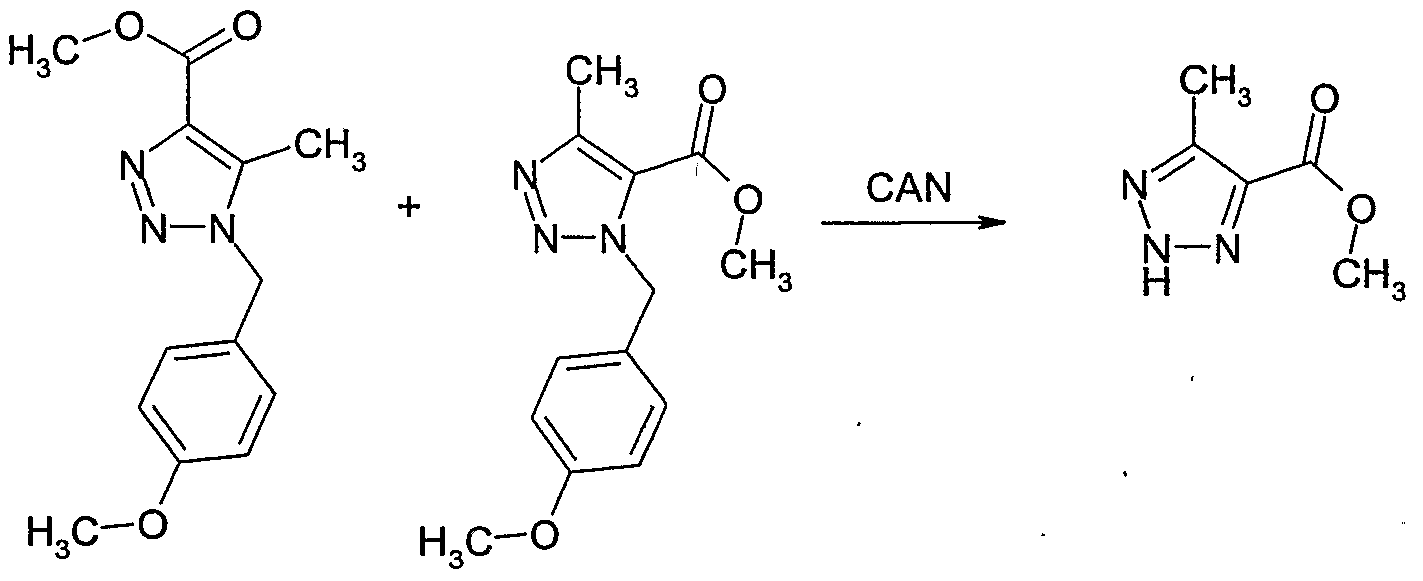
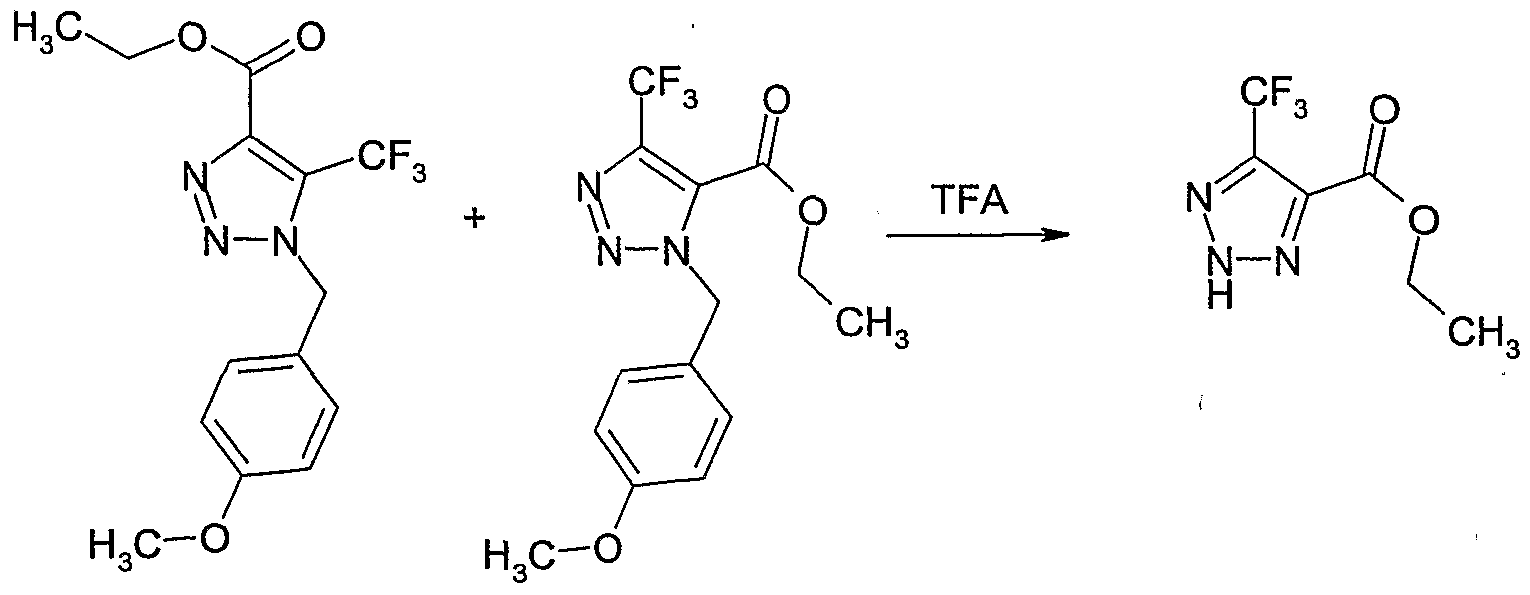
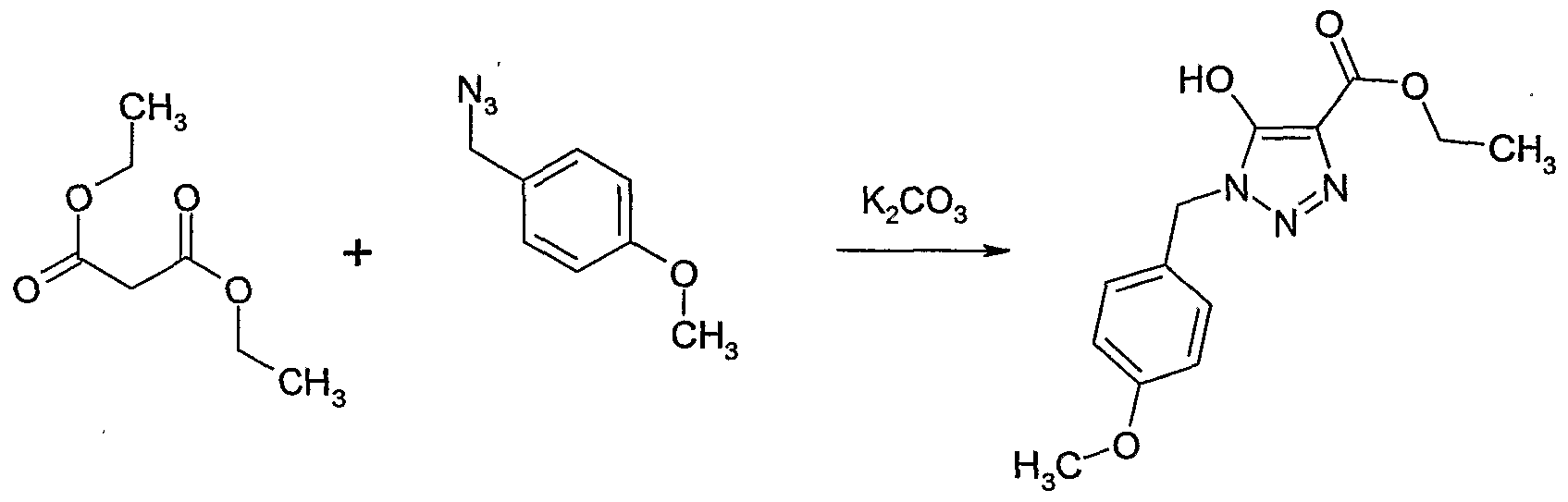
  • Suitable groups P 1 include trialkylsilyl groups, such as trimethylsilyl, or optionally substituted benzyl groups, such as benzyl or 4-methoxy- benzyl.
  • the protecting group is cleaved either in situ under the reaction conditions or in a separate step. Similar processes are known in the literature and are described in, e.g. Molecular Diversity, 2003 (7) 171-174; J. Heterocyclic Chemistry, 1976 (13) 589-592; WO 04/106324; J. Med. Chem., 2004 (47) 2176-2179.
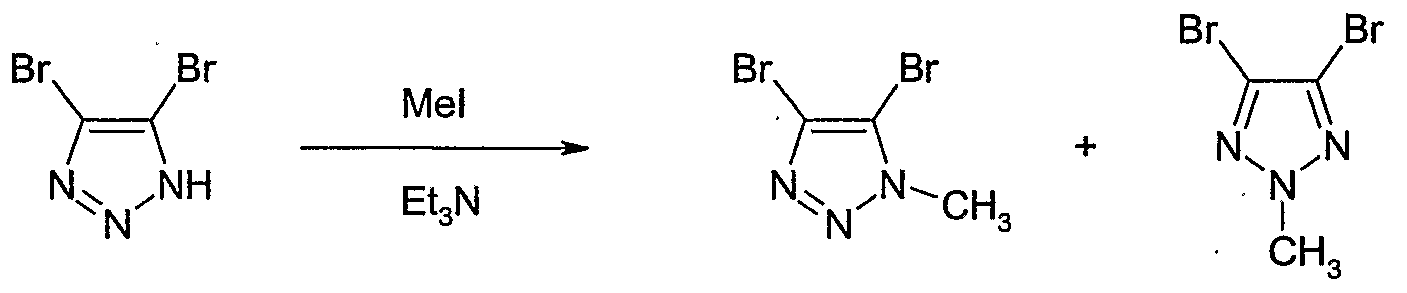
  • R 7 is as defined above and X E is a suitable leaving group, such as halogen, e.g. bromide, chloride or iodide, a carboxylate, such as acetate, or an alkylsulfonate, e.g. methylsulfonate, or an arylsulfonate, e.g. p-toluenesulfonate, in the presence of a base, e.g. a carbonate, such as potassium carbonate, a hydroxide, such as potassium hydroxide, a metal hydride, such as sodium hydride, an amine, such as triethylamine, optionally in the presence of a diluent, e.g.
  • a base e.g. a carbonate, such as potassium carbonate, a hydroxide, such as potassium hydroxide, a metal hydride, such as sodium hydride, an amine, such as triethylamine, optionally in
  • an ether such as tetrahydrofuran
  • an amide such as N,N- dimethylformamide
  • an alcohol such as methanol, acetonitrile or acetone or mixtures thereof
  • a phase transfer catalyst such as trimethyl- ammonium bromide
  • compounds of formula XXa, XXb and XXc are obtained exclusively or as mixtures in varying ratios.
  • Such processes are known in the literature and are described, for example, in Bioorg. Med. Chem.
  • the compounds of formula I according to the invention can be used as herbicides in unmodified form, as obtained in the synthesis, but they are generally formulated into herbicidal compositions in various ways using formulation adjuvants, such as carriers, solvents and surface-active substances.
  • formulation adjuvants such as carriers, solvents and surface-active substances.
  • the formulations can be in various physical forms, e.g.
  • the formulations can be prepared e.g. by mixing the active ingredient with the formulation adjuvants in order to obtain compositions in the form of finely divided solids, granules, solutions, dispersions or emulsions.
  • the active ingredients can also be formulated with other adjuvants, such as finely divided solids, mineral oils, oils of vegetable or animal origin, modified oils of vegetable or animal origin, organic solvents, water, surface-active substances or combinations thereof.
  • the active ingredients can also be contained in very fine microcapsules consisting of a polymer. Microcapsules contain the active ingredients in a porous carrier. This enables the active ingredients to be released into the environment in controlled amounts (e.g. slow-release). Microcapsules usually have a diameter of from 0.1 to 500 microns.
  • the active ingredients contain active ingredients in an amount of about from 25 to 95 % by weight of the capsule weight.
  • the active ingredients can be in the form of a monolithic solid, in the form of fine particles in solid or liquid dispersion or in the form of a suitable solution.
  • the encapsulating membranes comprise, for example, natural or synthetic rubbers, cellulose, styrene/butadiene copolymers, polyacrylonitrile, polyacrylate, polyesters, polyamides, polyureas, polyurethane or chemically modified polymers and starch xanthates or other polymers that are known to the person skilled in the art in this connection.
  • very fine microcapsules can be formed in which the active ingredient is contained in the form of finely divided particles in a solid matrix of base substance, but the microcapsules are not themselves encapsulated.
  • liquid carriers there may be used: water, toluene, xylene, petroleum ether, vegetable oils, acetone, methyl ethyl ketone, cyclohexanone, acid anhydrides, acetonitrile, acetophenone, amyl acetate, 2- butanone, butylene carbonate, chlorobenzene, cyclohexane, cyclohexanol, alkyl esters of acetic acid, diacetone alcohol, 1,2-dichloropropane, diethanolamine, p-diethylbenzene, diethylene glycol, diethylene glycol abietate, diethylene glycol butyl ether, diethylene glycol ethyl ether, diethylene glycol methyl ether, N,N-dimethylformamide, dimethyl sulfoxide, 1,4-dioxane, dipropylene glycol
  • Water is generally the carrier of choice for diluting the concentrates.
  • suitable solid carriers are, for example, talc, titanium dioxide, pyrophyllite clay, silica, attapulgite clay, kieselguhr, limestone, calcium carbonate, bentonite, calcium montmorillonite, cottonseed husks, wheat flour, soybean flour, pumice, wood flour, ground walnut shells, lignin and similar substances, as described, for example, in CFR 180.1001. (c) & (d).
  • a large number of surface-active substances can advantageously be used in both solid and liquid formulations, especially in those formulations which can be diluted with a carrier prior to use.
  • Surface-active substances may be anionic, cationic, non-ionic or polymeric and they can be used as emulsifiers, wetting agents or suspending agents or for other purposes.
  • Typical surface-active substances include, for example, salts of alkyl sulfates, such as diethanolammonium lauryl sulfate; salts of alkylarylsulfonates, such as calcium dodecylbenzenesulfonate; alkylphenol/alkylene oxide addition products, such as nonylphenol ethoxylate; alcohol/alkylene oxide addition products, such as tridecylalcohol ethoxylate; soaps, such as sodium stearate; salts of alkylnaphthalenesulfonates, such as sodium dibutylnaphthalenesulfonate; dialkyl esters of sulfosuccinate salts, such as sodium di(2-ethylhexyl)sulfosuccinate; sorbitol esters, such as sorbitol oleate; quaternary amines, such as lauryltrimethylammonium chloride, polyethylene glycol esters of fatty
  • compositions according to the invention can additionally include an additive comprising an oil of vegetable or animal origin, a mineral oil, alkyl esters of such oils or mixtures of such oils and oil derivatives.
  • the amount of oil additive in the composition according to the invention is generally from 0.01 to 10 %, based on the spray mixture.
  • the oil additive can be added to the spray tank in the desired concentration after the spray mixture has been prepared.
  • Preferred oil additives comprise mineral oils or an oil of vegetable origin, for example rapeseed oil, olive oil or sunflower oil, emulsified vegetable oil, such as AMIGGE)(Rl ⁇ ie-Poulenc Canada Inc.), alkyl esters of oils of vegetable origin, for example the methyl derivatives, or an oil of animal origin, such as fish oil or beef tallow.
  • a preferred additive contains, for example, as active components essentially 80 % by weight alkyl esters of fish oils and 15 % by weight methylated rapeseed oil, and also 5 % by weight of customary emulsifiers and pH modifiers.
  • Especially preferred oil additives comprise alkyl esters of C 8 -C 22 fatty acids, especially the methyl derivatives OfC 12 -Cj 8 fatty acids, for example the methyl esters of lauric acid, palmitic acid and oleic acid, being of importance. Those esters are known as methyl laurate (CAS-111-82-0), methyl palmitate (CAS-112-39-0) and methyl oleate (CAS-112-62-9).
  • a preferred fatty acid methyl ester derivative is Emer ⁇ D2230 and 2231 (Cognis GmbH). Those and other oil derivatives are also known from the Compendium of Herbicide Adjuvants, 5th Edition, Southern Illinois University, 2000. The application and action of the oil additives can be further improved by combination with surface-active substances, such as non-ionic, anionic or cationic surfactants. Examples of suitable anionic, non-ionic and cationic surfactants are listed on pages 7 and 8 of WO 97/34485.
  • Preferred surface-active substances are anionic surfactants of the dodecylbenzylsulfonate type, especially the calcium salts thereof, and also non-ionic surfactants of the fatty alcohol ethoxylate type.
  • ethoxylated C 12 -C 22 fatty alcohols having a degree of ethoxylation of from 5 to 40.
  • examples of commercially available surfactants are the Genapol types (Clariant AG).
  • silicone surfactants especially polyalkyl-oxide-modified heptamethyltriloxanes which are commercially available e.g. as Silwet L-77®, and also perfluorinated surfactants.
  • the concentration of the surface-active substances in relation to the total additive is generally from 1 to 30 % by weight.
  • oil additives consisting of mixtures of oil or mineral oils or derivatives thereof with surfactants are Edenor ME SU®, Turbocharge® (Syngenta AG, CH) or ActipronC (BP Oil UK Limited, GB).
  • an organic solvent may contribute to an additional enhancement of action.
  • Suitable solvents are, for example, Solvesso® (ESSO) or Aromatic Solvent® (Exxon Corporation). The concentration of such solvents can be from 10 to 80 % by weight of the total weight.
  • Oil additives that are present in admixture with solvents are described, for example, in US-A- 4,834,908.
  • a commercially available oil additive disclosed therein is known by the name MERGE® (BASF Corporation).
  • a further oil additive that is preferred according to the invention is SCORE® (Syngenta Crop Protection Canada).
  • alkylpyrrolidones e.g. Agrimax®
  • formulations of alkylpyrrolidones e.g. Agrimax®
  • synthetic lattices e.g. polyacrylamide, polyvinyl compounds or poly-1-p-menthene (e.g. Bond®, Courier® or Emerald®)
  • propionic acid for example Eurogkem Pen-e-trate®
  • the herbicidal compositions generally comprise from 0.1 to 99 % by weight, especially from 0.1 to 95 % by weight, compounds of formula I and from 1 to 99.9 % by weight of a formulation adjuvant which preferably includes from 0 to 25 % by weight of a surface-active substance.
  • a formulation adjuvant which preferably includes from 0 to 25 % by weight of a surface-active substance.
  • commercial products will preferably be formulated as concentrates, the end user will normally employ dilute formulations.
  • the rates of application of compounds of formula I may vary within wide limits and depend on the nature of the soil, the method of application (pre- or post-emergence; seed dressing; application to the seed furrow; no tillage application etc.), the crop plant, the grass or weed to be controlled, the prevailing climatic conditions, and other factors governed by the method of application, the time of application and the target crop.
  • the compounds of formula I according to the invention are generally applied at a rate of from 10 to 2000 g/ha, especially from 50 to 1000 g/ha.
  • Emulsifiable concentrates active ingredient: 1 to 95 %, preferably 60 to 90 % surface-active agent: 1 to 30 %, preferably 5 to 20 % liquid carrier: 1 to 80 %, preferably 1 to 35 %
  • Dusts active ingredient: 0.1 to 10 %, preferably 0.1 to 5 % solid carrier: 99.9 to 90 %, preferably 99.9 to 99 %
  • Suspension concentrates active ingredient: 5 to 75 %, preferably 10 to 50 % water: 94 to 24 %, preferably 88 to 30 % surface-active, agent: 1 to 40 %, preferably 2 to 30 %
  • Wettable powders active ingredient: 0.5 to 90 %, preferably 1 to 80 % surface-active agent: 0.5 to 20 %, preferably 1 to 15 % solid carrier: 5 to 95 %, preferably 15 to 90 %
  • Granules active ingredient: 0.1 to 30 %, preferably 0.1 to 15 % solid carrier: 99.5 to 70 %, preferably
  • Emulsifiable concentrates a) b) c) d) active ingredient 5% 10% 25% 50% calcium dodecylbenzenesulfonate 6% 8% 6% 8% castor oil polyglycol ether 4% 4% 4% 4%
  • Emulsions of any desired concentration can be obtained from such concentrates by dilution with water.
  • Wettable powders a) b) c) ⁇ active ingredient 5% 25% 50% 80% sodium lignosulfonate 4% - 3% - sodium lauryl sulfate 2% 3% - 4% sodium diisobutylnaphthalene- sulfonate - 6% 5% 6% octylphenol polyglycol ether — 1% 2% _ (7-8 mol of ethylene oxide) highly dispersed silicic acid 1% 3% 5% 10% kaolin 88% 62% 35% -
  • the active ingredient is mixed thoroughly with the adjuvants and the mixture is thoroughly ground in a suitable mill, affording wettable powders which can be diluted with water to give suspensions of any desired concentration.
  • the active ingredient is dissolved in methylene chloride and applied to the carrier by spraying, and the solvent is then evaporated off in vacuo.
  • the finely ground active ingredient is uniformly applied, in a mixer, to the carrier moistened with polyethylene glycol.
  • Non-dusty coated granules are obtained in this manner.
  • Ready-to-use dusts are obtained by mixing the active ingredient with the carriers and grinding the mixture in a suitable mill.
  • Suspension concentrates a) b) c) d) active ingredient 3 % 10 % 25 % 50 % ethylene glycol 5 % 5 % 5 % 5 % nonylphenol polyglycol ether - 1 % 2 % - (15 mol of ethylene oxide) sodium lignosulfonate 3 % 3 % 4 % 5 % carboxymethylcellulose 1 % 1 % 1 % 1 %
  • the finely ground active ingredient is intimately mixed with the adjuvants, giving a suspension concentrate from which suspensions of any desired concentration can be obtained by dilution with water.
  • the invention also relates to a method of controlling plants which comprises applying to the plants or to the locus thereof a herbicidally effective amount of a compound of formula I, or of a composition comprising such a compound.
  • the invention also relates to a method of inhibiting plant growth which comprises applying to the plants or to the locus thereof a herbicidally effective amount of a compound of formula I, or of a composition comprising such a compound.
  • the invention also relates to a method of selectively controlling grasses and weeds in crops of useful plants which comprises applying to the useful plants or locus thereof or to the area of cultivation a herbicidally effective amount of a compound of formula I, or of a composition comprising such a compound.
  • Crops of useful plants in which the composition according to the invention can be used include cereals, for example barley and wheat, cotton,, oilseed rape, maize, rice, soy beans, sugar beet and sugar cane, especially cereals and maize.
  • Crops can also include trees, such as palm trees, coconut trees or other nuts, and vines such as grapes.
  • the grasses and weeds to be controlled may be both monocotyledonous species, for example Agrostis, Alopecurus, Avena, Bromus, Cyperus, Digitaria, Echinochloa, Lolium, Monochoria, Rottboellia, Sagittaria, Scirpus, Setaria, Sida and Sorghum, and dicotyledonous species, for example Abutilon, Amaranthus, Chenopodium, Chrysanthemum, Galium, Ipomoea, Nasturtium, Sinapis, Solanum, Stellaria, Veronica, Viola and Xanthium.
  • monocotyledonous species for example Agrostis, Alopecurus, Avena, Bromus, Cyperus, Digitaria, Echinochloa, Lolium, Monochoria, Rottboellia, Sagittaria, Scirpus, Setaria, Sida and Sorghum
  • dicotyledonous species for example Abutilon,
  • Crops are to be understood as also including those crops which have been rendered tolerant to herbicides or classes of herbicides (e.g. ALS-, GS-, EPSPS-, PPO- and HPPD-inhibitors) by conventional methods of breeding or by genetic engineering.
  • herbicides or classes of herbicides e.g. ALS-, GS-, EPSPS-, PPO- and HPPD-inhibitors
  • An example of a crop that has been rendered tolerant to imidazolinones, e.g. imazamox, by conventional methods of breeding is Clearf ⁇ eld&ummer rape (canola).
  • crops that have been rendered tolerant to herbicides by genetic engineering methods include e.g. glyphosate- and glufosinate-resistant maize varieties commercially available under the trade names RoundupRead ⁇ and LibertyLinl®
  • Crops are also to be understood as being those which have been rendered resistant to harmful insects by genetic engineering methods, for example Bt maize (resistant to European corn borer), Bt cotton (resistant to cotton boll weevil) and also Bt potatoes (resistant to Colorado beetle).
  • Bt maize are the Bt 176 maize hybrids of NKg) (Syngenta Seeds).
  • the Bt toxin is a protein that is formed naturally by Bacillus thuringiensis soil bacteria. Examples of toxins, or transgenic plants able to synthesise such toxins, are described in EP-A-451 878, EP-A-374 753, WO 93/07278, WO 95/34656, WO 03/052073 and EP-A-427 529.
  • transgenic plants comprising one or more genes that code for an insecticidal resistance and express one or more toxins are KnockOut® (maize), Yield Gard® (maize), NuCOTIN33B® (cotton), Bollgard® (cotton), NewLeaf® (potatoes), NatureGard® and Protexcta®.
  • Plant crops or seed material thereof can be both resistant to herbicides and, at the same time, resistant to insect feeding ("stacked" transgenic events).
  • seed can have the ability to express an insecticidal Cry3 protein while at the same time being tolerant to glyphosate.
  • Crops are also to be understood as being those which are obtained by conventional methods of breeding or genetic engineering and contain so-called output traits (e.g. improved storage stability, higher nutritional value and improved flavour).
  • output traits e.g. improved storage stability, higher nutritional value and improved flavour.
  • Areas under cultivation include land on which the crop plants are already growing and land intended for cultivation with those crop plants.
  • the compounds of formula I according to the invention can also be used in combination with other herbicides.
  • the following mixtures of the compound of formula I are important:
  • a compound of formula I with a PPO inhibitor (e.g. compound of formula I + fomesafen (401), compound of formula I + flumioxazin (376), compound of formula I + sulfentrazone (749), compound of formula I + [3-[2-chloro-4-fluoro-5-(l- methyl-6-trifluoromethyl-2,4-dioxo-l,2,3,4-tetrahydropyrimidin-3-yl)phenoxy]-2- pyridyloxy] acetic acid ethyl ester) (CAS RN 353292-31-6).
  • a PPO inhibitor e.g. compound of formula I + fomesafen (401), compound of formula I + flumioxazin (376), compound of formula I + sulfentrazone (749), compound of formula I + [3-[2-chloro-4-fluoro-5-(l- methyl-6-trifluoromethyl-2,4-dioxo-l,2,
  • the mixing partners of the compound of formula I may also be in the form of esters or salts, as mentioned e.g. in The Pesticide Manual, 13 th Edition (BCPC), 2003.
  • the reference to glufosinate-ammonium also applies to glufosinate
  • the reference to cloransulam-methyl also applies to cloransulam
  • the reference to pyrithiobac-sodium also applies to pyrithiobac, etc.
  • the mixing ratio of the compound of formula I to the mixing partner is preferably from l: 100 to 1000:1.
  • the mixtures can advantageously be used in the above-mentioned formulations (in which case "active ingredient” relates to the respective mixture of compound of formula I with the mixing partner).
  • the compounds of formula I according to the invention can also be used in combination with other herbicides: compound of formula I + acetochlor (5), compound of formula I + acifluorfen-sodium (7), compound of formula I + aclonifen (8), compound of formula I + acrolein (10), compound of formula I + alachlor (14), compound of formula I + alloxydim (18), compound of formula I + allyl alcohol (CAS RN 107-18-6), compound of formula I + amidosulfixron (22), compound of formula I + aminopyralid (CAS RN 150114-71-9), compound of formula I + amitrole (aminotriazole) (25), compound of formula I + ammonium sulfamate (26), compound of formula I + anilofos (31), compound of formula I + asulam (36), compound of formula I + atraton (CAS RN 1610-17-9), compound of formula I + aviglycine (39), compound of formula I + azafenidin
  • the mixing partners of the compound of formula I may also be in the form of esters or salts, as mentioned e.g. in The Pesticide Manual, 13 th Edition (BCPC), 2003.
  • the reference to acifluorfen-sodium also applies to acifluorfen, and the reference to bensulfuron-methyl also applies to bensulfuron, etc.
  • the mixing ratio of the compound of formula I to the mixing partner is preferably
  • mixtures can advantageously be used in the above-mentioned formulations (in which case "active ingredient” relates to the respective mixture of compound of formula I with the mixing partner).
  • active ingredient relates to the respective mixture of compound of formula I with the mixing partner.
  • the compounds of formula I according to the invention can also be used in combination with one or more safeners.
  • mixtures of a compound of formula I according to the invention with one or more further herbicides can also be used in combination with one or more safeners.
  • the safeners can be AD 67 (MON 4660) (11), benoxacor (63), cloquintocet-mexyl (163), cyometrinil and the corresponding (Z) isomer, cyprosulfamide (CAS RN 221667-31-8), dichlormid (231), fenchlorazole-ethyl (331), fenclorim (332), flurazole (386), fluxofenim (399), furilazole (413) and the corresponding R isomer, isoxadifen-ethyl (478), mefenpyr-diethyl (506), oxabetrinil (598), naphthalic anhydride (CAS RN 81-84-5) and N-isopropyl-4-(2-methoxy- benzoylsulfamoyl)-benzamide (CAS RN 221668-34-4). Particularly preferred are mixtures of a compound of formula I with benoxacor (i.e.
  • the safeners of the compound of formula I may also be in the form of esters or salts, as mentioned e.g. in The Pesticide Manual, 13 th Edition (BCPC), 2003.
  • the reference to cloquintocet-mexyl also applies to a lithium, sodium, potassium, calcium, magnesium, aluminium, iron, ammonium, quaternary ammonium, sulfonium or phos- phonium salt thereof as disclosed in WO 02/34048, and the reference to fenchlorazole- ethyl also applies to fenchlorazole, etc.
  • the mixing ratio of compound of formula I to safener is from 100: 1 to 1 :10, especially from 20: 1 to 1 : 1.
  • mixtures can advantageously be used in the above-mentioned formulations (in which case "active ingredient” relates to the respective mixture of compound of formula I with the safener).
  • active ingredient relates to the respective mixture of compound of formula I with the safener.
  • Preferred mixtures of a compound of formula I with further herbicides and safeners include:
  • Mixtures of a compound of formula I with a triazine and a safener Mixtures of a compound of formula I with glyphosate and a safener. Mixtures of a compound of formula I with glufosinate and a safener. Mixtures of a compound of formula I with isoxaflutole and a safener.
  • Mixtures of a compound of formula I with isoxaflutole and glyphosate and a safener Mixtures of a compound of formula I with isoxaflutole and glyphosate and a safener. Mixtures of a compound of formula I with isoxaflutole and glufosinate and a safener.
  • Mixtures of a compound of formula I with mesotrione and a safener Mixtures of a compound of formula I with mesotrione and a triazine and a safener. Mixtures of a compound of formula I with mesotrione and glyphosate and a safener.
  • Mixtures of a compound of formula I with sulcotrione and a safener Mixtures of a compound of formula I with sulcotrione and a triazine and a safener.
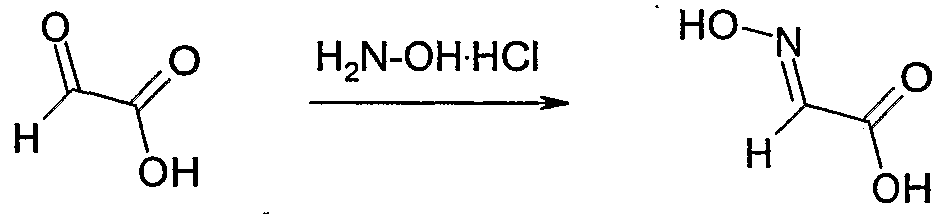
  • Aqueous glyoxylic acid (50% by weight) (1 1, 9 mol) and hydroxyl amine hydrochloride (627 g, 9 mol) were mixed and concentrated.
  • Acetonitrile (1 1) was added, the solution cooled to 5O and filtered.
  • the mother liquor was concentrated to 50% of the volume, stored at 5C overnight and filtered again. This process was repeated twice.
  • the solids were combined and dried to give hydroxyimino-acetic acid as white crystals (546 g, 68% yield).
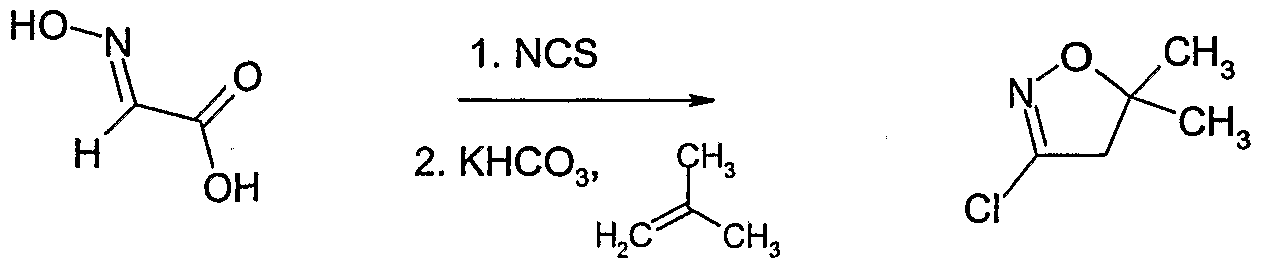
  • Example II Hydroxyimino-acetic acid (Example II) (107 g, 1.2 mol) was dissolved in 1,2- dimethoxy-ethane (1.4 1) and heated to 7CPC. N-chlorosuccinimide (NCS) (320.4 g, 2.4 mol) was added in portions within 1 hour at 7CPC. The reaction mixture was stirred at 7CPC for 1 hour. The reaction mixture was cooled to SC and potassium hydrogencarbonate (535 g, 4.45 mol) and water (54 g) were added. 2-Methyl-propene (134.6 g, 2.4 mol) was introduced into the suspension for 20 minutes at 5C. The reaction mixture was allowed to warm to room temperature and was stirred at room temperature for 18 hours.
  • NCS N-chlorosuccinimide
  • 2-Methyl-propene 134.6 g, 2.4 mol
  • Example 16 Preparation of (5-fluoromethyl-2-methyl-2H-
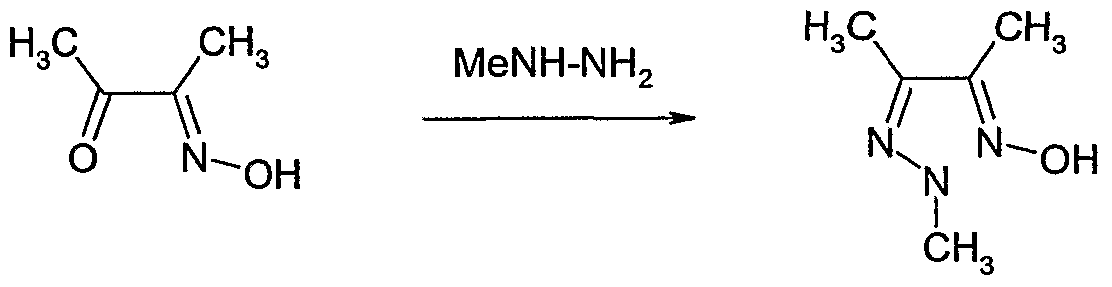
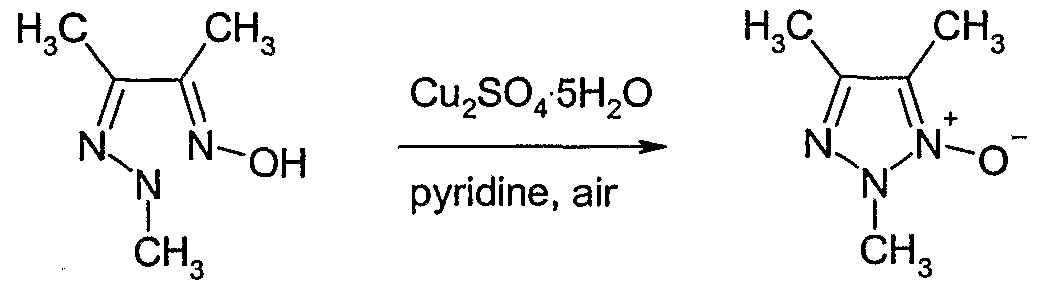
  • Butane-2,3-dione monooxime (2.6 g, 25.8 mmol) was dissolved in ethanol (100 ml) then methylhydrazine (1.13 g, 24.5 mmol) was added at room temperature. The reaction mixture was stirred at 8CPC for 2 hours. Methylhydrazine (0.6 g, 12 mmol) was added and the reaction mixture stirred at 8CPC for 1.5 hours. Methylhydrazine (0.6 g, 12 mmol) was added and the reaction mixture stirred at 8CPC for another 1.5 hours, then at room temperature for 48 hours.
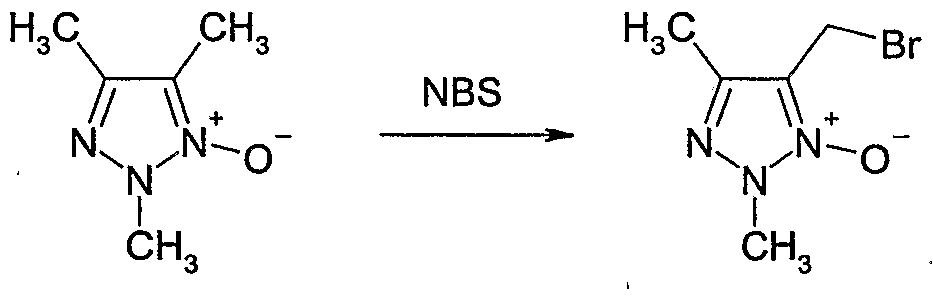
  • N-Bromosuccinimide (NBS) (186 mg, 1.0 mmol) and 2,2'-azobisisobutyronitrile (AIBN) (14 mg, 0.087 mmol) were added to a solution of 2,4,5-trimethyl-2H-[ 1,2,3]- triazole 1-oxide (110 mg, 0.87 mmol) (Example 19) in carbon tetrachloride (7 ml).
  • the reaction mixture was heated to 70 0 C for 1 hour then cooled to room temperature and filtered. The solvent was removed to give ' 5-bromomethyl-2,4-dimethyl-2uZ-[l, 2,3]- triazole 1-oxide as a brown gum.
  • 1 H-NMR 400 MHz, CDCl 3 ): 2.31 (s, 3H, Me), 3.95 (s, 3H, Me), 4.42 (s, 2H, CH 2 ) ppm.
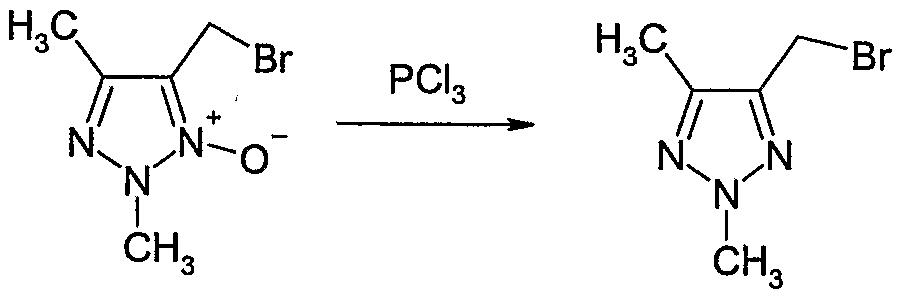
  • Example Il 1 Alternative preparation of 4-bromomethyl-2,5-dimethyl-2H-
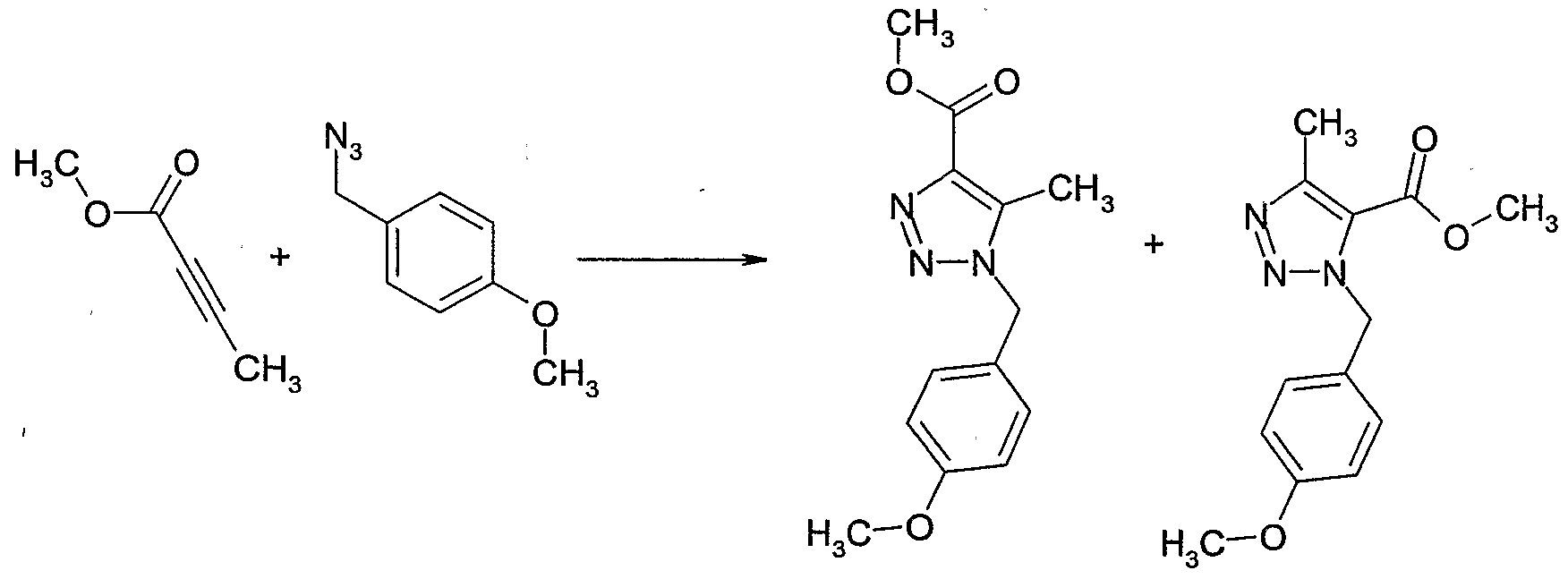
  • Example 112 Preparation of l-(4-methoxy-benzylV5-methyl-lH-
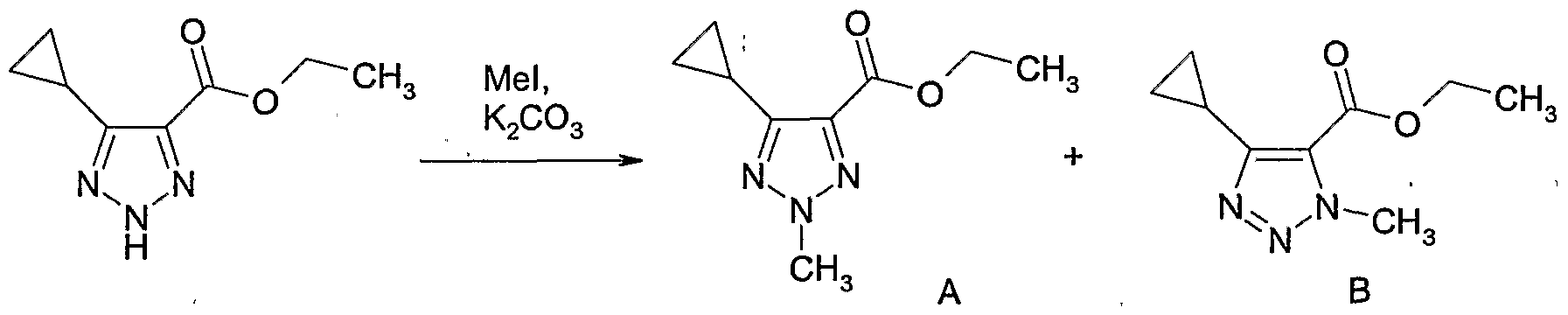
  • Example 114 Preparation of 2-ethyl-5-methyl-2H-[l,2,3]triazole-4-carboxylic acid methyl ester, 3-ethyl-5-methyl-3H-[l,2,31triazole-4-carboxylic acid methyl ester and 1- ethyl-5-methyl-lH-ri,2,31triazole-4-carboxylic acid methyl ester
  • Example 115 Preparation of 2-difluoromethyl-5-methyl-2H-[l,2,3]triazole-4-carboxylic acid ethyl ester and 3-difluoromethyl-5-methyl-3H-[ ' l,2,3 '
  • Example 116 Preparation of l-(4-methoxy-benzylV5-trifluoromemyl-lH-[l,2J]triazole- 4-carboxylic acid ethyl ester and 3-(4-methoxy-benzyl)-5-trifluoromethyl-3H " -[l,2,3]- triazole-4-carboxylic acid ethyl ester
  • Example 118 Preparation of 2-methyl-5-trifluoromethyl-2H-[l,2,31triazole-4-carboxylic acid ethyl ester, 3-methyl-5-trifluoromethyl-3H-[l,2,3]triazole-4-carboxylic acid ethyl ester and l-methyl-5-trifluoromethyl-lH-ri,231triazole-4-carboxylic acid ethyl ester
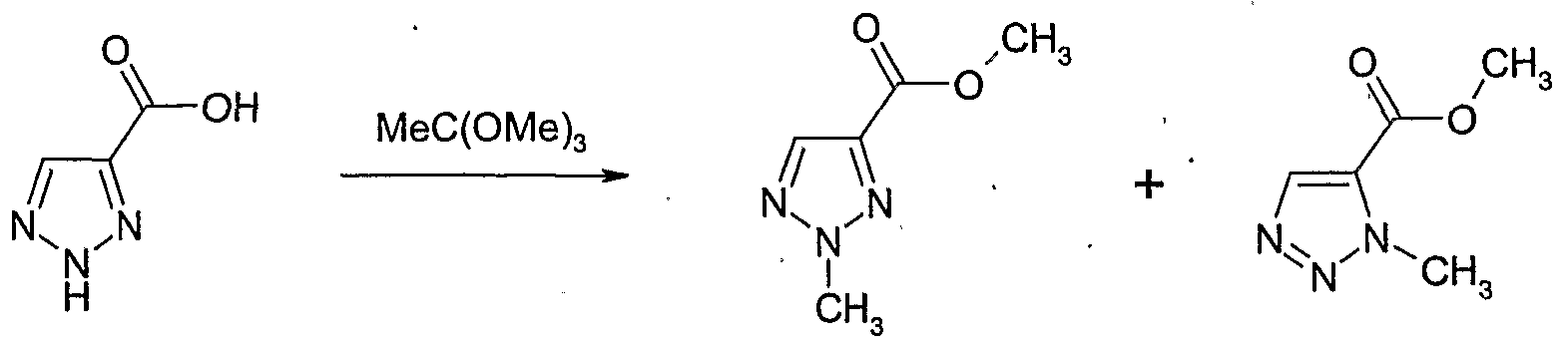
  • Example 139 Example 119: Preparation of 2-methyl-2H-[l,2,31triazole-4-carboxylic acid methyl ester and 3-methyl-3H-
  • Example 123 Preparation of 4-bromo-5-bromomethyl-l-methyl-lH-[ ' l,2,3 '
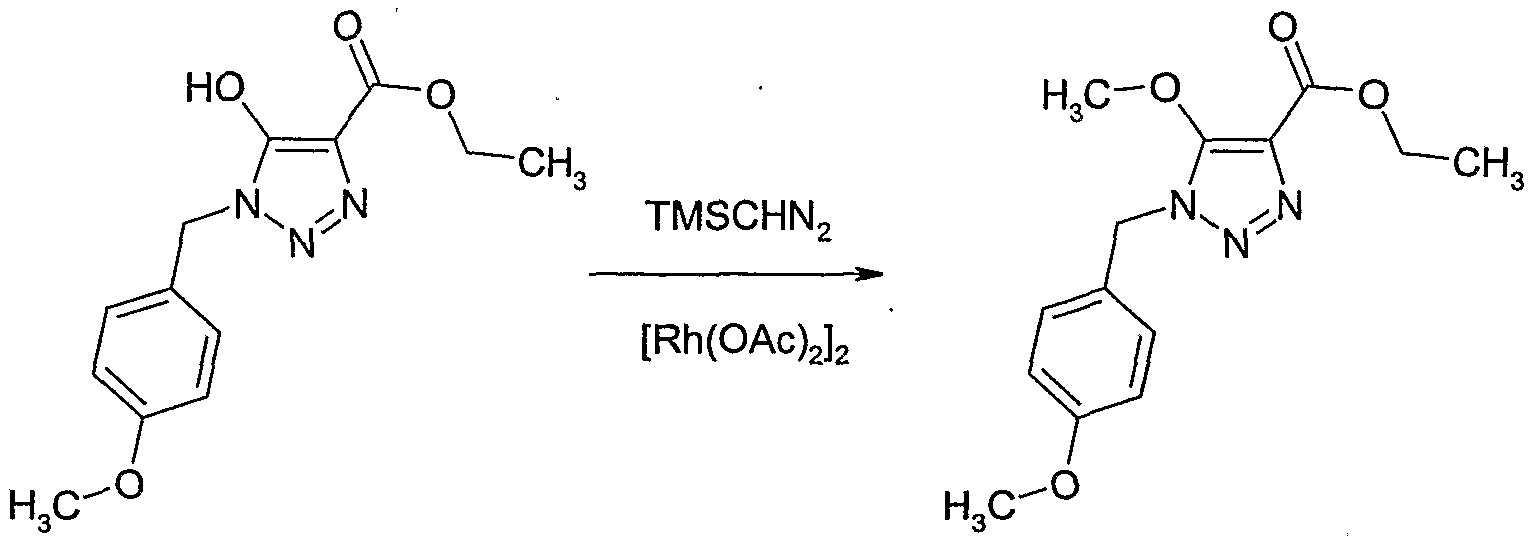
  • the reaction mixture was cooled to CPC and quenched by sequential addition of methanol (75 ml), glacial acetic acid (5 ml) and water (1 ml). The mixture was extracted three times with ethyl acetate. The combined organic extracts were washed three times with brine, dried over magnesium sulfate and concentrated. The residue was purified by column chromatography on silica gel (eluent: 10-55% ethyl acetate in hexane) to give 5-methoxy-l-(4-methoxy-benzyl)-lH-[l,2,3]triazole-4-carboxylic acid ethyl ester as a straw coloured oil (15.2 g, 55% yield).
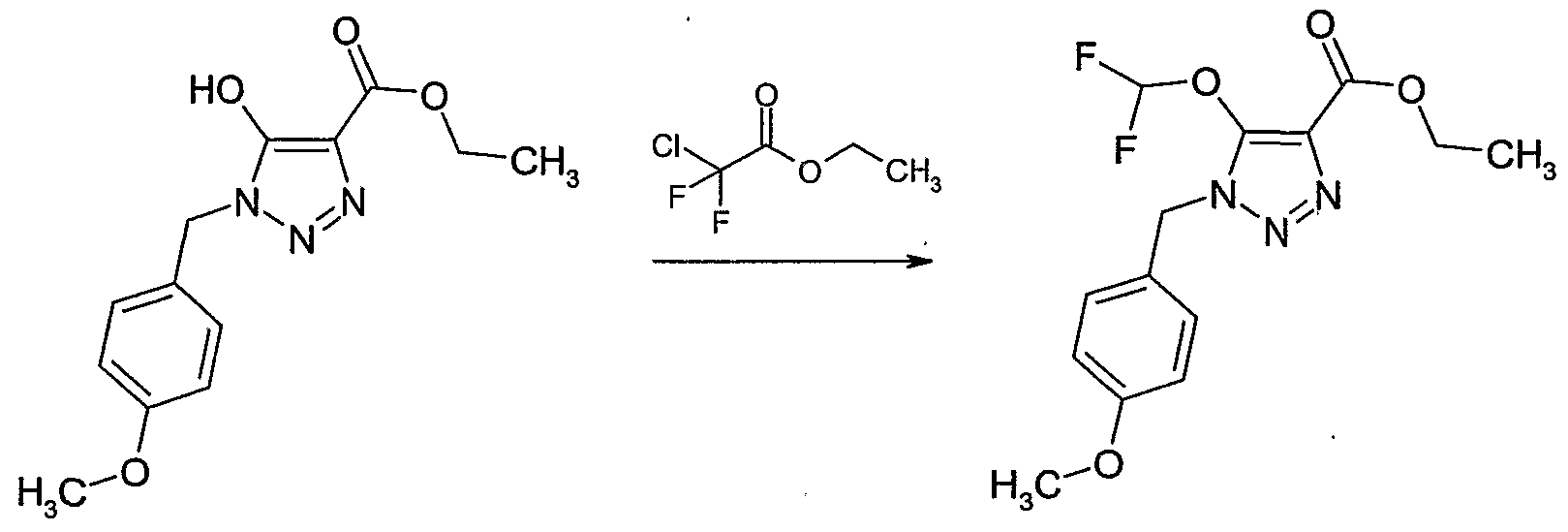
  • reaction mixture was allowed to cool to room temperature and was quenched by addition of water (5 ml), ethyl acetate (10 ml) and aqueous hydrochloric acid (2M) (9 ml). The phases were separated and the aqueous phase extracted twice with more ethyl acetate. The combined organic extracts were washed with brine, dried over magnesium sulfate and concentrated.
  • 5-Difluoromethoxy-lH-[l,2,3]triazole-4-carboxylic acid ethyl ester was methylated with methyl iodide according to the method described in Example 114 to give 5-difluoromethoxy-l-methyl-lH-[l,2,3]triazole-4-carboxylic acid ethyl ester (isomer A) and 5-difluoromethoxy-2-methyl-2H-[l,2,3]triazole-4-carboxylic acid ethyl ester (isomer
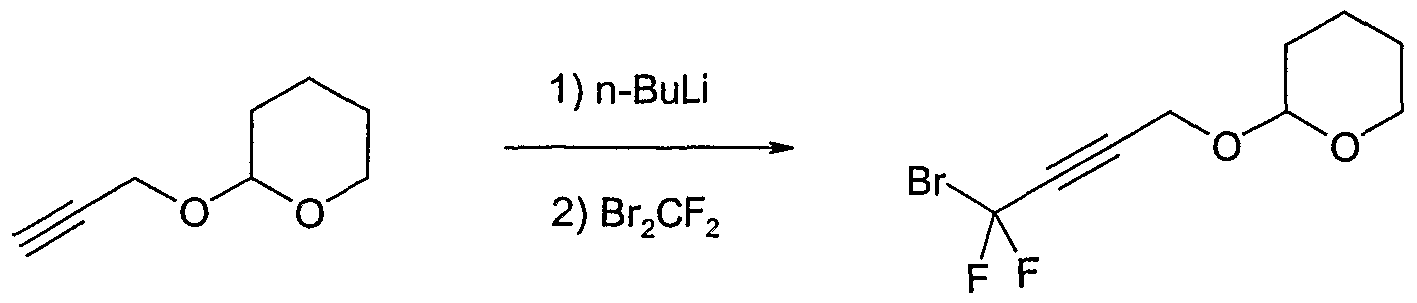
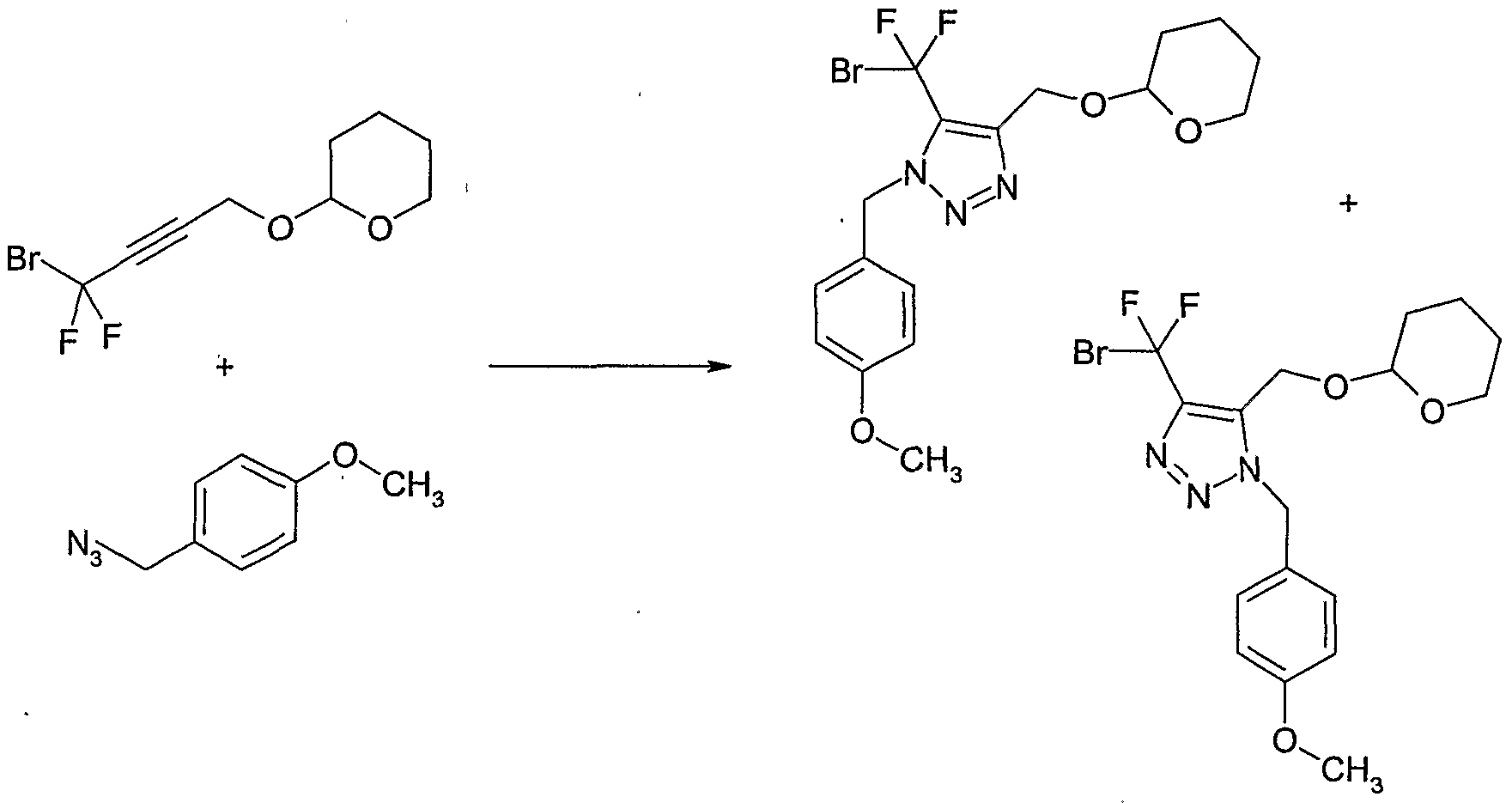
  • reaction mixture was quenched with aqueous potassium dihydrogenphosphate (10%) and extracted three times with diethyl ether. The combined organic extracts were washed with water and brine, dried over magnesium sulfate and concentrated. The residue was purified by column chromatography on silica gel (eluent: diethyl ether / hexane) to give 2-(4-bromo-4,4- difluoro-but-2-ynyloxy)-tetrahydro-pyran as a colourless oil (17.6 g, 91.7% yield).
  • Example 128 Preparation of 4-(bromo-difluoro-methyl)-l-(4-methoxy-benzyl)-5- (tetrahvdro-pyran-2-yloxymethylVlH-rL2,3]triazole and 5-(bromo-difluoro-methyl)-l- (4-methoxy-benzyl)-4-(tetrahvdro-pyran-2-yloxymethyl)-lH-
  • reaction mixture was stirred at room temperature for lhour.
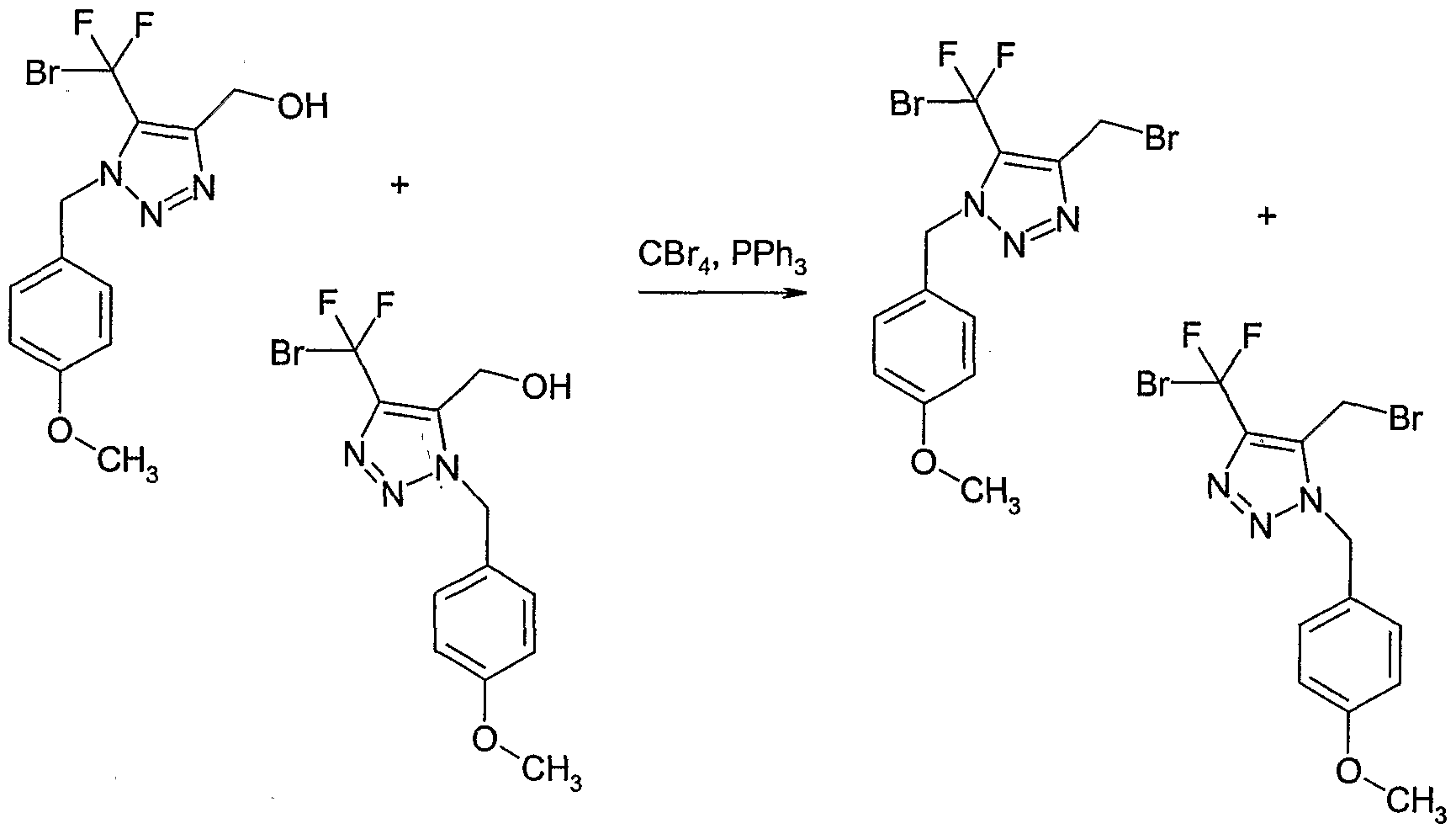
  • the reaction mixture was concentrated and the residue purified by column chromatography on silica gel (eluent: ethyl acetate / hexane) to give a 2:1- mixture of [5-(bromo-difluoro-methyl)-3-(4-methoxy-benzyl)-3H-[ 1 ,2,3]triazol-4-yl]- methanol and [5-(bromo-difluoro-methyl)-l-(4-methoxy-benzyl)-lH-[l,2,3]triazol-4-yl]- methanol as a colourless oil (7.04 g, 82% yield).
  • Example 130 Preparation of 4-(bromo-difluoro-methyl ' )-5-bromomethyl-l-(4-methoxy- benzyl)-lH- ⁇ ,2,31triazole and 5-(bromo-difluoro-methyl)-4-bromomethyl-l-( ' 4- methoxy-benzyl)-lH-[l,2,31triazole
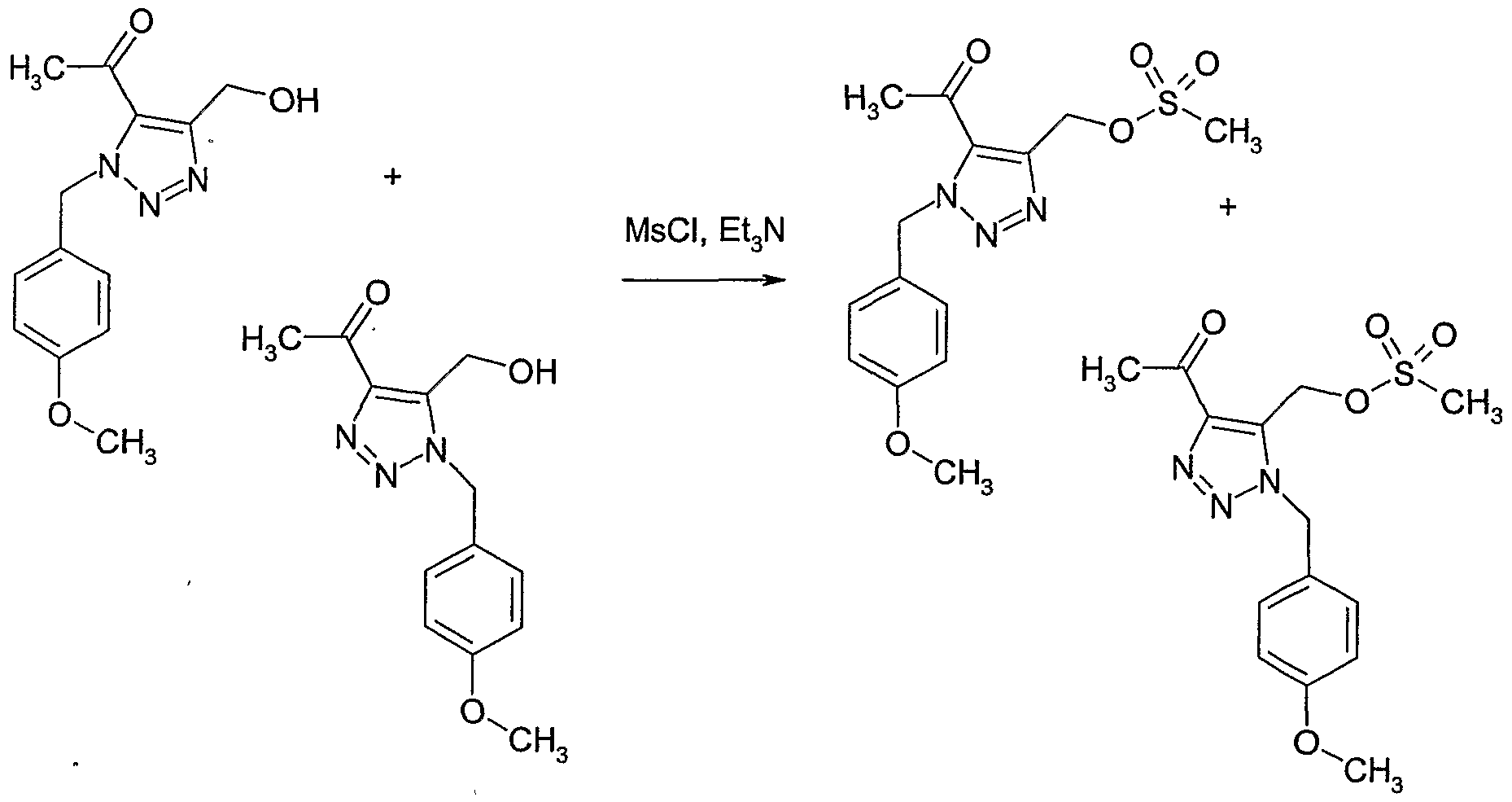
  • Example 131 Preparation of methanesulfonic acid 5-acetyl-l-(4-methoxy-benzylH-H- [l,2,31triazol-4-ylmethyl ester and methanesulfonic acid 5-acetyl-3-(4-methoxy-benzyl)-
  • reaction mixtures were concentrated and re-dissolved in acetonitrile.
  • the solids were removed by filtration and washed with acetonitrile.
  • the combined filtrates were concentrated to give a mixture of methanesulfonic acid 5-acetyl- l-(4-methoxy-benzyl)-lH-[l,2,3]triazol-4-ylmethyl ester and methanesulfonic acid 5- acetyl-3-(4-methoxy-benzyl)-3//-[l,2,3]triazol-4-ylmethyl ester.
  • the mixture was used without further purification.
  • Example 132 Preparation of 4-(bromo-difluoro-methyl)-5-(5,5-dimethyl-4,5-dihydro- isoxazol-3-ylsulfanylmethyl)-2-methyl-2.H-[ 1 ,2,31triazole
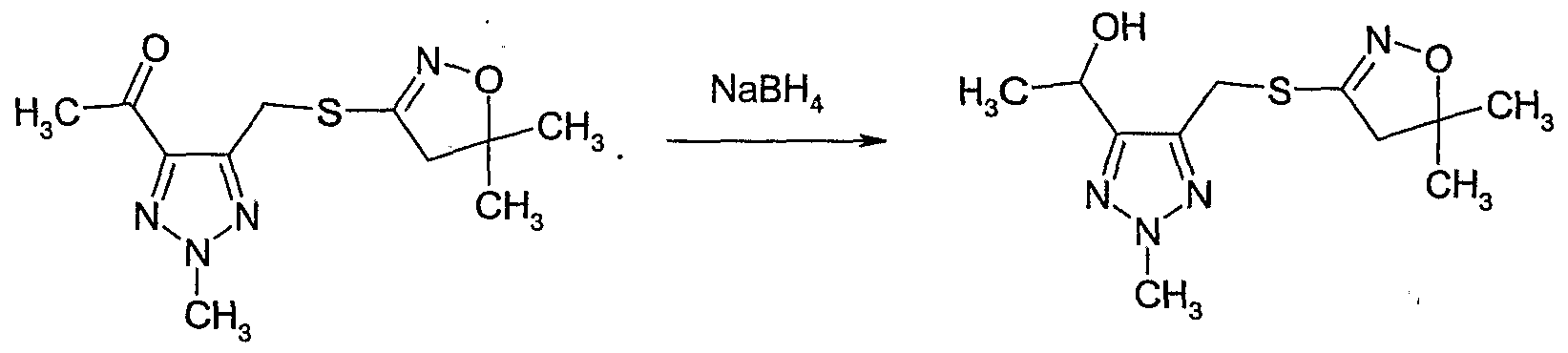
  • Example 133 Preparation of l-r5-(5,5-dimethyl-4,5-dihydro-isoxazol-3-ylsulfanyl- methvl)-2-methvl-2#-ri ,2,31triazol-4-vl]-ethanol
  • 2-Diazo-3-oxo-butyric acid ethyl ester (5 g, 32 mmol) was dissolved in tetra- hydrofuran (50 ml) and acetic acid (6 ml) and methylhydrazine was passed through the solution until a white precipitate crystallised out. More acetic acid (10 ml) was added and the solution was refluxed for 2 days.
  • Example 136 Preparation of 5-cvclopropyl-l-metliyl-l//-[l,2,3]triazole-4-carboxylic acid ethyl ester
  • Example 138 Preparation of 5-cyclopropyl-2-methyl-2H-[l,2,31triazole-4-carboxylic acid ethyl ester and 5-cvclopropyl-3-memyl-3H-ri,2.3 "
  • Example 140 Preparation of 4-(bromo-difluoro-methyl)-5-(5,5-dimethyl-4,5-dihvdro- isoxazol-3-ylsulfanylmethvD-l-(4-methoxy-benzyl)-l/f-[l,2,3]triazole and 5-(bromo- difluoro-methyl)-4-(5,5-dimethyl-4,5-dihvdro-isoxazol-3-ylsulfanylmethyl)-l-(4- methoxy-benzyl)-l//-ri,2,31triazole
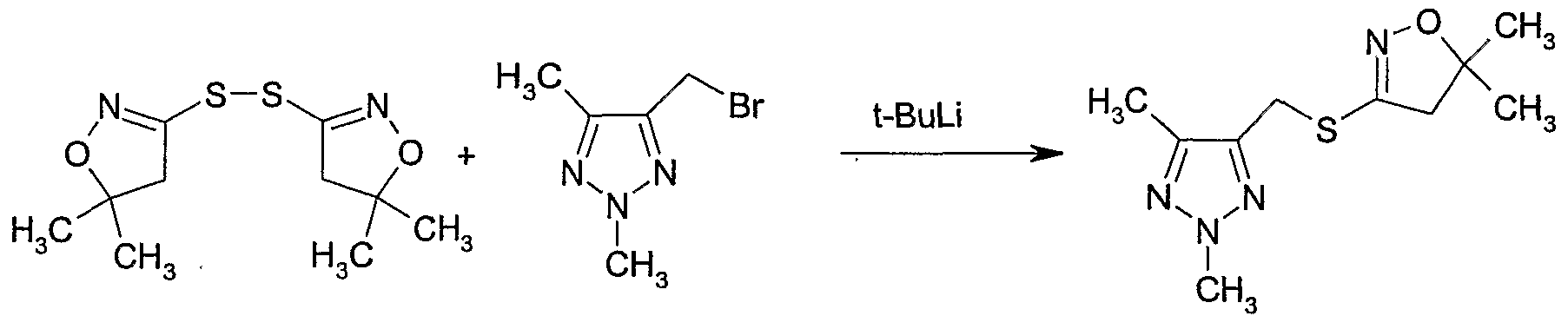
  • Example 142 Alternative preparation of 4-(5,5-dimethyl-4,5-dihvdro-isoxazol-3-yl- sulfanylmethvn-2.5-dimethyl-2H-r 1.2.31triazole
  • tert-Buty ⁇ lithium (1.7 M in hexane) (1.12 ml, 1.89 mmol) was added to diethyl ether (5 ml) at -78 3 C.
  • a solution of 4-bromomethyl-2,5-dimethyl-2i/-[l,2,3]triazole (Example 17, Example Il 1) (300 mg, 1.58 mmol) in diethyl ether (5 ml) was added at -7S 3 C and the reaction mixture stirred at -78 3 C for 5 minutes.
  • Example 143 Alternative preparation of 4-(5,5-dimethyl-4,5-dihvdro-isoxazol-3-yl- sulfanylmethyl)-2,5-dimethyl-2H-r 1 ,2.31triazole
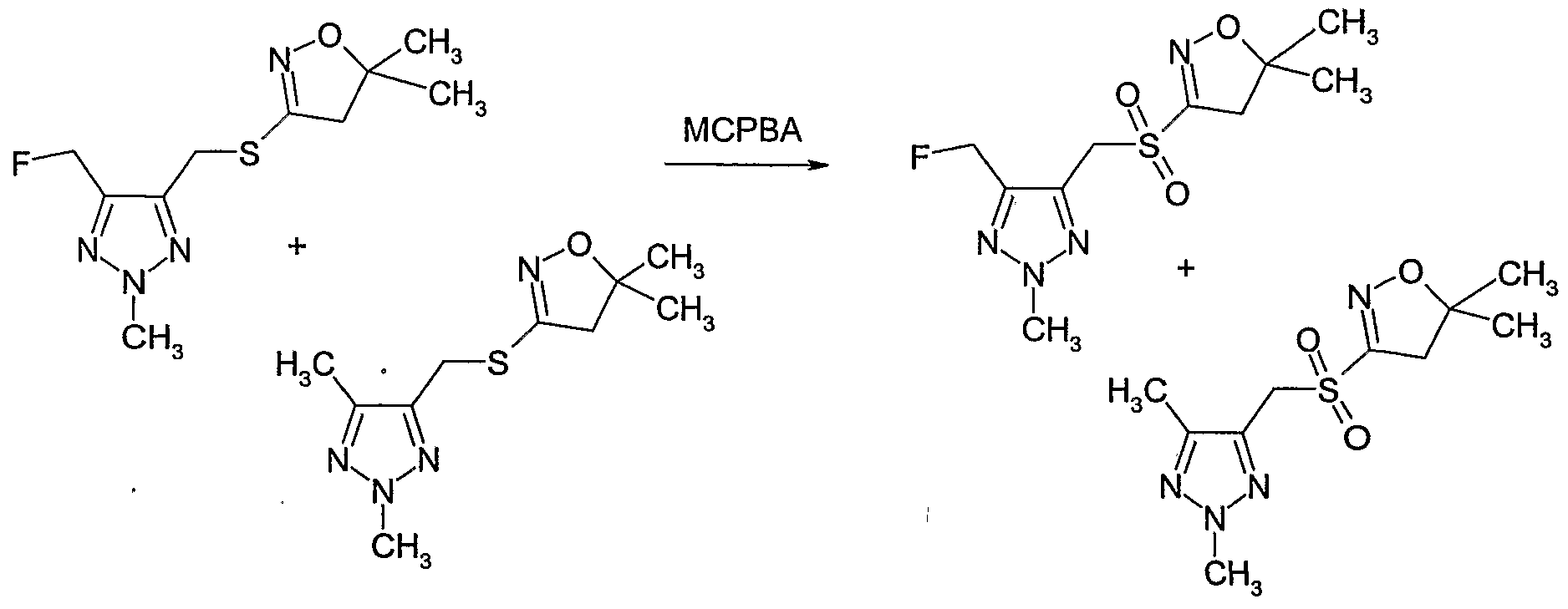
  • [l,2,3]triazole (Example 139) (75% pure, 3.53g) was dissolved in dichloromethane and 3- chloroperoxybenzoic acid (MCPBA) (60% by weight) (4.2 g, 14.6 mmol) was added at CPC. The mixture was stirred for 30 minutes at CPC. The reaction mixture was quenched by addition of aqueous sodium metabisulfite (20%) (80 ml) and the mixture stirred for 10 minutes. The phases were separated and the aqueous phase was washed with aqueous sodium bicarbonate (saturated), water and brine, dried over magnesium sulfate and concentrated.
  • MCPBA 3- chloroperoxybenzoic acid
  • Example 145 Preparation of 4-(5,5-dimetliyl-4,5-dihvdro-isoxazol-3-ylsulfonylmethv ⁇ - 5-fluoromethyl-2-methyl-2H-[T,2,31triazole and 4-(5,5-dimethyl-4,5-dihydro-isoxazol-3- ylsulfonvlmethvl)-2. 5-dimethvl-2H-ri ,2,3
  • reaction mixture was quenched by addition of aqueous sodium metabisulfite (10%).
  • the mixture was diluted with water and aqueous sodium hydroxide (2M) was added.
  • the phases were separated and the aqueous phase extracted with dichloromethane.
  • the combined organic extracts were washed twice with aqueous sodium hydroxide (2M), dried over magnesium sulfate and concentrated.
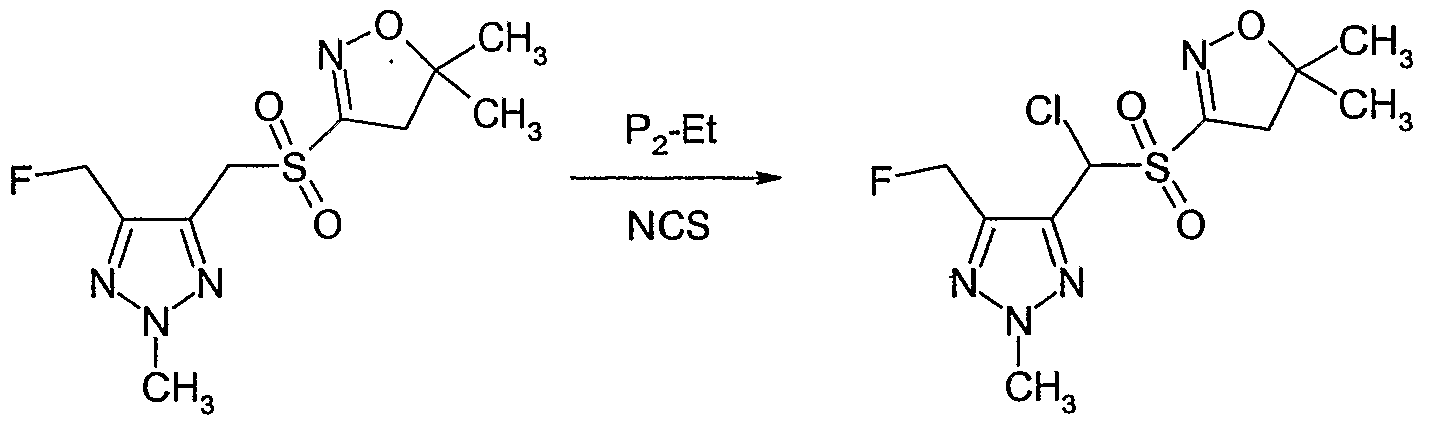
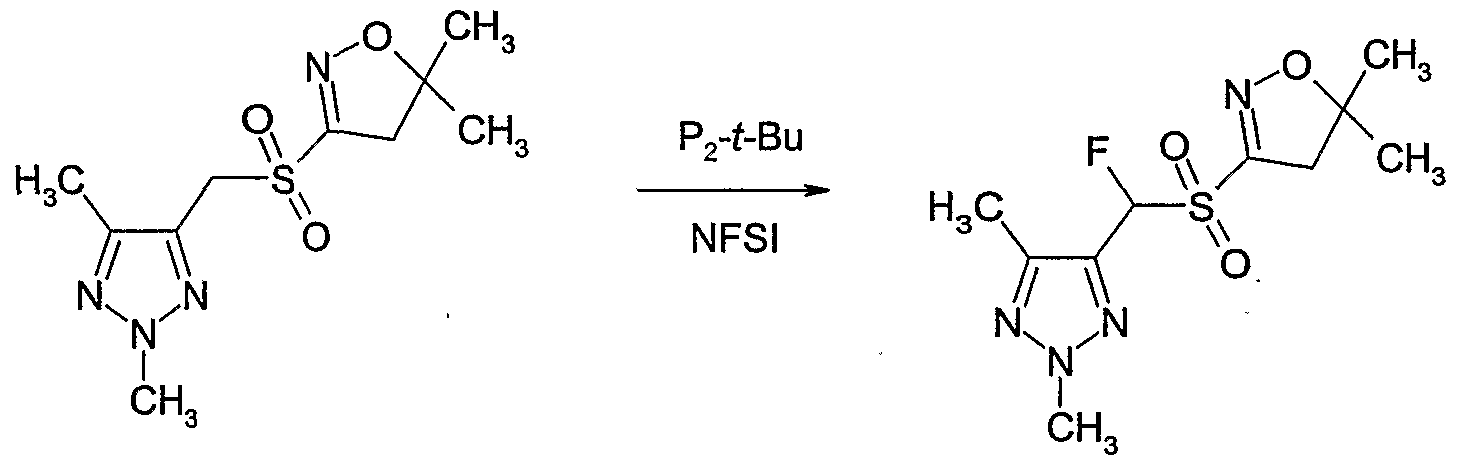
  • Example P2 Preparation of 4-[chloro-(5,5-dimethyl-4,5-dihvdro-isoxazole-3-sulfonyP)- methyll-5-fluoromethyl-2-ethyl-2H-rL231triazole
  • Example P2 4-[Chloro-(5,5-dimethyl-4,5-dihydro-isoxazole-3-sulfonyl)-methyl]-5-fluoro- methyl-2-ethyl-2H-[l,2,3]triazole (Example P2) (116 mg, 0.36 mmol) was dissolved in tetrahydrofuran (2 ml) under nitrogen and l-ethyl-2,2,4,4,4-pentakis(dimethylamino)-2- Iambda 5 ,41ambda 5 -catenadi(phosphazene) (P 2 -Et) (0.13 ml, 0.38 mmol) was added at room temperature.
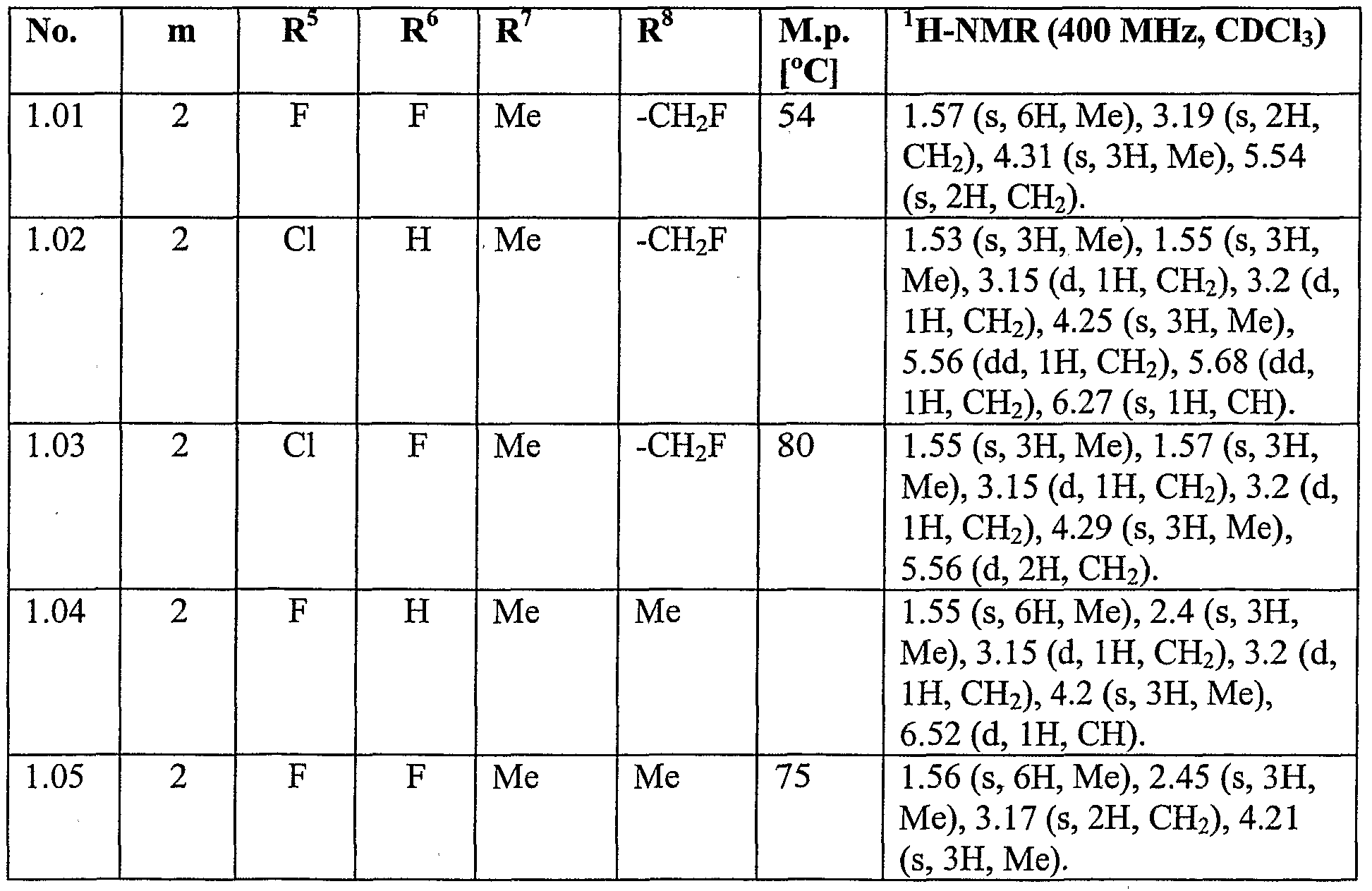
  • N-Fluorobenzene sulfonimide (NFSI) (118 mg, 0.38 mmol) was added in one portion at room temperature and the reaction mixture was stirred for 1 hour at room temperature. The reaction mixture was concentrated and the residue was purified by column chromatography on silica gel (eluent: ethyl acetate / hexane) to give Compound No. 1.03 of Table 1 as a white solid (85 mg, 69% yield).
  • Example P4 Preparation of 4-r(5,5-dimethyl-4,5-dihvdro-isoxazole-3-sulfonyl * )-fluoro- methvll-2. 5-dimethvl-2H- ⁇ ,2,3]triazole
  • Example P5 Preparation of 4-r(5,5-dimethyl-4,5-dihvdro-isoxazole-3-sulfinvD-difluoro- methvll-2.5-dimethvl-2H-r 12 ,3]triazole
  • Lithium hexamethyldisilazide (IM solution in THF) (1.64 ml, 1.64 mmol) was added dropwise at -78 0 C and the solution was stirred and allowed to warm slowly to -2O 0 C over 3 hours.
  • the reaction mixture was quenched at -2CPCby addition of several drops of aqueous ammonium chloride (saturated).
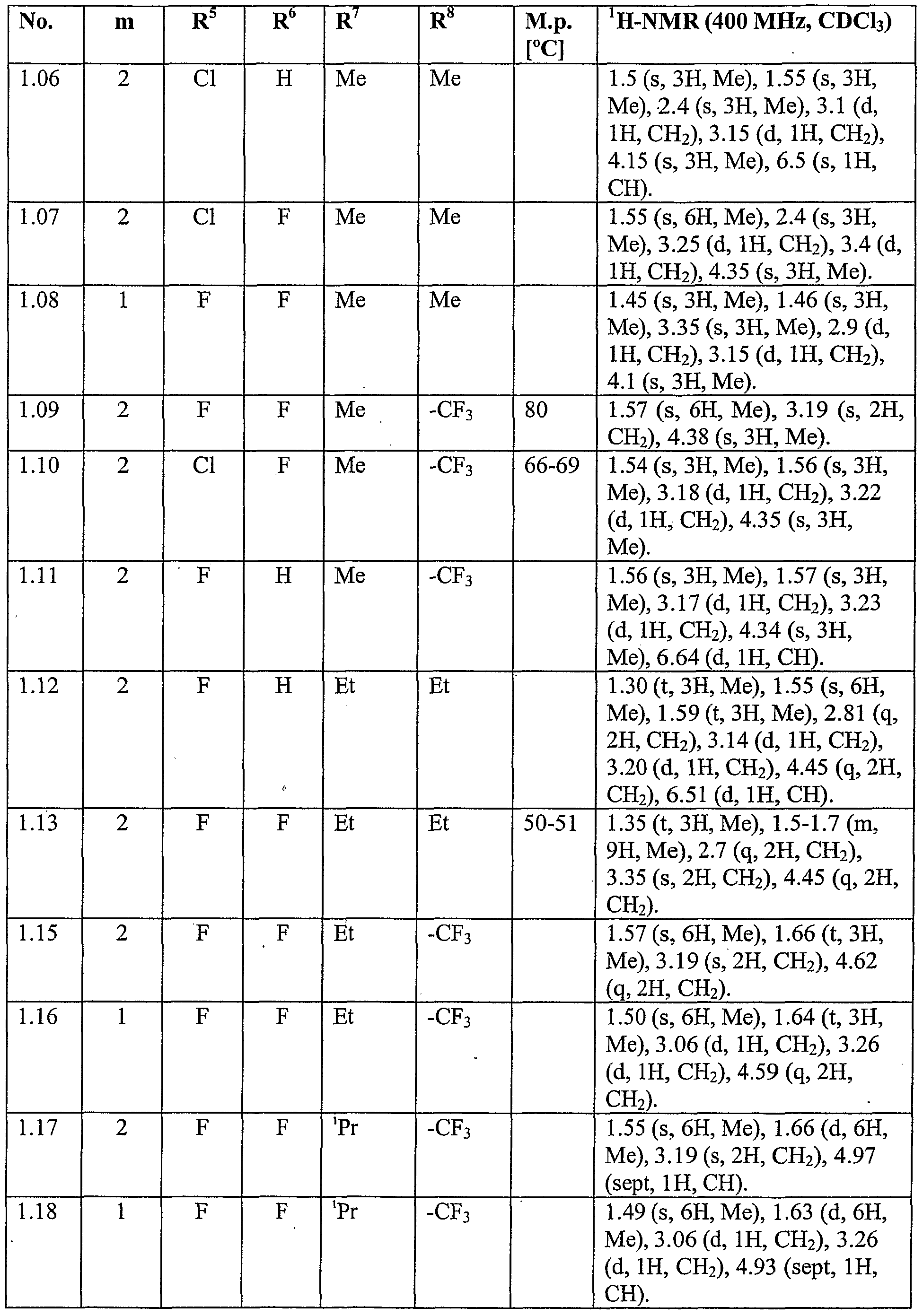
  • the mixture was allowed to warm to room temperature, concentrated onto silica gel and purified by column chromatography on silica gel (eluent: hexane / ethyl acetate) to give Compound No. 1.08 of Table 1 (160 mg, 70% yield).
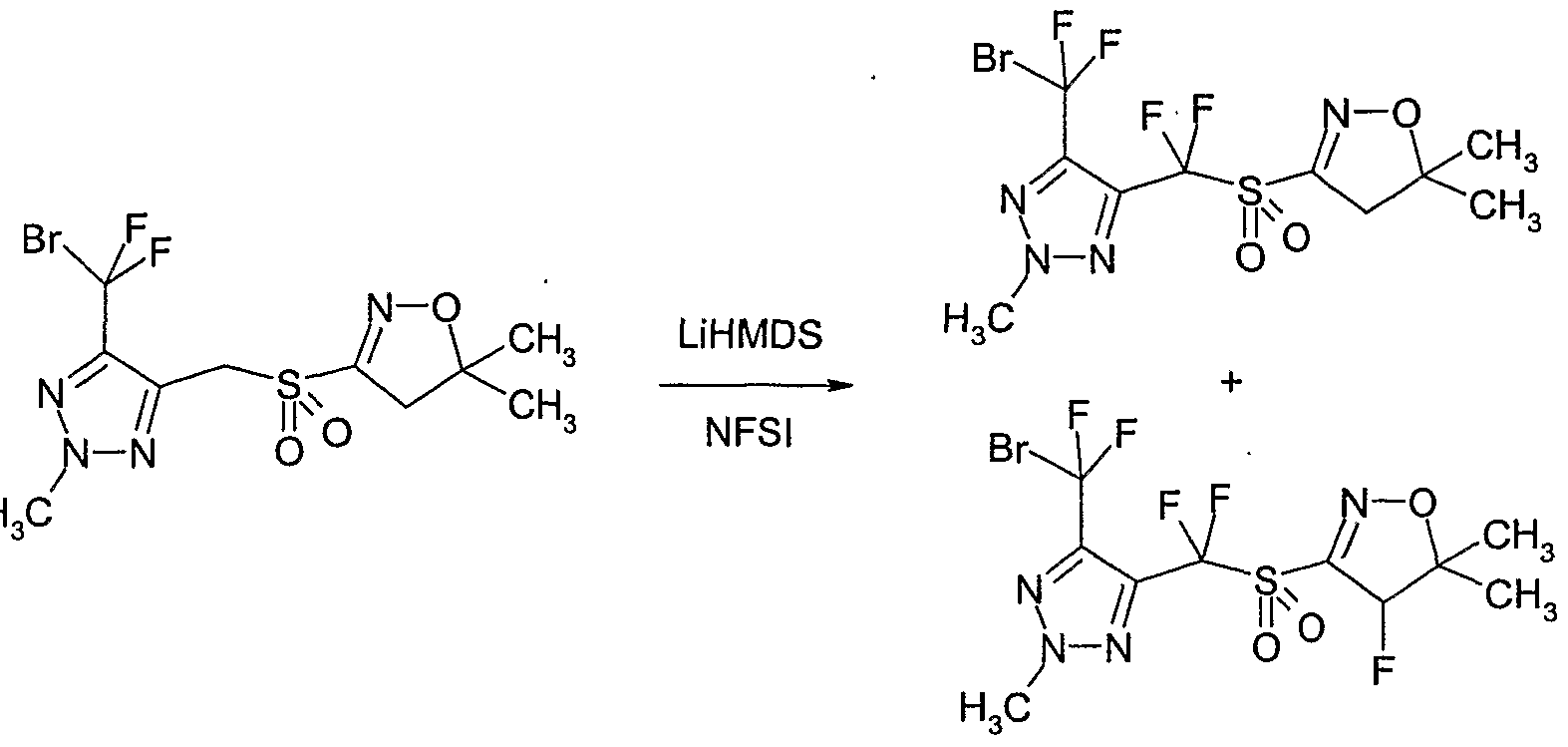
  • Example P6 Preparation of 4-( ' bromo-difluoro-methyl)-5-[ " ( ' 5,5-dimethyl-4,5-dihvdro- isoxazole-S-sulfonvD-difluoro-methvn ⁇ -methyl- ⁇ H-fl ⁇ Jjtriazole
  • Lithium hexamethyldisilazide (IM in THF) (2.8 ml, 2.8 mmol) was added dropwise at -78 3 C and the solution was stirred and allowed to warm slowly to room temperature over 4 hours.
  • the reaction mixture was quenched at by addition of aqueous ammonium chloride (saturated) and was extracted several times with ethyl acetate. The combined organic fractions were washed with water and brine, dried over magnesium sulfate and concentrated. The residue was purified by column chromatography on silica gel (eluent: ethyl acetate / hexane) to give Compound No.
  • Example P7 Preparation of 5-cyclopropyl-4-[(5,5-dimethyl-4,5-dihvdro-isoxazole-3- sulfinyl)-fluoro-methyll-l-methyl-lH-[l,2,31triazole and 5-cyclopropyl-4-( ' (5,5- dimethyl-4,5-dihvdro-isoxazole-3-sulfinyl)-difluoro-methvn-l-methyl-lH-ri,2,31triazole
  • N- fluorobenzene sulfonimide (NFSI) (160 mg, 0.51 mmol) was added and the reaction mixture stirred for 2 hours at -78?C.
  • the reaction mixture was quenched by addition of aqueous ammonium chloride (saturated) (3ml) and extracted with ethyl acetate. The organic phase was washed with water and brine, dried over magnesium sulfate and concentrated. The residue was purified by column chromatography on silica gel (eluent: ethyl acetate / iso-hexane) to give Comppund No. 2.10 of Table 2 (42 mg, 39% yield) and Compound No. 2.11 of Table 2 (45 mg, 44% yield).
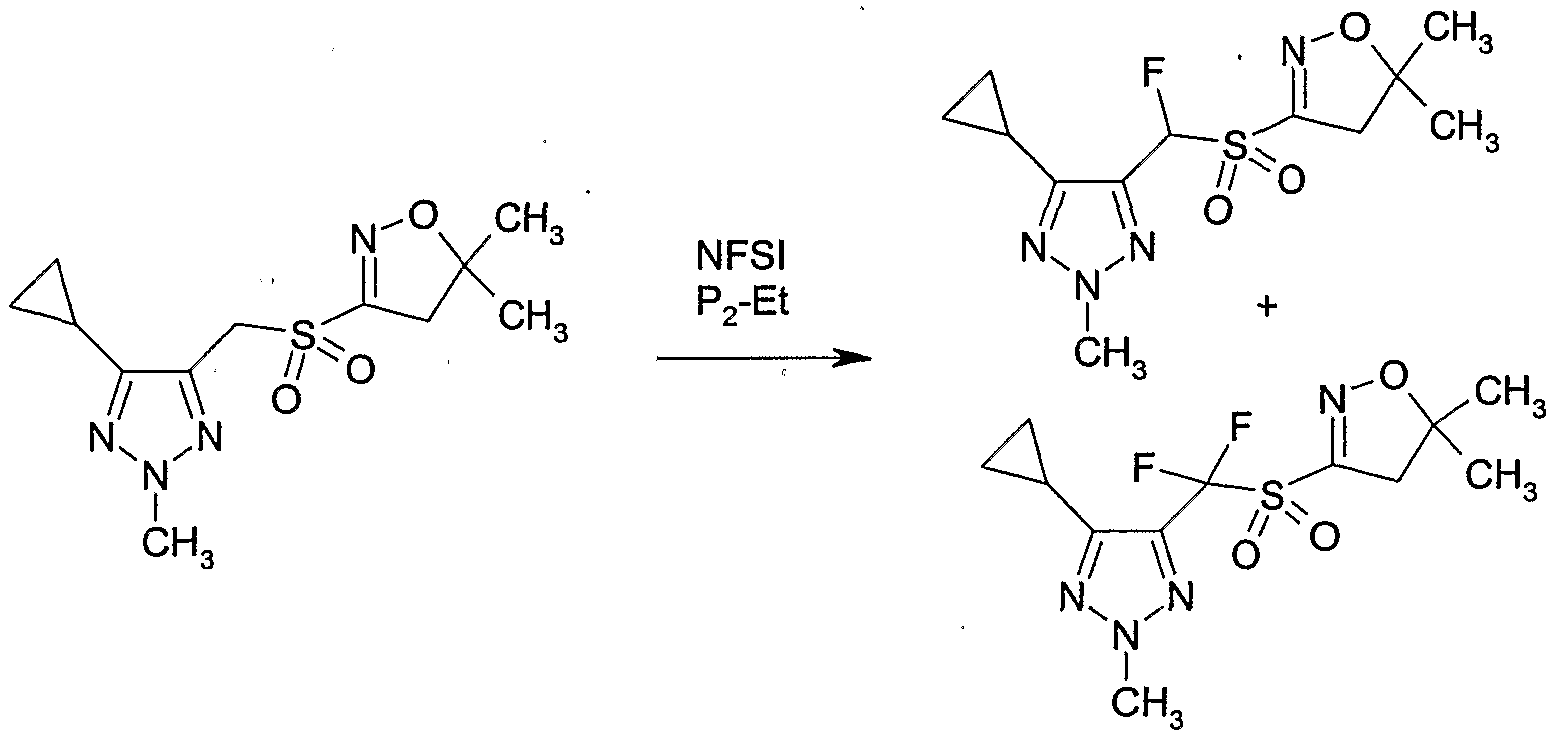
  • Example P8 Preparation of 5-cvclopropyl-4-[(5,5-dimethyl-4,5-dihvdro-isoxazole-3- sulfonylVfluoro-methvn-l-methyl-l.H-ri,2,3]triazole and 5-cyclopropyl-4-r(5,5- dimethyl-4,5-dihvdro-isoxazole-3-sulfonyl)-difluoro-methyl1-l-methyl-l//-[l,2,3]- ' triazole
  • DIGSA Digitaria sanguinalis
  • AGRTE Agrostis tenius
  • SETIT Setaria italica
  • SETFA Setaria faberi
  • POATR Poa trivialis
  • AMARE Amaranthus retroflexus.

Landscapes

  • Chemical & Material Sciences (AREA)
  • Organic Chemistry (AREA)
  • Life Sciences & Earth Sciences (AREA)
  • Dentistry (AREA)
  • Pest Control & Pesticides (AREA)
  • Plant Pathology (AREA)
  • Health & Medical Sciences (AREA)
  • Engineering & Computer Science (AREA)
  • Agronomy & Crop Science (AREA)
  • General Health & Medical Sciences (AREA)
  • Wood Science & Technology (AREA)
  • Zoology (AREA)
  • Environmental Sciences (AREA)
  • Agricultural Chemicals And Associated Chemicals (AREA)
  • Plural Heterocyclic Compounds (AREA)
  • Heterocyclic Carbon Compounds Containing A Hetero Ring Having Nitrogen And Oxygen As The Only Ring Hetero Atoms (AREA)

Abstract

Novel compounds of formula (I): wherein R1, R2, R3, R4, m, R5, R6, n and Y are as defined in claim 1; or N-oxides, salts and optical isomers thereof. Furthermore, the present invention relates to processes for preparing compounds of formula (I), to herbicidal compositions comprising them and to methods of using them to control plants or to inhibit plant growth.

Description

HERBICIDAL ISOXAZOLINE COMPOUNDS
The present invention relates to novel, herbicidal isoxazoline compounds, to processes for their preparation, to compositions comprising those compounds, and to their use in controlling plants or in inhibiting plant growth. .
Isoxazoline compounds which display a herbicidal action are described, for example, in WO 01/012613, WO 02/062770, WO 03/000686, WO 04/010165, JP 2005/035924, JP 2005/213168 and WO 06/024820. The preparation of these compounds is also described in WO 04/013106 and WO 05/095352. Novel isoxazoline compounds which display herbicidal and growth-inhibiting properties have now been found.
The present invention accordingly relates to compounds of formula I
CR5R6] -Y (I)
Figure imgf000002_0001
wherein R and R are each independently of the other hydrogen, Q-Qoalkyl, Ci-Qohaloalkyl,
C3-C8cycloalkyl or Cs-Cscycloalkyl-Ct-Csalkyl, or
R1 and R2 together with the carbon atom to which they are bonded form a C3-C7ring,
R3 and R4 are each independently of the other hydrogen, Q-Qoalkyl, Ci-Ciohaloalkyl,
C3-C8cycloalkyl, C3-C8cycloalkyl-Ci-C10alkyl or Q-Cβalkoxy-Ci-Qoalkyl, or R3 and R4 together with the carbon atom to which they are bonded form a C3-C7ring, or
R1 with R3 or R4 and together with the carbon atoms to which they are bonded form a
C5-C8ring, or
R2 with R3 or R4 and together with the carbon atoms to which they are bonded form a
C5-C8ring; R5 is halogen or Ci-C6haloalkyl;
R6 is hydrogen, cyano, C1-QaIkVl, Ci-C6alkoxycarbonyl, halogen or Ci-C6haloalkyl; m is 0, 1 or 2; n is 1, 2 or 3; and
Y is one of the following groups
Figure imgf000003_0001
wherein
R7 is hydrogen, Ci-Cioalkyl, Ci-Cioalkylcarbonyl, formyl, d-Ciohaloalkylcarbonyl, C1- C10alkoxycarbonyl, d-Cjohaloalkyl, cyano, C2-C10alkenyl, C2-C10alkynyl, C3- C10cycloalkyl, C3-C10cycloalkyl-Ci-C10alkyl, d-doalkylcarbonyl-d-doalkyl, C1-
C10alkylsulfonyl, d-dohaloalkylsulfonyl, Crdoalkoxy-d-doalkyl or phenyl which is optionally substituted by one to five substituents selected from cyano, d-doalkyl, C1- C10haloalkyl or halogen; or R7 is -CONR13R14 or -SO2NR13R14 wherein R13 and R14 are independently of each other hydrogen, C1-QaIkVl, d-C6haloalkyl, d-C6cycloalkyl, d-C6alkylcarbonyl, d-C6halo- alkylcarbonyl, d-C6alkylsulfonyl, d-C6haloalkylsulfonyl, or R13 and R14 together form a C3-C8alkylene group which optionally contains one oxygen, sulfur, amino or Ci- C6alkylamino group; R8 is hydrogen, Ci-CiOalkyl, Ci-C10alkylcarbonyl, formyl, Ci-Ciohaloalkylcarbonyl, Ci- Cioalkoxycarbonyl, Ci-Ci0haloalkyl, C2-C10alkenyl, C2-C10alkynyl, C3-C10cycloalkyl, C3- CiQcycloalkyl-Ci-Cioalkyl, halogen, cyano, Ci-Cioalkoxy or d-Ci0haloalkoxy, or R8 is -CONR15R16, -SO2NR15R16 or -NR15R16 wherein R15 and R16 are independently of each other hydrogen, Ci-C6alkyl, d-C6haloalkyl, Ci-C6cycloalkyl, d-C6alkylcarbonyl, d-C6haloalkylcarbonyl, Ci-C6alkylsulfonyl, Ci-C6haloalkylsulfonyl, or R15 and R16 together form a C3-C8alkylene group which optionally contains one oxygen, sulfur, amino or d-Cgalkylamino group; and to N-oxides, salts and optical isomers of compounds of formula I.
Preferably R1 and R2 are independently d-Cioalkyl or d-Ciohaloalkyl, more preferably C1 -C6alkyl or Ci -C6haloalkyl, most preferably methyl.
Preferably R3 and R4 are independently hydrogen, Ci-Cioalkyl or Ci-Ciohaloalkyl, more preferably hydrogen, Ci-C6alkyl or Ci-C6haloalkyl, most preferably hydrogen.
Preferably R5 is halogen or trifluoromethyl, more preferably fluoro, chloro or trifluoromethyl, most preferably fluoro or chloro. Preferably R6 is hydrogen, methoxycarbonyl, Ci-C6alkyl or halogen, more preferably hydrogen, methyl, fluoro or chloro, most preferably hydrogen or fluoro. Preferably m is 1 or 2, more preferably 2. Preferably n is 1. Preferably Y is one of the following groups
Figure imgf000004_0001
R
Preferably R7 is hydrogen, C1-C1OaIlCyI, Ci-Qohaloalkyl, C2-C1oalkenyl, C2- Cioalkynyl, C3-C10cycloalkyl, Q-docycloalkyl-Q-doalkyl, d-Qoalkoxy-Q-Cioalkyl or phenyl which is optionally substituted by one to five substituents selected from cyano, d-doalkyl, d-dohaloalkyl or halogen, more preferably hydrogen, methyl, ethyl, iso- propyl, tert-butyl, monofluoromethyl, difluoromethyl, trifluoromethyl, allyl, propargyl, cyclopropyl, cyclopentyl, cyclopropylmethyl, cyclobutyhnethyl, methoxymethyl, 2- methoxy-ethyl or phenyl, even more preferably methyl, ethyl, zso-propyl, tert-butyl, difluoromethyl, allyl, cyclopentyl, cyclobutyhnethyl, 2-methoxy-ethyl or phenyl, most preferably methyl, ethyl, ώo-propyl, tert-butyl, difluoromethyl, allyl, cyclopentyl, cyclobutylmethyl or 2-methoxy-ethyl.
Preferably R8 is hydrogen, C1-C1OaUCyI, Ci-C10alkylcarbonyl, formyl, C1- doalkoxycarbonyl, Ci-C10haloalkyl, C3-C10cycloalkyl, halogen, cyano, C1-C1OaIkOXy or d-dohaloalkoxy, more preferably hydrogen, methyl, ethyl, acetyl, formyl, methoxy- carbonyl, monofluoromethyl, difluoromethyl, trifluoromethyl, bromodifluoromethyl, 1- fluoro-ethyl, cyclopropyl, fluoro, chloro, bromo, cyano, methoxy, difluoromethoxy, trifluoromethoxy or 2,2,2-trifluoroethoxy, even more preferably hydrogen, methyl, ethyl, acetyl, methoxycarbonyl, monofluoromethyl, difluoromethyl, trifluoromethyl, bromodifluoromethyl, 1-fluoro-ethyl, cyclopropyl, bromo, methoxy or difluoromethoxy, most preferably hydrogen, methyl, ethyl, monofluoromethyl, trifluoromethyl, bromo or methoxy.
A group of preferred compounds of formula I comprises those wherein Y is 1,2,3- triazolyl which is optionally substituted by one to two substituents independently selected from Ci-C6alkyl, Ci-C6haloalkyl, Ci-C6alkylcarbonyl, formyl, Q-Cόalkoxycarbonyl, C2- C6alkenyl, C3-C6cycloalkyl, C3-C6cycloalkyl-Ci-C6-alkyl, Ci-C6alkoxy-C]-C6alkyl, halogen, cyano, Ci-C6alkoxy, C1-C6IIaIOaIkOXy or phenyl which is optionally substituted by one to five substituents selected from cyano, Ci-Cioalkyl, Q-Qohaloalkyl or halogen, more preferably wherein Y is 1,2,3-triazolyl which is optionally substituted by one to two substituents independently selected from methyl, ethyl, zso-propyl, tert-butyl, mono- fluoromethyl, difluoromethyl, trifluoromethyl, bromodifluoromethyl, 1-fluoro-ethyl, acetyl, formyl, methoxycarbonyl, allyl, cyclopropyl, cyclopentyl, cyclopropylmethyl, cyclobutylmethyl, 2-methoxy-ethyl, fluoro, chloro, bromo, cyano, methoxy, ethoxy, monofluoromethoxy, difluoromethoxy, trifluoromethoxy or phenyl, even more preferably wherein Y is 1,2,3-triazolyl which is optionally substituted by one to two substituents independently selected from methyl, ethyl, wo-propyl, tert-butyl, monofluoromethyl, difluoromethyl, trifluoromethyl, bromodifluoromethyl, 1-fluoro-ethyl, acetyl, methoxycarbonyl, allyl, cyclopropyl, cyclopentyl, cyclobutylmethyl, 2-methoxy-ethyl, bromo, methoxy, difluoromethoxy or phenyl, most preferably wherein Y is 1,2,3- triazolyl which is optionally substituted by one to two substituents independently selected from methyl, ethyl, iso-propyl, tert-butyl, monofluoromethyl, difluoromethyl, trifluoromethyl, allyl, cyclopentyl, cyclobutylmethyl, 2-methoxy-ethyl or bromo.
A group of especially preferred compounds of formula I comprises those wherein Y is l,2,3-triazol-4-yl which is optionally substituted by one to two substituents independently selected from Ci-Cβalkyl, Ci-C6haloalkyl, d-C6alkylcarbonyl, formyl, Q- C6alkoxycarbonyl, C2-C6alkenyl, C3-C6cycloalkyl, Cs-Cβcycloalkyl-Ci-Cβ-alkyl, C1-
Cόalkoxy-d-Cealkyl, halogen, cyano, C1-QaIkOXy , Q-Cόhaloalkoxy or phenyl which is optionally substituted by one to five substituents selected from cyano, Q-Qoalkyl, C1- Ciohaloalkyl or halogen, more preferably wherein Y is l,2,3-triazol-4-yl which is optionally substituted by one to two substituents independently selected from methyl, ethyl, zso-propyl, tert-bntyl, monofluoromethyl, difluoromethyl, trifluoromethyl, bromodifluoromethyl, l-fluoro-ethyl, acetyl, formyl, methoxycarbonyl, allyl, cyclopropyl, cyclopentyl, cyclopropylmethyl, cyclobutylmethyl, 2-methoxy-ethyl, fluoro, chloro, bromo, cyano, methoxy, ethoxy, monofluoromethoxy, difluoromethoxy, trifluoromethoxy or phenyl, even more preferably wherein Y is l,2,3-triazol-4-yl which is optionally substituted by one to two substituents independently selected from methyl, ethyl, isø-propyl, tert-butyl, monofluoromethyl, difluoromethyl, trifluoromethyl, bromodifluoromethyl, 1-fluoro-ethyl, acetyl, methoxycarbonyl, allyl, cyclopropyl, cyclopentyl, cyclobutylmethyl, 2-methoxy-ethyl, bromo, methoxy, difluoromethoxy or phenyl, most preferably wherein Y is l,2,3-triazol-4-yl which is optionally substituted by one to two substituents independently selected from methyl, ethyl, wo-propyl, tert-butyl, monofluoromethyl, difluoromethyl, trifluorornethyl, allyl, cyclopentyl, cyclobutylmethyl, 2-methoxy-ethyl or bromo.
A group of especially preferred compounds of formula I comprises those wherein Y is
Figure imgf000006_0001
A group of especially preferred compounds of formula I comprises those wherein
Y is 5-monofluoromethyl-2-methyl-l,2,3-triazol-4-yl. A group of especially preferred compounds of formula I comprises those wherein
Y is 2,5-dimethyl-l,2,3-triazol-4-yl.
A group of especially preferred compounds of formula I comprises those wherein
Y is 5-cycloproyl-2-methyl-l,2,3-triazol-4-yl.
A group of especially preferred compounds of formula I comprises those wherein Y is 2,5-diethyl-l,2,3-triazol-4-yl.
A group of especially preferred compounds of formula I comprises those wherein
Y is 2-difluoromethyl-5-methyl-l,2,3-triazol-4-yl.
A group of especially preferred compounds of formula I comprises those wherein
Y is 2-allyl-5-trifluoromethyl-l ,2,3-triazol-4-yl. A group of especially preferred compounds of formula I comprises those wherein
Y is 2-cyclopentyl-5-trifluoromethyl-l,2,3-triazol-4-yl.
A group of especially preferred compounds of formula I comprises those wherein
Y is 2-cyclobutylmethyl-5-trifluoromethyl-l,2,3-triazol-4-yl.
A group of especially preferred compounds of formula I comprises those wherein Y is 2-(2-methoxy-ethyl)-5-trifluoromethyl-l,2,3-triazol-4-yl.
A group of especially preferred compounds of formula I comprises those wherein
Y is 2-methyl-l,2,3-triazol-4-yl.
A group of especially preferred compounds of formula I comprises those wherein
Y is 2-wo-propyl-5-trifluoromethyl-l,2,3-triazol-4-yl. A group of especially preferred compounds of formula I comprises those wherein
Y is 2-ethyl-5-trifluoromethyl-l,2,3-triazol-4-yl.
A group of especially preferred compounds of formula I comprises those wherein
Y is 5-ethyl-2-methyl-l,2,3-triazol-4-yl. A group of especially preferred compounds of formula I comprises those wherein
Y is 2-ethyl-l,2,3-triazol-4-yl.
A group of especially preferred compounds of formula I comprises those wherein
Y is 2-z'so-propyl-5-methyl-l,2,3-triazol-4-yl.
A group of especially preferred compounds of formula I comprises those wherein Y is 2-methyl-5-trifluoromethyl-l,2,3-triazol-4-yl.
A group of especially preferred compounds of formula I comprises those wherein
Y is 5-methoxy-2-methyl-l,2,3-triazol-4-yl.
A group of especially preferred compounds of formula I comprises those wherein
Y is 5-bromo-2-methyl-l,2,3-triazol-4-yl. A group of especially preferred compounds of formula I comprises those wherein
Y is 2-ethyl-5-methyl-l,2,3-triazol-4-yl.
A group of especially preferred compounds of formula I comprises those wherein
Y is 5-difluoromethoxy-2-methyl-l,2,3-triazol-4-yl.
A group of especially preferred compounds of formula I comprises those wherein Y is 5-methoxycarbonyl-2-methyl-l,2,3-triazol-4-yl.
A group of especially preferred compounds of formula I comprises those wherein
Y is 5-acetyl-2-methyl-l,2,3-triazol-4-yl.
A group of especially preferred compounds of formula I comprises those wherein
Y is 5-bromodifluoromethyl-2-methyl-l,2,3-triazol-4-yl. A group of especially preferred compounds of formula I comprises those wherein
Y is 5-difluoromethyl-2-methyl-l,2,3-triazol-4-yl.
A group of especially preferred compounds of formula I comprises those wherein
Y is 5-(l-fluoro-ethyl)-2-methyl-l,2,3-triazol-4-yl.
A group of especially preferred compounds of formula I comprises those wherein Y is 5-methyl-2-phenyl-l ,2,3-triazol-4-yl. A group of especially preferred compounds of formula I comprises those wherein Y is
Figure imgf000008_0001
A group of especially preferred compounds of formula I comprises those wherein Y is 1 -tert-butyl-1 ,2,3-triazol-4-yl.
A group of especially preferred compounds of formula I comprises those wherein
Y is l,5-dimethyl-l,2,3-triazol-4-yl.
A group of especially preferred compounds of formula I comprises those wherein
Y is 5-cyclopropyl-l-methyl-l,2,3-triazol-4-yl. A group of especially preferred compounds of formula I comprises those wherein
Y is l,2,3-triazol-5-yl which is optionally substituted by one to two substituents independently selected from Ci-Cβalkyl, Q-Cβhaloalkyl, d-Cealkylcarbonyl, formyl, C1- C6alkoxycarbonyl, C2-C6alkenyl, C3-C6cycloalkyl, C3-C6cycloalkyl-Ci-C6-alkyl, C1- Cόalkoxy-Q-Cδalkyl, halogen, cyano, C1-QaIkOXy, C1-C6IIaIOaIkOXy or phenyl which is optionally substituted by one to five substituents selected from cyano, Ci-Qoalkyl, C1- C10haloalkyl or halogen, more preferably wherein Y is l,2,3-triazol-5-yl which is optionally substituted by one to two substituents independently selected from methyl, ethyl, wo-propyl, tert-buϊyl, monofluoromethyl, difluoromethyl, trifluoromethyl, bromodifluoromethyl, 1-fluoro-ethyl, acetyl, formyl, methoxycarbonyl, allyl, cyclopropyl, cyclopentyl, cyclopropylmethyl, cyclobutylmethyl, 2-methoxy-ethyl, fluoro, chloro, bromo, cyano, methoxy, ethoxy, monofluoromethoxy, difluoromethoxy, trifluoro- methoxy or phenyl, even more preferably wherein Y is l,2,3-triazol-5-yl which is optionally substituted by one to two substituents independently selected from methyl, wo-propyl, trifluoromethyl, cyclopropyl or bromo, most preferably wherein Y is 1,2,3- triazol-5-yl which is optionally substituted by one to two substituents independently selected from methyl, trifluoromethyl or bromo.
A group of especially preferred compounds of formula I comprises those wherein Y is
Figure imgf000009_0001
A group of especially preferred compounds of formula I comprises those wherein
Y is 4-bromo-l-methyl-l,2,3-triazol-5-yl.
A group of especially preferred compounds of formula I comprises those wherein Y is 4-methyl-l -zsσ-propyl-l ,2,3-triazol-5-yl.
A group of especially preferred compounds of formula I comprises those wherein
Y is l-methyl-4-trifluoromethyl-l,2,3-triazol-5-yl.
A group of especially preferred compounds of formula I comprises those wherein
Y is 4-cyclopropyl-l-methyl-l,2,3-triazol-5-yl. A group of especially preferred compounds of formula I comprises those wherein
Y is l,2,3-triazol-4-yl-l-oxide which is optionally substituted by one to two substituents independently selected from Q-Cβalkyl, d-C6haloalkyl, Ci-Qalkylcarbonyl, formyl, Q- C6alkoxycarbonyl, C2-C6alkenyl, C3-Cόcycloalkyl, CrCβcycloalkyl-Q-Cό-alkyl, C1- Cealkoxy-Ct-Cόalkyl, halogen, cyano, Ci-C6alkoxy, d-C6haloalkoxy or phenyl which is optionally substituted by one to five substituents selected from cyano, Ci-C10alkyl, C1- C10haloalkyl or halogen, more preferably wherein Y is 1 ,2,3-triazol-4-yl-l-oxide which is optionally substituted by one to two substituents independently selected from methyl, ethyl, wo-propyl, tert-butyl, monofluoromethyl, difluoromethyl, trifluoromethyl, bromodifluoromethyl, 1-fluoro-ethyl, acetyl, formyl, methoxycarbonyl, allyl, cyclopropyl, cyclopentyl, cyclopropylmethyl, cyclobutylmethyl, 2-methoxy-ethyl, fluoro, chloro, bromo, cyano, methoxy, ethoxy, monofluoromethoxy, difluoromethoxy, trifluoromethoxy or phenyl, most preferably wherein Y is l,2,3-triazol-4-yl-l-oxide which is optionally substituted by one or two methyl groups.
A group of especially preferred compounds of formula I comprises those wherein Y is
Figure imgf000009_0002
A group of especially preferred compounds of formula I comprises those wherein
Y is 2,5-dimethyl-l,2,3-triazol-4-yl-l -oxide.
In one embodiment the invention relates to a compound of formula I wherein R1 and R2 are each independently of the other hydrogen, Ci-doalkyl, Ci-C10haloalkyl,
C3-C8cycloalkyl or d-Cscycloalkyl-d-dalkyl, or
R1 and R2 together with the carbon atom to which they are bonded form a C3-C7ring,
R3 and R4 are each independently of the other hydrogen, Ci-C10alkyl, Ci-C10haloalkyl,
C3-C8cycloalkyl, d-Qcycloalkyl-d-doalkyl or d-C6alkoxy-d-C10alkyl, or R3 and R4 together with the carbon atom to which they are bonded form a C3-C7ring, or
R1 with R3 or R4 and together with the carbon atoms to which they are bonded form a
C5-C8ring, or
R2 with R3 or R4 and together with the carbon atoms to which they are bonded form a
C5-C8ring; R5 is halogen or C \ -C6haloalkyl;
R6 is hydrogen, cyano, d-C6alkyl, d-C6alkoxycarbonyl, halogen or Ci-C6haloalkyl; m is 0, 1 or 2; n is 1, 2 or 3; and
Y is one of the following groups
Figure imgf000010_0001
wherein
R7 is hydrogen, d-doalkyl, d-Ci0alkylcarbonyl, d-dohaloalkylcarbonyl, C1- Cioalkoxycarbonyl, Ci-dohaloalkyl, C2-Ci0alkenyl, C2-Ci0alkynyl, C3-C10cycloalkyl, C3- Ciocycloalkyl-d-Cioalkyl, Ci-Cioalkylcarbonyl-d-doalkyl, Q-Cioalkylsulfonyl, C1- Ciohaloalkylsulfonyl or CrCioalkoxy-Ci-doalkyl;
R is hydrogen, Q-Cioalkyl, Crdoalkylcarbonyl, d-dohaloalkylcarbonyl, C1- Cioalkoxycarbonyl, Ci-Ciohaloalkyl, C2-Ci0alkenyl, C2-Ci0alkynyl, C3-C!ocycloalkyl, C3- Ciocycloalkyl-Ci-Cioalkyl, halogen, d-Ci0alkoxy or Ci-Ciohaloalkoxy; and to N-oxides, salts and optical isomers of compounds of formula I. Preferably R7 is hydrogen, Q-Cioalkyl, Ci-Ciohaloalkyl, C2-Cιoalkenyl, C2- Cioalkynyl, C3-Ci0cycloalkyl, C3-C10cycloalkyl-Ci-C10alkyl or Ci-Ctoalkoxy-d- Cioalkyl, more preferably hydrogen, methyl, ethyl, allyl, propargyl, cyclopropyl, cyclopropylmethyl, methoxymethyl, methoxymethyl, difluoromethyl or trifluoromethyl, most preferably methyl.
Preferably R8 is hydrogen, C1-C1OaUCyI, Ci-Qohaloalkyl, C3-C10cycloalkyl, halogen, Ci-Ci0alkoxy or d-Ciohaloalkoxy, more preferably hydrogen, methyl, ethyl, trifluoromethyl, difluoromethyl, monofluoromethyl, cyclopropyl, fluoro, chloro, trifluoromethoxy or 2,2,2-trifluoroethoxy, most preferably methyl, trifluoromethyl or monofluoromethyl.
The compounds of the invention may contain one or more asymmetric carbon atoms, for example, in the -CR5R6- group or in the -CR3R4-group and may exist as enantiomers (or as pairs of diastereomers) or as mixtures of such. Further, when m is 1, the compounds of the invention are sulfoxides, which can exists in two enantiomeric forms, the adjacent carbon can also exists in two enantiomeric forms and the -CR3R4- group can also exist in two enantiomeric forms. Compounds of general formula I can therefore exist as racemates, diastereoisomers, or single enantiomers, and the invention includes all possible isomers or isomer mixtures in all proportions. It is to be expected that for any given compound, one isomer may be more herbicidal than another.
Alkyl groups, haloalkyl groups, hydroxyalkyl groups, alkoxy groups, haloalkoxy groups and alkylene groups can be straight or branched chain. Preferred alkyl groups, haloalkyl groups, hydroxyalkyl groups, alkoxy groups, haloalkoxy groups and alkylene groups each independently contain 1 to 4 carbons. Examples of alkyl groups are methyl, ethyl, «-and z'so-propyl and n~, sec-, iso- and tert-butyl, hexyl, nonyl and decyl. Examples of haloalkyl groups are difluoromethyl and 2,2,2-trifluoroethyl. Examples of hydroxyalkyl groups are 1,2-dihydroxyethyl and 3-hydroxypropyl. Examples of alkoxy groups are methoxy, ethoxy, propoxy, butoxy, hexyloxy, nonyloxy and decyloxy. Examples of haloalkoxy groups are difluoromethoxy and 2,2,2-trifluoroethoxy. Examples of alkylene groups are methylene, ethylene, «-and zsø-propylene and n-, sec-, iso- and fert-butylene.
Cycloalkyl groups can be in mono-, bi- or tri-cyclic form. Preferred cycloalkyl groups independently contain 3 to 8 carbons. Examples of monocyclic cycloalkyl groups are cyclopropyl, cyclobutyl, cyclopentyl, cyclohexyl, cycloheptyl and cyclooctyl. Alkenyl and alkynyl groups and haloalkenyl groups and haloalkynyl groups can be straight or branched chain. Examples of alkenyl and alkynyl groups are allyl, but-2- enyl, 3-methylbut-2-enyl, ethynyl, propargyl and but-2-ynyl. Examples of haloalkenyl and haloalkynyl groups are trifluoroallyl and l-chloroprop-l-yn-3-yl. Halogen means fluoro, chloro, bromo and iodo, preferably fluoro, chloro or bromo, more preferably fluoro or chloro.
The invention relates likewise to the salts which the compounds of formula I are able to form with amines, alkali metal and alkaline earth metal bases and quarternary ammonium bases. Among the alkali metal and alkaline earth metal hydroxides as salt formers, special mention should be made of the hydroxides of lithium, sodium, potassium, magnesium and calcium, but especially the hydroxides of sodium and potassium. The compounds of formula I according to the invention also include hydrates which may be formed during the salt formation. Examples of amines suitable for ammonium salt formation include ammonia as well as primary, secondary and tertiary Ci-Qsalkylamines, CrC4hydroxyalkylamines and C2-C4alkoxyalkylamines, for example methylamine, ethylamine, n-propylamine, isopropylamine, the four butylamine isomers, n-amylamine, isoamylamine, hexylamine, heptylamine, octylamine, nonylamine, decylamine, pentadecylamine, hexadecylamine, heptadecylamine, octadecylamine, methylethylamine, methylisopropylamine, methylhexylamine, methylnonylamine, methylpentadecylamine, methyloctadecylamine, ethylbutylamine, ethylheptylamine, ethyloctylamine, hexylheptylamine, hexyloctylamine, dimethylamine, diethylamine, di-n-propylamine, diisopropylamine, di- «-butylamine, di-H-amylamine, diisoamylamine, dihexylamine, diheptylamine, dioctylamine, ethanolamine, w-propanolamine, isopropanolamine, N,N-diethanolamine, N-ethylpropanolarnine, N-butylethanolamine, allylamine, »-butenyl-2-amine, n-pentenyl- 2-amine, 2,3-dimethylbutenyl-2-amine, dibutenyl-2-amine, w-hexenyl-2-amine, propylenediamine, trimethylamine, triethylamine, tri-«-propylamine, triisopropylamine, tri-n-butylamine, triisobutylamine, tri-sec-butylamine, tri-w-amylamine, methoxyethylamine and ethoxyethylamine; heterocyclic amines such as, for example, pyridine, quinoline, isoquinoline, morpholine, piperidine, pyrrolidine, indoline, quinuclidine and azepine; primary arylamines such as, for example, anilines, methoxyanilines, ethoxyanilines, o-, m- and p-toluidines, phenylenediamines, benzidines, naphthylamines and o-, m- and p-chloroanilines; but especially triethylamine, isopropylamine and diisopropylamine.
Preferred quarternary ammonium bases suitable for salt formation correspond, for example, to the formula [N(Ra RbRcRd )]OH wherein Ra, Rb, R0 and Rd are each independently of the others CrQalkyl. Other suitable tetraalkylammonium bases with other anions can be obtained, for example, by anion exchange reactions.
The term "herbicide" as used herein means a compound that controls or modifies the growth of plants. The term "herbicidally effective amount" means the quantity of such a compound or combination of such compounds that is capable of producing a controlling or modifying effect on the growth of plants. Controlling or modifying effects include all deviation from natural development, for example: killing, retardation, leaf burn, albinism, dwarfing and the like. The term "plants" refers to all physical parts of a plant, including seeds, seedlings, saplings, roots, tubers, stems, stalks, foliage, and fruits. The term "locus" is intended to include soil, seeds, and seedlings, as well as established vegetation.
The compounds in Table A below illustrate the compounds of the invention.
Table A: Compounds of formula Ll
Figure imgf000013_0001
Figure imgf000013_0002
Figure imgf000014_0001
Figure imgf000015_0001
Figure imgf000016_0001
Figure imgf000017_0001
Figure imgf000018_0001
The compounds of the invention may be made by a variety of methods.
Methods of halogenation, alkylation and oxidation 1) The compounds of formula I wherein R1, R2, R3, R , R5, R and Y are as defined above, m is 1 or 2, and n is 1, can be prepared by processes known per se, by reacting e.g. the compounds of formula Ia
Figure imgf000019_0001
wherein R1, R2, R3 , R4 and Y are as defined above and m is 1 or 2, in a single step or stepwise in succession with compounds of the formula R5 -X and/or R6-X, wherein R5 is halogen and R6 is cyano, Ci-Cβalkyl, CrCβalkoxycarbonyl or halogen and X is a suitable leaving group e.g. halide, such as bromide or iodide, a carboxylate, such as acetate, an alkylsulfonate, such as methylsulfonate, an arylsulfonate, such as p-toluenesulfonate, a haloalkylsulfonate, such as trifluoromethylsulfonate, an imide, such as succinimide, a sulfonimide, such as bis(phenylsulfonyl)imide, or an arylsulfinate, such as p-toluene- sulfinate, in the presence of abase, e.g. an alkyl-lithium compound, such as methyl- lithium, H-butyl-lithium or tert-butyl-lithium, a lithium dialkylamide, such as lithium diisopropylamide, a metal hydride, preferably an alkali metal hydride, such as sodium hydride, or an alkali metal amide, such as sodium amide, a metal bis(tri(C1-C6alkyl)- silyl)amide, such as lithium bis(trimethylsilyl)amide, a metal alkoxide, such as potassium tert-butoxide, or a phosphazene base, such as N'-tert-butyl-N,N,N',N',N",N"-hexamethyl- phosphorimidic triamide (Pϊ-t-Bu), l-tert-butyl-2,2,4,4,4-pentakis(dimethylamino)-2- Iambda5,41ambda5-catenadi(phosphazene) (P2-t-Bu), 1 -ethyl-2,2,4,4,4-pentakis(dimethyl- amino)-2-lambda5,41ambda5-catenadi(phosphazene) (P2-Et) and 2-tert-butylimino-2- diethylamino-l,3-dimethyl-perhydro-l,3,2-diazaphosphorine (BEMP), optionally in the presence of a diluent, preferably an inert solvent, e.g. a hydrocarbon, an ether, such as tetrahydrofuran, an amide, such as N,N-dimethylformamide, or a halogenated hydrocarbon, such as dichloromethane, or mixtures thereof and optionally in the presence of a complexing agent, such as hexamethylphosphoramide or tetramethylethylenediamine in a temperature range of from -12CPC to lOCPC, preferably from -8CPC to 5CPC. Such processes are known in the literature and are described, for example, in J. Med. Chem., 2003 (46) 3021-3032; J. Org. Chem., 2003 (68) 1443-1446; J. Org. Chem., 2002 (67) 5216-5225 and J. Org. Chem., 2002 (67) 3065-3071, Heterocycles 2003 (59) 161-167 and WO06/024820. 2) The compounds of formula I wherein R1, R2, R3, R4, R5, R6 and Y are as defined above, m is 1 or 2, and n is 1, can be prepared by processes known per se, by reacting e.g. the compounds of formula Ib
Figure imgf000020_0001
wherein R1; R2, R3, R4, R6 and Y are as defined above and m is 1 or 2, with compounds of the formula R5 -X, wherein R5 is halogen and X is a suitable leaving group as defined in 1), in the presence of a base as defined in 1), optionally in the presence of a diluent as defined in 1), preferably an inert solvent, and optionally in the presence of a complexing agent as defined in 1) in a temperature range of from -12CPC to 10(PC, preferably from -8(TC to 5CPC.
3) The compounds of formula I wherein R1, R2, R3, R4, R5, R6 and Y are as defined above, m is 1 or 2, and n is 1, can be prepared by processes known per se, by reacting e.g. the compounds of formula Ic
Figure imgf000020_0002
wherein R1, R2, R3, R4, R5 and Y are as defined above and m is 1 or 2, with compounds of the formula R6-X, wherein R6 is cyano, Q-Cόalkyl, Ci-C6alkoxycarbonyl or halogen and X is a suitable leaving group as defined in 1), in the presence of a base as defined in 1), optionally in the presence of a diluent as defined in 1) and optionally in the presence of a complexing agent as defined in 1) in a temperature range of from -120C to lOCPC, preferably from -8CPC to 5CPC.
4) The compounds of formula I wherein R1, R2, R3, R4, R6 and Y are as defined above, Rp is hydrogen, halogen or d-Cόhaloalkyl, m is 1 or 2, and n is 1, can, furthermore, be prepared by processes known per se
Figure imgf000020_0003
by starting from compounds of formula Id wherein R1, R2, R3, R4, R6 and Y are as defined above and Rp is hydrogen, halogen or Ci-C6haloalkyl, and reacting those compounds with a suitable organic or inorganic oxidising agent, e.g. a peroxy acid, such as 3-chloroperoxybenzoic acid, peracetic acid or hydrogen peroxide, an alkoxyperoxide or a periodate, such as sodium periodate, optionally in the presence of a catalyst, such as ruthenium(III) chloride, optionally in the presence of a diluent, such as a halogenated hydrocarbon, e.g. dichloromethane, 1,2-dichloroethane or carbon tetrachloride, an alcohol, e.g. methanol, a polar solvent, e.g. N,N-dimethylformamide, acetonitrile, water or acetic acid, or a mixture thereof. The reactions are usually carried out in a temperature range of from -8(JC to 15CPC, preferably from -2CPCto 12CPC. Such processes are known in the literature and are described e.g. in J. Org. Chem., 2003 (68) 3849-3859; J. Med. Chem., 2003 (46) 3021-3032; J. Org. Chem., 2003 (68) 500-511; Bioorg. Med. Chem., 1999 (9) 1837-1844. One equivalent of oxidizing agent is required to convert a sulfide to the corresponding sulfoxide. Two equivalents of oxidizing agent are required to convert a sulfide to the corresponding sulfone.
5) The compounds of formula Ig wherein R1, R2, R3, R4, R5 and Y are as defined above, can be prepared, for example, by starting from compounds of formula Ie wherein R1, R2, R3, R4 and Y are as defined above
Figure imgf000021_0001
(Ie) (If) (Ig) by reacting those compounds with a halogenating agent, e.g. bromine or an N-halo- succinimide, such as N-chlorosuccinimide or N-bromosuccinimide, to form compounds of formula If wherein R1, R2, R3, R4 and Y are as defined above, and Xc is halogen, optionally in the presence of a diluent, e.g. acetic acid or a halogenated hydrocarbon, such as cabon tetrachloride or dichloromethane, in a temperature range of from -8OXU to 12CPC, preferably from -2CPC to 6CPC. The compounds of formula If wherein R1, R2, R3, R4 and Y are as defined above and Xc is halogen can then be oxidised directly as described in 4), or optionally in a second step reacted with compounds of formula
M-R5
wherein R5 is fluoro and M-R5 is a suitable salt or an organometal compound in which M is e.g. Li, MgBr, Na, K, Ag or tetraalkylammonium, optionally in the presence of a Lewis acid, e.g. SnCl4, optionally in the presence of a complexing agent, e.g. hexa- methylphosphoramide (HMPA) or l,3-dimethyl-3,4,5,6-tetrahydro-2(lH)-pyrimidinone (DMPU), and optionally in the presence of a diluent, e.g. acetonitrile, dichloromethane, diethyl ether or tetrahydrofuran, in a temperature range of from -12CPC to 10CPC, preferably from -8CPC to 8CPC. Such processes are known in the literature and are described, for example, in J. Org. Chem., 1998 (63) 3706-3716; J. Chem. Soc. Perkin Trans., 1995 (22) 2845-2848; Synthesis 1982 (2), 131-132; Liebigs Annalen, 1993, 49-54 and Synth. Commun., 1990 (20) 1943-1948.
6) The compounds of formula Ii wherein R1, R2, R3, R4, R5, R6 and Y are as defined above, can be prepared, for example, by starting from compounds of formula Ie wherein R1, R2, R3, R4 and Y are as defined above
Figure imgf000022_0001
(Ie) (Ih) (Ii) by reacting those compounds with a halogenating agent, e.g. bromine or an N-halo- succinimide, such as N-chlorosuccinimide or N-bromosuccinimide, to form compounds of formula Di wherein R1, R2, R3, R4 and Y are as defined above and Xc is halogen, optionally in the presence of a diluent, e.g. acetic acid or a halogenated hydrocarbon, such as carbon tetrachloride or dichloromethane, in a temperature range of from -8CPC to 12CPC, preferably from -2CPC to 6CFC. The compounds of formula Ih wherein R1, R2, R3, R4 and Y are as defined above and Xc is halogen can then be oxidised directly as described in 4), or optionally in a second or third step reacted with compounds of formula
M-R5 and / or M-R6,
wherein R5 and / or R6 are fluoro and M-R5 and / or M-R6 are a suitable salt or an organometal compound in which M is e.g. Li, MgBr, Na, K, Ag or tetraalkylammonium, optionally in the presence of a Lewis acid, e.g. SnCl4, optionally in the presence of a complexing agent, e.g. hexamethylphosphoramide (HMPA) or l,3-dimethyl-3 ,4,5,6- tetrahydro-2(lH)-pyrimidinone (DMPU), and optionally in the presence of a diluent, e.g. acetonitrile, dichloromethane, diethyl ether or tetrahydrofuran, in a temperature range of from -12CPC to lOCPC, preferably from -8CPC to 8CPC. Such processes are known in the literature and are described, for example, in J. Org. Chem., 1998 (63) 3706-3716; J. Chem. Soc. Perkin Trans., 1995 (22) 2845-2848; Synthesis 1982 (2), 131-132; Liebigs Annalen, 1993, 49-54 and Synth. Commun., 1990 (20) 1943-1948.
Methods for Coupling Reactions
7) The compounds of formula Id as defined in 4) can be prepared by reacting a compound of formula II wherein R6 and Y are as defined above, Rp is as defined in 4) and XA is a leaving group such as halide e.g. bromide or chloride, an alkylsulfonate, e.g. methylsulfonate, an arylsulfonate, e.g. p-toluenesulfonate, or a haloalkylsulfonate, e.g. trifluoromethylsulfonate, with thiourea, optionally in the presence of a diluent e.g. acetonitrile or an alcohol, e.g. ethanol, optionally in the presence of an alkali iodide, e.g. sodium iodide or potassium iodide, in a temperature range of from -3 CPC to lOCPC, preferably from CPC to 80C, to give an isothiourea intermediate of formula IV, which is reacted with a compound of formula V
Figure imgf000023_0001
(III)
wherein R!, R2, R3 and R4 are as defined above, and XB is a suitable leaving group such as halogen, e.g. chloro, an alkylsulfinyl group, an arylsulfmyl group, a haloalkylsulfinyl group, an alkylsulfonyl group, e.g. methylsulfonyl, an arylsulfonyl group, e.g. p-toluene- sulfonyl, a haloalkylsulfonyl group, e.g. trifluoromethylsulfonyl, or nitro, in the presence of a base, such as a carbonate, e.g. potassium carbonate, sodium carbonate or potassium hydrogencarbonate, or a hydroxide, e.g. potassium hydroxide, or an alkoxide, e.g. sodium alkoxide, optionally in the presence of an alkali iodide, e.g. sodium iodide or sodium bromide, optionally in the presence of a diluent, such as an alcohol, e.g. ethanol, an ether, e.g. 1,4-dioxane or tetrahydrofuran, a polar solvent, e.g. water, acetonitrile or N,N- dimethylformamide, or a mixture of solvents, e.g. a mixture of 1 ,4-dioxane and water, in a temperature range of from 2CPC to 20CPC, preferably from 5CPC to 15CPC, optionally in the presence of an inert gas e.g. nitrogen, and optionally under microwave irradiation. Such processes are known in the literature and are described, for example, in WO 04/013106 and WO 06/024820.
8) A further method of preparing intermediates of formula IV, wherein R6 and Y are as defined above and Rp is as defined in 4), is to react a compound of the formula III, wherein R6 and Y are as defined above and Rp is as defined in 4), with thiourea in the presence of an acid, for example a mineral acid, such as hydrochloric acid or hydrobromic acid, or sulfuric acid, or an organic acid, such as trifluoroacetic acid, and optionally in the presence of a diluent, such as an ether, e.g. 1,4-dioxane or tetrahydrofuran, a polar solvent, e.g. water or N,N-dimethylformamide, or a mixture of solvents, e.g. a mixture of 1,4-dioxane and water, in a temperature range of from 2OC to 27CPC, preferably from 2OC to 15CPC, optionally under microwave irradiation. Such processes are known in the literature and are described, for example, in Buchwald and Neilsen, JACS, 110(10), 3171-3175 (1988); Frank and Smith, JACS, 68, 2103-2104 (1946); Vetter, Syn. Comm., 28, 3219-3233 (1998). The intermediate IV is then reacted with a compound of formula V as described in 7) to yield a compound of formula Id as described in 7). 9) A further method of preparing the compounds of formula Id as defined in 4) is to react compound of the formula VI wherein R6 and Y are as defined above and Rp is as defined in 4),
Figure imgf000024_0001
(Vl) (Id) with a compound of formula V as defined in 7), in the presence of a base, e.g. potassium carbonate, optionally in the presence of a diluent, e.g. an amide, such as N,N-dimethyl- formamide, or an alcohol, such as ethanol, in a temperature range of from CPC to lOCPC, preferably from 2CPC to 5CPC, and optionally under an inert atmosphere, e.g. nitrogen. Such processes are known in the literature and are described, for example in WO 01/012613, WO 02/062770 and WO 04/010165. 10) Alternatively, the compounds of formula Id as defined in 4) can be prepared by reacting a compound of formula V as defined in 7) with thiourea, optionally in the . presence of a diluent e.g. an alcohol, e.g. ethanol, in a temperature range of from -3CPC to 15 CPC, preferably from OC to 8CFC, to give an isothiourea intermediate of formula VII,
Figure imgf000025_0001
(V) (VII) (Id)
which is then reacted with a compound of formula II as defined in 7) in the presence of a base, such as a carbonate, e.g. potassium carbonate, sodium carbonate or potassium hydrogencarbonate, or a hydroxide, e.g. potassium hydroxide, or an alkoxide, e.g. sodium alkoxide, optionally in the presence of a diluent, such as an alcohol, e.g. ethanol, a polar solvent, e.g. water or N,N-dimethylformamide, or a mixture of solvents, in a temperature range of from CPC to 200C, preferably from CPC to lOCPC. Such processes are known in the literature and are described, for example, in WO 05/095352.
H) A further method of preparing the compounds of formula Id as defined in 4) is to react an organometal reagent of the formula VIII wherein R6 and Y are as defined above, Rp is as defined in 4) and MB is a group such as MgCl, MgBr, ZnBr or Li,
Figure imgf000025_0002
(Id) with a compound of formula IX wherein R1, R2, R3 and R4 are as defined above optionally in the presence of a diluent, e.g. an ether, such as diethyl ether or tetrahydro- furan, in a temperature range of from -15CPC to lOCPC, preferably from -8CPC to 501C, and optionally under an inert atmosphere, e.g. nitrogen. The disulfide of formula IX can be formed in situ or prepared separately, e.g. by oxidation of the corresponding sulfide, which in turn is described in JP 2004/224714. Similar processes are known in the literature and are described, for example in J. Chem. Soc. Chem. Commun., 1991, 993- 994, J. Chem. Soc. Perkin Trans. 1992 (24) 3371-3375, J. Org. Chem., 1989 (54) 2452- 2453.
12) A further method of preparing the compounds of formula Id as defined in 4) is to react a compound of the formula Ha wherein R6 and Y are as defined above, Rp is as defined in 4) and Xc is functional group that may be cleaved as a radical, e.g. a halogen, such as bromo or chloro,
Figure imgf000026_0001
(Id) with a radical initiator or a precursor thereof and with a compound of formula IX as defined in 11), optionally in the presence of a base, e.g. a phosphate or hydrogen phosphate such as disodium hydrogen phosphate, a carbonate, e.g. potassium carbonate, sodium carbonate or potassium hydrogencarbonate, optionally in the presence of a diluent, e.g. a polar solvent, such as water or N,N-dimethylformamide, or mixtures thereof, in a temperature range of from -5CPC to 18CPC, preferably from -2CPC to 5CfC, and optionally under an inert atmosphere, e.g. nitrogen. As radical initiator or precursors can be used e.g. sodium dithionite or sodium hydroxymethylsulfinate.
13) A further method of preparing the compounds of formula Id as defined in 4) is to react a compound of the formula II as defined in 7),
Figure imgf000026_0002
(Id) with a compound of formula IX as defined in 11), in the presence of a reducing agent, e.g. a hydride, such as sodium borohydride, a metal, such as zinc, or a hydrosulfite, such as sodium hydrosulfite, optionally in the presence of a base, e.g. a hydroxide, such as sodium hydroxide, a phosphate or hydrogen phosphate, such as disodium hydrogen phosphate, or an amine, such as triethylamine, optionally in the presence of a diluent, e.g. water, an acid, such as acetic acid or hydrochloric acid, an alcohol such as methanol, an ether such as tetrahydrofuran or mixtures thereof, in a temperature range of from -5(TC to 180C, preferably from -2CPC to 5CPC, and optionally under an inert atmosphere, e.g. nitrogen. 14) In the particular case that Rp is Q-Cβhaloalkyl, in particular perfluoroalkyl, for example trifluoromethyl, the compounds of the formula III wherein Y is as defined above and R6 is hydrogen, CrQalkyl or d-Cόhaloalkyl, can be conveniently prepared by reacting carbonyl compounds of the formula XI wherein Y is as defined above and R6 is hydrogen, Q-Cόalkyl or CrCόhaloalkyl, with a reagent RP-XD, wherein XD is a trialkylsilyl group, e.g. trimethylsilyl, in the presence of an initiator, such as a fluoride salt, e.g. caesium fluoride, tetrabutylammonium fluoride or potassium fluoride, or an alkoxide salt, and an optional diluent, such as an ether, e.g. tetrahydrofuran, 1,4-dioxane, in a temperature range of from CPC to lOCPC, preferably from 2CPC to 3CPC, to form the silylated intermediate of the formula XII.
Figure imgf000027_0001
(Xl) (XII) (III)
Typically the silylated intermediate of formula XII is desilylated without isolation or purification in the presence of an acid, e.g. hydrochloric acid or hydrobromic acid, or acetic acid, and optionally in the presence of an additional diluent, such as an ether, e.g. tetrahydrofuran or 1,4-dioxane, a polar solvent, e.g. water or N,N-dimethylformarnide, or a mixture of solvents, in a temperature range of from CPC to 1 OCPC, preferably from 2CPC to 3CPC, to form the compounds of the formula III. Such processes are known in the literature and are described, for example, in Chem. Rev., 1997, 97, 757-786; J. Am. Chem. Soc. 1989, 111, 393; J. Med. Chem. 1992, 35, 641; J. Org. Chem. 1992, 57, 1124. The compound of the formula III is then reacted with a compound of formula V as defined in 7) to yield a compound of formula Id as described in 8).
General methods for making heterocyclic intermediates
15) The compounds of formula II as defined in 7) can be prepared by reacting compounds of formula III as defined in 8)
Figure imgf000028_0001
(III) (II) with a halogenating agent, such as hydrogen chloride, hydrogen bromide, phosphorous tribromide, phosphorous trichloride or thionyl chloride, or with an alkyl-, aryl- or halo- alkylsulfonyl chloride, such as methanesulfonyl chloride, p-toluenesulfonyl chloride or trifluoromethylsulfonyl chloride, or with a combination of carbon tetrabromide and triphenyl phosphine, optionally in the presence of an inert solvent, e.g. a halogenated hydrocarbon, such as dichloromethane, 1,2-dichloroethane or carbon tetrachloride, an , ether, such as diethyl ether or tetrahydrofuran, or an acid, such as acetic acid, optionally ■ in the presence of a base, e.g. an amine, such as triethyl amine, in a temperature range from -5CPC to 1 OCPC, preferably from CPC to 5CPC. Such processes are known in the literature and are described, for example, in J. Med. Chem.2005 (48) 3438-3442, J. Org. Chem., 2005 (70) 2274-2284, Org. and Biomolecular Chem., 2005 (3) 1013-1024, Bioorg. Med. Chem. 2004 (13) 363-384, Tetrahedron Asymmetry 2004 (15) 3719-3722. 16) Alternatively, the compounds of formula Ha, wherein R6 and Y are as defined above, Rp is as defined in 4) and Xc is a leaving group such as halogen, e.g. bromo or chloro, can be prepared
Figure imgf000028_0002
(XIII) (Ha) by reacting compounds of formula XIII wherein R6 and Y are as defined above, Rp is as defined in 4), with compounds of formula R1 l-Xc, wherein Xc is a leaving group such as halogen, e.g. bromo or chloro, and R11 is a functional group that may be cleaved to generate X as a radical, optionally in the presence of a diluent such as a halogenated hydrocarbon, e.g. dichloromethane, 1,2-dichloroethane or carbon tetrachloride, an ether, e.g. tetrahydrofuran, an aromatic compound, e.g. toluene, a polar solvent, e.g. acetonitrile, N,N-dimethylformamide or water, or a mixture thereof. The reactions are usually carried out in a temperature range from -5CPC to 12CPC, preferably from -50C to lOCPC. The reactions may be carried out optionally in the presence of light and or a radical initiator such as a peroxide, e.g. dibenzoylperoxide, or an azo compound, e.g. 2,2'-azobisisobutyronitrile (AIBN). Suitable compounds of formula R -X include compounds in which Rn is a succinimido group, e.g. N-chlorosuccinimide and N- bromosuccinimide. Similar processes are known in the literature and are described, e.g. Tetrahedron, 1988 (44) 461-469; Journal of Organic Chemistry, 1981 (46) 679-686; J. Chem. Soc, Perkin Trans 1, 1985 (6), 1167-1170.
17) The compounds of formula XVa wherein Y is as defined above can conveniently be prepared
Q
H3C-Y *
HO (XIV) (XVa) by reacting compounds of formula XIV wherein Y is as defined above with a suitable inorganic oxidising agent, such as potassium permanganate, in the presence of a base, such as sodium carbonate, in a suitable solvent, such as water. The reactions are usually carried out in a temperature range from CPC to 150C, preferably from 8CPC to 12O5C.
Similar processes are known in the literature and are described, e.g. J. Heterocyclic
Chem. 1987 (24) 1275-79. 18) The compounds of formula Ilia, wherein R6 is hydrogen or Ci-C6alkyl and Y is as defined above, can be prepared
Figure imgf000029_0001
(Xl) (Ilia) by reacting a compound of formula XI wherein R6 is hydrogen or Ci-C6alkyl and Y is as defined above with a reducing agent, e.g. a metal hydride, such as diisobutyl aluminium hydride, lithium aluminium hydride, sodium borohydride, lithium borohydride, or diborane, optionally in the presence of an inert solvent, e.g. an ether, such as diethyl ether, 1,4-dioxane or tetrahydrofuran, an alcohol, such as methanol or ethanol, or an aromatic hydrocarbon, such as toluene. Such reactions are usually carried out in a temperature range from -5CPC to lOOC, preferably from (?C to 8CPC. Such processes are known in the literature and are described, for example, in Tetrahedron Asymmetry, 2004 (15) 363-386; J. Med. Chem., 2002 (45) 19-31; Justus Liebigs Annalen der Chemie, 1978 (8) 1241-49. 19) Alternatively, the compounds of formula HIb, wherein Y is as defined above, can be prepared by reacting a compound of formula XV,
Figure imgf000030_0001
(XV) (HIb) wherein Y is as defined above and R12 is hydrogen or C1-C1OaIlCyI, with a reducing agent, e.g. a metal hydride, such as diisobutyl aluminium hydride, lithium aluminium hydride, sodium borohydride, lithium borohydride, or diborane, optionally in the presence of an inert solvent, e.g. an ether, such as diethyl ether, 1,4-dioxane or tetrahydrofuran, an alcohol, such as methanol or ethanol, or an aromatic hydrocarbon, such as toluene. Such reactions are usually carried out in a temperature range from -5CPC to 10(FC, preferably from CPC to 8CPC. Such processes are known in the literature and are described, for example, in Tetrahedron Asymmetry 2004 (15) 3719-3722, J. Med. Chem., 2004 (47) 2176-2179, Heterocyclic Communications 2002 (8) 385-390, J. Antibiotics, 1995 (48) 1320-1329.
Methods for making triazole intermediates
20) Compounds of formula XXa or compounds of formula XXb, wherein R7 and R8 are as defined above,
Figure imgf000030_0002
(XVIII) (XIX) (XXa) (XXb)
and R12 is hydrogen, Ci-Cioalkyl, Ci-Ciohaloalkyl, tetrahydro-pyran-2-yloxymethyl, C1- doalkoxycarbonyl, formyl, or the group Q
Figure imgf000030_0003
(Q) wherein R1, R2, R3, R4 and R6 are as defined above, Rp is as defined in 4), and m is as defined above, preferably m is 0, can be prepared by reacting compounds of formula XVIII, wherein R7 is as defined above, with compounds of formula XIX, wherein R8 and R are as defined above, optionally in the presence of a catalyst, e.g. a transition metal catalyst, such as CuCl, CuI, CuBr2, copper powder, optionally in the presence of a diluent such as a halogenated hydrocarbon, e.g. 1,2-dichloroethane or carbon tetrachloride, an ether, e.g. tetrahydrofuran or 1,4-dioxane, an aromatic compound, e.g. toluene, an alcohol, e.g. methanol, an amide, e.g. N,N-dimethylformamide, water or a mixture thereof. The reactions are usually carried out in a temperature range from -5CPC to 200C, preferably from CPC to 160C. Depending on the reaction conditions, compounds of formula XVa and XVb are obtained exclusively or as mixtures in varying ratios. Similar processes are known in the literature and are described in, e.g. European Journal of Organic Chemistry, 2004 3789-3791; Journal of Fluorine Chemistry, 2004 (125) 1415- 1423;
21) Compounds of formula XXII, wherein R8 is as defined above and R12 is as defined in 20),
Figure imgf000031_0002
Figure imgf000031_0001
(XXI)
Figure imgf000031_0003
(XXa1) (XXbI) (XXII)
can be prepared by reacting compounds of formula XXI, wherein P1 is an organic moiety that can be cleaved after the reaction, with compounds of formula XIX, wherein R8 is as defined above and R1 is as defined in 20), optionally in the presence of a catalyst, e.g. a transition metal catalyst, such as CuCl, CuI, CuBr2, copper powder, optionally in the presence of a diluent such as a halogenated hydrocarbon, e.g. 1,2-dichloroethane or carbon tetrachloride, an ether, e.g. tetrahydrofuran or 1,4-dioxane, an aromatic compound, e.g. toluene, an alcohol, e.g. methanol, an amide, e.g. N,N-dimethyl- formamide, water or a mixture thereof. The reactions are usually carried out in a temperature range from -50C to 20CPC, preferably from O3C to 16CPC. The reaction initially leads to intermediates of formula XXaI and XXbI. Depending on the reaction conditions, compounds of formula XXaI and XXbI are obtained exclusively or as mixtures in varying ratios. Suitable groups P1 include trialkylsilyl groups, such as trimethylsilyl, or optionally substituted benzyl groups, such as benzyl or 4-methoxy- benzyl. The protecting group is cleaved either in situ under the reaction conditions or in a separate step. Similar processes are known in the literature and are described in, e.g. Molecular Diversity, 2003 (7) 171-174; J. Heterocyclic Chemistry, 1976 (13) 589-592; WO 04/106324; J. Med. Chem., 2004 (47) 2176-2179.
22) Alternatively, compounds of formula XXII as defined in 21) can be prepared by reacting compounds of formula XXIII
Figure imgf000032_0001
(XXIII) (XIX) (XXII) wherein MN3 is an inorganic azide salt, usually sodium azide, with compounds of formula XIX as defined in 20), optionally in the presence of a diluent such as DMSO, toluene, acetonitrile, an alcohol, e.g. ethanol, an amide, e.g. N,N-dimethylformamide, water or a mixture thereof. The reactions are usually carried out in a temperature range from -5CPC to 20CPC, preferably from OC to 16CPC. Similar processes are known in the literature and are described, e.g. US 6,051,717; Tetrahedron Letters, 2001 (42) 9114. 23) Compounds of formula XXa, XXb and / or XXc as defined in 20) can be prepared by reacting compounds of formula XXII as defined in 21) with compounds of formula R7-XE
Figure imgf000032_0002
wherein R7 is as defined above and XE is a suitable leaving group, such as halogen, e.g. bromide, chloride or iodide, a carboxylate, such as acetate, or an alkylsulfonate, e.g. methylsulfonate, or an arylsulfonate, e.g. p-toluenesulfonate, in the presence of a base, e.g. a carbonate, such as potassium carbonate, a hydroxide, such as potassium hydroxide, a metal hydride, such as sodium hydride, an amine, such as triethylamine, optionally in the presence of a diluent, e.g. an ether, such as tetrahydrofuran, an amide, such as N,N- dimethylformamide, an alcohol, such as methanol, acetonitrile or acetone or mixtures thereof, and optionally in the presence of a phase transfer catalyst, such as trimethyl- ammonium bromide, in a temperature range of from -12CPC to 20CPC, preferably from -2CPC to 8CPC. Depending on the reaction conditions, compounds of formula XXa, XXb and XXc are obtained exclusively or as mixtures in varying ratios. Such processes are known in the literature and are described, for example, in Bioorg. Med. Chem. Lett., 2004 (14) 2401-2405; WO 04/018438 and US 4,820,844. 24) The synthesis of 1 ,2,3-triazoles and derivatives thereof are well known within the literature, so for a general discussion of their synthesis see Tome, A. C. Product class 13: 1,2,3-triazoles. Science of Synthesis (2004), 13 415-601; H. Wamhoff, 1,2,3- Triazoles. Comprehensive Heterocyclic Chemistry (1984), 4A 669-733; W.-Q. Fan, A. Katritzky, 1,2,3-Triazoles. Comprehensive Heterocyclic Chemistry II (1996), 4 1-127; B. B. Sharpless Synthesis, 2005 (9) 1514-1520; K. Banert, European Journal of Organic Chemistry, 2005 3704-3714; V. P. Krivopalov, O. P. Shkurko, Russ. Chem. Rev. 2005 (74) 339-379; M. Begtrup, Acta Chemica Scandinavica (1990), 44(10), 1050-7. R. F. Coles, C. S. Hamilton, Journal of the American Chemical Society (1946), 68 1799-801; M. Begtrup Bull. Soc. Chim. BeIg., 1988 (97) 573-597). Xu, Bo; Mae, Masayuki; Hong, Jiyoung A.; Li, Youhua; Hammond, Gerald B., Synthesis (2006), (5), 803-806. Mae, Masayuki; Hong, Jiyoung A.; Xu, Bo; Hammond, Gerald B. Organic Letters (2006), 8(3), 479-482. Buckle, Derek R.; Rockell, Caroline J. M. Journal of the Chemical Society, Perkin Transactions 1: Organic and Bio-Organic Chemistry (1972-1999) (1982), (2), 627-30. Journet, Michel; Cai, Dongwei; Hughes, David L.; Kowal, Jason J.; Larsen, Robert D.; Reider, Paul J., Organic Process Research & Development (2005), 9(4), 490- 498. US 6,051,717.
The compounds of formula I according to the invention can be used as herbicides in unmodified form, as obtained in the synthesis, but they are generally formulated into herbicidal compositions in various ways using formulation adjuvants, such as carriers, solvents and surface-active substances. The formulations can be in various physical forms, e.g. in the form of dusting powders, gels, wettable powders, water-dispersible granules, water-dispersible tablets, effervescent pellets, emulsifϊable concentrates, micro- emulsifiable concentrates, oil-in-water emulsions, oil-flowables, aqueous dispersions, oily dispersions, suspo-emulsions, capsule suspensions, emulsifiable granules, soluble liquids, water-soluble concentrates (with water or a water-miscible organic solvent as carrier), impregnated polymer films or in other forms known e.g. from the Manual on Development and Use of FAO Specifications for Plant Protection Products, 5th Edition, 1999. Such formulations can either be used directly or they are diluted prior to use. The dilutions can be made, for example, with water, liquid fertilisers, micronutrients, biological organisms, oil or solvents.
The formulations can be prepared e.g. by mixing the active ingredient with the formulation adjuvants in order to obtain compositions in the form of finely divided solids, granules, solutions, dispersions or emulsions. The active ingredients can also be formulated with other adjuvants, such as finely divided solids, mineral oils, oils of vegetable or animal origin, modified oils of vegetable or animal origin, organic solvents, water, surface-active substances or combinations thereof. The active ingredients can also be contained in very fine microcapsules consisting of a polymer. Microcapsules contain the active ingredients in a porous carrier. This enables the active ingredients to be released into the environment in controlled amounts (e.g. slow-release). Microcapsules usually have a diameter of from 0.1 to 500 microns. They contain active ingredients in an amount of about from 25 to 95 % by weight of the capsule weight. The active ingredients can be in the form of a monolithic solid, in the form of fine particles in solid or liquid dispersion or in the form of a suitable solution. The encapsulating membranes comprise, for example, natural or synthetic rubbers, cellulose, styrene/butadiene copolymers, polyacrylonitrile, polyacrylate, polyesters, polyamides, polyureas, polyurethane or chemically modified polymers and starch xanthates or other polymers that are known to the person skilled in the art in this connection. Alternatively, very fine microcapsules can be formed in which the active ingredient is contained in the form of finely divided particles in a solid matrix of base substance, but the microcapsules are not themselves encapsulated.
The formulation adjuvants that are suitable for the preparation of the compositions according to the invention are known per se. As liquid carriers there may be used: water, toluene, xylene, petroleum ether, vegetable oils, acetone, methyl ethyl ketone, cyclohexanone, acid anhydrides, acetonitrile, acetophenone, amyl acetate, 2- butanone, butylene carbonate, chlorobenzene, cyclohexane, cyclohexanol, alkyl esters of acetic acid, diacetone alcohol, 1,2-dichloropropane, diethanolamine, p-diethylbenzene, diethylene glycol, diethylene glycol abietate, diethylene glycol butyl ether, diethylene glycol ethyl ether, diethylene glycol methyl ether, N,N-dimethylformamide, dimethyl sulfoxide, 1,4-dioxane, dipropylene glycol, dipropylene glycol methyl ether, dipropylene glycol dibenzoate, diproxitol, alkylpyrrolidone, ethyl acetate, 2-ethylhexanol, ethylene carbonate, 1,1,1-trichloroethane, 2-heptanone, alpha-pinene, d-limonene, ethyl lactate, ethylene glycol, ethylene glycol butyl ether, ethylene glycol methyl ether, gamma- butyrolactone, glycerol, glycerol acetate, glycerol diacetate, glycerol triacetate, hexadecane, hexylene glycol, isoamyl acetate, isobornyl acetate, isooctane, isophorone, isopropylbenzene, isopropyl myristate, lactic acid, laurylamine, mesityl oxide, methoxy- propanol, methyl isoamyl ketone, methyl isobutyl ketone, methyl laurate, methyl octanoate, methyl oleate, methylene chloride, m-xylene, ra-hexane, «-octylamine, octa- decanoic acid, octylamine acetate, oleic acid, oleylamine, o-xylene, phenol, polyethylene glycol (PEG400), propionic acid, propyl lactate, propylene carbonate, propylene glycol, propylene glycol methyl ether, p-xylene, toluene, triethyl phosphate, Methylene glycol, xylenesulfonic acid, paraffin, mineral oil, trichloroethylene, perchloroethylene, ethyl acetate, amyl acetate, butyl acetate, propylene glycol methyl ether, diethylene glycol methyl ether, methanol, ethanol, isopropanol, and alcohols of higher molecular weight, such as amyl alcohol, tetrahydrofurfuryl alcohol, hexanol, octanol, ethylene glycol, propylene glycol, glycerol, N-methyl-2-pyrrolidone and the like. Water is generally the carrier of choice for diluting the concentrates. Suitable solid carriers are, for example, talc, titanium dioxide, pyrophyllite clay, silica, attapulgite clay, kieselguhr, limestone, calcium carbonate, bentonite, calcium montmorillonite, cottonseed husks, wheat flour, soybean flour, pumice, wood flour, ground walnut shells, lignin and similar substances, as described, for example, in CFR 180.1001. (c) & (d).
A large number of surface-active substances can advantageously be used in both solid and liquid formulations, especially in those formulations which can be diluted with a carrier prior to use. Surface-active substances may be anionic, cationic, non-ionic or polymeric and they can be used as emulsifiers, wetting agents or suspending agents or for other purposes. Typical surface-active substances include, for example, salts of alkyl sulfates, such as diethanolammonium lauryl sulfate; salts of alkylarylsulfonates, such as calcium dodecylbenzenesulfonate; alkylphenol/alkylene oxide addition products, such as nonylphenol ethoxylate; alcohol/alkylene oxide addition products, such as tridecylalcohol ethoxylate; soaps, such as sodium stearate; salts of alkylnaphthalenesulfonates, such as sodium dibutylnaphthalenesulfonate; dialkyl esters of sulfosuccinate salts, such as sodium di(2-ethylhexyl)sulfosuccinate; sorbitol esters, such as sorbitol oleate; quaternary amines, such as lauryltrimethylammonium chloride, polyethylene glycol esters of fatty acids, such as polyethylene glycol stearate; block copolymers of ethylene oxide and propylene oxide; and salts of mono- and di-alkylphosphate esters; and also further substances described e.g. in "McCutcheon's Detergents and Emulsifiers Annual" MC Publishing Corp., Ridgewood New Jersey, 1981.
Further adjuvants that can usually be used in pesticidal formulations include crystallisation inhibitors, viscosity modifiers, suspending agents, dyes, anti-oxidants, foaming agents, light absorbers, mixing auxiliaries, antifoams, complexing agents, neutralising or pH-modifying substances and buffers, corrosion inhibitors, fragrances, wetting agents, take-up enhancers, micronutrients, plasticisers, glidants, lubricants, dispersants, thickeners, antifreezes, microbicides, and also liquid and solid fertilisers. The compositions according to the invention can additionally include an additive comprising an oil of vegetable or animal origin, a mineral oil, alkyl esters of such oils or mixtures of such oils and oil derivatives. The amount of oil additive in the composition according to the invention is generally from 0.01 to 10 %, based on the spray mixture. For example, the oil additive can be added to the spray tank in the desired concentration after the spray mixture has been prepared. Preferred oil additives comprise mineral oils or an oil of vegetable origin, for example rapeseed oil, olive oil or sunflower oil, emulsified vegetable oil, such as AMIGGE)(Rlπie-Poulenc Canada Inc.), alkyl esters of oils of vegetable origin, for example the methyl derivatives, or an oil of animal origin, such as fish oil or beef tallow. A preferred additive contains, for example, as active components essentially 80 % by weight alkyl esters of fish oils and 15 % by weight methylated rapeseed oil, and also 5 % by weight of customary emulsifiers and pH modifiers. Especially preferred oil additives comprise alkyl esters of C8-C22 fatty acids, especially the methyl derivatives OfC12-Cj8 fatty acids, for example the methyl esters of lauric acid, palmitic acid and oleic acid, being of importance. Those esters are known as methyl laurate (CAS-111-82-0), methyl palmitate (CAS-112-39-0) and methyl oleate (CAS-112-62-9). A preferred fatty acid methyl ester derivative is Emer}D2230 and 2231 (Cognis GmbH). Those and other oil derivatives are also known from the Compendium of Herbicide Adjuvants, 5th Edition, Southern Illinois University, 2000. The application and action of the oil additives can be further improved by combination with surface-active substances, such as non-ionic, anionic or cationic surfactants. Examples of suitable anionic, non-ionic and cationic surfactants are listed on pages 7 and 8 of WO 97/34485. Preferred surface-active substances are anionic surfactants of the dodecylbenzylsulfonate type, especially the calcium salts thereof, and also non-ionic surfactants of the fatty alcohol ethoxylate type. Special preference is given to ethoxylated C12-C22 fatty alcohols having a degree of ethoxylation of from 5 to 40. Examples of commercially available surfactants are the Genapol types (Clariant AG). Also preferred are silicone surfactants, especially polyalkyl-oxide-modified heptamethyltriloxanes which are commercially available e.g. as Silwet L-77®, and also perfluorinated surfactants. The concentration of the surface-active substances in relation to the total additive is generally from 1 to 30 % by weight. Examples of oil additives consisting of mixtures of oil or mineral oils or derivatives thereof with surfactants are Edenor ME SU®, Turbocharge® (Syngenta AG, CH) or ActipronC (BP Oil UK Limited, GB).
If desired, it is also possible for the mentioned surface-active substances to be used in the formulations on their own, that is to say without oil additives.
Furthermore, the addition of an organic solvent to the oil additive/surfactant mixture may contribute to an additional enhancement of action. Suitable solvents are, for example, Solvesso® (ESSO) or Aromatic Solvent® (Exxon Corporation). The concentration of such solvents can be from 10 to 80 % by weight of the total weight. Oil additives that are present in admixture with solvents are described, for example, in US-A- 4,834,908. A commercially available oil additive disclosed therein is known by the name MERGE® (BASF Corporation). A further oil additive that is preferred according to the invention is SCORE® (Syngenta Crop Protection Canada).
In addition to the oil additives listed above, for the purpose of enhancing the action of the compositions according to the invention it is also possible for formulations of alkylpyrrolidones (e.g. Agrimax®) to be added to the spray mixture. Formulations of synthetic lattices, e.g. polyacrylamide, polyvinyl compounds or poly-1-p-menthene (e.g. Bond®, Courier® or Emerald®) may also be used. It is also possible for solutions that contain propionic acid, for example Eurogkem Pen-e-trate®, to be added to the spray mixture as action-enhancing agent. The herbicidal compositions generally comprise from 0.1 to 99 % by weight, especially from 0.1 to 95 % by weight, compounds of formula I and from 1 to 99.9 % by weight of a formulation adjuvant which preferably includes from 0 to 25 % by weight of a surface-active substance. Whereas commercial products will preferably be formulated as concentrates, the end user will normally employ dilute formulations.
The rates of application of compounds of formula I may vary within wide limits and depend on the nature of the soil, the method of application (pre- or post-emergence; seed dressing; application to the seed furrow; no tillage application etc.), the crop plant, the grass or weed to be controlled, the prevailing climatic conditions, and other factors governed by the method of application, the time of application and the target crop. The compounds of formula I according to the invention are generally applied at a rate of from 10 to 2000 g/ha, especially from 50 to 1000 g/ha.
Preferred formulations have especially the following compositions (% = percent by weight):
Emulsifiable concentrates: active ingredient: 1 to 95 %, preferably 60 to 90 % surface-active agent: 1 to 30 %, preferably 5 to 20 % liquid carrier: 1 to 80 %, preferably 1 to 35 % Dusts: active ingredient: 0.1 to 10 %, preferably 0.1 to 5 % solid carrier: 99.9 to 90 %, preferably 99.9 to 99 % Suspension concentrates: active ingredient: 5 to 75 %, preferably 10 to 50 % water: 94 to 24 %, preferably 88 to 30 % surface-active, agent: 1 to 40 %, preferably 2 to 30 % Wettable powders: active ingredient: 0.5 to 90 %, preferably 1 to 80 % surface-active agent: 0.5 to 20 %, preferably 1 to 15 % solid carrier: 5 to 95 %, preferably 15 to 90 % Granules: active ingredient: 0.1 to 30 %, preferably 0.1 to 15 % solid carrier: 99.5 to 70 %, preferably 97 to 85 % The following Examples further illustrate, but do not limit, the invention.
Formulation Examples for herbicides of formula I (% = % by weight)
Fl. Emulsifiable concentrates a) b) c) d) active ingredient 5% 10% 25% 50% calcium dodecylbenzenesulfonate 6% 8% 6% 8% castor oil polyglycol ether 4% 4% 4%
(36 mol of ethylene oxide) octylphenol polyglycol ether - 4 % - 2 % (7-8 mol of ethylene oxide)
NMP - - 10 % 20 % arom. hydrocarbon mixture 85 % 78 % 55 % 16 %
C9-C12
Emulsions of any desired concentration can be obtained from such concentrates by dilution with water.
F2. Solutions a) b) c) d) active ingredient 5 % 10 % 50 % 90 %
1 -methoxy-3 -(3 -methoxy- propoxy)-propane - 20 % 20 % polyethylene glycol MW 400 20 % 10 %
NMP - - 30 % 10 % arom. hydrocarbon mixture 75 % 60 %
C9-C12 The solutions are suitable for use in the form of microdrops.
F3. Wettable powders a) b) c) Φ active ingredient 5% 25% 50% 80% sodium lignosulfonate 4% - 3% - sodium lauryl sulfate 2% 3% - 4% sodium diisobutylnaphthalene- sulfonate - 6% 5% 6% octylphenol polyglycol ether 1% 2% _ (7-8 mol of ethylene oxide) highly dispersed silicic acid 1% 3% 5% 10% kaolin 88% 62% 35% -
The active ingredient is mixed thoroughly with the adjuvants and the mixture is thoroughly ground in a suitable mill, affording wettable powders which can be diluted with water to give suspensions of any desired concentration.
F4. Coated granules a) b) c) active ingredient 0.1 % 5% . 15% highly dispersed silicic acid 0.9 % 2% 2% inorganic carrier 99. 0% 93% 83%
(diameter 0.1-1 mm) e.g. CaCO3 or SiO2
The active ingredient is dissolved in methylene chloride and applied to the carrier by spraying, and the solvent is then evaporated off in vacuo.
F5. Coated granules a) b) c) active ingredient 0.1 % 5% 15% polyethylene glycol MW 200 1.0% 2% 3% highly dispersed silicic acid 0.9 % 1% 2% inorganic carrier 98.0 % 92% 80%
(diameter 0.1-1 mm) e.g. CaCO3 or SiO2
The finely ground active ingredient is uniformly applied, in a mixer, to the carrier moistened with polyethylene glycol. Non-dusty coated granules are obtained in this manner.
F6. Extruder granules a) b) c) d) active ingredient 0.1 % 3% 5% 15% sodium lignosulfonate 1.5% 2% 3% 4% carboxymethylcellulose 1.4% 2% 2% 2% kaolin 97.0 % 93% 90% 79% The active ingredient is mixed and ground with the adjuvants, and the mixture is moistened with water. The mixture is extruded and then dried in a stream of air.
F7. Dusts a) b) c) active ingredient 0.1 % 1 % 5 % talcum 39.9 % 49 % 35 % kaolin 60.0 % 50 % 60 %
Ready-to-use dusts are obtained by mixing the active ingredient with the carriers and grinding the mixture in a suitable mill.
F8. Suspension concentrates a) b) c) d) active ingredient 3 % 10 % 25 % 50 % ethylene glycol 5 % 5 % 5 % 5 % nonylphenol polyglycol ether - 1 % 2 % - (15 mol of ethylene oxide) sodium lignosulfonate 3 % 3 % 4 % 5 % carboxymethylcellulose 1 % 1 % 1 % 1 %
37 % aqueous formaldehyde 0.2 % 0.2 % 0.2 % 0.2 % solution silicone oil emulsion 0.8 % 0.8 % 0.8 % 0.8 % water 87 % 79 % 62 % 38 %
The finely ground active ingredient is intimately mixed with the adjuvants, giving a suspension concentrate from which suspensions of any desired concentration can be obtained by dilution with water.
The invention also relates to a method of controlling plants which comprises applying to the plants or to the locus thereof a herbicidally effective amount of a compound of formula I, or of a composition comprising such a compound.
The invention also relates to a method of inhibiting plant growth which comprises applying to the plants or to the locus thereof a herbicidally effective amount of a compound of formula I, or of a composition comprising such a compound.
The invention also relates to a method of selectively controlling grasses and weeds in crops of useful plants which comprises applying to the useful plants or locus thereof or to the area of cultivation a herbicidally effective amount of a compound of formula I, or of a composition comprising such a compound.
Crops of useful plants in which the composition according to the invention can be used include cereals, for example barley and wheat, cotton,, oilseed rape, maize, rice, soy beans, sugar beet and sugar cane, especially cereals and maize.
Crops can also include trees, such as palm trees, coconut trees or other nuts, and vines such as grapes.
The grasses and weeds to be controlled may be both monocotyledonous species, for example Agrostis, Alopecurus, Avena, Bromus, Cyperus, Digitaria, Echinochloa, Lolium, Monochoria, Rottboellia, Sagittaria, Scirpus, Setaria, Sida and Sorghum, and dicotyledonous species, for example Abutilon, Amaranthus, Chenopodium, Chrysanthemum, Galium, Ipomoea, Nasturtium, Sinapis, Solanum, Stellaria, Veronica, Viola and Xanthium.
Crops are to be understood as also including those crops which have been rendered tolerant to herbicides or classes of herbicides (e.g. ALS-, GS-, EPSPS-, PPO- and HPPD-inhibitors) by conventional methods of breeding or by genetic engineering. An example of a crop that has been rendered tolerant to imidazolinones, e.g. imazamox, by conventional methods of breeding is Clearfϊeld&ummer rape (canola). Examples of crops that have been rendered tolerant to herbicides by genetic engineering methods include e.g. glyphosate- and glufosinate-resistant maize varieties commercially available under the trade names RoundupRead^and LibertyLinl®
Crops are also to be understood as being those which have been rendered resistant to harmful insects by genetic engineering methods, for example Bt maize (resistant to European corn borer), Bt cotton (resistant to cotton boll weevil) and also Bt potatoes (resistant to Colorado beetle). Examples of Bt maize are the Bt 176 maize hybrids of NKg) (Syngenta Seeds). The Bt toxin is a protein that is formed naturally by Bacillus thuringiensis soil bacteria. Examples of toxins, or transgenic plants able to synthesise such toxins, are described in EP-A-451 878, EP-A-374 753, WO 93/07278, WO 95/34656, WO 03/052073 and EP-A-427 529. Examples of transgenic plants comprising one or more genes that code for an insecticidal resistance and express one or more toxins are KnockOut® (maize), Yield Gard® (maize), NuCOTIN33B® (cotton), Bollgard® (cotton), NewLeaf® (potatoes), NatureGard® and Protexcta®. Plant crops or seed material thereof can be both resistant to herbicides and, at the same time, resistant to insect feeding ("stacked" transgenic events). For example, seed can have the ability to express an insecticidal Cry3 protein while at the same time being tolerant to glyphosate.
Crops are also to be understood as being those which are obtained by conventional methods of breeding or genetic engineering and contain so-called output traits (e.g. improved storage stability, higher nutritional value and improved flavour).
Areas under cultivation include land on which the crop plants are already growing and land intended for cultivation with those crop plants.
The compounds of formula I according to the invention can also be used in combination with other herbicides. In particular, the following mixtures of the compound of formula I are important:
Mixtures of a compound of formula I with S-metolachlor (549) or a compound of formula I with metolachlor (548).
Mixtures of a compound of formula I with a triazine (e.g. compound of formula I + ametryn (20), compound of formula I + atrazine (37), compound of formula I + cyanazine (183), compound of formula I + dimethametryn (259), compound of formula I + metribuzin (554), compound of formula I + prometon (665), compound of formula I + prometryn (666), compound of formula I + propazine (672), compound of formula I + simazine (730), compound of formula I + simetryn (732), compound of formula I + terbumeton (774), compound of formula I + terbuthylazine (775), compound of formula I + terbutryn (776), compound of formula I + trietazine (831)). Particularly preferred are mixtures of a compound of formula I with atrazine, metribuzin, prometryn or with terbuthylazine.
Mixtures of a compound of formula I with an HPPD inhibitor (e.g. compound of formula I + isoxaflutole (479), compound of formula I + mesotrione (515), compound of formula I + sulcotrione (747), compound of formula I + tembotrione (CAS RN 335104- 84-2), compound of formula I + topramezone (CAS RN 210631-68-8), compound of formula I + 4-hydroxy-3-[[2-[(2-methoxyethoxy)methyl]-6-(trifluoromethyl)-3- pyridinyl]carbonyl]-bicyclo[3.2.1]oct-3-en-2-one (CAS RN 352010-68-5), compound of formula I + 4-hydroxy-3-[[2-(3-methoxypropyl)-6-(difluoromethyl)-3- pyridinyl]carbonyl]-bicyclo[3.2. l]oct-3-en-2-one).
Mixtures of a compound) of formula I with an HPPD inhibitor and a triazine.
Mixtures of a compound of formula I with glyphosate (419). Mixtures of a compound of formula I with glyphosate and an HPPD inhibitor (e.g. compound of formula I + glyphosate + isoxaflutole, compound of formula I + glyphosate + mesotrione, compound of formula I + glyphosate + sulcotrione, compound of formula I + glyphosate + tembotrione, compound of formula I + glyphosate + topramezone, compound of formula I + glyphosate + 4-hydroxy-3-[[2-[(2- methoxyethoxy)methyl]-6-(trifluoromethyl)-3-pyridinyl]carbonyl]-bicyclo[3.2.1]oct-3- en-2-one, compound of formula I + glyphosate + 4-hydroxy-3-[[2-(3-methoxypropyl)-6- (difluoromethyl)-3-pyridinyl]carbonyl]-bicyclo[3.2.1]oct-3-en-2-one).
Mixtures of a compound of formula I with glufosinate-ammonium (418). Mixtures of a compound of formula I with glufosinate-ammonium and an HPPD inhibitor (e.g. compound of formula I + glufosinate-ammonium + isoxaflutole, compound of formula I + glufosinate-ammonium + mesotrione, compound of formula I + glufosinate-ammonium + sulcotrione, compound of formula I + glufosinate-ammonium + tembotrione, compound of formula I + glufosinate-ammonium + topramezone, compound of formula I + glufosinate-ammonium + 4-hydroxy-3 - [ [2- [(2- methoxyethoxy)methyl]-6-(trifluoromethyl)-3-pyridinyl]carbonyl]-bicyclo[3.2.1]oct-3- en-2-one, compound of formula I + glufosinate-ammonium + 4-hydroxy-3-[[2-(3- methoxypropyl)-6-(difluoromethyl)-3-pyridinyl]carbonyl]-bicyclo[3.2.1]oct-3-en-2-one). Mixtures of a compound of formula I with a triazolinone (e.g. compound of formula I + amicarbazone (21)).
Mixtures of a compound of formula I with an ALS inhibitor (e.g. compound of formula I + chlorsulfuron (147), compound of formula I + cinosulfuron (154), compound of formula I + cloransulam-methyl (164), compound of formula I + ethametsulfuron- methyl (306), compound of formula I + flazasulfuron (356), compound of formula I + foramsulfuron (402), compound of formula I + flumetsulam (374), compound of formula I + imazamethabenz-methyl (450), compound of formula I + imazamox (451), compound of formula I + imazapic (452), compound of formula I + imazapyr (453), compound of formula I + imazethapyr (455), compound of formula I + iodosulfuron-methyl-sodium (466), compound of formula I + metsulfuron-methyl (555), compound of formula I + nicosulfuron (577), compound of formula I + oxasulfuron (603), compound of formula I + primisulmron-methyl (657), compound of formula I + prosulfuron (684), compound of formula I + pyrithiobac-sodium (709), compound of formula I + rimsulfuron (721), compound of formula I + sulfosulfuron (752), compound of formula I + thifensulfuron- methyl (thiameturon-methyl) (795), compound of formula I + triasulfuron (817), compound of formula I + tribenuron-methyl (822), compound of formula I + trifloxysulfuron-sodium (833), compound of formula I + thiencarbazone (BAY636)). Particularly preferred are mixtures of a compound of formula I with flazasulfuron, foramsulfuron, flumetsulam, imazapyr, imazethapyr, iodosulfuron-methyl-sodium, nicosulfuron, rimsulfuron, trifloxysulfuron-sodium or with 4-[(4,5-dihydro-3-methoxy-4- methyl-5-oxo)-lH-l,2,4-triazol-l-ylcarbonylsulfamoyl]-5-methylthiophene-3-carboxylic acid (BAY636).
Mixtures of a compound of formula I with a PPO inhibitor (e.g. compound of formula I + fomesafen (401), compound of formula I + flumioxazin (376), compound of formula I + sulfentrazone (749), compound of formula I + [3-[2-chloro-4-fluoro-5-(l- methyl-6-trifluoromethyl-2,4-dioxo-l,2,3,4-tetrahydropyrimidin-3-yl)phenoxy]-2- pyridyloxy] acetic acid ethyl ester) (CAS RN 353292-31-6). Particularly preferred are mixtures of a compound of formula I with flumioxazin, sulfentrazone or [3-[2-chloro-4- fluoro-5-(l -methyl-6-trifluoromethyl-2,4-dioxo-l ,2,3,4-tetrahydropyrimidin-3- yl)phenoxy]-2-pyridyloxy] acetic acid ethyl ester.
Mixtures of a compound of formula I with paraquat dichloride (614).
Mixtures of a compound of formula I with pendimethalin (621) or a compound of formula I with trifluralin (836). Particularly preferred are mixtures of a compound of formula I with pendimethalin.
Mixtures of a compound of formula I with metamitron (521).
Mixtures of a compound of formula I with cloniazone (159).
Mixtures of a compound of formula I with metazachlor (524).
Mixtures of a compound of formula I with clodinafop-propargyl (156) or a compound of formula I with pinoxaden (CAS RN 243973-20-8).
The mixing partners of the compound of formula I may also be in the form of esters or salts, as mentioned e.g. in The Pesticide Manual, 13th Edition (BCPC), 2003. The reference to glufosinate-ammonium also applies to glufosinate, the reference to cloransulam-methyl also applies to cloransulam, and the reference to pyrithiobac-sodium also applies to pyrithiobac, etc.
The mixing ratio of the compound of formula I to the mixing partner is preferably from l: 100 to 1000:1. The mixtures can advantageously be used in the above-mentioned formulations (in which case "active ingredient" relates to the respective mixture of compound of formula I with the mixing partner).
Furthermore, the compounds of formula I according to the invention can also be used in combination with other herbicides: compound of formula I + acetochlor (5), compound of formula I + acifluorfen-sodium (7), compound of formula I + aclonifen (8), compound of formula I + acrolein (10), compound of formula I + alachlor (14), compound of formula I + alloxydim (18), compound of formula I + allyl alcohol (CAS RN 107-18-6), compound of formula I + amidosulfixron (22), compound of formula I + aminopyralid (CAS RN 150114-71-9), compound of formula I + amitrole (aminotriazole) (25), compound of formula I + ammonium sulfamate (26), compound of formula I + anilofos (31), compound of formula I + asulam (36), compound of formula I + atraton (CAS RN 1610-17-9), compound of formula I + aviglycine (39), compound of formula I + azafenidin (CAS RN 68049-83-2), compound of formula I + azimsulfuron (43), compound of formula I + BAS 800H (CAS RN 372137-35-4), compound of formula I + BCPC (CAS RN 2164-13-8), compound of formula I + beflubutamid (55), compound of formula I + benazolin (57), compound of formula I + bencarbazone (CAS RN 173980- 17-1), compound of formula I + benfluralin (59), compound of formula I + benfuresate (61), compound of formula I + bensulfuron-methyl (64), compound of formula I + bensulide (65), compound of formula I + bentazone (67), compound of formula I + benzfendizone (CAS RN 158755-95-4), compound of formula I + benzobicyclon (69), compound of formula I + benzofenap (70), compound of formula I + bifenox (75), compound of formula I + bilanafos (bialaphos) (77), compound of formula I + bispyribac-sodium (82), compound of formula I + borax (86), compound of formula I + bromacil (90), compound of formula I + bromobutide (93), compound of formula I + bromofenoxim (CAS RN 13181-17-4), compound of formula I + bromoxym'l (95), compound of formula I + butachlor (100), compound of formula I + butafenacil (101), compound of formula I + butamifos (102), compound of formula I + butralin (105), compound of formula I + butroxydim (106), compound of formula I + butylate (108), , compound of formula I + cacodylic acid (CAS RN 75-60-5), compound of formula I + calcium chlorate (CAS RN 10137-74-3), compound of formula I + cafenstrole (110), compound of formula I + carbetamide (117), compound of formula I + carfentrazone- ethyl (121), compound of formula I + CDEA (CAS RN 2315-36-8), compound of formula I + CEPC (CAS RN 587-56-4), compound of formula I + chlorbromuron (CAS RN 13360-45-7), compound of formula I + chlorflurenol-methyl (133), compound of formula I + chloridazon (134), compound of formula I + chlorimuron-ethyl (135), compound of formula I + chloroacetic acid (138), compound of formula I + chlorotoluron (143), compound of formula I + chlorpropham (144), compound of formula I + chlorthal- dimethyl (148), compound of formula I + cinidon-ethyl (152), compound of formula I + cinmethylin (153), compound of formula I + cisanilide (CAS RN 34484-77-0), compound of formula I + clefoxydim (CAS RN 211496-02-5), compound of formula I + clethodim (155), compound of formula I + clomeprop (160), compound of formula I + clopyralid (162), compound of formula I + CMA (CAS RN 5902-95-4), compound of formula I + 4-CPB (CAS RN 3547-07-7), compound of formula I + CPMF, compound of formula I + 4-CPP (CAS RN 3307-39-9), compound of formula I + CPPC (CAS RN 2150-32-5), compound of formula I + cresol (CAS RN 1319-77-3), compound of formula I + cumyluron (180), compound of formula I + cyanamide (182), compound of formula I + cyclanilide (186), compound of formula I + cycloate (187), compound of formula I + cyclosulfamuron (189), compound of formula I + cycloxydim (190), compound of formula I + cyhalofop-butyl (195), compound of formula I + 2,4-D (211), compound of formula I + 3,4-DA (CAS RN 588-22-7), compound of formula I + daimuron (213), compound of formula I + dalapon (214), compound of formula I + dazomet (216), compound of formula I + 2,4-DB (217), compound of formula I + 3,4-DB, compound of formula I + 2,4-DEB (CAS RN 94-83-7), compound of formula I + desmedipham (225), compound of formula I + desmetryn (CAS RN 1014-69-3), compound of formula I + dicamba (228), compound of formula I + dichlobenil (229), compound of formula I + ortho-dichlorobenzene (CAS RN 95-50-1), compound of formula I + para- dichlorobenzene (CAS RN 106-46-7), compound of formula I + dichlorprop (234), compound of formula I + dichlorprop-P (235), compound of formula I + diclofop-methyl (238), compound of formula I + diclosulam (241), compound of formula I + difenzoquat metilsulfate (248), compound of formula I + diflufenican (251), compound of formula I + diflufenzopyr (252), compound of formula I + dimefuron (256), compound of formula I + dimepiperate (257), compound of formula I + dimethachlor (258), compound of formula I + dimethenamid (260), compound of formula I + dimethenamid-P, compound of formula I + dimethipin (261), compound of formula I + dimethylarsinic acid (264), compound of formula I + dinitramine (268), compound of formula I + dinoterb (272), compound of formula I + diphenamid (274), compound of formula I + dipropetryn (CAS RN 4147-51-7), compound of formula I + diquat dibromide (276), compound of formula I + dithiopyr (280), compound of formula I + diuron (281), compound of formula I + DNOC (282), compound of formula I + 3,4-DP (CAS RN 3307-41-3), compound of formula I + DSMA (CAS RN 144-21-8), compound of formula I + EBEP, compound of formula I + endothal (295), compound of formula I + EPTC (299), compound of formula I + esprocarb (303), compound of formula I + ethalfluralin (305), compound of formula I + ethephon (307), compound of formula I + ethofumesate (311), compound of formula I + ethoxyfen (CAS RN 188634-90-4), compound of formula I + ethoxyfen-ethyl (CAS RN 131086-42-5), compound of formula I + ethoxysulruron (314), compound of formula I + etobenzanid (318), compound of formula I + fenoxaprop-P-ethyl (339), compound of formula I + fentrazamide (348), compound of formula I + ferrous sulfate (353), compound of formula I + flamprop, compound of formula I + flamprop-M (355), compound of formula I + florasulam (359), compound of formula I + fluazifop-butyl (361), compound of formula I + fiuazifop-P-butyl (362), compound of formula I + fluazolate (isopropazol) (CAS RN 174514-07-9), compound of formula I + flucarbazone- sodium (364), compound of formula I + flucetosulfuron (CAS RN 412928-75-7), compound of formula I + fluchloralin (365), compound of formula I + flufenacet (BAY FOE 5043) (369), compound of formula I + flufenpyr-ethyl (371), compound of formula I + flumetralin (373), compound of formula I + flumiclorac-pentyl (375), compound of formula I + flumipropyn (flumipropin) (CAS RN 84478-52-4), compound of formula I + fluometuron (378), compound of formula I + fluoroglycofen-ethyl (380), compound of formula I + flupoxam (CAS RN 119126-15-7), compound of formula I + flupropacil (CAS RN 120890-70-2), compound of formula I + flupropanate (383), compound of formula I + flupyrsulfuron-methyl-sodium (384), compound of formula I + flurenol (387), compound of formula I + fluridone (388), compound of formula I + flurochloridone (389), compound of formula I + fluroxypyr (390), compound of formula I + flurtamone (392), compound of formula I + fliithiacet-methyl (395), compound of formula I + fosamine (406), compound of formula I + halosulfuron-methyl (426), compound of formula I + haloxyfop (427), compound of formula I + haloxyfop-P (428), compound of formula I + HC-252 (429), compound of formula I + hexazinone (440), compound of formula I + imazaquin (454), compound of formula I + imazosulfuron (456), compound of formula I + indanofan (462), compound of formula I + iodomethane (CAS RN 74-88-4), compound of formula I + ioxynil (467), compound of formula I + isoproturon (475), compound of formula I + isouron (476), compound of formula I + . isoxaben (477), compound of formula I + isoxachlortole (CAS RN 141112-06-3), compound of formula I + isoxapyrifop (CAS RN 87757-18-4), compound of formula I + karbutilate (482), compound of formula I + lactofen (486), compound of formula I + lenacil (487), compound of formula I + linuron (489), compound of formula I + MAA (CAS RN 124-58-3), compound of formula I + MAMA (CAS RN 2321-53-1), compound of formula I + MCPA (499), compound of formula I + MCPA-thioethyl (500), compound of formula I + MCPB (501), compound of formula I + mecoprop (503), compound of formula I + mecoprop-P (504), compound of formula I + mefenacet (505), compound of formula I + mefluidide (507), compound of formula I + mesosulfuron-methyl (514), compound of formula I + metam (519), compound of formula I + metamifop (mefluoxafop) (520), compound of formula I + methabenzthiazuron (526), compound of formula I + methazole (CAS RN 20354-26-1), compound of formula I + methylarsonic acid (536), compound of formula I + methyldymron (539), compound of formula I + methyl isothiocyanate (543), compound of formula I + metobenzuron (547), compound of formula I + metobromuron (CAS RN 3060-89-7), compound of formula I + metosulam (552), compound of formula I + metoxuron (553), compound of formula I + MK-616 (559), compound of formula I + molinate (560), compound of formula I + monolinuron (562), compound of formula I + MSMA (CAS RN 2163-80-6), compound of formula I + naproanilide (571), compound of formula I + napropamide (572), compound of formula I + naptalam (573), compound of formula I + neburon (574), compound of formula I + nipyraclofen (CAS RN 99662-11-0), compound of formula I + n-methyl-glyphosate, compound of formula I + nonanoic acid (583), compound of formula I + norflurazon (584), compound of formula I + oleic acid (fatty acids) (593), compound of formula I + orbencarb (595), compound of formula I + orthosulfamuron (CAS RN 213464-77-8), compound of formula I + oryzalin (597), compound of formula I + oxadiargyl (599), compound of formula I + oxadiazon (600), compound of formula I + oxaziclomefone (604), compound of formula I + oxyfluorfen (610), compound of formula I + pebulate (617), compound of formula I + penoxsulam (622), compound of formula I + pentachlorophenol (623), compound of formula I + pentanochlor (624), compound of formula I + pentoxazone (625), compound of formula I + pethoxamid (627), compound of formula I + petrolium oils (628), compound of formula I + phenmedipham (629), compound of formula I + picloram (645), compound of formula I + picolinafen (646), compound of formula I + piperophos (650), compound of formula I + potassium arsenite (CAS RN 10124-50-2), compound of formula I + potassium azide (CAS RN 20762-80-1), compound of formula I + pretilachlor (656), compound of formula I + prodiamine (661), compound of formula I + profluazol (CAS RN 190314-43- 3), compound of formula I + profoxydim (663), compound of formula I + prohexadione calcium (664), compound of formula I + propachlor (667), compound of formula I + propanil (669), compound of formula I + propaquizafop (670), compound of formula I + propham (674), compound of formula I + propisochlor (667), compound of formula I + propoxycarbazone-sodium (procarbazone-sodium) (679), compound of formula I + propyzamide (681), compound of formula I + prosulfocarb (683), compound of formula I + pyraclonil (pyrazogyl) (CAS RN 158353-15-2), compound of formula I + pyraflufen- ethyl (691), compound of formula I + pyrasulfotole (CAS RN 365400-11-9), compound of formula I + pyrazolynate (692), compound of formula I + pyrazosulfuron-ethyl (694), compound of formula I + pyrazoxyfen (695), compound of formula I + pyribenzoxim (697), compound of formula I + pyributicarb (698), compound of formula I + pyridafol (CAS RN 40020-01-7), compound of formula I + pyridate (702), compound of formula I + pyriftalid (704), compound of formula I + pyriminobac-methyl (707), compound of formula I + pyrimisulfan (CAS RN 221205-90-9), compound of formula I + pyroxasulfone (CAS RN 447399-55-5), compound of formula I + pyroxsulam (triflosulam) (CAS RN 422556-08-9), compound of formula I + quinclorac (712), compound of formula I + quinmerac (713), compound of formula I + quinoclamine (714), compound of formula I + quizalofop (717), compound of formula I + quizalofop-P (718), compound of formula I + sequestrene, compound of formula I + sethoxydim (726), compound of formula I + siduron (727), compound of formula I + SMA (CAS RN 3926- 62-3), compound of formula I + sodium arsenite (CAS RN 7784-46-5), compound of formula I + sodium azide (CAS RN 26628-22-8), compound of formula I + sodium chlorate (734), compound of formula I + sulfometuron-methyl (751), compound of formula I + sulfosate (CAS RN 81591-81-3), compound of formula I + sulfuric acid (755), compound of formula I + tar oils (758), compound of formula I + 2,3,6-TBA (759), compound of formula I + TCA-sodium (760), compound of formula I + tebutam (CAS RN 35256-85-0), compound of formula I + tebuthiuron (765), compound of formula I + tepraloxydim (771), compound of formula I + terbacil (772), compound of formula I + tefuryltrione (CAS RN 473278-76-1), compound of formula I + thenylchlor (789), compound of formula I + thidiazimin (CAS RN 123249-43-4), compound of formula I + thiazafluron (CAS RN 25366-23-8), compound of formula I + thiazopyr (793), compound of formula I + thiobencarb (797), compound of formula I + tiocarbazil (807), compound of formula I + tralkoxydim (811), compound of formula I + tri-allate (816), compound of formula I + triaziflam (819), compound of formula I + tricamba (CAS RN 2307-49-5), compound of formula I + triclopyr (827), compound of formula I + triflusulfuron-methyl (837), compound of formula I + trihydroxytriazine (CAS RN 108-80-5), compound of formula I + trinexapac-ethyl (CAS RN 95266-40-3) and compound of formula I + tritosulfuron (843).
The mixing partners of the compound of formula I may also be in the form of esters or salts, as mentioned e.g. in The Pesticide Manual, 13th Edition (BCPC), 2003. The reference to acifluorfen-sodium also applies to acifluorfen, and the reference to bensulfuron-methyl also applies to bensulfuron, etc. The mixing ratio of the compound of formula I to the mixing partner is preferably
Figure imgf000051_0001
The mixtures can advantageously be used in the above-mentioned formulations (in which case "active ingredient" relates to the respective mixture of compound of formula I with the mixing partner). The compounds of formula I according to the invention can also be used in combination with one or more safeners. Likewise, mixtures of a compound of formula I according to the invention with one or more further herbicides can also be used in combination with one or more safeners. The safeners can be AD 67 (MON 4660) (11), benoxacor (63), cloquintocet-mexyl (163), cyometrinil and the corresponding (Z) isomer, cyprosulfamide (CAS RN 221667-31-8), dichlormid (231), fenchlorazole-ethyl (331), fenclorim (332), flurazole (386), fluxofenim (399), furilazole (413) and the corresponding R isomer, isoxadifen-ethyl (478), mefenpyr-diethyl (506), oxabetrinil (598), naphthalic anhydride (CAS RN 81-84-5) and N-isopropyl-4-(2-methoxy- benzoylsulfamoyl)-benzamide (CAS RN 221668-34-4). Particularly preferred are mixtures of a compound of formula I with benoxacor (i.e. compound of formula I + benoxacor).
The safeners of the compound of formula I may also be in the form of esters or salts, as mentioned e.g. in The Pesticide Manual, 13th Edition (BCPC), 2003. The reference to cloquintocet-mexyl also applies to a lithium, sodium, potassium, calcium, magnesium, aluminium, iron, ammonium, quaternary ammonium, sulfonium or phos- phonium salt thereof as disclosed in WO 02/34048, and the reference to fenchlorazole- ethyl also applies to fenchlorazole, etc. Preferably the mixing ratio of compound of formula I to safener is from 100: 1 to 1 :10, especially from 20: 1 to 1 : 1.
The mixtures can advantageously be used in the above-mentioned formulations (in which case "active ingredient" relates to the respective mixture of compound of formula I with the safener). Preferred mixtures of a compound of formula I with further herbicides and safeners include:
Mixtures of a compound of formula I with a triazine and a safener. Mixtures of a compound of formula I with glyphosate and a safener. Mixtures of a compound of formula I with glufosinate and a safener. Mixtures of a compound of formula I with isoxaflutole and a safener.
Mixtures of a compound of formula I with isoxaflutole and a triazine and a safener.
Mixtures of a compound of formula I with isoxaflutole and glyphosate and a safener. Mixtures of a compound of formula I with isoxaflutole and glufosinate and a safener.
Mixtures of a compound of formula I with mesotrione and a safener. Mixtures of a compound of formula I with mesotrione and a triazine and a safener. Mixtures of a compound of formula I with mesotrione and glyphosate and a safener.
Mixtures of a compound of formula I with mesotrione and glufosinate and a safener.
Mixtures of a compound of formula I with sulcotrione and a safener. Mixtures of a compound of formula I with sulcotrione and a triazine and a safener.
Mixtures of a compound of formula I with sulcotrione and glyphosate and a safener. Mixtures of a compound of formula I with sulcotrione and glufosinate and a safener.
The following Examples further illustrate, but do not limit, the invention.
Preparation Examples:
1) Methods for making 5,5-dimethyl-4,5-dihydro-isoxazole derivatives
Example H: Preparation of hydroxyimino-acetic acid
Figure imgf000053_0001
Aqueous glyoxylic acid (50% by weight) (1 1, 9 mol) and hydroxyl amine hydrochloride (627 g, 9 mol) were mixed and concentrated. Acetonitrile (1 1) was added, the solution cooled to 5O and filtered. The mother liquor was concentrated to 50% of the volume, stored at 5C overnight and filtered again. This process was repeated twice. The solids were combined and dried to give hydroxyimino-acetic acid as white crystals (546 g, 68% yield).
Example 12: Preparation of 3-chloro-5,5-dimethyl-4,5-dihydro-isoxazole
Figure imgf000053_0002
Hydroxyimino-acetic acid (Example II) (107 g, 1.2 mol) was dissolved in 1,2- dimethoxy-ethane (1.4 1) and heated to 7CPC. N-chlorosuccinimide (NCS) (320.4 g, 2.4 mol) was added in portions within 1 hour at 7CPC. The reaction mixture was stirred at 7CPC for 1 hour. The reaction mixture was cooled to SC and potassium hydrogencarbonate (535 g, 4.45 mol) and water (54 g) were added. 2-Methyl-propene (134.6 g, 2.4 mol) was introduced into the suspension for 20 minutes at 5C. The reaction mixture was allowed to warm to room temperature and was stirred at room temperature for 18 hours. The reaction mixture was poured onto water (1.5 1) and the mixture extracted with hexane (3x 500 ml). The combined organic extracts were washed with brine, dried over sodium sulfate and concentrated. The residue was distilled to give 3-chloro-5,5-dimethyl-4,5- dihydro-isoxazole as a liquid (60.7 g, 37.8% yield). 1H-NMR (400 MHz, CDCl3): 1.47 (s, 6H, Me), 2.92 (s, 2H, CH2) ppm.
Example 13: Preparation of 5,5-dimethyl-isoxazolidin-3-one
Figure imgf000054_0001
Sodium (1.72 g, 75 mmol) was dissolved in methanol (30 ml) at room temperature. Hydroxy urea (3.8 g, 50 mmol) was added slowly, then ethyl dimethyl- acrylate (6.4 g, 50 mmol) was added dropwise. The reaction mixture was stored at room temperature for 18 hours. The solid was removed by filtration and the filtrate was concentrated. The residue was dissolved in water and stirred for 15 minutes, then aqueous hydrochloric acid (2M) was added dropwise to acidify the mixture. The aqueous solution was extracted with chloroform. The organic extract was washed with brine, dried over magnesium sulfate and concentrated to give 5,5-dimethyl-isoxazolidin-3-one as a white solid (2.8 g, 49% yield). 1H-NMR (400 MHz, CDCl3): 1.43 (s, 6H, Me), 2.58 (s, 2H, CH2) ppm.
Example 14: Preparation of 3-chloro-5,5-dimethyl-4,5-dihydro-isoxazole
Figure imgf000054_0002
5,5-Dimethyl-isoxazolidin-3-one (Example 13) (0.5 g, 0.57 mmol) was dissolved in phosphorus oxychloride (10 ml) and heated to reflux for 5 hours. The reaction mixture was concentrated and the residue partitioned between water and diethyl ether. The phases were separated and the organic phase washed with brine, dried over magnesium sulfate and concentrated to give 3-chloro-5,5-dimethyl-4,5-dihydro-isoxazole as a brown, mobile oil (0.4 g, 69% yield).
Example 15: Preparation of 2-(5,5-dimethyl-4,5-dihydro-isoxazol-3-yl)-disulfide
H C /°~ u NH -HCI
NH2
Figure imgf000054_0003
2-(5,5-Dimethyl-4,5-dihydro-isoxazol-3-yl)-isothiourea hydrochloride (29 g, 138 mmol) (prepared as described in WO 06/068092) and potassium carbonate (39 g, 416 mmol) were dissolved in methanol (250 ml) and iodine (18 g, 100 mmol) was added in portions at room temperature. The reaction mixture was stirred at room temperature for 1 hour. The reaction mixture was concentrated, the residue dissolved in water and the aqueous mixture extracted several times with ethyl acetate. The combined organic extracts were washed with water and brine, dried over magnesium sulfate and concentrated to give 2-(5,5-dimethyl-4,5-dihydro-isoxazol-3-yl)-disulfide as a pale yellow solid (14.1 g, 78 % yield).
2^ Methods for making triazole derivatives
The synthesis of l-tert-butyl-lH-[l,2,3]triazole-4-carboxylic acid ethyl ester was described in Synthesis, 1985, 178-180. l-tert-Butyl-lH-[l,2,3]triazole-4-carboxylic acid ethyl ester was reduced as described in Example 16 to give [l-tert-butyl-lH-[l,2,3]triazol-4-yl]-methanol. 1H-NMR (400 MHz, CDCl3): 1.65 (s, 9H, Me)5 4.76 (s, 2H, CH2), 7.60 (s, IH, CH) ppm.
[l-tert-Butyl-lH-[l,2,3]triazol-4-yl]-methanol was brominated as described in Example 17 to give 4-bromomethyl-l-tert-butyl-lH-[l,2,3]triazole. 1H-NMR (400 MHz, CDCl3): 1.65 (s, 9H, Me), 4.58 (s, 2H, CH2), 7.63 (s, IH, CH) ppm.
The synthesis of 5-(difluoromethyl)-2-methyl-2H-l,2,3-triazole-4-carboxylic acid methyl ester was described in WO 2004/018438.
Example 16: Preparation of (5-fluoromethyl-2-methyl-2H-|"l,2,31triazol-4-yl)-methanol and (Z5-dimethyl-2H-rL2J1triazol-4-yl)-methanol
Figure imgf000055_0001
To a solution of lithium aluminium hydride (2M in THF) (2.83 ml, 5.65 mmol) in tetrahydrofuran (10 ml) was added dropwise a solution of 5-fluoromethyl-2-methyl-2H- [l,2,3]triazole-4-carboxylic acid methyl ester (prepared as described in WO 04/018438) (978 mg, 5.65 mmol) in tetrahydrofuran (10 ml) at CPC. The reaction mixture was allowed to warm to room temperature and was stirred at room temperature for 40 minutes. The reaction mixture was quenched by successive addition of water (200μl), aqueous sodium hydroxide (2M) (350μl) and water (400μl). The precipitate was removed by filtration and the filtrate was evaporated to give a 4:1 -mixture of (5-fluoromethyl-2-methyl-2H- [l,2,3]triazol-4-yl)-methanol and (2,5-dimethyl-2H-[l,2,3]triazol-4-yl)-methanol as a pale yellow liquid (610 mg, 76% yield).
1H-NMR (400 MHz, CDCl3): 4.19 (d, 3H, Me), 4.83 (s, 2H3 CH2), 5.52 (d, 2H, CH2) ppm.
1H-NMR (400 MHz, CDCl3): 2.31 (s, 3H, Me), 4.11 (s, 3H, Me), 4.72 (s, 2H, CH2) ppm.
The same method was used with 2-methyl-5-trifluoromethyl-2H-[l,2,3]triazole-4- carboxylic acid ethyl ester (prepared as described in WO 04/018438) as the starting material to give (2-methyl-5-trifluoromethyl-2H-[l,2,3]triazol-4-yl)-methanol.
1H-NMR (400 MHz, CDCl3): 2.03 (t, IH, OH), 4.24 (s, 3H, Me), 4.84 (d, 2H, CH2) ppm.
Example 17: Preparation of 4-bromomethyl-5-fluoromethyl-2-methyl-2H-[l,2,31triazole and 4-bromomethyl-2,5-dimethyl-2H-|T ,2,3"|triazole
Figure imgf000056_0001
The 4: 1 -mixture of (5-fluoromethyl-2-methyl-2i/-[ 1 ,2,3]triazol-4-yl)-methanol and (2,5-dimethyl-2H-[l,2,3]triazol-4-yl)-methanol (610 mg, 4.21 mmol) (Example 16) was dissolved in diethyl ether (10 ml) under nitrogen at room temperature and phosphorous tribromide (395μl, 4.21 mmol) was added. The reaction mixture was stirred at room temperature for 24 hours. The reaction mixture was quenched by addition of cold water, and the mixture was extracted three times with ethyl acetate. The combined organic extracts were washed with brine, dried over magnesium sulfate and concentrated to give a 4:1 -mixture of 4-bromomethyl-5-fluoromethyl-2-methyl-2i/-[l,2,3]triazole and 4-bromomethyl-2,5-dimethyl-2//-[l,2,3]-triazole as an orange liquid (954 mg). 1H-NMR (400 MHz, CDCl3): 4.18 (d, 3H, Me), 4.57 (s, 2H, CH2), 5.51 (d, 2H, CH2) ppm.
1H-NMR (400 MHz, CDCl3): 2.31 (s, 3H, Me), 4.11 (s, 3H, Me), 4.50 (s, 2H, CH2) ppm.
The same method was used with (2-methyl-5-trifluoromethyl-2H-[ 1 ,2,3]triazol-4- yl)-methanol as the starting material to give 4-bromomethyl-2-methyl-5-trifluoromethyl- 2H-[l,2,3]triazole. 1H-NMR (400 MHz, CDCl3): 4.19 (s, 3H, Me), 4.49 (s, 2H, CH2) ppm.
Example 18: Preparation of 3-(methyl-hydrazono)-butan-2-one oxime
Figure imgf000057_0001
Butane-2,3-dione monooxime (2.6 g, 25.8 mmol) was dissolved in ethanol (100 ml) then methylhydrazine (1.13 g, 24.5 mmol) was added at room temperature. The reaction mixture was stirred at 8CPC for 2 hours. Methylhydrazine (0.6 g, 12 mmol) was added and the reaction mixture stirred at 8CPC for 1.5 hours. Methylhydrazine (0.6 g, 12 mmol) was added and the reaction mixture stirred at 8CPC for another 1.5 hours, then at room temperature for 48 hours. The reaction mixture was concentrated to give 3-(methyl- hydrazono)-butan-2-one oxime as a pale yellow, crystalline solid (3.3 g, 100% yield). 1H-NMR (400 MHz, CDCl3): 1.89 (s, 3H, Me), 2.11 (s, 3H, Me), 3.09 (s, 3H, Me), 4.8- 5.3 (bs, IH, OH) ppm.
Example 19: Preparation of 2A5-trimethyl-2H-[l,2,3]triazole 1-oxide
Figure imgf000057_0002
3-(Methyl-hydrazono)-butan-2-one oxime (3.3 g, 25.8 mmol) (Example 18) was dissolved in tetrahydrofuran (135 ml), then aqueous pyridine (15%) (157 ml, 0.29 mol) was added, followed by a slurry of copper(II)-sulfate (15.7 g, 62.8 mmol) in water (35 ml). The reaction mixture was stirred at 80C for 2 hours, then cooled to room temperature and extracted three times with ethyl acetate. The combined organic extracts were washed with aqueous copper(II) sulfate (10%), dried over magnesium sulfate and concentrated. The residue was purified by column chromatography on silica gel (eluent: methanol / dichloromethane) to give 2,4,5-trimethyl-2H-[l,2,3]triazole 1 -oxide as colourless liquid (0.7 g, 21% yield). 1H-NMR (400 MHz3 CDCl3): 2.19 (s, 3H, Me), 2.23 (s, 3H, Me), 3.93 (s, 3H, Me) ppm.
Example HO: Preparation of 5-bromomethyl-2,4-dimethyl-2H-[l,2,3]triazole 1-oxide
Figure imgf000058_0001
N-Bromosuccinimide (NBS) (186 mg, 1.0 mmol) and 2,2'-azobisisobutyronitrile (AIBN) (14 mg, 0.087 mmol) were added to a solution of 2,4,5-trimethyl-2H-[ 1,2,3]- triazole 1-oxide (110 mg, 0.87 mmol) (Example 19) in carbon tetrachloride (7 ml). The reaction mixture was heated to 700C for 1 hour then cooled to room temperature and filtered. The solvent was removed to give' 5-bromomethyl-2,4-dimethyl-2uZ-[l, 2,3]- triazole 1-oxide as a brown gum. 1H-NMR (400 MHz, CDCl3): 2.31 (s, 3H, Me), 3.95 (s, 3H, Me), 4.42 (s, 2H, CH2) ppm.
Example Il 1: Alternative preparation of 4-bromomethyl-2,5-dimethyl-2H-|~l,2,3]triazole
Figure imgf000058_0002
5-Bromomethyl-2,4-dimethyl-2H-[l,2,3]triazole 1-oxide (4.83 g, 23.3 mmol) (Example 110) was dissolved in carbon tetrachloride (50 ml), then phosphorous trichloride (6.8 ml, 77.8 mol) was added dropwise. The reaction mixture was stirred at 750C for 2.5 hours. The reaction mixture was quenched by slow addition into hot water, then cooled and diluted with cold water. The phases were separated and the aqueous phase was extracted twice with dichloromethane. The combined organic extracts were washed with water and brine, dried over magnesium sulfate and concentrated. The residue was purified by column chromatography on silica gel (eluent: methanol / dichloromethane) to give 4-bromomethyl-2,5-dimethyl-2H-[l,2,3]triazole as a yellow oil (1.47 g, 33% yield). 1H-NMR (400 MHz, CDCl3): 2.3 (s, 3H, Me), 4.1 (s, 3H, Me), 5.5 (s, 2H, CH2) ppm. Example 112: Preparation of l-(4-methoxy-benzylV5-methyl-lH-|T,2,3'|triazole-4- carboxylic acid methyl ester and 3-(4-methoxy-benzyl)-5-methyl-3iJr-[l,2,3]triazole-4- carboxylic acid methyl ester
Figure imgf000059_0001
4-Methoxybenzyl azide (preparation described in e.g. J. Chem. Soc, Perkin Trans. 1, 1982 (2), 627-630) (5.47 g, 33.6 mmol) was dissolved in toluene (20 ml) and methyl-2-butynoate (6.72 ml, 67.1 mmol) was added dropwise at room temperature over 5 minutes. The reaction mixture was heated to 1007C for 14 hours. The solution was cooled to room temperature and the solvent was evaporated to yield a bright yellow liquid which was purified by column chromatography on silica gel (eluent: 0-50% ethyl acetate in hexane) to give a mixture of l-(4-methoxy-benzyl)-5-methyl-lH-[l,2,3]- triazole-4-carboxylic acid methyl ester and 3-(4-methoxy-benzyl)-5-methyl-3H-[ 1,2,3]- triazole-4-carboxylic acid methyl ester as a bright yellow oil (7.35 g, 85% yield). Isomer 1 (major) 1H-NMR (400 MHz, CDCl3): 2.46 (s, 3H, Me), 3.79 (s, 3H, Me), 3.94 (s, 3H, Me), 5.47 (s, 2H, CH2), 6.82-6.88 (m, 2H, CH), 7.13 (d, 2H, CH) ppm. Isomer 2 (minor) 1H-NMR (400 MHz, CDCl3): 2.51 (s, 3H, Me), 3.77 (s, 3H, Me), 3.90 (s, 3H, Me), 5.80 (s, 2H, CH2), 6.82-6.88 (m, 2H, CH), 7.28 (d, 2H, CH) ppm.
The same method was used with pent-2-ynoic acid ethyl ester as the starting material to give a mixture of 5-ethyl-l-(4-methoxy-benzyl)-lH-[l,2,3]triazole-4- carboxylic acid ethyl ester and 5-ethyl-3-(4-methoxy-benzyl)-3//-[l,2,3]triazole-4- carboxylic acid ethyl ester. Isomer 1 (major) 1H-NMR (400 MHz, CDCl3): 1.00 (t, 3H, Me), 1.42 (t, 3H, Me), 2.88- 2.96 (m, 2H, CH2), 3.79 (s, 3H, Me), 4.42 (q, 2H, CH2), 5.48 (s, 2H, CH2), 6.82-6.87 (m, 2H, CH), 7.14 (d, 2H, CH) ppm. Isomer 2 (minor) 1H-NMR (400 MHz, CDCl3): 1.29 (t, 3H, Me), 1.36 (t, 3H, Me), 2.88- 2.96 (m, 2H, CH2), 3.78 (s, 3H, Me), 4.35 (q, 2H, CH2), 5.81 (s, 2H, CH2), 6.82-6.87 (m, 2H, CH), 7.28 (d, 2H, CH) ppm.
Example 113: Preparation of 5-methyl-2H-["l,2,3"|triazole-4-carboxyric acid methyl ester
Figure imgf000060_0001
The mixture of l-(4-methoxy-benzyl)-5-methyl-lH-[l,2,3]triazole-4-carboxylic acid methyl ester and 3-(4-methoxy-benzyl)-5-methyl-3H-[l,2,3]triazole-4-carboxylic acid methyl ester (Example 112) (7.35 g, 28.6 mmol) was dissolved in acetonitrile / water (9:1) (100 ml) and cerium(IV) ammonium nitrate (CAN) (31.4 g, 57.2 mmol) was added. The solution was stirred at room temperature for 16 hours. The solvent was evaporated and the residue partitioned between water and ethyl acetate. The phases were separated and the aqueous phase was extracted twice with more ethyl acetate. The combined organic extracts were washed with brine, dried over magnesium sulfate and concentrated. Dichloromethane (50 ml) was added to the residue which caused a white solid to precipitate (1.77 g, 40% yield). The solid was isolated via filtration. The mother liquor was evaporated and the residue again treated with dichloromethane (50 ml). This caused more white solid to precipitate. The solid was isolated via filtration and the combined solids were dried to give 5-methyl-2H-[l,2,3]triazole-4-carboxylic acid methyl ester (2.6 g, 59% yield).
1H-NMR (400 MHz, CDCl3): 2.62 (s, 3H, Me), 4.0 (s, 3H, Me) ppm.
The same method was used with the mixture of 5-ethyl-l-(4-methoxy-benzyl)- IH-[1, 2,3]triazole-4-carboxylic acid ethyl ester and 5-ethyl-3-(4-methoxy-benzyl)-3H- [l,2,3]triazole-4-carboxylic acid ethyl ester as the starting material to give 5-ethyl-2H- [l,2,3]triazole-4-carboxylic acid ethyl ester. 1H-NMR (400 MHz5 CDCl3): 1.36 (t, 3H, Me)5 1.42 (t, 3H, Me), 3.08 (q, 2H, CH2), 4.44 (q, 2H, CH2) ppm.
Example 114: Preparation of 2-ethyl-5-methyl-2H-[l,2,3]triazole-4-carboxylic acid methyl ester, 3-ethyl-5-methyl-3H-[l,2,31triazole-4-carboxylic acid methyl ester and 1- ethyl-5-methyl-lH-ri,2,31triazole-4-carboxylic acid methyl ester
Figure imgf000061_0001
5-Methyl-2H"-[l,2,3]triazole-4-carboxylic acid methyl ester (1.77 g, 12.6 rnmol) (Example 113) was dissolved in N,N-dimethylformarnide (12 ml) and ethyl iodide (16.3 mmol, 1.31 ml) and potassium carbonate (2.26 g, 16.3 rnmol) were added at CPC. The reaction mixture was warmed to room temperature and stirred for 5 hours under an atmosphere of nitrogen. The solution was partitioned between water and diethyl ether. The phases were separated and the aqueous phase was extracted twice with more diethyl ether. The combined organic extracts were washed with brine, dried over magnesium sulfate and concentrated to give a mixture of 2-ethyl-5-methyl-2H-[ 1 ,2,3]triazole-4- carboxylic acid methyl ester, 3-ethyl-5-methyl-3H-[l,2,3]triazole-4-carboxylic acid methyl ester and l-ethyl-5-methyl-3H-[l,2,3]triazole-4-carboxylic acid methyl ester as a yellow oil (1.10 g, 52% yield). Isomer 1 (major) 1H-NMR (400 MHz, CDCl3): 1.6 (t, 3H, Me), 2.52 (s, 3H, Me), 3.95 (s, 3H, Me), 4.45 (q, 2H, CH2) ppm.
Isomer 2 (middle) 1H-NMR (400 MHz, CDCl3): 1.5 (t, 3H, Me), 2.54 (s, 3H, Me), 3.96 (s, 3H, Me), 4.73 (q, 2H, CH2) ppm.
Isomer 3 (minor) 1H-NMR (400 MHz, CDCl3): 1.53 (t, 3H, Me), 2.6 (s, 3H, Me), 3.95 (s, 3H, Me), 4.35 (q, 2H, CH2) ppm.
The same method was used with 5-methyl-2H-[l,2,3]triazole-4-carboxylic acid ethyl ester as the starting material (prepared as described in Example 112 from ethyl-2- butynoate, followed by deprotection as described in Example 113) and zsø-propyl iodide as reagent to give 2-/so-propyl-5-methyl-2H-[l,2,3]triazole-4-carboxylic acid ethyl ester, 3-wo-propyl-5-methyl-3//-[l,2,3]triazole-4-carboxylic acid ethyl ester and 1-wo-propyl- 5-methyl-lH-[l,2,3]triazole-4~carboxylic acid ethyl ester.
Isomer 1 (major) 1H-NMR (400 MHz, CDCl3): 1.38-1.44 (m, 3H, Me), 1.56-1.63 (m, 6H, Me), 2.52 (s, 3H, Me), 4.31-4.45 (m, 2H, CH2), 4.83 (sept, IH, CH) ppm. Isomer 2 (middle) 1H-NMR (400 MHz, CDCl3): 1.38-1.44 (m, 3H, Me), 1.56-1.63 (m, 6H, Me), 2.53 (s, 3H, Me), 4.31-4.45 (m, 2H, CH2), 5.44 (sept, IH, CH) ppm. Isomer 3 (minor) 1H-NMR (400 MHz, CDCl3): 1.38-1.44 (m, 3H, Me), 1.56-1.63 (m, 6H, Me), 2.59 (s, 3H, Me), 4.31-4.45 (m, 2H, CH2), 4.58 (sept, IH, CH) ppm.
The same method was used with 5-ethyl-2H-[l,2,3]triazole-4-carboxylic acid ethyl ester as the starting material and methyl iodide as reagent to give 5-ethyl-2-methyl-
2H-[l,2,3]triazole-4-carboxylic acid ethyl ester.
1H-NMR (400 MHz, CDCl3): 1.32 (t, 3H, Me), 1.41 (t, 3H, Me), 2.95 (q, 2H, CH2), 4.20
(s, 3H, Me), 4.42 (q, 2H, CH2) ppm.
The same method was used with 5-ethyl-2H-[l,2,3]triazole-4-carboxylic acid ethyl ester as the starting material and ethyl iodide as reagent to give 2,5-diethyl-2H-
[l,2,3]triazole-4-carboxylic acid ethyl ester.
1H-NMR (400 MHz, CDCl3): 1.2-1.30 (m, 3H, Me), 1.35-1.45 (m, 3H, Me), (1.41 (t, 3H, Me), 2.95 (q, 2H, CH2), 4.38-4.44 (m, 4H, CH2) ppm.
The esters were reduced as described in Example 16, the alcohols brominated as described in Example 17, and the bromomethyl intermediates coupled as described in Example 139.
Example 115: Preparation of 2-difluoromethyl-5-methyl-2H-[l,2,3]triazole-4-carboxylic acid ethyl ester and 3-difluoromethyl-5-methyl-3H-['l,2,3'|triazole-4-carboxylic acid ethyl ester
Figure imgf000062_0001
Sodium hydride (60% dispersion in mineral oil) (570 mg, 14.2 mmol) was washed under nitrogen with wo-hexane and suspended in dry tetrahydrofuran (50 ml) in a three necked flask fitted with a dry ice condenser. A solution of 5-methyl-2H-[ 1,2,3]- triazole-4-carboxylic acid ethyl ester (2 g, 12.9 mmol) (Example 113) in tetrahydrofuran (10 ml) was added dropwise. The reaction mixture was stirred at room temperature for 30 minutes. Chlorodifluoromethane was passed through the solution for 10 minutes and the reaction mixture stirred at room temperature for 1.5 hours. More chlorodifluoromethane was passed through the solution for a few minutes and the reaction mixture stirred for another 1.5 hours. The reaction was quenched by addition of water and the mixture was extracted with ethyl acetate. The combined organic extracts were washed with water and brine, dried over magnesium sulfate and concentrated. The residue was purified by column chromatography on silica gel (eluent: ethyl acetate / zso-hexane) to give 2-di- fluoromethyl-5-methyl-2H-[l,2,3]triazole-4-carboxylic acid ethyl ester (1.3 g, 49% yield) and a l :2-mixture of 2-difluoromethyl-5-methyl-2H-[l,2,3]triazole-4-carboxylic acid ethyl ester and 3-difluoromethyl-5-methyl-3/i-[l,2,3]triazole-4-carboxylic acid ethyl ester (250 mg, 9% yield).
Isomer 1 (major) 1H-NMR (400 MHz, CDCl3): 1.44 (t, 3H, Me), 2.80 (s, 3H, Me), 4.47 (q, 2H, CH2), 7.64 (t, IH, CHF2) ppm. Isomer 2 (minor) 1H-NMR (400 MHz, CDCl3): 1.45 (t, 3H, Me), 2.60 (s, 3H, Me), 4.47 (q, 2H, CH2), 7.33 (t, IH, CHF2) ppm.
The esters were reduced as described in Example 16, the alcohols brominated as described in Example 17, and the bromomethyl intermediates coupled as described in Example 139.
Example 116: Preparation of l-(4-methoxy-benzylV5-trifluoromemyl-lH-[l,2J]triazole- 4-carboxylic acid ethyl ester and 3-(4-methoxy-benzyl)-5-trifluoromethyl-3H"-[l,2,3]- triazole-4-carboxylic acid ethyl ester
Figure imgf000064_0001
Ethyl 4,4,4-trifluoro-2-butynecarboxylate (prepared according to Organic Syntheses, 1992, 70, 246-55) (1.65 g, 10.1 mmol) was added to a solution of 4-methoxy- benzyl azide (preparation described in e.g. J. Chem. Soc, Perkin Trans. 1, 1982 (2), 627- 630) (1.65 g, 9.9 mmol) in toluene (10 ml) and the reaction mixture was stirred at room temperature for 16 hours. The mixture was concentrated and the residue purified by column chromatography on silica gel (eluent: ethyl acetate / zsø-hexane) to give a 1.4 : 1 mixture of l-(4-methoxy-benzyl)-5-trifluoromethyl-lH-[l,2,3]triazole-4-carboxylic acid ethyl ester and 3-(4-methoxy-benzyl)-5-trifluoromethyl-3/i-[l,2,3]triazole-4-carboxylic acid ethyl ester (2.85 g, 87% yield). Isomer 1 (minor) 1H-NMR (400 MHz, CDCl3): 1.4 (t, 3H, Me), 3.8 (s, 3H, Me), 4.4 (q, 2H, CH2), 5.85 (s, 2H, CH2), 6.9 (d, 2H, CH), 7.35 (d, 2H, CH) ppm. Isomer 2 (major) 1H-NMR (400 MHz, CDCl3): 1.4 (t, 3H, Me), 3.8 (s, 3H, Me), 4.45 (q, 2H, CH2), 5.7 (s, 2H, CH2), 6.85 (d, 2H, CH), 7.2 (d, 2H, CH) ppm. Example 117: Preparation of 5-trifluoromethyl-2H-|~l,2,3'1triazole-4-carboxyric acid ethyl ester
Figure imgf000065_0001
The 1.4 : 1 mixture of l-(4-methoxy-benzyl)-5-trifluoromethyl- IH- [l,2,3]triazole-4-carboxylic acid ethyl ester and 3-(4-methoxy-benzyl)-5-trifluoromethyl- 3H-[l,2,3]triazole-4-carboxylic acid ethyl ester (2.85 g, 8.66 mmol) (Example 116) was dissolved in trifluoroacetic acid (TFA) (15 ml) and the mixture was heated to 6CPC for 2 hours. The reaction mixture was concentrated and the residue purified by column chromatography on silica gel (eluent: methanol / dichloromethane) to give 5- trifluoromethyl-2H-[l,2,3]triazole-4-carboxylic acid ethyl ester (1.75 g, 96.6% yield). 1H-NMR (400 MHz, CDCl3): 1.4 (t, 3H, Me), 4.5 (q, 2H, CH2), 12.2-12.6 (bs, IH, NH) ppm.
Example 118: Preparation of 2-methyl-5-trifluoromethyl-2H-[l,2,31triazole-4-carboxylic acid ethyl ester, 3-methyl-5-trifluoromethyl-3H-[l,2,3]triazole-4-carboxylic acid ethyl ester and l-methyl-5-trifluoromethyl-lH-ri,231triazole-4-carboxylic acid ethyl ester
Figure imgf000065_0002
5-Trifluoromethyl-2H-[l,2,3]triazole-4-carboxylic acid ethyl ester (2.1 g, 10.0 mmol) (Example 117) was dissolved in acetonitrile (15 ml) and methyl iodide (1.12 ml, 12.0 mmol) and potassium carbonate (2.76 g, 20.0 mmol) were added at room temperature. The reaction mixture was stirred at room temperature for 16 hours. The reaction mixture was diluted with dichloromethane (50 ml) and water (50 ml). The phases were separated and the aqueous phase was extracted several times with dichloromethane. The combined organic extracts were dried over magnesium sulfate and concentrated. The residue was purified by column chromatography on silica gel (eluent: ethyl acetate / iso- hexane) to give a 64:30:6 mixture of 2-methyl-5-trifluoromethyl-2//-[l,2,3]triazole-4- carboxylic acid ethyl ester, 3-methyl-5-trifluoromethyl-3H-[l,2,3]triazole-4-carboxylic acid ethyl ester and l-methyl-5-trifluoromethyl-lH-[l,2,3]triazole-4-carboxylic acid ethyl ester (1.71 g, 76% yield).
Isomer 1 (major) 1H-NMR (400 MHz, CDCl3): 1.4 (t, 3H, Me), 4.32 (s, 3H5 Me), 4.45 (q, 2H, CH2) ppm.
Isomer 2 (middle) 1H-NMR (400 MHz, CDCl3): 1.4 (t, 3H, Me), 4.38 (s, 3H, Me), 4.45 (q, 2H5 CH2) ppm. Isomer 2 (minor) 1H-NMR (400 MHz, CDCl3): 1.4 (t, 3H, Me), 4.30 (m, 3H5 Me)5 4.45 (q, 2H5 CH2) ppm.
The same method was used with ethyl iodide as reagent to give 2-ethyl-5-tri- fluoromethyl-2i/-[l,2,3]triazole-4-carboxylic acid ethyl ester and 3-ethyl-5-trifluoro- methyl-3H-[l,2,3]triazole-4-carboxylic acid ethyl ester (3.4: 1 mixture).
Isomer 1 (major) 1H-NMR (400 MHz5 CDCl3): 1.4 (t, 3H, Me)5 1.65 (t, 3H5 Me)5 4.45 (q,
2H, CH2), 4.6 (q5 2H5 CH2) ppm.
Isomer 2 (minor) 1H-NMR (400 MHz5 CDCl3): 1.4 (t, 3H5 Me), 1.55 (t5 3H5 Me)5 4.45 (q,
2H5 CH2), 4.8 (q, 2H5 CH2) ppm.
The same method was used with wo-propyl iodide as reagent to give 2-iso- propyl-5-trifluoromethyl-2H-[l,2,3]triazole-4-carboxylic acid ethyl ester and 3-iso- propyl-5-trifluoromethyl-3H-[l52,3]triazole-4-carboxylic acid ethyl ester (4.5:1 mixture).
Isomer 1 (major) 1H-NMR (400 MHz5 CDCl3): 1.4 (t, 3H5 Me)5 1.65 (d, 6H5 Me)5 4.45 (q, 2H5 CH2), 4.95-4.5 (m5 IH5 CH) ppm.
Isomer 2 (minor) 1H-NMR (400 MHz5 CDCl3): 1.4 (t, 3H5 Me)5 1.7 (d, 6H, Me)5 4.45 (q,
2H5 CH2), 5.4-5.5 (m, IH5 CH) ppm.
The same method was used with cyclopentyl iodide as reagent to give 2-cyclo- pentyl-5-trifluoromethyl-2/7-[l52,3]triazole-4-carboxylic acid ethyl ester.
1H-NMR (400 MHz, CDCl3): 1.4 (t, 3H5 Me)5 1.7-1.8 (m, 2H, CH2), 1.9-2.0 (m, 2H, CH2), 2.2-2.3 (m, 4H, CH2), 4.45 (q, 2H, CH2), 5.1 (m, IH, CH) ppm. The same method was used with allyl iodide as reagent to give 2-allyl-5-tri- fluoromethyl-2H-[l,2,3]triazole-4-carboxylic acid ethyl ester and 3-allyl-5-trifluoro- methyl-3H-[l,2,3]triazole-4-carboxylic acid ethyl ester (4:1 mixture). Isomer 1 (major): 1H-NMR (400 MHz5 CDCl3): 1.4 (t, 3H, Me), 4.45 (q, 2H, CH2), 5.1 (d, 2H, CH2), 5.35-5.45 (m, 2H, CH2), 6.0-6.1 (m, IH, CH) ppm.
The same method was used with 2-methoxy-ethyl iodide as reagent to give 2-(2- methoxy-ethyl)-5-trifluoromethyl-2H-[l,2,3]triazole-4-carboxylic acid ethyl ester and 3-
(2-methoxy-ethyl)-5-trifluoromethyl-3H:-[l,2,3]triazole-4-carboxylic acid ethyl ester (4:1 mixture). Isomer 1 (major) 1H-NMR (400 MHz, CDCl3): 1.4 (t, 3H, Me), 3.35 (s, 3H, Me), 3.9 (t,
2H, CH2), 4.45 (q, 2H, CH2), 4.7 (t, 2H, CH2) ppm.
Isomer 2 (minor) 1H-NMR (400 MHz, CDCl3): 1.4 (t, 3H, Me), 3.3 (s, 3H, Me), 3.8 (t,
2H, CH2), 4.45 (q, 2H, CH2), 4.95 (t, 2H, CH2) ppm.
The same method was used with cyclobutylmethyl iodide as reagent to give 2-
(cyclobutyl-methyl)-5-trifluoromethyl-2H"-[l,2,3]triazole-4-carboxylic acid ethyl ester and 3-(cyclobutyl-methyl)-5-trifluoromethyl-3H-[l,2,3]triazole-4-carboxylic acid ethyl ester (4:1 mixture). Isomer 1 (major) 1H-NMR (400 MHz, CDCl3): 1.4 (t, 3H, Me), 1.8-2.0 (m, 4H, CH2),
2.0-2.15 (m, 2H, CH2), 2.95-3.1 (m, IH, CH), 4.55 (q, 2H, CH2), 4.65 (d, 2H, CH2) ppm.
Isomer 2 (minor) 1H-NMR (400 MHz, CDCl3): 1.4 (t, 3H, Me), 1.8-2.0 (m, 4H, CH2),
2.0-2.15 (m, 2H, CH2), 2.85-2.95 (m, IH, CH), 4.55 (q, 2H, CH2), 4.78 (d, 2H, CH2) ppm.
The esters were reduced as described in Example 16, the alcohols brominated as described in Example 17, and the bromomethyl intermediates coupled as described in
Example 139. Example 119: Preparation of 2-methyl-2H-[l,2,31triazole-4-carboxylic acid methyl ester and 3-methyl-3H-|"L2,31triazole-4-carboxylic acid methyl ester
Figure imgf000068_0001
(A) (B)
To a solution of 2H-[l,2,3]triazole-4-carboxylic acid (734 mg, 6.5 mmol) in toluene (10 ml), was added trimethylorthoacetate (2.48 ml, 19.5 mmol). The reaction mixture was heated at reflux for 16 hours. The reaction mixture was allowed to cool to room temperature and was concentrated. The residue was purified by column chromatography on silica gel (eluent: 10-30% ethyl acetate in hexane) to give 2-methyl-2H- [l,2,3]triazole-4-carboxylic acid methyl ester (isomer A) (40 mg, 4% yield) and 3- methyl-3H-[l,2,3]triazole-4-carboxylic acid methyl ester (isomer B) (223 mg, 24% yield).
Isomer A 1H-NMR (400 MHz, CDCl3): 3.96 (s, 3H, Me), 4.28 (s, 3H, Me), 8.05 (s, IH, CH) ppm.
The same method was used with triethylorthoacetate as reagent to give 2-ethyl-
2H-[l,2,3]triazole-4-carboxylic acid methyl ester (isomer A) and 3-ethyl-3ϋ/-[l,2,3]- triazole-4-carboxylic acid methyl ester (isomer B).
Isomer A 1H-NMR (400 MHz, CDCl3): 1.41 (t, 3H, Me), 1.60 (t, 3H, Me), 4.43 (q, 2H,
CH2), 4.55 (q, 2H, CH2), 8.04 (s, IH, CH) ppm.
The esters were reduced as described in Example 16, the alcohols brominated as described in Example 17, and the bromomethyl intermediates coupled as described in
Example 139.
Example 120: Preparation of 4,5-dibromo-lH-π,2,31triazole
Rr Br. Br
N^ NH *" ' \
V NVNH To a solution of IH-[1, 2,3]triazole (1.26 ml, 21.7 mmol) in water (10 ml) at 5tfC, was added bromine (1.5 ml, 29 mmol). The reaction mixture was stirred at 5CPC for 1.5 hours. The white solid (2.375 g) was isolated via filtration and washed with water (5 ml). To the combined filtrates was added more bromine (1.5 ml, 29 mmol). The reaction mixture was stirred at room temperature for 20 hours. More white solid (1.83 g) was isolated via filtration and washed with water (5 ml). To the combined filtrates was added more bromine (1.5 ml, 29 mmol). The reaction mixture was stirred at room temperature for 20 hours. More white solid (375 mg) was isolated via filtration and washed with water (5ml). The white solids were combined and dried to give 4,5-dibromo- IH-[1, 2,3]- triazole (4.92 g, 93% yield). M.p. 194.7C.
Example 121: Preparation of 4,5-dibromo-l-methyl-lH-[l,2,3"|triazole and 4,5-dibromo- 2-methyl-2H-[l .2.31triazole
Figure imgf000069_0001
(A) (B) To a solution of 4,5-dibromo- IH-[1, 2,3]triazole (2.26 g, 10 mmol) (Example 120) and triethyl amine (1.5 ml, 10 mmol) in dichloromethane (50 ml), was added methyl iodide (625 μl, 10 mmol). The reaction mixture was stirred at room temperature for 24 hours. More triethyl amine (0.75 ml, 5 mmol) and more methyl iodide (312 μl, 5 mmol) were added and the mixture was stirred for 3 hours. The reaction mixture was quenched by addition of aqueous ammonium chloride (saturated) (15 ml). The phases were separated and the organic phase was dried over magnesium sulfate and concentrated. The residue was purified by column chromatography on silica gel (eluent: 10-30% ethyl acetate in hexane) to give 4,5-dibromo-2-methyl-2H-[l,2,3]triazole (isomer B) (625 mg, 26% yield) and 4,5-dibromo- 1 -methyl- IH-[1, 2,3]triazole (isomer A) (825 mg, 34% yield).
Isomer A 1H-NMR (400 MHz, CDCl3): 4.09 (s, 3H, Me) ppm. Isomer B 1H-NMR (400 MHz, CDCl3): 4.18 (s, 3H, Me) ppm. Example 122: Preparation of 4-bromo-l,5-dimethyl-lH-["l,2,3~|triazole
Figure imgf000070_0001
(A) (B)
To a solution of 4,5-dibromo-l-methyl-lH-[l,2,3]triazole and 4,5-dibromo-2- methyl-2H-[l,2,3]triazole (1.5 g, 6.23 mmol) (Example 121) in tetrahydrofuran (25 ml) at -8CPQ was slowly added n-butyl lithium (2.5M in TΗF) (3 ml, 7.48 mmol) followed 20 minutes later by methyl iodide (775 μl, 12.46 mmol). The reaction mixture was stirred at -8(PC for 2 hours. The reaction mixture was allowed to warm to room temperature and quenched with by addition of aqueous hydrochloric acid (IM). The mixture was extracted with dichloromethane, the organic extract dried over magnesium sulfate and concentrated to give a mixture of 4-bromo-l,5-dimethyl-lH-[l,2,3]triazole (isomer A) and 4-bromo-2,5-dimethyl-2H-[l,2,3]triazole (isomer B) (1.096 g, 89% yield). Isomer A 1H-NMR (400 MHz, CDCl3): 2.30 (s, 3H, Me), 4.00 (s, 3H, Me) ppm. Isomer B 1H-NMR (400 MHz, CDCl3): 2.24 (s, 3H, Me), 4.10 (s, 3H, Me) ppm.
Example 123: Preparation of 4-bromo-5-bromomethyl-l-methyl-lH-['l,2,3'|triazole and A- bromo-5-bromomethyl-2-methyl-2H-[L2,3]triazole
Figure imgf000070_0002
(A) (B) (C) (D)
The mixture of 4-bromo-l, 5-dimethyl- IH-[1, 2,3]triazole and 4-bromo-2,5- dimethyl-2H-[l,2,3]triazole (Example 122) (950mg, 4.32 mmol) were dissolved in carbon tetrachloride (15ml). N-bromosuccinimide (NBS) (845mg, 4.75 mmol) and 2,2'-azobis- isobutyronitrile (AIBN) (71 mg, 0.43 mmol) were added under nitrogen. The reaction mixture was stirred and irradiated with a UV lamp. After a short time, the mixture was refluxing with the heat of the lamp. The mixture was filtered, the solid was washed with dichloromethane and the combined filtrates were concentrated. The residue was purified by column chromatography on silica gel (eluent: ethyl acetate / hexane) to give 4-bromo- 5-bromomethyl-l -methyl- IH-[1, 2,3]triazole (isomer C) (422 mg, 38% yield) and 4- bromo-5-bromomethyl-2-methyl-2H-[l,2,3]triazole (isomer D) (373 mg, 34% yield). Isomer C 1H-NMR (400 MHz, CDCl3): 4.12 (s, 3H, Me), 4.45 (s, 2H, CH2) ppm. Isomer D 1H-NMR (400 MHz, CDCl3): 4.17 (s, 3H, Me), 4.45 (s, 2H, CH2) ppm.
The bromomethyl intermediates were coupled as described in Example 139.
Example 124: Preparation of 5-hydroxy-l -("4-methoxy-benzyl)- IH-[1, 2,3]triazole-4- carboxylic acid ethyl ester
Figure imgf000071_0001
4-Methoxybenzyl azide (preparation described in e.g. J. Chem. Soc, Perkin Trans. 1, 1982 (2), 627-630) (42 g, 0.253 mol) was dissolved in dry dimethylsulfoxide (272 ml) and powdered potassium carbonate (139 g, 1 mol) was added. The reaction mixture was stirred at room temperature while diethyl malonate (56 g, 0.35 mol) was added. The reaction mixture was stirred at 4O3C for 72 hours. The reaction mixture was cooled to O3C and quenched by addition of aqueous hydrochloric acid (5M) (675 ml). The mixture was stirred at room temperature for 2 hours. The solid was isolated via filtration, washed with water and hexane and dried to give 5-hydroxy-l -(4-methoxy-benzyl)- IH- [l,2,3]triazole-4-carboxylic acid ethyl ester as an off white solid (47.5 g, 68% yield). 1H-NMR (400 MHz, CDCl3): 1.29 (t, 3H, Me), 3.72 (s, 3H, Me), 4.25 (q, 2H, CH2), 5.27 (s, 2H, CH2), 7.07 (q, 4H, CH) ppm. Example 125: Preparation of 5-methoxy-l -(4-methoxy-benzyl)- IH-[1, 2,3]triazole-4- carboxylic acid ethyl ester
Figure imgf000072_0001
5-Hydroxy-l-(4-methoxy-benzyl)-lH-[l,2,3]triazole-4-carboxylic acid ethyl ester (26.18 g, 0.944 mol) (Example 124) was dissolved in dry N,N-dimethylformamide (300 ml) and rhodium(II) acetate dimer (300 mg) was added. The reaction mixture was cooled to 203C and (trimethylsilyl)diazomethane (TMSCHN2) (2M in diethyl ether) (142 ml, 0.284 mol) was added over 2 hours and the reaction mixture stirred at room temperature for 16 hours. The reaction mixture was cooled to CPC and quenched by sequential addition of methanol (75 ml), glacial acetic acid (5 ml) and water (1 ml). The mixture was extracted three times with ethyl acetate. The combined organic extracts were washed three times with brine, dried over magnesium sulfate and concentrated. The residue was purified by column chromatography on silica gel (eluent: 10-55% ethyl acetate in hexane) to give 5-methoxy-l-(4-methoxy-benzyl)-lH-[l,2,3]triazole-4-carboxylic acid ethyl ester as a straw coloured oil (15.2 g, 55% yield).
1H-NMR (400 MHz, CDCl3): 1.41 (q, 3H, Me), 3.80 (s, 3H, Me), 4.13 (s, 3H, Me), 4.41 (t, 2H, CH2), 5.31 (s, 2H, CH2), 7.1 (q, 4H, CH) ppm.
5-Methoxy-l-(4-methoxy-benzyl)-lH-[l,2,3]triazole-4-carboxylic acid ethyl ester was deprotected as described in Example 113 to give 5-methoxy-lH-[l,2,3]triazole-4- carboxylic acid ethyl ester.
1H-NMR (400 MHz, CDCl3): 1.41 (t, 3H, Me), 4.11 (s, 3H, Me), 4.47 (q, 2H, CH2) ppm. 5-Methoxy-lH-[l,2,3]triazole-4-carboxylic acid ethyl ester was methylated with methyl iodide according to the method described in Example 114 to give 5-methoxy-l- methyl-lH-[l,2,3]triazole-4-carboxylic acid ethyl ester (isomer A) and 5-methoxy-2- methyl-2H-[l,2,3]triazole-4-carboxylic acid ethyl ester (isomer B). Isomer A 1H-NMR (400 MHz, CDCl3): 1.39 (q, 3H, Me), 4.15 (s, 3H, Me), 4.24 (s, 3H, Me), 4.40 (q, 2H, CH2) ppm.
Isomer B 1H-NMR (400 MHz, CDCl3): 1.35 (t, 3H, Me), 3.99 (s, 3H, Me), 4.07 (s, 3H, Me), 4.36 (q, 2H, CH2) ppm.
The esters were reduced as described in Example 16, the alcohols- brominated as described in Example 17, and the bromomethyl intermediates coupled as described in Example 139.
Example 126: Preparation of 5-difluoromethoxy-l-(4-methoxy-benzylVl//-[l,2,31- triazole-4-carboxylic acid ethyl ester
Figure imgf000073_0001
To a solution of 5-hydroxy-l-(4-methoxy-benzyl)-lH-[l,2,3]triazole-4-carboxylic acid ethyl ester (1.0 g, 3.606 mmol) (Example 124) in N,N-dimethylformamide (IS ml) was added potassium carbonate (1.568 g, 11.36 mmol). The reaction mixture was heated to 8CPC and ethyl 2-chloro-2,2-difluoroacetate (1.715 g, 10.8 mmol) added at 8CPC over 10 minutes. The reaction mixture was stirred at 8CPC for 1 hour. The reaction mixture was allowed to cool to room temperature and was quenched by addition of water (5 ml), ethyl acetate (10 ml) and aqueous hydrochloric acid (2M) (9 ml). The phases were separated and the aqueous phase extracted twice with more ethyl acetate. The combined organic extracts were washed with brine, dried over magnesium sulfate and concentrated. The residue was purified by column chromatography on silica gel (eluent: 10-40% ethyl acetate in hexane) to give 5-difluoromethoxy-l-(4-methoxy-benzyl)-lH-[l,2,3]triazole-4- carboxylic acid ethyl ester of a straw coloured oil which solidified on standing (0.726 g, 62% yield). 1H-NMR (400 MHz, CDCl3): 1.41 (t, 3H, Me), 3.80 (s, 3H, Me), 4.43 (q, 2H, CH2), 5.39 (s, 2H, CH2), 6.88 (d, 2H, CH), 7.3 (d, 2H, CH), 7.32 (t, IH, CHF2) ppm.
5-Difluoromethoxy- 1 -(4-methoxy-benzyl)- IH-[1 ,2,3]triazole-4-carboxylic acid ethyl ester was deprotected as described in Example 113 to give 5-difluoromethoxy-lH- [l,2,3]triazole-4-carboxylic acid ethyl ester.
1H-NMR (400 MHz, CDCl3): 1.43 (t, 3H, Me), 4.48 (t, 2H, CH2), 7.05 (t, IH, CHF2) ppm.
5-Difluoromethoxy-lH-[l,2,3]triazole-4-carboxylic acid ethyl ester was methylated with methyl iodide according to the method described in Example 114 to give 5-difluoromethoxy-l-methyl-lH-[l,2,3]triazole-4-carboxylic acid ethyl ester (isomer A) and 5-difluoromethoxy-2-methyl-2H-[l,2,3]triazole-4-carboxylic acid ethyl ester (isomer
B).
Isomer A 1H-NMR (400 MHz, CDCl3): 1.41 (t, 3H, Me), 4.49 (s, 3H, Me), 4.41 (q, 2H, CH2), 7.19 (t, IH, CHF2) ppm.
Isomer B 1H-NMR (400 MHz, CDCl3): 1.41 (t, 3H, Me), 4.18 (s, 3H, Me), 4.42 (q, 2H, CH2), 6.92 (t, IH, CHF2) ppm.
The esters were reduced as described in Example 16, the alcohols brominated as described in Example 17, and the bromomethyl intermediates coupled as described in Example 139.
Example 127: Preparation of 2-(4-bromo-4,4-difluoro-but-2-ynyloxy)-tetrahvdro-pyran
Figure imgf000074_0001
2-Prop-2-ynyloxy-tetrahydro-pyran (10.0 g, 71.3 mmol) was dissolved in dry tetrahydrofuran (175 ml) under nitrogen and the solution was cooled to -40C. n-Butyl lithium (1.6 M in hexane) (44.6 ml, 71.3 mmol) was added over 5 minutes, keeping the temperature between -35C and -4CPC. The reaction was stirred for 15 minutes, then dibromodifluoromethane (14.89 g, 71.3 mmol) was added in one portion and the reaction mixture was allowed to warm to room temperature over 1 hour. The reaction mixture was quenched with aqueous potassium dihydrogenphosphate (10%) and extracted three times with diethyl ether. The combined organic extracts were washed with water and brine, dried over magnesium sulfate and concentrated. The residue was purified by column chromatography on silica gel (eluent: diethyl ether / hexane) to give 2-(4-bromo-4,4- difluoro-but-2-ynyloxy)-tetrahydro-pyran as a colourless oil (17.6 g, 91.7% yield). 1H-NMR (400 MHz, CDCl3): 1.5-1.9 (m, 6H, CH2), 3.5-3.6 (m, IH, CH2), 3.8-3.9 (m, IH, CH2), 4.4 (m, 2H, CH2), 4.8 (m, IH, CH) ppm.
The same method was used with acetic anhydride as the reagent to give 5-(tetra- hydro-pyran-2-yloxy)-pent-3-yn-2-one.
1H-NMR (400 MHz, CDCl3): 1.5-1.85 (m, 6H, CH2), 1.9-2.08 (s, 3H, Me), 3.53 (m, IH, CH2), 3.82 (m, IH, CH2), 4.29 (m, IH, CH2), 4.33 (m, IH, CH2), 4.8 (m, IH, CH) ppm.
The same method was used with methyl chloroformate as the reagent to give 5- (tetrahydro-pyran-2-yloxy)-pent-3 -yn-2-one.
1H-NMR (400 MHz, CDCl3): 1.5-1.85 (m, 6H, CH2), 3.56 (m, IH, CH2), 3.8 (s, 3H, Me), 3.82 (m, IH, CH2), 4.4 (s, 2H, CH2), 4.81 (m, IH, CH) ppm.
Example 128: Preparation of 4-(bromo-difluoro-methyl)-l-(4-methoxy-benzyl)-5- (tetrahvdro-pyran-2-yloxymethylVlH-rL2,3]triazole and 5-(bromo-difluoro-methyl)-l- (4-methoxy-benzyl)-4-(tetrahvdro-pyran-2-yloxymethyl)-lH-|"l,2,3]triazole
Figure imgf000075_0001
2-(4-Bromo-4,4-difluoro-but-2-ynyloxy)-tetrahydropyran (Example 127) (10.0 g, 37 mmol) was dissolved in toluene (250 ml), 4-methoxybenzyl azide (preparation described in e.g. J. Chem. Soc, Perkin Trans. 1, 1982 (2), 627-630) (6.0 g, 37 mmol) was added and the mixture was heated to reflux for 16 hours. The mixture was cooled to room temperature and concentrated. The residue was purified by column chromatography on silica gel (eluent: ethyl acetate / hexane) to give a 2:1 -mixture of 4-(bromo-difluoro- methyl)- 1 -(4-methoxy-benzyl)-5-(tetrahydro-pyran-2-yloxymethyl)- IH-[1 ,2,3]triazole and 5-(bromo-difluoro-methyl)- 1 -(4-methoxy-benzyl)-4-(tetrahydro-pyran-2-yloxy- methyl)-lH-[l,2,3]triazole (14.39 g, 89% yield). Major isomer 1H-NMR (400 MHz5 CDCl3): 1.5-1.8 (m, 6H, CH2), 3.5-3.6 (m, 2H, CH2), 3.8 (s, 3H, Me), 4.55 (d, IH, CH2), 4.55-4.6 (m, IH, CH), 4.75 (d, IH, CH2), 5.5 (s, 2H, CH2), 6.85 (d, 2H, CH), 7.2 (d, 2H, CH) ppm.
Minor isomer 1H-NMR (400 MHz, CDCl3): 1.5-1.8 (m, 6H, CH2), 3.8 (s, 3H, Me), 3.85- 3.95 (m, 2H, CH2), 4.65 (d, IH, CH2), 4.75-4.8 (m, IH, CH), 4.9 (d, IH, CH2), 5.52 (s, 2H, CH2), 6.85 (d, 2H, CH), 7.25 (d, 2H, CH) ppm.
The same method was used with 5-(tetrahydro-pyran-2-yloxy)-pent-3-yn-2-one as the starting material to give a mixture of l-[l-(4-methoxy-benzyl)-5-(tetrahydro-pyran-2- yloxymethyl)-lH-[l,2,3]triazol-4-yl]-ethanone and l-[3-(4-methoxy-benzyl)-5-(tetra- hydro-pyran-2-yloxymethyl)-3H-[l ,2,3]triazol-4-yl]-ethanone.
1H-NMR (400 MHz, CDCl3): 1.5-1.85 (m, 6H, CH2), 2.63-2.7 (s, 3H, Me), 3.5-3.58 (m, IH, CH2), 3.79-3.80 (s, 3H, Me), 4.63-4.73 (m, IH, CH), 4.8 (m, IH, CH2), 5.06 (d, 2H, CH2), 5.68-5.8 (s, 2H, CH2), 6.84 (m, 2H, CH), 7.22-7.3 (m, 2H, CH) ppm.
The same method was used with 4-(tetrahydro-pyran-2-yloxy)-but-2-ynoic acid methyl ester as the starting material to give a mixture of l-(4-methoxy-benzyl)-5-(tetra- hydro-pyran-2-yloxymethyl)-lH-[l,2,3]triazole-4-carboxylic acid methyl ester and 3-(4- methoxy-benzyl)-5-(tetrahydro-pyran-2-yloxymethyl)-3H-[l,2,3]triazole-4-carboxylic acid methyl ester. 1H-NMR (400 MHz, CDCl3): 1.5-1.8 (m, 6H, CH2), 3.54-3.85 (m, IH, CH2), 3.78-3.79 (s, 3H, Me), 3.91-3.95 (s, 3H, Me), 4.63-4.82 (m, IH, CH), 4.74-4.85 (d, IH, CH2), 4.99- 5.01 (d, 2H, CH2), 5.64-5.82 (s, 2H, CH2), 6.84 (m, 2H, CH), 7.2-7.3 (m, 2H, CH) ppm. Example 129: Preparation of rS-fbromo-difluoro-methyiyS-^-methoxy-benzviyS/i-
Figure imgf000077_0001
ri,2,31triazol-4-yll-methanol
Figure imgf000077_0002
The 2: 1-mixture of 4-(bromo-difluoro-methyl)-l-(4-methoxy-benzyl)-5-(tetra- hydro-pyran-2-yloxymethyl)-l.H-[l,2,3]triazole and 5-(bromo-difluoro-methyl)-l-(4- methoxy-benzyl)-4-(tetrahydro-pyran-2-yloxymethyl)-lH"-[l,2,3]triazole (Example 128) (10.5 g, 24.8 mmol) was dissolved in methanol (100 ml), and p-toluene sulfonic acid monohydrate (5.4 g, 28.3 mmol) was added. The reaction mixture was stirred at room temperature for lhour. The reaction mixture was concentrated and the residue purified by column chromatography on silica gel (eluent: ethyl acetate / hexane) to give a 2:1- mixture of [5-(bromo-difluoro-methyl)-3-(4-methoxy-benzyl)-3H-[ 1 ,2,3]triazol-4-yl]- methanol and [5-(bromo-difluoro-methyl)-l-(4-methoxy-benzyl)-lH-[l,2,3]triazol-4-yl]- methanol as a colourless oil (7.04 g, 82% yield).
Major isomer 1H-NMR (400 MHz; CDCl3): 3.8 (s, 3H, Me), 4.81 (s, 2H, CH2), 5.8 (s, 2H, CH2), 6.85 (d, 2H, CH), 7.2 (d, 2H, CH) ppm.
Minor isomer 1H-NMR (400 MHz, CDCl3): 3.8 (s, 3H, Me), 4.83 (s, 2H, CH2), 5.9 (s, 2H, CH2), 6.85 (d, 2H, CH), 7.25 (d, 2H, CH) ppm.
The same method was used with the mixture of l-[l-(4-methoxy-benzyl)-5- (tetrahydro-pyran-2-yloxymethyl)- 1 H-[ 1 ,2,3]triazol-4-yl]-ethanone and 1 -[3-(4-methoxy- benzyl)-5-(tetrahydro-pyran-2-yloxymethyl)-3//-[ 1 ,2,3]triazol-4-yl]-ethanone as the starting material to give a mixture of l-[5-hydroxymethyl-l-(4-methoxy-benzyl)-lH- [ 1 ,2,3]triazol-4-yl]-ethanone and 1 -[5-hydroxymethyl-3-(4-methoxy-benzyl)-3/i-[ 1 ,2,3]- triazol-4-yl]-ethanone. The mixture was used without further purification.
The same method was used with the mixture of l-(4-methoxy-benzyl)-5-(tetra- hydro-pyran-2-yloxymethyl)-lH-[l,2,3]triazole-4-carboxylic acid methyl ester and 3-(4- methoxy-benzyl)-5-(tetrahydro-pyran-2-yloxymethyl)-3H-[l,2,3]triazole-4-carboxylic acid methyl ester as the starting material to give a mixture of 5-hydroxymethyl-l-(4- methoxy-benzyl)-lH-[l,2,3]triazole-4-carboxylic acid methyl ester and 5-hydroxy- methyl-3-(4-methoxy-benzyl)-3H-[l,2,3]triazole-4-carboxylic acid methyl ester. The mixture was used without further purification.
Example 130: Preparation of 4-(bromo-difluoro-methyl')-5-bromomethyl-l-(4-methoxy- benzyl)-lH-π,2,31triazole and 5-(bromo-difluoro-methyl)-4-bromomethyl-l-('4- methoxy-benzyl)-lH-[l,2,31triazole
Figure imgf000078_0001
The 2: 1 -mixture of [5-(bromo-difluoro-methyl)-3-(4-methoxy-benzyl)-3H'- [l,2,3]triazol-4-yl]-methanol and [5-(bromo-difluoro-methyl)-l-(4-methoxy-benzyl)-lH- [l,2,3]triazol-4-yl]-methanol (Example 129) (7.0 g, 20 mmol) was dissolved in dichloro- methane (100 ml) and triphenyl phosphine (6.3 g, 24.0 mmol) was added. The reaction mixture was cooled to OC and a solution of carbon tetrabromide (7.96 g, 24.0 mmol) in dichloromethane (10 ml) was added dropwise. The reaction mixture was stirred for 2 hours at CPC, concentrated and the residue was purified by column chromatography on silica gel (eluent: ethyl acetate / hexane) to give a 3:l-mixture of 4-(bromo-difluoro- methyl)-5-bromomethyl- 1 -(4-methoxy-benzyl)- lH-[ 1 ,2,3]triazole and 5-(bromo-di- fluoro-methyl)-4-bromomethyl-l-(4-methoxy-benzyl)-lH-[l,2,3]triazole as a colourless oil (7.35 g, 89% yield).
Major isomer 1H-NMR (400 MHz, CDCl3): 3.8 (s, 3H, Me), 4.35 (s, 2H3 CH2), 5.61 (s,
2H, CH2), 6.9 (d, 2H, CH), 7.25 (d, 2H, CH) ppm.
Minor isomer 1H-NMR (400 MHz, CDCl3): 3.78 (s, 3H, Me), 4.6 (s, 2H, CH2), 5.61 (s,
2H, CH2), 6.9 (d, 2H, CH), 7.25 (d, 2H, CH) ppm.
Example 131: Preparation of methanesulfonic acid 5-acetyl-l-(4-methoxy-benzylH-H- [l,2,31triazol-4-ylmethyl ester and methanesulfonic acid 5-acetyl-3-(4-methoxy-benzyl)-
3H-[i ,2,31triazol-4-vlmethvl ester
Figure imgf000079_0001
To a solution of the mixture of l-[5-hydroxymethyl-l-(4-methoxy-benzyl)-lH- [l,2,3]triazol-4-yl]-ethanόne and l-[5-hydroxymethyl-3-(4-methoxy-benzyl)-3//-[ 1,2,3]- triazol-4-yl]-ethanone (3.19 g, 12.2 mmol) in dichloromethane (75 ml) was added methanesulfonyl chloride (0.95 ml, 12.2 mmol) followed by addition of triethylamine (1.87 ml, 13.4 mmol) at room temperature. The reaction mixtures were stirred at room temperature for 2 hours. The reaction mixtures were concentrated and re-dissolved in acetonitrile. The solids were removed by filtration and washed with acetonitrile. The combined filtrates were concentrated to give a mixture of methanesulfonic acid 5-acetyl- l-(4-methoxy-benzyl)-lH-[l,2,3]triazol-4-ylmethyl ester and methanesulfonic acid 5- acetyl-3-(4-methoxy-benzyl)-3//-[l,2,3]triazol-4-ylmethyl ester. The mixture was used without further purification.
The same method was used with the mixture of 5-hydroxymethyl-l-(4-methoxy- benzyl)-lH-[l,2,3]triazole-4-carboxylic acid methyl ester and 5-hydroxymethyl-3-(4- methoxy-benzyl)-3H-[l,2,3]triazole-4-carboxylic acid methyl ester as the starting material to give a mixture of 5~methanesulfonyloxymemyl-l-(4-methoxy-benzyl)-lH- [l,2,3]triazole-4-carboxylic acid methyl ester and 5-methanesulfonyloxymethyl-3-(4- methoxy-benzyl)-3H-[l,2,3]triazole-4-carboxylic acid methyl ester. The mixture was used without further purification.
Example 132: Preparation of 4-(bromo-difluoro-methyl)-5-(5,5-dimethyl-4,5-dihydro- isoxazol-3-ylsulfanylmethyl)-2-methyl-2.H-[ 1 ,2,31triazole
Figure imgf000080_0001
The mixture of 4-(bromo-difluoro-methyl)-5-(5,5-dimethyl-4,5-dihydro-isoxazol- 3-ylsulfanylmethyl)-l-(4-methoxy-benzyl)-li/-[l,2,3]triazole and 5-(bromo-difluoro- methyl)-4-(5,5-dimethyl-4,5-dihydro-isoxazol-3-ylsulfanylmethyl)-l-(4-methoxy- benzyl)- IH-[1, 2,3]triazole (Example 140) (200 mg, 0.43 mmol) was dissolved in trifluoroacetic acid (245 mg, 2.15 mmol) and anisole (69 mg, 0.64 mmol). The mixture was heated to 60-65^C for 3 hours. The mixture was diluted with fluorobenzene and concentrated. The residue was dissolved in dry methanol (10 ml) arid trimethylsilyl diazo- methane (TMSCHN2) (2M in hexane) (3 ml, 6 mmol) was added dropwise over 10 minutes. More trimethylsilyl diazomethane (TMSCHN2) (2M in hexane) (4 ml, 8 mmol) was added and the mixture stirred for 15 minutes. The reaction mixture was concentrated and the residue purified by column chromatography on silica gel (eluent: ethyl acetate / hexane), to give 4-(bromo-difluoro-methyl)-5-(5,5-dimethyl-4,5-dihydro-isoxazol-3- ylsulfanylmethyl)-2-methyl 2H-[l,2,3]triazole (110 mg, 72% yield). 1H-NMR (400 MHz, CDCl3): 1.41 (s, 6H, Me), 2.82 (s, 2H, CH2), 4.21 (s, 3H, Me), 4.4 (s, 2H, CH2) ppm.
The same method was used with the mixture of l-[5-(5,5-dimethyl-4,5-dihydro- isoxazol-3-ylsulfanylmethyl)- 1 -(4-methoxy-benzyl)- IH-[1 ,2,3]triazol-4-yl] -ethanone and l-[5-(5,5-dimethyl-4,5-dihydro-isoxazol-3-ylsulfanylmethyl)-3-(4-methoxy-benzyl)-3H- [l,2,3]triazol-4-yl]-ethanone (Example 140) as the starting material to give l-[5-(5,5- dimethyl-4,5-dihydro-isoxazol-3-ylsulfanylmethyl)-2//-[l,2,3]triazol-4-yl]-ethanone. 1H-NMR (400 MHz, CDCl3): 1.44 (s, 6H, Me), 2.72 (s, 3H, Me), 2.83 (s, 2H5 CH2), 4.61 (s, 2H, CH2) ppm. l-[5-(5,5-Dimethyl-4,5-dihydro-isoxazol-3-ylsulfanylmethyl)-2H-[l,2,3]triazol- 4-yl] -ethanone was reacted with methyl iodide as described in Example 114 to give l-[5- (5,5-dimethyl-4,5-dihydro-isoxazol-3-ylsulfanylmethyl)-2-methyl-2H-[l,2,3]triazol-4- yl]-ethanone.
1H-NMR (400 MHz, CDCl3): 1.41 (s, 6H, Me), 2.83 (s, 2H, CH2), 3.96 (s, 3H, Me), 4.22 (s, 3H, Me), 4.58 (s, 2H, CH2) ppm.
The same method was used with the mixture of 5-(5,5-dimethyl-4,5-dihydro- isoxazol-3-ylsulfanylmethyl)- 1 -(4-methoxy-benzyl)- \H-[ 1 ,2,3]triazole-4-carboxylic acid methyl ester and 5-(5,5-dimethyl-4,5-dihydro-isoxazol-3-ylsulfanylmethyl)-3-(4- methoxy-benzyl)-3H-[l,2,3]triazole-4-carboxylic acid methyl ester (Example 140) as the starting material to give 5-(5,5-dimethyl-4,5-dihydro-isoxazol-3-ylsulfanylmethyl)-2H- [l,2,3]triazole-4-carboxylic acid methyl ester, which was reacted with methyl iodide as described in Example 114 to give 5-(5,5-dimethyl-4,5-dihydro-isoxazol-3- ylsulfanylmethyl)-2-methyl-2H-[l,2,3]triazole-4-carboxylic acid methyl ester. 1H-NMR (400 MHz, CDCl3): 1.41 (s, 6H, Me), 2.87 (s, 2H, CH2), 3.97 (s, 3H, Me), 4.3 (s, 3H, Me), 4.57 (s, 2H, CH2) ppm.
Example 133: Preparation of l-r5-(5,5-dimethyl-4,5-dihydro-isoxazol-3-ylsulfanyl- methvl)-2-methvl-2#-ri ,2,31triazol-4-vl]-ethanol
Figure imgf000082_0001
l-[5-(5,5-Dimethyl-4,5-dihydro-isoxazol-3-ylsulfanylmethyl)-2-methyl-2H- [l,2,3]triazol-4-yl]-ethanone (Example 132) (408 mg, 1.52 mmol) was dissolved in methanol (10 ml) at room temperature. Sodium borohydride (29 mg, 0.76 mmol) was added in one portion at room temperature. The reaction mixture was stirred at room temperature for 1 hour. The reaction mixture was quenched by addition of water and the mixture concentrated. The residue was partitioned between dichloromethane and water and the phases separated. The organic extract was dried over magnesium sulfate and concentrated to yield l-[5-(5,5-dimethyl-4,5-dihydro-isoxazol-3-ylsulfanylmethyl)-2- methyl-2H-[ 1 ,2,3]triazol-4-yl]-ethanol as a colourless oil (375 mg, 91 % yield).
1H-NMR (400 MHz, CDCl3): 1.39 (s, 3H, Me), 1.4 (s, 3H, Me), 1.58 (d, 3H, Me), 2.8 (s, 2H, CH2), 4.11 (s, 3H, Me), 4.36 (s, 2H, CH2), 5.08 (m, IH, CH) ppm.
Example 134: Preparation of 4-(5,5-dimethyl-4,5-dihydro-isoxazol-3-ylsulfanylmethyl)- 5-( 1 -fluoro-ethyl)-2-methyl-2//-r 1 ,2,3"|triazole
Figure imgf000082_0002
To a solution of l-[5-(5,5-dimethyl-4,5-dihydro-isoxazol-3-ylsulfanylmethyl)-2- methyl-2H-[l,2,3]triazol-4-yl]-ethanol (Example 133) (375 mg, 1.39 mmol) in dichloromethane (10 ml) under nitrogen was added (diethylamino)sulfur trifluoride (DAST) (0.46 ml, 3.48 mmol) dropwise at room temperature. The reaction mixture was stirred at room temperature for 1 hour. The reaction mixture was quenched by addition of aqueous sodium bicarbonate (saturated) and the mixture extracted with dichloromethane. The combined organic extracts were dried over magnesium sulfate and concentrated to give 4-(5,5-dimethyl-4,5-dihydro-isoxazol-3-ylsulfanylmethyl)-5-(l-fluoro-ethyl)-2- methyl-2H-[l,2,3]triazole as an oil (282 mg, 74% yield). 1H-NMR (400 MHz, CDCl3): 1.39 (s, 3H, Me), 1.41 (s, 3H, Me), 1.76 (d, 3H, Me), 2.81 (s, 2H, CH2), 4.15 (s, 3H, Me), 4.3 (d, IH, CH2), 4.4 (d, IH, CH2), 5.86 (m, IH, CH) ppm.
Example 135: Preparation of l,5-dimethyl-lH-[l,2,3~|triazole-4-carboxylic acid ethyl ester
Figure imgf000083_0001
2-Diazo-3-oxo-butyric acid ethyl ester (5 g, 32 mmol) was dissolved in tetra- hydrofuran (50 ml) and acetic acid (6 ml) and methylhydrazine was passed through the solution until a white precipitate crystallised out. More acetic acid (10 ml) was added and the solution was refluxed for 2 days. The reaction mixture was concentrated, the residue diluted with water, extracted with ethyl acetate, washed three times with aqueous sodium bicarbonate (saturated), water and brine, dried and concentrated to give 1,5-dimethyl-lH- [l,2,3]triazole-4-carboxylic acid ethyl ester (4.4 g, 81% yield). 1H-NMR (400 MHz, CDCl3): 1.41 (t, 3H, Me), 2.49 (s, 3H, Me), 3.92 (s, 3H, Me), 4.3 (q, 2H, CH2) ppm.
The ester was reduced as described in Example 16, the alcohol brominated as described in Example 17, and the bromomethyl intermediate coupled as described in Example 139. Example 136: Preparation of 5-cvclopropyl-l-metliyl-l//-[l,2,3]triazole-4-carboxylic acid ethyl ester
Figure imgf000084_0001
3-Cyclopropyl-2-diazo-3-oxo-propionic acid ethyl ester (preparation described in J. Org. Chem. 1950 (15) 74-80) (1 g, 5.5 mmol) was dissolved in dichloroethane (15 ml). Methylamine (340 mg, 10.9 mmol) was added followed by titanium tetrachloride (IM in dichloromethane) (5.5 ml, 5.5 mmol) to give an orange precipitate. The reaction mixture was heated to reflux. After addition of water, the mixture was concentrated, extracted with ethyl acetate, washed with aqueous sodium bicarbonate (saturated), water and brine, dried over magnesium sulfate and concentrated. The residue was purified by column chromatography on silica gel (eluent: ethyl acetate, iso-hexane) to give 5-cyclopropyl-l- methyl-lH-[l,2,3]triazole-4-carboxylic acid-ethyl ester (740 mg, 71 % yield). 1H-NMR (400 MHz, CDCl3): 0.98 (m, 2H, CH2), 1.19 (m, 2H, CH2), 1.42 (t, 3H, Me), 1.84 (m, IH, CH), 4.09 (s, 3H, Me), 4.41 (q, 2H, CH2) ppm.
The ester was reduced as described in Example 16, the alcohol brominated as described in Example 17, and the bromomethyl intermediate coupled as described in Example 139.
Example 137: Preparation of 5-cyclopropyl-2H-|"l,2,3]triazole-4-carboxylic acid ethyl ester
Figure imgf000084_0002
Ammonia (approximately 200 mg) was condensed into a flask at -783C, dichloroethane (15ml) was added, followed by 3-cyclopropyl-2-diazo-3-oxo-propionic acid ethyl ester (preparation described in J. Org. Chem. 1950 (15) 74-80). Titanium tetrachloride (IM in dichloromethane) (5.5 ml, 5.5 mmol) was added to give an orange precipitate. The solution was warmed to room temperature, then heated to reflux for 16 hours. The reaction was quenched by addition of water (1 ml) and concentrated. The residue was extracted with ethyl acetate, washed with aqueous sodium bicarbonate (saturated), water and brine, dried over magnesium sulfate and concentrated to give 5- cyclopropyl-2H-[l,2,3]triazole-4-carboxylic acid ethyl ester as an orange oil (960 mg, 96% yield) which solidified on standing.
1H-NMR (400 MHz, CDCl3): 1.03 (m, 2H, CH2), 1.10 (m, 2H, CH2), 1.40 (t, 3H, Me), 2.56 (m, IH, CH), 4.44 (q, 2H, CH2) ppm.
Example 138: Preparation of 5-cyclopropyl-2-methyl-2H-[l,2,31triazole-4-carboxylic acid ethyl ester and 5-cvclopropyl-3-memyl-3H-ri,2.3"|triazole-4-carboxylic acid ethyl ester
Figure imgf000085_0001
5-Cyclopropyl-2H-[l,2,3]triazole-4-carboxylic acid ethyl ester (Example 137) (110 mg, 0.61 mmol) was dissolved in N,N-dimethylformarnide (5 ml), potassium carbonate (168 mg, 1.22 mmol) was added, followed by methyl iodide (0.057 ml, 0.91 mmol). The solution was stirred at room temperature for 3 hours. The reaction mixture was quenched by addition of water (10 ml) and the mixture extracted with ethyl acetate. The organic layer was washed with aqueous hydrochloric acid (IN), water and brine, dried over magnesium sulfate and concentrated. The residue was purified by column chromatography on silica (eluent: ethyl acetate, dichloromethane, iso-hexane) to give 5- cyclopropyl-2-methyl-2H-[l,2,3]triazole-4-carboxylic acid ethyl ester (51 mg, 43% yield) and 5-cyclopropyl-3-methyl-3H-[l,2,3]triazole-4-carboxylic acid ethyl ester (46 mg, 39% yield). Isomer A 1H-NMR (400 MHz, CDCl3): 0.92 (m, 2H, CH2), 1.02 (m, 2H, CH2), 1.40 (t, 3H, Me), 2.50 (m, IH, CH), 4.12 (s, 3H, Me), 4.42 (q, 2H, CH2) ppm.
Isomer B 1H-NMR (400 MHz, CDCl3): 1.01 (m, 2H, CH2), 1.12 (m, 2H, CH2), 1.41 (t, 3H, Me), 2.39 (m, IH, CH), 4.23 (s, 3H, Me), 4.41 (q, 2H, CH2) ppm. The esters were reduced as described in Example 16, the alcohols brominated as described in Example 17, and the bromomethyl intermediates coupled as described in Example 139.
3) Methods of couplings and oxidations
Example 139: Preparation of 4-("5,5-dimethyl-4,5-dihvdro-isoxazol-3-ylsulfanylmethyl)-
S-fluoromethyl^-methyl-lH-ri^Jltriazole and ^CS^-dimethvM^S-dilivdro-isoxazol-B- ylsulfanylmethyl)-2,5-dimethyl-2H-r 123 Itriazole
Figure imgf000086_0001
The 4: 1 -mixture of 4-bromomethyl-5-fluoromethyl-2-methyl-2H-[ 1 ,2,3]triazole and 4-bromomethyl-2,5-dimethyl-2H-[l,2,3]triazole (954 mg, 4.59 mmol) (Example 17) was stirred in ethanol (15 ml) before thiourea (384 mg, 5.05 mmol) was added. The reaction mixture was stirred at room temperature until the entire solid had dissolved. 3- Methanesulfonyl-5,5-dimethyl-4,5-dihydro-isoxazole (prepared according to EP 1364946) (893 mg, 5.05 mmol) and the potassium carbonate (698 mg, 5.05 mmol) were added to the reaction mixture and the reaction mixture was heated at reflux for 2.5 hours. The reaction mixture was cooled to room temperature and concentrated. The residue was partitioned between ethyl acetate (20 ml) and water (20 ml). The phases were separated and the aqueous phase was extracted twice with ethyl acetate. The combined organic extracts were washed with brine, dried over magnesium sulfate and concentrated. The residue was purified by column chromatography on silica gel (eluent: ethyl acetate / hexane) to yield a 4:l-mixture of 4-(5,5-dimethyl-4,5-dihydro-isoxazol-3-ylsulfanyl- methyl)-5-fluoromethyl-2-methyl-2H-[l,2,3]triazole and 4-(5,5-dimethyl-4,5-dihydro- isoxazol-3-ylsulfanylmethyl)-2,5-dimethyl-2H-[l,2,3]triazole as a colourless oil (1.05 g, 89% yield).
1H-NMR (400 MHz, CDCl3): 1.41 (s, 6H, Me), 2.80 (s, 2H, CH2), 4.17 (d, 3H, Me)3 4.34 (s, 2H, CH2), 5.52 (d, 2H, CH2) ppm. 1H-NMR (400 MHz, CDCl3): 1.42 (s, 6H, Me), 2.30 (s, 3H, Me), 2.82 (s, 2H, CH2), 4.09 (s, 3H, Me), 4.27 (s, 2H, CH2) ppm.
The same method was used with 4-bromomethyl-2-methyl-5-trifluoromethyl-2H- [l,2,3]triazole as the starting material to give 4-(5,5-dimethyl-4,5-dihydro-isoxazol-3-yl- sulfanylmethyl)-2-methyl-5-trifluoromethyl-2H-[ 1 ,2,3]triazole.
1H-NMR (400 MHz, CDCl3): 1.43 (s, 6H, Me), 2.83 (s, 2H, CH2), 4.23 (s, 3H, Me), 4.40 (s, 2H, CH2) ppm.
Example 140: Preparation of 4-(bromo-difluoro-methyl)-5-(5,5-dimethyl-4,5-dihvdro- isoxazol-3-ylsulfanylmethvD-l-(4-methoxy-benzyl)-l/f-[l,2,3]triazole and 5-(bromo- difluoro-methyl)-4-(5,5-dimethyl-4,5-dihvdro-isoxazol-3-ylsulfanylmethyl)-l-(4- methoxy-benzyl)-l//-ri,2,31triazole
Figure imgf000087_0001
4-(Bromo-difluoro-methyl)-5-bromomethyl-l-(4-methoxy-benzyl)-lH-[l,2,3]- triazole and 5-(bromo-difluoro-methyl)-4-bromomethyl- 1 -(4-methoxy-benzyl)- 1 H- [l,2,3]triazole (Example 130) (687 mg, 1.67 mmol) and 2-(5,5-dimethyl-4,5-dihydro- isoxazol-3-yl)-iso thiourea hydrochloride (prepared as described in WO 06/068092) (305 mg, 1.67 mmol) were dissolved in acetonitrile (10 ml). Potassium carbonate (576 mg, 4.17 mmol) was added and the mixture was stirred at room temperature for 3 hours. The reaction mixture was quenched by addition of water and extracted several times with ethyl acetate. The combined organic extracts were washed with water, brine, dried over magnesium sulfate and concentrated. The residue was purified by column chromato- graphy on silica gel (eluent: ethyl acetate / hexane) to give the desired product as a 9: 1- mixture of isomers (660 mg, 86% yield).
1H-NMR (400 MHz, CDCl3) (major): 1.45 (s, 6H, Me), 2.74 (s, 2H, CH2), 3.8 (s, 3H, Me), 4.31 (s, 2H, CH2), 5.68 (s, 2H, CH2), 6.89 (d, 2H, CH), 7.3 (d, 2H, CH) ppm. 1H-NMR (400 MHz, CDCl3) (minor): 1.45 (s, 6H, Me), 2.84 (s, 2H, CH2), 3.8 (s, 3H, Me), 4.43 (s, 2H, CH2), 5.6 (s, 2H, CH2), 6.89 (d, 2H, CH), 7.3 (d, 2H, CH) ppm.
The same method was used with the mixture of methanesulfonic acid 5 -acetyl- 1- (4-methoxy-benzyl)-lH-[l,2,3]triazol-4-ylmethyl ester and methanesulfonic acid 5- acetyl-3-(4-methoxy-benzyl)-3H-[l,2,3]triazol-4-ylmethyl ester (Example 131) as the starting material to give a mixture of l-[5-(5,5-dimethyl-4,5-dihydro-isoxazol-3- ylsulfanylmethyl)-l-(4-methoxy-benzyl)-lH"-[l,2,3]triazol-4-yl]-ethanone and l-[5-(5,5- dimethyl-4,5-dihydro-isoxazol-3-ylsulfanylmethyl)-3-(4-methoxy-benzyl)-3H-
[ 1 ,2,3]triazol-4-yl]-ethanone.
1H-NMR (400 MHz, CDCl3): 1.52 (s, 6H, Me), 2.68-2.73 (s, 2H, CH2), 2.62-2.72 (s, 3H, Me), 3.8 (s, 3H, Me), 4.43-4.53 (s, 2H, CH2), 5.77-5.81 (s, 2H, CH2), 6.85 (m, 2H, CH), 7.2-7.3 (m, 2H, CH) ppm.
The same method was used with the mixture'of 5-methanesulfonyloxymethyl-l- (4-methoxy-benzyl)-lH-[l,2,3]triazole-4-carboxylic acid methyl ester and 5-methane- sulfonyloxymethyl-3-(4-methoxy-benzyl)-3H-[l,2,3]triazole-4-carboxylic acid methyl ester (Example 131) as the starting material to give a mixture of 5-(5,5-dimethyl-4,5- dihydro-isoxazol-3-ylsulfanylmethyl)- 1 -(4-methoxy-benzyl)- lH-[ 1 ,2,3]triazole-4- carboxylic acid methyl ester and 5-(5,5-dimethyl-4,5-dihydro-isoxazol-3- ylsulfanylmethyl)-3-(4-methoxy-benzyl)-3H-[ 1 ,2,3]triazole-4-carboxylic acid methyl ester.
1H-NMR (400 MHz, CDCl3): 1.52-1.53 (s, 6H, Me), 2.75-2.85 (s, 2H, CH2), 3.8 (s, 3H, Me), 3.92-3.97 (s, 3H, Me), 4.43-4.53 (s, 2H, CH2), 5.77-5.81 (s, 2H, CH2), 6.85 (m, 2H, CH), 7.2-7.3 (m, 2H, CH) ppm. Example 141: Preparation of 4-(5,5-dimethyl-4,5-dihvdro-isoxazol-3-ylsulfanylmethyl')- 2,5-dimethyl-2H-ri.2,31triazole
Figure imgf000089_0001
2-(5,5-Dimethyl-4,5-dihydro-isoxazol-3-yl)-disulfide (Example 15) (300 mg, 1.15 mmol) and sodium hydroxide (88 mg, 2.19 mmol) were dissolved in dry ethanol (10 ml) and sodium borohydride (88 mg, 2.30 mmol) was added at room temperature. The reaction mixture was stirred at room temperature for 10 minutes. 4-Bromomethyl-2,5- dimethyl-2H-[ 1 ,2,3]triazole (Example 17, Example 111) (460 mg, 2.42 mmol) was added. The reaction mixture stirred at room temperature for 30 minutes and then concentrated. The residue was partitioned between water and ethyl acetate. The phases were separated and the organic phase was washed water and brine, dried over magnesium sulfate and concentrated. The residue was purified by column chromatography on silica gel (eluent: 0-50% ethyl acetate / hexane) to give 4-(5,5-dimethyl-4,5-dihydro-isoxazol-3-ylsulfanyl- methyl)-2,5-dimethyl-2H-[l,2,3]triazole (470 mg, 85% yield).
1H-NMR (400 MHz, CDCl3): 1.42 (s, 6H, Me), 2.30 (s, 3H, Me), 2.82 (s, 2H, CH2), 4.09 (s, 3H, Me), 4.27 (s, 2H, CH2) ppm.
Example 142: Alternative preparation of 4-(5,5-dimethyl-4,5-dihvdro-isoxazol-3-yl- sulfanylmethvn-2.5-dimethyl-2H-r 1.2.31triazole
Figure imgf000089_0002
tert-Buty\ lithium (1.7 M in hexane) (1.12 ml, 1.89 mmol) was added to diethyl ether (5 ml) at -783C. A solution of 4-bromomethyl-2,5-dimethyl-2i/-[l,2,3]triazole (Example 17, Example Il 1) (300 mg, 1.58 mmol) in diethyl ether (5 ml) was added at -7S3C and the reaction mixture stirred at -783C for 5 minutes. A solution of 2-(5,5-di- methyl-4,5-dihydro-isoxazol-3-yl)-disulfide (Example 15) (410 mg, 1.58 mmol) in tetrahydrofuran (5 ml) was added at -7SPC and the reaction mixture stirred at -7SPC for 10 minutes. The reaction mixture was allowed to warm to room temperature within 1 hour. The reaction mixture was quenched by addition of aqueous ammonium chloride (saturated) and the mixture extracted with ethyl acetate. The combined organic extracts were washed with water and brine, dried over magnesium sulfate and concentrated. The residue was purified by column chromatography on silica gel (eluent: 0-50% ethyl acetate / hexane) to give 4-(5,5-dimethyl-4,5-dihydro-isoxazol-3-ylsulfanylmethyl)-2,5- dimethyl-2H-[l ,2,3]triazole (154 mg, 41 % yield).
Example 143: Alternative preparation of 4-(5,5-dimethyl-4,5-dihvdro-isoxazol-3-yl- sulfanylmethyl)-2,5-dimethyl-2H-r 1 ,2.31triazole
Figure imgf000090_0001
2-(5,5-Dimethyl-4.>5-dihydro-isoxazol-3-yl)-disulfide (Example 15) (137 mg, 0.53 mmol) was dissolved in N,N-dimethylformamide (4 ml) and potassium carbonate (290 mg, 2.1 mmol) and sodium hydroxymethylsulfinate (Rongalite) (323 mg, 2.1 mmol) were added. The mixture was cooled to O0C and 4-bromornethyl-2,5-dimethyl-2H-[ 1,2,3]- triazole (Example 17, Example Il 1) (200 mg, 1.05 mmol) was added dropwise as a solution in N,N-dimethylforrnamide (3 ml). The mixture was stirred at room temperature for 1.5 hours and then poured into water. The mixture was extracted several times with diethyl ether. The combined organic extracts were washed three times with water, dried over magnesium sulfate and concentrated. The residue was purified by column chromatography on silica gel (eluent: ethyl acetate / wσ-hexane) to give 4-(5,5-dimethyl-4,5- dihydro-isoxazol-3-ylsulfanylmethyl)-2,5-dimethyl-2H-[l,2,3]triazole (170 mg, 67.2%). Example 144: Preparation of 4-r5,5-dimethyl-4,5-dihvdro-isoxazole-3-sulfinylmethyl)-
2.5-dimethvl-2H-rU,31triazole
MCPBA
Figure imgf000091_0001
Figure imgf000091_0002
4-(5,5-Dimethyl-4,5-dihydro-isoxazole-3-sulfmylmethyl)-2,5-dimethyl-2H-
[l,2,3]triazole (Example 139) (75% pure, 3.53g) was dissolved in dichloromethane and 3- chloroperoxybenzoic acid (MCPBA) (60% by weight) (4.2 g, 14.6 mmol) was added at CPC. The mixture was stirred for 30 minutes at CPC. The reaction mixture was quenched by addition of aqueous sodium metabisulfite (20%) (80 ml) and the mixture stirred for 10 minutes. The phases were separated and the aqueous phase was washed with aqueous sodium bicarbonate (saturated), water and brine, dried over magnesium sulfate and concentrated. The residue was purified by column chromatography on silica gel (eluent: ethyl acetate / zso-hexane) to give 4-(5,5-dimethyl-4,5-dihydro-isoxazole-3-sulfϊnyl- methyl)-2,5-dimethyl-2H-[l,2,3]triazole (2.52 g, 89.7% yield) 1H-NMR (400 MHz, CDCl3): 1.5 (s, 3H, Me), 1.51 (s, 3H, Me), 2.32 (s, 3H, Me), 3.05 (d, IH, CH2), 3.18 (d, IH, CH2), 4.1 (s, 3H, Me), 4.3 (d, IH, CH2), 4.35 (d, IH, CH2) ppm.
Example 145: Preparation of 4-(5,5-dimetliyl-4,5-dihvdro-isoxazol-3-ylsulfonylmethvπ- 5-fluoromethyl-2-methyl-2H-[T,2,31triazole and 4-(5,5-dimethyl-4,5-dihydro-isoxazol-3- ylsulfonvlmethvl)-2. 5-dimethvl-2H-ri ,2,3 |tπazole
Figure imgf000092_0001
The 4: 1 -mixture of 4-(5,5-dimethyl-4,5-dihydro-isoxazol-3-ylsulfanylmethyl)-5- fluoromethyl-2-methyl-2H-[ 1 ,2,3]triazole and 4-(5,5-dimethyl-4,5-dihydro-isoxazol-3- ylsulfanylmethyl)-2,5-dimethyl-2H-[l,2,3]triazole (Example 139) (672 mg, 2.6 mmol) was dissolved in dichloromethane (30 ml) and 3-chloroperoxybenzoic acid (MCPBA) (1.46 g, 6.51 mmol) was added. The solution was stored at room temperature for 16 hours. The reaction mixture was quenched by addition of aqueous sodium metabisulfite (10%). The mixture was diluted with water and aqueous sodium hydroxide (2M) was added. The phases were separated and the aqueous phase extracted with dichloromethane. The combined organic extracts were washed twice with aqueous sodium hydroxide (2M), dried over magnesium sulfate and concentrated. The residue was purified by column chromatography on silica gel (eluent: ethyl acetate / hexane) to give 4-(5,5-dimethyl-4,5-dihydro-isoxazol-3-ylsulfanylmethyl)-5-fluoromethyl-2-methyl- 2H-[l,2,3]triazole (430 mg, 70% yield) as a white solid and 4-(5,5-dimethyl-4,5-dihydro- isoxazol-3-ylsulfanylmethyl)-2,5-dimethyl-2H-[l,2,3]triazole (82 mg, 57% yield) as a white solid.
1H-NMR (400 MHz, CDCl3): 1.51 (s, 6H, Me), 3.05 (s, 2H, CH2), 4.21 (s, 3H, Me), 4.77 (s, 2H, CH2), 5.57 (d, 2H, CH2) ppm.
1H-NMR (400 MHz, CDCl3): 1.50 (s, 6H, Me), 2.36 (s, 3H, Me), 3.01 (s, 2H, CH2), 4.14 (s, 3H, Me), 4.64 (s, 2H, CH2) ppm. The same method was used with 4-(5,5-dimethyl-4,5-dihydro-isoxazol-3-yl- sulfanylmethyl)-2-methyl-5-trifluoromethyl-2H-[l,2,3]triazole as the starting material to give 4-(5,5-dimethyl-4,5-dihydro-isoxazol-3-ylsulfonylmethyl)-2-methyl-5-trifluoro- methyl-2H-[l,2,3]triazole.
1H-NMR (400 MHz, CDCl3): 1.51 (s, 6H, Me), 3.09 (s, 2H, CH2), 4.29 (s, 3H, Me), 4.83 (s, 2H, CH2) ppm.
4) Methods for halogenations and alkylations Example Pl: Preparation of 4-[(5,5-dimethyl-4,5-dihydro-isoxazole-3-sulfonyl)-difluoro- methvn-5-fluoromethyl-2-methyl-2H-π.2.31triazole
Figure imgf000093_0001
4-(5,5-Dimethyl-4,5-dihydro-isoxazole-3-sulfonylmethyl)-5-fluoromethyl-2- methyl-2//-[l,2,3]triazole (Example 145) (117 mg, 0.4 mmol) was stirred in dry tetrahydrofuran (2 ml) under nitrogen at CPC. l-Ethyl-2,2,4,4,4-pentakis(dimethylamino)- 2-lambda5,41ambda5-catenadi(phosphazene) (P2-Et) (0.28 ml, 0.82 mmol) was added dropwise, and then N-fluorobenzene sulfonimide (NFSI) (257 mg, 0.82 mmol) was added in one portion. The reaction was stirred for 1 hour at room temperature. The reaction mixture was concentrated and the residue was purified by column chromatography on silica gel (eluent: ethyl acetate / hexane) to give Compound No. 1.01 of Table 1 as a white solid (66 mg, 50% yield).
The same method was used to synthesise the following compounds: Compound No. 1.05 and 1.09 of Table 1. Example P2: Preparation of 4-[chloro-(5,5-dimethyl-4,5-dihvdro-isoxazole-3-sulfonyP)- methyll-5-fluoromethyl-2-ethyl-2H-rL231triazole
Figure imgf000094_0001
4-(5,5-Dimethyl-4,5-dihydro-isoxazole-3-sulfonylmethyl)-5-fluoromethyl-2- methyl-2H-[l,2,3]triazole (Example 145) (152 mg, 0.52 mmol) was dissolved in tetrahydrofuran (2 ml) at room temperature under nitrogen and l-ethyl-2,2,4,4,4- pentakis(dimethylamino)-2-lambda5,41ambda5-catenadi-(phosphazene) (P2-Et) (0.18 ml, 0.55 mmol) was added. N-Chlorosuccinimide (NCS) (73 mg, 0.55 mmol) was then added in one portion, and the reaction mixture was stirred for 1 hour. The reaction mixture was concentrated and the residue was purified by column chromatography on silica gel
(eluent: ethyl acetate / hexane) to give Compound No. 1.02 of Table 1 as a colourless oil (116 mg, 68% yield).
The same method was used to synthesise the following compound: Compound No. 1.06 of Table 1.
Example P3: Preparation of 4-rchloro-("5,5-dimethyl-4,5-dihydro-isoxazole-3-sulfonyl)- fluoro-methvn-5-fluoromethyl-2-methyl-2H-rL2,31triazole
Figure imgf000094_0002
4-[Chloro-(5,5-dimethyl-4,5-dihydro-isoxazole-3-sulfonyl)-methyl]-5-fluoro- methyl-2-ethyl-2H-[l,2,3]triazole (Example P2) (116 mg, 0.36 mmol) was dissolved in tetrahydrofuran (2 ml) under nitrogen and l-ethyl-2,2,4,4,4-pentakis(dimethylamino)-2- Iambda5,41ambda5-catenadi(phosphazene) (P2-Et) (0.13 ml, 0.38 mmol) was added at room temperature. N-Fluorobenzene sulfonimide (NFSI) (118 mg, 0.38 mmol) was added in one portion at room temperature and the reaction mixture was stirred for 1 hour at room temperature. The reaction mixture was concentrated and the residue was purified by column chromatography on silica gel (eluent: ethyl acetate / hexane) to give Compound No. 1.03 of Table 1 as a white solid (85 mg, 69% yield).
The same method was used to synthesise the following compounds: Compound No. 1.07 and 1.10 of Table 1. !
Example P4: Preparation of 4-r(5,5-dimethyl-4,5-dihvdro-isoxazole-3-sulfonyl*)-fluoro- methvll-2. 5-dimethvl-2H-π ,2,3]triazole
Figure imgf000095_0001
4-(5,5-Dimethyl-4;5-dihydro-isoxazole-3,-sulfonylmethyl)-2,5-dimethyl-2H- [l,2,3]triazole (Example 145) (112 mg, 0.4 mmol) was stirred in dry tetrahydrofuran (3 ml) under nitrogen at CPC. l-tert-Butyl-2,2,4,4,4-pentakis(dimethylamino)-2-lambda5,- 41ambda5-catenadi(phosphazene) (P2-t-Bu) (2M in THF) (0.2 ml, 0.4 mmol) was added dropwise at CPC, and N-fluorobenzene sulfonimide (NFSI) (130 mg, 0.4 mmol) was added in one portion at CPC. The reaction was stirred for 30 minutes at room temperature. The reaction mixture was concentrated and the residue was purified by column chromatography on silica gel (eluent: ethyl acetate / hexane) to give Compound No. 1.04 of Table 1 as a white solid (35 mg, 29.3% yield).
The same method was used to synthesise the following compounds: Compound No. 1.11, 1.12 and 1.28 of Table 1. Example P5: Preparation of 4-r(5,5-dimethyl-4,5-dihvdro-isoxazole-3-sulfinvD-difluoro- methvll-2.5-dimethvl-2H-r 12 ,3]triazole
Figure imgf000096_0001
4-(5,5-Dimethyl-4,5-dihydro-isoxazole-3-sulfinylmethyl)-2,5-dimethyl-2H- [l,2,3]triazole (Example 144) (200 mg, 0.78 mmol) and N-fluorobenzene sulfonimide (NFSI) (516 mg, 1.64 mmol) were dissolved in dry tetrahydrofuran under nitrogen and cooled to -78°C. Lithium hexamethyldisilazide (LiHMDS) (IM solution in THF) (1.64 ml, 1.64 mmol) was added dropwise at -780C and the solution was stirred and allowed to warm slowly to -2O0C over 3 hours. The reaction mixture was quenched at -2CPCby addition of several drops of aqueous ammonium chloride (saturated). The mixture was allowed to warm to room temperature, concentrated onto silica gel and purified by column chromatography on silica gel (eluent: hexane / ethyl acetate) to give Compound No. 1.08 of Table 1 (160 mg, 70% yield).
The same method was used to synthesise the following compounds:
Compound No. 1.16, 1.18, 1.27, 1.36, 1.44, 1.47, 1.49, 1.51 and 1.58 of Table 1, Compound No. 2.07 of Table 2, and Compound No. 3.03 and 3.10 of Table 3.
Example P6: Preparation of 4-('bromo-difluoro-methyl)-5-["('5,5-dimethyl-4,5-dihvdro- isoxazole-S-sulfonvD-difluoro-methvn^-methyl-ΣH-fl^Jjtriazole
H
Figure imgf000096_0002
4-(Bromo-difluoro-methyl)-5-(5,5-dimethyl-4,5-dihydro-isoxazole-3- sulfonylmethyl)-2-methyl-2H-[l,2,3]triazole (see Example 132 and Example 145) (500 mg, 1.3 mmol) and N-fluorobenzene sulfonimide (NFSI) (820 nig, 2.6 mmol) were dissolved in dry tetrahydrofuran under nitrogen and cooled to -7SPC. Lithium hexamethyldisilazide (LiHMDS) (IM in THF) (2.8 ml, 2.8 mmol) was added dropwise at -783C and the solution was stirred and allowed to warm slowly to room temperature over 4 hours. The reaction mixture was quenched at by addition of aqueous ammonium chloride (saturated) and was extracted several times with ethyl acetate. The combined organic fractions were washed with water and brine, dried over magnesium sulfate and concentrated. The residue was purified by column chromatography on silica gel (eluent: ethyl acetate / hexane) to give Compound No. 1.59 of Table 1 (209 mg, 37% yield) and 4-(bromo-difluoro-methyl)-5-[difluoro-(4-fluoro-5,5-dimethyl-4,5-dihydro-isoxazole-3- sulfonyl)-methyl]-2-methyl-2H-[l,2,3]triazole (100 mg, 17.4% yield).
The same method was used to synthesise the following compounds: Compound No. 1.13, 1.15, 1.17, 1.23, 1.26, 1.29, 1.32, 1.35, 1.41, 1.43, 1.48, 1.50, 1.52, 1.54, 1.57, 1.61 and 1.63 of Table 1, Compound No. 3.04 and 3.07 of Table 3, and Compound No. 4.01 of Table 4.
Example P7: Preparation of 5-cyclopropyl-4-[(5,5-dimethyl-4,5-dihvdro-isoxazole-3- sulfinyl)-fluoro-methyll-l-methyl-lH-[l,2,31triazole and 5-cyclopropyl-4-('(5,5- dimethyl-4,5-dihvdro-isoxazole-3-sulfinyl)-difluoro-methvn-l-methyl-lH-ri,2,31triazole
Figure imgf000097_0001
5-Cycloproρyl-4-(5,5-dimethyl-4,5-dihydro-isoxazole-3-sulfinylmethyl)-l- methyl-lH-[l,2,3]triazole (95 mg, 0.34 mmol) was dissolved in dry tetrahydrofuran (5 ml) and cooled to -7SPC. Lithium hexamethyldisilazide (LiHMDS) (IM in THF) (0.51 ml, 0.51 mmol) was added dropwise and the solution was stirred for 5 minutes at -78PC. N- fluorobenzene sulfonimide (NFSI) (160 mg, 0.51 mmol) was added and the reaction mixture stirred for 2 hours at -78?C. The reaction mixture was quenched by addition of aqueous ammonium chloride (saturated) (3ml) and extracted with ethyl acetate. The organic phase was washed with water and brine, dried over magnesium sulfate and concentrated. The residue was purified by column chromatography on silica gel (eluent: ethyl acetate / iso-hexane) to give Comppund No. 2.10 of Table 2 (42 mg, 39% yield) and Compound No. 2.11 of Table 2 (45 mg, 44% yield).
The same method was used to synthesise the following compounds: Compound No. 1.21, 1.22, 1.24, 1.25, 1.30, 1.31, 1.33, 1.34, 1.39, 1.40, 1.55, 1.56, 1.68 and 1.69 of Table 1, Compound No. 2.03 and 2.04 of Table 2, and Compound No. 3.05 and 3.06 of Table 3.
Example P8: Preparation of 5-cvclopropyl-4-[(5,5-dimethyl-4,5-dihvdro-isoxazole-3- sulfonylVfluoro-methvn-l-methyl-l.H-ri,2,3]triazole and 5-cyclopropyl-4-r(5,5- dimethyl-4,5-dihvdro-isoxazole-3-sulfonyl)-difluoro-methyl1-l-methyl-l//-[l,2,3]- ' triazole
Figure imgf000098_0001
5-Cyclopropyl-4-(5,5-dimethyl-4,5-dihydro-isoxazole-3-sulfonylmethyl)-l- methyl-lH-[l,2,3]triazole (200 mg, 0.67 mmol) and N-fluorobenzene sulfonimide (NFSI) (338 mg, 1.07 mmol) were dissolved in dry tetrahydrofuran (10 ml) and 1-ethyl- 2,2,4,4,4-pentakis(dimethylamino)-2-lambda5,41ambda5-catenadi(phosphazene) (P2-Et) (364 mg, 1.07 mmol) was added dropwise to give a yellow solution. After the addition was complete, the solution was stirred for 2 hours at room temperature. The mixture was evaporated onto silica gel and purified by column chromatography (eluent: ethyl acetate/dichloromethane/iso-hexane) to give Compound No. 1.66 of Table 1 (47 mg, 21% yield) and Compound No. 1.67 of Table 1 (115 mg, 54% yield).
The same method was used to synthesise the following compounds: Compound No. 1.19, 1.20, 1.37, 1.38, 1.45 and 1.46 of Table 1, Compound No. 2.01, 2.02, 2.05, 2.06, 2.08 and 2.09 of Table 2, and Compound No. 3.01, 3.02, 3.08 and 3.09 of Table 3.
The compounds mentioned in the following Tables can be prepared in analogous manner.
Table 1 : Compounds of formula 1.1
Figure imgf000099_0001
Figure imgf000099_0002
Figure imgf000100_0001
Figure imgf000101_0001
Figure imgf000102_0001
Figure imgf000103_0001
Figure imgf000104_0001
Figure imgf000105_0001
Figure imgf000106_0002
Key:
Me = methyl; Et = ethyl; 1Pr = ώo-propyl; 0Pr = cyclopropyl; 0Bu = cyclobμtyl; 0Pe = cyclopentyl; s = singlet; d = doublet; t = triplet; q = quartet; dd = double doublet; dq = double quartet; sept = septet; m = multiplet.
Table 2: Compounds of formula 1.2
Figure imgf000106_0001
Figure imgf000107_0001
Figure imgf000108_0002
Key:
Me = methyl; cPr = cyclopropyl; 1Bu = tert-buty\; s = singlet; d = doublet; t = triplet; m : multiplet.
Table 3: Compounds of formula 1.3
Figure imgf000108_0001
Figure imgf000108_0003
Figure imgf000109_0002
Key:
Me = methyl; 1Pr = wo-propyl; 0Pr = cyclopropyl; s = singlet; d = doublet; t = triplet; dd = double douplet; m = multiplet.
Table 4: Compounds of formula 1.4
Figure imgf000109_0001
Figure imgf000109_0003
Key: Me - methyl; s = singlet. Biological Examples Example Bl: Herbicidal action
Monocotyledonous and dicotyledonous test plants were sown in sterilised standard soil in seed trays each having 96 cells. After one day (pre-emergence) or after 8 to 9 days cultivation (post-emergence) under controlled conditions in a climatic chamber (cultivation at 23/170C, day/night ; 13 hours light; 50-60% humidity; after application at 24/195C, day/night), the plants were treated with an aqueous spray solution of 1000 mg/1 of the active ingredient used (incl. 10% DMSO as solvent). The plants were grown on in the climatic chamber until the test was evaluated (10 = total damage to plant, 0 = no damage to plant) after 9 or 13 days.
Table BIa: Application pre-emergence
Comp Rate DIGSA AGSTE SETIT POATR AMARE SI
1.01 1000 10 10 10 10 10 -
1.03 1000 10 10 9 10 8 -
1.04 1000 10 10 9 10 9 -
1.05 1000 10 10 10 10 10 -
1.07 1000 10 10 9 10 9 -
1.08 1000 10 10 - 10 10 9
1.09 1000 10 10 10 10 10 -
1.10 1000 10 10 10 10 10 -
1.11 1000 10 10 10 10 10 -
1.12 1000 9 10 - 10 10 ,9
1.15 1000 10 10 - 10 10 10
1.16 1000 10 10 - 10 10 9
1.17 1000 9 10 - 10 10 10
1.18 1000 10 10 - 10 10 9
1.19 1000 10 10 - 10 10 10
1.20 1000 10 10 - 10 10 9
1.21 1000 10 10 - 10 10 10
1.22 1000 10 10 _ 10 10 9 1.23 1000 10 10 - 10 10 10
1.24 1000 10 10 - 10 10 9
1.25 1000 10 10 - 10 10 9
1.26 1000 10 10 - 10 10 10
1.27 1000 10 10 - 10 10 9
1.28 1000 9 10 - 10 9 8
1.29 1000 9 10 - 6 8 9
1.30 1000 9 10 - 10 10 8
1.31 1000 9 10 - 7 0 9
1.32 1000 10 10 - 10 10 10
1.33 1000 10 10 - 10 4 6
1.34 1000 10 10 - 10 9 10
1.35 1000 9 10 - 10 10 9
1.36 1000 10 10 - 10 9 9
1.37 1000 9 10 - 10 10 9
1.38 1000 9 10 - 10 10 9
1.39 1000 9 10 - 10 9 9
1.40 1000 9 10 - 10 10 9
1.41 1000 10 10 - 10 10 9
1.43 1000 10 10 - 0 10 10
1.44 1000 10 10 - 0 10 9
1.45 1000 10 10 - 10 9 9
1.46 1000 10 10 - 10 10 9
1.47 1000. 9 10 - 10 10 9
1.48 1000 10 10 - 6 9 9
1.49 1000 10 10 - 10 9 9
2.01 1000 9 10 - 0 3 9
2.02 1000 9 9 - 9 3 8
2.03 1000 9 8 - 4 2 5
2.04 1000 2 6 - 0 0 6
3.01 1000 10 10 8 10 5 -
3.02 1000 10 10 10 10 10 -
3.03 1000 9 10 10 10 8 3.04 1000 9 10 10 10 9
3.05 1000 10 10 10 8 9
3.06 1000 9 10 10 10 9
DIGSA = Digitaria sanguinalis; AGRTE = Agrostis tenius; SETIT = Setaria italica; SETFA = Setaria faberi; POATR = Poa trivialis; AMARE = Amaranthus retroflexus.

Claims

What is claimed is:
1. A compound of formula
Figure imgf000113_0001
wherein
R1 and R2 are each independently of the other hydrogen, d-doalkyl, Q-Qohaloalkyl,
C3-C8cycloalkyl or C3-C8cycloalkyl-Ci-C3alkyl, or
R1 and R2 together with the carbon atom to which they are bonded form a C3-C7ring,
R3 and R4 are each independently of the other hydrogen, Q-Qoalkyl, Q-Ciohaloalkyl, C3-C8cycloalkyl, d-Cscycloalkyl-d-Cioalkyl or Ci-C6alkoxy-d-doalkyl, or
R3 and R4 together with the carbon atom to which they are bonded form a C3-C7ring, or
R1 with R3 or R4 and together with the carbon atoms to which they are bonded form a
C5-C8ring, or
R2 with R3 or R4 and together with the carbon atoms to which they are bonded form a C5-C8ring;
R5 is halogen or d-C6haloalkyl;
R6 is hydrogen, cyano, Ci-C6alkyl, d-C6alkoxycarbonyl, halogen or d-Cόhaloalkyl; m is 0, 1 or 2; n is 1, 2 or 3; and
Y is one of the following groups
Figure imgf000113_0002
wherein
R7 is hydrogen, Ci-Cioalkyl, d-Cioalkylcarbonyl, formyl, CrCiohaloalkylcarbonyl, Ci- Cioalkoxycarbonyl, Ci-C]0haloalkyl, cyano, C2-Ci0alkenyl, C2-Cioalkynyl, C3- Ciocycloalkyl, C3-Ciocycloalkyl-Ci-Ci0alkyl, Ci-Cioalkylcarbonyl-d-Cioalkyl, C1-
C10alkylsulfonyl, CrCiohaloalkylsulfonyl, Ci-Ci0alkoxy-Ci-Cioalkyl or phenyl which is optionally substituted by one to five substituents selected from cyano, Ci-CiOalkyl, Ci-. dohaloalkyl or halogen; or R7 is -CONR13R14 or -SO2NR13R14 wherein R13 and R14 are independently of each other hydrogen, Ci-C6alkyl, d-C6haloalkyl, Ci-C6cycloalkyl, Ci-C6alkylcarbonyl, C1-C6IIaIo- alkylcarbonyl, Ci-C6alkylsulfonyl, Ci-C6haloalkylsulfonyl, or R13 and R14 together form a C3-Cgalkylene group which optionally contains one oxygen, sulfur, amino or Ci- C6alkylamino group;
R8 is hydrogen, Ci-CiOalkyl, Ci-Ci0alkylcarbonyl, formyl, Ci-Ci0haloalkylcarbonyl, Ci- Cioalkoxycarbonyl, d-dohaloalkyl, C2-C10alkenyl, C2-Ci0alkynyl, C3-Ci0cycloalkyl, C3- Ciocycloalkyl-d-doalkyl, halogen, cyano, Ci-Ci0alkoxy or d-dohaloalkoxy, or R8 is -CONR15R16, -SO2NR15R16 or -NR15R16 wherein R15 and R16 are independently of each other hydrogen, Ci-C6alkyl, d-C6haloalkyl, Ci-C6cycloalkyl, d-Cόalkylcarbonyl, Ci-C6haloalkylcarbonyl, Ci-C6alkylsulfonyl, d-C6haloalkylsulfonyl, or R15 and R16 together form a C3-C8alkylene group which optionally contains one oxygen, sulfur, amino or d-C6alkylamino group; and to N-oxides, salts and optical isomers of compounds of formula I.
2. A compound according to claim 1 in which R1 and R2 are independently Cj- Cioalkyl or Ci-Ciohaloalkyl.
3. A compound according to claim 1 or claim 2 in which R1 and R2 are both methyl.
4. A compound according to any one of claims 1 to 3 in which R3 and R4 are independently hydrogen, Ci-doalkyl or d-Ciohaloalkyl.
5. A compound according to any one of claims 1 to 4 in which R3 and R4 are both hydrogen.
6. A compound according to any one of claims 1 to 5 in which R5 is halogen or trifluoromethyl.
7. A compound according to any one of claims 1 to 6 in which R5 is fluoro or chloro.
8. A compound according to any one of claims 1 to 7 in which R6 is hydrogen, methoxycarbonyl, Ci-C6alkyl or halogen.
9. A compound according to any one of claims 1 to 8 in which R is hydrogen or ' fluoro.
10. A compound according to any one of claims 1 to 9 in which m is 1 or 2.
11. A compound according to any one of claims 1 to 10 in which m is 2.
12. A compound according to any one of claims 1 to 11 in which n is 1.
13. A compound according to any one of claims 1 to 12 in which Y is one of the following groups
Figure imgf000115_0001
14. A compound according to any one of claims 1 to 13 in which R7 is hydrogen, C1- CiOalkyl, Ci-C]0haloalkyl, C2-C1oalkenyl, Q-Qoalkynyl, Qj-Qocycloalkyl, C3- Ciocycloalkyl-Ci-Cioalkyl, Ci-Cioalkoxy-Q-CiQalkyl or phenyl which is optionally substituted by one to five substituents selected from cyano, Ci-CiOalkyl, Ci-Ciohaloalkyl or halogen.
15. A compound according to any one of claims 1 to 14 in which R7 is hydrogen, methyl, ethyl, wo-propyl, tert-\mty\, monofluoromethyl, difluoromethyl, trifiuoromethyl, allyl, propargyl, cyclopropyl, cyclopentyl, cyclopropylmethyl, cyclobutylmethyl, methoxymethyl, 2-methoxy-ethyl or phenyl.
16. A compound according to any one of claims 1 to 15 in which R8 is hydrogen, Q- Cioalkyl, Q-Cioalkylcarbonyl, formyl, Cj-Cioalkoxycarbonyl, Ci-Ciohaloalkyl, C3- Ciocycloalkyl, halogen, cyano, d-Cioalkoxy or CrCiohaloalkoxy.
17. A compound according to any one of claims 1 to 16 in which R8 is hydrogen, methyl, ethyl, acetyl, formyl, methoxycarbonyl, monofiuoromethyl, difluoromethyl, trifluoromethyl, bromodifluorornethyl, 1-fluoro-ethyl, cyclopropyl, fluoro, chloro, bromo, cyano, methoxy, difluoromethoxy, trifluoromethoxy or 2,2,2-trifluoroethoxy.
18. A process in which a compound of formula (Id) is formed
Figure imgf000116_0001
by reacting a compound of formula VIII wherein R6 and Y are as defined in claim 1, Rp is hydrogen, halogen or d-Qhaloalkyl and MB is selected from the group comprising MgCl, MgBr, ZnBr and Li,
Figure imgf000116_0002
with a compound of formula IX,
Figure imgf000116_0003
wherein R1, R2, R3 and R4 are as defined in claim 1, optionally in the presence of a diluent.
19. A process in which a compound of formula (Id) is formed
Figure imgf000116_0004
by reacting a compound of formula Ha wherein R6 and Y are as defined in claim 1 , Rp is hydrogen, halogen or Ci-C6haloalkyl and Xc is functional group that may be cleaved as a radical,
Figure imgf000116_0005
with a compound of formula IX,
Figure imgf000117_0001
wherein R1, Rz, RJ and R4 are as defined in claim 1 with a radical initiator or a precursor thereof, optionally in the presence of a base and optionally in the presence of a diluent.
20. A process in which a compound of formula (Id) is formed
Figure imgf000117_0002
by reacting a compound of formula II wherein R6 and Y are as defined in claim 1, Rp is hydrogen, halogen or Ci-C6haloalkyl, and XA is a leaving group selected from the group comprising halogen, an alkylsulfonate, an arylsulfonate, or a haloalkylsulfonate,
Figure imgf000117_0003
)ra iula IX
O-N
RV >/ }\ O
R2' >VN' R1 X)
Il vR4 (I
R*AR4 IVk O X R2 wherein R1, R2, R3 and R4 are as defined in claim 1 with in the presence of a reducing agent, optionally in the presence of a base and optionally in the presence of a diluent.
21. A compound of formula IX
Figure imgf000117_0004
wherein R > 1 , r R> 2 , T Rj 3 and R are as defined in claim 1.
22. A herbicidal composition which comprises a herbicidally effective amount of a compound of formula I in addition to formulation adjuvants.
23. A method of controlling plants which comprises applying a herbicidally effective amount of a compound of formula I, or of a composition comprising such a compound, to the plants or. to the locus thereof.
24. A composition according to claim 22, which comprises a further herbicide in addition to the compound of formula I.
25. A composition according to claim 22, which comprises a safener in addition to the compound of formula I.
PCT/GB2007/000184 2006-02-27 2007-01-22 Herbicidal isoxazoline compounds Ceased WO2007096576A1 (en)

Priority Applications (12)

Application Number Priority Date Filing Date Title
AU2007217252A AU2007217252A1 (en) 2006-02-27 2007-01-22 Herbicidal isoxazoline compounds
JP2008555855A JP2009536149A (en) 2006-02-27 2007-01-22 Isoxazoline compounds for herbicidal use
DE602007013185T DE602007013185D1 (en) 2006-02-27 2007-01-22 HERBICIDE ISOXAZOLIN COMPOUNDS
PL07704963T PL1991542T3 (en) 2006-02-27 2007-01-22 Herbicidal isoxazoline compounds
AP2008004580A AP2008004580A0 (en) 2006-02-27 2007-01-22 Herbicidal isoyazoline compounds
BRPI0707973-7A BRPI0707973A2 (en) 2006-02-27 2007-01-22 compound, process in which a compound is formed, herbicidal composition, and method of controlling plants
EA200870299A EA200870299A1 (en) 2006-02-27 2007-01-22 Herbicide Isoxazole Compounds
CA002640962A CA2640962A1 (en) 2006-02-27 2007-01-22 Herbicidal isoxazoline compounds
US12/280,877 US20100004128A1 (en) 2006-02-27 2007-01-22 Herbicidal isoxazoline compounds
AT07704963T ATE502033T1 (en) 2006-02-27 2007-01-22 HERBICIDAL ISOXAZOLINE COMPOUNDS
EP07704963A EP1991542B1 (en) 2006-02-27 2007-01-22 Herbicidal isoxazoline compounds
IL193468A IL193468A0 (en) 2006-02-27 2008-08-14 Herbicidal isoxazoline compounds

Applications Claiming Priority (2)

Application Number Priority Date Filing Date Title
GB0603891.3 2006-02-27
GBGB0603891.3A GB0603891D0 (en) 2006-02-27 2006-02-27 Novel herbicides

Publications (1)

Publication Number Publication Date
WO2007096576A1 true WO2007096576A1 (en) 2007-08-30

Family

ID=36178842

Family Applications (1)

Application Number Title Priority Date Filing Date
PCT/GB2007/000184 Ceased WO2007096576A1 (en) 2006-02-27 2007-01-22 Herbicidal isoxazoline compounds

Country Status (21)

Country Link
US (1) US20100004128A1 (en)
EP (1) EP1991542B1 (en)
JP (1) JP2009536149A (en)
KR (1) KR20080097238A (en)
CN (1) CN101389625A (en)
AP (1) AP2008004580A0 (en)
AR (1) AR059516A1 (en)
AT (1) ATE502033T1 (en)
AU (1) AU2007217252A1 (en)
BR (1) BRPI0707973A2 (en)
CA (1) CA2640962A1 (en)
DE (1) DE602007013185D1 (en)
EA (1) EA200870299A1 (en)
ES (1) ES2363254T3 (en)
GB (1) GB0603891D0 (en)
IL (1) IL193468A0 (en)
PL (1) PL1991542T3 (en)
UA (1) UA92210C2 (en)
UY (1) UY30177A1 (en)
WO (1) WO2007096576A1 (en)
ZA (1) ZA200806687B (en)

Cited By (190)

* Cited by examiner, † Cited by third party
Publication number Priority date Publication date Assignee Title
WO2008074991A1 (en) * 2006-12-21 2008-06-26 Syngenta Limited Novel herbicides
WO2010116122A2 (en) 2009-04-06 2010-10-14 Syngenta Limited Herbicidal compounds
WO2010145992A1 (en) 2009-06-19 2010-12-23 Basf Se Herbicidal benzoxazinones
WO2011018486A2 (en) 2009-08-14 2011-02-17 Basf Se Herbicidally active composition comprising benzoxazinones
WO2011033251A1 (en) 2009-09-16 2011-03-24 Syngenta Limited Herbicidal isoxazoline derivatives
WO2011039172A2 (en) 2009-09-30 2011-04-07 Basf Se Low volatile amine salts of anionic pesticides
WO2011051393A1 (en) 2009-11-02 2011-05-05 Basf Se Herbicidal tetrahydrophthalimides
WO2011057935A1 (en) 2009-11-13 2011-05-19 Basf Se 3-(3,4-dihydro-2h-benzo [1,4]oxazin-6-yl)-1h-pyrimidin-2,4-dione compounds as herbicides
WO2011063843A1 (en) 2009-11-26 2011-06-03 Basf Se Method for producing 5,5-disubstituted 2-isoxazolines
WO2011063842A1 (en) * 2009-11-26 2011-06-03 Basf Se Method for producing 5,5-disubstituted 4,5-dihydroisoxazol-3-thiocarboxamidine salts
WO2011134539A1 (en) 2010-04-30 2011-11-03 Basf Se Use of oxylipins as safeners and safening herbicidal compositions comprising oxylipins
WO2012041789A1 (en) 2010-10-01 2012-04-05 Basf Se Herbicidal benzoxazinones
WO2012045721A2 (en) 2010-10-05 2012-04-12 Syngenta Limited Herbicidal compounds
WO2012080239A1 (en) 2010-12-15 2012-06-21 Basf Se Herbicidal compositions
WO2012084755A1 (en) 2010-12-23 2012-06-28 Basf Se Substituted pyridines having herbicidal activity
EP2474226A1 (en) 2011-01-07 2012-07-11 Basf Se Herbicidally active composition comprising cyanobutyrates
US8263630B2 (en) 2008-02-12 2012-09-11 Bristol-Myers Squibb Company 1,2,3-triazoles as 11-beta hydroxysteroid dehydrogenase type I inhibitors
WO2012136703A1 (en) 2011-04-08 2012-10-11 Syngenta Limited Herbicidal compounds
WO2012168397A1 (en) 2011-06-09 2012-12-13 Basf Se Substituted pyridines having herbicidal activity
WO2012168241A1 (en) 2011-06-09 2012-12-13 Basf Se Substituted pyrazines having herbicidal activity
WO2013039990A1 (en) 2011-09-13 2013-03-21 Monsanto Technology Llc Methods and compositions for weed control
WO2013040021A1 (en) 2011-09-13 2013-03-21 Monsanto Technology Llc Methods and compositions for weed control
WO2013040117A1 (en) 2011-09-13 2013-03-21 Monsanto Technology Llc Methods and compositions for weed control
WO2013040049A1 (en) 2011-09-13 2013-03-21 Monsanto Technology Llc Methods and compositions for weed control
WO2013050421A1 (en) 2011-10-04 2013-04-11 Syngenta Limited Herbicidal pyridazinone derivatives
WO2013083774A1 (en) 2011-12-09 2013-06-13 Syngenta Limited Herbicidal compounds
WO2013092834A1 (en) 2011-12-21 2013-06-27 Syngenta Limited Herbicidal compounds
WO2013139760A1 (en) 2012-03-20 2013-09-26 Syngenta Limited Herbicidal compounds
WO2013144234A1 (en) 2012-03-29 2013-10-03 Syngenta Limited 1,2,4 -triazole derivatives as herbicidals
WO2013144231A1 (en) 2012-03-29 2013-10-03 Syngenta Limited Herbicidal compounds
DE112011104396T5 (en) 2010-12-16 2013-10-10 Basf Se Plants with increased tolerance to herbicides
WO2013178585A1 (en) 2012-06-01 2013-12-05 Basf Se Substituted pyridine compounds having herbicidal activity
WO2013189984A2 (en) 2012-06-19 2013-12-27 Basf Se Plants having increased tolerance to herbicides
EP2700635A1 (en) 2012-08-20 2014-02-26 Basf Se 5-Trifluoromethylpyrazole amides having herbicidal activity
EP2700634A1 (en) 2012-08-20 2014-02-26 Basf Se 5-difluoromethylpyrazole amides having herbicidal activity
US8703829B2 (en) 2007-02-06 2014-04-22 University Of Louisville Research Foundation, Inc. Therapeutic compounds
WO2014066164A1 (en) 2012-10-26 2014-05-01 E. I. Du Pont De Nemours And Company Substituted triazoles as herbicides
WO2014102065A1 (en) 2012-12-31 2014-07-03 Basf Se Herbicidal composition comprising a cornexistin
WO2014151255A1 (en) 2013-03-15 2014-09-25 Monsanto Technology Llc Methods and compositions for weed control
WO2014187705A1 (en) 2013-05-24 2014-11-27 Basf Se Substituted pyridine compounds having herbicidal activity
WO2014206835A1 (en) 2013-06-26 2014-12-31 Basf Se Methods for improving the efficacy of anionic herbicides under hard water conditions and suitable compositions
EP2868197A1 (en) 2013-11-05 2015-05-06 Basf Se Herbicidal compositions
EP2868196A1 (en) 2013-11-05 2015-05-06 Basf Se Herbicidal compositions
WO2015108982A2 (en) 2014-01-15 2015-07-23 Monsanto Technology Llc Methods and compositions for weed control using epsps polynucleotides
US9121022B2 (en) 2010-03-08 2015-09-01 Monsanto Technology Llc Method for controlling herbicide-resistant plants
WO2015150541A1 (en) 2014-04-03 2015-10-08 Basf Se Diaminotriazine compound useful as herbicide
WO2015150465A2 (en) 2014-04-03 2015-10-08 Basf Se Plants having increased tolerance to herbicides
EP2930174A1 (en) 2014-04-07 2015-10-14 Basf Se Diaminotriazine derivatives as herbicides
WO2015162169A1 (en) 2014-04-23 2015-10-29 Basf Se Diaminotriazine compounds as herbicides
US9383364B2 (en) 2011-03-07 2016-07-05 University Of Louisville Research Foundation, Inc. Predictive marker of DNMT1 inhibitor therapeutic efficacy and methods of using the marker
WO2016116870A1 (en) 2015-01-21 2016-07-28 Basf Se Plants having increased tolerance to herbicides
WO2016120116A1 (en) 2015-01-29 2016-08-04 Basf Se Herbicidal phenylpyridines
US9416363B2 (en) 2011-09-13 2016-08-16 Monsanto Technology Llc Methods and compositions for weed control
US9422557B2 (en) 2011-09-13 2016-08-23 Monsanto Technology Llc Methods and compositions for weed control
EP3112016A1 (en) 2015-07-02 2017-01-04 Basf Se Microcapsules containing benzoxazinones
US9540642B2 (en) 2013-11-04 2017-01-10 The United States Of America, As Represented By The Secretary Of Agriculture Compositions and methods for controlling arthropod parasite and pest infestations
EP3135113A1 (en) 2015-08-31 2017-03-01 Basf Se Use of herbicidal compositions for controlling unwanted vegetation
WO2017080905A1 (en) 2015-11-12 2017-05-18 Basf Se Herbicidal compositions comprising isoxazolo[5,4-b]pyridines
WO2017125395A1 (en) 2016-01-22 2017-07-27 Basf Se Biodegradable polyester capsules comprising an aqueous core and a pesticide
US9737493B2 (en) 2012-09-07 2017-08-22 University Of Louisville Research Foundation, Inc. Compositions and methods for modulating DNMT1 inhibitor activity
US9777288B2 (en) 2013-07-19 2017-10-03 Monsanto Technology Llc Compositions and methods for controlling leptinotarsa
WO2017202774A1 (en) 2016-05-24 2017-11-30 Basf Se Method for controlling ppo resistant weeds
WO2017202768A1 (en) 2016-05-24 2017-11-30 Basf Se Herbicidal uracilpyrid
US9850496B2 (en) 2013-07-19 2017-12-26 Monsanto Technology Llc Compositions and methods for controlling Leptinotarsa
WO2018015180A1 (en) 2016-07-20 2018-01-25 Basf Se Herbicidal compositions comprising phenylpyrimidines
EP3275877A1 (en) 2016-07-28 2018-01-31 Basf Se Herbicidal pyridine compounds
WO2018019767A1 (en) 2016-07-27 2018-02-01 Basf Se Herbicidal pyridine compounds
WO2018019758A1 (en) 2016-07-26 2018-02-01 Basf Se Herbicidal pyridine compounds
WO2018019842A1 (en) 2016-07-29 2018-02-01 Basf Se Method for controlling ppo resistant weeds
WO2018019770A1 (en) 2016-07-28 2018-02-01 Basf Se Herbicidal pyridine compounds
WO2018019721A1 (en) 2016-07-26 2018-02-01 Basf Se Herbicidal pyridine compounds
WO2018019554A1 (en) 2016-07-25 2018-02-01 Basf Se Herbicidal pyrimidine compounds
WO2018019629A1 (en) 2016-07-27 2018-02-01 Basf Se Agroformulation of microcapsules with an anionic c6-c10 codispersant
WO2018019765A1 (en) 2016-07-27 2018-02-01 Basf Se Herbicidal pyrimidine compounds
WO2018019860A1 (en) 2016-07-27 2018-02-01 BASF Agro B.V. Plants having increased tolerance to herbicides
WO2018019552A1 (en) 2016-07-25 2018-02-01 Basf Se Herbicidal pyrimidine compounds
WO2018019574A1 (en) 2016-07-28 2018-02-01 Basf Se Herbicidal pyrimidine compounds
WO2018019755A1 (en) 2016-07-26 2018-02-01 Basf Se Herbicidal pyridine compounds
WO2018019555A1 (en) 2016-07-26 2018-02-01 Basf Se Herbicidal pyrimidine compounds
WO2018019845A1 (en) 2016-07-29 2018-02-01 Basf Se Method for controlling ppo resistant weeds
EP3278667A1 (en) 2016-08-05 2018-02-07 Basf Se Method for controlling ppo-inhibitor resistant weeds
WO2018024695A1 (en) 2016-08-05 2018-02-08 Basf Se Method for controlling ppo resistant weeds
WO2018024696A1 (en) 2016-08-05 2018-02-08 Basf Se Method for controlling ppo resistant weeds
EP3281524A1 (en) 2016-08-09 2018-02-14 Basf Se Method for controlling ppo resistant weeds
EP3281525A1 (en) 2016-08-09 2018-02-14 Basf Se Method for controlling ppo resistant weeds
EP3281523A1 (en) 2016-08-09 2018-02-14 Basf Se Method for controlling ppo resistant weeds
WO2018029030A1 (en) 2016-08-09 2018-02-15 Basf Se Method for controlling ppo resistant weeds
WO2018029031A1 (en) 2016-08-09 2018-02-15 Basf Se Method for controlling ppo resistant weeds
WO2018029029A1 (en) 2016-08-09 2018-02-15 Basf Se Method for controlling ppo resistant weeds
WO2018077875A1 (en) 2016-10-28 2018-05-03 Syngenta Participations Ag Herbicidal pyridazinone compounds
WO2018095811A1 (en) 2016-11-28 2018-05-31 Basf Se Diaminotriazine compounds
WO2018108695A1 (en) 2016-12-16 2018-06-21 Basf Se Herbicidal phenyltriazolinones
WO2018114759A1 (en) 2016-12-20 2018-06-28 BASF Agro B.V. Plants having increased tolerance to herbicides
US10041087B2 (en) 2012-06-19 2018-08-07 BASF Agro B.V. Plants having increased tolerance to herbicides
US10041068B2 (en) 2013-01-01 2018-08-07 A. B. Seeds Ltd. Isolated dsRNA molecules and methods of using same for silencing target molecules of interest
WO2018141594A1 (en) 2017-02-02 2018-08-09 Basf Se Enhancement of soil herbicide activity with anionic alkoxylated phenols
WO2018166822A1 (en) 2017-03-14 2018-09-20 Basf Se Herbicidal azines
US10087460B2 (en) 2013-08-12 2018-10-02 BASF Agro B.V. Transgenic or non-transgenic plants with mutated protoporphyrinogen oxidase having increased tolerance to herbicides
WO2018178039A1 (en) 2017-03-31 2018-10-04 Basf Se Crystalline forms of ethyl[3-[2-chloro-4-fluoro-5-(1-methyl-6-trifluoromethyl-2,4-dioxo-1,2,3,4-tetrahydropyrimidin-3-yl)phenoxy]-2-pyridyloxy]acetate
WO2018229041A1 (en) 2017-06-14 2018-12-20 Basf Se Herbicidal pyrimidine compounds
WO2019030104A1 (en) 2017-08-09 2019-02-14 Basf Se Herbicidal mixtures comprising l-glufosinate or its salt and at least one vlcfa inhibitor
US10240161B2 (en) 2012-05-24 2019-03-26 A.B. Seeds Ltd. Compositions and methods for silencing gene expression
WO2019101560A1 (en) 2017-11-22 2019-05-31 Basf Se Benzoxaborole compounds
WO2019101513A1 (en) 2017-11-23 2019-05-31 Basf Se Herbicidal pyridylethers
WO2019101533A1 (en) 2017-11-27 2019-05-31 Basf Se Crystalline forms of ethyl 2-[[3-[[3-chloro-5-fluoro-6-[3-methyl-2,6-dioxo-4-(trifluoromethyl)pyrimidin-1-yl]-2-pyridyl]oxy]-2-pyridyl]oxy]acetate
WO2019101551A1 (en) 2017-11-23 2019-05-31 Basf Se Herbicidal phenylethers
WO2019106568A1 (en) 2017-11-29 2019-06-06 Basf Se Plants having increased tolerance to herbicides
WO2019121352A1 (en) 2017-12-20 2019-06-27 Basf Se Herbicidal pyrimidine compounds
WO2019121373A1 (en) 2017-12-20 2019-06-27 Basf Se Herbicidal pyrimidine compounds
WO2019121408A1 (en) 2017-12-20 2019-06-27 Basf Se Herbicidal pyrimidine compounds
WO2019121374A1 (en) 2017-12-20 2019-06-27 Basf Se Herbicidal pyrimidine compounds
US10378012B2 (en) 2014-07-29 2019-08-13 Monsanto Technology Llc Compositions and methods for controlling insect pests
WO2019158378A1 (en) 2018-02-16 2019-08-22 Basf Se Herbicidal mixtures
US10392630B2 (en) 2013-08-12 2019-08-27 BASF Agro B.V. Plants having increased tolerance to herbicides
WO2019175712A1 (en) 2018-03-14 2019-09-19 Basf Corporation New uses for catechol molecules as inhibitors to glutathione s-transferase metabolic pathways
WO2019175713A1 (en) 2018-03-14 2019-09-19 Basf Corporation New catechol molecules and their use as inhibitors to p450 related metabolic pathways
WO2019238427A1 (en) 2018-06-13 2019-12-19 Basf Se Crystalline form of ethyl 2-[2-[2-chloro-4-fluoro-5-[3-methyl-2,6-dioxo-4-(trifluoromethyl)pyrimidin-1-yl]phenoxy]phenoxy]acetate
WO2019243358A1 (en) 2018-06-19 2019-12-26 Syngenta Crop Protection Ag Herbicidal compounds
US10557138B2 (en) 2013-12-10 2020-02-11 Beeologics, Inc. Compositions and methods for virus control in Varroa mite and bees
WO2020058009A1 (en) 2018-09-18 2020-03-26 Basf Se Diaminotriazine compounds
US10612019B2 (en) 2013-03-13 2020-04-07 Monsanto Technology Llc Methods and compositions for weed control
US10609930B2 (en) 2013-03-13 2020-04-07 Monsanto Technology Llc Methods and compositions for weed control
US10655136B2 (en) 2015-06-03 2020-05-19 Monsanto Technology Llc Methods and compositions for introducing nucleic acids into plants
US10683505B2 (en) 2013-01-01 2020-06-16 Monsanto Technology Llc Methods of introducing dsRNA to plant seeds for modulating gene expression
US10760086B2 (en) 2011-09-13 2020-09-01 Monsanto Technology Llc Methods and compositions for weed control
US10801028B2 (en) 2009-10-14 2020-10-13 Beeologics Inc. Compositions for controlling Varroa mites in bees
US10808249B2 (en) 2011-09-13 2020-10-20 Monsanto Technology Llc Methods and compositions for weed control
US10806146B2 (en) 2011-09-13 2020-10-20 Monsanto Technology Llc Methods and compositions for weed control
US10829828B2 (en) 2011-09-13 2020-11-10 Monsanto Technology Llc Methods and compositions for weed control
US10883103B2 (en) 2015-06-02 2021-01-05 Monsanto Technology Llc Compositions and methods for delivery of a polynucleotide into a plant
US10888579B2 (en) 2007-11-07 2021-01-12 Beeologics Inc. Compositions for conferring tolerance to viral disease in social insects, and the use thereof
WO2021013969A1 (en) 2019-07-25 2021-01-28 Syngenta Crop Protection Ag 3-[(hydrazono)methyl]-n-(tetrazol-5-yl)-benzamide and 3-[(hydrazono)methyl]-n-(1,3,4-oxadiazol-2-yl)-benzamide derivatives as herbicides
WO2021002484A3 (en) * 2019-10-31 2021-03-11 クミアイ化学工業株式会社 Herbicide and production method for intermediate thereof
US10968449B2 (en) 2015-01-22 2021-04-06 Monsanto Technology Llc Compositions and methods for controlling Leptinotarsa
US10988764B2 (en) 2014-06-23 2021-04-27 Monsanto Technology Llc Compositions and methods for regulating gene expression via RNA interference
WO2021148302A1 (en) 2020-01-23 2021-07-29 Basf Se Novel additives for agrochemical formulations
US11091770B2 (en) 2014-04-01 2021-08-17 Monsanto Technology Llc Compositions and methods for controlling insect pests
EP3868749A1 (en) 2016-03-23 2021-08-25 Syngenta Participations Ag Herbicidal compounds
WO2021170464A1 (en) 2020-02-28 2021-09-02 Basf Se Herbicidal malonamides
US11109591B2 (en) 2017-04-24 2021-09-07 Taminco Bvba Single phase liquids of alkanolamine salts of dicamba
WO2021191035A1 (en) 2020-03-25 2021-09-30 Basf Se Dioxazolines and their use as herbicides
WO2021209268A1 (en) 2020-04-14 2021-10-21 Basf Se Beta-lactams and their use as herbicides
WO2021224040A1 (en) 2020-05-05 2021-11-11 Basf Se Condensed isoxazoline derivatives and their use as herbicides
CN113754602A (en) * 2020-06-02 2021-12-07 山东润博生物科技有限公司 Synthesis method of 5, 5-dimethyl-4, 5-dihydroisoxazole-3-ketone
WO2022008285A1 (en) 2020-07-07 2022-01-13 BASF Agro B.V. Method for controlling undesirable vegetation in an aquatic environment
US11311014B2 (en) 2017-03-31 2022-04-26 Basf Se Crystalline forms of ethyl[3-[2-chloro-4-fluoro-5-(1-methyl-6-trifluoromethyl-2,4-dioxo-1,2,3,4-tetrahydropyrimidin-3-yl)phenoxy]-2-pyridyloxy]acetate
WO2022112351A1 (en) 2020-11-25 2022-06-02 Basf Se Herbicidal malonamides
WO2022112347A1 (en) 2020-11-25 2022-06-02 Basf Se Herbicidal malonamides
EP4008185A1 (en) 2020-12-03 2022-06-08 BASF Agro B.V. Herbicidal composition comprising a saflufenacil microparticles
EP4011205A1 (en) 2020-12-08 2022-06-15 Basf Se Microparticle compositions comprising trifludimoxazin
WO2022161801A1 (en) 2021-01-27 2022-08-04 Basf Se Diaminotriazine compounds
WO2022161802A1 (en) 2021-01-27 2022-08-04 Basf Se Diaminotriazine compounds
EP4049749A1 (en) 2021-02-25 2022-08-31 Basf Se New microcapsules containing active substances
EP4056038A1 (en) 2021-03-10 2022-09-14 Basf Se Microparticles containing active substances
WO2022189190A1 (en) 2021-03-09 2022-09-15 Basf Se Malonamides and their use as herbicides
US11499162B2 (en) 2016-07-15 2022-11-15 Basf Se Plants having increased tolerance to herbicides
WO2022268564A1 (en) 2021-06-23 2022-12-29 Basf Se Herbicidal aryldihydrofurane carboxylates
WO2023025854A1 (en) 2021-08-25 2023-03-02 Basf Se Herbicidal malonamides
WO2023025855A1 (en) 2021-08-25 2023-03-02 Basf Se Herbicidal malonamides
WO2023030934A1 (en) 2021-08-31 2023-03-09 Basf Se Herbicidal composition comprising phenyluracils
WO2023031161A1 (en) 2021-09-03 2023-03-09 BASF Agricultural Solutions Seed US LLC Plants having increased tolerance to herbicides
WO2023031200A1 (en) 2021-08-31 2023-03-09 Basf Se Herbicidal malonamides containing a condensed ring system
WO2023031199A1 (en) 2021-08-31 2023-03-09 Basf Se Herbicidal malonamides containing monocyclic heteroaromatic rings
WO2023036636A1 (en) 2021-09-09 2023-03-16 Basf Se New microparticles containing active substances
WO2023110491A1 (en) 2021-12-16 2023-06-22 BASF Agro B.V. Method for controlling undesirable vegetation in an aquatic environment
EP4177252A3 (en) * 2020-07-10 2023-08-09 Adama Agan Ltd. Process and intermediates for the preparation of pyroxasulfone, fenoxasulfone and various sulfone analogs of 5,5-dimethyl-4h-1,2-oxazole
WO2023208447A1 (en) 2022-04-25 2023-11-02 Basf Se An emulsifiable concentrate having a (substituted) benzaldehyde-based solvent system
US11807857B2 (en) 2014-06-25 2023-11-07 Monsanto Technology Llc Methods and compositions for delivering nucleic acids to plant cells and regulating gene expression
WO2023227676A1 (en) 2022-05-25 2023-11-30 Basf Se Herbicidal malonic acid monoamides and malonamide esters
WO2023247489A1 (en) 2022-06-21 2023-12-28 Astrazeneca Ab N-(2-(4-cyanothiazolidin-3-yl)-2-oxoethyl)- quinoline-4-carboxamides
WO2024012905A1 (en) 2022-07-13 2024-01-18 Basf Se Herbicidal composition comprising azine compounds
EP4338592A1 (en) 2022-09-15 2024-03-20 Basf Se Use of compound for improving the efficacy of herbicides
WO2024056517A1 (en) 2022-09-14 2024-03-21 Basf Se Use of an alkylether sulfate for improving the efficacy of herbicides
US11939587B2 (en) 2018-01-17 2024-03-26 Basf Se Plants having increased tolerance to herbicides
US11959086B2 (en) 2016-05-20 2024-04-16 BASF Agro B.V. Dual transit peptides for targeting polypeptides
WO2024126113A1 (en) 2022-12-12 2024-06-20 BASF Agricultural Solutions Seed US LLC Plants having increased tolerance to herbicides
US12018267B2 (en) 2015-10-22 2024-06-25 Basf Se Plants having increased tolerance to herbicides
US12043626B2 (en) 2021-10-01 2024-07-23 Nuvalent, Inc. Solid forms, pharmaceutical compositions and preparation of heteroaromatic macrocyclic ether compounds
US12054498B2 (en) 2020-05-05 2024-08-06 Nuvalent, Inc. Heteroaromatic macrocyclic ether chemotherapeutic agents
US12203089B2 (en) 2015-10-22 2025-01-21 Basf Se Plants having increased tolerance to herbicides
US12275742B2 (en) 2020-05-05 2025-04-15 Nuvalent, Inc. Heteroaromatic macrocyclic ether chemotherapeutic agents
WO2025114052A1 (en) 2023-11-29 2025-06-05 Basf Se Ternary herbicidal composition comprising azine compounds
US12338446B2 (en) 2015-06-17 2025-06-24 BASF Agro B.V. Plants having increased tolerance to herbicides
WO2025153657A2 (en) 2024-01-17 2025-07-24 Basf Se Plants having increased tolerance to herbicides
WO2025153595A1 (en) 2024-01-17 2025-07-24 Basf Se Plants having increased tolerance to herbicides
EP4617275A1 (en) 2022-11-09 2025-09-17 Qingdao KingAgroot Chemical Compound Co., Ltd. Oxabicycloalkane compounds, preparation method therefor, and herbicidal composition and use thereof
US12459904B2 (en) 2019-04-16 2025-11-04 Bristol-Myers Squibb Company Process for preparing carbamoyloxymethyl triazole cyclohexyl acid compounds
WO2025242699A1 (en) 2024-05-22 2025-11-27 Basf Se Method for improving rainfastness of an agrochemical active ingredient
WO2026003150A1 (en) 2024-06-28 2026-01-02 Basf Se Plants with mutated tubulin polypeptide having increased tolerance to herbicides
WO2026021913A1 (en) 2024-07-23 2026-01-29 Basf Se Herbicidal 2-phenoxybutanoylamides

Families Citing this family (14)

* Cited by examiner, † Cited by third party
Publication number Priority date Publication date Assignee Title
EP1938689A1 (en) * 2006-12-18 2008-07-02 Bayer CropScience AG Penetration promoter for herbicides
CN102408385B (en) * 2011-06-20 2014-06-18 雅本化学股份有限公司 Preparation method of 2-substituent-2H-1,2,3-triazole derivative
CN102408386B (en) * 2011-07-27 2014-05-07 雅本化学股份有限公司 Preparation method of 2,4-disubstituted-2H-1, 2, 3-triazole derivatives
CN102276540A (en) * 2011-08-08 2011-12-14 中国科学院长春应用化学研究所 Method for synthesizing 1,2,3-triazole compounds
CN105628837B (en) * 2015-12-18 2017-03-15 山东省农业科学院农业质量标准与检测技术研究所 The detection method of mesotrione and its metabolite in a kind of soil
KR20200112860A (en) * 2017-12-29 2020-10-05 바이오마린 파머수티컬 인크. Glycolate oxidase inhibitors for treatment of diseases
CN110483424A (en) * 2018-06-11 2019-11-22 上海睿升化工科技有限公司 A kind of preparation method of 1-H-1,2,3- triazole -4- carboxylic acid tert-butyl ester
CN111393427B (en) * 2020-04-30 2021-11-30 安徽久易农业股份有限公司 Synthetic method of sulfuryl pyraflufen
CN114478507B (en) * 2020-11-12 2025-11-18 东莞市东阳光农药研发有限公司 Pyrimidine oxazole compounds and their applications
US20240391909A1 (en) * 2021-10-29 2024-11-28 Kumiai Chemical Industry Co., Ltd. Disulfide compound, polysulfide compound, and use thereof
WO2023074828A1 (en) * 2021-10-29 2023-05-04 クミアイ化学工業株式会社 Disulfide compound, polysulfide compound, and use thereof
CN116102454B (en) * 2021-11-10 2025-03-25 江西仰立新材料有限公司 A preparation method of 2-(hydroxyimino)acetic acid
CN113929637B (en) * 2021-11-17 2024-02-06 山东大学 Sulfur-containing dihydro isoxazole compound and synthetic method thereof
CN114105810A (en) * 2021-12-07 2022-03-01 山东科加工业技术研究院有限公司 Preparation method of chloramine

Citations (7)

* Cited by examiner, † Cited by third party
Publication number Priority date Publication date Assignee Title
WO2001012613A1 (en) * 1999-08-10 2001-02-22 Kumiai Chemical Industry Co., Ltd. Isoxazoline derivatives and herbicides containing the same as the active ingredient
WO2002062770A1 (en) * 2001-02-08 2002-08-15 Kumiai Chemical Industry Co., Ltd. Isoxazoline derivative and herbicide comprising the same as active ingredient
WO2003000686A1 (en) * 2001-06-21 2003-01-03 Kumiai Chemical Industry Co., Ltd. Isoxazoline derivatives and herbicides
JP2005035924A (en) * 2003-07-14 2005-02-10 Kumiai Chem Ind Co Ltd 2-Isoxazoline derivatives and herbicides containing them as active ingredients
WO2005104848A1 (en) * 2004-04-30 2005-11-10 Syngenta Participations Ag Herbicidal composition
US20050256004A1 (en) * 2002-08-07 2005-11-17 Satoru Takahashi Herbicide compositions
WO2006024820A1 (en) * 2004-09-03 2006-03-09 Syngenta Limited Isoxazoline derivatives and their use as herbicides

Patent Citations (10)

* Cited by examiner, † Cited by third party
Publication number Priority date Publication date Assignee Title
WO2001012613A1 (en) * 1999-08-10 2001-02-22 Kumiai Chemical Industry Co., Ltd. Isoxazoline derivatives and herbicides containing the same as the active ingredient
EP1203768A1 (en) * 1999-08-10 2002-05-08 Kumiai Chemical Industry Co., Ltd. Isoxazoline derivatives and herbicides containing the same as the active ingredient
WO2002062770A1 (en) * 2001-02-08 2002-08-15 Kumiai Chemical Industry Co., Ltd. Isoxazoline derivative and herbicide comprising the same as active ingredient
EP1364946A1 (en) * 2001-02-08 2003-11-26 Kumiai Chemical Industry Co., Ltd. Isoxazoline derivative and herbicide comprising the same as active ingredient
WO2003000686A1 (en) * 2001-06-21 2003-01-03 Kumiai Chemical Industry Co., Ltd. Isoxazoline derivatives and herbicides
EP1405853A1 (en) * 2001-06-21 2004-04-07 Kumiai Chemical Industry Co., Ltd. Isoxazoline derivatives and herbicides
US20050256004A1 (en) * 2002-08-07 2005-11-17 Satoru Takahashi Herbicide compositions
JP2005035924A (en) * 2003-07-14 2005-02-10 Kumiai Chem Ind Co Ltd 2-Isoxazoline derivatives and herbicides containing them as active ingredients
WO2005104848A1 (en) * 2004-04-30 2005-11-10 Syngenta Participations Ag Herbicidal composition
WO2006024820A1 (en) * 2004-09-03 2006-03-09 Syngenta Limited Isoxazoline derivatives and their use as herbicides

Cited By (239)

* Cited by examiner, † Cited by third party
Publication number Priority date Publication date Assignee Title
WO2008074991A1 (en) * 2006-12-21 2008-06-26 Syngenta Limited Novel herbicides
US8703829B2 (en) 2007-02-06 2014-04-22 University Of Louisville Research Foundation, Inc. Therapeutic compounds
US10888579B2 (en) 2007-11-07 2021-01-12 Beeologics Inc. Compositions for conferring tolerance to viral disease in social insects, and the use thereof
US8263630B2 (en) 2008-02-12 2012-09-11 Bristol-Myers Squibb Company 1,2,3-triazoles as 11-beta hydroxysteroid dehydrogenase type I inhibitors
WO2010116122A2 (en) 2009-04-06 2010-10-14 Syngenta Limited Herbicidal compounds
WO2010145992A1 (en) 2009-06-19 2010-12-23 Basf Se Herbicidal benzoxazinones
WO2011018486A2 (en) 2009-08-14 2011-02-17 Basf Se Herbicidally active composition comprising benzoxazinones
WO2011033251A1 (en) 2009-09-16 2011-03-24 Syngenta Limited Herbicidal isoxazoline derivatives
EP2638803A1 (en) 2009-09-30 2013-09-18 Basf Se Low volatile amine salts of anionic pesticides
EP2638804A1 (en) 2009-09-30 2013-09-18 Basf Se Low volatile amine salts of anionic pesticides
WO2011039172A2 (en) 2009-09-30 2011-04-07 Basf Se Low volatile amine salts of anionic pesticides
US10801028B2 (en) 2009-10-14 2020-10-13 Beeologics Inc. Compositions for controlling Varroa mites in bees
WO2011051393A1 (en) 2009-11-02 2011-05-05 Basf Se Herbicidal tetrahydrophthalimides
WO2011057935A1 (en) 2009-11-13 2011-05-19 Basf Se 3-(3,4-dihydro-2h-benzo [1,4]oxazin-6-yl)-1h-pyrimidin-2,4-dione compounds as herbicides
WO2011063842A1 (en) * 2009-11-26 2011-06-03 Basf Se Method for producing 5,5-disubstituted 4,5-dihydroisoxazol-3-thiocarboxamidine salts
WO2011063843A1 (en) 2009-11-26 2011-06-03 Basf Se Method for producing 5,5-disubstituted 2-isoxazolines
US8921572B2 (en) 2009-11-26 2014-12-30 Basf Se Method for producing 5,5-disubstituted 4,5-dihydroisoxazol-3-thiocarboxamidine salts
US11812738B2 (en) 2010-03-08 2023-11-14 Monsanto Technology Llc Polynucleotide molecules for gene regulation in plants
US9988634B2 (en) 2010-03-08 2018-06-05 Monsanto Technology Llc Polynucleotide molecules for gene regulation in plants
US9121022B2 (en) 2010-03-08 2015-09-01 Monsanto Technology Llc Method for controlling herbicide-resistant plants
WO2011134539A1 (en) 2010-04-30 2011-11-03 Basf Se Use of oxylipins as safeners and safening herbicidal compositions comprising oxylipins
WO2012041789A1 (en) 2010-10-01 2012-04-05 Basf Se Herbicidal benzoxazinones
WO2012045721A2 (en) 2010-10-05 2012-04-12 Syngenta Limited Herbicidal compounds
WO2012080239A1 (en) 2010-12-15 2012-06-21 Basf Se Herbicidal compositions
US11274313B2 (en) 2010-12-16 2022-03-15 BASF Agro B.V. Plants having increased tolerance to herbicides
DE112011104396T5 (en) 2010-12-16 2013-10-10 Basf Se Plants with increased tolerance to herbicides
WO2012084755A1 (en) 2010-12-23 2012-06-28 Basf Se Substituted pyridines having herbicidal activity
EP2474226A1 (en) 2011-01-07 2012-07-11 Basf Se Herbicidally active composition comprising cyanobutyrates
US9383364B2 (en) 2011-03-07 2016-07-05 University Of Louisville Research Foundation, Inc. Predictive marker of DNMT1 inhibitor therapeutic efficacy and methods of using the marker
WO2012136703A1 (en) 2011-04-08 2012-10-11 Syngenta Limited Herbicidal compounds
WO2012168241A1 (en) 2011-06-09 2012-12-13 Basf Se Substituted pyrazines having herbicidal activity
WO2012168397A1 (en) 2011-06-09 2012-12-13 Basf Se Substituted pyridines having herbicidal activity
US9422558B2 (en) 2011-09-13 2016-08-23 Monsanto Technology Llc Methods and compositions for weed control
US9422557B2 (en) 2011-09-13 2016-08-23 Monsanto Technology Llc Methods and compositions for weed control
WO2013040021A1 (en) 2011-09-13 2013-03-21 Monsanto Technology Llc Methods and compositions for weed control
US10760086B2 (en) 2011-09-13 2020-09-01 Monsanto Technology Llc Methods and compositions for weed control
US10808249B2 (en) 2011-09-13 2020-10-20 Monsanto Technology Llc Methods and compositions for weed control
WO2013040049A1 (en) 2011-09-13 2013-03-21 Monsanto Technology Llc Methods and compositions for weed control
US9416363B2 (en) 2011-09-13 2016-08-16 Monsanto Technology Llc Methods and compositions for weed control
EP3434779A1 (en) 2011-09-13 2019-01-30 Monsanto Technology LLC Methods and compositions for weed control
EP3434780A1 (en) 2011-09-13 2019-01-30 Monsanto Technology LLC Methods and compositions for weed control
EP3382027A2 (en) 2011-09-13 2018-10-03 Monsanto Technology LLC Methods and compositions for weed control
US10806146B2 (en) 2011-09-13 2020-10-20 Monsanto Technology Llc Methods and compositions for weed control
US10829828B2 (en) 2011-09-13 2020-11-10 Monsanto Technology Llc Methods and compositions for weed control
WO2013040117A1 (en) 2011-09-13 2013-03-21 Monsanto Technology Llc Methods and compositions for weed control
WO2013039990A1 (en) 2011-09-13 2013-03-21 Monsanto Technology Llc Methods and compositions for weed control
EP3296402A2 (en) 2011-09-13 2018-03-21 Monsanto Technology LLC Methods and compositions for weed control
WO2013050421A1 (en) 2011-10-04 2013-04-11 Syngenta Limited Herbicidal pyridazinone derivatives
WO2013083774A1 (en) 2011-12-09 2013-06-13 Syngenta Limited Herbicidal compounds
WO2013092834A1 (en) 2011-12-21 2013-06-27 Syngenta Limited Herbicidal compounds
WO2013139760A1 (en) 2012-03-20 2013-09-26 Syngenta Limited Herbicidal compounds
WO2013144234A1 (en) 2012-03-29 2013-10-03 Syngenta Limited 1,2,4 -triazole derivatives as herbicidals
WO2013144231A1 (en) 2012-03-29 2013-10-03 Syngenta Limited Herbicidal compounds
US10240161B2 (en) 2012-05-24 2019-03-26 A.B. Seeds Ltd. Compositions and methods for silencing gene expression
US10240162B2 (en) 2012-05-24 2019-03-26 A.B. Seeds Ltd. Compositions and methods for silencing gene expression
US10934555B2 (en) 2012-05-24 2021-03-02 Monsanto Technology Llc Compositions and methods for silencing gene expression
WO2013178585A1 (en) 2012-06-01 2013-12-05 Basf Se Substituted pyridine compounds having herbicidal activity
US12529066B2 (en) 2012-06-19 2026-01-20 BASF Agro B.V. Plants having increased tolerance to herbicides
US11572571B2 (en) 2012-06-19 2023-02-07 BASF Agro B.V. Plants having increased tolerance to herbicides
US10100329B2 (en) 2012-06-19 2018-10-16 BASF Agro B.V. Plants having increased tolerance to herbicides
US11441154B2 (en) 2012-06-19 2022-09-13 BASF Agro B.V. Plants having increased tolerance to herbicides
US10041087B2 (en) 2012-06-19 2018-08-07 BASF Agro B.V. Plants having increased tolerance to herbicides
WO2013189984A2 (en) 2012-06-19 2013-12-27 Basf Se Plants having increased tolerance to herbicides
EP2700634A1 (en) 2012-08-20 2014-02-26 Basf Se 5-difluoromethylpyrazole amides having herbicidal activity
EP2700635A1 (en) 2012-08-20 2014-02-26 Basf Se 5-Trifluoromethylpyrazole amides having herbicidal activity
US9737493B2 (en) 2012-09-07 2017-08-22 University Of Louisville Research Foundation, Inc. Compositions and methods for modulating DNMT1 inhibitor activity
WO2014066164A1 (en) 2012-10-26 2014-05-01 E. I. Du Pont De Nemours And Company Substituted triazoles as herbicides
WO2014102065A1 (en) 2012-12-31 2014-07-03 Basf Se Herbicidal composition comprising a cornexistin
US10683505B2 (en) 2013-01-01 2020-06-16 Monsanto Technology Llc Methods of introducing dsRNA to plant seeds for modulating gene expression
US10041068B2 (en) 2013-01-01 2018-08-07 A. B. Seeds Ltd. Isolated dsRNA molecules and methods of using same for silencing target molecules of interest
US10609930B2 (en) 2013-03-13 2020-04-07 Monsanto Technology Llc Methods and compositions for weed control
US10612019B2 (en) 2013-03-13 2020-04-07 Monsanto Technology Llc Methods and compositions for weed control
US10568328B2 (en) 2013-03-15 2020-02-25 Monsanto Technology Llc Methods and compositions for weed control
WO2014151255A1 (en) 2013-03-15 2014-09-25 Monsanto Technology Llc Methods and compositions for weed control
WO2014187705A1 (en) 2013-05-24 2014-11-27 Basf Se Substituted pyridine compounds having herbicidal activity
WO2014206835A1 (en) 2013-06-26 2014-12-31 Basf Se Methods for improving the efficacy of anionic herbicides under hard water conditions and suitable compositions
US9777288B2 (en) 2013-07-19 2017-10-03 Monsanto Technology Llc Compositions and methods for controlling leptinotarsa
US9856495B2 (en) 2013-07-19 2018-01-02 Monsanto Technology Llc Compositions and methods for controlling Leptinotarsa
US9850496B2 (en) 2013-07-19 2017-12-26 Monsanto Technology Llc Compositions and methods for controlling Leptinotarsa
US11377667B2 (en) 2013-07-19 2022-07-05 Monsanto Technology Llc Compositions and methods for controlling Leptinotarsa
US10597676B2 (en) 2013-07-19 2020-03-24 Monsanto Technology Llc Compositions and methods for controlling Leptinotarsa
US10392630B2 (en) 2013-08-12 2019-08-27 BASF Agro B.V. Plants having increased tolerance to herbicides
US10087460B2 (en) 2013-08-12 2018-10-02 BASF Agro B.V. Transgenic or non-transgenic plants with mutated protoporphyrinogen oxidase having increased tolerance to herbicides
US10968462B2 (en) 2013-08-12 2021-04-06 BASF Agro B.V. Plants having increased tolerance to herbicides
US10982227B2 (en) 2013-08-12 2021-04-20 BASF Agro B.V. Transgenic or non-transgenic plants with mutated protoporphyrinogen oxidase having increased tolerance to herbicides
US11866720B2 (en) 2013-08-12 2024-01-09 BASF Agro B.V. Transgenic or non-transgenic plants with mutated protoporphyrinogen oxidase having increased tolerance to herbicides
US11827896B2 (en) 2013-08-12 2023-11-28 BASF Agro B.V. Plants having increased tolerance to herbicides
US9540642B2 (en) 2013-11-04 2017-01-10 The United States Of America, As Represented By The Secretary Of Agriculture Compositions and methods for controlling arthropod parasite and pest infestations
US10927374B2 (en) 2013-11-04 2021-02-23 Monsanto Technology Llc Compositions and methods for controlling arthropod parasite and pest infestations
US10100306B2 (en) 2013-11-04 2018-10-16 Monsanto Technology Llc Compositions and methods for controlling arthropod parasite and pest infestations
EP2868196A1 (en) 2013-11-05 2015-05-06 Basf Se Herbicidal compositions
EP2868197A1 (en) 2013-11-05 2015-05-06 Basf Se Herbicidal compositions
US10557138B2 (en) 2013-12-10 2020-02-11 Beeologics, Inc. Compositions and methods for virus control in Varroa mite and bees
WO2015108982A2 (en) 2014-01-15 2015-07-23 Monsanto Technology Llc Methods and compositions for weed control using epsps polynucleotides
US10334848B2 (en) 2014-01-15 2019-07-02 Monsanto Technology Llc Methods and compositions for weed control using EPSPS polynucleotides
US11091770B2 (en) 2014-04-01 2021-08-17 Monsanto Technology Llc Compositions and methods for controlling insect pests
WO2015150541A1 (en) 2014-04-03 2015-10-08 Basf Se Diaminotriazine compound useful as herbicide
WO2015150465A2 (en) 2014-04-03 2015-10-08 Basf Se Plants having increased tolerance to herbicides
EP2930174A1 (en) 2014-04-07 2015-10-14 Basf Se Diaminotriazine derivatives as herbicides
WO2015162169A1 (en) 2014-04-23 2015-10-29 Basf Se Diaminotriazine compounds as herbicides
US10988764B2 (en) 2014-06-23 2021-04-27 Monsanto Technology Llc Compositions and methods for regulating gene expression via RNA interference
US11807857B2 (en) 2014-06-25 2023-11-07 Monsanto Technology Llc Methods and compositions for delivering nucleic acids to plant cells and regulating gene expression
US10378012B2 (en) 2014-07-29 2019-08-13 Monsanto Technology Llc Compositions and methods for controlling insect pests
US11124792B2 (en) 2014-07-29 2021-09-21 Monsanto Technology Llc Compositions and methods for controlling insect pests
WO2016116870A1 (en) 2015-01-21 2016-07-28 Basf Se Plants having increased tolerance to herbicides
US10968449B2 (en) 2015-01-22 2021-04-06 Monsanto Technology Llc Compositions and methods for controlling Leptinotarsa
WO2016120116A1 (en) 2015-01-29 2016-08-04 Basf Se Herbicidal phenylpyridines
US10883103B2 (en) 2015-06-02 2021-01-05 Monsanto Technology Llc Compositions and methods for delivery of a polynucleotide into a plant
US10655136B2 (en) 2015-06-03 2020-05-19 Monsanto Technology Llc Methods and compositions for introducing nucleic acids into plants
US12338446B2 (en) 2015-06-17 2025-06-24 BASF Agro B.V. Plants having increased tolerance to herbicides
EP3112016A1 (en) 2015-07-02 2017-01-04 Basf Se Microcapsules containing benzoxazinones
EP3135113A1 (en) 2015-08-31 2017-03-01 Basf Se Use of herbicidal compositions for controlling unwanted vegetation
US12203089B2 (en) 2015-10-22 2025-01-21 Basf Se Plants having increased tolerance to herbicides
US12018267B2 (en) 2015-10-22 2024-06-25 Basf Se Plants having increased tolerance to herbicides
WO2017080905A1 (en) 2015-11-12 2017-05-18 Basf Se Herbicidal compositions comprising isoxazolo[5,4-b]pyridines
WO2017125395A1 (en) 2016-01-22 2017-07-27 Basf Se Biodegradable polyester capsules comprising an aqueous core and a pesticide
EP3868749A1 (en) 2016-03-23 2021-08-25 Syngenta Participations Ag Herbicidal compounds
US11959086B2 (en) 2016-05-20 2024-04-16 BASF Agro B.V. Dual transit peptides for targeting polypeptides
WO2017202774A1 (en) 2016-05-24 2017-11-30 Basf Se Method for controlling ppo resistant weeds
WO2017202768A1 (en) 2016-05-24 2017-11-30 Basf Se Herbicidal uracilpyrid
US11499162B2 (en) 2016-07-15 2022-11-15 Basf Se Plants having increased tolerance to herbicides
WO2018015180A1 (en) 2016-07-20 2018-01-25 Basf Se Herbicidal compositions comprising phenylpyrimidines
WO2018019554A1 (en) 2016-07-25 2018-02-01 Basf Se Herbicidal pyrimidine compounds
WO2018019552A1 (en) 2016-07-25 2018-02-01 Basf Se Herbicidal pyrimidine compounds
WO2018019758A1 (en) 2016-07-26 2018-02-01 Basf Se Herbicidal pyridine compounds
WO2018019555A1 (en) 2016-07-26 2018-02-01 Basf Se Herbicidal pyrimidine compounds
WO2018019755A1 (en) 2016-07-26 2018-02-01 Basf Se Herbicidal pyridine compounds
WO2018019721A1 (en) 2016-07-26 2018-02-01 Basf Se Herbicidal pyridine compounds
WO2018019860A1 (en) 2016-07-27 2018-02-01 BASF Agro B.V. Plants having increased tolerance to herbicides
WO2018019767A1 (en) 2016-07-27 2018-02-01 Basf Se Herbicidal pyridine compounds
US12279612B2 (en) 2016-07-27 2025-04-22 Basf Se Agroformulation of microcapsules with an anionic C6—C10 codispersant
US11149030B2 (en) 2016-07-27 2021-10-19 BASF Agro B.V. Plants having increased tolerance to herbicides
WO2018019629A1 (en) 2016-07-27 2018-02-01 Basf Se Agroformulation of microcapsules with an anionic c6-c10 codispersant
WO2018019765A1 (en) 2016-07-27 2018-02-01 Basf Se Herbicidal pyrimidine compounds
WO2018019770A1 (en) 2016-07-28 2018-02-01 Basf Se Herbicidal pyridine compounds
WO2018019574A1 (en) 2016-07-28 2018-02-01 Basf Se Herbicidal pyrimidine compounds
EP3275877A1 (en) 2016-07-28 2018-01-31 Basf Se Herbicidal pyridine compounds
WO2018019845A1 (en) 2016-07-29 2018-02-01 Basf Se Method for controlling ppo resistant weeds
WO2018019842A1 (en) 2016-07-29 2018-02-01 Basf Se Method for controlling ppo resistant weeds
WO2018024695A1 (en) 2016-08-05 2018-02-08 Basf Se Method for controlling ppo resistant weeds
EP3278667A1 (en) 2016-08-05 2018-02-07 Basf Se Method for controlling ppo-inhibitor resistant weeds
WO2018024696A1 (en) 2016-08-05 2018-02-08 Basf Se Method for controlling ppo resistant weeds
EP3281524A1 (en) 2016-08-09 2018-02-14 Basf Se Method for controlling ppo resistant weeds
EP3281525A1 (en) 2016-08-09 2018-02-14 Basf Se Method for controlling ppo resistant weeds
EP3281523A1 (en) 2016-08-09 2018-02-14 Basf Se Method for controlling ppo resistant weeds
WO2018029030A1 (en) 2016-08-09 2018-02-15 Basf Se Method for controlling ppo resistant weeds
WO2018029031A1 (en) 2016-08-09 2018-02-15 Basf Se Method for controlling ppo resistant weeds
WO2018029029A1 (en) 2016-08-09 2018-02-15 Basf Se Method for controlling ppo resistant weeds
WO2018077875A1 (en) 2016-10-28 2018-05-03 Syngenta Participations Ag Herbicidal pyridazinone compounds
WO2018095811A1 (en) 2016-11-28 2018-05-31 Basf Se Diaminotriazine compounds
WO2018108695A1 (en) 2016-12-16 2018-06-21 Basf Se Herbicidal phenyltriazolinones
US11879132B2 (en) 2016-12-20 2024-01-23 BASF Agro B.V. Plants having increased tolerance to herbicides
WO2018114759A1 (en) 2016-12-20 2018-06-28 BASF Agro B.V. Plants having increased tolerance to herbicides
WO2018141594A1 (en) 2017-02-02 2018-08-09 Basf Se Enhancement of soil herbicide activity with anionic alkoxylated phenols
WO2018166822A1 (en) 2017-03-14 2018-09-20 Basf Se Herbicidal azines
WO2018178039A1 (en) 2017-03-31 2018-10-04 Basf Se Crystalline forms of ethyl[3-[2-chloro-4-fluoro-5-(1-methyl-6-trifluoromethyl-2,4-dioxo-1,2,3,4-tetrahydropyrimidin-3-yl)phenoxy]-2-pyridyloxy]acetate
US11311014B2 (en) 2017-03-31 2022-04-26 Basf Se Crystalline forms of ethyl[3-[2-chloro-4-fluoro-5-(1-methyl-6-trifluoromethyl-2,4-dioxo-1,2,3,4-tetrahydropyrimidin-3-yl)phenoxy]-2-pyridyloxy]acetate
US11109591B2 (en) 2017-04-24 2021-09-07 Taminco Bvba Single phase liquids of alkanolamine salts of dicamba
WO2018229041A1 (en) 2017-06-14 2018-12-20 Basf Se Herbicidal pyrimidine compounds
US11350631B2 (en) 2017-08-09 2022-06-07 Basf Se Herbicidal mixtures comprising l-glufosinate or its salt and at least one VLCFA inhibitor
US12133530B2 (en) 2017-08-09 2024-11-05 Basf Se Herbicidal mixtures comprising L-glufosinate or its salt and at least one VLCFA inhibitor
WO2019030104A1 (en) 2017-08-09 2019-02-14 Basf Se Herbicidal mixtures comprising l-glufosinate or its salt and at least one vlcfa inhibitor
US12075782B2 (en) 2017-08-09 2024-09-03 Basf Se Herbicidal mixtures comprising L-glufosinate or its salt and at least one VLCFA inhibitor
WO2019101560A1 (en) 2017-11-22 2019-05-31 Basf Se Benzoxaborole compounds
WO2019101513A1 (en) 2017-11-23 2019-05-31 Basf Se Herbicidal pyridylethers
WO2019101551A1 (en) 2017-11-23 2019-05-31 Basf Se Herbicidal phenylethers
WO2019101533A1 (en) 2017-11-27 2019-05-31 Basf Se Crystalline forms of ethyl 2-[[3-[[3-chloro-5-fluoro-6-[3-methyl-2,6-dioxo-4-(trifluoromethyl)pyrimidin-1-yl]-2-pyridyl]oxy]-2-pyridyl]oxy]acetate
WO2019106568A1 (en) 2017-11-29 2019-06-06 Basf Se Plants having increased tolerance to herbicides
US11479786B2 (en) 2017-11-29 2022-10-25 Basf Se Plants having increased tolerance to herbicides
US12123010B2 (en) 2017-11-29 2024-10-22 Basf Se Plants having increased tolerance to herbicides
WO2019121352A1 (en) 2017-12-20 2019-06-27 Basf Se Herbicidal pyrimidine compounds
WO2019121373A1 (en) 2017-12-20 2019-06-27 Basf Se Herbicidal pyrimidine compounds
WO2019121408A1 (en) 2017-12-20 2019-06-27 Basf Se Herbicidal pyrimidine compounds
WO2019121374A1 (en) 2017-12-20 2019-06-27 Basf Se Herbicidal pyrimidine compounds
US11939587B2 (en) 2018-01-17 2024-03-26 Basf Se Plants having increased tolerance to herbicides
WO2019158378A1 (en) 2018-02-16 2019-08-22 Basf Se Herbicidal mixtures
WO2019175713A1 (en) 2018-03-14 2019-09-19 Basf Corporation New catechol molecules and their use as inhibitors to p450 related metabolic pathways
WO2019175712A1 (en) 2018-03-14 2019-09-19 Basf Corporation New uses for catechol molecules as inhibitors to glutathione s-transferase metabolic pathways
WO2019238427A1 (en) 2018-06-13 2019-12-19 Basf Se Crystalline form of ethyl 2-[2-[2-chloro-4-fluoro-5-[3-methyl-2,6-dioxo-4-(trifluoromethyl)pyrimidin-1-yl]phenoxy]phenoxy]acetate
WO2019243358A1 (en) 2018-06-19 2019-12-26 Syngenta Crop Protection Ag Herbicidal compounds
WO2020058009A1 (en) 2018-09-18 2020-03-26 Basf Se Diaminotriazine compounds
US12459904B2 (en) 2019-04-16 2025-11-04 Bristol-Myers Squibb Company Process for preparing carbamoyloxymethyl triazole cyclohexyl acid compounds
WO2021013969A1 (en) 2019-07-25 2021-01-28 Syngenta Crop Protection Ag 3-[(hydrazono)methyl]-n-(tetrazol-5-yl)-benzamide and 3-[(hydrazono)methyl]-n-(1,3,4-oxadiazol-2-yl)-benzamide derivatives as herbicides
CN112969697A (en) * 2019-10-31 2021-06-15 组合化学工业株式会社 Process for producing herbicide and intermediate thereof
EP4053125A4 (en) * 2019-10-31 2023-07-05 Kumiai Chemical Industry Co., Ltd. HERBICIDE AND METHOD OF MANUFACTURE OF AN INTERMEDIATE THEREOF
EP4053125B1 (en) 2019-10-31 2024-12-04 Kumiai Chemical Industry Co., Ltd. Process for the production of a pyroxasulfone herbicide
KR102523028B1 (en) 2019-10-31 2023-04-17 구미아이 가가쿠 고교 가부시키가이샤 Method for manufacturing herbicides and intermediates thereof
WO2021002484A3 (en) * 2019-10-31 2021-03-11 クミアイ化学工業株式会社 Herbicide and production method for intermediate thereof
JPWO2021002484A1 (en) * 2019-10-31 2021-09-13 クミアイ化学工業株式会社 Method for manufacturing herbicides and their intermediates
KR20220097436A (en) * 2019-10-31 2022-07-07 구미아이 가가쿠 고교 가부시키가이샤 Method for producing herbicides and intermediates thereof
IL292532B1 (en) * 2019-10-31 2024-04-01 Kumiai Chemical Industry Co Process for the production of herbicide and its intermediates
WO2021148302A1 (en) 2020-01-23 2021-07-29 Basf Se Novel additives for agrochemical formulations
WO2021148303A1 (en) 2020-01-23 2021-07-29 Basf Se Glufosinate formulations containing amines or ammonium salts
WO2021170464A1 (en) 2020-02-28 2021-09-02 Basf Se Herbicidal malonamides
WO2021191035A1 (en) 2020-03-25 2021-09-30 Basf Se Dioxazolines and their use as herbicides
WO2021209268A1 (en) 2020-04-14 2021-10-21 Basf Se Beta-lactams and their use as herbicides
US12275742B2 (en) 2020-05-05 2025-04-15 Nuvalent, Inc. Heteroaromatic macrocyclic ether chemotherapeutic agents
US12054498B2 (en) 2020-05-05 2024-08-06 Nuvalent, Inc. Heteroaromatic macrocyclic ether chemotherapeutic agents
WO2021224040A1 (en) 2020-05-05 2021-11-11 Basf Se Condensed isoxazoline derivatives and their use as herbicides
CN113754602A (en) * 2020-06-02 2021-12-07 山东润博生物科技有限公司 Synthesis method of 5, 5-dimethyl-4, 5-dihydroisoxazole-3-ketone
CN113754602B (en) * 2020-06-02 2023-04-25 山东润博生物科技有限公司 Synthesis method of 5, 5-dimethyl-4, 5-dihydro-isoxazole-3-one
WO2022008285A1 (en) 2020-07-07 2022-01-13 BASF Agro B.V. Method for controlling undesirable vegetation in an aquatic environment
EP4177252A3 (en) * 2020-07-10 2023-08-09 Adama Agan Ltd. Process and intermediates for the preparation of pyroxasulfone, fenoxasulfone and various sulfone analogs of 5,5-dimethyl-4h-1,2-oxazole
WO2022112351A1 (en) 2020-11-25 2022-06-02 Basf Se Herbicidal malonamides
WO2022112347A1 (en) 2020-11-25 2022-06-02 Basf Se Herbicidal malonamides
EP4008185A1 (en) 2020-12-03 2022-06-08 BASF Agro B.V. Herbicidal composition comprising a saflufenacil microparticles
EP4011205A1 (en) 2020-12-08 2022-06-15 Basf Se Microparticle compositions comprising trifludimoxazin
WO2022161801A1 (en) 2021-01-27 2022-08-04 Basf Se Diaminotriazine compounds
WO2022161802A1 (en) 2021-01-27 2022-08-04 Basf Se Diaminotriazine compounds
EP4049749A1 (en) 2021-02-25 2022-08-31 Basf Se New microcapsules containing active substances
WO2022179911A1 (en) 2021-02-25 2022-09-01 Basf Se New microcapsules containing active substances
WO2022189190A1 (en) 2021-03-09 2022-09-15 Basf Se Malonamides and their use as herbicides
WO2022189208A1 (en) 2021-03-10 2022-09-15 Basf Se New microparticles containing active substances
EP4056038A1 (en) 2021-03-10 2022-09-14 Basf Se Microparticles containing active substances
WO2022268563A1 (en) 2021-06-23 2022-12-29 Basf Se Herbicidal arylcyclopentene carboxamides
WO2022268564A1 (en) 2021-06-23 2022-12-29 Basf Se Herbicidal aryldihydrofurane carboxylates
WO2023025855A1 (en) 2021-08-25 2023-03-02 Basf Se Herbicidal malonamides
WO2023025854A1 (en) 2021-08-25 2023-03-02 Basf Se Herbicidal malonamides
WO2023030934A1 (en) 2021-08-31 2023-03-09 Basf Se Herbicidal composition comprising phenyluracils
WO2023031199A1 (en) 2021-08-31 2023-03-09 Basf Se Herbicidal malonamides containing monocyclic heteroaromatic rings
WO2023031200A1 (en) 2021-08-31 2023-03-09 Basf Se Herbicidal malonamides containing a condensed ring system
WO2023031161A1 (en) 2021-09-03 2023-03-09 BASF Agricultural Solutions Seed US LLC Plants having increased tolerance to herbicides
WO2023036636A1 (en) 2021-09-09 2023-03-16 Basf Se New microparticles containing active substances
US12043626B2 (en) 2021-10-01 2024-07-23 Nuvalent, Inc. Solid forms, pharmaceutical compositions and preparation of heteroaromatic macrocyclic ether compounds
WO2023110491A1 (en) 2021-12-16 2023-06-22 BASF Agro B.V. Method for controlling undesirable vegetation in an aquatic environment
WO2023208447A1 (en) 2022-04-25 2023-11-02 Basf Se An emulsifiable concentrate having a (substituted) benzaldehyde-based solvent system
WO2023227676A1 (en) 2022-05-25 2023-11-30 Basf Se Herbicidal malonic acid monoamides and malonamide esters
WO2023247489A1 (en) 2022-06-21 2023-12-28 Astrazeneca Ab N-(2-(4-cyanothiazolidin-3-yl)-2-oxoethyl)- quinoline-4-carboxamides
WO2024012905A1 (en) 2022-07-13 2024-01-18 Basf Se Herbicidal composition comprising azine compounds
WO2024056517A1 (en) 2022-09-14 2024-03-21 Basf Se Use of an alkylether sulfate for improving the efficacy of herbicides
EP4338592A1 (en) 2022-09-15 2024-03-20 Basf Se Use of compound for improving the efficacy of herbicides
EP4617275A1 (en) 2022-11-09 2025-09-17 Qingdao KingAgroot Chemical Compound Co., Ltd. Oxabicycloalkane compounds, preparation method therefor, and herbicidal composition and use thereof
WO2024126113A1 (en) 2022-12-12 2024-06-20 BASF Agricultural Solutions Seed US LLC Plants having increased tolerance to herbicides
WO2025114052A1 (en) 2023-11-29 2025-06-05 Basf Se Ternary herbicidal composition comprising azine compounds
WO2025153657A2 (en) 2024-01-17 2025-07-24 Basf Se Plants having increased tolerance to herbicides
WO2025153595A1 (en) 2024-01-17 2025-07-24 Basf Se Plants having increased tolerance to herbicides
WO2025242699A1 (en) 2024-05-22 2025-11-27 Basf Se Method for improving rainfastness of an agrochemical active ingredient
WO2026003150A1 (en) 2024-06-28 2026-01-02 Basf Se Plants with mutated tubulin polypeptide having increased tolerance to herbicides
WO2026021913A1 (en) 2024-07-23 2026-01-29 Basf Se Herbicidal 2-phenoxybutanoylamides

Also Published As

Publication number Publication date
KR20080097238A (en) 2008-11-04
ES2363254T3 (en) 2011-07-28
IL193468A0 (en) 2009-05-04
EP1991542A1 (en) 2008-11-19
AR059516A1 (en) 2008-04-09
UA92210C2 (en) 2010-10-11
UY30177A1 (en) 2007-09-28
CN101389625A (en) 2009-03-18
EA200870299A1 (en) 2009-02-27
PL1991542T3 (en) 2011-08-31
BRPI0707973A2 (en) 2011-05-17
EP1991542B1 (en) 2011-03-16
ZA200806687B (en) 2009-07-29
JP2009536149A (en) 2009-10-08
CA2640962A1 (en) 2007-08-30
US20100004128A1 (en) 2010-01-07
AP2008004580A0 (en) 2008-08-31
DE602007013185D1 (en) 2011-04-28
GB0603891D0 (en) 2006-04-05
ATE502033T1 (en) 2011-04-15
AU2007217252A1 (en) 2007-08-30

Similar Documents

Publication Publication Date Title
EP1991542B1 (en) Herbicidal isoxazoline compounds
US7465805B2 (en) Isoxazoline derivatives and their use as herbicides
WO2008074991A1 (en) Novel herbicides
US20090042726A1 (en) Novel Herbicides
CA2577495C (en) Isoxazoline derivatives and their use as herbicides
US20090048112A1 (en) Novel Herbicides
US8133849B2 (en) Herbicidal compounds
BR112017005883B1 (en) HERBICIDAL COMPOUND, HERBICIDAL COMPOSITION, METHOD FOR CONTROLLING THE GROWTH OF UNWANTED PLANTS AND METHOD OF SELECTIVE WEED CONTROL
US20160168126A1 (en) Chemical compounds
US20170318810A1 (en) Herbicidal Compounds

Legal Events

Date Code Title Description
121 Ep: the epo has been informed by wipo that ep was designated in this application
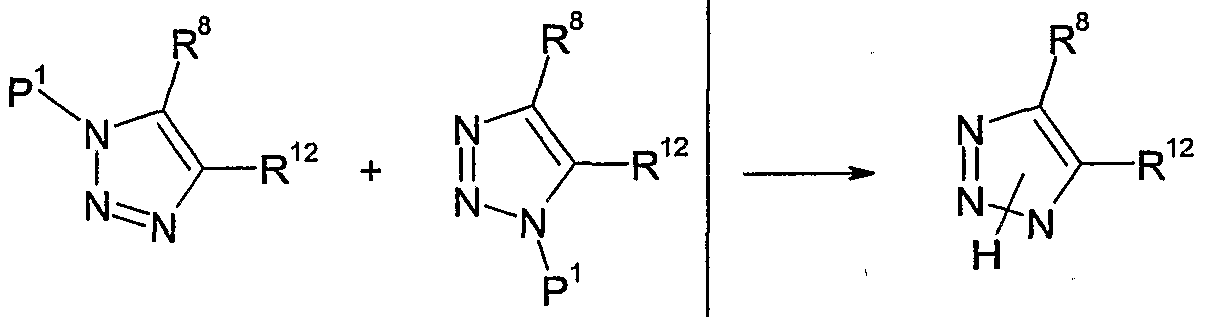
WWE Wipo information: entry into national phase

Ref document number: 2007217252

Country of ref document: AU

WWE Wipo information: entry into national phase

Ref document number: 2640962

Country of ref document: CA

Ref document number: 570174

Country of ref document: NZ

WWE Wipo information: entry into national phase

Ref document number: 2007704963

Country of ref document: EP

WWE Wipo information: entry into national phase

Ref document number: 6758/DELNP/2008

Country of ref document: IN

WWE Wipo information: entry into national phase

Ref document number: MX/a/2008/010384

Country of ref document: MX

WWE Wipo information: entry into national phase

Ref document number: 193468

Country of ref document: IL

WWE Wipo information: entry into national phase

Ref document number: 08086983

Country of ref document: CO

WWE Wipo information: entry into national phase

Ref document number: 2008555855

Country of ref document: JP

Ref document number: 2008081428

Country of ref document: EG

WWE Wipo information: entry into national phase

Ref document number: 200780006740.4

Country of ref document: CN

NENP Non-entry into the national phase

Ref country code: DE

WWP Wipo information: published in national office

Ref document number: 2007217252

Country of ref document: AU

WWE Wipo information: entry into national phase

Ref document number: 1020087023443

Country of ref document: KR

WWE Wipo information: entry into national phase

Ref document number: 200870299

Country of ref document: EA

WWE Wipo information: entry into national phase

Ref document number: 12280877

Country of ref document: US

ENP Entry into the national phase

Ref document number: PI0707973

Country of ref document: BR

Kind code of ref document: A2

Effective date: 20080819