[go: up one dir, main page]

WO2005104848A1 - Herbicidal composition - Google Patents

Herbicidal composition Download PDF

Info

Publication number
WO2005104848A1
WO2005104848A1 PCT/EP2005/004610 EP2005004610W WO2005104848A1 WO 2005104848 A1 WO2005104848 A1 WO 2005104848A1 EP 2005004610 W EP2005004610 W EP 2005004610W WO 2005104848 A1 WO2005104848 A1 WO 2005104848A1
Authority
WO
WIPO (PCT)
Prior art keywords
formula
alkyl
compound
substituted
hydrogen
Prior art date
Legal status (The legal status is an assumption and is not a legal conclusion. Google has not performed a legal analysis and makes no representation as to the accuracy of the status listed.)
Ceased
Application number
PCT/EP2005/004610
Other languages
French (fr)
Inventor
Willy Thaddaeus Rueegg
Jean Wenger
Andrew Plant
Anja Greiner
Ulrich Johannes Haas
Current Assignee (The listed assignees may be inaccurate. Google has not performed a legal analysis and makes no representation or warranty as to the accuracy of the list.)
Syngenta Participations AG
Syngenta Ltd
Original Assignee
Syngenta Participations AG
Syngenta Ltd
Priority date (The priority date is an assumption and is not a legal conclusion. Google has not performed a legal analysis and makes no representation as to the accuracy of the date listed.)
Filing date
Publication date
Family has litigation
First worldwide family litigation filed litigation Critical https://patents.darts-ip.com/?family=35044966&utm_source=google_patent&utm_medium=platform_link&utm_campaign=public_patent_search&patent=WO2005104848(A1) "Global patent litigation dataset” by Darts-ip is licensed under a Creative Commons Attribution 4.0 International License.
Priority to CA2563218A priority Critical patent/CA2563218C/en
Priority to AU2005237241A priority patent/AU2005237241B2/en
Priority to EP05741054A priority patent/EP1755397B1/en
Priority to DE602005004283T priority patent/DE602005004283T2/en
Priority to BRPI0510262-6A priority patent/BRPI0510262B1/en
Application filed by Syngenta Participations AG, Syngenta Ltd filed Critical Syngenta Participations AG
Priority to US11/568,326 priority patent/US8404618B2/en
Priority to PL05741054T priority patent/PL1755397T3/en
Priority to JP2007509975A priority patent/JP4980209B2/en
Publication of WO2005104848A1 publication Critical patent/WO2005104848A1/en
Anticipated expiration legal-status Critical
Ceased legal-status Critical Current

Links

Classifications

    • AHUMAN NECESSITIES
    • A01AGRICULTURE; FORESTRY; ANIMAL HUSBANDRY; HUNTING; TRAPPING; FISHING
    • A01NPRESERVATION OF BODIES OF HUMANS OR ANIMALS OR PLANTS OR PARTS THEREOF; BIOCIDES, e.g. AS DISINFECTANTS, AS PESTICIDES OR AS HERBICIDES; PEST REPELLANTS OR ATTRACTANTS; PLANT GROWTH REGULATORS
    • A01N43/00Biocides, pest repellants or attractants, or plant growth regulators containing heterocyclic compounds
    • A01N43/72Biocides, pest repellants or attractants, or plant growth regulators containing heterocyclic compounds having rings with nitrogen atoms and oxygen or sulfur atoms as ring hetero atoms
    • A01N43/80Biocides, pest repellants or attractants, or plant growth regulators containing heterocyclic compounds having rings with nitrogen atoms and oxygen or sulfur atoms as ring hetero atoms five-membered rings with one nitrogen atom and either one oxygen atom or one sulfur atom in positions 1,2

Definitions

  • the present invention relates to new herbicidal compositions for combating weed grasses and weeds in crops of useful plants, which comprise a herbicide and a safener which preserves the useful plant but not the weed grasses and weeds against the phytotoxic action of the herbicide.
  • the present invention also relates to the use of these compositions for combating weed grasses and weeds in crops of useful plants, in particular in crops of soya, cotton, rape, sugarcane, cereals, e.g. wheat and barley, rice and, in particular, maize.
  • the crops plants may also be damaged.
  • safeners are substances capable of protecting the crop plants from the damaging action of the herbicide, while not substantially reducing the effectiveness of the herbicide with a given herbicide.
  • the interaction of herbicides and safeners is complex, and it is difficult to predict which safeners, if any, will be useful with a given herbicide.
  • the compounds of the formulae S-I to S-X are suitable for protecting crop plants from the phytotoxic action of a certain class of isoxazoline herbicides which are described e.g. in WO 01/12613, WO 03/000686, WO 2004/014138 and JP (Kokai) 2004-2324.
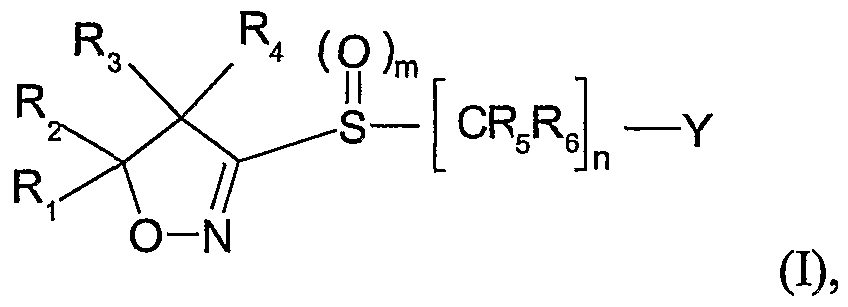
  • a herbicidal composition which is characterized in that it comprises a mixture of a) a
  • Ri and R 2 are each independently of the other hydrogen, C ⁇ -C ⁇ oalkyl, C 3 -C 8 cycloalkyl or
  • Ri and R 2 together with the carbon atom to which Ri and R 2 are bonded, form a C 3 -C 7 ring, R3 and R4 are each independently of the other hydrogen, Cr oalkyl, C ⁇ -C 10 haloalkyl,
  • Cioalkyl Cioalkyl, Ci-C ⁇ alkoxy-Crdoalkyl or C 3 -C 8 cycloalkyl, or
  • R 3 and 4 together with the carbon atom to which R 3 and t are bonded, form a C 3 -C ring, or
  • m is an integer selected from 0, 1 or 2;
  • R 5 and Re are each independently of the other hydrogen, cyano, C ⁇ -C ⁇ 0 alkyl or C ⁇ - Cioalkoxycarbonyl; n is an integer selected from 1, 2 or 3;
  • Y is hydrogen, CrCealkoxycarbonyl, carboxyl, C 2 -C 6 alkenyl, C ⁇ -C ⁇ 0 alkyl or C Cioalkyl substituted by halogen, CrC 6 alkoxy, C 2 -C 6 alkenyloxy, C 2 -C6alkynyloxy, benzyloxy, Ci- C ⁇ alkoxycarbonyl, carboxyl, hydroxyl or formyl, or Y is phenyl or phenyl substituted by halogen, -C ⁇ alkyl, -C ⁇ haloalkyl, C !
  • Ci-Cealkyl hydroxy-Ci-C 6 alkyl, CrCealkylthio-d-Cealkyl, C Cealkylsulfinyl-C C 6 alkyl, Ci-C ⁇ alkylsulfonyl-CrCealkyl, CrCealkylamino-Ci-C ⁇ alkyl, di-Cr Cealkylamino-CrC ⁇ alkyl, cyano- -C ⁇ alkyl or phenoxy- -C ⁇ alkyl, or
  • Y is phenyl substituted by C ⁇ -C alkoxy or Cr alkoxy substituted by halogen, Ci- C 6 alkoxy, C 2 -C 6 alkenyl, C 2 -C 6 alkynyl, d-C ⁇ alkoxycarbonyl, CrC 6 alkylcarbonyl or C 3 - C 8 cycloalkyl, or
  • Y is phenyl substituted by C 2 -C 6 alkenyl, C 3 -C 8 cycloalkoxy, Ci-C 6 alkylthio or C C 6 alkylthiol substituted by halogen or C ⁇ -C 6 alkoxy, or
  • Y is phenyl substituted by C ⁇ -C 6 alkylsulfinyl or C ⁇ -C 6 alkylsulfinyl substituted by halogen or -C ⁇ alkoxy, or
  • Y is phenyl substituted by Ci-Cealkylsulfonyl or -C ⁇ alkylsulfonyl substituted by halogen or C ⁇ -C 6 alkoxy, or Y is phenyl substituted by benzyloxy, amino or amino substituted by C ⁇ -C 6 alkyl, C C 6 alkylsulfonyl, C ⁇ -C 6 alkylcarbonyl-C ⁇ -C 6 alkyl or C ⁇ -C 6 alkylsulfonyl-C ⁇ -C 6 alkyl, or
  • Y is phenyl substituted by di-C ⁇ -C 6 alkylamino, cyano, nitro, C C 6 alkoxycarbonyl, carboxyl, C 3 -C 8 cycloalkoxycarbonyl, C 2 -C 6 alkenyloxycarbonyl, C 2 -C 6 alkynyloxy- carbonyl, benzyloxycarbonyl, phenoxycarbonyl or C ⁇ -C 6 alkylcarbonyloxy or Q- Cealkoxycarbonyl-Ci-Cealkyl, or
  • Y is a 5- or 6-membered, mono- or bicyclic aromatic ring which contains one or more nitrogen, oxygen or sulfur atoms as heteroatoms, in which the heteroaromatic ring can be substituted by hydroxyl, mercapto, halogen, C ⁇ -C ⁇ oalkyl or C j -C ⁇ 0 alkyl substituted by hydroxyl, C 3 -C 8 cycloalkyl, halo-C 3 -C 8 cycloalkyl, C 1 -C 4 alkyl-C 3 -C 8 cycloalkyl-, Ci- Cioalkoxy, C ⁇ -C 10 alkylthio, CrC t oalkylsulfonyl, C ⁇ -C ⁇ 0 alkoxycarbonyl, C 2 - C 6 haloalkenyl, amino, CrCioalkylamino, Ci-C ⁇ acylamino, C ⁇ -C 4 haloalkylcarbonyl- amino,
  • C 10 alkoxycarbonyl, phenyl, an aromatic heterocyclic radical, cyano, carbamoyl or Ci- Ci 0 alkylcarbam ⁇ yl, or the heteroaromatic ring can be substituted by C C ⁇ aloalkylthio, C 2 -C 6 alkenyl, C 2 - C 6 alkenyloxy, C -C 6 alkynyl, C 2 -C 6 alkynyloxy, Ci-Cioalkylsulfinyl or Crdoalkylsulfinyl substituted by C t -Cioalkoxycarbonyl, phenyl, an aromatic heterocyclic radical, cyano, carbamoyl or C ⁇ -C 10 alkylcarbamoyl, or the heteroaromatic ring can be substituted by CrCioalkylsulfonyl or Ci-Cioalkylsulfonyl substituted by CrQoalkoxycarbonyl,
  • Xsi is hydrogen or halogen; and Rsi is hydrogen, C 3 -C 8 alkenyl, C 3 -C 8 alkynyl, C 3 -C 8 cycloalkyl, C C 8 alkyl or C ⁇ -C 8 alkyl substituted by d-C 8 alkoxy or C 3 -C 8 alkenyloxy, or
  • Rsi is a cation chosen from the group consisting of the alkali and alkaline earth metals, iron, copper, aluminium, ammonium or quaternary ammonium, sulfonium or phosphonium; or of a safener of the formula S -II
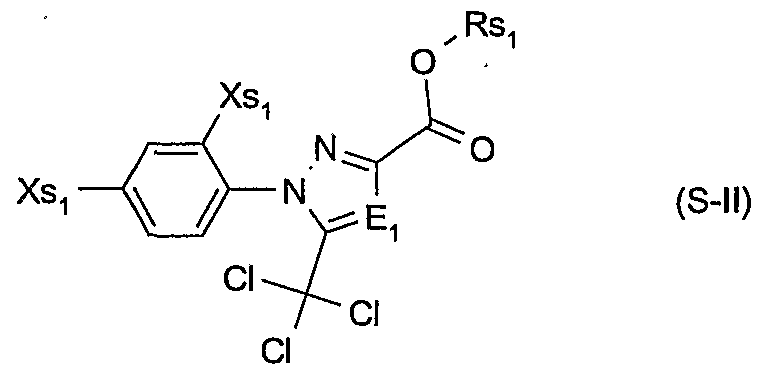
  • E t is nitrogen or methine
  • Xsi are each independently of the other hydrogen or halogen; and Rsi is hydrogen, C 3 -C 8 alkenyl, C 3 -C 8 alkynyl, C 3 -C 8 cycloalkyl, C ⁇ -C 8 alkyl or C ⁇ -C 8 alkyl substituted by C ⁇ -C 8 alkoxy or C -C 8 alkenyloxy, or Rsi is a cation chosen from the group consisting of the alkali and alkaline earth metals, iron, copper, aluminium, ammonium or quaternary ammonium, sulfonium or phosphonium; or of a safener of the formula S-III
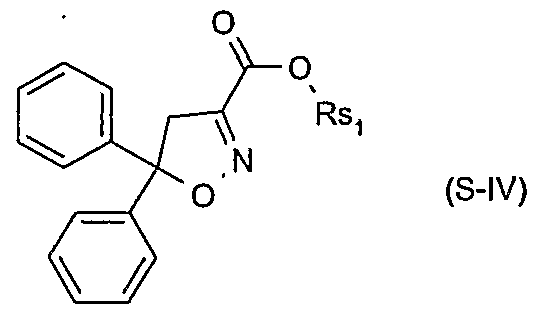
  • Xsi are each independently of the other hydrogen or halogen; and Rsi are each independently of the other hydrogen, C 3 -C 8 alkenyl, C 3 -C 8 alkynyl, C 3 - C 8 cycloalkyl, C ⁇ -C 8 alkyl or C ⁇ -C 8 alkyl substituted by C ⁇ -C 8 alkoxy or C 3 -C 8 alkenyloxy, or Rsi are a cation chosen from the group consisting of the alkali and alkaline earth metals, iron, copper, aluminium, ammonium or quaternary ammonium, sulfonium or phosphonium; or of a safener of the formula S-IN
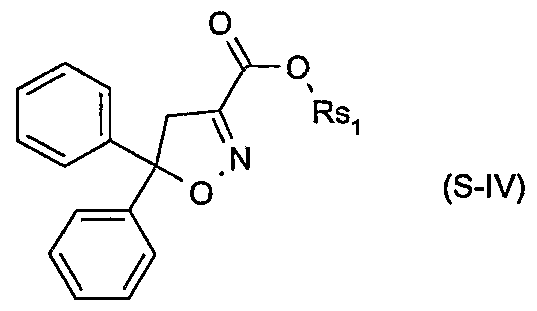
  • Rsi is hydrogen, C 3 -C 8 alkenyl, C 3 -C 8 alkynyl, C 3 -C 8 cycloalkyl, C C 8 alkyl or d-
  • Rsi is a cation chosen from the group consisting of the alkali and alkaline earth metals, iron, copper, aluminium, ammonium or quaternary ammonium, sulfonium or phosphonium; or of a safener of the formula S-N
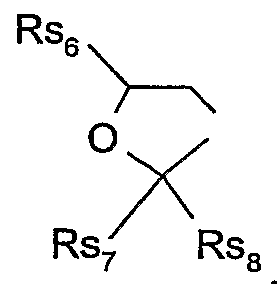
  • Rs 2 and Rs 3 together form a radical of the formula , wherein Rs 7 and Rs 8 are each independently of the other d-C 6 alkyl, or Rs 7 and Rs 8 together form -(CH 2 ) 5 -, and
  • Rs 6 is hydrogen, Ci-C 6 alkyl, aryl or heteroaryl; or of a safener of the formula S-NI
  • sn is 0 or 1 ;
  • Rs 12 is hydrogen, d-C 8 alkyl, C 3 -C 8 cycloalkyl, C 3 -C 8 alkenyl, C 3 -C 8 alkynyl or-N(-Rsj 3 Rs w ); wherein Rs ⁇ and Rs ⁇ 4 are each independently of the other hydrogen, C ⁇ -C 8 alkyl, C - C 8 cycloalkyl, C 3 -C 8 alkenyl or C 3 -C 8 alkynyl, or Rs ⁇ 3 and Rs ⁇ 4 together form a C 4 -C 6 alkylene group, which can be interrupted by oxygen, sulfur, SO, SO 2 , NH or N(C r C 4 alkyl);
  • Rs ⁇ 5 is hydrogen or a cation chosen from the group consisting of the alkali and alkaline earth metals, iron, copper, aluminium, ammonium or quaternary ammonium, sulfonium or phosphonium;
  • Rs ⁇ 6 is hydrogen, halogen, d-C 8 alkyl or methoxy
  • Rs 17 is hydrogen, halogen, d-C 8 alkyl, trifluoromethyl or d-C 8 alkoxy; or of a safener of the formula S-LX
  • Rsis is a cation chosen from the group consisting of the alkali and alkaline earth metals, iron, copper, aluminium, ammonium or quaternary ammonium, sulfonium or phosphonium.
  • alkyl radicals appearing in the substituent definitions are, for example methyl, ethyl, propyl and butyl, and also branched isomers thereof.
  • Haloalkyl radicals include alkyl radicals substituted by one or more halogen, e.g. difluoromethyl or trifluoromethyl, and haloalkoxy radicals include alkoxy radicals substituted by one or more halogen, e.g.
  • a herbicidal composition which is characterized in that it comprises a mixture of a) a herbicidally active amount of a herbicide of the formula I wherein
  • Ri , R 2 , R 3 , R , R 5 , Re , m and n are defined as above;
  • Y is hydrogen, d-C 6 alkoxycarbonyl, carboxyl, C 2 -C 6 alkenyl, d-C 10 alkyl or C ⁇ -C ⁇ 0 alkyl substituted by halogen, C ⁇ -C 6 alkoxy, C 2 -C 6 alkenyloxy, C 2 -C 6 alkynyloxy, benzyloxy, C ⁇ -
  • Y is phenyl or phenyl substituted by halogen, Ci-C ⁇ alkyl, d-C 6 haloalkyl, C ⁇ -C 6 alkoxy- d-C 6 alkyl, hydroxy-C r C 6 alkyl, C ⁇ -C 6 alkylthio-C ⁇ -C 6 alkyl, CrCealkylsulfinyl-d- C 6 alkyl, d-C 6 alkylsulfonyl-d-C6alkyl, d-C 6 alkylamino-d-C 6 alkyl, di-Ci- C 6 alkylamino-C ⁇ -C 6 alkyl, cyano-d-C 6 alkyl or phenoxy-C ⁇ -C 6 alkyl, or
  • Y is phenyl substituted by CrC 6 alkoxy or d-C 6 alkoxy substituted by halogen, d- C 6 alkoxy, C 2 -C 6 alkenyl, C 2 -C 6 alkynyl, d-C 6 alkoxycarbonyl, d-C 6 alkylcarbonyl or C 3 - C 6 cycloalkyl, or
  • Y is phenyl substituted by C 2 -C 6 alkenyl, C 3 -C 8 cycloalkoxy, d-Cealkylthio or d- C 6 alkylthiol substituted by halogen or d-C 6 alkoxy, or
  • Y is phenyl substituted by C ⁇ -C 6 alkylsulfinyl or C ⁇ -C 6 alkylsulfinyl substituted by halogen or d-C 6 alkoxy, or
  • Y is phenyl substituted by C ⁇ -C 6 alkylsulfonyl or C ⁇ -C alkylsulfonyl substituted by halogen or d-C 6 alkoxy, or Y is phenyl substituted by benzyloxy, amino or amino substituted by C ⁇ -C 6 alkyl, d- C 6 alkylsulfonyl, C ⁇ -C 6 alkylcarbonyl ⁇ d-C 6 alkyl or d-C ⁇ alkylsulfonyl-Ci-dalkyl, or
  • Y is phenyl substituted by di-d-C 6 alkylamino, cyano, nitro, C ⁇ -C 6 alkoxycarbonyl, carboxyl, C 3 -C 8 cycloalkoxycarbonyl, C 2 -C 6 alkenyloxycarbonyl, C 2 -C 6 alkynyloxy- carbonyl, benzyloxycarbonyl, phenoxycarbonyl or C ⁇ -C 6 alkylcarbonyloxy or Ci- C 6 alkoxycarbonyl-C ⁇ -C 6 alkyl, or
  • Y is a 5- or 6-membered, mono- or bicyclic aromatic ring which contains one or more nitrogen, oxygen or sulfur atoms as heteroatoms, in which the heteroaromatic ring can be substituted by hydroxyl, mercapto, halogen, d-C ⁇ 0 alkyl or d-Cioalkyl substituted by hydroxyl, C 3 -C 8 cycloalkyl, halo-C 3 -C 8 cycloalkyl, C ⁇ -C 4 alkyl-C 3 -C 8 cycloalkyl-, Cj- C 10 alkoxy, d-Cioalkylthio, C ⁇ -C 10 alkylsulfonyl, CrCioalkoxycarbonyl, C 2 - C 6 haloalkenyl, amino, C ⁇ -C ⁇ 0 alkylamino, C ⁇ -C 6 acylamino, Ci - C 4 haloalkylcarbonylamino, d-C
  • Cioalkoxy, Ci-Cioalkoxycarbonyl or Ci-C ⁇ 0 alkoxy substituted by C ⁇ -C ⁇ 0 alkoxycarbonyl, phenyl, an aromatic heterocyclic radical, cyano or carbamoyl, or the heteroaromatic ring can be substituted by d-C 4 haloalkoxy, C 3 -C 8 cycloalkoxy, C 3 - C 8 cycloalkyl-Ci-C 3 alkoxy, Ci-Cioalkylthio or Ci-C ⁇ 0 alkylthio substituted by d- Cioalkoxycarbonyl, phenyl, an aromatic heterocyclic radical, cyano or carbamoyl, or the heteroaromatic ring can be substituted by C ⁇ -C 4 haloalkylthio, C 2 -C 6 alkenyl, C 2 - C ⁇ alkenyloxy, C 2 -C 6 alkynyl, C 2 -C 6 al
  • Ri and R 2 are each independently of the other hydrogen, Ci-C 10 alkyl, C 3 -C 8 cycloalkyl or
  • R 3 and 4 are each independently of the other hydrogen, d-Cioalkyl, d-C 10 haloalkyl,
  • R and R- t together with the carbon atom to which R 3 and R 4 are bonded, form a C 3 -C 7 ring, or
  • R 5 and Re are each independently of the other hydrogen, cyano, Ci-Cioalkyl or d-
  • Cioalkoxycarbonyl is an integer selected from 1, 2 or 3;
  • Y is hydrogen, d-C 6 alkoxycarbonyl, carboxyl, C 2 -C 6 alkenyl, C ⁇ -C ⁇ 0 alkyl or d-Cioalkyl substituted by halogen, C ⁇ -C 6 alkoxy, C 2 -C 6 alkenyloxy, C 2 -C 6 alkynyloxy, benzyloxy, Ci- C 6 alkoxycarbonyl, carboxyl, hydroxyl or formyl, or
  • Y is phenyl or phenyl substituted by halogen, d-C 6 alkyl, C ⁇ -C 6 haloalkyl, C ⁇ -C 6 alkoxy-
  • C 6 alkyl C ⁇ -C 6 alkylsulfonyl-d-C 6 alkyl, C ⁇ -C 6 alkylamino-C ⁇ -C 6 alkyl, di-Ci-
  • Y is phenyl substituted by C 2 -C 6 alkenyl, C 3 -C 8 cycloalkoxy, C ⁇ -C 6 alkylthio or C C 6 alkylthiol substituted by halogen or d-C 6 alkoxy, or
  • Y is phenyl substituted by C ⁇ -C 6 alkylsulfinyl or C ⁇ -C 6 alkylsulfinyl substituted by halogen or C ⁇ -C 6 alkoxy, or
  • Y is phenyl substituted by C ⁇ -C 6 alkylsulfonyl or C ⁇ -C 6 alkylsulfonyl substituted by halogen or Ci-C 6 alkoxy, or Y is phenyl substituted by benzyloxy, amino or amino substituted by d-C 6 alkyl, d- Cealkylsulfonyl, d-C 6 alkylcarbonyl-C ⁇ -C 6 alkyl or Ci-C 6 alkylsulfonyl-Ci-C 6 alkyl, or
  • Y is phenyl substituted by di-C ⁇ -C 6 alkylamino, cyano, nitro, Ci-C 6 alkoxycarbonyl, carboxyl, C 3 -C 8 cycloalkoxycarbonyl, C 2 -C 6 alkenyloxycarbonyl, C 2 -C 6 alkynyloxy- carbonyl, benzyloxycarbonyl, phenoxycarbonyl or C ⁇ -C 6 alkylcarbonyloxy or Ci- C 6 alkoxycarbonyl-Ci-C 6 alkyl, or
  • Y is a 5- or 6-membered, mono- or bicyclic aromatic ring which contains a nitrogen, oxygen or sulfur atom as a heteroatom, in which the heteroaromatic ring can be substituted by hydroxyl, mercapto, halogen, Ci-doalkyl or C ⁇ -C 10 alkyl substituted by hydroxyl, C 3 -C 8 cycloalkyl, halo-C 3 -C 8 cycloalkyl, d-C 4 alkyl-C 3 -C 8 cycloalkyl-, Ci- Cioalkoxy, C ⁇ -C 10 alkylthio, Ci-Cioalkylsulfonyl, Ci-doalkoxycarbonyl, C 2 - C 6 haloalkenyl, amino, C ⁇ -C ⁇ 0 alkylamino, C ⁇ -C 6 acylamino, Ci - C haloalkylcarbonylamino, Ci-C ⁇ 0 alkylsulf
  • C 10 alkoxy, C ⁇ -C 10 alkoxycarbonyl or d-Cioalkoxy substituted by Ci-doalkoxycarbonyl, phenyl, an aromatic heterocyclic radical, cyano or carbamoyl, or the heteroaromatic ring can be substituted by d-C 4 haloalkoxy, C 3 -C 8 cycloalkoxy, C - C 8 cycloalkyl-Ci-C 3 alkoxy, d-Cioalkylthio or C ⁇ -C ⁇ 0 alkylthio substituted by Ci- Cioalkoxycarbonyl, phenyl, an aromatic heterocyclic radical, cyano or carbamoyl, or the heteroaromatic ring can be substituted by d-C 4 haloalkylthio, C 2 -C 6 alkenyl, C 2 - C 6 alkenyloxy, C 2 -C 6 alkynyl, C 2 -C 6 alkyny
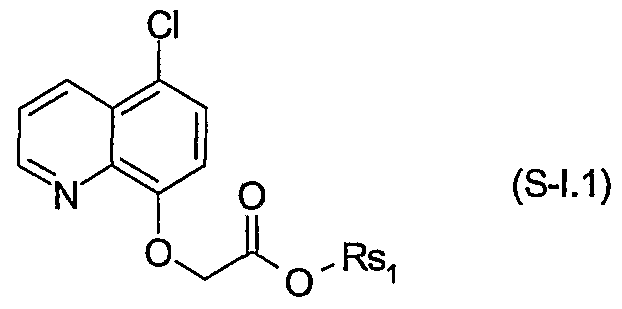
  • Preferred safeners correspond to the formula S-I.l
  • Rsi is hydrogen, C 3 -C 8 cycloalkyl, C ⁇ -C 8 alkyl or C ⁇ -C 8 alkyl substituted by Ci- C 8 alkoxy or C 3 -C 8 alkenyloxy, or
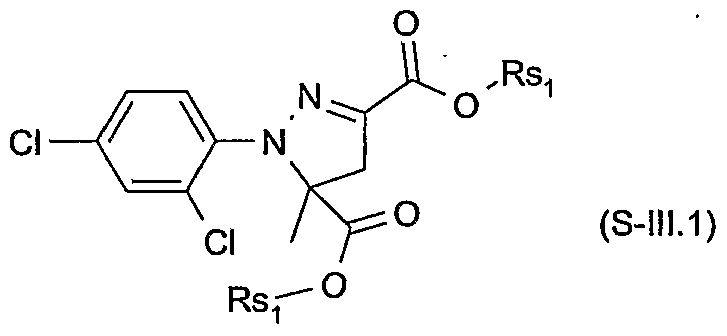
  • Rsi is a cation chosen from the group consisting of the alkali and alkaline earth metals, iron, copper, aluminium, ammonium, quaternary ammonium, sulfonium or phosphonium; or to the formula S-II.1 wherein Rsi is C ⁇ -C 8 alkyl or d-C 8 alkyl substituted by C 3 -C 8 alkenyloxy; or to the formula S-III.1
  • Rs 2 and Rs 3 together form a radical of the formula , wherein Rs 7 and Rs 8 are each independently of the other C ⁇ -C 4 alkyl, or Rs and Rs 8 together form -(CH ) 5 -, and
  • Rs 6 is hydrogen, C ⁇ -C 4 alkyl or ; or to the formula S-NI.l
  • Rs ⁇ 3 and Rs ⁇ together form a C -C 6 alkylene group
  • Rsi 5 is hydrogen or a cation chosen from the group consisting of the alkali and alkaline earth metals, iron, copper, aluminium, ammonium or quaternary ammonium, sulfonium or phosphonium;
  • Rsi 6 is hydrogen, C ⁇ -C 6 alkyl or methoxy
  • Rs ⁇ is hydrogen, Ci-C ⁇ alkyl or C ⁇ -C 6 alkoxy; or to the formula S-IX.l
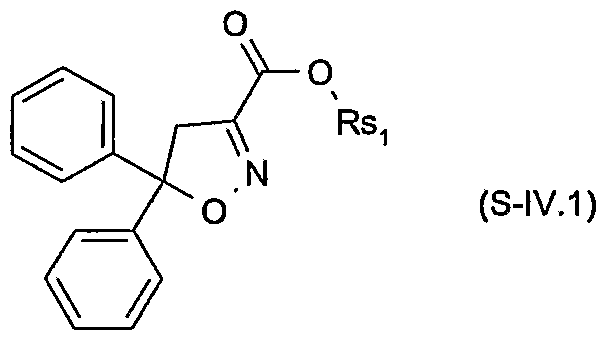
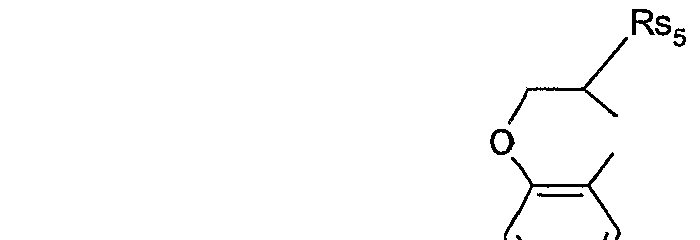
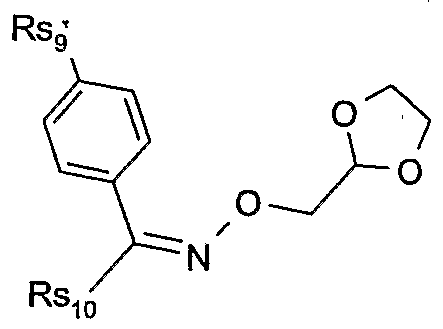
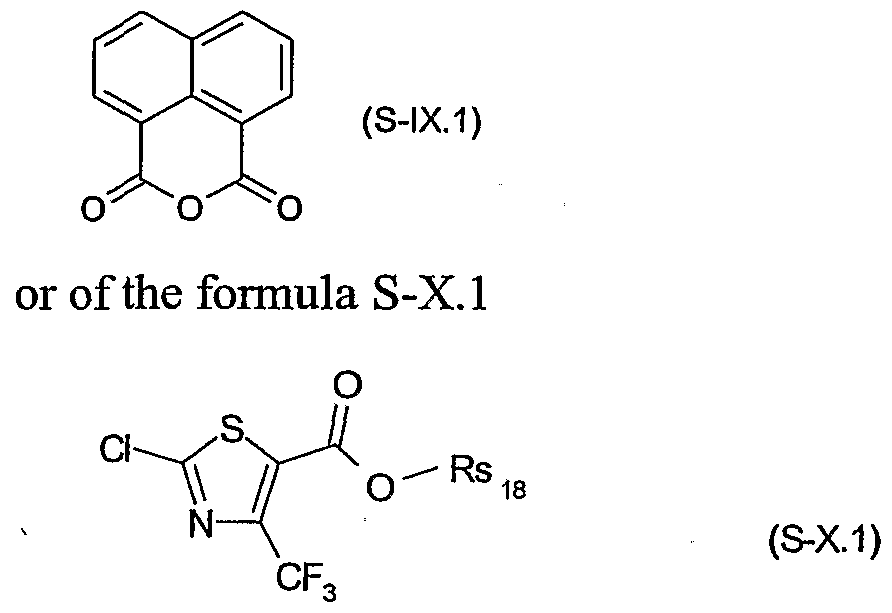
  • Particularly preferred safeners of the formula S-I.l are cloquintocet-mexyl (CAS RN 99607-70-2) or a lithium, sodium, potassium, calcium, magnesium, aluminium, iron, ammonium, quaternary ammonium, sulfonium or phosphonium salt thereof such as are known from WO 02/34048; of the formula S-II.l fenchlorazole-ethyl (CAS RN 103112- 35-2 and CAS RN 103112-36-3 for the corresponding acid); of the formula S-ffl.l mefenpyr-diethyl (CAS RN 135590-91-9 and CAS RN 135591-00-3 for the corresponding di-acid); of the formula S-1N.1 isoxadifen-ethyl (CAS R ⁇ 163520-33-0 and CAS R ⁇ 209866-92-2 for the corresponding acid); of the formula S-N.l furilazole (CAS R ⁇ 121776-33-8
  • More particularly preferred safeners of the formula S-I.l are cloquintocet-mexyl or a lithium, sodium, potassium, calcium, magnesium, aluminium, iron, ammonium, quaternary ammonium, phosphonium or sulfonium salt thereof; of the formula S-II.l fenchlorazole-ethyl and the corresponding acid; and of the formula S-III.1 mefenpyr- diethyl and the corresponding di-acid; of the formula S-V.l furilazole and the corresponding R isomer, benoxacor, dichlormid and MON4660.
  • Safeners of the formula S-I.l are cloquintocet- mexyl or a lithium, sodium, potassium, calcium, magnesium, aluminium, iron, , ammonium, quaternary ammonium, phosphonium or sulfonium salt thereof; of the formula S-II.l fenchlorazole-ethyl and the corresponding acid; and of the formula S-III.1 mefenpyr-diethyl and the corresponding di-acid; of the formula S-N.l benoxacor and MO ⁇ 4660.
  • Even more particularly preferred safeners of the formula S-I.l are cloquintocet- mexyl; of the formula S-II.l fenchlorazole-ethyl; of the formula S-III.1 mefenpyr- diethyl; and of the formula S-N.l benoxacor and MO ⁇ 4660.
  • particularly preferred safeners of the formula S-I.l are cloquintocet- mexyl or a lithium, sodium, potassium, calcium, magnesium, alun-unium, iron, ammonium, quaternary ammonium, phosphonium or sulfonium salt thereof such as are known from WO 02/34048; of the formula S-LT.l fenchlorazole-ethyl and the corresponding acid; of the formula S-III.1 mefenpyr-diethyl and the corresponding di- acid; of the formula S-IN.l isoxadifen-ethyl and the corresponding acid; of the formula S-N.l furilazole and the corresponding R isomer, benoxacor and dichlormid; of the formula S-NI.l oxabetrinil and cyometrinil and the corresponding (Z) isomer; of the formula S-NII.l fenclorim; of the formula S-NLII.l ⁇ -
  • particularly preferred safeners of the formula S-I.l are cloquintocet- mexyl or sulfonium or phosphonium salts thereof such as are known from WO 02/34048; of the formula S-II.l fenchlorazole-ethyl and the corresponding acid); of the formula S- III.1 mefenpyr-diethyl and the corresponding di-acid; of the formula S-IN.1 isoxadifen- ethyl and the corresponding acid; of the formula S-N.l furilazole and the corresponding R isomer, benoxacor and dichlormid; of the formula S-NI.l oxabetrinil and cyometrinil and the corresponding (Z) isomer; of the formula S-NII.l fenclorim; of the formula S- NIII.1 ⁇ -cyclopropyl-4-(2-methoxy-benzoylsulfamoyl)-benzamide and
  • Preferred compounds of the formula I are those wherein Ri and R 2 are each independently of the other C d 0 alkyl or C 3 -C 8 cycloalkyl, or Ri and R 2 , together with the carbon atom to which Ri and R 2 are bonded, form a C 3 -C ring, more preferably Ri and R 2 are both methyl.
  • Further preferred compounds of the formula I are those wherein R 3 and R 4 are each independently of the other hydrogen, Ci-Cioalkyl or C 3 -C 8 cycloalkyl, or R 3 and R 4 , together with the carbon atom to which R and P ⁇ are bonded, form a C -C 7 ring, more preferably R 3 and R 4 are both hydrogen.
  • n is 1.
  • Y is phenyl or phenyl substituted by Ci-C 6 alkyl, C ⁇ -C 6 haloalkyl, C ⁇ -C 6 alkoxy-C.-C 6 alkyl, C ⁇ -C 6 alkoxy, Ci- C ⁇ haloalkoxy, d-C 6 alkoxy-C ⁇ -C 6 alkoxy or halogen.
  • Y is a 5- or 6- membered mono- or bicyclic aromatic ring which contains one or more nitrogen, oxygen or sulfur atoms as heteroatoms, in which the heteroaromatic ring can be substituted by Ci-Cioalkyl or Ci-Cioalkyl substituted by C ⁇ -C ⁇ 0 alkoxy, or the heteroaromatic ring can be substituted by Ci-Cioalkylsulfonyl, C ⁇ -C haloalkyl, C 3 -C 8 cycloalkyl, d-Cioalkoxy, Ci- C 4 haloalkoxy, Ci-doalkoxycarbonyl, C -C 8 cycloalkyl-C ⁇ -C 3 alkoxy, Ci-Cioalkylthio, phenyl, phenoxy, C ⁇ -C 4 haloalkylcarbonyl, cyano, nitro, halogen, carbamoyl, Ci-
  • Y is a 5- or 6-membered mono- or bicyclic aromatic ring which contains a nitrogen, oxygen or sulfur atom as a heteroatom, in which the heteroaromatic ring can be substituted by Ci- doalkyl or Ci-Cioalkyl substituted by C ⁇ -C ⁇ 0 alkoxy; or the heteroaromatic ring can be substituted by Ci-doalkylsulfonyl, C ⁇ -C 4 haloalkyl, C 3 -C 8 cycloalkyl, C ⁇ -C ⁇ oalkoxy, Ci- Ciohaloalkoxy, Ci -Cioalkoxycarbonyl, C 3 -C 8 cycloalkyl-C ⁇ -C alkoxy, Ci-doalkylthio, phenyl, phenoxy, d-C 4 haloalkylcarbonyl, cyano, nitro, halogen, carbamoyl, Ci- Ci
  • Y is thienyl, pyrazolyl, isoxazolyl, isothiazolyl, pyridyl or pyrimidyl.
  • Y is thien-3-yl, pyrazol-4-yl, pyrazol-5-yl, isoxazol-4-yl, isothiazol-4-yl, pyridin-3-yl or pyrimidin-5-yl.
  • a most preferred compound of the formula I is 3-(5-difluoromethoxy-l-methyl-3- trifluoromethyl-lH-pyrazol-4-ylmethylsulfonyl)-5,5-dimethyl-4,5-dihydroisoxazole, which is compound of the formula 1.27 in Table 1 below. Particularly suitable compounds of the formula I are summarized in the following table.
  • a particularly preferred combination is the combination of compound of the formula 1.27 with benoxacor, in particular when used to safen compound of the formula 1.27 on maize, more particularly in post- emergent use.
  • Further particularly preferred combinations are the combinations of compound of the formula 1.27 with cloquintocet-mexyl, compound of the formula 1.27 with MON4660, compound of the formula 1.27 with mefenpyr-diethyl, and compound of the formula 1.27 with fenchlorazole-ethyl, in particular when used to safen compound of the formula 1.27 on wheat or barley, more particularly in pre-emergent use.
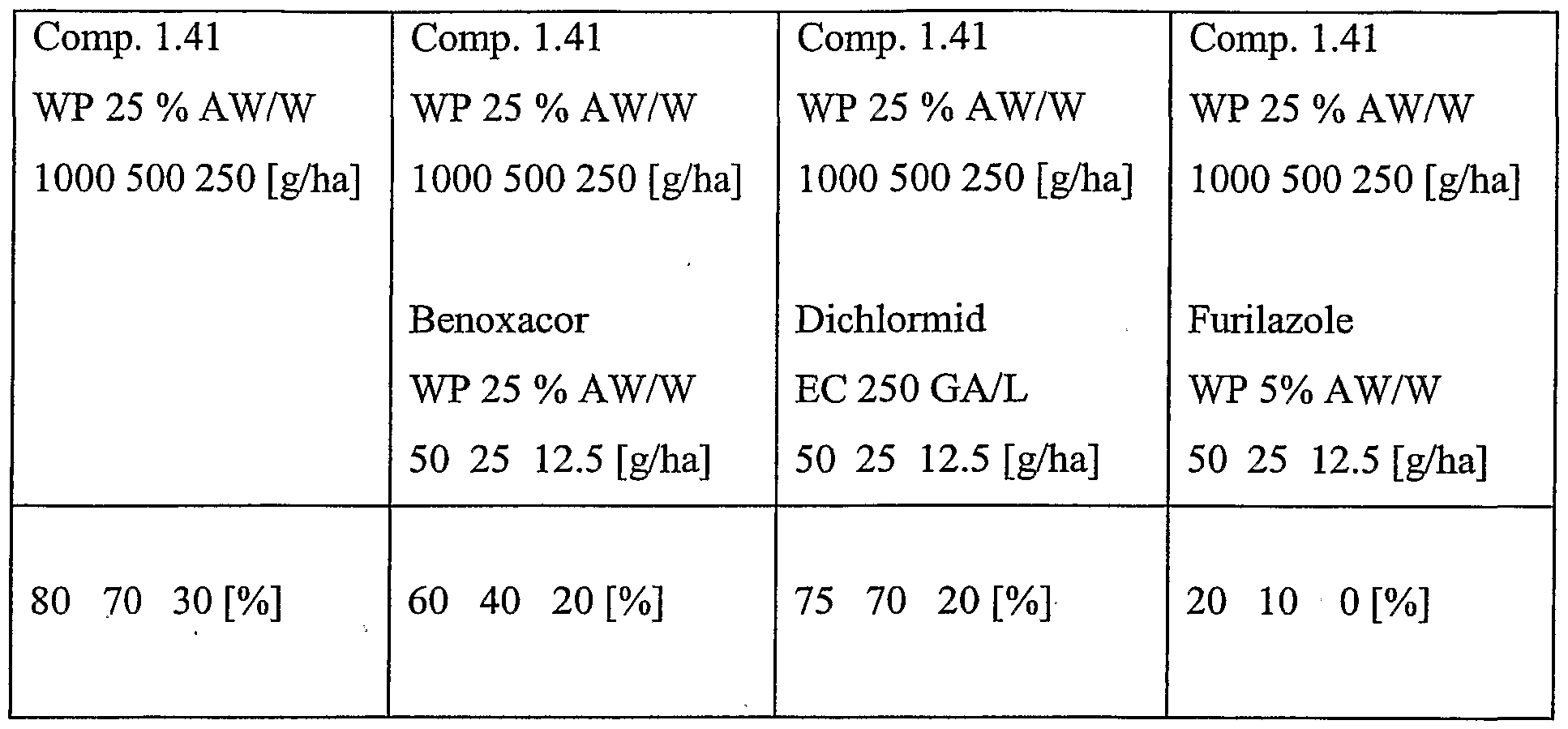
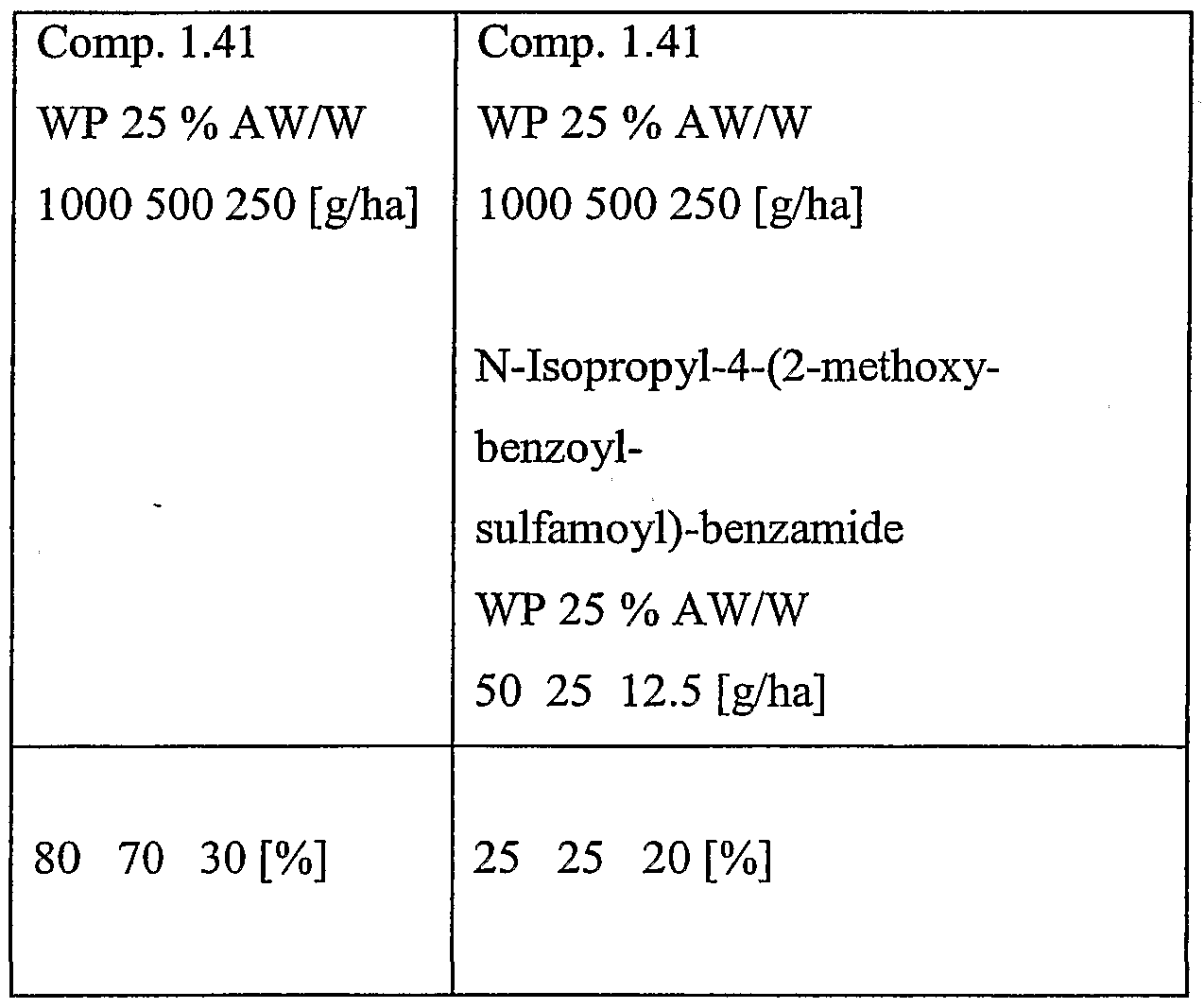
  • Particularly preferred combinations are the combinations of a compound of the formula 1.41 with benoxacor, compound of the formula 1.41 with dichlormid, compound of the formula 1.41 with furilazole, and compound of the formula 1.41 with N-isopropyl-4-(2-methoxy- benzoylsulfamoyl)-benzamide, in particular when used to safen compound of formula 1.41 on maize, more particularly in pre-emergent use.
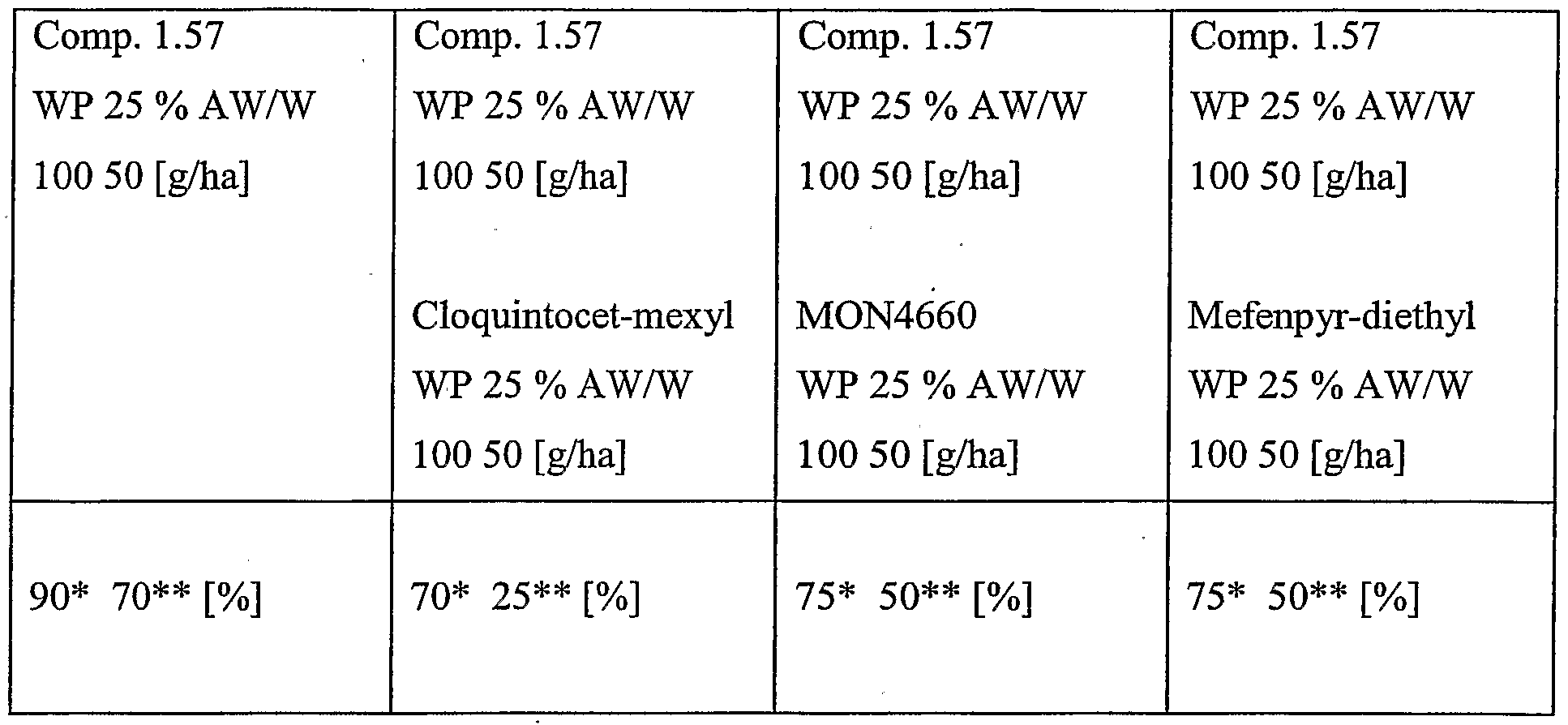
  • Particularly preferred combinations are the combinations of compound of the formula 1.57 with cloquintocet- mexyl, compound of the formula 1.57 with MON4660, compound of the formula 1.57 with mefenpyr-diethyl, and compound of the formula 1.57 with fenchlorazole-ethyl, in particular when used to safen compound of the formula 1.57 on wheat or barley, more particularly h pre-emergent use.
  • the invention also relates to a method of combating weed grasses and weeds in crops of useful plants, which comprises treating the useful plants, seed or cuttings thereof or the growing area thereof simultaneously or at separate times with a herbicidally active amount of the herbicide of the formula I and a herbicide-antagonistically active amount of a safener of the formula S-I to S-X.
  • a herbicidally active amount of the herbicide of the formula I and a herbicide-antagonistically active amount of a safener of the formula S-I to S-X.
  • Possible crop plants which can be protected by the safeners of the formula S-I to S-X from the harmful action of the above mentioned herbicides are, in particular, soya, cotton, rape, sugarcane, cereals, e.g. wheat and barley, rice and, specifically, maize.
  • Crops are also to be understood as meaning those which have been made tolerant towards herbicides or herbicide classes (e.g. ALS, GS, EPSPS, PPO and HPPD inhibitors) by conventional breeding or genetic engineering methods.
  • herbicides or herbicide classes e.g. ALS, GS, EPSPS, PPO and HPPD inhibitors
  • An example of crops which have been made tolerant e.g. towards imidazolinones, such as imazamox, by conventional breeding methods is Clearfield® summer rape (Canola).
  • crops which have been made tolerant towards herbicides by genetic engineering methods are e.g.
  • the weeds to be combated can be either monocotyledonous or dicotyledonous weeds, such as, for example, Stellaria, Nasturtium, Agrostis, Digitaria, Avena, Setaria, Sinapis, Lolium, Solanum, Echinochloa, Scirpus, Monochoria, Sagittaria, Bromus, Alopecurus, Sorghum, Rottboellia, Cyperus, Abutilon, Sida, Xanthium, Amaranthus, Chenopodium, Ipomoea, Chrysanthemum, Galium, Viola and Veronica.
  • Stellaria Nasturtium, Agrostis, Digitaria, Avena, Setaria, Sinapis, Lolium, Solanum, Echinochloa, Scirpus, Monochoria, Sagittaria, Bromus, Alopecurus, Sorghum, Rottboellia, Cyperus, Abutilon, Sida, Xanth
  • Crops are furthermore to be understood as meaning those which, by genetic engineering methods, have been made resistant to harmful insects, such as, for example, Bt maize (resistant to the corn borer), Bt cotton (resistant to the cotton-boll weevil) and also Bt potatoes (resistant to the potato beetle).
  • Bt maize are the Bt-176 maize hybrids of NK® (Syngenta Seeds).
  • the Bt toxin is a protein which is formed naturally by Bacillus thuringiensis soil bacteria.
  • Examples of toxins and transgenic plants which can synthesize such toxins are described in EP-A-451 878, EP-A-374 753, WO 93/07278, WO 95/34656, WO 03/052073 and EP-A-427 529.
  • Examples of transgenic plants which contain one or more genes which code for an insecticidal resistance and express one or more toxins are KnockOut® (maize), Yield Gard® (maize), NuCOTIN33B® (cotton), Bollgard® (cotton), NewLeaf® (potatoes), NatureGard® and Protexcta®. Plant crops and seed thereof can be resistant both to herbicides and at the same time to insect feeding (stacked transgenic events).
  • Seed can have, for example, the ability to express an insecticidally active Cry3 protein and at the same can be tolerant towards glyphosate.
  • Crops are also to be understood as meaning those which are obtained by conventional breeding or genetic engineering methods and contain so-called output traits (e.g. improved storage stability, higher nutritional value and improved taste).
  • Growing areas are understood as meaning the areas of soil on which the crop plants are already growing or which are already charged with seed of these crop plants, and also soils intended for cultivation with these crop plants.
  • the compounds of formula I according to the invention can also be used in combination with other herbicides.
  • the following mixtures of the compound of formula I are important: compound of formula I + acetochlor, compound of formula I + acifluorfen, compound of formula I + acifluorfen-sodium, compound of formula I + aclonifen, compound of formula I + acrolein, compound of formula I + alachlor, compound of formula I + alloxydim, compound of formula I 4- allyl alcohol, compound of formula I 4- ametryn, compound of formula I + amicarbazone, compound of formula I + amidosulfuron, compound of formula I + aminopyralid, compound of formula I + amitrole, compound of formula I + ammonium sulfamate, compound of formula I + anilofos, compound of formula I + asulam, compound of formula I + atraton, compound of formula I + atrazine, compound of formula I + azimsulfuron, compound of formula I + BCPC, compound of formula I + beflubutamid, compound of formula I + benazolin, compound of
  • the mixing partners of the compound of formula I may also be in the form of esters or salts, as mentioned e.g. in The Pesticide Manual, 12th Edition (BCPC), 2000.
  • the mixing ratio of the compound of formula I to the mixing partner is preferably from l : 100 to 1000:1.
  • the mixtures can advantageously be used in the above-mentioned formulations (in which case "active ingredient” relates to the respective mixture of compound of formula I with the mixing partner).
  • the compositions according to the invention are suitable for all the conventional methods of application in agriculture, such as e.g. pre-emergent application, post- emergent application and seed dressing.
  • a safener of the formula S-I to S-X can be employed for pre-treatment of the seed of the crop plant (dressing of the seed or cuttings) or can be introduced into the soil before or after sowing. However, it can also be applied by itself or together with the herbicide before or after emergence of the plants.
  • the treatment of the plants or seed with the safener can therefore in principle be carried out independently of the time of application of the herbicide. Treatment of the plants by simultaneous application of herbicide and safener (e.g. as a tank mix) is as a rule preferred.
  • the application rate of safener to herbicide to be applied largely depends on the method of use.
  • 0.001 to 5.0 kg of safener/ha preferably 0.001 to 0.5 kg of safener/ha, and as a rule between 0.001 to 2 kg of herbicide/ha, but preferably between 0.005 to 1 kg/ha are applied.
  • seed dressing in general 0.001 to 10 g of safener/kg of seed, preferably 0.05 to 2 g of safener/kg of seed are applied. If the safener is applied in liquid form, with soaking of the seed, shortly before sowing, safener solutions which contain the active compound in a concentration of 1 to 10,000, preferably 100 to 1,000 ppm are expediently used.
  • a mixture of a herbicidally active amount of the compound of the formula I and a herbicide- antagonistic amount of the compound of the formula S-I to S-X can be employed in unchanged form as a herbicidal composition.
  • the compositions according to the invention are formulated in various ways using formulation auxiliaries, such as carrier substances, solvents and surface-active substances.
  • the formulations can be in various physical forms, e.g.
  • the dilutions can be prepared, for example, with water, liquid fertilizers, micronutrients, biological organisms, oil or solvents.
  • the formulations can be prepared e.g. by mixing the active compound with formulation auxiliaries in order to obtain compositions in the form of finely divided solids, granules, solutions, dispersions or emulsions.
  • the active compounds can also be formulated with other auxiliaries, such as, for example, finely divided solids, mineral oils, oils of plant or animal origin, modified oils of plant or animal origin, organic solvents, water, surface-active substances or combinations thereof.
  • the active compounds can also be contained in very fine microcapsules made of a polymer.
  • Microcapsules contain the active compounds in a porous carrier. This allows release of the active compounds into the environment in controlled amounts (e.g. slow release). Microcapsules conventionally have a diameter of 0.1 to 500 micron. They contain active compounds in an amount of approx. 25 to 95 wt.% of the capsule weight.
  • the active compounds can be in the form of a monolithic solid, fine particles distributed in a solid or liquid, or a suitable solution.
  • the enclosing membranes comprise, for example, natural and synthetic gums, cellulose, styrene/butadiene copolymers, polyacrylonitrile, polyacrylate, polyester, polyamides, polyureas, polyurethane or chemically modified polymers and starch xanthates or other polymers which are known to the expert in this connection.
  • very fine microcapsules in which the active compound is contained in the form of finely divided particles in a solid matrix of base substance, but the microcapsules are not surrounded by a shell, can be formed.
  • the formulation auxiliaries which are suitable for the preparation of the compositions according to the invention are known per se.
  • Liquid carriers which can be used are: water, toluene, xylene, petroleum ether, vegetable oils, acetone, methyl ethyl ketone, cyclohexanone, acid anhydrides, acetonitrile, acetophenone, amyl acetate, 2- butanone, butylene carbonate, chlorobenzene, cyclohexane, cyclohexanol, alkyl esters of acetic acid, diacetone alcohol, 1,2-dichloropropane, diethanolamme, p-diethylbenzene, diethylene glycol, diethylene glycol abietate, diethylene glycol butyl ether, diethylene glycol ethyl ether, diethylene glycol methyl ether, N,N-dimethylformamide, dimethylsulfoxide, 1,4-dioxane, dipropylene glycol, dipropylene glycol methyl ether, dipropylene glycol dibenzoate
  • Water is in general the carrier of choice for dilution of the concentrates.
  • suitable solid carriers are e.g. talc, titanium dioxide, pyrophyllite alumina, silica, attapulgite alumina, kieselguhr, limestone, calcium carbonate, bentonite, calcium montmorillonite, cotton-seed husks, wheat flour, soya flour, pumice, wood flour, ground walnut shells, lignin and similar substances such as are described, for example, in CFR 180.1001.
  • a large number of surface-active substances can advantageously be used both in solid and in liquid formulations, in particular in those which can be diluted with a carrier before use.
  • Surface-active substances can be anionic, cationic, nonionic or polymeric, and they can be employed as emulsifying, wetting or suspending agents or for other purposes.
  • Typical surface-active substances include, for example, salts of alkyl sulfates, such as diethanolammonium lauryl sulfate; salts of alkylarylsulfonates, such as calcium dodecylbenzenesulfonate; alkylphenol-alkylene oxide addition products, such as nonylphenol ethoxylate; alcohol-alkylene oxide addition products, such as tridecyl alcohol ethoxylate; soaps, such as sodium stearate; salts of alkylnaphthalenesulfonates, such as sodium dibutylnaphthalenesulfonate; dialkyl esters of sulfosuccinate salts, such as sodium di(2-ethylhexyl)-sulfosuccinate; sorbitol est
  • auxiliaries which can conventionally be used in pesticidal formulations include crystallization inhibitors, viscosity-modifyin substances, suspending agents, dyestuffs, antioxidants, foams, light absorption agents, mixing auxiliaries, defoamers, complexing agents, neutralizing or pH-modifying substances and buffers, corrosion inhibitors, fragrances, wetting agents, uptake enhancers, micronutrients, softeners, slip agents, lubricants, dispersing agents, thickeners, antifreezes, microbiocidal agents, and furthermore liquid and solid fertilizers.
  • the formulations can also comprise additional active substances, e.g. further herbicides, plant growth regulators, fungicides or insecticides.
  • the compositions according to the invention can furthermore comprise an additive comprising an oil of plant or animal origin, a mineral oil, alkyl esters of these oils or mixtures of these oils and oil derivatives.
  • the application rates of oil additive in the composition according to the invention is as a rule between 0.01 and 10 %, based on the spray liquor.
  • the oil additive can be added into the spray tank in the desired concentration after preparation of the spray liquor.
  • Preferred oil additives comprise mineral oils or an oil of plant origin, such as, for example, rape oil, olive oil or sunflower oil, emulsified vegetable oil, such as AMIGO® (Rh ⁇ ne-Poulenc Canada Inc.), alkyl esters of oils of plant origin, such as, for example, the methyl derivatives, or an oil of animal origin, such as fish oil or beef tallow.
  • a preferred additive substantially comprises e.g. as active components 80 wt.% of alkyl esters offish oils and 15 wt.% of methylated rape oil, as well as 5 wt.% of conventional emulsifiers and pH modifiers.
  • Particularly preferred oil additives comprise alkyl esters of C 8 -C 22 fatty acids, the methyl derivatives of C ⁇ 2 -C 18 fatty acids, for example the methyl esters of lauric acid, palmitic acid and oleic acid, being of importance in particular.
  • These esters are known as methyl laurate (CAS-111-82-0), methyl palmitate (CAS-112-39-0) and methyl oleate (CAS-112- 62-9).
  • a preferred fatty acid methyl ester derivative is Emery® 2230 and 2231 (Cognis GmbH).
  • These and other oil derivatives are also known from the Compendium of Herbicide Adjuvants, 5th Edition, Southern Illinois University, 2000.
  • the application and the action of the oil additives can be improved still further by combination with surface-active substances, such as nonionic, anionic or cationic surfactants.
  • surface-active substances such as nonionic, anionic or cationic surfactants.
  • suitable anionic, nonionic and cationic surfactants are listed in WO 97/34485 on pages 7 and 8.
  • Preferred surface-active substances are anionic surfactants of the dodecylbenzenesulfonate type, in particular the calcium salts thereof, and nonionic surfactants of the fatty alcohol ethoxylate type. Ethoxylated C ⁇ 2 -C 22 -fatty alcohols having a degree of ethoxylation of between 5 and 40 are particularly preferred.
  • Examples of commercially obtainable surfactants are the Genapol types (Clariant AG).
  • Silicone surfactants in particular polyalkyl oxide-modified heptamethyltrisiloxanes, which are commercially obtainable e.g. as Silwet L-77®, and perfluorinated surfactants are likewise preferred.
  • concentration of the surface-active substances with respect to the total additive is in general between 1 and 30 wt.%.
  • oil additives which comprise mixtures of oils or mineral oils or derivatives thereof with surfactants are Edenor ME SU®, Turbocharge® (Syngenta Agro, CH) or Actipron® (BP Oil UK Limited, GB).
  • the surface-active substances mentioned can optionally also be used in the formulations by themselves, i.e. without oil additives.
  • an organic solvent may furthermore contribute towards an additional increase in the action.
  • Suitable solvents are, for example, Solvesso® (ESSO) or Aromatic Solvent® (Exxon Corporation).
  • the concentration of such solvents can be from 10 to 80 wt.% of the total weight.
  • Such oil additives which are in the form of a mixture with solvents are described, for example, in US-A-4,834,908.
  • a commercially obtainable oil additive known from this is known by the name MERGE® (BASF Corporation).
  • a further oil additive which is preferred according to the invention is SCORE® (Syngenta Crop Protection Canada).
  • formulations of alkylpyrrolidones e.g.
  • Agrimax® may furthermore also be added to the spray liquor to increase the action of the compositions according to the invention.
  • Formulations of synthetic lattices such as e.g. polyacrylamide, polyvinyl compounds or poly-l-p- menthene (e.g. Bond®, Courier® or Emerald®) can also be used for this.
  • Solutions containing propionic acid, such as e.g. Eurogkem Pen-e-trate® can furthermore also be admixed to the spray liquor as action-increasing agents.
  • the herbicidal formulations as a rule comprise 0.1 to 99 wt.%, in particular 0.1 to 95 wt.% of active compound mixture of the compound of the formula I with the compounds of the formula II, and 1 to 99.9 wt.% of a formulation auxiliary, which preferably comprises 0 to 25 wt.% of a surface-active substance. While concentrated compositions are conventionally preferred as commercial goods, the end user as a rule uses diluted compositions.
  • Various methods and techniques are suitable for using safeners of the formula ⁇ or compositions containing them for protecting crop plants from the harmful actions of herbicides of the formula I, such as, for example, the following: i) Seed dressing a) Dressing of the seed with an active compound of the formula II formulated as a wettable powder by shaking in a vessel until uniform distribution over the seed surface is achieved (dry dressing). About 1 to 500 g of active compound of the formula S-I to S-X 5 (4 g to 2 kg of wettable powder) per 1 0 kg of seed are used here. b) Dressing of the seed with an emulsion concentrate of the active compound of the formula S-I to S-X by method a) (wet dressing). c) Dressing by immersing the seed in a liquor with 100-1,000 ppm of active compound of the formula S-I to S-X for 1 to 72 hours and optionally subsequent drying of the seed
  • the dressing of the seed or the treatment of the sprouted seedling are of course the preferred methods of application, because the treatment with the active compound is directed entirely at the target crop.
  • 1 to 1,000 g of antidote,, preferably 5 to 250 g of antidote are used per 100 kg of seed, it being possible to deviate upwards or
  • Emulsifiable concentrates Active mixture of active compounds: 1 to 95 %, preferably 60 to 90 % Surface-active agent: 1 to 30 %, preferably 5 to 20 % Liquid carrier: 1 to 80 %, preferably 1 to 35 %
  • Dusts Active mixture of active compounds: 0.1 to 10 %, preferably 0.1 to 5 % Solid carrier: 99.9 to 90 %, preferably 99.9 to 99 %
  • Suspension concentrates Active mixture of active compounds: 5 to 75 %, preferably 10 to 50 % Water: 94 to 24 %, preferably 88 to 30 % Surface-active agent: 1 to 40 %, preferably 2 to 30 %
  • Wettable powders Active mixture of active compounds: 0.5 to 90 %, preferably 1 to 80 %
  • Surface-active agent 0.5 to 20 %, preferably 1 to 15 % Solid carrier material: 5 to 95 %, preferably 15 to 90 %
  • Granules Active mixture of active compounds: 0.1 to 30 %, preferably 0.1 to 15 % Solid carrier: 99.5 to 70 %, preferably 97 to 85 %
  • Emulsions of any desired concentration can be prepared from such concentrates by dilution with water.
  • the solutions are suitable for use in the form of tiny drops.
  • Active compound mixture 55 %% 2255 %% 5500%% 80%
  • the active compound is mixed thoroughly with the additives and the mixture is ground thoroughly in a suitable mill. Wettable powders which can be diluted with water to give suspensions of any desired concentration are obtained.
  • Active compound mixture 0.1 % 5% 15%
  • Active compound mixture 0.1 % 5% 15% Polyethylene glycol MW 200 1.0% 2% 3%
  • Inorg. carrier material 98.0 % 92% 80%
  • Finely ground active compound such as e.g. CaCO 3 or SiO 2
  • the finely ground active compound is applied uniformly, in a mixer, to the carrier material moistened with polyethylene glycol. Dust-free coated granules are obtained in this manner.
  • the active compound is mixed with the additives and the mixture is ground and moistened with water. This mixture is extruded and then dried in a stream of air. F7. Dusts . a) b) c)
  • Ready-to-use dusts are obtained by mixing the active compound with the carrier substances and grinding the mixture in a suitable mill.
  • Active compound mixture 3% 10% 25 % 50%
  • the finely ground active compound is mixed intimately with the additives.
  • a suspension concentrate from which suspensions of any desired concentration can be prepared by dilution with water is obtained in this way. It is often more practical to formulate the active compound of the formula I and the mixing partner of the formula S-I to S-X individually and then to bring them together as a "tank mix" in water in the applicator in the desired mixing ratio shortly before application.
  • the ability of the safeners of the formula S-I to S-X to protect crop plants from the phytotoxic action of herbicides of the formula I is illustrated in the following examples.

Landscapes

  • Life Sciences & Earth Sciences (AREA)
  • Agronomy & Crop Science (AREA)
  • Pest Control & Pesticides (AREA)
  • Plant Pathology (AREA)
  • Health & Medical Sciences (AREA)
  • Engineering & Computer Science (AREA)
  • Dentistry (AREA)
  • General Health & Medical Sciences (AREA)
  • Wood Science & Technology (AREA)
  • Zoology (AREA)
  • Environmental Sciences (AREA)
  • Agricultural Chemicals And Associated Chemicals (AREA)

Abstract

Herbicidal composition comprising a compound of the formula (I) wherein the substituents have the meanings given in claim 1, and a safener.

Description

HERBICIDAL COMPOSITION
The present invention relates to new herbicidal compositions for combating weed grasses and weeds in crops of useful plants, which comprise a herbicide and a safener which preserves the useful plant but not the weed grasses and weeds against the phytotoxic action of the herbicide. The present invention also relates to the use of these compositions for combating weed grasses and weeds in crops of useful plants, in particular in crops of soya, cotton, rape, sugarcane, cereals, e.g. wheat and barley, rice and, in particular, maize. When herbicides are employed to kill weeds growing among crops, the crops plants may also be damaged. To counteract this problem, various substances have already been proposed as safeners, which are substances capable of protecting the crop plants from the damaging action of the herbicide, while not substantially reducing the effectiveness of the herbicide with a given herbicide. The interaction of herbicides and safeners is complex, and it is difficult to predict which safeners, if any, will be useful with a given herbicide. It has now been found that the compounds of the formulae S-I to S-X, as defined herein, are suitable for protecting crop plants from the phytotoxic action of a certain class of isoxazoline herbicides which are described e.g. in WO 01/12613, WO 03/000686, WO 2004/014138 and JP (Kokai) 2004-2324. The safeners of the formulae S-I to S-X are known and are described e.g. in US-A-5,041,157, US-A-5,541,148, US-A-5,006,656, EP-A-0 094 349, EP-A-0 551 650, EP-A-0 268 554, EP-A-0 375 061, EP-A-0 174 562, EP-A-492 366, WO 91/7874, WO 94/987, DE-A- 19612943, WO 96/29870, WO 98/13361, WO 98/39297, WO 98/27049, EP-A-0 716 073, EP-A- 0 613 618, US-A- 5,597,776, EP-A-0430 004, WO 97/45016, WO 99/16744 and WO 03/02205. According to the invention there is provided a herbicidal composition which is characterized in that it comprises a mixture of a) a herbicidally active amount of a herbicide of the formula I
Figure imgf000002_0001
wherein Ri and R2 are each independently of the other hydrogen, Cι-Cιoalkyl, C3-C8cycloalkyl or
C3-C8cycloalkyl-C1-C3alkyl, or
Ri and R2 , together with the carbon atom to which Ri and R2 are bonded, form a C3-C7 ring, R3 and R4 are each independently of the other hydrogen, Cr oalkyl, Cι-C10haloalkyl,
Cs-Cs-cycloalkyl-C Cioalkyl, Ci-Cδalkoxy-Crdoalkyl or C3-C8cycloalkyl, or
R3 and 4 , together with the carbon atom to which R3 and t are bonded, form a C3-C ring, or
Ri with R3 or R-ι and together with the carbon atoms to which R1? R3 and R4 are bonded form a C5-C8 ring, or
R2 with R3 or and together with the carbon atoms to which R2, R3 and R4 are bonded form a C5-C8 ring; m is an integer selected from 0, 1 or 2;
R5 and Re are each independently of the other hydrogen, cyano, Cι-Cι0alkyl or C\- Cioalkoxycarbonyl; n is an integer selected from 1, 2 or 3;
Y is hydrogen, CrCealkoxycarbonyl, carboxyl, C2-C6alkenyl, Cι-Cι0alkyl or C Cioalkyl substituted by halogen, CrC6alkoxy, C2-C6alkenyloxy, C2-C6alkynyloxy, benzyloxy, Ci- Cβalkoxycarbonyl, carboxyl, hydroxyl or formyl, or Y is phenyl or phenyl substituted by halogen, -Cόalkyl, -Cόhaloalkyl, C!-C6alkoxy- Ci-Cealkyl, hydroxy-Ci-C6alkyl, CrCealkylthio-d-Cealkyl, C Cealkylsulfinyl-C C6alkyl, Ci-Cβalkylsulfonyl-CrCealkyl, CrCealkylamino-Ci-Cόalkyl, di-Cr Cealkylamino-CrCβalkyl, cyano- -Cόalkyl or phenoxy- -Cβalkyl, or
Y is phenyl substituted by Cι-C alkoxy or Cr alkoxy substituted by halogen, Ci- C6alkoxy, C2-C6alkenyl, C2-C6alkynyl, d-Cβalkoxycarbonyl, CrC6alkylcarbonyl or C3- C8cycloalkyl, or
Y is phenyl substituted by C2-C6alkenyl, C3-C8cycloalkoxy, Ci-C6alkylthio or C C6alkylthiol substituted by halogen or Cι-C6alkoxy, or
Y is phenyl substituted by Cι-C6alkylsulfinyl or Cι-C6alkylsulfinyl substituted by halogen or -Cδalkoxy, or
Y is phenyl substituted by Ci-Cealkylsulfonyl or -Cβalkylsulfonyl substituted by halogen or Cι-C6alkoxy, or Y is phenyl substituted by benzyloxy, amino or amino substituted by Cι-C6alkyl, C C6alkylsulfonyl, Cι-C6alkylcarbonyl-Cι-C6alkyl or Cι-C6alkylsulfonyl-Cι-C6alkyl, or
Y is phenyl substituted by di-Cι-C6alkylamino, cyano, nitro, C C6alkoxycarbonyl, carboxyl, C3-C8cycloalkoxycarbonyl, C2-C6alkenyloxycarbonyl, C2-C6alkynyloxy- carbonyl, benzyloxycarbonyl, phenoxycarbonyl or Cι-C6alkylcarbonyloxy or Q- Cealkoxycarbonyl-Ci-Cealkyl, or
Y is a 5- or 6-membered, mono- or bicyclic aromatic ring which contains one or more nitrogen, oxygen or sulfur atoms as heteroatoms, in which the heteroaromatic ring can be substituted by hydroxyl, mercapto, halogen, Cι-Cιoalkyl or Cj-Cι0alkyl substituted by hydroxyl, C3-C8cycloalkyl, halo-C3-C8cycloalkyl, C1-C4alkyl-C3-C8cycloalkyl-, Ci- Cioalkoxy, Cι-C10alkylthio, CrCtoalkylsulfonyl, Cι-Cι0alkoxycarbonyl, C2- C6haloalkenyl, amino, CrCioalkylamino, Ci-Cδacylamino, C\ -C4haloalkylcarbonyl- amino, CrCioalkylsulfonylamino, Cι-C4haloalkylsulfonylamino, carbamoyl, Q- C10alkylcarbamoyl, Ci-Cβacyl, CrGthaloalkylcarbonyl, Crdoalkoxyimino, cyano, phenyl or phenoxy, or the heteroaromatic ring can be substituted by d-Qhaloalkyl, C3-C8cycloalkyl, Ci- Cioalkoxy, Cι-C10alkoxycarbonyl or Crdoalkoxy substituted by CrCioalkoxycarbonyl, phenyl, an aromatic heterocyclic radical, cyano, carbamoyl or Cι-C10alkylcarbamoyl, or the heteroaromatic ring can be substituted by d-Qhaloalkoxy, C3-C8cycloalkoxy, C3- C8cycloalkyl-Cι-C3alkoxy, Cι-C10alkylthio or Cι-C10alkylthio substituted by Ci-
C10alkoxycarbonyl, phenyl, an aromatic heterocyclic radical, cyano, carbamoyl or Ci- Ci0alkylcarbamόyl, or the heteroaromatic ring can be substituted by C C^aloalkylthio, C2-C6alkenyl, C2- C6alkenyloxy, C -C6alkynyl, C2-C6alkynyloxy, Ci-Cioalkylsulfinyl or Crdoalkylsulfinyl substituted by Ct-Cioalkoxycarbonyl, phenyl, an aromatic heterocyclic radical, cyano, carbamoyl or Cι-C10alkylcarbamoyl, or the heteroaromatic ring can be substituted by CrCioalkylsulfonyl or Ci-Cioalkylsulfonyl substituted by CrQoalkoxycarbonyl, phenyl, an aromatic heterocyclic radical, cyano, carbamoyl or Cι-C10alkylcarbamoyl, or the heteroaromatic ring can be substituted by CrCiohaloalkylsulfinyl or Crdoalkyl- sulfonyloxy substituted by Cι-Cι0alkoxycarbonyl, phenyl, an aromatic heterocyclic radical, cyano, carbamoyl or Ci-Cioalkylcarbamoyl, or the heteroaromatic ring can be substituted by Cι-C4haloalkylsulfonyl, Cι-Cι0alkyl- sulfonyloxy, d-C^aloalkylsulfonyloxy, phenyl, phenoxy, phenylthio, an aromatic heterocyclic radical, an aromatic heterocyclic radical bonded via an oxygen or sulfur atom or a sulfonyl group, phenylsulfmyl, phenylsulfonyl, phenylsulfonyloxy, Cι-C6acyl, C1-C4-haloalkylcarbonyl, benzylcarbonyl, benzoyl, carboxyl, Ci-Cioalkoxycarbonyl, benzyloxycarbonyl, phenoxycarbonyl, cyano, carbamoyl, Cι-Cι0alkylcarbamoyl, phenylcarbamoyl, Cι-C6acyloxy, Cι-C4haloalkylcarbonyloxy, benzylcarbonyloxy, benzoyloxy, nitro, amino, d-Cioalkylamino, phenylamino, Cι-C6acylamino, Cι-C6halo- alkylcarbonylamino, benzylcarbonylamino, benzoylamino, Cι-Cι0alkylsulfonylamino, C i -C6haloalkylsulfonylamino, benzylsulfonylamino or phenylsulfonylamino ; and b) a herbicide-antagonistically active amount of a safener of the formula S-I
Figure imgf000005_0001
wherein Xsi is hydrogen or halogen; and Rsi is hydrogen, C3-C8alkenyl, C3-C8alkynyl, C3-C8cycloalkyl, C C8alkyl or Cι-C8alkyl substituted by d-C8alkoxy or C3-C8alkenyloxy, or
Rsi is a cation chosen from the group consisting of the alkali and alkaline earth metals, iron, copper, aluminium, ammonium or quaternary ammonium, sulfonium or phosphonium; or of a safener of the formula S -II
Figure imgf000005_0002
wherein Et is nitrogen or methine;
Xsi are each independently of the other hydrogen or halogen; and Rsi is hydrogen, C3-C8alkenyl, C3-C8alkynyl, C3-C8cycloalkyl, Cι-C8alkyl or Cι-C8alkyl substituted by Cι-C8alkoxy or C -C8alkenyloxy, or Rsi is a cation chosen from the group consisting of the alkali and alkaline earth metals, iron, copper, aluminium, ammonium or quaternary ammonium, sulfonium or phosphonium; or of a safener of the formula S-III
Figure imgf000006_0001
wherein Xsi are each independently of the other hydrogen or halogen; and Rsi are each independently of the other hydrogen, C3-C8alkenyl, C3-C8alkynyl, C3- C8cycloalkyl, Cι-C8alkyl or Cι-C8alkyl substituted by Cι-C8alkoxy or C3-C8alkenyloxy, or Rsi are a cation chosen from the group consisting of the alkali and alkaline earth metals, iron, copper, aluminium, ammonium or quaternary ammonium, sulfonium or phosphonium; or of a safener of the formula S-IN
Figure imgf000006_0002
wherein Rsi is hydrogen, C3-C8alkenyl, C3-C8alkynyl, C3-C8cycloalkyl, C C8alkyl or d-
C8alkyl substituted by Cι-C8alkoxy or C3-C8alkenyloxy, or
Rsi is a cation chosen from the group consisting of the alkali and alkaline earth metals, iron, copper, aluminium, ammonium or quaternary ammonium, sulfonium or phosphonium; or of a safener of the formula S-N
Figure imgf000006_0003
wherein Rs2 and Rs3 are each independently of the other Cι-C8alkyl, C2-C8alkenyl or C3-
C8cycloalkyl, or
Rs and Rs3 together form a radical of the formula
Figure imgf000007_0001
wherein Rs and Rs5 are each independently of the other hydrogen or d-C8aikyl, or Rse
Rs2 and Rs3 together form a radical of the formula
Figure imgf000007_0002
, wherein Rs7 and Rs8 are each independently of the other d-C6alkyl, or Rs7 and Rs8 together form -(CH2)5-, and
Rs6 is hydrogen, Ci-C6alkyl, aryl or heteroaryl; or of a safener of the formula S-NI
Figure imgf000007_0003
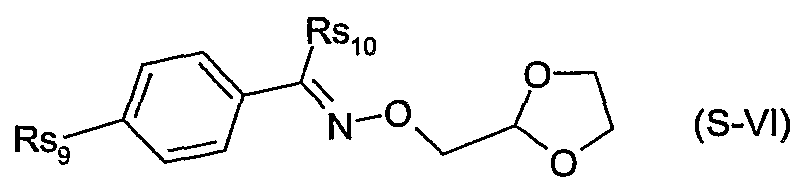
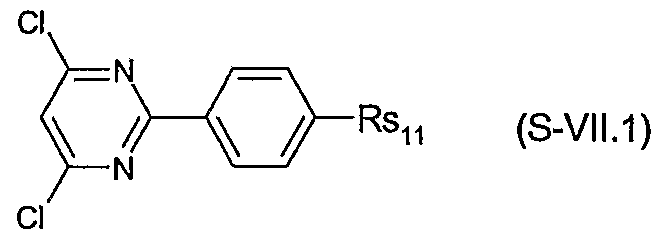
wherein Rs9 is hydrogen or halogen; and Rsio is cyano or trifluoromethyl; or of a safener of the formula S-NII
Figure imgf000007_0004
wherein Rsπ is hydrogen or methyl; or of a safener of the formula S-NIII
Figure imgf000007_0005
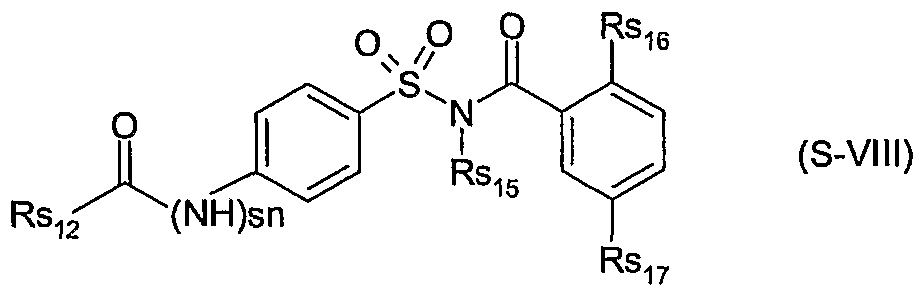
wherein sn is 0 or 1 ;
Rs12 is hydrogen, d-C8alkyl, C3-C8cycloalkyl, C3-C8alkenyl, C3-C8alkynyl or-N(-Rsj3 Rsw); wherein Rsι and Rsι4 are each independently of the other hydrogen, Cι-C8alkyl, C - C8cycloalkyl, C3-C8alkenyl or C3-C8alkynyl, or Rsι3 and Rsι4 together form a C4-C6alkylene group, which can be interrupted by oxygen, sulfur, SO, SO2, NH or N(CrC4alkyl);
Rsι5 is hydrogen or a cation chosen from the group consisting of the alkali and alkaline earth metals, iron, copper, aluminium, ammonium or quaternary ammonium, sulfonium or phosphonium;
Rsι6 is hydrogen, halogen, d-C8alkyl or methoxy; and
Rs17 is hydrogen, halogen, d-C8alkyl, trifluoromethyl or d-C8alkoxy; or of a safener of the formula S-LX
Figure imgf000008_0001
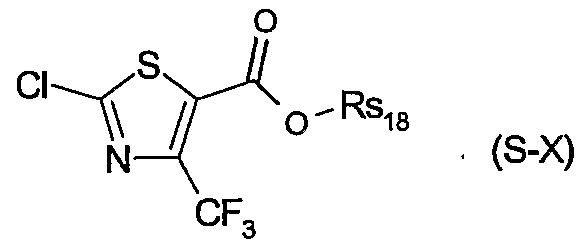
or of a safener of the formula S-X
Figure imgf000008_0002
wherein Rsι8 is benzyl, hydrogen, C3-C8alkenyl, C3-C8alkynyl, C3-C8cycloalkyl, Ci-
C8alkyl or d-C8alkyl substituted by d-C8alkoxy or C3-C8alkenyloxy, or
Rsis is a cation chosen from the group consisting of the alkali and alkaline earth metals, iron, copper, aluminium, ammonium or quaternary ammonium, sulfonium or phosphonium. In the definition of compound (I) above, alkyl radicals appearing in the substituent definitions are, for example methyl, ethyl, propyl and butyl, and also branched isomers thereof. Haloalkyl radicals include alkyl radicals substituted by one or more halogen, e.g. difluoromethyl or trifluoromethyl, and haloalkoxy radicals include alkoxy radicals substituted by one or more halogen, e.g. difluoromethoxy or 2,2- difluoroethoxy. Furthermore, according to the invention, there is provided a herbicidal composition which is characterized in that it comprises a mixture of a) a herbicidally active amount of a herbicide of the formula I
Figure imgf000009_0001
wherein
Ri , R2 , R3 , R , R5 , Re , m and n are defined as above;
Y is hydrogen, d-C6alkoxycarbonyl, carboxyl, C2-C6alkenyl, d-C10alkyl or Cι-Cι0alkyl substituted by halogen, Cι-C6alkoxy, C2-C6alkenyloxy, C2-C6alkynyloxy, benzyloxy, C\-
C6alkoxycarbonyl, carboxyl, hydroxyl or formyl, or
Y is phenyl or phenyl substituted by halogen, Ci-Cβalkyl, d-C6haloalkyl, Cι-C6alkoxy- d-C6alkyl, hydroxy-CrC6alkyl, Cι-C6alkylthio-Cι-C6alkyl, CrCealkylsulfinyl-d- C6alkyl, d-C6alkylsulfonyl-d-C6alkyl, d-C6alkylamino-d-C6alkyl, di-Ci- C6alkylamino-Cι-C6alkyl, cyano-d-C6alkyl or phenoxy-Cι-C6alkyl, or
Y is phenyl substituted by CrC6alkoxy or d-C6alkoxy substituted by halogen, d- C6alkoxy, C2-C6alkenyl, C2-C6alkynyl, d-C6alkoxycarbonyl, d-C6alkylcarbonyl or C3- C6cycloalkyl, or
Y is phenyl substituted by C2-C6alkenyl, C3-C8cycloalkoxy, d-Cealkylthio or d- C6alkylthiol substituted by halogen or d-C6alkoxy, or
Y is phenyl substituted by Cι-C6alkylsulfinyl or Cι-C6alkylsulfinyl substituted by halogen or d-C6alkoxy, or
Y is phenyl substituted by Cι-C6alkylsulfonyl or Cι-C alkylsulfonyl substituted by halogen or d-C6alkoxy, or Y is phenyl substituted by benzyloxy, amino or amino substituted by Cι-C6alkyl, d- C6alkylsulfonyl, Cι-C6alkylcarbonyl~d-C6alkyl or d-Cβalkylsulfonyl-Ci-dalkyl, or
Y is phenyl substituted by di-d-C6alkylamino, cyano, nitro, Cι-C6alkoxycarbonyl, carboxyl, C3-C8cycloalkoxycarbonyl, C2-C6alkenyloxycarbonyl, C2-C6alkynyloxy- carbonyl, benzyloxycarbonyl, phenoxycarbonyl or Cι-C6alkylcarbonyloxy or Ci- C6alkoxycarbonyl-Cι-C6alkyl, or
Y is a 5- or 6-membered, mono- or bicyclic aromatic ring which contains one or more nitrogen, oxygen or sulfur atoms as heteroatoms, in which the heteroaromatic ring can be substituted by hydroxyl, mercapto, halogen, d-Cι0alkyl or d-Cioalkyl substituted by hydroxyl, C3-C8cycloalkyl, halo-C3-C8cycloalkyl, Cι-C4alkyl-C3-C8cycloalkyl-, Cj- C10alkoxy, d-Cioalkylthio, Cι-C10alkylsulfonyl, CrCioalkoxycarbonyl, C2- C6haloalkenyl, amino, Cι-Cι0alkylamino, Cι-C6acylamino, Ci - C4haloalkylcarbonylamino, d-Cioalkylsulfonylamino, Cι-C4haloalkylsulfonylamino, carbamoyl, Ci-Cioalkylcarbamoyl, Cι-C6acyl, Cι-C haloalkylcarbonyl, d- Cioalkoxyimino, cyano, phenyl or phenoxy, or the heteroaromatic ring can be substituted by d-C haloalkyl, C3-C8cycloalkyl, Ci-
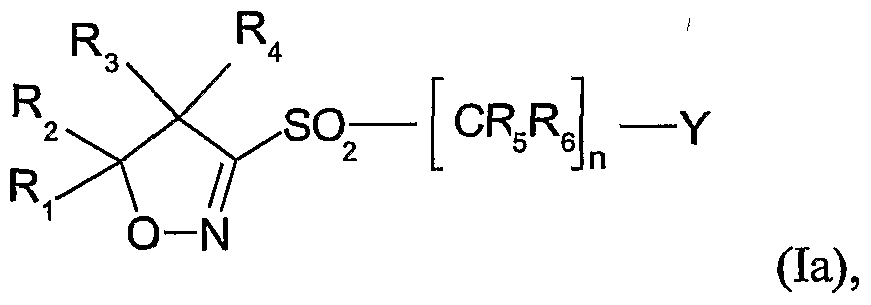
Cioalkoxy, Ci-Cioalkoxycarbonyl or Ci-Cι0alkoxy substituted by Cι-Cι0alkoxycarbonyl, phenyl, an aromatic heterocyclic radical, cyano or carbamoyl, or the heteroaromatic ring can be substituted by d-C4haloalkoxy, C3-C8cycloalkoxy, C3- C8cycloalkyl-Ci-C3alkoxy, Ci-Cioalkylthio or Ci-Cι0alkylthio substituted by d- Cioalkoxycarbonyl, phenyl, an aromatic heterocyclic radical, cyano or carbamoyl, or the heteroaromatic ring can be substituted by Cι-C4haloalkylthio, C2-C6alkenyl, C2- Cδalkenyloxy, C2-C6alkynyl, C2-C6alkynyloxy, Ci-Cioalkylsulfinyl or Ci-Cioalkylsulfinyl substituted by Ci-Cioalkoxycarbonyl, phenyl, an aromatic heterocyclic radical, cyano or carbamoyl, or the heteroaromatic ring can be substituted by Cι-Cι0alkylsulfonyl or Ci-doalkylsulfonyl substituted by d-doalkoxycarbonyl, phenyl, an aromatic heterocyclic radical, cyano or carbamoyl, or the heteroaromatic ring can be substituted by d-Ciohalo kylsulfinyl or Ci- doalkylsulfonyloxy substituted by Ci-Ci0alkoxycarbonyl, phenyl, an aromatic heterocyclic radical, cyano or carbamoyl, or the heteroaromatic ring can be substituted by Ci -C4haloalkylsulfonyl, d- Cioalkylsulfonyloxy, Ci-C4haloalkylsulfonyloxy, phenyl, phenoxy, phenylthio, an aromatic heterocyclic radical, an aromatic heterocyclic radical bonded via an oxygen or sulfur atom or a sulfonyl group, phenylsulfinyl, phenylsulfonyl, phenylsulfonyloxy, d- C4-haloalkylcarbonyl, benzylcarbonyl, benzoyl, carboxyl, Cι-C10alkoxycarbonyl, benzyloxycarbonyl, phenoxycarbonyl, cyano, carbamoyl, Cι-Cι0alkylcarbamoyl, phenylcarbamoyl, Cι-C6acyloxy, d-dhaloalkylcarbonyloxy, benzylcarbonyloxy, benzoyloxy, nitro, amino, Cι-C6alkylamino, phenylamino, Cι-C6acylamino, d- C6haloalkylcarbonylamino, benzylcarbonylamino, benzoylamino, Ci- C6alkylsulfonylamino, d-C6haloalkylsulfonylamino, benzylsulfonylamino or phenylsulfonylamino ; and b) a herbicide-antagonistically active amount of a safener of the formula S-I to S-X as defined above. Furthermore, according to the invention, there is provided a herbicidal composition which is characterized in that it comprises a mixture of a) a herbicidally active amount of a herbicide of the formula la
Figure imgf000011_0001
wherein
Ri and R2 are each independently of the other hydrogen, Ci-C10alkyl, C3-C8cycloalkyl or
C3-C8cycloalkyl-d-C3alkyl, or Ri and R2 , together with the carbon atom to which Ri and R are bonded, form a C3-C7 ring,
R3 and 4 are each independently of the other hydrogen, d-Cioalkyl, d-C10haloalkyl,
C3-C8-cycloalkyl-Cι-Cι0alkyl, Cι-C6alkoxy-Ci-Cioalkyl or C3-C8cycloalkyl, or
R and R-t , together with the carbon atom to which R3 and R4 are bonded, form a C3-C7 ring, or
Ri with R3 or R4 and together with the carbon atoms to which Rls R3 and j are bonded form a C5-C8 ring, or
R2 with R3 or R4 and together with the carbon atoms to which R2, R3 and t are bonded form a C5-C8 ring; R5 and Re are each independently of the other hydrogen, cyano, Ci-Cioalkyl or d-
Cioalkoxycarbonyl; n is an integer selected from 1, 2 or 3;
Y is hydrogen, d-C6alkoxycarbonyl, carboxyl, C2-C6alkenyl, Cι-Cι0alkyl or d-Cioalkyl substituted by halogen, Cι-C6alkoxy, C2-C6alkenyloxy, C2-C6alkynyloxy, benzyloxy, Ci- C6alkoxycarbonyl, carboxyl, hydroxyl or formyl, or
Y is phenyl or phenyl substituted by halogen, d-C6alkyl, Cι-C6haloalkyl, Cι-C6alkoxy-
C C6alkyl, hydroxy-Ci-C6alkyl, d-C6alkylthio-d-C6alkyl, C C6alkylsulfmyl-d-
C6alkyl, Cι-C6alkylsulfonyl-d-C6alkyl, Cι-C6alkylamino-Cι-C6alkyl, di-Ci-
C6alkylamino-Cι-C6alkyl, cyano-Cj-C6alkyl or phenoxy-d-C6alkyl, or Y is phenyl substituted by Cι-C6alkoxy or Cι-C6alkoxy substituted by halogen, Ci- C6alkoxy, C2-C6alkenyl, C2-C6alkynyl, Cι-C6alkoxycarbonyl, Cι-C6alkylcarbonyl or C3- C6cycloalkyl, or
Y is phenyl substituted by C2-C6alkenyl, C3-C8cycloalkoxy, Cι-C6alkylthio or C C6alkylthiol substituted by halogen or d-C6alkoxy, or
Y is phenyl substituted by Cι-C6alkylsulfinyl or Cι-C6alkylsulfinyl substituted by halogen or Cι-C6alkoxy, or
Y is phenyl substituted by Cι-C6alkylsulfonyl or Cι-C6alkylsulfonyl substituted by halogen or Ci-C6alkoxy, or Y is phenyl substituted by benzyloxy, amino or amino substituted by d-C6alkyl, d- Cealkylsulfonyl, d-C6alkylcarbonyl-Cι-C6alkyl or Ci-C6alkylsulfonyl-Ci-C6alkyl, or
Y is phenyl substituted by di-Cι-C6alkylamino, cyano, nitro, Ci-C6alkoxycarbonyl, carboxyl, C3-C8cycloalkoxycarbonyl, C2-C6alkenyloxycarbonyl, C2-C6alkynyloxy- carbonyl, benzyloxycarbonyl, phenoxycarbonyl or Cι-C6alkylcarbonyloxy or Ci- C6alkoxycarbonyl-Ci-C6alkyl, or
Y is a 5- or 6-membered, mono- or bicyclic aromatic ring which contains a nitrogen, oxygen or sulfur atom as a heteroatom, in which the heteroaromatic ring can be substituted by hydroxyl, mercapto, halogen, Ci-doalkyl or Cι-C10alkyl substituted by hydroxyl, C3-C8cycloalkyl, halo-C3-C8cycloalkyl, d-C4alkyl-C3-C8cycloalkyl-, Ci- Cioalkoxy, Cι-C10alkylthio, Ci-Cioalkylsulfonyl, Ci-doalkoxycarbonyl, C2- C6haloalkenyl, amino, Cι-Cι0alkylamino, Cι-C6acylamino, Ci - C haloalkylcarbonylamino, Ci-Cι0alkylsulfonylamino, Cι-C4haloalkylsulfonylamino, carbamoyl, d-Cioalkylcarbamoyl, d-C6acyl, Cι-C4haloalkylcarbonyl, d- doalkoxyimino, cyano, phenyl or phenoxy, or the heteroaromatic ring can be substituted by d-C4haloalkyl, C -C8cycloalkyl, Q-
C10alkoxy, Cι-C10alkoxycarbonyl or d-Cioalkoxy substituted by Ci-doalkoxycarbonyl, phenyl, an aromatic heterocyclic radical, cyano or carbamoyl, or the heteroaromatic ring can be substituted by d-C4haloalkoxy, C3-C8cycloalkoxy, C - C8cycloalkyl-Ci-C3alkoxy, d-Cioalkylthio or Cι-Cι0alkylthio substituted by Ci- Cioalkoxycarbonyl, phenyl, an aromatic heterocyclic radical, cyano or carbamoyl, or the heteroaromatic ring can be substituted by d-C4haloalkylthio, C2-C6alkenyl, C2- C6alkenyloxy, C2-C6alkynyl, C2-C6alkynyloxy, Ci-Cioalkylsulfinyl or d-Cioalkylsulfϊnyl substituted by Ci-Ci0alkoxycarbonyl, phenyl, an aromatic heterocyclic radical, cyano or carbamoyl, or the heteroaromatic ring can be substituted by Cι-Cι0alkylsulfonyl or Ci-Cioalkylsulfonyl substituted by Cι-C10alkoxycarbonyl, phenyl, an aromatic heterocyclic radical, cyano or carbamoyl, or the heteroaromatic ring can be substituted by Ci-Ciohaloalkylsulfmyl or Ci- Cioalkylsulfonyloxy substituted by Cι-Cι0alkoxycarbonyl, phenyl, an aromatic heterocyclic radical, cyano or carbamoyl, or the heteroaromatic ring can be substituted by Ci -C4haloalkylsulfonyl, Ci- doalkylsulfonyloxy, Ci-C4haloalkylsulfonyloxy, phenyl, phenoxy, phenylthio, an aromatic heterocyclic radical, an aromatic heterocyclic radical bonded via an oxygen or sulfur atom or a sulfonyl group, phenylsulfmyl, phenylsulfonyl, phenylsulfonyloxy, Ci- C4-haloalkylcarbonyl, benzylcarbonyl, benzoyl, carboxyl, d-Cioalkoxycarbonyl, benzyloxycarbonyl, phenoxycarbonyl, cyano, carbamoyl, d-Cioalkylcarbamoyl, phenylcarbamoyl, Ci-C6acyloxy, d-dnaloalkylcarbonyloxy, benzylcarbonyloxy, benzoyloxy, nitro, amino, Cι-C6alkylamino, phenylamino, Ci-C6acylamino, d- C6haloalkylcarbonylamino, benzylcarbonylamino, benzoylamino, Ci- C6alkylsulfonylamino, d-C6haloalkylsulfonylamino, benzylsulfonylamino or phenylsulfonylamino; and b) a herbicide-antagonistically active amount of a safener of the formula S-I to S-X as defined above.
Preferred safeners correspond to the formula S-I.l
Figure imgf000013_0001
wherein Rsi is hydrogen, C3-C8cycloalkyl, Cι-C8alkyl or Cι-C8alkyl substituted by Ci- C8alkoxy or C3-C8alkenyloxy, or
Rsi is a cation chosen from the group consisting of the alkali and alkaline earth metals, iron, copper, aluminium, ammonium, quaternary ammonium, sulfonium or phosphonium; or to the formula S-II.1
Figure imgf000014_0001
wherein Rsi is Cι-C8alkyl or d-C8alkyl substituted by C3-C8alkenyloxy; or to the formula S-III.1
Figure imgf000014_0002
wherein Rsi are each independently of the other Cι-C8alkyl or Cι-C8alkyl substituted by
C3-C8alkenyloxy; or to the formula S-JN.1 '
Figure imgf000014_0003
wherein Rsi is Cι-C8alkyl or Cι-C8alkyl substituted by C3-C8alkenyloxy; or to the formula S-N.1
Figure imgf000014_0004
wherein Rs2 and Rs3 are each independently of the other C2-C8alkenyl, or
Figure imgf000014_0005
Rs2 and Rs3 together form a radical of the formula ^ // wherein Rs5 is hydrogen or Cι-C4alkyl, or
Rs2 and Rs3 together form a radical of the formula
Figure imgf000014_0006
, wherein Rs7 and Rs8 are each independently of the other Cι-C4alkyl, or Rs and Rs8 together form -(CH )5-, and
O \
Rs6 is hydrogen, Cι-C4alkyl or ; or to the formula S-NI.l
Figure imgf000015_0001
S-VI.1 wherein Rs9 is.hydrogen or chlorine; and Rs10 is cyano or trifluoromethyl; or to the formula S-NII.l
Figure imgf000015_0002
wherein Rsπ is hydrogen or methyl; or to the formula S-NIII.1
Figure imgf000015_0003
wherein Rsj3 and Rs14 are each independently of the other hydrogen, Cι-C4alkyl, C3-
C6cycloalkyl, C3-C6alkenyl or C3-C6alkynyl, or
Rsι3 and Rsι together form a C -C6alkylene group; Rsi5 is hydrogen or a cation chosen from the group consisting of the alkali and alkaline earth metals, iron, copper, aluminium, ammonium or quaternary ammonium, sulfonium or phosphonium;
Rsi6 is hydrogen, Cι-C6alkyl or methoxy; and
Rsπ is hydrogen, Ci-Cδalkyl or Cι-C6alkoxy; or to the formula S-IX.l
Figure imgf000016_0001
wherein Rsι8 is d-C8alkyl or Cι-C8alkyl substituted by C3-C8alkenyloxy.
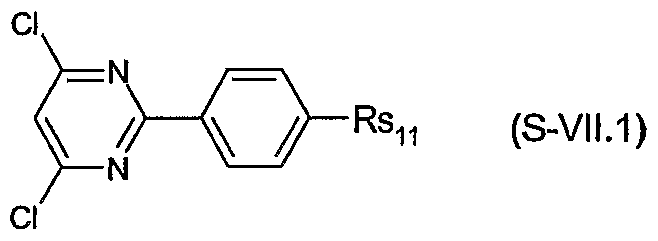
Particularly preferred safeners of the formula S-I.l are cloquintocet-mexyl (CAS RN 99607-70-2) or a lithium, sodium, potassium, calcium, magnesium, aluminium, iron, ammonium, quaternary ammonium, sulfonium or phosphonium salt thereof such as are known from WO 02/34048; of the formula S-II.l fenchlorazole-ethyl (CAS RN 103112- 35-2 and CAS RN 103112-36-3 for the corresponding acid); of the formula S-ffl.l mefenpyr-diethyl (CAS RN 135590-91-9 and CAS RN 135591-00-3 for the corresponding di-acid); of the formula S-1N.1 isoxadifen-ethyl (CAS RΝ 163520-33-0 and CAS RΝ 209866-92-2 for the corresponding acid); of the formula S-N.l furilazole (CAS RΝ 121776-33-8 and CAS RΝ 121776-57-6 for the corresponding R isomer), benoxacor (CAS RΝ 98730-04-2), dichlormid (CAS RΝ 37764-25-3) and MOΝ4660 (CAS RN 71526-07-3); of the formula S-VI.1 oxabetrinil (CAS RN 74782-23-3) and cyometrinil (CAS RN 78370-21-5 and CAS RN 63278-33-1 for the corresponding (Z) isomer); of the formula S-VII.l fenclorim (CAS RN 3740-92-9); of the formula S-VIII.l N-cyclopropyl-4-(2-methoxy-benzoylsulfamoyl)-benzamide (CAS RN 221667-31-8) and N-isopropyl-4-(2-methoxy-benzoylsulfamoyl)-benzamide (CAS RN 221668-34-4); of the formula S-IX.l naphthalic acid anhydride (CAS RN 81-84-5); and of the formula S-X.l flurazole (CAS RN 72850-64-7). More particularly preferred safeners of the formula S-I.l are cloquintocet-mexyl or a lithium, sodium, potassium, calcium, magnesium, aluminium, iron, ammonium, quaternary ammonium, phosphonium or sulfonium salt thereof; of the formula S-II.l fenchlorazole-ethyl and the corresponding acid; and of the formula S-III.1 mefenpyr- diethyl and the corresponding di-acid; of the formula S-V.l furilazole and the corresponding R isomer, benoxacor, dichlormid and MON4660. Yet more particularly preferred safeners of the formula S-I.l are cloquintocet- mexyl or a lithium, sodium, potassium, calcium, magnesium, aluminium, iron, , ammonium, quaternary ammonium, phosphonium or sulfonium salt thereof; of the formula S-II.l fenchlorazole-ethyl and the corresponding acid; and of the formula S-III.1 mefenpyr-diethyl and the corresponding di-acid; of the formula S-N.l benoxacor and MOΝ4660. Even more particularly preferred safeners of the formula S-I.l are cloquintocet- mexyl; of the formula S-II.l fenchlorazole-ethyl; of the formula S-III.1 mefenpyr- diethyl; and of the formula S-N.l benoxacor and MOΝ4660. Furthermore, particularly preferred safeners of the formula S-I.l are cloquintocet- mexyl or a lithium, sodium, potassium, calcium, magnesium, alun-unium, iron, ammonium, quaternary ammonium, phosphonium or sulfonium salt thereof such as are known from WO 02/34048; of the formula S-LT.l fenchlorazole-ethyl and the corresponding acid; of the formula S-III.1 mefenpyr-diethyl and the corresponding di- acid; of the formula S-IN.l isoxadifen-ethyl and the corresponding acid; of the formula S-N.l furilazole and the corresponding R isomer, benoxacor and dichlormid; of the formula S-NI.l oxabetrinil and cyometrinil and the corresponding (Z) isomer; of the formula S-NII.l fenclorim; of the formula S-NLII.l Ν-cyclopropyl-4-(2-methoxy- benzoylsulfamoyl)-benzamide and N-isopropyl-4-(2-methoxy-benzoylsulfamoyl)- benzamide; of the formula S-IX.l naphthalic acid anhydride; and of the formula S-X.l flurazole. Furthermore, particularly preferred safeners of the formula S-I.l are cloquintocet- mexyl or sulfonium or phosphonium salts thereof such as are known from WO 02/34048; of the formula S-II.l fenchlorazole-ethyl and the corresponding acid); of the formula S- III.1 mefenpyr-diethyl and the corresponding di-acid; of the formula S-IN.1 isoxadifen- ethyl and the corresponding acid; of the formula S-N.l furilazole and the corresponding R isomer, benoxacor and dichlormid; of the formula S-NI.l oxabetrinil and cyometrinil and the corresponding (Z) isomer; of the formula S-NII.l fenclorim; of the formula S- NIII.1 Ν-cyclopropyl-4-(2-methoxy-benzoylsulfamoyl)-benzamide and N-isopropyl-4- (2-methoxy-benzoylsulfamoyl)-benzamide; of the formula S-LX.l naphthalic acid anhydride; and of the formula S-X.l flurazole. Preferred compounds of the formula I are those wherein Ri and R2 are each independently of the other C d0alkyl or C3-C8cycloalkyl, or Ri and R2 , together with the carbon atom to which Ri and R2 are bonded, form a C3-C ring, more preferably Ri and R2 are both methyl. Further preferred compounds of the formula I are those wherein R3 and R4 are each independently of the other hydrogen, Ci-Cioalkyl or C3-C8cycloalkyl, or R3 and R4, together with the carbon atom to which R and P^ are bonded, form a C -C7 ring, more preferably R3 and R4 are both hydrogen. In another group of preferred compounds, m is 1 or 2, more preferably m is 2. In a further group of preferred compounds of the formula I, R5 and Re are each independently of the other hydrogen, methyl, methoxycarbonyl or ethoxycarbonyl, more preferably R5 and R6 are both hydrogen. In another group of preferred compounds, n is 1. In a further group of preferred compounds of the formula I, Y is phenyl or phenyl substituted by Ci-C6alkyl, Cι-C6haloalkyl, Cι-C6alkoxy-C.-C6alkyl, Cι-C6alkoxy, Ci- Cδhaloalkoxy, d-C6alkoxy-Cι-C6alkoxy or halogen. In a further group of preferred compounds of the formula I, Y is a 5- or 6- membered mono- or bicyclic aromatic ring which contains one or more nitrogen, oxygen or sulfur atoms as heteroatoms, in which the heteroaromatic ring can be substituted by Ci-Cioalkyl or Ci-Cioalkyl substituted by Cι-Cι0alkoxy, or the heteroaromatic ring can be substituted by Ci-Cioalkylsulfonyl, Cι-C haloalkyl, C3-C8cycloalkyl, d-Cioalkoxy, Ci- C4haloalkoxy, Ci-doalkoxycarbonyl, C -C8cycloalkyl-Cι-C3alkoxy, Ci-Cioalkylthio, phenyl, phenoxy, Cι-C4haloalkylcarbonyl, cyano, nitro, halogen, carbamoyl, Ci- doalkylcarbamoyl or phenylcarbamoyl. Furthermore, in a further group of preferred compounds of the formula I, Y is a 5- or 6-membered mono- or bicyclic aromatic ring which contains a nitrogen, oxygen or sulfur atom as a heteroatom, in which the heteroaromatic ring can be substituted by Ci- doalkyl or Ci-Cioalkyl substituted by Cι-Cι0alkoxy; or the heteroaromatic ring can be substituted by Ci-doalkylsulfonyl, Cι-C4haloalkyl, C3-C8cycloalkyl, Cι-Cιoalkoxy, Ci- Ciohaloalkoxy, Ci -Cioalkoxycarbonyl, C3-C8cycloalkyl-Cι-C alkoxy, Ci-doalkylthio, phenyl, phenoxy, d-C4haloalkylcarbonyl, cyano, nitro, halogen, carbamoyl, Ci- Cioalkylcarbamoyl or phenylcarbamoyl. In a further group of preferred compounds of the formula I, Y is thienyl, pyrazolyl, isoxazolyl, isothiazolyl, pyridyl or pyrimidyl. In a further group of preferred compounds of the formula I, Y is thien-3-yl, pyrazol-4-yl, pyrazol-5-yl, isoxazol-4-yl, isothiazol-4-yl, pyridin-3-yl or pyrimidin-5-yl. A most preferred compound of the formula I is 3-(5-difluoromethoxy-l-methyl-3- trifluoromethyl-lH-pyrazol-4-ylmethylsulfonyl)-5,5-dimethyl-4,5-dihydroisoxazole, which is compound of the formula 1.27 in Table 1 below. Particularly suitable compounds of the formula I are summarized in the following table.
Table 1: Examples of compounds of the formula I
Figure imgf000019_0001
Figure imgf000020_0001
Figure imgf000021_0001
Figure imgf000022_0001
Figure imgf000023_0001
It has been found that, in particular, good results can be achieved with combinations of the above mentioned compounds of the formulae 1.1 to 1.57 with the safeners cloquintocet-mexyl, fenchlorazole-ethyl, mefenpyr-diethyl, isoxadifen-ethyl, furilazole and the R isomer thereof, benoxacor, dichlormid, MON4660, oxabetrinil, cyometrinil and the (Z) isomer thereof, fenclorim, N-cyclopropyl-4-(2-methoxy- benzoylsulfamoyl)-benzamide, N-isopropyl-4-(2-methoxy-benzoylsulfamoyl)- benzamide, naphthalic acid anhydride and flurazole. The combinations of compound of the formula 1.27 with cloquintocet-mexyl, fenchlorazole-ethyl, mefenpyr-diethyl, isoxadifen-ethyl, furilazole and the R isomer thereof, benoxacor, dichlormid, MON4660, oxabetrinil, cyometrinil and the (Z) isomer thereof, fenclorim, N-cyclopropyl-4-(2-methoxy-benzoylsulfamoyl)-benzamide, N- isopropyl-4-(2-methoxy-benzoylsulfamoyl)-benzamide, naphthalic acid anhydride or flurazole can be used with particular advantage. A particularly preferred combination is the combination of compound of the formula 1.27 with benoxacor, in particular when used to safen compound of the formula 1.27 on maize, more particularly in post- emergent use. Further particularly preferred combinations are the combinations of compound of the formula 1.27 with cloquintocet-mexyl, compound of the formula 1.27 with MON4660, compound of the formula 1.27 with mefenpyr-diethyl, and compound of the formula 1.27 with fenchlorazole-ethyl, in particular when used to safen compound of the formula 1.27 on wheat or barley, more particularly in pre-emergent use. The combinations of compound of the formula 1.28 with cloquintocet-mexyl, fenchlorazole-ethyl, mefenpyr-diethyl, isoxadifen-ethyl, furilazole and the R isomer thereof, benoxacor, dichlormid, MON4660, oxabetrinil, cyometrinil and the (Z) isomer thereof, fenclorim, N-cyclopropyl-4-(2-methoxy-benzoylsulfamoyl)-benzamide, N- isopropyl-4-(2-methoxy-benzoylsulfamoyl)-benzamide, naphthalic acid anhydride or flurazole can likewise be used with particular advantage. The combinations of compound of the formula 1.29 with cloquintocet-mexyl, fenchlorazole-ethyl, mefenpyr-diethyl, isoxadifen-ethyl, furilazole and the R isomer thereof, benoxacor, dichlormid, MON4660, oxabetrinil, cyometrinil and the (Z) isomer thereof, fenclorim, N-cyclopropyl-4-(2-methoxy-benzoylsulfamoyl)-benzamide, N- isopropyl-4-(2-methoxy-benzoylsulfamoyl)-benzamide, naphthalic acid anhydride or flurazole can likewise be used with particular advantage. The combinations of compound of the formula 1.34 with cloquintocet-mexyl, fenchlorazole-ethyl, mefenpyr-diethyl, isoxadifen-ethyl, furilazole and the R isomer thereof, benoxacor, dichlormid, MON4660, oxabetrinil, cyometrinil and the (Z) isomer thereof, fenclorim, N-cyclopropyl-4-(2-methoxy-benzoylsulfamoyl)-benzamide, N- isopropyl-4-(2-methoxy-benzoylsulfamoyl)-benzamide, naphthalic acid anhydride or flurazole can likewise be used with particular advantage. The combinations of compound of the formula 1.41 with cloquintocet-mexyl, fenchlorazole-ethyl, mefenpyr-diethyl, isoxadifen-ethyl, furilazole and the R isomer thereof, benoxacor, dichlormid, MON4660, oxabetrinil, cyometrinil and the (Z) isomer thereof, fenclorim, N-cyclopropyl-4-(2-methoxy-benzoylsulfamoyl)-benzamide, N- isopropyl-4-(2-methoxy-benzoylsulfamoyl)-benzamide, naphthalic acid anhydride or flurazole can likewise be used with particular advantage. Particularly preferred combinations are the combinations of a compound of the formula 1.41 with benoxacor, compound of the formula 1.41 with dichlormid, compound of the formula 1.41 with furilazole, and compound of the formula 1.41 with N-isopropyl-4-(2-methoxy- benzoylsulfamoyl)-benzamide, in particular when used to safen compound of formula 1.41 on maize, more particularly in pre-emergent use. The combinations of compound of the formula 1.43 with cloquintocet-mexyl, fenchlorazole-ethyl, mefenpyr-diethyl, isoxadifen-ethyl, furilazole and the R isomer thereof, benoxacor, dichlormid, MON4660, oxabetrinil, cyometrinil and the (Z) isomer thereof, fenclorim, N-cyclopropyl-4-(2-methoxy-benzoylsulfamoyl)-benzamide, N- isopropyl-4-(2-methoxy-benzoylsulfamoyl)-benzamide, naphthalic acid anhydride or flurazole can likewise be used with particular advantage. The combinations of compound of the formula 1.55 with cloquintocet-mexyl, fenchlorazole-ethyl, mefenpyr-diethyl, isoxadifen-ethyl, furilazole and the R isomer thereof, benoxacor, dichlormid, MON4660, oxabetrinil, cyometrinil and the (Z) isomer thereof, fenclorim, N-cyclopropyl-4-(2-methoxy-benzoylsulfamoyl)-benzamide, N- isopropyl-4-(2-methoxy-benzoylsulfamoyl)-benzamide, naphthalic acid anhydride or flurazole can likewise be used with particular advantage. The combinations of compound of the formula 1.56 with cloquintocet-mexyl, fenchlorazole-ethyl, mefenpyr-diethyl, isoxadifen-ethyl, furilazole and the R isomer thereof, benoxacor, dichlormid, MON4660, oxabetrinil, cyometrinil and the (Z) isomer thereof, fenclorim, N-cyclopropyl-4-(2-methoxy-benzoylsulfamoyl)-benzamide, N- isopropyl-4-(2-methoxy-benzoylsulfamoyl)-benzamide, naphthalic acid anhydride or flurazole can likewise be used with particular advantage. The combinations of compound of the formula 1.57 with cloquintocet-mexyl, fenchlorazole-ethyl, mefenpyr-diethyl, isoxadifen-ethyl, furilazole and the R isomer thereof, benoxacor, dichlormid, MON4660, oxabetrinil, cyometrinil and the (Z) isomer thereof, fenclorim, N-cyclopropyl-4-(2-methoxy-benzoylsulfamoyl)-benzamide, N- isopropyl-4-(2-methoxy-benzoylsulfamoyl)-benzamide, naphthalic acid anhydride or flurazole can likewise be used with particular advantage. Particularly preferred combinations are the combinations of compound of the formula 1.57 with cloquintocet- mexyl, compound of the formula 1.57 with MON4660, compound of the formula 1.57 with mefenpyr-diethyl, and compound of the formula 1.57 with fenchlorazole-ethyl, in particular when used to safen compound of the formula 1.57 on wheat or barley, more particularly h pre-emergent use. Furthermore, it has been found that, in particular, good results can be achieved with combinations of the above mentioned compounds of the formulae 1.1 to 1.56 with the safeners cloquintocet-mexyl, fenchlorazole-ethyl, mefenpyr-diethyl, isoxadifen-ethyl, furilazole and the R isomer thereof, benoxacor, dichlormid, oxabetrinil, cyometrinil and the (Z) isomer thereof, fenclorim, N-cyclopropyl-4-(2-methoxy-benzoylsulfamoyl)- benzamide, N-isopropyl-4-(2-methoxy-benzoylsulfamoyl)-benzan ide, naphthalic acid anhydride and flurazole. The combinations of compound of the formula 1.27 with cloquintocet-mexyl, fenchlorazole-ethyl, mefenpyr-diethyl, isoxadifen-ethyl, furilazole and the R isomer thereof, benoxacor, dichlormid, oxabetrinil, cyometrinil and the (Z) isomer thereof, fenclorim, N-cyclopropyl-4-(2-methoxy-benzoylsulfamoyl)-benz amide, N-isopropyl-4- (2-methoxy-benzoylsulfamoyl)-benzamide, naphthalic acid anhydride or flurazole can be used with particular advantage. The combinations of compound of the formula 1.28 with cloquintocet-mexyl, fenchlorazole-ethyl, mefenpyr-diethyl, isoxadifen-ethyl, furilazole and the R isomer thereof, benoxacor, dichlormid, oxabetrinil, cyometrinil and the (Z) isomer thereof, fenclorim, N-cyclopropyl-4-(2-methoxy-benzoylsulfamoyl)-benzamide, N-isopropyl-4- (2-methoxy-benzoylsulfamoyl)-benzamide, naphthalic acid anhydride or flurazole can likewise be used with particular advantage. The combinations of compound of the formula 1.29 with cloquintocet-mexyl, fenchlorazole-ethyl, mefenpyr-diethyl, isoxadifen-ethyl, furilazole and the R isomer thereof, benoxacor, dichlormid, oxabetrinil, cyometrinil and the (Z) isomer thereof, fenclorim, N-cyclopropyl-4-(2-methoxy-benzoylsulfamoyl)-benzamide, N-isopropyl-4- (2-methoxy-benzoylsulfamoyl)-benzamide, naphthalic acid anhydride or flurazole can likewise be used with particular advantage. The combinations of compound of the formula 1.34 with cloquintocet-mexyl, fenchlorazole-ethyl, mefenpyr-diethyl, isoxadifen-ethyl, furilazole and the R isomer thereof, benoxacor, dichlormid, oxabetrinil, cyometrinil and the (Z) isomer thereof, fenclorim, N-cyclopropyl-4-(2-methoxy-benzoylsulfamoyl)-benzamide, N-isopropyl-4- (2-methoxy-benzoylsulfamoyl)-benzamide, naphthalic acid anhydride or flurazole can likewise be used with particular advantage. The combinations of compound of the formula 1.41 with cloquintocet-mexyl, fenchlorazole-ethyl, mefenpyr-diethyl, isoxadifen-ethyl, furilazole and the R isomer thereof, benoxacor, dichlormid, oxabetrinil, cyometrinil and the (Z) isomer thereof, fenclorim, N-cyclopropyl-4-(2-methoxy-benzoylsulfamoyl)-benzamide, N-isopropyl-4- (2-methoxy-benzoylsulfamoyl)-benzamide, naphthalic acid anhydride or flurazole can likewise be used with particular advantage. The combinations of compound of the formula 1.43 with cloquintocet-mexyl, fenchlorazole-ethyl, mefenpyr-diethyl, isoxadifen-ethyl, furilazole and the R isomer thereof, benoxacor, dichlormid, oxabetrinil, cyometrinil and the (Z) isomer thereof, fenclorim, N-cyclopropyl-4-(2-methoxy-benzoylsulfamoyl)-benzamide, N-isopropyl-4- (2-methoxy-benzoylsulfamoyl)-benzamide, naphthalic acid anhydride or flurazole can likewise be used with particular advantage. The combinations of compound of the formula 1.55 with cloquintocet-mexyl, fenchlorazole-ethyl, mefenpyr-diethyl, isoxadifen-ethyl, furilazole and the R isomer thereof, benoxacor, dichlormid, oxabetrinil, cyometrinil and the (Z) isomer thereof, fenclorim, N-cyclopropyl-4-(2-methoxy-benzoylsulfamoyl)-benzamide, N-isopropyl-4- (2-methoxy-benzoylsulfamoyl)-benzamide, naphthalic acid anhydride or flurazole can likewise be used with particular advantage. The combinations of compound of the formula 1.56 with cloquintocet-mexyl, fenchlorazole-ethyl, mefenpyr-diethyl, isoxadifen-ethyl, furilazole and the R isomer thereof, benoxacor, dichlormid, oxabetrinil, cyometrinil and the (Z) isomer thereof, fenclorim, N-cyclopropyl-4-(2-methoxy-benzoylsulfamoyl)-benzamide, N-isopropyl-4- (2-methoxy-benzoylsulfamoyl)-benzamide, naphthalic acid anhydride or flurazole can likewise be used with particular advantage. The invention also relates to a method of combating weed grasses and weeds in crops of useful plants, which comprises treating the useful plants, seed or cuttings thereof or the growing area thereof simultaneously or at separate times with a herbicidally active amount of the herbicide of the formula I and a herbicide-antagonistically active amount of a safener of the formula S-I to S-X. Possible crop plants which can be protected by the safeners of the formula S-I to S-X from the harmful action of the above mentioned herbicides are, in particular, soya, cotton, rape, sugarcane, cereals, e.g. wheat and barley, rice and, specifically, maize. Furthermore, possible crop plants which can be protected by the safeners of the formula S-I to S-X from the harmful action of the above mentioned herbicides are, in particular, soya, cotton, rape and, specifically, maize. Crops are also to be understood as meaning those which have been made tolerant towards herbicides or herbicide classes (e.g. ALS, GS, EPSPS, PPO and HPPD inhibitors) by conventional breeding or genetic engineering methods. An example of crops which have been made tolerant e.g. towards imidazolinones, such as imazamox, by conventional breeding methods is Clearfield® summer rape (Canola). Examples of crops which have been made tolerant towards herbicides by genetic engineering methods are e.g. glyphosate- or glufosinate-resistant maize varieties, which are commercially obtainable under the trade name RoundupReady® or LibertyLink®. The weeds to be combated can be either monocotyledonous or dicotyledonous weeds, such as, for example, Stellaria, Nasturtium, Agrostis, Digitaria, Avena, Setaria, Sinapis, Lolium, Solanum, Echinochloa, Scirpus, Monochoria, Sagittaria, Bromus, Alopecurus, Sorghum, Rottboellia, Cyperus, Abutilon, Sida, Xanthium, Amaranthus, Chenopodium, Ipomoea, Chrysanthemum, Galium, Viola and Veronica. Crops are furthermore to be understood as meaning those which, by genetic engineering methods, have been made resistant to harmful insects, such as, for example, Bt maize (resistant to the corn borer), Bt cotton (resistant to the cotton-boll weevil) and also Bt potatoes (resistant to the potato beetle). Examples of Bt maize are the Bt-176 maize hybrids of NK® (Syngenta Seeds). The Bt toxin is a protein which is formed naturally by Bacillus thuringiensis soil bacteria. Examples of toxins and transgenic plants which can synthesize such toxins are described in EP-A-451 878, EP-A-374 753, WO 93/07278, WO 95/34656, WO 03/052073 and EP-A-427 529. Examples of transgenic plants which contain one or more genes which code for an insecticidal resistance and express one or more toxins are KnockOut® (maize), Yield Gard® (maize), NuCOTIN33B® (cotton), Bollgard® (cotton), NewLeaf® (potatoes), NatureGard® and Protexcta®. Plant crops and seed thereof can be resistant both to herbicides and at the same time to insect feeding (stacked transgenic events). Seed can have, for example, the ability to express an insecticidally active Cry3 protein and at the same can be tolerant towards glyphosate. Crops are also to be understood as meaning those which are obtained by conventional breeding or genetic engineering methods and contain so-called output traits (e.g. improved storage stability, higher nutritional value and improved taste). Growing areas are understood as meaning the areas of soil on which the crop plants are already growing or which are already charged with seed of these crop plants, and also soils intended for cultivation with these crop plants. The compounds of formula I according to the invention can also be used in combination with other herbicides. In particular, the following mixtures of the compound of formula I are important: compound of formula I + acetochlor, compound of formula I + acifluorfen, compound of formula I + acifluorfen-sodium, compound of formula I + aclonifen, compound of formula I + acrolein, compound of formula I + alachlor, compound of formula I + alloxydim, compound of formula I 4- allyl alcohol, compound of formula I 4- ametryn, compound of formula I + amicarbazone, compound of formula I + amidosulfuron, compound of formula I + aminopyralid, compound of formula I + amitrole, compound of formula I + ammonium sulfamate, compound of formula I + anilofos, compound of formula I + asulam, compound of formula I + atraton, compound of formula I + atrazine, compound of formula I + azimsulfuron, compound of formula I + BCPC, compound of formula I + beflubutamid, compound of formula I + benazolin, compound of formula I + benfluralin, compound of formula I + benfuresate, compound of formula I + bensulfuron, compound of formula I + bensulfuron-methyl, compound of formula I + bensulide, compound of formula I + bentazone, compound of formula I + benzfendizone, compound of formula I + benzobicyclon, compound of formula I + benzofenap, compound of formula I + bifenox, compound of formula I + bilanafos, compound of formula I + bispyribac, compound of formula I + bispyribac-sodium, compound of formula I + borax, compound of formula I + bromacil, compound of formula I + bromobutide, compound of formula I + bromoxynil, compound of formula I + butachlor, compound of formula I + butafenacil, compound of formula I + butamifos, compound of formula I + butralin, compound of formula I + butroxydim, compound of formula I + butylate, compound of formula I + cacodylic acid, compound of formula I + calcium chlorate, compound of formula I + cafenstrole, compound of formula I + carbetamide, compound of formula I + carfentrazone, compound of formula I + carfentrazone-ethyl, compound of formula I + CDEA, compound of formula I + CEPC, compound of formula I + chlorflurenol, compound of formula I + chlorflurenol-methyl, compound of formula I + chloridazon, compound of formula I + chlorimuron, compound of formula I + chlorimuron-ethyl, compound of formula I + chloroacetic acid, compound of formula I + chlorotoluron, compound of formula I + chlorpropham, compound of formula I + chlorsulfuron, compound of formula I + chlorthal, compound of formula I + chlorthal-dimethyl, compound of formula I + cinidon-ethyl, compound of formula I + cinmethylin, compound of formula I + cinosulfiiron, compound of formula I + cisamhde, compound of formula I + clethodim, compound of formula I + clodinafop, compound of formula I + clodinafop-propargyl, compound of formula I + clomazone, compound of formula I + clomeprop, compound of formula I + clopyralid, compound of formula I + cloransulam, compound of formula I + cloransulam-methyl, compound of formula I + CMA, compound of formula I + 4-CPB, compound of formula I + CPMF, compound of formula I + 4-CPP, compound of formula I + CPPC, compound of formula I + cresol, compound of formula I + cumyluron, compound of formula I + cyanamide, compound of formula I + cyanazine, compound of formula I + cycloate, compound of formula I + cyclosulfamuron, compound of formula I + cycloxydim, compound of formula I + cyhalofop, compound of formula I + cyhalofop-butyl, compound of formula I + 2,4-D, compound of formula I + 3,4-DA, compound of formula I + daimuron, compound of formula I + dalapon, compound of formula I + dazomet, compound of formula I + 2,4- DB, compound of formula I + 3,4-DB, compound of formula I + 2,4-DEB, compound of formula I + desmedipham, compound of formula I + dicamba, compound of formula I + dichlobenil, compound of formula I + ortho-dichlorobenzene, compound of formula I + para-dichlorobenzene, compound of formula I + dichlorprop, compound of formula I + dichlorprop-P, compound of formula I + diclofop, compound of formula I + diclofop- methyl, compound of formula I + diclosulam, compound of formula I + difenzoquat, compound of formula I + difenzoquat metilsulfate, compound of formula I + diflufenican, compound of formula I + diflufenzopyr, compound of formula I + dimefuron, compound of formula I + dimepiperate, compound of formula I + dimethachlor, compound of formula I + dimethametryn, compound of formula I + dimethenamid. compound of formula I + dimethenamid-P, compound of formula I + dimethipin, compound of formula 1+ dimethylarsinic acid, compound of formula I + i dmitramine, compound of formula I + dinoterb, compound of formula I + diphenamid, compound of formula I + diquat, compound of formula I + diquat dibromide, compound of formula I + dithiopyr, compound of formula I + diuron, compound of formula I + DNOC, compound of formula I + 3,4-DP, compound of formula I + DSMA, compound of formula I + EBEP, compound of formula I + endothal, compound of formula I + EPTC, compound of formula I + esprocarb, compound of formula I + ethalfluralin, compound of formula I + ethametsulfuron, compound of formula I + ethametsulfuron- methyl, compound of formula I + ethofumesate, compound of formula I + ethoxyfen, compound of formula I + ethoxysulfuron, compound of formula I + etobenzanid, compound of formula I + fenoxaprop-P, compound of formula I + fenoxaprop-P-ethyl, compound of formula I + fentrazamide, compound of formula I + ferrous sulfate, compound of formula I + flamprop-M, compound of formula I + flazasulfuron, compound of formula I + florasulam, compound of formula I + fluazifop, compound of formula I + fluazifop-butyl, compound of formula I + fluazifop-P, compound of formula I + fluazifop-P-butyl, compound of formula I + flucarbazone, compound of formula I + flucarbazone-sodium, compound of formula I + flucetosulfuron, compound of formula I + fluchloralin, compound of formula I + flufenacet, compound of formula I + flufenpyr, compound of formula I + flufenpyr-ethyl, compound of formula I + flumetsulam, compound of formula I + flumiclorac, compound of formula I + flumiclorac-pentyl, compound of formula I + flumioxazin, compound of formula I + fluometuron, compound of formula I + fluoroglycofen, compound of formula I + fluoroglycofen-ethyl, compound of formula I + flupropanate, compound of formula I + flupyrsulfuron, compound of formula I + flupyrsulfuron-methyl-sodium, compound of formula I + flurenol, compound of formula I + fluridone, compound of formula I + flurochloridone, compound of formula I + fluroxypyr, compound of formula I + flurtamone, compound of formula I + fluthiacet, compound of formula I + fluthiacet-methyl, compound of formula I + fomesafen, compound of formula I + foramsulfuron, compound of formula I + fosamine, compound of formula I + glufosinate, compound of formula I + glufosinate-ammonium, compound of formula I + glyphosate, compound of formula I + halosulfuron, compound of formula I + halosulfuron-methyl, compound of formula I + haloxyfop, compound of formula I + haloxyfop-P, compound of formula I + HC-252, compound of formula I + hexazinone, compound of formula I + imazamethabenz, compound of formula I + imazamethabenz- methyl, compound of formula I + imazamox, compound of formula I + imazapic, compound of formula I + imazapyr, compound of formula I + imazaquin, compound of formula I + imazethapyr, compound of formula I + imazosulfuron, compound of formula I + indanofan, compound of formula I + iodomethane, compound of formula I + iodosulfuron, compound of formula I + iodosulfuron-methyl-sodium, compound of formula I + ioxynil, compound of formula I + isoproturon, compound of formula I + isouron, compound of formula I + isoxaben, compound of formula I + isoxachlortole, compound of formula I + isoxaflutole, compound of formula I + karbutilate, compound of formula I + lactofen, compound of formula I + lenacil, compound of formula I + linuron, compound of formula I + MAA, compound of formula I + MAMA, compound of formula I + MCPA, compound of formula I + MCPA-thioethyl, compound of formula I + MCPB, compound of formula I + mecoprop, compound of formula I + mecoprop-P, compound of formula I + mefenacet, compound of formula I + mefluidide, compound of formula I + mesosulfuron, compound of formula I + mesosulfuron-methyl, compound of formula I + mesotrione, compound of formula I + metam, compound of formula I + metamifop, compound of formula I + metamitron, compound of formula I + metazachlor, compound of formula I + methabenzthiazuron, compound of formula I + methylarsonic acid, compound of formula I + methyldymron, compound of formula I + methyl isothiocyanate, compound of formula I + metobenzuron, compound of formula I + metolachlor, compound of formula I + S-metolachlor, compound of formula I + metosulam, compound of formula I + metoxuron, compound of formula I + metribuzin, compound of formula I + metsulfuron, compound of formula I + metsulfuron-methyl, compound of formula I + MK-616, compound of formula I + molinate, compound of formula I + monolinuron, compound of formula I + MSMA, compound of formula I + naproanilide, compound of formula I + napropamide, compound of formula I + naptalam, compound of formula I + neburon, compound of formula I + nicosulfuron, compound of formula I + nonanoic acid, compound of formula I + norflurazon, compound of formula I + oleic acid (fatty acids), compound of formula I + orbencarb, compound of formula I + orthosulfamuron, compound of formula I + oryzalin, compound of formula I + oxadiargyl, compound of formula I + oxadiazon, compound of formula I + oxasulfuron, compound of formula I + oxaziclomefone, compound of formula I + oxyfluorfen, compound of formula I + paraquat, compound of formula I + paraquat dichloride, compound of formula I + pebulate, compound of formula I + pendimethalin, compound of formula I + penoxsulam, compound of formula I + pentachlorophenol, compound of formula I + pentanochlor, compound of formula I + pentoxazone, compound of formula I + pethoxamid, compound of formula I + petrolium oils, compound of formula I + phenmedipham, compound of formula I + phenmedipham-ethyl, compound of formula I + picloram, compound of formula I + picolinafen, compound of formula I + pinoxaden, compound of formula I + piperophos, compound of formula I + potassium arsenite, compound of formula I + potassium azide, compound of formula I + pretilachlor, compound of formula I + primisulfuron, compound of formula I + primisulfuron-methyl, compound of formula I + prodiamine, compound of formula I + profluazol, compound of formula I + profoxydim, compound of formula I + prometon, compound of formula I + prometryn, compound of formula I + propachlor, compound of formula I + propanil, compound of formula I + propaquizafop, compound of formula I + propazine, compound of formula I + propham, compound of formula I + propisochlor, compound of formula I + propoxycarbazone, compound of formula I + propoxycarbazone-sodium, compound of formula I + propyzamide, compound of formula I + prosulfocarb, compound of formula I + prosulfuron, compound of formula I + pyraclonil, compound of formula I + pyraflufen, compound of formula I + pyraflufen-ethyl, compound of formula I + pyrazolynate, compound of formula I + pyrazosulfuron, compound of formula I + pyrazosulfuron- ethyl, compound of formula I + pyrazoxyfen, compound of formula I + pyribenzoxim, compound of formula I + pyributicarb, compound of formula I + pyridafol, compound of formula I + pyridate, compound of formula I + pyriftalid, compound of formula I + pyriminobac, compound of formula I + pyriminobac-methyl, compound of formula I + pyrimisulfan, compound of formula I + pyrithiobac, compound of formula I + pyrithiobac-sodium, compound of formula I + quinclorac, compound of formula I + quinmerac, compound of formula I + quinoclamine, compound of formula I + quizalofop, compound of formula I + quizalofop-P, compound of formula I + rimsulfuron, compound of formula I + sethoxydim, compound of formula I + siduron, compound of formula I + simazine, compound of formula I + simetryn, compound of formula I + SMA, compound of formula I + sodium arsenite, compound of formula I + sodium azide, compound of formula I + sodium chlorate, compound of formula I + sulcotrione, compound of formula I + sulfentrazone, compound of formula I + sulfometuron, compound of formula I + sulfometuron-methyl, compound of formula I + sulfosulfuron, compound of formula I + sulfuric acid, compound of formula I + tar oils, compound of formula I + 2,3,6-TBA, compound of formula I + TCA, compound of formula I + TCA-sodium, compound of formula I + tebuthiuron, compound of formula I + tepraloxydim, compound of formula I + terbacil, compound of formula I + terbumeton, compound of formula I + terbuthylazine, compound of formula I + terbutryn, compound of formula I + thenylchlor, compound of formula I + thiazopyr, compound of formula I + thifensulfuron, compound of formula I + thifensulfuron-methyl, compound of formula I + thiobencarb, compound of formula I + tiocarbazil, compound of formula I + topramezone, compound of formula I + tralkoxydim, compound of formula I + tri-allate, compound of formula I + triasulfuron, compound of formula I + triaziflam, compound of formula I + tribenuron, compound of formula I + tribenuron-methyl, compound of formula I + tricamba, compound of formula I + triclopyr, compound of formula I + trietazine, compound of formula I + trifloxysulfuron, compound of formula I + trifloxysulfuron-sodium, compound of formula I + trifluralin, compound of formula I + triflusulfuron, compound of formula I + triflusulfuron-methyl, compound of formula I + trihydroxytriazine, compound of formula I + tritosulfuron, compound of formula I + [3- [2-chloro-4-fluoro-5 -( 1 -methyl-6-trifluoromethyl-2,4-dioxo- 1,2,3 ,4-tetrahydropyrimidin- 3 -yl)phenoxy]-2-pyridyloxy] acetic acid ethyl ester. The mixing partners of the compound of formula I may also be in the form of esters or salts, as mentioned e.g. in The Pesticide Manual, 12th Edition (BCPC), 2000. The mixing ratio of the compound of formula I to the mixing partner is preferably from l : 100 to 1000:1. The mixtures can advantageously be used in the above-mentioned formulations (in which case "active ingredient" relates to the respective mixture of compound of formula I with the mixing partner). The compositions according to the invention are suitable for all the conventional methods of application in agriculture, such as e.g. pre-emergent application, post- emergent application and seed dressing. Depending on the intended use, a safener of the formula S-I to S-X can be employed for pre-treatment of the seed of the crop plant (dressing of the seed or cuttings) or can be introduced into the soil before or after sowing. However, it can also be applied by itself or together with the herbicide before or after emergence of the plants. The treatment of the plants or seed with the safener can therefore in principle be carried out independently of the time of application of the herbicide. Treatment of the plants by simultaneous application of herbicide and safener (e.g. as a tank mix) is as a rule preferred. The application rate of safener to herbicide to be applied largely depends on the method of use. For field treatment, as a rule 0.001 to 5.0 kg of safener/ha, preferably 0.001 to 0.5 kg of safener/ha, and as a rule between 0.001 to 2 kg of herbicide/ha, but preferably between 0.005 to 1 kg/ha are applied. For seed dressing, in general 0.001 to 10 g of safener/kg of seed, preferably 0.05 to 2 g of safener/kg of seed are applied. If the safener is applied in liquid form, with soaking of the seed, shortly before sowing, safener solutions which contain the active compound in a concentration of 1 to 10,000, preferably 100 to 1,000 ppm are expediently used. A mixture of a herbicidally active amount of the compound of the formula I and a herbicide- antagonistic amount of the compound of the formula S-I to S-X can be employed in unchanged form as a herbicidal composition. However, as a rule the compositions according to the invention are formulated in various ways using formulation auxiliaries, such as carrier substances, solvents and surface-active substances. The formulations can be in various physical forms, e.g. as dusting powders, gels, wettable powders, water-dispersible granules, water-dispersible tablets, effervescent pressed tablets, emulsifiable concentrates, microemulsifiable concentrates, oil-in-water emulsions, oil flowables, aqueous dispersions, oily dispersions, suspoemulsions, capsule suspensions, emulsifiable granules, soluble liquids, water-concentrates (with water or a water-miscible organic solvent as the carrier), impregnated polymer films or in other forms known e.g. from the Manual on Development and Use of FAO Specifications for Plant Protection Products, 5th Edition, 1999. These formulations either can be used directly, or they are diluted before use. The dilutions can be prepared, for example, with water, liquid fertilizers, micronutrients, biological organisms, oil or solvents. The formulations can be prepared e.g. by mixing the active compound with formulation auxiliaries in order to obtain compositions in the form of finely divided solids, granules, solutions, dispersions or emulsions. The active compounds can also be formulated with other auxiliaries, such as, for example, finely divided solids, mineral oils, oils of plant or animal origin, modified oils of plant or animal origin, organic solvents, water, surface-active substances or combinations thereof. The active compounds can also be contained in very fine microcapsules made of a polymer. Microcapsules contain the active compounds in a porous carrier. This allows release of the active compounds into the environment in controlled amounts (e.g. slow release). Microcapsules conventionally have a diameter of 0.1 to 500 micron. They contain active compounds in an amount of approx. 25 to 95 wt.% of the capsule weight. The active compounds can be in the form of a monolithic solid, fine particles distributed in a solid or liquid, or a suitable solution. The enclosing membranes comprise, for example, natural and synthetic gums, cellulose, styrene/butadiene copolymers, polyacrylonitrile, polyacrylate, polyester, polyamides, polyureas, polyurethane or chemically modified polymers and starch xanthates or other polymers which are known to the expert in this connection. Alternatively, very fine microcapsules in which the active compound is contained in the form of finely divided particles in a solid matrix of base substance, but the microcapsules are not surrounded by a shell, can be formed. The formulation auxiliaries which are suitable for the preparation of the compositions according to the invention are known per se. Liquid carriers which can be used are: water, toluene, xylene, petroleum ether, vegetable oils, acetone, methyl ethyl ketone, cyclohexanone, acid anhydrides, acetonitrile, acetophenone, amyl acetate, 2- butanone, butylene carbonate, chlorobenzene, cyclohexane, cyclohexanol, alkyl esters of acetic acid, diacetone alcohol, 1,2-dichloropropane, diethanolamme, p-diethylbenzene, diethylene glycol, diethylene glycol abietate, diethylene glycol butyl ether, diethylene glycol ethyl ether, diethylene glycol methyl ether, N,N-dimethylformamide, dimethylsulfoxide, 1,4-dioxane, dipropylene glycol, dipropylene glycol methyl ether, dipropylene glycol dibenzoate, diproxitol, alkylpyrrolidone, ethyl acetate, 2- ethylhexanol, ethylene carbonate, 1,1,1-trichloroethane, 2-heptanone, alpha-pinene, d- limonene, ethylene glycol, ethyl lactate, ethylene glycol butyl ether, ethylene glycol methyl ether, gamma-butyrolactone, glycerol, glycerol acetate, glycerol diacetate, glycerol triacetates, hexadecane, hexylene glycol, isoamyl acetate, isobornyl acetates, isooctane, isophorone, isopropylbenzene, isopropyl myristate, lactic acid, laurylamine, mesityl oxide, methoxypropanol, methyl isoamyl ketone, methyl isobutyl ketone, methyl laurate, methyl octanoate, methyl oleate, methylene chloride, m-xylene, n-hexane, n- octylamine, octadecanoic acid, octylamine acetate, oleic acid, oleylamine, o-xylene, phenol, polyethylene glycol (PEG400), propionic acid, propyl lactate, propylene carbonate, propylene glycol, propylene glycol methyl ether, p-xylene, toluene, triethyl phosphate, triethylene glycol, xylenesulfonic acid, paraffin, mineral oil, trichloroethylene, perchloroethylene, ethyl acetate, amyl acetate, butyl acetate, propylene glycol methyl ether, diethylene glycol methyl ether, methanol, ethanol, isopropanol, and alcohols of higher molecular weight, such as amyl alcohol, tetrahydrofurfuryl alcohol, hexanol, octanol, ethylene glycol, propylene glycol, glycerol, N-methyl-2-pyrrolidone and the like. Water is in general the carrier of choice for dilution of the concentrates. Suitable solid carriers are e.g. talc, titanium dioxide, pyrophyllite alumina, silica, attapulgite alumina, kieselguhr, limestone, calcium carbonate, bentonite, calcium montmorillonite, cotton-seed husks, wheat flour, soya flour, pumice, wood flour, ground walnut shells, lignin and similar substances such as are described, for example, in CFR 180.1001. (c) & (d). A large number of surface-active substances can advantageously be used both in solid and in liquid formulations, in particular in those which can be diluted with a carrier before use. Surface-active substances can be anionic, cationic, nonionic or polymeric, and they can be employed as emulsifying, wetting or suspending agents or for other purposes. Typical surface-active substances include, for example, salts of alkyl sulfates, such as diethanolammonium lauryl sulfate; salts of alkylarylsulfonates, such as calcium dodecylbenzenesulfonate; alkylphenol-alkylene oxide addition products, such as nonylphenol ethoxylate; alcohol-alkylene oxide addition products, such as tridecyl alcohol ethoxylate; soaps, such as sodium stearate; salts of alkylnaphthalenesulfonates, such as sodium dibutylnaphthalenesulfonate; dialkyl esters of sulfosuccinate salts, such as sodium di(2-ethylhexyl)-sulfosuccinate; sorbitol esters, such as sorbitol oleate; quaternary amines, such as lauryltrimethylammonium chloride, polyethylene glycol esters of fatty acids, such as polyethylene glycol stearate; block copolymers of ethylene oxide and propylene oxide; and salts of mono- and dialkyl phosphate esters; as well as further substances described e.g. in McCutcheon's Detergents and Emulsifϊers Annual, MC Publishing Corp., Ridgewood New Jersey, 1981. Further auxiliaries which can conventionally be used in pesticidal formulations include crystallization inhibitors, viscosity-modifyin substances, suspending agents, dyestuffs, antioxidants, foams, light absorption agents, mixing auxiliaries, defoamers, complexing agents, neutralizing or pH-modifying substances and buffers, corrosion inhibitors, fragrances, wetting agents, uptake enhancers, micronutrients, softeners, slip agents, lubricants, dispersing agents, thickeners, antifreezes, microbiocidal agents, and furthermore liquid and solid fertilizers. The formulations can also comprise additional active substances, e.g. further herbicides, plant growth regulators, fungicides or insecticides. The compositions according to the invention can furthermore comprise an additive comprising an oil of plant or animal origin, a mineral oil, alkyl esters of these oils or mixtures of these oils and oil derivatives. The application rates of oil additive in the composition according to the invention is as a rule between 0.01 and 10 %, based on the spray liquor. For example, the oil additive can be added into the spray tank in the desired concentration after preparation of the spray liquor. Preferred oil additives comprise mineral oils or an oil of plant origin, such as, for example, rape oil, olive oil or sunflower oil, emulsified vegetable oil, such as AMIGO® (Rhόne-Poulenc Canada Inc.), alkyl esters of oils of plant origin, such as, for example, the methyl derivatives, or an oil of animal origin, such as fish oil or beef tallow. A preferred additive substantially comprises e.g. as active components 80 wt.% of alkyl esters offish oils and 15 wt.% of methylated rape oil, as well as 5 wt.% of conventional emulsifiers and pH modifiers. Particularly preferred oil additives comprise alkyl esters of C8-C22 fatty acids, the methyl derivatives of Cι2-C18 fatty acids, for example the methyl esters of lauric acid, palmitic acid and oleic acid, being of importance in particular. These esters are known as methyl laurate (CAS-111-82-0), methyl palmitate (CAS-112-39-0) and methyl oleate (CAS-112- 62-9). A preferred fatty acid methyl ester derivative is Emery® 2230 and 2231 (Cognis GmbH). These and other oil derivatives are also known from the Compendium of Herbicide Adjuvants, 5th Edition, Southern Illinois University, 2000. The application and the action of the oil additives can be improved still further by combination with surface-active substances, such as nonionic, anionic or cationic surfactants. Examples of suitable anionic, nonionic and cationic surfactants are listed in WO 97/34485 on pages 7 and 8. Preferred surface-active substances are anionic surfactants of the dodecylbenzenesulfonate type, in particular the calcium salts thereof, and nonionic surfactants of the fatty alcohol ethoxylate type. Ethoxylated Cι2-C22-fatty alcohols having a degree of ethoxylation of between 5 and 40 are particularly preferred. Examples of commercially obtainable surfactants are the Genapol types (Clariant AG). Silicone surfactants, in particular polyalkyl oxide-modified heptamethyltrisiloxanes, which are commercially obtainable e.g. as Silwet L-77®, and perfluorinated surfactants are likewise preferred. The concentration of the surface-active substances with respect to the total additive is in general between 1 and 30 wt.%. Examples of oil additives which comprise mixtures of oils or mineral oils or derivatives thereof with surfactants are Edenor ME SU®, Turbocharge® (Syngenta Agro, CH) or Actipron® (BP Oil UK Limited, GB). The surface-active substances mentioned can optionally also be used in the formulations by themselves, i.e. without oil additives. The addition of an organic solvent to the oil additive/surfactant mixture may furthermore contribute towards an additional increase in the action. Suitable solvents are, for example, Solvesso® (ESSO) or Aromatic Solvent® (Exxon Corporation). The concentration of such solvents can be from 10 to 80 wt.% of the total weight. Such oil additives which are in the form of a mixture with solvents are described, for example, in US-A-4,834,908. A commercially obtainable oil additive known from this is known by the name MERGE® (BASF Corporation). A further oil additive which is preferred according to the invention is SCORE® (Syngenta Crop Protection Canada). In addition to the above mentioned oil additives, formulations of alkylpyrrolidones (e.g. Agrimax®) may furthermore also be added to the spray liquor to increase the action of the compositions according to the invention. Formulations of synthetic lattices, such as e.g. polyacrylamide, polyvinyl compounds or poly-l-p- menthene (e.g. Bond®, Courier® or Emerald®) can also be used for this. Solutions containing propionic acid, such as e.g. Eurogkem Pen-e-trate®, can furthermore also be admixed to the spray liquor as action-increasing agents. The herbicidal formulations as a rule comprise 0.1 to 99 wt.%, in particular 0.1 to 95 wt.% of active compound mixture of the compound of the formula I with the compounds of the formula II, and 1 to 99.9 wt.% of a formulation auxiliary, which preferably comprises 0 to 25 wt.% of a surface-active substance. While concentrated compositions are conventionally preferred as commercial goods, the end user as a rule uses diluted compositions. Various methods and techniques are suitable for using safeners of the formula π or compositions containing them for protecting crop plants from the harmful actions of herbicides of the formula I, such as, for example, the following: i) Seed dressing a) Dressing of the seed with an active compound of the formula II formulated as a wettable powder by shaking in a vessel until uniform distribution over the seed surface is achieved (dry dressing). About 1 to 500 g of active compound of the formula S-I to S-X 5 (4 g to 2 kg of wettable powder) per 1 0 kg of seed are used here. b) Dressing of the seed with an emulsion concentrate of the active compound of the formula S-I to S-X by method a) (wet dressing). c) Dressing by immersing the seed in a liquor with 100-1,000 ppm of active compound of the formula S-I to S-X for 1 to 72 hours and optionally subsequent drying of the seed
10 (immersion dressing). The dressing of the seed or the treatment of the sprouted seedling are of course the preferred methods of application, because the treatment with the active compound is directed entirely at the target crop. As a rule; 1 to 1,000 g of antidote,, preferably 5 to 250 g of antidote are used per 100 kg of seed, it being possible to deviate upwards or
15 downwards from the limit concentrations stated (repeat dressing), depending on the method, which also allows the addition of other active compounds or micronutrients. ii) Application as a tank mix A liquid processed mixture of antidote and herbicide (reciprocal ratio of amounts of between 10:1 and 1:100) is used, the application rate of herbicide being 0.005 to 5.0 kg
20 per hectare. Such tank mixes are applied before or after sowing, iii) Application into the seed furrow The active compound of the formula II is introduced into the open sown seed furrow as an emulsion concentrate, wettable powder or as granules. After the seed furrow has been covered, the herbicide is applied by the pre-emergent method in the conventional
25 manner. iv Controlled release of the active compound The active compound of the formula II is absorbed in solution on to mineral carrier granules or polymerized granules (urea formaldehyde) and dried. A coating which allows the active compound to be released over a certain period of time can optionally be
30. applied (coated granules).
In particular, preferred formulations have the following composition: (% = per cent by weight; active mixture of active compounds means the mixture of compound of the formula I with a compound of the formula S-I to S-X) Emulsifiable concentrates: Active mixture of active compounds: 1 to 95 %, preferably 60 to 90 % Surface-active agent: 1 to 30 %, preferably 5 to 20 % Liquid carrier: 1 to 80 %, preferably 1 to 35 % Dusts: Active mixture of active compounds: 0.1 to 10 %, preferably 0.1 to 5 % Solid carrier: 99.9 to 90 %, preferably 99.9 to 99 % Suspension concentrates: Active mixture of active compounds: 5 to 75 %, preferably 10 to 50 % Water: 94 to 24 %, preferably 88 to 30 % Surface-active agent: 1 to 40 %, preferably 2 to 30 % Wettable powders: Active mixture of active compounds: 0.5 to 90 %, preferably 1 to 80 %
" Surface-active agent: 0.5 to 20 %, preferably 1 to 15 % Solid carrier material: 5 to 95 %, preferably 15 to 90 % Granules: Active mixture of active compounds: 0.1 to 30 %, preferably 0.1 to 15 % Solid carrier: 99.5 to 70 %, preferably 97 to 85 %
The following examples explain the invention further, without limiting it.
Formulation examples for mixtures of herbicides of the formula I and safeners of the formula S-I to S-X) (% = per cent by weight) FI. Emulsion concentrates a) b) c) d) Active compound mixture 5 % 10 % 25 % 50 % Ca dodecylbenzenesulfonate 6 % 8 % 6 % 8 % Castor oil polyglycol ether 4 % - 4 % 4 % (36 mol EO) Octylphenol polyglycol ether - 4 % - 2 % (7-8 mol EO) NMP - - 10 % 20 % Arom. hydrocarbon 85% 78% 55% 16% mixture C9-Cι
Emulsions of any desired concentration can be prepared from such concentrates by dilution with water.
F2. Solutions a) bb)) cc)) d)
Active compound mixture 5 % 1100%% 5500%% 90%
1 -Methoxy-3 -(3-methoxy- propoxy)-propane 2200%% 2200%% -
Polyethylene glycol MW 400 20 % 1100%% _- _ NNMMPP -- - 3300%% 10%
Arom. hydrocarbon 75 % 60 % - mixture C-Cι
The solutions are suitable for use in the form of tiny drops.
F3. Wettable powders aa)) bb)) cc)) d)
Active compound mixture 55 %% 2255 %% 5500%% 80%
Na ligninsulfbnate 44%% - 33%% -
Na lauryl sulfate 22 %% 33 %% -- 4%
Na diisobutyl-naphthalene- _ 66%% 55%% 6% sulfonate
Octylphenol polyglycol ether 1% 2%
(7-8 mol EO)
Highly disperse silica 1 % 3 % 5% 10%
Kaolin 88 % 62 % 35%
The active compound is mixed thoroughly with the additives and the mixture is ground thoroughly in a suitable mill. Wettable powders which can be diluted with water to give suspensions of any desired concentration are obtained.
F4. Coated granules: a) b) c)
Active compound mixture 0.1 % 5% 15%
Highly disperse silica 0.9 % 2% 2%
Inorg. carrier material 99.0 % 93 % . 83%
(Average extension JE 0.1 - 1 mm) such as e.g. CaCO3 or SiO2 The active compound is dissolved in methylene chloride, the solution is sprayed on to the carrier and the solvent is then evaporated off in vacuo.
F5. Coated granules: a) b) c)
Active compound mixture 0.1 % 5% 15% Polyethylene glycol MW 200 1.0% 2% 3%
Highly disperse silica 0.9 % 1% 2%
Inorg. carrier material 98.0 % 92% 80%
(Average extension JE 0.1 - 1 mm) such as e.g. CaCO3 or SiO2 The finely ground active compound is applied uniformly, in a mixer, to the carrier material moistened with polyethylene glycol. Dust-free coated granules are obtained in this manner.
F6. Extruded granules a) b) c) d)
Active compound mixture 0.1% 3% 5% 15% Na ligninsulfonate 1.5% 2% 3% 4%
Carboxymethylcellulose 1.4% 2% 2% 2%
Kaolin 97.0 % 93% 90% 79%
The active compound is mixed with the additives and the mixture is ground and moistened with water. This mixture is extruded and then dried in a stream of air. F7. Dusts . a) b) c)
Active compound mixture 0.1% 1% 5%
Talc 39.9% 49% 35%
Kaolin 60.0% 50% 60%
Ready-to-use dusts are obtained by mixing the active compound with the carrier substances and grinding the mixture in a suitable mill.
F8. Suspension concentrates a) b) c) d)
Active compound mixture 3% 10% 25 % 50%
Ethylene glycol 5% > 5% 5% 5%
Nonylphenol polyglycol ether - 1% 2% -
(15mol.EO)
Na ligninsulfonate 3% 3% 4% 5%
Carboxymethylcellulose 1% 1% 1% 1%
37 % aqueous formaldehyde 0.2 % 0.2 % 0.2 % , 0.2 % solution
Silicone oil emulsion 0.8 % 0.8 % 0.8 % 0.8 %
Water 87 % 79 % 62 % 38 % The finely ground active compound is mixed intimately with the additives. A suspension concentrate from which suspensions of any desired concentration can be prepared by dilution with water is obtained in this way. It is often more practical to formulate the active compound of the formula I and the mixing partner of the formula S-I to S-X individually and then to bring them together as a "tank mix" in water in the applicator in the desired mixing ratio shortly before application. The ability of the safeners of the formula S-I to S-X to protect crop plants from the phytotoxic action of herbicides of the formula I is illustrated in the following examples.
Biological examples
Example El : Pre-emergent test on maize The test plants are sown in seed troughs under greenhouse conditions. A standard earth is used as the culture substrate. In a pre-emergent stage, the herbicides are applied both by themselves and in a mixture with safeners to the soil surface. The application is carried out with an aqueous suspension of the test substances, prepared from a 25 % wettable powder (Example F3, b) or a suspension concentrate (Example F8), to achieve a field equivalent of 200 1/ha. The tests are evaluated after 14 days (100 % = plants completely dead; 0 % = no phytotoxic action on the plants).
Table El: Safener action on pre-emergent use on maize
Figure imgf000045_0001
Table El : Continuation
Figure imgf000045_0002
The test substances show good results. The same results are obtained when the compounds of the formula I are formulated according to the other above mentioned examples. Example FI : Post-emergent test on maize The test plants are sown in containers under glasshouse conditions. A standard earth is used as the culture substrate. In a maize growth stage of one leaf (GS 11), the herbicides are applied both by themselves and in a mixture with safeners to the soil and leaf surface. The application is carried out with an aqueous suspension of the test substances, prepared from a 25 % wettable powder (Example F3,b) or a suspension concentrate (Example F8), to achieve a field equivalent of 200 1/ha. The tests are evaluated after 28 days (100 % — plants completely dead; 0 % = no phytotoxic action on the plants).
Table FI : Safener action on post-emergent use on maize (Marista llf)
Figure imgf000046_0001
Example Gl: Pre:emergent test on wheat and barley The test plants are sown in 48 well plates in a growth chamber. A sterilized standard earth is used as the culture substrate. I-n a pre-emergent stage, the herbicides are applied both by themselves and in a mixture with safeners to the soil surface. The application is carried out with an aqueous suspension of the test substances, prepared from a 25 % wettable powder (Example F3,b), to achieve a field equivalent of 375 1/ha. The tests are evaluated after 14 days (100 % = plants completely dead; 0 % = no phytotoxic action on the plants). Table Gl : Safener action on pre-emergent use on wheat and barley
Figure imgf000047_0001
Table Gl : Continuation
Figure imgf000047_0002
Figure imgf000048_0001
Table Gl : Continuation
Figure imgf000048_0002
Table Gl : Continuation
Figure imgf000048_0003
* test carried out on wheat (the value is the average value of two repetitions) ** test carried out on barley (the value is the average value of two repetitions)

Claims

1. Herbicidal composition, characterized in that it comprises a mixture of a) a herbicidally active amount of a compound of the formula I
Figure imgf000049_0001
wherein Ri and R2 are each independently of the other hydrogen, Ci-doalkyl, C3- C8cycloalkyl or C3-C8cycloalkyl-Cι-C alkyl, or Ri and R , together with the carbon atom to which Ri and R2 are bonded* form a C3- C7 ring, R3 and R-j are each independently of the other hydrogen, Ci-Cioalkyl, d- Ciohaloalkyl, C3-C8cycloalkyl-Ci-doalkyl, Cι-C6alkoxy-Cι-Cι0alkyl or C - C8cycloalkyl, or R3 and R4 , together with the carbon atom to which R3 and R4 are bonded, form a C3- C7 ring, or Ri with R3 or R4 and together with the carbon atoms to which Ri, R3 and R4 are bonded form a C5-C8 ring, or R with R3 or R4 and together with the carbon atoms to which R2, R and R are bonded form a C5-C8 ring; m is an integer selected from 0, 1 or 2; R5 and Re are each independently of the other hydrogen, cyano, Ci-Cioalkyl or Ci- Cioalkoxycarbonyl; n is an integer selected from 1,
2 or 3; Y is hydrogen, Cι-C6alkoxycarbonyl, carboxyl, C -C6alkenyl, Ci-Cioalkyl or Ci- ■ doalkyl substituted by halogen, d-C6alkoxy, C2-C6alkenyloxy, C2-C6alkynyloxy, benzyloxy, Cι-C6alkoxycarbonyl, carboxyl, hydroxyl or formyl, or Y is phenyl or phenyl substituted by halogen, Cι-C6alkyl, Cι-C6haloalkyl, d- C6alkoxy-Cι-C6alkyl, hydroxy-Ci-C6alkyl, Cι-C6alkylthio-Cι-C6alkyl, Ci- C6alkylsulfmyl-Cι-C6alkyl, Cι-C6alkylsulfonyl-d-C6alkyl, Cι-C6alkylamino-Cι- C6alkyl, di-Cι-C6alkylamino-Cι-C6alkyl, cyano-Cι-C6alkyl or phenoxy-Cι-C6alkyl, or
Y is phenyl substituted by Cι-C6alkoxy or Cι-C6alkoxy substituted by halogen, Ci- C6alkoxy, C2-C6alkenyl, C2-C6alkynyl, Cι-C6alkoxycarbonyl, Cι-C6alkylcarbonyl or C -C8cycloalkyl, or
Y is phenyl substituted by C2-C6alkenyl, C3-C8cycloalkoxy, Ci-C6alkylthio or Ci- C6alkylthiol substituted by halogen or Cι-C6alkoxy, or
Y is phenyl substituted by Cι-C6alkylsulfinyl or Cι-C6alkylsulfinyl substituted by halogen or Cι-C6alkoxy, or Y is phenyl substituted by Ci-C6alkylsulfonyl or Cι-C6alkylsulfonyl substituted by halogen or Cι-C6alkoxy, or
Y is phenyl substituted by benzyloxy, amino or amino substituted by d-C6alkyl, Ci- C6alkylsulfonyl, Cι-C6alkylcarbonyl-Cι-C6alkyl or Ci-C6alkylsulfonyl-Cι-C6alkyl, or Y is phenyl substituted by di-d-C6alkylamino, cyano, nitro, Ci-C6alkoxycarbonyl, carboxyl, C3-C8cycloalkoxycarbonyl, C2-C6alkenyloxycarbonyl, C2-C6alkynyloxy- carbonyl, benzyloxycarbonyl, phenoxycarbonyl or Ci-C6alkylcarbonyloxy or Ci- C6alkoxycarbonyl-Cι-C6alkyl, or
Y is a 5- or 6-membered, mono- or bicyclic aromatic ring which contains one or more nitrogen, oxygen or sulfur atoms as heteroatoms, in which the heteroaromatic ring can be substituted by hydroxyl, mercapto, halogen, Ci-Cioalkyl or Ci-Cioalkyl substituted by hydroxyl, C3-C8cycloalkyl, halo-C3-C8cycloalkyl, Cι-C4alkyl-C3- Cscycloalkyl-, Cι-Ci0alkoxy, Ci-Cioalkylthio, Ci-Cioalkylsulfonyl, Cι-Cιoalkoxy- carbonyl, C2-C6haloalkenyl, amino, Cι-Cι0alkylamino, Cι-C6acylamino, Cι-C4halo- alkylcarbonylamino, Cι-Cι0alkylsulfonylamino, Cι-C4haloalkylsulfonylamino, carbamoyl, Cι-Ci0alkylcarbamoyl, Cι-C6acyl, Cι-C4haloalkylcarbonyl, C\- Cioalkoxyimino, cyano, phenyl or phenoxy, or the heteroaromatic ring can be substituted by Cι-C4haloalkyl, C -C8cycloalkyl, Ci- Cioalkoxy, Ci -Cioalkoxycarbonyl or Cι-Cι0alkoxy substituted by Cι-Cι0alkoxy- carbonyl, phenyl, an aromatic heterocyclic radical, cyano, carbamoyl or Cι-Cιoalkyl- carbamoyl, or the heteroaromatic ring can be substituted by Cι-C4haloalkoxy, C3-C8cycloalkoxy, C3-C8cycloalkyl-Cι-C alkoxy, Ci-Cioalkylthio or Ci-Cioalkylthio substituted by C\- Cioalkoxycarbonyl, phenyl, an aromatic heterocyclic radical, cyano, carbamoyl or Ci-Cioalkylcarbamoyl, or the heteroaromatic ring can be substituted by Cι-C4haloalkylthio, C2-C6alkenyl, C2- C6alkenyloxy, C2-C6alkynyl, C2-C6alkynyloxy, C Cι0alkylsulfinyl or Cι-C10alkyl- sulfinyl substituted by Ci-Ci0alkoxycarbonyl, phenyl, an aromatic heterocyclic radical, cyano, carbamoyl or Ci-Cioalkylcarbamoyl, or the heteroaromatic ring can be substituted by Ci-Cioalkylsulfonyl or Cι-Cιoalkyl- sulfonyl substituted by Ci -Cioalkoxycarbonyl, phenyl, an aromatic heterocyclic radical, cyano, carbamoyl or Ci-Cioalkylcarbamoyl, or the heteroaromatic ring can be substituted by d-Ciohaloalkylsulfinyl or Ci-Cioalkyl- sulfonyloxy substituted by Ci -Cioalkoxycarbonyl, phenyl, an aromatic heterocyclic radical, cyano, carbamoyl or Ci-doalkylcarbamoyl, or the heteroaromatic ring can be substituted by Cι-C4haloalkylsulfonyl, Cι-Cιoalkyl- sulfonyloxy, d-C4haloalkylsulfonyloxy, phenyl, phenoxy, phenylthio, an aromatic heterocyclic radical, an aromatic heterocyclic radical bonded via an oxygen or sulfur atom or a sulfonyl group, phenylsulfinyl, phenylsulfonyl, phenylsulfonyloxy, Ci- C6acyl, Cι-C4haloalkylcarbonyl, benzylcarbonyl, benzoyl, carboxyl, Ci -Cioalkoxycarbonyl, benzyloxycarbonyl, phenoxycarbonyl, cyano, carbamoyl, Ci-Cioalkyl- carbamoyl, phenylcarbamoyl, Cι-C6acyloxy, Cι-C4haloalkylcarbonyloxy, benzyl- carbonyloxy, benzoyloxy, nitro, amino, Ci-Cioalkylamino, phenylamino, Cj-C6acyl- amino, Ci-C6haloalkylcarbonylamino, benzylcarbonylamino, benzoylamino, Ci- Cioalkylsulfonylamino, Cι-C6haloalkylsulfonylamino, benzylsulfonylamino or phenylsulfonylamino ; and b) a herbicide-antagonistically active amount of a safener of the formula S-I
Figure imgf000051_0001
wherein Xsi is hydrogen or halogen; and
Rsi is hydrogen, C3-C8alkenyl, C3-C8alkynyl, C3-C8cycloalkyl, Cι-C8alkyl or Ci-
C8alkyl substituted by Cι-C8alkoxy or C3-C8alkenyloxy, or Rsi is a cation chosen from the group consisting of the alkali and alkaline earth metals, iron, copper, aluminium, ammonium or quaternary ammonium, sulfonium or phosphonium; or of a safener of the formula S-II
Figure imgf000052_0001
wherein Ei is nitrogen or methine;
Xsi are each independently of the other hydrogen or halogen; and
Rsi is hydrogen, C3-C8alkenyl, C3-C8alkynyl, C3-C8cycloalkyl, Cι-C8alkyl or Ci-
C8alkyl substituted by Cι-C8alkoxy or C3-C8alkenyloxy, or Rsi is a cation chosen from the group consisting of the alkali and alkaline earth metals, iron, copper, aluminium, ammomum or quaternary ammonium, sulfonium or phosphonium; or of a safener of the formula S-J I
Figure imgf000052_0002
wherein Xsi are each independently of the other hydrogen or halogen; and
Rsi are each independently of the other hydrogen, C3-C8alkenyl, C3-C8alkynyl, C3- C8cycloalkyl, Cι-C8alkyl or Cι-C8alkyl substituted by d-C8alkoxy or C3- C8alkenyloxy, or Rsi are a cation chosen from the group consisting of the alkali and alkaline earth metals, iron, copper, aluminium, ammonium or quaternary ammonium, sulfonium or phosphonium; or of a safener of the formula S-IN
Figure imgf000052_0003
wherein Rsi is hydrogen, C3-C8alkenyl, C3-C8alkynyl, C3-C8cycloalkyl, Cι-C8alkyl or Cι-C8alkyl substituted by Cι-C8alkoxy or C3-C8alkenyloxy, or Rsi is a cation chosen from the group consisting of the alkali and alkaline earth metals, iron, copper, alumimum, ammonium or quaternary ammonium, sulfonium or phosphonium; or of a safener of the formula S-N
Figure imgf000053_0001
wherein Rs2 and Rs3 are each independently of the other Cι-C8alkyl, C2-C8alkenyl or C3-C8cycloalkyl, or Rs2 and Rs3 together form a radical of the formula s„ s5
Figure imgf000053_0002
wherein Rs4 and Rs5 are each independently of the other hydrogen or Ci-Cg-alkyl, or Rse
Rs2 and Rs together form a radical of the formula
Figure imgf000053_0003
wherein Rs7 and Rs8 are each independently of the other Cι-C6alkyl, or Rs7 and Rs8 together form -(CH2)5-, and Rs6 is hydrogen, Cι-C6alkyl, aryl or heteroaryl; or of a safener of the formula S-NI
Figure imgf000053_0004
wherein Rs9 is hydrogen or halogen; and Rsio is cyano or trifluoromethyl; or of a safener of the formula S-Nπ
Figure imgf000053_0005
wherein Rsπ is hydrogen or methyl; or of a safener of the formula S-NIII
Figure imgf000054_0001
wherein sn is 0 or 1 ; Rsι2 is hydrogen, Cι-C8alkyl, C3-C8cycloalkyl, C3-C8alkenyl, C3-C8alkynyl or -Ν(-
Rsπ -Rs14); wherein Rsι3 and Rsι4 are each independently of the other hydrogen, d-C8alkyl, C -
C8cycloalkyl, C -C8alkenyl or C3-C8alkynyl, or
Rsι3 and Rsι4 together form a C4-C6alkylene group, which can be interrupted by oxygen, sulfur, SO, SO2, NH or N(Cι-C4alkyl);
Rsi5 is hydrogen or a cation chosen .from the group consisting of the alkali and alkaline earth metals, iron, copper, aluminium, ammonium or quaternary ammonium, sulfonium or phosphonium;
Rsι6 is hydrogen, halogen, Cι-C8alkyl or methoxy; and Rsπ is hydrogen, halogen, Cι-C8alkyl, trifluoromethyl or Ci-C8alkoxy; or of a safener of the formula S-LX
Figure imgf000054_0002
or of a safener of the formula S-X
Figure imgf000054_0003
wherein Rsι8 is benzyl, hydrogen, C3-C8alkenyl, C3-C8alkynyl, C3-C8cycloalkyl, Ci-
C8alkyl or Cι-C8alkyl substituted by Cι-C8alkoxy or C3-C8alkenyloxy, or Rsι8 is a cation chosen from the group consisting of the alkali and alkaline earth metals, iron, copper, aluminium, ammonium or quaternary ammonium, sulfonium or phosphonium. Composition according to claim 1, characterized in that the safener is a compound of the formula S-I.l
Figure imgf000055_0001
wherein Rsi is hydrogen, C3-C8cycloalkyl, Cι-C8alkyl or Cι-C8alkyl substituted by
Cι-C8alkoxy or C3-C8alkenyloxy, or
Rsi is a cation chosen from the group consisting of the alkali and alkaline earth metals, iron, copper, aluminium, ammonium, quaternary ammomum, sulfonium or phosphonium; or of the formula S-LT.1
Figure imgf000055_0002
wherein Rsi is Cι-C8alkyl or Cι-C8alkyl substituted by C3-C8alkenyloxy; or of the formula S-HI.l
Figure imgf000055_0003
wherein Rsi are each independently of the other Cι-C8alkyl or Cι-C8alkyl substituted by C3-C8alkenyloxy; or of the formula S-IN.l
Figure imgf000055_0004
wherein Rsi is Cι-C8alkyl or Cι-C8alkyl substituted by C3-C8alkenyloxy; or of the formula S-V.l
Figure imgf000056_0001
wherein Rs2 and Rs3 are each independently of the other C -C8alkenyl, or Rs5
Rs2 and Rs3 together form a radical of the formula wherein Rs5 is hydrogen or Cι-C alkyl, or
Rs2 and Rs3 together form a radical of the formula
Figure imgf000056_0002
, wherein Rs7 and Rs8 are each independently of the other Cι-C4alkyl, or
Rs7 and Rs8 together form -(CH2)5-, and
C
Rs6 is hydrogen, Cι-C4alkyl or
Figure imgf000056_0003
wherein Rs9 is hydrogen or chlorine; and Rsio is cyano or trifluoromethyl; or of the formula S-NII.l
Figure imgf000056_0004
wherein Rsj i is hydrogen or methyl; or of the formula S-NIII.l
Figure imgf000057_0001
wherein Rsπ and Rsj4 are each independently of the other hydrogen, Cι-C4alkyl, C - C6cycloalkyl, C -C6alkenyl or C3-C6alkynyl, or Rsπ and Rsι4 together form a C4-C6alkylene group; Rsi5 is hydrogen or a cation chosen from the group consisting of the alkali and alkaline earth metals, iron, copper, alumimum, ammonium or quaternary ammonium, sulfonium or phosphonium; Rsι6 is hydrogen, Cι-C6alkyl or methoxy; and Rsι7 is hydrogen, Cι-C6alkyl or Ci-Cδalkoxy; or of the formula S-IX.1
Figure imgf000057_0002
wherein Rsι8 is Cι-C8alkyl or Cι-C8alkyl substituted by C3-C8alkenyloxy.
3. Composition according to claim 1 or claim 2, characterized in that the safener is cloquintocet-mexyl or a lithium, sodium, potassium, calcium, magnesium, aluminium, iron, ammonium, quaternary ammonium, sulfonium or phosphonium salt thereof, or the safener is fenchlorazole-ethyl, mefenpyr-diethyl, isoxadifen-ethyl, furilazole, the R isomer thereof, benoxacor, dichlormid, MON4660, oxabetrinil, cyometrinil, the Z isomer thereof, fenclorim, N-cyclopropyl-4-(2-methoxy- benzoylsulfamoyl)-benzamide, N-isopropyl-4-(2-methoxy-benzoylsulfamoyl)- benzamide, naphthalic acid anhydride or flurazole.
4. Composition according to any preceding claim, characterized in that in the compound of the formula I Ri and R2 are each independently of the other Ci-Cioalkyl or C3-C8cycloalkyl, or Ri and R2 , together with the carbon atom to which Ri and R2 are bonded, form a C3- C7 ring.
5. Composition according to any preceding claim, characterized in that in the compound of the formula I R3 and are each independently of the other hydrogen, Ci-doalkyl or C3- C8cycloalkyl, or R3 and R4, together with the carbon atom to which R3 and R4 are bonded, form a C3- C7 ring.
6. Composition according to any preceding claim, characterized in that in the compound of the formula I m is 1 or 2.
7. Composition according to any preceding claim, characterized in that in the compound of the formula I R5 and Rό are each independently of the other hydrogen, methyl, methoxycarbonyl or ethoxycarbonyl.
8. Composition according to any preceding claim, characterized in that in the compound of the formula I n is 1.
9. Composition according to any preceding claim, characterized in that in the compound of the formula I Y is phenyl or phenyl substituted by Cι-C6alkyl, Cι-C6haloalkyl, Cι-C6alkoxy-Cι- C6alkyl, Ci-Cδalkoxy, Cι-C6haloalkoxy, Cι-C6alkoxy-Cι-C6alkoxy or halogen.
10. Composition according to any preceding claim, characterized in that in the compound of the formula I Y is a 5- or 6-membered mono- or bicyclic aromatic ring which contains one or more nitrogen, oxygen or sulfur atoms as heteroatoms, in which the heteroaromatic ring can be substituted by Ci-Cioalkyl or Ci-doalkyl substituted by d-Cioalkoxy, or the heteroaromatic ring can be substituted by d-Cioalkylsulfonyl, Cι-C4haloalkyl, C3-C8cycloalkyl, Ci-doalkoxy, Cι-C4haloalkoxy, Cι-C10alkoxycarbonyl, C3- C8cycloalkyl-Cι-C3alkoxy, Cι-Cι0alkylthio, phenyl, phenoxy, d- C4haloalkylcarbonyl, cyano, nitro, halogen, carbamoyl, Ci-doalkylcarbamoyl or phenylcarbamoyl.
11. Composition according to any preceding claim, characterized in that in the compound of the formula I Y is thienyl, pyrazolyl, isoxazolyl, isothiazolyl, pyridyl or pyrimidyl.
12. Composition according to any preceding claim, characterized in that in the compound of the formula I Y is thien-3-yl, pyrazol-4-yl, pyrazol-5-yl, isoxazol-4-yl, isothiazol-4-yl, pyridin-3-yl or pyrimidin-5-yl.
13. Composition according to any preceding claim, characterized in that in the compound of the formula I Y is 3-(5-difluoromethoxy-l-methyl-3-trifluoromethyl- ' lH-pyrazol-4-ylmethylsulfonyl)-5,5-dimethyl-4,5-dihydroisoxazole.
14. Method of combating weeds and weed grasses in crops of useful plants, characterized in that the useful plants, seed or cuttings thereof or the growing area thereof are treated simultaneously or at separate times with a herbicidally active amount of a herbicide of the formula I and a herbicide-antagonistically active amount of a safener of the formula S-I to S-X.
15. Method according to claim 14, characterized in that the crops of useful plants are maize.
PCT/EP2005/004610 2004-04-30 2005-04-29 Herbicidal composition Ceased WO2005104848A1 (en)

Priority Applications (8)

Application Number Priority Date Filing Date Title
JP2007509975A JP4980209B2 (en) 2004-04-30 2005-04-29 Herbicidal composition
AU2005237241A AU2005237241B2 (en) 2004-04-30 2005-04-29 Herbicidal composition
EP05741054A EP1755397B1 (en) 2004-04-30 2005-04-29 Herbicidal composition
DE602005004283T DE602005004283T2 (en) 2004-04-30 2005-04-29 Herbicide compilation
BRPI0510262-6A BRPI0510262B1 (en) 2004-04-30 2005-04-29 Herbicidal composition and method of combating weeds and weeds in useful crop crops
CA2563218A CA2563218C (en) 2004-04-30 2005-04-29 Herbicidal composition comprising an isoxazoline derivative and a safener
US11/568,326 US8404618B2 (en) 2004-04-30 2005-04-29 Herbicidal composition
PL05741054T PL1755397T3 (en) 2004-04-30 2005-04-29 Herbicidal composition

Applications Claiming Priority (2)

Application Number Priority Date Filing Date Title
CH7672004 2004-04-30
CH00767/04 2004-04-30

Publications (1)

Publication Number Publication Date
WO2005104848A1 true WO2005104848A1 (en) 2005-11-10

Family

ID=35044966

Family Applications (1)

Application Number Title Priority Date Filing Date
PCT/EP2005/004610 Ceased WO2005104848A1 (en) 2004-04-30 2005-04-29 Herbicidal composition

Country Status (12)

Country Link
US (1) US8404618B2 (en)
EP (1) EP1755397B1 (en)
JP (2) JP4980209B2 (en)
AT (1) ATE383074T1 (en)
AU (1) AU2005237241B2 (en)
BR (1) BRPI0510262B1 (en)
CA (2) CA2829979A1 (en)
DE (1) DE602005004283T2 (en)
ES (1) ES2297709T3 (en)
PL (1) PL1755397T3 (en)
WO (1) WO2005104848A1 (en)
ZA (1) ZA200608416B (en)

Cited By (20)

* Cited by examiner, † Cited by third party
Publication number Priority date Publication date Assignee Title
WO2007003296A1 (en) * 2005-07-06 2007-01-11 Bayer Cropscience Ag Herbicide-safener combination
WO2007006409A3 (en) * 2005-07-07 2007-04-05 Bayer Cropscience Gmbh Herbicide-safener combination
WO2006097322A3 (en) * 2005-03-18 2007-04-12 Syngenta Participations Ag Herbicidal composition
WO2007071900A1 (en) * 2005-12-21 2007-06-28 Syngenta Limited Novel herbicides
WO2007096576A1 (en) * 2006-02-27 2007-08-30 Syngenta Limited Herbicidal isoxazoline compounds
WO2007147828A1 (en) * 2006-06-20 2007-12-27 Basf Se Herbicidal compositions comprising a 3-heterocyclyl-substituted benzoyl compound
WO2008027500A3 (en) * 2006-08-30 2008-04-17 Dow Agrosciences Llc Agriculturally useful compositions
WO2008075743A1 (en) * 2006-12-21 2008-06-26 Kumiai Chemical Industry Co., Ltd. Herbicide composition
US7465805B2 (en) 2004-10-05 2008-12-16 Syngenta Limited Isoxazoline derivatives and their use as herbicides
EP2065373A1 (en) * 2007-11-30 2009-06-03 Bayer CropScience AG Chiral 3-(benzylsulfinyl)-5,5-dimethyl-4,5-dihydroisoxazole and 5,5-dimethyl-3-[(1H-pyrazol-4-ylmethyl) sulfinyl]-4,5-dihydroisoxazole derivatives, methods for their preparation and their use as herbicides and plant growth regulators
WO2013172169A1 (en) * 2012-05-16 2013-11-21 学校法人同志社 Heterocyclic compound, metal complex catalyst and use of same
CN103732069A (en) * 2011-06-24 2014-04-16 石原产业株式会社 Herbicidal composition
US9253984B2 (en) 2008-03-14 2016-02-09 Basf Se Herbicidal compositions comprising pyroxasulfone VII
CN106028810A (en) * 2014-02-28 2016-10-12 组合化学工业株式会社 Pesticide composition for stem and leaf treatment
US9867376B2 (en) 2012-05-24 2018-01-16 Bayer Cropscience Ag Herbicidal compositions comprising N-tetrazol-5-yl)- or N-(triazol-5-yl)arylcarboxamides
CN108294016A (en) * 2018-02-02 2018-07-20 河北中天邦正生物科技股份公司 A kind of pesticide composition and its application
US10111435B2 (en) 2013-10-25 2018-10-30 Bayer Cropscience Aktiengesellschaft Herbicidal compositions containing N-(1,3,4-oxadiazol-2-yl)-aryl carboxylic acid amides
US10258044B2 (en) 2013-08-09 2019-04-16 Bayer Cropscience Aktiengesellschaft Ternary herbicide combinations
USRE47666E1 (en) 2008-02-21 2019-10-29 Bayer Cropscience Aktiengesellschaft Herbicidal compositions
WO2021002484A2 (en) 2019-10-31 2021-01-07 クミアイ化学工業株式会社 Herbicide and production method for intermediate thereof

Families Citing this family (6)

* Cited by examiner, † Cited by third party
Publication number Priority date Publication date Assignee Title
CA2829979A1 (en) * 2004-04-30 2005-11-10 Syngenta Participations Ag Herbicidal composition comprising an isoxazoline derivative and a safener
MY144905A (en) * 2005-03-17 2011-11-30 Basf Ag Herbicidal compositions based on 3-phenyluracils and 3-sulfonylisoxazolines
CN101969777B (en) * 2008-03-11 2014-06-18 巴斯夫欧洲公司 Herbicidal compositions comprising pyroxasulfone
CN101977507B (en) * 2008-03-20 2014-07-09 巴斯夫欧洲公司 Herbicidal composition comprising pyroxasulfone IV
AR105951A1 (en) * 2015-08-07 2017-11-29 Bayer Cropscience Ag USES OF 2- (2,4-DICLOROPHENYL) METHYL-4,4-DIMETHYL-3-ISOXAZOLIDONE AS A FOLIAR HERBICIDE
JP6542606B2 (en) * 2015-08-18 2019-07-10 クミアイ化学工業株式会社 Pesticide composition and use thereof

Citations (4)

* Cited by examiner, † Cited by third party
Publication number Priority date Publication date Assignee Title
WO2000000031A1 (en) * 1998-06-26 2000-01-06 Novartis Pharma Ag. Herbicide
EP1203768A1 (en) * 1999-08-10 2002-05-08 Kumiai Chemical Industry Co., Ltd. Isoxazoline derivatives and herbicides containing the same as the active ingredient
WO2004014138A1 (en) * 2002-08-07 2004-02-19 Kumiai Chemical Industry Co., Ltd. Herbicide compositions
EP1405853A1 (en) * 2001-06-21 2004-04-07 Kumiai Chemical Industry Co., Ltd. Isoxazoline derivatives and herbicides

Family Cites Families (7)

* Cited by examiner, † Cited by third party
Publication number Priority date Publication date Assignee Title
JP3810838B2 (en) * 1994-12-12 2006-08-16 三共アグロ株式会社 Herbicidal isoxazoline derivatives
JPH08217611A (en) * 1995-02-15 1996-08-27 Idemitsu Kosan Co Ltd Chemical damage reducer for crops caused by pesticides
JPH09328483A (en) * 1996-06-11 1997-12-22 Sankyo Co Ltd Herbicidal isoxazoline derivative
AU762436B2 (en) * 1999-09-07 2003-06-26 Syngenta Participations Ag Herbicide agent
JP4465133B2 (en) * 2001-02-08 2010-05-19 クミアイ化学工業株式会社 Isoxazoline derivatives and herbicides containing the same as active ingredients
JP2004002324A (en) * 2002-03-22 2004-01-08 Kumiai Chem Ind Co Ltd Herbicide composition
CA2829979A1 (en) * 2004-04-30 2005-11-10 Syngenta Participations Ag Herbicidal composition comprising an isoxazoline derivative and a safener

Patent Citations (4)

* Cited by examiner, † Cited by third party
Publication number Priority date Publication date Assignee Title
WO2000000031A1 (en) * 1998-06-26 2000-01-06 Novartis Pharma Ag. Herbicide
EP1203768A1 (en) * 1999-08-10 2002-05-08 Kumiai Chemical Industry Co., Ltd. Isoxazoline derivatives and herbicides containing the same as the active ingredient
EP1405853A1 (en) * 2001-06-21 2004-04-07 Kumiai Chemical Industry Co., Ltd. Isoxazoline derivatives and herbicides
WO2004014138A1 (en) * 2002-08-07 2004-02-19 Kumiai Chemical Industry Co., Ltd. Herbicide compositions

Non-Patent Citations (2)

* Cited by examiner, † Cited by third party
Title
DATABASE WPI Section Ch Week 200421, Derwent World Patents Index; Class C02, AN 2004-226361, XP002349109 *
SPRAGUE C L ET AL: "ENHANCING THE MARGIN OF SELECTIVITY OF RPA 201772 IN ZEA MAYS WITH ANTIDOTES", WEED SCIENCE, WEED SCIENCE SOCIETY OF AMERICA, CHAMPAIGN, IL, US, vol. 47, no. 5, 1999, pages 492 - 497, XP000901419, ISSN: 0043-1745 *

Cited By (62)

* Cited by examiner, † Cited by third party
Publication number Priority date Publication date Assignee Title
US7465805B2 (en) 2004-10-05 2008-12-16 Syngenta Limited Isoxazoline derivatives and their use as herbicides
US11395490B2 (en) 2005-03-18 2022-07-26 Syngenta Crop Protection, Llc Herbicidal composition
WO2006097322A3 (en) * 2005-03-18 2007-04-12 Syngenta Participations Ag Herbicidal composition
AU2006224738B2 (en) * 2005-03-18 2012-04-12 Syngenta Crop Protection Ag Herbicidal composition
JP2008533081A (en) * 2005-03-18 2008-08-21 シンジェンタ パーティシペーションズ アクチェンゲゼルシャフト Herbicidal composition
WO2007003296A1 (en) * 2005-07-06 2007-01-11 Bayer Cropscience Ag Herbicide-safener combination
WO2007006409A3 (en) * 2005-07-07 2007-04-05 Bayer Cropscience Gmbh Herbicide-safener combination
WO2007071900A1 (en) * 2005-12-21 2007-06-28 Syngenta Limited Novel herbicides
WO2007096576A1 (en) * 2006-02-27 2007-08-30 Syngenta Limited Herbicidal isoxazoline compounds
JP2009536149A (en) * 2006-02-27 2009-10-08 シンジェンタ リミテッド Isoxazoline compounds for herbicidal use
WO2007147828A1 (en) * 2006-06-20 2007-12-27 Basf Se Herbicidal compositions comprising a 3-heterocyclyl-substituted benzoyl compound
WO2008027500A3 (en) * 2006-08-30 2008-04-17 Dow Agrosciences Llc Agriculturally useful compositions
CN104521948B (en) * 2006-08-30 2018-07-06 陶氏益农公司 Agriculturally useful compositions
EA021235B1 (en) * 2006-12-21 2015-05-29 Кумиай Кемикал Индастри Ко., Лтд. Herbicidal composition
EA021385B1 (en) * 2006-12-21 2015-06-30 Кумиай Кемикал Индастри Ко., Лтд. Herbicide composition
AU2007335387B2 (en) * 2006-12-21 2012-04-26 Kumiai Chemical Industry Co., Ltd. Herbicide composition
US8283291B2 (en) 2006-12-21 2012-10-09 Kumiai Chemical Industry Co., Ltd. Herbicidal composition
EA017352B1 (en) * 2006-12-21 2012-11-30 Кумиай Кемикал Индастри Ко., Лтд. Herbicide composition
CN103250709B (en) * 2006-12-21 2016-04-06 组合化学工业株式会社 Herbicidal composition
CN101562976B (en) * 2006-12-21 2013-06-19 组合化学工业株式会社 herbicide composition
CN103202308A (en) * 2006-12-21 2013-07-17 组合化学工业株式会社 Herbicide composition
CN103229770A (en) * 2006-12-21 2013-08-07 组合化学工业株式会社 herbicide composition
CN103250709A (en) * 2006-12-21 2013-08-21 组合化学工业株式会社 Herbicidal composition
JP5322656B2 (en) * 2006-12-21 2013-10-23 クミアイ化学工業株式会社 Herbicidal composition
WO2008075743A1 (en) * 2006-12-21 2008-06-26 Kumiai Chemical Industry Co., Ltd. Herbicide composition
CN103250708B (en) * 2006-12-21 2016-03-16 组合化学工业株式会社 Herbicidal composition
CN104839179B (en) * 2006-12-21 2016-08-24 组合化学工业株式会社 Herbicidal composition
CN103229770B (en) * 2006-12-21 2016-02-24 组合化学工业株式会社 Herbicidal composition
US8110530B2 (en) 2006-12-21 2012-02-07 Kumiai Chemical Industry Co., Ltd. Herbicidal composition
KR101469137B1 (en) * 2006-12-21 2014-12-04 구미아이 가가쿠 고교 가부시키가이샤 Herbicide composition
CN103229769B (en) * 2006-12-21 2015-11-18 组合化学工业株式会社 Herbicidal composition
EA021267B1 (en) * 2006-12-21 2015-05-29 Кумиай Кемикал Индастри Ко., Лтд. Herbicidal composition
EA021296B1 (en) * 2006-12-21 2015-05-29 Кумиай Кемикал Индастри Ко. , Лтд. Herbicidal composition
EA021384B1 (en) * 2006-12-21 2015-06-30 Кумиай Кемикал Индастри Ко., Лтд. Herbicide composition
EA021383B1 (en) * 2006-12-21 2015-06-30 Кумиай Кемикал Индастри Ко., Лтд. Herbicide composition
CN103202308B (en) * 2006-12-21 2016-06-15 组合化学工业株式会社 Herbicidal composition
CN104872148A (en) * 2006-12-21 2015-09-02 组合化学工业株式会社 Herbicide composition
WO2009068171A3 (en) * 2007-11-30 2009-09-03 Bayer Cropscience Ag Chiral 3-(benzylsulfinyl)-5,5-dimethyl-4,5-dihydroisoxazole derivatives and 5,5-dimethyl-3-[(1h-pyrazol-4-ylmethyl)sulfinyl]-4,5-dihydroisoxazole derivatives, method for the production thereof, and use of same as herbicides and plant growth regulators
US8895471B2 (en) 2007-11-30 2014-11-25 Bayer Cropscience Ag Chiral3-(benzylsulfinyl)-5,5-dimethyl-4,5-dihydroisoxazole derivatives and 5,5-dimethyl-3-[(1h-pyrazol-4-ylmethyl)sulfinyl]-4,5-dihyddroisoxazole derivatives, method for the production thereof, and use of same as herbicides and plant growth regulators
AU2008329187B2 (en) * 2007-11-30 2014-08-14 Bayer Intellectual Property Gmbh Chiral 3-(benzylsulfinyl)-5,5-dimethyl-4,5-dihydroisoxazole derivatives and 5,5-dimethyl-3-[(1H-pyrazol-4-ylmethyl)sulfinyl]-4,5-dihydroisoxazole derivatives, method for the production thereof, and use of same as herbicides and plant growth regulators
EP2065373A1 (en) * 2007-11-30 2009-06-03 Bayer CropScience AG Chiral 3-(benzylsulfinyl)-5,5-dimethyl-4,5-dihydroisoxazole and 5,5-dimethyl-3-[(1H-pyrazol-4-ylmethyl) sulfinyl]-4,5-dihydroisoxazole derivatives, methods for their preparation and their use as herbicides and plant growth regulators
US8420570B2 (en) 2007-11-30 2013-04-16 Bayer Cropscience Ag Chiral 3-(benzylsulfinyl)-5,5-dimethyl-4,5-dihydroisoxazole derivatives and 5,5-dimethyl-3-[(1H-pyrazol-4-ylmethyl)sulfinyl]-4,5-dihydroisoxazole derivatives, method for the production thereof, and use of same as herbicides and plant growth regulations
USRE47666E1 (en) 2008-02-21 2019-10-29 Bayer Cropscience Aktiengesellschaft Herbicidal compositions
US9253984B2 (en) 2008-03-14 2016-02-09 Basf Se Herbicidal compositions comprising pyroxasulfone VII
CN103732069B (en) * 2011-06-24 2016-03-02 石原产业株式会社 herbicidal composition
CN103732069A (en) * 2011-06-24 2014-04-16 石原产业株式会社 Herbicidal composition
US9370185B2 (en) 2011-06-24 2016-06-21 Ishihara Sangyo Kaisha, Ltd. Herbicidal composition
WO2013172169A1 (en) * 2012-05-16 2013-11-21 学校法人同志社 Heterocyclic compound, metal complex catalyst and use of same
JP2013237650A (en) * 2012-05-16 2013-11-28 Doshisha Heterocyclic compound, metal complex catalyst and use thereof
US9867376B2 (en) 2012-05-24 2018-01-16 Bayer Cropscience Ag Herbicidal compositions comprising N-tetrazol-5-yl)- or N-(triazol-5-yl)arylcarboxamides
US11291208B2 (en) 2013-08-09 2022-04-05 Bayer Cropscience Aktiengesellschaft Ternary herbicide combinations
US10258044B2 (en) 2013-08-09 2019-04-16 Bayer Cropscience Aktiengesellschaft Ternary herbicide combinations
US10111435B2 (en) 2013-10-25 2018-10-30 Bayer Cropscience Aktiengesellschaft Herbicidal compositions containing N-(1,3,4-oxadiazol-2-yl)-aryl carboxylic acid amides
US10091999B2 (en) * 2014-02-28 2018-10-09 Kumiai Chemical Industry Co. Agrochemical composition for foliage treatment
EP3111761A4 (en) * 2014-02-28 2017-08-09 Kumiai Chemical Industry Co., Ltd. Agrochemical composition for foliage treatment
TWI677284B (en) * 2014-02-28 2019-11-21 日商組合化學工業股份有限公司 Agrochemical composition for foliage treatment
KR102147562B1 (en) 2014-02-28 2020-08-24 구미아이 가가쿠 고교 가부시키가이샤 Agrochemical composition for foliage treatment
KR20160126038A (en) * 2014-02-28 2016-11-01 구미아이 가가쿠 고교 가부시키가이샤 Agrochemical composition for foliage treatment
CN106028810A (en) * 2014-02-28 2016-10-12 组合化学工业株式会社 Pesticide composition for stem and leaf treatment
CN117378604A (en) * 2014-02-28 2024-01-12 组合化学工业株式会社 Pesticide composition for stem and leaf treatment
CN108294016A (en) * 2018-02-02 2018-07-20 河北中天邦正生物科技股份公司 A kind of pesticide composition and its application
WO2021002484A2 (en) 2019-10-31 2021-01-07 クミアイ化学工業株式会社 Herbicide and production method for intermediate thereof

Also Published As

Publication number Publication date
EP1755397B1 (en) 2008-01-09
CA2563218C (en) 2013-12-24
US8404618B2 (en) 2013-03-26
EP1755397A1 (en) 2007-02-28
US20070259786A1 (en) 2007-11-08
ES2297709T3 (en) 2008-05-01
AU2005237241B2 (en) 2011-04-07
ZA200608416B (en) 2008-11-26
CA2829979A1 (en) 2005-11-10
PL1755397T3 (en) 2008-06-30
BRPI0510262A (en) 2007-10-30
CA2563218A1 (en) 2005-11-10
JP4980209B2 (en) 2012-07-18
AU2005237241A1 (en) 2005-11-10
BRPI0510262B1 (en) 2014-04-29
DE602005004283D1 (en) 2008-02-21
JP2012036191A (en) 2012-02-23
JP2007535513A (en) 2007-12-06
ATE383074T1 (en) 2008-01-15
DE602005004283T2 (en) 2009-01-15

Similar Documents

Publication Publication Date Title
US8404618B2 (en) Herbicidal composition
US10499640B2 (en) Herbicidal compounds
AU2012347278A1 (en) Herbicidal compositons comprising trifluorome thanesulfonanilides and safeners
AU2012264675B2 (en) Herbicidal compositions
WO2016071360A1 (en) Herbicidal pyrrolone derivatives
AU2015276299A1 (en) Herbicidal compounds
US10098351B2 (en) Herbicidal compounds
EP3215502B1 (en) Herbicidal compounds
AU2013217972A1 (en) Polymorphs of N- (2 -methoxybenzoyl) -4- [ (methylaminocarbonyl) amino] benzenesulfonamide
WO2015004282A1 (en) Sulfonamide-heterocyclic herbicidal compounds
WO2014124988A1 (en) Pyridine derivatives and their use as herbicides
WO2014184072A1 (en) Herbicidal composition comprising a haloalkylsulphonanilide derivative and a safener

Legal Events

Date Code Title Description
AK Designated states

Kind code of ref document: A1

Designated state(s): AE AG AL AM AT AU AZ BA BB BG BR BW BY BZ CA CH CN CO CR CU CZ DE DK DM DZ EC EE EG ES FI GB GD GE GH GM HR HU ID IL IN IS JP KE KG KM KP KR KZ LC LK LR LS LT LU LV MA MD MG MK MN MW MX MZ NA NI NO NZ OM PG PH PL PT RO RU SC SD SE SG SK SL SM SY TJ TM TN TR TT TZ UA UG US UZ VC VN YU ZA ZM ZW

AL Designated countries for regional patents

Kind code of ref document: A1

Designated state(s): BW GH GM KE LS MW MZ NA SD SL SZ TZ UG ZM ZW AM AZ BY KG KZ MD RU TJ TM AT BE BG CH CY CZ DE DK EE ES FI FR GB GR HU IE IS IT LT LU MC NL PL PT RO SE SI SK TR BF BJ CF CG CI CM GA GN GQ GW ML MR NE SN TD TG

121 Ep: the epo has been informed by wipo that ep was designated in this application
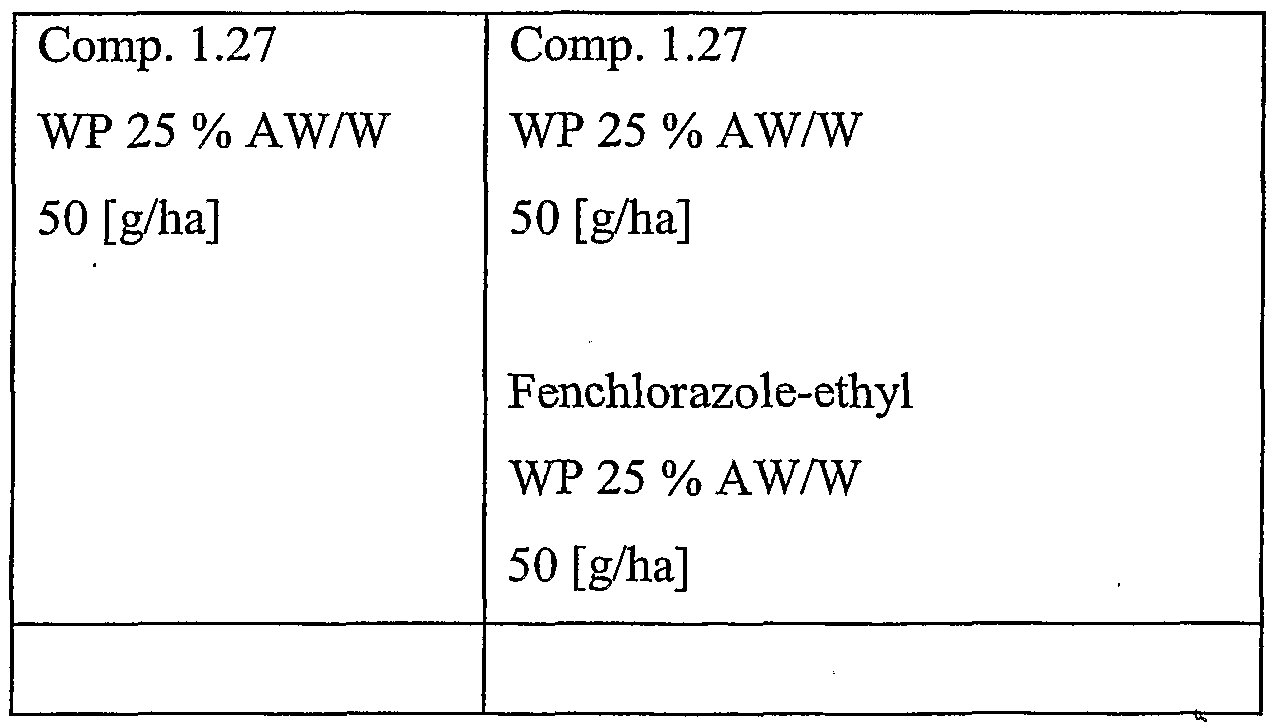
WWE Wipo information: entry into national phase

Ref document number: 2005741054

Country of ref document: EP

WWE Wipo information: entry into national phase

Ref document number: 2563218

Country of ref document: CA

Ref document number: 2005237241

Country of ref document: AU

ENP Entry into the national phase

Ref document number: 2005237241

Country of ref document: AU

Date of ref document: 20050429

Kind code of ref document: A

WWP Wipo information: published in national office
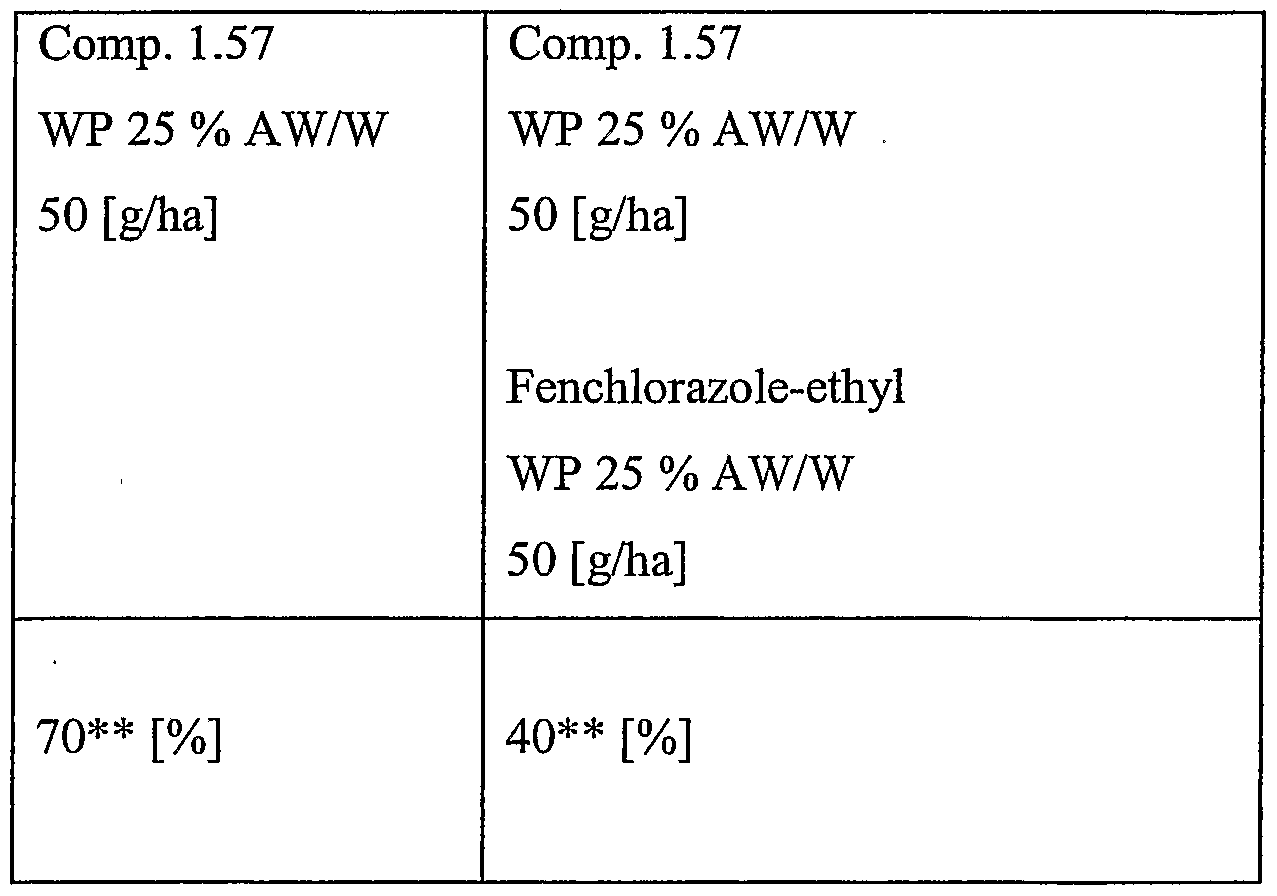
Ref document number: 2005237241

Country of ref document: AU

WWE Wipo information: entry into national phase

Ref document number: 2007509975

Country of ref document: JP

NENP Non-entry into the national phase

Ref country code: DE

WWW Wipo information: withdrawn in national office

Country of ref document: DE

WWP Wipo information: published in national office

Ref document number: 2005741054

Country of ref document: EP

WWE Wipo information: entry into national phase

Ref document number: 11568326

Country of ref document: US

ENP Entry into the national phase

Ref document number: PI0510262

Country of ref document: BR

WWP Wipo information: published in national office

Ref document number: 11568326

Country of ref document: US

WWG Wipo information: grant in national office

Ref document number: 2005741054

Country of ref document: EP