WO2003070705A1 - Disubstituted pyrazolyl carboxanilides - Google Patents
Disubstituted pyrazolyl carboxanilides Download PDFInfo
- Publication number
- WO2003070705A1 WO2003070705A1 PCT/EP2003/001178 EP0301178W WO03070705A1 WO 2003070705 A1 WO2003070705 A1 WO 2003070705A1 EP 0301178 W EP0301178 W EP 0301178W WO 03070705 A1 WO03070705 A1 WO 03070705A1
- Authority
- WO
- WIPO (PCT)
- Prior art keywords
- formula
- fluorine
- trifluoromethyl
- bromine
- methyl
- Prior art date
- Legal status (The legal status is an assumption and is not a legal conclusion. Google has not performed a legal analysis and makes no representation as to the accuracy of the status listed.)
- Ceased
Links
- 0 C[n]1nc(*)c(C(NC2=CC=C*(*)C=C2c2ccc(*)cc2*)=O)c1 Chemical compound C[n]1nc(*)c(C(NC2=CC=C*(*)C=C2c2ccc(*)cc2*)=O)c1 0.000 description 3
Classifications
-
- C—CHEMISTRY; METALLURGY
- C07—ORGANIC CHEMISTRY
- C07D—HETEROCYCLIC COMPOUNDS
- C07D231/00—Heterocyclic compounds containing 1,2-diazole or hydrogenated 1,2-diazole rings
- C07D231/02—Heterocyclic compounds containing 1,2-diazole or hydrogenated 1,2-diazole rings not condensed with other rings
- C07D231/10—Heterocyclic compounds containing 1,2-diazole or hydrogenated 1,2-diazole rings not condensed with other rings having two or three double bonds between ring members or between ring members and non-ring members
- C07D231/14—Heterocyclic compounds containing 1,2-diazole or hydrogenated 1,2-diazole rings not condensed with other rings having two or three double bonds between ring members or between ring members and non-ring members with hetero atoms or with carbon atoms having three bonds to hetero atoms with at the most one bond to halogen, e.g. ester or nitrile radicals, directly attached to ring carbon atoms
-
- A—HUMAN NECESSITIES
- A01—AGRICULTURE; FORESTRY; ANIMAL HUSBANDRY; HUNTING; TRAPPING; FISHING
- A01N—PRESERVATION OF BODIES OF HUMANS OR ANIMALS OR PLANTS OR PARTS THEREOF; BIOCIDES, e.g. AS DISINFECTANTS, AS PESTICIDES OR AS HERBICIDES; PEST REPELLANTS OR ATTRACTANTS; PLANT GROWTH REGULATORS
- A01N43/00—Biocides, pest repellants or attractants, or plant growth regulators containing heterocyclic compounds
- A01N43/48—Biocides, pest repellants or attractants, or plant growth regulators containing heterocyclic compounds having rings with two nitrogen atoms as the only ring hetero atoms
Definitions
- the present invention relates to new pyrazolylcarboxanilides, several processes for their preparation and their use for controlling harmful microorganisms in crop protection and material protection.
- R represents difluoromethyl or trifluoromethyl
- R 1 and R 2 independently represents halogen, cyano, nitro, C ⁇ -C 6 alkyl, C 2 -C 6 -
- R 3 represents fluorine
- pyrazolylcarboxanilides of the formula (I) can be obtained by a) pyrazolylcarboxylic acid halides of the formula (LT)
- R 1 , R 2 and R 3 have the meanings given above,
- R and R 3 have the meanings given above,
- X 2 represents bromine or iodine, with boronic acid derivatives of the formula (V)
- R 1 and R 2 have the meanings given above, G 1 and G 2 each represent hydrogen or together represent tetramethyl ethylene,
- X 2 represents bromine or iodine
- G 3 and G 4 each represent alkyl or together represent alkanediyl, in the presence of a catalyst, if appropriate in the presence of an acid binder and if appropriate in the presence of a diluent, and without working up in a second stage with halogenobenzene derivatives of the formula (V ⁇ )
- R 1 and R 2 have the meanings given above and
- X 3 represents bromine, iodine or trifluoromethylsulfonyloxy
- Microorganisms can be used both in crop protection and in material protection.
- the pyrazolylcarboxanilides of the formula (I) according to the invention have a significantly better fungicidal activity than the constitutionally most similar, known active ingredients of the same direction of action.
- the pyrazolylcarboxanilides according to the invention are generally defined by the formula (I).
- R represents difluoromethyl or trifluoromethyl
- R and R independently of one another for fluorine, chlorine, bromine, cyano, nitro, methyl, ethyl, n- or i-propyl, n-, i-, s- or t-butyl, methoxy, ethoxy, methylthio, ethylthio, n- or i-propylthio, cyclopropyl, trifluoromethyl, trichloromethyl, trifluoroethyl, difluoromethoxy, trifluoromethoxy, difluorochloromethoxy, trifluoromethoxy, difluoromethylthio, difluorochloromethylthio or trifluoromethylthio,
- R 3 represents fluorine
- R represents difluoromethyl or trifluoromethyl
- R 1 and R 2 independently of one another for fluorine, chlorine, bromine, methyl, trifluoromethyl,
- R 3 is fluorine
- Pyrazolylcarboxanilides of the formula (I) in which R 1 is fluorine and R 2 is fluorine are very particularly preferred.
- Pyrazolylcarboxanilides of the formula (I) in which R 1 represents methyl or trifluoromethyl are very particularly preferred.
- the invention preferably relates to compounds of the formula (Ia)
- R 1 and R 2 independently of one another for fluorine, chlorine, bromine, cyano, nitro, methyl, ethyl, n- or i-propyl, n-, i-, s- or t-butyl, trifluoromethyl, trichloromethyl, Trifluoroethyl, cyclopropyl, methoxy, ethoxy, difluoromethoxy, trifluoromethoxy, difluorochloromethoxy, trifluoroethoxy, methylthio, ethylthio, n- or i-propylthio, difluoromethylthio, difluorochloromethylthio, trifluoromethylthio and R 3 are .
- the present invention also preferably relates to compounds of the formula (Ib)
- R 1 and R 2 independently of one another for fluorine, chlorine, bromine, cyano, nitro, methyl, ethyl, n- or i-propyl, n-, i-, s- or t-butyl, trifluoromethyl, trichloromethyl, trifluoroethyl, cyclopropyl, Methoxy, ethoxy, difluoromethoxy, trifluoromethoxy, difluorochloromethoxy, trifluoroethoxy, methylthio, ethylthio, n- or i-propylthio, difluoromethylthio, difluorochloromethylthio, trifluoromethylthio and R 3 represents fluorine.
- the present application relates in particular to compounds of the formula (Ia) in which
- R 1 and R 2 independently of one another for fluorine, chlorine, bromine, methyl, trifluoromethyl,
- R 3 is fluorine
- the present application also relates in particular to compounds of the formula (Ib) in which R 1 and R 2 are the same or different and are independently fluorine, chlorine, bromine, methyl, trifluoromethyl, difluoromethoxy or trifluoromethoxy and
- R 3 represents fluorine
- the present application very particularly preferably relates to compounds of the formula (Ia) in which
- R 1 and R 2 independently of one another represent fluorine, chlorine, bromine, methyl, trifluoromethyl, difluoromethoxy or trifluoromethoxy and
- R 3 represents 3 fluorine or 5 fluorine.
- the present application also relates very particularly preferably to compounds of the formula (Ib) in which
- R 1 and R 2 independently of one another represent fluorine, chlorine, bromine, methyl, trifluoromethyl, difluoromethoxy or trifluoromethoxy and
- R 3 represents 3-fluorine or 5-fluorine.
- R represents difluoromethyl or trifluoromethyl
- R and R independently of one another for fluorine, chlorine, bromine, cyano, nitro, methyl, ethyl, n- or i-propyl, n-, i-, s- or t-butyl, trifluoromethyl, trichloromethyl,
- R J stands for fluorine
- R represents difluoromethyl or trifluoromethyl, R 1 and R 2 independently of one another fluorine, chlorine, bromine, cyano, nitro, methyl,
- R 3 represents fluorine
- R represents difluoromethyl or trifluoromethyl, R and R independently of one another for fluorine, chlorine, bromine, cyano, nitro, methyl, ethyl, n- or i-propyl, n-, i-, s- or t-butyl, trifluoromethyl, trichloromethyl, trifluoroethyl, cyclopropyl, methoxy, Ethoxy, difluoromethoxy, trifluoromethoxy, difluorochloromethoxy, trifluoroethoxy, methylthio, ethylthio, n- or i-propylthio, difluoromethylthio, difluorochloromethylthio, trifluoromethylthio and
- R 3 represents fluorine
- the present application relates in particular to compounds of the formula (Ic) in which
- R represents difluoromethyl or trifluoromethyl
- R 1 and R 2 independently of one another represent fluorine, chlorine, bromine, methyl, trifluoromethyl, difluoromethoxy or trifluoromethoxy and represent fluorine.
- the present application also relates in particular to compounds of the formula
- R represents difluoromethyl or trifluoromethyl
- R and R are the same or different and are independently fluorine, chlorine, bromine, methyl, trifluoromethyl, difluoromethoxy or trifluoromethoxy and R 3 is fluorine.
- the present application also relates in particular to compounds of the formula (Id) in which
- R represents difluoromethyl or trifluoromethyl
- R and R are the same or different and are independently fluorine, chlorine, bromine, methyl, trifluoromethyl, difluoromethoxy or trifluoromethoxy and R 3 is fluorine.
- the present application very particularly relates to compounds of
- R represents difluoromethyl or trifluoromethyl
- R and R independently of one another represent fluorine, chlorine, bromine, methyl, trifluoromethyl, difluoromethoxy or trifluoromethoxy and
- R 3 represents 3 fluorine or 5 fluorine.
- the present application also very particularly preferably relates to compounds of the formula (Id) in which R represents difluoromethyl or trifluoromethyl,
- R 1 and R 2 independently of one another for fluorine, chlorine, bromine, methyl, trifluoromethyl,
- Difluoromethoxy or trifluoromethoxy and R is 3-fluorine or 5-fluorine.
- the present application also relates very particularly preferably to compounds of the formula (Ie) in which
- R represents difluoromethyl or trifluoromethyl
- R 1 and R 2 independently of one another represent fluorine, chlorine, bromine, methyl, trifluoromethyl, difluoromethoxy or trifluoromethoxy and R 3 represents 3-fluorine or 5-fluorine.
- Saturated hydrocarbon radicals such as alkyl
- Residues substituted by halogen for example haloalkyl, are halogenated once or several times to the maximum possible number of substituents. In the case of multiple halogenation, the halogen atoms can be the same or different.
- Halogen represents fluorine, chlorine, bromine or iodine, in particular fluorine, chlorine or bromine.
- Formula (11) provides a general definition of the pyrazolylcarboxylic acid halides required as starting materials for carrying out process a) according to the invention.
- R represents difluoromethyl or trifluoromethyl.
- X 1 preferably represents chlorine.
- the pyrazolylcarboxylic acid halides of the formula (H) are known and / or can be prepared by known processes (cf., for example, JP 01290662 and US 5,093,347).
- the aniline derivatives also required as starting materials for carrying out process a) according to the invention are generally defined by the formula (in).
- R 1 , R 2 and R 3 preferably or particularly preferably have those meanings which have already been given as preferred or particularly preferred for these radicals in connection with the description of the compounds of the formula (I) according to the invention ,
- R 1 and R 2 have the meanings given above,
- G and G each represent hydrogen or together represent tetramethylethylene
- Formula VJH provides a general definition of the fluorohaloanilines required as starting materials for carrying out process d) according to the invention.
- R 3 is fluorine and X 2 is bromine or iodine.
- Formula (V) provides a general definition of the boronic acid derivatives required as starting materials for carrying out process d) according to the invention.
- R 1 and R 2 preferably or particularly preferably have those meanings which are preferred or particularly preferred in connection with the description of the compounds of the formula (I) according to the invention
- G and G preferably each represent hydrogen or together tetramethylethylene.
- Boronic acids of the formula (V) are known synthetic chemicals. They can also be prepared directly from halobenzene derivatives and boronic acid esters immediately before the reaction and can be reacted further without working up.
- the halopyrazole carboxanilides required as starting materials for carrying out process b) according to the invention are generally defined by the formula (IV) ned.
- R and R 3 preferably or particularly preferably have those meanings which have already been given as preferred or particularly preferred for these radicals in connection with the description of the compounds of the formula (I) according to the invention.
- X 2 preferably represents bromine or iodine.
- the halopyrazole carboxanilides of the formula (IV) are not yet known. They are new chemical compounds and are also the subject of the present application. You will get by one
- X 1 represents halogen
- R 3 and X 2 have the meanings given above
- halopyrazole carboxanilides of the formula (TV) required as starting materials for carrying out process c) according to the invention have already been described above in connection with process b) according to the invention.
- Formula (VI) provides a general definition of the diborane derivatives also required as starting materials for carrying out process c) according to the invention.
- G 3 and G 4 each preferably represent methyl, ethyl, propyl, butyl or together tetramethylethylene.
- the diborane derivatives of the formula (VT) are generally known synthetic chemicals.
- halogenbenzene derivatives also required as starting materials for carrying out process c) according to the invention are general by the formula (VH)
- R and R preferably or particularly preferably have those meanings which have already been given as preferred or particularly preferred for these radicals in connection with the description of the compounds of the formula (I) according to the invention.
- X 3 preferably represents bromine, iodine or trifluoromethylsulfonyloxy.
- the halogenobenzene derivatives of the formula (VH) are generally known synthetic chemicals.
- Suitable diluents for carrying out processes a) and e) according to the invention are all inert organic solvents. These preferably include aliphatic, alicyclic or aromatic hydrocarbons, such as, for example, petroleum ether, hexane, heptane, cyclohexane, methylcyclohexane, benzene, toluene, xylene or decalin; halogenated hydrocarbons, such as chlorobenzene, dichlorobenzene, dichloromethane, chloroform, carbon tetrachloride, dichloroethane or trichloroethane; Ethers, such as diethyl ether, diisopropyl ether, methyl t-butyl ether,
- Processes a) and e) according to the invention are optionally carried out in the presence of a suitable acid acceptor.
- a suitable acid acceptor All conventional inorganic or organic bases are suitable as such. These preferably include alkaline earth metal or alkali metal hydrides, hydroxides, amides, alcoholates, acetates, carbonates or hydrogen carbonates, such as, for example, sodium hydride, sodium amide, sodium methylate, sodium ethylate, potassium tert-butoxide, sodium hydroxide, potassium hydroxide,
- Ammonium hydroxide sodium acetate, potassium acetate, calcium acetate, ammonium acetate, sodium carbonate, potassium carbonate, potassium hydrogen carbonate, sodium hydrogen carbonate or cesium carbonate, and also tertiary amines, such as trimethylamine, triethylamine, tributylamine, N, N-dimethylaniline, N, N-dimethylbenzylamine, pyridine, N -Methylpiperidin, N-Methylmo ⁇ holin, N, N-Dimethylaminopyridin, Diazabicycloctan (DABCO), Diazabicyclononen (DBN) or Diazabicycloundecen (DBU).
- tertiary amines such as trimethylamine, triethylamine, tributylamine, N, N-dimethylaniline, N, N-dimethylbenzylamine, pyridine, N -Methylpiperidin, N-Meth
- reaction temperatures can be varied within a substantial range when carrying out processes a) and e) according to the invention. In general, temperatures from 0 ° C to 150 ° C, preferably at temperatures from 20 ° C to 10 ° C.
- 0.2 to 5 mol, preferably 0.5 to 2 mol, of aniline derivative of the formula (HT) are generally employed per mole of the pyrazolylcarboxylic acid halide of the formula (IT) on.
- Suitable diluents for carrying out processes b), c) and d) according to the invention are all inert organic solvents. These preferably include aliphatic, alicyclic or aromatic hydrocarbons, such as, for example, petroleum ether, hexane, heptane, cyclohexane, methylcyclohexane, benzene, toluene, xylene or decalin; Ethers, such as diethyl ether, diisopropyl ether, methyl t-butyl ether, methyl t-amyl ether, dioxane, tetrahydrofuran, 1,2-dimethoxyethane, 1,2-diethoxyethane or anisole; Nitriles, such as acetonitrile, propionitrile, n- or i-butyronitrile or benzonitrile; Amides such as N, N-dimethylformamide, N, N-dimethylacet
- reaction temperatures can be varied within a substantial range when carrying out process b), c) and d) according to the invention. In general, temperatures from 0 ° C to 150 ° C, preferably at temperatures from 20 ° C to 10 ° C.
- Processes b), c) and d) according to the invention are optionally carried out in the presence of a suitable acid acceptor.
- a suitable acid acceptor As such, all the usual organic or organic bases in question.
- These preferably include alkaline earth metal or alkali metal hydrides, hydroxides, amides, alcoholates, acetates, fluorides, phosphates, carbonates or hydrogen carbonates, such as, for example, sodium hydride, sodium amide, lithium diisopropylamide, sodium methylate, sodium ethylate, potassium tert-butoxide , Sodium hydroxide, potassium hydroxide, sodium acetate, potassium acetate, sodium phosphate, potassium phosphate, potassium fluoride, cesium fluoride, sodium carbonate, potassium carbonate, potassium hydrogen carbonate, sodium hydrogen carbonate or cesium carbonate, and also tertiary amines, such as trimethylamine, triethylamine, tributylamine, N, N-di
- Processes b), c) and d) according to the invention are carried out in the presence of a catalyst, such as, for example, a palladium salt or complex.
- a catalyst such as, for example, a palladium salt or complex.
- a catalyst such as, for example, a palladium salt or complex.
- a catalyst such as, for example, a palladium salt or complex.
- a catalyst such as, for example, a palladium salt or complex.
- a catalyst such as, for example, a palladium salt or complex.
- a catalyst such as, for example, a palladium salt or complex.
- palladium chloride palladium acetate, tetrakis (triphenylphosphine) palladium, bis (triphenylphosphine) palladiuric dichloride or 1,1'-bis (diphenylphosphino) ferrocene palladium (IT) chloride come into question.
- a palladium complex can also be generated in the reaction mixture if a palladium salt and a complex ligand, such as, for example, triethylphosphine, tri-tert-butylphosphine, tricyclohexylphosphine, 2- (dicyclohexylphosphine) biphenyl, 2- (di-tert- butylphosphane) biphenyl, 2- (dicyclohexylphosphine) -2'- (N, N-dimethylamino) biphenyl, triphenylphosphine, tris (o-tolyl) phosphane, sodium 3- (diphenylphosphino) benzenesulfonate, tris-2 - (methoxyphenyl) -phosphane, 2,2'- bis (diphenylphosphine) -l, -binaphthyl, 1,4-bis (diphenylphosphine)
- Formula (TV) generally 1 to 15 mol, preferably 1 to 5 mol of boronic acid derivative of the formula (V).
- Formula (TV) generally 1 to 15 mol, preferably 1 to 5 mol of diborane derivative of the formula (VI) and 1 to 15 mol, preferably 1 to 5 mol of halogenobenzene derivative of the formula (VII).
- Compounds of the formula (in) are generally employed per mole of the fluorohaloaniline of the formula (VTTT) 1 to 15 moles, preferably 1 to 5 moles, of a boronic acid derivative of the formula (V).
- Normal pressure carried out. However, it is also possible to work under increased or reduced pressure - generally between 0.1 bar and 10 bar.
- the substances according to the invention have a strong microbicidal action and can be used to control unwanted microorganisms, such as fungi and bacteria, in crop protection and in material protection.
- Fungicides can be used to protect plants against Plasmodiophoromycetes, Oomycetes, Chytridiomycetes, Zygomycetes, Ascomycetes, Basidiomycetes and Deuteromycetes.
- Bactericides can be used in crop protection to combat Pseudomonadaceae, Rhizobiaceae, Enterobacteriaceae, Corynebacteriaceae and Streptomycetaceae.
- Xanthomonas species such as, for example, Xanthomonas campestris pv. Oryzae;
- Pseudomonas species such as, for example, Pseudomonas syringae pv. Lachrymans;
- Erwinia species such as, for example, Erwinia amylovora;
- Pythium species such as, for example, Pythium ultimum
- Phytophthora species such as, for example, Phytophthora infestans
- Pseudoperonospora species such as, for example, Pseudoperonospora humuli or
- Plasmopara species such as, for example, Plasmopara viticola
- Bremia species such as, for example, Bremia lactucae
- Peronospora species such as, for example, Peronospora pisi or P. brassicae
- Peronospora species such as, for example, Peronospora pisi or P. brassicae
- Erysiphe species such as, for example, Erysiphe graminis
- Sphaerotheca species such as, for example, Sphaerotheca fuliginea
- Podosphaera species such as, for example, Podosphaera leucotricha
- Venturia species such as, for example, Venturia inaequalis
- Pyrenophora species such as, for example, Pyrenophora teres or P. graminea
- Drechslera (Conidial form: Drechslera, Syn: Helminthosporium);
- Cochliobolus species such as, for example, Cochliobolus sativus
- Drechslera (Conidial form: Drechslera, Syn: Helminthosporium);
- Uromyces species such as, for example, Uromyces appendiculatus
- Puccinia species such as, for example, Puccinia recondita
- Sclerotinia species such as, for example, Sclerotinia sclerotiorum
- Tilletia species such as, for example, Tilletia caries
- Ustilago species such as, for example, Ustilago nuda or Ustilago avenae;
- Pellicularia species such as, for example, Pellicularia sasakii
- Pyricularia species such as, for example, Pyricularia oryzae
- Fusarium species such as, for example, Fusarium culmorum
- Botrytis species such as, for example, Botrytis cinerea
- Septoria species such as, for example, Septoria nodorum
- Leptosphaeria species such as, for example, Leptosphaeria nodorum
- Cercospora species such as, for example, Cercospora canescens
- Alternaria species such as, for example, Alternaria brassicae;
- Pseudocercosporella species such as, for example, Pseudocercosporella he ⁇ otrichoides.
- the active compounds according to the invention also have a strong strengthening effect in plants. They are therefore suitable for mobilizing the plant's own defenses against attack by unwanted microorganisms.
- Undesired microorganisms are to be understood in the present case as phytopathogenic fungi, bacteria and viruses.
- the substances according to the invention can therefore be used to protect plants against attack by the named pathogens within a certain period of time after the treatment.
- the period within which protection is brought about generally extends from
- the active compounds according to the invention are also suitable for increasing the crop yield. They are also less toxic and have good plant tolerance.
- the active compounds according to the invention can also be used in certain concentrations and application rates as herbicides, for influencing plant growth, and for controlling animal pests. If appropriate, they can also be used as intermediates and products for the synthesis of further active ingredients.
- all plants and parts of plants can be treated. Plants are understood here to mean all plants and plant populations, such as desired and undesired wild plants or cultivated plants (including naturally occurring cultivated plants). Cultivated plants can be plants which can be obtained by conventional breeding and optimization methods or by biotechnological and genetic engineering methods or combinations of these methods, including the transgenic plants and including the plant cultivars which can or cannot be protected by plant breeders' rights.
- Plant parts are to be understood to mean all above-ground and underground parts and organs of plants, such as shoots, leaves, flowers and roots, examples being leaves, needles, stems, stems, flowers, fruiting bodies, fruits and seeds as well as roots, tubers and rhizomes.
- the plant parts also include crops and vegetative and generative propagation material, for example cuttings, tubers, rhizomes, offshoots and seeds.
- the treatment of the plants and parts of plants with the active compounds according to the invention is carried out directly or by acting on their environment, habitat or location according to the usual treatment methods, e.g. by dipping, spraying, vaporizing, atomizing, scattering, spreading, injecting and, in the case of propagation material, in particular in the case of seeds, furthermore by single- or multi-layer coating.
- the substances according to the invention can be used to protect technical materials against attack and destruction by undesired microorganisms.
- technical materials are to be understood as non-living materials that have been prepared for use in technology.
- technical materials which are to be protected against microbial change or destruction by active substances according to the invention adhesives, glues, paper and cardboard, textiles, leather, wood, paints and
- Plastic articles, cooling lubricants and other materials that can be attacked or decomposed by microorganisms are also parts of production systems, such as cooling water circuits, that can be affected by the proliferation of microorganisms.
- technical materials are preferably adhesives, glues, papers and cartons, leather, wood, paints, cooling lubricants and heat transfer liquids, particularly preferably wood.
- Bacteria, fungi, yeasts, algae and slime organisms may be mentioned as microorganisms which can cause degradation or a change in the technical materials.
- the active compounds according to the invention preferably act against fungi, in particular mold, wood-discoloring and wood-destroying fungi (Basidiomycetes) and against slime organisms and algae.
- Microorganisms of the following genera may be mentioned for example: Alternaria, such as Altemaria tenuis,
- Aspergillus such as Aspergillus niger
- Chaetomium like Chaetomium globosum
- Coniophora such as Coniophora puetana
- Lentinus such as Lentinus tigrinus
- Penicillium such as Penicillium glaucum
- Polyporus such as Polyporus versicolor
- Aureobasidium such as Aureobasidium pullulans
- Sclerophoma such as Sclerophoma pityophila
- Trichoderma such as Trichoderma viride
- Escherichia such as Escherichia coli
- Pseudomonas such as Pseudomonas aeruginosa
- Staphylococcus such as Staphylococcus aureus.
- the active compounds can be converted into the customary formulations, such as solutions, emulsions, suspensions, powders, foams, pastes, granules, Aerosols, very fine encapsulations in polymeric substances and in coating compositions for seeds, as well as ULV cold and warm mist formulations.
- customary formulations such as solutions, emulsions, suspensions, powders, foams, pastes, granules, Aerosols, very fine encapsulations in polymeric substances and in coating compositions for seeds, as well as ULV cold and warm mist formulations.
- formulations are made in a known manner, e.g. by mixing the active ingredients with extenders, that is to say liquid solvents, pressurized liquefied gases and / or solid carriers, if appropriate using surface-active agents, that is to say emulsifiers and / or dispersants and / or foam-generating agents. If water is used as an extender, e.g. organic solvents can also be used as auxiliary solvents.
- extenders that is to say liquid solvents, pressurized liquefied gases and / or solid carriers, if appropriate using surface-active agents, that is to say emulsifiers and / or dispersants and / or foam-generating agents.
- surface-active agents that is to say emulsifiers and / or dispersants and / or foam-generating agents.
- water e.g. organic solvents can also be used as auxiliary solvents.
- aromatics such as xylene, toluene or alkylnaphthalenes
- chlorinated aromatics or chlorinated aliphatic hydrocarbons such as chlorobenzenes, chlorethylenes or methylene chloride
- aliphatic hydrocarbons such as cyclohexane or paraffins, e.g. Petroleum fractions
- alcohols such as butanol or glycol
- ketones such as acetone, methyl ethyl ketone, methyl isobutyl ketone or cyclohexanone
- Solvents such as dimethylformamide and dimethyl sulfoxide, and water.
- Liquefied gaseous extenders or carriers mean liquids which are gaseous at normal temperature and pressure, e.g. Aerosol propellants, such as halogenated hydrocarbons as well as butane, propane, nitrogen and carbon dioxide.
- Possible solid carriers are: e.g. natural rock powders such as kaolins, alumina, talc, chalk, quartz, attapulgite, montmorillonite or diatomaceous earth and synthetic rock powders such as highly disperse silica, aluminum oxide and silicates. Solid carriers for granules are possible: e.g.
- emulsifiers and / or foaming agents are: e.g. non-ionic and anionic emulsifiers, such as polyoxyethylene fatty acid esters, polyoxyethylene fatty alcohol ethers, e.g. Alkylaryl polyglycol ethers, alkyl sulfonates, alkyl sulfates, aryl sulfonates and protein hydrolyzates.
- non-ionic and anionic emulsifiers such as polyoxyethylene fatty acid esters, polyoxyethylene fatty alcohol ethers, e.g. Alkylaryl polyglycol ethers, alkyl sulfonates, alkyl sulfates, aryl sulfonates and protein hydrolyzates.
- Dispersants are suitable: for example lignin sulfite waste liquor and methyl cellulose.
- Adhesives such as carboxymethyl cellulose, natural and synthetic powdery, granular or latex-shaped polymers, such as gum arabic, polyvinyl alcohol, polyvinyl acetate, and natural phospholipids, such as cephalins and lecithins, and synthetic phospholipids can be used in the formulations.
- Other additives can be mineral and vegetable oils.
- Dyes such as inorganic pigments, e.g. Iron oxide, titanium oxide, ferrocyan blue and organic dyes such as alizarin, azo and metal phthalocyanine dyes and trace nutrients such as salts of iron, manganese, boron, copper, cobalt, molybdenum and zinc can be used.
- the formulations generally contain between 0.1 and 95 percent by weight of active compound, preferably between 0.5 and 90%.
- the active compounds according to the invention can also be used in a mixture with known fungicides, bactericides, acaricides, nematicides or insecticides, in order, for example, to spread the spectrum of activity or to prevent the development of resistance.
- fungicides bactericides
- acaricides nematicides or insecticides
- synergistic effects are obtained, i.e. the effectiveness of the mixture is greater than the effectiveness of the individual components.
- Fungicides 2-phenylphenol; 8-hydroxyquinoline sulfate;
- Dagger G debacarb; dichlofluanid; dichlone; dichlorophen; diclocymet; Diclomezine; dicloran; diethofencarb; Difenoconazole; diflumetorim; dimethirimol; Dimethomo ⁇ h; dimoxystrobin; diniconazole; Diniconazole-M; dinocap; Diphenylamines; Dipyrithione; Ditalimfos; dithianon; dodine; Drazoxolon;
- edifenphos epoxiconazole; ethaboxam; ethirimol; etridiazole;
- famoxadone fenamidone; Fenapanil; fenarimol; Fenbuconazole; fenfuram; Fenhexamide; Fenitropan; fenoxanil; fenpiclonil; fenpropidin; Fenpropimo ⁇ h; ferbam; fluazinam; Flubenzimine; fludioxonil; flumetover; Flumo ⁇ h; fluoromides;
- fluoxastrobin fluquinconazole; Flmprimidol; flusilazole; flusulfamide; flutolanil;
- flutriafol flutriafol; folpet; Fosetyl-Al; Fosetyl-sodium; fuberidazole; furalaxyl; furametpyr;
- Furcarbanil Furmecyclox
- guazatine Hexachlorobenzene; hexaconazole; hymexazol; imazalil; Imibenconazole; Iminoctadine triacetate; Iminoctadine tris (albesil); lodocarb; ipconazole; iprobenfos; iprodione; Iprovahcarb; Irumamycin;
- mancozeb maneb; Meferimzone; mepanipyrim; mepronil; metalaxyl; Metalaxyl-M;
- metconazole methasulfocarb; Methfuroxam; metiram; metominostrobin; Metsulfovax; mildiomycin; myclobutanil; myclozoline;
- natamycin natamycin
- nicobifen Nitro Thal-isopropyl
- Noviflumuron nuarimol
- prothioconazole pyraclostrobin; Pyrazohos; pyrifenox; pyrimethanil; pyroquilon;
- Thicyofen Thifluzamide; Thiophanate-methyl; thiram; Tioxymid; Tolclofos-methyl;
- BTG-504 BTG-505, Bufencarb, Buprofezin, Butathiofos, Butocarboxim, Butoxycarboxim, Butylpyridaben,
- Chlorobenzilate Chloropicrin, Chlo ⁇ roxyfen, Chlo ⁇ yrifos-methyl, Chlo ⁇ yrifos (- ethyl), Chlovaporthrin, Chromafenozide, Cis-Cypermethrin, Cis-Resmethrin, Cis- Permethrin, Clocythrin, Cloethocarb, Clofentezine, Cyanophosphos, Cyanosophone, Clothumidin, Clothianidin, Clothianidin, Clothianidin, Clothianidin, Clothianidine, Cycloprene, Cycloprothrin, Cydia pomonella, Cyfluthrin, Cyhalothrin, Cyhexatin, Cypermethrin, Cyphenothrin
- DDT Deltamethrin, Demeton-S-methyl, Demeton-S-methylsulphone, Diafenthiuron, Dialifos, Diazinon, Dichlofenthion, Dichlorvos, Dicofol, Dicrotophos, Dicyclanil, Diflubenzuron, Dimethoate, Dimethylvinphos, Diobutonefone, Dinobutonefocus, Dinobutonefocus sodium, dofenapyn, DOWCO-439,
- TKA-2002 Imidacloprid, Imiprothrin, Indoxacarb, Iodofenphos, Iprobefos, Isazofos, Isofenphos, Isoprocarb, Isoxathion, Ivermectin, Japonilure, Kadethrin, Kernpolyederviruses, Kinoprene, Lambda-Cyhalothrin, Lindane, Lufenur
- Mecarbam Malathion, Mecarbam, Mesulfenfos, Metaldehyde, Metam-sodium, Methacrifos, Methamidophos, Metharhician anisopliae, Metharhician flavoviride, Methidathione, Methiocarb, Methomyl, Methopre ⁇ e, Methoxychlor, Methoxyfenozide, Metolcarb, Metoxadoszone, Milbeminphinone, MilbinMincinin, Mbemininin, Mevininin, Mevinphinin, Mevininin, Mevin 45700, monocrotophos, moxidectin, MTI-800,
- NC-104 NC-170, NC-184, NC-194, NC-196, Niclosamide, Nicotine, Nitenpyram, Nithiazine, NNI-0001, NNI-0101, NNI-0250, NNI-9768, Novaluron, Noviflumuron,
- Paecilomyces fumosoroseus Parathion-methyl, Parathion (-ethyl), Permethrin (eis, trans-), Petroleum, PH-6045, Phenothrin (lR-trans isomer), Phenthoate, Phorate, Phosalone, Phosmet, Phosphamidon, Phosphocarb, Phoxim, Piperonyl butoxide, pirimicarb, pirimiphos-methyl, pirimiphos-ethyl, prallethrin, profenofos, promecarb, propaphos, propargite, propetamphos, propoxur, prothiofos, prothoate, protrifen-bute, pymetrozine, pyraclofos, pyreshridium pyrin, pyridhridium pyridhridium, pyreshridium pyridhridium, pyreshridium pyrin , Pyrimid
- the compounds of the formula (I) according to the invention also have very good antifungal effects. They have a very broad spectrum of antifungal effects, in particular against dermatophytes and sprout fungi, mold and diphasic fungi (for example against Candida species such as Candida albicans, Candida glabrata) and Epidermophyton floccosum, Aspergillus species such as Aspergillus niger and Aspergillichophytonus fumigatus fumigatus such as Trichophyton mentagrophytes, Microsporon species such as Microsporon canis and audouinii.
- the list of these mushrooms is in no way a limitation of the detectable mycotic spectrum, but is only of an explanatory nature.
- the active compounds can be used as such, in the form of their formulations or the use forms prepared therefrom, such as ready-to-use solutions, suspensions, wettable powders, pastes, soluble powders, dusts and granules. They are used in the customary manner, for example by watering, spraying, atomizing, scattering, dusting, foaming, brushing, etc. It is also possible to apply the active ingredients using the ultra-low-volume process or to apply the active ingredients. substance preparation or inject the active substance yourself into the soil. The seeds of the plants can also be treated.
- the application rates can be varied within a relatively wide range, depending on the type of application.
- the active compound application rates are generally between 0.1 and 10,000 g / ha, preferably between 10 and 1,000 g / ha. In the case of seed treatment, the active compound application rates are generally between 0.001 and 50 g per kilogram of seed, preferably between 0.01 and 10 g per kilogram of seed. In the treatment of the soil, the active compound application rates are generally between 0.1 and 10,000 g / ha, preferably between 1 and 5,000 g / ha.
- plants and their parts can be treated according to the invention.
- plant species and plant cultivars and their parts occurring wildly or obtained by conventional organic breeding methods, such as crossbreeding or protoplast fusion are treated.
- transgenic plants and plant cultivars which have been obtained by genetic engineering methods, if appropriate in combination with conventional methods (genetically modified organisms) and their parts are treated.
- the term “parts” or “parts of plants” or “parts of plants” was explained above.
- Plants of the plant varieties which are in each case commercially available or in use are particularly preferably treated according to the invention.
- Plant cultivars are understood to mean plants with new properties (“traits”) which have been grown both by conventional breeding, by mutagenesis or by recombinant DNA techniques. These can be varieties, breeds, bio and genotypes.
- the treatment according to the invention can also cause superadditive (“synergistic”) effects are, for example, reduced application rates and / or widening of the activity spectrum and / or an increase in the action of the substances and agents which can be used according to the invention, better plant growth, increased tolerance to high or low temperatures, increased tolerance to dryness or to water or soil salt content, increased flowering performance, easier harvesting, acceleration of ripeness, higher crop yields, higher quality and / or higher nutritional value of the harvested products, higher storability and / or workability of the harvested products possible, which go beyond the effects that are actually to be expected.
- superadditive are, for example, reduced application rates and / or widening of the activity spectrum and / or an increase in the action of the substances and agents which can be used according to the invention, better plant growth, increased tolerance to high or low temperatures, increased tolerance to dryness or to water or soil salt content, increased flowering performance, easier harvesting, acceleration of ripeness, higher crop yields, higher quality and / or higher nutritional value
- the preferred transgenic plants or plant cultivars to be treated according to the invention include all plants which have received genetic material through the genetic engineering modification, which gives these plants particularly advantageous valuable properties (“traits”). Examples of such properties are better plant growth, increased tolerance to high or low temperatures, increased tolerance to drought or to
- Water or soil salt content increased flowering performance, easier harvesting, acceleration of ripening, higher harvest yields, higher quality and / or higher nutritional value of the harvested products, higher storage life and / or workability of the harvested products. Further and particularly highlighted examples of such properties are an increased defense of the plants against animal and microbial pests, such as against insects, mites, phytopathogenic fungi, bacteria and / or viruses, and an increased tolerance of the plants to certain herbicidal active ingredients.
- transgenic plants are the important cultivated plants, such as cereals (wheat, rice), corn, soybeans, potatoes, cotton, tobacco, rapeseed and fruit plants (with the fruits apples, pumice, citrus fruits and grapes), with corn, soybeans , Potato, cotton, tobacco and rapeseed are highlighted.
- the traits are particularly emphasized as the plants' increased defense against insects, arachnids, namatodes and snails due to the toxins that arise in the plants, especially those that are caused by the genetic material from Bacillus thuringiensis (eg by the genes Cry ⁇ A (a) , CryIA (b),
- Bt plants Cry ⁇ A (c), CryllA, CrylJTA, CryTIIB2, Cry9c, Cry2Ab, Cry3Bb and CryDF and their combinations) are produced in the plants (hereinafter “Bt plants”).
- Bt plants As Properties (“traits”) are also emphasized in particular the increased defense of plants against fungi, bacteria and viruses by systemic acquired resistance (SAR), systemin, phytoalexins, elicitors and resistance genes and correspondingly expressed proteins and toxins.
- SAR systemic acquired resistance
- twins As properties (“traits”) the increased tolerance of the plants to certain herbicidal active ingredients, for example imidazolinones, sulfonylureas, glyphosate or phosphinotricin (for example "PAT” gene) are also particularly emphasized.
- the genes which impart the desired properties (“traits”) can also be used in combinations occur together in the transgenic plants. Examples of “Bt plants” include corn, cotton, soy and potato, which are among the
- YIELD GARD ® e.g. corn, cotton, soy
- KnockOut ® e.g. corn
- StarLink ® e.g. corn
- Bollgard ® cotton
- Nucoton ® cotton
- NewLeaf ® potato
- herbicide-tolerant plants are corn varieties, cotton varieties and soy varieties which are sold under the trade names Roundup Ready ® (tolerance to glyphosate, for example corn,
- plants listed can be treated particularly advantageously according to the invention with the compounds of the general formula (I) or the active compound mixtures according to the invention.
- the preferred ranges given above for the active substances or mixtures also apply to the treatment of these plants. Plant treatment with the compounds or mixtures specifically listed in the present text should be particularly emphasized.
- the organic phase is separated off and the aqueous phase is extracted with ethyl acetate.
- the combined organic phases are concentrated and the residue is chromatographed on silica gel using cyclohexane / ethyl acetate (1: 1).
- logP values specified in the tables and manufacturing examples above are determined in accordance with EEC Directive 79/831 Annex V.A8 by HPLC (High Performance Liquid Chromatography) on a phase reversal column (C 18). Temperature: 43 ° C.
- the determination is carried out in the acidic range at pH 2.3 with 0.1% aqueous phosphoric acid and acetonitrile as eluents; linear gradient from 10% acetonitrile to 90% acetonitrile.
- the calibration is carried out with unbranched alkan-2-ones (with 3 to 16 carbon atoms), the logP values of which are known (determination of the logP values using the
- the lambda max values were determined using the UV spectra from 200 nm to 400 nm in the maxima of the chromatographic signals. applications
- dimethylacetamide emulsifier 1.0 part by weight of alkyl aryl polyglycol ether
- active compound 1 part by weight of active compound is mixed with the stated amounts of solvent and emulsifier, and the concentrate is diluted with water to the desired concentration.
- Evaluation is carried out 10 days after the inoculation. 0% means an efficiency that corresponds to that of the control, while an efficiency of 100% means that no infection is observed.
- dimethylacetamide emulsifier 1.0 part by weight of alkyl aryl polyglycol ether
- active compound 1 part by weight of active compound is mixed with the stated amounts of solvent and emulsifier and the concentrate is diluted with water to the desired concentration.
- Sphaerotheca fuliginea inoculated The plants are then placed in the greenhouse at about 23 ° C. and a relative atmospheric humidity of about 70%.
- dimethylacetamide emulsifier 1.0 part by weight of alkyl aryl polyglycol ether
- active compound 1 part by weight of active compound is mixed with the stated amounts of solvent and emulsifier and the concentrate is diluted with water to the desired concentration.
- the plants are then placed in a greenhouse at approx. 21 ° C and a relative humidity of approx. 90%.
- Evaluation is carried out 10 days after the inoculation. 0% means an efficiency that corresponds to that of the control, while an efficiency of 100% means that no infection is observed.
- Emulsifier 1 part by weight of alkylaryl polyglycol ether
- active compound 1 part by weight of active compound is mixed with the stated amounts of solvent and emulsifier, and the concentrate is diluted with water to the desired concentration.
- Evaluation is carried out 7 days after the inoculation. 0% means an efficiency that corresponds to that of the control, while an efficiency of 100% means that no infection is observed.
Landscapes
- Organic Chemistry (AREA)
- Chemical & Material Sciences (AREA)
- Life Sciences & Earth Sciences (AREA)
- Environmental Sciences (AREA)
- Agronomy & Crop Science (AREA)
- Engineering & Computer Science (AREA)
- Dentistry (AREA)
- General Health & Medical Sciences (AREA)
- Wood Science & Technology (AREA)
- Zoology (AREA)
- Plant Pathology (AREA)
- Pest Control & Pesticides (AREA)
- Health & Medical Sciences (AREA)
- Plural Heterocyclic Compounds (AREA)
- Agricultural Chemicals And Associated Chemicals (AREA)
- Organic Low-Molecular-Weight Compounds And Preparation Thereof (AREA)
- Low-Molecular Organic Synthesis Reactions Using Catalysts (AREA)
- Acyclic And Carbocyclic Compounds In Medicinal Compositions (AREA)
- Heterocyclic Carbon Compounds Containing A Hetero Ring Having Nitrogen And Oxygen As The Only Ring Hetero Atoms (AREA)
- Pharmaceuticals Containing Other Organic And Inorganic Compounds (AREA)
- Nitrogen Condensed Heterocyclic Rings (AREA)
Abstract
Description
Disubstituierte Pyrazolylcarboxanil.deDisubstituted pyrazolylcarboxanil.de
Die vorliegende Erfindung betrifft neue Pyrazolylcarboxanilide, mehrere Verfahren zu deren Herstellung und deren Verwendung zur Bekämpfung von schädlichen Mikroorganismen im Pflanzenschutz und Materialschutz.The present invention relates to new pyrazolylcarboxanilides, several processes for their preparation and their use for controlling harmful microorganisms in crop protection and material protection.
Es ist bereits bekannt geworden, dass zahlreiche Carboxanilide fungizide Eigenschaften besitzen (vgl. z.B. EP 0 545 099 und JP 9132567). Die Wirksamkeit der dort beschriebenen Stoffe ist gut, lässt aber bei niedrigen Aufwandmengen in manchen Fallen zu wünschen übrig.It has already become known that numerous carboxanilides have fungicidal properties (cf. e.g. EP 0 545 099 and JP 9132567). The effectiveness of the substances described there is good, but leaves something to be desired in some cases at low application rates.
Es wurden nun neue Pyrazolylcarboxanilide der Formel (I)New pyrazolylcarboxanilides of the formula (I)

R für Difiuormethyl oder Trifluormethyl steht,R represents difluoromethyl or trifluoromethyl,
R1 und R2 unabhängig voneinander für Halogen, Cyano, Nitro, Cι-C6-Alkyl, C2-C6-R 1 and R 2 independently represents halogen, cyano, nitro, Cι-C 6 alkyl, C 2 -C 6 -
Alkenyl, Cι-C -Alkoxy, Cι-C4-Alkylthio, Cι-C4-Alkylsulfonyl, C3-C6-Cyclo- alkyl, oder für CrC -Halogenalkyl, d-C4-Halogenalkoxy, Cι-C -Halogen- alkylthio oder C]-C4-Halogenalkylsulfonyl mit jeweils 1 bis 5 Halogenatomen stehen,Alkenyl, Cι-C -alkoxy, C 4 alkylthio, Cι-C 4 alkylsulfonyl, C 3 -C 6 -cycloalkyl, or for CrC haloalkyl, dC 4 haloalkoxy, Cι-C-halo alkylthio or C] -C 4 -haloalkylsulfonyl each having 1 to 5 halogen atoms,
R3 für Fluor steht.R 3 represents fluorine.
Weiterhin wurde gefunden, dass man Pyrazolylcarboxanilide der Formel (I) erhält, indem man a) Pyrazolylcarbonsäurehalogenide der Formel (LT)Furthermore, it was found that pyrazolylcarboxanilides of the formula (I) can be obtained by a) pyrazolylcarboxylic acid halides of the formula (LT)

R die oben angegebenen Bedeutungen hat,R has the meanings given above,
X für Halogen steht,X represents halogen,
mit Anilinderivaten der Formel (ELT)with aniline derivatives of the formula (ELT)

R1, R2 und R3 die oben angegebenen Bedeutungen haben,R 1 , R 2 and R 3 have the meanings given above,
gegebenenfalls in Gegenwart eines Säurebindemittels und gegebenenfalls in Gegenwart eines Verdünnungsmittels umsetzt, oderif appropriate in the presence of an acid binder and if appropriate in the presence of a diluent, or
b) Halogenpyrazolcarboxanilide der Formel (IV)b) halopyrazole carboxanilides of the formula (IV)

R und R3 die oben angegebenen Bedeutungen haben,R and R 3 have the meanings given above,
X2 für Brom oder Iod steht, mit Boronsäurederivaten der Formel (V)X 2 represents bromine or iodine, with boronic acid derivatives of the formula (V)

R1 und R2 die oben angegebenen Bedeutungen haben, G1 und G2 jeweils für Wasserstoff oder zusammen für Tetramethyl ethylen stehen,R 1 and R 2 have the meanings given above, G 1 and G 2 each represent hydrogen or together represent tetramethyl ethylene,
in Gegenwart eines Katalysators, gegebenenfalls in Gegenwart eines Säurebindemittels und gegebenenfalls in Gegenwart eines Verdünnungsmittels um- setzt, oderin the presence of a catalyst, if appropriate in the presence of an acid binder and if appropriate in the presence of a diluent, or
Halogenpyrazolcarboxanilide der Formel (IV)Halogenpyrazole carboxanilides of the formula (IV)

X2 für Brom oder Iod steht,X 2 represents bromine or iodine,
in einer ersten Stufe mit einem Diboran-Derivat der Formel (VI)in a first stage with a diborane derivative of the formula (VI)
G— O O-G4 G - OG 4
\ /\ /
B-B / / \ \ (VI)B-B / / \ \ (VI)
G— O O-G in welcherG-O O-G in which
G3 und G4 jeweils für Alkyl oder gemeinsam für Alkandiyl stehen, in Gegenwart eines Katalysators, gegebenenfalls in Gegenwart eines Säurebindemittels und gegebenenfalls in Gegenwart eines Verdünnungsmittels umsetzt und ohne Aufarbeitung in einer zweiten Stufe mit Halogenbenzolderivaten der Formel (Vπ)G 3 and G 4 each represent alkyl or together represent alkanediyl, in the presence of a catalyst, if appropriate in the presence of an acid binder and if appropriate in the presence of a diluent, and without working up in a second stage with halogenobenzene derivatives of the formula (Vπ)

R1 und R2 die oben angegebenen Bedeutungen haben undR 1 and R 2 have the meanings given above and
X3 für Brom, Iod oder Trifluormethylsulfonyloxy steht,X 3 represents bromine, iodine or trifluoromethylsulfonyloxy,
in Gegenwart eines Katalysators, gegebenenfalls in Gegenwart eines Säurebindemittels und gegebenenfalls in Gegenwart eines Verdünnungsmittels umsetzt.in the presence of a catalyst, optionally in the presence of an acid binder and optionally in the presence of a diluent.
Schließlich wurde gefunden, dass die neuen Pyrazolylcarboxanilide der Formel (I) sehr gute mikrobizide Eigenschaften besitzen und zur Bekämpfung unerwünschterFinally, it was found that the new pyrazolylcarboxanilides of the formula (I) have very good microbicidal properties and for combating undesirable
Mikroorganismen sowohl im Pflanzenschutz als auch im Materialschutz verwendbar sind.Microorganisms can be used both in crop protection and in material protection.
Überraschenderweise zeigen die erfindungsgemäßen Pyrazolylcarboxanilide der For- mel (I) eine wesentlich bessere füngizide Wirksamkeit als die konstitutionell ähnlichsten, vorbekannten Wirkstoffe gleicher Wirkungsrichtung.Surprisingly, the pyrazolylcarboxanilides of the formula (I) according to the invention have a significantly better fungicidal activity than the constitutionally most similar, known active ingredients of the same direction of action.
Die erfindungsgemäßen Pyrazolylcarboxanilide sind durch die Formel (I) allgemein definiert.The pyrazolylcarboxanilides according to the invention are generally defined by the formula (I).
Bevorzugt sind Pyrazolylcarboxanilide der Formel (I), in welcherPyrazolylcarboxanilides of the formula (I) are preferred, in which
R für Difluormethyl oder Trifluormethyl steht, 1R represents difluoromethyl or trifluoromethyl, 1
R und R unabhängig voneinander für Fluor, Chlor, Brom, Cyano, Nitro, Methyl, Ethyl, n- oder i-Propyl, n-, i-, s- oder t-Butyl, Methoxy, Ethoxy, Methylthio, Ethylthio, n- oder i-Propylthio, Cyclopropyl, Trifluormethyl, Trichlormethyl, Trifluorethyl, Difluormethoxy, Trifluormethoxy, Difluorchlormethoxy, Tri- fluorethoxy, Difluormethylthio, Difluorchlormethylthio oder Trifluormethyl- thio stehen,R and R independently of one another for fluorine, chlorine, bromine, cyano, nitro, methyl, ethyl, n- or i-propyl, n-, i-, s- or t-butyl, methoxy, ethoxy, methylthio, ethylthio, n- or i-propylthio, cyclopropyl, trifluoromethyl, trichloromethyl, trifluoroethyl, difluoromethoxy, trifluoromethoxy, difluorochloromethoxy, trifluoromethoxy, difluoromethylthio, difluorochloromethylthio or trifluoromethylthio,
R3 für Fluor steht.R 3 represents fluorine.
Besonders bevorzugt sind Pyrazolylcarboxanilide der Formel (I), in welcherPyrazolylcarboxanilides of the formula (I), in which
R für Difluormethyl oder Trifluormethyl steht,R represents difluoromethyl or trifluoromethyl,
R1 und R2 unabhängig voneinander für Fluor, Chlor, Brom, Methyl, Trifluormethyl,R 1 and R 2 independently of one another for fluorine, chlorine, bromine, methyl, trifluoromethyl,
Difluormethoxy oder Trifluormethoxy stehen, R3 für Fluor steht.Difluoromethoxy or trifluoromethoxy are, R 3 is fluorine.
Ganz besonders bevorzugt sind Pyrazolylcarboxanilide der Formel (I), in welcher R1 für Fluor und R2 für Chlor steht.Pyrazolylcarboxanilides of the formula (I) in which R 1 is fluorine and R 2 is chlorine are very particularly preferred.
Ganz besonders bevorzugt sind Pyrazolylcarboxanilide der Formel (I), in welcher R1 für Fluor und R2 für Fluor steht. Ganz besonders bevorzugt sind Pyrazolylcarboxanilide der Formel (I), in welcher R1 für Methyl oder Trifluormethyl steht.Pyrazolylcarboxanilides of the formula (I) in which R 1 is fluorine and R 2 is fluorine are very particularly preferred. Pyrazolylcarboxanilides of the formula (I) in which R 1 represents methyl or trifluoromethyl are very particularly preferred.
Gegenstand der Erfindung sind vorzugsweise Verbindungen der Formel (Ia),The invention preferably relates to compounds of the formula (Ia)

R1 und R2 unabhängig voneinander für Fluor, Chlor, Brom, Cyano, Nitro, Methyl, Ethyl, n- oder i-Propyl, n-, i-, s- oder t-Butyl, Trifluormethyl, Trichlormethyl, Trifluorethyl, Cyclopropyl, Methoxy, Ethoxy, Difluormethoxy, Trifluormethoxy, Difluorchlormethoxy, Trifluorethoxy, Methylthio, Ethylthio, n- oder i-Propylthio, Difluormethylthio, Difluorchlormethylthio, Trifluormethylthio stehen und R3 für Fluor steht.R 1 and R 2 independently of one another for fluorine, chlorine, bromine, cyano, nitro, methyl, ethyl, n- or i-propyl, n-, i-, s- or t-butyl, trifluoromethyl, trichloromethyl, Trifluoroethyl, cyclopropyl, methoxy, ethoxy, difluoromethoxy, trifluoromethoxy, difluorochloromethoxy, trifluoroethoxy, methylthio, ethylthio, n- or i-propylthio, difluoromethylthio, difluorochloromethylthio, trifluoromethylthio and R 3 are .
Vorzugsweise Gegenstand der vorliegenden Erfindung sind ebenso Verbindungen der Formel (Ib),The present invention also preferably relates to compounds of the formula (Ib)

R1 und R2 unabhängig voneinander für Fluor, Chlor, Brom, Cyano, Nitro, Methyl, Ethyl, n- oder i-Propyl, n-, i-, s- oder t-Butyl, Trifluormethyl, Trichlormethyl, Trifluorethyl, Cyclopropyl, Methoxy, Ethoxy, Difluormethoxy, Trifluormethoxy, Difluorchlormethoxy, Trifluorethoxy, Methylthio, Ethylthio, n- oder i-Propylthio, Difluormethylthio, Difluorchlormethylthio, Trifluormethylthio stehen und R3 für Fluor steht.R 1 and R 2 independently of one another for fluorine, chlorine, bromine, cyano, nitro, methyl, ethyl, n- or i-propyl, n-, i-, s- or t-butyl, trifluoromethyl, trichloromethyl, trifluoroethyl, cyclopropyl, Methoxy, ethoxy, difluoromethoxy, trifluoromethoxy, difluorochloromethoxy, trifluoroethoxy, methylthio, ethylthio, n- or i-propylthio, difluoromethylthio, difluorochloromethylthio, trifluoromethylthio and R 3 represents fluorine.
Die vorliegende Anmeldung betrifft insbesondere Verbindungen der Formel (Ia), in welcherThe present application relates in particular to compounds of the formula (Ia) in which
R1 und R2 unabhängig voneinander für Fluor, Chlor, Brom, Methyl, Trifluormethyl,R 1 and R 2 independently of one another for fluorine, chlorine, bromine, methyl, trifluoromethyl,
Difluormethoxy oder Trifluormethoxy stehen und R3 für Fluor steht.Difluormethoxy or trifluoromethoxy and R 3 is fluorine.
Die vorliegende Anmeldung betrifft ebenso insbesondere Verbindungen der Formel (Ib), in welcher R1 und R2 gleich oder verschieden sind und unabhängig voneinander für Fluor, Chlor, Brom, Methyl, Trifluormethyl, Difluormethoxy oder Trifluormethoxy stehen undThe present application also relates in particular to compounds of the formula (Ib) in which R 1 and R 2 are the same or different and are independently fluorine, chlorine, bromine, methyl, trifluoromethyl, difluoromethoxy or trifluoromethoxy and
R3 für Fluor steht.R 3 represents fluorine.
Die vorliegende Anmeldung betrifft ganz besonders bevorzugt Verbindungen der Formel (Ia), in welcherThe present application very particularly preferably relates to compounds of the formula (Ia) in which
R1 und R2 unabhängig voneinander für Fluor, Chlor, Brom, Methyl, Trifluormethyl, Difluormethoxy oder Trifluormethoxy stehen undR 1 and R 2 independently of one another represent fluorine, chlorine, bromine, methyl, trifluoromethyl, difluoromethoxy or trifluoromethoxy and
R3 für 3 -Fluor oder 5 -Fluor steht.R 3 represents 3 fluorine or 5 fluorine.
Die vorliegende Anmeldung betrifft ebenso ganz besonders bevorzugt Verbindungen der Formel (Ib), in welcherThe present application also relates very particularly preferably to compounds of the formula (Ib) in which
R1 und R2 unabhängig voneinander für Fluor, Chlor, Brom, Methyl, Trifluormethyl, Difluormethoxy oder Trifluormethoxy stehen undR 1 and R 2 independently of one another represent fluorine, chlorine, bromine, methyl, trifluoromethyl, difluoromethoxy or trifluoromethoxy and
R3 für 3 -Fluor oder 5-Fluor steht.R 3 represents 3-fluorine or 5-fluorine.
Außerdem bevorzugt sind Verbindungen der Formel (Ic),Also preferred are compounds of formula (Ic)

R für Difluormethyl oder Trifluormethyl steht,R represents difluoromethyl or trifluoromethyl,
R und R unabhängig voneinander für Fluor, Chlor, Brom, Cyano, Nitro, Methyl, Ethyl, n- oder i-Propyl, n-, i-, s- oder t-Butyl, Trifluormethyl, Trichlormethyl,R and R independently of one another for fluorine, chlorine, bromine, cyano, nitro, methyl, ethyl, n- or i-propyl, n-, i-, s- or t-butyl, trifluoromethyl, trichloromethyl,
Trifluorethyl, Cyclopropyl, Methoxy, Ethoxy, Difluormethoxy, Trifluor- methoxy, Difluorchlormethoxy, Trifluorethoxy, Methylthio, Ethylthio, n- oder i-Propylthio, Difluormethylthio, Difluorchlormethylthio, Trifluormethylthio stehen undTrifluoroethyl, cyclopropyl, methoxy, ethoxy, difluoromethoxy, trifluoro- methoxy, difluorochloromethoxy, trifluoroethoxy, methylthio, ethylthio, n- or i-propylthio, difluoromethylthio, difluorochloromethylthio, trifluoromethylthio and
RJ für Fluor steht.R J stands for fluorine.
Außerdem bevorzugt sind Verbindungen der Formel (Id),Also preferred are compounds of the formula (Id)

R für Difluormethyl oder Trifluormethyl steht, R1 und R2 unabhängig voneinander für Fluor, Chlor, Brom, Cyano, Nitro, Methyl,R represents difluoromethyl or trifluoromethyl, R 1 and R 2 independently of one another fluorine, chlorine, bromine, cyano, nitro, methyl,
Ethyl, n- oder i-Propyl, n-, i-, s- oder t-Butyl, Trifluormethyl, Trichlormethyl, Trifluorethyl, Cyclopropyl, Methoxy, Ethoxy, Difluormethoxy, Trifluormethoxy, Difluorchlormethoxy, Trifluorethoxy, Methylthio, Ethylthio, n-oder i-Propylthio, Difluormethylthio, Difluorchlotmethylthio, Trifluormethylthio stehen undEthyl, n- or i-propyl, n-, i-, s- or t-butyl, trifluoromethyl, trichloromethyl, trifluoroethyl, cyclopropyl, methoxy, ethoxy, difluoromethoxy, trifluoromethoxy, difluorochloromethoxy, trifluoroethoxy, methylthio, ethylthio, n-or i-or -Propylthio, Difluormethylthio, Difluorchlotmethylthio, Trifluormethylthio stand and
R3 für Fluor steht.R 3 represents fluorine.
Außerdem bevorzugt sind Verbindungen der Formel (Ie),Also preferred are compounds of formula (Ie)

R für Difluormethyl oder Trifluormethyl steht, R und R unabhängig voneinander für Fluor, Chlor, Brom, Cyano, Nitro, Methyl, Ethyl, n- oder i-Propyl, n-, i-, s- oder t-Butyl, Trifluormethyl, Trichlormethyl, Trifluorethyl, Cyclopropyl, Methoxy, Ethoxy, Difluormethoxy, Trifluormethoxy, Difluorchlormethoxy, Trifluorethoxy, Methylthio, Ethylthio, n- oder i-Propylthio, Difluormethylthio, Difluorchlormethylthio, Trifluormethylthio stehen undR represents difluoromethyl or trifluoromethyl, R and R independently of one another for fluorine, chlorine, bromine, cyano, nitro, methyl, ethyl, n- or i-propyl, n-, i-, s- or t-butyl, trifluoromethyl, trichloromethyl, trifluoroethyl, cyclopropyl, methoxy, Ethoxy, difluoromethoxy, trifluoromethoxy, difluorochloromethoxy, trifluoroethoxy, methylthio, ethylthio, n- or i-propylthio, difluoromethylthio, difluorochloromethylthio, trifluoromethylthio and
R3 für Fluor steht.R 3 represents fluorine.
Die vorliegende Anmeldung betrifft insbesondere Verbindungen der Formel (Ic), in welcherThe present application relates in particular to compounds of the formula (Ic) in which
R für Difluormethyl oder Trifluormethyl steht,R represents difluoromethyl or trifluoromethyl,
R1 und R2 unabhängig voneinander für Fluor, Chlor, Brom, Methyl, Trifluormethyl, Difluormethoxy oder Trifluormethoxy stehen und für Fluor steht.R 1 and R 2 independently of one another represent fluorine, chlorine, bromine, methyl, trifluoromethyl, difluoromethoxy or trifluoromethoxy and represent fluorine.
Die vorliegende Anmeldung betrifft ebenso insbesondere Verbindungen der FormelThe present application also relates in particular to compounds of the formula
(Id), in welcher(Id) in which
R für Difluormethyl oder Trifluormethyl steht,R represents difluoromethyl or trifluoromethyl,
1 9 *1 9 *
R und R gleich oder verschieden sind und unabhängig voneinander für Fluor, Chlor, Brom, Methyl, Trifluormethyl, Difluormethoxy oder Trifluormethoxy stehen und R3 für Fluor steht.R and R are the same or different and are independently fluorine, chlorine, bromine, methyl, trifluoromethyl, difluoromethoxy or trifluoromethoxy and R 3 is fluorine.
Die vorliegende Anmeldung betrifft ebenso insbesondere Verbindungen der Formel (Id), in welcherThe present application also relates in particular to compounds of the formula (Id) in which
R für Difluormethyl oder Trifluormethyl steht,R represents difluoromethyl or trifluoromethyl,
1 91 9
R und R gleich oder verschieden sind und unabhängig voneinander für Fluor, Chlor, Brom, Methyl, Trifluormethyl, Difluormethoxy oder Trifluormethoxy stehen und R3 für Fluor steht. Die vorliegende Anmeldung betrifft ganz besonders bevorzugt Verbindungen derR and R are the same or different and are independently fluorine, chlorine, bromine, methyl, trifluoromethyl, difluoromethoxy or trifluoromethoxy and R 3 is fluorine. The present application very particularly relates to compounds of
Formel (Ie), in welcherFormula (Ie) in which
R für Difluormethyl oder Trifluormethyl steht,R represents difluoromethyl or trifluoromethyl,
1 91 9
R und R unabhängig voneinander für Fluor, Chlor, Brom, Methyl, Trifluormethyl, Difluormethoxy oder Trifluormethoxy stehen undR and R independently of one another represent fluorine, chlorine, bromine, methyl, trifluoromethyl, difluoromethoxy or trifluoromethoxy and
R3 für 3 -Fluor oder 5 -Fluor steht.R 3 represents 3 fluorine or 5 fluorine.
Die vorliegende Anmeldung betrifft ebenso ganz besonders bevorzugt Verbindungen der Formel (Id), in welcher R für Difluormethyl oder Trifluormethyl steht,The present application also very particularly preferably relates to compounds of the formula (Id) in which R represents difluoromethyl or trifluoromethyl,
R1 und R2 unabhängig voneinander für Fluor, Chlor, Brom, Methyl, Trifluormethyl,R 1 and R 2 independently of one another for fluorine, chlorine, bromine, methyl, trifluoromethyl,
Difluormethoxy oder Trifluormethoxy stehen und R für 3-Fluor oder 5-Fluor steht.Difluoromethoxy or trifluoromethoxy and R is 3-fluorine or 5-fluorine.
Die vorliegende Anmeldung betrifft ebenso ganz besonders bevorzugt Verbindungen der Formel (Ie), in welcherThe present application also relates very particularly preferably to compounds of the formula (Ie) in which
R für Difluormethyl oder Trifluormethyl steht,R represents difluoromethyl or trifluoromethyl,
R1 und R2 unabhängig voneinander für Fluor, Chlor, Brom, Methyl, Trifluormethyl, Difluormethoxy oder Trifluormethoxy stehen und R3 für 3-Fluor oder 5-Fluor steht.R 1 and R 2 independently of one another represent fluorine, chlorine, bromine, methyl, trifluoromethyl, difluoromethoxy or trifluoromethoxy and R 3 represents 3-fluorine or 5-fluorine.
Die oben aufgeführten allgemeinen oder in Vorzugsbereichen aufgeführten Restedefinitionen bzw. Erläuterungen können auch untereinander, also zwischen den jeweiligen Bereichen und Vorzugsbereichen beliebig kombiniert werden. Sie gelten für die Endprodukte sowie für die Vor- und Zwischenprodukte entsprechend. Außerdem können auch einzelne Definitionen entfallen.The general definitions or explanations of residues or explanations listed above or in preferred areas can also be combined with one another, that is to say between the respective areas and preferred areas. They apply accordingly to the end products as well as to the preliminary and intermediate products. In addition, individual definitions can also be omitted.
Gesättigte Kohlenwasserstoffreste wie Alkyl können, auch in Verbindung mit Hete- roatomen, wie z.B. in Alkoxy, soweit möglich, jeweils geradkettig oder verzweigt sein. Durch Halogen substituierte Reste, z.B. Halogenalkyl, sind einfach oder mehrfach bis zur maximal möglichen Substituentenzahl halogeniert. Bei mehrfacher Halogenie- rung können die Halogenatome gleich oder verschieden sein. Halogen steht dabei für Fluor, Chlor, Brom oder Iod, insbesondere für Fluor, Chlor oder Brom.Saturated hydrocarbon radicals, such as alkyl, can also be straight-chain or branched as far as possible, even in combination with heteroatoms, such as, for example, in alkoxy. Residues substituted by halogen, for example haloalkyl, are halogenated once or several times to the maximum possible number of substituents. In the case of multiple halogenation, the halogen atoms can be the same or different. Halogen represents fluorine, chlorine, bromine or iodine, in particular fluorine, chlorine or bromine.
Verwendet man beispielsweise l-Methyl-3-(trifluormethyl)-lH-pyrazol-4-carbonyl- chlorid und 3'-Chlor-4',5-difluor-l, -biphenyl-2-amin als Ausgangsstoffe sowie ein Base, so kann der Verlauf des erfindungsgemäßen Verfahrens a) durch folgende Reaktionsgleichung veranschaulicht werden:If, for example, 1-methyl-3- (trifluoromethyl) 1H-pyrazole-4-carbonyl chloride and 3'-chloro-4 ', 5-difluoro-1, -biphenyl-2-amine are used as starting materials and a base, so the course of process a) according to the invention can be illustrated by the following reaction equation:
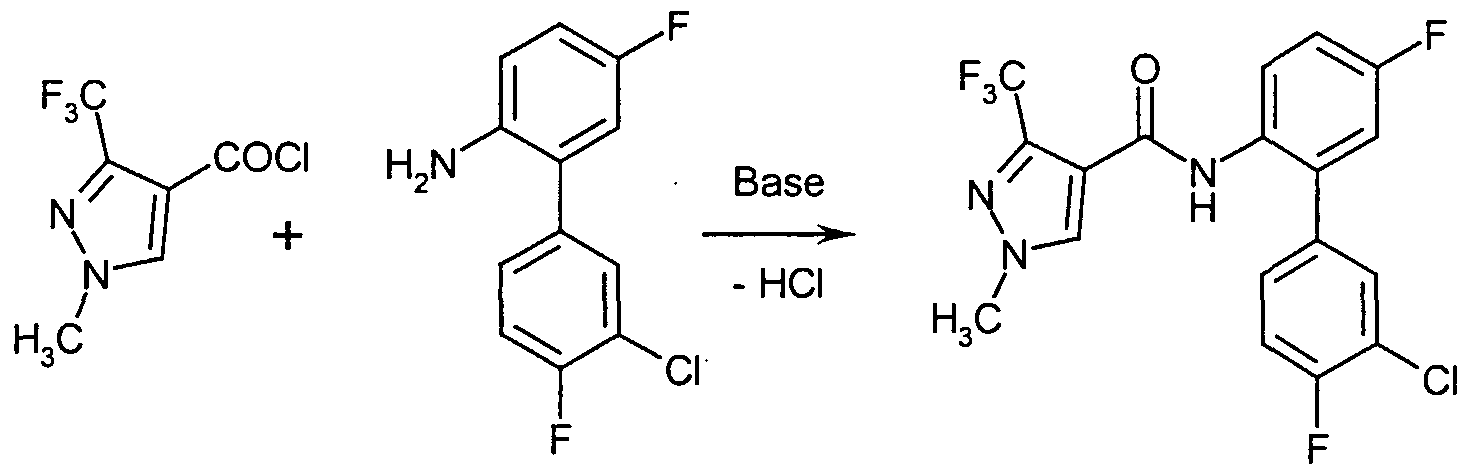
Die zur Durchführung des erfindungsgemäßen Verfahrens a) als Ausgangsstoffe benötigten Pyrazolylcarbonsäurehalogenide sind durch die Formel (11) allgemein definiert. In dieser Formel (H) steht R für Difluormethyl oder Trifluormethyl. X1 steht bevorzugt für Chlor.Formula (11) provides a general definition of the pyrazolylcarboxylic acid halides required as starting materials for carrying out process a) according to the invention. In this formula (H), R represents difluoromethyl or trifluoromethyl. X 1 preferably represents chlorine.
Die Pyrazolylcarbonsäurehalogenide der Formel (H) sind bekannt und/oder lassen sich nach bekannten Verfahren herstellen (vgl. z.B. JP 01290662 und US 5,093,347). Die weiterhin zur Durchführung des erfindungsgemäßen Verfahrens a) als Ausgangsstoffe benötigten Anilin-Derivate sind durch die Formel (in) allgemein definiert. In dieser Formel (in) stehen R1, R2 und R3 bevorzugt bzw. besonders bevorzugt für diejenigen Bedeutungen, die bereits im Zusammenhang mit der Beschreibung der erfindungsgemäßen Verbindungen der Formel (I) als bevorzugt bzw. besonders bevorzugt für diese Reste angegeben wurden.The pyrazolylcarboxylic acid halides of the formula (H) are known and / or can be prepared by known processes (cf., for example, JP 01290662 and US 5,093,347). The aniline derivatives also required as starting materials for carrying out process a) according to the invention are generally defined by the formula (in). In this formula (in), R 1 , R 2 and R 3 preferably or particularly preferably have those meanings which have already been given as preferred or particularly preferred for these radicals in connection with the description of the compounds of the formula (I) according to the invention ,
Die Anilin-Derivate der Formel (IU) sind noch nicht bekannt und als neue chemischeThe aniline derivatives of formula (IU) are not yet known and are new chemical ones
Verbindungen ebenfalls Gegenstand der vorliegenden Anmeldung. Sie werden erhalten, indem man d) Fluorhalogenaniline der Formel (VILT)Compounds also the subject of the present application. You will get by one d) fluorohaloanilines of the formula (VILT)

R und X die oben angegebenen Bedeutungen haben,R and X have the meanings given above,
mit einem Boronsäurederivat der Formel (V)with a boronic acid derivative of the formula (V)

R1 und R2 die oben angegebenen Bedeutungen haben,R 1 and R 2 have the meanings given above,
1 91 9
G und G jeweils für Wasserstoff oder zusammen für Tetramethylethylen stehen,G and G each represent hydrogen or together represent tetramethylethylene,
in Gegenwart eines Katalysators, gegebenenfalls in Gegenwart eines Säurebindemittels und gegebenenfalls in Gegenwart eines Verdünnungsmittels umsetzt.in the presence of a catalyst, optionally in the presence of an acid binder and optionally in the presence of a diluent.
Verwendet man beispielsweise 2-Brom-4-fluor-anilin und 3-Chlor-4-fluorphenyl- boronsäure als Ausgangsstoffe sowie eine Base, so kann der Verlauf des erfindungsgemäßen Verfahrens d) durch folgende Reaktionsgleichung veranschaulicht werden:If, for example, 2-bromo-4-fluoro-aniline and 3-chloro-4-fluorophenylboronic acid are used as starting materials and a base, the course of process d) according to the invention can be illustrated by the following reaction equation:

Die Fluorhalogenaniline der Formel (V1TI) sind bekannt oder können nach bekanntenThe fluorohaloanilines of the formula (V1TI) are known or can be prepared according to known ones
Methoden erhalten werden (vgl. z.B. US 28939 oder J. Org. Chem. 2QQ1, 66, 4525- 4542).Methods are obtained (see e.g. US 28939 or J. Org. Chem. 2QQ1, 66, 4525-4542).
Die weiterhin zur Durchführung des erfindungsgemäßen Verfahrens d) als Ausgangs- Stoffe benötigten Boronsäurederivate sind durch die Formel (V) allgemein definiert.Formula (V) provides a general definition of the boronic acid derivatives required as starting materials for carrying out process d) according to the invention.
In dieser Formel (V) stehen R1 und R2 bevorzugt bzw. besonders bevorzugt für diejenigen Bedeutungen, die bereits im Zusammenhang mit der Beschreibung der erfindungsgemäßen Verbindungen der Formel (I) als bevorzugt bzw. besonders bevorzugtIn this formula (V), R 1 and R 2 preferably or particularly preferably have those meanings which are preferred or particularly preferred in connection with the description of the compounds of the formula (I) according to the invention
1 1 für R und R angegeben wurden. G und G stehen bevorzugt jeweils für Wasser- stoff oder zusammen für Tetramethylethylen.1 1 for R and R were specified. G and G preferably each represent hydrogen or together tetramethylethylene.
Boronsäuren der Formel (V) sind bekannte Synthesechemikalien. Sie können auch unmittelbar vor der Reaktion direkt aus Halogenbenzolderivaten und Boronsäure- estern hergestellt und ohne Aufarbeitung weiter umgesetzt werden.Boronic acids of the formula (V) are known synthetic chemicals. They can also be prepared directly from halobenzene derivatives and boronic acid esters immediately before the reaction and can be reacted further without working up.
Verwendet man N-(2-Brom-4-fluorphenyl)- 1 -methyl-3-(trifluormethyl)- 1 H-pyrazol- 4-carboxamid und 3-Chlor-4-fluorphenylboronsäure als Ausgangsstoffe sowie einen Katalysator und eine Base, so kann der Verlauf des erfindungsgemäßen Verfahrens b) durch folgende Reaktionsgleichung veranschaulicht werden:If N- (2-bromo-4-fluorophenyl) -1-methyl-3- (trifluoromethyl) -1 H-pyrazole-4-carboxamide and 3-chloro-4-fluorophenylboronic acid are used as starting materials, as well as a catalyst and a base, so the course of process b) according to the invention can be illustrated by the following reaction equation:

Die zur Durchführung des erfindungsgemäßen Verfahrens b) als Ausgangsstoffe benötigten Halogenpyrazolcarboxanilide sind durch die Formel (IV) allgemein defi- niert. In dieser Formel (IV) stehen R und R3 bevorzugt bzw. besonders bevorzugt für diejenigen Bedeutungen, die bereits im Zusammenhang mit der Beschreibung der erfindungsgemäßen Verbindungen der Formel (I) als bevorzugt bzw. besonders bevorzugt für diese Reste angegeben wurden. X2 steht bevorzugt für Brom oder Iod. • Die Halogenpyrazolcarboxanilide der Formel (IV) sind noch nicht bekannt. Sie sind neue chemische Verbindungen und ebenfalls Gegenstand der vorliegenden Anmeldung. Sie werden erhalten, indem manThe halopyrazole carboxanilides required as starting materials for carrying out process b) according to the invention are generally defined by the formula (IV) ned. In this formula (IV), R and R 3 preferably or particularly preferably have those meanings which have already been given as preferred or particularly preferred for these radicals in connection with the description of the compounds of the formula (I) according to the invention. X 2 preferably represents bromine or iodine. • The halopyrazole carboxanilides of the formula (IV) are not yet known. They are new chemical compounds and are also the subject of the present application. You will get by one
e) Pyrazolylcarbonsäurehalogenide der Formel (11)e) pyrazolylcarboxylic acid halides of the formula (11)
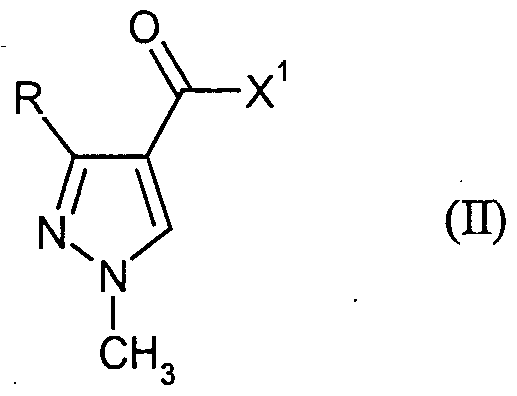
R die oben angegebenen Bedeutungen hat,R has the meanings given above,
X1 für Halogen steht,X 1 represents halogen,
mit Fluorhalogenanilinen der Formel VTHwith fluorohaloanilines of the formula VTH

R3 und X2 die oben angegebenen Bedeutungen habenR 3 and X 2 have the meanings given above
gegebenenfalls in Gegenwart eines Säurebindemittels und gegebenenfalls inoptionally in the presence of an acid binder and optionally in
Gegenwart eines Verdünnungsmittels umsetzt.In the presence of a diluent.
Verwendet man beispielsweise l-Methyl-3-(trifluormethyl)-lH-pyrazol-4-carbonyl- chlorid und 2-Brom-4-fluoranilin als Ausgangsstoffe sowie ein Base, so kann der Verlauf des erfmdungsgemäßen Verfahrens e) durch folgende Reaktionsgleichung veranschaulicht werden:If, for example, l-methyl-3- (trifluoromethyl) -1H-pyrazole-4-carbonyl chloride and 2-bromo-4-fluoroaniline are used as starting materials and a base, then the The course of the process e) according to the invention can be illustrated by the following reaction equation:

Die zur Durchführung des erfindungsgemäßen Verfahrens e) als Ausgangsstoffe be- nötigten Pyrazolylcarbonsäurehalogenide der Formel (11) sind bereits weiter oben imThe pyrazolylcarboxylic acid halides of the formula (11) required as starting materials for carrying out process e) according to the invention are already described above in
Zusammenhang mit dem erfindungsgemäßen Verfahren a) beschrieben worden.Connection with the inventive method a) has been described.
Die weiterhin zur Durchführung des erfindungsgemäßen Verfahrens e) als Ausgangsstoffe benötigten Fluorhalogenaniline der Formel (VIH) sind bereits weiter oben im Zusammenhang mit dem erfindungsgemäßen Verfahren d) beschrieben worden.The fluorohaloanilines of the formula (VIH) which are furthermore required as starting materials for carrying out process e) according to the invention have already been described above in connection with process d) according to the invention.
Die weiterhin zur Durchführung des erfindungsgemäßen Verfahrens b) als Ausgangsstoffe benötigten Boronsäuren der Formel (V) sind bereits weiter oben im Zusammenhang mit dem erfmdungsgemäßen Verfahren d) beschrieben worden.The boronic acids of the formula (V) which are also required as starting materials for carrying out process b) according to the invention have already been described above in connection with process d) according to the invention.
Verwendet man beispielsweise N-(2-Brom-4-fluorphenyl)-l-methyl-3-(trifluorme- thyl)-lH-pyrazol-4-carboxamid und 4,4,4,,4',5,5,5',5'-Octamethyl-2,2'-bi-l ,3,2-dioxa- borolan in der ersten Stufe und weiterhin 4-Brom-2-chlor-l-fluorbenzol in der zweiten Stufe als Ausgangsstoffe, sowie in jeder Stufe einen Katalysator und eine Base, so kann der Verlauf des erfindungsgemäßen Verfahrens c) durch folgende Reaktionsgleichung veranschaulicht werden:
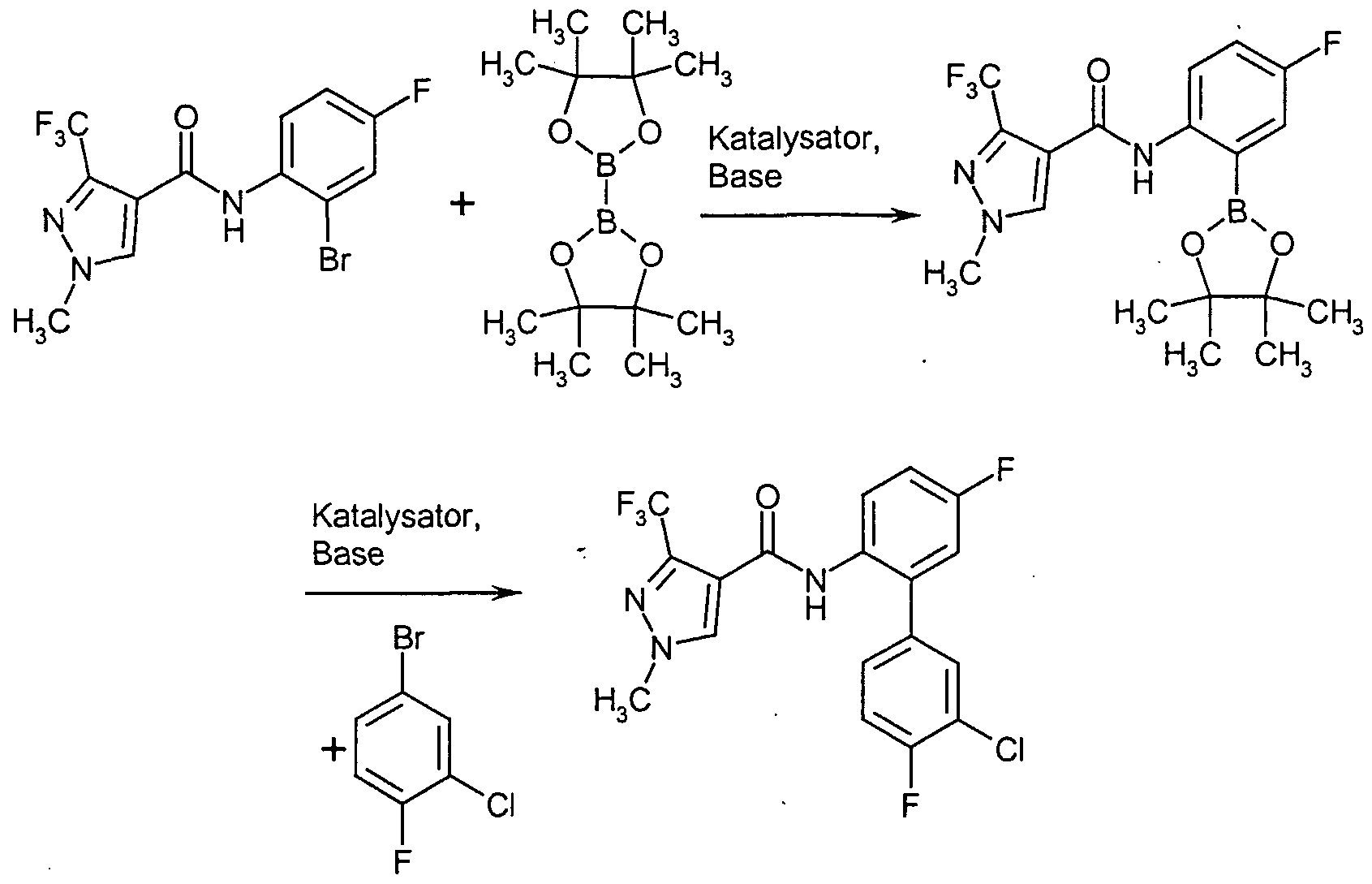
Die zur Durchführung des erfindungsgemäßen Verfahrens c) als Ausgangsstoffe benötigten Halogenpyrazolcarboxanilide der Formel (TV) sind bereits weiter oben im Zusammenhang mit dem erfindungsgemäßen Verfahren b) beschrieben worden.The halopyrazole carboxanilides of the formula (TV) required as starting materials for carrying out process c) according to the invention have already been described above in connection with process b) according to the invention.
Die zur Durchführung des erfindungsgemäßen Verfahrens c) weiterhin als Ausgangsstoffe benötigten Diboran-Derivate sind durch die Formel (VI) allgemein definiert. In dieser Formel (VI) stehen G3 und G4 bevorzugt jeweils für Methyl, Ethyl, Propyl, Butyl oder gemeinsam für Tetramethylethylen.Formula (VI) provides a general definition of the diborane derivatives also required as starting materials for carrying out process c) according to the invention. In this formula (VI) G 3 and G 4 each preferably represent methyl, ethyl, propyl, butyl or together tetramethylethylene.
Die Diboran-Derivate der Formel (VT) sind allgemein bekannte Synthesechemikalien.The diborane derivatives of the formula (VT) are generally known synthetic chemicals.
Die außerdem zur Durchführung des erfindungsgemäßen Verfahrens c) als Ausgangsstoffe benötigten Halogenbenzolderivate sind durch die Formel (VH) allgemeinThe halogenbenzene derivatives also required as starting materials for carrying out process c) according to the invention are general by the formula (VH)
1 9 definiert. In dieser Formel (VH) stehen R und R bevorzugt bzw. besonders bevorzugt für diejenigen Bedeutungen, die bereits im Zusammenhang mit der Beschreibung der erfindungsgemäßen Verbindungen der Formel (I) als bevorzugt bzw. besonders bevorzugt für diese Reste angegeben wurden. X3 steht für bevorzugt für Brom, Iod oder Trifluormethylsulfonyloxy. Die Halogenbenzolderivate der Formel (VH) sind allgemein bekannte Synthesechemikalien.1 9 defined. In this formula (VH), R and R preferably or particularly preferably have those meanings which have already been given as preferred or particularly preferred for these radicals in connection with the description of the compounds of the formula (I) according to the invention. X 3 preferably represents bromine, iodine or trifluoromethylsulfonyloxy. The halogenobenzene derivatives of the formula (VH) are generally known synthetic chemicals.
Als Verdünnungsmittel zur Durchführung der erfmdungsgemäßen Verfahrens a) und e) kommen alle inerten organischen Lösungsmittel in Betracht. Hierzu gehören vorzugsweise aliphatische, alicyclische oder aromatische Kohlenwasserstoffe, wie beispielsweise Petrolether, Hexan, Heptan, Cyclohexan, Methylcyclohexan, Benzol, To- luol, Xylol oder Decalin; halogenierte Kohlenwasserstoffe, wie beispielsweise Chlorbenzol, Dichlorbenzol, Dichlormethan, Chloroform, Tetrachlormethan, Dichlorethan oder Trichlorethan; Ether, wie Diethylether, Diisopropylether, Methyl-t-butylether,Suitable diluents for carrying out processes a) and e) according to the invention are all inert organic solvents. These preferably include aliphatic, alicyclic or aromatic hydrocarbons, such as, for example, petroleum ether, hexane, heptane, cyclohexane, methylcyclohexane, benzene, toluene, xylene or decalin; halogenated hydrocarbons, such as chlorobenzene, dichlorobenzene, dichloromethane, chloroform, carbon tetrachloride, dichloroethane or trichloroethane; Ethers, such as diethyl ether, diisopropyl ether, methyl t-butyl ether,
Methyl-t-amylether, Dioxan, Tetrahydrofuran, 1,2-Dimethoxyethan, 1,2-Diethoxy- ethan oder Anisol oder Amide, wie N,N-Dimethylformamid, N,N-Dimethylacetamid, N-Methylformanilid, N-Methylpyrrolidon oder Hexamethylphosphorsäuretriamid.Methyl t-amyl ether, dioxane, tetrahydrofuran, 1,2-dimethoxyethane, 1,2-diethoxyethane or anisole or amides, such as N, N-dimethylformamide, N, N-dimethylacetamide, N-methylformanilide, N-methylpyrrolidone or hexamethylphosphoric triamide ,
Die erfindungsgemäßen Verfahren a) und e) werden gegebenenfalls in Gegenwart eines geeigneten Säureakzeptors durchgeführt. Als solche kommen alle üblichen anorganischen oder organischen Basen infrage. Hierzu gehören vorzugsweise Erdalkalimetall oder Alkalimetallhydride, -hydroxide, -amide, -alkoholate, -acetate, -carbonate oder -hydrogencarbonate, wie beispielsweise Natriumhydrid, Natriumamid, Natrium- methylat, Natriumethylat, Kalium-tert.-butylat, Natriumhydroxid, Kaliumhydroxid,Processes a) and e) according to the invention are optionally carried out in the presence of a suitable acid acceptor. All conventional inorganic or organic bases are suitable as such. These preferably include alkaline earth metal or alkali metal hydrides, hydroxides, amides, alcoholates, acetates, carbonates or hydrogen carbonates, such as, for example, sodium hydride, sodium amide, sodium methylate, sodium ethylate, potassium tert-butoxide, sodium hydroxide, potassium hydroxide,
Ammoniumhydroxid, Natriumacetat, Kaliumacetat, Calciumacetat, Ammonium- acetat, Natriumcarbonat, Kaliumcarbonat, Kaliumhydrogencarbonat, Natriumhydro- gencarbonat oder Caesiumcarbonat, sowie tertiäre Amine, wie Trimethylamin, Triethylamin, Tributylamin, N,N-Dimethylanilin, N,N-Dimethylbenzylamin, Pyridin, N-Methylpiperidin, N-Methylmoφholin, N,N-Dimethylaminopyridin, Diazabicyclo- octan (DABCO), Diazabicyclononen (DBN) oder Diazabicycloundecen (DBU).Ammonium hydroxide, sodium acetate, potassium acetate, calcium acetate, ammonium acetate, sodium carbonate, potassium carbonate, potassium hydrogen carbonate, sodium hydrogen carbonate or cesium carbonate, and also tertiary amines, such as trimethylamine, triethylamine, tributylamine, N, N-dimethylaniline, N, N-dimethylbenzylamine, pyridine, N -Methylpiperidin, N-Methylmoφholin, N, N-Dimethylaminopyridin, Diazabicycloctan (DABCO), Diazabicyclononen (DBN) or Diazabicycloundecen (DBU).
Die Reaktionstemperaturen können bei der Durchführung der erfindungsgemäßen Verfahren a) und e) in einem größeren Bereich variiert werden. Im allgemeinen arbeitet man bei Temperaturen von 0°C bis 150°C, vorzugsweise bei Temperaturen von 20°C bis l lO°C. Zur Durchführung des erfindungsgemäßen Verfahrens a) zur Herstellung der Verbindungen der Formel (I) setzt man pro Mol des Pyrazolylcarbonsäurehalogenides der Formel (IT) im allgemeinen 0,2 bis 5 Mol, vorzugsweise 0,5 bis 2 Mol an Anilinderivat der Formel (HT) ein.The reaction temperatures can be varied within a substantial range when carrying out processes a) and e) according to the invention. In general, temperatures from 0 ° C to 150 ° C, preferably at temperatures from 20 ° C to 10 ° C. To carry out process a) according to the invention for the preparation of the compounds of the formula (I), 0.2 to 5 mol, preferably 0.5 to 2 mol, of aniline derivative of the formula (HT) are generally employed per mole of the pyrazolylcarboxylic acid halide of the formula (IT) on.
Zur Durchführung des erfmdungsgemäßen Verfahrens e) zur Herstellung der Verbindungen der Formel (TV) setzt man pro Mol des Pyrazolylcarbonsäure- halogenides der Formel (TI) im allgemeinen 0,2 bis 5 Mol, vorzugsweise 0,5 bis 2 Mol an Fluorhalogenanilin der Formel (VHI) ein.In order to carry out process e) according to the invention for the preparation of the compounds of the formula (TV), 0.2 to 5 mol, preferably 0.5 to 2 mol, of fluorine haloaniline of the formula (in general) are used per mole of the pyrazolylcarboxylic acid halide of the formula (TI) VHI) a.
Als Verdünnungsmittel zur Durchführung der erfindungsgemäßen Verfahren b), c) und d) kommen alle inerten organischen Lösungsmittel in Betracht. Hierzu gehören vorzugsweise aliphatische, alicyclische oder aromatische Kohlenwasserstoffe, wie beispielsweise Petrolether, Hexan, Heptan, Cyclohexan, Methylcyclohexan, Benzol, Toluol, Xylol oder Decalin; Ether, wie Diethylether, Diisopropylether, Methyl-t- butylether, Methyl-t-amylether, Dioxan, Tetrahydrofuran, 1,2-Dimethoxyethan, 1,2- Diethoxyethan oder Anisol; Nitrile, wie Acetonitril, Propionitril, n- oder i-Butyro- nitril oder Benzonitril; Amide, wie N,N-Dimethylformamid, N,N-Dimethylacetamid, N-Methylformanilid, N-Methylpyrrolidon oder Hexamethylphosphorsäuretriamid; Ester wie Essigsäuremethylester oder Essigsäureethylester; Sulfoxide, wie Dimethyl- sulfoxid; Sulfone, wie Sulfolan; Alkohole, wie Methanol, Ethanol, n- oder i-Propa- nol, n-, i-, s- oder t-Butanol, Ethandiol, Propan-l,2-diol, Ethoxyethanol, Methoxy- ethanol, Diethylenglykolmonomethylether, Diethylenglykolmonoethylether, deren Gemische mit Wasser oder reines Wasser.Suitable diluents for carrying out processes b), c) and d) according to the invention are all inert organic solvents. These preferably include aliphatic, alicyclic or aromatic hydrocarbons, such as, for example, petroleum ether, hexane, heptane, cyclohexane, methylcyclohexane, benzene, toluene, xylene or decalin; Ethers, such as diethyl ether, diisopropyl ether, methyl t-butyl ether, methyl t-amyl ether, dioxane, tetrahydrofuran, 1,2-dimethoxyethane, 1,2-diethoxyethane or anisole; Nitriles, such as acetonitrile, propionitrile, n- or i-butyronitrile or benzonitrile; Amides such as N, N-dimethylformamide, N, N-dimethylacetamide, N-methylformanilide, N-methylpyrrolidone or hexamethylphosphoric triamide; Esters such as methyl acetate or ethyl acetate; Sulfoxides, such as dimethyl sulfoxide; Sulfones such as sulfolane; Alcohols, such as methanol, ethanol, n- or i-propanol, n-, i-, s- or t-butanol, ethanediol, propane-1,2-diol, ethoxyethanol, methoxyethanol, diethylene glycol monomethyl ether, diethylene glycol monoethyl ether, the thereof Mix with water or pure water.
Die Reaktionstemperaturen können bei der Durchführung der erfindungsgemäßen Verfahrens b), c) und d) in einem größeren Bereich variiert werden. Im allgemeinen arbeitet man bei Temperaturen von 0°C bis 150°C, vorzugsweise bei Temperaturen von 20°C bis l lO°C.The reaction temperatures can be varied within a substantial range when carrying out process b), c) and d) according to the invention. In general, temperatures from 0 ° C to 150 ° C, preferably at temperatures from 20 ° C to 10 ° C.
Die erfindungsgemäßen Verfahren b), c) werden und d) gegebenenfalls in Gegenwart eines geeigneten Säureakzeptors durchgeführt. Als solche kommen alle üblichen an- organischen oder organischen Basen infrage. Hierzu gehören vorzugsweise Erdalkalimetall- oder Alkalimetallhydride, -hydroxide, -amide, -alkoholate, -acetate, -fluoride, -phosphate, -carbonate oder -hydrogencarbonate, wie beispielsweise Natriumhydrid, Natriumamid, Lithiumdiisopropylamid, Natriummethylat, Natriumethylat, Kalium- tert.-butylat, Natriumhydroxid, Kaliumhydroxid, Natriumacetat, Kaliumacetat, Natriumphosphat, Kaliumphosphat, Kaliumfluorid, Cäsiumfluorid, Natriumcarbonat, Kaliumcarbonat, Kaliumhydrogencarbonat, Natriumhydrogencarbonat oder Cäsium- carbonat, sowie tertiäre Amine, wie Trimethylamin, Triethylamin, Tributylamin, N,N-Dimethylanilin, N,N-Dimethylbenzylamin, Pyridin, N-Methylpiperidin, N- Methylmorpholin, N,N-Dimethylaminopyridin, Diazabicyclooctan (DABCO), Diaza- bicyclononen (DBN) oder Diazabicycloundecen (DBU).Processes b), c) and d) according to the invention are optionally carried out in the presence of a suitable acid acceptor. As such, all the usual organic or organic bases in question. These preferably include alkaline earth metal or alkali metal hydrides, hydroxides, amides, alcoholates, acetates, fluorides, phosphates, carbonates or hydrogen carbonates, such as, for example, sodium hydride, sodium amide, lithium diisopropylamide, sodium methylate, sodium ethylate, potassium tert-butoxide , Sodium hydroxide, potassium hydroxide, sodium acetate, potassium acetate, sodium phosphate, potassium phosphate, potassium fluoride, cesium fluoride, sodium carbonate, potassium carbonate, potassium hydrogen carbonate, sodium hydrogen carbonate or cesium carbonate, and also tertiary amines, such as trimethylamine, triethylamine, tributylamine, N, N-dimethylaniline Dimethylbenzylamine, pyridine, N-methylpiperidine, N-methylmorpholine, N, N-dimethylaminopyridine, diazabicyclooctane (DABCO), diazabicyclonones (DBN) or diazabicycloundecene (DBU).
Die erfindungsgemäßen Verfahren b), c) und d) werden in Gegenwart eines Katalysators, wie beispielsweise eines Palladiumsalzes oder -komplexes, durchgeführt. Hierzu kommen vorzugsweise Palladiumchlorid, Palladiumacetat, Tetrakis-(triphe- nylphosphin)-palladium, Bis-(triphenylphosphin)-palladiurndichlorid oder l,l'-Bis- (diphenylphosphino)ferrocenpalladium(IT)chlorid infrage.Processes b), c) and d) according to the invention are carried out in the presence of a catalyst, such as, for example, a palladium salt or complex. For this purpose, preferably palladium chloride, palladium acetate, tetrakis (triphenylphosphine) palladium, bis (triphenylphosphine) palladiuric dichloride or 1,1'-bis (diphenylphosphino) ferrocene palladium (IT) chloride come into question.
Es kann auch ein Palladiumkomplex in der Reaktionsmischung erzeugt werden, wenn man ein Palladiumsalz und einen Komplexligand, wie beispielsweise Triethyl- phosphan, Tri-tert-butylphosphan, Tricyclohexylphosphan, 2-(Dicyclohexylphos- phan)-biphenyl, 2-(Di-tert-butylphosphan)-biphenyl, 2-(Dicyclohexylphosphan)-2'- (N,N-dimethylamino)-biphenyl, Triphenylphosphan, Tris-(o-tolyl)-phosphan, Natri- um-3-(diphenylphosphino)benzolsulfonat, Tris-2-(methoxyphenyl)-phosphan, 2,2'- Bis-(diphenylphosphan)-l, -binaphthyl, l,4-Bis(diphenylphosphan)-butan, 1,2-Bis-A palladium complex can also be generated in the reaction mixture if a palladium salt and a complex ligand, such as, for example, triethylphosphine, tri-tert-butylphosphine, tricyclohexylphosphine, 2- (dicyclohexylphosphine) biphenyl, 2- (di-tert- butylphosphane) biphenyl, 2- (dicyclohexylphosphine) -2'- (N, N-dimethylamino) biphenyl, triphenylphosphine, tris (o-tolyl) phosphane, sodium 3- (diphenylphosphino) benzenesulfonate, tris-2 - (methoxyphenyl) -phosphane, 2,2'- bis (diphenylphosphine) -l, -binaphthyl, 1,4-bis (diphenylphosphine) -butane, 1,2-bis-
(diphenylphosphan)-ethan, 1 ,4-Bis(dicyclohexylphosphan)-butan, 1 ,2-Bis-(dicyclo- hexylphosphan)-ethan, 2-(Dicyclohexylphosphan)-2'-(N,N-dimethylamino)-biphenyl, Bis(diphenylphosphino)ferrocen oder Tris-(2,4-tert-butylphenyl)-phosphit getrennt zur Reaktion zugibt.(diphenylphosphine) ethane, 1,4-bis (dicyclohexylphosphane) butane, 1,2-bis (dicyclohexylphosphane) ethane, 2- (dicyclohexylphosphane) -2 '- (N, N-dimethylamino) biphenyl, Bis (diphenylphosphino) ferrocene or tris (2,4-tert-butylphenyl) phosphite are added separately to the reaction.
Zur Durchführung des erfindungsgemäßen Verfahrens b) zur Herstellung der Verbindungen der Formel (I) setzt man pro Mol des Halogenpyrazolcarboxanilids der Formel (TV) im allgemeinen 1 bis 15 Mol, vorzugsweise 1 bis 5 Mol an Boronsäurederivat der Formel (V) ein.To carry out the process b) according to the invention for the preparation of the compounds of the formula (I), the mole of halopyrazole carboxanilide is used Formula (TV) generally 1 to 15 mol, preferably 1 to 5 mol of boronic acid derivative of the formula (V).
Zur Durchführung des erfindungsgemäßen Verfahrens c) zur Herstellung der Verbin- düngen der Formel (I) setzt man pro Mol des Halogenpyrazolcarboxanilids derIn order to carry out process c) according to the invention for the preparation of the compounds of the formula (I), the per mole of halopyrazole carboxanilide is used
Formel (TV) im allgemeinen 1 bis 15 Mol, vorzugsweise 1 bis 5 Mol an Diboran- Derivat der Formel (VI) und 1 bis 15 Mol, vorzugsweise 1 bis 5 Mol an Halogenbenzolderivat der Formel (VII) ein.Formula (TV) generally 1 to 15 mol, preferably 1 to 5 mol of diborane derivative of the formula (VI) and 1 to 15 mol, preferably 1 to 5 mol of halogenobenzene derivative of the formula (VII).
Zur Durchführung des erfmdungsgemäßen Verfahrens d) zur Herstellung derTo carry out the method d) according to the invention for producing the
Verbindungen der Formel (in) setzt man pro Mol des Fluorhalogenanilins der Formel (VTTT) im allgemeinen 1 bis 15 Mol, vorzugsweise 1 bis 5 Mol an Boronsäurederivat der Formel (V) ein.Compounds of the formula (in) are generally employed per mole of the fluorohaloaniline of the formula (VTTT) 1 to 15 moles, preferably 1 to 5 moles, of a boronic acid derivative of the formula (V).
Die erfindungsgemäßen Verfahren a), b), c), d) und e) werden im allgemeinen unterThe processes a), b), c), d) and e) are generally described under
Normaldruck durchgeführt. Es ist jedoch auch möglich, unter erhöhtem oder vermindertem Druck - im allgemeinen zwischen 0, 1 bar und 10 bar - zu arbeiten.Normal pressure carried out. However, it is also possible to work under increased or reduced pressure - generally between 0.1 bar and 10 bar.
Die erfindungsgemäßen Stoffe weisen eine starke mikrobizide Wirkung auf und können zur Bekämpfung von unerwünschten Mikroorganismen, wie Fungi und Bakterien, im Pflanzenschutz und im Materialschutz eingesetzt werden.The substances according to the invention have a strong microbicidal action and can be used to control unwanted microorganisms, such as fungi and bacteria, in crop protection and in material protection.
Fungizide lassen sich Pflanzenschutz zur Bekämpfung von Plasmodiophoromycetes, Oomycetes, Chytridiomycetes, Zygomycetes, Ascomycetes, Basidiomycetes und Deu- teromycetes einsetzen.Fungicides can be used to protect plants against Plasmodiophoromycetes, Oomycetes, Chytridiomycetes, Zygomycetes, Ascomycetes, Basidiomycetes and Deuteromycetes.
Bakterizide lassen sich im Pflanzenschutz zur Bekämpfung von Pseudomonadaceae, Rhizobiaceae, Enterobacteriaceae, Corynebacteriaceae und Streptomycetaceae einsetzen.Bactericides can be used in crop protection to combat Pseudomonadaceae, Rhizobiaceae, Enterobacteriaceae, Corynebacteriaceae and Streptomycetaceae.
Beispielhaft aber nicht begrenzend seien einige Erreger von pilzlichen und bakteriellen Erkrankungen, die unter die oben aufgezählten Oberbegriffe fallen, genannt: Xanthomonas- Arten, wie beispielsweise Xanthomonas campestris pv. oryzae;Some pathogens of fungal and bacterial diseases that fall under the generic names listed above may be mentioned as examples, but not by way of limitation: Xanthomonas species, such as, for example, Xanthomonas campestris pv. Oryzae;
Pseudomonas- Arten, wie beispielsweise Pseudomonas syringae pv. lachrymans;Pseudomonas species, such as, for example, Pseudomonas syringae pv. Lachrymans;
Erwinia- Arten, wie beispielsweise Erwinia amylovora;Erwinia species, such as, for example, Erwinia amylovora;
Pythium- Arten, wie beispielsweise Pythium ultimum; Phytophthora- Arten, wie beispielsweise Phytophthora infestans;Pythium species, such as, for example, Pythium ultimum; Phytophthora species, such as, for example, Phytophthora infestans;
Pseudoperonospora-Arten, wie beispielsweise Pseudoperonospora humuli oderPseudoperonospora species, such as, for example, Pseudoperonospora humuli or
Pseudoperonospora cubensis;Pseudoperonospora cubensis;
Plasmopara- Arten, wie beispielsweise Plasmopara viticola;Plasmopara species, such as, for example, Plasmopara viticola;
Bremia- Arten, wie beispielsweise Bremia lactucae; Peronospora- Arten, wie beispielsweise Peronospora pisi oder P. brassicae;Bremia species, such as, for example, Bremia lactucae; Peronospora species, such as, for example, Peronospora pisi or P. brassicae;
Erysiphe- Arten, wie beispielsweise Erysiphe graminis;Erysiphe species, such as, for example, Erysiphe graminis;
Sphaerotheca- Arten, wie beispielsweise Sphaerotheca fuliginea;Sphaerotheca species, such as, for example, Sphaerotheca fuliginea;
Podosphaera- Arten, wie beispielsweise Podosphaera leucotricha;Podosphaera species, such as, for example, Podosphaera leucotricha;
Venturia-Arten, wie beispielsweise Venturia inaequalis; Pyrenophora- Arten, wie beispielsweise Pyrenophora teres oder P. gramineaVenturia species, such as, for example, Venturia inaequalis; Pyrenophora species, such as, for example, Pyrenophora teres or P. graminea
(Konidienform: Drechslera, Syn: Helminthosporium);(Conidial form: Drechslera, Syn: Helminthosporium);
Cochliobolus- Arten, wie beispielsweise Cochliobolus sativusCochliobolus species, such as, for example, Cochliobolus sativus
(Konidienform: Drechslera, Syn: Helminthosporium);(Conidial form: Drechslera, Syn: Helminthosporium);
Uromyces-Arten, wie beispielsweise Uromyces appendiculatus; Puccinia- Arten, wie beispielsweise Puccinia recondita;Uromyces species, such as, for example, Uromyces appendiculatus; Puccinia species, such as, for example, Puccinia recondita;
Sclerotinia- Arten, wie beispielsweise Sclerotinia sclerotiorum;Sclerotinia species, such as, for example, Sclerotinia sclerotiorum;
Tilletia- Arten, wie beispielsweise Tilletia caries;Tilletia species, such as, for example, Tilletia caries;
Ustilago-Arten, wie beispielsweise Ustilago nuda oder Ustilago avenae;Ustilago species, such as, for example, Ustilago nuda or Ustilago avenae;
Pellicularia-Arten, wie beispielsweise Pellicularia sasakii; Pyricularia-Arten, wie beispielsweise Pyricularia oryzae;Pellicularia species, such as, for example, Pellicularia sasakii; Pyricularia species, such as, for example, Pyricularia oryzae;
Fusarium- Arten, wie beispielsweise Fusarium culmorum;Fusarium species, such as, for example, Fusarium culmorum;
Botrytis-Arten, wie beispielsweise Botrytis cinerea;Botrytis species, such as, for example, Botrytis cinerea;
Septoria- Arten, wie beispielsweise Septoria nodorum;Septoria species, such as, for example, Septoria nodorum;
Leptosphaeria- Arten, wie beispielsweise Leptosphaeria nodorum; Cercospora-Arten, wie beispielsweise Cercospora canescens;Leptosphaeria species, such as, for example, Leptosphaeria nodorum; Cercospora species, such as, for example, Cercospora canescens;
Alternaria- Arten, wie beispielsweise Alternaria brassicae;Alternaria species, such as, for example, Alternaria brassicae;
Pseudocercosporella- Arten, wie beispielsweise Pseudocercosporella heφotrichoides. Die erfindungsgemäßen Wirkstoffe weisen auch eine starke stärkende Wirkung in Pflanzen auf. Sie eignen sich daher zur Mobilisierung pflanzeneigener Abwehrkräfte gegen Befall durch unerwünschte Mikroorganismen.Pseudocercosporella species, such as, for example, Pseudocercosporella heφotrichoides. The active compounds according to the invention also have a strong strengthening effect in plants. They are therefore suitable for mobilizing the plant's own defenses against attack by unwanted microorganisms.
Unter pflanzenstärkenden (resistenzinduzierenden) Stoffen sind im vorliegendenAmong plant-strengthening (resistance-inducing) substances are in the present
Zusammenhang solche Substanzen zu verstehen, die in der Lage sind, das Abwehrsystem von Pflanzen so zu stimulieren, dass die behandelten Pflanzen bei nachfolgender Inokulation mit unerwünschten Mikroorganismen weitgehende Resistenz gegen diese Mikroorganismen entfalten.To understand the context of such substances that are able to stimulate the defense system of plants so that the treated plants develop extensive resistance to these microorganisms when subsequently inoculated with undesired microorganisms.
Unter unerwünschten Mikroorganismen sind im vorliegenden Fall phytopathogene Pilze, Bakterien und Viren zu verstehen. Die erfindungsgemäßen Stoffe können also eingesetzt werden, um Pflanzen innerhalb eines gewissen Zeitraumes nach der Behandlung gegen den Befall durch die genannten Schaderreger zu schützen. Der Zeit- räum, innerhalb dessen Schutz herbeigeführt wird, erstreckt sich im allgemeinen vonUndesired microorganisms are to be understood in the present case as phytopathogenic fungi, bacteria and viruses. The substances according to the invention can therefore be used to protect plants against attack by the named pathogens within a certain period of time after the treatment. The period within which protection is brought about generally extends from
1 bis 10 Tage, vorzugsweise 1 bis 7 Tage nach der Behandlung der Pflanzen mit den Wirkstoffen.1 to 10 days, preferably 1 to 7 days after the treatment of the plants with the active compounds.
Die gute Pflanzenverträglichkeit der Wirkstoffe in den zur Bekämpfung von Pflan- zenkrankheiten notwendigen Konzentrationen erlaubt eine Behandlung von oberirdischen Pflanzenteilen, von Pflanz- und Saatgut, und des Bodens.The fact that the active compounds are well tolerated by plants in the concentrations required to combat plant diseases allows treatment of above-ground parts of plants, of propagation stock and seeds, and of the soil.
Die erfindungsgemäßen Wirkstoffe eignen sich auch zur Steigerung des Ernteertrages. Sie sind außerdem mindertoxisch und weisen eine gute Pflanzenverträglichkeit auf.The active compounds according to the invention are also suitable for increasing the crop yield. They are also less toxic and have good plant tolerance.
Die erfindungsgemäßen Wirkstoffe können gegebenenfalls in bestimmten Konzentrationen und Aufwandmengen auch als Herbizide, zur Beeinflussung des Pflanzenwachstums, sowie zur Bekämpfung von tierischen Schädlingen verwendet werden. Sie lassen sich gegebenenfalls auch als Zwischen- und Voφrodukte für die Synthese weiterer Wirkstoffe einsetzen. Erfindungsgemäß können alle Pflanzen und Pflanzenteile behandelt werden. Unter Pflanzen werden hierbei alle Pflanzen und Pflanzenpopulationen verstanden, wie erwünschte und unerwünschte Wildpflanzen oder Kultuφflanzen (einschließlich natürlich vorkommender Kultuφflanzen). Kultuφflanzen können Pflanzen sein, die durch konventionelle Züchtungs- und Optimierungsmethoden oder durch biotechnologische und gentechnologische Methoden oder Kombinationen dieser Methoden erhalten werden können, einschließlich der transgenen Pflanzen und einschließlich der durch Sortenschutzrechte schützbaren oder nicht schützbaren Pflanzensorten. Unter Pflanzenteilen sollen alle oberirdischen und unterirdischen Teile und Organe der Pflanzen, wie Spross, Blatt, Blüte und Wurzel verstanden werden, wobei beispielhaft Blätter, Nadeln, Stängel, Stämme, Blüten, Fruchtköφer, Früchte und Samen sowie Wurzeln, Knollen und Rhizome aufgeführt werden. Zu den Pflanzenteilen gehört auch Erntegut sowie vegetatives und generatives Vermehrungsmaterial, beispielsweise Stecklinge, Knollen, Rhizome, Ableger und Samen.If appropriate, the active compounds according to the invention can also be used in certain concentrations and application rates as herbicides, for influencing plant growth, and for controlling animal pests. If appropriate, they can also be used as intermediates and products for the synthesis of further active ingredients. According to the invention, all plants and parts of plants can be treated. Plants are understood here to mean all plants and plant populations, such as desired and undesired wild plants or cultivated plants (including naturally occurring cultivated plants). Cultivated plants can be plants which can be obtained by conventional breeding and optimization methods or by biotechnological and genetic engineering methods or combinations of these methods, including the transgenic plants and including the plant cultivars which can or cannot be protected by plant breeders' rights. Plant parts are to be understood to mean all above-ground and underground parts and organs of plants, such as shoots, leaves, flowers and roots, examples being leaves, needles, stems, stems, flowers, fruiting bodies, fruits and seeds as well as roots, tubers and rhizomes. The plant parts also include crops and vegetative and generative propagation material, for example cuttings, tubers, rhizomes, offshoots and seeds.
Die erfindungsgemäße Behandlung der Pflanzen und Pflanzenteile mit den Wirkstoffen erfolgt direkt oder durch Einwirkung auf deren Umgebung, Lebensraum oder Lageπaum nach den üblichen Behandlungsmethoden, z.B. durch Tauchen, Sprühen, Verdampfen, Vernebeln, Streuen, Aufstreichen, Injizieren und bei Vermehrungsma- terial, insbesondere bei Samen, weiterhin durch ein- oder mehrschichtiges Umhüllen.The treatment of the plants and parts of plants with the active compounds according to the invention is carried out directly or by acting on their environment, habitat or location according to the usual treatment methods, e.g. by dipping, spraying, vaporizing, atomizing, scattering, spreading, injecting and, in the case of propagation material, in particular in the case of seeds, furthermore by single- or multi-layer coating.
Im Materialschutz lassen sich die erfindungsgemäßen Stoffe zum Schutz von technischen Materialien gegen Befall und Zerstörung durch unerwünschte Mikroorganismen einsetzen.In material protection, the substances according to the invention can be used to protect technical materials against attack and destruction by undesired microorganisms.
Unter technischen Materialien sind im vorliegenden Zusammenhang nichtlebende Materialien zu verstehen, die für die Verwendung in der Technik zubereitet worden sind. Beispielsweise können technische Materialien, die durch erfindungsgemäße Wirkstoffe vor mikrobieller Veränderung oder Zerstörung geschützt werden sollen, Klebstoffe, Leime, Papier und Karton, Textilien, Leder, Holz, Anstrichmittel undIn the present context, technical materials are to be understood as non-living materials that have been prepared for use in technology. For example, technical materials which are to be protected against microbial change or destruction by active substances according to the invention, adhesives, glues, paper and cardboard, textiles, leather, wood, paints and
Kunststoffartikel, Kühlschmierstoffe und andere Materialien sein, die von Mikroorganismen befallen oder zersetzt werden können. Im Rahmen der zu schützenden Ma- terialien seien auch Teile von Produktionsanlagen, beispielsweise Kühlwasserkreisläufe, genannt, die durch Vermehrung von Mikroorganismen beeinträchtigt werden können. Im Rahmen der vorliegenden Erfindung seien als technische Materialien vorzugsweise Klebstoffe, Leime, Papiere und Kartone, Leder, Holz, Anstrichmittel, Kühlschmiermittel und Wärmeübertragungsflüssigkeiten genannt, besonders bevorzugt Holz.Plastic articles, cooling lubricants and other materials that can be attacked or decomposed by microorganisms. As part of the measures to be protected Materials are also parts of production systems, such as cooling water circuits, that can be affected by the proliferation of microorganisms. In the context of the present invention, technical materials are preferably adhesives, glues, papers and cartons, leather, wood, paints, cooling lubricants and heat transfer liquids, particularly preferably wood.
Als Mikroorganismen, die einen Abbau oder eine Veränderung der technischen Materialien bewirken können, seien beispielsweise Bakterien, Pilze, Hefen, Algen und Schleimorganismen genannt. Vorzugsweise wirken die erfindungsgemäßen Wirkstoffe gegen Pilze, insbesondere Schimmelpilze, holzverfärbende und holzzerstörende Pilze (Basidiomyceten) sowie gegen Schleimorganismen und Algen.Bacteria, fungi, yeasts, algae and slime organisms may be mentioned as microorganisms which can cause degradation or a change in the technical materials. The active compounds according to the invention preferably act against fungi, in particular mold, wood-discoloring and wood-destroying fungi (Basidiomycetes) and against slime organisms and algae.
Es seien beispielsweise Mikroorganismen der folgenden Gattungen genannt: Alternaria, wie Altemaria tenuis,Microorganisms of the following genera may be mentioned for example: Alternaria, such as Altemaria tenuis,
Aspergillus, wie Aspergillus niger,Aspergillus, such as Aspergillus niger,
Chaetomium, wie Chaetomium globosum,Chaetomium, like Chaetomium globosum,
Coniophora, wie Coniophora puetana,Coniophora, such as Coniophora puetana,
Lentinus, wie Lentinus tigrinus, Penicillium, wie Penicillium glaucum,Lentinus, such as Lentinus tigrinus, Penicillium, such as Penicillium glaucum,
Polyporus, wie Polyporus versicolor,Polyporus, such as Polyporus versicolor,
Aureobasidium, wie Aureobasidium pullulans,Aureobasidium, such as Aureobasidium pullulans,
Sclerophoma, wie Sclerophoma pityophila,Sclerophoma, such as Sclerophoma pityophila,
Trichoderma, wie Trichoderma viride, Escherichia, wie Escherichia coli,Trichoderma, such as Trichoderma viride, Escherichia, such as Escherichia coli,
Pseudomonas, wie Pseudomonas aeruginosa,Pseudomonas, such as Pseudomonas aeruginosa,
Staphylococcus, wie Staphylococcus aureus.Staphylococcus, such as Staphylococcus aureus.
Die Wirkstoffe können in Abhängigkeit von ihren jeweiligen physikalischen und oder chemischen Eigenschaften in die üblichen Formulierungen überführt werden, wie Lösungen, Emulsionen, Suspensionen, Pulver, Schäume, Pasten, Granulate, Aerosole, Feinstverkapselungen in polymeren Stoffen und in Hüllmassen für Saatgut, sowie ULV-Kalt- und Warmnebel-Formulierungen.Depending on their respective physical and or chemical properties, the active compounds can be converted into the customary formulations, such as solutions, emulsions, suspensions, powders, foams, pastes, granules, Aerosols, very fine encapsulations in polymeric substances and in coating compositions for seeds, as well as ULV cold and warm mist formulations.
Diese Formulierungen werden in bekannter Weise hergestellt, z.B. durch Vermischen der Wirkstoffe mit Streckmitteln, also flüssigen Lösungsmitteln, unter Druck stehenden verflüssigten Gasen und/oder festen Trägerstoffen, gegebenenfalls unter Verwendung von oberflächenaktiven Mitteln, also Emulgiermitteln und/oder Dispergiermitteln und/oder schaumerzeugenden Mitteln. Im Falle der Benutzung von Wasser als Streckmittel können z.B. auch organische Lösungsmittel als Hilfslösungsmittel ver- wendet werden. Als flüssige Lösungsmittel kommen im wesentlichen in Frage: Aro- maten, wie Xylol, Toluol oder Alkylnaphthaline, chlorierte Aromaten oder chlorierte aliphatische Kohlenwasserstoffe, wie Chlorbenzole, Chlorethylene oder Methylenchlorid, aliphatische Kohlenwasserstoffe, wie Cyclohexan oder Paraffine, z.B. Erdölfraktionen, Alkohole, wie Butanol oder Glycol sowie deren Ether und Ester, Ketone, wie Aceton, Methylethylketon, Methylisobutylketon oder Cyclohexanon, stark polareThese formulations are made in a known manner, e.g. by mixing the active ingredients with extenders, that is to say liquid solvents, pressurized liquefied gases and / or solid carriers, if appropriate using surface-active agents, that is to say emulsifiers and / or dispersants and / or foam-generating agents. If water is used as an extender, e.g. organic solvents can also be used as auxiliary solvents. The following are essentially suitable as liquid solvents: aromatics, such as xylene, toluene or alkylnaphthalenes, chlorinated aromatics or chlorinated aliphatic hydrocarbons, such as chlorobenzenes, chlorethylenes or methylene chloride, aliphatic hydrocarbons, such as cyclohexane or paraffins, e.g. Petroleum fractions, alcohols, such as butanol or glycol, and their ethers and esters, ketones, such as acetone, methyl ethyl ketone, methyl isobutyl ketone or cyclohexanone, are strongly polar
Lösungsmittel, wie Dimethylformamid und Dimethylsulfoxid, sowie Wasser. Mit verflüssigten gasförmigen Streckmitteln oder Trägerstoffen sind solche Flüssigkeiten gemeint, welche bei normaler Temperatur und unter Normaldruck gasförmig sind, z.B. Aerosol-Treibgase, wie Halogenkohlenwasserstoffe sowie Butan, Propan, Stick- stoff und Kohlendioxid. Als feste Trägerstoffe kommen in Frage: z.B. natürliche Gesteinsmehle, wie Kaoline, Tonerden, Talkum, Kreide, Quarz, Attapulgit, Montmoril- lonit oder Diatomeenerde und synthetische Gesteinsmehle, wie hochdisperse Kieselsäure, Aluminiumoxid und Silikate. Als feste Trägerstoffe für Granulate kommen infrage: z.B. gebrochene und fraktionierte natürliche Gesteine wie Calcit, Bims, Mar- mor, Sepiolith, Dolomit sowie synthetische Granulate aus anorganischen und organischen Mehlen sowie Granulate aus organischem Material wie Sägemehl, Kokosnuss- schalen, Maiskolben und Tabakstängel. Als Emulgier und/oder schaumerzeugende Mittel kommen in Frage: z.B. nichtionogene und anionische Emulgatoren, wie Poly- oxyethylen-Fettsäureester, Polyoxyethylen-Fettalkoholether, z.B. Alkylarylpolygly- colether, Alkylsulfonate, Alkylsulfate, Arylsulfonate sowie Eiweißhydrolysate. AlsSolvents such as dimethylformamide and dimethyl sulfoxide, and water. Liquefied gaseous extenders or carriers mean liquids which are gaseous at normal temperature and pressure, e.g. Aerosol propellants, such as halogenated hydrocarbons as well as butane, propane, nitrogen and carbon dioxide. Possible solid carriers are: e.g. natural rock powders such as kaolins, alumina, talc, chalk, quartz, attapulgite, montmorillonite or diatomaceous earth and synthetic rock powders such as highly disperse silica, aluminum oxide and silicates. Solid carriers for granules are possible: e.g. broken and fractionated natural rocks such as calcite, pumice, marble, sepiolite, dolomite as well as synthetic granules from inorganic and organic flours as well as granules from organic material such as sawdust, coconut shells, corn cobs and tobacco stems. Possible emulsifiers and / or foaming agents are: e.g. non-ionic and anionic emulsifiers, such as polyoxyethylene fatty acid esters, polyoxyethylene fatty alcohol ethers, e.g. Alkylaryl polyglycol ethers, alkyl sulfonates, alkyl sulfates, aryl sulfonates and protein hydrolyzates. As
Dispergiermittel kommen in Frage: z.B. Lignin- Sulfitablaugen und Methylcellulose. Es können in den Formulierungen Haftmittel wie Carboxymethylcellulose, natürliche und synthetische pulverige, körnige oder latexförmige Polymere verwendet werden, wie Gummiarabicum, Polyvinylalkohol, Polyvinylacetat, sowie natürliche Phospholi- pide, wie Kephaline und Lecithine, und synthetische Phospholipide. Weitere Add- itive können mineralische und vegetabile Öle sein.Dispersants are suitable: for example lignin sulfite waste liquor and methyl cellulose. Adhesives such as carboxymethyl cellulose, natural and synthetic powdery, granular or latex-shaped polymers, such as gum arabic, polyvinyl alcohol, polyvinyl acetate, and natural phospholipids, such as cephalins and lecithins, and synthetic phospholipids can be used in the formulations. Other additives can be mineral and vegetable oils.
Es können Farbstoffe wie anorganische Pigmente, z.B. Eisenoxid, Titanoxid, Ferro- cyanblau und organische Farbstoffe, wie Alizarin-, Azo- und Metallphthalocyanin- farbstoffe und Spurennährstoffe, wie Salze von Eisen, Mangan, Bor, Kupfer, Kobalt, Molybdän und Zink verwendet werden.Dyes such as inorganic pigments, e.g. Iron oxide, titanium oxide, ferrocyan blue and organic dyes such as alizarin, azo and metal phthalocyanine dyes and trace nutrients such as salts of iron, manganese, boron, copper, cobalt, molybdenum and zinc can be used.
Die Formulierungen enthalten im allgemeinen zwischen 0,1 und 95 Gewichtsprozent Wirkstoff, vorzugsweise zwischen 0,5 und 90 %.The formulations generally contain between 0.1 and 95 percent by weight of active compound, preferably between 0.5 and 90%.
Die erfindungsgemäßen Wirkstoffe können als solche oder in ihren Formulierungen auch in Mischung mit bekannten Fungiziden, Bakteriziden, Akariziden, Nematiziden oder Insektiziden verwendet werden, um so z.B. das Wirkungsspektrum zu verbreitem oder Resistenzentwicklungen vorzubeugen. In vielen Fällen erhält man dabei synergistische Effekte, d.h. die Wirksamkeit der Mischung ist größer als die Wirk- samkeit der Einzelkomponenten.The active compounds according to the invention, as such or in their formulations, can also be used in a mixture with known fungicides, bactericides, acaricides, nematicides or insecticides, in order, for example, to spread the spectrum of activity or to prevent the development of resistance. In many cases, synergistic effects are obtained, i.e. the effectiveness of the mixture is greater than the effectiveness of the individual components.
Als Mischpartner kommen zum Beispiel folgende Verbindungen in Frage: -The following connections can be considered as mixed partners: -
Fungizide: 2-Phenylphenol; 8-Hydroxychinolinsulfat;Fungicides: 2-phenylphenol; 8-hydroxyquinoline sulfate;
Acibenzolar-S-methyl; Aldimoφh; Amidoflumet; Ampropylfos; Ampropylfos-potas- sium; Andoprim; Anilazine; Azaconazole; Azoxystrobin;Acibenzolar-S-methyl; aldimorph; amidoflumet; Ampropylfos; Ampropylfos potasium; andoprim; anilazine; azaconazole; azoxystrobin;
Benalaxyl; Benodanil; Benomyl; Benthiavalicarb-isopropyl; Benzamacril; Benzama- cril-isobutyl; Bilanafos; Binapacryl; Biphenyl; Bitertanol; Blasticidin-S; Bromucon- azole; Bupirimate; Buthiobate; Butylamin;benalaxyl; Benodanil; benomyl; Benthiavalicarb-isopropyl; Benzamacril; Benzama-cril-isobutyl; bilanafos; binapacryl; biphenyl; bitertanol; Blasticidin-S; Bromuconazoles; Bupirimate; Buthiobate; butylamine;
Calcium polysulfide; Capsimycin; Captafol; Captan; Carbendazim; Carboxin;Calcium polysulfide; capsimycin; captafol; captan; carbendazim; carboxin;
Caφropamid; Carvone; Chinomethionat; Chlobenthiazone; Chlorfenazole; Chloro- neb; Chlorothalonil; Chlozolinate; Clozylacon; Cyazofamid; Cyflufenamid; Cymo- xanil; Cyproconazole; Cyprodinil; Cyprofuram;Caφropamid; carvones; chinomethionat; Chlobenthiazone; Chlorfenazole; chloro- neb; chlorothalonil; chlozolinate; Clozylacon; cyazofamid; cyflufenamid; Cymoxanil; cyproconazole; cyprodinil; cyprofuram;
Dagger G; Debacarb; Dichlofluanid; Dichlone; Dichlorophen; Diclocymet; Diclo- mezine; Dicloran; Diethofencarb; Difenoconazole; Diflumetorim; Dimethirimol; Dimethomoφh; Dimoxystrobin; Diniconazole; Diniconazole-M; Dinocap; Diphenyl- amine; Dipyrithione; Ditalimfos; Dithianon; Dodine; Drazoxolon;Dagger G; debacarb; dichlofluanid; dichlone; dichlorophen; diclocymet; Diclomezine; dicloran; diethofencarb; Difenoconazole; diflumetorim; dimethirimol; Dimethomoφh; dimoxystrobin; diniconazole; Diniconazole-M; dinocap; Diphenylamines; Dipyrithione; Ditalimfos; dithianon; dodine; Drazoxolon;
Edifenphos; Epoxiconazole; Ethaboxam; Ethirimol; Etridiazole;edifenphos; epoxiconazole; ethaboxam; ethirimol; etridiazole;
Famoxadone; Fenamidone; Fenapanil; Fenarimol; Fenbuconazole; Fenfuram; Fen- hexamid; Fenitropan; Fenoxanil; Fenpiclonil; Fenpropidin; Fenpropimoφh; Ferbam; Fluazinam; Flubenzimine; Fludioxonil; Flumetover; Flumoφh; Fluoromide;famoxadone; fenamidone; Fenapanil; fenarimol; Fenbuconazole; fenfuram; Fenhexamide; Fenitropan; fenoxanil; fenpiclonil; fenpropidin; Fenpropimoφh; ferbam; fluazinam; Flubenzimine; fludioxonil; flumetover; Flumoφh; fluoromides;
Fluoxastrobin; Fluquinconazole; Flmprimidol; Flusilazole; Flusulfamide; Flutolanil;fluoxastrobin; fluquinconazole; Flmprimidol; flusilazole; flusulfamide; flutolanil;
Flutriafol; Folpet; Fosetyl-Al; Fosetyl-sodium; Fuberidazole; Furalaxyl; Furametpyr;flutriafol; folpet; Fosetyl-Al; Fosetyl-sodium; fuberidazole; furalaxyl; furametpyr;
Furcarbanil; Furmecyclox;Furcarbanil; Furmecyclox;
Guazatine; Hexachlorobenzene; Hexaconazole; Hymexazol; Imazalil; Imibenconazole; Iminoctadine triacetate; Iminoctadine tris(albesil); lodocarb; Ipconazole; Iprobenfos; Iprodione; Iprovahcarb; Irumamycin;guazatine; Hexachlorobenzene; hexaconazole; hymexazol; imazalil; Imibenconazole; Iminoctadine triacetate; Iminoctadine tris (albesil); lodocarb; ipconazole; iprobenfos; iprodione; Iprovahcarb; Irumamycin;
Isoprothiolane; Isovaledione; Kasugamycin; Kresoxim-methyl;isoprothiolane; Isovaledione; kasugamycin; Kresoxim-methyl;
Mancozeb; Maneb; Meferimzone; Mepanipyrim; Mepronil; Metalaxyl; Metalaxyl-M;mancozeb; maneb; Meferimzone; mepanipyrim; mepronil; metalaxyl; Metalaxyl-M;
Metconazole; Methasulfocarb; Methfuroxam; Metiram; Metominostrobin; Met- sulfovax; Mildiomycin; Myclobutanil; Myclozolin;metconazole; methasulfocarb; Methfuroxam; metiram; metominostrobin; Metsulfovax; mildiomycin; myclobutanil; myclozoline;
Natamycin; Nicobifen; Nitrothal-isopropyl; Noviflumuron; Nuarimol;natamycin; nicobifen; Nitro Thal-isopropyl; Noviflumuron; nuarimol;
Ofurace; Orysastrobin; Oxadixyl; Oxolinic acid; Oxpoconazole; Oxycarboxin;ofurace; orysastrobin; oxadixyl; Oxolinic acid; Oxpoconazole; oxycarboxin;
Oxyfenthiin;Oxyfenthiin;
Paclobutrazol; Pefurazoate; Penconazole; Pencycuron; Phosdiphen; Phthalide; Pic- oxystrobin; Piperalin; Polyoxins; Polyoxorim; Probenazole; Prochloraz; Procymi- done; Propamocarb; Propanosine-sodium; Propiconazole; Propineb; Proquinazid;paclobutrazol; Pefurazoate; penconazole; pencycuron; phosdiphen; phthalides; Picoxystrobin; piperalin; Polyoxins; Polyoxorim; Probenazole; prochloraz; Procymi-done; propamocarb; Propanosine-sodium; propiconazole; propineb; proquinazid;
Prothioconazole; Pyraclostrobin; Pyrazophos; Pyrifenox; Pyrimethanil; Pyroquilon;prothioconazole; pyraclostrobin; Pyrazohos; pyrifenox; pyrimethanil; pyroquilon;
Pyroxyfur; Pyπolnitrine;Pyroxyfur; Pyπolnitrine;
Quinconazole; Quinoxyfen; Quintozene; Simeconazole; Spiroxamine; Sulfur; Tebuconazole; Tecloftalam; Tecnazene; Tetcyclacis; Tetraconazole; Thiabendazole;Quinconazole; quinoxyfen; quintozene; Simeconazole; spiroxamine; Sulfur; tebuconazole; tecloftalam; Tecnazene; Tetcyclacis; tetraconazole; thiabendazole;
Thicyofen; Thifluzamide; Thiophanate-methyl; Thiram; Tioxymid; Tolclofos-methyl;Thicyofen; Thifluzamide; Thiophanate-methyl; thiram; Tioxymid; Tolclofos-methyl;
Tolylfluanid; Triadimefon; Triadimenol; Triazbutil; Triazoxide; Tricyclamide; Tri- cyclazole; Tridemoφh; Trifloxystrobin; Triflumizole; Triforine; Triticonazole;tolylfluanid; triadimefon; triadimenol; Triazbutil; triazoxide; Tricyclamide; tri- cyclazole; Tridemoφh; trifloxystrobin; triflumizole; triforine; triticonazole;
Uniconazole; Validamycin A; Vinclozolin; Zineb; Ziram; Zoxamide;Uniconazole; Validamycin A; vinclozolin; Zineb; ziram; zoxamide;
(2S)-N-[2-[4-[[3-(4-Chloφhenyl)-2-propinyl]oxy]-3-methoxyphenyl]ethyl]-3- methyl- 2-[(methylsulfonyl)amino]-butanamid; l-(l-Naphthalenyl)-lH-pyrrol-2,5-dion;(2S) -N- [2- [4 - [[3- (4-chlorophenyl) -2-propynyl] oxy] -3-methoxyphenyl] ethyl] -3-methyl-2 - [(methylsulfonyl) amino] -butanamide ; l- (l-naphthalenyl) -lH-pyrrole-2,5-dione;
2,3,5,6-Tetrachlor-4-(methylsulfonyl)-pyridin;2,3,5,6-tetrachloro-4- (methylsulfonyl) -pyridine;
2-Amino-4-methyl-N-phenyl-5-thiazolcarboxamid;2-amino-4-methyl-N-phenyl-5-thiazolecarboxamide;
2-Chlor-N-(2,3-dihydro-l,l,3-trimethyl-lH-mden-4-yl)-3-pyridincarboxamide;2-chloro-N- (2,3-dihydro-l, l, 3-trimethyl-lH-mden-4-yl) -3-pyridinecarboxamides;
3,4,5-Trichlor-2,6-pyridindicarbonitril; Actinovate; eis- 1 -(4-Chloφhenyl)-2-( 1H- 1 ,2,4-triazol- 1 -yl)-cycloheptanol;3,4,5-trichloro-2,6-pyridinedicarbonitrile; Actinovate; ice-1 - (4-chloro-phenyl) -2- (1H-1, 2,4-triazol-1-yl) -cycloheptanol;
Methyl l-(2,3-dihydro-2,2-dimethyl-lH-inden-l-yl)-lH-imidazol-5-carboxylat;Methyl l- (2,3-dihydro-2,2-dimethyl-1H-inden-1-yl) -IH-imidazole-5-carboxylate;
Monokaliumcarbonat;Monokaliumcarbonat;
N-(6-Methoxy-3-pyridinyl)-cyclopropancarboxamid;N- (6-methoxy-3-pyridinyl) -cyclopropanecarboxamide;
N-Butyl-8-(l,l-dimethylethyl)-l-oxaspiro[4.5]decan-3-amin; Natriumtetrathiocarbonat; sowie Kupfersalze und -Zubereitungen, wie Bordeaux mixture; Kupferhydroxid;N-butyl-8- (l, l-dimethylethyl) -l-oxa-spiro [4.5] decan-3-amine; sodium tetrathiocarbonate; as well as copper salts and preparations, such as Bordeaux mixture; copper;
Kupfemaphthenat; Kupferoxychlorid; Kupfersulfat; Cufraneb; Kupferoxid;naphthenate; copper oxychloride; Copper sulfate; Cufraneb; copper;
Mancopper; Oxine-copper.mancopper; Oxine-copper.
Bakterizide:bactericides:
Bronopol, Dichlorophen, Nitrapyrin, Nickel-dimethyldithiocarbamat, Kasugamycin, Octhilinon, Furancarbonsäure, Oxytetracyclin, Probenazol, Streptomycin, Tecloftalam, Kupfersulfat und andere Kupfer-Zubereitungen.Bronopol, dichlorophene, nitrapyrin, nickel dimethyldithiocarbamate, kasugamycin, octhilinone, furan carboxylic acid, oxytetracycline, probenazole, streptomycin, tecloftalam, copper sulfate and other copper preparations.
Insektizide / Akarizide / Nematizide:Insecticides / acaricides / nematicides:
Abamectin, ABG-9008, Acephate, Acequinocyl, Acetamiprid, Acetoprole, Acrina- thrin, AKD-1022, AKD-3059, AKD-3088, Alanycarb, Aldicarb, Aldoxycarb, Allethrin, Allethrin lR-isomers, Alpha-Cypermethrin (Alphamethrin), Amidoflumet, Aminocarb, Amitraz, Avermectin, AZ-60541, Azadirachtin, Azamethiphos, Azin- phos-methyl, Azinphos-ethyl, Azocyclotin,Abamectin, ABG-9008, Acephate, Acequinocyl, Acetamiprid, Acetoprole, Acratinhrin, AKD-1022, AKD-3059, AKD-3088, Alanycarb, Aldicarb, Aldoxycarb, Allethrin, Allethrin lR-isomers, Alpha-Cypermethrin), Alphamypethrin Amidoflumet, Aminocarb, Amitraz, Avermectin, AZ-60541, Azadirachtin, Azamethiphos, Azinphos-methyl, Azinphos-ethyl, Azocyclotin,
Bacillus popilliae, Bacillus sphaericus, Bacillus subtilis, Bacillus thuringiensis, Bacillus thuringiensis strain EG-2348, Bacillus thuringiensis strain GC-91, Bacillus thuringiensis strain NCTC-11821, Baculoviren, Beauveria bassiana, Beauveria tenella, Bendiocarb, Benfuracarb, Bensultap, Benzoximate, Beta-Cyfluthrin, Beta- Cypermethrin, Bifenazate, Bifenthrin, Binapacryl, Bioallethrin, Bioallethrin-S-cyclo- pentyl-isomer, Bioethanomethrin, Biopermethrin, Bioresmethrin, Bistrifluron, BPMC, Brofenprox, Bromophos-ethyl, Bromopropylate, Bromfenvinfos (-methyl),Bacillus popilliae, Bacillus sphaericus, Bacillus subtilis, Bacillus thuringiensis, Bacillus thuringiensis strain EG-2348, Bacillus thuringiensis strain GC-91, Bacillus thuringiensis strain NCTC-11821, baculoviruses, Beauveria bassiana, Beauveria tenella, Bendiocarb, Benfuracarb, Bensultap, Benzoximate, Beta-Cyfluthrin, Beta-Cypermethrin, Bifenazate, Bifenthrin, Binapacryl, Bioallethrin, Bioallethrinethom-S-cyclone Biopermethrin, Bioresmethrin, Bistrifluron, BPMC, Brofenprox, Bromophos-ethyl, Bromopropylate, Bromfenvinfos (-methyl),
BTG-504, BTG-505, Bufencarb, Buprofezin, Butathiofos, Butocarboxim, Butoxy- carboxim, Butylpyridaben,BTG-504, BTG-505, Bufencarb, Buprofezin, Butathiofos, Butocarboxim, Butoxycarboxim, Butylpyridaben,
Cadusafos, Camphechlor, Carbaryl, Carbofuran, Carbophenothion, Carbosulfan, Cartap, CGA-50439, Chinomethionat, Chlordane, Chlordimeform, Chloethocarb, Chlorethoxyfos, Chlorfenapyr, Chlorfenvinphos, Chlorfluazuron, Chlormephos,Cadusafos, Camphechlor, Carbaryl, Carbofuran, Carbophenothion, Carbosulfan, Cartap, CGA-50439, Chinomethionate, Chlordane, Chlordimeform, Chloethocarb, Chlorethoxyfos, Chlorfenapyr, Chlorfenvinphos, Chlorfluazuron, Chlormephos,
Chlorobenzilate, Chloropicrin, Chloφroxyfen, Chloφyrifos-methyl, Chloφyrifos (- ethyl), Chlovaporthrin, Chromafenozide, Cis-Cypermethrin, Cis-Resmethrin, Cis- Permethrin, Clocythrin, Cloethocarb, Clofentezine, Clothianidin, Clothiazoben, Codlemone, Coumaphos, Cyanofenphos, Cyanophos, Cycloprene, Cycloprothrin, Cydia pomonella, Cyfluthrin, Cyhalothrin, Cyhexatin, Cypermethrin, CyphenothrinChlorobenzilate, Chloropicrin, Chloφroxyfen, Chloφyrifos-methyl, Chloφyrifos (- ethyl), Chlovaporthrin, Chromafenozide, Cis-Cypermethrin, Cis-Resmethrin, Cis- Permethrin, Clocythrin, Cloethocarb, Clofentezine, Cyanophosphos, Cyanosophone, Clothumidin, Clothianidin, Clothianidin, Clothianidin, Clothianidin, Clothianidine, Cycloprene, Cycloprothrin, Cydia pomonella, Cyfluthrin, Cyhalothrin, Cyhexatin, Cypermethrin, Cyphenothrin
(lR-trans-isomer), Cyromazine,(IR-trans isomer), cyromazines,
DDT, Deltamethrin, Demeton-S-methyl, Demeton-S-methylsulphon, Diafenthiuron, Dialifos, Diazinon, Dichlofenthion, Dichlorvos, Dicofol, Dicrotophos, Dicyclanil, Diflubenzuron, Dimethoate, Dimethylvinphos, Dinobuton, Dinocap, Dinotefuran, Diofenolan, Disulfoton, Docusat-sodium, Dofenapyn, DOWCO-439,DDT, Deltamethrin, Demeton-S-methyl, Demeton-S-methylsulphone, Diafenthiuron, Dialifos, Diazinon, Dichlofenthion, Dichlorvos, Dicofol, Dicrotophos, Dicyclanil, Diflubenzuron, Dimethoate, Dimethylvinphos, Diobutonefone, Dinobutonefocus, Dinobutonefocus sodium, dofenapyn, DOWCO-439,
Eflusilanate, Emamectin, Emamectin-benzoate, Empenthrin (lR-isomer), Endosulfan, Entomopthora spp., EPN, Esfenvalerate, Ethiofencarb, Ethiprole, Ethion, Ethoprophos, Etofenprox, Etoxazole, Etrimfos, Famphur, Fenamiphos, Fenazaquin, Fenbutatin oxide, Fenfluthrin, Fenitrothion, Fenobucarb, Fenothiocarb, Fenoxacrim, Fenoxycarb, Fenpropathrin, Fenpyrad, Fen- pyrithrin, Fenpyroximate, Fensulfothion, Fenthion, Fentrifanil, Fenvalerate, Fipronil, Flonicamid, Fluacrypyrim, Fluazuron, Flubenzimine, Flubrocythrinate, Flucyclox- uron, Flucythrinate, Flufenerim, Flufenoxuron, Flufenprox, Flumethrin, Flupyrazo- fos, Flutenzin (Flufenzine), Fluvalinate, Fonofos, Formetanate, Formothion, Fos- methilan, Fosthiazate, Fubfenprox (Fluproxyfen), Furathiocarb,Eflusilanate, Emamectin, Emamectin-benzoate, Empenthrin (lR-isomer), Endosulfan, Entomopthora spp., EPN, Esfenvalerate, Ethiofencarb, Ethiprole, Ethion, Ethoprophos, Etofenprox, Etoxazole, Etrimfos, Fenamututin, Fenamuturin Fenitrothion, Fenobucarb, Fenothiocarb, Fenoxacrim, Fenoxycarb, Fenpropathrin, Fenpyrad, Fenpyrithrin, Fenpyroximate, Fensulfothion, Fenthion, Fentrifanil, Fenvalerate, Fipronil, Flonicamid, Fluacrypyrim, Fluazuron, Flubenzimhronate, Fluubenzimhrinate, Fluubenzimhrininurin, Urine Flufenprox, Flumethrin, Flupyrazo- fos, Flutenzin (Flufenzine), Fluvalinate, Fonofos, Formetanate, Formothion, Fosmethilan, Fosthiazate, Fubfenprox (Fluproxyfen), Furathiocarb,
Gamma-HCH, Gossyplure, Grandlure, Granuloseviren, Halfenprox, Halofenozide, HCH, HCN-801, Heptenophos, Hexaflumuron, Hexy- thiazox, Hydramethylnone, Hydroprene,Gamma-HCH, Gossyplure, Grandlure, Granuleviruses, Halfenprox, Halofenozide, HCH, HCN-801, Heptenophos, Hexaflumuron, Hexy- thiazox, hydramethylnone, hydroprene,
TKA-2002, Imidacloprid, Imiprothrin, Indoxacarb, lodofenphos, Iprobenfos, Isazofos, Isofenphos, Isoprocarb, Isoxathion, Ivermectin, Japonilure, Kadethrin, Kernpolyederviren, Kinoprene, Lambda-Cyhalothrin, Lindane, Lufenuron,TKA-2002, Imidacloprid, Imiprothrin, Indoxacarb, Iodofenphos, Iprobefos, Isazofos, Isofenphos, Isoprocarb, Isoxathion, Ivermectin, Japonilure, Kadethrin, Kernpolyederviruses, Kinoprene, Lambda-Cyhalothrin, Lindane, Lufenur
Malathion, Mecarbam, Mesulfenfos, Metaldehyd, Metam-sodium, Methacrifos, Methamidophos, Metharhizium anisopliae, Metharhizium flavoviride, Methidathion, Methiocarb, Methomyl, Methopreηe, Methoxychlor, Methoxyfenozide, Metolcarb, Metoxadiazone, Mevinphos, Milbemectin, Milbemycin, MKI-245, MON-45700, Monocrotophos, Moxidectin, MTI-800,Malathion, Mecarbam, Mesulfenfos, Metaldehyde, Metam-sodium, Methacrifos, Methamidophos, Metharhician anisopliae, Metharhician flavoviride, Methidathione, Methiocarb, Methomyl, Methopreηe, Methoxychlor, Methoxyfenozide, Metolcarb, Metoxadoszone, Milbeminphinone, MilbinMincinin, Mbemininin, Mevininin, Mevinphinin, Mevininin, Mevin 45700, monocrotophos, moxidectin, MTI-800,
Naled, NC-104, NC-170, NC-184, NC-194, NC-196, Niclosamide, Nicotine, Niten- pyram, Nithiazine, NNI-0001, NNI-0101, NNI-0250, NNI-9768, Novaluron, Novi- flumuron,Naled, NC-104, NC-170, NC-184, NC-194, NC-196, Niclosamide, Nicotine, Nitenpyram, Nithiazine, NNI-0001, NNI-0101, NNI-0250, NNI-9768, Novaluron, Noviflumuron,
OK-5101, OK-5201, OK-9601, OK-9602, OK-9701, OK-9802, Omethoate, Oxamyl, Oxydemeton-methyl,OK-5101, OK-5201, OK-9601, OK-9602, OK-9701, OK-9802, omethoate, oxamyl, oxydemeton-methyl,
Paecilomyces fumosoroseus, Parathion-methyl, Parathion (-ethyl), Permethrin (eis-, trans-), Petroleum, PH-6045, Phenothrin (lR-trans isomer), Phenthoate, Phorate, Phosalone, Phosmet, Phosphamidon, Phosphocarb, Phoxim, Piperonyl butoxide, Pirimicarb, Pirimiphos-methyl, Pirimiphos-ethyl, Prallethrin, Profenofos, Promecarb, Propaphos, Propargite, Propetamphos, Propoxur, Prothiofos, Prothoate, Protrifen- bute, Pymetrozine, Pyraclofos, Pyresmethrin, Pyrethrum, Pyridaben, Pyridalyl, Pyridaphenthion, Pyridathion, Pyrimidifen, Pyriproxyfen, Quinalphos, Resmethrin, RH-5849, Ribavirin, RU-12457, RU-15525, S-421, S-1833, Salithion, Sebufos, SI-0009, Siϊafluofen, Spinosad, Spirodiclofen,Paecilomyces fumosoroseus, Parathion-methyl, Parathion (-ethyl), Permethrin (eis, trans-), Petroleum, PH-6045, Phenothrin (lR-trans isomer), Phenthoate, Phorate, Phosalone, Phosmet, Phosphamidon, Phosphocarb, Phoxim, Piperonyl butoxide, pirimicarb, pirimiphos-methyl, pirimiphos-ethyl, prallethrin, profenofos, promecarb, propaphos, propargite, propetamphos, propoxur, prothiofos, prothoate, protrifen-bute, pymetrozine, pyraclofos, pyreshridium pyrin, pyridhridium pyridhridium, pyreshridium pyridhridium, pyreshridium pyrin , Pyrimidifen, pyriproxyfen, quinalphos, resmethrin, RH-5849, ribavirin, RU-12457, RU-15525, S-421, S-1833, Salithion, Sebufos, SI-0009, Siϊafluofen, Spinosad, Spirodiclofen,
Spiromesifen, Sulfluramid, Sulfotep, Sulprofos, SZI-121,Spiromesifen, Sulfluramid, Sulfotep, Sulprofos, SZI-121,
Tau-Fluvalinate, Tebufenozide, Tebufenpyrad, Tebupirimfos, Teflubenzuron, Teflu- thrin, Temephos, Temivinphos, Terbam, Terbufos, Tetrachlorvinphos, Tetradifon, Tetramethrin, Tetramethrin (IR-isomer), Tetrasul, Theta-Cypermethrin, Thiacloprid, Thiamethoxam, Thiapronil, Thiatriphos, Thiocyclam hydrogen oxalate, Thiodicarb,Tau-Fluvalinate, Tebufenozide, Tebufenpyrad, Tebupirimfos, Teflubenzuron, Teflu- thrin, Temephos, Temivinphos, Terbam, Terbufos, Tetrachlorvinphos, Tetradifon, Tetramethrin, Tetramethrin, IR-isulypyridone, T-isulypyridone, T-isulypyridone, IR-isulypyridone, IR-isulypyridone, IR-isulypyridone, t-isulypyridone, IR-isulypyridone, tiramidhri, tri-isulypyridone, IR-isulypyridone, thi-tetramidone, thi-tetramidate , Thiocyclam hydrogen oxalate, Thiodicarb,
Thiofanox, Thiometon, Thiosultap-sodium, Thuringiensin, Tolfenpyrad, Tralo- cythrin, Tralomethrin, Transfluthrin, Triarathene, Triazamate, Triazophos, Triazuron, Trichlophenidine, Trichlorfon, Triflumuron, Trimethacarb, Vamidothion, Vaniliprole, Verbutin, Verticillium lecanii, WL-108477, WL-40027, YI-5201, YI-5301, YI-5302, XMC, Xylylcarb, ZA-3274, Zeta-Cypermethrin, Zolapro fos, ZXI-8901, die Verbindung 3-Methyl-phenyl-propylcarbamat (Tsumacide Z), die Verbindung 3-(5-Chlor-3-pyridinyl)-8-(2,2,2-trifluorethyl)-8-azabicyclo[3.2.1]- octan-3-carbonitril (CAS-Reg.-Nr. 185982-80-3) und das entsprechende 3-endo- Isomere (CAS-Reg.-Nr. 185984-60-5) (vgl. WO-96/37494, WO-98/25923),Thiofanox, Thiometon, Thiosultap-sodium, Thuringiensin, Tolfenpyrad, Tralocythrin, Tralomethrin, Transfluthrin, Triarathene, Triazamate, Triazophos, Triazuron, Trichlophenidine, Trichlorfon, Triflumuron, Trimethacarb, Vamidothion, Vaniliprole, Verbutin, Verticillium lecanii, WL-108477, WL-40027, YI-5201, YI-5301, YI-5302, XMC, Xylylcarb, Zeta-Zol-Zolypol fos, ZXI-8901, the compound 3-methyl-phenyl-propylcarbamate (Tsumacide Z), the compound 3- (5-chloro-3-pyridinyl) -8- (2,2,2-trifluoroethyl) -8-azabicyclo [ 3.2.1] - octane-3-carbonitrile (CAS Reg.No. 185982-80-3) and the corresponding 3-endo isomer (CAS Reg.No. 185984-60-5) (see WO -96/37494, WO-98/25923),
sowie Präparate, welche insektizid wirksame Pflanzenextrakte, Nematoden, Pilze oder Viren enthalten.and preparations which contain insecticidally active plant extracts, nematodes, fungi or viruses.
Auch eine Mischung mit anderen bekannten Wirkstoffen, wie Herbiziden oder mit Düngemitteln und Wachstumsregulatoren, Safener bzw. Semiochemicals ist möglich.A mixture with other known active compounds, such as herbicides or with fertilizers and growth regulators, safeners or semiochemicals, is also possible.
Darüber hinaus weisen die erfmdungsgemäßen Verbindungen der Formel (I) auch sehr gute antimykotische Wirkungen auf. Sie besitzen ein sehr breites antimykoti- sches Wirkungsspektrum, insbesondere gegen Dermatophyten und Sprosspilze, Schimmel und diphasische Pilze ( z.B. gegen Candida-Spezies wie Candida albicans, Candida glabrata) sowie Epidermophyton floccosum, Aspergillus-Spezies wie Aspergillus niger und Aspergillus fumigatus, Trichophyton-Spezies wie Trichophyton mentagrophytes, Microsporon-Spezies wie Microsporon canis und audouinii. Die Aufzählung dieser Pilze stellt keinesfalls eine Beschränkung des erfassbaren myko- tischen Spektrums dar, sondern hat nur erläuternden Charakter.In addition, the compounds of the formula (I) according to the invention also have very good antifungal effects. They have a very broad spectrum of antifungal effects, in particular against dermatophytes and sprout fungi, mold and diphasic fungi (for example against Candida species such as Candida albicans, Candida glabrata) and Epidermophyton floccosum, Aspergillus species such as Aspergillus niger and Aspergillichophytonus fumigatus fumigatus such as Trichophyton mentagrophytes, Microsporon species such as Microsporon canis and audouinii. The list of these mushrooms is in no way a limitation of the detectable mycotic spectrum, but is only of an explanatory nature.
Die Wirkstoffe können als solche, in Form ihrer Formulierungen oder den daraus bereiteten Anwendungsformen, wie gebrauchsfertige Lösungen, Suspensionen, Spritzpulver, Pasten, lösliche Pulver, Stäubemittel und Granulate angewendet werden. Die Anwendung geschieht in üblicher Weise, z.B. durch Gießen, Verspritzen, Versprü- hen, Verstreuen, Verstäuben, Verschäumen, Bestreichen usw. Es ist femer möglich, die Wirkstoffe nach dem Ultra-Low- Volume- Verfahren auszubringen oder die Wirk- stoffzubereitung oder den Wirkstoff selbst in den Boden zu injizieren. Es kann auch das Saatgut der Pflanzen behandelt werden.The active compounds can be used as such, in the form of their formulations or the use forms prepared therefrom, such as ready-to-use solutions, suspensions, wettable powders, pastes, soluble powders, dusts and granules. They are used in the customary manner, for example by watering, spraying, atomizing, scattering, dusting, foaming, brushing, etc. It is also possible to apply the active ingredients using the ultra-low-volume process or to apply the active ingredients. substance preparation or inject the active substance yourself into the soil. The seeds of the plants can also be treated.
Beim Einsatz der erfindungsgemäßen Wirkstoffe als Fungizide können die Aufwand- mengen je nach Applikationsart innerhalb eines größeren Bereiches variiert werden.When using the active compounds according to the invention as fungicides, the application rates can be varied within a relatively wide range, depending on the type of application.
Bei der Behandlung von Pflanzenteilen liegen die Aufwandmengen an Wirkstoff im allgemeinen zwischen 0,1 und 10.000 g/ha, vorzugsweise zwischen 10 und 1.000 g/ha. Bei der Saatgutbehandlμng liegen die Aufwandmengen an Wirkstoff im allgemeinen zwischen 0,001 und 50 g pro Kilogramm Saatgut, vorzugsweise zwi- sehen 0,01 und 10 g pro Kilogramm Saatgut. Bei der Behandlung des Bodens liegen die Aufwandmengen an Wirkstoff im allgemeinen zwischen 0,1 und 10.000 g/ha, vorzugsweise zwischen 1 und 5.000 g/ha.In the treatment of parts of plants, the active compound application rates are generally between 0.1 and 10,000 g / ha, preferably between 10 and 1,000 g / ha. In the case of seed treatment, the active compound application rates are generally between 0.001 and 50 g per kilogram of seed, preferably between 0.01 and 10 g per kilogram of seed. In the treatment of the soil, the active compound application rates are generally between 0.1 and 10,000 g / ha, preferably between 1 and 5,000 g / ha.
Wie bereits oben erwähnt, können erfindungsgemäß alle Pflanzen und deren Teile behandelt werden. In einer bevorzugten Ausführungsform werden wild vorkommende oder durch konventionelle biologische Zuchtmethoden, wie Kreuzung oder Proto- plastenfusion erhaltenen Pflanzenarten und Pflanzensorten sowie deren Teile behandelt. In einer weiteren bevorzugten Ausführungsform werden transgene Pflanzen und Pflanzensorten, die durch gentechnologische Methoden gegebenenfalls in Kombina- tion mit konventionellen Methoden erhalten wurden (Genetically Modified Orga- nisms) und deren Teile behandelt. Der Begriff „Teile" bzw. „Teile von Pflanzen" oder „Pflanzenteile" wurde oben erläutert.As already mentioned above, all plants and their parts can be treated according to the invention. In a preferred embodiment, plant species and plant cultivars and their parts occurring wildly or obtained by conventional organic breeding methods, such as crossbreeding or protoplast fusion, are treated. In a further preferred embodiment, transgenic plants and plant cultivars which have been obtained by genetic engineering methods, if appropriate in combination with conventional methods (genetically modified organisms) and their parts are treated. The term “parts” or “parts of plants” or “parts of plants” was explained above.
Besonders bevorzugt werden erfindungsgemäß Pflanzen der jeweils handelsüblichen oder in Gebrauch befindlichen Pflanzensorten behandelt. Unter Pflanzensorten versteht man Pflanzen mit neuen Eigenschaften ("Traits"), die sowohl durch konventionelle Züchtung, durch Mutagenese oder durch rekombinante DNA-Techniken gezüchtet worden sind. Dies können Sorten, Rassen, Bio- und Genotypen sein.Plants of the plant varieties which are in each case commercially available or in use are particularly preferably treated according to the invention. Plant cultivars are understood to mean plants with new properties (“traits”) which have been grown both by conventional breeding, by mutagenesis or by recombinant DNA techniques. These can be varieties, breeds, bio and genotypes.
Je nach Pflanzenarten bzw. Pflanzensorten, deren Standort und Wachstumsbedingungen (Böden, Klima, Vegetationsperiode, Ernährung) können durch die erfindungsgemäße Behandlung auch überadditive („synergistische") Effekte auftreten. So sind beispielsweise erniedrigte Aufwandmengen und/oder Erweiterungen des Wirkungsspektrums und/oder eine Verstärkung der Wirkung der erfindungsgemäß verwendbaren Stoffe und Mittel, besseres Pflanzenwachstum, erhöhte Toleranz gegenüber hohen oder niedrigen Temperaturen, erhöhte Toleranz gegen Trockenheit oder gegen Wasser- bzw. Bodensalzgehalt, erhöhte Blühleistung, erleichterte Ernte, Beschleunigung der Reife, höhere Ernteerträge, höhere Qualität und/oder höherer Ernährungswert der Ernteprodukte, höhere Lagerfähigkeit und/oder Bearbeitbarkeit der Emteprodukte möglich, die über die, eigentlich zu erwartenden Effekte hinausgehen.Depending on the plant species or plant cultivars, their location and growth conditions (soils, climate, vegetation period, nutrition), the treatment according to the invention can also cause superadditive (“synergistic”) effects are, for example, reduced application rates and / or widening of the activity spectrum and / or an increase in the action of the substances and agents which can be used according to the invention, better plant growth, increased tolerance to high or low temperatures, increased tolerance to dryness or to water or soil salt content, increased flowering performance, easier harvesting, acceleration of ripeness, higher crop yields, higher quality and / or higher nutritional value of the harvested products, higher storability and / or workability of the harvested products possible, which go beyond the effects that are actually to be expected.
Zu den bevorzugten erfindungsgemäß zu behandelnden transgenen (gentechnologisch erhaltenen) Pflanzen bzw. Pflanzensorten gehören alle Pflanzen, die durch die gentechnologische Modifikation genetisches Material erhielten, welches diesen Pflanzen besondere vorteilhafte wertvolle Eigenschaften („Traits") verleiht. Beispiele für solche Eigenschaften sind besseres Pflanzenwachstum, erhöhte Toleranz gegenüber hohen oder niedrigen Temperaturen, erhöhte Toleranz gegen Trockenheit oder gegenThe preferred transgenic plants or plant cultivars to be treated according to the invention include all plants which have received genetic material through the genetic engineering modification, which gives these plants particularly advantageous valuable properties (“traits”). Examples of such properties are better plant growth, increased tolerance to high or low temperatures, increased tolerance to drought or to
Wasser- bzw. Bodensalzgehalt, erhöhte Blühleistung, erleichterte Ernte, Beschleunigung der Reife, höhere Ernteerträge, höhere Qualität und/oder höherer Ernährungswert der Ernteprodukte, höhere Lagerfähigkeit und/oder Bearbeitbarkeit der Ernteprodukte. Weitere und besonders hervorgehobene Beispiele für solche Eigenschaften sind eine erhöhte Abwehr der Pflanzen gegen tierische und mikrobielle Schädlinge, wie gegenüber Insekten, Milben, pflanzeripathogenen Pilzen, Bakterien und/oder Viren sowie eine erhöhte Toleranz der Pflanzen gegen bestimmte herbizide Wirkstoffe. Als Beispiele transgener Pflanzen werden die wichtigen Kultuφflanzen, wie Getreide (Weizen, Reis), Mais, Soja, Kartoffel, Baumwolle, Tabak, Raps sowie Obst- pflanzen (mit den Früchten Äpfel, Bimen, Zitrusfrüchten und Weintrauben) erwähnt, wobei Mais, Soja, Kartoffel, Baumwolle, Tabak und Raps besonders hervorgehoben werden. Als Eigenschaften („Traits") werden besonders hervorgehoben die erhöhte Abwehr der Pflanzen gegen Insekten, Spinnentiere, Namatoden und Schnecken durch in den Pflanzen entstehende Toxine, insbesondere solche, die durch das genetische Material aus Bacillus Thuringiensis (z.B. durch die Gene CryΙA(a), CryIA(b),Water or soil salt content, increased flowering performance, easier harvesting, acceleration of ripening, higher harvest yields, higher quality and / or higher nutritional value of the harvested products, higher storage life and / or workability of the harvested products. Further and particularly highlighted examples of such properties are an increased defense of the plants against animal and microbial pests, such as against insects, mites, phytopathogenic fungi, bacteria and / or viruses, and an increased tolerance of the plants to certain herbicidal active ingredients. Examples of transgenic plants are the important cultivated plants, such as cereals (wheat, rice), corn, soybeans, potatoes, cotton, tobacco, rapeseed and fruit plants (with the fruits apples, pumice, citrus fruits and grapes), with corn, soybeans , Potato, cotton, tobacco and rapeseed are highlighted. The traits are particularly emphasized as the plants' increased defense against insects, arachnids, namatodes and snails due to the toxins that arise in the plants, especially those that are caused by the genetic material from Bacillus thuringiensis (eg by the genes CryΙA (a) , CryIA (b),
CryΙA(c), CryllA, CrylJTA, CryTIIB2, Cry9c Cry2Ab, Cry3Bb und CryDF sowie deren Kombinationen) in den Pflanzen erzeugt werden (im folgenden „Bt Pflanzen"). Als Eigenschaften („Traits") werden auch besonders hervorgehoben die erhöhte Abwehr von Pflanzen gegen Pilze, Bakterien und Viren durch Systemische Akquirierte Resistenz (SAR), Systemin, Phytoalexine, Elicitoren sowie Resistenzgene und entsprechend exprimierte Proteine und Toxine. Als Eigenschaften („Traits") werden weiter- hin besonders hervorgehoben die erhöhte Toleranz der Pflanzen gegenüber bestimmten herbiziden Wirkstoffen, beispielsweise Imidazolinonen, Sulfonylharnstoffen, Glyphosate oder Phosphinotricin (z.B. ,,PAT"-Gen). Die jeweils die gewünschten Eigenschaften („Traits") verleihenden Gene können auch in Kombinationen miteinander in den transgenen Pflanzen vorkommen. Als Beispiele für „Bt Pflanzen" seien Maissorten, Baumwollsorten, Sojasorten und Kartoffelsorten genannt, die unter denCryΙA (c), CryllA, CrylJTA, CryTIIB2, Cry9c, Cry2Ab, Cry3Bb and CryDF and their combinations) are produced in the plants (hereinafter “Bt plants”). As Properties ("traits") are also emphasized in particular the increased defense of plants against fungi, bacteria and viruses by systemic acquired resistance (SAR), systemin, phytoalexins, elicitors and resistance genes and correspondingly expressed proteins and toxins. As properties ("traits") the increased tolerance of the plants to certain herbicidal active ingredients, for example imidazolinones, sulfonylureas, glyphosate or phosphinotricin (for example "PAT" gene) are also particularly emphasized. The genes which impart the desired properties ("traits") can also be used in combinations occur together in the transgenic plants. Examples of "Bt plants" include corn, cotton, soy and potato, which are among the
Handelsbezeichnungen YIELD GARD® (z.B. Mais, Baumwolle, Soja), KnockOut® (z.B. Mais), StarLink® (z.B. Mais), Bollgard® (Baumwolle), Nucoton® (Baumwolle) und NewLeaf® (Kartoffel) vertrieben werden. Als Beispiele für Herbizid tolerante Pflanzen seien Maissorten, Baumwollsorten und Sojasorten genannt, die unter den Handelsbezeichnungen Roundup Ready® (Toleranz gegen Glyphosate z.B. Mais,Commercial names YIELD GARD ® (e.g. corn, cotton, soy), KnockOut ® (e.g. corn), StarLink ® (e.g. corn), Bollgard ® (cotton), Nucoton ® (cotton) and NewLeaf ® (potato) are sold. Examples of herbicide-tolerant plants are corn varieties, cotton varieties and soy varieties which are sold under the trade names Roundup Ready ® (tolerance to glyphosate, for example corn,
Baumwolle, Soja), Liberty Link® (Toleranz gegen Phosphinotricin, z.B. Raps), TMI® (Toleranz gegen Imidazolinone) und STS® (Toleranz gegen Sulfonylharnstoffe z.B. Mais) vertrieben werden. Als Herbizid resistente (konventionell auf Herbizid-Toleranz gezüchtete) Pflanzen seien auch die unter der Bezeichnung Clearfield® vertrie- benen Sorten (z.B. Mais) erwähnt. Selbstverständlich gelten diese Aussagen auch für in der Zukunft entwickelte bzw. zukünftig auf den Markt kommende Pflanzensorten mit diesen oder zukünftig entwickelten genetischen Eigenschaften („Traits").Cotton, soy), Liberty Link ® (tolerance against phosphinotricin, eg rapeseed), TMI ® (tolerance against imidazolinones) and STS ® (tolerance against sulfonylureas eg maize). Herbicide-resistant plants (bred conventionally for herbicide tolerance) plants, the displaced persons under the name Clearfield ® varieties (eg maize) are mentioned. Of course, these statements also apply to plant varieties developed in the future or coming onto the market in the future with these or future-developed genetic properties (“traits”).
Die aufgeführten Pflanzen können besonders vorteilhaft erfindungsgemäß mit den Verbindungen der allgemeinen Formel (I) bzw. den erfindungsgemäßen Wirkstoffmischungen behandelt werden. Die bei den Wirkstoffen bzw. Mischungen oben angegebenen Vorzugsbereiche gelten auch für die Behandlung dieser Pflanzen. Besonders hervorgehoben sei die Pflanzenbehandlung mit den im vorliegenden Text speziell aufgeführten Verbindungen bzw. Mischungen.The plants listed can be treated particularly advantageously according to the invention with the compounds of the general formula (I) or the active compound mixtures according to the invention. The preferred ranges given above for the active substances or mixtures also apply to the treatment of these plants. Plant treatment with the compounds or mixtures specifically listed in the present text should be particularly emphasized.
Die Herstellung und die Verwendung der erfindungsgemäßen Wirkstoffe geht aus den folgenden Beispielen hervor. HerstellungsbeispieleThe preparation and use of the active compounds according to the invention can be seen from the following examples. Preparation Examples
Beispiel 1example 1
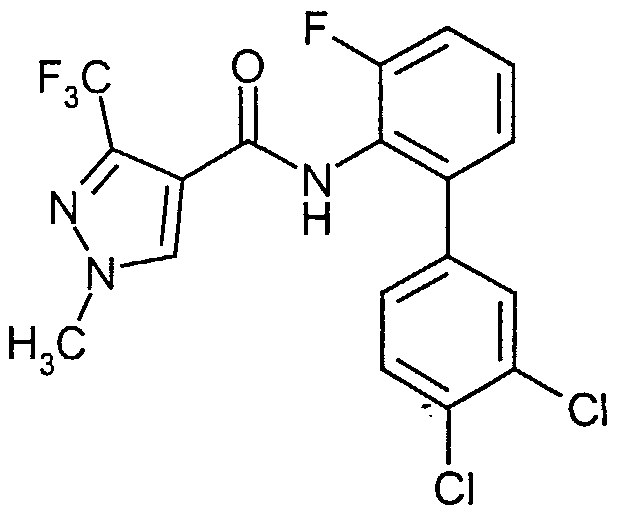
Verfahren a)Procedure a)
0,333 g (1,3 mmol) 3\4'-Dichlor-3-fluor-l,l'-biphenyl-2-amin und 0,33 g (1,56 mmol) l-Methyl-3 -(trifluormethyl)- lH-pyrazol-4-carbonylchlorid werden in 6 ml Tetrahydrofuran gelöst und mit 0,36 ml (2,6 mmol) Triethylamin versetzt. Die Reaktionslösung wird 16 Stunden bei 60°C gerührt. Zur Aufarbeitung wird aufkon- zentriert und mit Cyclohexan/Essigsäureethylester an Kieselgel chromatographiert.0.333 g (1.3 mmol) 3 \ 4'-dichloro-3-fluoro-l, l'-biphenyl-2-amine and 0.33 g (1.56 mmol) l-methyl-3 - (trifluoromethyl) - 1H-pyrazole-4-carbonyl chloride is dissolved in 6 ml of tetrahydrofuran and 0.36 ml (2.6 mmol) of triethylamine are added. The reaction solution is stirred at 60 ° C for 16 hours. For working up, concentrate and chromatograph on silica gel using cyclohexane / ethyl acetate.
Man erhält 0,39 g (72 % d. Th.) N-(3',4'-Dichlor-3-fluor-l,l'-biphenyl-2-yl)-l- methyl-3-(trifluormethyl)-lH-pyrazol-4-carboxamid mit dem logP (pH2,3) = 3.10.0.39 g (72% of theory) of N- (3 ', 4'-dichloro-3-fluoro-l, l'-biphenyl-2-yl) -l-methyl-3- (trifluoromethyl) is obtained -lH-pyrazole-4-carboxamide with the logP (pH2.3) = 3.10.
Beispiel 2Example 2
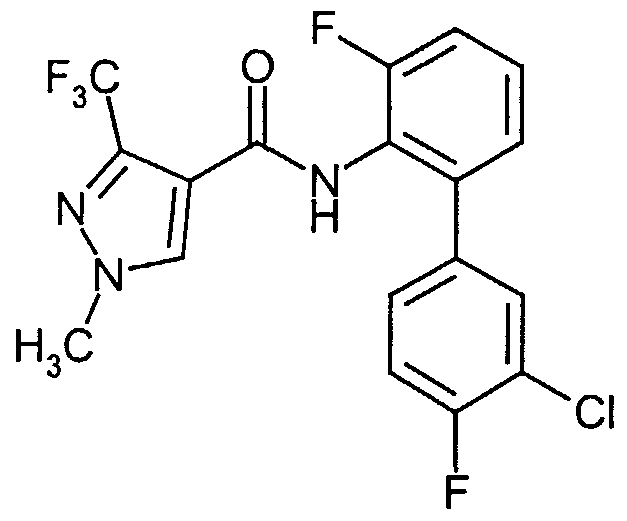
Verfahren b)Procedure b)
0,256 g (0,7 mmol) N-(2-Brom-6-fluoφhenyl)-l-methyl-3 -(trifluormethyl)- lH-pyra- zol-4-carboxamid und 0,12 g (0,77 mmol) 3-Chlor-4-fluoφhenylboronsäure werden unter Ausschluss von Sauerstoff in einer Mischung aus 8 ml Toluol, 1,5 ml Ethanol und 5,25 ml gesättigter Natriumcarbonatlösung unter Argon suspendiert. Die Reaktionsmischung wird mit einer katalytischen Menge (0,01-0,3 Äquivalente) Tetrakis- (triphenylphosphin)palladium(O) versetzt und unter Argon eine Stunde auf 100°C erwärmt. Die organische Phase wird abgetrennt und die wässrige Phase mit Essig- säureethylester extrahiert. Die vereinigten organischen Phasen werden eingeengt und der Rückstand wird mit Cyclohexan/Essigsäureethylester (1 :1) an Kieselgel chroma- tographiert.0.256 g (0.7 mmol) of N- (2-bromo-6-fluorophenyl) -l-methyl-3 - (trifluoromethyl) - 1H-pyrazole-4-carboxamide and 0.12 g (0.77 mmol) 3-chloro-4-fluoφhenylboronic acid suspended in the absence of oxygen in a mixture of 8 ml of toluene, 1.5 ml of ethanol and 5.25 ml of saturated sodium carbonate solution under argon. The reaction mixture is mixed with a catalytic amount (0.01-0.3 equivalents) of tetrakis (triphenylphosphine) palladium (O) and heated to 100 ° C. for one hour under argon. The organic phase is separated off and the aqueous phase is extracted with ethyl acetate. The combined organic phases are concentrated and the residue is chromatographed on silica gel using cyclohexane / ethyl acetate (1: 1).
Man erhält 0,27 g (96 % d. Th.) N-ß'-Chlor-S^'-difluor-U'-biphenyl^-ylH- methyl-3-(trifluorethyl)-lH-pyrazol-4-carboxamid mit dem logP (pH2,3) = 3.04.0.27 g (96% of theory) of N-β'-chloro-S ^ '- difluoro-U'-biphenyl ^ -ylH-methyl-3- (trifluoroethyl) -IH-pyrazole-4-carboxamide are obtained with the logP (pH2.3) = 3.04.
Analog den Beispielen 1 und 2, sowie entsprechend den Angaben in den allgemeinen Beschreibungen der Verfahren a) und b), werden die in der nachstehenden Tabelle 1 genannten Verbindungen der Formel (I) erhalten.Analogously to Examples 1 and 2, and in accordance with the information in the general descriptions of processes a) and b), the compounds of the formula (I) listed in Table 1 below are obtained.
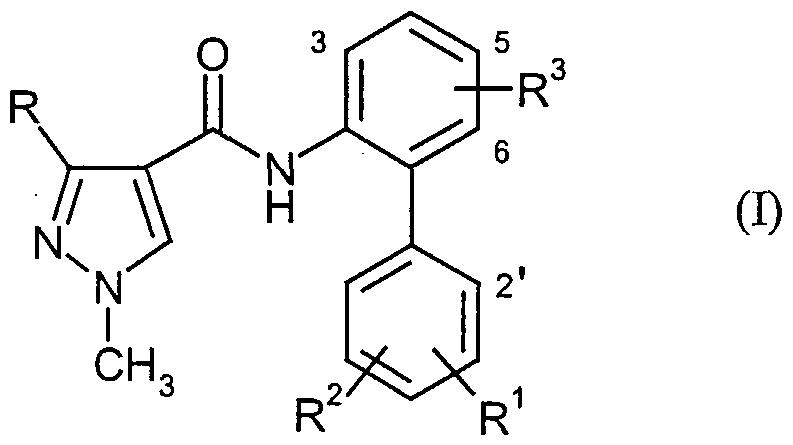
Tabelle 1Table 1
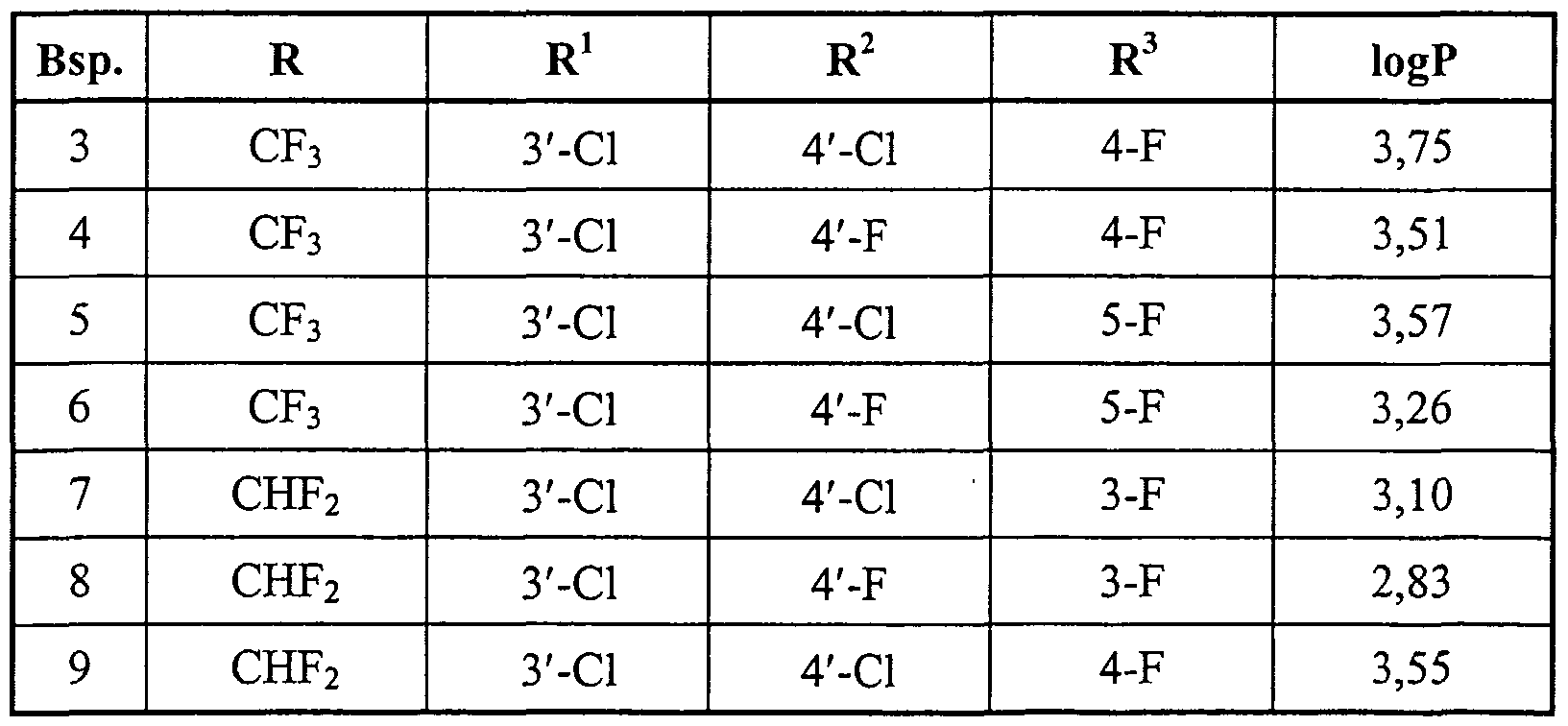
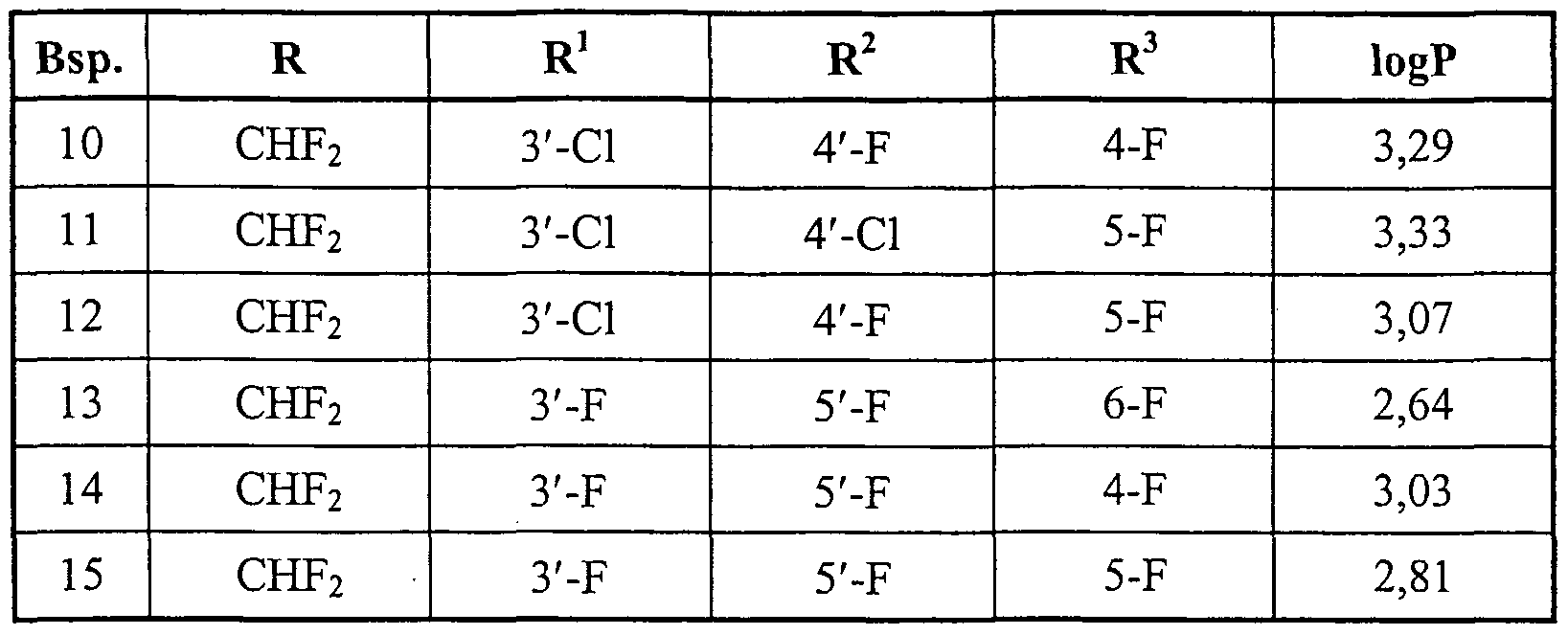
Herstellung eines Vorproduktes der Formel (III)Preparation of a precursor of formula (III)
Beispiel (m-1)Example (m-1)

Verfahren d)Procedure d)
51,2 g (0,268 mol) 3,4-Dichloφhenylboronsäure und 42,5 g (0,223 mol) 2-Brom-6- fluoranilin werden unter Ausschluss von Sauerstoff in einer Mischung aus 300 ml Toluol, 30 ml Ethanol und 220 ml gesättigter Natriumcarbonatlösung unter Argon suspendiert. Die Reaktionsmischung wird mit 2,6 g Tetrakis(triphenylphosphin)- palladium(O) versetzt und 12 Stunden bei 80°C gerührt. Die organische Phase wird abgetrennt und die wässrige Phase mit Essigsäureethylester extrahiert. Die vereinigten organischen Phasen werden eingeengt und der Rückstand wird mit Cyclohexan/Essigsäureethylester (3 : 1 ) an Kieselgel chromatographiert.51.2 g (0.268 mol) of 3,4-dichlorophenylboronic acid and 42.5 g (0.223 mol) of 2-bromo-6-fluoroaniline are in the absence of oxygen in a mixture of 300 ml of toluene, 30 ml of ethanol and 220 ml of saturated sodium carbonate solution suspended under argon. 2.6 g of tetrakis (triphenylphosphine) palladium (O) are added to the reaction mixture and the mixture is stirred at 80 ° C. for 12 hours. The organic phase is separated off and the aqueous phase is extracted with ethyl acetate. The combined organic phases are concentrated and the residue is chromatographed on silica gel using cyclohexane / ethyl acetate (3: 1).
Man erhält 37,4 g (65 % d. Th.) 3',4'-Dichlor-3-fluor-l,r-biphenyl-2-amin mit dem logP (pH2,3) = 4,09. Beispiel (TTι-2)37.4 g (65% of theory) of 3 ', 4'-dichloro-3-fluoro-l, r-biphenyl-2-amine with the logP (pH2.3) = 4.09 are obtained. Example (TTι-2)
Analog Beispiel (IQ-l) wurde 3',4'-Dichlor-5-fluor-l,r-biphenyl-2-amin mit dem logP (pH2,3) = 3,62 erhalten.Analogously to Example (IQ-1), 3 ', 4'-dichloro-5-fluoro-1, r-biphenyl-2-amine with the logP (pH2.3) = 3.62 was obtained.
Herstellung der Vorprodukte der Formel (IV)Preparation of the precursors of formula (IV)
Beispiel (TV-1)Example (TV-1)
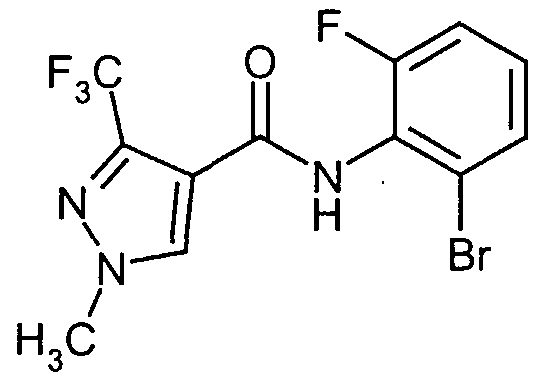
Verfahren e)Procedure e)
1,0 g (5,6 mmol) 2-Brom-6-fluoranilin werden in 5 ml Toluol gelöst und mit einer1.0 g (5.6 mmol) of 2-bromo-6-fluoroaniline are dissolved in 5 ml of toluene and washed with a
Lösung von 0,6 g (2,8 mmol) l-Methyl-3 -(trifluormethyl)- lH-pyrazol-4-carbonyl- chlorid in 2 ml Toluol versetzt. Die Reaktionslösung wird 12 Stunden unter Rück- fluss erhitzt. Zur Aufreinigung wird die Reaktionsmischung über eine kombinierteSolution of 0.6 g (2.8 mmol) of l-methyl-3 - (trifluoromethyl) - 1H-pyrazole-4-carbonyl chloride in 2 ml of toluene. The reaction solution is heated under reflux for 12 hours. For purification, the reaction mixture is combined
Säule bestehend aus saurem Anionentauscher und Kieselgel mit Essigsäureethylester eluiert.Column consisting of acidic anion exchanger and silica gel eluted with ethyl acetate.
Man erhält 0,57 g (55,6 % d. Th.) N-(2-Brom-6-fluoφhenyl)-l-methyl-3-(trifluor- ethyl)- lH-pyrazol-4-carboxamid mit dem logP (pH2,3) = 2,12.0.57 g (55.6% of theory) of N- (2-bromo-6-fluorophenyl) -l-methyl-3- (trifluoro-ethyl) - 1H-pyrazole-4-carboxamide with the logP are obtained (pH2.3) = 2.12.
Analog Beispiel (TV-1) sowie entsprechend den Angaben in der allgemeinen Beschreibungen des Verfahrens e), werden die in der nachstehenden Tabelle 2 genannten Verbindungen der Formel (IV) erhalten.
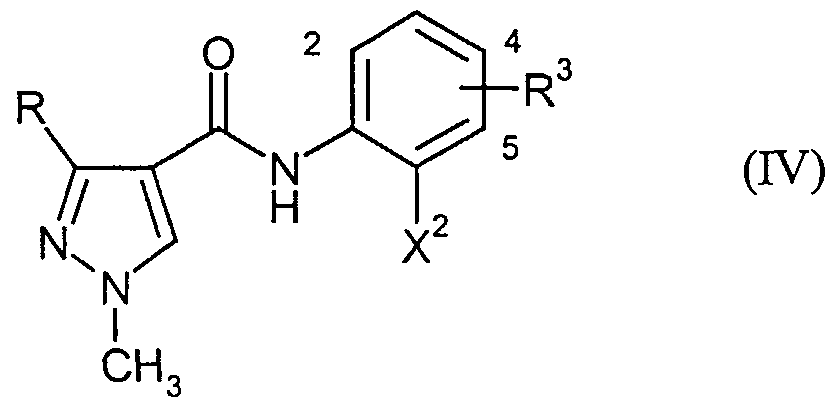
Tabelle 2Table 2
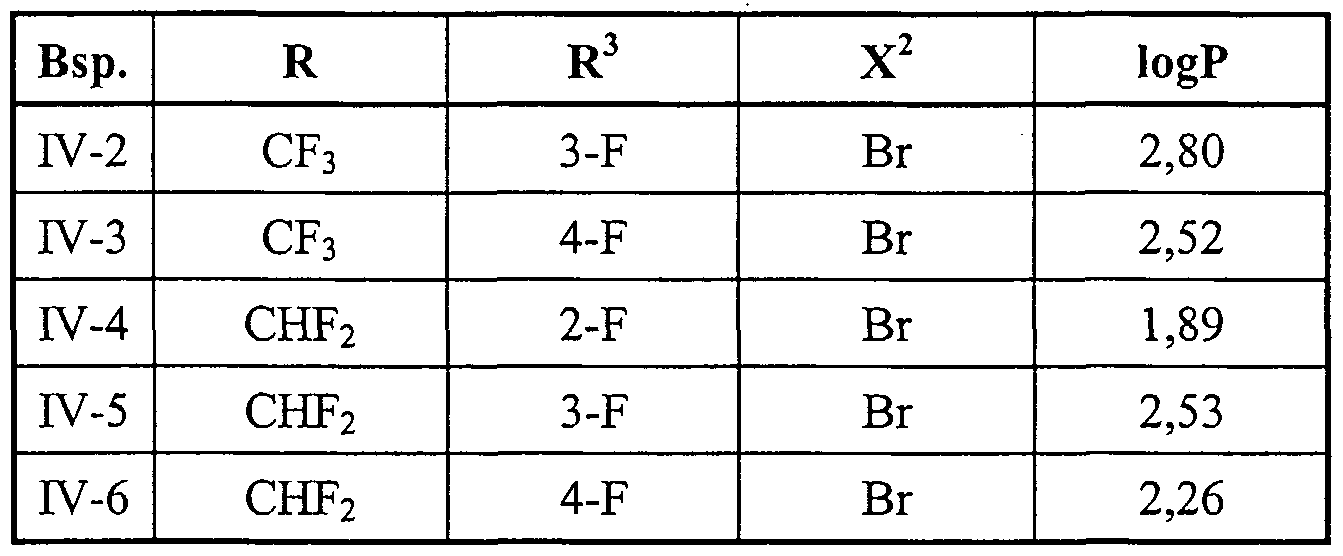
Die Bestimmung der in den voranstehenden Tabellen und Herstellungsbeispielen angegebenen logP-Werte erfolgt gemäß EEC-Directive 79/831 Annex V.A8 durch HPLC (High Performance Liquid Chromatography) an einer Phasenumkehrsäule (C 18). Temperatur: 43°C.The logP values specified in the tables and manufacturing examples above are determined in accordance with EEC Directive 79/831 Annex V.A8 by HPLC (High Performance Liquid Chromatography) on a phase reversal column (C 18). Temperature: 43 ° C.
Die Bestimmung erfolgt im sauren Bereich bei pH 2.3 mit 0,1 % wässriger Phosphorsäure und Acetonitril als Eluenten; linearer Gradient von 10 % Acetonitril bis 90 % Acetonitril.The determination is carried out in the acidic range at pH 2.3 with 0.1% aqueous phosphoric acid and acetonitrile as eluents; linear gradient from 10% acetonitrile to 90% acetonitrile.
Die Eichung erfolgt mit unverzweigten Alkan-2-onen (mit 3 bis 16 Kohlenstoff- atomen), deren logP- Werte bekannt sind (Bestimmung der logP-Werte anhand derThe calibration is carried out with unbranched alkan-2-ones (with 3 to 16 carbon atoms), the logP values of which are known (determination of the logP values using the
Retentionszeiten durch lineare Inteφolation zwischen zwei aufeinanderfolgenden Alkanonen).Retention times by linear interpolation between two consecutive alkanones).
Die lambda-max- Werte wurden an Hand der UV-Spektren von 200 nm bis 400 nm in den Maxima der chromatographischen Signale ermittelt. AnwendungsbeispieleThe lambda max values were determined using the UV spectra from 200 nm to 400 nm in the maxima of the chromatographic signals. applications
Beispiel AExample A
Podosphaera-Test (Apfel) / protektivPodosphaera test (apple) / protective
Lösungsmittel: 24,5 Gewichtsteile AcetonSolvent: 24.5 parts by weight of acetone
24,5 Gewichtsteile Dimethylacetamid Emulgator: 1 ,0 Gewichtsteile Alkyl-Aryl-Polyglykolether24.5 parts by weight of dimethylacetamide emulsifier: 1.0 part by weight of alkyl aryl polyglycol ether
Zur Herstellung einer zweckmäßigen Wirkstoffzubereitung vermischt man 1 Gewichtsteil Wirkstoff mit den angegebenen Mengen Lösungsmittel und Emulgator und verdünnt das Konzentrat mit Wasser auf die gewünschte Konzentration.To produce a suitable preparation of active compound, 1 part by weight of active compound is mixed with the stated amounts of solvent and emulsifier, and the concentrate is diluted with water to the desired concentration.
Zur Prüfung auf protektive Wirksamkeit werden junge Pflanzen mit der Wirkstoffzubereitung in der angegebenen Aufwandmenge besprüht. Nach Antrocknen des Spritzbelages werden die Pflanzen mit einer wässrigen Sporensuspension des Apfelmehltauerregers Podosphaera leucotricha inokuliert. Die Pflanzen werden dann im Gewächshaus bei ca. 23 °C und einer relativen Luftfeuchtigkeit von ca. 70 % aufgestellt.To test for protective activity, young plants are sprayed with the active compound preparation in the stated application rate. After the spray coating has dried on, the plants are inoculated with an aqueous spore suspension of the pod mildew pathogen Podosphaera leucotricha. The plants are then placed in the greenhouse at about 23 ° C. and a relative humidity of about 70%.
10 Tage nach der Inokulation erfolgt die Auswertung. Dabei bedeutet 0 % ein Wirkungsgrad, der demjenigen der Kontrolle entspricht, während ein Wirkungsgrad von 100 % bedeutet, dass kein Befall beobachtet wird.Evaluation is carried out 10 days after the inoculation. 0% means an efficiency that corresponds to that of the control, while an efficiency of 100% means that no infection is observed.
Wirkstoffe, Aufwandmengen und Versuchsergebnisse gehen aus der folgendenActive ingredients, application rates and test results come from the following
Tabelle hervor. Tabelle ATable. Table A
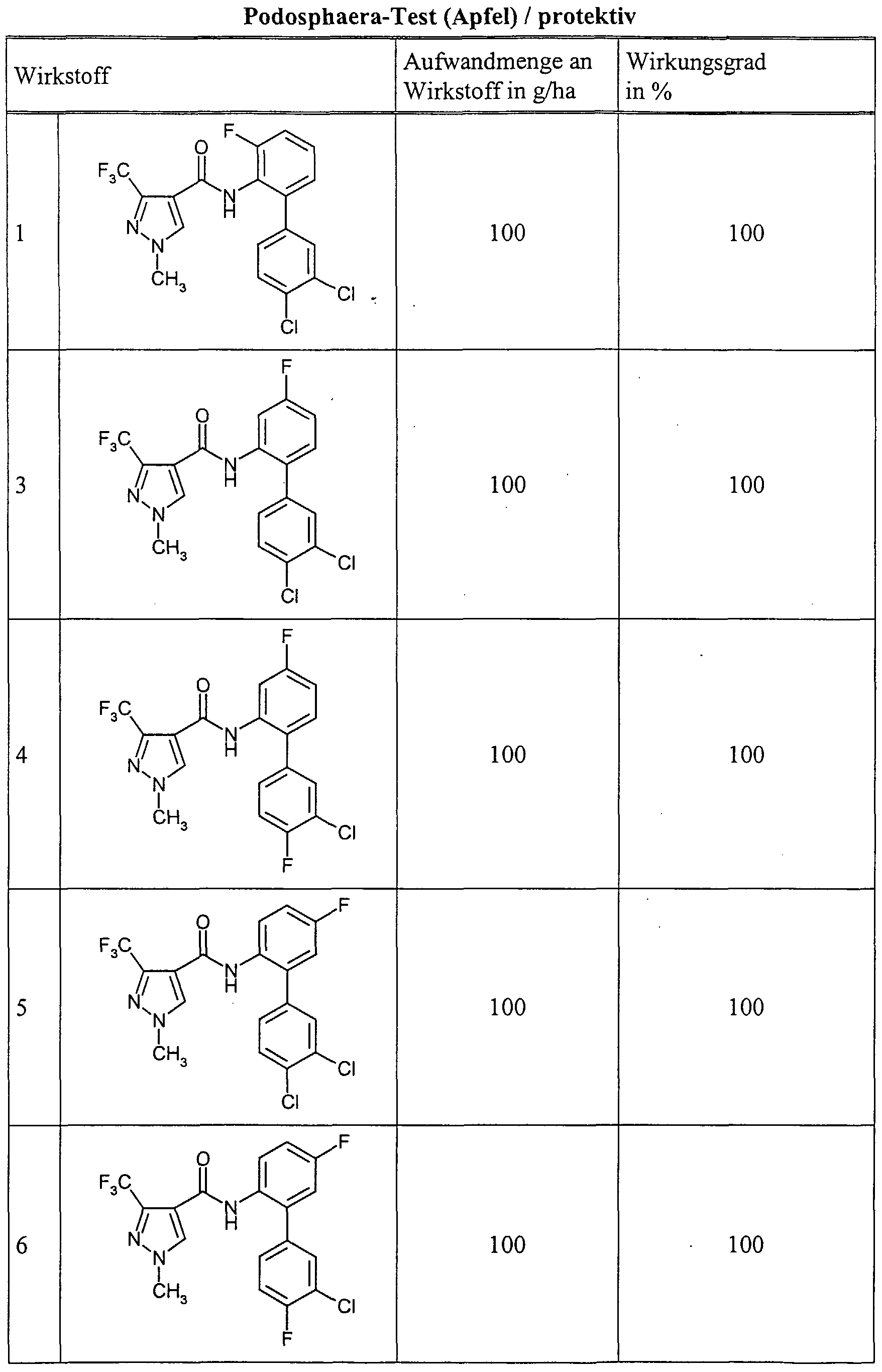
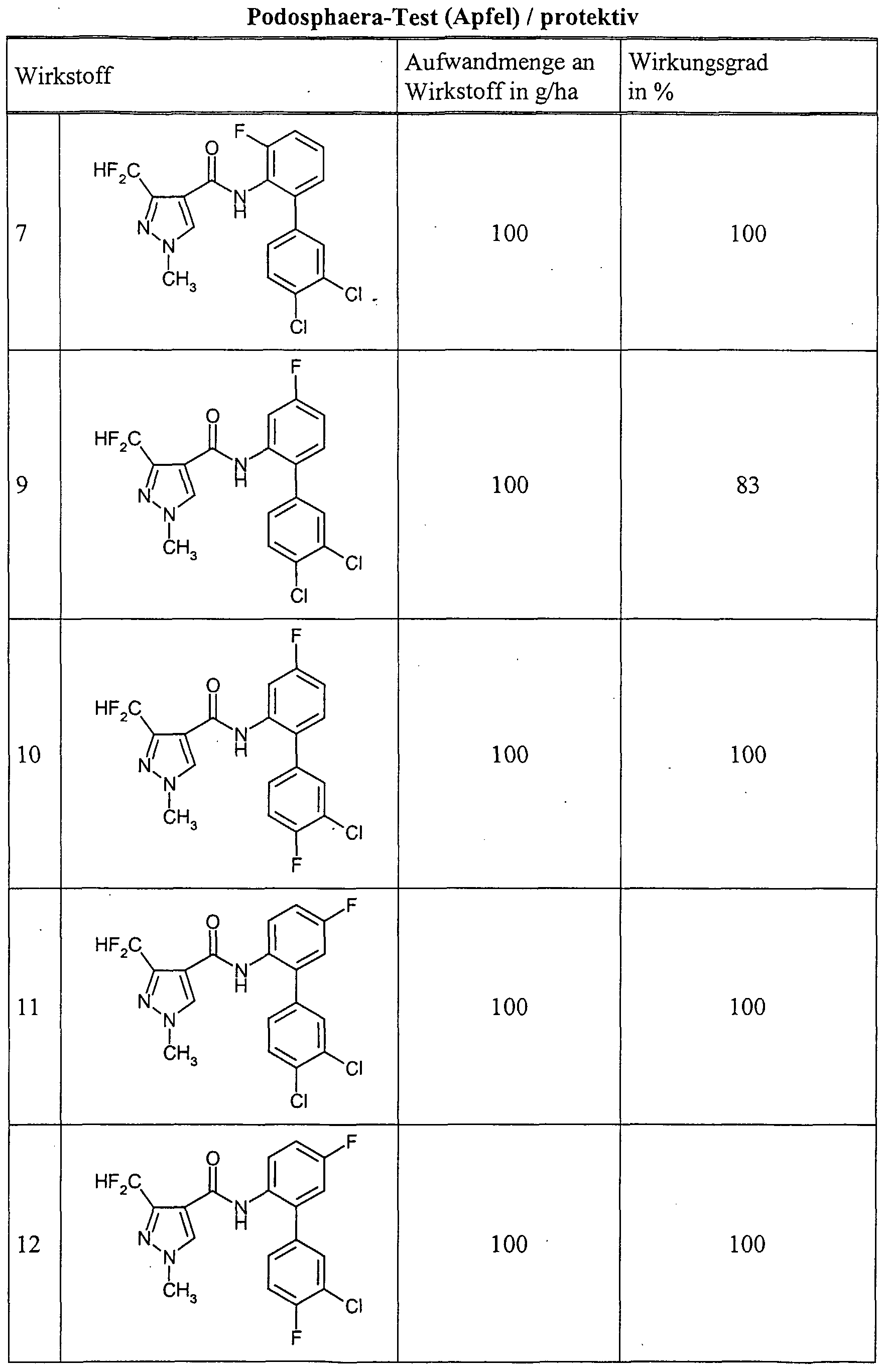
Sphaerotheca-Test (Gurke) / protektivSphaerotheca test (cucumber) / protective
Lösungsmittel: 24,5 Gewichtsteile AcetonSolvent: 24.5 parts by weight of acetone
24,5 Gewichtsteile Dimethylacetamid Emulgator: 1,0 Gewichtsteile Alkyl-Aryl-Polyglykolether24.5 parts by weight of dimethylacetamide emulsifier: 1.0 part by weight of alkyl aryl polyglycol ether
Zur Herstellung einer zweckmäßigen Wirkstoffzubereitung vermischt man 1 Ge- wichtsteil Wirkstoff mit den angegebenen Mengen Lösungsmittel und Emulgator und verdünnt das Konzentrat mit Wasser auf die gewünschte Konzentration.To produce a suitable preparation of active compound, 1 part by weight of active compound is mixed with the stated amounts of solvent and emulsifier and the concentrate is diluted with water to the desired concentration.
Zur Prüfung auf protektive Wirksamkeit werden junge Pflanzen mit der Wirkstoffzubereitung in der angegebenen Aufwandmenge besprüht. Nach Antrocknen des Spritzbelages werden die Pflanzen mit einer wässrigen Sporensuspension vonTo test for protective activity, young plants are sprayed with the active compound preparation in the stated application rate. After the spray coating has dried on, the plants are washed with an aqueous spore suspension of
Sphaerotheca fuliginea inokuliert. Die Pflanzen werden dann bei ca. 23 °C und einer relativen Luftfeuchtigkeit von ca. 70 % im Gewächshaus aufgestellt.Sphaerotheca fuliginea inoculated. The plants are then placed in the greenhouse at about 23 ° C. and a relative atmospheric humidity of about 70%.
7 Tage nach der Inokulation erfolgt die Auswertung. Dabei bedeutet 0 % ein Wir- kungsgrad, der demjenigen der Kontrolle entspricht, während ein Wirkungsgrad vonEvaluation is carried out 7 days after the inoculation. 0% means an efficiency that corresponds to that of the control, while an efficiency of
100 % bedeutet, dass kein Befall beobachtet wird.100% means that no infection is observed.
Wirkstoffe, Aufwandmengen und Versuchsergebnisse gehen aus der folgenden Tabelle hervor. Tabelle BActive substances, application rates and test results are shown in the following table. Table B
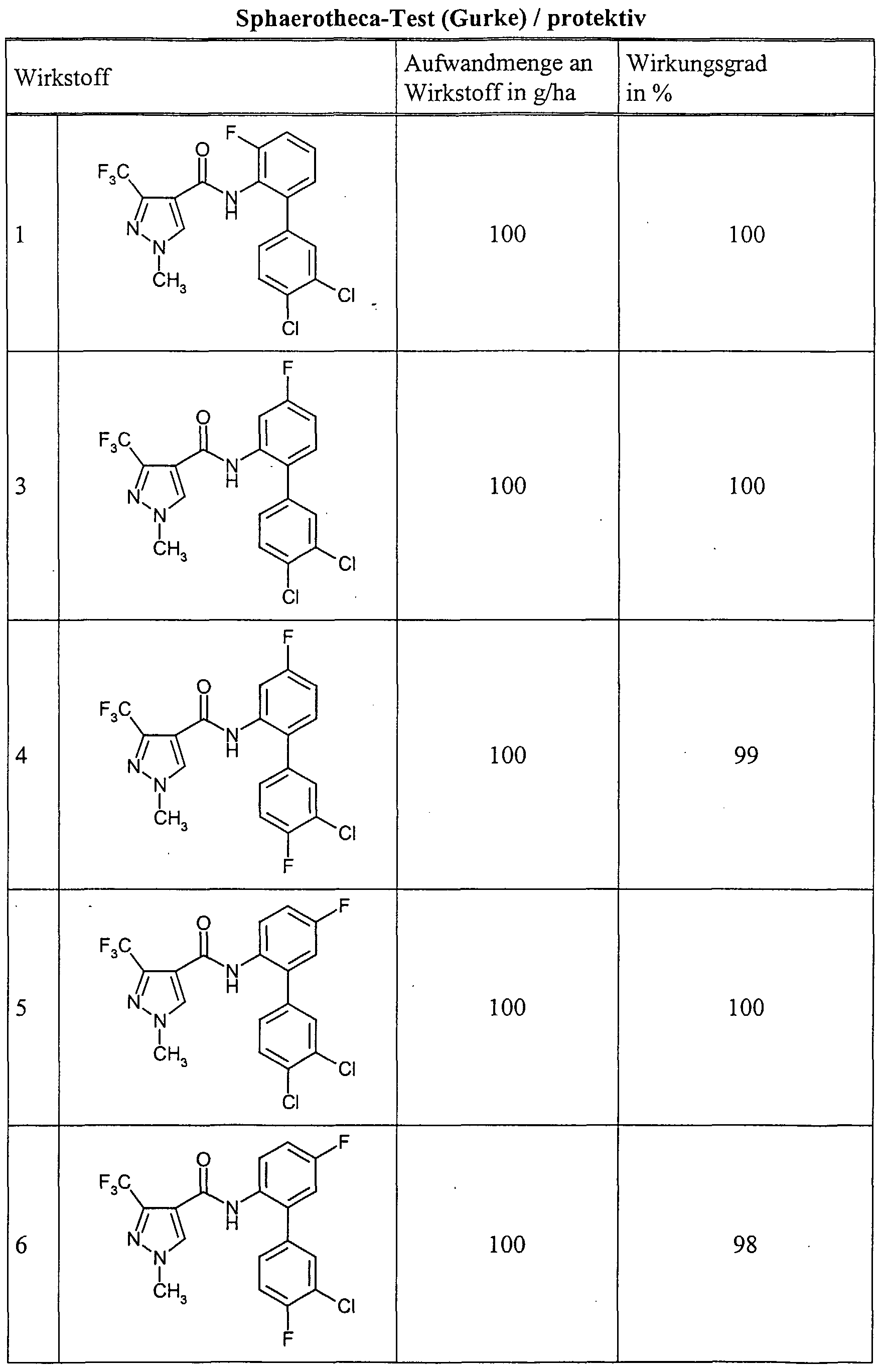

Venturia - Test (Apfel) / protektivVenturia test (apple) / protective
Lösungsmittel: 24,5 Gewichtsteile AcetonSolvent: 24.5 parts by weight of acetone
24,5 Gewichtsteile Dimethylacetamid Emulgator: 1 ,0 Gewichtsteile Alkyl-Aryl-Polyglykolether24.5 parts by weight of dimethylacetamide emulsifier: 1.0 part by weight of alkyl aryl polyglycol ether
Zur Herstellung einer zweckmäßigen Wirkstoffzubereitung vermischt man 1 Ge- wichtsteil Wirkstoff mit den angegebenen Mengen Lösungsmittel und Emulgator und verdünnt das Konzentrat mit Wasser auf die gewünschte Konzentration.To produce a suitable preparation of active compound, 1 part by weight of active compound is mixed with the stated amounts of solvent and emulsifier and the concentrate is diluted with water to the desired concentration.
Zur Prüfung auf protektive Wirksamkeit werden junge Pflanzen mit der Wirkstoffzubereitung in der angegebenen Aufwandmenge besprüht. Nach Antrocknen des Spritz- belages werden die Pflanzen mit einer wässrigen Konidiensuspension des Apfelschorferregers Venturia inaequalis inokuliert und verbleiben dann 1 Tag bei ca. 20°C und 100 % relativer Luftfeuchtigkeit in einer Inkubationskabine.To test for protective activity, young plants are sprayed with the active compound preparation in the stated application rate. After the spray coating has dried on, the plants are inoculated with an aqueous conidia suspension of the Venturia inaequalis apple scab pathogen and then remain in an incubation cabin at about 20 ° C. and 100% relative atmospheric humidity for 1 day.
Die Pflanzen werden dann im Gewächshaus bei ca. 21°C und einer relativen Luft- feuchtigkeit von ca. 90 % aufgestellt.The plants are then placed in a greenhouse at approx. 21 ° C and a relative humidity of approx. 90%.
10 Tage nach der Inokulation erfolgt die Auswertung. Dabei bedeutet 0 % ein Wirkungsgrad, der demjenigen der Kontrolle entspricht, während ein Wirkungsgrad von 100 % bedeutet, dass kein Befall beobachtet wird.Evaluation is carried out 10 days after the inoculation. 0% means an efficiency that corresponds to that of the control, while an efficiency of 100% means that no infection is observed.
Wirkstoffe, Aufwandmengen und Versuchsergebnisse gehen aus der folgenden Tabelle hervor. Tabelle CActive substances, application rates and test results are shown in the following table. Table C.


Alternaria-Test (Tomate) / protektivAlternaria test (tomato) / protective
Lösungsmittel: 49 Gewichtsteile N,N-DimethylformamidSolvent: 49 parts by weight of N, N-dimethylformamide
Emulgator: 1 Gewichtsteil AlkylarylpolyglykoletherEmulsifier: 1 part by weight of alkylaryl polyglycol ether
Zur Herstellung einer zweckmäßigen Wirkstoffzubereitung vermischt man 1 Gewichtsteil Wirkstoff mit den angegebenen Mengen Lösungsmittel und Emulgator und verdünnt das Konzentrat mit Wasser auf die gewünschte Konzentration.To produce a suitable preparation of active compound, 1 part by weight of active compound is mixed with the stated amounts of solvent and emulsifier, and the concentrate is diluted with water to the desired concentration.
Zur Prüfung auf protektive Wirksamkeit bespritzt man junge Tomatenpflanzen mit der Wirkstoffzubereitung in der angegebenen Aufwandmenge. 1 Tag nach der Behandlung werden die Pflanzen mit einer Sporensuspension von Alternaria solani in- okuliert und stehen dann 24h bei 100% rel. Feuchte und 20°C. Anschließend stehen die Pflanzen bei 96 % relativer Luftfeuchtigkeit und einer Temperatur von 20°C.To test for protective activity, young tomato plants are sprayed with the preparation of active compound in the stated application rate. 1 day after the treatment, the plants are inoculated with a spore suspension of Alternaria solani and then stand at 100% rel. Humidity and 20 ° C. The plants then stand at 96% relative humidity and a temperature of 20 ° C.
7 Tage nach der Inokulation erfolgt die Auswertung. Dabei bedeutet 0 % ein Wirkungsgrad, der demjenigen der Kontrolle entspricht, während ein Wirkungsgrad von 100 % bedeutet, dass kein Befall beobachtet wird.Evaluation is carried out 7 days after the inoculation. 0% means an efficiency that corresponds to that of the control, while an efficiency of 100% means that no infection is observed.
Wirkstoffe, Aufwandmengen und Versuchsergebnisse gehen aus der folgenden Tabelle hervor. Active substances, application rates and test results are shown in the following table.
Tabelle DTable D


Claims

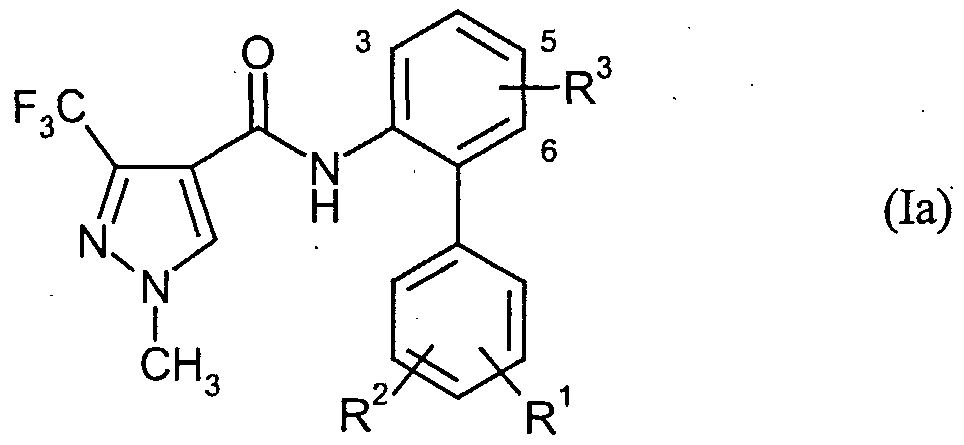


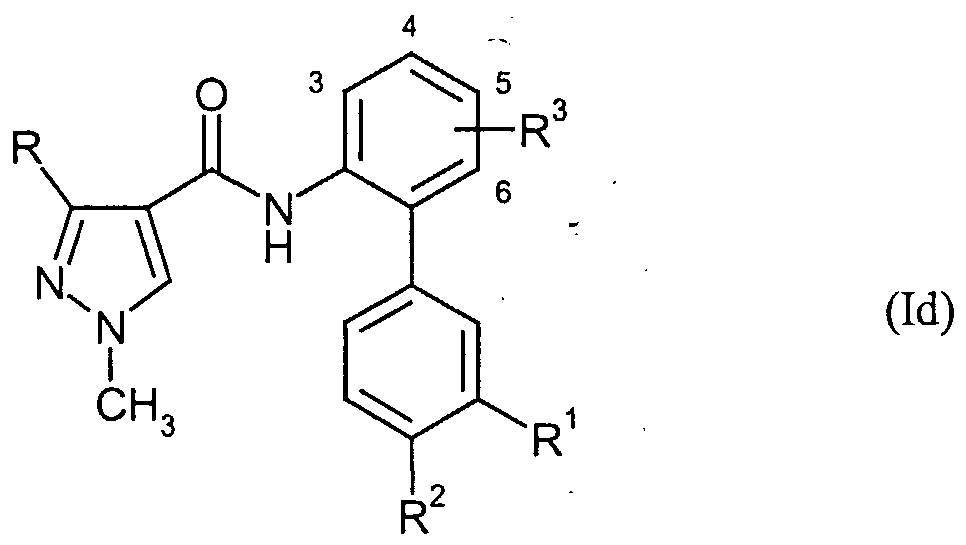

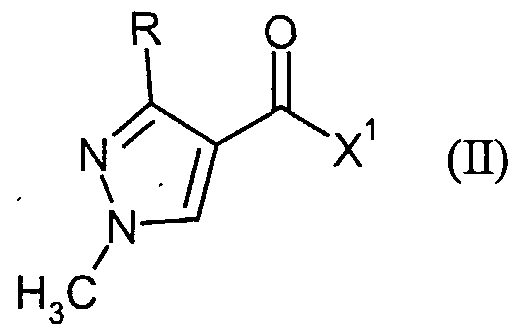


Priority Applications (18)
| Application Number | Priority Date | Filing Date | Title |
|---|---|---|---|
| KR1020047012536A KR101035422B1 (en) | 2002-02-19 | 2003-02-06 | Disubstituted pyrazolyl carboxanilides |
| US10/504,451 US7329633B2 (en) | 2002-02-19 | 2003-02-06 | Disubstituted pyrazolylcarboxanilides |
| CA2476462A CA2476462C (en) | 2002-02-19 | 2003-02-06 | Disubstituted pyrazolylcarboxanilides |
| JP2003569612A JP4611636B2 (en) | 2002-02-19 | 2003-02-06 | Disubstituted pyrazolylcarboxanilide |
| EP03742451A EP1490342B8 (en) | 2002-02-19 | 2003-02-06 | Disubstituted pyrazolyl carboxanilides |
| NZ534710A NZ534710A (en) | 2002-02-19 | 2003-02-06 | Disubstituted pyrazolyl carboxanilides |
| BRPI0307787-0B1A BR0307787B1 (en) | 2002-02-19 | 2003-02-06 | disubstituted pyrazolylcarboxanilides, their preparation process, their application and intermediates, process and composition for combating unwanted microorganisms and their preparation process |
| AT03742451T ATE491691T1 (en) | 2002-02-19 | 2003-02-06 | DISUBSTITUTED PYRAZOLYLCARBOXANILIDES |
| DK03742451.2T DK1490342T3 (en) | 2002-02-19 | 2003-02-06 | Disubstituted pyrazolylcarboxanilides |
| MXPA04007978A MXPA04007978A (en) | 2002-02-19 | 2003-02-06 | Disubstituted pyrazolyl carboxanilides. |
| DE50313324T DE50313324D1 (en) | 2002-02-19 | 2003-02-06 | DISUBSTITUTED PYRAZOLYL CARBOXANILIDES |
| AU2003246698A AU2003246698B2 (en) | 2002-02-19 | 2003-02-06 | Disubstituted pyrazolyl carboxanilides |
| UA20040907598A UA80115C2 (en) | 2002-02-19 | 2003-06-02 | Disubstituted pyrazolyl carboxanilides, agent based thereon, method for combating undesired microorganisms and intermediates |
| ZA2004/06487A ZA200406487B (en) | 2002-02-19 | 2004-08-16 | Disubstituted pyrazolyl carboxanilides |
| US11/891,769 US7521397B2 (en) | 2002-02-19 | 2007-08-13 | Disubstituted pyrazolyl carboxanilides |
| BE2012C003C BE2012C003I2 (en) | 2002-02-19 | 2012-01-10 | |
| FR12C0027C FR12C0027I2 (en) | 2002-02-19 | 2012-04-12 | PYRAZOLYL DISUBSTITUTED CARBOXANILIDES |
| NL350053C NL350053I2 (en) | 2002-02-19 | 2012-05-02 | Bixafen |
Applications Claiming Priority (4)
| Application Number | Priority Date | Filing Date | Title |
|---|---|---|---|
| DE10206794.5 | 2002-02-19 | ||
| DE10206794 | 2002-02-19 | ||
| DE10215292.6 | 2002-04-08 | ||
| DE10215292A DE10215292A1 (en) | 2002-02-19 | 2002-04-08 | New N-biphenylyl-1-methyl-3-(di- or trifluoromethyl)-1H-pyrazole-4-carboxamides, useful as microbicides, especially fungicides and bactericides for protection of plants or materials such as wood |
Related Child Applications (2)
| Application Number | Title | Priority Date | Filing Date |
|---|---|---|---|
| US10504451 A-371-Of-International | 2003-02-06 | ||
| US11/891,769 Continuation US7521397B2 (en) | 2002-02-19 | 2007-08-13 | Disubstituted pyrazolyl carboxanilides |
Publications (1)
| Publication Number | Publication Date |
|---|---|
| WO2003070705A1 true WO2003070705A1 (en) | 2003-08-28 |
Family
ID=27635119
Family Applications (1)
| Application Number | Title | Priority Date | Filing Date |
|---|---|---|---|
| PCT/EP2003/001178 Ceased WO2003070705A1 (en) | 2002-02-19 | 2003-02-06 | Disubstituted pyrazolyl carboxanilides |
Country Status (24)
| Country | Link |
|---|---|
| US (2) | US7329633B2 (en) |
| EP (1) | EP1490342B8 (en) |
| JP (1) | JP4611636B2 (en) |
| KR (1) | KR101035422B1 (en) |
| CN (1) | CN100503577C (en) |
| AT (1) | ATE491691T1 (en) |
| AU (1) | AU2003246698B2 (en) |
| BE (1) | BE2012C003I2 (en) |
| BR (1) | BR0307787B1 (en) |
| CA (1) | CA2476462C (en) |
| CO (1) | CO5611063A2 (en) |
| CR (1) | CR7439A (en) |
| DE (2) | DE10215292A1 (en) |
| DK (1) | DK1490342T3 (en) |
| ES (1) | ES2356436T3 (en) |
| FR (1) | FR12C0027I2 (en) |
| MX (1) | MXPA04007978A (en) |
| NL (1) | NL350053I2 (en) |
| NZ (1) | NZ534710A (en) |
| PL (1) | PL215542B1 (en) |
| RU (1) | RU2316549C9 (en) |
| UA (1) | UA80115C2 (en) |
| WO (1) | WO2003070705A1 (en) |
| ZA (1) | ZA200406487B (en) |
Cited By (139)
| Publication number | Priority date | Publication date | Assignee | Title |
|---|---|---|---|---|
| WO2005044804A1 (en) | 2003-10-31 | 2005-05-19 | Bayer Cropscience Gmbh | Method for the production of fluoromethyl-substituted heterocycles |
| WO2005104844A1 (en) * | 2004-04-27 | 2005-11-10 | Bayer Cropscience Aktiengesellschaft | Use of alkykl carboxylic acid amides as penetration promoters |
| WO2005123689A1 (en) * | 2004-06-18 | 2005-12-29 | Basf Aktiengesellschaft | 1-methyl-3-trifluoromethyl-pyrazole-4-carboxylic acid (ortho-phenyl)-anilides and to use thereof as fungicide |
| WO2005123690A1 (en) * | 2004-06-18 | 2005-12-29 | Basf Aktiengesellschaft | 1-methyl-3-difluoromethyl-pyrazol-4-carbonic acid-(ortho-phenyl)-anilides, and use thereof as a fungicide |
| WO2006024388A1 (en) * | 2004-08-27 | 2006-03-09 | Bayer Cropscience Ag | Method for the production of biphenylamines |
| WO2006037634A1 (en) * | 2004-10-08 | 2006-04-13 | Syngenta Participations Ag | Fungicidal compositions |
| WO2006087343A1 (en) | 2005-02-16 | 2006-08-24 | Basf Aktiengesellschaft | Pyrazole carboxylic acid anilides, method for the production thereof and agents containing them for controlling pathogenic fungi |
| WO2006092213A1 (en) * | 2005-03-02 | 2006-09-08 | Bayer Cropscience Ag | Pyrazolylcarboxanilides |
| WO2006120219A1 (en) * | 2005-05-11 | 2006-11-16 | Basf Aktiengesellschaft | Pyrazolocarboxamides as fungicides |
| WO2007031141A1 (en) | 2005-07-28 | 2007-03-22 | Bayer Cropscience Aktiengesellschaft | Synergistic fungicidal active substance combinations containing a carboxamide, an azole, a second azole or a strobilurine |
| WO2007068376A1 (en) * | 2005-12-17 | 2007-06-21 | Bayer Cropscience Ag | Biphenyl carboxamides for controlling micro-organisms |
| WO2007068373A1 (en) * | 2005-12-17 | 2007-06-21 | Bayer Cropscience Ag | Carboxamides |
| WO2007068375A1 (en) * | 2005-12-17 | 2007-06-21 | Bayer Cropscience Ag | Carboxamides for controlling undesired micro-organisms in plant protection |
| WO2007068377A1 (en) * | 2005-12-17 | 2007-06-21 | Bayer Cropscience Ag | Carboxamides for controlling micro-organisms in plant and material protection |
| WO2007071656A1 (en) * | 2005-12-20 | 2007-06-28 | Basf Aktiengesellschaft | Method for controlling rusting in leguminous plants |
| WO2006131221A3 (en) * | 2005-06-07 | 2007-08-23 | Bayer Cropscience Ag | Carboxamides |
| WO2007115685A1 (en) * | 2006-04-07 | 2007-10-18 | Bayer Cropscience Ag | Method for producing biphenylamines from vinyl anilines |
| WO2007128756A1 (en) * | 2006-05-03 | 2007-11-15 | Basf Se | Use of arylcarboxylic acid biphenylamides for seed treatment |
| WO2007068370A3 (en) * | 2005-12-17 | 2008-03-13 | Bayer Cropscience Ag | Pyrazolyl carboxamides |
| WO2008014905A3 (en) * | 2006-08-03 | 2008-04-17 | Bayer Cropscience Ag | 3-difluoromethylpyrazolylcarboxanilides |
| WO2008077907A1 (en) * | 2006-12-21 | 2008-07-03 | Basf Se | Process for preparing fluoromethyl-substituted heterocyclic compounds |
| WO2008053044A3 (en) * | 2006-11-03 | 2008-09-12 | Basf Se | Hetaryl carbon acid-n-(biphen-2-yl)amide compounds |
| DE102007016971A1 (en) | 2007-04-10 | 2008-10-16 | Saltigo Gmbh | 2-nitro-5-fluoro-3 ', 4'-dichlorobiphenyl and a process for its preparation |
| WO2008145740A1 (en) * | 2007-06-01 | 2008-12-04 | Basf Se | Method for the production of n-substituted (3-dihalomethyl-1-methyl-pyrazole-4-yl) carboxamides |
| WO2008095890A3 (en) * | 2007-02-05 | 2009-01-08 | Basf Se | Fungicidal mixtures comprising substituted 1-methylpyrazol-4-ylcarboxanilides |
| WO2009003650A1 (en) | 2007-06-29 | 2009-01-08 | Bayer Cropscience Ag | Preparation of biaryls |
| EP2029519A1 (en) | 2006-06-01 | 2009-03-04 | Basf Se | Process for preparing substituted biphenyls |
| EP2039771A2 (en) | 2009-01-06 | 2009-03-25 | Bayer CropScience AG | Method for improved utilization of the production potential of transgenic plants |
| EP2053044A1 (en) | 2007-10-26 | 2009-04-29 | Syngenta Participations AG | Novel imidazole derivatives |
| EP2053045A1 (en) | 2007-10-26 | 2009-04-29 | Syngenta Participations AG | Novel imidazole derivatives |
| EP2071953A1 (en) | 2007-12-21 | 2009-06-24 | Bayer CropScience AG | Use of N-(3',4' dichlor-5-fluor-1, 1'-biphenyl-2-yl)-3-(difluormethyl)-1-methyl-1H-pyrazol-4-carboxamide (Bixafen) |
| WO2009090039A1 (en) | 2008-01-16 | 2009-07-23 | Syngenta Participations Ag | Pyridazine fungicides |
| EP2093216A1 (en) * | 2008-02-25 | 2009-08-26 | Bayer CropScience AG | Process for preparing substituted biphenylanilides |
| WO2008098928A3 (en) * | 2007-02-14 | 2009-08-27 | Basf Se | Method of inducing virus tolerance of plants |
| EP2100883A1 (en) | 2008-03-10 | 2009-09-16 | Bayer CropScience AG | Method for regioselective synthesis of 1-alkyl-3-haloalkyl-1-pyrazol-4-carbonic acid derivatives |
| EP2105049A1 (en) | 2008-03-28 | 2009-09-30 | Bayer CropScience AG | Method of plant growth promotion using amide compounds |
| WO2009135598A1 (en) * | 2008-05-09 | 2009-11-12 | Bayer Cropscience Ag | Process for preparing substituted biphenylanilides |
| EP2132989A2 (en) | 2005-06-09 | 2009-12-16 | Bayer CropScience AG | Agent combinations |
| EP2133341A1 (en) | 2008-02-25 | 2009-12-16 | Bayer CropScience AG | Method for regioselective synthesis of 1-alkyl-3-haloalkyl-1-pyrazol-4-carbonic acid derivatives |
| WO2010081645A2 (en) | 2009-01-15 | 2010-07-22 | Bayer Cropscience Aktiengesellschaft | Fungicidal active ingredient combinations |
| WO2010086103A2 (en) | 2009-01-30 | 2010-08-05 | Bayer Cropscience Aktiengesellschaft | Use of succinate dehydrogenase inhibitors for controlling powdery mildew primary infections |
| WO2009098223A3 (en) * | 2008-02-05 | 2010-08-12 | Basf Se | Plant health composition |
| WO2010091803A2 (en) | 2009-02-13 | 2010-08-19 | Bayer Cropscience Ag | Use of succinate dehydrogenase inhibitors for extending shelf life of fruits and vegetables |
| EP2220936A2 (en) | 2003-10-10 | 2010-08-25 | Bayer CropScience AG | Synergistic fungicidal combinations |
| WO2009098218A3 (en) * | 2008-02-05 | 2010-09-02 | Basf Se | Plant health composition |
| WO2010102866A1 (en) | 2009-03-12 | 2010-09-16 | Syngenta Participations Ag | Imidazole derivatives |
| WO2010130532A1 (en) | 2009-05-15 | 2010-11-18 | Syngenta Limited | Process for purification of 1-methylpyrazole-4-carboxylic acid esters |
| EP2255649A2 (en) | 2005-06-09 | 2010-12-01 | Bayer CropScience AG | Agent combinations |
| EP2255626A1 (en) | 2009-05-27 | 2010-12-01 | Bayer CropScience AG | Use of succinate dehydrogenase inhibitors to increase resistance of plants or parts of plants to abiotic stress |
| WO2011006603A2 (en) | 2009-07-16 | 2011-01-20 | Bayer Cropscience Ag | Synergistic active substance combinations containing phenyl triazoles |
| WO2011032657A2 (en) | 2009-09-16 | 2011-03-24 | Bayer Cropscience Ag | Use of succinate dehydrogenase inhibitors for increasing the content of desired ingredients in crops |
| EP2319319A1 (en) | 2007-09-20 | 2011-05-11 | Basf Se | Combinations comprising a fungicidal strain and at least one additional fungicide |
| WO2011069890A2 (en) | 2009-12-08 | 2011-06-16 | Basf Se | Pesticidal mixtures |
| WO2011069893A1 (en) | 2009-12-08 | 2011-06-16 | Basf Se | Pesticidal mixtures |
| WO2011073103A1 (en) | 2009-12-16 | 2011-06-23 | Bayer Cropscience Ag | Active compound combinations comprising proquinazid, bixafen and/or prothioconazole |
| WO2011076501A1 (en) | 2009-12-22 | 2011-06-30 | Syngenta Participations Ag | Novel 5-(pyridin-3-yl)-pyridanize derivatives and their use as microbicides |
| US7977363B2 (en) | 2004-08-27 | 2011-07-12 | Bayer Cropscience Ag | Biphenyl-thiazolo-carboxamides |
| EP2353387A1 (en) | 2010-02-05 | 2011-08-10 | Bayer CropScience AG | Use of succinate dehydrogenase (SDH) inhibitors in the treatment of plant types in the sweet grass family |
| WO2011095459A1 (en) | 2010-02-04 | 2011-08-11 | Syngenta Participations Ag | Pyridazine derivatives, process for their preparation and their use as fungicides |
| WO2011095461A1 (en) | 2010-02-04 | 2011-08-11 | Syngenta Participations Ag | Pyridazine derivatives, processes for their preparation and their use as fungicides |
| EP2356905A1 (en) | 2003-10-23 | 2011-08-17 | Bayer Cropscience AG | Synergetic fungicide substance combinations |
| EP2361015A2 (en) * | 2008-10-21 | 2011-08-31 | Basf Se | Use of carboxamides on cultivated plants |
| WO2011104183A1 (en) | 2010-02-24 | 2011-09-01 | Syngenta Participations Ag | Novel microbicides |
| WO2011108751A2 (en) | 2010-03-03 | 2011-09-09 | Sumitomo Chemical Company, Limited | Plant disease controlling composition and method for controlling plant disease |
| EP2377397A1 (en) | 2010-04-14 | 2011-10-19 | Bayer CropScience AG | Use of fungicidal agents for controlling mycoses in palm trees |
| WO2011147953A1 (en) | 2010-05-28 | 2011-12-01 | Basf Se | Pesticidal mixtures |
| WO2012001040A1 (en) | 2010-07-02 | 2012-01-05 | Syngenta Participations Ag | Novel microbiocidal dioxime ether derivatives |
| WO2012013590A2 (en) | 2010-07-26 | 2012-02-02 | Bayer Cropscience Ag | Use of succinate dehydrogenase inhibitors and/or respiratory chain complex iii inhibitors for improving the ratio of harmful to beneficial microorganisms |
| WO2012013754A1 (en) | 2010-07-29 | 2012-02-02 | Syngenta Participations Ag | Novel microbiocidal dioxime ether derivatives |
| US8115012B2 (en) | 2006-11-03 | 2012-02-14 | Basf Se | Process for preparing difluoromethylpyrazolyl carboxylates |
| WO2012020776A1 (en) | 2010-08-10 | 2012-02-16 | 住友化学株式会社 | Plant disease control composition and application for same |
| WO2012041874A1 (en) | 2010-10-01 | 2012-04-05 | Syngenta Participations Ag | Fungicidal compositions |
| US8153819B2 (en) * | 2005-08-05 | 2012-04-10 | Basf Se | Fungicidal mixtures comprising substituted 1-methylpyrazol-4-ylcarboxanilides |
| WO2012055864A1 (en) | 2010-10-27 | 2012-05-03 | Solvay Sa | Process for the preparation of pyrazole-4-carboxamides |
| WO2012066122A1 (en) | 2010-11-18 | 2012-05-24 | Syngenta Participations Ag | 2 - (pyridin- 2 -yl) -quinazoline derivatives and their use as microbicides |
| WO2012065947A1 (en) | 2010-11-15 | 2012-05-24 | Bayer Cropscience Ag | 5-halogenopyrazolecarboxamides |
| US8188295B2 (en) | 2007-06-15 | 2012-05-29 | Basf Se | Method for producing difluoromethyl-substituted pyrazole compounds |
| WO2012069652A2 (en) | 2010-11-26 | 2012-05-31 | Syngenta Participations Ag | Fungicide mixtures |
| US8207354B2 (en) | 2008-02-29 | 2012-06-26 | Basf Se | Process for preparing alkyl 2-alkoxymethylene-4,4-difluoro-3-oxobutyrates |
| WO2012084670A1 (en) | 2010-12-20 | 2012-06-28 | Basf Se | Pesticidal active mixtures comprising pyrazole compounds |
| WO2012110464A1 (en) | 2011-02-17 | 2012-08-23 | Bayer Cropscience Ag | Use of sdhi fungicides on conventionally bred asr-tolerant, stem canker resistant and/or frog-eye leaf spot resistant soybean varieties |
| US8258335B2 (en) | 2007-09-26 | 2012-09-04 | Bayer Cropscience Ag | Process for preparing 2-dihaloacyl-3-aminoacrylic acid derivatives |
| US8314233B2 (en) | 2008-05-02 | 2012-11-20 | Basf Se | Process for preparing 2-(aminomethylidene)-4,4-difluoro-3-oxobutyric esters |
| EP2233000A3 (en) * | 2007-09-12 | 2012-12-12 | Bayer CropScience AG | Post-harvest treatment |
| WO2012175511A1 (en) | 2011-06-21 | 2012-12-27 | Bayer Intellectual Property Gmbh | Method for producing pyrazolylcarboxanilides |
| US8344157B2 (en) | 2008-07-21 | 2013-01-01 | Basf Se | Process for preparing 1,3-disubstituted pyrazolecarboxylic esters |
| US8350046B2 (en) | 2008-05-08 | 2013-01-08 | Basf Se | Method for manufacturing aryl carboxamides |
| WO2013011010A1 (en) | 2011-07-19 | 2013-01-24 | Syngenta Participations Ag | Fungizide mixtures |
| WO2013026866A2 (en) | 2011-08-23 | 2013-02-28 | Syngenta Participations Ag | Novel microbiocides |
| WO2013030338A2 (en) | 2011-09-02 | 2013-03-07 | Basf Se | Agricultural mixtures comprising arylquinazolinone compounds |
| EP2623496A1 (en) | 2012-02-01 | 2013-08-07 | Bayer CropScience AG | Method for producing 3,5-bis(fluoralkyl)-pyrazol-4-carboxylic acid derivatives and 3,5-bis(fluoralkyl)-pyrazoles |
| EP2644598A1 (en) | 2012-03-30 | 2013-10-02 | Solvay Sa | Method for the manufacture of heterocycles |
| US8569209B2 (en) | 2008-07-24 | 2013-10-29 | Bayer Cropscience Ag | Thickener for plant-compatible concentrates that can be dispersed in water |
| US8586750B2 (en) | 2008-05-02 | 2013-11-19 | Basf Se | Method for the production of halogen-substituted 2-(aminomethylidene)-3-oxobutyric acid esters |
| WO2013171102A1 (en) | 2012-05-16 | 2013-11-21 | Solvay Sa | Manufacture of 1-substituted methylidene compounds |
| US8598222B2 (en) | 2008-05-05 | 2013-12-03 | Basf Se | Method for preparing 1,3,4-substituted pyrazol compounds |
| EP2671873A1 (en) | 2012-06-06 | 2013-12-11 | Solvay Sa | Method for the cyclization of hydrazinoacrylic acid derivatives |
| WO2013189801A1 (en) | 2012-06-20 | 2013-12-27 | Basf Se | Pyrazole compound and pesticidal mixtures comprising a pyrazole compound |
| WO2014060177A1 (en) | 2012-10-16 | 2014-04-24 | Syngenta Participations Ag | Fungicidal compositions |
| WO2014078849A1 (en) | 2012-11-19 | 2014-05-22 | Lonza, Inc. | Succinate dehydrogenase inhibitor containing compositions |
| WO2014080190A1 (en) | 2012-11-20 | 2014-05-30 | Croda International Plc | Penetrants for agrochemical formulations |
| WO2014083088A2 (en) | 2012-11-30 | 2014-06-05 | Bayer Cropscience Ag | Binary fungicidal mixtures |
| US8871679B2 (en) | 2008-07-04 | 2014-10-28 | Basf Se | Fungicidal mixtures comprising substituted 1-methylpyrazol-4-ylcarboxanilides |
| WO2014187774A1 (en) | 2013-05-22 | 2014-11-27 | Bayer Cropscience Ag | Method for the production of 3,5-bis(fluoroalkyl) pyrazole derivatives |
| AU2013202483B2 (en) * | 2007-09-12 | 2015-04-23 | Bayer Cropscience Aktiengesellschaft | Post-harvest treatment |
| WO2015075443A1 (en) | 2013-11-22 | 2015-05-28 | Croda International Plc | Agrochemical concentrates |
| EP2910126A1 (en) | 2015-05-05 | 2015-08-26 | Bayer CropScience AG | Active compound combinations having insecticidal properties |
| KR20160009573A (en) * | 2013-05-22 | 2016-01-26 | 바이엘 크롭사이언스 악티엔게젤샤프트 | PROCESS FOR PREPARING 3,5-BIS(FLUOROALKYL)PYRAZOLE DERIVATIVES FROM α,α-DIHALOAMINES |
| EP2980078A1 (en) | 2014-07-29 | 2016-02-03 | Solvay SA | Process for the preparation of pyrazole-4-carboxamides |
| US9314022B2 (en) | 2007-04-25 | 2016-04-19 | Syngenta Crop Protection, Llc | Fungicidal compositions |
| EP3009420A1 (en) | 2014-10-16 | 2016-04-20 | Bayer CropScience AG | Method for the production of biphenylamines from anilides using ruthenium catalysis |
| EP3015452A1 (en) | 2014-11-03 | 2016-05-04 | Bayer CropScience AG | Method for the production of biphenylamines from azobenzenes using ruthenium catalysis |
| EP3015458A1 (en) | 2014-11-03 | 2016-05-04 | Bayer CropScience AG | Process for preparing 3,5-bis(haloalkyl)pyrazole derivatives from a,a-dihaloamines and ketimines |
| US9510594B2 (en) | 2011-02-17 | 2016-12-06 | Bayer Intellectual Property Gmbh | Use of SDHI fungicides on conventionally bred ASR-tolerant, stem canker resistant and/or frog-eye leaf spot resistant soybean varieties |
| WO2016207167A1 (en) | 2015-06-26 | 2016-12-29 | Bayer Cropscience Aktiengesellschaft | PROCESS FOR PREPARING SUBSTITUTED PYRAZOLES CONTAINING HALOALKOXY- AND HALOALKYLTHIO GROUPS FROM α,α-DIHALOALKYLAMINES AND KETIMINES |
| WO2017042142A1 (en) | 2015-09-07 | 2017-03-16 | Bayer Cropscience Aktiengesellschaft | Substituted 2-difluoromethyl-nicotin(thio)carhoxanilide derivatives and their use as fungicides |
| EP3150069A1 (en) | 2009-12-22 | 2017-04-05 | Mitsui Chemicals Agro, Inc. | Plant disease control composition and method for controlling plant disease by applying the same |
| WO2017129759A1 (en) | 2016-01-28 | 2017-08-03 | Solvay Sa | Halogen substituted diketones, pyrazole compounds and processes for the manufacture of pyrazole compounds |
| KR20170090500A (en) | 2015-03-26 | 2017-08-07 | 아사히 가라스 가부시키가이샤 | Method for producing pyrazole derivative |
| WO2017194517A1 (en) | 2016-05-10 | 2017-11-16 | Solvay Sa | Composition comprising 3-(haloalkyl or formyl)-1h-pyrazole-4-carboxylic acids or esters, its manufacture and its use for the preparation of carboxamides |
| US9856222B2 (en) | 2014-06-11 | 2018-01-02 | Bayer Cropscience Aktiengesellschaft | Process for preparing 3,5-bis(haloalkyl)pyrazole derivatives via acylation of hydrazones |
| WO2018024644A1 (en) | 2016-08-02 | 2018-02-08 | Solvay Sa | Manufacture of hydrazinyl compounds useful in the manufacture of pyrazole carboxylic acid and derivatives, hydrazinyl compounds and their use |
| US9914704B2 (en) | 2014-06-11 | 2018-03-13 | Bayer Cropscience Aktiengesellschaft | Process for preparing 3,5-bis(haloalkyl)pyrazoles via acylation of ketimines |
| WO2018054807A1 (en) | 2016-09-21 | 2018-03-29 | Bayer Cropscience Aktiengesellschaft | Process for preparing 3-fluoroalkyl-5-pyrazolecarboxylates and 3-fluoroalkyl-5-pyrazolecarboxylic acids |
| WO2018083281A1 (en) | 2016-11-07 | 2018-05-11 | Solvay Sa | Process for the manufacture of carboxylic acids or carboxylic acid derivatives |
| DE102007045920B4 (en) | 2007-09-26 | 2018-07-05 | Bayer Intellectual Property Gmbh | Synergistic drug combinations |
| WO2018202677A1 (en) | 2017-05-02 | 2018-11-08 | Solvay Sa | Process for the manufacture of carboxylic acids or carboxylic acid derivatives |
| EP3418284A1 (en) | 2013-07-23 | 2018-12-26 | Bayer CropScience Aktiengesellschaft | Improved method for the preparation of chlorinated biphenylanilides and biphenylanilines |
| US10196318B2 (en) | 2014-02-28 | 2019-02-05 | Croda International Plc | Micronutrient compositions |
| WO2019044266A1 (en) | 2017-08-28 | 2019-03-07 | 株式会社日本ファインケム | Production method for pyrazole-4-carboxamide derivative |
| KR20190033515A (en) | 2016-07-29 | 2019-03-29 | 에이지씨 가부시키가이샤 | Preparation of fluorinated pyrazolecarboxylic acid halides |
| US10246407B2 (en) | 2014-04-25 | 2019-04-02 | Bayer Cropscience Aktiengesellschaft | Process for preparing biphenylamines from anilides by ruthenium catalysis |
| EP3495351A1 (en) | 2017-12-08 | 2019-06-12 | Solvay Sa | Oxidation of a pyrazolyl ketone compound to the corresponding carboxylic acid |
| WO2019122194A1 (en) | 2017-12-22 | 2019-06-27 | Solvay Sa | Process for the manufacture of iminium compounds and their application in the manufacture of pyrazole derivatives |
| WO2019122204A1 (en) | 2017-12-22 | 2019-06-27 | Solvay Sa | Process for the manufacture of pyrazole compounds |
| WO2019122164A1 (en) | 2017-12-22 | 2019-06-27 | Solvay Sa | Process for the manufacture of pyrazole carboxylic derivatives and precursors thereof |
| WO2019166252A1 (en) | 2018-02-28 | 2019-09-06 | Basf Se | Fungicidal mixtures comprising fenpropidin |
| WO2019224175A1 (en) * | 2018-05-23 | 2019-11-28 | Bayer Aktiengesellschaft | Process for producing difluoromethyl-nicotinic-indanyl carboxamides |
| WO2024133321A1 (en) | 2022-12-19 | 2024-06-27 | Croda International Plc | Hydrolysed protein uptake enhancer |
Families Citing this family (42)
| Publication number | Priority date | Publication date | Assignee | Title |
|---|---|---|---|---|
| CN1252055C (en) * | 2000-07-24 | 2006-04-19 | 拜尔农作物科学股份公司 | Biphenyl carboxamides |
| KR20040016994A (en) * | 2001-07-16 | 2004-02-25 | 오르토-맥네일 파마슈티칼, 인코퍼레이티드 | Carbamate compounds for use in preventing or treating neuropathic pain and cluster and migraine headache-associated pain |
| DE10215292A1 (en) * | 2002-02-19 | 2003-08-28 | Bayer Cropscience Ag | New N-biphenylyl-1-methyl-3-(di- or trifluoromethyl)-1H-pyrazole-4-carboxamides, useful as microbicides, especially fungicides and bactericides for protection of plants or materials such as wood |
| GB0230155D0 (en) * | 2002-12-24 | 2003-02-05 | Syngenta Participations Ag | Chemical compounds |
| WO2005003077A1 (en) | 2003-07-01 | 2005-01-13 | Bayer Cropscience Aktiengesellschaft | Method for producing difluoro-acetyl-acetic acid alkylesters |
| DE602005013952D1 (en) * | 2004-02-12 | 2009-05-28 | Bayer Cropscience Sa | A FUNGICIDAL COMPOSITION CONTAINING A PYRIDYL ETHYL BENZEDIDE DERIVATIVE AND A COMPOUND WHICH IS CAPABLE OF PREVENTING THE TRANSPORT OF ELECTRONS OF THE BREATHING CHAIN IN PHYTOPATHOGENIC FUNGI ORGANISMS |
| WO2006027198A1 (en) * | 2004-09-06 | 2006-03-16 | Basf Aktiengesellschaft | (hetero)cyclylcarboxamides for controlling pathogenic fungi |
| CA2647882A1 (en) * | 2006-04-06 | 2007-10-18 | Ulrich Johannes Haas | Fungicidal compositions |
| DE102006023263A1 (en) * | 2006-05-18 | 2007-11-22 | Bayer Cropscience Ag | Synergistic drug combinations |
| CN101374799B (en) * | 2006-06-01 | 2012-05-23 | 巴斯夫欧洲公司 | Process for preparing substituted biphenyls |
| CN103155949A (en) * | 2007-02-06 | 2013-06-19 | 巴斯夫欧洲公司 | Pesticidal mixtures |
| US20100099559A1 (en) * | 2007-03-20 | 2010-04-22 | Basf Se | Method for protecting soybeans from being infected by fungi |
| AU2008320809A1 (en) * | 2007-11-02 | 2009-05-07 | Basf Se | Method for protecting cereals from being infected by fungi |
| US7821647B2 (en) * | 2008-02-21 | 2010-10-26 | Corning Incorporated | Apparatus and method for measuring surface topography of an object |
| EA018181B1 (en) * | 2008-02-28 | 2013-06-28 | Басф Се | Method for protecting cereals from being infected by fungi |
| JP5502854B2 (en) * | 2008-05-08 | 2014-05-28 | ビーエーエスエフ ソシエタス・ヨーロピア | How to protect soybeans from fungal infection |
| JP2012513961A (en) | 2008-12-24 | 2012-06-21 | シンジェンタ リミテッド | Preparation method of disinfectant |
| WO2010094736A1 (en) * | 2009-02-19 | 2010-08-26 | Basf Se | Method for producing 2-aminobiphenylene |
| UA104887C2 (en) | 2009-03-25 | 2014-03-25 | Баєр Кропсаєнс Аг | Synergic combinations of active ingredients |
| EP2272346A1 (en) * | 2009-07-08 | 2011-01-12 | LANXESS Deutschland GmbH | Penthiopyrad for protecting wood |
| CN103547156A (en) * | 2011-03-03 | 2014-01-29 | 帝斯曼知识产权资产管理有限公司 | New antifungal compositions |
| CN102273475A (en) * | 2011-06-26 | 2011-12-14 | 海利尔药业集团股份有限公司 | High efficiency germicide composition |
| WO2015000715A1 (en) | 2013-07-02 | 2015-01-08 | Syngenta Participations Ag | Pesticidally active bi- or tricyclic heterocycles with sulfur containing substituents |
| CN103554026B (en) * | 2013-11-01 | 2016-04-27 | 青岛农业大学 | One group of 3-trifluoromethyl-4-formyl pyrazole compound |
| TWI647215B (en) * | 2013-11-11 | 2019-01-11 | 德商拜耳作物科學股份有限公司 | Method for preparing 3,5-dihaloalkylpyrazole derivatives from α,α-dihalamine |
| EP2873668A1 (en) | 2013-11-13 | 2015-05-20 | Syngenta Participations AG. | Pesticidally active bicyclic heterocycles with sulphur containing substituents |
| CN104649973B (en) * | 2013-11-25 | 2017-02-15 | 沈阳中化农药化工研发有限公司 | Pyrazole amide compound and application thereof |
| WO2015091945A1 (en) | 2013-12-20 | 2015-06-25 | Syngenta Participations Ag | Pesticidally active substituted 5,5-bicyclic heterocycles with sulphur containing substituents |
| CN104529900A (en) * | 2014-12-31 | 2015-04-22 | 南开大学 | Bactericidal activity of 1-substituted-N-substituted phenyl-5-amidogen-1H-pyrazole-4-formamide compound |
| CN104604931A (en) * | 2015-01-21 | 2015-05-13 | 浙江泰达作物科技有限公司 | Sterilization composition containing bixafen and iprobenfos as well as application of sterilization composition |
| CN105766926A (en) * | 2015-12-24 | 2016-07-20 | 南京华洲药业有限公司 | Bactericidal composition containing bixafen and coumoxystrobin and application thereof |
| CN105532670A (en) * | 2015-12-24 | 2016-05-04 | 南京华洲药业有限公司 | Sterilization composition containing bixafen and diflumetorim and application of sterilization composition |
| CN105418504B (en) * | 2016-01-12 | 2017-12-08 | 四川大学 | The pyrazolecarboxamide compounds of the base containing diaryl-amine and its application in agricultural chemicals |
| CN106857587A (en) * | 2017-04-19 | 2017-06-20 | 广东广康生化科技股份有限公司 | Microbicide compositions and its application comprising folpet and biphenyl pyrrole bacterium amine |
| CN109548787B (en) * | 2018-10-20 | 2021-02-09 | 南通江山农药化工股份有限公司 | Bactericidal composition and application thereof |
| CN109553578A (en) * | 2018-12-20 | 2019-04-02 | 西安近代化学研究所 | A kind of biphenyl compound and preparation method and application |
| CN109907053B (en) * | 2019-05-07 | 2021-05-04 | 河南省农业科学院植物保护研究所 | Pesticide composition and application thereof |
| AR119417A1 (en) | 2019-07-19 | 2021-12-15 | Adama Makhteshim Ltd | PROCESS FOR THE PREPARATION OF BIPHENILAMINE |
| RU2767658C1 (en) * | 2021-10-25 | 2022-03-18 | Федеральное государственное автономное образовательное учреждение высшего образования "Пермский государственный национальный исследовательский университет" (ПГНИУ) | N-(4-methoxyphenyl)-3,4-di(4-methylbenzoyl)-1h-pyrazole-5-carboxamide, having antimicrobial activity, and a method for production thereof |
| CN114391545B (en) * | 2022-02-10 | 2024-04-30 | 青岛滕润翔检测评价有限公司 | Pesticide composition containing bixafen and copper quinolinate and application thereof |
| EP4378929A1 (en) | 2022-11-29 | 2024-06-05 | Adama Makhteshim Ltd. | Synthesis of aromatic boronic acids |
| CN119215814A (en) * | 2024-12-03 | 2024-12-31 | 天津凯莱英医药科技发展有限公司 | System and method for continuous preparation of bixafen |
Citations (5)
| Publication number | Priority date | Publication date | Assignee | Title |
|---|---|---|---|---|
| EP0589301A1 (en) * | 1992-09-21 | 1994-03-30 | BASF Aktiengesellschaft | Carboxynilides derivatives, process for their preparation and fungicidal compositions containing them |
| WO1997008148A1 (en) * | 1995-08-30 | 1997-03-06 | Basf Aktiengesellschaft | Heterocyclically substituted biphenylamide derivatives, their preparation and their use as fungicides |
| WO1999009013A1 (en) * | 1997-08-15 | 1999-02-25 | Basf Aktiengesellschaft | Fluoropyrazole-biphenylamide fungicides |
| WO2000014071A2 (en) * | 1998-09-04 | 2000-03-16 | Bayer Aktiengesellschaft | Pyrazole carboxanilide fungicide |
| WO2001042223A1 (en) * | 1999-12-09 | 2001-06-14 | Syngenta Participations Ag | Pyrazolecarboxamide and pyrazolethioamide as fungicide |
Family Cites Families (8)
| Publication number | Priority date | Publication date | Assignee | Title |
|---|---|---|---|---|
| USRE28939E (en) | 1961-11-30 | 1976-08-24 | Smithkline Corporation | 3-Aminoindazole derivatives |
| JPH0788362B2 (en) | 1988-05-16 | 1995-09-27 | 三井東圧化学株式会社 | Process for producing pyrazole carboxylic acid chlorides |
| JPH04316559A (en) * | 1990-11-28 | 1992-11-06 | Nissan Chem Ind Ltd | Pyrazole carboxanilide derivative and fungicide |
| IL103614A (en) * | 1991-11-22 | 1998-09-24 | Basf Ag | Carboxamides for controlling botrytis and certain novel such compounds |
| JPH09132567A (en) * | 1995-11-08 | 1997-05-20 | Mitsui Toatsu Chem Inc | Pyrazolecarboxylic acid anilide derivative and agricultural and horticultural fungicide containing the same |
| JP2001302605A (en) * | 2000-04-20 | 2001-10-31 | Sumitomo Chem Co Ltd | Biphenyl compounds and their uses |
| DE10204390A1 (en) * | 2002-02-04 | 2003-08-14 | Bayer Cropscience Ag | Disubstituted thiazolylcarboxanilides |
| DE10215292A1 (en) * | 2002-02-19 | 2003-08-28 | Bayer Cropscience Ag | New N-biphenylyl-1-methyl-3-(di- or trifluoromethyl)-1H-pyrazole-4-carboxamides, useful as microbicides, especially fungicides and bactericides for protection of plants or materials such as wood |
-
2002
- 2002-04-08 DE DE10215292A patent/DE10215292A1/en not_active Withdrawn
-
2003
- 2003-02-06 EP EP03742451A patent/EP1490342B8/en not_active Expired - Lifetime
- 2003-02-06 AU AU2003246698A patent/AU2003246698B2/en not_active Expired
- 2003-02-06 NZ NZ534710A patent/NZ534710A/en not_active IP Right Cessation
- 2003-02-06 KR KR1020047012536A patent/KR101035422B1/en not_active Expired - Lifetime
- 2003-02-06 PL PL372301A patent/PL215542B1/en unknown
- 2003-02-06 DK DK03742451.2T patent/DK1490342T3/en active
- 2003-02-06 WO PCT/EP2003/001178 patent/WO2003070705A1/en not_active Ceased
- 2003-02-06 AT AT03742451T patent/ATE491691T1/en active
- 2003-02-06 US US10/504,451 patent/US7329633B2/en not_active Expired - Lifetime
- 2003-02-06 MX MXPA04007978A patent/MXPA04007978A/en active IP Right Grant
- 2003-02-06 JP JP2003569612A patent/JP4611636B2/en not_active Expired - Lifetime
- 2003-02-06 RU RU2004128088/04A patent/RU2316549C9/en active Protection Beyond IP Right Term
- 2003-02-06 BR BRPI0307787-0B1A patent/BR0307787B1/en active IP Right Grant
- 2003-02-06 CA CA2476462A patent/CA2476462C/en not_active Expired - Lifetime
- 2003-02-06 DE DE50313324T patent/DE50313324D1/en not_active Expired - Lifetime
- 2003-02-06 ES ES03742451T patent/ES2356436T3/en not_active Expired - Lifetime
- 2003-02-06 CN CNB038084228A patent/CN100503577C/en not_active Expired - Lifetime
- 2003-06-02 UA UA20040907598A patent/UA80115C2/en unknown
-
2004
- 2004-08-16 ZA ZA2004/06487A patent/ZA200406487B/en unknown
- 2004-08-27 CR CR7439A patent/CR7439A/en unknown
- 2004-09-17 CO CO04092827A patent/CO5611063A2/en active IP Right Grant
-
2007
- 2007-08-13 US US11/891,769 patent/US7521397B2/en not_active Expired - Lifetime
-
2012
- 2012-01-10 BE BE2012C003C patent/BE2012C003I2/nl unknown
- 2012-04-12 FR FR12C0027C patent/FR12C0027I2/en active Active
- 2012-05-02 NL NL350053C patent/NL350053I2/en unknown
Patent Citations (5)
| Publication number | Priority date | Publication date | Assignee | Title |
|---|---|---|---|---|
| EP0589301A1 (en) * | 1992-09-21 | 1994-03-30 | BASF Aktiengesellschaft | Carboxynilides derivatives, process for their preparation and fungicidal compositions containing them |
| WO1997008148A1 (en) * | 1995-08-30 | 1997-03-06 | Basf Aktiengesellschaft | Heterocyclically substituted biphenylamide derivatives, their preparation and their use as fungicides |
| WO1999009013A1 (en) * | 1997-08-15 | 1999-02-25 | Basf Aktiengesellschaft | Fluoropyrazole-biphenylamide fungicides |
| WO2000014071A2 (en) * | 1998-09-04 | 2000-03-16 | Bayer Aktiengesellschaft | Pyrazole carboxanilide fungicide |
| WO2001042223A1 (en) * | 1999-12-09 | 2001-06-14 | Syngenta Participations Ag | Pyrazolecarboxamide and pyrazolethioamide as fungicide |
Cited By (285)
| Publication number | Priority date | Publication date | Assignee | Title |
|---|---|---|---|---|
| EP2220938A3 (en) * | 2003-10-10 | 2011-04-06 | Bayer CropScience AG | Synergistic fungicidal combinations |
| NO336901B1 (en) * | 2003-10-10 | 2015-11-23 | Bayer Cropscience Ag | Synergistic, fungicidal active substance combinations |
| US9844220B2 (en) | 2003-10-10 | 2017-12-19 | Fmc Corporation | Synergistic fungicidal active substance combinations |
| US8415274B2 (en) | 2003-10-10 | 2013-04-09 | Bayer Cropscience Ag | Synergistic fungicidal active substance combinations |
| US9288988B2 (en) | 2003-10-10 | 2016-03-22 | Fmc Corporation | Synergistic fungicidal active substance combinations |
| EP2229815A3 (en) * | 2003-10-10 | 2011-03-16 | Bayer CropScience AG | Synergistic combinations of fungicidal compounds |
| EP2220936A3 (en) * | 2003-10-10 | 2011-03-30 | Bayer CropScience AG | Synergistic fungicidal combinations |
| EP2229815A2 (en) | 2003-10-10 | 2010-09-22 | Bayer CropScience AG | Synergistic combinations of fungicidal compounds |
| EP2220937A3 (en) * | 2003-10-10 | 2011-03-30 | Bayer CropScience AG | Synergistic fungicidal combinations |
| EP2220935A3 (en) * | 2003-10-10 | 2011-03-30 | Bayer CropScience AG | Synergistic fungicidal combinations |
| US9049867B2 (en) | 2003-10-10 | 2015-06-09 | Bayer Intellectual Property Gmbh | Synergistic fungicidal active substance combinations |
| EP2220938A2 (en) | 2003-10-10 | 2010-08-25 | Bayer CropScience AG | Synergistic fungicidal combinations |
| EP2220937A2 (en) | 2003-10-10 | 2010-08-25 | Bayer CropScience AG | Synergistic fungicidal combinations |
| EP2220940A2 (en) | 2003-10-10 | 2010-08-25 | Bayer CropScience AG | Synergistic fungicidal combinations |
| EP2220935A2 (en) | 2003-10-10 | 2010-08-25 | Bayer CropScience AG | Synergistic fungicidal combinations |
| EP2220939A2 (en) | 2003-10-10 | 2010-08-25 | Bayer CropScience AG | Synergistic fungicidal combinations |
| US9006143B2 (en) | 2003-10-10 | 2015-04-14 | Bayer Intellectual Property Gmbh | Synergistic fungicidal active substance combinations |
| EP2220940A3 (en) * | 2003-10-10 | 2011-04-06 | Bayer CropScience AG | Synergistic fungicidal combinations |
| EP2220939A3 (en) * | 2003-10-10 | 2011-05-18 | Bayer CropScience AG | Synergistic fungicidal combinations |
| EP2220936A2 (en) | 2003-10-10 | 2010-08-25 | Bayer CropScience AG | Synergistic fungicidal combinations |
| EP2796043A1 (en) | 2003-10-23 | 2014-10-29 | Bayer CropScience AG | Synergetic fungicide substance combinations |
| EP2356906A1 (en) | 2003-10-23 | 2011-08-17 | Bayer Cropscience AG | Synergetic fungicide substance combinations |
| EP2356905A1 (en) | 2003-10-23 | 2011-08-17 | Bayer Cropscience AG | Synergetic fungicide substance combinations |
| EP2364592A1 (en) | 2003-10-23 | 2011-09-14 | Bayer Cropscience AG | Synergetic fungicide substance combinations |
| WO2005044804A1 (en) | 2003-10-31 | 2005-05-19 | Bayer Cropscience Gmbh | Method for the production of fluoromethyl-substituted heterocycles |
| JP2007509871A (en) * | 2003-10-31 | 2007-04-19 | バイエル・クロツプサイエンス・ゲゼルシヤフト・ミツト・ベシユレンクテル・ハフツング | Fluoromethyl-substituted heterocycle |
| US7501527B2 (en) | 2003-10-31 | 2009-03-10 | Bayer Cropscience Gmbh | Method for the production of fluoromethyl-substituted heterocycles |
| CN1875006B (en) * | 2003-10-31 | 2011-12-21 | 拜尔农作物科学股份公司 | Preparation method of fluoromethyl substituted heterocycle |
| EP1682515B1 (en) * | 2003-10-31 | 2014-10-01 | Bayer CropScience AG | Method for the production of fluoromethyl-substituted heterocycles |
| JP2007534716A (en) * | 2004-04-27 | 2007-11-29 | バイエル・クロツプサイエンス・アクチエンゲゼルシヤフト | Use of alkyl carboxamides as penetrants |
| US8124564B2 (en) | 2004-04-27 | 2012-02-28 | Bayer Cropscience Ag | Use of alkyl carboxylic acid amides as penetration enhancers |
| WO2005104844A1 (en) * | 2004-04-27 | 2005-11-10 | Bayer Cropscience Aktiengesellschaft | Use of alkykl carboxylic acid amides as penetration promoters |
| EP2258178A3 (en) * | 2004-04-27 | 2011-05-18 | Bayer CropScience Aktiengesellschaft | Use of alkykl carboxylic acid amides as penetration promoters |
| JP4922925B2 (en) * | 2004-04-27 | 2012-04-25 | バイエル・クロップサイエンス・アーゲー | Use of alkyl carboxamides as penetrants |
| WO2005123690A1 (en) * | 2004-06-18 | 2005-12-29 | Basf Aktiengesellschaft | 1-methyl-3-difluoromethyl-pyrazol-4-carbonic acid-(ortho-phenyl)-anilides, and use thereof as a fungicide |
| WO2005123689A1 (en) * | 2004-06-18 | 2005-12-29 | Basf Aktiengesellschaft | 1-methyl-3-trifluoromethyl-pyrazole-4-carboxylic acid (ortho-phenyl)-anilides and to use thereof as fungicide |
| US7977363B2 (en) | 2004-08-27 | 2011-07-12 | Bayer Cropscience Ag | Biphenyl-thiazolo-carboxamides |
| WO2006024388A1 (en) * | 2004-08-27 | 2006-03-09 | Bayer Cropscience Ag | Method for the production of biphenylamines |
| US7750186B2 (en) | 2004-08-27 | 2010-07-06 | Bayer Cropscience Ag | Methods for the manufacture of biphenyl amines |
| RU2387133C2 (en) * | 2004-10-08 | 2010-04-27 | Зингента Партисипейшнс Аг | Fungicide compositions |
| WO2006037634A1 (en) * | 2004-10-08 | 2006-04-13 | Syngenta Participations Ag | Fungicidal compositions |
| WO2006087343A1 (en) | 2005-02-16 | 2006-08-24 | Basf Aktiengesellschaft | Pyrazole carboxylic acid anilides, method for the production thereof and agents containing them for controlling pathogenic fungi |
| JP2008530059A (en) * | 2005-02-16 | 2008-08-07 | ビーエーエスエフ ソシエタス・ヨーロピア | Pyrazole carboxyanilide, process for their production and compositions containing them for controlling harmful bacteria |
| CN101133032B (en) * | 2005-03-02 | 2011-06-08 | 拜尔农作物科学股份公司 | Pyrazolylcarboxanilides |
| EA011885B1 (en) * | 2005-03-02 | 2009-06-30 | Байер Кропсайенс Аг | Pyrazolylcarboxanilides |
| WO2006092213A1 (en) * | 2005-03-02 | 2006-09-08 | Bayer Cropscience Ag | Pyrazolylcarboxanilides |
| US8580971B2 (en) * | 2005-03-02 | 2013-11-12 | Bayer Cropscience Ag | Alkyl-analide producing method |
| JP2008531615A (en) * | 2005-03-02 | 2008-08-14 | バイエル・クロツプサイエンス・アクチエンゲゼルシヤフト | Pyrazolylcarboxanilide |
| US7799334B2 (en) | 2005-05-11 | 2010-09-21 | Basf Aktiengesellschaft | Pyrazolecarboxamides |
| WO2006120219A1 (en) * | 2005-05-11 | 2006-11-16 | Basf Aktiengesellschaft | Pyrazolocarboxamides as fungicides |
| WO2006131221A3 (en) * | 2005-06-07 | 2007-08-23 | Bayer Cropscience Ag | Carboxamides |
| EP2255658A1 (en) | 2005-06-09 | 2010-12-01 | Bayer CropScience AG | Agent combinations |
| EP2255647A2 (en) | 2005-06-09 | 2010-12-01 | Bayer CropScience AG | Agent combinations |
| EP2272368A1 (en) | 2005-06-09 | 2011-01-12 | Bayer CropScience AG | Agent combinations |
| EP2272369A1 (en) | 2005-06-09 | 2011-01-12 | Bayer CropScience AG | Agent combinations |
| EP2269460A1 (en) | 2005-06-09 | 2011-01-05 | Bayer CropScience AG | Agent combinations |
| EP2263462A1 (en) | 2005-06-09 | 2010-12-22 | Bayer CropScience AG | Agent combinations |
| EP2263463A1 (en) | 2005-06-09 | 2010-12-22 | Bayer CropScience AG | Agent combinations |
| EP2260711A2 (en) | 2005-06-09 | 2010-12-15 | Bayer CropScience AG | Agent combinations |
| EP2260710A1 (en) | 2005-06-09 | 2010-12-15 | Bayer CropScience AG | Agent combinations |
| EP2260709A1 (en) | 2005-06-09 | 2010-12-15 | Bayer CropScience AG | Agent combinations |
| EP2258197A1 (en) | 2005-06-09 | 2010-12-08 | Bayer CropScience AG | Agent combinations |
| EP2258198A1 (en) | 2005-06-09 | 2010-12-08 | Bayer CropScience AG | Agent combinations |
| EP2258196A2 (en) | 2005-06-09 | 2010-12-08 | Bayer CropScience AG | Combination of active agents |
| EP2132989A2 (en) | 2005-06-09 | 2009-12-16 | Bayer CropScience AG | Agent combinations |
| EP2255648A2 (en) | 2005-06-09 | 2010-12-01 | Bayer CropScience AG | Agent combinations |
| EP2255653A2 (en) | 2005-06-09 | 2010-12-01 | Bayer CropScience AG | Agent combinations |
| EP2279664A1 (en) | 2005-06-09 | 2011-02-02 | Bayer CropScience AG | Agent combinations |
| EP2255644A2 (en) | 2005-06-09 | 2010-12-01 | Bayer CropScience AG | Agent combinations |
| EP2255645A2 (en) | 2005-06-09 | 2010-12-01 | Bayer CropScience AG | Agent combinations |
| EP2253212A1 (en) | 2005-06-09 | 2010-11-24 | Bayer CropScience AG | Agent combinations |
| EP2253211A1 (en) | 2005-06-09 | 2010-11-24 | Bayer CropScience AG | Agent combinations |
| EP2253210A1 (en) | 2005-06-09 | 2010-11-24 | Bayer CropScience AG | Agent combinations |
| EP2253213A1 (en) | 2005-06-09 | 2010-11-24 | Bayer CropScience AG | Agent combinations |
| EP2255657A1 (en) | 2005-06-09 | 2010-12-01 | Bayer CropScience AG | Agent combinations |
| EP2255654A2 (en) | 2005-06-09 | 2010-12-01 | Bayer CropScience AG | Agent combinations |
| EP2255649A2 (en) | 2005-06-09 | 2010-12-01 | Bayer CropScience AG | Agent combinations |
| EP2255656A2 (en) | 2005-06-09 | 2010-12-01 | Bayer CropScience AG | Agent combinations |
| EP2255651A2 (en) | 2005-06-09 | 2010-12-01 | Bayer CropScience AG | Agent combinations |
| EP2255650A2 (en) | 2005-06-09 | 2010-12-01 | Bayer CropScience AG | Agent combinations |
| EP2255646A2 (en) | 2005-06-09 | 2010-12-01 | Bayer CropScience AG | Agent combinations |
| EP2255659A2 (en) | 2005-06-09 | 2010-12-01 | Bayer CropScience AG | Agent combinations |
| EP2255652A2 (en) | 2005-06-09 | 2010-12-01 | Bayer CropScience AG | Agent combinations |
| EP2255655A2 (en) | 2005-06-09 | 2010-12-01 | Bayer CropScience AG | Agent combinations |
| WO2007031141A1 (en) | 2005-07-28 | 2007-03-22 | Bayer Cropscience Aktiengesellschaft | Synergistic fungicidal active substance combinations containing a carboxamide, an azole, a second azole or a strobilurine |
| US8765636B2 (en) | 2005-07-28 | 2014-07-01 | Bayer Intellectual Property Gmbh | Synergistic fungicidal active compound combinations containing a carboxamide, an azole, a second azole or a strobilurin |
| US8153819B2 (en) * | 2005-08-05 | 2012-04-10 | Basf Se | Fungicidal mixtures comprising substituted 1-methylpyrazol-4-ylcarboxanilides |
| WO2007068376A1 (en) * | 2005-12-17 | 2007-06-21 | Bayer Cropscience Ag | Biphenyl carboxamides for controlling micro-organisms |
| WO2007068375A1 (en) * | 2005-12-17 | 2007-06-21 | Bayer Cropscience Ag | Carboxamides for controlling undesired micro-organisms in plant protection |
| US7799739B2 (en) | 2005-12-17 | 2010-09-21 | Bayer Cropscience Ag | Biphenylcarboxamides for controlling micro-organisms |
| US8017558B2 (en) | 2005-12-17 | 2011-09-13 | Bayer Cropscience Ag | Carboxamides for controlling micro-organisms in plant and material protection |
| US7820708B2 (en) | 2005-12-17 | 2010-10-26 | Bayer Cropscience Ag | Carboxamides |
| EA015496B9 (en) * | 2005-12-17 | 2012-03-30 | Байер Кропсайенс Аг | Biphenyl carboxamides |
| WO2007068373A1 (en) * | 2005-12-17 | 2007-06-21 | Bayer Cropscience Ag | Carboxamides |
| EA015496B1 (en) * | 2005-12-17 | 2011-08-30 | Байер Кропсайенс Аг | Biphenyl carboxamides |
| WO2007068377A1 (en) * | 2005-12-17 | 2007-06-21 | Bayer Cropscience Ag | Carboxamides for controlling micro-organisms in plant and material protection |
| WO2007068370A3 (en) * | 2005-12-17 | 2008-03-13 | Bayer Cropscience Ag | Pyrazolyl carboxamides |
| CN101379039B (en) * | 2005-12-17 | 2011-07-20 | 拜尔农作物科学股份公司 | Carboxamides for controlling micro-organisms in plant and material protection |
| WO2007071656A1 (en) * | 2005-12-20 | 2007-06-28 | Basf Aktiengesellschaft | Method for controlling rusting in leguminous plants |
| WO2007115685A1 (en) * | 2006-04-07 | 2007-10-18 | Bayer Cropscience Ag | Method for producing biphenylamines from vinyl anilines |
| WO2007128756A1 (en) * | 2006-05-03 | 2007-11-15 | Basf Se | Use of arylcarboxylic acid biphenylamides for seed treatment |
| EA016506B1 (en) * | 2006-05-03 | 2012-05-30 | Басф Се | Method of seed treatment for protecting plants after germination from the attack of foliar phytopathogenic fungi by use of arylcarboxylic acid biphenylamides |
| US7709684B2 (en) | 2006-06-01 | 2010-05-04 | Basf Se | Process for preparing substituted biphenyls |
| US8030527B2 (en) | 2006-06-01 | 2011-10-04 | Basf Se | Process for preparing substituted biphenyls |
| EP2029519A1 (en) | 2006-06-01 | 2009-03-04 | Basf Se | Process for preparing substituted biphenyls |
| WO2008014905A3 (en) * | 2006-08-03 | 2008-04-17 | Bayer Cropscience Ag | 3-difluoromethylpyrazolylcarboxanilides |
| US8115012B2 (en) | 2006-11-03 | 2012-02-14 | Basf Se | Process for preparing difluoromethylpyrazolyl carboxylates |
| WO2008053044A3 (en) * | 2006-11-03 | 2008-09-12 | Basf Se | Hetaryl carbon acid-n-(biphen-2-yl)amide compounds |
| WO2008077907A1 (en) * | 2006-12-21 | 2008-07-03 | Basf Se | Process for preparing fluoromethyl-substituted heterocyclic compounds |
| US7994207B2 (en) | 2006-12-21 | 2011-08-09 | Basf Se | Process for preparing fluoromethyl-substituted heterocyclic compounds |
| EA017319B1 (en) * | 2007-02-05 | 2012-11-30 | Басф Се | Fungicidal mixtures comprising substituted 1-methylpyrazol-4-ylcarboxanilides |
| WO2008095890A3 (en) * | 2007-02-05 | 2009-01-08 | Basf Se | Fungicidal mixtures comprising substituted 1-methylpyrazol-4-ylcarboxanilides |
| US20100048403A1 (en) * | 2007-02-14 | 2010-02-25 | Basf Se | Method of inducing virus tolerance of plants |
| WO2008098928A3 (en) * | 2007-02-14 | 2009-08-27 | Basf Se | Method of inducing virus tolerance of plants |
| DE102007016971A1 (en) | 2007-04-10 | 2008-10-16 | Saltigo Gmbh | 2-nitro-5-fluoro-3 ', 4'-dichlorobiphenyl and a process for its preparation |
| US9314022B2 (en) | 2007-04-25 | 2016-04-19 | Syngenta Crop Protection, Llc | Fungicidal compositions |
| US11647749B2 (en) | 2007-04-25 | 2023-05-16 | Syngenta Participations Ag | Fungicidal compositions |
| US9642365B2 (en) | 2007-04-25 | 2017-05-09 | Syngenta Crop Protection, Llc | Fungicidal compositions |
| US10143201B2 (en) | 2007-04-25 | 2018-12-04 | Syngenta Crop Protection, Llc | Fungicidal compositions |
| US8153820B2 (en) | 2007-06-01 | 2012-04-10 | Basf Se | Method for the production of N-substituted (3-dihalomethyl-1-methylpyrazol-4-yl) carboxamides |
| EA016615B1 (en) * | 2007-06-01 | 2012-06-29 | Басф Се | Method for the production of n-substituted (3-dihalomethyl-1-methyl-pyrazole-4-yl) carboxamides |
| WO2008145740A1 (en) * | 2007-06-01 | 2008-12-04 | Basf Se | Method for the production of n-substituted (3-dihalomethyl-1-methyl-pyrazole-4-yl) carboxamides |
| US8188295B2 (en) | 2007-06-15 | 2012-05-29 | Basf Se | Method for producing difluoromethyl-substituted pyrazole compounds |
| WO2009003650A1 (en) | 2007-06-29 | 2009-01-08 | Bayer Cropscience Ag | Preparation of biaryls |
| EP2233000A3 (en) * | 2007-09-12 | 2012-12-12 | Bayer CropScience AG | Post-harvest treatment |
| AU2013202483B2 (en) * | 2007-09-12 | 2015-04-23 | Bayer Cropscience Aktiengesellschaft | Post-harvest treatment |
| EP2614712A1 (en) | 2007-09-20 | 2013-07-17 | Basf Se | Combinations comprising a fungicidal strain and at least one additional fungicide |
| EP2614717A1 (en) | 2007-09-20 | 2013-07-17 | Basf Se | Combinations comprising a fungicidal strain and at least one additional fungicide |
| EP3510869A1 (en) | 2007-09-20 | 2019-07-17 | Bayer Cropscience LP | Combinations comprising a fungicidal strain and an active compound |
| EP2614713A1 (en) | 2007-09-20 | 2013-07-17 | Basf Se | Combinations comprising a fungicidal strain and at least one additional fungicide |
| EP2614716A1 (en) | 2007-09-20 | 2013-07-17 | Basf Se | Combinations comprising a fungicidal strain and at least one additional fungicide |
| EP2614715A1 (en) | 2007-09-20 | 2013-07-17 | Basf Se | Combinations comprising a fungicidal strain and at least one additional fungicide |
| EP2614714A1 (en) | 2007-09-20 | 2013-07-17 | Basf Se | Combinations comprising a fungicidal strain and at least one additional fungicide |
| EP2319319A1 (en) | 2007-09-20 | 2011-05-11 | Basf Se | Combinations comprising a fungicidal strain and at least one additional fungicide |
| DE102007045920B4 (en) | 2007-09-26 | 2018-07-05 | Bayer Intellectual Property Gmbh | Synergistic drug combinations |
| US8258335B2 (en) | 2007-09-26 | 2012-09-04 | Bayer Cropscience Ag | Process for preparing 2-dihaloacyl-3-aminoacrylic acid derivatives |
| WO2009053102A1 (en) | 2007-10-26 | 2009-04-30 | Syngenta Participations Ag | Novel imidazole derivatives |
| EP2053044A1 (en) | 2007-10-26 | 2009-04-29 | Syngenta Participations AG | Novel imidazole derivatives |
| EP2053045A1 (en) | 2007-10-26 | 2009-04-29 | Syngenta Participations AG | Novel imidazole derivatives |
| EP2071953A1 (en) | 2007-12-21 | 2009-06-24 | Bayer CropScience AG | Use of N-(3',4' dichlor-5-fluor-1, 1'-biphenyl-2-yl)-3-(difluormethyl)-1-methyl-1H-pyrazol-4-carboxamide (Bixafen) |
| WO2009090039A1 (en) | 2008-01-16 | 2009-07-23 | Syngenta Participations Ag | Pyridazine fungicides |
| EP4406412A2 (en) | 2008-02-05 | 2024-07-31 | Basf Se | Plant health composition |
| EP4410099A2 (en) | 2008-02-05 | 2024-08-07 | Basf Se | Plant health composition |
| EP4410100A2 (en) | 2008-02-05 | 2024-08-07 | Basf Se | Plant health composition |
| WO2009098223A3 (en) * | 2008-02-05 | 2010-08-12 | Basf Se | Plant health composition |
| EA018967B1 (en) * | 2008-02-05 | 2013-12-30 | Басф Се | Method for increasing yield and/or for enhancing improved vitality of a plant and/or for enhancing a plant's tolerance or resistance to abiotic stress factors and fungicidal mixtures |
| WO2009098218A3 (en) * | 2008-02-05 | 2010-09-02 | Basf Se | Plant health composition |
| EA018987B1 (en) * | 2008-02-05 | 2013-12-30 | Басф Се | Composition for improving plant health |
| EP3586631A2 (en) | 2008-02-05 | 2020-01-01 | Basf Se | Plant health composition |
| EP2093216A1 (en) * | 2008-02-25 | 2009-08-26 | Bayer CropScience AG | Process for preparing substituted biphenylanilides |
| EP2133341A1 (en) | 2008-02-25 | 2009-12-16 | Bayer CropScience AG | Method for regioselective synthesis of 1-alkyl-3-haloalkyl-1-pyrazol-4-carbonic acid derivatives |
| WO2009106234A1 (en) * | 2008-02-25 | 2009-09-03 | Bayer Cropscience Ag | Process for preparing substituted biphenylanilides |
| US8207354B2 (en) | 2008-02-29 | 2012-06-26 | Basf Se | Process for preparing alkyl 2-alkoxymethylene-4,4-difluoro-3-oxobutyrates |
| EP2100883A1 (en) | 2008-03-10 | 2009-09-16 | Bayer CropScience AG | Method for regioselective synthesis of 1-alkyl-3-haloalkyl-1-pyrazol-4-carbonic acid derivatives |
| EP2105049A1 (en) | 2008-03-28 | 2009-09-30 | Bayer CropScience AG | Method of plant growth promotion using amide compounds |
| WO2009118161A1 (en) * | 2008-03-28 | 2009-10-01 | Bayer Cropscience Ag | Method of plant growth promotion using amide compounds |
| EA017819B1 (en) * | 2008-03-28 | 2013-03-29 | Байер Кропсайенс Аг | Method of plant growth promotion |
| US8314233B2 (en) | 2008-05-02 | 2012-11-20 | Basf Se | Process for preparing 2-(aminomethylidene)-4,4-difluoro-3-oxobutyric esters |
| US8592578B2 (en) | 2008-05-02 | 2013-11-26 | Basf Se | Process for preparing 2-(aminomethylidene)-4,4-difluoro-3-oxobutyric esters |
| US8586750B2 (en) | 2008-05-02 | 2013-11-19 | Basf Se | Method for the production of halogen-substituted 2-(aminomethylidene)-3-oxobutyric acid esters |
| US8598222B2 (en) | 2008-05-05 | 2013-12-03 | Basf Se | Method for preparing 1,3,4-substituted pyrazol compounds |
| US8350046B2 (en) | 2008-05-08 | 2013-01-08 | Basf Se | Method for manufacturing aryl carboxamides |
| WO2009135598A1 (en) * | 2008-05-09 | 2009-11-12 | Bayer Cropscience Ag | Process for preparing substituted biphenylanilides |
| EP2119697A1 (en) | 2008-05-09 | 2009-11-18 | Bayer CropScience AG | Process for preparing substituted biphenylanilides |
| US8455689B2 (en) | 2008-05-09 | 2013-06-04 | Bayer Cropscience Ag | Process for preparing substituted biphenylanilides |
| US8871679B2 (en) | 2008-07-04 | 2014-10-28 | Basf Se | Fungicidal mixtures comprising substituted 1-methylpyrazol-4-ylcarboxanilides |
| US8344157B2 (en) | 2008-07-21 | 2013-01-01 | Basf Se | Process for preparing 1,3-disubstituted pyrazolecarboxylic esters |
| US8569209B2 (en) | 2008-07-24 | 2013-10-29 | Bayer Cropscience Ag | Thickener for plant-compatible concentrates that can be dispersed in water |
| EP2361015A2 (en) * | 2008-10-21 | 2011-08-31 | Basf Se | Use of carboxamides on cultivated plants |
| EP2039771A2 (en) | 2009-01-06 | 2009-03-25 | Bayer CropScience AG | Method for improved utilization of the production potential of transgenic plants |
| WO2010081645A2 (en) | 2009-01-15 | 2010-07-22 | Bayer Cropscience Aktiengesellschaft | Fungicidal active ingredient combinations |
| WO2010086103A2 (en) | 2009-01-30 | 2010-08-05 | Bayer Cropscience Aktiengesellschaft | Use of succinate dehydrogenase inhibitors for controlling powdery mildew primary infections |
| US8822506B2 (en) | 2009-01-30 | 2014-09-02 | Bayer Cropscience Ag | Use of succinate dehydrogenase inhibitors for controlling powdery mildew primary infections |
| US11241010B2 (en) | 2009-02-13 | 2022-02-08 | Bayer Intellectual Property Gmbh | Use of succinate dehydrogenase inhibitors for extending shelf life of fruits and vegetables |
| WO2010091803A2 (en) | 2009-02-13 | 2010-08-19 | Bayer Cropscience Ag | Use of succinate dehydrogenase inhibitors for extending shelf life of fruits and vegetables |
| WO2010102866A1 (en) | 2009-03-12 | 2010-09-16 | Syngenta Participations Ag | Imidazole derivatives |
| JP2012526740A (en) * | 2009-05-15 | 2012-11-01 | シンジェンタ リミテッド | Process for purification of 1-methylpyrazole-4-carboxylic acid ester |
| WO2010130532A1 (en) | 2009-05-15 | 2010-11-18 | Syngenta Limited | Process for purification of 1-methylpyrazole-4-carboxylic acid esters |
| EP2255626A1 (en) | 2009-05-27 | 2010-12-01 | Bayer CropScience AG | Use of succinate dehydrogenase inhibitors to increase resistance of plants or parts of plants to abiotic stress |
| WO2011006603A2 (en) | 2009-07-16 | 2011-01-20 | Bayer Cropscience Ag | Synergistic active substance combinations containing phenyl triazoles |
| WO2011032657A2 (en) | 2009-09-16 | 2011-03-24 | Bayer Cropscience Ag | Use of succinate dehydrogenase inhibitors for increasing the content of desired ingredients in crops |
| EP2301350A1 (en) | 2009-09-16 | 2011-03-30 | Bayer CropScience AG | Use of succinate dehydrogenase inhibitors for increasing the content of desired ingredients in crops |
| WO2011069890A2 (en) | 2009-12-08 | 2011-06-16 | Basf Se | Pesticidal mixtures |
| US9585391B2 (en) | 2009-12-08 | 2017-03-07 | Basf Se | Pesticidal mixtures |
| US9049859B2 (en) | 2009-12-08 | 2015-06-09 | Basf Se | Pesticidal mixtures |
| WO2011069893A1 (en) | 2009-12-08 | 2011-06-16 | Basf Se | Pesticidal mixtures |
| US8748342B2 (en) | 2009-12-08 | 2014-06-10 | Basf Se | Pesticidal mixtures |
| WO2011073103A1 (en) | 2009-12-16 | 2011-06-23 | Bayer Cropscience Ag | Active compound combinations comprising proquinazid, bixafen and/or prothioconazole |
| WO2011076501A1 (en) | 2009-12-22 | 2011-06-30 | Syngenta Participations Ag | Novel 5-(pyridin-3-yl)-pyridanize derivatives and their use as microbicides |
| EP3150069A1 (en) | 2009-12-22 | 2017-04-05 | Mitsui Chemicals Agro, Inc. | Plant disease control composition and method for controlling plant disease by applying the same |
| WO2011095459A1 (en) | 2010-02-04 | 2011-08-11 | Syngenta Participations Ag | Pyridazine derivatives, process for their preparation and their use as fungicides |
| WO2011095461A1 (en) | 2010-02-04 | 2011-08-11 | Syngenta Participations Ag | Pyridazine derivatives, processes for their preparation and their use as fungicides |
| WO2011095496A2 (en) | 2010-02-05 | 2011-08-11 | Bayer Cropscience Ag | Use of succinate dehydrogenase (sdh) inhibitors in treating plant species of the family of true grasses |
| EP2353387A1 (en) | 2010-02-05 | 2011-08-10 | Bayer CropScience AG | Use of succinate dehydrogenase (SDH) inhibitors in the treatment of plant types in the sweet grass family |
| WO2011104183A1 (en) | 2010-02-24 | 2011-09-01 | Syngenta Participations Ag | Novel microbicides |
| US8871762B2 (en) | 2010-03-03 | 2014-10-28 | Sumitomo Chemical Company, Limited | Plant disease controlling composition and method for controlling plant disease |
| WO2011108751A2 (en) | 2010-03-03 | 2011-09-09 | Sumitomo Chemical Company, Limited | Plant disease controlling composition and method for controlling plant disease |
| EP2377397A1 (en) | 2010-04-14 | 2011-10-19 | Bayer CropScience AG | Use of fungicidal agents for controlling mycoses in palm trees |
| WO2011128262A2 (en) | 2010-04-14 | 2011-10-20 | Bayer Cropscience Ag | Use of fungicidal agents for controlling mycoses on palms |
| WO2011147953A1 (en) | 2010-05-28 | 2011-12-01 | Basf Se | Pesticidal mixtures |
| WO2012001040A1 (en) | 2010-07-02 | 2012-01-05 | Syngenta Participations Ag | Novel microbiocidal dioxime ether derivatives |
| WO2012013590A2 (en) | 2010-07-26 | 2012-02-02 | Bayer Cropscience Ag | Use of succinate dehydrogenase inhibitors and/or respiratory chain complex iii inhibitors for improving the ratio of harmful to beneficial microorganisms |
| WO2012013754A1 (en) | 2010-07-29 | 2012-02-02 | Syngenta Participations Ag | Novel microbiocidal dioxime ether derivatives |
| WO2012020776A1 (en) | 2010-08-10 | 2012-02-16 | 住友化学株式会社 | Plant disease control composition and application for same |
| EP3175712A1 (en) | 2010-10-01 | 2017-06-07 | Syngenta Participations Ag | Fungicidal compositions |
| US12439918B2 (en) | 2010-10-01 | 2025-10-14 | Syngenta Crop Protection Ag | Fungicidal compositions comprising a carboxamide |
| WO2012041874A1 (en) | 2010-10-01 | 2012-04-05 | Syngenta Participations Ag | Fungicidal compositions |
| WO2012055864A1 (en) | 2010-10-27 | 2012-05-03 | Solvay Sa | Process for the preparation of pyrazole-4-carboxamides |
| WO2012065947A1 (en) | 2010-11-15 | 2012-05-24 | Bayer Cropscience Ag | 5-halogenopyrazolecarboxamides |
| US9375004B2 (en) | 2010-11-15 | 2016-06-28 | Bayer Intellectual Property Gmbh | 5-halogenopyrazolecarboxamides |
| WO2012066122A1 (en) | 2010-11-18 | 2012-05-24 | Syngenta Participations Ag | 2 - (pyridin- 2 -yl) -quinazoline derivatives and their use as microbicides |
| WO2012069652A2 (en) | 2010-11-26 | 2012-05-31 | Syngenta Participations Ag | Fungicide mixtures |
| WO2012084670A1 (en) | 2010-12-20 | 2012-06-28 | Basf Se | Pesticidal active mixtures comprising pyrazole compounds |
| WO2012110464A1 (en) | 2011-02-17 | 2012-08-23 | Bayer Cropscience Ag | Use of sdhi fungicides on conventionally bred asr-tolerant, stem canker resistant and/or frog-eye leaf spot resistant soybean varieties |
| US9510594B2 (en) | 2011-02-17 | 2016-12-06 | Bayer Intellectual Property Gmbh | Use of SDHI fungicides on conventionally bred ASR-tolerant, stem canker resistant and/or frog-eye leaf spot resistant soybean varieties |
| WO2012175511A1 (en) | 2011-06-21 | 2012-12-27 | Bayer Intellectual Property Gmbh | Method for producing pyrazolylcarboxanilides |
| WO2013011010A1 (en) | 2011-07-19 | 2013-01-24 | Syngenta Participations Ag | Fungizide mixtures |
| WO2013026866A2 (en) | 2011-08-23 | 2013-02-28 | Syngenta Participations Ag | Novel microbiocides |
| WO2013030338A2 (en) | 2011-09-02 | 2013-03-07 | Basf Se | Agricultural mixtures comprising arylquinazolinone compounds |
| US9309202B2 (en) | 2012-02-01 | 2016-04-12 | Bayer Cropscience Ag | Method for producing 3,5-bis(fluoroalkyl)-pyrazol-4-carboxylic acid derivatives and 3,5-bis(fluoroalkyl)-pyrazoles |
| EP2623496A1 (en) | 2012-02-01 | 2013-08-07 | Bayer CropScience AG | Method for producing 3,5-bis(fluoralkyl)-pyrazol-4-carboxylic acid derivatives and 3,5-bis(fluoralkyl)-pyrazoles |
| US10035773B2 (en) | 2012-02-01 | 2018-07-31 | Bayer Cropscience Ag | Method for producing 3,5-bis(fluoroalkyl)-pyrazol-4-carboxylic acid derivatives and 3,5-bis(fluoroalkyl)-pyrazoles |
| EP2644598A1 (en) | 2012-03-30 | 2013-10-02 | Solvay Sa | Method for the manufacture of heterocycles |
| WO2013171102A1 (en) | 2012-05-16 | 2013-11-21 | Solvay Sa | Manufacture of 1-substituted methylidene compounds |
| US9458084B2 (en) | 2012-05-16 | 2016-10-04 | Solvay Sa | Manufacture of 1-substituted methylidene compounds |
| EP2671873A1 (en) | 2012-06-06 | 2013-12-11 | Solvay Sa | Method for the cyclization of hydrazinoacrylic acid derivatives |
| EP3300602A1 (en) | 2012-06-20 | 2018-04-04 | Basf Se | Pesticidal mixtures comprising a pyrazole compound |
| WO2013189801A1 (en) | 2012-06-20 | 2013-12-27 | Basf Se | Pyrazole compound and pesticidal mixtures comprising a pyrazole compound |
| EP3646731A1 (en) | 2012-06-20 | 2020-05-06 | Basf Se | Pesticidal mixtures comprising a pyrazole compound |
| WO2014060177A1 (en) | 2012-10-16 | 2014-04-24 | Syngenta Participations Ag | Fungicidal compositions |
| EP3042562A1 (en) | 2012-11-19 | 2016-07-13 | Arch Wood Protection, Inc. | Succinate dehydrogenase inhibitor containing compositions |
| WO2014078849A1 (en) | 2012-11-19 | 2014-05-22 | Lonza, Inc. | Succinate dehydrogenase inhibitor containing compositions |
| WO2014080190A1 (en) | 2012-11-20 | 2014-05-30 | Croda International Plc | Penetrants for agrochemical formulations |
| US9681658B2 (en) | 2012-11-20 | 2017-06-20 | Croda International Plc | Penetrants for agrochemical formulations |
| WO2014083088A2 (en) | 2012-11-30 | 2014-06-05 | Bayer Cropscience Ag | Binary fungicidal mixtures |
| KR102233655B1 (en) | 2013-05-22 | 2021-03-31 | 바이엘 크롭사이언스 악티엔게젤샤프트 | PROCESS FOR PREPARING 3,5-BIS(FLUOROALKYL)PYRAZOLE DERIVATIVES FROM α,α-DIHALOAMINES |
| KR20160009573A (en) * | 2013-05-22 | 2016-01-26 | 바이엘 크롭사이언스 악티엔게젤샤프트 | PROCESS FOR PREPARING 3,5-BIS(FLUOROALKYL)PYRAZOLE DERIVATIVES FROM α,α-DIHALOAMINES |
| US9765033B2 (en) | 2013-05-22 | 2017-09-19 | Bayer Cropscience Aktiengesellschaft | Method for the production of 3,5-bis(fluoroalkyl)pyrazole derivatives |
| KR102233203B1 (en) | 2013-05-22 | 2021-03-26 | 바이엘 크롭사이언스 악티엔게젤샤프트 | Method for the production of 3,5-bis(fluoroalkyl)pyrazole derivatives |
| KR20160013042A (en) * | 2013-05-22 | 2016-02-03 | 바이엘 크롭사이언스 악티엔게젤샤프트 | Method for the production of 3,5-bis(fluoroalkyl)pyrazole derivatives |
| US9512081B2 (en) | 2013-05-22 | 2016-12-06 | Bayer Cropscience Aktiengesellschaft | Process for preparing 3,5-bis(fluoroalkyl)pyrazole derivatives from α,α-dihaloamines |
| WO2014187774A1 (en) | 2013-05-22 | 2014-11-27 | Bayer Cropscience Ag | Method for the production of 3,5-bis(fluoroalkyl) pyrazole derivatives |
| EP3418284A1 (en) | 2013-07-23 | 2018-12-26 | Bayer CropScience Aktiengesellschaft | Improved method for the preparation of chlorinated biphenylanilides and biphenylanilines |
| WO2015075443A1 (en) | 2013-11-22 | 2015-05-28 | Croda International Plc | Agrochemical concentrates |
| US10420340B2 (en) | 2013-11-22 | 2019-09-24 | Croda International Plc | Agrochemical concentrates |
| US10822286B2 (en) | 2014-02-28 | 2020-11-03 | Croda International Plc | Micronutrient compositions |
| US10196318B2 (en) | 2014-02-28 | 2019-02-05 | Croda International Plc | Micronutrient compositions |
| US10246407B2 (en) | 2014-04-25 | 2019-04-02 | Bayer Cropscience Aktiengesellschaft | Process for preparing biphenylamines from anilides by ruthenium catalysis |
| US10246408B2 (en) | 2014-04-25 | 2019-04-02 | Bayer Cropscience Aktiengesellschaft | Process for preparing biphenylamines from anilides by ruthenium catalysis |
| US9914704B2 (en) | 2014-06-11 | 2018-03-13 | Bayer Cropscience Aktiengesellschaft | Process for preparing 3,5-bis(haloalkyl)pyrazoles via acylation of ketimines |
| US9856222B2 (en) | 2014-06-11 | 2018-01-02 | Bayer Cropscience Aktiengesellschaft | Process for preparing 3,5-bis(haloalkyl)pyrazole derivatives via acylation of hydrazones |
| EP2980078A1 (en) | 2014-07-29 | 2016-02-03 | Solvay SA | Process for the preparation of pyrazole-4-carboxamides |
| EP3009420A1 (en) | 2014-10-16 | 2016-04-20 | Bayer CropScience AG | Method for the production of biphenylamines from anilides using ruthenium catalysis |
| EP3015452A1 (en) | 2014-11-03 | 2016-05-04 | Bayer CropScience AG | Method for the production of biphenylamines from azobenzenes using ruthenium catalysis |
| CN107250102B (en) * | 2014-11-03 | 2020-04-24 | 拜耳作物科学股份公司 | Method for producing benzidine from azobenzene by ruthenium catalysis |
| US10011557B2 (en) | 2014-11-03 | 2018-07-03 | Bayer Cropscience Aktiengesellschaft | Method for producing biphenylamines from azobenzenes by ruthenium catalysis |
| CN107250102A (en) * | 2014-11-03 | 2017-10-13 | 拜耳作物科学股份公司 | Method for preparing benzidine from azobenzene by ruthenium catalysis |
| EP3015458A1 (en) | 2014-11-03 | 2016-05-04 | Bayer CropScience AG | Process for preparing 3,5-bis(haloalkyl)pyrazole derivatives from a,a-dihaloamines and ketimines |
| WO2016071249A1 (en) * | 2014-11-03 | 2016-05-12 | Bayer Cropscience Aktiengesellschaft | Method for producing biphenylamines from azobenzoles by ruthenium catalysis |
| EP3521277A1 (en) | 2015-03-26 | 2019-08-07 | Agc Inc. | Method for producing a pyrazole-4-carboxylic acid derivative |
| US10239841B2 (en) | 2015-03-26 | 2019-03-26 | AGC Inc. | Method for producing pyrazole derivative |
| KR20170090500A (en) | 2015-03-26 | 2017-08-07 | 아사히 가라스 가부시키가이샤 | Method for producing pyrazole derivative |
| EP2910126A1 (en) | 2015-05-05 | 2015-08-26 | Bayer CropScience AG | Active compound combinations having insecticidal properties |
| US10273215B2 (en) | 2015-06-26 | 2019-04-30 | Bayer Cropscience Aktiengesellschaft | Process for preparing substituted pyrazoles containing haloalkoxy- and haloalkylthio groups from alpha,alpha -dihaloalkylamines and ketimines |
| WO2016207167A1 (en) | 2015-06-26 | 2016-12-29 | Bayer Cropscience Aktiengesellschaft | PROCESS FOR PREPARING SUBSTITUTED PYRAZOLES CONTAINING HALOALKOXY- AND HALOALKYLTHIO GROUPS FROM α,α-DIHALOALKYLAMINES AND KETIMINES |
| WO2017042142A1 (en) | 2015-09-07 | 2017-03-16 | Bayer Cropscience Aktiengesellschaft | Substituted 2-difluoromethyl-nicotin(thio)carhoxanilide derivatives and their use as fungicides |
| US10829456B2 (en) | 2016-01-28 | 2020-11-10 | Solvay Sa | Halogen substituted diketones, pyrazole compounds and processes for the manufacture of pyrazole compounds |
| WO2017129759A1 (en) | 2016-01-28 | 2017-08-03 | Solvay Sa | Halogen substituted diketones, pyrazole compounds and processes for the manufacture of pyrazole compounds |
| WO2017194517A1 (en) | 2016-05-10 | 2017-11-16 | Solvay Sa | Composition comprising 3-(haloalkyl or formyl)-1h-pyrazole-4-carboxylic acids or esters, its manufacture and its use for the preparation of carboxamides |
| EP3492453A4 (en) * | 2016-07-29 | 2020-04-01 | Agc Inc. | METHOD FOR PRODUCING A FLUORINE PYRAZOLIC CARBONIC ACID HALOGENID |
| KR20190033515A (en) | 2016-07-29 | 2019-03-29 | 에이지씨 가부시키가이샤 | Preparation of fluorinated pyrazolecarboxylic acid halides |
| WO2018024644A1 (en) | 2016-08-02 | 2018-02-08 | Solvay Sa | Manufacture of hydrazinyl compounds useful in the manufacture of pyrazole carboxylic acid and derivatives, hydrazinyl compounds and their use |
| US10556867B2 (en) | 2016-09-21 | 2020-02-11 | Bayer Cropscience Aktiengesellschaft | Process for preparing 3-fluoroalkyl-5-pyrazolecarboxylates and 3-fluoroalkyl-5-pyrazolecarboxylic acids |
| WO2018054807A1 (en) | 2016-09-21 | 2018-03-29 | Bayer Cropscience Aktiengesellschaft | Process for preparing 3-fluoroalkyl-5-pyrazolecarboxylates and 3-fluoroalkyl-5-pyrazolecarboxylic acids |
| WO2018083281A1 (en) | 2016-11-07 | 2018-05-11 | Solvay Sa | Process for the manufacture of carboxylic acids or carboxylic acid derivatives |
| WO2018202677A1 (en) | 2017-05-02 | 2018-11-08 | Solvay Sa | Process for the manufacture of carboxylic acids or carboxylic acid derivatives |
| WO2019044266A1 (en) | 2017-08-28 | 2019-03-07 | 株式会社日本ファインケム | Production method for pyrazole-4-carboxamide derivative |
| WO2019110795A1 (en) | 2017-12-08 | 2019-06-13 | Solvay Sa | Oxidation of a pyrazolyl ketone compound to the corresponding carboxylic acid |
| EP3495351A1 (en) | 2017-12-08 | 2019-06-12 | Solvay Sa | Oxidation of a pyrazolyl ketone compound to the corresponding carboxylic acid |
| WO2019122194A1 (en) | 2017-12-22 | 2019-06-27 | Solvay Sa | Process for the manufacture of iminium compounds and their application in the manufacture of pyrazole derivatives |
| WO2019122204A1 (en) | 2017-12-22 | 2019-06-27 | Solvay Sa | Process for the manufacture of pyrazole compounds |
| WO2019122164A1 (en) | 2017-12-22 | 2019-06-27 | Solvay Sa | Process for the manufacture of pyrazole carboxylic derivatives and precursors thereof |
| WO2019166252A1 (en) | 2018-02-28 | 2019-09-06 | Basf Se | Fungicidal mixtures comprising fenpropidin |
| WO2019224175A1 (en) * | 2018-05-23 | 2019-11-28 | Bayer Aktiengesellschaft | Process for producing difluoromethyl-nicotinic-indanyl carboxamides |
| WO2024133321A1 (en) | 2022-12-19 | 2024-06-27 | Croda International Plc | Hydrolysed protein uptake enhancer |
Also Published As
Similar Documents
| Publication | Publication Date | Title |
|---|---|---|
| EP1490342B1 (en) | Disubstituted pyrazolyl carboxanilides | |
| EP1628962B1 (en) | Iodopyrazolyl carboxanilides | |
| EP1590330B1 (en) | Pyrazolyl carboxanilides for controlling unwanted microorganisms | |
| DE102004005786A1 (en) | Haloalkylcarboxamide | |
| EP2192115B1 (en) | 1,3-dimethylbutylcarboxanilides for controlling undesirable micro-organisms | |
| EP1558592B1 (en) | Thiazol-(bi)cycloalkyl-carboxanilides | |
| EP1678142B1 (en) | Hexyl carboxanilides and their use for controlling undesirable micro-organisms | |
| EP1680407A1 (en) | Isopentyl carboxanilides for combating undesired micro-organisms | |
| DE10325438A1 (en) | Difluormethylbenzanilide | |
| EP1480516B1 (en) | Microbicidal agents on the basis of biphenyl benzamide derivatives | |
| EP1687315B1 (en) | Silylated carboxamides | |
| EP1551816B1 (en) | Thiazolyl biphenyl amides | |
| EP1678143B1 (en) | N-substituted pyrazolyl carboxanilides | |
| EP1501786A1 (en) | Biphenyl carboxamides | |
| EP1501820B1 (en) | Methylthiophene carboxanilides | |
| EP1628948A1 (en) | Difluoromethylbenzanilides and use thereof for combating micro-organisms, intermediate products and use thereof | |
| DE10352067A1 (en) | Isopentylcarboxanilide | |
| WO2004062361A2 (en) | Spiro compounds | |
| DE10325439A1 (en) | Iodpyrazolylcarboxanilide | |
| DE10352082A1 (en) | hexylcarboxanilides | |
| DE10306244A1 (en) | New oxathiin carboxamide derivatives useful for controlling unwanted microorganisms, especially for protecting plants and materials from attack by fungi and bacteria | |
| DE102004005317A1 (en) | Optically active carboxamides |
Legal Events
| Date | Code | Title | Description |
|---|---|---|---|
| AK | Designated states |
Kind code of ref document: A1 Designated state(s): AE AG AL AM AT AU AZ BA BB BG BR BY BZ CA CH CN CO CR CU CZ DE DK DM DZ EC EE ES FI GB GD GE GH GM HR HU ID IL IN IS JP KE KG KP KR KZ LC LK LR LS LT LU LV MA MD MG MK MN MW MX MZ NO NZ OM PH PL PT RO RU SD SE SG SK SL TJ TM TN TR TT TZ UA UG US UZ VC VN YU ZA ZM ZW |
|
| AL | Designated countries for regional patents |
Kind code of ref document: A1 Designated state(s): GH GM KE LS MW MZ SD SL SZ TZ UG ZM ZW AM AZ BY KG KZ MD RU TJ TM AT BE BG CH CY CZ DE DK EE ES FI FR GB GR IE IT LU MC NL PT SE SI SK TR BF BJ CF CG CI CM GA GN GQ GW ML MR NE SN TD TG |
|
| DFPE | Request for preliminary examination filed prior to expiration of 19th month from priority date (pct application filed before 20040101) | ||
| 121 | Ep: the epo has been informed by wipo that ep was designated in this application | ||
| WWE | Wipo information: entry into national phase |
Ref document number: 2003742451 Country of ref document: EP |
|
| WWE | Wipo information: entry into national phase |
Ref document number: 163467 Country of ref document: IL |
|
| WWE | Wipo information: entry into national phase |
Ref document number: 1020047012536 Country of ref document: KR |
|
| WWE | Wipo information: entry into national phase |
Ref document number: 2004/06487 Country of ref document: ZA Ref document number: 200406487 Country of ref document: ZA Ref document number: 1-2004-501242 Country of ref document: PH Ref document number: 534710 Country of ref document: NZ Ref document number: 2476462 Country of ref document: CA |
|
| WWE | Wipo information: entry into national phase |
Ref document number: PA/a/2004/007978 Country of ref document: MX |
|
| WWE | Wipo information: entry into national phase |
Ref document number: 2003569612 Country of ref document: JP Ref document number: 2003246698 Country of ref document: AU Ref document number: 372301 Country of ref document: PL |
|
| WWE | Wipo information: entry into national phase |
Ref document number: 2004128088 Country of ref document: RU |
|
| WWE | Wipo information: entry into national phase |
Ref document number: 20038084228 Country of ref document: CN |
|
| REG | Reference to national code |
Ref country code: DE Ref legal event code: 8642 |
|
| WWP | Wipo information: published in national office |
Ref document number: 2003742451 Country of ref document: EP |
|
| ENP | Entry into the national phase |
Ref document number: 2006116414 Country of ref document: US Kind code of ref document: A1 |
|
| WWE | Wipo information: entry into national phase |
Ref document number: 10504451 Country of ref document: US |
|
| WWP | Wipo information: published in national office |
Ref document number: 10504451 Country of ref document: US |