WO1991013080A1 - Pseudonucleosides and pseudonucleotides and their polymers - Google Patents
Pseudonucleosides and pseudonucleotides and their polymers Download PDFInfo
- Publication number
- WO1991013080A1 WO1991013080A1 PCT/US1991/001141 US9101141W WO9113080A1 WO 1991013080 A1 WO1991013080 A1 WO 1991013080A1 US 9101141 W US9101141 W US 9101141W WO 9113080 A1 WO9113080 A1 WO 9113080A1
- Authority
- WO
- WIPO (PCT)
- Prior art keywords
- compound
- oligonucleotide
- nucleotide
- moiety
- formula
- Prior art date
- Legal status (The legal status is an assumption and is not a legal conclusion. Google has not performed a legal analysis and makes no representation as to the accuracy of the status listed.)
- Ceased
Links
Classifications
-
- C—CHEMISTRY; METALLURGY
- C07—ORGANIC CHEMISTRY
- C07H—SUGARS; DERIVATIVES THEREOF; NUCLEOSIDES; NUCLEOTIDES; NUCLEIC ACIDS
- C07H21/00—Compounds containing two or more mononucleotide units having separate phosphate or polyphosphate groups linked by saccharide radicals of nucleoside groups, e.g. nucleic acids
-
- A—HUMAN NECESSITIES
- A61—MEDICAL OR VETERINARY SCIENCE; HYGIENE
- A61K—PREPARATIONS FOR MEDICAL, DENTAL OR TOILETRY PURPOSES
- A61K47/00—Medicinal preparations characterised by the non-active ingredients used, e.g. carriers or inert additives; Targeting or modifying agents chemically bound to the active ingredient
- A61K47/50—Medicinal preparations characterised by the non-active ingredients used, e.g. carriers or inert additives; Targeting or modifying agents chemically bound to the active ingredient the non-active ingredient being chemically bound to the active ingredient, e.g. polymer-drug conjugates
-
- A—HUMAN NECESSITIES
- A61—MEDICAL OR VETERINARY SCIENCE; HYGIENE
- A61K—PREPARATIONS FOR MEDICAL, DENTAL OR TOILETRY PURPOSES
- A61K47/00—Medicinal preparations characterised by the non-active ingredients used, e.g. carriers or inert additives; Targeting or modifying agents chemically bound to the active ingredient
- A61K47/50—Medicinal preparations characterised by the non-active ingredients used, e.g. carriers or inert additives; Targeting or modifying agents chemically bound to the active ingredient the non-active ingredient being chemically bound to the active ingredient, e.g. polymer-drug conjugates
- A61K47/51—Medicinal preparations characterised by the non-active ingredients used, e.g. carriers or inert additives; Targeting or modifying agents chemically bound to the active ingredient the non-active ingredient being chemically bound to the active ingredient, e.g. polymer-drug conjugates the non-active ingredient being a modifying agent
- A61K47/56—Medicinal preparations characterised by the non-active ingredients used, e.g. carriers or inert additives; Targeting or modifying agents chemically bound to the active ingredient the non-active ingredient being chemically bound to the active ingredient, e.g. polymer-drug conjugates the non-active ingredient being a modifying agent the modifying agent being an organic macromolecular compound, e.g. an oligomeric, polymeric or dendrimeric molecule
- A61K47/61—Medicinal preparations characterised by the non-active ingredients used, e.g. carriers or inert additives; Targeting or modifying agents chemically bound to the active ingredient the non-active ingredient being chemically bound to the active ingredient, e.g. polymer-drug conjugates the non-active ingredient being a modifying agent the modifying agent being an organic macromolecular compound, e.g. an oligomeric, polymeric or dendrimeric molecule the organic macromolecular compound being a polysaccharide or a derivative thereof
-
- C—CHEMISTRY; METALLURGY
- C07—ORGANIC CHEMISTRY
- C07C—ACYCLIC OR CARBOCYCLIC COMPOUNDS
- C07C215/00—Compounds containing amino and hydroxy groups bound to the same carbon skeleton
- C07C215/02—Compounds containing amino and hydroxy groups bound to the same carbon skeleton having hydroxy groups and amino groups bound to acyclic carbon atoms of the same carbon skeleton
- C07C215/04—Compounds containing amino and hydroxy groups bound to the same carbon skeleton having hydroxy groups and amino groups bound to acyclic carbon atoms of the same carbon skeleton the carbon skeleton being saturated
- C07C215/06—Compounds containing amino and hydroxy groups bound to the same carbon skeleton having hydroxy groups and amino groups bound to acyclic carbon atoms of the same carbon skeleton the carbon skeleton being saturated and acyclic
- C07C215/14—Compounds containing amino and hydroxy groups bound to the same carbon skeleton having hydroxy groups and amino groups bound to acyclic carbon atoms of the same carbon skeleton the carbon skeleton being saturated and acyclic the nitrogen atom of the amino group being further bound to hydrocarbon groups substituted by amino groups
-
- C—CHEMISTRY; METALLURGY
- C07—ORGANIC CHEMISTRY
- C07C—ACYCLIC OR CARBOCYCLIC COMPOUNDS
- C07C217/00—Compounds containing amino and etherified hydroxy groups bound to the same carbon skeleton
- C07C217/02—Compounds containing amino and etherified hydroxy groups bound to the same carbon skeleton having etherified hydroxy groups and amino groups bound to acyclic carbon atoms of the same carbon skeleton
- C07C217/04—Compounds containing amino and etherified hydroxy groups bound to the same carbon skeleton having etherified hydroxy groups and amino groups bound to acyclic carbon atoms of the same carbon skeleton the carbon skeleton being acyclic and saturated
- C07C217/06—Compounds containing amino and etherified hydroxy groups bound to the same carbon skeleton having etherified hydroxy groups and amino groups bound to acyclic carbon atoms of the same carbon skeleton the carbon skeleton being acyclic and saturated having only one etherified hydroxy group and one amino group bound to the carbon skeleton, which is not further substituted
- C07C217/08—Compounds containing amino and etherified hydroxy groups bound to the same carbon skeleton having etherified hydroxy groups and amino groups bound to acyclic carbon atoms of the same carbon skeleton the carbon skeleton being acyclic and saturated having only one etherified hydroxy group and one amino group bound to the carbon skeleton, which is not further substituted the oxygen atom of the etherified hydroxy group being further bound to an acyclic carbon atom
- C07C217/10—Compounds containing amino and etherified hydroxy groups bound to the same carbon skeleton having etherified hydroxy groups and amino groups bound to acyclic carbon atoms of the same carbon skeleton the carbon skeleton being acyclic and saturated having only one etherified hydroxy group and one amino group bound to the carbon skeleton, which is not further substituted the oxygen atom of the etherified hydroxy group being further bound to an acyclic carbon atom to an acyclic carbon atom of a hydrocarbon radical containing six-membered aromatic rings
-
- C—CHEMISTRY; METALLURGY
- C07—ORGANIC CHEMISTRY
- C07C—ACYCLIC OR CARBOCYCLIC COMPOUNDS
- C07C219/00—Compounds containing amino and esterified hydroxy groups bound to the same carbon skeleton
- C07C219/02—Compounds containing amino and esterified hydroxy groups bound to the same carbon skeleton having esterified hydroxy groups and amino groups bound to acyclic carbon atoms of the same carbon skeleton
- C07C219/04—Compounds containing amino and esterified hydroxy groups bound to the same carbon skeleton having esterified hydroxy groups and amino groups bound to acyclic carbon atoms of the same carbon skeleton the carbon skeleton being acyclic and saturated
- C07C219/06—Compounds containing amino and esterified hydroxy groups bound to the same carbon skeleton having esterified hydroxy groups and amino groups bound to acyclic carbon atoms of the same carbon skeleton the carbon skeleton being acyclic and saturated having the hydroxy groups esterified by carboxylic acids having the esterifying carboxyl groups bound to hydrogen atoms or to acyclic carbon atoms of an acyclic saturated carbon skeleton
-
- C—CHEMISTRY; METALLURGY
- C07—ORGANIC CHEMISTRY
- C07C—ACYCLIC OR CARBOCYCLIC COMPOUNDS
- C07C225/00—Compounds containing amino groups and doubly—bound oxygen atoms bound to the same carbon skeleton, at least one of the doubly—bound oxygen atoms not being part of a —CHO group, e.g. amino ketones
- C07C225/24—Compounds containing amino groups and doubly—bound oxygen atoms bound to the same carbon skeleton, at least one of the doubly—bound oxygen atoms not being part of a —CHO group, e.g. amino ketones the carbon skeleton containing carbon atoms of quinone rings
- C07C225/26—Compounds containing amino groups and doubly—bound oxygen atoms bound to the same carbon skeleton, at least one of the doubly—bound oxygen atoms not being part of a —CHO group, e.g. amino ketones the carbon skeleton containing carbon atoms of quinone rings having amino groups bound to carbon atoms of quinone rings or of condensed ring systems containing quinone rings
- C07C225/32—Compounds containing amino groups and doubly—bound oxygen atoms bound to the same carbon skeleton, at least one of the doubly—bound oxygen atoms not being part of a —CHO group, e.g. amino ketones the carbon skeleton containing carbon atoms of quinone rings having amino groups bound to carbon atoms of quinone rings or of condensed ring systems containing quinone rings of condensed quinone ring systems formed by at least three rings
- C07C225/34—Amino anthraquinones
-
- C—CHEMISTRY; METALLURGY
- C07—ORGANIC CHEMISTRY
- C07C—ACYCLIC OR CARBOCYCLIC COMPOUNDS
- C07C233/00—Carboxylic acid amides
- C07C233/01—Carboxylic acid amides having carbon atoms of carboxamide groups bound to hydrogen atoms or to acyclic carbon atoms
- C07C233/16—Carboxylic acid amides having carbon atoms of carboxamide groups bound to hydrogen atoms or to acyclic carbon atoms having the nitrogen atom of at least one of the carboxamide groups bound to a carbon atom of a hydrocarbon radical substituted by singly-bound oxygen atoms
- C07C233/17—Carboxylic acid amides having carbon atoms of carboxamide groups bound to hydrogen atoms or to acyclic carbon atoms having the nitrogen atom of at least one of the carboxamide groups bound to a carbon atom of a hydrocarbon radical substituted by singly-bound oxygen atoms with the substituted hydrocarbon radical bound to the nitrogen atom of the carboxamide group by an acyclic carbon atom
- C07C233/18—Carboxylic acid amides having carbon atoms of carboxamide groups bound to hydrogen atoms or to acyclic carbon atoms having the nitrogen atom of at least one of the carboxamide groups bound to a carbon atom of a hydrocarbon radical substituted by singly-bound oxygen atoms with the substituted hydrocarbon radical bound to the nitrogen atom of the carboxamide group by an acyclic carbon atom having the carbon atom of the carboxamide group bound to a hydrogen atom or to a carbon atom of an acyclic saturated carbon skeleton
-
- C—CHEMISTRY; METALLURGY
- C07—ORGANIC CHEMISTRY
- C07C—ACYCLIC OR CARBOCYCLIC COMPOUNDS
- C07C233/00—Carboxylic acid amides
- C07C233/01—Carboxylic acid amides having carbon atoms of carboxamide groups bound to hydrogen atoms or to acyclic carbon atoms
- C07C233/34—Carboxylic acid amides having carbon atoms of carboxamide groups bound to hydrogen atoms or to acyclic carbon atoms having the nitrogen atom of at least one of the carboxamide groups bound to a carbon atom of a hydrocarbon radical substituted by amino groups
- C07C233/35—Carboxylic acid amides having carbon atoms of carboxamide groups bound to hydrogen atoms or to acyclic carbon atoms having the nitrogen atom of at least one of the carboxamide groups bound to a carbon atom of a hydrocarbon radical substituted by amino groups with the substituted hydrocarbon radical bound to the nitrogen atom of the carboxamide group by an acyclic carbon atom
- C07C233/36—Carboxylic acid amides having carbon atoms of carboxamide groups bound to hydrogen atoms or to acyclic carbon atoms having the nitrogen atom of at least one of the carboxamide groups bound to a carbon atom of a hydrocarbon radical substituted by amino groups with the substituted hydrocarbon radical bound to the nitrogen atom of the carboxamide group by an acyclic carbon atom having the carbon atom of the carboxamide group bound to a hydrogen atom or to a carbon atom of an acyclic saturated carbon skeleton
-
- C—CHEMISTRY; METALLURGY
- C07—ORGANIC CHEMISTRY
- C07D—HETEROCYCLIC COMPOUNDS
- C07D219/00—Heterocyclic compounds containing acridine or hydrogenated acridine ring systems
- C07D219/04—Heterocyclic compounds containing acridine or hydrogenated acridine ring systems with hetero atoms or with carbon atoms having three bonds to hetero atoms with at the most one bond to halogen, e.g. ester or nitrile radicals, directly attached to carbon atoms of the ring system
- C07D219/08—Nitrogen atoms
- C07D219/10—Nitrogen atoms attached in position 9
- C07D219/12—Amino-alkylamino radicals attached in position 9
-
- C—CHEMISTRY; METALLURGY
- C07—ORGANIC CHEMISTRY
- C07J—STEROIDS
- C07J51/00—Normal steroids with unmodified cyclopenta(a)hydrophenanthrene skeleton not provided for in groups C07J1/00 - C07J43/00
-
- Y—GENERAL TAGGING OF NEW TECHNOLOGICAL DEVELOPMENTS; GENERAL TAGGING OF CROSS-SECTIONAL TECHNOLOGIES SPANNING OVER SEVERAL SECTIONS OF THE IPC; TECHNICAL SUBJECTS COVERED BY FORMER USPC CROSS-REFERENCE ART COLLECTIONS [XRACs] AND DIGESTS
- Y02—TECHNOLOGIES OR APPLICATIONS FOR MITIGATION OR ADAPTATION AGAINST CLIMATE CHANGE
- Y02P—CLIMATE CHANGE MITIGATION TECHNOLOGIES IN THE PRODUCTION OR PROCESSING OF GOODS
- Y02P20/00—Technologies relating to chemical industry
- Y02P20/50—Improvements relating to the production of bulk chemicals
- Y02P20/55—Design of synthesis routes, e.g. reducing the use of auxiliary or protecting groups
Definitions
- the invention relates to the incorporation into oligomers of pseudonucleosides/pseudonucleotides which can be employed as a means to conjugate useful substituents such as lipophilic groups, intercalators, and chelators, and which can confer desirable properties, including resistance to nucleases, enhanced specific binding to DNA or RNA targets, permeation into cells, and resistance to renal clearance. More specifically, the invention concerns incorporation of a dihydroxy-derived monomer which bears a functional group capable of conjugating useful moieties in place of a conventional nucleotide in oligomer synthesis. In addition, it is clear that extensive modifications at the 3 ' terminus can be made which enhance in vivo stability to exonucleases and which do not interfere with activity.
- the oligomers are useful in therapy and diagnosis, and, in particular, in "antisense" therapeutic approaches.
- antisense therapy provides DNA or RNA oligomers, or their analogs, which are capable of specific binding to the undesirable nucleic acid sequences; recently the possibility of specific binding of oligomers to protein targets has also been explored.
- These materials can be supplied directly or generated in situ, and may be conventional oligomers, or are more commonly oligomers having properties which make them, for example, resistant to nucleases or more capable of specific binding to the desired target.
- the specific binding may be effected by providing oligomers having sequences which result in conventional base-pairing, or these may recognize double-stranded DNA by binding to the major or minor grooves which are present in the double helix, or the oligomers, in either single stranded or duplex form may recognize target protein.
- the concept has expanded beyond a simple "antisense” approach to include any therapy by oligonucleotides.
- the general approach to constructing various oligomers useful in antisense therapy has been reviewed by vander Krol, A.R. , et al., Biotechniques (1988) .6:958-976, and by Stein, CA. , et al.. Cancer Res (1988) 18 . .2659-2668, both incorporated herein by reference.
- oligomers have been synthesized with alternative linkages other than the conventional phosphodiester linkage.
- alternative linkages other than the conventional phosphodiester linkage.
- methylphosphonates wherein one of the phosphorous-linked oxygens has been replaced by methyl
- phosphorothioates wherein sulfur replaces one of the oxygens
- various amidates wherein NH or organic amine derivatives, such as morpholidates or piperazidates, replace an oxygen.
- carbonate and carbamate linkages have been employed, as well as those involving sulfur rather than oxygen as a linking substituent.
- 2,2'-dithioethanol attached to a solid support to displace diisopropylamine from a 3 * phosphonate bearing the acridine moiety and is subsequently deleted after oxidation of the phosphorus.
- Other substituents have been bound to the 3 • end of oligomers by alternate methods, including polylysine (Bayard, B., et al.. Biochemistry (1986) ⁇ 5:3730; Lemaitre, M. , et al. , Nucleosides and Nucleotides (1987) 6_:311) and, in addition, disulfides have been used to attach various groups to the 3' terminus, as described by Zuckerman, R. , et al..
- the phosphodiester linkages of native DNA and RNA molecules are readily degraded by exonucleases present in cells, tissue culture media, serum, blood and other body fluids.
- exonuclease activity in tissue culture media containing serum results in extensive DNA or RNA oligomer degradation within about 30 minutes to 6 hours.
- Synthetic oligodeoxynucleotides with conventional phosphodiester linkages can be readily used in genetic engineering, for example, to locate specific RNA or DNA fragments from a library, since these oligonucleotides are usually not exposed to the relatively stringent environment of the culture medium; however, therapeutic uses in humans or animals and research applications in tissue culture require nucleic acid molecules that are stable under these conditions for more than several hours or days.
- oligonucleotides can be used to block protein synthesis by hydrogen bonding to complementary messenger RNA (mRNA) thereby providing a therapeutic agent for use in an antisense mode.
- mRNA complementary messenger RNA
- Exonuclease-stable oligonucleotides could also be utilized to form triple-helix nucleic acid complexes which would interfere with the transcription process or with DNA replication by competing with naturally occurring binding factors or polymerases, or by irreversible gene inactivation. In order to utilize synthetic oligonucleotides in this manner, they must be stable to intracellular and extracellular exonucleases.
- modified internucleotide linkages are generally nuclease resistant.
- Miller et al. Biochemistry (1981) 2j0:1874-1880, describe the synthesis and properties of oligodeoxyribonucleoside methylphos- phonates, which oligomers were shown to be resistant to nuclease activity iji vivo.
- Letsinger et al. Nucleic Acids Res (1986) 14.:3487-3499, describe hydrogen bonding to complementary sequences and nuclease stability properties of short oligomers (di ers and trimers) possessing pendant groups linked to the oligomer at internucleotide phosphodiester linkages.
- Haralambidis et al., Tet Lett (1987) 2__:5199-5202 describe the attachment of a peptide to the 3 • hydroxyl terminus of an oligonucleotide which was resistant to a 3 • exonuclease (snake venom phospho- diesterase) under in vitro conditions. Further analysis of these oligonucleotide-peptide conjugates by Haralambidis et al.. Nucleic Acids Res (1990) 18:493-499, showed they were, however, sensitive to PI 3 1 exonuclease.
- the present invention provides modified oligonucleotides which bear useful substituents at the 3' or 5 1 end, or at any intermediate position, by virtue of inclusion of at least one pseudonucleoside unit in the construction of the polymer, which, in turn provides a means for conjugation of desirable substituents such as intercalators, lipophilic groups, or chelators, in addition the invention provides additional 3 • modified oligomers with enhanced nuclease resistance. Disclosure of the Invention
- the invention is directed to monomers useful to construct DNA or RNA oligomers which can be employed in therapy, for example through antisense or other mechanisms, or which can be used in diagnosis through binding to specific target oligonucleotides.
- the inven ⁇ tion compounds are pseudonucleosides or pseudonucleo- tides which are intermediates in the synthesis of modified oligomers, as well as the resulting modified oligomers per se. Because the pseudonucleotide provides a functional group for the conjugation of any desired substituent, the resulting oligomers can be modified as desired to exhibit such helpful properties as resistance to nucleases, enhanced binding to target sequences, enhanced capability to permeate cells, and regulation of the rate of renal clearance.
- the invention is directed to compounds of the formula:
- F is a functional group capable of linking an additional moiety or said group already reacted to effect the binding of said additional moiety
- J j is an organic backbone which does not contain additional F or Y-X substituents and which is either achiral even when the Y-X substituents are differ ⁇ ent, or is a single enantiomer of a chiral compound; with the proviso that at least one X is a nucleoside, nucleotide, nucleotide sequence, an activated nucleotide synthesis coupling moiety, or comprises a solid support, or F represents said functional group already reacted with an additional group selected from a chelator, intercalator, reporter group, cleavage entity, crosslinker, and a protecting group.
- the present invention is also directed to oligonucleotides that are exonuclease stable under both in vivo and in vitro conditions due to modifications at the 3 ' terminal nucleotide including conjugation at the 3 1 hydroxyl position.
- These oligonucleotides are highly nuclease stable under tissue culture conditions where numerous characterized and uncharacterized nuclease activities occur.
- the nuclease stability of the invention compounds permits their application in nuclease-rich conditions such as blood or serum with substantial undegraded compound remaining after 3 days in tissue culture or in cells.
- the invention is directed to methods to synthesize the oligomers of the invention which contain the pseudonucleotide residues described above, and to methods to employ the resulting oligomers in therapy and diagnosis.
- antisense therapy refers to administration or in situ generation of DNA or RNA oligomers or their derivatives which bind specifically to a target nucleic acid or protein sequence.
- the binding may be by conventional base pair complementarity, or, for example, in the case of binding to DNA duplexes, through specific interactions in the major groove of the double helix.
- the single chain oligomers or their duplexes may bind specifically to protein.
- antisense refers to the range of techniques generally employed under this description in the art, and includes any therapy which relies on specific binding to oligonucleotide sequences.
- Oligonucleotides includes sequences of more than one nucleotide in either single chain or duplex form and specifically includes short sequences such as dimers and trimers, in either single chain or duplex form.
- the oligonucleotides in which the pseudonucleo- tides are included may be conventional DNA or RNA moieties, or may be "modified” oligomers which are those conventionally recognized in the art.
- any of the hydroxyl groups ordinarily present may be replaced by phosphonate groups, phosphate groups, protected by standard protecting group, or activated to prepare ad ⁇ ditional linkages to additional nucleotides, or may be conjugated to solid supports.
- the 5' terminal OH is conventionally phosphorylated; any 2'-OH or OH substituents at the 3• terminus may also be phosphorylated.
- the hydroxyls may also be derivatized to standard protecting groups.
- the phosphodiester linkage shown may be replaced by alternative linking groups. These alternative linking groups include, but are not limited to embodiments wherein P(0)0 is replaced by
- P(0)S, P(0)NR 2 , P(0)R, P(0)0R' f CO, or CNR 2 wherein R is H or alkyl (1-6C) and R' is alkyl (1-6C) ; in addition, this group may be attached to adjacent nucleotide through O or S. Not all linkages in the same oligomer need to be identical.
- X in the compound of formula 1 is that of an "activated nucleotide synthesis coupling moiety.”
- activated nucleotide synthesis coupling moiety By this phrase is meant the array of phosphorous-containing groups which are used as intermediates in standard oligonucleotide synthesis either in the formation, ultimately, of phosphodiester linkages or the alternate linkages noted above.
- Analogous forms of purines and pyrimidines are those generally known in the art, many of which are used as chemotherapeutic agents.
- An exemplary but not exhaustive list includes 4-acetylcytosine, 5-(carboxy- hydroxylmethyl) uracil, 5-fluorouracil, 5-bromouracil,
- 5-carboxymethylaminomethyl-2-thiouracil 5-carboxymethyl- aminomethyluracil, dihydrouracil, inosine, N6-iso- pentenyladenine, 1-methyladenine, l-methylpseudouracil, 1-methylguanine, 1-methylinosine, 2,2-dimethylguanine, 2-methyladenine, 2-methylguanine, 3-methylcytosine, 5-methylcytosine, N6-methyladenine, 7-methylguanine, 5-methylaminomethyluracil, 5-methoxyaminomethyl-2-thiour- acil, beta-D-mannosylqueosine, 5'methoxycarbonylmethyl- uracil, 5-methoxyuracil, 2-methylthio-N6-isopentenyl- adenine, uracil-5-oxyacetic acid methylester, uracil-5-oxyacetic acid (v) , wybutoxosine, pseudourac
- the invention is directed to new compounds which are useful in antisense-based therapy as defined above and intermediates in their production, as well to methods to synthesize these compounds and their intermediates.
- the oligomers include at least one pseudonucleotide, which can be positioned at the 3' or 5' terminus, or can be at any intermediate position in the oligomer.
- the remaining sequence of the oligomer is conventional, it can be represented in conventional notation, as in standard DNA (or RNA) sequences noted by the sequence of bases alone, such as, for example, ATG CGC TGA. Usually it is simply stated in advance whether this represents a DNA or RNA sequence.
- a similar notation will be used for modifications of otherwise physiological DNA or RNA molecules, but where the pseudonucleotide is inserted, this will be represented by inclusion of a "P" in place of the conventional residue; for example, 5*-ATG-P-GTCA-P-AGG-3' indicates an oligonucleotide wherein two residues are, in fact, pseudonucleotide residues.
- a more definitive system of notation must be used. For example, it may be possible to denote the remaining nucleotide portions using the system:
- each B is independently a conventional or analogous base and each Z represents a conventional phosphodiester or alternate linkage.
- pseudonucleotide inclusion is to permit the conjugation of additional moieties to the oligomer to improve its properties, it is not excluded to include in the additional nucleotide sequence substituents conjugated using other known techniques, such as those coupled through any available OH or SH moiety, for example, at the 5' position of RNA or DNA, the 2' position of RNA, or an NH_ or SH engineered into the 5 position of pyrimidines.
- the organic backbone is either achiral even when the two Y-X substituents differ, or represents a single enantiomer of a chiral compound, so that multiple products are not obtained when the pseudonucleotide of formula (1) is included in the oligomer.
- a suitable achiral backbone is provided, for example, by the carbon skeleton to diethanolamine of the formula HOCH-CH-NHCH-CH-OH. Ad ⁇ ditional homologs of the general formula
- HY(CH2-)nNH(CH2_)nYH, wherein n is 1-10 may also be used.
- each Y-X is OH or SH, and the functional group F is provided by the amino functionality NH.
- the organic backbone is not necessarily contiguous but is achiral and is devoid of additional functional groups which would interfere with the inclusion of this pseudonucleoside in an oligomer.
- the NH functionality is readily conjugated to additional substituents.
- n 1-10, preferably 2-4.
- a primary amine functional group is substituted for the secondary amine of diethanolamine and its analogs.
- the form of these pseudonucleosides wherein a secondary amine is a functional group is obtained by alkylating the primary amino group with an alkyl of 1- 6C, for example.
- n 0-5
- R is H or alkyl (1-6C) and wherein again the amino moiety provides a suitable linking group.
- the organic backbone in this case is contiguous.
- the compound of formula (1) is not only achiral per se when both Y-X are the same, but does not become chiral when one of these substituents is derivatized. That is, even when both Y-X substituents are not the same, achirality is maintained. In the diethanolamine embodiment, this is possible because N does not provide a chiral center; in the substituted benzene, the benzene ring provides a nonchiral focus.
- chiral compounds can also be used if they can be provided unambiguously as a single enantiomer where derivatization can be conducted preferentially at one position.
- Suitable candidates are, for example, derived from amino acid residues which can be isolated as single enantiomers wherein the carboxyl group is replaced by hydroxyl or SH.
- reduced forms of serine, cysteine, or threonine may be used, as well as hydroxylated or keto acids from the citric acid cycle.
- large quantities of achiral and non-prochiral compounds are equally useful and are more convenient to obtain.
- Suitable functional groups for binding ad ⁇ ditional moieties include amino groups, since nitrogen also forms a convenient point of resistance to chirality, but where, for example, organic backbones relying on benzene as an achiral center or the enantiomers derived from natural products are employed, any convenient conjugating functional group can be used, including SH, carboxyl, CHO, and the like. In general, it is preferred, but not required, that the functional group be derivatized to the desired substituent before inclusion in the oligonucleotide so that competing reactions with, for example, substituents on the purine and pyrimidine bases are avoided.
- Substituents to be conjugated to the compounds of formula (1) include lipophilic groups such as steroids, e.g., cholesterol; intercalators such as acridine and anthraquinone; and chelators such as EDTA. Also useful are fluorescent or radioisotopic labels when the oligomer is to be used as a probe, or toxins, if the oligomer is to be used in therapy.
- these substituents can include: 1) Reporter groups, such as fluorescent tags, e.g., fluorescein, rhodamine, phenanthroline metal complex; and/or radioisotopes, e.g., 125I-labeled tyrosine, 14C-labeled acetate, and 35S-labeled methionine. 2) Cleavage entities such as chelator ligands for transition metals capable of oxygen-mediated redox chemistry; e.g., copper phenanthroline, iron EDTA, iron porphyrin.
- Reporter groups such as fluorescent tags, e.g., fluorescein, rhodamine, phenanthroline metal complex
- radioisotopes e.g., 125I-labeled tyrosine, 14C-labeled acetate, and 35S-labeled methionine.
- Cleavage entities such as chelator ligands for transition metals capable of
- Moieties to confer membrane penetration including, but not limited to, lipophilic groups such as steroids, e.g. , cholesterol or other aids to permeation such as poly-or oligolysine.
- Small molecules that have known DNA- or RNA-binding activities such as intercalators; e.g., acridines or anthraquinones.
- DNA cross-linking agents such as psoralen, nitrogen mustards, aziridines, or alkyl halides.
- the nature of the -Y-X group depends, in large part, on the status of the compound of formula (1) in the course of the construction of an oligomer.
- the compound of formula (1) is a dihydroxy compound or a disulfhydryl compound or a monosulfhydryl monohydroxyl compound—i.e., a pseudonucleoside.
- one of the hydrogens may advantageously be replaced by a protecting group such as di ethoxytrityl (DMT) .
- DMT di ethoxytrityl
- one hydrogen may advantageously be removed and the pseudonucleoside linked to a solid sup ⁇ port, for example, as conventionally effected through succinic anhydride.
- the pseudonucleoside will be derivatized as the phosphonate or phosphoramidate or phosphate.
- either or both X moieties will be nucleotide or modified nucleotide sequences.
- the pseudonucleosides/pseudonucleotides of the invention and the oligomers which contain them may thus be capable of forming salts.
- these entities are anions at neutral pH, and may thus be supplied or formulated as the salts, preferably of pharmaceutically acceptable cations, including metal ions such as potassium, sodium, calcium, magnesium or ammonium, or organic cations such as choline, caffeine or procaine.
- the modified oligomers of the invention are, as stated above, useful in applications in antisense therapy.
- the specific targets of such therapies include: viral diseases, malignant cell growth, bacterial diseases, and, in fact, any condition associated with the presence of a characteristic DNA or RNA or products thereof.
- the compounds of the invention can be applied in the same manner as alternative modified oligonucleotide analogs, and the manner of such application is- conventional in the art.
- pseudonucleosides or pseudonucleotides of the invention can be included in an oligomer using standard solid phase synthesis techniques, for example, using H-phosphonate chemistry, as described by Froehler, B., et al.. Nucleic Acids Res (1986) .14.:5399, or by the methods of Matteucci, M. , et al., J Am Chem Soc (1981) 103:3185.
- the growing nucleotide chain is attached to solid support such as controlled-pore glass (CPG) and extended from the 3 ' terminus one nucleotide at a time using a nucleotide protected in the 5' position; followed by deprotection and addition of a subsequent nucleotide residue.
- CPG controlled-pore glass
- the pseudonucleosides can be modified and employed in this synthesis in a manner completely analogous to that described for conventional synthesis.
- optimization of the synthesis can be effected by derivatizing the additional material to the pseudonucleotide before or after its inclusion in the oligomer. If the moiety to be added is capable of being attached to the pseudonucleotide linker under sufficiently mild conditions that degradation of the oligonucleotide is avoided, it is convenient to couple this moiety after the oligonucleotide synthesis is completed. If this is done, the functional group on the pseudonucleotide or pseudonucleoside may need to be protected.
- a suitable protecting group, illustrated below, is trifluoroacetyl.
- the protecting group is in place during the oligonucleotide synthesis and decoupling from the solid support, and then removed to permit coupling to the additional moiety.
- fluorescein and rhodamine can be prepared as reactive moieties which readily couple to an amino nitrogen in the pseudonucleotide residue.
- acridine and anthraquinone are generally coupled to a corresponding amino nitrogen under somewhat harsher conditions, and it is preferable to use the already derivatized pseudonucleotide in the synthesis.
- the pseudonucleosides or pseudonucleotides must be protected or derivatized at their functional groups during oligonucleotide synthesis. Therefore, if the pseudonucleoside residue is to be derivatized after the coupling to form the oligomer or if an underivatized pseudonucleotide is to be present in the final oligomer, the protected forms are used during the oligonucleotide synthesis.
- the modified oligomers of the invention are useful in therapeutic, diagnostic and research contexts.
- the oligomers are utilized in a manner appropriate for antisense therapy in general—as described above, antisense therapy as used herein includes targeting a specific DNA or RNA or protein through complementarity or through any other specific binding means, for example, sequence-specific orientation in the major groove of the DNA double-helix, or any other specific binding mode.
- antisense therapy includes targeting a specific DNA or RNA or protein through complementarity or through any other specific binding means, for example, sequence-specific orientation in the major groove of the DNA double-helix, or any other specific binding mode.
- the oligomers of the invention can be formulated for a variety of modes of administration, including systemic and topical or localized administra ⁇ tion. Techniques and formulations generally may be found in Remington's Pharmaceutical Sciences. Mack Publishing Co. , Easton, PA, latest edition.
- the oligomers of the invention are formulated in liquid solu- tions, preferably in physiologically compatible buffers such as Hank's solution or Ringer's solution. In addi ⁇ tion, the oligomers may be formulated in solid form and redissolved or suspended immediately prior to use. Lyophilized forms are also included.
- Systemic administration can also be by transmucosal or transdermal means, or the compounds can be administered orally. For transmucosal or transdermal administration, penetrants appropriate to the barrier to be permeated are used in the formulation.
- penetrants are generally known in the art, and include, for example, for transmucosal administration bile salts and fusidic acid derivatives.
- detergents may be used to- facilitate permeation.
- Transmucosal administration may be through nasal sprays, for example, or using suppositories.
- the oligomers are formulated into conventional oral administration forms such as capsules, tablets, and tonics.
- the oligomers of the invention are formulated into ointments, salves, gels, or creams, as is generally known in the art.
- the oligomers of the invention may be used as diagnostic reagents to detect the presence or absence of the target DNA or RNA sequences to which they specifically bind. Such diagnostic tests are conducted by hybridization through " base complementarity or triple helix formation which is then detected by conventional means.
- the oligomers may be labeled using radioactive, fluorescent, or chromogenic labels and the presence of label bound to solid support detected.
- the presence of a double or triple helix may be detected by antibodies which specifically recognize these forms.
- Means for conducting assays using such oligomers as probes are generally known.
- the ability of the oligomers to inhibit gene expression can be verified in in vitro systems by measuring the levels of expression in reco binant systems.
- the mechanism by which the specifically-binding oligomers of the invention interfere with or inhibit the activity of a target RNA or DNA or protein is not always established, and is not a part of the invention. If the oligomer seeks, for example, a target mRNA, translation may be inhibited. In addition, by binding the target, the degradation of the mRNA message may be enhanced, or the further processing of the RNA may be inhibited. By formation of a triple helix, the transcription or replication of the subject DNA may be inhibited; furthermore, reverse transcription of infectious RNA or replication of infectious DNA is interfered with. It is also thought that the immune function may be modulated through physiological mechanisms similar to those induced by double-stranded
- the oligomers of the invention are characterized by their ability to target specific oligonucleotide sequences regardless of the mechanisms of targeting or the mechanism of the effect thereof.
- An Acridine PEA 6-chloro-9-f (N.N-di-2- ethanolamino)ethyl1amino-2-methoxyacridine 6,9-dichloro-2-methoxyacridine (3.6g; 12.9 m ol), N,N-bis(2-hydroxyethyl)ethylenediamine (2.1 g; 14.5 mmol), and phenol (7 g) were heated at 110°C for an hour. The reaction mixture was then cooled to room temperature, diluted with methanol (30 ml) , then triturated with saturated sodium bicarbonate (50 ml) .
- An Anthraquinone PEA 2-(N.N-diethanolamino) anthraquinone
- This compound is commercially available.
- TSA Trifluroacetyl
- N,N-bis-(2-hydroxyethyl)ethylenediamine (3.0 g; 24 mmole) and ethyltrifluoroacetate (4.1 g; 29 mmole) were reacted at room temperature for 5 hours. Excess ethyltrifluoroacetate and ethanol by-product were evaporated to dryness affording quantitative yield of the title compound.
- Example 3 Conjugation to CPG Support After succinylation as described for each pseudonucleoside below, 3-5 equivalents of the succinylated pseudonucleoside, 10 equivalents of diisopropylcarbodiimide, a catalytic amount of PMAP and CPG in PMF/pyridine (4/1; 4 ml/g CPG) were shaken at room temperature overnight and then capped with acetic anhydride and pyridine. After 4 hours capping at room temperature, quenching by slow addition of methanol, CPG was filtered off and washed thoroughly with methylene chloride, methanol, and ether, and dried under vacuum overnight. The resulting CPG derivatives with pseudonucleoside are then used to provide the pseudonucleoside at the 3' terminus of an oligonucleotide.
- Example 3 paragraph A to give the succinylated form of the compound (0.125 g, 75%) as a white solid.
- the PMT protected compound of Example 2, paragraph E (5.8 g; 24 mmole) was dissolved in 50 ml methylene chloride and triethylamine (3.0 g; 29 mmole), cooled to 0°C, followed by addition of 50 mg of PMAP and PMT-Cl (9.75 g; 28.8 mmole). The mixture was brought to room temperature and reacted for 2 hours and then washed with 1 M aqueous TEAB solution twice. The methylene chloride solution was isolated, dried over Na2S04 and evaporated to dryness. The residue was purified by flash column chromatography on silica gel, affording 4.17 g of product, 31.8% yield.
- Example 4 The phosphorylated pseudonucleosides of Example 4, and the CPG conjugated pseudonucleosides of Example 3, were then utilized in standard solid-phase oligomer synthesis techniques, as described in Oligonucleotide Synthesis—A Practical Approach. Gait, M.J. , ed (1984) IRL Press, Ltd.
- Control 0 a -5 ⁇ M PNA/PNA (1/1) in 20 mM Tris/15 mM NaCl, pH 7.5
- Tm of control was 41.5°C
- Tm of control was 51.0°C d. -1.6 ⁇ M PNA/RNA (1/1) in 150 mM NaCl/50 mM Tris, pH 7.5 Tm of control was 60°C
- oligomers were constructed which include as » P* » , the pseudonucleoside HO(CH 2 ) g NH(CH 2 ) 6 OH wherein the nitrogen is substituted with anthraquinone—i.e. ,
- P represents diethanolamine pseudonucleoside derivatized respectively to Acridine (#A) ; Anthraquinone (#B) ; Ethyl (#C) ; Cholesterol (#P) ; TFA (#E) ; ETFA (#F) ; or not derivatized (#G) .
- oligomers were incorporated into oligonucleotides of the sequence: 5' TCC AGT GAT TTT TTT CTC CAT-P 3 ' , which was internally-labeled by (i) ligation of the 5 1 10-mer (5' TCC AGT GAT T 3 1 ) with the 3' 11-mer labelled with 32P* (5' *TT TTT CTC CAT-P), (ii) polyacrylamide gel electrophoresis to separate unligated 10-mer and ll-mer from the desired 21-mer product (5 1 TCC AGT GAT ⁇ *TT TTT CTC CAT-P 3') and (iii) recovery of the 21-mer from the gel by overnight incubation in buffer.
- the control uses the 3' labeled oligomer of the formula 5' TT-TTT-CTC-CAT.
- the 3'-modified oligonucleotides were treated with snake venom phosphodiesterase, under conditions where the control is completely degraded within 5 minutes.
- For all four modified oligomers approximately 90% remained intact at 5 min, and 50% remained at 1 hr. No oligomer remained at 3 hr.
- Rhodamine/PHEP 100% 80% 60% 50%
- Rhodamine/PHEP 100% 80% 60% 50%
- oligomers with the 3' hydroxyl modification by coupling to a pseudo ⁇ nucleoside showed enhanced stability, with significant oligomer remaining intact after 5 days for most of these compounds.
- the compounds were usually at least about 30% intact after 3 days in tissue culture medium, a period of time sufficient for anticipated stability requirements for the use of oligonucleotides as in vivo therapeutic agents.
- the fluorescent oligonucleotide 5' cholesteryl- TCC AGT GAT TTT TTT CTC CAT-PHEP rhodamine-3 ' synthesized in Example 6 was used in this study.
- the oligonucleotide was added to Pulbeccos 1 modified Eagles' medium (PMEM) containing 10% heat inactivated fetal calf serum to give a concentration of 5 mM.
- the medium containing the fluorescent oligonucleotide was then added to mouse L cells and allowed to incubate for 2 h at 37°C. The cells were then washed six times in PMEM to remove extracellular oligonucleotide.
- the cells were then examined at different times by fluorescence microscopy to determine if the oligonucleotide remained intact or was degraded. Pegradation of the oligonucleotide was monitored by following the loss of rhodamine from the cells. Free rhodamine diffuses out of the cells and rhodamine attached to oligonucleotide remains in the cells. Fluorescence intensities indicated that more than 60% of the oligonucleotide remained intact after three days of residence within the cells, showing that the 3* hydroxyl adduct rendered it stable to nuclease activity.
- Oligonucleotides which contain the diethanol- amine pseudonucleoside coupled with anthraquinone at the beta-position of the anthraquinone ring system were also tested for the ability to retain specificity of hybridization with complementary or one basepair mismatched RNA under conditions of 150 mM NaCl/50 mM Tris. Table 7 shows that the oligonucleotide including the pseudonucleotide shows similar differentials with respect to completely matched or one basepair mismatched complement as do controls.
- the extension of the test oligomer by the addition of a thymidine nucleotide at the 5' end changes the melting temperature of the hybrid with complementary RNA by only 0.5°C.
- substitution of a single mismatch lowers the melting temperature 8°.
- the lowering of the melting temperature caused by this single mismatch is 7.5°, comparable to the 8° previously obtained.
Landscapes
- Chemical & Material Sciences (AREA)
- Organic Chemistry (AREA)
- Health & Medical Sciences (AREA)
- Life Sciences & Earth Sciences (AREA)
- General Health & Medical Sciences (AREA)
- Engineering & Computer Science (AREA)
- Epidemiology (AREA)
- Bioinformatics & Cheminformatics (AREA)
- Pharmacology & Pharmacy (AREA)
- Animal Behavior & Ethology (AREA)
- Medicinal Chemistry (AREA)
- Public Health (AREA)
- Veterinary Medicine (AREA)
- Biochemistry (AREA)
- Molecular Biology (AREA)
- Biotechnology (AREA)
- Genetics & Genomics (AREA)
- Pharmaceuticals Containing Other Organic And Inorganic Compounds (AREA)
Abstract
Pseudonucleosides and pseudonucleotides are useful in the synthesis of oligomers which contain these components as a means to derivatize the resulting oligonucleotide. In general, these pseudonucleotide components are of formula (1), wherein each Y is independently O or S; each X is independently H, PO3-2, an activated nucleotide synthesis coupling moiety, a protecting group, a nucleoside, a nucleotide or a nucleotide sequence, or comprises a solid support; F is a functional group capable of linking an additional moiety or said group already reacted to effect the binding of said additional moiety; $(1,3)$ is an organic backbone which does not contain additional F or Y-X substituents and which is either achiral even when the Y-X substituents are different or is a single enantiomer of a chiral compound.
Description
PSEUDONUCLEOSIDES AND PSEUDONUCLEOTIDE5 AND THEIR POLYMERS
Technical Field
The invention relates to the incorporation into oligomers of pseudonucleosides/pseudonucleotides which can be employed as a means to conjugate useful substituents such as lipophilic groups, intercalators, and chelators, and which can confer desirable properties, including resistance to nucleases, enhanced specific binding to DNA or RNA targets, permeation into cells, and resistance to renal clearance. More specifically, the invention concerns incorporation of a dihydroxy-derived monomer which bears a functional group capable of conjugating useful moieties in place of a conventional nucleotide in oligomer synthesis. In addition, it is clear that extensive modifications at the 3 ' terminus can be made which enhance in vivo stability to exonucleases and which do not interfere with activity. The oligomers are useful in therapy and diagnosis, and, in particular, in "antisense" therapeutic approaches.
Background Art The general principles of what was originally termed "antisense" therapy are now well recognized. Most diseases and undesirable conditions in humans and animal subjects are mediated by specific DNA or RNA seguences which, if inactivated, would no longer be able to
facilitate the progress of the disease. The "antisense" approach provides DNA or RNA oligomers, or their analogs, which are capable of specific binding to the undesirable nucleic acid sequences; recently the possibility of specific binding of oligomers to protein targets has also been explored. These materials can be supplied directly or generated in situ, and may be conventional oligomers, or are more commonly oligomers having properties which make them, for example, resistant to nucleases or more capable of specific binding to the desired target. The specific binding may be effected by providing oligomers having sequences which result in conventional base-pairing, or these may recognize double-stranded DNA by binding to the major or minor grooves which are present in the double helix, or the oligomers, in either single stranded or duplex form may recognize target protein. Whatever the ultimate strategy, it is desirable to provide oligomers with physiological properties which render them more effective. Hence, the concept has expanded beyond a simple "antisense" approach to include any therapy by oligonucleotides. The general approach to constructing various oligomers useful in antisense therapy has been reviewed by vander Krol, A.R. , et al., Biotechniques (1988) .6:958-976, and by Stein, CA. , et al.. Cancer Res (1988) 18..2659-2668, both incorporated herein by reference.
The art provides a number of approaches whereby modified oligonucleotides are used in these expanded antisense applications. For example, in order to provide enhanced stability in vivo, through resistance to endogenous nucleases, oligomers have been synthesized with alternative linkages other than the conventional phosphodiester linkage. Among these are the methylphosphonates wherein one of the phosphorous-linked
oxygens has been replaced by methyl; phosphorothioates, wherein sulfur replaces one of the oxygens; and various amidates, wherein NH or organic amine derivatives, such as morpholidates or piperazidates, replace an oxygen. Also carbonate and carbamate linkages have been employed, as well as those involving sulfur rather than oxygen as a linking substituent.
In addition, modifications have been employed wherein the oligonucleotides are conjugated with a lipophilic group to enhance cell permeation capability. Inclusion of intercalators and chelators which enhance the ability of the oligonucleotide to bind the target DNA or RNA is also known. These substituents have been attached to the 5' end of preconstructed oligonucleotides using amidite or H-phosphonate chemistry, as described by Ogilvie, K.K. , et al., Pure and APPI Chem (1987) 5_9:325, and by Froehler, B.C., Nucleic Acids Res (1986) 14:5399. Intercalators have also been attached to the 3 ' end of oligomers, as described by Asseline, U. , et al., Tet Lett (1989) 3_0:2521. This last method utilizes
2,2'-dithioethanol attached to a solid support to displace diisopropylamine from a 3 * phosphonate bearing the acridine moiety and is subsequently deleted after oxidation of the phosphorus. Other substituents have been bound to the 3 • end of oligomers by alternate methods, including polylysine (Bayard, B., et al.. Biochemistry (1986) ^5:3730; Lemaitre, M. , et al. , Nucleosides and Nucleotides (1987) 6_:311) and, in addition, disulfides have been used to attach various groups to the 3' terminus, as described by Zuckerman, R. , et al.. Nucleic Acids Res (1987) 15.:5305. It is known that oligonucleotides which are substituted at the 3' end show increased stability and increased resistance to degradation by exonucleases (Lancelot, G., et al. ,
Biochemistry (1985) 24.:252l; Asseline, U. , et al., Proc Natl Acad Sci USA (1984) 81:3297).
Recently, two papers have suggested the use of amino protected derivatives of 3-amino-l,2-propanediol for the insertion of an amino group capable of further derivatization to desirable labeling or other moieties. Nelson, P.S., et al.. Nucleic Acids Res (1989) 17:7187-7194, describe the conjugation of the diol to a modified form of controlled pore glass, linked through the intermediation of succinic anhydride, wherein the resulting controlled pore glass is used as a synthesis support to obtain an oligonucleotide containing, ultimately, a reactive amino group at the 3* terminus. This technique permits double labeling of the oligonucleotide at both 3* and 5* ends wherein the 5' terminus is labeled by other means. In another report, Nelson, P.S., et al.. Nucleic Acids Res (1989) 12:7179-7186, describe the incorporation of the protected cyanoethoxydiisopropyl aminophosphenyl derivative of 3-amino-l,2-propanediol into the nucleotide chain. This provides a free amino group at any location for subsequent derivatization. In this report, the amino-modified oligonucleotide was subsequently labeled with biotin. These constructions result in a chiral center and create a mixture of diastereomers.
The phosphodiester linkages of native DNA and RNA molecules are readily degraded by exonucleases present in cells, tissue culture media, serum, blood and other body fluids. For example, exonuclease activity in tissue culture media containing serum results in extensive DNA or RNA oligomer degradation within about 30 minutes to 6 hours. Synthetic oligodeoxynucleotides with conventional phosphodiester linkages can be readily used in genetic engineering, for example, to locate
specific RNA or DNA fragments from a library, since these oligonucleotides are usually not exposed to the relatively stringent environment of the culture medium; however, therapeutic uses in humans or animals and research applications in tissue culture require nucleic acid molecules that are stable under these conditions for more than several hours or days.
For example, oligonucleotides can be used to block protein synthesis by hydrogen bonding to complementary messenger RNA (mRNA) thereby providing a therapeutic agent for use in an antisense mode. Exonuclease-stable oligonucleotides could also be utilized to form triple-helix nucleic acid complexes which would interfere with the transcription process or with DNA replication by competing with naturally occurring binding factors or polymerases, or by irreversible gene inactivation. In order to utilize synthetic oligonucleotides in this manner, they must be stable to intracellular and extracellular exonucleases.
The major exonuclease activity associated with cells and body fluids appears to progress 3 ' to 5' on the substrate oligonucleotide. Although exonucleases which progress from the 5' to 3 ' termini of the substrate oligonucleotide are detectable in cell culture media under tissue culture conditions, this type of degradation appears to play a smaller role .in vivo in whole organisms, as described in the parent application, serial no. 07/482,943. Much research has been devoted to the synthesis of oligonucleotides that are nuclease-stable. This work has centered on modification of internucleotide phosphodiester linkages in order to render the linkage resistant to enzyme-mediated hydrolytic attack. As
expected, modified internucleotide linkages are generally nuclease resistant. For example. Miller et al. , Biochemistry (1981) 2j0:1874-1880, describe the synthesis and properties of oligodeoxyribonucleoside methylphos- phonates, which oligomers were shown to be resistant to nuclease activity iji vivo. Letsinger et al. , Nucleic Acids Res (1986) 14.:3487-3499, describe hydrogen bonding to complementary sequences and nuclease stability properties of short oligomers (di ers and trimers) possessing pendant groups linked to the oligomer at internucleotide phosphodiester linkages. These modified phosphodiester linkages were shown to be resistant to individual endo- and exonucleases compared to unmodified linkages under jln vitro conditions. Stein et al., Nucleic Acids Res (1988) .16:3209-3221, describe the nuclease resistance properties of oligodeoxynucleotides modified to contain phosphorothioate internucleotide linkages. Although the phosphorothioate compounds were stable jln vitro to individual nucleases, the binding affinity to complementary nucleic acid sequences was significantly reduced. Agrawal et al., Tet Lett (1987) 28.:3539-3542, show enhanced endonuclease and exonuclease stability for oligodeoxynucleotides containing methyl- phosphonate- odified internucleotide linkages under in vitro conditions.
Walder et al., PCT publication W089/5358, describe oligonucleotides modified at the 3' terminal internucleotide linkage that are more stable than control compounds with unmodified phosphodiester linkages. Copending application U.S. Serial No. 07/361,045, assigned to the same assignee, describes oligonucleotides containing phosphoramidate linkages at the 3 * terminal linkages which are stable to nucleases under both intracellular and extracellular conditions. Matteucci,
Tet Lett. (1990) 3_7:2385-2388, describes the synthesis and properties of oligodeoxynucleotides containing formacetal internucleotide linkages which are exonuclease stable under jln vitro conditions. In the foregoing reports, nuclease stability results from modification of internucleotide linkages. In other instances, nuclease stability was obtained through alternate modifications. Copending application U.S. Serial No. 07/425,857, by Buhr and Matteucci, describes by modification of the 2 • hydroxyl positions of the oligomers. Haralambidis et al., Tet Lett (1987) 2__:5199-5202, describe the attachment of a peptide to the 3 • hydroxyl terminus of an oligonucleotide which was resistant to a 3 • exonuclease (snake venom phospho- diesterase) under in vitro conditions. Further analysis of these oligonucleotide-peptide conjugates by Haralambidis et al.. Nucleic Acids Res (1990) 18:493-499, showed they were, however, sensitive to PI 31 exonuclease. In none of these studies was stability of the compounds to serum or intracellular conditions (the conditions pertinent to stability for .in vivo therapeutic use) tested, although it is known generally that modifications at the 3 ' terminus offer enhanced stability (supra) . The present invention provides modified oligonucleotides which bear useful substituents at the 3' or 51 end, or at any intermediate position, by virtue of inclusion of at least one pseudonucleoside unit in the construction of the polymer, which, in turn provides a means for conjugation of desirable substituents such as intercalators, lipophilic groups, or chelators, in addition the invention provides additional 3 • modified oligomers with enhanced nuclease resistance.
Disclosure of the Invention
The invention is directed to monomers useful to construct DNA or RNA oligomers which can be employed in therapy, for example through antisense or other mechanisms, or which can be used in diagnosis through binding to specific target oligonucleotides. The inven¬ tion compounds are pseudonucleosides or pseudonucleo- tides which are intermediates in the synthesis of modified oligomers, as well as the resulting modified oligomers per se. Because the pseudonucleotide provides a functional group for the conjugation of any desired substituent, the resulting oligomers can be modified as desired to exhibit such helpful properties as resistance to nucleases, enhanced binding to target sequences, enhanced capability to permeate cells, and regulation of the rate of renal clearance.
Accordingly, in one aspect, the invention is directed to compounds of the formula:

wherein each Y is independently O or S; each X is independently H, PO_ —2, an activated nucleotide synthesis coupling moiety, a protecting group, a nucleoside, a nucleotide or a nucleotide sequence, or comprises a solid support;
F is a functional group capable of linking an additional moiety or said group already reacted to effect the binding of said additional moiety;
J j is an organic backbone which does not contain additional F or Y-X substituents and which is
either achiral even when the Y-X substituents are differ¬ ent, or is a single enantiomer of a chiral compound; with the proviso that at least one X is a nucleoside, nucleotide, nucleotide sequence, an activated nucleotide synthesis coupling moiety, or comprises a solid support, or F represents said functional group already reacted with an additional group selected from a chelator, intercalator, reporter group, cleavage entity, crosslinker, and a protecting group. The present invention is also directed to oligonucleotides that are exonuclease stable under both in vivo and in vitro conditions due to modifications at the 3 ' terminal nucleotide including conjugation at the 31 hydroxyl position. These oligonucleotides are highly nuclease stable under tissue culture conditions where numerous characterized and uncharacterized nuclease activities occur. The nuclease stability of the invention compounds permits their application in nuclease-rich conditions such as blood or serum with substantial undegraded compound remaining after 3 days in tissue culture or in cells.
In other aspects, the invention is directed to methods to synthesize the oligomers of the invention which contain the pseudonucleotide residues described above, and to methods to employ the resulting oligomers in therapy and diagnosis.
Modes of Carrying Out the Invention
A. Definitions
As used herein, "antisense" therapy refers to administration or in situ generation of DNA or RNA oligomers or their derivatives which bind specifically to a target nucleic acid or protein sequence. The binding
may be by conventional base pair complementarity, or, for example, in the case of binding to DNA duplexes, through specific interactions in the major groove of the double helix. In addition, the single chain oligomers or their duplexes may bind specifically to protein. In general, "antisense" refers to the range of techniques generally employed under this description in the art, and includes any therapy which relies on specific binding to oligonucleotide sequences. "Oligomers" or "oligonucleotides" includes sequences of more than one nucleotide in either single chain or duplex form and specifically includes short sequences such as dimers and trimers, in either single chain or duplex form. The oligonucleotides in which the pseudonucleo- tides are included may be conventional DNA or RNA moieties, or may be "modified" oligomers which are those conventionally recognized in the art. For example, any of the hydroxyl groups ordinarily present may be replaced by phosphonate groups, phosphate groups, protected by standard protecting group, or activated to prepare ad¬ ditional linkages to additional nucleotides, or may be conjugated to solid supports. The 5' terminal OH is conventionally phosphorylated; any 2'-OH or OH substituents at the 3• terminus may also be phosphorylated. The hydroxyls may also be derivatized to standard protecting groups. The phosphodiester linkage shown may be replaced by alternative linking groups. These alternative linking groups include, but are not limited to embodiments wherein P(0)0 is replaced by
P(0)S, P(0)NR2, P(0)R, P(0)0R'f CO, or CNR2, wherein R is H or alkyl (1-6C) and R' is alkyl (1-6C) ; in addition, this group may be attached to adjacent nucleotide through
O or S. Not all linkages in the same oligomer need to be identical.
In this regard, one possible embodiment for X in the compound of formula 1 is that of an "activated nucleotide synthesis coupling moiety." By this phrase is meant the array of phosphorous-containing groups which are used as intermediates in standard oligonucleotide synthesis either in the formation, ultimately, of phosphodiester linkages or the alternate linkages noted above.
"Analogous" forms of purines and pyrimidines are those generally known in the art, many of which are used as chemotherapeutic agents. An exemplary but not exhaustive list includes 4-acetylcytosine, 5-(carboxy- hydroxylmethyl) uracil, 5-fluorouracil, 5-bromouracil,
5-carboxymethylaminomethyl-2-thiouracil, 5-carboxymethyl- aminomethyluracil, dihydrouracil, inosine, N6-iso- pentenyladenine, 1-methyladenine, l-methylpseudouracil, 1-methylguanine, 1-methylinosine, 2,2-dimethylguanine, 2-methyladenine, 2-methylguanine, 3-methylcytosine, 5-methylcytosine, N6-methyladenine, 7-methylguanine, 5-methylaminomethyluracil, 5-methoxyaminomethyl-2-thiour- acil, beta-D-mannosylqueosine, 5'methoxycarbonylmethyl- uracil, 5-methoxyuracil, 2-methylthio-N6-isopentenyl- adenine, uracil-5-oxyacetic acid methylester, uracil-5-oxyacetic acid (v) , wybutoxosine, pseudouracil, queosine, 2-thiocytosine, 5-methyl-2-thiouracil, 2-thiouracil, 4-thiouracil, 5-methyluracil, N-uracil-5-oxyacetic acid methylester, uracil-5-oxyacetic acid (v) , pseudouracil, queosine, 2-thiocytosine, and 2,6-diaminopur-ine.
The invention is directed to new compounds which are useful in antisense-based therapy as defined above and intermediates in their production, as well to
methods to synthesize these compounds and their intermediates. The oligomers include at least one pseudonucleotide, which can be positioned at the 3' or 5' terminus, or can be at any intermediate position in the oligomer.
Substitution at the 3• terminus results in enhanced in vivo stability. The viability of oligomers having a pseudonucleotide at the 3' terminus demonstrates the scope of modification which can be tolerated at this position. It is thus apparent that a 3' substitution on the sugar or base will enhance stability in vivo while permitting the oligomer to retain its activity.
To the extent that the remaining sequence of the oligomer is conventional, it can be represented in conventional notation, as in standard DNA (or RNA) sequences noted by the sequence of bases alone, such as, for example, ATG CGC TGA. Usually it is simply stated in advance whether this represents a DNA or RNA sequence. In the compounds of the invention, a similar notation will be used for modifications of otherwise physiological DNA or RNA molecules, but where the pseudonucleotide is inserted, this will be represented by inclusion of a "P" in place of the conventional residue; for example, 5*-ATG-P-GTCA-P-AGG-3' indicates an oligonucleotide wherein two residues are, in fact, pseudonucleotide residues. Where other modifications are made in the remaining nucleotide sequence attached to the pseudonucleotide, a more definitive system of notation must be used. For example, it may be possible to denote the remaining nucleotide portions using the system:
B B B LZ Lz
wherein each B is independently a conventional or analogous base and each Z represents a conventional phosphodiester or alternate linkage.
It should also be noted that while a primary function of the pseudonucleotide inclusion is to permit the conjugation of additional moieties to the oligomer to improve its properties, it is not excluded to include in the additional nucleotide sequence substituents conjugated using other known techniques, such as those coupled through any available OH or SH moiety, for example, at the 5' position of RNA or DNA, the 2' position of RNA, or an NH_ or SH engineered into the 5 position of pyrimidines.
In the compound of formula (1) , the organic backbone is either achiral even when the two Y-X substituents differ, or represents a single enantiomer of a chiral compound, so that multiple products are not obtained when the pseudonucleotide of formula (1) is included in the oligomer. A suitable achiral backbone is provided, for example, by the carbon skeleton to diethanolamine of the formula HOCH-CH-NHCH-CH-OH. Ad¬ ditional homologs of the general formula
HY(CH2-)nNH(CH2_)nYH, wherein n is 1-10 may also be used.
In this embodiment, each Y-X is OH or SH, and the functional group F is provided by the amino functionality NH. As is seen, the organic backbone is not necessarily contiguous but is achiral and is devoid of additional functional groups which would interfere with the inclusion of this pseudonucleoside in an oligomer. The NH functionality is readily conjugated to additional substituents.
A slightly modified form of the pseudonucleoside results from the substitution of an alkylene diamine for the ammonia centerpiece of the
diethanolamine and its homologs. These compounds are of the formula

wherein n is 1-10, preferably 2-4. In these pseudonucleosides, a primary amine functional group is substituted for the secondary amine of diethanolamine and its analogs. The form of these pseudonucleosides wherein a secondary amine is a functional group is obtained by alkylating the primary amino group with an alkyl of 1- 6C, for example.
An additional example of the nature of the organic backbone of the compound of formula (1) is represented by:

NHR
wherein n is 0-5, R is H or alkyl (1-6C) and wherein again the amino moiety provides a suitable linking group. The organic backbone in this case is contiguous.
It should be noted that the compound of formula (1) is not only achiral per se when both Y-X are the same, but does not become chiral when one of these substituents is derivatized. That is, even when both Y-X substituents are not the same, achirality is maintained. In the diethanolamine embodiment, this is possible
because N does not provide a chiral center; in the substituted benzene, the benzene ring provides a nonchiral focus.
Although compounds of formula (1) which are achiral are advantageous in resulting in a uniform product, chiral compounds can also be used if they can be provided unambiguously as a single enantiomer where derivatization can be conducted preferentially at one position. Suitable candidates are, for example, derived from amino acid residues which can be isolated as single enantiomers wherein the carboxyl group is replaced by hydroxyl or SH. For example, reduced forms of serine, cysteine, or threonine may be used, as well as hydroxylated or keto acids from the citric acid cycle. However, large quantities of achiral and non-prochiral compounds are equally useful and are more convenient to obtain.
Suitable functional groups for binding ad¬ ditional moieties include amino groups, since nitrogen also forms a convenient point of resistance to chirality, but where, for example, organic backbones relying on benzene as an achiral center or the enantiomers derived from natural products are employed, any convenient conjugating functional group can be used, including SH, carboxyl, CHO, and the like. In general, it is preferred, but not required, that the functional group be derivatized to the desired substituent before inclusion in the oligonucleotide so that competing reactions with, for example, substituents on the purine and pyrimidine bases are avoided.
Substituents to be conjugated to the compounds of formula (1) include lipophilic groups such as steroids, e.g., cholesterol; intercalators such as acridine and anthraquinone; and chelators such as EDTA.
Also useful are fluorescent or radioisotopic labels when the oligomer is to be used as a probe, or toxins, if the oligomer is to be used in therapy.
In more detail, these substituents can include: 1) Reporter groups, such as fluorescent tags, e.g., fluorescein, rhodamine, phenanthroline metal complex; and/or radioisotopes, e.g., 125I-labeled tyrosine, 14C-labeled acetate, and 35S-labeled methionine. 2) Cleavage entities such as chelator ligands for transition metals capable of oxygen-mediated redox chemistry; e.g., copper phenanthroline, iron EDTA, iron porphyrin.
3) Moieties to confer membrane penetration, including, but not limited to, lipophilic groups such as steroids, e.g. , cholesterol or other aids to permeation such as poly-or oligolysine.
4) Small molecules that have known DNA- or RNA-binding activities, such as intercalators; e.g., acridines or anthraquinones.
5) DNA cross-linking agents, such as psoralen, nitrogen mustards, aziridines, or alkyl halides.
6) Protected functional groups that can be derivatized after automated machine synthesis is complete, such as amino groups protected as trifluoroacetyl amides or FMOC carbamates; thiol groups protected as benzoyl thioesters or S-trityls.
The nature of the -Y-X group depends, in large part, on the status of the compound of formula (1) in the course of the construction of an oligomer. In its simplest form, the compound of formula (1) is a dihydroxy compound or a disulfhydryl compound or a monosulfhydryl monohydroxyl compound—i.e., a pseudonucleoside. However, in the course of synthesis of an oligomer which
includes the pseudonucleoside, one of the hydrogens may advantageously be replaced by a protecting group such as di ethoxytrityl (DMT) . In the course of oligomer synthesis, also, one hydrogen may advantageously be removed and the pseudonucleoside linked to a solid sup¬ port, for example, as conventionally effected through succinic anhydride. In addition, if used in other than the 3 '-terminal position, the pseudonucleoside will be derivatized as the phosphonate or phosphoramidate or phosphate. Finally, when contained in the oligomer, either or both X moieties will be nucleotide or modified nucleotide sequences.
The pseudonucleosides/pseudonucleotides of the invention and the oligomers which contain them may thus be capable of forming salts. Most commonly these entities are anions at neutral pH, and may thus be supplied or formulated as the salts, preferably of pharmaceutically acceptable cations, including metal ions such as potassium, sodium, calcium, magnesium or ammonium, or organic cations such as choline, caffeine or procaine.
The modified oligomers of the invention are, as stated above, useful in applications in antisense therapy. The specific targets of such therapies include: viral diseases, malignant cell growth, bacterial diseases, and, in fact, any condition associated with the presence of a characteristic DNA or RNA or products thereof. The compounds of the invention can be applied in the same manner as alternative modified oligonucleotide analogs, and the manner of such application is- conventional in the art.
B. Synthesis
The pseudonucleosides or pseudonucleotides of the invention can be included in an oligomer using standard solid phase synthesis techniques, for example, using H-phosphonate chemistry, as described by Froehler, B., et al.. Nucleic Acids Res (1986) .14.:5399, or by the methods of Matteucci, M. , et al., J Am Chem Soc (1981) 103:3185. In these approaches, the growing nucleotide chain is attached to solid support such as controlled-pore glass (CPG) and extended from the 3 ' terminus one nucleotide at a time using a nucleotide protected in the 5' position; followed by deprotection and addition of a subsequent nucleotide residue. The pseudonucleosides can be modified and employed in this synthesis in a manner completely analogous to that described for conventional synthesis.
When the constructed oligonucleotide is derivatized through the pseudonucleoside or pseudonucleotide residue, optimization of the synthesis can be effected by derivatizing the additional material to the pseudonucleotide before or after its inclusion in the oligomer. If the moiety to be added is capable of being attached to the pseudonucleotide linker under sufficiently mild conditions that degradation of the oligonucleotide is avoided, it is convenient to couple this moiety after the oligonucleotide synthesis is completed. If this is done, the functional group on the pseudonucleotide or pseudonucleoside may need to be protected. A suitable protecting group, illustrated below, is trifluoroacetyl. The protecting group is in place during the oligonucleotide synthesis and decoupling from the solid support, and then removed to permit coupling to the additional moiety. For example, fluorescein and rhodamine can be prepared as reactive
moieties which readily couple to an amino nitrogen in the pseudonucleotide residue. On the other hand, acridine and anthraquinone are generally coupled to a corresponding amino nitrogen under somewhat harsher conditions, and it is preferable to use the already derivatized pseudonucleotide in the synthesis. These practices are followed in the examples below. Such optimization procedures are well within the ordinary skill of the chemical practitioner who would routinely review the nature of the coupling reaction between the moiety to be attached to the functional group of the pseudonucleotide and the conditions under which coupling would best occur.
In particular, the pseudonucleosides or pseudonucleotides must be protected or derivatized at their functional groups during oligonucleotide synthesis. Therefore, if the pseudonucleoside residue is to be derivatized after the coupling to form the oligomer or if an underivatized pseudonucleotide is to be present in the final oligomer, the protected forms are used during the oligonucleotide synthesis.
C. Utility and Administration
Accordingly, the modified oligomers of the invention are useful in therapeutic, diagnostic and research contexts. In therapeutic applications, the oligomers are utilized in a manner appropriate for antisense therapy in general—as described above, antisense therapy as used herein includes targeting a specific DNA or RNA or protein through complementarity or through any other specific binding means, for example, sequence-specific orientation in the major groove of the DNA double-helix, or any other specific binding mode. For such therapy, the oligomers of the invention can be
formulated for a variety of modes of administration, including systemic and topical or localized administra¬ tion. Techniques and formulations generally may be found in Remington's Pharmaceutical Sciences. Mack Publishing Co. , Easton, PA, latest edition.
For systemic administration, injection is preferred, including intramuscular, intravenous, intraperitoneal, and subcutaneous. For injection, the oligomers of the invention are formulated in liquid solu- tions, preferably in physiologically compatible buffers such as Hank's solution or Ringer's solution. In addi¬ tion, the oligomers may be formulated in solid form and redissolved or suspended immediately prior to use. Lyophilized forms are also included. Systemic administration can also be by transmucosal or transdermal means, or the compounds can be administered orally. For transmucosal or transdermal administration, penetrants appropriate to the barrier to be permeated are used in the formulation. Such penetrants are generally known in the art, and include, for example, for transmucosal administration bile salts and fusidic acid derivatives. In addition, detergents may be used to- facilitate permeation. Transmucosal administration may be through nasal sprays, for example, or using suppositories. For oral administration, the oligomers are formulated into conventional oral administration forms such as capsules, tablets, and tonics.
For topical administration, the oligomers of the invention are formulated into ointments, salves, gels, or creams, as is generally known in the art.
In addition to use in therapy, the oligomers of the invention may be used as diagnostic reagents to detect the presence or absence of the target DNA or RNA
sequences to which they specifically bind. Such diagnostic tests are conducted by hybridization through " base complementarity or triple helix formation which is then detected by conventional means. For example, the oligomers may be labeled using radioactive, fluorescent, or chromogenic labels and the presence of label bound to solid support detected. Alternatively, the presence of a double or triple helix may be detected by antibodies which specifically recognize these forms. Means for conducting assays using such oligomers as probes are generally known.
In addition to the foregoing uses, the ability of the oligomers to inhibit gene expression can be verified in in vitro systems by measuring the levels of expression in reco binant systems.
It may be commented that the mechanism by which the specifically-binding oligomers of the invention interfere with or inhibit the activity of a target RNA or DNA or protein is not always established, and is not a part of the invention. If the oligomer seeks, for example, a target mRNA, translation may be inhibited. In addition, by binding the target, the degradation of the mRNA message may be enhanced, or the further processing of the RNA may be inhibited. By formation of a triple helix, the transcription or replication of the subject DNA may be inhibited; furthermore, reverse transcription of infectious RNA or replication of infectious DNA is interfered with. It is also thought that the immune function may be modulated through physiological mechanisms similar to those induced by double-stranded
RNA as exemplified by the "ampligen" system or similar to those used to suppress systemic lupus erythematosus. The oligomers of the invention are characterized by their ability to target specific oligonucleotide sequences
regardless of the mechanisms of targeting or the mechanism of the effect thereof.
In general, the utilization of the pseudonucleotides at the 3'-terminus of the oligomers which include them greatly enhance the stability of these compounds to nucleases found under in vivo conditions. The ability to substitute for an entire nucleotide the pseudonucleotide structure in this position indicates that major modifications can be made to the commonly found 3'-terminal nucleotides, including modifications at the 3' hydroxyl (and 2' hydroxyl) of the 3'-terminal nucleotide in RNA) or at the base residue at this nucleotide position.
The following examples are intended to illustrate, but not to limit, the invention.
Example 1 Preparation of Derivatized Diethanolamine (PEA) and Dihydroxyethyl ethylene diamine (DHED) Pseudonucleosides
A. An Acridine PEA: 6-chloro-9-f (N.N-di-2- ethanolamino)ethyl1amino-2-methoxyacridine 6,9-dichloro-2-methoxyacridine (3.6g; 12.9 m ol), N,N-bis(2-hydroxyethyl)ethylenediamine (2.1 g; 14.5 mmol), and phenol (7 g) were heated at 110°C for an hour. The reaction mixture was then cooled to room temperature, diluted with methanol (30 ml) , then triturated with saturated sodium bicarbonate (50 ml) . The yellow precipitate was filtered off, washed thoroughly with water, acetone, and ether, and dried under vacuum overnight. The yield of the title compound was 4.70 g, 94%.
B. A Cholesterol PEA: Cholesteryl N.N-diethanol carbamate
Cold (0°C) methylene chloride solution (15 ml) of cholestryl chloroformate (0.9 g, 2 mmol) was added slowly to cold (0°C) diethanolamine (0.52 g; 10 mmol) in methylene chloride (10 ml) and pyridine (2 ml) . After one hour reaction at 0°C, the reaction mixture was washed with saturated sodium bicarbonate aqueous solution (20 ml) . The organic solution was isolated, dried over Na.SO., and concentrated. The residue was applied on a silica gel flash column chromatography to give the title compound, 0.55 g, 55%.
C. An Anthraquinone PEA: 2-(N.N-diethanolamino) anthraquinone
A mixture of 2-chloroanthraquinone (2.42 g; 10 n ole) and an excess of diethanolamine in PMSO (20 ml) was heated to 150 C. After 24 hours reaction, the reaction mixture was cooled to room temperature, then poured into water (70 ml) . The red precipitate was filtered off, washed thoroughly with water, and dried in air. The crude product, containing some starting material, was used for the reaction of Example 2, paragraph C, without further purification.
P. Ethyl PEA: N-Ethyldiethanolamine
This compound is commercially available.
E. A Trifluoroacetyl Protected Form of Diethanolamine (TFA/DEA) : N.N-bis (2-hydroxyethyl)trifluoroacetamide
Diethanolamine (5.0 g; 34 mmol) was dissolved in methanol (20 ml) and treated with triethylamine (4.7 ml; 34 mmole) and ethyl trifluoroacetate (4.9 g; 34
mmole) at room temperature for 16 hours followed by addition of 1 ml of ethyl trifluoroacetate to the reaction. After an additional 16 hours, the reaction mixture was evaporated to dryness affording the title compound.
F. A Trifluroacetyl (TFA) Protected Form of the Pseudonucleoside N.N-bis-(2-hvdroxyethyl)ethylenedia ine (TFA/DHED) : N.N-(bis-(2-hvdroxyethyl) aminoethyl)trifluoroacetamide
N,N-bis-(2-hydroxyethyl)ethylenediamine (3.0 g; 24 mmole) and ethyltrifluoroacetate (4.1 g; 29 mmole) were reacted at room temperature for 5 hours. Excess ethyltrifluoroacetate and ethanol by-product were evaporated to dryness affording quantitative yield of the title compound.
Example 2 PMT Protection of the Pseudonucleosides
A. PMT Protection of the Acridine PEA
To a cold pyridine/triethylamine (60 ml/15 ml, 0 C) solution of the compound prepared in Example 1, paragraph A, (4.7 g; 12.2 mmol) was added N,N-dimethylaminopyridine (DMAP, 0.3 g) and
4,4'-dimethoxytrityl chloride (PMT-C1, 5.80 g; 17 mmol). The resulting mixture was allowed to warm to room temperature. After 3 hours reaction, the reaction mixture was concentrated to dryness. The residue was then partitioned between methylene chloride and saturated sodium bicarbonate. The organic phase was separated, washed with water, dried, and concentrated. The residue was purified by flash column chromatography on silica gel, eluted with 1% Et-N-1%CH,0H-CH_C1_, to afford 5.40 g
of the mono-PMT-protected 6-chloro-9-[ (N,N-di-2- ethanolamino)ethyl]amino-2-methoxyacridine.
B. PMT Protection of the Cholesterol PEA To a cold methylene chloride/triethyl amine
(10 ml/1.5 ml; 0°C) solution of the compound prepared in Example 1, paragraph B (0.48 g; 0.92 mmol) was added N,N-dimethylaminopyridine (PMAP) (20 mg) and 4,4'-dimethoxytrityl chloride (0.38 g; 1.11 mmol). After 2 hours of reaction at 0°C, the reaction mixture was washed with saturated sodium bicarbonate. The organic solution was separated, dried, concentrated, then purified by flash column chromatography on silica gel, eluted with 1% Et3N/CH2Cl2, to give 0.345 g of the mono-PMT-protected cholesteryl N,N-diethanol carbamate.
C. PMT Protection of the Anthraquinone PEA
The crude compound prepared in Example 1, paragraph C, was dissolved in pyridine (20 ml) and triethyl amine (1.7 ml), cooled to 0°C, followed by addi¬ tion of PMAP (0.2 g) and PMT-C1 (4.0 g; 12 mmol). The reaction mixture was warmed to room temperature. After 4 hours of reaction, more PMT-C1 (1 g) was added to the reaction mixture and reacted one more hour, then concentrated to dryness. The residue was then partitioned between methylene chloride and saturated sodium bicarbonate solution. The organic solution was separated and dried, purified by flash column chromatography on silica gel, eluted with 1% Et_N/l% CH30H/CH2C1 , to afford the product mono-PMT-protected
2-N,N-diethanolaminoanthraquinone, in an amount of 0.7 g (13% overall yield); 3.1 g of unreacted starting material was recovered.
P. PMT Protection of N-Ethyl PEA
A pyridine solution (50 ml) of N-ethyldiethanolamine (13.3 g; 0.1 mole), Et_N (3 ml), and PMAP (30 mg) was cooled to 0°C, followed by addition of PMT-Cl (6.65 g; 0.02 mole). After 3 hours at room temperature, the reaction was worked up as usual, purified by flash column chromatography on silica gel, and eluted with 1% Et3N/CH2Cl2, 1% Et3N/l%CH3OH/CH2Cl2. The mono-PMT-protected N-ethyldiethanolamine, 5.66 g, was obtained as an oil.
E. PMT Protection of the TFA/PEA (N-2-hvdroxyethyl-N-2- PMT-ethyl)trifluoroacetamide
The TFA derivative prepared in Example 1, paragraph E (8.1 g; 34 mmole), was dissolved in 50 ml methylene chloride and 6.0 ml (43 mmole) of triethylamine and cooled to 0_C. 4-(N,N-dimethylamino)-pyridine (PMAP; 50 mg) and 4,4'-dimethoxytrityl chloride (PMT-Cl, 13.8 g: 40.8 mmole) was added and the mixture was brought to room temperature and allowed to react for 2 hours, washed with 1 M TEAB aqueous solution twice, dried over Na2S0. and evaporated to dryness. The residue was purified by flash column chromatography on silica gel, eluted with 1% Et3N/l% methanol/methylene chloride, affording 3.3 g of product (18% yield) .
F. PMT Protection of the TFA/PHEP rN-(2-hvdroxγethyl)- N- (2-DMT-ethyl) 1aminoethyltrifluoroacetamide
The ETFA derivative prepared in Example 1, paragraph F (5.8 g; 24 mmole) , was dissolved in 50 ml methylene chloride and triethylamine (3.0 g; 29 mmole), cooled to 0°C followed by addition of 50 mg PMAP and 9.75 g of PMT-Cl (28.8 mmole). The mixture was then reacted at room temperature for 2 hours and washed with 1 M TEAB
aqueous solution twice. The methylene chloride was isolated, dried over Na2SO. then evaporated to dryness. The residue was purified by flash column chromatography on silica gel, affording 4.17 g of product, 31.8% yield.
Example 3 Conjugation to CPG Support After succinylation as described for each pseudonucleoside below, 3-5 equivalents of the succinylated pseudonucleoside, 10 equivalents of diisopropylcarbodiimide, a catalytic amount of PMAP and CPG in PMF/pyridine (4/1; 4 ml/g CPG) were shaken at room temperature overnight and then capped with acetic anhydride and pyridine. After 4 hours capping at room temperature, quenching by slow addition of methanol, CPG was filtered off and washed thoroughly with methylene chloride, methanol, and ether, and dried under vacuum overnight. The resulting CPG derivatives with pseudonucleoside are then used to provide the pseudonucleoside at the 3' terminus of an oligonucleotide.
A. Succinylation of the Mono-PMT-Protected Acridine/PEA Pseudonucleoside A pyridine solution (40 ml) of the
PMT-protected acridine pseudonucleoside of Example 2, paragraph A, (5.4 g; 7.85 mmol), PMAP (0.3 g) and succinic anhydride (1.5 g; 15 mmol) was reacted at room temperature overnight and concentrated. The residue was then dissolved in methylene chloride, washed with IM TEAB aqueous solution. The organic solution was isolated, dried over Na-SO., concentrated, then purified by flash column chromatography, and eluted with 1% Et N/2%
CH30H/CH2C12, 1% Et3N/5% CH3OH/CH2CH2, to afford the succinylated product (3.5 g, 56% yield).
B. Succinylation of the Mono-PMT-Protected Cholesterγl/DEA Pseudonucleoside
A mixture of the PMT-protected cholesteryl pseudonucleoside of Example 2, paragraph B (0.134 g; 0.18 mmol), PMAP (10 mg) and succinic anhydride (85 mg; 0,85 mmol) in pyridine (3 ml) was stirred at room temperature overnight. The reaction was worked up as described in
Example 3, paragraph A, to give the succinylated form of the compound (0.125 g, 75%) as a white solid.
C. Succinylation of the Mono-PMT-Protected Anthraguinone/PEA Pseudonucleoside
A mixture of the PMT-protected anthraquinone pseudonucleoside of Example 2, paragraph C (0.5 g; 0.81 mmol), PMAP (0.1 g) and succinic anhydride (0.326 g; 3.26 mmol) in pyridine (10 ml) was stirred at room temperature for 4 hours, and more succinic anhydride (0.1 g) was added to the reaction. After 2 more hours of reaction, the reaction was worked up as described in Example 3, paragraph A. The succinylated form of the subject compound (0.39 g) was isolated as a red solid (yield 59%) .
P. Succinylation of the Mono-PMT-Protected Ethyl/PEA Pseudonucleoside
A mixture of the PMT-protected N-ethyldiethanol amine of Example 2, paragraph P (4.8 g; 11 mmol) , PMAP (0.1 g) and succinic anhydride (2.2 g; 22 mmol) in pyridine (30 ml) was reacted at room temperature overnight. After workup, the succinylated form of the
subject compound (0.39 g) was obtained as a brownish oil (58%) .
E. Succinylation of the Mono-PMT-Protected TFA/PEA Pseudonucleoside
The PMT protected compound of Example 2, paragraph E (5.8 g; 24 mmole) was dissolved in 50 ml methylene chloride and triethylamine (3.0 g; 29 mmole), cooled to 0°C, followed by addition of 50 mg of PMAP and PMT-Cl (9.75 g; 28.8 mmole). The mixture was brought to room temperature and reacted for 2 hours and then washed with 1 M aqueous TEAB solution twice. The methylene chloride solution was isolated, dried over Na2S04 and evaporated to dryness. The residue was purified by flash column chromatography on silica gel, affording 4.17 g of product, 31.8% yield.
F. Succinylation of the Mono-PMT-Protected TFA/PHEP Pseudonucleoside The PMA protected compound of Example 2, paragraph F (2.7 g; 4.9 mmole) was dissolved in 40 ml of acetonitrile containing TEA (1.5 g; 14.8 mmole) and 50 mg DMAP, then reacted with succinic anhydride (1.48 g; 14.8 mmole) for 2 hours at room temperature. The reaction mixture was evaporated to dryness, dissolved in methylene chloride, washed twice with 1 M TEAB aqueous solution, dried with Na2S04 and concentrated to dryness. The residue was purified by flash column chromatography on silica gel, affording 3.10 g of product; 84% yield.
Example 4 Phosphorylation of Mono-PMT-Protected Pseudonucleosides
A. Phosphorylated DMT-Protected Acridine PEA Pseudonucleoside
To a cold, stirring methylene chloride solution (30 ml; 0°C) of 2-chloro-4H-l,2,3-benzodioxaphosphorin- 4-one (2.4 ml of IM methylene chloride solution; 2.4 mmol) and pyridine (0.2 g; 2.4 mmol) was added the PMT-protected pseudonucleoside of Example 2, paragraph A (0.55 g; 0.8 mmol) . After stirring at 0°C for 1 hour, the reaction mixture was poured into IM TEAB aqueous solution (60 ml) . The organic solution was separated, dried, concentrated. The residue was purified by flash column chromatography, eluted with 1% Et3N/CH2Cl2, 1% Et3N/l%CH3OH/CH2Cl2. The combined fraction of the product was washed with IM TEAB aqueous solution, dried over Na_SO., and concentrated, affording 0.19 g, 65% of the phosphorylated PMT-protected acridine pseudonucleotide.
B. Phosphorylated PMT-Protected Anthraguinone PEA Pseudonucleoside
To a cold methylene chloride solution (8 ml; 0 C) of the PMT-protected anthraquinone pseudonucleoside of Example 2, paragraph C (0.24 g; 0.39 mmol) were added pyridine (0.1 ml) and 2-chloro-4H-l,2,3-benzodioxaphos- phorin-4-one (1.17 ml of 1 M methylene chloride solution; 1.17 mmol). After 0.5 hours of reaction at 0°C, the reaction mixture was washed with IM TEAB aqueous solution. The organic solution was separated, dried over Na2S0 , and concentrated. The residue was purified by flash column chromatography, eluted with 1.5% Et3N/5% CH3OH/CH2Cl2. Fractions of the product were combined,
washed with IM TEAB aqueous solution, dried over Na2SO., and concentrated, affording phosphorylated PMT-protected anthraquinone pseudonucleotide.
C. In a manner similar to that set forth in paragraphs A and B, the phosphorylated Mono PMT-protected ethyl, cholesteryl, TFA/PEA and TFA/PHEP pseudonucleosides are prepared.
Example 5
Synthesis of Oligomers Containing Pseudonucleosides
The phosphorylated pseudonucleosides of Example 4, and the CPG conjugated pseudonucleosides of Example 3, were then utilized in standard solid-phase oligomer synthesis techniques, as described in Oligonucleotide Synthesis—A Practical Approach. Gait, M.J. , ed (1984) IRL Press, Ltd.
Example 6 Synthesis of 5'-Cholesteryl-Oligomer-PHEP/Rhodamine
Cholesterol Hvdrogenphosphonate
Cholesterol (6.8 g; 7.6 mmol) in 50 ml of methylene chloride was added to a 0°C solution of methylene chloride (90 ml) containing pyridine (3.2 ml, 40 mmol) and 2-chloro-4H-l,3,2-benzodioxyphosphorin-4- one (40 mmol) . After a 1 hour reaction at 0°C, the reaction mixture was washed with 1 M tetraethyl ammonium bicarbonate (TEAB) aqueous solution twice. The organic phase was isolated, dried with sodium sulfate, evaporated, purified by flash column chromatography on silica gel, eluted with 10% methanol/2% Et3N/methylene chloride. The combined product fractions were washed
with 1 M TEAB aqueous solution, dried with sodium sulfate and evaporated to afford 4.88 g of product (50% yield) .
Automated Oligomer Synthesis Cholesterol hydrogenphosphonate was used in solid phase oligonucleotide synthesis utilizing standard solid-phase oligomer synthesis techniques, as described in Oligonucleotide Synthesis - A Practical Approach. Gait, M.J. , ed. (1984) IRL Press, Ltd. Oligomer synthesis used TFA/PHEP-coupled CPG and standard reagents, with the final step the addition of the cholesterol hydrogenphosphonate. Base protecting groups were removed in cone, ammonium hydroxide overnight at 45°C (which also removes TFA from the PHEP pseudo- nucleoside) , desalted with a C8 Sepak column and PNA was eluted with 30% acetonitrile/water.
Conjugation of Oligonucleotide with 5-Carboxytetra- methylrhodamine Succimidyl Ester The above 5'-cholesteryl oligonucleotide having the PHEP residue in the 3' position (100 O.P.), was dissolved in 50 μl sodium carbonate (pH 9.0) aqueous solution followed by addition, three times over a two hour period, of activated rhodamine (succinimidyl ester) (1 mg) in 20 ml 0.1 M aqueous sodium phosphate (pH 7.0). The reaction mixture was desalted by passing through a G- 25 sephadex column. The cholesterol-oligonucleotide- rhoda ine conjugate was isolated by elution from a 20% polyacrylamide gel.
Example 7 Properties of Oligomers Including Pseudonucleosides The following oligomers were synthesized and tested for stability in vitro and in vivo, and
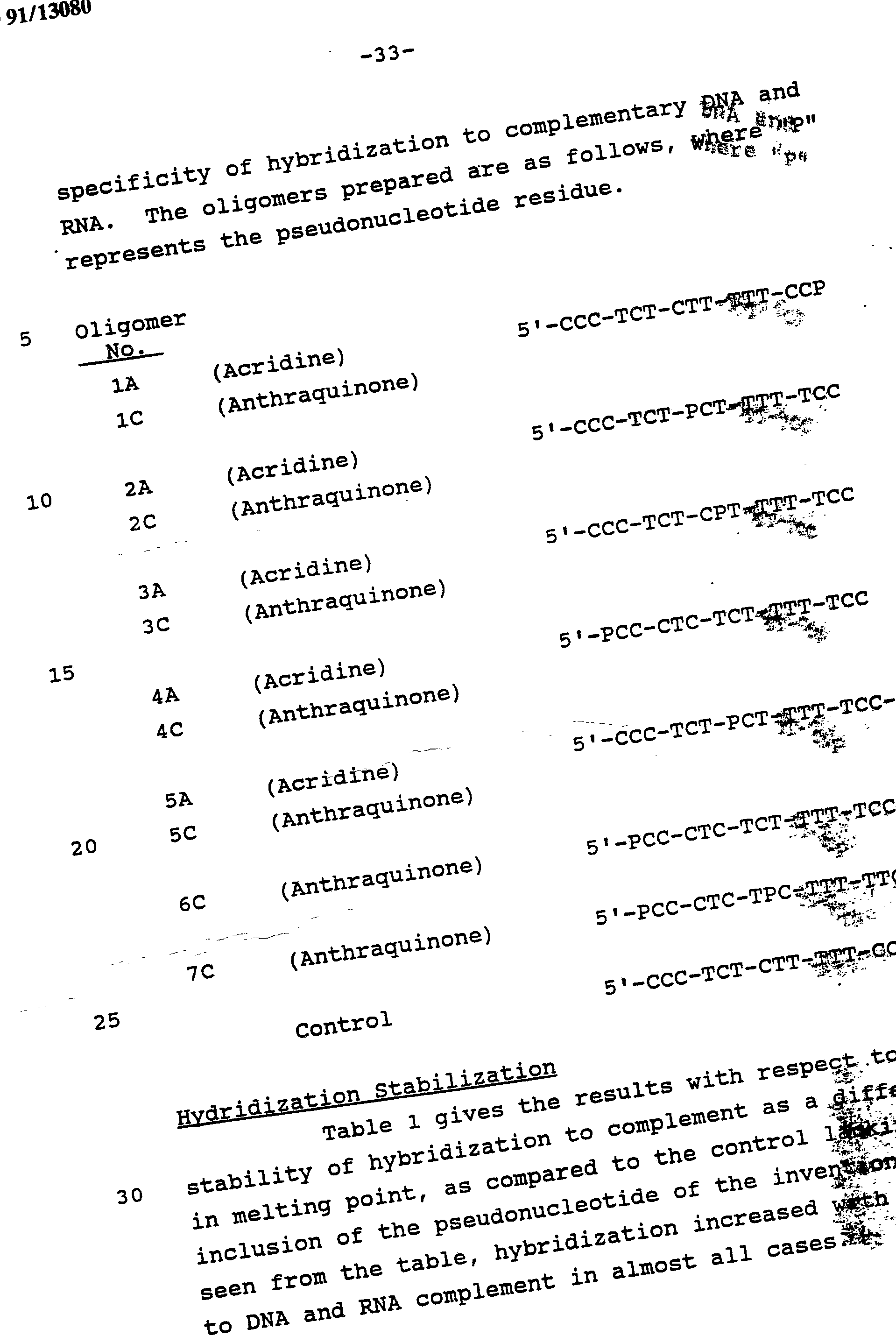
Table 1
Δ T. °C PNA RNA
1A-Acridine 5.5a lC-Anthraguinone 5.5C
2A-Acridine -2.5 2C-Anthraquinone 3.0 -0.5V
3A-Acridine -3.0V
3C-Anthraquinone 2.5' -0.5*
4A-Acridine 6.5' 2.5'
4C-Anthraquinone 6.0 4.0V
5A-Acridine 2.0 0.5* 5C-Anthraquinone 8.5£ 4.0C
6C-Anthraquinone 9.5V 8.0
7C-Anthraquinone 8.0
Control 0 a. -5μM PNA/PNA (1/1) in 20 mM Tris/15 mM NaCl, pH 7.5
Tm of control was 41.5°C
b. -5μM PNA/RNA (1/1) in 150 mM NaCl/50 mM Tris, pH 7.5
°C Tm of control was 63.0
c. -5μM PNA/PNA (1/1) in 150 mM NaCl/10 mM Na2HP04
Tm of control was 51.0°C
d. -1.6μM PNA/RNA (1/1) in 150 mM NaCl/50 mM Tris, pH 7.5 Tm of control was 60°C
In a manner similar to that set forth in Examples 1-5 above, oligomers were constructed which include as »P*», the pseudonucleoside HO(CH2)gNH(CH2)6OH wherein the nitrogen is substituted with anthraquinone—i.e. ,
60
60

These analogs were tested for stability of hybridization with complementary RNA. The results, shown in Table 2, indicate the longer methylene chains in the pseudonucleo¬ side do not result in enhanced stability as compared to the diethanolamine pseudonucleotides.
Table 2
T . °C Δ- -T. °C Oligomer
1* 5'-CCC-TCT-CTT-TTT-CCP* 64.0 4.0
2* 5'-CCC-TCT-P*CT-TTT-TCC 57.5 -2.5
4* 5•-P*CC-CTC-TCT-TTT-TCC 63.5 3.5
5* 5'-CCC-TCT-P*CT-TTT-TCC-P* 58.5 -1.5 6* 5'-P*CC-CTC-TCT-TTT-TCC-P* 65.0 5.0
Control 5'-CCC-TCT-CTT-TTT-CC 60.0 0
Stabilitv to Nuclease Peσradation
The stability of the modified oligonucleotides to lysis was tested under conditions which simulate m vitro cell culture and typical in vivo environments. Oligomers were prepared, as described in Examples 1-5, of the sequences:
5i*TT-TTT-CTC-CAT-P
wherein P represents diethanolamine pseudonucleoside derivatized respectively to Acridine (#A) ; Anthraquinone (#B) ; Ethyl (#C) ; Cholesterol (#P) ; TFA (#E) ; ETFA (#F) ; or not derivatized (#G) . These oligomers were incorporated into oligonucleotides of the sequence: 5' TCC AGT GAT TTT TTT CTC CAT-P 3 ' , which was internally-labeled by (i) ligation of the 51 10-mer (5' TCC AGT GAT T 31) with the 3' 11-mer labelled with 32P* (5' *TT TTT CTC CAT-P), (ii) polyacrylamide gel electrophoresis to separate unligated 10-mer and ll-mer from the desired 21-mer product (51 TCC AGT GAT τ*TT TTT CTC CAT-P 3') and (iii) recovery of the 21-mer from the gel by overnight incubation in buffer.
The control uses the 3' labeled oligomer of the formula 5' TT-TTT-CTC-CAT. The 3'-modified oligonucleotides were treated with snake venom phosphodiesterase, under conditions where the control is completely degraded within 5 minutes. For all four modified oligomers, approximately 90% remained intact at 5 min, and 50% remained at 1 hr. No oligomer remained at 3 hr.
Table 3 Fetal Calf Serum
0 davs 1 days 3 days 5 days
Control 100% o% o% o%
10 A: Acridine 100% 80% 20% 10% B: Cholesterol 100% 10 1% 1% C: Anthraquinone 100% 90% 60% 50%
15 : Ethyl 100% 85% 10% 10%
20
Table 4
Human Serum
25
0 hr 4 hr 18 hr
Control 100% 50% 20%
30 A: Acridine 100% 90% 80%
B: Cholesterol 100% 100% 100%
35 Table 5
Fetal Calf Serum
40 0 dl d3 d5
Control 100% 0% 0% 0%
A Acridine 100% 80% 30% 10%
45.
B Cholesterol 100% 80% 30% 10%
C Anthraquinone 100% 80% 50% 40%
50 P Ethyl 100% 80% 50% 20%
E Underivatized Piethanolamine 100% 70% 40% 20%
F Rhodamine/PHEP 100% 80% 60% 50%
Table 6
Human Serum
C dl dl d5.
Control 100% 0% 0% 0%
A Acridine 100% 70%
B Cholesterol 100% 90% 90% 90%
C Anthraquinone 100% 80% 60% 40%
P Ethyl 100% 80% 30%
E Underivatized Piethanolamine 100% 90% 60% 40%
F Rhodamine/PHEP 100% 80% 60% 50%
In comparison with control, all oligomers with the 3' hydroxyl modification by coupling to a pseudo¬ nucleoside showed enhanced stability, with significant oligomer remaining intact after 5 days for most of these compounds. The compounds were usually at least about 30% intact after 3 days in tissue culture medium, a period of time sufficient for anticipated stability requirements for the use of oligonucleotides as in vivo therapeutic agents.
Intracellular Stability
The fluorescent oligonucleotide 5' cholesteryl- TCC AGT GAT TTT TTT CTC CAT-PHEP rhodamine-3 ' synthesized in Example 6 was used in this study. The oligonucleotide was added to Pulbeccos1 modified Eagles' medium (PMEM)
containing 10% heat inactivated fetal calf serum to give a concentration of 5 mM. The medium containing the fluorescent oligonucleotide was then added to mouse L cells and allowed to incubate for 2 h at 37°C. The cells were then washed six times in PMEM to remove extracellular oligonucleotide. The cells were then examined at different times by fluorescence microscopy to determine if the oligonucleotide remained intact or was degraded. Pegradation of the oligonucleotide was monitored by following the loss of rhodamine from the cells. Free rhodamine diffuses out of the cells and rhodamine attached to oligonucleotide remains in the cells. Fluorescence intensities indicated that more than 60% of the oligonucleotide remained intact after three days of residence within the cells, showing that the 3* hydroxyl adduct rendered it stable to nuclease activity.
Specificity of Hybridization
Oligonucleotides which contain the diethanol- amine pseudonucleoside coupled with anthraquinone at the beta-position of the anthraquinone ring system were also tested for the ability to retain specificity of hybridization with complementary or one basepair mismatched RNA under conditions of 150 mM NaCl/50 mM Tris. Table 7 shows that the oligonucleotide including the pseudonucleotide shows similar differentials with respect to completely matched or one basepair mismatched complement as do controls. As shown in Table 5, in a control experiment, not involving pseudonucleotides, the extension of the test oligomer by the addition of a thymidine nucleotide at the 5' end changes the melting temperature of the hybrid with complementary RNA by only 0.5°C. However, substitution of a single mismatch, as noted, lowers the melting temperature 8°. Similarly,
when two anthraquinone-derivatized pseudonucleotides are included at the 5' and 3' ends, the lowering of the melting temperature caused by this single mismatch is 7.5°, comparable to the 8° previously obtained. Similarly, a single base pair mismatch at the 3' end effected a lowering of melting temperature in the control of 2.5°; a similar substitution in the oligomer further containing a pseudonucleotide at the 3' end resulted in a 4.5 melting point lowering as compared to the perfectly matched complement. This result demonstrates in the case of 3' mismatches the anthraquinone actually enhances specificity.
Table 7
Tm, °C ΔT,
Effect of Mismatch on Controls: 5»-CCC-TCT-CTT-TTT-CC 60.5
5'-T-CCC-TCT-CTT-TTT-CC 61.0 +0.5
5'-CCC-TCT-TTT-TTT-CC 52.5 -8.0
Effect of Same Mismatch with Pseudonucleotide:
5•-P-CCC-TCT-CTT-TTT-CC-P 68.0
5'-P-CCC-TCT-TTT-TTT-CCP 60.5 -7.5
Effect of 3 '-Terminal Mismatch on Control: 5'-CCC-TCT-CTT-TTT-CC 60.0
5 '-CCC-TCT-CTT-TTT-CT 57.5 -2.5
Effect of 3 '-Terminal Mismatch with Pseudonucleotide: 5'-CCC-TCT-CTT-TTT-CC-P 64
5'-CCC-TCT-CTT-TTT-CT-P 59.5 -4.5
Claims
1. A compound of the formula:
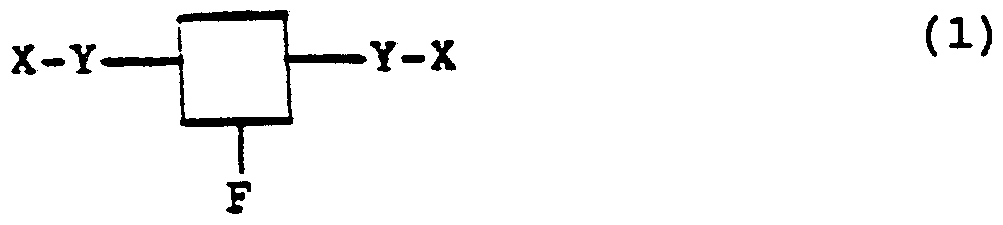
wherein each Y is independently O or S; each X is independently H, PO -2, an activated nucleotide synthesis coupling moiety, a protecting group, a nucleoside, a nucleotide or a nucleotide sequence, or comprises a solid support;
F is a functional group capable of linking an additional moiety or said group already reacted to effect the binding of said additional moiety;
I I is an organic backbone which does not contain additional F or Y-X substituents and which is either achiral even when the Y-X substituents are differ¬ ent, or is a single enantiomer of a chiral compound; with the proviso that at least one X is a nucleoside, nucleotide, nucleotide sequence, an activated nucleotide synthesis coupling moiety, or comprises a solid support, or with the proviso that when both X are H, F represents said functional group derivatized to an ad¬ ditional moiety selected from a reporter group, oligonucleotide cleavage agent, oligonucleotide binding agent, membrane penetration enhancer, oligonucleotide cross-linking agent and a protecting group.
2. The compound of claim 1 wherein F is derivatized to a reporter group, oligonucleotide cle- avage enhancer, oligonucleotide binding agent, membrane penetration enhancer, oligonucleotide cross-linking agent or a protecting group.
3. The compound of claim 1 which has the formula:
XY(CH2)nN(CH2)nYX
wherein n is an integer of 1-10; or which has the formula:
XY(CH2)nN(CH2)nYX

NHR
wherein n is an integer of 1-10, n is an integer of 1-10, and R is H or alkyl (1-6C) ; or which has the formula:

wherein n is 0-5 and R is H or alkyl (1-6) .
4. The compound of claim 1 wherein at least one X is a nucleotide sequence.
5. The compound of claim 4 wherein one X is a 5'-3' nucleotide sequence conjugated to Y at its 3 ' terminus , and the other X is H or P03 —2.
6. The compound of claim 1 wherein one X is a protecting group and the other X is PO or an activated nucleotide synthesis coupling moiety, or wherein one X is a protecting group or H and the other X comprises a solid support.
7. The compound of claim 3 wherein F comprises a protecting group.
8. The compound of claim 3 wherein n is 2-6 and n is 2-6, and/or wherein both Y are O.
9. The compound of claim 3 wherein one X is a protecting group and the other is an activated nucleotide synthesis coupling moiety, or wherein one X is a solid support and the other X is a protecting group or is H.
10. " The compound of claim 1 wherein one X is a protecting group and the other is a residue of the formula OC(CH2)n„COO- wherein n" is 1-5.
11- The compound of claim 1 wherein F comprises ethyl, cholesteryl, acridine, anthraquinone, or rhodamine.
12. A method to stabilize an oligonucleotide to nuclease activity under tissue culture or in vivo conditions which method comprises coupling to said nucleotide at its 3' hydroxyl the compound of formula (1) wherein both X are H.
13. A method to synthesize a modified oligonucleotide containing at least one pseudonucleotide, which method comprises treating a compound of Formula 1 wherein one X is H and the other comprises a solid support or wherein one X is H and the other is a nucleotide sequence or a nucleoside with standard reagents for forming phosphodiester bonds to additional nucleotides.
14. The compound of claim 4 for us.e in treating diseases mediated by the presence of polynucleotide or protein which binds specifically to the compound of claim 4 to inactivate said polynucleotide or protein.
15. A method to inactivate a target PNA or RNA or protein, which method comprises contacting said PNA or
RNA or protein with an oligonucleotide containing at least one residue of the pseudonucleotide of claim 1 under conditions to effect specific binding to said target PNA or RNA or protein.
16. A modified oligonucleotide, which modification comprises substitution for at least one nucleotide residue of said oligonucleotide the residue of compound of formula 1.
17. An oligonucleotide exhibiting enhanced stability to nuclease activity in cell culture conditions or in vivo, which oligonucleotide contains a modification of the 3' terminal nucleotide residue, wherein said modification comprises modification of the sugar moiety of said residue or of the base moiety of said residue.
Applications Claiming Priority (4)
| Application Number | Priority Date | Filing Date | Title |
|---|---|---|---|
| US48294390A | 1990-02-20 | 1990-02-20 | |
| US482,943 | 1990-02-20 | ||
| US59414790A | 1990-10-09 | 1990-10-09 | |
| US594,147 | 1990-10-09 |
Publications (1)
| Publication Number | Publication Date |
|---|---|
| WO1991013080A1 true WO1991013080A1 (en) | 1991-09-05 |
Family
ID=27047471
Family Applications (1)
| Application Number | Title | Priority Date | Filing Date |
|---|---|---|---|
| PCT/US1991/001141 Ceased WO1991013080A1 (en) | 1990-02-20 | 1991-02-20 | Pseudonucleosides and pseudonucleotides and their polymers |
Country Status (3)
| Country | Link |
|---|---|
| US (1) | US5414077A (en) |
| AU (1) | AU7579991A (en) |
| WO (1) | WO1991013080A1 (en) |
Cited By (12)
| Publication number | Priority date | Publication date | Assignee | Title |
|---|---|---|---|---|
| WO1996009314A3 (en) * | 1994-09-23 | 1996-05-30 | Hybridon Inc | Method for loading solid supports for nucleic acid synthesis |
| WO1997005156A1 (en) * | 1995-07-27 | 1997-02-13 | Carsten Behrens | A new achiral linker reagent for the incorporation of multiple amino groups into oligonucleotides |
| US5684149A (en) * | 1993-01-22 | 1997-11-04 | Research Foundation Of State University Of New York | Metal complexes for promoting catalytic cleavage of RNA by transesterification |
| WO1999022020A3 (en) * | 1997-10-23 | 1999-07-15 | James E Guillet | Labelling of polymers and sequencing of nucleic acids |
| US6020475A (en) * | 1998-02-10 | 2000-02-01 | Isis Pharmeuticals, Inc. | Process for the synthesis of oligomeric compounds |
| US6184389B1 (en) | 1994-01-11 | 2001-02-06 | Isis Pharmaceuticals, Inc. | Combinatorial libraries having aminodiol monomer subunits |
| US6448373B1 (en) | 1994-01-11 | 2002-09-10 | Isis Pharmaceuticals, Inc. | Phosphate linked oligomers formed of monomeric diols and processes for preparing same |
| US6670393B2 (en) | 1995-06-07 | 2003-12-30 | Promega Biosciences, Inc. | Carbamate-based cationic lipids |
| US6828427B1 (en) | 1994-01-11 | 2004-12-07 | Isis Pharmaceuticals, Inc. | Oligomeric aminodiol-containing compounds, libraries thereof, and process of preparing the same |
| WO2007038658A2 (en) | 2005-09-26 | 2007-04-05 | Medarex, Inc. | Antibody-drug conjugates and methods of use |
| US7507420B2 (en) | 2001-05-31 | 2009-03-24 | Medarex, Inc. | Peptidyl prodrugs and linkers and stabilizers useful therefor |
| US7517903B2 (en) | 2004-05-19 | 2009-04-14 | Medarex, Inc. | Cytotoxic compounds and conjugates |
Families Citing this family (625)
| Publication number | Priority date | Publication date | Assignee | Title |
|---|---|---|---|---|
| US6335434B1 (en) | 1998-06-16 | 2002-01-01 | Isis Pharmaceuticals, Inc., | Nucleosidic and non-nucleosidic folate conjugates |
| US8153602B1 (en) | 1991-11-19 | 2012-04-10 | Isis Pharmaceuticals, Inc. | Composition and methods for the pulmonary delivery of nucleic acids |
| ES2279508T3 (en) * | 1992-11-13 | 2007-08-16 | Immunex Corporation | LIGANDO ELK, A CYTOQUINE. |
| JP3484197B2 (en) | 1993-09-03 | 2004-01-06 | アイシス・ファーマシューティカルス・インコーポレーテッド | Amine derivatized nucleosides and oligonucleosides |
| FR2732344B1 (en) * | 1995-04-03 | 1997-06-20 | Genset Sa | OLIGONUCLEOTIDES WITH CROSS-COALENT BINDING, PREPARATION METHOD AND SYNTHON USEFUL IN THE PROCESS |
| US6420549B1 (en) | 1995-06-06 | 2002-07-16 | Isis Pharmaceuticals, Inc. | Oligonucleotide analogs having modified dimers |
| US5688940A (en) * | 1996-02-01 | 1997-11-18 | Biosearch Technologies, Inc. | Linker for immobilization, modification and subsequent release of oligomers with a terminal hydroxyl group |
| US20070275921A1 (en) * | 1996-06-06 | 2007-11-29 | Isis Pharmaceuticals, Inc. | Oligomeric Compounds That Facilitate Risc Loading |
| WO2005121368A1 (en) * | 2004-06-03 | 2005-12-22 | Isis Pharmaceuticals, Inc. | Chimeric gapped oligomeric compositions |
| US20040266706A1 (en) * | 2002-11-05 | 2004-12-30 | Muthiah Manoharan | Cross-linked oligomeric compounds and their use in gene modulation |
| US20030044941A1 (en) | 1996-06-06 | 2003-03-06 | Crooke Stanley T. | Human RNase III and compositions and uses thereof |
| US7812149B2 (en) | 1996-06-06 | 2010-10-12 | Isis Pharmaceuticals, Inc. | 2′-Fluoro substituted oligomeric compounds and compositions for use in gene modulations |
| US9096636B2 (en) | 1996-06-06 | 2015-08-04 | Isis Pharmaceuticals, Inc. | Chimeric oligomeric compounds and their use in gene modulation |
| US5898031A (en) | 1996-06-06 | 1999-04-27 | Isis Pharmaceuticals, Inc. | Oligoribonucleotides for cleaving RNA |
| AU731909B2 (en) | 1997-07-01 | 2001-04-05 | Isis Pharmaceuticals, Inc. | Compositions and methods for the delivery of oligonucleotides via the alimentary canal |
| US20040186071A1 (en) * | 1998-04-13 | 2004-09-23 | Bennett C. Frank | Antisense modulation of CD40 expression |
| US7321828B2 (en) * | 1998-04-13 | 2008-01-22 | Isis Pharmaceuticals, Inc. | System of components for preparing oligonucleotides |
| EP1080103A4 (en) * | 1998-05-21 | 2003-07-02 | Isis Pharmaceuticals Inc | COMPOSITIONS AND METHODS FOR NON-PARENTERAL ADMINISTRATION OF OLIGONUCLEOTIDES |
| AU753270B2 (en) * | 1998-05-21 | 2002-10-10 | Isis Pharmaceuticals, Inc. | Compositions and methods for topical delivery of oligonucleotides |
| US6225293B1 (en) | 1998-09-02 | 2001-05-01 | Isis Pharmaceuticals, Inc. | Methods and compounds for tracking the biodistribution of macromolecule-carrier combinations |
| US6077709A (en) | 1998-09-29 | 2000-06-20 | Isis Pharmaceuticals Inc. | Antisense modulation of Survivin expression |
| US6300320B1 (en) | 1999-01-05 | 2001-10-09 | Isis Pharmaceuticals, Inc. | Modulation of c-jun using inhibitors of protein kinase C |
| US6127124A (en) * | 1999-01-20 | 2000-10-03 | Isis Pharmaceuticals, Inc. | Fluorescence based nuclease assay |
| US7098192B2 (en) | 1999-04-08 | 2006-08-29 | Isis Pharmaceuticals, Inc. | Antisense oligonucleotide modulation of STAT3 expression |
| US20030166252A1 (en) * | 1999-05-18 | 2003-09-04 | Kaio Kitazato | Paramyxovirus-derived RNP |
| US6656730B1 (en) | 1999-06-15 | 2003-12-02 | Isis Pharmaceuticals, Inc. | Oligonucleotides conjugated to protein-binding drugs |
| US20020055479A1 (en) | 2000-01-18 | 2002-05-09 | Cowsert Lex M. | Antisense modulation of PTP1B expression |
| US6261840B1 (en) | 2000-01-18 | 2001-07-17 | Isis Pharmaceuticals, Inc. | Antisense modulation of PTP1B expression |
| US20030176385A1 (en) * | 2000-02-15 | 2003-09-18 | Jingfang Ju | Antisense modulation of protein expression |
| US6680172B1 (en) | 2000-05-16 | 2004-01-20 | Regents Of The University Of Michigan | Treatments and markers for cancers of the central nervous system |
| US8568766B2 (en) | 2000-08-24 | 2013-10-29 | Gattadahalli M. Anantharamaiah | Peptides and peptide mimetics to treat pathologies associated with eye disease |
| EP1326892A2 (en) | 2000-10-12 | 2003-07-16 | University of Rochester | Compositions that inhibit proliferation of cancer cells |
| US7767802B2 (en) | 2001-01-09 | 2010-08-03 | Alnylam Pharmaceuticals, Inc. | Compositions and methods for inhibiting expression of anti-apoptotic genes |
| EP1392272B1 (en) | 2001-05-11 | 2014-08-06 | Merrion Research III Limited | Permeation enhancers |
| JP2004537534A (en) | 2001-06-20 | 2004-12-16 | ジェネンテック・インコーポレーテッド | Compositions and methods for tumor diagnosis and treatment |
| US20050107595A1 (en) * | 2001-06-20 | 2005-05-19 | Genentech, Inc. | Compositions and methods for the diagnosis and treatment of tumor |
| US7803915B2 (en) * | 2001-06-20 | 2010-09-28 | Genentech, Inc. | Antibody compositions for the diagnosis and treatment of tumor |
| EP1404698A4 (en) | 2001-06-21 | 2004-12-22 | Isis Pharmaceuticals Inc | ANTI-SENSE MODULATION OF SOLUBLE SUPEROXIDE DISMUTASE 1 EXPRESSION |
| US6964950B2 (en) | 2001-07-25 | 2005-11-15 | Isis Pharmaceuticals, Inc. | Antisense modulation of C-reactive protein expression |
| US7425545B2 (en) | 2001-07-25 | 2008-09-16 | Isis Pharmaceuticals, Inc. | Modulation of C-reactive protein expression |
| US20030096772A1 (en) | 2001-07-30 | 2003-05-22 | Crooke Rosanne M. | Antisense modulation of acyl CoA cholesterol acyltransferase-2 expression |
| US7407943B2 (en) | 2001-08-01 | 2008-08-05 | Isis Pharmaceuticals, Inc. | Antisense modulation of apolipoprotein B expression |
| US7227014B2 (en) | 2001-08-07 | 2007-06-05 | Isis Pharmaceuticals, Inc. | Antisense modulation of apolipoprotein (a) expression |
| EP2151244A1 (en) | 2001-09-18 | 2010-02-10 | Genentech, Inc. | Compositions and methods for the diagnosis and treatment of tumor |
| US6750019B2 (en) | 2001-10-09 | 2004-06-15 | Isis Pharmaceuticals, Inc. | Antisense modulation of insulin-like growth factor binding protein 5 expression |
| NZ566396A (en) | 2001-10-09 | 2009-07-31 | Isis Pharmaceuticals Inc | Antisense modulation of insulin-like growth factor binding protein 5 expressions |
| US20030228319A1 (en) | 2002-04-16 | 2003-12-11 | Genentech, Inc. | Compositions and methods for the diagnosis and treatment of tumor |
| US6965025B2 (en) | 2001-12-10 | 2005-11-15 | Isis Pharmaceuticals, Inc. | Antisense modulation of connective tissue growth factor expression |
| AU2002358462A1 (en) * | 2001-12-18 | 2003-06-30 | Human Genetic Signatures Pty Ltd | Linear and hairpin oligonucleotide analogues comprising intercalator pseudonucleotides |
| US20060014144A1 (en) * | 2001-12-18 | 2006-01-19 | Christensen Ulf B | Pseudonucleotide comprising an intercalator |
| US7255874B1 (en) | 2001-12-21 | 2007-08-14 | Closure Medical Corporation | Biocompatible polymers and adhesives: compositions, methods of making and uses related thereto |
| KR100801388B1 (en) | 2002-01-02 | 2008-02-05 | 제넨테크, 인크. | Methods for diagnosing and treating tumors and compositions therefor |
| US20030180712A1 (en) | 2002-03-20 | 2003-09-25 | Biostratum Ab | Inhibition of the beta3 subunit of L-type Ca2+ channels |
| US7199107B2 (en) | 2002-05-23 | 2007-04-03 | Isis Pharmaceuticals, Inc. | Antisense modulation of kinesin-like 1 expression |
| FR2840611B1 (en) * | 2002-06-06 | 2005-09-09 | Cis Bio Int | FLUORESCENT ENTITY COMPRISING A FLUOROPHORE COVALENTLY ASSOCIATED WITH AT LEAST ONE OLIGONUCLEOTIDE AND COMPRISING AT LEAST ONE FUNCTIONAL GROUP AND USES THEREOF |
| US20040092470A1 (en) * | 2002-06-18 | 2004-05-13 | Leonard Sherry A. | Dry powder oligonucleotide formualtion, preparation and its uses |
| US20040019000A1 (en) * | 2002-07-19 | 2004-01-29 | Muthiah Manoharan | Polyalkyleneamine-containing oligomers |
| US20040023220A1 (en) * | 2002-07-23 | 2004-02-05 | Lawrence Greenfield | Integrated method for PCR cleanup and oligonucleotide removal |
| EP1575992A4 (en) | 2002-08-05 | 2007-02-21 | Univ Rochester | CHIMERIC PROTEINS WITH PROTEIN TRANSDUCTION FIELD / DOMAINE DESAMINASE, ASSOCIATED COMPOUNDS AND CORRESPONDING USES |
| US6878805B2 (en) * | 2002-08-16 | 2005-04-12 | Isis Pharmaceuticals, Inc. | Peptide-conjugated oligomeric compounds |
| JP2005538186A (en) | 2002-09-13 | 2005-12-15 | レプリコール インコーポレーティッド | Non-sequence complementary antiviral oligonucleotides |
| AU2003278957A1 (en) | 2002-09-26 | 2004-04-23 | Amgen, Inc. | Modulation of forkhead box o1a expression |
| JP2006515318A (en) * | 2002-10-29 | 2006-05-25 | ファルマシア・コーポレーション | Specifically associated cancer-related gene, polypeptide encoded thereby and method of use thereof |
| US9150605B2 (en) | 2002-11-05 | 2015-10-06 | Isis Pharmaceuticals, Inc. | Compositions comprising alternating 2′-modified nucleosides for use in gene modulation |
| EP1562971B1 (en) | 2002-11-05 | 2014-02-12 | Isis Pharmaceuticals, Inc. | Polycyclic sugar surrogate-containing oligomeric compounds and compositions for use in gene modulation |
| US9150606B2 (en) * | 2002-11-05 | 2015-10-06 | Isis Pharmaceuticals, Inc. | Compositions comprising alternating 2'-modified nucleosides for use in gene modulation |
| CA2504720C (en) | 2002-11-05 | 2013-12-24 | Isis Pharmaceuticals, Inc. | Chimeric oligomeric compounds and their use in gene modulation |
| AU2003295387A1 (en) | 2002-11-05 | 2004-06-03 | Isis Parmaceuticals, Inc. | Modified oligonucleotides for use in rna interference |
| CA2505801A1 (en) | 2002-11-13 | 2004-05-27 | Rosanne Crooke | Antisense modulation of apolipoprotein b expression |
| ES2420914T3 (en) | 2002-11-13 | 2013-08-27 | Genzyme Corporation | Antisense modulation of apolipoprotein B expression |
| WO2004045520A2 (en) | 2002-11-15 | 2004-06-03 | Musc Foundation For Research Development | Complement receptor 2 targeted complement modulators |
| AU2003295576B2 (en) * | 2002-11-15 | 2011-03-17 | Eisai, Inc. | Methods of generating high-production of antibodies from hybridomas created by in vitro immunization |
| EP2410332A1 (en) | 2002-11-21 | 2012-01-25 | The University Of Utah | Method for identifying purinergic modulators of the olfactory system |
| US7144999B2 (en) | 2002-11-23 | 2006-12-05 | Isis Pharmaceuticals, Inc. | Modulation of hypoxia-inducible factor 1 alpha expression |
| CA2515484C (en) | 2003-02-11 | 2011-09-20 | Antisense Therapeutics Ltd | Modulation of insulin like growth factor i receptor expression |
| US7803781B2 (en) | 2003-02-28 | 2010-09-28 | Isis Pharmaceuticals, Inc. | Modulation of growth hormone receptor expression and insulin-like growth factor expression |
| US20040185559A1 (en) | 2003-03-21 | 2004-09-23 | Isis Pharmaceuticals Inc. | Modulation of diacylglycerol acyltransferase 1 expression |
| US20040198640A1 (en) * | 2003-04-02 | 2004-10-07 | Dharmacon, Inc. | Stabilized polynucleotides for use in RNA interference |
| US7598227B2 (en) | 2003-04-16 | 2009-10-06 | Isis Pharmaceuticals Inc. | Modulation of apolipoprotein C-III expression |
| US7399853B2 (en) | 2003-04-28 | 2008-07-15 | Isis Pharmaceuticals | Modulation of glucagon receptor expression |
| US7276599B2 (en) * | 2003-06-02 | 2007-10-02 | Isis Pharmaceuticals, Inc. | Oligonucleotide synthesis with alternative solvents |
| BRPI0410886A (en) | 2003-06-03 | 2006-07-04 | Isis Pharmaceuticals Inc | double stranded compound, pharmaceutical composition, pharmaceutically acceptable salt, methods of modifying human survivin-encoding nucleic acid, inhibiting suvivin expression in cells or tissues, and treating a condition associated with suvivin expression or overexpression, and single stranded RNA oligonucleotide |
| DK3604537T3 (en) | 2003-06-13 | 2022-02-28 | Alnylam Europe Ag | Double-stranded ribonucleic acid with increased efficiency in an organism |
| WO2004113496A2 (en) * | 2003-06-20 | 2004-12-29 | Isis Pharmaceuticals, Inc. | Double stranded compositions comprising a 3’-endo modified strand for use in gene modulation |
| CA2533701A1 (en) | 2003-07-31 | 2005-02-17 | Isis Pharmaceuticals, Inc. | Oligomeric compounds and compositions for use in modulation of small non-coding rnas |
| US7825235B2 (en) | 2003-08-18 | 2010-11-02 | Isis Pharmaceuticals, Inc. | Modulation of diacylglycerol acyltransferase 2 expression |
| US20050053981A1 (en) * | 2003-09-09 | 2005-03-10 | Swayze Eric E. | Gapped oligomeric compounds having linked bicyclic sugar moieties at the termini |
| US20070123480A1 (en) * | 2003-09-11 | 2007-05-31 | Replicor Inc. | Oligonucleotides targeting prion diseases |
| BRPI0413930A (en) | 2003-09-18 | 2006-10-24 | Isis Pharmaceuticals Inc | oligomeric compound or pharmaceutically acceptable salt thereof, pharmaceutical or veterinary composition, methods for inhibiting eif4e expression in a cell, tissue or organ, for decreasing proliferation of a cell in which eif4e is expressed, and for preventing or treating a condition or disease. methods for preventing or decreasing angiogenesis, and tumor growth in a patient, antisense oligonucleotide, pharmaceutical or veterinary composition, and use of an oligomeric compound or pharmaceutically acceptable salt thereof. |
| AU2004274021B2 (en) * | 2003-09-18 | 2009-08-13 | Isis Pharmaceuticals, Inc. | 4'-thionucleosides and oligomeric compounds |
| PT1678194E (en) | 2003-10-10 | 2013-09-30 | Alchemia Oncology Pty Ltd | The modulation of hyaluronan synthesis and degradation in the treatment of disease |
| US20050191653A1 (en) | 2003-11-03 | 2005-09-01 | Freier Susan M. | Modulation of SGLT2 expression |
| EP2412725A3 (en) | 2003-11-17 | 2012-04-25 | Genentech, Inc. | Antibodies against CD79b for the treatment of tumor of hematopoeitic origin |
| JP2007520222A (en) | 2004-01-20 | 2007-07-26 | アイシス ファーマシューティカルズ インコーポレイテッド | Regulation of glucocorticoid receptor expression |
| US8778900B2 (en) * | 2004-01-22 | 2014-07-15 | Isis Pharmaceuticals, Inc. | Modulation of eIF4E-BP1 expression |
| US7468431B2 (en) * | 2004-01-22 | 2008-12-23 | Isis Pharmaceuticals, Inc. | Modulation of eIF4E-BP2 expression |
| DE602005017362D1 (en) * | 2004-02-06 | 2009-12-10 | Dharmacon Inc | STABILIZED RNAS AS TRANSFECTION CONTROLS AND SILENCING REAGENTS |
| US20090280567A1 (en) * | 2004-02-06 | 2009-11-12 | Dharmacon, Inc. | Stabilized sirnas as transfection controls and silencing reagents |
| US8569474B2 (en) | 2004-03-09 | 2013-10-29 | Isis Pharmaceuticals, Inc. | Double stranded constructs comprising one or more short strands hybridized to a longer strand |
| EP2700720A3 (en) | 2004-03-15 | 2015-01-28 | Isis Pharmaceuticals, Inc. | Compositions and methods for optimizing cleavage of RNA by RNASE H |
| KR101147147B1 (en) * | 2004-04-01 | 2012-05-25 | 머크 샤프 앤드 돔 코포레이션 | Modified polynucleotides for reducing off-target effects in rna interference |
| AU2005230684B2 (en) | 2004-04-05 | 2011-10-06 | Alnylam Pharmaceuticals, Inc. | Process and reagents for oligonucleotide synthesis and purification |
| US20050244869A1 (en) * | 2004-04-05 | 2005-11-03 | Brown-Driver Vickie L | Modulation of transthyretin expression |
| US20050260755A1 (en) * | 2004-04-06 | 2005-11-24 | Isis Pharmaceuticals, Inc. | Sequential delivery of oligomeric compounds |
| WO2006073458A2 (en) | 2004-04-30 | 2006-07-13 | Alnylam Pharmaceuticals, Inc. | Oligonucleotides comprising a c5-modified pyrimidine |
| AU2005326817B2 (en) | 2004-05-21 | 2012-04-19 | Benaroya Research Institute | Variable lymphocyte receptors, related polypeptides and nucleic acids, and uses thereof |
| US20090048192A1 (en) * | 2004-06-03 | 2009-02-19 | Isis Pharmaceuticals, Inc. | Double Strand Compositions Comprising Differentially Modified Strands for Use in Gene Modulation |
| AU2005252663B2 (en) * | 2004-06-03 | 2011-07-07 | Isis Pharmaceuticals, Inc. | Double strand compositions comprising differentially modified strands for use in gene modulation |
| US8394947B2 (en) | 2004-06-03 | 2013-03-12 | Isis Pharmaceuticals, Inc. | Positionally modified siRNA constructs |
| US7427675B2 (en) * | 2004-08-23 | 2008-09-23 | Isis Pharmaceuticals, Inc. | Compounds and methods for the characterization of oligonucleotides |
| US7884086B2 (en) | 2004-09-08 | 2011-02-08 | Isis Pharmaceuticals, Inc. | Conjugates for use in hepatocyte free uptake assays |
| PL1809303T3 (en) * | 2004-09-23 | 2019-11-29 | Arc Medical Devices Inc | Pharmaceutical compositions and methods relating to inhibiting fibrous adhesions or inflammatory disease using low sulphate fucans |
| US20060166234A1 (en) * | 2004-11-22 | 2006-07-27 | Barbara Robertson | Apparatus and system having dry control gene silencing compositions |
| US7923207B2 (en) | 2004-11-22 | 2011-04-12 | Dharmacon, Inc. | Apparatus and system having dry gene silencing pools |
| US7935811B2 (en) * | 2004-11-22 | 2011-05-03 | Dharmacon, Inc. | Apparatus and system having dry gene silencing compositions |
| JP5116481B2 (en) * | 2004-12-03 | 2013-01-09 | ヒューマン ジェネティック シグネチャーズ ピーティーワイ リミテッド | A method for simplifying microbial nucleic acids by chemical modification of cytosine |
| US20090286696A1 (en) * | 2005-02-04 | 2009-11-19 | University Of Wollongong | Double-Stranded Olidonucleotides and Uses Therefor |
| AU2006223498A1 (en) | 2005-03-10 | 2006-09-21 | Genentech, Inc. | Methods and compositions for modulating vascular integrity |
| US7476733B2 (en) * | 2005-03-25 | 2009-01-13 | The United States Of America As Represented By The Department Of Health And Human Services | Development of a real-time PCR assay for detection of pneumococcal DNA and diagnosis of pneumococccal disease |
| US20060223777A1 (en) * | 2005-03-29 | 2006-10-05 | Dharmacon, Inc. | Highly functional short hairpin RNA |
| EP1883707B1 (en) * | 2005-05-26 | 2014-04-09 | Human Genetic Signatures PTY Ltd | Isothermal strand displacement amplification using primers containing a non-regular base |
| EP2298829B1 (en) | 2005-05-31 | 2017-09-20 | École Polytechnique Fédérale de Lausanne (EPFL) | Triblock copolymers for cytoplasmic delivery of gene-based drugs |
| WO2006138145A1 (en) | 2005-06-14 | 2006-12-28 | Northwestern University | Nucleic acid functionalized nanoparticles for therapeutic applications |
| ATE531820T1 (en) * | 2005-09-14 | 2011-11-15 | Human Genetic Signatures Pty | HEALTH CONDITION TEST |
| EP1934331A4 (en) | 2005-10-14 | 2009-01-21 | Musc Found For Res Dev | PAX2 AS A TARGET FOR THE INDUCTION OF DEFB1-MEDIATED TUMORIMMUNITY AND CANCER THERAPY |
| US8080534B2 (en) | 2005-10-14 | 2011-12-20 | Phigenix, Inc | Targeting PAX2 for the treatment of breast cancer |
| EP1941059A4 (en) | 2005-10-28 | 2010-11-03 | Alnylam Pharmaceuticals Inc | Compositions and methods for inhibiting expression of huntingtin gene |
| EP1945270B1 (en) | 2005-11-09 | 2011-05-25 | Alnylam Pharmaceuticals Inc. | Compositions and methods for inhibiting expression of factor v leiden mutant gene |
| EP1966377A2 (en) | 2005-11-21 | 2008-09-10 | Isis Pharmaceuticals, Inc. | Modulation of eif4e-bp2 expression |
| PT1813614E (en) | 2006-01-25 | 2012-01-09 | Sanofi Sa | Cytotoxic agents comprising new tomaymycin derivatives |
| JP5704741B2 (en) | 2006-03-31 | 2015-04-22 | アルナイラム ファーマシューティカルズ, インコーポレイテッドAlnylam Pharmaceuticals, Inc. | Compositions and methods for suppression of Eg5 gene expression |
| AU2007245599B2 (en) * | 2006-05-03 | 2012-05-10 | Baltic Technology Development, Ltd. | Antisense agents combining strongly bound base - modified oligonucleotide and artificial nuclease |
| CN101489566B (en) | 2006-05-19 | 2012-04-18 | 阿尔尼拉姆医药品有限公司 | RNAi regulation of Aha gene and its therapeutic application |
| WO2007137220A2 (en) | 2006-05-22 | 2007-11-29 | Alnylam Pharmaceuticals, Inc. | Compositions and methods for inhibiting expression of ikk-b gene |
| US20090209625A1 (en) * | 2006-05-23 | 2009-08-20 | Sanjay Bhanot | Modulation of chrebp expression |
| US20090280188A1 (en) * | 2006-06-23 | 2009-11-12 | Northwestern University | Asymmetric functionalizated nanoparticles and methods of use |
| US8198253B2 (en) | 2006-07-19 | 2012-06-12 | Isis Pharmaceuticals, Inc. | Compositions and their uses directed to HBXIP |
| US8809514B2 (en) * | 2006-09-22 | 2014-08-19 | Ge Healthcare Dharmacon, Inc. | Tripartite oligonucleotide complexes and methods for gene silencing by RNA interference |
| WO2008136852A2 (en) | 2006-11-01 | 2008-11-13 | University Of Rochester | Methods and compositions related to the structure and function of apobec3g |
| EP2104509A4 (en) | 2006-12-11 | 2010-03-24 | Univ Utah Res Found | COMPOSITIONS AND METHODS FOR TREATMENT OF PATHOLOGICAL ANGIOGENESIS AND VASCULAR PERMEABILITY |
| JP5512285B2 (en) | 2007-02-09 | 2014-06-04 | ノースウェスタン ユニバーシティ | Particles for detecting intracellular targets |
| US7759320B2 (en) | 2007-03-29 | 2010-07-20 | Alnylam Pharmaceuticals, Inc. | Compositions and methods for inhibiting expression of a gene from the Ebola |
| AU2008259907B2 (en) | 2007-05-30 | 2014-12-04 | Northwestern University | Nucleic acid functionalized nanoparticles for therapeutic applications |
| AU2008296487A1 (en) | 2007-08-28 | 2009-03-12 | The Uab Research Foundation | Synthetic apolipoprotein E mimicking polypeptides and methods of use |
| JP2010538005A (en) | 2007-08-28 | 2010-12-09 | ユーエービー リサーチ ファウンデーション | Synthetic apolipoprotein E mimetic polypeptides and methods of use |
| WO2009039466A1 (en) | 2007-09-20 | 2009-03-26 | Vanderbilt University | Free solution measurement of molecular interactions by backscattering interferometry |
| US7951785B2 (en) * | 2007-09-21 | 2011-05-31 | California Institute Of Technology | NFIA in glial fate determination, glioma therapy and astrocytoma treatment |
| EP2205741A2 (en) | 2007-10-02 | 2010-07-14 | Amgen Inc. | Increasing erythropoietin using nucleic acids hybridizable to micro-rna and precursors thereof |
| US20110152346A1 (en) * | 2007-11-05 | 2011-06-23 | Baltic Technology Development Ltd. | Use of Oligonucleotides with Modified Bases in Hybridization of Nucleic Acids |
| ES2641290T3 (en) | 2007-11-20 | 2017-11-08 | Ionis Pharmaceuticals, Inc | CD40 expression modulation |
| CN101918595A (en) * | 2007-11-27 | 2010-12-15 | 人类遗传标记控股有限公司 | Enzymes for amplification and replication of bisulfite-modified nucleic acids |
| CN101883747A (en) * | 2007-12-05 | 2010-11-10 | 人类遗传标记控股有限公司 | Bisulfite treatment of RNA |
| AU2008335202A1 (en) | 2007-12-10 | 2009-06-18 | Alnylam Pharmaceuticals, Inc. | Compositions and methods for inhibiting expression of Factor VII gene |
| US7845686B2 (en) * | 2007-12-17 | 2010-12-07 | S & B Technical Products, Inc. | Restrained pipe joining system for plastic pipe |
| CA2709632A1 (en) * | 2007-12-20 | 2009-07-02 | Human Genetic Signatures Pty Ltd | Elimination of contaminants associated with nucleic acid amplification |
| US8188060B2 (en) | 2008-02-11 | 2012-05-29 | Dharmacon, Inc. | Duplex oligonucleotides with enhanced functionality in gene regulation |
| KR101397407B1 (en) | 2008-03-05 | 2014-06-19 | 알닐람 파마슈티칼스 인코포레이티드 | Compositions and methods for inhibiting expression of Eg5 and VEGF genes |
| EP2105145A1 (en) * | 2008-03-27 | 2009-09-30 | ETH Zürich | Method for muscle-specific delivery lipid-conjugated oligonucleotides |
| EP2274423A2 (en) * | 2008-04-04 | 2011-01-19 | Isis Pharmaceuticals, Inc. | Oligomeric compounds comprising bicyclic nucleosides and having reduced toxicity |
| AU2009234266B2 (en) | 2008-04-11 | 2015-08-06 | Tekmira Pharmaceuticals Corporation | Site-specific delivery of nucleic acids by combining targeting ligands with endosomolytic components |
| US8324366B2 (en) | 2008-04-29 | 2012-12-04 | Alnylam Pharmaceuticals, Inc. | Compositions and methods for delivering RNAI using lipoproteins |
| EP2323667A4 (en) * | 2008-08-07 | 2012-07-25 | Isis Pharmaceuticals Inc | MODULATION OF TRANSTHYRETIN EXPRESSION FOR THE TREATMENT OF CENTRAL NERVOUS SYSTEM (CNS) DISORDERS |
| CN107083386A (en) | 2008-08-25 | 2017-08-22 | 埃克斯雷德制药有限公司 | Prevent GEM 132 of CTGF and application thereof |
| WO2010028054A1 (en) | 2008-09-02 | 2010-03-11 | Alnylam Europe Ag. | Compositions and methods for inhibiting expression of mutant egfr gene |
| JP2012502991A (en) | 2008-09-22 | 2012-02-02 | アールエックスアイ ファーマシューティカルズ コーポレーション | RNA interference in dermal applications |
| CA2737661C (en) | 2008-09-23 | 2019-08-20 | Alnylam Pharmaceuticals, Inc. | Chemical modifications of monomers and oligonucleotides with cycloaddition |
| AU2009296395A1 (en) | 2008-09-25 | 2010-04-01 | Alnylam Pharmaceuticals, Inc. | Lipid formulated compositions and methods for inhibiting expression of Serum Amyloid A gene |
| IL302142B2 (en) | 2008-10-20 | 2024-07-01 | Alnylam Pharmaceuticals Inc | Compositions and Methods for Inhabiting Expression of TRANSTHYRETIN |
| US8987435B2 (en) | 2008-10-24 | 2015-03-24 | Isis Pharmaceuticals, Inc. | Oligomeric compounds and methods |
| CA3033577A1 (en) | 2008-11-10 | 2010-05-14 | Arbutus Biopharma Corporation | Novel lipids and compositions for the delivery of therapeutics |
| EP2365803B1 (en) * | 2008-11-24 | 2017-11-01 | Northwestern University | Polyvalent rna-nanoparticle compositions |
| WO2010065662A2 (en) | 2008-12-04 | 2010-06-10 | Curna, Inc. | Treatment of sirtuin 1 (sirt1) related diseases by inhibition of natural antisense transcript to sirtuin 1 |
| JP6091752B2 (en) | 2008-12-04 | 2017-03-08 | クルナ・インコーポレーテッド | Treatment of erythropoietin (EPO) -related diseases by suppression of natural antisense transcripts against EPO |
| JP5923306B2 (en) | 2008-12-04 | 2016-05-24 | クルナ・インコーポレーテッド | Treatment of tumor suppressor gene-related diseases by suppression of natural antisense transcripts against tumor suppressor genes |
| NZ593618A (en) | 2008-12-10 | 2013-02-22 | Alnylam Pharmaceuticals Inc | Gnaq targeted dsrna compositions and methods for inhibiting expression |
| US20100233270A1 (en) | 2009-01-08 | 2010-09-16 | Northwestern University | Delivery of Oligonucleotide-Functionalized Nanoparticles |
| WO2010081049A1 (en) * | 2009-01-08 | 2010-07-15 | Northwestern University | Inhibition of bacterial protein production by polyvalent oligonucleotide modified nanoparticle conjugates |
| WO2010091308A2 (en) | 2009-02-06 | 2010-08-12 | Isis Pharmaceuticals, Inc. | Oligomeric compounds and methods |
| EP3009150B1 (en) | 2009-02-12 | 2019-11-13 | CuRNA, Inc. | Treatment of brain derived neurotrophic factor (bdnf) related diseases by inhibition of natural antisense transcript to bdnf |
| US20110319476A1 (en) | 2009-02-12 | 2011-12-29 | Opko Curna, Llc | Treatment of glial cell derived neurotrophic factor (gdnf) related diseases by inhibition of natural antisense transcript to gdnf |
| US20120041051A1 (en) | 2009-02-26 | 2012-02-16 | Kevin Fitzgerald | Compositions And Methods For Inhibiting Expression Of MIG-12 Gene |
| AU2010221419B2 (en) | 2009-03-02 | 2015-10-01 | Alnylam Pharmaceuticals, Inc. | Nucleic acid chemical modifications |
| CA2754749C (en) | 2009-03-04 | 2019-04-30 | Opko Curna, Llc | Treatment of sirtuin 1 (sirt1) related diseases by inhibition of natural antisense transcript to sirt1 |
| CA2754043A1 (en) | 2009-03-12 | 2010-09-16 | Alnylam Pharmaceuticals, Inc. | Lipid formulated compositions and methods for inhibiting expression of eg5 and vegf genes |
| EP2408919B1 (en) | 2009-03-16 | 2017-10-18 | CuRNA, Inc. | Treatment of nuclear factor (erythroid-derived 2)-like 2 (nrf2) related diseases by inhibition of natural antisense transcript to nrf2 |
| US9708604B2 (en) | 2009-03-17 | 2017-07-18 | Curna, Inc. | Treatment of delta-like 1 homolog (DLK1) related diseases by inhibition of natural antisense transcript to DLK1 |
| EP3248618A1 (en) | 2009-04-22 | 2017-11-29 | Massachusetts Institute Of Technology | Innate immune suppression enables repeated delivery of long rna molecules |
| CN102639151B (en) | 2009-05-01 | 2017-03-22 | 库尔纳公司 | Treatment of hemoglobin (HBF/HBG)-associated diseases by inhibition of natural antisense transcripts targeting HBF/HBG |
| EP2427553A4 (en) | 2009-05-06 | 2012-11-07 | Opko Curna Llc | Treatment of lipid transport and metabolism gene related diseases by inhibition of natural antisense transcript to a lipid transport and metabolism gene |
| WO2010129746A2 (en) | 2009-05-06 | 2010-11-11 | Curna, Inc. | Treatment of tristetraproline (ttp) related diseases by inhibition of natural antisense transcript to ttp |
| CA2762369C (en) | 2009-05-18 | 2021-12-28 | Joseph Collard | Treatment of reprogramming factor related diseases by inhibition of natural antisense transcript to a reprogramming factor |
| CN102549158B (en) | 2009-05-22 | 2017-09-26 | 库尔纳公司 | By suppressing to treat the disease that TFE3 is related to IRS albumen 2 (IRS2) for transcription factor E3 (TFE3) natural antisense transcript |
| CA2764683A1 (en) | 2009-05-28 | 2010-12-02 | Joseph Collard | Treatment of antiviral gene related diseases by inhibition of natural antisense transcript to an antiviral gene |
| SMT201800499T1 (en) | 2009-06-10 | 2018-11-09 | Arbutus Biopharma Corp | Improved lipid formulation |
| EP2443237B1 (en) | 2009-06-16 | 2017-02-22 | CuRNA, Inc. | Treatment of collagen gene related diseases by inhibition of natural antisense transcript to a collagen gene |
| KR101702689B1 (en) | 2009-06-16 | 2017-02-06 | 큐알엔에이, 인크. | Treatment of paraoxonase 1 (pon1) related diseases by inhibition of natural antisense transcript to pon1 |
| KR101965868B1 (en) | 2009-06-17 | 2019-04-05 | 바이오젠 엠에이 인코포레이티드 | Composition and methods for modulating of smn2 splicing in a subject |
| EP2446036B1 (en) | 2009-06-24 | 2017-03-01 | CuRNA, Inc. | Treatment of tumor necrosis factor receptor 2 (tnfr2) related diseases by inhibition of natural antisense transcript to tnfr2 |
| CA2765815A1 (en) | 2009-06-26 | 2010-12-29 | Opko Curna, Llc | Treatment of down syndrome gene related diseases by inhibition of natural antisense transcript to a down syndrome gene |
| CN102762731B (en) | 2009-08-05 | 2018-06-22 | 库尔纳公司 | By inhibiting to treat insulin gene (INS) relevant disease for the natural antisense transcript of insulin gene (INS) |
| US9029338B2 (en) | 2009-08-14 | 2015-05-12 | Alnylam Pharmaceuticals, Inc. | Lipid formulated compositions and methods for inhibiting expression of a gene from the ebola virus |
| WO2011031482A2 (en) | 2009-08-25 | 2011-03-17 | Curna, Inc. | Treatment of 'iq motif containing gtpase activating protein' (iqgap) related diseases by inhibition of natural antisense transcript to iqgap |
| CA2772715C (en) | 2009-09-02 | 2019-03-26 | Genentech, Inc. | Mutant smoothened and methods of using the same |
| MX2012004617A (en) | 2009-10-22 | 2012-05-08 | Genentech Inc | Methods and compositions for modulating hepsin activation of macrophage-stimulating protein. |
| DK2494075T3 (en) | 2009-10-30 | 2018-07-23 | Univ Northwestern | TABLE-MANAGED NANOCONJUGATES |
| AU2010324686B2 (en) | 2009-11-30 | 2016-05-19 | Genentech, Inc. | Antibodies for treating and diagnosing tumors expressing SLC34A2 (TAT211 = SEQID2 ) |
| WO2011071860A2 (en) | 2009-12-07 | 2011-06-16 | Alnylam Pharmaceuticals, Inc. | Compositions for nucleic acid delivery |
| EP2513310B1 (en) | 2009-12-16 | 2017-11-01 | CuRNA, Inc. | Treatment of membrane bound transcription factor peptidase, site 1 (mbtps1) related diseases by inhibition of natural antisense transcript to mbtps1 |
| WO2011075656A1 (en) | 2009-12-18 | 2011-06-23 | The University Of British Columbia | Methods and compositions for delivery of nucleic acids |
| EP2515947B1 (en) | 2009-12-23 | 2021-10-06 | CuRNA, Inc. | Treatment of uncoupling protein 2 (ucp2) related diseases by inhibition of natural antisense transcript to ucp2 |
| ES2661387T3 (en) | 2009-12-23 | 2018-03-28 | Curna, Inc. | Treatment of diseases related to hepatocyte growth factor (hgf) by inhibition of the natural antisense transcript to hgf |
| JP5982288B2 (en) | 2009-12-29 | 2016-08-31 | カッパーアールエヌエー,インコーポレイテッド | Treatment of tumor protein 63-related diseases by inhibition of natural antisense transcripts against tumor protein 63 (p63) |
| EP2519633B1 (en) | 2009-12-29 | 2017-10-25 | CuRNA, Inc. | Treatment of nuclear respiratory factor 1 (nrf1) related diseases by inhibition of natural antisense transcript to nrf1 |
| JP5886757B2 (en) | 2010-01-04 | 2016-03-16 | カッパーアールエヌエー,インコーポレイテッド | Treatment of interferon regulatory factor 8 (IRF8) related diseases by inhibition of natural antisense transcripts against interferon regulatory factor 8 (IRF8) |
| KR101853509B1 (en) | 2010-01-06 | 2018-04-30 | 큐알엔에이, 인크. | Treatment of Pancreatic Developmental Gene Related Diseases By Inhibition of Natural Antisense Transcript to A Pancreatic Developmental Gene |
| DK2524039T3 (en) | 2010-01-11 | 2018-03-12 | Curna Inc | TREATMENT OF GENDER HORMON-BINDING GLOBULIN (SHBG) RELATED DISEASES BY INHIBITION OF NATURAL ANTISENCE TRANSCRIPTS TO SHBG |
| RU2611192C2 (en) | 2010-01-25 | 2017-02-21 | Курна, Инк. | TREATMENT OF RNase H1 RELATED DISEASES BY INHIBITION OF NATURAL ANTISENSE TRANSCRIPT TO RNase H1 |
| US9198972B2 (en) | 2010-01-28 | 2015-12-01 | Alnylam Pharmaceuticals, Inc. | Monomers and oligonucleotides comprising cycloaddition adduct(s) |
| WO2011094580A2 (en) | 2010-01-28 | 2011-08-04 | Alnylam Pharmaceuticals, Inc. | Chelated copper for use in the preparation of conjugated oligonucleotides |
| CA2824843A1 (en) | 2010-02-04 | 2011-08-11 | Ico Therapeutics Inc. | Dosing regimens for treating and preventing ocular disorders using c-raf antisense |
| EP2539452B1 (en) | 2010-02-22 | 2016-07-27 | CuRNA, Inc. | Treatment of pyrroline-5-carboxylate reductase 1 (pycr1) related diseases by inhibition of natural antisense transcript to pycr1 |
| WO2011105901A2 (en) | 2010-02-23 | 2011-09-01 | Academisch Ziekenhuis Bij De Universiteit Van Amsterdam | Antagonists of complement component 9 (c9) and uses thereof |
| WO2011105902A2 (en) | 2010-02-23 | 2011-09-01 | Academisch Ziekenhuis Bij De Universiteit Van Amsterdam | Antagonists of complement component 8-beta (c8-beta) and uses thereof |
| WO2011105900A2 (en) | 2010-02-23 | 2011-09-01 | Academisch Ziekenhuis Bij De Universiteit Van Amsterdam | Antagonists of complement component 8-alpha (c8-alpha) and uses thereof |
| PE20130214A1 (en) | 2010-02-23 | 2013-03-11 | Genentech Inc | COMPOSITIONS AND METHODS FOR THE DIAGNOSIS AND TREATMENT OF TUMORS |
| WO2011112516A1 (en) | 2010-03-08 | 2011-09-15 | Ico Therapeutics Inc. | Treating and preventing hepatitis c virus infection using c-raf kinase antisense oligonucleotides |
| WO2011112732A2 (en) | 2010-03-12 | 2011-09-15 | The Brigham And Women's Hospital, Inc. | Methods of treating vascular inflammatory disorders |
| EP3560503B1 (en) | 2010-03-24 | 2021-11-17 | Phio Pharmaceuticals Corp. | Rna interference in dermal and fibrotic indications |
| US9080171B2 (en) | 2010-03-24 | 2015-07-14 | RXi Parmaceuticals Corporation | Reduced size self-delivering RNAi compounds |
| CN103200945B (en) | 2010-03-24 | 2016-07-06 | 雷克西制药公司 | RNA interference in ocular syndromes |
| WO2011123468A1 (en) | 2010-03-29 | 2011-10-06 | Alnylam Pharmaceuticals, Inc. | Sirna therapy for transthyretin (ttr) related ocular amyloidosis |
| US9102938B2 (en) | 2010-04-01 | 2015-08-11 | Alnylam Pharmaceuticals, Inc. | 2′ and 5′ modified monomers and oligonucleotides |
| JP2013523162A (en) | 2010-04-06 | 2013-06-17 | アルナイラム ファーマシューティカルズ, インコーポレイテッド | Compositions and methods for inhibiting the expression of the CD274 / PD-L1 gene |
| TWI644675B (en) | 2010-04-09 | 2018-12-21 | 可娜公司 | Treatment of fibroblast growth factor 21 (fgf21) related diseases by inhibition of natural antisense transcript to fgf21 |
| WO2011133871A2 (en) | 2010-04-22 | 2011-10-27 | Alnylam Pharmaceuticals, Inc. | 5'-end derivatives |
| WO2011133876A2 (en) | 2010-04-22 | 2011-10-27 | Alnylam Pharmaceuticals, Inc. | Oligonucleotides comprising acyclic and abasic nucleosides and analogs |
| US20130260460A1 (en) | 2010-04-22 | 2013-10-03 | Isis Pharmaceuticals Inc | Conformationally restricted dinucleotide monomers and oligonucleotides |
| CN103154014B (en) | 2010-04-28 | 2015-03-25 | Isis制药公司 | Modified nucleosides, modified nucleosides-like and oligomeric compounds prepared therefrom |
| EP2606057B1 (en) | 2010-04-28 | 2016-06-15 | Ionis Pharmaceuticals, Inc. | Modified 5' diphosphate nucleosides and oligomeric compounds prepared therefrom |
| EP2625186B1 (en) | 2010-04-28 | 2016-07-27 | Ionis Pharmaceuticals, Inc. | 5' modified nucleosides and oligomeric compounds prepared therefrom |
| WO2011139911A2 (en) | 2010-04-29 | 2011-11-10 | Isis Pharmaceuticals, Inc. | Lipid formulated single stranded rna |
| LT2563920T (en) | 2010-04-29 | 2017-05-25 | Ionis Pharmaceuticals, Inc. | Modulation of transthyretin expression |
| KR101936011B1 (en) | 2010-05-03 | 2019-01-07 | 큐알엔에이, 인크. | Treatment of sirtuin (sirt) related diseases by inhibition of natural antisense transcript to a sirtuin (sirt) |
| PE20130460A1 (en) | 2010-05-03 | 2013-04-26 | Genentech Inc | COMPOSITIONS AND METHODS FOR THE DIAGNOSIS AND TREATMENT OF TUMORS |
| TWI531370B (en) | 2010-05-14 | 2016-05-01 | 可娜公司 | Treatment of PAR4-related diseases by inhibiting PAR4 natural anti-strand transcript |
| KR101857090B1 (en) | 2010-05-26 | 2018-06-26 | 큐알엔에이, 인크. | Treatment of atonal homolog 1 (atoh1) related diseases by inhibition of natural antisense transcript to atoh1 |
| US9944671B2 (en) | 2010-06-02 | 2018-04-17 | Alnylam Pharmaceuticals, Inc. | Compositions and methods directed to treating liver fibrosis |
| WO2011156713A1 (en) | 2010-06-11 | 2011-12-15 | Vanderbilt University | Multiplexed interferometric detection system and method |
| WO2011163121A1 (en) | 2010-06-21 | 2011-12-29 | Alnylam Pharmaceuticals, Inc. | Multifunctional copolymers for nucleic acid delivery |
| CA2805318A1 (en) | 2010-07-14 | 2012-01-19 | Curna, Inc. | Treatment of discs large homolog (dlg) related diseases by inhibition of natural antisense transcript to dlg |
| WO2012016188A2 (en) | 2010-07-30 | 2012-02-02 | Alnylam Pharmaceuticals, Inc. | Methods and compositions for delivery of active agents |
| US20130323269A1 (en) | 2010-07-30 | 2013-12-05 | Muthiah Manoharan | Methods and compositions for delivery of active agents |
| WO2012044992A2 (en) | 2010-09-30 | 2012-04-05 | Agency For Science, Technology And Research (A*Star) | Methods and reagents for detection and treatment of esophageal metaplasia |
| AU2011312205B2 (en) | 2010-10-05 | 2015-08-13 | Curis, Inc. | Mutant smoothened and methods of using the same |
| US8993533B2 (en) | 2010-10-06 | 2015-03-31 | Curna, Inc. | Treatment of sialidase 4 (NEU4) related diseases by inhibition of natural antisense transcript to NEU4 |
| WO2012048113A2 (en) | 2010-10-07 | 2012-04-12 | The General Hospital Corporation | Biomarkers of cancer |
| US9222088B2 (en) | 2010-10-22 | 2015-12-29 | Curna, Inc. | Treatment of alpha-L-iduronidase (IDUA) related diseases by inhibition of natural antisense transcript to IDUA |
| CN103201387B (en) | 2010-10-27 | 2018-02-02 | 库尔纳公司 | Treatment of IFRD 1-related diseases by inhibition of natural antisense transcript to Interferon-related developmental regulator 1(IFRD1) |
| CN110123830A (en) | 2010-11-09 | 2019-08-16 | 阿尔尼拉姆医药品有限公司 | Composition and method for inhibiting the lipid of the expression of Eg5 and VEGF gene to prepare |
| EP3260540A1 (en) | 2010-11-12 | 2017-12-27 | The General Hospital Corporation | Polycomb-associated non-coding rnas |
| KR102010598B1 (en) | 2010-11-23 | 2019-08-13 | 큐알엔에이, 인크. | Treatment of nanog related diseases by inhibition of natural antisense transcript to nanog |
| US9127275B2 (en) | 2010-12-10 | 2015-09-08 | Alnylam Pharmaceuticals, Inc. | Compositions and methods for inhibiting expression of klf-1 and bcl11a genes |
| EP2649182A4 (en) | 2010-12-10 | 2015-05-06 | Alnylam Pharmaceuticals Inc | COMPOSITIONS AND METHOD FOR INCREASING AN ERYTHROPOIETIN (EPO) PREPARATION |
| EP2663548B1 (en) | 2011-01-11 | 2017-04-05 | Alnylam Pharmaceuticals, Inc. | Pegylated lipids and their use for drug delivery |
| WO2012097261A2 (en) | 2011-01-14 | 2012-07-19 | The General Hospital Corporation | Methods targeting mir-128 for regulating cholesterol/lipid metabolism |
| US9173894B2 (en) | 2011-02-02 | 2015-11-03 | Excaliard Pharamaceuticals, Inc. | Method of treating keloids or hypertrophic scars using antisense compounds targeting connective tissue growth factor (CTGF) |
| US20140044644A1 (en) | 2011-02-21 | 2014-02-13 | University Of Zurich | Ankyrin g and modulators thereof for the treatment of neurodegenerative disorders |
| US9562853B2 (en) | 2011-02-22 | 2017-02-07 | Vanderbilt University | Nonaqueous backscattering interferometric methods |
| US9175290B2 (en) | 2011-03-29 | 2015-11-03 | Alnylam Pharmaceuticals, Inc. | Compositions and methods for inhibiting expression of TMPRSS6 gene |
| RU2620980C2 (en) | 2011-06-09 | 2017-05-30 | Курна, Инк. | Treatment of diseases associated with frataxin (fxn), by inhibiting natural antisense fxn transcript |
| EP3388068A1 (en) | 2011-06-21 | 2018-10-17 | Alnylam Pharmaceuticals, Inc. | Composition and methods for inhibition of expression of protein c (proc) genes |
| US9315813B2 (en) | 2011-06-21 | 2016-04-19 | Alnylam Pharmaceuticals, Inc | Compositions and methods for inhibition of expression of apolipoprotein C-III (APOC3) genes |
| EP4092120A1 (en) | 2011-06-21 | 2022-11-23 | Alnylam Pharmaceuticals, Inc. | Angiopoietin-like 3 (anglptl3) irna compositions and methods of use thereof |
| US20140235693A1 (en) | 2011-06-23 | 2014-08-21 | Alnylam Pharmaceuticals, Inc. | Serpina1 sirnas: compositions of matter and methods of treatment |
| WO2013019857A2 (en) | 2011-08-01 | 2013-02-07 | Alnylam Pharmaceuticals, Inc. | Method for improving the success rate of hematopoietic stem cell transplants |
| CN103874766B (en) | 2011-09-07 | 2017-07-18 | 人类遗传标记控股有限公司 | Molecular detection assay |
| WO2013040499A1 (en) | 2011-09-14 | 2013-03-21 | Northwestern University | Nanoconjugates able to cross the blood-brain barrier |
| EP3533873A1 (en) | 2011-09-14 | 2019-09-04 | Translate Bio MA, Inc. | Multimeric oligonucleotide compounds |
| US9701623B2 (en) | 2011-09-27 | 2017-07-11 | Alnylam Pharmaceuticals, Inc. | Di-aliphatic substituted pegylated lipids |
| EP2766482B1 (en) | 2011-10-11 | 2016-12-07 | The Brigham and Women's Hospital, Inc. | Micrornas in neurodegenerative disorders |
| CA2895077A1 (en) | 2011-12-12 | 2013-06-20 | Beverly Packard | In vivo delivery of oligonucleotides |
| US20130156849A1 (en) | 2011-12-16 | 2013-06-20 | modeRNA Therapeutics | Modified nucleoside, nucleotide, and nucleic acid compositions |
| JP2015511494A (en) | 2012-03-15 | 2015-04-20 | キュアナ,インク. | Treatment of BDNF-related diseases by inhibition of natural antisense transcripts against brain-derived neurotrophic factor (BDNF) |
| CN108949772A (en) | 2012-04-02 | 2018-12-07 | 现代泰克斯公司 | For generating the modification polynucleotides of biological agent relevant to human diseases and protein |
| HK1206601A1 (en) | 2012-04-02 | 2016-01-15 | Moderna Therapeutics, Inc. | Modified polynucleotides for the production of biologics and proteins associated with human disease |
| US9133461B2 (en) | 2012-04-10 | 2015-09-15 | Alnylam Pharmaceuticals, Inc. | Compositions and methods for inhibiting expression of the ALAS1 gene |
| WO2013159091A2 (en) | 2012-04-20 | 2013-10-24 | Aptamir Therapeutics, Inc. | Mirna modulators of thermogenesis |
| US9127274B2 (en) | 2012-04-26 | 2015-09-08 | Alnylam Pharmaceuticals, Inc. | Serpinc1 iRNA compositions and methods of use thereof |
| WO2013163628A2 (en) | 2012-04-27 | 2013-10-31 | Duke University | Genetic correction of mutated genes |
| US9273949B2 (en) | 2012-05-11 | 2016-03-01 | Vanderbilt University | Backscattering interferometric methods |
| CA2873794A1 (en) | 2012-05-16 | 2013-11-21 | Rana Therapeutics Inc. | Compositions and methods for modulating smn gene family expression |
| US20150133362A1 (en) | 2012-05-16 | 2015-05-14 | Rana Therapeutics, Inc. | Compositions and methods for modulating gene expression |
| WO2014022852A1 (en) | 2012-08-03 | 2014-02-06 | Aptamir Therapeutics, Inc. | Cell-specific delivery of mirna modulators for the treatment of obesity and related disorders |
| SI2922554T1 (en) | 2012-11-26 | 2022-06-30 | Modernatx, Inc. | Terminally modified rna |
| EP2946014A2 (en) | 2013-01-17 | 2015-11-25 | Moderna Therapeutics, Inc. | Signal-sensor polynucleotides for the alteration of cellular phenotypes |
| US20150366890A1 (en) | 2013-02-25 | 2015-12-24 | Trustees Of Boston University | Compositions and methods for treating fungal infections |
| EP2968391A1 (en) | 2013-03-13 | 2016-01-20 | Moderna Therapeutics, Inc. | Long-lived polynucleotide molecules |
| WO2014160129A2 (en) | 2013-03-14 | 2014-10-02 | Alnylam Pharmaceuticals, Inc. | Complement component c5 irna compositions and methods of use thereof |
| US10258698B2 (en) | 2013-03-14 | 2019-04-16 | Modernatx, Inc. | Formulation and delivery of modified nucleoside, nucleotide, and nucleic acid compositions |
| US8980864B2 (en) | 2013-03-15 | 2015-03-17 | Moderna Therapeutics, Inc. | Compositions and methods of altering cholesterol levels |
| US9828582B2 (en) | 2013-03-19 | 2017-11-28 | Duke University | Compositions and methods for the induction and tuning of gene expression |
| WO2014160871A2 (en) | 2013-03-27 | 2014-10-02 | The General Hospital Corporation | Methods and agents for treating alzheimer's disease |
| WO2014172698A1 (en) | 2013-04-19 | 2014-10-23 | Isis Pharmaceuticals, Inc. | Compositions and methods for modulation nucleic acids through nonsense mediated decay |
| PT2999785T (en) | 2013-05-22 | 2018-07-09 | Alnylam Pharmaceuticals Inc | Serpina1 irna compositions and methods of use thereof |
| ES2862125T3 (en) | 2013-06-13 | 2021-10-07 | Antisense Therapeutics Ltd | Combination therapy for acromegaly |
| CA2917348A1 (en) | 2013-07-11 | 2015-01-15 | Moderna Therapeutics, Inc. | Compositions comprising synthetic polynucleotides encoding crispr related proteins and synthetic sgrnas and methods of use |
| LT3041854T (en) | 2013-08-08 | 2020-03-25 | The Scripps Research Institute | IN VITRO METHOD OF LABELING SPECIFIC LOCATIONS OF NUCLEIC ACIDS BY INTRODUCTION OF UNNATURAL NUCLEOTIDES |
| US20160194368A1 (en) | 2013-09-03 | 2016-07-07 | Moderna Therapeutics, Inc. | Circular polynucleotides |
| US20160194625A1 (en) | 2013-09-03 | 2016-07-07 | Moderna Therapeutics, Inc. | Chimeric polynucleotides |
| EP3052626A1 (en) | 2013-10-02 | 2016-08-10 | Alnylam Pharmaceuticals, Inc. | Compositions and methods for inhibiting expression of the lect2 gene |
| SG11201602503TA (en) | 2013-10-03 | 2016-04-28 | Moderna Therapeutics Inc | Polynucleotides encoding low density lipoprotein receptor |
| JP6613227B2 (en) | 2013-10-04 | 2019-11-27 | アルナイラム ファーマシューティカルズ, インコーポレイテッド | Composition and method for inhibiting the expression of ALAS1 gene |
| SI3071696T1 (en) | 2013-11-22 | 2019-11-29 | Mina Therapeutics Ltd | C / EBP alpha short-acting RNA compositions and application processes |
| JP6883987B2 (en) | 2013-12-04 | 2021-06-09 | フィオ ファーマシューティカルズ コーポレーションPhio Pharmaceuticals Corp. | Methods for wound healing procedures utilizing chemically modified oligonucleotides |
| CA2844640A1 (en) | 2013-12-06 | 2015-06-06 | The University Of British Columbia | Method for treatment of castration-resistant prostate cancer |
| WO2015089368A2 (en) | 2013-12-12 | 2015-06-18 | Alnylam Pharmaceuticals, Inc. | Complement component irna compositions and methods of use thereof |
| EP3102197B1 (en) | 2014-02-04 | 2018-08-29 | Genentech, Inc. | Mutant smoothened and methods of using the same |
| CN118845818A (en) | 2014-02-11 | 2024-10-29 | 阿尔尼拉姆医药品有限公司 | Ketohexokinase (KHK) iRNA compositions and methods of use thereof |
| TWI638047B (en) | 2014-04-09 | 2018-10-11 | 史基普研究協會 | Import of unnatural or modified nucleoside triphosphates into cells via nucleic acid triphosphate transporters |
| EP3797780B1 (en) | 2014-04-17 | 2022-09-14 | Biogen MA Inc. | Compositions and methods for modulation of smn2 splicing in a subject |
| CA2947270A1 (en) | 2014-04-28 | 2015-11-05 | Rxi Pharmaceuticals Corporation | Methods for treating cancer using nucleic acids targeting mdm2 or mycn |
| US20170051290A1 (en) | 2014-05-01 | 2017-02-23 | Rxi Pharmaceuticals Corporation | Methods for treatment of disorders in the front of the eye utilizing nucleic acid molecules |
| WO2015171918A2 (en) | 2014-05-07 | 2015-11-12 | Louisiana State University And Agricultural And Mechanical College | Compositions and uses for treatment thereof |
| TW201607559A (en) | 2014-05-12 | 2016-03-01 | 阿尼拉製藥公司 | Methods and compositions for treating a SERPINC1-associated disorder |
| CN112852809A (en) | 2014-05-22 | 2021-05-28 | 阿尔尼拉姆医药品有限公司 | Angiotensinogen (AGT) iRNA compositions and methods of use thereof |
| CA2953216C (en) | 2014-06-04 | 2020-12-22 | Exicure, Inc. | Multivalent delivery of immune modulators by liposomal spherical nucleic acids for prophylactic or therapeutic applications |
| HRP20220379T1 (en) | 2014-06-10 | 2022-05-27 | Erasmus University Medical Center Rotterdam | Antisense oligonucleotides useful in treatment of pompe disease |
| EP3760208B1 (en) | 2014-06-25 | 2024-05-29 | The General Hospital Corporation | Targeting human satellite ii (hsatii) |
| WO2016011226A1 (en) | 2014-07-16 | 2016-01-21 | Moderna Therapeutics, Inc. | Chimeric polynucleotides |
| EP3171895A1 (en) | 2014-07-23 | 2017-05-31 | Modernatx, Inc. | Modified polynucleotides for the production of intrabodies |
| USRE50320E1 (en) | 2014-07-31 | 2025-03-04 | Uab Research Foundation | APOE mimetic peptides and higher potency to clear plasma cholesterol |
| JP2017526367A (en) | 2014-08-29 | 2017-09-14 | チルドレンズ メディカル センター コーポレーション | Methods and compositions for the treatment of cancer |
| WO2016033424A1 (en) | 2014-08-29 | 2016-03-03 | Genzyme Corporation | Methods for the prevention and treatment of major adverse cardiovascular events using compounds that modulate apolipoprotein b |
| KR102506169B1 (en) | 2014-09-05 | 2023-03-08 | 피오 파마슈티칼스 코프. | Methods for treating aging and skin disorders using nucleic acids targeting tyr or mmp1 |
| EP3191591A1 (en) | 2014-09-12 | 2017-07-19 | Alnylam Pharmaceuticals, Inc. | Polynucleotide agents targeting complement component c5 and methods of use thereof |
| EP3663403A1 (en) | 2014-09-26 | 2020-06-10 | University of Massachusetts | Rna-modulating agents |
| WO2016061487A1 (en) | 2014-10-17 | 2016-04-21 | Alnylam Pharmaceuticals, Inc. | Polynucleotide agents targeting aminolevulinic acid synthase-1 (alas1) and uses thereof |
| EP3904519A1 (en) | 2014-10-30 | 2021-11-03 | Genzyme Corporation | Polynucleotide agents targeting serpinc1 (at3) and methods of use thereof |
| JOP20200092A1 (en) | 2014-11-10 | 2017-06-16 | Alnylam Pharmaceuticals Inc | HEPATITIS B VIRUS (HBV) iRNA COMPOSITIONS AND METHODS OF USE THEREOF |
| JP2017535552A (en) | 2014-11-17 | 2017-11-30 | アルナイラム ファーマシューティカルズ, インコーポレイテッドAlnylam Pharmaceuticals, Inc. | Apolipoprotein C3 (APOC3) iRNA composition and methods of use thereof |
| AU2015349680A1 (en) | 2014-11-21 | 2017-06-08 | Northwestern University | The sequence-specific cellular uptake of spherical nucleic acid nanoparticle conjugates |
| AU2015360794B2 (en) | 2014-12-08 | 2021-07-08 | The Board Of Regents Of The University Of Texas System | Lipocationic polymers and uses thereof |
| AU2015364508A1 (en) | 2014-12-18 | 2017-07-06 | Alnylam Pharmaceuticals, Inc. | ReversirTM compounds |
| EP3247988A4 (en) | 2015-01-23 | 2018-12-19 | Vanderbilt University | A robust interferometer and methods of using same |
| US10676726B2 (en) | 2015-02-09 | 2020-06-09 | Duke University | Compositions and methods for epigenome editing |
| CA2976445A1 (en) | 2015-02-13 | 2016-08-18 | Alnylam Pharmaceuticals, Inc. | Patatin-like phospholipase domain containing 3 (pnpla3) irna compositions and methods of use thereof |
| WO2016135559A2 (en) | 2015-02-23 | 2016-09-01 | Crispr Therapeutics Ag | Materials and methods for treatment of human genetic diseases including hemoglobinopathies |
| EP3283502A4 (en) | 2015-04-07 | 2019-04-03 | The General Hospital Corporation | METHODS FOR REACTIVATION OF GENES ON INACTIVE X CHROMOSOME |
| WO2016164746A1 (en) | 2015-04-08 | 2016-10-13 | Alnylam Pharmaceuticals, Inc. | Compositions and methods for inhibiting expression of the lect2 gene |
| WO2016201301A1 (en) | 2015-06-12 | 2016-12-15 | Alnylam Pharmaceuticals, Inc. | Complement component c5 irna compositions and methods of use thereof |
| WO2016205323A1 (en) | 2015-06-18 | 2016-12-22 | Alnylam Pharmaceuticals, Inc. | Polynucleotde agents targeting hydroxyacid oxidase (glycolate oxidase, hao1) and methods of use thereof |
| WO2016209862A1 (en) | 2015-06-23 | 2016-12-29 | Alnylam Pharmaceuticals, Inc. | Glucokinase (gck) irna compositions and methods of use thereof |
| AU2016282986A1 (en) | 2015-06-26 | 2018-02-01 | Beth Israel Deaconess Medical Center, Inc. | Cancer therapy targeting tetraspanin 33 (tspan33) in myeloid derived suppressor cells |
| IL318703A (en) | 2015-06-29 | 2025-03-01 | Caris Science Inc | Therapeutic oligonucleotides |
| CA2991598A1 (en) | 2015-07-06 | 2017-01-12 | Rxi Pharmaceuticals Corporation | Nucleic acid molecules targeting superoxide dismutase 1 (sod1) |
| WO2017007825A1 (en) | 2015-07-06 | 2017-01-12 | Rxi Pharmaceuticals Corporation | Methods for treating neurological disorders using a synergistic small molecule and nucleic acids therapeutic approach |
| US10494632B2 (en) | 2015-07-10 | 2019-12-03 | Alnylam Pharmaceuticals, Inc. | Insulin-like growth factor binding protein, acid labile subunit (IGFALS) compositions and methods of use thereof |
| EP3324980B1 (en) | 2015-07-17 | 2021-11-10 | Alnylam Pharmaceuticals, Inc. | Multi-targeted single entity conjugates |
| AU2016298317B2 (en) | 2015-07-28 | 2021-02-18 | Caris Science, Inc. | Targeted oligonucleotides |
| CN114525280A (en) | 2015-09-02 | 2022-05-24 | 阿尔尼拉姆医药品有限公司 | iRNA compositions of programmed cell death 1 ligand 1(PD-L1) and methods of use thereof |
| EP3950003A1 (en) | 2015-09-14 | 2022-02-09 | The Board of Regents of the University of Texas System | Lipocationic dendrimers and uses thereof |
| AU2016339053A1 (en) | 2015-09-24 | 2018-04-12 | Crispr Therapeutics Ag | Novel family of RNA-programmable endonucleases and their uses in genome editing and other applications |
| WO2017066497A2 (en) | 2015-10-13 | 2017-04-20 | Duke University | Genome engineering with type i crispr systems in eukaryotic cells |
| US11021707B2 (en) | 2015-10-19 | 2021-06-01 | Phio Pharmaceuticals Corp. | Reduced size self-delivering nucleic acid compounds targeting long non-coding RNA |
| AU2016344609B2 (en) | 2015-10-28 | 2022-05-12 | Vertex Pharmaceuticals Incorporated | Materials and methods for treatment of duchenne muscular dystrophy |
| EP3370734B1 (en) | 2015-11-05 | 2023-01-04 | Children's Hospital Los Angeles | Antisense oligo for use in treating acute myeloid leukemia |
| CN109328231A (en) | 2015-11-06 | 2019-02-12 | 克里斯普治疗股份公司 | Materials and methods for treating glycogen storage disease type 1A |
| US11001622B2 (en) | 2015-11-19 | 2021-05-11 | The Brigham And Women's Hospital, Inc. | Method of treating autoimmune disease with lymphocyte antigen CD5-like (CD5L) protein |
| KR20250044471A (en) | 2015-11-30 | 2025-03-31 | 듀크 유니버시티 | Therapeutic targets for the correction of the human dystrophin gene by gene editing and methods of use |
| WO2017093804A2 (en) | 2015-12-01 | 2017-06-08 | Crispr Therapeutics Ag | Materials and methods for treatment of alpha-1 antitrypsin deficiency |
| KR20180095843A (en) | 2015-12-07 | 2018-08-28 | 젠자임 코포레이션 | Methods and compositions for the treatment of Serpinc1-related disorders |
| EP3387127A1 (en) | 2015-12-07 | 2018-10-17 | Erasmus University Medical Center Rotterdam | Enzymatic replacement therapy and antisense therapy for pompe disease |
| WO2017106767A1 (en) | 2015-12-18 | 2017-06-22 | The Scripps Research Institute | Production of unnatural nucleotides using a crispr/cas9 system |
| AU2016376191A1 (en) | 2015-12-23 | 2018-07-12 | Crispr Therapeutics Ag | Materials and methods for treatment of amyotrophic lateral sclerosis and/or frontal temporal lobular degeneration |
| US10627396B2 (en) | 2016-01-29 | 2020-04-21 | Vanderbilt University | Free-solution response function interferometry |
| US20190038771A1 (en) | 2016-02-02 | 2019-02-07 | Crispr Therapeutics Ag | Materials and methods for treatment of severe combined immunodeficiency (scid) or omenn syndrome |
| JP2019509721A (en) | 2016-02-04 | 2019-04-11 | キュリス,インコーポレイテッド | Mutant smoothened and method of using the same |
| WO2017141109A1 (en) | 2016-02-18 | 2017-08-24 | Crispr Therapeutics Ag | Materials and methods for treatment of severe combined immunodeficiency (scid) or omenn syndrome |
| PT3419665T (en) | 2016-02-25 | 2025-01-06 | Brigham & Womens Hospital Inc | Treatment methods for fibrosis targeting smoc2 |
| US11083799B2 (en) | 2016-03-16 | 2021-08-10 | Crispr Therapeutics Ag | Materials and methods for treatment of hereditary haemochromatosis |
| EP3430137A4 (en) | 2016-03-18 | 2019-11-06 | Caris Science, Inc. | OLIGONUCLEOTIDE PROBES AND USES THEREOF |
| WO2017180915A2 (en) | 2016-04-13 | 2017-10-19 | Duke University | Crispr/cas9-based repressors for silencing gene targets in vivo and methods of use |
| ES2979222T3 (en) | 2016-04-18 | 2024-09-24 | Vertex Pharma | Materials and methods for the treatment of hemoglobinopathies |
| WO2017191503A1 (en) | 2016-05-05 | 2017-11-09 | Crispr Therapeutics Ag | Materials and methods for treatment of hemoglobinopathies |
| WO2017201076A1 (en) | 2016-05-16 | 2017-11-23 | The Board Of Regents Of The University Of Texas System | Cationic sulfonamide amino lipids and amphiphilic zwitterionic amino lipids |
| EP3464597B1 (en) | 2016-05-25 | 2022-08-03 | Caris Science, Inc. | Oligonucleotide probe selection method and uses thereof |
| WO2017214518A1 (en) | 2016-06-10 | 2017-12-14 | Alnylam Pharmaceuticals, Inc. | COMPLETMENT COMPONENT C5 iRNA COMPOSTIONS AND METHODS OF USE THEREOF FOR TREATING PAROXYSMAL NOCTURNAL HEMOGLOBINURIA (PNH) |
| HUE060123T2 (en) | 2016-06-24 | 2023-01-28 | Scripps Research Inst | A novel nucleoside triphosphate transporter and its applications |
| EP3478313B1 (en) | 2016-06-29 | 2022-05-04 | CRISPR Therapeutics AG | Materials and methods for treatment of amyotrophic lateral sclerosis (als) and other related disorders |
| US11427838B2 (en) | 2016-06-29 | 2022-08-30 | Vertex Pharmaceuticals Incorporated | Materials and methods for treatment of myotonic dystrophy type 1 (DM1) and other related disorders |
| EP3478828B1 (en) | 2016-06-29 | 2024-09-04 | CRISPR Therapeutics AG | Materials and methods for treatment of friedreich ataxia and other related disorders |
| CA3029141A1 (en) | 2016-07-06 | 2018-01-11 | Crispr Therapeutics Ag | Materials and methods for treatment of pain related disorders |
| DK3481856T3 (en) | 2016-07-06 | 2025-11-10 | Vertex Pharma | MATERIALS AND METHODS FOR TREATING PAIN-RELATED DISORDERS |
| WO2018007871A1 (en) | 2016-07-08 | 2018-01-11 | Crispr Therapeutics Ag | Materials and methods for treatment of transthyretin amyloidosis |
| US11253601B2 (en) | 2016-07-11 | 2022-02-22 | Translate Bio Ma, Inc. | Nucleic acid conjugates and uses thereof |
| JP7490211B2 (en) | 2016-07-19 | 2024-05-27 | デューク ユニバーシティ | Therapeutic Applications of CPF1-Based Genome Editing |
| WO2018020323A2 (en) | 2016-07-25 | 2018-02-01 | Crispr Therapeutics Ag | Materials and methods for treatment of fatty acid disorders |
| NL2017294B1 (en) | 2016-08-05 | 2018-02-14 | Univ Erasmus Med Ct Rotterdam | Natural cryptic exon removal by pairs of antisense oligonucleotides. |
| NL2017295B1 (en) | 2016-08-05 | 2018-02-14 | Univ Erasmus Med Ct Rotterdam | Antisense oligomeric compound for Pompe disease |
| WO2018081817A2 (en) | 2016-10-31 | 2018-05-03 | University Of Massachusetts | Targeting microrna-101-3p in cancer therapy |
| TW202313978A (en) | 2016-11-23 | 2023-04-01 | 美商阿尼拉製藥公司 | Serpina1 irna compositions and methods of use thereof |
| JP7206214B2 (en) | 2016-12-13 | 2023-01-17 | シアトル チルドレンズ ホスピタル (ディービーエイ シアトル チルドレンズ リサーチ インスティテュート) | Methods for exogenous drug activation of chemo-inducible signaling complexes expressed in engineered cells in vitro and in vivo |
| TWI790217B (en) | 2016-12-16 | 2023-01-21 | 美商阿尼拉製藥公司 | METHODS FOR TREATING OR PREVENTING TTR-ASSOCIATED DISEASES USING TRANSTHYRETIN (TTR) iRNA COMPOSITIONS |
| SG11201906735RA (en) | 2017-01-23 | 2019-08-27 | Regeneron Pharma | Hydroxysteroid 17-beta dehydrogenase 13 (hsd17b13) variants and uses thereof |
| EP3585900B1 (en) | 2017-02-22 | 2022-12-21 | CRISPR Therapeutics AG | Materials and methods for treatment of spinocerebellar ataxia type 2 (sca2) and other spinocerebellar ataxia type 2 protein (atxn2) gene related conditions or disorders |
| CA3054031A1 (en) | 2017-02-22 | 2018-08-30 | Crispr Therapeutics Ag | Compositions and methods for gene editing |
| US11407997B2 (en) | 2017-02-22 | 2022-08-09 | Crispr Therapeutics Ag | Materials and methods for treatment of primary hyperoxaluria type 1 (PH1) and other alanine-glyoxylate aminotransferase (AGXT) gene related conditions or disorders |
| EP3585898A1 (en) | 2017-02-22 | 2020-01-01 | CRISPR Therapeutics AG | Materials and methods for treatment of spinocerebellar ataxia type 1 (sca1) and other spinocerebellar ataxia type 1 protein (atxn1) gene related conditions or disorders |
| US20200040061A1 (en) | 2017-02-22 | 2020-02-06 | Crispr Therapeutics Ag | Materials and methods for treatment of early onset parkinson's disease (park1) and other synuclein, alpha (snca) gene related conditions or disorders |
| WO2018191603A1 (en) | 2017-04-14 | 2018-10-18 | University Of Massachusetts | Targeting cell tropism receptors to inhibit cytomegalovirus infection |
| KR102720270B1 (en) | 2017-04-18 | 2024-10-23 | 알닐람 파마슈티칼스 인코포레이티드 | Methods for treating subjects infected with hepatitis B virus (HBV) |
| WO2018195355A1 (en) | 2017-04-19 | 2018-10-25 | Rxi Pharmaceuticals Corporation | Topical delivery of nucleic acid compounds |
| EP3612232A1 (en) | 2017-04-21 | 2020-02-26 | The Broad Institute, Inc. | Targeted delivery to beta cells |
| CN110914289B (en) | 2017-05-12 | 2024-05-14 | 克里斯珀医疗股份公司 | Materials and methods for engineering cells and their use in immunooncology |
| KR20200026960A (en) | 2017-07-10 | 2020-03-11 | 젠자임 코포레이션 | Methods and compositions for treating bleeding events in a subject with hemophilia |
| EP3651774A4 (en) | 2017-07-11 | 2021-07-07 | The Scripps Research Institute | INCORPORATION OF NON-NATURAL NUCLEOTIDES AND PROCESSES FOR USE IN VIVO |
| KR20250171416A (en) | 2017-07-11 | 2025-12-08 | 신톡스, 인크. | Incorporation of unnatural nucleotides and methods thereof |
| CA3069868A1 (en) | 2017-07-13 | 2019-01-17 | Alnylam Pharmaceuticals Inc. | Lactate dehydrogenase a (ldha) irna compositions and methods of use thereof |
| BR112020002272A2 (en) | 2017-08-03 | 2020-07-28 | Synthorx, Inc. | cytokine conjugates for the treatment of autoimmune diseases |
| WO2019048645A1 (en) | 2017-09-08 | 2019-03-14 | Mina Therapeutics Limited | Stabilized cebpa sarna compositions and methods of use |
| CA3075219A1 (en) | 2017-09-08 | 2019-03-14 | Mina Therapeutics Limited | Hnf4a sarna compositions and methods of use |
| WO2019055460A1 (en) | 2017-09-13 | 2019-03-21 | The Children's Medical Center Corporation | Compositions and methods for treating transposon associated diseases |
| KR102728416B1 (en) | 2017-10-17 | 2024-11-11 | 크리스퍼 테라퓨틱스 아게 | Compositions and methods for gene editing for hemophilia A |
| MA50849A (en) | 2017-10-26 | 2020-09-02 | Vertex Pharma | SUBSTANCES AND METHODS FOR THE TREATMENT OF HEMOGLOBINOPATHIES |
| EP3704252A1 (en) | 2017-11-01 | 2020-09-09 | Alnylam Pharmaceuticals, Inc. | Complement component c3 irna compositions and methods of use thereof |
| WO2019092505A1 (en) | 2017-11-09 | 2019-05-16 | Casebia Therapeutics Llp | Self-inactivating (sin) crispr/cas or crispr/cpf1 systems and uses thereof |
| WO2019100039A1 (en) | 2017-11-20 | 2019-05-23 | Alnylam Pharmaceuticals, Inc. | Serum amyloid p component (apcs) irna compositions and methods of use thereof |
| MA50877A (en) | 2017-11-21 | 2020-09-30 | Bayer Healthcare Llc | MATERIALS AND METHODS FOR THE TREATMENT OF AUTOSOMIC DOMINANT PIGMENTAL RETINITIS |
| CA3084955A1 (en) | 2017-12-05 | 2019-06-13 | Vertex Pharmaceuticals Incorporated | Crispr-cas9 modified cd34+ human hematopoietic stem and progenitor cells and uses thereof |
| CA3084825A1 (en) | 2017-12-14 | 2019-06-20 | Crispr Therapeutics Ag | Novel rna-programmable endonuclease systems and their use in genome editing and other applications |
| MX2020006012A (en) | 2017-12-18 | 2020-09-14 | Alnylam Pharmaceuticals Inc | High mobility group box-1 (hmgb1) irna compositions and methods of use thereof. |
| CN111836892B (en) | 2017-12-21 | 2025-03-11 | 克里斯珀医疗股份公司 | Materials and methods for treating Usher syndrome type 2A |
| EP3728595A1 (en) | 2017-12-21 | 2020-10-28 | CRISPR Therapeutics AG | Materials and methods for treatment of usher syndrome type 2a and/or non-syndromic autosomal recessive retinitis pigmentosa (arrp) |
| CN112105627B (en) | 2017-12-29 | 2024-07-02 | 斯克利普斯研究所 | Unnatural base pair compositions and methods of use |
| US12178855B2 (en) | 2018-01-10 | 2024-12-31 | Translate Bio Ma, Inc. | Compositions and methods for facilitating delivery of synthetic nucleic acids to cells |
| MA51637A (en) | 2018-01-12 | 2020-11-18 | Bayer Healthcare Llc | COMPOSITIONS AND METHODS FOR TARGETING GENE EDITING OF TRANSFERRIN |
| WO2019144061A1 (en) | 2018-01-19 | 2019-07-25 | Duke University | Genome engineering with crispr-cas systems in eukaryotes |
| WO2019147743A1 (en) | 2018-01-26 | 2019-08-01 | Massachusetts Institute Of Technology | Structure-guided chemical modification of guide rna and its applications |
| WO2019150196A1 (en) | 2018-02-05 | 2019-08-08 | Crispr Therapeutics Ag | Materials and methods for treatment of hemoglobinopathies |
| MA51788A (en) | 2018-02-05 | 2020-12-16 | Vertex Pharma | SUBSTANCES AND METHODS FOR TREATING HEMOGLOBINOPATHIES |
| US20210130824A1 (en) | 2018-02-16 | 2021-05-06 | Crispr Therapeutics Ag | Compositions and methods for gene editing by targeting fibrinogen-alpha |
| TWI834636B (en) | 2018-02-26 | 2024-03-11 | 美商欣爍克斯公司 | Il-15 conjugates and uses thereof |
| WO2019183150A1 (en) | 2018-03-19 | 2019-09-26 | Casebia Therapeutics Limited Liability Partnership | Novel rna-programmable endonuclease systems and uses thereof |
| EP4051799A2 (en) | 2018-03-30 | 2022-09-07 | Rheinische Friedrich-Wilhelms-Universität Bonn | Aptamers for targeted activaton of t cell-mediated immunity |
| US20210155959A1 (en) | 2018-04-06 | 2021-05-27 | Children's Medical Center Corporation | Compositions and methods for somatic cell reprogramming and modulating imprinting |
| EP3775211B1 (en) | 2018-04-12 | 2023-04-05 | MiNA Therapeutics Limited | Sirt1-sarna compositions and methods of use |
| WO2019204668A1 (en) | 2018-04-18 | 2019-10-24 | Casebia Therapeutics Limited Liability Partnership | Compositions and methods for knockdown of apo(a) by gene editing for treatment of cardiovascular disease |
| EP3784259A4 (en) | 2018-04-27 | 2021-12-29 | Seattle Children's Hospital (DBA Seattle Children's Research Institute) | Rapamycin resistant cells |
| JP7353301B2 (en) | 2018-05-07 | 2023-09-29 | アルニラム ファーマスーティカルズ インコーポレイテッド | Extrahepatic delivery |
| TWI851574B (en) | 2018-05-14 | 2024-08-11 | 美商阿尼拉製藥公司 | ANGIOTENSINOGEN (AGT) iRNA COMPOSITIONS AND METHODS OF USE THEREOF |
| WO2020036862A1 (en) | 2018-08-13 | 2020-02-20 | Alnylam Pharmaceuticals, Inc. | HEPATITIS B VIRUS (HBV) dsRNA AGENT COMPOSITIONS AND METHODS OF USE THEREOF |
| AR115960A1 (en) | 2018-08-16 | 2021-03-17 | Alnylam Pharmaceuticals Inc | COMPOSITIONS AND METHODS TO INHIBIT THE EXPRESSION OF THE LECT2 GENE |
| US12281308B2 (en) | 2018-08-29 | 2025-04-22 | University Of Massachusetts | Inhibition of protein kinases to treat Friedreich ataxia |
| CA3105385A1 (en) | 2018-09-18 | 2020-03-26 | Alnylam Pharmaceuticals, Inc. | Ketohexokinase (khk) irna compositions and methods of use thereof |
| AU2019350765A1 (en) | 2018-09-28 | 2021-05-27 | Alnylam Pharmaceuticals, Inc. | Transthyretin (TTR) iRNA compositions and methods of use thereof for treating or preventing TTR-associated ocular diseases |
| BR112021007403A2 (en) | 2018-10-17 | 2021-12-07 | Bayer Healthcare Llc | Compositions and methods for transgene delivery |
| US10913951B2 (en) | 2018-10-31 | 2021-02-09 | University of Pittsburgh—of the Commonwealth System of Higher Education | Silencing of HNF4A-P2 isoforms with siRNA to improve hepatocyte function in liver failure |
| TW202031284A (en) | 2018-11-08 | 2020-09-01 | 美商新索思股份有限公司 | Interleukin 10 conjugates and uses thereof |
| CA3121191A1 (en) | 2018-11-28 | 2020-06-04 | Crispr Therapeutics Ag | Optimized mrna encoding cas9 for use in lnps |
| EP3894559A4 (en) | 2018-12-03 | 2023-04-05 | Triplet Therapeutics, Inc. | THERAPEUTIC METHODS FOR TRINUCLEOTIDE REPEAT EXPANSION DISEASES ASSOCIATED WITH MLH3 ACTIVITY |
| RS67553B1 (en) | 2018-12-20 | 2026-01-30 | Humabs Biomed Sa | Combination hbv therapy |
| JP2022515744A (en) | 2018-12-20 | 2022-02-22 | プラクシス プレシジョン メディシンズ, インコーポレイテッド | Compositions and Methods for the Treatment of KCNT1-Related Disorders |
| JP2022517270A (en) | 2019-01-16 | 2022-03-07 | ジェンザイム・コーポレーション | Serpinc1 iRNA composition and its usage |
| US20200246467A1 (en) | 2019-02-06 | 2020-08-06 | Synthorx, Inc. | Il-2 conjugates and methods of use thereof |
| SG11202108357PA (en) | 2019-02-15 | 2021-08-30 | Crispr Therapeutics Ag | Gene editing for hemophilia a with improved factor viii expression |
| WO2020171889A1 (en) | 2019-02-19 | 2020-08-27 | University Of Rochester | Blocking lipid accumulation or inflammation in thyroid eye disease |
| AU2020239225A1 (en) | 2019-03-12 | 2021-09-30 | Bayer Healthcare Llc | Novel high fidelity RNA-programmable endonuclease systems and uses thereof |
| EP3953473A1 (en) | 2019-04-12 | 2022-02-16 | MiNA Therapeutics Limited | Sirt1-sarna compositions and methods of use |
| CN114126628B (en) | 2019-05-13 | 2025-04-18 | 维尔生物科技有限公司 | Compositions and methods for treating hepatitis B virus (HBV) infection |
| AU2020279101B2 (en) | 2019-05-17 | 2025-07-24 | Alnylam Pharmaceuticals, Inc. | Oral delivery of oligonucleotides |
| JP7728181B2 (en) | 2019-06-14 | 2025-08-22 | ザ スクリプス リサーチ インスティテュート | Reagents and methods for replication, transcription and translation in semisynthetic organisms |
| WO2021022108A2 (en) | 2019-08-01 | 2021-02-04 | Alnylam Pharmaceuticals, Inc. | CARBOXYPEPTIDASE B2 (CPB2) iRNA COMPOSITIONS AND METHODS OF USE THEREOF |
| WO2021022109A1 (en) | 2019-08-01 | 2021-02-04 | Alnylam Pharmaceuticals, Inc. | SERPIN FAMILY F MEMBER 2 (SERPINF2) iRNA COMPOSITIONS AND METHODS OF USE THEREOF |
| EP4013870A1 (en) | 2019-08-13 | 2022-06-22 | Alnylam Pharmaceuticals, Inc. | Small ribosomal protein subunit 25 (rps25) irna agent compositions and methods of use thereof |
| CA3150163A1 (en) | 2019-08-15 | 2021-02-18 | Synthorx, Inc. | Immuno oncology combination therapies with il-2 conjugates |
| US20220281911A1 (en) | 2019-08-19 | 2022-09-08 | Mina Therapeutics Limited | Oligonucleotide conjugate compositions and methods of use |
| BR112022003046A8 (en) | 2019-08-23 | 2024-02-06 | Synthorx Inc | Il-15 conjugate, its method of preparation and its uses, as well as pharmaceutical composition and in vitro method of expanding one or more of the t cell populations |
| JP7805286B2 (en) | 2019-09-03 | 2026-01-23 | アルナイラム ファーマシューティカルズ, インコーポレイテッド | Compositions and methods for inhibiting expression of the LECT2 gene |
| EP4028060A1 (en) | 2019-09-10 | 2022-07-20 | Synthorx, Inc. | Il-2 conjugates and methods of use to treat autoimmune diseases |
| US12503699B2 (en) | 2019-10-04 | 2025-12-23 | Alnylam Pharmaceuticals, Inc. | Compositions and methods for silencing UGT1a1 gene expression |
| EP4045652A1 (en) | 2019-10-18 | 2022-08-24 | Alnylam Pharmaceuticals, Inc. | Solute carrier family member irna compositions and methods of use thereof |
| BR112022007540A2 (en) | 2019-10-22 | 2022-07-12 | Alnylam Pharmaceuticals Inc | COMPONENTS COMPLEMENTARY C3 IRNA COMPOSITIONS AND METHODS OF USE THEREOF |
| AR120341A1 (en) | 2019-11-01 | 2022-02-09 | Alnylam Pharmaceuticals Inc | COMPOSITIONS OF RNAi AGENTS AGAINST HUNTINGTINE (HTT) AND THEIR METHODS OF USE |
| EP4051796A1 (en) | 2019-11-01 | 2022-09-07 | Alnylam Pharmaceuticals, Inc. | Compositions and methods for silencing dnajb1-prkaca fusion gene expression |
| CA3156405A1 (en) | 2019-11-04 | 2021-05-14 | Synthorx, Inc. | Interleukin 10 conjugates and uses thereof |
| WO2021092371A2 (en) | 2019-11-06 | 2021-05-14 | Alnylam Pharmaceuticals, Inc. | Extrahepatic delivery |
| WO2021092145A1 (en) | 2019-11-06 | 2021-05-14 | Alnylam Pharmaceuticals, Inc. | Transthyretin (ttr) irna composition and methods of use thereof for treating or preventing ttr-associated ocular diseases |
| JP2023501445A (en) | 2019-11-08 | 2023-01-18 | フィオ ファーマシューティカルズ コーポレーション | Chemically modified oligonucleotides targeting bromodomain-containing protein 4 (BRD4) for immunotherapy |
| TW202526019A (en) | 2019-11-13 | 2025-07-01 | 美商阿尼拉製藥公司 | Methods and compositions for treating an angiotensinogen- (agt-) associated disorder |
| EP4061945A1 (en) | 2019-11-22 | 2022-09-28 | Alnylam Pharmaceuticals, Inc. | Ataxin3 (atxn3) rnai agent compositions and methods of use thereof |
| BR112022011417A2 (en) | 2019-12-13 | 2022-08-30 | Alnylam Pharmaceuticals Inc | COMPOSITIONS OF THE IRNA AGENT OF THE OPEN READING PHASE 72 OF HUMAN CHROMOSOME 9 (C9ORF72) AND METHODS OF USE THEREOF |
| WO2021126734A1 (en) | 2019-12-16 | 2021-06-24 | Alnylam Pharmaceuticals, Inc. | Patatin-like phospholipase domain containing 3 (pnpla3) irna compositions and methods of use thereof |
| US20230054569A1 (en) | 2019-12-18 | 2023-02-23 | Alia Therapeutics Srl | Compositions and methods for treating retinitis pigmentosa |
| WO2021138537A1 (en) | 2019-12-31 | 2021-07-08 | Phio Pharmaceuticals Corp. | Chemically modified oligonucleotides with improved systemic delivery |
| WO2021154941A1 (en) | 2020-01-31 | 2021-08-05 | Alnylam Pharmaceuticals, Inc. | Complement component c5 irna compositions for use in the treatment of amyotrophic lateral sclerosis (als) |
| WO2021163066A1 (en) | 2020-02-10 | 2021-08-19 | Alnylam Pharmaceuticals, Inc. | Compositions and methods for silencing vegf-a expression |
| WO2021167841A1 (en) | 2020-02-18 | 2021-08-26 | Alnylam Pharmaceuticals, Inc. | Apolipoprotein c3 (apoc3) irna compositions and methods of use thereof |
| GB2629329B (en) | 2020-03-04 | 2025-02-26 | Verve Therapeutics Inc | Formulation comprising GalNAc-lipid nanoparticle |
| EP4114947A1 (en) | 2020-03-05 | 2023-01-11 | Alnylam Pharmaceuticals, Inc. | Complement component c3 irna compositions and methods of use thereof for treating or preventing complement component c3-associated diseases |
| IL296106A (en) | 2020-03-06 | 2022-11-01 | Alnylam Pharmaceuticals Inc | Compositions and methods for inhibiting expression of transthyretin (ttr) |
| WO2021178736A1 (en) | 2020-03-06 | 2021-09-10 | Alnylam Pharmaceuticals, Inc. | KETOHEXOKINASE (KHK) iRNA COMPOSITIONS AND METHODS OF USE THEREOF |
| WO2021188611A1 (en) | 2020-03-18 | 2021-09-23 | Alnylam Pharmaceuticals, Inc. | Compositions and methods for treating subjects having a heterozygous alanine-glyoxylate aminotransferase gene (agxt) variant |
| JP2023519274A (en) | 2020-03-26 | 2023-05-10 | アルナイラム ファーマシューティカルズ, インコーポレイテッド | CORONAVIRUS iRNA COMPOSITIONS AND METHODS OF USE THEREOF |
| WO2021202443A2 (en) | 2020-03-30 | 2021-10-07 | Alnylam Pharmaceucticals, Inc. | Compositions and methods for silencing dnajc15 gene expression |
| WO2021202902A1 (en) | 2020-04-01 | 2021-10-07 | Alnylam Pharmaceuticals, Inc. | ALPHA-2A ADRENERGIC RECEPTOR (ADRA2A) iRNA AGENT COMPOSITIONS AND METHODS OF USE THEREOF |
| AU2021252545A1 (en) | 2020-04-06 | 2022-11-03 | Alnylam Pharmaceuticals, Inc. | Compositions and methods for silencing myoc expression |
| WO2021206917A1 (en) | 2020-04-07 | 2021-10-14 | Alnylam Pharmaceuticals, Inc. | ANGIOTENSIN-CONVERTING ENZYME 2 (ACE2) iRNA COMPOSITIONS AND METHODS OF USE THEREOF |
| EP4133077A1 (en) | 2020-04-07 | 2023-02-15 | Alnylam Pharmaceuticals, Inc. | Transmembrane serine protease 2 (tmprss2) irna compositions and methods of use thereof |
| KR20230008078A (en) | 2020-04-07 | 2023-01-13 | 알닐람 파마슈티칼스 인코포레이티드 | Compositions and methods for silencing SCN9A expression |
| BR112022021813A2 (en) | 2020-04-27 | 2023-01-17 | Alnylam Pharmaceuticals Inc | APOLIPOPROTEIN AND (APOE) IRNA AGENT COMPOSITIONS AND METHODS OF USE THEREOF |
| JP2023523790A (en) | 2020-04-30 | 2023-06-07 | アルナイラム ファーマシューティカルズ, インコーポレイテッド | COMPLEMENT FACTOR B (CFB) iRNA COMPOSITIONS AND METHODS OF USE THEREOF |
| WO2021231685A1 (en) | 2020-05-15 | 2021-11-18 | Korro Bio, Inc. | Methods and compositions for the adar-mediated editing of transmembrane channel-like protein 1 (tmc1) |
| EP4150086A1 (en) | 2020-05-15 | 2023-03-22 | Korro Bio, Inc. | Methods and compositions for the adar-mediated editing of leucine rich repeat kinase 2 (lrrk2) |
| CA3162416C (en) | 2020-05-15 | 2023-07-04 | Korro Bio, Inc. | Methods and compositions for the adar-mediated editing of argininosuccinate synthetase (ass1) |
| EP4150076A1 (en) | 2020-05-15 | 2023-03-22 | Korro Bio, Inc. | Methods and compositions for the adar-mediated editing of methyl-cpg binding protein 2 (mecp2) |
| WO2021231691A1 (en) | 2020-05-15 | 2021-11-18 | Korro Bio, Inc. | Methods and compositions for the adar-mediated editing of retinoschisin 1 (rsi) |
| WO2021231679A1 (en) | 2020-05-15 | 2021-11-18 | Korro Bio, Inc. | Methods and compositions for the adar-mediated editing of gap junction protein beta 2 (gjb2) |
| WO2021231692A1 (en) | 2020-05-15 | 2021-11-18 | Korro Bio, Inc. | Methods and compositions for the adar-mediated editing of otoferlin (otof) |
| EP4150078A1 (en) | 2020-05-15 | 2023-03-22 | Korro Bio, Inc. | Methods and compositions for the adar-mediated editing of argininosuccinate lyase (asl) |
| WO2021237097A1 (en) | 2020-05-21 | 2021-11-25 | Alnylam Pharmaceuticals, Inc. | Compositions and methods for inhibiting marc1 gene expression |
| WO2021234459A2 (en) | 2020-05-22 | 2021-11-25 | Wave Life Sciences Ltd. | Double stranded oligonucleotide compositions and methods relating thereto |
| AR122534A1 (en) | 2020-06-03 | 2022-09-21 | Triplet Therapeutics Inc | METHODS FOR THE TREATMENT OF NUCLEOTIDE REPEAT EXPANSION DISORDERS ASSOCIATED WITH MSH3 ACTIVITY |
| EP4649951A2 (en) | 2020-06-09 | 2025-11-19 | Alnylam Pharmaceuticals, Inc. | Sirna compositions and methods for silencing gpam (glycerol-3-phosphate acyltransferase 1, mitochondrial) expression |
| EP4162050A1 (en) | 2020-06-09 | 2023-04-12 | Alnylam Pharmaceuticals, Inc. | Rnai compositions and methods of use thereof for delivery by inhalation |
| CN116209760A (en) | 2020-06-18 | 2023-06-02 | 阿尔尼拉姆医药品有限公司 | Xanthine Dehydrogenase (XDH) iRNA compositions and methods of use thereof |
| CN116390943A (en) | 2020-06-24 | 2023-07-04 | 维尔生物科技有限公司 | Engineered hepatitis B virus neutralizing antibody and use thereof |
| BR112022026236A2 (en) | 2020-06-25 | 2023-01-17 | Synthorx Inc | COMBINATION THERAPY OF IMMUNO-ONCOLOGY WITH IL-2 CONJUGATES AND ANTI-EGFR ANTIBODIES |
| WO2022011214A1 (en) | 2020-07-10 | 2022-01-13 | Alnylam Pharmaceuticals, Inc. | Circular sirnas |
| CA3177613A1 (en) | 2020-07-10 | 2022-04-13 | Inserm (Institut National De La Sante Et De La Recherche Medicale) | Methods and compositions for treating epilepsy |
| CN116368226A (en) | 2020-09-04 | 2023-06-30 | 维乎医疗有限公司 | Compositions and methods for capping RNA |
| EP4217489A1 (en) | 2020-09-24 | 2023-08-02 | Alnylam Pharmaceuticals, Inc. | Dipeptidyl peptidase 4 (dpp4) irna compositions and methods of use thereof |
| WO2022070107A1 (en) | 2020-09-30 | 2022-04-07 | Crispr Therapeutics Ag | Materials and methods for treatment of amyotrophic lateral sclerosis |
| TW202229552A (en) | 2020-10-05 | 2022-08-01 | 美商艾拉倫製藥股份有限公司 | G protein-coupled receptor 75 (gpr75) irna compositions and methods of use thereof |
| WO2022076859A1 (en) | 2020-10-09 | 2022-04-14 | Synthorx, Inc. | Immuno oncology therapies with il-2 conjugates |
| AU2021356693A1 (en) | 2020-10-09 | 2023-06-15 | Synthorx, Inc. | Immuno oncology combination therapy with il-2 conjugates and pembrolizumab |
| CA3196205A1 (en) | 2020-10-23 | 2022-04-28 | Floyd E. Romesberg | Reverse transcription of polynucleotides comprising unnatural nucleotides |
| EP4232582A1 (en) | 2020-10-23 | 2023-08-30 | Alnylam Pharmaceuticals, Inc. | Mucin 5b (muc5b) irna compositions and methods of use thereof |
| KR20230107625A (en) | 2020-11-13 | 2023-07-17 | 알닐람 파마슈티칼스 인코포레이티드 | Coagulation factor V (F5) iRNA composition and method of use thereof |
| EP4259795A1 (en) | 2020-12-08 | 2023-10-18 | Alnylam Pharmaceuticals, Inc. | Coagulation factor x (f10) irna compositions and methods of use thereof |
| WO2022147214A2 (en) | 2020-12-31 | 2022-07-07 | Alnylam Pharmaceuticals, Inc. | Cyclic-disulfide modified phosphate based oligonucleotide prodrugs |
| EP4271695A2 (en) | 2020-12-31 | 2023-11-08 | Alnylam Pharmaceuticals, Inc. | 2'-modified nucleoside based oligonucleotide prodrugs |
| WO2022150260A1 (en) | 2021-01-05 | 2022-07-14 | Alnylam Pharmaceuticals, Inc. | COMPLEMENT COMPONENT 9 (C9) iRNA COMPOSITIONS AND METHODS OF USE THEREOF |
| WO2022174102A1 (en) | 2021-02-12 | 2022-08-18 | Synthorx, Inc. | Lung cancer combination therapy with il-2 conjugates and an anti-pd-1 antibody or antigen-binding fragment thereof |
| CA3210763A1 (en) | 2021-02-12 | 2022-08-18 | Alnylam Pharmaceuticals, Inc. | Superoxide dismutase 1 (sod1) irna compositions and methods of use thereof for treating or preventing superoxide dismutase 1- (sod1-) associated neurodegenerative diseases |
| TW202245843A (en) | 2021-02-12 | 2022-12-01 | 美商欣爍克斯公司 | Skin cancer combination therapy with il-2 conjugates and cemiplimab |
| WO2022182864A1 (en) | 2021-02-25 | 2022-09-01 | Alnylam Pharmaceuticals, Inc. | Prion protein (prnp) irna compositions and methods and methods of use thereof |
| BR112023016645A2 (en) | 2021-02-26 | 2023-11-14 | Alnylam Pharmaceuticals Inc | KETOHEXOKINASE (KHK) IRNA COMPOSITIONS AND METHODS OF USE THEREOF |
| AU2022231003A1 (en) | 2021-03-04 | 2023-09-14 | Alnylam Pharmaceuticals, Inc. | Angiopoietin-like 3 (angptl3) irna compositions and methods of use thereof |
| EP4305169A1 (en) | 2021-03-12 | 2024-01-17 | Alnylam Pharmaceuticals, Inc. | Glycogen synthase kinase 3 alpha (gsk3a) irna compositions and methods of use thereof |
| TW202305133A (en) | 2021-03-26 | 2023-02-01 | 英商米納治療有限公司 | Tmem173 sarna compositions and methods of use |
| CN117203336A (en) | 2021-03-29 | 2023-12-08 | 阿尔尼拉姆医药品有限公司 | Huntingtin (HTT) iRNA pharmaceutical compositions and methods of use thereof |
| WO2022212153A1 (en) | 2021-04-01 | 2022-10-06 | Alnylam Pharmaceuticals, Inc. | Proline dehydrogenase 2 (prodh2) irna compositions and methods of use thereof |
| WO2022226291A1 (en) | 2021-04-22 | 2022-10-27 | Dana-Farber Cancer Institute, Inc. | Compositions and methods for treating cancer |
| WO2022231999A1 (en) | 2021-04-26 | 2022-11-03 | Alnylam Pharmaceuticals, Inc. | Transmembrane protease, serine 6 (tmprss6) irna compositions and methods of use thereof |
| EP4330396A1 (en) | 2021-04-29 | 2024-03-06 | Alnylam Pharmaceuticals, Inc. | Signal transducer and activator of transcription factor 6 (stat6) irna compositions and methods of use thereof |
| JP2024522068A (en) | 2021-05-18 | 2024-06-11 | アルナイラム ファーマシューティカルズ, インコーポレイテッド | Sodium-glucose cotransporter 2 (SGLT2) IRNA compositions and methods of use thereof |
| EP4341405A1 (en) | 2021-05-20 | 2024-03-27 | Korro Bio, Inc. | Methods and compositions for adar-mediated editing |
| WO2022256283A2 (en) | 2021-06-01 | 2022-12-08 | Korro Bio, Inc. | Methods for restoring protein function using adar |
| JP2024522996A (en) | 2021-06-02 | 2024-06-25 | アルナイラム ファーマシューティカルズ, インコーポレイテッド | Patatin-like phospholipase domain-containing 3 (PNPLA3) iRNA compositions and methods of use thereof |
| WO2022256538A1 (en) | 2021-06-03 | 2022-12-08 | Synthorx, Inc. | Head and neck cancer combination therapy comprising an il-2 conjugate and cetuximab |
| CN117561334A (en) | 2021-06-04 | 2024-02-13 | 阿尔尼拉姆医药品有限公司 | Human chromosome 9 open reading frame 72 (C9ORF72) iRNA pharmaceutical composition and method of use thereof |
| JP2024523000A (en) | 2021-06-08 | 2024-06-25 | アルナイラム ファーマシューティカルズ, インコーポレイテッド | Compositions and methods for treating or preventing Stargardt's disease and/or retinal binding protein 4 (RBP4)-associated disorders |
| CA3222950A1 (en) | 2021-06-11 | 2022-12-15 | Bayer Aktiengesellschaft | Type v rna programmable endonuclease systems |
| EP4101928A1 (en) | 2021-06-11 | 2022-12-14 | Bayer AG | Type v rna programmable endonuclease systems |
| US20250034564A1 (en) | 2021-06-29 | 2025-01-30 | Korro Bio, Inc. | Methods and Compositions for ADAR-Mediated Editing |
| US20230194709A9 (en) | 2021-06-29 | 2023-06-22 | Seagate Technology Llc | Range information detection using coherent pulse sets with selected waveform characteristics |
| JP2024527304A (en) | 2021-06-30 | 2024-07-24 | アルナイラム ファーマシューティカルズ, インコーポレイテッド | Methods and compositions for treating angiotensinogen (AGT)-related disorders |
| JP2024527584A (en) | 2021-07-09 | 2024-07-25 | アルナイラム ファーマシューティカルズ, インコーポレイテッド | Bis-RNAi Compounds for CNS Delivery |
| WO2023285431A1 (en) | 2021-07-12 | 2023-01-19 | Alia Therapeutics Srl | Compositions and methods for allele specific treatment of retinitis pigmentosa |
| TW202333748A (en) | 2021-07-19 | 2023-09-01 | 美商艾拉倫製藥股份有限公司 | Methods and compositions for treating subjects having or at risk of developing a non-primary hyperoxaluria disease or disorder |
| KR20240036041A (en) | 2021-07-21 | 2024-03-19 | 알닐람 파마슈티칼스 인코포레이티드 | Metabolic Disorder-Associated Target Gene iRNA Composition and Methods of Using Same |
| TW202325312A (en) | 2021-07-23 | 2023-07-01 | 美商艾拉倫製藥股份有限公司 | Beta-catenin (ctnnb1) irna compositions and methods of use thereof |
| WO2023009687A1 (en) | 2021-07-29 | 2023-02-02 | Alnylam Pharmaceuticals, Inc. | 3-hydroxy-3-methylglutaryl-coa reductase (hmgcr) irna compositions and methods of use thereof |
| JP2024530018A (en) | 2021-08-03 | 2024-08-14 | アルナイラム ファーマシューティカルズ, インコーポレイテッド | Transthyretin (TTR) iRNA Compositions and Methods of Use Thereof |
| WO2023014765A1 (en) | 2021-08-04 | 2023-02-09 | Alnylam Pharmaceuticals, Inc. | iRNA COMPOSITIONS AND METHODS FOR SILENCING ANGIOTENSINOGEN (AGT) |
| WO2023015264A1 (en) | 2021-08-04 | 2023-02-09 | Phio Pharmaceuticals Corp. | Immunotherapy of cancer utilizing natural killer cells treated with chemically modified oligonucleotides |
| JP2024529025A (en) | 2021-08-04 | 2024-08-01 | フィオ ファーマシューティカルズ コーポレーション | Chemically Modified Oligonucleotides |
| BR112024001923A2 (en) | 2021-08-13 | 2024-04-30 | Alnylam Pharmaceuticals Inc | FACTOR XII (F12) IRNA COMPOSITIONS AND METHODS OF USE THEREOF |
| IL311030A (en) | 2021-08-31 | 2024-04-01 | Alnylam Pharmaceuticals Inc | Cell death-inducing dffa-like effector b (cideb) irna compositions and methods of use thereof |
| EP4144841A1 (en) | 2021-09-07 | 2023-03-08 | Bayer AG | Novel small rna programmable endonuclease systems with impoved pam specificity and uses thereof |
| WO2023044370A2 (en) | 2021-09-17 | 2023-03-23 | Alnylam Pharmaceuticals, Inc. | Irna compositions and methods for silencing complement component 3 (c3) |
| CA3232420A1 (en) | 2021-09-20 | 2023-03-23 | Alnylam Pharmaceuticals, Inc. | Inhibin subunit beta e (inhbe) modulator compositions and methods of use thereof |
| KR20240067943A (en) | 2021-09-24 | 2024-05-17 | 알닐람 파마슈티칼스 인코포레이티드 | Microtubule-Associated Protein Tau (MAPT) iRNA Preparation Composition and Method of Using Same |
| IL311864A (en) | 2021-10-15 | 2024-06-01 | Alnylam Pharmaceuticals Inc | Extra-hepatic delivery irna compositions and methods of use thereof |
| EP4419683A1 (en) | 2021-10-22 | 2024-08-28 | Korro Bio, Inc. | Methods and compositions for disrupting nrf2-keap1 protein interaction by adar mediated rna editing |
| TW202334418A (en) | 2021-10-29 | 2023-09-01 | 美商艾拉倫製藥股份有限公司 | Huntingtin (htt) irna agent compositions and methods of use thereof |
| KR20240095325A (en) | 2021-10-29 | 2024-06-25 | 알닐람 파마슈티칼스 인코포레이티드 | Complement Factor B (CFB) IRNA Compositions and Methods of Using the Same |
| WO2023099884A1 (en) | 2021-12-01 | 2023-06-08 | Mina Therapeutics Limited | Pax6 sarna compositions and methods of use |
| EP4452327A1 (en) | 2021-12-20 | 2024-10-30 | Synthorx, Inc. | Head and neck cancer combination therapy comprising an il-2 conjugate and pembrolizumab |
| EP4453196A1 (en) | 2021-12-21 | 2024-10-30 | Alia Therapeutics Srl | Type ii cas proteins and applications thereof |
| US20250084391A1 (en) | 2021-12-23 | 2025-03-13 | Bayer Aktiengesellschaft | Novel small type v rna programmable endonuclease systems |
| WO2023122750A1 (en) | 2021-12-23 | 2023-06-29 | Synthorx, Inc. | Cancer combination therapy with il-2 conjugates and cetuximab |
| WO2023141314A2 (en) | 2022-01-24 | 2023-07-27 | Alnylam Pharmaceuticals, Inc. | Heparin sulfate biosynthesis pathway enzyme irna agent compositions and methods of use thereof |
| CA3245130A1 (en) | 2022-03-01 | 2023-09-07 | Crispr Therapeutics Ag | Methods and compositions for treating angiopoietin-like 3 (angptl3) related conditions |
| WO2023170435A1 (en) | 2022-03-07 | 2023-09-14 | Mina Therapeutics Limited | Il10 sarna compositions and methods of use |
| WO2023194359A1 (en) | 2022-04-04 | 2023-10-12 | Alia Therapeutics Srl | Compositions and methods for treatment of usher syndrome type 2a |
| EP4522742A2 (en) | 2022-05-13 | 2025-03-19 | Alnylam Pharmaceuticals, Inc. | Single-stranded loop oligonucleotides |
| JP2025523400A (en) | 2022-06-10 | 2025-07-23 | バイエル・アクチエンゲゼルシヤフト | A novel small V-type RNA programmable endonuclease system |
| WO2024006999A2 (en) | 2022-06-30 | 2024-01-04 | Alnylam Pharmaceuticals, Inc. | Cyclic-disulfide modified phosphate based oligonucleotide prodrugs |
| EP4573198A2 (en) | 2022-08-18 | 2025-06-25 | Alnylam Pharmaceuticals, Inc. | Universal non-targeting sirna compositions and methods of use thereof |
| MA71735A (en) | 2022-09-15 | 2025-05-30 | Regeneron Pharmaceuticals, Inc. | 17B-HYDROXYSTEROID DEHYDROGENASE TYPE 13 (HSD17B13) RNAI COMPOSITIONS AND METHODS OF USE THEREOF |
| WO2024056880A2 (en) | 2022-09-16 | 2024-03-21 | Alia Therapeutics Srl | Enqp type ii cas proteins and applications thereof |
| JP2025532985A (en) | 2022-09-30 | 2025-10-03 | アルナイラム ファーマシューティカルズ, インコーポレイテッド | Modified double-stranded RNA agents |
| EP4619535A1 (en) | 2022-11-16 | 2025-09-24 | Alia Therapeutics Srl | Type ii cas proteins and applications thereof |
| KR20250124839A (en) | 2022-12-13 | 2025-08-20 | 바이엘 악티엔게젤샤프트 | Engineered type V RNA programmable endonuclease and its use |
| WO2024136899A1 (en) | 2022-12-21 | 2024-06-27 | Synthorx, Inc. | Cancer therapy with il-2 conjugates and chimeric antigen receptor therapies |
| WO2024134199A1 (en) | 2022-12-22 | 2024-06-27 | Mina Therapeutics Limited | Chemically modified sarna compositions and methods of use |
| CN120882867A (en) | 2023-01-11 | 2025-10-31 | 阿利亚治疗有限公司 | Type II CAS protein and its application |
| WO2024168010A2 (en) | 2023-02-09 | 2024-08-15 | Alnylam Pharmaceuticals, Inc. | Reversir molecules and methods of use thereof |
| EP4683671A1 (en) | 2023-03-20 | 2026-01-28 | Synthorx, Inc. | Cancer therapy with il-2 peg conjugates |
| KR20260009305A (en) | 2023-04-12 | 2026-01-19 | 알닐람 파마슈티칼스 인코포레이티드 | Extrahepatic delivery of double-stranded RNA preparations |
| WO2024238385A2 (en) | 2023-05-12 | 2024-11-21 | Alnylam Pharmaceuticals, Inc. | Single-stranded loop oligonucleotides |
| WO2025003344A1 (en) | 2023-06-28 | 2025-01-02 | Alia Therapeutics Srl | Type ii cas proteins and applications thereof |
| WO2025015335A1 (en) | 2023-07-13 | 2025-01-16 | Korro Bio, Inc. | Rna-editing oligonucleotides and uses thereof |
| WO2025015338A1 (en) | 2023-07-13 | 2025-01-16 | Korro Bio, Inc. | Rna-editing oligonucleotides and uses thereof |
| WO2025034422A1 (en) | 2023-08-04 | 2025-02-13 | Alnylam Pharmaceuticals, Inc. | Methods and compositions for treating ctnnb1-associated disorders |
| WO2025064660A2 (en) | 2023-09-21 | 2025-03-27 | Alnylam Pharmaceuticals, Inc. | Activin a receptor type 1c (acvr1c) irna compositions and methods of use thereof |
| WO2025076031A2 (en) | 2023-10-03 | 2025-04-10 | Alnylam Pharmaceuticals, Inc. | Peritoneal macrophages comprising a nanoparticle encapsulating a nucleic acid molecule and methods of use thereof |
| WO2025076291A1 (en) | 2023-10-06 | 2025-04-10 | Bluerock Therapeutics Lp | Engineered type v rna programmable endonucleases and their uses |
| WO2025096809A1 (en) | 2023-10-31 | 2025-05-08 | Korro Bio, Inc. | Oligonucleotides comprising phosphoramidate internucleotide linkages |
| WO2025158385A1 (en) | 2024-01-25 | 2025-07-31 | Genzyme Corporation | Pegylated il-2 for suppressing adaptive immune response to gene therapy |
| WO2025207517A2 (en) | 2024-03-25 | 2025-10-02 | Synthorx, Inc. | Synthetic trna synthetases and cells comprising synthetic molecules for production of polypeptides |
| WO2025210147A1 (en) | 2024-04-04 | 2025-10-09 | Alia Therapeutics Srl | Type v cas proteins and applications thereof |
| WO2026006436A1 (en) | 2024-06-25 | 2026-01-02 | Korro Bio, Inc. | Methods and compositions for the adar-mediated editing of tar dna binding protein 43 kda (tdp43) |
| WO2026027887A2 (en) | 2024-08-02 | 2026-02-05 | Mina Therapeutics Limited | Hbg1/2-sarna compositions and methods of use |
Citations (6)
| Publication number | Priority date | Publication date | Assignee | Title |
|---|---|---|---|---|
| US4547569A (en) * | 1982-11-24 | 1985-10-15 | The United States Of America As Represented By The Department Of Health And Human Services | Intercalating agents specifying nucleotides |
| US4605735A (en) * | 1983-02-14 | 1986-08-12 | Wakunaga Seiyaku Kabushiki Kaisha | Oligonucleotide derivatives |
| US4707440A (en) * | 1984-01-30 | 1987-11-17 | Enzo Biochem, Inc. | Nucleic acid hybridization assay and detectable molecules useful in such assay |
| US4828979A (en) * | 1984-11-08 | 1989-05-09 | Life Technologies, Inc. | Nucleotide analogs for nucleic acid labeling and detection |
| US4910300A (en) * | 1985-12-11 | 1990-03-20 | Chiron Corporation | Method for making nucleic acid probes |
| US4958013A (en) * | 1989-06-06 | 1990-09-18 | Northwestern University | Cholesteryl modified oligonucleotides |
Family Cites Families (9)
| Publication number | Priority date | Publication date | Assignee | Title |
|---|---|---|---|---|
| US2457569A (en) * | 1944-01-19 | 1948-12-28 | Jeffrey Mfg Co | Shuttle car |
| DE1280885B (en) * | 1964-07-16 | 1968-10-24 | Hoechst Ag | Process for the preparation of 2-chloro-5, 6-naphtho-1, 3, 2-dioxaphosphorin-4-ones |
| DE2918092A1 (en) * | 1979-05-04 | 1980-11-13 | Ringfeder Gmbh | DEVICE FOR SUSPENSIONING FORCES, IN PARTICULAR FOR A MEDIUM BUFFER CLUTCH OF RAIL VEHICLES |
| NZ198115A (en) * | 1981-08-21 | 1985-05-31 | New Zealand Dev Finance | 9-anilinoacridines;pharmaceutical compositions |
| NZ200715A (en) * | 1982-05-24 | 1986-06-11 | New Zealand Dev Finance | Acridine derivatives and pharmaceutical compositions containing such |
| JPS5993096A (en) * | 1982-11-19 | 1984-05-29 | Teijin Ltd | 5-fluoro-2'-deoxyuridine derivative and its preparation |
| US4904582A (en) * | 1987-06-11 | 1990-02-27 | Synthetic Genetics | Novel amphiphilic nucleic acid conjugates |
| US5124246A (en) * | 1987-10-15 | 1992-06-23 | Chiron Corporation | Nucleic acid multimers and amplified nucleic acid hybridization assays using same |
| ATE151467T1 (en) * | 1987-11-30 | 1997-04-15 | Univ Iowa Res Found | DNA MOLECULES STABILIZED BY MODIFICATIONS TO THE 3'-TERMINAL PHOSPHODIESTER BOND, THEIR USE AS NUCLEIC ACID PROBE AND AS THERAPEUTIC AGENTS FOR INHIBITING THE EXPRESSION OF SPECIFIC TARGET GENES |
-
1991
- 1991-02-20 WO PCT/US1991/001141 patent/WO1991013080A1/en not_active Ceased
- 1991-02-20 AU AU75799/91A patent/AU7579991A/en not_active Abandoned
-
1994
- 1994-05-02 US US08/237,233 patent/US5414077A/en not_active Expired - Lifetime
Patent Citations (6)
| Publication number | Priority date | Publication date | Assignee | Title |
|---|---|---|---|---|
| US4547569A (en) * | 1982-11-24 | 1985-10-15 | The United States Of America As Represented By The Department Of Health And Human Services | Intercalating agents specifying nucleotides |
| US4605735A (en) * | 1983-02-14 | 1986-08-12 | Wakunaga Seiyaku Kabushiki Kaisha | Oligonucleotide derivatives |
| US4707440A (en) * | 1984-01-30 | 1987-11-17 | Enzo Biochem, Inc. | Nucleic acid hybridization assay and detectable molecules useful in such assay |
| US4828979A (en) * | 1984-11-08 | 1989-05-09 | Life Technologies, Inc. | Nucleotide analogs for nucleic acid labeling and detection |
| US4910300A (en) * | 1985-12-11 | 1990-03-20 | Chiron Corporation | Method for making nucleic acid probes |
| US4958013A (en) * | 1989-06-06 | 1990-09-18 | Northwestern University | Cholesteryl modified oligonucleotides |
Cited By (16)
| Publication number | Priority date | Publication date | Assignee | Title |
|---|---|---|---|---|
| US5684149A (en) * | 1993-01-22 | 1997-11-04 | Research Foundation Of State University Of New York | Metal complexes for promoting catalytic cleavage of RNA by transesterification |
| US6828427B1 (en) | 1994-01-11 | 2004-12-07 | Isis Pharmaceuticals, Inc. | Oligomeric aminodiol-containing compounds, libraries thereof, and process of preparing the same |
| US6184389B1 (en) | 1994-01-11 | 2001-02-06 | Isis Pharmaceuticals, Inc. | Combinatorial libraries having aminodiol monomer subunits |
| US6448373B1 (en) | 1994-01-11 | 2002-09-10 | Isis Pharmaceuticals, Inc. | Phosphate linked oligomers formed of monomeric diols and processes for preparing same |
| WO1996009314A3 (en) * | 1994-09-23 | 1996-05-30 | Hybridon Inc | Method for loading solid supports for nucleic acid synthesis |
| US6670393B2 (en) | 1995-06-07 | 2003-12-30 | Promega Biosciences, Inc. | Carbamate-based cationic lipids |
| WO1997005156A1 (en) * | 1995-07-27 | 1997-02-13 | Carsten Behrens | A new achiral linker reagent for the incorporation of multiple amino groups into oligonucleotides |
| WO1999022020A3 (en) * | 1997-10-23 | 1999-07-15 | James E Guillet | Labelling of polymers and sequencing of nucleic acids |
| US6383750B1 (en) | 1997-10-23 | 2002-05-07 | Premaxis Technology Ventures, Inc. | Labelling of polymers and sequencing of nucleic acids |
| US6020475A (en) * | 1998-02-10 | 2000-02-01 | Isis Pharmeuticals, Inc. | Process for the synthesis of oligomeric compounds |
| US6160152A (en) * | 1998-02-10 | 2000-12-12 | Isis Pharmaceuticals, Inc. | Process for the synthesis of oligomeric compounds |
| US7507420B2 (en) | 2001-05-31 | 2009-03-24 | Medarex, Inc. | Peptidyl prodrugs and linkers and stabilizers useful therefor |
| EP2266986A1 (en) | 2001-05-31 | 2010-12-29 | Medarex, Inc. | Cytotoxins, Prodrugs, Linkers and Stabilizers useful therefor |
| US7517903B2 (en) | 2004-05-19 | 2009-04-14 | Medarex, Inc. | Cytotoxic compounds and conjugates |
| WO2007038658A2 (en) | 2005-09-26 | 2007-04-05 | Medarex, Inc. | Antibody-drug conjugates and methods of use |
| EP2354163A2 (en) | 2005-09-26 | 2011-08-10 | Medarex, Inc. | Conjugates of duocarmycin and anti-CD70 or anti-PSMA antibodies |
Also Published As
| Publication number | Publication date |
|---|---|
| US5414077A (en) | 1995-05-09 |
| AU7579991A (en) | 1991-09-18 |
Similar Documents
| Publication | Publication Date | Title |
|---|---|---|
| US5414077A (en) | Non-nucleoside linkers for convenient attachment of labels to oligonucleotides using standard synthetic methods | |
| US5214136A (en) | Anthraquinone-derivatives oligonucleotides | |
| US5264564A (en) | Oligonucleotide analogs with novel linkages | |
| AU653504B2 (en) | Oligonucleotide analogs with novel linkages | |
| AU662298B2 (en) | Modified internucleoside linkages | |
| US5264562A (en) | Oligonucleotide analogs with novel linkages | |
| US5399676A (en) | Oligonucleotides with inverted polarity | |
| US9072790B2 (en) | Oligonucleotide conjugates | |
| US20030144231A1 (en) | Oligonucleotide analogues | |
| NZ238769A (en) | Oligonucleotide analogues with terminal 3'-3' or 5'-5' internucleotide linkages | |
| EP0691979A1 (en) | Novel 5'-substituted nucleosides and oligomers produced therefrom | |
| JPH05504563A (en) | Uncharged morpholino-based polymers with phosphorus-containing chiral intersubunit linkages | |
| JPH05310778A (en) | 3'-derivatized oligonucleotide analogues having non-nucleotide groups, their preparation and use | |
| CA2440322C (en) | Oligonucleotide conjugates | |
| JPH05501418A (en) | Oligonucleotide functionalization methods | |
| AU2002325599B2 (en) | Oligonucleotide analogues | |
| AU2003244338C1 (en) | Oligonucleotide conjugates | |
| JPH07501542A (en) | Oligonucleotides with amino hydrocarbon phosphonate components | |
| JPS60166694A (en) | Oligonucleotide derivative and its preparation | |
| HK1065063B (en) | Oligonucleotide conjugates |
Legal Events
| Date | Code | Title | Description |
|---|---|---|---|
| AK | Designated states |
Kind code of ref document: A1 Designated state(s): AU CA JP KR |
|
| AL | Designated countries for regional patents |
Kind code of ref document: A1 Designated state(s): AT BE CH DE DK ES FR GB GR IT LU NL SE |
|
| NENP | Non-entry into the national phase |
Ref country code: CA |