WO1989001050A1 - Selective amplification of target polynucleotide sequences - Google Patents
Selective amplification of target polynucleotide sequences Download PDFInfo
- Publication number
- WO1989001050A1 WO1989001050A1 PCT/US1988/002601 US8802601W WO8901050A1 WO 1989001050 A1 WO1989001050 A1 WO 1989001050A1 US 8802601 W US8802601 W US 8802601W WO 8901050 A1 WO8901050 A1 WO 8901050A1
- Authority
- WO
- WIPO (PCT)
- Prior art keywords
- sequence
- target
- primer
- stranded
- complementary
- Prior art date
- Legal status (The legal status is an assumption and is not a legal conclusion. Google has not performed a legal analysis and makes no representation as to the accuracy of the status listed.)
- Ceased
Links
Classifications
-
- C—CHEMISTRY; METALLURGY
- C12—BIOCHEMISTRY; BEER; SPIRITS; WINE; VINEGAR; MICROBIOLOGY; ENZYMOLOGY; MUTATION OR GENETIC ENGINEERING
- C12Q—MEASURING OR TESTING PROCESSES INVOLVING ENZYMES, NUCLEIC ACIDS OR MICROORGANISMS; COMPOSITIONS OR TEST PAPERS THEREFOR; PROCESSES OF PREPARING SUCH COMPOSITIONS; CONDITION-RESPONSIVE CONTROL IN MICROBIOLOGICAL OR ENZYMOLOGICAL PROCESSES
- C12Q1/00—Measuring or testing processes involving enzymes, nucleic acids or microorganisms; Compositions therefor; Processes of preparing such compositions
- C12Q1/68—Measuring or testing processes involving enzymes, nucleic acids or microorganisms; Compositions therefor; Processes of preparing such compositions involving nucleic acids
-
- G—PHYSICS
- G01—MEASURING; TESTING
- G01N—INVESTIGATING OR ANALYSING MATERIALS BY DETERMINING THEIR CHEMICAL OR PHYSICAL PROPERTIES
- G01N33/00—Investigating or analysing materials by specific methods not covered by groups G01N1/00 - G01N31/00
- G01N33/48—Biological material, e.g. blood, urine; Haemocytometers
- G01N33/50—Chemical analysis of biological material, e.g. blood, urine; Testing involving biospecific ligand binding methods; Immunological testing
- G01N33/53—Immunoassay; Biospecific binding assay; Materials therefor
- G01N33/5308—Immunoassay; Biospecific binding assay; Materials therefor for analytes not provided for elsewhere, e.g. nucleic acids, uric acid, worms, mites
-
- C—CHEMISTRY; METALLURGY
- C12—BIOCHEMISTRY; BEER; SPIRITS; WINE; VINEGAR; MICROBIOLOGY; ENZYMOLOGY; MUTATION OR GENETIC ENGINEERING
- C12N—MICROORGANISMS OR ENZYMES; COMPOSITIONS THEREOF; PROPAGATING, PRESERVING, OR MAINTAINING MICROORGANISMS; MUTATION OR GENETIC ENGINEERING; CULTURE MEDIA
- C12N15/00—Mutation or genetic engineering; DNA or RNA concerning genetic engineering, vectors, e.g. plasmids, or their isolation, preparation or purification; Use of hosts therefor
- C12N15/09—Recombinant DNA-technology
- C12N15/63—Introduction of foreign genetic material using vectors; Vectors; Use of hosts therefor; Regulation of expression
- C12N15/67—General methods for enhancing the expression
- C12N15/69—Increasing the copy number of the vector
-
- C—CHEMISTRY; METALLURGY
- C12—BIOCHEMISTRY; BEER; SPIRITS; WINE; VINEGAR; MICROBIOLOGY; ENZYMOLOGY; MUTATION OR GENETIC ENGINEERING
- C12Q—MEASURING OR TESTING PROCESSES INVOLVING ENZYMES, NUCLEIC ACIDS OR MICROORGANISMS; COMPOSITIONS OR TEST PAPERS THEREFOR; PROCESSES OF PREPARING SUCH COMPOSITIONS; CONDITION-RESPONSIVE CONTROL IN MICROBIOLOGICAL OR ENZYMOLOGICAL PROCESSES
- C12Q1/00—Measuring or testing processes involving enzymes, nucleic acids or microorganisms; Compositions therefor; Processes of preparing such compositions
- C12Q1/68—Measuring or testing processes involving enzymes, nucleic acids or microorganisms; Compositions therefor; Processes of preparing such compositions involving nucleic acids
- C12Q1/6844—Nucleic acid amplification reactions
- C12Q1/6865—Promoter-based amplification, e.g. nucleic acid sequence amplification [NASBA], self-sustained sequence replication [3SR] or transcription-based amplification system [TAS]
-
- C—CHEMISTRY; METALLURGY
- C12—BIOCHEMISTRY; BEER; SPIRITS; WINE; VINEGAR; MICROBIOLOGY; ENZYMOLOGY; MUTATION OR GENETIC ENGINEERING
- C12Q—MEASURING OR TESTING PROCESSES INVOLVING ENZYMES, NUCLEIC ACIDS OR MICROORGANISMS; COMPOSITIONS OR TEST PAPERS THEREFOR; PROCESSES OF PREPARING SUCH COMPOSITIONS; CONDITION-RESPONSIVE CONTROL IN MICROBIOLOGICAL OR ENZYMOLOGICAL PROCESSES
- C12Q1/00—Measuring or testing processes involving enzymes, nucleic acids or microorganisms; Compositions therefor; Processes of preparing such compositions
- C12Q1/68—Measuring or testing processes involving enzymes, nucleic acids or microorganisms; Compositions therefor; Processes of preparing such compositions involving nucleic acids
- C12Q1/6876—Nucleic acid products used in the analysis of nucleic acids, e.g. primers or probes
-
- C—CHEMISTRY; METALLURGY
- C12—BIOCHEMISTRY; BEER; SPIRITS; WINE; VINEGAR; MICROBIOLOGY; ENZYMOLOGY; MUTATION OR GENETIC ENGINEERING
- C12Q—MEASURING OR TESTING PROCESSES INVOLVING ENZYMES, NUCLEIC ACIDS OR MICROORGANISMS; COMPOSITIONS OR TEST PAPERS THEREFOR; PROCESSES OF PREPARING SUCH COMPOSITIONS; CONDITION-RESPONSIVE CONTROL IN MICROBIOLOGICAL OR ENZYMOLOGICAL PROCESSES
- C12Q1/00—Measuring or testing processes involving enzymes, nucleic acids or microorganisms; Compositions therefor; Processes of preparing such compositions
- C12Q1/68—Measuring or testing processes involving enzymes, nucleic acids or microorganisms; Compositions therefor; Processes of preparing such compositions involving nucleic acids
- C12Q1/6876—Nucleic acid products used in the analysis of nucleic acids, e.g. primers or probes
- C12Q1/6888—Nucleic acid products used in the analysis of nucleic acids, e.g. primers or probes for detection or identification of organisms
- C12Q1/6893—Nucleic acid products used in the analysis of nucleic acids, e.g. primers or probes for detection or identification of organisms for protozoa
Definitions
- This invention is related to diagnostic assays in which the presence of a particular gene is being detected, whether for detection of the gene itself or detection of the organism containing the gene, and is particularly directed to techniques in which the number of copies of the gene being detected is enzymatically increased prior to the detection process. It is further related to any process requiring the generation of many copies of a specific polynucleotide sequence.
- a number of diagnostic assays have been developed which rely on detection of the presence of a particular DNA or RNA sequence as an indication of the presence of an analyte, e.g., a bacterium, virus, or genetic defect, in a sample.
- an analyte e.g., a bacterium, virus, or genetic defect
- the diagnostic gene is present in sufficient quantities to be detected directly, whether by hybridization, reaction with a specific antibody, or by some other method.
- telomere length is controlled by the number of cycles that are performed and is theoretically calculated by the simple formula 2 n where n is the number of cycles. Given that the average efficiency per cycle ranges from about 65% to 85%, 25 cycles are needed to yield from 0.3 to 4.8 million copies of the target sequence.
- each cycle of polymerase chain reaction provides at best only a 2-fold amplification, and thus a high number of cycles (between 20 and 30) is required to achieve substantial amplification.
- the high-temperature denaturation that occurs in each PCR cycle typically inactivates the enzyme used and thus requires repeated addition of expensive enzyme. Accordingly, techniques that increase the rate of gene amplification (thereby requiring less enzyme and fewer cycles) would be highly advantageous to all diagnostic techniques that involve the detection of a specific target nucleotide sequence and any other procedure needing an increased number of specifically amplified polynucleotides (RNA or DNA).
- the present invention provides a method for rapidly multiplying (through an enzymatic cycle) the number of copies of a target polynucleotide sequence by alternating two procedures that make copies from a target template.
- an intermediate double-stranded polynucleotide is produced com prising a promoter followed by the target sequence.
- the double-stranded intermediate is then used in a second process to prepare multiple RNA copies using an RNA polymerase that binds to the promoter region of the double-stranded intermediate.
- Each of the RNA copies can then be used as a target sequence to initiate another amplification cycle by preparing a second (or further) collection of double-stranded promoter-containing intermediates using reverse transcriptase.
- the process of the invention therefore provides a technique that multiplies in vitro the number of copies of a target polynucleotide sequence present in a sample much faster than prior processes.
- the method is applied in a specific embodiment to a diagnostic assay for Toxo- plasma gondii.
- the Figure is a schematic diagram showing poly- nucleotides present at different stages of the method of the invention.
- the present invention provides a method for multiplying the number of copies of a target polynucleotide sequence and therefore is particularly useful in diagnostic assays intended to recognize specific polynucleotide sequences that are present in small amounts in a sample. It is also useful in any method benefitting from rapid generation of polynulceotides of specifie sequence.
- the target polynucleotide sequence may be only a fraction of a larger molecule or can be present initially as a discrete molecule, so that the specific sequence constitutes the entire nucleic acid. It is not necessary that the target sequence to be amplified be present initially in a pure form. It can be a minor fraction of a complex mixture, such as a portion of a nucleic acid sequence due to a particular microorganism, which organism constitutes only a minor fraction of a particular biological sample being analyzed.
- the starting reaction mixture containing poly- nucleotides can contain more than one target sequence if desired. Therefore, the present process is useful not only for producing large amounts of one specific polynucleotide target sequence but also for amplifying simultaneously more than one different target sequence located on the same or different polynucleotide molecules. If more than one target sequence is present, the only modification required of the present invention is to provide primers (discussed below) for each of the desired target sequences.
- any specific polynucleotide target sequence can be amplified by the present process. It is only necessary that a sufficient number of nucleotides at both ends of the sequence be known in sufficient detail so that two oligonucleotide primers can be prepared as described below. The greater the knowledge about the bases at both ends of the sequence, the greater can be the specificity of the primers for the target sequence, and thus the greater the efficiency of the process. It will be understood that the word primer as used herein can refer to more than one primer, particularly in the case where there is some ambiguity in the information regarding the terminal sequence or sequences of the target to be amplified.
- a collection of primers containing sequences representing all possible codon variations based on degeneracy of the genetic code will be used for each strand.
- One primer from this collection will be homologous with the end of the target sequence.
- the method begins by preparing a double-stranded polynucleotide intermediate that contains the target sequence and additionally contains a promoter located upstream from the target sequence. This double- stranded intermediate is prepared by a series of steps using short oligonucleotides as primer sequences and extending the primers using the longer polynucleotide strand to which the primer binds as the template.
- the complementary target strand is obtained in a single- stranded state (if not already in that form) and is hybridized to an oligonucleotide sequence containing a promoter sequence upstream from a binding sequence complementary to a region in the complementary strand at or near the 3' end of the target region in the complementary strand.
- the binding sequence in this primer is substantially equivalent to a sequence in the target polynucleotide molecule found 5' to the specific target sequence being copied or at the 5' end of the target sequence.
- This primer is used to initiate the synthesis of a DNA molecule, using a DNA polymerase (such as reverse transcriptase), of the same sense as the original target strand.
- a second oligonuncleotide is then hybridized to this newly synthesized strand.
- This second oligonucleotide primer is complementary to a region corresponding to the 3'-end of the target molecule.
- the number of nucleotides between the primer regions is preferably less than 300, more preferably less than 200, but more than 10, more preferably more than 15.
- the intermediate promoter-containing double- stranded polynucleotide is then used as a template for a DNA-dependent RNA polymerase capable of binding to the promoter region that has been created in the intermediate.
- the polymerase enzyme copies the target sequence, thereby providing multiple RNA copies of the target se quence downstream from the promoter. The number of copies produced depends on the promoter, the RNA polymerase used, and the reaction conditions, but 10 copies are readily produced and 100 or more copies can be prepared by selecting strong promoters, active RNA polymerases, and suitable reaction conditions.
- RNA copies can be used as a template for the production of additional copies of the specific target.
- Reaction with the second oligonucleotide used above, extension of the primer to give the complementary sequence, reaction with the first primer and extension of the resulting hybrid in both directions (the first primer acting as primer for production of the target copy and the 3' terminus of the complementary strand acting as primer so that a copy of the promoter region is made) will produce a similar double- stranded promoter-containing intermediate described above that was used as a template for preparing RNA copies.
- RNA-producing cycles utilizing the promoter dependent RNA polymerase can then be repeated. If only 10 RNA copies are produced per cycle, three cycles will produce a one thousand-fold increase in the number of target sequences present in the reaction medium. If 100 copies of RNA are produced per template, one million copies of the target sequence will be produced by three cycles.
- the method as described above assumes the presence of either a double-stranded polynucleotide target comprising a target strand and a complementary strand to the target strand or the presence of a complementary target strand if the initial target is a single-stranded polynucleotide, such as RNA.
- the target is initially single-stranded RNA or DNA
- the complementary target strand can be prepared in a manner similar to that described above using an oligonucleotide primer.
- the second oligonucleotide primer described above is complementary to a region corresponding to the 3'-end of the target molecule.
- This second oligonucleotide primer or a different primer complementary to a different region 3' to the target sequence, can be used to prepare the complementary strand used in the first step of the procedure.
- Another variation is to start with the oligonucleotide primer that is complementary to the target (rather than its complementary) strand.
- the promoter-sequence-containing primer is then hybridized to the complementary strand that is extended from the first primer.
- the oligonucleotide primers are selected to be "substantially" complementary to the different strands of each specific sequence to be amplified. This means that the primers must be sufficiently complementary to hybridize with their respective strands.
- the primer sequence therefore need not reflect the exact sequence of the template to which it binds.
- a non- complementary nucleotide fragment may be attached to the 5'-end of the primer, with the remainder of the primer sequence being complementary to the template strand.
- one such non- complementary nucleotide fragment will be a promoter sequence required by the invention. However, even when a promoter sequence is not present, other non-complementary nucleotide fragments may be attached.
- a sequence providing a restriction endonuclease cleavage site can be provided to allow preparation of amplified target sequences ready for insertion into a plasmid.
- non-complementary bases can be interspersed in the binding sequence of the primer, provided that the primer sequence has sufficient com plementarity with the sequence of the strand to be amplified (or its complementary strand) to hybridize therewith and form a template for synthesis of the extension product.
- a single nucleotide can be replaced in a primer of moderate length (e.g., about 15 nucleotides) in order to provide a specific restriction endonuclease cleavage site.
- promoter sequences can be included in both primers to further multiply the number of copies produced by a complete cycle.
- Sequence P1 is followed by target sequence T, which is the sequence being copied.
- a sequence P2 which binds with a different primer, is present at the 3' end of T. Additional nucleotides may be present past P2 but are not copied. These nucleotides are designated X2 in the figure. Neither X1 nor X2 are required for the operation of the present invention and are therefore optionally present, ranging in number from zero to many hundreds or even thousands of nucleotides. The apostrophe or "prime" designation indicates the complementary sequence present on the oppos ite strand.
- This double-stranded target molecule is denatured in the presence of an oligonucleotide primer and then conditions changed to allow annealing of the oligonucleotide and target as shown in line 2.
- Line 2 of the Figure shows a first oligonucle- otide primer, PR-P1, of complex structure but including the sequence P1 at its 3'-end, hybridized to the P1' segment of the denatured target molecule.
- the 5'-portion of this oligonucleotide primer, PR contains a sequence which could, in its double-stranded form, comprise a functional promoter for an RNA polymerase.
- Sequence PR may contain additional nucleotides without adversely affecting the invention.
- the PR-P1 primer is extended by an appropriate enzyme (either a DNA-dependant DNA polymerase for a DNA target or a RNA-dependant DNA polymerase for a RNA and/or DNA target) to provide a strand, PR-P1-T-P2-X2 as shown in line 3 of the Figure.
- an appropriate enzyme either a DNA-dependant DNA polymerase for a DNA target or a RNA-dependant DNA polymerase for a RNA and/or DNA target
- the single-stranded nature of the promoter region is designated in the Figure by the absence of contact between the two strands at this region and in the text in the following manner:
- This (and other) primer of the invention is preferably relatively short, namely 50 or fewer nucleotides, in order to allow rapid hybridization (annealing) and cycling, especially with automatic equipment.
- Sequence P2' is equivalent to the sequence P2' previously identified and is itself complementary to the P2 segment of PR-P1 -T-P2-X2.
- Line 5 of the Figure shows the product obtained by extending the primer sequence P2' on the template shown.
- the promoter region at this stage is now double-stranded and therefore can be used for binding to a DNA-dependent RNA polymerase.
- this double-stranded intermediate is written:
- RNA polymerase The copies produced by the RNA polymerase are shown in line 6 of the Figure.
- RNA molecule can be the same as or slightly longer or shorter than P1-T-P2 since it will contain all of sequence PR-P1 at and after the initial nucleotide that is copied by the RNA polymerase. If the original target strand is a single-stranded DNA target, p1 R -T R -P2 R is the RNA equivalent of the original DNA plus any portion of the promoter-containing segment PR copied by. the RNA polymerase or minus any nucleotides not copied by the polymerase.
- RNA copies are to be recycled for additional amplification, the steps previously discussed for preparation of the promoter-containing double- stranded DNA intermediate are repeated. It is not necessary to use the same primer segments P1 and P2' or the same promoter segment PR, although PR-P1 and P2' are already available and can be used without modification. If other primer sequences are used, the resulting copies will be slightly shorter or larger than the first copies, but this does not adversely affect the invention unless there is some particular need or desire to retain the original P1-T-P2 sequence.
- Initial annealing with a P2' primer followed by extension of the primer provides the product shown in line 7 of the figure.
- Denaturation of the double-stranded intermediate and annealing with the primer PR-P1 provides the product shown in line 8.
- This intermediate can be extended in both directions since the P1 sequence acts as a primer using the complementary strand as a template and the complementary strand acts as a primer using sequence PR as a template.
- the product will be similar to that shown in line 5, differing only in the extent of the top strand. This will not affect any subsequent RNA polymerizations as only the lower, template strand is used by the RNA polymerase. If different primer sequences are used the resulting template strand may be larger or shorter depending on the primers used. Provided that at least one of the primers used in this step has, at its 5'- end, a sequence representing a promoter for an RNA polymerase, the resulting material will still be capable of further amplification. Accordingly, the promoter-containing double-stranded DNA intermediate of line 9 in the figure can be used with DNA-dependent RNA polymerase to again produce multiple RNA copies.
- primers and/or promoters can be used during different cycles to prevent amplification of the background.
- a different binding region P1 x and/or P2' x
- P1 x and/or P2' x a different binding region that falls within the target sequence near or overlapping the binding region of the original primer
- the primers used in sequential steps can be described as being a nested set of primers, if this embodiment of the invention is followed, since successive pairs of primers would be found closer together on the comple- mentary strands of the target molecule.
- RNA polymerase binds a different promoter region (e.g., PR x ) that binds a different RNA polymerase.
- PR x a different promoter region that binds a different RNA polymerase.
- Degradation of the first RNA polymerase remaining in solution followed by introduction of the second polymerase that binds to PR x will multiply the target copies but not the background copies, although an additional group of background copies may arise.
- primers from earlier cycles which may be present in excess, can be removed if desired. Suitable techniques for removing primers rely on characteristics that distinguish them from the target, such as size or the existence of the primers as single-stranded DNA when the target is present as double-stranded DNA or as RNA. For example, gel chromatography will remove small primers from larger targets while specific nucleases or antibodies will remove primers from double-stranded targets.
- the desired target sequence is multiplied by a factor of fifty.
- binding of primers to a background sequence occurs so that the background sequence is also multiplied by a factor of fifty.
- the second amplification cycle uses nested primers and a fifty- fold multiplication again occurs, the target sequence will be multiplied by 2500 while (at worst) there will be two background sequences each multiplied by fifty.
- the multiplication factor for target will be 125,000 with (at worst) three background sequences multiplied by fifty.
- the individual steps of the method of the present invention are all conventional and can be carried out using known reagents and techniques.
- the only specially designed reagents are the primers PR-P1 and P2'.
- these segments can readily be obtained, either by total synthesis or isolation of the desired sequences from natural sources. Total synthesis is most readily practiced if the sequences P2 (and accordingly its complementary sequence P2') and P1 are known in the target molecule. Total synthesis of DNA segments containing promoter sequences is readily accomplished since promoter sequences themselves have been published. If the sequence of the target molecule is not known, the target molecule can be segmented by restriction endonucleases or other processes and segments selected for use in the invention.
- RNA polymerase and its associated promoter sequence can be selected from the numerous available sources of these components.
- T7 RNA polymerase from the T7 bacteriophage Is available from New England Biolabs.
- Other RNA polymer- ases include SP6 from the bacteriophage SP6, available from New England Biolabs, or K-12 from E . coli strain K-12, which is available from Sigma Chemical Company, St. Louis, Missouri.
- the corresponding promoters can be isolated from the organism from which the polymerase is obtained or synthesized chemically, where the promoter sequence is known.
- Other biochemical reagents used in the method of the invention include an enzyme capable of extending primer sequences to form double-stranded polynucleotides.
- Such enzymes include reverse transcriptase and other DNA polymerases. Particularly preferred enzymes are AMV reverse transcriptase from LifeScience Inc. or polymerase I (Klenow fragment) from Bethesda Research Laboratories, Pharmacia, U.S. Biochemicals or Biolabs.
- the individual steps of the present invention are readily adaptable to automation. Reactions can becarried out in a single container by sequentially adding reagents and changing conditions as necessary. Denaturing conditions generally involve increased temperatures, particularly temperatures in the range from 95°C to 100°C. Annealing and primer extension occur at lower temperatures, typically 35°C to 50°C. Since many proteins are denatured along with the polynucleotides at the higher temperatures indicated, additional proteins may be added as necessary.
- Other reagents present can include buffers to maintain the reaction at the appropriate pH and ionic conditions as well as mononucleotide triphosphates (eventually labeled or modified to provide a detectable signal) to be used in the extension reactions.
- the multiple copies of the target sequence can be used in numerous ways.
- the method of the invention can be used to prepare multiple copies of a gene for insertion into a plasmid or other target of a genetic engineering process.
- the detection step hybridizing with a probe, reacting with an antibody or a specific ligand
- the detection step can be carried out without isolating the amplified target from the reaction medium if the probe, antibody or ligand target is within the sequence T, i.e., does not encompass part of the primer or promoter regions.
- a probe target within the regions P1 and P2 can be selected, but separation of the target gene copies (P1-T-P2 or P1 R -T R -P2 R ) would be required in order to avoid binding with or interference by primer molecules.
- Labeled riboside triphosphates e.g., radioactive labels, biotin or avidin labels
- Additional uses of the polynucleotide products generated by this invention would include mutagenesis, genetic engineering and cloning, genetic analysis, therapy (both gene- and chemo- therapy), the production of protein (both in vitro translation and introduction into cells), and any other processes benefitting from multiple copies of specific polynucleotide sequences.
- RNA regulatory molecules can be produced in large amounts.
- EXAMPLE The techniques of the invention were assessed using a cloned gene of Toxoplasma gondii, specifically the thirty-five-fold repetitive antigen gene identifed as gene B1.
- the indicated gene was obtained from a recombinant DNA library containing inserts of genomic DNA from T. gondii (RH strain).
- the library was constructed in the expression vector lambda gt11 and was screened with antisera from an immunized rabbit. Recombinants thus identified were subcloned and further characterized.
- the target gene used in these studies was found to be part of a 2.2 kilobase-pair (kb) unit which is tandemly repeated many times in the genome of T. gondii.
- the identification and restriction map of this gene have been published (Boothroyd et al., "Antigen and Tubulin Genes of Toxoplasma Gondii", in Molecular Strategies of Parasitic Invasion, Ayabian et al., eds., UCLA Symposia Vol. 42, pp. 237-250, Alan Liss, New York, 1987).
- the nucleotide sequence of one complete repeat has been determined (but not published). The portion of the sequence relevant to the present work is reproduced below.
- the numbering system used measures from the EcoRI site defining the repeat in the genome.
- the sequence is shown as a double stranded molecule with the top strand being in the 5'-3' direction, left to right.
- the oligonculeotide segments are underlined in the strand of the same sense and thus the same sequence.
- the target gene was tested to see if it fit the remaining criteria necessary of a target gene for diagnosis. These are that the target gene be present in most or all strains of the parasite, not present in the genomes of other infectious agents (particularly those which might be confused in the diagnosis), and not detectable in the genome of the host. Preliminary investigations show that the gene is present in all strains of the parasite tested and that there is no cross-reactivity with the genomes of other organisms tested, including that of the human host.
- primers were evaluated for use in the method of the invention. These primers are identified by underlining in the sequence set forth above.
- the primers were 20-40 nucleotides (including the optional promoter sequence) in length showing homology with the target sequence for efficient annealing.
- a guanosine (G) or cytosine (C) residue was present at the 3' end of each primer to assure effective base pairing from which extension would occur.
- Primers were selected with no more than 150 base pairs between primers complementary to opposite strands so that extension would be efficient and rapid. The primers were further selected to lack the ability to form stable base-pair structures with other primers or within a single primer which would prohibit a primer from annealing to the target sequence.
- the primers were chosen to flank convenient restriction sites to facilitate cloning and construction of probes for the "internal" am plified DNA (i.e., a probe specific for the amplified product but which would not hybridize to the primers).
- the "internal" amplified DNA is equivalent to section T in the general description and claims.
- the reaction conditions used for generation of the double stranded fragment including the T7 RNA polymerase promoter were similar to those previously described (Saiki et al., Nature (1986) 324:163-166).
- the reaction medium contained in a 100 ⁇ l volume, 10 mM Tris pH 7.5, 10 mM MgCl 2 , 1.5 mM dNTPs, 1.5 ⁇ M oligonucleotide primers, and variable amounts of target containing DNA depending on the experiment (from 0.15 pg to 1.0 ⁇ g).
- Each cycle consisted of denaturation at 90°C for 2 min (except for the first cycle, where denaturation occurred for 10 min), a quick chill on dry ice for 5 sec, a spin (to eliminate condensation at the top of the tube), annealing of primers at 35°C for 2 min,addition of two units of Klenow fragments of E . coli polymerase I, and extension at 35°C for 2 rain.
- the method of the invention was further carried out by including a promoter for the RNA polymerase of bacteriophage T7 at the 5' end of one of the target gene-specific oligonucleotides (oligo #1 identified above).
- the T7 promoter sequence is TAATACGACTCACTATAGGG.
- T7 RNA polymerase The in vitro T7 transcription reactions were performed according to instructions of the supplier of the T7 RNA polyerase. The DNA template was taken directly from the reactions described above (which incorporated the promoter region) with no further treatment. An autoradiogram of the in vitro generated T7 RNA transcripts confirmed that they were 17 nucleotides shorter than the DNA template. In other words, the double-stranded DNA intermediate product of 151 base pairs gave a 134 nt RNA, 131 nt from target sequences and 3 nt (GGG) from the T7 promoter sequence.
- [32P]-UTP into the RNA transcript, an approximately 3000-fold increase in the sensitivity of detecting amplified product was obtained as compared to ethidium bromide staining.
- the assay of the invention was specifically designed to give high-specific-activity, low-yield RNA and therefore does not represent a maximum molar increase of target sequences generated from T7 transcription.
- T7 RNA polymerase will produce between 50 and 100 RNA molecules per DNA template molecule (Davanloo et al., "Cloning and expression of the gene for the bacteriophage T7 RNA polymerase", Proc. Natl. Acad. Sci. USA (1984) 81:2035-2039).
- the procedure was carried out using several cycles of the T7RT amplification shown in the Figure and described above. This procedure is referred to here as the T7RT technique for convenience.
- This process has several advantages over the prior art PCR method.
- the target sequence to be amplified can be either RNA or DNA, which is important if the selected gene is highly expressed, since AMV reverse transcriptase can use either RNA or single-stranded DNA as a template. This is also relevant for applications in which the target sequences are exclusively RNA, as for retrovirus detection.
- amplification from each full cycle, including both sequences, should be higher than with the PCR technique (up to 100 per cycle for T7RT compared with a maximum of 2 per cycle for the PCR technique) thus allowing a reduced number of cycles (3 cycles for a 10 6 -fold amplification for T7RT versus at least 20-25 for PCR) and the corresponding use of a smaller amount of enzyme.
- large amounts of RNA can be produced for use in any process when RNA is preferable to DNA such as translation into protein, chemical lability, etc.
- T7RT method utilized the same oligonucleotides and target sequences as described in the previous sections. As indicated in the Figure, two enzymes are used sequentially for each cycle: AMV reverse transcriptase and T7 RNA polymerase. Repeated steps of denaturation, annealing, and extension are realized by changes of sample temperature (90-100°C for denaturation, 37-41°C for annealing) and addition of enzyme to a sample containing nucleic acid to be amplified, adequate buffer (indicated by enzyme supplies), NTPs and dNTPs, molar excess of oligonucleotide primers, and an inhibitor of RNase.
- the gene fragment initially synthesized to contain a promoter sequence was used to demonstrate the feasibility of the T7RT procedure.
- the substrate DNA was transcribed by T7 RNA polymerase, which was expected to yield an RNA product of 134 nt.
- This material was then converted back to a double stranded DNA as described and shown in the Figure using AMV reverse transcriptase in the presence of radio-labeled dNTPs.
- the major DNA product expected (and obtained) was also 134 nt, with a small amount of material of 151 nt present because of the continued presence of the input gene fragments.
- a control sample was similarly treated except that T7 polymerase was omitted.
- a second cycle of direct amplification by AMV RT was performed on each sample. This resulted in the synthesis of substantial amounts of the 151 nt product by synthesis of the 134 nt product using oligo #1 (which has the extra 17 nucleotides of T7 promoter at its 5' end) as the primer. As the 134 nt material was about 10-fold more abundant (after one T7RT cycle) than the 151 nt product of the controlled reaction, the T7 amplification corresponded to that obtained by about 4.5 cycles of the PCR method alone. This amplification was achieved without optimizing the T7RT procedure, so that greater improvements in efficiency and cost over the PCR method are expected.
Landscapes
- Chemical & Material Sciences (AREA)
- Life Sciences & Earth Sciences (AREA)
- Health & Medical Sciences (AREA)
- Engineering & Computer Science (AREA)
- Organic Chemistry (AREA)
- Wood Science & Technology (AREA)
- Zoology (AREA)
- Proteomics, Peptides & Aminoacids (AREA)
- Analytical Chemistry (AREA)
- Genetics & Genomics (AREA)
- Molecular Biology (AREA)
- Immunology (AREA)
- Biotechnology (AREA)
- General Engineering & Computer Science (AREA)
- Physics & Mathematics (AREA)
- Biochemistry (AREA)
- General Health & Medical Sciences (AREA)
- Bioinformatics & Cheminformatics (AREA)
- Microbiology (AREA)
- Biophysics (AREA)
- Biomedical Technology (AREA)
- Hematology (AREA)
- Tropical Medicine & Parasitology (AREA)
- Urology & Nephrology (AREA)
- General Physics & Mathematics (AREA)
- Cell Biology (AREA)
- Pathology (AREA)
- Medicinal Chemistry (AREA)
- Food Science & Technology (AREA)
- Chemical Kinetics & Catalysis (AREA)
- Plant Pathology (AREA)
- Measuring Or Testing Involving Enzymes Or Micro-Organisms (AREA)
- Saccharide Compounds (AREA)
- Nitrogen And Oxygen Or Sulfur-Condensed Heterocyclic Ring Systems (AREA)
- Traffic Control Systems (AREA)
- Multicomponent Fibers (AREA)
Abstract
A method is provided for multiplying the number of copies of a target polynucleotide sequence comprising a series of primer hybridization, extending, and denaturing steps to provide an intermediate double-stranded DNA molecule containing a promoter sequence (through the use of a promoter-sequence-containing primer) incorporated upstream from the target sequence. The double-stranded DNA intermediate is then used to grow multiple RNA copies of the target sequence. The resulting RNA copies can be used as target sequences to produce further copies. Multiple cycles of this sort can thereby exponentially increase the number of target sequence copies.
Description
SELECTIVE AMPLIFICATION OF TARGET POLYNUCLEOTIDE SEQUENCES
FIELD OF THE INVENTION This invention is related to diagnostic assays in which the presence of a particular gene is being detected, whether for detection of the gene itself or detection of the organism containing the gene, and is particularly directed to techniques in which the number of copies of the gene being detected is enzymatically increased prior to the detection process. It is further related to any process requiring the generation of many copies of a specific polynucleotide sequence.
BACKGROUND OF THE INVENTION A number of diagnostic assays have been developed which rely on detection of the presence of a particular DNA or RNA sequence as an indication of the presence of an analyte, e.g., a bacterium, virus, or genetic defect, in a sample. In some cases the diagnostic gene is present in sufficient quantities to be detected directly, whether by hybridization, reaction with a specific antibody, or by some other method.
However, if the gene of interest is present in a small amount or the background caused by similar sequences present in the sample is sufficiently high, reliable and sensitive detection of the targetted gene is difficult. An ambiguous result is not satisfactory in a diagnostic test.
Various techniques for increasing the sensitivity and specificity of such diagnostic procedures have been developed. Amplification of the target by cell culture, an efficient but time consuming technique, has been for long the only reliable method. Other techniques increase sensitivity of the detection
system using sensitive reporter groups attatched to the probe which will combine with the target. Examples of sensitive reporter groups would include radioactive and fluorescent molecules. Enzymes, such as peroxidase or alkaline phosphatase coupled to the probe, also improve sensitivity through their catalytic action on substrate chromophores. Increased sensitivity may also be obtained by an amplification of the reporter groups. Such amplification has been achieved through avidinbiotin interactions, networking with nucleic acids, or the direct enzymatic replication of an RNA reporter group. This latter technique generates up to 1,000,000 copies of the RNA in about 12 minutes. Another technique amplifies the target nucleic acid sequence rather than the reporter groups used in the detection system.
One method for amplification of target nucleic acid is known as the polymerase chain reaction or PCR technique and has been developed for detecting the genes responsible for genetic defects. This method uses specific oligonucleotide primers in repeated cycles of target DNA denaturation, primer annealing, and extension with a DNA polymerase. Extension products generated from one primer serve as additional target sequences for the other primer. The degree of amplification of a target sequence is controlled by the number of cycles that are performed and is theoretically calculated by the simple formula 2n where n is the number of cycles. Given that the average efficiency per cycle ranges from about 65% to 85%, 25 cycles are needed to yield from 0.3 to 4.8 million copies of the target sequence.
Although the polymerase chain reaction is a very sensitive and promising method, there are some limitations and disadvantages inherent in this technique. For example, each cycle of polymerase chain reaction provides at best only a 2-fold amplification, and thus a high number of cycles (between 20 and 30) is
required to achieve substantial amplification. Furthermore, the high-temperature denaturation that occurs in each PCR cycle typically inactivates the enzyme used and thus requires repeated addition of expensive enzyme. Accordingly, techniques that increase the rate of gene amplification (thereby requiring less enzyme and fewer cycles) would be highly advantageous to all diagnostic techniques that involve the detection of a specific target nucleotide sequence and any other procedure needing an increased number of specifically amplified polynucleotides (RNA or DNA).
RELEVANT LITERATURE The PCR method is described in a number of publications, including Saiki et al., "Enzymatic amplification of beta-globin genomic sequences and restriction site analysis of sickle cell anemia", Science
(1985) 230:1350-1354; Saiki et al., "Analysis of enzymatically amplified beta-globin and HLA-DQ alpha DNA with allele-specific oligonucleotide probes", Nature
(1986) 324:163-166; and Scharf et al., "Direct cloning and sequence analysis of enzymatically amplified genomic sequences", Science (1986) 233:1076-1078. Also see European Patent Application publication no. 0 200 362 A2 (Application No. 86302298-4), published December 10, 1986, which claims priority to three U.S. patent applications: Serial No. 716,975, filed March 28, 1985; Serial No. 791,308, filed October 10, 1985; and Serial No. 828,144, filed February 7, 1986.
SUMMARY OF THE INVENTION
The present invention provides a method for rapidly multiplying (through an enzymatic cycle) the number of copies of a target polynucleotide sequence by alternating two procedures that make copies from a target template. In a first series of steps, an intermediate double-stranded polynucleotide is produced com
prising a promoter followed by the target sequence. The double-stranded intermediate is then used in a second process to prepare multiple RNA copies using an RNA polymerase that binds to the promoter region of the double-stranded intermediate. Each of the RNA copies can then be used as a target sequence to initiate another amplification cycle by preparing a second (or further) collection of double-stranded promoter-containing intermediates using reverse transcriptase. The process of the invention therefore provides a technique that multiplies in vitro the number of copies of a target polynucleotide sequence present in a sample much faster than prior processes. The method is applied in a specific embodiment to a diagnostic assay for Toxo- plasma gondii.
BRIEF DESCRIPTION OF THE DRAWING The present invention will be better understood by reference to the following detailed description of the invention when considered in combination with the drawing that forms part of the specification, wherein:
The Figure is a schematic diagram showing poly- nucleotides present at different stages of the method of the invention.
DESCRIPTION OF SPECIFIC EMBODIMENTS The present invention provides a method for multiplying the number of copies of a target polynucleotide sequence and therefore is particularly useful in diagnostic assays intended to recognize specific polynucleotide sequences that are present in small amounts in a sample. It is also useful in any method benefitting from rapid generation of polynulceotides of specifie sequence.
The target polynucleotide sequence may be only a fraction of a larger molecule or can be present initially as a discrete molecule, so that the specific sequence constitutes the entire nucleic acid. It is not necessary that the target sequence to be amplified be present initially in a pure form. It can be a minor fraction of a complex mixture, such as a portion of a nucleic acid sequence due to a particular microorganism, which organism constitutes only a minor fraction of a particular biological sample being analyzed.
The starting reaction mixture containing poly- nucleotides can contain more than one target sequence if desired. Therefore, the present process is useful not only for producing large amounts of one specific polynucleotide target sequence but also for amplifying simultaneously more than one different target sequence located on the same or different polynucleotide molecules. If more than one target sequence is present, the only modification required of the present invention is to provide primers (discussed below) for each of the desired target sequences.
Any specific polynucleotide target sequence can be amplified by the present process. It is only necessary that a sufficient number of nucleotides at both ends of the sequence be known in sufficient detail so that two oligonucleotide primers can be prepared as described below. The greater the knowledge about the bases at both ends of the sequence, the greater can be the specificity of the primers for the target sequence, and thus the greater the efficiency of the process. It will be understood that the word primer as used herein can refer to more than one primer, particularly in the case where there is some ambiguity in the information regarding the terminal sequence or sequences of the target to be amplified. For example, when a nucleic acid sequence is being inferred from a known protein sequence, a collection of primers containing sequences
representing all possible codon variations based on degeneracy of the genetic code will be used for each strand. One primer from this collection will be homologous with the end of the target sequence. The method begins by preparing a double-stranded polynucleotide intermediate that contains the target sequence and additionally contains a promoter located upstream from the target sequence. This double- stranded intermediate is prepared by a series of steps using short oligonucleotides as primer sequences and extending the primers using the longer polynucleotide strand to which the primer binds as the template. The complementary target strand is obtained in a single- stranded state (if not already in that form) and is hybridized to an oligonucleotide sequence containing a promoter sequence upstream from a binding sequence complementary to a region in the complementary strand at or near the 3' end of the target region in the complementary strand. The binding sequence in this primer is substantially equivalent to a sequence in the target polynucleotide molecule found 5' to the specific target sequence being copied or at the 5' end of the target sequence. This primer is used to initiate the synthesis of a DNA molecule, using a DNA polymerase (such as reverse transcriptase), of the same sense as the original target strand.
A second oligonuncleotide is then hybridized to this newly synthesized strand. This second oligonucleotide primer is complementary to a region corresponding to the 3'-end of the target molecule. The number of nucleotides between the primer regions is preferably less than 300, more preferably less than 200, but more than 10, more preferably more than 15. When the second primer is extended, a copy of the target sequence and the first primer are formed. The resulting product, therefore, contains the promoter region 5' to the target sequence that is the object of this first part of the method of the invention.
The intermediate promoter-containing double- stranded polynucleotide is then used as a template for a DNA-dependent RNA polymerase capable of binding to the promoter region that has been created in the intermediate. The polymerase enzyme copies the target sequence, thereby providing multiple RNA copies of the target se quence downstream from the promoter. The number of copies produced depends on the promoter, the RNA polymerase used, and the reaction conditions, but 10 copies are readily produced and 100 or more copies can be prepared by selecting strong promoters, active RNA polymerases, and suitable reaction conditions.
Each of the RNA copies can be used as a template for the production of additional copies of the specific target. Reaction with the second oligonucleotide used above, extension of the primer to give the complementary sequence, reaction with the first primer and extension of the resulting hybrid in both directions (the first primer acting as primer for production of the target copy and the 3' terminus of the complementary strand acting as primer so that a copy of the promoter region is made) will produce a similar double- stranded promoter-containing intermediate described above that was used as a template for preparing RNA copies. RNA-producing cycles utilizing the promoter dependent RNA polymerase can then be repeated. If only 10 RNA copies are produced per cycle, three cycles will produce a one thousand-fold increase in the number of target sequences present in the reaction medium. If 100 copies of RNA are produced per template, one million copies of the target sequence will be produced by three cycles.
The method as described above assumes the presence of either a double-stranded polynucleotide target comprising a target strand and a complementary strand to the target strand or the presence of a complementary target strand if the initial target is a single-stranded
polynucleotide, such as RNA. If the target is initially single-stranded RNA or DNA, the complementary target strand can be prepared in a manner similar to that described above using an oligonucleotide primer. For example, the second oligonucleotide primer described above is complementary to a region corresponding to the 3'-end of the target molecule. This second oligonucleotide primer, or a different primer complementary to a different region 3' to the target sequence, can be used to prepare the complementary strand used in the first step of the procedure. Another variation is to start with the oligonucleotide primer that is complementary to the target (rather than its complementary) strand. The promoter-sequence-containing primer is then hybridized to the complementary strand that is extended from the first primer.
The oligonucleotide primers are selected to be "substantially" complementary to the different strands of each specific sequence to be amplified. This means that the primers must be sufficiently complementary to hybridize with their respective strands. The primer sequence therefore need not reflect the exact sequence of the template to which it binds. For example, a non- complementary nucleotide fragment may be attached to the 5'-end of the primer, with the remainder of the primer sequence being complementary to the template strand. Of course, as described above, one such non- complementary nucleotide fragment will be a promoter sequence required by the invention. However, even when a promoter sequence is not present, other non-complementary nucleotide fragments may be attached. For example, a sequence providing a restriction endonuclease cleavage site can be provided to allow preparation of amplified target sequences ready for insertion into a plasmid. Alternatively, non-complementary bases can be interspersed in the binding sequence of the primer, provided that the primer sequence has sufficient com
plementarity with the sequence of the strand to be amplified (or its complementary strand) to hybridize therewith and form a template for synthesis of the extension product. For example, a single nucleotide can be replaced in a primer of moderate length (e.g., about 15 nucleotides) in order to provide a specific restriction endonuclease cleavage site.
If desired promoter sequences can be included in both primers to further multiply the number of copies produced by a complete cycle.
The operation of the method of the invention can be readily seen by reference to the Figure and the following more detailed description. Standard nomenclature and orientation are used for the schematic single- and double-stranded polynucleotides shown in the Figure and in the following discussion. The left end of the upper strand of double-stranded polynucleotides is the 5' end with the right end of the same strand being the 3' end (indicated by arrowheads). Since complementary strands have opposite orientations, the bottom strand is shown with its 3' end to the left and its 5' end to the right. In order to avoid confusion, the bottom strand is shown in this orientation even when not shown as part of a double-stranded polynucleotide. The same convention is followed for sequences set forth in the text (including the claims) in which the various sequences are identified by letters and numbers. Not all the products of each stage of the process are shown; only those relevant to this invention are illustrated. In the first line of the Figure can be seen a double-stranded target polynucleotide molecule comprising a series of regions defined in terms of the operations that will be carried out on this molecule during later stages. As discussed previously, a double-stranded target is made for the initial step if the original target is a single-stranded RNA (or DNA) molecule. At the 5' end of the polynucleotide is a segment identi
fied as X1 that will not be copied in later operations. This is followed by a segment of sequence P1 that comprises a part of the sequence of a primer used in a later stage. Sequence P1 is followed by target sequence T, which is the sequence being copied. A sequence P2, which binds with a different primer, is present at the 3' end of T. Additional nucleotides may be present past P2 but are not copied. These nucleotides are designated X2 in the figure. Neither X1 nor X2 are required for the operation of the present invention and are therefore optionally present, ranging in number from zero to many hundreds or even thousands of nucleotides. The apostrophe or "prime" designation indicates the complementary sequence present on the oppos ite strand. This double-stranded target molecule is denatured in the presence of an oligonucleotide primer and then conditions changed to allow annealing of the oligonucleotide and target as shown in line 2.
Line 2 of the Figure shows a first oligonucle- otide primer, PR-P1, of complex structure but including the sequence P1 at its 3'-end, hybridized to the P1' segment of the denatured target molecule. The 5'-portion of this oligonucleotide primer, PR, contains a sequence which could, in its double-stranded form, comprise a functional promoter for an RNA polymerase. Sequence PR may contain additional nucleotides without adversely affecting the invention. The PR-P1 primer is extended by an appropriate enzyme (either a DNA-dependant DNA polymerase for a DNA target or a RNA-dependant DNA polymerase for a RNA and/or DNA target) to provide a strand, PR-P1-T-P2-X2 as shown in line 3 of the Figure. The single-stranded nature of the promoter region is designated in the Figure by the absence of contact between the two strands at this region and in the text in the following manner:

This (and other) primer of the invention is preferably relatively short, namely 50 or fewer nucleotides, in order to allow rapid hybridization (annealing) and cycling, especially with automatic equipment.
After denaturing the double-stranded polynucleotide shown in line 3 of the Figure, a second primer of sequence P2' is added to the mixture under annealing conditions as shown in line 4. Sequence P2' is equivalent to the sequence P2' previously identified and is itself complementary to the P2 segment of PR-P1 -T-P2-X2.
Line 5 of the Figure shows the product obtained by extending the primer sequence P2' on the template shown. The promoter region at this stage is now double-stranded and therefore can be used for binding to a DNA-dependent RNA polymerase. In the text, this double-stranded intermediate is written:
PR--P1--T--P2--X2 PR'-P1'-T'-P2'
The copies produced by the RNA polymerase are shown in line 6 of the Figure. The copied segments, all downstream from the promoter region, are designated
P1R-TR-P2R (the superscript R denotes an RNA copy). This RNA molecule can be the same as or slightly longer or shorter than P1-T-P2 since it will contain all of sequence PR-P1 at and after the initial nucleotide that is copied by the RNA polymerase. If the original target strand is a single-stranded DNA target, p1R-TR-P2R is the RNA equivalent of the original DNA plus any portion of the promoter-containing segment PR copied by. the RNA polymerase or minus any nucleotides not copied by the polymerase.
If the RNA copies are to be recycled for additional amplification, the steps previously discussed for preparation of the promoter-containing double- stranded DNA intermediate are repeated. It is not
necessary to use the same primer segments P1 and P2' or the same promoter segment PR, although PR-P1 and P2' are already available and can be used without modification. If other primer sequences are used, the resulting copies will be slightly shorter or larger than the first copies, but this does not adversely affect the invention unless there is some particular need or desire to retain the original P1-T-P2 sequence. Initial annealing with a P2' primer followed by extension of the primer provides the product shown in line 7 of the figure. Denaturation of the double-stranded intermediate and annealing with the primer PR-P1 provides the product shown in line 8. This intermediate can be extended in both directions since the P1 sequence acts as a primer using the complementary strand as a template and the complementary strand acts as a primer using sequence PR as a template.
If the same primers are used in this step as were used in the steps indicated by lines 1 through 5, then the product will be similar to that shown in line 5, differing only in the extent of the top strand. This will not affect any subsequent RNA polymerizations as only the lower, template strand is used by the RNA polymerase. If different primer sequences are used the resulting template strand may be larger or shorter depending on the primers used. Provided that at least one of the primers used in this step has, at its 5'- end, a sequence representing a promoter for an RNA polymerase, the resulting material will still be capable of further amplification. Accordingly, the promoter-containing double-stranded DNA intermediate of line 9 in the figure can be used with DNA-dependent RNA polymerase to again produce multiple RNA copies.
When the initially used primers hybridize with unintended sequences in the DNA mixture containing the target molecule, advantages can be achieved by using different primers when the cycle is repeated. For ex
ample, if a particular target nucleotide is being detected in a crude analyte containing many polynucleotide sequences, such as when a bacterial or parasitic infection is being detected in a human fluid or tissue sample, hybridization of the primer oligonucleotides with host DNA can result in amplification of unintended host sequences. Since a promoter sequence will be present in the amplified background material, a significant increase in the amount of a specific background sequence is seen along with the increase in the target sequence. In order to avoid this problem, different primers and/or promoters can be used during different cycles to prevent amplification of the background. For example, a different binding region (P1x and/or P2'x) that falls within the target sequence near or overlapping the binding region of the original primer can be used in the second cycle. Although there may be binding with other background polynucleotide sequences whose amplification is not desired, it is unlikely that the same background material would be amplified. The primers used in sequential steps can be described as being a nested set of primers, if this embodiment of the invention is followed, since successive pairs of primers would be found closer together on the comple- mentary strands of the target molecule. The second
(and successive) cycles can also use a different promoter region (e.g., PRx) that binds a different RNA polymerase. Degradation of the first RNA polymerase remaining in solution followed by introduction of the second polymerase that binds to PRx will multiply the target copies but not the background copies, although an additional group of background copies may arise. Additionally, primers from earlier cycles, which may be present in excess, can be removed if desired. Suitable techniques for removing primers rely on characteristics that distinguish them from the target, such as size or the existence of the primers as single-stranded DNA
when the target is present as double-stranded DNA or as RNA. For example, gel chromatography will remove small primers from larger targets while specific nucleases or antibodies will remove primers from double-stranded targets.
As an example of use of either the nested set of primers or different primers with different promoters, assume that in a first amplification cycle the desired target sequence is multiplied by a factor of fifty. At the same time, binding of primers to a background sequence occurs so that the background sequence is also multiplied by a factor of fifty. If the second amplification cycle uses nested primers and a fifty- fold multiplication again occurs, the target sequence will be multiplied by 2500 while (at worst) there will be two background sequences each multiplied by fifty. After three cycles of nested primers, the multiplication factor for target will be 125,000 with (at worst) three background sequences multiplied by fifty. The individual steps of the method of the present invention are all conventional and can be carried out using known reagents and techniques. The only specially designed reagents are the primers PR-P1 and P2'. However, these segments can readily be obtained, either by total synthesis or isolation of the desired sequences from natural sources. Total synthesis is most readily practiced if the sequences P2 (and accordingly its complementary sequence P2') and P1 are known in the target molecule. Total synthesis of DNA segments containing promoter sequences is readily accomplished since promoter sequences themselves have been published. If the sequence of the target molecule is not known, the target molecule can be segmented by restriction endonucleases or other processes and segments selected for use in the invention. The RNA polymerase and its associated promoter sequence can be selected from the numerous available sources of these components. For
example, T7 RNA polymerase from the T7 bacteriophage Is available from New England Biolabs. Other RNA polymer- ases include SP6 from the bacteriophage SP6, available from New England Biolabs, or K-12 from E . coli strain K-12, which is available from Sigma Chemical Company, St. Louis, Missouri. The corresponding promoters can be isolated from the organism from which the polymerase is obtained or synthesized chemically, where the promoter sequence is known. Other biochemical reagents used in the method of the invention include an enzyme capable of extending primer sequences to form double-stranded polynucleotides. Such enzymes include reverse transcriptase and other DNA polymerases. Particularly preferred enzymes are AMV reverse transcriptase from LifeScience Inc. or polymerase I (Klenow fragment) from Bethesda Research Laboratories, Pharmacia, U.S. Biochemicals or Biolabs. The individual steps of the present invention are readily adaptable to automation. Reactions can becarried out in a single container by sequentially adding reagents and changing conditions as necessary. Denaturing conditions generally involve increased temperatures, particularly temperatures in the range from 95°C to 100°C. Annealing and primer extension occur at lower temperatures, typically 35°C to 50°C. Since many proteins are denatured along with the polynucleotides at the higher temperatures indicated, additional proteins may be added as necessary. Other reagents present can include buffers to maintain the reaction at the appropriate pH and ionic conditions as well as mononucleotide triphosphates (eventually labeled or modified to provide a detectable signal) to be used in the extension reactions.
If high temperatures are used to denature double-stranded polynucleotides, there is no requirement of separating reagents or solutions. Other denaturing conditions, such as use of solvents, are less
desirable because of the added separation steps when going from annealing to denaturing conditions and back to annealing conditions. However, numerous denaturing, annealing, and extending conditions are known and can be used if desired.
The multiple copies of the target sequence can be used in numerous ways. For example, the method of the invention can be used to prepare multiple copies of a gene for insertion into a plasmid or other target of a genetic engineering process. If used in a diagnostic assay for the target sequence, the detection step (hybridizing with a probe, reacting with an antibody or a specific ligand) can be carried out without isolating the amplified target from the reaction medium if the probe, antibody or ligand target is within the sequence T, i.e., does not encompass part of the primer or promoter regions. A probe target within the regions P1 and P2 can be selected, but separation of the target gene copies (P1-T-P2 or P1R-TR-P2R) would be required in order to avoid binding with or interference by primer molecules. Labeled riboside triphosphates (e.g., radioactive labels, biotin or avidin labels) can also be used in steps in which RNA is produced. Additional uses of the polynucleotide products generated by this invention would include mutagenesis, genetic engineering and cloning, genetic analysis, therapy (both gene- and chemo- therapy), the production of protein (both in vitro translation and introduction into cells), and any other processes benefitting from multiple copies of specific polynucleotide sequences. For example, RNA regulatory molecules can be produced in large amounts.
The invention now being generally described, the same will be better understood by reference to the following detailed examples which are provided for purposes of illustration only and are not intended to be limiting of the invention.
EXAMPLE The techniques of the invention were assessed using a cloned gene of Toxoplasma gondii, specifically the thirty-five-fold repetitive antigen gene identifed as gene B1. The indicated gene was obtained from a recombinant DNA library containing inserts of genomic DNA from T. gondii (RH strain). The library was constructed in the expression vector lambda gt11 and was screened with antisera from an immunized rabbit. Recombinants thus identified were subcloned and further characterized. The target gene used in these studies was found to be part of a 2.2 kilobase-pair (kb) unit which is tandemly repeated many times in the genome of T. gondii. The identification and restriction map of this gene have been published (Boothroyd et al., "Antigen and Tubulin Genes of Toxoplasma Gondii", in Molecular Strategies of Parasitic Invasion, Ayabian et al., eds., UCLA Symposia Vol. 42, pp. 237-250, Alan Liss, New York, 1987). The nucleotide sequence of one complete repeat has been determined (but not published). The portion of the sequence relevant to the present work is reproduced below. The numbering system used measures from the EcoRI site defining the repeat in the genome. The sequence is shown as a double stranded molecule with the top strand being in the 5'-3' direction, left to right. The oligonculeotide segments are underlined in the strand of the same sense and thus the same sequence.
721
AAAAAATGTG GGAATGAAAG AGACGCTAAT GTGTTTGCAT AGGTTGCAGT CACTGACGAG TTTTTTACAC CCTTACTTTC TCTGCGATTA CACAAACGTA TCCAACGTCA GTGACTGCTC
OLIGO #O OLIGO #1
781
CTCCCCTCTG CTGGCGAAAA GTGAAATTCA TGAGTATCTG TGCAACTTTG GTGTATTCGC GAGGGGAGAC GACCGCTTTT CACTTTAAGT ACTCATAGAC ACGTTGAAAC CACATAAGCG
OLIGO #2
841
AGATTGGTCG CCTGCAATCG ATAGTTGACC ACGAACGCTT TAAAGAACAG GAGAAGAAGA
TCTAACCAGC GGACGTTAGC TATCAACTGG TGCTTGCGAA ATTTCTTGTC CTCTTCTTCT
OLIGO #3
Since the ultimate goal of the gene amplification was for potential use of the method in a diagnostic assay, the target gene was tested to see if it fit the remaining criteria necessary of a target gene for diagnosis. These are that the target gene be present in most or all strains of the parasite, not present in the genomes of other infectious agents (particularly those which might be confused in the diagnosis), and not detectable in the genome of the host. Preliminary investigations show that the gene is present in all strains of the parasite tested and that there is no cross-reactivity with the genomes of other organisms tested, including that of the human host.
A number of primers were evaluated for use in the method of the invention. These primers are identified by underlining in the sequence set forth above. The primers were 20-40 nucleotides (including the optional promoter sequence) in length showing homology with the target sequence for efficient annealing. A guanosine (G) or cytosine (C) residue was present at the 3' end of each primer to assure effective base pairing from which extension would occur. Primers were selected with no more than 150 base pairs between primers complementary to opposite strands so that extension would be efficient and rapid. The primers were further selected to lack the ability to form stable base-pair structures with other primers or within a single primer which would prohibit a primer from annealing to the target sequence. Although not essential to the multiplication steps, the primers were chosen to flank convenient restriction sites to facilitate cloning and construction of probes for the "internal" am
plified DNA (i.e., a probe specific for the amplified product but which would not hybridize to the primers). The "internal" amplified DNA is equivalent to section T in the general description and claims. The reaction conditions used for generation of the double stranded fragment including the T7 RNA polymerase promoter were similar to those previously described (Saiki et al., Nature (1986) 324:163-166). The reaction medium contained in a 100 μl volume, 10 mM Tris pH 7.5, 10 mM MgCl2, 1.5 mM dNTPs, 1.5 μM oligonucleotide primers, and variable amounts of target containing DNA depending on the experiment (from 0.15 pg to 1.0 μg). Each cycle consisted of denaturation at 90°C for 2 min (except for the first cycle, where denaturation occurred for 10 min), a quick chill on dry ice for 5 sec, a spin (to eliminate condensation at the top of the tube), annealing of primers at 35°C for 2 min,addition of two units of Klenow fragments of E . coli polymerase I, and extension at 35°C for 2 rain. The method of the invention was further carried out by including a promoter for the RNA polymerase of bacteriophage T7 at the 5' end of one of the target gene-specific oligonucleotides (oligo #1 identified above). The T7 promoter sequence is TAATACGACTCACTATAGGG. These additional 20 nucleotides were incorporated into the amplified double-stranded DNA products of the initial steps to provide products that are 20 bp larger than if oligonucleotides lacking this sequence were used. For example, the amplified DNA using oligos #1 and #2 is 117 bp, 20 bp larger than the 97 bp of the target including horaology to the oligonucleotides (and similarly with oligos #1 and #3, the product was 151 bp = 131 bp + 20 bp).
These added-on sequences functioned as an efficient promoter for T7 RNA polymerase. The in vitro T7 transcription reactions were performed according to instructions of the supplier of the T7 RNA polyerase.
The DNA template was taken directly from the reactions described above (which incorporated the promoter region) with no further treatment. An autoradiogram of the in vitro generated T7 RNA transcripts confirmed that they were 17 nucleotides shorter than the DNA template. In other words, the double-stranded DNA intermediate product of 151 base pairs gave a 134 nt RNA, 131 nt from target sequences and 3 nt (GGG) from the T7 promoter sequence. By incorporating [32P]-UTP into the RNA transcript, an approximately 3000-fold increase in the sensitivity of detecting amplified product was obtained as compared to ethidium bromide staining.
The assay of the invention was specifically designed to give high-specific-activity, low-yield RNA and therefore does not represent a maximum molar increase of target sequences generated from T7 transcription. However, it is known that under high-yield conditions, T7 RNA polymerase will produce between 50 and 100 RNA molecules per DNA template molecule (Davanloo et al., "Cloning and expression of the gene for the bacteriophage T7 RNA polymerase", Proc. Natl. Acad. Sci. USA (1984) 81:2035-2039).
The procedure was carried out using several cycles of the T7RT amplification shown in the Figure and described above. This procedure is referred to here as the T7RT technique for convenience. This process has several advantages over the prior art PCR method. First, the target sequence to be amplified can be either RNA or DNA, which is important if the selected gene is highly expressed, since AMV reverse transcriptase can use either RNA or single-stranded DNA as a template. This is also relevant for applications in which the target sequences are exclusively RNA, as for retrovirus detection. Second, amplification from each full cycle, including both sequences, should be higher than with the PCR technique (up to 100 per cycle for
T7RT compared with a maximum of 2 per cycle for the PCR technique) thus allowing a reduced number of cycles (3 cycles for a 106-fold amplification for T7RT versus at least 20-25 for PCR) and the corresponding use of a smaller amount of enzyme. Third, large amounts of RNA can be produced for use in any process when RNA is preferable to DNA such as translation into protein, chemical lability, etc.
Initial investigations of the T7RT method utilized the same oligonucleotides and target sequences as described in the previous sections. As indicated in the Figure, two enzymes are used sequentially for each cycle: AMV reverse transcriptase and T7 RNA polymerase. Repeated steps of denaturation, annealing, and extension are realized by changes of sample temperature (90-100°C for denaturation, 37-41°C for annealing) and addition of enzyme to a sample containing nucleic acid to be amplified, adequate buffer (indicated by enzyme supplies), NTPs and dNTPs, molar excess of oligonucleotide primers, and an inhibitor of RNase.
In a first experiment, the gene fragment initially synthesized to contain a promoter sequence (as described above) was used to demonstrate the feasibility of the T7RT procedure. First, the substrate DNA was transcribed by T7 RNA polymerase, which was expected to yield an RNA product of 134 nt. This material was then converted back to a double stranded DNA as described and shown in the Figure using AMV reverse transcriptase in the presence of radio-labeled dNTPs. The major DNA product expected (and obtained) was also 134 nt, with a small amount of material of 151 nt present because of the continued presence of the input gene fragments. A control sample was similarly treated except that T7 polymerase was omitted. Following this reverse transcriptase step, a second cycle of direct amplification by AMV RT was performed on each sample. This resulted in the synthesis of substantial amounts
of the 151 nt product by synthesis of the 134 nt product using oligo #1 (which has the extra 17 nucleotides of T7 promoter at its 5' end) as the primer. As the 134 nt material was about 10-fold more abundant (after one T7RT cycle) than the 151 nt product of the controlled reaction, the T7 amplification corresponded to that obtained by about 4.5 cycles of the PCR method alone. This amplification was achieved without optimizing the T7RT procedure, so that greater improvements in efficiency and cost over the PCR method are expected.
All publications and patent applications mentioned in this specification are indicative of the level of skill of those skilled in the art to which this invention pertains. All publications and patent applications are herein incorporated by reference to the same extent as if each individual publication or patent application was specifically and individually indicated to be incorporated by reference. The invention now being fully described, it will be apparent to one of ordinary skill in the art that many changes and modifications can be made thereto without departing from the spirit or scope of the appended claims.
Claims
1. A method for multiplying the number of copies of a target polynucleotide sequence in a reaction medium, which comprises:
(1) sequentially hybridizing a target single- stranded polynucleotide molecule with primer sequences followed by extending said primers and denaturing, wherein at least one of said primer contains a promoter se- quence, to produce a double-stranded DNA intermediate having a promoter sequence upstream from a target sequence and (2) growing multiple RNA copies of said target sequence from said intermediate using an RNA polymerase capable of binding said promoter.
2. The method of Claim 1, further comprising (1) preparing a second collection of double-stranded DNA intermediates having a promoter sequence upstream from said target sequence from said RNA copies by hybridizing said RNA copies with primer sequences, extending, and denaturing, and (2) growing multiple RNA copies from said second collection of double-stranded DNA intermediates.
3. The method of Claim 1, wherein said extending comprises contacting said reaction medium with a reverse transcriptase enzyme.
4. The method of Claim 1, wherein said method comprises hybridizing the anti-sense strand of a double-stranded target molecule with a first primer comprising a promoter sequence at its 5' end and a binding sequence equivalent to a sequence of the target molecule sense strand 5' to the target sequence, extending a first complementary strand from said first primer using said anti-sense strand as a template, denaturing to form a first collection of single-stranded polynuc leotide intermediates, hybridizing said first collection with a second primer that binds 3' to said target sequence in said sense strand, extending a complementary strand from said second primer using said first complementary strand as a template to provide said double-stranded DNA intermediate, and contacting said reaction medium with an RNA polymerase capable of binding said promoter.
5. The method of Claim 1, which comprises:
(1) hybridizing a single-stranded polynucleotide molecule of sequence X1'-P1'-T,-P2'-X2' that is complementary to a target molecule of sequence X1 -P1-T-P2-X2 with a first primer of sequence PR-P1 to form 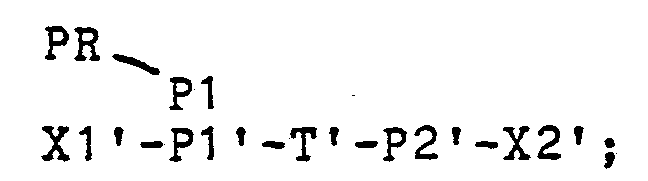
(2) extending a complementary strand to form PR
P1--T--P2--X2
X1'-P1,-T,-P2'-X2', followed by denaturing to form a first collection of single-stranded polynucleotides;
(3) hybridizing said first collection of single-stranded polynucleotides with a second primer of sequence P2' to form
PR-P1-T-P2-X2 P2' ;
(4) extending a complementary strand to form
PR--P1--T--P2--X2 PR'-P1'-T'-P2' ; and (5) growing multiple RNA copies of P1-T-P2 having the formula p1R-TR-P2R using an RNA polymerase capable of binding double-stranded promoter region
PR PR'; wherein:
T is a target sequence;
T' is a sequence complementary to T; PR-P1 is a first oligonucleotide primer in which PR comprises a promoter sequence and P1 is the binding sequence of said first primer;
P1' is a sequence complementary to P1; PR' is a sequence complementary to PR;
P2' is a second oligonucleotide primer;
P2 is a sequence in the target polynucleotide complementary to P2';
X1 and X2 are sequences outside the P1-T- P2 sequence of said target molecule and individually may be present or absent;
X1' is a sequence complementary to X1 ;
X2' is a sequence complementary to X2; and
P1R-TR-P2R is an RNA molecule in which P1R is a sequence equivalent to P1, TR is a sequence equivalent to T, and P2R is a sequence equivalent to P2.
6. The method of Claim 5, wherein said method further comprises the steps of:
(6) hybri'dizing said multiple RNA copies of formula p1R-TR-P2R with said second primer to form
P1R-TR-P2R
P2'; (7) extending a complementary, strand to form
P1 R-TR-P2R P1'-T'-P2', followed by denaturing to form a third collection of single-stranded polynucleotides;
(8) hybridizing said third collection of single-stranded polynucleotides with said first primer to form 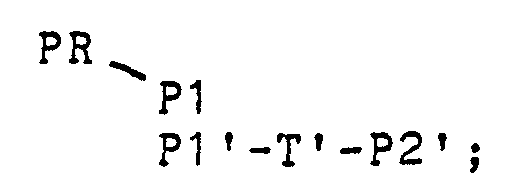 (9) extending complementary strands to form
PR--P1--T--P2 PR'-P1'-T'-p2' (10) repeating step (5); and
(11) optionally repeating steps (6)-(10); wherein in each cycle of steps (6)-(10), each
PR-P1 and P2' oligonucleotide primer represents the corresponding primer from a preceeding cycle of steps or a primer different from the corresponding primer.
7. The method of Claim 5 , wherein said target single-stranded polynucleotide molecule is RNA.
8. The method of Claim 5, wherein said target single-stranded polynucleotide molecule is DNA.
9. The method of Claim 5, wherein extending comprises contacting said sequences to be extended with a reverse transcriptase.
10. The method of Claim 5, wherein said RNA polymerase is T7 RNA polymerase.
11. The method of Claim 1, wherein said primers comprise binding sequences of from 10 to 30 nucleotides in length.
12. The method of Claim 1, wherein said primers are separated by less than 200 base pairs.
13. The method of Claim 1, wherein said promoter sequence is at the 5' terminus of a primer.
14. The method of Claim 1, wherein said target single-stranded polynucleotide molecule is DNA, extending is accomplished using reverse transcriptase, and said primers are present in said intermediate no more than 150 base pairs apart.
15. A method of detecting a target polynucleotide sequence in a sample, which comprises: multiplying the number of copies of said target sequence according to Claim 1; and detecting the presence of said multiplied copies.
Priority Applications (5)
| Application Number | Priority Date | Filing Date | Title |
|---|---|---|---|
| FI891436A FI891436A0 (en) | 1987-07-31 | 1988-07-29 | SELECTIVE FLERFALDIGANDE AV TARGETPOLYNUKLEOTIDSEKVENSER. |
| AU23181/88A AU618965B2 (en) | 1987-07-31 | 1988-07-29 | Selective amplification of target polynucleotide sequences |
| NO89891320A NO891320L (en) | 1987-07-31 | 1989-03-29 | SELECTIVE INCREASE OF TARGET POLYNUCLOTIDE SEQUENCES. |
| KR1019890700555A KR960013577B1 (en) | 1987-07-31 | 1989-03-30 | Selective amplification of target polynucleotide sequences |
| DK153289A DK153289A (en) | 1987-07-31 | 1989-03-30 | SELECTIVE AMPLIFICATION OF TARGET POLYNUCLEOTIDE SEQUENCES |
Applications Claiming Priority (2)
| Application Number | Priority Date | Filing Date | Title |
|---|---|---|---|
| US8047987A | 1987-07-31 | 1987-07-31 | |
| US080,479 | 1987-07-31 |
Publications (1)
| Publication Number | Publication Date |
|---|---|
| WO1989001050A1 true WO1989001050A1 (en) | 1989-02-09 |
Family
ID=22157643
Family Applications (1)
| Application Number | Title | Priority Date | Filing Date |
|---|---|---|---|
| PCT/US1988/002601 Ceased WO1989001050A1 (en) | 1987-07-31 | 1988-07-29 | Selective amplification of target polynucleotide sequences |
Country Status (13)
| Country | Link |
|---|---|
| US (2) | US5437990A (en) |
| EP (2) | EP0682120B1 (en) |
| JP (1) | JP2774121B2 (en) |
| KR (1) | KR960013577B1 (en) |
| AT (1) | ATE135053T1 (en) |
| CA (1) | CA1340843C (en) |
| DE (2) | DE3855064T2 (en) |
| DK (1) | DK153289A (en) |
| ES (1) | ES2086298T3 (en) |
| FI (1) | FI891436A0 (en) |
| IE (1) | IE72468B1 (en) |
| PT (1) | PT88168B (en) |
| WO (1) | WO1989001050A1 (en) |
Cited By (109)
| Publication number | Priority date | Publication date | Assignee | Title |
|---|---|---|---|---|
| WO1991001384A1 (en) * | 1989-07-11 | 1991-02-07 | Gen-Probe, Incorporated | Nucleic acid sequence amplification methods utilizing a transcription complex |
| FR2664290A1 (en) * | 1990-07-05 | 1992-01-10 | Centre Nat Rech Scient | TOXOPLASMA GONDII SPECIFIC GENE PROBES, AND THEIR USE FOR IN VITRO DETECTION OF TOXOPLASMA GONDII AND FOR THE TYPING OF TOXOPLASMIC STRAINS. |
| EP0439330A3 (en) * | 1990-01-25 | 1992-02-19 | Imperial Chemical Industries Plc | Amplification methods |
| US5112734A (en) * | 1989-05-26 | 1992-05-12 | Gene-Trak Systems | Target-dependent synthesis of an artificial gene for the synthesis of a replicatable rna |
| US5130238A (en) * | 1988-06-24 | 1992-07-14 | Cangene Corporation | Enhanced nucleic acid amplification process |
| WO1993005184A1 (en) * | 1991-09-10 | 1993-03-18 | Love Jack D | Dna/rna target and signal amplification |
| US5399491A (en) * | 1989-07-11 | 1995-03-21 | Gen-Probe Incorporated | Nucleic acid sequence amplification methods |
| US5409818A (en) * | 1988-02-24 | 1995-04-25 | Cangene Corporation | Nucleic acid amplification process |
| US5474916A (en) * | 1991-09-26 | 1995-12-12 | Boehringer Mannheim Gmbh | Promotor controlled specific amplification of nucleic acid sequences |
| US5512445A (en) * | 1994-10-14 | 1996-04-30 | Gen-Probe Incorporated | Methods for the detection of Chlamydia trachomatis |
| US5552275A (en) * | 1990-02-06 | 1996-09-03 | National University Of Singapore | Human leukocyte antigen typing |
| US5554517A (en) * | 1988-02-24 | 1996-09-10 | Akzo Nobel N.V. | Nucleic acid amplification process |
| US5554516A (en) * | 1992-05-06 | 1996-09-10 | Gen-Probe Incorporated | Nucleic acid sequence amplification method, composition and kit |
| US5643730A (en) * | 1991-09-23 | 1997-07-01 | Pfizer Inc. | Process for detecting specific mRNA and DNA in cells |
| US5652126A (en) * | 1995-06-07 | 1997-07-29 | Gen-Probe Incorporated | Use of restriction endonuclease sequences for cleaving phosphorothioate oligonucleotides |
| US5739311A (en) * | 1995-06-07 | 1998-04-14 | Gen-Probe Incorporated | Enzymatic synthesis of phosphorothioate oligonucleotides using restriction endonucleases |
| US5766849A (en) * | 1989-07-11 | 1998-06-16 | Gen-Probe Incorporated | Methods of amplifying nucleic acids using promoter-containing primer sequence |
| US5786183A (en) * | 1993-07-23 | 1998-07-28 | Gen-Probe Incorporated | Methods of enhancing nucleic acid amplification |
| US5838267A (en) * | 1996-10-09 | 1998-11-17 | Ericsson, Inc. | Method and apparatus for encoding and decoding digital information |
| US5891636A (en) * | 1989-09-22 | 1999-04-06 | Board Of Trustees Of Leland Stanford University | Processes for genetic manipulations using promoters |
| US5916777A (en) * | 1995-06-07 | 1999-06-29 | Gen-Probe Incorporated | Enzymatic synthesis of oligonucleotides using 3'-ribonucleotide primers |
| US5932450A (en) * | 1995-06-07 | 1999-08-03 | Gen-Probe Incorporated | Enzymatic synthesis of oligonucleotides using digestible templates |
| US5972607A (en) * | 1996-07-16 | 1999-10-26 | Toyo Boseki Kabushiki Kaisha | Methods for nucleic acid amplification with thermostable ribonuclease H |
| US6087133A (en) * | 1994-03-16 | 2000-07-11 | Gen-Probe Incorporated | Isothermal strand displacement nucleic acid amplification |
| US6218107B1 (en) | 1996-05-22 | 2001-04-17 | Gen-Probe Incorporated | Compositions and methods for detecting the presence of Mycobacterium kansassii |
| WO2001038572A1 (en) * | 1999-11-19 | 2001-05-31 | Takara Bio Inc. | Method of amplifying nucleic acids |
| US6251639B1 (en) | 1999-09-13 | 2001-06-26 | Nugen Technologies, Inc. | Methods and compositions for linear isothermal amplification of polynucleotide sequences, using a RNA-DNA composite primer |
| US6589734B1 (en) | 1989-07-11 | 2003-07-08 | Gen-Probe Incorporated | Detection of HIV |
| US6692918B2 (en) | 1999-09-13 | 2004-02-17 | Nugen Technologies, Inc. | Methods and compositions for linear isothermal amplification of polynucleotide sequences |
| US6794141B2 (en) | 2000-12-22 | 2004-09-21 | Arcturus Bioscience, Inc. | Nucleic acid amplification |
| US6852494B2 (en) | 2003-01-10 | 2005-02-08 | Linden Technologies, Inc. | Nucleic acid amplification |
| WO2005083121A1 (en) * | 2004-02-27 | 2005-09-09 | Seegene, Inc. | Method for amplifying members of a gene family |
| US6946251B2 (en) | 2001-03-09 | 2005-09-20 | Nugen Technologies, Inc. | Methods and compositions for amplification of RNA sequences using RNA-DNA composite primers |
| US7009041B1 (en) | 1989-07-11 | 2006-03-07 | Gen-Probe Incorporated | Oligonucleotides for nucleic acid amplification and for the detection of Mycobacterium tuberculosis |
| EP1642987A2 (en) | 1989-06-02 | 2006-04-05 | Institut Pasteur | Nucleotide sequences derived from the genomes of the retroviruses HIV-1, HIV-2 and SIV, and their application to the amplification of these viral genomes and to the in vitro diagnosis of infections resulting from these viruses |
| US7045319B2 (en) | 2001-10-30 | 2006-05-16 | Ribomed Biotechnologies, Inc. | Molecular detection systems utilizing reiterative oligonucleotide synthesis |
| US7049102B1 (en) | 1989-09-22 | 2006-05-23 | Board Of Trustees Of Leland Stanford University | Multi-gene expression profile |
| US7094536B2 (en) | 2001-03-09 | 2006-08-22 | Nugen Technologies, Inc. | Methods and compositions for amplification of RNA sequences |
| WO2006122354A1 (en) | 2005-05-17 | 2006-11-23 | Ozgene Pty Ltd | Sequential cloning system |
| US7208272B2 (en) | 2001-12-18 | 2007-04-24 | Samsung Electronics Co., Ltd. | Multiplex PCR primer set for human HNF-1α gene amplification |
| US7402386B2 (en) | 2003-04-14 | 2008-07-22 | Nugen Technologies, Inc. | Global amplification using random priming by a composite primer |
| US7754429B2 (en) | 2006-10-06 | 2010-07-13 | Illumina Cambridge Limited | Method for pair-wise sequencing a plurity of target polynucleotides |
| US7771934B2 (en) | 2000-12-13 | 2010-08-10 | Nugen Technologies, Inc. | Methods and compositions for generation of multiple copies of nucleic acid sequences and methods of detection thereof |
| US7803579B2 (en) | 2002-10-29 | 2010-09-28 | Riken | Process for amplifying nucleic acid |
| US7846666B2 (en) | 2008-03-21 | 2010-12-07 | Nugen Technologies, Inc. | Methods of RNA amplification in the presence of DNA |
| US7846733B2 (en) | 2000-06-26 | 2010-12-07 | Nugen Technologies, Inc. | Methods and compositions for transcription-based nucleic acid amplification |
| US7939258B2 (en) | 2005-09-07 | 2011-05-10 | Nugen Technologies, Inc. | Nucleic acid amplification procedure using RNA and DNA composite primers |
| US7972820B2 (en) | 2000-12-08 | 2011-07-05 | Illumina Cambridge Limited | Isothermal amplification of nucleic acids on a solid support |
| US7985565B2 (en) | 1997-04-01 | 2011-07-26 | Illumina, Inc. | Method of nucleic acid amplification |
| US8017335B2 (en) | 2005-07-20 | 2011-09-13 | Illumina Cambridge Limited | Method for sequencing a polynucleotide template |
| US8034568B2 (en) | 2008-02-12 | 2011-10-11 | Nugen Technologies, Inc. | Isothermal nucleic acid amplification methods and compositions |
| US8053192B2 (en) | 2007-02-02 | 2011-11-08 | Illumina Cambridge Ltd. | Methods for indexing samples and sequencing multiple polynucleotide templates |
| US8182994B2 (en) | 2009-09-15 | 2012-05-22 | Illumina Cambridge Limited | Centroid markers for image analysis of high denisty clusters in complex polynucleotide sequencing |
| US8192930B2 (en) | 2006-02-08 | 2012-06-05 | Illumina Cambridge Limited | Method for sequencing a polynucleotide template |
| US8206902B2 (en) | 2003-12-25 | 2012-06-26 | Riken | Method of amplifying nucleic acid and method of detecting mutated nucleic acid using the same |
| US8211644B2 (en) | 2008-07-13 | 2012-07-03 | Ribomed Biotechnologies, Inc. | Molecular beacon-based methods for detection of targets using abscription |
| US8242243B2 (en) | 2008-05-15 | 2012-08-14 | Ribomed Biotechnologies, Inc. | Methods and reagents for detecting CpG methylation with a methyl CpG binding protein (MBP) |
| US8263339B2 (en) | 2009-03-15 | 2012-09-11 | Ribomed Biotechnologies, Inc. | Abscription based molecular detection |
| WO2013050609A1 (en) | 2011-10-06 | 2013-04-11 | bioMérieux | Mutated t7 rna polymerases |
| US8652810B2 (en) | 1998-09-30 | 2014-02-18 | Illumina, Inc. | Methods of nucleic acid amplification and sequencing |
| WO2014055746A1 (en) | 2012-10-04 | 2014-04-10 | The Board Of Trustees Of The Leland Stanford Junior University | Methods and reagents for detection, quantitation, and serotyping of dengue viruses |
| US8728764B2 (en) | 2008-10-02 | 2014-05-20 | Illumina Cambridge Limited | Nucleic acid sample enrichment for sequencing applications |
| US8999642B2 (en) | 2008-03-10 | 2015-04-07 | Illumina, Inc. | Methods for selecting and amplifying polynucleotides |
| US9315857B2 (en) | 2009-12-15 | 2016-04-19 | Cellular Research, Inc. | Digital counting of individual molecules by stochastic attachment of diverse label-tags |
| US9567645B2 (en) | 2013-08-28 | 2017-02-14 | Cellular Research, Inc. | Massively parallel single cell analysis |
| US9708659B2 (en) | 2009-12-15 | 2017-07-18 | Cellular Research, Inc. | Digital counting of individual molecules by stochastic attachment of diverse labels |
| US9727810B2 (en) | 2015-02-27 | 2017-08-08 | Cellular Research, Inc. | Spatially addressable molecular barcoding |
| US9765391B2 (en) | 2005-07-20 | 2017-09-19 | Illumina Cambridge Limited | Methods for sequencing a polynucleotide template |
| US9905005B2 (en) | 2013-10-07 | 2018-02-27 | Cellular Research, Inc. | Methods and systems for digitally counting features on arrays |
| US10202641B2 (en) | 2016-05-31 | 2019-02-12 | Cellular Research, Inc. | Error correction in amplification of samples |
| US10301677B2 (en) | 2016-05-25 | 2019-05-28 | Cellular Research, Inc. | Normalization of nucleic acid libraries |
| US10338066B2 (en) | 2016-09-26 | 2019-07-02 | Cellular Research, Inc. | Measurement of protein expression using reagents with barcoded oligonucleotide sequences |
| US10619186B2 (en) | 2015-09-11 | 2020-04-14 | Cellular Research, Inc. | Methods and compositions for library normalization |
| US10640763B2 (en) | 2016-05-31 | 2020-05-05 | Cellular Research, Inc. | Molecular indexing of internal sequences |
| US10669570B2 (en) | 2017-06-05 | 2020-06-02 | Becton, Dickinson And Company | Sample indexing for single cells |
| US10697010B2 (en) | 2015-02-19 | 2020-06-30 | Becton, Dickinson And Company | High-throughput single-cell analysis combining proteomic and genomic information |
| US10722880B2 (en) | 2017-01-13 | 2020-07-28 | Cellular Research, Inc. | Hydrophilic coating of fluidic channels |
| US10822643B2 (en) | 2016-05-02 | 2020-11-03 | Cellular Research, Inc. | Accurate molecular barcoding |
| US10941396B2 (en) | 2012-02-27 | 2021-03-09 | Becton, Dickinson And Company | Compositions and kits for molecular counting |
| US11124823B2 (en) | 2015-06-01 | 2021-09-21 | Becton, Dickinson And Company | Methods for RNA quantification |
| US11164659B2 (en) | 2016-11-08 | 2021-11-02 | Becton, Dickinson And Company | Methods for expression profile classification |
| US11177020B2 (en) | 2012-02-27 | 2021-11-16 | The University Of North Carolina At Chapel Hill | Methods and uses for molecular tags |
| US11319583B2 (en) | 2017-02-01 | 2022-05-03 | Becton, Dickinson And Company | Selective amplification using blocking oligonucleotides |
| US11365409B2 (en) | 2018-05-03 | 2022-06-21 | Becton, Dickinson And Company | Molecular barcoding on opposite transcript ends |
| US11371076B2 (en) | 2019-01-16 | 2022-06-28 | Becton, Dickinson And Company | Polymerase chain reaction normalization through primer titration |
| US11390914B2 (en) | 2015-04-23 | 2022-07-19 | Becton, Dickinson And Company | Methods and compositions for whole transcriptome amplification |
| US11397882B2 (en) | 2016-05-26 | 2022-07-26 | Becton, Dickinson And Company | Molecular label counting adjustment methods |
| US11492660B2 (en) | 2018-12-13 | 2022-11-08 | Becton, Dickinson And Company | Selective extension in single cell whole transcriptome analysis |
| US11535882B2 (en) | 2015-03-30 | 2022-12-27 | Becton, Dickinson And Company | Methods and compositions for combinatorial barcoding |
| US11608497B2 (en) | 2016-11-08 | 2023-03-21 | Becton, Dickinson And Company | Methods for cell label classification |
| US11639517B2 (en) | 2018-10-01 | 2023-05-02 | Becton, Dickinson And Company | Determining 5′ transcript sequences |
| US11649497B2 (en) | 2020-01-13 | 2023-05-16 | Becton, Dickinson And Company | Methods and compositions for quantitation of proteins and RNA |
| US11661625B2 (en) | 2020-05-14 | 2023-05-30 | Becton, Dickinson And Company | Primers for immune repertoire profiling |
| US11661631B2 (en) | 2019-01-23 | 2023-05-30 | Becton, Dickinson And Company | Oligonucleotides associated with antibodies |
| US11739443B2 (en) | 2020-11-20 | 2023-08-29 | Becton, Dickinson And Company | Profiling of highly expressed and lowly expressed proteins |
| US11773436B2 (en) | 2019-11-08 | 2023-10-03 | Becton, Dickinson And Company | Using random priming to obtain full-length V(D)J information for immune repertoire sequencing |
| US11773441B2 (en) | 2018-05-03 | 2023-10-03 | Becton, Dickinson And Company | High throughput multiomics sample analysis |
| US11932901B2 (en) | 2020-07-13 | 2024-03-19 | Becton, Dickinson And Company | Target enrichment using nucleic acid probes for scRNAseq |
| US11932849B2 (en) | 2018-11-08 | 2024-03-19 | Becton, Dickinson And Company | Whole transcriptome analysis of single cells using random priming |
| US11939622B2 (en) | 2019-07-22 | 2024-03-26 | Becton, Dickinson And Company | Single cell chromatin immunoprecipitation sequencing assay |
| US11946095B2 (en) | 2017-12-19 | 2024-04-02 | Becton, Dickinson And Company | Particles associated with oligonucleotides |
| US11965208B2 (en) | 2019-04-19 | 2024-04-23 | Becton, Dickinson And Company | Methods of associating phenotypical data and single cell sequencing data |
| US12060554B2 (en) | 2008-03-10 | 2024-08-13 | Illumina, Inc. | Method for selecting and amplifying polynucleotides |
| US12071617B2 (en) | 2019-02-14 | 2024-08-27 | Becton, Dickinson And Company | Hybrid targeted and whole transcriptome amplification |
| US12153043B2 (en) | 2020-02-25 | 2024-11-26 | Becton, Dickinson And Company | Bi-specific probes to enable the use of single-cell samples as single color compensation control |
| US12157913B2 (en) | 2020-06-02 | 2024-12-03 | Becton, Dickinson And Company | Oligonucleotides and beads for 5 prime gene expression assay |
| US12188010B2 (en) | 2020-01-29 | 2025-01-07 | Becton, Dickinson And Company | Barcoded wells for spatial mapping of single cells through sequencing |
| US12392771B2 (en) | 2020-12-15 | 2025-08-19 | Becton, Dickinson And Company | Single cell secretome analysis |
| US12391940B2 (en) | 2020-07-31 | 2025-08-19 | Becton, Dickinson And Company | Single cell assay for transposase-accessible chromatin |
Families Citing this family (340)
| Publication number | Priority date | Publication date | Assignee | Title |
|---|---|---|---|---|
| US5714380A (en) | 1986-10-23 | 1998-02-03 | Amoco Corporation | Closed vessel for isolating target molecules and for performing amplification |
| JP2774121B2 (en) * | 1987-07-31 | 1998-07-09 | ザ ボード オブ トラスティーズ オブ ザ リーランド スタンフォード ジュニア ユニバーシティ | Selective amplification of target polynucleotide sequence |
| US6090591A (en) * | 1987-07-31 | 2000-07-18 | The Board Of Trustees Of The Leland Stanford Junior University | Selective amplification of target polynucleotide sequences |
| AU624601B2 (en) * | 1988-01-21 | 1992-06-18 | Genentech Inc. | Amplification and detection of nucleic acid sequences |
| KR0148265B1 (en) * | 1988-12-16 | 1998-10-15 | 에프.지이.엠 헤르만스 | Self-Continuous Sequence Replication System |
| FR2650839A1 (en) * | 1989-08-08 | 1991-02-15 | Oris Ind Cie | Process for the detection, in a liquid homogeneous phase, of specific sequences of nucleic acids and its applications |
| AU5838690A (en) * | 1989-06-12 | 1991-01-08 | Compagnie Oris Industrie S.A. | Method for detecting specific nucleic acid sequences and applications of same |
| WO1991004340A1 (en) * | 1989-09-20 | 1991-04-04 | Cambridge Biotech Corporation | In vitro, isothermal nucleic acid amplification |
| NO904633L (en) * | 1989-11-09 | 1991-05-10 | Molecular Diagnostics Inc | AMPLIFICATION OF NUCLEIC ACIDS BY TRANSCRIPABLE HAIRNEL PROBE. |
| US5215899A (en) * | 1989-11-09 | 1993-06-01 | Miles Inc. | Nucleic acid amplification employing ligatable hairpin probe and transcription |
| US5194370A (en) * | 1990-05-16 | 1993-03-16 | Life Technologies, Inc. | Promoter ligation activated transcription amplification of nucleic acid sequences |
| US5707796A (en) * | 1990-06-11 | 1998-01-13 | Nexstar Pharmaceuticals, Inc. | Method for selecting nucleic acids on the basis of structure |
| US5162209A (en) * | 1991-01-18 | 1992-11-10 | Beth Israel Hospital Association | Synthesis of full-length, double-stranded dna from a single-stranded linear dna template |
| WO1992020820A1 (en) * | 1991-05-15 | 1992-11-26 | Vanderbilt University | Method to determine metastatic potential of tumor cells |
| DE4129653A1 (en) * | 1991-09-06 | 1993-03-11 | Boehringer Mannheim Gmbh | PROCESS FOR DETECTION OF SIMILAR NUCLEIC ACIDS |
| DE4132133A1 (en) * | 1991-09-26 | 1993-04-01 | Boehringer Mannheim Gmbh | METHOD FOR THE SPECIFIC PRODUCTION OF RIBONUCLEIC ACIDS |
| US5981179A (en) * | 1991-11-14 | 1999-11-09 | Digene Diagnostics, Inc. | Continuous amplification reaction |
| US6100099A (en) | 1994-09-06 | 2000-08-08 | Abbott Laboratories | Test strip having a diagonal array of capture spots |
| US5843640A (en) * | 1992-06-19 | 1998-12-01 | Northwestern University | Method of simultaneously detecting amplified nucleic acid sequences and cellular antigens in cells |
| FR2708288B1 (en) | 1993-07-26 | 1995-09-01 | Bio Merieux | Method for amplification of nucleic acids by transcription using displacement, reagents and necessary for the implementation of this method. |
| WO1995015399A1 (en) | 1993-12-01 | 1995-06-08 | Toyo Boseki Kabushiki Kaisha | Method of amplifying and detecting target nucleic acid sequence by using thermostable enzymes |
| FR2724934B1 (en) * | 1994-09-26 | 1997-01-24 | Bio Merieux | CHIMERIC OLIGONUCLEOTIDE AND ITS USE IN OBTAINING NUCLEIC ACID TRANSCRIPTS |
| US5770368A (en) * | 1996-05-09 | 1998-06-23 | Metropolitan Water District Of Southern California | Cryptosporidium detection method |
| US6436638B1 (en) | 1996-05-09 | 2002-08-20 | Metropolitan Water District Of Southern California | Cryptosporidium detection method |
| US7070925B1 (en) | 1996-07-16 | 2006-07-04 | Gen-Probe Incorporated | Method for determining the presence of an RNA analyte in a sample using a modified oligonucleotide probe |
| DE69736667T2 (en) * | 1996-07-16 | 2007-09-06 | Gen-Probe Inc., San Diego | PROCESS FOR THE DETECTION AND AMPLIFICATION OF NUCLEIC ACID SEQUENCES USING MODIFIED OLIGONUCLEOTIDES WITH INCREASED TARGET MELT TEMPERATURE (TM) |
| US6025133A (en) * | 1996-12-30 | 2000-02-15 | Gen-Probe Incorporated | Promoter-sequestered oligonucleoside and method of use |
| JP3968810B2 (en) * | 1997-01-24 | 2007-08-29 | 東ソー株式会社 | Nucleic acid sequence analysis method |
| US5786182A (en) * | 1997-05-02 | 1998-07-28 | Biomerieux Vitek, Inc. | Dual chamber disposable reaction vessel for amplification reactions, reaction processing station therefor, and methods of use |
| KR20010012175A (en) * | 1997-05-02 | 2001-02-15 | 다니엘 엘. 캐시앙, 헨리 엘. 노르호프, 피터 알. 쉬어리 | Two-step hybridization and capture of a polynucleotide |
| US6558901B1 (en) | 1997-05-02 | 2003-05-06 | Biomerieux Vitek | Nucleic acid assays |
| IL124275A (en) * | 1997-05-02 | 2002-03-10 | Bio Merieux Vitek Inc | Method for generating nucleic acid sequences |
| US6410275B1 (en) | 1997-05-02 | 2002-06-25 | Biomerieux, Inc. | Disposable test devices for performing nucleic acid amplification reactions |
| US6429007B1 (en) * | 1997-05-02 | 2002-08-06 | BIOMéRIEUX, INC. | Nucleic acid amplification reaction station for disposable test devices |
| US5989499A (en) * | 1997-05-02 | 1999-11-23 | Biomerieux, Inc. | Dual chamber disposable reaction vessel for amplification reactions |
| US6534273B2 (en) | 1997-05-02 | 2003-03-18 | Gen-Probe Incorporated | Two-step hybridization and capture of a polynucleotide |
| US5932451A (en) * | 1997-11-19 | 1999-08-03 | Incyte Pharmaceuticals, Inc. | Method for unbiased mRNA amplification |
| DE69928390T2 (en) | 1998-05-01 | 2006-08-10 | Gen-Probe Inc., San Diego | AUTOMATED DIAGNOSTIC ANALYSIS PROCEDURE |
| US6153411A (en) * | 1998-10-30 | 2000-11-28 | American Water Works Company, Inc. | Methods and kits for detection of Cryptosporidium parvum using immunomagnetic separation and amplification |
| US6582906B1 (en) | 1999-04-05 | 2003-06-24 | Affymetrix, Inc. | Proportional amplification of nucleic acids |
| US6132997A (en) * | 1999-05-28 | 2000-10-17 | Agilent Technologies | Method for linear mRNA amplification |
| US6864050B2 (en) | 1999-07-30 | 2005-03-08 | Affymetrix, Inc. | Single-phase amplification of nucleic acids |
| AT410218B (en) | 1999-08-20 | 2003-03-25 | Baxter Ag | METHOD FOR PRODUCING A QUALITY-ASSURED POOL OF BIOLOGICAL SAMPLES |
| US6582938B1 (en) | 2001-05-11 | 2003-06-24 | Affymetrix, Inc. | Amplification of nucleic acids |
| US6794138B1 (en) * | 1999-12-16 | 2004-09-21 | Affymetrix, Inc. | Methods of small sample amplification |
| US6489114B2 (en) | 1999-12-17 | 2002-12-03 | Bio Merieux | Process for labeling a ribonucleic acid, and labeled RNA fragments which are obtained thereby |
| US6902891B2 (en) | 1999-12-17 | 2005-06-07 | Bio Merieux | Process for labeling a nucleic acid |
| CN1498274A (en) * | 2000-06-26 | 2004-05-19 | Ŧب������˾ | Transcription-based nucleic acid amplification methods and compositions |
| DE60045932D1 (en) | 2000-09-01 | 2011-06-16 | Gen Probe Inc | HIV-1 sequence amplification for recognition of sequences related to drug resistance mutations |
| WO2002034951A2 (en) | 2000-10-23 | 2002-05-02 | Gen-Probe Incorporated | Compositions and methods for detecting human immunodeficiency virus 2 (hiv-2) |
| US6867021B2 (en) | 2001-02-20 | 2005-03-15 | Board Of Trustees Of Michigan State University | Multiplex RT-PCR/PCR for simultaneous detection of bovine coronavirus, bovine rotavirus, Cryptosporidium parvum, and Escherichia coli |
| US8137911B2 (en) * | 2001-05-22 | 2012-03-20 | Cellscript, Inc. | Preparation and use of single-stranded transcription substrates for synthesis of transcription products corresponding to target sequences |
| AU2003303395A1 (en) * | 2001-05-22 | 2004-07-22 | Dahl, Gary, A. | Target-dependent transcription using deletion mutants of n4 rna polymerase |
| US6872529B2 (en) * | 2001-07-25 | 2005-03-29 | Affymetrix, Inc. | Complexity management of genomic DNA |
| US7297778B2 (en) | 2001-07-25 | 2007-11-20 | Affymetrix, Inc. | Complexity management of genomic DNA |
| TWI335938B (en) * | 2001-08-15 | 2011-01-11 | Rna replication and amplification | |
| CN1927466A (en) * | 2001-12-19 | 2007-03-14 | 阿菲梅特里克斯公司 | Array plate and manufacturing process for array plate assembly |
| US20060246434A1 (en) * | 2002-03-15 | 2006-11-02 | Erlander Mark G | Nucleic acid amplification |
| US7498171B2 (en) | 2002-04-12 | 2009-03-03 | Anthrogenesis Corporation | Modulation of stem and progenitor cell differentiation, assays, and uses thereof |
| KR20050008720A (en) | 2002-05-17 | 2005-01-21 | 벡톤 디킨슨 앤드 컴퍼니 | Automated system for isolating, amplifying and detecting a target nucleic acid sequence |
| EP1513958B1 (en) | 2002-06-14 | 2011-08-10 | Gen-Probe Incorporated | Compositions for detecting hepatitis b virus |
| KR100442832B1 (en) * | 2002-07-10 | 2004-08-02 | 삼성전자주식회사 | Primer sets for MODY2 gene amplification by multiplex polymerase chain reaction |
| US7504215B2 (en) | 2002-07-12 | 2009-03-17 | Affymetrix, Inc. | Nucleic acid labeling methods |
| US20040009483A1 (en) * | 2002-07-12 | 2004-01-15 | Ilsley Diane D. | Method of linear mRNA amplification using total RNA |
| US20050003369A1 (en) * | 2002-10-10 | 2005-01-06 | Affymetrix, Inc. | Method for depleting specific nucleic acids from a mixture |
| CA2957200C (en) | 2002-10-16 | 2020-05-26 | Gen-Probe Incorporated | Compositions and methods for detecting west nile virus |
| US20040101844A1 (en) * | 2002-11-21 | 2004-05-27 | Amorese Douglas A. | Methods and compositions for producing linearly amplified amounts of (+) strand RNA |
| US7413857B2 (en) * | 2002-11-21 | 2008-08-19 | Epicentre Technologies | Methods for using riboprimers for strand displacement replication of target sequences |
| WO2004083806A2 (en) | 2003-01-22 | 2004-09-30 | University Of South Florida | Autonomous genosensor apparatus and methods for use |
| US20040248102A1 (en) | 2003-06-03 | 2004-12-09 | Diane Ilsley-Tyree | Methods and compositions for performing template dependent nucleic acid primer extension reactions that produce a reduced complexity product |
| WO2005000098A2 (en) | 2003-06-10 | 2005-01-06 | The Trustees Of Boston University | Detection methods for disorders of the lung |
| JP4790621B2 (en) | 2003-11-26 | 2011-10-12 | アドバンディーエックス, インコーポレイテッド | Peptide nucleic acid probes for analysis of specific Staphylococcus species |
| ATE549421T1 (en) | 2003-12-19 | 2012-03-15 | Gen Probe Inc | COMPOSITIONS, METHODS AND KITS FOR DETECTING THE NUCLEIC ACIDS OF HIV-1 AND HIV-2 |
| US20050147975A1 (en) * | 2003-12-24 | 2005-07-07 | Schembri Carol T. | Methods and compositions for amplification of genomic DNA |
| DE602005025424D1 (en) | 2004-01-23 | 2011-01-27 | Bio Merieux Inc | Novel nucleotide mixture for improved nucleic acid amplification performance |
| CA2497324A1 (en) | 2004-02-17 | 2005-08-17 | Affymetrix, Inc. | Methods for fragmenting and labelling dna |
| EP2752874A1 (en) | 2004-06-07 | 2014-07-09 | Fluidigm Corporation | Method and apparatus for imaging a device under temperature control |
| EP1771585B1 (en) | 2004-07-13 | 2012-09-26 | Gen-Probe Incorporated | Compositions and methods for detection of hepatitis a virus nucleic acid |
| US20090232771A1 (en) | 2004-07-13 | 2009-09-17 | Takeda Pharmaceutical Company Limited | Method of controlling cell functions |
| WO2006011667A1 (en) * | 2004-07-30 | 2006-02-02 | Tosoh Corporation | METHOD OF MEASURING HETEROGENOUS NCULEAR NIBONUCLEOPROTEIN B1 (hnRNP B1) mRNA |
| CA2898814C (en) | 2004-08-27 | 2015-12-29 | Gen-Probe Incorporated | Single-primer nucleic acid amplification methods |
| US7713697B2 (en) * | 2004-08-27 | 2010-05-11 | Gen-Probe Incorporated | Methods and kits for amplifying DNA |
| EP1647600A3 (en) | 2004-09-17 | 2006-06-28 | Affymetrix, Inc. (A US Entity) | Methods for identifying biological samples by addition of nucleic acid bar-code tags |
| CA2582055C (en) | 2004-09-30 | 2014-04-08 | Gen-Probe Incorporated | Assay for detecting and quantifying hiv-1 |
| US20060073511A1 (en) | 2004-10-05 | 2006-04-06 | Affymetrix, Inc. | Methods for amplifying and analyzing nucleic acids |
| CA2524964A1 (en) | 2004-10-29 | 2006-04-29 | Affymetrix, Inc. | Automated method of manufacturing polymer arrays |
| US7682782B2 (en) | 2004-10-29 | 2010-03-23 | Affymetrix, Inc. | System, method, and product for multiple wavelength detection using single source excitation |
| AU2005333163B2 (en) * | 2004-11-09 | 2011-06-16 | Gen-Probe Incorporated | Compositions and methods for detecting Group A streptococci |
| EP1841879A4 (en) | 2005-01-25 | 2009-05-27 | Population Genetics Technologi | Isothermal dna amplification |
| DK1859330T3 (en) | 2005-01-28 | 2012-10-15 | Univ Duke | DEVICES AND METHODS OF HANDLING SMALL DROPS ON A PRINTED CIRCUIT CARD |
| US20060177859A1 (en) * | 2005-02-07 | 2006-08-10 | Gen-Probe Incorporated | Compositions and methods for detecting group B streptococci |
| AU2006214141B2 (en) * | 2005-02-18 | 2010-07-15 | Gen-Probe Incorporated | Sample preparation method incorporating an alkaline shock |
| CN101128604A (en) * | 2005-02-28 | 2008-02-20 | 生物探索公司 | Method for performing direct enzymatic reactions involving nucleic acid molecules |
| US20060223071A1 (en) * | 2005-04-01 | 2006-10-05 | Wisniewski Michele E | Methods, compositions, and kits for detecting nucleic acids in a single vessel |
| EP2360279A1 (en) | 2005-04-14 | 2011-08-24 | Trustees Of Boston University | Diagnostic for lung disorders using class prediction |
| JP4773513B2 (en) | 2005-05-06 | 2011-09-14 | ジェン−プローブ・インコーポレーテッド | Compositions and assays for detecting nucleic acids of influenza A and B viruses |
| US7550264B2 (en) * | 2005-06-10 | 2009-06-23 | Datascope Investment Corporation | Methods and kits for sense RNA synthesis |
| US20070054301A1 (en) * | 2005-09-06 | 2007-03-08 | Gen-Probe Incorporated | Methods, compositions and kits for isothermal amplification of nucleic acids |
| WO2007047912A2 (en) | 2005-10-17 | 2007-04-26 | Gen-Probe Incorporated | Compositions and methods to detect legionella pneumophila nucleic acid |
| AU2006315489B2 (en) | 2005-11-14 | 2012-09-06 | Gen-Probe Incorporated | Parametric calibration method |
| CN103499466B (en) | 2006-01-18 | 2017-04-12 | 阿戈斯治疗公司 | Systems and methods for processing samples in a closed container, and related devices |
| WO2007087262A2 (en) * | 2006-01-23 | 2007-08-02 | Population Genetics Technologies Ltd. | Selective genome amplification |
| US20090176878A1 (en) * | 2007-10-05 | 2009-07-09 | Washington University In St. Louis | Genetic polymorphisms and substance dependence |
| US20110143344A1 (en) * | 2006-03-01 | 2011-06-16 | The Washington University | Genetic polymorphisms and substance dependence |
| WO2007103541A2 (en) | 2006-03-09 | 2007-09-13 | The Trustees Of Boston University | Diagnostic and prognostic methods for lung disorders using gene expression profiles from nose epithelial cells |
| WO2007134208A2 (en) * | 2006-05-12 | 2007-11-22 | Gen-Probe Incorporated | Compositions and methods to detect enterococci nucleic acid |
| CA2654266A1 (en) | 2006-06-12 | 2007-12-27 | Oncomethylome Sciences S.A. | Methylation markers for early detection and prognosis of colon cancers |
| EP2765202B1 (en) | 2006-08-01 | 2017-02-01 | Gen-Probe Incorporated | Methods of nonspecific target capture of nucleic acids |
| US8586006B2 (en) | 2006-08-09 | 2013-11-19 | Institute For Systems Biology | Organ-specific proteins and methods of their use |
| US9845494B2 (en) | 2006-10-18 | 2017-12-19 | Affymetrix, Inc. | Enzymatic methods for genotyping on arrays |
| US20090275632A1 (en) * | 2006-10-27 | 2009-11-05 | Oncomethylome Sciences Sa | Methods of diagnosis and treatment |
| EP2092074A4 (en) | 2006-11-02 | 2010-06-09 | Univ Yale | ESTIMATION OF OOCYTE COMPETENCE |
| US8293684B2 (en) * | 2006-11-29 | 2012-10-23 | Exiqon | Locked nucleic acid reagents for labelling nucleic acids |
| CA2673017C (en) | 2006-12-21 | 2015-08-04 | Gen-Probe Incorporated | Methods and compositions for nucleic acid amplification |
| GB0701253D0 (en) | 2007-01-23 | 2007-02-28 | Diagnostics For The Real World | Nucleic acid amplification and testing |
| US8183359B2 (en) * | 2007-03-01 | 2012-05-22 | Gen-Probe Incorporated | Kits for amplifying DNA |
| CA2707436C (en) * | 2007-06-29 | 2014-01-28 | Epicentre Technologies Corporation | Copy dna and sense rna |
| CA2692800A1 (en) | 2007-07-09 | 2009-01-15 | Christopher John Stanley | Detection of micro-organisms based on their nad-dependent dna ligase activity |
| EP2185726B1 (en) | 2007-08-06 | 2014-01-08 | Orion Genomics, LLC | Novel single nucleotide polymorphisms and combinations of novel and known polymorphisms for determining the allele-specific expression of the igf2 gene |
| CA2639416C (en) | 2007-09-11 | 2019-12-31 | F. Hoffmann-La Roche Ag | Diagnostic test for susceptibility to b-raf kinase inhibitors |
| CA2699606C (en) | 2007-09-17 | 2023-04-11 | Oncomethylome Sciences Sa | Novel markers for bladder cancer detection |
| MX2010002965A (en) * | 2007-09-17 | 2010-09-14 | Oncomethylome Sciences Sa | Improved detection of mage-a expression. |
| WO2009059318A2 (en) | 2007-11-01 | 2009-05-07 | University Of Iowa Research Foundation | Genes and polymorphisms associated with amd |
| EP2235214B1 (en) * | 2007-12-26 | 2014-07-09 | Gen Probe Inc | COMPOSITIONS AND METHODS FOR DETECTING NUCLEIC ACID OF CANDIDA ALBICANS |
| WO2009089598A2 (en) * | 2008-01-18 | 2009-07-23 | Katholieke Universiteit Leuven | Msmb-gene methylation based diagnosis, staging and prognosis of prostate cancer |
| US20110117551A1 (en) | 2008-02-19 | 2011-05-19 | Oncomethylome Sciences Sa | Detection and prognosis of lung cancer |
| EP2626435B1 (en) | 2008-03-21 | 2016-06-01 | MDxHealth S.A. | Detection and prognosis of cervical cancer |
| CA2721536A1 (en) | 2008-04-21 | 2009-10-29 | Gen-Probe Incorporated | Method for detecting chikungunya virus |
| EP2297358A2 (en) * | 2008-05-30 | 2011-03-23 | Gen-Probe Incorporated | Compositions, kits and related methods for the detection and/or monitoring of salmonella |
| WO2010011506A2 (en) * | 2008-07-23 | 2010-01-28 | The Washington University | Risk factors and a therapeutic target for neurodegenerative disorders |
| GB0814570D0 (en) | 2008-08-08 | 2008-09-17 | Diagnostics For The Real World | Isolation of nucleic acid |
| CA2679750A1 (en) | 2008-09-23 | 2010-03-23 | Nexus Dx, Inc. | Methods for detecting nucleic acids in a sample |
| WO2010089538A2 (en) | 2009-02-03 | 2010-08-12 | Oncomethylome Sciences Sa | Methods of detecting colorectal cancer |
| EP3301446B1 (en) | 2009-02-11 | 2020-04-15 | Caris MPI, Inc. | Molecular profiling of tumors |
| JP5748672B2 (en) | 2009-02-11 | 2015-07-15 | オリオン ゲノミクス エルエルシー | Combination of polymorphisms to determine allele-specific expression of IGF2 |
| WO2010099378A2 (en) | 2009-02-26 | 2010-09-02 | Gen-Probe Incorporated | Assay for detection of human parvovirus nucleic acid |
| CA2755358A1 (en) | 2009-03-13 | 2010-09-16 | Mdxhealth Sa | Novel markers for bladder cancer detection |
| CN102575284A (en) | 2009-03-17 | 2012-07-11 | MDx健康公司 | Improved detection of gene expression |
| WO2010126913A1 (en) | 2009-04-27 | 2010-11-04 | Gen-Probe Incorporated | Methods and kits for use in the selective amplification of target sequences |
| KR20120031952A (en) * | 2009-05-29 | 2012-04-04 | 사이시스 다이애그노스틱스 | Advanced pathogen detection and screening |
| CA3128851C (en) | 2009-06-23 | 2025-05-27 | Gen-Probe Incorporated | Compositions and methods for detecting nucleic acid from mollicutes |
| CA2766391C (en) | 2009-07-01 | 2021-04-20 | Gen-Probe Incorporated | Methods and compositions for multiplex nucleic acid amplification |
| US20110059453A1 (en) * | 2009-08-23 | 2011-03-10 | Affymetrix, Inc. | Poly(A) Tail Length Measurement by PCR |
| US10174368B2 (en) | 2009-09-10 | 2019-01-08 | Centrillion Technology Holdings Corporation | Methods and systems for sequencing long nucleic acids |
| CN102858995B (en) | 2009-09-10 | 2016-10-26 | 森特瑞隆技术控股公司 | Targeting sequence measurement |
| WO2011036173A1 (en) | 2009-09-24 | 2011-03-31 | Oncomethylome Sciences S.A. | Detection and prognosis of cervical cancer |
| EP2494077A4 (en) | 2009-10-27 | 2013-08-21 | Caris Mpi Inc | MOLECULAR PROFILING FOR PERSONALIZED MEDICINE |
| EP2504448B1 (en) * | 2009-11-25 | 2016-10-19 | Bio-Rad Laboratories, Inc. | Methods and compositions for detecting genetic material |
| US8501122B2 (en) | 2009-12-08 | 2013-08-06 | Affymetrix, Inc. | Manufacturing and processing polymer arrays |
| JP5709897B2 (en) * | 2009-12-24 | 2015-04-30 | シージーン アイエヌシー | Real-time multiplexing detection of target nucleic acid sequences that eliminate false signals |
| EP2529026B1 (en) | 2010-01-25 | 2013-11-13 | Rd Biosciences Inc. | Self-folding amplification of target nucleic acid |
| WO2011103274A1 (en) | 2010-02-17 | 2011-08-25 | Gen-Probe Incorporated | Compositions and methods to detect atopobium vaginae nucleic acid |
| WO2011128096A1 (en) | 2010-04-16 | 2011-10-20 | Roche Diagnostics Gmbh | Polymorphism markers for predicting response to interleukin-6 receptor-inhibiting monoclonal antibody drug treatment |
| CA2796457C (en) | 2010-04-21 | 2018-08-28 | Damon K. Getman | Compositions, methods and kits to detect herpes simplex virus nucleic acids |
| WO2011135058A2 (en) | 2010-04-30 | 2011-11-03 | Mdxhealth Sa | Methods for detecting epigenetic modifications |
| KR101223660B1 (en) | 2010-05-20 | 2013-01-17 | 광주과학기술원 | Pharmaceutical Compositions for Preventing or Treating Arthritis Comprising HIF-2α Inhibitor as an Active Ingredient |
| KR101176139B1 (en) | 2010-05-20 | 2012-08-22 | 광주과학기술원 | Transgenic Mice Overexpressing HIF-2α as an Animal Model of Arthritis and Uses Thereof |
| CA2801468C (en) | 2010-06-04 | 2018-09-04 | Chronix Biomedical | Prostate cancer associated circulating nucleic acid biomarkers |
| US9234249B2 (en) | 2010-07-12 | 2016-01-12 | Gen-Probe Incorporated | Compositions and assays to detect swine H1N1 influenza A virus, seasonal H1 influenza A virus and seasonal H3 influenza A virus nucleic acids |
| EP2743705B1 (en) | 2010-07-23 | 2016-10-12 | Beckman Coulter, Inc. | System or method of including analytical units |
| US11031095B2 (en) | 2010-08-06 | 2021-06-08 | Ariosa Diagnostics, Inc. | Assay systems for determination of fetal copy number variation |
| US10167508B2 (en) | 2010-08-06 | 2019-01-01 | Ariosa Diagnostics, Inc. | Detection of genetic abnormalities |
| US8700338B2 (en) | 2011-01-25 | 2014-04-15 | Ariosa Diagnosis, Inc. | Risk calculation for evaluation of fetal aneuploidy |
| US10533223B2 (en) | 2010-08-06 | 2020-01-14 | Ariosa Diagnostics, Inc. | Detection of target nucleic acids using hybridization |
| US20120034603A1 (en) | 2010-08-06 | 2012-02-09 | Tandem Diagnostics, Inc. | Ligation-based detection of genetic variants |
| US20140342940A1 (en) | 2011-01-25 | 2014-11-20 | Ariosa Diagnostics, Inc. | Detection of Target Nucleic Acids using Hybridization |
| US11203786B2 (en) | 2010-08-06 | 2021-12-21 | Ariosa Diagnostics, Inc. | Detection of target nucleic acids using hybridization |
| US20130261003A1 (en) | 2010-08-06 | 2013-10-03 | Ariosa Diagnostics, In. | Ligation-based detection of genetic variants |
| US20130040375A1 (en) | 2011-08-08 | 2013-02-14 | Tandem Diagnotics, Inc. | Assay systems for genetic analysis |
| EP2600901B1 (en) | 2010-08-06 | 2019-03-27 | ModernaTX, Inc. | A pharmaceutical formulation comprising engineered nucleic acids and medical use thereof |
| EP2606150B1 (en) | 2010-08-20 | 2016-03-16 | Life Technologies Corporation | Quantitative real-time pcr assay using fret dual-labeled primers |
| EP2611932A2 (en) | 2010-08-30 | 2013-07-10 | Gen-Probe Incorporated | Compositions, methods and reaction mixtures for the detection of xenotropic murine leukemia virus-related virus |
| WO2012040619A2 (en) | 2010-09-24 | 2012-03-29 | Massachusetts Eye And Ear Infirmary | Methods and compositions for prognosing and/or detecting age-related macular degeneration |
| CN104531812A (en) | 2010-10-01 | 2015-04-22 | 现代治疗公司 | Engineered nucleic acids and methods of use thereof |
| EP3438289A1 (en) | 2010-10-04 | 2019-02-06 | Gen-Probe Prodesse, Inc. | Compositions, methods and kits to detect adenovirus nucleic acids |
| US8756020B2 (en) | 2011-01-25 | 2014-06-17 | Ariosa Diagnostics, Inc. | Enhanced risk probabilities using biomolecule estimations |
| US11270781B2 (en) | 2011-01-25 | 2022-03-08 | Ariosa Diagnostics, Inc. | Statistical analysis for non-invasive sex chromosome aneuploidy determination |
| US9994897B2 (en) | 2013-03-08 | 2018-06-12 | Ariosa Diagnostics, Inc. | Non-invasive fetal sex determination |
| US20120190021A1 (en) | 2011-01-25 | 2012-07-26 | Aria Diagnostics, Inc. | Detection of genetic abnormalities |
| US10131947B2 (en) | 2011-01-25 | 2018-11-20 | Ariosa Diagnostics, Inc. | Noninvasive detection of fetal aneuploidy in egg donor pregnancies |
| AU2012214312A1 (en) | 2011-02-09 | 2013-08-22 | Bio-Rad Laboratories, Inc. | Analysis of nucleic acids |
| RU2564122C2 (en) | 2011-02-24 | 2015-09-27 | Хилл'С Пет Ньютришн, Инк. | Diagnostic technique and kit for diagnosing glomerulonephitis in cat |
| WO2012118745A1 (en) | 2011-02-28 | 2012-09-07 | Arnold Oliphant | Assay systems for detection of aneuploidy and sex determination |
| EP3498864B1 (en) | 2011-03-10 | 2024-10-09 | Gen-Probe Incorporated | Methods for the selection and optimization of oligonucleotide tag sequences |
| US8710200B2 (en) | 2011-03-31 | 2014-04-29 | Moderna Therapeutics, Inc. | Engineered nucleic acids encoding a modified erythropoietin and their expression |
| US20120252682A1 (en) | 2011-04-01 | 2012-10-04 | Maples Corporate Services Limited | Methods and systems for sequencing nucleic acids |
| US9657352B2 (en) | 2011-04-25 | 2017-05-23 | Gen-Probe Incorporated | Compositions and methods for detecting BV-associated bacterial nucleic acid |
| CN103597097B (en) | 2011-06-15 | 2016-08-17 | 希尔氏宠物营养品公司 | For diagnosing and monitor hyperthyroid compositions and the method for felid |
| AU2012272908A1 (en) | 2011-06-21 | 2013-12-19 | Alnylam Pharmaceuticals, Inc. | Assays and methods for determining activity of a therapeutic agent in a subject |
| CN113215308B (en) | 2011-07-15 | 2026-01-02 | 简.探针公司 | Composition and method for detecting human parvovirus nucleic acid and hepatitis A virus nucleic acid |
| WO2013024173A1 (en) | 2011-08-17 | 2013-02-21 | Technische Universität München | Computer implemented method for identifying regulatory regions or regulatory variations |
| RU2014110271A (en) | 2011-08-31 | 2015-10-10 | Ф. Хоффманн-Ля Рош Аг | SUSCEPTIBILITY TO ANGIOGENESIS INHIBITORS |
| CN103946395A (en) | 2011-08-31 | 2014-07-23 | 霍夫曼-拉罗奇有限公司 | Method for predicting risk of hypertension associated with anti-angiogenic therapy |
| US8712697B2 (en) | 2011-09-07 | 2014-04-29 | Ariosa Diagnostics, Inc. | Determination of copy number variations using binomial probability calculations |
| US9663829B2 (en) | 2011-09-08 | 2017-05-30 | Gen-Probe Incorporated | Compositions and methods for detecting BV-associated bacterial nucleic acid |
| US9464124B2 (en) | 2011-09-12 | 2016-10-11 | Moderna Therapeutics, Inc. | Engineered nucleic acids and methods of use thereof |
| JP2014534949A (en) | 2011-09-19 | 2014-12-25 | ジェネンテック, インコーポレイテッド | Combination treatment comprising C-MET antagonist and B-RAF antagonist |
| GB201206209D0 (en) | 2012-04-06 | 2012-05-23 | Univ Leuven Kath | Marker gene based diagnosis, staging and prognosis of prostate caner |
| BR112014007852B1 (en) | 2011-10-03 | 2021-11-03 | Moderna Therapeutics, Inc | MODIFIED ISOLATED POLYNUCLEOTIDE AND PHARMACEUTICAL COMPOSITION |
| US20140303008A1 (en) | 2011-10-21 | 2014-10-09 | Chronix Biomedical | Colorectal cancer associated circulating nucleic acid biomarkers |
| US8973736B2 (en) | 2011-11-07 | 2015-03-10 | Beckman Coulter, Inc. | Magnetic damping for specimen transport system |
| US9910054B2 (en) | 2011-11-07 | 2018-03-06 | Beckman Coulter, Inc. | System and method for processing samples |
| EP2776846B1 (en) | 2011-11-07 | 2019-08-21 | Beckman Coulter, Inc. | Aliquotter system and workflow |
| EP2776843B1 (en) | 2011-11-07 | 2019-03-27 | Beckman Coulter, Inc. | Centrifuge system and workflow |
| KR20140091033A (en) | 2011-11-07 | 2014-07-18 | 베크만 컬터, 인코포레이티드 | Specimen container detection |
| WO2013070754A1 (en) | 2011-11-07 | 2013-05-16 | Beckman Coulter, Inc. | Robotic arm |
| AU2012342682A1 (en) | 2011-11-23 | 2014-05-22 | F. Hoffmann-La Roche Ag | Responsiveness to angiogenesis inhibitors |
| DE102011120550B4 (en) | 2011-12-05 | 2013-11-07 | Gen-Probe Prodesse, Inc. | Compositions, methods and kits for the detection of adenovirus nucleic acids |
| PL2791160T3 (en) | 2011-12-16 | 2022-06-20 | Modernatx, Inc. | Modified mrna compositions |
| AU2012355775B2 (en) | 2011-12-19 | 2015-10-08 | Hill's Pet Nutrition, Inc. | Compositions and methods for diagnosing and treating hyperthyroidism in companion animals |
| US9115394B2 (en) | 2011-12-22 | 2015-08-25 | Roche Molecular Systems, Inc. | Methods and reagents for reducing non-specific amplification |
| CA2865281C (en) | 2012-02-24 | 2021-11-23 | Gen-Probe Prodesse, Inc. | Detection of shiga toxin genes in bacteria |
| US9283287B2 (en) | 2012-04-02 | 2016-03-15 | Moderna Therapeutics, Inc. | Modified polynucleotides for the production of nuclear proteins |
| HK1206779A1 (en) | 2012-04-02 | 2016-01-15 | Modernatx, Inc. | Modified polynucleotides for the production of nuclear proteins |
| US10501512B2 (en) | 2012-04-02 | 2019-12-10 | Modernatx, Inc. | Modified polynucleotides |
| US9572897B2 (en) | 2012-04-02 | 2017-02-21 | Modernatx, Inc. | Modified polynucleotides for the production of cytoplasmic and cytoskeletal proteins |
| AU2013205110B2 (en) | 2012-04-24 | 2016-10-13 | Gen-Probe Incorporated | Compositions, Methods and Kits to Detect Herpes Simplex Virus Nucleic Acids |
| CN104736722B (en) | 2012-05-21 | 2018-08-07 | 斯克利普斯研究所 | Sample preparation method |
| GB201208926D0 (en) | 2012-05-21 | 2012-07-04 | Vela Operations Pte Ltd | Extraction control for DNA |
| US10289800B2 (en) | 2012-05-21 | 2019-05-14 | Ariosa Diagnostics, Inc. | Processes for calculating phased fetal genomic sequences |
| AU2013205064B2 (en) | 2012-06-04 | 2015-07-30 | Gen-Probe Incorporated | Compositions and Methods for Amplifying and Characterizing HCV Nucleic Acid |
| AU2013205087B2 (en) | 2012-07-13 | 2016-03-03 | Gen-Probe Incorporated | Method for detecting a minority genotype |
| AU2013292287A1 (en) | 2012-07-19 | 2015-02-19 | Ariosa Diagnostics, Inc. | Multiplexed sequential ligation-based detection of genetic variants |
| US9932628B2 (en) | 2012-07-27 | 2018-04-03 | Gen-Probe Incorporated | Dual reference calibration method and system for quantifying polynucleotides |
| AU2013202808B2 (en) | 2012-07-31 | 2014-11-13 | Gen-Probe Incorporated | System and method for performing multiplex thermal melt analysis |
| US9139870B2 (en) | 2012-08-30 | 2015-09-22 | Gen-Probe Incorporated | Multiphase nucleic acid amplification |
| AU2013205122B2 (en) | 2012-10-11 | 2016-11-10 | Gen-Probe Incorporated | Compositions and Methods for Detecting Human Papillomavirus Nucleic Acid |
| DK2922554T3 (en) | 2012-11-26 | 2022-05-23 | Modernatx Inc | Terminalt modificeret rna |
| AU2013205090B2 (en) | 2012-12-07 | 2016-07-28 | Gen-Probe Incorporated | Compositions and Methods for Detecting Gastrointestinal Pathogen Nucleic Acid |
| EP4570924A3 (en) | 2013-01-24 | 2025-09-03 | California Institute of Technology | Chromophore-based characterization and detection methods |
| US10077475B2 (en) | 2013-01-24 | 2018-09-18 | California Institute Of Technology | FRET-based analytes detection and related methods and systems |
| AU2013202805B2 (en) | 2013-03-14 | 2015-07-16 | Gen-Probe Incorporated | System and method for extending the capabilities of a diagnostic analyzer |
| WO2014152937A1 (en) | 2013-03-14 | 2014-09-25 | Ibis Biosciences, Inc. | Nucleic acid control panels |
| US8980864B2 (en) | 2013-03-15 | 2015-03-17 | Moderna Therapeutics, Inc. | Compositions and methods of altering cholesterol levels |
| DK2971090T3 (en) * | 2013-03-15 | 2020-06-08 | Gen Probe Inc | CALIBRATION PROCEDURE, DEVICE AND COMPUTER PROGRAM PRODUCT |
| KR101403507B1 (en) | 2013-03-21 | 2014-06-09 | 주식회사 현일바이오 | Methods for Selectively Detecting Mycobacterium tuberculosis complex and Nontuberculous mycobacteria and Kits Using the Same |
| JP2016517687A (en) | 2013-03-27 | 2016-06-20 | サンプル テクノロジーズ,インコーポレイティド | Recombinant phage and bacterial detection method |
| KR101507505B1 (en) | 2013-04-18 | 2015-04-07 | 사회복지법인 삼성생명공익재단 | A Method for Diagnosing Myotonic Dystrophy Type 1 |
| HRP20190209T4 (en) | 2013-05-29 | 2023-09-15 | Chronix Biomedical | Detection and quantification of donor cell-free dna in the circulation of organ transplant recipients |
| EP3008215B1 (en) | 2013-06-13 | 2020-01-01 | Ariosa Diagnostics, Inc. | Statistical analysis for non-invasive sex chromosome aneuploidy determination |
| EP3011062A4 (en) | 2013-06-19 | 2017-06-14 | Sample6 Technologies Inc. | Phage-based bacterial detection assay |
| WO2015018943A2 (en) | 2013-08-08 | 2015-02-12 | Institut Pasteur | Correlation of disease activity with clonal expansions of human papillomavirus 16-specific cd8+ t-cells in patients with severe erosive oral lichen planus |
| US10053742B2 (en) | 2013-08-14 | 2018-08-21 | Gen-Probe Incorporated | Compositions and methods for detecting HEV nucleic acid |
| US10023626B2 (en) | 2013-09-30 | 2018-07-17 | Modernatx, Inc. | Polynucleotides encoding immune modulating polypeptides |
| WO2015051214A1 (en) | 2013-10-03 | 2015-04-09 | Moderna Therapeutics, Inc. | Polynucleotides encoding low density lipoprotein receptor |
| WO2015071759A1 (en) | 2013-11-15 | 2015-05-21 | Institut Pasteur | A molecular marker of plasmodium falciparum artemisinin resistance |
| GB201322034D0 (en) | 2013-12-12 | 2014-01-29 | Almac Diagnostics Ltd | Prostate cancer classification |
| KR20160138494A (en) | 2014-03-31 | 2016-12-05 | 데비오팜 인터네셔날 에스 에이 | Fgfr fusions |
| ES2880335T3 (en) | 2014-09-09 | 2021-11-24 | Igenomx Int Genomics Corporation | Methods and compositions for rapid preparation of nucleic acid libraries |
| WO2016077366A1 (en) | 2014-11-10 | 2016-05-19 | Genentec, Inc. | Therapeutic and diagnostic methods for il-33-mediated disorders |
| JP6944873B2 (en) | 2015-01-09 | 2021-10-06 | ジェン−プローブ・インコーポレーテッド | Methods and Compositions for Diagnosing Bacterial Vaginal Disease |
| KR101718800B1 (en) | 2015-01-21 | 2017-03-24 | 주식회사 디알나노 | Nanocomplexs for Co-delivering a Drug and siRNA and Uses Thereof |
| JP6796593B2 (en) | 2015-03-16 | 2020-12-09 | ジェン−プローブ・インコーポレーテッド | Methods and compositions for detecting bacterial nucleic acids and diagnosing bacterial vaginosis |
| CN107532124B (en) | 2015-03-27 | 2022-08-09 | 精密科学公司 | Detection of esophageal disorders |
| CN114250274A (en) | 2015-04-24 | 2022-03-29 | 阿提拉生物系统公司 | Amplification of primers with limited nucleotide composition |
| GB201510684D0 (en) | 2015-06-17 | 2015-08-05 | Almac Diagnostics Ltd | Gene signatures predictive of metastatic disease |
| PT3385395T (en) | 2015-08-17 | 2020-05-06 | Kura Oncology Inc | Methods of treating cancer patients with farnesyl transferase inhibitors |
| IL296418A (en) | 2015-10-18 | 2022-11-01 | Affymetrix Inc | Multiallelic genotyping of single nucleotide polymorphisms and indels |
| KR101651817B1 (en) | 2015-10-28 | 2016-08-29 | 대한민국 | Primer set for Preparation of NGS library and Method and Kit for making NGS library using the same |
| EP3400309B1 (en) | 2016-01-04 | 2025-03-19 | Gen-Probe Incorporated | Methods and compositions for detecting candida species |
| GB201605110D0 (en) | 2016-03-24 | 2016-05-11 | Mologic Ltd | Detecting sepsis |
| WO2017184968A1 (en) | 2016-04-22 | 2017-10-26 | Kura Oncology, Inc. | Methods of selecting cancer patients for treatment with farnesyltransferase inhibitors |
| CA3026723C (en) | 2016-06-10 | 2023-03-21 | Gen-Probe Incorporated | Compositions and methods for detecting zika virus nucleic acid |
| CA3033016A1 (en) | 2016-08-10 | 2018-02-15 | Institut Pasteur | Methods and reagents for detecting piperaquine-resistant plasmodium falciparum malaria |
| US11447835B2 (en) | 2016-10-19 | 2022-09-20 | Gen-Probe Incorporated | Compositions and methods for detecting or quantifying hepatitis C virus |
| US11124839B2 (en) | 2016-11-03 | 2021-09-21 | Kura Oncology, Inc. | Methods of treating cancer patients with farnesyltransferase inhibitors |
| CA3042451A1 (en) | 2016-11-21 | 2018-05-24 | Gen-Probe Incorporated | Compositions and methods for detecting or quantifying hepatitis b virus |
| US10427162B2 (en) | 2016-12-21 | 2019-10-01 | Quandx Inc. | Systems and methods for molecular diagnostics |
| KR101936799B1 (en) | 2017-01-09 | 2019-01-11 | 주식회사 엠이티라이프사이언스 | Pharmaceutical Composition for Treating Oral Precancer and Method for Predicting or Detecting of Oral Precancer or Oral Cancer |
| AU2018225566B2 (en) | 2017-02-21 | 2019-11-07 | Kura Oncology, Inc. | Methods of treating cancer with farnesyltransferase inhibitors |
| US9956215B1 (en) | 2017-02-21 | 2018-05-01 | Kura Oncology, Inc. | Methods of treating cancer with farnesyltransferase inhibitors |
| CA3057154C (en) | 2017-03-24 | 2024-11-12 | Gen-Probe Incorporated | Compositions and methods for detecting or quantifying parainfluenza virus |
| CA3176529C (en) | 2017-03-24 | 2024-03-05 | Gen-Probe Incorporated | Compositions and methods for detection of viral pathogens in samples |
| US11441174B2 (en) | 2017-06-02 | 2022-09-13 | Affymetrix, Inc. | Array-based methods for analysing mixed samples using differently labelled allele-specific probes |
| US11603557B2 (en) | 2017-06-02 | 2023-03-14 | Affymetrix, Inc. | Array-based methods for analysing mixed samples using differently labelled allele-specific probes |
| AU2018281196B2 (en) | 2017-06-07 | 2022-04-28 | Gen-Probe Incorporated | Detecting Babesia species nucleic acid in a sample |
| WO2019017680A2 (en) | 2017-07-19 | 2019-01-24 | 국민대학교 산학협력단 | miRNA AS BIOMARKER FOR PARKINSON'S DISEASE AND DIAGNOSTIC KIT USING SAME |
| KR101956315B1 (en) | 2017-07-19 | 2019-03-08 | 국민대학교 산학협력단 | miR494 as a biomarker for parkinson’s disease and diagnostic kit using thereof |
| US11291663B2 (en) | 2017-08-07 | 2022-04-05 | Kura Oncology, Inc. | Methods of treating cancer with farnesyltransferase inhibitors |
| US10806730B2 (en) | 2017-08-07 | 2020-10-20 | Kura Oncology, Inc. | Methods of treating cancer with farnesyltransferase inhibitors |
| US11859257B2 (en) | 2017-08-11 | 2024-01-02 | Gen-Probe Incorporated | Compositions and methods for detecting Staphylococcus aureus |
| MX2020004507A (en) | 2017-11-09 | 2020-08-13 | Alnylam Pharmaceuticals Inc | Assays and methods for determining expression of the lect2 gene. |
| WO2019099629A1 (en) | 2017-11-17 | 2019-05-23 | Gen-Probe Incorporated | COMPOSITIONS AND METHODS FOR DETECTING C1orf43 NUCLEIC ACID |
| WO2019118735A1 (en) | 2017-12-15 | 2019-06-20 | Gen-Probe Incorporated | Compositions and methods for detecting toxigenic clostridium difficile |
| EP3749781B1 (en) | 2018-02-06 | 2024-10-02 | Gen-Probe Incorporated | Far-red dye probe formulations |
| JP7418337B2 (en) | 2018-02-09 | 2024-01-19 | ジェネンテック, インコーポレイテッド | Treatment and diagnosis of mast cell-mediated inflammatory diseases |
| GB201805479D0 (en) | 2018-04-03 | 2018-05-16 | Momentum Bioscience Ltd | Microorganism separation and detection |
| EP4600742A2 (en) | 2018-05-29 | 2025-08-13 | Centrillion Technologies, Inc. | Increasing efficiency of photochemical reactions on substrates |
| CN112654721B (en) | 2018-06-13 | 2025-01-07 | 简·探针公司 | Compositions and methods for detecting group B streptococcal nucleic acid |
| JP7469290B2 (en) | 2018-08-01 | 2024-04-16 | ジェン-プローブ・インコーポレーテッド | Compositions and methods for detecting Epstein-Barr virus nucleic acid |
| CA3108105A1 (en) | 2018-08-08 | 2020-02-13 | Gen-Probe Incorporated | Compositions, methods and kits for detecting mycoplasma genitalium |
| CA3107043A1 (en) | 2018-08-21 | 2020-02-27 | Gen-Probe Incorporated | Compositions and methods for amplifying, detecting or quantifying human cytomegalovirus |
| EP3841222A1 (en) | 2018-08-24 | 2021-06-30 | Gen-Probe Incorporated | Compositions and methods for detecting bacterial nucleic acid and diagnosing bacterial vaginosis |
| EP4467664A3 (en) | 2018-09-27 | 2025-05-14 | Gen-Probe Incorporated | Compositions and methods for detecting bordetella pertussis and bordetella parapertussis nucleic acid |
| EP3870722A1 (en) | 2018-10-22 | 2021-09-01 | Gen-Probe Incorporated | Compositions and methods for amplifying, detecting or quantifying human polyomavirus bk virus |
| KR20210098969A (en) | 2018-11-01 | 2021-08-11 | 쿠라 온콜로지, 인크. | Method of treating cancer using farnesyltransferase inhibitor |
| JP7462632B2 (en) | 2018-11-30 | 2024-04-05 | カリス エムピーアイ インコーポレイテッド | Next-generation molecular profiling |
| TW202030333A (en) | 2018-12-20 | 2020-08-16 | 美商簡 探針公司 | Compositions and methods for detecting plasmodium species nucleic acid |
| GB201902458D0 (en) | 2019-02-22 | 2019-04-10 | Mologic Ltd | Treatment stratification for an excerbation of inflamation |
| US20220142983A1 (en) | 2019-03-01 | 2022-05-12 | Kura Oncology, Inc. | Methods of treating cancer with farnesyltransferase inhibitors |
| EP4400604A3 (en) | 2019-03-22 | 2024-10-16 | Gen-Probe Incorporated | Compositions and methods for detecting group a streptococcus |
| CA3134825A1 (en) | 2019-03-29 | 2020-10-08 | Kura Oncology, Inc. | Methods of treating squamous cell carcinomas with farnesyltransferase inhibitors |
| TW202102218A (en) | 2019-04-01 | 2021-01-16 | 美商庫拉腫瘤技術股份有限公司 | Methods of treating cancer with farnesyltransferase inhibitors |
| US20220220564A1 (en) | 2019-04-17 | 2022-07-14 | Igenomix, S.L. | Improved methods for the early diagnosis of uterine leiomyomas and leiomyosarcomas |
| US20220305001A1 (en) | 2019-05-02 | 2022-09-29 | Kura Oncology, Inc. | Methods of treating acute myeloid leukemia with farnesyltransferase inhibitors |
| CN114096683A (en) | 2019-07-03 | 2022-02-25 | 简·探针公司 | Oligonucleotides for determining the presence of Trichomonas vaginalis in a sample |
| WO2021041056A1 (en) | 2019-08-23 | 2021-03-04 | Gen-Probe Incorporated | Compositions, methods and kits for detecting treponema pallidum |
| EP4025715A1 (en) | 2019-09-05 | 2022-07-13 | Gen-Probe Incorporated | Detection of chlamydia trachomatis nucleic acid variants |
| GB201914538D0 (en) | 2019-10-08 | 2019-11-20 | Momentum Bioscience Ltd | Microorganism capture from antimicrobial-containing solution |
| MX2022006589A (en) | 2019-12-02 | 2023-01-11 | Caris Mpi Inc | PLATINUM PAN-CANCER RESPONSE PREDICTOR. |
| US12037638B2 (en) | 2019-12-09 | 2024-07-16 | Gen-Probe Incorporated | Quantification of polynucleotide analytes from dried samples |
| CA3167112A1 (en) | 2020-01-16 | 2021-07-22 | Dnae Diagnostics Limited | Compositions, kits and methods for isolating target polynucleotides |
| CA3174532A1 (en) | 2020-03-04 | 2021-09-10 | Gen-Probe Incorporated | Compositions and methods for detecting sars-cov-2 nucleic acid |
| EP4118236A1 (en) | 2020-03-13 | 2023-01-18 | MedImmune Limited | Therapeutic methods for the treatment of subjects with risk alelles in il33 |
| US20230220499A1 (en) | 2020-05-07 | 2023-07-13 | Grifols Diagnostic Solutions Inc. | Methods and compositions for detecting sars-cov-2 nucleic acid |
| WO2021246820A1 (en) | 2020-06-05 | 2021-12-09 | 주식회사 씨젠 | Specimen transport kit for detecting respiratory pathogens and methods for detecting respiratory pathogens using same |
| JP2023534457A (en) | 2020-07-17 | 2023-08-09 | ジェン-プローブ・インコーポレーテッド | Detection of macrolide-resistant Mycoplasma genitalium |
| US20240218469A1 (en) | 2021-05-14 | 2024-07-04 | Gen-Probe Incorporated | Compositions and methods for detecting human adenovirus nucleic acid |
| EP4589018A3 (en) | 2021-07-01 | 2025-10-22 | Gen-Probe Incorporated | Enzyme formulations and reaction mixtures for nucleic acid amplification |
| CA3226451A1 (en) | 2021-07-21 | 2023-01-26 | Sam Reed | Method and system comprising a cartridge for sequencing target polynucleotides |
| GB202110479D0 (en) | 2021-07-21 | 2021-09-01 | Dnae Diagnostics Ltd | Compositions, kits and methods for sequencing target polynucleotides |
| GB202110485D0 (en) | 2021-07-21 | 2021-09-01 | Dnae Diagnostics Ltd | Compositions, kits and methods for sequencing target polynucleotides |
| EP4382620A3 (en) | 2021-07-27 | 2024-08-07 | Gen-Probe Incorporated | Compositions and methods for detecting c. jejuni and at least one of salmonella, c. coli, shigella, and stec |
| KR20240090267A (en) | 2021-10-29 | 2024-06-21 | 주식회사 씨젠 | Specimen collection swab tools and methods for detection of respiratory pathogens |
| EP4282980A1 (en) | 2022-05-23 | 2023-11-29 | Mobidiag Oy | Methods for amplifying a nucleic acid |
| WO2024015331A1 (en) | 2022-07-12 | 2024-01-18 | Genentech, Inc. | Therapeutic and diagnostic methods for multiple sclerosis |
| KR102559124B1 (en) | 2022-08-25 | 2023-07-26 | 주식회사 엔젠바이오 | Composition for amplifying FLT3 gene and Uses thereof |
| WO2024054924A1 (en) | 2022-09-08 | 2024-03-14 | Gen-Probe Incorporated | Method of detecting nucleic acid analytes using dual-specificity primers |
| WO2024081776A1 (en) | 2022-10-13 | 2024-04-18 | Gen-Probe Incorporated | Cellularity control for nucleic acid assays |
| AU2023408044A1 (en) | 2022-12-19 | 2025-07-31 | Gen-Probe Incorporated | Compositions and methods for detecting gastrointestinal pathogens |
| EP4389911A1 (en) | 2022-12-21 | 2024-06-26 | Mobidiag Oy | Methods and systems for isolating an analyte |
| EP4389887A1 (en) | 2022-12-21 | 2024-06-26 | Mobidiag Oy | Isolating and lysing cells |
| WO2024161179A1 (en) | 2023-01-31 | 2024-08-08 | Mobidiag Oy | Compositions and methods for detecting stx nucleic acids |
| EP4680772A1 (en) | 2023-03-16 | 2026-01-21 | Gen-Probe Incorporated | Compositions and methods for detecting gastrointestinal parasites |
| EP4455303A1 (en) | 2023-04-28 | 2024-10-30 | Mobidiag Oy | Nucleic acid amplification process controls |
| EP4454758A1 (en) | 2023-04-28 | 2024-10-30 | Mobidiag Oy | Nucleic acid amplification process controls |
| EP4455304A1 (en) | 2023-04-28 | 2024-10-30 | Mobidiag Oy | Nucleic acid amplification process controls |
| AU2024267362A1 (en) | 2023-05-05 | 2025-11-13 | Gen-Probe Incorporated | Method and system for improving specificity of analyte detection using real-time nucleic acid amplification |
| FI20235652A1 (en) | 2023-06-12 | 2024-12-13 | Mobidiag Oy | Methods for isolating a microbial analyte |
| GB202405229D0 (en) | 2024-04-12 | 2024-05-29 | Momentum Bioscience Ltd | Microorganism enumeration |
Citations (2)
| Publication number | Priority date | Publication date | Assignee | Title |
|---|---|---|---|---|
| US4683195A (en) * | 1986-01-30 | 1987-07-28 | Cetus Corporation | Process for amplifying, detecting, and/or-cloning nucleic acid sequences |
| US4683202A (en) * | 1985-03-28 | 1987-07-28 | Cetus Corporation | Process for amplifying nucleic acid sequences |
Family Cites Families (12)
| Publication number | Priority date | Publication date | Assignee | Title |
|---|---|---|---|---|
| US4683194A (en) | 1984-05-29 | 1987-07-28 | Cetus Corporation | Method for detection of polymorphic restriction sites and nucleic acid sequences |
| AU606043B2 (en) | 1985-03-28 | 1991-01-31 | F. Hoffmann-La Roche Ag | Detection of viruses by amplification and hybridization |
| DK171161B1 (en) * | 1985-03-28 | 1996-07-08 | Hoffmann La Roche | A method for detecting the presence or absence of at least one specific nucleic acid sequence in a sample or for distinguishing two different nucleic acid sequences in this sample |
| EP0224126A3 (en) * | 1985-11-25 | 1989-02-01 | The University of Calgary | Covalently linked complementary oligodeoxynucleotides as universal nucleic acid sequencing primer linkers |
| EP0252940A4 (en) * | 1985-12-05 | 1989-07-27 | Hutchinson Fred Cancer Res | ANTI-DETECTION RNA FOR THE TREATMENT OF RETROVIRAL DISEASES. |
| EP0272098A3 (en) * | 1986-12-15 | 1990-06-06 | City Of Hope National Medical Center | Method for amplification and detection of rna sequences |
| IL86724A (en) * | 1987-06-19 | 1995-01-24 | Siska Diagnostics Inc | Method and kits for the amplification and detection of nucleic acid sequences |
| JP2774121B2 (en) * | 1987-07-31 | 1998-07-09 | ザ ボード オブ トラスティーズ オブ ザ リーランド スタンフォード ジュニア ユニバーシティ | Selective amplification of target polynucleotide sequence |
| EP0400097A1 (en) | 1988-04-30 | 1990-12-05 | Korfmacher Trading Gmbh | Storage or supporting mat, in particular for packaging purposes |
| US5130238A (en) * | 1988-06-24 | 1992-07-14 | Cangene Corporation | Enhanced nucleic acid amplification process |
| JP2905144B2 (en) | 1995-09-14 | 1999-06-14 | 有限会社野々川商事 | Stick cosmetic container |
| DE19636774C2 (en) | 1996-09-10 | 1999-04-22 | Herberts Gmbh | Process for adjusting a color formulation |
-
1988
- 1988-07-29 JP JP63507108A patent/JP2774121B2/en not_active Expired - Lifetime
- 1988-07-29 CA CA000573372A patent/CA1340843C/en not_active Expired - Lifetime
- 1988-07-29 WO PCT/US1988/002601 patent/WO1989001050A1/en not_active Ceased
- 1988-07-29 FI FI891436A patent/FI891436A0/en not_active IP Right Cessation
- 1988-07-29 IE IE234888A patent/IE72468B1/en not_active IP Right Cessation
- 1988-08-01 EP EP95109774A patent/EP0682120B1/en not_active Expired - Lifetime
- 1988-08-01 EP EP88307102A patent/EP0310229B1/en not_active Expired - Lifetime
- 1988-08-01 PT PT88168A patent/PT88168B/en not_active IP Right Cessation
- 1988-08-01 AT AT88307102T patent/ATE135053T1/en not_active IP Right Cessation
- 1988-08-01 DE DE3855064T patent/DE3855064T2/en not_active Expired - Lifetime
- 1988-08-01 DE DE3856455T patent/DE3856455T2/en not_active Expired - Lifetime
- 1988-08-01 ES ES88307102T patent/ES2086298T3/en not_active Expired - Lifetime
-
1989
- 1989-03-30 KR KR1019890700555A patent/KR960013577B1/en not_active Expired - Lifetime
- 1989-03-30 DK DK153289A patent/DK153289A/en not_active IP Right Cessation
-
1993
- 1993-09-13 US US08/121,034 patent/US5437990A/en not_active Expired - Lifetime
-
1995
- 1995-04-24 US US08/427,606 patent/US6410276B1/en not_active Expired - Lifetime
Patent Citations (4)
| Publication number | Priority date | Publication date | Assignee | Title |
|---|---|---|---|---|
| US4683202A (en) * | 1985-03-28 | 1987-07-28 | Cetus Corporation | Process for amplifying nucleic acid sequences |
| US4683202B1 (en) * | 1985-03-28 | 1990-11-27 | Cetus Corp | |
| US4683195A (en) * | 1986-01-30 | 1987-07-28 | Cetus Corporation | Process for amplifying, detecting, and/or-cloning nucleic acid sequences |
| US4683195B1 (en) * | 1986-01-30 | 1990-11-27 | Cetus Corp |
Non-Patent Citations (1)
| Title |
|---|
| BIOCHEMISTRY, Volume 24, issued 08 October 1985, (Washington, D.C. USA), AXELROD V.D. et al., "Transcription from Bacteriophage T7 and SP6 RNA Polymerase Promoters in the Presence of 3'-Deoxyribonucleoside 5'-Triphosphate Chain Terminators", page 5716. * |
Cited By (223)
| Publication number | Priority date | Publication date | Assignee | Title |
|---|---|---|---|---|
| US5554517A (en) * | 1988-02-24 | 1996-09-10 | Akzo Nobel N.V. | Nucleic acid amplification process |
| US5409818A (en) * | 1988-02-24 | 1995-04-25 | Cangene Corporation | Nucleic acid amplification process |
| US5130238A (en) * | 1988-06-24 | 1992-07-14 | Cangene Corporation | Enhanced nucleic acid amplification process |
| US5112734A (en) * | 1989-05-26 | 1992-05-12 | Gene-Trak Systems | Target-dependent synthesis of an artificial gene for the synthesis of a replicatable rna |
| EP1642987A2 (en) | 1989-06-02 | 2006-04-05 | Institut Pasteur | Nucleotide sequences derived from the genomes of the retroviruses HIV-1, HIV-2 and SIV, and their application to the amplification of these viral genomes and to the in vitro diagnosis of infections resulting from these viruses |
| US5480784A (en) * | 1989-07-11 | 1996-01-02 | Gen-Probe Incorporated | Nucleic acid sequence amplification methods |
| US6589734B1 (en) | 1989-07-11 | 2003-07-08 | Gen-Probe Incorporated | Detection of HIV |
| US5399491A (en) * | 1989-07-11 | 1995-03-21 | Gen-Probe Incorporated | Nucleic acid sequence amplification methods |
| US5766849A (en) * | 1989-07-11 | 1998-06-16 | Gen-Probe Incorporated | Methods of amplifying nucleic acids using promoter-containing primer sequence |
| US5888779A (en) * | 1989-07-11 | 1999-03-30 | Gen-Probe Incorporated | Kits for nucleic acid sequence amplification methods |
| US5824518A (en) * | 1989-07-11 | 1998-10-20 | Gen-Probe Incorporated | Nucleic acid sequence amplification methods |
| WO1991001384A1 (en) * | 1989-07-11 | 1991-02-07 | Gen-Probe, Incorporated | Nucleic acid sequence amplification methods utilizing a transcription complex |
| US5908744A (en) * | 1989-07-11 | 1999-06-01 | Gen-Probe Incorporated | Detecting Mycobacterium tuberculosis by nucleic acid sequence amplification |
| US7083922B2 (en) | 1989-07-11 | 2006-08-01 | Gen-Probe Incorporated | Detection of HIV |
| AU677418B2 (en) * | 1989-07-11 | 1997-04-24 | Gen-Probe Incorporated | Nucleic acid sequence amplification methods utilizing a transcription complex |
| US7009041B1 (en) | 1989-07-11 | 2006-03-07 | Gen-Probe Incorporated | Oligonucleotides for nucleic acid amplification and for the detection of Mycobacterium tuberculosis |
| EP0731175A3 (en) * | 1989-07-11 | 2004-05-26 | Gen-Probe Incorporated | Oligonucleotide probes for HIV nucleic acid |
| US5891636A (en) * | 1989-09-22 | 1999-04-06 | Board Of Trustees Of Leland Stanford University | Processes for genetic manipulations using promoters |
| US7049102B1 (en) | 1989-09-22 | 2006-05-23 | Board Of Trustees Of Leland Stanford University | Multi-gene expression profile |
| EP0439330A3 (en) * | 1990-01-25 | 1992-02-19 | Imperial Chemical Industries Plc | Amplification methods |
| US5552275A (en) * | 1990-02-06 | 1996-09-03 | National University Of Singapore | Human leukocyte antigen typing |
| FR2664290A1 (en) * | 1990-07-05 | 1992-01-10 | Centre Nat Rech Scient | TOXOPLASMA GONDII SPECIFIC GENE PROBES, AND THEIR USE FOR IN VITRO DETECTION OF TOXOPLASMA GONDII AND FOR THE TYPING OF TOXOPLASMIC STRAINS. |
| WO1992001067A1 (en) * | 1990-07-05 | 1992-01-23 | Universite Joseph Fourier (Grenoble 1) | Genetic probes specific for toxoplasma gondii and their uses in in vitro detection of toxoplasma gondii and the typing of toxoplasma strains |
| US5573914A (en) * | 1991-09-10 | 1996-11-12 | Gen Trak, Inc | DNA/RNA target and signal amplification |
| WO1993005184A1 (en) * | 1991-09-10 | 1993-03-18 | Love Jack D | Dna/rna target and signal amplification |
| US5869260A (en) * | 1991-09-10 | 1999-02-09 | Gen Trak, Inc | Nucleic acid-antibody constructs and their use in antigen detection |
| US5723297A (en) * | 1991-09-10 | 1998-03-03 | Gen Trak, Inc. | Process for detecting an antibody using a nucleic acid amplification probe |
| US5643730A (en) * | 1991-09-23 | 1997-07-01 | Pfizer Inc. | Process for detecting specific mRNA and DNA in cells |
| US5474916A (en) * | 1991-09-26 | 1995-12-12 | Boehringer Mannheim Gmbh | Promotor controlled specific amplification of nucleic acid sequences |
| US5888729A (en) * | 1992-05-06 | 1999-03-30 | Gen-Probe Incorporated | Oligonucleotide probes and methods for detecting Streptococcus pneumoniae |
| US5554516A (en) * | 1992-05-06 | 1996-09-10 | Gen-Probe Incorporated | Nucleic acid sequence amplification method, composition and kit |
| US5786183A (en) * | 1993-07-23 | 1998-07-28 | Gen-Probe Incorporated | Methods of enhancing nucleic acid amplification |
| USRE38960E1 (en) * | 1994-03-16 | 2006-01-31 | Gen-Probe Incorporated | Isothermal strand displacement nucleic acid amplification |
| US6087133A (en) * | 1994-03-16 | 2000-07-11 | Gen-Probe Incorporated | Isothermal strand displacement nucleic acid amplification |
| US6214587B1 (en) | 1994-03-16 | 2001-04-10 | Gen-Probe Incorporated | Isothermal strand displacement nucleic acid amplification |
| USRE39007E1 (en) | 1994-03-16 | 2006-03-07 | Gen-Probe Incorporated | Isothermal strand displacement nucleic acid amplification |
| US5512445A (en) * | 1994-10-14 | 1996-04-30 | Gen-Probe Incorporated | Methods for the detection of Chlamydia trachomatis |
| US5514551A (en) * | 1994-10-14 | 1996-05-07 | Gen-Probe Incorporated | Compositions for the detection of Chlamydia trachomatis |
| US5932450A (en) * | 1995-06-07 | 1999-08-03 | Gen-Probe Incorporated | Enzymatic synthesis of oligonucleotides using digestible templates |
| US5916777A (en) * | 1995-06-07 | 1999-06-29 | Gen-Probe Incorporated | Enzymatic synthesis of oligonucleotides using 3'-ribonucleotide primers |
| US5652126A (en) * | 1995-06-07 | 1997-07-29 | Gen-Probe Incorporated | Use of restriction endonuclease sequences for cleaving phosphorothioate oligonucleotides |
| US5739311A (en) * | 1995-06-07 | 1998-04-14 | Gen-Probe Incorporated | Enzymatic synthesis of phosphorothioate oligonucleotides using restriction endonucleases |
| US6218107B1 (en) | 1996-05-22 | 2001-04-17 | Gen-Probe Incorporated | Compositions and methods for detecting the presence of Mycobacterium kansassii |
| US5972607A (en) * | 1996-07-16 | 1999-10-26 | Toyo Boseki Kabushiki Kaisha | Methods for nucleic acid amplification with thermostable ribonuclease H |
| US5838267A (en) * | 1996-10-09 | 1998-11-17 | Ericsson, Inc. | Method and apparatus for encoding and decoding digital information |
| US8476044B2 (en) | 1997-04-01 | 2013-07-02 | Illumina, Inc. | Method of nucleic acid amplification |
| US8143008B2 (en) | 1997-04-01 | 2012-03-27 | Illumina, Inc. | Method of nucleic acid amplification |
| US9902951B2 (en) | 1997-04-01 | 2018-02-27 | Illumina, Inc. | Method of nucleic acid amplification |
| US8993271B2 (en) | 1997-04-01 | 2015-03-31 | Illumina, Inc. | Method of nucleic acid amplification |
| US7985565B2 (en) | 1997-04-01 | 2011-07-26 | Illumina, Inc. | Method of nucleic acid amplification |
| US9593328B2 (en) | 1997-04-01 | 2017-03-14 | Illumina, Inc. | Method of nucleic acid amplification |
| US10370652B2 (en) | 1998-09-30 | 2019-08-06 | Illumina, Inc. | Methods of nucleic acid amplification and sequencing |
| US9297006B2 (en) | 1998-09-30 | 2016-03-29 | Illumina, Inc. | Methods of nucleic acid amplification and sequencing |
| US8652810B2 (en) | 1998-09-30 | 2014-02-18 | Illumina, Inc. | Methods of nucleic acid amplification and sequencing |
| US6692918B2 (en) | 1999-09-13 | 2004-02-17 | Nugen Technologies, Inc. | Methods and compositions for linear isothermal amplification of polynucleotide sequences |
| US6251639B1 (en) | 1999-09-13 | 2001-06-26 | Nugen Technologies, Inc. | Methods and compositions for linear isothermal amplification of polynucleotide sequences, using a RNA-DNA composite primer |
| WO2001038572A1 (en) * | 1999-11-19 | 2001-05-31 | Takara Bio Inc. | Method of amplifying nucleic acids |
| US7846733B2 (en) | 2000-06-26 | 2010-12-07 | Nugen Technologies, Inc. | Methods and compositions for transcription-based nucleic acid amplification |
| US7972820B2 (en) | 2000-12-08 | 2011-07-05 | Illumina Cambridge Limited | Isothermal amplification of nucleic acids on a solid support |
| US8334116B2 (en) | 2000-12-13 | 2012-12-18 | Nugen Technologies, Inc. | Methods and compositions for generation of multiple copies of nucleic acid sequences and methods of detection thereof |
| US7771934B2 (en) | 2000-12-13 | 2010-08-10 | Nugen Technologies, Inc. | Methods and compositions for generation of multiple copies of nucleic acid sequences and methods of detection thereof |
| US6794141B2 (en) | 2000-12-22 | 2004-09-21 | Arcturus Bioscience, Inc. | Nucleic acid amplification |
| US10036060B2 (en) | 2000-12-22 | 2018-07-31 | Life Technologies Corporation | Nucleic acid amplification |
| US7354717B2 (en) | 2001-03-09 | 2008-04-08 | Nugen Technologies, Inc. | Methods and kits for amplification of RNA sequences using composite primers |
| US7094536B2 (en) | 2001-03-09 | 2006-08-22 | Nugen Technologies, Inc. | Methods and compositions for amplification of RNA sequences |
| US9181582B2 (en) | 2001-03-09 | 2015-11-10 | Nugen Technologies, Inc. | Compositions for amplification of RNA sequences using composite primers |
| US7351557B2 (en) | 2001-03-09 | 2008-04-01 | Nugen Technologies, Inc. | Amplification of RNA sequences using composite RNA-DNA primers and strand displacement |
| US6946251B2 (en) | 2001-03-09 | 2005-09-20 | Nugen Technologies, Inc. | Methods and compositions for amplification of RNA sequences using RNA-DNA composite primers |
| US8071311B2 (en) | 2001-03-09 | 2011-12-06 | Nugen Technologies, Inc. | Methods and compositions for amplification of RNA sequences |
| US7468261B2 (en) | 2001-10-30 | 2008-12-23 | Ribomed Biotechnologies, Inc. | Molecular detection systems utilizing reiterative oligonucleotide synthesis |
| US7045319B2 (en) | 2001-10-30 | 2006-05-16 | Ribomed Biotechnologies, Inc. | Molecular detection systems utilizing reiterative oligonucleotide synthesis |
| US7226738B2 (en) | 2001-10-30 | 2007-06-05 | Ribomed Biotechnologies, Inc. | Molecular detection systems utilizing reiterative oligonucleotide synthesis |
| US7470511B2 (en) | 2001-10-30 | 2008-12-30 | Ribomed Biotechnologies, Inc. | Methods for determining nucleic acid methylation |
| US7541165B2 (en) | 2001-10-30 | 2009-06-02 | Ribomed Biotechnologies, Inc. | Molecular detection systems utilizing reiterative oligonucleotide synthesis |
| US7473775B2 (en) | 2001-10-30 | 2009-01-06 | Ribomed Biotechnologies, Inc. | Abortive promoter cassettes |
| US7208272B2 (en) | 2001-12-18 | 2007-04-24 | Samsung Electronics Co., Ltd. | Multiplex PCR primer set for human HNF-1α gene amplification |
| US7803579B2 (en) | 2002-10-29 | 2010-09-28 | Riken | Process for amplifying nucleic acid |
| US6852494B2 (en) | 2003-01-10 | 2005-02-08 | Linden Technologies, Inc. | Nucleic acid amplification |
| US9175325B2 (en) | 2003-04-14 | 2015-11-03 | Nugen Technologies, Inc. | Global amplification using a randomly primed composite primer |
| US7402386B2 (en) | 2003-04-14 | 2008-07-22 | Nugen Technologies, Inc. | Global amplification using random priming by a composite primer |
| US8465950B2 (en) | 2003-04-14 | 2013-06-18 | Nugen Technologies, Inc. | Global amplification using a randomly primed composite primer |
| US8206902B2 (en) | 2003-12-25 | 2012-06-26 | Riken | Method of amplifying nucleic acid and method of detecting mutated nucleic acid using the same |
| WO2005083120A1 (en) * | 2004-02-27 | 2005-09-09 | Seegene, Inc. | Method for amplifying members of a gene family |
| WO2005083121A1 (en) * | 2004-02-27 | 2005-09-09 | Seegene, Inc. | Method for amplifying members of a gene family |
| WO2006122354A1 (en) | 2005-05-17 | 2006-11-23 | Ozgene Pty Ltd | Sequential cloning system |
| US9297043B2 (en) | 2005-07-20 | 2016-03-29 | Illumina Cambridge Limited | Method for sequencing a polynucleotide template |
| US8247177B2 (en) | 2005-07-20 | 2012-08-21 | Illumina Cambridge Limited | Method for sequencing a polynucleotide template |
| US10563256B2 (en) | 2005-07-20 | 2020-02-18 | Illumina Cambridge Limited | Method for sequencing a polynucleotide template |
| US9017945B2 (en) | 2005-07-20 | 2015-04-28 | Illumina Cambridge Limited | Method for sequencing a polynucleotide template |
| US11542553B2 (en) | 2005-07-20 | 2023-01-03 | Illumina Cambridge Limited | Methods for sequencing a polynucleotide template |
| US11781184B2 (en) | 2005-07-20 | 2023-10-10 | Illumina Cambridge Limited | Method for sequencing a polynucleotide template |
| US9637786B2 (en) | 2005-07-20 | 2017-05-02 | Illumina Cambridge Limited | Method for sequencing a polynucleotide template |
| US10793904B2 (en) | 2005-07-20 | 2020-10-06 | Illumina Cambridge Limited | Methods for sequencing a polynucleotide template |
| US9765391B2 (en) | 2005-07-20 | 2017-09-19 | Illumina Cambridge Limited | Methods for sequencing a polynucleotide template |
| US8017335B2 (en) | 2005-07-20 | 2011-09-13 | Illumina Cambridge Limited | Method for sequencing a polynucleotide template |
| US7939258B2 (en) | 2005-09-07 | 2011-05-10 | Nugen Technologies, Inc. | Nucleic acid amplification procedure using RNA and DNA composite primers |
| US8852867B2 (en) | 2005-09-07 | 2014-10-07 | Nugen Technologies, Inc. | Nucleic acid amplification procedure using RNA and DNA composite primers |
| US10876158B2 (en) | 2006-02-08 | 2020-12-29 | Illumina Cambridge Limited | Method for sequencing a polynucleotide template |
| US8192930B2 (en) | 2006-02-08 | 2012-06-05 | Illumina Cambridge Limited | Method for sequencing a polynucleotide template |
| US8945835B2 (en) | 2006-02-08 | 2015-02-03 | Illumina Cambridge Limited | Method for sequencing a polynucleotide template |
| US9994896B2 (en) | 2006-02-08 | 2018-06-12 | Illumina Cambridge Limited | Method for sequencing a polynucelotide template |
| US8765381B2 (en) | 2006-10-06 | 2014-07-01 | Illumina Cambridge Limited | Method for pairwise sequencing of target polynucleotides |
| US10221452B2 (en) | 2006-10-06 | 2019-03-05 | Illumina Cambridge Limited | Method for pairwise sequencing of target polynucleotides |
| US7754429B2 (en) | 2006-10-06 | 2010-07-13 | Illumina Cambridge Limited | Method for pair-wise sequencing a plurity of target polynucleotides |
| US8431348B2 (en) | 2006-10-06 | 2013-04-30 | Illumina Cambridge Limited | Method for pairwise sequencing of target polynucleotides |
| US7960120B2 (en) | 2006-10-06 | 2011-06-14 | Illumina Cambridge Ltd. | Method for pair-wise sequencing a plurality of double stranded target polynucleotides |
| US8236505B2 (en) | 2006-10-06 | 2012-08-07 | Illumina Cambridge Limited | Method for pairwise sequencing of target polynucleotides |
| US8105784B2 (en) | 2006-10-06 | 2012-01-31 | Illumina Cambridge Limited | Method for pairwise sequencing of target polynucleotides |
| US9267173B2 (en) | 2006-10-06 | 2016-02-23 | Illumina Cambridge Limited | Method for pairwise sequencing of target polynucleotides |
| US8822150B2 (en) | 2007-02-02 | 2014-09-02 | Illumina Cambridge Limited | Methods for indexing samples and sequencing multiple polynucleotide templates |
| US8053192B2 (en) | 2007-02-02 | 2011-11-08 | Illumina Cambridge Ltd. | Methods for indexing samples and sequencing multiple polynucleotide templates |
| US9512478B2 (en) | 2007-02-02 | 2016-12-06 | Illumina Cambridge Limited | Methods for indexing samples and sequencing multiple polynucleotide templates |
| US10988806B2 (en) | 2007-02-02 | 2021-04-27 | Illumina Cambridge Limited | Methods for indexing samples and sequencing multiple polynucleotide templates |
| US8182989B2 (en) | 2007-02-02 | 2012-05-22 | Illumina Cambridge Ltd. | Methods for indexing samples and sequencing multiple polynucleotide templates |
| US11634768B2 (en) | 2007-02-02 | 2023-04-25 | Illumina Cambridge Limited | Methods for indexing samples and sequencing multiple polynucleotide templates |
| US10457985B2 (en) | 2007-02-02 | 2019-10-29 | Illumina Cambridge Limited | Methods for indexing samples and sequencing multiple polynucleotide templates |
| US8034568B2 (en) | 2008-02-12 | 2011-10-11 | Nugen Technologies, Inc. | Isothermal nucleic acid amplification methods and compositions |
| US12060554B2 (en) | 2008-03-10 | 2024-08-13 | Illumina, Inc. | Method for selecting and amplifying polynucleotides |
| US9624489B2 (en) | 2008-03-10 | 2017-04-18 | Illumina, Inc. | Methods for selecting and amplifying polynucleotides |
| US10597653B2 (en) | 2008-03-10 | 2020-03-24 | Illumina, Inc. | Methods for selecting and amplifying polynucleotides |
| US8999642B2 (en) | 2008-03-10 | 2015-04-07 | Illumina, Inc. | Methods for selecting and amplifying polynucleotides |
| US11142759B2 (en) | 2008-03-10 | 2021-10-12 | Illumina, Inc. | Method for selecting and amplifying polynucleotides |
| US7846666B2 (en) | 2008-03-21 | 2010-12-07 | Nugen Technologies, Inc. | Methods of RNA amplification in the presence of DNA |
| US8242243B2 (en) | 2008-05-15 | 2012-08-14 | Ribomed Biotechnologies, Inc. | Methods and reagents for detecting CpG methylation with a methyl CpG binding protein (MBP) |
| US8211644B2 (en) | 2008-07-13 | 2012-07-03 | Ribomed Biotechnologies, Inc. | Molecular beacon-based methods for detection of targets using abscription |
| US8728764B2 (en) | 2008-10-02 | 2014-05-20 | Illumina Cambridge Limited | Nucleic acid sample enrichment for sequencing applications |
| US11866780B2 (en) | 2008-10-02 | 2024-01-09 | Illumina Cambridge Limited | Nucleic acid sample enrichment for sequencing applications |
| US9702002B2 (en) | 2008-10-02 | 2017-07-11 | Illumina, Inc. | Nucleic acid sample enrichment for sequencing applications |
| US8263339B2 (en) | 2009-03-15 | 2012-09-11 | Ribomed Biotechnologies, Inc. | Abscription based molecular detection |
| US8541172B2 (en) | 2009-09-15 | 2013-09-24 | Illumina Cambridge Limited | Method for sequencing a polynucelotide template |
| US8795971B2 (en) | 2009-09-15 | 2014-08-05 | Illumina Cambridge Limited | Centroid markers for image analysis of high density clusters in complex polynucleotide sequencing |
| US8182994B2 (en) | 2009-09-15 | 2012-05-22 | Illumina Cambridge Limited | Centroid markers for image analysis of high denisty clusters in complex polynucleotide sequencing |
| US9758825B2 (en) | 2009-09-15 | 2017-09-12 | Illumina Cambridge Limited | Centroid markers for image analysis of high density clusters in complex polynucleotide sequencing |
| US10059991B2 (en) | 2009-12-15 | 2018-08-28 | Cellular Research, Inc. | Digital counting of individual molecules by stochastic attachment of diverse labels |
| US10392661B2 (en) | 2009-12-15 | 2019-08-27 | Becton, Dickinson And Company | Digital counting of individual molecules by stochastic attachment of diverse labels |
| US12060607B2 (en) | 2009-12-15 | 2024-08-13 | Becton, Dickinson And Company | Digital counting of individual molecules by stochastic attachment of diverse labels |
| US10619203B2 (en) | 2009-12-15 | 2020-04-14 | Becton, Dickinson And Company | Digital counting of individual molecules by stochastic attachment of diverse labels |
| US9315857B2 (en) | 2009-12-15 | 2016-04-19 | Cellular Research, Inc. | Digital counting of individual molecules by stochastic attachment of diverse label-tags |
| US10202646B2 (en) | 2009-12-15 | 2019-02-12 | Becton, Dickinson And Company | Digital counting of individual molecules by stochastic attachment of diverse labels |
| US11993814B2 (en) | 2009-12-15 | 2024-05-28 | Becton, Dickinson And Company | Digital counting of individual molecules by stochastic attachment of diverse labels |
| US9708659B2 (en) | 2009-12-15 | 2017-07-18 | Cellular Research, Inc. | Digital counting of individual molecules by stochastic attachment of diverse labels |
| US9845502B2 (en) | 2009-12-15 | 2017-12-19 | Cellular Research, Inc. | Digital counting of individual molecules by stochastic attachment of diverse labels |
| US10047394B2 (en) | 2009-12-15 | 2018-08-14 | Cellular Research, Inc. | Digital counting of individual molecules by stochastic attachment of diverse labels |
| US11970737B2 (en) | 2009-12-15 | 2024-04-30 | Becton, Dickinson And Company | Digital counting of individual molecules by stochastic attachment of diverse labels |
| US9816137B2 (en) | 2009-12-15 | 2017-11-14 | Cellular Research, Inc. | Digital counting of individual molecules by stochastic attachment of diverse labels |
| WO2013050609A1 (en) | 2011-10-06 | 2013-04-11 | bioMérieux | Mutated t7 rna polymerases |
| US9540670B2 (en) | 2011-10-06 | 2017-01-10 | bioMérieux | Mutated T7 RNA Polymerases |
| US10941396B2 (en) | 2012-02-27 | 2021-03-09 | Becton, Dickinson And Company | Compositions and kits for molecular counting |
| US11634708B2 (en) | 2012-02-27 | 2023-04-25 | Becton, Dickinson And Company | Compositions and kits for molecular counting |
| US11177020B2 (en) | 2012-02-27 | 2021-11-16 | The University Of North Carolina At Chapel Hill | Methods and uses for molecular tags |
| WO2014055746A1 (en) | 2012-10-04 | 2014-04-10 | The Board Of Trustees Of The Leland Stanford Junior University | Methods and reagents for detection, quantitation, and serotyping of dengue viruses |
| US10208356B1 (en) | 2013-08-28 | 2019-02-19 | Becton, Dickinson And Company | Massively parallel single cell analysis |
| US10954570B2 (en) | 2013-08-28 | 2021-03-23 | Becton, Dickinson And Company | Massively parallel single cell analysis |
| US11702706B2 (en) | 2013-08-28 | 2023-07-18 | Becton, Dickinson And Company | Massively parallel single cell analysis |
| US10151003B2 (en) | 2013-08-28 | 2018-12-11 | Cellular Research, Inc. | Massively Parallel single cell analysis |
| US11618929B2 (en) | 2013-08-28 | 2023-04-04 | Becton, Dickinson And Company | Massively parallel single cell analysis |
| US9567645B2 (en) | 2013-08-28 | 2017-02-14 | Cellular Research, Inc. | Massively parallel single cell analysis |
| US9567646B2 (en) | 2013-08-28 | 2017-02-14 | Cellular Research, Inc. | Massively parallel single cell analysis |
| US9598736B2 (en) | 2013-08-28 | 2017-03-21 | Cellular Research, Inc. | Massively parallel single cell analysis |
| US9637799B2 (en) | 2013-08-28 | 2017-05-02 | Cellular Research, Inc. | Massively parallel single cell analysis |
| US10927419B2 (en) | 2013-08-28 | 2021-02-23 | Becton, Dickinson And Company | Massively parallel single cell analysis |
| EP3480321A1 (en) | 2013-08-28 | 2019-05-08 | Becton, Dickinson and Company | Massively parallel single cell analysis |
| US10131958B1 (en) | 2013-08-28 | 2018-11-20 | Cellular Research, Inc. | Massively parallel single cell analysis |
| US10253375B1 (en) | 2013-08-28 | 2019-04-09 | Becton, Dickinson And Company | Massively parallel single cell analysis |
| EP3842542A1 (en) | 2013-08-28 | 2021-06-30 | Becton, Dickinson and Company | Massively parallel single cell analysis |
| US9905005B2 (en) | 2013-10-07 | 2018-02-27 | Cellular Research, Inc. | Methods and systems for digitally counting features on arrays |
| US11098358B2 (en) | 2015-02-19 | 2021-08-24 | Becton, Dickinson And Company | High-throughput single-cell analysis combining proteomic and genomic information |
| US10697010B2 (en) | 2015-02-19 | 2020-06-30 | Becton, Dickinson And Company | High-throughput single-cell analysis combining proteomic and genomic information |
| US12509724B2 (en) | 2015-02-19 | 2025-12-30 | Becton, Dickinson And Company | High-throughput single-cell analysis combining proteomic and genomic information |
| US9727810B2 (en) | 2015-02-27 | 2017-08-08 | Cellular Research, Inc. | Spatially addressable molecular barcoding |
| US10002316B2 (en) | 2015-02-27 | 2018-06-19 | Cellular Research, Inc. | Spatially addressable molecular barcoding |
| USRE48913E1 (en) | 2015-02-27 | 2022-02-01 | Becton, Dickinson And Company | Spatially addressable molecular barcoding |
| US11535882B2 (en) | 2015-03-30 | 2022-12-27 | Becton, Dickinson And Company | Methods and compositions for combinatorial barcoding |
| US11390914B2 (en) | 2015-04-23 | 2022-07-19 | Becton, Dickinson And Company | Methods and compositions for whole transcriptome amplification |
| US11124823B2 (en) | 2015-06-01 | 2021-09-21 | Becton, Dickinson And Company | Methods for RNA quantification |
| US11332776B2 (en) | 2015-09-11 | 2022-05-17 | Becton, Dickinson And Company | Methods and compositions for library normalization |
| US10619186B2 (en) | 2015-09-11 | 2020-04-14 | Cellular Research, Inc. | Methods and compositions for library normalization |
| USRE50636E1 (en) | 2016-05-02 | 2025-10-14 | Becton, Dickinson And Company | Accurate molecular barcoding |
| US10822643B2 (en) | 2016-05-02 | 2020-11-03 | Cellular Research, Inc. | Accurate molecular barcoding |
| US11845986B2 (en) | 2016-05-25 | 2023-12-19 | Becton, Dickinson And Company | Normalization of nucleic acid libraries |
| US10301677B2 (en) | 2016-05-25 | 2019-05-28 | Cellular Research, Inc. | Normalization of nucleic acid libraries |
| US11397882B2 (en) | 2016-05-26 | 2022-07-26 | Becton, Dickinson And Company | Molecular label counting adjustment methods |
| US11220685B2 (en) | 2016-05-31 | 2022-01-11 | Becton, Dickinson And Company | Molecular indexing of internal sequences |
| US10640763B2 (en) | 2016-05-31 | 2020-05-05 | Cellular Research, Inc. | Molecular indexing of internal sequences |
| US10202641B2 (en) | 2016-05-31 | 2019-02-12 | Cellular Research, Inc. | Error correction in amplification of samples |
| US11525157B2 (en) | 2016-05-31 | 2022-12-13 | Becton, Dickinson And Company | Error correction in amplification of samples |
| US12331351B2 (en) | 2016-05-31 | 2025-06-17 | Becton, Dickinson And Company | Error correction in amplification of samples |
| US11467157B2 (en) | 2016-09-26 | 2022-10-11 | Becton, Dickinson And Company | Measurement of protein expression using reagents with barcoded oligonucleotide sequences |
| US10338066B2 (en) | 2016-09-26 | 2019-07-02 | Cellular Research, Inc. | Measurement of protein expression using reagents with barcoded oligonucleotide sequences |
| US11460468B2 (en) | 2016-09-26 | 2022-10-04 | Becton, Dickinson And Company | Measurement of protein expression using reagents with barcoded oligonucleotide sequences |
| US11782059B2 (en) | 2016-09-26 | 2023-10-10 | Becton, Dickinson And Company | Measurement of protein expression using reagents with barcoded oligonucleotide sequences |
| US11608497B2 (en) | 2016-11-08 | 2023-03-21 | Becton, Dickinson And Company | Methods for cell label classification |
| US11164659B2 (en) | 2016-11-08 | 2021-11-02 | Becton, Dickinson And Company | Methods for expression profile classification |
| US10722880B2 (en) | 2017-01-13 | 2020-07-28 | Cellular Research, Inc. | Hydrophilic coating of fluidic channels |
| US11319583B2 (en) | 2017-02-01 | 2022-05-03 | Becton, Dickinson And Company | Selective amplification using blocking oligonucleotides |
| US10669570B2 (en) | 2017-06-05 | 2020-06-02 | Becton, Dickinson And Company | Sample indexing for single cells |
| US10676779B2 (en) | 2017-06-05 | 2020-06-09 | Becton, Dickinson And Company | Sample indexing for single cells |
| US12371729B2 (en) | 2017-06-05 | 2025-07-29 | Becton, Dickinson And Company | Sample indexing for single cells |
| US12084712B2 (en) | 2017-06-05 | 2024-09-10 | Becton, Dickinson And Company | Sample indexing for single cells |
| US11946095B2 (en) | 2017-12-19 | 2024-04-02 | Becton, Dickinson And Company | Particles associated with oligonucleotides |
| US11365409B2 (en) | 2018-05-03 | 2022-06-21 | Becton, Dickinson And Company | Molecular barcoding on opposite transcript ends |
| US12421547B2 (en) | 2018-05-03 | 2025-09-23 | Becton, Dickinson And Company | High throughput multiomics sample analysis |
| US12421548B2 (en) | 2018-05-03 | 2025-09-23 | Becton, Dickinson And Company | High throughput multiomics sample analysis |
| US11773441B2 (en) | 2018-05-03 | 2023-10-03 | Becton, Dickinson And Company | High throughput multiomics sample analysis |
| US11639517B2 (en) | 2018-10-01 | 2023-05-02 | Becton, Dickinson And Company | Determining 5′ transcript sequences |
| US11932849B2 (en) | 2018-11-08 | 2024-03-19 | Becton, Dickinson And Company | Whole transcriptome analysis of single cells using random priming |
| US11492660B2 (en) | 2018-12-13 | 2022-11-08 | Becton, Dickinson And Company | Selective extension in single cell whole transcriptome analysis |
| US11371076B2 (en) | 2019-01-16 | 2022-06-28 | Becton, Dickinson And Company | Polymerase chain reaction normalization through primer titration |
| US11661631B2 (en) | 2019-01-23 | 2023-05-30 | Becton, Dickinson And Company | Oligonucleotides associated with antibodies |
| US12071617B2 (en) | 2019-02-14 | 2024-08-27 | Becton, Dickinson And Company | Hybrid targeted and whole transcriptome amplification |
| US11965208B2 (en) | 2019-04-19 | 2024-04-23 | Becton, Dickinson And Company | Methods of associating phenotypical data and single cell sequencing data |
| US11939622B2 (en) | 2019-07-22 | 2024-03-26 | Becton, Dickinson And Company | Single cell chromatin immunoprecipitation sequencing assay |
| US11773436B2 (en) | 2019-11-08 | 2023-10-03 | Becton, Dickinson And Company | Using random priming to obtain full-length V(D)J information for immune repertoire sequencing |
| US11649497B2 (en) | 2020-01-13 | 2023-05-16 | Becton, Dickinson And Company | Methods and compositions for quantitation of proteins and RNA |
| US12188010B2 (en) | 2020-01-29 | 2025-01-07 | Becton, Dickinson And Company | Barcoded wells for spatial mapping of single cells through sequencing |
| US12153043B2 (en) | 2020-02-25 | 2024-11-26 | Becton, Dickinson And Company | Bi-specific probes to enable the use of single-cell samples as single color compensation control |
| US12378594B2 (en) | 2020-05-14 | 2025-08-05 | Becton, Dickinson And Company | Primers for immune repertoire profiling |
| US11661625B2 (en) | 2020-05-14 | 2023-05-30 | Becton, Dickinson And Company | Primers for immune repertoire profiling |
| US12157913B2 (en) | 2020-06-02 | 2024-12-03 | Becton, Dickinson And Company | Oligonucleotides and beads for 5 prime gene expression assay |
| US11932901B2 (en) | 2020-07-13 | 2024-03-19 | Becton, Dickinson And Company | Target enrichment using nucleic acid probes for scRNAseq |
| US12391940B2 (en) | 2020-07-31 | 2025-08-19 | Becton, Dickinson And Company | Single cell assay for transposase-accessible chromatin |
| US11739443B2 (en) | 2020-11-20 | 2023-08-29 | Becton, Dickinson And Company | Profiling of highly expressed and lowly expressed proteins |
| US12392771B2 (en) | 2020-12-15 | 2025-08-19 | Becton, Dickinson And Company | Single cell secretome analysis |
Also Published As
| Publication number | Publication date |
|---|---|
| CA1340843C (en) | 1999-12-07 |
| KR960013577B1 (en) | 1996-10-09 |
| DE3856455D1 (en) | 2001-03-22 |
| FI891436A7 (en) | 1989-03-23 |
| ATE135053T1 (en) | 1996-03-15 |
| DK153289D0 (en) | 1989-03-30 |
| EP0682120A1 (en) | 1995-11-15 |
| EP0682120B1 (en) | 2001-02-14 |
| US6410276B1 (en) | 2002-06-25 |
| US5437990A (en) | 1995-08-01 |
| ES2086298T3 (en) | 1996-07-01 |
| FI891436L (en) | 1989-03-23 |
| FI891436A0 (en) | 1989-03-23 |
| EP0310229A1 (en) | 1989-04-05 |
| IE72468B1 (en) | 1997-04-09 |
| PT88168B (en) | 1995-03-01 |
| DE3855064D1 (en) | 1996-04-11 |
| PT88168A (en) | 1989-06-30 |
| DK153289A (en) | 1989-03-30 |
| KR890701764A (en) | 1989-12-21 |
| EP0310229B1 (en) | 1996-03-06 |
| JP2774121B2 (en) | 1998-07-09 |
| IE882348L (en) | 1989-01-31 |
| JPH02501532A (en) | 1990-05-31 |
| DE3855064T2 (en) | 1996-08-29 |
| DE3856455T2 (en) | 2001-07-26 |
Similar Documents
| Publication | Publication Date | Title |
|---|---|---|
| US6090591A (en) | Selective amplification of target polynucleotide sequences | |
| US5437990A (en) | Selective amplification of target polynucleotide sequences | |
| JP3514630B2 (en) | Amplification and detection of nucleic acid sequences | |
| KR100230718B1 (en) | Isothermal strand displacement nucleic acid amplification | |
| US6063603A (en) | Nucleic acid amplification process | |
| CA2065003C (en) | Enhanced nucleic acid amplification process | |
| US6001558A (en) | Amplification and detection of HIV-1 and/or HIV 2 | |
| US5409818A (en) | Nucleic acid amplification process | |
| JP3080178B2 (en) | Method for amplifying nucleic acid sequence and reagent kit therefor | |
| EA005577B1 (en) | A material having an immobilized nucleic acid prepared by the method using a chimeric oligonucleotide primer, a dna polymerase and an endonuclease | |
| JPH07500735A (en) | Messenger RNA identification, isolation and cloning | |
| US5925518A (en) | Nucleic acid primers for amplification of a mycobacteria RNA template | |
| AU618965B2 (en) | Selective amplification of target polynucleotide sequences | |
| JPH06327500A (en) | Method for multiplying nucleic acid sequence and method for detecting same | |
| JP3084733B2 (en) | Target nucleic acid amplification method, detection method, and kit therefor | |
| JPH05211873A (en) | Method for effecting specific growth of nucleic acid template and for determining nucleic acid | |
| JPWO2021168478A5 (en) |
Legal Events
| Date | Code | Title | Description |
|---|---|---|---|
| AK | Designated states |
Kind code of ref document: A1 Designated state(s): AU DK FI JP KR NO |
|
| WWE | Wipo information: entry into national phase |
Ref document number: 891436 Country of ref document: FI |
|
| CFP | Corrected version of a pamphlet front page | ||
| CR1 | Correction of entry in section i |