US20230108894A1 - Coronavirus rna vaccines - Google Patents
Coronavirus rna vaccines Download PDFInfo
- Publication number
- US20230108894A1 US20230108894A1 US17/796,208 US202117796208A US2023108894A1 US 20230108894 A1 US20230108894 A1 US 20230108894A1 US 202117796208 A US202117796208 A US 202117796208A US 2023108894 A1 US2023108894 A1 US 2023108894A1
- Authority
- US
- United States
- Prior art keywords
- mrna
- rna
- seq
- sequence
- mol
- Prior art date
- Legal status (The legal status is an assumption and is not a legal conclusion. Google has not performed a legal analysis and makes no representation as to the accuracy of the status listed.)
- Abandoned
Links
- 229960005486 vaccine Drugs 0.000 title abstract description 74
- 241000004176 Alphacoronavirus Species 0.000 title 1
- 229920002477 rna polymer Polymers 0.000 claims abstract description 291
- 239000000203 mixture Substances 0.000 claims abstract description 156
- 241000711573 Coronaviridae Species 0.000 claims abstract description 121
- 238000000034 method Methods 0.000 claims abstract description 80
- 239000000427 antigen Substances 0.000 claims description 202
- 102000036639 antigens Human genes 0.000 claims description 201
- 108091007433 antigens Proteins 0.000 claims description 201
- 108700026244 Open Reading Frames Proteins 0.000 claims description 173
- 241001678559 COVID-19 virus Species 0.000 claims description 123
- 150000002632 lipids Chemical class 0.000 claims description 115
- 125000003729 nucleotide group Chemical group 0.000 claims description 109
- 108020005345 3' Untranslated Regions Proteins 0.000 claims description 103
- -1 cationic lipid Chemical class 0.000 claims description 101
- 108020003589 5' Untranslated Regions Proteins 0.000 claims description 99
- 108090000623 proteins and genes Proteins 0.000 claims description 96
- 239000002773 nucleotide Substances 0.000 claims description 84
- 102000004169 proteins and genes Human genes 0.000 claims description 84
- 239000002105 nanoparticle Substances 0.000 claims description 80
- 230000003053 immunization Effects 0.000 claims description 64
- 230000028993 immune response Effects 0.000 claims description 58
- 230000003472 neutralizing effect Effects 0.000 claims description 48
- 108090000765 processed proteins & peptides Proteins 0.000 claims description 48
- UVBYMVOUBXYSFV-XUTVFYLZSA-N 1-methylpseudouridine Chemical group O=C1NC(=O)N(C)C=C1[C@H]1[C@H](O)[C@H](O)[C@@H](CO)O1 UVBYMVOUBXYSFV-XUTVFYLZSA-N 0.000 claims description 47
- UVBYMVOUBXYSFV-UHFFFAOYSA-N 1-methylpseudouridine Natural products O=C1NC(=O)N(C)C=C1C1C(O)C(O)C(CO)O1 UVBYMVOUBXYSFV-UHFFFAOYSA-N 0.000 claims description 47
- 150000001413 amino acids Chemical group 0.000 claims description 36
- FWMNVWWHGCHHJJ-SKKKGAJSSA-N 4-amino-1-[(2r)-6-amino-2-[[(2r)-2-[[(2r)-2-[[(2r)-2-amino-3-phenylpropanoyl]amino]-3-phenylpropanoyl]amino]-4-methylpentanoyl]amino]hexanoyl]piperidine-4-carboxylic acid Chemical compound C([C@H](C(=O)N[C@H](CC(C)C)C(=O)N[C@H](CCCCN)C(=O)N1CCC(N)(CC1)C(O)=O)NC(=O)[C@H](N)CC=1C=CC=CC=1)C1=CC=CC=C1 FWMNVWWHGCHHJJ-SKKKGAJSSA-N 0.000 claims description 35
- 229930182558 Sterol Natural products 0.000 claims description 34
- 102000004196 processed proteins & peptides Human genes 0.000 claims description 34
- 150000003432 sterols Chemical class 0.000 claims description 34
- 235000003702 sterols Nutrition 0.000 claims description 34
- 101000629318 Severe acute respiratory syndrome coronavirus 2 Spike glycoprotein Proteins 0.000 claims description 29
- 230000005875 antibody response Effects 0.000 claims description 29
- 229920001184 polypeptide Polymers 0.000 claims description 29
- 210000002966 serum Anatomy 0.000 claims description 29
- 108091023045 Untranslated Region Proteins 0.000 claims description 26
- HVYWMOMLDIMFJA-DPAQBDIFSA-N cholesterol Chemical compound C1C=C2C[C@@H](O)CC[C@]2(C)[C@@H]2[C@@H]1[C@@H]1CC[C@H]([C@H](C)CCCC(C)C)[C@@]1(C)CC2 HVYWMOMLDIMFJA-DPAQBDIFSA-N 0.000 claims description 26
- 108020004999 messenger RNA Proteins 0.000 claims description 18
- 230000035772 mutation Effects 0.000 claims description 14
- NRJAVPSFFCBXDT-HUESYALOSA-N 1,2-distearoyl-sn-glycero-3-phosphocholine Chemical compound CCCCCCCCCCCCCCCCCC(=O)OC[C@H](COP([O-])(=O)OCC[N+](C)(C)C)OC(=O)CCCCCCCCCCCCCCCCC NRJAVPSFFCBXDT-HUESYALOSA-N 0.000 claims description 13
- 235000012000 cholesterol Nutrition 0.000 claims description 13
- 238000007385 chemical modification Methods 0.000 claims description 12
- 230000001939 inductive effect Effects 0.000 claims description 12
- 230000000087 stabilizing effect Effects 0.000 claims description 12
- ONIBWKKTOPOVIA-BYPYZUCNSA-N L-Proline Chemical compound OC(=O)[C@@H]1CCCN1 ONIBWKKTOPOVIA-BYPYZUCNSA-N 0.000 claims description 11
- ONIBWKKTOPOVIA-UHFFFAOYSA-N Proline Natural products OC(=O)C1CCCN1 ONIBWKKTOPOVIA-UHFFFAOYSA-N 0.000 claims description 11
- JFBCSFJKETUREV-LJAQVGFWSA-N 1,2-ditetradecanoyl-sn-glycerol Chemical compound CCCCCCCCCCCCCC(=O)OC[C@H](CO)OC(=O)CCCCCCCCCCCCC JFBCSFJKETUREV-LJAQVGFWSA-N 0.000 claims description 8
- 210000001744 T-lymphocyte Anatomy 0.000 claims description 8
- 229940125904 compound 1 Drugs 0.000 claims description 8
- MTHSVFCYNBDYFN-UHFFFAOYSA-N diethylene glycol Chemical compound OCCOCCO MTHSVFCYNBDYFN-UHFFFAOYSA-N 0.000 claims description 8
- 108091026898 Leader sequence (mRNA) Proteins 0.000 claims description 5
- 206010061598 Immunodeficiency Diseases 0.000 claims description 3
- 208000019693 Lung disease Diseases 0.000 claims description 3
- 150000007523 nucleic acids Chemical class 0.000 description 110
- 102000039446 nucleic acids Human genes 0.000 description 108
- 108020004707 nucleic acids Proteins 0.000 description 108
- 235000018102 proteins Nutrition 0.000 description 80
- 108700021021 mRNA Vaccine Proteins 0.000 description 58
- 108020004705 Codon Proteins 0.000 description 54
- 210000004027 cell Anatomy 0.000 description 48
- 229940126582 mRNA vaccine Drugs 0.000 description 38
- 241000699670 Mus sp. Species 0.000 description 37
- 230000027455 binding Effects 0.000 description 33
- 108091033319 polynucleotide Proteins 0.000 description 32
- 102000040430 polynucleotide Human genes 0.000 description 32
- 239000002157 polynucleotide Substances 0.000 description 31
- 125000002924 primary amino group Chemical group [H]N([H])* 0.000 description 30
- 239000002253 acid Substances 0.000 description 28
- 125000006273 (C1-C3) alkyl group Chemical group 0.000 description 27
- 238000011725 BALB/c mouse Methods 0.000 description 27
- 229940096437 Protein S Drugs 0.000 description 27
- 101710198474 Spike protein Proteins 0.000 description 27
- 125000000217 alkyl group Chemical group 0.000 description 26
- 230000014509 gene expression Effects 0.000 description 26
- 125000003342 alkenyl group Chemical group 0.000 description 25
- 125000006592 (C2-C3) alkenyl group Chemical group 0.000 description 24
- 108020004414 DNA Proteins 0.000 description 24
- 102100031673 Corneodesmosin Human genes 0.000 description 23
- 101710139375 Corneodesmosin Proteins 0.000 description 23
- 150000001875 compounds Chemical class 0.000 description 23
- 108010076504 Protein Sorting Signals Proteins 0.000 description 22
- 239000002777 nucleoside Substances 0.000 description 22
- 238000003556 assay Methods 0.000 description 21
- 125000005647 linker group Chemical group 0.000 description 21
- 229940022005 RNA vaccine Drugs 0.000 description 20
- 125000003835 nucleoside group Chemical group 0.000 description 20
- DRTQHJPVMGBUCF-XVFCMESISA-N Uridine Chemical compound O[C@@H]1[C@H](O)[C@@H](CO)O[C@H]1N1C(=O)NC(=O)C=C1 DRTQHJPVMGBUCF-XVFCMESISA-N 0.000 description 19
- 108010033040 Histones Proteins 0.000 description 17
- 125000000623 heterocyclic group Chemical group 0.000 description 17
- 238000000338 in vitro Methods 0.000 description 17
- 238000002965 ELISA Methods 0.000 description 16
- 235000001014 amino acid Nutrition 0.000 description 16
- 230000003612 virological effect Effects 0.000 description 16
- 229910052739 hydrogen Inorganic materials 0.000 description 15
- 208000015181 infectious disease Diseases 0.000 description 15
- 210000004072 lung Anatomy 0.000 description 15
- 241000699666 Mus <mouse, genus> Species 0.000 description 14
- 101710172711 Structural protein Proteins 0.000 description 14
- OPTASPLRGRRNAP-UHFFFAOYSA-N cytosine Chemical compound NC=1C=CNC(=O)N=1 OPTASPLRGRRNAP-UHFFFAOYSA-N 0.000 description 14
- 238000006386 neutralization reaction Methods 0.000 description 14
- 230000014616 translation Effects 0.000 description 14
- 208000001528 Coronaviridae Infections Diseases 0.000 description 13
- 230000006870 function Effects 0.000 description 13
- 125000001072 heteroaryl group Chemical group 0.000 description 13
- 108090001074 Nucleocapsid Proteins Proteins 0.000 description 12
- 238000002649 immunization Methods 0.000 description 12
- 230000004048 modification Effects 0.000 description 12
- 238000012986 modification Methods 0.000 description 12
- 108020005176 AU Rich Elements Proteins 0.000 description 11
- 241001465754 Metazoa Species 0.000 description 11
- 108091036407 Polyadenylation Proteins 0.000 description 11
- 239000012634 fragment Substances 0.000 description 11
- 230000036039 immunity Effects 0.000 description 11
- 230000000069 prophylactic effect Effects 0.000 description 11
- 238000003776 cleavage reaction Methods 0.000 description 10
- 238000010790 dilution Methods 0.000 description 10
- 239000012895 dilution Substances 0.000 description 10
- 229920001223 polyethylene glycol Polymers 0.000 description 10
- 150000003839 salts Chemical class 0.000 description 10
- 230000007017 scission Effects 0.000 description 10
- 238000003786 synthesis reaction Methods 0.000 description 10
- 238000013519 translation Methods 0.000 description 10
- 238000011282 treatment Methods 0.000 description 10
- KDCGOANMDULRCW-UHFFFAOYSA-N 7H-purine Chemical compound N1=CNC2=NC=NC2=C1 KDCGOANMDULRCW-UHFFFAOYSA-N 0.000 description 9
- ISAKRJDGNUQOIC-UHFFFAOYSA-N Uracil Chemical compound O=C1C=CNC(=O)N1 ISAKRJDGNUQOIC-UHFFFAOYSA-N 0.000 description 9
- DRTQHJPVMGBUCF-PSQAKQOGSA-N beta-L-uridine Natural products O[C@H]1[C@@H](O)[C@H](CO)O[C@@H]1N1C(=O)NC(=O)C=C1 DRTQHJPVMGBUCF-PSQAKQOGSA-N 0.000 description 9
- 108020001507 fusion proteins Proteins 0.000 description 9
- 102000037865 fusion proteins Human genes 0.000 description 9
- 230000005847 immunogenicity Effects 0.000 description 9
- 238000001727 in vivo Methods 0.000 description 9
- 102000005962 receptors Human genes 0.000 description 9
- 108020003175 receptors Proteins 0.000 description 9
- 230000004044 response Effects 0.000 description 9
- 238000013518 transcription Methods 0.000 description 9
- DRTQHJPVMGBUCF-UHFFFAOYSA-N uracil arabinoside Natural products OC1C(O)C(CO)OC1N1C(=O)NC(=O)C=C1 DRTQHJPVMGBUCF-UHFFFAOYSA-N 0.000 description 9
- 229940045145 uridine Drugs 0.000 description 9
- 125000004169 (C1-C6) alkyl group Chemical group 0.000 description 8
- 102000008857 Ferritin Human genes 0.000 description 8
- 108050000784 Ferritin Proteins 0.000 description 8
- 238000008416 Ferritin Methods 0.000 description 8
- 201000003176 Severe Acute Respiratory Syndrome Diseases 0.000 description 8
- 108091081024 Start codon Proteins 0.000 description 8
- 241000700605 Viruses Species 0.000 description 8
- 125000003118 aryl group Chemical group 0.000 description 8
- 230000037396 body weight Effects 0.000 description 8
- 208000037265 diseases, disorders, signs and symptoms Diseases 0.000 description 8
- 230000002163 immunogen Effects 0.000 description 8
- 210000003141 lower extremity Anatomy 0.000 description 8
- 238000006467 substitution reaction Methods 0.000 description 8
- 230000035897 transcription Effects 0.000 description 8
- 241000315672 SARS coronavirus Species 0.000 description 7
- 230000000890 antigenic effect Effects 0.000 description 7
- 238000004422 calculation algorithm Methods 0.000 description 7
- 125000003178 carboxy group Chemical group [H]OC(*)=O 0.000 description 7
- 238000012217 deletion Methods 0.000 description 7
- 230000037430 deletion Effects 0.000 description 7
- 230000000694 effects Effects 0.000 description 7
- 238000004519 manufacturing process Methods 0.000 description 7
- 239000008194 pharmaceutical composition Substances 0.000 description 7
- 239000000546 pharmaceutical excipient Substances 0.000 description 7
- 238000012545 processing Methods 0.000 description 7
- 238000001890 transfection Methods 0.000 description 7
- 125000004400 (C1-C12) alkyl group Chemical group 0.000 description 6
- 108010068996 6,7-dimethyl-8-ribityllumazine synthase Proteins 0.000 description 6
- 101710204837 Envelope small membrane protein Proteins 0.000 description 6
- 101710145006 Lysis protein Proteins 0.000 description 6
- 101710085938 Matrix protein Proteins 0.000 description 6
- 101710127721 Membrane protein Proteins 0.000 description 6
- 108091028043 Nucleic acid sequence Proteins 0.000 description 6
- OIRDTQYFTABQOQ-KQYNXXCUSA-N adenosine Chemical compound C1=NC=2C(N)=NC=NC=2N1[C@@H]1O[C@H](CO)[C@@H](O)[C@H]1O OIRDTQYFTABQOQ-KQYNXXCUSA-N 0.000 description 6
- 239000002671 adjuvant Substances 0.000 description 6
- 125000004429 atom Chemical group 0.000 description 6
- 210000004899 c-terminal region Anatomy 0.000 description 6
- 229940104302 cytosine Drugs 0.000 description 6
- 210000001151 cytotoxic T lymphocyte Anatomy 0.000 description 6
- 201000010099 disease Diseases 0.000 description 6
- 238000000684 flow cytometry Methods 0.000 description 6
- 238000009472 formulation Methods 0.000 description 6
- 238000007918 intramuscular administration Methods 0.000 description 6
- 210000001165 lymph node Anatomy 0.000 description 6
- 238000010172 mouse model Methods 0.000 description 6
- 238000000746 purification Methods 0.000 description 6
- 230000002829 reductive effect Effects 0.000 description 6
- 210000000952 spleen Anatomy 0.000 description 6
- 230000001954 sterilising effect Effects 0.000 description 6
- GFFGJBXGBJISGV-UHFFFAOYSA-N Adenine Chemical class NC1=NC=NC2=C1N=CN2 GFFGJBXGBJISGV-UHFFFAOYSA-N 0.000 description 5
- 239000002126 C01EB10 - Adenosine Substances 0.000 description 5
- 208000025721 COVID-19 Diseases 0.000 description 5
- 102100038132 Endogenous retrovirus group K member 6 Pro protein Human genes 0.000 description 5
- 239000002202 Polyethylene glycol Substances 0.000 description 5
- 108091034057 RNA (poly(A)) Proteins 0.000 description 5
- 108091005774 SARS-CoV-2 proteins Proteins 0.000 description 5
- 239000004480 active ingredient Substances 0.000 description 5
- 239000013543 active substance Substances 0.000 description 5
- 229960005305 adenosine Drugs 0.000 description 5
- 238000004458 analytical method Methods 0.000 description 5
- 229910052799 carbon Inorganic materials 0.000 description 5
- 230000015556 catabolic process Effects 0.000 description 5
- 238000006731 degradation reaction Methods 0.000 description 5
- 239000003814 drug Substances 0.000 description 5
- 125000000592 heterocycloalkyl group Chemical group 0.000 description 5
- 238000004128 high performance liquid chromatography Methods 0.000 description 5
- 238000001990 intravenous administration Methods 0.000 description 5
- 230000000670 limiting effect Effects 0.000 description 5
- 239000012528 membrane Substances 0.000 description 5
- 238000005457 optimization Methods 0.000 description 5
- PTJWIQPHWPFNBW-GBNDHIKLSA-N pseudouridine Chemical compound O[C@@H]1[C@H](O)[C@@H](CO)O[C@H]1C1=CNC(=O)NC1=O PTJWIQPHWPFNBW-GBNDHIKLSA-N 0.000 description 5
- 230000001105 regulatory effect Effects 0.000 description 5
- 230000001225 therapeutic effect Effects 0.000 description 5
- 210000001944 turbinate Anatomy 0.000 description 5
- 238000002255 vaccination Methods 0.000 description 5
- KVUXYQHEESDGIJ-UHFFFAOYSA-N 10,13-dimethyl-2,3,4,5,6,7,8,9,11,12,14,15,16,17-tetradecahydro-1h-cyclopenta[a]phenanthrene-3,16-diol Chemical compound C1CC2CC(O)CCC2(C)C2C1C1CC(O)CC1(C)CC2 KVUXYQHEESDGIJ-UHFFFAOYSA-N 0.000 description 4
- ZAYHVCMSTBRABG-UHFFFAOYSA-N 5-Methylcytidine Natural products O=C1N=C(N)C(C)=CN1C1C(O)C(O)C(CO)O1 ZAYHVCMSTBRABG-UHFFFAOYSA-N 0.000 description 4
- ZAYHVCMSTBRABG-JXOAFFINSA-N 5-methylcytidine Chemical compound O=C1N=C(N)C(C)=CN1[C@H]1[C@H](O)[C@H](O)[C@@H](CO)O1 ZAYHVCMSTBRABG-JXOAFFINSA-N 0.000 description 4
- 241000894006 Bacteria Species 0.000 description 4
- 125000000882 C2-C6 alkenyl group Chemical group 0.000 description 4
- 102000053602 DNA Human genes 0.000 description 4
- 102100034235 ELAV-like protein 1 Human genes 0.000 description 4
- 102000004190 Enzymes Human genes 0.000 description 4
- 108090000790 Enzymes Proteins 0.000 description 4
- 102000004961 Furin Human genes 0.000 description 4
- 108090001126 Furin Proteins 0.000 description 4
- 102100022823 Histone RNA hairpin-binding protein Human genes 0.000 description 4
- 101000825762 Homo sapiens Histone RNA hairpin-binding protein Proteins 0.000 description 4
- 108060001084 Luciferase Proteins 0.000 description 4
- 239000005089 Luciferase Substances 0.000 description 4
- 229930185560 Pseudouridine Natural products 0.000 description 4
- PTJWIQPHWPFNBW-UHFFFAOYSA-N Pseudouridine C Natural products OC1C(O)C(CO)OC1C1=CNC(=O)NC1=O PTJWIQPHWPFNBW-UHFFFAOYSA-N 0.000 description 4
- 108010067390 Viral Proteins Proteins 0.000 description 4
- 125000000539 amino acid group Chemical group 0.000 description 4
- 238000005571 anion exchange chromatography Methods 0.000 description 4
- WGDUUQDYDIIBKT-UHFFFAOYSA-N beta-Pseudouridine Natural products OC1OC(CN2C=CC(=O)NC2=O)C(O)C1O WGDUUQDYDIIBKT-UHFFFAOYSA-N 0.000 description 4
- 230000015572 biosynthetic process Effects 0.000 description 4
- 239000000872 buffer Substances 0.000 description 4
- 230000008859 change Effects 0.000 description 4
- 229940079593 drug Drugs 0.000 description 4
- 239000003937 drug carrier Substances 0.000 description 4
- 210000002472 endoplasmic reticulum Anatomy 0.000 description 4
- 229940088598 enzyme Drugs 0.000 description 4
- 210000001808 exosome Anatomy 0.000 description 4
- 238000002474 experimental method Methods 0.000 description 4
- 238000001943 fluorescence-activated cell sorting Methods 0.000 description 4
- UYTPUPDQBNUYGX-UHFFFAOYSA-N guanine Chemical compound O=C1NC(N)=NC2=C1N=CN2 UYTPUPDQBNUYGX-UHFFFAOYSA-N 0.000 description 4
- 125000005842 heteroatom Chemical group 0.000 description 4
- 239000001257 hydrogen Substances 0.000 description 4
- 230000003834 intracellular effect Effects 0.000 description 4
- 238000005259 measurement Methods 0.000 description 4
- 239000000178 monomer Substances 0.000 description 4
- 150000003833 nucleoside derivatives Chemical class 0.000 description 4
- 229910052760 oxygen Inorganic materials 0.000 description 4
- 239000013612 plasmid Substances 0.000 description 4
- 230000003389 potentiating effect Effects 0.000 description 4
- 230000037452 priming Effects 0.000 description 4
- 230000009467 reduction Effects 0.000 description 4
- 238000004007 reversed phase HPLC Methods 0.000 description 4
- 239000007790 solid phase Substances 0.000 description 4
- 241000894007 species Species 0.000 description 4
- 235000000346 sugar Nutrition 0.000 description 4
- 229910052717 sulfur Inorganic materials 0.000 description 4
- 238000012360 testing method Methods 0.000 description 4
- 210000001519 tissue Anatomy 0.000 description 4
- 229940035893 uracil Drugs 0.000 description 4
- OILXMJHPFNGGTO-UHFFFAOYSA-N (22E)-(24xi)-24-methylcholesta-5,22-dien-3beta-ol Natural products C1C=C2CC(O)CCC2(C)C2C1C1CCC(C(C)C=CC(C)C(C)C)C1(C)CC2 OILXMJHPFNGGTO-UHFFFAOYSA-N 0.000 description 3
- 101800001779 2'-O-methyltransferase Proteins 0.000 description 3
- NHBKXEKEPDILRR-UHFFFAOYSA-N 2,3-bis(butanoylsulfanyl)propyl butanoate Chemical compound CCCC(=O)OCC(SC(=O)CCC)CSC(=O)CCC NHBKXEKEPDILRR-UHFFFAOYSA-N 0.000 description 3
- 229930024421 Adenine Natural products 0.000 description 3
- 101710132601 Capsid protein Proteins 0.000 description 3
- 108090000626 DNA-directed RNA polymerases Proteins 0.000 description 3
- 102000004163 DNA-directed RNA polymerases Human genes 0.000 description 3
- 102100027685 Hemoglobin subunit alpha Human genes 0.000 description 3
- 108091005902 Hemoglobin subunit alpha Proteins 0.000 description 3
- 102100021519 Hemoglobin subunit beta Human genes 0.000 description 3
- 108091005904 Hemoglobin subunit beta Proteins 0.000 description 3
- 241000282412 Homo Species 0.000 description 3
- 241000713666 Lentivirus Species 0.000 description 3
- 108700018351 Major Histocompatibility Complex Proteins 0.000 description 3
- 241000124008 Mammalia Species 0.000 description 3
- 208000025370 Middle East respiratory syndrome Diseases 0.000 description 3
- 241000283973 Oryctolagus cuniculus Species 0.000 description 3
- 108091005804 Peptidases Proteins 0.000 description 3
- 239000004365 Protease Substances 0.000 description 3
- 102000002067 Protein Subunits Human genes 0.000 description 3
- 108010001267 Protein Subunits Proteins 0.000 description 3
- CZPWVGJYEJSRLH-UHFFFAOYSA-N Pyrimidine Chemical compound C1=CN=CN=C1 CZPWVGJYEJSRLH-UHFFFAOYSA-N 0.000 description 3
- 238000007792 addition Methods 0.000 description 3
- 229960000643 adenine Drugs 0.000 description 3
- 230000008901 benefit Effects 0.000 description 3
- 230000000903 blocking effect Effects 0.000 description 3
- 238000006243 chemical reaction Methods 0.000 description 3
- 239000003795 chemical substances by application Substances 0.000 description 3
- 230000000295 complement effect Effects 0.000 description 3
- 239000002299 complementary DNA Substances 0.000 description 3
- 210000000805 cytoplasm Anatomy 0.000 description 3
- 210000005220 cytoplasmic tail Anatomy 0.000 description 3
- 230000036541 health Effects 0.000 description 3
- 210000002443 helper t lymphocyte Anatomy 0.000 description 3
- 230000002209 hydrophobic effect Effects 0.000 description 3
- 229940031551 inactivated vaccine Drugs 0.000 description 3
- 238000011534 incubation Methods 0.000 description 3
- 230000003993 interaction Effects 0.000 description 3
- 239000007791 liquid phase Substances 0.000 description 3
- 238000001543 one-way ANOVA Methods 0.000 description 3
- 239000002245 particle Substances 0.000 description 3
- 230000008488 polyadenylation Effects 0.000 description 3
- 229920000642 polymer Polymers 0.000 description 3
- 239000013641 positive control Substances 0.000 description 3
- 230000002265 prevention Effects 0.000 description 3
- 230000008569 process Effects 0.000 description 3
- 235000019419 proteases Nutrition 0.000 description 3
- 229940023143 protein vaccine Drugs 0.000 description 3
- 230000010076 replication Effects 0.000 description 3
- 230000003248 secreting effect Effects 0.000 description 3
- 238000010186 staining Methods 0.000 description 3
- 239000000126 substance Substances 0.000 description 3
- 230000020382 suppression by virus of host antigen processing and presentation of peptide antigen via MHC class I Effects 0.000 description 3
- 238000007492 two-way ANOVA Methods 0.000 description 3
- 238000011144 upstream manufacturing Methods 0.000 description 3
- 229960004854 viral vaccine Drugs 0.000 description 3
- FVXDQWZBHIXIEJ-LNDKUQBDSA-N 1,2-di-[(9Z,12Z)-octadecadienoyl]-sn-glycero-3-phosphocholine Chemical compound CCCCC\C=C/C\C=C/CCCCCCCC(=O)OC[C@H](COP([O-])(=O)OCC[N+](C)(C)C)OC(=O)CCCCCCC\C=C/C\C=C/CCCCC FVXDQWZBHIXIEJ-LNDKUQBDSA-N 0.000 description 2
- KILNVBDSWZSGLL-KXQOOQHDSA-N 1,2-dihexadecanoyl-sn-glycero-3-phosphocholine Chemical compound CCCCCCCCCCCCCCCC(=O)OC[C@H](COP([O-])(=O)OCC[N+](C)(C)C)OC(=O)CCCCCCCCCCCCCCC KILNVBDSWZSGLL-KXQOOQHDSA-N 0.000 description 2
- SNKAWJBJQDLSFF-NVKMUCNASA-N 1,2-dioleoyl-sn-glycero-3-phosphocholine Chemical compound CCCCCCCC\C=C/CCCCCCCC(=O)OC[C@H](COP([O-])(=O)OCC[N+](C)(C)C)OC(=O)CCCCCCC\C=C/CCCCCCCC SNKAWJBJQDLSFF-NVKMUCNASA-N 0.000 description 2
- UHDGCWIWMRVCDJ-UHFFFAOYSA-N 1-beta-D-Xylofuranosyl-NH-Cytosine Natural products O=C1N=C(N)C=CN1C1C(O)C(O)C(CO)O1 UHDGCWIWMRVCDJ-UHFFFAOYSA-N 0.000 description 2
- OQMZNAMGEHIHNN-UHFFFAOYSA-N 7-Dehydrostigmasterol Natural products C1C(O)CCC2(C)C(CCC3(C(C(C)C=CC(CC)C(C)C)CCC33)C)C3=CC=C21 OQMZNAMGEHIHNN-UHFFFAOYSA-N 0.000 description 2
- LRFVTYWOQMYALW-UHFFFAOYSA-N 9H-xanthine Chemical compound O=C1NC(=O)NC2=C1NC=N2 LRFVTYWOQMYALW-UHFFFAOYSA-N 0.000 description 2
- 241000008904 Betacoronavirus Species 0.000 description 2
- 238000011740 C57BL/6 mouse Methods 0.000 description 2
- UHDGCWIWMRVCDJ-PSQAKQOGSA-N Cytidine Natural products O=C1N=C(N)C=CN1[C@@H]1[C@@H](O)[C@@H](O)[C@H](CO)O1 UHDGCWIWMRVCDJ-PSQAKQOGSA-N 0.000 description 2
- 102000004127 Cytokines Human genes 0.000 description 2
- 108090000695 Cytokines Proteins 0.000 description 2
- 108010061982 DNA Ligases Proteins 0.000 description 2
- 101710088194 Dehydrogenase Proteins 0.000 description 2
- 108030002463 Dye decolorizing peroxidases Proteins 0.000 description 2
- 101710091045 Envelope protein Proteins 0.000 description 2
- 241000206602 Eukaryota Species 0.000 description 2
- NYHBQMYGNKIUIF-UUOKFMHZSA-N Guanosine Chemical compound C1=NC=2C(=O)NC(N)=NC=2N1[C@@H]1O[C@H](CO)[C@@H](O)[C@H]1O NYHBQMYGNKIUIF-UUOKFMHZSA-N 0.000 description 2
- 102100039869 Histone H2B type F-S Human genes 0.000 description 2
- 101000899111 Homo sapiens Hemoglobin subunit beta Proteins 0.000 description 2
- 101001035372 Homo sapiens Histone H2B type F-S Proteins 0.000 description 2
- 108020004684 Internal Ribosome Entry Sites Proteins 0.000 description 2
- 108091092195 Intron Proteins 0.000 description 2
- XEEYBQQBJWHFJM-UHFFFAOYSA-N Iron Chemical compound [Fe] XEEYBQQBJWHFJM-UHFFFAOYSA-N 0.000 description 2
- FFEARJCKVFRZRR-BYPYZUCNSA-N L-methionine Chemical compound CSCC[C@H](N)C(O)=O FFEARJCKVFRZRR-BYPYZUCNSA-N 0.000 description 2
- 108090000364 Ligases Proteins 0.000 description 2
- 102000003960 Ligases Human genes 0.000 description 2
- 108010052285 Membrane Proteins Proteins 0.000 description 2
- 108091093037 Peptide nucleic acid Proteins 0.000 description 2
- 101710188315 Protein X Proteins 0.000 description 2
- AUNGANRZJHBGPY-SCRDCRAPSA-N Riboflavin Chemical compound OC[C@@H](O)[C@@H](O)[C@@H](O)CN1C=2C=C(C)C(C)=CC=2N=C2C1=NC(=O)NC2=O AUNGANRZJHBGPY-SCRDCRAPSA-N 0.000 description 2
- 102000002278 Ribosomal Proteins Human genes 0.000 description 2
- 108010000605 Ribosomal Proteins Proteins 0.000 description 2
- QAOWNCQODCNURD-UHFFFAOYSA-N Sulfuric acid Chemical compound OS(O)(=O)=O QAOWNCQODCNURD-UHFFFAOYSA-N 0.000 description 2
- 230000024932 T cell mediated immunity Effects 0.000 description 2
- 230000005867 T cell response Effects 0.000 description 2
- 101150114197 TOP gene Proteins 0.000 description 2
- 241000204666 Thermotoga maritima Species 0.000 description 2
- 239000007983 Tris buffer Substances 0.000 description 2
- XSQUKJJJFZCRTK-UHFFFAOYSA-N Urea Chemical compound NC(N)=O XSQUKJJJFZCRTK-UHFFFAOYSA-N 0.000 description 2
- 241000269370 Xenopus <genus> Species 0.000 description 2
- FHHZHGZBHYYWTG-INFSMZHSSA-N [(2r,3s,4r,5r)-5-(2-amino-7-methyl-6-oxo-3h-purin-9-ium-9-yl)-3,4-dihydroxyoxolan-2-yl]methyl [[[(2r,3s,4r,5r)-5-(2-amino-6-oxo-3h-purin-9-yl)-3,4-dihydroxyoxolan-2-yl]methoxy-hydroxyphosphoryl]oxy-hydroxyphosphoryl] phosphate Chemical compound N1C(N)=NC(=O)C2=C1[N+]([C@H]1[C@@H]([C@H](O)[C@@H](COP([O-])(=O)OP(O)(=O)OP(O)(=O)OC[C@@H]3[C@H]([C@@H](O)[C@@H](O3)N3C4=C(C(N=C(N)N4)=O)N=C3)O)O1)O)=CN2C FHHZHGZBHYYWTG-INFSMZHSSA-N 0.000 description 2
- 230000001580 bacterial effect Effects 0.000 description 2
- 239000011324 bead Substances 0.000 description 2
- LGJMUZUPVCAVPU-UHFFFAOYSA-N beta-Sitostanol Natural products C1CC2CC(O)CCC2(C)C2C1C1CCC(C(C)CCC(CC)C(C)C)C1(C)CC2 LGJMUZUPVCAVPU-UHFFFAOYSA-N 0.000 description 2
- 210000001124 body fluid Anatomy 0.000 description 2
- 238000004364 calculation method Methods 0.000 description 2
- 125000001369 canonical nucleoside group Chemical group 0.000 description 2
- 238000005251 capillar electrophoresis Methods 0.000 description 2
- 238000001818 capillary gel electrophoresis Methods 0.000 description 2
- 125000002091 cationic group Chemical group 0.000 description 2
- 230000001413 cellular effect Effects 0.000 description 2
- 230000007969 cellular immunity Effects 0.000 description 2
- 210000001175 cerebrospinal fluid Anatomy 0.000 description 2
- 239000003153 chemical reaction reagent Substances 0.000 description 2
- 238000004590 computer program Methods 0.000 description 2
- 239000000356 contaminant Substances 0.000 description 2
- UHDGCWIWMRVCDJ-ZAKLUEHWSA-N cytidine Chemical group O=C1N=C(N)C=CN1[C@H]1[C@H](O)[C@@H](O)[C@H](CO)O1 UHDGCWIWMRVCDJ-ZAKLUEHWSA-N 0.000 description 2
- 230000034994 death Effects 0.000 description 2
- 238000013461 design Methods 0.000 description 2
- 238000011161 development Methods 0.000 description 2
- 239000003085 diluting agent Substances 0.000 description 2
- 208000035475 disorder Diseases 0.000 description 2
- 239000002552 dosage form Substances 0.000 description 2
- 231100000673 dose–response relationship Toxicity 0.000 description 2
- 108010048367 enhanced green fluorescent protein Proteins 0.000 description 2
- 230000002255 enzymatic effect Effects 0.000 description 2
- 210000003608 fece Anatomy 0.000 description 2
- 239000012530 fluid Substances 0.000 description 2
- 238000007306 functionalization reaction Methods 0.000 description 2
- 102000018146 globin Human genes 0.000 description 2
- 108060003196 globin Proteins 0.000 description 2
- 150000004676 glycans Chemical class 0.000 description 2
- 229960004956 glycerylphosphorylcholine Drugs 0.000 description 2
- 230000013595 glycosylation Effects 0.000 description 2
- 238000006206 glycosylation reaction Methods 0.000 description 2
- 229940029575 guanosine Drugs 0.000 description 2
- 208000002672 hepatitis B Diseases 0.000 description 2
- 210000000987 immune system Anatomy 0.000 description 2
- 238000000126 in silico method Methods 0.000 description 2
- 239000004615 ingredient Substances 0.000 description 2
- 238000003780 insertion Methods 0.000 description 2
- 230000037431 insertion Effects 0.000 description 2
- 210000000265 leukocyte Anatomy 0.000 description 2
- 238000004895 liquid chromatography mass spectrometry Methods 0.000 description 2
- 229940124590 live attenuated vaccine Drugs 0.000 description 2
- 229940023012 live-attenuated vaccine Drugs 0.000 description 2
- 210000004185 liver Anatomy 0.000 description 2
- 230000004807 localization Effects 0.000 description 2
- UYEUUXMDVNYCAM-UHFFFAOYSA-N lumazine Chemical compound N1=CC=NC2=NC(O)=NC(O)=C21 UYEUUXMDVNYCAM-UHFFFAOYSA-N 0.000 description 2
- 235000018977 lysine Nutrition 0.000 description 2
- 150000002669 lysines Chemical class 0.000 description 2
- HQKMJHAJHXVSDF-UHFFFAOYSA-L magnesium stearate Chemical compound [Mg+2].CCCCCCCCCCCCCCCCCC([O-])=O.CCCCCCCCCCCCCCCCCC([O-])=O HQKMJHAJHXVSDF-UHFFFAOYSA-L 0.000 description 2
- 230000001404 mediated effect Effects 0.000 description 2
- 229930182817 methionine Natural products 0.000 description 2
- 238000007069 methylation reaction Methods 0.000 description 2
- 244000005700 microbiome Species 0.000 description 2
- 230000007935 neutral effect Effects 0.000 description 2
- 210000001331 nose Anatomy 0.000 description 2
- 210000000056 organ Anatomy 0.000 description 2
- 244000052769 pathogen Species 0.000 description 2
- 230000037361 pathway Effects 0.000 description 2
- 210000003819 peripheral blood mononuclear cell Anatomy 0.000 description 2
- 210000004909 pre-ejaculatory fluid Anatomy 0.000 description 2
- 239000002243 precursor Substances 0.000 description 2
- 230000002028 premature Effects 0.000 description 2
- 108020001580 protein domains Proteins 0.000 description 2
- 238000000275 quality assurance Methods 0.000 description 2
- 238000003908 quality control method Methods 0.000 description 2
- 229940126583 recombinant protein vaccine Drugs 0.000 description 2
- 238000011160 research Methods 0.000 description 2
- 239000000523 sample Substances 0.000 description 2
- NLQLSVXGSXCXFE-UHFFFAOYSA-N sitosterol Natural products CC=C(/CCC(C)C1CC2C3=CCC4C(C)C(O)CCC4(C)C3CCC2(C)C1)C(C)C NLQLSVXGSXCXFE-UHFFFAOYSA-N 0.000 description 2
- 239000007787 solid Substances 0.000 description 2
- 239000002904 solvent Substances 0.000 description 2
- 230000006641 stabilisation Effects 0.000 description 2
- 238000011105 stabilization Methods 0.000 description 2
- 238000007920 subcutaneous administration Methods 0.000 description 2
- 239000000758 substrate Substances 0.000 description 2
- 229940031626 subunit vaccine Drugs 0.000 description 2
- 238000010189 synthetic method Methods 0.000 description 2
- 230000002123 temporal effect Effects 0.000 description 2
- RWQNBRDOKXIBIV-UHFFFAOYSA-N thymine Chemical compound CC1=CNC(=O)NC1=O RWQNBRDOKXIBIV-UHFFFAOYSA-N 0.000 description 2
- 229940113082 thymine Drugs 0.000 description 2
- 230000002103 transcriptional effect Effects 0.000 description 2
- 230000014621 translational initiation Effects 0.000 description 2
- 230000032258 transport Effects 0.000 description 2
- LENZDBCJOHFCAS-UHFFFAOYSA-N tris Chemical compound OCC(N)(CO)CO LENZDBCJOHFCAS-UHFFFAOYSA-N 0.000 description 2
- 108010027510 vaccinia virus capping enzyme Proteins 0.000 description 2
- 239000003981 vehicle Substances 0.000 description 2
- GVJHHUAWPYXKBD-IEOSBIPESA-N α-tocopherol Chemical compound OC1=C(C)C(C)=C2O[C@@](CCC[C@H](C)CCC[C@H](C)CCCC(C)C)(C)CCC2=C1C GVJHHUAWPYXKBD-IEOSBIPESA-N 0.000 description 2
- KZJWDPNRJALLNS-VPUBHVLGSA-N (-)-beta-Sitosterol Natural products O[C@@H]1CC=2[C@@](C)([C@@H]3[C@H]([C@H]4[C@@](C)([C@H]([C@H](CC[C@@H](C(C)C)CC)C)CC4)CC3)CC=2)CC1 KZJWDPNRJALLNS-VPUBHVLGSA-N 0.000 description 1
- JTERLNYVBOZRHI-PPBJBQABSA-N (2-aminoethoxy)[(2r)-2,3-bis[(5z,8z,11z,14z)-icosa-5,8,11,14-tetraenoyloxy]propoxy]phosphinic acid Chemical compound CCCCC\C=C/C\C=C/C\C=C/C\C=C/CCCC(=O)OC[C@H](COP(O)(=O)OCCN)OC(=O)CCC\C=C/C\C=C/C\C=C/C\C=C/CCCCC JTERLNYVBOZRHI-PPBJBQABSA-N 0.000 description 1
- XLKQWAMTMYIQMG-SVUPRYTISA-N (2-{[(2r)-2,3-bis[(4z,7z,10z,13z,16z,19z)-docosa-4,7,10,13,16,19-hexaenoyloxy]propyl phosphonato]oxy}ethyl)trimethylazanium Chemical compound CC\C=C/C\C=C/C\C=C/C\C=C/C\C=C/C\C=C/CCC(=O)OC[C@H](COP([O-])(=O)OCC[N+](C)(C)C)OC(=O)CC\C=C/C\C=C/C\C=C/C\C=C/C\C=C/C\C=C/CC XLKQWAMTMYIQMG-SVUPRYTISA-N 0.000 description 1
- CSVWWLUMXNHWSU-UHFFFAOYSA-N (22E)-(24xi)-24-ethyl-5alpha-cholest-22-en-3beta-ol Natural products C1CC2CC(O)CCC2(C)C2C1C1CCC(C(C)C=CC(CC)C(C)C)C1(C)CC2 CSVWWLUMXNHWSU-UHFFFAOYSA-N 0.000 description 1
- RQOCXCFLRBRBCS-UHFFFAOYSA-N (22E)-cholesta-5,7,22-trien-3beta-ol Natural products C1C(O)CCC2(C)C(CCC3(C(C(C)C=CCC(C)C)CCC33)C)C3=CC=C21 RQOCXCFLRBRBCS-UHFFFAOYSA-N 0.000 description 1
- WCGUUGGRBIKTOS-GPOJBZKASA-N (3beta)-3-hydroxyurs-12-en-28-oic acid Chemical compound C1C[C@H](O)C(C)(C)[C@@H]2CC[C@@]3(C)[C@]4(C)CC[C@@]5(C(O)=O)CC[C@@H](C)[C@H](C)[C@H]5C4=CC[C@@H]3[C@]21C WCGUUGGRBIKTOS-GPOJBZKASA-N 0.000 description 1
- MZOFCQQQCNRIBI-VMXHOPILSA-N (3s)-4-[[(2s)-1-[[(2s)-1-[[(1s)-1-carboxy-2-hydroxyethyl]amino]-4-methyl-1-oxopentan-2-yl]amino]-5-(diaminomethylideneamino)-1-oxopentan-2-yl]amino]-3-[[2-[[(2s)-2,6-diaminohexanoyl]amino]acetyl]amino]-4-oxobutanoic acid Chemical compound OC[C@@H](C(O)=O)NC(=O)[C@H](CC(C)C)NC(=O)[C@H](CCCN=C(N)N)NC(=O)[C@H](CC(O)=O)NC(=O)CNC(=O)[C@@H](N)CCCCN MZOFCQQQCNRIBI-VMXHOPILSA-N 0.000 description 1
- LVNGJLRDBYCPGB-LDLOPFEMSA-N (R)-1,2-distearoylphosphatidylethanolamine Chemical compound CCCCCCCCCCCCCCCCCC(=O)OC[C@H](COP([O-])(=O)OCC[NH3+])OC(=O)CCCCCCCCCCCCCCCCC LVNGJLRDBYCPGB-LDLOPFEMSA-N 0.000 description 1
- SSCDRSKJTAQNNB-DWEQTYCFSA-N 1,2-di-(9Z,12Z-octadecadienoyl)-sn-glycero-3-phosphoethanolamine Chemical compound CCCCC\C=C/C\C=C/CCCCCCCC(=O)OC[C@H](COP(O)(=O)OCCN)OC(=O)CCCCCCC\C=C/C\C=C/CCCCC SSCDRSKJTAQNNB-DWEQTYCFSA-N 0.000 description 1
- LZLVZIFMYXDKCN-QJWFYWCHSA-N 1,2-di-O-arachidonoyl-sn-glycero-3-phosphocholine Chemical compound CCCCC\C=C/C\C=C/C\C=C/C\C=C/CCCC(=O)OC[C@H](COP([O-])(=O)OCC[N+](C)(C)C)OC(=O)CCC\C=C/C\C=C/C\C=C/C\C=C/CCCCC LZLVZIFMYXDKCN-QJWFYWCHSA-N 0.000 description 1
- XXKFQTJOJZELMD-JICBSJGISA-N 1,2-di-[(9Z,12Z,15Z)-octadecatrienoyl]-sn-glycero-3-phosphocholine Chemical compound CC\C=C/C\C=C/C\C=C/CCCCCCCC(=O)OC[C@H](COP([O-])(=O)OCC[N+](C)(C)C)OC(=O)CCCCCCC\C=C/C\C=C/C\C=C/CC XXKFQTJOJZELMD-JICBSJGISA-N 0.000 description 1
- DSNRWDQKZIEDDB-SQYFZQSCSA-N 1,2-dioleoyl-sn-glycero-3-phospho-(1'-sn-glycerol) Chemical compound CCCCCCCC\C=C/CCCCCCCC(=O)OC[C@H](COP(O)(=O)OC[C@@H](O)CO)OC(=O)CCCCCCC\C=C/CCCCCCCC DSNRWDQKZIEDDB-SQYFZQSCSA-N 0.000 description 1
- MWRBNPKJOOWZPW-NYVOMTAGSA-N 1,2-dioleoyl-sn-glycero-3-phosphoethanolamine zwitterion Chemical compound CCCCCCCC\C=C/CCCCCCCC(=O)OC[C@H](COP(O)(=O)OCCN)OC(=O)CCCCCCC\C=C/CCCCCCCC MWRBNPKJOOWZPW-NYVOMTAGSA-N 0.000 description 1
- PDXQSLIBLQMPJS-FDDDBJFASA-N 1-[(2r,3r,4s,5r)-3,4-dihydroxy-5-(hydroxymethyl)oxolan-2-yl]-5-(methoxymethyl)pyrimidine-2,4-dione Chemical compound O=C1NC(=O)C(COC)=CN1[C@H]1[C@H](O)[C@H](O)[C@@H](CO)O1 PDXQSLIBLQMPJS-FDDDBJFASA-N 0.000 description 1
- WTJKGGKOPKCXLL-VYOBOKEXSA-N 1-hexadecanoyl-2-(9Z-octadecenoyl)-sn-glycero-3-phosphocholine Chemical compound CCCCCCCCCCCCCCCC(=O)OC[C@H](COP([O-])(=O)OCC[N+](C)(C)C)OC(=O)CCCCCCC\C=C/CCCCCCCC WTJKGGKOPKCXLL-VYOBOKEXSA-N 0.000 description 1
- OZNBTMLHSVZFLR-GWTDSMLYSA-N 2-amino-9-[(2r,3r,4s,5r)-3,4-dihydroxy-5-(hydroxymethyl)oxolan-2-yl]-3h-purin-6-one;6-amino-1h-pyrimidin-2-one Chemical compound NC=1C=CNC(=O)N=1.C1=NC=2C(=O)NC(N)=NC=2N1[C@@H]1O[C@H](CO)[C@@H](O)[C@H]1O OZNBTMLHSVZFLR-GWTDSMLYSA-N 0.000 description 1
- SLQKYSPHBZMASJ-QKPORZECSA-N 24-methylene-cholest-8-en-3β-ol Chemical compound C([C@@]12C)C[C@H](O)C[C@@H]1CCC1=C2CC[C@]2(C)[C@@H]([C@H](C)CCC(=C)C(C)C)CC[C@H]21 SLQKYSPHBZMASJ-QKPORZECSA-N 0.000 description 1
- KLEXDBGYSOIREE-UHFFFAOYSA-N 24xi-n-propylcholesterol Natural products C1C=C2CC(O)CCC2(C)C2C1C1CCC(C(C)CCC(CCC)C(C)C)C1(C)CC2 KLEXDBGYSOIREE-UHFFFAOYSA-N 0.000 description 1
- 101710176159 32 kDa protein Proteins 0.000 description 1
- 101150033839 4 gene Proteins 0.000 description 1
- IZFJAICCKKWWNM-JXOAFFINSA-N 4-amino-1-[(2r,3r,4s,5r)-3,4-dihydroxy-5-(hydroxymethyl)oxolan-2-yl]-5-methoxypyrimidin-2-one Chemical compound O=C1N=C(N)C(OC)=CN1[C@H]1[C@H](O)[C@H](O)[C@@H](CO)O1 IZFJAICCKKWWNM-JXOAFFINSA-N 0.000 description 1
- AMMRPAYSYYGRKP-BGZDPUMWSA-N 5-[(2s,3r,4s,5r)-3,4-dihydroxy-5-(hydroxymethyl)oxolan-2-yl]-1-ethylpyrimidine-2,4-dione Chemical compound O=C1NC(=O)N(CC)C=C1[C@H]1[C@H](O)[C@H](O)[C@@H](CO)O1 AMMRPAYSYYGRKP-BGZDPUMWSA-N 0.000 description 1
- ZXIATBNUWJBBGT-JXOAFFINSA-N 5-methoxyuridine Chemical compound O=C1NC(=O)C(OC)=CN1[C@H]1[C@H](O)[C@H](O)[C@@H](CO)O1 ZXIATBNUWJBBGT-JXOAFFINSA-N 0.000 description 1
- 102100027573 ATP synthase subunit alpha, mitochondrial Human genes 0.000 description 1
- 102000009027 Albumins Human genes 0.000 description 1
- 108010088751 Albumins Proteins 0.000 description 1
- 241000180579 Arca Species 0.000 description 1
- 241000203069 Archaea Species 0.000 description 1
- 206010003445 Ascites Diseases 0.000 description 1
- 108010077805 Bacterial Proteins Proteins 0.000 description 1
- 102100026189 Beta-galactosidase Human genes 0.000 description 1
- 241000283690 Bos taurus Species 0.000 description 1
- OILXMJHPFNGGTO-NRHJOKMGSA-N Brassicasterol Natural products O[C@@H]1CC=2[C@@](C)([C@@H]3[C@H]([C@H]4[C@](C)([C@H]([C@@H](/C=C/[C@H](C(C)C)C)C)CC4)CC3)CC=2)CC1 OILXMJHPFNGGTO-NRHJOKMGSA-N 0.000 description 1
- 125000001433 C-terminal amino-acid group Chemical group 0.000 description 1
- 210000004366 CD4-positive T-lymphocyte Anatomy 0.000 description 1
- 210000001266 CD8-positive T-lymphocyte Anatomy 0.000 description 1
- 229940022962 COVID-19 vaccine Drugs 0.000 description 1
- SGNBVLSWZMBQTH-FGAXOLDCSA-N Campesterol Natural products O[C@@H]1CC=2[C@@](C)([C@@H]3[C@H]([C@H]4[C@@](C)([C@H]([C@H](CC[C@H](C(C)C)C)C)CC4)CC3)CC=2)CC1 SGNBVLSWZMBQTH-FGAXOLDCSA-N 0.000 description 1
- 241000283707 Capra Species 0.000 description 1
- 101710167800 Capsid assembly scaffolding protein Proteins 0.000 description 1
- 102000019034 Chemokines Human genes 0.000 description 1
- 108010012236 Chemokines Proteins 0.000 description 1
- LPZCCMIISIBREI-MTFRKTCUSA-N Citrostadienol Natural products CC=C(CC[C@@H](C)[C@H]1CC[C@H]2C3=CC[C@H]4[C@H](C)[C@@H](O)CC[C@]4(C)[C@H]3CC[C@]12C)C(C)C LPZCCMIISIBREI-MTFRKTCUSA-N 0.000 description 1
- 108091026890 Coding region Proteins 0.000 description 1
- 208000035473 Communicable disease Diseases 0.000 description 1
- MIKUYHXYGGJMLM-GIMIYPNGSA-N Crotonoside Natural products C1=NC2=C(N)NC(=O)N=C2N1[C@H]1O[C@@H](CO)[C@H](O)[C@@H]1O MIKUYHXYGGJMLM-GIMIYPNGSA-N 0.000 description 1
- 102100025620 Cytochrome b-245 light chain Human genes 0.000 description 1
- AUNGANRZJHBGPY-UHFFFAOYSA-N D-Lyxoflavin Natural products OCC(O)C(O)C(O)CN1C=2C=C(C)C(C)=CC=2N=C2C1=NC(=O)NC2=O AUNGANRZJHBGPY-UHFFFAOYSA-N 0.000 description 1
- NYHBQMYGNKIUIF-UHFFFAOYSA-N D-guanosine Natural products C1=2NC(N)=NC(=O)C=2N=CN1C1OC(CO)C(O)C1O NYHBQMYGNKIUIF-UHFFFAOYSA-N 0.000 description 1
- HMFHBZSHGGEWLO-SOOFDHNKSA-N D-ribofuranose Chemical compound OC[C@H]1OC(O)[C@H](O)[C@@H]1O HMFHBZSHGGEWLO-SOOFDHNKSA-N 0.000 description 1
- 102000012410 DNA Ligases Human genes 0.000 description 1
- 101710082494 DNA protection during starvation protein Proteins 0.000 description 1
- ARVGMISWLZPBCH-UHFFFAOYSA-N Dehydro-beta-sitosterol Natural products C1C(O)CCC2(C)C(CCC3(C(C(C)CCC(CC)C(C)C)CCC33)C)C3=CC=C21 ARVGMISWLZPBCH-UHFFFAOYSA-N 0.000 description 1
- 102000016911 Deoxyribonucleases Human genes 0.000 description 1
- 108010053770 Deoxyribonucleases Proteins 0.000 description 1
- GZDFHIJNHHMENY-UHFFFAOYSA-N Dimethyl dicarbonate Chemical compound COC(=O)OC(=O)OC GZDFHIJNHHMENY-UHFFFAOYSA-N 0.000 description 1
- 102000016662 ELAV Proteins Human genes 0.000 description 1
- 108010053101 ELAV Proteins Proteins 0.000 description 1
- 238000008157 ELISA kit Methods 0.000 description 1
- 241000196324 Embryophyta Species 0.000 description 1
- DNVPQKQSNYMLRS-NXVQYWJNSA-N Ergosterol Natural products CC(C)[C@@H](C)C=C[C@H](C)[C@H]1CC[C@H]2C3=CC=C4C[C@@H](O)CC[C@]4(C)[C@@H]3CC[C@]12C DNVPQKQSNYMLRS-NXVQYWJNSA-N 0.000 description 1
- 241000588724 Escherichia coli Species 0.000 description 1
- 241000701533 Escherichia virus T4 Species 0.000 description 1
- 239000005977 Ethylene Substances 0.000 description 1
- 206010015548 Euthanasia Diseases 0.000 description 1
- 101710189104 Fibritin Proteins 0.000 description 1
- 108010057573 Flavoproteins Proteins 0.000 description 1
- 102000003983 Flavoproteins Human genes 0.000 description 1
- 241000233866 Fungi Species 0.000 description 1
- 102000048120 Galactokinases Human genes 0.000 description 1
- 108700023157 Galactokinases Proteins 0.000 description 1
- 108700028146 Genetic Enhancer Elements Proteins 0.000 description 1
- JZNWSCPGTDBMEW-UHFFFAOYSA-N Glycerophosphorylethanolamin Natural products NCCOP(O)(=O)OCC(O)CO JZNWSCPGTDBMEW-UHFFFAOYSA-N 0.000 description 1
- 102000004457 Granulocyte-Macrophage Colony-Stimulating Factor Human genes 0.000 description 1
- 108010017213 Granulocyte-Macrophage Colony-Stimulating Factor Proteins 0.000 description 1
- BTEISVKTSQLKST-UHFFFAOYSA-N Haliclonasterol Natural products CC(C=CC(C)C(C)(C)C)C1CCC2C3=CC=C4CC(O)CCC4(C)C3CCC12C BTEISVKTSQLKST-UHFFFAOYSA-N 0.000 description 1
- 241000590002 Helicobacter pylori Species 0.000 description 1
- 241000700721 Hepatitis B virus Species 0.000 description 1
- 101000936262 Homo sapiens ATP synthase subunit alpha, mitochondrial Proteins 0.000 description 1
- 101000856723 Homo sapiens Cytochrome b-245 light chain Proteins 0.000 description 1
- 101001045218 Homo sapiens Peroxisomal multifunctional enzyme type 2 Proteins 0.000 description 1
- 101001050288 Homo sapiens Transcription factor Jun Proteins 0.000 description 1
- 244000309467 Human Coronavirus Species 0.000 description 1
- 108010000521 Human Growth Hormone Proteins 0.000 description 1
- 102000002265 Human Growth Hormone Human genes 0.000 description 1
- 239000000854 Human Growth Hormone Substances 0.000 description 1
- 102000008100 Human Serum Albumin Human genes 0.000 description 1
- 108091006905 Human Serum Albumin Proteins 0.000 description 1
- 108010003272 Hyaluronate lyase Proteins 0.000 description 1
- 102000001974 Hyaluronidases Human genes 0.000 description 1
- 102000018251 Hypoxanthine Phosphoribosyltransferase Human genes 0.000 description 1
- 108010091358 Hypoxanthine Phosphoribosyltransferase Proteins 0.000 description 1
- 229930010555 Inosine Natural products 0.000 description 1
- UGQMRVRMYYASKQ-KQYNXXCUSA-N Inosine Chemical compound O[C@@H]1[C@H](O)[C@@H](CO)O[C@H]1N1C2=NC=NC(O)=C2N=C1 UGQMRVRMYYASKQ-KQYNXXCUSA-N 0.000 description 1
- 206010024264 Lethargy Diseases 0.000 description 1
- 108091027974 Mature messenger RNA Proteins 0.000 description 1
- 241000219823 Medicago Species 0.000 description 1
- 102000018697 Membrane Proteins Human genes 0.000 description 1
- 102000004364 Myogenin Human genes 0.000 description 1
- 108010056785 Myogenin Proteins 0.000 description 1
- 125000000729 N-terminal amino-acid group Chemical group 0.000 description 1
- 206010033799 Paralysis Diseases 0.000 description 1
- 102000002508 Peptide Elongation Factors Human genes 0.000 description 1
- 108010068204 Peptide Elongation Factors Proteins 0.000 description 1
- 208000005228 Pericardial Effusion Diseases 0.000 description 1
- 102100022587 Peroxisomal multifunctional enzyme type 2 Human genes 0.000 description 1
- 239000004698 Polyethylene Substances 0.000 description 1
- 101710130420 Probable capsid assembly scaffolding protein Proteins 0.000 description 1
- 206010036790 Productive cough Diseases 0.000 description 1
- 241001112090 Pseudovirus Species 0.000 description 1
- 108020005073 RNA Cap Analogs Proteins 0.000 description 1
- 101710086015 RNA ligase Proteins 0.000 description 1
- 108010065868 RNA polymerase SP6 Proteins 0.000 description 1
- 230000004570 RNA-binding Effects 0.000 description 1
- 238000011529 RT qPCR Methods 0.000 description 1
- 108020004511 Recombinant DNA Proteins 0.000 description 1
- 206010057190 Respiratory tract infections Diseases 0.000 description 1
- 108091028664 Ribonucleotide Proteins 0.000 description 1
- PYMYPHUHKUWMLA-LMVFSUKVSA-N Ribose Natural products OC[C@@H](O)[C@@H](O)[C@@H](O)C=O PYMYPHUHKUWMLA-LMVFSUKVSA-N 0.000 description 1
- 230000018199 S phase Effects 0.000 description 1
- 208000037847 SARS-CoV-2-infection Diseases 0.000 description 1
- 240000004808 Saccharomyces cerevisiae Species 0.000 description 1
- 101710204410 Scaffold protein Proteins 0.000 description 1
- VYPSYNLAJGMNEJ-UHFFFAOYSA-N Silicium dioxide Chemical compound O=[Si]=O VYPSYNLAJGMNEJ-UHFFFAOYSA-N 0.000 description 1
- 108020004682 Single-Stranded DNA Proteins 0.000 description 1
- VMHLLURERBWHNL-UHFFFAOYSA-M Sodium acetate Chemical compound [Na+].CC([O-])=O VMHLLURERBWHNL-UHFFFAOYSA-M 0.000 description 1
- DBMJMQXJHONAFJ-UHFFFAOYSA-M Sodium laurylsulphate Chemical compound [Na+].CCCCCCCCCCCCOS([O-])(=O)=O DBMJMQXJHONAFJ-UHFFFAOYSA-M 0.000 description 1
- 229930006000 Sucrose Natural products 0.000 description 1
- CZMRCDWAGMRECN-UGDNZRGBSA-N Sucrose Chemical compound O[C@H]1[C@H](O)[C@@H](CO)O[C@@]1(CO)O[C@@H]1[C@H](O)[C@@H](O)[C@H](O)[C@@H](CO)O1 CZMRCDWAGMRECN-UGDNZRGBSA-N 0.000 description 1
- 101710137500 T7 RNA polymerase Proteins 0.000 description 1
- 108091036066 Three prime untranslated region Proteins 0.000 description 1
- 241000723792 Tobacco etch virus Species 0.000 description 1
- XYNPYHXGMWJBLV-VXPJTDKGSA-N Tomatidine Chemical compound O([C@@H]1[C@@H]([C@]2(CC[C@@H]3[C@@]4(C)CC[C@H](O)C[C@@H]4CC[C@H]3[C@@H]2C1)C)[C@@H]1C)[C@@]11CC[C@H](C)CN1 XYNPYHXGMWJBLV-VXPJTDKGSA-N 0.000 description 1
- 101001023030 Toxoplasma gondii Myosin-D Proteins 0.000 description 1
- 108700009124 Transcription Initiation Site Proteins 0.000 description 1
- 102100023132 Transcription factor Jun Human genes 0.000 description 1
- 108060008682 Tumor Necrosis Factor Proteins 0.000 description 1
- 102000000852 Tumor Necrosis Factor-alpha Human genes 0.000 description 1
- 108010007780 U7 Small Nuclear Ribonucleoprotein Proteins 0.000 description 1
- 108091026823 U7 small nuclear RNA Proteins 0.000 description 1
- OILXMJHPFNGGTO-ZRUUVFCLSA-N UNPD197407 Natural products C1C=C2C[C@@H](O)CC[C@]2(C)[C@@H]2[C@@H]1[C@@H]1CC[C@H]([C@H](C)C=C[C@H](C)C(C)C)[C@@]1(C)CC2 OILXMJHPFNGGTO-ZRUUVFCLSA-N 0.000 description 1
- HZYXFRGVBOPPNZ-UHFFFAOYSA-N UNPD88870 Natural products C1C=C2CC(O)CCC2(C)C2C1C1CCC(C(C)=CCC(CC)C(C)C)C1(C)CC2 HZYXFRGVBOPPNZ-UHFFFAOYSA-N 0.000 description 1
- 206010046306 Upper respiratory tract infection Diseases 0.000 description 1
- 241000710959 Venezuelan equine encephalitis virus Species 0.000 description 1
- 230000010530 Virus Neutralization Effects 0.000 description 1
- 108010042365 Virus-Like Particle Vaccines Proteins 0.000 description 1
- NJFCSWSRXWCWHV-USYZEHPZSA-N [(2R)-2,3-bis(octadec-1-enoxy)propyl] 2-(trimethylazaniumyl)ethyl phosphate Chemical compound CCCCCCCCCCCCCCCCC=COC[C@H](COP([O-])(=O)OCC[N+](C)(C)C)OC=CCCCCCCCCCCCCCCCC NJFCSWSRXWCWHV-USYZEHPZSA-N 0.000 description 1
- SUTHKQVOHCMCCF-QZNUWAOFSA-N [(2r)-3-[2-aminoethoxy(hydroxy)phosphoryl]oxy-2-docosa-2,4,6,8,10,12-hexaenoyloxypropyl] docosa-2,4,6,8,10,12-hexaenoate Chemical compound CCCCCCCCCC=CC=CC=CC=CC=CC=CC(=O)OC[C@H](COP(O)(=O)OCCN)OC(=O)C=CC=CC=CC=CC=CC=CCCCCCCCCC SUTHKQVOHCMCCF-QZNUWAOFSA-N 0.000 description 1
- 238000002835 absorbance Methods 0.000 description 1
- 239000000370 acceptor Substances 0.000 description 1
- 239000000654 additive Substances 0.000 description 1
- 150000003838 adenosines Chemical class 0.000 description 1
- 230000002411 adverse Effects 0.000 description 1
- 238000001261 affinity purification Methods 0.000 description 1
- 238000000246 agarose gel electrophoresis Methods 0.000 description 1
- 229940087168 alpha tocopherol Drugs 0.000 description 1
- HMFHBZSHGGEWLO-UHFFFAOYSA-N alpha-D-Furanose-Ribose Natural products OCC1OC(O)C(O)C1O HMFHBZSHGGEWLO-UHFFFAOYSA-N 0.000 description 1
- 210000004381 amniotic fluid Anatomy 0.000 description 1
- 210000000612 antigen-presenting cell Anatomy 0.000 description 1
- 238000013459 approach Methods 0.000 description 1
- 210000001742 aqueous humor Anatomy 0.000 description 1
- 210000003567 ascitic fluid Anatomy 0.000 description 1
- 238000011948 assay development Methods 0.000 description 1
- 238000000429 assembly Methods 0.000 description 1
- 230000000712 assembly Effects 0.000 description 1
- 230000002238 attenuated effect Effects 0.000 description 1
- 230000006472 autoimmune response Effects 0.000 description 1
- 210000003719 b-lymphocyte Anatomy 0.000 description 1
- 108010028263 bacteriophage T3 RNA polymerase Proteins 0.000 description 1
- SLQKYSPHBZMASJ-UHFFFAOYSA-N bastadin-1 Natural products CC12CCC(O)CC1CCC1=C2CCC2(C)C(C(C)CCC(=C)C(C)C)CCC21 SLQKYSPHBZMASJ-UHFFFAOYSA-N 0.000 description 1
- 108010005774 beta-Galactosidase Proteins 0.000 description 1
- MJVXAPPOFPTTCA-UHFFFAOYSA-N beta-Sistosterol Natural products CCC(CCC(C)C1CCC2C3CC=C4C(C)C(O)CCC4(C)C3CCC12C)C(C)C MJVXAPPOFPTTCA-UHFFFAOYSA-N 0.000 description 1
- NJKOMDUNNDKEAI-UHFFFAOYSA-N beta-sitosterol Natural products CCC(CCC(C)C1CCC2(C)C3CC=C4CC(O)CCC4C3CCC12C)C(C)C NJKOMDUNNDKEAI-UHFFFAOYSA-N 0.000 description 1
- 210000000941 bile Anatomy 0.000 description 1
- 230000006287 biotinylation Effects 0.000 description 1
- 238000007413 biotinylation Methods 0.000 description 1
- 210000004952 blastocoel Anatomy 0.000 description 1
- 230000036760 body temperature Effects 0.000 description 1
- 210000001185 bone marrow Anatomy 0.000 description 1
- 108010006025 bovine growth hormone Proteins 0.000 description 1
- 210000004556 brain Anatomy 0.000 description 1
- OILXMJHPFNGGTO-ZAUYPBDWSA-N brassicasterol Chemical compound C1C=C2C[C@@H](O)CC[C@]2(C)[C@@H]2[C@@H]1[C@@H]1CC[C@H]([C@H](C)/C=C/[C@H](C)C(C)C)[C@@]1(C)CC2 OILXMJHPFNGGTO-ZAUYPBDWSA-N 0.000 description 1
- 235000004420 brassicasterol Nutrition 0.000 description 1
- 210000000481 breast Anatomy 0.000 description 1
- SGNBVLSWZMBQTH-PODYLUTMSA-N campesterol Chemical compound C1C=C2C[C@@H](O)CC[C@]2(C)[C@@H]2[C@@H]1[C@@H]1CC[C@H]([C@H](C)CC[C@@H](C)C(C)C)[C@@]1(C)CC2 SGNBVLSWZMBQTH-PODYLUTMSA-N 0.000 description 1
- 235000000431 campesterol Nutrition 0.000 description 1
- 210000000234 capsid Anatomy 0.000 description 1
- 239000004202 carbamide Substances 0.000 description 1
- 239000000969 carrier Substances 0.000 description 1
- 230000003197 catalytic effect Effects 0.000 description 1
- 238000006555 catalytic reaction Methods 0.000 description 1
- 230000022131 cell cycle Effects 0.000 description 1
- 210000000170 cell membrane Anatomy 0.000 description 1
- 239000001913 cellulose Substances 0.000 description 1
- 229920002678 cellulose Polymers 0.000 description 1
- 235000010980 cellulose Nutrition 0.000 description 1
- 150000001783 ceramides Chemical class 0.000 description 1
- 210000002939 cerumen Anatomy 0.000 description 1
- 210000003756 cervix mucus Anatomy 0.000 description 1
- 210000001268 chyle Anatomy 0.000 description 1
- 210000004913 chyme Anatomy 0.000 description 1
- 238000010367 cloning Methods 0.000 description 1
- 210000001072 colon Anatomy 0.000 description 1
- 238000010276 construction Methods 0.000 description 1
- 239000011258 core-shell material Substances 0.000 description 1
- 108700010904 coronavirus proteins Proteins 0.000 description 1
- 239000013078 crystal Substances 0.000 description 1
- 210000002726 cyst fluid Anatomy 0.000 description 1
- 108010009442 cytochrome b245 Proteins 0.000 description 1
- 230000009089 cytolysis Effects 0.000 description 1
- 238000004163 cytometry Methods 0.000 description 1
- 230000006378 damage Effects 0.000 description 1
- 230000003247 decreasing effect Effects 0.000 description 1
- 230000003111 delayed effect Effects 0.000 description 1
- 238000004925 denaturation Methods 0.000 description 1
- 230000036425 denaturation Effects 0.000 description 1
- 238000000432 density-gradient centrifugation Methods 0.000 description 1
- 239000005549 deoxyribonucleoside Substances 0.000 description 1
- 230000000368 destabilizing effect Effects 0.000 description 1
- 238000001514 detection method Methods 0.000 description 1
- 150000001982 diacylglycerols Chemical class 0.000 description 1
- 125000005265 dialkylamine group Chemical group 0.000 description 1
- 150000001985 dialkylglycerols Chemical class 0.000 description 1
- 235000005911 diet Nutrition 0.000 description 1
- 230000037213 diet Effects 0.000 description 1
- 238000001085 differential centrifugation Methods 0.000 description 1
- 239000006185 dispersion Substances 0.000 description 1
- 239000002612 dispersion medium Substances 0.000 description 1
- 230000003828 downregulation Effects 0.000 description 1
- 241001493065 dsRNA viruses Species 0.000 description 1
- 239000012636 effector Substances 0.000 description 1
- 238000001962 electrophoresis Methods 0.000 description 1
- 239000003995 emulsifying agent Substances 0.000 description 1
- 238000005516 engineering process Methods 0.000 description 1
- 239000003623 enhancer Substances 0.000 description 1
- 230000007515 enzymatic degradation Effects 0.000 description 1
- DNVPQKQSNYMLRS-SOWFXMKYSA-N ergosterol Chemical compound C1[C@@H](O)CC[C@]2(C)[C@H](CC[C@]3([C@H]([C@H](C)/C=C/[C@@H](C)C(C)C)CC[C@H]33)C)C3=CC=C21 DNVPQKQSNYMLRS-SOWFXMKYSA-N 0.000 description 1
- 210000003238 esophagus Anatomy 0.000 description 1
- LYCAIKOWRPUZTN-UHFFFAOYSA-N ethylene glycol Natural products OCCO LYCAIKOWRPUZTN-UHFFFAOYSA-N 0.000 description 1
- 230000029142 excretion Effects 0.000 description 1
- 210000003722 extracellular fluid Anatomy 0.000 description 1
- 235000013861 fat-free Nutrition 0.000 description 1
- 210000004700 fetal blood Anatomy 0.000 description 1
- 150000002211 flavins Chemical class 0.000 description 1
- 238000001502 gel electrophoresis Methods 0.000 description 1
- 238000007429 general method Methods 0.000 description 1
- 230000002068 genetic effect Effects 0.000 description 1
- 238000002873 global sequence alignment Methods 0.000 description 1
- 230000036433 growing body Effects 0.000 description 1
- 230000012010 growth Effects 0.000 description 1
- 210000004209 hair Anatomy 0.000 description 1
- 210000003128 head Anatomy 0.000 description 1
- 230000005802 health problem Effects 0.000 description 1
- 210000002216 heart Anatomy 0.000 description 1
- 229940037467 helicobacter pylori Drugs 0.000 description 1
- 235000020256 human milk Nutrition 0.000 description 1
- 210000004251 human milk Anatomy 0.000 description 1
- 229960002773 hyaluronidase Drugs 0.000 description 1
- 125000002887 hydroxy group Chemical group [H]O* 0.000 description 1
- WGCNASOHLSPBMP-UHFFFAOYSA-N hydroxyacetaldehyde Natural products OCC=O WGCNASOHLSPBMP-UHFFFAOYSA-N 0.000 description 1
- 238000003384 imaging method Methods 0.000 description 1
- 239000012642 immune effector Substances 0.000 description 1
- 238000012151 immunohistochemical method Methods 0.000 description 1
- 229940121354 immunomodulator Drugs 0.000 description 1
- 238000011065 in-situ storage Methods 0.000 description 1
- 238000010348 incorporation Methods 0.000 description 1
- 230000006698 induction Effects 0.000 description 1
- 230000002458 infectious effect Effects 0.000 description 1
- 230000015788 innate immune response Effects 0.000 description 1
- 229960003786 inosine Drugs 0.000 description 1
- 210000000936 intestine Anatomy 0.000 description 1
- 238000007912 intraperitoneal administration Methods 0.000 description 1
- 229910052742 iron Inorganic materials 0.000 description 1
- 239000007951 isotonicity adjuster Substances 0.000 description 1
- 210000003734 kidney Anatomy 0.000 description 1
- 231100000518 lethal Toxicity 0.000 description 1
- 231100000636 lethal dose Toxicity 0.000 description 1
- 230000001665 lethal effect Effects 0.000 description 1
- DTOSIQBPPRVQHS-PDBXOOCHSA-M linolenate Chemical compound CC\C=C/C\C=C/C\C=C/CCCCCCCC([O-])=O DTOSIQBPPRVQHS-PDBXOOCHSA-M 0.000 description 1
- 239000002502 liposome Substances 0.000 description 1
- 239000007788 liquid Substances 0.000 description 1
- 210000002751 lymph Anatomy 0.000 description 1
- VLBPIWYTPAXCFJ-XMMPIXPASA-N lysophosphatidylcholine O-16:0/0:0 Chemical compound CCCCCCCCCCCCCCCCOC[C@@H](O)COP([O-])(=O)OCC[N+](C)(C)C VLBPIWYTPAXCFJ-XMMPIXPASA-N 0.000 description 1
- 235000019359 magnesium stearate Nutrition 0.000 description 1
- 239000003550 marker Substances 0.000 description 1
- 238000004949 mass spectrometry Methods 0.000 description 1
- 238000013178 mathematical model Methods 0.000 description 1
- 230000007246 mechanism Effects 0.000 description 1
- 210000004914 menses Anatomy 0.000 description 1
- 230000000877 morphologic effect Effects 0.000 description 1
- 210000003097 mucus Anatomy 0.000 description 1
- 229940031348 multivalent vaccine Drugs 0.000 description 1
- 238000002703 mutagenesis Methods 0.000 description 1
- 231100000350 mutagenesis Toxicity 0.000 description 1
- 239000013642 negative control Substances 0.000 description 1
- 230000009871 nonspecific binding Effects 0.000 description 1
- 229940046166 oligodeoxynucleotide Drugs 0.000 description 1
- 230000003287 optical effect Effects 0.000 description 1
- 150000007530 organic bases Chemical class 0.000 description 1
- 230000008520 organization Effects 0.000 description 1
- 210000001672 ovary Anatomy 0.000 description 1
- AICOOMRHRUFYCM-ZRRPKQBOSA-N oxazine, 1 Chemical compound C([C@@H]1[C@H](C(C[C@]2(C)[C@@H]([C@H](C)N(C)C)[C@H](O)C[C@]21C)=O)CC1=CC2)C[C@H]1[C@@]1(C)[C@H]2N=C(C(C)C)OC1 AICOOMRHRUFYCM-ZRRPKQBOSA-N 0.000 description 1
- 238000004806 packaging method and process Methods 0.000 description 1
- 210000000496 pancreas Anatomy 0.000 description 1
- 210000001819 pancreatic juice Anatomy 0.000 description 1
- 230000001717 pathogenic effect Effects 0.000 description 1
- 150000002972 pentoses Chemical class 0.000 description 1
- 210000004912 pericardial fluid Anatomy 0.000 description 1
- 210000005259 peripheral blood Anatomy 0.000 description 1
- 239000011886 peripheral blood Substances 0.000 description 1
- 102000013415 peroxidase activity proteins Human genes 0.000 description 1
- 108040007629 peroxidase activity proteins Proteins 0.000 description 1
- 239000008177 pharmaceutical agent Substances 0.000 description 1
- 239000008024 pharmaceutical diluent Substances 0.000 description 1
- 239000012071 phase Substances 0.000 description 1
- 125000002467 phosphate group Chemical group [H]OP(=O)(O[H])O[*] 0.000 description 1
- 150000008103 phosphatidic acids Chemical class 0.000 description 1
- 150000008104 phosphatidylethanolamines Chemical class 0.000 description 1
- 150000004713 phosphodiesters Chemical class 0.000 description 1
- 230000001766 physiological effect Effects 0.000 description 1
- 210000002826 placenta Anatomy 0.000 description 1
- 210000002381 plasma Anatomy 0.000 description 1
- 210000004910 pleural fluid Anatomy 0.000 description 1
- 229920001282 polysaccharide Polymers 0.000 description 1
- 239000005017 polysaccharide Substances 0.000 description 1
- 150000004804 polysaccharides Polymers 0.000 description 1
- 229920000136 polysorbate Polymers 0.000 description 1
- 230000004481 post-translational protein modification Effects 0.000 description 1
- 230000002516 postimmunization Effects 0.000 description 1
- 238000002360 preparation method Methods 0.000 description 1
- 239000003755 preservative agent Substances 0.000 description 1
- 238000011321 prophylaxis Methods 0.000 description 1
- 210000002307 prostate Anatomy 0.000 description 1
- 210000004908 prostatic fluid Anatomy 0.000 description 1
- 230000001681 protective effect Effects 0.000 description 1
- 230000005180 public health Effects 0.000 description 1
- 125000000561 purinyl group Chemical group N1=C(N=C2N=CNC2=C1)* 0.000 description 1
- 210000004915 pus Anatomy 0.000 description 1
- 150000003230 pyrimidines Chemical class 0.000 description 1
- 238000011002 quantification Methods 0.000 description 1
- 239000000376 reactant Substances 0.000 description 1
- 238000003753 real-time PCR Methods 0.000 description 1
- 208000020029 respiratory tract infectious disease Diseases 0.000 description 1
- 230000011506 response to oxidative stress Effects 0.000 description 1
- 238000012340 reverse transcriptase PCR Methods 0.000 description 1
- 238000010839 reverse transcription Methods 0.000 description 1
- 230000002441 reversible effect Effects 0.000 description 1
- 229960002477 riboflavin Drugs 0.000 description 1
- 235000019192 riboflavin Nutrition 0.000 description 1
- 239000002151 riboflavin Substances 0.000 description 1
- 239000003161 ribonuclease inhibitor Substances 0.000 description 1
- 239000002336 ribonucleotide Substances 0.000 description 1
- 125000002652 ribonucleotide group Chemical group 0.000 description 1
- 210000003935 rough endoplasmic reticulum Anatomy 0.000 description 1
- 101150026538 rps9 gene Proteins 0.000 description 1
- 101150030614 rpsI gene Proteins 0.000 description 1
- 210000003296 saliva Anatomy 0.000 description 1
- 210000002374 sebum Anatomy 0.000 description 1
- 238000001338 self-assembly Methods 0.000 description 1
- 210000000582 semen Anatomy 0.000 description 1
- 238000000926 separation method Methods 0.000 description 1
- 238000002864 sequence alignment Methods 0.000 description 1
- 238000007493 shaping process Methods 0.000 description 1
- 229910052814 silicon oxide Inorganic materials 0.000 description 1
- PWRIIDWSQYQFQD-UHFFFAOYSA-N sisunine Natural products CC1CCC2(NC1)OC3CC4C5CCC6CC(CCC6(C)C5CCC4(C)C3C2C)OC7OC(CO)C(OC8OC(CO)C(O)C(OC9OC(CO)C(O)C(O)C9OC%10OC(CO)C(O)C(O)C%10O)C8O)C(O)C7O PWRIIDWSQYQFQD-UHFFFAOYSA-N 0.000 description 1
- KZJWDPNRJALLNS-VJSFXXLFSA-N sitosterol Chemical compound C1C=C2C[C@@H](O)CC[C@]2(C)[C@@H]2[C@@H]1[C@@H]1CC[C@H]([C@H](C)CC[C@@H](CC)C(C)C)[C@@]1(C)CC2 KZJWDPNRJALLNS-VJSFXXLFSA-N 0.000 description 1
- 235000015500 sitosterol Nutrition 0.000 description 1
- 229950005143 sitosterol Drugs 0.000 description 1
- 238000001542 size-exclusion chromatography Methods 0.000 description 1
- 235000020183 skimmed milk Nutrition 0.000 description 1
- 210000003491 skin Anatomy 0.000 description 1
- 239000001632 sodium acetate Substances 0.000 description 1
- 235000017281 sodium acetate Nutrition 0.000 description 1
- 235000019333 sodium laurylsulphate Nutrition 0.000 description 1
- IUVFCFQZFCOKRC-IPKKNMRRSA-M sodium;[(2r)-2,3-bis[[(z)-octadec-9-enoyl]oxy]propyl] 2,3-dihydroxypropyl phosphate Chemical compound [Na+].CCCCCCCC\C=C/CCCCCCCC(=O)OC[C@H](COP([O-])(=O)OCC(O)CO)OC(=O)CCCCCCC\C=C/CCCCCCCC IUVFCFQZFCOKRC-IPKKNMRRSA-M 0.000 description 1
- 238000010532 solid phase synthesis reaction Methods 0.000 description 1
- 239000000243 solution Substances 0.000 description 1
- 125000006850 spacer group Chemical group 0.000 description 1
- 230000009870 specific binding Effects 0.000 description 1
- 239000012798 spherical particle Substances 0.000 description 1
- 210000003802 sputum Anatomy 0.000 description 1
- 208000024794 sputum Diseases 0.000 description 1
- 229940032091 stigmasterol Drugs 0.000 description 1
- HCXVJBMSMIARIN-PHZDYDNGSA-N stigmasterol Chemical compound C1C=C2C[C@@H](O)CC[C@]2(C)[C@@H]2[C@@H]1[C@@H]1CC[C@H]([C@H](C)/C=C/[C@@H](CC)C(C)C)[C@@]1(C)CC2 HCXVJBMSMIARIN-PHZDYDNGSA-N 0.000 description 1
- 235000016831 stigmasterol Nutrition 0.000 description 1
- BFDNMXAIBMJLBB-UHFFFAOYSA-N stigmasterol Natural products CCC(C=CC(C)C1CCCC2C3CC=C4CC(O)CCC4(C)C3CCC12C)C(C)C BFDNMXAIBMJLBB-UHFFFAOYSA-N 0.000 description 1
- 210000002784 stomach Anatomy 0.000 description 1
- 238000003860 storage Methods 0.000 description 1
- 125000001424 substituent group Chemical group 0.000 description 1
- 239000005720 sucrose Substances 0.000 description 1
- 150000008163 sugars Chemical class 0.000 description 1
- 239000004094 surface-active agent Substances 0.000 description 1
- 230000004083 survival effect Effects 0.000 description 1
- 239000000725 suspension Substances 0.000 description 1
- 230000002459 sustained effect Effects 0.000 description 1
- 210000004243 sweat Anatomy 0.000 description 1
- 208000024891 symptom Diseases 0.000 description 1
- 230000002195 synergetic effect Effects 0.000 description 1
- 210000001179 synovial fluid Anatomy 0.000 description 1
- 230000008685 targeting Effects 0.000 description 1
- 210000001138 tear Anatomy 0.000 description 1
- 238000012731 temporal analysis Methods 0.000 description 1
- 210000001550 testis Anatomy 0.000 description 1
- 230000004797 therapeutic response Effects 0.000 description 1
- 230000008719 thickening Effects 0.000 description 1
- 239000002562 thickening agent Substances 0.000 description 1
- 229960000984 tocofersolan Drugs 0.000 description 1
- XYNPYHXGMWJBLV-OFMODGJOSA-N tomatidine Natural products O[C@@H]1C[C@H]2[C@@](C)([C@@H]3[C@H]([C@H]4[C@@](C)([C@H]5[C@@H](C)[C@]6(O[C@H]5C4)NC[C@@H](C)CC6)CC3)CC2)CC1 XYNPYHXGMWJBLV-OFMODGJOSA-N 0.000 description 1
- 230000005030 transcription termination Effects 0.000 description 1
- 230000009466 transformation Effects 0.000 description 1
- 230000005945 translocation Effects 0.000 description 1
- 238000002054 transplantation Methods 0.000 description 1
- 230000017105 transposition Effects 0.000 description 1
- 239000001226 triphosphate Substances 0.000 description 1
- 235000011178 triphosphate Nutrition 0.000 description 1
- 230000007306 turnover Effects 0.000 description 1
- 108010087967 type I signal peptidase Proteins 0.000 description 1
- 238000000108 ultra-filtration Methods 0.000 description 1
- 238000000870 ultraviolet spectroscopy Methods 0.000 description 1
- 238000011870 unpaired t-test Methods 0.000 description 1
- 210000003932 urinary bladder Anatomy 0.000 description 1
- 210000002700 urine Anatomy 0.000 description 1
- PLSAJKYPRJGMHO-UHFFFAOYSA-N ursolic acid Natural products CC1CCC2(CCC3(C)C(C=CC4C5(C)CCC(O)C(C)(C)C5CCC34C)C2C1C)C(=O)O PLSAJKYPRJGMHO-UHFFFAOYSA-N 0.000 description 1
- 229940096998 ursolic acid Drugs 0.000 description 1
- 229940125575 vaccine candidate Drugs 0.000 description 1
- 230000029812 viral genome replication Effects 0.000 description 1
- 210000004916 vomit Anatomy 0.000 description 1
- 230000008673 vomiting Effects 0.000 description 1
- 230000004580 weight loss Effects 0.000 description 1
- 238000001262 western blot Methods 0.000 description 1
- 229940075420 xanthine Drugs 0.000 description 1
- 239000002076 α-tocopherol Substances 0.000 description 1
- 235000004835 α-tocopherol Nutrition 0.000 description 1
Images


Classifications
-
- C—CHEMISTRY; METALLURGY
- C07—ORGANIC CHEMISTRY
- C07K—PEPTIDES
- C07K14/00—Peptides having more than 20 amino acids; Gastrins; Somatostatins; Melanotropins; Derivatives thereof
- C07K14/005—Peptides having more than 20 amino acids; Gastrins; Somatostatins; Melanotropins; Derivatives thereof from viruses
-
- A—HUMAN NECESSITIES
- A61—MEDICAL OR VETERINARY SCIENCE; HYGIENE
- A61K—PREPARATIONS FOR MEDICAL, DENTAL OR TOILETRY PURPOSES
- A61K39/00—Medicinal preparations containing antigens or antibodies
- A61K39/12—Viral antigens
-
- A—HUMAN NECESSITIES
- A61—MEDICAL OR VETERINARY SCIENCE; HYGIENE
- A61K—PREPARATIONS FOR MEDICAL, DENTAL OR TOILETRY PURPOSES
- A61K39/00—Medicinal preparations containing antigens or antibodies
- A61K39/12—Viral antigens
- A61K39/215—Coronaviridae, e.g. avian infectious bronchitis virus
-
- A—HUMAN NECESSITIES
- A61—MEDICAL OR VETERINARY SCIENCE; HYGIENE
- A61P—SPECIFIC THERAPEUTIC ACTIVITY OF CHEMICAL COMPOUNDS OR MEDICINAL PREPARATIONS
- A61P11/00—Drugs for disorders of the respiratory system
-
- A—HUMAN NECESSITIES
- A61—MEDICAL OR VETERINARY SCIENCE; HYGIENE
- A61P—SPECIFIC THERAPEUTIC ACTIVITY OF CHEMICAL COMPOUNDS OR MEDICINAL PREPARATIONS
- A61P31/00—Antiinfectives, i.e. antibiotics, antiseptics, chemotherapeutics
- A61P31/12—Antivirals
- A61P31/14—Antivirals for RNA viruses
-
- A—HUMAN NECESSITIES
- A61—MEDICAL OR VETERINARY SCIENCE; HYGIENE
- A61K—PREPARATIONS FOR MEDICAL, DENTAL OR TOILETRY PURPOSES
- A61K39/00—Medicinal preparations containing antigens or antibodies
- A61K2039/51—Medicinal preparations containing antigens or antibodies comprising whole cells, viruses or DNA/RNA
- A61K2039/53—DNA (RNA) vaccination
-
- A—HUMAN NECESSITIES
- A61—MEDICAL OR VETERINARY SCIENCE; HYGIENE
- A61K—PREPARATIONS FOR MEDICAL, DENTAL OR TOILETRY PURPOSES
- A61K39/00—Medicinal preparations containing antigens or antibodies
- A61K2039/545—Medicinal preparations containing antigens or antibodies characterised by the dose, timing or administration schedule
-
- C—CHEMISTRY; METALLURGY
- C12—BIOCHEMISTRY; BEER; SPIRITS; WINE; VINEGAR; MICROBIOLOGY; ENZYMOLOGY; MUTATION OR GENETIC ENGINEERING
- C12N—MICROORGANISMS OR ENZYMES; COMPOSITIONS THEREOF; PROPAGATING, PRESERVING, OR MAINTAINING MICROORGANISMS; MUTATION OR GENETIC ENGINEERING; CULTURE MEDIA
- C12N2770/00—MICROORGANISMS OR ENZYMES; COMPOSITIONS THEREOF; PROPAGATING, PRESERVING, OR MAINTAINING MICROORGANISMS; MUTATION OR GENETIC ENGINEERING; CULTURE MEDIA ssRNA viruses positive-sense
- C12N2770/00011—Details
- C12N2770/20011—Coronaviridae
-
- C—CHEMISTRY; METALLURGY
- C12—BIOCHEMISTRY; BEER; SPIRITS; WINE; VINEGAR; MICROBIOLOGY; ENZYMOLOGY; MUTATION OR GENETIC ENGINEERING
- C12N—MICROORGANISMS OR ENZYMES; COMPOSITIONS THEREOF; PROPAGATING, PRESERVING, OR MAINTAINING MICROORGANISMS; MUTATION OR GENETIC ENGINEERING; CULTURE MEDIA
- C12N2770/00—MICROORGANISMS OR ENZYMES; COMPOSITIONS THEREOF; PROPAGATING, PRESERVING, OR MAINTAINING MICROORGANISMS; MUTATION OR GENETIC ENGINEERING; CULTURE MEDIA ssRNA viruses positive-sense
- C12N2770/00011—Details
- C12N2770/20011—Coronaviridae
- C12N2770/20022—New viral proteins or individual genes, new structural or functional aspects of known viral proteins or genes
-
- C—CHEMISTRY; METALLURGY
- C12—BIOCHEMISTRY; BEER; SPIRITS; WINE; VINEGAR; MICROBIOLOGY; ENZYMOLOGY; MUTATION OR GENETIC ENGINEERING
- C12N—MICROORGANISMS OR ENZYMES; COMPOSITIONS THEREOF; PROPAGATING, PRESERVING, OR MAINTAINING MICROORGANISMS; MUTATION OR GENETIC ENGINEERING; CULTURE MEDIA
- C12N2770/00—MICROORGANISMS OR ENZYMES; COMPOSITIONS THEREOF; PROPAGATING, PRESERVING, OR MAINTAINING MICROORGANISMS; MUTATION OR GENETIC ENGINEERING; CULTURE MEDIA ssRNA viruses positive-sense
- C12N2770/00011—Details
- C12N2770/20011—Coronaviridae
- C12N2770/20034—Use of virus or viral component as vaccine, e.g. live-attenuated or inactivated virus, VLP, viral protein
-
- C—CHEMISTRY; METALLURGY
- C12—BIOCHEMISTRY; BEER; SPIRITS; WINE; VINEGAR; MICROBIOLOGY; ENZYMOLOGY; MUTATION OR GENETIC ENGINEERING
- C12N—MICROORGANISMS OR ENZYMES; COMPOSITIONS THEREOF; PROPAGATING, PRESERVING, OR MAINTAINING MICROORGANISMS; MUTATION OR GENETIC ENGINEERING; CULTURE MEDIA
- C12N2770/00—MICROORGANISMS OR ENZYMES; COMPOSITIONS THEREOF; PROPAGATING, PRESERVING, OR MAINTAINING MICROORGANISMS; MUTATION OR GENETIC ENGINEERING; CULTURE MEDIA ssRNA viruses positive-sense
- C12N2770/00011—Details
- C12N2770/20011—Coronaviridae
- C12N2770/20071—Demonstrated in vivo effect
Definitions
- Human coronaviruses are highly contagious enveloped, positive single-stranded RNA viruses of the Coronaviridae family. Two sub-families of Coronaviridae are known to cause human disease. The most important being the ⁇ -coronaviruses (beta-coronaviruses). The ⁇ -coronaviruses are common etiological agents of mild to moderate upper respiratory tract infections. Outbreaks of novel coronavirus infections such as the infections caused by a Wuhan coronavirus, however, have been associated with a high mortality rate death toll.
- SARSCoV-2 Severe Acute Respiratory Syndrome Coronavirus 2
- WHO World Health Organization
- COVID-19 Coronavirus Disease 2019
- the first genome sequence of a SARS-CoV-2 isolate also referred to as 2019 nCoV or Wuhan-Hu-1 was deposited in GenBank on Jan. 12, 2020 by investigators from the Chinese CDC in Beijing.
- constructs provided herein include: a reversion of the polybasic cleavage site in the native SARS-CoV-2 Spike (S) protein to a single basic cleavage site (e.g., FIG. 1 , Variant 7, SEQ ID NO: 23); a deletion of the polybasic ER/Golgi signal sequence (KXHXX-COOH) at the carboxy tail (e.g., FIG. 1 , Variant 8, SEQ ID NO: 26); a double proline stabilizing mutation (e.g., FIG. 1 , Variants 1-6 and 9, SEQ ID NOs: 5, 8, 11, 14, 17, 20, and 29); a modified protease cleavage site to stabilize the protein (e.g., FIG.
- the structural features disclosed herein include, for instance, abolishment of furin cleavage site by optionally replacing it with a transmembrane region, a foldon grafted to the C-terminal portion of the spike ectodomain, deleted C-terminal intracellular tail (carboxy tail),
- the mRNA provided herein comprises an open reading frame encoding a variant trimeric spike protein comprising any one or more of a deleted furin cleavage site, additional foldon sequence as C-terminus, deleted carboxy tail or sequence therein and/or 2 proline mutation.
- RNA comprising an ORF that comprises a sequence having at least 80% identity to a wild-type RNA encoding a SARS-CoV-2 antigen, optionally wherein the RNA is formulated in a lipid nanoparticle.
- the ORF comprises a sequence having at least 85%, at least 90%, at least 95%, or at least 98% identity to the sequence of any one of the sequences of Table 1, e.g., SEQ ID NOs: 3, 7, 10, 13, 16, 19, 22, 25, 28, 31, 48, 50, 52, 54, 56, 61, 62, 64, 66, 68, 70, 72, 74, 76, 78, 80, 82, or 84.
- the RNA comprises an ORF that comprises a sequence having at least 85%, at least 90%, at least 95%, or at least 98% identity to the sequence of SEQ ID NO: 28.
- the RNA comprises an ORF that comprises the sequence of SEQ ID NO: 28.
- mRNAs comprising the ORF are uniformly modified (e.g., fully modified, modified throughout the entire sequence) for a particular modification.
- an RNA can be uniformly modified with 1-methyl-pseudouridine, such that each U in the sequence is a 1-methyl-pseudouridine.
- the RNA further comprises a 5′ UTR, optionally wherein the 5′ UTR comprises the sequence of SEQ ID NO: 2 or SEQ ID NO: 36.
- the RNA further comprises a 5′ cap analog, optionally a 7mG(5′)ppp(5′)NlmpNp cap. Other cap analogs may be used.
- the RNA further comprises a poly(A) tail, optionally having a length of 50 to 150 nucleotides.
- the ORF encodes a coronavirus antigen.
- the coronavirus antigen is a structural protein.
- the structural protein is a spike (S) protein.
- the S protein is a stabilized prefusion form of an S protein.
- the coronavirus antigen comprises a sequence having at least 80% identity to the sequence of any one of the sequences of Table 1, e.g., SEQ ID NOs: 5, 8, 11, 14, 17, 20, 23, 26, 29, 32, 33, 34, 35, 47, 49, 59, 63, 65, 67, 69, 71, 73, 75, 77, 79, 81, 83, or 85.
- the coronavirus antigen comprises a sequence having at least 85%, at least 90%, at least 95%, or at least 98% identity to the sequence of any one of the sequences of Table 1, e.g., SEQ ID NOs: 5, 8, 11, 14, 17, 20, 23, 26, 29, 32, 33, 34, 35, 47, 49, 59, 63, 65, 67, 69, 71, 73, 75, 77, 79, 81, 83, or 85.
- the coronavirus antigen comprises a sequence having at least 85%, at least 90%, at least 95%, or at least 98% identity to the sequence of SEQ ID NO: 29.
- the coronavirus antigen comprises the sequence of SEQ ID NO: 29.
- the coronavirus antigen comprises a sequence having at least 85%, at least 90%, at least 95%, or at least 98% identity to the sequence of SEQ ID NO: 17. In some embodiments, the coronavirus antigen comprises the sequence of SEQ ID NO: 17. In some embodiments, the coronavirus antigen comprises a sequence having at least 85%, at least 90%, at least 95%, or at least 98% identity to the sequence of SEQ ID NO: 20. In some embodiments, the coronavirus antigen comprises the sequence of SEQ ID NO: 20. In some embodiments, the coronavirus antigen comprises a sequence having at least 85%, at least 90%, at least 95%, or at least 98% identity to the sequence of SEQ ID NO: 23.
- the coronavirus antigen comprises the sequence of SEQ ID NO: 23. In some embodiments, the coronavirus antigen comprises a sequence having at least 85%, at least 90%, at least 95%, or at least 98% identity to the sequence of SEQ ID NO: 26. In some embodiments, the coronavirus antigen comprises the sequence of SEQ ID NO: 26.
- the structural protein is an M protein.
- the M protein comprise a sequence having at least 80% identity to the sequence of SEQ ID NO: 81.
- the M protein comprises a sequence having at least 85%, at least 90%, at least 95%, or at least 98% identity to the sequence of SEQ ID NO: 81.
- the ORF comprises the sequence of SEQ ID NO: 80.
- the RNA comprises a sequence having at least 85%, at least 90%, at least 95%, or at least 98% identity to the sequence of SEQ ID NO: 95.
- the RNA comprises the sequence of SEQ ID NO: 95.
- the structural protein is an E protein.
- the E protein comprises a sequence having at least 80% identity to the sequence of SEQ ID NO: 83.
- the E protein comprises a sequence having at least 85%, at least 90%, at least 95%, or at least 98% identity to the sequence of SEQ ID NO: 83.
- the ORF comprises the sequence of SEQ ID NO: 82.
- the RNA comprises a sequence having at least 85%, at least 90%, at least 95%, or at least 98% identity to the sequence of SEQ ID NO: 96.
- the RNA comprises the sequence of SEQ ID NO: 96.
- the ORF comprises the sequence of any one of the sequences of Table 1, e.g., any one of SEQ ID NOs: 3, 7, 10, 13, 16, 19, 22, 25, 28, 31, 48, 50, 52, 54, 56, 61, 62, 64, 66, 68, 70, 72, 74, 76, 78, 80, 82, 84, or 106.
- mRNAs comprising the ORF are uniformly modified (e.g., fully modified, modified throughout the entire sequence) for a particular modification.
- an RNA can be uniformly modified with 1-methyl-pseudouridine, such that each U in the sequence is a 1-methyl-pseudouridine.
- the RNA comprises a sequence having at least 85%, at least 90%, at least 95%, or at least 98% identity to the sequence of any one of the sequences of Table 1, e.g., any one of SEQ ID NOs: 1, 6, 9, 12, 15, 18, 21, 24, 27, 30, 51, 53, 55, 57, 58, 60, 86-97, or 105.
- the RNA comprises a sequence having at least 85%, at least 90%, at least 95%, or at least 98% identity to the sequence of SEQ ID NO: 27.
- the RNA comprises a sequence having at least 85%, at least 90%, at least 95%, or at least 98% identity to the sequence of SEQ ID NO: 105.
- the RNA comprises a sequence having at least 85%, at least 90%, at least 95%, or at least 98% identity to the sequence of SEQ ID NO: 15. In some embodiments, the RNA comprises a sequence having at least 85%, at least 90%, at least 95%, or at least 98% identity to the sequence of SEQ ID NO: 18. In some embodiments, the RNA comprises a sequence having at least 85%, at least 90%, at least 95%, or at least 98% identity to the sequence of SEQ ID NO: 21. In some embodiments, the RNA comprises a sequence having at least 85%, at least 90%, at least 95%, or at least 98% identity to the sequence of SEQ ID NO: 24.
- the RNA comprises the sequence of any one of the sequences of Table 1, e.g., any one of SEQ ID NOs: 1, 6, 9, 12, 15, 18, 21, 24, 27, 30, 51, 53, 55, 57, 58, 60, 86-97, or 105.
- the RNA comprises the sequence of SEQ ID NO: 27.
- the RNA comprises the sequence of SEQ ID NO: 15.
- the RNA comprises the sequence of SEQ ID NO: 18.
- the RNA comprises the sequence of SEQ ID NO: 21.
- the RNA comprises the sequence of SEQ ID NO: 24.
- mRNAs are uniformly modified (e.g., fully modified, modified throughout the entire sequence) for a particular modification.
- an RNA can be uniformly modified with 1-methyl-pseudouridine, such that each U in the sequence is a 1-methyl-pseudouridine.
- the RNA comprises a chemical modification.
- the chemical modification is 1-methylpseudouridine (e.g., fully modified, modified throughout the entire sequence).
- Some aspects of the present disclosure provide a method comprising codon optimizing the RNA of any one of the preceding embodiments.
- the RNA is formulated in a lipid nanoparticle.
- the lipid nanoparticle comprises a PEG-modified lipid, a non-cationic lipid, a sterol, an ionizable cationic lipid, or any combination thereof.
- the lipid nanoparticle comprises 0.5-15 mol % (e.g., 0.5-10 mol %, 0.5-5 mol %, or 1-2 mol %) PEG-modified lipid; 5-25 mol % (e.g., 5-20 mol %, or 5-15 mol %) non-cationic (e.g., neutral) lipid; 25-55 mol % (e.g., 30-45 mol % or 35-40 mol %) sterol; and 20-60 mol % (e.g., 40-60 mol %, 40-50 mol %, 45-55 mol %, or 45-50 mol %) ionizable cationic lipid.
- the PEG-modified lipid is 1,2 dimyristoyl-sn-glycerol, methoxypolyethyleneglycol (PEG2000 DMG), the non-cationic lipid is 1,2 distearoyl-sn-glycero-3-phosphocholine (DSPC), the sterol is cholesterol; and the ionizable cationic lipid has the structure of Compound 1:
- compositions comprising the RNA of any one of the preceding embodiments and a mixture of lipids.
- the mixture of lipids comprises a PEG-modified lipid, a non-cationic lipid, a sterol, an ionizable cationic lipid, or any combination thereof.
- the mixture of lipids comprises 0.5-15 mol % (e.g., 0.5-10 mol %, 0.5-5 mol %, or 1-2 mol %) PEG-modified lipid; 5-25 mol % (e.g., 5-20 mol %, or 5-15 mol %) non-cationic (e.g., neutral) lipid; 25-55 mol % (e.g., 30-45 mol % or 35-40 mol %) sterol; and 20-60 mol % (e.g., 40-60 mol %, 40-50 mol %, 45-55 mol %, or 45-50 mol %) ionizable cationic lipid.
- PEG-modified lipid 5-25 mol % (e.g., 5-20 mol %, or 5-15 mol %) non-cationic (e.g., neutral) lipid; 25-55 mol % (e.g., 30-45 mol % or 35-40 mol %) sterol
- the PEG-modified lipid is 1,2 dimyristoyl-sn-glycerol, methoxypolyethyleneglycol (PEG2000 DMG), the non-cationic lipid is 1,2 distearoyl-sn-glycero-3-phosphocholine (DSPC), the sterol is cholesterol; and the ionizable cationic lipid has the structure of Compound 1.
- the mixture of lipids forms lipid nanoparticles.
- the RNA is formulated in the lipid nanoparticles.
- the lipid nanoparticles are formed first as empty lipid nanoparticles and combined with the mRNA of the vaccine immediately prior to (e.g., within a couple of minutes to an hour of) administration.
- Yet other aspects of the present disclosure provide a method comprising administering to a subject the RNA of any one of the preceding embodiments in an amount effective to induce a neutralizing antibody response against a coronavirus in the subject.
- Still other aspects of the present disclosure provide a method comprising administering to a subject the composition of any one of the preceding embodiments in an amount effective to induce a neutralizing antibody response and/or a T cell immune response, optionally a CD4 + and/or a CD8 + T cell immune response against a coronavirus in the subject.
- the subject is immunocompromised. In some embodiments, the subject has a pulmonary disease. In some embodiments, the subject is 5 years of age or younger, or 65 years of age or older.
- the method comprises administering to the subject at least two doses of the composition.
- detectable levels of the coronavirus antigen are produced in serum of the subject at 1-72 hours post administration of the RNA or composition comprising the RNA.
- a neutralizing antibody titer of at least 100 NU/ml, at least 500 NU/ml, or at least 1000 NU/ml is produced in the serum of the subject at 1-72 hours post administration of the RNA or composition comprising the RNA.
- SARS-CoV-2 “Wuhan coronavirus,” “2019 novel coronavirus,” and “2019-nCoV” refer to the same recently emerged betacoronavirus now known as SARS-CoV-2 and are used interchangeably herein.
- FIG. 2 shows a graph of 24 hour in vitro expression data for various SARS-CoV-2 protein variants encoded by the SARS-CoV-2 mRNA of the present disclosure.
- FIGS. 4 A- 4 B show graphs of serum antibody titer measurements following immunization with different doses of the SARS-CoV-2 Variant 9 mRNA vaccine in different strains of mice ( FIG. 4 A ) and at higher doses ( FIG. 4 B ).
- FIGS. 5 A- 5 C show graphs of serum antibody titer measurements following immunization with different doses of the SARS-CoV-2 Variant 5 mRNA vaccine ( FIG. 5 A ), compared to the SARS-CoV-2 Variant 9 mRNA vaccine and an mRNA encoding a wild-type SARS-CoV-2 S protein ( FIG. 5 B ).
- FIG. 5 C is a graph comparing the serum antibody titer for seven different SARS-CoV-2 mRNA vaccines and an mRNA encoding wild-type SARS-CoV-2 S protein Sequence.
- FIG. 6 shows a graph of a temporal antibody response in mice after immunization with the SARS-CoV-2 Variant 9 mRNA at different doses.
- FIG. 7 shows a schematic depicting dosing schedules.
- FIGS. 8 A- 8 C show graphs of serum antibody titers in mice two weeks after a priming dose of the SARS-CoV-2 Variant 9 mRNA vaccine and two weeks after a booster dose of the Wuahn-Hu-1 Variant 9 mRNA vaccine in BALB/c mice ( FIG. 8 A ), C57BL/6 mice ( FIG. 8 B ), and C3B6 mice ( FIG. 8 C ). Various vaccine doses were tested.
- FIGS. 9 A- 9 E show graphs of serum antibody titers from mice two weeks after a priming dose of the SARS-CoV-2 Variant 5 mRNA vaccine and two weeks after a booster dose of the SARS-CoV-2 Variant 5 mRNA vaccine in BALB/c mice ( FIG. 9 A ) and in C3B6 mice ( FIG. 9 B ) or after a priming dose and booster dose of mRNA encoding wild-type SARS-CoV-2 protein ( FIG. 9 C ).
- FIGS. 9 D- 9 E show graphs comparing serum antibody titers in BALB/c mice ( FIG. 9 D ) and in C3B6 mice ( FIG. 9 E ) immunized with the SARS-CoV-2 Variant 9 mRNA vaccine, the SARS-CoV-2 Variant 5 mRNA vaccine, or mRNA encoding wild-type SARS-CoV-2 S protein.
- FIG. 10 shows a graph comparing the serum antibody titer from mice immunized with one of seven different SARA-CoV-2 mRNA vaccines or an mRNA encoding wild-type SARS-CoV-2 S protein sequence following a booster dose.
- FIGS. 11 A- 11 B show graphs of the results of a flow cytometry analysis using the 5653-118 (“118”) antibody, which is specific for the N-terminal domain of SARS-CoV-1 S1 subunit, following immunization of mice with the SARS-CoV-2 Variant 9 mRNA vaccine, the SARS-CoV-2 Variant 5 mRNA vaccine, or the SARS-CoV-2 Variant 6 mRNA vaccine.
- the analysis was performed using lymph node ( FIG. 11 A ) and spleen ( FIG. 11 B ) samples obtained from the mice.
- FIGS. 12 A- 12 B show graphs of the results of a flow cytometry analysis using the 5652-109 (“109”) antibody, which is specific for the receptor-binding domain of SARS-CoV-1 S protein, following immunization of mice with the SARS-CoV-2 Variant 9 mRNA vaccine, the SARS-CoV-2 Variant 5 mRNA vaccine, or the SARS-CoV-2 Variant 6 mRNA vaccine.
- the analysis was performed using lymph node ( FIG. 12 A ) and spleen ( FIG. 12 B ) samples obtained from the mice.
- FIGS. 13 A- 13 C show graphs of the results of a flow cytometry analysis following transfection with one of six different SARS-CoV-2 mRNA vaccines in vitro.
- FIG. 13 A shows the percentage of antigen-presenting cell-positive (APC+), and
- FIG. 13 B shows the mean fluorescence intensity (MFI).
- FIG. 13 C shows results using a positive control (a SARS antibody).
- FIG. 14 shows graphs of the results from a flow cytometry analysis following transfection with the SARS-CoV-2 Variant 9 mRNA vaccine in vitro, using mAb118, mAb109, and SARS mAb103 (positive control).
- the negative control excluded a primary antibody.
- FIG. 15 shows graphs of protein binding between mAb118 or mAb109 and a SARS-CoV-2 antigen at different concentrations.
- FIGS. 16 A- 16 B show graphs of binding and neutralizing antibodies in BALB/c mice vaccinated with 1 ⁇ g, 0.1 ⁇ g or 0.01 ⁇ g of the SARS-CoV-2 Variant 9 mRNA vaccine at weeks 0 and 3.
- FIG. 16 A shows S-2P-binding antibodies assessed by ELISA at week 2 (post-prime) and week 5 (post-boost).
- FIG. 16 B shows neutralizing activity assessed at week 5 by a pseudovirus neutralization assay in sera of mice that received 1 ⁇ g or 0.1 ⁇ g of the SARS-CoV-2 Variant 9 mRNA vaccine.
- FIGS. 17 A- 17 C show graphs of data demonstrating that SARS-CoV-2 Variant 9 mRNA vaccine-induced immunity prevents SARS-CoV-2 replication in the lungs of BALB/c mice.
- BALB/c mice were vaccinated with 1 ⁇ g, 0.1 ⁇ g or 0.01 ⁇ g of the SARS-CoV-2 Variant 9 mRNA vaccine at weeks 0 and 3 and challenged at week 9 with mouse-adapted SARS-CoV-2.
- FIG. 17 A shows viral titers in lung assessed by plaque assay on day 2 post-challenge.
- FIG. 17 B shows viral titers in nasal turbinates assessed by plaque assay on day 2 post-challenge.
- FIG. 17 C shows the change in body weight (as a percentage) over time following infection.
- FIGS. 18 A- 18 C show graphs of data demonstrating that SARS-CoV-2 Variant 9 mRNA vaccine-induced immunity prevents SARS-CoV-2 replication in the lungs of BALB/c mice.
- BALB/c mice were vaccinated with 1 ⁇ g, 0.1 ⁇ g or 0.01 ⁇ g of the SARS-CoV-2 Variant 9 mRNA vaccine at week 0 and challenged at week 7 with mouse-adapted SARS-CoV-2.
- FIG. 18 A shows viral titers in nasal turbinates assessed by plaque assay on day 2 post-challenge.
- FIG. 18 B shows viral titers in lung assessed by plaque assay on day 2 post-challenge.
- FIG. 18 C shows the change in body weight (as a percentage) over time following infection.
- FIG. 19 shows the week 0 and 3 immunization schedule used in Example 10.
- FIGS. 20 A- 20 C show graphs of data demonstrating that SARS-CoV-2 Variant 9 mRNA vaccine-induced immunity prevents SARS-CoV-2 replication in the lungs of BALB/c mice.
- BALB/c mice were vaccinated with 10 ⁇ g, 1 ⁇ g or 0.1 ⁇ g of SARS-CoV-2 Variant 9 at weeks 0 and 4 and challenged at week 7 with mouse-adapted SARS-CoV-2.
- FIG. 20 A shows viral titers in nasal turbinates assessed by plaque assay on day 2 post-challenge.
- FIG. 20 B shows viral titers in lung assessed by plaque assay on day 2 post-challenge.
- FIG. 20 C shows the change in body weight (as a percentage) over time following infection.
- FIGS. 21 A- 21 H show graphs of data relating to neutralizing antibody responses following mRNA immunization of BALB/c mice. Sigmoidal curves, taking averages of triplicates at each serum dilution, were generated from relative luciferase units (RLU) readings and 50% (IC 50 ) ( FIGS. 21 A, 21 C, 21 E, 21 G ) and 80% (IC 80 ) ( FIGS. 21 B, 21 D, 21 F, 21 H ) neutralizing activity was calculated considering uninfected cells to represent 100% neutralization and cells transduced with only virus to represent 0% neutralization. Each symbol represents an individual mouse, bars represent geometric mean titers (GMT), and error bars indicate geometric standard deviation (SD).
- FIGS. 21 A- 21 F show unpaired T-tests used to compare 0.1 ⁇ g and 1 ⁇ g doses.
- FIGS. 21 G and 21 H show groups compared by one-way ANOVA with Kruskal-Wallis multiple comparison test.
- FIGS. 22 A- 22 C show graphs of data relating to binding and neutralizing antibody responses following low dose mRNA immunization of BALB/c mice with alternative spike antigen designs.
- FIG. 22 A shows serum endpoint titers.
- FIG. 22 B shows 50% (IC 50 ) neutralizing activity calculated considering uninfected cells representing 100% neutralization and cells transduced with only virus representing 0% neutralization. Each symbol represents an individual mouse, bars represent geometric mean titers (GMT), and error bars indicate geometric standard deviation (SD).
- GTT geometric mean titers
- SD geometric standard deviation
- FIGS. 22 A and 22 B groups were compared by one-way ANOVA with Kruskal-Wallis multiple comparison test.
- FIG. 22 C shows antibody binding and neutralization titers compared by Spearman correlation.
- compositions e.g., immunizing/immunogenic compositions such as RNA vaccines in lipid nanoparticles
- an immunizing composition includes RNA (e.g., messenger RNA (mRNA)) encoding a coronavirus antigen, such as a SARS-CoV-2 antigen in a lipid nanoparticle.
- RNA e.g., messenger RNA (mRNA)
- mRNA messenger RNA
- coronavirus antigen such as a SARS-CoV-2 antigen in a lipid nanoparticle.
- the coronavirus antigen is a structural protein.
- the coronavirus antigen is a spike protein, an envelope protein, a nucleocapsid protein, or a membrane protein.
- the coronavirus antigen is a stabilized prefusion spike protein.
- the mRNA comprises an open reading frame that encodes a variant trimeric spike protein.
- the trimeric spike protein for example, may comprise a stabilized prefusion spike protein.
- the stabilized prefusion spike protein a double proline (S2P) mutation.
- Antigens are proteins capable of inducing an immune response (e.g., causing an immune system to produce antibodies against the antigens).
- use of the term “antigen” encompasses immunogenic proteins and immunogenic fragments (an immunogenic fragment that induces (or is capable of inducing) an immune response to a (at least one) coronavirus), unless otherwise stated.
- protein encompasses peptides and the term “antigen” encompasses antigenic fragments.
- viral proteins may be antigenic such as bacterial polysaccharides or combinations of protein and polysaccharide structures, but for the viral vaccines included herein, viral proteins, fragments of viral proteins and designed and or mutated proteins derived from the betacoronavirus SARS-CoV-2 are the antigens provided herein.
- the mRNA provided herein comprises an open reading frame encoding a variant trimeric spike protein.
- the open reading frame encodes a variant trimeric spike protein that comprises a stabilized prefusion spike protein.
- the stabilized prefusion spike protein in some embodiments, comprises a double proline (S2P) mutation.
- RNA e.g., mRNA
- a composition comprises an RNA (e.g., mRNA) that encodes a coronavirus antigen that comprises the sequence of SEQ ID NO: 29. In some embodiments, a composition comprises an RNA (e.g., mRNA) that encodes a coronavirus antigen that comprises the sequence of SEQ ID NO: 17. In some embodiments, a composition comprises an RNA (e.g., mRNA) that encodes a coronavirus antigen that comprises the sequence of SEQ ID NO: 20. In some embodiments, a composition comprises an RNA (e.g., mRNA) that encodes a coronavirus antigen that comprises the sequence of SEQ ID NO: 23. In some embodiments, a composition comprises an RNA (e.g., mRNA) that encodes a coronavirus antigen that comprises the sequence of SEQ ID NO: 26.
- RNA e.g., mRNA
- any one of the antigens encoded by the RNA described herein may or may not comprise a signal sequence.
- compositions of the present disclosure comprise a (at least one) RNA having an open reading frame (ORF) encoding a coronavirus antigen (e.g., variant trimeric spike protein, such as a stabilized prefusion spike protein).
- a coronavirus antigen e.g., variant trimeric spike protein, such as a stabilized prefusion spike protein.
- the RNA is a messenger RNA (mRNA).
- the RNA e.g., mRNA
- the RNA further comprises a 5′ UTR, 3′ UTR, a poly(A) tail and/or a 5′ cap analog.
- the coronavirus vaccine of the present disclosure may include any 5′ untranslated region (UTR) and/or any 3′ UTR.
- UTR 5′ untranslated region
- Exemplary UTR sequences are provided in the Sequence Listing (e.g., SEQ ID NOs: 2, 36, 4, or 37); however, other UTR sequences may be used or exchanged for any of the UTR sequences described herein. UTRs may also be omitted from the RNA polynucleotides provided herein.
- Nucleic acids comprise a polymer of nucleotides (nucleotide monomers). Thus, nucleic acids are also referred to as polynucleotides. Nucleic acids may be or may include, for example, deoxyribonucleic acids (DNAs), ribonucleic acids (RNAs), threose nucleic acids (TNAs), glycol nucleic acids (GNAs), peptide nucleic acids (PNAs), locked nucleic acids (LNAs, including LNA having a ⁇ -D-ribo configuration, ⁇ -LNA having an ⁇ -L-ribo configuration (a diastereomer of LNA), 2′-amino-LNA having a 2′-amino functionalization, and 2′-amino- ⁇ -LNA having a 2′-amino functionalization), ethylene nucleic acids (ENA), cyclohexenyl nucleic acids (CeNA) and/or chimeras and/or combinations thereof
- Messenger RNA is any RNA that encodes a (at least one) protein (a naturally-occurring, non-naturally-occurring, or modified polymer of amino acids) and can be translated to produce the encoded protein in vitro, in vivo, in situ, or ex vivo.
- RNA messenger RNA
- nucleic acid sequences set forth in the instant application may recite “T”s in a representative DNA sequence but where the sequence represents RNA (e.g., mRNA), the “T”s would be substituted for “U”s.
- any of the DNAs disclosed and identified by a particular sequence identification number herein also disclose the corresponding RNA (e.g., mRNA) sequence complementary to the DNA, where each “T” of the DNA sequence is substituted with “U.”
- An open reading frame is a continuous stretch of DNA or RNA beginning with a start codon (e.g., methionine (ATG or AUG)) and ending with a stop codon (e.g., TAA, TAG or TGA, or UAA, UAG or UGA).
- An ORF typically encodes a protein. It will be understood that the sequences disclosed herein may further comprise additional elements, e.g., 5′ and 3′ UTRs, but that those elements, unlike the ORF, need not necessarily be present in an RNA polynucleotide of the present disclosure.
- a composition comprises an RNA (e.g., mRNA) that comprises a nucleotide sequence having at least 80%, at least 85%, at least 90%, at least 95%, at least 98%, or 100% identity to the nucleotide sequence of any one of SEQ ID NOs: 1, 6, 9, 12, 15, 18, 21, 24, 27, 30, 51, 53, 55, 57, 58, 60, or 86-97.
- RNA e.g., mRNA
- Variant antigens/polypeptides encoded by nucleic acids of the disclosure may contain amino acid changes that confer any of a number of desirable properties, e.g., that enhance their immunogenicity, enhance their expression, and/or improve their stability or PK/PD properties in a subject.
- Variant antigens/polypeptides can be made using routine mutagenesis techniques and assayed as appropriate to determine whether they possess the desired property. Assays to determine expression levels and immunogenicity are well known in the art and exemplary such assays are set forth in the Examples section.
- PK/PD properties of a protein variant can be measured using art recognized techniques, e.g., by determining expression of antigens in a vaccinated subject over time and/or by looking at the durability of the induced immune response.
- the stability of protein(s) encoded by a variant nucleic acid may be measured by assaying thermal stability or stability upon urea denaturation or may be measured using in silico prediction. Methods for such experiments and in silico determinations are known in the art.
- a composition comprises an RNA or an RNA ORF that comprises a nucleotide sequence of any one of the sequences provided herein (see, e.g., Sequence Listing and Table 1), or comprises a nucleotide sequence at least 80%, at least 85%, at least 90%, at least 95%, at least 96%, at least 97%, at least 98%, or at least 99% identical to a nucleotide sequence of any one of the sequences provided herein.
- identity refers to a relationship between the sequences of two or more polypeptides (e.g. antigens) or polynucleotides (nucleic acids), as determined by comparing the sequences. Identity also refers to the degree of sequence relatedness between or among sequences as determined by the number of matches between strings of two or more amino acid residues or nucleic acid residues. Identity measures the percent of identical matches between the smaller of two or more sequences with gap alignments (if any) addressed by a particular mathematical model or computer program (e.g., “algorithms”). Identity of related antigens or nucleic acids can be readily calculated by known methods.
- sequence tags or amino acids such as one or more lysines
- Sequence tags can be used for peptide detection, purification or localization.
- Lysines can be used to increase peptide solubility or to allow for biotinylation.
- amino acid residues located at the carboxy and amino terminal regions of the amino acid sequence of a peptide or protein may optionally be deleted providing for truncated sequences.
- Certain amino acids e.g., C-terminal or N-terminal residues
- sequences for (or encoding) signal sequences, termination sequences, transmembrane domains, linkers, multimerization domains (such as, e.g., foldon regions) and the like may be substituted with alternative sequences that achieve the same or a similar function.
- cavities in the core of proteins can be filled to improve stability, e.g., by introducing larger amino acids.
- buried hydrogen bond networks may be replaced with hydrophobic resides to improve stability.
- glycosylation sites may be removed and replaced with appropriate residues.
- sequences are readily identifiable to one of skill in the art. It should also be understood that some of the sequences provided herein contain sequence tags or terminal peptide sequences (e.g., at the N-terminal or C-terminal ends) that may be deleted, for example, prior to use in the preparation of an RNA (e.g., mRNA) vaccine.
- RNA e.g., mRNA
- protein fragments, functional protein domains, and homologous proteins are also considered to be within the scope of coronavirus antigens of interest.
- any protein fragment meaning a polypeptide sequence at least one amino acid residue shorter than a reference antigen sequence but otherwise identical
- an antigen includes 2, 3, 4, 5, 6, 7, 8, 9, 10, or more mutations, as shown in any of the sequences provided or referenced herein.
- Antigens/antigenic polypeptides can range in length from about 4, 6, or 8 amino acids to full length proteins.
- Naturally-occurring eukaryotic mRNA molecules can contain stabilizing elements, including, but not limited to untranslated regions (UTR) at their 5′-end (5′ UTR) and/or at their 3′-end (3′ UTR), in addition to other structural features, such as a 5′-cap structure or a 3′-poly(A) tail.
- UTR untranslated regions
- Both the 5′ UTR and the 3′ UTR are typically transcribed from the genomic DNA and are elements of the premature mRNA. Characteristic structural features of mature mRNA, such as the 5′-cap and the 3′-poly(A) tail are usually added to the transcribed (premature) mRNA during mRNA processing.
- a composition includes an RNA polynucleotide having an open reading frame encoding at least one antigenic polypeptide having at least one modification, at least one 5′ terminal cap, and is formulated within a lipid nanoparticle.
- 5′-capping of polynucleotides may be completed concomitantly during the in vitro-transcription reaction using the following chemical RNA cap analogs to generate the 5′-guanosine cap structure according to manufacturer protocols: 3′-O-Me-m7G(5′)ppp(5′) G [the ARCA cap];G(5′)ppp(5′)A; G(5′)ppp(5′)G; m7G(5′)ppp(5′)A; m7G(5′)ppp(5′)G (New England BioLabs, Ipswich, Mass.).
- 5′-capping of modified RNA may be completed post-transcriptionally using a Vaccinia Virus Capping Enzyme to generate the “Cap 0” structure: m7G(5′)ppp(5′)G (New England BioLabs, Ipswich, Mass.).
- Cap 1 structure may be generated using both Vaccinia Virus Capping Enzyme and a 2′-O methyl-transferase to generate: m7G(5′)ppp(5′)G-2′-O-methyl.
- Cap 2 structure may be generated from the Cap 1 structure followed by the 2′-O-methylation of the 5′-antepenultimate nucleotide using a 2′-O methyl-transferase.
- Cap 3 structure may be generated from the Cap 2 structure followed by the 2′-O-methylation of the 5′-preantepenultimate nucleotide using a 2′-O methyl-transferase.
- Enzymes may be derived from a recombinant source.
- the 3′-poly(A) tail is typically a stretch of adenine nucleotides added to the 3′-end of the transcribed mRNA. It can, in some instances, comprise up to about 400 adenine nucleotides. In some embodiments, the length of the 3′-poly(A) tail may be an essential element with respect to the stability of the individual mRNA.
- a composition includes a stabilizing element.
- Stabilizing elements may include for instance a histone stem-loop.
- a stem-loop binding protein (SLBP) a 32 kDa protein has been identified. It is associated with the histone stem-loop at the 3′-end of the histone messages in both the nucleus and the cytoplasm. Its expression level is regulated by the cell cycle; it peaks during the S-phase, when histone mRNA levels are also elevated. The protein has been shown to be essential for efficient 3′-end processing of histone pre-mRNA by the U7 snRNP.
- SLBP continues to be associated with the stem-loop after processing, and then stimulates the translation of mature histone mRNAs into histone proteins in the cytoplasm.
- the RNA binding domain of SLBP is conserved through metazoa and protozoa; its binding to the histone stem-loop depends on the structure of the loop.
- the minimum binding site includes at least three nucleotides 5′ and two nucleotides 3′ relative to the stem-loop.
- an RNA (e.g., mRNA) includes a coding region, at least one histone stem-loop, and optionally, a poly(A) sequence or polyadenylation signal.
- the poly(A) sequence or polyadenylation signal generally should enhance the expression level of the encoded protein.
- the encoded protein in some embodiments, is not a histone protein, a reporter protein (e.g. Luciferase, GFP, EGFP, ⁇ -Galactosidase, EGFP), or a marker or selection protein (e.g. alpha-Globin, Galactokinase and Xanthine:guanine phosphoribosyl transferase (GPT)).
- a reporter protein e.g. Luciferase, GFP, EGFP, ⁇ -Galactosidase, EGFP
- a marker or selection protein e.g. alpha-Globin, Galactokinase and X
- an RNA e.g., mRNA
- an RNA includes the combination of a poly(A) sequence or polyadenylation signal and at least one histone stem-loop, even though both represent alternative mechanisms in nature, acts synergistically to increase the protein expression beyond the level observed with either of the individual elements.
- the synergistic effect of the combination of poly(A) and at least one histone stem-loop does not depend on the order of the elements or the length of the poly(A) sequence.
- RNA may or may not contain an enhancer and/or promoter sequence, which may be modified or unmodified or which may be activated or inactivated.
- the histone stem-loop is generally derived from histone genes and includes an intramolecular base pairing of two neighbored partially or entirely reverse complementary sequences separated by a spacer, consisting of a short sequence, which forms the loop of the structure.
- the unpaired loop region is typically unable to base pair with either of the stem loop elements. It occurs more often in RNA, as is a key component of many RNA secondary structures but may be present in single-stranded DNA as well.
- the Stability of the stem-loop structure generally depends on the length, number of mismatches or bulges, and base composition of the paired region.
- wobble base pairing non-Watson-Crick base pairing
- the at least one histone stem-loop sequence comprises a length of 15 to 45 nucleotides.
- an RNA e.g., mRNA
- AURES AU-rich sequences removed. These sequences, sometimes referred to as AURES are destabilizing sequences found in the 3′UTR.
- the AURES may be removed from the RNA vaccines. Alternatively, the AURES may remain in the RNA vaccine.
- a composition comprises an RNA (e.g., mRNA) having an ORF that encodes a signal peptide fused to the coronavirus antigen.
- Signal peptides comprising the N-terminal 15-60 amino acids of proteins, are typically needed for the translocation across the membrane on the secretory pathway and, thus, universally control the entry of most proteins both in eukaryotes and prokaryotes to the secretory pathway.
- the signal peptide of a nascent precursor protein pre-protein directs the ribosome to the rough endoplasmic reticulum (ER) membrane and initiates the transport of the growing peptide chain across it for processing.
- ER processing produces mature proteins, wherein the signal peptide is cleaved from precursor proteins, typically by a ER-resident signal peptidase of the host cell, or they remain uncleaved and function as a membrane anchor.
- a signal peptide may also facilitate the targeting of the protein to the cell membrane.
- a signal peptide may have a length of 15-60 amino acids.
- a signal peptide may have a length of 15, 16, 17, 18, 19, 20, 21, 22, 23, 24, 25, 26, 27, 28, 29, 30, 31, 32, 33, 34, 35, 36, 37, 38, 39, 40, 41, 42, 43, 44, 45, 46, 47, 48, 49, 50, 51, 52, 53, 54, 55, 56, 57, 58, 59, or 60 amino acids.
- a signal peptide has a length of 20-60, 25-60, 30-60, 35-60, 40-60, 45-60, 50-60, 55-60, 15-55, 20-55, 25-55, 30-55, 35-55, 40-55, 45-55, 50-55, 15-50, 20-50, 25-50, 30-50, 35-50, 40-50, 45-50, 15-45, 20-45, 25-45, 30-45, 35-45, 40-45, 15-40, 20-40, 25-40, 30-40, 35-40, 15-35, 20-35, 25-35, 30-35, 15-30, 20-30, 25-30, 15-25, 20-25, or 15-20 amino acids.
- the signal peptide may comprise one of the following sequences: MDSKGSSQKGSRLLLLLVVSNLLLPQGVVG (SEQ ID NO: 38), MDWTWILFLVAAATRVHS (SEQ ID NO: 39); METPAQLLFLLLLWLPDTTG (SEQ ID NO: 40); MLGSNSGQRVVFTILLLLVAPAYS (SEQ ID NO: 41); MKCLLYLAFLFIGVNCA (SEQ ID NO: 42); MWLVSLAIVTACAGA (SEQ ID NO: 43); or MFVFLVLLPLVSSQC (SEQ ID NO: 99).
- a composition of the present disclosure includes an RNA (e.g., mRNA) encoding an antigenic fusion protein.
- the encoded antigen or antigens may include two or more proteins (e.g., protein and/or protein fragment) joined together.
- the protein to which a protein antigen is fused does not promote a strong immune response to itself, but rather to the coronavirus antigen.
- Antigenic fusion proteins retain the functional property from each original protein.
- RNA vaccines as provided herein encode fusion proteins that comprise coronavirus antigens linked to scaffold moieties.
- scaffold moieties impart desired properties to an antigen encoded by a nucleic acid of the disclosure.
- scaffold proteins may improve the immunogenicity of an antigen, e.g., by altering the structure of the antigen, altering the uptake and processing of the antigen, and/or causing the antigen to bind to a binding partner.
- the scaffold moiety is protein that can self-assemble into protein nanoparticles that are highly symmetric, stable, and structurally organized, with diameters of 10-150 nm, a highly suitable size range for optimal interactions with various cells of the immune system.
- viral proteins or virus-like particles can be used to form stable nanoparticle structures. Examples of such viral proteins are known in the art.
- the scaffold moiety is a hepatitis B surface antigen (HBsAg). HBsAg forms spherical particles with an average diameter of ⁇ 22 nm and which lacked nucleic acid and hence are non-infectious (Lopez-Sagaseta, J. et al.
- the scaffold moiety is a hepatitis B core antigen (HBcAg) self-assembles into particles of 24-31 nm diameter, which resembled the viral cores obtained from HBV-infected human liver.
- HBcAg produced in self-assembles into two classes of differently sized nanoparticles of 300 ⁇ and 360 ⁇ diameter, corresponding to 180 or 240 protomers.
- the coronavirus antigen is fused to HBsAG or HBcAG to facilitate self-assembly of nanoparticles displaying the coronavirus antigen.
- bacterial protein platforms may be used.
- these self-assembling proteins include ferritin, lumazine and encapsulin.
- Ferritin is a protein whose main function is intracellular iron storage. Ferritin is made of 24 subunits, each composed of a four-alpha-helix bundle, that self-assemble in a quaternary structure with octahedral symmetry (Cho K. J. et al. J Mol Biol. 2009; 390:83-98). Several high-resolution structures of ferritin have been determined, confirming that Helicobacter pylori ferritin is made of 24 identical protomers, whereas in animals, there are ferritin light and heavy chains that can assemble alone or combine with different ratios into particles of 24 subunits (Granier T. et al. J Biol Inorg Chem. 2003; 8:105-111; Lawson D. M. et al. Nature. 1991; 349:541-544). Ferritin self-assembles into nanoparticles with robust thermal and chemical stability. Thus, the ferritin nanoparticle is well-suited to carry and expose antigens.
- Lumazine synthase is also well-suited as a nanoparticle platform for antigen display.
- LS which is responsible for the penultimate catalytic step in the biosynthesis of riboflavin, is an enzyme present in a broad variety of organisms, including archaea, bacteria, fungi, plants, and eubacteria (Weber S. E. Flavins and Flavoproteins. Methods and Protocols, Series: Methods in Molecular Biology. 2014).
- the LS monomer is 150 amino acids long, and consists of beta-sheets along with tandem alpha-helices flanking its sides.
- Encapsulin a novel protein cage nanoparticle isolated from thermophile Thermotoga maritima , may also be used as a platform to present antigens on the surface of self-assembling nanoparticles.
- an RNA of the present disclosure encodes a coronavirus antigen (e.g., SARS-CoV-2 S protein) fused to a foldon domain.
- the foldon domain may be, for example, obtained from bacteriophage T4 fibritin (see, e.g., Tao Y, et al. Structure. 1997 June 15; 5(6):789-98).
- the mRNAs of the disclosure encode more than one polypeptide, referred to herein as fusion proteins.
- the mRNA further encodes a linker located between at least one or each domain of the fusion protein.
- the linker can be, for example, a cleavable linker or protease-sensitive linker.
- the linker is selected from the group consisting of F2A linker, P2A linker, T2A linker, E2A linker, and combinations thereof. This family of self-cleaving peptide linkers, referred to as 2A peptides, has been described in the art (see for example, Kim, J. H. et al.
- the linker is an F2A linker. In some embodiments, the linker is a GGGS (SEQ ID NO: 98) linker. In some embodiments, the fusion protein contains three domains with intervening linkers, having the structure: domain-linker-domain-linker-domain.
- Cleavable linkers known in the art may be used in connection with the disclosure.
- Exemplary such linkers include: F2A linkers, T2A linkers, P2A linkers, E2A linkers (See, e.g., WO2017/127750).
- linkers include: F2A linkers, T2A linkers, P2A linkers, E2A linkers (See, e.g., WO2017/127750).
- linkers include: F2A linkers, T2A linkers, P2A linkers, E2A linkers (See, e.g., WO2017/127750).
- linkers include: F2A linkers, T2A linkers, P2A linkers, E2A linkers (See, e.g., WO2017/127750).
- other art-recognized linkers may be suitable for use in the constructs of the disclosure (e.g., encoded by the nucleic acids of the disclosure).
- polycistronic constructs
- an ORF encoding an antigen of the disclosure is codon optimized. Codon optimization methods are known in the art. For example, an ORF of any one or more of the sequences provided herein may be codon optimized. Codon optimization, in some embodiments, may be used to match codon frequencies in target and host organisms to ensure proper folding; bias GC content to increase mRNA stability or reduce secondary structures; minimize tandem repeat codons or base runs that may impair gene construction or expression; customize transcriptional and translational control regions; insert or remove protein trafficking sequences; remove/add post translation modification sites in encoded protein (e.g., glycosylation sites); add, remove or shuffle protein domains; insert or delete restriction sites; modify ribosome binding sites and mRNA degradation sites; adjust translational rates to allow the various domains of the protein to fold properly; or reduce or eliminate problem secondary structures within the polynucleotide.
- Codon optimization may be used to match codon frequencies in target and host organisms to ensure proper folding; bias GC content to increase mRNA stability or reduce
- Codon optimization tools, algorithms and services are known in the art—non-limiting examples include services from GeneArt (Life Technologies), DNA2.0 (Menlo Park Calif.) and/or proprietary methods.
- the open reading frame (ORF) sequence is optimized using optimization algorithms.
- a codon optimized sequence shares less than 95% sequence identity to a naturally-occurring or wild-type sequence ORF (e.g., a naturally-occurring or wild-type mRNA sequence encoding a coronavirus antigen). In some embodiments, a codon optimized sequence shares less than 90% sequence identity to a naturally-occurring or wild-type sequence (e.g., a naturally-occurring or wild-type mRNA sequence encoding a coronavirus antigen).
- a codon optimized sequence shares less than 85% sequence identity to a naturally-occurring or wild-type sequence (e.g., a naturally-occurring or wild-type mRNA sequence encoding a coronavirus antigen). In some embodiments, a codon optimized sequence shares less than 80% sequence identity to a naturally-occurring or wild-type sequence (e.g., a naturally-occurring or wild-type mRNA sequence encoding a coronavirus antigen). In some embodiments, a codon optimized sequence shares less than 75% sequence identity to a naturally-occurring or wild-type sequence (e.g., a naturally-occurring or wild-type mRNA sequence encoding a coronavirus antigen).
- a codon-optimized sequence encodes an antigen that is as immunogenic as, or more immunogenic than (e.g., at least 10%, at least 20%, at least 30%, at least 40%, at least 50%, at least 100%, or at least 200% more), than a coronavirus antigen encoded by a non-codon-optimized sequence.
- the modified mRNAs When transfected into mammalian host cells, the modified mRNAs have a stability of between 12-18 hours, or greater than 18 hours, e.g., 24, 36, 48, 60, 72, or greater than 72 hours and are capable of being expressed by the mammalian host cells.
- a codon optimized RNA may be one in which the levels of G/C are enhanced.
- the G/C-content of nucleic acid molecules may influence the stability of the RNA.
- RNA having an increased amount of guanine (G) and/or cytosine (C) residues may be functionally more stable than RNA containing a large amount of adenine (A) and thymine (T) or uracil (U) nucleotides.
- WO02/098443 discloses a pharmaceutical composition containing an mRNA stabilized by sequence modifications in the translated region. Due to the degeneracy of the genetic code, the modifications work by substituting existing codons for those that promote greater RNA stability without changing the resulting amino acid. The approach is limited to coding regions of the RNA.
- an RNA (e.g., mRNA) is not chemically modified and comprises the standard ribonucleotides consisting of adenosine, guanosine, cytosine and uridine.
- nucleotides and nucleosides of the present disclosure comprise standard nucleoside residues such as those present in transcribed RNA (e.g. A, G, C, or U).
- nucleotides and nucleosides of the present disclosure comprise standard deoxyribonucleosides such as those present in DNA (e.g. dA, dG, dC, or dT).
- compositions of the present disclosure comprise, in some embodiments, an RNA having an open reading frame encoding a coronavirus antigen, wherein the nucleic acid comprises nucleotides and/or nucleosides that can be standard (unmodified) or modified as is known in the art.
- nucleotides and nucleosides of the present disclosure comprise modified nucleotides or nucleosides.
- modified nucleotides and nucleosides can be naturally-occurring modified nucleotides and nucleosides or non-naturally occurring modified nucleotides and nucleosides.
- modifications can include those at the sugar, backbone, or nucleobase portion of the nucleotide and/or nucleoside as are recognized in the art.
- a naturally-occurring modified nucleotide or nucleotide of the disclosure is one as is generally known or recognized in the art.
- Non-limiting examples of such naturally occurring modified nucleotides and nucleotides can be found, inter alia, in the widely recognized MODOMICS database.
- a non-naturally occurring modified nucleotide or nucleoside of the disclosure is one as is generally known or recognized in the art.
- Non-limiting examples of such non-naturally occurring modified nucleotides and nucleosides can be found, inter alia, in published US application Nos. PCT/US2012/058519; PCT/US2013/075177; PCT/US2014/058897; PCT/US2014/058891; PCT/US2014/070413; PCT/US2015/36773; PCT/US2015/36759; PCT/US2015/36771; or PCT/IB2017/051367 all of which are incorporated by reference herein.
- nucleic acids of the disclosure can comprise standard nucleotides and nucleosides, naturally-occurring nucleotides and nucleosides, non-naturally-occurring nucleotides and nucleosides, or any combination thereof.
- Nucleic acids of the disclosure e.g., DNA nucleic acids and RNA nucleic acids, such as mRNA nucleic acids
- Nucleic acids of the disclosure comprise various (more than one) different types of standard and/or modified nucleotides and nucleosides.
- a particular region of a nucleic acid contains one, two or more (optionally different) types of standard and/or modified nucleotides and nucleosides.
- a modified RNA nucleic acid e.g., a modified mRNA nucleic acid
- introduced to a cell or organism exhibits reduced degradation in the cell or organism, respectively, relative to an unmodified nucleic acid comprising standard nucleotides and nucleosides.
- Nucleic acids e.g., RNA nucleic acids, such as mRNA nucleic acids
- Nucleic acids in some embodiments, comprise non-natural modified nucleotides that are introduced during synthesis or post-synthesis of the nucleic acids to achieve desired functions or properties.
- the modifications may be present on internucleotide linkages, purine or pyrimidine bases, or sugars.
- the modification may be introduced with chemical synthesis or with a polymerase enzyme at the terminal of a chain or anywhere else in the chain. Any of the regions of a nucleic acid may be chemically modified.
- nucleic acid e.g., RNA nucleic acids, such as mRNA nucleic acids.
- a “nucleoside” refers to a compound containing a sugar molecule (e.g., a pentose or ribose) or a derivative thereof in combination with an organic base (e.g., a purine or pyrimidine) or a derivative thereof (also referred to herein as “nucleobase”).
- nucleotide refers to a nucleoside, including a phosphate group.
- Modified nucleotides may by synthesized by any useful method, such as, for example, chemically, enzymatically, or recombinantly, to include one or more modified or non-natural nucleosides.
- Nucleic acids can comprise a region or regions of linked nucleosides. Such regions may have variable backbone linkages. The linkages can be standard phosphodiester linkages, in which case the nucleic acids would comprise regions of nucleotides.
- Modified nucleotide base pairing encompasses not only the standard adenosine-thymine, adenosine-uracil, or guanosine-cytosine base pairs, but also base pairs formed between nucleotides and/or modified nucleotides comprising non-standard or modified bases, wherein the arrangement of hydrogen bond donors and hydrogen bond acceptors permits hydrogen bonding between a non-standard base and a standard base or between two complementary non-standard base structures, such as, for example, in those nucleic acids having at least one chemical modification.
- non-standard base pairing is the base pairing between the modified nucleotide inosine and adenine, cytosine or uracil. Any combination of base/sugar or linker may be incorporated into nucleic acids of the present disclosure.
- modified nucleobases in nucleic acids comprise 1-methyl-pseudouridine (ml ⁇ ), 1-ethyl-pseudouridine (e1 ⁇ ), 5-methoxy-uridine (mo5U), 5-methyl-cytidine (m5C), and/or pseudouridine ( ⁇ ).
- modified nucleobases in nucleic acids comprise 5-methoxymethyl uridine, 5-methylthio uridine, 1-methoxymethyl pseudouridine, 5-methyl cytidine, and/or 5-methoxy cytidine.
- the polyribonucleotide includes a combination of at least two (e.g., 2, 3, 4 or more) of any of the aforementioned modified nucleobases, including but not limited to chemical modifications.
- a mRNA of the disclosure comprises 1-methyl-pseudouridine (ml ⁇ ) substitutions at one or more or all uridine positions of the nucleic acid.
- a mRNA of the disclosure comprises 1-methyl-pseudouridine (ml ⁇ ) substitutions at one or more or all uridine positions of the nucleic acid and 5-methyl cytidine substitutions at one or more or all cytidine positions of the nucleic acid.
- a mRNA of the disclosure comprises pseudouridine (w) substitutions at one or more or all uridine positions of the nucleic acid.
- a mRNA of the disclosure comprises pseudouridine (w) substitutions at one or more or all uridine positions of the nucleic acid and 5-methyl cytidine substitutions at one or more or all cytidine positions of the nucleic acid.
- a mRNA of the disclosure comprises uridine at one or more or all uridine positions of the nucleic acid.
- mRNAs are uniformly modified (e.g., fully modified, modified throughout the entire sequence) for a particular modification.
- a nucleic acid can be uniformly modified with 1-methyl-pseudouridine, meaning that all uridine residues in the mRNA sequence are replaced with 1-methyl-pseudouridine.
- a nucleic acid can be uniformly modified for any type of nucleoside residue present in the sequence by replacement with a modified residue such as those set forth above.
- nucleic acids of the present disclosure may be partially or fully modified along the entire length of the molecule.
- one or more or all or a given type of nucleotide e.g., purine or pyrimidine, or any one or more or all of A, G, U, C
- nucleotides X in a nucleic acid of the present disclosure are modified nucleotides, wherein X may be any one of nucleotides A, G, U, C, or any one of the combinations A+G, A+U, A+C, G+U, G+C, U+C, A+G+U, A+G+C, G+U+C or A+G+C.
- the nucleic acid may contain from about 1% to about 100% modified nucleotides (either in relation to overall nucleotide content, or in relation to one or more types of nucleotide, i.e., any one or more of A, G, U or C) or any intervening percentage (e.g., from 1% to 20%, from 1% to 25%, from 1% to 50%, from 1% to 60%, from 1% to 70%, from 1% to 80%, from 1% to 90%, from 1% to 95%, from 10% to 20%, from 10% to 25%, from 10% to 50%, from 10% to 60%, from 10% to 70%, from 10% to 80%, from 10% to 90%, from 10% to 95%, from 10% to 100%, from 20% to 25%, from 20% to 50%, from 20% to 60%, from 20% to 70%, from 20% to 80%, from 20% to 90%, from 20% to 95%, from 20% to 100%, from 50% to 60%, from 50% to 70%, from 50% to 80%, from 50% to 90%, from 50% to 95%, from 50% to 100%, from 70% to
- the mRNAs may contain at a minimum 1% and at maximum 100% modified nucleotides, or any intervening percentage, such as at least 5% modified nucleotides, at least 10% modified nucleotides, at least 25% modified nucleotides, at least 50% modified nucleotides, at least 80% modified nucleotides, or at least 90% modified nucleotides.
- the nucleic acids may contain a modified pyrimidine such as a modified uracil or cytosine.
- At least 5%, at least 10%, at least 25%, at least 50%, at least 80%, at least 90% or 100% of the uracil in the nucleic acid is replaced with a modified uracil (e.g., a 5-substituted uracil).
- the modified uracil can be replaced by a compound having a single unique structure, or can be replaced by a plurality of compounds having different structures (e.g., 2, 3, 4 or more unique structures).
- cytosine in the nucleic acid is replaced with a modified cytosine (e.g., a 5-substituted cytosine).
- the modified cytosine can be replaced by a compound having a single unique structure, or can be replaced by a plurality of compounds having different structures (e.g., 2, 3, 4 or more unique structures).
- the regulatory features of a UTR can be incorporated into the polynucleotides of the present disclosure to, among other things, enhance the stability of the molecule.
- the specific features can also be incorporated to ensure controlled down-regulation of the transcript in case they are misdirected to undesired organs sites.
- a variety of 5′ UTR and 3′ UTR sequences are known and available in the art.
- Class II AREs possess two or more overlapping UUAUUUA(U/A)(U/A) (SEQ ID NO: 46) nonamers. Molecules containing this type of AREs include GM-CSF and TNF- ⁇ . Class III ARES are less well defined. These U rich regions do not contain an AUUUA motif. c-Jun and Myogenin are two well-studied examples of this class. Most proteins binding to the AREs are known to destabilize the messenger, whereas members of the ELAV family, most notably HuR, have been documented to increase the stability of mRNA. HuR binds to AREs of all the three classes. Engineering the HuR specific binding sites into the 3′ UTR of nucleic acid molecules will lead to HuR binding and thus, stabilization of the message in vivo.
- AREs 3′ UTR AU rich elements
- nucleic acids e.g., RNA
- AREs 3′ UTR AU rich elements
- RNA nucleic acids
- one or more copies of an ARE can be introduced to make nucleic acids of the disclosure less stable and thereby curtail translation and decrease production of the resultant protein.
- AREs can be identified and removed or mutated to increase the intracellular stability and thus increase translation and production of the resultant protein.
- Transfection experiments can be conducted in relevant cell lines, using nucleic acids of the disclosure and protein production can be assayed at various time points post-transfection.
- 3′ UTRs may be heterologous or synthetic.
- globin UTRs including Xenopus ⁇ -globin UTRs and human ⁇ -globin UTRs are known in the art (U.S. Pat. Nos. 8,278,063, 9,012,219, US2011/0086907).
- 3′ UTRs include that of bovine or human growth hormone (wild type or modified) (WO2013/185069, US2014/0206753, WO2014152774), rabbit f3 globin and hepatitis B virus (HBV), ⁇ -globin 3′ UTR and Viral VEEV 3′ UTR sequences are also known in the art.
- the sequence UUUGAAUU (WO2014/144196) is used.
- 3′ UTRs of human and mouse ribosomal protein are used.
- Other examples include rps9 3′UTR (WO2015/101414), FIG. 4 (WO2015/101415), and human albumin 7 (WO2015/101415).
- a 3′ UTR of the present disclosure comprises a sequence selected from SEQ ID NO: 4 and SEQ NO: 37.
- Non-UTR sequences may also be used as regions or subregions within a nucleic acid.
- introns or portions of introns sequences may be incorporated into regions of nucleic acid of the disclosure. Incorporation of intronic sequences may increase protein production as well as nucleic acid levels.
- the untranslated region may also include translation enhancer elements (TEE).
- TEE translation enhancer elements
- the TEE may include those described in US Application No. 2009/0226470, herein incorporated by reference in its entirety, and those known in the art.
- a “3′ untranslated region” refers to a region of an mRNA that is directly downstream (i.e., 3′) from the stop codon (i.e., the codon of an mRNA transcript that signals a termination of translation) that does not encode a polypeptide.
- An in vitro transcription system typically comprises a transcription buffer, nucleotide triphosphates (NTPs), an RNase inhibitor and a polymerase.
- NTPs nucleotide triphosphates
- RNase inhibitor an RNase inhibitor
- RNA polymerases or variants may be used in the method of the present disclosure.
- the polymerase may be selected from, but is not limited to, a phage RNA polymerase, e.g., a T7 RNA polymerase, a T3 RNA polymerase, a SP6 RNA polymerase, and/or mutant polymerases such as, but not limited to, polymerases able to incorporate modified nucleic acids and/or modified nucleotides, including chemically modified nucleic acids and/or nucleotides. Some embodiments exclude the use of DNase.
- the RNA transcript is capped via enzymatic capping.
- the RNA comprises 5′ terminal cap, for example, 7mG(5′)ppp(5′)NlmpNp.
- DNA or RNA ligases promote intermolecular ligation of the 5′ and 3′ ends of polynucleotide chains through the formation of a phosphodiester bond.
- Nucleic acids such as chimeric polynucleotides and/or circular nucleic acids may be prepared by ligation of one or more regions or subregions. DNA fragments can be joined by a ligase catalyzed reaction to create recombinant DNA with different functions. Two oligodeoxynucleotides, one with a 5′ phosphoryl group and another with a free 3′ hydroxyl group, serve as substrates for a DNA ligase.
- purified when used in relation to a nucleic acid such as a “purified nucleic acid” refers to one that is separated from at least one contaminant.
- a “contaminant” is any substance that makes another unfit, impure or inferior.
- a purified nucleic acid e.g., DNA and RNA
- a purified nucleic acid is present in a form or setting different from that in which it is found in nature, or a form or setting different from that which existed prior to subjecting it to a treatment or purification method.
- exosomes may be retrieved from an organ selected from the group consisting of lung, heart, pancreas, stomach, intestine, bladder, kidney, ovary, testis, skin, colon, breast, prostate, brain, esophagus, liver, and placenta.
- nucleic acids of the present disclosure in some embodiments, differ from the endogenous forms due to the structural or chemical modifications.
- the nucleic acid may be quantified using methods such as, but not limited to, ultraviolet visible spectroscopy (UV/Vis).
- UV/Vis ultraviolet visible spectroscopy
- a non-limiting example of a UV/Vis spectrometer is a NANODROP® spectrometer (ThermoFisher, Waltham, Mass.).
- the quantified nucleic acid may be analyzed in order to determine if the nucleic acid may be of proper size, check that no degradation of the nucleic acid has occurred.
- Degradation of the nucleic acid may be checked by methods such as, but not limited to, agarose gel electrophoresis, HPLC based purification methods such as, but not limited to, strong anion exchange HPLC, weak anion exchange HPLC, reverse phase HPLC (RP-HPLC), and hydrophobic interaction HPLC (HIC-HPLC), liquid chromatography-mass spectrometry (LCMS), capillary electrophoresis (CE) and capillary gel electrophoresis (CGE).
- HPLC based purification methods such as, but not limited to, strong anion exchange HPLC, weak anion exchange HPLC, reverse phase HPLC (RP-HPLC), and hydrophobic interaction HPLC (HIC-HPLC), liquid chromatography-mass spectrometry (LCMS), capillary electrophoresis (CE) and capillary gel electrophoresis (CGE).
- the RNA (e.g., mRNA) of the disclosure is formulated in a lipid nanoparticle (LNP).
- Lipid nanoparticles typically comprise ionizable cationic lipid, non-cationic lipid, sterol and PEG lipid components along with the nucleic acid cargo of interest.
- the lipid nanoparticle comprises 5-25 mol % non-cationic lipid.
- the lipid nanoparticle may comprise 5-20 mol %, 5-15 mol %, 5-10 mol %, 10-25 mol %, 10-20 mol %, 10-25 mol %, 15-25 mol %, 15-20 mol %, or 20-25 mol % non-cationic lipid.
- the lipid nanoparticle comprises 5 mol %, 10 mol %, 15 mol %, 20 mol %, or 25 mol % non-cationic lipid.
- the lipid nanoparticle comprises 0.5-15 mol % PEG-modified lipid.
- the lipid nanoparticle may comprise 0.5-10 mol %, 0.5-5 mol %, 1-15 mol %, 1-10 mol %, 1-5 mol %, 2-15 mol %, 2-10 mol %, 2-5 mol %, 5-15 mol %, 5-10 mol %, or 10-15 mol %.
- the lipid nanoparticle comprises 0.5 mol %, 1 mol %, 2 mol %, 3 mol %, 4 mol %, 5 mol %, 6 mol %, 7 mol %, 8 mol %, 9 mol %, 10 mol %, 11 mol %, 12 mol %, 13 mol %, 14 mol %, or 15 mol % PEG-modified lipid.
- the lipid nanoparticle comprises 20-60 mol % ionizable cationic lipid, 5-25 mol % non-cationic lipid, 25-55 mol % sterol, and 0.5-15 mol % PEG-modified lipid.
- R 1 is selected from the group consisting of C 5-30 alkyl, C 5-20 alkenyl, —R*YR′′, —YR′′, and —R′′M′R′;
- R 2 and R 3 are independently selected from the group consisting of H, C 1-14 alkyl, C 2-14 alkenyl, —R*YR′′, —YR′′, and —R*OR′′, or R 2 and R 3 , together with the atom to which they are attached, form a heterocycle or carbocycle;
- R 4 is selected from the group consisting of a C 3-6 carbocycle, —(CH 2 ) n Q, —(CH 2 ) n CHQR, —CHQR, —CQ(R) 2 , and unsubstituted C 1-6 alkyl, where Q is selected from a carbocycle, heterocycle, —OR, —O(CH 2 ) n N(R) 2 , —C(O)OR, —OC(O)R, —CX 3 , —CX 2 H, —CXH 2 , —CN, —N(R) 2 , —C(O)N(R) 2 , —N(R)C(O)R, —N(R)S(O) 2 R, —N(R)C(O)N(R) 2 , —N(R)C(S)N(R) 2 , —N(R)R 8 , —O(CH 2 ) n OR,
- each R 5 is independently selected from the group consisting of C 1-3 alkyl, C 2-3 alkenyl, and H;
- each R 6 is independently selected from the group consisting of C 1-3 alkyl, C 2-3 alkenyl, and H;
- M and M′ are independently selected from —C(O)O—, —OC(O)—, —C(O)N(R′)—, —N(R′)C(O)—, —C(O)—, —C(S)—, —C(S)S—, —SC(S)—, —CH(OH)—, —P(O)(OR′)O—, —S(O) 2 —, —S—S—, an aryl group, and a heteroaryl group;
- R 7 is selected from the group consisting of C 1-3 alkyl, C 2-3 alkenyl, and H;
- R 8 is selected from the group consisting of C 3-6 carbocycle and heterocycle
- R 9 is selected from the group consisting of H, CN, NO 2 , C 1-6 alkyl, —OR, —S(O) 2 R, —S(O) 2 N(R) 2 , C 2-6 alkenyl, C 3-6 carbocycle and heterocycle;
- each R is independently selected from the group consisting of C 1-3 alkyl, C 2-3 alkenyl, and H;
- each R′ is independently selected from the group consisting of C 1-18 alkyl, C 2-18 alkenyl, —R*YR′′, —YR′′, and H;
- each R′′ is independently selected from the group consisting of C 3-14 alkyl and C 3-14 alkenyl
- each R* is independently selected from the group consisting of C 1-12 alkyl and C 2-12 alkenyl;
- each X is independently selected from the group consisting of F, Cl, Br, and I;
- n is selected from 5, 6, 7, 8, 9, 10, 11, 12, and 13.
- a subset of compounds of Formula (I) includes those in which when R 4 is —(CH 2 ) n Q, —(CH 2 ) n CHQR, —CHQR, or —CQ(R) 2 , then (i) Q is not —N(R) 2 when n is 1, 2, 3, 4 or 5, or (ii) Q is not 5, 6, or 7-membered heterocycloalkyl when n is 1 or 2.
- another subset of compounds of Formula (I) includes those in which
- R 1 is selected from the group consisting of C 5-30 alkyl, C 5-20 alkenyl, —R*YR′′, —YR′′, and —R′′M′R′;
- R 2 and R 3 are independently selected from the group consisting of H, C 1-14 alkyl, C 2-14 alkenyl, —R*YR′′, —YR′′, and —R*OR′′, or R 2 and R 3 , together with the atom to which they are attached, form a heterocycle or carbocycle;
- R 4 is selected from the group consisting of a C 3-6 carbocycle, —(CH 2 ) n Q, —(CH 2 ) n CHQR, —CHQR, —CQ(R) 2 , and unsubstituted C 1-6 alkyl, where Q is selected from a C 3-6 carbocycle, a 5- to 14-membered heteroaryl having one or more heteroatoms selected from N, O, and S, —OR, —O(CH 2 ) n N(R) 2 , —C(O)OR, —OC(O)R, —CX 3 , —CX 2 H, —CXH 2 , —CN, —C(O)N(R) 2 , —N(R)C(O)R, —N(R)S(O) 2 R, —N(R)C(O)N(R) 2 , —N(R)C(S)N(R) 2 , —CRN
- each R 5 is independently selected from the group consisting of C 1-3 alkyl, C 2-3 alkenyl, and H;
- each R 6 is independently selected from the group consisting of C 1-3 alkyl, C 2-3 alkenyl, and H;
- M and M′ are independently selected from —C(O)O—, —OC(O)—, —C(O)N(R′)—, —N(R′)C(O)—, —C(O)—, —C(S)—, —C(S)S—, —SC(S)—, —CH(OH)—, —P(O)(OR′)O—, —S(O) 2 —, —S—S—, an aryl group, and a heteroaryl group;
- R 7 is selected from the group consisting of C 1-3 alkyl, C 2-3 alkenyl, and H;
- R 8 is selected from the group consisting of C 3-6 carbocycle and heterocycle
- R 9 is selected from the group consisting of H, CN, NO 2 , C 1-6 alkyl, —OR, —S(O) 2 R, —S(O) 2 N(R) 2 , C 2-6 alkenyl, C 3-6 carbocycle and heterocycle;
- each R is independently selected from the group consisting of C 1-3 alkyl, C 2-3 alkenyl, and H;
- each R′ is independently selected from the group consisting of C 1-18 alkyl, C 2-18 alkenyl, —R*YR′′, —YR′′, and H;
- each R′′ is independently selected from the group consisting of C 3-14 alkyl and C 3-14 alkenyl
- each R* is independently selected from the group consisting of C 1-12 alkyl and C 2-12 alkenyl;
- each Y is independently a C 3-6 carbocycle
- each X is independently selected from the group consisting of F, Cl, Br, and I;
- n is selected from 5, 6, 7, 8, 9, 10, 11, 12, and 13, or salts or isomers thereof.
- another subset of compounds of Formula (I) includes those in which
- R 1 is selected from the group consisting of C 5-30 alkyl, C 5-20 alkenyl, —R*YR′′, —YR′′, and —R′′M′R′;
- R 2 and R 3 are independently selected from the group consisting of H, C 1-14 alkyl, C 2-14 alkenyl, —R*YR′′, —YR′′, and —R*OR′′, or R 2 and R 3 , together with the atom to which they are attached, form a heterocycle or carbocycle;
- R 4 is selected from the group consisting of a C 3-6 carbocycle, —(CH 2 ) n Q, —(CH 2 ) n CHQR, —CHQR, —CQ(R) 2 , and unsubstituted C 1-6 alkyl, where Q is selected from a C 3-6 carbocycle, a 5- to 14-membered heterocycle having one or more heteroatoms selected from N, O, and S, —OR, —O(CH 2 ) n N(R) 2 , —C(O)OR, —OC(O)R, —CX 3 , —CX 2 H, —CXH 2 , —CN, —C(O)N(R) 2 , —N(R)C(O)R, —N(R)S(O) 2 R, —N(R)C(O)N(R) 2 , —N(R)C(S)N(R) 2 , —CRN(
- each R 5 is independently selected from the group consisting of C 1-3 alkyl, C 2-3 alkenyl, and H;
- each R 6 is independently selected from the group consisting of C 1-3 alkyl, C 2-3 alkenyl, and H;
- M and M′ are independently selected from —C(O)O—, —OC(O)—, —C(O)N(R′)—, —N(R′)C(O)—, —C(O)—, —C(S)—, —C(S)S—, —SC(S)—, —CH(OH)—, —P(O)(OR′)O—, —S(O) 2 —, —S—S—, an aryl group, and a heteroaryl group;
- R 7 is selected from the group consisting of C 1-3 alkyl, C 2-3 alkenyl, and H;
- R 8 is selected from the group consisting of C 3-6 carbocycle and heterocycle
- R 9 is selected from the group consisting of H, CN, NO 2 , C 1-6 alkyl, —OR, —S(O) 2 R, —S(O) 2 N(R) 2 , C 2-6 alkenyl, C 3-6 carbocycle and heterocycle;
- each R is independently selected from the group consisting of C 1-3 alkyl, C 2-3 alkenyl, and H;
- each R′ is independently selected from the group consisting of C 1-18 alkyl, C 2-18 alkenyl, —R*YR′′, —YR′′, and H;
- each R′′ is independently selected from the group consisting of C 3-14 alkyl and C 3-14 alkenyl
- each R* is independently selected from the group consisting of C 1-12 alkyl and C 2-12 alkenyl;
- each Y is independently a C 3-6 carbocycle
- each X is independently selected from the group consisting of F, Cl, Br, and I;
- n is selected from 5, 6, 7, 8, 9, 10, 11, 12, and 13, or salts or isomers thereof.
- another subset of compounds of Formula (I) includes those in which
- R 1 is selected from the group consisting of C 5-30 alkyl, C 5-20 alkenyl, —R*YR′′, —YR′′, and —R′′M′R′;
- R 2 and R 3 are independently selected from the group consisting of H, C 1-14 alkyl, C 2-14 alkenyl, —R*YR′′, —YR′′, and —R*OR′′, or R 2 and R 3 , together with the atom to which they are attached, form a heterocycle or carbocycle;
- R 4 is selected from the group consisting of a C 3-6 carbocycle, —(CH 2 ) n Q, —(CH 2 ) n CHQR, —CHQR, —CQ(R) 2 , and unsubstituted C 1-6 alkyl, where Q is selected from a C 3-6 carbocycle, a 5- to 14-membered heteroaryl having one or more heteroatoms selected from N, O, and S, —OR, —O(CH 2 ) n N(R) 2 , —C(O)OR, —OC(O)R, —CX 3 , —CX 2 H, —CXH 2 , —CN, —C(O)N(R) 2 , —N(R)C(O)R, —N(R)S(O) 2 R, —N(R)C(O)N(R) 2 , —N(R)C(S)N(R) 2 , —CRN
- each R 5 is independently selected from the group consisting of C 1-3 alkyl, C 2-3 alkenyl, and H;
- each R 6 is independently selected from the group consisting of C 1-3 alkyl, C 2-3 alkenyl, and H;
- R 7 is selected from the group consisting of C 1-3 alkyl, C 2-3 alkenyl, and H;
- R 8 is selected from the group consisting of C 3-6 carbocycle and heterocycle
- R 9 is selected from the group consisting of H, CN, NO 2 , C 1-6 alkyl, —OR, —S(O) 2 R, —S(O) 2 N(R) 2 , C 2-6 alkenyl, C 3-6 carbocycle and heterocycle;
- each R is independently selected from the group consisting of C 1-3 alkyl, C 2-3 alkenyl, and H;
- each R′ is independently selected from the group consisting of C 1-18 alkyl, C 2-18 alkenyl, —R*YR′′, —YR′′, and H;
- each R′′ is independently selected from the group consisting of C 3-14 alkyl and C 3-14 alkenyl
- each R* is independently selected from the group consisting of C 1-12 alkyl and C 2-12 alkenyl;
- each Y is independently a C 3-6 carbocycle
- each X is independently selected from the group consisting of F, Cl, Br, and I;
- n is selected from 5, 6, 7, 8, 9, 10, 11, 12, and 13, or salts or isomers thereof.
- another subset of compounds of Formula (I) includes those in which
- R 1 is selected from the group consisting of C 5-30 alkyl, C 5-20 alkenyl, —R*YR′′, —YR′′, and —R′′M′R′;
- R 2 and R 3 are independently selected from the group consisting of H, C 2-14 alkyl, C 2-14 alkenyl, —R*YR′′, —YR′′, and —R*OR′′, or R 2 and R 3 , together with the atom to which they are attached, form a heterocycle or carbocycle;
- R 4 is —(CH 2 ) n Q or —(CH 2 ) n CHQR, where Q is —N(R) 2 , and n is selected from 3, 4, and 5; each R 5 is independently selected from the group consisting of C 1-3 alkyl, C 2-3 alkenyl, and H;
- each R 6 is independently selected from the group consisting of C 1-3 alkyl, C 2-3 alkenyl, and H;
- M and M′ are independently selected from —C(O)O—, —OC(O)—, —C(O)N(R′)—, —N(R′)C(O)—, —C(O)—, —C(S)—, —C(S)S—, —SC(S)—, —CH(OH)—, —P(O)(OR′)O—, —S(O) 2 —, —S—S—, an aryl group, and a heteroaryl group;
- R 7 is selected from the group consisting of C 1-3 alkyl, C 2-3 alkenyl, and H;
- each R is independently selected from the group consisting of C 1-3 alkyl, C 2-3 alkenyl, and H;
- each R′ is independently selected from the group consisting of C 1-18 alkyl, C 2-18 alkenyl, —R*YR′′, —YR′′, and H;
- each R′′ is independently selected from the group consisting of C 3-14 alkyl and C 3-14 alkenyl
- each R* is independently selected from the group consisting of C 1-12 alkyl and C 1-12 alkenyl;
- each Y is independently a C 3-6 carbocycle
- each X is independently selected from the group consisting of F, Cl, Br, and I;
- n is selected from 5, 6, 7, 8, 9, 10, 11, 12, and 13, or salts or isomers thereof.
- another subset of compounds of Formula (I) includes those in which
- R 1 is selected from the group consisting of C 5-30 alkyl, C 5-20 alkenyl, —R*YR′′, —YR′′, and —R′′M′R′;
- R 2 and R 3 are independently selected from the group consisting of C 1-14 alkyl, C 2-14 alkenyl, —R*YR′′, —YR′′, and —R*OR′′, or R 2 and R 3 , together with the atom to which they are attached, form a heterocycle or carbocycle;
- R 4 is selected from the group consisting of —(CH 2 ) n Q, —(CH 2 ) n CHQR, —CHQR, and —CQ(R) 2 , where Q is —N(R) 2 , and n is selected from 1, 2, 3, 4, and 5;
- each R 5 is independently selected from the group consisting of C 1-3 alkyl, C 2-3 alkenyl, and H;
- each R 6 is independently selected from the group consisting of C 1-3 alkyl, C 2-3 alkenyl, and H;
- M and M′ are independently selected from —C(O)O—, —OC(O)—, —C(O)N(R′)—, —N(R′)C(O)—, —C(O)—, —C(S)—, —C(S)S—, —SC(S)—, —CH(OH)—, —P(O)(OR′)O—, —S(O) 2 —, —S—S—, an aryl group, and a heteroaryl group;
- R 7 is selected from the group consisting of C 1-3 alkyl, C 2-3 alkenyl, and H;
- each R is independently selected from the group consisting of C 1-3 alkyl, C 2-3 alkenyl, and H;
- each R′ is independently selected from the group consisting of C 1-18 alkyl, C 2-18 alkenyl, —R*YR′′, —YR′′, and H;
- each R′′ is independently selected from the group consisting of C 3-14 alkyl and C 3-14 alkenyl
- each R* is independently selected from the group consisting of C 1-12 alkyl and C 1-12 alkenyl;
- each Y is independently a C 3-6 carbocycle
- each X is independently selected from the group consisting of F, Cl, Br, and I;
- n is selected from 5, 6, 7, 8, 9, 10, 11, 12, and 13, or salts or isomers thereof.
- a subset of compounds of Formula (I) includes those of Formula (IA):
- M 1 is a bond or M′;
- a subset of compounds of Formula (I) includes those of Formula (II):
- M 1 is a bond or M′
- a subset of compounds of Formula (I) includes those of Formula (IIa), (IIb), (IIc), or (IIe):
- R 4 is as described herein.
- a subset of compounds of Formula (I) includes those of Formula (IId):
- each of R 2 and R 3 may be independently selected from the group consisting of C 5-14 alkyl and C 5-14 alkenyl.
- an ionizable cationic lipid of the disclosure comprises a compound having structure:
- an ionizable cationic lipid of the disclosure comprises a compound having structure:
- a PEG modified lipid of the disclosure comprises a PEG-modified phosphatidylethanolamine, a PEG-modified phosphatidic acid, a PEG-modified ceramide, a PEG-modified dialkylamine, a PEG-modified diacylglycerol, a PEG-modified dialkylglycerol, and mixtures thereof.
- the PEG-modified lipid is DMG-PEG, PEG-c-DOMG (also referred to as PEG-DOMG), PEG-DSG and/or PEG-DPG.
- the lipid nanoparticle comprises 45-55 mole percent (mol %) ionizable cationic lipid.
- lipid nanoparticle may comprise 45, 46, 47, 48, 49, 50, 51, 52, 53, 54, or 55 mol % ionizable cationic lipid.
- the lipid nanoparticle comprises 5-15 mol % DSPC.
- the lipid nanoparticle may comprise 5, 6, 7, 8, 9, 10, 11, 12, 13, 14, or 15 mol % DSPC.
- the lipid nanoparticle comprises 35-40 mol % cholesterol.
- the lipid nanoparticle may comprise 35, 36, 37, 38, 39, or 40 mol % cholesterol.
- a LNP of the disclosure comprises an N:P ratio of from about 2:1 to about 30:1.
- a LNP of the disclosure comprises an N:P ratio of about 6:1.
- a LNP of the disclosure comprises an N:P ratio of about 3:1.
- a LNP of the disclosure comprises a wt/wt ratio of the ionizable cationic lipid component to the RNA of from about 10:1 to about 100:1.
- a LNP of the disclosure comprises a wt/wt ratio of the ionizable cationic lipid component to the RNA of about 20:1.
- a LNP of the disclosure comprises a wt/wt ratio of the ionizable cationic lipid component to the RNA of about 10:1.
- a LNP of the disclosure has a mean diameter from about 50 nm to about 150 nm.
- compositions may include RNA or multiple RNAs encoding two or more antigens of the same or different species.
- composition includes an RNA or multiple RNAs encoding two or more coronavirus antigens.
- the RNA may encode 1, 2, 3, 4, 5, 6, 7, 8, 9, 10, 11, 12, or more coronavirus antigens.
- two or more different RNA (e.g., mRNA) encoding antigens may be formulated in the same lipid nanoparticle.
- two or more different RNA encoding antigens may be formulated in separate lipid nanoparticles (each RNA formulated in a single lipid nanoparticle).
- the lipid nanoparticles may then be combined and administered as a single vaccine composition (e.g., comprising multiple RNA encoding multiple antigens) or may be administered separately.
- compositions may include an RNA or multiple RNAs encoding two or more antigens of the same or different viral strains.
- combination vaccines that include RNA encoding one or more coronavirus and one or more antigen(s) of a different organism.
- the vaccines of the present disclosure may be combination vaccines that target one or more antigens of the same strain/species, or one or more antigens of different strains/species, e.g., antigens which induce immunity to organisms which are found in the same geographic areas where the risk of coronavirus infection is high or organisms to which an individual is likely to be exposed to when exposed to a coronavirus.
- compositions e.g., pharmaceutical compositions
- methods, kits and reagents for prevention or treatment of coronavirus in humans and other mammals, for example.
- the compositions provided herein can be used as therapeutic or prophylactic agents. They may be used in medicine to prevent and/or treat a coronavirus infection.
- the coronavirus vaccine containing RNA as described herein can be administered to a subject (e.g., a mammalian subject, such as a human subject), and the RNA polynucleotides are translated in vivo to produce an antigenic polypeptide (antigen).
- a subject e.g., a mammalian subject, such as a human subject
- the RNA polynucleotides are translated in vivo to produce an antigenic polypeptide (antigen).
- an “effective amount” of a composition is based, at least in part, on the target tissue, target cell type, means of administration, physical characteristics of the RNA (e.g., length, nucleotide composition, and/or extent of modified nucleosides), other components of the vaccine, and other determinants, such as age, body weight, height, sex and general health of the subject.
- an effective amount of a composition provides an induced or boosted immune response as a function of antigen production in the cells of the subject.
- an effective amount of the composition containing RNA polynucleotides having at least one chemical modifications are more efficient than a composition containing a corresponding unmodified polynucleotide encoding the same antigen or a peptide antigen.
- Increased antigen production may be demonstrated by increased cell transfection (the percentage of cells transfected with the RNA vaccine), increased protein translation and/or expression from the polynucleotide, decreased nucleic acid degradation (as demonstrated, for example, by increased duration of protein translation from a modified polynucleotide), or altered antigen specific immune response of the host cell.
- composition refers to the combination of an active agent with a carrier, inert or active, making the composition especially suitable for diagnostic or therapeutic use in vivo or ex vivo.
- a “pharmaceutically acceptable carrier,” after administered to or upon a subject, does not cause undesirable physiological effects.
- the carrier in the pharmaceutical composition must be “acceptable” also in the sense that it is compatible with the active ingredient and can be capable of stabilizing it.
- One or more solubilizing agents can be utilized as pharmaceutical carriers for delivery of an active agent.
- a pharmaceutically acceptable carrier include, but are not limited to, biocompatible vehicles, adjuvants, additives, and diluents to achieve a composition usable as a dosage form.
- examples of other carriers include colloidal silicon oxide, magnesium stearate, cellulose, and sodium lauryl sulfate. Additional suitable pharmaceutical carriers and diluents, as well as pharmaceutical necessities for their use, are described in Remington's Pharmaceutical Sciences.
- compositions comprising polynucleotides and their encoded polypeptides in accordance with the present disclosure may be used for treatment or prevention of a coronavirus infection.
- a composition may be administered prophylactically or therapeutically as part of an active immunization scheme to healthy individuals or early in infection during the incubation phase or during active infection after onset of symptoms.
- the amount of RNA provided to a cell, a tissue or a subject may be an amount effective for immune prophylaxis.
- a composition may be administered with other prophylactic or therapeutic compounds.
- a prophylactic or therapeutic compound may be an adjuvant or a booster.
- the term “booster” refers to an extra administration of the prophylactic (vaccine) composition.
- a booster (or booster vaccine) may be given after an earlier administration of the prophylactic composition.
- the time of administration between the initial administration of the prophylactic composition and the booster may be, but is not limited to, 1 minute, 2 minutes, 3 minutes, 4 minutes, 5 minutes, 6 minutes, 7 minutes, 8 minutes, 9 minutes, 10 minutes, 15 minutes, 20 minutes 35 minutes, 40 minutes, 45 minutes, 50 minutes, 55 minutes, 1 hour, 2 hours, 3 hours, 4 hours, 5 hours, 6 hours, 7 hours, 8 hours, 9 hours, 10 hours, 11 hours, 12 hours, 13 hours, 14 hours, 15 hours, 16 hours, 17 hours, 18 hours, 19 hours, 20 hours, 21 hours, 22 hours, 23 hours, 1 day, 36 hours, 2 days, 3 days, 4 days, 5 days, 6 days, 1 week, 10 days, 2 weeks, 3 weeks, 1 month, 2 months, 3 months, 4 months, 5 months, 6 months, 7 months, 8 months, 9 months, 10 months, 11 months, 1 year, 18 months, 2 years, 3 years, 4 years, 5 years, 6 years, 7 years, 8 years, 9 years, 10 years, 11 years, 12 years, 13 years, 14
- a composition may be administered intramuscularly, intranasally or intradermally, similarly to the administration of inactivated vaccines known in the art.
- RNA vaccines may be utilized to treat and/or prevent a variety of infectious disease.
- RNA vaccines have superior properties in that they produce much larger antibody titers, better neutralizing immunity, produce more durable immune responses, and/or produce responses earlier than commercially available vaccines.
- compositions including RNA and/or complexes optionally in combination with one or more pharmaceutically acceptable excipients.
- RNA may be formulated or administered alone or in conjunction with one or more other components.
- an immunizing composition may comprise other components including, but not limited to, adjuvants.
- an immunizing composition does not include an adjuvant (they are adjuvant free).
- RNA may be formulated or administered in combination with one or more pharmaceutically-acceptable excipients.
- vaccine compositions comprise at least one additional active substances, such as, for example, a therapeutically-active substance, a prophylactically-active substance, or a combination of both.
- Vaccine compositions may be sterile, pyrogen-free or both sterile and pyrogen-free. General considerations in the formulation and/or manufacture of pharmaceutical agents, such as vaccine compositions, may be found, for example, in Remington: The Science and Practice of Pharmacy 21st ed., Lippincott Williams & Wilkins, 2005 (incorporated herein by reference in its entirety).
- an immunizing composition is administered to humans, human patients or subjects.
- active ingredient generally refers to the RNA vaccines or the polynucleotides contained therein, for example, RNA polynucleotides (e.g., mRNA polynucleotides) encoding antigens.
- Formulations of the vaccine compositions described herein may be prepared by any method known or hereafter developed in the art of pharmacology.
- preparatory methods include the step of bringing the active ingredient (e.g., mRNA polynucleotide) into association with an excipient and/or one or more other accessory ingredients, and then, if necessary and/or desirable, dividing, shaping and/or packaging the product into a desired single- or multi-dose unit.
- compositions in accordance with the disclosure will vary, depending upon the identity, size, and/or condition of the subject treated and further depending upon the route by which the composition is to be administered.
- the composition may comprise between 0.1% and 100%, e.g., between 0.5 and 50%, between 1-30%, between 5-80%, at least 80% (w/w) active ingredient.
- an RNA is formulated using one or more excipients to: (1) increase stability; (2) increase cell transfection; (3) permit the sustained or delayed release (e.g., from a depot formulation); (4) alter the biodistribution (e.g., target to specific tissues or cell types); (5) increase the translation of encoded protein in vivo; and/or (6) alter the release profile of encoded protein (antigen) in vivo.
- excipients can include, without limitation, lipidoids, liposomes, lipid nanoparticles, polymers, lipoplexes, core-shell nanoparticles, peptides, proteins, cells transfected with the RNA (e.g., for transplantation into a subject), hyaluronidase, nanoparticle mimics and combinations thereof.
- immunizing compositions e.g., RNA vaccines
- methods, kits and reagents for prevention and/or treatment of coronavirus infection in humans and other mammals can be used as therapeutic or prophylactic agents.
- immunizing compositions are used to provide prophylactic protection from coronavirus infection.
- immunizing compositions are used to treat a coronavirus infection.
- immunizing compositions are used in the priming of immune effector cells, for example, to activate peripheral blood mononuclear cells (PBMCs) ex vivo, which are then infused (re-infused) into a subject.
- PBMCs peripheral blood mononuclear cells
- a subject may be any mammal, including non-human primate and human subjects.
- a subject is a human subject.
- an immunizing composition e.g., RNA a vaccine
- a subject e.g., a mammalian subject, such as a human subject
- an immunizing composition is administered to a subject (e.g., a mammalian subject, such as a human subject) in an effective amount to induce an antigen-specific immune response.
- the RNA encoding the coronavirus antigen is expressed and translated in vivo to produce the antigen, which then stimulates an immune response in the subject.
- Prophylactic protection from a coronavirus can be achieved following administration of an immunizing composition (e.g., an RNA vaccine) of the present disclosure.
- Immunizing compositions can be administered once, twice, three times, four times or more but it is likely sufficient to administer the vaccine once (optionally followed by a single booster). It is possible, although less desirable, to administer an immunizing compositions to an infected individual to achieve a therapeutic response. Dosing may need to be adjusted accordingly.
- a method involves administering to the subject an immunizing composition comprising a RNA (e.g., mRNA) having an open reading frame encoding a coronavirus antigen, thereby inducing in the subject an immune response specific to the coronavirus antigen, wherein anti-antigen antibody titer in the subject is increased following vaccination relative to anti-antigen antibody titer in a subject vaccinated with a prophylactically effective dose of a traditional vaccine against the antigen.
- RNA e.g., mRNA
- An “anti-antigen antibody” is a serum antibody the binds specifically to the antigen.
- the anti-antigen antibody titer in the subject is increased 1 log to 10 log following vaccination relative to anti-antigen antibody titer in a subject vaccinated with a prophylactically effective dose of a traditional vaccine against the coronavirus or an unvaccinated subject. In some embodiments, the anti-antigen antibody titer in the subject is increased 1 log, 2 log, 3 log, 4 log, 5 log, or 10 log following vaccination relative to anti-antigen antibody titer in a subject vaccinated with a prophylactically effective dose of a traditional vaccine against the coronavirus or an unvaccinated subject.
- a method of eliciting an immune response in a subject against a coronavirus involves administering to the subject an immunizing composition (e.g., an RNA vaccine) comprising a RNA polynucleotide comprising an open reading frame encoding a coronavirus antigen, thereby inducing in the subject an immune response specific to the coronavirus, wherein the immune response in the subject is equivalent to an immune response in a subject vaccinated with a traditional vaccine against the coronavirus at 2 times to 100 times the dosage level relative to the immunizing composition.
- an immunizing composition e.g., an RNA vaccine
- a RNA polynucleotide comprising an open reading frame encoding a coronavirus antigen
- the immune response in the subject is equivalent to an immune response in a subject vaccinated with a traditional vaccine at twice the dosage level relative to an immunizing composition of the present disclosure. In some embodiments, the immune response in the subject is equivalent to an immune response in a subject vaccinated with a traditional vaccine at three times the dosage level relative to an immunizing composition of the present disclosure. In some embodiments, the immune response in the subject is equivalent to an immune response in a subject vaccinated with a traditional vaccine at 4 times, 5 times, 10 times, 50 times, or 100 times the dosage level relative to an immunizing composition of the present disclosure.
- the immune response is assessed by determining [protein] antibody titer in the subject.
- the ability of serum or antibody from an immunized subject is tested for its ability to neutralize viral uptake or reduce coronavirus transformation of human B lymphocytes.
- the ability to promote a robust T cell response(s) is measured using art recognized techniques.
- the disclosure provide methods of eliciting an immune response in a subject against a coronavirus by administering to the subject an immunizing composition (e.g., an RNA vaccine) comprising an RNA having an open reading frame encoding a coronavirus antigen, thereby inducing in the subject an immune response specific to the coronavirus antigen, wherein the immune response in the subject is induced 2 days to 10 weeks earlier relative to an immune response induced in a subject vaccinated with a prophylactically effective dose of a traditional vaccine against the coronavirus.
- the immune response in the subject is induced in a subject vaccinated with a prophylactically effective dose of a traditional vaccine at 2 times to 100 times the dosage level relative to an immunizing composition of the present disclosure.
- the immune response in the subject is induced 2 days, 3 days, 1 week, 2 weeks, 3 weeks, 5 weeks, or 10 weeks earlier relative to an immune response induced in a subject vaccinated with a prophylactically effective dose of a traditional vaccine.
- An immunizing composition (e.g., an RNA vaccine) may be administered by any route that results in a therapeutically effective outcome. These include, but are not limited, to intradermal, intramuscular, intranasal, and/or subcutaneous administration.
- the present disclosure provides methods comprising administering RNA vaccines to a subject in need thereof. The exact amount required will vary from subject to subject, depending on the species, age, and general condition of the subject, the severity of the disease, the particular composition, its mode of administration, its mode of activity, and the like.
- the RNA is typically formulated in dosage unit form for ease of administration and uniformity of dosage. It will be understood, however, that the total daily usage of the RNA may be decided by the attending physician within the scope of sound medical judgment.
- the specific therapeutically effective, prophylactically effective, or appropriate imaging dose level for any particular patient will depend upon a variety of factors including the disorder being treated and the severity of the disorder; the activity of the specific compound employed; the specific composition employed; the age, body weight, general health, sex and diet of the patient; the time of administration, route of administration, and rate of excretion of the specific compound employed; the duration of the treatment; drugs used in combination or coincidental with the specific compound employed; and like factors well known in the medical arts.
- the effective amount of the RNA may be as low as 20 ⁇ g, administered for example as a single dose or as two 10 ⁇ g doses.
- the effective amount is a total dose of 20 ⁇ g-300 ⁇ g or 25 ⁇ g-300
- the effective amount may be a total dose of 20 ⁇ g, 25 ⁇ g, 30 ⁇ g, 35 ⁇ g, 40 ⁇ g, 45 ⁇ g, 50 ⁇ g, 55 ⁇ g, 60 ⁇ g, 65 ⁇ g, 70 ⁇ g, 75 ⁇ g, 80 ⁇ g, 85 ⁇ g, 90 ⁇ g, 95 ⁇ g, 100 ⁇ g, 110 ⁇ g, 120 ⁇ g, 130 ⁇ g, 140 ⁇ g, 150 ⁇ g, 160 ⁇ g, 170 ⁇ g, 180 ⁇ g, 190 ⁇ g, 200 ⁇ g, 250 ⁇ g, or 300
- the effective amount is a total dose of 20 ⁇ g.
- the effective amount is a total dose of 25 ⁇ g. In some embodiments, the effective amount is a total dose of 75 ⁇ g. In some embodiments, the effective amount is a total dose of 150 ⁇ g. In some embodiments, the effective amount is a total dose of 300 ⁇ g.
- RNA described herein can be formulated into a dosage form described herein, such as an intranasal, intratracheal, or injectable (e.g., intravenous, intraocular, intravitreal, intramuscular, intradermal, intracardiac, intraperitoneal, and subcutaneous).
- injectable e.g., intravenous, intraocular, intravitreal, intramuscular, intradermal, intracardiac, intraperitoneal, and subcutaneous.
- RNA vaccines formulations of the immunizing compositions (e.g., RNA vaccines), wherein the RNA is formulated in an effective amount to produce an antigen specific immune response in a subject (e.g., production of antibodies specific to a coronavirus antigen).
- an effective amount is a dose of the RNA effective to produce an antigen-specific immune response.
- methods of inducing an antigen-specific immune response in a subject are also provided herein.
- an immune response to a vaccine or LNP of the present disclosure is the development in a subject of a humoral and/or a cellular immune response to a (one or more) coronavirus protein(s) present in the vaccine.
- a “humoral” immune response refers to an immune response mediated by antibody molecules, including, e.g., secretory (IgA) or IgG molecules, while a “cellular” immune response is one mediated by T-lymphocytes (e.g., CD4+ helper and/or CD8+ T cells (e.g., CTLs) and/or other white blood cells.
- CTLs cytolytic T-cells
- MHC major histocompatibility complex
- helper T-cells act to help stimulate the function, and focus the activity nonspecific effector cells against cells displaying peptide antigens in association with MHC molecules on their surface.
- a cellular immune response also leads to the production of cytokines, chemokines, and other such molecules produced by activated T-cells and/or other white blood cells including those derived from CD4+ and CD8+ T-cells.
- the antigen-specific immune response is characterized by measuring an anti-coronavirus antigen antibody titer produced in a subject administered an immunizing composition as provided herein.
- An antibody titer is a measurement of the amount of antibodies within a subject, for example, antibodies that are specific to a particular antigen or epitope of an antigen.
- Antibody titer is typically expressed as the inverse of the greatest dilution that provides a positive result.
- Enzyme-linked immunosorbent assay (ELISA) is a common assay for determining antibody titers, for example.
- an antibody titer is used to assess whether a subject has had an infection or to determine whether immunizations are required. In some embodiments, an antibody titer is used to determine the strength of an autoimmune response, to determine whether a booster immunization is needed, to determine whether a previous vaccine was effective, and to identify any recent or prior infections. In accordance with the present disclosure, an antibody titer may be used to determine the strength of an immune response induced in a subject by an immunizing composition (e.g., RNA vaccine).
- an immunizing composition e.g., RNA vaccine
- an anti-coronavirus antigen antibody titer produced in a subject is increased by at least 1 log relative to a control.
- anti-coronavirus antigen antibody titer produced in a subject may be increased by at least 1.5, at least 2, at least 2.5, or at least 3 log relative to a control.
- the anti-coronavirus antigen antibody titer produced in the subject is increased by 1, 1.5, 2, 2.5 or 3 log relative to a control.
- the anti-coronavirus antigen antibody titer produced in the subject is increased by 1-3 log relative to a control.
- the anti-coronavirus antigen antibody titer produced in a subject may be increased by 1-1.5, 1-2, 1-2.5, 1-3, 1.5-2, 1.5-2.5, 1.5-3, 2-2.5, 2-3, or 2.5-3 log relative to a control.
- the anti-coronavirus antigen antibody titer produced in a subject is increased at least 2 times relative to a control.
- the anti-coronavirus antigen n antibody titer produced in a subject may be increased at least 3 times, at least 4 times, at least 5 times, at least 6 times, at least 7 times, at least 8 times, at least 9 times, or at least 10 times relative to a control.
- the anti-coronavirus antigen antibody titer produced in the subject is increased 2, 3, 4, 5, 6, 7, 8, 9, or 10 times relative to a control.
- the anti-coronavirus antigen antibody titer produced in a subject is increased 2-10 times relative to a control.
- the anti-coronavirus antigen antibody titer produced in a subject may be increased 2-10, 2-9, 2-8, 2-7, 2-6, 2-5, 2-4, 2-3, 3-10, 3-9, 3-8, 3-7, 3-6, 3-5, 3-4, 4-10, 4-9, 4-8, 4-7, 4-6, 4-5, 5-10, 5-9, 5-8, 5-7, 5-6, 6-10, 6-9, 6-8, 6-7, 7-10, 7-9, 7-8, 8-10, 8-9, or 9-10 times relative to a control.
- an antigen-specific immune response is measured as a ratio of geometric mean titer (GMT), referred to as a geometric mean ratio (GMR), of serum neutralizing antibody titers to coronavirus.
- GTT geometric mean titer
- a geometric mean titer (GMT) is the average antibody titer for a group of subjects calculated by multiplying all values and taking the nth root of the number, where n is the number of subjects with available data.
- a control in some embodiments, is an anti-coronavirus antigen antibody titer produced in a subject who has not been administered an immunizing composition (e.g., RNA vaccine).
- a control is an anti-coronavirus antigen antibody titer produced in a subject administered a recombinant or purified protein vaccine.
- Recombinant protein vaccines typically include protein antigens that either have been produced in a heterologous expression system (e.g., bacteria or yeast) or purified from large amounts of the pathogenic organism.
- an immunizing composition e.g., RNA vaccine
- an immunizing composition may be administered to a murine model and the murine model assayed for induction of neutralizing antibody titers.
- Viral challenge studies may also be used to assess the efficacy of a vaccine of the present disclosure.
- an immunizing composition may be administered to a murine model, the murine model challenged with virus, and the murine model assayed for survival and/or immune response (e.g., neutralizing antibody response, T cell response (e.g., cytokine response)).
- an effective amount of an immunizing composition is a dose that is reduced compared to the standard of care dose of a recombinant protein vaccine.
- a “standard of care,” as provided herein, refers to a medical or psychological treatment guideline and can be general or specific. “Standard of care” specifies appropriate treatment based on scientific evidence and collaboration between medical professionals involved in the treatment of a given condition. It is the diagnostic and treatment process that a physician/clinician should follow for a certain type of patient, illness or clinical circumstance.
- a “standard of care dose,” as provided herein, refers to the dose of a recombinant or purified protein vaccine, or a live attenuated or inactivated vaccine, or a VLP vaccine, that a physician/clinician or other medical professional would administer to a subject to treat or prevent coronavirus infection or a related condition, while following the standard of care guideline for treating or preventing coronavirus infection or a related condition.
- the anti-coronavirus antigen antibody titer produced in a subject administered an effective amount of an immunizing composition is equivalent to an anti-coronavirus antigen antibody titer produced in a control subject administered a standard of care dose of a recombinant or purified protein vaccine, or a live attenuated or inactivated vaccine, or a VLP vaccine.
- Vaccine efficacy may be assessed using standard analyses (see, e.g., Weinberg et al., J Infect Dis. 2010 June 1; 201(11):1607-10). For example, vaccine efficacy may be measured by double-blind, randomized, clinical controlled trials. Vaccine efficacy may be expressed as a proportionate reduction in disease attack rate (AR) between the unvaccinated (ARU) and vaccinated (ARV) study cohorts and can be calculated from the relative risk (RR) of disease among the vaccinated group with use of the following formulas:
- AR disease attack rate
- vaccine effectiveness may be assessed using standard analyses (see, e.g., Weinberg et al., J Infect Dis. 2010 June 1; 201(11):1607-10).
- Vaccine effectiveness is an assessment of how a vaccine (which may have already proven to have high vaccine efficacy) reduces disease in a population. This measure can assess the net balance of benefits and adverse effects of a vaccination program, not just the vaccine itself, under natural field conditions rather than in a controlled clinical trial.
- Vaccine effectiveness is proportional to vaccine efficacy (potency) but is also affected by how well target groups in the population are immunized, as well as by other non-vaccine-related factors that influence the ‘real-world’ outcomes of hospitalizations, ambulatory visits, or costs.
- a retrospective case control analysis may be used, in which the rates of vaccination among a set of infected cases and appropriate controls are compared.
- Vaccine effectiveness may be expressed as a rate difference, with use of the odds ratio (OR) for developing infection despite vaccination:
- efficacy of the immunizing composition is at least 60% relative to unvaccinated control subjects.
- efficacy of the immunizing composition may be at least 65%, at least 70%, at least 75%, at least 80%, at least 85%, at least 95%, at least 98%, or 100% relative to unvaccinated control subjects.
- Sterilizing immunity refers to a unique immune status that prevents effective pathogen infection into the host.
- the effective amount of an immunizing composition of the present disclosure is sufficient to provide sterilizing immunity in the subject for at least 1 year.
- the effective amount of an immunizing composition of the present disclosure is sufficient to provide sterilizing immunity in the subject for at least 2 years, at least 3 years, at least 4 years, or at least 5 years.
- the effective amount of an immunizing composition of the present disclosure is sufficient to provide sterilizing immunity in the subject at an at least 5-fold lower dose relative to control.
- the effective amount may be sufficient to provide sterilizing immunity in the subject at an at least 10-fold lower, 15-fold, or 20-fold lower dose relative to a control.
- the effective amount of an immunizing composition of the present disclosure is sufficient to produce detectable levels of coronavirus antigen as measured in serum of the subject at 1-72 hours post administration.
- An antibody titer is a measurement of the amount of antibodies within a subject, for example, antibodies that are specific to a particular antigen (e.g., an anti-coronavirus antigen). Antibody titer is typically expressed as the inverse of the greatest dilution that provides a positive result. Enzyme-linked immunosorbent assay (ELISA) is a common assay for determining antibody titers, for example.
- ELISA Enzyme-linked immunosorbent assay
- the effective amount of an immunizing composition of the present disclosure is sufficient to produce a 1,000-10,000 neutralizing antibody titer produced by neutralizing antibody against the coronavirus antigen as measured in serum of the subject at 1-72 hours post administration. In some embodiments, the effective amount is sufficient to produce a 1,000-5,000 neutralizing antibody titer produced by neutralizing antibody against the coronavirus antigen as measured in serum of the subject at 1-72 hours post administration. In some embodiments, the effective amount is sufficient to produce a 5,000-10,000 neutralizing antibody titer produced by neutralizing antibody against the coronavirus antigen as measured in serum of the subject at 1-72 hours post administration.
- the neutralizing antibody titer is at least 100 NT50.
- the neutralizing antibody titer may be at least 200, 300, 400, 500, 600, 700, 800, 900 or 1000 NT50.
- the neutralizing antibody titer is at least 10,000 NT50.
- the neutralizing antibody titer is at least 100 neutralizing units per milliliter (NU/mL).
- the neutralizing antibody titer may be at least 200, 300, 400, 500, 600, 700, 800, 900 or 1000 NU/mL.
- the neutralizing antibody titer is at least 10,000 NU/mL.
- an anti-coronavirus antigen antibody titer produced in the subject is increased by at least 1 log relative to a control.
- an anti-coronavirus antigen antibody titer produced in the subject may be increased by at least 2, 3, 4, 5, 6, 7, 8, 9 or 10 log relative to a control.
- an anti-coronavirus antigen antibody titer produced in the subject is increased at least 2 times relative to a control.
- an anti-coronavirus antigen antibody titer produced in the subject is increased by at least 3, 4, 5, 6, 7, 8, 9 or 10 times relative to a control.
- a geometric mean which is the nth root of the product of n numbers, is generally used to describe proportional growth.
- Geometric mean in some embodiments, is used to characterize antibody titer produced in a subject.
- a control may be, for example, an unvaccinated subject, or a subject administered a live attenuated viral vaccine, an inactivated viral vaccine, or a protein subunit vaccine.
- the constructs tested in this experiment were Norwood's DNA co-transfected with a T7 polymerase plasmid to transactivate the promoter on the 2019-nCoV plasmid from Norwood.
- SARS was used a positive control DNA.
- the assay conditions were as follows: DNA constructs: SARS-CoV-2 Variants 6-10
- Anti-FLAG-FITC 1 mg, 5 ⁇ g/ml FACS concentration
- mRNA per well 0.5 ⁇ g, 0.1 ⁇ g/well
- SARS-CoV-2 Variant 5 showed best expression as compared with others at low dose. See FIGS. 2 and 3 .
- the instant study is designed to test the immunogenicity in mice and/or rabbits of the candidate coronavirus vaccines comprising an mRNA of Table 1 encoding a coronavirus antigen (e.g., the spike (S) protein, the S1 subunit (S1) of the spike protein, or the S2 subunit (S2) of the spike protein), such as a SARS-CoV-2 antigen.
- a coronavirus antigen e.g., the spike (S) protein, the S1 subunit (S1) of the spike protein, or the S2 subunit (S2) of the spike protein
- the formulation may include 0.5-15% PEG-modified lipid; 5-25% non-cationic lipid; 25-55% sterol; and 20-60% ionizable cationic lipid.
- the PEG-modified lipid may be 1,2 dimyristoyl-sn-glycerol, methoxypolyethyleneglycol (PEG2000 DMG), the non-cationic lipid may be 1,2 distearoyl-sn-glycero-3-phosphocholine (DSPC), the sterol may be cholesterol; and the ionizable cationic lipid may have the structure of Compound 1, for example.
- the animals used are 6-8 week old female animals in groups of 10. Animals are vaccinated on weeks 0 and 3 via an IM, ID or IV route of administration. Candidate vaccines are chemically modified or unmodified. Animal serum is tested for microneutralization (see Example 14). Animals are then challenged with ⁇ 1 LD90 of coronavirus on week 7 via an IN, IM, ID or IV route of administration. Endpoint is day 13 post infection, death or euthanasia. Animals displaying severe illness as determined by >30% weight loss, extreme lethargy or paralysis are euthanized. Body temperature and weight are assessed and recorded daily.
- FIGS. 4 A- 4 B The data for Variant 9 is shown in FIGS. 4 A- 4 B . There were no significant differences between the mouse strains. As shown in FIG. 4 A , the C3B6 mice that received 1 ⁇ g of Variant 9 had significantly higher antibody responses than the C3B6 mice that received 0.1 ⁇ g or 0.01 ⁇ g doses (p-value ⁇ 0.05). FIG. 4 B shows that BALB/c mice that received 10 ⁇ g of Variant 9 had significantly higher antibody responses than BALB/c mice that received the 1 ⁇ g dose (p-value ⁇ 0.05) or the 0.1 ⁇ g dose (p-value ⁇ 0.0001).
- FIG. 5 A demonstrates that SARS-CoV-2 Variant 5 mRNA vaccine (“Variant 5”) elicited similar antibody responses in C3B6 and BALB/c mice following administration of one dose.
- BALB/c mice that received 1 ⁇ g of Variant 9 or Variant 5 had significantly higher antibody responses as compared to BALB/c mice that received 0.1 ⁇ g or 0.01 ⁇ g doses (p-value ⁇ 0.05) ( FIG. 5 B ).
- Variant 9 elicited similar responses to various other SARS-CoV-2 vaccine antigens delivered by mRNA.
- FIGS. 8 A- 8 C The results are shown in FIGS. 8 A- 8 C . Each symbol represents an individual mouse, bars represent geometric mean titers (GMT), and error bars indicate the geometric standard deviation (SD). Two-way ANOVA was used to compare post-prime and post-boost responses. At the 1 dose, the BALB/c ( FIG. 8 A ) and C57/BL6 ( FIG. 8 B ) mice immunized with Variant 9 had significantly higher antibody responses following boost (p-value ⁇ 0.0001).
- FIGS. 9 A- 9 E The results are shown in FIGS. 9 A- 9 E .
- Each symbol represents an individual mouse, bars represent geometric mean titers (GMT), and error bars indicate the geometric standard deviation (SD).
- Two-way ANOVA was used to compare post-prime and post-boost responses.
- mice immunized with Variant 5 and the spike wild-type sequence (S WT) had significantly higher antibody responses post-boost (p-value ⁇ 0.0001) ( FIGS. 9 A- 9 C ).
- the BALB/c mice immunized with Variant 9 had significantly higher antibody responses than mice immunized with the GMP backup sequence (p-value ⁇ 0.01) and the S WT (p-value ⁇ 0.05) ( FIG. 9 D ).
- mice were immunized with various doses of mRNA encoding Variant 9 or other research sequences in 504, of 1 ⁇ PBS intramuscularly into the right hind leg at weeks 0 and 3 ( FIG. 7 ).
- Two weeks post-boost e.g. week 5
- sera were collected and subjected to ELISA to assess antibody binding to SARS-CoV-2 stabilized prefusion spike protein (SARS-CoV-2 pre-S).
- mice Female BALB/c mice, 6-8 weeks of age, were administered either 2 ⁇ g or 10 ⁇ g of a COVID-19 construct or Tris buffer (as a control) intramuscularly in each hind leg.
- the constructs comprise Variant 9 in cationic lipid nanoparticles, 10.7 mM sodium acetate, 8.7% sucrose, 20 mM Tris (pH 7.5). Three constructs were tested: Variant 9, Variant 5, and Variant 6.
- the constructs were stored at ⁇ 70° C. (Variant 9) or ⁇ 20° C. (other constructs). One day later, spleens and lymph nodes were collected to detect protein expression using flow cytometry.
- FIGS. 12 A- 12 B shows the results using the 5652-109 (“109”) antibody, which is specific for the receptor-binding domain of SARS-CoV-1 S protein.
- 109 5652-109
- HEK293t cells were plated (30,000 cells/well) on a 96-well plate. 200 ng of the construct was added to each well and the plates were incubated for 24 hours. Then, the cells were stained with the “118” antibody (at dilutions of 1:100, 1:300, or 1:600), the “109” antibody (at dilutions of 1:100, 1:300, or 1:600), or SARS-103 (binds RBD from SARS-CoV-1 at a dilution of 1:100; as a control).
- An assay was developed to examine the potency of different constructs. Two antibodies, 118 (specific for the N-terminal domain of SARS-CoV-1 S1 subunit) and 109 (specific for the receptor-binding domain of SARS-CoV-1 S protein) were tested. As shown in FIG. 15 , only the 118 antibody bound SARS-CoV-2 antigen at different concentrations and doses.
- mice were vaccinated with 1 ⁇ g, 0.1 ⁇ g or 0.01 ⁇ g of Variant 9 at weeks 0 and 3. Binding antibodies to the stabilized S-2P protein were quantified at weeks 2 and 5. Two weeks after a single dose, there were substantial levels of binding antibodies to the S-2P protein measured by ELISA in mice that received 1 ⁇ g of Variant 9 ( FIG. 16 A ). A second dose of Variant 9 significantly increased the level of binding antibodies in mice receiving 1 ⁇ g or 0.1 ⁇ g of Variant 9 ( FIG. 16 A ).
- mice were immunized with 1 or 0.1 ⁇ g of Variant 9, Variant 5, or wild type (WT) without the 2 proline mutation at weeks 0 and 3.
- WT wild type
- mouse lungs and noses were homogenized and assess for viral load by plaque assays.
- mice were vaccinated with 10 ⁇ g, ⁇ g, or 0.1 ⁇ g of Variant 9 in 50 ⁇ L of 1 ⁇ PBS intramuscularly into the right hind leg one time (week 0) and were challenged intranasally at week 7 with 1 ⁇ 10 5 PFU of a mouse-adapted SARS-CoV-2 which contains two targeted amino acid changes in the receptor-binding domain to remove clashes with the mouse ACE-2 receptor.
- mouse lungs FIG. 18 A
- noses FIG. 18 B
- FIG. 18 A the 10 ⁇ g dose and the 1 ⁇ g dose groups are fully protected from viral replication in the lung following challenge, with a 60-fold reduction in titer compared to the control group. Percent body weight is shown in FIG. 18 C .
- mice were vaccinated with 1 ⁇ g, 0.1 ⁇ g, or 0.01 ⁇ g of Variant 9 at weeks 0 and 4 and challenged at week 7 with a mouse-adapted SARS-CoV-2 which contains two targeted amino acid changes in the receptor-binding domain to remove clashes with the mouse ACE-2 receptor.
- Plaque-forming units in one lobe of lung ( FIG. 20 A ) and in nasal turbinates ( FIG. 20 B ) and at day two post-challenge show that the 1 ⁇ g dose group and the 0.1 ⁇ g dose group are fully protected, with approximately a 60-fold reduction in titer compared to the control group. Percent body weight is shown in FIG. 20 C .
- This Example provides data relating to binding and neutralizing antibody responses following low dose mRNA immunization with alternative spike antigen designs.
- BALB/c mice were immunized with 0.1 ⁇ g of mRNA encoding different SARS-CoV-2 S-2P variants. Mice were immunized twice at weeks 0 and 3. Two weeks post-boost, sera were collected and analyzed by fold-on competed ELISA against homologous SARS-CoV-2 stabilized spike ( FIG. 22 A ) and pseudotyped lentivirus reporter neutralization assays ( FIG. 22 B ).
- FIG. 22 A shows serum endpoint binding titers, found by taking averages of duplicates of each serum dilution, and calculated as 4-fold above background optical density.
- sigmoidal curves taking averages of triplicates at each serum dilution, were generated from relative luciferase units (RLU) readings an 50% (IC 50 ) neutralizing activity was calculated considering uninfected cells representing 100% neutralization and cells transduced with only virus representing 0% neutralization ( FIG. 22 B ).
- RLU relative luciferase units
- FIG. 22 C antibody binding and neutralization titers were compared by Spearman correlation. It was found that the mRNA encoding sequences containing cytoplasmic tail mutations elicited the most potent antibody responses. Additionally, there was a strong correlation between binding antibody titers and neutralizing antibody titers, where applicable.
- ELISA antibody binding
- SARS-CoV-2 pre-S was coated onto 96-well Nunc MaxiSorpTM flat-bottom plates (ThermoFisher, catalog #: 44-2401-21) in 100 ⁇ L of 1 ⁇ PBS for 16 hours at 4° C. Plates were washed 3 times with 250 ⁇ L PBS-Tween (PBST) (Medicago AB, catalog #: 09-9410-100). To prevent non-specific binding, plates were blocked with 200 ⁇ L PBST supplemented with 5% nonfat skim milk (BD DifcoTM, catalog #: 232100) (blocking buffer) for 1 hour at room temperature (RT). Plates were washed 3 times with 250 ⁇ L PBST.
- PBST PBS-Tween
- BD DifcoTM nonfat skim milk
- Sera were serially diluted (1:100, 4-fold, 8 times) in 100 ⁇ L blocking buffer and allowed to bind to antigen for 1 hour at RT, in duplicate. Plates were washed 3 times with 250 ⁇ L PBST. 100 mL goat anti-mouse IgG (H+L) cross-adsorbed secondary antibody conjugated to HRP (ThermoFisher, catolog #: G-21040) diluted in blocking buffer was added for 1 hour at RT. Plates were washed 3 times with 250 ⁇ L PBST.
- the enzyme-linked reaction was developed for 10 minutes with 100 ⁇ L KPL SureBlue 1-component TMB microwell peroxidase substrate (Sure Blue, catalog #: 5120-0077) and stopped with 100 ⁇ L 1N sulfuric acid (ThermoFisher, catolog #: SA 212-1).
- Spectramax Paradigm (Molecular Devices) was used to detect OD 450 Sera endpoint titers were calculated as 4-fold above non-specific secondary antibody binding to antigen.
- RNA ribonucleic acid
- ORF open reading frame
- RNA ribonucleic acid
- ORF open reading frame
- RNA comprising an open reading frame (ORF) that comprises a sequence having at least 80% identity to a wild-type RNA encoding a SARS-CoV-2 antigen, optionally wherein the RNA is formulated in a lipid nanoparticle.
- ORF open reading frame
- RNA comprising an open reading frame (ORF) that comprises a sequence having at least 80% identity to the sequence of any one of SEQ ID NOs: 3, 7, 10, 13, 16, 19, 22, 25, 28, 31, 48, 50, 52, 54, 56, 61, 62, 64, 66, 68, 70, 72, 74, 76, 78, 80, 82, or 84. 6.
- ORF open reading frame
- RNA of paragraph 5 wherein the ORF comprises a sequence having at least 85%, at least 90%, at least 95%, or at least 98% identity to the sequence of any one of SEQ ID NOs: 3, 7, 10, 13, 16, 19, 22, 25, 28, 31, 48, 50, 52, 54, 56, 61, 62, 64, 66, 68, 70, 72, 74, 76, 78, 80, 82, or 84.
- the RNA of paragraph 5 or 6 further comprising a 5′ UTR, optionally wherein the 5′ UTR comprises the sequence of SEQ ID NO: 2 or SEQ ID NO: 36. 8.
- RNA of any one of the preceding paragraphs further comprising a 3′ UTR, optionally wherein the 3′ UTR comprises the sequence of SEQ ID NO: 4 or SEQ ID NO: 37.
- the RNA of any one of the preceding paragraphs further comprising a 5′ cap analog, optionally a 7mG(5′)ppp(5′)NlmpNp cap.
- the RNA of any one of the preceding paragraphs further comprising a poly(A) tail, optionally having a length of 50 to 150 nucleotides.
- the coronavirus antigen is a structural protein. 13.
- RNA of paragraph 12 wherein the structural protein is a spike protein.
- the coronavirus antigen comprises a sequence having at least 80% identity to the sequence of any one of SEQ ID NOs: 5, 8, 11, 14, 17, 20, 23, 26, 29, 32, 33, 34, 35, 47, 49, 59, 63, 65, 67, 69, 71, 73, 75, 77, 79, 81, 83, or 85. 15.
- RNA of paragraph 14 wherein the coronavirus antigen comprises a sequence having at least 85%, at least 90%, at least 95%, or at least 98% identity to the sequence of any one of SEQ ID NOs: 5, 8, 11, 14, 17, 20, 23, 26, 29, 32, 33, 34, 35, 47, 49, 59, 63, 65, 67, 69, 71, 73, 75, 77, 79, 81, 83, or 85. 16.
- RNA of any one of paragraphs 1-13 wherein the ORF comprises the sequence of any one of SEQ ID NOs: 3, 7, 10, 13, 16, 19, 22, 25, 28, 31, 48, 50, 52, 54, 56, 61, 62, 64, 66, 68, 70, 72, 74, 76, 78, 80, 82, or 84. 17.
- the RNA comprises a sequence having at least 85%, at least 90%, at least 95%, or at least 98% identity to the sequence of any one of SEQ ID NOs: 1, 6, 9, 12, 15, 18, 21, 24, 27, 30, 51, 53, 55, 57-58, 60, or 86-97. 18.
- RNA of any one of paragraphs 1-13 wherein the RNA comprises the sequence of any one of SEQ ID NOs: 1, 6, 9, 12, 15, 18, 21, 24, 27, 30, 51, 53, 55, 57-58, 60, or 86-97. 19.
- the chemical modification is 1-methylpseudouridine and optionally each uridine is a 1-methylpseudouridine.
- the lipid nanoparticle comprises a PEG-modified lipid, a non-cationic lipid, a sterol, an ionizable cationic lipid, or any combination thereof.
- the lipid nanoparticle comprises 0.5-15 mol % PEG-modified lipid; 5-25 mol % non-cationic lipid; 25-55 mol % sterol; and 20-60 mol % ionizable cationic lipid. 25.
- RNA of paragraph 24 wherein the PEG-modified lipid is 1,2 dimyristoyl-sn-glycerol, methoxypolyethyleneglycol (PEG2000 DMG), the non-cationic lipid is 1,2 distearoyl-sn-glycero-3-phosphocholine (DSPC), the sterol is cholesterol; and the ionizable cationic lipid has the structure of Compound 1:
- composition comprising the RNA of any one of paragraphs 1-21 and a mixture of lipids.
- the mixture of lipids comprises a PEG-modified lipid, a non-cationic lipid, a sterol, an ionizable cationic lipid, or any combination thereof.
- the mixture of lipids comprises 0.5-15 mol % PEG-modified lipid; 5-25 mol % non-cationic lipid; 25-55 mol % sterol; and 20-60 mol % ionizable cationic lipid.
- composition of paragraph 28, wherein the PEG-modified lipid is 1,2 dimyristoyl-sn-glycerol, methoxypolyethyleneglycol (PEG2000 DMG), the non-cationic lipid is 1,2 distearoyl-sn-glycero-3-phosphocholine (DSPC), the sterol is cholesterol; and the ionizable cationic lipid has the structure of Compound 1:
- RNA comprises a nucleotide sequence having at least 80%, at least 85%, at least 90%, at least 95%, at least 98%, or 100% identity to the sequence of SEQ ID NO: 28.
- the coronavirus antigen comprises an amino acid sequence having at least 80%, at least 85%, at least 90%, at least 95%, at least 98%, or 100% identity to the sequence of SEQ ID NO: 29. 33.
- RNA of any one of paragraphs 1-13 wherein the RNA comprises a nucleotide sequence having at least 85%, at least 90%, at least 95%, at least 98%, or 100% identity to the sequence of SEQ ID NO: 27.
- a method comprising administering to a subject the RNA or composition of any one of the preceding paragraphs in an amount effective to induce a neutralizing antibody response against a coronavirus in the subject.
- 35. A method comprising administering to a subject the RNA or composition of any one of the preceding paragraphs in an amount effective to induce a neutralizing antibody response and/or a T cell immune response, optionally a CD4 + and/or a CD8 + T cell immune response against a coronavirus in the subject. 36.
- An immunizing composition comprising: a lipid nanoparticle comprising (a) a messenger RNA that comprises an open reading frame (ORF) having at least 90%, at least 95%, at least 98% or 100% identity to the sequence of SEQ ID NO: 28 and (b) a mixture of lipids comprising 0.5-15 mol % PEG-modified lipid, 5-25 mol % non-cationic lipid, 25-55 mol % sterol, and 20-60 mol % ionizable cationic lipid.
- An immunizing composition comprising: a lipid nanoparticle comprising (a) a messenger RNA that comprises a sequence having at least 90%, at least 95%, at least 98% or 100% identity to the sequence of SEQ ID NO: 27 and (b) a mixture of lipids comprising 0.5-15 mol % PEG-modified lipid, 5-25 mol % non-cationic lipid, 25-55 mol % sterol, and 20-60 mol % ionizable cationic lipid. 45.
- An immunizing composition comprising:
- RNA ribonucleic acid
- ORF open reading frame
- the immunizing composition of paragraph 46 or 47 wherein the PEG-modified lipid is 1,2 dimyristoyl-sn-glycerol, methoxypolyethyleneglycol (PEG2000 DMG), the non-cationic lipid is 1,2 distearoyl-sn-glycero-3-phosphocholine (DSPC), the sterol is cholesterol, and the ionizable cationic lipid has the structure of Compound 1:
- coronavirus antigen encoded by the ORF of the first RNA comprises an amino acid sequence having at least 80%, at least 85%, at least 90%, or at least 95% identity to the amino acid sequence of any one of SEQ ID NOs: 5, 8, 11, 14, 17, 20, 23, 26, 29, 32, 33, 34, 35, 47, 49, 59, 63, 65, 67, 69, 71, 73, 75, 77, 79, 81, 83, and 85. 51.
- 52. The RNA of any one of paragraphs 1-13, wherein the ORF encodes a SARS-CoV-2 antigen.
- the RNA of paragraph 52, wherein the SARS-CoV-2 antigen is a structural protein. 54.
- RNA of paragraph 53 wherein the structural protein is selected from the group consisting of: a spike (S) protein, a membrane (M) protein, an envelope (E) protein, and a (NC) nucleocapsid protein.
- the structural protein is an S protein, optionally a stabilized prefusion form of an S protein.
- the S protein is an S protein variant, relative to an S protein comprising the amino acid sequence of SEQ ID NO: 32.
- the S protein variant comprises a reversion of a polybasic cleavage site to a single basic cleavage site.
- RNA of paragraph 65 wherein the M protein comprises a sequence having at least 85%, at least 90%, at least 95%, or at least 98% identity to the sequence of SEQ ID NO: 81. 67.
- the ORF comprises the sequence of SEQ ID NO: 80.
- RNA of any one of paragraph 57-67 wherein the RNA comprises a sequence having at least 85%, at least 90%, at least 95%, or at least 98% identity to the sequence of SEQ ID NO: 95. 69.
- the structural protein is an E protein. 71.
- RNA of paragraph 74 wherein the RNA comprises the sequence of SEQ ID NO: 96. 76.
- structural protein is an NC protein.
- the NC protein comprises a sequence having at least 80% identity to the sequence of SEQ ID NO: 85.
- the NC protein comprises a sequence having at least 85%, at least 90%, at least 95%, or at least 98% identity to the sequence of SEQ ID NO: 85. 79.
- the RNA of any one of paragraph 76-78, wherein the ORF comprises the sequence of SEQ ID NO: 84. 80.
- a messenger ribonucleic acid (mRNA) comprising an open reading frame (ORF) that comprises a nucleotide sequence having at least 80% identity to the nucleotide sequence of SEQ ID NO 106.
- a messenger ribonucleic acid (mRNA) comprising a nucleotide sequence having at least 80% identity to the nucleotide sequence of SEQ ID NO 105.
- a messenger ribonucleic acid (mRNA) comprising an open reading frame (ORF) that comprises a nucleotide sequence having at least 95% identity to the nucleotide sequence of SEQ ID NO 106.
- a messenger ribonucleic acid (mRNA) comprising a nucleotide sequence having at least 95% identity to the nucleotide sequence of SEQ ID NO 105.
- a messenger ribonucleic acid (mRNA) comprising an open reading frame (ORF) that comprises a nucleotide sequence having at least 99% identity to the nucleotide sequence of SEQ ID NO 106.
- ORF open reading frame
- a messenger ribonucleic acid (mRNA) comprising a nucleotide sequence having at least 99% identity to the nucleotide sequence of SEQ ID NO 105.
- any of the mRNA sequences described herein may include a 5′ UTR and/or a 3′ UTR.
- the UTR sequences may be selected from the following sequences, or other known UTR sequences may be used.
- any of the mRNA constructs described herein may further comprise a poly(A) tail and/or cap (e.g., 7mG(5′)ppp(5′)NlmpNp).
- RNAs and encoded antigen sequences described herein include a signal peptide and/or a peptide tag (e.g., C-terminal His tag), it should be understood that the indicated signal peptide and/or peptide tag may be substituted for a different signal peptide and/or peptide tag, or the signal peptide and/or peptide tag may be omitted.
- a signal peptide and/or a peptide tag e.g., C-terminal His tag
- SARS-CoV-2 Spike (S) Protein SEQ ID NO: 30 consists of from 5′ end to 3′ end: 5′ UTR SEQ ID NO: 2, mRNA ORF SEQ ID 30 NO: 31, and 3′ UTR SEQ ID NO: 4.
Landscapes
- Health & Medical Sciences (AREA)
- Life Sciences & Earth Sciences (AREA)
- Virology (AREA)
- Chemical & Material Sciences (AREA)
- Medicinal Chemistry (AREA)
- General Health & Medical Sciences (AREA)
- Veterinary Medicine (AREA)
- Public Health (AREA)
- Animal Behavior & Ethology (AREA)
- Pharmacology & Pharmacy (AREA)
- Organic Chemistry (AREA)
- Communicable Diseases (AREA)
- Molecular Biology (AREA)
- Microbiology (AREA)
- Epidemiology (AREA)
- Chemical Kinetics & Catalysis (AREA)
- General Chemical & Material Sciences (AREA)
- Nuclear Medicine, Radiotherapy & Molecular Imaging (AREA)
- Mycology (AREA)
- Immunology (AREA)
- Pulmonology (AREA)
- Oncology (AREA)
- Biochemistry (AREA)
- Biophysics (AREA)
- Genetics & Genomics (AREA)
- Gastroenterology & Hepatology (AREA)
- Proteomics, Peptides & Aminoacids (AREA)
- Engineering & Computer Science (AREA)
- Bioinformatics & Cheminformatics (AREA)
- Medicines Containing Antibodies Or Antigens For Use As Internal Diagnostic Agents (AREA)
- Pharmaceuticals Containing Other Organic And Inorganic Compounds (AREA)
- Medicines That Contain Protein Lipid Enzymes And Other Medicines (AREA)
- Medicinal Preparation (AREA)
Abstract
The disclosure relates to coronavirus ribonucleic acid (RNA) vaccines as well as methods of using the vaccines and compositions comprising the vaccines.
Description
- This application claims the benefit under 35 U.S.C. § 119(e) of U.S. provisional application No. 62/967,006, filed Jan. 28, 2020, U.S. provisional application No. 62/971,825, filed Feb. 7, 2020, U.S. provisional application No. 63/002,094, filed Mar. 30, 2020, U.S. provisional application No. 63/009,005, filed Apr. 13, 2020, and U.S. provisional application No. 63/016,175, filed Apr. 27, 2020, each of which are incorporated by reference herein in their entirety.
- Human coronaviruses are highly contagious enveloped, positive single-stranded RNA viruses of the Coronaviridae family. Two sub-families of Coronaviridae are known to cause human disease. The most important being the β-coronaviruses (beta-coronaviruses). The β-coronaviruses are common etiological agents of mild to moderate upper respiratory tract infections. Outbreaks of novel coronavirus infections such as the infections caused by a Wuhan coronavirus, however, have been associated with a high mortality rate death toll. A Severe Acute Respiratory Syndrome Coronavirus 2 (SARSCoV-2) (formerly referred to as a “Wuhan coronavirus,” a “2019 novel coronavirus,” or a “2019-nCoV”) was initially identified from the Chinese city of Wuhan in December 2019 and has rapidly infected hundreds of thousands of people. The pandemic disease that the SARSCoV-2 virus causes has been named by World Health Organization (WHO) as COVID-19 (Coronavirus Disease 2019). The first genome sequence of a SARS-CoV-2 isolate (also referred to as 2019 nCoV or Wuhan-Hu-1) was deposited in GenBank on Jan. 12, 2020 by investigators from the Chinese CDC in Beijing.
- Currently, there is no specific treatment for COVID-19 or vaccine for SARS-CoV-2 infection. The continuing health problems and mortality associated with coronavirus infections, particularly the SARS-CoV-2 pandemic, are of tremendous concern internationally. The public health crisis caused by SARS-CoV-2 reinforces the importance of rapidly developing effective and safe vaccine candidates against these viruses.
- Provided herein, in some embodiments, are immunizing compositions (e.g., RNA vaccines) that comprise an RNA that encodes highly immunogenic antigens capable of eliciting potent neutralizing antibodies responses against coronavirus antigens, such as SARS-CoV-2 antigens. Surprisingly, the protein antigen sequences of this novel coronavirus share less than 80% identity with the protein antigen sequences of Severe Acute Respiratory Syndrome (SARS) coronavirus, and less than 35% identity with the protein antigen sequences of the Middle East Respiratory Syndrome (MERS) coronavirus.
- The constructs provided herein, in some embodiments, include: a reversion of the polybasic cleavage site in the native SARS-CoV-2 Spike (S) protein to a single basic cleavage site (e.g.,
FIG. 1 ,Variant 7, SEQ ID NO: 23); a deletion of the polybasic ER/Golgi signal sequence (KXHXX-COOH) at the carboxy tail (e.g.,FIG. 1 ,Variant 8, SEQ ID NO: 26); a double proline stabilizing mutation (e.g.,FIG. 1 , Variants 1-6 and 9, SEQ ID NOs: 5, 8, 11, 14, 17, 20, and 29); a modified protease cleavage site to stabilize the protein (e.g.,FIG. 1 ,Variants FIG. 1 ,Variants FIG. 1 ,Variants - Some aspects of the present disclosure provide a ribonucleic acid (RNA) comprising an open reading frame (ORF) that encodes a coronavirus antigen (e.g., an S protein, a membrane (M) protein, an envelope (E) protein, a nucleocapsid (NC) protein, or a protein of Table 1) capable of inducing an immune response (e.g., a neutralizing antibody response) to SARS-CoV-2, optionally wherein the RNA is formulated in a lipid nanoparticle.
- Other aspects of the present disclosure provide a codon-optimized RNA comprising an ORF that comprises a sequence having at least 80% identity to a wild-type RNA encoding a SARS-CoV-2 antigen, optionally wherein the RNA is formulated in a lipid nanoparticle.
- Yet other aspects of the present disclosure provide a chemically-modified RNA comprising an ORF that comprises a sequence having at least 80% identity to a wild-type RNA encoding a SARS-CoV-2 antigen, optionally wherein the RNA is formulated in a lipid nanoparticle.
- Still other aspects of the present disclosure provide an RNA comprising an ORF that comprises a sequence having at least 80% identity to the sequence of any one of the sequences of Table 1, e.g., SEQ ID NOs: 3, 7, 10, 13, 16, 19, 22, 25, 28, 31, 48, 50, 52, 54, 56, 61, 62, 64, 66, 68, 70, 72, 74, 76, 78, 80, 82, or 84. In some embodiments, the RNA comprises an ORF that comprises a sequence having at least 80% identity to the sequence of SEQ ID NO: 28. In some embodiments, the RNA comprises an ORF that comprises a sequence having at least 80% identity to the sequence of SEQ ID NO: 16. In some embodiments, the RNA comprises an ORF that comprises a sequence having at least 80% identity to the sequence of SEQ ID NO: 19. In some embodiments, the RNA comprises an ORF that comprises a sequence having at least 80% identity to the sequence of SEQ ID NO: 22. In some embodiments, the RNA comprises an ORF that comprises a sequence having at least 80% identity to the sequence of SEQ ID NO: 25.
- In some embodiments, the ORF comprises a sequence having at least 85%, at least 90%, at least 95%, or at least 98% identity to the sequence of any one of the sequences of Table 1, e.g., SEQ ID NOs: 3, 7, 10, 13, 16, 19, 22, 25, 28, 31, 48, 50, 52, 54, 56, 61, 62, 64, 66, 68, 70, 72, 74, 76, 78, 80, 82, or 84. In some embodiments, the RNA comprises an ORF that comprises a sequence having at least 85%, at least 90%, at least 95%, or at least 98% identity to the sequence of SEQ ID NO: 28. In some embodiments, the RNA comprises an ORF that comprises the sequence of SEQ ID NO: 28. In some embodiments, the RNA comprises an ORF that comprises a sequence having at least 85%, at least 90%, at least 95%, or at least 98% identity to the sequence of SEQ ID NO: 16. In some embodiments, the RNA comprises an ORF that comprises the sequence of SEQ ID NO: 16. In some embodiments, the RNA comprises an ORF that comprises a sequence having at least 85%, at least 90%, at least 95%, or at least 98% identity to the sequence of SEQ ID NO: 19. In some embodiments, the RNA comprises an ORF that comprises the sequence of SEQ ID NO: 19. In some embodiments, the RNA comprises an ORF that comprises a sequence having at least 85%, at least 90%, at least 95%, or at least 98% identity to the sequence of SEQ ID NO: 22. In some embodiments, the RNA comprises an ORF that comprises the sequence of SEQ ID NO: 22. In some embodiments, the RNA comprises an ORF that comprises a sequence having at least 85%, at least 90%, at least 95%, or at least 98% identity to the sequence of SEQ ID NO: 25. In some embodiments, the RNA comprises an ORF that comprises the sequence of SEQ ID NO: 25. In some embodiments, the RNA comprises an ORF that comprises a sequence having at least 85%, at least 90%, at least 95%, or at least 98% identity to the sequence of SEQ ID NO: 106. In some embodiments, the RNA comprises an ORF that comprises the sequence of SEQ ID NO: 106. In some embodiments, mRNAs comprising the ORF are uniformly modified (e.g., fully modified, modified throughout the entire sequence) for a particular modification. For example, an RNA can be uniformly modified with 1-methyl-pseudouridine, such that each U in the sequence is a 1-methyl-pseudouridine.
- In some embodiments, the RNA further comprises a 5′ UTR, optionally wherein the 5′ UTR comprises the sequence of SEQ ID NO: 2 or SEQ ID NO: 36.
- In some embodiments, the RNA further comprises a 3′ UTR, optionally wherein the 3′ UTR comprises the sequence of SEQ ID NO: 4 or SEQ ID NO: 37.
- In some embodiments, the RNA further comprises a 5′ cap analog, optionally a 7mG(5′)ppp(5′)NlmpNp cap. Other cap analogs may be used.
- In some embodiments, the RNA further comprises a poly(A) tail, optionally having a length of 50 to 150 nucleotides.
- In some embodiments, the ORF encodes a coronavirus antigen. In some embodiments, the coronavirus antigen is a structural protein. In some embodiments, the structural protein is a spike (S) protein. In some embodiments, the S protein is a stabilized prefusion form of an S protein. In some embodiments, the coronavirus antigen comprises a sequence having at least 80% identity to the sequence of any one of the sequences of Table 1, e.g., SEQ ID NOs: 5, 8, 11, 14, 17, 20, 23, 26, 29, 32, 33, 34, 35, 47, 49, 59, 63, 65, 67, 69, 71, 73, 75, 77, 79, 81, 83, or 85. In some embodiments, the coronavirus antigen comprises a sequence having at least 80% identity to the sequence of SEQ ID NO: 29. In some embodiments, the coronavirus antigen comprises a sequence having at least 80% identity to the sequence of SEQ ID NO: 17. In some embodiments, the coronavirus antigen comprises a sequence having at least 80% identity to the sequence of SEQ ID NO: 20. In some embodiments, the coronavirus antigen comprises a sequence having at least 80% identity to the sequence of SEQ ID NO: 23. In some embodiments, the coronavirus antigen comprises a sequence having at least 80% identity to the sequence of SEQ ID NO: 26. In some embodiments, the coronavirus antigen comprises a sequence having at least 85%, at least 90%, at least 95%, or at least 98% identity to the sequence of any one of the sequences of Table 1, e.g., SEQ ID NOs: 5, 8, 11, 14, 17, 20, 23, 26, 29, 32, 33, 34, 35, 47, 49, 59, 63, 65, 67, 69, 71, 73, 75, 77, 79, 81, 83, or 85. In some embodiments, the coronavirus antigen comprises a sequence having at least 85%, at least 90%, at least 95%, or at least 98% identity to the sequence of SEQ ID NO: 29. In some embodiments, the coronavirus antigen comprises the sequence of SEQ ID NO: 29. In some embodiments, the coronavirus antigen comprises a sequence having at least 85%, at least 90%, at least 95%, or at least 98% identity to the sequence of SEQ ID NO: 17. In some embodiments, the coronavirus antigen comprises the sequence of SEQ ID NO: 17. In some embodiments, the coronavirus antigen comprises a sequence having at least 85%, at least 90%, at least 95%, or at least 98% identity to the sequence of SEQ ID NO: 20. In some embodiments, the coronavirus antigen comprises the sequence of SEQ ID NO: 20. In some embodiments, the coronavirus antigen comprises a sequence having at least 85%, at least 90%, at least 95%, or at least 98% identity to the sequence of SEQ ID NO: 23. In some embodiments, the coronavirus antigen comprises the sequence of SEQ ID NO: 23. In some embodiments, the coronavirus antigen comprises a sequence having at least 85%, at least 90%, at least 95%, or at least 98% identity to the sequence of SEQ ID NO: 26. In some embodiments, the coronavirus antigen comprises the sequence of SEQ ID NO: 26.
- In some embodiments, the structural protein is an M protein. In some embodiments, the M protein comprise a sequence having at least 80% identity to the sequence of SEQ ID NO: 81. In some embodiments, the M protein comprises a sequence having at least 85%, at least 90%, at least 95%, or at least 98% identity to the sequence of SEQ ID NO: 81. In some embodiments, the ORF comprises the sequence of SEQ ID NO: 80. In some embodiments, the RNA comprises a sequence having at least 85%, at least 90%, at least 95%, or at least 98% identity to the sequence of SEQ ID NO: 95. In some embodiments, the RNA comprises the sequence of SEQ ID NO: 95.
- In some embodiments, the structural protein is an E protein. In some embodiments, the E protein comprises a sequence having at least 80% identity to the sequence of SEQ ID NO: 83. In some embodiments, the E protein comprises a sequence having at least 85%, at least 90%, at least 95%, or at least 98% identity to the sequence of SEQ ID NO: 83. In some embodiments, the ORF comprises the sequence of SEQ ID NO: 82. In some embodiments, the RNA comprises a sequence having at least 85%, at least 90%, at least 95%, or at least 98% identity to the sequence of SEQ ID NO: 96. In some embodiments, the RNA comprises the sequence of SEQ ID NO: 96.
- In some embodiments, the structural protein is an NC protein. In some embodiments, the NC protein comprises a sequence having at least 80% identity to the sequence of SEQ ID NO: 85. In some embodiments, the NC protein comprises a sequence having at least 85%, at least 90%, at least 95%, or at least 98% identity to the sequence of SEQ ID NO: 85. In some embodiments, the ORF comprises the sequence of SEQ ID NO: 84. In some embodiments, the RNA comprises a sequence having at least 85%, at least 90%, at least 95%, or at least 98% identity to the sequence of SEQ ID NO: 97. In some embodiments, the RNA comprises the sequence of SEQ ID NO: 97.
- In some embodiments, the ORF comprises the sequence of any one of the sequences of Table 1, e.g., any one of SEQ ID NOs: 3, 7, 10, 13, 16, 19, 22, 25, 28, 31, 48, 50, 52, 54, 56, 61, 62, 64, 66, 68, 70, 72, 74, 76, 78, 80, 82, 84, or 106. In some embodiments, mRNAs comprising the ORF are uniformly modified (e.g., fully modified, modified throughout the entire sequence) for a particular modification. For example, an RNA can be uniformly modified with 1-methyl-pseudouridine, such that each U in the sequence is a 1-methyl-pseudouridine.
- In some embodiments, the RNA comprises a sequence having at least 85%, at least 90%, at least 95%, or at least 98% identity to the sequence of any one of the sequences of Table 1, e.g., any one of SEQ ID NOs: 1, 6, 9, 12, 15, 18, 21, 24, 27, 30, 51, 53, 55, 57, 58, 60, 86-97, or 105. In some embodiments, the RNA comprises a sequence having at least 85%, at least 90%, at least 95%, or at least 98% identity to the sequence of SEQ ID NO: 27. In some embodiments, the RNA comprises a sequence having at least 85%, at least 90%, at least 95%, or at least 98% identity to the sequence of SEQ ID NO: 105. In some embodiments, the RNA comprises a sequence having at least 85%, at least 90%, at least 95%, or at least 98% identity to the sequence of SEQ ID NO: 15. In some embodiments, the RNA comprises a sequence having at least 85%, at least 90%, at least 95%, or at least 98% identity to the sequence of SEQ ID NO: 18. In some embodiments, the RNA comprises a sequence having at least 85%, at least 90%, at least 95%, or at least 98% identity to the sequence of SEQ ID NO: 21. In some embodiments, the RNA comprises a sequence having at least 85%, at least 90%, at least 95%, or at least 98% identity to the sequence of SEQ ID NO: 24.
- In some embodiments, the RNA comprises the sequence of any one of the sequences of Table 1, e.g., any one of SEQ ID NOs: 1, 6, 9, 12, 15, 18, 21, 24, 27, 30, 51, 53, 55, 57, 58, 60, 86-97, or 105. In some embodiments, the RNA comprises the sequence of SEQ ID NO: 27. In some embodiments, the RNA comprises the sequence of SEQ ID NO: 15. In some embodiments, the RNA comprises the sequence of SEQ ID NO: 18. In some embodiments, the RNA comprises the sequence of SEQ ID NO: 21. In some embodiments, the RNA comprises the sequence of SEQ ID NO: 24. In some embodiments, mRNAs are uniformly modified (e.g., fully modified, modified throughout the entire sequence) for a particular modification. For example, an RNA can be uniformly modified with 1-methyl-pseudouridine, such that each U in the sequence is a 1-methyl-pseudouridine.
- In some embodiments, the RNA comprises a chemical modification. In some embodiments, the chemical modification is 1-methylpseudouridine (e.g., fully modified, modified throughout the entire sequence).
- Some aspects of the present disclosure provide a method comprising codon optimizing the RNA of any one of the preceding embodiments.
- In some embodiments, the RNA is formulated in a lipid nanoparticle.
- In some embodiments, the lipid nanoparticle comprises a PEG-modified lipid, a non-cationic lipid, a sterol, an ionizable cationic lipid, or any combination thereof. In some embodiments, the lipid nanoparticle comprises 0.5-15 mol % (e.g., 0.5-10 mol %, 0.5-5 mol %, or 1-2 mol %) PEG-modified lipid; 5-25 mol % (e.g., 5-20 mol %, or 5-15 mol %) non-cationic (e.g., neutral) lipid; 25-55 mol % (e.g., 30-45 mol % or 35-40 mol %) sterol; and 20-60 mol % (e.g., 40-60 mol %, 40-50 mol %, 45-55 mol %, or 45-50 mol %) ionizable cationic lipid. In some embodiments, the PEG-modified lipid is 1,2 dimyristoyl-sn-glycerol, methoxypolyethyleneglycol (PEG2000 DMG), the non-cationic lipid is 1,2 distearoyl-sn-glycero-3-phosphocholine (DSPC), the sterol is cholesterol; and the ionizable cationic lipid has the structure of Compound 1:
-
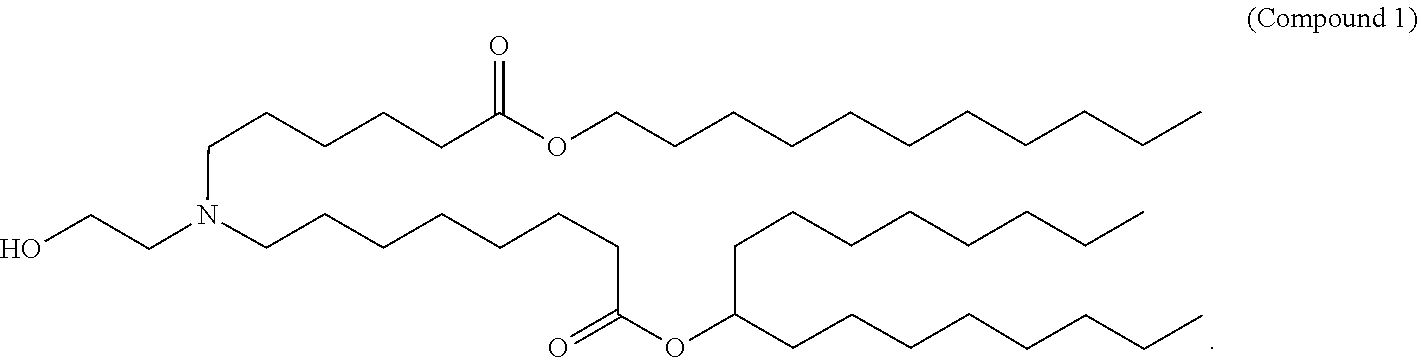
- Other aspects of the present disclosure provide a composition comprising the RNA of any one of the preceding embodiments and a mixture of lipids. In some embodiments, the mixture of lipids comprises a PEG-modified lipid, a non-cationic lipid, a sterol, an ionizable cationic lipid, or any combination thereof. In some embodiments, the mixture of lipids comprises 0.5-15 mol % (e.g., 0.5-10 mol %, 0.5-5 mol %, or 1-2 mol %) PEG-modified lipid; 5-25 mol % (e.g., 5-20 mol %, or 5-15 mol %) non-cationic (e.g., neutral) lipid; 25-55 mol % (e.g., 30-45 mol % or 35-40 mol %) sterol; and 20-60 mol % (e.g., 40-60 mol %, 40-50 mol %, 45-55 mol %, or 45-50 mol %) ionizable cationic lipid. In some embodiments, the PEG-modified lipid is 1,2 dimyristoyl-sn-glycerol, methoxypolyethyleneglycol (PEG2000 DMG), the non-cationic lipid is 1,2 distearoyl-sn-glycero-3-phosphocholine (DSPC), the sterol is cholesterol; and the ionizable cationic lipid has the structure of
Compound 1. - In some embodiments, the mixture of lipids forms lipid nanoparticles. In some embodiments, the RNA is formulated in the lipid nanoparticles. In some embodiments, the lipid nanoparticles are formed first as empty lipid nanoparticles and combined with the mRNA of the vaccine immediately prior to (e.g., within a couple of minutes to an hour of) administration.
- Yet other aspects of the present disclosure provide a method comprising administering to a subject the RNA of any one of the preceding embodiments in an amount effective to induce a neutralizing antibody response against a coronavirus in the subject.
- Still other aspects of the present disclosure provide a method comprising administering to a subject the composition of any one of the preceding embodiments in an amount effective to induce a neutralizing antibody response and/or a T cell immune response, optionally a CD4+ and/or a CD8+ T cell immune response against a coronavirus in the subject.
- In some embodiments, the coronavirus is a SARS-CoV-2.
- In some embodiments, the subject is immunocompromised. In some embodiments, the subject has a pulmonary disease. In some embodiments, the subject is 5 years of age or younger, or 65 years of age or older.
- In some embodiments, the method comprises administering to the subject at least two doses of the composition.
- In some embodiments, detectable levels of the coronavirus antigen are produced in serum of the subject at 1-72 hours post administration of the RNA or composition comprising the RNA.
- In some embodiments, a neutralizing antibody titer of at least 100 NU/ml, at least 500 NU/ml, or at least 1000 NU/ml is produced in the serum of the subject at 1-72 hours post administration of the RNA or composition comprising the RNA.
- It should be understood that the terms “SARS-CoV-2,” “Wuhan coronavirus,” “2019 novel coronavirus,” and “2019-nCoV” refer to the same recently emerged betacoronavirus now known as SARS-CoV-2 and are used interchangeably herein.
- The entire contents of International Application No. PCT/US2016/058327 (Publication No. WO2017/07062) and International Application No. PCT/US2018/022777 (Publication No. WO2018/170347) are incorporated herein by reference.
-
FIG. 1 shows schematics of various exemplary S protein antigen encoded by the SARS-CoV-2 mRNA of the present disclosure. The top schematic represents a wild-type SARS-CoV-2 protein; the schematics below depict SARS-CoV-2 protein variants, relative to the wild-type. -
FIG. 2 shows a graph of 24 hour in vitro expression data for various SARS-CoV-2 protein variants encoded by the SARS-CoV-2 mRNA of the present disclosure. -
FIG. 3 shows graph of 24 hour in vitro expression data for various SARS-CoV-2 protein variants encoded by the SARS-CoV-2 mRNA of the present disclosure. Two different amounts of mRNA were tested. -
FIGS. 4A-4B show graphs of serum antibody titer measurements following immunization with different doses of the SARS-CoV-2Variant 9 mRNA vaccine in different strains of mice (FIG. 4A ) and at higher doses (FIG. 4B ). -
FIGS. 5A-5C show graphs of serum antibody titer measurements following immunization with different doses of the SARS-CoV-2Variant 5 mRNA vaccine (FIG. 5A ), compared to the SARS-CoV-2Variant 9 mRNA vaccine and an mRNA encoding a wild-type SARS-CoV-2 S protein (FIG. 5B ).FIG. 5C is a graph comparing the serum antibody titer for seven different SARS-CoV-2 mRNA vaccines and an mRNA encoding wild-type SARS-CoV-2 S protein Sequence. -
FIG. 6 shows a graph of a temporal antibody response in mice after immunization with the SARS-CoV-2Variant 9 mRNA at different doses. -
FIG. 7 shows a schematic depicting dosing schedules. -
FIGS. 8A-8C show graphs of serum antibody titers in mice two weeks after a priming dose of the SARS-CoV-2Variant 9 mRNA vaccine and two weeks after a booster dose of the Wuahn-Hu-1Variant 9 mRNA vaccine in BALB/c mice (FIG. 8A ), C57BL/6 mice (FIG. 8B ), and C3B6 mice (FIG. 8C ). Various vaccine doses were tested. -
FIGS. 9A-9E show graphs of serum antibody titers from mice two weeks after a priming dose of the SARS-CoV-2Variant 5 mRNA vaccine and two weeks after a booster dose of the SARS-CoV-2Variant 5 mRNA vaccine in BALB/c mice (FIG. 9A ) and in C3B6 mice (FIG. 9B ) or after a priming dose and booster dose of mRNA encoding wild-type SARS-CoV-2 protein (FIG. 9C ). Various vaccine doses were tested.FIGS. 9D-9E show graphs comparing serum antibody titers in BALB/c mice (FIG. 9D ) and in C3B6 mice (FIG. 9E ) immunized with the SARS-CoV-2Variant 9 mRNA vaccine, the SARS-CoV-2Variant 5 mRNA vaccine, or mRNA encoding wild-type SARS-CoV-2 S protein. -
FIG. 10 shows a graph comparing the serum antibody titer from mice immunized with one of seven different SARA-CoV-2 mRNA vaccines or an mRNA encoding wild-type SARS-CoV-2 S protein sequence following a booster dose. -
FIGS. 11A-11B show graphs of the results of a flow cytometry analysis using the 5653-118 (“118”) antibody, which is specific for the N-terminal domain of SARS-CoV-1 S1 subunit, following immunization of mice with the SARS-CoV-2Variant 9 mRNA vaccine, the SARS-CoV-2Variant 5 mRNA vaccine, or the SARS-CoV-2Variant 6 mRNA vaccine. The analysis was performed using lymph node (FIG. 11A ) and spleen (FIG. 11B ) samples obtained from the mice. -
FIGS. 12A-12B show graphs of the results of a flow cytometry analysis using the 5652-109 (“109”) antibody, which is specific for the receptor-binding domain of SARS-CoV-1 S protein, following immunization of mice with the SARS-CoV-2Variant 9 mRNA vaccine, the SARS-CoV-2Variant 5 mRNA vaccine, or the SARS-CoV-2Variant 6 mRNA vaccine. The analysis was performed using lymph node (FIG. 12A ) and spleen (FIG. 12B ) samples obtained from the mice. -
FIGS. 13A-13C show graphs of the results of a flow cytometry analysis following transfection with one of six different SARS-CoV-2 mRNA vaccines in vitro.FIG. 13A shows the percentage of antigen-presenting cell-positive (APC+), andFIG. 13B shows the mean fluorescence intensity (MFI).FIG. 13C shows results using a positive control (a SARS antibody). -
FIG. 14 shows graphs of the results from a flow cytometry analysis following transfection with the SARS-CoV-2Variant 9 mRNA vaccine in vitro, using mAb118, mAb109, and SARS mAb103 (positive control). The negative control excluded a primary antibody. -
FIG. 15 shows graphs of protein binding between mAb118 or mAb109 and a SARS-CoV-2 antigen at different concentrations. -
FIGS. 16A-16B show graphs of binding and neutralizing antibodies in BALB/c mice vaccinated with 1 μg, 0.1 μg or 0.01 μg of the SARS-CoV-2Variant 9 mRNA vaccine atweeks FIG. 16A shows S-2P-binding antibodies assessed by ELISA at week 2 (post-prime) and week 5 (post-boost).FIG. 16B shows neutralizing activity assessed atweek 5 by a pseudovirus neutralization assay in sera of mice that received 1 μg or 0.1 μg of the SARS-CoV-2Variant 9 mRNA vaccine. -
FIGS. 17A-17C show graphs of data demonstrating that SARS-CoV-2Variant 9 mRNA vaccine-induced immunity prevents SARS-CoV-2 replication in the lungs of BALB/c mice. BALB/c mice were vaccinated with 1 μg, 0.1 μg or 0.01 μg of the SARS-CoV-2Variant 9 mRNA vaccine atweeks week 9 with mouse-adapted SARS-CoV-2. -
FIG. 17A shows viral titers in lung assessed by plaque assay onday 2 post-challenge.FIG. 17B shows viral titers in nasal turbinates assessed by plaque assay onday 2 post-challenge.FIG. 17C shows the change in body weight (as a percentage) over time following infection. -
FIGS. 18A-18C show graphs of data demonstrating that SARS-CoV-2Variant 9 mRNA vaccine-induced immunity prevents SARS-CoV-2 replication in the lungs of BALB/c mice. BALB/c mice were vaccinated with 1 μg, 0.1 μg or 0.01 μg of the SARS-CoV-2Variant 9 mRNA vaccine atweek 0 and challenged atweek 7 with mouse-adapted SARS-CoV-2.FIG. 18A shows viral titers in nasal turbinates assessed by plaque assay onday 2 post-challenge.FIG. 18B shows viral titers in lung assessed by plaque assay onday 2 post-challenge.FIG. 18C shows the change in body weight (as a percentage) over time following infection. -
FIG. 19 shows theweek -
FIGS. 20A-20C show graphs of data demonstrating that SARS-CoV-2Variant 9 mRNA vaccine-induced immunity prevents SARS-CoV-2 replication in the lungs of BALB/c mice. BALB/c mice were vaccinated with 10 μg, 1 μg or 0.1 μg of SARS-CoV-2Variant 9 atweeks week 7 with mouse-adapted SARS-CoV-2.FIG. 20A shows viral titers in nasal turbinates assessed by plaque assay onday 2 post-challenge.FIG. 20B shows viral titers in lung assessed by plaque assay onday 2 post-challenge.FIG. 20C shows the change in body weight (as a percentage) over time following infection. -
FIGS. 21A-21H show graphs of data relating to neutralizing antibody responses following mRNA immunization of BALB/c mice. Sigmoidal curves, taking averages of triplicates at each serum dilution, were generated from relative luciferase units (RLU) readings and 50% (IC50) (FIGS. 21A, 21C, 21E, 21G ) and 80% (IC80) (FIGS. 21B, 21D, 21F, 21H ) neutralizing activity was calculated considering uninfected cells to represent 100% neutralization and cells transduced with only virus to represent 0% neutralization. Each symbol represents an individual mouse, bars represent geometric mean titers (GMT), and error bars indicate geometric standard deviation (SD).FIGS. 21A-21F show unpaired T-tests used to compare 0.1 μg and 1 μg doses.FIGS. 21G and 21H show groups compared by one-way ANOVA with Kruskal-Wallis multiple comparison test. -
FIGS. 22A-22C show graphs of data relating to binding and neutralizing antibody responses following low dose mRNA immunization of BALB/c mice with alternative spike antigen designs.FIG. 22A shows serum endpoint titers.FIG. 22B shows 50% (IC50) neutralizing activity calculated considering uninfected cells representing 100% neutralization and cells transduced with only virus representing 0% neutralization. Each symbol represents an individual mouse, bars represent geometric mean titers (GMT), and error bars indicate geometric standard deviation (SD). InFIGS. 22A and 22B , groups were compared by one-way ANOVA with Kruskal-Wallis multiple comparison test.FIG. 22C shows antibody binding and neutralization titers compared by Spearman correlation. - The present disclosure provides compositions (e.g., immunizing/immunogenic compositions such as RNA vaccines in lipid nanoparticles) that elicit potent neutralizing antibodies against coronavirus antigens. In some embodiments, an immunizing composition includes RNA (e.g., messenger RNA (mRNA)) encoding a coronavirus antigen, such as a SARS-CoV-2 antigen in a lipid nanoparticle. In some embodiments, the coronavirus antigen is a structural protein. In some embodiments, the coronavirus antigen is a spike protein, an envelope protein, a nucleocapsid protein, or a membrane protein. In some embodiments, the coronavirus antigen is a stabilized prefusion spike protein. In some embodiments, the mRNA comprises an open reading frame that encodes a variant trimeric spike protein. The trimeric spike protein, for example, may comprise a stabilized prefusion spike protein. In some embodiments, the stabilized prefusion spike protein a double proline (S2P) mutation.
- Antigens, as used herein, are proteins capable of inducing an immune response (e.g., causing an immune system to produce antibodies against the antigens). Herein, use of the term “antigen” encompasses immunogenic proteins and immunogenic fragments (an immunogenic fragment that induces (or is capable of inducing) an immune response to a (at least one) coronavirus), unless otherwise stated. It should be understood that the term “protein” encompasses peptides and the term “antigen” encompasses antigenic fragments. Other molecules may be antigenic such as bacterial polysaccharides or combinations of protein and polysaccharide structures, but for the viral vaccines included herein, viral proteins, fragments of viral proteins and designed and or mutated proteins derived from the betacoronavirus SARS-CoV-2 are the antigens provided herein.
- The mRNA provided herein, in some embodiments, comprises an open reading frame encoding a variant trimeric spike protein. In some embodiments, the open reading frame encodes a variant trimeric spike protein that comprises a stabilized prefusion spike protein. The stabilized prefusion spike protein, in some embodiments, comprises a double proline (S2P) mutation.
- Exemplary sequences of the coronavirus antigens and the RNA (e.g., mRNA) encoding the coronavirus antigens of the compositions of the present disclosure are provided in Table 1.
- In some embodiments, a composition comprises an RNA (e.g., mRNA) that encodes a coronavirus antigen that comprises an amino acid sequence having at least 80%, at least 85%, at least 90%, at least 95%, at least 98%, or 100% identity to the amino acid sequence of any one of SEQ ID NOs: 5, 8, 11, 14, 17, 20, 23, 26, 29, 32, 33, 34, 35, 47, 49, 59, 63, 65, 67, 69, 71, 73, 75, 77, 79, 81, 83, or 85 and optionally a lipid nanoparticle. In some embodiments, a composition comprises an RNA (e.g., mRNA) that encodes a coronavirus antigen that comprises the sequence of SEQ ID NO: 29. In some embodiments, a composition comprises an RNA (e.g., mRNA) that encodes a coronavirus antigen that comprises the sequence of SEQ ID NO: 17. In some embodiments, a composition comprises an RNA (e.g., mRNA) that encodes a coronavirus antigen that comprises the sequence of SEQ ID NO: 20. In some embodiments, a composition comprises an RNA (e.g., mRNA) that encodes a coronavirus antigen that comprises the sequence of SEQ ID NO: 23. In some embodiments, a composition comprises an RNA (e.g., mRNA) that encodes a coronavirus antigen that comprises the sequence of SEQ ID NO: 26.
- It should be understood that any one of the antigens encoded by the RNA described herein may or may not comprise a signal sequence.
- The compositions of the present disclosure comprise a (at least one) RNA having an open reading frame (ORF) encoding a coronavirus antigen (e.g., variant trimeric spike protein, such as a stabilized prefusion spike protein). In some embodiments, the RNA is a messenger RNA (mRNA). In some embodiments, the RNA (e.g., mRNA) further comprises a 5′ UTR, 3′ UTR, a poly(A) tail and/or a 5′ cap analog.
- It should also be understood that the coronavirus vaccine of the present disclosure may include any 5′ untranslated region (UTR) and/or any 3′ UTR. Exemplary UTR sequences are provided in the Sequence Listing (e.g., SEQ ID NOs: 2, 36, 4, or 37); however, other UTR sequences may be used or exchanged for any of the UTR sequences described herein. UTRs may also be omitted from the RNA polynucleotides provided herein.
- Nucleic acids comprise a polymer of nucleotides (nucleotide monomers). Thus, nucleic acids are also referred to as polynucleotides. Nucleic acids may be or may include, for example, deoxyribonucleic acids (DNAs), ribonucleic acids (RNAs), threose nucleic acids (TNAs), glycol nucleic acids (GNAs), peptide nucleic acids (PNAs), locked nucleic acids (LNAs, including LNA having a β-D-ribo configuration, α-LNA having an α-L-ribo configuration (a diastereomer of LNA), 2′-amino-LNA having a 2′-amino functionalization, and 2′-amino-α-LNA having a 2′-amino functionalization), ethylene nucleic acids (ENA), cyclohexenyl nucleic acids (CeNA) and/or chimeras and/or combinations thereof.
- Messenger RNA (mRNA) is any RNA that encodes a (at least one) protein (a naturally-occurring, non-naturally-occurring, or modified polymer of amino acids) and can be translated to produce the encoded protein in vitro, in vivo, in situ, or ex vivo. The skilled artisan will appreciate that, except where otherwise noted, nucleic acid sequences set forth in the instant application may recite “T”s in a representative DNA sequence but where the sequence represents RNA (e.g., mRNA), the “T”s would be substituted for “U”s. Thus, any of the DNAs disclosed and identified by a particular sequence identification number herein also disclose the corresponding RNA (e.g., mRNA) sequence complementary to the DNA, where each “T” of the DNA sequence is substituted with “U.”
- An open reading frame (ORF) is a continuous stretch of DNA or RNA beginning with a start codon (e.g., methionine (ATG or AUG)) and ending with a stop codon (e.g., TAA, TAG or TGA, or UAA, UAG or UGA). An ORF typically encodes a protein. It will be understood that the sequences disclosed herein may further comprise additional elements, e.g., 5′ and 3′ UTRs, but that those elements, unlike the ORF, need not necessarily be present in an RNA polynucleotide of the present disclosure.
- In some embodiments, a composition comprises an RNA (e.g., mRNA) that comprises a nucleotide sequence having at least 80%, at least 85%, at least 90%, at least 95%, at least 98%, or 100% identity to the nucleotide sequence of any one of SEQ ID NOs: 1, 6, 9, 12, 15, 18, 21, 24, 27, 30, 51, 53, 55, 57, 58, 60, or 86-97.
- In some embodiments, a composition comprises an RNA (e.g., mRNA) that comprises an ORF that comprises a nucleotide sequence having at least 80%, at least 85%, at least 90%, at least 95%, at least 98%, or 100% identity to the nucleotide sequence of any one of SEQ ID NOs: 3, 7, 10, 13, 16, 19, 22, 25, 28, 31, 48, 50, 52, 54, 56, 61, 62, 64, 66, 68, 70, 72, 74, 76, 78, 80, 82, or 84.
- In some embodiments, the compositions of the present disclosure include RNA that encodes a coronavirus antigen variant (e.g., variant trimeric spike protein, such as a stabilized prefusion spike protein). Antigen variants or other polypeptide variants refers to molecules that differ in their amino acid sequence from a wild-type, native, or reference sequence. The antigen/polypeptide variants may possess substitutions, deletions, and/or insertions at certain positions within the amino acid sequence, as compared to a native or reference sequence. Ordinarily, variants possess at least 50% identity to a wild-type, native or reference sequence. In some embodiments, variants share at least 80%, or at least 90% identity with a wild-type, native, or reference sequence.
- Variant antigens/polypeptides encoded by nucleic acids of the disclosure may contain amino acid changes that confer any of a number of desirable properties, e.g., that enhance their immunogenicity, enhance their expression, and/or improve their stability or PK/PD properties in a subject. Variant antigens/polypeptides can be made using routine mutagenesis techniques and assayed as appropriate to determine whether they possess the desired property. Assays to determine expression levels and immunogenicity are well known in the art and exemplary such assays are set forth in the Examples section. Similarly, PK/PD properties of a protein variant can be measured using art recognized techniques, e.g., by determining expression of antigens in a vaccinated subject over time and/or by looking at the durability of the induced immune response. The stability of protein(s) encoded by a variant nucleic acid may be measured by assaying thermal stability or stability upon urea denaturation or may be measured using in silico prediction. Methods for such experiments and in silico determinations are known in the art.
- In some embodiments, a composition comprises an RNA or an RNA ORF that comprises a nucleotide sequence of any one of the sequences provided herein (see, e.g., Sequence Listing and Table 1), or comprises a nucleotide sequence at least 80%, at least 85%, at least 90%, at least 95%, at least 96%, at least 97%, at least 98%, or at least 99% identical to a nucleotide sequence of any one of the sequences provided herein.
- The term “identity” refers to a relationship between the sequences of two or more polypeptides (e.g. antigens) or polynucleotides (nucleic acids), as determined by comparing the sequences. Identity also refers to the degree of sequence relatedness between or among sequences as determined by the number of matches between strings of two or more amino acid residues or nucleic acid residues. Identity measures the percent of identical matches between the smaller of two or more sequences with gap alignments (if any) addressed by a particular mathematical model or computer program (e.g., “algorithms”). Identity of related antigens or nucleic acids can be readily calculated by known methods. “Percent (%) identity” as it applies to polypeptide or polynucleotide sequences is defined as the percentage of residues (amino acid residues or nucleic acid residues) in the candidate amino acid or nucleic acid sequence that are identical with the residues in the amino acid sequence or nucleic acid sequence of a second sequence after aligning the sequences and introducing gaps, if necessary, to achieve the maximum percent identity. Methods and computer programs for the alignment are well known in the art. It is understood that identity depends on a calculation of percent identity but may differ in value due to gaps and penalties introduced in the calculation. Generally, variants of a particular polynucleotide or polypeptide (e.g., antigen) have at least 40%, 45%, 50%, 55%, 60%, 65%, 70%, 75%, 80%, 85%, 90%, 91%, 92%, 93%, 94%, 95%, 96%, 97%, 98%, 99% but less than 100% sequence identity to that particular reference polynucleotide or polypeptide as determined by sequence alignment programs and parameters described herein and known to those skilled in the art. Such tools for alignment include those of the BLAST suite (Stephen F. Altschul, et al (1997), “Gapped BLAST and PSI-BLAST: a new generation of protein database search programs”, Nucleic Acids Res. 25:3389-3402). Another popular local alignment technique is based on the Smith-Waterman algorithm (Smith, T. F. & Waterman, M. S. (1981) “Identification of common molecular subsequences.” J. Mol. Biol. 147:195-197). A general global alignment technique based on dynamic programming is the Needleman—Wunsch algorithm (Needleman, S. B. & Wunsch, C. D. (1970) “A general method applicable to the search for similarities in the amino acid sequences of two proteins.” J. Mol. Biol. 48:443-453). More recently a Fast Optimal Global Sequence Alignment Algorithm (FOGSAA) has been developed that purportedly produces global alignment of nucleotide and protein sequences faster than other optimal global alignment methods, including the Needleman—Wunsch algorithm.
- As such, polynucleotides encoding peptides or polypeptides containing substitutions, insertions and/or additions, deletions and covalent modifications with respect to reference sequences, in particular the polypeptide (e.g., antigen) sequences disclosed herein, are included within the scope of this disclosure. For example, sequence tags or amino acids, such as one or more lysines, can be added to peptide sequences (e.g., at the N-terminal or C-terminal ends). Sequence tags can be used for peptide detection, purification or localization. Lysines can be used to increase peptide solubility or to allow for biotinylation. Alternatively, amino acid residues located at the carboxy and amino terminal regions of the amino acid sequence of a peptide or protein may optionally be deleted providing for truncated sequences. Certain amino acids (e.g., C-terminal or N-terminal residues) may alternatively be deleted depending on the use of the sequence, as for example, expression of the sequence as part of a larger sequence which is soluble or linked to a solid support. In some embodiments, sequences for (or encoding) signal sequences, termination sequences, transmembrane domains, linkers, multimerization domains (such as, e.g., foldon regions) and the like may be substituted with alternative sequences that achieve the same or a similar function. In some embodiments, cavities in the core of proteins can be filled to improve stability, e.g., by introducing larger amino acids. In other embodiments, buried hydrogen bond networks may be replaced with hydrophobic resides to improve stability. In yet other embodiments, glycosylation sites may be removed and replaced with appropriate residues. Such sequences are readily identifiable to one of skill in the art. It should also be understood that some of the sequences provided herein contain sequence tags or terminal peptide sequences (e.g., at the N-terminal or C-terminal ends) that may be deleted, for example, prior to use in the preparation of an RNA (e.g., mRNA) vaccine.
- As recognized by those skilled in the art, protein fragments, functional protein domains, and homologous proteins are also considered to be within the scope of coronavirus antigens of interest. For example, provided herein is any protein fragment (meaning a polypeptide sequence at least one amino acid residue shorter than a reference antigen sequence but otherwise identical) of a reference protein, provided that the fragment is immunogenic and confers a protective immune response to the coronavirus. In addition to variants that are identical to the reference protein but are truncated, in some embodiments, an antigen includes 2, 3, 4, 5, 6, 7, 8, 9, 10, or more mutations, as shown in any of the sequences provided or referenced herein. Antigens/antigenic polypeptides can range in length from about 4, 6, or 8 amino acids to full length proteins.
- Naturally-occurring eukaryotic mRNA molecules can contain stabilizing elements, including, but not limited to untranslated regions (UTR) at their 5′-end (5′ UTR) and/or at their 3′-end (3′ UTR), in addition to other structural features, such as a 5′-cap structure or a 3′-poly(A) tail. Both the 5′ UTR and the 3′ UTR are typically transcribed from the genomic DNA and are elements of the premature mRNA. Characteristic structural features of mature mRNA, such as the 5′-cap and the 3′-poly(A) tail are usually added to the transcribed (premature) mRNA during mRNA processing.
- In some embodiments, a composition includes an RNA polynucleotide having an open reading frame encoding at least one antigenic polypeptide having at least one modification, at least one 5′ terminal cap, and is formulated within a lipid nanoparticle. 5′-capping of polynucleotides may be completed concomitantly during the in vitro-transcription reaction using the following chemical RNA cap analogs to generate the 5′-guanosine cap structure according to manufacturer protocols: 3′-O-Me-m7G(5′)ppp(5′) G [the ARCA cap];G(5′)ppp(5′)A; G(5′)ppp(5′)G; m7G(5′)ppp(5′)A; m7G(5′)ppp(5′)G (New England BioLabs, Ipswich, Mass.). 5′-capping of modified RNA may be completed post-transcriptionally using a Vaccinia Virus Capping Enzyme to generate the “
Cap 0” structure: m7G(5′)ppp(5′)G (New England BioLabs, Ipswich, Mass.).Cap 1 structure may be generated using both Vaccinia Virus Capping Enzyme and a 2′-O methyl-transferase to generate: m7G(5′)ppp(5′)G-2′-O-methyl.Cap 2 structure may be generated from theCap 1 structure followed by the 2′-O-methylation of the 5′-antepenultimate nucleotide using a 2′-O methyl-transferase.Cap 3 structure may be generated from theCap 2 structure followed by the 2′-O-methylation of the 5′-preantepenultimate nucleotide using a 2′-O methyl-transferase. Enzymes may be derived from a recombinant source. - The 3′-poly(A) tail is typically a stretch of adenine nucleotides added to the 3′-end of the transcribed mRNA. It can, in some instances, comprise up to about 400 adenine nucleotides. In some embodiments, the length of the 3′-poly(A) tail may be an essential element with respect to the stability of the individual mRNA.
- In some embodiments, a composition includes a stabilizing element. Stabilizing elements may include for instance a histone stem-loop. A stem-loop binding protein (SLBP), a 32 kDa protein has been identified. It is associated with the histone stem-loop at the 3′-end of the histone messages in both the nucleus and the cytoplasm. Its expression level is regulated by the cell cycle; it peaks during the S-phase, when histone mRNA levels are also elevated. The protein has been shown to be essential for efficient 3′-end processing of histone pre-mRNA by the U7 snRNP. SLBP continues to be associated with the stem-loop after processing, and then stimulates the translation of mature histone mRNAs into histone proteins in the cytoplasm. The RNA binding domain of SLBP is conserved through metazoa and protozoa; its binding to the histone stem-loop depends on the structure of the loop. The minimum binding site includes at least three
nucleotides 5′ and twonucleotides 3′ relative to the stem-loop. - In some embodiments, an RNA (e.g., mRNA) includes a coding region, at least one histone stem-loop, and optionally, a poly(A) sequence or polyadenylation signal. The poly(A) sequence or polyadenylation signal generally should enhance the expression level of the encoded protein. The encoded protein, in some embodiments, is not a histone protein, a reporter protein (e.g. Luciferase, GFP, EGFP, β-Galactosidase, EGFP), or a marker or selection protein (e.g. alpha-Globin, Galactokinase and Xanthine:guanine phosphoribosyl transferase (GPT)).
- In some embodiments, an RNA (e.g., mRNA) includes the combination of a poly(A) sequence or polyadenylation signal and at least one histone stem-loop, even though both represent alternative mechanisms in nature, acts synergistically to increase the protein expression beyond the level observed with either of the individual elements. The synergistic effect of the combination of poly(A) and at least one histone stem-loop does not depend on the order of the elements or the length of the poly(A) sequence.
- In some embodiments, an RNA (e.g., mRNA) does not include a histone downstream element (HDE). “Histone downstream element” (HDE) includes a purine-rich polynucleotide stretch of approximately 15 to 20
nucleotides 3′ of naturally occurring stem-loops, representing the binding site for the U7 snRNA, which is involved in processing of histone pre-mRNA into mature histone mRNA. In some embodiments, the nucleic acid does not include an intron. - An RNA (e.g., mRNA) may or may not contain an enhancer and/or promoter sequence, which may be modified or unmodified or which may be activated or inactivated. In some embodiments, the histone stem-loop is generally derived from histone genes and includes an intramolecular base pairing of two neighbored partially or entirely reverse complementary sequences separated by a spacer, consisting of a short sequence, which forms the loop of the structure. The unpaired loop region is typically unable to base pair with either of the stem loop elements. It occurs more often in RNA, as is a key component of many RNA secondary structures but may be present in single-stranded DNA as well. Stability of the stem-loop structure generally depends on the length, number of mismatches or bulges, and base composition of the paired region. In some embodiments, wobble base pairing (non-Watson-Crick base pairing) may result. In some embodiments, the at least one histone stem-loop sequence comprises a length of 15 to 45 nucleotides.
- In some embodiments, an RNA (e.g., mRNA) has one or more AU-rich sequences removed. These sequences, sometimes referred to as AURES are destabilizing sequences found in the 3′UTR. The AURES may be removed from the RNA vaccines. Alternatively, the AURES may remain in the RNA vaccine.
- In some embodiments, a composition comprises an RNA (e.g., mRNA) having an ORF that encodes a signal peptide fused to the coronavirus antigen. Signal peptides, comprising the N-terminal 15-60 amino acids of proteins, are typically needed for the translocation across the membrane on the secretory pathway and, thus, universally control the entry of most proteins both in eukaryotes and prokaryotes to the secretory pathway. In eukaryotes, the signal peptide of a nascent precursor protein (pre-protein) directs the ribosome to the rough endoplasmic reticulum (ER) membrane and initiates the transport of the growing peptide chain across it for processing. ER processing produces mature proteins, wherein the signal peptide is cleaved from precursor proteins, typically by a ER-resident signal peptidase of the host cell, or they remain uncleaved and function as a membrane anchor. A signal peptide may also facilitate the targeting of the protein to the cell membrane.
- A signal peptide may have a length of 15-60 amino acids. For example, a signal peptide may have a length of 15, 16, 17, 18, 19, 20, 21, 22, 23, 24, 25, 26, 27, 28, 29, 30, 31, 32, 33, 34, 35, 36, 37, 38, 39, 40, 41, 42, 43, 44, 45, 46, 47, 48, 49, 50, 51, 52, 53, 54, 55, 56, 57, 58, 59, or 60 amino acids. In some embodiments, a signal peptide has a length of 20-60, 25-60, 30-60, 35-60, 40-60, 45-60, 50-60, 55-60, 15-55, 20-55, 25-55, 30-55, 35-55, 40-55, 45-55, 50-55, 15-50, 20-50, 25-50, 30-50, 35-50, 40-50, 45-50, 15-45, 20-45, 25-45, 30-45, 35-45, 40-45, 15-40, 20-40, 25-40, 30-40, 35-40, 15-35, 20-35, 25-35, 30-35, 15-30, 20-30, 25-30, 15-25, 20-25, or 15-20 amino acids.
- Signal peptides from heterologous genes (which regulate expression of genes other than coronavirus antigens in nature) are known in the art and can be tested for desired properties and then incorporated into a nucleic acid of the disclosure. In some embodiments, the signal peptide may comprise one of the following sequences: MDSKGSSQKGSRLLLLLVVSNLLLPQGVVG (SEQ ID NO: 38), MDWTWILFLVAAATRVHS (SEQ ID NO: 39); METPAQLLFLLLLWLPDTTG (SEQ ID NO: 40); MLGSNSGQRVVFTILLLLVAPAYS (SEQ ID NO: 41); MKCLLYLAFLFIGVNCA (SEQ ID NO: 42); MWLVSLAIVTACAGA (SEQ ID NO: 43); or MFVFLVLLPLVSSQC (SEQ ID NO: 99).
- In some embodiments, a composition of the present disclosure includes an RNA (e.g., mRNA) encoding an antigenic fusion protein. Thus, the encoded antigen or antigens may include two or more proteins (e.g., protein and/or protein fragment) joined together. Alternatively, the protein to which a protein antigen is fused does not promote a strong immune response to itself, but rather to the coronavirus antigen. Antigenic fusion proteins, in some embodiments, retain the functional property from each original protein.
- The RNA (e.g., mRNA) vaccines as provided herein, in some embodiments, encode fusion proteins that comprise coronavirus antigens linked to scaffold moieties. In some embodiments, such scaffold moieties impart desired properties to an antigen encoded by a nucleic acid of the disclosure. For example, scaffold proteins may improve the immunogenicity of an antigen, e.g., by altering the structure of the antigen, altering the uptake and processing of the antigen, and/or causing the antigen to bind to a binding partner.
- In some embodiments, the scaffold moiety is protein that can self-assemble into protein nanoparticles that are highly symmetric, stable, and structurally organized, with diameters of 10-150 nm, a highly suitable size range for optimal interactions with various cells of the immune system. In some embodiments, viral proteins or virus-like particles can be used to form stable nanoparticle structures. Examples of such viral proteins are known in the art. For example, in some embodiments, the scaffold moiety is a hepatitis B surface antigen (HBsAg). HBsAg forms spherical particles with an average diameter of ˜22 nm and which lacked nucleic acid and hence are non-infectious (Lopez-Sagaseta, J. et al. Computational and Structural Biotechnology Journal 14 (2016) 58-68). In some embodiments, the scaffold moiety is a hepatitis B core antigen (HBcAg) self-assembles into particles of 24-31 nm diameter, which resembled the viral cores obtained from HBV-infected human liver. HBcAg produced in self-assembles into two classes of differently sized nanoparticles of 300 Å and 360 Å diameter, corresponding to 180 or 240 protomers. In some embodiments, the coronavirus antigen is fused to HBsAG or HBcAG to facilitate self-assembly of nanoparticles displaying the coronavirus antigen.
- In some embodiments, bacterial protein platforms may be used. Non-limiting examples of these self-assembling proteins include ferritin, lumazine and encapsulin.
- Ferritin is a protein whose main function is intracellular iron storage. Ferritin is made of 24 subunits, each composed of a four-alpha-helix bundle, that self-assemble in a quaternary structure with octahedral symmetry (Cho K. J. et al. J Mol Biol. 2009; 390:83-98). Several high-resolution structures of ferritin have been determined, confirming that Helicobacter pylori ferritin is made of 24 identical protomers, whereas in animals, there are ferritin light and heavy chains that can assemble alone or combine with different ratios into particles of 24 subunits (Granier T. et al. J Biol Inorg Chem. 2003; 8:105-111; Lawson D. M. et al. Nature. 1991; 349:541-544). Ferritin self-assembles into nanoparticles with robust thermal and chemical stability. Thus, the ferritin nanoparticle is well-suited to carry and expose antigens.
- Lumazine synthase (LS) is also well-suited as a nanoparticle platform for antigen display. LS, which is responsible for the penultimate catalytic step in the biosynthesis of riboflavin, is an enzyme present in a broad variety of organisms, including archaea, bacteria, fungi, plants, and eubacteria (Weber S. E. Flavins and Flavoproteins. Methods and Protocols, Series: Methods in Molecular Biology. 2014). The LS monomer is 150 amino acids long, and consists of beta-sheets along with tandem alpha-helices flanking its sides. A number of different quaternary structures have been reported for LS, illustrating its morphological versatility: from homopentamers up to symmetrical assemblies of 12 pentamers forming capsids of 150 Å diameter. Even LS cages of more than 100 subunits have been described (Zhang X. et al. J Mol Biol. 2006; 362:753-770).
- Encapsulin, a novel protein cage nanoparticle isolated from thermophile Thermotoga maritima, may also be used as a platform to present antigens on the surface of self-assembling nanoparticles. Encapsulin is assembled from 60 copies of identical 31 kDa monomers having a thin and icosahedral T=1 symmetric cage structure with interior and exterior diameters of 20 and 24 nm, respectively (Sutter M. et al. Nat Struct Mol Biol. 2008, 15: 939-947). Although the exact function of encapsulin in T. maritima is not clearly understood yet, its crystal structure has been recently solved and its function was postulated as a cellular compartment that encapsulates proteins such as DyP (Dye decolorizing peroxidase) and Flp (Ferritin like protein), which are involved in oxidative stress responses (Rahmanpour R. et al. FEBS J. 2013, 280: 2097-2104).
- In some embodiments, an RNA of the present disclosure encodes a coronavirus antigen (e.g., SARS-CoV-2 S protein) fused to a foldon domain. The foldon domain may be, for example, obtained from bacteriophage T4 fibritin (see, e.g., Tao Y, et al. Structure. 1997 June 15; 5(6):789-98).
- In some embodiments, the mRNAs of the disclosure encode more than one polypeptide, referred to herein as fusion proteins. In some embodiments, the mRNA further encodes a linker located between at least one or each domain of the fusion protein. The linker can be, for example, a cleavable linker or protease-sensitive linker. In some embodiments, the linker is selected from the group consisting of F2A linker, P2A linker, T2A linker, E2A linker, and combinations thereof. This family of self-cleaving peptide linkers, referred to as 2A peptides, has been described in the art (see for example, Kim, J. H. et al. (2011) PLoS ONE 6:e18556). In some embodiments, the linker is an F2A linker. In some embodiments, the linker is a GGGS (SEQ ID NO: 98) linker. In some embodiments, the fusion protein contains three domains with intervening linkers, having the structure: domain-linker-domain-linker-domain.
- Cleavable linkers known in the art may be used in connection with the disclosure. Exemplary such linkers include: F2A linkers, T2A linkers, P2A linkers, E2A linkers (See, e.g., WO2017/127750). The skilled artisan will appreciate that other art-recognized linkers may be suitable for use in the constructs of the disclosure (e.g., encoded by the nucleic acids of the disclosure). The skilled artisan will likewise appreciate that other polycistronic constructs (mRNA encoding more than one antigen/polypeptide separately within the same molecule) may be suitable for use as provided herein.
- In some embodiments, an ORF encoding an antigen of the disclosure is codon optimized. Codon optimization methods are known in the art. For example, an ORF of any one or more of the sequences provided herein may be codon optimized. Codon optimization, in some embodiments, may be used to match codon frequencies in target and host organisms to ensure proper folding; bias GC content to increase mRNA stability or reduce secondary structures; minimize tandem repeat codons or base runs that may impair gene construction or expression; customize transcriptional and translational control regions; insert or remove protein trafficking sequences; remove/add post translation modification sites in encoded protein (e.g., glycosylation sites); add, remove or shuffle protein domains; insert or delete restriction sites; modify ribosome binding sites and mRNA degradation sites; adjust translational rates to allow the various domains of the protein to fold properly; or reduce or eliminate problem secondary structures within the polynucleotide. Codon optimization tools, algorithms and services are known in the art—non-limiting examples include services from GeneArt (Life Technologies), DNA2.0 (Menlo Park Calif.) and/or proprietary methods. In some embodiments, the open reading frame (ORF) sequence is optimized using optimization algorithms.
- In some embodiments, a codon optimized sequence shares less than 95% sequence identity to a naturally-occurring or wild-type sequence ORF (e.g., a naturally-occurring or wild-type mRNA sequence encoding a coronavirus antigen). In some embodiments, a codon optimized sequence shares less than 90% sequence identity to a naturally-occurring or wild-type sequence (e.g., a naturally-occurring or wild-type mRNA sequence encoding a coronavirus antigen). In some embodiments, a codon optimized sequence shares less than 85% sequence identity to a naturally-occurring or wild-type sequence (e.g., a naturally-occurring or wild-type mRNA sequence encoding a coronavirus antigen). In some embodiments, a codon optimized sequence shares less than 80% sequence identity to a naturally-occurring or wild-type sequence (e.g., a naturally-occurring or wild-type mRNA sequence encoding a coronavirus antigen). In some embodiments, a codon optimized sequence shares less than 75% sequence identity to a naturally-occurring or wild-type sequence (e.g., a naturally-occurring or wild-type mRNA sequence encoding a coronavirus antigen).
- In some embodiments, a codon optimized sequence shares between 65% and 85% (e.g., between about 67% and about 85% or between about 67% and about 80%) sequence identity to a naturally-occurring or wild-type sequence (e.g., a naturally-occurring or wild-type mRNA sequence encoding a coronavirus antigen). In some embodiments, a codon optimized sequence shares between 65% and 75% or about 80% sequence identity to a naturally-occurring or wild-type sequence (e.g., a naturally-occurring or wild-type mRNA sequence encoding a coronavirus antigen).
- In some embodiments, a codon-optimized sequence encodes an antigen that is as immunogenic as, or more immunogenic than (e.g., at least 10%, at least 20%, at least 30%, at least 40%, at least 50%, at least 100%, or at least 200% more), than a coronavirus antigen encoded by a non-codon-optimized sequence.
- When transfected into mammalian host cells, the modified mRNAs have a stability of between 12-18 hours, or greater than 18 hours, e.g., 24, 36, 48, 60, 72, or greater than 72 hours and are capable of being expressed by the mammalian host cells.
- In some embodiments, a codon optimized RNA may be one in which the levels of G/C are enhanced. The G/C-content of nucleic acid molecules (e.g., mRNA) may influence the stability of the RNA. RNA having an increased amount of guanine (G) and/or cytosine (C) residues may be functionally more stable than RNA containing a large amount of adenine (A) and thymine (T) or uracil (U) nucleotides. As an example, WO02/098443 discloses a pharmaceutical composition containing an mRNA stabilized by sequence modifications in the translated region. Due to the degeneracy of the genetic code, the modifications work by substituting existing codons for those that promote greater RNA stability without changing the resulting amino acid. The approach is limited to coding regions of the RNA.
- In some embodiments, an RNA (e.g., mRNA) is not chemically modified and comprises the standard ribonucleotides consisting of adenosine, guanosine, cytosine and uridine. In some embodiments, nucleotides and nucleosides of the present disclosure comprise standard nucleoside residues such as those present in transcribed RNA (e.g. A, G, C, or U). In some embodiments, nucleotides and nucleosides of the present disclosure comprise standard deoxyribonucleosides such as those present in DNA (e.g. dA, dG, dC, or dT).
- The compositions of the present disclosure comprise, in some embodiments, an RNA having an open reading frame encoding a coronavirus antigen, wherein the nucleic acid comprises nucleotides and/or nucleosides that can be standard (unmodified) or modified as is known in the art. In some embodiments, nucleotides and nucleosides of the present disclosure comprise modified nucleotides or nucleosides. Such modified nucleotides and nucleosides can be naturally-occurring modified nucleotides and nucleosides or non-naturally occurring modified nucleotides and nucleosides. Such modifications can include those at the sugar, backbone, or nucleobase portion of the nucleotide and/or nucleoside as are recognized in the art.
- In some embodiments, a naturally-occurring modified nucleotide or nucleotide of the disclosure is one as is generally known or recognized in the art. Non-limiting examples of such naturally occurring modified nucleotides and nucleotides can be found, inter alia, in the widely recognized MODOMICS database.
- In some embodiments, a non-naturally occurring modified nucleotide or nucleoside of the disclosure is one as is generally known or recognized in the art. Non-limiting examples of such non-naturally occurring modified nucleotides and nucleosides can be found, inter alia, in published US application Nos. PCT/US2012/058519; PCT/US2013/075177; PCT/US2014/058897; PCT/US2014/058891; PCT/US2014/070413; PCT/US2015/36773; PCT/US2015/36759; PCT/US2015/36771; or PCT/IB2017/051367 all of which are incorporated by reference herein.
- Hence, nucleic acids of the disclosure (e.g., DNA nucleic acids and RNA nucleic acids, such as mRNA nucleic acids) can comprise standard nucleotides and nucleosides, naturally-occurring nucleotides and nucleosides, non-naturally-occurring nucleotides and nucleosides, or any combination thereof.
- Nucleic acids of the disclosure (e.g., DNA nucleic acids and RNA nucleic acids, such as mRNA nucleic acids), in some embodiments, comprise various (more than one) different types of standard and/or modified nucleotides and nucleosides. In some embodiments, a particular region of a nucleic acid contains one, two or more (optionally different) types of standard and/or modified nucleotides and nucleosides.
- In some embodiments, a modified RNA nucleic acid (e.g., a modified mRNA nucleic acid), introduced to a cell or organism, exhibits reduced degradation in the cell or organism, respectively, relative to an unmodified nucleic acid comprising standard nucleotides and nucleosides.
- In some embodiments, a modified RNA nucleic acid (e.g., a modified mRNA nucleic acid), introduced into a cell or organism, may exhibit reduced immunogenicity in the cell or organism, respectively (e.g., a reduced innate response) relative to an unmodified nucleic acid comprising standard nucleotides and nucleosides.
- Nucleic acids (e.g., RNA nucleic acids, such as mRNA nucleic acids), in some embodiments, comprise non-natural modified nucleotides that are introduced during synthesis or post-synthesis of the nucleic acids to achieve desired functions or properties. The modifications may be present on internucleotide linkages, purine or pyrimidine bases, or sugars. The modification may be introduced with chemical synthesis or with a polymerase enzyme at the terminal of a chain or anywhere else in the chain. Any of the regions of a nucleic acid may be chemically modified.
- The present disclosure provides for modified nucleosides and nucleotides of a nucleic acid (e.g., RNA nucleic acids, such as mRNA nucleic acids). A “nucleoside” refers to a compound containing a sugar molecule (e.g., a pentose or ribose) or a derivative thereof in combination with an organic base (e.g., a purine or pyrimidine) or a derivative thereof (also referred to herein as “nucleobase”). A “nucleotide” refers to a nucleoside, including a phosphate group. Modified nucleotides may by synthesized by any useful method, such as, for example, chemically, enzymatically, or recombinantly, to include one or more modified or non-natural nucleosides. Nucleic acids can comprise a region or regions of linked nucleosides. Such regions may have variable backbone linkages. The linkages can be standard phosphodiester linkages, in which case the nucleic acids would comprise regions of nucleotides.
- Modified nucleotide base pairing encompasses not only the standard adenosine-thymine, adenosine-uracil, or guanosine-cytosine base pairs, but also base pairs formed between nucleotides and/or modified nucleotides comprising non-standard or modified bases, wherein the arrangement of hydrogen bond donors and hydrogen bond acceptors permits hydrogen bonding between a non-standard base and a standard base or between two complementary non-standard base structures, such as, for example, in those nucleic acids having at least one chemical modification. One example of such non-standard base pairing is the base pairing between the modified nucleotide inosine and adenine, cytosine or uracil. Any combination of base/sugar or linker may be incorporated into nucleic acids of the present disclosure.
- In some embodiments, modified nucleobases in nucleic acids (e.g., RNA nucleic acids, such as mRNA nucleic acids) comprise 1-methyl-pseudouridine (ml ψ), 1-ethyl-pseudouridine (e1ψ), 5-methoxy-uridine (mo5U), 5-methyl-cytidine (m5C), and/or pseudouridine (ψ). In some embodiments, modified nucleobases in nucleic acids (e.g., RNA nucleic acids, such as mRNA nucleic acids) comprise 5-methoxymethyl uridine, 5-methylthio uridine, 1-methoxymethyl pseudouridine, 5-methyl cytidine, and/or 5-methoxy cytidine. In some embodiments, the polyribonucleotide includes a combination of at least two (e.g., 2, 3, 4 or more) of any of the aforementioned modified nucleobases, including but not limited to chemical modifications.
- In some embodiments, a mRNA of the disclosure comprises 1-methyl-pseudouridine (ml ψ) substitutions at one or more or all uridine positions of the nucleic acid.
- In some embodiments, a mRNA of the disclosure comprises 1-methyl-pseudouridine (ml ψ) substitutions at one or more or all uridine positions of the nucleic acid and 5-methyl cytidine substitutions at one or more or all cytidine positions of the nucleic acid.
- In some embodiments, a mRNA of the disclosure comprises pseudouridine (w) substitutions at one or more or all uridine positions of the nucleic acid.
- In some embodiments, a mRNA of the disclosure comprises pseudouridine (w) substitutions at one or more or all uridine positions of the nucleic acid and 5-methyl cytidine substitutions at one or more or all cytidine positions of the nucleic acid.
- In some embodiments, a mRNA of the disclosure comprises uridine at one or more or all uridine positions of the nucleic acid.
- In some embodiments, mRNAs are uniformly modified (e.g., fully modified, modified throughout the entire sequence) for a particular modification. For example, a nucleic acid can be uniformly modified with 1-methyl-pseudouridine, meaning that all uridine residues in the mRNA sequence are replaced with 1-methyl-pseudouridine. Similarly, a nucleic acid can be uniformly modified for any type of nucleoside residue present in the sequence by replacement with a modified residue such as those set forth above.
- The nucleic acids of the present disclosure may be partially or fully modified along the entire length of the molecule. For example, one or more or all or a given type of nucleotide (e.g., purine or pyrimidine, or any one or more or all of A, G, U, C) may be uniformly modified in a nucleic acid of the disclosure, or in a predetermined sequence region thereof (e.g., in the mRNA including or excluding the poly(A) tail). In some embodiments, all nucleotides X in a nucleic acid of the present disclosure (or in a sequence region thereof) are modified nucleotides, wherein X may be any one of nucleotides A, G, U, C, or any one of the combinations A+G, A+U, A+C, G+U, G+C, U+C, A+G+U, A+G+C, G+U+C or A+G+C.
- The nucleic acid may contain from about 1% to about 100% modified nucleotides (either in relation to overall nucleotide content, or in relation to one or more types of nucleotide, i.e., any one or more of A, G, U or C) or any intervening percentage (e.g., from 1% to 20%, from 1% to 25%, from 1% to 50%, from 1% to 60%, from 1% to 70%, from 1% to 80%, from 1% to 90%, from 1% to 95%, from 10% to 20%, from 10% to 25%, from 10% to 50%, from 10% to 60%, from 10% to 70%, from 10% to 80%, from 10% to 90%, from 10% to 95%, from 10% to 100%, from 20% to 25%, from 20% to 50%, from 20% to 60%, from 20% to 70%, from 20% to 80%, from 20% to 90%, from 20% to 95%, from 20% to 100%, from 50% to 60%, from 50% to 70%, from 50% to 80%, from 50% to 90%, from 50% to 95%, from 50% to 100%, from 70% to 80%, from 70% to 90%, from 70% to 95%, from 70% to 100%, from 80% to 90%, from 80% to 95%, from 80% to 100%, from 90% to 95%, from 90% to 100%, and from 95% to 100%). It will be understood that any remaining percentage is accounted for by the presence of unmodified A, G, U, or C.
- The mRNAs may contain at a minimum 1% and at maximum 100% modified nucleotides, or any intervening percentage, such as at least 5% modified nucleotides, at least 10% modified nucleotides, at least 25% modified nucleotides, at least 50% modified nucleotides, at least 80% modified nucleotides, or at least 90% modified nucleotides. For example, the nucleic acids may contain a modified pyrimidine such as a modified uracil or cytosine. In some embodiments, at least 5%, at least 10%, at least 25%, at least 50%, at least 80%, at least 90% or 100% of the uracil in the nucleic acid is replaced with a modified uracil (e.g., a 5-substituted uracil). The modified uracil can be replaced by a compound having a single unique structure, or can be replaced by a plurality of compounds having different structures (e.g., 2, 3, 4 or more unique structures). In some embodiments, at least 5%, at least 10%, at least 25%, at least 50%, at least 80%, at least 90% or 100% of the cytosine in the nucleic acid is replaced with a modified cytosine (e.g., a 5-substituted cytosine). The modified cytosine can be replaced by a compound having a single unique structure, or can be replaced by a plurality of compounds having different structures (e.g., 2, 3, 4 or more unique structures).
- The mRNAs of the present disclosure may comprise one or more regions or parts which act or function as an untranslated region. Where mRNAs are designed to encode at least one antigen of interest, the nucleic may comprise one or more of these untranslated regions (UTRs). Wild-type untranslated regions of a nucleic acid are transcribed but not translated. In mRNA, the 5′ UTR starts at the transcription start site and continues to the start codon but does not include the start codon; whereas, the 3′ UTR starts immediately following the stop codon and continues until the transcriptional termination signal. There is growing body of evidence about the regulatory roles played by the UTRs in terms of stability of the nucleic acid molecule and translation. The regulatory features of a UTR can be incorporated into the polynucleotides of the present disclosure to, among other things, enhance the stability of the molecule. The specific features can also be incorporated to ensure controlled down-regulation of the transcript in case they are misdirected to undesired organs sites. A variety of 5′ UTR and 3′ UTR sequences are known and available in the art.
- A 5′ UTR is region of an mRNA that is directly upstream (5′) from the start codon (the first codon of an mRNA transcript translated by a ribosome). A 5′ UTR does not encode a protein (is non-coding). Natural 5′ UTRs have features that play roles in translation initiation. They harbor signatures like Kozak sequences which are commonly known to be involved in the process by which the ribosome initiates translation of many genes. Kozak sequences have the consensus CCR(A/G)CCAUGG (SEQ ID NO: 44), where R is a purine (adenine or guanine) three bases upstream of the start codon (AUG), which is followed by another ‘G’. 5′ UTR also have been known to form secondary structures which are involved in elongation factor binding.
- In some embodiments of the disclosure, a 5′ UTR is a heterologous UTR, i.e., is a UTR found in nature associated with a different ORF. In another embodiment, a 5′ UTR is a synthetic UTR, i.e., does not occur in nature. Synthetic UTRs include UTRs that have been mutated to improve their properties, e.g., which increase gene expression as well as those which are completely synthetic. Exemplary 5′ UTRs include Xenopus or human derived α-globin or b-globin (U.S. Pat. Nos. 8,278,063; 9,012,219), human cytochrome b-245 a polypeptide, and hydroxysteroid (17b) dehydrogenase, and Tobacco etch virus (U.S. Pat. Nos. 8,278,063, 9,012,219). CMV immediate-early 1 (IE1) gene (US2014/0206753, WO2013/185069), the sequence GGGAUCCUACC (SEQ ID NO: 45) (WO2014/144196) may also be used. In another embodiment, 5′ UTR of a TOP gene is a 5′ UTR of a TOP gene lacking the 5′ TOP motif (the oligopyrimidine tract) (e.g., WO/2015/101414, WO2015/101415, WO/2015/062738, WO2015/024667, WO2015/024667; 5′ UTR element derived from ribosomal protein Large 32 (L32) gene (WO/2015/101414, WO2015/101415, WO/2015/062738), 5′ UTR element derived from the 5′ UTR of an hydroxysteroid (1743)
dehydrogenase 4 gene (HSD17B4) (WO2015/024667), or a 5′ UTR element derived from the 5′ UTR of ATP5A1 (WO2015/024667) can be used. In some embodiments, an internal ribosome entry site (IRES) is used instead of a 5′ UTR. - In some embodiments, a 5′ UTR of the present disclosure comprises a sequence selected from SEQ ID NO: 2 and SEQ ID NO: 36.
- A 3′ UTR is region of an mRNA that is directly downstream (3′) from the stop codon (the codon of an mRNA transcript that signals a termination of translation). A 3′ UTR does not encode a protein (is non-coding). Natural or
wild type 3′ UTRs are known to have stretches of adenosines and uridines embedded in them. These AU rich signatures are particularly prevalent in genes with high rates of turnover. Based on their sequence features and functional properties, the AU rich elements (AREs) can be separated into three classes (Chen et al, 1995): Class I AREs contain several dispersed copies of an AUUUA motif within U-rich regions. C-Myc and MyoD contain class I AREs. Class II AREs possess two or more overlapping UUAUUUA(U/A)(U/A) (SEQ ID NO: 46) nonamers. Molecules containing this type of AREs include GM-CSF and TNF-α. Class III ARES are less well defined. These U rich regions do not contain an AUUUA motif. c-Jun and Myogenin are two well-studied examples of this class. Most proteins binding to the AREs are known to destabilize the messenger, whereas members of the ELAV family, most notably HuR, have been documented to increase the stability of mRNA. HuR binds to AREs of all the three classes. Engineering the HuR specific binding sites into the 3′ UTR of nucleic acid molecules will lead to HuR binding and thus, stabilization of the message in vivo. - Introduction, removal or modification of 3′ UTR AU rich elements (AREs) can be used to modulate the stability of nucleic acids (e.g., RNA) of the disclosure. When engineering specific nucleic acids, one or more copies of an ARE can be introduced to make nucleic acids of the disclosure less stable and thereby curtail translation and decrease production of the resultant protein. Likewise, AREs can be identified and removed or mutated to increase the intracellular stability and thus increase translation and production of the resultant protein. Transfection experiments can be conducted in relevant cell lines, using nucleic acids of the disclosure and protein production can be assayed at various time points post-transfection. For example, cells can be transfected with different ARE-engineering molecules and by using an ELISA kit to the relevant protein and assaying protein produced at 6 hour, 12 hour, 24 hour, 48 hour, and 7 days post-transfection. 3′ UTRs may be heterologous or synthetic. With respect to 3′ UTRs, globin UTRs, including Xenopus β-globin UTRs and human β-globin UTRs are known in the art (U.S. Pat. Nos. 8,278,063, 9,012,219, US2011/0086907). A modified β-globin construct with enhanced stability in some cell types by cloning two sequential human β-
globin 3′UTRs head to tail has been developed and is well known in the art (US2012/0195936, WO2014/071963). In addition a2-globin, a1-globin, UTRs and mutants thereof are also known in the art (WO2015/101415, WO2015/024667). Other 3′ UTRs described in the mRNA constructs in the non-patent literature include CYBA (Ferizi et al., 2015) and albumin (Thess et al., 2015). Other exemplary 3′ UTRs include that of bovine or human growth hormone (wild type or modified) (WO2013/185069, US2014/0206753, WO2014152774), rabbit f3 globin and hepatitis B virus (HBV), α-globin 3′ UTR andViral VEEV 3′ UTR sequences are also known in the art. In some embodiments, the sequence UUUGAAUU (WO2014/144196) is used. In some embodiments, 3′ UTRs of human and mouse ribosomal protein are used. Other examples includerps9 3′UTR (WO2015/101414),FIG. 4 (WO2015/101415), and human albumin 7 (WO2015/101415). - In some embodiments, a 3′ UTR of the present disclosure comprises a sequence selected from SEQ ID NO: 4 and SEQ NO: 37.
- Those of ordinary skill in the art will understand that 5′ UTRs that are heterologous or synthetic may be used with any desired 3′ UTR sequence. For example, a heterologous 5′ UTR may be used with a synthetic 3′ UTR with a heterologous 3′ UTR.
- Non-UTR sequences may also be used as regions or subregions within a nucleic acid. For example, introns or portions of introns sequences may be incorporated into regions of nucleic acid of the disclosure. Incorporation of intronic sequences may increase protein production as well as nucleic acid levels.
- Combinations of features may be included in flanking regions and may be contained within other features. For example, the ORF may be flanked by a 5′ UTR which may contain a strong Kozak translational initiation signal and/or a 3′ UTR which may include an oligo(dT) sequence for templated addition of a poly-A tail. 5′ UTR may comprise a first polynucleotide fragment and a second polynucleotide fragment from the same and/or different genes such as the 5′ UTRs described in US Patent Application Publication No. 2010/0293625 and PCT/US2014/069155, herein incorporated by reference in its entirety.
- It should be understood that any UTR from any gene may be incorporated into the regions of a nucleic acid. Furthermore, multiple wild-type UTRs of any known gene may be utilized. It is also within the scope of the present disclosure to provide artificial UTRs which are not variants of wild type regions. These UTRs or portions thereof may be placed in the same orientation as in the transcript from which they were selected or may be altered in orientation or location. Hence a 5′ or 3′ UTR may be inverted, shortened, lengthened, made with one or more other 5′ UTRs or 3′ UTRs. As used herein, the term “altered” as it relates to a UTR sequence, means that the UTR has been changed in some way in relation to a reference sequence. For example, a 3′ UTR or 5′ UTR may be altered relative to a wild-type or native UTR by the change in orientation or location as taught above or may be altered by the inclusion of additional nucleotides, deletion of nucleotides, swapping or transposition of nucleotides. Any of these changes producing an “altered” UTR (whether 3′ or 5′) comprise a variant UTR.
- In some embodiments, a double, triple or quadruple UTR such as a 5′ UTR or 3′ UTR may be used. As used herein, a “double” UTR is one in which two copies of the same UTR are encoded either in series or substantially in series. For example, a double beta-
globin 3′ UTR may be used as described in US Patent publication 2010/0129877, the contents of which are incorporated herein by reference in its entirety. - It is also within the scope of the present disclosure to have patterned UTRs. As used herein “patterned UTRs” are those UTRs which reflect a repeating or alternating pattern, such as ABABAB or AABBAABBAABB or ABCABCABC or variants thereof repeated once, twice, or more than 3 times. In these patterns, each letter, A, B, or C represent a different UTR at the nucleotide level.
- In some embodiments, flanking regions are selected from a family of transcripts whose proteins share a common function, structure, feature or property. For example, polypeptides of interest may belong to a family of proteins which are expressed in a particular cell, tissue or at some time during development. The UTRs from any of these genes may be swapped for any other UTR of the same or different family of proteins to create a new polynucleotide. As used herein, a “family of proteins” is used in the broadest sense to refer to a group of two or more polypeptides of interest which share at least one function, structure, feature, localization, origin, or expression pattern.
- The untranslated region may also include translation enhancer elements (TEE). As a non-limiting example, the TEE may include those described in US Application No. 2009/0226470, herein incorporated by reference in its entirety, and those known in the art.
- In vitro Transcription of RNA
- cDNA encoding the polynucleotides described herein may be transcribed using an in vitro transcription (IVT) system. In vitro transcription of RNA is known in the art and is described in International Publication WO 2014/152027, which is incorporated by reference herein in its entirety. In some embodiments, the RNA of the present disclosure is prepared in accordance with any one or more of the methods described in WO 2018/053209 and WO 2019/036682, each of which is incorporated by reference herein.
- In some embodiments, the RNA transcript is generated using a non-amplified, linearized DNA template in an in vitro transcription reaction to generate the RNA transcript. In some embodiments, the template DNA is isolated DNA. In some embodiments, the template DNA is cDNA. In some embodiments, the cDNA is formed by reverse transcription of a RNA polynucleotide, for example, but not limited to coronavirus mRNA. In some embodiments, cells, e.g., bacterial cells, e.g., E. coli, e.g., DH-1 cells are transfected with the plasmid DNA template. In some embodiments, the transfected cells are cultured to replicate the plasmid DNA which is then isolated and purified. In some embodiments, the DNA template includes a RNA polymerase promoter, e.g., a T7 promoter located 5′ to and operably linked to the gene of interest.
- In some embodiments, an in vitro transcription template encodes a 5′ untranslated (UTR) region, contains an open reading frame, and encodes a 3′ UTR and a poly(A) tail. The particular nucleic acid sequence composition and length of an in vitro transcription template will depend on the mRNA encoded by the template.
- A “5′ untranslated region” (UTR) refers to a region of an mRNA that is directly upstream (i.e., 5′) from the start codon (i.e., the first codon of an mRNA transcript translated by a ribosome) that does not encode a polypeptide. When RNA transcripts are being generated, the 5′ UTR may comprise a promoter sequence. Such promoter sequences are known in the art. It should be understood that such promoter sequences will not be present in a vaccine of the disclosure.
- A “3′ untranslated region” (UTR) refers to a region of an mRNA that is directly downstream (i.e., 3′) from the stop codon (i.e., the codon of an mRNA transcript that signals a termination of translation) that does not encode a polypeptide.
- An “open reading frame” is a continuous stretch of DNA beginning with a start codon (e.g., methionine (ATG)), and ending with a stop codon (e.g., TAA, TAG or TGA) and encodes a polypeptide.
- A “poly(A) tail” is a region of mRNA that is downstream, e.g., directly downstream (i.e., 3′), from the 3′ UTR that contains multiple, consecutive adenosine monophosphates. A poly(A) tail may contain 10 to 300 adenosine monophosphates. For example, a poly(A) tail may contain 10, 20, 30, 40, 50, 60, 70, 80, 90, 100, 110, 120, 130, 140, 150, 160, 170, 180, 190, 200, 210, 220, 230, 240, 250, 260, 270, 280, 290 or 300 adenosine monophosphates. In some embodiments, a poly(A) tail contains 50 to 250 adenosine monophosphates. In a relevant biological setting (e.g., in cells, in vivo) the poly(A) tail functions to protect mRNA from enzymatic degradation, e.g., in the cytoplasm, and aids in transcription termination, and/or export of the mRNA from the nucleus and translation.
- In some embodiments, a nucleic acid includes 200 to 3,000 nucleotides. For example, a nucleic acid may include 200 to 500, 200 to 1000, 200 to 1500, 200 to 3000, 500 to 1000, 500 to 1500, 500 to 2000, 500 to 3000, 1000 to 1500, 1000 to 2000, 1000 to 3000, 1500 to 3000, or 2000 to 3000 nucleotides).
- An in vitro transcription system typically comprises a transcription buffer, nucleotide triphosphates (NTPs), an RNase inhibitor and a polymerase.
- The NTPs may be manufactured in house, may be selected from a supplier, or may be synthesized as described herein. The NTPs may be selected from, but are not limited to, those described herein including natural and unnatural (modified) NTPs.
- Any number of RNA polymerases or variants may be used in the method of the present disclosure. The polymerase may be selected from, but is not limited to, a phage RNA polymerase, e.g., a T7 RNA polymerase, a T3 RNA polymerase, a SP6 RNA polymerase, and/or mutant polymerases such as, but not limited to, polymerases able to incorporate modified nucleic acids and/or modified nucleotides, including chemically modified nucleic acids and/or nucleotides. Some embodiments exclude the use of DNase.
- In some embodiments, the RNA transcript is capped via enzymatic capping. In some embodiments, the RNA comprises 5′ terminal cap, for example, 7mG(5′)ppp(5′)NlmpNp.
- Solid-phase chemical synthesis. Nucleic acids the present disclosure may be manufactured in whole or in part using solid phase techniques. Solid-phase chemical synthesis of nucleic acids is an automated method wherein molecules are immobilized on a solid support and synthesized step by step in a reactant solution. Solid-phase synthesis is useful in site-specific introduction of chemical modifications in the nucleic acid sequences.
- Liquid Phase Chemical Synthesis. The synthesis of nucleic acids of the present disclosure by the sequential addition of monomer building blocks may be carried out in a liquid phase.
- Combination of Synthetic Methods. The synthetic methods discussed above each has its own advantages and limitations. Attempts have been conducted to combine these methods to overcome the limitations. Such combinations of methods are within the scope of the present disclosure. The use of solid-phase or liquid-phase chemical synthesis in combination with enzymatic ligation provides an efficient way to generate long chain nucleic acids that cannot be obtained by chemical synthesis alone.
- Assembling nucleic acids by a ligase may also be used. DNA or RNA ligases promote intermolecular ligation of the 5′ and 3′ ends of polynucleotide chains through the formation of a phosphodiester bond. Nucleic acids such as chimeric polynucleotides and/or circular nucleic acids may be prepared by ligation of one or more regions or subregions. DNA fragments can be joined by a ligase catalyzed reaction to create recombinant DNA with different functions. Two oligodeoxynucleotides, one with a 5′ phosphoryl group and another with a free 3′ hydroxyl group, serve as substrates for a DNA ligase.
- Purification of the nucleic acids described herein may include, but is not limited to, nucleic acid clean-up, quality assurance and quality control. Clean-up may be performed by methods known in the arts such as, but not limited to, AGENCOURT® beads (Beckman Coulter Genomics, Danvers, Mass.), poly-T beads, LNA™ oligo-T capture probes (EXIQON® Inc, Vedbaek, Denmark) or HPLC based purification methods such as, but not limited to, strong anion exchange HPLC, weak anion exchange HPLC, reverse phase HPLC (RP-HPLC), and hydrophobic interaction HPLC (HIC-HPLC). The term “purified” when used in relation to a nucleic acid such as a “purified nucleic acid” refers to one that is separated from at least one contaminant. A “contaminant” is any substance that makes another unfit, impure or inferior. Thus, a purified nucleic acid (e.g., DNA and RNA) is present in a form or setting different from that in which it is found in nature, or a form or setting different from that which existed prior to subjecting it to a treatment or purification method.
- A quality assurance and/or quality control check may be conducted using methods such as, but not limited to, gel electrophoresis, UV absorbance, or analytical HPLC.
- In some embodiments, the nucleic acids may be sequenced by methods including, but not limited to reverse-transcriptase-PCR.
- In some embodiments, the nucleic acids of the present disclosure may be quantified in exosomes or when derived from one or more bodily fluid. Bodily fluids include peripheral blood, serum, plasma, ascites, urine, cerebrospinal fluid (CSF), sputum, saliva, bone marrow, synovial fluid, aqueous humor, amniotic fluid, cerumen, breast milk, broncheoalveolar lavage fluid, semen, prostatic fluid, cowper's fluid or pre-ejaculatory fluid, sweat, fecal matter, hair, tears, cyst fluid, pleural and peritoneal fluid, pericardial fluid, lymph, chyme, chyle, bile, interstitial fluid, menses, pus, sebum, vomit, vaginal secretions, mucosal secretion, stool water, pancreatic juice, lavage fluids from sinus cavities, bronchopulmonary aspirates, blastocyl cavity fluid, and umbilical cord blood. Alternatively, exosomes may be retrieved from an organ selected from the group consisting of lung, heart, pancreas, stomach, intestine, bladder, kidney, ovary, testis, skin, colon, breast, prostate, brain, esophagus, liver, and placenta.
- Assays may be performed using construct specific probes, cytometry, qRT-PCR, real-time PCR, PCR, flow cytometry, electrophoresis, mass spectrometry, or combinations thereof while the exosomes may be isolated using immunohistochemical methods such as enzyme linked immunosorbent assay (ELISA) methods. Exosomes may also be isolated by size exclusion chromatography, density gradient centrifugation, differential centrifugation, nanomembrane ultrafiltration, immunoabsorbent capture, affinity purification, microfluidic separation, or combinations thereof.
- These methods afford the investigator the ability to monitor, in real time, the level of nucleic acids remaining or delivered. This is possible because the nucleic acids of the present disclosure, in some embodiments, differ from the endogenous forms due to the structural or chemical modifications.
- In some embodiments, the nucleic acid may be quantified using methods such as, but not limited to, ultraviolet visible spectroscopy (UV/Vis). A non-limiting example of a UV/Vis spectrometer is a NANODROP® spectrometer (ThermoFisher, Waltham, Mass.). The quantified nucleic acid may be analyzed in order to determine if the nucleic acid may be of proper size, check that no degradation of the nucleic acid has occurred. Degradation of the nucleic acid may be checked by methods such as, but not limited to, agarose gel electrophoresis, HPLC based purification methods such as, but not limited to, strong anion exchange HPLC, weak anion exchange HPLC, reverse phase HPLC (RP-HPLC), and hydrophobic interaction HPLC (HIC-HPLC), liquid chromatography-mass spectrometry (LCMS), capillary electrophoresis (CE) and capillary gel electrophoresis (CGE).
- In some embodiments, the RNA (e.g., mRNA) of the disclosure is formulated in a lipid nanoparticle (LNP). Lipid nanoparticles typically comprise ionizable cationic lipid, non-cationic lipid, sterol and PEG lipid components along with the nucleic acid cargo of interest. The lipid nanoparticles of the disclosure can be generated using components, compositions, and methods as are generally known in the art, see for example PCT/US2016/052352; PCT/US2016/068300; PCT/US2017/037551; PCT/US2015/027400; PCT/US2016/047406; PCT/US2016000129; PCT/US2016/014280; PCT/US2016/014280; PCT/US2017/038426; PCT/US2014/027077; PCT/US2014/055394; PCT/US2016/52117; PCT/US2012/069610; PCT/US2017/027492; PCT/US2016/059575 and PCT/US2016/069491 all of which are incorporated by reference herein in their entirety.
- Vaccines of the present disclosure are typically formulated in lipid nanoparticle. In some embodiments, the lipid nanoparticle comprises at least one ionizable cationic lipid, at least one non-cationic lipid, at least one sterol, and/or at least one polyethylene glycol (PEG)-modified lipid.
- In some embodiments, the lipid nanoparticle comprises 20-60 mol % ionizable cationic lipid. For example, the lipid nanoparticle may comprise 20-50 mol %, 20-40 mol %, 20-30 mol %, 30-60 mol %, 30-50 mol %, 30-40 mol %, 40-60 mol %, 40-50 mol %, or 50-60 mol % ionizable cationic lipid. In some embodiments, the lipid nanoparticle comprises 20 mol %, 30 mol %, 40 mol %, 50 mol %, or 60 mol % ionizable cationic lipid.
- In some embodiments, the lipid nanoparticle comprises 5-25 mol % non-cationic lipid. For example, the lipid nanoparticle may comprise 5-20 mol %, 5-15 mol %, 5-10 mol %, 10-25 mol %, 10-20 mol %, 10-25 mol %, 15-25 mol %, 15-20 mol %, or 20-25 mol % non-cationic lipid. In some embodiments, the lipid nanoparticle comprises 5 mol %, 10 mol %, 15 mol %, 20 mol %, or 25 mol % non-cationic lipid.
- In some embodiments, the lipid nanoparticle comprises 25-55 mol % sterol. For example, the lipid nanoparticle may comprise 25-50 mol %, 25-45 mol %, 25-40 mol %, 25-35 mol %, 25-30 mol %, 30-55 mol %, 30-50 mol %, 30-45 mol %, 30-40 mol %, 30-35 mol %, 35-55 mol %, 35-50 mol %, 35-45 mol %, 35-40 mol %, 40-55 mol %, 40-50 mol %, 40-45 mol %, 45-55 mol %, 45-50 mol %, or 50-55 mol % sterol. In some embodiments, the lipid nanoparticle comprises 25 mol %, 30 mol %, 35 mol %, 40 mol %, 45 mol %, 50 mol %, or 55 mol % sterol.
- In some embodiments, the lipid nanoparticle comprises 0.5-15 mol % PEG-modified lipid. For example, the lipid nanoparticle may comprise 0.5-10 mol %, 0.5-5 mol %, 1-15 mol %, 1-10 mol %, 1-5 mol %, 2-15 mol %, 2-10 mol %, 2-5 mol %, 5-15 mol %, 5-10 mol %, or 10-15 mol %. In some embodiments, the lipid nanoparticle comprises 0.5 mol %, 1 mol %, 2 mol %, 3 mol %, 4 mol %, 5 mol %, 6 mol %, 7 mol %, 8 mol %, 9 mol %, 10 mol %, 11 mol %, 12 mol %, 13 mol %, 14 mol %, or 15 mol % PEG-modified lipid.
- In some embodiments, the lipid nanoparticle comprises 20-60 mol % ionizable cationic lipid, 5-25 mol % non-cationic lipid, 25-55 mol % sterol, and 0.5-15 mol % PEG-modified lipid.
- In some embodiments, an ionizable cationic lipid of the disclosure comprises a compound of Formula (I):
-
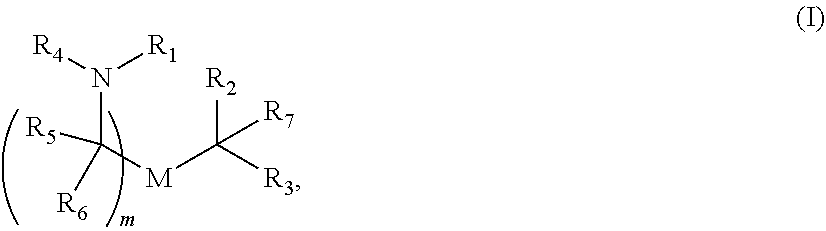
- or a salt or isomer thereof, wherein:
- R1 is selected from the group consisting of C5-30 alkyl, C5-20 alkenyl, —R*YR″, —YR″, and —R″M′R′;
- R2 and R3 are independently selected from the group consisting of H, C1-14 alkyl, C2-14 alkenyl, —R*YR″, —YR″, and —R*OR″, or R2 and R3, together with the atom to which they are attached, form a heterocycle or carbocycle;
- R4 is selected from the group consisting of a C3-6 carbocycle, —(CH2)nQ, —(CH2)nCHQR, —CHQR, —CQ(R)2, and unsubstituted C1-6 alkyl, where Q is selected from a carbocycle, heterocycle, —OR, —O(CH2)nN(R)2, —C(O)OR, —OC(O)R, —CX3, —CX2H, —CXH2, —CN, —N(R)2, —C(O)N(R)2, —N(R)C(O)R, —N(R)S(O)2R, —N(R)C(O)N(R)2, —N(R)C(S)N(R)2, —N(R)R8, —O(CH2)nOR, —N(R)C(═NR9)N(R)2, —N(R)C(═CHR9)N(R)2, —OC(O)N(R)2, —N(R)C(O)OR, —N(OR)C(O)R, —N(OR)S(O)2R, —N(OR)C(O)OR, —N(OR)C(O)N(R)2, —N(OR)C(S)N(R)2, —N(OR)C(═NR9)N(R)2, —N(OR)C(═CHR9)N(R)2, —C(═NR9)N(R)2, —C(═NR9)R, —C(O)N(R)OR, and —C(R)N(R)2C(O)OR, and each n is independently selected from 1, 2, 3, 4, and 5;
- each R5 is independently selected from the group consisting of C1-3 alkyl, C2-3 alkenyl, and H;
- each R6 is independently selected from the group consisting of C1-3 alkyl, C2-3 alkenyl, and H;
- M and M′ are independently selected from —C(O)O—, —OC(O)—, —C(O)N(R′)—, —N(R′)C(O)—, —C(O)—, —C(S)—, —C(S)S—, —SC(S)—, —CH(OH)—, —P(O)(OR′)O—, —S(O)2—, —S—S—, an aryl group, and a heteroaryl group;
- R7 is selected from the group consisting of C1-3 alkyl, C2-3 alkenyl, and H;
- R8 is selected from the group consisting of C3-6 carbocycle and heterocycle;
- R9 is selected from the group consisting of H, CN, NO2, C1-6 alkyl, —OR, —S(O)2R, —S(O)2N(R)2, C2-6 alkenyl, C3-6 carbocycle and heterocycle;
- each R is independently selected from the group consisting of C1-3 alkyl, C2-3 alkenyl, and H;
- each R′ is independently selected from the group consisting of C1-18 alkyl, C2-18 alkenyl, —R*YR″, —YR″, and H;
- each R″ is independently selected from the group consisting of C3-14 alkyl and C3-14 alkenyl;
- each R* is independently selected from the group consisting of C1-12 alkyl and C2-12 alkenyl;
- each Y is independently a C3-6 carbocycle;
- each X is independently selected from the group consisting of F, Cl, Br, and I; and
- m is selected from 5, 6, 7, 8, 9, 10, 11, 12, and 13.
- In some embodiments, a subset of compounds of Formula (I) includes those in which when R4 is —(CH2)nQ, —(CH2)nCHQR, —CHQR, or —CQ(R)2, then (i) Q is not —N(R)2 when n is 1, 2, 3, 4 or 5, or (ii) Q is not 5, 6, or 7-membered heterocycloalkyl when n is 1 or 2.
- In some embodiments, another subset of compounds of Formula (I) includes those in which
- R1 is selected from the group consisting of C5-30 alkyl, C5-20 alkenyl, —R*YR″, —YR″, and —R″M′R′;
- R2 and R3 are independently selected from the group consisting of H, C1-14 alkyl, C2-14 alkenyl, —R*YR″, —YR″, and —R*OR″, or R2 and R3, together with the atom to which they are attached, form a heterocycle or carbocycle;
- R4 is selected from the group consisting of a C3-6 carbocycle, —(CH2)nQ, —(CH2)nCHQR, —CHQR, —CQ(R)2, and unsubstituted C1-6 alkyl, where Q is selected from a C3-6 carbocycle, a 5- to 14-membered heteroaryl having one or more heteroatoms selected from N, O, and S, —OR, —O(CH2)nN(R)2, —C(O)OR, —OC(O)R, —CX3, —CX2H, —CXH2, —CN, —C(O)N(R)2, —N(R)C(O)R, —N(R)S(O)2R, —N(R)C(O)N(R)2, —N(R)C(S)N(R)2, —CRN(R)2C(O)OR, —N(R)R8, —O(CH2)nOR, —N(R)C(═NR9)N(R)2, —N(R)C(═CHR9)N(R)2, —OC(O)N(R)2, —N(R)C(O)OR, —N(OR)C(O)R, —N(OR)S(O)2R, —N(OR)C(O)OR, —N(OR)C(O)N(R)2, —N(OR)C(S)N(R)2, —N(OR)C(═NR9)N(R)2, —N(OR)C(═CHR9)N(R)2, —C(═NR9)N(R)2, —C(═NR9)R, —C(O)N(R)OR, and a 5- to 14-membered heterocycloalkyl having one or more heteroatoms selected from N, O, and S which is substituted with one or more substituents selected from oxo (═O), OH, amino, mono- or di-alkylamino, and C1-3 alkyl, and each n is independently selected from 1, 2, 3, 4, and 5;
- each R5 is independently selected from the group consisting of C1-3 alkyl, C2-3 alkenyl, and H;
- each R6 is independently selected from the group consisting of C1-3 alkyl, C2-3 alkenyl, and H;
- M and M′ are independently selected from —C(O)O—, —OC(O)—, —C(O)N(R′)—, —N(R′)C(O)—, —C(O)—, —C(S)—, —C(S)S—, —SC(S)—, —CH(OH)—, —P(O)(OR′)O—, —S(O)2—, —S—S—, an aryl group, and a heteroaryl group;
- R7 is selected from the group consisting of C1-3 alkyl, C2-3 alkenyl, and H;
- R8 is selected from the group consisting of C3-6 carbocycle and heterocycle;
- R9 is selected from the group consisting of H, CN, NO2, C1-6 alkyl, —OR, —S(O)2R, —S(O)2N(R)2, C2-6 alkenyl, C3-6 carbocycle and heterocycle;
- each R is independently selected from the group consisting of C1-3 alkyl, C2-3 alkenyl, and H;
- each R′ is independently selected from the group consisting of C1-18 alkyl, C2-18 alkenyl, —R*YR″, —YR″, and H;
- each R″ is independently selected from the group consisting of C3-14 alkyl and C3-14 alkenyl;
- each R* is independently selected from the group consisting of C1-12 alkyl and C2-12 alkenyl;
- each Y is independently a C3-6 carbocycle;
- each X is independently selected from the group consisting of F, Cl, Br, and I; and
- m is selected from 5, 6, 7, 8, 9, 10, 11, 12, and 13, or salts or isomers thereof.
- In some embodiments, another subset of compounds of Formula (I) includes those in which
- R1 is selected from the group consisting of C5-30 alkyl, C5-20 alkenyl, —R*YR″, —YR″, and —R″M′R′;
- R2 and R3 are independently selected from the group consisting of H, C1-14 alkyl, C2-14 alkenyl, —R*YR″, —YR″, and —R*OR″, or R2 and R3, together with the atom to which they are attached, form a heterocycle or carbocycle;
- R4 is selected from the group consisting of a C3-6 carbocycle, —(CH2)nQ, —(CH2)nCHQR, —CHQR, —CQ(R)2, and unsubstituted C1-6 alkyl, where Q is selected from a C3-6 carbocycle, a 5- to 14-membered heterocycle having one or more heteroatoms selected from N, O, and S, —OR, —O(CH2)nN(R)2, —C(O)OR, —OC(O)R, —CX3, —CX2H, —CXH2, —CN, —C(O)N(R)2, —N(R)C(O)R, —N(R)S(O)2R, —N(R)C(O)N(R)2, —N(R)C(S)N(R)2, —CRN(R)2C(O)OR, —N(R)R8, —O(CH2)nOR, —N(R)C(═NR9)N(R)2, —N(R)C(═CHR9)N(R)2, —OC(O)N(R)2, —N(R)C(O)OR, —N(OR)C(O)R, —N(OR)S(O)2R, —N(OR)C(O)OR, —N(OR)C(O)N(R)2, —N(OR)C(S)N(R)2, —N(OR)C(═NR9)N(R)2, —N(OR)C(═CHR9)N(R)2, —C(═NR9)R, —C(O)N(R)OR, and —C(═NR9)N(R)2, and each n is independently selected from 1, 2, 3, 4, and 5; and when Q is a 5- to 14-membered heterocycle and (i) R4 is —(CH2)nQ in which n is 1 or 2, or (ii) R4 is —(CH2)nCHQR in which n is 1, or (iii) R4 is —CHQR, and —CQ(R)2, then Q is either a 5- to 14-membered heteroaryl or 8- to 14-membered heterocycloalkyl;
- each R5 is independently selected from the group consisting of C1-3 alkyl, C2-3 alkenyl, and H;
- each R6 is independently selected from the group consisting of C1-3 alkyl, C2-3 alkenyl, and H;
- M and M′ are independently selected from —C(O)O—, —OC(O)—, —C(O)N(R′)—, —N(R′)C(O)—, —C(O)—, —C(S)—, —C(S)S—, —SC(S)—, —CH(OH)—, —P(O)(OR′)O—, —S(O)2—, —S—S—, an aryl group, and a heteroaryl group;
- R7 is selected from the group consisting of C1-3 alkyl, C2-3 alkenyl, and H;
- R8 is selected from the group consisting of C3-6 carbocycle and heterocycle;
- R9 is selected from the group consisting of H, CN, NO2, C1-6 alkyl, —OR, —S(O)2R, —S(O)2N(R)2, C2-6 alkenyl, C3-6 carbocycle and heterocycle;
- each R is independently selected from the group consisting of C1-3 alkyl, C2-3 alkenyl, and H;
- each R′ is independently selected from the group consisting of C1-18 alkyl, C2-18 alkenyl, —R*YR″, —YR″, and H;
- each R″ is independently selected from the group consisting of C3-14 alkyl and C3-14 alkenyl;
- each R* is independently selected from the group consisting of C1-12 alkyl and C2-12 alkenyl;
- each Y is independently a C3-6 carbocycle;
- each X is independently selected from the group consisting of F, Cl, Br, and I; and
- m is selected from 5, 6, 7, 8, 9, 10, 11, 12, and 13, or salts or isomers thereof.
- In some embodiments, another subset of compounds of Formula (I) includes those in which
- R1 is selected from the group consisting of C5-30 alkyl, C5-20 alkenyl, —R*YR″, —YR″, and —R″M′R′;
- R2 and R3 are independently selected from the group consisting of H, C1-14 alkyl, C2-14 alkenyl, —R*YR″, —YR″, and —R*OR″, or R2 and R3, together with the atom to which they are attached, form a heterocycle or carbocycle;
- R4 is selected from the group consisting of a C3-6 carbocycle, —(CH2)nQ, —(CH2)nCHQR, —CHQR, —CQ(R)2, and unsubstituted C1-6 alkyl, where Q is selected from a C3-6 carbocycle, a 5- to 14-membered heteroaryl having one or more heteroatoms selected from N, O, and S, —OR, —O(CH2)nN(R)2, —C(O)OR, —OC(O)R, —CX3, —CX2H, —CXH2, —CN, —C(O)N(R)2, —N(R)C(O)R, —N(R)S(O)2R, —N(R)C(O)N(R)2, —N(R)C(S)N(R)2, —CRN(R)2C(O)OR, —N(R)R8, —O(CH2)nOR, —N(R)C(═NR9)N(R)2, —N(R)C(═CHR9)N(R)2, —OC(O)N(R)2, —N(R)C(O)OR, —N(OR)C(O)R, —N(OR)S(O)2R, —N(OR)C(O)OR, —N(OR)C(O)N(R)2, —N(OR)C(S)N(R)2, —N(OR)C(═NR9)N(R)2, —N(OR)C(═CHR9)N(R)2, —C(═NR9)R, —C(O)N(R)OR, and —C(═NR9)N(R)2, and each n is independently selected from 1, 2, 3, 4, and 5;
- each R5 is independently selected from the group consisting of C1-3 alkyl, C2-3 alkenyl, and H;
- each R6 is independently selected from the group consisting of C1-3 alkyl, C2-3 alkenyl, and H;
- M and M′ are independently selected from —C(O)O—, —OC(O)—, —C(O)N(R′)—, —N(R′)C(O)—, —C(O)—, —C(S)—, —C(S)S—, —SC(S)—, —CH(OH)—, —P(O)(OR′)O—, —S(O)2—, —S—S—, an aryl group, and a heteroaryl group;
- R7 is selected from the group consisting of C1-3 alkyl, C2-3 alkenyl, and H;
- R8 is selected from the group consisting of C3-6 carbocycle and heterocycle;
- R9 is selected from the group consisting of H, CN, NO2, C1-6 alkyl, —OR, —S(O)2R, —S(O)2N(R)2, C2-6 alkenyl, C3-6 carbocycle and heterocycle;
- each R is independently selected from the group consisting of C1-3 alkyl, C2-3 alkenyl, and H;
- each R′ is independently selected from the group consisting of C1-18 alkyl, C2-18 alkenyl, —R*YR″, —YR″, and H;
- each R″ is independently selected from the group consisting of C3-14 alkyl and C3-14 alkenyl;
- each R* is independently selected from the group consisting of C1-12 alkyl and C2-12 alkenyl;
- each Y is independently a C3-6 carbocycle;
- each X is independently selected from the group consisting of F, Cl, Br, and I; and
- m is selected from 5, 6, 7, 8, 9, 10, 11, 12, and 13, or salts or isomers thereof.
- In some embodiments, another subset of compounds of Formula (I) includes those in which
- R1 is selected from the group consisting of C5-30 alkyl, C5-20 alkenyl, —R*YR″, —YR″, and —R″M′R′;
- R2 and R3 are independently selected from the group consisting of H, C2-14 alkyl, C2-14 alkenyl, —R*YR″, —YR″, and —R*OR″, or R2 and R3, together with the atom to which they are attached, form a heterocycle or carbocycle;
- R4 is —(CH2)nQ or —(CH2)nCHQR, where Q is —N(R)2, and n is selected from 3, 4, and 5; each R5 is independently selected from the group consisting of C1-3 alkyl, C2-3 alkenyl, and H;
- each R6 is independently selected from the group consisting of C1-3 alkyl, C2-3 alkenyl, and H;
- M and M′ are independently selected from —C(O)O—, —OC(O)—, —C(O)N(R′)—, —N(R′)C(O)—, —C(O)—, —C(S)—, —C(S)S—, —SC(S)—, —CH(OH)—, —P(O)(OR′)O—, —S(O)2—, —S—S—, an aryl group, and a heteroaryl group;
- R7 is selected from the group consisting of C1-3 alkyl, C2-3 alkenyl, and H;
- each R is independently selected from the group consisting of C1-3 alkyl, C2-3 alkenyl, and H;
- each R′ is independently selected from the group consisting of C1-18 alkyl, C2-18 alkenyl, —R*YR″, —YR″, and H;
- each R″ is independently selected from the group consisting of C3-14 alkyl and C3-14 alkenyl;
- each R* is independently selected from the group consisting of C1-12 alkyl and C1-12 alkenyl;
- each Y is independently a C3-6 carbocycle;
- each X is independently selected from the group consisting of F, Cl, Br, and I; and
- m is selected from 5, 6, 7, 8, 9, 10, 11, 12, and 13, or salts or isomers thereof.
- In some embodiments, another subset of compounds of Formula (I) includes those in which
- R1 is selected from the group consisting of C5-30 alkyl, C5-20 alkenyl, —R*YR″, —YR″, and —R″M′R′;
- R2 and R3 are independently selected from the group consisting of C1-14 alkyl, C2-14 alkenyl, —R*YR″, —YR″, and —R*OR″, or R2 and R3, together with the atom to which they are attached, form a heterocycle or carbocycle;
- R4 is selected from the group consisting of —(CH2)nQ, —(CH2)nCHQR, —CHQR, and —CQ(R)2, where Q is —N(R)2, and n is selected from 1, 2, 3, 4, and 5;
- each R5 is independently selected from the group consisting of C1-3 alkyl, C2-3 alkenyl, and H;
- each R6 is independently selected from the group consisting of C1-3 alkyl, C2-3 alkenyl, and H;
- M and M′ are independently selected from —C(O)O—, —OC(O)—, —C(O)N(R′)—, —N(R′)C(O)—, —C(O)—, —C(S)—, —C(S)S—, —SC(S)—, —CH(OH)—, —P(O)(OR′)O—, —S(O)2—, —S—S—, an aryl group, and a heteroaryl group;
- R7 is selected from the group consisting of C1-3 alkyl, C2-3 alkenyl, and H;
- each R is independently selected from the group consisting of C1-3 alkyl, C2-3 alkenyl, and H;
- each R′ is independently selected from the group consisting of C1-18 alkyl, C2-18 alkenyl, —R*YR″, —YR″, and H;
- each R″ is independently selected from the group consisting of C3-14 alkyl and C3-14 alkenyl;
- each R* is independently selected from the group consisting of C1-12 alkyl and C1-12 alkenyl;
- each Y is independently a C3-6 carbocycle;
- each X is independently selected from the group consisting of F, Cl, Br, and I; and
- m is selected from 5, 6, 7, 8, 9, 10, 11, 12, and 13, or salts or isomers thereof.
- In some embodiments, a subset of compounds of Formula (I) includes those of Formula (IA):
-
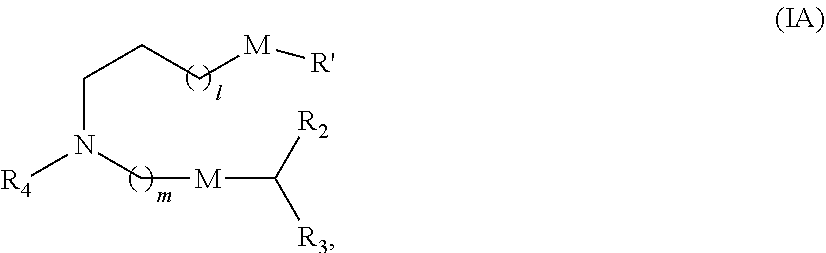
- or a salt or isomer thereof, wherein 1 is selected from 1, 2, 3, 4, and 5; m is selected from 5, 6, 7, 8, and 9; M1 is a bond or M′; R4 is unsubstituted C1-3 alkyl, or —(CH2)nQ, in which Q is OH, —NHC(S)N(R)2, —NHC(O)N(R)2, —N(R)C(O)R, —N(R)S(O)2R, —N(R)R8, —NHC(═NR9)N(R)2, —NHC(═CHR9)N(R)2, —OC(O)N(R)2, —N(R)C(O)OR, heteroaryl or heterocycloalkyl; M and M′ are independently selected from —C(O)O—, —OC(O)—, —C(O)N(R′)—, —P(O)(OR′)O—, —S—S—, an aryl group, and a heteroaryl group; and R2 and R3 are independently selected from the group consisting of H, C1-14 alkyl, and C2-14 alkenyl.
- In some embodiments, a subset of compounds of Formula (I) includes those of Formula (II):
-
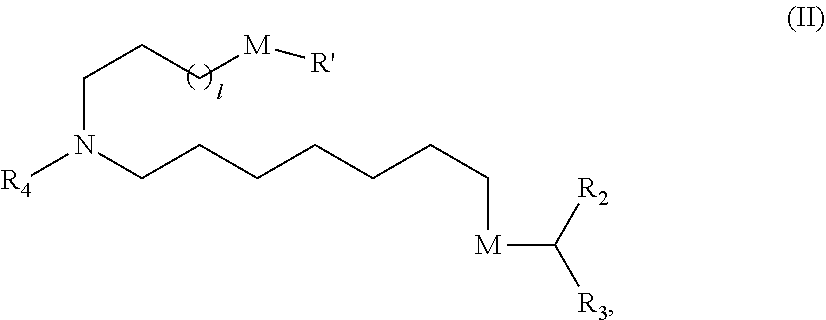
- or a salt or isomer thereof, wherein 1 is selected from 1, 2, 3, 4, and 5; M1 is a bond or M′; R4 is unsubstituted C1-3 alkyl, or —(CH2)nQ, in which n is 2, 3, or 4, and Q is OH, —NHC(S)N(R)2, —NHC(O)N(R)2, —N(R)C(O)R, —N(R)S(O)2R, —N(R)R8, —NHC(═NR9)N(R)2, —NHC(═CHR9)N(R)2, —OC(O)N(R)2, —N(R)C(O)OR, heteroaryl or heterocycloalkyl; M and M′ are independently selected from —C(O)O—, —OC(O)—, —C(O)N(R′)—, —P(O)(OR′)O—, —S—S—, an aryl group, and a heteroaryl group; and R2 and R3 are independently selected from the group consisting of H, C1-14 alkyl, and C2-14 alkenyl.
- In some embodiments, a subset of compounds of Formula (I) includes those of Formula (IIa), (IIb), (IIc), or (IIe):
-
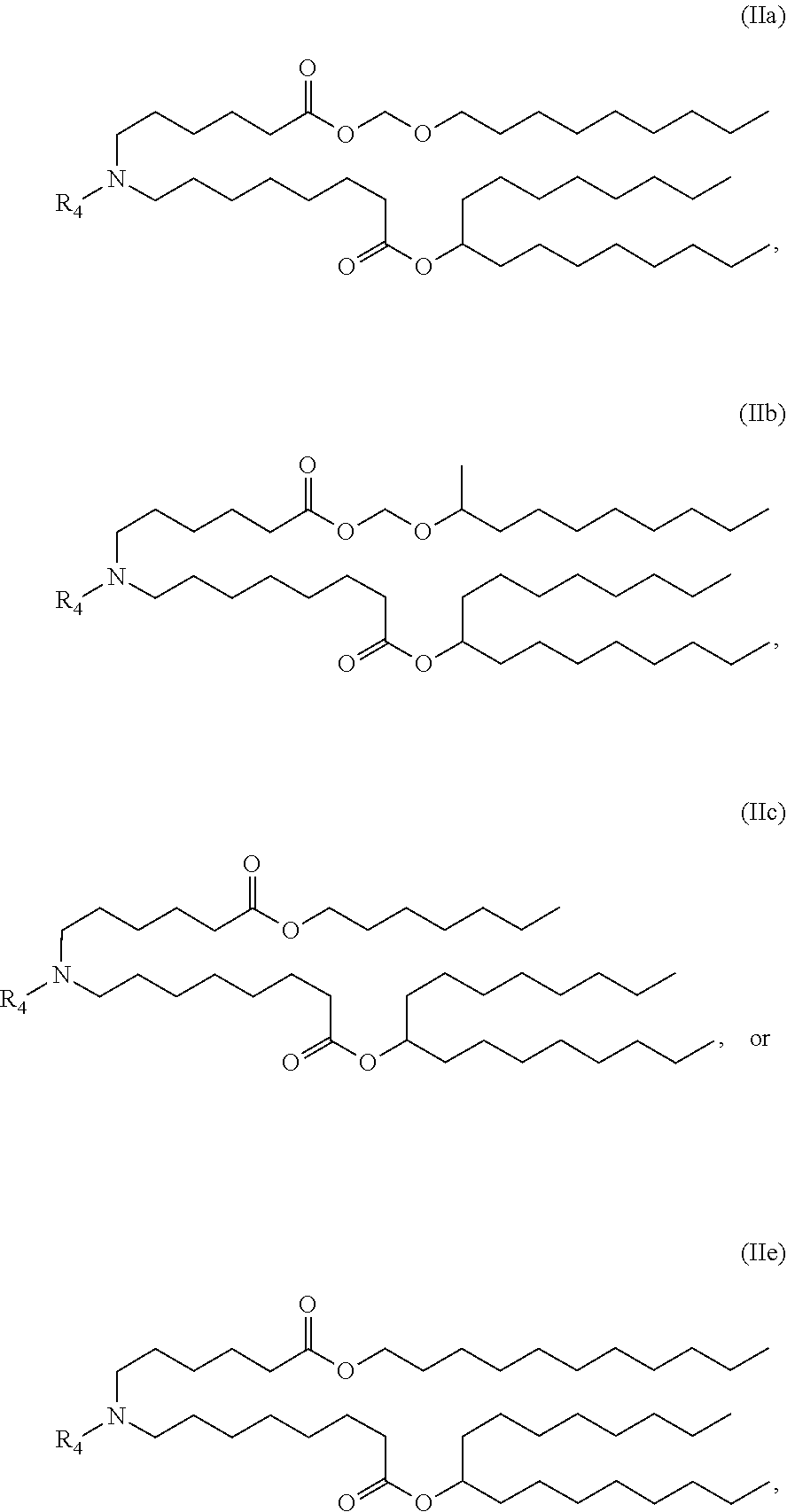
- or a salt or isomer thereof, wherein R4 is as described herein.
- In some embodiments, a subset of compounds of Formula (I) includes those of Formula (IId):
-
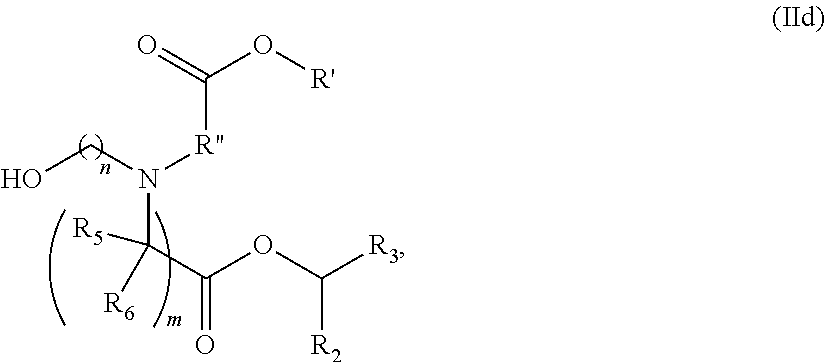
- or a salt or isomer thereof, wherein n is 2, 3, or 4; and m, R′, R″, and R2 through R6 are as described herein. For example, each of R2 and R3 may be independently selected from the group consisting of C5-14 alkyl and C5-14 alkenyl.
- In some embodiments, an ionizable cationic lipid of the disclosure comprises a compound having structure:
-
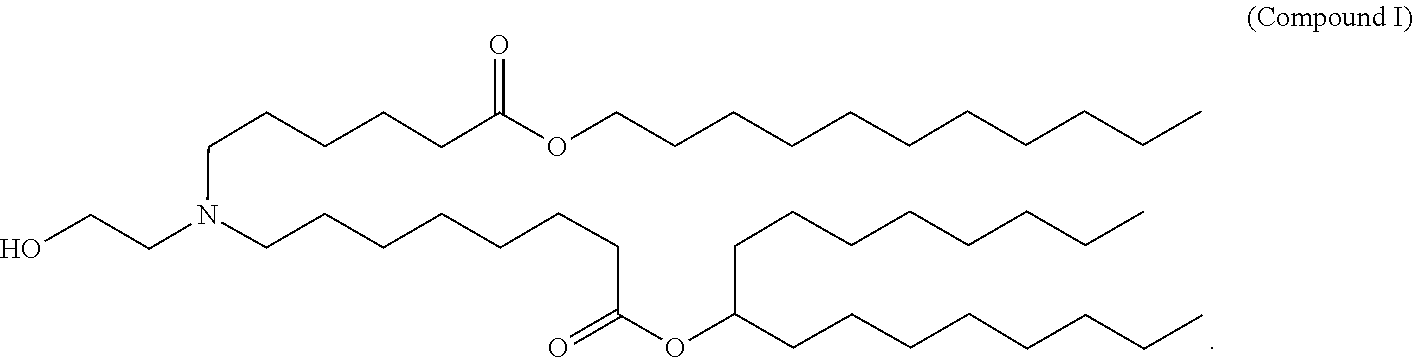
- In some embodiments, an ionizable cationic lipid of the disclosure comprises a compound having structure:
-
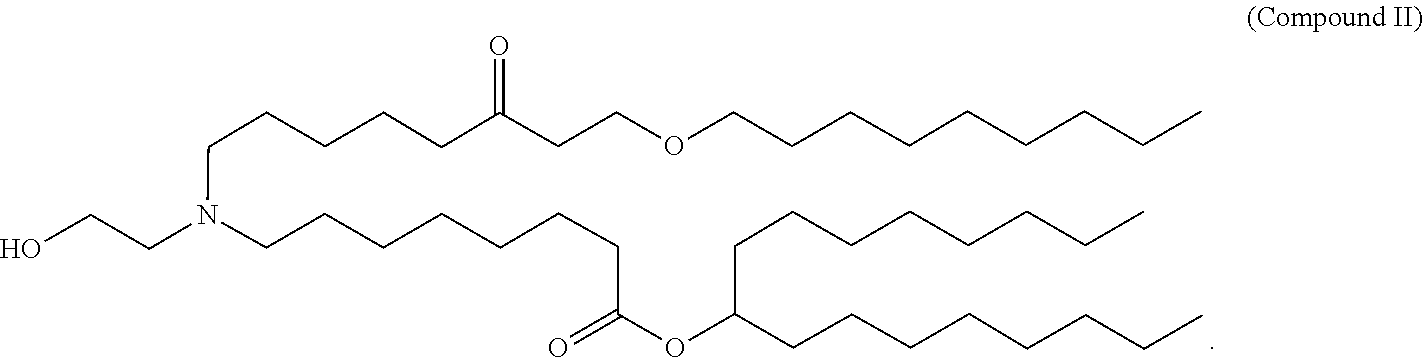
- In some embodiments, a non-cationic lipid of the disclosure comprises 1,2-distearoyl-sn-glycero-3-phosphocholine (DSPC), 1,2-dioleoyl-sn-glycero-3-phosphoethanolamine (DOPE), 1,2-dilinoleoyl-sn-glycero-3-phosphocholine (DLPC), 1,2-dimyristoyl-sn-gly cero-phosphocholine (DMPC), 1,2-dioleoyl-sn-glycero-3-phosphocholine (DOPC), 1,2-dipalmitoyl-sn-glycero-3-phosphocholine (DPPC), 1,2-diundecanoyl-sn-glycero-phosphocholine (DUPC), 1-palmitoyl-2-oleoyl-sn-glycero-3-phosphocholine (POPC), 1,2-di-O-octadecenyl-sn-glycero-3-phosphocholine (18:0 Diether PC), 1-oleoyl-2 cholesterylhemisuccinoyl-sn-glycero-3-phosphocholine (OChemsPC), 1-hexadecyl-sn-glycero-3-phosphocholine (C16 Lyso PC), 1,2-dilinolenoyl-sn-glycero-3-phosphocholine, 1,2-diarachidonoyl-sn-glycero-3-phosphocholine, 1,2-didocosahexaenoyl-sn-glycero-3-phosphocholine, 1,2-diphytanoyl-sn-glycero phosphoethanolamine (ME 16.0 PE), 1,2-distearoyl-sn-glycero-3-phosphoethanolamine, 1,2-dilinoleoyl-sn-glycero-3-phosphoethanolamine, 1,2-dilinolenoyl-sn-glycero phosphoethanolamine, 1,2-diarachidonoyl-sn-glycero-3-phosphoethanolamine, 1,2-didocosahexaenoyl-sn-glycero-3-phosphoethanolamine, 1,2-dioleoyl-sn-glycero-3-phospho-rac-(1-glycerol) sodium salt (DOPG), sphingomyelin, and mixtures thereof.
- In some embodiments, a PEG modified lipid of the disclosure comprises a PEG-modified phosphatidylethanolamine, a PEG-modified phosphatidic acid, a PEG-modified ceramide, a PEG-modified dialkylamine, a PEG-modified diacylglycerol, a PEG-modified dialkylglycerol, and mixtures thereof. In some embodiments, the PEG-modified lipid is DMG-PEG, PEG-c-DOMG (also referred to as PEG-DOMG), PEG-DSG and/or PEG-DPG.
- In some embodiments, a sterol of the disclosure comprises cholesterol, fecosterol, sitosterol, ergosterol, campesterol, stigmasterol, brassicasterol, tomatidine, ursolic acid, alpha-tocopherol, and mixtures thereof.
- In some embodiments, a LNP of the disclosure comprises an ionizable cationic lipid of
Compound 1, wherein the non-cationic lipid is DSPC, the structural lipid that is cholesterol, and the PEG lipid is DMG-PEG. - In some embodiments, the lipid nanoparticle comprises 45-55 mole percent (mol %) ionizable cationic lipid. For example, lipid nanoparticle may comprise 45, 46, 47, 48, 49, 50, 51, 52, 53, 54, or 55 mol % ionizable cationic lipid.
- In some embodiments, the lipid nanoparticle comprises 5-15 mol % DSPC. For example, the lipid nanoparticle may comprise 5, 6, 7, 8, 9, 10, 11, 12, 13, 14, or 15 mol % DSPC.
- In some embodiments, the lipid nanoparticle comprises 35-40 mol % cholesterol. For example, the lipid nanoparticle may comprise 35, 36, 37, 38, 39, or 40 mol % cholesterol.
- In some embodiments, the lipid nanoparticle comprises 1-2 mol % DMG-PEG. For example, the lipid nanoparticle may comprise 1, 1.5, or 2 mol % DMG-PEG.
- In some embodiments, the lipid nanoparticle comprises 50 mol % ionizable cationic lipid, 10 mol % DSPC, 38.5 mol % cholesterol, and 1.5 mol % DMG-PEG.
- In some embodiments, a LNP of the disclosure comprises an N:P ratio of from about 2:1 to about 30:1.
- In some embodiments, a LNP of the disclosure comprises an N:P ratio of about 6:1.
- In some embodiments, a LNP of the disclosure comprises an N:P ratio of about 3:1.
- In some embodiments, a LNP of the disclosure comprises a wt/wt ratio of the ionizable cationic lipid component to the RNA of from about 10:1 to about 100:1.
- In some embodiments, a LNP of the disclosure comprises a wt/wt ratio of the ionizable cationic lipid component to the RNA of about 20:1.
- In some embodiments, a LNP of the disclosure comprises a wt/wt ratio of the ionizable cationic lipid component to the RNA of about 10:1.
- In some embodiments, a LNP of the disclosure has a mean diameter from about 50 nm to about 150 nm.
- In some embodiments, a LNP of the disclosure has a mean diameter from about 70 nm to about 120 nm.
- The compositions, as provided herein, may include RNA or multiple RNAs encoding two or more antigens of the same or different species. In some embodiments, composition includes an RNA or multiple RNAs encoding two or more coronavirus antigens. In some embodiments, the RNA may encode 1, 2, 3, 4, 5, 6, 7, 8, 9, 10, 11, 12, or more coronavirus antigens.
- In some embodiments, two or more different RNA (e.g., mRNA) encoding antigens may be formulated in the same lipid nanoparticle. In other embodiments, two or more different RNA encoding antigens may be formulated in separate lipid nanoparticles (each RNA formulated in a single lipid nanoparticle). The lipid nanoparticles may then be combined and administered as a single vaccine composition (e.g., comprising multiple RNA encoding multiple antigens) or may be administered separately.
- The compositions, as provided herein, may include an RNA or multiple RNAs encoding two or more antigens of the same or different viral strains. Also provided herein are combination vaccines that include RNA encoding one or more coronavirus and one or more antigen(s) of a different organism. Thus, the vaccines of the present disclosure may be combination vaccines that target one or more antigens of the same strain/species, or one or more antigens of different strains/species, e.g., antigens which induce immunity to organisms which are found in the same geographic areas where the risk of coronavirus infection is high or organisms to which an individual is likely to be exposed to when exposed to a coronavirus.
- Provided herein are compositions (e.g., pharmaceutical compositions), methods, kits and reagents for prevention or treatment of coronavirus in humans and other mammals, for example. The compositions provided herein can be used as therapeutic or prophylactic agents. They may be used in medicine to prevent and/or treat a coronavirus infection.
- In some embodiments, the coronavirus vaccine containing RNA as described herein can be administered to a subject (e.g., a mammalian subject, such as a human subject), and the RNA polynucleotides are translated in vivo to produce an antigenic polypeptide (antigen).
- An “effective amount” of a composition (e.g., comprising RNA) is based, at least in part, on the target tissue, target cell type, means of administration, physical characteristics of the RNA (e.g., length, nucleotide composition, and/or extent of modified nucleosides), other components of the vaccine, and other determinants, such as age, body weight, height, sex and general health of the subject. Typically, an effective amount of a composition provides an induced or boosted immune response as a function of antigen production in the cells of the subject. In some embodiments, an effective amount of the composition containing RNA polynucleotides having at least one chemical modifications are more efficient than a composition containing a corresponding unmodified polynucleotide encoding the same antigen or a peptide antigen. Increased antigen production may be demonstrated by increased cell transfection (the percentage of cells transfected with the RNA vaccine), increased protein translation and/or expression from the polynucleotide, decreased nucleic acid degradation (as demonstrated, for example, by increased duration of protein translation from a modified polynucleotide), or altered antigen specific immune response of the host cell.
- The term “pharmaceutical composition” refers to the combination of an active agent with a carrier, inert or active, making the composition especially suitable for diagnostic or therapeutic use in vivo or ex vivo. A “pharmaceutically acceptable carrier,” after administered to or upon a subject, does not cause undesirable physiological effects. The carrier in the pharmaceutical composition must be “acceptable” also in the sense that it is compatible with the active ingredient and can be capable of stabilizing it. One or more solubilizing agents can be utilized as pharmaceutical carriers for delivery of an active agent. Examples of a pharmaceutically acceptable carrier include, but are not limited to, biocompatible vehicles, adjuvants, additives, and diluents to achieve a composition usable as a dosage form. Examples of other carriers include colloidal silicon oxide, magnesium stearate, cellulose, and sodium lauryl sulfate. Additional suitable pharmaceutical carriers and diluents, as well as pharmaceutical necessities for their use, are described in Remington's Pharmaceutical Sciences.
- In some embodiments, the compositions (comprising polynucleotides and their encoded polypeptides) in accordance with the present disclosure may be used for treatment or prevention of a coronavirus infection. A composition may be administered prophylactically or therapeutically as part of an active immunization scheme to healthy individuals or early in infection during the incubation phase or during active infection after onset of symptoms. In some embodiments, the amount of RNA provided to a cell, a tissue or a subject may be an amount effective for immune prophylaxis.
- A composition may be administered with other prophylactic or therapeutic compounds. As a non-limiting example, a prophylactic or therapeutic compound may be an adjuvant or a booster. As used herein, when referring to a prophylactic composition, such as a vaccine, the term “booster” refers to an extra administration of the prophylactic (vaccine) composition. A booster (or booster vaccine) may be given after an earlier administration of the prophylactic composition. The time of administration between the initial administration of the prophylactic composition and the booster may be, but is not limited to, 1 minute, 2 minutes, 3 minutes, 4 minutes, 5 minutes, 6 minutes, 7 minutes, 8 minutes, 9 minutes, 10 minutes, 15 minutes, 20 minutes 35 minutes, 40 minutes, 45 minutes, 50 minutes, 55 minutes, 1 hour, 2 hours, 3 hours, 4 hours, 5 hours, 6 hours, 7 hours, 8 hours, 9 hours, 10 hours, 11 hours, 12 hours, 13 hours, 14 hours, 15 hours, 16 hours, 17 hours, 18 hours, 19 hours, 20 hours, 21 hours, 22 hours, 23 hours, 1 day, 36 hours, 2 days, 3 days, 4 days, 5 days, 6 days, 1 week, 10 days, 2 weeks, 3 weeks, 1 month, 2 months, 3 months, 4 months, 5 months, 6 months, 7 months, 8 months, 9 months, 10 months, 11 months, 1 year, 18 months, 2 years, 3 years, 4 years, 5 years, 6 years, 7 years, 8 years, 9 years, 10 years, 11 years, 12 years, 13 years, 14 years, 15 years, 16 years, 17 years, 18 years, 19 years, 20 years, 25 years, 30 years, 35 years, 40 years, 45 years, 50 years, 55 years, 60 years, 65 years, 70 years, 75 years, 80 years, 85 years, 90 years, 95 years or more than 99 years. In exemplary embodiments, the time of administration between the initial administration of the prophylactic composition and the booster may be, but is not limited to, 1 week, 2 weeks, 3 weeks, 1 month, 2 months, 3 months, 6 months or 1 year.
- In some embodiments, a composition may be administered intramuscularly, intranasally or intradermally, similarly to the administration of inactivated vaccines known in the art.
- A composition may be utilized in various settings depending on the prevalence of the infection or the degree or level of unmet medical need. As a non-limiting example, the RNA vaccines may be utilized to treat and/or prevent a variety of infectious disease. RNA vaccines have superior properties in that they produce much larger antibody titers, better neutralizing immunity, produce more durable immune responses, and/or produce responses earlier than commercially available vaccines.
- Provided herein are pharmaceutical compositions including RNA and/or complexes optionally in combination with one or more pharmaceutically acceptable excipients.
- The RNA may be formulated or administered alone or in conjunction with one or more other components. For example, an immunizing composition may comprise other components including, but not limited to, adjuvants.
- In some embodiments, an immunizing composition does not include an adjuvant (they are adjuvant free).
- An RNA may be formulated or administered in combination with one or more pharmaceutically-acceptable excipients. In some embodiments, vaccine compositions comprise at least one additional active substances, such as, for example, a therapeutically-active substance, a prophylactically-active substance, or a combination of both. Vaccine compositions may be sterile, pyrogen-free or both sterile and pyrogen-free. General considerations in the formulation and/or manufacture of pharmaceutical agents, such as vaccine compositions, may be found, for example, in Remington: The Science and Practice of Pharmacy 21st ed., Lippincott Williams & Wilkins, 2005 (incorporated herein by reference in its entirety).
- In some embodiments, an immunizing composition is administered to humans, human patients or subjects. For the purposes of the present disclosure, the phrase “active ingredient” generally refers to the RNA vaccines or the polynucleotides contained therein, for example, RNA polynucleotides (e.g., mRNA polynucleotides) encoding antigens.
- Formulations of the vaccine compositions described herein may be prepared by any method known or hereafter developed in the art of pharmacology. In general, such preparatory methods include the step of bringing the active ingredient (e.g., mRNA polynucleotide) into association with an excipient and/or one or more other accessory ingredients, and then, if necessary and/or desirable, dividing, shaping and/or packaging the product into a desired single- or multi-dose unit.
- Relative amounts of the active ingredient, the pharmaceutically acceptable excipient, and/or any additional ingredients in a pharmaceutical composition in accordance with the disclosure will vary, depending upon the identity, size, and/or condition of the subject treated and further depending upon the route by which the composition is to be administered. By way of example, the composition may comprise between 0.1% and 100%, e.g., between 0.5 and 50%, between 1-30%, between 5-80%, at least 80% (w/w) active ingredient.
- In some embodiments, an RNA is formulated using one or more excipients to: (1) increase stability; (2) increase cell transfection; (3) permit the sustained or delayed release (e.g., from a depot formulation); (4) alter the biodistribution (e.g., target to specific tissues or cell types); (5) increase the translation of encoded protein in vivo; and/or (6) alter the release profile of encoded protein (antigen) in vivo. In addition to traditional excipients such as any and all solvents, dispersion media, diluents, or other liquid vehicles, dispersion or suspension aids, surface active agents, isotonic agents, thickening or emulsifying agents, preservatives, excipients can include, without limitation, lipidoids, liposomes, lipid nanoparticles, polymers, lipoplexes, core-shell nanoparticles, peptides, proteins, cells transfected with the RNA (e.g., for transplantation into a subject), hyaluronidase, nanoparticle mimics and combinations thereof.
- Provided herein are immunizing compositions (e.g., RNA vaccines), methods, kits and reagents for prevention and/or treatment of coronavirus infection in humans and other mammals. Immunizing compositions can be used as therapeutic or prophylactic agents. In some embodiments, immunizing compositions are used to provide prophylactic protection from coronavirus infection. In some embodiments, immunizing compositions are used to treat a coronavirus infection. In some embodiments, embodiments, immunizing compositions are used in the priming of immune effector cells, for example, to activate peripheral blood mononuclear cells (PBMCs) ex vivo, which are then infused (re-infused) into a subject.
- A subject may be any mammal, including non-human primate and human subjects. Typically, a subject is a human subject.
- In some embodiments, an immunizing composition (e.g., RNA a vaccine) is administered to a subject (e.g., a mammalian subject, such as a human subject) in an effective amount to induce an antigen-specific immune response. The RNA encoding the coronavirus antigen is expressed and translated in vivo to produce the antigen, which then stimulates an immune response in the subject.
- Prophylactic protection from a coronavirus can be achieved following administration of an immunizing composition (e.g., an RNA vaccine) of the present disclosure. Immunizing compositions can be administered once, twice, three times, four times or more but it is likely sufficient to administer the vaccine once (optionally followed by a single booster). It is possible, although less desirable, to administer an immunizing compositions to an infected individual to achieve a therapeutic response. Dosing may need to be adjusted accordingly.
- A method of eliciting an immune response in a subject against a coronavirus antigen (or multiple antigens) is provided in aspects of the present disclosure. In some embodiments, a method involves administering to the subject an immunizing composition comprising a RNA (e.g., mRNA) having an open reading frame encoding a coronavirus antigen, thereby inducing in the subject an immune response specific to the coronavirus antigen, wherein anti-antigen antibody titer in the subject is increased following vaccination relative to anti-antigen antibody titer in a subject vaccinated with a prophylactically effective dose of a traditional vaccine against the antigen. An “anti-antigen antibody” is a serum antibody the binds specifically to the antigen.
- A prophylactically effective dose is an effective dose that prevents infection with the virus at a clinically acceptable level. In some embodiments, the effective dose is a dose listed in a package insert for the vaccine. A traditional vaccine, as used herein, refers to a vaccine other than the mRNA vaccines of the present disclosure. For instance, a traditional vaccine includes, but is not limited, to live microorganism vaccines, killed microorganism vaccines, subunit vaccines, protein antigen vaccines, DNA vaccines, virus like particle (VLP) vaccines, etc. In exemplary embodiments, a traditional vaccine is a vaccine that has achieved regulatory approval and/or is registered by a national drug regulatory body, for example the Food and Drug Administration (FDA) in the United States or the European Medicines Agency (EMA).
- In some embodiments, the anti-antigen antibody titer in the subject is increased 1 log to 10 log following vaccination relative to anti-antigen antibody titer in a subject vaccinated with a prophylactically effective dose of a traditional vaccine against the coronavirus or an unvaccinated subject. In some embodiments, the anti-antigen antibody titer in the subject is increased 1 log, 2 log, 3 log, 4 log, 5 log, or 10 log following vaccination relative to anti-antigen antibody titer in a subject vaccinated with a prophylactically effective dose of a traditional vaccine against the coronavirus or an unvaccinated subject.
- A method of eliciting an immune response in a subject against a coronavirus is provided in other aspects of the disclosure. The method involves administering to the subject an immunizing composition (e.g., an RNA vaccine) comprising a RNA polynucleotide comprising an open reading frame encoding a coronavirus antigen, thereby inducing in the subject an immune response specific to the coronavirus, wherein the immune response in the subject is equivalent to an immune response in a subject vaccinated with a traditional vaccine against the coronavirus at 2 times to 100 times the dosage level relative to the immunizing composition.
- In some embodiments, the immune response in the subject is equivalent to an immune response in a subject vaccinated with a traditional vaccine at twice the dosage level relative to an immunizing composition of the present disclosure. In some embodiments, the immune response in the subject is equivalent to an immune response in a subject vaccinated with a traditional vaccine at three times the dosage level relative to an immunizing composition of the present disclosure. In some embodiments, the immune response in the subject is equivalent to an immune response in a subject vaccinated with a traditional vaccine at 4 times, 5 times, 10 times, 50 times, or 100 times the dosage level relative to an immunizing composition of the present disclosure. In some embodiments, the immune response in the subject is equivalent to an immune response in a subject vaccinated with a traditional vaccine at 10 times to 1000 times the dosage level relative to an immunizing composition of the present disclosure. In some embodiments, the immune response in the subject is equivalent to an immune response in a subject vaccinated with a traditional vaccine at 100 times to 1000 times the dosage level relative to an immunizing composition of the present disclosure.
- In other embodiments, the immune response is assessed by determining [protein] antibody titer in the subject. In other embodiments, the ability of serum or antibody from an immunized subject is tested for its ability to neutralize viral uptake or reduce coronavirus transformation of human B lymphocytes. In other embodiments, the ability to promote a robust T cell response(s) is measured using art recognized techniques.
- Other aspects the disclosure provide methods of eliciting an immune response in a subject against a coronavirus by administering to the subject an immunizing composition (e.g., an RNA vaccine) comprising an RNA having an open reading frame encoding a coronavirus antigen, thereby inducing in the subject an immune response specific to the coronavirus antigen, wherein the immune response in the subject is induced 2 days to 10 weeks earlier relative to an immune response induced in a subject vaccinated with a prophylactically effective dose of a traditional vaccine against the coronavirus. In some embodiments, the immune response in the subject is induced in a subject vaccinated with a prophylactically effective dose of a traditional vaccine at 2 times to 100 times the dosage level relative to an immunizing composition of the present disclosure.
- In some embodiments, the immune response in the subject is induced 2 days, 3 days, 1 week, 2 weeks, 3 weeks, 5 weeks, or 10 weeks earlier relative to an immune response induced in a subject vaccinated with a prophylactically effective dose of a traditional vaccine.
- Also provided herein are methods of eliciting an immune response in a subject against a coronavirus by administering to the subject an RNA having an open reading frame encoding a first antigen, wherein the RNA does not include a stabilization element, and wherein an adjuvant is not co-formulated or co-administered with the vaccine.
- An immunizing composition (e.g., an RNA vaccine) may be administered by any route that results in a therapeutically effective outcome. These include, but are not limited, to intradermal, intramuscular, intranasal, and/or subcutaneous administration. The present disclosure provides methods comprising administering RNA vaccines to a subject in need thereof. The exact amount required will vary from subject to subject, depending on the species, age, and general condition of the subject, the severity of the disease, the particular composition, its mode of administration, its mode of activity, and the like. The RNA is typically formulated in dosage unit form for ease of administration and uniformity of dosage. It will be understood, however, that the total daily usage of the RNA may be decided by the attending physician within the scope of sound medical judgment. The specific therapeutically effective, prophylactically effective, or appropriate imaging dose level for any particular patient will depend upon a variety of factors including the disorder being treated and the severity of the disorder; the activity of the specific compound employed; the specific composition employed; the age, body weight, general health, sex and diet of the patient; the time of administration, route of administration, and rate of excretion of the specific compound employed; the duration of the treatment; drugs used in combination or coincidental with the specific compound employed; and like factors well known in the medical arts.
- The effective amount of the RNA, as provided herein, may be as low as 20 μg, administered for example as a single dose or as two 10 μg doses. In some embodiments, the effective amount is a total dose of 20 μg-300 μg or 25 μg-300 For example, the effective amount may be a total dose of 20 μg, 25 μg, 30 μg, 35 μg, 40 μg, 45 μg, 50 μg, 55 μg, 60 μg, 65 μg, 70 μg, 75 μg, 80 μg, 85 μg, 90 μg, 95 μg, 100 μg, 110 μg, 120 μg, 130 μg, 140 μg, 150 μg, 160 μg, 170 μg, 180 μg, 190 μg, 200 μg, 250 μg, or 300 In some embodiments, the effective amount is a total dose of 20 μg. In some embodiments, the effective amount is a total dose of 25 μg. In some embodiments, the effective amount is a total dose of 75 μg. In some embodiments, the effective amount is a total dose of 150 μg. In some embodiments, the effective amount is a total dose of 300 μg.
- The RNA described herein can be formulated into a dosage form described herein, such as an intranasal, intratracheal, or injectable (e.g., intravenous, intraocular, intravitreal, intramuscular, intradermal, intracardiac, intraperitoneal, and subcutaneous).
- Some aspects of the present disclosure provide formulations of the immunizing compositions (e.g., RNA vaccines), wherein the RNA is formulated in an effective amount to produce an antigen specific immune response in a subject (e.g., production of antibodies specific to a coronavirus antigen). “An effective amount” is a dose of the RNA effective to produce an antigen-specific immune response. Also provided herein are methods of inducing an antigen-specific immune response in a subject.
- As used herein, an immune response to a vaccine or LNP of the present disclosure is the development in a subject of a humoral and/or a cellular immune response to a (one or more) coronavirus protein(s) present in the vaccine. For purposes of the present disclosure, a “humoral” immune response refers to an immune response mediated by antibody molecules, including, e.g., secretory (IgA) or IgG molecules, while a “cellular” immune response is one mediated by T-lymphocytes (e.g., CD4+ helper and/or CD8+ T cells (e.g., CTLs) and/or other white blood cells. One important aspect of cellular immunity involves an antigen-specific response by cytolytic T-cells (CTLs). CTLs have specificity for peptide antigens that are presented in association with proteins encoded by the major histocompatibility complex (MHC) and expressed on the surfaces of cells. CTLs help induce and promote the destruction of intracellular microbes or the lysis of cells infected with such microbes. Another aspect of cellular immunity involves and antigen-specific response by helper T-cells. Helper T-cells act to help stimulate the function, and focus the activity nonspecific effector cells against cells displaying peptide antigens in association with MHC molecules on their surface. A cellular immune response also leads to the production of cytokines, chemokines, and other such molecules produced by activated T-cells and/or other white blood cells including those derived from CD4+ and CD8+ T-cells.
- In some embodiments, the antigen-specific immune response is characterized by measuring an anti-coronavirus antigen antibody titer produced in a subject administered an immunizing composition as provided herein. An antibody titer is a measurement of the amount of antibodies within a subject, for example, antibodies that are specific to a particular antigen or epitope of an antigen. Antibody titer is typically expressed as the inverse of the greatest dilution that provides a positive result. Enzyme-linked immunosorbent assay (ELISA) is a common assay for determining antibody titers, for example.
- In some embodiments, an antibody titer is used to assess whether a subject has had an infection or to determine whether immunizations are required. In some embodiments, an antibody titer is used to determine the strength of an autoimmune response, to determine whether a booster immunization is needed, to determine whether a previous vaccine was effective, and to identify any recent or prior infections. In accordance with the present disclosure, an antibody titer may be used to determine the strength of an immune response induced in a subject by an immunizing composition (e.g., RNA vaccine).
- In some embodiments, an anti-coronavirus antigen antibody titer produced in a subject is increased by at least 1 log relative to a control. For example, anti-coronavirus antigen antibody titer produced in a subject may be increased by at least 1.5, at least 2, at least 2.5, or at least 3 log relative to a control. In some embodiments, the anti-coronavirus antigen antibody titer produced in the subject is increased by 1, 1.5, 2, 2.5 or 3 log relative to a control. In some embodiments, the anti-coronavirus antigen antibody titer produced in the subject is increased by 1-3 log relative to a control. For example, the anti-coronavirus antigen antibody titer produced in a subject may be increased by 1-1.5, 1-2, 1-2.5, 1-3, 1.5-2, 1.5-2.5, 1.5-3, 2-2.5, 2-3, or 2.5-3 log relative to a control.
- In some embodiments, the anti-coronavirus antigen antibody titer produced in a subject is increased at least 2 times relative to a control. For example, the anti-coronavirus antigen n antibody titer produced in a subject may be increased at least 3 times, at least 4 times, at least 5 times, at least 6 times, at least 7 times, at least 8 times, at least 9 times, or at least 10 times relative to a control. In some embodiments, the anti-coronavirus antigen antibody titer produced in the subject is increased 2, 3, 4, 5, 6, 7, 8, 9, or 10 times relative to a control. In some embodiments, the anti-coronavirus antigen antibody titer produced in a subject is increased 2-10 times relative to a control. For example, the anti-coronavirus antigen antibody titer produced in a subject may be increased 2-10, 2-9, 2-8, 2-7, 2-6, 2-5, 2-4, 2-3, 3-10, 3-9, 3-8, 3-7, 3-6, 3-5, 3-4, 4-10, 4-9, 4-8, 4-7, 4-6, 4-5, 5-10, 5-9, 5-8, 5-7, 5-6, 6-10, 6-9, 6-8, 6-7, 7-10, 7-9, 7-8, 8-10, 8-9, or 9-10 times relative to a control.
- In some embodiments, an antigen-specific immune response is measured as a ratio of geometric mean titer (GMT), referred to as a geometric mean ratio (GMR), of serum neutralizing antibody titers to coronavirus. A geometric mean titer (GMT) is the average antibody titer for a group of subjects calculated by multiplying all values and taking the nth root of the number, where n is the number of subjects with available data.
- A control, in some embodiments, is an anti-coronavirus antigen antibody titer produced in a subject who has not been administered an immunizing composition (e.g., RNA vaccine). In some embodiments, a control is an anti-coronavirus antigen antibody titer produced in a subject administered a recombinant or purified protein vaccine. Recombinant protein vaccines typically include protein antigens that either have been produced in a heterologous expression system (e.g., bacteria or yeast) or purified from large amounts of the pathogenic organism.
- In some embodiments, the ability of an immunizing composition (e.g., RNA vaccine) to be effective is measured in a murine model. For example, an immunizing composition may be administered to a murine model and the murine model assayed for induction of neutralizing antibody titers. Viral challenge studies may also be used to assess the efficacy of a vaccine of the present disclosure. For example, an immunizing composition may be administered to a murine model, the murine model challenged with virus, and the murine model assayed for survival and/or immune response (e.g., neutralizing antibody response, T cell response (e.g., cytokine response)).
- In some embodiments, an effective amount of an immunizing composition (e.g., RNA vaccine) is a dose that is reduced compared to the standard of care dose of a recombinant protein vaccine. A “standard of care,” as provided herein, refers to a medical or psychological treatment guideline and can be general or specific. “Standard of care” specifies appropriate treatment based on scientific evidence and collaboration between medical professionals involved in the treatment of a given condition. It is the diagnostic and treatment process that a physician/clinician should follow for a certain type of patient, illness or clinical circumstance. A “standard of care dose,” as provided herein, refers to the dose of a recombinant or purified protein vaccine, or a live attenuated or inactivated vaccine, or a VLP vaccine, that a physician/clinician or other medical professional would administer to a subject to treat or prevent coronavirus infection or a related condition, while following the standard of care guideline for treating or preventing coronavirus infection or a related condition.
- In some embodiments, the anti-coronavirus antigen antibody titer produced in a subject administered an effective amount of an immunizing composition is equivalent to an anti-coronavirus antigen antibody titer produced in a control subject administered a standard of care dose of a recombinant or purified protein vaccine, or a live attenuated or inactivated vaccine, or a VLP vaccine.
- Vaccine efficacy may be assessed using standard analyses (see, e.g., Weinberg et al., J Infect Dis. 2010 June 1; 201(11):1607-10). For example, vaccine efficacy may be measured by double-blind, randomized, clinical controlled trials. Vaccine efficacy may be expressed as a proportionate reduction in disease attack rate (AR) between the unvaccinated (ARU) and vaccinated (ARV) study cohorts and can be calculated from the relative risk (RR) of disease among the vaccinated group with use of the following formulas:
-
Efficacy=(ARU−ARV)/ARU×100; and -
Efficacy=(1−RR)×100. - Likewise, vaccine effectiveness may be assessed using standard analyses (see, e.g., Weinberg et al., J Infect Dis. 2010 June 1; 201(11):1607-10). Vaccine effectiveness is an assessment of how a vaccine (which may have already proven to have high vaccine efficacy) reduces disease in a population. This measure can assess the net balance of benefits and adverse effects of a vaccination program, not just the vaccine itself, under natural field conditions rather than in a controlled clinical trial. Vaccine effectiveness is proportional to vaccine efficacy (potency) but is also affected by how well target groups in the population are immunized, as well as by other non-vaccine-related factors that influence the ‘real-world’ outcomes of hospitalizations, ambulatory visits, or costs. For example, a retrospective case control analysis may be used, in which the rates of vaccination among a set of infected cases and appropriate controls are compared. Vaccine effectiveness may be expressed as a rate difference, with use of the odds ratio (OR) for developing infection despite vaccination:
-
Effectiveness=(1−OR)×100. - In some embodiments, efficacy of the immunizing composition (e.g., RNA vaccine) is at least 60% relative to unvaccinated control subjects. For example, efficacy of the immunizing composition may be at least 65%, at least 70%, at least 75%, at least 80%, at least 85%, at least 95%, at least 98%, or 100% relative to unvaccinated control subjects.
- Sterilizing Immunity. Sterilizing immunity refers to a unique immune status that prevents effective pathogen infection into the host. In some embodiments, the effective amount of an immunizing composition of the present disclosure is sufficient to provide sterilizing immunity in the subject for at least 1 year. For example, the effective amount of an immunizing composition of the present disclosure is sufficient to provide sterilizing immunity in the subject for at least 2 years, at least 3 years, at least 4 years, or at least 5 years. In some embodiments, the effective amount of an immunizing composition of the present disclosure is sufficient to provide sterilizing immunity in the subject at an at least 5-fold lower dose relative to control. For example, the effective amount may be sufficient to provide sterilizing immunity in the subject at an at least 10-fold lower, 15-fold, or 20-fold lower dose relative to a control.
- Detectable Antigen. In some embodiments, the effective amount of an immunizing composition of the present disclosure is sufficient to produce detectable levels of coronavirus antigen as measured in serum of the subject at 1-72 hours post administration.
- Titer. An antibody titer is a measurement of the amount of antibodies within a subject, for example, antibodies that are specific to a particular antigen (e.g., an anti-coronavirus antigen). Antibody titer is typically expressed as the inverse of the greatest dilution that provides a positive result. Enzyme-linked immunosorbent assay (ELISA) is a common assay for determining antibody titers, for example.
- In some embodiments, the effective amount of an immunizing composition of the present disclosure is sufficient to produce a 1,000-10,000 neutralizing antibody titer produced by neutralizing antibody against the coronavirus antigen as measured in serum of the subject at 1-72 hours post administration. In some embodiments, the effective amount is sufficient to produce a 1,000-5,000 neutralizing antibody titer produced by neutralizing antibody against the coronavirus antigen as measured in serum of the subject at 1-72 hours post administration. In some embodiments, the effective amount is sufficient to produce a 5,000-10,000 neutralizing antibody titer produced by neutralizing antibody against the coronavirus antigen as measured in serum of the subject at 1-72 hours post administration.
- In some embodiments, the neutralizing antibody titer is at least 100 NT50. For example, the neutralizing antibody titer may be at least 200, 300, 400, 500, 600, 700, 800, 900 or 1000 NT50. In some embodiments, the neutralizing antibody titer is at least 10,000 NT50.
- In some embodiments, the neutralizing antibody titer is at least 100 neutralizing units per milliliter (NU/mL). For example, the neutralizing antibody titer may be at least 200, 300, 400, 500, 600, 700, 800, 900 or 1000 NU/mL. In some embodiments, the neutralizing antibody titer is at least 10,000 NU/mL.
- In some embodiments, an anti-coronavirus antigen antibody titer produced in the subject is increased by at least 1 log relative to a control. For example, an anti-coronavirus antigen antibody titer produced in the subject may be increased by at least 2, 3, 4, 5, 6, 7, 8, 9 or 10 log relative to a control.
- In some embodiments, an anti-coronavirus antigen antibody titer produced in the subject is increased at least 2 times relative to a control. For example, an anti-coronavirus antigen antibody titer produced in the subject is increased by at least 3, 4, 5, 6, 7, 8, 9 or 10 times relative to a control.
- In some embodiments, a geometric mean, which is the nth root of the product of n numbers, is generally used to describe proportional growth. Geometric mean, in some embodiments, is used to characterize antibody titer produced in a subject.
- A control may be, for example, an unvaccinated subject, or a subject administered a live attenuated viral vaccine, an inactivated viral vaccine, or a protein subunit vaccine.
- The constructs tested in this experiment were Norwood's DNA co-transfected with a T7 polymerase plasmid to transactivate the promoter on the 2019-nCoV plasmid from Norwood. SARS was used a positive control DNA. The assay conditions were as follows: DNA constructs: SARS-CoV-2 Variants 6-10
- Cell type: HEK293T Cells
- Plate format: 12-well @ 600,000 cells/well
- DNA per well: 2.5 μg/well (construct: T7=1:1)
- Incubation time: 24, 72 hour
- Extracellular staining: single color
- Instrument: LSR Fortessa
- ACE2-FLAG, His: 200 μg stock, 10 μg/ml FACS concentration
- Anti-FLAG-FITC: 1 mg, 5 μg/ml FACS concentration
- mRNA of the constructs in Example 1 were tested. The assay conditions were as follows:
- mRNA constructs: SARS-CoV-2 Variants 6-10
- Cell type: HEK293T Cells
- Plate format: 24-well @ 300,000 cells/well
- mRNA per well: 0.5 μg, 0.1 μg/well
- Incubation time: 24, 48 hour
- Extracellular staining: single color
- Instrument: LSR Fortessa
- ACE2-FLAG, His: 200 μg stock, 10 μg/ml FACS concentration
- Anti-FLAG-FITC: 1 mg, 5 μg/ml FACS concentration
- Among all the constructs, SARS-CoV-2
Variant 5 showed best expression as compared with others at low dose. SeeFIGS. 2 and 3 . - The instant study is designed to test the immunogenicity in mice and/or rabbits of the candidate coronavirus vaccines comprising an mRNA of Table 1 encoding a coronavirus antigen (e.g., the spike (S) protein, the S1 subunit (S1) of the spike protein, or the S2 subunit (S2) of the spike protein), such as a SARS-CoV-2 antigen.
- Animals are vaccinated on
week weeks 1, 3 (pre-dose) and 5. Individual bleeds are tested for anti-S, anti-S1 or anti-Ω activity via a virus neutralization assay from all three time points, and pooled samples fromweek 5 only are tested by Western blot using inactivated coronavirus. - In experiments where a lipid nanoparticle (LNP) formulation is used, the formulation may include 0.5-15% PEG-modified lipid; 5-25% non-cationic lipid; 25-55% sterol; and 20-60% ionizable cationic lipid. The PEG-modified lipid may be 1,2 dimyristoyl-sn-glycerol, methoxypolyethyleneglycol (PEG2000 DMG), the non-cationic lipid may be 1,2 distearoyl-sn-glycero-3-phosphocholine (DSPC), the sterol may be cholesterol; and the ionizable cationic lipid may have the structure of
Compound 1, for example. - The instant study is designed to test the efficacy in mice and/or rabbits of candidate coronavirus vaccines comprising an mRNA of Table 1 encoding a coronavirus antigen (e.g., the spike (S) protein, the S1 subunit (S1) of the spike protein, or the S2 subunit (S2) of the spike protein), such as a SARS-CoV-2 antigen, against a lethal challenge with a coronavirus. Animals are challenged with a lethal dose (10×LD90; ˜100 plaque-forming units; PFU) of coronavirus.
- The animals used are 6-8 week old female animals in groups of 10. Animals are vaccinated on
weeks week 7 via an IN, IM, ID or IV route of administration. Endpoint is day 13 post infection, death or euthanasia. Animals displaying severe illness as determined by >30% weight loss, extreme lethargy or paralysis are euthanized. Body temperature and weight are assessed and recorded daily. - C3B6, C57/BL6, and BALB/c mice were immunized with various doses of the SARS-CoV-2
Variant 9 mRNA vaccine (“Variant 9”) in 50 μL of 1×PBS injected intramuscularly into the right hind leg. Two weeks post-immunization, sera were collected and subjected to ELISA to assess antibody binding to SARS-CoV-2 stabilized prefusion spike protein (SARS-CoV-2 pre-S). - The data for
Variant 9 is shown inFIGS. 4A-4B . There were no significant differences between the mouse strains. As shown inFIG. 4A , the C3B6 mice that received 1 μg ofVariant 9 had significantly higher antibody responses than the C3B6 mice that received 0.1 μg or 0.01 μg doses (p-value <0.05).FIG. 4B shows that BALB/c mice that received 10 μg ofVariant 9 had significantly higher antibody responses than BALB/c mice that received the 1 μg dose (p-value <0.05) or the 0.1 μg dose (p-value <0.0001). - Other mRNA candidates were tested in the manner described above, as shown in
FIGS. 5A-5C .FIG. 5A demonstrates that SARS-CoV-2Variant 5 mRNA vaccine (“Variant 5”) elicited similar antibody responses in C3B6 and BALB/c mice following administration of one dose. BALB/c mice that received 1 μg ofVariant 9 orVariant 5 had significantly higher antibody responses as compared to BALB/c mice that received 0.1 μg or 0.01 μg doses (p-value <0.05) (FIG. 5B ). At 0.1 μg,Variant 9 elicited similar responses to various other SARS-CoV-2 vaccine antigens delivered by mRNA. Also, at the 0.1 μg dose, SARS-CoV-2Variant 8 mRNA vaccine (“Variant 8”) and SARS-CoV-2Variant 6 mRNA vaccine (“Variant 6”) elicited significantly higher antibody responses than soluble spike protein (S) sequences (*=p-value <0.05; **=p-value <0.01). - BALB/c mice were immunized with various doses of
Variant 9 manufactured by the clinically-representative process in 50 μL of 1×PBS intramuscularly into the right hind leg. Every two weeks, post-prime sera were collected and subjected to ELISA to assess antibody binding to SARS-CoV-2 stabilized prefusion spike protein (SARS-CoV-2 pre-S). The results are shown inFIG. 6 . Each symbol represents the geometric mean titer (GMT) and error bars indicate the geometric standard deviation (SD). Two-way ANOVA was used to compare antibody responses over time and each dose. The 10 μg dose ofVariant 9 was found to elicit a significantly higher antibody response than all other doses (p-value <0.0001) and significantly decays over 4 weeks after prime (p-value <0.001). - Mice (BALB/c, C57BL/6, and C3B6) were immunized with various doses of
Variant 9 in 50 μL of 1×PBS intramuscularly into the right hind leg atweeks 0 and 3 (FIG. 7 ). Two weeks post-prime and post-boost (e.g. weeks 2 and 5), sera were collected and subjected to ELISA to assess antibody binding to SARS-CoV-2 stabilized prefusion spike protein (SARS-CoV-2 pre-S). - The results are shown in
FIGS. 8A-8C . Each symbol represents an individual mouse, bars represent geometric mean titers (GMT), and error bars indicate the geometric standard deviation (SD). Two-way ANOVA was used to compare post-prime and post-boost responses. At the 1 dose, the BALB/c (FIG. 8A ) and C57/BL6 (FIG. 8B ) mice immunized withVariant 9 had significantly higher antibody responses following boost (p-value <0.0001). - Comparison of SARS-CoV-2 mRNA Vaccine Constructs
- Mice (BALB/c and C3B6) were immunized with various doses of
Variant 9,Variant 5, or SARS-CoV-2 wild-type spike protein mRNA in 50 μL of 1×PBS intramuscularly into the right hind leg atweeks 0 and 3 (FIG. 7 ). Two weeks post-prime and post-boost (e.g. weeks 2 and 5), sera were collected and subjected to ELISA to assess antibody binding to SARS-CoV-2 stabilized prefusion spike protein (SARS-CoV-2 pre-S). - The results are shown in
FIGS. 9A-9E . Each symbol represents an individual mouse, bars represent geometric mean titers (GMT), and error bars indicate the geometric standard deviation (SD). Two-way ANOVA was used to compare post-prime and post-boost responses. At the 1 dose, mice immunized withVariant 5 and the spike wild-type sequence (S WT) had significantly higher antibody responses post-boost (p-value <0.0001) (FIGS. 9A-9C ). Also, at the 1 μg dose, the BALB/c mice immunized withVariant 9 had significantly higher antibody responses than mice immunized with the GMP backup sequence (p-value <0.01) and the S WT (p-value <0.05) (FIG. 9D ). There was no significant difference between antibody responses elicited by either construct in the C3B6 mice (FIG. 9E ). For all three sequences tested, there was a significant temporal response (e.g., post-prime dose vs. post-boost dose). - Further research sequences were assayed. BALB/c mice were immunized with various doses of
mRNA encoding Variant 9 or other research sequences in 504, of 1×PBS intramuscularly into the right hind leg atweeks 0 and 3 (FIG. 7 ). Two weeks post-boost (e.g. week 5), sera were collected and subjected to ELISA to assess antibody binding to SARS-CoV-2 stabilized prefusion spike protein (SARS-CoV-2 pre-S). - The results are shown in
FIG. 10 . Each symbol represents an individual mouse, bars represent geometric mean titers (GMT), and error bars indicate the geometric standard deviation (SD). A one-way ANOVA was used to compare all immunogens. Mice immunized withVariant 8,Variant 7, andVariant 6 had significantly higher antibody titers than mice immunized withVariant 9 and S WT (*=p-value <0.05; **=p-value <0.01; ****=p-value <0.0001). - Female BALB/c mice, 6-8 weeks of age, were administered either 2 μg or 10 μg of a COVID-19 construct or Tris buffer (as a control) intramuscularly in each hind leg. The constructs comprise
Variant 9 in cationic lipid nanoparticles, 10.7 mM sodium acetate, 8.7% sucrose, 20 mM Tris (pH 7.5). Three constructs were tested:Variant 9,Variant 5, andVariant 6. The constructs were stored at −70° C. (Variant 9) or −20° C. (other constructs). One day later, spleens and lymph nodes were collected to detect protein expression using flow cytometry. -
FIGS. 11A-11B show the results using the 5653-118 (“118”) antibody, which is specific for the N-terminal domain of SARS-CoV-1 S1 subunit. There was good expression from all the constructs tested, and a dose-dependent drop in expression was observed. In the lymph node (FIG. 11A ) and in the spleen (FIG. 11B ),Variant 5 showed significantly higher expression (α=0.05) than either of the other constructs. At the lower dose (2 μg),Variant 9 had significantly higher expression (α=0.05) thanVariant 6. -
FIGS. 12A-12B shows the results using the 5652-109 (“109”) antibody, which is specific for the receptor-binding domain of SARS-CoV-1 S protein. There was good expression from all the constructs tested, and a dose-dependent drop in expression was observed. There was no significant difference betweenVariant 9 andVariant 5 at the 10 μg dose in the lymph node or the spleen. At the 2 μg dose,Variant 9 had significantly higher expression (α=0.05) than the other two constructs in the lymph node (FIG. 12A ) and in the spleen (FIG. 12B ). - Six SARS-CoV-2 mRNA vaccine constructs were tested in vitro. HEK293t cells were plated (30,000 cells/well) on a 96-well plate. 200 ng of the construct was added to each well and the plates were incubated for 24 hours. Then, the cells were stained with the “118” antibody (at dilutions of 1:100, 1:300, or 1:600), the “109” antibody (at dilutions of 1:100, 1:300, or 1:600), or SARS-103 (binds RBD from SARS-CoV-1 at a dilution of 1:100; as a control). Staining was then performed with anti-human FC AL647, at a dilution of 1:500, and the samples were read using the LSR Fortessa. The results are shown in
FIGS. 13A-13C . The results ofVariant 9 are provided inFIG. 14 . - An assay was developed to examine the potency of different constructs. Two antibodies, 118 (specific for the N-terminal domain of SARS-CoV-1 S1 subunit) and 109 (specific for the receptor-binding domain of SARS-CoV-1 S protein) were tested. As shown in
FIG. 15 , only the 118 antibody bound SARS-CoV-2 antigen at different concentrations and doses. - Studies were initiated to evaluate immunogenicity and efficacy of low doses of SARS-CoV-2
Variant 9 mRNA vaccine (“Variant 9”) in BALB/c mice. BALB/c mice were vaccinated with 1 μg, 0.1 μg or 0.01 μg ofVariant 9 atweeks weeks FIG. 16A ). A second dose ofVariant 9 significantly increased the level of binding antibodies in mice receiving 1 μg or 0.1 μg of Variant 9 (FIG. 16A ). Neutralizing activity against SARS-CoV-2 was assessed using a pseudotyped lentivirus reporter neutralization assay.Variant 9 elicited significant neutralizing activity at the 1 μg dose compared to mice that received 0.1 μg of Variant 9 (FIG. 16B ). - BALB/c mice were immunized with 1 or 0.1 μg of
Variant 9,Variant 5, or wild type (WT) without the 2 proline mutation atweeks FIGS. 21A, 21C, 21E, 21G ) and 80% (IC80) (FIGS. 21B, 21D, 21F, 21H ) neutralizing activity was calculated considering uninfected cells to represent 100% neutralization and cells transduced with only virus to represent 0% neutralization. As shownFIGS. 21A-21F , mice immunized with 1 μg of SARS-CoV-2 S mRNA had significantly higher neutralizing antibody responses than mice immunized with 0.1 (***=p-value <0.001, ****=p-value <0.0001). Further, mice immunized with 0.1 μg dose did not have detectable neutralizing activity, suggesting sub-protective antibody levels. Also, stabilized SARS-CoV-2 S with 2P mutation (Variant 5 and Variant 9) induced more potent IC50 neutralizing activity than WT S (*p-value <0.05). Inclusion of the native S1/S2 furin cleavage site or replacing the furin cleavage site with a GS linker to produce a single-chain construct did not have significant effect on immunogenicity (FIGS. 21G, 21H ). - BALB/c mice immunized with 1 μg, 0.1 μg, or 0.01 μg of
Variant 9 atweeks week 9 intranasally with 1×10⁵ PFU of a mouse-adapted SARS-CoV-2 which contains two targeted amino acid changes in the receptor-binding domain to remove clashes with the mouse ACE-2 receptor (seeFIG. 19 for schedule). Onday 2 post-challenge, mouse lungs and noses were homogenized and assess for viral load by plaque assays. The plaque-forming units in one lobe of lung (FIG. 17A ) and in nasal turbinates (FIG. 17B ) show the 1 μg dose group is fully protected with 60-fold reduction in titer compared to the control group. In contrast, unimmunized challenged mice had viral loads of about 106 PFU per lung lobe. A dose effect was observed: the 0.1μg Variant 9 dose reduced lung viral load by approximately 2 logs and the 0.01μg Variant 9 dose reduced lung viral load by approximately 0.5 log. - In a further study, mice were vaccinated with 10 μg, μg, or 0.1 μg of
Variant 9 in 50 μL of 1×PBS intramuscularly into the right hind leg one time (week 0) and were challenged intranasally atweek 7 with 1×10⁵ PFU of a mouse-adapted SARS-CoV-2 which contains two targeted amino acid changes in the receptor-binding domain to remove clashes with the mouse ACE-2 receptor. Onday 2 post-challenge, mouse lungs (FIG. 18A ) and noses (FIG. 18B ) were homogenized and assessed for viral load by plaque assay. As seen inFIG. 18A , the 10 μg dose and the 1 μg dose groups are fully protected from viral replication in the lung following challenge, with a 60-fold reduction in titer compared to the control group. Percent body weight is shown inFIG. 18C . - In an additional study, mice were vaccinated with 1 μg, 0.1 μg, or 0.01 μg of
Variant 9 atweeks week 7 with a mouse-adapted SARS-CoV-2 which contains two targeted amino acid changes in the receptor-binding domain to remove clashes with the mouse ACE-2 receptor. Plaque-forming units in one lobe of lung (FIG. 20A ) and in nasal turbinates (FIG. 20B ) and at day two post-challenge show that the 1 μg dose group and the 0.1 μg dose group are fully protected, with approximately a 60-fold reduction in titer compared to the control group. Percent body weight is shown inFIG. 20C . - This Example provides data relating to binding and neutralizing antibody responses following low dose mRNA immunization with alternative spike antigen designs. BALB/c mice were immunized with 0.1 μg of mRNA encoding different SARS-CoV-2 S-2P variants. Mice were immunized twice at
weeks FIG. 22A ) and pseudotyped lentivirus reporter neutralization assays (FIG. 22B ).FIG. 22A shows serum endpoint binding titers, found by taking averages of duplicates of each serum dilution, and calculated as 4-fold above background optical density. Further, sigmoidal curves, taking averages of triplicates at each serum dilution, were generated from relative luciferase units (RLU) readings an 50% (IC50) neutralizing activity was calculated considering uninfected cells representing 100% neutralization and cells transduced with only virus representing 0% neutralization (FIG. 22B ). In addition, antibody binding and neutralization titers were compared by Spearman correlation (FIG. 22C ). It was found that the mRNA encoding sequences containing cytoplasmic tail mutations elicited the most potent antibody responses. Additionally, there was a strong correlation between binding antibody titers and neutralizing antibody titers, where applicable. - To measure antibody binding, an ELISA was performed. SARS-CoV-2 pre-S was coated onto 96-well Nunc MaxiSorp™ flat-bottom plates (ThermoFisher, catalog #: 44-2401-21) in 100 μL of 1×PBS for 16 hours at 4° C. Plates were washed 3 times with 250 μL PBS-Tween (PBST) (Medicago AB, catalog #: 09-9410-100). To prevent non-specific binding, plates were blocked with 200 μL PBST supplemented with 5% nonfat skim milk (BD Difco™, catalog #: 232100) (blocking buffer) for 1 hour at room temperature (RT). Plates were washed 3 times with 250 μL PBST. Sera were serially diluted (1:100, 4-fold, 8 times) in 100 μL blocking buffer and allowed to bind to antigen for 1 hour at RT, in duplicate. Plates were washed 3 times with 250 μL PBST. 100 mL goat anti-mouse IgG (H+L) cross-adsorbed secondary antibody conjugated to HRP (ThermoFisher, catolog #: G-21040) diluted in blocking buffer was added for 1 hour at RT. Plates were washed 3 times with 250 μL PBST. The enzyme-linked reaction was developed for 10 minutes with 100 μL KPL SureBlue 1-component TMB microwell peroxidase substrate (Sure Blue, catalog #: 5120-0077) and stopped with 100 μL 1N sulfuric acid (ThermoFisher, catolog #: SA 212-1). Spectramax Paradigm (Molecular Devices) was used to detect OD450 Sera endpoint titers were calculated as 4-fold above non-specific secondary antibody binding to antigen.
- 1. A ribonucleic acid (RNA) comprising an open reading frame (ORF) that encodes a coronavirus antigen capable of inducing an immune response, such as a neutralizing antibody response, to SARS-CoV-2, optionally wherein the RNA is formulated in a lipid nanoparticle.
2. A chemically modified ribonucleic acid (RNA) comprising an open reading frame (ORF) that comprises a sequence having at least 80% identity to a wild-type RNA encoding a SARS-CoV-2 antigen, optionally wherein the RNA is formulated in a lipid nanoparticle.
3. A codon-optimized ribonucleic acid (RNA) comprising an open reading frame (ORF) that comprises a sequence having at least 80% identity to a wild-type RNA encoding a SARS-CoV-2 antigen, optionally wherein the RNA is formulated in a lipid nanoparticle.
4. The RNA ofparagraph
5. A ribonucleic acid (RNA) comprising an open reading frame (ORF) that comprises a sequence having at least 80% identity to the sequence of any one of SEQ ID NOs: 3, 7, 10, 13, 16, 19, 22, 25, 28, 31, 48, 50, 52, 54, 56, 61, 62, 64, 66, 68, 70, 72, 74, 76, 78, 80, 82, or 84.
6. The RNA ofparagraph 5, wherein the ORF comprises a sequence having at least 85%, at least 90%, at least 95%, or at least 98% identity to the sequence of any one of SEQ ID NOs: 3, 7, 10, 13, 16, 19, 22, 25, 28, 31, 48, 50, 52, 54, 56, 61, 62, 64, 66, 68, 70, 72, 74, 76, 78, 80, 82, or 84.
7. The RNA ofparagraph
8. The RNA of any one of the preceding paragraphs further comprising a 3′ UTR, optionally wherein the 3′ UTR comprises the sequence of SEQ ID NO: 4 or SEQ ID NO: 37.
9. The RNA of any one of the preceding paragraphs further comprising a 5′ cap analog, optionally a 7mG(5′)ppp(5′)NlmpNp cap.
10. The RNA of any one of the preceding paragraphs further comprising a poly(A) tail, optionally having a length of 50 to 150 nucleotides.
11. The RNA of any one of paragraphs 5-10, wherein the ORF encodes a SARS-CoV-2 antigen.
12. The RNA of paragraph 11, wherein the coronavirus antigen is a structural protein.
13. The RNA of paragraph 12, wherein the structural protein is a spike protein.
14. The RNA of any one of paragraphs 11-13, wherein the coronavirus antigen comprises a sequence having at least 80% identity to the sequence of any one of SEQ ID NOs: 5, 8, 11, 14, 17, 20, 23, 26, 29, 32, 33, 34, 35, 47, 49, 59, 63, 65, 67, 69, 71, 73, 75, 77, 79, 81, 83, or 85.
15. The RNA of paragraph 14, wherein the coronavirus antigen comprises a sequence having at least 85%, at least 90%, at least 95%, or at least 98% identity to the sequence of any one of SEQ ID NOs: 5, 8, 11, 14, 17, 20, 23, 26, 29, 32, 33, 34, 35, 47, 49, 59, 63, 65, 67, 69, 71, 73, 75, 77, 79, 81, 83, or 85.
16. The RNA of any one of paragraphs 1-13, wherein the ORF comprises the sequence of any one of SEQ ID NOs: 3, 7, 10, 13, 16, 19, 22, 25, 28, 31, 48, 50, 52, 54, 56, 61, 62, 64, 66, 68, 70, 72, 74, 76, 78, 80, 82, or 84.
17. The RNA of any one of paragraphs 1-13, wherein the RNA comprises a sequence having at least 85%, at least 90%, at least 95%, or at least 98% identity to the sequence of any one of SEQ ID NOs: 1, 6, 9, 12, 15, 18, 21, 24, 27, 30, 51, 53, 55, 57-58, 60, or 86-97.
18. The RNA of any one of paragraphs 1-13, wherein the RNA comprises the sequence of any one of SEQ ID NOs: 1, 6, 9, 12, 15, 18, 21, 24, 27, 30, 51, 53, 55, 57-58, 60, or 86-97.
19. The RNA of any one of the preceding paragraphs, wherein the RNA comprises a chemical modification and optionally is fully chemically modified.
20. The RNA of paragraph 19, wherein the chemical modification is 1-methylpseudouridine and optionally each uridine is a 1-methylpseudouridine.
21. The RNA of paragraph 19, wherein each uridine is a 1-methylpseudouridine.
22. The RNA of any one of the preceding paragraphs formulated in a lipid nanoparticle.
23. The RNA of paragraph 22, wherein the lipid nanoparticle comprises a PEG-modified lipid, a non-cationic lipid, a sterol, an ionizable cationic lipid, or any combination thereof.
24. The RNA of paragraph 23, wherein the lipid nanoparticle comprises 0.5-15 mol % PEG-modified lipid; 5-25 mol % non-cationic lipid; 25-55 mol % sterol; and 20-60 mol % ionizable cationic lipid.
25. The RNA of paragraph 24, wherein the PEG-modified lipid is 1,2 dimyristoyl-sn-glycerol, methoxypolyethyleneglycol (PEG2000 DMG), the non-cationic lipid is 1,2 distearoyl-sn-glycero-3-phosphocholine (DSPC), the sterol is cholesterol; and the ionizable cationic lipid has the structure of Compound 1: -
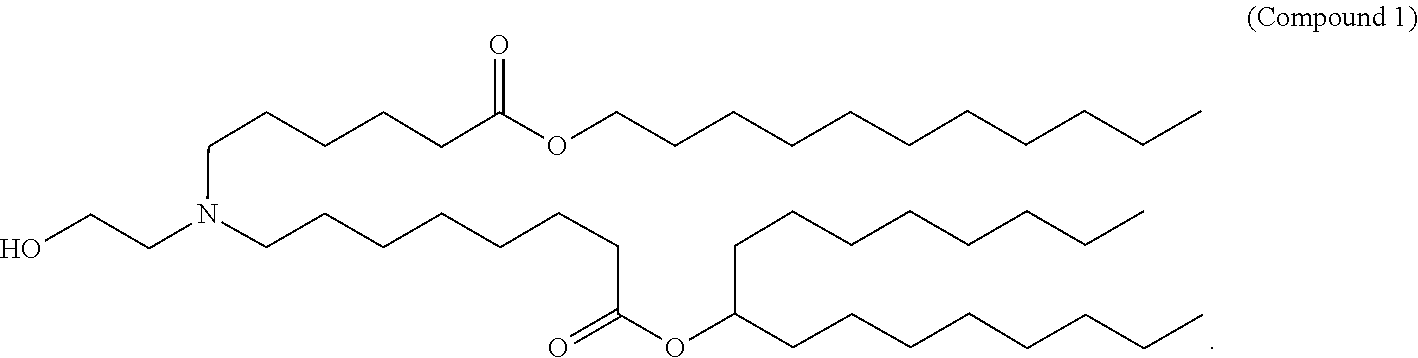
- 26. A composition comprising the RNA of any one of paragraphs 1-21 and a mixture of lipids.
27. The composition of paragraph 26, wherein the mixture of lipids comprises a PEG-modified lipid, a non-cationic lipid, a sterol, an ionizable cationic lipid, or any combination thereof.
28. The composition of paragraph 27, wherein the mixture of lipids comprises 0.5-15 mol % PEG-modified lipid; 5-25 mol % non-cationic lipid; 25-55 mol % sterol; and 20-60 mol % ionizable cationic lipid.
29. The composition of paragraph 28, wherein the PEG-modified lipid is 1,2 dimyristoyl-sn-glycerol, methoxypolyethyleneglycol (PEG2000 DMG), the non-cationic lipid is 1,2 distearoyl-sn-glycero-3-phosphocholine (DSPC), the sterol is cholesterol; and the ionizable cationic lipid has the structure of Compound 1: -
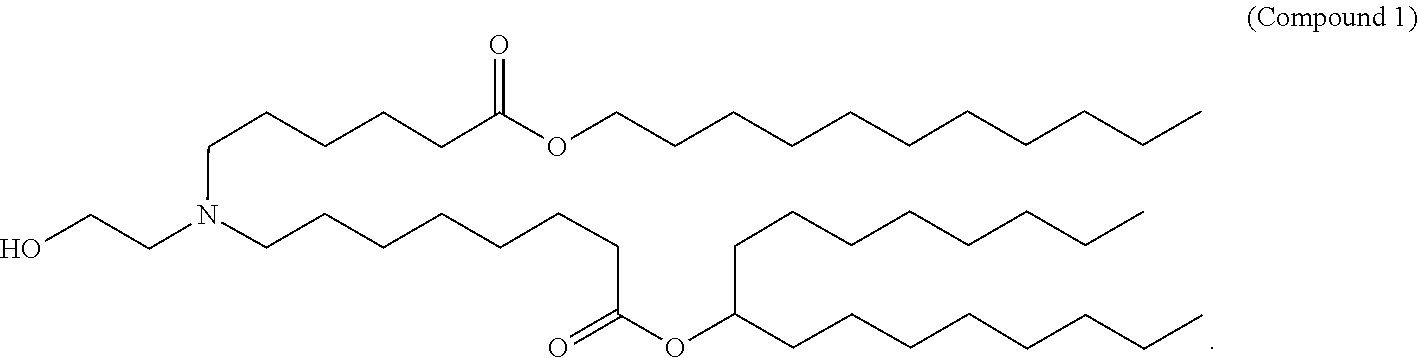
- 30. The composition of any one of paragraphs 26-29, wherein the mixture of lipids forms lipid nanoparticles.
31. The composition of paragraph 30, wherein the RNA is formulated in the lipid nanoparticles.
32. The RNA of any one of paragraphs 1-13, wherein the ORF comprises a nucleotide sequence having at least 80%, at least 85%, at least 90%, at least 95%, at least 98%, or 100% identity to the sequence of SEQ ID NO: 28.
33. The RNA of any one of paragraphs 1-13, wherein the coronavirus antigen comprises an amino acid sequence having at least 80%, at least 85%, at least 90%, at least 95%, at least 98%, or 100% identity to the sequence of SEQ ID NO: 29.
33. The RNA of any one of paragraphs 1-13, wherein the RNA comprises a nucleotide sequence having at least 85%, at least 90%, at least 95%, at least 98%, or 100% identity to the sequence of SEQ ID NO: 27.
34. A method comprising administering to a subject the RNA or composition of any one of the preceding paragraphs in an amount effective to induce a neutralizing antibody response against a coronavirus in the subject.
35. A method comprising administering to a subject the RNA or composition of any one of the preceding paragraphs in an amount effective to induce a neutralizing antibody response and/or a T cell immune response, optionally a CD4+ and/or a CD8+ T cell immune response against a coronavirus in the subject.
36. The method of paragraph 34 and 35, wherein the coronavirus is a SARS-CoV-2.
37. The method of any one of the preceding method paragraphs, wherein the subject is immunocompromised.
38. The method of any one of the preceding method paragraphs, wherein the subject has a pulmonary disease.
39. The method of any one of the preceding method paragraphs, wherein the subject is 5 years of age or younger, or 65 years of age or older.
40. The method of any one of the preceding method paragraphs, comprising administering to the subject at least two doses of the composition.
41. The method of any one of the preceding method paragraphs, wherein detectable levels of the coronavirus antigen are produced in serum of the subject at 1-72 hours post administration of the RNA or composition comprising the RNA.
42. The method of any one of the preceding method paragraphs, wherein a neutralizing antibody titer of at least 100 NU/ml, at least 500 NU/ml, or at least 1000 NU/ml is produced in the serum of the subject at 1-72 hours post administration of the RNA or composition comprising the RNA.
43. An immunizing composition comprising: a lipid nanoparticle comprising (a) a messenger RNA that comprises an open reading frame (ORF) having at least 90%, at least 95%, at least 98% or 100% identity to the sequence of SEQ ID NO: 28 and (b) a mixture of lipids comprising 0.5-15 mol % PEG-modified lipid, 5-25 mol % non-cationic lipid, 25-55 mol % sterol, and 20-60 mol % ionizable cationic lipid.
44. An immunizing composition comprising: a lipid nanoparticle comprising (a) a messenger RNA that comprises a sequence having at least 90%, at least 95%, at least 98% or 100% identity to the sequence of SEQ ID NO: 27 and (b) a mixture of lipids comprising 0.5-15 mol % PEG-modified lipid, 5-25 mol % non-cationic lipid, 25-55 mol % sterol, and 20-60 mol % ionizable cationic lipid.
45. An immunizing composition comprising: - (a) a first ribonucleic acid (RNA) comprising an open reading frame (ORF) that encodes a coronavirus antigen capable of inducing an immune response, such as a neutralizing antibody response, to a SARS-CoV-2; and
- (b) a second ribonucleic acid (RNA) comprising an open reading frame (ORF) that encodes a coronavirus antigen capable of inducing an immune response, such as a neutralizing antibody response, to a SARS-CoV-2, wherein the ORF of the first RNA is different from the ORF of the second RNA.
- 46. The immunizing composition of paragraph 45 further comprising a lipid nanoparticle that comprises a mixture of lipids.
47. The immunizing composition of paragraph 46, wherein the mixture of lipids comprises a PEG-modified lipid, a non-cationic lipid, a sterol, an ionizable cationic lipid, or any combination thereof.
48. The immunizing composition of paragraph 47, wherein the mixture of lipids comprises 0.5-15 mol % PEG-modified lipid; 5-25 mol % non-cationic lipid; 25-55 mol % sterol; and 20-60 mol % ionizable cationic lipid.
49. The immunizing composition of paragraph 46 or 47, wherein the PEG-modified lipid is 1,2 dimyristoyl-sn-glycerol, methoxypolyethyleneglycol (PEG2000 DMG), the non-cationic lipid is 1,2 distearoyl-sn-glycero-3-phosphocholine (DSPC), the sterol is cholesterol, and the ionizable cationic lipid has the structure of Compound 1: -
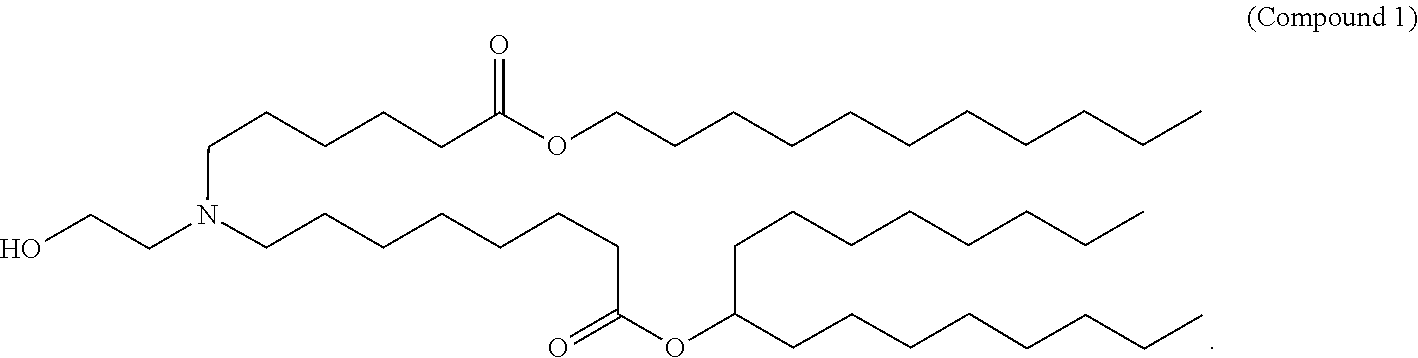
- 50. The immunizing composition of any one of paragraphs 45-49, wherein coronavirus antigen encoded by the ORF of the first RNA comprises an amino acid sequence having at least 80%, at least 85%, at least 90%, or at least 95% identity to the amino acid sequence of any one of SEQ ID NOs: 5, 8, 11, 14, 17, 20, 23, 26, 29, 32, 33, 34, 35, 47, 49, 59, 63, 65, 67, 69, 71, 73, 75, 77, 79, 81, 83, and 85.
51. The immunizing composition of any one of paragraphs 45-49, wherein the ORF of the first RNA comprises a nucleotide sequence having at least 80%, at least 85%, at least 90%, or at least 95% identity to the amino acid sequence of any one of SEQ ID NOs: 3, 7, 10, 13, 16, 19, 22, 25, 28, 31, 48, 50, 52, 54, 56, 61, 62, 64, 66, 68, 70, 72, 74, 76, 78, 80, 82, and 84.
52. The RNA of any one of paragraphs 1-13, wherein the ORF encodes a SARS-CoV-2 antigen.
53. The RNA of paragraph 52, wherein the SARS-CoV-2 antigen is a structural protein.
54. The RNA of paragraph 53, wherein the structural protein is selected from the group consisting of: a spike (S) protein, a membrane (M) protein, an envelope (E) protein, and a (NC) nucleocapsid protein.
55. The RNA of paragraph 54, wherein the structural protein is an S protein, optionally a stabilized prefusion form of an S protein.
56. The RNA of paragraph 55, wherein the S protein is an S protein variant, relative to an S protein comprising the amino acid sequence of SEQ ID NO: 32.
57. The RNA of paragraph 56, wherein the S protein variant comprises a reversion of a polybasic cleavage site to a single basic cleavage site.
58. The RNA of paragraph 56, wherein the S protein variant comprises a deletion of a polybasic ER/Golgi signal sequence (KXHXX-COOH) at the carboxy tail of the S protein variant.
59. The RNA of paragraph 57-58, wherein the S protein comprises a double proline stabilizing mutation.
60. The RNA of paragraph 57-58, wherein the S protein comprises a modified protease cleavage site to stabilize the protein.
61. The RNA of paragraph 57-60, wherein the S protein comprises a deletion of the cytoplasmic tail.
62. The RNA of paragraph 57-61, wherein the S protein comprises a foldon scaffold.
63. The RNA of paragraph 57, wherein the S protein comprises a sequence having at least 80% identity to the sequence of any one of SEQ ID NOs: 5, 8, 11, 14, 17, 20, 23, 26, 29, 32, 33, 34, 35, 47, 49, 59, 63, 65, 67, 69, 71, 73, 75, 77, 79, 81, 83, or 85.
64. The RNA of paragraph 58, wherein the structural protein is an M protein.
65. The RNA of paragraph 64, wherein the M protein comprise a sequence having at least 80% identity to the sequence of SEQ ID NO: 81.
66. The RNA of paragraph 65, wherein the M protein comprises a sequence having at least 85%, at least 90%, at least 95%, or at least 98% identity to the sequence of SEQ ID NO: 81.
67. The RNA of any one of paragraph 57-66, wherein the ORF comprises the sequence of SEQ ID NO: 80.
68. The RNA of any one of paragraph 57-67, wherein the RNA comprises a sequence having at least 85%, at least 90%, at least 95%, or at least 98% identity to the sequence of SEQ ID NO: 95.
69. The RNA of paragraph 68, wherein the RNA comprises the sequence of SEQ ID NO: 95.
70. The RNA of paragraph 54, wherein the structural protein is an E protein.
71. The RNA ofparagraph 70, wherein the E protein comprises a sequence having at least 80% identity to the sequence of SEQ ID NO: 83.
72. The RNA of paragraph 71, wherein the E protein comprises a sequence having at least 85%, at least 90%, at least 95%, or at least 98% identity to the sequence of SEQ ID NO: 83.
73. The RNA of any one of paragraph 70-72, wherein the ORF comprises the sequence of SEQ ID NO: 82.
74. The RNA of any one of paragraph 70-73, wherein the RNA comprises a sequence having at least 85%, at least 90%, at least 95%, or at least 98% identity to the sequence of SEQ ID NO: 96.
75. The RNA of paragraph 74, wherein the RNA comprises the sequence of SEQ ID NO: 96.
76. The RNA of paragraph 54, wherein the structural protein is an NC protein.
77. The RNA of paragraph 76, wherein the NC protein comprises a sequence having at least 80% identity to the sequence of SEQ ID NO: 85.
78. The RNA of paragraph 77, wherein the NC protein comprises a sequence having at least 85%, at least 90%, at least 95%, or at least 98% identity to the sequence of SEQ ID NO: 85.
79. The RNA of any one of paragraph 76-78, wherein the ORF comprises the sequence of SEQ ID NO: 84.
80. The RNA of any one of paragraph 76-78, wherein the RNA comprises a sequence having at least 85%, at least 90%, at least 95%, or at least 98% identity to the sequence of SEQ ID NO: 97.
81. The RNA ofparagraph 80, wherein the RNA comprises the sequence of SEQ ID NO: 97.
82. The RNA of paragraph 53 wherein the SARS-CoV-2 antigen is a fusion protein.
83. The RNA of paragraph 82, wherein the fusion protein comprises a SARS-CoV-2 polypeptide and a polypeptide from a different virus.
84. A messenger ribonucleic acid (mRNA) comprising an open reading frame (ORF) that comprises a nucleotide sequence having at least 80% identity to the nucleotide sequence ofSEQ ID NO 106.
85. A messenger ribonucleic acid (mRNA) comprising a nucleotide sequence having at least 80% identity to the nucleotide sequence ofSEQ ID NO 105.
86. A messenger ribonucleic acid (mRNA) comprising an open reading frame (ORF) that comprises a nucleotide sequence having at least 95% identity to the nucleotide sequence ofSEQ ID NO 106.
87 A messenger ribonucleic acid (mRNA) comprising a nucleotide sequence having at least 95% identity to the nucleotide sequence ofSEQ ID NO 105.
88. A messenger ribonucleic acid (mRNA) comprising an open reading frame (ORF) that comprises a nucleotide sequence having at least 99% identity to the nucleotide sequence ofSEQ ID NO 106.
89. A messenger ribonucleic acid (mRNA) comprising a nucleotide sequence having at least 99% identity to the nucleotide sequence ofSEQ ID NO 105. - It should be understood that any of the mRNA sequences described herein may include a 5′ UTR and/or a 3′ UTR. The UTR sequences may be selected from the following sequences, or other known UTR sequences may be used. It should also be understood that any of the mRNA constructs described herein may further comprise a poly(A) tail and/or cap (e.g., 7mG(5′)ppp(5′)NlmpNp). Further, while many of the mRNAs and encoded antigen sequences described herein include a signal peptide and/or a peptide tag (e.g., C-terminal His tag), it should be understood that the indicated signal peptide and/or peptide tag may be substituted for a different signal peptide and/or peptide tag, or the signal peptide and/or peptide tag may be omitted.
-
5′ UTR: (SEQ ID NO: 36) GGGAAAUAAGAGAGAAAAGAAGAGUAAGAAGAAAUAUAAGAGCCAC 5′ UTR: (SEQ ID NO: 2) GGGAAAUAAGAGAGAAAAGAAGAGUAAGAAGAAAUAUAAGACCCCGGCGC CGCCACC 3′ UTR: (SEQ ID NO: 37) UGAUAAUAGGCUGGAGCCUCGGUGGCCAUGCUUCUUGCCCCUUGGGCCUC CCCCCAGCCCCUCCUCCCCUUCCUGCACCCGUACCCCCGUGGUCUUUGAA UAAAGUCUGAGUGGGCGGC 3′ UTR: (SEQ ID NO: 4) UGAUAAUAGGCUGGAGCCUCGGUGGCCUAGCUUCUUGCCCCUUGGGCCUC CCCCCAGCCCCUCCUCCCCUUCCUGCACCCGUACCCCCGUGGUCUUUGAA UAAAGUCUGAGUGGGCGGC -
TABLE 1 SARS-CoV-2 Spike (S) Protein SEQ ID NO: 30 consists of from 5′ end to 3′ end: 5′ UTR SEQ ID NO: 2, mRNA ORF SEQ ID 30 NO: 31, and 3′ UTR SEQ ID NO: 4. Chemistry 1-methylpseudouridine Cap 7mG(5′)ppp(5′) NlmpNp 5′ UTR GGGAAAUAAGAGAGAAAAGAAGAGUAAGAAGAAAUAUA 2 AGACCCCGGCGCCGCCACC ORF of mRNA AUGUUCGUGUUCCUGGUGCUGCUGCCCCUGGUGAGCAGC 31 Construct CAGUGCGUGAACCUGACCACCCGGACCCAGCUGCCACCAG (excluding the stop CCUACACCAACAGCUUCACCCGGGGCGUCUACUACCCCGA codon) CAAGGUGUUCCGGAGCAGCGUCCUGCACAGCACCCAGGA CCUGUUCCUGCCCUUCUUCAGCAACGUGACCUGGUUCCAC GCCAUCCACGUGAGCGGCACCAACGGCACCAAGCGGUUCG ACAACCCCGUGCUGCCCUUCAACGACGGCGUGUACUUCGC CAGCACCGAGAAGAGCAACAUCAUCCGGGGCUGGAUCUU CGGCACCACCCUGGACAGCAAGACCCAGAGCCUGCUGAUC GUGAAUAACGCCACCAACGUGGUGAUCAAGGUGUGCGAG UUCCAGUUCUGCAACGACCCCUUCCUGGGCGUGUACUACC ACAAGAACAACAAGAGCUGGAUGGAGAGCGAGUUCCGGG UGUACAGCAGCGCCAACAACUGCACCUUCGAGUACGUGA GCCAGCCCUUCCUGAUGGACCUGGAGGGCAAGCAGGGCA ACUUCAAGAACCUGCGGGAGUUCGUGUUCAAGAACAUCG ACGGCUACUUCAAGAUCUACAGCAAGCACACCCCAAUCA ACCUGGUGCGGGAUCUGCCCCAGGGCUUCUCAGCCCUGG AGCCCCUGGUGGACCUGCCCAUCGGCAUCAACAUCACCCG GUUCCAGACCCUGCUGGCCCUGCACCGGAGCUACCUGACC CCAGGCGACAGCAGCAGCGGGUGGACAGCAGGCGCGGCU GCUUACUACGUGGGCUACCUGCAGCCCCGGACCUUCCUGC UGAAGUACAACGAGAACGGCACCAUCACCGACGCCGUGG ACUGCGCCCUGGACCCUCUGAGCGAGACCAAGUGCACCCU GAAGAGCUUCACCGUGGAGAAGGGCAUCUACCAGACCAG CAACUUCCGGGUGCAGCCCACCGAGAGCAUCGUGCGGUU CCCCAACAUCACCAACCUGUGCCCCUUCGGCGAGGUGUUC AACGCCACCCGGUUCGCCAGCGUGUACGCCUGGAACCGGA AGCGGAUCAGCAACUGCGUGGCCGACUACAGCGUGCUGU ACAACAGCGCCAGCUUCAGCACCUUCAAGUGCUACGGCG UGAGCCCCACCAAGCUGAACGACCUGUGCUUCACCAACGU GUACGCCGACAGCUUCGUGAUCCGUGGCGACGAGGUGCG GCAGAUCGCACCCGGCCAGACAGGCAAGAUCGCCGACUAC AACUACAAGCUGCCCGACGACUUCACCGGCUGCGUGAUC GCCUGGAACAGCAACAACCUCGACAGCAAGGUGGGCGGC AACUACAACUACCUGUACCGGCUGUUCCGGAAGAGCAAC CUGAAGCCCUUCGAGCGGGACAUCAGCACCGAGAUCUAC CAAGCCGGCUCCACCCCUUGCAACGGCGUGGAGGGCUUCA ACUGCUACUUCCCUCUGCAGAGCUACGGCUUCCAGCCCAC CAACGGCGUGGGCUACCAGCCCUACCGGGUGGUGGUGCU GAGCUUCGAGCUGCUGCACGCCCCAGCCACCGUGUGUGGC CCCAAGAAGAGCACCAACCUGGUGAAGAACAAGUGCGUG AACUUCAACUUCAACGGCCUUACCGGCACCGGCGUGCUG ACCGAGAGCAACAAGAAAUUCCUGCCCUUUCAGCAGUUC GGCCGGGACAUCGCCGACACCACCGACGCUGUGCGGGAUC CCCAGACCCUGGAGAUCCUGGACAUCACCCCUUGCAGCUU CGGCGGCGUGAGCGUGAUCACCCCAGGCACCAACACCAGC AACCAGGUGGCCGUGCUGUACCAGGACGUGAACUGCACC GAGGUGCCCGUGGCCAUCCACGCCGACCAGCUGACACCCA CCUGGCGGGUCUACAGCACCGGCAGCAACGUGUUCCAGA CCCGGGCCGGUUGCCUGAUCGGCGCCGAGCACGUGAACA ACAGCUACGAGUGCGACAUCCCCAUCGGCGCCGGCAUCUG UGCCAGCUACCAGACCCAGACCAAUUCACCCCGGAGGGCA AGGAGCGUGGCCAGCCAGAGCAUCAUCGCCUACACCAUG AGCCUGGGCGCCGAGAACAGCGUGGCCUACAGCAACAAC AGCAUCGCCAUCCCCACCAACUUCACCAUCAGCGUGACCA CCGAGAUUCUGCCCGUGAGCAUGACCAAGACCAGCGUGG ACUGCACCAUGUACAUCUGCGGCGACAGCACCGAGUGCA GCAACCUGCUGCUGCAGUACGGCAGCUUCUGCACCCAGCU GAACCGGGCCCUGACCGGCAUCGCCGUGGAGCAGGACAA GAACACCCAGGAGGUGUUCGCCCAGGUGAAGCAGAUCUA CAAGACCCCUCCCAUCAAGGACUUCGGCGGCUUCAACUUC AGCCAGAUCCUGCCCGACCCCAGCAAGCCCAGCAAGCGGA GCUUCAUCGAGGACCUGCUGUUCAACAAGGUGACCCUAG CCGACGCCGGCUUCAUCAAGCAGUACGGCGACUGCCUCGG CGACAUAGCCGCCCGGGACCUGAUCUGCGCCCAGAAGUUC AACGGCCUGACCGUGCUGCCUCCCCUGCUGACCGACGAGA UGAUCGCCCAGUACACCAGCGCCCUGUUAGCCGGAACCAU CACCAGCGGCUGGACUUUCGGCGCUGGAGCCGCUCUGCA GAUCCCCUUCGCCAUGCAGAUGGCCUACCGGUUCAACGGC AUCGGCGUGACCCAGAACGUGCUGUACGAGAACCAGAAG CUGAUCGCCAACCAGUUCAACAGCGCCAUCGGCAAGAUCC AGGACAGCCUGAGCAGCACCGCUAGCGCCCUGGGCAAGC UGCAGGACGUGGUGAACCAGAACGCCCAGGCCCUGAACA CCCUGGUGAAGCAGCUGAGCAGCAACUUCGGCGCCAUCA GCAGCGUGCUGAACGACAUCCUGAGCCGGCUGGACAAGG UGGAGGCCGAGGUGCAGAUCGACCGGCUGAUCACUGGCC GGCUGCAGAGCCUGCAGACCUACGUGACCCAGCAGCUGA UCCGGGCCGCCGAGAUUCGGGCCAGCGCCAACCUGGCCGC CACCAAGAUGAGCGAGUGCGUGCUGGGCCAGAGCAAGCG GGUGGACUUCUGCGGCAAGGGCUACCACCUGAUGAGCUU UCCCCAGAGCGCACCCCACGGAGUGGUGUUCCUGCACGUG ACCUACGUGCCCGCCCAGGAGAAGAACUUCACCACCGCCC CAGCCAUCUGCCACGACGGCAAGGCCCACUUUCCCCGGGA GGGCGUGUUCGUGAGCAACGGCACCCACUGGUUCGUGAC CCAGCGGAACUUCUACGAGCCCCAGAUCAUCACCACCGAC AACACCUUCGUGAGCGGCAACUGCGACGUGGUGAUCGGC AUCGUGAACAACACCGUGUACGAUCCCCUGCAGCCCGAGC UGGACAGCUUCAAGGAGGAGCUGGACAAGUACUUCAAGA AUCACACCAGCCCCGACGUGGACCUGGGCGACAUCAGCGG CAUCAACGCCAGCGUGGUGAACAUCCAGAAGGAGAUCGA UCGGCUGAACGAGGUGGCCAAGAACCUGAACGAGAGCCU GAUCGACCUGCAGGAGCUGGGCAAGUACGAGCAGUACAU CAAGUGGCCCUGGUACAUCUGGCUGGGCUUCAUCGCCGG CCUGAUCGCCAUCGUGAUGGUGACCAUCAUGCUGUGCUG CAUGACCAGCUGCUGCAGCUGCCUGAAGGGCUGUUGCAG CUGCGGCAGCUGCUGCAAGUUCGACGAGGACGACAGCGA GCCCGUGCUGAAGGGCGUGAAGCUGCACUACACC 3′ UTR UGAUAAUAGGCUGGAGCCUCGGUGGCCUAGCUUCUUGCC 4 CCUUGGGCCUCCCCCCAGCCCCUCCUCCCCUUCCUGCACC CGUACCCCCGUGGUCUUUGAAUAAAGUCUGAGUGGGCGG C Corresponding amino MFVFLVLLPLVSSQCVNLTTRTQLPPAYTNSFTRGVYYPDKVF 32 acid sequence RSSVLHSTQDLFLPFFSNVTWFHAIHVSGTNGTKRFDNPVLPF NDGVYFASTEKSNIIRGWIFGTTLDSKTQSLLIVNNATNVVIKV CEFQFCNDPFLGVYYHKNNKSWMESEFRVYSSANNCTFEYVS QPFLMDLEGKQGNFKNLREFVFKNIDGYFKIYSKHTPINLVRD LPQGFSALEPLVDLPIGINITRFQTLLALHRSYLTPGDSSSGWT AGAAAYYVGYLQPRTFLLKYNENGTITDAVDCALDPLSETKC TLKSFTVEKGIYQTSNFRVQPTESIVRFPNITNLCPFGEVFNATR FASVYAWNRKRISNCVADYSVLYNSASFSTFKCYGVSPTKLN DLCFTNVYADSFVIRGDEVRQIAPGQTGKIADYNYKLPDDFTG CVIAWNSNNLDSKVGGNYNYLYRLFRKSNLKPFERDISTEIYQ AGSTPCNGVEGFNCYFPLQSYGFQPTNGVGYQPYRVVVLSFE LLHAPATVCGPKKSTNLVKNKCVNFNFNGLTGTGVLTESNKK FLPFQQFGRDIADTTDAVRDPQTLEILDITPCSFGGVSVITPGTN TSNQVAVLYQDVNCTEVPVAIHADQLTPTWRVYSTGSNVFQT RAGCLIGAEHVNNSYECDIPIGAGICASYQTQTNSPRRARSVA SQSIIAYTMSLGAENSVAYSNNSIAIPTNFTISVTTEILPVSMTK TSVDCTMYICGDSTECSNLLLQYGSFCTQLNRALTGIAVEQDK NTQEVFAQVKQIYKTPPIKDFGGFNFSQILPDPSKPSKRSFIEDL LFNKVTLADAGFIKQYGDCLGDIAARDLICAQKFNGLTVLPPL LTDEMIAQYTSALLAGTITSGWTFGAGAALQIPFAMQMAYRF NGIGVTQNVLYENQKLIANQFNSAIGKIQDSLSSTASALGKLQ DVVNQNAQALNTLVKQLSSNFGAISSVLNDILSRLDKVEAEV QIDRLITGRLQSLQTYVTQQLIRAAEIRASANLAATKMSECVL GQSKRVDFCGKGYHLMSFPQSAPHGVVFLHVTYVPAQEKNF TTAPAICHDGKAHFPREGVFVSNGTHWFVTQRNFYEPQIITTD NTFVSGNCDVVIGIVNNTVYDPLQPELDSFKEELDKYFKNHTS PDVDLGDISGINASVVNIQKEIDRLNEVAKNLNESLIDLQELGK YEQYIKWPWYIWLGFIAGLIAIVMVTIMLCCMTSCCSCLKGCC SCGSCCKFDEDDSEPVLKGVKLHYT PolyA tail 100 nt SARS-CoV-2 S protein Variant 1SEQ ID NO: 1 consists of from 5′ end to 3′ end: 5′ UTR SEQ ID NO: 2, mRNA ORF SEQ ID 1 NO: 3, and 3′ UTR SEQ ID NO: 4. Chemistry 1-methylpseudouridine Cap 7mG(5′)ppp(5′) NlmpNp 5′ UTR GGGAAAUAAGAGAGAAAAGAAGAGUAAGAAGAAAUAUA 2 AGACCCCGGCGCCGCCACC ORF of mRNA AUGUUCGUCUUCCUCGUCUUGCUGCCGCUGGUGUCGAGC 3 Construct CAGUGCGUGAACCUCACCACAAGGACGCAGCUCCCACCGG (excluding the stop CCUACACGAACAGCUUCACGCGCGGCGUGUACUACCCCGA codon) CAAGGUGUUCCGGUCGUCGGUCCUCCACUCCACGCAGGAC CUCUUCCUGCCCUUCUUCAGCAACGUGACCUGGUUCCACG CCAUCCACGUCUCCGGGACGAACGGGACGAAGCGGUUCG ACAACCCGGUCCUCCCGUUCAACGACGGCGUCUACUUCGC GAGCACGGAGAAGUCGAACAUCAUCCGGGGCUGGAUCUU CGGCACGACCCUGGACUCGAAGACCCAGUCCCUACUUAUC GUGAACAACGCCACCAACGUCGUCAUCAAGGUCUGCGAG UUCCAGUUCUGCAACGACCCCUUCCUCGGCGUCUACUACC ACAAGAACAACAAGUCGUGGAUGGAGUCGGAGUUCCGGG UGUACAGCUCGGCGAACAACUGCACCUUCGAGUACGUGU CGCAGCCGUUCCUCAUGGACCUCGAGGGCAAGCAGGGUA ACUUCAAGAACCUGCGCGAGUUCGUCUUCAAGAACAUCG ACGGCUACUUCAAGAUCUACUCCAAGCACACGCCCAUCAA CCUGGUCCGCGACCUCCCGCAAGGCUUCUCCGCCCUCGAG CCUCUGGUCGACCUGCCGAUCGGCAUCAACAUCACGAGG UUCCAGACGCUCCUGGCGCUGCACCGGUCGUACCUGACGC CAGGCGACUCCUCCUCGGGCUGGACAGCAGGCGCGGCUGC CUACUACGUCGGGUACCUGCAGCCCCGCACGUUCCUCCUG AAGUACAACGAGAACGGCACUAUCACGGACGCCGUCGAC UGCGCCCUGGACCCACUGUCGGAGACGAAGUGCACGCUG AAGUCGUUCACCGUGGAGAAGGGUAUCUACCAGACCUCC AACUUCCGGGUCCAGCCGACGGAGUCGAUCGUGCGGUUC CCCAACAUCACGAACCUGUGCCCCUUCGGUGAGGUCUUCA ACGCCACCCGGUUCGCGUCGGUCUACGCGUGGAACCGUA AGCGCAUCUCGAACUGCGUGGCGGACUACUCCGUCCUCU ACAACAGCGCGUCCUUCAGCACCUUCAAGUGCUACGGCG UCAGCCCCACGAAGCUGAACGACCUCUGCUUCACCAACGU CUACGCAGACUCCUUCGUGAUCCGGGGUGACGAGGUGCG ACAGAUCGCCCCUGGUCAGACCGGGAAGAUCGCCGACUA CAACUACAAGCUGCCCGACGACUUCACCGGCUGCGUGAUC GCGUGGAACAGCAACAACCUGGACUCCAAGGUCGGAGGU AACUACAACUACCUCUACCGGCUGUUCCGCAAGUCCAACC UGAAGCCGUUCGAGCGGGACAUCUCCACGGAGAUCUACC AAGCCGGCUCGACCCCUUGUAACGGGGUGGAGGGGUUCA ACUGCUACUUCCCACUGCAGUCCUACGGGUUCCAGCCCAC CAACGGGGUCGGGUACCAGCCGUACCGCGUGGUGGUCCU GUCCUUCGAGCUGCUGCACGCGCCAGCCACGGUGUGCGG GCCAAAGAAGAGCACGAACCUGGUCAAGAACAAGUGCGU CAACUUCAACUUCAACGGCCUGACGGGGACAGGGGUCCU CACGGAGUCGAACAAGAAGUUCCUGCCGUUCCAGCAGUU CGGCCGUGACAUCGCAGACACGACUGACGCCGUCCGCGAC CCUCAGACCCUCGAGAUCCUCGACAUCACCCCGUGCUCGU UCGGCGGAGUGAGCGUCAUCACCCCGGGGACCAACACAU CGAACCAGGUGGCCGUCCUGUACCAGGACGUCAACUGCA CGGAGGUCCCUGUGGCGAUCCACGCCGACCAGCUCACGCC CACCUGGCGCGUCUACUCCACCGGGUCCAACGUGUUCCAG ACCCGCGCAGGCUGCCUGAUCGGGGCCGAGCACGUCAACA ACAGCUACGAGUGCGACAUCCCCAUCGGAGCGGGCAUCU GCGCCAGCUACCAGACGCAGACGAACUCUCCAAGGCGCGC UCGUAGCGUGGCCUCCCAGUCCAUCAUCGCGUACACGAU GUCCCUUGGGGCCGAGAACUCGGUCGCAUACAGCAACAA CUCCAUCGCCAUCCCCACCAACUUCACGAUCUCGGUCACC ACCGAGAUCCUCCCGGUCAGCAUGACGAAGACGUCGGUG GACUGCACCAUGUACAUCUGCGGGGACAGCACGGAGUGC UCGAACCUGCUCCUGCAGUACGGGAGCUUCUGCACCCAGC UGAACAGGGCGCUGACGGGGAUCGCGGUGGAGCAGGACA AGAACACCCAGGAGGUGUUCGCGCAGGUGAAGCAGAUCU ACAAGACGCCUCCAAUCAAGGACUUCGGCGGGUUCAACU UCUCGCAGAUCCUCCCCGACCCGUCCAAGCCGUCGAAGCG GUCGUUCAUCGAGGACCUGCUCUUCAACAAGGUGACGUU GGCCGACGCGGGCUUCAUCAAGCAGUACGGGGACUGCCU UGGGGACAUCGCUGCCCGCGACCUCAUCUGCGCCCAGAAG UUCAACGGGCUGACUGUGCUCCCGCCCCUGCUGACGGACG AGAUGAUCGCGCAGUACACGUCCGCGCUGCUCGCUGGAA CGAUCACCUCCGGGUGGACCUUCGGCGCUGGAGCGGCUC UGCAGAUCCCGUUCGCGAUGCAGAUGGCGUACCGGUUCA ACGGCAUCGGGGUGACCCAGAACGUCCUCUACGAGAACC AGAAGCUGAUCGCCAACCAGUUCAACUCCGCGAUCGGCA AGAUCCAGGACUCGCUGAGCUCCACGGCUUCCGCCCUCGG GAAGCUUCAGGACGUGGUGAACCAGAACGCCCAGGCCCU CAACACCCUGGUGAAGCAGCUGAGCUCGAACUUCGGCGC CAUCUCGAGCGUGCUCAACGACAUCCUGAGCCGUCUGGA CCCUCCCGAGGCGGAGGUGCAGAUCGACCGGCUCAUCACG GGCCGGCUUCAGUCCCUGCAGACGUACGUGACCCAGCAGC UCAUACGGGCGGCGGAGAUACGCGCCUCCGCCAACCUGGC CGCGACGAAGAUGUCCGAGUGCGUCCUCGGACAGAGCAA GCGCGUGGACUUCUGCGGCAAGGGGUACCACCUCAUGAG CUUUCCCCAGUCGGCUCCUCACGGGGUCGUCUUCCUGCAC GUGACGUACGUCCCGGCGCAGGAGAAGAACUUCACCACC GCCCCAGCGAUCUGCCACGACGGGAAGGCGCACUUCCCGC GCGAGGGCGUCUUCGUCUCCAACGGGACCCACUGGUUCG UCACCCAGCGGAACUUCUACGAGCCGCAGAUCAUCACGAC CGACAACACGUUCGUAUCCGGGAACUGCGACGUCGUCAU CGGCAUCGUCAACAACACGGUCUACGACCCACUGCAGCCG GAGCUGGACUCGUUCAAGGAGGAGCUGGACAAGUAUUUC AAGAACCACACCUCGCCCGACGUGGACCUGGGCGACAUCA GCGGGAUCAACGCGUCGGUCGUGAACAUCCAGAAGGAGA UCGACCGACUGAACGAGGUCGCCAAGAACCUGAACGAGU CCCUGAUCGACCUGCAAGAGCUCGGCAAGUACGAGCAGU ACAUCAAGUGGCCUUGGUACAUCUGGCUCGGCUUCAUCG CGGGGCUGAUCGCCAUCGUGAUGGUCACCAUCAUGUUGU GCUGCAUGACCUCCUGCUGCUCGUGCCUCAAGGGGUGCU GCAGCUGCGGGUCCUGCUGCAAGUUCGACGAGGACGACU CGGAGCCGGUCCUCAAGGGCGUCAAGCUCCACUACACC 3′ UTR UGAUAAUAGGCUGGAGCCUCGGUGGCCUAGCUUCUUGCC 4 CCUUGGGCCUCCCCCCAGCCCCUCCUCCCCUUCCUGCACC CGUACCCCCGUGGUCUUUGAAUAAAGUCUGAGUGGGCGG C Corresponding amino MFVFLVLLPLVSSQCVNLTTRTQLPPAYTNSFTRGVYYPDKVF 5 acid sequence RSSVLHSTQDLFLPFFSNVTWFHAIHVSGTNGTKRFDNPVLPF NDGVYFASTEKSNIIRGWIFGTTLDSKTQSLLIVNNATNVVIKV CEFQFCNDPFLGVYYHKNNKSWMESEFRVYSSANNCTFEYVS QPFLMDLEGKQGNFKNLREFVFKNIDGYFKIYSKHTPINLVRD LPQGFSALEPLVDLPIGINITRFQTLLALHRSYLTPGDSSSGWT AGAAAYYVGYLQPRTFLLKYNENGTITDAVDCALDPLSETKC TLKSFTVEKGIYQTSNFRVQPTESIVRFPNITNLCPFGEVFNATR FASVYAWNRKRISNCVADYSVLYNSASFSTFKCYGVSPTKLN DLCFTNVYADSFVIRGDEVRQIAPGQTGKIADYNYKLPDDFTG CVIAWNSNNLDSKVGGNYNYLYRLFRKSNLKPFERDISTEIYQ AGSTPCNGVEGFNCYFPLQSYGFQPTNGVGYQPYRVVVLSFE LLHAPATVCGPKKSTNLVKNKCVNFNFNGLTGTGVLTESNKK FLPFQQFGRDIADTTDAVRDPQTLEILDITPCSFGGVSVITPGTN TSNQVAVLYQDVNCTEVPVAIHADQLTPTWRVYSTGSNVFQT RAGCLIGAEHVNNSYECDIPIGAGICASYQTQTNSPRRARSVA SQSIIAYTMSLGAENSVAYSNNSIAIPTNFTISVTTEILPVSMTK TSVDCTMYICGDSTECSNLLLQYGSFCTQLNRALTGIAVEQDK NTQEVFAQVKQIYKTPPIKDFGGFNFSQILPDPSKPSKRSFIEDL LFNKVTLADAGFIKQYGDCLGDIAARDLICAQKFNGLTVLPPL LTDEMIAQYTSALLAGTITSGWTFGAGAALQIPFAMQMAYRF NGIGVTQNVLYENQKLIANQFNSAIGKIQDSLSSTASALGKLQ DVVNQNAQALNTLVKQLSSNFGAISSVLNDILSRLDPPEAEVQ IDRLITGRLQSLQTYVTQQLIRAAEIRASANLAATKMSECVLG QSKRVDFCGKGYHLMSFPQSAPHGVVFLHVTYVPAQEKNFTT APAICHDGKAHFPREGVFVSNGTHWFVTQRNFYEPQIITTDNT FVSGNCDVVIGIVNNTVYDPLQPELDSFKEELDKYFKNHTSPD VDLGDISGINASVVNIQKEIDRLNEVAKNLNESLIDLQELGKYE QYIKWPWYIWLGFIAGLIAIVMVTIMLCCMTSCCSCLKGCCSC GSCCKFDEDDSEPVLKGVKLHYT PolyA tail 100 nt SARS-CoV-2 S Protein Variant 2SEQ ID NO: 6 consists of from 5′ end to 3′ end: 5′ UTR SEQ ID NO: 2, mRNA ORF SEQ ID 6 NO: 7, and 3′ UTR SEQ ID NO: 4. Chemistry 1-methylpseudouridine Cap 7mG(5′)ppp(5′) NlmpNp 5′ UTR GGGAAAUAAGAGAGAAAAGAAGAGUAAGAAGAAAUAUA 2 AGACCCCGGCGCCGCCACC ORF of mRNA AUGUUCGUGUUCCUGGUGCUGCUGCCCCUGGUGAGCAGC 7 Construct CAGUGCGUGAACCUGACCACCAGGACCCAGCUGCCGCCUG (excluding the stop CCUACACCAACAGCUUCACCCGCGGUGUGUACUACCCCGA codon) CAAGGUGUUCAGGUCCAGCGUGCUGCACAGCACCCAGGA CCUGUUCCUCCCCUUCUUCAGCAACGUGACCUGGUUCCAC GCCAUCCACGUGAGCGGCACCAACGGCACCAAGCGGUUCG ACAACCCCGUGCUGCCCUUCAACGACGGCGUGUACUUCGC CAGCACCGAGAAGAGCAACAUCAUCCGGGGCUGGAUCUU CGGCACCACACUCGACAGCAAGACCCAGAGCCUGCUGAUC GUGAACAACGCCACCAACGUGGUGAUCAAGGUGUGCGAA UUCCAGUUCUGCAACGACCCCUUCCUGGGCGUGUACUACC ACAAGAACAACAAGAGCUGGAUGGAGAGCGAGUUCCGCG UGUACAGCAGCGCCAACAACUGCACCUUCGAGUACGUGA GCCAGCCCUUCCUGAUGGACCUGGAGGGCAAGCAGGGCA AUUUCAAGAACCUGAGGGAGUUCGUGUUCAAGAACAUCG ACGGCUACUUCAAGAUCUACAGCAAGCACACGCCCAUCA ACCUGGUGCGGGACUUGCCCCAGGGCUUCAGCGCCCUGG AGCCCUUAGUGGACCUGCCUAUCGGCAUCAACAUCACCCG GUUCCAGACCCUGCUGGCCCUGCACCGGAGCUACCUGACU CCCGGCGACAGCAGCUCCGGGUGGACUGCCGGUGCUGCCG CCUACUACGUGGGGUACCUGCAGCCCCGGACCUUCCUGCU GAAGUACAACGAGAACGGCACCAUCACCGACGCCGUGGA CUGCGCCCUGGAUCCACUGAGCGAGACCAAGUGCACCCUG AAGAGCUUCACCGUGGAGAAGGGCAUCUACCAGACCAGC AACUUCCGGGUGCAGCCCACCGAGAGCAUCGUGAGGUUC CCCAACAUCACCAACCUGUGCCCUUUCGGCGAGGUGUUCA ACGCCACCCGCUUCGCCUCCGUGUACGCCUGGAACAGGAA GAGGAUCAGCAACUGCGUGGCCGACUACAGCGUGCUGUA CAACAGCGCCAGCUUCUCCACCUUCAAGUGCUACGGCGUG AGCCCAACCAAGCUGAACGACCUGUGCUUUACCAACGUG UACGCCGAUAGCUUCGUGAUCCGCGGCGACGAAGUGCGG CAGAUCGCUCCUGGGCAGACCGGAAAGAUCGCCGACUAC AACUACAAGCUGCCCGACGACUUCACCGGGUGCGUGAUC GCUUGGAACAGCAACAACCUGGACAGCAAGGUGGGCGGC AACUACAACUACCUGUACCGGCUGUUCCGGAAGAGCAAC CUGAAGCCCUUCGAGCGCGACAUCUCCACCGAGAUCUACC AGGCCGGCUCCACACCCUGCAACGGCGUGGAGGGCUUCA ACUGCUACUUUCCCCUGCAGUCCUACGGCUUCCAGCCCAC CAACGGCGUGGGCUACCAGCCAUACCGCGUGGUGGUGCU GUCCUUCGAGCUGCUGCACGCUCCCGCCACCGUUUGCGGC CCCAAGAAGUCCACCAACCUGGUGAAGAACAAGUGCGUG AACUUCAACUUCAACGGUCUCACGGGCACCGGGGUGCUG ACCGAGAGCAACAAGAAGUUCCUGCCCUUUCAGCAGUUC GGCAGGGACAUCGCCGACACCACAGACGCCGUGCGGGAU CCCCAGACCCUGGAGAUCCUGGACAUCACCCCGUGCAGCU UCGGCGGCGUGAGCGUGAUCACGCCCGGCACCAACACCAG CAACCAGGUGGCCGUGCUGUACCAGGACGUGAACUGCAC CGAGGUGCCCGUGGCCAUCCACGCCGACCAGCUGACUCCC ACCUGGCGCGUGUAUAGCACCGGCAGCAACGUGUUCCAG ACACGGGCCGGCUGCCUGAUCGGCGCCGAGCACGUGAAC AACUCCUACGAGUGCGACAUCCCCAUCGGCGCUGGCAUCU GCGCCAGCUACCAGACCCAGACCAACAGCCCCAGACGGGC CAGGUCCGUGGCUUCCCAGAGCAUCAUCGCCUACACCAUG UCCCUGGGCGCCGAGAACAGCGUGGCCUACAGCAACAAC UCCAUCGCCAUCCCCACCAACUUCACCAUCAGCGUGACCA CCGAGAUCCUGCCCGUGAGCAUGACCAAGACCUCCGUGG ACUGCACCAUGUACAUCUGCGGCGACAGCACCGAGUGCA GCAACCUGCUGCUGCAGUACGGCAGCUUCUGCACCCAGCU GAACAGGGCCCUGACCGGCAUCGCCGUGGAGCAGGACAA GAACACCCAGGAGGUGUUCGCCCAGGUGAAGCAGAUCUA CAAGACUCCACCUAUCAAGGACUUCGGCGGGUUCAACUU CAGCCAGAUCCUCCCCGACCCCUCCAAGCCCAGCAAGCGG AGCUUCAUCGAGGACCUGCUGUUCAACAAGGUGACCCUG GCUGACGCCGGCUUUAUCAAGCAGUACGGCGACUGCCUU GGCGACAUCGCCGCCAGGGACCUGAUCUGCGCCCAGAAG UUCAACGGCCUGACCGUGCUGCCGCCACUGCUGACCGACG AGAUGAUCGCCCAGUACACCUCUGCCCUGCUGGCCGGUAC CAUCACCUCCGGCUGGACAUUUGGUGCUGGCGCUGCGCU GCAGAUCCCCUUCGCCAUGCAGAUGGCCUACCGCUUCAAC GGCAUCGGGGUGACCCAGAACGUGCUGUACGAGAACCAG AAGCUGAUCGCCAACCAGUUCAACAGCGCCAUCGGCAAG AUCCAGGACAGCCUGAGCAGCACCGCCAGCGCUCUGGGCA AGCUGCAGGACGUGGUGAACCAGAACGCCCAGGCCCUGA ACACCCUGGUGAAGCAGCUGUCCAGCAACUUCGGCGCCA UCAGCUCCGUGCUGAACGACAUCCUGAGCCGGCUGGAUC CACCAGAGGCCGAGGUGCAGAUCGACCGUCUGAUCACCG GUCGGCUGCAGAGCCUGCAGACCUACGUGACCCAGCAGC UGAUCCGCGCCGCCGAAAUCCGCGCCUCCGCCAACCUGGC CGCCACCAAGAUGUCCGAGUGCGUGCUGGGCCAGAGCAA GCGGGUGGACUUCUGCGGCAAGGGCUACCACCUGAUGAG CUUCCCACAGAGCGCUCCCCACGGGGUAGUGUUCCUGCAC GUGACCUACGUGCCCGCCCAGGAGAAGAACUUCACCACU GCACCCGCCAUCUGCCACGACGGCAAGGCCCACUUCCCUC GGGAGGGCGUGUUCGUGAGCAACGGCACCCACUGGUUCG UGACCCAGAGGAACUUCUACGAGCCCCAGAUCAUCACCAC CGACAACACCUUCGUGUCCGGCAACUGCGACGUGGUGAU CGGCAUAGUGAACAACACCGUGUACGACCCACUGCAGCCC GAGCUGGACAGCUUCAAGGAGGAGCUGGACAAGUACUUC AAGAACCACACCAGCCCAGACGUGGACCUGGGCGACAUC UCCGGCAUCAACGCCUCCGUGGUGAACAUCCAGAAGGAG AUCGACCGGCUGAACGAGGUGGCCAAGAACCUGAACGAG AGCCUGAUCGACCUGCAGGAGCUGGGGAAGUACGAGCAG UACAUCAAGUGGCCUUGGUACAUCUGGCUGGGCUUCAUC GCCGGCCUGAUCGCCAUCGUGAUGGUGACCAUCAUGCUG UGCUGCAUGACCAGCUGCUGCAGCUGCCUGAAGGGCUGU UGCAGCUGCGGCAGCUGCUGCAAGUUCGACGAGGACGAC AGCGAGCCCGUGCUGAAGGGCGUGAAGCUGCACUACACC 3′ UTR UGAUAAUAGGCUGGAGCCUCGGUGGCCUAGCUUCUUGCC 4 CCUUGGGCCUCCCCCCAGCCCCUCCUCCCCUUCCUGCACC CGUACCCCCGUGGUCUUUGAAUAAAGUCUGAGUGGGCGG C Corresponding amino MFVFLVLLPLVSSQCVNLTTRTQLPPAYTNSFTRGVYYPDKVF 8 acid sequence RSSVLHSTQDLFLPFFSNVTWFHAIHVSGTNGTKRFDNPVLPF NDGVYFASTEKSNIIRGWIFGTTLDSKTQSLLIVNNATNVVIKV CEFQFCNDPFLGVYYHKNNKSWMESEFRVYSSANNCTFEYVS QPFLMDLEGKQGNFKNLREFVFKNIDGYFKIYSKHTPINLVRD LPQGFSALEPLVDLPIGINITRFQTLLALHRSYLTPGDSSSGWT AGAAAYYVGYLQPRTFLLKYNENGTITDAVDCALDPLSETKC TLKSFTVEKGIYQTSNFRVQPTESIVRFPNITNLCPFGEVFNATR FASVYAWNRKRISNCVADYSVLYNSASFSTFKCYGVSPTKLN DLCFTNVYADSFVIRGDEVRQIAPGQTGKIADYNYKLPDDFTG CVIAWNSNNLDSKVGGNYNYLYRLFRKSNLKPFERDISTEIYQ AGSTPCNGVEGFNCYFPLQSYGFQPTNGVGYQPYRVVVLSFE LLHAPATVCGPKKSTNLVKNKCVNFNFNGLTGTGVLTESNKK FLPFQQFGRDIADTTDAVRDPQTLEILDITPCSFGGVSVITPGTN TSNQVAVLYQDVNCTEVPVAIHADQLTPTWRVYSTGSNVFQT RAGCLIGAEHVNNSYECDIPIGAGICASYQTQTNSPRRARSVA SQSIIAYTMSLGAENSVAYSNNSIAIPTNFTISVTTEILPVSMTK TSVDCTMYICGDSTECSNLLLQYGSFCTQLNRALTGIAVEQDK NTQEVFAQVKQIYKTPPIKDFGGFNFSQILPDPSKPSKRSFIEDL LFNKVTLADAGFIKQYGDCLGDIAARDLICAQKFNGLTVLPPL LTDEMIAQYTSALLAGTITSGWTFGAGAALQIPFAMQMAYRF NGIGVTQNVLYENQKLIANQFNSAIGKIQDSLSSTASALGKLQ DVVNQNAQALNTLVKQLSSNFGAISSVLNDILSRLDPPEAEVQ IDRLITGRLQSLQTYVTQQLIRAAEIRASANLAATKMSECVLG QSKRVDFCGKGYHLMSFPQSAPHGVVFLHVTYVPAQEKNFTT APAICHDGKAHFPREGVFVSNGTHWFVTQRNFYEPQIITTDNT FVSGNCDVVIGIVNNTVYDPLQPELDSFKEELDKYFKNHTSPD VDLGDISGINASVVNIQKEIDRLNEVAKNLNESLIDLQELGKYE QYIKWPWYIWLGFIAGLIAIVMVTIMLCCMTSCCSCLKGCCSC GSCCKFDEDDSEPVLKGVKLHYT PolyA tail 100 nt SARS-CoV-2 S Protein Variant 3SEQ ID NO: 9 consists of from 5′ end to 3′ end: 5′ UTR SEQ ID NO: 2, mRNA ORF SEQ ID 9 NO: 10, and 3′ UTR SEQ ID NO: 4. Chemistry 1-methylpseudouridine Cap 7mG(5′)ppp(5′) NlmpNp 5′ UTR GGGAAAUAAGAGAGAAAAGAAGAGUAAGAAGAAAUAUA 2 AGACCCCGGCGCCGCCACC ORF of mRNA AUGUUCGUGUUCCUGGUGCUGCUGCCCCUGGUGAGCAGC 10 Construct CAGUGCGUGAACCUGACCACCCGGACCCAGCUGCCACCAG (excluding the stop CCUACACCAACAGCUUCACCCGGGGCGUCUACUACCCCGA codon) CAAGGUGUUCCGGAGCAGCGUCCUGCACAGCACCCAGGA CCUGUUCCUGCCCUUCUUCAGCAACGUGACCUGGUUCCAC GCCAUCCACGUGAGCGGCACCAACGGCACCAAGCGGUUCG ACAACCCCGUGCUGCCCUUCAACGACGGCGUGUACUUCGC CAGCACCGAGAAGAGCAACAUCAUCCGGGGCUGGAUCUU CGGCACCACCCUGGACAGCAAGACCCAGAGCCUGCUGAUC GUGAAUAACGCCACCAACGUGGUGAUCAAGGUGUGCGAG UUCCAGUUCUGCAACGACCCCUUCCUGGGCGUGUACUACC ACAAGAACAACAAGAGCUGGAUGGAGAGCGAGUUCCGGG UGUACAGCAGCGCCAACAACUGCACCUUCGAGUACGUGA GCCAGCCCUUCCUGAUGGACCUGGAGGGCAAGCAGGGCA ACUUCAAGAACCUGCGGGAGUUCGUGUUCAAGAACAUCG ACGGCUACUUCAAGAUCUACAGCAAGCACACCCCAAUCA ACCUGGUGCGGGAUCUGCCCCAGGGCUUCUCAGCCCUGG AGCCCCUGGUGGACCUGCCCAUCGGCAUCAACAUCACCCG GUUCCAGACCCUGCUGGCCCUGCACCGGAGCUACCUGACC CCAGGCGACAGCAGCAGCGGGUGGACAGCAGGCGCGGCU GCUUACUACGUGGGCUACCUGCAGCCCCGGACCUUCCUGC UGAAGUACAACGAGAACGGCACCAUCACCGACGCCGUGG ACUGCGCCCUGGACCCUCUGAGCGAGACCAAGUGCACCCU GAAGAGCUUCACCGUGGAGAAGGGCAUCUACCAGACCAG CAACUUCCGGGUGCAGCCCACCGAGAGCAUCGUGCGGUU CCCCAACAUCACCAACCUGUGCCCCUUCGGCGAGGUGUUC AACGCCACCCGGUUCGCCAGCGUGUACGCCUGGAACCGGA AGCGGAUCAGCAACUGCGUGGCCGACUACAGCGUGCUGU ACAACAGCGCCAGCUUCAGCACCUUCAAGUGCUACGGCG UGAGCCCCACCAAGCUGAACGACCUGUGCUUCACCAACGU GUACGCCGACAGCUUCGUGAUCCGUGGCGACGAGGUGCG GCAGAUCGCACCCGGCCAGACAGGCAAGAUCGCCGACUAC AACUACAAGCUGCCCGACGACUUCACCGGCUGCGUGAUC GCCUGGAACAGCAACAACCUCGACAGCAAGGUGGGCGGC AACUACAACUACCUGUACCGGCUGUUCCGGAAGAGCAAC CUGAAGCCCUUCGAGCGGGACAUCAGCACCGAGAUCUAC CAAGCCGGCUCCACCCCUUGCAACGGCGUGGAGGGCUUCA ACUGCUACUUCCCUCUGCAGAGCUACGGCUUCCAGCCCAC CAACGGCGUGGGCUACCAGCCCUACCGGGUGGUGGUGCU GAGCUUCGAGCUGCUGCACGCCCCAGCCACCGUGUGUGGC CCCAAGAAGAGCACCAACCUGGUGAAGAACAAGUGCGUG AACUUCAACUUCAACGGCCUUACCGGCACCGGCGUGCUG ACCGAGAGCAACAAGAAAUUCCUGCCCUUUCAGCAGUUC GGCCGGGACAUCGCCGACACCACCGACGCUGUGCGGGAUC CCCAGACCCUGGAGAUCCUGGACAUCACCCCUUGCAGCUU CGGCGGCGUGAGCGUGAUCACCCCAGGCACCAACACCAGC AACCAGGUGGCCGUGCUGUACCAGGACGUGAACUGCACC GAGGUGCCCGUGGCCAUCCACGCCGACCAGCUGACACCCA CCUGGCGGGUCUACAGCACCGGCAGCAACGUGUUCCAGA CCCGGGCCGGUUGCCUGAUCGGCGCCGAGCACGUGAACA ACAGCUACGAGUGCGACAUCCCCAUCGGCGCCGGCAUCUG UGCCAGCUACCAGACCCAGACCAAUUCACCCGGCAGCGGC GGCAGCGUGGCCAGCCAGAGCAUCAUCGCCUACACCAUG AGCCUGGGCGCCGAGAACAGCGUGGCCUACAGCAACAAC AGCAUCGCCAUCCCCACCAACUUCACCAUCAGCGUGACCA CCGAGAUUCUGCCCGUGAGCAUGACCAAGACCAGCGUGG ACUGCACCAUGUACAUCUGCGGCGACAGCACCGAGUGCA GCAACCUGCUGCUGCAGUACGGCAGCUUCUGCACCCAGCU GAACCGGGCCCUGACCGGCAUCGCCGUGGAGCAGGACAA GAACACCCAGGAGGUGUUCGCCCAGGUGAAGCAGAUCUA CAAGACCCCUCCCAUCAAGGACUUCGGCGGCUUCAACUUC AGCCAGAUCCUGCCCGACCCCAGCAAGCCCAGCAAGCGGA GCUUCAUCGAGGACCUGCUGUUCAACAAGGUGACCCUAG CCGACGCCGGCUUCAUCAAGCAGUACGGCGACUGCCUCGG CGACAUAGCCGCCCGGGACCUGAUCUGCGCCCAGAAGUUC AACGGCCUGACCGUGCUGCCUCCCCUGCUGACCGACGAGA UGAUCGCCCAGUACACCAGCGCCCUGUUAGCCGGAACCAU CACCAGCGGCUGGACUUUCGGCGCUGGAGCCGCUCUGCA GAUCCCCUUCGCCAUGCAGAUGGCCUACCGGUUCAACGGC AUCGGCGUGACCCAGAACGUGCUGUACGAGAACCAGAAG CUGAUCGCCAACCAGUUCAACAGCGCCAUCGGCAAGAUCC AGGACAGCCUGAGCAGCACCGCUAGCGCCCUGGGCAAGC UGCAGGACGUGGUGAACCAGAACGCCCAGGCCCUGAACA CCCUGGUGAAGCAGCUGAGCAGCAACUUCGGCGCCAUCA GCAGCGUGCUGAACGACAUCCUGAGCCGGCUGGACCCUCC CGAGGCCGAGGUGCAGAUCGACCGGCUGAUCACUGGCCG GCUGCAGAGCCUGCAGACCUACGUGACCCAGCAGCUGAU CCGGGCCGCCGAGAUUCGGGCCAGCGCCAACCUGGCCGCC ACCAAGAUGAGCGAGUGCGUGCUGGGCCAGAGCAAGCGG GUGGACUUCUGCGGCAAGGGCUACCACCUGAUGAGCUUU CCCCAGAGCGCACCCCACGGAGUGGUGUUCCUGCACGUGA CCUACGUGCCCGCCCAGGAGAAGAACUUCACCACCGCCCC AGCCAUCUGCCACGACGGCAAGGCCCACUUUCCCCGGGAG GGCGUGUUCGUGAGCAACGGCACCCACUGGUUCGUGACC CAGCGGAACUUCUACGAGCCCCAGAUCAUCACCACCGACA ACACCUUCGUGAGCGGCAACUGCGACGUGGUGAUCGGCA UCGUGAACAACACCGUGUACGAUCCCCUGCAGCCCGAGCU GGACAGCUUCAAGGAGGAGCUGGACAAGUACUUCAAGAA UCACACCAGCCCCGACGUGGACCUGGGCGACAUCAGCGGC AUCAACGCCAGCGUGGUGAACAUCCAGAAGGAGAUCGAU CGGCUGAACGAGGUGGCCAAGAACCUGAACGAGAGCCUG AUCGACCUGCAGGAGCUGGGCAAGUACGAGCAGGGCAGC GGCUACAUCCCCGAGGCCCCUAGAGACGGCCAGGCCUACG UGCGGAAGGACGGCGAGUGGGUGCUGCUGAGCACCUUCC UG 3′ UTR UGAUAAUAGGCUGGAGCCUCGGUGGCCUAGCUUCUUGCC 4 CCUUGGGCCUCCCCCCAGCCCCUCCUCCCCUUCCUGCACC CGUACCCCCGUGGUCUUUGAAUAAAGUCUGAGUGGGCGG C Corresponding amino MFVFLVLLPLVSSQCVNLTTRTQLPPAYTNSFTRGVYYPDKVF 11 acid sequence RSSVLHSTQDLFLPFFSNVTWFHAIHVSGTNGTKRFDNPVLPF NDGVYFASTEKSNIIRGWIFGTTLDSKTQSLLIVNNATNVVIKV CEFQFCNDPFLGVYYHKNNKSWMESEFRVYSSANNCTFEYVS QPFLMDLEGKQGNFKNLREFVFKNIDGYFKIYSKHTPINLVRD LPQGFSALEPLVDLPIGINITRFQTLLALHRSYLTPGDSSSGWT AGAAAYYVGYLQPRTFLLKYNENGTITDAVDCALDPLSETKC TLKSFTVEKGIYQTSNFRVQPTESIVRFPNITNLCPFGEVFNATR FASVYAWNRKRISNCVADYSVLYNSASFSTFKCYGVSPTKLN DLCFTNVYADSFVIRGDEVRQIAPGQTGKIADYNYKLPDDFTG CVIAWNSNNLDSKVGGNYNYLYRLFRKSNLKPFERDISTEIYQ AGSTPCNGVEGFNCYFPLQSYGFQPTNGVGYQPYRVVVLSFE LLHAPATVCGPKKSTNLVKNKCVNFNFNGLTGTGVLTESNKK FLPFQQFGRDIADTTDAVRDPQTLEILDITPCSFGGVSVITPGTN TSNQVAVLYQDVNCTEVPVAIHADQLTPTWRVYSTGSNVFQT RAGCLIGAEHVNNSYECDIPIGAGICASYQTQTNSPGSGGSVA SQSIIAYTMSLGAENSVAYSNNSIAIPTNFTISVTTEILPVSMTK TSVDCTMYICGDSTECSNLLLQYGSFCTQLNRALTGIAVEQDK NTQEVFAQVKQIYKTPPIKDFGGFNFSQILPDPSKPSKRSFIEDL LFNKVTLADAGFIKQYGDCLGDIAARDLICAQKFNGLTVLPPL LTDEMIAQYTSALLAGTITSGWTFGAGAALQIPFAMQMAYRF NGIGVTQNVLYENQKLIANQFNSAIGKIQDSLSSTASALGKLQ DVVNQNAQALNTLVKQLSSNFGAISSVLNDILSRLDPPEAEVQ IDRLITGRLQSLQTYVTQQLIRAAEIRASANLAATKMSECVLG QSKRVDFCGKGYHLMSFPQSAPHGVVFLHVTYVPAQEKNFTT APAICHDGKAHFPREGVFVSNGTHWFVTQRNFYEPQIITTDNT FVSGNCDVVIGIVNNTVYDPLQPELDSFKEELDKYFKNHTSPD VDLGDISGINASVVNIQKEIDRLNEVAKNLNESLIDLQELGKYE QGSGYIPEAPRDGQAYVRKDGEWVLLSTFL PolyA tail 100 nt SARS-CoV-2 S Protein Variant 4SEQ ID NO: 12 consists of from 5′ end to 3′ end: 5′ UTR SEQ ID NO: 2, mRNA ORF SEQ ID 12 NO: 13, and 3′ UTR SEQ ID NO: 4. Chemistry 1-methylpseudouridine Cap 7mG(5′)ppp(5′) NlmpNp 5′ UTR GGGAAAUAAGAGAGAAAAGAAGAGUAAGAAGAAAUAUA 2 AGACCCCGGCGCCGCCACC ORF of mRNA AUGUUCGUGUUCCUGGUGCUGCUGCCCCUGGUGAGCAGC 13 Construct CAGUGCGUGAACCUGACCACCCGGACCCAGCUGCCACCAG (excluding the stop CCUACACCAACAGCUUCACCCGGGGCGUCUACUACCCCGA codon) CAAGGUGUUCCGGAGCAGCGUCCUGCACAGCACCCAGGA CCUGUUCCUGCCCUUCUUCAGCAACGUGACCUGGUUCCAC GCCAUCCACGUGAGCGGCACCAACGGCACCAAGCGGUUCG ACAACCCCGUGCUGCCCUUCAACGACGGCGUGUACUUCGC CAGCACCGAGAAGAGCAACAUCAUCCGGGGCUGGAUCUU CGGCACCACCCUGGACAGCAAGACCCAGAGCCUGCUGAUC GUGAAUAACGCCACCAACGUGGUGAUCAAGGUGUGCGAG UUCCAGUUCUGCAACGACCCCUUCCUGGGCGUGUACUACC ACAAGAACAACAAGAGCUGGAUGGAGAGCGAGUUCCGGG UGUACAGCAGCGCCAACAACUGCACCUUCGAGUACGUGA GCCAGCCCUUCCUGAUGGACCUGGAGGGCAAGCAGGGCA ACUUCAAGAACCUGCGGGAGUUCGUGUUCAAGAACAUCG ACGGCUACUUCAAGAUCUACAGCAAGCACACCCCAAUCA ACCUGGUGCGGGAUCUGCCCCAGGGCUUCUCAGCCCUGG AGCCCCUGGUGGACCUGCCCAUCGGCAUCAACAUCACCCG GUUCCAGACCCUGCUGGCCCUGCACCGGAGCUACCUGACC CCAGGCGACAGCAGCAGCGGGUGGACAGCAGGCGCGGCU GCUUACUACGUGGGCUACCUGCAGCCCCGGACCUUCCUGC UGAAGUACAACGAGAACGGCACCAUCACCGACGCCGUGG ACUGCGCCCUGGACCCUCUGAGCGAGACCAAGUGCACCCU GAAGAGCUUCACCGUGGAGAAGGGCAUCUACCAGACCAG CAACUUCCGGGUGCAGCCCACCGAGAGCAUCGUGCGGUU CCCCAACAUCACCAACCUGUGCCCCUUCGGCGAGGUGUUC AACGCCACCCGGUUCGCCAGCGUGUACGCCUGGAACCGGA AGCGGAUCAGCAACUGCGUGGCCGACUACAGCGUGCUGU ACAACAGCGCCAGCUUCAGCACCUUCAAGUGCUACGGCG UGAGCCCCACCAAGCUGAACGACCUGUGCUUCACCAACGU GUACGCCGACAGCUUCGUGAUCCGUGGCGACGAGGUGCG GCAGAUCGCACCCGGCCAGACAGGCAAGAUCGCCGACUAC AACUACAAGCUGCCCGACGACUUCACCGGCUGCGUGAUC GCCUGGAACAGCAACAACCUCGACAGCAAGGUGGGCGGC AACUACAACUACCUGUACCGGCUGUUCCGGAAGAGCAAC CUGAAGCCCUUCGAGCGGGACAUCAGCACCGAGAUCUAC CAAGCCGGCUCCACCCCUUGCAACGGCGUGGAGGGCUUCA ACUGCUACUUCCCUCUGCAGAGCUACGGCUUCCAGCCCAC CAACGGCGUGGGCUACCAGCCCUACCGGGUGGUGGUGCU GAGCUUCGAGCUGCUGCACGCCCCAGCCACCGUGUGUGGC CCCAAGAAGAGCACCAACCUGGUGAAGAACAAGUGCGUG AACUUCAACUUCAACGGCCUUACCGGCACCGGCGUGCUG ACCGAGAGCAACAAGAAAUUCCUGCCCUUUCAGCAGUUC GGCCGGGACAUCGCCGACACCACCGACGCUGUGCGGGAUC CCCAGACCCUGGAGAUCCUGGACAUCACCCCUUGCAGCUU CGGCGGCGUGAGCGUGAUCACCCCAGGCACCAACACCAGC AACCAGGUGGCCGUGCUGUACCAGGACGUGAACUGCACC GAGGUGCCCGUGGCCAUCCACGCCGACCAGCUGACACCCA CCUGGCGGGUCUACAGCACCGGCAGCAACGUGUUCCAGA CCCGGGCCGGUUGCCUGAUCGGCGCCGAGCACGUGAACA ACAGCUACGAGUGCGACAUCCCCAUCGGCGCCGGCAUCUG UGCCAGCUACCAGACCCAGACCAAUUCACCCCGGAGGGCA AGGAGCGUGGCCAGCCAGAGCAUCAUCGCCUACACCAUG AGCCUGGGCGCCGAGAACAGCGUGGCCUACAGCAACAAC AGCAUCGCCAUCCCCACCAACUUCACCAUCAGCGUGACCA CCGAGAUUCUGCCCGUGAGCAUGACCAAGACCAGCGUGG ACUGCACCAUGUACAUCUGCGGCGACAGCACCGAGUGCA GCAACCUGCUGCUGCAGUACGGCAGCUUCUGCACCCAGCU GAACCGGGCCCUGACCGGCAUCGCCGUGGAGCAGGACAA GAACACCCAGGAGGUGUUCGCCCAGGUGAAGCAGAUCUA CAAGACCCCUCCCAUCAAGGACUUCGGCGGCUUCAACUUC AGCCAGAUCCUGCCCGACCCCAGCAAGCCCAGCAAGCGGA GCUUCAUCGAGGACCUGCUGUUCAACAAGGUGACCCUAG CCGACGCCGGCUUCAUCAAGCAGUACGGCGACUGCCUCGG CGACAUAGCCGCCCGGGACCUGAUCUGCGCCCAGAAGUUC AACGGCCUGACCGUGCUGCCUCCCCUGCUGACCGACGAGA UGAUCGCCCAGUACACCAGCGCCCUGUUAGCCGGAACCAU CACCAGCGGCUGGACUUUCGGCGCUGGAGCCGCUCUGCA GAUCCCCUUCGCCAUGCAGAUGGCCUACCGGUUCAACGGC AUCGGCGUGACCCAGAACGUGCUGUACGAGAACCAGAAG CUGAUCGCCAACCAGUUCAACAGCGCCAUCGGCAAGAUCC AGGACAGCCUGAGCAGCACCGCUAGCGCCCUGGGCAAGC UGCAGGACGUGGUGAACCAGAACGCCCAGGCCCUGAACA CCCUGGUGAAGCAGCUGAGCAGCAACUUCGGCGCCAUCA GCAGCGUGCUGAACGACAUCCUGAGCCGGCUGGACCCUCC CGAGGCCGAGGUGCAGAUCGACCGGCUGAUCACUGGCCG GCUGCAGAGCCUGCAGACCUACGUGACCCAGCAGCUGAU CCGGGCCGCCGAGAUUCGGGCCAGCGCCAACCUGGCCGCC ACCAAGAUGAGCGAGUGCGUGCUGGGCCAGAGCAAGCGG GUGGACUUCUGCGGCAAGGGCUACCACCUGAUGAGCUUU CCCCAGAGCGCACCCCACGGAGUGGUGUUCCUGCACGUGA CCUACGUGCCCGCCCAGGAGAAGAACUUCACCACCGCCCC AGCCAUCUGCCACGACGGCAAGGCCCACUUUCCCCGGGAG GGCGUGUUCGUGAGCAACGGCACCCACUGGUUCGUGACC CAGCGGAACUUCUACGAGCCCCAGAUCAUCACCACCGACA ACACCUUCGUGAGCGGCAACUGCGACGUGGUGAUCGGCA UCGUGAACAACACCGUGUACGAUCCCCUGCAGCCCGAGCU GGACAGCUUCAAGGAGGAGCUGGACAAGUACUUCAAGAA UCACACCAGCCCCGACGUGGACCUGGGCGACAUCAGCGGC AUCAACGCCAGCGUGGUGAACAUCCAGAAGGAGAUCGAU CGGCUGAACGAGGUGGCCAAGAACCUGAACGAGAGCCUG AUCGACCUGCAGGAGCUGGGCAAGUACGAGCAGGGCAGC GGCUACAUCCCCGAGGCCCCUAGAGACGGCCAGGCCUACG UGCGGAAGGACGGCGAGUGGGUGCUGCUGAGCACCUUCC UG 3′ UTR UGAUAAUAGGCUGGAGCCUCGGUGGCCUAGCUUCUUGCC 4 CCUUGGGCCUCCCCCCAGCCCCUCCUCCCCUUCCUGCACC CGUACCCCCGUGGUCUUUGAAUAAAGUCUGAGUGGGCGG C Corresponding amino MFVFLVLLPLVSSQCVNLTTRTQLPPAYTNSFTRGVYYPDKVF 14 acid sequence RSSVLHSTQDLFLPFFSNVTWFHAIHVSGTNGTKRFDNPVLPF NDGVYFASTEKSNIIRGWIFGTTLDSKTQSLLIVNNATNVVIKV CEFQFCNDPFLGVYYHKNNKSWMESEFRVYSSANNCTFEYVS QPFLMDLEGKQGNFKNLREFVFKNIDGYFKIYSKHTPINLVRD LPQGFSALEPLVDLPIGINITRFQTLLALHRSYLTPGDSSSGWT AGAAAYYVGYLQPRTFLLKYNENGTITDAVDCALDPLSETKC TLKSFTVEKGIYQTSNFRVQPTESIVRFPNITNLCPFGEVFNATR FASVYAWNRKRISNCVADYSVLYNSASFSTFKCYGVSPTKLN DLCFTNVYADSFVIRGDEVRQIAPGQTGKIADYNYKLPDDFTG CVIAWNSNNLDSKVGGNYNYLYRLFRKSNLKPFERDISTEIYQ AGSTPCNGVEGFNCYFPLQSYGFQPTNGVGYQPYRVVVLSFE LLHAPATVCGPKKSTNLVKNKCVNFNFNGLTGTGVLTESNKK FLPFQQFGRDIADTTDAVRDPQTLEILDITPCSFGGVSVITPGTN TSNQVAVLYQDVNCTEVPVAIHADQLTPTWRVYSTGSNVFQT RAGCLIGAEHVNNSYECDIPIGAGICASYQTQTNSPRRARSVA SQSIIAYTMSLGAENSVAYSNNSIAIPTNFTISVTTEILPVSMTK TSVDCTMYICGDSTECSNLLLQYGSFCTQLNRALTGIAVEQDK NTQEVFAQVKQIYKTPPIKDFGGFNFSQILPDPSKPSKRSFIEDL LFNKVTLADAGFIKQYGDCLGDIAARDLICAQKFNGLTVLPPL LTDEMIAQYTSALLAGTITSGWTFGAGAALQIPFAMQMAYRF NGIGVTQNVLYENQKLIANQFNSAIGKIQDSLSSTASALGKLQ DVVNQNAQALNTLVKQLSSNFGAISSVLNDILSRLDPPEAEVQ IDRLITGRLQSLQTYVTQQLIRAAEIRASANLAATKMSECVLG QSKRVDFCGKGYHLMSFPQSAPHGVVFLHVTYVPAQEKNFTT APAICHDGKAHFPREGVFVSNGTHWFVTQRNFYEPQIITTDNT FVSGNCDVVIGIVNNTVYDPLQPELDSFKEELDKYFKNHTSPD VDLGDISGINASVVNIQKEIDRLNEVAKNLNESLIDLQELGKYE QGSGYIPEAPRDGQAYVRKDGEWVLLSTFL PolyA tail 100 nt SARS-CoV-2 S Protein Variant 5SEQ ID NO: 15 consists of from 5′ end to 3′ end: 5′ UTR SEQ ID NO: 2, mRNA ORF SEQ ID 15 NO: 16, and 3′ UTR SEQ ID NO: 4. Chemistry 1-methylpseudouridine Cap 7mG(5′)ppp(5′) NlmpNp 5′ UTR GGGAAAUAAGAGAGAAAAGAAGAGUAAGAAGAAAUAUA 2 AGACCCCGGCGCCGCCACC ORF of mRNA AUGUUCGUGUUCCUGGUGCUGCUGCCCCUGGUGAGCAGC 16 Construct CAGUGCGUGAACCUGACCACCCGGACCCAGCUGCCACCAG (excluding the stop CCUACACCAACAGCUUCACCCGGGGCGUCUACUACCCCGA codon) CAAGGUGUUCCGGAGCAGCGUCCUGCACAGCACCCAGGA CCUGUUCCUGCCCUUCUUCAGCAACGUGACCUGGUUCCAC GCCAUCCACGUGAGCGGCACCAACGGCACCAAGCGGUUCG ACAACCCCGUGCUGCCCUUCAACGACGGCGUGUACUUCGC CAGCACCGAGAAGAGCAACAUCAUCCGGGGCUGGAUCUU CGGCACCACCCUGGACAGCAAGACCCAGAGCCUGCUGAUC GUGAAUAACGCCACCAACGUGGUGAUCAAGGUGUGCGAG UUCCAGUUCUGCAACGACCCCUUCCUGGGCGUGUACUACC ACAAGAACAACAAGAGCUGGAUGGAGAGCGAGUUCCGGG UGUACAGCAGCGCCAACAACUGCACCUUCGAGUACGUGA GCCAGCCCUUCCUGAUGGACCUGGAGGGCAAGCAGGGCA ACUUCAAGAACCUGCGGGAGUUCGUGUUCAAGAACAUCG ACGGCUACUUCAAGAUCUACAGCAAGCACACCCCAAUCA ACCUGGUGCGGGAUCUGCCCCAGGGCUUCUCAGCCCUGG AGCCCCUGGUGGACCUGCCCAUCGGCAUCAACAUCACCCG GUUCCAGACCCUGCUGGCCCUGCACCGGAGCUACCUGACC CCAGGCGACAGCAGCAGCGGGUGGACAGCAGGCGCGGCU GCUUACUACGUGGGCUACCUGCAGCCCCGGACCUUCCUGC UGAAGUACAACGAGAACGGCACCAUCACCGACGCCGUGG ACUGCGCCCUGGACCCUCUGAGCGAGACCAAGUGCACCCU GAAGAGCUUCACCGUGGAGAAGGGCAUCUACCAGACCAG CAACUUCCGGGUGCAGCCCACCGAGAGCAUCGUGCGGUU CCCCAACAUCACCAACCUGUGCCCCUUCGGCGAGGUGUUC AACGCCACCCGGUUCGCCAGCGUGUACGCCUGGAACCGGA AGCGGAUCAGCAACUGCGUGGCCGACUACAGCGUGCUGU ACAACAGCGCCAGCUUCAGCACCUUCAAGUGCUACGGCG UGAGCCCCACCAAGCUGAACGACCUGUGCUUCACCAACGU GUACGCCGACAGCUUCGUGAUCCGUGGCGACGAGGUGCG GCAGAUCGCACCCGGCCAGACAGGCAAGAUCGCCGACUAC AACUACAAGCUGCCCGACGACUUCACCGGCUGCGUGAUC GCCUGGAACAGCAACAACCUCGACAGCAAGGUGGGCGGC AACUACAACUACCUGUACCGGCUGUUCCGGAAGAGCAAC CUGAAGCCCUUCGAGCGGGACAUCAGCACCGAGAUCUAC CAAGCCGGCUCCACCCCUUGCAACGGCGUGGAGGGCUUCA ACUGCUACUUCCCUCUGCAGAGCUACGGCUUCCAGCCCAC CAACGGCGUGGGCUACCAGCCCUACCGGGUGGUGGUGCU GAGCUUCGAGCUGCUGCACGCCCCAGCCACCGUGUGUGGC CCCAAGAAGAGCACCAACCUGGUGAAGAACAAGUGCGUG AACUUCAACUUCAACGGCCUUACCGGCACCGGCGUGCUG ACCGAGAGCAACAAGAAAUUCCUGCCCUUUCAGCAGUUC GGCCGGGACAUCGCCGACACCACCGACGCUGUGCGGGAUC CCCAGACCCUGGAGAUCCUGGACAUCACCCCUUGCAGCUU CGGCGGCGUGAGCGUGAUCACCCCAGGCACCAACACCAGC AACCAGGUGGCCGUGCUGUACCAGGACGUGAACUGCACC GAGGUGCCCGUGGCCAUCCACGCCGACCAGCUGACACCCA CCUGGCGGGUCUACAGCACCGGCAGCAACGUGUUCCAGA CCCGGGCCGGUUGCCUGAUCGGCGCCGAGCACGUGAACA ACAGCUACGAGUGCGACAUCCCCAUCGGCGCCGGCAUCUG UGCCAGCUACCAGACCCAGACCAAUUCACCCGGCAGCGGC GGCAGCGUGGCCAGCCAGAGCAUCAUCGCCUACACCAUG AGCCUGGGCGCCGAGAACAGCGUGGCCUACAGCAACAAC AGCAUCGCCAUCCCCACCAACUUCACCAUCAGCGUGACCA CCGAGAUUCUGCCCGUGAGCAUGACCAAGACCAGCGUGG ACUGCACCAUGUACAUCUGCGGCGACAGCACCGAGUGCA GCAACCUGCUGCUGCAGUACGGCAGCUUCUGCACCCAGCU GAACCGGGCCCUGACCGGCAUCGCCGUGGAGCAGGACAA GAACACCCAGGAGGUGUUCGCCCAGGUGAAGCAGAUCUA CAAGACCCCUCCCAUCAAGGACUUCGGCGGCUUCAACUUC AGCCAGAUCCUGCCCGACCCCAGCAAGCCCAGCAAGCGGA GCUUCAUCGAGGACCUGCUGUUCAACAAGGUGACCCUAG CCGACGCCGGCUUCAUCAAGCAGUACGGCGACUGCCUCGG CGACAUAGCCGCCCGGGACCUGAUCUGCGCCCAGAAGUUC AACGGCCUGACCGUGCUGCCUCCCCUGCUGACCGACGAGA UGAUCGCCCAGUACACCAGCGCCCUGUUAGCCGGAACCAU CACCAGCGGCUGGACUUUCGGCGCUGGAGCCGCUCUGCA GAUCCCCUUCGCCAUGCAGAUGGCCUACCGGUUCAACGGC AUCGGCGUGACCCAGAACGUGCUGUACGAGAACCAGAAG CUGAUCGCCAACCAGUUCAACAGCGCCAUCGGCAAGAUCC AGGACAGCCUGAGCAGCACCGCUAGCGCCCUGGGCAAGC UGCAGGACGUGGUGAACCAGAACGCCCAGGCCCUGAACA CCCUGGUGAAGCAGCUGAGCAGCAACUUCGGCGCCAUCA GCAGCGUGCUGAACGACAUCCUGAGCCGGCUGGACCCUCC CGAGGCCGAGGUGCAGAUCGACCGGCUGAUCACUGGCCG GCUGCAGAGCCUGCAGACCUACGUGACCCAGCAGCUGAU CCGGGCCGCCGAGAUUCGGGCCAGCGCCAACCUGGCCGCC ACCAAGAUGAGCGAGUGCGUGCUGGGCCAGAGCAAGCGG GUGGACUUCUGCGGCAAGGGCUACCACCUGAUGAGCUUU CCCCAGAGCGCACCCCACGGAGUGGUGUUCCUGCACGUGA CCUACGUGCCCGCCCAGGAGAAGAACUUCACCACCGCCCC AGCCAUCUGCCACGACGGCAAGGCCCACUUUCCCCGGGAG GGCGUGUUCGUGAGCAACGGCACCCACUGGUUCGUGACC CAGCGGAACUUCUACGAGCCCCAGAUCAUCACCACCGACA ACACCUUCGUGAGCGGCAACUGCGACGUGGUGAUCGGCA UCGUGAACAACACCGUGUACGAUCCCCUGCAGCCCGAGCU GGACAGCUUCAAGGAGGAGCUGGACAAGUACUUCAAGAA UCACACCAGCCCCGACGUGGACCUGGGCGACAUCAGCGGC AUCAACGCCAGCGUGGUGAACAUCCAGAAGGAGAUCGAU CGGCUGAACGAGGUGGCCAAGAACCUGAACGAGAGCCUG AUCGACCUGCAGGAGCUGGGCAAGUACGAGCAGUACAUC AAGUGGCCCUGGUACAUCUGGCUGGGCUUCAUCGCCGGC CUGAUCGCCAUCGUGAUGGUGACCAUCAUGCUGUGCUGC AUGACCAGCUGCUGCAGCUGCCUGAAGGGCUGUUGCAGC UGCGGCAGCUGCUGCAAGUUCGACGAGGACGACAGCGAG CCCGUGCUGAAGGGCGUGAAGCUGCACUACACC 3′ UTR UGAUAAUAGGCUGGAGCCUCGGUGGCCUAGCUUCUUGCC 4 CCUUGGGCCUCCCCCCAGCCCCUCCUCCCCUUCCUGCACC CGUACCCCCGUGGUCUUUGAAUAAAGUCUGAGUGGGCGG C Corresponding amino MFVFLVLLPLVSSQCVNLTTRTQLPPAYTNSFTRGVYYPDKVF 17 acid sequence RSSVLHSTQDLFLPFFSNVTWFHAIHVSGTNGTKRFDNPVLPF NDGVYFASTEKSNIIRGWIFGTTLDSKTQSLLIVNNATNVVIKV CEFQFCNDPFLGVYYHKNNKSWMESEFRVYSSANNCTFEYVS QPFLMDLEGKQGNFKNLREFVFKNIDGYFKIYSKHTPINLVRD LPQGFSALEPLVDLPIGINITRFQTLLALHRSYLTPGDSSSGWT AGAAAYYVGYLQPRTFLLKYNENGTITDAVDCALDPLSETKC TLKSFTVEKGIYQTSNFRVQPTESIVRFPNITNLCPFGEVFNATR FASVYAWNRKRISNCVADYSVLYNSASFSTFKCYGVSPTKLN DLCFTNVYADSFVIRGDEVRQIAPGQTGKIADYNYKLPDDFTG CVIAWNSNNLDSKVGGNYNYLYRLFRKSNLKPFERDISTEIYQ AGSTPCNGVEGFNCYFPLQSYGFQPTNGVGYQPYRVVVLSFE LLHAPATVCGPKKSTNLVKNKCVNFNFNGLTGTGVLTESNKK FLPFQQFGRDIADTTDAVRDPQTLEILDITPCSFGGVSVITPGTN TSNQVAVLYQDVNCTEVPVAIHADQLTPTWRVYSTGSNVFQT RAGCLIGAEHVNNSYECDIPIGAGICASYQTQTNSPGSGGSVA SQSIIAYTMSLGAENSVAYSNNSIAIPTNFTISVTTEILPVSMTK TSVDCTMYICGDSTECSNLLLQYGSFCTQLNRALTGIAVEQDK NTQEVFAQVKQIYKTPPIKDFGGFNFSQILPDPSKPSKRSFIEDL LFNKVTLADAGFIKQYGDCLGDIAARDLICAQKFNGLTVLPPL LTDEMIAQYTSALLAGTITSGWTFGAGAALQIPFAMQMAYRF NGIGVTQNVLYENQKLIANQFNSAIGKIQDSLSSTASALGKLQ DVVNQNAQALNTLVKQLSSNFGAISSVLNDILSRLDPPEAEVQ IDRLITGRLQSLQTYVTQQLIRAAEIRASANLAATKMSECVLG QSKRVDFCGKGYHLMSFPQSAPHGVVFLHVTYVPAQEKNFTT APAICHDGKAHFPREGVFVSNGTHWFVTQRNFYEPQIITTDNT FVSGNCDVVIGIVNNTVYDPLQPELDSFKEELDKYFKNHTSPD VDLGDISGINASVVNIQKEIDRLNEVAKNLNESLIDLQELGKYE QYIKWPWYIWLGFIAGLIAIVMVTIMLCCMTSCCSCLKGCCSC GSCCKFDEDDSEPVLKGVKLHYT PolyA tail 100 nt SARS-CoV-2 S Protein Variant 6SEQ ID NO: 18 consists of from 5′ end to 3′ end: 5′ UTR SEQ ID NO: 2, mRNA ORF SEQ ID 18 NO: 19, and 3′ UTR SEQ ID NO: 4. Chemistry 1-methylpseudouridine Cap 7mG(5′)ppp(5′) NlmpNp 5′ UTR GGGAAAUAAGAGAGAAAAGAAGAGUAAGAAGAAAUAUA 2 AGACCCCGGCGCCGCCACC ORF of mRNA AUGUUCGUGUUCCUGGUGCUGCUGCCCCUGGUGAGCAGC 19 Construct CAGUGCGUGAACCUGACCACCCGGACCCAGCUGCCACCAG (excluding the stop CCUACACCAACAGCUUCACCCGGGGCGUCUACUACCCCGA codon) CAAGGUGUUCCGGAGCAGCGUCCUGCACAGCACCCAGGA CCUGUUCCUGCCCUUCUUCAGCAACGUGACCUGGUUCCAC GCCAUCCACGUGAGCGGCACCAACGGCACCAAGCGGUUCG ACAACCCCGUGCUGCCCUUCAACGACGGCGUGUACUUCGC CAGCACCGAGAAGAGCAACAUCAUCCGGGGCUGGAUCUU CGGCACCACCCUGGACAGCAAGACCCAGAGCCUGCUGAUC GUGAAUAACGCCACCAACGUGGUGAUCAAGGUGUGCGAG UUCCAGUUCUGCAACGACCCCUUCCUGGGCGUGUACUACC ACAAGAACAACAAGAGCUGGAUGGAGAGCGAGUUCCGGG UGUACAGCAGCGCCAACAACUGCACCUUCGAGUACGUGA GCCAGCCCUUCCUGAUGGACCUGGAGGGCAAGCAGGGCA ACUUCAAGAACCUGCGGGAGUUCGUGUUCAAGAACAUCG ACGGCUACUUCAAGAUCUACAGCAAGCACACCCCAAUCA ACCUGGUGCGGGAUCUGCCCCAGGGCUUCUCAGCCCUGG AGCCCCUGGUGGACCUGCCCAUCGGCAUCAACAUCACCCG GUUCCAGACCCUGCUGGCCCUGCACCGGAGCUACCUGACC CCAGGCGACAGCAGCAGCGGGUGGACAGCAGGCGCGGCU GCUUACUACGUGGGCUACCUGCAGCCCCGGACCUUCCUGC UGAAGUACAACGAGAACGGCACCAUCACCGACGCCGUGG ACUGCGCCCUGGACCCUCUGAGCGAGACCAAGUGCACCCU GAAGAGCUUCACCGUGGAGAAGGGCAUCUACCAGACCAG CAACUUCCGGGUGCAGCCCACCGAGAGCAUCGUGCGGUU CCCCAACAUCACCAACCUGUGCCCCUUCGGCGAGGUGUUC AACGCCACCCGGUUCGCCAGCGUGUACGCCUGGAACCGGA AGCGGAUCAGCAACUGCGUGGCCGACUACAGCGUGCUGU ACAACAGCGCCAGCUUCAGCACCUUCAAGUGCUACGGCG UGAGCCCCACCAAGCUGAACGACCUGUGCUUCACCAACGU GUACGCCGACAGCUUCGUGAUCCGUGGCGACGAGGUGCG GCAGAUCGCACCCGGCCAGACAGGCAAGAUCGCCGACUAC AACUACAAGCUGCCCGACGACUUCACCGGCUGCGUGAUC GCCUGGAACAGCAACAACCUCGACAGCAAGGUGGGCGGC AACUACAACUACCUGUACCGGCUGUUCCGGAAGAGCAAC CUGAAGCCCUUCGAGCGGGACAUCAGCACCGAGAUCUAC CAAGCCGGCUCCACCCCUUGCAACGGCGUGGAGGGCUUCA ACUGCUACUUCCCUCUGCAGAGCUACGGCUUCCAGCCCAC CAACGGCGUGGGCUACCAGCCCUACCGGGUGGUGGUGCU GAGCUUCGAGCUGCUGCACGCCCCAGCCACCGUGUGUGGC CCCAAGAAGAGCACCAACCUGGUGAAGAACAAGUGCGUG AACUUCAACUUCAACGGCCUUACCGGCACCGGCGUGCUG ACCGAGAGCAACAAGAAAUUCCUGCCCUUUCAGCAGUUC GGCCGGGACAUCGCCGACACCACCGACGCUGUGCGGGAUC CCCAGACCCUGGAGAUCCUGGACAUCACCCCUUGCAGCUU CGGCGGCGUGAGCGUGAUCACCCCAGGCACCAACACCAGC AACCAGGUGGCCGUGCUGUACCAGGACGUGAACUGCACC GAGGUGCCCGUGGCCAUCCACGCCGACCAGCUGACACCCA CCUGGCGGGUCUACAGCACCGGCAGCAACGUGUUCCAGA CCCGGGCCGGUUGCCUGAUCGGCGCCGAGCACGUGAACA ACAGCUACGAGUGCGACAUCCCCAUCGGCGCCGGCAUCUG UGCCAGCUACCAGACCCAGACCAAUUCACCCCGGAGGGCA AGGAGCGUGGCCAGCCAGAGCAUCAUCGCCUACACCAUG AGCCUGGGCGCCGAGAACAGCGUGGCCUACAGCAACAAC AGCAUCGCCAUCCCCACCAACUUCACCAUCAGCGUGACCA CCGAGAUUCUGCCCGUGAGCAUGACCAAGACCAGCGUGG ACUGCACCAUGUACAUCUGCGGCGACAGCACCGAGUGCA GCAACCUGCUGCUGCAGUACGGCAGCUUCUGCACCCAGCU GAACCGGGCCCUGACCGGCAUCGCCGUGGAGCAGGACAA GAACACCCAGGAGGUGUUCGCCCAGGUGAAGCAGAUCUA CAAGACCCCUCCCAUCAAGGACUUCGGCGGCUUCAACUUC AGCCAGAUCCUGCCCGACCCCAGCAAGCCCAGCAAGCGGA GCUUCAUCGAGGACCUGCUGUUCAACAAGGUGACCCUAG CCGACGCCGGCUUCAUCAAGCAGUACGGCGACUGCCUCGG CGACAUAGCCGCCCGGGACCUGAUCUGCGCCCAGAAGUUC AACGGCCUGACCGUGCUGCCUCCCCUGCUGACCGACGAGA UGAUCGCCCAGUACACCAGCGCCCUGUUAGCCGGAACCAU CACCAGCGGCUGGACUUUCGGCGCUGGAGCCGCUCUGCA GAUCCCCUUCGCCAUGCAGAUGGCCUACCGGUUCAACGGC AUCGGCGUGACCCAGAACGUGCUGUACGAGAACCAGAAG CUGAUCGCCAACCAGUUCAACAGCGCCAUCGGCAAGAUCC AGGACAGCCUGAGCAGCACCGCUAGCGCCCUGGGCAAGC UGCAGGACGUGGUGAACCAGAACGCCCAGGCCCUGAACA CCCUGGUGAAGCAGCUGAGCAGCAACUUCGGCGCCAUCA GCAGCGUGCUGAACGACAUCCUGAGCCGGCUGGACCCUCC CGAGGCCGAGGUGCAGAUCGACCGGCUGAUCACUGGCCG GCUGCAGAGCCUGCAGACCUACGUGACCCAGCAGCUGAU CCGGGCCGCCGAGAUUCGGGCCAGCGCCAACCUGGCCGCC ACCAAGAUGAGCGAGUGCGUGCUGGGCCAGAGCAAGCGG GUGGACUUCUGCGGCAAGGGCUACCACCUGAUGAGCUUU CCCCAGAGCGCACCCCACGGAGUGGUGUUCCUGCACGUGA CCUACGUGCCCGCCCAGGAGAAGAACUUCACCACCGCCCC AGCCAUCUGCCACGACGGCAAGGCCCACUUUCCCCGGGAG GGCGUGUUCGUGAGCAACGGCACCCACUGGUUCGUGACC CAGCGGAACUUCUACGAGCCCCAGAUCAUCACCACCGACA ACACCUUCGUGAGCGGCAACUGCGACGUGGUGAUCGGCA UCGUGAACAACACCGUGUACGAUCCCCUGCAGCCCGAGCU GGACAGCUUCAAGGAGGAGCUGGACAAGUACUUCAAGAA UCACACCAGCCCCGACGUGGACCUGGGCGACAUCAGCGGC AUCAACGCCAGCGUGGUGAACAUCCAGAAGGAGAUCGAU CGGCUGAACGAGGUGGCCAAGAACCUGAACGAGAGCCUG AUCGACCUGCAGGAGCUGGGCAAGUACGAGCAGUACAUC AAGUGGCCCUGGUACAUCUGGCUGGGCUUCAUCGCCGGC CUGAUCGCCAUCGUGAUGGUGACCAUCAUGCUG 3′ UTR UGAUAAUAGGCUGGAGCCUCGGUGGCCUAGCUUCUUGCC 4 CCUUGGGCCUCCCCCCAGCCCCUCCUCCCCUUCCUGCACC CGUACCCCCGUGGUCUUUGAAUAAAGUCUGAGUGGGCGG C Corresponding amino MFVFLVLLPLVSSQCVNLTTRTQLPPAYTNSFTRGVYYPDKVF 20 acid sequence RSSVLHSTQDLFLPFFSNVTWFHAIHVSGTNGTKRFDNPVLPF NDGVYFASTEKSNIIRGWIFGTTLDSKTQSLLIVNNATNVVIKV CEFQFCNDPFLGVYYHKNNKSWMESEFRVYSSANNCTFEYVS QPFLMDLEGKQGNFKNLREFVFKNIDGYFKIYSKHTPINLVRD LPQGFSALEPLVDLPIGINITRFQTLLALHRSYLTPGDSSSGWT AGAAAYYVGYLQPRTFLLKYNENGTITDAVDCALDPLSETKC TLKSFTVEKGIYQTSNFRVQPTESIVRFPNITNLCPFGEVFNATR FASVYAWNRKRISNCVADYSVLYNSASFSTFKCYGVSPTKLN DLCFTNVYADSFVIRGDEVRQIAPGQTGKIADYNYKLPDDFTG CVIAWNSNNLDSKVGGNYNYLYRLFRKSNLKPFERDISTEIYQ AGSTPCNGVEGFNCYFPLQSYGFQPTNGVGYQPYRVVVLSFE LLHAPATVCGPKKSTNLVKNKCVNFNFNGLTGTGVLTESNKK FLPFQQFGRDIADTTDAVRDPQTLEILDITPCSFGGVSVITPGTN TSNQVAVLYQDVNCTEVPVAIHADQLTPTWRVYSTGSNVFQT RAGCLIGAEHVNNSYECDIPIGAGICASYQTQTNSPRRARSVA SQSIIAYTMSLGAENSVAYSNNSIAIPTNFTISVTTEILPVSMTK TSVDCTMYICGDSTECSNLLLQYGSFCTQLNRALTGIAVEQDK NTQEVFAQVKQIYKTPPIKDFGGFNFSQILPDPSKPSKRSFIEDL LFNKVTLADAGFIKQYGDCLGDIAARDLICAQKFNGLTVLPPL LTDEMIAQYTSALLAGTITSGWTFGAGAALQIPFAMQMAYRF NGIGVTQNVLYENQKLIANQFNSAIGKIQDSLSSTASALGKLQ DVVNQNAQALNTLVKQLSSNFGAISSVLNDILSRLDPPEAEVQ IDRLITGRLQSLQTYVTQQLIRAAEIRASANLAATKMSECVLG QSKRVDFCGKGYHLMSFPQSAPHGVVFLHVTYVPAQEKNFTT APAICHDGKAHFPREGVFVSNGTHWFVTQRNFYEPQIITTDNT FVSGNCDVVIGIVNNTVYDPLQPELDSFKEELDKYFKNHTSPD VDLGDISGINASVVNIQKEIDRLNEVAKNLNESLIDLQELGKYE QYIKWPWYIWLGFIAGLIAIVMVTIML PolyA tail 100 nt SARS-CoV-2 S Protein Variant 7SEQ ID NO: 21 consists of from 5′ end to 3′ end: 5′ UTR SEQ ID NO: 2, mRNA ORF SEQ ID 21 NO: 22, and 3′ UTR SEQ ID NO: 4. Chemistry 1-methylpseudouridine Cap 7mG(5′)ppp(5′) NlmpNp 5′ UTR GGGAAAUAAGAGAGAAAAGAAGAGUAAGAAGAAAUAUA 2 AGACCCCGGCGCCGCCACC ORF of mRNA AUGUUCGUGUUCCUGGUGCUGCUGCCCCUGGUGAGCAGC 22 Construct CAGUGCGUGAACCUGACCACCCGGACCCAGCUGCCACCAG (excluding the stop CCUACACCAACAGCUUCACCCGGGGCGUCUACUACCCCGA codon) CAAGGUGUUCCGGAGCAGCGUCCUGCACAGCACCCAGGA CCUGUUCCUGCCCUUCUUCAGCAACGUGACCUGGUUCCAC GCCAUCCACGUGAGCGGCACCAACGGCACCAAGCGGUUCG ACAACCCCGUGCUGCCCUUCAACGACGGCGUGUACUUCGC CAGCACCGAGAAGAGCAACAUCAUCCGGGGCUGGAUCUU CGGCACCACCCUGGACAGCAAGACCCAGAGCCUGCUGAUC GUGAAUAACGCCACCAACGUGGUGAUCAAGGUGUGCGAG UUCCAGUUCUGCAACGACCCCUUCCUGGGCGUGUACUACC ACAAGAACAACAAGAGCUGGAUGGAGAGCGAGUUCCGGG UGUACAGCAGCGCCAACAACUGCACCUUCGAGUACGUGA GCCAGCCCUUCCUGAUGGACCUGGAGGGCAAGCAGGGCA ACUUCAAGAACCUGCGGGAGUUCGUGUUCAAGAACAUCG ACGGCUACUUCAAGAUCUACAGCAAGCACACCCCAAUCA ACCUGGUGCGGGAUCUGCCCCAGGGCUUCUCAGCCCUGG AGCCCCUGGUGGACCUGCCCAUCGGCAUCAACAUCACCCG GUUCCAGACCCUGCUGGCCCUGCACCGGAGCUACCUGACC CCAGGCGACAGCAGCAGCGGGUGGACAGCAGGCGCGGCU GCUUACUACGUGGGCUACCUGCAGCCCCGGACCUUCCUGC UGAAGUACAACGAGAACGGCACCAUCACCGACGCCGUGG ACUGCGCCCUGGACCCUCUGAGCGAGACCAAGUGCACCCU GAAGAGCUUCACCGUGGAGAAGGGCAUCUACCAGACCAG CAACUUCCGGGUGCAGCCCACCGAGAGCAUCGUGCGGUU CCCCAACAUCACCAACCUGUGCCCCUUCGGCGAGGUGUUC AACGCCACCCGGUUCGCCAGCGUGUACGCCUGGAACCGGA AGCGGAUCAGCAACUGCGUGGCCGACUACAGCGUGCUGU ACAACAGCGCCAGCUUCAGCACCUUCAAGUGCUACGGCG UGAGCCCCACCAAGCUGAACGACCUGUGCUUCACCAACGU GUACGCCGACAGCUUCGUGAUCCGUGGCGACGAGGUGCG GCAGAUCGCACCCGGCCAGACAGGCAAGAUCGCCGACUAC AACUACAAGCUGCCCGACGACUUCACCGGCUGCGUGAUC GCCUGGAACAGCAACAACCUCGACAGCAAGGUGGGCGGC AACUACAACUACCUGUACCGGCUGUUCCGGAAGAGCAAC CUGAAGCCCUUCGAGCGGGACAUCAGCACCGAGAUCUAC CAAGCCGGCUCCACCCCUUGCAACGGCGUGGAGGGCUUCA ACUGCUACUUCCCUCUGCAGAGCUACGGCUUCCAGCCCAC CAACGGCGUGGGCUACCAGCCCUACCGGGUGGUGGUGCU GAGCUUCGAGCUGCUGCACGCCCCAGCCACCGUGUGUGGC CCCAAGAAGAGCACCAACCUGGUGAAGAACAAGUGCGUG AACUUCAACUUCAACGGCCUUACCGGCACCGGCGUGCUG ACCGAGAGCAACAAGAAAUUCCUGCCCUUUCAGCAGUUC GGCCGGGACAUCGCCGACACCACCGACGCUGUGCGGGAUC CCCAGACCCUGGAGAUCCUGGACAUCACCCCUUGCAGCUU CGGCGGCGUGAGCGUGAUCACCCCAGGCACCAACACCAGC AACCAGGUGGCCGUGCUGUACCAGGACGUGAACUGCACC GAGGUGCCCGUGGCCAUCCACGCCGACCAGCUGACACCCA CCUGGCGGGUCUACAGCACCGGCAGCAACGUGUUCCAGA CCCGGGCCGGUUGCCUGAUCGGCGCCGAGCACGUGAACA ACAGCUACGAGUGCGACAUCCCCAUCGGCGCCGGCAUCUG UGCCAGCUACCAGACCCAGACCGUGUCACUGAGGAGCGU GGCCAGCCAGAGCAUCAUCGCCUACACCAUGAGCCUGGGC GCCGAGAACAGCGUGGCCUACAGCAACAACAGCAUCGCC AUCCCCACCAACUUCACCAUCAGCGUGACCACCGAGAUUC UGCCCGUGAGCAUGACCAAGACCAGCGUGGACUGCACCA UGUACAUCUGCGGCGACAGCACCGAGUGCAGCAACCUGC UGCUGCAGUACGGCAGCUUCUGCACCCAGCUGAACCGGG CCCUGACCGGCAUCGCCGUGGAGCAGGACAAGAACACCCA GGAGGUGUUCGCCCAGGUGAAGCAGAUCUACAAGACCCC UCCCAUCAAGGACUUCGGCGGCUUCAACUUCAGCCAGAU CCUGCCCGACCCCAGCAAGCCCAGCAAGCGGAGCUUCAUC GAGGACCUGCUGUUCAACAAGGUGACCCUAGCCGACGCC GGCUUCAUCAAGCAGUACGGCGACUGCCUCGGCGACAUA GCCGCCCGGGACCUGAUCUGCGCCCAGAAGUUCAACGGCC UGACCGUGCUGCCUCCCCUGCUGACCGACGAGAUGAUCGC CCAGUACACCAGCGCCCUGUUAGCCGGAACCAUCACCAGC GGCUGGACUUUCGGCGCUGGAGCCGCUCUGCAGAUCCCC UUCGCCAUGCAGAUGGCCUACCGGUUCAACGGCAUCGGC GUGACCCAGAACGUGCUGUACGAGAACCAGAAGCUGAUC GCCAACCAGUUCAACAGCGCCAUCGGCAAGAUCCAGGAC AGCCUGAGCAGCACCGCUAGCGCCCUGGGCAAGCUGCAG GACGUGGUGAACCAGAACGCCCAGGCCCUGAACACCCUG GUGAAGCAGCUGAGCAGCAACUUCGGCGCCAUCAGCAGC GUGCUGAACGACAUCCUGAGCCGGCUGGACAAGGUGGAG GCCGAGGUGCAGAUCGACCGGCUGAUCACUGGCCGGCUG CAGAGCCUGCAGACCUACGUGACCCAGCAGCUGAUCCGG GCCGCCGAGAUUCGGGCCAGCGCCAACCUGGCCGCCACCA AGAUGAGCGAGUGCGUGCUGGGCCAGAGCAAGCGGGUGG ACUUCUGCGGCAAGGGCUACCACCUGAUGAGCUUUCCCC AGAGCGCACCCCACGGAGUGGUGUUCCUGCACGUGACCU ACGUGCCCGCCCAGGAGAAGAACUUCACCACCGCCCCAGC CAUCUGCCACGACGGCAAGGCCCACUUUCCCCGGGAGGGC GUGUUCGUGAGCAACGGCACCCACUGGUUCGUGACCCAG CGGAACUUCUACGAGCCCCAGAUCAUCACCACCGACAACA CCUUCGUGAGCGGCAACUGCGACGUGGUGAUCGGCAUCG UGAACAACACCGUGUACGAUCCCCUGCAGCCCGAGCUGG ACAGCUUCAAGGAGGAGCUGGACAAGUACUUCAAGAAUC ACACCAGCCCCGACGUGGACCUGGGCGACAUCAGCGGCAU CAACGCCAGCGUGGUGAACAUCCAGAAGGAGAUCGAUCG GCUGAACGAGGUGGCCAAGAACCUGAACGAGAGCCUGAU CGACCUGCAGGAGCUGGGCAAGUACGAGCAGUACAUCAA GUGGCCCUGGUACAUCUGGCUGGGCUUCAUCGCCGGCCU GAUCGCCAUCGUGAUGGUGACCAUCAUGCUGUGCUGCAU GACCAGCUGCUGCAGCUGCCUGAAGGGCUGUUGCAGCUG CGGCAGCUGCUGCAAGUUCGACGAGGACGACAGCGAGCC CGUGCUGAAGGGCGUGAAGCUGCACUACACC 3′ UTR UGAUAAUAGGCUGGAGCCUCGGUGGCCUAGCUUCUUGCC 4 CCUUGGGCCUCCCCCCAGCCCCUCCUCCCCUUCCUGCACC CGUACCCCCGUGGUCUUUGAAUAAAGUCUGAGUGGGCGG C Corresponding amino MFVFLVLLPLVSSQCVNLTTRTQLPPAYTNSFTRGVYYPDKVF 23 acid sequence RSSVLHSTQDLFLPFFSNVTWFHAIHVSGTNGTKRFDNPVLPF NDGVYFASTEKSNIIRGWIFGTTLDSKTQSLLIVNNATNVVIKV CEFQFCNDPFLGVYYHKNNKSWMESEFRVYSSANNCTFEYVS QPFLMDLEGKQGNFKNLREFVFKNIDGYFKIYSKHTPINLVRD LPQGFSALEPLVDLPIGINITRFQTLLALHRSYLTPGDSSSGWT AGAAAYYVGYLQPRTFLLKYNENGTITDAVDCALDPLSETKC TLKSFTVEKGIYQTSNFRVQPTESIVRFPNITNLCPFGEVFNATR FASVYAWNRKRISNCVADYSVLYNSASFSTFKCYGVSPTKLN DLCFTNVYADSFVIRGDEVRQIAPGQTGKIADYNYKLPDDFTG CVIAWNSNNLDSKVGGNYNYLYRLFRKSNLKPFERDISTEIYQ AGSTPCNGVEGFNCYFPLQSYGFQPTNGVGYQPYRVVVLSFE LLHAPATVCGPKKSTNLVKNKCVNFNFNGLTGTGVLTESNKK FLPFQQFGRDIADTTDAVRDPQTLEILDITPCSFGGVSVITPGTN TSNQVAVLYQDVNCTEVPVAIHADQLTPTWRVYSTGSNVFQT RAGCLIGAEHVNNSYECDIPIGAGICASYQTQTVSLRSVASQSII AYTMSLGAENSVAYSNNSIAIPTNFTISVTTEILPVSMTKTSVD CTMYICGDSTECSNLLLQYGSFCTQLNRALTGIAVEQDKNTQE VFAQVKQIYKTPPIKDFGGFNFSQILPDPSKPSKRSFIEDLLFNK VTLADAGFIKQYGDCLGDIAARDLICAQKFNGLTVLPPLLTDE MIAQYTSALLAGTITSGWTFGAGAALQIPFAMQMAYRFNGIG VTQNVLYENQKLIANQFNSAIGKIQDSLSSTASALGKLQDVVN QNAQALNTLVKQLSSNFGAISSVLNDILSRLDKVEAEVQIDRLI TGRLQSLQTYVTQQLIRAAEIRASANLAATKMSECVLGQSKR VDFCGKGYHLMSFPQSAPHGVVFLHVTYVPAQEKNFTTAPAI CHDGKAHFPREGVFVSNGTHWFVTQRNFYEPQIITTDNTFVSG NCDVVIGIVNNTVYDPLQPELDSFKEELDKYFKNHTSPDVDLG DISGINASVVNIQKEIDRLNEVAKNLNESLIDLQELGKYEQYIK WPWYIWLGFIAGLIAIVMVTIMLCCMTSCCSCLKGCCSCGSCC KFDEDDSEPVLKGVKLHYT PolyA tail 100 nt SARS-CoV-2 S Protein Variant 8SEQ ID NO: 24 consists of from 5′ end to 3′ end: 5′ UTR SEQ ID NO: 2, mRNA ORF SEQ ID 24 NO: 25, and 3′ UTR SEQ ID NO: 4. Chemistry 1-methylpseudouridine Cap 7mG(5′)ppp(5′) NlmpNp 5′ UTR GGGAAAUAAGAGAGAAAAGAAGAGUAAGAAGAAAUAUA 2 AGACCCCGGCGCCGCCACC ORF of mRNA AUGUUCGUGUUCCUGGUGCUGCUGCCCCUGGUGAGCAGC 25 Construct CAGUGCGUGAACCUGACCACCCGGACCCAGCUGCCACCAG (excluding the stop CCUACACCAACAGCUUCACCCGGGGCGUCUACUACCCCGA codon) CAAGGUGUUCCGGAGCAGCGUCCUGCACAGCACCCAGGA CCUGUUCCUGCCCUUCUUCAGCAACGUGACCUGGUUCCAC GCCAUCCACGUGAGCGGCACCAACGGCACCAAGCGGUUCG ACAACCCCGUGCUGCCCUUCAACGACGGCGUGUACUUCGC CAGCACCGAGAAGAGCAACAUCAUCCGGGGCUGGAUCUU CGGCACCACCCUGGACAGCAAGACCCAGAGCCUGCUGAUC GUGAAUAACGCCACCAACGUGGUGAUCAAGGUGUGCGAG UUCCAGUUCUGCAACGACCCCUUCCUGGGCGUGUACUACC ACAAGAACAACAAGAGCUGGAUGGAGAGCGAGUUCCGGG UGUACAGCAGCGCCAACAACUGCACCUUCGAGUACGUGA GCCAGCCCUUCCUGAUGGACCUGGAGGGCAAGCAGGGCA ACUUCAAGAACCUGCGGGAGUUCGUGUUCAAGAACAUCG ACGGCUACUUCAAGAUCUACAGCAAGCACACCCCAAUCA ACCUGGUGCGGGAUCUGCCCCAGGGCUUCUCAGCCCUGG AGCCCCUGGUGGACCUGCCCAUCGGCAUCAACAUCACCCG GUUCCAGACCCUGCUGGCCCUGCACCGGAGCUACCUGACC CCAGGCGACAGCAGCAGCGGGUGGACAGCAGGCGCGGCU GCUUACUACGUGGGCUACCUGCAGCCCCGGACCUUCCUGC UGAAGUACAACGAGAACGGCACCAUCACCGACGCCGUGG ACUGCGCCCUGGACCCUCUGAGCGAGACCAAGUGCACCCU GAAGAGCUUCACCGUGGAGAAGGGCAUCUACCAGACCAG CAACUUCCGGGUGCAGCCCACCGAGAGCAUCGUGCGGUU CCCCAACAUCACCAACCUGUGCCCCUUCGGCGAGGUGUUC AACGCCACCCGGUUCGCCAGCGUGUACGCCUGGAACCGGA AGCGGAUCAGCAACUGCGUGGCCGACUACAGCGUGCUGU ACAACAGCGCCAGCUUCAGCACCUUCAAGUGCUACGGCG UGAGCCCCACCAAGCUGAACGACCUGUGCUUCACCAACGU GUACGCCGACAGCUUCGUGAUCCGUGGCGACGAGGUGCG GCAGAUCGCACCCGGCCAGACAGGCAAGAUCGCCGACUAC AACUACAAGCUGCCCGACGACUUCACCGGCUGCGUGAUC GCCUGGAACAGCAACAACCUCGACAGCAAGGUGGGCGGC AACUACAACUACCUGUACCGGCUGUUCCGGAAGAGCAAC CUGAAGCCCUUCGAGCGGGACAUCAGCACCGAGAUCUAC CAAGCCGGCUCCACCCCUUGCAACGGCGUGGAGGGCUUCA ACUGCUACUUCCCUCUGCAGAGCUACGGCUUCCAGCCCAC CAACGGCGUGGGCUACCAGCCCUACCGGGUGGUGGUGCU GAGCUUCGAGCUGCUGCACGCCCCAGCCACCGUGUGUGGC CCCAAGAAGAGCACCAACCUGGUGAAGAACAAGUGCGUG AACUUCAACUUCAACGGCCUUACCGGCACCGGCGUGCUG ACCGAGAGCAACAAGAAAUUCCUGCCCUUUCAGCAGUUC GGCCGGGACAUCGCCGACACCACCGACGCUGUGCGGGAUC CCCAGACCCUGGAGAUCCUGGACAUCACCCCUUGCAGCUU CGGCGGCGUGAGCGUGAUCACCCCAGGCACCAACACCAGC AACCAGGUGGCCGUGCUGUACCAGGACGUGAACUGCACC GAGGUGCCCGUGGCCAUCCACGCCGACCAGCUGACACCCA CCUGGCGGGUCUACAGCACCGGCAGCAACGUGUUCCAGA CCCGGGCCGGUUGCCUGAUCGGCGCCGAGCACGUGAACA ACAGCUACGAGUGCGACAUCCCCAUCGGCGCCGGCAUCUG UGCCAGCUACCAGACCCAGACCAAUUCACCCCGGAGGGCA AGGAGCGUGGCCAGCCAGAGCAUCAUCGCCUACACCAUG AGCCUGGGCGCCGAGAACAGCGUGGCCUACAGCAACAAC AGCAUCGCCAUCCCCACCAACUUCACCAUCAGCGUGACCA CCGAGAUUCUGCCCGUGAGCAUGACCAAGACCAGCGUGG ACUGCACCAUGUACAUCUGCGGCGACAGCACCGAGUGCA GCAACCUGCUGCUGCAGUACGGCAGCUUCUGCACCCAGCU GAACCGGGCCCUGACCGGCAUCGCCGUGGAGCAGGACAA GAACACCCAGGAGGUGUUCGCCCAGGUGAAGCAGAUCUA CAAGACCCCUCCCAUCAAGGACUUCGGCGGCUUCAACUUC AGCCAGAUCCUGCCCGACCCCAGCAAGCCCAGCAAGCGGA GCUUCAUCGAGGACCUGCUGUUCAACAAGGUGACCCUAG CCGACGCCGGCUUCAUCAAGCAGUACGGCGACUGCCUCGG CGACAUAGCCGCCCGGGACCUGAUCUGCGCCCAGAAGUUC AACGGCCUGACCGUGCUGCCUCCCCUGCUGACCGACGAGA UGAUCGCCCAGUACACCAGCGCCCUGUUAGCCGGAACCAU CACCAGCGGCUGGACUUUCGGCGCUGGAGCCGCUCUGCA GAUCCCCUUCGCCAUGCAGAUGGCCUACCGGUUCAACGGC AUCGGCGUGACCCAGAACGUGCUGUACGAGAACCAGAAG CUGAUCGCCAACCAGUUCAACAGCGCCAUCGGCAAGAUCC AGGACAGCCUGAGCAGCACCGCUAGCGCCCUGGGCAAGC UGCAGGACGUGGUGAACCAGAACGCCCAGGCCCUGAACA CCCUGGUGAAGCAGCUGAGCAGCAACUUCGGCGCCAUCA GCAGCGUGCUGAACGACAUCCUGAGCCGGCUGGACAAGG UGGAGGCCGAGGUGCAGAUCGACCGGCUGAUCACUGGCC GGCUGCAGAGCCUGCAGACCUACGUGACCCAGCAGCUGA UCCGGGCCGCCGAGAUUCGGGCCAGCGCCAACCUGGCCGC CACCAAGAUGAGCGAGUGCGUGCUGGGCCAGAGCAAGCG GGUGGACUUCUGCGGCAAGGGCUACCACCUGAUGAGCUU UCCCCAGAGCGCACCCCACGGAGUGGUGUUCCUGCACGUG ACCUACGUGCCCGCCCAGGAGAAGAACUUCACCACCGCCC CAGCCAUCUGCCACGACGGCAAGGCCCACUUUCCCCGGGA GGGCGUGUUCGUGAGCAACGGCACCCACUGGUUCGUGAC CCAGCGGAACUUCUACGAGCCCCAGAUCAUCACCACCGAC AACACCUUCGUGAGCGGCAACUGCGACGUGGUGAUCGGC AUCGUGAACAACACCGUGUACGAUCCCCUGCAGCCCGAGC UGGACAGCUUCAAGGAGGAGCUGGACAAGUACUUCAAGA AUCACACCAGCCCCGACGUGGACCUGGGCGACAUCAGCGG CAUCAACGCCAGCGUGGUGAACAUCCAGAAGGAGAUCGA UCGGCUGAACGAGGUGGCCAAGAACCUGAACGAGAGCCU GAUCGACCUGCAGGAGCUGGGCAAGUACGAGCAGUACAU CAAGUGGCCCUGGUACAUCUGGCUGGGCUUCAUCGCCGG CCUGAUCGCCAUCGUGAUGGUGACCAUCAUGCUGUGCUG CAUGACCAGCUGCUGCAGCUGCCUGAAGGGCUGUUGCAG CUGCGGCAGCUGCUGCAAGUUCGACGAGGACGACAGCGA GCCCGUGCUGAAGGGCGUG 3′ UTR UGAUAAUAGGCUGGAGCCUCGGUGGCCUAGCUUCUUGCC 4 CCUUGGGCCUCCCCCCAGCCCCUCCUCCCCUUCCUGCACC CGUACCCCCGUGGUCUUUGAAUAAAGUCUGAGUGGGCGG C Corresponding amino MFVFLVLLPLVSSQCVNLTTRTQLPPAYTNSFTRGVYYPDKVF 26 acid sequence RSSVLHSTQDLFLPFFSNVTWFHAIHVSGTNGTKRFDNPVLPF NDGVYFASTEKSNIIRGWIFGTTLDSKTQSLLIVNNATNVVIKV CEFQFCNDPFLGVYYHKNNKSWMESEFRVYSSANNCTFEYVS QPFLMDLEGKQGNFKNLREFVFKNIDGYFKIYSKHTPINLVRD LPQGFSALEPLVDLPIGINITRFQTLLALHRSYLTPGDSSSGWT AGAAAYYVGYLQPRTFLLKYNENGTITDAVDCALDPLSETKC TLKSFTVEKGIYQTSNFRVQPTESIVRFPNITNLCPFGEVFNATR FASVYAWNRKRISNCVADYSVLYNSASFSTFKCYGVSPTKLN DLCFTNVYADSFVIRGDEVRQIAPGQTGKIADYNYKLPDDFTG CVIAWNSNNLDSKVGGNYNYLYRLFRKSNLKPFERDISTEIYQ AGSTPCNGVEGFNCYFPLQSYGFQPTNGVGYQPYRVVVLSFE LLHAPATVCGPKKSTNLVKNKCVNFNFNGLTGTGVLTESNKK FLPFQQFGRDIADTTDAVRDPQTLEILDITPCSFGGVSVITPGTN TSNQVAVLYQDVNCTEVPVAIHADQLTPTWRVYSTGSNVFQT RAGCLIGAEHVNNSYECDIPIGAGICASYQTQTNSPRRARSVA SQSIIAYTMSLGAENSVAYSNNSIAIPTNFTISVTTEILPVSMTK TSVDCTMYICGDSTECSNLLLQYGSFCTQLNRALTGIAVEQDK NTQEVFAQVKQIYKTPPIKDFGGFNFSQILPDPSKPSKRSFIEDL LFNKVTLADAGFIKQYGDCLGDIAARDLICAQKFNGLTVLPPL LTDEMIAQYTSALLAGTITSGWTFGAGAALQIPFAMQMAYRF NGIGVTQNVLYENQKLIANQFNSAIGKIQDSLSSTASALGKLQ DVVNQNAQALNTLVKQLSSNFGAISSVLNDILSRLDKVEAEV QIDRLITGRLQSLQTYVTQQLIRAAEIRASANLAATKMSECVL GQSKRVDFCGKGYHLMSFPQSAPHGVVFLHVTYVPAQEKNF TTAPAICHDGKAHFPREGVFVSNGTHWFVTQRNFYEPQIITTD NTFVSGNCDVVIGIVNNTVYDPLQPELDSFKEELDKYFKNHTS PDVDLGDISGINASVVNIQKEIDRLNEVAKNLNESLIDLQELGK YEQYIKWPWYIWLGFIAGLIAIVMVTIMLCCMTSCCSCLKGCC SCGSCCKFDEDDSEPVLKGV PolyA tail 100 nt SARS-CoV-2 S Protein Variant 9SEQ ID NO: 27 consists of from 5′ end to 3′ end: 5′ UTR SEQ ID NO: 2, mRNA ORF SEQ ID 27 NO: 28, and 3′ UTR SEQ ID NO: 4. Chemistry 1-methylpseudouridine; SEQ ID NO: 105 corresponds to fully 105 modified RNA sequence including 5′ UTR, mRNA ORF, and 3′UTR; 106 SEQ ID NO: 106 corresponds to fully modified ORF of mRNA construct. Cap 7mG(5′)ppp(5′) NlmpNp 5′ UTR GGGAAAUAAGAGAGAAAAGAAGAGUAAGAAGAAAUAUA 2 AGACCCCGGCGCCGCCACC ORF of mRNA AUGUUCGUGUUCCUGGUGCUGCUGCCCCUGGUGAGCAGC 28 Construct CAGUGCGUGAACCUGACCACCCGGACCCAGCUGCCACCAG (excluding the stop CCUACACCAACAGCUUCACCCGGGGCGUCUACUACCCCGA codon) CAAGGUGUUCCGGAGCAGCGUCCUGCACAGCACCCAGGA CCUGUUCCUGCCCUUCUUCAGCAACGUGACCUGGUUCCAC GCCAUCCACGUGAGCGGCACCAACGGCACCAAGCGGUUCG ACAACCCCGUGCUGCCCUUCAACGACGGCGUGUACUUCGC CAGCACCGAGAAGAGCAACAUCAUCCGGGGCUGGAUCUU CGGCACCACCCUGGACAGCAAGACCCAGAGCCUGCUGAUC GUGAAUAACGCCACCAACGUGGUGAUCAAGGUGUGCGAG UUCCAGUUCUGCAACGACCCCUUCCUGGGCGUGUACUACC ACAAGAACAACAAGAGCUGGAUGGAGAGCGAGUUCCGGG UGUACAGCAGCGCCAACAACUGCACCUUCGAGUACGUGA GCCAGCCCUUCCUGAUGGACCUGGAGGGCAAGCAGGGCA ACUUCAAGAACCUGCGGGAGUUCGUGUUCAAGAACAUCG ACGGCUACUUCAAGAUCUACAGCAAGCACACCCCAAUCA ACCUGGUGCGGGAUCUGCCCCAGGGCUUCUCAGCCCUGG AGCCCCUGGUGGACCUGCCCAUCGGCAUCAACAUCACCCG GUUCCAGACCCUGCUGGCCCUGCACCGGAGCUACCUGACC CCAGGCGACAGCAGCAGCGGGUGGACAGCAGGCGCGGCU GCUUACUACGUGGGCUACCUGCAGCCCCGGACCUUCCUGC UGAAGUACAACGAGAACGGCACCAUCACCGACGCCGUGG ACUGCGCCCUGGACCCUCUGAGCGAGACCAAGUGCACCCU GAAGAGCUUCACCGUGGAGAAGGGCAUCUACCAGACCAG CAACUUCCGGGUGCAGCCCACCGAGAGCAUCGUGCGGUU CCCCAACAUCACCAACCUGUGCCCCUUCGGCGAGGUGUUC AACGCCACCCGGUUCGCCAGCGUGUACGCCUGGAACCGGA AGCGGAUCAGCAACUGCGUGGCCGACUACAGCGUGCUGU ACAACAGCGCCAGCUUCAGCACCUUCAAGUGCUACGGCG UGAGCCCCACCAAGCUGAACGACCUGUGCUUCACCAACGU GUACGCCGACAGCUUCGUGAUCCGUGGCGACGAGGUGCG GCAGAUCGCACCCGGCCAGACAGGCAAGAUCGCCGACUAC AACUACAAGCUGCCCGACGACUUCACCGGCUGCGUGAUC GCCUGGAACAGCAACAACCUCGACAGCAAGGUGGGCGGC AACUACAACUACCUGUACCGGCUGUUCCGGAAGAGCAAC CUGAAGCCCUUCGAGCGGGACAUCAGCACCGAGAUCUAC CAAGCCGGCUCCACCCCUUGCAACGGCGUGGAGGGCUUCA ACUGCUACUUCCCUCUGCAGAGCUACGGCUUCCAGCCCAC CAACGGCGUGGGCUACCAGCCCUACCGGGUGGUGGUGCU GAGCUUCGAGCUGCUGCACGCCCCAGCCACCGUGUGUGGC CCCAAGAAGAGCACCAACCUGGUGAAGAACAAGUGCGUG AACUUCAACUUCAACGGCCUUACCGGCACCGGCGUGCUG ACCGAGAGCAACAAGAAAUUCCUGCCCUUUCAGCAGUUC GGCCGGGACAUCGCCGACACCACCGACGCUGUGCGGGAUC CCCAGACCCUGGAGAUCCUGGACAUCACCCCUUGCAGCUU CGGCGGCGUGAGCGUGAUCACCCCAGGCACCAACACCAGC AACCAGGUGGCCGUGCUGUACCAGGACGUGAACUGCACC GAGGUGCCCGUGGCCAUCCACGCCGACCAGCUGACACCCA CCUGGCGGGUCUACAGCACCGGCAGCAACGUGUUCCAGA CCCGGGCCGGUUGCCUGAUCGGCGCCGAGCACGUGAACA ACAGCUACGAGUGCGACAUCCCCAUCGGCGCCGGCAUCUG UGCCAGCUACCAGACCCAGACCAAUUCACCCCGGAGGGCA AGGAGCGUGGCCAGCCAGAGCAUCAUCGCCUACACCAUG AGCCUGGGCGCCGAGAACAGCGUGGCCUACAGCAACAAC AGCAUCGCCAUCCCCACCAACUUCACCAUCAGCGUGACCA CCGAGAUUCUGCCCGUGAGCAUGACCAAGACCAGCGUGG ACUGCACCAUGUACAUCUGCGGCGACAGCACCGAGUGCA GCAACCUGCUGCUGCAGUACGGCAGCUUCUGCACCCAGCU GAACCGGGCCCUGACCGGCAUCGCCGUGGAGCAGGACAA GAACACCCAGGAGGUGUUCGCCCAGGUGAAGCAGAUCUA CAAGACCCCUCCCAUCAAGGACUUCGGCGGCUUCAACUUC AGCCAGAUCCUGCCCGACCCCAGCAAGCCCAGCAAGCGGA GCUUCAUCGAGGACCUGCUGUUCAACAAGGUGACCCUAG CCGACGCCGGCUUCAUCAAGCAGUACGGCGACUGCCUCGG CGACAUAGCCGCCCGGGACCUGAUCUGCGCCCAGAAGUUC AACGGCCUGACCGUGCUGCCUCCCCUGCUGACCGACGAGA UGAUCGCCCAGUACACCAGCGCCCUGUUAGCCGGAACCAU CACCAGCGGCUGGACUUUCGGCGCUGGAGCCGCUCUGCA GAUCCCCUUCGCCAUGCAGAUGGCCUACCGGUUCAACGGC AUCGGCGUGACCCAGAACGUGCUGUACGAGAACCAGAAG CUGAUCGCCAACCAGUUCAACAGCGCCAUCGGCAAGAUCC AGGACAGCCUGAGCAGCACCGCUAGCGCCCUGGGCAAGC UGCAGGACGUGGUGAACCAGAACGCCCAGGCCCUGAACA CCCUGGUGAAGCAGCUGAGCAGCAACUUCGGCGCCAUCA GCAGCGUGCUGAACGACAUCCUGAGCCGGCUGGACCCUCC CGAGGCCGAGGUGCAGAUCGACCGGCUGAUCACUGGCCG GCUGCAGAGCCUGCAGACCUACGUGACCCAGCAGCUGAU CCGGGCCGCCGAGAUUCGGGCCAGCGCCAACCUGGCCGCC ACCAAGAUGAGCGAGUGCGUGCUGGGCCAGAGCAAGCGG GUGGACUUCUGCGGCAAGGGCUACCACCUGAUGAGCUUU CCCCAGAGCGCACCCCACGGAGUGGUGUUCCUGCACGUGA CCUACGUGCCCGCCCAGGAGAAGAACUUCACCACCGCCCC AGCCAUCUGCCACGACGGCAAGGCCCACUUUCCCCGGGAG GGCGUGUUCGUGAGCAACGGCACCCACUGGUUCGUGACC CAGCGGAACUUCUACGAGCCCCAGAUCAUCACCACCGACA ACACCUUCGUGAGCGGCAACUGCGACGUGGUGAUCGGCA UCGUGAACAACACCGUGUACGAUCCCCUGCAGCCCGAGCU GGACAGCUUCAAGGAGGAGCUGGACAAGUACUUCAAGAA UCACACCAGCCCCGACGUGGACCUGGGCGACAUCAGCGGC AUCAACGCCAGCGUGGUGAACAUCCAGAAGGAGAUCGAU CGGCUGAACGAGGUGGCCAAGAACCUGAACGAGAGCCUG AUCGACCUGCAGGAGCUGGGCAAGUACGAGCAGUACAUC AAGUGGCCCUGGUACAUCUGGCUGGGCUUCAUCGCCGGC CUGAUCGCCAUCGUGAUGGUGACCAUCAUGCUGUGCUGC AUGACCAGCUGCUGCAGCUGCCUGAAGGGCUGUUGCAGC UGCGGCAGCUGCUGCAAGUUCGACGAGGACGACAGCGAG CCCGUGCUGAAGGGCGUGAAGCUGCACUACACC 3′ UTR UGAUAAUAGGCUGGAGCCUCGGUGGCCUAGCUUCUUGCC 4 CCUUGGGCCUCCCCCCAGCCCCUCCUCCCCUUCCUGCACC CGUACCCCCGUGGUCUUUGAAUAAAGUCUGAGUGGGCGG C Corresponding amino MFVFLVLLPLVSSQCVNLTTRTQLPPAYTNSFTRGVYYPDKVF 29 acid sequence RSSVLHSTQDLFLPFFSNVTWFHAIHVSGTNGTKRFDNPVLPF NDGVYFASTEKSNIIRGWIFGTTLDSKTQSLLIVNNATNVVIKV CEFQFCNDPFLGVYYHKNNKSWMESEFRVYSSANNCTFEYVS QPFLMDLEGKQGNFKNLREFVFKNIDGYFKIYSKHTPINLVRD LPQGFSALEPLVDLPIGINITRFQTLLALHRSYLTPGDSSSGWT AGAAAYYVGYLQPRTFLLKYNENGTITDAVDCALDPLSETKC TLKSFTVEKGIYQTSNFRVQPTESIVRFPNITNLCPFGEVFNATR FASVYAWNRKRISNCVADYSVLYNSASFSTFKCYGVSPTKLN DLCFTNVYADSFVIRGDEVRQIAPGQTGKIADYNYKLPDDFTG CVIAWNSNNLDSKVGGNYNYLYRLFRKSNLKPFERDISTEIYQ AGSTPCNGVEGFNCYFPLQSYGFQPTNGVGYQPYRVVVLSFE LLHAPATVCGPKKSTNLVKNKCVNFNFNGLTGTGVLTESNKK FLPFQQFGRDIADTTDAVRDPQTLEILDITPCSFGGVSVITPGTN TSNQVAVLYQDVNCTEVPVAIHADQLTPTWRVYSTGSNVFQT RAGCLIGAEHVNNSYECDIPIGAGICASYQTQTNSPRRARSVA SQSIIAYTMSLGAENSVAYSNNSIAIPTNFTISVTTEILPVSMTK TSVDCTMYICGDSTECSNLLLQYGSFCTQLNRALTGIAVEQDK NTQEVFAQVKQIYKTPPIKDFGGFNFSQILPDPSKPSKRSFIEDL LFNKVTLADAGFIKQYGDCLGDIAARDLICAQKFNGLTVLPPL LTDEMIAQYTSALLAGTITSGWTFGAGAALQIPFAMQMAYRF NGIGVTQNVLYENQKLIANQFNSAIGKIQDSLSSTASALGKLQ DVVNQNAQALNTLVKQLSSNFGAISSVLNDILSRLDPPEAEVQ IDRLITGRLQSLQTYVTQQLIRAAEIRASANLAATKMSECVLG QSKRVDFCGKGYHLMSFPQSAPHGVVFLHVTYVPAQEKNFTT APAICHDGKAHFPREGVFVSNGTHWFVTQRNFYEPQIITTDNT FVSGNCDVVIGIVNNTVYDPLQPELDSFKEELDKYFKNHTSPD VDLGDISGINASVVNIQKEIDRLNEVAKNLNESLIDLQELGKYE QYIKWPWYIWLGFIAGLIAIVMVTIMLCCMTSCCSCLKGCCSC GSCCKFDEDDSEPVLKGVKLHYT PolyA tail 100 nt SARS-CoV-2 S Protein Variant 10SEQ ID NO: 51 consists of from 5′ end to 3′ end: 5′ UTR SEQ ID NO: 2, mRNA ORF SEQ ID 51 NO: 52, and 3′ UTR SEQ ID NO: 4. Chemistry 1-methylpseudouridine Cap 7mG(5′)ppp(5′) NlmpNp 5′ UTR GGGAAAUAAGAGAGAAAAGAAGAGUAAGAAGAAAUAUA 2 AGACCCCGGCGCCGCCACC ORF of mRNA AUGUUCGUGUUCCUGGUGCUGCUGCCCCUGGUGAGCAGC 52 Construct CAGUGCGUGAACCUGACCACCCGGACCCAGCUGCCACCAG (excluding the stop CCUACACCAACAGCUUCACCCGGGGCGUCUACUACCCCGA codon) CAAGGUGUUCCGGAGCAGCGUCCUGCACAGCACCCAGGA CCUGUUCCUGCCCUUCUUCAGCAACGUGACCUGGUUCCAC GCCAUCCACGUGAGCGGCACCAACGGCACCAAGCGGUUCG ACAACCCCGUGCUGCCCUUCAACGACGGCGUGUACUUCGC CAGCACCGAGAAGAGCAACAUCAUCCGGGGCUGGAUCUU CGGCACCACCCUGGACAGCAAGACCCAGAGCCUGCUGAUC GUGAAUAACGCCACCAACGUGGUGAUCAAGGUGUGCGAG UUCCAGUUCUGCAACGACCCCUUCCUGGGCGUGUACUACC ACAAGAACAACAAGAGCUGGAUGGAGAGCGAGUUCCGGG UGUACAGCAGCGCCAACAACUGCACCUUCGAGUACGUGA GCCAGCCCUUCCUGAUGGACCUGGAGGGCAAGCAGGGCA ACUUCAAGAACCUGCGGGAGUUCGUGUUCAAGAACAUCG ACGGCUACUUCAAGAUCUACAGCAAGCACACCCCAAUCA ACCUGGUGCGGGAUCUGCCCCAGGGCUUCUCAGCCCUGG AGCCCCUGGUGGACCUGCCCAUCGGCAUCAACAUCACCCG GUUCCAGACCCUGCUGGCCCUGCACCGGAGCUACCUGACC CCAGGCGACAGCAGCAGCGGGUGGACAGCAGGCGCGGCU GCUUACUACGUGGGCUACCUGCAGCCCCGGACCUUCCUGC UGAAGUACAACGAGAACGGCACCAUCACCGACGCCGUGG ACUGCGCCCUGGACCCUCUGAGCGAGACCAAGUGCACCCU GAAGAGCUUCACCGUGGAGAAGGGCAUCUACCAGACCAG CAACUUCCGGGUGCAGCCCACCGAGAGCAUCGUGCGGUU CCCCAACAUCACCAACCUGUGCCCCUUCGGCGAGGUGUUC AACGCCACCCGGUUCGCCAGCGUGUACGCCUGGAACCGGA AGCGGAUCAGCAACUGCGUGGCCGACUACAGCGUGCUGU ACAACAGCGCCAGCUUCAGCACCUUCAAGUGCUACGGCG UGAGCCCCACCAAGCUGAACGACCUGUGCUUCACCAACGU GUACGCCGACAGCUUCGUGAUCCGUGGCGACGAGGUGCG GCAGAUCGCACCCGGCCAGACAGGCAAGAUCGCCGACUAC AACUACAAGCUGCCCGACGACUUCACCGGCUGCGUGAUC GCCUGGAACAGCAACAACCUCGACAGCAAGGUGGGCGGC AACUACAACUACCUGUACCGGCUGUUCCGGAAGAGCAAC CUGAAGCCCUUCGAGCGGGACAUCAGCACCGAGAUCUAC CAAGCCGGCUCCACCCCUUGCAACGGCGUGGAGGGCUUCA ACUGCUACUUCCCUCUGCAGAGCUACGGCUUCCAGCCCAC CAACGGCGUGGGCUACCAGCCCUACCGGGUGGUGGUGCU GAGCUUCGAGCUGCUGCACGCCCCAGCCACCGUGUGUGGC CCCAAGAAGAGCACCAACCUGGUGAAGAACAAGUGCGUG AACUUCAACUUCAACGGCCUUACCGGCACCGGCGUGCUG ACCGAGAGCAACAAGAAAUUCCUGCCCUUUCAGCAGUUC GGCCGGGACAUCGCCGACACCACCGACGCUGUGCGGGAUC CCCAGACCCUGGAGAUCCUGGACAUCACCCCUUGCAGCUU CGGCGGCGUGAGCGUGAUCACCCCAGGCACCAACACCAGC AACCAGGUGGCCGUGCUGUACCAGGACGUGAACUGCACC GAGGUGCCCGUGGCCAUCCACGCCGACCAGCUGACACCCA CCUGGCGGGUCUACAGCACCGGCAGCAACGUGUUCCAGA CCCGGGCCGGUUGCCUGAUCGGCGCCGAGCACGUGAACA ACAGCUACGAGUGCGACAUCCCCAUCGGCGCCGGCAUCUG UGCCAGCUACCAGACCCAGACCAAUUCACCCCGGAGGGCA AGGAGCGUGGCCAGCCAGAGCAUCAUCGCCUACACCAUG AGCCUGGGCGCCGAGAACAGCGUGGCCUACAGCAACAAC AGCAUCGCCAUCCCCACCAACUUCACCAUCAGCGUGACCA CCGAGAUUCUGCCCGUGAGCAUGACCAAGACCAGCGUGG ACUGCACCAUGUACAUCUGCGGCGACAGCACCGAGUGCA GCAACCUGCUGCUGCAGUACGGCAGCUUCUGCACCCAGCU GAACCGGGCCCUGACCGGCAUCGCCGUGGAGCAGGACAA GAACACCCAGGAGGUGUUCGCCCAGGUGAAGCAGAUCUA CAAGACCCCUCCCAUCAAGGACUUCGGCGGCUUCAACUUC AGCCAGAUCCUGCCCGACCCCAGCAAGCCCAGCAAGCGGA GCUUCAUCGAGGACCUGCUGUUCAACAAGGUGACCCUAG CCGACGCCGGCUUCAUCAAGCAGUACGGCGACUGCCUCGG CGACAUAGCCGCCCGGGACCUGAUCUGCGCCCAGAAGUUC AACGGCCUGACCGUGCUGCCUCCCCUGCUGACCGACGAGA UGAUCGCCCAGUACACCAGCGCCCUGUUAGCCGGAACCAU CACCAGCGGCUGGACUUUCGGCGCUGGAGCCGCUCUGCA GAUCCCCUUCGCCAUGCAGAUGGCCUACCGGUUCAACGGC AUCGGCGUGACCCAGAACGUGCUGUACGAGAACCAGAAG CUGAUCGCCAACCAGUUCAACAGCGCCAUCGGCAAGAUCC AGGACAGCCUGAGCAGCACCGCUAGCGCCCUGGGCAAGC UGCAGGACGUGGUGAACCAGAACGCCCAGGCCCUGAACA CCCUGGUGAAGCAGCUGAGCAGCAACUUCGGCGCCAUCA GCAGCGUGCUGAACGACAUCCUGAGCCGGCUGGACAAGG UGGAGGCCGAGGUGCAGAUCGACCGGCUGAUCACUGGCC GGCUGCAGAGCCUGCAGACCUACGUGACCCAGCAGCUGA UCCGGGCCGCCGAGAUUCGGGCCAGCGCCAACCUGGCCGC CACCAAGAUGAGCGAGUGCGUGCUGGGCCAGAGCAAGCG GGUGGACUUCUGCGGCAAGGGCUACCACCUGAUGAGCUU UCCCCAGAGCGCACCCCACGGAGUGGUGUUCCUGCACGUG ACCUACGUGCCCGCCCAGGAGAAGAACUUCACCACCGCCC CAGCCAUCUGCCACGACGGCAAGGCCCACUUUCCCCGGGA GGGCGUGUUCGUGAGCAACGGCACCCACUGGUUCGUGAC CCAGCGGAACUUCUACGAGCCCCAGAUCAUCACCACCGAC AACACCUUCGUGAGCGGCAACUGCGACGUGGUGAUCGGC AUCGUGAACAACACCGUGUACGAUCCCCUGCAGCCCGAGC UGGACAGCUUCAAGGAGGAGCUGGACAAGUACUUCAAGA AUCACACCAGCCCCGACGUGGACCUGGGCGACAUCAGCGG CAUCAACGCCAGCGUGGUGAACAUCCAGAAGGAGAUCGA UCGGCUGAACGAGGUGGCCAAGAACCUGAACGAGAGCCU GAUCGACCUGCAGGAGCUGGGCAAGUACGAGCAGUACAU CAAGUGGCCCUGGUACAUCUGGCUGGGCUUCAUCGCCGG CCUGAUCGCCAUCGUGAUGGUGACCAUCAUGCUGUGCUG CAUGACCAGCUGCUGCAGCUGCCUGAAGGGCUGUUGCAG CUGCGGCAGCUGCUGCAAGUUCGACGAGGACGAC 3′ UTR UGAUAAUAGGCUGGAGCCUCGGUGGCCUAGCUUCUUGCC 4 CCUUGGGCCUCCCCCCAGCCCCUCCUCCCCUUCCUGCACC CGUACCCCCGUGGUCUUUGAAUAAAGUCUGAGUGGGCGG C Corresponding amino MFVFLVLLPLVSSQCVNLTTRTQLPPAYTNSFTRGVYYPDKVF 33 acid sequence RSSVLHSTQDLFLPFFSNVTWFHAIHVSGTNGTKRFDNPVLPF NDGVYFASTEKSNIIRGWIFGTTLDSKTQSLLIVNNATNVVIKV CEFQFCNDPFLGVYYHKNNKSWMESEFRVYSSANNCTFEYVS QPFLMDLEGKQGNFKNLREFVFKNIDGYFKIYSKHTPINLVRD LPQGFSALEPLVDLPIGINITRFQTLLALHRSYLTPGDSSSGWT AGAAAYYVGYLQPRTFLLKYNENGTITDAVDCALDPLSETKC TLKSFTVEKGIYQTSNFRVQPTESIVRFPNITNLCPFGEVFNATR FASVYAWNRKRISNCVADYSVLYNSASFSTFKCYGVSPTKLN DLCFTNVYADSFVIRGDEVRQIAPGQTGKIADYNYKLPDDFTG CVIAWNSNNLDSKVGGNYNYLYRLFRKSNLKPFERDISTEIYQ AGSTPCNGVEGFNCYFPLQSYGFQPTNGVGYQPYRVVVLSFE LLHAPATVCGPKKSTNLVKNKCVNFNFNGLTGTGVLTESNKK FLPFQQFGRDIADTTDAVRDPQTLEILDITPCSFGGVSVITPGTN TSNQVAVLYQDVNCTEVPVAIHADQLTPTWRVYSTGSNVFQT RAGCLIGAEHVNNSYECDIPIGAGICASYQTQTNSPRRARSVA SQSIIAYTMSLGAENSVAYSNNSIAIPTNFTISVTTEILPVSMTK TSVDCTMYICGDSTECSNLLLQYGSFCTQLNRALTGIAVEQDK NTQEVFAQVKQIYKTPPIKDFGGFNFSQILPDPSKPSKRSFIEDL LFNKVTLADAGFIKQYGDCLGDIAARDLICAQKFNGLTVLPPL LTDEMIAQYTSALLAGTITSGWTFGAGAALQIPFAMQMAYRF NGIGVTQNVLYENQKLIANQFNSAIGKIQDSLSSTASALGKLQ DVVNQNAQALNTLVKQLSSNFGAISSVLNDILSRLDKVEAEV QIDRLITGRLQSLQTYVTQQLIRAAEIRASANLAATKMSECVL GQSKRVDFCGKGYHLMSFPQSAPHGVVFLHVTYVPAQEKNF TTAPAICHDGKAHFPREGVFVSNGTHWFVTQRNFYEPQIITTD NTFVSGNCDVVIGIVNNTVYDPLQPELDSFKEELDKYFKNHTS PDVDLGDISGINASVVNIQKEIDRLNEVAKNLNESLIDLQELGK YEQYIKWPWYIWLGFIAGLIAIVMVTIMLCCMTSCCSCLKGCC SCGSCCKFDEDD PolyA tail 100 nt SARS-CoV-2 S Protein Variant 11 SEQ ID NO: 53 consists of from 5′ end to 3′ end: 5′ UTR SEQ ID NO: 2, mRNA ORF SEQ ID 53 NO: 54, and 3′ UTR SEQ ID NO: 4. Chemistry 1-methylpseudouridine Cap 7mG(5′)ppp(5′) NlmpNp 5′UTR GGGAAAUAAGAGAGAAAAGAAGAGUAAGAAGAAAUAUA 2 AGACCCCGGCGCCGCCACC ORF of mRNA AUGUUCGUGUUCCUGGUGCUGCUGCCCCUGGUGAGCAGC 54 Construct CAGUGCGUGAACCUGACCACCCGGACCCAGCUGCCACCAG (excluding the stop CCUACACCAACAGCUUCACCCGGGGCGUCUACUACCCCGA codon) CAAGGUGUUCCGGAGCAGCGUCCUGCACAGCACCCAGGA CCUGUUCCUGCCCUUCUUCAGCAACGUGACCUGGUUCCAC GCCAUCCACGUGAGCGGCACCAACGGCACCAAGCGGUUCG ACAACCCCGUGCUGCCCUUCAACGACGGCGUGUACUUCGC CAGCACCGAGAAGAGCAACAUCAUCCGGGGCUGGAUCUU CGGCACCACCCUGGACAGCAAGACCCAGAGCCUGCUGAUC GUGAAUAACGCCACCAACGUGGUGAUCAAGGUGUGCGAG UUCCAGUUCUGCAACGACCCCUUCCUGGGCGUGUACUACC ACAAGAACAACAAGAGCUGGAUGGAGAGCGAGUUCCGGG UGUACAGCAGCGCCAACAACUGCACCUUCGAGUACGUGA GCCAGCCCUUCCUGAUGGACCUGGAGGGCAAGCAGGGCA ACUUCAAGAACCUGCGGGAGUUCGUGUUCAAGAACAUCG ACGGCUACUUCAAGAUCUACAGCAAGCACACCCCAAUCA ACCUGGUGCGGGAUCUGCCCCAGGGCUUCUCAGCCCUGG AGCCCCUGGUGGACCUGCCCAUCGGCAUCAACAUCACCCG GUUCCAGACCCUGCUGGCCCUGCACCGGAGCUACCUGACC CCAGGCGACAGCAGCAGCGGGUGGACAGCAGGCGCGGCU GCUUACUACGUGGGCUACCUGCAGCCCCGGACCUUCCUGC UGAAGUACAACGAGAACGGCACCAUCACCGACGCCGUGG ACUGCGCCCUGGACCCUCUGAGCGAGACCAAGUGCACCCU GAAGAGCUUCACCGUGGAGAAGGGCAUCUACCAGACCAG CAACUUCCGGGUGCAGCCCACCGAGAGCAUCGUGCGGUU CCCCAACAUCACCAACCUGUGCCCCUUCGGCGAGGUGUUC AACGCCACCCGGUUCGCCAGCGUGUACGCCUGGAACCGGA AGCGGAUCAGCAACUGCGUGGCCGACUACAGCGUGCUGU ACAACAGCGCCAGCUUCAGCACCUUCAAGUGCUACGGCG UGAGCCCCACCAAGCUGAACGACCUGUGCUUCACCAACGU GUACGCCGACAGCUUCGUGAUCCGUGGCGACGAGGUGCG GCAGAUCGCACCCGGCCAGACAGGCAAGAUCGCCGACUAC AACUACAAGCUGCCCGACGACUUCACCGGCUGCGUGAUC GCCUGGAACAGCAACAACCUCGACAGCAAGGUGGGCGGC AACUACAACUACCUGUACCGGCUGUUCCGGAAGAGCAAC CUGAAGCCCUUCGAGCGGGACAUCAGCACCGAGAUCUAC CAAGCCGGCUCCACCCCUUGCAACGGCGUGGAGGGCUUCA ACUGCUACUUCCCUCUGCAGAGCUACGGCUUCCAGCCCAC CAACGGCGUGGGCUACCAGCCCUACCGGGUGGUGGUGCU GAGCUUCGAGCUGCUGCACGCCCCAGCCACCGUGUGUGGC CCCAAGAAGAGCACCAACCUGGUGAAGAACAAGUGCGUG AACUUCAACUUCAACGGCCUUACCGGCACCGGCGUGCUG ACCGAGAGCAACAAGAAAUUCCUGCCCUUUCAGCAGUUC GGCCGGGACAUCGCCGACACCACCGACGCUGUGCGGGAUC CCCAGACCCUGGAGAUCCUGGACAUCACCCCUUGCAGCUU CGGCGGCGUGAGCGUGAUCACCCCAGGCACCAACACCAGC AACCAGGUGGCCGUGCUGUACCAGGACGUGAACUGCACC GAGGUGCCCGUGGCCAUCCACGCCGACCAGCUGACACCCA CCUGGCGGGUCUACAGCACCGGCAGCAACGUGUUCCAGA CCCGGGCCGGUUGCCUGAUCGGCGCCGAGCACGUGAACA ACAGCUACGAGUGCGACAUCCCCAUCGGCGCCGGCAUCUG UGCCAGCUACCAGACCCAGACCAAUUCACCCCGGAGGGCA AGGAGCGUGGCCAGCCAGAGCAUCAUCGCCUACACCAUG AGCCUGGGCGCCGAGAACAGCGUGGCCUACAGCAACAAC AGCAUCGCCAUCCCCACCAACUUCACCAUCAGCGUGACCA CCGAGAUUCUGCCCGUGAGCAUGACCAAGACCAGCGUGG ACUGCACCAUGUACAUCUGCGGCGACAGCACCGAGUGCA GCAACCUGCUGCUGCAGUACGGCAGCUUCUGCACCCAGCU GAACCGGGCCCUGACCGGCAUCGCCGUGGAGCAGGACAA GAACACCCAGGAGGUGUUCGCCCAGGUGAAGCAGAUCUA CAAGACCCCUCCCAUCAAGGACUUCGGCGGCUUCAACUUC AGCCAGAUCCUGCCCGACCCCAGCAAGCCCAGCAAGCGGA GCUUCAUCGAGGACCUGCUGUUCAACAAGGUGACCCUAG CCGACGCCGGCUUCAUCAAGCAGUACGGCGACUGCCUCGG CGACAUAGCCGCCCGGGACCUGAUCUGCGCCCAGAAGUUC AACGGCCUGACCGUGCUGCCUCCCCUGCUGACCGACGAGA UGAUCGCCCAGUACACCAGCGCCCUGUUAGCCGGAACCAU CACCAGCGGCUGGACUUUCGGCGCUGGAGCCGCUCUGCA GAUCCCCUUCGCCAUGCAGAUGGCCUACCGGUUCAACGGC AUCGGCGUGACCCAGAACGUGCUGUACGAGAACCAGAAG CUGAUCGCCAACCAGUUCAACAGCGCCAUCGGCAAGAUCC AGGACAGCCUGAGCAGCACCGCUAGCGCCCUGGGCAAGC UGCAGGACGUGGUGAACCAGAACGCCCAGGCCCUGAACA CCCUGGUGAAGCAGCUGAGCAGCAACUUCGGCGCCAUCA GCAGCGUGCUGAACGACAUCCUGAGCCGGCUGGACCCUCC CGAGGCCGAGGUGCAGAUCGACCGGCUGAUCACUGGCCG GCUGCAGAGCCUGCAGACCUACGUGACCCAGCAGCUGAU CCGGGCCGCCGAGAUUCGGGCCAGCGCCAACCUGGCCGCC ACCAAGAUGAGCGAGUGCGUGCUGGGCCAGAGCAAGCGG GUGGACUUCUGCGGCAAGGGCUACCACCUGAUGAGCUUU CCCCAGAGCGCACCCCACGGAGUGGUGUUCCUGCACGUGA CCUACGUGCCCGCCCAGGAGAAGAACUUCACCACCGCCCC AGCCAUCUGCCACGACGGCAAGGCCCACUUUCCCCGGGAG GGCGUGUUCGUGAGCAACGGCACCCACUGGUUCGUGACC CAGCGGAACUUCUACGAGCCCCAGAUCAUCACCACCGACA ACACCUUCGUGAGCGGCAACUGCGACGUGGUGAUCGGCA UCGUGAACAACACCGUGUACGAUCCCCUGCAGCCCGAGCU GGACAGCUUCAAGGAGGAGCUGGACAAGUACUUCAAGAA UCACACCAGCCCCGACGUGGACCUGGGCGACAUCAGCGGC AUCAACGCCAGCGUGGUGAACAUCCAGAAGGAGAUCGAU CGGCUGAACGAGGUGGCCAAGAACCUGAACGAGAGCCUG AUCGACCUGCAGGAGCUGGGCAAGUACGAGCAGUACAUC AAGUGGCCCUGGUACAUCUGGCUGGGCUUCAUCGCCGGC CUGAUCGCCAUCGUGAUGGUGACCAUCAUGCUGUGCUGC AUGACCAGCUGCUGCAGCUGCCUGAAGGGCUGUUGCAGC UGCGGCAGCUGCUGCAAGUUCGACGAGGACGAC 3′UTR UGAUAAUAGGCUGGAGCCUCGGUGGCCUAGCUUCUUGCC 4 CCUUGGGCCUCCCCCCAGCCCCUCCUCCCCUUCCUGCACC CGUACCCCCGUGGUCUUUGAAUAAAGUCUGAGUGGGCGG C Corresponding amino MFVFLVLLPLVSSQCVNLTTRTQLPPAYTNSFTRGVYYPDKVF 34 acid sequence RSSVLHSTQDLFLPFFSNVTWFHAIHVSGTNGTKRFDNPVLPF NDGVYFASTEKSNIIRGWIFGTTLDSKTQSLLIVNNATNVVIKV CEFQFCNDPFLGVYYHKNNKSWMESEFRVYSSANNCTFEYVS QPFLMDLEGKQGNFKNLREFVFKNIDGYFKIYSKHTPINLVRD LPQGFSALEPLVDLPIGINITRFQTLLALHRSYLTPGDSSSGWT AGAAAYYVGYLQPRTFLLKYNENGTITDAVDCALDPLSETKC TLKSFTVEKGIYQTSNFRVQPTESIVRFPNITNLCPFGEVFNATR FASVYAWNRKRISNCVADYSVLYNSASFSTFKCYGVSPTKLN DLCFTNVYADSFVIRGDEVRQIAPGQTGKIADYNYKLPDDFTG CVIAWNSNNLDSKVGGNYNYLYRLFRKSNLKPFERDISTEIYQ AGSTPCNGVEGFNCYFPLQSYGFQPTNGVGYQPYRVVVLSFE LLHAPATVCGPKKSTNLVKNKCVNFNFNGLTGTGVLTESNKK FLPFQQFGRDIADTTDAVRDPQTLEILDITPCSFGGVSVITPGTN TSNQVAVLYQDVNCTEVPVAIHADQLTPTWRVYSTGSNVFQT RAGCLIGAEHVNNSYECDIPIGAGICASYQTQTNSPRRARSVA SQSIIAYTMSLGAENSVAYSNNSIAIPTNFTISVTTEILPVSMTK TSVDCTMYICGDSTECSNLLLQYGSFCTQLNRALTGIAVEQDK NTQEVFAQVKQIYKTPPIKDFGGFNFSQILPDPSKPSKRSFIEDL LFNKVTLADAGFIKQYGDCLGDIAARDLICAQKFNGLTVLPPL LTDEMIAQYTSALLAGTITSGWTFGAGAALQIPFAMQMAYRF NGIGVTQNVLYENQKLIANQFNSAIGKIQDSLSSTASALGKLQ DVVNQNAQALNTLVKQLSSNFGAISSVLNDILSRLDPPEAEVQ IDRLITGRLQSLQTYVTQQLIRAAEIRASANLAATKMSECVLG QSKRVDFCGKGYHLMSFPQSAPHGVVFLHVTYVPAQEKNFTT APAICHDGKAHFPREGVFVSNGTHWFVTQRNFYEPQIITTDNT FVSGNCDVVIGIVNNTVYDPLQPELDSFKEELDKYFKNHTSPD VDLGDISGINASVVNIQKEIDRLNEVAKNLNESLIDLQELGKYE QYIKWPWYIWLGFIAGLIAIVMVTIMLCCMTSCCSCLKGCCSC GSCCKFDEDD PolyA tail 100 nt SARS-CoV-2 S Protein Variant 12 SEQ ID NO: 55 consists of from 5′ end to 3′ end: 5′ UTR SEQ ID NO: 2, mRNA ORF SEQ ID 55 NO: 56, and 3′ UTR SEQ ID NO: 4. Chemistry 1-methylpseudouridine Cap 7mG(5′)ppp(5′) NlmpNp 5′UTR GGGAAAUAAGAGAGAAAAGAAGAGUAAGAAGAAAUAUA 2 AGACCCCGGCGCCGCCACC ORF of mRNA UUUCAACGACGGCGUGUACUUCGCCAGCACCGAGAAGAG 56 Construct CAACAUCAUCCGGGGCUGGAUCUUCGGCACCACCCUGGAC (excluding the stop AGCAAGACCCAGAGCCUGCUGAUCGUGAAUAACGCCACC codon) AACGUGGUGAUCAAGGUGUGCGAGUUCCAGUUCUGCAAC GACCCCUUCCUGGGCGUGUACUACCACAAGAACAACAAG AGCUGGAUGGAGAGCGAGUUCCGGGUGUACAGCAGCGCC AACAACUGCACCUUCGAGUACGUGAGCCAGCCCUUCCUG AUGGACCUGGAGGGCAAGCAGGGCAACUUCAAGAACCUG CGGGAGUUCGUGUUCAAGAACAUCGACGGCUACUUCAAG AUCUACAGCAAGCACACCCCAAUCAACCUGGUGCGGGAU CUGCCCCAGGGCUUCUCAGCCCUGGAGCCCCUGGUGGACC UGCCCAUCGGCAUCAACAUCACCCGGUUCCAGACCCUGCU GGCCCUGCACCGGAGCUACCUGACCCCAGGCGACAGCAGC AGCGGGUGGACAGCAGGCGCGGCUGCUUACUACGUGGGC UACCUGCAGCCCCGGACCUUCCUGCUGAAGUACAACGAG AACGGCACCAUCACCGACGCCGUGGACUGCGCCCUGGACC CUCUGAGCGAGACCAAGUGCACCCUGAAGAGCUUCACCG UGGAGAAGGGCAUCUACCAGACCAGCAACUUCCGGGUGC AGCCCACCGAGAGCAUCGUGCGGUUCCCCAACAUCACCAA CCUGUGCCCCUUCGGCGAGGUGUUCAACGCCACCCGGUUC GCCAGCGUGUACGCCUGGAACCGGAAGCGGAUCAGCAAC UGCGUGGCCGACUACAGCGUGCUGUACAACAGCGCCAGC UUCAGCACCUUCAAGUGCUACGGCGUGAGCCCCACCAAGC UGAACGACCUGUGCUUCACCAACGUGUACGCCGACAGCU UCGUGAUCCGUGGCGACGAGGUGCGGCAGAUCGCACCCG GCCAGACAGGCAAGAUCGCCGACUACAACUACAAGCUGC CCGACGACUUCACCGGCUGCGUGAUCGCCUGGAACAGCA ACAACCUCGACAGCAAGGUGGGCGGCAACUACAACUACC UGUACCGGCUGUUCCGGAAGAGCAACCUGAAGCCCUUCG AGCGGGACAUCAGCACCGAGAUCUACCAAGCCGGCUCCAC CCCUUGCAACGGCGUGGAGGGCUUCAACUGCUACUUCCC UCUGCAGAGCUACGGCUUCCAGCCCACCAACGGCGUGGGC UACCAGCCCUACCGGGUGGUGGUGCUGAGCUUCGAGCUG CUGCACGCCCCAGCCACCGUGUGUGGCCCCAAGAAGAGCA CCAACCUGGUGAAGAACAAGUGCGUGAACUUCAACUUCA ACGGCCUUACCGGCACCGGCGUGCUGACCGAGAGCAACA AGAAAUUCCUGCCCUUUCAGCAGUUCGGCCGGGACAUCG CCGACACCACCGACGCUGUGCGGGAUCCCCAGACCCUGGA GAUCCUGGACAUCACCCCUUGCAGCUUCGGCGGCGUGAG CGUGAUCACCCCAGGCACCAACACCAGCAACCAGGUGGCC GUGCUGUACCAGGACGUGAACUGCACCGAGGUGCCCGUG GCCAUCCACGCCGACCAGCUGACACCCACCUGGCGGGUCU ACAGCACCGGCAGCAACGUGUUCCAGACCCGGGCCGGUU GCCUGAUCGGCGCCGAGCACGUGAACAACAGCUACGAGU GCGACAUCCCCAUCGGCGCCGGCAUCUGUGCCAGCUACCA GACCCAGACCAAUUCACCCGGCAGCGGCGGCAGCGUGGCC AGCCAGAGCAUCAUCGCCUACACCAUGAGCCUGGGCGCCG AGAACAGCGUGGCCUACAGCAACAACAGCAUCGCCAUCCC CACCAACUUCACCAUCAGCGUGACCACCGAGAUUCUGCCC GUGAGCAUGACCAAGACCAGCGUGGACUGCACCAUGUAC AUCUGCGGCGACAGCACCGAGUGCAGCAACCUGCUGCUG CAGUACGGCAGCUUCUGCACCCAGCUGAACCGGGCCCUGA CCGGCAUCGCCGUGGAGCAGGACAAGAACACCCAGGAGG UGUUCGCCCAGGUGAAGCAGAUCUACAAGACCCCUCCCA UCAAGGACUUCGGCGGCUUCAACUUCAGCCAGAUCCUGC CCGACCCCAGCAAGCCCAGCAAGCGGAGCUUCAUCGAGGA CCUGCUGUUCAACAAGGUGACCCUAGCCGACGCCGGCUUC AUCAAGCAGUACGGCGACUGCCUCGGCGACAUAGCCGCCC GGGACCUGAUCUGCGCCCAGAAGUUCAACGGCCUGACCG UGCUGCCUCCCCUGCUGACCGACGAGAUGAUCGCCCAGUA CACCAGCGCCCUGUUAGCCGGAACCAUCACCAGCGGCUGG ACUUUCGGCGCUGGAGCCGCUCUGCAGAUCCCCUUCGCCA UGCAGAUGGCCUACCGGUUCAACGGCAUCGGCGUGACCC AGAACGUGCUGUACGAGAACCAGAAGCUGAUCGCCAACC AGUUCAACAGCGCCAUCGGCAAGAUCCAGGACAGCCUGA GCAGCACCGCUAGCGCCCUGGGCAAGCUGCAGGACGUGG UGAACCAGAACGCCCAGGCCCUGAACACCCUGGUGAAGC AGCUGAGCAGCAACUUCGGCGCCAUCAGCAGCGUGCUGA ACGACAUCCUGAGCCGGCUGGACCCUCCCGAGGCCGAGGU GCAGAUCGACCGGCUGAUCACUGGCCGGCUGCAGAGCCU GCAGACCUACGUGACCCAGCAGCUGAUCCGGGCCGCCGAG AUUCGGGCCAGCGCCAACCUGGCCGCCACCAAGAUGAGCG AGUGCGUGCUGGGCCAGAGCAAGCGGGUGGACUUCUGCG GCAAGGGCUACCACCUGAUGAGCUUUCCCCAGAGCGCACC CCACGGAGUGGUGUUCCUGCACGUGACCUACGUGCCCGCC CAGGAGAAGAACUUCACCACCGCCCCAGCCAUCUGCCACG ACGGCAAGGCCCACUUUCCCCGGGAGGGCGUGUUCGUGA GCAACGGCACCCACUGGUUCGUGACCCAGCGGAACUUCU ACGAGCCCCAGAUCAUCACCACCGACAACACCUUCGUGAG CGGCAACUGCGACGUGGUGAUCGGCAUCGUGAACAACAC CGUGUACGAUCCCCUGCAGCCCGAGCUGGACAGCUUCAA GGAGGAGCUGGACAAGUACUUCAAGAAUCACACCAGCCC CGACGUGGACCUGGGCGACAUCAGCGGCAUCAACGCCAG CGUGGUGAACAUCCAGAAGGAGAUCGAUCGGCUGAACGA GGUGGCCAAGAACCUGAACGAGAGCCUGAUCGACCUGCA GGAGCUGGGCAAGUACGAGCAGUACAUCAAGUGGCCCUG GUACAUCUGGCUGGGCUUCAUCGCCGGCCUGAUCGCCAU CGUGAUGGUGACCAUCAUGCUGUGCUGCAUGACCAGCUG CUGCAGCUGCCUGAAGGGCUGUUGCAGCUGCGGCAGCUG CUGCAAGUUCGACGAGGACGAC 3′UTR UGAUAAUAGGCUGGAGCCUCGGUGGCCUAGCUUCUUGCC 4 CCUUGGGCCUCCCCCCAGCCCCUCCUCCCCUUCCUGCACC CGUACCCCCGUGGUCUUUGAAUAAAGUCUGAGUGGGCGG C Corresponding amino MFVFLVLLPLVSSQCVNLTTRTQLPPAYTNSFTRGVYYPDKVF 35 acid sequence RSSVLHSTQDLFLPFFSNVTWFHAIHVSGTNGTKRFDNPVLPF NDGVYFASTEKSNIIRGWIFGTTLDSKTQSLLIVNNATNVVIKV CEFQFCNDPFLGVYYHKNNKSWMESEFRVYSSANNCTFEYVS QPFLMDLEGKQGNFKNLREFVFKNIDGYFKIYSKHTPINLVRD LPQGFSALEPLVDLPIGINITRFQTLLALHRSYLTPGDSSSGWT AGAAAYYVGYLQPRTFLLKYNENGTITDAVDCALDPLSETKC TLKSFTVEKGIYQTSNFRVQPTESIVRFPNITNLCPFGEVFNATR FASVYAWNRKRISNCVADYSVLYNSASFSTFKCYGVSPTKLN DLCFTNVYADSFVIRGDEVRQIAPGQTGKIADYNYKLPDDFTG CVIAWNSNNLDSKVGGNYNYLYRLFRKSNLKPFERDISTEIYQ AGSTPCNGVEGFNCYFPLQSYGFQPTNGVGYQPYRVVVLSFE LLHAPATVCGPKKSTNLVKNKCVNFNFNGLTGTGVLTESNKK FLPFQQFGRDIADTTDAVRDPQTLEILDITPCSFGGVSVITPGTN TSNQVAVLYQDVNCTEVPVAIHADQLTPTWRVYSTGSNVFQT RAGCLIGAEHVNNSYECDIPIGAGICASYQTQTNSPGSGGSVA SQSIIAYTMSLGAENSVAYSNNSIAIPTNFTISVTTEILPVSMTK TSVDCTMYICGDSTECSNLLLQYGSFCTQLNRALTGIAVEQDK NTQEVFAQVKQIYKTPPIKDFGGFNFSQILPDPSKPSKRSFIEDL LFNKVTLADAGFIKQYGDCLGDIAARDLICAQKFNGLTVLPPL LTDEMIAQYTSALLAGTITSGWTFGAGAALQIPFAMQMAYRF NGIGVTQNVLYENQKLIANQFNSAIGKIQDSLSSTASALGKLQ DVVNQNAQALNTLVKQLSSNFGAISSVLNDILSRLDPPEAEVQ IDRLITGRLQSLQTYVTQQLIRAAEIRASANLAATKMSECVLG QSKRVDFCGKGYHLMSFPQSAPHGVVFLHVTYVPAQEKNFTT APAICHDGKAHFPREGVFVSNGTHWFVTQRNFYEPQIITTDNT FVSGNCDVVIGIVNNTVYDPLQPELDSFKEELDKYFKNHTSPD VDLGDISGINASVVNIQKEIDRLNEVAKNLNESLIDLQELGKYE QYIKWPWYIWLGFIAGLIAIVMVTIMLCCMTSCCSCLKGCCSC GSCCKFDEDD PolyA tail 100 nt WIV16 S Protein Variant 1SEQ ID NO: 57 consists of from 5′ end to 3′ end: 5′ UTR SEQ ID NO: 2, mRNA ORF SEQ ID 57 NO: 48, and 3′ UTR SEQ ID NO: 4. Chemistry 1-methylpseudouridine Cap 7mG(5′)ppp(5′) NlmpNp 5′UTR GGGAAAUAAGAGAGAAAAGAAGAGUAAGAAGAAAUAUA 2 AGACCCCGGCGCCGCCACC ORF of mRNA AUGUUUAUCUUCCUGUUCUUCCUGACCCUGACCAGCGGC 48 Construct AGCGACCUGGAAAGCUGCACCACCUUCGACGACGUGCAG (excluding the stop GCCCCCAACUACCCUCAGCACAGCUCUAGCAGACGGGGCG codon) UGUACUACCCCGACGAGAUCUUCAGAAGCGACACCCUGU ACCUGACCCAGGACCUGUUCCUGCCCUUCUACAGCAACGU GACCGGCUUCCACACCAUCAACCACAGAUUCGACAACCCC GUGAUCCCCUUCAAGGACGGGGUGUACUUUGCCGCCACC GAGAAGUCCAAUGUCGUGCGGGGAUGGGUGUUCGGCAGC ACCAUGAACAACAAGAGCCAGAGCGUGAUCAUCAUCAAC AACAGCACCAACGUCGUGAUCCGGGCCUGCAACUUCGAG CUGUGCGACAACCCAUUCUUCGCCGUGUCCAAGCCCACCG GCACCCAGACCCACACCAUGAUCUUCGACAACGCCUUCAA CUGCACCUUCGAGUACAUCAGCGACAGCUUCAGCCUGGA CGUGGCCGAGAAAAGCGGCAACUUCAAGCACCUGAGAGA AUUCGUGUUCAAGAACAAGGACGGCUUCCUGUACGUGUA CAAGGGCUACCAGCCCAUCGACGUCGUGCGCGAUCUGCCC AGCGGCUUCAACAUCCUGAAGCCCAUCUUCAAGCUGCCCC UGGGCAUCAACAUCACCAACUUCCGGGCUAUCCUGACCGC CUUCCUGCCCGCCCAGGAUACCUGGGGAACAAGCGCCGCU GCCUACUUCGUGGGCUACCUGAAGCCUGCCACCUUCAUGC UGAAGUACGACGAGAACGGCACCAUCACCGACGCCGUGG ACUGCAGCCAGAAUCCUCUGGCCGAGCUGAAGUGCAGCG UGAAGUCCUUCGAGAUCGACAAGGGCAUCUACCAGACCA GCAACUUCAGAGUGGCCCCCAGCAAAGAAGUCGUGCGGU UCCCCAAUAUCACCAACCUGUGCCCCUUCGGCGAGGUGUU CAACGCCACCACCUUUCCCAGCGUGUACGCCUGGGAGCGG AAGCGGAUCAGCAACUGCGUGGCCGACUACAGCGUGCUG UACAACUCCACCAGCUUCUCCACCUUCAAGUGCUACGGCG UGUCCGCCACCAAGCUGAACGACCUGUGCUUCAGCAAUG UGUACGCCGACUCCUUCGUCGUGAAGGGCGACGAUGUGC GCCAGAUCGCCCCUGGACAGACAGGCGUGAUCGCCGAUU ACAACUACAAGCUGCCUGACGACUUCACCGGCUGCGUGC UGGCCUGGAACACCAGAAACAUCGACGCCACCCAGACAG GCAACUACAAUUACAAGUACAGAAGCCUGCGGCACGGCA AGCUGCGGCCCUUCGAGAGGGACAUCUCCAACGUGCCCU UCAGCCCCGACGGCAAGCCUUGUACCCCCCCUGCCUUUAA CUGCUACUGGCCCCUGAACGACUACGGCUUCUACAUCACA AACGGCAUCGGCUAUCAGCCCUACCGGGUGGUGGUGCUG UCCUUUGAGCUGCUGAAUGCCCCUGCCACCGUGUGCGGCC CUAAGCUGAGCACCGACCUGAUCAAGAACCAGUGCGUGA ACUUCAACUUCAACGGCCUGACCGGCACCGGCGUGCUGAC ACCUAGCAGCAAGAGAUUCCAGCCCUUCCAGCAGUUCGG CCGGGACGUGCUGGAUUUCACCGACAGCGUGCGGGACCC CAAGACCAGCGAGAUCCUGGACAUCAGCCCCUGCAGCUUC GGCGGAGUGUCCGUGAUCACCCCCGGCACCAAUACCAGCU CUGAGGUGGCCGUGCUGUAUCAGGACGUGAACUGCACCG AUGUGCCCGUGGCCAUCCACGCCGAUCAGCUGACCCCAUC UUGGCGGGUGUACUCCACCGGCAACAACGUGUUCCAGAC ACAAGCCGGCUGCCUGAUCGGAGCCGAGCACGUGGACAC CAGCUACGAGUGCGACAUCCCUAUCGGCGCUGGCAUCUG CGCCAGCUACCACACCGUGUCCAGCCUGAGAAGCACCAGC CAGAAAUCUAUCGUGGCCUACACCAUGAGCCUGGGCGCC GACAGCUCUAUCGCCUACUCCAACAACACAAUCGCCAUCC CCACCAAUUUCAGCAUCUCCAUCACCACCGAAGUGAUGCC CGUGUCCAUGGCCAAGACCUCCGUGGAUUGCAACAUGUA CAUCUGCGGCGACAGCACCGAGUGCGCCAACCUGCUGCUG CAGUACGGCAGCUUCUGCACCCAGCUGAACAGAGCCCUG AGCGGAAUCGCCGUGGAACAGGACAGAAACACCCGGGAA GUGUUCGCCCAAGUGAAGCAGAUGUAUAAGACCCCCACC CUGAAGGAUUUCGGCGGCUUUAACUUCAGCCAGAUCCUG CCCGACCCUCUGAAGCCUACCAAGCGGAGCUUCAUCGAGG ACCUGCUGUUCAACAAAGUGACCCUGGCCGACGCCGGCU UUAUGAAGCAGUAUGGCGAGUGCCUGGGCGACAUCAACG CCCGGGAUCUGAUCUGCGCCCAGAAGUUUAACGGACUGA CCGUGCUGCCCCCUCUGCUGACCGACGAUAUGAUCGCCGC CUACACAGCCGCCCUGGUGUCUGGCACAGCUACCGCCGGA UGGACAUUUGGAGCUGGCGCCGCUCUGCAGAUCCCCUUU GCCAUGCAGAUGGCCUACCGGUUCAAUGGCAUCGGCGUG ACCCAGAAUGUGCUGUACGAGAACCAGAAGCAGAUCGCC AACCAGUUCAACAAGGCCAUUAGCCAGAUUCAGGAAAGC CUGACCACCACCAGCACCGCCCUGGGCAAACUGCAGGACG UCGUGAACCAGAACGCCCAGGCCCUGAACACCCUCGUGAA GCAGCUGAGCAGCAAUUUCGGCGCCAUCAGCUCCGUGCU GAACGAUAUCCUGAGCAGACUGGACAAGGUGGAAGCAGA GGUGCAGAUCGACCGGCUGAUCACCGGCAGACUGCAGAG CCUGCAGACCUACGUGACACAGCAGCUGAUUAGAGCCGC CGAGAUCAGGGCCAGCGCCAAUCUGGCCGCCACAAAGAU GAGCGAGUGUGUGCUGGGCCAGAGCAAGCGGGUGGACUU CUGCGGCAAGGGCUAUCACCUGAUGAGCUUCCCCCAGGCC GCUCCUCACGGCGUGGUGUUUCUGCACGUGACAUACGUG CCCAGCCAGGAACGGAACUUCACCACCGCCCCAGCCAUCU GCCACGAGGGCAAGGCCUACUUCCCCCGGGAAGGCGUGU UCGUGUUUAACGGCACCUCCUGGUUUAUCACCCAGCGGA AUUUCUUCAGUCCGCAGAUCAUCACCACAGACAACACCU UCGUGUCCGGCAGCUGCGACGUCGUGAUUGGCAUCAUUA ACAACACCGUGUACGACCCCCUGCAGCCCGAGCUGGACAG CUUCAAAGAGGAACUGGACAAGUACUUCAAGAACCACAC CUCCCCCGACGUGGACCUGGGCGAUAUCUCCGGCAUCAAU GCCAGCGUCGUGAAUAUCCAGAAAGAGAUCGAUCGCCUG AACGAGGUGGCCAAGAACCUGAAUGAGAGCCUGAUCGAC CUGCAGGAACUGGGGAAGUACGAGCAGUACAUCAAGUGG CCUUGGUACGUGUGGCUGGGCUUUAUCGCCGGCCUGAUC GCCAUCGUGAUGGUCACCAUCCUGCUGUGCUGCAUGACC AGCUGUUGCAGCUGUCUGAAGGGCGCCUGCAGCUGUGGC UCCUGCUGCAAGUUCGAUGAGGACGACAGCGAGCCUGUG CUGAAAGGCGUGAAGCUGCACUACACC 3′UTR UGAUAAUAGGCUGGAGCCUCGGUGGCCUAGCUUCUUGCC 4 CCUUGGGCCUCCCCCCAGCCCCUCCUCCCCUUCCUGCACC CGUACCCCCGUGGUCUUUGAAUAAAGUCUGAGUGGGCGG C Corresponding amino MFIFLFFLTLTSGSDLESCTTFDDVQAPNYPQHSSSRRGVYYPD 47 acid sequence EIFRSDTLYLTQDLFLPFYSNVTGFHTINHRFDNPVIPFKDGVY FAATEKSNVVRGWVFGSTMNNKSQSVIIINNSTNVVIRACNFE LCDNPFFAVSKPTGTQTHTMIFDNAFNCTFEYISDSFSLDVAEK SGNFKHLREFVFKNKDGFLYVYKGYQPIDVVRDLPSGFNILKP IFKLPLGINITNFRAILTAFLPAQDTWGTSAAAYFVGYLKPATF MLKYDENGTITDAVDCSQNPLAELKCSVKSFEIDKGIYQTSNF RVAPSKEVVRFPNITNLCPFGEVFNATTFPSVYAWERKRISNC VADYSVLYNSTSFSTFKCYGVSATKLNDLCFSNVYADSFVVK GDDVRQIAPGQTGVIADYNYKLPDDFTGCVLAWNTRNIDATQ TGNYNYKYRSLRHGKLRPFERDISNVPFSPDGKPCTPPAFNCY WPLNDYGFYITNGIGYQPYRVVVLSFELLNAPATVCGPKLSTD LIKNQCVNFNFNGLTGTGVLTPSSKRFQPFQQFGRDVLDFTDS VRDPKTSEILDISPCSFGGVSVITPGTNTSSEVAVLYQDVNCTD VPVAIHADQLTPSWRVYSTGNNVFQTQAGCLIGAEHVDTSYE CDIPIGAGICASYHTVSSLRSTSQKSIVAYTMSLGADSSIAYSN NTIAIPTNFSISITTEVMPVSMAKTSVDCNMYICGDSTECANLL LQYGSFCTQLNRALSGIAVEQDRNTREVFAQVKQMYKTPTLK DFGGFNFSQILPDPLKPTKRSFIEDLLFNKVTLADAGFMKQYG ECLGDINARDLICAQKFNGLTVLPPLLTDDMIAAYTAALVSGT ATAGWTFGAGAALQIPFAMQMAYRFNGIGVTQNVLYENQKQ IANQFNKAISQIQESLTTTSTALGKLQDVVNQNAQALNTLVKQ LSSNFGAISSVLNDILSRLDKVEAEVQIDRLITGRLQSLQTYVT QQLIRAAEIRASANLAATKMSECVLGQSKRVDFCGKGYHLMS FPQAAPHGVVFLHVTYVPSQERNFTTAPAICHEGKAYFPREGV FVFNGTSWFITQRNFFSPQIITTDNTFVSGSCDVVIGIINNTVYD PLQPELDSFKEELDKYFKNHTSPDVDLGDISGINASVVNIQKEI DRLNEVAKNLNESLIDLQELGKYEQYIKWPWYVWLGFIAGLI AIVMVTILLCCMTSCCSCLKGACSCGSCCKFDEDDSEPVLKGV KLHYT PolyA tail 100 nt WIV16 S Protein Variant 2SEQ ID NO: 58 consists of from 5′ end to 3′ end: 5′ UTR SEQ ID NO: 2, mRNA ORF SEQ ID 58 NO: 50, and 3′ UTR SEQ ID NO: 4. Chemistry 1-methylpseudouridine Cap 7mG(5′)ppp(5′) NlmpNp 5′UTR GGGAAAUAAGAGAGAAAAGAAGAGUAAGAAGAAAUAUA 2 AGACCCCGGCGCCGCCACC ORF of mRNA AUGUUCAUCUUCCUGUUCUUCCUGACCCUGACCAGCGGC 50 Construct AGCGACCUGGAGAGCUGCACCACCUUCGACGACGUGCAG (excluding the stop GCCCCUAACUACCCUCAGCACAGCAGCAGCAGAAGAGGCG codon) UGUACUACCCUGACGAGAUCUUCAGAAGCGACACCCUGU ACCUGACCCAGGACCUGUUCCUGCCUUUCUACAGCAACGU GACCGGCUUCCACACCAUCAACCACAGAUUCGACAACCCU GUGAUCCCUUUCAAGGACGGCGUGUACUUCGCCGCCACC GAGAAGAGCAACGUGGUGAGAGGCUGGGUGUUCGGCAGC ACCAUGAACAACAAGAGCCAGAGCGUGAUCAUCAUCAAC AACAGCACCAACGUGGUGAUCAGAGCCUGCAACUUCGAG CUGUGCGACAACCCUUUCUUCGCCGUGAGCAAGCCUACCG GCACCCAGACCCACACCAUGAUCUUCGACAACGCCUUCAA CUGCACCUUCGAGUACAUCAGCGACAGCUUCAGCCUGGA CGUGGCCGAGAAGAGCGGCAACUUCAAGCACCUGAGAGA GUUCGUGUUCAAGAACAAGGACGGCUUCCUGUACGUGUA CAAGGGCUACCAGCCUAUCGACGUGGUGAGAGACCUGCC UAGCGGCUUCAACAUCCUGAAGCCUAUCUUCAAGCUGCC UCUGGGCAUCAACAUCACCAACUUCAGAGCCAUCCUGACC GCCUUCCUGCCUGCCCAGGACACCUGGGGCACCAGCGCCG CCGCCUACUUCGUGGGCUACCUGAAGCCUGCCACCUUCAU GCUGAAGUACGACGAGAACGGCACCAUCACCGACGCCGU GGACUGCAGCCAGAACCCUCUGGCCGAGCUGAAGUGCAG CGUGAAGAGCUUCGAGAUCGACAAGGGCAUCUACCAGAC CAGCAACUUCAGAGUGGCCCCUAGCAAGGAGGUGGUGAG AUUCCCUAACAUCACCAACCUGUGCCCUUUCGGCGAGGU GUUCAACGCCACCACCUUCCCUAGCGUGUACGCCUGGGAG AGAAAGAGAAUCAGCAACUGCGUGGCCGACUACAGCGUG CUGUACAACAGCACCAGCUUCAGCACCUUCAAGUGCUAC GGCGUGAGCGCCACCAAGCUGAACGACCUGUGCUUCAGC AACGUGUACGCCGACAGCUUCGUGGUGAAGGGCGACGAC GUGAGACAGAUCGCCCCUGGCCAGACCGGCGUGAUCGCC GACUACAACUACAAGCUGCCUGACGACUUCACCGGCUGC GUGCUGGCCUGGAACACCAGAAACAUCGACGCCACCCAG ACCGGCAACUACAACUACAAGUACAGAAGCCUGAGACAC GGCAAGCUGAGACCUUUCGAGAGAGACAUCAGCAACGUG CCUUUCAGCCCUGACGGCAAGCCUUGCACCCCUCCUGCCU UCAACUGCUACUGGCCUCUGAACGACUACGGCUUCUACA UCACCAACGGCAUCGGCUACCAGCCUUACAGAGUGGUGG UGCUGAGCUUCGAGCUGCUGAACGCCCCUGCCACCGUGU GCGGCCCUAAGCUGAGCACCGACCUGAUCAAGAACCAGU GCGUGAACUUCAACUUCAACGGCCUGACCGGCACCGGCG UGCUGACCCCUAGCAGCAAGAGAUUCCAGCCUUUCCAGC AGUUCGGCAGAGACGUGCUGGACUUCACCGACAGCGUGA GAGACCCUAAGACCAGCGAGAUCCUGGACAUCAGCCCUU GCAGCUUCGGCGGCGUGAGCGUGAUCACCCCUGGCACCA ACACCAGCAGCGAGGUGGCCGUGCUGUACCAGGACGUGA ACUGCACCGACGUGCCUGUGGCCAUCCACGCCGACCAGCU GACCCCUAGCUGGAGAGUGUACAGCACCGGCAACAACGU GUUCCAGACCCAGGCCGGCUGCCUGAUCGGCGCCGAGCAC GUGGACACCAGCUACGAGUGCGACAUCCCUAUCGGCGCC GGCAUCUGCGCCAGCUACCACACCGUGAGCAGCCUGAGA AGCACCAGCCAGAAGAGCAUCGUGGCCUACACCAUGAGC CUGGGCGCCGACAGCAGCAUCGCCUACAGCAACAACACCA UCGCCAUCCCUACCAACUUCAGCAUCAGCAUCACCACCGA GGUGAUGCCUGUGAGCAUGGCCAAGACCAGCGUGGACUG CAACAUGUACAUCUGCGGCGACAGCACCGAGUGCGCCAA CCUGCUGCUGCAGUACGGCAGCUUCUGCACCCAGCUGAAC AGAGCCCUGAGCGGCAUCGCCGUGGAGCAGGACAGAAAC ACCAGAGAGGUGUUCGCCCAGGUGAAGCAGAUGUACAAG ACCCCUACCCUGAAGGACUUCGGCGGCUUCAACUUCAGCC AGAUCCUGCCUGACCCUCUGAAGCCUACCAAGAGAAGCU UCAUCGAGGACCUGCUGUUCAACAAGGUGACCCUGGCCG ACGCCGGCUUCAUGAAGCAGUACGGCGAGUGCCUGGGCG ACAUCAACGCCAGAGACCUGAUCUGCGCCCAGAAGUUCA ACGGCCUGACCGUGCUGCCUCCUCUGCUGACCGACGACAU GAUCGCCGCCUACACCGCCGCCCUGGUGAGCGGCACCGCC ACCGCCGGCUGGACCUUCGGCGCCGGCGCCGCCCUGCAGA UCCCUUUCGCCAUGCAGAUGGCCUACAGAUUCAACGGCA UCGGCGUGACCCAGAACGUGCUGUACGAGAACCAGAAGC AGAUCGCCAACCAGUUCAACAAGGCCAUCAGCCAGAUCC AGGAGAGCCUGACCACCACCAGCACCGCCCUGGGCAAGCU GCAGGACGUGGUGAACCAGAACGCCCAGGCCCUGAACAC CCUGGUGAAGCAGCUGAGCAGCAACUUCGGCGCCAUCAG CAGCGUGCUGAACGACAUCCUGAGCAGACUGGACCCUCC UGAGGCCGAGGUGCAGAUCGACAGACUGAUCACCGGCAG ACUGCAGAGCCUGCAGACCUACGUGACCCAGCAGCUGAU CAGAGCCGCCGAGAUCAGAGCCAGCGCCAACCUGGCCGCC ACCAAGAUGAGCGAGUGCGUGCUGGGCCAGAGCAAGAGA GUGGACUUCUGCGGCAAGGGCUACCACCUGAUGAGCUUC CCUCAGGCCGCCCCUCACGGCGUGGUGUUCCUGCACGUGA CCUACGUGCCUAGCCAGGAGAGAAACUUCACCACCGCCCC UGCCAUCUGCCACGAGGGCAAGGCCUACUUCCCUAGAGA GGGCGUGUUCGUGUUCAACGGCACCAGCUGGUUCAUCAC CCAGAGAAACUUCUUCAGCCCUCAGAUCAUCACCACCGAC AACACCUUCGUGAGCGGCAGCUGCGACGUGGUGAUCGGC AUCAUCAACAACACCGUGUACGACCCUCUGCAGCCUGAGC UGGACAGCUUCAAGGAGGAGCUGGACAAGUACUUCAAGA ACCACACCAGCCCUGACGUGGACCUGGGCGACAUCAGCGG CAUCAACGCCAGCGUGGUGAACAUCCAGAAGGAGAUCGA CAGACUGAACGAGGUGGCCAAGAACCUGAACGAGAGCCU GAUCGACCUGCAGGAGCUGGGCAAGUACGAGCAGUACAU CAAGUGGCCUUGGUACGUGUGGCUGGGCUUCAUCGCCGG CCUGAUCGCCAUCGUGAUGGUGACCAUCCUGCUGUGCUG CAUGACCAGCUGCUGCAGCUGCCUGAAGGGCGCCUGCAG CUGCGGCAGCUGCUGCAAGUUCGACGAGGACGACAGCGA GCCUGUGCUGAAGGGCGUGAAGCUGCACUACACC 3′UTR UGAUAAUAGGCUGGAGCCUCGGUGGCCUAGCUUCUUGCC 4 CCUUGGGCCUCCCCCCAGCCCCUCCUCCCCUUCCUGCACC CGUACCCCCGUGGUCUUUGAAUAAAGUCUGAGUGGGCGG C Corresponding amino MFIFLFFLTLTSGSDLESCTTFDDVQAPNYPQHSSSRRGVYYPD 49 acid sequence EIFRSDTLYLTQDLFLPFYSNVTGFHTINHRFDNPVIPFKDGVY FAATEKSNVVRGWVFGSTMNNKSQSVIIINNSTNVVIRACNFE LCDNPFFAVSKPTGTQTHTMIFDNAFNCTFEYISDSFSLDVAEK SGNFKHLREFVFKNKDGFLYVYKGYQPIDVVRDLPSGFNILKP IFKLPLGINITNFRAILTAFLPAQDTWGTSAAAYFVGYLKPATF MLKYDENGTITDAVDCSQNPLAELKCSVKSFEIDKGIYQTSNF RVAPSKEVVRFPNITNLCPFGEVFNATTFPSVYAWERKRISNC VADYSVLYNSTSFSTFKCYGVSATKLNDLCFSNVYADSFVVK GDDVRQIAPGQTGVIADYNYKLPDDFTGCVLAWNTRNIDATQ TGNYNYKYRSLRHGKLRPFERDISNVPFSPDGKPCTPPAFNCY WPLNDYGFYITNGIGYQPYRVVVLSFELLNAPATVCGPKLSTD LIKNQCVNFNFNGLTGTGVLTPSSKRFQPFQQFGRDVLDFTDS VRDPKTSEILDISPCSFGGVSVITPGTNTSSEVAVLYQDVNCTD VPVAIHADQLTPSWRVYSTGNNVFQTQAGCLIGAEHVDTSYE CDIPIGAGICASYHTVSSLRSTSQKSIVAYTMSLGADSSIAYSN NTIAIPTNFSISITTEVMPVSMAKTSVDCNMYICGDSTECANLL LQYGSFCTQLNRALSGIAVEQDRNTREVFAQVKQMYKTPTLK DFGGFNFSQILPDPLKPTKRSFIEDLLFNKVTLADAGFMKQYG ECLGDINARDLICAQKFNGLTVLPPLLTDDMIAAYTAALVSGT ATAGWTFGAGAALQIPFAMQMAYRFNGIGVTQNVLYENQKQ IANQFNKAISQIQESLTTTSTALGKLQDVVNQNAQALNTLVKQ LSSNFGAISSVLNDILSRLDPPEAEVQIDRLITGRLQSLQTYVTQ QLIRAAEIRASANLAATKMSECVLGQSKRVDFCGKGYHLMSF PQAAPHGVVFLHVTYVPSQERNFTTAPAICHEGKAYFPREGVF VFNGTSWFITQRNFFSPQIITTDNTFVSGSCDVVIGIINNTVYDP LQPELDSFKEELDKYFKNHTSPDVDLGDISGINASVVNIQKEID RLNEVAKNLNESLIDLQELGKYEQYIKWPWYVWLGFIAGLIAI VMVTILLCCMTSCCSCLKGACSCGSCCKFDEDDSEPVLKGVK LHYT PolyA tail 100 nt MERS S Protein Variant 1SEQ ID NO: 60 consists of from 5′ end to 3′ end: 5′ UTR SEQ ID NO: 2, mRNA ORF SEQ ID 60 NO: 61, and 3′ UTR SEQ ID NO: 4. Chemistry 1-methylpseudouridine Cap 7mG(5′)ppp(5′) NlmpNp 5′UTR GGGAAAUAAGAGAGAAAAGAAGAGUAAGAAGAAAUAUA 2 AGACCCCGGCGCCGCCACC ORF of mRNA AUGAUCCACAGCGUGUUCCUGCUGAUGUUCCUCCUUACC 61 Construct CCUACCGAGAGCUACGUGGACGUCGGCCCUGACAGCGUU (excluding the stop AAGAGCGCUUGCAUCGAGGUGGACAUCCAGCAGACCUUC codon) UUCGACAAGACCUGGCCUAGACCUAUCGACGUGAGCAAG GCCGACGGCAUCAUCUACCCUCAGGGCAGAACCUACAGCA ACAUCACCAUCACCUACCAGGGCCUGUUCCCUUAUCAGGG CGACCACGGCGACAUGUACGUGUACAGCGCCGGCCACGCC ACCGGCACAACGCCCCAGAAGCUUUUCGUGGCCAACUACU CCCAGGACGUGAAGCAGUUCGCCAACGGCUUCGUGGUGA GAAUCGGCGCCGCCGCCAACUCCACUGGAACCGUGAUCAU CAGCCCUAGCACCAGCGCCACCAUCAGAAAGAUUUAUCCU GCCUUUAUGCUGGGCUCCAGCGUGGGUAACUUCAGCGAC GGCAAGAUGGGCAGAUUCUUCAACCACACCCUGGUGCUG CUGCCUGACGGCUGCGGCACCCUGCUGAGAGCCUUCUACU GCAUCCUGGAGCCUAGAAGCGGCAACCACUGCCCUGCCGG CAACAGCUACACCAGCUUCGCAACCUAUCACACCCCUGCC ACCGACUGUUCUGACGGUAACUACAACAGAAACGCCAGC CUGAACAGCUUCAAGGAGUACUUCAACCUGAGAAACUGC ACCUUCAUGUACACCUAUAAUAUCACCGAGGACGAGAUC CUCGAGUGGUUCGGCAUAACCCAGACCGCCCAAGGCGUG CACCUGUUCAGCAGCAGAUACGUUGAUCUGUACGGCGGC AACAUGUUCCAGUUCGCUACCCUGCCUGUGUACGACACC AUCAAGUACUACAGCAUCAUCCCUCAUUCUAUUAGAAGC AUCCAGAGCGACAGAAAGGCCUGGGCCGCUUUCUACGUA UACAAGCUGCAGCCUCUCACAUUCUUGCUCGACUUCUCU GUGGACGGCUAUAUCCGCAGGGCCAUCGACUGCGGCUUC AACGACCUGAGCCAGCUGCACUGCAGCUACGAGAGCUUC GACGUGGAGAGCGGAGUUUAUUCCGUGAGCAGCUUCGAG GCCAAGCCUAGCGGCUCUGUAGUGGAGCAGGCCGAGGGC GUGGAGUGCGAUUUCAGCCCUCUGCUGAGCGGUACCCCU CCUCAGGUGUACAACUUCAAGAGACUGGUGUUCACGAAC UGCAACUACAAUCUGACCAAACUGCUUUCGCUUUUCUCC GUGAACGACUUCACCUGCAGCCAGAUUUCUCCGGCAGCC AUCGCCAGCAACUGCUACAGCAGCUUGAUCCUUGACUAC UUCAGCUACCCUCUGAGCAUGAAGUCCGACUUAAGUGUA UCCUCAGCCGGCCCUAUCAGCCAGUUCAAUUACAAGCAG AGCUUCAGCAACCCUACCUGCCUAAUUUUGGCCACCGUGC CUCACAACCUGACUACAAUUACCAAGCCACUCAAGUAUU CCUACAUUAACAAGUGUAGCCGAUUCCUGAGCGACGACA GAACCGAGGUGCCUCAGCUGGUGAACGCCAACCAGUACA GCCCUUGCGUGUCGAUCGUGCCAAGUACCGUGUGGGAGG ACGGCGACUACUACAGAAAGCAGCUGUCUCCUCUCGAAG GCGGCGGGUGGCUGGUGGCAAGCGGAAGCACAGUGGCCA UGACCGAGCAGCUGCAGAUGGGCUUCGGAAUUACCGUGC AGUACGGCACCGACACCAAUAGUGUCUGCCCUAAGCUGG AAUUCGCGAACGACACUAAGAUUGCCUCCCAACUGGGAA AUUGCGUAGAGUACUCUCUGUACGGAGUGUCCGGCAGAG GUGUCUUCCAGAAUUGCACAGCCGUGGGCGUGAGACAGC AGAGAUUCGUCUACGACGCCUACCAGAACCUGGUGGGCU AUUAUAGUGACGACGGCAACUACUACUGCCUGCGGGCCU GCGUUAGUGUGCCUGUCUCCGUUAUCUACGACAAGGAGA CAAAGACUCACGCCACACUUUUCGGAUCUGUCGCCUGCG AGCACAUCAGUAGUACCAUGUCUCAGUAUAGCAGAAGCA CCAGGUCUAUGCUGAAGAGACGGGACUCAACCUACGGAC CACUUCAGACCCCUGUGGGCUGCGUGCUGGGCCUCGUAA AUAGCUCUCUGUUUGUGGAGGACUGUAAACUGCCACUGG GCCAGAGCCUGUGUGCUUUACCUGACACACCUAGUACAC UGACACCAGCGAGCGUGGGUAGUGUACCAGGCGAGAUGA GACUGGCCAGCAUCGCUUUCAAUCACCCUAUCCAGGUGG ACCAGCUCAAUUCCUCUUACUUCAAGCUGAGCAUCCCUAC CAAUUUCUCUUUCGGCGUGACCCAGGAGUACAUCCAGAC CACAAUACAGAAGGUGACCGUAGAUUGCAAGCAGUACGU GUGUAACGGAUUCCAGAAGUGCGAGCAAUUGCUCAGGGA GUACGGCCAGUUCUGUAGCAAGAUCAACCAGGCUCUGCA CGGGGCCAAUCUGCGACAGGACGACAGCGUAAGAAACCU GUUCGCCAGCGUAAAGUCUAGCCAGUCGAGUCCAAUCAU ACCAGGCUUCGGCGGAGAUUUCAAUCUCACCUUAUUGGA GCCAGUUUCCAUCUCUACGGGUUCGAGGAGCGCUAGGAG CGCAAUCGAGGACCUGCUGUUCGAUAAGGUCACCAUCGC CGACCCUGGCUACAUGCAGGGCUACGACGACUGCAUGCA GCAGGGCCCAGCCUCCGCCAGAGAUCUGAUCUGCGCCCAG UACGUCGCCGGCUACAAGGUGCUGCCUCCUCUGAUGGAC GUUAACAUGGAGGCCGCCUAUACUAGUAGUCUUCUGGGA AGCAUUGCAGGCGUGGGCUGGACCGCCGGCCUGUCUAGC UUCGCGGCCAUACCUUUCGCCCAGAGCAUCUUCUACAGAC UGAACGGUGUGGGCAUCACACAACAGGUACUGUCUGAGA AUCAGAAGCUGAUCGCCAACAAGUUCAAUCAGGCACUUG GCGCCAUGCAGACCGGCUUCACCACCACCAACGAGGCCUU CCACAAGGUCCAGGACGCCGUGAACAACAACGCUCAGGCC UUGAGCAAGUUAGCGAGCGAACUUAGCAACACCUUCGGC GCCAUCAGUGCAAGCAUUGGAGACAUUAUCCAGAGGCUC GACCCUCCUGAGCAGGACGCUCAGAUCGAUCGGUUGAUC AACGGCAGACUGACCACUCUGAACGCCUUCGUUGCCCAAC AACUGGUGCGGUCUGAGAGCGCCGCUUUAUCCGCCCAGC UGGCCAAGGACAAGGUUAACGAGUGCGUGAAGGCACAGU CGAAGCGUUCAGGAUUCUGCGGCCAGGGCACCCACAUCG UGAGCUUCGUCGUGAACGCCCCUAACGGCCUGUACUUCA UGCACGUCGGAUAUUACCCUAGCAACCAUAUUGAAGUGG UGAGCGCGUACGGCCUCUGUGACGCAGCUAAUCCUACAA ACUGCAUCGCCCCUGUGAACGGUUACUUCAUCAAGACCA ACAACACCAGAAUCGUGGACGAGUGGUCAUACACGGGCA GUUCAUUCUACGCCCCUGAGCCGAUCACUAGCCUUAACAC CAAGUACGUGGCCCCACAAGUGACAUACCAGAACAUUAG CACAAACCUGCCUCCACCGCUGUUAGGUAACAGCACGGGC AUCGACUUCCAGGACGAAUUAGACGAGUUCUUCAAGAAC GUGUCCACCAGCAUCCCAAACUUCGGCAGCCUGACCCAGA UCAACACAACCUUACUCGACCUGACCUACGAGAUGCUGA GCCUCCAGCAGGUUGUCAAGGCCCUCAACGAAUCAUAUA UCGACUUGAAGGAGCUUGGCAAUUACACUUACUACAACA AGUGGCCUUGGUACAUCUGGCUCGGCUUCAUCGCCGGGC UGGUCGCCCUCGCCCUGUGCGUCUUCUUCAUCCUGUGCUG CACAGGUUGUGGAACCAACUGUAUGGGCAAGCUGAAGUG CAACCGUUGCUGUGAUAGAUACGAGGAGUACGAUCUGGA ACCACAUAAGGUGCACGUGCAC 3′UTR UGAUAAUAGGCUGGAGCCUCGGUGGCCUAGCUUCUUGCC 4 CCUUGGGCCUCCCCCCAGCCCCUCCUCCCCUUCCUGCACC CGUACCCCCGUGGUCUUUGAAUAAAGUCUGAGUGGGCGG C Corresponding amino MIHSVFLLMFLLTPTESYVDVGPDSVKSACIEVDIQQTFFDKT 59 acid sequence WPRPIDVSKADGIIYPQGRTYSNITITYQGLFPYQGDHGDMYV YSAGHATGTTPQKLFVANYSQDVKQFANGFVVRIGAAANST GTVIISPSTSATIRKIYPAFMLGSSVGNFSDGKMGRFFNHTLVL LPDGCGTLLRAFYCILEPRSGNHCPAGNSYTSFATYHTPATDC SDGNYNRNASLNSFKEYFNLRNCTFMYTYNITEDEILEWFGIT QTAQGVHLFSSRYVDLYGGNMFQFATLPVYDTIKYYSIIPHSI RSIQSDRKAWAAFYVYKLQPLTFLLDFSVDGYIRRAIDCGFND LSQLHCSYESFDVESGVYSVSSFEAKPSGSVVEQAEGVECDFS PLLSGTPPQVYNFKRLVFTNCNYNLTKLLSLFSVNDFTCSQISP AAIASNCYSSLILDYFSYPLSMKSDLSVSSAGPISQFNYKQSFS NPTCLILATVPHNLTTITKPLKYSYINKCSRFLSDDRTEVPQLV NANQYSPCVSIVPSTVWEDGDYYRKQLSPLEGGGWLVASGST VAMTEQLQMGFGITVQYGTDTNSVCPKLEFANDTKIASQLGN CVEYSLYGVSGRGVFQNCTAVGVRQQRFVYDAYQNLVGYYS DDGNYYCLRACVSVPVSVIYDKETKTHATLFGSVACEHISST MSQYSRSTRSMLKRRDSTYGPLQTPVGCVLGLVNSSLFVEDC KLPLGQSLCALPDTPSTLTPASVGSVPGEMRLASIAFNHPIQVD QLNSSYFKLSIPTNFSFGVTQEYIQTTIQKVTVDCKQYVCNGF QKCEQLLREYGQFCSKINQALHGANLRQDDSVRNLFASVKSS QSSPIIPGFGGDFNLTLLEPVSISTGSRSARSAIEDLLFDKVTIAD PGYMQGYDDCMQQGPASARDLICAQYVAGYKVLPPLMDVN MEAAYTSSLLGSIAGVGWTAGLSSFAAIPFAQSIFYRLNGVGIT QQVLSENQKLIANKFNQALGAMQTGFTTTNEAFHKVQDAVN NNAQALSKLASELSNTFGAISASIGDIIQRLDPPEQDAQIDRLIN GRLTTLNAFVAQQLVRSESAALSAQLAKDKVNECVKAQSKR SGFCGQGTHIVSFVVNAPNGLYFMHVGYYPSNHIEVVSAYGL CDAANPTNCIAPVNGYFIKTNNTRIVDEWSYTGSSFYAPEPITS LNTKYVAPQVTYQNISTNLPPPLLGNSTGIDFQDELDEFFKNV STSIPNFGSLTQINTTLLDLTYEMLSLQQVVKALNESYIDLKEL GNYTYYNKWPWYIWLGFIAGLVALALCVFFILCCTGCGTNC MGKLKCNRCCDRYEEYDLEPHKVHVH PolyA tail 100 nt SARS-CoV-2 Variant 25 SEQ ID NO: 86 consists of from 5′ end to 3′ end: 5′ UTR SEQ ID NO: 2, mRNA ORF SEQ ID 86 NO: 62, and 3′ UTR SEQ ID NO: 4. Chemistry 1-methylpseudouridine Cap 7mG(5′)ppp(5′) NlmpNp 5′UTR GGGAAAUAAGAGAGAAAAGAAGAGUAAGAAGAAAUAUA 2 AGACCCCGGCGCCGCCACC ORF of mRNA AUGUUCGUGUUCCUGGUGCUGCUGCCCCUGGUGAGCAGC 62 Construct CAGUGCGUGAACCUGACCACCCGGACCCAGCUGCCACCAG (excluding the stop CCUACACCAACAGCUUCACCCGGGGCGUCUACUACCCCGA codon) CAAGGUGUUCCGGAGCAGCGUCCUGCACAGCACCCAGGA CCUGUUCCUGCCCUUCUUCAGCAACGUGACCUGGUUCCAC GCCAUCCACGUGAGCGGCACCAACGGCACCAAGCGGUUCG ACAACCCCGUGCUGCCCUUCAACGACGGCGUGUACUUCGC CAGCACCGAGAAGAGCAACAUCAUCCGGGGCUGGAUCUU CGGCACCACCCUGGACAGCAAGACCCAGAGCCUGCUGAUC GUGAAUAACGCCACCAACGUGGUGAUCAAGGUGUGCGAG UUCCAGUUCUGCAACGACCCCUUCCUGGGCGUGUACUACC ACAAGAACAACAAGAGCUGGAUGGAGAGCGAGUUCCGGG UGUACAGCAGCGCCAACAACUGCACCUUCGAGUACGUGA GCCAGCCCUUCCUGAUGGACCUGGAGGGCAAGCAGGGCA ACUUCAAGAACCUGCGGGAGUUCGUGUUCAAGAACAUCG ACGGCUACUUCAAGAUCUACAGCAAGCACACCCCAAUCA ACCUGGUGCGGGAUCUGCCCCAGGGCUUCUCAGCCCUGG AGCCCCUGGUGGACCUGCCCAUCGGCAUCAACAUCACCCG GUUCCAGACCCUGCUGGCCCUGCACCGGAGCUACCUGACC CCAGGCGACAGCAGCAGCGGGUGGACAGCAGGCGCGGCU GCUUACUACGUGGGCUACCUGCAGCCCCGGACCUUCCUGC UGAAGUACAACGAGAACGGCACCAUCACCGACGCCGUGG ACUGCGCCCUGGACCCUCUGAGCGAGACCAAGUGCACCCU GAAGAGCUUCACCGUGGAGAAGGGCAUCUACCAGACCAG CAACUUCCGGGUGCAGCCCACCGAGAGCAUCGUGCGGUU CCCCAACAUCACCAACCUGUGCCCCUUCGGCGAGGUGUUC AACGCCACCCGGUUCGCCAGCGUGUACGCCUGGAACCGGA AGCGGAUCAGCAACUGCGUGGCCGACUACAGCGUGCUGU ACAACAGCGCCAGCUUCAGCACCUUCAAGUGCUACGGCG UGAGCCCCACCAAGCUGAACGACCUGUGCUUCACCAACGU GUACGCCGACAGCUUCGUGAUCCGUGGCGACGAGGUGCG GCAGAUCGCACCCGGCCAGACAGGCAAGAUCGCCGACUAC AACUACAAGCUGCCCGACGACUUCACCGGCUGCGUGAUC GCCUGGAACAGCAACAACCUCGACAGCAAGGUGGGCGGC AACUACAACUACCUGUACCGGCUGUUCCGGAAGAGCAAC CUGAAGCCCUUCGAGCGGGACAUCAGCACCGAGAUCUAC CAAGCCGGCUCCACCCCUUGCAACGGCGUGGAGGGCUUCA ACUGCUACUUCCCUCUGCAGAGCUACGGCUUCCAGCCCAC CAACGGCGUGGGCUACCAGCCCUACCGGGUGGUGGUGCU GAGCUUCGAGCUGCUGCACGCCCCAGCCACCGUGUGUGGC CCCAAGAAGAGCACCAACCUGGUGAAGAACAAGUGCGUG AACUUCAACUUCAACGGCCUUACCGGCACCGGCGUGCUG ACCGAGAGCAACAAGAAAUUCCUGCCCUUUCAGCAGUUC GGCCGGGACAUCGCCGACACCACCGACGCUGUGCGGGAUC CCCAGACCCUGGAGAUCCUGGACAUCACCCCUUGCAGCUU CGGCGGCGUGAGCGUGAUCACCCCAGGCACCAACACCAGC AACCAGGUGGCCGUGCUGUACCAGGACGUGAACUGCACC GAGGUGCCCGUGGCCAUCCACGCCGACCAGCUGACACCCA CCUGGCGGGUCUACAGCACCGGCAGCAACGUGUUCCAGA CCCGGGCCGGUUGCCUGAUCGGCGCCGAGCACGUGAACA ACAGCUACGAGUGCGACAUCCCCAUCGGCGCCGGCAUCUG UGCCAGCUACCAGACCCAGACCGUGUCACUGAGGAGCGU GGCCAGCCAGAGCAUCAUCGCCUACACCAUGAGCCUGGGC GCCGAGAACAGCGUGGCCUACAGCAACAACAGCAUCGCC AUCCCCACCAACUUCACCAUCAGCGUGACCACCGAGAUUC UGCCCGUGAGCAUGACCAAGACCAGCGUGGACUGCACCA UGUACAUCUGCGGCGACAGCACCGAGUGCAGCAACCUGC UGCUGCAGUACGGCAGCUUCUGCACCCAGCUGAACCGGG CCCUGACCGGCAUCGCCGUGGAGCAGGACAAGAACACCCA GGAGGUGUUCGCCCAGGUGAAGCAGAUCUACAAGACCCC UCCCAUCAAGGACUUCGGCGGCUUCAACUUCAGCCAGAU CCUGCCCGACCCCAGCAAGCCCAGCAAGCGGAGCUUCAUC GAGGACCUGCUGUUCAACAAGGUGACCCUAGCCGACGCC GGCUUCAUCAAGCAGUACGGCGACUGCCUCGGCGACAUA GCCGCCCGGGACCUGAUCUGCGCCCAGAAGUUCAACGGCC UGACCGUGCUGCCUCCCCUGCUGACCGACGAGAUGAUCGC CCAGUACACCAGCGCCCUGUUAGCCGGAACCAUCACCAGC GGCUGGACUUUCGGCGCUGGAGCCGCUCUGCAGAUCCCC UUCGCCAUGCAGAUGGCCUACCGGUUCAACGGCAUCGGC GUGACCCAGAACGUGCUGUACGAGAACCAGAAGCUGAUC GCCAACCAGUUCAACAGCGCCAUCGGCAAGAUCCAGGAC AGCCUGAGCAGCACCGCUAGCGCCCUGGGCAAGCUGCAG GACGUGGUGAACCAGAACGCCCAGGCCCUGAACACCCUG GUGAAGCAGCUGAGCAGCAACUUCGGCGCCAUCAGCAGC GUGCUGAACGACAUCCUGAGCCGGCUGGACAAGGUGGAG GCCGAGGUGCAGAUCGACCGGCUGAUCACUGGCCGGCUG CAGAGCCUGCAGACCUACGUGACCCAGCAGCUGAUCCGG GCCGCCGAGAUUCGGGCCAGCGCCAACCUGGCCGCCACCA AGAUGAGCGAGUGCGUGCUGGGCCAGAGCAAGCGGGUGG ACUUCUGCGGCAAGGGCUACCACCUGAUGAGCUUUCCCC AGAGCGCACCCCACGGAGUGGUGUUCCUGCACGUGACCU ACGUGCCCGCCCAGGAGAAGAACUUCACCACCGCCCCAGC CAUCUGCCACGACGGCAAGGCCCACUUUCCCCGGGAGGGC GUGUUCGUGAGCAACGGCACCCACUGGUUCGUGACCCAG CGGAACUUCUACGAGCCCCAGAUCAUCACCACCGACAACA CCUUCGUGAGCGGCAACUGCGACGUGGUGAUCGGCAUCG UGAACAACACCGUGUACGAUCCCCUGCAGCCCGAGCUGG ACAGCUUCAAGGAGGAGCUGGACAAGUACUUCAAGAAUC ACACCAGCCCCGACGUGGACCUGGGCGACAUCAGCGGCAU CAACGCCAGCGUGGUGAACAUCCAGAAGGAGAUCGAUCG GCUGAACGAGGUGGCCAAGAACCUGAACGAGAGCCUGAU CGACCUGCAGGAGCUGGGCAAGUACGAGCAGUACAUCAA GUGGCCCUGGUACAUCUGGCUGGGCUUCAUCGCCGGCCU GAUCGCCAUCGUGAUGGUGACCAUCAUGCUG 3′UTR UGAUAAUAGGCUGGAGCCUCGGUGGCCUAGCUUCUUGCC 4 CCUUGGGCCUCCCCCCAGCCCCUCCUCCCCUUCCUGCACC CGUACCCCCGUGGUCUUUGAAUAAAGUCUGAGUGGGCGG C Corresponding amino MFVFLVLLPLVSSQCVNLTTRTQLPPAYTNSFTRGVYYPDKVF 63 acid sequence RSSVLHSTQDLFLPFFSNVTWFHAIHVSGTNGTKRFDNPVLPF NDGVYFASTEKSNIIRGWIFGTTLDSKTQSLLIVNNATNVVIKV CEFQFCNDPFLGVYYHKNNKSWMESEFRVYSSANNCTFEYVS QPFLMDLEGKQGNFKNLREFVFKNIDGYFKIYSKHTPINLVRD LPQGFSALEPLVDLPIGINITRFQTLLALHRSYLTPGDSSSGWT AGAAAYYVGYLQPRTFLLKYNENGTITDAVDCALDPLSETKC TLKSFTVEKGIYQTSNFRVQPTESIVRFPNITNLCPFGEVFNATR FASVYAWNRKRISNCVADYSVLYNSASFSTFKCYGVSPTKLN DLCFTNVYADSFVIRGDEVRQIAPGQTGKIADYNYKLPDDFTG CVIAWNSNNLDSKVGGNYNYLYRLFRKSNLKPFERDISTEIYQ AGSTPCNGVEGFNCYFPLQSYGFQPTNGVGYQPYRVVVLSFE LLHAPATVCGPKKSTNLVKNKCVNFNFNGLTGTGVLTESNKK FLPFQQFGRDIADTTDAVRDPQTLEILDITPCSFGGVSVITPGTN TSNQVAVLYQDVNCTEVPVAIHADQLTPTWRVYSTGSNVFQT RAGCLIGAEHVNNSYECDIPIGAGICASYQTQTVSLRSVASQSII AYTMSLGAENSVAYSNNSIAIPTNFTISVTTEILPVSMTKTSVD CTMYICGDSTECSNLLLQYGSFCTQLNRALTGIAVEQDKNTQE VFAQVKQIYKTPPIKDFGGFNFSQILPDPSKPSKRSFIEDLLFNK VTLADAGFIKQYGDCLGDIAARDLICAQKFNGLTVLPPLLTDE MIAQYTSALLAGTITSGWTFGAGAALQIPFAMQMAYRFNGIG VTQNVLYENQKLIANQFNSAIGKIQDSLSSTASALGKLQDVVN QNAQALNTLVKQLSSNFGAISSVLNDILSRLDKVEAEVQIDRLI TGRLQSLQTYVTQQLIRAAEIRASANLAATKMSECVLGQSKR VDFCGKGYHLMSFPQSAPHGVVFLHVTYVPAQEKNFTTAPAI CHDGKAHFPREGVFVSNGTHWFVTQRNFYEPQIITTDNTFVSG NCDVVIGIVNNTVYDPLQPELDSFKEELDKYFKNHTSPDVDLG DISGINASVVNIQKEIDRLNEVAKNLNESLIDLQELGKYEQYIK WPWYIWLGFIAGLIAIVMVTIML PolyA tail 100 nt SARS-CoV-2 Variant 26 SEQ ID NO: 87 consists of from 5′ end to 3′ end: 5′ UTR SEQ ID NO: 2, mRNA ORF SEQ ID 87 NO: 64, and 3′ UTR SEQ ID NO: 4. Chemistry 1-methylpseudouridine Cap 7mG(5′)ppp(5′) NlmpNp 5′UTR GGGAAAUAAGAGAGAAAAGAAGAGUAAGAAGAAAUAUA 2 AGACCCCGGCGCCGCCACC ORF of mRNA AUGUUCGUGUUCCUGGUGCUGCUGCCCCUGGUGAGCAGC 64 Construct CAGUGCGUGAACCUGACCACCCGGACCCAGCUGCCACCAG (excluding the stop CCUACACCAACAGCUUCACCCGGGGCGUCUACUACCCCGA codon) CAAGGUGUUCCGGAGCAGCGUCCUGCACAGCACCCAGGA CCUGUUCCUGCCCUUCUUCAGCAACGUGACCUGGUUCCAC GCCAUCCACGUGAGCGGCACCAACGGCACCAAGCGGUUCG ACAACCCCGUGCUGCCCUUCAACGACGGCGUGUACUUCGC CAGCACCGAGAAGAGCAACAUCAUCCGGGGCUGGAUCUU CGGCACCACCCUGGACAGCAAGACCCAGAGCCUGCUGAUC GUGAAUAACGCCACCAACGUGGUGAUCAAGGUGUGCGAG UUCCAGUUCUGCAACGACCCCUUCCUGGGCGUGUACUACC ACAAGAACAACAAGAGCUGGAUGGAGAGCGAGUUCCGGG UGUACAGCAGCGCCAACAACUGCACCUUCGAGUACGUGA GCCAGCCCUUCCUGAUGGACCUGGAGGGCAAGCAGGGCA ACUUCAAGAACCUGCGGGAGUUCGUGUUCAAGAACAUCG ACGGCUACUUCAAGAUCUACAGCAAGCACACCCCAAUCA ACCUGGUGCGGGAUCUGCCCCAGGGCUUCUCAGCCCUGG AGCCCCUGGUGGACCUGCCCAUCGGCAUCAACAUCACCCG GUUCCAGACCCUGCUGGCCCUGCACCGGAGCUACCUGACC CCAGGCGACAGCAGCAGCGGGUGGACAGCAGGCGCGGCU GCUUACUACGUGGGCUACCUGCAGCCCCGGACCUUCCUGC UGAAGUACAACGAGAACGGCACCAUCACCGACGCCGUGG ACUGCGCCCUGGACCCUCUGAGCGAGACCAAGUGCACCCU GAAGAGCUUCACCGUGGAGAAGGGCAUCUACCAGACCAG CAACUUCCGGGUGCAGCCCACCGAGAGCAUCGUGCGGUU CCCCAACAUCACCAACCUGUGCCCCUUCGGCGAGGUGUUC AACGCCACCCGGUUCGCCAGCGUGUACGCCUGGAACCGGA AGCGGAUCAGCAACUGCGUGGCCGACUACAGCGUGCUGU ACAACAGCGCCAGCUUCAGCACCUUCAAGUGCUACGGCG UGAGCCCCACCAAGCUGAACGACCUGUGCUUCACCAACGU GUACGCCGACAGCUUCGUGAUCCGUGGCGACGAGGUGCG GCAGAUCGCACCCGGCCAGACAGGCAAGAUCGCCGACUAC AACUACAAGCUGCCCGACGACUUCACCGGCUGCGUGAUC GCCUGGAACAGCAACAACCUCGACAGCAAGGUGGGCGGC AACUACAACUACCUGUACCGGCUGUUCCGGAAGAGCAAC CUGAAGCCCUUCGAGCGGGACAUCAGCACCGAGAUCUAC CAAGCCGGCUCCACCCCUUGCAACGGCGUGGAGGGCUUCA ACUGCUACUUCCCUCUGCAGAGCUACGGCUUCCAGCCCAC CAACGGCGUGGGCUACCAGCCCUACCGGGUGGUGGUGCU GAGCUUCGAGCUGCUGCACGCCCCAGCCACCGUGUGUGGC CCCAAGAAGAGCACCAACCUGGUGAAGAACAAGUGCGUG AACUUCAACUUCAACGGCCUUACCGGCACCGGCGUGCUG ACCGAGAGCAACAAGAAAUUCCUGCCCUUUCAGCAGUUC GGCCGGGACAUCGCCGACACCACCGACGCUGUGCGGGAUC CCCAGACCCUGGAGAUCCUGGACAUCACCCCUUGCAGCUU CGGCGGCGUGAGCGUGAUCACCCCAGGCACCAACACCAGC AACCAGGUGGCCGUGCUGUACCAGGACGUGAACUGCACC GAGGUGCCCGUGGCCAUCCACGCCGACCAGCUGACACCCA CCUGGCGGGUCUACAGCACCGGCAGCAACGUGUUCCAGA CCCGGGCCGGUUGCCUGAUCGGCGCCGAGCACGUGAACA ACAGCUACGAGUGCGACAUCCCCAUCGGCGCCGGCAUCUG UGCCAGCUACCAGACCCAGACCGUGUCACUGAGGAGCGU GGCCAGCCAGAGCAUCAUCGCCUACACCAUGAGCCUGGGC GCCGAGAACAGCGUGGCCUACAGCAACAACAGCAUCGCC AUCCCCACCAACUUCACCAUCAGCGUGACCACCGAGAUUC UGCCCGUGAGCAUGACCAAGACCAGCGUGGACUGCACCA UGUACAUCUGCGGCGACAGCACCGAGUGCAGCAACCUGC UGCUGCAGUACGGCAGCUUCUGCACCCAGCUGAACCGGG CCCUGACCGGCAUCGCCGUGGAGCAGGACAAGAACACCCA GGAGGUGUUCGCCCAGGUGAAGCAGAUCUACAAGACCCC UCCCAUCAAGGACUUCGGCGGCUUCAACUUCAGCCAGAU CCUGCCCGACCCCAGCAAGCCCAGCAAGCGGAGCUUCAUC GAGGACCUGCUGUUCAACAAGGUGACCCUAGCCGACGCC GGCUUCAUCAAGCAGUACGGCGACUGCCUCGGCGACAUA GCCGCCCGGGACCUGAUCUGCGCCCAGAAGUUCAACGGCC UGACCGUGCUGCCUCCCCUGCUGACCGACGAGAUGAUCGC CCAGUACACCAGCGCCCUGUUAGCCGGAACCAUCACCAGC GGCUGGACUUUCGGCGCUGGAGCCGCUCUGCAGAUCCCC UUCGCCAUGCAGAUGGCCUACCGGUUCAACGGCAUCGGC GUGACCCAGAACGUGCUGUACGAGAACCAGAAGCUGAUC GCCAACCAGUUCAACAGCGCCAUCGGCAAGAUCCAGGAC AGCCUGAGCAGCACCGCUAGCGCCCUGGGCAAGCUGCAG GACGUGGUGAACCAGAACGCCCAGGCCCUGAACACCCUG GUGAAGCAGCUGAGCAGCAACUUCGGCGCCAUCAGCAGC GUGCUGAACGACAUCCUGAGCCGGCUGGACAAGGUGGAG GCCGAGGUGCAGAUCGACCGGCUGAUCACUGGCCGGCUG CAGAGCCUGCAGACCUACGUGACCCAGCAGCUGAUCCGG GCCGCCGAGAUUCGGGCCAGCGCCAACCUGGCCGCCACCA AGAUGAGCGAGUGCGUGCUGGGCCAGAGCAAGCGGGUGG ACUUCUGCGGCAAGGGCUACCACCUGAUGAGCUUUCCCC AGAGCGCACCCCACGGAGUGGUGUUCCUGCACGUGACCU ACGUGCCCGCCCAGGAGAAGAACUUCACCACCGCCCCAGC CAUCUGCCACGACGGCAAGGCCCACUUUCCCCGGGAGGGC GUGUUCGUGAGCAACGGCACCCACUGGUUCGUGACCCAG CGGAACUUCUACGAGCCCCAGAUCAUCACCACCGACAACA CCUUCGUGAGCGGCAACUGCGACGUGGUGAUCGGCAUCG UGAACAACACCGUGUACGAUCCCCUGCAGCCCGAGCUGG ACAGCUUCAAGGAGGAGCUGGACAAGUACUUCAAGAAUC ACACCAGCCCCGACGUGGACCUGGGCGACAUCAGCGGCAU CAACGCCAGCGUGGUGAACAUCCAGAAGGAGAUCGAUCG GCUGAACGAGGUGGCCAAGAACCUGAACGAGAGCCUGAU CGACCUGCAGGAGCUGGGCAAGUACGAGCAGUACAUCAA GUGGCCCUGGUACAUCUGGCUGGGCUUCAUCGCCGGCCU GAUCGCCAUCGUGAUGGUGACCAUCAUGCUGAAGAAGAA GAAGCGGCCACGGAACUCCUACAAGUGCGGCACCAACACC AUGGAGCGGGAGGAGAGCGAGCAGACCAAGAAGCGGGAG AAGAUCCACAUUCCUGAACGGUCCGACGAAGCCCAGCGG GUGUUCAAGAGCAGCAAGACCAGCAGCUGCGACAAGAGC GACACCUGCUUC 3′UTR UGAUAAUAGGCUGGAGCCUCGGUGGCCUAGCUUCUUGCC 4 CCUUGGGCCUCCCCCCAGCCCCUCCUCCCCUUCCUGCACC CGUACCCCCGUGGUCUUUGAAUAAAGUCUGAGUGGGCGG C Corresponding amino MFVFLVLLPLVSSQCVNLTTRTQLPPAYTNSFTRGVYYPDKVF 65 acid sequence RSSVLHSTQDLFLPFFSNVTWFHAIHVSGTNGTKRFDNPVLPF NDGVYFASTEKSNIIRGWIFGTTLDSKTQSLLIVNNATNVVIKV CEFQFCNDPFLGVYYHKNNKSWMESEFRVYSSANNCTFEYVS QPFLMDLEGKQGNFKNLREFVFKNIDGYFKIYSKHTPINLVRD LPQGFSALEPLVDLPIGINITRFQTLLALHRSYLTPGDSSSGWT AGAAAYYVGYLQPRTFLLKYNENGTITDAVDCALDPLSETKC TLKSFTVEKGIYQTSNFRVQPTESIVRFPNITNLCPFGEVFNATR FASVYAWNRKRISNCVADYSVLYNSASFSTFKCYGVSPTKLN DLCFTNVYADSFVIRGDEVRQIAPGQTGKIADYNYKLPDDFTG CVIAWNSNNLDSKVGGNYNYLYRLFRKSNLKPFERDISTEIYQ AGSTPCNGVEGFNCYFPLQSYGFQPTNGVGYQPYRVVVLSFE LLHAPATVCGPKKSTNLVKNKCVNFNFNGLTGTGVLTESNKK FLPFQQFGRDIADTTDAVRDPQTLEILDITPCSFGGVSVITPGTN TSNQVAVLYQDVNCTEVPVAIHADQLTPTWRVYSTGSNVFQT RAGCLIGAEHVNNSYECDIPIGAGICASYQTQTVSLRSVASQSII AYTMSLGAENSVAYSNNSIAIPTNFTISVTTEILPVSMTKTSVD CTMYICGDSTECSNLLLQYGSFCTQLNRALTGIAVEQDKNTQE VFAQVKQIYKTPPIKDFGGFNFSQILPDPSKPSKRSFIEDLLFNK VTLADAGFIKQYGDCLGDIAARDLICAQKFNGLTVLPPLLTDE MIAQYTSALLAGTITSGWTFGAGAALQIPFAMQMAYRFNGIG VTQNVLYENQKLIANQFNSAIGKIQDSLSSTASALGKLQDVVN QNAQALNTLVKQLSSNFGAISSVLNDILSRLDKVEAEVQIDRLI TGRLQSLQTYVTQQLIRAAEIRASANLAATKMSECVLGQSKR VDFCGKGYHLMSFPQSAPHGVVFLHVTYVPAQEKNFTTAPAI CHDGKAHFPREGVFVSNGTHWFVTQRNFYEPQIITTDNTFVSG NCDVVIGIVNNTVYDPLQPELDSFKEELDKYFKNHTSPDVDLG DISGINASVVNIQKEIDRLNEVAKNLNESLIDLQELGKYEQYIK WPWYIWLGFIAGLIAIVMVTIMLKKKKRPRNSYKCGTNTMER EESEQTKKREKIHIPERSDEAQRVFKSSKTSSCDKSDTCF PolyA tail 100 nt SARS-CoV-2 Variant 27 SEQ ID NO: 88 consists of from 5′ end to 3′ end: 5′ UTR SEQ ID NO: 2, mRNA ORF SEQ ID 88 NO: 66, and 3′ UTR SEQ ID NO: 4. Chemistry 1-methylpseudouridine Cap 7mG(5′)ppp(5′) NlmpNp 5′UTR GGGAAAUAAGAGAGAAAAGAAGAGUAAGAAGAAAUAUA 2 AGACCCCGGCGCCGCCACC ORF of mRNA AUGUUCGUGUUCCUGGUGCUGCUGCCCCUGGUGAGCAGC 66 Construct CAGUGCGUGAACCUGACCACCCGGACCCAGCUGCCACCAG (excluding the stop CCUACACCAACAGCUUCACCCGGGGCGUCUACUACCCCGA codon) CAAGGUGUUCCGGAGCAGCGUCCUGCACAGCACCCAGGA CCUGUUCCUGCCCUUCUUCAGCAACGUGACCUGGUUCCAC GCCAUCCACGUGAGCGGCACCAACGGCACCAAGCGGUUCG ACAACCCCGUGCUGCCCUUCAACGACGGCGUGUACUUCGC CAGCACCGAGAAGAGCAACAUCAUCCGGGGCUGGAUCUU CGGCACCACCCUGGACAGCAAGACCCAGAGCCUGCUGAUC GUGAAUAACGCCACCAACGUGGUGAUCAAGGUGUGCGAG UUCCAGUUCUGCAACGACCCCUUCCUGGGCGUGUACUACC ACAAGAACAACAAGAGCUGGAUGGAGAGCGAGUUCCGGG UGUACAGCAGCGCCAACAACUGCACCUUCGAGUACGUGA GCCAGCCCUUCCUGAUGGACCUGGAGGGCAAGCAGGGCA ACUUCAAGAACCUGCGGGAGUUCGUGUUCAAGAACAUCG ACGGCUACUUCAAGAUCUACAGCAAGCACACCCCAAUCA ACCUGGUGCGGGAUCUGCCCCAGGGCUUCUCAGCCCUGG AGCCCCUGGUGGACCUGCCCAUCGGCAUCAACAUCACCCG GUUCCAGACCCUGCUGGCCCUGCACCGGAGCUACCUGACC CCAGGCGACAGCAGCAGCGGGUGGACAGCAGGCGCGGCU GCUUACUACGUGGGCUACCUGCAGCCCCGGACCUUCCUGC UGAAGUACAACGAGAACGGCACCAUCACCGACGCCGUGG ACUGCGCCCUGGACCCUCUGAGCGAGACCAAGUGCACCCU GAAGAGCUUCACCGUGGAGAAGGGCAUCUACCAGACCAG CAACUUCCGGGUGCAGCCCACCGAGAGCAUCGUGCGGUU CCCCAACAUCACCAACCUGUGCCCCUUCGGCGAGGUGUUC AACGCCACCCGGUUCGCCAGCGUGUACGCCUGGAACCGGA AGCGGAUCAGCAACUGCGUGGCCGACUACAGCGUGCUGU ACAACAGCGCCAGCUUCAGCACCUUCAAGUGCUACGGCG UGAGCCCCACCAAGCUGAACGACCUGUGCUUCACCAACGU GUACGCCGACAGCUUCGUGAUCCGUGGCGACGAGGUGCG GCAGAUCGCACCCGGCCAGACAGGCAAGAUCGCCGACUAC AACUACAAGCUGCCCGACGACUUCACCGGCUGCGUGAUC GCCUGGAACAGCAACAACCUCGACAGCAAGGUGGGCGGC AACUACAACUACCUGUACCGGCUGUUCCGGAAGAGCAAC CUGAAGCCCUUCGAGCGGGACAUCAGCACCGAGAUCUAC CAAGCCGGCUCCACCCCUUGCAACGGCGUGGAGGGCUUCA ACUGCUACUUCCCUCUGCAGAGCUACGGCUUCCAGCCCAC CAACGGCGUGGGCUACCAGCCCUACCGGGUGGUGGUGCU GAGCUUCGAGCUGCUGCACGCCCCAGCCACCGUGUGUGGC CCCAAGAAGAGCACCAACCUGGUGAAGAACAAGUGCGUG AACUUCAACUUCAACGGCCUUACCGGCACCGGCGUGCUG ACCGAGAGCAACAAGAAAUUCCUGCCCUUUCAGCAGUUC GGCCGGGACAUCGCCGACACCACCGACGCUGUGCGGGAUC CCCAGACCCUGGAGAUCCUGGACAUCACCCCUUGCAGCUU CGGCGGCGUGAGCGUGAUCACCCCAGGCACCAACACCAGC AACCAGGUGGCCGUGCUGUACCAGGACGUGAACUGCACC GAGGUGCCCGUGGCCAUCCACGCCGACCAGCUGACACCCA CCUGGCGGGUCUACAGCACCGGCAGCAACGUGUUCCAGA CCCGGGCCGGUUGCCUGAUCGGCGCCGAGCACGUGAACA ACAGCUACGAGUGCGACAUCCCCAUCGGCGCCGGCAUCUG UGCCAGCUACCAGACCCAGACCGUGUCACUGAGGAGCGU GGCCAGCCAGAGCAUCAUCGCCUACACCAUGAGCCUGGGC GCCGAGAACAGCGUGGCCUACAGCAACAACAGCAUCGCC AUCCCCACCAACUUCACCAUCAGCGUGACCACCGAGAUUC UGCCCGUGAGCAUGACCAAGACCAGCGUGGACUGCACCA UGUACAUCUGCGGCGACAGCACCGAGUGCAGCAACCUGC UGCUGCAGUACGGCAGCUUCUGCACCCAGCUGAACCGGG CCCUGACCGGCAUCGCCGUGGAGCAGGACAAGAACACCCA GGAGGUGUUCGCCCAGGUGAAGCAGAUCUACAAGACCCC UCCCAUCAAGGACUUCGGCGGCUUCAACUUCAGCCAGAU CCUGCCCGACCCCAGCAAGCCCAGCAAGCGGAGCUUCAUC GAGGACCUGCUGUUCAACAAGGUGACCCUAGCCGACGCC GGCUUCAUCAAGCAGUACGGCGACUGCCUCGGCGACAUA GCCGCCCGGGACCUGAUCUGCGCCCAGAAGUUCAACGGCC UGACCGUGCUGCCUCCCCUGCUGACCGACGAGAUGAUCGC CCAGUACACCAGCGCCCUGUUAGCCGGAACCAUCACCAGC GGCUGGACUUUCGGCGCUGGAGCCGCUCUGCAGAUCCCC UUCGCCAUGCAGAUGGCCUACCGGUUCAACGGCAUCGGC GUGACCCAGAACGUGCUGUACGAGAACCAGAAGCUGAUC GCCAACCAGUUCAACAGCGCCAUCGGCAAGAUCCAGGAC AGCCUGAGCAGCACCGCUAGCGCCCUGGGCAAGCUGCAG GACGUGGUGAACCAGAACGCCCAGGCCCUGAACACCCUG GUGAAGCAGCUGAGCAGCAACUUCGGCGCCAUCAGCAGC GUGCUGAACGACAUCCUGAGCCGGCUGGACAAGGUGGAG GCCGAGGUGCAGAUCGACCGGCUGAUCACUGGCCGGCUG CAGAGCCUGCAGACCUACGUGACCCAGCAGCUGAUCCGG GCCGCCGAGAUUCGGGCCAGCGCCAACCUGGCCGCCACCA AGAUGAGCGAGUGCGUGCUGGGCCAGAGCAAGCGGGUGG ACUUCUGCGGCAAGGGCUACCACCUGAUGAGCUUUCCCC AGAGCGCACCCCACGGAGUGGUGUUCCUGCACGUGACCU ACGUGCCCGCCCAGGAGAAGAACUUCACCACCGCCCCAGC CAUCUGCCACGACGGCAAGGCCCACUUUCCCCGGGAGGGC GUGUUCGUGAGCAACGGCACCCACUGGUUCGUGACCCAG CGGAACUUCUACGAGCCCCAGAUCAUCACCACCGACAACA CCUUCGUGAGCGGCAACUGCGACGUGGUGAUCGGCAUCG UGAACAACACCGUGUACGAUCCCCUGCAGCCCGAGCUGG ACAGCUUCAAGGAGGAGCUGGACAAGUACUUCAAGAAUC ACACCAGCCCCGACGUGGACCUGGGCGACAUCAGCGGCAU CAACGCCAGCGUGGUGAACAUCCAGAAGGAGAUCGAUCG GCUGAACGAGGUGGCCAAGAACCUGAACGAGAGCCUGAU CGACCUGCAGGAGCUGGGCAAGUACGAGCAGUACAUCAA GUGGCCCUGGUACAUCUGGCUGGGCUUCAUCGCCGGCCU GAUCGCCAUCGUGAUGGUGACCAUCAUGCUGAAGCGGCA GUACAAGGACAUGAUGAGCGAGGGAGGACCACCUGGCGC UGAGCCACAG 3′UTR UGAUAAUAGGCUGGAGCCUCGGUGGCCUAGCUUCUUGCC 4 CCUUGGGCCUCCCCCCAGCCCCUCCUCCCCUUCCUGCACC CGUACCCCCGUGGUCUUUGAAUAAAGUCUGAGUGGGCGG C Corresponding amino MFVFLVLLPLVSSQCVNLTTRTQLPPAYTNSFTRGVYYPDKVF 67 acid sequence RSSVLHSTQDLFLPFFSNVTWFHAIHVSGTNGTKRFDNPVLPF NDGVYFASTEKSNIIRGWIFGTTLDSKTQSLLIVNNATNVVIKV CEFQFCNDPFLGVYYHKNNKSWMESEFRVYSSANNCTFEYVS QPFLMDLEGKQGNFKNLREFVFKNIDGYFKIYSKHTPINLVRD LPQGFSALEPLVDLPIGINITRFQTLLALHRSYLTPGDSSSGWT AGAAAYYVGYLQPRTFLLKYNENGTITDAVDCALDPLSETKC TLKSFTVEKGIYQTSNFRVQPTESIVRFPNITNLCPFGEVFNATR FASVYAWNRKRISNCVADYSVLYNSASFSTFKCYGVSPTKLN DLCFTNVYADSFVIRGDEVRQIAPGQTGKIADYNYKLPDDFTG CVIAWNSNNLDSKVGGNYNYLYRLFRKSNLKPFERDISTEIYQ AGSTPCNGVEGFNCYFPLQSYGFQPTNGVGYQPYRVVVLSFE LLHAPATVCGPKKSTNLVKNKCVNFNFNGLTGTGVLTESNKK FLPFQQFGRDIADTTDAVRDPQTLEILDITPCSFGGVSVITPGTN TSNQVAVLYQDVNCTEVPVAIHADQLTPTWRVYSTGSNVFQT RAGCLIGAEHVNNSYECDIPIGAGICASYQTQTVSLRSVASQSII AYTMSLGAENSVAYSNNSIAIPTNFTISVTTEILPVSMTKTSVD CTMYICGDSTECSNLLLQYGSFCTQLNRALTGIAVEQDKNTQE VFAQVKQIYKTPPIKDFGGFNFSQILPDPSKPSKRSFIEDLLFNK VTLADAGFIKQYGDCLGDIAARDLICAQKFNGLTVLPPLLTDE MIAQYTSALLAGTITSGWTFGAGAALQIPFAMQMAYRFNGIG VTQNVLYENQKLIANQFNSAIGKIQDSLSSTASALGKLQDVVN QNAQALNTLVKQLSSNFGAISSVLNDILSRLDKVEAEVQIDRLI TGRLQSLQTYVTQQLIRAAEIRASANLAATKMSECVLGQSKR VDFCGKGYHLMSFPQSAPHGVVFLHVTYVPAQEKNFTTAPAI CHDGKAHFPREGVFVSNGTHWFVTQRNFYEPQIITTDNTFVSG NCDVVIGIVNNTVYDPLQPELDSFKEELDKYFKNHTSPDVDLG DISGINASVVNIQKEIDRLNEVAKNLNESLIDLQELGKYEQYIK WPWYIWLGFIAGLIAIVMVTIMLKRQYKDMMSEGGPPGAEPQ PolyA tail 100 nt SARS-CoV-2 Variant 28 SEQ ID NO: 89 consists of from 5′ end to 3′ end: 5′ UTR SEQ ID NO: 2, mRNA ORF SEQ ID 89 NO: 68, and 3′ UTR SEQ ID NO: 4. Chemistry 1-methylpseudouridine Cap 7mG(5′)ppp(5′) NlmpNp 5′UTR GGGAAAUAAGAGAGAAAAGAAGAGUAAGAAGAAAUAUA 2 AGACCCCGGCGCCGCCACC ORF of mRNA AUGUUCGUGUUCCUGGUGCUGCUGCCCCUGGUGAGCAGC 68 Construct CAGUGCGUGAACCUGACCACCCGGACCCAGCUGCCACCAG (excluding the stop CCUACACCAACAGCUUCACCCGGGGCGUCUACUACCCCGA codon) CAAGGUGUUCCGGAGCAGCGUCCUGCACAGCACCCAGGA CCUGUUCCUGCCCUUCUUCAGCAACGUGACCUGGUUCCAC GCCAUCCACGUGAGCGGCACCAACGGCACCAAGCGGUUCG ACAACCCCGUGCUGCCCUUCAACGACGGCGUGUACUUCGC CAGCACCGAGAAGAGCAACAUCAUCCGGGGCUGGAUCUU CGGCACCACCCUGGACAGCAAGACCCAGAGCCUGCUGAUC GUGAAUAACGCCACCAACGUGGUGAUCAAGGUGUGCGAG UUCCAGUUCUGCAACGACCCCUUCCUGGGCGUGUACUACC ACAAGAACAACAAGAGCUGGAUGGAGAGCGAGUUCCGGG UGUACAGCAGCGCCAACAACUGCACCUUCGAGUACGUGA GCCAGCCCUUCCUGAUGGACCUGGAGGGCAAGCAGGGCA ACUUCAAGAACCUGCGGGAGUUCGUGUUCAAGAACAUCG ACGGCUACUUCAAGAUCUACAGCAAGCACACCCCAAUCA ACCUGGUGCGGGAUCUGCCCCAGGGCUUCUCAGCCCUGG AGCCCCUGGUGGACCUGCCCAUCGGCAUCAACAUCACCCG GUUCCAGACCCUGCUGGCCCUGCACCGGAGCUACCUGACC CCAGGCGACAGCAGCAGCGGGUGGACAGCAGGCGCGGCU GCUUACUACGUGGGCUACCUGCAGCCCCGGACCUUCCUGC UGAAGUACAACGAGAACGGCACCAUCACCGACGCCGUGG ACUGCGCCCUGGACCCUCUGAGCGAGACCAAGUGCACCCU GAAGAGCUUCACCGUGGAGAAGGGCAUCUACCAGACCAG CAACUUCCGGGUGCAGCCCACCGAGAGCAUCGUGCGGUU CCCCAACAUCACCAACCUGUGCCCCUUCGGCGAGGUGUUC AACGCCACCCGGUUCGCCAGCGUGUACGCCUGGAACCGGA AGCGGAUCAGCAACUGCGUGGCCGACUACAGCGUGCUGU ACAACAGCGCCAGCUUCAGCACCUUCAAGUGCUACGGCG UGAGCCCCACCAAGCUGAACGACCUGUGCUUCACCAACGU GUACGCCGACAGCUUCGUGAUCCGUGGCGACGAGGUGCG GCAGAUCGCACCCGGCCAGACAGGCAAGAUCGCCGACUAC AACUACAAGCUGCCCGACGACUUCACCGGCUGCGUGAUC GCCUGGAACAGCAACAACCUCGACAGCAAGGUGGGCGGC AACUACAACUACCUGUACCGGCUGUUCCGGAAGAGCAAC CUGAAGCCCUUCGAGCGGGACAUCAGCACCGAGAUCUAC CAAGCCGGCUCCACCCCUUGCAACGGCGUGGAGGGCUUCA ACUGCUACUUCCCUCUGCAGAGCUACGGCUUCCAGCCCAC CAACGGCGUGGGCUACCAGCCCUACCGGGUGGUGGUGCU GAGCUUCGAGCUGCUGCACGCCCCAGCCACCGUGUGUGGC CCCAAGAAGAGCACCAACCUGGUGAAGAACAAGUGCGUG AACUUCAACUUCAACGGCCUUACCGGCACCGGCGUGCUG ACCGAGAGCAACAAGAAAUUCCUGCCCUUUCAGCAGUUC GGCCGGGACAUCGCCGACACCACCGACGCUGUGCGGGAUC CCCAGACCCUGGAGAUCCUGGACAUCACCCCUUGCAGCUU CGGCGGCGUGAGCGUGAUCACCCCAGGCACCAACACCAGC AACCAGGUGGCCGUGCUGUACCAGGACGUGAACUGCACC GAGGUGCCCGUGGCCAUCCACGCCGACCAGCUGACACCCA CCUGGCGGGUCUACAGCACCGGCAGCAACGUGUUCCAGA CCCGGGCCGGUUGCCUGAUCGGCGCCGAGCACGUGAACA ACAGCUACGAGUGCGACAUCCCCAUCGGCGCCGGCAUCUG UGCCAGCUACCAGACCCAGACCGUGUCACUGAGGAGCGU GGCCAGCCAGAGCAUCAUCGCCUACACCAUGAGCCUGGGC GCCGAGAACAGCGUGGCCUACAGCAACAACAGCAUCGCC AUCCCCACCAACUUCACCAUCAGCGUGACCACCGAGAUUC UGCCCGUGAGCAUGACCAAGACCAGCGUGGACUGCACCA UGUACAUCUGCGGCGACAGCACCGAGUGCAGCAACCUGC UGCUGCAGUACGGCAGCUUCUGCACCCAGCUGAACCGGG CCCUGACCGGCAUCGCCGUGGAGCAGGACAAGAACACCCA GGAGGUGUUCGCCCAGGUGAAGCAGAUCUACAAGACCCC UCCCAUCAAGGACUUCGGCGGCUUCAACUUCAGCCAGAU CCUGCCCGACCCCAGCAAGCCCAGCAAGCGGAGCUUCAUC GAGGACCUGCUGUUCAACAAGGUGACCCUAGCCGACGCC GGCUUCAUCAAGCAGUACGGCGACUGCCUCGGCGACAUA GCCGCCCGGGACCUGAUCUGCGCCCAGAAGUUCAACGGCC UGACCGUGCUGCCUCCCCUGCUGACCGACGAGAUGAUCGC CCAGUACACCAGCGCCCUGUUAGCCGGAACCAUCACCAGC GGCUGGACUUUCGGCGCUGGAGCCGCUCUGCAGAUCCCC UUCGCCAUGCAGAUGGCCUACCGGUUCAACGGCAUCGGC GUGACCCAGAACGUGCUGUACGAGAACCAGAAGCUGAUC GCCAACCAGUUCAACAGCGCCAUCGGCAAGAUCCAGGAC AGCCUGAGCAGCACCGCUAGCGCCCUGGGCAAGCUGCAG GACGUGGUGAACCAGAACGCCCAGGCCCUGAACACCCUG GUGAAGCAGCUGAGCAGCAACUUCGGCGCCAUCAGCAGC GUGCUGAACGACAUCCUGAGCCGGCUGGACCCCCCCGAGG CCGAGGUGCAGAUCGACCGGCUGAUCACUGGCCGGCUGC AGAGCCUGCAGACCUACGUGACCCAGCAGCUGAUCCGGG CCGCCGAGAUUCGGGCCAGCGCCAACCUGGCCGCCACCAA GAUGAGCGAGUGCGUGCUGGGCCAGAGCAAGCGGGUGGA CUUCUGCGGCAAGGGCUACCACCUGAUGAGCUUUCCCCA GAGCGCACCCCACGGAGUGGUGUUCCUGCACGUGACCUA CGUGCCCGCCCAGGAGAAGAACUUCACCACCGCCCCAGCC AUCUGCCACGACGGCAAGGCCCACUUUCCCCGGGAGGGCG UGUUCGUGAGCAACGGCACCCACUGGUUCGUGACCCAGC GGAACUUCUACGAGCCCCAGAUCAUCACCACCGACAACAC CUUCGUGAGCGGCAACUGCGACGUGGUGAUCGGCAUCGU GAACAACACCGUGUACGAUCCCCUGCAGCCCGAGCUGGAC AGCUUCAAGGAGGAGCUGGACAAGUACUUCAAGAAUCAC ACCAGCCCCGACGUGGACCUGGGCGACAUCAGCGGCAUCA ACGCCAGCGUGGUGAACAUCCAGAAGGAGAUCGAUCGGC UGAACGAGGUGGCCAAGAACCUGAACGAGAGCCUGAUCG ACCUGCAGGAGCUGGGCAAGUACGAGCAGUACAUCAAGU GGCCCUGGUACAUCUGGCUGGGCUUCAUCGCCGGCCUGA UCGCCAUCGUGAUGGUGACCAUCAUGCUG 3′UTR UGAUAAUAGGCUGGAGCCUCGGUGGCCUAGCUUCUUGCC 4 CCUUGGGCCUCCCCCCAGCCCCUCCUCCCCUUCCUGCACC CGUACCCCCGUGGUCUUUGAAUAAAGUCUGAGUGGGCGG C Corresponding amino MFVFLVLLPLVSSQCVNLTTRTQLPPAYTNSFTRGVYYPDKVF 69 acid sequence RSSVLHSTQDLFLPFFSNVTWFHAIHVSGTNGTKRFDNPVLPF NDGVYFASTEKSNIIRGWIFGTTLDSKTQSLLIVNNATNVVIKV CEFQFCNDPFLGVYYHKNNKSWMESEFRVYSSANNCTFEYVS QPFLMDLEGKQGNFKNLREFVFKNIDGYFKIYSKHTPINLVRD LPQGFSALEPLVDLPIGINITRFQTLLALHRSYLTPGDSSSGWT AGAAAYYVGYLQPRTFLLKYNENGTITDAVDCALDPLSETKC TLKSFTVEKGIYQTSNFRVQPTESIVRFPNITNLCPFGEVFNATR FASVYAWNRKRISNCVADYSVLYNSASFSTFKCYGVSPTKLN DLCFTNVYADSFVIRGDEVRQIAPGQTGKIADYNYKLPDDFTG CVIAWNSNNLDSKVGGNYNYLYRLFRKSNLKPFERDISTEIYQ AGSTPCNGVEGFNCYFPLQSYGFQPTNGVGYQPYRVVVLSFE LLHAPATVCGPKKSTNLVKNKCVNFNFNGLTGTGVLTESNKK FLPFQQFGRDIADTTDAVRDPQTLEILDITPCSFGGVSVITPGTN TSNQVAVLYQDVNCTEVPVAIHADQLTPTWRVYSTGSNVFQT RAGCLIGAEHVNNSYECDIPIGAGICASYQTQTVSLRSVASQSII AYTMSLGAENSVAYSNNSIAIPTNFTISVTTEILPVSMTKTSVD CTMYICGDSTECSNLLLQYGSFCTQLNRALTGIAVEQDKNTQE VFAQVKQIYKTPPIKDFGGFNFSQILPDPSKPSKRSFIEDLLFNK VTLADAGFIKQYGDCLGDIAARDLICAQKFNGLTVLPPLLTDE MIAQYTSALLAGTITSGWTFGAGAALQIPFAMQMAYRFNGIG VTQNVLYENQKLIANQFNSAIGKIQDSLSSTASALGKLQDVVN QNAQALNTLVKQLSSNFGAISSVLNDILSRLDPPEAEVQIDRLI TGRLQSLQTYVTQQLIRAAEIRASANLAATKMSECVLGQSKR VDFCGKGYHLMSFPQSAPHGVVFLHVTYVPAQEKNFTTAPAI CHDGKAHFPREGVFVSNGTHWFVTQRNFYEPQIITTDNTFVSG NCDVVIGIVNNTVYDPLQPELDSFKEELDKYFKNHTSPDVDLG DISGINASVVNIQKEIDRLNEVAKNLNESLIDLQELGKYEQYIK WPWYIWLGFIAGLIAIVMVTIML PolyA tail 100 nt SARS-CoV-2 Variant 29 SEQ ID NO: 90 consists of from 5′ end to 3′ end: 5′ UTR SEQ ID NO: 2, mRNA ORF SEQ ID 90 NO: 70, and 3′ UTR SEQ ID NO: 4. Chemistry 1-methylpseudouridine Cap 7mG(5′)ppp(5′) NlmpNp 5′UTR GGGAAAUAAGAGAGAAAAGAAGAGUAAGAAGAAAUAUA 2 AGACCCCGGCGCCGCCACC ORF ofmRNA AUGUUCGUGUUCCUGGUGCUGCUGCCCCUGGUGAGCAGC 70 Construct CAGUGCGUGAACCUGACCACCCGGACCCAGCUGCCACCAG (excluding the stop CCUACACCAACAGCUUCACCCGGGGCGUCUACUACCCCGA codon) CAAGGUGUUCCGGAGCAGCGUCCUGCACAGCACCCAGGA CCUGUUCCUGCCCUUCUUCAGCAACGUGACCUGGUUCCAC GCCAUCCACGUGAGCGGCACCAACGGCACCAAGCGGUUCG ACAACCCCGUGCUGCCCUUCAACGACGGCGUGUACUUCGC CAGCACCGAGAAGAGCAACAUCAUCCGGGGCUGGAUCUU CGGCACCACCCUGGACAGCAAGACCCAGAGCCUGCUGAUC GUGAAUAACGCCACCAACGUGGUGAUCAAGGUGUGCGAG UUCCAGUUCUGCAACGACCCCUUCCUGGGCGUGUACUACC ACAAGAACAACAAGAGCUGGAUGGAGAGCGAGUUCCGGG UGUACAGCAGCGCCAACAACUGCACCUUCGAGUACGUGA GCCAGCCCUUCCUGAUGGACCUGGAGGGCAAGCAGGGCA ACUUCAAGAACCUGCGGGAGUUCGUGUUCAAGAACAUCG ACGGCUACUUCAAGAUCUACAGCAAGCACACCCCAAUCA ACCUGGUGCGGGAUCUGCCCCAGGGCUUCUCAGCCCUGG AGCCCCUGGUGGACCUGCCCAUCGGCAUCAACAUCACCCG GUUCCAGACCCUGCUGGCCCUGCACCGGAGCUACCUGACC CCAGGCGACAGCAGCAGCGGGUGGACAGCAGGCGCGGCU GCUUACUACGUGGGCUACCUGCAGCCCCGGACCUUCCUGC UGAAGUACAACGAGAACGGCACCAUCACCGACGCCGUGG ACUGCGCCCUGGACCCUCUGAGCGAGACCAAGUGCACCCU GAAGAGCUUCACCGUGGAGAAGGGCAUCUACCAGACCAG CAACUUCCGGGUGCAGCCCACCGAGAGCAUCGUGCGGUU CCCCAACAUCACCAACCUGUGCCCCUUCGGCGAGGUGUUC AACGCCACCCGGUUCGCCAGCGUGUACGCCUGGAACCGGA AGCGGAUCAGCAACUGCGUGGCCGACUACAGCGUGCUGU ACAACAGCGCCAGCUUCAGCACCUUCAAGUGCUACGGCG UGAGCCCCACCAAGCUGAACGACCUGUGCUUCACCAACGU GUACGCCGACAGCUUCGUGAUCCGUGGCGACGAGGUGCG GCAGAUCGCACCCGGCCAGACAGGCAAGAUCGCCGACUAC AACUACAAGCUGCCCGACGACUUCACCGGCUGCGUGAUC GCCUGGAACAGCAACAACCUCGACAGCAAGGUGGGCGGC AACUACAACUACCUGUACCGGCUGUUCCGGAAGAGCAAC CUGAAGCCCUUCGAGCGGGACAUCAGCACCGAGAUCUAC CAAGCCGGCUCCACCCCUUGCAACGGCGUGGAGGGCUUCA ACUGCUACUUCCCUCUGCAGAGCUACGGCUUCCAGCCCAC CAACGGCGUGGGCUACCAGCCCUACCGGGUGGUGGUGCU GAGCUUCGAGCUGCUGCACGCCCCAGCCACCGUGUGUGGC CCCAAGAAGAGCACCAACCUGGUGAAGAACAAGUGCGUG AACUUCAACUUCAACGGCCUUACCGGCACCGGCGUGCUG ACCGAGAGCAACAAGAAAUUCCUGCCCUUUCAGCAGUUC GGCCGGGACAUCGCCGACACCACCGACGCUGUGCGGGAUC CCCAGACCCUGGAGAUCCUGGACAUCACCCCUUGCAGCUU CGGCGGCGUGAGCGUGAUCACCCCAGGCACCAACACCAGC AACCAGGUGGCCGUGCUGUACCAGGACGUGAACUGCACC GAGGUGCCCGUGGCCAUCCACGCCGACCAGCUGACACCCA CCUGGCGGGUCUACAGCACCGGCAGCAACGUGUUCCAGA CCCGGGCCGGUUGCCUGAUCGGCGCCGAGCACGUGAACA ACAGCUACGAGUGCGACAUCCCCAUCGGCGCCGGCAUCUG UGCCAGCUACCAGACCCAGACCGUGUCACUGAGGAGCGU GGCCAGCCAGAGCAUCAUCGCCUACACCAUGAGCCUGGGC GCCGAGAACAGCGUGGCCUACAGCAACAACAGCAUCGCC AUCCCCACCAACUUCACCAUCAGCGUGACCACCGAGAUUC UGCCCGUGAGCAUGACCAAGACCAGCGUGGACUGCACCA UGUACAUCUGCGGCGACAGCACCGAGUGCAGCAACCUGC UGCUGCAGUACGGCAGCUUCUGCACCCAGCUGAACCGGG CCCUGACCGGCAUCGCCGUGGAGCAGGACAAGAACACCCA GGAGGUGUUCGCCCAGGUGAAGCAGAUCUACAAGACCCC UCCCAUCAAGGACUUCGGCGGCUUCAACUUCAGCCAGAU CCUGCCCGACCCCAGCAAGCCCAGCAAGCGGAGCUUCAUC GAGGACCUGCUGUUCAACAAGGUGACCCUAGCCGACGCC GGCUUCAUCAAGCAGUACGGCGACUGCCUCGGCGACAUA GCCGCCCGGGACCUGAUCUGCGCCCAGAAGUUCAACGGCC UGACCGUGCUGCCUCCCCUGCUGACCGACGAGAUGAUCGC CCAGUACACCAGCGCCCUGUUAGCCGGAACCAUCACCAGC GGCUGGACUUUCGGCGCUGGAGCCGCUCUGCAGAUCCCC UUCGCCAUGCAGAUGGCCUACCGGUUCAACGGCAUCGGC GUGACCCAGAACGUGCUGUACGAGAACCAGAAGCUGAUC GCCAACCAGUUCAACAGCGCCAUCGGCAAGAUCCAGGAC AGCCUGAGCAGCACCGCUAGCGCCCUGGGCAAGCUGCAG GACGUGGUGAACCAGAACGCCCAGGCCCUGAACACCCUG GUGAAGCAGCUGAGCAGCAACUUCGGCGCCAUCAGCAGC GUGCUGAACGACAUCCUGAGCCGGCUGGACCCCCCCGAGG CCGAGGUGCAGAUCGACCGGCUGAUCACUGGCCGGCUGC AGAGCCUGCAGACCUACGUGACCCAGCAGCUGAUCCGGG CCGCCGAGAUUCGGGCCAGCGCCAACCUGGCCGCCACCAA GAUGAGCGAGUGCGUGCUGGGCCAGAGCAAGCGGGUGGA CUUCUGCGGCAAGGGCUACCACCUGAUGAGCUUUCCCCA GAGCGCACCCCACGGAGUGGUGUUCCUGCACGUGACCUA CGUGCCCGCCCAGGAGAAGAACUUCACCACCGCCCCAGCC AUCUGCCACGACGGCAAGGCCCACUUUCCCCGGGAGGGCG UGUUCGUGAGCAACGGCACCCACUGGUUCGUGACCCAGC GGAACUUCUACGAGCCCCAGAUCAUCACCACCGACAACAC CUUCGUGAGCGGCAACUGCGACGUGGUGAUCGGCAUCGU GAACAACACCGUGUACGAUCCCCUGCAGCCCGAGCUGGAC AGCUUCAAGGAGGAGCUGGACAAGUACUUCAAGAAUCAC ACCAGCCCCGACGUGGACCUGGGCGACAUCAGCGGCAUCA ACGCCAGCGUGGUGAACAUCCAGAAGGAGAUCGAUCGGC UGAACGAGGUGGCCAAGAACCUGAACGAGAGCCUGAUCG ACCUGCAGGAGCUGGGCAAGUACGAGCAGUACAUCAAGU GGCCCUGGUACAUCUGGCUGGGCUUCAUCGCCGGCCUGA UCGCCAUCGUGAUGGUGACCAUCAUGCUGAAGAAGAAGA AGCGGCCACGGAACUCCUACAAGUGCGGCACCAACACCAU GGAGCGGGAGGAGAGCGAGCAGACCAAGAAGCGGGAGAA GAUCCACAUUCCUGAACGGUCCGACGAAGCCCAGCGGGU GUUCAAGAGCAGCAAGACCAGCAGCUGCGACAAGAGCGA CACCUGCUUC 3′UTR UGAUAAUAGGCUGGAGCCUCGGUGGCCUAGCUUCUUGCC 4 CCUUGGGCCUCCCCCCAGCCCCUCCUCCCCUUCCUGCACC CGUACCCCCGUGGUCUUUGAAUAAAGUCUGAGUGGGCGG C Corresponding amino MFVFLVLLPLVSSQCVNLTTRTQLPPAYTNSFTRGVYYPDKVF 71 acid sequence RSSVLHSTQDLFLPFFSNVTWFHAIHVSGTNGTKRFDNPVLPF NDGVYFASTEKSNIIRGWIFGTTLDSKTQSLLIVNNATNVVIKV CEFQFCNDPFLGVYYHKNNKSWMESEFRVYSSANNCTFEYVS QPFLMDLEGKQGNFKNLREFVFKNIDGYFKIYSKHTPINLVRD LPQGFSALEPLVDLPIGINITRFQTLLALHRSYLTPGDSSSGWT AGAAAYYVGYLQPRTFLLKYNENGTITDAVDCALDPLSETKC TLKSFTVEKGIYQTSNFRVQPTESIVRFPNITNLCPFGEVFNATR FASVYAWNRKRISNCVADYSVLYNSASFSTFKCYGVSPTKLN DLCFTNVYADSFVIRGDEVRQIAPGQTGKIADYNYKLPDDFTG CVIAWNSNNLDSKVGGNYNYLYRLFRKSNLKPFERDISTEIYQ AGSTPCNGVEGFNCYFPLQSYGFQPTNGVGYQPYRVVVLSFE LLHAPATVCGPKKSTNLVKNKCVNFNFNGLTGTGVLTESNKK FLPFQQFGRDIADTTDAVRDPQTLEILDITPCSFGGVSVITPGTN TSNQVAVLYQDVNCTEVPVAIHADQLTPTWRVYSTGSNVFQT RAGCLIGAEHVNNSYECDIPIGAGICASYQTQTVSLRSVASQSII AYTMSLGAENSVAYSNNSIAIPTNFTISVTTEILPVSMTKTSVD CTMYICGDSTECSNLLLQYGSFCTQLNRALTGIAVEQDKNTQE VFAQVKQIYKTPPIKDFGGFNFSQILPDPSKPSKRSFIEDLLFNK VTLADAGFIKQYGDCLGDIAARDLICAQKFNGLTVLPPLLTDE MIAQYTSALLAGTITSGWTFGAGAALQIPFAMQMAYRFNGIG VTQNVLYENQKLIANQFNSAIGKIQDSLSSTASALGKLQDVVN QNAQALNTLVKQLSSNFGAISSVLNDILSRLDPPEAEVQIDRLI TGRLQSLQTYVTQQLIRAAEIRASANLAATKMSECVLGQSKR VDFCGKGYHLMSFPQSAPHGVVFLHVTYVPAQEKNFTTAPAI CHDGKAHFPREGVFVSNGTHWFVTQRNFYEPQIITTDNTFVSG NCDVVIGIVNNTVYDPLQPELDSFKEELDKYFKNHTSPDVDLG DISGINASVVNIQKEIDRLNEVAKNLNESLIDLQELGKYEQYIK WPWYIWLGFIAGLIAIVMVTIMLKKKKRPRNSYKCGTNTMER EESEQTKKREKIHIPERSDEAQRVFKSSKTSSCDKSDTCF PolyA tail 100 nt SARS-CoV-2 Variant 30 SEQ ID NO: 91 consists of from 5′ end to 3′ end: 5′ UTR SEQ ID NO: 2, mRNA ORF SEQ ID 91 NO: 72, and 3′ UTR SEQ ID NO: 4. Chemistry 1-methylpseudouridine Cap 7mG(5′)ppp(5′) NlmpNp 5′UTR GGGAAAUAAGAGAGAAAAGAAGAGUAAGAAGAAAUAUA 2 AGACCCCGGCGCCGCCACC ORF of mRNA AUGUUCGUGUUCCUGGUGCUGCUGCCCCUGGUGAGCAGC 72 Construct CAGUGCGUGAACCUGACCACCCGGACCCAGCUGCCACCAG (excluding the stop CCUACACCAACAGCUUCACCCGGGGCGUCUACUACCCCGA codon) CAAGGUGUUCCGGAGCAGCGUCCUGCACAGCACCCAGGA CCUGUUCCUGCCCUUCUUCAGCAACGUGACCUGGUUCCAC GCCAUCCACGUGAGCGGCACCAACGGCACCAAGCGGUUCG ACAACCCCGUGCUGCCCUUCAACGACGGCGUGUACUUCGC CAGCACCGAGAAGAGCAACAUCAUCCGGGGCUGGAUCUU CGGCACCACCCUGGACAGCAAGACCCAGAGCCUGCUGAUC GUGAAUAACGCCACCAACGUGGUGAUCAAGGUGUGCGAG UUCCAGUUCUGCAACGACCCCUUCCUGGGCGUGUACUACC ACAAGAACAACAAGAGCUGGAUGGAGAGCGAGUUCCGGG UGUACAGCAGCGCCAACAACUGCACCUUCGAGUACGUGA GCCAGCCCUUCCUGAUGGACCUGGAGGGCAAGCAGGGCA ACUUCAAGAACCUGCGGGAGUUCGUGUUCAAGAACAUCG ACGGCUACUUCAAGAUCUACAGCAAGCACACCCCAAUCA ACCUGGUGCGGGAUCUGCCCCAGGGCUUCUCAGCCCUGG AGCCCCUGGUGGACCUGCCCAUCGGCAUCAACAUCACCCG GUUCCAGACCCUGCUGGCCCUGCACCGGAGCUACCUGACC CCAGGCGACAGCAGCAGCGGGUGGACAGCAGGCGCGGCU GCUUACUACGUGGGCUACCUGCAGCCCCGGACCUUCCUGC UGAAGUACAACGAGAACGGCACCAUCACCGACGCCGUGG ACUGCGCCCUGGACCCUCUGAGCGAGACCAAGUGCACCCU GAAGAGCUUCACCGUGGAGAAGGGCAUCUACCAGACCAG CAACUUCCGGGUGCAGCCCACCGAGAGCAUCGUGCGGUU CCCCAACAUCACCAACCUGUGCCCCUUCGGCGAGGUGUUC AACGCCACCCGGUUCGCCAGCGUGUACGCCUGGAACCGGA AGCGGAUCAGCAACUGCGUGGCCGACUACAGCGUGCUGU ACAACAGCGCCAGCUUCAGCACCUUCAAGUGCUACGGCG UGAGCCCCACCAAGCUGAACGACCUGUGCUUCACCAACGU GUACGCCGACAGCUUCGUGAUCCGUGGCGACGAGGUGCG GCAGAUCGCACCCGGCCAGACAGGCAAGAUCGCCGACUAC AACUACAAGCUGCCCGACGACUUCACCGGCUGCGUGAUC GCCUGGAACAGCAACAACCUCGACAGCAAGGUGGGCGGC AACUACAACUACCUGUACCGGCUGUUCCGGAAGAGCAAC CUGAAGCCCUUCGAGCGGGACAUCAGCACCGAGAUCUAC CAAGCCGGCUCCACCCCUUGCAACGGCGUGGAGGGCUUCA ACUGCUACUUCCCUCUGCAGAGCUACGGCUUCCAGCCCAC CAACGGCGUGGGCUACCAGCCCUACCGGGUGGUGGUGCU GAGCUUCGAGCUGCUGCACGCCCCAGCCACCGUGUGUGGC CCCAAGAAGAGCACCAACCUGGUGAAGAACAAGUGCGUG AACUUCAACUUCAACGGCCUUACCGGCACCGGCGUGCUG ACCGAGAGCAACAAGAAAUUCCUGCCCUUUCAGCAGUUC GGCCGGGACAUCGCCGACACCACCGACGCUGUGCGGGAUC CCCAGACCCUGGAGAUCCUGGACAUCACCCCUUGCAGCUU CGGCGGCGUGAGCGUGAUCACCCCAGGCACCAACACCAGC AACCAGGUGGCCGUGCUGUACCAGGACGUGAACUGCACC GAGGUGCCCGUGGCCAUCCACGCCGACCAGCUGACACCCA CCUGGCGGGUCUACAGCACCGGCAGCAACGUGUUCCAGA CCCGGGCCGGUUGCCUGAUCGGCGCCGAGCACGUGAACA ACAGCUACGAGUGCGACAUCCCCAUCGGCGCCGGCAUCUG UGCCAGCUACCAGACCCAGACCGUGUCACUGAGGAGCGU GGCCAGCCAGAGCAUCAUCGCCUACACCAUGAGCCUGGGC GCCGAGAACAGCGUGGCCUACAGCAACAACAGCAUCGCC AUCCCCACCAACUUCACCAUCAGCGUGACCACCGAGAUUC UGCCCGUGAGCAUGACCAAGACCAGCGUGGACUGCACCA UGUACAUCUGCGGCGACAGCACCGAGUGCAGCAACCUGC UGCUGCAGUACGGCAGCUUCUGCACCCAGCUGAACCGGG CCCUGACCGGCAUCGCCGUGGAGCAGGACAAGAACACCCA GGAGGUGUUCGCCCAGGUGAAGCAGAUCUACAAGACCCC UCCCAUCAAGGACUUCGGCGGCUUCAACUUCAGCCAGAU CCUGCCCGACCCCAGCAAGCCCAGCAAGCGGAGCUUCAUC GAGGACCUGCUGUUCAACAAGGUGACCCUAGCCGACGCC GGCUUCAUCAAGCAGUACGGCGACUGCCUCGGCGACAUA GCCGCCCGGGACCUGAUCUGCGCCCAGAAGUUCAACGGCC UGACCGUGCUGCCUCCCCUGCUGACCGACGAGAUGAUCGC CCAGUACACCAGCGCCCUGUUAGCCGGAACCAUCACCAGC GGCUGGACUUUCGGCGCUGGAGCCGCUCUGCAGAUCCCC UUCGCCAUGCAGAUGGCCUACCGGUUCAACGGCAUCGGC GUGACCCAGAACGUGCUGUACGAGAACCAGAAGCUGAUC GCCAACCAGUUCAACAGCGCCAUCGGCAAGAUCCAGGAC AGCCUGAGCAGCACCGCUAGCGCCCUGGGCAAGCUGCAG GACGUGGUGAACCAGAACGCCCAGGCCCUGAACACCCUG GUGAAGCAGCUGAGCAGCAACUUCGGCGCCAUCAGCAGC GUGCUGAACGACAUCCUGAGCCGGCUGGACCCCCCCGAGG CCGAGGUGCAGAUCGACCGGCUGAUCACUGGCCGGCUGC AGAGCCUGCAGACCUACGUGACCCAGCAGCUGAUCCGGG CCGCCGAGAUUCGGGCCAGCGCCAACCUGGCCGCCACCAA GAUGAGCGAGUGCGUGCUGGGCCAGAGCAAGCGGGUGGA CUUCUGCGGCAAGGGCUACCACCUGAUGAGCUUUCCCCA GAGCGCACCCCACGGAGUGGUGUUCCUGCACGUGACCUA CGUGCCCGCCCAGGAGAAGAACUUCACCACCGCCCCAGCC AUCUGCCACGACGGCAAGGCCCACUUUCCCCGGGAGGGCG UGUUCGUGAGCAACGGCACCCACUGGUUCGUGACCCAGC GGAACUUCUACGAGCCCCAGAUCAUCACCACCGACAACAC CUUCGUGAGCGGCAACUGCGACGUGGUGAUCGGCAUCGU GAACAACACCGUGUACGAUCCCCUGCAGCCCGAGCUGGAC AGCUUCAAGGAGGAGCUGGACAAGUACUUCAAGAAUCAC ACCAGCCCCGACGUGGACCUGGGCGACAUCAGCGGCAUCA ACGCCAGCGUGGUGAACAUCCAGAAGGAGAUCGAUCGGC UGAACGAGGUGGCCAAGAACCUGAACGAGAGCCUGAUCG ACCUGCAGGAGCUGGGCAAGUACGAGCAGUACAUCAAGU GGCCCUGGUACAUCUGGCUGGGCUUCAUCGCCGGCCUGA UCGCCAUCGUGAUGGUGACCAUCAUGCUGAAGCGGCAGU ACAAGGACAUGAUGAGCGAGGGAGGACCACCUGGCGCUG AGCCACAG 3′UTR UGAUAAUAGGCUGGAGCCUCGGUGGCCUAGCUUCUUGCC 4 CCUUGGGCCUCCCCCCAGCCCCUCCUCCCCUUCCUGCACC CGUACCCCCGUGGUCUUUGAAUAAAGUCUGAGUGGGCGG C Corresponding amino MFVFLVLLPLVSSQCVNLTTRTQLPPAYTNSFTRGVYYPDKVF 73 acid sequence RSSVLHSTQDLFLPFFSNVTWFHAIHVSGTNGTKRFDNPVLPF NDGVYFASTEKSNIIRGWIFGTTLDSKTQSLLIVNNATNVVIKV CEFQFCNDPFLGVYYHKNNKSWMESEFRVYSSANNCTFEYVS QPFLMDLEGKQGNFKNLREFVFKNIDGYFKIYSKHTPINLVRD LPQGFSALEPLVDLPIGINITRFQTLLALHRSYLTPGDSSSGWT AGAAAYYVGYLQPRTFLLKYNENGTITDAVDCALDPLSETKC TLKSFTVEKGIYQTSNFRVQPTESIVRFPNITNLCPFGEVFNATR FASVYAWNRKRISNCVADYSVLYNSASFSTFKCYGVSPTKLN DLCFTNVYADSFVIRGDEVRQIAPGQTGKIADYNYKLPDDFTG CVIAWNSNNLDSKVGGNYNYLYRLFRKSNLKPFERDISTEIYQ AGSTPCNGVEGFNCYFPLQSYGFQPTNGVGYQPYRVVVLSFE LLHAPATVCGPKKSTNLVKNKCVNFNFNGLTGTGVLTESNKK FLPFQQFGRDIADTTDAVRDPQTLEILDITPCSFGGVSVITPGTN TSNQVAVLYQDVNCTEVPVAIHADQLTPTWRVYSTGSNVFQT RAGCLIGAEHVNNSYECDIPIGAGICASYQTQTVSLRSVASQSII AYTMSLGAENSVAYSNNSIAIPTNFTISVTTEILPVSMTKTSVD CTMYICGDSTECSNLLLQYGSFCTQLNRALTGIAVEQDKNTQE VFAQVKQIYKTPPIKDFGGFNFSQILPDPSKPSKRSFIEDLLFNK VTLADAGFIKQYGDCLGDIAARDLICAQKFNGLTVLPPLLTDE MIAQYTSALLAGTITSGWTFGAGAALQIPFAMQMAYRFNGIG VTQNVLYENQKLIANQFNSAIGKIQDSLSSTASALGKLQDVVN QNAQALNTLVKQLSSNFGAISSVLNDILSRLDPPEAEVQIDRLI TGRLQSLQTYVTQQLIRAAEIRASANLAATKMSECVLGQSKR VDFCGKGYHLMSFPQSAPHGVVFLHVTYVPAQEKNFTTAPAI CHDGKAHFPREGVFVSNGTHWFVTQRNFYEPQIITTDNTFVSG NCDVVIGIVNNTVYDPLQPELDSFKEELDKYFKNHTSPDVDLG DISGINASVVNIQKEIDRLNEVAKNLNESLIDLQELGKYEQYIK WPWYIWLGFIAGLIAIVMVTIMLKRQYKDMMSEGGPPGAEPQ PolyA tail 100 nt SARS-CoV-2 Variant 31 SEQ ID NO: 92 consists of from 5′ end to 3′ end: 5′ UTR SEQ ID NO: 2, mRNA ORF SEQ ID 92 NO: 74, and 3′ UTR SEQ ID NO: 4. Chemistry 1-methylpseudouridine Cap 7mG(5ppp(5′) NlmpNp 5′UTR GGGAAAUAAGAGAGAAAAGAAGAGUAAGAAGAAAUAUA 2 AGACCCCGGCGCCGCCACC ORF of mRNA AUGUUCGUGUUCCUGGUGCUGCUGCCCCUGGUGAGCAGC 74 Construct CAGUGCGUGAACCUGACCACCCGGACCCAGCUGCCACCAG (excluding the stop CCUACACCAACAGCUUCACCCGGGGCGUCUACUACCCCGA codon) CAAGGUGUUCCGGAGCAGCGUCCUGCACAGCACCCAGGA CCUGUUCCUGCCCUUCUUCAGCAACGUGACCUGGUUCCAC GCCAUCCACGUGAGCGGCACCAACGGCACCAAGCGGUUCG ACAACCCCGUGCUGCCCUUCAACGACGGCGUGUACUUCGC CAGCACCGAGAAGAGCAACAUCAUCCGGGGCUGGAUCUU CGGCACCACCCUGGACAGCAAGACCCAGAGCCUGCUGAUC GUGAAUAACGCCACCAACGUGGUGAUCAAGGUGUGCGAG UUCCAGUUCUGCAACGACCCCUUCCUGGGCGUGUACUACC ACAAGAACAACAAGAGCUGGAUGGAGAGCGAGUUCCGGG UGUACAGCAGCGCCAACAACUGCACCUUCGAGUACGUGA GCCAGCCCUUCCUGAUGGACCUGGAGGGCAAGCAGGGCA ACUUCAAGAACCUGCGGGAGUUCGUGUUCAAGAACAUCG ACGGCUACUUCAAGAUCUACAGCAAGCACACCCCAAUCA ACCUGGUGCGGGAUCUGCCCCAGGGCUUCUCAGCCCUGG AGCCCCUGGUGGACCUGCCCAUCGGCAUCAACAUCACCCG GUUCCAGACCCUGCUGGCCCUGCACCGGAGCUACCUGACC CCAGGCGACAGCAGCAGCGGGUGGACAGCAGGCGCGGCU GCUUACUACGUGGGCUACCUGCAGCCCCGGACCUUCCUGC UGAAGUACAACGAGAACGGCACCAUCACCGACGCCGUGG ACUGCGCCCUGGACCCUCUGAGCGAGACCAAGUGCACCCU GAAGAGCUUCACCGUGGAGAAGGGCAUCUACCAGACCAG CAACUUCCGGGUGCAGCCCACCGAGAGCAUCGUGCGGUU CCCCAACAUCACCAACCUGUGCCCCUUCGGCGAGGUGUUC AACGCCACCCGGUUCGCCAGCGUGUACGCCUGGAACCGGA AGCGGAUCAGCAACUGCGUGGCCGACUACAGCGUGCUGU ACAACAGCGCCAGCUUCAGCACCUUCAAGUGCUACGGCG UGAGCCCCACCAAGCUGAACGACCUGUGCUUCACCAACGU GUACGCCGACAGCUUCGUGAUCCGUGGCGACGAGGUGCG GCAGAUCGCACCCGGCCAGACAGGCAAGAUCGCCGACUAC AACUACAAGCUGCCCGACGACUUCACCGGCUGCGUGAUC GCCUGGAACAGCAACAACCUCGACAGCAAGGUGGGCGGC AACUACAACUACCUGUACCGGCUGUUCCGGAAGAGCAAC CUGAAGCCCUUCGAGCGGGACAUCAGCACCGAGAUCUAC CAAGCCGGCUCCACCCCUUGCAACGGCGUGGAGGGCUUCA ACUGCUACUUCCCUCUGCAGAGCUACGGCUUCCAGCCCAC CAACGGCGUGGGCUACCAGCCCUACCGGGUGGUGGUGCU GAGCUUCGAGCUGCUGCACGCCCCAGCCACCGUGUGUGGC CCCAAGAAGAGCACCAACCUGGUGAAGAACAAGUGCGUG AACUUCAACUUCAACGGCCUUACCGGCACCGGCGUGCUG ACCGAGAGCAACAAGAAAUUCCUGCCCUUUCAGCAGUUC GGCCGGGACAUCGCCGACACCACCGACGCUGUGCGGGAUC CCCAGACCCUGGAGAUCCUGGACAUCACCCCUUGCAGCUU CGGCGGCGUGAGCGUGAUCACCCCAGGCACCAACACCAGC AACCAGGUGGCCGUGCUGUACCAGGACGUGAACUGCACC GAGGUGCCCGUGGCCAUCCACGCCGACCAGCUGACACCCA CCUGGCGGGUCUACAGCACCGGCAGCAACGUGUUCCAGA CCCGGGCCGGUUGCCUGAUCGGCGCCGAGCACGUGAACA ACAGCUACGAGUGCGACAUCCCCAUCGGCGCCGGCAUCUG UGCCAGCUACCAGACCCAGACCGUGUCACUGAGGAGCGU GGCCAGCCAGAGCAUCAUCGCCUACACCAUGAGCCUGGGC GCCGAGAACAGCGUGGCCUACAGCAACAACAGCAUCGCC AUCCCCACCAACUUCACCAUCAGCGUGACCACCGAGAUUC UGCCCGUGAGCAUGACCAAGACCAGCGUGGACUGCACCA UGUACAUCUGCGGCGACAGCACCGAGUGCAGCAACCUGC UGCUGCAGUACGGCAGCUUCUGCACCCAGCUGAACCGGG CCCUGACCGGCAUCGCCGUGGAGCAGGACAAGAACACCCA GGAGGUGUUCGCCCAGGUGAAGCAGAUCUACAAGACCCC UCCCAUCAAGGACUUCGGCGGCUUCAACUUCAGCCAGAU CCUGCCCGACCCCAGCAAGCCCAGCAAGCGGAGCUUCAUC GAGGACCUGCUGUUCAACAAGGUGACCCUAGCCGACGCC GGCUUCAUCAAGCAGUACGGCGACUGCCUCGGCGACAUA GCCGCCCGGGACCUGAUCUGCGCCCAGAAGUUCAACGGCC UGACCGUGCUGCCUCCCCUGCUGACCGACGAGAUGAUCGC CCAGUACACCAGCGCCCUGUUAGCCGGAACCAUCACCAGC GGCUGGACUUUCGGCGCUGGAGCCGCUCUGCAGAUCCCC UUCGCCAUGCAGAUGGCCUACCGGUUCAACGGCAUCGGC GUGACCCAGAACGUGCUGUACGAGAACCAGAAGCUGAUC GCCAACCAGUUCAACAGCGCCAUCGGCAAGAUCCAGGAC AGCCUGAGCAGCACCGCUAGCGCCCUGGGCAAGCUGCAG GACGUGGUGAACCAGAACGCCCAGGCCCUGAACACCCUG GUGAAGCAGCUGAGCAGCAACUUCGGCGCCAUCAGCAGC GUGCUGAACGACAUCCUGAGCCGGCUGGACAAGGUGGAG GCCGAGGUGCAGAUCGACCGGCUGAUCACUGGCCGGCUG CAGAGCCUGCAGACCUACGUGACCCAGCAGCUGAUCCGG GCCGCCGAGAUUCGGGCCAGCGCCAACCUGGCCGCCACCA AGAUGAGCGAGUGCGUGCUGGGCCAGAGCAAGCGGGUGG ACUUCUGCGGCAAGGGCUACCACCUGAUGAGCUUUCCCC AGAGCGCACCCCACGGAGUGGUGUUCCUGCACGUGACCU ACGUGCCCGCCCAGGAGAAGAACUUCACCACCGCCCCAGC CAUCUGCCACGACGGCAAGGCCCACUUUCCCCGGGAGGGC GUGUUCGUGAGCAACGGCACCCACUGGUUCGUGACCCAG CGGAACUUCUACGAGCCCCAGAUCAUCACCACCGACAACA CCUUCGUGAGCGGCAACUGCGACGUGGUGAUCGGCAUCG UGAACAACACCGUGUACGAUCCCCUGCAGCCCGAGCUGG ACAGCUUCAAGGAGGAGCUGGACAAGUACUUCAAGAAUC ACACCAGCCCCGACGUGGACCUGGGCGACAUCAGCGGCAU CAACGCCAGCGUGGUGAACAUCCAGAAGGAGAUCGAUCG GCUGAACGAGGUGGCCAAGAACCUGAACGAGAGCCUGAU CGACCUGCAGGAGCUGGGCAAGUACGAGCAGUACAUCAA GUGGCCCUGGUACAUCUGGCUGGGCUUCAUCGCCGGCCU GAUCGCCAUCGUGAUGGUGACCAUCAUGCUGUGCUGCAU GACCAGCUGCUGCAGCUGCCUGAAGGGCUGUUGCAGCUG CGGCAGCUGCUGCAAGUUCGACGAGGACGACAGCGAGCC CGUGCUGAAGGGCGUG 3′UTR UGAUAAUAGGCUGGAGCCUCGGUGGCCUAGCUUCUUGCC 4 CCUUGGGCCUCCCCCCAGCCCCUCCUCCCCUUCCUGCACC CGUACCCCCGUGGUCUUUGAAUAAAGUCUGAGUGGGCGG C Corresponding amino MFVFLVLLPLVSSQCVNLTTRTQLPPAYTNSFTRGVYYPDKVF 75 acid sequence RSSVLHSTQDLFLPFFSNVTWFHAIHVSGTNGTKRFDNPVLPF NDGVYFASTEKSNIIRGWIFGTTLDSKTQSLLIVNNATNVVIKV CEFQFCNDPFLGVYYHKNNKSWMESEFRVYSSANNCTFEYVS QPFLMDLEGKQGNFKNLREFVFKNIDGYFKIYSKHTPINLVRD LPQGFSALEPLVDLPIGINITRFQTLLALHRSYLTPGDSSSGWT AGAAAYYVGYLQPRTFLLKYNENGTITDAVDCALDPLSETKC TLKSFTVEKGIYQTSNFRVQPTESIVRFPNITNLCPFGEVFNATR FASVYAWNRKRISNCVADYSVLYNSASFSTFKCYGVSPTKLN DLCFTNVYADSFVIRGDEVRQIAPGQTGKIADYNYKLPDDFTG CVIAWNSNNLDSKVGGNYNYLYRLFRKSNLKPFERDISTEIYQ AGSTPCNGVEGFNCYFPLQSYGFQPTNGVGYQPYRVVVLSFE LLHAPATVCGPKKSTNLVKNKCVNFNFNGLTGTGVLTESNKK FLPFQQFGRDIADTTDAVRDPQTLEILDITPCSFGGVSVITPGTN TSNQVAVLYQDVNCTEVPVAIHADQLTPTWRVYSTGSNVFQT RAGCLIGAEHVNNSYECDIPIGAGICASYQTQTVSLRSVASQSII AYTMSLGAENSVAYSNNSIAIPTNFTISVTTEILPVSMTKTSVD CTMYICGDSTECSNLLLQYGSFCTQLNRALTGIAVEQDKNTQE VFAQVKQIYKTPPIKDFGGFNFSQILPDPSKPSKRSFIEDLLFNK VTLADAGFIKQYGDCLGDIAARDLICAQKFNGLTVLPPLLTDE MIAQYTSALLAGTITSGWTFGAGAALQIPFAMQMAYRFNGIG VTQNVLYENQKLIANQFNSAIGKIQDSLSSTASALGKLQDVVN QNAQALNTLVKQLSSNFGAISSVLNDILSRLDKVEAEVQIDRLI TGRLQSLQTYVTQQLIRAAEIRASANLAATKMSECVLGQSKR VDFCGKGYHLMSFPQSAPHGVVFLHVTYVPAQEKNFTTAPAI CHDGKAHFPREGVFVSNGTHWFVTQRNFYEPQIITTDNTFVSG NCDVVIGIVNNTVYDPLQPELDSFKEELDKYFKNHTSPDVDLG DISGINASVVNIQKEIDRLNEVAKNLNESLIDLQELGKYEQYIK WPWYIWLGFIAGLIAIVMVTIMLCCMTSCCSCLKGCCSCGSCC KFDEDDSEPVLKGV PolyA tail 100 nt SARS-CoV-2 Variant 32 SEQ ID NO: 93 consists of from 5′ end to 3′ end: 5′ UTR SEQ ID NO: 2, mRNA ORF SEQ ID 93 NO: 76, and 3′ UTR SEQ ID NO: 4. Chemistry 1-methylpseudouridine Cap 7mG(5ppp(5′) NlmpNp 5′UTR GGGAAAUAAGAGAGAAAAGAAGAGUAAGAAGAAAUAUA 2 AGACCCCGGCGCCGCCACC ORF of mRNA AUGUUCGUGUUCCUGGUGCUGCUGCCCCUGGUGAGCAGC 76 Construct CAGUGCGUGAACCUGACCACCCGGACCCAGCUGCCACCAG (excluding the stop CCUACACCAACAGCUUCACCCGGGGCGUCUACUACCCCGA codon) CAAGGUGUUCCGGAGCAGCGUCCUGCACAGCACCCAGGA CCUGUUCCUGCCCUUCUUCAGCAACGUGACCUGGUUCCAC GCCAUCCACGUGAGCGGCACCAACGGCACCAAGCGGUUCG ACAACCCCGUGCUGCCCUUCAACGACGGCGUGUACUUCGC CAGCACCGAGAAGAGCAACAUCAUCCGGGGCUGGAUCUU CGGCACCACCCUGGACAGCAAGACCCAGAGCCUGCUGAUC GUGAAUAACGCCACCAACGUGGUGAUCAAGGUGUGCGAG UUCCAGUUCUGCAACGACCCCUUCCUGGGCGUGUACUACC ACAAGAACAACAAGAGCUGGAUGGAGAGCGAGUUCCGGG UGUACAGCAGCGCCAACAACUGCACCUUCGAGUACGUGA GCCAGCCCUUCCUGAUGGACCUGGAGGGCAAGCAGGGCA ACUUCAAGAACCUGCGGGAGUUCGUGUUCAAGAACAUCG ACGGCUACUUCAAGAUCUACAGCAAGCACACCCCAAUCA ACCUGGUGCGGGAUCUGCCCCAGGGCUUCUCAGCCCUGG AGCCCCUGGUGGACCUGCCCAUCGGCAUCAACAUCACCCG GUUCCAGACCCUGCUGGCCCUGCACCGGAGCUACCUGACC CCAGGCGACAGCAGCAGCGGGUGGACAGCAGGCGCGGCU GCUUACUACGUGGGCUACCUGCAGCCCCGGACCUUCCUGC UGAAGUACAACGAGAACGGCACCAUCACCGACGCCGUGG ACUGCGCCCUGGACCCUCUGAGCGAGACCAAGUGCACCCU GAAGAGCUUCACCGUGGAGAAGGGCAUCUACCAGACCAG CAACUUCCGGGUGCAGCCCACCGAGAGCAUCGUGCGGUU CCCCAACAUCACCAACCUGUGCCCCUUCGGCGAGGUGUUC AACGCCACCCGGUUCGCCAGCGUGUACGCCUGGAACCGGA AGCGGAUCAGCAACUGCGUGGCCGACUACAGCGUGCUGU ACAACAGCGCCAGCUUCAGCACCUUCAAGUGCUACGGCG UGAGCCCCACCAAGCUGAACGACCUGUGCUUCACCAACGU GUACGCCGACAGCUUCGUGAUCCGUGGCGACGAGGUGCG GCAGAUCGCACCCGGCCAGACAGGCAAGAUCGCCGACUAC AACUACAAGCUGCCCGACGACUUCACCGGCUGCGUGAUC GCCUGGAACAGCAACAACCUCGACAGCAAGGUGGGCGGC AACUACAACUACCUGUACCGGCUGUUCCGGAAGAGCAAC CUGAAGCCCUUCGAGCGGGACAUCAGCACCGAGAUCUAC CAAGCCGGCUCCACCCCUUGCAACGGCGUGGAGGGCUUCA ACUGCUACUUCCCUCUGCAGAGCUACGGCUUCCAGCCCAC CAACGGCGUGGGCUACCAGCCCUACCGGGUGGUGGUGCU GAGCUUCGAGCUGCUGCACGCCCCAGCCACCGUGUGUGGC CCCAAGAAGAGCACCAACCUGGUGAAGAACAAGUGCGUG AACUUCAACUUCAACGGCCUUACCGGCACCGGCGUGCUG ACCGAGAGCAACAAGAAAUUCCUGCCCUUUCAGCAGUUC GGCCGGGACAUCGCCGACACCACCGACGCUGUGCGGGAUC CCCAGACCCUGGAGAUCCUGGACAUCACCCCUUGCAGCUU CGGCGGCGUGAGCGUGAUCACCCCAGGCACCAACACCAGC AACCAGGUGGCCGUGCUGUACCAGGACGUGAACUGCACC GAGGUGCCCGUGGCCAUCCACGCCGACCAGCUGACACCCA CCUGGCGGGUCUACAGCACCGGCAGCAACGUGUUCCAGA CCCGGGCCGGUUGCCUGAUCGGCGCCGAGCACGUGAACA ACAGCUACGAGUGCGACAUCCCCAUCGGCGCCGGCAUCUG UGCCAGCUACCAGACCCAGACCGUGUCACUGAGGAGCGU GGCCAGCCAGAGCAUCAUCGCCUACACCAUGAGCCUGGGC GCCGAGAACAGCGUGGCCUACAGCAACAACAGCAUCGCC AUCCCCACCAACUUCACCAUCAGCGUGACCACCGAGAUUC UGCCCGUGAGCAUGACCAAGACCAGCGUGGACUGCACCA UGUACAUCUGCGGCGACAGCACCGAGUGCAGCAACCUGC UGCUGCAGUACGGCAGCUUCUGCACCCAGCUGAACCGGG CCCUGACCGGCAUCGCCGUGGAGCAGGACAAGAACACCCA GGAGGUGUUCGCCCAGGUGAAGCAGAUCUACAAGACCCC UCCCAUCAAGGACUUCGGCGGCUUCAACUUCAGCCAGAU CCUGCCCGACCCCAGCAAGCCCAGCAAGCGGAGCUUCAUC GAGGACCUGCUGUUCAACAAGGUGACCCUAGCCGACGCC GGCUUCAUCAAGCAGUACGGCGACUGCCUCGGCGACAUA GCCGCCCGGGACCUGAUCUGCGCCCAGAAGUUCAACGGCC UGACCGUGCUGCCUCCCCUGCUGACCGACGAGAUGAUCGC CCAGUACACCAGCGCCCUGUUAGCCGGAACCAUCACCAGC GGCUGGACUUUCGGCGCUGGAGCCGCUCUGCAGAUCCCC UUCGCCAUGCAGAUGGCCUACCGGUUCAACGGCAUCGGC GUGACCCAGAACGUGCUGUACGAGAACCAGAAGCUGAUC GCCAACCAGUUCAACAGCGCCAUCGGCAAGAUCCAGGAC AGCCUGAGCAGCACCGCUAGCGCCCUGGGCAAGCUGCAG GACGUGGUGAACCAGAACGCCCAGGCCCUGAACACCCUG GUGAAGCAGCUGAGCAGCAACUUCGGCGCCAUCAGCAGC GUGCUGAACGACAUCCUGAGCCGGCUGGACCCCCCCGAGG CCGAGGUGCAGAUCGACCGGCUGAUCACUGGCCGGCUGC AGAGCCUGCAGACCUACGUGACCCAGCAGCUGAUCCGGG CCGCCGAGAUUCGGGCCAGCGCCAACCUGGCCGCCACCAA GAUGAGCGAGUGCGUGCUGGGCCAGAGCAAGCGGGUGGA CUUCUGCGGCAAGGGCUACCACCUGAUGAGCUUUCCCCA GAGCGCACCCCACGGAGUGGUGUUCCUGCACGUGACCUA CGUGCCCGCCCAGGAGAAGAACUUCACCACCGCCCCAGCC AUCUGCCACGACGGCAAGGCCCACUUUCCCCGGGAGGGCG UGUUCGUGAGCAACGGCACCCACUGGUUCGUGACCCAGC GGAACUUCUACGAGCCCCAGAUCAUCACCACCGACAACAC CUUCGUGAGCGGCAACUGCGACGUGGUGAUCGGCAUCGU GAACAACACCGUGUACGAUCCCCUGCAGCCCGAGCUGGAC AGCUUCAAGGAGGAGCUGGACAAGUACUUCAAGAAUCAC ACCAGCCCCGACGUGGACCUGGGCGACAUCAGCGGCAUCA ACGCCAGCGUGGUGAACAUCCAGAAGGAGAUCGAUCGGC UGAACGAGGUGGCCAAGAACCUGAACGAGAGCCUGAUCG ACCUGCAGGAGCUGGGCAAGUACGAGCAGUACAUCAAGU GGCCCUGGUACAUCUGGCUGGGCUUCAUCGCCGGCCUGA UCGCCAUCGUGAUGGUGACCAUCAUGCUGUGCUGCAUGA CCAGCUGCUGCAGCUGCCUGAAGGGCUGUUGCAGCUGCG GCAGCUGCUGCAAGUUCGACGAGGACGACAGCGAGCCCG UGCUGAAGGGCGUG 3′UTR UGAUAAUAGGCUGGAGCCUCGGUGGCCUAGCUUCUUGCC 4 CCUUGGGCCUCCCCCCAGCCCCUCCUCCCCUUCCUGCACC CGUACCCCCGUGGUCUUUGAAUAAAGUCUGAGUGGGCGG C Corresponding amino MFVFLVLLPLVSSQCVNLTTRTQLPPAYTNSFTRGVYYPDKVF 77 acid sequence RSSVLHSTQDLFLPFFSNVTWFHAIHVSGTNGTKRFDNPVLPF NDGVYFASTEKSNIIRGWIFGTTLDSKTQSLLIVNNATNVVIKV CEFQFCNDPFLGVYYHKNNKSWMESEFRVYSSANNCTFEYVS QPFLMDLEGKQGNFKNLREFVFKNIDGYFKIYSKHTPINLVRD LPQGFSALEPLVDLPIGINITRFQTLLALHRSYLTPGDSSSGWT AGAAAYYVGYLQPRTFLLKYNENGTITDAVDCALDPLSETKC TLKSFTVEKGIYQTSNFRVQPTESIVRFPNITNLCPFGEVFNATR FASVYAWNRKRISNCVADYSVLYNSASFSTFKCYGVSPTKLN DLCFTNVYADSFVIRGDEVRQIAPGQTGKIADYNYKLPDDFTG CVIAWNSNNLDSKVGGNYNYLYRLFRKSNLKPFERDISTEIYQ AGSTPCNGVEGFNCYFPLQSYGFQPTNGVGYQPYRVVVLSFE LLHAPATVCGPKKSTNLVKNKCVNFNFNGLTGTGVLTESNKK FLPFQQFGRDIADTTDAVRDPQTLEILDITPCSFGGVSVITPGTN TSNQVAVLYQDVNCTEVPVAIHADQLTPTWRVYSTGSNVFQT RAGCLIGAEHVNNSYECDIPIGAGICASYQTQTVSLRSVASQSII AYTMSLGAENSVAYSNNSIAIPTNFTISVTTEILPVSMTKTSVD CTMYICGDSTECSNLLLQYGSFCTQLNRALTGIAVEQDKNTQE VFAQVKQIYKTPPIKDFGGFNFSQILPDPSKPSKRSFIEDLLFNK VTLADAGFIKQYGDCLGDIAARDLICAQKFNGLTVLPPLLTDE MIAQYTSALLAGTITSGWTFGAGAALQIPFAMQMAYRFNGIG VTQNVLYENQKLIANQFNSAIGKIQDSLSSTASALGKLQDVVN QNAQALNTLVKQLSSNFGAISSVLNDILSRLDPPEAEVQIDRLI TGRLQSLQTYVTQQLIRAAEIRASANLAATKMSECVLGQSKR VDFCGKGYHLMSFPQSAPHGVVFLHVTYVPAQEKNFTTAPAI CHDGKAHFPREGVFVSNGTHWFVTQRNFYEPQIITTDNTFVSG NCDVVIGIVNNTVYDPLQPELDSFKEELDKYFKNHTSPDVDLG DISGINASVVNIQKEIDRLNEVAKNLNESLIDLQELGKYEQYIK WPWYIWLGFIAGLIAIVMVTIMLCCMTSCCSCLKGCCSCGSCC KFDEDDSEPVLKGV PolyA tail 100 nt SARS-CoV-2 Variant 33 SEQ ID NO: 94 consists of from 5′ end to 3′ end: 5′ UTR SEQ ID NO: 2, mRNA ORF SEQ ID 94 NO: 78, and 3′ UTR SEQ ID NO: 4. Chemistry 1-methylpseudouridine Cap 7mG(5ppp(5′) NlmpNp 5′UTR GGGAAAUAAGAGAGAAAAGAAGAGUAAGAAGAAAUAUA 2 AGACCCCGGCGCCGCCACC ORF of mRNA AUGUUCGUGUUCCUGGUGCUGCUGCCCCUGGUGAGCAGC 78 Construct CAGUGCGUGAACCUGACCACCCGGACCCAGCUGCCACCAG (excluding the stop CCUACACCAACAGCUUCACCCGGGGCGUCUACUACCCCGA codon) CAAGGUGUUCCGGAGCAGCGUCCUGCACAGCACCCAGGA CCUGUUCCUGCCCUUCUUCAGCAACGUGACCUGGUUCCAC GCCAUCCACGUGAGCGGCACCAACGGCACCAAGCGGUUCG ACAACCCCGUGCUGCCCUUCAACGACGGCGUGUACUUCGC CAGCACCGAGAAGAGCAACAUCAUCCGGGGCUGGAUCUU CGGCACCACCCUGGACAGCAAGACCCAGAGCCUGCUGAUC GUGAAUAACGCCACCAACGUGGUGAUCAAGGUGUGCGAG UUCCAGUUCUGCAACGACCCCUUCCUGGGCGUGUACUACC ACAAGAACAACAAGAGCUGGAUGGAGAGCGAGUUCCGGG UGUACAGCAGCGCCAACAACUGCACCUUCGAGUACGUGA GCCAGCCCUUCCUGAUGGACCUGGAGGGCAAGCAGGGCA ACUUCAAGAACCUGCGGGAGUUCGUGUUCAAGAACAUCG ACGGCUACUUCAAGAUCUACAGCAAGCACACCCCAAUCA ACCUGGUGCGGGAUCUGCCCCAGGGCUUCUCAGCCCUGG AGCCCCUGGUGGACCUGCCCAUCGGCAUCAACAUCACCCG GUUCCAGACCCUGCUGGCCCUGCACCGGAGCUACCUGACC CCAGGCGACAGCAGCAGCGGGUGGACAGCAGGCGCGGCU GCUUACUACGUGGGCUACCUGCAGCCCCGGACCUUCCUGC UGAAGUACAACGAGAACGGCACCAUCACCGACGCCGUGG ACUGCGCCCUGGACCCUCUGAGCGAGACCAAGUGCACCCU GAAGAGCUUCACCGUGGAGAAGGGCAUCUACCAGACCAG CAACUUCCGGGUGCAGCCCACCGAGAGCAUCGUGCGGUU CCCCAACAUCACCAACCUGUGCCCCUUCGGCGAGGUGUUC AACGCCACCCGGUUCGCCAGCGUGUACGCCUGGAACCGGA AGCGGAUCAGCAACUGCGUGGCCGACUACAGCGUGCUGU ACAACAGCGCCAGCUUCAGCACCUUCAAGUGCUACGGCG UGAGCCCCACCAAGCUGAACGACCUGUGCUUCACCAACGU GUACGCCGACAGCUUCGUGAUCCGUGGCGACGAGGUGCG GCAGAUCGCACCCGGCCAGACAGGCAAGAUCGCCGACUAC AACUACAAGCUGCCCGACGACUUCACCGGCUGCGUGAUC GCCUGGAACAGCAACAACCUCGACAGCAAGGUGGGCGGC AACUACAACUACCUGUACCGGCUGUUCCGGAAGAGCAAC CUGAAGCCCUUCGAGCGGGACAUCAGCACCGAGAUCUAC CAAGCCGGCUCCACCCCUUGCAACGGCGUGGAGGGCUUCA ACUGCUACUUCCCUCUGCAGAGCUACGGCUUCCAGCCCAC CAACGGCGUGGGCUACCAGCCCUACCGGGUGGUGGUGCU GAGCUUCGAGCUGCUGCACGCCCCAGCCACCGUGUGUGGC CCCAAGAAGAGCACCAACCUGGUGAAGAACAAGUGCGUG AACUUCAACUUCAACGGCCUUACCGGCACCGGCGUGCUG ACCGAGAGCAACAAGAAAUUCCUGCCCUUUCAGCAGUUC GGCCGGGACAUCGCCGACACCACCGACGCUGUGCGGGAUC CCCAGACCCUGGAGAUCCUGGACAUCACCCCUUGCAGCUU CGGCGGCGUGAGCGUGAUCACCCCAGGCACCAACACCAGC AACCAGGUGGCCGUGCUGUACCAGGACGUGAACUGCACC GAGGUGCCCGUGGCCAUCCACGCCGACCAGCUGACACCCA CCUGGCGGGUCUACAGCACCGGCAGCAACGUGUUCCAGA CCCGGGCCGGUUGCCUGAUCGGCGCCGAGCACGUGAACA ACAGCUACGAGUGCGACAUCCCCAUCGGCGCCGGCAUCUG UGCCAGCUACCAGACCCAGACCAAUUCACCCCGGAGGGCA AGGAGCGUGGCCAGCCAGAGCAUCAUCGCCUACACCAUG AGCCUGGGCGCCGAGAACAGCGUGGCCUACAGCAACAAC AGCAUCGCCAUCCCCACCAACUUCACCAUCAGCGUGACCA CCGAGAUUCUGCCCGUGAGCAUGACCAAGACCAGCGUGG ACUGCACCAUGUACAUCUGCGGCGACAGCACCGAGUGCA GCAACCUGCUGCUGCAGUACGGCAGCUUCUGCACCCAGCU GAACCGGGCCCUGACCGGCAUCGCCGUGGAGCAGGACAA GAACACCCAGGAGGUGUUCGCCCAGGUGAAGCAGAUCUA CAAGACCCCUCCCAUCAAGGACUUCGGCGGCUUCAACUUC AGCCAGAUCCUGCCCGACCCCAGCAAGCCCAGCAAGCGGA GCUUCAUCGAGGACCUGCUGUUCAACAAGGUGACCCUAG CCGACGCCGGCUUCAUCAAGCAGUACGGCGACUGCCUCGG CGACAUAGCCGCCCGGGACCUGAUCUGCGCCCAGAAGUUC AACGGCCUGACCGUGCUGCCUCCCCUGCUGACCGACGAGA UGAUCGCCCAGUACACCAGCGCCCUGUUAGCCGGAACCAU CACCAGCGGCUGGACUUUCGGCGCUGGAGCCGCUCUGCA GAUCCCCUUCGCCAUGCAGAUGGCCUACCGGUUCAACGGC AUCGGCGUGACCCAGAACGUGCUGUACGAGAACCAGAAG CUGAUCGCCAACCAGUUCAACAGCGCCAUCGGCAAGAUCC AGGACAGCCUGAGCAGCACCGCUAGCGCCCUGGGCAAGC UGCAGGACGUGGUGAACCAGAACGCCCAGGCCCUGAACA CCCUGGUGAAGCAGCUGAGCAGCAACUUCGGCGCCAUCA GCAGCGUGCUGAACGACAUCCUGAGCCGGCUGGACCCUCC CGAGGCCGAGGUGCAGAUCGACCGGCUGAUCACUGGCCG GCUGCAGAGCCUGCAGACCUACGUGACCCAGCAGCUGAU CCGGGCCGCCGAGAUUCGGGCCAGCGCCAACCUGGCCGCC ACCAAGAUGAGCGAGUGCGUGCUGGGCCAGAGCAAGCGG GUGGACUUCUGCGGCAAGGGCUACCACCUGAUGAGCUUU CCCCAGAGCGCACCCCACGGAGUGGUGUUCCUGCACGUGA CCUACGUGCCCGCCCAGGAGAAGAACUUCACCACCGCCCC AGCCAUCUGCCACGACGGCAAGGCCCACUUUCCCCGGGAG GGCGUGUUCGUGAGCAACGGCACCCACUGGUUCGUGACC CAGCGGAACUUCUACGAGCCCCAGAUCAUCACCACCGACA ACACCUUCGUGAGCGGCAACUGCGACGUGGUGAUCGGCA UCGUGAACAACACCGUGUACGAUCCCCUGCAGCCCGAGCU GGACAGCUUCAAGGAGGAGCUGGACAAGUACUUCAAGAA UCACACCAGCCCCGACGUGGACCUGGGCGACAUCAGCGGC AUCAACGCCAGCGUGGUGAACAUCCAGAAGGAGAUCGAU CGGCUGAACGAGGUGGCCAAGAACCUGAACGAGAGCCUG AUCGACCUGCAGGAGCUGGGCAAGUACGAGCAGUACAUC AAGUGGCCCUGGUACAUCUGGCUGGGCUUCAUCGCCGGC CUGAUCGCCAUCGUGAUGGUGACCAUCAUGCUGUGCUGC AUGACCAGCUGCUGCAGCUGCCUGAAGGGCUGUUGCAGC UGCGGCAGCUGCUGCAAGUUCGACGAGGACGACAGCGAG CCCGUGCUGAAGGGCGUG 3′UTR UGAUAAUAGGCUGGAGCCUCGGUGGCCUAGCUUCUUGCC 4 CCUUGGGCCUCCCCCCAGCCCCUCCUCCCCUUCCUGCACC CGUACCCCCGUGGUCUUUGAAUAAAGUCUGAGUGGGCGG C Corresponding amino MFVFLVLLPLVSSQCVNLTTRTQLPPAYTNSFTRGVYYPDKVF 79 acid sequence RSSVLHSTQDLFLPFFSNVTWFHAIHVSGTNGTKRFDNPVLPF NDGVYFASTEKSNIIRGWIFGTTLDSKTQSLLIVNNATNVVIKV CEFQFCNDPFLGVYYHKNNKSWMESEFRVYSSANNCTFEYVS QPFLMDLEGKQGNFKNLREFVFKNIDGYFKIYSKHTPINLVRD LPQGFSALEPLVDLPIGINITRFQTLLALHRSYLTPGDSSSGWT AGAAAYYVGYLQPRTFLLKYNENGTITDAVDCALDPLSETKC TLKSFTVEKGIYQTSNFRVQPTESIVRFPNITNLCPFGEVFNATR FASVYAWNRKRISNCVADYSVLYNSASFSTFKCYGVSPTKLN DLCFTNVYADSFVIRGDEVRQIAPGQTGKIADYNYKLPDDFTG CVIAWNSNNLDSKVGGNYNYLYRLFRKSNLKPFERDISTEIYQ AGSTPCNGVEGFNCYFPLQSYGFQPTNGVGYQPYRVVVLSFE LLHAPATVCGPKKSTNLVKNKCVNFNFNGLTGTGVLTESNKK FLPFQQFGRDIADTTDAVRDPQTLEILDITPCSFGGVSVITPGTN TSNQVAVLYQDVNCTEVPVAIHADQLTPTWRVYSTGSNVFQT RAGCLIGAEHVNNSYECDIPIGAGICASYQTQTNSPRRARSVA SQSIIAYTMSLGAENSVAYSNNSIAIPTNFTISVTTEILPVSMTK TSVDCTMYICGDSTECSNLLLQYGSFCTQLNRALTGIAVEQDK NTQEVFAQVKQIYKTPPIKDFGGFNFSQILPDPSKPSKRSFIEDL LFNKVTLADAGFIKQYGDCLGDIAARDLICAQKFNGLTVLPPL LTDEMIAQYTSALLAGTITSGWTFGAGAALQIPFAMQMAYRF NGIGVTQNVLYENQKLIANQFNSAIGKIQDSLSSTASALGKLQ DVVNQNAQALNTLVKQLSSNFGAISSVLNDILSRLDPPEAEVQ IDRLITGRLQSLQTYVTQQLIRAAEIRASANLAATKMSECVLG QSKRVDFCGKGYHLMSFPQSAPHGVVFLHVTYVPAQEKNFTT APAICHDGKAHFPREGVFVSNGTHWFVTQRNFYEPQIITTDNT FVSGNCDVVIGIVNNTVYDPLQPELDSFKEELDKYFKNHTSPD VDLGDISGINASVVNIQKEIDRLNEVAKNLNESLIDLQELGKYE QYIKWPWYIWLGFIAGLIAIVMVTIMLCCMTSCCSCLKGCCSC GSCCKFDEDDSEPVLKGV PolyA tail 100 nt CoV2 Membrane Protein SEQ ID NO: 95 consists of from 5′ end to 3′ end: 5′ UTR SEQ ID NO: 2, mRNA ORF SEQ ID 95 NO: 80, and 3′ UTR SEQ ID NO: 4. Chemistry 1-methylpseudouridine Cap 7mG(5ppp(5′) NlmpNp 5′UTR GGGAAAUAAGAGAGAAAAGAAGAGUAAGAAGAAAUAUA 2 AGACCCCGGCGCCGCCACC ORF of mRNA AUGGCCGACAGCAACGGCACCAUCACCGUGGAGGAGCUG 80 Construct AAGAAGCUGCUGGAGCAGUGGAACCUGGUGAUCGGCUUC (excluding the stop CUGUUCCUGACCUGGAUCUGCCUGCUGCAGUUCGCCUAC codon) GCCAACCGGAACCGUUUCCUGUACAUCAUCAAGCUGAUC UUCCUGUGGCUGCUGUGGCCCGUGACCCUGGCCUGCUUC GUGCUGGCCGCCGUGUACCGGAUCAACUGGAUCACCGGC GGCAUCGCCAUCGCCAUGGCCUGCCUGGUGGGCCUGAUG UGGCUGAGCUACUUCAUCGCCAGCUUCCGGCUGUUCGCCC GGACCCGGAGCAUGUGGAGCUUCAACCCCGAGACCAACA UCCUGCUGAACGUGCCCCUGCACGGCACAAUCCUGACCCG GCCCCUGCUGGAGAGCGAGCUUGUGAUCGGCGCCGUGAU CCUGCGGGGCCACCUGAGGAUCGCCGGCCAUCACCUGGGC CGGUGCGACAUCAAGGACCUGCCCAAGGAGAUCACCGUG GCCACCAGCCGGACCCUGAGCUACUACAAACUGGGCGCCA GCCAGAGAGUGGCCGGAGACAGCGGCUUCGCCGCCUACA GCCGGUACCGGAUCGGCAACUACAAGCUGAACACCGACC ACAGCAGCAGCAGCGACAACAUCGCCCUGCUGGUGCAG 3′UTR UGAUAAUAGGCUGGAGCCUCGGUGGCCUAGCUUCUUGCC 4 CCUUGGGCCUCCCCCCAGCCCCUCCUCCCCUUCCUGCACC CGUACCCCCGUGGUCUUUGAAUAAAGUCUGAGUGGGCGG C Corresponding amino MADSNGTITVEELKKLLEQWNLVIGFLFLTWICLLQFAYANR 81 acid sequence NRFLYIIKLIFLWLLWPVTLACFVLAAVYRINWITGGIAIAMAC LVGLMWLSYFIASFRLFARTRSMWSFNPETNILLNVPLHGTIL TRPLLESELVIGAVILRGHLRIAGHHLGRCDIKDLPKEITVATS RTLSYYKLGASQRVAGDSGFAAYSRYRIGNYKLNTDHSSSSD NIALLVQ PolyA tail 100 nt CoV2 Envelope Protein SEQ ID NO: 96 consists of from 5′ end to 3′ end: 5′ UTR SEQ ID NO: 2, mRNA ORF SEQ ID 96 NO: 82, and 3′ UTR SEQ ID NO: 4. Chemistry 1-methylpseudouridine Cap 7mG(5ppp(5′) NlmpNp 5′UTR GGGAAAUAAGAGAGAAAAGAAGAGUAAGAAGAAAUAUA 2 AGACCCCGGCGCCGCCACC ORF of mRNA AUGUACAGCUUCGUGAGCGAGGAGACCGGCACCCUGAUC 82 Construct GUGAACAGCGUGCUGCUGUUCCUGGCCUUCGUGGUGUUC (excluding the stop CUGCUGGUGACCCUGGCCAUCCUGACCGCCCUGCGGCUGU codon) GUGCCUACUGCUGCAACAUCGUGAACGUGAGCCUGGUGA AGCCCAGCUUCUACGUGUACAGCCGGGUGAAGAACCUGA ACAGCAGCCGGGUGCCUGACCUGCUGGUG 3′UTR UGAUAAUAGGCUGGAGCCUCGGUGGCCUAGCUUCUUGCC 4 CCUUGGGCCUCCCCCCAGCCCCUCCUCCCCUUCCUGCACC CGUACCCCCGUGGUCUUUGAAUAAAGUCUGAGUGGGCGG C Corresponding amino MYSFVSEETGTLIVNSVLLFLAFVVFLLVTLAILTALRLCAYCC 83 acid sequence NIVNVSLVKPSFYVYSRVKNLNSSRVPDLLV PolyA tail 100 nt CoV2 Nucleocapsid Protein SEQ ID NO: 97 consists of from 5′ end to 3′ end: 5′ UTR SEQ ID NO: 2, mRNA ORF SEQ ID 97 NO: 84, and 3′ UTR SEQ ID NO: 4. Chemistry 1-methylpseudouridine Cap 7mG(5ppp(5′) NlmpNp 5′UTR GGGAAAUAAGAGAGAAAAGAAGAGUAAGAAGAAAUAUA 2 AGACCCCGGCGCCGCCACC ORF of mRNA AUGAGCGACAACGGCCCUCAGAACCAGCGGAACGCACCCC 84 Construct GGAUCACCUUUGGCGGCCCCAGCGAUAGCACCGGCAGCA (excluding the stop ACCAGAACGGCGAGAGAUCAGGGGCCCGGAGCAAGCAGC codon) GGCGUCCUCAGGGCCUGCCCAACAACACCGCCAGCUGGUU CACCGCCCUGACCCAGCACGGCAAGGAGGACCUGAAGUUC CCUCGGGGCCAAGGAGUGCCCAUCAACACCAACAGCAGCC CCGACGACCAGAUCGGCUACUACAGAAGGGCCACCCGGA GGAUCCGGGGAGGGGACGGCAAGAUGAAGGACCUGUCUC CCCGGUGGUACUUCUACUAUCUUGGCACGGGCCCUGAAG CUGGCCUGCCGUACGGCGCAAACAAGGACGGCAUCAUCU GGGUCGCCACCGAGGGAGCCCUGAACACCCCGAAGGACCA CAUCGGCACCCGGAAUCCCGCCAACAACGCCGCCAUCGUU CUGCAGCUGCCCCAGGGCACCACCCUGCCCAAGGGCUUCU ACGCCGAGGGCAGCAGAGGCGGCUCACAGGCCAGCAGCC GGUCAAGCAGCCGGAGCCGGAACAGCAGCCGGAACUCCA CACCCGGCUCUAGCCGAGGCACAAGCCCCGCCAGAAUGGC AGGAAACGGCGGCGACGCUGCCUUAGCCCUGCUGUUGCU GGACCGGCUGAACCAGCUCGAGAGCAAGAUGAGCGGCAA GGGUCAGCAGCAGCAAGGCCAAACCGUGACCAAGAAGAG CGCCGCCGAGGCUAGCAAGAAGCCCCGGCAGAAGCGGACC GCCACCAAGGCCUACAACGUGACCCAGGCCUUCGGUCGGA GAGGCCCCGAGCAGACCCAGGGCAACUUCGGCGACCAGG AGCUGAUCCGGCAGGGCACCGACUACAAGCACUGGCCCCA GAUCGCCCAGUUCGCCCCUAGCGCCUCAGCCUUCUUCGGC AUGAGCCGGAUCGGCAUGGAGGUGACUCCCAGCGGCACC UGGCUGACCUACACCGGCGCCAUCAAGCUGGACGACAAG GACCCCAACUUCAAGGACCAGGUGAUCCUGCUGAACAAG CACAUCGACGCCUACAAGACCUUUCCGCCCACCGAGCCCA AGAAGGACAAGAAGAAGAAGGCCGACGAGACCCAGGCCC UGCCCCAACGGCAGAAGAAGCAGCAGACCGUCACCUUAC UGCCCGCAGCCGACCUGGACGACUUCAGCAAGCAGCUGCA GCAGAGCAUGAGCAGCGCCGACAGCACCCAGGCC 3′UTR UGAUAAUAGGCUGGAGCCUCGGUGGCCUAGCUUCUUGCC 4 CCUUGGGCCUCCCCCCAGCCCCUCCUCCCCUUCCUGCACC CGUACCCCCGUGGUCUUUGAAUAAAGUCUGAGUGGGCGG C Corresponding amino MSDNGPQNQRNAPRITFGGPSDSTGSNQNGERSGARSKQRRP 85 acid sequence QGLPNNTASWFTALTQHGKEDLKFPRGQGVPINTNSSPDDQIG YYRRATRRIRGGDGKMKDLSPRWYFYYLGTGPEAGLPYGAN KDGIIWVATEGALNTPKDHIGTRNPANNAAIVLQLPQGTTLPK GFYAEGSRGGSQASSRSSSRSRNSSRNSTPGSSRGTSPARMAG NGGDAALALLLLDRLNQLESKMSGKGQQQQGQTVTKKSAAE ASKKPRQKRTATKAYNVTQAFGRRGPEQTQGNFGDQELIRQG TDYKHWPQIAQFAPSASAFFGMSRIGMEVTPSGTWLTYTGAI KLDDKDPNFKDQVILLNKHIDAYKTFPPTEPKKDKKKKADET QALPQRQKKQQTVTLLPAADLDDFSKQLQQSMSSADSTQA PolyA tail 100 nt * It should be understood that any one of the open reading frames and/or corresponding amino acid sequences described in Table 1 may include or exclude the signal sequence. It should also be understood that the signal sequence may be replaced by a different signal sequence, for example, any one of SEQ ID NOs: 38-43. - All references, patents and patent applications disclosed herein are incorporated by reference with respect to the subject matter for which each is cited, which in some cases may encompass the entirety of the document.
- The indefinite articles “a” and “an,” as used herein in the specification and in the claims, unless clearly indicated to the contrary, should be understood to mean “at least one.”
- It should also be understood that, unless clearly indicated to the contrary, in any methods claimed herein that include more than one step or act, the order of the steps or acts of the method is not necessarily limited to the order in which the steps or acts of the method are recited.
- In the claims, as well as in the specification above, all transitional phrases such as “comprising,” “including,” “carrying,” “having,” “containing,” “involving,” “holding,” “composed of,” and the like are to be understood to be open-ended, i.e., to mean including but not limited to. Only the transitional phrases “consisting of” and “consisting essentially of” shall be closed or semi-closed transitional phrases, respectively, as set forth in the United States Patent Office Manual of Patent Examining Procedures, Section 2111.03.
- The terms “about” and “substantially” preceding a numerical value mean±10% of the recited numerical value.
- Where a range of values is provided, each value between the upper and lower ends of the range are specifically contemplated and described herein.
- The entire contents of International Application Nos. PCT/US2015/02740, PCT/US2016/043348, PCT/US2016/043332, PCT/US2016/058327, PCT/US2016/058324, PCT/US2016/058314, PCT/US2016/058310, PCT/US2016/058321, PCT/US2016/058297, PCT/US2016/058319, and PCT/US2016/058314 are incorporated herein by reference.
Claims (46)
1. A messenger ribonucleic acid (mRNA) comprising an open reading frame (ORF) that encodes a SARS-CoV-2 spike (S) protein having a double proline stabilizing mutation.
2. The mRNA of claim 1 , wherein the double proline stabilizing mutation is at positions corresponding to K986 and V987 of a wild-type SARS-CoV-2 S protein.
3. The mRNA of claim 1 , wherein the coronavirus antigen comprises an amino acid sequence having at least 80%, at least 85%, at least 90%, at least 95%, or at least 98% identity to the amino acid sequence of SEQ ID NO: 29.
4. The mRNA of claim 1 , wherein the SARS-CoV-2 S protein comprises an amino acid sequence of SEQ ID NO: 29.
5. The mRNA of claim 1 , wherein the mRNA comprises a 5′ untranslated region (UTR) and a 3′ UTR.
6. The mRNA of claim 5 , wherein the 5′ UTR comprises the nucleotide sequence of SEQ ID NO: 2 or SEQ ID NO: 36 and/or the 3′ UTR comprises the nucleotide sequence of SEQ ID NO: 4 or SEQ ID NO: 37.
7. A composition comprising a lipid nanoparticle and a messenger RNA (mRNA) comprising an open reading frame (ORF) that encodes a SARS-CoV-2 spike (S) protein having a double proline stabilizing mutation of a wild-type SARS-CoV-2 S protein.
8. The composition of claim 7 , wherein the lipid nanoparticle comprises a PEG-modified lipid, a non-cationic lipid, a sterol, an ionizable cationic lipid, or any combination thereof.
9. The composition of claim 8 , wherein the lipid nanoparticle comprises 0.5-15 mol % PEG-modified lipid; 5-25 mol % non-cationic lipid; 25-55 mol % sterol; and 20-60 mol % ionizable cationic lipid.
10. A messenger ribonucleic acid (mRNA) comprising an open reading frame (ORF) that comprises a nucleotide sequence having at least 80% identity to the nucleotide sequence of SEQ ID NO: 28 and encodes a polypeptide comprising the amino acid sequence of SEQ ID NO: 29.
11. The mRNA of claim 10 , wherein the ORF comprises a nucleotide sequence having at least 85%, at least 90%, at least 95%, or at least 98% identity to the nucleotide sequence of SEQ ID NO: 28.
12. The mRNA of claim 10 , wherein the ORF comprises a nucleotide sequence of SEQ ID NO: 28.
13. The mRNA of claim 10 , wherein the mRNA comprises a nucleotide sequence having at least 80%, at least 85%, at least 90%, at least 95%, or at least 98% identity to the nucleotide sequence of SEQ ID NO: 27.
14. The mRNA of claim 10 , wherein the mRNA comprises a nucleotide sequence of SEQ ID NO: 27.
15. The mRNA of claim 10 , wherein the RNA comprises a 5′ untranslated region (UTR) and a 3′ UTR.
16. The mRNA of claim 15 , wherein the 5′ UTR comprises the nucleotide sequence of SEQ ID NO: 2 or SEQ ID NO: 36.
17. The mRNA of claim 15 , wherein the 3′ UTR comprises the nucleotide sequence of SEQ ID NO: 4 or SEQ ID NO: 37.
18. The mRNA of any one of claims 10 -17 , wherein the mRNA comprises a chemical modification.
19. The mRNA of claim 18 , wherein the mRNA is chemically modified with 1-methyl-pseudouridine, such that each U in the sequence is a 1-methyl-pseudouridine.
20. A composition comprising a lipid nanoparticle and a messenger RNA (mRNA) comprising an open reading frame (ORF) that comprises a nucleotide sequence having at least 80% identity to the nucleotide sequence of SEQ ID NO: 28 and encodes a polypeptide comprising the amino acid sequence of SEQ ID NO: 29.
21. The composition of claim 20 , wherein the lipid nanoparticle comprises a PEG-modified lipid, a non-cationic lipid, a sterol, an ionizable cationic lipid, or any combination thereof.
22. The composition of claim 21 , wherein the lipid nanoparticle comprises 0.5-15 mol % PEG-modified lipid; 5-25 mol % non-cationic lipid; 25-55 mol % sterol; and 20-60 mol % ionizable cationic lipid.
23. The composition of claim 22 , wherein the PEG-modified lipid is 1,2 dimyristoyl-sn-glycerol, methoxypolyethyleneglycol (PEG2000 DMG), the non-cationic lipid is 1,2 distearoyl-sn-glycero-3-phosphocholine (DSPC), the sterol is cholesterol; and the ionizable cationic lipid has the structure of Compound 1:
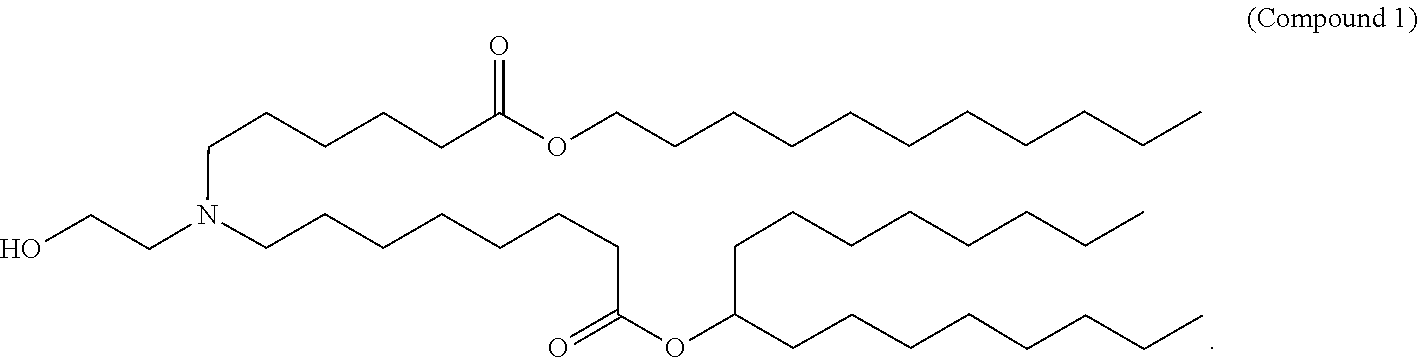
24. A messenger ribonucleic acid (mRNA) comprising an open reading frame (ORF) that comprises a nucleotide sequence having at least 80% identity to the nucleotide sequence of any one of SEQ ID NOs 3, 7, 10, 13, 16, 19, 22, 25, 31, 48, 50, 52, 54, 56, 61, 62, 64, 66, 68, 70, 72, 74, 76, 78, 80, 82, 84, or 106.
25. The mRNA of claim 24 , wherein the ORF comprises a nucleotide sequence having at least 85%, at least 90%, at least 95%, at least 98%, or at least 100% identity to the nucleotide sequence of any one of SEQ ID NOs: 3, 7, 10, 13, 16, 19, 22, 25, 31, 48, 50, 52, 54, 56, 61, 62, 64, 66, 68, 70, 72, 74, 76, 78, 80, 82, 84, or 106.
26. The mRNA of claim 24 , wherein the ORF encodes a polypeptide comprising the amino acid sequence of any one of SEQ ID NOs: 5, 8, 11, 14, 17, 20, 23, 26, 32, 33, 34, 35, 47, 49, 59, 63, 65, 67, 69, 71, 73, 75, 77, 79, 81, 83, or 85.
27. The mRNA of claim 24 , wherein the ORF encodes a polypeptide comprising an amino acid sequence having at least 80%, at least 85%, at least 90%, at least 95%, or at least 98% identity of any one of SEQ ID NOs: 5, 8, 11, 14, 17, 20, 23, 26, 32, 33, 34, 35, 47, 49, 59, 63, 65, 67, 69, 71, 73, 75, 77, 79, 81, 83, or 85.
28. The mRNA of claim 24 , wherein the RNA comprises a 5′ untranslated region (UTR) and a 3′ UTR.
29. The mRNA of claim 28 , wherein the 5′ UTR comprises the nucleotide sequence of SEQ ID NO: 2 or SEQ ID NO: 36.
30. The mRNA of claim 28 , wherein the 3′ UTR comprises the nucleotide sequence of SEQ ID NO: 4 or SEQ ID NO: 37.
31. The mRNA of claim 24 , wherein the mRNA comprises a chemical modification.
32. The mRNA of claim 31 , wherein the mRNA is chemically with 1-methyl-pseudouridine, such that each U in the sequence is a 1-methyl-pseudouridine.
33. A composition comprising a lipid nanoparticle and a messenger RNA (mRNA), wherein the mRNA is an mRNA of any of claims 24 -33 .
34. The composition of claim 33 , wherein the lipid nanoparticle comprises a PEG-modified lipid, a non-cationic lipid, a sterol, an ionizable cationic lipid, or any combination thereof.
35. The composition of claim 34 , wherein the lipid nanoparticle comprises 0.5-15 mol % PEG-modified lipid; 5-25 mol % non-cationic lipid; 25-55 mol % sterol; and 20-60 mol % ionizable cationic lipid.
36. The composition of claim 35 , wherein the PEG-modified lipid is 1,2 dimyristoyl-sn-glycerol, methoxypolyethyleneglycol (PEG2000 DMG), the non-cationic lipid is 1,2 distearoyl-sn-glycero-3-phosphocholine (DSPC), the sterol is cholesterol; and the ionizable cationic lipid has the structure of Compound 1:
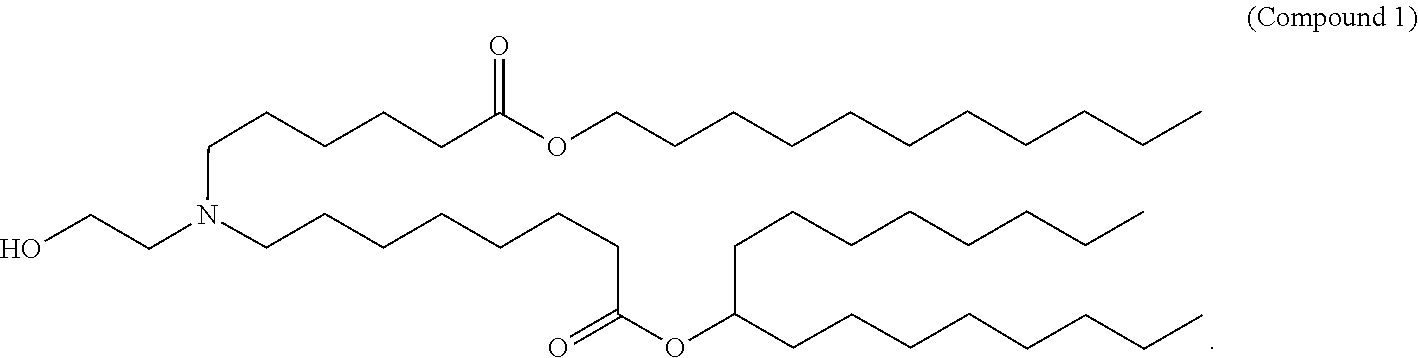
37. A method comprising administering to a subject a messenger ribonucleic acid (mRNA) comprising an open reading frame (ORF) that encodes a SARS-CoV-2 spike (S) protein antigen having a double proline stabilizing mutation in an amount effective to induce a neutralizing antibody response against SARS-CoV-2 in the subject.
38. The method of claim 37 , wherein the double proline stabilizing mutation is at positions corresponding to K986 and V987 of a wild-type SARS-CoV-2 S protein.
39. The method of any one of claims 37 -38 , wherein the mRNA is administered in an amount effective to induce a T cell immune response, optionally a CD4+ and/or a CD8+ T cell immune response against SARS-CoV-2 in the subject.
40. The method of any one of claims 37 -39 , wherein the subject is immunocompromised.
41. The method of any one of claims 37 -39 , wherein the subject has a pulmonary disease.
42. The method of any one of claims 37 -39 , wherein the subject is 65 years of age or older.
43. The method of any one of claims 37 -39 , comprising administering to the subject at least two doses of the composition.
44. The method of any one of claims 37 -43 , wherein detectable levels of the SARS-CoV-2 S protein are produced in serum of the subject at 1-72 hours post administration of the RNA or composition comprising the RNA.
45. The method of any one of claims 37 -43 , wherein a neutralizing antibody titer of at least 100 NU/ml, at least 500 NU/ml, or at least 1000 NU/ml is produced in the serum of the subject at 1-72 hours post administration of the RNA.
46. An immunizing composition comprising:
(a) a first ribonucleic acid (RNA) comprising an open reading frame (ORF) that encodes a coronavirus antigen capable of inducing an immune response, such as a neutralizing antibody response, to a SARS-CoV-2; and
(b) a second ribonucleic acid (RNA) comprising an open reading frame (ORF) that encodes a coronavirus antigen capable of inducing an immune response, such as a neutralizing antibody response, to a SARS-CoV-2, wherein the ORF of the first RNA is different from the ORF of the second RNA.
Priority Applications (1)
| Application Number | Priority Date | Filing Date | Title |
|---|---|---|---|
| US17/796,208 US20230108894A1 (en) | 2020-01-28 | 2021-01-26 | Coronavirus rna vaccines |
Applications Claiming Priority (7)
| Application Number | Priority Date | Filing Date | Title |
|---|---|---|---|
| US202062967006P | 2020-01-28 | 2020-01-28 | |
| US202062971825P | 2020-02-07 | 2020-02-07 | |
| US202063002094P | 2020-03-30 | 2020-03-30 | |
| US202063009005P | 2020-04-13 | 2020-04-13 | |
| US202063016175P | 2020-04-27 | 2020-04-27 | |
| PCT/US2021/015145 WO2021154763A1 (en) | 2020-01-28 | 2021-01-26 | Coronavirus rna vaccines |
| US17/796,208 US20230108894A1 (en) | 2020-01-28 | 2021-01-26 | Coronavirus rna vaccines |
Publications (1)
| Publication Number | Publication Date |
|---|---|
| US20230108894A1 true US20230108894A1 (en) | 2023-04-06 |
Family
ID=74669543
Family Applications (1)
| Application Number | Title | Priority Date | Filing Date |
|---|---|---|---|
| US17/796,208 Abandoned US20230108894A1 (en) | 2020-01-28 | 2021-01-26 | Coronavirus rna vaccines |
Country Status (15)
| Country | Link |
|---|---|
| US (1) | US20230108894A1 (en) |
| EP (1) | EP4096710A1 (en) |
| JP (1) | JP2023511633A (en) |
| KR (1) | KR20220133224A (en) |
| CN (1) | CN115175698A (en) |
| AU (1) | AU2021213108A1 (en) |
| BR (1) | BR112022014837A2 (en) |
| CA (1) | CA3168902A1 (en) |
| CO (1) | CO2022011685A2 (en) |
| DO (1) | DOP2022000152A (en) |
| IL (1) | IL295016A (en) |
| MX (1) | MX2022009280A (en) |
| PE (1) | PE20221756A1 (en) |
| TW (1) | TW202142556A (en) |
| WO (1) | WO2021154763A1 (en) |
Cited By (5)
| Publication number | Priority date | Publication date | Assignee | Title |
|---|---|---|---|---|
| US20220356212A1 (en) * | 2021-03-26 | 2022-11-10 | Nanogen Pharmaceutical Biotechnology JSC | Modified spike protein and method of treatment |
| CN116121277A (en) * | 2020-12-31 | 2023-05-16 | 四川大学华西医院 | Nucleic acid molecules encoding structural proteins of novel coronavirus and their applications |
| US20230256087A1 (en) * | 2021-04-08 | 2023-08-17 | Vaxthera Sas | Coronavirus vaccine comprising a mosaic protein |
| US20240269266A1 (en) * | 2020-04-14 | 2024-08-15 | The Regents Of The University Of California | Broad-spectrum multi-antigen pan-coronavirus vaccine |
| WO2024220712A3 (en) * | 2023-04-19 | 2024-11-28 | Sail Biomedicines, Inc. | Vaccine compositions |
Families Citing this family (40)
| Publication number | Priority date | Publication date | Assignee | Title |
|---|---|---|---|---|
| US10953089B1 (en) | 2020-01-27 | 2021-03-23 | Novavax, Inc. | Coronavirus vaccine formulations |
| TW202204380A (en) * | 2020-01-31 | 2022-02-01 | 美商詹森藥物公司 | Compositions and methods for preventing and treating coronavirus infection - sars-cov-2 vaccines |
| US12194089B2 (en) | 2020-02-04 | 2025-01-14 | CureVac SE | Coronavirus vaccine |
| AU2021216658A1 (en) | 2020-02-04 | 2022-06-23 | CureVac SE | Coronavirus vaccine |
| US20230190915A1 (en) * | 2020-02-14 | 2023-06-22 | Epivax, Inc. | T cell epitopes and related compositions useful in the prevention, diagnosis, and treatment of covid-19 |
| IL297419B2 (en) | 2020-04-22 | 2025-02-01 | BioNTech SE | Coronavirus vaccine |
| WO2021159130A2 (en) * | 2020-05-15 | 2021-08-12 | Modernatx, Inc. | Coronavirus rna vaccines and methods of use |
| WO2022218503A1 (en) * | 2021-04-12 | 2022-10-20 | BioNTech SE | Lnp compositions comprising rna and methods for preparing, storing and using the same |
| IL302771A (en) * | 2020-11-16 | 2023-07-01 | BioNTech SE | lnp compositions containing RNA and methods for their preparation, storage and use |
| CA3205569A1 (en) | 2020-12-22 | 2022-06-30 | CureVac SE | Rna vaccine against sars-cov-2 variants |
| AU2022208057A1 (en) * | 2021-01-15 | 2023-08-03 | Modernatx, Inc. | Variant strain-based coronavirus vaccines |
| AU2022207495A1 (en) * | 2021-01-15 | 2023-08-03 | Modernatx, Inc. | Variant strain-based coronavirus vaccines |
| US20240165045A1 (en) * | 2021-03-08 | 2024-05-23 | Board Of Regents, The University Of Texas System | Dry powder formulations of nucleic acid lipid nanoparticles |
| WO2022232648A1 (en) | 2021-04-29 | 2022-11-03 | The United States Of America, As Represented By The Secretary, Department Of Health And Human Services | Prefusion-stabilized lassa virus glycoprotein complex and its use |
| AU2022270658A1 (en) | 2021-05-04 | 2023-11-16 | BioNTech SE | Technologies for early detection of variants of interest |
| CN115594742A (en) * | 2021-07-09 | 2023-01-13 | 复旦大学(Cn) | A kind of coronavirus S protein variant and application thereof |
| JP2024539512A (en) | 2021-10-22 | 2024-10-28 | セイル バイオメディシンズ インコーポレイテッド | MRNA Vaccine Compositions |
| WO2023086961A1 (en) | 2021-11-12 | 2023-05-19 | The United States Of America, As Represented By The Secretary, Department Of Health And Human Services | Sars-cov-2 spike fused to a hepatitis b surface antigen |
| CN118488834A (en) | 2021-11-23 | 2024-08-13 | 赛欧生物医药股份有限公司 | Bacteria-derived lipid compositions and uses thereof |
| US12186387B2 (en) | 2021-11-29 | 2025-01-07 | BioNTech SE | Coronavirus vaccine |
| KR20240125935A (en) * | 2021-11-30 | 2024-08-20 | 노바백스, 인코포레이티드 | Coronavirus vaccine formulation |
| WO2023098842A1 (en) * | 2021-12-03 | 2023-06-08 | Suzhou Abogen Biosciences Co., Ltd. | NUCLEIC ACID VACCINES FOR CORONAVIRUS BASED ON SEQUENCES DERIVED FROM SARS-CoV-2 OMICRON STRAIN |
| JP2025500373A (en) | 2021-12-20 | 2025-01-09 | セイル バイオメディシンズ インコーポレイテッド | Composition for MRNA treatment |
| KR20230095025A (en) * | 2021-12-20 | 2023-06-28 | 아이진 주식회사 | Variant SARS-CoV-2 vaccine composition and use thereof |
| KR20230096863A (en) * | 2021-12-22 | 2023-06-30 | 한미약품 주식회사 | Coronavirus vaccine |
| CN114031675B (en) * | 2022-01-10 | 2022-06-07 | 广州市锐博生物科技有限公司 | Vaccines and compositions based on the S protein of SARS-CoV-2 |
| US20250235531A1 (en) * | 2022-02-09 | 2025-07-24 | Modernatx, Inc. | Mucosal administration methods and formulations |
| CN114404584B (en) * | 2022-04-01 | 2022-07-26 | 康希诺生物股份公司 | Novel coronavirus mRNA vaccine and preparation method and application thereof |
| WO2023196898A1 (en) | 2022-04-07 | 2023-10-12 | The United States Of America, As Represented By The Secretary, Department Of Health And Human Services | Beta globin mimetic peptides and their use |
| CN119255818A (en) | 2022-05-05 | 2025-01-03 | 伊泽阿恩埃免疫疗法股份有限公司 | Multi-epitope constructs |
| US20250302939A1 (en) | 2022-05-10 | 2025-10-02 | The United States Of America, As Represented By The Secretary, Department Of Health And Human | Vaccine for human t-lymphotropic virus-1 |
| US20250228814A1 (en) | 2022-06-22 | 2025-07-17 | Flagship Pioneering Innovations Vi, Llc | Combination therapies for the treatment of viral infections |
| US11654121B1 (en) | 2022-06-22 | 2023-05-23 | Flagship Pioneering Innovations Vi, Llc | Combination therapies for the treatment of viral infections |
| US11878055B1 (en) | 2022-06-26 | 2024-01-23 | BioNTech SE | Coronavirus vaccine |
| WO2024014770A1 (en) * | 2022-07-14 | 2024-01-18 | 엠큐렉스 주식회사 | Modified rna for preparing mrna vaccine and therapeutic agent |
| DE202023106198U1 (en) | 2022-10-28 | 2024-03-21 | CureVac SE | Nucleic acid-based vaccine |
| EP4615424A1 (en) | 2022-11-10 | 2025-09-17 | Sail Biomedicines, Inc. | Rna compositions comprising lipid nanoparticles or lipid reconstructed natural messenger packs |
| AU2024212425A1 (en) | 2023-01-27 | 2025-08-07 | Sail Biomedicines, Inc. | A modified lipid composition and uses thereof |
| CN117886903A (en) * | 2023-03-03 | 2024-04-16 | 上海蓝鹊生物医药有限公司 | Protein or mRNA vaccine for resisting new coronavirus and preparation method and application thereof |
| WO2024249626A1 (en) | 2023-05-30 | 2024-12-05 | The United States Of America, As Represented By The Secretary, Department Of Health And Human Services | Hiv-1 envelope triple tandem trimers and their use |
Family Cites Families (25)
| Publication number | Priority date | Publication date | Assignee | Title |
|---|---|---|---|---|
| DE10121252A1 (en) | 2001-04-30 | 2002-11-07 | Christos C Zouboulis | Acne treatment |
| ES2340499T3 (en) | 2001-06-05 | 2010-06-04 | Curevac Gmbh | TUMOR ANTIGEN ARNM STABILIZED WITH AN INCREASED G / C CONTENT. |
| US9012219B2 (en) | 2005-08-23 | 2015-04-21 | The Trustees Of The University Of Pennsylvania | RNA preparations comprising purified modified RNA for reprogramming cells |
| DE102005046490A1 (en) | 2005-09-28 | 2007-03-29 | Johannes-Gutenberg-Universität Mainz | New nucleic acid molecule comprising promoter, a transcriptable nucleic acid sequence, a first and second nucleic acid sequence for producing modified RNA with transcriptional stability and translational efficiency |
| CN101977510A (en) | 2007-06-29 | 2011-02-16 | 联邦科学技术研究组织 | Methods for degrading toxic compounds |
| EP2535419A3 (en) | 2007-09-26 | 2013-05-29 | Intrexon Corporation | Synthetic 5'UTRs, expression vectors, and methods for increasing transgene expression |
| CN101939428B (en) | 2007-12-11 | 2014-05-07 | 斯克利普斯研究所 | Compositions and methods involving mRNA translation enhancers |
| DK2459231T3 (en) | 2009-07-31 | 2016-09-05 | Ethris Gmbh | RNA with a combination of unmodified and modified nucleotides for protein expression |
| BR112013031553A2 (en) | 2011-06-08 | 2020-11-10 | Shire Human Genetic Therapies, Inc. | compositions, mrna encoding a gland and its use, use of at least one mrna molecule and a vehicle for transfer and use of an mrna encoding for exogenous protein |
| CA2876155C (en) | 2012-06-08 | 2022-12-13 | Ethris Gmbh | Pulmonary delivery of mrna to non-lung target cells |
| WO2014071963A1 (en) | 2012-11-09 | 2014-05-15 | Biontech Ag | Method for cellular rna expression |
| HUE055044T2 (en) | 2013-03-14 | 2021-10-28 | Translate Bio Inc | Methods and compositions for delivering mrna coded antibodies |
| ES2795249T3 (en) | 2013-03-15 | 2020-11-23 | Translate Bio Inc | Synergistic enhancement of nucleic acid delivery through mixed formulations |
| US10138507B2 (en) | 2013-03-15 | 2018-11-27 | Modernatx, Inc. | Manufacturing methods for production of RNA transcripts |
| CN105451779A (en) | 2013-08-21 | 2016-03-30 | 库瑞瓦格股份公司 | Method for increasing expression of RNA-encoded proteins |
| WO2015062738A1 (en) | 2013-11-01 | 2015-05-07 | Curevac Gmbh | Modified rna with decreased immunostimulatory properties |
| CA2927254C (en) | 2013-12-30 | 2023-10-24 | Curevac Ag | Artificial nucleic acid molecules |
| KR102399799B1 (en) | 2013-12-30 | 2022-05-18 | 큐어백 아게 | Artificial nucleic acid molecules |
| KR101793271B1 (en) | 2015-07-09 | 2017-11-20 | 인텔렉추얼디스커버리 주식회사 | Portable sterilize water spray gun using air peressure |
| EP4349404A3 (en) * | 2015-10-22 | 2024-06-19 | ModernaTX, Inc. | Respiratory virus vaccines |
| EP3405579A1 (en) | 2016-01-22 | 2018-11-28 | Modernatx, Inc. | Messenger ribonucleic acids for the production of intracellular binding polypeptides and methods of use thereof |
| AU2017326423B2 (en) | 2016-09-14 | 2023-11-09 | Modernatx, Inc. | High purity RNA compositions and methods for preparation thereof |
| US11141476B2 (en) * | 2016-12-23 | 2021-10-12 | Curevac Ag | MERS coronavirus vaccine |
| EP3595676A4 (en) | 2017-03-17 | 2021-05-05 | Modernatx, Inc. | RNA-BASED VACCINES AGAINST ZOONOTIC DISEASES |
| EP3668971B8 (en) | 2017-08-18 | 2024-05-29 | ModernaTX, Inc. | Rna polymerase variants |
-
2021
- 2021-01-26 KR KR1020227028348A patent/KR20220133224A/en not_active Withdrawn
- 2021-01-26 MX MX2022009280A patent/MX2022009280A/en unknown
- 2021-01-26 AU AU2021213108A patent/AU2021213108A1/en not_active Withdrawn
- 2021-01-26 PE PE2022001511A patent/PE20221756A1/en unknown
- 2021-01-26 WO PCT/US2021/015145 patent/WO2021154763A1/en not_active Ceased
- 2021-01-26 EP EP21706776.8A patent/EP4096710A1/en not_active Withdrawn
- 2021-01-26 BR BR112022014837A patent/BR112022014837A2/en not_active Application Discontinuation
- 2021-01-26 CA CA3168902A patent/CA3168902A1/en not_active Withdrawn
- 2021-01-26 JP JP2022545900A patent/JP2023511633A/en not_active Withdrawn
- 2021-01-26 US US17/796,208 patent/US20230108894A1/en not_active Abandoned
- 2021-01-26 CN CN202180011234.4A patent/CN115175698A/en not_active Withdrawn
- 2021-01-26 IL IL295016A patent/IL295016A/en unknown
- 2021-01-28 TW TW110103314A patent/TW202142556A/en unknown
-
2022
- 2022-07-26 DO DO2022000152A patent/DOP2022000152A/en unknown
- 2022-08-19 CO CONC2022/0011685A patent/CO2022011685A2/en unknown
Cited By (7)
| Publication number | Priority date | Publication date | Assignee | Title |
|---|---|---|---|---|
| US20240269266A1 (en) * | 2020-04-14 | 2024-08-15 | The Regents Of The University Of California | Broad-spectrum multi-antigen pan-coronavirus vaccine |
| CN116121277A (en) * | 2020-12-31 | 2023-05-16 | 四川大学华西医院 | Nucleic acid molecules encoding structural proteins of novel coronavirus and their applications |
| US20220356212A1 (en) * | 2021-03-26 | 2022-11-10 | Nanogen Pharmaceutical Biotechnology JSC | Modified spike protein and method of treatment |
| US20230256087A1 (en) * | 2021-04-08 | 2023-08-17 | Vaxthera Sas | Coronavirus vaccine comprising a mosaic protein |
| US12005114B2 (en) * | 2021-04-08 | 2024-06-11 | Vaxthera Sas | Coronavirus vaccine comprising a mosaic protein |
| US20240316185A1 (en) * | 2021-04-08 | 2024-09-26 | Vaxthera Sas | Coronavirus vaccine comprising a mosaic protein |
| WO2024220712A3 (en) * | 2023-04-19 | 2024-11-28 | Sail Biomedicines, Inc. | Vaccine compositions |
Also Published As
| Publication number | Publication date |
|---|---|
| TW202142556A (en) | 2021-11-16 |
| PE20221756A1 (en) | 2022-11-11 |
| JP2023511633A (en) | 2023-03-20 |
| IL295016A (en) | 2022-09-01 |
| BR112022014837A2 (en) | 2022-09-27 |
| CO2022011685A2 (en) | 2022-08-30 |
| MX2022009280A (en) | 2022-08-16 |
| KR20220133224A (en) | 2022-10-04 |
| CN115175698A (en) | 2022-10-11 |
| WO2021154763A1 (en) | 2021-08-05 |
| AU2021213108A1 (en) | 2022-08-18 |
| CA3168902A1 (en) | 2021-08-05 |
| EP4096710A1 (en) | 2022-12-07 |
| DOP2022000152A (en) | 2022-10-31 |
Similar Documents
| Publication | Publication Date | Title |
|---|---|---|
| US20230108894A1 (en) | Coronavirus rna vaccines | |
| US20240293534A1 (en) | Coronavirus glycosylation variant vaccines | |
| US20240285754A1 (en) | Mrna vaccines encoding flexible coronavirus spike proteins | |
| US20240207392A1 (en) | Epstein-barr virus mrna vaccines | |
| US20220323572A1 (en) | Coronavirus rna vaccines | |
| US12453766B2 (en) | RSV RNA vaccines | |
| US20240382581A1 (en) | Pan-human coronavirus vaccines | |
| US20240358819A1 (en) | Pan-human coronavirus domain vaccines | |
| US20220378904A1 (en) | Hmpv mrna vaccine composition | |
| US20230355743A1 (en) | Multi-proline-substituted coronavirus spike protein vaccines | |
| US20230270836A1 (en) | Zoonotic disease rna vaccines | |
| US20240299531A1 (en) | Therapeutic use of sars-cov-2 mrna domain vaccines | |
| US20230346914A1 (en) | Sars-cov-2 mrna domain vaccines | |
| US20230338506A1 (en) | Respiratory virus immunizing compositions | |
| WO2023283642A2 (en) | Pan-human coronavirus concatemeric vaccines | |
| WO2022221336A1 (en) | Respiratory syncytial virus mrna vaccines | |
| WO2021211343A1 (en) | Zika virus mrna vaccines | |
| WO2023092069A1 (en) | Sars-cov-2 mrna domain vaccines and methods of use | |
| WO2021159130A2 (en) | Coronavirus rna vaccines and methods of use | |
| WO2023230481A1 (en) | Orthopoxvirus vaccines |
Legal Events
| Date | Code | Title | Description |
|---|---|---|---|
| STCB | Information on status: application discontinuation |
Free format text: ABANDONED -- INCOMPLETE APPLICATION (PRE-EXAMINATION) |