4239-110244-02 HIV-1 ENVELOPE TRIPLE TANDEM TRIMERS AND THEIR USE CROSS REFERENCE TO RELATED APPLICATION This application claims priority to U.S. Provisional Application No.63/469,773, filed May 30, 2023, which is incorporated by reference in its entirety. SEQUENCE LISTING The nucleic and amino acid sequences listed in the accompanying sequence listing are shown using standard letter abbreviations for nucleotide bases, and single letter code for amino acids, as defined in 37 C.F.R.1.822. The Sequence Listing is submitted as an XML file in the form of the file named “Sequence.xml” (126,082 bytes), which was created on May 29, 2024 which is incorporated by reference herein. FIELD This disclosure relates to recombinant Human immunodeficiency virus type 1 (HIV-1) Envelope (Env) ectodomain trimers for treatment and inhibition of HIV-1 infection and disease. BACKGROUND Millions of people are infected with HIV-1 worldwide, and 2.5 to 3 million new infections have been estimated to occur yearly. Although effective antiretroviral therapies are available, over a million succumb to AIDS every year, especially in sub-Saharan Africa, underscoring the need to develop measures to prevent the spread of this disease. An enveloped virus, HIV-1 hides from humoral recognition behind a wide array of protective mechanisms. The major envelope protein of HIV-1 is a glycoprotein of approximately 160 kD (gp160). During infection, proteases of the host cell cleave gp160 into gp120 and gp41. Gp41 is an integral membrane protein, while gp120 protrudes from the mature virus. Together gp120 and gp41 make up the HIV-1 Env spike, which is a target for neutralizing antibodies. It is believed that immunization with an effective immunogen based on the HIV-1 Env glycoprotein can elicit a neutralizing response, which may be protective against HIV-1 infection. However, despite extensive effort, a need remains for agents capable of such action. SUMMARY The recombinant HIV-1 Env trimers disclosed herein include modifications to reduce the immunodominance of the membrane-proximal “base” of the trimer. Specifically, the protomers of
4239-110244-02 the trimer are genetically fused to form a “Triple Tandem Trimer” or “TTT,” wherein the C terminus of a first protomer in the trimer is fused to the N terminus of a second protomer in the trimer by first peptide linker, and the C terminus of the second protomer is fused to the N terminus of a third protomer in the trimer by a second peptide linker. In several aspects, the first and second peptide linkers contain N-linked glycan sequons, the glycosylation of which further reduces the immunodominance of the membrane-proximal base of the trimer. The disclosed recombinant HIV- 1 Env ectodomain trimers can be used to elicit a neutralizing immune response to HIV-1 in a subject. The recombinant HIV-1 Env ectodomain trimer, comprises three protomers comprising or consisting of HIV-1 Env positions 31 to one of 653-664 and comprising amino acid substitutions for stabilization of the trimer in a prefusion closed conformation. The modifications include amino acid substitutions for stabilization of the trimer in a prefusion closed conformation, comprising one or more of: (a) cysteine substitutions at HIV-1 Env positions 501 and 605 that form a non-natural intra-protomer disulfide bond; (b) cysteine substitutions at HIV-1 Env positions 201 and 433 that form a non-natural intra-protomer disulfide bond; (c) a proline substitution at HIV-1 Env position 559; and (d) methionine, leucine, and proline substitutions at HIV-1 Env positions 302, 320, and 329, respectively. The C terminus of a first protomer in the trimer is fused to the N terminus of a second protomer in the trimer by first peptide linker, and the C terminus of the second protomer is fused to the N terminus of a third protomer in the trimer by a second peptide linker. The first and second peptide linkers are from 7-25 amino acids in length. Optionally, the first and second peptide linkers contain one, two, or three N-linked glycan sequons. Optionally, three amino acids containing a N-linked glycan sequon are fused to the N terminus of the first protomer in the trimer. Optionally, the protomers comprise an amino acid substitution of RRRRRR (SEQ ID NO: 16) for the amino acids of a gp120/gp41 furin cleavage site. The HIV-1 Env positions are according to HXB2 numbering. The recombinant HIV-1 Env ectodomain trimer elicits an immune response to HIV-1. In some implementations, the recombinant HIV-1 Env ectodomain trimer comprises or consists of the amino acid sequence set forth as any one of SEQ ID NOs: 25-34 or 38-43, or an amino acid sequence at least 90% identical thereto. Nucleic acid molecules encoding the disclosed recombinant HIV-1 Env ectodomain trimers are also provided. In some implementations, the nucleic acid molecule can encode a precursor protein of a gp120-gp41 protomer of a disclosed recombinant HIV-1 Env trimer. Expression vectors (such as an inactivated or attenuated viral vector) including the nucleic acid molecules are also provided.
4239-110244-02 Immunogenic compositions including one or more of the disclosed recombinant HIV-1 Env ectodomain trimers are also provided. The composition may be contained in a unit dosage form. The composition can further include an adjuvant. Methods of eliciting an immune response to HIV-1 envelope protein in a subject are disclosed, as are methods of treating, inhibiting or preventing an HIV-1 infection in a subject. In such methods a subject, such as a human subject, is administered an effective amount of a disclosed recombinant HIV-1 Env ectodomain trimer to elicit the immune response. The subject can be, for example, a human subject at risk of or having an HIV-1 infection. The foregoing and other features and advantages of this disclosure will become more apparent from the following detailed description of several implementations which proceeds with reference to the accompanying figures. BRIEF DESCRIPTION OF THE FIGURES FIG.1. Glycan-base immunization elicit reciprocally symmetric ELISA response, where a strong ELISA response is induced against the homologous antigen, but there is little cross reactivity between the glycan-base sera and protein-base (WT) trimer or vice versa. FIG.2. EMPEM analysis shows that glycan-base immunizations elicit antibodies which are capable of disassembling both the glycan-base trimers and nominally stable protein-base trimers. Whereas protein-base sera displayed primarily base-directed antibodies bound to trimers, glycan-base sera showed primarily antibody complexes with Env monomers. FIGs.3A and 3B. Illustration of Triple Tandem Trimer (TTT) design. To overcome disassembly issues with the glycan-base trimers, Triple Tandem Trimers were constructed in a ConC background by linking the C terminus of gp41 with the N terminus of gp120 of three protomers using Gly-Ser linkers (FIG.3A). In an additional aspect, glycan sequons were also added to the linkers (FIG.3B). FIGs.4A and 4B. Expression and negative stain electromicroscopy of TTT constructs. Several different TTT constructs were produced in mammalian cells, showing reasonably high expression levels of ~1mg per liter of cells. Additionally, all tested ConC-based constructs eluted in the expected position on gel filtration (FIG.4A) and appeared as well-folded HIV Env trimers by Negative Stain-EM (FIG.4B). FIG 5. Antigenicity and thermal stability of TTT constructs. The TTT constructs were assessed for binding to several HIV-1 Env specific antibodies; binding characteristics for the TTT constructs were similar to the parent (non-TTT) HIV-1 Env trimer. Additionally, a small increase in thermal stability was observed for the TTT constructs compared to the parent HIV-1 Env trimer.
4239-110244-02 FIGs.6A and 6B. Immunization assessment of TTT constructs. (FIG.6A) Immunization schedule and dosing protocol. (FIG.6B) HIV-1 pseudovirus neutralization for week 10 sera collected from immunized animals. DETAILED DESCRIPTION The HIV-1 Env trimer is a target for vaccine design as well as a conformational machine that facilitates virus entry by transitioning between prefusion-closed, CD4-bound, and co-receptor- bound conformations before rearranging into a postfusion state. Vaccine designers have successfully restricted the conformation of the HIV-1-Env trimer to its prefusion-closed state, as this state is recognized by most broadly neutralizing –but not by non-neutralizing– antibodies. However, when soluble HIV-1 Env trimers restricted to the prefusion closed conformation are used to immunize animals, the immunodominance of the base of soluble HIV-1 Env trimers reduces the immune response to the remainder of the trimer, potentially reducing their development as an effective HIV-1 immunogens. Provided herein are recombinant HIV-1 Env ectodomain trimers that are stabilized in the prefusion conformation and where protomers of the trimer are genetically fused via peptide linkers to form a “Triple Tandem Trimer” or “TTT.” In the TTT construct, the C terminus of a first protomer in the trimer is fused to the N terminus of a second protomer in the trimer by first peptide linker, and the C terminus of the second protomer is fused to the N terminus of a third protomer in the trimer by a second peptide linker. The presence of the first and second peptide linkers increases stability of the trimer conformation. In several aspects, the first and second peptide linkers contain N-linked glycan sequons, the glycosylation of which reduces the immunodominance of the membrane-proximal base of the trimer. The immunogens can be used to generate a neutralizing immune response to HIV-1 in a subject, for example, to treat or prevent an HIV-1 infection in the subject. I. Summary of Terms Unless otherwise noted, technical terms are used according to conventional usage. Definitions of common terms in molecular biology may be found in Krebs et al. (eds.), Lewin’s genes XII, published by Jones & Bartlett Learning, 2017; and Meyers et al. (eds.), The Encyclopedia of Cell Biology and Molecular Medicine, published by Wiley-VCH in 16 volumes, 2008; and other similar references. As used herein, the singular forms “a,” “an,” and “the,” refer to both the singular as well as plural, unless the context clearly indicates otherwise. For example, the term “an antigen” includes
4239-110244-02 single or plural antigens and can be considered equivalent to the phrase “at least one antigen.” As used herein, the term “comprises” means “includes.” It is further to be understood that any and all base sizes or amino acid sizes, and all molecular weight or molecular mass values, given for nucleic acids or polypeptides are approximate, and are provided for descriptive purposes, unless otherwise indicated. Although many methods and materials similar or equivalent to those described herein can be used, particularly suitable methods and materials are described herein. In case of conflict, the present specification, including explanations of terms, will control. In addition, the materials, methods, and examples are illustrative only and not intended to be limiting. To facilitate review of the various implementations, the following explanations of terms are provided: Adjuvant: A component of an immunogenic composition used to enhance antigenicity. In some implementations, an adjuvant can include a suspension of minerals (alum, aluminum hydroxide, or phosphate) on which antigen is adsorbed; or water-in-oil emulsion, for example, in which antigen solution is emulsified in mineral oil (Freund incomplete adjuvant), sometimes with the inclusion of killed mycobacteria (Freund's complete adjuvant) to further enhance antigenicity (inhibits degradation of antigen and/or causes influx of macrophages). In some implementations, the adjuvant used in a disclosed immunogenic composition is a combination of lecithin and carbomer homopolymer (such as the ADJUPLEX™ adjuvant available from Advanced BioAdjuvants, LLC, see also Wegmann, Clin Vaccine Immunol, 22(9): 1004-1012, 2015). Additional adjuvants for use in the disclosed immunogenic compositions include the QS21 purified plant extract, Matrix M, AS01, MF59, ALFQ, and SMNP adjuvants. SMNP is described, for example, in Silva et al. “A particulate saponin/TLR agonist vaccine adjuvant alters lymph flow and modulated adaptive immunity ,” Sci Immunol., 6(66)eabf1152, 2021, which is incorporated by reference herein. Immunostimulatory oligonucleotides (such as those including a CpG motif) can also be used as adjuvants. Adjuvants include biological molecules (a “biological adjuvant”), such as costimulatory molecules. Exemplary adjuvants include IL-2, RANTES, GM-CSF, TNF-α, IFN- γ, G-CSF, LFA-3, CD72, B7-1, B7-2, OX-40L, 4-1BBL and toll-like receptor (TLR) agonists, such as TLR-9 agonists. The person of ordinary skill in the art is familiar with adjuvants (see, e.g., Singh (ed.) Vaccine Adjuvants and Delivery Systems. Wiley-Interscience, 2007). Adjuvants can be used in combination with the disclosed immunogens. Administration: The introduction of a composition into a subject by a chosen route. Administration can be local or systemic. For example, if the chosen route is intravenous, the composition (such as a composition including a disclosed immunogen) is administered by introducing the composition into a vein of the subject. Exemplary routes of administration include, but are not limited to, oral, injection (such as subcutaneous, intramuscular, intradermal,
4239-110244-02 intraperitoneal, and intravenous), sublingual, rectal, transdermal (for example, topical), intranasal, vaginal, and inhalation routes. Amino acid substitution: The replacement of one amino acid in a polypeptide with a different amino acid. In some examples, an amino acid in a polypeptide is substituted with an amino acid from a homologous polypeptide, for example, an amino acid in a recombinant Clade A HIV-1 Env polypeptide can be substituted with the corresponding amino acid from a Clade B HIV- 1 Env polypeptide. Antibody: An immunoglobulin, antigen-binding fragment, or derivative thereof, that specifically binds and recognizes an analyte (antigen), such as HIV-1 Env. The term “antibody” is used herein in the broadest sense and encompasses various antibody structures, including but not limited to monoclonal antibodies, polyclonal antibodies, multispecific antibodies (e.g., bispecific antibodies), and antibody fragments, so long as they exhibit the desired antigen-binding activity. Non-limiting examples of antibodies include, for example, intact immunoglobulins and variants and fragments thereof that retain binding affinity for the antigen. Examples of antibody fragments include but are not limited to Fv, Fab, Fab', Fab'-SH, F(ab')2; diabodies; linear antibodies; single- chain antibody molecules (e.g. scFv); and multispecific antibodies formed from antibody fragments. Antibody fragments include antigen binding fragments either produced by the modification of whole antibodies or those synthesized de novo using recombinant DNA methodologies (see, e.g., Kontermann and Dubel (Ed), Antibody Engineering, Vols.1-2, 2
nd Ed., Springer Press, 2010). Light and heavy chain variable regions contain a “framework” region interrupted by three hypervariable regions, also called “complementarity-determining regions” or “CDRs” (see, e.g., Kabat et al., Sequences of Proteins of Immunological Interest, U.S. Department of Health and Human Services, 1991). The framework region of an antibody, that is the combined framework regions of the constituent light and heavy chains, serves to position and align the CDRs in three- dimensional space. The CDRs are primarily responsible for binding to an epitope of an antigen. Carrier: An immunogenic molecule to which an antigen (such as an HIV-1 Env ectodomain trimer) can be linked. When linked to a carrier, the antigen may become more immunogenic. Carriers are chosen to increase the immunogenicity of the antigen and/or to elicit antibodies against the carrier which are diagnostically, analytically, and/or therapeutically beneficial. Useful carriers include polymeric carriers, which can be natural (for example, proteins from bacteria or viruses), semi-synthetic or synthetic materials containing one or more functional groups to which a reactant moiety can be attached. CD4: Cluster of differentiation factor 4 polypeptide; a T-cell surface protein that mediates interaction with the MHC class II molecule. CD4 also serves as the primary receptor site for HIV-1
4239-110244-02 on T-cells during HIV-1 infection. CD4 is known to bind to gp120 from HIV-1. The known sequence of the CD4 precursor has a hydrophobic signal peptide, an extracellular region of approximately 370 amino acids, a highly hydrophobic stretch with significant identity to the membrane-spanning domain of the class II MHC beta chain, and a highly charged intracellular sequence of 40 resides (Maddon, Cell 42:93, 1985). Conservative variants: “Conservative” amino acid substitutions are those substitutions that do not substantially affect or decrease a function of a protein, such as the ability of the protein to elicit an immune response when administered to a subject. The term conservative variation also includes the use of a substituted amino acid in place of an unsubstituted parent amino acid. Furthermore, individual substitutions, deletions or additions which alter, add or delete a single amino acid or a small percentage of amino acids (for instance less than 5%, in some implementations less than 1%) in an encoded sequence are conservative variations where the alterations result in the substitution of an amino acid with a chemically similar amino acid. The following six groups are examples of amino acids that are considered to be conservative substitutions for one another: 1) Alanine (A), Serine (S), Threonine (T); 2) Aspartic acid (D), Glutamic acid (E); 3) Asparagine (N), Glutamine (Q); 4) Arginine (R), Lysine (K); 5) Isoleucine (I), Leucine (L), Methionine (M), Valine (V); and 6) Phenylalanine (F), Tyrosine (Y), Tryptophan (W). Non-conservative substitutions are those that reduce an activity or function of the Env protein, such as the ability to elicit an immune response when administered to a subject. For instance, if an amino acid residue is essential for a function of the protein, even an otherwise conservative substitution may disrupt that activity. Thus, a conservative substitution does not alter the basic function of a protein of interest. Control: A reference standard. In some implementations, the control is a negative control sample obtained from a healthy patient. In other implementations, the control is a positive control sample obtained from a patient diagnosed with HIV-1 infection. In still other implementations, the control is a historical control or standard reference value or range of values (such as a previously tested control sample, such as a group of HIV-1 patients with known prognosis or outcome, or group of samples that represent baseline or normal values). A difference between a test sample and a control can be an increase or conversely a decrease. The difference can be a qualitative difference or a quantitative difference, for example, a
4239-110244-02 statistically significant difference. In some examples, a difference is an increase or decrease, relative to a control, of at least about 5%, such as at least about 10%, at least about 20%, at least about 30%, at least about 40%, at least about 50%, at least about 60%, at least about 70%, at least about 80%, at least about 90%, at least about 100%, at least about 150%, at least about 200%, at least about 250%, at least about 300%, at least about 350%, at least about 400%, at least about 500%, or greater than 500%. Covalent bond: An interatomic bond between two atoms, characterized by the sharing of one or more pairs of electrons by the atoms. The terms “covalently bound” or “covalently linked” refer to making two separate molecules into one contiguous molecule. The terms include reference to joining an antigen (such as an HIV-1 Env ectodomain trimer) either directly or indirectly to a carrier molecule, for example indirectly with an intervening linker molecule, such as a peptide or non-peptide linker. Degenerate variant: In the context of the present disclosure, a “degenerate variant” refers to a polynucleotide encoding a polypeptide (such as a disclosed immunogen) that includes a sequence that is degenerate as a result of the genetic code. There are 20 natural amino acids, most of which are specified by more than one codon. Therefore, all degenerate nucleotide sequences encoding a peptide are included as long as the amino acid sequence of the peptide encoded by the nucleotide sequence is unchanged. Detecting: To identify the existence, presence, or fact of something. General methods of detecting may be supplemented with the protocols and reagents disclosed herein. For example, included herein are methods of detecting the level of a protein in a sample or a subject. Effective amount: An amount of agent, such as an immunogen, that is sufficient to elicit a desired response, such as an immune response in a subject. It is understood that to obtain a protective immune response against an antigen of interest can require multiple administrations of a disclosed immunogen, and/or administration of a disclosed immunogen as the “prime” in a prime boost protocol wherein the boost immunogen can be different from the prime immunogen. Accordingly, an effective amount of a disclosed immunogen can be the amount of the immunogen sufficient to elicit a priming immune response in a subject that can be subsequently boosted with the same or a different immunogen to elicit a protective immune response. In one example, a desired response is to elicit an immune response that inhibits or prevents HIV-1 infection. HIV-1 infection does not need to be completely eliminated or prevented for the composition to be effective. Expression: Transcription or translation of a nucleic acid sequence. For example, a gene is expressed when its DNA is transcribed into an RNA or RNA fragment, which in some examples
4239-110244-02 is processed to become mRNA. A gene may also be expressed when its mRNA is translated into an amino acid sequence, such as a protein or a protein fragment. In a particular example, a heterologous gene is expressed when it is transcribed into an RNA. In another example, a heterologous gene is expressed when its RNA is translated into an amino acid sequence. The term “expression” is used herein to denote either transcription or translation. Regulation of expression can include controls on transcription, translation, RNA transport and processing, degradation of intermediary molecules such as mRNA, or through activation, inactivation, compartmentalization or degradation of specific protein molecules after they are produced. Expression control sequences: Nucleic acid sequences that regulate the expression of a heterologous nucleic acid sequence to which it is operatively linked. Expression control sequences are operatively linked to a nucleic acid sequence when the expression control sequences control and regulate the transcription and, as appropriate, translation of the nucleic acid sequence. Thus expression control sequences can include appropriate promoters, enhancers, transcription terminators, a start codon (ATG) in front of a protein-encoding gene, splicing signals for introns, maintenance of the correct reading frame of that gene to permit proper translation of mRNA, and stop codons. The term “control sequences” is intended to include, at a minimum, components whose presence can influence expression, and can also include additional components whose presence is advantageous, for example, leader sequences and fusion partner sequences. Expression control sequences can include a promoter. A promoter is a minimal sequence sufficient to direct transcription. Also included are those promoter elements which are sufficient to render promoter-dependent gene expression controllable for cell-type specific, tissue-specific, or inducible by external signals or agents; such elements may be located in the 5' or 3' regions of the gene. Both constitutive and inducible promoters are included (see for example, Bitter et al., Methods in Enzymology 153:516-544, 1987). For example, when cloning in bacterial systems, inducible promoters such as pL of bacteriophage lambda, plac, ptrp, ptac (ptrp-lac hybrid promoter) and the like may be used. In one implementation, when cloning in mammalian cell systems, promoters derived from the genome of mammalian cells (such as metallothionein promoter) or from mammalian viruses (such as the retrovirus long terminal repeat; the adenovirus late promoter; the vaccinia virus 7.5K promoter) can be used. Promoters produced by recombinant DNA or synthetic techniques may also be used to provide for transcription of the nucleic acid sequences. A polynucleotide can be inserted into an expression vector that contains a promoter sequence which facilitates the efficient transcription of the inserted genetic sequence of the host.
4239-110244-02 The expression vector typically contains an origin of replication, a promoter, as well as specific nucleic acid sequences that allow phenotypic selection of the transformed cells. Expression vector: A vector comprising a recombinant polynucleotide comprising expression control sequences operatively linked to a nucleotide sequence to be expressed. An expression vector comprises sufficient cis- acting elements for expression; other elements for expression can be supplied by the host cell or in an in vitro expression system. Non-limiting examples of expression vectors include cosmids, plasmids (e.g., naked or contained in liposomes) and viruses (e.g., lentiviruses, retroviruses, adenoviruses, and adeno-associated viruses) that incorporate the recombinant polynucleotide. Heterologous: A heterologous polypeptide or polynucleotide refers to a polypeptide or polynucleotide derived from a different source or species. Host cells: Cells in which a vector can be propagated and its DNA expressed. The cell may be prokaryotic or eukaryotic. The term also includes any progeny of the subject host cell. It is understood that all progeny may not be identical to the parental cell since there may be mutations that occur during replication. However, such progeny are included when the term “host cell” is used. Human Immunodeficiency Virus Type 1 (HIV-1): A retrovirus that causes immunosuppression in humans (HIV-1 disease), and leads to a disease complex known as the acquired immunodeficiency syndrome (AIDS). “HIV-1 disease” refers to a well-recognized constellation of signs and symptoms (including the development of opportunistic infections) in persons who are infected by an HIV-1 virus, as determined by antibody or western blot studies. Laboratory findings associated with this disease include a progressive decline in T cells. Related viruses that are used as animal models include simian immunodeficiency virus (SIV), and feline immunodeficiency virus (FIV). Treatment of HIV-1 with HAART has been effective in reducing the viral burden and ameliorating the effects of HIV-1 infection in infected individuals. HIV-1 envelope protein (Env): The HIV-1 Env protein is initially synthesized as a precursor protein of 845-870 amino acids in size. Individual precursor polypeptides form a homotrimer and undergo glycosylation within the Golgi apparatus as well as processing to remove the signal peptide, and cleavage by a cellular protease between approximately positions 511/512 to generate separate gp120 and gp41 polypeptide chains, which remain associated as gp120-gp41 protomers within the homotrimer. The ectodomain (that is, the extracellular portion) of the HIV-1 Env trimer undergoes several structural rearrangements from a prefusion closed conformation that evades antibody recognition, through intermediate conformations that bind to receptors CD4 and co-receptor (either CCR5 or CXCR4), to a postfusion conformation. The HIV-1 Env ectodomain
4239-110244-02 comprises the gp120 protein (approximately HIV-1 Env positions 31-511) and the gp41 ectodomain (approximately HIV-1 Env positions 512-664). An HIV-1 Env ectodomain trimer comprises a protein complex of three HIV-1 Env ectodomains. As used herein “HIV-1 Env ectodomain trimer” includes both soluble trimers (that is, trimers without gp41 transmembrane domain or cytoplasmic tail) and membrane anchored trimers (for example, trimers including a full- length gp41). Mature gp120 includes approximately HIV-1 Env residues 31-511, contains most of the external, surface-exposed, domains of the HIV-1 Env trimer, and it is gp120 which binds both to cellular CD4 receptors and to cellular chemokine receptors (such as CCR5). The mature gp120 wild-type polypeptide is heavily N-glycosylated, giving rise to an apparent molecular weight of 120 kD. Native gp120 includes five conserved regions (C1-C5) and five regions of high variability (V1-V5). Mature gp41 includes approximately HIV-1 Env residues 512-860, and includes cytosolic-, transmembrane-, and ecto-domains. The gp41 ectodomain (including approximately HIV-1 Env residues 512-644) can interact with gp120 to form an HIV-1 Env protomer that trimerizes to form the HIV-1 Env trimer. The prefusion closed conformation of the HIV-1 Env ectodomain trimer is a structural conformation adopted by HIV-1 Env ectodomain trimer after cellular processing to a mature prefusion state with distinct gp120 and gp41 polypeptide chains, and before specific binding to the CD4 receptor. The three-dimensional structure of an exemplary HIV-1 Env ectodomain trimer in the prefusion closed conformation is known (see, e.g., Pancera et al., Nature, 514:455-461, 2014). In the prefusion closed conformation, the HIV-1 Env ectodomain trimer includes a V1V2 domain “cap” at its membrane distal apex, with the V1V2 domain of each Env protomer in the trimer coming together at the membrane distal apex. At the membrane proximal aspect, the prefusion closed conformation of the HIV-1 Env ectodomain trimer includes distinct α6 and α7 helices. CD4 binding causes changes in the conformation of the HIV-1 Env ectodomain trimer, including disruption of the V1V1 domain cap, which “opens” as each V1V2 domain moves outward from the longitudinal axis of the Env trimer, and formation of the HR1 helix, which includes both the α6 and α7 helices (which are no longer distinct). These conformational changes bring the N terminus of the fusion peptide within close proximity of the target cell membrane, and expose “CD4-induced” epitopes (such as the 17b epitope) that are present in the CD4-bound open conformation, but not the prefusion closed conformation, of the HIV-1 Env ectodomain trimer. A standardized numbering scheme for HIV-1 Env proteins (the HXB2 numbering scheme) is set forth in Numbering Positions in HIV Relative to HXB2CG Bette Korber et al., Human
4239-110244-02 Retroviruses and AIDS 1998: A Compilation and Analysis of Nucleic Acid and Amino Acid Sequences. Korber et al., Eds. Theoretical Biology and Biophysics Group, Los Alamos National Laboratory, Los Alamos, NM, which is incorporated by reference herein in its entirety. For reference, the amino acid sequence of HIV-1 Env of HXB2 is set forth as SEQ ID NO: 1 (GENBANK® GI:1906382, incorporated by reference herein). HXB2 (Clade B, SEQ ID NO: 1): MRVKEKYQHLWRWGWRWGTMLLGMLMICSATEKLWVTVYYGVPVWKEATTTLFCASDAKAYDTEVHNVWATHACVPTDPN PQEVVLVNVTENFNMWKNDMVEQMHEDIISLWDQSLKPCVKLTPLCVSLKCTDLKNDTNTNSSSGRMIMEKGEIKNCSFN ISTSIRGKVQKEYAFFYKLDIIPIDNDTTSYKLTSCNTSVITQACPKVSFEPIPIHYCAPAGFAILKCNNKTFNGTGPCT NVSTVQCTHGIRPVVSTQLLLNGSLAEEEVVIRSVNFTDNAKTIIVQLNTSVEINCTRPNNNTRKRIRIQRGPGRAFVTI GKIGNMRQAHCNISRAKWNNTLKQIASKLREQFGNNKTIIFKQSSGGDPEIVTHSFNCGGEFFYCNSTQLFNSTWFNSTW STEGSNNTEGSDTITLPCRIKQIINMWQKVGKAMYAPPISGQIRCSSNITGLLLTRDGGNSNNESEIFRPGGGDMRDNWR SELYKYKVVKIEPLGVAPTKAKRRVVQREKRAVGIGALFLGFLGAAGSTMGAASMTLTVQARQLLSGIVQQQNNLLRAIE AQQHLLQLTVWGIKQLQARILAVERYLKDQQLLGIWGCSGKLICTTAVPWNASWSNKSLEQIWNHTTWMEWDREINNYTS
LIHSLIEESQNQQEKNEQELLELDKWASLWNWFNITNWLWYIKLFIMIVGGLVGLRIVFAVLSIVNRVRQGYSPLSFQTH LPTPRGPDRPEGIEEEGGERDRDRSIRLVNGSLALIWDDLRSLCLFSYHRLRDLLLIVTRIVELLGRRGWEALKYWWNLL QYWSQELKNSAVSLLNATAIAVAEGTDRVIEVVQGACRAIRHIPRRIRQGLERILL HIV-1 Env ectodomain trimer stabilized in a prefusion closed conformation: A HIV-1 Env ectodomain trimer having one or more amino acid substitutions, additions, deletions, or insertions compared to a native HIV-1 Env sequence that provide for increased retention of the prefusion closed conformation upon CD4 binding compared to a corresponding native HIV-1 Env sequence. In some implementations, the HIV-1 Env ectodomain trimer can include one or more cysteine substitutions that allow formation of a non-natural disulfide bond that stabilizes the HIV-1 Env ectodomain trimer in its prefusion closed conformation. An HIV-1 Env ectodomain trimer stabilized in the prefusion closed conformation has at least 90% (such as at least 95% or at least 99%) reduced transition to the CD4-bound open conformation upon CD4 binding compared to a corresponding native HIV-1 Env sequence. The “stabilization” of the prefusion closed conformation by the one or more amino acid substitutions, additions, deletions, or insertions can be, for example, energetic stabilization (for example, reducing the energy of the prefusion closed conformation relative to the CD4-bound open conformation) and/or kinetic stabilization (for example, reducing the rate of transition from the prefusion closed conformation to the prefusion closed conformation). Additionally, stabilization of the HIV-1 Env ectodomain trimer in the prefusion closed conformation can include an increase in resistance to denaturation compared to a corresponding native HIV-1 Env sequence. Methods of determining if a HIV-1 Env ectodomain trimer is in the prefusion closed conformation are provided herein, and include (but are not limited to) negative stain electron microscopy and antibody binding assays using a prefusion closed conformation specific antibody, such as VRC26 or PGT145. Methods of determining if a HIV-1 Env ectodomain trimer is in the CD4-bound open conformation are also provided herein, and include (but are not limited to)
4239-110244-02 negative stain electron microscopy and antibody binding assays using a CD4-bound open conformation specific antibody, such as 17b, which binds to a CD4-induced epitope. Transition from the prefusion closed conformation upon CD4 binding can be assayed, for example, by incubating a HIV-1 Env ectodomain trimer of interest that is in the prefusion closed conformation with a molar excess of CD4, and determining if the HIV-1 Env ectodomain trimer retains the prefusion closed conformation (or transitions to the CD4-bound open conformation) by negative stain electron microscopy analysis, or antigenic analysis. HIV-1 gp140: A HIV Env polypeptide including gp120 and the gp41 ectodomain, but not the gp41 transmembrane or cytosolic domains. HIV-1 gp140 polypeptides can trimerize to form a soluble HIV-1 Env ectodomain trimer. HIV-1 gp145: A HIV Env polypeptide including gp120, the gp41 ectodomain, and the gp41 transmembrane domain. HIV-1 gp145 polypeptides can trimerize to form a membrane-anchored HIV-1 Env ectodomain trimers. HIV-1 gp160: A HIV Env polypeptide including gp120 and the entire gp41 protein (ectodomain, transmembrane domain, and cytosolic tail). HIV-1 neutralizing antibody: An antibody that reduces the infectious titer of HIV-1 by binding to HIV-1 Env protein and inhibiting HIV-1 function. In some implementations, neutralizing antibodies to HIV-1 can inhibit the infectivity of multiple strains of HIV-1, Teir-2 strain from multiple clades of HIV-1. In some implementations, a disclosed immunogen can be administered to a subject to elicit an immune response that includes production of antibodies that specifically bind to the HIV-1 Env trimer and neutralize Teir-2 strains of HIV-1 from multiple HIV-1 clades. Immunogenic conjugate: A composition composed of at least two heterologous molecules (such as an HIV-1 Env trimer and a carrier, such as a protein carrier) linked together that stimulates or elicits an immune response to a molecule in the conjugate in a vertebrate. In some implementations where the conjugate include a viral antigen, the immune response is protective in that it enables the vertebrate animal to better resist infection from the virus from which the antigen is derived. Immune response: A response of a cell of the immune system, such as a B cell, T cell, or monocyte, to a stimulus. In one implementation, the response is specific for a particular antigen (an “antigen-specific response”). In one implementation, an immune response is a T cell response, such as a CD4+ response or a CD8+ response. In another implementation, the response is a B cell response, and results in the production of specific antibodies. “Priming an immune response” refers to treatment of a subject with a “prime” immunogen to elicit an immune response that is
4239-110244-02 subsequently “boosted” with a boost immunogen. Together, the prime and boost immunizations produce the desired immune response in the subject. “Enhancing an immune response” refers to co-administration of an adjuvant and an immunogenic agent, wherein the adjuvant increases the desired immune response to the immunogenic agent compared to administration of the immunogenic agent to the subject in the absence of the adjuvant. Immunogen: A protein or a portion thereof that is capable of eliciting an immune response in a mammal, such as a mammal infected or at risk of infection with a pathogen. Immunogenic composition: A composition comprising a disclosed immunogen, or a nucleic acid molecule or vector encoding a disclosed immunogen, that elicits a measurable CTL response against the immunogen, or elicits a measurable B cell response (such as production of antibodies) against the immunogen, when administered to a subject. It further refers to isolated nucleic acids encoding an immunogen, such as a nucleic acid that can be used to express the immunogen (and thus be used to elicit an immune response against this immunogen). For in vivo use, the immunogenic composition will typically include the protein or nucleic acid molecule in a pharmaceutically acceptable carrier and may also include other agents, such as an adjuvant. Inhibiting or treating a disease: Inhibiting the full development of a disease or condition, for example, in a subject who is at risk for a disease such as acquired immunodeficiency syndrome (AIDS). “Treatment” refers to a therapeutic intervention that ameliorates a sign or symptom of a disease or pathological condition after it has begun to develop. The term “ameliorating,” with reference to a disease or pathological condition, refers to any observable beneficial effect of the treatment. Inhibiting a disease can include preventing or reducing the risk of the disease, such as preventing or reducing the risk of viral infection. The beneficial effect can be evidenced, for example, by a delayed onset of clinical symptoms of the disease in a susceptible subject, a reduction in severity of some or all clinical symptoms of the disease, a slower progression of the disease, a reduction in the viral load, an improvement in the overall health or well-being of the subject, or by other parameters that are specific to the particular disease. A “prophylactic” treatment is a treatment administered to a subject who does not exhibit signs of a disease or exhibits only early signs for the purpose of decreasing the risk of developing pathology. Isolated: An “isolated” biological component has been substantially separated or purified away from other biological components, such as other biological components in which the component naturally occurs, such as other chromosomal and extrachromosomal DNA, RNA, and proteins. Proteins, peptides, nucleic acids, and viruses that have been “isolated” include those purified by standard purification methods. Isolated does not require absolute purity, and can
4239-110244-02 include protein, peptide, nucleic acid, or virus molecules that are at least 50% isolated, such as at least 75%, 80%, 90%, 95%, 98%, 99%, or even 99.9% isolated. Linked: The term “linked” means joined together, either directly or indirectly. For example, a first moiety may be covalently or noncovalently (e.g., electrostatically) linked to a second moiety. This includes, but is not limited to, covalently bonding one molecule to another molecule, noncovalently bonding one molecule to another (e.g. electrostatically bonding), non- covalently bonding one molecule to another molecule by hydrogen bonding, non-covalently bonding one molecule to another molecule by van der Waals forces, and any and all combinations of such couplings. Indirect attachment is possible, such as by using a “linker”. In several implementations, linked components are associated in a chemical or physical manner so that the components are not freely dispersible from one another, at least until contacting a cell, such as an immune cell. Linker: One or more molecules or groups of atoms positioned between two moieties. Typically, linkers are bifunctional, i.e., the linker includes a functional group at each end, wherein the functional groups are used to couple the linker to the two moieties. The two functional groups may be the same, i.e., a homobifunctional linker, or different, i.e., a heterobifunctional linker. In several implementations, a peptide linker can be used to link the C terminus of a first protein to the N terminus of a second protein. Non-limiting examples of peptide linkers include glycine-serine peptide linkers, which are typically not more than 10 amino acids in length. Typically, such linkage is accomplished using molecular biology techniques to genetically manipulate DNA encoding the first polypeptide linked to the second polypeptide by the peptide linker. Native protein, sequence, or disulfide bond: A polypeptide, sequence or disulfide bond that has not been modified, for example, by selective mutation. For example, selective mutation to focus the antigenicity of the antigen to a target epitope, or to introduce a disulfide bond into a protein that does not occur in the native protein. Native protein or native sequence are also referred to as wild-type protein or wild-type sequence. A non-native disulfide bond is a disulfide bond that is not present in a native protein, for example, a disulfide bond that forms in a protein due to introduction of one or more cysteine residues into the protein by genetic engineering. Nucleic acid molecule: A polymeric form of nucleotides, which may include both sense and anti-sense strands of RNA, cDNA, genomic DNA, and synthetic forms and mixed polymers of the above. A nucleotide refers to a ribonucleotide, deoxynucleotide or a modified form of either type of nucleotide. The term “nucleic acid molecule” as used herein is synonymous with “nucleic acid” and “polynucleotide.” A nucleic acid molecule is usually at least 10 bases in length, unless otherwise specified. The term includes single- and double-stranded forms of DNA. A
4239-110244-02 polynucleotide may include either or both naturally occurring and modified nucleotides linked together by naturally occurring and/or non-naturally occurring nucleotide linkages. “cDNA” refers to a DNA that is complementary or identical to an mRNA, in either single stranded or double stranded form. “Encoding” refers to the inherent property of specific sequences of nucleotides in a polynucleotide, such as a gene, a cDNA, or an mRNA, to serve as templates for synthesis of other polymers and macromolecules in biological processes having either a defined sequence of nucleotides (i.e., rRNA, tRNA and mRNA) or a defined sequence of amino acids and the biological properties resulting therefrom. Operably linked: A first nucleic acid sequence is operably linked with a second nucleic acid sequence when the first nucleic acid sequence is placed in a functional relationship with the second nucleic acid sequence. For instance, a promoter is operably linked to a coding sequence if the promoter affects the transcription or expression of the coding sequence. Generally, operably linked nucleic acid sequences are contiguous and, where necessary to join two protein-coding regions, in the same reading frame. Pharmaceutically acceptable carriers: The pharmaceutically acceptable carriers of use are conventional. Remington: The Science and Practice of Pharmacy, 22
nd ed., London, UK: Pharmaceutical Press, 2013, describes compositions and formulations suitable for pharmaceutical delivery of the disclosed agents. In general, the nature of the carrier will depend on the particular mode of administration being employed. For instance, parenteral formulations usually include injectable fluids that include pharmaceutically and physiologically acceptable fluids such as water, physiological saline, balanced salt solutions, aqueous dextrose, glycerol or the like as a vehicle. For solid compositions (e.g., powder, pill, tablet, or capsule forms), conventional non-toxic solid carriers can include, for example, pharmaceutical grades of mannitol, lactose, starch, or magnesium stearate. In addition to biologically neutral carriers, pharmaceutical compositions to be administered can contain minor amounts of non-toxic auxiliary substances, such as wetting or emulsifying agents, added preservatives (such as non-natural preservatives), and pH buffering agents and the like, for example sodium acetate or sorbitan monolaurate. In particular examples, the pharmaceutically acceptable carrier is sterile and suitable for parenteral administration to a subject for example, by injection. In some implementations, the active agent and pharmaceutically acceptable carrier are provided in a unit dosage form such as a pill or in a selected quantity in a vial. Unit dosage forms can include one dosage or multiple dosages (for example, in a vial from which metered dosages of the agents can selectively be dispensed).
4239-110244-02 Polypeptide: Any chain of amino acids, regardless of length or post-translational modification (e.g., glycosylation or phosphorylation). “Polypeptide” applies to amino acid polymers including naturally occurring amino acid polymers and non-naturally occurring amino acid polymer well as in which one or more amino acid residue is a non-natural amino acid, for example, an artificial chemical mimetic of a corresponding naturally occurring amino acid. A “residue” refers to an amino acid or amino acid mimetic incorporated in a polypeptide by an amide bond or amide bond mimetic. A polypeptide has an amino terminal (N-terminal) end and a carboxy terminal (C-terminal) end. “Polypeptide” is used interchangeably with peptide or protein, and is used herein to refer to a polymer of amino acid residues. Prime-boost immunization: An immunotherapy including administration of multiple immunogens over a period of time to elicit the desired immune response. Recombinant: A recombinant nucleic acid is one that has a sequence that is not naturally occurring or has a sequence that is made by an artificial combination of two otherwise separated segments of sequence. This artificial combination can be accomplished, for example, the artificial manipulation of isolated segments of nucleic acids, for example, using genetic engineering techniques. A recombinant protein is one that has a sequence that is not naturally occurring or has a sequence that is made by an artificial combination of two otherwise separated segments of sequence. In several implementations, a recombinant protein is encoded by a heterologous (for example, recombinant) nucleic acid that has been introduced into a host cell, such as a bacterial or eukaryotic cell. The nucleic acid can be introduced, for example, on an expression vector having signals capable of expressing the protein encoded by the introduced nucleic acid or the nucleic acid can be integrated into the host cell chromosome. Sequence identity: The similarity between amino acid sequences is expressed in terms of the similarity between the sequences, otherwise referred to as sequence identity. Sequence identity is frequently measured in terms of percentage identity; the higher the percentage, the more similar the two sequences are. Homologs, orthologs, or variants of a polypeptide will possess a relatively high degree of sequence identity when aligned using standard methods. Methods of alignment of sequences for comparison are well known in the art. Various programs and alignment algorithms are described in: Smith & Waterman, Adv. Appl. Math.2:482, 1981; Needleman & Wunsch, J. Mol. Biol.48:443, 1970; Pearson & Lipman, Proc. Natl. Acad. Sci. USA 85:2444, 1988; Higgins & Sharp, Gene, 73:237-44, 1988; Higgins & Sharp, CABIOS 5:151-3, 1989; Corpet et al., Nuc. Acids Res.16:10881-90, 1988; Huang et al. Computer Appls. In the Biosciences 8, 155-65, 1992; and Pearson et al., Meth. Mol. Bio.24:307-31, 1994. Altschul et al., J.
4239-110244-02 Mol. Biol.215:403-10, 1990, presents a detailed consideration of sequence alignment methods and homology calculations. Variants of a polypeptide are typically characterized by possession of at least about 75%, for example, at least about 80%, 85%, 90%, 91%, 92%, 93%, 94%, 95%, 96%, 97%, 98% or 99% sequence identity counted over the full length alignment with the amino acid sequence of interest. Proteins with even greater similarity to the reference sequences will show increasing percentage identities when assessed by this method, such as at least 80%, at least 85%, at least 90%, at least 95%, at least 98%, or at least 99% sequence identity. When less than the entire sequence is being compared for sequence identity, homologs and variants will typically possess at least 80% sequence identity over short windows of 10-20 amino acids, and may possess sequence identities of at least 85% or at least 90% or 95% depending on their similarity to the reference sequence. Methods for determining sequence identity over such short windows are available at the NCBI website on the internet. As used herein, reference to “at least 90% identity” (or similar language) refers to “at least 90%, at least 91%, at least 92%, at least 93%, at least 94%, at least 95%, at least 96%, at least 97%, at least 98%, at least 99%, or even 100% identity” to a specified reference sequence. Signal Peptide: A short amino acid sequence (e.g., approximately 18-30 amino acids in length) that directs newly synthesized secretory or membrane proteins to and through membranes (for example, the endoplasmic reticulum membrane). Signal peptides are typically located at the N terminus of a polypeptide and are removed by signal peptidases after the polypeptide has crossed the membrane. Signal peptide sequences typically contain three common structural features: an N- terminal polar basic region (n-region), a hydrophobic core, and a hydrophilic c-region). An exemplary signal peptide sequence is set forth as residues 1-29 of SEQ ID NO: 1. Specifically bind: When referring to the formation of an antibody:antigen protein complex, or a protein:protein complex, refers to a binding reaction which determines the presence of a target protein, peptide, or polysaccharide (for example, a glycoprotein), in the presence of a heterogeneous population of proteins and other biologics. Thus, under designated conditions, a particular antibody or protein binds preferentially to a particular target protein, peptide or polysaccharide (such as an antigen present on the surface of a pathogen, for example, gp120) and does not bind in a significant amount to other proteins or polysaccharides present in the sample or subject. Specific binding can be determined by standard methods. A first protein or antibody specifically binds to a target protein when the interaction has a K
D of less than 10
-7 Molar, such as less than 10
-8 Molar, less than 10
-9, or even less than 10
-10 Molar.
4239-110244-02 Subject: Living multicellular vertebrate organisms, a category that includes human and non-human mammals. In an example, a subject is a human. In an additional example, a subject is selected that is in need of inhibiting of an HIV-1 infection. For example, the subject is either uninfected and at risk of HIV-1 infection or is infected in need of treatment. Transmembrane domain: An amino acid sequence that inserts into a lipid bilayer, such as the lipid bilayer of a cell or virus or virus-like particle. A transmembrane domain can be used to anchor an antigen to a membrane. Under conditions sufficient for: A phrase that is used to describe any environment that permits a desired activity. Vector: An entity containing a DNA or RNA molecule bearing a promoter(s) that is operationally linked to the coding sequence of an immunogenic protein of interest and can express the coding sequence. Non-limiting examples include a naked or packaged (lipid and/or protein) DNA, a naked or packaged RNA, a subcomponent of a virus or bacterium or other microorganism that may be replication-incompetent, or a virus or bacterium or other microorganism that may be replication-competent. A vector is sometimes referred to as a construct. Recombinant DNA vectors are vectors having recombinant DNA. A vector can include nucleic acid sequences that permit it to replicate in a host cell, such as an origin of replication. A vector can also include one or more selectable marker genes and other genetic elements. Viral vectors are recombinant nucleic acid vectors having at least some nucleic acid sequences derived from one or more viruses. A non-limiting example of a DNA-based expression vector is pCDNA3.1, which can include includes a mammalian expression enhancer and promoter (such as a CMV promoter). Non- limiting examples of viral vectors include adeno-associated virus (AAV) vectors as well as Poxvirus vector (e.g., Vaccinia, MVA, avian Pox, or Adenovirus). II. Immunogens Implementations of immunogens comprising a recombinant HIV-1 Env ectodomain trimer that is stabilized in a prefusion closed conformation, and where protomers of the trimer are genetically fused via peptide linkers to form a “Triple Tandem Trimer” or “TTT.” In the TTT construct, the C terminus of a first protomer in the trimer is fused to the N terminus of a second protomer in the trimer by first peptide linker, and the C terminus of the second protomer is fused to the N-terminus of a third protomer in the trimer by a second peptide linker. The presence of the first and second peptide linkers increases stability of the trimer conformation. In several aspects, the first and second peptide linkers contain N-linked glycan sequons, the glycosylation of which reduces the immunodominance of the membrane-proximal base of the trimer. The immunogens
4239-110244-02 can be used to generate a neutralizing immune response to HIV-1 in a subject, for example, to treat or prevent an HIV-1 infection in the subject. Recombinant HIV-1 Env Ectodomain Trimers Provided herein are recombinant HIV-1 Env ectodomain trimers comprising protomers (each comprising a gp120 protein and a portion of the gp41 ectodomain) that are modified from a native form (e.g., by introduction of one or more amino acid substitutions, additions, and insertions) to be stabilized in a prefusion closed conformation and where the C terminus of a first protomer in the trimer is fused to the N terminus of a second protomer in the trimer by first peptide linker, and the C terminus of the second protomer is fused to the N terminus of a third protomer in the trimer by a second peptide linker. In several aspects, the first and second peptide linkers contain N-linked glycan sequons, the glycosylation of which reduces the immunodominance of the membrane-proximal base of the trimer. The recombinant HIV-1 Env ectodomain trimers have reduced binding to CD4 compared to native HIV-1 Env ectodomain trimers, but retain binding affinity for broadly neutralizing antibodies, such as PG9, PG16, VRC26, PGT145, VRC01, VRC07, N6, 35O22, 8ANC195, PGT151, and/or PGT121, and elicit a reduced immune response to the ‘base’ region of the trimer compared to trimers lacking the first and second peptide linkers containing glycan sequons. Glycan occlusion of the base region of the trimer can be measured, for example, using antibodies that bind to protein epitopes on the base region, such as 1E6, 3H2, 5H3, and 9B9. Administration of an effective amount of a disclosed recombinant HIV-1 Env ectodomain trimer to a subject elicits a neutralizing immune response to HIV-1 in the subject. The protomers of the recombinant HIV-1 Env ectodomain trimer comprise or consist of HIV-1 Env positions 31 to one of 653-664 modified with amino acid substitutions, additions, and/or insertions as described herein. The protomers of the disclosed recombinant HIV-1 Env ectodomain trimer include several amino acid substitutions that stabilize the trimer in the prefusion closed conformation. These substitutions comprise one or more of: (i) the “SOS” substitutions, which are cysteine substitutions at HIV-1 Env positions 501 and 605 (for example, by A501C and T605C substitutions) to form a non-natural intra- protomer disulfide bond, (ii) the “DS” substitutions, which are cysteine substitutions at HIV-1 Env positions 201 and 433 (e.g., by introduction of I201C and A433C substitutions) to form a non-natural intra-protomer disulfide bond; and
4239-110244-02 (iii) the “IP” substitution, which is a proline substitution at HIV-1 Env position 559 (for example, by an I559P substitution); (iv) the “3mut” substitutions, which are methionine, leucine, and proline substitutions at HIV-1 Env positions 302, 320, and 329, respectively (for example, N302M, T320L, and A329P substitutions). The presence of the SOS, IP, DS, and 3mut substitutions contributes to the stabilization of the HIV- 1 Env ectodomain in the prefusion closed conformation. The C terminus of a first protomer in the trimer is fused to the N terminus of a second protomer in the trimer by first peptide linker, and the C terminus of the second protomer is fused to the N terminus of a third protomer in the trimer by a second peptide linker. The first and second peptide linkers can have any suitable length or composition of amino acids as long as the recombinant trimer maintains a trimeric and prefusion closed conformation. In some implementations, the first and second peptide linkers are from 7-25 amino acids in length. In some implementations, the first and second peptide linkers are glycine-serine linkers, for example, of 7, 14, or 21 amino acids in length. In some implementations, the first and second peptide linkers contain one, two, or three N- linked glycan sequons. Glycosylation of the N-linked glycan sequons during production of the recombinant HIV-1 Env trimer in cells effectively covers the ‘base’ of the soluble trimer to reduce any base-directed immune response. In some implementations, the first and second peptide linkers are glycine-serine linkers, for example, of 7, 14, or 21 amino acids in length, and are modified to contain one, two, or three N-linked glycan sequons. In some implementations, the first and second peptide linkers are 7 amino acids in length and comprise one N-linked glycan sequon. In some implementations, the first and second peptide linkers are 14 amino acids in length and comprise one or two N-linked glycan sequons. In some implementations, the first and second peptide linkers are 21 amino acids in length and comprise one, two, or three N-linked glycan sequons. In some implementations, the first and second peptide linkers are selected from any one of: NGTSGGGGGGSGGG (SEQ ID NO: 21), GGGSGGGGGGSNGT (SEQ ID NO: 22), NGTSGGGGGGSNGT (SEQ ID NO: 23), or NGTSGGNGTGSNGT (SEQ ID NO: 24). In some implementations, the protomers of the disclosed recombinant HIV-1 Env ectodomain trimer include the addition of three amino acids immediately N-terminal to HIV-1 Env position 31 to introduce an N-linked glycan sequon.
4239-110244-02 Native HIV-1 Env sequences include a furin cleavage site between positions 508 and 512 (HXB2 numbering), that separates gp120 and gp41. The protomers of the disclosed recombinant HIV-1 Env ectodomain trimer optionally include an enhanced cleavage site between gp120 and gp41 proteins. In some implementations, the enhanced cleavage site can include substitution of any one of RRRRRR (SEQ ID NO: 16), GRRRRRR (SEQ ID NO: 17), GGSGRRRRRR (SEQ ID NO: 18), GRRRRRRRRR (SEQ ID NO: 19), or NSTHKQLTHHMRRRRRR (SEQ ID NO: 20) for the amino acids of a gp120/gp41 furin cleavage site. In an example, the enhanced cleavage site is substitution of six arginine resides for the four residues of the native cleavage site. In some implementations, the protomers of the disclosed recombinant HIV-1 Env ectodomain trimer include the enhanced cleavage site between gp120 and gp41 proteins, such as substitution of six arginine resides for the four residues of the native cleavage site. In some implementations, the recombinant HIV-1 Env ectodomain trimer comprises protomers comprising or consisting of HIV-1 Env positions 31 to one of 653-664 further modified with amino acid substitutions to introduce the SOS, IP, DS, and 3mut modifications, substitution of RRRRRR (SEQ ID NO: 16) for the amino acids of a gp120/gp41 furin cleavage site, and wherein the C terminus of a first protomer in the trimer is fused to the N terminus of a second protomer in the trimer by first peptide linker, and the C terminus of the second protomer is fused to the N terminus of a third protomer in the trimer by a second peptide linker, wherein the first and second peptide linkers are from 7-25 amino acids in length and contain one, two, or three N-linked glycan sequons, optionally wherein three amino acids containing a N-linked glycan sequon are fused to the N terminus of the first protomer in the trimer, and wherein the HIV-1 Env positions are according to HXB2 numbering and the recombinant HIV-1 Env ectodomain trimer elicits an immune response to HIV-1. In some implementations, the recombinant HIV-1 Env ectodomain trimer comprises protomers comprising or consisting of HIV-1 Env positions 31 to one of 653-664 further modified with amino acid substitutions to introduce the SOS, IP, DS, and 3mut modifications, substitution of RRRRRR (SEQ ID NO: 16) for the amino acids of a gp120/gp41 furin cleavage site, and wherein the C terminus of a first protomer in the trimer is fused to the N terminus of a second protomer in the trimer by first peptide linker, and the C terminus of the second protomer is fused to the N terminus of a third protomer in the trimer by a second peptide linker, wherein the first and second peptide linkers are from 7-25 amino acids in length and contain one, two, or three N-linked glycan sequons, and wherein three amino acids containing a N-linked glycan sequon are fused to the N terminus of the first protomer in the trimer, and wherein the HIV-1 Env positions are
4239-110244-02 according to HXB2 numbering and the recombinant HIV-1 Env ectodomain trimer elicits an immune response to HIV-1. In some implementations, the protomers of the recombinant HIV-1 Env ectodomain trimer can further include an N-linked glycosylation site at HIV-1 Env position 332 (if not already present on the ectodomain). For example, by T332N substitution in the case of BG505-based immunogens. The presence of the glycosylation site at N332 allows for binding by 2G12 antibody. In some implementations, the protomers of the recombinant HIV-1 Env ectodomain trimer further include a lysine residue at HIV-1 Env position 168 (if not already present on the ectodomain). For example, the lysine residue can be added by amino acid substitution (such as an E168K substitution in the case of the JR-FL based immunogens). The presence of the lysine residue at position 168 allows for binding of particular broadly neutralizing antibodies to the V1V2 loop of gp120. In some implementations, the protomers of the recombinant HIV-1 Env ectodomain trimer can further include one or more (such as all) of 204I, 535N, 573F, 588E, 589V, 651F, and 655I amino acids (HXB2 numbering) if not already present in the protomer. For example, by A204I, M535N, I573F, K588E, D589V, N651F, and K655I substitutions in the case of BG505-based immunogens. In some implementations, the protomers of the recombinant HIV-1 Env ectodomain trimer can further include one or more amino acid substitutions to introduce the sequence AENL for positions 31-35 of the protomer, if not already present. The prefusion closed conformation of the HIV-1 Env trimer has been disclosed, for example, in Pancera et al., Nature, 514, 455-461, 2014 and PCT App. No. PCT/US2015/048729, each of which is incorporated by reference herein in its entirety. In some implementations, the protomers of the HIV-1 Env ectodomain trimers disclosed herein can further include one of more modifications as disclosed in PCT App. No. PCT/US2015/048729 to stabilize the recombinant HIV-1 Env ectodomain trimer in the prefusion closed conformation. For example, the HIV-1 Env ectodomain trimer can include a prefusion closed conformation wherein the V1V2 domain of each Env ectodomain protomer in the trimer comes together at the membrane distal apex. At the membrane proximal aspect, the HIV-1 Env ectodomain trimer in the prefusion closed conformation includes distinct α6 and α7 helices; the α7 helix does not start until after residue 570. For example, in the prefusion closed conformation, the interprotomer distance between residues 200 and 313 can be less than 5 Angstroms. HIV-1 can be classified into four groups: the “major” group M, the “outlier” group O, group N, and group P. Within group M, there are several genetically distinct clades (or subtypes) of HIV- 1. The disclosed recombinant HIV-1 Env proteins can be derived from any type of HIV, such as
4239-110244-02 groups M, N, O, or P, or clade, such as clade A, B, C, D, F, G, H, J, or K, and the like. HIV-1 Env proteins from the different HIV-1 clades, as well as nucleic acid sequences encoding such proteins and methods for the manipulation and insertion of such nucleic acid sequences into vectors, are known (see, e.g., HIV Sequence Compendium, Division of AIDS, National Institute of Allergy and Infectious Diseases (2013); HIV Sequence Database (hiv-web.lanl.gov/content/hiv- db/mainpage.html); see, e.g., Sambrook et al. (Molecular Cloning: A Laboratory Manual, 4
th ed, Cold Spring Harbor, New York, updated through November 18, 2014) and Ausubel et al. (In Current Protocols in Molecular Biology, John Wiley & Sons, New York, through supplement 104, 2013). Exemplary native HIV-1 Env protein sequences are available in the HIV Sequence Database (hiv-web.lanl.gov/content/hiv-db/mainpage.html). In some implementations, the protomers of the recombinant HIV-1 Env ectodomain trimer include an amino acid sequence of a native HIV-1 Env protein, for example, from genetic subtype A-F as available in the HIV Sequence Database (hiv-web.lanl.gov/content/hiv-db/mainpage.html) or an amino acid sequence at least 95% (such as at least 96%, at least 97%, at least 98% or at least 99%) identical thereto that has been modified by one or more amino acid substitutions, additions, deletions, and/or insertions as discussed herein, for example, to stabilize the recombinant HIV-1 Env ectodomain trimer in the prefusion closed conformation, and to add peptide linkers to generate a TTT construct. In some implementations, the protomers of the recombinant HIV-1 Env ectodomain trimer comprise or consist of an amino acid sequence that is at least 95% (such as at least 96%, at least 97%, at least 98%, at least 99%, or 100%) identical to HIV-1 Env positions 31 to one of 653-664 of a native HIV-1 Env sequence, for example, from genetic subtype A-F as available in the HIV Sequence Database (hiv-web.lanl.gov/content/hiv-db/mainpage.html) that has been modified by one or more amino acid substitutions, additions, deletions, and/or insertions as discussed herein, for example, to stabilize the recombinant HIV-1 Env ectodomain trimer in the prefusion closed conformation, and to add peptide linkers to generate a TTT construct. In some implementations, the protomers of the recombinant HIV-1 Env ectodomain trimer comprise or consist of an amino acid sequence that is at least 95% (such as at least 96%, at least 97%, at least 98%, at least 99%, or 100%) identical to HIV-1 Env positions 31 to one of 653-664 of a native HIV-1 Env sequence, for example, selected from the native HIV-1 Env sequences in the following table, that has been modified by one or more amino acid substitutions, additions, deletions, and/or insertions as discussed herein, for example, to stabilize the recombinant HIV-1 Env ectodomain trimer in the prefusion closed conformation, and to add peptide linkers to generate
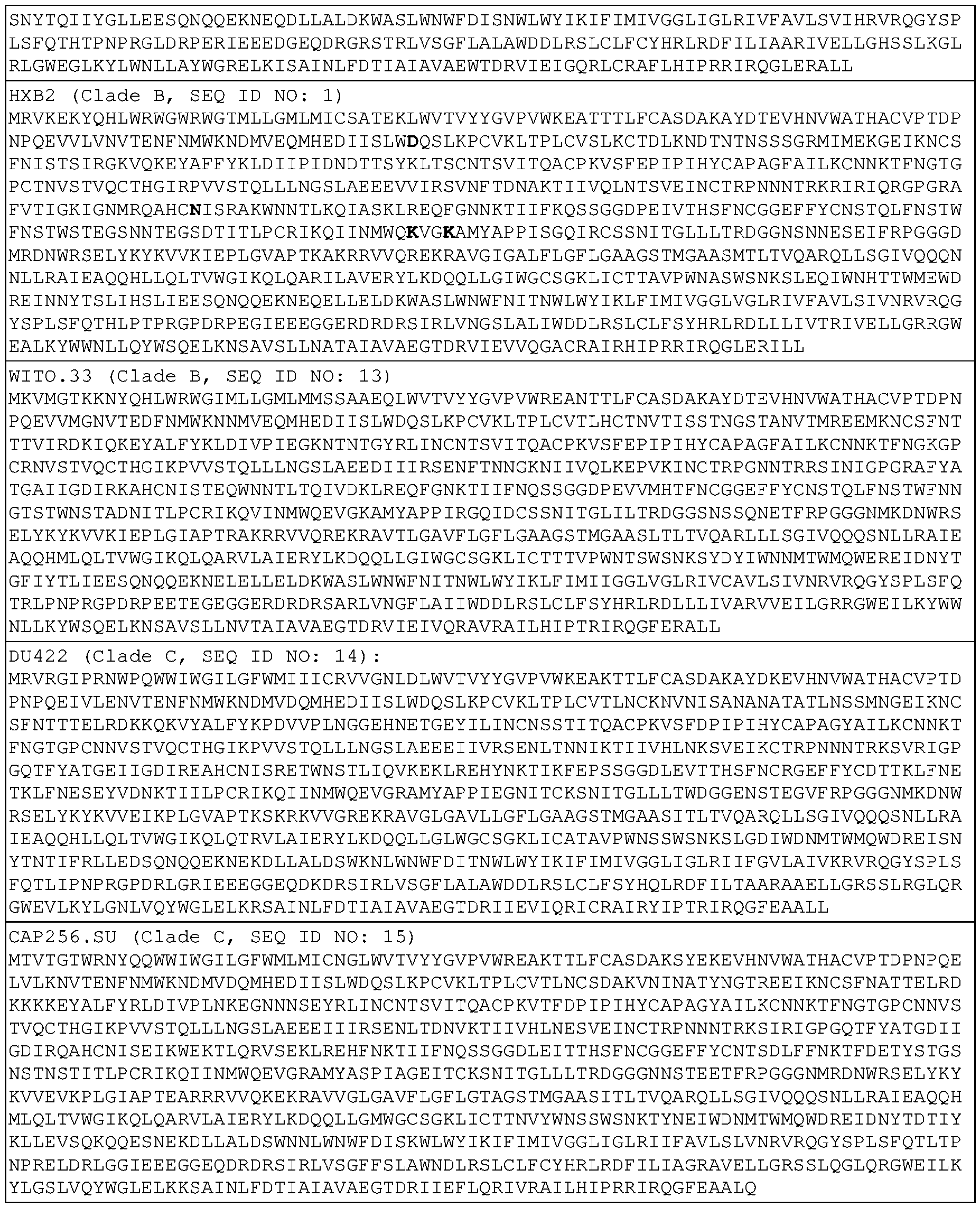
4239-110244-02 a TTT construct. The table below include consensus HIV-1 Env sequences for HIV-1 Env from different HIV-1 clades, which are considered “native” HIV-1 Env sequences herein. CONSENSUS_A1 (Clade A, SEQ ID NO: 3): MRVMGIQRNCQHLLRWGTMILGMIIICSAAENLWVTVYYGVPVWKDAETTLFCASDAKAYETEMHNVWATHACVPTDPN PQEIHLENVTEEFNMWKNNMVEQMHTDIISLWDQSLKPCVKLTPLCVTLNCSNVNVTNNTTNTHEEEIKNCSFNMTTEL V I N E W Q R L P T V I M L I Q G W N I T G N V L E G Q N K H A K K L L E A N I V K T K T

4239-110244-02 VWGIKQLQARILAVERYLKDQQLLGIWGCSGKHICTTTVPWNSSWSNKSLDEIWNNMTWMEWEREIDNYTGLIYSLIEE SQNQQEKNEQELLELDKWASLWNWFSITQWLWYIKIFIMIVGGLIGLRIVFAVLSLVNRVRQGYSPLSFQTLLPAPRGP DRPEGIEEEGGEQGRGRSIRLVNGFSALIWDDLRNLCLFSYHRLRDLILIAARIVELLGRRGWEALKYLWNLLQYWIQE N E S I P P Q N E L S I V D C T A E E L N I K G E L Q E L L P M K P N M N R Y E N RD P A S RD L I
4239-110244-02 SNYTQIIYGLLEESQNQQEKNEQDLLALDKWASLWNWFDISNWLWYIKIFIMIVGGLIGLRIVFAVLSVIHRVRQGYSP LSFQTHTPNPRGLDRPERIEEEDGEQDRGRSTRLVSGFLALAWDDLRSLCLFCYHRLRDFILIAARIVELLGHSSLKGL RLGWEGLKYLWNLLAYWGRELKISAINLFDTIAIAVAEWTDRVIEIGQRLCRAFLHIPRRIRQGLERALL P CS G A W D N D G W N T P A N S E T Q W D C T P E W A N S R E D S I S Y H Y P K
Exemplary sequences of recombinant HIV-1 Env trimers with protomers fused by glycan- sequon-containing peptide linker are provided as the following: > 6931-DS-TTT.14ln-1xAGly-ScFc3C-ASO (SEQ ID NO: 25) NLWVTVYYGVPVWKEAKTTLFCASDAKAYEKEVHNVWATHACVPTDPNPQEMVLENVTENFNMWKNDMVDQMHEDIISLW DQSLKPCVKLTPLCVTLNCTNVNVTNTNNNNMKEEMKNCSFNTTTEIRDKKQKEYALFYRLDIVPLNENSSEYRLINCNT
4239-110244-02 STcTQICPKVSFDPIPIHYCAPAGYAILKCNNKTFNGTGPCNNVSTVQCTHGIKPVVSTQLLLNGSLAEEEIIIRSENLT DNAKTIIVHLNESVEINCTRPNNMTRKSIRIGPGQTFYALGDIIGDIRQPHCNISEAKWNKTLQRVKKKLKEHFPNKTIK FAPSSGGDLEITTHSFNCRGEFFYCNTSKLFNSTYNNTTSNSTITLPCRIKQIINMWQEVGRcMYAPPIAGNITCKSNIT GLLLTRDGGNNNNNTETFRPGGGDMRDNWRSELYKYKVVEIKPLGIAPTKCKRRVVERRRRRRAVGLGAVFLGFLGAAGS TMGAASNTLTVQARQLLSGIVQQQSNLLRAPEAQQHMLQLGVWGFKQLQARVLAIERYLEVQQLLGIWGCSGKLICCTAV PWNSSWSNKSQEDIWDNMTWMQWDREIGNYTDTIYRLLEESQFQQEINEKDLLALDNGTSGGGGGGSGGGNLWVTVYYGV PVWKEAKTTLFCASDAKAYEKEVHNVWATHACVPTDPNPQEMVLENVTENFNMWKNDMVDQMHEDIISLWDQSLKPCVKL TPLCVTLNCTNVNVTNTNNNNMKEEMKNCSFNTTTEIRDKKQKEYALFYRLDIVPLNENSSEYRLINCNTSTcTQICPKV SFDPIPIHYCAPAGYAILKCNNKTFNGTGPCNNVSTVQCTHGIKPVVSTQLLLNGSLAEEEIIIRSENLTDNAKTIIVHL NESVEINCTRPNNMTRKSIRIGPGQTFYALGDIIGDIRQPHCNISEAKWNKTLQRVKKKLKEHFPNKTIKFAPSSGGDLE ITTHSFNCRGEFFYCNTSKLFNSTYNNTTSNSTITLPCRIKQIINMWQEVGRcMYAPPIAGNITCKSNITGLLLTRDGGN NNNNTETFRPGGGDMRDNWRSELYKYKVVEIKPLGIAPTKCKRRVVERRRRRRAVGLGAVFLGFLGAAGSTMGAASNTLT VQARQLLSGIVQQQSNLLRAPEAQQHMLQLGVWGFKQLQARVLAIERYLEVQQLLGIWGCSGKLICCTAVPWNSSWSNKS QEDIWDNMTWMQWDREIGNYTDTIYRLLEESQFQQEINEKDLLALDNGTSGGGGGGSGGGNLWVTVYYGVPVWKEAKTTL
FCASDAKAYEKEVHNVWATHACVPTDPNPQEMVLENVTENFNMWKNDMVDQMHEDIISLWDQSLKPCVKLTPLCVTLNCT NVNVTNTNNNNMKEEMKNCSFNTTTEIRDKKQKEYALFYRLDIVPLNENSSEYRLINCNTSTcTQICPKVSFDPIPIHYC APAGYAILKCNNKTFNGTGPCNNVSTVQCTHGIKPVVSTQLLLNGSLAEEEIIIRSENLTDNAKTIIVHLNESVEINCTR PNNMTRKSIRIGPGQTFYALGDIIGDIRQPHCNISEAKWNKTLQRVKKKLKEHFPNKTIKFAPSSGGDLEITTHSFNCRG EFFYCNTSKLFNSTYNNTTSNSTITLPCRIKQIINMWQEVGRcMYAPPIAGNITCKSNITGLLLTRDGGNNNNNTETFRP
GGGDMRDNWRSELYKYKVVEIKPLGIAPTKCKRRVVERRRRRRAVGLGAVFLGFLGAAGSTMGAASNTLTVQARQLLSGI VQQQSNLLRAPEAQQHMLQLGVWGFKQLQARVLAIERYLEVQQLLGIWGCSGKLICCTAVPWNSSWSNKSQEDIWDNMTW MQWDREIGNYTDTIYRLLEESQFQQEINEKDLLALD > 6931-DS-TTT.14ln-1xBGly-ScFc3C-ASO (SEQ ID NO: 26) NLWVTVYYGVPVWKEAKTTLFCASDAKAYEKEVHNVWATHACVPTDPNPQEMVLENVTENFNMWKNDMVDQMHEDIISLW DQSLKPCVKLTPLCVTLNCTNVNVTNTNNNNMKEEMKNCSFNTTTEIRDKKQKEYALFYRLDIVPLNENSSEYRLINCNT STcTQICPKVSFDPIPIHYCAPAGYAILKCNNKTFNGTGPCNNVSTVQCTHGIKPVVSTQLLLNGSLAEEEIIIRSENLT DNAKTIIVHLNESVEINCTRPNNMTRKSIRIGPGQTFYALGDIIGDIRQPHCNISEAKWNKTLQRVKKKLKEHFPNKTIK FAPSSGGDLEITTHSFNCRGEFFYCNTSKLFNSTYNNTTSNSTITLPCRIKQIINMWQEVGRcMYAPPIAGNITCKSNIT GLLLTRDGGNNNNNTETFRPGGGDMRDNWRSELYKYKVVEIKPLGIAPTKCKRRVVERRRRRRAVGLGAVFLGFLGAAGS TMGAASNTLTVQARQLLSGIVQQQSNLLRAPEAQQHMLQLGVWGFKQLQARVLAIERYLEVQQLLGIWGCSGKLICCTAV PWNSSWSNKSQEDIWDNMTWMQWDREIGNYTDTIYRLLEESQFQQEINEKDLLALDGGGSGGGGGGSNGTNLWVTVYYGV PVWKEAKTTLFCASDAKAYEKEVHNVWATHACVPTDPNPQEMVLENVTENFNMWKNDMVDQMHEDIISLWDQSLKPCVKL TPLCVTLNCTNVNVTNTNNNNMKEEMKNCSFNTTTEIRDKKQKEYALFYRLDIVPLNENSSEYRLINCNTSTcTQICPKV SFDPIPIHYCAPAGYAILKCNNKTFNGTGPCNNVSTVQCTHGIKPVVSTQLLLNGSLAEEEIIIRSENLTDNAKTIIVHL NESVEINCTRPNNMTRKSIRIGPGQTFYALGDIIGDIRQPHCNISEAKWNKTLQRVKKKLKEHFPNKTIKFAPSSGGDLE ITTHSFNCRGEFFYCNTSKLFNSTYNNTTSNSTITLPCRIKQIINMWQEVGRcMYAPPIAGNITCKSNITGLLLTRDGGN NNNNTETFRPGGGDMRDNWRSELYKYKVVEIKPLGIAPTKCKRRVVERRRRRRAVGLGAVFLGFLGAAGSTMGAASNTLT VQARQLLSGIVQQQSNLLRAPEAQQHMLQLGVWGFKQLQARVLAIERYLEVQQLLGIWGCSGKLICCTAVPWNSSWSNKS
QEDIWDNMTWMQWDREIGNYTDTIYRLLEESQFQQEINEKDLLALDGGGSGGGGGGSNGTNLWVTVYYGVPVWKEAKTTL FCASDAKAYEKEVHNVWATHACVPTDPNPQEMVLENVTENFNMWKNDMVDQMHEDIISLWDQSLKPCVKLTPLCVTLNCT NVNVTNTNNNNMKEEMKNCSFNTTTEIRDKKQKEYALFYRLDIVPLNENSSEYRLINCNTSTcTQICPKVSFDPIPIHYC APAGYAILKCNNKTFNGTGPCNNVSTVQCTHGIKPVVSTQLLLNGSLAEEEIIIRSENLTDNAKTIIVHLNESVEINCTR PNNMTRKSIRIGPGQTFYALGDIIGDIRQPHCNISEAKWNKTLQRVKKKLKEHFPNKTIKFAPSSGGDLEITTHSFNCRG EFFYCNTSKLFNSTYNNTTSNSTITLPCRIKQIINMWQEVGRcMYAPPIAGNITCKSNITGLLLTRDGGNNNNNTETFRP GGGDMRDNWRSELYKYKVVEIKPLGIAPTKCKRRVVERRRRRRAVGLGAVFLGFLGAAGSTMGAASNTLTVQARQLLSGI VQQQSNLLRAPEAQQHMLQLGVWGFKQLQARVLAIERYLEVQQLLGIWGCSGKLICCTAVPWNSSWSNKSQEDIWDNMTW MQWDREIGNYTDTIYRLLEESQFQQEINEKDLLALD > 6931-DS-TTT.14ln-2xGly-ScFc3C-ASO (SEQ ID NO: 27) NLWVTVYYGVPVWKEAKTTLFCASDAKAYEKEVHNVWATHACVPTDPNPQEMVLENVTENFNMWKNDMVDQMHEDIISLW DQSLKPCVKLTPLCVTLNCTNVNVTNTNNNNMKEEMKNCSFNTTTEIRDKKQKEYALFYRLDIVPLNENSSEYRLINCNT STcTQICPKVSFDPIPIHYCAPAGYAILKCNNKTFNGTGPCNNVSTVQCTHGIKPVVSTQLLLNGSLAEEEIIIRSENLT DNAKTIIVHLNESVEINCTRPNNMTRKSIRIGPGQTFYALGDIIGDIRQPHCNISEAKWNKTLQRVKKKLKEHFPNKTIK FAPSSGGDLEITTHSFNCRGEFFYCNTSKLFNSTYNNTTSNSTITLPCRIKQIINMWQEVGRcMYAPPIAGNITCKSNIT GLLLTRDGGNNNNNTETFRPGGGDMRDNWRSELYKYKVVEIKPLGIAPTKCKRRVVERRRRRRAVGLGAVFLGFLGAAGS TMGAASNTLTVQARQLLSGIVQQQSNLLRAPEAQQHMLQLGVWGFKQLQARVLAIERYLEVQQLLGIWGCSGKLICCTAV PWNSSWSNKSQEDIWDNMTWMQWDREIGNYTDTIYRLLEESQFQQEINEKDLLALDNGTSGGGGGGSNGTNLWVTVYYGV PVWKEAKTTLFCASDAKAYEKEVHNVWATHACVPTDPNPQEMVLENVTENFNMWKNDMVDQMHEDIISLWDQSLKPCVKL
TPLCVTLNCTNVNVTNTNNNNMKEEMKNCSFNTTTEIRDKKQKEYALFYRLDIVPLNENSSEYRLINCNTSTcTQICPKV SFDPIPIHYCAPAGYAILKCNNKTFNGTGPCNNVSTVQCTHGIKPVVSTQLLLNGSLAEEEIIIRSENLTDNAKTIIVHL NESVEINCTRPNNMTRKSIRIGPGQTFYALGDIIGDIRQPHCNISEAKWNKTLQRVKKKLKEHFPNKTIKFAPSSGGDLE
4239-110244-02 ITTHSFNCRGEFFYCNTSKLFNSTYNNTTSNSTITLPCRIKQIINMWQEVGRcMYAPPIAGNITCKSNITGLLLTRDGGN NNNNTETFRPGGGDMRDNWRSELYKYKVVEIKPLGIAPTKCKRRVVERRRRRRAVGLGAVFLGFLGAAGSTMGAASNTLT VQARQLLSGIVQQQSNLLRAPEAQQHMLQLGVWGFKQLQARVLAIERYLEVQQLLGIWGCSGKLICCTAVPWNSSWSNKS QEDIWDNMTWMQWDREIGNYTDTIYRLLEESQFQQEINEKDLLALDNGTSGGGGGGSNGTNLWVTVYYGVPVWKEAKTTL FCASDAKAYEKEVHNVWATHACVPTDPNPQEMVLENVTENFNMWKNDMVDQMHEDIISLWDQSLKPCVKLTPLCVTLNCT NVNVTNTNNNNMKEEMKNCSFNTTTEIRDKKQKEYALFYRLDIVPLNENSSEYRLINCNTSTcTQICPKVSFDPIPIHYC APAGYAILKCNNKTFNGTGPCNNVSTVQCTHGIKPVVSTQLLLNGSLAEEEIIIRSENLTDNAKTIIVHLNESVEINCTR PNNMTRKSIRIGPGQTFYALGDIIGDIRQPHCNISEAKWNKTLQRVKKKLKEHFPNKTIKFAPSSGGDLEITTHSFNCRG EFFYCNTSKLFNSTYNNTTSNSTITLPCRIKQIINMWQEVGRcMYAPPIAGNITCKSNITGLLLTRDGGNNNNNTETFRP GGGDMRDNWRSELYKYKVVEIKPLGIAPTKCKRRVVERRRRRRAVGLGAVFLGFLGAAGSTMGAASNTLTVQARQLLSGI VQQQSNLLRAPEAQQHMLQLGVWGFKQLQARVLAIERYLEVQQLLGIWGCSGKLICCTAVPWNSSWSNKSQEDIWDNMTW MQWDREIGNYTDTIYRLLEESQFQQEINEKDLLALD > 6931-DS-TTT.14ln-3xGly-ScFc3C-ASO (SEQ ID NO: 28)
NLWVTVYYGVPVWKEAKTTLFCASDAKAYEKEVHNVWATHACVPTDPNPQEMVLENVTENFNMWKNDMVDQMHEDIISLW DQSLKPCVKLTPLCVTLNCTNVNVTNTNNNNMKEEMKNCSFNTTTEIRDKKQKEYALFYRLDIVPLNENSSEYRLINCNT STcTQICPKVSFDPIPIHYCAPAGYAILKCNNKTFNGTGPCNNVSTVQCTHGIKPVVSTQLLLNGSLAEEEIIIRSENLT DNAKTIIVHLNESVEINCTRPNNMTRKSIRIGPGQTFYALGDIIGDIRQPHCNISEAKWNKTLQRVKKKLKEHFPNKTIK FAPSSGGDLEITTHSFNCRGEFFYCNTSKLFNSTYNNTTSNSTITLPCRIKQIINMWQEVGRcMYAPPIAGNITCKSNIT
GLLLTRDGGNNNNNTETFRPGGGDMRDNWRSELYKYKVVEIKPLGIAPTKCKRRVVERRRRRRAVGLGAVFLGFLGAAGS TMGAASNTLTVQARQLLSGIVQQQSNLLRAPEAQQHMLQLGVWGFKQLQARVLAIERYLEVQQLLGIWGCSGKLICCTAV PWNSSWSNKSQEDIWDNMTWMQWDREIGNYTDTIYRLLEESQFQQEINEKDLLALDNGTSGGNGTGSNGTNLWVTVYYGV PVWKEAKTTLFCASDAKAYEKEVHNVWATHACVPTDPNPQEMVLENVTENFNMWKNDMVDQMHEDIISLWDQSLKPCVKL TPLCVTLNCTNVNVTNTNNNNMKEEMKNCSFNTTTEIRDKKQKEYALFYRLDIVPLNENSSEYRLINCNTSTcTQICPKV SFDPIPIHYCAPAGYAILKCNNKTFNGTGPCNNVSTVQCTHGIKPVVSTQLLLNGSLAEEEIIIRSENLTDNAKTIIVHL NESVEINCTRPNNMTRKSIRIGPGQTFYALGDIIGDIRQPHCNISEAKWNKTLQRVKKKLKEHFPNKTIKFAPSSGGDLE ITTHSFNCRGEFFYCNTSKLFNSTYNNTTSNSTITLPCRIKQIINMWQEVGRcMYAPPIAGNITCKSNITGLLLTRDGGN NNNNTETFRPGGGDMRDNWRSELYKYKVVEIKPLGIAPTKCKRRVVERRRRRRAVGLGAVFLGFLGAAGSTMGAASNTLT VQARQLLSGIVQQQSNLLRAPEAQQHMLQLGVWGFKQLQARVLAIERYLEVQQLLGIWGCSGKLICCTAVPWNSSWSNKS QEDIWDNMTWMQWDREIGNYTDTIYRLLEESQFQQEINEKDLLALDNGTSGGNGTGSNGTNLWVTVYYGVPVWKEAKTTL FCASDAKAYEKEVHNVWATHACVPTDPNPQEMVLENVTENFNMWKNDMVDQMHEDIISLWDQSLKPCVKLTPLCVTLNCT NVNVTNTNNNNMKEEMKNCSFNTTTEIRDKKQKEYALFYRLDIVPLNENSSEYRLINCNTSTcTQICPKVSFDPIPIHYC APAGYAILKCNNKTFNGTGPCNNVSTVQCTHGIKPVVSTQLLLNGSLAEEEIIIRSENLTDNAKTIIVHLNESVEINCTR PNNMTRKSIRIGPGQTFYALGDIIGDIRQPHCNISEAKWNKTLQRVKKKLKEHFPNKTIKFAPSSGGDLEITTHSFNCRG EFFYCNTSKLFNSTYNNTTSNSTITLPCRIKQIINMWQEVGRcMYAPPIAGNITCKSNITGLLLTRDGGNNNNNTETFRP GGGDMRDNWRSELYKYKVVEIKPLGIAPTKCKRRVVERRRRRRAVGLGAVFLGFLGAAGSTMGAASNTLTVQARQLLSGI VQQQSNLLRAPEAQQHMLQLGVWGFKQLQARVLAIERYLEVQQLLGIWGCSGKLICCTAVPWNSSWSNKSQEDIWDNMTW MQWDREIGNYTDTIYRLLEESQFQQEINEKDLLALD
> 6931-DS-TTT.14ln-N28-3xGly-ScFc3C-ASO (SEQ ID NO: 29) NGTNLWVTVYYGVPVWKEAKTTLFCASDAKAYEKEVHNVWATHACVPTDPNPQEMVLENVTENFNMWKNDMVDQMHEDII SLWDQSLKPCVKLTPLCVTLNCTNVNVTNTNNNNMKEEMKNCSFNTTTEIRDKKQKEYALFYRLDIVPLNENSSEYRLIN CNTSTcTQICPKVSFDPIPIHYCAPAGYAILKCNNKTFNGTGPCNNVSTVQCTHGIKPVVSTQLLLNGSLAEEEIIIRSE NLTDNAKTIIVHLNESVEINCTRPNNMTRKSIRIGPGQTFYALGDIIGDIRQPHCNISEAKWNKTLQRVKKKLKEHFPNK TIKFAPSSGGDLEITTHSFNCRGEFFYCNTSKLFNSTYNNTTSNSTITLPCRIKQIINMWQEVGRcMYAPPIAGNITCKS NITGLLLTRDGGNNNNNTETFRPGGGDMRDNWRSELYKYKVVEIKPLGIAPTKCKRRVVERRRRRRAVGLGAVFLGFLGA AGSTMGAASNTLTVQARQLLSGIVQQQSNLLRAPEAQQHMLQLGVWGFKQLQARVLAIERYLEVQQLLGIWGCSGKLICC TAVPWNSSWSNKSQEDIWDNMTWMQWDREIGNYTDTIYRLLEESQFQQEINEKDLLALDNGTSGGNGTGSNGTNLWVTVY YGVPVWKEAKTTLFCASDAKAYEKEVHNVWATHACVPTDPNPQEMVLENVTENFNMWKNDMVDQMHEDIISLWDQSLKPC VKLTPLCVTLNCTNVNVTNTNNNNMKEEMKNCSFNTTTEIRDKKQKEYALFYRLDIVPLNENSSEYRLINCNTSTcTQIC PKVSFDPIPIHYCAPAGYAILKCNNKTFNGTGPCNNVSTVQCTHGIKPVVSTQLLLNGSLAEEEIIIRSENLTDNAKTII VHLNESVEINCTRPNNMTRKSIRIGPGQTFYALGDIIGDIRQPHCNISEAKWNKTLQRVKKKLKEHFPNKTIKFAPSSGG DLEITTHSFNCRGEFFYCNTSKLFNSTYNNTTSNSTITLPCRIKQIINMWQEVGRcMYAPPIAGNITCKSNITGLLLTRD GGNNNNNTETFRPGGGDMRDNWRSELYKYKVVEIKPLGIAPTKCKRRVVERRRRRRAVGLGAVFLGFLGAAGSTMGAASN TLTVQARQLLSGIVQQQSNLLRAPEAQQHMLQLGVWGFKQLQARVLAIERYLEVQQLLGIWGCSGKLICCTAVPWNSSWS NKSQEDIWDNMTWMQWDREIGNYTDTIYRLLEESQFQQEINEKDLLALDNGTSGGNGTGSNGTNLWVTVYYGVPVWKEAK TTLFCASDAKAYEKEVHNVWATHACVPTDPNPQEMVLENVTENFNMWKNDMVDQMHEDIISLWDQSLKPCVKLTPLCVTL NCTNVNVTNTNNNNMKEEMKNCSFNTTTEIRDKKQKEYALFYRLDIVPLNENSSEYRLINCNTSTcTQICPKVSFDPIPI HYCAPAGYAILKCNNKTFNGTGPCNNVSTVQCTHGIKPVVSTQLLLNGSLAEEEIIIRSENLTDNAKTIIVHLNESVEIN
CTRPNNMTRKSIRIGPGQTFYALGDIIGDIRQPHCNISEAKWNKTLQRVKKKLKEHFPNKTIKFAPSSGGDLEITTHSFN CRGEFFYCNTSKLFNSTYNNTTSNSTITLPCRIKQIINMWQEVGRcMYAPPIAGNITCKSNITGLLLTRDGGNNNNNTET FRPGGGDMRDNWRSELYKYKVVEIKPLGIAPTKCKRRVVERRRRRRAVGLGAVFLGFLGAAGSTMGAASNTLTVQARQLL
4239-110244-02 SGIVQQQSNLLRAPEAQQHMLQLGVWGFKQLQARVLAIERYLEVQQLLGIWGCSGKLICCTAVPWNSSWSNKSQEDIWDN MTWMQWDREIGNYTDTIYRLLEESQFQQEINEKDLLALD > JRFL-RnS.14ln-1xAGly-ScFc3C-ASO (SEQ ID NO: 30) VEKLWVTVYYGVPVWKEATTTLFCASDAKAYDTEVHNVWATHACVPTDPNPQEVVLENVTENFNMWKNNMVEQMQEDIIS LWDQSLKPCVKLTPLCVTLNCTDVNATNTTNDSEGTMERGEIKNCSFNITTSIRDKVQKEYALFYKLDVVPIDNNNTSYR LISCNTSVCTQACPKISFEPIPIHYCAPAGFAILKCNDKTFNGKGPCKNVSTVQCTHGIRPVVSTQLLLNGSLAEEEVVI RSDNFTNNAKTIIVQLKESVEINCTRPNNMTRKSIHIGPGRAFYTLGEIIGDIRQPHCNISRAKWNDTLKQIVIKLREQF ENKTIVFNHSSGGDPEIVMHSFNCGGEFFYCNSTQLFNSTWNNNTEGSNNTEGNTITLPCRIKQIINMWQEVGKCMYAPP IRGQIRCSSNITGLLLTRDGGINENGTEIFRPGGGDMRDNWRSELYKYKVVKIEPLGVAPTKCKRRVVQRRRRRRAVGIG AVFLGFLGAAGSTMGAASNTLTVQARLLLSGIVQQQNNLLRAPEAQQRMLQLGVWGIKQLQARVLAVERYLEVQQLLGIW GCSGKLICCTAVPWNATWSNKTLDRIWNNMTWMEWEREIGNYTSEIYTLIEESQFQQEINEQELLELDNGTSGGGGGGSG GGVEKLWVTVYYGVPVWKEATTTLFCASDAKAYDTEVHNVWATHACVPTDPNPQEVVLENVTENFNMWKNNMVEQMQEDI ISLWDQSLKPCVKLTPLCVTLNCTDVNATNTTNDSEGTMERGEIKNCSFNITTSIRDKVQKEYALFYKLDVVPIDNNNTS YRLISCNTSVCTQACPKISFEPIPIHYCAPAGFAILKCNDKTFNGKGPCKNVSTVQCTHGIRPVVSTQLLLNGSLAEEEV VIRSDNFTNNAKTIIVQLKESVEINCTRPNNMTRKSIHIGPGRAFYTLGEIIGDIRQPHCNISRAKWNDTLKQIVIKLRE QFENKTIVFNHSSGGDPEIVMHSFNCGGEFFYCNSTQLFNSTWNNNTEGSNNTEGNTITLPCRIKQIINMWQEVGKCMYA PPIRGQIRCSSNITGLLLTRDGGINENGTEIFRPGGGDMRDNWRSELYKYKVVKIEPLGVAPTKCKRRVVQRRRRRRAVG IGAVFLGFLGAAGSTMGAASNTLTVQARLLLSGIVQQQNNLLRAPEAQQRMLQLGVWGIKQLQARVLAVERYLEVQQLLG IWGCSGKLICCTAVPWNATWSNKTLDRIWNNMTWMEWEREIGNYTSEIYTLIEESQFQQEINEQELLELDNGTSGGGGGG SGGGVEKLWVTVYYGVPVWKEATTTLFCASDAKAYDTEVHNVWATHACVPTDPNPQEVVLENVTENFNMWKNNMVEQMQE DIISLWDQSLKPCVKLTPLCVTLNCTDVNATNTTNDSEGTMERGEIKNCSFNITTSIRDKVQKEYALFYKLDVVPIDNNN TSYRLISCNTSVCTQACPKISFEPIPIHYCAPAGFAILKCNDKTFNGKGPCKNVSTVQCTHGIRPVVSTQLLLNGSLAEE EVVIRSDNFTNNAKTIIVQLKESVEINCTRPNNMTRKSIHIGPGRAFYTLGEIIGDIRQPHCNISRAKWNDTLKQIVIKL REQFENKTIVFNHSSGGDPEIVMHSFNCGGEFFYCNSTQLFNSTWNNNTEGSNNTEGNTITLPCRIKQIINMWQEVGKCM YAPPIRGQIRCSSNITGLLLTRDGGINENGTEIFRPGGGDMRDNWRSELYKYKVVKIEPLGVAPTKCKRRVVQRRRRRRA VGIGAVFLGFLGAAGSTMGAASNTLTVQARLLLSGIVQQQNNLLRAPEAQQRMLQLGVWGIKQLQARVLAVERYLEVQQL LGIWGCSGKLICCTAVPWNATWSNKTLDRIWNNMTWMEWEREIGNYTSEIYTLIEESQFQQEINEQELLELD > JRFL-RnS.14ln-1xBGly-ScFc3C-ASO (SEQ ID NO: 31) VEKLWVTVYYGVPVWKEATTTLFCASDAKAYDTEVHNVWATHACVPTDPNPQEVVLENVTENFNMWKNNMVEQMQEDIIS LWDQSLKPCVKLTPLCVTLNCTDVNATNTTNDSEGTMERGEIKNCSFNITTSIRDKVQKEYALFYKLDVVPIDNNNTSYR LISCNTSVCTQACPKISFEPIPIHYCAPAGFAILKCNDKTFNGKGPCKNVSTVQCTHGIRPVVSTQLLLNGSLAEEEVVI RSDNFTNNAKTIIVQLKESVEINCTRPNNMTRKSIHIGPGRAFYTLGEIIGDIRQPHCNISRAKWNDTLKQIVIKLREQF ENKTIVFNHSSGGDPEIVMHSFNCGGEFFYCNSTQLFNSTWNNNTEGSNNTEGNTITLPCRIKQIINMWQEVGKCMYAPP IRGQIRCSSNITGLLLTRDGGINENGTEIFRPGGGDMRDNWRSELYKYKVVKIEPLGVAPTKCKRRVVQRRRRRRAVGIG AVFLGFLGAAGSTMGAASNTLTVQARLLLSGIVQQQNNLLRAPEAQQRMLQLGVWGIKQLQARVLAVERYLEVQQLLGIW GCSGKLICCTAVPWNATWSNKTLDRIWNNMTWMEWEREIGNYTSEIYTLIEESQFQQEINEQELLELDGGGSGGGGGGSN GTVEKLWVTVYYGVPVWKEATTTLFCASDAKAYDTEVHNVWATHACVPTDPNPQEVVLENVTENFNMWKNNMVEQMQEDI ISLWDQSLKPCVKLTPLCVTLNCTDVNATNTTNDSEGTMERGEIKNCSFNITTSIRDKVQKEYALFYKLDVVPIDNNNTS YRLISCNTSVCTQACPKISFEPIPIHYCAPAGFAILKCNDKTFNGKGPCKNVSTVQCTHGIRPVVSTQLLLNGSLAEEEV VIRSDNFTNNAKTIIVQLKESVEINCTRPNNMTRKSIHIGPGRAFYTLGEIIGDIRQPHCNISRAKWNDTLKQIVIKLRE QFENKTIVFNHSSGGDPEIVMHSFNCGGEFFYCNSTQLFNSTWNNNTEGSNNTEGNTITLPCRIKQIINMWQEVGKCMYA PPIRGQIRCSSNITGLLLTRDGGINENGTEIFRPGGGDMRDNWRSELYKYKVVKIEPLGVAPTKCKRRVVQRRRRRRAVG IGAVFLGFLGAAGSTMGAASNTLTVQARLLLSGIVQQQNNLLRAPEAQQRMLQLGVWGIKQLQARVLAVERYLEVQQLLG IWGCSGKLICCTAVPWNATWSNKTLDRIWNNMTWMEWEREIGNYTSEIYTLIEESQFQQEINEQELLELDGGGSGGGGGG SNGTVEKLWVTVYYGVPVWKEATTTLFCASDAKAYDTEVHNVWATHACVPTDPNPQEVVLENVTENFNMWKNNMVEQMQE DIISLWDQSLKPCVKLTPLCVTLNCTDVNATNTTNDSEGTMERGEIKNCSFNITTSIRDKVQKEYALFYKLDVVPIDNNN TSYRLISCNTSVCTQACPKISFEPIPIHYCAPAGFAILKCNDKTFNGKGPCKNVSTVQCTHGIRPVVSTQLLLNGSLAEE EVVIRSDNFTNNAKTIIVQLKESVEINCTRPNNMTRKSIHIGPGRAFYTLGEIIGDIRQPHCNISRAKWNDTLKQIVIKL REQFENKTIVFNHSSGGDPEIVMHSFNCGGEFFYCNSTQLFNSTWNNNTEGSNNTEGNTITLPCRIKQIINMWQEVGKCM YAPPIRGQIRCSSNITGLLLTRDGGINENGTEIFRPGGGDMRDNWRSELYKYKVVKIEPLGVAPTKCKRRVVQRRRRRRA VGIGAVFLGFLGAAGSTMGAASNTLTVQARLLLSGIVQQQNNLLRAPEAQQRMLQLGVWGIKQLQARVLAVERYLEVQQL LGIWGCSGKLICCTAVPWNATWSNKTLDRIWNNMTWMEWEREIGNYTSEIYTLIEESQFQQEINEQELLELD > JRFL-RnS.14ln-2xGly-ScFc3C-ASO (SEQ ID NO: 32) VEKLWVTVYYGVPVWKEATTTLFCASDAKAYDTEVHNVWATHACVPTDPNPQEVVLENVTENFNMWKNNMVEQMQEDIIS LWDQSLKPCVKLTPLCVTLNCTDVNATNTTNDSEGTMERGEIKNCSFNITTSIRDKVQKEYALFYKLDVVPIDNNNTSYR
4239-110244-02 LISCNTSVCTQACPKISFEPIPIHYCAPAGFAILKCNDKTFNGKGPCKNVSTVQCTHGIRPVVSTQLLLNGSLAEEEVVI RSDNFTNNAKTIIVQLKESVEINCTRPNNMTRKSIHIGPGRAFYTLGEIIGDIRQPHCNISRAKWNDTLKQIVIKLREQF ENKTIVFNHSSGGDPEIVMHSFNCGGEFFYCNSTQLFNSTWNNNTEGSNNTEGNTITLPCRIKQIINMWQEVGKCMYAPP IRGQIRCSSNITGLLLTRDGGINENGTEIFRPGGGDMRDNWRSELYKYKVVKIEPLGVAPTKCKRRVVQRRRRRRAVGIG AVFLGFLGAAGSTMGAASNTLTVQARLLLSGIVQQQNNLLRAPEAQQRMLQLGVWGIKQLQARVLAVERYLEVQQLLGIW GCSGKLICCTAVPWNATWSNKTLDRIWNNMTWMEWEREIGNYTSEIYTLIEESQFQQEINEQELLELDNGTSGGGGGGSN GTVEKLWVTVYYGVPVWKEATTTLFCASDAKAYDTEVHNVWATHACVPTDPNPQEVVLENVTENFNMWKNNMVEQMQEDI ISLWDQSLKPCVKLTPLCVTLNCTDVNATNTTNDSEGTMERGEIKNCSFNITTSIRDKVQKEYALFYKLDVVPIDNNNTS YRLISCNTSVCTQACPKISFEPIPIHYCAPAGFAILKCNDKTFNGKGPCKNVSTVQCTHGIRPVVSTQLLLNGSLAEEEV VIRSDNFTNNAKTIIVQLKESVEINCTRPNNMTRKSIHIGPGRAFYTLGEIIGDIRQPHCNISRAKWNDTLKQIVIKLRE QFENKTIVFNHSSGGDPEIVMHSFNCGGEFFYCNSTQLFNSTWNNNTEGSNNTEGNTITLPCRIKQIINMWQEVGKCMYA PPIRGQIRCSSNITGLLLTRDGGINENGTEIFRPGGGDMRDNWRSELYKYKVVKIEPLGVAPTKCKRRVVQRRRRRRAVG IGAVFLGFLGAAGSTMGAASNTLTVQARLLLSGIVQQQNNLLRAPEAQQRMLQLGVWGIKQLQARVLAVERYLEVQQLLG IWGCSGKLICCTAVPWNATWSNKTLDRIWNNMTWMEWEREIGNYTSEIYTLIEESQFQQEINEQELLELDNGTSGGGGGG SNGTVEKLWVTVYYGVPVWKEATTTLFCASDAKAYDTEVHNVWATHACVPTDPNPQEVVLENVTENFNMWKNNMVEQMQE DIISLWDQSLKPCVKLTPLCVTLNCTDVNATNTTNDSEGTMERGEIKNCSFNITTSIRDKVQKEYALFYKLDVVPIDNNN TSYRLISCNTSVCTQACPKISFEPIPIHYCAPAGFAILKCNDKTFNGKGPCKNVSTVQCTHGIRPVVSTQLLLNGSLAEE EVVIRSDNFTNNAKTIIVQLKESVEINCTRPNNMTRKSIHIGPGRAFYTLGEIIGDIRQPHCNISRAKWNDTLKQIVIKL REQFENKTIVFNHSSGGDPEIVMHSFNCGGEFFYCNSTQLFNSTWNNNTEGSNNTEGNTITLPCRIKQIINMWQEVGKCM YAPPIRGQIRCSSNITGLLLTRDGGINENGTEIFRPGGGDMRDNWRSELYKYKVVKIEPLGVAPTKCKRRVVQRRRRRRA VGIGAVFLGFLGAAGSTMGAASNTLTVQARLLLSGIVQQQNNLLRAPEAQQRMLQLGVWGIKQLQARVLAVERYLEVQQL LGIWGCSGKLICCTAVPWNATWSNKTLDRIWNNMTWMEWEREIGNYTSEIYTLIEESQFQQEINEQELLELD > JRFL-RnS.14ln-3xGly-ScFc3C-ASO (SEQ ID NO: 33) VEKLWVTVYYGVPVWKEATTTLFCASDAKAYDTEVHNVWATHACVPTDPNPQEVVLENVTENFNMWKNNMVEQMQEDIIS LWDQSLKPCVKLTPLCVTLNCTDVNATNTTNDSEGTMERGEIKNCSFNITTSIRDKVQKEYALFYKLDVVPIDNNNTSYR LISCNTSVCTQACPKISFEPIPIHYCAPAGFAILKCNDKTFNGKGPCKNVSTVQCTHGIRPVVSTQLLLNGSLAEEEVVI RSDNFTNNAKTIIVQLKESVEINCTRPNNMTRKSIHIGPGRAFYTLGEIIGDIRQPHCNISRAKWNDTLKQIVIKLREQF ENKTIVFNHSSGGDPEIVMHSFNCGGEFFYCNSTQLFNSTWNNNTEGSNNTEGNTITLPCRIKQIINMWQEVGKCMYAPP IRGQIRCSSNITGLLLTRDGGINENGTEIFRPGGGDMRDNWRSELYKYKVVKIEPLGVAPTKCKRRVVQRRRRRRAVGIG AVFLGFLGAAGSTMGAASNTLTVQARLLLSGIVQQQNNLLRAPEAQQRMLQLGVWGIKQLQARVLAVERYLEVQQLLGIW GCSGKLICCTAVPWNATWSNKTLDRIWNNMTWMEWEREIGNYTSEIYTLIEESQFQQEINEQELLELDNGTSGGNGTGSN GTVEKLWVTVYYGVPVWKEATTTLFCASDAKAYDTEVHNVWATHACVPTDPNPQEVVLENVTENFNMWKNNMVEQMQEDI ISLWDQSLKPCVKLTPLCVTLNCTDVNATNTTNDSEGTMERGEIKNCSFNITTSIRDKVQKEYALFYKLDVVPIDNNNTS YRLISCNTSVCTQACPKISFEPIPIHYCAPAGFAILKCNDKTFNGKGPCKNVSTVQCTHGIRPVVSTQLLLNGSLAEEEV VIRSDNFTNNAKTIIVQLKESVEINCTRPNNMTRKSIHIGPGRAFYTLGEIIGDIRQPHCNISRAKWNDTLKQIVIKLRE QFENKTIVFNHSSGGDPEIVMHSFNCGGEFFYCNSTQLFNSTWNNNTEGSNNTEGNTITLPCRIKQIINMWQEVGKCMYA PPIRGQIRCSSNITGLLLTRDGGINENGTEIFRPGGGDMRDNWRSELYKYKVVKIEPLGVAPTKCKRRVVQRRRRRRAVG IGAVFLGFLGAAGSTMGAASNTLTVQARLLLSGIVQQQNNLLRAPEAQQRMLQLGVWGIKQLQARVLAVERYLEVQQLLG IWGCSGKLICCTAVPWNATWSNKTLDRIWNNMTWMEWEREIGNYTSEIYTLIEESQFQQEINEQELLELDNGTSGGNGTG SNGTVEKLWVTVYYGVPVWKEATTTLFCASDAKAYDTEVHNVWATHACVPTDPNPQEVVLENVTENFNMWKNNMVEQMQE DIISLWDQSLKPCVKLTPLCVTLNCTDVNATNTTNDSEGTMERGEIKNCSFNITTSIRDKVQKEYALFYKLDVVPIDNNN TSYRLISCNTSVCTQACPKISFEPIPIHYCAPAGFAILKCNDKTFNGKGPCKNVSTVQCTHGIRPVVSTQLLLNGSLAEE EVVIRSDNFTNNAKTIIVQLKESVEINCTRPNNMTRKSIHIGPGRAFYTLGEIIGDIRQPHCNISRAKWNDTLKQIVIKL REQFENKTIVFNHSSGGDPEIVMHSFNCGGEFFYCNSTQLFNSTWNNNTEGSNNTEGNTITLPCRIKQIINMWQEVGKCM YAPPIRGQIRCSSNITGLLLTRDGGINENGTEIFRPGGGDMRDNWRSELYKYKVVKIEPLGVAPTKCKRRVVQRRRRRRA VGIGAVFLGFLGAAGSTMGAASNTLTVQARLLLSGIVQQQNNLLRAPEAQQRMLQLGVWGIKQLQARVLAVERYLEVQQL LGIWGCSGKLICCTAVPWNATWSNKTLDRIWNNMTWMEWEREIGNYTSEIYTLIEESQFQQEINEQELLELD > JRFL-RnS.14ln-N28-3xGly-ScFc3C-ASO (SEQ ID NO: 34) NGTVEKLWVTVYYGVPVWKEATTTLFCASDAKAYDTEVHNVWATHACVPTDPNPQEVVLENVTENFNMWKNNMVEQMQED IISLWDQSLKPCVKLTPLCVTLNCTDVNATNTTNDSEGTMERGEIKNCSFNITTSIRDKVQKEYALFYKLDVVPIDNNNT SYRLISCNTSVCTQACPKISFEPIPIHYCAPAGFAILKCNDKTFNGKGPCKNVSTVQCTHGIRPVVSTQLLLNGSLAEEE VVIRSDNFTNNAKTIIVQLKESVEINCTRPNNMTRKSIHIGPGRAFYTLGEIIGDIRQPHCNISRAKWNDTLKQIVIKLR EQFENKTIVFNHSSGGDPEIVMHSFNCGGEFFYCNSTQLFNSTWNNNTEGSNNTEGNTITLPCRIKQIINMWQEVGKCMY APPIRGQIRCSSNITGLLLTRDGGINENGTEIFRPGGGDMRDNWRSELYKYKVVKIEPLGVAPTKCKRRVVQRRRRRRAV GIGAVFLGFLGAAGSTMGAASNTLTVQARLLLSGIVQQQNNLLRAPEAQQRMLQLGVWGIKQLQARVLAVERYLEVQQLL GIWGCSGKLICCTAVPWNATWSNKTLDRIWNNMTWMEWEREIGNYTSEIYTLIEESQFQQEINEQELLELDNGTSGGNGT
4239-110244-02 GSNGTVEKLWVTVYYGVPVWKEATTTLFCASDAKAYDTEVHNVWATHACVPTDPNPQEVVLENVTENFNMWKNNMVEQMQ EDIISLWDQSLKPCVKLTPLCVTLNCTDVNATNTTNDSEGTMERGEIKNCSFNITTSIRDKVQKEYALFYKLDVVPIDNN NTSYRLISCNTSVCTQACPKISFEPIPIHYCAPAGFAILKCNDKTFNGKGPCKNVSTVQCTHGIRPVVSTQLLLNGSLAE EEVVIRSDNFTNNAKTIIVQLKESVEINCTRPNNMTRKSIHIGPGRAFYTLGEIIGDIRQPHCNISRAKWNDTLKQIVIK LREQFENKTIVFNHSSGGDPEIVMHSFNCGGEFFYCNSTQLFNSTWNNNTEGSNNTEGNTITLPCRIKQIINMWQEVGKC MYAPPIRGQIRCSSNITGLLLTRDGGINENGTEIFRPGGGDMRDNWRSELYKYKVVKIEPLGVAPTKCKRRVVQRRRRRR AVGIGAVFLGFLGAAGSTMGAASNTLTVQARLLLSGIVQQQNNLLRAPEAQQRMLQLGVWGIKQLQARVLAVERYLEVQQ LLGIWGCSGKLICCTAVPWNATWSNKTLDRIWNNMTWMEWEREIGNYTSEIYTLIEESQFQQEINEQELLELDNGTSGGN GTGSNGTVEKLWVTVYYGVPVWKEATTTLFCASDAKAYDTEVHNVWATHACVPTDPNPQEVVLENVTENFNMWKNNMVEQ MQEDIISLWDQSLKPCVKLTPLCVTLNCTDVNATNTTNDSEGTMERGEIKNCSFNITTSIRDKVQKEYALFYKLDVVPID NNNTSYRLISCNTSVCTQACPKISFEPIPIHYCAPAGFAILKCNDKTFNGKGPCKNVSTVQCTHGIRPVVSTQLLLNGSL AEEEVVIRSDNFTNNAKTIIVQLKESVEINCTRPNNMTRKSIHIGPGRAFYTLGEIIGDIRQPHCNISRAKWNDTLKQIV IKLREQFENKTIVFNHSSGGDPEIVMHSFNCGGEFFYCNSTQLFNSTWNNNTEGSNNTEGNTITLPCRIKQIINMWQEVG KCMYAPPIRGQIRCSSNITGLLLTRDGGINENGTEIFRPGGGDMRDNWRSELYKYKVVKIEPLGVAPTKCKRRVVQRRRR RRAVGIGAVFLGFLGAAGSTMGAASNTLTVQARLLLSGIVQQQNNLLRAPEAQQRMLQLGVWGIKQLQARVLAVERYLEV QQLLGIWGCSGKLICCTAVPWNATWSNKTLDRIWNNMTWMEWEREIGNYTSEIYTLIEESQFQQEINEQELLELD In some implementations, the recombinant HIV-1 Env ectodomain trimer comprises or consists of an amino acid sequence at least 90% (such as at least 95%, at least 96%, at least 97%, at least 98%, or at least 99%) identical any one of SEQ ID NOs: 25-34. In some implementations, the recombinant HIV-1 Env ectodomain trimer comprises protomers comprising or consisting of HIV-1 Env positions 31 to one of 653-664 further modified with amino acid substitutions to introduce the SOS, IP, DS, and 3mut modifications, substitution of RRRRRR (SEQ ID NO: 16) for the amino acids of a gp120/gp41 furin cleavage site, and wherein the C terminus of a first protomer in the trimer is fused to the N terminus of a second protomer in the trimer by first peptide linker, and the C terminus of the second protomer is fused to the N terminus of a third protomer in the trimer by a second peptide linker, wherein the first and second peptide linkers are from 7-25 amino acids in length and contain one, two, or three N-linked glycan sequons, and wherein the remaining residues of the recombinant HIV-1 Env ectodomain trimer comprise or consist of an amino acid sequence at least 90% (such as at least 95%, at least 96%, at least 97%, at least 98%, or at least 99%) identical to any one of SEQ ID NOs: 25-34. In some implementations, the recombinant HIV-1 Env ectodomain trimer comprises protomers comprising or consisting of HIV-1 Env positions 31 to one of 653-664 further modified with amino acid substitutions to introduce the SOS, IP, DS, and 3mut modifications, substitution of RRRRRR (SEQ ID NO: 16) for the amino acids of a gp120/gp41 furin cleavage site, and wherein the C terminus of a first protomer in the trimer is fused to the N terminus of a second protomer in the trimer by first peptide linker, and the C terminus of the second protomer is fused to the N terminus of a third protomer in the trimer by a second peptide linker, wherein the first and second peptide linkers are 14 amino acids in length and contain one, two, or three N-linked glycan sequons, and wherein the remaining residues of the recombinant HIV-1 Env ectodomain trimer
4239-110244-02 comprise or consist of an amino acid sequence at least 90% (such as at least 95%, at least 96%, at least 97%, at least 98%, or at least 99%) identical to any one of SEQ ID NOs: 25-34. In some implementations, the protomers of the recombinant HIV-1 Env ectodomain trimer comprises or consists of an amino acid sequence set forth as any one of SEQ ID NOs: 25-34. In the protomers of the purified trimer, the Env protein typically does not include a signal peptide, as the signal peptide is proteolytically cleaved during cellular processing. In implementations including a soluble HIV-1 Env ectodomain trimer, the gp41 ectodomain is not linked to a transmembrane domain or other membrane anchor. In other implementations, the third protomer in the trimer (containing an N-terminal fusion to the second protomer) is linked to a transmembrane domain or other membrane anchor. For example, the C terminus of the third protomer is genetically fused to a transmembrane domain by be peptide linker. Any suitable transmembrane domain may be used, such as a transmembrane domain from an HIV-1 Env protein. In an implementation, the transmembrane domain comprises an amino acid sequence set forth as KWASLWNWFDISNWLWYIKIFIMIVGGLIGLRIVFAVLSVIHRVRQG (SEQ ID NO: 2; residues 662-708 of SEQ ID NO: 12). Exemplary sequences of recombinant HIV-1 Env trimers with protomers fused by glycan-sequon-containing peptide linkers and also including a C-terminal transmembrane domain are provided as the following: > 6931-DS-TTT.14ln-1xAGly-ScFc3C-ASO-TM (SEQ ID NO: 44) NLWVTVYYGVPVWKEAKTTLFCASDAKAYEKEVHNVWATHACVPTDPNPQEMVLENVTENFNMWKNDMVDQMHEDIISLW DQSLKPCVKLTPLCVTLNCTNVNVTNTNNNNMKEEMKNCSFNTTTEIRDKKQKEYALFYRLDIVPLNENSSEYRLINCNT STcTQICPKVSFDPIPIHYCAPAGYAILKCNNKTFNGTGPCNNVSTVQCTHGIKPVVSTQLLLNGSLAEEEIIIRSENLT DNAKTIIVHLNESVEINCTRPNNMTRKSIRIGPGQTFYALGDIIGDIRQPHCNISEAKWNKTLQRVKKKLKEHFPNKTIK FAPSSGGDLEITTHSFNCRGEFFYCNTSKLFNSTYNNTTSNSTITLPCRIKQIINMWQEVGRcMYAPPIAGNITCKSNIT
GLLLTRDGGNNNNNTETFRPGGGDMRDNWRSELYKYKVVEIKPLGIAPTKCKRRVVERRRRRRAVGLGAVFLGFLGAAGS TMGAASNTLTVQARQLLSGIVQQQSNLLRAPEAQQHMLQLGVWGFKQLQARVLAIERYLEVQQLLGIWGCSGKLICCTAV PWNSSWSNKSQEDIWDNMTWMQWDREIGNYTDTIYRLLEESQFQQEINEKDLLALDNGTSGGGGGGSGGGNLWVTVYYGV PVWKEAKTTLFCASDAKAYEKEVHNVWATHACVPTDPNPQEMVLENVTENFNMWKNDMVDQMHEDIISLWDQSLKPCVKL TPLCVTLNCTNVNVTNTNNNNMKEEMKNCSFNTTTEIRDKKQKEYALFYRLDIVPLNENSSEYRLINCNTSTcTQICPKV
SFDPIPIHYCAPAGYAILKCNNKTFNGTGPCNNVSTVQCTHGIKPVVSTQLLLNGSLAEEEIIIRSENLTDNAKTIIVHL NESVEINCTRPNNMTRKSIRIGPGQTFYALGDIIGDIRQPHCNISEAKWNKTLQRVKKKLKEHFPNKTIKFAPSSGGDLE ITTHSFNCRGEFFYCNTSKLFNSTYNNTTSNSTITLPCRIKQIINMWQEVGRcMYAPPIAGNITCKSNITGLLLTRDGGN NNNNTETFRPGGGDMRDNWRSELYKYKVVEIKPLGIAPTKCKRRVVERRRRRRAVGLGAVFLGFLGAAGSTMGAASNTLT VQARQLLSGIVQQQSNLLRAPEAQQHMLQLGVWGFKQLQARVLAIERYLEVQQLLGIWGCSGKLICCTAVPWNSSWSNKS QEDIWDNMTWMQWDREIGNYTDTIYRLLEESQFQQEINEKDLLALDNGTSGGGGGGSGGGNLWVTVYYGVPVWKEAKTTL FCASDAKAYEKEVHNVWATHACVPTDPNPQEMVLENVTENFNMWKNDMVDQMHEDIISLWDQSLKPCVKLTPLCVTLNCT NVNVTNTNNNNMKEEMKNCSFNTTTEIRDKKQKEYALFYRLDIVPLNENSSEYRLINCNTSTcTQICPKVSFDPIPIHYC APAGYAILKCNNKTFNGTGPCNNVSTVQCTHGIKPVVSTQLLLNGSLAEEEIIIRSENLTDNAKTIIVHLNESVEINCTR PNNMTRKSIRIGPGQTFYALGDIIGDIRQPHCNISEAKWNKTLQRVKKKLKEHFPNKTIKFAPSSGGDLEITTHSFNCRG EFFYCNTSKLFNSTYNNTTSNSTITLPCRIKQIINMWQEVGRcMYAPPIAGNITCKSNITGLLLTRDGGNNNNNTETFRP GGGDMRDNWRSELYKYKVVEIKPLGIAPTKCKRRVVERRRRRRAVGLGAVFLGFLGAAGSTMGAASNTLTVQARQLLSGI VQQQSNLLRAPEAQQHMLQLGVWGFKQLQARVLAIERYLEVQQLLGIWGCSGKLICCTAVPWNSSWSNKSQEDIWDNMTW MQWDREIGNYTDTIYRLLEESQFQQEINEKDLLALDKWASLWNWFDISNWLWYIKIFIMIVGGLIGLRIVFAVLSVIHRV RQG
4239-110244-02 > 6931-DS-TTT.14ln-1xBGly-ScFc3C-ASO-TM (SEQ ID NO: 45) NLWVTVYYGVPVWKEAKTTLFCASDAKAYEKEVHNVWATHACVPTDPNPQEMVLENVTENFNMWKNDMVDQMHEDIISLW DQSLKPCVKLTPLCVTLNCTNVNVTNTNNNNMKEEMKNCSFNTTTEIRDKKQKEYALFYRLDIVPLNENSSEYRLINCNT STcTQICPKVSFDPIPIHYCAPAGYAILKCNNKTFNGTGPCNNVSTVQCTHGIKPVVSTQLLLNGSLAEEEIIIRSENLT DNAKTIIVHLNESVEINCTRPNNMTRKSIRIGPGQTFYALGDIIGDIRQPHCNISEAKWNKTLQRVKKKLKEHFPNKTIK FAPSSGGDLEITTHSFNCRGEFFYCNTSKLFNSTYNNTTSNSTITLPCRIKQIINMWQEVGRcMYAPPIAGNITCKSNIT GLLLTRDGGNNNNNTETFRPGGGDMRDNWRSELYKYKVVEIKPLGIAPTKCKRRVVERRRRRRAVGLGAVFLGFLGAAGS TMGAASNTLTVQARQLLSGIVQQQSNLLRAPEAQQHMLQLGVWGFKQLQARVLAIERYLEVQQLLGIWGCSGKLICCTAV PWNSSWSNKSQEDIWDNMTWMQWDREIGNYTDTIYRLLEESQFQQEINEKDLLALDGGGSGGGGGGSNGTNLWVTVYYGV PVWKEAKTTLFCASDAKAYEKEVHNVWATHACVPTDPNPQEMVLENVTENFNMWKNDMVDQMHEDIISLWDQSLKPCVKL TPLCVTLNCTNVNVTNTNNNNMKEEMKNCSFNTTTEIRDKKQKEYALFYRLDIVPLNENSSEYRLINCNTSTcTQICPKV SFDPIPIHYCAPAGYAILKCNNKTFNGTGPCNNVSTVQCTHGIKPVVSTQLLLNGSLAEEEIIIRSENLTDNAKTIIVHL NESVEINCTRPNNMTRKSIRIGPGQTFYALGDIIGDIRQPHCNISEAKWNKTLQRVKKKLKEHFPNKTIKFAPSSGGDLE ITTHSFNCRGEFFYCNTSKLFNSTYNNTTSNSTITLPCRIKQIINMWQEVGRcMYAPPIAGNITCKSNITGLLLTRDGGN
NNNNTETFRPGGGDMRDNWRSELYKYKVVEIKPLGIAPTKCKRRVVERRRRRRAVGLGAVFLGFLGAAGSTMGAASNTLT VQARQLLSGIVQQQSNLLRAPEAQQHMLQLGVWGFKQLQARVLAIERYLEVQQLLGIWGCSGKLICCTAVPWNSSWSNKS QEDIWDNMTWMQWDREIGNYTDTIYRLLEESQFQQEINEKDLLALDGGGSGGGGGGSNGTNLWVTVYYGVPVWKEAKTTL FCASDAKAYEKEVHNVWATHACVPTDPNPQEMVLENVTENFNMWKNDMVDQMHEDIISLWDQSLKPCVKLTPLCVTLNCT NVNVTNTNNNNMKEEMKNCSFNTTTEIRDKKQKEYALFYRLDIVPLNENSSEYRLINCNTSTcTQICPKVSFDPIPIHYC
APAGYAILKCNNKTFNGTGPCNNVSTVQCTHGIKPVVSTQLLLNGSLAEEEIIIRSENLTDNAKTIIVHLNESVEINCTR PNNMTRKSIRIGPGQTFYALGDIIGDIRQPHCNISEAKWNKTLQRVKKKLKEHFPNKTIKFAPSSGGDLEITTHSFNCRG EFFYCNTSKLFNSTYNNTTSNSTITLPCRIKQIINMWQEVGRcMYAPPIAGNITCKSNITGLLLTRDGGNNNNNTETFRP GGGDMRDNWRSELYKYKVVEIKPLGIAPTKCKRRVVERRRRRRAVGLGAVFLGFLGAAGSTMGAASNTLTVQARQLLSGI VQQQSNLLRAPEAQQHMLQLGVWGFKQLQARVLAIERYLEVQQLLGIWGCSGKLICCTAVPWNSSWSNKSQEDIWDNMTW MQWDREIGNYTDTIYRLLEESQFQQEINEKDLLALDKWASLWNWFDISNWLWYIKIFIMIVGGLIGLRIVFAVLSVIHRV RQG > 6931-DS-TTT.14ln-2xGly-ScFc3C-ASO-TM (SEQ ID NO: 46) NLWVTVYYGVPVWKEAKTTLFCASDAKAYEKEVHNVWATHACVPTDPNPQEMVLENVTENFNMWKNDMVDQMHEDIISLW DQSLKPCVKLTPLCVTLNCTNVNVTNTNNNNMKEEMKNCSFNTTTEIRDKKQKEYALFYRLDIVPLNENSSEYRLINCNT STcTQICPKVSFDPIPIHYCAPAGYAILKCNNKTFNGTGPCNNVSTVQCTHGIKPVVSTQLLLNGSLAEEEIIIRSENLT DNAKTIIVHLNESVEINCTRPNNMTRKSIRIGPGQTFYALGDIIGDIRQPHCNISEAKWNKTLQRVKKKLKEHFPNKTIK FAPSSGGDLEITTHSFNCRGEFFYCNTSKLFNSTYNNTTSNSTITLPCRIKQIINMWQEVGRcMYAPPIAGNITCKSNIT GLLLTRDGGNNNNNTETFRPGGGDMRDNWRSELYKYKVVEIKPLGIAPTKCKRRVVERRRRRRAVGLGAVFLGFLGAAGS TMGAASNTLTVQARQLLSGIVQQQSNLLRAPEAQQHMLQLGVWGFKQLQARVLAIERYLEVQQLLGIWGCSGKLICCTAV PWNSSWSNKSQEDIWDNMTWMQWDREIGNYTDTIYRLLEESQFQQEINEKDLLALDNGTSGGGGGGSNGTNLWVTVYYGV PVWKEAKTTLFCASDAKAYEKEVHNVWATHACVPTDPNPQEMVLENVTENFNMWKNDMVDQMHEDIISLWDQSLKPCVKL TPLCVTLNCTNVNVTNTNNNNMKEEMKNCSFNTTTEIRDKKQKEYALFYRLDIVPLNENSSEYRLINCNTSTcTQICPKV
SFDPIPIHYCAPAGYAILKCNNKTFNGTGPCNNVSTVQCTHGIKPVVSTQLLLNGSLAEEEIIIRSENLTDNAKTIIVHL NESVEINCTRPNNMTRKSIRIGPGQTFYALGDIIGDIRQPHCNISEAKWNKTLQRVKKKLKEHFPNKTIKFAPSSGGDLE ITTHSFNCRGEFFYCNTSKLFNSTYNNTTSNSTITLPCRIKQIINMWQEVGRcMYAPPIAGNITCKSNITGLLLTRDGGN NNNNTETFRPGGGDMRDNWRSELYKYKVVEIKPLGIAPTKCKRRVVERRRRRRAVGLGAVFLGFLGAAGSTMGAASNTLT VQARQLLSGIVQQQSNLLRAPEAQQHMLQLGVWGFKQLQARVLAIERYLEVQQLLGIWGCSGKLICCTAVPWNSSWSNKS QEDIWDNMTWMQWDREIGNYTDTIYRLLEESQFQQEINEKDLLALDNGTSGGGGGGSNGTNLWVTVYYGVPVWKEAKTTL FCASDAKAYEKEVHNVWATHACVPTDPNPQEMVLENVTENFNMWKNDMVDQMHEDIISLWDQSLKPCVKLTPLCVTLNCT NVNVTNTNNNNMKEEMKNCSFNTTTEIRDKKQKEYALFYRLDIVPLNENSSEYRLINCNTSTcTQICPKVSFDPIPIHYC APAGYAILKCNNKTFNGTGPCNNVSTVQCTHGIKPVVSTQLLLNGSLAEEEIIIRSENLTDNAKTIIVHLNESVEINCTR PNNMTRKSIRIGPGQTFYALGDIIGDIRQPHCNISEAKWNKTLQRVKKKLKEHFPNKTIKFAPSSGGDLEITTHSFNCRG EFFYCNTSKLFNSTYNNTTSNSTITLPCRIKQIINMWQEVGRcMYAPPIAGNITCKSNITGLLLTRDGGNNNNNTETFRP GGGDMRDNWRSELYKYKVVEIKPLGIAPTKCKRRVVERRRRRRAVGLGAVFLGFLGAAGSTMGAASNTLTVQARQLLSGI VQQQSNLLRAPEAQQHMLQLGVWGFKQLQARVLAIERYLEVQQLLGIWGCSGKLICCTAVPWNSSWSNKSQEDIWDNMTW MQWDREIGNYTDTIYRLLEESQFQQEINEKDLLALDKWASLWNWFDISNWLWYIKIFIMIVGGLIGLRIVFAVLSVIHRV RQG > 6931-DS-TTT.14ln-3xGly-ScFc3C-ASO-TM (SEQ ID NO: 47) NLWVTVYYGVPVWKEAKTTLFCASDAKAYEKEVHNVWATHACVPTDPNPQEMVLENVTENFNMWKNDMVDQMHEDIISLW DQSLKPCVKLTPLCVTLNCTNVNVTNTNNNNMKEEMKNCSFNTTTEIRDKKQKEYALFYRLDIVPLNENSSEYRLINCNT STcTQICPKVSFDPIPIHYCAPAGYAILKCNNKTFNGTGPCNNVSTVQCTHGIKPVVSTQLLLNGSLAEEEIIIRSENLT
DNAKTIIVHLNESVEINCTRPNNMTRKSIRIGPGQTFYALGDIIGDIRQPHCNISEAKWNKTLQRVKKKLKEHFPNKTIK FAPSSGGDLEITTHSFNCRGEFFYCNTSKLFNSTYNNTTSNSTITLPCRIKQIINMWQEVGRcMYAPPIAGNITCKSNIT GLLLTRDGGNNNNNTETFRPGGGDMRDNWRSELYKYKVVEIKPLGIAPTKCKRRVVERRRRRRAVGLGAVFLGFLGAAGS
4239-110244-02 TMGAASNTLTVQARQLLSGIVQQQSNLLRAPEAQQHMLQLGVWGFKQLQARVLAIERYLEVQQLLGIWGCSGKLICCTAV PWNSSWSNKSQEDIWDNMTWMQWDREIGNYTDTIYRLLEESQFQQEINEKDLLALDNGTSGGNGTGSNGTNLWVTVYYGV PVWKEAKTTLFCASDAKAYEKEVHNVWATHACVPTDPNPQEMVLENVTENFNMWKNDMVDQMHEDIISLWDQSLKPCVKL TPLCVTLNCTNVNVTNTNNNNMKEEMKNCSFNTTTEIRDKKQKEYALFYRLDIVPLNENSSEYRLINCNTSTcTQICPKV SFDPIPIHYCAPAGYAILKCNNKTFNGTGPCNNVSTVQCTHGIKPVVSTQLLLNGSLAEEEIIIRSENLTDNAKTIIVHL NESVEINCTRPNNMTRKSIRIGPGQTFYALGDIIGDIRQPHCNISEAKWNKTLQRVKKKLKEHFPNKTIKFAPSSGGDLE ITTHSFNCRGEFFYCNTSKLFNSTYNNTTSNSTITLPCRIKQIINMWQEVGRcMYAPPIAGNITCKSNITGLLLTRDGGN NNNNTETFRPGGGDMRDNWRSELYKYKVVEIKPLGIAPTKCKRRVVERRRRRRAVGLGAVFLGFLGAAGSTMGAASNTLT VQARQLLSGIVQQQSNLLRAPEAQQHMLQLGVWGFKQLQARVLAIERYLEVQQLLGIWGCSGKLICCTAVPWNSSWSNKS QEDIWDNMTWMQWDREIGNYTDTIYRLLEESQFQQEINEKDLLALDNGTSGGNGTGSNGTNLWVTVYYGVPVWKEAKTTL FCASDAKAYEKEVHNVWATHACVPTDPNPQEMVLENVTENFNMWKNDMVDQMHEDIISLWDQSLKPCVKLTPLCVTLNCT NVNVTNTNNNNMKEEMKNCSFNTTTEIRDKKQKEYALFYRLDIVPLNENSSEYRLINCNTSTcTQICPKVSFDPIPIHYC APAGYAILKCNNKTFNGTGPCNNVSTVQCTHGIKPVVSTQLLLNGSLAEEEIIIRSENLTDNAKTIIVHLNESVEINCTR PNNMTRKSIRIGPGQTFYALGDIIGDIRQPHCNISEAKWNKTLQRVKKKLKEHFPNKTIKFAPSSGGDLEITTHSFNCRG
EFFYCNTSKLFNSTYNNTTSNSTITLPCRIKQIINMWQEVGRcMYAPPIAGNITCKSNITGLLLTRDGGNNNNNTETFRP GGGDMRDNWRSELYKYKVVEIKPLGIAPTKCKRRVVERRRRRRAVGLGAVFLGFLGAAGSTMGAASNTLTVQARQLLSGI VQQQSNLLRAPEAQQHMLQLGVWGFKQLQARVLAIERYLEVQQLLGIWGCSGKLICCTAVPWNSSWSNKSQEDIWDNMTW MQWDREIGNYTDTIYRLLEESQFQQEINEKDLLALDKWASLWNWFDISNWLWYIKIFIMIVGGLIGLRIVFAVLSVIHRV RQG > 6931-DS-TTT.14ln-N28-3xGly-ScFc3C-ASO-TM (SEQ ID NO: 48) NGTNLWVTVYYGVPVWKEAKTTLFCASDAKAYEKEVHNVWATHACVPTDPNPQEMVLENVTENFNMWKNDMVDQMHEDII SLWDQSLKPCVKLTPLCVTLNCTNVNVTNTNNNNMKEEMKNCSFNTTTEIRDKKQKEYALFYRLDIVPLNENSSEYRLIN CNTSTcTQICPKVSFDPIPIHYCAPAGYAILKCNNKTFNGTGPCNNVSTVQCTHGIKPVVSTQLLLNGSLAEEEIIIRSE NLTDNAKTIIVHLNESVEINCTRPNNMTRKSIRIGPGQTFYALGDIIGDIRQPHCNISEAKWNKTLQRVKKKLKEHFPNK TIKFAPSSGGDLEITTHSFNCRGEFFYCNTSKLFNSTYNNTTSNSTITLPCRIKQIINMWQEVGRcMYAPPIAGNITCKS NITGLLLTRDGGNNNNNTETFRPGGGDMRDNWRSELYKYKVVEIKPLGIAPTKCKRRVVERRRRRRAVGLGAVFLGFLGA AGSTMGAASNTLTVQARQLLSGIVQQQSNLLRAPEAQQHMLQLGVWGFKQLQARVLAIERYLEVQQLLGIWGCSGKLICC TAVPWNSSWSNKSQEDIWDNMTWMQWDREIGNYTDTIYRLLEESQFQQEINEKDLLALDNGTSGGNGTGSNGTNLWVTVY YGVPVWKEAKTTLFCASDAKAYEKEVHNVWATHACVPTDPNPQEMVLENVTENFNMWKNDMVDQMHEDIISLWDQSLKPC VKLTPLCVTLNCTNVNVTNTNNNNMKEEMKNCSFNTTTEIRDKKQKEYALFYRLDIVPLNENSSEYRLINCNTSTcTQIC PKVSFDPIPIHYCAPAGYAILKCNNKTFNGTGPCNNVSTVQCTHGIKPVVSTQLLLNGSLAEEEIIIRSENLTDNAKTII VHLNESVEINCTRPNNMTRKSIRIGPGQTFYALGDIIGDIRQPHCNISEAKWNKTLQRVKKKLKEHFPNKTIKFAPSSGG DLEITTHSFNCRGEFFYCNTSKLFNSTYNNTTSNSTITLPCRIKQIINMWQEVGRcMYAPPIAGNITCKSNITGLLLTRD GGNNNNNTETFRPGGGDMRDNWRSELYKYKVVEIKPLGIAPTKCKRRVVERRRRRRAVGLGAVFLGFLGAAGSTMGAASN TLTVQARQLLSGIVQQQSNLLRAPEAQQHMLQLGVWGFKQLQARVLAIERYLEVQQLLGIWGCSGKLICCTAVPWNSSWS NKSQEDIWDNMTWMQWDREIGNYTDTIYRLLEESQFQQEINEKDLLALDNGTSGGNGTGSNGTNLWVTVYYGVPVWKEAK TTLFCASDAKAYEKEVHNVWATHACVPTDPNPQEMVLENVTENFNMWKNDMVDQMHEDIISLWDQSLKPCVKLTPLCVTL NCTNVNVTNTNNNNMKEEMKNCSFNTTTEIRDKKQKEYALFYRLDIVPLNENSSEYRLINCNTSTcTQICPKVSFDPIPI
HYCAPAGYAILKCNNKTFNGTGPCNNVSTVQCTHGIKPVVSTQLLLNGSLAEEEIIIRSENLTDNAKTIIVHLNESVEIN CTRPNNMTRKSIRIGPGQTFYALGDIIGDIRQPHCNISEAKWNKTLQRVKKKLKEHFPNKTIKFAPSSGGDLEITTHSFN CRGEFFYCNTSKLFNSTYNNTTSNSTITLPCRIKQIINMWQEVGRcMYAPPIAGNITCKSNITGLLLTRDGGNNNNNTET FRPGGGDMRDNWRSELYKYKVVEIKPLGIAPTKCKRRVVERRRRRRAVGLGAVFLGFLGAAGSTMGAASNTLTVQARQLL SGIVQQQSNLLRAPEAQQHMLQLGVWGFKQLQARVLAIERYLEVQQLLGIWGCSGKLICCTAVPWNSSWSNKSQEDIWDN MTWMQWDREIGNYTDTIYRLLEESQFQQEINEKDLLALDKWASLWNWFDISNWLWYIKIFIMIVGGLIGLRIVFAVLSVI HRVRQG > JRFL-RnS.14ln-1xAGly-ScFc3C-ASO-TM (SEQ ID NO: 49) VEKLWVTVYYGVPVWKEATTTLFCASDAKAYDTEVHNVWATHACVPTDPNPQEVVLENVTENFNMWKNNMVEQMQEDIIS LWDQSLKPCVKLTPLCVTLNCTDVNATNTTNDSEGTMERGEIKNCSFNITTSIRDKVQKEYALFYKLDVVPIDNNNTSYR LISCNTSVCTQACPKISFEPIPIHYCAPAGFAILKCNDKTFNGKGPCKNVSTVQCTHGIRPVVSTQLLLNGSLAEEEVVI RSDNFTNNAKTIIVQLKESVEINCTRPNNMTRKSIHIGPGRAFYTLGEIIGDIRQPHCNISRAKWNDTLKQIVIKLREQF ENKTIVFNHSSGGDPEIVMHSFNCGGEFFYCNSTQLFNSTWNNNTEGSNNTEGNTITLPCRIKQIINMWQEVGKCMYAPP IRGQIRCSSNITGLLLTRDGGINENGTEIFRPGGGDMRDNWRSELYKYKVVKIEPLGVAPTKCKRRVVQRRRRRRAVGIG AVFLGFLGAAGSTMGAASNTLTVQARLLLSGIVQQQNNLLRAPEAQQRMLQLGVWGIKQLQARVLAVERYLEVQQLLGIW GCSGKLICCTAVPWNATWSNKTLDRIWNNMTWMEWEREIGNYTSEIYTLIEESQFQQEINEQELLELDNGTSGGGGGGSG GGVEKLWVTVYYGVPVWKEATTTLFCASDAKAYDTEVHNVWATHACVPTDPNPQEVVLENVTENFNMWKNNMVEQMQEDI ISLWDQSLKPCVKLTPLCVTLNCTDVNATNTTNDSEGTMERGEIKNCSFNITTSIRDKVQKEYALFYKLDVVPIDNNNTS YRLISCNTSVCTQACPKISFEPIPIHYCAPAGFAILKCNDKTFNGKGPCKNVSTVQCTHGIRPVVSTQLLLNGSLAEEEV VIRSDNFTNNAKTIIVQLKESVEINCTRPNNMTRKSIHIGPGRAFYTLGEIIGDIRQPHCNISRAKWNDTLKQIVIKLRE QFENKTIVFNHSSGGDPEIVMHSFNCGGEFFYCNSTQLFNSTWNNNTEGSNNTEGNTITLPCRIKQIINMWQEVGKCMYA
4239-110244-02 PPIRGQIRCSSNITGLLLTRDGGINENGTEIFRPGGGDMRDNWRSELYKYKVVKIEPLGVAPTKCKRRVVQRRRRRRAVG IGAVFLGFLGAAGSTMGAASNTLTVQARLLLSGIVQQQNNLLRAPEAQQRMLQLGVWGIKQLQARVLAVERYLEVQQLLG IWGCSGKLICCTAVPWNATWSNKTLDRIWNNMTWMEWEREIGNYTSEIYTLIEESQFQQEINEQELLELDNGTSGGGGGG SGGGVEKLWVTVYYGVPVWKEATTTLFCASDAKAYDTEVHNVWATHACVPTDPNPQEVVLENVTENFNMWKNNMVEQMQE DIISLWDQSLKPCVKLTPLCVTLNCTDVNATNTTNDSEGTMERGEIKNCSFNITTSIRDKVQKEYALFYKLDVVPIDNNN TSYRLISCNTSVCTQACPKISFEPIPIHYCAPAGFAILKCNDKTFNGKGPCKNVSTVQCTHGIRPVVSTQLLLNGSLAEE EVVIRSDNFTNNAKTIIVQLKESVEINCTRPNNMTRKSIHIGPGRAFYTLGEIIGDIRQPHCNISRAKWNDTLKQIVIKL REQFENKTIVFNHSSGGDPEIVMHSFNCGGEFFYCNSTQLFNSTWNNNTEGSNNTEGNTITLPCRIKQIINMWQEVGKCM YAPPIRGQIRCSSNITGLLLTRDGGINENGTEIFRPGGGDMRDNWRSELYKYKVVKIEPLGVAPTKCKRRVVQRRRRRRA VGIGAVFLGFLGAAGSTMGAASNTLTVQARLLLSGIVQQQNNLLRAPEAQQRMLQLGVWGIKQLQARVLAVERYLEVQQL LGIWGCSGKLICCTAVPWNATWSNKTLDRIWNNMTWMEWEREIGNYTSEIYTLIEESQFQQEINEQELLELDKWASLWNW FDISNWLWYIKIFIMIVGGLIGLRIVFAVLSVIHRVRQG > JRFL-RnS.14ln-1xBGly-ScFc3C-ASO-TM (SEQ ID NO: 50)
VEKLWVTVYYGVPVWKEATTTLFCASDAKAYDTEVHNVWATHACVPTDPNPQEVVLENVTENFNMWKNNMVEQMQEDIIS LWDQSLKPCVKLTPLCVTLNCTDVNATNTTNDSEGTMERGEIKNCSFNITTSIRDKVQKEYALFYKLDVVPIDNNNTSYR LISCNTSVCTQACPKISFEPIPIHYCAPAGFAILKCNDKTFNGKGPCKNVSTVQCTHGIRPVVSTQLLLNGSLAEEEVVI RSDNFTNNAKTIIVQLKESVEINCTRPNNMTRKSIHIGPGRAFYTLGEIIGDIRQPHCNISRAKWNDTLKQIVIKLREQF ENKTIVFNHSSGGDPEIVMHSFNCGGEFFYCNSTQLFNSTWNNNTEGSNNTEGNTITLPCRIKQIINMWQEVGKCMYAPP IRGQIRCSSNITGLLLTRDGGINENGTEIFRPGGGDMRDNWRSELYKYKVVKIEPLGVAPTKCKRRVVQRRRRRRAVGIG AVFLGFLGAAGSTMGAASNTLTVQARLLLSGIVQQQNNLLRAPEAQQRMLQLGVWGIKQLQARVLAVERYLEVQQLLGIW GCSGKLICCTAVPWNATWSNKTLDRIWNNMTWMEWEREIGNYTSEIYTLIEESQFQQEINEQELLELDGGGSGGGGGGSN GTVEKLWVTVYYGVPVWKEATTTLFCASDAKAYDTEVHNVWATHACVPTDPNPQEVVLENVTENFNMWKNNMVEQMQEDI ISLWDQSLKPCVKLTPLCVTLNCTDVNATNTTNDSEGTMERGEIKNCSFNITTSIRDKVQKEYALFYKLDVVPIDNNNTS YRLISCNTSVCTQACPKISFEPIPIHYCAPAGFAILKCNDKTFNGKGPCKNVSTVQCTHGIRPVVSTQLLLNGSLAEEEV VIRSDNFTNNAKTIIVQLKESVEINCTRPNNMTRKSIHIGPGRAFYTLGEIIGDIRQPHCNISRAKWNDTLKQIVIKLRE QFENKTIVFNHSSGGDPEIVMHSFNCGGEFFYCNSTQLFNSTWNNNTEGSNNTEGNTITLPCRIKQIINMWQEVGKCMYA PPIRGQIRCSSNITGLLLTRDGGINENGTEIFRPGGGDMRDNWRSELYKYKVVKIEPLGVAPTKCKRRVVQRRRRRRAVG IGAVFLGFLGAAGSTMGAASNTLTVQARLLLSGIVQQQNNLLRAPEAQQRMLQLGVWGIKQLQARVLAVERYLEVQQLLG IWGCSGKLICCTAVPWNATWSNKTLDRIWNNMTWMEWEREIGNYTSEIYTLIEESQFQQEINEQELLELDGGGSGGGGGG SNGTVEKLWVTVYYGVPVWKEATTTLFCASDAKAYDTEVHNVWATHACVPTDPNPQEVVLENVTENFNMWKNNMVEQMQE DIISLWDQSLKPCVKLTPLCVTLNCTDVNATNTTNDSEGTMERGEIKNCSFNITTSIRDKVQKEYALFYKLDVVPIDNNN TSYRLISCNTSVCTQACPKISFEPIPIHYCAPAGFAILKCNDKTFNGKGPCKNVSTVQCTHGIRPVVSTQLLLNGSLAEE EVVIRSDNFTNNAKTIIVQLKESVEINCTRPNNMTRKSIHIGPGRAFYTLGEIIGDIRQPHCNISRAKWNDTLKQIVIKL REQFENKTIVFNHSSGGDPEIVMHSFNCGGEFFYCNSTQLFNSTWNNNTEGSNNTEGNTITLPCRIKQIINMWQEVGKCM YAPPIRGQIRCSSNITGLLLTRDGGINENGTEIFRPGGGDMRDNWRSELYKYKVVKIEPLGVAPTKCKRRVVQRRRRRRA VGIGAVFLGFLGAAGSTMGAASNTLTVQARLLLSGIVQQQNNLLRAPEAQQRMLQLGVWGIKQLQARVLAVERYLEVQQL LGIWGCSGKLICCTAVPWNATWSNKTLDRIWNNMTWMEWEREIGNYTSEIYTLIEESQFQQEINEQELLELDKWASLWNW FDISNWLWYIKIFIMIVGGLIGLRIVFAVLSVIHRVRQG > JRFL-RnS.14ln-2xGly-ScFc3C-ASO-TM (SEQ ID NO: 51) VEKLWVTVYYGVPVWKEATTTLFCASDAKAYDTEVHNVWATHACVPTDPNPQEVVLENVTENFNMWKNNMVEQMQEDIIS LWDQSLKPCVKLTPLCVTLNCTDVNATNTTNDSEGTMERGEIKNCSFNITTSIRDKVQKEYALFYKLDVVPIDNNNTSYR LISCNTSVCTQACPKISFEPIPIHYCAPAGFAILKCNDKTFNGKGPCKNVSTVQCTHGIRPVVSTQLLLNGSLAEEEVVI
RSDNFTNNAKTIIVQLKESVEINCTRPNNMTRKSIHIGPGRAFYTLGEIIGDIRQPHCNISRAKWNDTLKQIVIKLREQF ENKTIVFNHSSGGDPEIVMHSFNCGGEFFYCNSTQLFNSTWNNNTEGSNNTEGNTITLPCRIKQIINMWQEVGKCMYAPP IRGQIRCSSNITGLLLTRDGGINENGTEIFRPGGGDMRDNWRSELYKYKVVKIEPLGVAPTKCKRRVVQRRRRRRAVGIG AVFLGFLGAAGSTMGAASNTLTVQARLLLSGIVQQQNNLLRAPEAQQRMLQLGVWGIKQLQARVLAVERYLEVQQLLGIW GCSGKLICCTAVPWNATWSNKTLDRIWNNMTWMEWEREIGNYTSEIYTLIEESQFQQEINEQELLELDNGTSGGGGGGSN GTVEKLWVTVYYGVPVWKEATTTLFCASDAKAYDTEVHNVWATHACVPTDPNPQEVVLENVTENFNMWKNNMVEQMQEDI ISLWDQSLKPCVKLTPLCVTLNCTDVNATNTTNDSEGTMERGEIKNCSFNITTSIRDKVQKEYALFYKLDVVPIDNNNTS YRLISCNTSVCTQACPKISFEPIPIHYCAPAGFAILKCNDKTFNGKGPCKNVSTVQCTHGIRPVVSTQLLLNGSLAEEEV VIRSDNFTNNAKTIIVQLKESVEINCTRPNNMTRKSIHIGPGRAFYTLGEIIGDIRQPHCNISRAKWNDTLKQIVIKLRE QFENKTIVFNHSSGGDPEIVMHSFNCGGEFFYCNSTQLFNSTWNNNTEGSNNTEGNTITLPCRIKQIINMWQEVGKCMYA PPIRGQIRCSSNITGLLLTRDGGINENGTEIFRPGGGDMRDNWRSELYKYKVVKIEPLGVAPTKCKRRVVQRRRRRRAVG IGAVFLGFLGAAGSTMGAASNTLTVQARLLLSGIVQQQNNLLRAPEAQQRMLQLGVWGIKQLQARVLAVERYLEVQQLLG IWGCSGKLICCTAVPWNATWSNKTLDRIWNNMTWMEWEREIGNYTSEIYTLIEESQFQQEINEQELLELDNGTSGGGGGG SNGTVEKLWVTVYYGVPVWKEATTTLFCASDAKAYDTEVHNVWATHACVPTDPNPQEVVLENVTENFNMWKNNMVEQMQE
4239-110244-02 DIISLWDQSLKPCVKLTPLCVTLNCTDVNATNTTNDSEGTMERGEIKNCSFNITTSIRDKVQKEYALFYKLDVVPIDNNN TSYRLISCNTSVCTQACPKISFEPIPIHYCAPAGFAILKCNDKTFNGKGPCKNVSTVQCTHGIRPVVSTQLLLNGSLAEE EVVIRSDNFTNNAKTIIVQLKESVEINCTRPNNMTRKSIHIGPGRAFYTLGEIIGDIRQPHCNISRAKWNDTLKQIVIKL REQFENKTIVFNHSSGGDPEIVMHSFNCGGEFFYCNSTQLFNSTWNNNTEGSNNTEGNTITLPCRIKQIINMWQEVGKCM YAPPIRGQIRCSSNITGLLLTRDGGINENGTEIFRPGGGDMRDNWRSELYKYKVVKIEPLGVAPTKCKRRVVQRRRRRRA VGIGAVFLGFLGAAGSTMGAASNTLTVQARLLLSGIVQQQNNLLRAPEAQQRMLQLGVWGIKQLQARVLAVERYLEVQQL LGIWGCSGKLICCTAVPWNATWSNKTLDRIWNNMTWMEWEREIGNYTSEIYTLIEESQFQQEINEQELLELDKWASLWNW FDISNWLWYIKIFIMIVGGLIGLRIVFAVLSVIHRVRQG > JRFL-RnS.14ln-3xGly-ScFc3C-ASO-TM (SEQ ID NO: 52) VEKLWVTVYYGVPVWKEATTTLFCASDAKAYDTEVHNVWATHACVPTDPNPQEVVLENVTENFNMWKNNMVEQMQEDIIS LWDQSLKPCVKLTPLCVTLNCTDVNATNTTNDSEGTMERGEIKNCSFNITTSIRDKVQKEYALFYKLDVVPIDNNNTSYR LISCNTSVCTQACPKISFEPIPIHYCAPAGFAILKCNDKTFNGKGPCKNVSTVQCTHGIRPVVSTQLLLNGSLAEEEVVI RSDNFTNNAKTIIVQLKESVEINCTRPNNMTRKSIHIGPGRAFYTLGEIIGDIRQPHCNISRAKWNDTLKQIVIKLREQF
ENKTIVFNHSSGGDPEIVMHSFNCGGEFFYCNSTQLFNSTWNNNTEGSNNTEGNTITLPCRIKQIINMWQEVGKCMYAPP IRGQIRCSSNITGLLLTRDGGINENGTEIFRPGGGDMRDNWRSELYKYKVVKIEPLGVAPTKCKRRVVQRRRRRRAVGIG AVFLGFLGAAGSTMGAASNTLTVQARLLLSGIVQQQNNLLRAPEAQQRMLQLGVWGIKQLQARVLAVERYLEVQQLLGIW GCSGKLICCTAVPWNATWSNKTLDRIWNNMTWMEWEREIGNYTSEIYTLIEESQFQQEINEQELLELDNGTSGGNGTGSN GTVEKLWVTVYYGVPVWKEATTTLFCASDAKAYDTEVHNVWATHACVPTDPNPQEVVLENVTENFNMWKNNMVEQMQEDI ISLWDQSLKPCVKLTPLCVTLNCTDVNATNTTNDSEGTMERGEIKNCSFNITTSIRDKVQKEYALFYKLDVVPIDNNNTS YRLISCNTSVCTQACPKISFEPIPIHYCAPAGFAILKCNDKTFNGKGPCKNVSTVQCTHGIRPVVSTQLLLNGSLAEEEV VIRSDNFTNNAKTIIVQLKESVEINCTRPNNMTRKSIHIGPGRAFYTLGEIIGDIRQPHCNISRAKWNDTLKQIVIKLRE QFENKTIVFNHSSGGDPEIVMHSFNCGGEFFYCNSTQLFNSTWNNNTEGSNNTEGNTITLPCRIKQIINMWQEVGKCMYA PPIRGQIRCSSNITGLLLTRDGGINENGTEIFRPGGGDMRDNWRSELYKYKVVKIEPLGVAPTKCKRRVVQRRRRRRAVG IGAVFLGFLGAAGSTMGAASNTLTVQARLLLSGIVQQQNNLLRAPEAQQRMLQLGVWGIKQLQARVLAVERYLEVQQLLG IWGCSGKLICCTAVPWNATWSNKTLDRIWNNMTWMEWEREIGNYTSEIYTLIEESQFQQEINEQELLELDNGTSGGNGTG SNGTVEKLWVTVYYGVPVWKEATTTLFCASDAKAYDTEVHNVWATHACVPTDPNPQEVVLENVTENFNMWKNNMVEQMQE DIISLWDQSLKPCVKLTPLCVTLNCTDVNATNTTNDSEGTMERGEIKNCSFNITTSIRDKVQKEYALFYKLDVVPIDNNN TSYRLISCNTSVCTQACPKISFEPIPIHYCAPAGFAILKCNDKTFNGKGPCKNVSTVQCTHGIRPVVSTQLLLNGSLAEE EVVIRSDNFTNNAKTIIVQLKESVEINCTRPNNMTRKSIHIGPGRAFYTLGEIIGDIRQPHCNISRAKWNDTLKQIVIKL REQFENKTIVFNHSSGGDPEIVMHSFNCGGEFFYCNSTQLFNSTWNNNTEGSNNTEGNTITLPCRIKQIINMWQEVGKCM YAPPIRGQIRCSSNITGLLLTRDGGINENGTEIFRPGGGDMRDNWRSELYKYKVVKIEPLGVAPTKCKRRVVQRRRRRRA VGIGAVFLGFLGAAGSTMGAASNTLTVQARLLLSGIVQQQNNLLRAPEAQQRMLQLGVWGIKQLQARVLAVERYLEVQQL LGIWGCSGKLICCTAVPWNATWSNKTLDRIWNNMTWMEWEREIGNYTSEIYTLIEESQFQQEINEQELLELDKWASLWNW FDISNWLWYIKIFIMIVGGLIGLRIVFAVLSVIHRVRQG > JRFL-RnS.14ln-N28-3xGly-ScFc3C-ASO-TM (SEQ ID NO: 53) NGTVEKLWVTVYYGVPVWKEATTTLFCASDAKAYDTEVHNVWATHACVPTDPNPQEVVLENVTENFNMWKNNMVEQMQED IISLWDQSLKPCVKLTPLCVTLNCTDVNATNTTNDSEGTMERGEIKNCSFNITTSIRDKVQKEYALFYKLDVVPIDNNNT SYRLISCNTSVCTQACPKISFEPIPIHYCAPAGFAILKCNDKTFNGKGPCKNVSTVQCTHGIRPVVSTQLLLNGSLAEEE VVIRSDNFTNNAKTIIVQLKESVEINCTRPNNMTRKSIHIGPGRAFYTLGEIIGDIRQPHCNISRAKWNDTLKQIVIKLR EQFENKTIVFNHSSGGDPEIVMHSFNCGGEFFYCNSTQLFNSTWNNNTEGSNNTEGNTITLPCRIKQIINMWQEVGKCMY APPIRGQIRCSSNITGLLLTRDGGINENGTEIFRPGGGDMRDNWRSELYKYKVVKIEPLGVAPTKCKRRVVQRRRRRRAV GIGAVFLGFLGAAGSTMGAASNTLTVQARLLLSGIVQQQNNLLRAPEAQQRMLQLGVWGIKQLQARVLAVERYLEVQQLL GIWGCSGKLICCTAVPWNATWSNKTLDRIWNNMTWMEWEREIGNYTSEIYTLIEESQFQQEINEQELLELDNGTSGGNGT GSNGTVEKLWVTVYYGVPVWKEATTTLFCASDAKAYDTEVHNVWATHACVPTDPNPQEVVLENVTENFNMWKNNMVEQMQ EDIISLWDQSLKPCVKLTPLCVTLNCTDVNATNTTNDSEGTMERGEIKNCSFNITTSIRDKVQKEYALFYKLDVVPIDNN NTSYRLISCNTSVCTQACPKISFEPIPIHYCAPAGFAILKCNDKTFNGKGPCKNVSTVQCTHGIRPVVSTQLLLNGSLAE EEVVIRSDNFTNNAKTIIVQLKESVEINCTRPNNMTRKSIHIGPGRAFYTLGEIIGDIRQPHCNISRAKWNDTLKQIVIK
LREQFENKTIVFNHSSGGDPEIVMHSFNCGGEFFYCNSTQLFNSTWNNNTEGSNNTEGNTITLPCRIKQIINMWQEVGKC MYAPPIRGQIRCSSNITGLLLTRDGGINENGTEIFRPGGGDMRDNWRSELYKYKVVKIEPLGVAPTKCKRRVVQRRRRRR AVGIGAVFLGFLGAAGSTMGAASNTLTVQARLLLSGIVQQQNNLLRAPEAQQRMLQLGVWGIKQLQARVLAVERYLEVQQ LLGIWGCSGKLICCTAVPWNATWSNKTLDRIWNNMTWMEWEREIGNYTSEIYTLIEESQFQQEINEQELLELDNGTSGGN GTGSNGTVEKLWVTVYYGVPVWKEATTTLFCASDAKAYDTEVHNVWATHACVPTDPNPQEVVLENVTENFNMWKNNMVEQ MQEDIISLWDQSLKPCVKLTPLCVTLNCTDVNATNTTNDSEGTMERGEIKNCSFNITTSIRDKVQKEYALFYKLDVVPID NNNTSYRLISCNTSVCTQACPKISFEPIPIHYCAPAGFAILKCNDKTFNGKGPCKNVSTVQCTHGIRPVVSTQLLLNGSL AEEEVVIRSDNFTNNAKTIIVQLKESVEINCTRPNNMTRKSIHIGPGRAFYTLGEIIGDIRQPHCNISRAKWNDTLKQIV IKLREQFENKTIVFNHSSGGDPEIVMHSFNCGGEFFYCNSTQLFNSTWNNNTEGSNNTEGNTITLPCRIKQIINMWQEVG KCMYAPPIRGQIRCSSNITGLLLTRDGGINENGTEIFRPGGGDMRDNWRSELYKYKVVKIEPLGVAPTKCKRRVVQRRRR RRAVGIGAVFLGFLGAAGSTMGAASNTLTVQARLLLSGIVQQQNNLLRAPEAQQRMLQLGVWGIKQLQARVLAVERYLEV
4239-110244-02 QQLLGIWGCSGKLICCTAVPWNATWSNKTLDRIWNNMTWMEWEREIGNYTSEIYTLIEESQFQQEINEQELLELDKWASL WNWFDISNWLWYIKIFIMIVGGLIGLRIVFAVLSVIHRVRQG Stabilization of the recombinant HIV-1 Env ectodomain trimer in the prefusion closed conformation reduces transition of the HIV-1 Env ectodomain to the CD4-bound open conformation. Thus, recombinant HIV-1 Env ectodomain trimers that are stabilized in this conformation can be specifically bound by an antibody that is specific for the prefusion closed conformation of HIV-1 Env (e.g., VRC26, PGT151, PGT122, or PGT145), but are not specifically bound by an antibody specific for the CD4-bound open conformation, of HIV-1 Env (e.g., 17b mAb in the presence of sCD4). Methods of determining if a recombinant HIV-1 Env ectodomain trimer includes a CD4-induced epitope are described, for example, in PCT App. No. PCT/US2015/048729. For example, the antibody binding assay can be conducted in the presence of a molar excess of soluble CD4 as described in Sanders et al. (Plos Pathogens, 9, e1003618, 2013). In several implementations, the recombinant HIV-1 Env ectodomain trimers can be specifically bound by an antibody that specifically binds to the V1V2 domain on a HIV-1 Env trimer, but not an Env monomer. Exemplary antibodies with such antigen binding characteristics include the PGT141, PGT142, PGT143, PGT144, PGT145, and VRC26 antibodies. Additional examples include the PG9, PG16, and CH01-CH04 antibodies. Accordingly, in some implementations the recombinant HIV-1 Env ectodomain trimer specifically binds to an antibody (such as a PGT141, PGT142, PGT143, PGT144, PGT145, and VRC26 antibody) that specifically binds to the V1V2 domain of a HIV-1 Env in its trimeric, but not monomeric, form with a dissociation constant of less than 10
-6 Molar, such as less than 10
-7 Molar, less than 10
-8 Molar, or less than 10
-9 Molar. Specific binding can be determined by methods known in the art. The determination of specific binding may readily be made by using or adapting routine procedures, such as ELISA, immunecompetition, surface plasmon resonance, or other immunosorbant assays (described in many standard texts, including Greenfield, Antibodies, A Laboratory Manual, 2nd ed. Cold Spring Harbor Laboratory Press, New York (2014). Several implementations include a multimer of the recombinant HIV-1 Env ectodomain trimer, for example, a multimer including 2, 3, 4, 5, 6, 7, 8, 9, or 10, or more of the recombinant HIV-1 Env ectodomain trimers or immunogenic fragment thereof. In view of the conservation and breadth of knowledge of HIV-1 Env sequences, corresponding HIV-1 Env amino acid positions between different HIV-1 Env strains and subtypes can be readily identified. The HXB2 numbering system has been developed to assist comparison between different HIV-1 amino acid and nucleic acid sequences (see, e.g., Korber et al., Human
4239-110244-02 Retroviruses and AIDS 1998: A Compilation and Analysis of Nucleic Acid and Amino Acid Sequences. Korber B, Kuiken CL, Foley B, Hahn B, McCutchan F, Mellors JW, and Sodroski J, Eds. Theoretical Biology and Biophysics Group, Los Alamos National Laboratory, Los Alamos, NM, which is incorporated by reference herein in its entirety). The numbering of amino acid substitutions disclosed herein is made according to the HXB2 numbering system, unless context indicates otherwise. It is understood that some variations can be made in the amino acid sequence of a protein without affecting the activity of the protein. Such variations include insertion of amino acid residues, deletions of amino acid residues, and substitutions of amino acid residues. These variations in sequence can be naturally occurring variations or they can be engineered through the use of genetic engineering techniques. Examples of such techniques are found in see, e.g., Sambrook et al. (Molecular Cloning: A Laboratory Manual, 4
th ed, Cold Spring Harbor, New York, 2012) and Ausubel et al. (In Current Protocols in Molecular Biology, John Wiley & Sons, New York, through supplement 104, 2013, both of which are incorporated herein by reference in their entirety. In several implementations, the recombinant HIV-1 Env ectodomain trimer provided herein is soluble in aqueous solution. In some implementations, the HIV-1 Env ectodomain trimer dissolves to a concentration of at least 0.5 mg/ml (such as at least 1.0 mg/ml, 1.5 mg/ml, 2.0 mg/ml, 3.0 mg/ml, 4.0 mg/ml or at least 5.0 mg/ml) in phosphate buffered saline (pH 7.4) at room temperature (e.g., 20-22 degrees Celsius) and remains dissolved for at least for at least 12 hours (such as at least 24 hours, at least 48 hours, at least one week, at least two weeks, or more time). In one implementation, the phosphate buffered saline includes NaCl (137 mM), KCl (2.7 mM), Na
2HPO
4 (10 mM), KH
2PO
4 (1.8 mM) at pH 7.4. In some implementations, the phosphate buffered saline further includes CaCl2 (1 mM) and MgCl2 (0.5 mM). Determining if a protein remains in solution over time can be accomplished using appropriate techniques. For example, the concentration of the protein dissolved in an aqueous solution can be tested over time using standard methods. The recombinant HIV-1 Env ectodomain trimer can be derivatized or linked to another molecule (such as another peptide or protein). In general, the recombinant HIV-1 Env ectodomain trimer is derivatized such that the binding to broadly neutralizing antibodies to the trimer is not affected adversely by the derivatization or labeling. For example, the recombinant HIV-1 Env ectodomain trimer can be functionally linked (by chemical coupling, genetic fusion, noncovalent association or otherwise) to one or more other molecular entities, such as an antibody or protein or detection tag.
4239-110244-02 Additional description of implementations with peptide linkers that do not contain glycan sequons In some implementations, the recombinant HIV-1 Env ectodomain trimer includes peptide linkers fusing the protomers of the trimer as described above, wherein the peptide linkers do not contain glycan sequons. For example, as described in the following clauses: Clause 1. A recombinant HIV-1 envelope (Env) ectodomain trimer, comprising: three protomers comprising or consisting of HIV-1 Env positions 31 to one of 653-664 and comprising amino acid substitutions for stabilization of the trimer in a prefusion closed conformation, the amino acid substitutions comprising: (a) cysteine substitutions at HIV-1 Env positions 501 and 605 that form a non- natural intra-protomer disulfide bond; (b) cysteine substitutions at HIV-1 Env positions 201 and 433 that form a non- natural intra-protomer disulfide bond; (c) a proline substitution at HIV-1 Env position 559; and (d) methionine, leucine, and proline substitutions at HIV-1 Env positions 302, 320, and 329, respectively; wherein the C terminus of a first protomer in the trimer is fused to the N terminus of a second protomer in the trimer by first peptide linker, and the C terminus of the second protomer is fused to the N terminus of a third protomer in the trimer by a second peptide linker, wherein the first and second peptide linkers are from 7-25 amino acids in length; optionally wherein three amino acids containing a N-linked glycan sequon are fused to the N terminus of the first protomer in the trimer; optionally wherein the protomers comprise an amino acid substitution of RRRRRR (SEQ ID NO: 16) for the amino acids of a gp120/gp41 furin cleavage site; and wherein the HIV-1 Env positions are according to HXB2 numbering and the recombinant HIV-1 Env ectodomain trimer elicits an immune response to HIV-1. Clause 2. The recombinant HIV-1 Env ectodomain trimer of Clause 1, wherein the first and second peptide linkers are 7 amino acids in length. Clause 3. The recombinant HIV-1 Env ectodomain trimer of Clause 1, wherein the first and second peptide linkers are 14 amino acids in length. Clause 4. The recombinant HIV-1 Env ectodomain trimer of Clause 1, wherein the first and second peptide linkers are 21 amino acids in length.
4239-110244-02 Clause 5. The recombinant HIV-1 Env ectodomain trimer of any one of the prior Clauses, wherein the first and second peptide linkers are glycine-serine linkers. Clause 6. The recombinant HIV-1 Env ectodomain trimer of Clause 1, wherein the amino acid sequences of the first and second peptide linkers are set forth as any one of: GGGSGGG (SEQ ID NO: 35), GGGSGGGGGGSGGG (SEQ ID NO: 36), or GGGSGGGGGGSGGGGGGSGGG (SEQ ID NO: 37). Clause 7. The recombinant HIV-1 Env ectodomain trimer of any one of the prior Clauses, comprising the three amino acids containing the N-linked glycan sequon fused to the N terminus of the first protomer. Clause 8. The recombinant HIV-1 Env ectodomain trimer of any one of the prior Clauses, wherein the protomers of the trimer comprise the amino acid substitution of RRRRRR (SEQ ID NO: 16) or NSTHKQLTHHMRRRRRR (SEQ ID NO: 20) for the amino acids of a gp120/gp41 furin cleavage site. Clause 9. The recombinant HIV-1 Env ectodomain trimer of any one of the prior Clauses, wherein the protomers of the trimer further comprise amino acid substitutions to introduce one or more of 204I, 535N, 573F, 588E, 589V, 651F, and 655I amino acids (HXB2 numbering) if not already present in the protomer. Clause 10. The recombinant HIV-1 Env ectodomain trimer of any one of the prior Clauses, wherein the protomers of the trimer further comprise one or more amino acid substitutions to introduce the sequence AENL for positions 31-35 of the protomer, if not already present. Clause 11. The recombinant HIV-1 Env ectodomain trimer of any one of the prior Clauses, wherein: the cysteine substitutions at HIV-1 Env positions 201 and 433 are I201C and A433C substitutions; the cysteine substitutions at HIV-1 Env positions 501 and 605 are A501C and T605C substitutions; the proline substitution at HIV-1 Env position 559 is a I559P substitution; the methionine substitution at HIV-1 Env position 302 is a N302M substitution; the leucine substitution at HIV-1 Env position 320 is a T320L substitution; and/or the proline substitution at HIV-1 Env position 329 is a A329P substitution. Clause 12. The recombinant HIV-1 Env ectodomain trimer of any one of the prior Clauses, wherein the protomers of the trimer further comprise one or more amino acid substitutions to introduce an N-linked glycan sequon at position 332 if not already present.
4239-110244-02 Clause 13. The recombinant HIV-1 Env ectodomain trimer of any one of the prior claims, selected from one of: a recombinant Clade A HIV-1 Env ectodomain trimer, a recombinant Clade B HIV-1 Env ectodomain trimer, a recombinant Clade C HIV-1 Env ectodomain trimer, a recombinant Clade D HIV-1 Env ectodomain trimer, or a recombinant Clade F HIV-1 Env ectodomain trimer, modified with the amino acid substitutions. Clause 14. The recombinant HIV-1 Env ectodomain trimer of any one of the prior Clauses, wherein the protomers of the trimer comprise or consist of an amino acid sequence at least 95% identical to HXB2 positions 31 to one of 653-664 of a native HIV-1 Env sequence modified with the amino acid substitutions. Clause 15. The recombinant HIV-1 Env ectodomain trimer of Clause 14, wherein, wherein the native HIV-1 Env protein sequence is set forth as any one of SEQ ID NOs: 1-15. Clause 16. The recombinant HIV-1 Env ectodomain trimer of any one of the prior Clauses, wherein the protomers of the recombinant HIV-1 Env ectodomain trimer further comprise one or more additional amino acid substitutions. Clause 17. The recombinant HIV-1 Env ectodomain trimer of any one of the prior Clauses, wherein the recombinant HIV-1 Env trimer comprises the amino acid substitutions and an amino acid sequence at least 95% identical to any one of SEQ ID NOs: 38-43. Clause 18. The recombinant HIV-1 Env ectodomain trimer of any one of the prior Clauses, wherein the recombinant HIV-1 Env ectodomain trimer comprises or consists of the amino acid sequence set forth as any one of SEQ ID NOs: 38-43. Clause 19. The recombinant HIV-1 Env ectodomain trimer of any one of the prior Clauses, conjugated to a heterologous carrier. Clause 20. The recombinant HIV-1 Env ectodomain trimer of any one of the prior Clauses, wherein the trimer is soluble and not fused to a transmembrane domain. Clause 21. The recombinant HIV-1 Env ectodomain trimer of any one of the prior Clauses, wherein the C terminus of the third protomer in the trimer is directly fused to a transmembrane domain, or is indirectly fused to a transmembrane domain by a peptide linker. Clause 22. A protein nanoparticle comprising the recombinant HIV-1 Env ectodomain trimer of any one of Clauses 1-21. Clause 23. A nucleic acid molecule encoding the recombinant HIV-1 Env ectodomain trimer of any one of Clauses 1-21. Clause 24. The isolated nucleic acid molecule of Clause 23, encoding a precursor of the protomer of the recombinant HIV-1 Env ectodomain trimer, the precursor comprising a signal peptide N terminal to the first protomer.
4239-110244-02 Clause 25. The nucleic acid molecule of any one of Clauses 23-24, operably linked to a promoter. Clause 26. The isolated nucleic acid molecule of any one of Clauses 23-25, wherein the nucleic acid molecule is an RNA molecule. Clause 27. A vector comprising the nucleic acid molecule of any one of Clauses 23-26. Clause 28. An immunogenic composition for use to elicit an immune response to HIV-1 in a subject, comprising the recombinant HIV-1 Env ectodomain trimer, the protein nanoparticle, the nucleic acid molecule, or the vector of any of one of the prior Clauses, and a pharmaceutically acceptable carrier. Clause 29. The immunogenic composition of Clause 28, further comprising an adjuvant. Clause 30. A method of producing a recombinant HIV-1 Env ectodomain trimer, comprising: expressing the nucleic acid molecule or vector of any one of Clauses 23-27 in a host cell; and purifying the recombinant HIV-1 Env ectodomain trimer. Clause 31. A method for eliciting an immune response to HIV-1 in a subject, comprising administering to the subject an effective amount of the recombinant HIV-1 Env ectodomain trimer, the protein nanoparticle, the nucleic acid molecule, the vector, or the immunogenic composition of any one of Clauses 1-29 to elicit the immune response. Clause 32. The method of Clauses 31, wherein the recombinant HIV-1 Env ectodomain trimer, the protein nanoparticle, the nucleic acid molecule, the vector, or the immunogenic composition is administered as a boost in a prime-boost immunization protocol to elicit the immune response to HIV-1 Env in the subject. Clause 33. The method of Clause 31 or Clause 32, wherein the immune response treats or inhibits HIV-1 infection in the subject. Clause 34. Use of the recombinant HIV-1 Env ectodomain trimer, the protein nanoparticle, the nucleic acid molecule, the vector, or the immunogenic composition of any of Clauses 1-29 to elicit an immune response to a HIV-1 Env in a subject. Provided herein are recombinant HIV-1 Env ectodomain trimers comprising protomers (each comprising a gp120 protein and a portion of the gp41 ectodomain) that are modified from a native form (e.g., by introduction of one or more amino acid substitutions, additions, and insertions) to be stabilized in a prefusion closed conformation and where the C terminus of a first protomer in the trimer is fused to the N terminus of a second protomer in the trimer by first peptide
4239-110244-02 linker, and the C terminus of the second protomer is fused to the N terminus of a third protomer in the trimer by a second peptide linker. The recombinant HIV-1 Env ectodomain trimers have reduced binding to CD4 compared to native HIV-1 Env ectodomain trimers, but retain binding affinity for broadly neutralizing antibodies, such as PG9, PG16, VRC26, PGT145, VRC01, VRC07, N6, 35O22, 8ANC195, PGT151, and/or PGT121. Administration of an effective amount of a disclosed recombinant HIV- 1 Env ectodomain trimer to a subject elicits a neutralizing immune response to HIV-1 in the subject. The protomers of the recombinant HIV-1 Env ectodomain trimer comprise or consist of HIV-1 Env positions 31 to one of 653-664 modified with amino acid substitutions, additions, and/or insertions as described herein. The protomers of the disclosed recombinant HIV-1 Env ectodomain trimer include several amino acid substitutions that stabilize the trimer in the prefusion closed conformation. These substitutions comprise one or more of: (i) the “SOS” substitutions, which are cysteine substitutions at HIV-1 Env positions 501 and 605 (for example, by A501C and T605C substitutions) to form a non-natural intra- protomer disulfide bond, (ii) the “DS” substitutions, which are cysteine substitutions at HIV-1 Env positions 201 and 433 (e.g., by introduction of I201C and A433C substitutions) to form a non-natural intra-protomer disulfide bond; and (iii) the “IP” substitution, which is a proline substitution at HIV-1 Env position 559 (for example, by an I559P substitution); (iv) the “3mut” substitutions, which are methionine, leucine, and proline substitutions at HIV-1 Env positions 302, 320, and 329, respectively (for example, N302M, T320L, and A329P substitutions). The presence of the SOS, IP, DS, and 3mut substitutions contributes to the stabilization of the HIV- 1 Env ectodomain in the prefusion closed conformation. The C terminus of a first protomer in the trimer is fused to the N terminus of a second protomer in the trimer by first peptide linker, and the C terminus of the second protomer is fused to the N terminus of a third protomer in the trimer by a second peptide linker. The first and second peptide linkers can have any suitable length or composition of amino acids as long as the recombinant trimer maintains a trimeric and prefusion closed conformation. In some implementations, the first and second peptide linkers are from 7-25 amino acids in length. In some implementations, the first and second peptide linkers are glycine-serine linkers, for example, of 7,
4239-110244-02 14, or 21 amino acids in length. In some implementations, the first and second peptide linkers are selected from any one of: GGGSGGG (SEQ ID NO: 35), GGGSGGGGGGSGGG (SEQ ID NO: 36), or GGGSGGGGGGSGGGGGGSGGG (SEQ ID NO: 37). In some implementations, the protomers of the disclosed recombinant HIV-1 Env ectodomain trimer include the addition of three amino acids immediately N-terminal to HIV-1 Env position 31 to introduce an N-linked glycan sequon. Native HIV-1 Env sequences include a furin cleavage site between positions 508 and 512 (HXB2 numbering), that separates gp120 and gp41. The protomers of the disclosed recombinant HIV-1 Env ectodomain trimer optionally include an enhanced cleavage site between gp120 and gp41 proteins. In some implementations, the enhanced cleavage site can include substitution of any one of RRRRRR (SEQ ID NO: 16), GRRRRRR (SEQ ID NO: 17), GGSGRRRRRR (SEQ ID NO: 18), GRRRRRRRRR (SEQ ID NO: 19), or NSTHKQLTHHMRRRRRR (SEQ ID NO: 20) for the amino acids of a gp120/gp41 furin cleavage site. In an example, the enhanced cleavage site is substitution of six arginine resides for the four residues of the native cleavage site. In some implementations, the protomers of the disclosed recombinant HIV-1 Env ectodomain trimer include the enhanced cleavage site between gp120 and gp41 proteins, such as substitution of six arginine resides for the four residues of the native cleavage site. In some implementations, the recombinant HIV-1 Env ectodomain trimer comprises protomers comprising or consisting of HIV-1 Env positions 31 to one of 653-664 further modified with amino acid substitutions to introduce the SOS, IP, DS, and 3mut modifications, substitution of RRRRRR (SEQ ID NO: 16) for the amino acids of a gp120/gp41 furin cleavage site, and wherein the C terminus of a first protomer in the trimer is fused to the N terminus of a second protomer in the trimer by first peptide linker, and the C terminus of the second protomer is fused to the N terminus of a third protomer in the trimer by a second peptide linker, wherein the first and second peptide linkers are from 7-25 amino acids in length, optionally wherein three amino acids containing a N-linked glycan sequon are fused to the N terminus of the first protomer in the trimer, and wherein the HIV-1 Env positions are according to HXB2 numbering and the recombinant HIV- 1 Env ectodomain trimer elicits an immune response to HIV-1. In some implementations, the recombinant HIV-1 Env ectodomain trimer comprises protomers comprising or consisting of HIV-1 Env positions 31 to one of 653-664 further modified with amino acid substitutions to introduce the SOS, IP, DS, and 3mut modifications, substitution of RRRRRR (SEQ ID NO: 16) for the amino acids of a gp120/gp41 furin cleavage site, and wherein
4239-110244-02 the C terminus of a first protomer in the trimer is fused to the N terminus of a second protomer in the trimer by first peptide linker, and the C terminus of the second protomer is fused to the N terminus of a third protomer in the trimer by a second peptide linker, wherein the first and second peptide linkers are from 7-25 amino acids in length, and wherein three amino acids containing a N-linked glycan sequon are fused to the N terminus of the first protomer in the trimer, and wherein the HIV-1 Env positions are according to HXB2 numbering and the recombinant HIV- 1 Env ectodomain trimer elicits an immune response to HIV-1. In some implementations, the protomers of the recombinant HIV-1 Env ectodomain trimer can further include an N-linked glycosylation site at HIV-1 Env position 332 (if not already present on the ectodomain). For example, by T332N substitution in the case of BG505-based immunogens. The presence of the glycosylation site at N332 allows for binding by 2G12 antibody. In some implementations, the protomers of the recombinant HIV-1 Env ectodomain trimer further include a lysine residue at HIV-1 Env position 168 (if not already present on the ectodomain). For example, the lysine residue can be added by amino acid substitution (such as an E168K substitution in the case of the JR-FL based immunogens). The presence of the lysine residue at position 168 allows for binding of particular broadly neutralizing antibodies to the V1V2 loop of gp120. In some implementations, the protomers of the recombinant HIV-1 Env ectodomain trimer can further include one or more (such as all) of 204I, 535N, 573F, 588E, 589V, 651F, and 655I amino acids (HXB2 numbering) if not already present in the protomer. For example, by A204I, M535N, I573F, K588E, D589V, N651F, and K655I substitutions in the case of BG505-based immunogens. In some implementations, the protomers of the recombinant HIV-1 Env ectodomain trimer can further include one or more amino acid substitutions to introduce the sequence AENL for positions 31-35 of the protomer, if not already present. The prefusion closed conformation of the HIV-1 Env trimer has been disclosed, for example, in Pancera et al., Nature, 514, 455-461, 2014 and PCT App. No. PCT/US2015/048729, each of which is incorporated by reference herein in its entirety. In some implementations, the protomers of the HIV-1 Env ectodomain trimers disclosed herein can further include one of more modifications as disclosed in PCT App. No. PCT/US2015/048729 to stabilize the recombinant HIV-1 Env ectodomain trimer in the prefusion closed conformation. For example, the HIV-1 Env ectodomain trimer can include a prefusion closed conformation wherein the V1V2 domain of each Env ectodomain protomer in the trimer comes together at the membrane distal apex. At the membrane proximal aspect, the HIV-1 Env ectodomain trimer in the prefusion closed conformation includes distinct α6 and α7 helices; the α7 helix does not start until after residue 570. For
4239-110244-02 example, in the prefusion closed conformation, the interprotomer distance between residues 200 and 313 can be less than 5 Angstroms. HIV-1 can be classified into four groups: the “major” group M, the “outlier” group O, group N, and group P. Within group M, there are several genetically distinct clades (or subtypes) of HIV- 1. The disclosed recombinant HIV-1 Env proteins can be derived from any type of HIV, such as groups M, N, O, or P, or clade, such as clade A, B, C, D, F, G, H, J, or K, and the like. HIV-1 Env proteins from the different HIV-1 clades, as well as nucleic acid sequences encoding such proteins and methods for the manipulation and insertion of such nucleic acid sequences into vectors, are known (see, e.g., HIV Sequence Compendium, Division of AIDS, National Institute of Allergy and Infectious Diseases (2013); HIV Sequence Database (hiv-web.lanl.gov/content/hiv- db/mainpage.html); see, e.g., Sambrook et al. (Molecular Cloning: A Laboratory Manual, 4
th ed, Cold Spring Harbor, New York, updated through November 18, 2014) and Ausubel et al. (In Current Protocols in Molecular Biology, John Wiley & Sons, New York, through supplement 104, 2013). Exemplary native HIV-1 Env protein sequences are available in the HIV Sequence Database (hiv-web.lanl.gov/content/hiv-db/mainpage.html). In some implementations, the protomers of the recombinant HIV-1 Env ectodomain trimer include an amino acid sequence of a native HIV-1 Env protein, for example, from genetic subtype A-F as available in the HIV Sequence Database (hiv-web.lanl.gov/content/hiv-db/mainpage.html) or an amino acid sequence at least 95% (such as at least 96%, at least 97%, at least 98% or at least 99%) identical thereto that has been modified by one or more amino acid substitutions, additions, deletions, and/or insertions as discussed herein, for example, to stabilize the recombinant HIV-1 Env ectodomain trimer in the prefusion closed conformation, and to add peptide linkers to generate a TTT construct. In some implementations, the protomers of the recombinant HIV-1 Env ectodomain trimer comprise or consist of an amino acid sequence that is at least 95% (such as at least 96%, at least 97%, at least 98%, at least 99%, or 100%) identical to HIV-1 Env positions 31 to one of 653-664 of a native HIV-1 Env sequence, for example, from genetic subtype A-F as available in the HIV Sequence Database (hiv-web.lanl.gov/content/hiv-db/mainpage.html) that has been modified by one or more amino acid substitutions, additions, deletions, and/or insertions as discussed herein, for example, to stabilize the recombinant HIV-1 Env ectodomain trimer in the prefusion closed conformation, and to add peptide linkers to generate a TTT construct. In some implementations, the protomers of the recombinant HIV-1 Env ectodomain trimer comprise or consist of an amino acid sequence that is at least 95% (such as at least 96%, at least 97%, at least 98%, at least 99%, or 100%) identical to HIV-1 Env positions 31 to one of 653-664 of
4239-110244-02 a native HIV-1 Env sequence, for example, selected from the native HIV-1 Env sequences set forth as SEQ ID NOs: 1 and 3-15, that has been modified by one or more amino acid substitutions, additions, deletions, and/or insertions as discussed herein, for example, to stabilize the recombinant HIV-1 Env ectodomain trimer in the prefusion closed conformation, and to add peptide linkers to generate a TTT construct. Exemplary sequences of recombinant HIV-1 Env trimers with protomers fused by peptide linkers that do not contain glycan sequons are provided as the following: > 6931-DS-TTT.7ln-ScFc3C-ASO (SEQ ID NO: 38)
NLWVTVYYGVPVWKEAKTTLFCASDAKAYEKEVHNVWATHACVPTDPNPQEMVLENVTENFNMWKNDMVDQMHEDIISLW DQSLKPCVKLTPLCVTLNCTNVNVTNTNNNNMKEEMKNCSFNTTTEIRDKKQKEYALFYRLDIVPLNENSSEYRLINCNT STcTQICPKVSFDPIPIHYCAPAGYAILKCNNKTFNGTGPCNNVSTVQCTHGIKPVVSTQLLLNGSLAEEEIIIRSENLT DNAKTIIVHLNESVEINCTRPNNMTRKSIRIGPGQTFYALGDIIGDIRQPHCNISEAKWNKTLQRVKKKLKEHFPNKTIK FAPSSGGDLEITTHSFNCRGEFFYCNTSKLFNSTYNNTTSNSTITLPCRIKQIINMWQEVGRcMYAPPIAGNITCKSNIT GLLLTRDGGNNNNNTETFRPGGGDMRDNWRSELYKYKVVEIKPLGIAPTKCKRRVVERRRRRRAVGLGAVFLGFLGAAGS TMGAASNTLTVQARQLLSGIVQQQSNLLRAPEAQQHMLQLGVWGFKQLQARVLAIERYLEVQQLLGIWGCSGKLICCTAV PWNSSWSNKSQEDIWDNMTWMQWDREIGNYTDTIYRLLEESQFQQEINEKDLLALDGGGSGGGNLWVTVYYGVPVWKEAK TTLFCASDAKAYEKEVHNVWATHACVPTDPNPQEMVLENVTENFNMWKNDMVDQMHEDIISLWDQSLKPCVKLTPLCVTL NCTNVNVTNTNNNNMKEEMKNCSFNTTTEIRDKKQKEYALFYRLDIVPLNENSSEYRLINCNTSTcTQICPKVSFDPIPI HYCAPAGYAILKCNNKTFNGTGPCNNVSTVQCTHGIKPVVSTQLLLNGSLAEEEIIIRSENLTDNAKTIIVHLNESVEIN CTRPNNMTRKSIRIGPGQTFYALGDIIGDIRQPHCNISEAKWNKTLQRVKKKLKEHFPNKTIKFAPSSGGDLEITTHSFN CRGEFFYCNTSKLFNSTYNNTTSNSTITLPCRIKQIINMWQEVGRcMYAPPIAGNITCKSNITGLLLTRDGGNNNNNTET FRPGGGDMRDNWRSELYKYKVVEIKPLGIAPTKCKRRVVERRRRRRAVGLGAVFLGFLGAAGSTMGAASNTLTVQARQLL SGIVQQQSNLLRAPEAQQHMLQLGVWGFKQLQARVLAIERYLEVQQLLGIWGCSGKLICCTAVPWNSSWSNKSQEDIWDN MTWMQWDREIGNYTDTIYRLLEESQFQQEINEKDLLALDGGGSGGGNLWVTVYYGVPVWKEAKTTLFCASDAKAYEKEVH NVWATHACVPTDPNPQEMVLENVTENFNMWKNDMVDQMHEDIISLWDQSLKPCVKLTPLCVTLNCTNVNVTNTNNNNMKE EMKNCSFNTTTEIRDKKQKEYALFYRLDIVPLNENSSEYRLINCNTSTcTQICPKVSFDPIPIHYCAPAGYAILKCNNKT FNGTGPCNNVSTVQCTHGIKPVVSTQLLLNGSLAEEEIIIRSENLTDNAKTIIVHLNESVEINCTRPNNMTRKSIRIGPG QTFYALGDIIGDIRQPHCNISEAKWNKTLQRVKKKLKEHFPNKTIKFAPSSGGDLEITTHSFNCRGEFFYCNTSKLFNST
YNNTTSNSTITLPCRIKQIINMWQEVGRcMYAPPIAGNITCKSNITGLLLTRDGGNNNNNTETFRPGGGDMRDNWRSELY KYKVVEIKPLGIAPTKCKRRVVERRRRRRAVGLGAVFLGFLGAAGSTMGAASNTLTVQARQLLSGIVQQQSNLLRAPEAQ QHMLQLGVWGFKQLQARVLAIERYLEVQQLLGIWGCSGKLICCTAVPWNSSWSNKSQEDIWDNMTWMQWDREIGNYTDTI YRLLEESQFQQEINEKDLLALD > 6931-DS-TTT.14ln-ScFc3C-ASO (SEQ ID NO: 39) NLWVTVYYGVPVWKEAKTTLFCASDAKAYEKEVHNVWATHACVPTDPNPQEMVLENVTENFNMWKNDMVDQMHEDIISLW DQSLKPCVKLTPLCVTLNCTNVNVTNTNNNNMKEEMKNCSFNTTTEIRDKKQKEYALFYRLDIVPLNENSSEYRLINCNT STcTQICPKVSFDPIPIHYCAPAGYAILKCNNKTFNGTGPCNNVSTVQCTHGIKPVVSTQLLLNGSLAEEEIIIRSENLT DNAKTIIVHLNESVEINCTRPNNMTRKSIRIGPGQTFYALGDIIGDIRQPHCNISEAKWNKTLQRVKKKLKEHFPNKTIK FAPSSGGDLEITTHSFNCRGEFFYCNTSKLFNSTYNNTTSNSTITLPCRIKQIINMWQEVGRcMYAPPIAGNITCKSNIT GLLLTRDGGNNNNNTETFRPGGGDMRDNWRSELYKYKVVEIKPLGIAPTKCKRRVVERRRRRRAVGLGAVFLGFLGAAGS TMGAASNTLTVQARQLLSGIVQQQSNLLRAPEAQQHMLQLGVWGFKQLQARVLAIERYLEVQQLLGIWGCSGKLICCTAV PWNSSWSNKSQEDIWDNMTWMQWDREIGNYTDTIYRLLEESQFQQEINEKDLLALDGGGSGGGGGGSGGGNLWVTVYYGV PVWKEAKTTLFCASDAKAYEKEVHNVWATHACVPTDPNPQEMVLENVTENFNMWKNDMVDQMHEDIISLWDQSLKPCVKL TPLCVTLNCTNVNVTNTNNNNMKEEMKNCSFNTTTEIRDKKQKEYALFYRLDIVPLNENSSEYRLINCNTSTcTQICPKV SFDPIPIHYCAPAGYAILKCNNKTFNGTGPCNNVSTVQCTHGIKPVVSTQLLLNGSLAEEEIIIRSENLTDNAKTIIVHL NESVEINCTRPNNMTRKSIRIGPGQTFYALGDIIGDIRQPHCNISEAKWNKTLQRVKKKLKEHFPNKTIKFAPSSGGDLE ITTHSFNCRGEFFYCNTSKLFNSTYNNTTSNSTITLPCRIKQIINMWQEVGRcMYAPPIAGNITCKSNITGLLLTRDGGN NNNNTETFRPGGGDMRDNWRSELYKYKVVEIKPLGIAPTKCKRRVVERRRRRRAVGLGAVFLGFLGAAGSTMGAASNTLT
VQARQLLSGIVQQQSNLLRAPEAQQHMLQLGVWGFKQLQARVLAIERYLEVQQLLGIWGCSGKLICCTAVPWNSSWSNKS QEDIWDNMTWMQWDREIGNYTDTIYRLLEESQFQQEINEKDLLALDGGGSGGGGGGSGGGNLWVTVYYGVPVWKEAKTTL FCASDAKAYEKEVHNVWATHACVPTDPNPQEMVLENVTENFNMWKNDMVDQMHEDIISLWDQSLKPCVKLTPLCVTLNCT NVNVTNTNNNNMKEEMKNCSFNTTTEIRDKKQKEYALFYRLDIVPLNENSSEYRLINCNTSTcTQICPKVSFDPIPIHYC APAGYAILKCNNKTFNGTGPCNNVSTVQCTHGIKPVVSTQLLLNGSLAEEEIIIRSENLTDNAKTIIVHLNESVEINCTR PNNMTRKSIRIGPGQTFYALGDIIGDIRQPHCNISEAKWNKTLQRVKKKLKEHFPNKTIKFAPSSGGDLEITTHSFNCRG EFFYCNTSKLFNSTYNNTTSNSTITLPCRIKQIINMWQEVGRcMYAPPIAGNITCKSNITGLLLTRDGGNNNNNTETFRP
4239-110244-02 GGGDMRDNWRSELYKYKVVEIKPLGIAPTKCKRRVVERRRRRRAVGLGAVFLGFLGAAGSTMGAASNTLTVQARQLLSGI VQQQSNLLRAPEAQQHMLQLGVWGFKQLQARVLAIERYLEVQQLLGIWGCSGKLICCTAVPWNSSWSNKSQEDIWDNMTW MQWDREIGNYTDTIYRLLEESQFQQEINEKDLLALD > 6931-DS-TTT.21ln-ScFc3C-ASO (SEQ ID NO: 40) NLWVTVYYGVPVWKEAKTTLFCASDAKAYEKEVHNVWATHACVPTDPNPQEMVLENVTENFNMWKNDMVDQMHEDIISLW DQSLKPCVKLTPLCVTLNCTNVNVTNTNNNNMKEEMKNCSFNTTTEIRDKKQKEYALFYRLDIVPLNENSSEYRLINCNT STcTQICPKVSFDPIPIHYCAPAGYAILKCNNKTFNGTGPCNNVSTVQCTHGIKPVVSTQLLLNGSLAEEEIIIRSENLT DNAKTIIVHLNESVEINCTRPNNMTRKSIRIGPGQTFYALGDIIGDIRQPHCNISEAKWNKTLQRVKKKLKEHFPNKTIK FAPSSGGDLEITTHSFNCRGEFFYCNTSKLFNSTYNNTTSNSTITLPCRIKQIINMWQEVGRcMYAPPIAGNITCKSNIT GLLLTRDGGNNNNNTETFRPGGGDMRDNWRSELYKYKVVEIKPLGIAPTKCKRRVVERRRRRRAVGLGAVFLGFLGAAGS TMGAASNTLTVQARQLLSGIVQQQSNLLRAPEAQQHMLQLGVWGFKQLQARVLAIERYLEVQQLLGIWGCSGKLICCTAV PWNSSWSNKSQEDIWDNMTWMQWDREIGNYTDTIYRLLEESQFQQEINEKDLLALDGGGSGGGGGGSGGGGGGSGGGNLW VTVYYGVPVWKEAKTTLFCASDAKAYEKEVHNVWATHACVPTDPNPQEMVLENVTENFNMWKNDMVDQMHEDIISLWDQS
LKPCVKLTPLCVTLNCTNVNVTNTNNNNMKEEMKNCSFNTTTEIRDKKQKEYALFYRLDIVPLNENSSEYRLINCNTSTc TQICPKVSFDPIPIHYCAPAGYAILKCNNKTFNGTGPCNNVSTVQCTHGIKPVVSTQLLLNGSLAEEEIIIRSENLTDNA KTIIVHLNESVEINCTRPNNMTRKSIRIGPGQTFYALGDIIGDIRQPHCNISEAKWNKTLQRVKKKLKEHFPNKTIKFAP SSGGDLEITTHSFNCRGEFFYCNTSKLFNSTYNNTTSNSTITLPCRIKQIINMWQEVGRcMYAPPIAGNITCKSNITGLL LTRDGGNNNNNTETFRPGGGDMRDNWRSELYKYKVVEIKPLGIAPTKCKRRVVERRRRRRAVGLGAVFLGFLGAAGSTMG
AASNTLTVQARQLLSGIVQQQSNLLRAPEAQQHMLQLGVWGFKQLQARVLAIERYLEVQQLLGIWGCSGKLICCTAVPWN SSWSNKSQEDIWDNMTWMQWDREIGNYTDTIYRLLEESQFQQEINEKDLLALDGGGSGGGGGGSGGGGGGSGGGNLWVTV YYGVPVWKEAKTTLFCASDAKAYEKEVHNVWATHACVPTDPNPQEMVLENVTENFNMWKNDMVDQMHEDIISLWDQSLKP CVKLTPLCVTLNCTNVNVTNTNNNNMKEEMKNCSFNTTTEIRDKKQKEYALFYRLDIVPLNENSSEYRLINCNTSTcTQI CPKVSFDPIPIHYCAPAGYAILKCNNKTFNGTGPCNNVSTVQCTHGIKPVVSTQLLLNGSLAEEEIIIRSENLTDNAKTI IVHLNESVEINCTRPNNMTRKSIRIGPGQTFYALGDIIGDIRQPHCNISEAKWNKTLQRVKKKLKEHFPNKTIKFAPSSG GDLEITTHSFNCRGEFFYCNTSKLFNSTYNNTTSNSTITLPCRIKQIINMWQEVGRcMYAPPIAGNITCKSNITGLLLTR DGGNNNNNTETFRPGGGDMRDNWRSELYKYKVVEIKPLGIAPTKCKRRVVERRRRRRAVGLGAVFLGFLGAAGSTMGAAS NTLTVQARQLLSGIVQQQSNLLRAPEAQQHMLQLGVWGFKQLQARVLAIERYLEVQQLLGIWGCSGKLICCTAVPWNSSW SNKSQEDIWDNMTWMQWDREIGNYTDTIYRLLEESQFQQEINEKDLLALD > JRFL-RnS.7ln-ScFc3C-ASO (SEQ ID NO: 41) VEKLWVTVYYGVPVWKEATTTLFCASDAKAYDTEVHNVWATHACVPTDPNPQEVVLENVTENFNMWKNNMVEQMQEDIIS LWDQSLKPCVKLTPLCVTLNCTDVNATNTTNDSEGTMERGEIKNCSFNITTSIRDKVQKEYALFYKLDVVPIDNNNTSYR LISCNTSVCTQACPKISFEPIPIHYCAPAGFAILKCNDKTFNGKGPCKNVSTVQCTHGIRPVVSTQLLLNGSLAEEEVVI RSDNFTNNAKTIIVQLKESVEINCTRPNNMTRKSIHIGPGRAFYTLGEIIGDIRQPHCNISRAKWNDTLKQIVIKLREQF ENKTIVFNHSSGGDPEIVMHSFNCGGEFFYCNSTQLFNSTWNNNTEGSNNTEGNTITLPCRIKQIINMWQEVGKCMYAPP IRGQIRCSSNITGLLLTRDGGINENGTEIFRPGGGDMRDNWRSELYKYKVVKIEPLGVAPTKCKRRVVQRRRRRRAVGIG AVFLGFLGAAGSTMGAASNTLTVQARLLLSGIVQQQNNLLRAPEAQQRMLQLGVWGIKQLQARVLAVERYLEVQQLLGIW GCSGKLICCTAVPWNATWSNKTLDRIWNNMTWMEWEREIGNYTSEIYTLIEESQFQQEINEQELLELDGGGSGGGVEKLW VTVYYGVPVWKEATTTLFCASDAKAYDTEVHNVWATHACVPTDPNPQEVVLENVTENFNMWKNNMVEQMQEDIISLWDQS LKPCVKLTPLCVTLNCTDVNATNTTNDSEGTMERGEIKNCSFNITTSIRDKVQKEYALFYKLDVVPIDNNNTSYRLISCN TSVCTQACPKISFEPIPIHYCAPAGFAILKCNDKTFNGKGPCKNVSTVQCTHGIRPVVSTQLLLNGSLAEEEVVIRSDNF TNNAKTIIVQLKESVEINCTRPNNMTRKSIHIGPGRAFYTLGEIIGDIRQPHCNISRAKWNDTLKQIVIKLREQFENKTI VFNHSSGGDPEIVMHSFNCGGEFFYCNSTQLFNSTWNNNTEGSNNTEGNTITLPCRIKQIINMWQEVGKCMYAPPIRGQI RCSSNITGLLLTRDGGINENGTEIFRPGGGDMRDNWRSELYKYKVVKIEPLGVAPTKCKRRVVQRRRRRRAVGIGAVFLG FLGAAGSTMGAASNTLTVQARLLLSGIVQQQNNLLRAPEAQQRMLQLGVWGIKQLQARVLAVERYLEVQQLLGIWGCSGK LICCTAVPWNATWSNKTLDRIWNNMTWMEWEREIGNYTSEIYTLIEESQFQQEINEQELLELDGGGSGGGVEKLWVTVYY GVPVWKEATTTLFCASDAKAYDTEVHNVWATHACVPTDPNPQEVVLENVTENFNMWKNNMVEQMQEDIISLWDQSLKPCV KLTPLCVTLNCTDVNATNTTNDSEGTMERGEIKNCSFNITTSIRDKVQKEYALFYKLDVVPIDNNNTSYRLISCNTSVCT QACPKISFEPIPIHYCAPAGFAILKCNDKTFNGKGPCKNVSTVQCTHGIRPVVSTQLLLNGSLAEEEVVIRSDNFTNNAK TIIVQLKESVEINCTRPNNMTRKSIHIGPGRAFYTLGEIIGDIRQPHCNISRAKWNDTLKQIVIKLREQFENKTIVFNHS SGGDPEIVMHSFNCGGEFFYCNSTQLFNSTWNNNTEGSNNTEGNTITLPCRIKQIINMWQEVGKCMYAPPIRGQIRCSSN ITGLLLTRDGGINENGTEIFRPGGGDMRDNWRSELYKYKVVKIEPLGVAPTKCKRRVVQRRRRRRAVGIGAVFLGFLGAA GSTMGAASNTLTVQARLLLSGIVQQQNNLLRAPEAQQRMLQLGVWGIKQLQARVLAVERYLEVQQLLGIWGCSGKLICCT
AVPWNATWSNKTLDRIWNNMTWMEWEREIGNYTSEIYTLIEESQFQQEINEQELLELD > JRFL-RnS.14ln-ScFc3C-ASO (SEQ ID NO: 42) VEKLWVTVYYGVPVWKEATTTLFCASDAKAYDTEVHNVWATHACVPTDPNPQEVVLENVTENFNMWKNNMVEQMQEDIIS LWDQSLKPCVKLTPLCVTLNCTDVNATNTTNDSEGTMERGEIKNCSFNITTSIRDKVQKEYALFYKLDVVPIDNNNTSYR LISCNTSVCTQACPKISFEPIPIHYCAPAGFAILKCNDKTFNGKGPCKNVSTVQCTHGIRPVVSTQLLLNGSLAEEEVVI
4239-110244-02 RSDNFTNNAKTIIVQLKESVEINCTRPNNMTRKSIHIGPGRAFYTLGEIIGDIRQPHCNISRAKWNDTLKQIVIKLREQF ENKTIVFNHSSGGDPEIVMHSFNCGGEFFYCNSTQLFNSTWNNNTEGSNNTEGNTITLPCRIKQIINMWQEVGKCMYAPP IRGQIRCSSNITGLLLTRDGGINENGTEIFRPGGGDMRDNWRSELYKYKVVKIEPLGVAPTKCKRRVVQRRRRRRAVGIG AVFLGFLGAAGSTMGAASNTLTVQARLLLSGIVQQQNNLLRAPEAQQRMLQLGVWGIKQLQARVLAVERYLEVQQLLGIW GCSGKLICCTAVPWNATWSNKTLDRIWNNMTWMEWEREIGNYTSEIYTLIEESQFQQEINEQELLELDGGGSGGGGGGSG GGVEKLWVTVYYGVPVWKEATTTLFCASDAKAYDTEVHNVWATHACVPTDPNPQEVVLENVTENFNMWKNNMVEQMQEDI ISLWDQSLKPCVKLTPLCVTLNCTDVNATNTTNDSEGTMERGEIKNCSFNITTSIRDKVQKEYALFYKLDVVPIDNNNTS YRLISCNTSVCTQACPKISFEPIPIHYCAPAGFAILKCNDKTFNGKGPCKNVSTVQCTHGIRPVVSTQLLLNGSLAEEEV VIRSDNFTNNAKTIIVQLKESVEINCTRPNNMTRKSIHIGPGRAFYTLGEIIGDIRQPHCNISRAKWNDTLKQIVIKLRE QFENKTIVFNHSSGGDPEIVMHSFNCGGEFFYCNSTQLFNSTWNNNTEGSNNTEGNTITLPCRIKQIINMWQEVGKCMYA PPIRGQIRCSSNITGLLLTRDGGINENGTEIFRPGGGDMRDNWRSELYKYKVVKIEPLGVAPTKCKRRVVQRRRRRRAVG IGAVFLGFLGAAGSTMGAASNTLTVQARLLLSGIVQQQNNLLRAPEAQQRMLQLGVWGIKQLQARVLAVERYLEVQQLLG IWGCSGKLICCTAVPWNATWSNKTLDRIWNNMTWMEWEREIGNYTSEIYTLIEESQFQQEINEQELLELDGGGSGGGGGG SGGGVEKLWVTVYYGVPVWKEATTTLFCASDAKAYDTEVHNVWATHACVPTDPNPQEVVLENVTENFNMWKNNMVEQMQE DIISLWDQSLKPCVKLTPLCVTLNCTDVNATNTTNDSEGTMERGEIKNCSFNITTSIRDKVQKEYALFYKLDVVPIDNNN TSYRLISCNTSVCTQACPKISFEPIPIHYCAPAGFAILKCNDKTFNGKGPCKNVSTVQCTHGIRPVVSTQLLLNGSLAEE EVVIRSDNFTNNAKTIIVQLKESVEINCTRPNNMTRKSIHIGPGRAFYTLGEIIGDIRQPHCNISRAKWNDTLKQIVIKL REQFENKTIVFNHSSGGDPEIVMHSFNCGGEFFYCNSTQLFNSTWNNNTEGSNNTEGNTITLPCRIKQIINMWQEVGKCM YAPPIRGQIRCSSNITGLLLTRDGGINENGTEIFRPGGGDMRDNWRSELYKYKVVKIEPLGVAPTKCKRRVVQRRRRRRA VGIGAVFLGFLGAAGSTMGAASNTLTVQARLLLSGIVQQQNNLLRAPEAQQRMLQLGVWGIKQLQARVLAVERYLEVQQL LGIWGCSGKLICCTAVPWNATWSNKTLDRIWNNMTWMEWEREIGNYTSEIYTLIEESQFQQEINEQELLELD > JRFL-RnS.21ln-ScFc3C-ASO (SEQ ID NO: 43) VEKLWVTVYYGVPVWKEATTTLFCASDAKAYDTEVHNVWATHACVPTDPNPQEVVLENVTENFNMWKNNMVEQMQEDIIS LWDQSLKPCVKLTPLCVTLNCTDVNATNTTNDSEGTMERGEIKNCSFNITTSIRDKVQKEYALFYKLDVVPIDNNNTSYR LISCNTSVCTQACPKISFEPIPIHYCAPAGFAILKCNDKTFNGKGPCKNVSTVQCTHGIRPVVSTQLLLNGSLAEEEVVI RSDNFTNNAKTIIVQLKESVEINCTRPNNMTRKSIHIGPGRAFYTLGEIIGDIRQPHCNISRAKWNDTLKQIVIKLREQF ENKTIVFNHSSGGDPEIVMHSFNCGGEFFYCNSTQLFNSTWNNNTEGSNNTEGNTITLPCRIKQIINMWQEVGKCMYAPP IRGQIRCSSNITGLLLTRDGGINENGTEIFRPGGGDMRDNWRSELYKYKVVKIEPLGVAPTKCKRRVVQRRRRRRAVGIG AVFLGFLGAAGSTMGAASNTLTVQARLLLSGIVQQQNNLLRAPEAQQRMLQLGVWGIKQLQARVLAVERYLEVQQLLGIW GCSGKLICCTAVPWNATWSNKTLDRIWNNMTWMEWEREIGNYTSEIYTLIEESQFQQEINEQELLELDGGGSGGGGGGSG GGGGGSGGGVEKLWVTVYYGVPVWKEATTTLFCASDAKAYDTEVHNVWATHACVPTDPNPQEVVLENVTENFNMWKNNMV EQMQEDIISLWDQSLKPCVKLTPLCVTLNCTDVNATNTTNDSEGTMERGEIKNCSFNITTSIRDKVQKEYALFYKLDVVP IDNNNTSYRLISCNTSVCTQACPKISFEPIPIHYCAPAGFAILKCNDKTFNGKGPCKNVSTVQCTHGIRPVVSTQLLLNG SLAEEEVVIRSDNFTNNAKTIIVQLKESVEINCTRPNNMTRKSIHIGPGRAFYTLGEIIGDIRQPHCNISRAKWNDTLKQ IVIKLREQFENKTIVFNHSSGGDPEIVMHSFNCGGEFFYCNSTQLFNSTWNNNTEGSNNTEGNTITLPCRIKQIINMWQE VGKCMYAPPIRGQIRCSSNITGLLLTRDGGINENGTEIFRPGGGDMRDNWRSELYKYKVVKIEPLGVAPTKCKRRVVQRR RRRRAVGIGAVFLGFLGAAGSTMGAASNTLTVQARLLLSGIVQQQNNLLRAPEAQQRMLQLGVWGIKQLQARVLAVERYL EVQQLLGIWGCSGKLICCTAVPWNATWSNKTLDRIWNNMTWMEWEREIGNYTSEIYTLIEESQFQQEINEQELLELDGGG SGGGGGGSGGGGGGSGGGVEKLWVTVYYGVPVWKEATTTLFCASDAKAYDTEVHNVWATHACVPTDPNPQEVVLENVTEN FNMWKNNMVEQMQEDIISLWDQSLKPCVKLTPLCVTLNCTDVNATNTTNDSEGTMERGEIKNCSFNITTSIRDKVQKEYA LFYKLDVVPIDNNNTSYRLISCNTSVCTQACPKISFEPIPIHYCAPAGFAILKCNDKTFNGKGPCKNVSTVQCTHGIRPV VSTQLLLNGSLAEEEVVIRSDNFTNNAKTIIVQLKESVEINCTRPNNMTRKSIHIGPGRAFYTLGEIIGDIRQPHCNISR AKWNDTLKQIVIKLREQFENKTIVFNHSSGGDPEIVMHSFNCGGEFFYCNSTQLFNSTWNNNTEGSNNTEGNTITLPCRI KQIINMWQEVGKCMYAPPIRGQIRCSSNITGLLLTRDGGINENGTEIFRPGGGDMRDNWRSELYKYKVVKIEPLGVAPTK CKRRVVQRRRRRRAVGIGAVFLGFLGAAGSTMGAASNTLTVQARLLLSGIVQQQNNLLRAPEAQQRMLQLGVWGIKQLQA RVLAVERYLEVQQLLGIWGCSGKLICCTAVPWNATWSNKTLDRIWNNMTWMEWEREIGNYTSEIYTLIEESQFQQEINEQ ELLELD In some implementations, the recombinant HIV-1 Env ectodomain trimer comprises or consists of an amino acid sequence at least 90% (such as at least 95%, at least 96%, at least 97%, at least 98%, or at least 99%) identical to any one of SEQ ID NOs: 38-43. In some implementations, the recombinant HIV-1 Env ectodomain trimer comprises protomers comprising or consisting of HIV-1 Env positions 31 to one of 653-664 further modified
4239-110244-02 with amino acid substitutions to introduce the SOS, IP, DS, and 3mut modifications, substitution of RRRRRR (SEQ ID NO: 16) for the amino acids of a gp120/gp41 furin cleavage site, and wherein the C terminus of a first protomer in the trimer is fused to the N terminus of a second protomer in the trimer by first peptide linker, and the C terminus of the second protomer is fused to the N terminus of a third protomer in the trimer by a second peptide linker, wherein the first and second peptide linkers are from 7-25 amino acids in length, and wherein the remaining residues of the recombinant HIV-1 Env ectodomain trimer comprise or consist of an amino acid sequence at least 90% (such as at least 95%, at least 96%, at least 97%, at least 98%, or at least 99%) identical to any one of SEQ ID NOs: 38-43. In some implementations, the recombinant HIV-1 Env ectodomain trimer comprises protomers comprising or consisting of HIV-1 Env positions 31 to one of 653-664 further modified with amino acid substitutions to introduce the SOS, IP, DS, and 3mut modifications, substitution of RRRRRR (SEQ ID NO: 16) for the amino acids of a gp120/gp41 furin cleavage site, and wherein the C terminus of a first protomer in the trimer is fused to the N terminus of a second protomer in the trimer by first peptide linker, and the C terminus of the second protomer is fused to the N terminus of a third protomer in the trimer by a second peptide linker, wherein the first and second peptide linkers are 14 amino acids in length, and wherein the remaining residues of the recombinant HIV-1 Env ectodomain trimer comprise or consist of an amino acid sequence at least 90% (such as at least 95%, at least 96%, at least 97%, at least 98%, or at least 99%) identical to any one of SEQ ID NOs: 38-43. In some implementations, the protomers of the recombinant HIV-1 Env ectodomain trimer comprises or consists of an amino acid sequence set forth as any one of SEQ ID NOs: 38-43. In the protomers of the purified trimer, the Env protein typically does not include a signal peptide, as the signal peptide is proteolytically cleaved during cellular processing. In implementations including a soluble HIV-1 Env ectodomain trimer, the gp41 ectodomain is not linked to a transmembrane domain or other membrane anchor. In other implementations, the third protomer in the trimer (containing an N-terminal fusion to the second protomer) is linked to a transmembrane domain or other membrane anchor. For example, the C terminus of the third protomer is genetically fused to a transmembrane domain by be peptide linker. In an implementation, the transmembrane domain comprises an amino acid sequence set forth as KWASLWNWFDISNWLWYIKIFIMIVGGLIGLRIVFAVLSVIHRVRQG (SEQ ID NO: 2; residues 662-708 of SEQ ID NO: 12). Exemplary sequences of recombinant HIV-1 Env trimers with protomers fused by peptide linkers and also including a C-terminal transmembrane domain are provided as the following:
4239-110244-02 > 6931-DS-TTT.7ln-ScFc3C-ASO-TM (SEQ ID NO: 54) NLWVTVYYGVPVWKEAKTTLFCASDAKAYEKEVHNVWATHACVPTDPNPQEMVLENVTENFNMWKNDMVDQMHEDIISLW DQSLKPCVKLTPLCVTLNCTNVNVTNTNNNNMKEEMKNCSFNTTTEIRDKKQKEYALFYRLDIVPLNENSSEYRLINCNT STcTQICPKVSFDPIPIHYCAPAGYAILKCNNKTFNGTGPCNNVSTVQCTHGIKPVVSTQLLLNGSLAEEEIIIRSENLT DNAKTIIVHLNESVEINCTRPNNMTRKSIRIGPGQTFYALGDIIGDIRQPHCNISEAKWNKTLQRVKKKLKEHFPNKTIK FAPSSGGDLEITTHSFNCRGEFFYCNTSKLFNSTYNNTTSNSTITLPCRIKQIINMWQEVGRcMYAPPIAGNITCKSNIT GLLLTRDGGNNNNNTETFRPGGGDMRDNWRSELYKYKVVEIKPLGIAPTKCKRRVVERRRRRRAVGLGAVFLGFLGAAGS TMGAASNTLTVQARQLLSGIVQQQSNLLRAPEAQQHMLQLGVWGFKQLQARVLAIERYLEVQQLLGIWGCSGKLICCTAV PWNSSWSNKSQEDIWDNMTWMQWDREIGNYTDTIYRLLEESQFQQEINEKDLLALDGGGSGGGNLWVTVYYGVPVWKEAK TTLFCASDAKAYEKEVHNVWATHACVPTDPNPQEMVLENVTENFNMWKNDMVDQMHEDIISLWDQSLKPCVKLTPLCVTL NCTNVNVTNTNNNNMKEEMKNCSFNTTTEIRDKKQKEYALFYRLDIVPLNENSSEYRLINCNTSTcTQICPKVSFDPIPI HYCAPAGYAILKCNNKTFNGTGPCNNVSTVQCTHGIKPVVSTQLLLNGSLAEEEIIIRSENLTDNAKTIIVHLNESVEIN CTRPNNMTRKSIRIGPGQTFYALGDIIGDIRQPHCNISEAKWNKTLQRVKKKLKEHFPNKTIKFAPSSGGDLEITTHSFN CRGEFFYCNTSKLFNSTYNNTTSNSTITLPCRIKQIINMWQEVGRcMYAPPIAGNITCKSNITGLLLTRDGGNNNNNTET
FRPGGGDMRDNWRSELYKYKVVEIKPLGIAPTKCKRRVVERRRRRRAVGLGAVFLGFLGAAGSTMGAASNTLTVQARQLL SGIVQQQSNLLRAPEAQQHMLQLGVWGFKQLQARVLAIERYLEVQQLLGIWGCSGKLICCTAVPWNSSWSNKSQEDIWDN MTWMQWDREIGNYTDTIYRLLEESQFQQEINEKDLLALDGGGSGGGNLWVTVYYGVPVWKEAKTTLFCASDAKAYEKEVH NVWATHACVPTDPNPQEMVLENVTENFNMWKNDMVDQMHEDIISLWDQSLKPCVKLTPLCVTLNCTNVNVTNTNNNNMKE EMKNCSFNTTTEIRDKKQKEYALFYRLDIVPLNENSSEYRLINCNTSTcTQICPKVSFDPIPIHYCAPAGYAILKCNNKT
FNGTGPCNNVSTVQCTHGIKPVVSTQLLLNGSLAEEEIIIRSENLTDNAKTIIVHLNESVEINCTRPNNMTRKSIRIGPG QTFYALGDIIGDIRQPHCNISEAKWNKTLQRVKKKLKEHFPNKTIKFAPSSGGDLEITTHSFNCRGEFFYCNTSKLFNST YNNTTSNSTITLPCRIKQIINMWQEVGRcMYAPPIAGNITCKSNITGLLLTRDGGNNNNNTETFRPGGGDMRDNWRSELY KYKVVEIKPLGIAPTKCKRRVVERRRRRRAVGLGAVFLGFLGAAGSTMGAASNTLTVQARQLLSGIVQQQSNLLRAPEAQ QHMLQLGVWGFKQLQARVLAIERYLEVQQLLGIWGCSGKLICCTAVPWNSSWSNKSQEDIWDNMTWMQWDREIGNYTDTI YRLLEESQFQQEINEKDLLALDKWASLWNWFDISNWLWYIKIFIMIVGGLIGLRIVFAVLSVIHRVRQG > 6931-DS-TTT.14ln-ScFc3C-ASO-TM (SEQ ID NO: 55) NLWVTVYYGVPVWKEAKTTLFCASDAKAYEKEVHNVWATHACVPTDPNPQEMVLENVTENFNMWKNDMVDQMHEDIISLW DQSLKPCVKLTPLCVTLNCTNVNVTNTNNNNMKEEMKNCSFNTTTEIRDKKQKEYALFYRLDIVPLNENSSEYRLINCNT STcTQICPKVSFDPIPIHYCAPAGYAILKCNNKTFNGTGPCNNVSTVQCTHGIKPVVSTQLLLNGSLAEEEIIIRSENLT DNAKTIIVHLNESVEINCTRPNNMTRKSIRIGPGQTFYALGDIIGDIRQPHCNISEAKWNKTLQRVKKKLKEHFPNKTIK FAPSSGGDLEITTHSFNCRGEFFYCNTSKLFNSTYNNTTSNSTITLPCRIKQIINMWQEVGRcMYAPPIAGNITCKSNIT GLLLTRDGGNNNNNTETFRPGGGDMRDNWRSELYKYKVVEIKPLGIAPTKCKRRVVERRRRRRAVGLGAVFLGFLGAAGS TMGAASNTLTVQARQLLSGIVQQQSNLLRAPEAQQHMLQLGVWGFKQLQARVLAIERYLEVQQLLGIWGCSGKLICCTAV PWNSSWSNKSQEDIWDNMTWMQWDREIGNYTDTIYRLLEESQFQQEINEKDLLALDGGGSGGGGGGSGGGNLWVTVYYGV PVWKEAKTTLFCASDAKAYEKEVHNVWATHACVPTDPNPQEMVLENVTENFNMWKNDMVDQMHEDIISLWDQSLKPCVKL TPLCVTLNCTNVNVTNTNNNNMKEEMKNCSFNTTTEIRDKKQKEYALFYRLDIVPLNENSSEYRLINCNTSTcTQICPKV SFDPIPIHYCAPAGYAILKCNNKTFNGTGPCNNVSTVQCTHGIKPVVSTQLLLNGSLAEEEIIIRSENLTDNAKTIIVHL NESVEINCTRPNNMTRKSIRIGPGQTFYALGDIIGDIRQPHCNISEAKWNKTLQRVKKKLKEHFPNKTIKFAPSSGGDLE
ITTHSFNCRGEFFYCNTSKLFNSTYNNTTSNSTITLPCRIKQIINMWQEVGRcMYAPPIAGNITCKSNITGLLLTRDGGN NNNNTETFRPGGGDMRDNWRSELYKYKVVEIKPLGIAPTKCKRRVVERRRRRRAVGLGAVFLGFLGAAGSTMGAASNTLT VQARQLLSGIVQQQSNLLRAPEAQQHMLQLGVWGFKQLQARVLAIERYLEVQQLLGIWGCSGKLICCTAVPWNSSWSNKS QEDIWDNMTWMQWDREIGNYTDTIYRLLEESQFQQEINEKDLLALDGGGSGGGGGGSGGGNLWVTVYYGVPVWKEAKTTL FCASDAKAYEKEVHNVWATHACVPTDPNPQEMVLENVTENFNMWKNDMVDQMHEDIISLWDQSLKPCVKLTPLCVTLNCT NVNVTNTNNNNMKEEMKNCSFNTTTEIRDKKQKEYALFYRLDIVPLNENSSEYRLINCNTSTcTQICPKVSFDPIPIHYC APAGYAILKCNNKTFNGTGPCNNVSTVQCTHGIKPVVSTQLLLNGSLAEEEIIIRSENLTDNAKTIIVHLNESVEINCTR PNNMTRKSIRIGPGQTFYALGDIIGDIRQPHCNISEAKWNKTLQRVKKKLKEHFPNKTIKFAPSSGGDLEITTHSFNCRG EFFYCNTSKLFNSTYNNTTSNSTITLPCRIKQIINMWQEVGRcMYAPPIAGNITCKSNITGLLLTRDGGNNNNNTETFRP GGGDMRDNWRSELYKYKVVEIKPLGIAPTKCKRRVVERRRRRRAVGLGAVFLGFLGAAGSTMGAASNTLTVQARQLLSGI VQQQSNLLRAPEAQQHMLQLGVWGFKQLQARVLAIERYLEVQQLLGIWGCSGKLICCTAVPWNSSWSNKSQEDIWDNMTW MQWDREIGNYTDTIYRLLEESQFQQEINEKDLLALDKWASLWNWFDISNWLWYIKIFIMIVGGLIGLRIVFAVLSVIHRV RQG > 6931-DS-TTT.21ln-ScFc3C-ASO-TM (SEQ ID NO: 56) NLWVTVYYGVPVWKEAKTTLFCASDAKAYEKEVHNVWATHACVPTDPNPQEMVLENVTENFNMWKNDMVDQMHEDIISLW DQSLKPCVKLTPLCVTLNCTNVNVTNTNNNNMKEEMKNCSFNTTTEIRDKKQKEYALFYRLDIVPLNENSSEYRLINCNT STcTQICPKVSFDPIPIHYCAPAGYAILKCNNKTFNGTGPCNNVSTVQCTHGIKPVVSTQLLLNGSLAEEEIIIRSENLT DNAKTIIVHLNESVEINCTRPNNMTRKSIRIGPGQTFYALGDIIGDIRQPHCNISEAKWNKTLQRVKKKLKEHFPNKTIK FAPSSGGDLEITTHSFNCRGEFFYCNTSKLFNSTYNNTTSNSTITLPCRIKQIINMWQEVGRcMYAPPIAGNITCKSNIT
GLLLTRDGGNNNNNTETFRPGGGDMRDNWRSELYKYKVVEIKPLGIAPTKCKRRVVERRRRRRAVGLGAVFLGFLGAAGS TMGAASNTLTVQARQLLSGIVQQQSNLLRAPEAQQHMLQLGVWGFKQLQARVLAIERYLEVQQLLGIWGCSGKLICCTAV PWNSSWSNKSQEDIWDNMTWMQWDREIGNYTDTIYRLLEESQFQQEINEKDLLALD
4239-110244-02 GGGSGGGGGGSGGGGGGSGGGNLWVTVYYGVPVWKEAKTTLFCASDAKAYEKEVHNVWATHACVPTDPNPQEMVLENVTE NFNMWKNDMVDQMHEDIISLWDQSLKPCVKLTPLCVTLNCTNVNVTNTNNNNMKEEMKNCSFNTTTEIRDKKQKEYALFY RLDIVPLNENSSEYRLINCNTSTcTQICPKVSFDPIPIHYCAPAGYAILKCNNKTFNGTGPCNNVSTVQCTHGIKPVVST QLLLNGSLAEEEIIIRSENLTDNAKTIIVHLNESVEINCTRPNNMTRKSIRIGPGQTFYALGDIIGDIRQPHCNISEAKW NKTLQRVKKKLKEHFPNKTIKFAPSSGGDLEITTHSFNCRGEFFYCNTSKLFNSTYNNTTSNSTITLPCRIKQIINMWQE VGRcMYAPPIAGNITCKSNITGLLLTRDGGNNNNNTETFRPGGGDMRDNWRSELYKYKVVEIKPLGIAPTKCKRRVVERR RRRRAVGLGAVFLGFLGAAGSTMGAASNTLTVQARQLLSGIVQQQSNLLRAPEAQQHMLQLGVWGFKQLQARVLAIERYL EVQQLLGIWGCSGKLICCTAVPWNSSWSNKSQEDIWDNMTWMQWDREIGNYTDTIYRLLEESQFQQEINEKDLLALDGGG SGGGGGGSGGGGGGSGGGNLWVTVYYGVPVWKEAKTTLFCASDAKAYEKEVHNVWATHACVPTDPNPQEMVLENVTENFN MWKNDMVDQMHEDIISLWDQSLKPCVKLTPLCVTLNCTNVNVTNTNNNNMKEEMKNCSFNTTTEIRDKKQKEYALFYRLD IVPLNENSSEYRLINCNTSTcTQICPKVSFDPIPIHYCAPAGYAILKCNNKTFNGTGPCNNVSTVQCTHGIKPVVSTQLL LNGSLAEEEIIIRSENLTDNAKTIIVHLNESVEINCTRPNNMTRKSIRIGPGQTFYALGDIIGDIRQPHCNISEAKWNKT LQRVKKKLKEHFPNKTIKFAPSSGGDLEITTHSFNCRGEFFYCNTSKLFNSTYNNTTSNSTITLPCRIKQIINMWQEVGR cMYAPPIAGNITCKSNITGLLLTRDGGNNNNNTETFRPGGGDMRDNWRSELYKYKVVEIKPLGIAPTKCKRRVVERRRRR
RAVGLGAVFLGFLGAAGSTMGAASNTLTVQARQLLSGIVQQQSNLLRAPEAQQHMLQLGVWGFKQLQARVLAIERYLEVQ QLLGIWGCSGKLICCTAVPWNSSWSNKSQEDIWDNMTWMQWDREIGNYTDTIYRLLEESQFQQEINEKDLLALDKWASLW NWFDISNWLWYIKIFIMIVGGLIGLRIVFAVLSVIHRVRQG > JRFL-RnS.7ln-ScFc3C-ASO-TM (SEQ ID NO: 57)
VEKLWVTVYYGVPVWKEATTTLFCASDAKAYDTEVHNVWATHACVPTDPNPQEVVLENVTENFNMWKNNMVEQMQEDIIS LWDQSLKPCVKLTPLCVTLNCTDVNATNTTNDSEGTMERGEIKNCSFNITTSIRDKVQKEYALFYKLDVVPIDNNNTSYR LISCNTSVCTQACPKISFEPIPIHYCAPAGFAILKCNDKTFNGKGPCKNVSTVQCTHGIRPVVSTQLLLNGSLAEEEVVI RSDNFTNNAKTIIVQLKESVEINCTRPNNMTRKSIHIGPGRAFYTLGEIIGDIRQPHCNISRAKWNDTLKQIVIKLREQF ENKTIVFNHSSGGDPEIVMHSFNCGGEFFYCNSTQLFNSTWNNNTEGSNNTEGNTITLPCRIKQIINMWQEVGKCMYAPP IRGQIRCSSNITGLLLTRDGGINENGTEIFRPGGGDMRDNWRSELYKYKVVKIEPLGVAPTKCKRRVVQRRRRRRAVGIG AVFLGFLGAAGSTMGAASNTLTVQARLLLSGIVQQQNNLLRAPEAQQRMLQLGVWGIKQLQARVLAVERYLEVQQLLGIW GCSGKLICCTAVPWNATWSNKTLDRIWNNMTWMEWEREIGNYTSEIYTLIEESQFQQEINEQELLELDGGGSGGGVEKLW VTVYYGVPVWKEATTTLFCASDAKAYDTEVHNVWATHACVPTDPNPQEVVLENVTENFNMWKNNMVEQMQEDIISLWDQS LKPCVKLTPLCVTLNCTDVNATNTTNDSEGTMERGEIKNCSFNITTSIRDKVQKEYALFYKLDVVPIDNNNTSYRLISCN
TSVCTQACPKISFEPIPIHYCAPAGFAILKCNDKTFNGKGPCKNVSTVQCTHGIRPVVSTQLLLNGSLAEEEVVIRSDNF TNNAKTIIVQLKESVEINCTRPNNMTRKSIHIGPGRAFYTLGEIIGDIRQPHCNISRAKWNDTLKQIVIKLREQFENKTI VFNHSSGGDPEIVMHSFNCGGEFFYCNSTQLFNSTWNNNTEGSNNTEGNTITLPCRIKQIINMWQEVGKCMYAPPIRGQI RCSSNITGLLLTRDGGINENGTEIFRPGGGDMRDNWRSELYKYKVVKIEPLGVAPTKCKRRVVQRRRRRRAVGIGAVFLG FLGAAGSTMGAASNTLTVQARLLLSGIVQQQNNLLRAPEAQQRMLQLGVWGIKQLQARVLAVERYLEVQQLLGIWGCSGK LICCTAVPWNATWSNKTLDRIWNNMTWMEWEREIGNYTSEIYTLIEESQFQQEINEQELLELDGGGSGGGVEKLWVTVYY GVPVWKEATTTLFCASDAKAYDTEVHNVWATHACVPTDPNPQEVVLENVTENFNMWKNNMVEQMQEDIISLWDQSLKPCV KLTPLCVTLNCTDVNATNTTNDSEGTMERGEIKNCSFNITTSIRDKVQKEYALFYKLDVVPIDNNNTSYRLISCNTSVCT QACPKISFEPIPIHYCAPAGFAILKCNDKTFNGKGPCKNVSTVQCTHGIRPVVSTQLLLNGSLAEEEVVIRSDNFTNNAK TIIVQLKESVEINCTRPNNMTRKSIHIGPGRAFYTLGEIIGDIRQPHCNISRAKWNDTLKQIVIKLREQFENKTIVFNHS SGGDPEIVMHSFNCGGEFFYCNSTQLFNSTWNNNTEGSNNTEGNTITLPCRIKQIINMWQEVGKCMYAPPIRGQIRCSSN ITGLLLTRDGGINENGTEIFRPGGGDMRDNWRSELYKYKVVKIEPLGVAPTKCKRRVVQRRRRRRAVGIGAVFLGFLGAA GSTMGAASNTLTVQARLLLSGIVQQQNNLLRAPEAQQRMLQLGVWGIKQLQARVLAVERYLEVQQLLGIWGCSGKLICCT AVPWNATWSNKTLDRIWNNMTWMEWEREIGNYTSEIYTLIEESQFQQEINEQELLELDKWASLWNWFDISNWLWYIKIFI MIVGGLIGLRIVFAVLSVIHRVRQG > JRFL-RnS.14ln-ScFc3C-ASO-TM (SEQ ID NO: 58) VEKLWVTVYYGVPVWKEATTTLFCASDAKAYDTEVHNVWATHACVPTDPNPQEVVLENVTENFNMWKNNMVEQMQEDIIS LWDQSLKPCVKLTPLCVTLNCTDVNATNTTNDSEGTMERGEIKNCSFNITTSIRDKVQKEYALFYKLDVVPIDNNNTSYR LISCNTSVCTQACPKISFEPIPIHYCAPAGFAILKCNDKTFNGKGPCKNVSTVQCTHGIRPVVSTQLLLNGSLAEEEVVI RSDNFTNNAKTIIVQLKESVEINCTRPNNMTRKSIHIGPGRAFYTLGEIIGDIRQPHCNISRAKWNDTLKQIVIKLREQF ENKTIVFNHSSGGDPEIVMHSFNCGGEFFYCNSTQLFNSTWNNNTEGSNNTEGNTITLPCRIKQIINMWQEVGKCMYAPP IRGQIRCSSNITGLLLTRDGGINENGTEIFRPGGGDMRDNWRSELYKYKVVKIEPLGVAPTKCKRRVVQRRRRRRAVGIG AVFLGFLGAAGSTMGAASNTLTVQARLLLSGIVQQQNNLLRAPEAQQRMLQLGVWGIKQLQARVLAVERYLEVQQLLGIW GCSGKLICCTAVPWNATWSNKTLDRIWNNMTWMEWEREIGNYTSEIYTLIEESQFQQEINEQELLELDGGGSGGGGGGSG
GGVEKLWVTVYYGVPVWKEATTTLFCASDAKAYDTEVHNVWATHACVPTDPNPQEVVLENVTENFNMWKNNMVEQMQEDI ISLWDQSLKPCVKLTPLCVTLNCTDVNATNTTNDSEGTMERGEIKNCSFNITTSIRDKVQKEYALFYKLDVVPIDNNNTS YRLISCNTSVCTQACPKISFEPIPIHYCAPAGFAILKCNDKTFNGKGPCKNVSTVQCTHGIRPVVSTQLLLNGSLAEEEV VIRSDNFTNNAKTIIVQLKESVEINCTRPNNMTRKSIHIGPGRAFYTLGEIIGDIRQPHCNISRAKWNDTLKQIVIKLRE QFENKTIVFNHSSGGDPEIVMHSFNCGGEFFYCNSTQLFNSTWNNNTEGSNNTEGNTITLPCRIKQIINMWQEVGKCMYA
4239-110244-02 PPIRGQIRCSSNITGLLLTRDGGINENGTEIFRPGGGDMRDNWRSELYKYKVVKIEPLGVAPTKCKRRVVQRRRRRRAVG IGAVFLGFLGAAGSTMGAASNTLTVQARLLLSGIVQQQNNLLRAPEAQQRMLQLGVWGIKQLQARVLAVERYLEVQQLLG IWGCSGKLICCTAVPWNATWSNKTLDRIWNNMTWMEWEREIGNYTSEIYTLIEESQFQQEINEQELLELDGGGSGGGGGG SGGGVEKLWVTVYYGVPVWKEATTTLFCASDAKAYDTEVHNVWATHACVPTDPNPQEVVLENVTENFNMWKNNMVEQMQE DIISLWDQSLKPCVKLTPLCVTLNCTDVNATNTTNDSEGTMERGEIKNCSFNITTSIRDKVQKEYALFYKLDVVPIDNNN TSYRLISCNTSVCTQACPKISFEPIPIHYCAPAGFAILKCNDKTFNGKGPCKNVSTVQCTHGIRPVVSTQLLLNGSLAEE EVVIRSDNFTNNAKTIIVQLKESVEINCTRPNNMTRKSIHIGPGRAFYTLGEIIGDIRQPHCNISRAKWNDTLKQIVIKL REQFENKTIVFNHSSGGDPEIVMHSFNCGGEFFYCNSTQLFNSTWNNNTEGSNNTEGNTITLPCRIKQIINMWQEVGKCM YAPPIRGQIRCSSNITGLLLTRDGGINENGTEIFRPGGGDMRDNWRSELYKYKVVKIEPLGVAPTKCKRRVVQRRRRRRA VGIGAVFLGFLGAAGSTMGAASNTLTVQARLLLSGIVQQQNNLLRAPEAQQRMLQLGVWGIKQLQARVLAVERYLEVQQL LGIWGCSGKLICCTAVPWNATWSNKTLDRIWNNMTWMEWEREIGNYTSEIYTLIEESQFQQEINEQELLELDKWASLWNW FDISNWLWYIKIFIMIVGGLIGLRIVFAVLSVIHRVRQG > JRFL-RnS.21ln-ScFc3C-ASO-TM (SEQ ID NO: 59)
VEKLWVTVYYGVPVWKEATTTLFCASDAKAYDTEVHNVWATHACVPTDPNPQEVVLENVTENFNMWKNNMVEQMQEDIIS LWDQSLKPCVKLTPLCVTLNCTDVNATNTTNDSEGTMERGEIKNCSFNITTSIRDKVQKEYALFYKLDVVPIDNNNTSYR LISCNTSVCTQACPKISFEPIPIHYCAPAGFAILKCNDKTFNGKGPCKNVSTVQCTHGIRPVVSTQLLLNGSLAEEEVVI RSDNFTNNAKTIIVQLKESVEINCTRPNNMTRKSIHIGPGRAFYTLGEIIGDIRQPHCNISRAKWNDTLKQIVIKLREQF ENKTIVFNHSSGGDPEIVMHSFNCGGEFFYCNSTQLFNSTWNNNTEGSNNTEGNTITLPCRIKQIINMWQEVGKCMYAPP IRGQIRCSSNITGLLLTRDGGINENGTEIFRPGGGDMRDNWRSELYKYKVVKIEPLGVAPTKCKRRVVQRRRRRRAVGIG AVFLGFLGAAGSTMGAASNTLTVQARLLLSGIVQQQNNLLRAPEAQQRMLQLGVWGIKQLQARVLAVERYLEVQQLLGIW GCSGKLICCTAVPWNATWSNKTLDRIWNNMTWMEWEREIGNYTSEIYTLIEESQFQQEINEQELLELDGGGSGGGGGGSG GGGGGSGGGVEKLWVTVYYGVPVWKEATTTLFCASDAKAYDTEVHNVWATHACVPTDPNPQEVVLENVTENFNMWKNNMV EQMQEDIISLWDQSLKPCVKLTPLCVTLNCTDVNATNTTNDSEGTMERGEIKNCSFNITTSIRDKVQKEYALFYKLDVVP IDNNNTSYRLISCNTSVCTQACPKISFEPIPIHYCAPAGFAILKCNDKTFNGKGPCKNVSTVQCTHGIRPVVSTQLLLNG SLAEEEVVIRSDNFTNNAKTIIVQLKESVEINCTRPNNMTRKSIHIGPGRAFYTLGEIIGDIRQPHCNISRAKWNDTLKQ IVIKLREQFENKTIVFNHSSGGDPEIVMHSFNCGGEFFYCNSTQLFNSTWNNNTEGSNNTEGNTITLPCRIKQIINMWQE VGKCMYAPPIRGQIRCSSNITGLLLTRDGGINENGTEIFRPGGGDMRDNWRSELYKYKVVKIEPLGVAPTKCKRRVVQRR RRRRAVGIGAVFLGFLGAAGSTMGAASNTLTVQARLLLSGIVQQQNNLLRAPEAQQRMLQLGVWGIKQLQARVLAVERYL EVQQLLGIWGCSGKLICCTAVPWNATWSNKTLDRIWNNMTWMEWEREIGNYTSEIYTLIEESQFQQEINEQELLELDGGG SGGGGGGSGGGGGGSGGGVEKLWVTVYYGVPVWKEATTTLFCASDAKAYDTEVHNVWATHACVPTDPNPQEVVLENVTEN FNMWKNNMVEQMQEDIISLWDQSLKPCVKLTPLCVTLNCTDVNATNTTNDSEGTMERGEIKNCSFNITTSIRDKVQKEYA LFYKLDVVPIDNNNTSYRLISCNTSVCTQACPKISFEPIPIHYCAPAGFAILKCNDKTFNGKGPCKNVSTVQCTHGIRPV VSTQLLLNGSLAEEEVVIRSDNFTNNAKTIIVQLKESVEINCTRPNNMTRKSIHIGPGRAFYTLGEIIGDIRQPHCNISR AKWNDTLKQIVIKLREQFENKTIVFNHSSGGDPEIVMHSFNCGGEFFYCNSTQLFNSTWNNNTEGSNNTEGNTITLPCRI KQIINMWQEVGKCMYAPPIRGQIRCSSNITGLLLTRDGGINENGTEIFRPGGGDMRDNWRSELYKYKVVKIEPLGVAPTK CKRRVVQRRRRRRAVGIGAVFLGFLGAAGSTMGAASNTLTVQARLLLSGIVQQQNNLLRAPEAQQRMLQLGVWGIKQLQA RVLAVERYLEVQQLLGIWGCSGKLICCTAVPWNATWSNKTLDRIWNNMTWMEWEREIGNYTSEIYTLIEESQFQQEINEQ ELLELDKWASLWNWFDISNWLWYIKIFIMIVGGLIGLRIVFAVLSVIHRVRQG Stabilization of the recombinant HIV-1 Env ectodomain trimer in the prefusion closed conformation reduces transition of the HIV-1 Env ectodomain to the CD4-bound open conformation. Thus, recombinant HIV-1 Env ectodomain trimers that are stabilized in this conformation can be specifically bound by an antibody that is specific for the prefusion closed conformation of HIV-1 Env (e.g., VRC26, PGT151, PGT122, or PGT145), but are not specifically bound by an antibody specific for the CD4-bound open conformation, of HIV-1 Env (e.g., 17b mAb in the presence of sCD4). Methods of determining if a recombinant HIV-1 Env ectodomain trimer includes a CD4-induced epitope are described, for example, in PCT App. No. PCT/US2015/048729. For example, the antibody binding assay can be conducted in the presence
4239-110244-02 of a molar excess of soluble CD4 as described in Sanders et al. (Plos Pathogens, 9, e1003618, 2013). In several implementations, the recombinant HIV-1 Env ectodomain trimers can be specifically bound by an antibody that specifically binds to the V1V2 domain on a HIV-1 Env trimer, but not an Env monomer. Exemplary antibodies with such antigen binding characteristics include the PGT141, PGT142, PGT143, PGT144, PGT145, and VRC26 antibodies. Additional examples include the PG9, PG16, and CH01-CH04 antibodies. Accordingly, in some implementations the recombinant HIV-1 Env ectodomain trimer specifically binds to an antibody (such as a PGT141, PGT142, PGT143, PGT144, PGT145, and VRC26 antibody) that specifically binds to the V1V2 domain of a HIV-1 Env in its trimeric, but not monomeric, form with a dissociation constant of less than 10
-6 Molar, such as less than 10
-7 Molar, less than 10
-8 Molar, or less than 10
-9 Molar. Specific binding can be determined by methods known in the art. The determination of specific binding may readily be made by using or adapting routine procedures, such as ELISA, immunocompetition, surface plasmon resonance, or other immunosorbant assays (described in many standard texts, including Greenfield, Antibodies, A Laboratory Manual, 2nd ed. Cold Spring Harbor Laboratory Press, New York (2014). Several implementations include a multimer of the recombinant HIV-1 Env ectodomain trimer, for example, a multimer including 2, 3, 4, 5, 6, 7, 8, 9, or 10, or more of the recombinant HIV-1 Env ectodomain trimers or immunogenic fragment thereof. In view of the conservation and breadth of knowledge of HIV-1 Env sequences, corresponding HIV-1 Env amino acid positions between different HIV-1 Env strains and subtypes can be readily identified. The HXB2 numbering system has been developed to assist comparison between different HIV-1 amino acid and nucleic acid sequences (see, e.g., Korber et al., Human Retroviruses and AIDS 1998: A Compilation and Analysis of Nucleic Acid and Amino Acid Sequences. Korber B, Kuiken CL, Foley B, Hahn B, McCutchan F, Mellors JW, and Sodroski J, Eds. Theoretical Biology and Biophysics Group, Los Alamos National Laboratory, Los Alamos, NM, which is incorporated by reference herein in its entirety). The numbering of amino acid substitutions disclosed herein is made according to the HXB2 numbering system, unless context indicates otherwise. It is understood that some variations can be made in the amino acid sequence of a protein without affecting the activity of the protein. Such variations include insertion of amino acid residues, deletions of amino acid residues, and substitutions of amino acid residues. These variations in sequence can be naturally occurring variations or they can be engineered through the use of genetic engineering techniques. Examples of such techniques are found in see, e.g.,
4239-110244-02 Sambrook et al. (Molecular Cloning: A Laboratory Manual, 4
th ed, Cold Spring Harbor, New York, 2012) and Ausubel et al. (In Current Protocols in Molecular Biology, John Wiley & Sons, New York, through supplement 104, 2013, both of which are incorporated herein by reference in their entirety. In several implementations, the recombinant HIV-1 Env ectodomain trimer provided herein is soluble in aqueous solution. In some implementations, the HIV-1 Env ectodomain trimer dissolves to a concentration of at least 0.5 mg/ml (such as at least 1.0 mg/ml, 1.5 mg/ml, 2.0 mg/ml, 3.0 mg/ml, 4.0 mg/ml or at least 5.0 mg/ml) in phosphate buffered saline (pH 7.4) at room temperature (e.g., 20-22 degrees Celsius) and remains dissolved for at least for at least 12 hours (such as at least 24 hours, at least 48 hours, at least one week, at least two weeks, or more time). In one implementation, the phosphate buffered saline includes NaCl (137 mM), KCl (2.7 mM), Na2HPO4 (10 mM), KH2PO4 (1.8 mM) at pH 7.4. In some implementations, the phosphate buffered saline further includes CaCl2 (1 mM) and MgCl2 (0.5 mM). Determining if a protein remains in solution over time can be accomplished using appropriate techniques. For example, the concentration of the protein dissolved in an aqueous solution can be tested over time using standard methods. The recombinant HIV-1 Env ectodomain trimer can be derivatized or linked to another molecule (such as another peptide or protein). In general, the recombinant HIV-1 Env ectodomain trimer is derivatized such that the binding to broadly neutralizing antibodies to the trimer is not affected adversely by the derivatization or labeling. For example, the recombinant HIV-1 Env ectodomain trimer can be functionally linked (by chemical coupling, genetic fusion, noncovalent association or otherwise) to one or more other molecular entities, such as an antibody or protein or detection tag. Carrier molecules In some implementations, a disclosed HIV-1 Env ectodomain trimer can be linked to a carrier protein by a linker (such as a peptide linker) or can be directly linked to the carrier protein (for example, by conjugation, or synthesis as a fusion protein) too form an immunogenic conjugate. Suitable linkers are well known to those of skill in the art and include, but are not limited to, straight or branched-chain carbon linkers, heterocyclic carbon linkers or peptide linkers. One skilled in the art will recognize, for an immunogenic conjugate from two or more constituents, each of the constituents will contain the necessary reactive groups. Representative combinations of such groups are amino with carboxyl to form amide linkages or carboxy with hydroxyl to form ester linkages or amino with alkyl halides to form alkylamino linkages or thiols with thiols to form
4239-110244-02 disulfides or thiols with maleimides or alkylhalides to form thioethers. Hydroxyl, carboxyl, amino and other functionalities, where not present may be introduced by known methods. Likewise, as those skilled in the art will recognize, a wide variety of linking groups may be employed. In some cases, the linking group can be designed to be either hydrophilic or hydrophobic in order to enhance the desired binding characteristics of the HIV-1 Env ectodomain trimer and the carrier. The covalent linkages should be stable relative to the solution conditions under which the conjugate is subjected. In some implementations, the linkers may be joined to the constituent amino acids through their side groups (such as through a disulfide linkage to cysteine) or to the alpha carbon amino and carboxyl groups of the terminal amino acids. In some implementations, the HIV-1 Env ectodomain protomer, the linker, and the carrier can be encoded as a single fusion polypeptide such that the HIV-1 Env ectodomain protomer and the carrier are joined by peptide bonds. The procedure for attaching a molecule to a polypeptide varies according to the chemical structure of the molecule. Polypeptides typically contain a variety of functional groups; for example, carboxylic acid (COOH), free amine (-NH2) or sulfhydryl (-SH) groups, which are available for reaction with a suitable functional group on a polypeptide. Alternatively, the polypeptide is derivatized to expose or attach additional reactive functional groups. The derivatization may involve attachment of any of a number of linker molecules such as those available from Pierce Chemical Company, Rockford, IL. It can be advantageous to produce conjugates in which more than one HIV-1 Env ectodomain trimer is conjugated to a single carrier protein. In several implementations, the conjugation of multiple HIV-1 Env ectodomain trimers to a single carrier protein is possible because the carrier protein has multiple lysine or cysteine side-chains that can serve as sites of attachment. The amount of HIV-1 Env ectodomain trimer reacted with the amount of carrier may vary depending upon the specific HIV-1 Env ectodomain trimer and the carrier protein. However, the respective amounts should be sufficient to introduce from 1-30 chains of HIV-1 Env ectodomain trimer onto the carrier protein. The resulting number of HIV-1 Env ectodomain trimer linked to a single carrier molecule may vary depending upon the specific HIV-1 Env ectodomain trimer and the carrier protein. In some implementations, from 1 to 30, such as about 1, about 2, about 3, about 4, about 5, about 6, about 7, about 8, about 9, about 10, about 11, about 12, about 13, about 14, about 15, about 16, about 17, about 18, about 19, about 20, about 21, about 22, about 23, about 24, about 25, about 26, about 27, about 28, about 29, or about 30 HIV-1 Env ectodomain trimer can be linked to each carrier protein molecule. “About” in this context refers to plus or minus 5% when measuring an average number of HIV-1 Env ectodomain trimer per carrier
4239-110244-02 molecule in the conjugate. Thus, in some implementations, the average ratio of HIV-1 Env ectodomain trimer to carrier protein molecules is between about 1:1 and about 30:1, such as about 2:1, about 3:1, about 4:1, about 5:1, about 6:1, about 7:1, about 8:1, about 9:1, about 10:1, about 11:1, about 12:1, about 13:1, about 14:1, about 15:1, about 16:1, about 17:1, about 18:1, about 19:1, or about 20:1, about 21:1, about 22:1, about 23:1, about 24:1, about 25:1, about 26:1, about 27:1, about 28:1, about 29:1, or about 30:1, for example, between about 1:1 and about 15:1, between about 5:1 and about 20:1, or between about 10:1 and about 30:1. In some implementations (such as when KLH is used as a carrier), from 1 to 1000, such as about 50, about 100, about 200, about 300, about 400, about 500, about 700, about 1000, about 9, about 10, about 11, about 12, about 13, about 14, about 15, about 16, about 17, about 18, or about 19 HIV-1 Env ectodomain trimer molecules can be linked to each carrier protein. “About” in this context refers to plus or minus 5% when measuring an average number of HIV-1 Env ectodomain trimer molecules per carrier molecule in the conjugate. Thus, in some implementations, the average ratio of HIV-1 Env ectodomain trimer molecule to carrier protein is between about 1:1 and about 1000:1, such as between about 100:1 and about 500:1, between about 500:1 and about 10000:1, or between about 250:1 and about 750:1. Examples of suitable carriers are those that can increase the immunogenicity of the conjugate and/or elicit antibodies against the carrier which are diagnostically, analytically, and/or therapeutically beneficial. Useful carriers include polymeric carriers, which can be natural, recombinantly produced, semi-synthetic or synthetic materials containing one or more amino groups, such as those present in a lysine amino acid residue present in the carrier, to which a reactant moiety can be attached. Carriers that fulfill these criteria are generally known in the art (see, for example, Fattom et al., Infect. Immun.58:2309-12, 1990; Devi et al., PNAS 88:7175-79, 1991; Szu et al., Infect. Immun.59:4555-61, 1991; Szu et al., J. Exp. Med.166:1510-24, 1987; and Pavliakova et al., Infect. Immun.68:2161-66, 2000). A carrier can be useful even if the antibody that it elicits is not of benefit by itself. Specific, non-limiting examples of suitable polypeptide carriers include, but are not limited to, natural, semi-synthetic or synthetic polypeptides or proteins from bacteria or viruses. In one implementation, bacterial products for use as carriers include bacterial toxins. Bacterial toxins include bacterial products that mediate toxic effects, inflammatory responses, stress, shock, chronic sequelae, or mortality in a susceptible host. Specific, non-limiting examples of bacterial toxins include, but are not limited to: B. anthracis PA (for example, as encoded by bases 143779 to 146073 of GENBANK® Accession No. NC 007322); B. anthracis LF (for example, as encoded by the complement of bases 149357 to 151786 of GENBANK® Accession No. NC 007322); bacterial
4239-110244-02 toxins and toxoids, such as tetanus toxin/toxoid (for example, as described in U.S. Patent Nos. 5,601,826 and 6,696,065); diphtheria toxin/toxoid (for example, as described in U.S. Patent Nos. 4,709,017 and 6,696,065), such as tetanus toxin heavy chain C fragment; P. aeruginosa exotoxin/toxoid (for example, as described in U.S. Patent Nos.4,428,931, 4,488,991 and 5,602,095); pertussis toxin/toxoid (for example, as described in U.S. Patent Nos.4,997,915, 6,399,076 and 6,696,065); and C. perfringens exotoxin/toxoid (for example, as described in U.S. Patent Nos.5,817,317 and 6,403,094) C. difficile toxin B or A, or analogs or mimetics of and combinations of two or more thereof. Viral proteins, such as hepatitis B surface antigen (for example, as described in U.S. Patent Nos.5,151,023 and 6,013,264) and core antigen (for example, as described in U.S. Patent Nos.4,547,367 and 4,547,368) can also be used as carriers, as well as proteins from higher organisms such as keyhole limpet hemocyanin (KLH), horseshoe crab hemocyanin, Concholepas Concholepas Hemocyanin (CCH), Ovalbumin (OVA), edestin, mammalian serum albumins (such as bovine serum albumin), and mammalian immunoglobulins. In some examples, the carrier is bovine serum albumin. In some implementations, the carrier is selected from one of: Keyhole Limpet Hemocyanin (KLH), tetanus toxoid, tetanus toxin heavy chain C fragment, diphtheria toxoid, diphtheria toxin variant CRM197, or H influenza protein D (HiD). CRM197 is a genetically detoxified form of diphtheria toxin; a single mutation at position 52, substituting glutamic acid for glycine, causes the ADP-ribosyltransferase activity of the native diphtheria toxin to be lost. For description of protein carriers for vaccines, see Pichichero, Protein carriers of conjugate vaccines: characteristics, development, and clinical trials, Hum Vaccin Immunother., 9: 2505-2523,2013, which is incorporated by reference herein in its entirety). Following conjugation of the HIV-1 Env ectodomain trimer to the carrier protein, the conjugate can be purified by a variety of techniques well known to one of skill in the art. One goal of the purification step is to separate the unconjugated HIV-1 Env ectodomain trimer or carrier from the conjugate. The conjugates can be purified away from unconjugated HIV-1 Env ectodomain trimer or carrier by any number of standard techniques including, for example, size exclusion chromatography, density gradient centrifugation, hydrophobic interaction chromatography, or ammonium sulfate fractionation. See, for example, Anderson et al., J. Immunol.137:1181-86, 1986 and Jennings & Lugowski, J. Immunol.127:1011-18, 1981. The compositions and purity of the conjugates can be determined by GLC-MS and MALDI-TOF spectrometry, for example.
4239-110244-02 In several implementations, the disclosed immunogenic conjugates can be formulated into immunogenic composition (such as vaccines), for example by the addition of a pharmaceutically acceptable carrier and/or adjuvant. III. Polynucleotides and Expression Polynucleotides encoding a disclosed immunogen are also provided. These polynucleotides include DNA, cDNA and RNA sequences which encode the antigen. One of skill in the art can readily use the genetic code to construct a variety of functionally equivalent nucleic acids, such as nucleic acids which differ in sequence but which encode the same protein sequence, or encode a conjugate or fusion protein including the nucleic acid sequence. In several implementations, the nucleic acid molecule encodes a precursor of the recombinant HIV-1 Env trimer (for example, with a signal peptide fused N-terminal to the N- terminal protomer in the polypeptide chain including the three protomers of the trimer), that, when expressed in cells under appropriate conditions, forms an HIV-1 Env trimer and is processed into the mature form of the HIV-1 Env ectodomain. In additional implementations, a nucleic acid molecule encoding a disclosed immunogen can be included in a viral vector, for example, for expression of the immunogen in a host cell, or for immunization of a subject. In some implementations, the viral vectors are administered to a subject as part of a prime-boost vaccination. In several implementations, the viral vectors are included in a vaccine, such as a primer vaccine or a booster vaccine for use in a prime-boost vaccination. In several examples, the viral vector can be replication-competent. For example, the viral vector can have a mutation in the viral genome that does not inhibit viral replication in host cells. The viral vector also can be conditionally replication-competent. In other examples, the viral vector is replication-deficient in host cells. A number of viral vectors have been constructed, that can be used to express the disclosed antigens, including polyoma, i.e., SV40 (Madzak et al., 1992, J. Gen. Virol., 73:15331536), adenovirus (Berkner, 1992, Cur. Top. Microbiol. Immunol., 158:39-6; Berliner et al., 1988, Bio Techniques, 6:616-629; Gorziglia et al., 1992, J. Virol., 66:4407-4412; Quantin et al., 1992, Proc. Natl. Acad. Sci. USA, 89:2581-2584; Rosenfeld et al., 1992, Cell, 68:143-155; Wilkinson et al., 1992, Nucl. Acids Res., 20:2233-2239; Stratford-Perricaudet et al., 1990, Hum. Gene Ther., 1:241- 256), vaccinia virus (Mackett et al., 1992, Biotechnology, 24:495-499), adeno-associated virus (Muzyczka, 1992, Curr. Top. Microbiol. Immunol., 158:91-123; On et al., 1990, Gene, 89:279- 282), herpes viruses including HSV and EBV (Margolskee, 1992, Curr. Top. Microbiol. Immunol., 158:67-90; Johnson et al., 1992, J. Virol., 66:29522965; Fink et al., 1992, Hum. Gene Ther.3:11-
4239-110244-02 19; Breakfield et al., 1987, Mol. Neurobiol., 1:337-371; Fresse et al., 1990, Biochem. Pharmacol., 40:2189-2199), Sindbis viruses (H. Herweijer et al., 1995, Human Gene Therapy 6:1161-1167; U.S. Pat. Nos.5,091,309 and 5,2217,879), alphaviruses (S. Schlesinger, 1993, Trends Biotechnol. 11:18-22; I. Frolov et al., 1996, Proc. Natl. Acad. Sci. USA 93:11371-11377) and retroviruses of avian (Brandyopadhyay et al., 1984, Mol. Cell Biol., 4:749-754; Petropouplos et al., 1992, J. Virol., 66:3291-3297), murine (Miller, 1992, Curr. Top. Microbiol. Immunol., 158:1-24; Miller et al., 1985, Mol. Cell Biol., 5:431-437; Sorge et al., 1984, Mol. Cell Biol., 4:1730-1737; Mann et al., 1985, J. Virol., 54:401-407), and human origin (Page et al., 1990, J. Virol., 64:5370-5276; Buchschalcher et al., 1992, J. Virol., 66:2731-2739). Baculovirus (Autographa californica multinuclear polyhedrosis virus; AcMNPV) vectors are also known in the art, and may be obtained from commercial sources (such as PharMingen, San Diego, Calif.; Protein Sciences Corp., Meriden, Conn.; Stratagene, La Jolla, Calif.). In several implementations, the viral vector can include an adenoviral vector that expresses a disclosed immunogen. Adenovirus from various origins, subtypes, or mixture of subtypes can be used as the source of the viral genome for the adenoviral vector. Non-human adenovirus (e.g., simian, chimpanzee, gorilla, avian, canine, ovine, or bovine adenoviruses) can be used to generate the adenoviral vector. For example, a simian adenovirus can be used as the source of the viral genome of the adenoviral vector. A simian adenovirus can be of serotype 1, 3, 7, 11, 16, 18, 19, 20, 27, 33, 38, 39, 48, 49, 50, or any other simian adenoviral serotype. A simian adenovirus can be referred to by using any suitable abbreviation known in the art, such as, for example, SV, SAdV, SAV or sAV. In some examples, a simian adenoviral vector is a simian adenoviral vector of serotype 3, 7, 11, 16, 18, 19, 20, 27, 33, 38, or 39. In one example, a chimpanzee serotype C Ad3 vector is used (see, e.g., Peruzzi et al., Vaccine, 27:1293-1300, 2009). Human adenovirus can be used as the source of the viral genome for the adenoviral vector. Human adenovirus can be of various subgroups or serotypes. For instance, an adenovirus can be of subgroup A (e.g., serotypes 12, 18, and 31), subgroup B (e.g., serotypes 3, 7, 11, 14, 16, 21, 34, 35, and 50), subgroup C (e.g., serotypes 1, 2, 5, and 6), subgroup D (e.g., serotypes 8, 9, 10, 13, 15, 17, 19, 20, 22, 23, 24, 25, 26, 27, 28, 29, 30, 32, 33, 36-39, and 42-48), subgroup E (e.g., serotype 4), subgroup F (e.g., serotypes 40 and 41), an unclassified serogroup (e.g., serotypes 49 and 51), or any other adenoviral serotype. The person of ordinary skill in the art is familiar with replication competent and deficient adenoviral vectors (including singly and multiply replication deficient adenoviral vectors). Examples of replication-deficient adenoviral vectors, including multiply replication-deficient adenoviral vectors, are disclosed in U.S. Patent Nos.5,837,511; 5,851,806; 5,994,106; 6,127,175;
4239-110244-02 6,482,616; and 7,195,896, and International Patent Application Nos. WO 94/28152, WO 95/02697, WO 95/16772, WO 95/34671, WO 96/22378, WO 97/12986, WO 97/21826, and WO 03/022311. V. Immunogenic Compositions Immunogenic compositions comprising a disclosed immunogen and a pharmaceutically acceptable carrier are also provided. Such compositions can be administered to subjects by a variety of administration modes, for example, intramuscular, subcutaneous, intravenous, intra- arterial, intra-articular, intraperitoneal, or parenteral routes. Methods for preparing administrable compositions are described in more detail in such publications as Remington: The Science and Practice of Pharmacy, 22
nd ed., London, UK: Pharmaceutical Press, 2013. Thus, an immunogen described herein can be formulated with pharmaceutically acceptable carriers to help retain biological activity while also promoting increased stability during storage within an acceptable temperature range. Potential carriers include, but are not limited to, physiologically balanced culture medium, phosphate buffer saline solution, water, emulsions (e.g., oil/water or water/oil emulsions), various types of wetting agents, cryoprotective additives or stabilizers such as proteins, peptides or hydrolysates (e.g., albumin, gelatin), sugars (e.g., sucrose, lactose, sorbitol), amino acids (e.g., sodium glutamate), or other protective agents. The resulting aqueous solutions may be packaged for use as is or lyophilized. Lyophilized preparations are combined with a sterile solution prior to administration for either single or multiple dosing. Formulated compositions, especially liquid formulations, may contain a bacteriostat to prevent or minimize degradation during storage, including but not limited to effective concentrations (usually ≦1% w/v) of benzyl alcohol, phenol, m-cresol, chlorobutanol, methylparaben, and/or propylparaben. A bacteriostat may be contraindicated for some patients; therefore, a lyophilized formulation may be reconstituted in a solution either containing or not containing such a component. The pharmaceutical compositions of the disclosure can contain as pharmaceutically acceptable vehicles substances as required to approximate physiological conditions, such as pH adjusting and buffering agents, tonicity adjusting agents, wetting agents and the like, for example, sodium acetate, sodium lactate, sodium chloride, potassium chloride, calcium chloride, sorbitan monolaurate, and triethanolamine oleate. The pharmaceutical composition may optionally include an adjuvant to enhance an immune response of the host. Suitable adjuvants are, for example, toll-like receptor agonists, alum, AlPO4, alhydrogel, Lipid-A and derivatives or variants thereof, oil-emulsions, saponins, neutral liposomes, liposomes containing the vaccine and cytokines, non-ionic block copolymers, and chemokines.
4239-110244-02 Non-ionic block polymers containing polyoxyethylene (POE) and polyxylpropylene (POP), such as POE-POP-POE block copolymers, MPL ^ (3-O-deacylated monophosphoryl lipid A; Corixa, Hamilton, IN) and IL-12 (Genetics Institute, Cambridge, MA), may be used as an adjuvant (Newman et al., 1998, Critical Reviews in Therapeutic Drug Carrier Systems 15:89-142). These adjuvants have the advantage in that they help to stimulate the immune system in a non-specific way, thus enhancing the immune response to a pharmaceutical product. In some implementations, the composition can be provided as a sterile composition. The pharmaceutical composition typically contains an effective amount of a disclosed immunogen and can be prepared by conventional techniques. Typically, the amount of immunogen in each dose of the immunogenic composition is selected as an amount which elicits an immune response without significant, adverse side effects. In some implementations, the composition can be provided in unit dosage form for use to elicit an immune response in a subject, for example, to prevent HIV-1 infection in the subject. A unit dosage form contains a suitable single preselected dosage for administration to a subject, or suitable marked or measured multiples of two or more preselected unit dosages, and/or a metering mechanism for administering the unit dose or multiples thereof. In other implementations, the composition further includes an adjuvant. VI. Methods of Eliciting an Immune Response The disclosed immunogens, polynucleotides and vectors encoding the disclosed immunogens, and compositions including same, can be used in methods of eliciting an immune response to HIV-1 to prevent, inhibit, and/or treat an HIV-1 infection. When inhibiting, treating, or preventing HIV-1 infection, the methods can be used either to avoid infection in an HIV-1 seronegative subject (e.g., by eliciting an immune response that protects against HIV-1 infection), or to treat existing infection in an HIV-1 seropositive subject. The HIV-1 seropositive subject may or may not carry a diagnosis of AIDS. Hence in some implementations the methods involve selecting a subject at risk for contracting HIV-1 infection, or a subject at risk of developing AIDS (such as a subject with HIV-1 infection), and administering a disclosed immunogen to the subject to elicit an immune response to HIV-1 in the subject. To identify subjects for prophylaxis or treatment according to the methods of the disclosure, accepted screening methods are employed to determine risk factors associated with a targeted or suspected disease or condition, or to determine the status of an existing disease or condition in a subject. These screening methods include, for example, conventional work-ups to determine environmental, familial, occupational, and other such risk factors that may be associated with the targeted or suspected disease or condition, as well as diagnostic methods, such as various ELISA and other immunoassay methods to detect and/or characterize HIV-1 infection. These and other
4239-110244-02 routine methods allow the clinician to select patients in need of therapy using the methods and pharmaceutical compositions of the disclosure. In accordance with these methods and principles, a composition can be administered according to the teachings herein, or other conventional methods, as an independent prophylaxis or treatment program, or as a follow-up, adjunct or coordinate treatment regimen to other treatments. The disclosed immunogens can be used in coordinate (or prime-boost) immunization protocols or combinatorial formulations. In certain implementations, novel combinatorial immunogenic compositions and coordinate immunization protocols employ separate immunogens or formulations, each directed toward eliciting an anti-HIV-1 immune response, such as an immune response to HIV-1 Env protein. Separate immunogenic compositions that elicit the anti-HIV-1 immune response can be combined in a polyvalent immunogenic composition administered to a subject in a single immunization step, or they can be administered separately (in monovalent immunogenic compositions) in a coordinate immunization protocol. In one implementation, a suitable immunization regimen includes at least two separate inoculations with one or more immunogenic compositions including a disclosed immunogen, with a second inoculation being administered more than about two, about three to eight, or about four, weeks following the first inoculation. A third inoculation can be administered several months after the second inoculation, and in specific implementations, more than about five months after the first inoculation, more than about six months to about two years after the first inoculation, or about eight months to about one year after the first inoculation. Periodic inoculations beyond the third are also desirable to enhance the subject's “immune memory.” The adequacy of the vaccination parameters chosen, e.g., formulation, dose, regimen and the like, can be determined by taking aliquots of serum from the subject and assaying antibody titers during the course of the immunization program. Alternatively, the T cell populations can be monitored by conventional methods. In addition, the clinical condition of the subject can be monitored for the desired effect, e.g., prevention of HIV-1 infection or progression to AIDS, improvement in disease state (e.g., reduction in viral load), or reduction in transmission frequency to an uninfected partner. If such monitoring indicates that vaccination is sub-optimal, the subject can be boosted with an additional dose of immunogenic composition, and the vaccination parameters can be modified in a fashion expected to potentiate the immune response. Thus, for example, a dose of a disclosed immunogen can be increased or the route of administration can be changed. In some implementations, the disclosed immunogen is administered using an escalation dose schedule for the prime, for example a “long-prime” schedule as described in Lee et al., “Long- primed germinal centres with enduring affinity maturation and clonal migration,” Nature, 609:998-
4239-110244-02 1004, 2022, which is incorporated by reference herein. In some implementations, the prime dose is administered as an escalating dose over the course of about two weeks, and a boost is administered as a single bolus about 8 weeks after completion of the prime. For example, the prime dose can be administered as 7 separate injections over two weeks, followed by the boost. Typically, the total amount of immunogen administered across the prime dose is the same as the total amount of immunogen administered in boost (as a single bolus dose). In some implementations, the prime dose is administered across several treatments (such as seven) spread out across 1-2 weeks, with escalating amounts of immunogen per treatment for a total amount administered for the primer of about 1-500 µg of immunogen, for example, a total prime dosage of about 1, 2, 3, 4, 5, 6, 7, 8, 9, 10, 15, 20, 30, 40, 50, 60, 70, 80, 90, 100, 150, 200, 250, 300, 350, 400, 450, or about 500 µg. The boost follows about 8 weeks after the prime, with a similar dose of immunogen administered as a single bolus. It is contemplated that there can be several boosts, and that each boost can be a different immunogen. It is also contemplated in some examples that the boost may be the same immunogen as another boost, or the prime. The prime and the boost can be administered as a single dose or multiple doses, for example, two doses, three doses, four doses, five doses, six doses or more can be administered to a subject over days, weeks or months. Multiple boosts can also be given, such one to five, or more. Different dosages can be used in a series of sequential inoculations. For example, a relatively large dose in a primary inoculation and then a boost with relatively smaller doses. The immune response against the selected antigenic surface can be elicited by one or more inoculations of a subject. In several implementations, a disclosed immunogen can be administered to the subject simultaneously with the administration of an adjuvant. In other implementations, the immunogen can be administered to the subject after the administration of an adjuvant and within a sufficient amount of time to elicit the immune response. Determination of effective dosages in this context is typically based on animal model studies followed up by human clinical trials and is guided by administration protocols that significantly reduce the occurrence or severity of targeted disease symptoms or conditions in the subject, or that elicit a desired response in the subject (such as a neutralizing immune response). Suitable models in this regard include, for example, murine, rat, porcine, feline, ferret, non-human primate, and other accepted animal model subjects known in the art. Alternatively, effective dosages can be determined using in vitro models (for example, immunologic and histopathologic assays). Using such models, only ordinary calculations and adjustments are required to determine an appropriate concentration and dose to administer an effective amount of the composition (for
4239-110244-02 example, amounts that are effective to elicit a desired immune response or alleviate one or more symptoms of a targeted disease). In alternative implementations, an effective amount or effective dose of the composition may simply inhibit or enhance one or more selected biological activities correlated with a disease or condition, as set forth herein, for either therapeutic or diagnostic purposes. Dosage can be varied by the attending clinician to maintain a desired concentration at a target site (for example, systemic circulation). Higher or lower concentrations can be selected based on the mode of delivery, for example, trans-epidermal, rectal, oral, pulmonary, or intranasal delivery versus intravenous or subcutaneous delivery. The actual dosage of disclosed immunogen will vary according to factors such as the disease indication and particular status of the subject (for example, the subject’s age, size, fitness, extent of symptoms, susceptibility factors, and the like), time and route of administration, other drugs or treatments being administered concurrently, as well as the specific pharmacology of the composition for eliciting the desired activity or biological response in the subject. Dosage regimens can be adjusted to provide an optimum prophylactic or therapeutic response. A non-limiting range for an effective amount of the disclosed immunogen within the methods and immunogenic compositions of the disclosure is about 0.0001 mg/kg body weight to about 10 mg/kg body weight, such as about 0.01 mg/kg, about 0.02 mg/kg, about 0.03 mg/kg, about 0.04 mg/kg, about 0.05 mg/kg, about 0.06 mg/kg, about 0.07 mg/kg, about 0.08 mg/kg, about 0.09 mg/kg, about 0.1 mg/kg, about 0.2 mg/kg, about 0.3 mg/kg, about 0.4 mg/kg, about 0.5 mg/kg, about 0.6 mg/kg, about 0.7 mg/kg, about 0.8 mg/kg, about 0.9 mg/kg, about 1 mg/kg, about 1.5 mg/kg, about 2 mg/kg, about 2.5 mg/kg, about 3 mg/kg, about 4 mg/kg, about 5 mg/kg, or about 10 mg/kg, for example, 0.01 mg/kg to about 1 mg/kg body weight, about 0.05 mg/kg to about 5 mg/kg body weight, about 0.2 mg/kg to about 2 mg/kg body weight, or about 1.0 mg/kg to about 10 mg/kg body weight. In some implementations, the dosage includes a set amount of a disclosed immunogen such as from about 1-300 µg, for example, a dosage of about 1, 2, 3, 4, 5, 6, 7, 8, 9, 10, 15, 20, 30, 40, 50, 60, 70, 80, 90, 100, 150, 200, 250, or about 300 µg. The dosage and number of doses will depend on the setting, for example, in an adult or anyone primed by prior HIV-1 infection or immunization, a single dose may be a sufficient booster. In naïve subjects, in some examples, at least two doses would be given, for example, at least three doses. In some implementations, an annual boost is given, for example, along with an annual influenza vaccination. HIV-1 infection does not need to be completely inhibited for the methods to be effective. For example, elicitation of an immune response to HIV-1 with one or more of the disclosed
4239-110244-02 immunogens can reduce or inhibit HIV-1 infection by a desired amount, for example, by at least 10%, at least 20%, at least 50%, at least 60%, at least 70%, at least 80%, at least 90%, at least 95%, at least 98%, or even at least 100% (elimination or prevention of detectable HIV-1 infected cells), as compared to HIV-1 infection in the absence of the therapeutic agent. In additional examples, HIV-1 replication can be reduced or inhibited by the disclosed methods. HIV-1 replication does not need to be completely eliminated for the method to be effective. For example, the immune response elicited using one or more of the disclosed immunogens can reduce HIV-1 replication by a desired amount, for example, by at least 10%, at least 20%, at least 50%, at least 60%, at least 70%, at least 80%, at least 90%, at least 95%, at least 98%, or even at least 100% (elimination or prevention of detectable HIV-1 replication), as compared to HIV-1 replication in the absence of the immune response. To successfully reproduce itself, HIV-1 must convert its RNA genome to DNA, which is then imported into the host cell's nucleus and inserted into the host genome through the action of HIV-1 integrase. Because HIV-1's primary cellular target, CD4+ T-Cells, can function as the memory cells of the immune system, integrated HIV-1 can remain dormant for the duration of these cells' lifetime. Memory T-Cells may survive for many years and possibly for decades. This latent HIV-1 reservoir can be measured by co-culturing CD4+ T-Cells from infected patients with CD4+ T-Cells from uninfected donors and measuring HIV-1 protein or RNA (See, e.g., Archin et al., AIDS, 22:1131–1135, 2008). In some implementations, the provided methods of treating or inhibiting HIV-1 infection include reduction or elimination of the latent reservoir of HIV-1 infected cells in a subject. For example, a reduction of at least 10%, at least 20%, at least 50%, at least 60%, at least 70%, at least 80%, at least 90%, at least 95%, at least 98%, or even at least 100% (elimination of detectable HIV-1) of the latent reservoir of HIV-1 infected cells in a subject, as compared to the latent reservoir of HIV-1 infected cells in a subject in the absence of the treatment with one or more of the provided immunogens. Following immunization of a subject, serum can be collected from the subject at appropriate time points, frozen, and stored for neutralization testing. Methods to assay for neutralization activity, and include, but are not limited to, plaque reduction neutralization (PRNT) assays, microneutralization assays, flow cytometry based assays, single-cycle infection assays (e.g., as described in Martin et al. (2003) Nature Biotechnology 21:71-76), and pseudovirus neutralization assays (e.g., as described in Georgiev et al. (Science, 340, 751-756, 2013), Seaman et al. (J. Virol., 84, 1439-1452, 2005), and Mascola et al. (J. Virol., 79, 10103-10107, 2005), each of which is incorporated by reference herein in its entirety. In some implementations, the serum neutralization activity can be assayed using a panel of HIV-1 pseudoviruses as described in Georgiev et al.,
4239-110244-02 Science, 340, 751-756, 2013 or Seaman et al. J. Virol., 84, 1439-1452, 2005. Briefly, pseudovirus stocks are prepared by co-transfection of 293T cells with an HIV-1 Env-deficient backbone and an expression plasmid encoding the Env gene of interest. The serum to be assayed is diluted in Dulbecco's modified Eagle medium-10% FCS (Gibco) and mixed with pseudovirus. After 30 min, 10,000 TZM-bl cells are added, and the plates are incubated for 48 hours. Assays are developed with a luciferase assay system (Promega, Madison, WI), and the relative light units (RLU) are read on a luminometer (Perkin-Elmer, Waltham, MA). To account for background, a cutoff of ID50 ≥ 40 can be used as a criterion for the presence of serum neutralization activity against a given pseudovirus. In some implementations, administration of an effective amount of one or more of the disclosed immunogens to a subject (e.g., by a prime-boost administration of a DNA vector encoding a disclosed immunogen (prime) followed by a protein nanoparticle including a disclosed immunogen (boost)) elicits a neutralizing immune response in the subject, wherein serum from the subject neutralizes, with an ID50 ≥ 40, at least 10% (such as at least 15%, at least 20%, at least 30%, at least 40%, at least 50%, or at least 70%) of pseudoviruses is a panel of pseudoviruses including the HIV-1 Env proteins listed in Table S5 or Table S6 of Georgiev et al. (Science, 340, 751-756, 2013), or Table 1 of Seaman et al. (J. Virol., 84, 1439-1452, 2005). One approach to administration of nucleic acids is direct immunization with plasmid DNA, such as with a mammalian expression plasmid. Immunization by nucleic acid constructs is taught, for example, in U.S. Patent No.5,643,578 (which describes methods of immunizing vertebrates by introducing DNA encoding a desired antigen to elicit a cell-mediated or a humoral response), and U.S. Patent No.5,593,972 and U.S. Patent No.5,817,637 (which describe operably linking a nucleic acid sequence encoding an antigen to regulatory sequences enabling expression). U.S. Patent No.5,880,103 describes several methods of delivery of nucleic acids encoding immunogenic peptides or other antigens to an organism. The methods include liposomal delivery of the nucleic acids (or of the synthetic peptides themselves), and immune-stimulating constructs, or ISCOMS
TM, negatively charged cage-like structures of 30-40 nm in size formed spontaneously on mixing cholesterol and Quil A
TM (saponin). Protective immunity has been generated in a variety of experimental models of infection, including toxoplasmosis and Epstein-Barr virus-induced tumors, using ISCOMS
TM as the delivery vehicle for antigens (Mowat and Donachie, Immunol. Today 12:383, 1991). Doses of antigen as low as 1 µg encapsulated in ISCOMS
TM have been found to produce Class I mediated CTL responses (Takahashi et al., Nature 344:873, 1990). In some implementations, a plasmid DNA vaccine is used to express a disclosed immunogen in a subject. For example, a nucleic acid molecule encoding a disclosed immunogen
4239-110244-02 can be administered to a subject to elicit an immune response to HIV-1 gp120. In some implementations, the nucleic acid molecule can be included on a plasmid vector for DNA immunization, such as the pVRC8400 vector (described in Barouch et al., J. Virol, 79, 8828-8834, 2005, which is incorporated by reference herein). In another approach to using nucleic acids for immunization, a disclosed immunogen (such as a protomer of a HIV-1 Env ectodomain trimer) can be expressed by attenuated viral hosts or vectors or bacterial vectors. Recombinant vaccinia virus, adeno-associated virus (AAV), herpes virus, retrovirus, cytogmeglo virus or other viral vectors can be used to express the peptide or protein, thereby eliciting a CTL response. For example, vaccinia vectors and methods useful in immunization protocols are described in U.S. Patent No.4,722,848. BCG (Bacillus Calmette Guerin) provides another vector for expression of the peptides (see Stover, Nature 351:456-460, 1991). In one implementation, a nucleic acid encoding a disclosed immunogen (such as a protomer of a HIV-1 Env ectodomain trimer) is introduced directly into cells. For example, the nucleic acid can be loaded onto gold microspheres by standard methods and introduced into the skin by a device such as Bio-Rad’s HELIOS ^ Gene Gun. The nucleic acids can be “naked,” consisting of plasmids under control of a strong promoter. Typically, the DNA is injected into muscle, although it can also be injected directly into other sites. Dosages for injection are usually around 0.5 µg/kg to about 50 mg/kg, and typically are about 0.005 mg/kg to about 5 mg/kg (see, e.g., U.S. Patent No. 5,589,466). In another aspect, an mRNA-based immunization protocol can be used to deliver a nucleic acid encoding the recombinant HIV-1 Env trimer to elicit an immune response to HIV-1 Env. mRNA vaccines preclude safety concerns about DNA integration into the host genome and can be directly translated in the host cell cytoplasm. Moreover, cell-free, in vitro synthesis of RNA avoids the manufacturing complications associated with viral vectors. In some aspects, mRNA vaccination is achieved using mRNA encoding a recombinant HIV-1 Env trimer as described herein and formulated as a lipid nanoparticle according to known methods, such as those described in WO2021154763, US20210228707, WO2017070626 and US2019/0192646, which are incorporated by reference herein. See, also, Jackson et al., N Engl J Med., 383(20):1920-1921, 2020, incorporated by reference herein. For example the mRNA component is a modified mRNA with 1-methylpseudouridine in place of uridine and a 7mG(5′)ppp(5′)N1mpNp cap. The mRNA sequence includes a 5′ untranslated region (UTR), the immunogen (recombinant HIV-1 Env trimer open reading frame), a 3′ UTR, and a polyA tail. In some aspects, the ORF sequence is codon optimized relative to native sequence for mRNA
4239-110244-02 expression in a human and to increase stability. In several aspects, the mRNA is formulated in a lipid nanoparticle; for example, comprising a PEG-modified lipid, a non-cationic lipid, a sterol, an ionizable lipid, or any combination thereof. In some aspects, the lipid nanoparticle is composed of 50 mol% ionizable lipid ((2 hydroxyethyl)(6 oxo 6-(undecycloxy)hexyl)amino)octanoate, 10 mol% 1,2 distearoyl sn glycerol-3 phosphocholine (DSPC), 38.5 mol% cholesterol, and 1.5 mol% 1- monomethoxypolyethyleneglycol-2,3,dimyristylglycerol with polyethylene glycol of average molecular weight 2000 (PEG2000 DMG). The mRNA/lipid nanoparticle composition may be provided in any suitable carrier, such as a sterile liquid for injection at a concentration of 0.5 mg/mL in 20 mM trometamol (Tris) buffer containing 87 mg/mL sucrose and 10.7 mM sodium acetate, at pH 7.5 and with appropriate diluent. Additional exemplary forms of RNA-based vaccination that can be used to deliver a nucleic acid encoding a recombinant HIV-1 Env trimer as described herein include conventional non- amplifying mRNA immunization (see, e.g., Petsch et al., “Protective efficacy of in vitro synthesized, specific mRNA vaccines against influenza A virus infection,” Nature biotechnology, 30(12):1210–6, 2012) and self-amplifying mRNA immunization (see, e.g., Geall et al., “Nonviral delivery of self-amplifying RNA vaccines,” PNAS, 109(36): 14604-14609, 2012; Magini et al., “Self-Amplifying mRNA Vaccines Expressing Multiple Conserved Influenza Antigens Confer Protection against Homologous and Heterosubtypic Viral Challenge,” PLoS One, 11(8):e0161193, 2016; and Brito et al., “Self-amplifying mRNA vaccines,” Adv Genet., 89:179-233, 2015). In another aspect, a circular RNA (circRNA)-based immunization protocol can be used to deliver a nucleic acid encoding the recombinant HIV-1 Env trimer to elicit an immune response to HIV-1 Env. In contrast to linear RNA, circRNA is stable due to its covalently closed ring structure, which protects it from exonuclease-mediated degradation. Although circRNA lacks the essential elements for cap-dependent translation, it can be engineered to enable protein translation through internal ribosome entry site (IRES) or the m6A modification incorporated to its 5’ UTR region. (See, e.g., Wesselhoeft, P. S. Kowalski, D. G. Anderson, Engineering circular RNA for potent and stable translation in eukaryotic cells. Nat Commun.9, 2629, 2018; Yang et al., Extensive translation of circular RNAs driven by N(6)-methyladenosine. Cell Res.27, 626-641, 2017; Kristensen et al. The biogenesis, biology, and characterization or circular RNAs. Nat. Rev. Genetics, 20, 675-691, 2029).
4239-110244-02 EXAMPLES The following examples are provided to illustrate particular features of certain implementations, but the scope of the claims should not be limited to those features exemplified. EXAMPLE 1 HIV-1 Envelope Triple Tandem Trimers This example provides recombinant HIV-1 Env trimers where the protomers of the trimer are genetically fused to form a “Triple Tandem Trimer” or “TTT.” In the TTT construct, the C terminus of a first protomer in the trimer is fused to the N terminus of a second protomer in the trimer by first peptide linker, and the C terminus of the second protomer is fused to the N terminus of a third protomer in the trimer by a second peptide linker. In some examples, the first and second peptide linkers contain N-linked glycan sequons, the glycosylation of which reduces the immunodominance of the membrane-proximal base of the trimer. Soluble HIV-1-envelope (Env) trimers developed as vaccine candidates elicit immune responses that predominantly target their solvent-exposed protein bases, the result of removal of these trimers from their native membrane-bound context. Prior efforts to address this issue, for example by glycosylating the HIV-1 Env trimer base by substituting glycan sequons into base- localized HIV-1 Env residues led in some circumstances to constructs that were stable and well- behaved in vitro, but elicited immune responses to disassembled trimers, when assessed in mice and guinea pigs (See FIGs.1 and 2). These constructs were nevertheless capable of boosting the immune response, particularly in breadth, in animals that had been primed by heterologous immunogens. The TTT trimers provided in this example represent an additional approach to improve the immunogenicity of the HIV-1 Env trimer, and corresponding results are provided showing that the TTT trimer elicits an immune response with surprisingly broad neutralization characteristics. The propensity of the glycan-base constructs to disassemble led us to link the protomers of the Env by expression of a single polypeptide encoding three alternating copies each of gp41 and gp120 with glycine-serine linkers of varying lengths (7, 14, or 21 amino acids, FIG.3). Constructs were designed without (FIG.3A) and with (FIG.3B) glycan sequons in the peptide linkers fusing the protomers of the trimer. Peptide linkers of 7, 14, and 21 amino acids in length were used. Additionally, for constructs containing glycan sequons, the glycan sequons were located in one or both linkers, with each linker containing 0, 1, 2, or 3 sequons. Sequences are provided as SEQ ID NOs: 25-34 and 38-59. The listed sequences do not include a signal peptide. For production, the TTT constructs are expressed with a signal peptide (MPMGSLQPLATLYLLGMLVASVLA, SEQ
4239-110244-02 ID NO: 60), which was removed during cellular production. Additionally, all constructs contained a single-chain Fc tag at the N terminus for purification, and an HRV-3c cleavage site for removal of the tag. Designs based on a consensus C trimer were well expressed (FIG.4A), highly similar to the un-linked counterpart (that is, trimers without peptide linkers fusing protomers), and appeared as nearly perfect Env specimens by NS-EM (see FIG.4B). In Figure 4, the constructs assessed were: ConC 6931-DS-7ln-TTT (SEQ ID NO: 38, 7 AA peptide linkers, no glycan sequons) ConC-6931-DS-14ln-TTT (SEQ ID NO: 39, 14 AA peptide linkers, no glycan sequons) ConC-6931-DS-21ln-TTT (SEQ ID NO: 40, 21 AA peptide linkers, no glycan sequons) ConC-6931-DS-14ln-TTT-1xGly-A (SEQ ID NO: 25, 14 AA peptide linkers, 1 glycan sequon per linker) ConC-6931-DS-14ln-TTT-1xGly-B (SEQ ID NO: 26, 14 AA peptide linkers, 1 glycan sequon per linker) ConC-6931-DS-14ln-TTT-3xGly (SEQ ID NO: 28, 14 AA peptide linkers, 3 glycan sequons per linker) ConC-6931-DS-14ln-TTT-N28-3xGly (SEQ ID NO: 29, 14 AA peptide linkers, 3 glycan sequons per linker, N-terminal glycan sequon) The antigenicity of the ConC-TTT constructs was also very similar to the parent (non-TTT) construct (6931 VPP) and displayed a slightly higher thermal stability (79°C vs 75°C) (see FIG.5). Antigenicity was assessed against the VRC01, VRC25.26, PGT145, VRC34.01, PGT151, 2G12, and 447.52D antibodies. An animal study was performed to assess the immunogenicity of the TTT constructs (FIG. 6). Guinea pigs were immunized with an escalating dose schedule of the ConC-6931-DS-14ln-TTT (SEQ ID NO: 39, 14 AA peptide linkers, no glycan sequons) construct. Each animal received a total dose of 50 mcg of the TTT construct. Half (25 mcg) was administered as an escalating dose (Dose 1) split across 7 administrations (IM) every other day for 12 days (Day minus 12 to Day 0). The second half (25 mcg) was administered (IM) as a bolus dose (Dose 2) eight weeks following Day 0 of the escalation schedule. For Dose 1, the escalation schedule was as follows: Day of Administration Day-12 Day-10 Day-8 Day-6 Day-4 Day-2 Day 0 8

The TTT construct was administered with an adjuvant, saponin/MPLA nanoparticles (SMNP) (see Silva et al. “A particulate saponin/TLR agonist vaccine adjuvant alters lymph flow and modulated adaptive immunity ,” Sci Immunol., 6(66)eabf1152, 2021). For Dose 1, the
4239-110244-02 adjuvant was also administered at a total dose of 25 mcg of the TTT construct, with escalation the same as that for the TTT construct. For Dose 2, the 25 mcg adjuvant was included with the bolus TTT administration. Immune sera was collected at week 10 and assessed for neutralization of several different HIV-1 strains representing different HIV-1 clades using an established pseudovirus neutralization assay (FIG.6B). The pseudovirus neutralization assay is described in Georgiev et al. (Science, 340, 751-756, 2013). The results show that the assessed TT construct elicited a surprisingly broad immune response that neutralized multiple different HIV-1 strains. The observed immune response illustrates that the TTT constructs are useful for inducing a neutralizing immune response to HIV-1 in a subject, for example, as a prime or boost immunogen in a coordinate prime-boost immunization protocol. Additional Description of Methods HIV Env expression and purification HIV Env trimers were purified in a manner as previously described for SARS-CoV2-S2P probes (Zhou et al., 2020). The TTT trimer, genetically fused to a single-chain Fc domain, was transiently transfected into 293Freestyle cells and allowed to grow for 5 days at 37°C. The protein was purified from the supernatant using Protein A Sepharose Fast Flow resin (Cytivia), and the tag cleaved using HRV-3C protease. The collected trimer was applied to a Superdex S-200 gel filtration column equilibrated in PBS, pH 7.4. After gel filtration, the peak containing the HIV trimer was concentrated and supplemented with 10% glycerol, flash frozen in liquid nitrogen, and stored at -80°C until use. Negative-stain EM The HIV-1 Env trimer complexes were diluted to achieve a trimer concentration of approximately 0.02 mg/ml, 4.8 µl of the diluted protein solution was adsorbed to freshly glow- discharged carbon-coated grids for ~15 seconds, then dried with wick-paper and rinsed 3 times with 4.8 µl of buffer containing 10 mM HEPES, pH 7.0, and 150 mM NaCl before stained with 0.75% uranyl formate for 30 seconds. Datasets were collected using a Thermo Scientific Talos F200C transmission electron microscope operated at 200 kV and equipped with a Ceta camera. The nominal magnification was 57,000x, corresponding to a pixel size of 2.53 Å, and the defocus was set at -1.2 µm. For EMPEM datasets, micrographs were collected to ensure more than 100,000 single particles could be picked. Particle-picking, 2D and 3D classification were carried out using CryoSparc 3.3 (Punjani et al., 2017).
4239-110244-02 Differential Scanning Calorimetry DSC scans were performed on the HIV trimers using a Microcal VP-DSC instrument (GE Healthcare/MicroCal). Protein samples at 0.25mg/ml were loaded and heated from 20°C to 95°C at a rate of 1°C per minute. Melting temperatures (Tm) were calculated using the included Origin software. Antigenic analysis of Env trimers by MSD-ECLIA Standard 96-well bare Multi-Array plates (catalog no. L15XA-3; MSD) were coated with all or a subset of a panel of HIV-neutralizing (VRC01, 2G12 , PGT145, CAP256-VRC26.25, PGT151, and VRC34.01, and non-neutralizing or weakly neutralizing monoclonal 447-52D [±sCD4] antibodies in duplicate (30 µl/well) at a concentration of 4 µg/ml diluted in 1× PBS by incubating overnight at 4°C. The following day, the plates were washed (wash buffer, 0.05% Tween 20 plus 1× PBS) and blocked with 150 µl of blocking buffer (5% [wt/vol] blocker A [catalog no. R93BA-4; MSD]) by incubating for 1 h on a vibrational shaker (Heidolph Titramax 100, catalog no.544-11200-00) at 650 rpm. All incubations were performed at room temperature except for the coating step. During the incubation, trimers were titrated in serial 2× dilutions starting at a concentration of 5 µg/ml of the trimer in the assay diluent (1% [wt/vol] MSD blocker A plus 0.05% Tween 20). For sCD4 induction, the trimer was combined with sCD4 at a constant molar concentration of 1 µM before being added to the MSD plate. After the incubation with blocking buffer was complete, the plates were washed, and the diluted trimer was transferred (25 µl/well) to the MSD plates and incubated for 2 h on the vibrational shaker at 650 rpm. After the 2- h incubation with trimer, the plates were washed again and 2G12 antibody labeled with Sulfo-Tag (catalog no. R91AO-1; MSD) at a conjugation ratio of 1:15 (2G12: Sulfo-Tag), which was diluted in assay diluent at 4 µg/ml, added to the plates (25 µl/well), and incubated for 1 h on the vibrational shaker at 650 rpm. The plates were washed and read using read buffer (Read Buffer T, catalog no. R92TC-1; MSD) on the MSD Sector Imager 600 or equivalent instrument. Animal protocols and immunizations All animal experiments were reviewed and approved by the Animal Care and Use Committee of the Vaccine Research Center (VRC), NIAID, NIH. Animals were housed and cared for in accordance with local, state, federal, and institute policies in an American Association for Accreditation of Laboratory Animal Care-accredited facility at the VRC.
4239-110244-02 For guinea pig studies, two-month-old female Hartley guinea pigs with body weights of 300g (Charles River Laboratories, Wilmington, MA) were immunized every four weeks. For each immunization, 25 µg of HIV-1 Env trimer was diluted in PBS with 20% (v/v) Adjuplex (80 µL of research-grade Adjuplex
®, Advanced BioAdjuvants LLC of Omaha (ABA)) in a final volume of 400 µL. Immunizations were given intramuscularly as two separate injections of 200 µL into each quadriceps muscle. Sera samples were collected for serological analyses two weeks following each immunization. Enzyme-linked immunosorbent assay (ELISA) Anti- trimer ELISA were performed using lectin-captured HIV-1 trimers, as previously described (Cheng et al., 2019). Ninety-six-well plates (Costar® High Binding Half-Area; Corning, Kennebunk, ME) were coated overnight at 4°C with 50 µl/well snowdrop lectin from Galanthus nivalis (Sigma-Aldrich, St. Louis, MO) in PBS. Plates were washed five times with PBS-T (PBS plus 0.05% Tween) between each subsequent step. After being coated, plates were blocked with 100 µl/well of blocking buffer (5% skim milk in PBS) and incubated at room temperature for 60 min, followed by trimer capture with 2 µg/ml HIV-1 trimers in 10% FBS-PBS for 2 hours at room temperature. Next, 50 µl/well serially diluted sera (5-fold; starting dilution of 1:100 or 1:1000) in 0.2% Tween-PBS buffer was added and incubated for 1 hour at room temperature. Following incubation, goat anti-guinea pig IgG conjugated to horseradish peroxidase (Invitrogen, Waltham, MA) diluted 1:5,000 in 5% skim milk (BD Life Sciences, Sparks, MD) PBS buffer or goat anti- mouse IgG conjugated to horseradish peroxidase (Invitrogen, Waltham, MA) diluted 1:2,000 in 5% skim milk (BD Life Sciences, Sparks, MD) PBS buffer was added at 50 µl/well for 60 min at room temperature. Plates were washed five times with PBS-T and developed with 50 µl/well tetramethylbenzidine (TMB) substrate (SureBlue; KPL, Gaithersburg, MD) for 10 min at room temperature before the addition of 50 µl/well 1 N sulfuric acid (Fisher Chemical, Fair Lawn, NJ), without washing, to stop the reaction. Plates were read at 450 nm (SpectraMax using SoftMax Pro, version 5, software; Molecular Devices, Sunnyvale, CA), and optical densities (OD) were analyzed following subtraction of the nonspecific horseradish peroxidase background activity. The endpoint titer was defined as the reciprocal of the greatest dilution with an OD value above 0.1 (2 times average raw plate background). It will be apparent that the precise details of the methods or compositions described may be varied or modified without departing from the spirit of the described implementations. We claim all such modifications and variations that fall within the scope and spirit of the claims below.
 4239-110244-02 SNYTQIIYGLLEESQNQQEKNEQDLLALDKWASLWNWFDISNWLWYIKIFIMIVGGLIGLRIVFAVLSVIHRVRQGYSP LSFQTHTPNPRGLDRPERIEEEDGEQDRGRSTRLVSGFLALAWDDLRSLCLFCYHRLRDFILIAARIVELLGHSSLKGL RLGWEGLKYLWNLLAYWGRELKISAINLFDTIAIAVAEWTDRVIEIGQRLCRAFLHIPRRIRQGLERALL P CS G A W D N D G W N T P A N S E T Q W D C T P E W A N S R E D S I S Y H Y P K