US20050165024A1 - Urea derivatives as kinase modulators - Google Patents
Urea derivatives as kinase modulators Download PDFInfo
- Publication number
- US20050165024A1 US20050165024A1 US10/989,824 US98982404A US2005165024A1 US 20050165024 A1 US20050165024 A1 US 20050165024A1 US 98982404 A US98982404 A US 98982404A US 2005165024 A1 US2005165024 A1 US 2005165024A1
- Authority
- US
- United States
- Prior art keywords
- substituted
- unsubstituted
- compound
- alkylene
- aryl
- Prior art date
- Legal status (The legal status is an assumption and is not a legal conclusion. Google has not performed a legal analysis and makes no representation as to the accuracy of the status listed.)
- Granted
Links
- 0 *N(CC)C(=C)N(*)CCCC[Ar].[Ar] Chemical compound *N(CC)C(=C)N(*)CCCC[Ar].[Ar] 0.000 description 125
- YTJWTBHGCNKPSJ-UHFFFAOYSA-N C.C[K]C.N Chemical compound C.C[K]C.N YTJWTBHGCNKPSJ-UHFFFAOYSA-N 0.000 description 7
- AQIYFKCXXFKGQG-UHFFFAOYSA-N CC(C)(C)C1=CC(NC(=O)NC2=CC=C(NC(=O)C3=CC=CC4=NSN=C34)C=C2)=NO1 Chemical compound CC(C)(C)C1=CC(NC(=O)NC2=CC=C(NC(=O)C3=CC=CC4=NSN=C34)C=C2)=NO1 AQIYFKCXXFKGQG-UHFFFAOYSA-N 0.000 description 5
- BGVQPQHIUOTLBT-UHFFFAOYSA-N CC(C)(C)C1=CC(NC(=O)NC2=CC=C(NC(=O)C3=NC=CC=C3O)C=C2)=NO1 Chemical compound CC(C)(C)C1=CC(NC(=O)NC2=CC=C(NC(=O)C3=NC=CC=C3O)C=C2)=NO1 BGVQPQHIUOTLBT-UHFFFAOYSA-N 0.000 description 5
- HLGLVMKQMJKHKR-UHFFFAOYSA-N CC(C)(C)C1=CC(NC(=O)NC2=CC=CC=C2)=NO1 Chemical compound CC(C)(C)C1=CC(NC(=O)NC2=CC=CC=C2)=NO1 HLGLVMKQMJKHKR-UHFFFAOYSA-N 0.000 description 5
- RUAMZDVGFYINJK-UHFFFAOYSA-N CC(C)(C)C1=CC(NC(=O)NC2=CC=C(NC3=NC(N)=NC4=C3N=CN4)C=C2)=NO1 Chemical compound CC(C)(C)C1=CC(NC(=O)NC2=CC=C(NC3=NC(N)=NC4=C3N=CN4)C=C2)=NO1 RUAMZDVGFYINJK-UHFFFAOYSA-N 0.000 description 4
- DTVNLVLWUXREJV-UHFFFAOYSA-N CC(C)(C)C1=CC(NC(=O)NC2=CC=C(NC3=NC=NC4=C3N=CN4)C=C2)=NO1 Chemical compound CC(C)(C)C1=CC(NC(=O)NC2=CC=C(NC3=NC=NC4=C3N=CN4)C=C2)=NO1 DTVNLVLWUXREJV-UHFFFAOYSA-N 0.000 description 4
- ZLJACSUHTSUHSH-UHFFFAOYSA-N CC1=CC=C(N2N=C(C(C)(C)C)C=C2NC(=O)NC2=CC=C(OCC3=CC=CC=C3)C=C2)C=C1 Chemical compound CC1=CC=C(N2N=C(C(C)(C)C)C=C2NC(=O)NC2=CC=C(OCC3=CC=CC=C3)C=C2)C=C1 ZLJACSUHTSUHSH-UHFFFAOYSA-N 0.000 description 4
- FGNHPFZIZIUAAN-UHFFFAOYSA-N COC1=CC=C(SC(=O)NC2=NOC(C(C)(C)C)=C2)C=C1 Chemical compound COC1=CC=C(SC(=O)NC2=NOC(C(C)(C)C)=C2)C=C1 FGNHPFZIZIUAAN-UHFFFAOYSA-N 0.000 description 4
- XQHHDBYDHSHIDM-UHFFFAOYSA-N CC(C)(C)C1=CC(NC(=O)NC2=CC=C(NC(=O)C3=C4C=CC=CC4=NN=C3)C=C2)=NO1 Chemical compound CC(C)(C)C1=CC(NC(=O)NC2=CC=C(NC(=O)C3=C4C=CC=CC4=NN=C3)C=C2)=NO1 XQHHDBYDHSHIDM-UHFFFAOYSA-N 0.000 description 3
- GFJOSAMWWVRJBY-UHFFFAOYSA-N CC(C)(C)C1=CC(NC(=O)NC2=CC=C(NC(=O)C3=CC4=CC=CC=C4N=C3)C=C2)=NO1 Chemical compound CC(C)(C)C1=CC(NC(=O)NC2=CC=C(NC(=O)C3=CC4=CC=CC=C4N=C3)C=C2)=NO1 GFJOSAMWWVRJBY-UHFFFAOYSA-N 0.000 description 3
- NBTTVMZXQVDWQE-UHFFFAOYSA-N CC(C)(C)C1=CC(NC(=O)NC2=CC=C(NC(=O)C3=CN=CC=C3)C=C2)=NO1 Chemical compound CC(C)(C)C1=CC(NC(=O)NC2=CC=C(NC(=O)C3=CN=CC=C3)C=C2)=NO1 NBTTVMZXQVDWQE-UHFFFAOYSA-N 0.000 description 3
- ALQSDKGMUBOVJG-UHFFFAOYSA-N CC(C)(C)C1=CC(NC(=O)NC2=CC=C(NC(=O)C3=CSC=N3)C=C2)=NO1 Chemical compound CC(C)(C)C1=CC(NC(=O)NC2=CC=C(NC(=O)C3=CSC=N3)C=C2)=NO1 ALQSDKGMUBOVJG-UHFFFAOYSA-N 0.000 description 3
- HHWIJVWWNBABKW-UHFFFAOYSA-N CC(C)(C)C1=CC(NC(=O)NC2=CC=C(NC3=NC(Cl)=NC4=C3N=CN4)C=C2)=NO1 Chemical compound CC(C)(C)C1=CC(NC(=O)NC2=CC=C(NC3=NC(Cl)=NC4=C3N=CN4)C=C2)=NO1 HHWIJVWWNBABKW-UHFFFAOYSA-N 0.000 description 3
- DGVCWOXIDUOTQG-UHFFFAOYSA-N CC(C)(C)C1=CC=C(NC(=O)NC2=NOC(C(C)(C)C)=C2)C=C1 Chemical compound CC(C)(C)C1=CC=C(NC(=O)NC2=NOC(C(C)(C)C)=C2)C=C1 DGVCWOXIDUOTQG-UHFFFAOYSA-N 0.000 description 3
- CSLVCSIENXSOEO-UHFFFAOYSA-N CC1=CC=C(N2N=C(C(C)(C)C)C=C2NC(=O)NC2=C3C=CC=CC3=C(OCCN3CCOC(CO)C3)C=C2)C=C1 Chemical compound CC1=CC=C(N2N=C(C(C)(C)C)C=C2NC(=O)NC2=C3C=CC=CC3=C(OCCN3CCOC(CO)C3)C=C2)C=C1 CSLVCSIENXSOEO-UHFFFAOYSA-N 0.000 description 3
- JLDBPTHJXAUGJA-UHFFFAOYSA-N CC1=CC=C(NC(=O)NC2=NOC(C(C)(C)C)=C2)C=C1 Chemical compound CC1=CC=C(NC(=O)NC2=NOC(C(C)(C)C)=C2)C=C1 JLDBPTHJXAUGJA-UHFFFAOYSA-N 0.000 description 3
- FPPLKXZARUJPHC-UHFFFAOYSA-N CC1=CN=C(C(=O)NC2=CC=C(NC(=O)NC3=NOC(C(C)(C)C)=C3)C=C2)C=N1 Chemical compound CC1=CN=C(C(=O)NC2=CC=C(NC(=O)NC3=NOC(C(C)(C)C)=C3)C=C2)C=N1 FPPLKXZARUJPHC-UHFFFAOYSA-N 0.000 description 3
- BFJIFOISXJBLRM-UHFFFAOYSA-N COC1=CC2=C(C=C1OC)C(NC1=CC=C(NC(=O)NC3=NOC(C(C)(C)C)=C3)C=C1)=NC(Cl)=N2 Chemical compound COC1=CC2=C(C=C1OC)C(NC1=CC=C(NC(=O)NC3=NOC(C(C)(C)C)=C3)C=C1)=NC(Cl)=N2 BFJIFOISXJBLRM-UHFFFAOYSA-N 0.000 description 3
- JWDQUGVEIYDIDB-UHFFFAOYSA-N COC1=CC2=C(C=C1OC)C(NC1=CC=C(NC(=O)NC3=NOC(C(C)(C)C)=C3)C=C1)=NC=N2 Chemical compound COC1=CC2=C(C=C1OC)C(NC1=CC=C(NC(=O)NC3=NOC(C(C)(C)C)=C3)C=C1)=NC=N2 JWDQUGVEIYDIDB-UHFFFAOYSA-N 0.000 description 3
- NMBYYTSCPSCCJH-UHFFFAOYSA-N COC1=CC=C(CNC(=O)NC2=NOC(C(C)(C)C)=C2)C=C1 Chemical compound COC1=CC=C(CNC(=O)NC2=NOC(C(C)(C)C)=C2)C=C1 NMBYYTSCPSCCJH-UHFFFAOYSA-N 0.000 description 3
- MQJKBXXEOQLGTH-UHFFFAOYSA-N COC1=CC=C(NC(=O)NC2=NOC(C(C)(C)C)=C2)C=C1 Chemical compound COC1=CC=C(NC(=O)NC2=NOC(C(C)(C)C)=C2)C=C1 MQJKBXXEOQLGTH-UHFFFAOYSA-N 0.000 description 3
- QLURDPVZSPFUER-UHFFFAOYSA-N CS(=O)C1=CC=C(NC(=O)NC2=NOC(C(C)(C)C)=C2)C=C1 Chemical compound CS(=O)C1=CC=C(NC(=O)NC2=NOC(C(C)(C)C)=C2)C=C1 QLURDPVZSPFUER-UHFFFAOYSA-N 0.000 description 3
- OQZDIUWEGNIVGP-UHFFFAOYSA-N *.B.CC(C)C Chemical compound *.B.CC(C)C OQZDIUWEGNIVGP-UHFFFAOYSA-N 0.000 description 2
- GNRJZCSKAGCRSI-UHFFFAOYSA-N C=CCOC1=CC=C(NC2=CC=C(NC(=O)NC3=NOC(C(C)(C)C)=C3)C=C2)C=C1.CC(C)(C)C1=CC(NC(=O)NC2=CC=C(NC(=O)C3=CC=NC=C3)C=C2)=NO1.CC(C)OC1=CC=C(NC2=CC=C(NC(=O)NC3=NOC(C(C)(C)C)=C3)C=C2)C=C1 Chemical compound C=CCOC1=CC=C(NC2=CC=C(NC(=O)NC3=NOC(C(C)(C)C)=C3)C=C2)C=C1.CC(C)(C)C1=CC(NC(=O)NC2=CC=C(NC(=O)C3=CC=NC=C3)C=C2)=NO1.CC(C)OC1=CC=C(NC2=CC=C(NC(=O)NC3=NOC(C(C)(C)C)=C3)C=C2)C=C1 GNRJZCSKAGCRSI-UHFFFAOYSA-N 0.000 description 2
- FKRJVLBPQAHVNB-UHFFFAOYSA-N CC(=O)OC1=CC=CN=C1C(=O)NC1=CC=C(NC(=O)NC2=NOC(C(C)(C)C)=C2)C=C1 Chemical compound CC(=O)OC1=CC=CN=C1C(=O)NC1=CC=C(NC(=O)NC2=NOC(C(C)(C)C)=C2)C=C1 FKRJVLBPQAHVNB-UHFFFAOYSA-N 0.000 description 2
- ZMCHDNVCFCOKEM-UHFFFAOYSA-N CC(C)(C)C1=CC(N=C=O)=NO1.COC1=CC2=C(C=C1OC)C(Cl)=NC(Cl)=N2.COC1=CC2=C(C=C1OC)C(NC1=CC=C(N)C=C1)=NC=N2.COC1=CC2=C(C=C1OC)C(NC1=CC=C(NC(=O)NC3=NOC(C(C)(C)C)=C3)C=C1)=NC=N2.COC1=CC2=C(C=C1OC)C(NC1=CC=C([N+](=O)[O-])C=C1)=NC(Cl)=N2.NC1=CC=C([N+](=O)[O-])C=C1 Chemical compound CC(C)(C)C1=CC(N=C=O)=NO1.COC1=CC2=C(C=C1OC)C(Cl)=NC(Cl)=N2.COC1=CC2=C(C=C1OC)C(NC1=CC=C(N)C=C1)=NC=N2.COC1=CC2=C(C=C1OC)C(NC1=CC=C(NC(=O)NC3=NOC(C(C)(C)C)=C3)C=C1)=NC=N2.COC1=CC2=C(C=C1OC)C(NC1=CC=C([N+](=O)[O-])C=C1)=NC(Cl)=N2.NC1=CC=C([N+](=O)[O-])C=C1 ZMCHDNVCFCOKEM-UHFFFAOYSA-N 0.000 description 2
- ZGUAEVXFNFRVDY-UHFFFAOYSA-N CC(C)(C)C1=CC(NC(=O)NC2=C3C=CC=CC3=C(OCCN3CCOCC3)C=C2)=NO1 Chemical compound CC(C)(C)C1=CC(NC(=O)NC2=C3C=CC=CC3=C(OCCN3CCOCC3)C=C2)=NO1 ZGUAEVXFNFRVDY-UHFFFAOYSA-N 0.000 description 2
- SHLYKLNVNGUQIS-UHFFFAOYSA-N CC(C)(C)C1=CC(NC(=O)NC2=CC(C(C)(C)C)=NO2)=NO1 Chemical compound CC(C)(C)C1=CC(NC(=O)NC2=CC(C(C)(C)C)=NO2)=NO1 SHLYKLNVNGUQIS-UHFFFAOYSA-N 0.000 description 2
- OFSSCLSFOUXEJR-UHFFFAOYSA-N CC(C)(C)C1=CC(NC(=O)NC2=CC=C(C(=O)NCC3=CC=C4OCOC4=C3)C=C2)=NO1 Chemical compound CC(C)(C)C1=CC(NC(=O)NC2=CC=C(C(=O)NCC3=CC=C4OCOC4=C3)C=C2)=NO1 OFSSCLSFOUXEJR-UHFFFAOYSA-N 0.000 description 2
- PYGWFJVLEOYMIB-UHFFFAOYSA-N CC(C)(C)C1=CC(NC(=O)NC2=CC=C(CCC3=CC=CC=C3)C=C2)=NO1 Chemical compound CC(C)(C)C1=CC(NC(=O)NC2=CC=C(CCC3=CC=CC=C3)C=C2)=NO1 PYGWFJVLEOYMIB-UHFFFAOYSA-N 0.000 description 2
- YKEKTHFXOCGZLG-UHFFFAOYSA-N CC(C)(C)C1=CC(NC(=O)NC2=CC=C(Cl)C=C2)=NO1 Chemical compound CC(C)(C)C1=CC(NC(=O)NC2=CC=C(Cl)C=C2)=NO1 YKEKTHFXOCGZLG-UHFFFAOYSA-N 0.000 description 2
- NSTMVYZKARWKIH-UHFFFAOYSA-N CC(C)(C)C1=CC(NC(=O)NC2=CC=C(N3C(=O)C4=C(C=CC=C4)C3=O)C=C2)=NO1 Chemical compound CC(C)(C)C1=CC(NC(=O)NC2=CC=C(N3C(=O)C4=C(C=CC=C4)C3=O)C=C2)=NO1 NSTMVYZKARWKIH-UHFFFAOYSA-N 0.000 description 2
- XYMITGGSRSCOBC-UHFFFAOYSA-N CC(C)(C)C1=CC(NC(=O)NC2=CC=C(NC(=O)/C3=C/C4=CC(F)=CC(S(C)(=O)=O)=C4C3)C=C2)=NO1 Chemical compound CC(C)(C)C1=CC(NC(=O)NC2=CC=C(NC(=O)/C3=C/C4=CC(F)=CC(S(C)(=O)=O)=C4C3)C=C2)=NO1 XYMITGGSRSCOBC-UHFFFAOYSA-N 0.000 description 2
- CYMFKWQIPUPZCW-UHFFFAOYSA-N CC(C)(C)C1=CC(NC(=O)NC2=CC=C(NC(=O)C3=C(C(F)(F)F)C=CC=C3F)C=C2)=NO1 Chemical compound CC(C)(C)C1=CC(NC(=O)NC2=CC=C(NC(=O)C3=C(C(F)(F)F)C=CC=C3F)C=C2)=NO1 CYMFKWQIPUPZCW-UHFFFAOYSA-N 0.000 description 2
- DERCLGTUADUEES-UHFFFAOYSA-N CC(C)(C)C1=CC(NC(=O)NC2=CC=C(NC(=O)C3=C(NC4=CC=CC(C(F)(F)F)=C4)C=CC=C3)C=C2)=NO1 Chemical compound CC(C)(C)C1=CC(NC(=O)NC2=CC=C(NC(=O)C3=C(NC4=CC=CC(C(F)(F)F)=C4)C=CC=C3)C=C2)=NO1 DERCLGTUADUEES-UHFFFAOYSA-N 0.000 description 2
- LFOVTPBDFUVHEH-UHFFFAOYSA-N CC(C)(C)C1=CC(NC(=O)NC2=CC=C(NC(=O)C3=C(O)C4=CC=C(C(F)(F)F)C=C4N=C3)C=C2)=NO1 Chemical compound CC(C)(C)C1=CC(NC(=O)NC2=CC=C(NC(=O)C3=C(O)C4=CC=C(C(F)(F)F)C=C4N=C3)C=C2)=NO1 LFOVTPBDFUVHEH-UHFFFAOYSA-N 0.000 description 2
- XRQXMUGLIFUZNH-UHFFFAOYSA-N CC(C)(C)C1=CC(NC(=O)NC2=CC=C(NC(=O)C3=C/C4=C/C=C\C5=C4N(CC5)C3=O)C=C2)=NO1 Chemical compound CC(C)(C)C1=CC(NC(=O)NC2=CC=C(NC(=O)C3=C/C4=C/C=C\C5=C4N(CC5)C3=O)C=C2)=NO1 XRQXMUGLIFUZNH-UHFFFAOYSA-N 0.000 description 2
- OEUMLQMTMOCCGW-UHFFFAOYSA-N CC(C)(C)C1=CC(NC(=O)NC2=CC=C(NC(=O)C3=C/N4C5=CC=CC=C5S\C4=N\3)C=C2)=NO1 Chemical compound CC(C)(C)C1=CC(NC(=O)NC2=CC=C(NC(=O)C3=C/N4C5=CC=CC=C5S\C4=N\3)C=C2)=NO1 OEUMLQMTMOCCGW-UHFFFAOYSA-N 0.000 description 2
- JCWRQWUIHKWBMQ-UHFFFAOYSA-N CC(C)(C)C1=CC(NC(=O)NC2=CC=C(NC(=O)C3=C4C=CC=CC4=NC4=C3C=CC=C4)C=C2)=NO1 Chemical compound CC(C)(C)C1=CC(NC(=O)NC2=CC=C(NC(=O)C3=C4C=CC=CC4=NC4=C3C=CC=C4)C=C2)=NO1 JCWRQWUIHKWBMQ-UHFFFAOYSA-N 0.000 description 2
- KEQBIHTUSYNEKD-UHFFFAOYSA-N CC(C)(C)C1=CC(NC(=O)NC2=CC=C(NC(=O)C3=C4C=CC=CC4=NC4=C3CCCC4)C=C2)=NO1 Chemical compound CC(C)(C)C1=CC(NC(=O)NC2=CC=C(NC(=O)C3=C4C=CC=CC4=NC4=C3CCCC4)C=C2)=NO1 KEQBIHTUSYNEKD-UHFFFAOYSA-N 0.000 description 2
- RPCLGSHTTUAFMH-UHFFFAOYSA-N CC(C)(C)C1=CC(NC(=O)NC2=CC=C(NC(=O)C3=CC(Br)=CC=C3)C=C2)=NO1 Chemical compound CC(C)(C)C1=CC(NC(=O)NC2=CC=C(NC(=O)C3=CC(Br)=CC=C3)C=C2)=NO1 RPCLGSHTTUAFMH-UHFFFAOYSA-N 0.000 description 2
- RFIOXGNWLREIHC-UHFFFAOYSA-N CC(C)(C)C1=CC(NC(=O)NC2=CC=C(NC(=O)C3=CC(Cl)=NC(Cl)=C3)C=C2)=NO1 Chemical compound CC(C)(C)C1=CC(NC(=O)NC2=CC=C(NC(=O)C3=CC(Cl)=NC(Cl)=C3)C=C2)=NO1 RFIOXGNWLREIHC-UHFFFAOYSA-N 0.000 description 2
- NMKDSFPTBAJHAF-UHFFFAOYSA-N CC(C)(C)C1=CC(NC(=O)NC2=CC=C(NC(=O)C3=CC4=CC(Br)=CC=C4S3)C=C2)=NO1 Chemical compound CC(C)(C)C1=CC(NC(=O)NC2=CC=C(NC(=O)C3=CC4=CC(Br)=CC=C4S3)C=C2)=NO1 NMKDSFPTBAJHAF-UHFFFAOYSA-N 0.000 description 2
- OVQQDRNRFRACFM-UHFFFAOYSA-N CC(C)(C)C1=CC(NC(=O)NC2=CC=C(NC(=O)C3=CC=C4N=CC=CC4=C3)C=C2)=NO1 Chemical compound CC(C)(C)C1=CC(NC(=O)NC2=CC=C(NC(=O)C3=CC=C4N=CC=CC4=C3)C=C2)=NO1 OVQQDRNRFRACFM-UHFFFAOYSA-N 0.000 description 2
- OKNBXTXUTICAFT-UHFFFAOYSA-N CC(C)(C)C1=CC(NC(=O)NC2=CC=C(NC(=O)C3=CN=C(Cl)C=C3)C=C2)=NO1 Chemical compound CC(C)(C)C1=CC(NC(=O)NC2=CC=C(NC(=O)C3=CN=C(Cl)C=C3)C=C2)=NO1 OKNBXTXUTICAFT-UHFFFAOYSA-N 0.000 description 2
- BDBPAIMQXKGVNW-UHFFFAOYSA-N CC(C)(C)C1=CC(NC(=O)NC2=CC=C(NC(=O)C3=NC(N4CCOCC4)=NC(N4CCOCC4)=C3)C=C2)=NO1 Chemical compound CC(C)(C)C1=CC(NC(=O)NC2=CC=C(NC(=O)C3=NC(N4CCOCC4)=NC(N4CCOCC4)=C3)C=C2)=NO1 BDBPAIMQXKGVNW-UHFFFAOYSA-N 0.000 description 2
- LXLJRIIQMFELSC-UHFFFAOYSA-N CC(C)(C)C1=CC(NC(=O)NC2=CC=C(NC(=O)C3=NC=CC=C3)C=C2)=NO1 Chemical compound CC(C)(C)C1=CC(NC(=O)NC2=CC=C(NC(=O)C3=NC=CC=C3)C=C2)=NO1 LXLJRIIQMFELSC-UHFFFAOYSA-N 0.000 description 2
- YKFLKKGSFABCAW-UHFFFAOYSA-N CC(C)(C)C1=CC(NC(=O)NC2=CC=C(NC(=O)C3=[N+]([O-])C=CC=C3)C=C2)=NO1 Chemical compound CC(C)(C)C1=CC(NC(=O)NC2=CC=C(NC(=O)C3=[N+]([O-])C=CC=C3)C=C2)=NO1 YKFLKKGSFABCAW-UHFFFAOYSA-N 0.000 description 2
- DXIWZMMOTXZZJK-UHFFFAOYSA-N CC(C)(C)C1=CC(NC(=O)NC2=CC=C(NC(=O)CCC3=CC=CC=C3)C=C2)=NO1 Chemical compound CC(C)(C)C1=CC(NC(=O)NC2=CC=C(NC(=O)CCC3=CC=CC=C3)C=C2)=NO1 DXIWZMMOTXZZJK-UHFFFAOYSA-N 0.000 description 2
- VRXHHCIOPJAUJW-UHFFFAOYSA-N CC(C)(C)C1=CC(NC(=O)NC2=CC=C(NC(=O)CSCC(=O)NC3=CC=CC=C3)C=C2)=NO1 Chemical compound CC(C)(C)C1=CC(NC(=O)NC2=CC=C(NC(=O)CSCC(=O)NC3=CC=CC=C3)C=C2)=NO1 VRXHHCIOPJAUJW-UHFFFAOYSA-N 0.000 description 2
- MPAOPLRNBYDWTK-UHFFFAOYSA-N CC(C)(C)C1=CC(NC(=O)NC2=CC=C(NC3=CC=C(O)C=C3)C=C2)=NO1.CC(C)OC1=CC=C(NC2=CC=C(NC(=O)NC3=NOC(C(C)(C)C)=C3)C=C2)C=C1.CC(O)C1=CC=CC(NC2=CC=C(NC(=O)NC3=NOC(C(C)(C)C)=C3)C=C2)=C1.CC1=CC=C(NC2=CC=C(NC(=O)NC3=NOC(C(C)(C)C)=C3)C=C2)C=C1.CCCCCOC1=CC=C(NC2=CC=C(NC(=O)NC3=NOC(C(C)(C)C)=C3)C=C2)C=C1.CCCOC1=CC=C(NC2=CC=C(NC(=O)NC3=NOC(C(C)(C)C)=C3)C=C2)C=C1.COC(=O)C1=CC=C(C(=O)NC2=CC=C(NC(=O)NC3=NOC(C(C)(C)C)=C3)C=C2)C=C1.COC1=CC=C(NC2=CC=C(NC(=O)NC3=NOC(C(C)(C)C)=C3)C=C2)C=C1 Chemical compound CC(C)(C)C1=CC(NC(=O)NC2=CC=C(NC3=CC=C(O)C=C3)C=C2)=NO1.CC(C)OC1=CC=C(NC2=CC=C(NC(=O)NC3=NOC(C(C)(C)C)=C3)C=C2)C=C1.CC(O)C1=CC=CC(NC2=CC=C(NC(=O)NC3=NOC(C(C)(C)C)=C3)C=C2)=C1.CC1=CC=C(NC2=CC=C(NC(=O)NC3=NOC(C(C)(C)C)=C3)C=C2)C=C1.CCCCCOC1=CC=C(NC2=CC=C(NC(=O)NC3=NOC(C(C)(C)C)=C3)C=C2)C=C1.CCCOC1=CC=C(NC2=CC=C(NC(=O)NC3=NOC(C(C)(C)C)=C3)C=C2)C=C1.COC(=O)C1=CC=C(C(=O)NC2=CC=C(NC(=O)NC3=NOC(C(C)(C)C)=C3)C=C2)C=C1.COC1=CC=C(NC2=CC=C(NC(=O)NC3=NOC(C(C)(C)C)=C3)C=C2)C=C1 MPAOPLRNBYDWTK-UHFFFAOYSA-N 0.000 description 2
- NFXHPPKKKOPZRP-UHFFFAOYSA-N CC(C)(C)C1=CC(NC(=O)NC2=CC=C(O)C=C2)=NO1 Chemical compound CC(C)(C)C1=CC(NC(=O)NC2=CC=C(O)C=C2)=NO1 NFXHPPKKKOPZRP-UHFFFAOYSA-N 0.000 description 2
- ANWRKPQVLGBTCG-UHFFFAOYSA-N CC(C)(C)C1=CC(NC(=O)NC2=CC=C(OC3=CC=CC=C3)C=C2)=NO1 Chemical compound CC(C)(C)C1=CC(NC(=O)NC2=CC=C(OC3=CC=CC=C3)C=C2)=NO1 ANWRKPQVLGBTCG-UHFFFAOYSA-N 0.000 description 2
- FTUWXYNIVZJYFD-UHFFFAOYSA-N CC(C)(C)C1=CC(NC(=O)NC2=CC=C(OCC3=CC(Cl)=CC=C3)C=C2)=NO1 Chemical compound CC(C)(C)C1=CC(NC(=O)NC2=CC=C(OCC3=CC(Cl)=CC=C3)C=C2)=NO1 FTUWXYNIVZJYFD-UHFFFAOYSA-N 0.000 description 2
- JSBKPOOLPKQFNJ-UHFFFAOYSA-N CC(C)(C)C1=CC(NC(=O)NC2=CC=C(OCC3=CC=C(C(=O)C4=CC=CC=C4)C=C3)C=C2)=NO1 Chemical compound CC(C)(C)C1=CC(NC(=O)NC2=CC=C(OCC3=CC=C(C(=O)C4=CC=CC=C4)C=C3)C=C2)=NO1 JSBKPOOLPKQFNJ-UHFFFAOYSA-N 0.000 description 2
- UXIPHEIVPSTNLZ-UHFFFAOYSA-N CC(C)(C)C1=CC(NC(=O)NC2=CC=C(OCC3=CC=C(C(F)(F)F)C=C3)C=C2)=NO1 Chemical compound CC(C)(C)C1=CC(NC(=O)NC2=CC=C(OCC3=CC=C(C(F)(F)F)C=C3)C=C2)=NO1 UXIPHEIVPSTNLZ-UHFFFAOYSA-N 0.000 description 2
- UAEFESPUINDFAW-UHFFFAOYSA-N CC(C)(C)C1=CC(NC(=O)NC2=CC=C(OCC3=CC=C(F)C=C3)C=C2)=NO1 Chemical compound CC(C)(C)C1=CC(NC(=O)NC2=CC=C(OCC3=CC=C(F)C=C3)C=C2)=NO1 UAEFESPUINDFAW-UHFFFAOYSA-N 0.000 description 2
- BPFFGDUPXVJPOL-UHFFFAOYSA-N CC(C)(C)C1=CC(NC(=O)NC2=CC=C(OCC3=CC=C(OC(F)(F)F)C=C3)C=C2)=NO1 Chemical compound CC(C)(C)C1=CC(NC(=O)NC2=CC=C(OCC3=CC=C(OC(F)(F)F)C=C3)C=C2)=NO1 BPFFGDUPXVJPOL-UHFFFAOYSA-N 0.000 description 2
- TXGKSPXGURRCGY-UHFFFAOYSA-N CC(C)(C)C1=CC(NC(=O)NC2=CC=C(OCCN3C=CN=C3)C=C2)=NO1 Chemical compound CC(C)(C)C1=CC(NC(=O)NC2=CC=C(OCCN3C=CN=C3)C=C2)=NO1 TXGKSPXGURRCGY-UHFFFAOYSA-N 0.000 description 2
- QIGZSMWVWRMEDH-UHFFFAOYSA-N CC(C)(C)C1=CC(NC(=O)NCC2=CC=CC(Cl)=C2)=NO1 Chemical compound CC(C)(C)C1=CC(NC(=O)NCC2=CC=CC(Cl)=C2)=NO1 QIGZSMWVWRMEDH-UHFFFAOYSA-N 0.000 description 2
- DCWQQNFFJPNMCN-UHFFFAOYSA-N CC(C)(C)C1=CSC(NC(=O)NC2=CC=C(OCC3=CC=CC=C3)C=C2)=N1 Chemical compound CC(C)(C)C1=CSC(NC(=O)NC2=CC=C(OCC3=CC=CC=C3)C=C2)=N1 DCWQQNFFJPNMCN-UHFFFAOYSA-N 0.000 description 2
- WKOAYKMDQCWNFN-UHFFFAOYSA-N CC(C)(C)C1=NOC(N)=C1.COC1=CC=C(S)C=C1.COC1=CC=C(SC(=O)NC2=CC(C(C)(C)C)=NO2)C=C1 Chemical compound CC(C)(C)C1=NOC(N)=C1.COC1=CC=C(S)C=C1.COC1=CC=C(SC(=O)NC2=CC(C(C)(C)C)=NO2)C=C1 WKOAYKMDQCWNFN-UHFFFAOYSA-N 0.000 description 2
- ZZOGFCMOZLMQMZ-UHFFFAOYSA-N CC(C)(C)C1=NOC(NC(=O)NC2=CC=C(Cl)C=C2)=C1 Chemical compound CC(C)(C)C1=NOC(NC(=O)NC2=CC=C(Cl)C=C2)=C1 ZZOGFCMOZLMQMZ-UHFFFAOYSA-N 0.000 description 2
- MCUPATRHQWUJMO-UHFFFAOYSA-N CC(C)(C)C1=NOC(NC(=O)NC2=CC=C(OCC3=CC=CC=C3)C=C2)=C1 Chemical compound CC(C)(C)C1=NOC(NC(=O)NC2=CC=C(OCC3=CC=CC=C3)C=C2)=C1 MCUPATRHQWUJMO-UHFFFAOYSA-N 0.000 description 2
- PSZSCWQZZROICS-UHFFFAOYSA-N CC(C)C1=C(C(=O)NC2=CC=C(NC(=O)NC3=NOC(C(C)(C)C)=C3)C=C2)N=C(Cl)S1 Chemical compound CC(C)C1=C(C(=O)NC2=CC=C(NC(=O)NC3=NOC(C(C)(C)C)=C3)C=C2)N=C(Cl)S1 PSZSCWQZZROICS-UHFFFAOYSA-N 0.000 description 2
- LESJPKJRWCDRFY-UHFFFAOYSA-N CC(C)C1=CC(NC(=O)NC2=CC=C(NC(=O)C3CCN(C4=NC=C(C(F)(F)F)C=C4Cl)CC3)C=C2)=NO1 Chemical compound CC(C)C1=CC(NC(=O)NC2=CC=C(NC(=O)C3CCN(C4=NC=C(C(F)(F)F)C=C4Cl)CC3)C=C2)=NO1 LESJPKJRWCDRFY-UHFFFAOYSA-N 0.000 description 2
- VFFMQJLEMRKVPU-UHFFFAOYSA-N CC1=C(C2=NN(C3=CC(C(F)(F)F)=CC(C(F)(F)F)=C3)C(NC(=O)NC3=C(C#N)C=CC=C3)=C2)C=C(C(C)(C)C)C1 Chemical compound CC1=C(C2=NN(C3=CC(C(F)(F)F)=CC(C(F)(F)F)=C3)C(NC(=O)NC3=C(C#N)C=CC=C3)=C2)C=C(C(C)(C)C)C1 VFFMQJLEMRKVPU-UHFFFAOYSA-N 0.000 description 2
- CVHBUYWBMFAXTB-UHFFFAOYSA-N CC1=C(NC(=O)NC2=NOC(C(C)(C)C)=C2)C=CC=C1Cl Chemical compound CC1=C(NC(=O)NC2=NOC(C(C)(C)C)=C2)C=CC=C1Cl CVHBUYWBMFAXTB-UHFFFAOYSA-N 0.000 description 2
- RFDWZDNAZVYOOX-UHFFFAOYSA-N CC1=CC2=C(C=C1)NC(C(=O)NC1=CC=C(NC(=O)NC3=NOC(C(C)(C)C)=C3)C=C1)=C2 Chemical compound CC1=CC2=C(C=C1)NC(C(=O)NC1=CC=C(NC(=O)NC3=NOC(C(C)(C)C)=C3)C=C1)=C2 RFDWZDNAZVYOOX-UHFFFAOYSA-N 0.000 description 2
- RFRBONSQJFWGBG-UHFFFAOYSA-N CC1=CC=C(N2N=C(C(C)(C)C)C=C2NC(=O)NC2=C(C(F)(F)F)C=C(Br)C=C2)C=C1 Chemical compound CC1=CC=C(N2N=C(C(C)(C)C)C=C2NC(=O)NC2=C(C(F)(F)F)C=C(Br)C=C2)C=C1 RFRBONSQJFWGBG-UHFFFAOYSA-N 0.000 description 2
- YECJTPRSCLIHJD-UHFFFAOYSA-N CC1=CC=C(N2N=C(C(C)(C)C)C=C2NC(=O)NC2=CC=C(Cl)C(C(F)(F)F)=C2)C=C1 Chemical compound CC1=CC=C(N2N=C(C(C)(C)C)C=C2NC(=O)NC2=CC=C(Cl)C(C(F)(F)F)=C2)C=C1 YECJTPRSCLIHJD-UHFFFAOYSA-N 0.000 description 2
- SXYDUPCCSOBLBR-UHFFFAOYSA-N CC1=CC=C(N2N=C(C(C)(C)C)C=C2NC(=O)NC2=CC=C(Cl)C=C2)C=C1 Chemical compound CC1=CC=C(N2N=C(C(C)(C)C)C=C2NC(=O)NC2=CC=C(Cl)C=C2)C=C1 SXYDUPCCSOBLBR-UHFFFAOYSA-N 0.000 description 2
- BPSWGQHZFPUCON-UHFFFAOYSA-N CC1=CC=C(N2N=C(C(C)(C)C)C=C2NC(=O)NC2=CC=C(O)C=C2)C=C1 Chemical compound CC1=CC=C(N2N=C(C(C)(C)C)C=C2NC(=O)NC2=CC=C(O)C=C2)C=C1 BPSWGQHZFPUCON-UHFFFAOYSA-N 0.000 description 2
- OJACGHMESCGQFI-UHFFFAOYSA-N CC1=CC=C(N2N=C(C(C)(C)C)C=C2NC(=O)NC2=NOC(C(C)(C)C)=C2)C=C1 Chemical compound CC1=CC=C(N2N=C(C(C)(C)C)C=C2NC(=O)NC2=NOC(C(C)(C)C)=C2)C=C1 OJACGHMESCGQFI-UHFFFAOYSA-N 0.000 description 2
- MPPMYWBESPFIFE-UHFFFAOYSA-N CC1=CC=C(N2N=C(C3=CC=C(OC(F)(F)F)C=C3)C=C2NC(=O)NC2=CC=C(OC(F)(F)F)C=C2)C=C1C Chemical compound CC1=CC=C(N2N=C(C3=CC=C(OC(F)(F)F)C=C3)C=C2NC(=O)NC2=CC=C(OC(F)(F)F)C=C2)C=C1C MPPMYWBESPFIFE-UHFFFAOYSA-N 0.000 description 2
- GGNFIOSXVHNESC-UHFFFAOYSA-N CC1=CC=C(NC(=O)NC2=CC(C(F)(F)F)=CC(Cl)=N2)C=C1 Chemical compound CC1=CC=C(NC(=O)NC2=CC(C(F)(F)F)=CC(Cl)=N2)C=C1 GGNFIOSXVHNESC-UHFFFAOYSA-N 0.000 description 2
- DECJTVMXHJUPAJ-UHFFFAOYSA-N CC1=CN=C(C(=O)NC2=CC=C(NC(=O)NC3=NOC(C(C)(C)C)=C3)C=C2)C(C(=O)O)=N1 Chemical compound CC1=CN=C(C(=O)NC2=CC=C(NC(=O)NC3=NOC(C(C)(C)C)=C3)C=C2)C(C(=O)O)=N1 DECJTVMXHJUPAJ-UHFFFAOYSA-N 0.000 description 2
- LOKXOJMJDZXIOZ-UHFFFAOYSA-N CC1=CSC(NC(=O)NC2=CC=C(OCC3=CC=CC=C3)C=C2)=N1 Chemical compound CC1=CSC(NC(=O)NC2=CC=C(OCC3=CC=CC=C3)C=C2)=N1 LOKXOJMJDZXIOZ-UHFFFAOYSA-N 0.000 description 2
- VLGUMTPUJSMFQQ-UHFFFAOYSA-N CC1=NOC(NC(=O)NC2=CC=C(OCC3=CC=CC=C3)C=C2)=C1 Chemical compound CC1=NOC(NC(=O)NC2=CC=C(OCC3=CC=CC=C3)C=C2)=C1 VLGUMTPUJSMFQQ-UHFFFAOYSA-N 0.000 description 2
- QBEFLMPGUDONIF-UHFFFAOYSA-N CC1=NOC(NC(=O)NC2=CC=CC=C2)=C1Cl Chemical compound CC1=NOC(NC(=O)NC2=CC=CC=C2)=C1Cl QBEFLMPGUDONIF-UHFFFAOYSA-N 0.000 description 2
- NQVSARYDSIZGAJ-UHFFFAOYSA-N CCOC(=O)C1=C(NC(=O)NC2=CC(Cl)=CC=C2)N(C2=CC=CC=C2)N=C1 Chemical compound CCOC(=O)C1=C(NC(=O)NC2=CC(Cl)=CC=C2)N(C2=CC=CC=C2)N=C1 NQVSARYDSIZGAJ-UHFFFAOYSA-N 0.000 description 2
- GMTWEAALSSQUFK-UHFFFAOYSA-N CCOC(=O)NN(C(=O)NC1=NOC(C(C)(C)C)=C1)C1=CC=C(OC)C=C1 Chemical compound CCOC(=O)NN(C(=O)NC1=NOC(C(C)(C)C)=C1)C1=CC=C(OC)C=C1 GMTWEAALSSQUFK-UHFFFAOYSA-N 0.000 description 2
- LGSDRRPXXRGAPV-UHFFFAOYSA-N CN(C)C1=NC=C(C(=O)NC2=CC=C(NC(=O)NC3=NOC(C(C)(C)C)=C3)C=C2)C=C1 Chemical compound CN(C)C1=NC=C(C(=O)NC2=CC=C(NC(=O)NC3=NOC(C(C)(C)C)=C3)C=C2)C=C1 LGSDRRPXXRGAPV-UHFFFAOYSA-N 0.000 description 2
- DQTPLKCQGLXAFG-UHFFFAOYSA-N CN(CC1=CC=C(Cl)C=C1)C(=O)NC1=NOC(C(C)(C)C)=C1 Chemical compound CN(CC1=CC=C(Cl)C=C1)C(=O)NC1=NOC(C(C)(C)C)=C1 DQTPLKCQGLXAFG-UHFFFAOYSA-N 0.000 description 2
- LKZMEIMFHHZIJM-UHFFFAOYSA-N CN1/C=C(/C(=O)NC2=CC=C(NC(=O)NC3=NOC(C(C)(C)C)=C3)C=C2)C2=C1C=CC=C2 Chemical compound CN1/C=C(/C(=O)NC2=CC=C(NC(=O)NC3=NOC(C(C)(C)C)=C3)C=C2)C2=C1C=CC=C2 LKZMEIMFHHZIJM-UHFFFAOYSA-N 0.000 description 2
- NBSWYJXGGCZKLX-UHFFFAOYSA-N CN1N=C(C(C)(C)C)C=C1NC(=O)NC1=C2C=CC=CC2=CC=C1 Chemical compound CN1N=C(C(C)(C)C)C=C1NC(=O)NC1=C2C=CC=CC2=CC=C1 NBSWYJXGGCZKLX-UHFFFAOYSA-N 0.000 description 2
- LURBHCATAYVACU-UHFFFAOYSA-N COC(=O)C1=CN=C(C(=O)NC2=CC=C(NC(=O)NC3=NOC(C(C)(C)C)=C3)C=C2)C=C1 Chemical compound COC(=O)C1=CN=C(C(=O)NC2=CC=C(NC(=O)NC3=NOC(C(C)(C)C)=C3)C=C2)C=C1 LURBHCATAYVACU-UHFFFAOYSA-N 0.000 description 2
- ARZZAXIAAQKNLR-UHFFFAOYSA-N COC1=C2C=CC=CC2=C(C2=NOC(C3=CC=C(NC(=O)NC4=NOC(C(C)(C)C)=C4)C=C3)=N2)C=C1 Chemical compound COC1=C2C=CC=CC2=C(C2=NOC(C3=CC=C(NC(=O)NC4=NOC(C(C)(C)C)=C4)C=C3)=N2)C=C1 ARZZAXIAAQKNLR-UHFFFAOYSA-N 0.000 description 2
- IOOGYDYLAXALJR-UHFFFAOYSA-N COC1=CC(C(=O)NC2=CC=C(NC(=O)NC3=NOC(C(C)(C)C)=C3)C=C2)=NC(OC)=N1 Chemical compound COC1=CC(C(=O)NC2=CC=C(NC(=O)NC3=NOC(C(C)(C)C)=C3)C=C2)=NC(OC)=N1 IOOGYDYLAXALJR-UHFFFAOYSA-N 0.000 description 2
- XKPISXLUBNGNHN-UHFFFAOYSA-N COC1=CC(C2=CC=C(C(=O)NC3=CC=C(NC(=O)NC4=NOC(C(C)(C)C)=C4)C=C3)O2)=CC=C1 Chemical compound COC1=CC(C2=CC=C(C(=O)NC3=CC=C(NC(=O)NC4=NOC(C(C)(C)C)=C4)C=C3)O2)=CC=C1 XKPISXLUBNGNHN-UHFFFAOYSA-N 0.000 description 2
- OLOOKJIGHGFTBU-UHFFFAOYSA-N COC1=CC(OC)=NC(OC2=CC=CC(C(=O)NC3=CC=C(NC(=O)NC4=NOC(C(C)(C)C)=C4)C=C3)=C2)=N1 Chemical compound COC1=CC(OC)=NC(OC2=CC=CC(C(=O)NC3=CC=C(NC(=O)NC4=NOC(C(C)(C)C)=C4)C=C3)=C2)=N1 OLOOKJIGHGFTBU-UHFFFAOYSA-N 0.000 description 2
- SVHAGKRZLZKDOS-UHFFFAOYSA-N COC1=CC(OC)=NC(OC2=CC=CC=C2C(=O)NC2=CC=C(NC(=O)NC3=NOC(C(C)(C)C)=C3)C=C2)=N1 Chemical compound COC1=CC(OC)=NC(OC2=CC=CC=C2C(=O)NC2=CC=C(NC(=O)NC3=NOC(C(C)(C)C)=C3)C=C2)=N1 SVHAGKRZLZKDOS-UHFFFAOYSA-N 0.000 description 2
- JBTDAZYPVOWASM-UHFFFAOYSA-N COC1=CC=C(NC(=O)NC2=CC(C(C)(C)C)=NN2C2=CC=C(C)C=C2)C=C1 Chemical compound COC1=CC=C(NC(=O)NC2=CC(C(C)(C)C)=NN2C2=CC=C(C)C=C2)C=C1 JBTDAZYPVOWASM-UHFFFAOYSA-N 0.000 description 2
- QJXZGHNAIXJXCR-UHFFFAOYSA-N COC1=CC=C(NC(=O)NC2=CC(C(C)(C)C)=NO2)C=C1 Chemical compound COC1=CC=C(NC(=O)NC2=CC(C(C)(C)C)=NO2)C=C1 QJXZGHNAIXJXCR-UHFFFAOYSA-N 0.000 description 2
- LJDTYXWVERZTAO-UHFFFAOYSA-N COC1=CC=CC(CNC(=O)NC2=NOC(C(C)(C)C)=C2)=C1 Chemical compound COC1=CC=CC(CNC(=O)NC2=NOC(C(C)(C)C)=C2)=C1 LJDTYXWVERZTAO-UHFFFAOYSA-N 0.000 description 2
- PUIJCAAXZKXCNN-UHFFFAOYSA-N COC1=CC=CC=C1NC(=O)NC1=CC(C(C)(C)C)=NN1C Chemical compound COC1=CC=CC=C1NC(=O)NC1=CC(C(C)(C)C)=NN1C PUIJCAAXZKXCNN-UHFFFAOYSA-N 0.000 description 2
- KCHZHKSMVJSPSY-UHFFFAOYSA-N CSC1=CC=C(NC(=O)NC2=CC(C(C)(C)C)=NO2)C=C1 Chemical compound CSC1=CC=C(NC(=O)NC2=CC(C(C)(C)C)=NO2)C=C1 KCHZHKSMVJSPSY-UHFFFAOYSA-N 0.000 description 2
- RIAQINWVDBTGKI-UHFFFAOYSA-N CSC1=CC=C(NC(=O)NC2=NOC(C(C)(C)C)=C2)C=C1 Chemical compound CSC1=CC=C(NC(=O)NC2=NOC(C(C)(C)C)=C2)C=C1 RIAQINWVDBTGKI-UHFFFAOYSA-N 0.000 description 2
- DAHCEMFSUDELQE-HNNXBMFYSA-N C[C@H](NC(=O)C1=CC=C(NC(=O)NC2=NOC(C(C)(C)C)=C2)C=C1)C1=CC=CC=C1 Chemical compound C[C@H](NC(=O)C1=CC=C(NC(=O)NC2=NOC(C(C)(C)C)=C2)C=C1)C1=CC=CC=C1 DAHCEMFSUDELQE-HNNXBMFYSA-N 0.000 description 2
- VQZQGZKDOYXHSS-UHFFFAOYSA-N NC(=O)C1=CC(OC2=CC=C(NC3=C(NC4=CC=C(Cl)C(C(F)(F)F)=C4)C(=O)C3=O)C=C2)=CC=N1 Chemical compound NC(=O)C1=CC(OC2=CC=C(NC3=C(NC4=CC=C(Cl)C(C(F)(F)F)=C4)C(=O)C3=O)C=C2)=CC=N1 VQZQGZKDOYXHSS-UHFFFAOYSA-N 0.000 description 2
- OJRANQXDDSTBBZ-UHFFFAOYSA-N O=C(NC1=CC=C(Cl)C=C1)N1CCN(C2=CC(Cl)=CC=C2)CC1 Chemical compound O=C(NC1=CC=C(Cl)C=C1)N1CCN(C2=CC(Cl)=CC=C2)CC1 OJRANQXDDSTBBZ-UHFFFAOYSA-N 0.000 description 2
- BGZVMASYWVHKFC-UHFFFAOYSA-N O=C(NC1=CC=C(Cl)C=C1)N1CCN(C2=CC=CC=C2)CC1 Chemical compound O=C(NC1=CC=C(Cl)C=C1)N1CCN(C2=CC=CC=C2)CC1 BGZVMASYWVHKFC-UHFFFAOYSA-N 0.000 description 2
- JQTJFVLXWTUUBG-UHFFFAOYSA-N O=C(NC1=CC=C(Cl)C=C1)N1CCN(C2=NC3=C(C=CC=C3)N=C2Cl)CC1 Chemical compound O=C(NC1=CC=C(Cl)C=C1)N1CCN(C2=NC3=C(C=CC=C3)N=C2Cl)CC1 JQTJFVLXWTUUBG-UHFFFAOYSA-N 0.000 description 2
- YUMIBWILSHVBFW-UHFFFAOYSA-N O=C(NC1=CC=C(Cl)C=C1)N1N=C(Br)C(Br)=C1Br Chemical compound O=C(NC1=CC=C(Cl)C=C1)N1N=C(Br)C(Br)=C1Br YUMIBWILSHVBFW-UHFFFAOYSA-N 0.000 description 2
- BKMVXZCDWUDAEE-UHFFFAOYSA-N O=C(NC1=CC=C(Cl)C=C1)NC1=C2CSCC2=NN1C1=CC=CC=C1 Chemical compound O=C(NC1=CC=C(Cl)C=C1)NC1=C2CSCC2=NN1C1=CC=CC=C1 BKMVXZCDWUDAEE-UHFFFAOYSA-N 0.000 description 2
- MOPGJLMTQGVSOG-UHFFFAOYSA-N O=C(NC1=CC=C(Cl)C=C1)NC1=CC(C2CC2)=NN1C1=CC=CC=C1 Chemical compound O=C(NC1=CC=C(Cl)C=C1)NC1=CC(C2CC2)=NN1C1=CC=CC=C1 MOPGJLMTQGVSOG-UHFFFAOYSA-N 0.000 description 2
- OGUSOEJIESWPES-UHFFFAOYSA-N O=C(NC1=CC=C(OC(F)(F)F)C=C1)NC1=CC(C2=CC=CO2)=NN1C1=CC(C(F)(F)F)=CC(C(F)(F)F)=C1 Chemical compound O=C(NC1=CC=C(OC(F)(F)F)C=C1)NC1=CC(C2=CC=CO2)=NN1C1=CC(C(F)(F)F)=CC(C(F)(F)F)=C1 OGUSOEJIESWPES-UHFFFAOYSA-N 0.000 description 2
- XHBMMSLRTMLRKB-UHFFFAOYSA-N O=C(NC1=CC=C(OCC2=CC=CC=C2)C=C1)N/C1=N/C2=C(C=CC=C2)S1 Chemical compound O=C(NC1=CC=C(OCC2=CC=CC=C2)C=C1)N/C1=N/C2=C(C=CC=C2)S1 XHBMMSLRTMLRKB-UHFFFAOYSA-N 0.000 description 2
- FUDKWWNFJPYLDJ-UHFFFAOYSA-N O=C(NC1=CC=C(OCC2=CC=CC=C2)C=C1)NC1=CC(C2=CC=CS2)=NN1C1=CC=C(F)C=C1 Chemical compound O=C(NC1=CC=C(OCC2=CC=CC=C2)C=C1)NC1=CC(C2=CC=CS2)=NN1C1=CC=C(F)C=C1 FUDKWWNFJPYLDJ-UHFFFAOYSA-N 0.000 description 2
- XKIZVALJMABSBU-UHFFFAOYSA-N O=C(NC1=CC=C(OCC2=CC=CC=C2)C=C1)NC1=CC=NN1C1=CC=CC=C1 Chemical compound O=C(NC1=CC=C(OCC2=CC=CC=C2)C=C1)NC1=CC=NN1C1=CC=CC=C1 XKIZVALJMABSBU-UHFFFAOYSA-N 0.000 description 2
- GCUFKUICJQCZTP-UHFFFAOYSA-O O=C(NC1=CC=CC=C1)NC1=C(O)C=C([N+](=O)O)C(Cl)=C1 Chemical compound O=C(NC1=CC=CC=C1)NC1=C(O)C=C([N+](=O)O)C(Cl)=C1 GCUFKUICJQCZTP-UHFFFAOYSA-O 0.000 description 2
- GPFYEAVXIVZZMM-UHFFFAOYSA-N O=C(NC1=CC=CC=C1)NC1=C2CSCC2=NN1C1=CC=CC=C1 Chemical compound O=C(NC1=CC=CC=C1)NC1=C2CSCC2=NN1C1=CC=CC=C1 GPFYEAVXIVZZMM-UHFFFAOYSA-N 0.000 description 2
- KDVKTINBVJXADZ-UHFFFAOYSA-N O=C(NC1=CC=CC=C1)NC1=CC(C2CC2)=NN1C1=CC=CC=C1 Chemical compound O=C(NC1=CC=CC=C1)NC1=CC(C2CC2)=NN1C1=CC=CC=C1 KDVKTINBVJXADZ-UHFFFAOYSA-N 0.000 description 2
- DDEFDHBAPLUCLF-UHFFFAOYSA-N O=C(NC1=CC=NO1)NC1=CC=C(Cl)C=C1Cl Chemical compound O=C(NC1=CC=NO1)NC1=CC=C(Cl)C=C1Cl DDEFDHBAPLUCLF-UHFFFAOYSA-N 0.000 description 2
- CICNDSZFDGJEKX-UHFFFAOYSA-N BrCC1=CC=CC=C1.CC(C)(C)OC(=O)NC1=CC=C(O)C=C1.CC(C)(C)OC(=O)NC1=CC=C(OCC2=CC=CC=C2)C=C1.CC1=CC=C(N2N=C(C(C)(C)C)C=C2C#[N+][O-])C=C1.CC1=CC=C(N2N=C(C(C)(C)C)C=C2N2CCCN(C3=CC=C(OCC4=CC=CC=C4)C=C3)C2=O)C=C1.NC1=CC=C(O)C=C1.NC1=CC=C(OCC2=CC=CC=C2)C=C1 Chemical compound BrCC1=CC=CC=C1.CC(C)(C)OC(=O)NC1=CC=C(O)C=C1.CC(C)(C)OC(=O)NC1=CC=C(OCC2=CC=CC=C2)C=C1.CC1=CC=C(N2N=C(C(C)(C)C)C=C2C#[N+][O-])C=C1.CC1=CC=C(N2N=C(C(C)(C)C)C=C2N2CCCN(C3=CC=C(OCC4=CC=CC=C4)C=C3)C2=O)C=C1.NC1=CC=C(O)C=C1.NC1=CC=C(OCC2=CC=CC=C2)C=C1 CICNDSZFDGJEKX-UHFFFAOYSA-N 0.000 description 1
- VPNGGOWAOBEMFD-UHFFFAOYSA-N C.CC(C)(C)C1=CC(C#[N+][O-])=NO1.CC(C)(C)C1=CC(NC(=O)NC2=CC=C([N+](=O)[O-])C=C2)=NO1.NC1=CC=C([N+](=O)[O-])C=C1 Chemical compound C.CC(C)(C)C1=CC(C#[N+][O-])=NO1.CC(C)(C)C1=CC(NC(=O)NC2=CC=C([N+](=O)[O-])C=C2)=NO1.NC1=CC=C([N+](=O)[O-])C=C1 VPNGGOWAOBEMFD-UHFFFAOYSA-N 0.000 description 1
- BGPIINZQVZFULF-UHFFFAOYSA-N C.CC(C)(C)C1=CC(NC(=O)NC2=CC=C(N)C=C2)=NO1.CC(C)(C)C1=CC(NC(=O)NC2=CC=C([N+](=O)[O-])C=C2)=NO1 Chemical compound C.CC(C)(C)C1=CC(NC(=O)NC2=CC=C(N)C=C2)=NO1.CC(C)(C)C1=CC(NC(=O)NC2=CC=C([N+](=O)[O-])C=C2)=NO1 BGPIINZQVZFULF-UHFFFAOYSA-N 0.000 description 1
- WUQFZQIAMQFPAO-AATRIKPKSA-N C/C=C/C(=O)NC1=CC=C(NC(=O)NC2=NOC(C(C)(C)C)=C2)C=C1 Chemical compound C/C=C/C(=O)NC1=CC=C(NC(=O)NC2=NOC(C(C)(C)C)=C2)C=C1 WUQFZQIAMQFPAO-AATRIKPKSA-N 0.000 description 1
- DNOXGMFTMCTUAC-UHFFFAOYSA-N C1=CC2=C(C=CS2)S1.C1=CC2=NC3=CC=NC=C3C=C2C=N1.C1=CC=C2NC=CC2=C1.C1=CC=C2NC=NC2=C1.C1=CC=C2SC=CC2=C1.C1=CC=NC=C1.C1=CN=CC=N1.C1=CN=CN=C1.C1=CN=NC=C1.C1=CNC=C1.C1=CNC=N1.C1=CNN=C1.C1=COC=C1.C1=COC=N1.C1=CON=C1.C1=CSC=C1.C1=CSC=N1.C1=CSN=C1.C1=NC=NC=N1.C1=NC=NN=C1.C1=NN=CN=N1 Chemical compound C1=CC2=C(C=CS2)S1.C1=CC2=NC3=CC=NC=C3C=C2C=N1.C1=CC=C2NC=CC2=C1.C1=CC=C2NC=NC2=C1.C1=CC=C2SC=CC2=C1.C1=CC=NC=C1.C1=CN=CC=N1.C1=CN=CN=C1.C1=CN=NC=C1.C1=CNC=C1.C1=CNC=N1.C1=CNN=C1.C1=COC=C1.C1=COC=N1.C1=CON=C1.C1=CSC=C1.C1=CSC=N1.C1=CSN=C1.C1=NC=NC=N1.C1=NC=NN=C1.C1=NN=CN=N1 DNOXGMFTMCTUAC-UHFFFAOYSA-N 0.000 description 1
- OHFDCHDYSMPCKU-UHFFFAOYSA-N C1=CC2=CC=CC3=C/C=C\C(=C1)C=32.C1=CC=C2C(=C1)C=CC1=C2C=CC=C1.C1=CC=C2C=C3C=CC=CC3=CC2=C1.C1=CC=C2C=CC=CC2=C1.C1=CC=CC=C1 Chemical compound C1=CC2=CC=CC3=C/C=C\C(=C1)C=32.C1=CC=C2C(=C1)C=CC1=C2C=CC=C1.C1=CC=C2C=C3C=CC=CC3=CC2=C1.C1=CC=C2C=CC=CC2=C1.C1=CC=CC=C1 OHFDCHDYSMPCKU-UHFFFAOYSA-N 0.000 description 1
- JGRRLIOWFDKWLJ-UHFFFAOYSA-N C1=CC2CCC1C2.C1=CC2CCCC2=C1.C1=CC2CCCCC2C1.C1=CC=C2CCCCC2=C1.C1=CCC=CC1.C1=CCCC1.C1=CCCC=C1.C1=CCCCC1.C1C2CC3CC1C23.C1CC1.C1CC2CC12.C1CC2CC2C1.C1CC2CCC1C2.C1CC2CCC1C2.C1CC2CCC1CC2.C1CC2CCCC2C1.C1CCC1.C1CCC2CCCC2C1.C1CCC2CCCCC2C1.C1CCCC1.C1CCCCC1.C1CCCCCC1.C1CCCCCCC1 Chemical compound C1=CC2CCC1C2.C1=CC2CCCC2=C1.C1=CC2CCCCC2C1.C1=CC=C2CCCCC2=C1.C1=CCC=CC1.C1=CCCC1.C1=CCCC=C1.C1=CCCCC1.C1C2CC3CC1C23.C1CC1.C1CC2CC12.C1CC2CC2C1.C1CC2CCC1C2.C1CC2CCC1C2.C1CC2CCC1CC2.C1CC2CCCC2C1.C1CCC1.C1CCC2CCCC2C1.C1CCC2CCCCC2C1.C1CCCC1.C1CCCCC1.C1CCCCCC1.C1CCCCCCC1 JGRRLIOWFDKWLJ-UHFFFAOYSA-N 0.000 description 1
- BWVNUCILPPEQFJ-UHFFFAOYSA-N C1=CC=C2OCCOC2=C1.C1=CCNC1.C1=CNCCC1.C1=CSC=CN1.C1=NCCN1.C1=NCCO1.C1CC2CCC1O2.C1CCN2CCCCC2C1.C1CCNC1.C1CCNCC1.C1CCOC1.C1CN2CCC1NC2.C1CNCCN1.C1CNNC1.C1CO1.C1COCCN1.C1CSCN1.O=C1CCCN1.O=C1CCCO1.O=C1CCCS1.O=C1NCCCO1.O=C1NCCN1.O=C1OCCO1.O=S1(=O)CCCC1.O=S1(=O)CCCCCN1 Chemical compound C1=CC=C2OCCOC2=C1.C1=CCNC1.C1=CNCCC1.C1=CSC=CN1.C1=NCCN1.C1=NCCO1.C1CC2CCC1O2.C1CCN2CCCCC2C1.C1CCNC1.C1CCNCC1.C1CCOC1.C1CN2CCC1NC2.C1CNCCN1.C1CNNC1.C1CO1.C1COCCN1.C1CSCN1.O=C1CCCN1.O=C1CCCO1.O=C1CCCS1.O=C1NCCCO1.O=C1NCCN1.O=C1OCCO1.O=S1(=O)CCCC1.O=S1(=O)CCCCCN1 BWVNUCILPPEQFJ-UHFFFAOYSA-N 0.000 description 1
- GXHVKONWSXZVHG-NUPBMGHPSA-N C=C/C(=C\C=C\Cl)NC(=O)NC1=CC=C(C(=O)OCCOC)C=C1 Chemical compound C=C/C(=C\C=C\Cl)NC(=O)NC1=CC=C(C(=O)OCCOC)C=C1 GXHVKONWSXZVHG-NUPBMGHPSA-N 0.000 description 1
- FUWNAQQTQRLOFY-UHFFFAOYSA-N C=CCCC.C=CCOC(C)=O.CC.CC(=O)OC(C)(C)C.CC(=O)OCC1=CC=CC=C1.CC(=O)OCC1C2=C(C=CC=C2)C2=C1C=CC=C2.CC(=O)OCC[SiH2]C(C)(C)C.CC(C)(C)C.CC(C)(C)[Si](C)(C)C.CC(C)=O.CC(C1=CC=CC=C1)(C1=CC=CC=C1)C1=CC=CC=C1.CCC.CCC1=CC=C(CO)C=C1.CCC1=CC=CC=C1 Chemical compound C=CCCC.C=CCOC(C)=O.CC.CC(=O)OC(C)(C)C.CC(=O)OCC1=CC=CC=C1.CC(=O)OCC1C2=C(C=CC=C2)C2=C1C=CC=C2.CC(=O)OCC[SiH2]C(C)(C)C.CC(C)(C)C.CC(C)(C)[Si](C)(C)C.CC(C)=O.CC(C1=CC=CC=C1)(C1=CC=CC=C1)C1=CC=CC=C1.CCC.CCC1=CC=C(CO)C=C1.CCC1=CC=CC=C1 FUWNAQQTQRLOFY-UHFFFAOYSA-N 0.000 description 1
- FUBPWZDWDMCQFR-UHFFFAOYSA-N C=CCOC1=CC=C(NC(=O)NC2=CC(C(C)(C)C)=NO2)C=C1 Chemical compound C=CCOC1=CC=C(NC(=O)NC2=CC(C(C)(C)C)=NO2)C=C1 FUBPWZDWDMCQFR-UHFFFAOYSA-N 0.000 description 1
- DUKOUFWJCNHKCM-WNAAXNPUSA-N C=N/C(=N\C)OC1=CC=CC(C(=O)NC2=CC=C(NC(=O)NC3=NOC(C(C)(C)C)=C3)C=C2)=C1 Chemical compound C=N/C(=N\C)OC1=CC=CC(C(=O)NC2=CC=C(NC(=O)NC3=NOC(C(C)(C)C)=C3)C=C2)=C1 DUKOUFWJCNHKCM-WNAAXNPUSA-N 0.000 description 1
- GEKIEPWJNYUBDY-UHFFFAOYSA-N CC#N.CC(C)(C)C1=CC(NC(=O)NC2=CC=C(N)C=C2)=NO1.CNC1=CC=C(NC(=O)NC2=NOC(C(C)(C)C)=C2)C=C1 Chemical compound CC#N.CC(C)(C)C1=CC(NC(=O)NC2=CC=C(N)C=C2)=NO1.CNC1=CC=C(NC(=O)NC2=NOC(C(C)(C)C)=C2)C=C1 GEKIEPWJNYUBDY-UHFFFAOYSA-N 0.000 description 1
- MLCNNTAYVAAONF-UHFFFAOYSA-N CC(=O)C(C)C.CC(=O)CC(C)=O.CC(C)C#N Chemical compound CC(=O)C(C)C.CC(=O)CC(C)=O.CC(C)C#N MLCNNTAYVAAONF-UHFFFAOYSA-N 0.000 description 1
- XDJLVCNASHCKDK-UHFFFAOYSA-N CC(=O)C1=CC(OC2=CC=C(NC(=O)C3=CC=C(NC(=O)NC4=NOC(C(C)(C)C)=C4)C=C3)C=C2)=CC=N1.CC(C)(C)C1=CC(NC(=O)NC2=CC=C(C(=O)NC3=CC=C(OCC4CCC4)C=C3)C=C2)=NO1.CC(C)(C)C1=CC(NC(=O)NC2=CC=C(OCC3=CC=C(C4=CC=CC=C4)C=C3)C=C2)=NO1.CC1=CC(C)=NC(N(C)C2=CC=C(C(=O)NC3=CC=C(NC(=O)NC4=NOC(C(C)(C)C)=C4)C=C3)C=C2)=N1 Chemical compound CC(=O)C1=CC(OC2=CC=C(NC(=O)C3=CC=C(NC(=O)NC4=NOC(C(C)(C)C)=C4)C=C3)C=C2)=CC=N1.CC(C)(C)C1=CC(NC(=O)NC2=CC=C(C(=O)NC3=CC=C(OCC4CCC4)C=C3)C=C2)=NO1.CC(C)(C)C1=CC(NC(=O)NC2=CC=C(OCC3=CC=C(C4=CC=CC=C4)C=C3)C=C2)=NO1.CC1=CC(C)=NC(N(C)C2=CC=C(C(=O)NC3=CC=C(NC(=O)NC4=NOC(C(C)(C)C)=C4)C=C3)C=C2)=N1 XDJLVCNASHCKDK-UHFFFAOYSA-N 0.000 description 1
- SIFXUAKJTRUEPJ-HPBBOWEFSA-N CC(=O)C1=CC=C(N)C=C1.CC(=O)C1=CC=C(N=C=O)C=C1.CC(=O)C1=CC=C(NC(=O)NC2=NOC(C(C)(C)C)=C2)C=C1.CC(C)(C)C1=CC(N)=NO1.CC(C)(C)C1=CC(N=C=O)=NO1.CC(C)(C)C1=CC(NC(=O)NC2=CC=C(C(=O)/C=C/[Ar])C=C2)=NO1.O=C[Ar] Chemical compound CC(=O)C1=CC=C(N)C=C1.CC(=O)C1=CC=C(N=C=O)C=C1.CC(=O)C1=CC=C(NC(=O)NC2=NOC(C(C)(C)C)=C2)C=C1.CC(C)(C)C1=CC(N)=NO1.CC(C)(C)C1=CC(N=C=O)=NO1.CC(C)(C)C1=CC(NC(=O)NC2=CC=C(C(=O)/C=C/[Ar])C=C2)=NO1.O=C[Ar] SIFXUAKJTRUEPJ-HPBBOWEFSA-N 0.000 description 1
- OPWDEMQWKFJGJN-UHFFFAOYSA-N CC(=O)C1=CC=C(N2CCC(C(=O)NC3=CC=C(NC(=O)NC4=NOC(C(C)(C)C)=C4)C=C3)CC2)C=C1 Chemical compound CC(=O)C1=CC=C(N2CCC(C(=O)NC3=CC=C(NC(=O)NC4=NOC(C(C)(C)C)=C4)C=C3)CC2)C=C1 OPWDEMQWKFJGJN-UHFFFAOYSA-N 0.000 description 1
- DNVXZKMBBXZAQS-UHFFFAOYSA-N CC(=O)C1=CC=C(N2CCC(C(=O)NC3=CC=C(NC(=O)NC4=NOC(C(C)(C)C)=C4)C=C3)CC2)C=C1.CC1=C(C(=O)NC2=CC=C(NC(=O)NC3=NOC(C(C)(C)C)=C3)C=C2)SC(C2=CC=C(Cl)C=C2)=N1.CC1=C(C(=O)NC2=CC=C(NC(=O)NC3=NOC(C(C)(C)C)=C3)C=C2)SC(C2=CC=CC=C2)=N1.CC1=C(C(=O)NC2=CC=C(NC(=O)NC3=NOC(C(C)(C)C)=C3)C=C2)SC(C2=CC=CN=C2)=N1.CC1=CC=C(C2=NC(C(=O)NC3=CC=C(NC(=O)NC4=NOC(C(C)(C)C)=C4)C=C3)=CS2)C=C1.CC1=CC=CN=C1C1=NOC(C2=CC=C(NC(=O)NC3=NOC(C(C)(C)C)=C3)C=C2)=N1 Chemical compound CC(=O)C1=CC=C(N2CCC(C(=O)NC3=CC=C(NC(=O)NC4=NOC(C(C)(C)C)=C4)C=C3)CC2)C=C1.CC1=C(C(=O)NC2=CC=C(NC(=O)NC3=NOC(C(C)(C)C)=C3)C=C2)SC(C2=CC=C(Cl)C=C2)=N1.CC1=C(C(=O)NC2=CC=C(NC(=O)NC3=NOC(C(C)(C)C)=C3)C=C2)SC(C2=CC=CC=C2)=N1.CC1=C(C(=O)NC2=CC=C(NC(=O)NC3=NOC(C(C)(C)C)=C3)C=C2)SC(C2=CC=CN=C2)=N1.CC1=CC=C(C2=NC(C(=O)NC3=CC=C(NC(=O)NC4=NOC(C(C)(C)C)=C4)C=C3)=CS2)C=C1.CC1=CC=CN=C1C1=NOC(C2=CC=C(NC(=O)NC3=NOC(C(C)(C)C)=C3)C=C2)=N1 DNVXZKMBBXZAQS-UHFFFAOYSA-N 0.000 description 1
- MGJORDGWGDRQKK-UHFFFAOYSA-N CC(=O)C1=CC=C(NC(=O)NC2=NOC(C(C)(C)C)=C2)C=C1 Chemical compound CC(=O)C1=CC=C(NC(=O)NC2=NOC(C(C)(C)C)=C2)C=C1 MGJORDGWGDRQKK-UHFFFAOYSA-N 0.000 description 1
- XYFGHOBLJPNBMJ-UHFFFAOYSA-N CC(=O)C1=CNC(C(=O)NC2=CC=C(NC(=O)NC3=NOC(C(C)(C)C)=C3)C=C2)=C1 Chemical compound CC(=O)C1=CNC(C(=O)NC2=CC=C(NC(=O)NC3=NOC(C(C)(C)C)=C3)C=C2)=C1 XYFGHOBLJPNBMJ-UHFFFAOYSA-N 0.000 description 1
- JFQRXASBAAFWMX-UHFFFAOYSA-N CC(=O)C1=CNC(C(=O)NC2=CC=C(NC(=O)NC3=NOC(C(C)(C)C)=C3)C=C2)=C1.CC(C)(C)C1=CC(NC(=O)NC2=CC=C(NC(=O)C3=CSC=N3)C=C2)=NO1.CC(C)(C)C1=CC(NC(=O)NC2=CC=C(OCCN3C=CN=C3)C=C2)=NO1.CC1=C(CCC(=O)O)C(C)=C(C(=O)NC2=CC=C(NC(=O)NC3=NOC(C(C)(C)C)=C3)C=C2)N1.CC1=NOC(C2=CC=C(NC(=O)NC3=NOC(C(C)(C)C)=C3)C=C2)=N1.CN1N=C(C(F)(F)F)C(C(=O)NC2=CC=C(NC(=O)NC3=NOC(C(C)(C)C)=C3)C=C2)=C1Cl Chemical compound CC(=O)C1=CNC(C(=O)NC2=CC=C(NC(=O)NC3=NOC(C(C)(C)C)=C3)C=C2)=C1.CC(C)(C)C1=CC(NC(=O)NC2=CC=C(NC(=O)C3=CSC=N3)C=C2)=NO1.CC(C)(C)C1=CC(NC(=O)NC2=CC=C(OCCN3C=CN=C3)C=C2)=NO1.CC1=C(CCC(=O)O)C(C)=C(C(=O)NC2=CC=C(NC(=O)NC3=NOC(C(C)(C)C)=C3)C=C2)N1.CC1=NOC(C2=CC=C(NC(=O)NC3=NOC(C(C)(C)C)=C3)C=C2)=N1.CN1N=C(C(F)(F)F)C(C(=O)NC2=CC=C(NC(=O)NC3=NOC(C(C)(C)C)=C3)C=C2)=C1Cl JFQRXASBAAFWMX-UHFFFAOYSA-N 0.000 description 1
- VNVWSQWKLKEJEW-UHFFFAOYSA-N CC(=O)NS(=O)(=O)C1=CC=C(NC(=O)NC2=NOC(C(C)(C)C)=C2)C=C1 Chemical compound CC(=O)NS(=O)(=O)C1=CC=C(NC(=O)NC2=NOC(C(C)(C)C)=C2)C=C1 VNVWSQWKLKEJEW-UHFFFAOYSA-N 0.000 description 1
- YXITZCAHAYBGRM-UHFFFAOYSA-O CC(=O)OC1=CC=CN=C1C(=O)NC1=CC=C(NC(=O)NC2=NOC(C(C)(C)C)=C2)C=C1.CC(C)(C)C1=CC(NC(=O)NC2=CC=C(NC(=O)C3=NC(F)=CC=C3)C=C2)=NO1.CC(C)(C)C1=CC(NC(=O)NC2=CC=C(NC(=O)C3=NC=CC([N+](=O)O)=C3)C=C2)=NO1.CC(C)(C)C1=CC(NC(=O)NC2=CC=C(NC(=O)C3=NC=CC=C3)C=C2)=NO1.CC1=CC=CN=C1C(=O)NC1=CC=C(NC(=O)NC2=NOC(C(C)(C)C)=C2)C=C1.CCOC(=O)C1=NC(C(=O)NC2=CC=C(NC(=O)NC3=NOC(C(C)(C)C)=C3)C=C2)=CC=C1.COC(=O)C1=CN=C(C(=O)NC2=CC=C(NC(=O)NC3=NOC(C(C)(C)C)=C3)C=C2)C=C1 Chemical compound CC(=O)OC1=CC=CN=C1C(=O)NC1=CC=C(NC(=O)NC2=NOC(C(C)(C)C)=C2)C=C1.CC(C)(C)C1=CC(NC(=O)NC2=CC=C(NC(=O)C3=NC(F)=CC=C3)C=C2)=NO1.CC(C)(C)C1=CC(NC(=O)NC2=CC=C(NC(=O)C3=NC=CC([N+](=O)O)=C3)C=C2)=NO1.CC(C)(C)C1=CC(NC(=O)NC2=CC=C(NC(=O)C3=NC=CC=C3)C=C2)=NO1.CC1=CC=CN=C1C(=O)NC1=CC=C(NC(=O)NC2=NOC(C(C)(C)C)=C2)C=C1.CCOC(=O)C1=NC(C(=O)NC2=CC=C(NC(=O)NC3=NOC(C(C)(C)C)=C3)C=C2)=CC=C1.COC(=O)C1=CN=C(C(=O)NC2=CC=C(NC(=O)NC3=NOC(C(C)(C)C)=C3)C=C2)C=C1 YXITZCAHAYBGRM-UHFFFAOYSA-O 0.000 description 1
- MUYSQFHUBPHNJB-UHFFFAOYSA-N CC(C(=O)NC1=CC=C(NC(=O)NC2=NOC(C(C)(C)C)=C2)C=C1)C1=CC=C(C2=CC=CC=C2)C=C1F Chemical compound CC(C(=O)NC1=CC=C(NC(=O)NC2=NOC(C(C)(C)C)=C2)C=C1)C1=CC=C(C2=CC=CC=C2)C=C1F MUYSQFHUBPHNJB-UHFFFAOYSA-N 0.000 description 1
- VAFPEOYIDBTHKT-UHFFFAOYSA-N CC(C)(C)C1=CC(C#[N+][O-])=NO1.CC(C)(C)C1=CC(NC(=O)NC2=CC=C(NS(=O)(=O)C3=CC=CC=C3)C=C2)=NO1.CC(C)(C)C1=CC(NC(=O)NC2=CC=C([N+](=O)[O-])C=C2)=NO1.NC1=CC=C([N+](=O)[O-])C=C1 Chemical compound CC(C)(C)C1=CC(C#[N+][O-])=NO1.CC(C)(C)C1=CC(NC(=O)NC2=CC=C(NS(=O)(=O)C3=CC=CC=C3)C=C2)=NO1.CC(C)(C)C1=CC(NC(=O)NC2=CC=C([N+](=O)[O-])C=C2)=NO1.NC1=CC=C([N+](=O)[O-])C=C1 VAFPEOYIDBTHKT-UHFFFAOYSA-N 0.000 description 1
- LOAJTPYRZQRDFL-UHFFFAOYSA-N CC(C)(C)C1=CC(C(C)(C)C)=NN1C1=CC=C(NC(=O)NC(Cl)=C(Cl)Cl)C=C1 Chemical compound CC(C)(C)C1=CC(C(C)(C)C)=NN1C1=CC=C(NC(=O)NC(Cl)=C(Cl)Cl)C=C1 LOAJTPYRZQRDFL-UHFFFAOYSA-N 0.000 description 1
- OKDFAXWRLUHHCY-UHFFFAOYSA-N CC(C)(C)C1=CC(C2=NC=NO2)=NO1.CC1=CC=C(NC(=O)C2=CC=C(C)C=C2)C=C1 Chemical compound CC(C)(C)C1=CC(C2=NC=NO2)=NO1.CC1=CC=C(NC(=O)C2=CC=C(C)C=C2)C=C1 OKDFAXWRLUHHCY-UHFFFAOYSA-N 0.000 description 1
- GZVSTWNYDSJVAA-UHFFFAOYSA-N CC(C)(C)C1=CC(N)=NO1.CC(C)(C)C1=CC(N)=NO1.CC(C)(C)C1=CC(NC(=O)NC2=NOC(C(C)(C)C)=C2)=NO1.CC(C)(C)C1=CC(NC(=O)NC2=NOC(C(C)(C)C)=C2)=NO1 Chemical compound CC(C)(C)C1=CC(N)=NO1.CC(C)(C)C1=CC(N)=NO1.CC(C)(C)C1=CC(NC(=O)NC2=NOC(C(C)(C)C)=C2)=NO1.CC(C)(C)C1=CC(NC(=O)NC2=NOC(C(C)(C)C)=C2)=NO1 GZVSTWNYDSJVAA-UHFFFAOYSA-N 0.000 description 1
- HJCJNODGBGTNJW-UHFFFAOYSA-N CC(C)(C)C1=CC(N)=NO1.CC(C)(C)C1=CC(N=C=O)=NO1.CC(C)(C)C1=CC(NC(=O)NC2=CC(C(F)(F)F)=C(Cl)C=C2)=NO1.O=C(Cl)OC(Cl)(Cl)Cl Chemical compound CC(C)(C)C1=CC(N)=NO1.CC(C)(C)C1=CC(N=C=O)=NO1.CC(C)(C)C1=CC(NC(=O)NC2=CC(C(F)(F)F)=C(Cl)C=C2)=NO1.O=C(Cl)OC(Cl)(Cl)Cl HJCJNODGBGTNJW-UHFFFAOYSA-N 0.000 description 1
- WIFHAYYMHIZSND-UHFFFAOYSA-N CC(C)(C)C1=CC(N)=NO1.CC(C)(C)C1=CC(N=C=O)=NO1.CC(C)(C)C1=CC(NC(=O)NC2=CC=C(O)C=C2)=NO1.CC(C)(C)C1=CC(NC(=O)NC2=CC=C(OCCCC3=CC=NC=C3)C=C2)=NO1.CC(C)(C)C1=CC(NC(=O)NC2=CC=C(OCCCC3=CC=NC=C3)C=C2)=NO1.NC1=CC=C(O)C=C1.O=C(Cl)OC(Cl)(Cl)Cl.OCCCC1=CC=NC=C1 Chemical compound CC(C)(C)C1=CC(N)=NO1.CC(C)(C)C1=CC(N=C=O)=NO1.CC(C)(C)C1=CC(NC(=O)NC2=CC=C(O)C=C2)=NO1.CC(C)(C)C1=CC(NC(=O)NC2=CC=C(OCCCC3=CC=NC=C3)C=C2)=NO1.CC(C)(C)C1=CC(NC(=O)NC2=CC=C(OCCCC3=CC=NC=C3)C=C2)=NO1.NC1=CC=C(O)C=C1.O=C(Cl)OC(Cl)(Cl)Cl.OCCCC1=CC=NC=C1 WIFHAYYMHIZSND-UHFFFAOYSA-N 0.000 description 1
- OASVFWZKAVWWST-UHFFFAOYSA-N CC(C)(C)C1=CC(N2CCCN(C3=CC=C(OCC4=CC=CC=C4)C=C3)C2=O)=NO1 Chemical compound CC(C)(C)C1=CC(N2CCCN(C3=CC=C(OCC4=CC=CC=C4)C=C3)C2=O)=NO1 OASVFWZKAVWWST-UHFFFAOYSA-N 0.000 description 1
- SAOYZCKLKJGVJC-UHFFFAOYSA-N CC(C)(C)C1=CC(N=C=O)=NO1.CC(C)(C)C1=CC(NC(=O)NC2=CC=C(OCC3=C(F)C=CC=C3)C=C2)=NO1.CC(C)(C)OC(=O)NC1=CC=C(O)C=C1.CC(C)(C)OC(=O)NC1=CC=C(OCC2=C(F)C=CC=C2)C=C1.CC1=CC=CC=C1COC1=CC=C(NC(=O)NC2=NOC(C(C)(C)C)=C2)C=C1.FC1=CC=CC=C1CBr.NC1=CC=C(O)C=C1.NC1=CC=C(OCC2=C(F)C=CC=C2)C=C1 Chemical compound CC(C)(C)C1=CC(N=C=O)=NO1.CC(C)(C)C1=CC(NC(=O)NC2=CC=C(OCC3=C(F)C=CC=C3)C=C2)=NO1.CC(C)(C)OC(=O)NC1=CC=C(O)C=C1.CC(C)(C)OC(=O)NC1=CC=C(OCC2=C(F)C=CC=C2)C=C1.CC1=CC=CC=C1COC1=CC=C(NC(=O)NC2=NOC(C(C)(C)C)=C2)C=C1.FC1=CC=CC=C1CBr.NC1=CC=C(O)C=C1.NC1=CC=C(OCC2=C(F)C=CC=C2)C=C1 SAOYZCKLKJGVJC-UHFFFAOYSA-N 0.000 description 1
- IOGMMCZCIMDIHC-UHFFFAOYSA-N CC(C)(C)C1=CC(N=C=O)=NO1.CNC1=CC=C(OC)C=C1.COC1=CC=C(N(C)C(=O)NC2=NOC(C(C)(C)C)=C2)C=C1 Chemical compound CC(C)(C)C1=CC(N=C=O)=NO1.CNC1=CC=C(OC)C=C1.COC1=CC=C(N(C)C(=O)NC2=NOC(C(C)(C)C)=C2)C=C1 IOGMMCZCIMDIHC-UHFFFAOYSA-N 0.000 description 1
- HUXGJJHSKMYVCQ-UHFFFAOYSA-N CC(C)(C)C1=CC(N=C=O)=NO1.COC1=CC2=C(C=C1OC)C(Cl)=NC(Cl)=N2.COC1=CC2=C(C=C1OC)C(NC1=CC=C(N)C=C1)=NC=N2.COC1=CC2=C(C=C1OC)C(NC1=CC=C(NC(=O)NC3=NOC(C(C)(C)C)=C3)C=C1)=NC(Cl)=N2.COC1=CC2=C(C=C1OC)C(NC1=CC=C(NC(=O)NC3=NOC(C(C)(C)C)=C3)C=C1)=NC=N2.COC1=CC2=C(C=C1OC)C(NC1=CC=C([N+](=O)[O-])C=C1)=NC(Cl)=N2.NC1=CC=C([N+](=O)[O-])C=C1 Chemical compound CC(C)(C)C1=CC(N=C=O)=NO1.COC1=CC2=C(C=C1OC)C(Cl)=NC(Cl)=N2.COC1=CC2=C(C=C1OC)C(NC1=CC=C(N)C=C1)=NC=N2.COC1=CC2=C(C=C1OC)C(NC1=CC=C(NC(=O)NC3=NOC(C(C)(C)C)=C3)C=C1)=NC(Cl)=N2.COC1=CC2=C(C=C1OC)C(NC1=CC=C(NC(=O)NC3=NOC(C(C)(C)C)=C3)C=C1)=NC=N2.COC1=CC2=C(C=C1OC)C(NC1=CC=C([N+](=O)[O-])C=C1)=NC(Cl)=N2.NC1=CC=C([N+](=O)[O-])C=C1 HUXGJJHSKMYVCQ-UHFFFAOYSA-N 0.000 description 1
- KCTQSZOFXZLAMD-UHFFFAOYSA-N CC(C)(C)C1=CC(N=O)=NO1.CC(C)(C)C1=CC(NC(=O)NC2=CC=C(C(=O)O)C=C2)=NO1.COC1=C2C=CC=CC2=C(C2=NOC(C3=CC=C(NC(=O)NC4=NOC(C(C)(C)C)=C4)C=C3)=N2)C=C1.NC1=CC=C(C(=O)O)C=C1 Chemical compound CC(C)(C)C1=CC(N=O)=NO1.CC(C)(C)C1=CC(NC(=O)NC2=CC=C(C(=O)O)C=C2)=NO1.COC1=C2C=CC=CC2=C(C2=NOC(C3=CC=C(NC(=O)NC4=NOC(C(C)(C)C)=C4)C=C3)=N2)C=C1.NC1=CC=C(C(=O)O)C=C1 KCTQSZOFXZLAMD-UHFFFAOYSA-N 0.000 description 1
- OKIPECWZOVSVON-UHFFFAOYSA-N CC(C)(C)C1=CC(N=O)=NO1.CC(C)(C)C1=CC(NC(=O)NC2=CC=C(OCCN3CCOCC3)C3=CC=CC=C23)=NO1.NC1=CC=C(OCCN2CCOCC2)C2=CC=CC=C12 Chemical compound CC(C)(C)C1=CC(N=O)=NO1.CC(C)(C)C1=CC(NC(=O)NC2=CC=C(OCCN3CCOCC3)C3=CC=CC=C23)=NO1.NC1=CC=C(OCCN2CCOCC2)C2=CC=CC=C12 OKIPECWZOVSVON-UHFFFAOYSA-N 0.000 description 1
- SKJUELLQOMJAPC-UHFFFAOYSA-N CC(C)(C)C1=CC(NC(=O)CC2=CC=C(OCC3CCC3)C=C2)=NO1 Chemical compound CC(C)(C)C1=CC(NC(=O)CC2=CC=C(OCC3CCC3)C=C2)=NO1 SKJUELLQOMJAPC-UHFFFAOYSA-N 0.000 description 1
- AOUURUHCJBZMPX-UHFFFAOYSA-N CC(C)(C)C1=CC(NC(=O)NC2=C(C(F)(F)F)C=C(Br)C=C2)=NO1 Chemical compound CC(C)(C)C1=CC(NC(=O)NC2=C(C(F)(F)F)C=C(Br)C=C2)=NO1 AOUURUHCJBZMPX-UHFFFAOYSA-N 0.000 description 1
- CIQDHZKNTMJMQW-UHFFFAOYSA-N CC(C)(C)C1=CC(NC(=O)NC2=C3/C=C\C4=CC=CC5=CC=C(C=C2)C3=C54)=NO1 Chemical compound CC(C)(C)C1=CC(NC(=O)NC2=C3/C=C\C4=CC=CC5=CC=C(C=C2)C3=C54)=NO1 CIQDHZKNTMJMQW-UHFFFAOYSA-N 0.000 description 1
- SGDSOULOFQJEDS-UHFFFAOYSA-N CC(C)(C)C1=CC(NC(=O)NC2=C3C=C4C=CC=CC4=CC3=CC=C2)=NO1 Chemical compound CC(C)(C)C1=CC(NC(=O)NC2=C3C=C4C=CC=CC4=CC3=CC=C2)=NO1 SGDSOULOFQJEDS-UHFFFAOYSA-N 0.000 description 1
- PWYBJHLCRBAULM-UHFFFAOYSA-N CC(C)(C)C1=CC(NC(=O)NC2=C3C=CC=CC3=C(OCCCl)C=C2)=NO1 Chemical compound CC(C)(C)C1=CC(NC(=O)NC2=C3C=CC=CC3=C(OCCCl)C=C2)=NO1 PWYBJHLCRBAULM-UHFFFAOYSA-N 0.000 description 1
- OPSIQVPMWQVUNX-UHFFFAOYSA-N CC(C)(C)C1=CC(NC(=O)NC2=C3C=CC=CC3=C(OCCN3CCCCC3)C=C2)=NO1 Chemical compound CC(C)(C)C1=CC(NC(=O)NC2=C3C=CC=CC3=C(OCCN3CCCCC3)C=C2)=NO1 OPSIQVPMWQVUNX-UHFFFAOYSA-N 0.000 description 1
- DLTPKMAZNDYHEU-UHFFFAOYSA-N CC(C)(C)C1=CC(NC(=O)NC2=C3C=CC=CC3=C(OCCN3CCOCC3)C=C2)=NO1.CC(C)(C)C1=CC(NC(=O)NC2=CC=C(NC(=O)C3=CN=CC=C3)C=C2)=NO1 Chemical compound CC(C)(C)C1=CC(NC(=O)NC2=C3C=CC=CC3=C(OCCN3CCOCC3)C=C2)=NO1.CC(C)(C)C1=CC(NC(=O)NC2=CC=C(NC(=O)C3=CN=CC=C3)C=C2)=NO1 DLTPKMAZNDYHEU-UHFFFAOYSA-N 0.000 description 1
- NRMJIZXMHWAHRS-UHFFFAOYSA-N CC(C)(C)C1=CC(NC(=O)NC2=C3C=CC=CC3=C(OCCN3CCOCC3)C=C2)=NO1.CC(C)(C)OC(=O)NC1=CC=C(O)C2=CC=CC=C12.NC1=CC=C(O)C2=CC=CC=C12 Chemical compound CC(C)(C)C1=CC(NC(=O)NC2=C3C=CC=CC3=C(OCCN3CCOCC3)C=C2)=NO1.CC(C)(C)OC(=O)NC1=CC=C(O)C2=CC=CC=C12.NC1=CC=C(O)C2=CC=CC=C12 NRMJIZXMHWAHRS-UHFFFAOYSA-N 0.000 description 1
- COOBIAMLVIPSHI-UHFFFAOYSA-N CC(C)(C)C1=CC(NC(=O)NC2=C3C=CC=CC3=CC=C2)=NO1 Chemical compound CC(C)(C)C1=CC(NC(=O)NC2=C3C=CC=CC3=CC=C2)=NO1 COOBIAMLVIPSHI-UHFFFAOYSA-N 0.000 description 1
- UOEKOWNROBXWME-UHFFFAOYSA-N CC(C)(C)C1=CC(NC(=O)NC2=CC(Br)=CC=C2)=NO1 Chemical compound CC(C)(C)C1=CC(NC(=O)NC2=CC(Br)=CC=C2)=NO1 UOEKOWNROBXWME-UHFFFAOYSA-N 0.000 description 1
- BQCMETJRSANYTI-UHFFFAOYSA-N CC(C)(C)C1=CC(NC(=O)NC2=CC(C(F)(F)F)=C(Cl)C=C2)=NO1 Chemical compound CC(C)(C)C1=CC(NC(=O)NC2=CC(C(F)(F)F)=C(Cl)C=C2)=NO1 BQCMETJRSANYTI-UHFFFAOYSA-N 0.000 description 1
- KDJOYGGLYSBKOI-UHFFFAOYSA-N CC(C)(C)C1=CC(NC(=O)NC2=CC(Cl)=CC=C2)=NO1 Chemical compound CC(C)(C)C1=CC(NC(=O)NC2=CC(Cl)=CC=C2)=NO1 KDJOYGGLYSBKOI-UHFFFAOYSA-N 0.000 description 1
- ZDYHMBOBOBBJDY-UHFFFAOYSA-N CC(C)(C)C1=CC(NC(=O)NC2=CC(F)=CC=C2)=NO1 Chemical compound CC(C)(C)C1=CC(NC(=O)NC2=CC(F)=CC=C2)=NO1 ZDYHMBOBOBBJDY-UHFFFAOYSA-N 0.000 description 1
- SAAIIUNQSPTRHR-RUDMXATFSA-N CC(C)(C)C1=CC(NC(=O)NC2=CC=C(C(=O)/C=C/C3=CC=NC=C3)C=C2)=NO1 Chemical compound CC(C)(C)C1=CC(NC(=O)NC2=CC=C(C(=O)/C=C/C3=CC=NC=C3)C=C2)=NO1 SAAIIUNQSPTRHR-RUDMXATFSA-N 0.000 description 1
- FCRJPQXBLLDQII-UHFFFAOYSA-N CC(C)(C)C1=CC(NC(=O)NC2=CC=C(C(=O)NC3=C(F)C=C(F)C=C3)C=C2)=NO1 Chemical compound CC(C)(C)C1=CC(NC(=O)NC2=CC=C(C(=O)NC3=C(F)C=C(F)C=C3)C=C2)=NO1 FCRJPQXBLLDQII-UHFFFAOYSA-N 0.000 description 1
- OVDMIIDHFBQODV-UHFFFAOYSA-N CC(C)(C)C1=CC(NC(=O)NC2=CC=C(C(=O)NC3=CC(C(F)(F)F)=CC=C3)C=C2)=NO1 Chemical compound CC(C)(C)C1=CC(NC(=O)NC2=CC=C(C(=O)NC3=CC(C(F)(F)F)=CC=C3)C=C2)=NO1 OVDMIIDHFBQODV-UHFFFAOYSA-N 0.000 description 1
- KSHSILZMYVRWRC-UHFFFAOYSA-N CC(C)(C)C1=CC(NC(=O)NC2=CC=C(C(=O)NC3=CC=C(Cl)C=C3)C=C2)=NO1 Chemical compound CC(C)(C)C1=CC(NC(=O)NC2=CC=C(C(=O)NC3=CC=C(Cl)C=C3)C=C2)=NO1 KSHSILZMYVRWRC-UHFFFAOYSA-N 0.000 description 1
- KXJGDQGCCWDCED-UHFFFAOYSA-N CC(C)(C)C1=CC(NC(=O)NC2=CC=C(C(=O)NC3=CC=CC=C3)C=C2)=NO1 Chemical compound CC(C)(C)C1=CC(NC(=O)NC2=CC=C(C(=O)NC3=CC=CC=C3)C=C2)=NO1 KXJGDQGCCWDCED-UHFFFAOYSA-N 0.000 description 1
- HUZCSCBGMAKGNX-UHFFFAOYSA-N CC(C)(C)C1=CC(NC(=O)NC2=CC=C(C(=O)NC3=NC=CN=C3N)C=C2)=NO1 Chemical compound CC(C)(C)C1=CC(NC(=O)NC2=CC=C(C(=O)NC3=NC=CN=C3N)C=C2)=NO1 HUZCSCBGMAKGNX-UHFFFAOYSA-N 0.000 description 1
- CGYPAJUFSWGWIO-UHFFFAOYSA-N CC(C)(C)C1=CC(NC(=O)NC2=CC=C(C(=O)NCC3=CC=CC=C3)C=C2)=NO1 Chemical compound CC(C)(C)C1=CC(NC(=O)NC2=CC=C(C(=O)NCC3=CC=CC=C3)C=C2)=NO1 CGYPAJUFSWGWIO-UHFFFAOYSA-N 0.000 description 1
- IWKVEMAIEXPEAI-UHFFFAOYSA-N CC(C)(C)C1=CC(NC(=O)NC2=CC=C(C(=O)NCCO)C=C2)=NO1 Chemical compound CC(C)(C)C1=CC(NC(=O)NC2=CC=C(C(=O)NCCO)C=C2)=NO1 IWKVEMAIEXPEAI-UHFFFAOYSA-N 0.000 description 1
- VFUYZXMSUPPEGE-UHFFFAOYSA-N CC(C)(C)C1=CC(NC(=O)NC2=CC=C(C(=O)O)C=C2)=NO1 Chemical compound CC(C)(C)C1=CC(NC(=O)NC2=CC=C(C(=O)O)C=C2)=NO1 VFUYZXMSUPPEGE-UHFFFAOYSA-N 0.000 description 1
- HGNGVUWQRVIIQY-UHFFFAOYSA-N CC(C)(C)C1=CC(NC(=O)NC2=CC=C(C(=O)O)C=C2)=NO1.COC1=C2C=CC=CC2=C(/C(N)=N\O)C=C1.COC1=C2C=CC=CC2=C(C2=NOC(C3=CC=C(NC(=O)CC4=NOC(C(C)(C)C)=C4)C=C3)=N2)C=C1 Chemical compound CC(C)(C)C1=CC(NC(=O)NC2=CC=C(C(=O)O)C=C2)=NO1.COC1=C2C=CC=CC2=C(/C(N)=N\O)C=C1.COC1=C2C=CC=CC2=C(C2=NOC(C3=CC=C(NC(=O)CC4=NOC(C(C)(C)C)=C4)C=C3)=N2)C=C1 HGNGVUWQRVIIQY-UHFFFAOYSA-N 0.000 description 1
- NCEISYUCFIOYSI-UHFFFAOYSA-N CC(C)(C)C1=CC(NC(=O)NC2=CC=C(C(N)=O)C=C2)=NO1 Chemical compound CC(C)(C)C1=CC(NC(=O)NC2=CC=C(C(N)=O)C=C2)=NO1 NCEISYUCFIOYSI-UHFFFAOYSA-N 0.000 description 1
- YRFKGQASAHHGBQ-UHFFFAOYSA-N CC(C)(C)C1=CC(NC(=O)NC2=CC=C(C3=CC=CC=C3)C=C2)=NO1 Chemical compound CC(C)(C)C1=CC(NC(=O)NC2=CC=C(C3=CC=CC=C3)C=C2)=NO1 YRFKGQASAHHGBQ-UHFFFAOYSA-N 0.000 description 1
- NGIOGLJXVKYILK-UHFFFAOYSA-N CC(C)(C)C1=CC(NC(=O)NC2=CC=C(C3=NC(C(C)(C)C)=NO3)C=C2)=NO1 Chemical compound CC(C)(C)C1=CC(NC(=O)NC2=CC=C(C3=NC(C(C)(C)C)=NO3)C=C2)=NO1 NGIOGLJXVKYILK-UHFFFAOYSA-N 0.000 description 1
- ZYSNELWDVPPRLS-UHFFFAOYSA-N CC(C)(C)C1=CC(NC(=O)NC2=CC=C(C3=NC(C4=C5C=CC=CC5=CC=C4)=NO3)C=C2)=NO1 Chemical compound CC(C)(C)C1=CC(NC(=O)NC2=CC=C(C3=NC(C4=C5C=CC=CC5=CC=C4)=NO3)C=C2)=NO1 ZYSNELWDVPPRLS-UHFFFAOYSA-N 0.000 description 1
- JTJNYGKXBVGZTD-UHFFFAOYSA-N CC(C)(C)C1=CC(NC(=O)NC2=CC=C(C3=NC(C4=CC=C(C(F)(F)F)C=C4)=NO3)C=C2)=NO1 Chemical compound CC(C)(C)C1=CC(NC(=O)NC2=CC=C(C3=NC(C4=CC=C(C(F)(F)F)C=C4)=NO3)C=C2)=NO1 JTJNYGKXBVGZTD-UHFFFAOYSA-N 0.000 description 1
- KOQRASNPUHWRCY-UHFFFAOYSA-N CC(C)(C)C1=CC(NC(=O)NC2=CC=C(C3=NC(C4=CC=C(Cl)C=C4)=NO3)C=C2)=NO1 Chemical compound CC(C)(C)C1=CC(NC(=O)NC2=CC=C(C3=NC(C4=CC=C(Cl)C=C4)=NO3)C=C2)=NO1 KOQRASNPUHWRCY-UHFFFAOYSA-N 0.000 description 1
- JIYKPDHLPWDDRL-UHFFFAOYSA-N CC(C)(C)C1=CC(NC(=O)NC2=CC=C(CC(=O)O)C=C2)=NO1 Chemical compound CC(C)(C)C1=CC(NC(=O)NC2=CC=C(CC(=O)O)C=C2)=NO1 JIYKPDHLPWDDRL-UHFFFAOYSA-N 0.000 description 1
- HHUMLYCNLCKMFW-UHFFFAOYSA-N CC(C)(C)C1=CC(NC(=O)NC2=CC=C(CCC3=CC=C(N)C=C3)C=C2)=NO1 Chemical compound CC(C)(C)C1=CC(NC(=O)NC2=CC=C(CCC3=CC=C(N)C=C3)C=C2)=NO1 HHUMLYCNLCKMFW-UHFFFAOYSA-N 0.000 description 1
- IQXNPRSJFAUUPE-UHFFFAOYSA-N CC(C)(C)C1=CC(NC(=O)NC2=CC=C(CCC3=CC=C(N)C=C3)C=C2)=NO1.CC(C)(C)C1=CC(NC(=O)NC2=CC=C(CCC3=CC=CC=C3)C=C2)=NO1.CC(C)(C)C1=CC(NC(=O)NC2=CC=C(NC(=O)C3=C(Cl)C=CC=C3)C=C2)=NO1.CC(C)(C)C1=CC(NC(=O)NC2=CC=C(OCC3=CC(Cl)=CC=C3)C=C2)=NO1.CC(C)(C)C1=CC(NC(=O)NC2=CC=C(OCC3=CC=C(F)C=C3Cl)C=C2)=NO1.CC(C)(C)C1=CC(NC(=O)NC2=CC=C(OCC3=CC=CC=C3)C=C2)=NO1.CC(C)(C)C1=CC(NC(=O)NC2=CC=C(OCC3=CC=CC=C3Cl)C=C2)=NO1.CC1=CC=C(NC(=O)C2=CC=C(NC(=O)NC3=NOC(C(C)(C)C)=C3)C=C2)C=C1 Chemical compound CC(C)(C)C1=CC(NC(=O)NC2=CC=C(CCC3=CC=C(N)C=C3)C=C2)=NO1.CC(C)(C)C1=CC(NC(=O)NC2=CC=C(CCC3=CC=CC=C3)C=C2)=NO1.CC(C)(C)C1=CC(NC(=O)NC2=CC=C(NC(=O)C3=C(Cl)C=CC=C3)C=C2)=NO1.CC(C)(C)C1=CC(NC(=O)NC2=CC=C(OCC3=CC(Cl)=CC=C3)C=C2)=NO1.CC(C)(C)C1=CC(NC(=O)NC2=CC=C(OCC3=CC=C(F)C=C3Cl)C=C2)=NO1.CC(C)(C)C1=CC(NC(=O)NC2=CC=C(OCC3=CC=CC=C3)C=C2)=NO1.CC(C)(C)C1=CC(NC(=O)NC2=CC=C(OCC3=CC=CC=C3Cl)C=C2)=NO1.CC1=CC=C(NC(=O)C2=CC=C(NC(=O)NC3=NOC(C(C)(C)C)=C3)C=C2)C=C1 IQXNPRSJFAUUPE-UHFFFAOYSA-N 0.000 description 1
- ATDJLKUEHBBRRV-UHFFFAOYSA-N CC(C)(C)C1=CC(NC(=O)NC2=CC=C(Cl)C=C2Cl)=NO1 Chemical compound CC(C)(C)C1=CC(NC(=O)NC2=CC=C(Cl)C=C2Cl)=NO1 ATDJLKUEHBBRRV-UHFFFAOYSA-N 0.000 description 1
- UINWPTYDEZSPOL-UHFFFAOYSA-N CC(C)(C)C1=CC(NC(=O)NC2=CC=C(F)C=C2)=NO1 Chemical compound CC(C)(C)C1=CC(NC(=O)NC2=CC=C(F)C=C2)=NO1 UINWPTYDEZSPOL-UHFFFAOYSA-N 0.000 description 1
- OXVSTMMEONNUHW-UHFFFAOYSA-N CC(C)(C)C1=CC(NC(=O)NC2=CC=C(F)C=C2F)=NO1 Chemical compound CC(C)(C)C1=CC(NC(=O)NC2=CC=C(F)C=C2F)=NO1 OXVSTMMEONNUHW-UHFFFAOYSA-N 0.000 description 1
- QNFRLEMEYZMVIU-UHFFFAOYSA-N CC(C)(C)C1=CC(NC(=O)NC2=CC=C(N)C=C2)=NO1 Chemical compound CC(C)(C)C1=CC(NC(=O)NC2=CC=C(N)C=C2)=NO1 QNFRLEMEYZMVIU-UHFFFAOYSA-N 0.000 description 1
- XGEWQUWCRGWSAV-UHFFFAOYSA-N CC(C)(C)C1=CC(NC(=O)NC2=CC=C(N)C=C2)=NO1.CC(C)(C)C1=CC(NC(=O)NC2=CC=C([N+](=O)[O-])C=C2)=NO1 Chemical compound CC(C)(C)C1=CC(NC(=O)NC2=CC=C(N)C=C2)=NO1.CC(C)(C)C1=CC(NC(=O)NC2=CC=C([N+](=O)[O-])C=C2)=NO1 XGEWQUWCRGWSAV-UHFFFAOYSA-N 0.000 description 1
- FBNXTVSMONONFC-UHFFFAOYSA-N CC(C)(C)C1=CC(NC(=O)NC2=CC=C(N3C(=O)C4=C(C=CC=C4)C3=O)C=C2)=NO1.CC(C)(C)C1=CC(NC(=O)NC2=CC=C(NC3=NC(N)=NC4=C3N=CN4)C=C2)=NO1.CC(C)(C)C1=CC(NC(=O)NC2=CC=C(NC3=NC=NC4=C3N=CN4)C=C2)=NO1.COC1=CC2=C(C=C1OC)C(NC1=CC=C(NC(=O)NC3=NOC(C(C)(C)C)=C3)C=C1)=NC(Cl)=N2.COC1=CC2=C(C=C1OC)C(NC1=CC=C(NC(=O)NC3=NOC(C(C)(C)C)=C3)C=C1)=NC=N2 Chemical compound CC(C)(C)C1=CC(NC(=O)NC2=CC=C(N3C(=O)C4=C(C=CC=C4)C3=O)C=C2)=NO1.CC(C)(C)C1=CC(NC(=O)NC2=CC=C(NC3=NC(N)=NC4=C3N=CN4)C=C2)=NO1.CC(C)(C)C1=CC(NC(=O)NC2=CC=C(NC3=NC=NC4=C3N=CN4)C=C2)=NO1.COC1=CC2=C(C=C1OC)C(NC1=CC=C(NC(=O)NC3=NOC(C(C)(C)C)=C3)C=C1)=NC(Cl)=N2.COC1=CC2=C(C=C1OC)C(NC1=CC=C(NC(=O)NC3=NOC(C(C)(C)C)=C3)C=C1)=NC=N2 FBNXTVSMONONFC-UHFFFAOYSA-N 0.000 description 1
- YJJWEBJOADEOQZ-UHFFFAOYSA-N CC(C)(C)C1=CC(NC(=O)NC2=CC=C(NC(=O)/C3=C/NC4=C3C=CC=C4)C=C2)=NO1 Chemical compound CC(C)(C)C1=CC(NC(=O)NC2=CC=C(NC(=O)/C3=C/NC4=C3C=CC=C4)C=C2)=NO1 YJJWEBJOADEOQZ-UHFFFAOYSA-N 0.000 description 1
- YTFFFEKNCCKOCX-MDWZMJQESA-N CC(C)(C)C1=CC(NC(=O)NC2=CC=C(NC(=O)/C=C/C3=CC=CC=C3Cl)C=C2)=NO1 Chemical compound CC(C)(C)C1=CC(NC(=O)NC2=CC=C(NC(=O)/C=C/C3=CC=CC=C3Cl)C=C2)=NO1 YTFFFEKNCCKOCX-MDWZMJQESA-N 0.000 description 1
- MDTRDGDYIJEXHR-AWUOCGHLSA-N CC(C)(C)C1=CC(NC(=O)NC2=CC=C(NC(=O)/C=C/C3=CC=CC=C3Cl)C=C2)=NO1.CC(C)(C)C1=CC(NC(=O)NC2=CC=C(NC(=O)/C=C/C3=CC=CC=C3Cl)C=C2)=NO1.CC(C)(C)C1=CC(NC(=O)NC2=CC=C(NC(=O)C3=CC=CC=C3)C=C2)=NO1.CC(C)(C)C1=CC(NC(=O)NC2=CC=C(NC(=O)CSCC(=O)NC3=CC=CC=C3)C=C2)=NO1.CC(C)(C)C1=CC(NC(=O)NC2=CC=C(OC/C=C/C3=CC=CC=C3Cl)C=C2)=NO1.CC(C)(C)C1=CC(NC(=O)NC2=CC=C(OCC3=CC=C(F)C=C3)C=C2)=NO1.CCC1=CC=C(C(=O)NC2=CC=C(NC(=O)NC3=NOC(C(C)(C)C)=C3)C=C2)C=C1 Chemical compound CC(C)(C)C1=CC(NC(=O)NC2=CC=C(NC(=O)/C=C/C3=CC=CC=C3Cl)C=C2)=NO1.CC(C)(C)C1=CC(NC(=O)NC2=CC=C(NC(=O)/C=C/C3=CC=CC=C3Cl)C=C2)=NO1.CC(C)(C)C1=CC(NC(=O)NC2=CC=C(NC(=O)C3=CC=CC=C3)C=C2)=NO1.CC(C)(C)C1=CC(NC(=O)NC2=CC=C(NC(=O)CSCC(=O)NC3=CC=CC=C3)C=C2)=NO1.CC(C)(C)C1=CC(NC(=O)NC2=CC=C(OC/C=C/C3=CC=CC=C3Cl)C=C2)=NO1.CC(C)(C)C1=CC(NC(=O)NC2=CC=C(OCC3=CC=C(F)C=C3)C=C2)=NO1.CCC1=CC=C(C(=O)NC2=CC=C(NC(=O)NC3=NOC(C(C)(C)C)=C3)C=C2)C=C1 MDTRDGDYIJEXHR-AWUOCGHLSA-N 0.000 description 1
- DJGAYFGVYFXTJZ-UHFFFAOYSA-N CC(C)(C)C1=CC(NC(=O)NC2=CC=C(NC(=O)C(N)CC3=C(F)C=CC=C3)C=C2)=NO1 Chemical compound CC(C)(C)C1=CC(NC(=O)NC2=CC=C(NC(=O)C(N)CC3=C(F)C=CC=C3)C=C2)=NO1 DJGAYFGVYFXTJZ-UHFFFAOYSA-N 0.000 description 1
- GCVHZEYECXYJHG-UHFFFAOYSA-N CC(C)(C)C1=CC(NC(=O)NC2=CC=C(NC(=O)C3=C(Br)N(C4=CC=CC(Cl)=C4)N=C3)C=C2)=NO1 Chemical compound CC(C)(C)C1=CC(NC(=O)NC2=CC=C(NC(=O)C3=C(Br)N(C4=CC=CC(Cl)=C4)N=C3)C=C2)=NO1 GCVHZEYECXYJHG-UHFFFAOYSA-N 0.000 description 1
- BRHTVNORVOHFBK-UHFFFAOYSA-N CC(C)(C)C1=CC(NC(=O)NC2=CC=C(NC(=O)C3=C(C(=O)O)N=CC=C3)C=C2)=NO1 Chemical compound CC(C)(C)C1=CC(NC(=O)NC2=CC=C(NC(=O)C3=C(C(=O)O)N=CC=C3)C=C2)=NO1 BRHTVNORVOHFBK-UHFFFAOYSA-N 0.000 description 1
- RMDVWQBIXSOLDW-UHFFFAOYSA-N CC(C)(C)C1=CC(NC(=O)NC2=CC=C(NC(=O)C3=C(C(F)(F)F)OC(C4=CC=CC=C4)=N3)C=C2)=NO1 Chemical compound CC(C)(C)C1=CC(NC(=O)NC2=CC=C(NC(=O)C3=C(C(F)(F)F)OC(C4=CC=CC=C4)=N3)C=C2)=NO1 RMDVWQBIXSOLDW-UHFFFAOYSA-N 0.000 description 1
- GODWTTOMUOHOSI-UHFFFAOYSA-N CC(C)(C)C1=CC(NC(=O)NC2=CC=C(NC(=O)C3=C(Cl)C(SC(F)F)=CC=C3)C=C2)=NO1 Chemical compound CC(C)(C)C1=CC(NC(=O)NC2=CC=C(NC(=O)C3=C(Cl)C(SC(F)F)=CC=C3)C=C2)=NO1 GODWTTOMUOHOSI-UHFFFAOYSA-N 0.000 description 1
- SVJGYGSXGNIQAC-UHFFFAOYSA-N CC(C)(C)C1=CC(NC(=O)NC2=CC=C(NC(=O)C3=C(Cl)C=CC=C3)C=C2)=NO1 Chemical compound CC(C)(C)C1=CC(NC(=O)NC2=CC=C(NC(=O)C3=C(Cl)C=CC=C3)C=C2)=NO1 SVJGYGSXGNIQAC-UHFFFAOYSA-N 0.000 description 1
- CGGKDLUJBMMAOD-UHFFFAOYSA-N CC(C)(C)C1=CC(NC(=O)NC2=CC=C(NC(=O)C3=C(Cl)C=CC=C3Cl)C=C2)=NO1 Chemical compound CC(C)(C)C1=CC(NC(=O)NC2=CC=C(NC(=O)C3=C(Cl)C=CC=C3Cl)C=C2)=NO1 CGGKDLUJBMMAOD-UHFFFAOYSA-N 0.000 description 1
- RFNSRWFGVZXVHK-UHFFFAOYSA-N CC(C)(C)C1=CC(NC(=O)NC2=CC=C(NC(=O)C3=C(Cl)N=C(Cl)C=C3)C=C2)=NO1 Chemical compound CC(C)(C)C1=CC(NC(=O)NC2=CC=C(NC(=O)C3=C(Cl)N=C(Cl)C=C3)C=C2)=NO1 RFNSRWFGVZXVHK-UHFFFAOYSA-N 0.000 description 1
- WYDVTWMJDLEELE-UHFFFAOYSA-N CC(C)(C)C1=CC(NC(=O)NC2=CC=C(NC(=O)C3=C(F)C=CC=C3F)C=C2)=NO1 Chemical compound CC(C)(C)C1=CC(NC(=O)NC2=CC=C(NC(=O)C3=C(F)C=CC=C3F)C=C2)=NO1 WYDVTWMJDLEELE-UHFFFAOYSA-N 0.000 description 1
- DNCAOFAHJIPJFI-UHFFFAOYSA-N CC(C)(C)C1=CC(NC(=O)NC2=CC=C(NC(=O)C3=C(OCC4=CC=CC(C(F)(F)F)=C4)C=CS3)C=C2)=NO1 Chemical compound CC(C)(C)C1=CC(NC(=O)NC2=CC=C(NC(=O)C3=C(OCC4=CC=CC(C(F)(F)F)=C4)C=CS3)C=C2)=NO1 DNCAOFAHJIPJFI-UHFFFAOYSA-N 0.000 description 1
- QCXRSMSHTHMFBJ-UHFFFAOYSA-N CC(C)(C)C1=CC(NC(=O)NC2=CC=C(NC(=O)C3=C(SC4=CC=C(C(F)(F)F)C=C4)SN=N3)C=C2)=NO1 Chemical compound CC(C)(C)C1=CC(NC(=O)NC2=CC=C(NC(=O)C3=C(SC4=CC=C(C(F)(F)F)C=C4)SN=N3)C=C2)=NO1 QCXRSMSHTHMFBJ-UHFFFAOYSA-N 0.000 description 1
- NJCZNSASICCRLX-UHFFFAOYSA-N CC(C)(C)C1=CC(NC(=O)NC2=CC=C(NC(=O)C3=C(SC4=CC=C(Cl)C=C4)SN=N3)C=C2)=NO1 Chemical compound CC(C)(C)C1=CC(NC(=O)NC2=CC=C(NC(=O)C3=C(SC4=CC=C(Cl)C=C4)SN=N3)C=C2)=NO1 NJCZNSASICCRLX-UHFFFAOYSA-N 0.000 description 1
- YXVUAHGIBRKAGD-UHFFFAOYSA-N CC(C)(C)C1=CC(NC(=O)NC2=CC=C(NC(=O)C3=C4C=CC=CC4=CC=N3)C=C2)=NO1 Chemical compound CC(C)(C)C1=CC(NC(=O)NC2=CC=C(NC(=O)C3=C4C=CC=CC4=CC=N3)C=C2)=NO1 YXVUAHGIBRKAGD-UHFFFAOYSA-N 0.000 description 1
- ZJPUNWLHSLPCQA-UHFFFAOYSA-N CC(C)(C)C1=CC(NC(=O)NC2=CC=C(NC(=O)C3=C4C=CC=CC4=NC=C3)C=C2)=NO1 Chemical compound CC(C)(C)C1=CC(NC(=O)NC2=CC=C(NC(=O)C3=C4C=CC=CC4=NC=C3)C=C2)=NO1 ZJPUNWLHSLPCQA-UHFFFAOYSA-N 0.000 description 1
- WXXGVHYVDPJWFU-UHFFFAOYSA-N CC(C)(C)C1=CC(NC(=O)NC2=CC=C(NC(=O)C3=C4C=CC=CC4=NN=C3)C=C2)=NO1.CC(C)(C)C1=CC(NC(=O)NC2=CC=C(NC3=NC(N)=NC4=C3N=CN4)C=C2)=NO1.CC(C)(C)C1=CC(NC(=O)NC2=CC=C(NC3=NC=NC4=C3N=CN4)C=C2)=NO1.COC1=CC2=C(C=C1OC)C(NC1=CC=C(NC(=O)NC3=NOC(C(C)(C)C)=C3)C=C1)=NC=N2 Chemical compound CC(C)(C)C1=CC(NC(=O)NC2=CC=C(NC(=O)C3=C4C=CC=CC4=NN=C3)C=C2)=NO1.CC(C)(C)C1=CC(NC(=O)NC2=CC=C(NC3=NC(N)=NC4=C3N=CN4)C=C2)=NO1.CC(C)(C)C1=CC(NC(=O)NC2=CC=C(NC3=NC=NC4=C3N=CN4)C=C2)=NO1.COC1=CC2=C(C=C1OC)C(NC1=CC=C(NC(=O)NC3=NOC(C(C)(C)C)=C3)C=C1)=NC=N2 WXXGVHYVDPJWFU-UHFFFAOYSA-N 0.000 description 1
- BTKZDDGAHDJWLK-UHFFFAOYSA-N CC(C)(C)C1=CC(NC(=O)NC2=CC=C(NC(=O)C3=C4N=CC=CC4=CC=C3)C=C2)=NO1 Chemical compound CC(C)(C)C1=CC(NC(=O)NC2=CC=C(NC(=O)C3=C4N=CC=CC4=CC=C3)C=C2)=NO1 BTKZDDGAHDJWLK-UHFFFAOYSA-N 0.000 description 1
- OKOLPTIMGJBCRR-UHFFFAOYSA-N CC(C)(C)C1=CC(NC(=O)NC2=CC=C(NC(=O)C3=C4N=CC=CC4=CC=C3)C=C2)=NO1.CC(C)(C)C1=CC(NC(=O)NC2=CC=C(NC(=O)C3=CC4=C(C=CC=C4)C=C3)C=C2)=NO1.CC(C)(C)C1=CC(NC(=O)NC2=CC=C(NC(=O)C3=CC4=CC=CC=C4C=N3)C=C2)=NO1.CC(C)(C)C1=CC(NC(=O)NC2=CC=C(NC(=O)C3=CC=C4C=NC=CC4=N3)C=C2)=NO1.CC(C)(C)C1=CC(NC(=O)NC2=CC=C(NC(=O)C3=CC=C4S/C=C\C4=C3)C=C2)=NO1.CC(C)(C)C1=CC(NC(=O)NC2=CC=C(NC(=O)C3=CN4N=C(Cl)C=CC4=N3)C=C2)=NO1.CC1=CC2=C(C=C1)SC(C(=O)NC1=CC=C(NC(=O)NC3=NOC(C(C)(C)C)=C3)C=C1)=C2 Chemical compound CC(C)(C)C1=CC(NC(=O)NC2=CC=C(NC(=O)C3=C4N=CC=CC4=CC=C3)C=C2)=NO1.CC(C)(C)C1=CC(NC(=O)NC2=CC=C(NC(=O)C3=CC4=C(C=CC=C4)C=C3)C=C2)=NO1.CC(C)(C)C1=CC(NC(=O)NC2=CC=C(NC(=O)C3=CC4=CC=CC=C4C=N3)C=C2)=NO1.CC(C)(C)C1=CC(NC(=O)NC2=CC=C(NC(=O)C3=CC=C4C=NC=CC4=N3)C=C2)=NO1.CC(C)(C)C1=CC(NC(=O)NC2=CC=C(NC(=O)C3=CC=C4S/C=C\C4=C3)C=C2)=NO1.CC(C)(C)C1=CC(NC(=O)NC2=CC=C(NC(=O)C3=CN4N=C(Cl)C=CC4=N3)C=C2)=NO1.CC1=CC2=C(C=C1)SC(C(=O)NC1=CC=C(NC(=O)NC3=NOC(C(C)(C)C)=C3)C=C1)=C2 OKOLPTIMGJBCRR-UHFFFAOYSA-N 0.000 description 1
- CCWSDMZBMSIAMD-UHFFFAOYSA-N CC(C)(C)C1=CC(NC(=O)NC2=CC=C(NC(=O)C3=C4OCCOC4=CC=C3)C=C2)=NO1 Chemical compound CC(C)(C)C1=CC(NC(=O)NC2=CC=C(NC(=O)C3=C4OCCOC4=CC=C3)C=C2)=NO1 CCWSDMZBMSIAMD-UHFFFAOYSA-N 0.000 description 1
- QXGNKXQDQIGMIB-UHFFFAOYSA-N CC(C)(C)C1=CC(NC(=O)NC2=CC=C(NC(=O)C3=CC(Br)=CN(CC4=CC=CC=C4)C3=O)C=C2)=NO1 Chemical compound CC(C)(C)C1=CC(NC(=O)NC2=CC=C(NC(=O)C3=CC(Br)=CN(CC4=CC=CC=C4)C3=O)C=C2)=NO1 QXGNKXQDQIGMIB-UHFFFAOYSA-N 0.000 description 1
- ARHJYPXJBHRZME-UHFFFAOYSA-N CC(C)(C)C1=CC(NC(=O)NC2=CC=C(NC(=O)C3=CC(C(C)(C)C)=NN3C3=CC=CC=C3)C=C2)=NO1 Chemical compound CC(C)(C)C1=CC(NC(=O)NC2=CC=C(NC(=O)C3=CC(C(C)(C)C)=NN3C3=CC=CC=C3)C=C2)=NO1 ARHJYPXJBHRZME-UHFFFAOYSA-N 0.000 description 1
- BPKGZFIUKZOVJX-UHFFFAOYSA-N CC(C)(C)C1=CC(NC(=O)NC2=CC=C(NC(=O)C3=CC(C4=CC=C(O)C=C4)=CS3)C=C2)=NO1 Chemical compound CC(C)(C)C1=CC(NC(=O)NC2=CC=C(NC(=O)C3=CC(C4=CC=C(O)C=C4)=CS3)C=C2)=NO1 BPKGZFIUKZOVJX-UHFFFAOYSA-N 0.000 description 1
- AHSLRWUSSQUOIQ-UHFFFAOYSA-N CC(C)(C)C1=CC(NC(=O)NC2=CC=C(NC(=O)C3=CC(Cl)=CC(Cl)=C3)C=C2)=NO1 Chemical compound CC(C)(C)C1=CC(NC(=O)NC2=CC=C(NC(=O)C3=CC(Cl)=CC(Cl)=C3)C=C2)=NO1 AHSLRWUSSQUOIQ-UHFFFAOYSA-N 0.000 description 1
- RNCKTXHGPMDXJQ-UHFFFAOYSA-N CC(C)(C)C1=CC(NC(=O)NC2=CC=C(NC(=O)C3=CC(Cl)=CN(CC4=CC=CC=C4)C3=O)C=C2)=NO1 Chemical compound CC(C)(C)C1=CC(NC(=O)NC2=CC=C(NC(=O)C3=CC(Cl)=CN(CC4=CC=CC=C4)C3=O)C=C2)=NO1 RNCKTXHGPMDXJQ-UHFFFAOYSA-N 0.000 description 1
- FKNOAIXDDCTVOU-UHFFFAOYSA-N CC(C)(C)C1=CC(NC(=O)NC2=CC=C(NC(=O)C3=CC(Cl)=NN=C3Cl)C=C2)=NO1 Chemical compound CC(C)(C)C1=CC(NC(=O)NC2=CC=C(NC(=O)C3=CC(Cl)=NN=C3Cl)C=C2)=NO1 FKNOAIXDDCTVOU-UHFFFAOYSA-N 0.000 description 1
- DXYXGWPMYTZPKE-UHFFFAOYSA-N CC(C)(C)C1=CC(NC(=O)NC2=CC=C(NC(=O)C3=CC4=C(C=CC=C4)C=C3)C=C2)=NO1 Chemical compound CC(C)(C)C1=CC(NC(=O)NC2=CC=C(NC(=O)C3=CC4=C(C=CC=C4)C=C3)C=C2)=NO1 DXYXGWPMYTZPKE-UHFFFAOYSA-N 0.000 description 1
- DKYKEUNLUNSDOL-UHFFFAOYSA-N CC(C)(C)C1=CC(NC(=O)NC2=CC=C(NC(=O)C3=CC4=C(C=CC=C4)N3)C=C2)=NO1 Chemical compound CC(C)(C)C1=CC(NC(=O)NC2=CC=C(NC(=O)C3=CC4=C(C=CC=C4)N3)C=C2)=NO1 DKYKEUNLUNSDOL-UHFFFAOYSA-N 0.000 description 1
- PBBIASUIWPSPLY-UHFFFAOYSA-N CC(C)(C)C1=CC(NC(=O)NC2=CC=C(NC(=O)C3=CC4=C(N3)C(S(C)(=O)=O)=CC(F)=C4)C=C2)=NO1 Chemical compound CC(C)(C)C1=CC(NC(=O)NC2=CC=C(NC(=O)C3=CC4=C(N3)C(S(C)(=O)=O)=CC(F)=C4)C=C2)=NO1 PBBIASUIWPSPLY-UHFFFAOYSA-N 0.000 description 1
- YRUDYNCGPZHXRB-UHFFFAOYSA-N CC(C)(C)C1=CC(NC(=O)NC2=CC=C(NC(=O)C3=CC4=CC=CC=C4C=N3)C=C2)=NO1 Chemical compound CC(C)(C)C1=CC(NC(=O)NC2=CC=C(NC(=O)C3=CC4=CC=CC=C4C=N3)C=C2)=NO1 YRUDYNCGPZHXRB-UHFFFAOYSA-N 0.000 description 1
- PLUWQHZJRXQVCD-UHFFFAOYSA-N CC(C)(C)C1=CC(NC(=O)NC2=CC=C(NC(=O)C3=CC4=CC=CC=C4N=C3)C=C2)=NO1.CN1=CC(C(=O)NC2=CC=C(NC(=O)NC3=NOC(C(C)(C)C)=C3)C=C2)=CC2=CC=CC=C21 Chemical compound CC(C)(C)C1=CC(NC(=O)NC2=CC=C(NC(=O)C3=CC4=CC=CC=C4N=C3)C=C2)=NO1.CN1=CC(C(=O)NC2=CC=C(NC(=O)NC3=NOC(C(C)(C)C)=C3)C=C2)=CC2=CC=CC=C21 PLUWQHZJRXQVCD-UHFFFAOYSA-N 0.000 description 1
- PAIBEULAXGXBGB-UHFFFAOYSA-N CC(C)(C)C1=CC(NC(=O)NC2=CC=C(NC(=O)C3=CC4=CC=CN=C4N=C3C(F)(F)F)C=C2)=NO1 Chemical compound CC(C)(C)C1=CC(NC(=O)NC2=CC=C(NC(=O)C3=CC4=CC=CN=C4N=C3C(F)(F)F)C=C2)=NO1 PAIBEULAXGXBGB-UHFFFAOYSA-N 0.000 description 1
- RHJHNDUAUVASPS-UHFFFAOYSA-N CC(C)(C)C1=CC(NC(=O)NC2=CC=C(NC(=O)C3=CC=C(Br)C=C3)C=C2)=NO1 Chemical compound CC(C)(C)C1=CC(NC(=O)NC2=CC=C(NC(=O)C3=CC=C(Br)C=C3)C=C2)=NO1 RHJHNDUAUVASPS-UHFFFAOYSA-N 0.000 description 1
- ZJDFAGNDWXDUCF-UHFFFAOYSA-N CC(C)(C)C1=CC(NC(=O)NC2=CC=C(NC(=O)C3=CC=C(Cl)C=C3)C=C2)=NO1 Chemical compound CC(C)(C)C1=CC(NC(=O)NC2=CC=C(NC(=O)C3=CC=C(Cl)C=C3)C=C2)=NO1 ZJDFAGNDWXDUCF-UHFFFAOYSA-N 0.000 description 1
- VTBFZMHTPDRERU-UHFFFAOYSA-N CC(C)(C)C1=CC(NC(=O)NC2=CC=C(NC(=O)C3=CC=C(F)C=C3C(F)(F)F)C=C2)=NO1 Chemical compound CC(C)(C)C1=CC(NC(=O)NC2=CC=C(NC(=O)C3=CC=C(F)C=C3C(F)(F)F)C=C2)=NO1 VTBFZMHTPDRERU-UHFFFAOYSA-N 0.000 description 1
- KYKHBEWACHOHTG-UHFFFAOYSA-N CC(C)(C)C1=CC(NC(=O)NC2=CC=C(NC(=O)C3=CC=C(N4C=C(C5=CC=NC=N5)C=N4)C=C3)C=C2)=NO1 Chemical compound CC(C)(C)C1=CC(NC(=O)NC2=CC=C(NC(=O)C3=CC=C(N4C=C(C5=CC=NC=N5)C=N4)C=C3)C=C2)=NO1 KYKHBEWACHOHTG-UHFFFAOYSA-N 0.000 description 1
- SYBRYYJGXFIZRK-UHFFFAOYSA-N CC(C)(C)C1=CC(NC(=O)NC2=CC=C(NC(=O)C3=CC=C(OC(F)(F)F)C=C3)C=C2)=NO1 Chemical compound CC(C)(C)C1=CC(NC(=O)NC2=CC=C(NC(=O)C3=CC=C(OC(F)(F)F)C=C3)C=C2)=NO1 SYBRYYJGXFIZRK-UHFFFAOYSA-N 0.000 description 1
- MJSFMZDEWQMWJA-UHFFFAOYSA-N CC(C)(C)C1=CC(NC(=O)NC2=CC=C(NC(=O)C3=CC=C(OC4=CC=NC(C(=O)O)=C4)C=C3)C=C2)=NO1 Chemical compound CC(C)(C)C1=CC(NC(=O)NC2=CC=C(NC(=O)C3=CC=C(OC4=CC=NC(C(=O)O)=C4)C=C3)C=C2)=NO1 MJSFMZDEWQMWJA-UHFFFAOYSA-N 0.000 description 1
- BJTUERALPJUPPL-UHFFFAOYSA-N CC(C)(C)C1=CC(NC(=O)NC2=CC=C(NC(=O)C3=CC=C(SC(F)(F)F)C=C3)C=C2)=NO1 Chemical compound CC(C)(C)C1=CC(NC(=O)NC2=CC=C(NC(=O)C3=CC=C(SC(F)(F)F)C=C3)C=C2)=NO1 BJTUERALPJUPPL-UHFFFAOYSA-N 0.000 description 1
- GBPBVTKEWFNRMQ-UHFFFAOYSA-N CC(C)(C)C1=CC(NC(=O)NC2=CC=C(NC(=O)C3=CC=C4C=CC=CC4=N3)C=C2)=NO1 Chemical compound CC(C)(C)C1=CC(NC(=O)NC2=CC=C(NC(=O)C3=CC=C4C=CC=CC4=N3)C=C2)=NO1 GBPBVTKEWFNRMQ-UHFFFAOYSA-N 0.000 description 1
- PNOMPWBQHQGBJT-UHFFFAOYSA-N CC(C)(C)C1=CC(NC(=O)NC2=CC=C(NC(=O)C3=CC=C4C=NC=CC4=N3)C=C2)=NO1 Chemical compound CC(C)(C)C1=CC(NC(=O)NC2=CC=C(NC(=O)C3=CC=C4C=NC=CC4=N3)C=C2)=NO1 PNOMPWBQHQGBJT-UHFFFAOYSA-N 0.000 description 1
- UXIAEUVKLMHYJT-UHFFFAOYSA-N CC(C)(C)C1=CC(NC(=O)NC2=CC=C(NC(=O)C3=CC=C4SC=CC4=C3)C=C2)=NO1 Chemical compound CC(C)(C)C1=CC(NC(=O)NC2=CC=C(NC(=O)C3=CC=C4SC=CC4=C3)C=C2)=NO1 UXIAEUVKLMHYJT-UHFFFAOYSA-N 0.000 description 1
- DQVALNKJVMVYRT-UHFFFAOYSA-N CC(C)(C)C1=CC(NC(=O)NC2=CC=C(NC(=O)C3=CC=CC4=NC5=CC(O)=CC(O)=C5C=C34)C=C2)=NO1 Chemical compound CC(C)(C)C1=CC(NC(=O)NC2=CC=C(NC(=O)C3=CC=CC4=NC5=CC(O)=CC(O)=C5C=C34)C=C2)=NO1 DQVALNKJVMVYRT-UHFFFAOYSA-N 0.000 description 1
- ROTBQIKMDLCWME-UHFFFAOYSA-N CC(C)(C)C1=CC(NC(=O)NC2=CC=C(NC(=O)C3=CC=CC=C3)C=C2)=NO1 Chemical compound CC(C)(C)C1=CC(NC(=O)NC2=CC=C(NC(=O)C3=CC=CC=C3)C=C2)=NO1 ROTBQIKMDLCWME-UHFFFAOYSA-N 0.000 description 1
- MYJRRFRTQJORNU-UHFFFAOYSA-N CC(C)(C)C1=CC(NC(=O)NC2=CC=C(NC(=O)C3=CC=CC=C3O)C=C2)=NO1 Chemical compound CC(C)(C)C1=CC(NC(=O)NC2=CC=C(NC(=O)C3=CC=CC=C3O)C=C2)=NO1 MYJRRFRTQJORNU-UHFFFAOYSA-N 0.000 description 1
- YJKUGONIJWVAHM-UHFFFAOYSA-N CC(C)(C)C1=CC(NC(=O)NC2=CC=C(NC(=O)C3=CC=NC=C3)C=C2)=NO1 Chemical compound CC(C)(C)C1=CC(NC(=O)NC2=CC=C(NC(=O)C3=CC=NC=C3)C=C2)=NO1 YJKUGONIJWVAHM-UHFFFAOYSA-N 0.000 description 1
- ZNMPCKHGHGWUOU-UHFFFAOYSA-N CC(C)(C)C1=CC(NC(=O)NC2=CC=C(NC(=O)C3=CN4C=C(Cl)C=CC4=N3)C=C2)=NO1 Chemical compound CC(C)(C)C1=CC(NC(=O)NC2=CC=C(NC(=O)C3=CN4C=C(Cl)C=CC4=N3)C=C2)=NO1 ZNMPCKHGHGWUOU-UHFFFAOYSA-N 0.000 description 1
- ZBSORHMGBCXEFG-UHFFFAOYSA-N CC(C)(C)C1=CC(NC(=O)NC2=CC=C(NC(=O)C3=CN4N=C(Cl)C=CC4=N3)C=C2)=NO1 Chemical compound CC(C)(C)C1=CC(NC(=O)NC2=CC=C(NC(=O)C3=CN4N=C(Cl)C=CC4=N3)C=C2)=NO1 ZBSORHMGBCXEFG-UHFFFAOYSA-N 0.000 description 1
- UWIITJGYBANXLG-UHFFFAOYSA-N CC(C)(C)C1=CC(NC(=O)NC2=CC=C(NC(=O)C3=CN4N=C(O)C=CC4=N3)C=C2)=NO1 Chemical compound CC(C)(C)C1=CC(NC(=O)NC2=CC=C(NC(=O)C3=CN4N=C(O)C=CC4=N3)C=C2)=NO1 UWIITJGYBANXLG-UHFFFAOYSA-N 0.000 description 1
- CYUFMNXJRHKPMX-UHFFFAOYSA-N CC(C)(C)C1=CC(NC(=O)NC2=CC=C(NC(=O)C3=CN=C(Cl)C(Cl)=C3)C=C2)=NO1 Chemical compound CC(C)(C)C1=CC(NC(=O)NC2=CC=C(NC(=O)C3=CN=C(Cl)C(Cl)=C3)C=C2)=NO1 CYUFMNXJRHKPMX-UHFFFAOYSA-N 0.000 description 1
- CVKXVKIJASXRLO-UHFFFAOYSA-N CC(C)(C)C1=CC(NC(=O)NC2=CC=C(NC(=O)C3=CN=C4C=CC=CC4=N3)C=C2)=NO1 Chemical compound CC(C)(C)C1=CC(NC(=O)NC2=CC=C(NC(=O)C3=CN=C4C=CC=CC4=N3)C=C2)=NO1 CVKXVKIJASXRLO-UHFFFAOYSA-N 0.000 description 1
- YVBXRSXFOKSSRE-UHFFFAOYSA-N CC(C)(C)C1=CC(NC(=O)NC2=CC=C(NC(=O)C3=CNC(=O)N=C3C3=CC=NC=C3)C=C2)=NO1 Chemical compound CC(C)(C)C1=CC(NC(=O)NC2=CC=C(NC(=O)C3=CNC(=O)N=C3C3=CC=NC=C3)C=C2)=NO1 YVBXRSXFOKSSRE-UHFFFAOYSA-N 0.000 description 1
- HPNGEFRNNZIFNY-UHFFFAOYSA-N CC(C)(C)C1=CC(NC(=O)NC2=CC=C(NC(=O)C3=CSC(C4=CC=C(Cl)C=C4)=N3)C=C2)=NO1 Chemical compound CC(C)(C)C1=CC(NC(=O)NC2=CC=C(NC(=O)C3=CSC(C4=CC=C(Cl)C=C4)=N3)C=C2)=NO1 HPNGEFRNNZIFNY-UHFFFAOYSA-N 0.000 description 1
- PCPIQXSOSUVWIC-UHFFFAOYSA-N CC(C)(C)C1=CC(NC(=O)NC2=CC=C(NC(=O)C3=CSC(C4=CC=NC=C4)=N3)C=C2)=NO1 Chemical compound CC(C)(C)C1=CC(NC(=O)NC2=CC=C(NC(=O)C3=CSC(C4=CC=NC=C4)=N3)C=C2)=NO1 PCPIQXSOSUVWIC-UHFFFAOYSA-N 0.000 description 1
- WDNIHLVAERFXHR-UHFFFAOYSA-N CC(C)(C)C1=CC(NC(=O)NC2=CC=C(NC(=O)C3=CSC(C4=CC=NC=C4)=N3)C=C2)=NO1.CC1=NC(C2=CC=C(C(=O)NC3=CC=C(NC(=O)NC4=NOC(C(C)(C)C)=C4)C=C3)S2)=CS1 Chemical compound CC(C)(C)C1=CC(NC(=O)NC2=CC=C(NC(=O)C3=CSC(C4=CC=NC=C4)=N3)C=C2)=NO1.CC1=NC(C2=CC=C(C(=O)NC3=CC=C(NC(=O)NC4=NOC(C(C)(C)C)=C4)C=C3)S2)=CS1 WDNIHLVAERFXHR-UHFFFAOYSA-N 0.000 description 1
- XKBYRADPHAJYNY-UHFFFAOYSA-N CC(C)(C)C1=CC(NC(=O)NC2=CC=C(NC(=O)C3=CSC(CC4=CC=CC(C(F)(F)F)=C4)=N3)C=C2)=NO1 Chemical compound CC(C)(C)C1=CC(NC(=O)NC2=CC=C(NC(=O)C3=CSC(CC4=CC=CC(C(F)(F)F)=C4)=N3)C=C2)=NO1 XKBYRADPHAJYNY-UHFFFAOYSA-N 0.000 description 1
- BJCVRVHUTCIYOZ-UHFFFAOYSA-N CC(C)(C)C1=CC(NC(=O)NC2=CC=C(NC(=O)C3=CSC=N3)C=C2)=NO1.CC(C)(C)C1=CC(NC(=O)NC2=CC=C(OCC3CC3)C=C2)=NO1.COC1=CC(OC)=NC(OC2=CC=CC(C(=O)NC3=CC=C(NC(=O)NC4=NOC(C(C)(C)C)=C4)C=C3)=C2)=N1 Chemical compound CC(C)(C)C1=CC(NC(=O)NC2=CC=C(NC(=O)C3=CSC=N3)C=C2)=NO1.CC(C)(C)C1=CC(NC(=O)NC2=CC=C(OCC3CC3)C=C2)=NO1.COC1=CC(OC)=NC(OC2=CC=CC(C(=O)NC3=CC=C(NC(=O)NC4=NOC(C(C)(C)C)=C4)C=C3)=C2)=N1 BJCVRVHUTCIYOZ-UHFFFAOYSA-N 0.000 description 1
- LQUNHBTVRLWCBJ-UHFFFAOYSA-N CC(C)(C)C1=CC(NC(=O)NC2=CC=C(NC(=O)C3=CSN=N3)C=C2)=NO1 Chemical compound CC(C)(C)C1=CC(NC(=O)NC2=CC=C(NC(=O)C3=CSN=N3)C=C2)=NO1 LQUNHBTVRLWCBJ-UHFFFAOYSA-N 0.000 description 1
- IQJXFQYVNWBHJD-UHFFFAOYSA-N CC(C)(C)C1=CC(NC(=O)NC2=CC=C(NC(=O)C3=NC(Cl)=CC=C3)C=C2)=NO1 Chemical compound CC(C)(C)C1=CC(NC(=O)NC2=CC=C(NC(=O)C3=NC(Cl)=CC=C3)C=C2)=NO1 IQJXFQYVNWBHJD-UHFFFAOYSA-N 0.000 description 1
- OYKVFINGLKMHTE-UHFFFAOYSA-N CC(C)(C)C1=CC(NC(=O)NC2=CC=C(NC(=O)C3=NC(F)=CC=C3)C=C2)=NO1 Chemical compound CC(C)(C)C1=CC(NC(=O)NC2=CC=C(NC(=O)C3=NC(F)=CC=C3)C=C2)=NO1 OYKVFINGLKMHTE-UHFFFAOYSA-N 0.000 description 1
- RWABBDWNKMRNSE-UHFFFAOYSA-N CC(C)(C)C1=CC(NC(=O)NC2=CC=C(NC(=O)C3=NC(N4CCCCC4)=NC(N4CCOCC4)=C3)C=C2)=NO1 Chemical compound CC(C)(C)C1=CC(NC(=O)NC2=CC=C(NC(=O)C3=NC(N4CCCCC4)=NC(N4CCOCC4)=C3)C=C2)=NO1 RWABBDWNKMRNSE-UHFFFAOYSA-N 0.000 description 1
- PKGGIVMAKWKCSS-UHFFFAOYSA-N CC(C)(C)C1=CC(NC(=O)NC2=CC=C(NC(=O)C3=NC(O)=CC=C3)C=C2)=NO1 Chemical compound CC(C)(C)C1=CC(NC(=O)NC2=CC=C(NC(=O)C3=NC(O)=CC=C3)C=C2)=NO1 PKGGIVMAKWKCSS-UHFFFAOYSA-N 0.000 description 1
- HFUWGVKHADGMCU-UHFFFAOYSA-N CC(C)(C)C1=CC(NC(=O)NC2=CC=C(NC(=O)C3=NC4=C(C=C3)C=NC=C4)C=C2)=NO1.CC(C)(C)C1=CC(NC(=O)NC2=CC=C(NC3=NC(N)=NC4=C3N=CN4)C=C2)=NO1.CC(C)(C)C1=CC(NC(=O)NC2=CC=C(NC3=NC=NC4=C3N=CN4)C=C2)=NO1.COC1=CC2=C(C=C1OC)C(NC1=CC=C(NC(=O)NC3=NOC(C(C)(C)C)=C3)C=C1)=NC=N2 Chemical compound CC(C)(C)C1=CC(NC(=O)NC2=CC=C(NC(=O)C3=NC4=C(C=C3)C=NC=C4)C=C2)=NO1.CC(C)(C)C1=CC(NC(=O)NC2=CC=C(NC3=NC(N)=NC4=C3N=CN4)C=C2)=NO1.CC(C)(C)C1=CC(NC(=O)NC2=CC=C(NC3=NC=NC4=C3N=CN4)C=C2)=NO1.COC1=CC2=C(C=C1OC)C(NC1=CC=C(NC(=O)NC3=NOC(C(C)(C)C)=C3)C=C1)=NC=N2 HFUWGVKHADGMCU-UHFFFAOYSA-N 0.000 description 1
- DSNWDWNLOUSLQN-UHFFFAOYSA-N CC(C)(C)C1=CC(NC(=O)NC2=CC=C(NC(=O)C3=NC4=C(C=CC=N4)C=C3)C=C2)=NO1 Chemical compound CC(C)(C)C1=CC(NC(=O)NC2=CC=C(NC(=O)C3=NC4=C(C=CC=N4)C=C3)C=C2)=NO1 DSNWDWNLOUSLQN-UHFFFAOYSA-N 0.000 description 1
- DGBVMBUDGDOKOV-UHFFFAOYSA-N CC(C)(C)C1=CC(NC(=O)NC2=CC=C(NC(=O)C3=NC4=C(O)C=CC=C4C(O)=C3)C=C2)=NO1 Chemical compound CC(C)(C)C1=CC(NC(=O)NC2=CC=C(NC(=O)C3=NC4=C(O)C=CC=C4C(O)=C3)C=C2)=NO1 DGBVMBUDGDOKOV-UHFFFAOYSA-N 0.000 description 1
- CXGCLEZGJSOIIK-UHFFFAOYSA-O CC(C)(C)C1=CC(NC(=O)NC2=CC=C(NC(=O)C3=NC=CC([N+](=O)O)=C3)C=C2)=NO1 Chemical compound CC(C)(C)C1=CC(NC(=O)NC2=CC=C(NC(=O)C3=NC=CC([N+](=O)O)=C3)C=C2)=NO1 CXGCLEZGJSOIIK-UHFFFAOYSA-O 0.000 description 1
- ZPCAEOCIVSJGEQ-UHFFFAOYSA-N CC(C)(C)C1=CC(NC(=O)NC2=CC=C(NC(=O)C3=NC=CC=C3C(N)=O)C=C2)=NO1 Chemical compound CC(C)(C)C1=CC(NC(=O)NC2=CC=C(NC(=O)C3=NC=CC=C3C(N)=O)C=C2)=NO1 ZPCAEOCIVSJGEQ-UHFFFAOYSA-N 0.000 description 1
- FDESBSLTXFFDBR-UHFFFAOYSA-N CC(C)(C)C1=CC(NC(=O)NC2=CC=C(NC(=O)C3=NC=CC=C3O)C=C2)=NO1.CC1=CC=CC(C(=O)NC2=CC=C(NC(=O)NC3=NOC(C(C)(C)C)=C3)C=C2)=N1 Chemical compound CC(C)(C)C1=CC(NC(=O)NC2=CC=C(NC(=O)C3=NC=CC=C3O)C=C2)=NO1.CC1=CC=CC(C(=O)NC2=CC=C(NC(=O)NC3=NOC(C(C)(C)C)=C3)C=C2)=N1 FDESBSLTXFFDBR-UHFFFAOYSA-N 0.000 description 1
- GLSDKZMRUNKSIW-UHFFFAOYSA-N CC(C)(C)C1=CC(NC(=O)NC2=CC=C(NC(=O)C3=NC=CC=C3O)C=C2)=NO1.CC1=CN=C(C(=O)NC2=CC=C(NC(=O)NC3=NOC(C(C)(C)C)=C3)C=C2)C=N1 Chemical compound CC(C)(C)C1=CC(NC(=O)NC2=CC=C(NC(=O)C3=NC=CC=C3O)C=C2)=NO1.CC1=CN=C(C(=O)NC2=CC=C(NC(=O)NC3=NOC(C(C)(C)C)=C3)C=C2)C=N1 GLSDKZMRUNKSIW-UHFFFAOYSA-N 0.000 description 1
- SCVVJAZUVNBOKJ-UHFFFAOYSA-N CC(C)(C)C1=CC(NC(=O)NC2=CC=C(NC(=O)C3=NC=CN3)C=C2)=NO1 Chemical compound CC(C)(C)C1=CC(NC(=O)NC2=CC=C(NC(=O)C3=NC=CN3)C=C2)=NO1 SCVVJAZUVNBOKJ-UHFFFAOYSA-N 0.000 description 1
- DTBUHFJZCHFWFE-UHFFFAOYSA-N CC(C)(C)C1=CC(NC(=O)NC2=CC=C(NC(=O)C3=NC=CN=C3)C=C2)=NO1 Chemical compound CC(C)(C)C1=CC(NC(=O)NC2=CC=C(NC(=O)C3=NC=CN=C3)C=C2)=NO1 DTBUHFJZCHFWFE-UHFFFAOYSA-N 0.000 description 1
- ZGHBNSNMCUMJPQ-UHFFFAOYSA-N CC(C)(C)C1=CC(NC(=O)NC2=CC=C(NC(=O)C3=NC=CN=C3)C=C2)=NO1.CC(C)(C)C1=CC(NC(=O)NC2=CC=C(NC(=O)C3=NC=CN=C3N)C=C2)=NO1.CC1=CN=C(C(=O)NC2=CC=C(NC(=O)NC3=NOC(C(C)(C)C)=C3)C=C2)C=N1 Chemical compound CC(C)(C)C1=CC(NC(=O)NC2=CC=C(NC(=O)C3=NC=CN=C3)C=C2)=NO1.CC(C)(C)C1=CC(NC(=O)NC2=CC=C(NC(=O)C3=NC=CN=C3N)C=C2)=NO1.CC1=CN=C(C(=O)NC2=CC=C(NC(=O)NC3=NOC(C(C)(C)C)=C3)C=C2)C=N1 ZGHBNSNMCUMJPQ-UHFFFAOYSA-N 0.000 description 1
- HZVLTDRBDLKFRQ-UHFFFAOYSA-N CC(C)(C)C1=CC(NC(=O)NC2=CC=C(NC(=O)C3=NC=CN=C3C(N)=O)C=C2)=NO1 Chemical compound CC(C)(C)C1=CC(NC(=O)NC2=CC=C(NC(=O)C3=NC=CN=C3C(N)=O)C=C2)=NO1 HZVLTDRBDLKFRQ-UHFFFAOYSA-N 0.000 description 1
- JUDUZLYVHBDVCD-UHFFFAOYSA-N CC(C)(C)C1=CC(NC(=O)NC2=CC=C(NC(=O)C3=NC=CN=C3N)C=C2)=NO1 Chemical compound CC(C)(C)C1=CC(NC(=O)NC2=CC=C(NC(=O)C3=NC=CN=C3N)C=C2)=NO1 JUDUZLYVHBDVCD-UHFFFAOYSA-N 0.000 description 1
- KQTSWHKIAPUKTF-UHFFFAOYSA-N CC(C)(C)C1=CC(NC(=O)NC2=CC=C(NC(=O)C3=NN(C4=CC=CC(C(F)(F)F)=C4)C(=O)C=C3O)C=C2)=NO1 Chemical compound CC(C)(C)C1=CC(NC(=O)NC2=CC=C(NC(=O)C3=NN(C4=CC=CC(C(F)(F)F)=C4)C(=O)C=C3O)C=C2)=NO1 KQTSWHKIAPUKTF-UHFFFAOYSA-N 0.000 description 1
- OYCNSSZPVBGOKQ-UHFFFAOYSA-N CC(C)(C)C1=CC(NC(=O)NC2=CC=C(NC(=O)C3=NOC=C3C(C)(C)C)C=C2)=NO1 Chemical compound CC(C)(C)C1=CC(NC(=O)NC2=CC=C(NC(=O)C3=NOC=C3C(C)(C)C)C=C2)=NO1 OYCNSSZPVBGOKQ-UHFFFAOYSA-N 0.000 description 1
- NXTRGOZIXSYRCM-UHFFFAOYSA-N CC(C)(C)C1=CC(NC(=O)NC2=CC=C(NC(=O)C3CCCCC3)C=C2)=NO1 Chemical compound CC(C)(C)C1=CC(NC(=O)NC2=CC=C(NC(=O)C3CCCCC3)C=C2)=NO1 NXTRGOZIXSYRCM-UHFFFAOYSA-N 0.000 description 1
- YIHOOLUUYCLPRY-UHFFFAOYSA-N CC(C)(C)C1=CC(NC(=O)NC2=CC=C(NC(=O)C3CCN(C4=NC=CC=N4)CC3)C=C2)=NO1 Chemical compound CC(C)(C)C1=CC(NC(=O)NC2=CC=C(NC(=O)C3CCN(C4=NC=CC=N4)CC3)C=C2)=NO1 YIHOOLUUYCLPRY-UHFFFAOYSA-N 0.000 description 1
- GEVFRUIWDNZICZ-UHFFFAOYSA-N CC(C)(C)C1=CC(NC(=O)NC2=CC=C(NC(=O)C3CCNCC3)C=C2)=NO1 Chemical compound CC(C)(C)C1=CC(NC(=O)NC2=CC=C(NC(=O)C3CCNCC3)C=C2)=NO1 GEVFRUIWDNZICZ-UHFFFAOYSA-N 0.000 description 1
- LLPFHXQLQPUHJJ-UHFFFAOYSA-N CC(C)(C)C1=CC(NC(=O)NC2=CC=C(NC(=O)C3CNCCN3)C=C2)=NO1 Chemical compound CC(C)(C)C1=CC(NC(=O)NC2=CC=C(NC(=O)C3CNCCN3)C=C2)=NO1 LLPFHXQLQPUHJJ-UHFFFAOYSA-N 0.000 description 1
- XKSZDEOIWVMVTP-UHFFFAOYSA-N CC(C)(C)C1=CC(NC(=O)NC2=CC=C(NC(=O)C3COC4=C(C=CC=C4)C3)C=C2)=NO1 Chemical compound CC(C)(C)C1=CC(NC(=O)NC2=CC=C(NC(=O)C3COC4=C(C=CC=C4)C3)C=C2)=NO1 XKSZDEOIWVMVTP-UHFFFAOYSA-N 0.000 description 1
- NTAOFJYSOLBTSC-UHFFFAOYSA-N CC(C)(C)C1=CC(NC(=O)NC2=CC=C(NC(=O)CC(N)C3=C(Cl)C=CC=C3)C=C2)=NO1 Chemical compound CC(C)(C)C1=CC(NC(=O)NC2=CC=C(NC(=O)CC(N)C3=C(Cl)C=CC=C3)C=C2)=NO1 NTAOFJYSOLBTSC-UHFFFAOYSA-N 0.000 description 1
- BBHITVGADHYWBU-UHFFFAOYSA-N CC(C)(C)C1=CC(NC(=O)NC2=CC=C(NC(=O)CC3=C(C4=CC=CC=C4)N=C(C4=CC=C(Cl)C=C4)S3)C=C2)=NO1 Chemical compound CC(C)(C)C1=CC(NC(=O)NC2=CC=C(NC(=O)CC3=C(C4=CC=CC=C4)N=C(C4=CC=C(Cl)C=C4)S3)C=C2)=NO1 BBHITVGADHYWBU-UHFFFAOYSA-N 0.000 description 1
- XZDWADVBENWHHJ-UHFFFAOYSA-N CC(C)(C)C1=CC(NC(=O)NC2=CC=C(NC(=O)CC3=CC=C(C4=CC=CC=C4)C=C3)C=C2)=NO1 Chemical compound CC(C)(C)C1=CC(NC(=O)NC2=CC=C(NC(=O)CC3=CC=C(C4=CC=CC=C4)C=C3)C=C2)=NO1 XZDWADVBENWHHJ-UHFFFAOYSA-N 0.000 description 1
- WQKNDFDMHKMYAY-UHFFFAOYSA-N CC(C)(C)C1=CC(NC(=O)NC2=CC=C(NC(=O)CC3=CC=C(OCC4=CC=CC=C4)C=C3)C=C2)=NO1 Chemical compound CC(C)(C)C1=CC(NC(=O)NC2=CC=C(NC(=O)CC3=CC=C(OCC4=CC=CC=C4)C=C3)C=C2)=NO1 WQKNDFDMHKMYAY-UHFFFAOYSA-N 0.000 description 1
- MAMKLAWALATLAJ-UHFFFAOYSA-N CC(C)(C)C1=CC(NC(=O)NC2=CC=C(NC(=O)CC3=CC=CC=C3)C=C2)=NO1 Chemical compound CC(C)(C)C1=CC(NC(=O)NC2=CC=C(NC(=O)CC3=CC=CC=C3)C=C2)=NO1 MAMKLAWALATLAJ-UHFFFAOYSA-N 0.000 description 1
- XACDZWFTHGSKRC-UHFFFAOYSA-N CC(C)(C)C1=CC(NC(=O)NC2=CC=C(NC(=O)CC3=CSC4=CC=CC=C34)C=C2)=NO1 Chemical compound CC(C)(C)C1=CC(NC(=O)NC2=CC=C(NC(=O)CC3=CSC4=CC=CC=C34)C=C2)=NO1 XACDZWFTHGSKRC-UHFFFAOYSA-N 0.000 description 1
- BONXTPKSIPMBGL-UHFFFAOYSA-N CC(C)(C)C1=CC(NC(=O)NC2=CC=C(NC(=O)CC3=NOC4=CC=CC=C43)C=C2)=NO1 Chemical compound CC(C)(C)C1=CC(NC(=O)NC2=CC=C(NC(=O)CC3=NOC4=CC=CC=C43)C=C2)=NO1 BONXTPKSIPMBGL-UHFFFAOYSA-N 0.000 description 1
- XSIOYRXLEUKYFU-UHFFFAOYSA-N CC(C)(C)C1=CC(NC(=O)NC2=CC=C(NC(=O)CCC3=CC=CC=C3)C=C2)=NO1.CC(C)(C)C1=CC(NC(=O)NC2=CC=C(OCC3=C(F)C=CC=C3F)C=C2)=NO1.CC(C)(C)C1=CC(NC(=O)NC2=CC=C(OCC3=CC(F)=CC(F)=C3)C=C2)=NO1.CC(C)(C)C1=CC(NC(=O)NC2=CC=C(OCC3=CC=CC=C3F)C=C2)=NO1.CC1=CC=C(C(=O)NC2=CC=C(NC(=O)NC3=NOC(C(C)(C)C)=C3)C=C2)C=C1.CC1=CC=C(COC2=CC=C(NC(=O)NC3=NOC(C(C)(C)C)=C3)C=C2)C=C1.COC1=CC=CC(COC2=CC=C(NC(=O)NC3=NOC(C(C)(C)C)=C3)C=C2)=C1 Chemical compound CC(C)(C)C1=CC(NC(=O)NC2=CC=C(NC(=O)CCC3=CC=CC=C3)C=C2)=NO1.CC(C)(C)C1=CC(NC(=O)NC2=CC=C(OCC3=C(F)C=CC=C3F)C=C2)=NO1.CC(C)(C)C1=CC(NC(=O)NC2=CC=C(OCC3=CC(F)=CC(F)=C3)C=C2)=NO1.CC(C)(C)C1=CC(NC(=O)NC2=CC=C(OCC3=CC=CC=C3F)C=C2)=NO1.CC1=CC=C(C(=O)NC2=CC=C(NC(=O)NC3=NOC(C(C)(C)C)=C3)C=C2)C=C1.CC1=CC=C(COC2=CC=C(NC(=O)NC3=NOC(C(C)(C)C)=C3)C=C2)C=C1.COC1=CC=CC(COC2=CC=C(NC(=O)NC3=NOC(C(C)(C)C)=C3)C=C2)=C1 XSIOYRXLEUKYFU-UHFFFAOYSA-N 0.000 description 1
- LWDFDTVNQMJCNA-UHFFFAOYSA-N CC(C)(C)C1=CC(NC(=O)NC2=CC=C(NC3=CC=C(OCC4=CC=CC=C4)C=C3)C=C2)=NO1.CC(C)(C)C1=CC(NC(=O)NC2=CC=C(OC3=CC(C(=O)NC4=CC=C(F)C=C4)=CC=C3)C=C2)=NO1.CC(C)(C)C1=CC(NC(=O)NC2=CC=C(OC3=CC(C(=O)NC4=CC=CN=C4)=CC=C3)C=C2)=NO1.COC1=CC=C(NC(=O)C2=CC=CC(OC3=CC=C(NC(=O)NC4=NOC(C(C)(C)C)=C4)C=C3)=C2)C=N1 Chemical compound CC(C)(C)C1=CC(NC(=O)NC2=CC=C(NC3=CC=C(OCC4=CC=CC=C4)C=C3)C=C2)=NO1.CC(C)(C)C1=CC(NC(=O)NC2=CC=C(OC3=CC(C(=O)NC4=CC=C(F)C=C4)=CC=C3)C=C2)=NO1.CC(C)(C)C1=CC(NC(=O)NC2=CC=C(OC3=CC(C(=O)NC4=CC=CN=C4)=CC=C3)C=C2)=NO1.COC1=CC=C(NC(=O)C2=CC=CC(OC3=CC=C(NC(=O)NC4=NOC(C(C)(C)C)=C4)C=C3)=C2)C=N1 LWDFDTVNQMJCNA-UHFFFAOYSA-N 0.000 description 1
- PTCCGMXVCZXMHM-UHFFFAOYSA-N CC(C)(C)C1=CC(NC(=O)NC2=CC=C(NC3=NC(N)=NC(N)=C3)C=C2)=NO1 Chemical compound CC(C)(C)C1=CC(NC(=O)NC2=CC=C(NC3=NC(N)=NC(N)=C3)C=C2)=NO1 PTCCGMXVCZXMHM-UHFFFAOYSA-N 0.000 description 1
- XGMTWHBIWPYIAO-UHFFFAOYSA-N CC(C)(C)C1=CC(NC(=O)NC2=CC=C(NC3=NC(N)=NC4=C3N=CN4)C=C2)=NO1.CC(C)(C)C1=CC(NC(=O)NC2=CC=C(NC3=NC=NC4=C3N=CN4)C=C2)=NO1.COC1=CC2=C(C=C1OC)C(NC1=CC=C(NC(=O)NC3=NOC(C(C)(C)C)=C3)C=C1)=NC=N2 Chemical compound CC(C)(C)C1=CC(NC(=O)NC2=CC=C(NC3=NC(N)=NC4=C3N=CN4)C=C2)=NO1.CC(C)(C)C1=CC(NC(=O)NC2=CC=C(NC3=NC=NC4=C3N=CN4)C=C2)=NO1.COC1=CC2=C(C=C1OC)C(NC1=CC=C(NC(=O)NC3=NOC(C(C)(C)C)=C3)C=C1)=NC=N2 XGMTWHBIWPYIAO-UHFFFAOYSA-N 0.000 description 1
- HXGOVAADEDWVEM-UHFFFAOYSA-N CC(C)(C)C1=CC(NC(=O)NC2=CC=C(OC(F)F)C=C2)=NO1 Chemical compound CC(C)(C)C1=CC(NC(=O)NC2=CC=C(OC(F)F)C=C2)=NO1 HXGOVAADEDWVEM-UHFFFAOYSA-N 0.000 description 1
- RADONOCITVFSKD-SOFGYWHQSA-N CC(C)(C)C1=CC(NC(=O)NC2=CC=C(OC/C=C/C3=C(Cl)C=CC=C3)C=C2)=NO1 Chemical compound CC(C)(C)C1=CC(NC(=O)NC2=CC=C(OC/C=C/C3=C(Cl)C=CC=C3)C=C2)=NO1 RADONOCITVFSKD-SOFGYWHQSA-N 0.000 description 1
- XKNAGLMNQADBQE-UHFFFAOYSA-N CC(C)(C)C1=CC(NC(=O)NC2=CC=C(OC3=CC=NC=C3)C=C2)=NO1 Chemical compound CC(C)(C)C1=CC(NC(=O)NC2=CC=C(OC3=CC=NC=C3)C=C2)=NO1 XKNAGLMNQADBQE-UHFFFAOYSA-N 0.000 description 1
- PZQHOMQMPGFYQM-UHFFFAOYSA-N CC(C)(C)C1=CC(NC(=O)NC2=CC=C(OCC(O)CO)C=C2)=NO1 Chemical compound CC(C)(C)C1=CC(NC(=O)NC2=CC=C(OCC(O)CO)C=C2)=NO1 PZQHOMQMPGFYQM-UHFFFAOYSA-N 0.000 description 1
- YKISTCMQBLWATG-UHFFFAOYSA-N CC(C)(C)C1=CC(NC(=O)NC2=CC=C(OCC3=C(Cl)C=CC=C3Cl)C=C2)=NO1 Chemical compound CC(C)(C)C1=CC(NC(=O)NC2=CC=C(OCC3=C(Cl)C=CC=C3Cl)C=C2)=NO1 YKISTCMQBLWATG-UHFFFAOYSA-N 0.000 description 1
- YRNPEJDKXHDTPY-UHFFFAOYSA-N CC(C)(C)C1=CC(NC(=O)NC2=CC=C(OCC3=C(F)C=CC=C3F)C=C2)=NO1 Chemical compound CC(C)(C)C1=CC(NC(=O)NC2=CC=C(OCC3=C(F)C=CC=C3F)C=C2)=NO1 YRNPEJDKXHDTPY-UHFFFAOYSA-N 0.000 description 1
- SUOQBHBXPGIIFG-UHFFFAOYSA-N CC(C)(C)C1=CC(NC(=O)NC2=CC=C(OCC3=CC(F)=CC(F)=C3)C=C2)=NO1 Chemical compound CC(C)(C)C1=CC(NC(=O)NC2=CC=C(OCC3=CC(F)=CC(F)=C3)C=C2)=NO1 SUOQBHBXPGIIFG-UHFFFAOYSA-N 0.000 description 1
- FGYGPKRUUWKQDC-UHFFFAOYSA-N CC(C)(C)C1=CC(NC(=O)NC2=CC=C(OCC3=CC(F)=CC=C3)C=C2)=NO1 Chemical compound CC(C)(C)C1=CC(NC(=O)NC2=CC=C(OCC3=CC(F)=CC=C3)C=C2)=NO1 FGYGPKRUUWKQDC-UHFFFAOYSA-N 0.000 description 1
- DXBJCVQZTLQWSE-UHFFFAOYSA-N CC(C)(C)C1=CC(NC(=O)NC2=CC=C(OCC3=CC4=C(C=CC=C4)C=C3)C=C2)=NO1 Chemical compound CC(C)(C)C1=CC(NC(=O)NC2=CC=C(OCC3=CC4=C(C=CC=C4)C=C3)C=C2)=NO1 DXBJCVQZTLQWSE-UHFFFAOYSA-N 0.000 description 1
- DXRGLLYOYLCVLA-UHFFFAOYSA-N CC(C)(C)C1=CC(NC(=O)NC2=CC=C(OCC3=CC4=NON=C4C=C3)C=C2)=NO1 Chemical compound CC(C)(C)C1=CC(NC(=O)NC2=CC=C(OCC3=CC4=NON=C4C=C3)C=C2)=NO1 DXRGLLYOYLCVLA-UHFFFAOYSA-N 0.000 description 1
- NTFWRLPGJNVACS-UHFFFAOYSA-N CC(C)(C)C1=CC(NC(=O)NC2=CC=C(OCC3=CC=C(C4=CC=CC=C4)C=C3)C=C2)=NO1 Chemical compound CC(C)(C)C1=CC(NC(=O)NC2=CC=C(OCC3=CC=C(C4=CC=CC=C4)C=C3)C=C2)=NO1 NTFWRLPGJNVACS-UHFFFAOYSA-N 0.000 description 1
- ZLKLPOHDQJHUMV-UHFFFAOYSA-N CC(C)(C)C1=CC(NC(=O)NC2=CC=C(OCC3=CC=C(Cl)C=C3)C=C2)=NO1 Chemical compound CC(C)(C)C1=CC(NC(=O)NC2=CC=C(OCC3=CC=C(Cl)C=C3)C=C2)=NO1 ZLKLPOHDQJHUMV-UHFFFAOYSA-N 0.000 description 1
- VOFXGWWKWRLEEN-UHFFFAOYSA-N CC(C)(C)C1=CC(NC(=O)NC2=CC=C(OCC3=CC=C(F)C=C3Cl)C=C2)=NO1 Chemical compound CC(C)(C)C1=CC(NC(=O)NC2=CC=C(OCC3=CC=C(F)C=C3Cl)C=C2)=NO1 VOFXGWWKWRLEEN-UHFFFAOYSA-N 0.000 description 1
- WQRZFSVJTIMWCA-UHFFFAOYSA-N CC(C)(C)C1=CC(NC(=O)NC2=CC=C(OCC3=CC=CC=C3)C=C2)=NO1 Chemical compound CC(C)(C)C1=CC(NC(=O)NC2=CC=C(OCC3=CC=CC=C3)C=C2)=NO1 WQRZFSVJTIMWCA-UHFFFAOYSA-N 0.000 description 1
- PGQXBNOPSSVOHC-UHFFFAOYSA-N CC(C)(C)C1=CC(NC(=O)NC2=CC=C(OCC3=CC=CC=C3C(F)(F)F)C=C2)=NO1 Chemical compound CC(C)(C)C1=CC(NC(=O)NC2=CC=C(OCC3=CC=CC=C3C(F)(F)F)C=C2)=NO1 PGQXBNOPSSVOHC-UHFFFAOYSA-N 0.000 description 1
- UEADARXUPNZVDK-UHFFFAOYSA-N CC(C)(C)C1=CC(NC(=O)NC2=CC=C(OCC3=CC=CC=C3C3=CC=CC=C3)C=C2)=NO1 Chemical compound CC(C)(C)C1=CC(NC(=O)NC2=CC=C(OCC3=CC=CC=C3C3=CC=CC=C3)C=C2)=NO1 UEADARXUPNZVDK-UHFFFAOYSA-N 0.000 description 1
- DSHCHNKWJKTQLH-UHFFFAOYSA-N CC(C)(C)C1=CC(NC(=O)NC2=CC=C(OCC3=CC=CC=C3Cl)C=C2)=NO1 Chemical compound CC(C)(C)C1=CC(NC(=O)NC2=CC=C(OCC3=CC=CC=C3Cl)C=C2)=NO1 DSHCHNKWJKTQLH-UHFFFAOYSA-N 0.000 description 1
- AOUQNDJGCDKTOC-UHFFFAOYSA-N CC(C)(C)C1=CC(NC(=O)NC2=CC=C(OCC3=CC=CC=C3F)C=C2)=NO1 Chemical compound CC(C)(C)C1=CC(NC(=O)NC2=CC=C(OCC3=CC=CC=C3F)C=C2)=NO1 AOUQNDJGCDKTOC-UHFFFAOYSA-N 0.000 description 1
- RYPDNCYKVBXKEU-UHFFFAOYSA-N CC(C)(C)C1=CC(NC(=O)NC2=CC=C(OCC3CC3)C=C2)=NO1 Chemical compound CC(C)(C)C1=CC(NC(=O)NC2=CC=C(OCC3CC3)C=C2)=NO1 RYPDNCYKVBXKEU-UHFFFAOYSA-N 0.000 description 1
- MYEXOFPJJALBBU-UHFFFAOYSA-N CC(C)(C)C1=CC(NC(=O)NC2=CC=C(OCC3CCC3)C=C2)=NO1 Chemical compound CC(C)(C)C1=CC(NC(=O)NC2=CC=C(OCC3CCC3)C=C2)=NO1 MYEXOFPJJALBBU-UHFFFAOYSA-N 0.000 description 1
- AATGRVUGCFOYHP-UHFFFAOYSA-N CC(C)(C)C1=CC(NC(=O)NC2=CC=C(OCCC3=C(F)C=CC=C3)C=C2)=NO1 Chemical compound CC(C)(C)C1=CC(NC(=O)NC2=CC=C(OCCC3=C(F)C=CC=C3)C=C2)=NO1 AATGRVUGCFOYHP-UHFFFAOYSA-N 0.000 description 1
- ZZZPJFLAHITKQD-UHFFFAOYSA-N CC(C)(C)C1=CC(NC(=O)NC2=CC=C(OCCC3=CC=C(F)C=C3)C=C2)=NO1 Chemical compound CC(C)(C)C1=CC(NC(=O)NC2=CC=C(OCCC3=CC=C(F)C=C3)C=C2)=NO1 ZZZPJFLAHITKQD-UHFFFAOYSA-N 0.000 description 1
- UXSCCTBLHCQICJ-UHFFFAOYSA-N CC(C)(C)C1=CC(NC(=O)NC2=CC=C(OCCC3=CC=C(F)C=C3)C=C2)=NO1.COC(=O)C1=CC(COC2=CC=C(NC(=O)NC3=NOC(C(C)(C)C)=C3)C=C2)=CC=C1 Chemical compound CC(C)(C)C1=CC(NC(=O)NC2=CC=C(OCCC3=CC=C(F)C=C3)C=C2)=NO1.COC(=O)C1=CC(COC2=CC=C(NC(=O)NC3=NOC(C(C)(C)C)=C3)C=C2)=CC=C1 UXSCCTBLHCQICJ-UHFFFAOYSA-N 0.000 description 1
- HOLQOMNNULQWEP-UHFFFAOYSA-N CC(C)(C)C1=CC(NC(=O)NC2=CC=C(OCCC3=CC=CC=N3)C=C2)=NO1 Chemical compound CC(C)(C)C1=CC(NC(=O)NC2=CC=C(OCCC3=CC=CC=N3)C=C2)=NO1 HOLQOMNNULQWEP-UHFFFAOYSA-N 0.000 description 1
- IEZSRKBSOWQNKB-UHFFFAOYSA-N CC(C)(C)C1=CC(NC(=O)NC2=CC=C(OCCC3=CC=NC=C3)C=C2)=NO1 Chemical compound CC(C)(C)C1=CC(NC(=O)NC2=CC=C(OCCC3=CC=NC=C3)C=C2)=NO1 IEZSRKBSOWQNKB-UHFFFAOYSA-N 0.000 description 1
- ZQMFUZYWFSYBDX-UHFFFAOYSA-N CC(C)(C)C1=CC(NC(=O)NC2=CC=C(OCCC3=CC=NC=C3)C=C2)=NO1.CC(C)(C)C1=CC(NC(=O)NC2=CC=C(OCCCC3=CC=NC=C3)C=C2)=NO1 Chemical compound CC(C)(C)C1=CC(NC(=O)NC2=CC=C(OCCC3=CC=NC=C3)C=C2)=NO1.CC(C)(C)C1=CC(NC(=O)NC2=CC=C(OCCCC3=CC=NC=C3)C=C2)=NO1 ZQMFUZYWFSYBDX-UHFFFAOYSA-N 0.000 description 1
- ZWHNGABVACJHSJ-UHFFFAOYSA-N CC(C)(C)C1=CC(NC(=O)NC2=CC=C(OCCCC3=CC=NC=C3)C=C2)=NO1 Chemical compound CC(C)(C)C1=CC(NC(=O)NC2=CC=C(OCCCC3=CC=NC=C3)C=C2)=NO1 ZWHNGABVACJHSJ-UHFFFAOYSA-N 0.000 description 1
- JTWQHMFYPQRPMT-UHFFFAOYSA-N CC(C)(C)C1=CC(NC(=O)NC2=CC=C(OCCN3CCC(O)CC3)C=C2)=NO1 Chemical compound CC(C)(C)C1=CC(NC(=O)NC2=CC=C(OCCN3CCC(O)CC3)C=C2)=NO1 JTWQHMFYPQRPMT-UHFFFAOYSA-N 0.000 description 1
- JKMNEVCOHNOGPY-UHFFFAOYSA-N CC(C)(C)C1=CC(NC(=O)NC2=CC=C(OCCN3CCCCC3)C=C2)=NO1 Chemical compound CC(C)(C)C1=CC(NC(=O)NC2=CC=C(OCCN3CCCCC3)C=C2)=NO1 JKMNEVCOHNOGPY-UHFFFAOYSA-N 0.000 description 1
- RINPKWRCJCQHOJ-UHFFFAOYSA-N CC(C)(C)C1=CC(NC(=O)NC2=CC=C(OCCN3CCNCC3)C=C2)=NO1 Chemical compound CC(C)(C)C1=CC(NC(=O)NC2=CC=C(OCCN3CCNCC3)C=C2)=NO1 RINPKWRCJCQHOJ-UHFFFAOYSA-N 0.000 description 1
- MGXARSCUPVNKEV-UHFFFAOYSA-N CC(C)(C)C1=CC(NC(=O)NC2=CC=C(OCCN3CCOCC3)C=C2)=NO1 Chemical compound CC(C)(C)C1=CC(NC(=O)NC2=CC=C(OCCN3CCOCC3)C=C2)=NO1 MGXARSCUPVNKEV-UHFFFAOYSA-N 0.000 description 1
- NNZKPBQNTJRMCF-UHFFFAOYSA-N CC(C)(C)C1=CC(NC(=O)NC2=CC=C(OCCN3CCSCC3)C=C2)=NO1 Chemical compound CC(C)(C)C1=CC(NC(=O)NC2=CC=C(OCCN3CCSCC3)C=C2)=NO1 NNZKPBQNTJRMCF-UHFFFAOYSA-N 0.000 description 1
- CXQYEUSCGZFXRK-UHFFFAOYSA-N CC(C)(C)C1=CC(NC(=O)NC2=CC=C(S(=O)(=O)NC3=NC=CC=N3)C=C2)=NO1 Chemical compound CC(C)(C)C1=CC(NC(=O)NC2=CC=C(S(=O)(=O)NC3=NC=CC=N3)C=C2)=NO1 CXQYEUSCGZFXRK-UHFFFAOYSA-N 0.000 description 1
- TZAIHCUEFKGLNB-UHFFFAOYSA-N CC(C)(C)C1=CC(NC(=O)NC2=CC=C(S(C)(=O)=O)C=C2)=NO1 Chemical compound CC(C)(C)C1=CC(NC(=O)NC2=CC=C(S(C)(=O)=O)C=C2)=NO1 TZAIHCUEFKGLNB-UHFFFAOYSA-N 0.000 description 1
- XHRUBLHOLNKTOT-UHFFFAOYSA-N CC(C)(C)C1=CC(NC(=O)NC2=CC=C([N+](=O)[O-])C=C2)=NO1 Chemical compound CC(C)(C)C1=CC(NC(=O)NC2=CC=C([N+](=O)[O-])C=C2)=NO1 XHRUBLHOLNKTOT-UHFFFAOYSA-N 0.000 description 1
- GHUAUSLNOUNNJO-UHFFFAOYSA-N CC(C)(C)C1=CC(NC(=O)NC2=CC=C3C=C4C=CC=CC4=CC3=C2)=NO1 Chemical compound CC(C)(C)C1=CC(NC(=O)NC2=CC=C3C=C4C=CC=CC4=CC3=C2)=NO1 GHUAUSLNOUNNJO-UHFFFAOYSA-N 0.000 description 1
- HRSUJGFVSQMUAK-UHFFFAOYSA-N CC(C)(C)C1=CC(NC(=O)NC2=CC=C3OCOC3=C2)=NO1 Chemical compound CC(C)(C)C1=CC(NC(=O)NC2=CC=C3OCOC3=C2)=NO1 HRSUJGFVSQMUAK-UHFFFAOYSA-N 0.000 description 1
- RNFGMWUVMUYWDW-UHFFFAOYSA-N CC(C)(C)C1=CC(NC(=O)NC2=CC=CC=C2OC(F)(F)F)=NO1 Chemical compound CC(C)(C)C1=CC(NC(=O)NC2=CC=CC=C2OC(F)(F)F)=NO1 RNFGMWUVMUYWDW-UHFFFAOYSA-N 0.000 description 1
- DNURYGZCFQCOPR-UHFFFAOYSA-N CC(C)(C)C1=CC(NC(=O)NC2=CC=NC=C2)=NO1 Chemical compound CC(C)(C)C1=CC(NC(=O)NC2=CC=NC=C2)=NO1 DNURYGZCFQCOPR-UHFFFAOYSA-N 0.000 description 1
- BSWSYZKLDFCFBL-UHFFFAOYSA-N CC(C)(C)C1=CC(NC(=O)NC2=F(C(F)F)C=C(NC(=O)C3=CN4N=C(Cl)C=CC4=N3)C=C2)=NO1 Chemical compound CC(C)(C)C1=CC(NC(=O)NC2=F(C(F)F)C=C(NC(=O)C3=CN4N=C(Cl)C=CC4=N3)C=C2)=NO1 BSWSYZKLDFCFBL-UHFFFAOYSA-N 0.000 description 1
- CXUXMXAMSKEWDK-UHFFFAOYSA-N CC(C)(C)C1=CC(NC(=O)NCCC2=CC=CC=C2)=NO1 Chemical compound CC(C)(C)C1=CC(NC(=O)NCCC2=CC=CC=C2)=NO1 CXUXMXAMSKEWDK-UHFFFAOYSA-N 0.000 description 1
- VQVHZCDHJLNYTC-UHFFFAOYSA-N CC(C)(C)C1=CC(NC(=O)NCCN2CCOCC2)=NO1 Chemical compound CC(C)(C)C1=CC(NC(=O)NCCN2CCOCC2)=NO1 VQVHZCDHJLNYTC-UHFFFAOYSA-N 0.000 description 1
- XMTVDWIXUFOUFK-UHFFFAOYSA-N CC(C)(C)C1=CC(NC(=O)NN2CCCCC2)=NO1 Chemical compound CC(C)(C)C1=CC(NC(=O)NN2CCCCC2)=NO1 XMTVDWIXUFOUFK-UHFFFAOYSA-N 0.000 description 1
- YNRQHIQPFZZGEI-UHFFFAOYSA-N CC(C)(C)C1=CC(NC(=O)OC2=CC=C(NC(=O)C3=NC=CN=C3N)C=C2)=NO1 Chemical compound CC(C)(C)C1=CC(NC(=O)OC2=CC=C(NC(=O)C3=NC=CN=C3N)C=C2)=NO1 YNRQHIQPFZZGEI-UHFFFAOYSA-N 0.000 description 1
- CHYYDLDHUIWKJC-UHFFFAOYSA-N CC(C)(C)C1=CC(NC(=O)SC2=CC=C(Cl)C=C2)=NO1 Chemical compound CC(C)(C)C1=CC(NC(=O)SC2=CC=C(Cl)C=C2)=NO1 CHYYDLDHUIWKJC-UHFFFAOYSA-N 0.000 description 1
- VGHCHIBJEPJJQM-UHFFFAOYSA-N CC(C)(C)C1=CC(NC(=O)SC2=CC=C(NS(=O)(=O)C3=CC=CC=C3)C=C2)=NO1 Chemical compound CC(C)(C)C1=CC(NC(=O)SC2=CC=C(NS(=O)(=O)C3=CC=CC=C3)C=C2)=NO1 VGHCHIBJEPJJQM-UHFFFAOYSA-N 0.000 description 1
- GRFCXTFOZRJMIN-UHFFFAOYSA-N CC(C)(C)C1=CC(NC(=S)NC2=C(Cl)C=C(Cl)C=C2)=NO1 Chemical compound CC(C)(C)C1=CC(NC(=S)NC2=C(Cl)C=C(Cl)C=C2)=NO1 GRFCXTFOZRJMIN-UHFFFAOYSA-N 0.000 description 1
- BYEVXMODURVVDI-UHFFFAOYSA-N CC(C)(C)C1=CC(NC(=S)NC2=CC=C(N3CCOCC3)C=C2)=NO1 Chemical compound CC(C)(C)C1=CC(NC(=S)NC2=CC=C(N3CCOCC3)C=C2)=NO1 BYEVXMODURVVDI-UHFFFAOYSA-N 0.000 description 1
- TZKMCJBOJJKMGG-UHFFFAOYSA-N CC(C)(C)C1=CC(NC(=S)NC2=NOC(C(C)(C)C)=C2)=NO1 Chemical compound CC(C)(C)C1=CC(NC(=S)NC2=NOC(C(C)(C)C)=C2)=NO1 TZKMCJBOJJKMGG-UHFFFAOYSA-N 0.000 description 1
- YWJRNIXLBLGBKZ-UHFFFAOYSA-N CC(C)(C)C1=CC(NC(=S)NCC2=CC=C(Cl)C=C2)=NO1 Chemical compound CC(C)(C)C1=CC(NC(=S)NCC2=CC=C(Cl)C=C2)=NO1 YWJRNIXLBLGBKZ-UHFFFAOYSA-N 0.000 description 1
- XILGCMITWBHOGG-UHFFFAOYSA-N CC(C)(C)C1=CC(NC(=S)NCC2=CC=CC=C2)=NO1 Chemical compound CC(C)(C)C1=CC(NC(=S)NCC2=CC=CC=C2)=NO1 XILGCMITWBHOGG-UHFFFAOYSA-N 0.000 description 1
- JRWWQNVINJYCFR-UHFFFAOYSA-N CC(C)(C)C1=CC=C(NC(=O)NC2=CC(C(C)(C)C)=NO2)C=C1 Chemical compound CC(C)(C)C1=CC=C(NC(=O)NC2=CC(C(C)(C)C)=NO2)C=C1 JRWWQNVINJYCFR-UHFFFAOYSA-N 0.000 description 1
- TWRZRAVLYMRXBB-UHFFFAOYSA-N CC(C)(C)C1=CC=C(NC(=S)NC2=CC(C(C)(C)C)=NO2)C=C1 Chemical compound CC(C)(C)C1=CC=C(NC(=S)NC2=CC(C(C)(C)C)=NO2)C=C1 TWRZRAVLYMRXBB-UHFFFAOYSA-N 0.000 description 1
- AZDWDGQBWRDKSU-UHFFFAOYSA-N CC(C)(C)C1=CC=C(NC(=S)NC2=NOC(C(C)(C)C)=C2)C=C1 Chemical compound CC(C)(C)C1=CC=C(NC(=S)NC2=NOC(C(C)(C)C)=C2)C=C1 AZDWDGQBWRDKSU-UHFFFAOYSA-N 0.000 description 1
- AINYXPNLANEFDJ-UHFFFAOYSA-N CC(C)(C)C1=NNC(N2CCCN(C3=CC=C(OCC4=CC=CC=C4)C=C3)C2=O)=C1 Chemical compound CC(C)(C)C1=NNC(N2CCCN(C3=CC=C(OCC4=CC=CC=C4)C=C3)C2=O)=C1 AINYXPNLANEFDJ-UHFFFAOYSA-N 0.000 description 1
- HRRKJOMGDOKFEE-UHFFFAOYSA-N CC(C)(C)C1=NOC(NC(=O)NC2=C(C(F)(F)F)C=C(Br)C=C2)=C1 Chemical compound CC(C)(C)C1=NOC(NC(=O)NC2=C(C(F)(F)F)C=C(Br)C=C2)=C1 HRRKJOMGDOKFEE-UHFFFAOYSA-N 0.000 description 1
- COKXEIHVLXLDOU-UHFFFAOYSA-N CC(C)(C)C1=NOC(NC(=O)NC2=C(F)C=C(Br)C=C2)=C1 Chemical compound CC(C)(C)C1=NOC(NC(=O)NC2=C(F)C=C(Br)C=C2)=C1 COKXEIHVLXLDOU-UHFFFAOYSA-N 0.000 description 1
- GMYUTSBXOCRYPI-UHFFFAOYSA-N CC(C)(C)C1=NOC(NC(=O)NC2=CC(C(F)(F)F)=C(Cl)C=C2)=C1 Chemical compound CC(C)(C)C1=NOC(NC(=O)NC2=CC(C(F)(F)F)=C(Cl)C=C2)=C1 GMYUTSBXOCRYPI-UHFFFAOYSA-N 0.000 description 1
- QKIYVBAWMULLIB-UHFFFAOYSA-N CC(C)(C)C1=NOC(NC(=O)NC2=CC=C(OC(F)(F)F)C=C2)=C1 Chemical compound CC(C)(C)C1=NOC(NC(=O)NC2=CC=C(OC(F)(F)F)C=C2)=C1 QKIYVBAWMULLIB-UHFFFAOYSA-N 0.000 description 1
- SOTKTGAQVPGFHG-UHFFFAOYSA-N CC(C)(C)C1=NOC(NC(=O)NC2=CC=C(OCCN3CCOCC3)C=C2)=C1 Chemical compound CC(C)(C)C1=NOC(NC(=O)NC2=CC=C(OCCN3CCOCC3)C=C2)=C1 SOTKTGAQVPGFHG-UHFFFAOYSA-N 0.000 description 1
- KDFQDRCWCAUCCQ-UHFFFAOYSA-N CC(C)(C)C1=NOC(NC(=S)NCC2=CC=C(Cl)C=C2)=C1 Chemical compound CC(C)(C)C1=NOC(NC(=S)NCC2=CC=C(Cl)C=C2)=C1 KDFQDRCWCAUCCQ-UHFFFAOYSA-N 0.000 description 1
- GBVOCHRPMTWLHZ-UHFFFAOYSA-N CC(C)(C)C1=NOC(NC(=S)NCC2=CC=CC=C2)=C1 Chemical compound CC(C)(C)C1=NOC(NC(=S)NCC2=CC=CC=C2)=C1 GBVOCHRPMTWLHZ-UHFFFAOYSA-N 0.000 description 1
- SHULWRVBMOFZMK-UHFFFAOYSA-N CC(C)(C)OC(=O)NC1=CC=C(NC(=O)NC2=NOC(C(C)(C)C)=C2)C=C1 Chemical compound CC(C)(C)OC(=O)NC1=CC=C(NC(=O)NC2=NOC(C(C)(C)C)=C2)C=C1 SHULWRVBMOFZMK-UHFFFAOYSA-N 0.000 description 1
- MSCZHJXCVJXDEX-UHFFFAOYSA-N CC(C)(C)OC(=O)NC1=CC=C(O)C2=CC=CC=C12.CC(C)(C)OC(=O)NC1=CC=C(OCCN2CCOCC2)C2=CC=CC=C12.Cl.ClCCN1CCOCC1.NC1=CC=C(OCCN2CCOCC2)C2=CC=CC=C12 Chemical compound CC(C)(C)OC(=O)NC1=CC=C(O)C2=CC=CC=C12.CC(C)(C)OC(=O)NC1=CC=C(OCCN2CCOCC2)C2=CC=CC=C12.Cl.ClCCN1CCOCC1.NC1=CC=C(OCCN2CCOCC2)C2=CC=CC=C12 MSCZHJXCVJXDEX-UHFFFAOYSA-N 0.000 description 1
- AHWCBRQQHHFGSX-UHFFFAOYSA-N CC(C)(CO)C1=NOC(NC(=O)NC2=CC=C(Cl)C=C2)=C1 Chemical compound CC(C)(CO)C1=NOC(NC(=O)NC2=CC=C(Cl)C=C2)=C1 AHWCBRQQHHFGSX-UHFFFAOYSA-N 0.000 description 1
- ZUNBRHVDGIUNTK-UHFFFAOYSA-N CC(C)(CO)C1=NOC(NC(=O)NC2=CC=C(OCC3=CC=CC=C3)C=C2)=C1 Chemical compound CC(C)(CO)C1=NOC(NC(=O)NC2=CC=C(OCC3=CC=CC=C3)C=C2)=C1 ZUNBRHVDGIUNTK-UHFFFAOYSA-N 0.000 description 1
- CPKOPYXAGFVCNM-UHFFFAOYSA-N CC(C)C1=C(C(=O)NC2=CC=C(NC(=O)NC3=NOC(C(C)(C)C)=C3)C=C2)SN=N1 Chemical compound CC(C)C1=C(C(=O)NC2=CC=C(NC(=O)NC3=NOC(C(C)(C)C)=C3)C=C2)SN=N1 CPKOPYXAGFVCNM-UHFFFAOYSA-N 0.000 description 1
- HMVNJSXGACLWCI-UHFFFAOYSA-N CC(C)C1=CC=C(NC(=O)NC2=CC(C(C)(C)C)=NO2)C=C1 Chemical compound CC(C)C1=CC=C(NC(=O)NC2=CC(C(C)(C)C)=NO2)C=C1 HMVNJSXGACLWCI-UHFFFAOYSA-N 0.000 description 1
- VBODKWVEEPMMKK-UHFFFAOYSA-N CC(C)C1=CC=C(NC(=O)NC2=NOC(C(C)(C)C)=C2)C=C1 Chemical compound CC(C)C1=CC=C(NC(=O)NC2=NOC(C(C)(C)C)=C2)C=C1 VBODKWVEEPMMKK-UHFFFAOYSA-N 0.000 description 1
- NFVDBUUXNLECRL-UHFFFAOYSA-N CC(C)CCOC(=O)C1=C(NC(=O)NC2=CC=C(Br)C=C2)SN=N1 Chemical compound CC(C)CCOC(=O)C1=C(NC(=O)NC2=CC=C(Br)C=C2)SN=N1 NFVDBUUXNLECRL-UHFFFAOYSA-N 0.000 description 1
- NJZRHCBTQVFYSM-UHFFFAOYSA-N CC(C)OC1=CC=C(NC(=O)NC2=CC(C(C)(C)C)=NO2)C=C1 Chemical compound CC(C)OC1=CC=C(NC(=O)NC2=CC(C(C)(C)C)=NO2)C=C1 NJZRHCBTQVFYSM-UHFFFAOYSA-N 0.000 description 1
- CKIYDUXAKYEGEA-UHFFFAOYSA-N CC(NC(=O)NC1=NOC(C(C)(C)C)=C1)C1=CC=CC=C1 Chemical compound CC(NC(=O)NC1=NOC(C(C)(C)C)=C1)C1=CC=CC=C1 CKIYDUXAKYEGEA-UHFFFAOYSA-N 0.000 description 1
- SGQMTWWEZPFCKR-UHFFFAOYSA-N CC(OC1=CC=C(NC(=O)NC2=NOC(C(C)(C)C)=C2)C=C1)C1=CC=CC=C1 Chemical compound CC(OC1=CC=C(NC(=O)NC2=NOC(C(C)(C)C)=C2)C=C1)C1=CC=CC=C1 SGQMTWWEZPFCKR-UHFFFAOYSA-N 0.000 description 1
- DJXXGPXLUUEXAS-UHFFFAOYSA-N CC1=C(C(=O)NC(=O)NC2=CC=C(Cl)C=C2)C(Cl)=NC(Cl)=C1 Chemical compound CC1=C(C(=O)NC(=O)NC2=CC=C(Cl)C=C2)C(Cl)=NC(Cl)=C1 DJXXGPXLUUEXAS-UHFFFAOYSA-N 0.000 description 1
- KUGHTAGJJSPNFE-UHFFFAOYSA-N CC1=C(C(=O)NC2=CC=C(NC(=O)NC3=NOC(C(C)(C)C)=C3)C=C2)C=CC=N1 Chemical compound CC1=C(C(=O)NC2=CC=C(NC(=O)NC3=NOC(C(C)(C)C)=C3)C=C2)C=CC=N1 KUGHTAGJJSPNFE-UHFFFAOYSA-N 0.000 description 1
- OKGMYOPYADTODD-UHFFFAOYSA-N CC1=C(C(=O)NC2=CC=C(NC(=O)NC3=NOC(C(C)(C)C)=C3)C=C2)SC(C2=CC=C(Cl)C=C2)=N1 Chemical compound CC1=C(C(=O)NC2=CC=C(NC(=O)NC3=NOC(C(C)(C)C)=C3)C=C2)SC(C2=CC=C(Cl)C=C2)=N1 OKGMYOPYADTODD-UHFFFAOYSA-N 0.000 description 1
- GKAFOFACYHOYHQ-UHFFFAOYSA-N CC1=C(C(=O)NC2=CC=C(NC(=O)NC3=NOC(C(C)(C)C)=C3)C=C2)SC(C2=CC=CC=C2)=N1 Chemical compound CC1=C(C(=O)NC2=CC=C(NC(=O)NC3=NOC(C(C)(C)C)=C3)C=C2)SC(C2=CC=CC=C2)=N1 GKAFOFACYHOYHQ-UHFFFAOYSA-N 0.000 description 1
- YONOTWQUBWJXKM-UHFFFAOYSA-N CC1=C(C(=O)NC2=CC=C(NC(=O)NC3=NOC(C(C)(C)C)=C3)C=C2)SN=N1 Chemical compound CC1=C(C(=O)NC2=CC=C(NC(=O)NC3=NOC(C(C)(C)C)=C3)C=C2)SN=N1 YONOTWQUBWJXKM-UHFFFAOYSA-N 0.000 description 1
- ONJDYPSDLSGVKF-UHFFFAOYSA-N CC1=C(C(=O)NC2=CC=C(NC(=O)NC3=NOC(C(C)C)=C3)C=C2)SC(C2=CC=CN=C2)=N1 Chemical compound CC1=C(C(=O)NC2=CC=C(NC(=O)NC3=NOC(C(C)C)=C3)C=C2)SC(C2=CC=CN=C2)=N1 ONJDYPSDLSGVKF-UHFFFAOYSA-N 0.000 description 1
- RAVOBQYXESYQKH-UHFFFAOYSA-N CC1=C(C)C(C(N)=O)=C(NC(=O)NC2=CC=C(Cl)C=C2)S1 Chemical compound CC1=C(C)C(C(N)=O)=C(NC(=O)NC2=CC=C(Cl)C=C2)S1 RAVOBQYXESYQKH-UHFFFAOYSA-N 0.000 description 1
- FYRVCSCLLZKXIO-UHFFFAOYSA-N CC1=C(C2=NN(C3=CC(C(F)(F)F)=CC(C(F)(F)F)=C3)C(NC(=O)NC3=CC=C(OC(F)(F)F)C=C3)=C2)C=C(C(C)(C)C)O1 Chemical compound CC1=C(C2=NN(C3=CC(C(F)(F)F)=CC(C(F)(F)F)=C3)C(NC(=O)NC3=CC=C(OC(F)(F)F)C=C3)=C2)C=C(C(C)(C)C)O1 FYRVCSCLLZKXIO-UHFFFAOYSA-N 0.000 description 1
- PVOSMTHENHBHJJ-UHFFFAOYSA-N CC1=C(CCC(=O)O)C(C)=C(C(=O)NC2=CC=C(NC(=O)NC3=NOC(C(C)(C)C)=C3)C=C2)N1 Chemical compound CC1=C(CCC(=O)O)C(C)=C(C(=O)NC2=CC=C(NC(=O)NC3=NOC(C(C)(C)C)=C3)C=C2)N1 PVOSMTHENHBHJJ-UHFFFAOYSA-N 0.000 description 1
- ZHNSKANEAYHFKN-UHFFFAOYSA-N CC1=C(Cl)C=CC=C1NC(=O)NC1=CC(C(C)(C)C)=NN1C Chemical compound CC1=C(Cl)C=CC=C1NC(=O)NC1=CC(C(C)(C)C)=NN1C ZHNSKANEAYHFKN-UHFFFAOYSA-N 0.000 description 1
- IHGYHBJTXLTZEJ-UHFFFAOYSA-N CC1=C(N(C)C(=O)NC2=CC=C(Cl)C=C2)C(C2=CC=CC=C2)=NO1 Chemical compound CC1=C(N(C)C(=O)NC2=CC=C(Cl)C=C2)C(C2=CC=CC=C2)=NO1 IHGYHBJTXLTZEJ-UHFFFAOYSA-N 0.000 description 1
- VUQQQNWSSANZHB-UHFFFAOYSA-N CC1=C(NC(=O)NC2=CC=C(OCC3=CC=CC=C3)C=C2)C(C2=CC=CC=C2)=NO1 Chemical compound CC1=C(NC(=O)NC2=CC=C(OCC3=CC=CC=C3)C=C2)C(C2=CC=CC=C2)=NO1 VUQQQNWSSANZHB-UHFFFAOYSA-N 0.000 description 1
- LELSPUMZBAXMSM-UHFFFAOYSA-N CC1=C(NC(=O)NC2=NOC(C(C)(C)C)=C2)C(=O)N(C2=CC=CC=C2)N1C Chemical compound CC1=C(NC(=O)NC2=NOC(C(C)(C)C)=C2)C(=O)N(C2=CC=CC=C2)N1C LELSPUMZBAXMSM-UHFFFAOYSA-N 0.000 description 1
- JEFNXUBRVXGRHM-RUZDIDTESA-N CC1=C(NC(=O)NC2=NOC(C(C)(C)C)=C2)C=CC(NC(=O)[C@](C)(O)CSC2=CC=C(F)C=C2)=C1 Chemical compound CC1=C(NC(=O)NC2=NOC(C(C)(C)C)=C2)C=CC(NC(=O)[C@](C)(O)CSC2=CC=C(F)C=C2)=C1 JEFNXUBRVXGRHM-RUZDIDTESA-N 0.000 description 1
- CGGFNNYHFRXQPJ-UHFFFAOYSA-N CC1=CC(C)=C(C(=O)NC2=CC=C(NC(=O)NC3=NOC(C(C)(C)C)=C3)C=C2)C(C)=C1 Chemical compound CC1=CC(C)=C(C(=O)NC2=CC=C(NC(=O)NC3=NOC(C(C)(C)C)=C3)C=C2)C(C)=C1 CGGFNNYHFRXQPJ-UHFFFAOYSA-N 0.000 description 1
- LWMMIEXVDNUQMP-UHFFFAOYSA-N CC1=CC(C)=CC(NC(=O)NC2=CC(C(C)(C)C)=NN2C)=C1 Chemical compound CC1=CC(C)=CC(NC(=O)NC2=CC(C(C)(C)C)=NN2C)=C1 LWMMIEXVDNUQMP-UHFFFAOYSA-N 0.000 description 1
- FZOKWVQDPOBWNT-UHFFFAOYSA-N CC1=CC(C)=NC(N(C)C2=CC=C(C(=O)NC3=CC=C(NC(=O)NC4=NOC(C(C)(C)C)=C4)C=C3)C=C2)=N1 Chemical compound CC1=CC(C)=NC(N(C)C2=CC=C(C(=O)NC3=CC=C(NC(=O)NC4=NOC(C(C)(C)C)=C4)C=C3)C=C2)=N1 FZOKWVQDPOBWNT-UHFFFAOYSA-N 0.000 description 1
- KTWBSDPFJSOINV-UHFFFAOYSA-N CC1=CC(C)=NN1C(=O)NC1=CC=C(Cl)C=C1 Chemical compound CC1=CC(C)=NN1C(=O)NC1=CC=C(Cl)C=C1 KTWBSDPFJSOINV-UHFFFAOYSA-N 0.000 description 1
- ROCCXTVQIHMEEO-UHFFFAOYSA-N CC1=CC2=C(C=C1)SC(C(=O)NC1=CC=C(NC(=O)NC3=NOC(C(C)(C)C)=C3)C=C1)=C2 Chemical compound CC1=CC2=C(C=C1)SC(C(=O)NC1=CC=C(NC(=O)NC3=NOC(C(C)(C)C)=C3)C=C1)=C2 ROCCXTVQIHMEEO-UHFFFAOYSA-N 0.000 description 1
- RLYIGIAYWNROPC-UHFFFAOYSA-N CC1=CC=C(C(=O)NC2=CC=C(NC(=O)NC3=NC(C(C)(C)C)=CS3)C=C2)C=C1 Chemical compound CC1=CC=C(C(=O)NC2=CC=C(NC(=O)NC3=NC(C(C)(C)C)=CS3)C=C2)C=C1 RLYIGIAYWNROPC-UHFFFAOYSA-N 0.000 description 1
- CZSIVJINTXOHAV-UHFFFAOYSA-N CC1=CC=C(C(=O)NC2=CC=C(NC(=O)NC3=NOC(C(C)(C)C)=C3)C=C2)C=C1 Chemical compound CC1=CC=C(C(=O)NC2=CC=C(NC(=O)NC3=NOC(C(C)(C)C)=C3)C=C2)C=C1 CZSIVJINTXOHAV-UHFFFAOYSA-N 0.000 description 1
- ZXIIOGSFBHGSDF-UHFFFAOYSA-N CC1=CC=C(C2=CC(C(=O)NC3=CC=C(NC(=O)NC4=NOC(C(C)(C)C)=C4)C=C3)=C(C)O2)C=C1 Chemical compound CC1=CC=C(C2=CC(C(=O)NC3=CC=C(NC(=O)NC4=NOC(C(C)(C)C)=C4)C=C3)=C(C)O2)C=C1 ZXIIOGSFBHGSDF-UHFFFAOYSA-N 0.000 description 1
- CHIIZWXIKYJBOC-UHFFFAOYSA-N CC1=CC=C(C2=NC(C(=O)NC3=CC=C(NC(=O)NC4=NOC(C(C)(C)C)=C4)C=C3)=CS2)C=C1 Chemical compound CC1=CC=C(C2=NC(C(=O)NC3=CC=C(NC(=O)NC4=NOC(C(C)(C)C)=C4)C=C3)=CS2)C=C1 CHIIZWXIKYJBOC-UHFFFAOYSA-N 0.000 description 1
- GOVCODULXFSWNU-UHFFFAOYSA-N CC1=CC=C(CN(C)C(=O)NC2=NOC(C(C)(C)C)=C2)C=C1 Chemical compound CC1=CC=C(CN(C)C(=O)NC2=NOC(C(C)(C)C)=C2)C=C1 GOVCODULXFSWNU-UHFFFAOYSA-N 0.000 description 1
- ODRWICDNWOULGT-UHFFFAOYSA-N CC1=CC=C(CNC2=CC=C(NC(=O)NC3=NOC(C(C)(C)C)=C3)C=C2)C=C1 Chemical compound CC1=CC=C(CNC2=CC=C(NC(=O)NC3=NOC(C(C)(C)C)=C3)C=C2)C=C1 ODRWICDNWOULGT-UHFFFAOYSA-N 0.000 description 1
- UHPRAEVROZWVLJ-UHFFFAOYSA-N CC1=CC=C(COC2=CC=C(NC(=O)NC3=NOC(C(C)(C)C)=C3)C=C2)C=C1 Chemical compound CC1=CC=C(COC2=CC=C(NC(=O)NC3=NOC(C(C)(C)C)=C3)C=C2)C=C1 UHPRAEVROZWVLJ-UHFFFAOYSA-N 0.000 description 1
- NTYKGVIMGOWSNK-UHFFFAOYSA-N CC1=CC=C(F)C=C1NC(=O)NC1=CC(C(C)(C)C)=NN1C Chemical compound CC1=CC=C(F)C=C1NC(=O)NC1=CC(C(C)(C)C)=NN1C NTYKGVIMGOWSNK-UHFFFAOYSA-N 0.000 description 1
- AWFWKDULNLTDPH-UHFFFAOYSA-N CC1=CC=C(N2N=C(C(C)(C)C)C=C2N)C=C1.CC1=CC=C(N2N=C(C(C)(C)C)C=C2N=O)C=C1.CC1=CC=C(N2N=C(C(C)(C)C)C=C2NC(=O)NC2=CC=C(C(C)C)C=C2)C=C1.O=C(Cl)OC(Cl)(Cl)Cl Chemical compound CC1=CC=C(N2N=C(C(C)(C)C)C=C2N)C=C1.CC1=CC=C(N2N=C(C(C)(C)C)C=C2N=O)C=C1.CC1=CC=C(N2N=C(C(C)(C)C)C=C2NC(=O)NC2=CC=C(C(C)C)C=C2)C=C1.O=C(Cl)OC(Cl)(Cl)Cl AWFWKDULNLTDPH-UHFFFAOYSA-N 0.000 description 1
- FMJPGLZHCMAIEB-UHFFFAOYSA-N CC1=CC=C(N2N=C(C(C)(C)C)C=C2N2CCCN(C3=CC=C(OCC4=CC=CC=C4)C=C3)C2=O)C=C1 Chemical compound CC1=CC=C(N2N=C(C(C)(C)C)C=C2N2CCCN(C3=CC=C(OCC4=CC=CC=C4)C=C3)C2=O)C=C1 FMJPGLZHCMAIEB-UHFFFAOYSA-N 0.000 description 1
- UYYIQFBEHXUJOK-UHFFFAOYSA-N CC1=CC=C(N2N=C(C(C)(C)C)C=C2NC(=O)NC2=C(C(F)(F)F)C=C(Br)C=C2)C=C1.CC1=CC=C(N2N=C(C(C)(C)C)C=C2NC(=O)NC2=C3C=CC=CC3=C(OCCN3CCOC(CO)C3)C=C2)C=C1.CC1=CC=C(N2N=C(C(C)(C)C)C=C2NC(=O)NC2=CC=C(Cl)C=C2)C=C1.CC1=CC=C(N2N=C(C(C)(C)C)C=C2NC(=O)NC2=NOC(C(C)(C)C)=C2)C=C1.COC1=CC=C(NC(=O)NC2=CC(C(C)(C)C)=NN2C2=CC=C(C)C=C2)C=C1 Chemical compound CC1=CC=C(N2N=C(C(C)(C)C)C=C2NC(=O)NC2=C(C(F)(F)F)C=C(Br)C=C2)C=C1.CC1=CC=C(N2N=C(C(C)(C)C)C=C2NC(=O)NC2=C3C=CC=CC3=C(OCCN3CCOC(CO)C3)C=C2)C=C1.CC1=CC=C(N2N=C(C(C)(C)C)C=C2NC(=O)NC2=CC=C(Cl)C=C2)C=C1.CC1=CC=C(N2N=C(C(C)(C)C)C=C2NC(=O)NC2=NOC(C(C)(C)C)=C2)C=C1.COC1=CC=C(NC(=O)NC2=CC(C(C)(C)C)=NN2C2=CC=C(C)C=C2)C=C1 UYYIQFBEHXUJOK-UHFFFAOYSA-N 0.000 description 1
- LEZRVRPGEZIAQZ-UHFFFAOYSA-N CC1=CC=C(N2N=C(C(C)(C)C)C=C2NC(=O)NC2=CC=C(C(C)C)C=C2)C=C1 Chemical compound CC1=CC=C(N2N=C(C(C)(C)C)C=C2NC(=O)NC2=CC=C(C(C)C)C=C2)C=C1 LEZRVRPGEZIAQZ-UHFFFAOYSA-N 0.000 description 1
- OQFMRFVRABJFHD-UHFFFAOYSA-N CC1=CC=C(N2N=C(C3=CC=C(OC(F)(F)F)C=C3)C=C2NC(=O)NC2=C(C#N)C=CC=C2)C=C1C Chemical compound CC1=CC=C(N2N=C(C3=CC=C(OC(F)(F)F)C=C3)C=C2NC(=O)NC2=C(C#N)C=CC=C2)C=C1C OQFMRFVRABJFHD-UHFFFAOYSA-N 0.000 description 1
- JSYHCDDYBQZIAJ-UHFFFAOYSA-N CC1=CC=C(N2N=CN(C3=NOC(C(C)(C)C)=C3)C2=O)C=C1 Chemical compound CC1=CC=C(N2N=CN(C3=NOC(C(C)(C)C)=C3)C2=O)C=C1 JSYHCDDYBQZIAJ-UHFFFAOYSA-N 0.000 description 1
- LMXYEOYZLPRESD-UHFFFAOYSA-N CC1=CC=C(NC(=O)C2=CC=C(NC(=O)NC3=NOC(C(C)(C)C)=C3)C=C2)C=C1 Chemical compound CC1=CC=C(NC(=O)C2=CC=C(NC(=O)NC3=NOC(C(C)(C)C)=C3)C=C2)C=C1 LMXYEOYZLPRESD-UHFFFAOYSA-N 0.000 description 1
- IRAORTVTUYFSLB-UHFFFAOYSA-N CC1=CC=C(NC(=O)NC(=O)C2=C(Cl)N=CC(Cl)=C2)C=C1 Chemical compound CC1=CC=C(NC(=O)NC(=O)C2=C(Cl)N=CC(Cl)=C2)C=C1 IRAORTVTUYFSLB-UHFFFAOYSA-N 0.000 description 1
- DGKOEZRAKBLKJJ-UHFFFAOYSA-N CC1=CC=C(NC(=O)NC2=CC=NO2)C=C1 Chemical compound CC1=CC=C(NC(=O)NC2=CC=NO2)C=C1 DGKOEZRAKBLKJJ-UHFFFAOYSA-N 0.000 description 1
- JRJZJAKTOJKKCE-UHFFFAOYSA-N CC1=CC=C(NC(=O)NC2=NOC(C(C)(C)C)=C2)C=C1C Chemical compound CC1=CC=C(NC(=O)NC2=NOC(C(C)(C)C)=C2)C=C1C JRJZJAKTOJKKCE-UHFFFAOYSA-N 0.000 description 1
- HXVUCHPQIUFEAE-UHFFFAOYSA-N CC1=CC=C(S(=O)(=O)NC2=CC=C(NC(=O)NC3=NOC(C(C)(C)C)=C3)C=C2)C=C1 Chemical compound CC1=CC=C(S(=O)(=O)NC2=CC=C(NC(=O)NC3=NOC(C(C)(C)C)=C3)C=C2)C=C1 HXVUCHPQIUFEAE-UHFFFAOYSA-N 0.000 description 1
- ZAXOUCGTNHRCIR-UHFFFAOYSA-N CC1=CC=CC(C(=O)NC2=CC=C(NC(=O)NC3=NOC(C(C)(C)C)=C3)C=C2)=N1 Chemical compound CC1=CC=CC(C(=O)NC2=CC=C(NC(=O)NC3=NOC(C(C)(C)C)=C3)C=C2)=N1 ZAXOUCGTNHRCIR-UHFFFAOYSA-N 0.000 description 1
- KPPNFAGRZAPIMO-UHFFFAOYSA-N CC1=CC=CN=C1C(=O)NC1=CC=C(NC(=O)NC2=NOC(C(C)(C)C)=C2)C=C1 Chemical compound CC1=CC=CN=C1C(=O)NC1=CC=C(NC(=O)NC2=NOC(C(C)(C)C)=C2)C=C1 KPPNFAGRZAPIMO-UHFFFAOYSA-N 0.000 description 1
- IIRWRVUYMLENNK-UHFFFAOYSA-N CC1=CC=CN=C1C1=NOC(C2=CC=C(NC(=O)NC3=NOC(C(C)(C)C)=C3)C=C2)=N1 Chemical compound CC1=CC=CN=C1C1=NOC(C2=CC=C(NC(=O)NC3=NOC(C(C)(C)C)=C3)C=C2)=N1 IIRWRVUYMLENNK-UHFFFAOYSA-N 0.000 description 1
- IQKYUMUQGDAZGD-UHFFFAOYSA-N CC1=CC=NC=C1C(=O)NC1=CC=C(NC(=O)NC2=NOC(C(C)(C)C)=C2)C=C1 Chemical compound CC1=CC=NC=C1C(=O)NC1=CC=C(NC(=O)NC2=NOC(C(C)(C)C)=C2)C=C1 IQKYUMUQGDAZGD-UHFFFAOYSA-N 0.000 description 1
- UANSEQMMVHCUQS-UHFFFAOYSA-N CC1=CN=C(NC(=O)NC2=CC=C(OCC3=CC=CC=C3)C=C2)S1 Chemical compound CC1=CN=C(NC(=O)NC2=CC=C(OCC3=CC=CC=C3)C=C2)S1 UANSEQMMVHCUQS-UHFFFAOYSA-N 0.000 description 1
- KAGIZTLKCINXKM-UHFFFAOYSA-N CC1=NC(C(=O)NC2=CC=C(NC(=O)NC3=NOC(C(C)(C)C)=C3)C=C2)=C(C(F)(F)F)O1 Chemical compound CC1=NC(C(=O)NC2=CC=C(NC(=O)NC3=NOC(C(C)(C)C)=C3)C=C2)=C(C(F)(F)F)O1 KAGIZTLKCINXKM-UHFFFAOYSA-N 0.000 description 1
- BLGRVSBQSNXPPW-UHFFFAOYSA-N CC1=NC(C(=O)NC2=CC=C(NC(=O)NC3=NOC(C(C)(C)C)=C3)C=C2)=NN1C1=CC(Cl)=CC(Cl)=C1 Chemical compound CC1=NC(C(=O)NC2=CC=C(NC(=O)NC3=NOC(C(C)(C)C)=C3)C=C2)=NN1C1=CC(Cl)=CC(Cl)=C1 BLGRVSBQSNXPPW-UHFFFAOYSA-N 0.000 description 1
- NPNLVXZUVIVJCH-UHFFFAOYSA-N CC1=NC(C2=CC=C(C(=O)NC3=CC=C(NC(=O)NC4=NOC(C(C)(C)C)=C4)C=C3)S2)=CS1 Chemical compound CC1=NC(C2=CC=C(C(=O)NC3=CC=C(NC(=O)NC4=NOC(C(C)(C)C)=C4)C=C3)S2)=CS1 NPNLVXZUVIVJCH-UHFFFAOYSA-N 0.000 description 1
- MTIKYDUNRXNJNX-UHFFFAOYSA-N CC1=NC(N)=CC(NC2=CC=C(NC(=O)NC3=NOC(C(C)(C)C)=C3)C=C2)=N1 Chemical compound CC1=NC(N)=CC(NC2=CC=C(NC(=O)NC3=NOC(C(C)(C)C)=C3)C=C2)=N1 MTIKYDUNRXNJNX-UHFFFAOYSA-N 0.000 description 1
- UYSWGDWHCOKLAJ-UHFFFAOYSA-N CC1=NC=C(C(=O)NC2=CC=C(NC(=O)NC3=NOC(C(C)(C)C)=C3)C=C2)C=C1 Chemical compound CC1=NC=C(C(=O)NC2=CC=C(NC(=O)NC3=NOC(C(C)(C)C)=C3)C=C2)C=C1 UYSWGDWHCOKLAJ-UHFFFAOYSA-N 0.000 description 1
- IHSBJKGCUPNJCA-UHFFFAOYSA-N CC1=NC=CN1CCOC1=CC=C(NC(=O)NC2=NOC(C(C)(C)C)=C2)C=C1 Chemical compound CC1=NC=CN1CCOC1=CC=C(NC(=O)NC2=NOC(C(C)(C)C)=C2)C=C1 IHSBJKGCUPNJCA-UHFFFAOYSA-N 0.000 description 1
- UDSLVJVDENTAJU-UHFFFAOYSA-N CC1=NN(C)C(Cl)=C1C(=O)NC1=CC=C(CC(=O)NC2=NOC(C(C)(C)C)=C2)C=C1 Chemical compound CC1=NN(C)C(Cl)=C1C(=O)NC1=CC=C(CC(=O)NC2=NOC(C(C)(C)C)=C2)C=C1 UDSLVJVDENTAJU-UHFFFAOYSA-N 0.000 description 1
- XUVBRBWEGLGJAO-UHFFFAOYSA-N CC1=NN(C)C(Cl)=C1C(=O)NC1=CC=C(NC(=O)NC2=NOC(C(C)(C)C)=C2)C=C1 Chemical compound CC1=NN(C)C(Cl)=C1C(=O)NC1=CC=C(NC(=O)NC2=NOC(C(C)(C)C)=C2)C=C1 XUVBRBWEGLGJAO-UHFFFAOYSA-N 0.000 description 1
- VUECVFJVLYZIRL-UHFFFAOYSA-N CC1=NN(C)C2=C1C(Cl)=C(C(=O)NC(=O)NC1=CC=C(F)C=C1)C=N2 Chemical compound CC1=NN(C)C2=C1C(Cl)=C(C(=O)NC(=O)NC1=CC=C(F)C=C1)C=N2 VUECVFJVLYZIRL-UHFFFAOYSA-N 0.000 description 1
- UBMACELZYPDYSR-UHFFFAOYSA-N CC1=NN(C2=CC=CC=C2)C(NC(=O)NC2=CC(C(F)(F)F)=CC=C2)=C1 Chemical compound CC1=NN(C2=CC=CC=C2)C(NC(=O)NC2=CC(C(F)(F)F)=CC=C2)=C1 UBMACELZYPDYSR-UHFFFAOYSA-N 0.000 description 1
- KGRZXKVVBCVGDE-UHFFFAOYSA-N CC1=NN(C2=CC=CC=C2)C(NC(=O)NC2=CC=C(Cl)C(Cl)=C2)=C1 Chemical compound CC1=NN(C2=CC=CC=C2)C(NC(=O)NC2=CC=C(Cl)C(Cl)=C2)=C1 KGRZXKVVBCVGDE-UHFFFAOYSA-N 0.000 description 1
- AKOYDZUCVDUCOH-UHFFFAOYSA-N CC1=NN(C2=CC=CC=C2)C(NC(=O)NC2=CC=C(Cl)C=C2)=C1 Chemical compound CC1=NN(C2=CC=CC=C2)C(NC(=O)NC2=CC=C(Cl)C=C2)=C1 AKOYDZUCVDUCOH-UHFFFAOYSA-N 0.000 description 1
- GMXLGTXQIQMTPD-UHFFFAOYSA-N CC1=NN(C2=CC=CC=C2)C(NC(=O)NC2=CC=C(OCC3=CC=CC=C3)C=C2)=C1 Chemical compound CC1=NN(C2=CC=CC=C2)C(NC(=O)NC2=CC=C(OCC3=CC=CC=C3)C=C2)=C1 GMXLGTXQIQMTPD-UHFFFAOYSA-N 0.000 description 1
- AQJUIEPFJCOCTD-UHFFFAOYSA-N CC1=NN(C2=CC=CC=C2)C(NC(=O)NC2=CC=CC(Cl)=C2)=C1 Chemical compound CC1=NN(C2=CC=CC=C2)C(NC(=O)NC2=CC=CC(Cl)=C2)=C1 AQJUIEPFJCOCTD-UHFFFAOYSA-N 0.000 description 1
- KJTYQAYFNWYLFE-UHFFFAOYSA-N CC1=NN(C2=CC=CC=C2)C(NC(=O)NC2=CC=CC=C2)=C1 Chemical compound CC1=NN(C2=CC=CC=C2)C(NC(=O)NC2=CC=CC=C2)=C1 KJTYQAYFNWYLFE-UHFFFAOYSA-N 0.000 description 1
- JFDZJAJMWVCZDW-UHFFFAOYSA-N CC1=NOC(C2=CC=C(NC(=O)NC3=NOC(C(C)(C)C)=C3)C=C2)=N1 Chemical compound CC1=NOC(C2=CC=C(NC(=O)NC3=NOC(C(C)(C)C)=C3)C=C2)=N1 JFDZJAJMWVCZDW-UHFFFAOYSA-N 0.000 description 1
- ZSBYLEBRPABMKF-UHFFFAOYSA-N CC1=NOC(NC(=O)NC2=CC(Cl)=CC(Cl)=C2)=C1 Chemical compound CC1=NOC(NC(=O)NC2=CC(Cl)=CC(Cl)=C2)=C1 ZSBYLEBRPABMKF-UHFFFAOYSA-N 0.000 description 1
- HTFRJRBZYJODSQ-UHFFFAOYSA-N CC1=NOC(NC(=O)NC2=CC=C(Cl)C=C2)=C1 Chemical compound CC1=NOC(NC(=O)NC2=CC=C(Cl)C=C2)=C1 HTFRJRBZYJODSQ-UHFFFAOYSA-N 0.000 description 1
- HLQFZKTYYUAATM-UHFFFAOYSA-N CC1CCC2=C(C1)SC(NC(=O)NC1=CC=C(N(=O)O)C=C1)=C2C#N Chemical compound CC1CCC2=C(C1)SC(NC(=O)NC1=CC=C(N(=O)O)C=C1)=C2C#N HLQFZKTYYUAATM-UHFFFAOYSA-N 0.000 description 1
- NXQVXGJXJPOXMH-UHFFFAOYSA-N CC1CCCN(CCOC2=CC=C(NC(=O)NC3=NOC(C(C)(C)C)=C3)C=C2)C1 Chemical compound CC1CCCN(CCOC2=CC=C(NC(=O)NC3=NOC(C(C)(C)C)=C3)C=C2)C1 NXQVXGJXJPOXMH-UHFFFAOYSA-N 0.000 description 1
- FMQMLYHXZFJRER-UHFFFAOYSA-N CC1CN(CCOC2=CC=C(NC(=O)NC3=NOC(C(C)(C)C)=C3)C=C2)CC(C)O1 Chemical compound CC1CN(CCOC2=CC=C(NC(=O)NC3=NOC(C(C)(C)C)=C3)C=C2)CC(C)O1 FMQMLYHXZFJRER-UHFFFAOYSA-N 0.000 description 1
- QYMYZXUYNJFCTO-UHFFFAOYSA-N CC1CN(CCOC2=CC=C(NC(=O)NC3=NOC(C(C)(C)C)=C3)C=C2)CCN1 Chemical compound CC1CN(CCOC2=CC=C(NC(=O)NC3=NOC(C(C)(C)C)=C3)C=C2)CCN1 QYMYZXUYNJFCTO-UHFFFAOYSA-N 0.000 description 1
- XXRLCBPIBVMBLI-UHFFFAOYSA-N CCC1=CC=C(C(=O)NC2=CC=C(NC(=O)NC3=NOC(C(C)(C)C)=C3)C=C2)C=C1 Chemical compound CCC1=CC=C(C(=O)NC2=CC=C(NC(=O)NC3=NOC(C(C)(C)C)=C3)C=C2)C=C1 XXRLCBPIBVMBLI-UHFFFAOYSA-N 0.000 description 1
- DABZHIJUHDNQNV-UHFFFAOYSA-N CCCCC1=CC=C(NC(=O)NC2=CC(C(C)(C)C)=NN2C)C=C1 Chemical compound CCCCC1=CC=C(NC(=O)NC2=CC(C(C)(C)C)=NN2C)C=C1 DABZHIJUHDNQNV-UHFFFAOYSA-N 0.000 description 1
- HTMSTIKAXDUTHD-UHFFFAOYSA-N CCCN(C(=O)N(CCCBr)C1=CC(C(C)(C)C)=NN1C1=CC=C(C)C=C1)C1=CC=C(OCC2=CC=CC=C2)C=C1 Chemical compound CCCN(C(=O)N(CCCBr)C1=CC(C(C)(C)C)=NN1C1=CC=C(C)C=C1)C1=CC=C(OCC2=CC=CC=C2)C=C1 HTMSTIKAXDUTHD-UHFFFAOYSA-N 0.000 description 1
- ZBYMCPGDCHGGRK-UHFFFAOYSA-N CCN(CC)CCNC(=O)C1=CC=C(NC(=O)NC2=NOC(C(C)(C)C)=C2)C=C1 Chemical compound CCN(CC)CCNC(=O)C1=CC=C(NC(=O)NC2=NOC(C(C)(C)C)=C2)C=C1 ZBYMCPGDCHGGRK-UHFFFAOYSA-N 0.000 description 1
- APXNOJLADRFDCK-UHFFFAOYSA-N CCOC(=O)C1=C(NC(=O)NC2=CC=CC=C2)N(C2=CC=CC=C2)N=C1 Chemical compound CCOC(=O)C1=C(NC(=O)NC2=CC=CC=C2)N(C2=CC=CC=C2)N=C1 APXNOJLADRFDCK-UHFFFAOYSA-N 0.000 description 1
- CVDPSFUGGTXNPG-UHFFFAOYSA-N CCOC(=O)C1=C(NC(=O)NC2=CC=CC=C2)SC2=C1CCC2 Chemical compound CCOC(=O)C1=C(NC(=O)NC2=CC=CC=C2)SC2=C1CCC2 CVDPSFUGGTXNPG-UHFFFAOYSA-N 0.000 description 1
- GKZCHTCFQYQOBV-UHFFFAOYSA-N CCOC(=O)C1=CC=CC(C(=O)NC2=CC=C(NC(=O)NC3=NOC(C(C)(C)C)=C3)C=C2)=N1 Chemical compound CCOC(=O)C1=CC=CC(C(=O)NC2=CC=C(NC(=O)NC3=NOC(C(C)(C)C)=C3)C=C2)=N1 GKZCHTCFQYQOBV-UHFFFAOYSA-N 0.000 description 1
- PVLQNKZFQMPVSK-UHFFFAOYSA-N CCOC(=O)CCC1=C(C)NC(C(=O)NC2=CC=C(NC(=O)NC3=NOC(C(C)(C)C)=C3)C=C2)=C1C Chemical compound CCOC(=O)CCC1=C(C)NC(C(=O)NC2=CC=C(NC(=O)NC3=NOC(C(C)(C)C)=C3)C=C2)=C1C PVLQNKZFQMPVSK-UHFFFAOYSA-N 0.000 description 1
- YVRNXICRTDEVTH-UHFFFAOYSA-N CCOC1=CC=C(COC2=CC=C(NC(=O)NC3=NOC(C(C)(C)C)=C3)C=C2)C=C1 Chemical compound CCOC1=CC=C(COC2=CC=C(NC(=O)NC3=NOC(C(C)(C)C)=C3)C=C2)C=C1 YVRNXICRTDEVTH-UHFFFAOYSA-N 0.000 description 1
- SGYSSYOHMAVISU-UHFFFAOYSA-N CN(CC1=CC(C(F)(F)F)=CC=C1)C(=O)NC1=NOC(C(C)(C)C)=C1 Chemical compound CN(CC1=CC(C(F)(F)F)=CC=C1)C(=O)NC1=NOC(C(C)(C)C)=C1 SGYSSYOHMAVISU-UHFFFAOYSA-N 0.000 description 1
- OHNPSCJPDIWVOO-UHFFFAOYSA-N CN(CC1=CC([N+](=O)[O-])=CC=C1)C(=O)NC1=NOC(C(C)(C)C)=C1 Chemical compound CN(CC1=CC([N+](=O)[O-])=CC=C1)C(=O)NC1=NOC(C(C)(C)C)=C1 OHNPSCJPDIWVOO-UHFFFAOYSA-N 0.000 description 1
- VPVQTLWBUSCNOE-UHFFFAOYSA-N CN(CC1=CC=C(C(F)(F)F)C=C1)C(=O)NC1=NOC(C(C)(C)C)=C1 Chemical compound CN(CC1=CC=C(C(F)(F)F)C=C1)C(=O)NC1=NOC(C(C)(C)C)=C1 VPVQTLWBUSCNOE-UHFFFAOYSA-N 0.000 description 1
- BDLZTYVTJIJFND-UHFFFAOYSA-N CN(CC1=CC=CC=C1Cl)C(=O)NC1=NOC(C(C)(C)C)=C1 Chemical compound CN(CC1=CC=CC=C1Cl)C(=O)NC1=NOC(C(C)(C)C)=C1 BDLZTYVTJIJFND-UHFFFAOYSA-N 0.000 description 1
- UEEOJLRFLBSPEU-UHFFFAOYSA-N CN1=C(NC(=O)NC2=CC=C(OCC3=CC=CC=C3)C=C2)C=CN1 Chemical compound CN1=C(NC(=O)NC2=CC=C(OCC3=CC=CC=C3)C=C2)C=CN1 UEEOJLRFLBSPEU-UHFFFAOYSA-N 0.000 description 1
- MVVCTQLPBAPFAK-UHFFFAOYSA-N CN1=NC(C(F)(F)F)C(C(=O)NC2=CC=C(NC(=O)NC3=NOC(C(C)(C)C)=C3)C=C2)=C1 Chemical compound CN1=NC(C(F)(F)F)C(C(=O)NC2=CC=C(NC(=O)NC3=NOC(C(C)(C)C)=C3)C=C2)=C1 MVVCTQLPBAPFAK-UHFFFAOYSA-N 0.000 description 1
- KWIATKMBUSRWTB-UHFFFAOYSA-N CN1C(SCC(=O)NC2=CC=C(NC(=O)NC3=NOC(C(C)(C)C)=C3)C=C2)=NN=C1C1=CC=CN(CC2=CC=CC=C2)C1=O Chemical compound CN1C(SCC(=O)NC2=CC=C(NC(=O)NC3=NOC(C(C)(C)C)=C3)C=C2)=NN=C1C1=CC=CN(CC2=CC=CC=C2)C1=O KWIATKMBUSRWTB-UHFFFAOYSA-N 0.000 description 1
- BAEKNHIPSLGOCG-UHFFFAOYSA-N CN1C=CC(NC(=O)NC2=CC=C(OCC3=CC=CC=C3)C=C2)=N1 Chemical compound CN1C=CC(NC(=O)NC2=CC=C(OCC3=CC=CC=C3)C=C2)=N1 BAEKNHIPSLGOCG-UHFFFAOYSA-N 0.000 description 1
- IUUWNFGQOFOLOE-UHFFFAOYSA-N CN1C=CC(NC(=O)NC2=CC=CC=C2)=N1 Chemical compound CN1C=CC(NC(=O)NC2=CC=CC=C2)=N1 IUUWNFGQOFOLOE-UHFFFAOYSA-N 0.000 description 1
- MQGGECJYAPJGHK-UHFFFAOYSA-N CN1CCN(C(=O)NC2=CC=C(Cl)C=C2)CC1 Chemical compound CN1CCN(C(=O)NC2=CC=C(Cl)C=C2)CC1 MQGGECJYAPJGHK-UHFFFAOYSA-N 0.000 description 1
- JUKPFJMZETVMPY-UHFFFAOYSA-N CN1CCN(C(=O)NC2=CC=C(OCC3=CC=CC=C3)C=C2)CC1 Chemical compound CN1CCN(C(=O)NC2=CC=C(OCC3=CC=CC=C3)C=C2)CC1 JUKPFJMZETVMPY-UHFFFAOYSA-N 0.000 description 1
- XMNZFLSNEXWRKV-UHFFFAOYSA-N CN1CN(C2=CC=C(OCC3=CC=CC=C3)C=C2)C(=O)N(C2=NOC(C(C)(C)C)=C2)C1 Chemical compound CN1CN(C2=CC=C(OCC3=CC=CC=C3)C=C2)C(=O)N(C2=NOC(C(C)(C)C)=C2)C1 XMNZFLSNEXWRKV-UHFFFAOYSA-N 0.000 description 1
- WMJUVNZJSUUXGL-UHFFFAOYSA-N CN1N=C(C(C)(C)C)C=C1C(=O)NC1=CC=C(NC(=O)NC2=NOC(C(C)(C)C)=C2)C=C1 Chemical compound CN1N=C(C(C)(C)C)C=C1C(=O)NC1=CC=C(NC(=O)NC2=NOC(C(C)(C)C)=C2)C=C1 WMJUVNZJSUUXGL-UHFFFAOYSA-N 0.000 description 1
- PGAOLCBUVAGNHE-UHFFFAOYSA-N CN1N=C(C(C)(C)C)C=C1NC(=O)NC1=CC(Cl)=CC(Cl)=C1 Chemical compound CN1N=C(C(C)(C)C)C=C1NC(=O)NC1=CC(Cl)=CC(Cl)=C1 PGAOLCBUVAGNHE-UHFFFAOYSA-N 0.000 description 1
- FWIJKWMXNHRSRO-UHFFFAOYSA-N CN1N=C(C(C)(C)C)C=C1NC(=O)NC1=CC=C(Cl)C=C1 Chemical compound CN1N=C(C(C)(C)C)C=C1NC(=O)NC1=CC=C(Cl)C=C1 FWIJKWMXNHRSRO-UHFFFAOYSA-N 0.000 description 1
- MSYLOBXTYIPHSC-UHFFFAOYSA-N CN1N=C(C(C)(C)C)C=C1NC(=O)NC1=CC=C(F)C=C1 Chemical compound CN1N=C(C(C)(C)C)C=C1NC(=O)NC1=CC=C(F)C=C1 MSYLOBXTYIPHSC-UHFFFAOYSA-N 0.000 description 1
- VYDNLCHYUJZOPZ-UHFFFAOYSA-N CN1N=C(C(C)(C)C)C=C1NC(=O)NC1=CC=C(F)C=C1F Chemical compound CN1N=C(C(C)(C)C)C=C1NC(=O)NC1=CC=C(F)C=C1F VYDNLCHYUJZOPZ-UHFFFAOYSA-N 0.000 description 1
- ARCUGUPXHWDMBP-UHFFFAOYSA-N CN1N=C(C(C)(C)C)C=C1NC(=O)NC1=CC=C(OC(F)(F)F)C=C1 Chemical compound CN1N=C(C(C)(C)C)C=C1NC(=O)NC1=CC=C(OC(F)(F)F)C=C1 ARCUGUPXHWDMBP-UHFFFAOYSA-N 0.000 description 1
- IGENCZURIFXIBM-UHFFFAOYSA-N CN1N=C(C(C)(C)C)C=C1NC(=O)NC1=CC=C(OCC2=CC=CC=C2)C=C1 Chemical compound CN1N=C(C(C)(C)C)C=C1NC(=O)NC1=CC=C(OCC2=CC=CC=C2)C=C1 IGENCZURIFXIBM-UHFFFAOYSA-N 0.000 description 1
- BXHJNQNBWDDMDJ-UHFFFAOYSA-N CN1N=C(C(C)(C)C)C=C1NC(=O)NC1=CC=CC([N+](=O)[O-])=C1 Chemical compound CN1N=C(C(C)(C)C)C=C1NC(=O)NC1=CC=CC([N+](=O)[O-])=C1 BXHJNQNBWDDMDJ-UHFFFAOYSA-N 0.000 description 1
- DQKMZYZYXYHZKY-UHFFFAOYSA-N CN1N=C(C(F)(F)F)C(C(=O)NC2=CC=C(NC(=O)NC3=NOC(C(C)(C)C)=C3)C=C2)=C1Cl Chemical compound CN1N=C(C(F)(F)F)C(C(=O)NC2=CC=C(NC(=O)NC3=NOC(C(C)(C)C)=C3)C=C2)=C1Cl DQKMZYZYXYHZKY-UHFFFAOYSA-N 0.000 description 1
- NUDUROSTYSBLDN-UHFFFAOYSA-N CN1N=C(C(F)(F)F)C2C=C(C(=O)NC3=CC=C(NC(=O)NC4=NOC(C(C)(C)C)=C4)C=C3)SC21 Chemical compound CN1N=C(C(F)(F)F)C2C=C(C(=O)NC3=CC=C(NC(=O)NC4=NOC(C(C)(C)C)=C4)C=C3)SC21 NUDUROSTYSBLDN-UHFFFAOYSA-N 0.000 description 1
- RHRRLXHPPFBQAY-UHFFFAOYSA-N CN1N=C(C2=CC=CC=C2)C(C(=O)NC2=CC=C(NC(=O)NC3=NOC(C(C)(C)C)=C3)C=C2)=C1Cl Chemical compound CN1N=C(C2=CC=CC=C2)C(C(=O)NC2=CC=C(NC(=O)NC3=NOC(C(C)(C)C)=C3)C=C2)=C1Cl RHRRLXHPPFBQAY-UHFFFAOYSA-N 0.000 description 1
- DUEUYIFVOZWSKS-UHFFFAOYSA-N CN1N=C(C2=CC=CC=C2)C2=C1SC(C(=O)NC1=CC=C(NC(=O)NC3=NOC(C(C)(C)C)=C3)C=C1)=C2 Chemical compound CN1N=C(C2=CC=CC=C2)C2=C1SC(C(=O)NC1=CC=C(NC(=O)NC3=NOC(C(C)(C)C)=C3)C=C1)=C2 DUEUYIFVOZWSKS-UHFFFAOYSA-N 0.000 description 1
- MGVPIQKRPWKCER-UHFFFAOYSA-N CN1N=C(C2CC2)C=C1NC(=O)NC1=CC=C(Cl)C=C1 Chemical compound CN1N=C(C2CC2)C=C1NC(=O)NC1=CC=C(Cl)C=C1 MGVPIQKRPWKCER-UHFFFAOYSA-N 0.000 description 1
- DKUYJCVOQXMOTQ-UHFFFAOYSA-N CN1N=C(C2CC2)C=C1NC(=O)NC1=CC=C(OCC2=CC=CC=C2)C=C1 Chemical compound CN1N=C(C2CC2)C=C1NC(=O)NC1=CC=C(OCC2=CC=CC=C2)C=C1 DKUYJCVOQXMOTQ-UHFFFAOYSA-N 0.000 description 1
- FYCWPPPEHQOVDE-UHFFFAOYSA-N CN1N=CC(NC(=O)NC2=CC=CC=C2)=C1Cl Chemical compound CN1N=CC(NC(=O)NC2=CC=CC=C2)=C1Cl FYCWPPPEHQOVDE-UHFFFAOYSA-N 0.000 description 1
- HWUMTZXDNKJWRS-UHFFFAOYSA-N CN1N=CC=C1NC(=O)NC1=CC=C(Cl)C=C1 Chemical compound CN1N=CC=C1NC(=O)NC1=CC=C(Cl)C=C1 HWUMTZXDNKJWRS-UHFFFAOYSA-N 0.000 description 1
- DIQHXPDQFAFOPY-UHFFFAOYSA-N CN1N=CC=C1NC(=O)NC1=CC=CC=C1 Chemical compound CN1N=CC=C1NC(=O)NC1=CC=CC=C1 DIQHXPDQFAFOPY-UHFFFAOYSA-N 0.000 description 1
- ZZBDEZLIENWAAA-UHFFFAOYSA-N CNC(=O)C1=CC(OC2=CC=C(NC(=O)NC3=NOC(C(C)(C)C)=C3)C=C2)=CC=N1 Chemical compound CNC(=O)C1=CC(OC2=CC=C(NC(=O)NC3=NOC(C(C)(C)C)=C3)C=C2)=CC=N1 ZZBDEZLIENWAAA-UHFFFAOYSA-N 0.000 description 1
- IPCYDZVAOOZWOK-UHFFFAOYSA-N CNC(=O)C1=CC=C(NC(=O)NC2=NOC(C(C)(C)C)=C2)C=C1 Chemical compound CNC(=O)C1=CC=C(NC(=O)NC2=NOC(C(C)(C)C)=C2)C=C1 IPCYDZVAOOZWOK-UHFFFAOYSA-N 0.000 description 1
- JLGURDGLGLHWEE-UHFFFAOYSA-N CNC(=O)NC1=CC=C(N2N=C(Br)C(Br)=C2Br)C=C1 Chemical compound CNC(=O)NC1=CC=C(N2N=C(Br)C(Br)=C2Br)C=C1 JLGURDGLGLHWEE-UHFFFAOYSA-N 0.000 description 1
- LEMYNJZQUYCLGS-UHFFFAOYSA-N COC(=O)C1=CC(COC2=CC=C(NC(=O)NC3=NOC(C(C)(C)C)=C3)C=C2)=CC=C1 Chemical compound COC(=O)C1=CC(COC2=CC=C(NC(=O)NC3=NOC(C(C)(C)C)=C3)C=C2)=CC=C1 LEMYNJZQUYCLGS-UHFFFAOYSA-N 0.000 description 1
- ROZAILARRJHLSC-UHFFFAOYSA-N COC(=O)C1=CC(NC(=O)NC(=O)C2=CC=CN=C2Cl)=CC=C1 Chemical compound COC(=O)C1=CC(NC(=O)NC(=O)C2=CC=CN=C2Cl)=CC=C1 ROZAILARRJHLSC-UHFFFAOYSA-N 0.000 description 1
- YRFZEKGFXNPMCO-UHFFFAOYSA-N COC(=O)C1=CC=CC(SC2=NC=C(NC(=O)NC3=NOC(C(C)(C)C)=C3)S2)=C1 Chemical compound COC(=O)C1=CC=CC(SC2=NC=C(NC(=O)NC3=NOC(C(C)(C)C)=C3)S2)=C1 YRFZEKGFXNPMCO-UHFFFAOYSA-N 0.000 description 1
- YTNTYHZOPFKPBP-UHFFFAOYSA-N COC1=C(C(=O)NC2=CC=C(NC(=O)NC3=NOC(C(C)(C)C)=C3)C=C2)C(C)=CC(C)=N1 Chemical compound COC1=C(C(=O)NC2=CC=C(NC(=O)NC3=NOC(C(C)(C)C)=C3)C=C2)C(C)=CC(C)=N1 YTNTYHZOPFKPBP-UHFFFAOYSA-N 0.000 description 1
- KBFRBZOXPDHOEC-UHFFFAOYSA-N COC1=C(N2CCN(C(=O)NC3=CC=C(Cl)C=C3)CC2)C=CC=C1 Chemical compound COC1=C(N2CCN(C(=O)NC3=CC=C(Cl)C=C3)CC2)C=CC=C1 KBFRBZOXPDHOEC-UHFFFAOYSA-N 0.000 description 1
- XDSMDWHCWKVSQZ-UHFFFAOYSA-N COC1=C(N2CCN(C(=O)NC3=CC=C(OCC4=CC=CC=C4)C=C3)CC2)C=CC=C1 Chemical compound COC1=C(N2CCN(C(=O)NC3=CC=C(OCC4=CC=CC=C4)C=C3)CC2)C=CC=C1 XDSMDWHCWKVSQZ-UHFFFAOYSA-N 0.000 description 1
- YCYYQSXFHDTPOM-UHFFFAOYSA-N COC1=C(NC(=O)NC2=NOC(C(C)(C)C)=C2)C=CC(NC(=O)C2=CN3N=C(O)C=CC3=N2)=C1 Chemical compound COC1=C(NC(=O)NC2=NOC(C(C)(C)C)=C2)C=CC(NC(=O)C2=CN3N=C(O)C=CC3=N2)=C1 YCYYQSXFHDTPOM-UHFFFAOYSA-N 0.000 description 1
- PUDCBXQHPMYJRP-UHFFFAOYSA-N COC1=C(NC(=O)NC2=NOC(C(C)(C)C)=C2)C=CC(NC(=O)CCC(=O)N2CCNC(=O)CC2)=C1 Chemical compound COC1=C(NC(=O)NC2=NOC(C(C)(C)C)=C2)C=CC(NC(=O)CCC(=O)N2CCNC(=O)CC2)=C1 PUDCBXQHPMYJRP-UHFFFAOYSA-N 0.000 description 1
- VJNLLRCCLAVINC-UHFFFAOYSA-N COC1=C2/C=C\C=C/C2=NC(C(=O)NC2=CC=C(NC(=O)NC3=NOC(C(C)(C)C)=C3)C=C2)=C1 Chemical compound COC1=C2/C=C\C=C/C2=NC(C(=O)NC2=CC=C(NC(=O)NC3=NOC(C(C)(C)C)=C3)C=C2)=C1 VJNLLRCCLAVINC-UHFFFAOYSA-N 0.000 description 1
- SNXJMFSYXVXDLN-UHFFFAOYSA-N COC1=CC(NC(=O)NC2=CC(C(C)(C)C)=NO2)=CC(OC)=C1OC Chemical compound COC1=CC(NC(=O)NC2=CC(C(C)(C)C)=NO2)=CC(OC)=C1OC SNXJMFSYXVXDLN-UHFFFAOYSA-N 0.000 description 1
- BDPBKUNEPAYMRG-UHFFFAOYSA-N COC1=CC(NC(=O)NC2=NOC(C(C)(C)C)=C2)=CC(OC)=C1OC Chemical compound COC1=CC(NC(=O)NC2=NOC(C(C)(C)C)=C2)=CC(OC)=C1OC BDPBKUNEPAYMRG-UHFFFAOYSA-N 0.000 description 1
- CTZOKOAAUJRRBC-UHFFFAOYSA-N COC1=CC(OC)=NC(C2CCCCC2C(=O)NC2=CC=C(NC(=O)NC3=NOC(C(C)(C)C)=C3)C=C2)=N1 Chemical compound COC1=CC(OC)=NC(C2CCCCC2C(=O)NC2=CC=C(NC(=O)NC3=NOC(C(C)(C)C)=C3)C=C2)=N1 CTZOKOAAUJRRBC-UHFFFAOYSA-N 0.000 description 1
- AFKXSMLPQHNKSI-UHFFFAOYSA-N COC1=CC(OC)=NC(N(C)C2=CC(C(=O)NC3=CC=C(NC(=O)NC4=NOC(C(C)(C)C)=C4)C=C3)=CC=C2)=N1.COC1=CC(OC)=NC(NC2=CC(C(=O)NC3=CC=C(NC(=O)NC4=NOC(C(C)(C)C)=C4)C=C3)=CC=C2)=N1.COC1=CC(OC)=NC(OC2=CC=CC(C(=O)NC3=CC=C(NC(=O)NC4=NOC(C(C)(C)C)=C4)C=C3)=C2)=N1 Chemical compound COC1=CC(OC)=NC(N(C)C2=CC(C(=O)NC3=CC=C(NC(=O)NC4=NOC(C(C)(C)C)=C4)C=C3)=CC=C2)=N1.COC1=CC(OC)=NC(NC2=CC(C(=O)NC3=CC=C(NC(=O)NC4=NOC(C(C)(C)C)=C4)C=C3)=CC=C2)=N1.COC1=CC(OC)=NC(OC2=CC=CC(C(=O)NC3=CC=C(NC(=O)NC4=NOC(C(C)(C)C)=C4)C=C3)=C2)=N1 AFKXSMLPQHNKSI-UHFFFAOYSA-N 0.000 description 1
- VZSHHMMSBITKHG-UHFFFAOYSA-N COC1=CC(OC)=NC(N(C)C2=CC(C(=O)NC3=CC=C(NC(=O)NC4=NOC=C4)C=C3)=CC=C2)=N1 Chemical compound COC1=CC(OC)=NC(N(C)C2=CC(C(=O)NC3=CC=C(NC(=O)NC4=NOC=C4)C=C3)=CC=C2)=N1 VZSHHMMSBITKHG-UHFFFAOYSA-N 0.000 description 1
- TXLMGOGURUYCJW-UHFFFAOYSA-N COC1=CC(OC)=NC(NC2=CC(C(=O)NC3=CC=C(NC(=O)NC4=NOC(C(C)(C)C)=C4)C=C3)=CC=C2)=N1 Chemical compound COC1=CC(OC)=NC(NC2=CC(C(=O)NC3=CC=C(NC(=O)NC4=NOC(C(C)(C)C)=C4)C=C3)=CC=C2)=N1 TXLMGOGURUYCJW-UHFFFAOYSA-N 0.000 description 1
- AMARZVPEMFCION-UHFFFAOYSA-N COC1=CC(OC)=NC(OC2=CC=CN=C2C(=O)NC2=CC=C(NC(=O)NC3=NOC(C(C)(C)C)=C3)C=C2)=N1 Chemical compound COC1=CC(OC)=NC(OC2=CC=CN=C2C(=O)NC2=CC=C(NC(=O)NC3=NOC(C(C)(C)C)=C3)C=C2)=N1 AMARZVPEMFCION-UHFFFAOYSA-N 0.000 description 1
- JYZXFDURPLQSLE-UHFFFAOYSA-N COC1=CC(OC)=NC(SC2=CC=CC=C2C(=O)NC2=CC=C(NC(=O)NC3=NOC(C(C)(C)C)=C3)C=C2)=N1 Chemical compound COC1=CC(OC)=NC(SC2=CC=CC=C2C(=O)NC2=CC=C(NC(=O)NC3=NOC(C(C)(C)C)=C3)C=C2)=N1 JYZXFDURPLQSLE-UHFFFAOYSA-N 0.000 description 1
- SPVAHBFEIAEVOY-UHFFFAOYSA-N COC1=CC=C(C(=O)C2=CNC(C(=O)NC3=CC=C(NC(=O)NC4=NOC(C(C)(C)C)=C4)C=C3)=C2)C=C1 Chemical compound COC1=CC=C(C(=O)C2=CNC(C(=O)NC3=CC=C(NC(=O)NC4=NOC(C(C)(C)C)=C4)C=C3)=C2)C=C1 SPVAHBFEIAEVOY-UHFFFAOYSA-N 0.000 description 1
- LVFJUAFMOXZFPC-UHFFFAOYSA-N COC1=CC=C(C(=O)NC(=S)NC2=CC(C(C)(C)C)=NO2)C=C1 Chemical compound COC1=CC=C(C(=O)NC(=S)NC2=CC(C(C)(C)C)=NO2)C=C1 LVFJUAFMOXZFPC-UHFFFAOYSA-N 0.000 description 1
- FOGFPCYORFYZRO-UHFFFAOYSA-N COC1=CC=C(C2=CC(C(=O)CC3=CC=C(NC(=O)NC4=NOC(C(C)(C)C)=C4)C=C3)=C(C)O2)C=C1 Chemical compound COC1=CC=C(C2=CC(C(=O)CC3=CC=C(NC(=O)NC4=NOC(C(C)(C)C)=C4)C=C3)=C(C)O2)C=C1 FOGFPCYORFYZRO-UHFFFAOYSA-N 0.000 description 1
- OXQOLCKEBQZSJS-UHFFFAOYSA-N COC1=CC=C(C2=NN(C3=CC=C(Cl)C(Cl)=C3)C(NC(=O)NC3=C(C#N)C=CC=C3)=C2)C=C1 Chemical compound COC1=CC=C(C2=NN(C3=CC=C(Cl)C(Cl)=C3)C(NC(=O)NC3=C(C#N)C=CC=C3)=C2)C=C1 OXQOLCKEBQZSJS-UHFFFAOYSA-N 0.000 description 1
- IROWSPXFQLFERQ-UHFFFAOYSA-N COC1=CC=C(CN(C)C(=O)NC2=NOC(C(C)(C)C)=C2)C=C1 Chemical compound COC1=CC=C(CN(C)C(=O)NC2=NOC(C(C)(C)C)=C2)C=C1 IROWSPXFQLFERQ-UHFFFAOYSA-N 0.000 description 1
- ONQPZOPMYDYPBN-UHFFFAOYSA-N COC1=CC=C(CNC(=O)NC2=CC(C(C)(C)C)=NO2)C=C1 Chemical compound COC1=CC=C(CNC(=O)NC2=CC(C(C)(C)C)=NO2)C=C1 ONQPZOPMYDYPBN-UHFFFAOYSA-N 0.000 description 1
- XZUYGMRCHHCIGN-UHFFFAOYSA-N COC1=CC=C(N(C(=O)NC2=NOC(C(C)(C)C)=C2)C(C)C)C=C1 Chemical compound COC1=CC=C(N(C(=O)NC2=NOC(C(C)(C)C)=C2)C(C)C)C=C1 XZUYGMRCHHCIGN-UHFFFAOYSA-N 0.000 description 1
- NQVFQCVWJDYIAH-UHFFFAOYSA-N COC1=CC=C(N(C)C(=O)N(C)C2=CC(C(C)(C)C)=NO2)C=C1 Chemical compound COC1=CC=C(N(C)C(=O)N(C)C2=CC(C(C)(C)C)=NO2)C=C1 NQVFQCVWJDYIAH-UHFFFAOYSA-N 0.000 description 1
- RARNEGZIQCRZSA-UHFFFAOYSA-N COC1=CC=C(N(N)C(=O)NC2=NOC(C(C)(C)C)=C2)C=C1 Chemical compound COC1=CC=C(N(N)C(=O)NC2=NOC(C(C)(C)C)=C2)C=C1 RARNEGZIQCRZSA-UHFFFAOYSA-N 0.000 description 1
- LVMJTZDMKQQAGS-UHFFFAOYSA-N COC1=CC=C(N2CCCN(C3=CC(C(C)(C)C)=NO3)C2=O)C=C1 Chemical compound COC1=CC=C(N2CCCN(C3=CC(C(C)(C)C)=NO3)C2=O)C=C1 LVMJTZDMKQQAGS-UHFFFAOYSA-N 0.000 description 1
- NOLQRBMUAADLKV-UHFFFAOYSA-N COC1=CC=C(N2CCN(C(=O)NC3=CC=C(Cl)C=C3)CC2)C=C1 Chemical compound COC1=CC=C(N2CCN(C(=O)NC3=CC=C(Cl)C=C3)CC2)C=C1 NOLQRBMUAADLKV-UHFFFAOYSA-N 0.000 description 1
- ZEXNDNNJYSUNDL-UHFFFAOYSA-N COC1=CC=C(N2CCN(C(=O)NC3=CC=C(OCC4=CC=CC=C4)C=C3)CC2)C=C1 Chemical compound COC1=CC=C(N2CCN(C(=O)NC3=CC=C(OCC4=CC=CC=C4)C=C3)CC2)C=C1 ZEXNDNNJYSUNDL-UHFFFAOYSA-N 0.000 description 1
- XAPUAXPYIIXVAO-UHFFFAOYSA-N COC1=CC=C(N=O)C=C1.COC1=CC=C(NC(=O)N2CCN(C3=CC(OC)=CC=C3)CC2)C=C1.COC1=CC=C(NC(=O)N2CCN(C3=CC(OC)=CC=C3)CC2)C=C1.COC1=CC=CC(N2CCNCC2)=C1 Chemical compound COC1=CC=C(N=O)C=C1.COC1=CC=C(NC(=O)N2CCN(C3=CC(OC)=CC=C3)CC2)C=C1.COC1=CC=C(NC(=O)N2CCN(C3=CC(OC)=CC=C3)CC2)C=C1.COC1=CC=CC(N2CCNCC2)=C1 XAPUAXPYIIXVAO-UHFFFAOYSA-N 0.000 description 1
- SKRITGMHUNYJDE-UHFFFAOYSA-N COC1=CC=C(NC(=O)N(C)C2=CC(C(C)(C)C)=NO2)C=C1 Chemical compound COC1=CC=C(NC(=O)N(C)C2=CC(C(C)(C)C)=NO2)C=C1 SKRITGMHUNYJDE-UHFFFAOYSA-N 0.000 description 1
- QSGQFTKXCYZAAD-UHFFFAOYSA-N COC1=CC=C(NC(=O)N2CCC(C3=CC=C(O)C=C3)CC2)C=C1 Chemical compound COC1=CC=C(NC(=O)N2CCC(C3=CC=C(O)C=C3)CC2)C=C1 QSGQFTKXCYZAAD-UHFFFAOYSA-N 0.000 description 1
- NZULPUROMPZMKZ-UHFFFAOYSA-N COC1=CC=C(NC(=O)N2CCC(CC3=CC=CC=C3)CC2)C=C1 Chemical compound COC1=CC=C(NC(=O)N2CCC(CC3=CC=CC=C3)CC2)C=C1 NZULPUROMPZMKZ-UHFFFAOYSA-N 0.000 description 1
- OPWCVPAEKSXDEJ-UHFFFAOYSA-N COC1=CC=C(NC(=O)N2CCCCC2)C=C1 Chemical compound COC1=CC=C(NC(=O)N2CCCCC2)C=C1 OPWCVPAEKSXDEJ-UHFFFAOYSA-N 0.000 description 1
- DINOBHBKGMHQSE-UHFFFAOYSA-N COC1=CC=C(NC(=O)N2CCN(C)CC2)C=C1 Chemical compound COC1=CC=C(NC(=O)N2CCN(C)CC2)C=C1 DINOBHBKGMHQSE-UHFFFAOYSA-N 0.000 description 1
- VXTNPLOCISWISP-UHFFFAOYSA-N COC1=CC=C(NC(=O)N2CCN(C3=C(Cl)C=CC=C3)CC2)C=C1 Chemical compound COC1=CC=C(NC(=O)N2CCN(C3=C(Cl)C=CC=C3)CC2)C=C1 VXTNPLOCISWISP-UHFFFAOYSA-N 0.000 description 1
- ZQIDXDZNBVBXGX-UHFFFAOYSA-N COC1=CC=C(NC(=O)N2CCN(C3=C(OC)C=CC=C3)CC2)C=C1 Chemical compound COC1=CC=C(NC(=O)N2CCN(C3=C(OC)C=CC=C3)CC2)C=C1 ZQIDXDZNBVBXGX-UHFFFAOYSA-N 0.000 description 1
- FNVRIHXUASKFDW-UHFFFAOYSA-N COC1=CC=C(NC(=O)N2CCN(C3=CC(Cl)=CC=C3)CC2)C=C1 Chemical compound COC1=CC=C(NC(=O)N2CCN(C3=CC(Cl)=CC=C3)CC2)C=C1 FNVRIHXUASKFDW-UHFFFAOYSA-N 0.000 description 1
- ZEJCILBYKZBQBN-UHFFFAOYSA-N COC1=CC=C(NC(=O)N2CCN(C3=CC(OC)=CC=C3)CC2)C=C1 Chemical compound COC1=CC=C(NC(=O)N2CCN(C3=CC(OC)=CC=C3)CC2)C=C1 ZEJCILBYKZBQBN-UHFFFAOYSA-N 0.000 description 1
- NTBJGLMWQWFMFB-UHFFFAOYSA-N COC1=CC=C(NC(=O)N2CCN(C3=CC=C(Cl)C=C3)CC2)C=C1 Chemical compound COC1=CC=C(NC(=O)N2CCN(C3=CC=C(Cl)C=C3)CC2)C=C1 NTBJGLMWQWFMFB-UHFFFAOYSA-N 0.000 description 1
- SIXGPTCFNSBXEJ-UHFFFAOYSA-N COC1=CC=C(NC(=O)N2CCN(C3=CC=C(OC)C=C3)CC2)C=C1 Chemical compound COC1=CC=C(NC(=O)N2CCN(C3=CC=C(OC)C=C3)CC2)C=C1 SIXGPTCFNSBXEJ-UHFFFAOYSA-N 0.000 description 1
- RBJUDQZCCGWAIM-UHFFFAOYSA-N COC1=CC=C(NC(=O)N2CCN(C3=CC=CC=C3)CC2)C=C1 Chemical compound COC1=CC=C(NC(=O)N2CCN(C3=CC=CC=C3)CC2)C=C1 RBJUDQZCCGWAIM-UHFFFAOYSA-N 0.000 description 1
- DUSIRDNEFPXFKH-UHFFFAOYSA-N COC1=CC=C(NC(=O)N2CCOCC2)C=C1 Chemical compound COC1=CC=C(NC(=O)N2CCOCC2)C=C1 DUSIRDNEFPXFKH-UHFFFAOYSA-N 0.000 description 1
- GQKMWVHCOUOOTR-UHFFFAOYSA-N COC1=CC=C(NC(=O)NC2=CC(C(F)(F)F)=CC(Cl)=N2)C=C1 Chemical compound COC1=CC=C(NC(=O)NC2=CC(C(F)(F)F)=CC(Cl)=N2)C=C1 GQKMWVHCOUOOTR-UHFFFAOYSA-N 0.000 description 1
- VDMDBDLQCJGDKE-UHFFFAOYSA-N COC1=CC=C(NC(=O)NC2=CC=NN2C)C=C1 Chemical compound COC1=CC=C(NC(=O)NC2=CC=NN2C)C=C1 VDMDBDLQCJGDKE-UHFFFAOYSA-N 0.000 description 1
- ZIWNKSRQNQVKMI-UHFFFAOYSA-N COC1=CC=C(NC(=O)NC2=NOC(C(C)(C)C)=C2)C=C1OC Chemical compound COC1=CC=C(NC(=O)NC2=NOC(C(C)(C)C)=C2)C=C1OC ZIWNKSRQNQVKMI-UHFFFAOYSA-N 0.000 description 1
- KZOFCHITIRGEGY-UHFFFAOYSA-N COC1=CC=C(NC(=O)NC2CCCCC2)C=C1 Chemical compound COC1=CC=C(NC(=O)NC2CCCCC2)C=C1 KZOFCHITIRGEGY-UHFFFAOYSA-N 0.000 description 1
- XGPLIFLUONAKLK-UHFFFAOYSA-N COC1=CC=C(NC(=S)NC2=NOC(C(C)(C)C)=C2)C=C1 Chemical compound COC1=CC=C(NC(=S)NC2=NOC(C(C)(C)C)=C2)C=C1 XGPLIFLUONAKLK-UHFFFAOYSA-N 0.000 description 1
- FRCDCRXKSDXKHV-UHFFFAOYSA-N COC1=CC=C(SC(=O)NC2=CC(C(C)(C)C)=NO2)C=C1 Chemical compound COC1=CC=C(SC(=O)NC2=CC(C(C)(C)C)=NO2)C=C1 FRCDCRXKSDXKHV-UHFFFAOYSA-N 0.000 description 1
- HQLXEBAFZGEQMS-UHFFFAOYSA-N COC1=CC=CC(CN(C(=O)NC2=NOC(C(C)(C)C)=C2)C2CCCC2)=C1 Chemical compound COC1=CC=CC(CN(C(=O)NC2=NOC(C(C)(C)C)=C2)C2CCCC2)=C1 HQLXEBAFZGEQMS-UHFFFAOYSA-N 0.000 description 1
- WBUUVAWESUFVTJ-UHFFFAOYSA-N COC1=CC=CC(CN(C)C(=O)NC2=NOC(C(C)(C)C)=C2)=C1 Chemical compound COC1=CC=CC(CN(C)C(=O)NC2=NOC(C(C)(C)C)=C2)=C1 WBUUVAWESUFVTJ-UHFFFAOYSA-N 0.000 description 1
- RWNYRRUWQDVCDO-UHFFFAOYSA-N COC1=CC=CC(COC2=CC=C(NC(=O)NC3=NOC(C(C)(C)C)=C3)C=C2)=C1 Chemical compound COC1=CC=CC(COC2=CC=C(NC(=O)NC3=NOC(C(C)(C)C)=C3)C=C2)=C1 RWNYRRUWQDVCDO-UHFFFAOYSA-N 0.000 description 1
- LPPDZPNMPHACJB-UHFFFAOYSA-N COC1=CC=CC(N2CCN(C(=O)NC3=CC=C(Cl)C=C3)CC2)=C1 Chemical compound COC1=CC=CC(N2CCN(C(=O)NC3=CC=C(Cl)C=C3)CC2)=C1 LPPDZPNMPHACJB-UHFFFAOYSA-N 0.000 description 1
- YEJLFIWMENMZGT-UHFFFAOYSA-N COC1=CC=CC(N2CCN(C(=O)NC3=CC=C(OCC4=CC=CC=C4)C=C3)CC2)=C1 Chemical compound COC1=CC=CC(N2CCN(C(=O)NC3=CC=C(OCC4=CC=CC=C4)C=C3)CC2)=C1 YEJLFIWMENMZGT-UHFFFAOYSA-N 0.000 description 1
- AGOQXKXVQUXXJZ-UHFFFAOYSA-N COC1=CC=CC(NC(=O)NC2=NOC(C(C)(C)C)=C2)=C1 Chemical compound COC1=CC=CC(NC(=O)NC2=NOC(C(C)(C)C)=C2)=C1 AGOQXKXVQUXXJZ-UHFFFAOYSA-N 0.000 description 1
- AAVNMCQHCBMESC-UHFFFAOYSA-N COC1=CC=CC2=C1/N=C(/NC(=O)NC1=CC=C(OCC3=CC=CC=C3)C=C1)S2 Chemical compound COC1=CC=CC2=C1/N=C(/NC(=O)NC1=CC=C(OCC3=CC=CC=C3)C=C1)S2 AAVNMCQHCBMESC-UHFFFAOYSA-N 0.000 description 1
- NLIKOAYEXDYDSU-UHFFFAOYSA-N COC1=NC(NC2=CC=C(C(=O)NC3=CC=C(NC(=O)NC4=NOC(C(C)(C)C)=C4)C=C3)C=C2)=NC=C1 Chemical compound COC1=NC(NC2=CC=C(C(=O)NC3=CC=C(NC(=O)NC4=NOC(C(C)(C)C)=C4)C=C3)C=C2)=NC=C1 NLIKOAYEXDYDSU-UHFFFAOYSA-N 0.000 description 1
- WOKFSOUJADFGSG-UHFFFAOYSA-N CSC1=NC=C(Br)C(C(=O)NC2=CC=C(NC(=O)NC3=NOC(C(C)(C)C)=C3)C=C2)=N1 Chemical compound CSC1=NC=C(Br)C(C(=O)NC2=CC=C(NC(=O)NC3=NOC(C(C)(C)C)=C3)C=C2)=N1 WOKFSOUJADFGSG-UHFFFAOYSA-N 0.000 description 1
- RAYKKTGCUTVSAL-UHFFFAOYSA-N CSC1=NNC(NC(=O)NC2=CC=C(Cl)C=C2)=C1S(=O)(=O)C1=CC=C(Cl)C=C1 Chemical compound CSC1=NNC(NC(=O)NC2=CC=C(Cl)C=C2)=C1S(=O)(=O)C1=CC=C(Cl)C=C1 RAYKKTGCUTVSAL-UHFFFAOYSA-N 0.000 description 1
- NQLIIYQATVMGGA-UHFFFAOYSA-N CSC1=NNC(NC(=O)NC2=CC=CC=C2)=C1S(=O)(=O)C1=CC=C(Cl)C=C1 Chemical compound CSC1=NNC(NC(=O)NC2=CC=CC=C2)=C1S(=O)(=O)C1=CC=C(Cl)C=C1 NQLIIYQATVMGGA-UHFFFAOYSA-N 0.000 description 1
- GGWJVFWJHOTWTG-UHFFFAOYSA-N N#CC1=C(NC(=O)NC2=CC(C3=CC=CS3)=NN2C2=CC=C(I)C=C2)C=CC=C1 Chemical compound N#CC1=C(NC(=O)NC2=CC(C3=CC=CS3)=NN2C2=CC=C(I)C=C2)C=CC=C1 GGWJVFWJHOTWTG-UHFFFAOYSA-N 0.000 description 1
- XUZZTSAXIRMPDP-UHFFFAOYSA-N NC(=O)C1=C(NC(=O)NC2=CC=C(Cl)C(Cl)=C2)SC2=C1CCCC2 Chemical compound NC(=O)C1=C(NC(=O)NC2=CC=C(Cl)C(Cl)=C2)SC2=C1CCCC2 XUZZTSAXIRMPDP-UHFFFAOYSA-N 0.000 description 1
- YWAJFLHWUMMETH-UHFFFAOYSA-N O=C(NC(=O)C1=C(Cl)C=CC=C1Cl)NC1=CC=C(N2N=C(Br)C(Br)=C2Br)C=C1 Chemical compound O=C(NC(=O)C1=C(Cl)C=CC=C1Cl)NC1=CC=C(N2N=C(Br)C(Br)=C2Br)C=C1 YWAJFLHWUMMETH-UHFFFAOYSA-N 0.000 description 1
- KSIPYJBPOHANFI-UHFFFAOYSA-N O=C(NC(=O)C1=C(Cl)C=CC=C1Cl)NC1=CC=C(S(=O)(=O)F)C=C1F Chemical compound O=C(NC(=O)C1=C(Cl)C=CC=C1Cl)NC1=CC=C(S(=O)(=O)F)C=C1F KSIPYJBPOHANFI-UHFFFAOYSA-N 0.000 description 1
- BUENNWZRYVZRGJ-UHFFFAOYSA-N O=C(NC(=O)C1=C(Cl)N=CC(Cl)=C1)NC1=CC=C(Cl)C=C1 Chemical compound O=C(NC(=O)C1=C(Cl)N=CC(Cl)=C1)NC1=CC=C(Cl)C=C1 BUENNWZRYVZRGJ-UHFFFAOYSA-N 0.000 description 1
- ALUYSOFZJYWWMI-UHFFFAOYSA-N O=C(NC(=O)C1=CC=C(Cl)C=C1)NC1=CC=C(S(=O)(=O)F)C=C1Cl Chemical compound O=C(NC(=O)C1=CC=C(Cl)C=C1)NC1=CC=C(S(=O)(=O)F)C=C1Cl ALUYSOFZJYWWMI-UHFFFAOYSA-N 0.000 description 1
- CAFQPORGAVXOOX-UHFFFAOYSA-N O=C(NC(=O)C1=CC=CC=C1F)NC1=CC=C(N2N=C(Br)C(Br)=C2Br)C=C1 Chemical compound O=C(NC(=O)C1=CC=CC=C1F)NC1=CC=C(N2N=C(Br)C(Br)=C2Br)C=C1 CAFQPORGAVXOOX-UHFFFAOYSA-N 0.000 description 1
- PPKXUMWILXHFCR-UHFFFAOYSA-N O=C(NC1=CC(Cl)=CC(Cl)=C1)NC1=CC(C2=CC=CC=C2)=NN1 Chemical compound O=C(NC1=CC(Cl)=CC(Cl)=C1)NC1=CC(C2=CC=CC=C2)=NN1 PPKXUMWILXHFCR-UHFFFAOYSA-N 0.000 description 1
- HIRGGMMABDISOJ-UHFFFAOYSA-N O=C(NC1=CC(Cl)=CC(Cl)=C1)NC1=CC(C2=CC=CO2)=NN1 Chemical compound O=C(NC1=CC(Cl)=CC(Cl)=C1)NC1=CC(C2=CC=CO2)=NN1 HIRGGMMABDISOJ-UHFFFAOYSA-N 0.000 description 1
- FFYIDVRMLJNJDK-UHFFFAOYSA-N O=C(NC1=CC(Cl)=CC(Cl)=C1)NC1=CC(C2=CC=CS2)=NN1 Chemical compound O=C(NC1=CC(Cl)=CC(Cl)=C1)NC1=CC(C2=CC=CS2)=NN1 FFYIDVRMLJNJDK-UHFFFAOYSA-N 0.000 description 1
- WKMMWRRSJDQRNJ-UHFFFAOYSA-N O=C(NC1=CC([N+](=O)[O-])=C(Cl)C=C1)N1CCCC1 Chemical compound O=C(NC1=CC([N+](=O)[O-])=C(Cl)C=C1)N1CCCC1 WKMMWRRSJDQRNJ-UHFFFAOYSA-N 0.000 description 1
- VHUUZDSFAUSHTO-UHFFFAOYSA-N O=C(NC1=CC([N+](=O)[O-])=C(Cl)C=C1)N1CCCCC1 Chemical compound O=C(NC1=CC([N+](=O)[O-])=C(Cl)C=C1)N1CCCCC1 VHUUZDSFAUSHTO-UHFFFAOYSA-N 0.000 description 1
- UIVPRAHFRZYJAR-UHFFFAOYSA-N O=C(NC1=CC([N+](=O)[O-])=C(Cl)C=C1)N1CCOCC1 Chemical compound O=C(NC1=CC([N+](=O)[O-])=C(Cl)C=C1)N1CCOCC1 UIVPRAHFRZYJAR-UHFFFAOYSA-N 0.000 description 1
- CFVUUXWNWGXXLW-UHFFFAOYSA-N O=C(NC1=CC([N+](=O)[O-])=C(Cl)C=C1)NC1=C(Cl)C=CC=C1 Chemical compound O=C(NC1=CC([N+](=O)[O-])=C(Cl)C=C1)NC1=C(Cl)C=CC=C1 CFVUUXWNWGXXLW-UHFFFAOYSA-N 0.000 description 1
- PTSVEFPAGZCJTE-UHFFFAOYSA-N O=C(NC1=CC2=NSN=C2C=C1)NC1=C2C=CC=CC2=CC=C1 Chemical compound O=C(NC1=CC2=NSN=C2C=C1)NC1=C2C=CC=CC2=CC=C1 PTSVEFPAGZCJTE-UHFFFAOYSA-N 0.000 description 1
- JHASMPVPAUPHCI-UHFFFAOYSA-N O=C(NC1=CC=C(Br)C=C1)NC1=C(C(=O)OC2CCCCC2)N=NS1 Chemical compound O=C(NC1=CC=C(Br)C=C1)NC1=C(C(=O)OC2CCCCC2)N=NS1 JHASMPVPAUPHCI-UHFFFAOYSA-N 0.000 description 1
- DEYZFSHBFNKQJV-UHFFFAOYSA-N O=C(NC1=CC=C(Br)C=C1)NC1=CC(C(F)(F)F)=CC(Cl)=N1 Chemical compound O=C(NC1=CC=C(Br)C=C1)NC1=CC(C(F)(F)F)=CC(Cl)=N1 DEYZFSHBFNKQJV-UHFFFAOYSA-N 0.000 description 1
- KMTRXJRUIWIHEX-UHFFFAOYSA-N O=C(NC1=CC=C(C2=CSN=N2)C=C1)NC1=CC(Cl)=NC(Cl)=C1 Chemical compound O=C(NC1=CC=C(C2=CSN=N2)C=C1)NC1=CC(Cl)=NC(Cl)=C1 KMTRXJRUIWIHEX-UHFFFAOYSA-N 0.000 description 1
- HEDKMTVXUBRXIN-UHFFFAOYSA-N O=C(NC1=CC=C(Cl)C=C1)N1CCC(C2=CC=C(O)C=C2)CC1 Chemical compound O=C(NC1=CC=C(Cl)C=C1)N1CCC(C2=CC=C(O)C=C2)CC1 HEDKMTVXUBRXIN-UHFFFAOYSA-N 0.000 description 1
- VNVWGWNBVMOXDC-UHFFFAOYSA-N O=C(NC1=CC=C(Cl)C=C1)N1CCC(CC2=CC=CC=C2)CC1 Chemical compound O=C(NC1=CC=C(Cl)C=C1)N1CCC(CC2=CC=CC=C2)CC1 VNVWGWNBVMOXDC-UHFFFAOYSA-N 0.000 description 1
- IVUYRYBRGRYGFO-UHFFFAOYSA-N O=C(NC1=CC=C(Cl)C=C1)N1CCCCC1 Chemical compound O=C(NC1=CC=C(Cl)C=C1)N1CCCCC1 IVUYRYBRGRYGFO-UHFFFAOYSA-N 0.000 description 1
- HTKDTAJNDHHPPM-UHFFFAOYSA-N O=C(NC1=CC=C(Cl)C=C1)N1CCN(C2=C(Cl)C=CC=C2)CC1 Chemical compound O=C(NC1=CC=C(Cl)C=C1)N1CCN(C2=C(Cl)C=CC=C2)CC1 HTKDTAJNDHHPPM-UHFFFAOYSA-N 0.000 description 1
- HFGZBUIOJHPISS-UHFFFAOYSA-N O=C(NC1=CC=C(Cl)C=C1)N1CCN(C2=CC=C(Cl)C=C2)CC1 Chemical compound O=C(NC1=CC=C(Cl)C=C1)N1CCN(C2=CC=C(Cl)C=C2)CC1 HFGZBUIOJHPISS-UHFFFAOYSA-N 0.000 description 1
- CJZZDRMAUJOWAD-UHFFFAOYSA-N O=C(NC1=CC=C(Cl)C=C1)N1CCOCC1 Chemical compound O=C(NC1=CC=C(Cl)C=C1)N1CCOCC1 CJZZDRMAUJOWAD-UHFFFAOYSA-N 0.000 description 1
- QCGKNVLTMZSQLB-UHFFFAOYSA-N O=C(NC1=CC=C(Cl)C=C1)NC1=CC(Br)=CN=C1Cl Chemical compound O=C(NC1=CC=C(Cl)C=C1)NC1=CC(Br)=CN=C1Cl QCGKNVLTMZSQLB-UHFFFAOYSA-N 0.000 description 1
- GPEXZNLEALEXRU-UHFFFAOYSA-N O=C(NC1=CC=C(Cl)C=C1)NC1=CC(C2=CC(C3=CC=CC=C3)=C(C(F)(F)F)S2)=NN1 Chemical compound O=C(NC1=CC=C(Cl)C=C1)NC1=CC(C2=CC(C3=CC=CC=C3)=C(C(F)(F)F)S2)=NN1 GPEXZNLEALEXRU-UHFFFAOYSA-N 0.000 description 1
- GWDRXZLKMPVBKQ-UHFFFAOYSA-O O=C(NC1=CC=C(Cl)C=C1)NC1=CC2=NO[N+](O)=C2C=C1 Chemical compound O=C(NC1=CC=C(Cl)C=C1)NC1=CC2=NO[N+](O)=C2C=C1 GWDRXZLKMPVBKQ-UHFFFAOYSA-O 0.000 description 1
- KDFMXKQNMPFLJN-UHFFFAOYSA-N O=C(NC1=CC=C(Cl)C=C1)NC1=CC=C(N2N=C(Br)C(Br)=C2Br)C=C1 Chemical compound O=C(NC1=CC=C(Cl)C=C1)NC1=CC=C(N2N=C(Br)C(Br)=C2Br)C=C1 KDFMXKQNMPFLJN-UHFFFAOYSA-N 0.000 description 1
- VXAJURWPZBTJTN-UHFFFAOYSA-N O=C(NC1=CC=C(Cl)C=C1)NC1=CC=CN=C1Cl Chemical compound O=C(NC1=CC=C(Cl)C=C1)NC1=CC=CN=C1Cl VXAJURWPZBTJTN-UHFFFAOYSA-N 0.000 description 1
- ASXHNCPHDDTHAN-UHFFFAOYSA-N O=C(NC1=CC=C(Cl)C=C1)NC1=NC(Cl)=CC(C(F)(F)F)=C1 Chemical compound O=C(NC1=CC=C(Cl)C=C1)NC1=NC(Cl)=CC(C(F)(F)F)=C1 ASXHNCPHDDTHAN-UHFFFAOYSA-N 0.000 description 1
- HMLXMYNUQCOEDG-UHFFFAOYSA-N O=C(NC1=CC=C(Cl)C=C1)NC1CCCCC1 Chemical compound O=C(NC1=CC=C(Cl)C=C1)NC1CCCCC1 HMLXMYNUQCOEDG-UHFFFAOYSA-N 0.000 description 1
- RMKJEAHACSKDQI-UHFFFAOYSA-N O=C(NC1=CC=C(OC(F)(F)F)C=C1)NC1=CC(C2=CC=C(Cl)C=C2)=NN1C1=CC=C(F)C=C1 Chemical compound O=C(NC1=CC=C(OC(F)(F)F)C=C1)NC1=CC(C2=CC=C(Cl)C=C2)=NN1C1=CC=C(F)C=C1 RMKJEAHACSKDQI-UHFFFAOYSA-N 0.000 description 1
- BWAAQEUNCJOAHH-UHFFFAOYSA-N O=C(NC1=CC=C(OC(F)(F)F)C=C1)NC1=CC(C2=CC=CC=C2)=NN1 Chemical compound O=C(NC1=CC=C(OC(F)(F)F)C=C1)NC1=CC(C2=CC=CC=C2)=NN1 BWAAQEUNCJOAHH-UHFFFAOYSA-N 0.000 description 1
- YFIMZPWAQGGCDQ-UHFFFAOYSA-N O=C(NC1=CC=C(OC(F)(F)F)C=C1)NC1=CC(C2=CC=CO2)=NN1 Chemical compound O=C(NC1=CC=C(OC(F)(F)F)C=C1)NC1=CC(C2=CC=CO2)=NN1 YFIMZPWAQGGCDQ-UHFFFAOYSA-N 0.000 description 1
- UGWHMHPVHUAUDZ-UHFFFAOYSA-N O=C(NC1=CC=C(OC(F)(F)F)C=C1)NC1=CC(C2=CC=CS2)=NN1 Chemical compound O=C(NC1=CC=C(OC(F)(F)F)C=C1)NC1=CC(C2=CC=CS2)=NN1 UGWHMHPVHUAUDZ-UHFFFAOYSA-N 0.000 description 1
- GHCCFILISJZVMJ-UHFFFAOYSA-N O=C(NC1=CC=C(OC(F)(F)F)C=C1)NC1=CC(C2CC2)=NN1C1=CC=CC=C1 Chemical compound O=C(NC1=CC=C(OC(F)(F)F)C=C1)NC1=CC(C2CC2)=NN1C1=CC=CC=C1 GHCCFILISJZVMJ-UHFFFAOYSA-N 0.000 description 1
- HUPWAFOXZSDBJN-UHFFFAOYSA-N O=C(NC1=CC=C(OC(F)(F)F)C=C1)NC1=CC(NC2=NC(Cl)=NC(Cl)=C2Cl)=CC=C1 Chemical compound O=C(NC1=CC=C(OC(F)(F)F)C=C1)NC1=CC(NC2=NC(Cl)=NC(Cl)=C2Cl)=CC=C1 HUPWAFOXZSDBJN-UHFFFAOYSA-N 0.000 description 1
- RHZURTXTZIKEBU-UHFFFAOYSA-N O=C(NC1=CC=C(OCC2=CC=CC=C2)C=C1)N1CCC(C2=CC=C(O)C=C2)CC1 Chemical compound O=C(NC1=CC=C(OCC2=CC=CC=C2)C=C1)N1CCC(C2=CC=C(O)C=C2)CC1 RHZURTXTZIKEBU-UHFFFAOYSA-N 0.000 description 1
- KTUNHYUXHNZNPX-UHFFFAOYSA-N O=C(NC1=CC=C(OCC2=CC=CC=C2)C=C1)N1CCC(C2=CC=C(O)C=C2)CC1.O=C(NC1=CC=C(OCC2=CC=CC=C2)C=C1)N1CCN(C2=CC=C(O)C=C2)CC1.O=NC1=CC=C(OCC2=CC=CC=C2)C=C1.OC1=CC=C(N2CCNCC2)C=C1 Chemical compound O=C(NC1=CC=C(OCC2=CC=CC=C2)C=C1)N1CCC(C2=CC=C(O)C=C2)CC1.O=C(NC1=CC=C(OCC2=CC=CC=C2)C=C1)N1CCN(C2=CC=C(O)C=C2)CC1.O=NC1=CC=C(OCC2=CC=CC=C2)C=C1.OC1=CC=C(N2CCNCC2)C=C1 KTUNHYUXHNZNPX-UHFFFAOYSA-N 0.000 description 1
- HJSGXHJQKCKQML-UHFFFAOYSA-N O=C(NC1=CC=C(OCC2=CC=CC=C2)C=C1)N1CCC(CC2=CC=CC=C2)CC1 Chemical compound O=C(NC1=CC=C(OCC2=CC=CC=C2)C=C1)N1CCC(CC2=CC=CC=C2)CC1 HJSGXHJQKCKQML-UHFFFAOYSA-N 0.000 description 1
- ZGVNDKQDVNFGDO-UHFFFAOYSA-N O=C(NC1=CC=C(OCC2=CC=CC=C2)C=C1)N1CCCCC1 Chemical compound O=C(NC1=CC=C(OCC2=CC=CC=C2)C=C1)N1CCCCC1 ZGVNDKQDVNFGDO-UHFFFAOYSA-N 0.000 description 1
- VWBMHDIPRZEJRD-UHFFFAOYSA-N O=C(NC1=CC=C(OCC2=CC=CC=C2)C=C1)N1CCN(C2=C(Cl)C=CC=C2)CC1 Chemical compound O=C(NC1=CC=C(OCC2=CC=CC=C2)C=C1)N1CCN(C2=C(Cl)C=CC=C2)CC1 VWBMHDIPRZEJRD-UHFFFAOYSA-N 0.000 description 1
- BVLRONNRVVPPFI-UHFFFAOYSA-N O=C(NC1=CC=C(OCC2=CC=CC=C2)C=C1)N1CCN(C2=CC(Cl)=CC=C2)CC1 Chemical compound O=C(NC1=CC=C(OCC2=CC=CC=C2)C=C1)N1CCN(C2=CC(Cl)=CC=C2)CC1 BVLRONNRVVPPFI-UHFFFAOYSA-N 0.000 description 1
- NCFPNNZCPDQUFR-UHFFFAOYSA-N O=C(NC1=CC=C(OCC2=CC=CC=C2)C=C1)N1CCN(C2=CC=C(Cl)C=C2)CC1 Chemical compound O=C(NC1=CC=C(OCC2=CC=CC=C2)C=C1)N1CCN(C2=CC=C(Cl)C=C2)CC1 NCFPNNZCPDQUFR-UHFFFAOYSA-N 0.000 description 1
- PZFVVUCKHWRJRG-UHFFFAOYSA-N O=C(NC1=CC=C(OCC2=CC=CC=C2)C=C1)N1CCN(C2=CC=CC=C2)CC1 Chemical compound O=C(NC1=CC=C(OCC2=CC=CC=C2)C=C1)N1CCN(C2=CC=CC=C2)CC1 PZFVVUCKHWRJRG-UHFFFAOYSA-N 0.000 description 1
- PKVYYSCXPFRQGW-UHFFFAOYSA-N O=C(NC1=CC=C(OCC2=CC=CC=C2)C=C1)N1CCOCC1 Chemical compound O=C(NC1=CC=C(OCC2=CC=CC=C2)C=C1)N1CCOCC1 PKVYYSCXPFRQGW-UHFFFAOYSA-N 0.000 description 1
- JXJQMBRTGDKWPC-UHFFFAOYSA-N O=C(NC1=CC=C(OCC2=CC=CC=C2)C=C1)NC1=CC(C2=CC=CC=C2)=NN1C1=CC=CC=C1 Chemical compound O=C(NC1=CC=C(OCC2=CC=CC=C2)C=C1)NC1=CC(C2=CC=CC=C2)=NN1C1=CC=CC=C1 JXJQMBRTGDKWPC-UHFFFAOYSA-N 0.000 description 1
- IAGILBDDLHPQBB-UHFFFAOYSA-N O=C(NC1=CC=C(OCC2=CC=CC=C2)C=C1)NC1=CC(C2CC2)=NN1C1=CC=CC=C1 Chemical compound O=C(NC1=CC=C(OCC2=CC=CC=C2)C=C1)NC1=CC(C2CC2)=NN1C1=CC=CC=C1 IAGILBDDLHPQBB-UHFFFAOYSA-N 0.000 description 1
- MAQQHFGLAPSXDH-UHFFFAOYSA-N O=C(NC1=CC=C(OCC2=CC=CC=C2)C=C1)NC1CCCCC1 Chemical compound O=C(NC1=CC=C(OCC2=CC=CC=C2)C=C1)NC1CCCCC1 MAQQHFGLAPSXDH-UHFFFAOYSA-N 0.000 description 1
- CGZWKNMTVFWTBM-UHFFFAOYSA-N O=C(NC1=CC=CC(C(F)(F)F)=C1)NC1=CC(C2CC2)=NN1C1=CC=CC=C1 Chemical compound O=C(NC1=CC=CC(C(F)(F)F)=C1)NC1=CC(C2CC2)=NN1C1=CC=CC=C1 CGZWKNMTVFWTBM-UHFFFAOYSA-N 0.000 description 1
- MXORHTVTLMQVCT-UHFFFAOYSA-N O=C(NC1=CC=CC(Cl)=C1)NC1=CC(C(F)(F)F)=CC(Cl)=N1 Chemical compound O=C(NC1=CC=CC(Cl)=C1)NC1=CC(C(F)(F)F)=CC(Cl)=N1 MXORHTVTLMQVCT-UHFFFAOYSA-N 0.000 description 1
- AUQYCOQTHNMVJU-UHFFFAOYSA-N O=C(NC1=CC=CC(Cl)=C1)NC1=CC([N+](=O)[O-])=C(Cl)C=C1 Chemical compound O=C(NC1=CC=CC(Cl)=C1)NC1=CC([N+](=O)[O-])=C(Cl)C=C1 AUQYCOQTHNMVJU-UHFFFAOYSA-N 0.000 description 1
- HCVNOYJRYAJBAB-UHFFFAOYSA-N O=C(NC1=CC=CC=C1)N1CCN(C2=NC3=CC=CC=C3N=C2Cl)CC1 Chemical compound O=C(NC1=CC=CC=C1)N1CCN(C2=NC3=CC=CC=C3N=C2Cl)CC1 HCVNOYJRYAJBAB-UHFFFAOYSA-N 0.000 description 1
- GKIQMCQAZMFGNC-UHFFFAOYSA-N O=C(NC1=CC=CC=C1)NC(Cl)=C(Cl)Cl Chemical compound O=C(NC1=CC=CC=C1)NC(Cl)=C(Cl)Cl GKIQMCQAZMFGNC-UHFFFAOYSA-N 0.000 description 1
- CYECHEVMNRNOIB-UHFFFAOYSA-N O=C(NC1=CC=CC=C1)NC1=CC(Br)=CN=C1Cl Chemical compound O=C(NC1=CC=CC=C1)NC1=CC(Br)=CN=C1Cl CYECHEVMNRNOIB-UHFFFAOYSA-N 0.000 description 1
- XTXUYKRTCOLTHN-UHFFFAOYSA-N O=C(NC1=CC=CC=C1)NC1=CC(C2=CC=CC=C2)=NN1 Chemical compound O=C(NC1=CC=CC=C1)NC1=CC(C2=CC=CC=C2)=NN1 XTXUYKRTCOLTHN-UHFFFAOYSA-N 0.000 description 1
- JMOMZCCQHWBGKT-UHFFFAOYSA-N O=C(NC1=CC=CC=C1)NC1=CC=C(N2N=CC(Cl)=C2Cl)C=C1 Chemical compound O=C(NC1=CC=CC=C1)NC1=CC=C(N2N=CC(Cl)=C2Cl)C=C1 JMOMZCCQHWBGKT-UHFFFAOYSA-N 0.000 description 1
- ZZTBAXCGDGUJFN-UHFFFAOYSA-N O=C(NC1=CC=CC=C1)NC1=CC=CN=C1Cl Chemical compound O=C(NC1=CC=CC=C1)NC1=CC=CN=C1Cl ZZTBAXCGDGUJFN-UHFFFAOYSA-N 0.000 description 1
- VJPYKJWBSKLGCW-UHFFFAOYSA-N O=C(NC1=CC=CC=C1)NC1=CC=NO1 Chemical compound O=C(NC1=CC=CC=C1)NC1=CC=NO1 VJPYKJWBSKLGCW-UHFFFAOYSA-N 0.000 description 1
- KGIPPUCGBSFACI-UHFFFAOYSA-N O=C(NC1=CC=CC=C1Br)NC1=C(Br)C=CC=C1 Chemical compound O=C(NC1=CC=CC=C1Br)NC1=C(Br)C=CC=C1 KGIPPUCGBSFACI-UHFFFAOYSA-N 0.000 description 1
- JCTLZVHMVZXNCV-UHFFFAOYSA-N O=C1C2=C(C3=CC=C([N+](=O)O)C=C3)ON=C2N(C2=CC=CC=C2)C(=O)N1C1=CC=CC=C1 Chemical compound O=C1C2=C(C3=CC=C([N+](=O)O)C=C3)ON=C2N(C2=CC=CC=C2)C(=O)N1C1=CC=CC=C1 JCTLZVHMVZXNCV-UHFFFAOYSA-N 0.000 description 1
- SZQCPPRFWLQWLJ-UHFFFAOYSA-N O=C1NC2=C(C=NN2C2=CC=CC=C2)C(=O)N1C1=CC(Cl)=C(Cl)C=C1 Chemical compound O=C1NC2=C(C=NN2C2=CC=CC=C2)C(=O)N1C1=CC(Cl)=C(Cl)C=C1 SZQCPPRFWLQWLJ-UHFFFAOYSA-N 0.000 description 1
- CFFASQUFNILQDD-UHFFFAOYSA-N O=C1NC2=C(C=NN2C2=CC=CC=C2)C(=O)N1C1=CC=C(Cl)C=C1 Chemical compound O=C1NC2=C(C=NN2C2=CC=CC=C2)C(=O)N1C1=CC=C(Cl)C=C1 CFFASQUFNILQDD-UHFFFAOYSA-N 0.000 description 1
- PXSCVKHWCURNQB-UHFFFAOYSA-N O=C1NC2=C(C=NN2C2=CC=CC=C2)C(=O)N1C1=CC=CC=C1 Chemical compound O=C1NC2=C(C=NN2C2=CC=CC=C2)C(=O)N1C1=CC=CC=C1 PXSCVKHWCURNQB-UHFFFAOYSA-N 0.000 description 1
Classifications
-
- C—CHEMISTRY; METALLURGY
- C07—ORGANIC CHEMISTRY
- C07D—HETEROCYCLIC COMPOUNDS
- C07D231/00—Heterocyclic compounds containing 1,2-diazole or hydrogenated 1,2-diazole rings
- C07D231/02—Heterocyclic compounds containing 1,2-diazole or hydrogenated 1,2-diazole rings not condensed with other rings
- C07D231/10—Heterocyclic compounds containing 1,2-diazole or hydrogenated 1,2-diazole rings not condensed with other rings having two or three double bonds between ring members or between ring members and non-ring members
- C07D231/12—Heterocyclic compounds containing 1,2-diazole or hydrogenated 1,2-diazole rings not condensed with other rings having two or three double bonds between ring members or between ring members and non-ring members with only hydrogen atoms, hydrocarbon or substituted hydrocarbon radicals, directly attached to ring carbon atoms
-
- A—HUMAN NECESSITIES
- A61—MEDICAL OR VETERINARY SCIENCE; HYGIENE
- A61K—PREPARATIONS FOR MEDICAL, DENTAL OR TOILETRY PURPOSES
- A61K31/00—Medicinal preparations containing organic active ingredients
- A61K31/33—Heterocyclic compounds
- A61K31/395—Heterocyclic compounds having nitrogen as a ring hetero atom, e.g. guanethidine or rifamycins
- A61K31/41—Heterocyclic compounds having nitrogen as a ring hetero atom, e.g. guanethidine or rifamycins having five-membered rings with two or more ring hetero atoms, at least one of which being nitrogen, e.g. tetrazole
- A61K31/42—Oxazoles
-
- A—HUMAN NECESSITIES
- A61—MEDICAL OR VETERINARY SCIENCE; HYGIENE
- A61P—SPECIFIC THERAPEUTIC ACTIVITY OF CHEMICAL COMPOUNDS OR MEDICINAL PREPARATIONS
- A61P11/00—Drugs for disorders of the respiratory system
-
- A—HUMAN NECESSITIES
- A61—MEDICAL OR VETERINARY SCIENCE; HYGIENE
- A61P—SPECIFIC THERAPEUTIC ACTIVITY OF CHEMICAL COMPOUNDS OR MEDICINAL PREPARATIONS
- A61P11/00—Drugs for disorders of the respiratory system
- A61P11/08—Bronchodilators
-
- A—HUMAN NECESSITIES
- A61—MEDICAL OR VETERINARY SCIENCE; HYGIENE
- A61P—SPECIFIC THERAPEUTIC ACTIVITY OF CHEMICAL COMPOUNDS OR MEDICINAL PREPARATIONS
- A61P29/00—Non-central analgesic, antipyretic or antiinflammatory agents, e.g. antirheumatic agents; Non-steroidal antiinflammatory drugs [NSAID]
-
- A—HUMAN NECESSITIES
- A61—MEDICAL OR VETERINARY SCIENCE; HYGIENE
- A61P—SPECIFIC THERAPEUTIC ACTIVITY OF CHEMICAL COMPOUNDS OR MEDICINAL PREPARATIONS
- A61P35/00—Antineoplastic agents
-
- A—HUMAN NECESSITIES
- A61—MEDICAL OR VETERINARY SCIENCE; HYGIENE
- A61P—SPECIFIC THERAPEUTIC ACTIVITY OF CHEMICAL COMPOUNDS OR MEDICINAL PREPARATIONS
- A61P35/00—Antineoplastic agents
- A61P35/02—Antineoplastic agents specific for leukemia
-
- A—HUMAN NECESSITIES
- A61—MEDICAL OR VETERINARY SCIENCE; HYGIENE
- A61P—SPECIFIC THERAPEUTIC ACTIVITY OF CHEMICAL COMPOUNDS OR MEDICINAL PREPARATIONS
- A61P35/00—Antineoplastic agents
- A61P35/04—Antineoplastic agents specific for metastasis
-
- A—HUMAN NECESSITIES
- A61—MEDICAL OR VETERINARY SCIENCE; HYGIENE
- A61P—SPECIFIC THERAPEUTIC ACTIVITY OF CHEMICAL COMPOUNDS OR MEDICINAL PREPARATIONS
- A61P43/00—Drugs for specific purposes, not provided for in groups A61P1/00-A61P41/00
-
- A—HUMAN NECESSITIES
- A61—MEDICAL OR VETERINARY SCIENCE; HYGIENE
- A61P—SPECIFIC THERAPEUTIC ACTIVITY OF CHEMICAL COMPOUNDS OR MEDICINAL PREPARATIONS
- A61P9/00—Drugs for disorders of the cardiovascular system
-
- A—HUMAN NECESSITIES
- A61—MEDICAL OR VETERINARY SCIENCE; HYGIENE
- A61P—SPECIFIC THERAPEUTIC ACTIVITY OF CHEMICAL COMPOUNDS OR MEDICINAL PREPARATIONS
- A61P9/00—Drugs for disorders of the cardiovascular system
- A61P9/10—Drugs for disorders of the cardiovascular system for treating ischaemic or atherosclerotic diseases, e.g. antianginal drugs, coronary vasodilators, drugs for myocardial infarction, retinopathy, cerebrovascula insufficiency, renal arteriosclerosis
-
- C—CHEMISTRY; METALLURGY
- C07—ORGANIC CHEMISTRY
- C07D—HETEROCYCLIC COMPOUNDS
- C07D231/00—Heterocyclic compounds containing 1,2-diazole or hydrogenated 1,2-diazole rings
- C07D231/02—Heterocyclic compounds containing 1,2-diazole or hydrogenated 1,2-diazole rings not condensed with other rings
- C07D231/10—Heterocyclic compounds containing 1,2-diazole or hydrogenated 1,2-diazole rings not condensed with other rings having two or three double bonds between ring members or between ring members and non-ring members
- C07D231/14—Heterocyclic compounds containing 1,2-diazole or hydrogenated 1,2-diazole rings not condensed with other rings having two or three double bonds between ring members or between ring members and non-ring members with hetero atoms or with carbon atoms having three bonds to hetero atoms with at the most one bond to halogen, e.g. ester or nitrile radicals, directly attached to ring carbon atoms
- C07D231/38—Nitrogen atoms
- C07D231/40—Acylated on said nitrogen atom
-
- C—CHEMISTRY; METALLURGY
- C07—ORGANIC CHEMISTRY
- C07D—HETEROCYCLIC COMPOUNDS
- C07D261/00—Heterocyclic compounds containing 1,2-oxazole or hydrogenated 1,2-oxazole rings
- C07D261/02—Heterocyclic compounds containing 1,2-oxazole or hydrogenated 1,2-oxazole rings not condensed with other rings
- C07D261/06—Heterocyclic compounds containing 1,2-oxazole or hydrogenated 1,2-oxazole rings not condensed with other rings having two or more double bonds between ring members or between ring members and non-ring members
- C07D261/08—Heterocyclic compounds containing 1,2-oxazole or hydrogenated 1,2-oxazole rings not condensed with other rings having two or more double bonds between ring members or between ring members and non-ring members with only hydrogen atoms, hydrocarbon or substituted hydrocarbon radicals, directly attached to ring carbon atoms
-
- C—CHEMISTRY; METALLURGY
- C07—ORGANIC CHEMISTRY
- C07D—HETEROCYCLIC COMPOUNDS
- C07D261/00—Heterocyclic compounds containing 1,2-oxazole or hydrogenated 1,2-oxazole rings
- C07D261/02—Heterocyclic compounds containing 1,2-oxazole or hydrogenated 1,2-oxazole rings not condensed with other rings
- C07D261/06—Heterocyclic compounds containing 1,2-oxazole or hydrogenated 1,2-oxazole rings not condensed with other rings having two or more double bonds between ring members or between ring members and non-ring members
- C07D261/10—Heterocyclic compounds containing 1,2-oxazole or hydrogenated 1,2-oxazole rings not condensed with other rings having two or more double bonds between ring members or between ring members and non-ring members with hetero atoms or with carbon atoms having three bonds to hetero atoms with at the most one bond to halogen, e.g. ester or nitrile radicals, directly attached to ring carbon atoms
- C07D261/14—Nitrogen atoms
-
- C—CHEMISTRY; METALLURGY
- C07—ORGANIC CHEMISTRY
- C07D—HETEROCYCLIC COMPOUNDS
- C07D261/00—Heterocyclic compounds containing 1,2-oxazole or hydrogenated 1,2-oxazole rings
- C07D261/02—Heterocyclic compounds containing 1,2-oxazole or hydrogenated 1,2-oxazole rings not condensed with other rings
- C07D261/06—Heterocyclic compounds containing 1,2-oxazole or hydrogenated 1,2-oxazole rings not condensed with other rings having two or more double bonds between ring members or between ring members and non-ring members
- C07D261/10—Heterocyclic compounds containing 1,2-oxazole or hydrogenated 1,2-oxazole rings not condensed with other rings having two or more double bonds between ring members or between ring members and non-ring members with hetero atoms or with carbon atoms having three bonds to hetero atoms with at the most one bond to halogen, e.g. ester or nitrile radicals, directly attached to ring carbon atoms
- C07D261/18—Carbon atoms having three bonds to hetero atoms, with at the most one bond to halogen
-
- C—CHEMISTRY; METALLURGY
- C07—ORGANIC CHEMISTRY
- C07D—HETEROCYCLIC COMPOUNDS
- C07D277/00—Heterocyclic compounds containing 1,3-thiazole or hydrogenated 1,3-thiazole rings
- C07D277/02—Heterocyclic compounds containing 1,3-thiazole or hydrogenated 1,3-thiazole rings not condensed with other rings
- C07D277/20—Heterocyclic compounds containing 1,3-thiazole or hydrogenated 1,3-thiazole rings not condensed with other rings having two or three double bonds between ring members or between ring members and non-ring members
- C07D277/32—Heterocyclic compounds containing 1,3-thiazole or hydrogenated 1,3-thiazole rings not condensed with other rings having two or three double bonds between ring members or between ring members and non-ring members with hetero atoms or with carbon atoms having three bonds to hetero atoms with at the most one bond to halogen, e.g. ester or nitrile radicals, directly attached to ring carbon atoms
- C07D277/38—Nitrogen atoms
- C07D277/44—Acylated amino or imino radicals
- C07D277/46—Acylated amino or imino radicals by carboxylic acids, or sulfur or nitrogen analogues thereof
-
- C—CHEMISTRY; METALLURGY
- C07—ORGANIC CHEMISTRY
- C07D—HETEROCYCLIC COMPOUNDS
- C07D277/00—Heterocyclic compounds containing 1,3-thiazole or hydrogenated 1,3-thiazole rings
- C07D277/60—Heterocyclic compounds containing 1,3-thiazole or hydrogenated 1,3-thiazole rings condensed with carbocyclic rings or ring systems
- C07D277/62—Benzothiazoles
- C07D277/68—Benzothiazoles with hetero atoms or with carbon atoms having three bonds to hetero atoms with at the most one bond to halogen, e.g. ester or nitrile radicals, directly attached in position 2
- C07D277/82—Nitrogen atoms
-
- C—CHEMISTRY; METALLURGY
- C07—ORGANIC CHEMISTRY
- C07D—HETEROCYCLIC COMPOUNDS
- C07D405/00—Heterocyclic compounds containing both one or more hetero rings having oxygen atoms as the only ring hetero atoms, and one or more rings having nitrogen as the only ring hetero atom
- C07D405/02—Heterocyclic compounds containing both one or more hetero rings having oxygen atoms as the only ring hetero atoms, and one or more rings having nitrogen as the only ring hetero atom containing two hetero rings
- C07D405/12—Heterocyclic compounds containing both one or more hetero rings having oxygen atoms as the only ring hetero atoms, and one or more rings having nitrogen as the only ring hetero atom containing two hetero rings linked by a chain containing hetero atoms as chain links
-
- C—CHEMISTRY; METALLURGY
- C07—ORGANIC CHEMISTRY
- C07D—HETEROCYCLIC COMPOUNDS
- C07D413/00—Heterocyclic compounds containing two or more hetero rings, at least one ring having nitrogen and oxygen atoms as the only ring hetero atoms
- C07D413/02—Heterocyclic compounds containing two or more hetero rings, at least one ring having nitrogen and oxygen atoms as the only ring hetero atoms containing two hetero rings
- C07D413/04—Heterocyclic compounds containing two or more hetero rings, at least one ring having nitrogen and oxygen atoms as the only ring hetero atoms containing two hetero rings directly linked by a ring-member-to-ring-member bond
-
- C—CHEMISTRY; METALLURGY
- C07—ORGANIC CHEMISTRY
- C07D—HETEROCYCLIC COMPOUNDS
- C07D413/00—Heterocyclic compounds containing two or more hetero rings, at least one ring having nitrogen and oxygen atoms as the only ring hetero atoms
- C07D413/02—Heterocyclic compounds containing two or more hetero rings, at least one ring having nitrogen and oxygen atoms as the only ring hetero atoms containing two hetero rings
- C07D413/12—Heterocyclic compounds containing two or more hetero rings, at least one ring having nitrogen and oxygen atoms as the only ring hetero atoms containing two hetero rings linked by a chain containing hetero atoms as chain links
-
- C—CHEMISTRY; METALLURGY
- C07—ORGANIC CHEMISTRY
- C07D—HETEROCYCLIC COMPOUNDS
- C07D413/00—Heterocyclic compounds containing two or more hetero rings, at least one ring having nitrogen and oxygen atoms as the only ring hetero atoms
- C07D413/14—Heterocyclic compounds containing two or more hetero rings, at least one ring having nitrogen and oxygen atoms as the only ring hetero atoms containing three or more hetero rings
-
- C—CHEMISTRY; METALLURGY
- C07—ORGANIC CHEMISTRY
- C07D—HETEROCYCLIC COMPOUNDS
- C07D417/00—Heterocyclic compounds containing two or more hetero rings, at least one ring having nitrogen and sulfur atoms as the only ring hetero atoms, not provided for by group C07D415/00
- C07D417/02—Heterocyclic compounds containing two or more hetero rings, at least one ring having nitrogen and sulfur atoms as the only ring hetero atoms, not provided for by group C07D415/00 containing two hetero rings
- C07D417/12—Heterocyclic compounds containing two or more hetero rings, at least one ring having nitrogen and sulfur atoms as the only ring hetero atoms, not provided for by group C07D415/00 containing two hetero rings linked by a chain containing hetero atoms as chain links
-
- C—CHEMISTRY; METALLURGY
- C07—ORGANIC CHEMISTRY
- C07D—HETEROCYCLIC COMPOUNDS
- C07D417/00—Heterocyclic compounds containing two or more hetero rings, at least one ring having nitrogen and sulfur atoms as the only ring hetero atoms, not provided for by group C07D415/00
- C07D417/14—Heterocyclic compounds containing two or more hetero rings, at least one ring having nitrogen and sulfur atoms as the only ring hetero atoms, not provided for by group C07D415/00 containing three or more hetero rings
-
- C—CHEMISTRY; METALLURGY
- C07—ORGANIC CHEMISTRY
- C07D—HETEROCYCLIC COMPOUNDS
- C07D471/00—Heterocyclic compounds containing nitrogen atoms as the only ring hetero atoms in the condensed system, at least one ring being a six-membered ring with one nitrogen atom, not provided for by groups C07D451/00 - C07D463/00
- C07D471/02—Heterocyclic compounds containing nitrogen atoms as the only ring hetero atoms in the condensed system, at least one ring being a six-membered ring with one nitrogen atom, not provided for by groups C07D451/00 - C07D463/00 in which the condensed system contains two hetero rings
- C07D471/04—Ortho-condensed systems
-
- C—CHEMISTRY; METALLURGY
- C07—ORGANIC CHEMISTRY
- C07D—HETEROCYCLIC COMPOUNDS
- C07D471/00—Heterocyclic compounds containing nitrogen atoms as the only ring hetero atoms in the condensed system, at least one ring being a six-membered ring with one nitrogen atom, not provided for by groups C07D451/00 - C07D463/00
- C07D471/02—Heterocyclic compounds containing nitrogen atoms as the only ring hetero atoms in the condensed system, at least one ring being a six-membered ring with one nitrogen atom, not provided for by groups C07D451/00 - C07D463/00 in which the condensed system contains two hetero rings
- C07D471/06—Peri-condensed systems
-
- C—CHEMISTRY; METALLURGY
- C07—ORGANIC CHEMISTRY
- C07D—HETEROCYCLIC COMPOUNDS
- C07D487/00—Heterocyclic compounds containing nitrogen atoms as the only ring hetero atoms in the condensed system, not provided for by groups C07D451/00 - C07D477/00
- C07D487/02—Heterocyclic compounds containing nitrogen atoms as the only ring hetero atoms in the condensed system, not provided for by groups C07D451/00 - C07D477/00 in which the condensed system contains two hetero rings
- C07D487/04—Ortho-condensed systems
-
- C—CHEMISTRY; METALLURGY
- C07—ORGANIC CHEMISTRY
- C07D—HETEROCYCLIC COMPOUNDS
- C07D495/00—Heterocyclic compounds containing in the condensed system at least one hetero ring having sulfur atoms as the only ring hetero atoms
- C07D495/02—Heterocyclic compounds containing in the condensed system at least one hetero ring having sulfur atoms as the only ring hetero atoms in which the condensed system contains two hetero rings
- C07D495/04—Ortho-condensed systems
-
- C—CHEMISTRY; METALLURGY
- C07—ORGANIC CHEMISTRY
- C07D—HETEROCYCLIC COMPOUNDS
- C07D513/00—Heterocyclic compounds containing in the condensed system at least one hetero ring having nitrogen and sulfur atoms as the only ring hetero atoms, not provided for in groups C07D463/00, C07D477/00 or C07D499/00 - C07D507/00
- C07D513/02—Heterocyclic compounds containing in the condensed system at least one hetero ring having nitrogen and sulfur atoms as the only ring hetero atoms, not provided for in groups C07D463/00, C07D477/00 or C07D499/00 - C07D507/00 in which the condensed system contains two hetero rings
- C07D513/04—Ortho-condensed systems
-
- Y—GENERAL TAGGING OF NEW TECHNOLOGICAL DEVELOPMENTS; GENERAL TAGGING OF CROSS-SECTIONAL TECHNOLOGIES SPANNING OVER SEVERAL SECTIONS OF THE IPC; TECHNICAL SUBJECTS COVERED BY FORMER USPC CROSS-REFERENCE ART COLLECTIONS [XRACs] AND DIGESTS
- Y02—TECHNOLOGIES OR APPLICATIONS FOR MITIGATION OR ADAPTATION AGAINST CLIMATE CHANGE
- Y02A—TECHNOLOGIES FOR ADAPTATION TO CLIMATE CHANGE
- Y02A50/00—TECHNOLOGIES FOR ADAPTATION TO CLIMATE CHANGE in human health protection, e.g. against extreme weather
- Y02A50/30—Against vector-borne diseases, e.g. mosquito-borne, fly-borne, tick-borne or waterborne diseases whose impact is exacerbated by climate change
Definitions
- PKs Protein kinases
- PKs are enzymes that catalyze the phosphorylation of hydroxy groups on tyrosine, serine and threonine residues of proteins, and can be conveniently broken down into two classes, the protein tyrosine kinases (PTKs) and the serine-threonine kinases (STKs).
- PTKs protein tyrosine kinases
- STKs serine-threonine kinases
- Growth factor receptors with PTK activity are known as receptor tyrosine kinases.
- Protein receptor tyrosine kinases are a family of tightly regulated enzymes, and the aberrant activation of various members of the family is one of the hallmarks of cancer.
- the protein-tyrosine kinase family which includes Bcr-Abl tyrosine kinase, can be divided into subgroups that have similar structural organization and sequence similarity within the kinase domain.
- the members of the type III group of receptor tyrosine kinases include the platelet-derived growth factor (PDGF) receptors (PDGF receptors ⁇ and ⁇ ), colony-stimulating factor (CSF-1) receptor (CSF-1R, c-Fms), FLT-3, and stem cell or steel factor receptor (c-kit).
- Hematologic cancers also known as hematologic or hematopoietic malignancies, are cancers of the blood or bone marrow; including leukemia and lymphoma.
- Acute myelogenous leukemia AML is a clonal hematopoietic stem cell leukemia that represents ⁇ 90% of all acute leukemias in adults. See e.g., Lowenberg et al., N. Eng. J. Med. 341: 1051-62 (1999).
- chemotherapy can result in complete remissions, the long term disease-free survival rate for AML is about 14% with about 7,400 deaths from AML each year in the United States.
- the single most commonly mutated gene in AML is FLT3 kinase.
- the compounds provided by the present invention are urea derivatives of substituted aryls and hetroaryls, e.g., isoxazoles, pyrazoles and isothiazoles.
- Urea derivatives of pyrazoles have been reported to be selective p38 kinase inhibitors by Dumas, J., et al., Bioorg. Medic. Chem. Lett. 10: 2051-2054 (2000).
- Oxazoles and isopyrazoles are suggested as blockers of cytokine production in WO 00/43384 published 27 Jul. 2000.
- Urea derivatives of isoxazole and pyrazoles are described as inhibitors of RAF kinase in WO 99/32106 published 1 Jul. 1999.
- the present invention provides compounds which modulate kinase activity, and in some embodiments inhibit protein tyrosine kinases or a specific kinase or kinase class.
- the compositions and methods for treating and preventing conditions and diseases such as cancer, hematologic malignancies, cardiovascular disease, inflammation or multiple sclerosis.
- the compounds of the invention can be delivered alone or in combination with additional agents, and are used for the treatment and/or prevention of conditions and diseases.
- each of the substituents is as previously defined.
- compositions and methods for treating a disease comprising administering to a subject in need thereof an effective amount of a kinase modulating compound having the structure: wherein:
- compositions and methods for treating a disease comprising administering to a subject in need thereof an effective amount of a kinase modulating compound having the structure: wherein:
- compositions and methods for treating a disease by administering an effective amount of kinase modulating compound having the structure: wherein:
- compositions and methods for treating a disease by administering an effective amount of kinase modulating compound having the structure: wherein:
- compositions and methods for treating a disease by administering an effective amount of a kinase modulating compound having the structure: wherein:
- compositions and methods for treating a disease by administering an effective amount of a kinase modulating compound having the structure: wherein:
- compositions and methods for treating a disease comprising administering to a subject in need thereof an effective amount of a kinase modulating compound having the following structure: wherein:
- compositions and methods of Formulas A-G are provided wherein X b is O and Y b is N and/or X b is N and Y b is O; and/or R 2a , R 2g , R 3a , R 3g , R 4a and R 4g are each hydrogen; and/or R 1b , R 1C , and R 1d are each an unsubstituted or substitued t-butyl and R 2b and R 2g are hydrogen; and/or W a is O; and/or Z a is C(O)NH or NHC(O); and/or n is 0.
- T is N and T 2 is N or T, is N and T 2 is CH.
- Ar 2 is: wherein:
- R 8g and R 9g are each independently selected from the group consisting of hydrogen; halogens; —CN; and —NO 2 ;
- each R 5c is a suitable substituent independently selected from the group consisting of halogens; —CN;
- Ar 3 is a 5-membered aryl, heteroaryl, heterocylcoalkyl or cycloalkyl group unsubstituted or substituted with one, two or three suitable substituents.
- Ar 3 is a 5- or 6-membered aryl or heteroaryl group unsubstituted or substituted with one, two or three suitable substituents.
- compositions and methods of Formula A-G are provided herein wherein n 3 is 0 or 1, and/or wherein n 1 is 0, 1 or 2, and/or n 2 is 0, 1 or 2.
- R 3a /R 3g and R 4a /R 4g are each hydrogen. In other embodiments, R 3a /R 3g and R 4a /R 4g are not both substituted.
- compositions and methods of Formula A are provided herein wherein Ar 3 a substituted or unsubstituted 5-membered heteroaryl group and R 2 is hydrogen.
- Ar 1 is an unsubstituted or substituted 6-membered aryl group or an unsubstituted or substituted 6-membered heteroaryl group.
- W a is 0.
- Z a is selected from S, O, N, NR c2 , C(O)NR c2 , and NR c2 C(O), wherein R c2 is hydrogen, unsubstituted alkyl, unsubstituted alkenyl, unsubstituted alkynyl, unsubstituted aryl, unsubstituted cycloalkyl, unsubstituted heterocycloalkyl, or unsubstituted heteroaryl group.
- Z a is C(O)NH, NHC(O), or NH.
- compositions and methods of Formulas A-G wherein W a is S, O, or NH are described herein.
- Ar 1 is an aryl or heteroaryl group unsubstituted or substituted with one, two or three suitable substituents independently selected from the group consisting of halogens; —CN; and —NO 2 ; and alkyl, alkenyl, heteroalkyl, haloalkyl, alkynyl, aryl, cycloalkyl, heterocycloalkyl, heteroaryl, —(CH 2 ) z CN where z is a whole integer from 0 to 4, —OH, —C(O)H, —OC(O)H, —C(O)OH, —NH 2 , —C(O)NH 2 , —NHC(O), —OC(O)NH 2 , —NHC(O)H, —NHC(O)OH groups unsubstituted or substituted with one, two or three suitable substituents independently selected from the group consisting of halogens; —CN; and —NO 2 ; and alky
- Ar 2 is an aryl, heteroaryl, heterocylcoalkyl or cycloalkyl group unsubstituted or substituted with one, two or three suitable substituents independently selected from the group consisting of halogens; —CN;
- compositions and methods of Formulas A-G are provided herein wherein X b and Y b are each independently selected from O, N, and NR c1 wherein R c1 is unsubstituted alkyl or unsubstituted aryl.
- X b is N and Y b is NR c1 .
- X b is O and Y b is N.
- X b is O and Y b is N or X b is N and Y b is O.
- compositions and methods of Formulas A-G are provided herein wherein R 1 is unsubstituted t-butyl or unsubstituted cyclopropyl.
- R 5c is independently selected from the group consisting of halogens, —CN, —NO 2 , unsubstituted alkyl, unsubstituted alkenyl, unsubstituted heteroalkyl, unsubstituted haloalkyl, unsubstituted alkynyl, unsubstituted aryl, unsubstituted cycloalkyl, unsubstituted heterocycloalkyl, and unsubstituted heteroaryl group.
- compositions and methods of Formulas-A-G are provided herein wherein R 10g is hydrogen or lower alkyl.
- compositions and methods for treating a disease comprising administering to a subject in need thereof an effective amount of a kinase modulating compound having the following structure: wherein:
- compositions and methods for treating a disease comprising administering to a subject in need thereof an effective amount of a kinase modulating compound having the following structure: wherein:
- compositions and methods for treating a disease comprising administering to a subject in need thereof an effective amount of a kinase modulating compound having the following structure: wherein:
- L is —C(O)NH—.
- B is substituted or unsubstituted phenylene, pyridinylene, pyrimidinylene, pyridazinylene, thiophenylene, imidazolylene, or pyrrolylene.
- L is —NH—.
- B is substituted or unsubstituted phenylene, pyridinylene, pyrimidinylene, pyridazinylene, thiophenylene, or imidazolylene.
- compositions and methods for treating a disease comprising administering to a subject in need thereof an effective amount of a kinase modulating compound having the following structure: wherein:
- L is a covalent bond, —C(O)NH—, —OCH 2 —, or —OCH 2 CH 2 —. In other embodiments, is selected from the group consisting of:
- compositions and methods for treating a disease comprising administering to a subject in need thereof an effective amount of a kinase modulating compound having the following structure: wherein:
- compositions and methods for treating a disease comprising administering to a subject in need thereof an effective amount of a kinase modulating compound having the following structure:
- L is a linker selected from the group consisting of a covalent bond, -substituted or unsubstituted alkylene), —NHC(O)—, —C(O)NH(substituted or unsubstituted alkylene), —NHC(O)(substituted or unsubstituted alkylene), —C(O)NH(substituted or unsubstituted alkenylene), —NHC(O)(substituted or unsubstituted alkenylene)-, and —O(substituted or unsubstituted alkylene)-.
- compositions and methods for treating a disease comprising administering to a subject in need thereof an effective amount of a kinase modulating compound having the following structure:
- L is a linker selected from the group consisting of —NHC(O)—, —OCH 2 —, —OCH 2 CH 2 —, —NHC(O)CH 2 SCH 2 C(O)NH—, —CHCHC(O)NH—, —CHCHCH 2 O—, —CH 2 CH 2 —, and —CH 2 CH 2 C(O)NH—.
- compositions and methods for treating a disease comprising administering to a subject in need thereof an effective amount of a kinase modulating compound having the following structure: wherein:
- compositions and methods for treating a disease comprising administering to a subject in need thereof an effective amount of a kinase modulating compound having the following structure: wherein:
- compositions and methods for treating a disease comprising administering to a subject in need thereof an effective amount of a kinase modulating compound having the following structure:
- L 1 is a bond; and L is a bond or —C(O)NH—.
- U is substituted or unsubstituted phenyl, thiazolyl, or pyridinyl; and V is substituted or unsubstituted piperidinylene, thiazolylene, imidazolylene, or thiophenylene.
- compositions and methods for treating a disease comprising administering to a subject in need thereof an effective amount of a kinase modulating compound having the following structure:
- L 1 is a bond, —CH 2 O—, —N(CH 3 )—, or —O—; and L is —CH 2 O— or —NHC(O)—.
- U is substituted or unsubstituted phenyl, C 3 -C 6 cycloalkyl, pyrimidine, or pyridine.
- compositions and methods for treating a disease comprising administering to a subject in need thereof an effective amount of a kinase modulating compound having the following structure:
- L 1 is a —NH— or —O—; and L is —NHC(O)—.
- U is substituted or unsubstituted pyrmidyl.
- compositions and methods for treating a disease comprising administering to a subject in need thereof an effective amount of a kinase modulating compound having the following structure: wherein:
- Methods for modulating p38 kinase comprising administering an effective amount of a compound, or pharmaceutically acceptable salt thereof, corresponding to Formula (I) are provided herein:
- Methods for modulating MKNK2 kinase comprising administering an effective amount of a compound corresponding to Formula (IA) are provided herein:
- Methods for modulating MKNK2 kinase comprising administering an effective amount of a compound, or pharmaceutically acceptable salt thereof, corresponding to formula (I) are provided herein:
- Methods for modulating MKNK2 kinase comprising administering an effective amount of a compound, or pharmaceutically acceptable salt thereof, corresponding to Formula (IV) are provided herein:
- Methods for modulating MKNK2 kinase comprising administering an effective amount of a compound, or pharmaceutically acceptable salt thereof, corresponding to Formula (XVII) are provided herein:
- Methods for modulating MKNK2 kinase comprising administering an effective amount of a compound, or pharmaceutically acceptable salt thereof, corresponding to Formula (X) are provided herein:
- the protein kinase is selected from the group comprising Ste (sterile 20, sterile 11 and sterile 7); camk (calmodulin regulated kinases and related kinases); AGC (protein kinase A, protein kinase G and protein kinase C) and CMGC (cdk, map kinase, glycogen synthetase kinase and clk).
- the sterile 20 kinases include, for example, PAK and CZ.
- the protein tyrosine kinase is selected from the “HER” receptor tyrosine kinase subfamily, which includes EGFR (epithelial growth factor receptor), HER2, HER3 and HER4.
- the protein tyrosine kinase is selected from the subfamily consisting of insulin receptor (IR), insulin-like growth factor I receptor (IGF-1R) and insulin receptor related receptor (IRR).
- the protein tyrosine kinase is selected from the platelet derived growth factor receptor (PDGFR) subfamily, which includes PDGFR ⁇ , PDGFR ⁇ , CSFIR, c-kit and c-fms.
- PDGFR platelet derived growth factor receptor
- the protein tyrosine kinase is the vascular endothelial growth factor (“VEGF”) receptor subgroup.
- VEGF vascular endothelial growth factor
- the protein tyrosine kinase is selected from the fetus liver kinase (“fik”) receptor subfamily, which includes kinase insert domain-receptor fetal liver kinase-1 (KDR/FLK-1), flk-1R, flk-4 and fins-like tyrosine kinase 1 (flt-1).
- the protein tyrosine kinase is selected from the fibroblast growth factor (“FGF”) receptor subgroup, which includes the receptors FGFR1, FGFR 2, FGFR3, and FGFR4, and the ligands, FGF1, FGF2, FGF3, FGF4, FGF5, FGF6, and FGF7.
- FGF fibroblast growth factor
- the protein tyrosine kinase is the tyrosine kinase growth factor receptor family, c-Met. In some embodiments, the protein tyrosine kinase is an fms-like tyrosine kinase 3 receptor kinase (FLT-3 kinase).
- FLT-3 kinase fms-like tyrosine kinase 3 receptor kinase
- the present invention provides compounds which modulate the activity, and in some embodiments, preferentially inhibit non-receptor tyrosine kinases.
- the non-receptor tyrosine kinases include Frk, Btk, Csk, Abl, Zap70, Fes, Fps, Fak, Jak and Ack, their respective subfamilies.
- the non-receptor tyrosine kinase is selected from the Src subfamily, which includes Src, Yes, Fyn, Lyn, Lck, Blk, Hck, Fgr and Yrk.
- the compounds and compositions disclosed herein may be used for the prevention or treatment of cancers such as stomach, gastric, bone, ovary, colon, lung, brain, larynx, lymphatic system, genitourinary tract, ovarian, squamous cell carcinoma, astrocytoma, Kaposi's sarcoma, glioblastoma, lung cancer, bladder cancer, head and neck cancer, melanoma, ovarian cancer, prostate cancer, breast cancer, small-cell lung cancer, leukemia, glioma, colorectal cancer, genitourinary cancer gastrointestinal cancer, or pancreatic cancer.
- cancers such as stomach, gastric, bone, ovary, colon, lung, brain, larynx, lymphatic system, genitourinary tract, ovarian, squamous cell carcinoma, astrocytoma, Kaposi's sarcoma, glioblastoma, lung cancer, bladder cancer, head and neck cancer, melanoma,
- the cancer is acute myelogenous leukemia (AML), B-precursor cell acute lymphoblastic leukemias, myelodysplastic leukemias, T-cell acute lymphoblastic leukemias, and chronic myelogenous leukemias (CMLs).
- AML acute myelogenous leukemia
- B-precursor cell acute lymphoblastic leukemias myelodysplastic leukemias
- T-cell acute lymphoblastic leukemias T-cell acute lymphoblastic leukemias
- CMLs chronic myelogenous leukemias
- compositions and methods for treating a disease comprising administering to a subject in need thereof an effective amount of an fins-like tyrosine kinase 3 (FLT-3) receptor modulating compound are provided herein.
- the disease is cancer.
- the cancer is a malignant tumor, or a hematologic malignancy such as leukemia and lymphoma.
- the leukemia is acute myelogenous leukemia (AML), a B-precursor cell acute lymphoblastic leukemia, myelodysplastic leukemia, T-cell acute lymphoblastic leukemia or chronic myelogenous leukemia (CML).
- compositions and methods for treating a disease comprising administering to a subject in need thereof an effective amount of a Stem Cell Factor (SCF), c-kit, receptor modulating compound are provided herein.
- the disease is cancer.
- the cancer is a malignant tumor, or a hematologic malignancy such as leukemia and lymphoma.
- the cancer is small-cell lung cancer, or breast cancer.
- the leukemia is acute myelogenous leukemia (AML).
- the malignant tumor is a germ cell tumor, a mast cell tumor, a gastrointestinal stromal tumor (GIST), melanoma, or a neuroblastoma.
- GIST gastrointestinal stromal tumor
- compositions and methods for treating a disease comprising administering to a subject in need thereof an effective amount of a Bcr-Abl receptor modulating compound are provided herein.
- the disease is cancer.
- the cancer is a malignant tumor, or a hematologic malignancy such as leukemia and lymphoma.
- the leukemia is chronic myeloid leukemia (CML) or acute myelogenous leukemia (AML).
- the disease is cancer.
- the cancer is a malignant tumor, or a hematologic malignancy such as leukemia and lymphoma.
- the leukemia is acute lymphoblastic leukemia (ALL).
- the lymphoma is T-cell lymphoma.
- the malignant tumor is melanoma, or glioblastoma.
- the disease is a nonmalignant proliferation disease.
- the nonmalignant proliferation disease is atherosclerosis, or restenosis.
- the disease is a fibroproliferative disorder.
- the fibroproliferative disorder is obliterative bronchiolitis.
- modulator means a molecule that interacts with a target either directly or indirectly.
- the interactions include, but are not limited to, agonist, antagonist, and the like.
- agonist means a molecule such as a compound, a drug, an enzyme activator or a hormone that enhances the activity of another molecule or the activity of a receptor site etiehr directly or indirectly.
- antagonist means a molecule such as a compound, a drug, an enzyme inhibitor, or a hormone, that diminishes or prevents the action of another molecule or the activity of a receptor site either directly or indirectly.
- an “effective amount” or “therapeutically effective amount” refer to a sufficient amount of the agent to provide the desired biological result. That result can be reduction and/or alleviation of the signs, symptoms, or causes of a disease, or any other desired alteration of a biological system.
- an “effective amount” for therapeutic use is the amount of the composition comprising a compound as disclosed herein required to provide a clinically significant decrease in a disease.
- An appropriate “effective” amount in any individual case may be determined by one of ordinary skill in the art using routine experimentation.
- the terms “treat” or “treatment” are synonymous with the term “prevent” and are meant to indicate a postponement of development of diseases, preventing the development of diseases, and/or reducing severity of such symptoms that will or are expected to develop.
- these terms include ameliorating existing disease symptoms, preventing additional symptoms, ameliorating or preventing the underlying metabolic causes of symptoms, inhibiting the disorder or disease, e.g., arresting the development of the disorder or disease, relieving the disorder or disease, causing regression of the disorder or disease, relieving a condition caused by the disease or disorder, or stopping the symptoms of the disease or disorder.
- pharmaceutically acceptable or “pharmacologically acceptable” is meant a material which is not biologically or otherwise undesirable, i.e., the material may be administered to an individual without causing any undesirable biological effects or interacting in a deleterious manner with any of the components of the composition in which it is contained.
- Carrier materials include any commonly used excipients in pharmaceutics and should be selected on the basis of compatibility and the release profile properties of the desired dosage form.
- Exemplary carrier materials include, e.g., binders, suspending agents, disintegration agents, filling agents, surfactants, solubilizers, stabilizers, lubricants, wetting agents, diluents, and the like.
- “Pharmaceutically compatible carrier materials” may comprise, e.g., acacia, gelatin, colloidal silicon dioxide, calcium glycerophosphate, calcium lactate, maltodextrin, glycerine, magnesium silicate, sodium caseinate, soy lecithin, sodium chloride, tricalcium phosphate, dipotassium phosphate, sodium stearoyl lactylate, carrageenan, monoglyceride, diglyceride, pregelatinized starch, and the like. See, e.g., Remington: The Science and Practice of Pharmacy , Nineteenth Ed (Easton, Pa.: Mack Publishing Company, 1995); Hoover, John E., Remington's Pharmaceutical Sciences , Mack Publishing Co., Easton, Pa.
- the term “subject” encompasses mammals and non-mammals.
- Examples-of mammals include, but are not limited to, any member of the Mammalian class: humans, non-human primates such as chimpanzees, and other apes and monkey species; farm animals such as cattle, horses, sheep, goats, swine; domestic animals such as rabbits, dogs, and cats; laboratory animals including rodents, such as rats, mice and guinea pigs, and the like.
- non-mammals include, but are not limited to, birds, fish and the like.
- the mammal is a human.
- salts for example, include: (1) acid addition salts, formed with inorganic acids such as hydrochloric acid, hydrobromic acid, sulfuric acid, nitric acid, phosphoric acid, and the like; or formed with organic acids such as acetic acid, propionic acid, hexanoic acid, cyclopentanepropionic acid, glycolic acid, pyruvic acid, lactic acid, malonic acid, succinic acid, malic acid, maleic acid, fumaric acid, tartaric acid, citric acid, benzoic acid, 3-(4-hydroxybenzoyl)benzoic acid, cinnamic acid, mandelic acid, methanesulfonic acid, ethanesulfonic acid, 1,2-ethanedisulfonic acid, 2-hydroxyethanesulfonic acid, benzenesulf
- Acceptable organic bases include ethanolamine, diethanolamine, triethanolamine, tromethamine, N-methylglucamine, and the like.
- Acceptable inorganic bases include aluminum hydroxide, calcium hydroxide, potassium hydroxide, sodium carbonate, sodium hydroxide, and the like.
- a reference to a pharmaceutically acceptable salt includes the solvent addition forms or crystal forms thereof, particularly solvates or polymorphs.
- Solvates contain either stoichiometric or non-stoichiometric amounts of a solvent, and are often formed during the process of crystallization. Hydrates are formed when the solvent is water, or alcoholates are formed when the solvent is alcohol.
- Polymorphs include the different crystal packing arrangements of the same elemental composition of a compound.
- Polymorphs usually have different X-ray diffraction patterns, infrared spectra, melting points, density, hardness, crystal shape, optical and electrical properties, stability, and solubility. Various factors such as the recrystallization solvent, rate of crystallization, and storage temperature may cause a single crystal form to dominate.
- biological sample is broadly defined to include any cell, tissue, organ or multicellular organism.
- a biological sample can be derived, for example, from cell or tissue cultures in vitro.
- a biological sample can be derived from a living organism or from a population of single cell organisms.
- linker means any divalent linking moiety used to connect, join, or attach two chemical groups.
- linkers may be used to join two cyclic groups, such as to join two aryl groups (e.g., phenyl), an aryl group to a cycloalkyl group, an aryl group to a heterocyclyl group, a cycloalkyl group to a cycloalkyl group, a cycloalkyl group to a heterocyclyl group, and the like.
- linkers include, but are not limited to, a covalent bond, -(substituted or unsubstituted alkylene)-, -(substituted or unsubstituted alkenylene)-, -(substituted or unsubstituted alkynylene)-, -(substituted or unsubstituted cycloalkylene)-, -(substituted or unsubstituted heterocyclylene)-, -(substituted or unsubstituted arylene)-, and -(substituted or unsubstituted heteroarylene)-.
- Exemplary linkers also include —O—, —S—, —S(O)—, —S(O) 2 —, —S(O) 3 —, —C(O)—, —NH—, —N ⁇ , —N ⁇ N—, ⁇ N—N ⁇ , —C(O)NH—, —S(O)NH—, and the like.
- linkers include —O(substituted or unsubstituted alkylene)-, —N(substituted or unsubstituted alkylene)-, —NHC(O)(substituted or unsubstituted alkylene)-, —C(O)(substituted or unsubstituted alkenylene)-, —NHC(O)(substituted or unsubstituted alkylene)S(substituted or unsubstituted alkylene)C(O)NH—, —NHC(O)(substituted or unsubstituted alkenylene)-, and the like.
- Linkers as represented herein, embrace divalent moieties in any chemically feasible directionality.
- compounds comprising a linker-C(O)NH— which attaches two aryl groups, Ar 1 to Ar 2 include Ar 1 —C(O)NH—Ar 2 as well as Ar 1 —NHC(O)—Ar 2 .
- halogen includes fluorine, chlorine, bromine, and iodine.
- alkyl means a straight chain or branched, saturated or unsaturated chain having from 1 to 10 carbon atoms.
- Representative saturated alkyl groups include, but are not limited to, methyl, ethyl, n-propyl, isopropyl, 2-methyl-1-propyl, 2-methyl-2-propyl, 2-methyl-1-butyl, 3-methyl-1-butyl, 2-methyl-3-butyl, 2,2-dimethyl-1-propyl, 2-methyl-1-pentyl, 3-methyl-1-pentyl, 4-methyl-1-pentyl, 2-methyl-2-pentyl, 3-methyl-2-pentyl, 4-methyl-2-pentyl, 2,2-dimethyl-1-butyl, 3,3-dimethyl-1-butyl, 2-ethyl-1-butyl, butyl, isobutyl, t-butyl, n-pentyl, isopentyl, neopentyl, and n-he
- alkyl group can be unsubstituted or substituted.
- Unsaturated alkyl groups include alkenyl groups and alkynyl groups, discussed below.
- Alkyl groups containing three or more carbon atoms may be straight, branched or cyclized.
- lower alkyl means an alkyl having from 1 to 5 carbon atoms.
- an “alkenyl group” includes a monovalent unbranched or branched hydrocarbon chain having one or more double bonds therein.
- the double bond of an alkenyl group can be unconjugated or conjugated to another unsaturated group.
- Suitable alkenyl groups include, but are not limited to, (C 2 -C 8 ) alkenyl groups, such as vinyl, allyl, butenyl, pentenyl, hexenyl, butadienyl, pentadienyl, hexadienyl, 2-ethylhexenyl, 2-propyl-2-butenyl, 4-(2-methyl-3-butene)-pentenyl.
- An alkenyl group can be unsubstituted or substituted.
- alkynyl group includes a monovalent unbranched or branched hydrocarbon chain having one or more triple bonds therein.
- the triple bond of an alkynyl group can be unconjugated or conjugated to another unsaturated group.
- Suitable alkynyl groups include, but are not limited to, (C 2 -C 6 ) alkynyl groups, such as ethynyl, propynyl, butynyl, pentynyl, hexynyl, methylpropynyl, 4-methyl-1-butynyl, 4-propyl-2-pentynyl, and 4-butyl-2-hexynyl.
- An alkynyl group can be unsubstituted or substituted.
- trifluoromethyl include CF 3 , SO 3 H, and CO 2 H, respectively.
- alkoxy as used herein includes —O-(alkyl), wherein alkyl is defined above.
- alkoxyalkoxy includes —O-(alkyl)-O-(alkyl), wherein each “alkyl” is independently an alkyl group defined above.
- alkoxycarbonyl includes —C(O)O-(alkyl), wherein alkyl is defined above.
- alkoxycarbonylalkyl includes -(alkyl)-C(O)O-(alkyl), wherein alkyl is defined above.
- alkoxyalkyl means -(alkyl)-O-(alkyl), wherein each “alkyl” is independently an alkyl group defined above.
- aryl refers to a monocyclic, or fused or spiro polycyclic, aromatic carbocycle (ring structure having ring atoms that are all carbon) having from 3 to 12 ring atoms per ring.
- aryl groups include the following moieties:
- heteroaryl refers to a monocyclic, or fused or Spiro polycyclic, aromatic heterocycle (ring structure having ring atoms selected from carbon atoms as well as nitrogen, oxygen, and sulfur heteroatoms) having from 3 to 12 ring atoms per ring.
- aryl groups include the following moieties:
- cycloalkyl refers to a saturated or partially saturated, monocyclic or fused or spiro polycyclic, carbocycle having from 3 to 12 ring atoms per ring.
- Illustrative examples of cycloalkyl groups include the following moieties:
- heterocycloalkyl refers to a monocyclic, or fused or spiro polycyclic, ring structure that is saturated or partially saturated and has from 3 to 12 ring atoms per ring selected from C atoms and N, O, and S heteroatoms.
- ring atoms per ring selected from C atoms and N, O, and S heteroatoms.
- heterocycloalkyl groups include:
- aryloxy includes —O-aryl group, wherein aryl is as defined above.
- An aryloxy group can be unsubstituted or substituted.
- arylalkyl includes -(alkyl)-(aryl), wherein alkyl and aryl are defined above.
- arylalkyloxy includes —O-(alkyl)-(aryl), wherein alkyl and aryl are defined above.
- cycloalkyl includes a monocyclic or polycyclic saturated ring comprising carbon and hydrogen atoms and having no carbon-carbon multiple bonds.
- cycloalkyl groups include, but are not limited to, (C 3 -C 7 )cycloalkyl groups, such as cyclopropyl, cyclobutyl, cyclopentyl, cyclohexyl, and cycloheptyl, and saturated cyclic and bicyclic terpenes.
- a cycloalkyl group can be unsubstituted or substituted.
- the cycloalkyl group is a monocyclic ring or bicyclic ring.
- cycloalkyloxy includes —O-(cycloalkyl), wherein cycloalkyl is defined above.
- cycloalkylalkyloxy includes —O-(alkyl)-(cycloalkyl), wherein cycloalkyl and alkyl are defined above.
- alkylidene includes the divalent radical —CH 2 —, wherein n is an integer from 1 to 8, such as —CH 2 —, —CH 2 CH 2 —, —CH 2 —CH 2 —CH 2 —, —CH 2 CH 2 CH 2 CH 2 —, —CH 2 CH 2 CH 2 CH 2 CH 2 —, and the like, unsubstituted or substituted with one or more alkyl groups.
- heteroatom-containing alkylidene includes an alkylidene wherein at least one carbon atom is replaced by a heteroatom selected from nitrogen, oxygen, or sulfuer, such as —CH 2 CH 2 OCH 2 CH 2 —, and the like, unsubstituted or substituted with one or more alkyl groups.
- aminoalkoxy includes —O-(alkyl)-NH 2 , wherein alkyl is defined above.
- “mono-alkylamino” includes —NH(alkyl), wherein alkyl is defined above.
- di-alkylamino includes —N(alkyl)(alkyl), wherein each “alkyl” is independently an alkyl group defined above.
- “mono-alkylaminoalkoxy” includes —O-(alkyl)-NH(alkyl), wherein each “alkyl” is independently an alkyl group defined above.
- di-alkylaminoalkoxy includes —O-(alkyl)N(alkyl)(alkyl), wherein each “alkyl” is independently an alkyl group defined above.
- arylamino includes —NH(aryl), wherein aryl is defined above.
- arylalkylamino includes —NH-(alkyl)-(aryl), wherein alkyl and aryl are defined above.
- alkylamino includes —NH(alkyl), wherein alkyl is defined above.
- cycloalkylamino includes —NH-(cycloalkyl), wherein cyclohexyl is defined above.
- cycloalkylalkylamino includes —NH-(alkyl)-(cycloalkyl), wherein alkyl and cycloalkyl are defined above.
- aminoalkyl includes -(alkyl)-NH 2 , wherein alkyl is defined above.
- “mono-alkylaminoalkyl” includes -(alkyl)-NH(alkyl), wherein each “alkyl” is independently an alkyl group defined above.
- di-alkylaminoalkyl includes -(alkyl)-N(alkyl)(alkyl), wherein each “alkyl” is independently an alkyl group defined above.
- whole integer is intended to include whole numbers. For example, a whole integer from 0 to 4 would include 0, 1, 2, 3, and 4.
- Sulfonyl refers to the presence of a sulfur atom, which is optionally linked to another moiety such as an aliphatic group, an aromatic group, an aryl group, an alicyclic group, or a heterocyclic group.
- Aryl or alkyl sulfonyl moieties have the formula —SO 2 R d
- alkoxy moieties have the formula —O—R d , wherein R d is alkyl, as defined above, or is aryl wherein aryl is phenyl, optionally substituted with 1-3 substituents independently selected from halo (fluoro, chloro, bromo or iodo), lower alkyl (C 1-6 ) and lower alkoxy (C 1-6 ).
- substituted means that the specified group or moiety bears one or more suitable substituents.
- Molecular embodiments of the present invention may possess one or more chiral centers and each center may exist in the R or S configuration.
- the present invention includes all diastereomeric, enantiomeric, and epimeric forms as well as the appropriate mixtures thereof.
- Stereoisomers may be obtained, if desired, by methods known in the art as, for example, the separation of stereoisomers by chiral chromatographic columns.
- the compounds of the present invention may exist as geometric isomers.
- the present invention includes all cis, trans, syn, anti,
- E
- Z cis, trans, anti,
- isomers as well as the appropriate mixtures thereof.
- Certain functional groups contained within the compounds of the present invention can be substituted for bioisosteric groups, that is, groups which have similar spatial or electronic requirements to the parent group, but exhibit differing or improved physicochemical or other properties. Suitable examples are well known to those of skill in the art, and include, but are not limited to moieties described in Patini et al., Chem, Rev, 1996, 96, 3147-3176 and references cited therein.
- the compounds of the present invention can exist in unsolvated as well as solvated forms with pharmaceutically acceptable solvents such as water, ethanol, and the like.
- the solvated forms are considered equivalent to the unsolvated forms for the purposes of the present invention.
- the present invention is directed to compounds, compositions, and methods for treating conditions associated with abnormal kinase activity.
- compounds useful in the invention are derivatives of isoxazoles, pyrazoles and isothiazoles.
- the invention includes optically pure forms as well as mixtures of stereoisomers or enantiomers.
- the invention provides methods for modulating various kinases by providing an effective amount of a compound of the formulas described herein.
- Salts of the compounds may be used for therapeutic and prophylactic purposes, where the salt is preferably a pharmaceutically acceptable salt.
- pharmaceutically acceptable salts include those derived from mineral acids, such as hydrochloric, hydrobromic, phosphoric, metaphosphoric, nitric and sulphuric acids, and organic acids, such as tartaric, acetic, trifluoroacetic, citric, malic, lactic, fumaric, benzoic, glycolic, gluconic, succinic and methanesulphonic and arylsulphonic, for example Q-toluenesulphonic, acids.
- mineral acids such as hydrochloric, hydrobromic, phosphoric, metaphosphoric, nitric and sulphuric acids
- organic acids such as tartaric, acetic, trifluoroacetic, citric, malic, lactic, fumaric, benzoic, glycolic, gluconic, succinic and methanesulphonic and arylsulphonic, for example
- a “prodrug” refers to a drug or compound in which the pharmacological action results from conversion by metabolic processes within the body.
- Prodrugs are generally drug precursors that, following administration to a subject and subsequent absorption, are converted to an active, or a more active species via some process, such as conversion by a metabolic pathway.
- Some prodrugs have a chemical group present on the prodrug that renders it less active and/or confers solubility or some other property to the drug. Once the chemical group has been cleaved and/or modified from the prodrug the active drug is generated.
- Prodrugs may be designed as reversible drug derivatives, for use as modifiers to enhance drug transport to site-specific tissues.
- prodrugs can increase the effective water solubility of the therapeutic compound for targeting to regions where water is the principal solvent. See, e.g., Fedorak et al., Am. J. Physiol., 269:G210-218 (1995); McLoed et al., Gastroenterol, 106: 405-413 (1994); Hochhaus et al., Biomed. Chrom., 6: 283-286 (1992); J. Larsen and H. Bundgaard, Int. J. Pharmaceutics, 37, 87 (1987); J. Larsen et al., Int. J. Pharmaceutics, 47, 103 (1988); Sinkula et al., J. Pharm.
- Prodrug forms of the above described compounds, wherein the prodrug is metabolized in vivo to produce a derivative as set forth above are included within the scope of the claims. Indeed, some of the above-described derivatives may be a prodrug for another derivative or active compound.
- the invention further provides for the optical isomers of the compounds disclosed herein, especially those resulting from the chiral carbon atoms in the molecule. In additional embodiments of the invention, mixtures of enantiomers and/or diastereoisomers, resulting from a single preparative step, combination, or interconversion may also be useful for the applications described herein.
- compositions containing the above described analogs and derivatives are provided.
- the compositions are formulated to be suitable for pharmaceutical or clinical use by the inclusion of appropriate carriers or excipients.
- substituents include, for example, trifluoromethyl, difluoromethyl and fluoromethyl (alkyl substituted by halo) and trifluoromethoxy, difluoromethoxy and fluoromethoxy (alkyl where one carbon is replaced by 0 and is further substituted by halo).
- compositions of the invention which contain carboxyl groups or which contain amino groups may be supplied in the forms of their pharmaceutically acceptable salts.
- Pharmaceutically acceptable salts of carboxylic acids include inorganic salts such as salts of sodium, potassium, calcium, magnesium and the like or salts formed with organic bases such as caffeine.
- Salts of amines are acid addition salts formed from inorganic acids such as hydrochloric, sulfuric, phosphoric acids or may be salts of organic acids such as acetates, maleates, propionates, and the like.
- the invention also provides prodrug forms of the compounds described herein, wherein the prodrug is metabolized in vivo to produce a derivative as set forth above. Indeed, some of the above described derivatives may be a prodrug for another derivative or active compound.
- the invention further provides for the optical isomers of the compounds disclosed herein, especially those resulting from the chiral carbon atoms in the molecule. In additional embodiments of the invention, mixtures of enantiomers and/or diastereoisomers, resulting from a single preparative step, combination, or interconversion are provided.
- compositions containing the above described analogs and derivatives are provided.
- the compositions are formulated to be suitable for pharmaceutical or clinical use by the inclusion of appropriate carriers or excipients.
- compositions comprising at least one compound described above, or a pharmaceutically acceptable salt or solvate thereof, together with one or more pharmaceutically acceptable carriers, diluents or excipients.
- the compounds of the invention may be “conjugated”-that is they may be coupled to additional moieties that do not destroy their ability to modulate kinases.
- the compounds might be coupled to a label such as a radioactive label, a fluorescent label and the like, or may be coupled to targeting agents such as antibodies or fragments, or to fragments to aid purification such as FLAG or a histidine tag.
- the compounds may also be coupled to specific binding partners such as biotin for use in assay procedures or to moieties that alter their biological half-lives such as polyethylene glycol.
- the methods of the invention employ the invention compounds per se as well as conjugates thereof.
- the compounds of the invention are synthesized by methods well known in the art.
- the compounds of the invention are ureas or cyclic forms thereof and can be synthesized using generally known procedures for urea synthesis.
- an amine is reacted with an isocyanate in an aprotic solvent.
- an aprotic solvent typically, in some embodiments, a molar excess of the amine is used in the presence of an aprotic solvent and the reaction is conducted at room temperature. The reaction mixture is then poured into water and precipitated with salt to recover the crude product which is then purified according to standard methods.
- the ureas are formed from two separate amine reactants in the presence of a condensing agent such as 1,1,carbonyldiimidazole (CDI) in the presence of an inert nonpolar solvent such as dichloromethane.
- a condensing agent such as 1,1,carbonyldiimidazole (CDI)
- CDI 1,1,carbonyldiimidazole
- an inert nonpolar solvent such as dichloromethane
- one of the amines is added in an aprotic solvent to a solution of triphosgene and then treated with the other amine reactant dissolved in an inert solvent in the presence of base such as triethylamine. After reaction at room temperature, the mixture may be diluted with, for example, ethylacetate and washed with water and brine, dried and purified.
- one of the amine components is treated with 4-nitrophenylchloroformate in the presence of -mild base in a solvent such as N-methylpyrrolidone (NMP).
- NMP N-methylpyrrolidone
- the urea may be formed by the reaction of an amine with the counterpart halo acylamine which is formed from the parent amine by treatment with phosgene and base in an inert solvent such as methylene dichloride or by reacting an amine with its counterpart amine with an acyl amine containing an alternate leaving group formed by reaction of that amine with 4-nitrophenylchloroformate in the presence of an amine base and in an inert solvent.
- an inert solvent such as methylene dichloride
- Cyclized forms of the ureas may be obtained by treating the formed urea with dibromo derivatives of the bridge, typically in the presence of a strong base and in an inert aprotic polar solvent.
- the ureas may be converted to thioureas by treating with Lawesson's reagent in the presence of toluene.
- Ar 1 -L-Ar 2 For compounds having the moiety Ar 1 -L-Ar 2 is obtained by first protecting the amino group of p-hydroxy aniline destined to become Ar 1 with a protecting agent such as Boc and then coupling the hydroxy group of Ar 1 to an aryl alkyl halide. This coupling is conducted in the presence of strong base and in an aprotic solvent. After deprotection, the urea is formed by reaction with the isoxazole isdcyanate.
- carbon electrophiles are susceptible to attack by complementary nucleophiles, including carbon nucleophiles, wherein an attacking nucleophile brings an electron pair to the carbon electrophile in order to form a new bond between the nucleophile and the carbon electrophile.
- Suitable carbon nucleophiles include, but are not limited to alkyl, alkenyl, aryl and alkynyl Grignard, organolithium, organozinc, alkyl-, alkenyl , aryl- and alkynyl-tin reagents (organostannanes), alkyl-, alkenyl-, aryl- and alkynyl-borane reagents (organoboranes and organoboronates); these carbon nucleophiles have the advantage of being kinetically stable in water or polar organic solvents.
- carbon nucleophiles include phosphorus ylids, enol and enolate reagents; these carbon nucleophiles have the advantage of being relatively easy to generate from precursors well known to those skilled in the art of synthetic organic chemistry. Carbon nucleophiles, when used in conjunction with carbon electrophiles, engender new carbon-carbon bonds between the carbon nucleophile and carbon electrophile.
- Non-carbon nucleophiles suitable for coupling to carbon electrophiles include but are not limited to primary and secondary amines, thiols, thiolates, and thioethers, alcohols, alkoxides, azides, semicarbazides, and the like. These non-carbon nucleophiles, when used in conjunction with carbon electrophiles, typically generate heteroatom linkages (C—X—C), wherein X is a hetereoatom, e.g, oxygen or nitrogen.
- protecting group refers to chemical moieties that block some or all reactive moieties and prevent such groups from participating in chemical reactions until the protective group is removed. It is preferred that each protective group be removable by a different means. Protective groups that are cleaved under totally disparate reaction conditions fulfill the requirement of differential removal. Protective groups can be removed by acid, base, and hydrogenolysis. Groups such as trityl, dimethoxytrityl, acetal and t-butyldimethylsilyl are acid labile and may be used to protect carboxy and hydroxy reactive moieties in the presence of amino groups protected with Cbz groups, which are removable by hydrogenolysis, and Fmoc groups, which are base labile.
- Carboxylic acid and hydroxy reactive moieties may be blocked with base labile groups such as, without limitation, methyl, ethyl, and acetyl in the presence of amines blocked with acid labile groups such as t-butyl carbamate or with carbamates that are both acid and base stable but hydrolytically removable.
- base labile groups such as, without limitation, methyl, ethyl, and acetyl in the presence of amines blocked with acid labile groups such as t-butyl carbamate or with carbamates that are both acid and base stable but hydrolytically removable.
- Carboxylic acid and hydroxy reactive moieties may also be blocked with hydrolytically removable protective groups such as the benzyl group, while amine groups capable of hydrogen bonding with acids may be blocked with base labile groups such as Fmoc.
- Carboxylic acid reactive moieties may be protected by conversion to simple ester derivatives as exemplified herein, or they may be blocked with oxidatively-removable protective groups such as 2,4-dimethoxybenzyl, while co-existing amino groups may be blocked with fluoride labile silyl carbamates.
- Allyl blocking groups are useful in then presence of acid- and base-protecting groups since the former are stable and can be subsequently removed by metal or pi-acid catalysts.
- an allyl-blocked carboxylic acid can be deprotected with a Pdo-catalyzed reaction in the presence of acid labile t-butyl carbamate or base-labile acetate amine protecting groups.
- Yet another form of protecting group is a resin to which a compound or intermediate may be attached. As long as the residue is attached to the resin, that functional group is blocked and cannot react. Once released from the resin, the functional group is available to react.
- blocking/protecting groups may be selected from:
- PKs Protein kinases
- Abnormal PK activity has been related to disorders ranging from relatively non life threatening diseases such as psoriasis to extremely virulent diseases such as glioblastoma (brain cancer).
- a variety of tumor types have dysfunctional growth factor receptor tyrosine kinases, resulting in inappropriate mitogenic signaling. Protein kinases are believed to be involved in many different cellular signal transduction pathways.
- protein tyrosine kinases are attractive targets in the search for therapeutic agents, not only for cancer, but also against many other diseases.
- Blocking or regulating the kinase phosphorylation process in a signaling cascade may help treat conditions such as cancer or inflammatory processes.
- Protein tyrosine kinases are a family of tightly regulated enzymes, and the aberrant activation of various members of the family is one of the hallmarks of cancer.
- the protein-tyrosine kinase family includes Bcr-Abl tyrosine kinase, and can be divided into subgroups that have similar structural organization and sequence similarity within the kinase domain.
- the members of the type III group of receptor tyrosine kinases include the platelet-derived growth factor (PDGF) receptors (PDGF receptors a and 0), colony-stimulating factor (CSF-1) receptor (CSF-1R, c-Fms), FLT-3, and stem cell or steel factor receptor (c-kit).
- compositions and methods provided herein are useful to modulate the activity of kinases including, but not limited to, ERBB2, ABL1, AURKA, CDK2, EGFR, FGFR1, LCK, MAPK14, PDGFR, KDR, ABL1, BRAF, ERBB4, FLT3, KIT, and RAF1.
- the compositions and methods provided herein modulate the activity of a mutant kinase.
- Inhibition by the compounds provided herein can be determined using any suitable assay. In one embodiment, inhibition is determined in vitro. In a specific embodiment, inhibition is assessed by phosphorylation assays. Any suitable phosphorylation assay can be employed. For example, membrane autophosphorylation assays, receptor autophosphorylation assays in intact cells, and ELISA's can be employed. See, e.g., Gazit, et al., J. Med. Chem. (1996) 39: 2170-2177, Chapter 18 in C URRENT P ROTOCOLS I N M OLECULAR B IOLOGY (Ausubel, et al., eds. 2001). Cells useful in such assays include cells with wildtype or mutated forms.
- the wildtype is a kinase that is not constitutively active, but is activated with upon dimerization.
- the mutant FLT3 kinase is constitutively active via internal tandem duplication mutations or point mutations in the activation domain.
- Suitable cells include those derived through cell culture from patient samples as well as cells derived using routine molecular biology techniques, e.g., retroviral transduction, transfection, mutagenesis, etc.
- Exemplary cells include Ba/F3 or 32Dc13 cells transduced with, e.g., MSCV retroviral constructs FLT3-ITD (Kelly et al., 2002); Molm-13 and Molm-14 cell line (Fujisaki Cell Center, Okayama, Japan); HL60 (AML-M3), AML193 (AML-M5), KG-1, KG-1a, CRL-1873, CRL-9591, and THP-1 (American Tissue Culture Collection, Bethesda, Md.); or any suitable cell line derived from a patient with a hematopoietic malignancy.
- FLT3-ITD Molm-13 and Molm-14 cell line
- HL60 AML-M3
- AML193 AML193
- CRL-1873 CRL-9591
- THP-1 American Tissue Culture Collection, Bethesda, Md.
- the compounds described herein significantly inhibit receptor tyrosine kinases.
- a significant inhibition of a receptor tyrosine kinase activity refers to an IC 50 of less than or equal to 100 ⁇ M.
- the compound can inhibit activity with an IC 50 of less than or equal to 50 ⁇ M, more preferably less than or equal to 10 ⁇ M, more preferably less than 1 ⁇ M, or less than 100 nM, most preferably less than 50 nM.
- Lower IC 50 's are preferred because the IC 50 provides an indication as to the in vivo effectiveness of the compound.
- Other factors known in the art, such as compound half-life, biodistribution, and toxicity should also be considered for therapeutic uses.
- a compound that inhibits activity is administered at a dose where the effective tyrosine phosphorylation, i.e., IC 50 , is less than its cytotoxic effects, LD 50 .
- the compounds selectively inhibit one or more kinases.
- a kinase such as FLT3, p38 kinase, STK10, MKN2, Bcr-Abl, c-kit, or PDGFR, is achieved by inhibiting activity of one kinase, while having an insignificant effect on other members of the superfamily.
- the Stem Cell Factor (SCF) receptor c-kit is a receptor protein tyrosine kinase that initiates cell growth and proliferation signal transduction cascades in response to SCF binding c-kit is a 145-kD transmembrane glycoprotein and is the normal cellular homolog of the v-kit retroviral oncogene, It is also a member of the Type III transmembrane receptor protein tyrosine kinase subfamily, which includes the macrophage colony-stimulating factor-I receptor, also known as the FMS receptor, the related FLT-3 receptor, and the platelet-derived growth factor (PDGF) a and 0 receptors.
- SCF Stem Cell Factor
- the c-kit gene product is expressed in hematopoietic progenitor cells, mast cells, germ cells, interstitial cells of Cajal (ICC), and some human tumors.
- Inactivating mutations of c-kit or its ligand, Steel factor (SLF) have demonstrated that the normal functional activity of the c-kit gene product is essential for maintenance of normal hematopoeisis, melanogenesis, genetogensis, and growth and differentiation of mast cells and ICC.
- SLF is produce by human and murine hematopoietic stromal cells, including endothelial cells, fibroblasts, and bone marrow-derived stromal cells.
- c-kit plays a role in the biological aspects of certain human cancers, including germ cell tumors, mast cell tumors, gastrointestinal stromal tumors (GIST), small-cell lung cancer, melanoma, breast cancer, acute myelogenous leukemia (AML), and neuroblastoma.
- GIST gastrointestinal stromal tumors
- AML acute myelogenous leukemia
- Proliferation of tumor cell growth mediated by c-kit can occur by a specific mutation of the c-kit polypeptide that results in ligand independent activation or by autocrine stimulation of the receptor.
- mutations that cause constitutive activation of c-kit kinase activity in the absence of SCF binding are implicated in malignant human cancers, including gastrointestinal stromal tumors, germ cell tumors, mast cell tumors, and myeloid leukemia's and in mastocytosis.
- c-kit receptor protein tyrosine kinase The activity of the c-kit receptor protein tyrosine kinase is regulated in normal cells, and as discussed the deregulated c-kit kinase activity is implicated in the pathogenesis of human cancers. In some types of tumors, inhibition of c-kit activity reduces cellular proliferation, suggesting a role for use of pharmacologic inhibitors of c-kit in the treatment of c-kit dependent malignancies.
- compositions and methods provided herein are effective to modulate the activity of c-kit. In other embodiments, compositions and methods provided herein are effective to selectively modulate the activity of c-kit.
- c-Abl is a nonreceptor tyrosine kinase that contributes to several leukogenic fusion proteins, including the deregulated tyrosine kinase, Bcr-Abl.
- Chronic myeloid leukemia (CML) is a clonal disease involving the pluripotent hematopoietic stem cell compartment and is associated with the Philadelphia chromosome [Nowell P. C. and Hungerford D. A., Science 132,1497 (1960)], a reciprocal translocation between-chromosomes 9 and 22 ([(9:22) (q34; q11)]) [Rowley J. D., Nature 243,290-293 (1973)].
- the translocation links the c-Abl tyrosine kinase oncogene on chromosome 9 to the 5, half of the bcr (breakpoint cluster region) gene on chromosome 22 and creates the fusion gene bcr/abl.
- the fusion gene produces a chimeric 8.5 kB transcript that codes for a 210-kD fusion protein (p 21 o bcr-abl ), and this gene product is an activated protein tyrosine kinase.
- the Abelson tyrosine kinase is improperly activated by accidental fusion of the bcr gene with the gene encoding the intracellular non-receptor tyrosine kinase, c-Abl.
- Bcr-Abl tyrosine kinase is a potent inhibitor of apoptosis, and it is well accepted that the oncoprotein expresses a constitutive tyrosine kinase activity that is necessary for its cellular transforming activity.
- Constitutive activity of the fusion tyrosine kinase Bcr-Abl has been established as the characteristic molecular abnormality present in virtually all cases of chronic myeloid leukemia (CML) and up to 20 percent of adult acute lymphoblastic leukemia (ALL) [Faderl S. et al., N Engl J Med 341, 164-172 (1999); Sawyers C. L., N Engl J Med 340,1330-1340 (1999)].
- compositions and methods provided herein are effective to modulate the activity of Bcr-Abl. In other embodiments, compositions and methods provided herein are effective to selectively modulate the activity of Bcr-Abl. In a further embodiment, compositions of Formula G, e.g., compounds described in Examples M and 0, inhibit the protein tyrosine kinase associated with mutated bcr-abl, which gives rise to observed clinical resistance towards treatment with STI571.
- PDGFR's Platelet-Derived Growth factor Receptors
- CD140a Platelet-Derived Growth factor Receptors
- CD140b PDGFR- ⁇
- PDGFRs are normally found in connective tissue and glia but are lacking in most epithelia, and PDGF expression has been shown in a number of different solid tumors, from glioblastomas to prostate carcinomas.
- PDGFR kinases are involved in various cancers such as T-cell lymphoma, acute lymphoblastic leukemia (ALL), acute myeloid leukemia (AML), melanoma, glioblastoma and others (see Bellamy W. T. et al., Cancer Res. 1999,59,728-733).
- ALL acute lymphoblastic leukemia
- AML acute myeloid leukemia
- melanoma glioblastoma and others
- the biological role of PDGF signaling can vary from autocrine stimulation of cancer cell growth to more subtle paracrine interactions involving adjacent stroma and angiogenesis.
- PDGF has been implicated in the pathogenesis of several nonmalignant proliferation diseases, including atherosclerosis, restenosis following vascular angioplasty and fibroproliferative disorders such as obliterative bronchiolitis. Therefore, inhibiting the PDGFR kinase activity with small molecules may interfere with tumor growth and angiogenesis.
- PDGFR The binding of PDGFR to its receptor activates the intracellular tyrosine kinase, resulting in the autophorylation of the receptor as well as other intracellular substrates such as Src, GTPase Activating Protein (GAP), and phosphatidylinositol-3-phosphate.
- GAP GTPase Activating Protein
- PDGFR Upon autophorylation the PDGFR also forms complexes with other signaling moieties including phospholipase C- ⁇ (PLC- ⁇ ), phosphatidylinositol-3-kinase (PI3K), and raf-1. It appears to be involved in communication between endothelial cells and pericytes, a communication that is essential for normal blood vessel development.
- Inhibitors of PDGFR- ⁇ frequently also inhibit additional kinases involved in tumor growth such as BCR-ABL, TEL-ABL, and PDGFR- ⁇ . See, Carroll, M., et al., Blood (1997) 90: 4947-4952 and Cools, J., et al., Cancer Cell (2003) 3: 450-469.
- One class of established inhibitors of PDGFR kinase activity includes quinazoline derivatives which comprise piperazine substitutions. Such compounds are disclosed in Yu, J-C., et al., J. Pharmacol. Exp. Ther . (2001) 298: 1172-1178; Pandey, A., et al., J. Med. Chem .
- compositions and methods provided herein are effective to modulate the activity of PDGFR. In other embodiments, compositions and methods provided herein are effective to selectively modulate the activity of PDGFR.
- FLT3 kinase is a tyrosine kinase receptor involved in the regulation and stimulation of cellular proliferation. See e.g., Gilliland et al., Blood 100: 1532-42 (2002).
- the FLT3 kinase is a member of the class III receptor tyrosine kinase (RTKIII) receptor family and belongs to the same subfamily of tyrosine kinases as c-kit, c-fins, and the platelet-derived growth factor ⁇ and ⁇ receptors.
- RTKIII receptor tyrosine kinase
- the FLT3 kinase has five immunoglobulin-like domains in its extracellular region as well as an insert region of 75-100 amino acids in the middle of its cytoplasmic domain. FLT3 kinase is activated upon the binding of the FLT3 ligand, which causes receptor dimerization. Dimerization of the FLT3 kinase by FLT3 ligand activates the intracellular kinase activity as well as a cascade of downstream substrates including Stat5, Ras, phosphatidylinositol-3-kinase (PI3K), PLC ⁇ , Erk2, Akt, MAPK, SHC, SHP2, and SHIP.
- PI3K phosphatidylinositol-3-kinase
- FLT3 kinase In normal cells, immature hematopoietic cells, typically CD34+cells, placenta, gonads, and brain express FLT3 kinase. See, e.g., Rosnet, et al., Blood 82: 1110-19 (1993); Small et al., Proc. Natl. Acad. Sci. U.S.A. 91: 459-63 (1994); and Rosnet et al., Leukemia 10: 238-48 (1996). However, efficient stimulation of proliferation via FLT3 kinase typically requires other hematopoietic growth factors or interleukins. FLT3 kinase also plays a critical role in immune function through its regulation of dendritic cell proliferation and differentiation. See e.g., McKenna et al., Blood 95: 3489-97 (2000).
- FLT3 kinase Numerous hematologic malignancies express FLT3 kinase, the most prominent of which is AML. See e.g., Yokota et al., Leukemia 11: 1605-09 (1997).
- FLT3 expressing malignancies include B-precursor cell acute lymphoblastic leukemias, myelodysplastic leukemias, T-cell acute lymphoblastic leukemias, and chronic myelogenous leukemias. See e.g., Rasko et al., Leukemia 9: 2058-66 (1995).
- FLT3 kinase mutations associated with hematologic malignancies are activating mutations.
- the FLT3 kinase is constitutively activated without the need for binding and dimerization by FLT3 ligand, and therefore stimulates the cell to grow continuously.
- the kinase is a class III receptor tyrosine kinase (RTKIII).
- RTKIII class III receptor tyrosine kinase
- the kinase is a tyrosine kinase receptor intimately involved in the regulation and stimulation of cellular proliferation.
- the kinase is a fins-like tyrosine kinase 3 receptor (FLT-3 kinase).
- inhibition and reduction of the activity of FLT-3 kinase refers to a lower level of measured activity relative to a control experiment in which the protein, cell, or subject is not treated with the test compound, whereas an increase in the activity of FLT-3 kinase refers to a higher level of measured activity relative to a control experiment.
- the reduction or increase is at least 10%.
- reduction or increase in the activity of FLT-3 kinase of at least 20%, 50%, 75%, 90% or 100% or any integer between 10% and 100% may be preferred for particular applications.
- FLT3 activity includes, but is not limited to, enhanced FLT3 activity resulting from increased or de novo expression of FLT3 in cells, increased FLT3 expression or activity, and FLT3 mutations resulting in constitutive activation.
- the existence of inappropriate or abnormal FLT3 ligand and FLT3 levels or activity can be determined using well known methods in the art. For example, abnormally high FLT3 levels can be determined using commercially available ELISA kits. FLT3 levels can be determined using flow cytometric analysis, immunohistochemical analysis, and in situ hybridization techniques.
- An inappropriate activation of the FLT3 can be determined by an increase in one or more of the activities occurring subsequent to FLT3 binding: (1) phosphorylation or autophosphorylation of FLT3; (2) phosphorylation of a FLT3 substrate, e.g., Stat5, Ras; (3) activation of a related complex, e.g., PI3K; (4) activation of an adaptor molecule; and (5) cellular proliferation. These activities are readily measured by well known methods in the art.
- the compounds described herein can be used to prepare a medicament, such as by formulation into pharmaceutical compositions for administration to a subject using techniques generally known in the art. A summary of such pharmaceutical compositions may be found, for example, in Remington's Pharmaceutical Sciences, Mack Publishing Co., Easton, Pa.
- the compounds of the invention can be used singly or as components of mixtures. Preferred forms of the compounds are those for systemic administration as well as those for topical or transdermal administration. Formulations designed for timed release are also-within the scope of the invention. Formulation in unit dosage form is also preferred for the practice of the invention.
- the formulation is divided into unit doses containing appropriate quantities of one or more compounds.
- the unit dosage may be in the form of a package containing discrete quantities of the formulation.
- Non-limiting examples are packeted tablets or capsules, and powders in vials or ampoules.
- the compounds described herein may be labeled isotopically (e.g. with a radioisotope) or by any other means, including, but not limited to, the use of chromophores or fluorescent moieties, bioluminescent labels, or chemiluminescent labels.
- the compositions may be in conventional forms, either as liquid solutions or suspensions, solid forms suitable for solution or suspension in a liquid prior to use, or as emulsions.
- Suitable excipients or carriers are, for example, water, saline, dextrose, glycerol, alcohols, aloe vera gel, allantoin, glycerin, vitamin A and E oils, mineral oil, propylene glycol, PPG-2 myristyl propionate, and the like.
- these compositions may also contain minor amounts of nontoxic, auxiliary substances, such as wetting or emulsifying agents, pH buffering agents, and so forth.
- compositions comprising the compounds described herein include formulating the derivatives with one or more inert, pharmaceutically acceptable carriers to form either a solid or liquid.
- Solid compositions include, but are not limited to, powders, tablets, dispersible granules, capsules, cachets, and suppositories.
- Liquid compositions include solutions in which a compound is dissolved, emulsions comprising a compound, or a solution containing liposomes, micelles, or nanoparticles comprising a compound as disclosed herein.
- a carrier of the invention can be one or more substances which also serve to act as a diluent, flavoring agent, solubilizer, lubricant, suspending agent, binder, or tablet disintegrating agent.
- a carrier can also be an encapsulating material.
- the carrier is preferably a finely divided solid in powder form which is interdispersed as a mixture with a finely divided powder from of one or more compound.
- the carrier In tablet forms of the compositions, one or more compounds is intermixed with a carrier with appropriate binding properties in suitable proportions followed by compaction into the shape and size desired. Powder and tablet form compositions preferably contain between about 5 to about 70% by weight of one or more compound.
- Carriers that may be used in the practice of the invention include, but are not limited to, magnesium carbonates magnesium stearate, talc, lactose, sugar, pectin, dextrin, starch, tragacanth, methyl cellulose, sodium carboxymethyl cellulose, a low-melting wax, cocoa butter, and the like.
- the compounds of the invention may also be encapsulated or microencapsulated by an encapsulating material, which may thus serve as a carrier, to provide a capsule in which the derivatives, with or without other carriers, is surrounded by the encapsulating material.
- encapsulating material which may thus serve as a carrier, to provide a capsule in which the derivatives, with or without other carriers, is surrounded by the encapsulating material.
- cachets comprising one or more compounds are also provided by the instant invention. Tablet, powder, capsule, and cachet forms of the invention can be formulated as single or unit dosage forms suitable for administration, optionally conducted orally.
- a low-melting wax such as, but not limited to, a mixture of fatty acid glycerides, optionally in combination with cocoa butter is first melted.
- One or more compounds are then dispersed into the melted material by, as a non-limiting example, stirring.
- the non-solid mixture is then placed into molds as desired and allowed to cool and solidify.
- Non-limiting compositions in liquid form include solutions suitable for oral or parenteral administration, as well as suspensions and emulsions suitable for oral administration.
- Sterile aqueous based solutions of one or more compounds, optionally in the presence of an agent to increase solubility of the derivative(s), are also provided.
- Non-limiting examples of sterile solutions include those comprising water, ethanol, and/or propylene glycol in forms suitable for parenteral administration.
- a sterile solution of the invention may be prepared by dissolving one or more compounds in a desired solvent followed by sterilization, such as by filtration through a sterilizing membrane filter as a non-limiting example. In another embodiment, one or more compounds are dissolved into a previously sterilized solvent under sterile conditions.
- a water based solution suitable for oral administration can be prepared by dissolving one or more compounds in water and adding suitable flavoring agents, coloring agents, stabilizers, and thickening agents as desired.
- Water based suspensions for oral use can be made by dispersing one or more compounds in water together with a viscous material such as, but not limited to, natural or synthetic gums, resins, methyl cellulose, sodium carboxymethyl cellulose, polyvinylpyrrolidone, and other suspending agents known to the pharmaceutical field.
- the compounds of the invention are administered to a subject at dosage levels of from about 0.5 mg/kg to about 8.0 mg/kg of body weight per day.
- dosage levels of from about 0.5 mg/kg to about 8.0 mg/kg of body weight per day.
- a human subject of approximately 70 kg this is a dosage of from 35 mg to 560 mg per day.
- Such dosages may be altered depending on a number of variables, not limited to the activity of the compound used, the condition to be treated, the mode of administration, the requirements of the individual subject, the severity of the condition being treated, and the judgment of the practitioner.
- the compounds disclosed herein can be used to treat a variety of diseases. Suitable conditions characterized by undesirable protein-kinase activity can be treated by the compounds presented herein.
- the term “condition” refers to a disease, disorder, or related symptom where inappropriate kinase activity is present. In some embodiments, these conditions are characterized by aggressive neovasculaturization including tumors, especially acute myelogenous leukemia (AML), B-precursor cell acute lymphoblastic leukemias, myelodysplastic leukemias, T-cell acute lymphoblastic leukemias, and chronic myelogenous leukemias (CMLs).
- AML acute myelogenous leukemia
- B-precursor cell acute lymphoblastic leukemias myelodysplastic leukemias
- T-cell acute lymphoblastic leukemias T-cell acute lymphoblastic leukemias
- CMLs chronic myelogenous leukemias
- a FLT3 modulating compounds may be used to treat tumors.
- the ability of compounds that inhibit FLT3 kinase activity to treat tumors has been established.
- Compounds having this property include SU5416 (Sugen), PKC412 (Novartis), GTP-14564 and CT53518 (Millennium). See e.g., Giles et al., Blood 102: 795-801 (2003); Weisberg et al., Cancer Cell 1: 433-43 (2002); Murata et al., J. Biol. Chem. 278: 32892-98 (2003); and Kelly et al., Cancer Cell 1: 421-32 (2002).
- Compounds presented herein are useful in the treatment of a variety of biologically aberrant conditions or disorders related to tyrosine kinase signal transduction. Such disorders pertain to abnormal cell proliferation, differentiation, and/or metabolism. Abnormal cell proliferation may result in a wide array of diseases, including the development of neoplasia such as carcinoma, sarcoma, leukemia, glioblastoma, hemangioma, psoriasis, arteriosclerosis, arthritis and diabetic retinopathy (or other disorders related to uncontrolled angiogenesis and/or vasculogenesis).
- neoplasia such as carcinoma, sarcoma, leukemia, glioblastoma, hemangioma, psoriasis, arteriosclerosis, arthritis and diabetic retinopathy (or other disorders related to uncontrolled angiogenesis and/or vasculogenesis).
- compounds presented herein regulate, modulate, and/or inhibit disorders associated with abnormal cell proliferation by affecting the enzymatic activity of one or more tyrosine kinases and interfering with the signal transduced by said kinase. More particularly, the present invention is directed to compounds which regulate, modulate said kinase mediated signal transduction pathways as a therapeutic approach to cure leukemia and many kinds of solid tumors, including but not limited to carcinoma, sarcoma, erythroblastoma, glioblastoma, meningioma, astrocytoma, melanoma and myoblastoma. Indications may include, but are not limited to brain cancers, bladder cancers, ovarian cancers, gastric cancers, pancreas cancers, colon cancers, blood cancers, lung cancers and bone cancers.
- compounds herein are useful in the treatment of cell proliferative disorders including cancers, blood vessel proliferative disorders, fibrotic disorders, and mesangial cell proliferative disorders.
- Blood vessel proliferation disorders refer to angiogenic and vasculogenic disorders generally resulting in abnormal proliferation of blood vessels.
- the formation and spreading of blood vessels, or vasculogenesis and angiogenesis, respectively, play important roles in a variety of physiological processes such as embryonic development, corpus luteum formation, wound healing and organ regeneration. They also play a pivotal role in cancer development.
- blood vessel proliferation disorders include arthritis, where new capillary blood vessels invade the joint and destroy cartilage, and ocular diseases, like diabetic retinopathy, where new capillaries in the retina invade the vitreous, bleed and cause blindness.
- ocular diseases like diabetic retinopathy, where new capillaries in the retina invade the vitreous, bleed and cause blindness.
- disorders related to the shrinkage, contraction or closing of blood vessels, such as restenosis are also implicated.
- Fibrotic disorders refer to the abnormal formation of extracellular matrix. Examples of fibrotic disorders include hepatic cirrhosis and mesangial cell proliferative disorders. Hepatic cirrhosis is characterized by the increase in extracellular matrix constituents resulting in the formation of a hepatic scar. Hepatic cirrhosis can cause diseases such as cirrhosis of the liver. An increased extracellular matrix resulting in a hepatic scar can also be caused by viral infection such as hepatitis. Lipocytes appear to play a major role in hepatic cirrhosis. Other fibrotic disorders implicated include atherosclerosis (see, below).
- Mesangial cell proliferative disorders refer to disorders brought about by abnormal proliferation of mesangial cells.
- Mesangial proliferative disorders include various human renal diseases, such as glomerulonephritis, diabetic nephropathy, malignant nephrosclerosis, thrombotic microangiopathy syndromes, transplant rejection, and glomerulopathies.
- the cell proliferative disorders which are indications of the present invention are not necessarily independent.
- fibrotic disorders may be related to, or overlap, with blood vessel proliferative disorders.
- atherosclerosis results, in part, in the abnormal formation of fibrous tissue within blood vessels.
- Compounds of the invention can be administered to a subject upon determination of the subject as having a disease or unwanted condition that would benefit by treatment with said derivative.
- the determination can be made by medical or clinical personnel as part of a diagnosis of a disease or condition in a subject.
- Non-limiting examples include determination of a risk of acute myelogenous leukemia (AML), B-precursor cell acute lymphoblastic leukemias, myelodysplastic leukemias, T-cell acute lymphoblastic leukemias, and chronic myelogenous leukemias (CMLs).
- the methods of the invention can comprise the administration of an effective amount of one or more compounds as disclosed herein, optionally in combination with one or more other active agents for the treatment of a disease or unwanted condition as disclosed herein.
- the subject is preferably human, and repeated administration over time is within the scope of the present invention.
- the present invention thus also provides compounds described above and their salts or solvates and pharmaceutically acceptable salts or solvates thereof for use in the prevention or treatment of disorders mediated by aberrant protein tyrosine kinase activity such as human malignancies and the other disorders mentioned above.
- the compounds of the present invention are especially useful for the treatment of disorders caused by aberrant kinase activity such as breast, ovarian, gastric, pancreatic, non-small cell lung, bladder, head and neck cancers, and psoriasis.
- the cancers include hematologic cancers, for example, acute myelogenous leukemia (AML), B-precursor cell acute lymphoblastic leukemias, myelodysplastic leukemias, T-cell acute lymphoblastic leukemias, and chronic myelogenous leukemias (CMLs).
- AML acute myelogenous leukemia
- B-precursor cell acute lymphoblastic leukemias for example, myelodysplastic leukemias, T-cell acute lymphoblastic leukemias, and chronic myelogenous leukemias (CMLs).
- CMLs chronic myelogenous leukemias
- a further aspect of the invention provides a method of treatment of a human or animal subject suffering from a disorder mediated by aberrant protein tyrosine kinase activity, including susceptible malignancies, which comprises administering to the subject an effective amount of a compound described above or a pharmaceutically acceptable salt or solvate thereof.
- a further aspect of the present invention provides the use of a compound described above, or a pharmaceutically acceptable salt or solvate thereof, in the preparation of a medicament for the treatment of cancer and malignant tumors.
- the cancer can be stomach, gastric, bone, ovary, colon, lung, brain, larynx, lymphatic system, genitourinary-tract, ovarian, squamous cell carcinoma, astrocytoma, Kaposi's sarcoma, glioblastoma, lung cancer, bladder cancer, head and neck cancer, melanoma, ovarian cancer, prostate cancer, breast cancer, small-cell lung cancer, leukemia, acute myelogenous leukemia (AML), B-precursor cell acute lymphoblastic leukemias, myelodysplastic leukemias, T-cell acute lymphoblastic leukemias, and chronic myelogenous leukemias (CMLs), glioma, colorectal cancer, genitourinary cancer
- compounds provided herein are useful for preventing and treating conditions associated with ischemic cell death, such as myocardial infarction, stroke, glaucoma, and other neurodegenerative conditions.
- ischemic cell death such as myocardial infarction, stroke, glaucoma, and other neurodegenerative conditions.
- Various neurodegenerative conditions which may involve apoptotic cell death include, but are not limited to, Alzheimer's Disease, ALS and motor neuron degeneration, Parkinson's disease, peripheral neuropathies, Down's Syndrome, age related macular degeneration (ARMD), traumatic brain injury, spinal cord injury, Huntington's Disease, spinal muscular atrophy, and HIV encephalitis.
- the compounds described in detail above can be used in methods and compositions for imparting neuroprotection and for treating neurodegenerative diseases.
- the compounds described herein can be used in a pharmaceutical composition for the prevention and/or the treatment of a condition selected from the group consisting of arthritis (including osteoarthritis, degenerative joint disease, spondyloarthropathies, gouty arthritis, systemic lupus erythematosus, juvenile arthritis and rheumatoid arthritis), common cold, dysmenorrhea, menstrual cramps, inflammatory bowel disease, Crohn's disease, emphysema, acute respiratory distress syndrome, asthma, bronchitis, chronic obstructive pulmonary disease, Alzheimer's disease, organ transplant toxicity, cachexia, allergic reactions, allergic contact hypersensitivity, cancer (such as solid tumor cancer including colon cancer, breast cancer, lung cancer and prostrate cancer; hematopoietic malignancies including leukemias and lymphomas; Hodgkin's disease; aplastic anemia, skin cancer and familiar adenomatous polyposis), tissue ulceration, peptic ulcers, gastritis, regional
- a further aspect of the present invention provides the use of a compound described above, or a pharmaceutically acceptable salt thereof, in the preparation of a medicament for the treatment of psoriasis.
- the compounds can be administered before, during or after the occurrence of a condition or a disease, and the timing of administering the composition containing a compound can vary.
- the compounds can be used as a prophylactic and can be administered continuously to subjects with a propensity to conditions and diseases in order to prevent the occurrence of the disorder.
- the compounds and compositions can be administered to a subject during or as soon as possible after the onset of the symptoms.
- the administration of the compounds can be initiated within the first 48 hours of the onset of the symptoms, preferably within the first 48 hours of the onset of the symptoms, more preferably within the first 6 hours of the onset of the symptoms, and most preferably within 3 hours of the onset of the symptoms.
- the initial administration can be via any route practical, such as, for example, an intravenous injection, a bolus injection, infusion over 5 min. to about 5 hours, a pill, a capsule, transdermal patch, buccal delivery, and the like, or a combination thereof.
- a compound is preferably administered as soon as is practicable after the onset of a condition or a disease is detected or suspected, and for a length of time necessary for the treatment of the disease, such as, for example, from about 1 month to about 3 months.
- the length of treatment can vary for each subject, and the length can be determined using the known criteria.
- the compound or a formulation containing the compound can be administered for at least 2 weeks, preferably about 1 month to about 5 years, and more preferably from about 1 month to about 3 years.
- kits and articles of manufacture are also within the scope of the invention.
- Such kits can comprise a carrier, package, or container that is compartmentalized to receive one or more containers such as vials, tubes, and the like, each of the container(s) comprising one of the separate elements to be used in a method of the invention.
- Suitable containers include, for example, bottles, vials, syringes, and test tubes.
- the containers can be formed from a variety of materials such as glass or plastic.
- the container(s) can comprise one or more compounds of the invention, optionally in a composition or in combination with another agent as disclosed herein.
- the container(s) optionally have a sterile access port (for example the container can be an intravenous solution bag or a vial having a stopper pierceable by a hypodermic injection needle).
- kits optionally comprising a compound with an identifying description or label or instructions relating to its use in the methods of the present invention.
- a kit of the invention will typically may comprise one or more additional containers, each with one or more of various materials (such as reagents, optionally in concentrated form, and/or devices) desirable from a commercial and user standpoint for use of a compound of the invention.
- materials include, but not limited to, buffers, diluents, filters, needles, syringes; carrier, package, container, vial and/or tube labels listing contents and/or instructions for use, and package inserts with instructions for use.
- a set of instructions will also typically be included.
- a label can be on or associated with the container.
- a label can be on a container when letters, numbers or other characters forming the label are attached, molded or etched into the container itself; a label can be associated with a container when it is present within a receptacle or carrier that also holds the container, e.g., as a package insert.
- a label can be used to indicate that the contents are to be used for a specific therapeutic application. The label can also indicate directions for use of the contents, such as in the methods described herein.
- a mixture of amine 1 (1 eq) in dry THF is stirred at room temperature under argon for an hour. Then the stirred suspension is cooled to 0° C. and to it is added dropwise a solution of phosgene or disuccinimidyl carbonate or carbonyl diimidazole (1.2 eq). The reaction is stirred at 0° C. for half an hour.
- An isoxazol-amine 2 in THF is added dropwise and the reaction is allowed to warm to room temperature and stirred overnight. The solvent is removed and extracted with ethyl acetate and water. The organic layer is dried over magnesium sulfate and solvent removed, and the product 3 purified by HPLC.
- amine 1 (1 eq) is dissolved in toluene at room temperature and stirred for 10 minutes. Then 3-tert-butyl-isoxazol-5-yl isocyanate 4 in toluene is added and heated at 80° C. for 4 hours. The solvent is removed and the crude mixture is purified by HPLC to obtain 5.
- Bocaminophenol 0.5 g, 1 eq
- benzyl bromide (0.45 g, 1 eq)
- cesium carbonate (1.94 g, 2.5 eq) was dissolved in 30 mL dimethylformamide.
- the reaction was allowed to stir at 45° C. overnight.
- the solvent was removed and dissolved in ethyl acetate and water. It was extracted with ethyl acetate three times.
- the organic layer was washed with 1N sodium hydroxide and dried with magnesium sulfate and solvent was-removed. It was purified by column chromatography. Yield: 0.44 g (58%).
- Lawesson's reagent is added to starting urea in toluene and the reaction heated to 100° C. for 8 hours, then cooled, the solvent removed in vacuo and the thiourea purified by HPLC.
- Lawesson's reagent is added to starting urea in toluene and the reaction heated to 100° C. for 8 hours, then cooled, the solvent removed in vacuo and the thiourea purified by HPLC.
- the protected substituted benzyloxyaniline was dissolved in dichloromethane and trifluoroacetic acid was added. The reaction stirred at room temperature for 1 hour. The excess trifluoroacetic acid was removed in vivo.
- Bocaminophenol 0.5 g, 1 eq
- 2-fluorobenzyl bromide (0.45 g, 1 eq)
- cesium carbonate (1.94 g, 2.5 eq) was dissolved in 30 mL dimethylformamide.
- the reaction was allowed to stir at 45° C. overnight.
- the solvent was removed and dissolved in ethyl acetate and water. It was extracted with ethyl acetate three times.
- the organic layer was washed with 1N sodium hydroxide and dried with magnesium sulfate and solvent was removed. It was purified by column chromatography. Yield: 0.44 g (58%).
- the protected substituted ethyloxyaniline was dissolved in dichloromethane and trifluoroacetic acid was added. The reaction stirred at room temperature for 1 hour. The excess trifluoroacetic acid was removed in vivo.
- a mixture of amine 5-tert-butyl-isoxazol-3-ylamine (1 eq) in dry THF is stirred at room temperature under argon for an hour. Then the stirred suspension is cooled to 0° C. and to it is added dropwise a solution of phosgene or disuccinimidyl carbonate or carbonyl diimidazole (1.2 eq). The reaction is stirred at 0° C. for half an hour. Then 5-tert-butyl-isoxazol-3-ylamine in THF is added dropwise and the reaction is allowed to warm to room temperature and stirred overnight. The solvent is removed and extracted with ethyl acetate and water. The organic layer is dried over magnesium sulfate and solvent removed, and the 1,3-bis(5-tert-butylisoxazol-3-yl)urea product purified by HPLC.
- Acetylphenylurea obtained from either reacting p-aminoacetophenone with oxazole isocyanate in toluene or reacting p-acetylphenyl isocyanate with oxazole amine in toluene was reacted with e.g. 4-pyridine carboxaldehyde analogous to a literature procedure (Zhang et al., Chem. Lett. 2003, 32, 966-967).
- N-Hydroxy-4-methoxy-naphthalene-1-carboxamidine (1 g) and 4-[3-(5-tert-Butyl-isoxazol-3-yl)-ureido]-benzoic acid (1 eq) were reflued in diglyme (5 mL) for 24 h and then purified to give 100 mg of 1-(5-tert-Butyl-isoxazol-3-yl)-3- ⁇ 4-[3-(4-methoxy-naphthalen-1-yl)-[1 ,2,4]oxadiazol-5-yl]-phenyl ⁇ -urea.
- phage-displayed kinases and immobilized ATP site ligands are combined with the compound to be tested. If the test compound binds the kinase it competes with the immobilized ligand and prevents binding to the solid support. If the compound does not bind the kinase, phage-displayed proteins are free to bind to the solid support through the interaction between the kinase and the immobilized ligand. The results are read out by quantitating the amount of fusion protein bound to the solid support, which is accomplished by either traditional phage plaque assays or by quantitative PCR (qPCR) using the phage genome as a template.
- qPCR quantitative PCR
- the amount of phage-displayed kinase bound to the solid support is quantitated as a function of test compound concentration.
- concentration of test molecule that reduces the number of phage bound to the solid support by 50% is equal to the Kd for the interaction between the kinase and the test molecule.
- data are collected for twelve concentrations of test compound and, the resultant binding curve is fit to a non-cooperative binding isotherm to calculate K d .
- Binding values are reported as follows “+” for representative compounds exhibiting a binding dissociation constant (Kd) of 10,000 nM or higher; “++” for representative compounds exhibiting a Kd of 1,000 nM to 10,000 nM; “+++” for representative compounds exhibiting a Kd of 100 nM to 1,000 nM; and “++++” for representative compounds exhibiting a Kd of less than 100 mM.
- Kd binding dissociation constant
- ND represents non-determined values.
Landscapes
- Chemical & Material Sciences (AREA)
- Organic Chemistry (AREA)
- Health & Medical Sciences (AREA)
- General Health & Medical Sciences (AREA)
- Life Sciences & Earth Sciences (AREA)
- Veterinary Medicine (AREA)
- Public Health (AREA)
- Animal Behavior & Ethology (AREA)
- Medicinal Chemistry (AREA)
- Pharmacology & Pharmacy (AREA)
- General Chemical & Material Sciences (AREA)
- Nuclear Medicine, Radiotherapy & Molecular Imaging (AREA)
- Chemical Kinetics & Catalysis (AREA)
- Bioinformatics & Cheminformatics (AREA)
- Engineering & Computer Science (AREA)
- Pulmonology (AREA)
- Heart & Thoracic Surgery (AREA)
- Oncology (AREA)
- Cardiology (AREA)
- Epidemiology (AREA)
- Hematology (AREA)
- Pain & Pain Management (AREA)
- Rheumatology (AREA)
- Vascular Medicine (AREA)
- Urology & Nephrology (AREA)
- Pharmaceuticals Containing Other Organic And Inorganic Compounds (AREA)
- Plural Heterocyclic Compounds (AREA)
- Nitrogen Condensed Heterocyclic Rings (AREA)
- Pyridine Compounds (AREA)
- Nitrogen- Or Sulfur-Containing Heterocyclic Ring Compounds With Rings Of Six Or More Members (AREA)
- Heterocyclic Carbon Compounds Containing A Hetero Ring Having Oxygen Or Sulfur (AREA)
- Nitrogen And Oxygen Or Sulfur-Condensed Heterocyclic Ring Systems (AREA)
- Heterocyclic Compounds Containing Sulfur Atoms (AREA)
- Thiazole And Isothizaole Compounds (AREA)
- Hydrogenated Pyridines (AREA)
- Heterocyclic Carbon Compounds Containing A Hetero Ring Having Nitrogen And Oxygen As The Only Ring Hetero Atoms (AREA)
- Acyclic And Carbocyclic Compounds In Medicinal Compositions (AREA)
Abstract
Description
- This application claims priority to U.S. Provisional Application No. 60/520,273, filed Nov. 13, 2003, U.S. Provisional Application No. 60/527,094, filed Dec. 3, 2003, U.S. Provisional Application No. 60/531,243, filed Dec. 18, 2003, and U.S. Provisional Application No. 60/531,082, filed Dec. 18, 2003, the contents of which are incorporated herein by reference in their entirety.
- Protein kinases (PKs) play a role in signal transduction pathways regulating a number of cellular functions, such as cell growth, differentiation, and cell death. PKs are enzymes that catalyze the phosphorylation of hydroxy groups on tyrosine, serine and threonine residues of proteins, and can be conveniently broken down into two classes, the protein tyrosine kinases (PTKs) and the serine-threonine kinases (STKs). Growth factor receptors with PTK activity are known as receptor tyrosine kinases. Protein receptor tyrosine kinases are a family of tightly regulated enzymes, and the aberrant activation of various members of the family is one of the hallmarks of cancer. The protein-tyrosine kinase family, which includes Bcr-Abl tyrosine kinase, can be divided into subgroups that have similar structural organization and sequence similarity within the kinase domain. The members of the type III group of receptor tyrosine kinases include the platelet-derived growth factor (PDGF) receptors (PDGF receptors α and β), colony-stimulating factor (CSF-1) receptor (CSF-1R, c-Fms), FLT-3, and stem cell or steel factor receptor (c-kit). A more complete listing of the known Protein receptor tyrosine kinases subfamilies is described in Plowman et al., DN&P, 7(6): 334-339 (1994), which is incorporated by reference, including any drawings, as if fully set forth herein. Furthermore, for a more detailed discussion of “non-receptor tyrosine kinases”, see Bolen, Oncogene, 8: 2025-2031 (1993), which is incorporated by reference, including any drawings, as if fully set forth herein.
- Hematologic cancers, also known as hematologic or hematopoietic malignancies, are cancers of the blood or bone marrow; including leukemia and lymphoma. Acute myelogenous leukemia (AML) is a clonal hematopoietic stem cell leukemia that represents ˜90% of all acute leukemias in adults. See e.g., Lowenberg et al., N. Eng. J. Med. 341: 1051-62 (1999). While chemotherapy can result in complete remissions, the long term disease-free survival rate for AML is about 14% with about 7,400 deaths from AML each year in the United States. The single most commonly mutated gene in AML is FLT3 kinase. See e.g., Abu-Duhier et al., Br. J. Haemotol. 111: 190-05 (2000); Kiyoi et al., Blood 93: 3074-80 (1999); Kottaridis et al., Blood 98: 1752-59 (2001); Stirewalt et al., Blood 97: 3589-95 (2001). Such mutations also indicate a poor prognosis for the patient.
- The compounds provided by the present invention are urea derivatives of substituted aryls and hetroaryls, e.g., isoxazoles, pyrazoles and isothiazoles. Urea derivatives of pyrazoles have been reported to be selective p38 kinase inhibitors by Dumas, J., et al., Bioorg. Medic. Chem. Lett. 10: 2051-2054 (2000). Oxazoles and isopyrazoles are suggested as blockers of cytokine production in WO 00/43384 published 27 Jul. 2000. Urea derivatives of isoxazole and pyrazoles are described as inhibitors of RAF kinase in WO 99/32106 published 1 Jul. 1999. Such compounds are also described as p38 kinase inhibitors by Dumas, J., et al, Bioorg. Medic. Chem. Lett. 10: 2047-2050 (2000). These compounds are also suggested as p38 kinase inhibitors in PCT publication WO 99/32111 published 1 Jul. 1999.
- There remains a need for additional compounds that are effective in inhibiting kinase activity. Given the complexities of signal transduction with the redundancy and crosstalk between various pathways, the identification of specific kinase inhibitors permits accurate targeting with limited inhibition of other pathways, thus reducing the toxicity of such inhibitory compounds.
- The present invention provides compounds which modulate kinase activity, and in some embodiments inhibit protein tyrosine kinases or a specific kinase or kinase class. In some embodiments, the compositions and methods for treating and preventing conditions and diseases, such as cancer, hematologic malignancies, cardiovascular disease, inflammation or multiple sclerosis. The compounds of the invention can be delivered alone or in combination with additional agents, and are used for the treatment and/or prevention of conditions and diseases. As used throughout the specification, unless otherwise stated, each of the substituents is as previously defined.
- Provided herein are compositions and methods for treating a disease comprising administering to a subject in need thereof an effective amount of a kinase modulating compound having the structure:

wherein: - (a) R3a and R4a are each a suitable substituent independently selected from hydrogen, or an alkyl, alkenyl, heteroalkyl, haloalkyl, alkynyl, aryl, cycloalkyl, heterocycloalkyl, heteroaryl group unsubstituted or substituted with one or more suitable substituents independently selected from the group consisting of: halogens; —CN; and —NO2; and alkyl, alkenyl, heteroalkyl, haloalkyl, alkynyl, aryl, cycloalkyl, heterocycloalkyl, heteroaryl, —(CH2)zCN where z is a whole integer, preferably from 0 to 4,
- ═NH, —NHOH, —OH, —C(O)H, —OC(O)H, —C(O)OH, —OC(O)OH, —OC(O)OC(O)H, —OOH, —C(N H)NH2, —NHC(NH)NH2, —C(S)NH2, —NHC(S)NH2, —NHC(O)NH2, —S(O2)H, —S(O)H, —NH2, —C(O)NH2, —OC(O)NH2, —NHC(O)H, —NHC(O)OH, —C(O)NHC(O)H, —OS(O2)H, —OS(O)H, —OSH, —SC(O)H, —S(O)C(O)OH, —SO2C(O)OH, —NHSH, —NHS(O)H, —NHSO2H, —C(O)SH, —C(O)S(O)H, —C(O)S(O2)H, —C(S)H, —C(S)OH, —C(SO)OH, —C(SO2)OH, —NHC(S)H, —OC(S)H, —OC(S)OH, —OC(SO2)H, —S(O2)NH2, —S(O)NH2, —SNH2, —NHCS(O2)H, —NHC(SO)H, —NHC(S)H, and —SH groups unsubstituted or substituted with one or more suitable substituents independently selected from the group consisting of halogens, ═O, —NO2, —CN, —(CH2), —CN where z is a whole integer, preferably from 0 to 4, —ORc, —NRcORc, —N RcRc, —C(O)NRc, —C(O)ORc, —C(O)Rc, —NRcC(O)NRcRc, —NRcC(O)Rc, —OC(O)ORc, —OC(O)NRcRc, —SRc, unsubstituted alkyl, unsubstituted alkenyl, unsubstituted alkynyl, unsubstituted aryl, unsubstituted cycloalkyl, unsubstituted heterocycloalkyl, and unsubstituted heteroaryl, or two or more substituents cyclize to form a fused or spiro polycyclic cycloalkyl, heterocycloalkyl, aryl, or heteroaryl group, where each Rc is indepenently selected from hydrogen, unsubstituted alkyl, unsubstituted alkenyl, unsubstituted alkynyl, unsubstituted aryl, unsubstituted cycloalkyl, unsubstituted heterocycloalkyl, and unsubstituted heteroaryl, or two or more Rc groups together cyclize to form part of a heteroaryl or heterocycloalkyl group unsubstituted or substituted with an unsubstituted alkyl group; or where R3a and R4a together cyclize to form part of a heteroaryl or heterocycloalkyl group unsubstituted or substituted with one or more suitable substituents selected from halogen, ═O; ═S; —CN; —NO2, or an alkyl, alkenyl, heteroalkyl, haloalkyl, alkynyl, aryl, cycloalkyl, heterocycloalkyl, heteroaryl group unsubstituted or substituted with one or more suitable substituents independently selected from the group consisting of: halogens; ═O; ═S; —CN; and —NO2; and alkyl, alkenyl, heteroalkyl, haloalkyl, alkynyl, aryl, cycloalkyl, heterocycloalkyl, heteroaryl, —(CH2)zCN where z is a whole integer, preferably from 0 to 4, ═NH, —NHOH, —OH, —C(O)H, —OC(O)H, —C(O)OH, —OC(O)OH, —OC(O)OC(O)H, —OOH, —C(NH)NH2, —NHC(NH)NH2, —C(S)NH2, —NHC(S)NH2, —NHC(O)NH2, —S(O2)H, —S(O)H, —NH2, —C(O)NH2, —OC(O)NH2, —NHC(O)H, —NHC(O)OH, —C(O)NHC(O)H, —OS(O2)H, —OS(O)H, —OSH, —SC(O)H, —S(O)C(O)OH, —SO2C(O)OH, —NHSH, —NHS(O)H, —NHSO2H, —C(O)SH, —C(O)S(O)H, —C(O)S(O2)H, —C(S)H, —C(S)OH, —C(SO)OH, —C(SO2)OH, —NHC(S)H, —OC(S)H, —OC(S)OH, —OC(SO2)H, —S(O2)NH2, —S(O)NH2, —SNH2, —NHCS(O2)H, —NHC(SO)H, —NHC(S)H, and —SH groups unsubstituted or substituted with one or more suitable substituents independently selected from the group consisting of halogens, ═O, —NO2, —CN, —(CH2), —CN where z is a whole integer, preferably from 0 to 4, —ORc, —NRcORc, —NRc, —C(O)NRc, —C(O)ORc, —C(O)Rc, —NRc(O)NRcRc, —NRcC(O)Rc, —OC(O)OR, —OC(O)NRcRc, —SRc, unsubstituted alkyl, unsubstituted alkenyl, unsubstituted alkynyl, unsubstituted aryl, unsubstituted cycloalkyl, unsubstituted heterocycloalkyl, and unsubstituted heteroaryl, or two or more substituents cyclize to form a fused or spiro polycyclic cycloalkyl, heterocycloalkyl, aryl, or heteroaryl group, where each Rc is independently selected from hydrogen, unsubstituted alkyl, unsubstituted alkenyl, unsubstituted alkynyl, unsubstituted aryl, unsubstituted cycloalkyl, unsubstituted heterocycloalkyl, and unsubstituted heteroaryl, or two or more Rc groups together cyclize to form part of a heteroaryl or heterocycloalkyl group unsubstituted or substituted with an unsubstituted alkyl group;
- (b) Ar1, Ar2 and Ar3 are each independently an aryl, heteroaryl, cycloalkyl or heterocycloalkyl group unsubstituted or substituted with one or more suitable substituents independently selected from the group consisting of: halogens; ═O; ═S; —CN; and —NO2; and alkyl, alkenyl, heteroalkyl, haloalkyl, alkynyl, aryl, cycloalkyl, heterocycloalkyl, heteroaryl, —(CH2)zCN where z is a whole integer, preferably from 0 to 4, ═NH, —NHOH, —OH, —C(O)H, —OC(O)H, —C(O)OH, —OC(O)OH, —OC(O)OC(O)H, OOH, —C(NH)NH2, —NHC(NH)NH2, —C(S)NH2, —NHC(S)NH2, —NHC(O)NH2, —S(O2)H, —S(O)H, —NH2, —C(O)NH2, —OC(O)NR2, —NHC(O)H, —NHC(O)OH, —C(O)NHC(O)H, —OS(O2)H, —OS(O)H, —OSH, —SC(O)H, —S(O)C(O)OH, —SO2C(O)OH, —NHSH, —NHS(O)H, —NHSO2H, —C(O)SH, —C(O)S(O)H, —C(O)S(O2)H, —C(S)H, —C(S)OH, —C(SO)OH, —C(SO2)OH, —NHC(S)H, —OC(S)H, —OC(S)OH, —OC(SO2)H, —S(O2)NH2, —S(O)NH2, —SNH2, —N HCS(O2)H, —NHC(SO)H, —NHC(S)H, and —SH groups unsubstituted or substituted with one or more suitable substituents independently selected from the group consisting of halogens, ═O, —NO2, —CN, —(CH2), —CN where z is a whole integer, preferably from 0 to 4, —ORc, —NRcORc, —NRcRc, —C(O)NRc, —C(O)ORc, —C(O)Rc, —NRc(O)NRcRc, —NRc(O)Rc, —OC(O)ORc, —OC(O)NRcRc, —SRc, unsubstituted alkyl, unsubstituted alkenyl, unsubstituted alkynyl, unsubstituted aryl, unsubstituted cycloalkyl, unsubstituted heterocycloalkyl, and unsubstituted heteroaryl, or two or more substituents cyclize to form a fused or spiro polycyclic cycloalkyl, heterocycloalkyl, aryl, or heteroaryl group, where each Rc is independently selected from hydrogen, unsubstituted alkyl, unsubstituted alkenyl, unsubstituted alkynyl, unsubstituted aryl, unsubstituted cycloalkyl, unsubstituted heterocycloalkyl, and unsubstituted heteroaryl, or two or more Rc groups together cyclize to form part of a heteroaryl or heterocycloalkyl group unsubstituted or substituted with an unsubstituted alkyl group;
- (c) n1 is 0, 1, 2, 3 or 4;
- (d) n2 is 0, 1, 2, 3 or 4;
- (e) n3 is 0, 1, 2, 3 or 4;
- (f) Za is a bond or is selected from S, O, N, NRc, C(O)NRc, NRcC(O), and CRc, wherein Rc is a suitable substituent selected from hydrogen, unsubstituted alkyl, unsubstituted alkenyl, unsubstituted alkynyl, unsubstituted aryl, unsubstituted cycloalkyl, unsubstituted heterocycloalkyl, or unsubstituted heteroaryl group; and
- (g) Wa is S or O;
or a pharmaceutically acceptable salt, pharmaceutically acceptable N-oxide, pharmaceutically active metabolite, pharmaceutically acceptable prodrug, isomer derivative, or pharmaceutically acceptable solvate thereof. - Provided herein are compositions and methods for treating a disease comprising administering to a subject in need thereof an effective amount of a kinase modulating compound having the structure:

wherein: - (a) Xb and Yb are independently selected from O, N, NRc1, and CRc, wherein Rc1 is a suitable substituent selected from hydrogen; alkyl, alkenyl, alkynyl, aryl, cycloalkyl, heterocycloalkyl, or heteroaryl unsubstituted or substituted with one, two, or three suitable substituents, wherein Xb and Yb are not both oxygen;
- (b) R1b and R2b are each a suitable substitutent independently selected from hydrogen, halogen, ═O; ═S; —CN; —NO2, or an alkyl, alkenyl, heteroalkyl, haloalkyl, alkynyl, aryl, cycloalkyl, heterocycloalkyl, heteroaryl group unsubstituted or substituted with one, two or three suitable substituents independently selected from the group consisting of: halogens; ═O; S; —CN; and —NO2; and alkyl, alkenyl, heteroalkyl, haloalkyl, alkynyl, aryl, cycloalkyl, heterocycloalkyl, heteroaryl, —(CH2)zCN where z is a whole integer from 0 to 4, ═NH, —NHOH, —OH, —C(O)H, —OC(O)H, —C(O)OH, —OC(O)OH, —OC(O)OC(O)H, —OOH, —C(NH)NH2, —NHC(NH)NH2, —C(S)NH2, —NHC(S)NH2, —NHC(O)NH2, —S(O2)H, —S(O)H, —NH2, —C(O)NH2, —OC(O)NH2, —NHC(O)H, —NHC(O)OH, —C(O)NHC(O)H, —OS(O2)H, —OS(O)H, —OSH, —SC(O)H, —S(O)C(O)OH, —SO2C(O)OH, —NHSH, —NHS(O)H, —NHSO2H, —C(O)SH, —C(O)S(O)H, —C(O)S(O2)H, —C(S)H, —C(S)OH, —C(SO)OH, —C(SO2)OH, —NHC(S)H, —OC(S)H, —OC(S)OH, —OC(SO2)H, —S(O2)NH2, —S(O)NH2, —SNH2, —NHCS(O2)H, —NHC(SO)H, —NHC(S)H, and —SH groups unsubstituted or substituted with one, two or three suitable substituents independently selected from the group consisting of halogens, ═O, —NO2, —CN, —(CH2), —CN where z is a whole integer from 0 to 4, —ORc, —NRcORc, —NRcRc, —C(O)NRc, —C(O)ORc,
- —C(O)Rc, —NRcC(O)NRcRc, —NRcC(O)Rc, —OC(O)ORc, —OC(O)NRcRc, —SRc, unsubstituted alkyl, unsubstituted alkenyl, unsubstituted alkynyl, unsubstituted aryl, unsubstituted cycloalkyl, unsubstituted heterocycloalkyl, and unsubstituted heteroaryl, or two or more substituents cyclize to form a fused or spiro polycyclic cycloalkyl, heterocycloalkyl, aryl, or heteroaryl group, where each Rc is indepenently selected from hydrogen, unsubstituted alkyl, unsubstituted alkenyl, unsubstituted alkynyl, unsubstituted aryl, unsubstituted cycloalkyl, unsubstituted heterocycloalkyl, and unsubstituted heteroaryl, or two or more Rc groups together cyclize to form part of a heteroaryl or heterocycloalkyl group unsubstituted or substituted with an unsubstituted alkyl group,
or a pharmaceutically acceptable salt, pharmaceutically acceptable N-oxide, pharmaceutically active metabolite, pharmaceutically acceptable prodrug, or pharmaceutically acceptable solvate thereof. - Provided herein are compositions and methods for treating a disease by administering an effective amount of kinase modulating compound having the structure:

wherein: - (a) R1c is unsubstituted C1-C5 alkyl or unsubstituted C3-C6 cycloalkyl;
- (b) n is 0, 1 or 2; and
- (c) Each R5C is a suitable substituent independently selected from the group consisting of halogens; —CN; and —NO2; and alkyl, alkenyl, heteroalkyl, haloalkyl, alkynyl, aryl, cycloalkyl, heterocycloalkyl, heteroaryl, —(CH2)zCN where z is a whole integer from 0 to 4, NH, —NHOH, —OH, —C(O)H, —OC(O)H, —C(O)OH, —OC(O)OH, —OC(O)OC(O)H, —OOH, —C(NH)NH2, —NHC(NH)NH2, —C(S)NH2, —NHC(S)NH2, —NHC(O)NR2, —S(O2)H, —S(O)H, —NH2, —C(O)NH2, —OC(O)NH2, —NHC(O)H, —NHC(O)OH, —C(O)NHC(O)H, —OS(O2)H, —OS(O)H, —OSH, —SC(O)H, —S(O)C(O)OH, —SO2C(O)OH, —NHSH, —NHS(O)H, —NHSO2H, —C(O)SH, —C(O)S(O)H, —C(O)S(O2)H, —C(S)H, —C(S)OH, —C(SO)OH, —C(SO2)OH, —NHC(S)H, —OC(S)H, —OC(S)OH, —OC(SO2)H, —S (O2)NH2, —S(O)NH2, —SNH2, —NHCS(O2)H, —NHC(SO)H, —NHC(S)H, and —SH groups unsubstituted or substituted with one, two or three suitable substituents independently selected from the group consisting of halogens, O, —NO2, —CN, —(CH2), —CN where z 0, 1, 2, 3, or 4, —ORc, —NRcORc, —NRcRc, —C(O)NRc, —C(O)ORc, —C(O)Rc,
- —NRcC(O)NRcRc, —NRcC(O)Rc, —OC(O)ORc, —OC(O)NRcRc, —SRc, unsubstituted alkyl, unsubstituted alkenyl, unsubstituted alkynyl, unsubstituted aryl, unsubstituted cycloalkyl, unsubstituted heterocycloalkyl, and unsubstituted heteroaryl, or two or more substituents cyclize to form a fused or spiro polycyclic cycloalkyl, heterocycloalkyl, aryl, or heteroaryl group, where each Rc is independently selected from hydrogen, unsubstituted alkyl, unsubstituted alkenyl, unsubstituted alkynyl, unsubstituted aryl, unsubstituted cycloalkyl, unsubstituted heterocycloalkyl, and unsubstituted heteroaryl, or two or more Rc groups together cyclize to form part of a heteroaryl or heterocycloalkyl group unsubstituted or substituted with an unsubstituted alkyl group.
- Provided herein are compositions and methods for treating a disease by administering an effective amount of kinase modulating compound having the structure:

wherein: - (a) R1d is unsubstituted C1-C5 alkyl or unsubstituted C3-C5 cycloalkyl;
- (b) n is 0, 1 or 2;
- (c) n1 is 0, 1 or 2; and wherein n2 is 0, 1 or 2; wherein n1 and n2 are not both 0.
- Provided herein are compositions and methods for treating a disease by administering an effective amount of a kinase modulating compound having the structure:

wherein: - (a) n is 0, 1 or 2;
- Provided herein are compositions and methods for treating a disease by administering an effective amount of a kinase modulating compound having the structure:

wherein: - (a) R3f and R1 If cyclize to form a heteroaryl or heterocycloalkyl group substituted or unsubstituted with one, two or three suitable substituents selected from the group consisting of halogen, ═O; ═S; —CN; —NO2, or an alkyl, alkenyl, heteroalkyl, haloalkyl, alkynyl, aryl, cycloalkyl, heterocycloalkyl, heteroaryl group unsubstituted or substituted with one, two or three suitable substituents independently selected from the group consisting of: halogens; ═O; ═S; —CN; and —NO2; and alkyl, alkenyl, heteroalkyl, haloalkyl, alkynyl, aryl, cycloalkyl, heterocycloalkyl, heteroaryl, —(CH2)zCN where z is a whole integer from 0 to 4, ═NH, —NHOH, —OH, —C(O)H, —OC(O)H, —C(O)OH, —OC(O)OH, —OC(O)OC(O)H, —OOH, —C(NH)NH2, —NHC(H)NH2, —C(S)NH2, —NHC(S)NH2, —NHC(O)NH2, —S(O2)H, —S(O)H, —NH2, —C(O)NH2, —OC(O)NH2, —NHC(O)H, —NHC(O)OH, —C(O)NHC(O)H, —OS(O2)H, —OS(O)H, —OSH, —SC(O)H, —S(O)C(O)OH, —SO2C(O)OH, —NHSH, —NHS(O)H, —NHSO2H, —C(O)SH, —C(O)S(O)H, —C(O)S(O2)H, —C(S)H, —C(S)OH, —C(SO)OH, —C(SO2)OH, —NHC(S)H, —OC(S)H, —OC(S)OH, —OC(SO2)H, —S(O2)NH2, —S(O)NH2, —SNH2, —NHCS(O2)H, —NHC(SO)H, —NHC(S)H, and —SH groups unsubstituted or substituted with one, two or three suitable substituents independently selected from the group consisting of halogens, ═O, —NO2, —CN, —(CH2), —CN where z is a whole integer from 0 to 4, —ORc, —NRcORc, —NRcRc, —C(O)NRc, —C(O)ORc, —C(O)Rc, —NRc(O)NRcRc —NRcC(O)Rc, —OC(O)ORc, —OC(O)NRcRc, —SRc, unsubstituted alkyl, unsubstituted alkenyl, unsubstituted alkynyl, unsubstituted aryl, unsubstituted cycloalkyl, unsubstituted heterocycloalkyl, and unsubstituted heteroaryl, or two or more substituents cyclize to form a fused or spiro polycyclic cycloalkyl, heterocycloalkyl, aryl, or heteroaryl group, where each Rc is independently selected from hydrogen, unsubstituted alkyl, unsubstituted alkenyl, unsubstituted alkynyl, unsubstituted aryl, unsubstituted cycloalkyl, unsubstituted heterocycloalkyl, and unsubstituted heteroaryl, or two or more Rc groups together cyclize to form part of a heteroaryl or heterocycloalkyl group unsubstituted or substituted with an unsubstituted alkyl group.
- Provided herein are compositions and methods for treating a disease comprising administering to a subject in need thereof an effective amount of a kinase modulating compound having the following structure:

wherein: - (a) R2g, R3g and R4g are each independently selected from hydrogen, unsubstituted alkyl, unsubstituted aryl, and unsubstituted heteroaryl;
- (b) n is 0, 1 or 2;
- (c) n1 is 0, 1 or 2;
- (d) n2 is 0, 1 or 2;
- (e) Ar2 is:

wherein: - (i) R6g and R7g cyclize to form a 5- or 6-membered aryl, heteroaryl, heterocycloalkyl or cycloakyl group unsubstituted or substituted with one, two or three suitable substituents independently selected from the group consisting of: halogens; —CN; and —NO2; and alkyl, alkenyl, heteroalkyl, haloalkyl, alkynyl, aryl, cycloalkyl, heterocycloalkyl, heteroaryl, —(CH2)zCN where z is a whole integer from 0 to 4, NH, —NHOH, —OH, —C(O)H, —OC(O)H, —C(O)OH, —OC(O)OH, —OC(O)OC(O)H, —OOH, —C(NH)NH2, —NHC(NH)NH2, —C(S)NH2, —NHC(S)NH2, —NHC(O)NH2, —S(O2)H, —S(O)H, —NH2, —C(O)NH2, —OC(O)NH2, —NHC(O)H, —NHC(O)OH, —C(O)NHC(O)H, —OS(O2)H, —OS(O)H, —OSH, —SC(O)H, —S(O)C(O)OH, —SO2C(O)OH, —NHSH, NHS(O)H, —NHSO2H, —C(O)SH, —C(O)S(O)H, —C(O)S(O2)H, —C(S)H, —C(S)OH, —C(SO)OH, —C(SO2)OH, —NHC(S)H, —OC(S)H, —OC(S)OH, —OC(SO2)H, —S(O2)NH2, —S(O)NH2, —SNH2, —NHCS(O2)H, —NHC(SO)H, —NHC(S)H, and —SH groups unsubstituted or substituted with one, two or three suitable substituents independently selected from the group consisting of halogens, ═O, —NO2, —CN, —(CH2), —CN where z is a whole integer from 0 to 4, —ORc, —NRcORc, —NRcRc, —C(O)NRc, —C(O)ORc, —C(O)Rc, —NRc(O)NRcRc, —NRcC(O)Rc, —OC(O)ORc, —OC(O)NRcRc, —SRc, unsubstituted alkyl, unsubstituted alkenyl, unsubstituted alkynyl, unsubstituted aryl, unsubstituted cycloalkyl, unsubstituted heterocycloalkyl, and unsubstituted heteroaryl, or two or more substituents cyclize to form a fused or spiro polycyclic cycloalkyl, heterocycloalkyl, aryl, or heteroaryl group, where each Rc is independently selected from hydrogen, unsubstituted alkyl, unsubstituted alkenyl, unsubstituted alkynyl, unsubstituted aryl, unsubstituted cycloalkyl, unsubstituted heterocycloalkyl, and unsubstituted heteroaryl, or two or more Rc groups together cyclize to form part of a heteroaryl or heterocycloalkyl group unsubstituted or substituted with an unsubstituted alkyl group;
- (ii) R10g is a suitable substituent selected from hydrogen; halogens; —CN; and —NO2; and alkyl, alkenyl, heteroalkyl, haloalkyl, alkynyl, aryl, cycloalkyl, heterocycloalkyl, heteroaryl, —(CH2)zCN where z is a whole integer from 0 to 4, NH, —NHOH, —OH, —C(O)H, —OC(O)H, —C(O)OH, —OC(O)OH, —OC(O)OC(O)H, —OOH, —C(NH)NH2, —NHC(NH)NH2, —C(S)NH2, —NHC(S)NH2, —NHC(O)NH2, —S(O2)H, —S(O)H, —NH2, —C(O)NH2, —OC(O)NH2, —NHC(O)H, —NHC(O)OH, —C(O)NHC(O)H, —OS(O2)H, —OS(O)H, —OSH, —SC(O)H, —S(O)C(O)OH, —SO2C(O)OH, —NHSH, NHS(O)H, —NHSO2H, —C(O)SH, —C(O)S(O)H, —C(O)S(O2)H, —C(S)H, —C(S)OH, —C(SO)OH, —C(SO2)OH, —NHC(S)H, —OC(S)H, —OC(S)OH, —OC(SO2)H, —S(O2)NH2, —S(O)NH2, —SNH2, —NHCS(O2)H, —NHC(SO)H, —NHC(S)H, and —SH groups unsubstituted or substituted with one, two or three suitable substituents independently selected from the group consisting of halogens, ═O, —NO2, —CN, —(CH2), —CN where z is a whole integer from 0 to 4, —ORc, —NRcORc, —NRcRc, —C(O)NRc, —C(O)ORc, —C(O)Rc, —NRcC(O)NRcRc, —NRcC(O)Rc, —OC(O)ORc, —OC(O)NRcRc, —SRc, unsubstituted alkyl, unsubstituted alkenyl, unsubstituted alkynyl, unsubstituted aryl, unsubstituted cycloalkyl, unsubstituted heterocycloalkyl, and unsubstituted heteroaryl, or two or more substituents cyclize to form a fused or spiro polycyclic cycloalkyl, heterocycloalkyl, aryl, or heteroaryl group, where each Rc is independently selected from hydrogen, unsubstituted alkyl, unsubstituted alkenyl, unsubstituted alkynyl, unsubstituted aryl, unsubstituted cycloalkyl, unsubstituted heterocycloalkyl, and unsubstituted heteroaryl, or two or more Rc groups together cyclize to form part of a heteroaryl or heterocycloalkyl group unsubstituted or substituted with an unsubstituted alkyl group; and
- (iii) T1 and T2 are each independently selected from CRw and N, where Rw is a suitable substituent selected from hydrogen; halogens; —CN; and —NO2; and unsubstituted alkyl, unsubstituted alkenyl, unsubstituted alkynyl, unsubstituted aryl, unsubstituted cycloalkyl, unsubstituted heterocycloalkyl, and unsubstituted heteroaryl, or two or more substituents cyclize to form a fused or spiro polycyclic cycloalkyl, heterocycloalkyl, aryl, or heteroaryl group;
or a pharmaceutically acceptable salt, pharmaceutically acceptable N-oxide, pharmaceutically active metabolite, pharmaceutically acceptable prodrug, or pharmaceutically acceptable solvate thereof. - Compositions and methods of Formulas A-G are provided wherein Xb is O and Yb is N and/or Xb is N and Yb is O; and/or R2a, R2g, R3a, R3g, R4a and R4g are each hydrogen; and/or R1b, R1C, and R1d are each an unsubstituted or substitued t-butyl and R2b and R2g are hydrogen; and/or Wa is O; and/or Za is C(O)NH or NHC(O); and/or n is 0. In various embodiments, T, is N and T2 is N or T, is N and T2 is CH. In other embodiments, Ar2 is:

wherein: - (i) R8g and R9g are suitable substituents each independently selected from the group consisting of hydrogen; halogens; —CN; and —NO2; and alkyl, alkenyl, heteroalkyl, haloalkyl, alkynyl, aryl, cycloalkyl, heterocycloalkyl, heteroaryl, —(CH2)zCN where z is a whole integer from 0 to 4, NH, —NHOH, —OH, —C(O)H, —OC(O)H, —C(O)OH, —OC(O)OH, —OC(O)OC(O)H, —OOH, —C(NH)NH2, —NHC(NH)NH2, —C(S)NH2, —NHC(S)NH2, —NHC(O)NH2, —S(O2)H, —S(O)H, —NH2, —C(O)NH2, —OC(O)NH2, —NHC(O)H, —NHC(O)OH, —C(O)NHC(O)H, —OS(O2)H, —OS(O)H, —OSH, —SC(O)H, —S(O)C(O)OH, —SO2C(O)OH, —NHSH, NHS(O)H, —NHSO2H, —C(O)SH, —C(O)S(O)H, —C(O)S(O2)H, —C(S)H, —C(S)OH, —C(SO)OH, —C(SO2)OH, —NHC(S)H, —OC(S)H, —OC(S)OH, —OC(SO2)H, —S(O2)NH2, —S(O)NH2, —SNH2, —NHCS(O2)H, —NHC(SO)H, —NHC(S)H, and —SH groups unsubstituted or substituted with one, two or three suitable substituents independently selected from the group consisting of halogens, ═O, —NO2, —CN, —(CH2), —CN where z is a whole integer from 0 to 4, —ORc, —NRcORc, —NRcRc, —C(O)NRc, —C(O)ORc, —C(O)Rc, —NRcC(O)NRcRc, —NRcC(O)Rc, —OC(O)ORc, —OC(O)NRcRc, —SRc, unsubstituted alkyl, unsubstituted alkenyl, unsubstituted alkynyl, unsubstituted aryl, unsubstituted cycloalkyl, unsubstituted heterocycloalkyl, and unsubstituted heteroaryl, or two or more substituents cyclize to form a fused or spiro polycyclic cycloalkyl, heterocycloalkyl, aryl, or heteroaryl group, where each Rc is independently selected from hydrogen, unsubstituted alkyl, unsubstituted alkenyl, unsubstituted alkynyl, unsubstituted aryl, unsubstituted cycloalkyl, unsubstituted heterocycloalkyl, and unsubstituted heteroaryl, or two or more Rc groups together cyclize to form part of a heteroaryl or heterocycloalkyl group unsubstituted or substituted with an unsubstituted alkyl group; and
- (ii) T1 is N and T2 is CH or N.
- Compositions and methods of Formulas A-G are provided herein wherein R8g and R9g are each independently selected from the group consisting of hydrogen; halogens; —CN; and —NO2;
-
- and alkyl, alkenyl, heteroalkyl, haloalkyl, alkynyl, aryl, cycloalkyl, heterocycloalkyl, heteroaryl, —(CH2)zCN where z is a whole integer from 0 to 4, —OH, —C(O)H, —OC(O)H, —C(O)OH, —NH2, —C(O)NH2, —NHC(O), —OC(O)NH2, —NHC(O)H, —NHC(O)OH groups unsubstituted or substituted with one, two or three suitable substituents independently selected from the group consisting of halogens, unsubstituted alkyl, unsubstituted alkenyl, unsubstituted alkynyl, unsubstituted aryl, unsubstituted cycloalkyl, unsubstituted heterocycloalkyl, and unsubstituted heteroaryl, or two or more substituents cyclize to form a fused or spiro polycyclic cycloalkyl, heterocycloalkyl, aryl, or heteroaryl group.
- Compositions and methods of Formulas A-G are provided herein wherein each R5c is a suitable substituent independently selected from the group consisting of halogens; —CN;
-
- and —NO2; and alkyl, alkenyl, heteroalkyl, haloalkyl, alkynyl, aryl, cycloalkyl, heterocycloalkyl, heteroaryl, —(CH2)zCN where z is a whole integer from 0 to 4, —OH, —C(O)H, —OC(O)H, —C(O)OH, —NH2, —C(O)NH2, —NHC(O), —OC(O)NH2, —NHC(O)H, —NHC(O)OH groups unsubstituted or substituted with one, two or three suitable substituents independently selected from the group consisting of halogens, unsubstituted alkyl, unsubstituted alkenyl, unsubstituted alkynyl, unsubstituted aryl, unsubstituted cycloalkyl, unsubstituted heterocycloalkyl, and unsubstituted heteroaryl, or two or more substituents cyclize to form a fused or spiro polycyclic cycloalkyl, heterocycloalkyl, aryl, or heteroaryl group.
- Compositions and methods of Formula A are provided herein wherein Ar3 is a 5-membered aryl, heteroaryl, heterocylcoalkyl or cycloalkyl group unsubstituted or substituted with one, two or three suitable substituents. In some embodiments, Ar3 is a 5- or 6-membered aryl or heteroaryl group unsubstituted or substituted with one, two or three suitable substituents.
- Compositions and methods of Formula A-G are provided herein wherein n3 is 0 or 1, and/or wherein n1 is 0, 1 or 2, and/or n2 is 0, 1 or 2. In some embodiments, R3a/R3g and R4a/R4g are each hydrogen. In other embodiments, R3a/R3g and R4a/R4g are not both substituted.
- Compositions and methods of Formula A are provided herein wherein Ar3 a substituted or unsubstituted 5-membered heteroaryl group and R2 is hydrogen. In some embodiments, Ar1 is an unsubstituted or substituted 6-membered aryl group or an unsubstituted or substituted 6-membered heteroaryl group. In other embodiments, Wa is 0.
- Compositions and methods of Formulas A-G wherein Za is not carbon are described herein. In some embodiments, Za is selected from S, O, N, NRc2, C(O)NRc2, and NRc2C(O), wherein Rc2 is hydrogen, unsubstituted alkyl, unsubstituted alkenyl, unsubstituted alkynyl, unsubstituted aryl, unsubstituted cycloalkyl, unsubstituted heterocycloalkyl, or unsubstituted heteroaryl group. In other embodiments, Za is C(O)NH, NHC(O), or NH.
- Compositions and methods of Formulas A-G wherein Wa is S, O, or NH are described herein.
- Compositions and methods of Formulas A-G are described herein wherein Ar1 is an aryl or heteroaryl group unsubstituted or substituted with one, two or three suitable substituents independently selected from the group consisting of halogens; —CN; and —NO2; and alkyl, alkenyl, heteroalkyl, haloalkyl, alkynyl, aryl, cycloalkyl, heterocycloalkyl, heteroaryl, —(CH2)zCN where z is a whole integer from 0 to 4, —OH, —C(O)H, —OC(O)H, —C(O)OH, —NH2, —C(O)NH2, —NHC(O), —OC(O)NH2, —NHC(O)H, —NHC(O)OH groups unsubstituted or substituted with one, two or three suitable substituents independently selected from the group consisting of halogens, unsubstituted alkyl, unsubstituted alkenyl, unsubstituted alkynyl, unsubstituted aryl, unsubstituted cycloalkyl, unsubstituted heterocycloalkyl, and unsubstituted heteroaryl.
- Compositions and methods of Formulas A-G are described herein wherein Ar2 is an aryl, heteroaryl, heterocylcoalkyl or cycloalkyl group unsubstituted or substituted with one, two or three suitable substituents independently selected from the group consisting of halogens; —CN;
-
- and —NO2; and alkyl, alkenyl, heteroalkyl, haloalkyl, alkynyl, aryl, cycloalkyl, heterocycloalkyl, heteroaryl, —(CH2)zCN where z is a whole integer from 0 to 4, —OH, —C(O)H, —OC(O)H, —C(O)OH, —NH2, —C(O)NH2, —NHC(O), —OC(O)NH2, —NHC(O)H, —NHC(O)OH groups unsubstituted or substituted with one, two or three suitable substituents independently selected from the group consisting of halogens, unsubstituted alkyl, unsubstituted alkenyl, unsubstituted allynyl, unsubstituted aryl, unsubstituted cycloalkyl, unsubstituted heterocycloalkyl, and unsubstituted heteroaryl. In some embodiments, Ar2 is an unsubstituted or substituted pyridinyl. In other embodiments, Ar2 is an unsubstituted or substituted quinazolinyl.
- Compositions and methods of Formulas A-G are provided herein wherein Xb and Yb are each independently selected from O, N, and NRc1 wherein Rc1 is unsubstituted alkyl or unsubstituted aryl. In some emobiments, Xb is N and Yb is NRc1. In other embodiments, Xb is O and Yb is N. In other embodiments, Xb is O and Yb is N or Xb is N and Yb is O.
- Compositions and methods of Formulas A-G are provided herein wherein R1 is unsubstituted t-butyl or unsubstituted cyclopropyl.
- Compositions and methods are provided herein wherein R5c is independently selected from the group consisting of halogens, —CN, —NO2, unsubstituted alkyl, unsubstituted alkenyl, unsubstituted heteroalkyl, unsubstituted haloalkyl, unsubstituted alkynyl, unsubstituted aryl, unsubstituted cycloalkyl, unsubstituted heterocycloalkyl, and unsubstituted heteroaryl group.
- Compositions and methods of Formulas-A-G are provided herein wherein R10g is hydrogen or lower alkyl.
- Provided herein are compositions and methods for treating a disease comprising administering to a subject in need thereof an effective amount of a kinase modulating compound having the following structure:

wherein: -
- each Z is independently C, CR3, N, NR3, O, or S, provided that no more than two Z's are heteroatoms and wherein no two adjacent Z's are O or S,
- where R3 is H, substituted or unsubstituted alkyl, substituted or unsubstituted cycloalkyl, substituted or unsubstituted heteroaryl, or substituted or unsubstituted aryl; and
- each R1 is independently H, halogen, substituted or unsubstituted alkyl, substituted or unsubstituted alkoxy, substituted or unsubstituted cycloalkyl, substituted or unsubstituted heterocyclyl, substituted or unsubstituted aryl, substituted or unsubstituted heteroaryl, —ORc, —OC(O)R, —NO2, —N(Rc)2, —SRc, S(O)jRc where j is 1 or 2, —NRc(O)R, —C(O)N(Rc)2, —C(O)2Rc, or —C(O)Rc; or two adjacent R1's, are taken together to form a substituted or unsubstituted aryl or heteroaryl, where
- each Rc is independently H, substituted or unsubstituted alkyl, substituted or unsubstituted cycloalkyl, substituted or unsubstituted aryl, or substituted or unsubstituted heteroayl.
- each Z is independently C, CR3, N, NR3, O, or S, provided that no more than two Z's are heteroatoms and wherein no two adjacent Z's are O or S,
- K is

-
- Y is O or S;
- each Rk is independently H, halogen, substituted or unsubstituted alkyl, —OR2, substituted or unsubstituted alkoxy, —OC(O)R2, —NO2, —N(R2)2, —SR2, —C(O)R2, —C(O)2R2, —C(O)N(R2)2, or —N(R2)C(O)R2;
- each R2 is independently H, substituted or unsubstituted alkyl, substituted or unsubstituted cycloalkyl, substituted or unsubstituted heterocyclyl, substituted or unsubstituted aryl, or substituted or unsubstituted heteroaryl; or wherein two R2 groups are linked together by an optionally substituted alkylene; and
- each n is independently 0, 1, 2, 3 or 4;
or an active metabolite, or a pharmaceutically acceptable prodrug, isomer, pharmaceutically acceptable salt or solvate thereof.
- Y is O or S;
- Provided herein are compositions and methods for treating a disease comprising administering to a subject in need thereof an effective amount of a kinase modulating compound having the following structure:

- Provided herein are compositions and methods for treating a disease comprising administering to a subject in need thereof an effective amount of a kinase modulating compound having the following structure:

- Provided herein are compositions and methods for treating a disease comprising administering to a subject in need thereof an effective amount of a kinase modulating compound having the following structure:

wherein: -
- Z1 is CR3 or N; and
- Z2 is O or S.
- Provided herein are compositions and methods for treating a disease comprising administering to a subject in need thereof an effective amount of a kinase modulating compound having the following structure:

wherein: -
- L is a linker selected from the group consisting of a covalent bond, -(substituted or unsubstituted alkylene)-, -(substituted or unsubstituted alkenylene)-, —O—, (substituted or unsubstituted alkylene)-, —C(O)—, —C(O)(substituted or unsubstituted alkylene)-, —C(O)(substituted or unsubstituted alkenylene)-, —NH—, —NH(substituted or unsubstituted alkylene)-, —NH(substituted or unsubstituted alkenylene)-, —C(O)NH—, —C(O)NH(substituted or unsubstituted alkylene), —C(O)NH(substituted or unsubstituted alkenylene)-, —NHC(O)(substituted or unsubstituted alkylene)-, —NHC(O)(substituted or unsubstituted alkenylene)-, —S—, —S(substituted or unsubstituted alkylene)-, and —NHC(O)(substituted or unsubstituted alkylene)S(substituted or unsubstituted alkylene)C(O)NH—; and
- T is a mono-, bi-, or tricyclic, substituted or unsubstituted cycloalkyl, heterocyclyl, aryl, or heteroaryl.
In some embodiments, T is
wherein A is a substituted or unsubstituted five or six-membered aryl, heterocyclyl or heteroaryl; and B is a substituted or unsubstituted five or six-membered arylene, heterocyclene or heteroarylene, wherein A and B together form a fused two-ring moiety.
- Provided herein are compositions and methods for treating a disease comprising administering to a subject in need thereof an effective amount of a kinase modulating compound having the following structure:

- In some embodiments, L is —C(O)NH—. In other embodiments, B is substituted or unsubstituted phenylene, pyridinylene, pyrimidinylene, pyridazinylene, thiophenylene, imidazolylene, or pyrrolylene. In still other embodiments, L is —NH—. In yet other embodiments, B is substituted or unsubstituted phenylene, pyridinylene, pyrimidinylene, pyridazinylene, thiophenylene, or imidazolylene.
- Provided herein are compositions and methods for treating a disease comprising administering to a subject in need thereof an effective amount of a kinase modulating compound having the following structure:

wherein: -
- each of X1-X5 is independently C, CR, N, NR, S, or O, wherein no more than three of X1-X5 is a heteroatom, and no two adjacent ring atoms are O or S; where
- each R is independently H, halogen, substituted or unsubstituted alkyl, —OH, substituted or unsubstituted alkoxy, —OC(O)Rd, —NO2, —N(Rd)2, —SRd, —S(O)jRd where j is 1 or 2, —NRdC(O)Rd, —C(O)2Rd, —C(O)N(Rd)2, or —C(O)Rd, or two adjacent R1's are taken together to form a substituted or unsubstituted aryl or hetroaryl,
- where each Rd is independently H, substituted or unsubstituted alkyl, substituted or unsubstituted cycloalkyl, substituted or unsubstituted aryl, or substituted or unsubstituted heteroaryl.
- Provided herein are compositions and methods for treating a disease comprising administering to a subject in need thereof an effective amount of a kinase modulating compound having the following structure:

- In some embodiemtns, L is a covalent bond, —C(O)NH—, —OCH2—, or —OCH2CH2—. In other embodiments,

is selected from the group consisting of:
- Provided herein are compositions and methods for treating a disease comprising administering to a subject in need thereof an effective amount of a kinase modulating compound having the following structure:

wherein:
-
- is selected from the group consisting of:
- (a) L is selected from the group consisting of —O(substituted or unsubstituted alkylene)-, and —C(O)(substituted or unsubstituted alkenylene)-; and
- each of X1-X5 is independently CR, N—O, or N, wherein no more than two of X1-X5 is N, where
- each R is independently H, halogen, substituted or unsubstituted alkyl, —OH, substituted or unsubstituted alkoxy, —OC(O)Rd, —NO2, —N(Rd)2, —SRd, —NRdC(O)Rd, or —C(O)Rd,
- each Rd is independently H, substituted or unsubstituted alkyl, substituted or unsubstituted cycloalkyl, substituted or unsubstituted aryl, or substituted or unsubstituted heteroaryl;
- each of X1-X5 is independently CR, N—O, or N, wherein no more than two of X1-X5 is N, where
- (b) L is —NH—;
- each of X1, X2, X4, and X5 is independently CR, N—O, or N; and
- X3 is independently CR5 or N, wherein no more than two of X1-X5 is N, where
- R5 is selected from the group consisting of H, halogen, substituted or unsubstituted alkyl, substituted alkoxy, —C(O)Rd, —OC(O)Rd, —NO2, —N(Rd)2, and —SRd, and
- each Rd is independently H, substituted or unsubstituted alkyl, substituted or unsubstituted cycloalkyl, substituted or unsubstituted aryl, or substituted or unsubstituted heteroaryl;
- (c) L is —NH—;
- each of X1, X3, and X5 is independently CR, N—O, or N; and
- each of X2 and X4 is independently CR6 or N, wherein no more than two of X1-X5 is N; where
- R6 is selected from the group consisting of H, halogen, unsubstituted alkyl, —OH, substituted or unsubstituted alkoxy, —C(O)Rd, —OC(O)Rd, —NO2, —N(Rd)2, —SRd, and alkyl substituted with alkoxy, halogen, aryl, heteroaryl, amine, —C(O)Rd, —OC(O)Rd, —NO2, —N(Rd)2, and —SRd, and
- each Rd is independently H, substituted or unsubstituted alkyl, substituted or unsubstituted cycloalkyl, substituted or unsubstituted aryl, or substituted or unsubstituted heteroaryl;
- (d) L is —C(O)NH—;
- each of X1, X2, X4, and X5 is independently CR, N—O, or N; and
- X3 is independently CR7 or N, wherein no more than two of XI-Xs is N, and when X3 is N, at least one of X1, X2, X3, or X5 is not CH, where
- R7 is selected from the group consisting of H, halogen, substituted or unsubstituted alkyl, —OH, substituted or unsubstituted alkoxy, —C(O)Rd, —OC(O)Rd, —NO2, —N(Rd)2, and —SRd, and
- each Rd is independently H, substituted or unsubstituted alkyl, substituted or unsubstituted cycloalkyl, substituted or unsubstituted aryl, or substituted or unsubstituted heteroaryl.
- Provided herein are compositions and methods for treating a disease comprising administering to a subject in need thereof an effective amount of a kinase modulating compound having the following structure:

In some embodiments, L is a linker selected from the group consisting of a covalent bond, -substituted or unsubstituted alkylene), —NHC(O)—, —C(O)NH(substituted or unsubstituted alkylene), —NHC(O)(substituted or unsubstituted alkylene), —C(O)NH(substituted or unsubstituted alkenylene), —NHC(O)(substituted or unsubstituted alkenylene)-, and —O(substituted or unsubstituted alkylene)-. - Provided herein are compositions and methods for treating a disease comprising administering to a subject in need thereof an effective amount of a kinase modulating compound having the following structure:

- Provided herein are compositions and methods for treating a disease comprising administering to a subject in need thereof an effective amount of a kinase modulating compound having the following structure:

- Provided herein are compositions and methods for treating a disease comprising administering to a subject in need thereof an effective amount of a kinase modulating compound having the following structure:

- Provided herein are compositions and methods for treating a disease comprising administering to a subject in need thereof an effective amount of a kinase modulating compound having the following structure:

- Provided herein are compositions and methods for treating a disease comprising administering to a subject in need thereof an effective amount of a kinase modulating compound having the following structure:

- Provided herein are compositions and methods for treating a disease comprising administering to a subject in need thereof an effective amount of a kinase modulating compound having the following structure:

In some embodiments, L is a linker selected from the group consisting of —NHC(O)—, —OCH2—, —OCH2CH2—, —NHC(O)CH2SCH2C(O)NH—, —CHCHC(O)NH—, —CHCHCH2O—, —CH2CH2—, and —CH2CH2C(O)NH—. - Provided herein are compositions and methods for treating a disease comprising administering to a subject in need thereof an effective amount of a kinase modulating compound having the following structure:

wherein: -
- each of X1-X5 is independently C, CR, N—O, or, wherein no more than two of X1-X5 is N; where
- each R is independently H, halogen, substituted or unsubstituted alkyl, —ORd, substituted or unsubstituted alkoxy, —OC(O)Rd, —NO2, —N(Rd)2, —SRd, —S(O)jRd where j is 1 or 2, —NRd C(O)Rd, —C(O)2Rd, —C(O)N(Rd)2 or —C(O)Rd; or two adjacent R's are taken together to form a substituted or unsubstituted aryl or hetroaryl, and each Rd is independently H, substituted or unsubstituted alkyl, substituted or unsubstituted cycloalkyl, substituted or unsubstituted aryl, or substituted or unsubstituted heteroaryl
- with a proviso that said compound is not:


- Provided herein are compositions and methods for treating a disease comprising administering to a subject in need thereof an effective amount of a kinase modulating compound having the following structure:

wherein:
-
- is selected from the group consisting of:
- (a) each of L and L1 is independently a linker selected from the group consisting of a covalent bond, —O(substituted or unsubstituted alkylene)-, —S—, -(substituted or unsubstituted alkylene)-, —C(O)—, and —N(substituted or unsubstituted alkylene)-;
- U is a substituted or unsubstituted cycloalkyl, heterocyclyl, aryl, or heteroaryl; and
- V is a substituted or unsubstituted cycloalkylene, heterocyclene, arylene, or heteroarylene;
- (b) L is a linker selected from the group consisting of a covalent bond, —O(substituted or unsubstituted alkylene)-, —S—, -(substituted or unsubstituted alkylene)-, —O—, —NH—, —C(O)—, —C(O)NH—, and —N(substituted or unsubstituted alkylene)-;
- L1 is a linker selected from the group consisting of a covalent bond, —O(substituted or unsubstituted alkylene)-, —S—, -(substituted or unsubstituted alkylene)-, —O—, —NH—, —C(O)—, and —N(substituted or unsubstituted alkylene)-;
- U is selected from the group consisting of:
- (i) substituted or unsubstituted cycloalkyl;
- (ii) unsubstituted aryl;
- (iii) aryl substituted at any position with —Cl, —I, substituted or unsubstituted alkyl, —OH, substituted or unsubstituted alkoxy, —OC(O)R3, —NO2, —N(Rg)2, —SRg, —C(O)Rh, where Rh is H, —OH, —N(Rg)2, or substituted or unsubstituted alkoxy, and where Rg is H or substituted or unsubstituted alkyl; and
- (iv) substituted or unsubstituted heteroaryl, except pyridinyl; and
- V is a substituted or unsubstituted cycloalkylene, heterocyclene, arylene, or heteroarylene; and
- (c) L is a linker selected from the group consisting of a covalent bond, —O(substituted or unsubstituted alkylene)-, —S—, -(substituted or unsubstituted alkylene)-, —O—, —NH—, —C(O)—, —C(O)NH—, and —N(substituted or unsubstituted alkylene)-;
- L1 is a linker selected from the group consisting of a covalent bond, —O(substituted or unsubstituted C2-C5 alkylene)-, —S—, -(substituted or unsubstituted alkylene)-, —O—, —NH—, —C(O)—, —C(O)NH—, and —N(substituted or unsubstituted alkylene)-;
- U is selected from the group consisting of substituted or unsubstituted cycloalkyl; substituted aryl; and substituted or unsubstituted heteroaryl; and
- V is a substituted or unsubstituted cycloalkylene, heterocyclene, arylene, or heteroarylene.
- Provided herein are compositions and methods for treating a disease comprising administering to a subject in need thereof an effective amount of a kinase modulating compound having the following structure:

In some embodiments, L1 is a bond; and L is a bond or —C(O)NH—. In other embodiments, U is substituted or unsubstituted phenyl, thiazolyl, or pyridinyl; and V is substituted or unsubstituted piperidinylene, thiazolylene, imidazolylene, or thiophenylene. - Provided herein are compositions and methods for treating a disease comprising administering to a subject in need thereof an effective amount of a kinase modulating compound having the following structure:

In some embodiments, L1 is a bond, —CH2O—, —N(CH3)—, or —O—; and L is —CH2O— or —NHC(O)—. In other embodiments, U is substituted or unsubstituted phenyl, C3-C6 cycloalkyl, pyrimidine, or pyridine. - Provided herein are compositions and methods for treating a disease comprising administering to a subject in need thereof an effective amount of a kinase modulating compound having the following structure:

In some embodiments, L1 is a —NH— or —O—; and L is —NHC(O)—. In other embodiments, U is substituted or unsubstituted pyrmidyl. - Provided herein are compositions and methods for treating a disease comprising administering to a subject in need thereof an effective amount of a kinase modulating compound having the following structure:

wherein: -
- L and L1 is a linker selected from the group consisting of a covalent bond, substituted or unsubstituted alkenylene, substituted or unsubstituted alkylene, —C(O)NH—, —C(O)—, —NH—, —O—, —S—, —O(substituted or unsubstituted alkylene)-, —N(substituted or unsubstituted alkylene)-, C(O)NH(substituted or unsubstituted alkylene), —C(O)NH(substituted or unsubstituted alkenylene)-, —NHC(O)(substituted or unsubstituted alkylene)-, —NHC(O)(substituted or unsubstituted alkenylene)-, —C(O)(substituted or unsubstituted alkenylene)-, and —NHC(O)(substituted or unsubstituted alkylene)S(substituted or unsubstituted alkylene)C(O)NH—;
- U is a substituted or unsubstituted cycloalkyl, heterocyclyl, aryl, or heteroaryl; and
- V is a substituted or unsubstituted cycloalkylene, heterocyclene, arylene, or heteroarylene;
with a proviso that said compound is not:
- Methods for modulating p38 kinase, said method comprising administering an effective amount of a compound corresponding to Formula (IA) are provided herein:

wherein: -
- M is a-substituted or unsubstituted heteroaryl or substituted or unsubstituted aryl;
- N is an optionally-substituted or unsubstituted aryl or substituted or unsubstituted heteroaryl; and
- K is

- Y is O or S;
- each Rk is independently H, halogen, substituted or unsubstituted alkyl, —OH, substituted or unsubstituted alkoxy, —OC(O)R2, —NO2, —N(R2)2, —SR2, or —C(O)R2, —C(O)2R2, —C(O)N(R2)2, —N(R2)C(O)R2,
- each R2 is independently H, substituted or unsubstituted alkyl, substituted or unsubstituted cycloalkyl, substituted or unsubstituted heterocyclyl, substituted or unsubstituted aryl, or substituted or unsubstituted heteroaryl; or wherein two R2 groups are linked together by an optionally substituted alkylene; and
- each n is independently 0, 1, 2, 3 or 4;
or an active metabolite, or a pharmaceutically acceptable prodrug, isomer, pharmaceutically acceptable salt or solvate thereof.
- K is
- Methods for modulating p38 kinase, said method comprising administering an effective amount of a compound, or pharmaceutically acceptable salt thereof, corresponding to Formula (I) are provided herein:

- Methods for modulating p38 kinase, said method comprising administering an effective amount of a compound, or pharmaceutically acceptable salt thereof, corresponding to Formula (IV) are provided herein:

- Methods for modulating p38 kinase, said method comprising administering an effective amount of a compound, or pharmaceutically acceptable salt thereof, corresponding to Formula (VI) are provided herein:

- Methods for modulating p38 kinase, said method comprising administering an effective amount of a compound, or pharmaceutically acceptable salt thereof, corresponding to Formula (XXIII) are provided herein:

- Methods for modulating MKNK2 kinase, said method comprising administering an effective amount of a compound corresponding to Formula (IA) are provided herein:

- Methods for modulating MKNK2 kinase, said method comprising administering an effective amount of a compound, or pharmaceutically acceptable salt thereof, corresponding to formula (I) are provided herein:

- Methods for modulating MKNK2 kinase, said method comprising administering an effective amount of a compound, or pharmaceutically acceptable salt thereof, corresponding to Formula (IV) are provided herein:
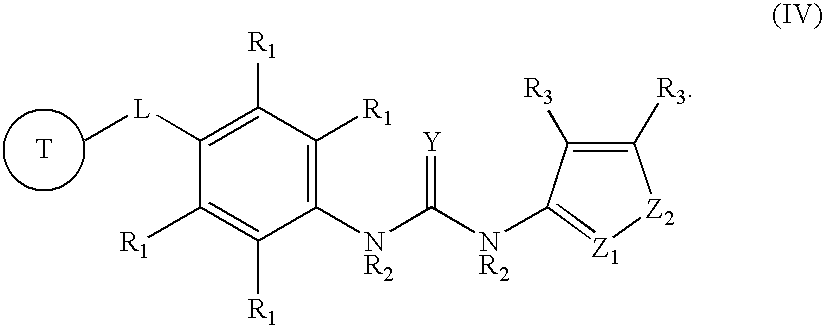
- Methods for modulating MKNK2 kinase, said method comprising administering an effective amount of a compound, or pharmaceutically acceptable salt thereof, corresponding to Formula (XVII) are provided herein:

- Methods for modulating MKNK2 kinase, said method comprising administering an effective amount of a compound, or pharmaceutically acceptable salt thereof, corresponding to Formula (X) are provided herein:

- Methods for modulating STK10 kinase, said method comprising administering an effective amount of a compound corresponding to Formula (IA) are provided herein:

- Methods for modulating STK10 kinase, said method comprising administering an effective amount of a compound, or pharmaceutically acceptable salt thereof, corresponding to Formula (I) are provided herein:

- Methods for modulating STK10 kinase, said method comprising administering an effective amount of a compound, or pharmaceutically acceptable salt thereof, corresponding to Formula (IV) are provided herein:

- Methods for modulating STK10 kinase, said method comprising administering an effective amount of a compound, or pharmaceutically acceptable salt thereof, corresponding to Formula (VI) are provided herein:

- In some embodiments, the protein kinase is selected from the group comprising Ste (sterile 20, sterile 11 and sterile 7); camk (calmodulin regulated kinases and related kinases); AGC (protein kinase A, protein kinase G and protein kinase C) and CMGC (cdk, map kinase, glycogen synthetase kinase and clk). The sterile 20 kinases include, for example, PAK and CZ.
- In some embodiments, the protein tyrosine kinase is selected from the “HER” receptor tyrosine kinase subfamily, which includes EGFR (epithelial growth factor receptor), HER2, HER3 and HER4. In further embodiments, the protein tyrosine kinase is selected from the subfamily consisting of insulin receptor (IR), insulin-like growth factor I receptor (IGF-1R) and insulin receptor related receptor (IRR).
- In some embodiments, the protein tyrosine kinase is selected from the platelet derived growth factor receptor (PDGFR) subfamily, which includes PDGFRα, PDGFRβ, CSFIR, c-kit and c-fms. In another embodiment, the protein tyrosine kinase is the vascular endothelial growth factor (“VEGF”) receptor subgroup.
- In some embodiments, the protein tyrosine kinase is selected from the fetus liver kinase (“fik”) receptor subfamily, which includes kinase insert domain-receptor fetal liver kinase-1 (KDR/FLK-1), flk-1R, flk-4 and fins-like tyrosine kinase 1 (flt-1). In further embodiments, the protein tyrosine kinase is selected from the fibroblast growth factor (“FGF”) receptor subgroup, which includes the receptors FGFR1, FGFR 2, FGFR3, and FGFR4, and the ligands, FGF1, FGF2, FGF3, FGF4, FGF5, FGF6, and FGF7. In a still further embodiment, the protein tyrosine kinase is the tyrosine kinase growth factor receptor family, c-Met. In some embodiments, the protein tyrosine kinase is an fms-like tyrosine kinase 3 receptor kinase (FLT-3 kinase).
- The present invention provides compounds which modulate the activity, and in some embodiments, preferentially inhibit non-receptor tyrosine kinases. In some embodiments, the non-receptor tyrosine kinases include Frk, Btk, Csk, Abl, Zap70, Fes, Fps, Fak, Jak and Ack, their respective subfamilies. In a futher embodiemnt, the non-receptor tyrosine kinase is selected from the Src subfamily, which includes Src, Yes, Fyn, Lyn, Lck, Blk, Hck, Fgr and Yrk.
- The compounds and compositions disclosed herein may be used for the prevention or treatment of cancers such as stomach, gastric, bone, ovary, colon, lung, brain, larynx, lymphatic system, genitourinary tract, ovarian, squamous cell carcinoma, astrocytoma, Kaposi's sarcoma, glioblastoma, lung cancer, bladder cancer, head and neck cancer, melanoma, ovarian cancer, prostate cancer, breast cancer, small-cell lung cancer, leukemia, glioma, colorectal cancer, genitourinary cancer gastrointestinal cancer, or pancreatic cancer. In particular, the cancer is acute myelogenous leukemia (AML), B-precursor cell acute lymphoblastic leukemias, myelodysplastic leukemias, T-cell acute lymphoblastic leukemias, and chronic myelogenous leukemias (CMLs).
- Compositions and methods for treating a disease comprising administering to a subject in need thereof an effective amount of an fins-like tyrosine kinase 3 (FLT-3) receptor modulating compound are provided herein. In one embodiment, the disease is cancer. In other embodiments, the cancer is a malignant tumor, or a hematologic malignancy such as leukemia and lymphoma. In some embodiments, the leukemia is acute myelogenous leukemia (AML), a B-precursor cell acute lymphoblastic leukemia, myelodysplastic leukemia, T-cell acute lymphoblastic leukemia or chronic myelogenous leukemia (CML).
- Compositions and methods for treating a disease comprising administering to a subject in need thereof an effective amount of a Stem Cell Factor (SCF), c-kit, receptor modulating compound are provided herein. In one embodiment, the disease is cancer. In other embodiments, the cancer is a malignant tumor, or a hematologic malignancy such as leukemia and lymphoma. In some embodiments, the cancer is small-cell lung cancer, or breast cancer. In some embodiments, the leukemia is acute myelogenous leukemia (AML). In some embodiments, the malignant tumor is a germ cell tumor, a mast cell tumor, a gastrointestinal stromal tumor (GIST), melanoma, or a neuroblastoma.
- Compositions and methods for treating a disease comprising administering to a subject in need thereof an effective amount of a Bcr-Abl receptor modulating compound are provided herein. In one embodiment, the disease is cancer. In other embodiments, the cancer is a malignant tumor, or a hematologic malignancy such as leukemia and lymphoma. In some embodiments, the leukemia is chronic myeloid leukemia (CML) or acute myelogenous leukemia (AML).
- Compositions and methods for treating a disease comprising administering to a subject in need thereof an effective amount of a Platelet-Derived Growth Factor (PDGF) receptor modulating compound are provided herein. In one embodiment, the disease is cancer. In other embodiments, the cancer is a malignant tumor, or a hematologic malignancy such as leukemia and lymphoma. In some embodiments, the leukemia is acute lymphoblastic leukemia (ALL). In some embodiments, the lymphoma is T-cell lymphoma. In some embodiments, the malignant tumor is melanoma, or glioblastoma. In a further embodiment, the disease is a nonmalignant proliferation disease. In some embodiments, the nonmalignant proliferation disease is atherosclerosis, or restenosis. In a still further embodiment, the disease is a fibroproliferative disorder. In some embodiments, the fibroproliferative disorder is obliterative bronchiolitis.
- These and other aspects of the present invention will become evident upon reference to the following detailed description. In addition, various references are set forth herein which describe in more detail certain procedures or compositions, and are incorporated by reference in their entirety.
- To more readily facilitate an understanding of the invention and its preferred embodiments, the meanings of terms used herein will become apparent from the context of this specification in view of common usage of various terms and the explicit definitions of other terms provided in the glossary below or in the ensuing description.
- Glossary of Terms
- Unless otherwise stated, the following terms used in this application, including the specification and claims, have the definitions given below. It must be noted that, as used in the specification and the appended claims, the singular forms “a,” “an” and “the” include plural referents unless the context clearly dictates otherwise. Definition of standard chemistry terms may be found in reference works, including Carey and Sundberg (1992) “ADVANCED ORGANIC CHEMISTRY 3RD ED.” Vols. A and B, Plenum Press, New York. Unless otherwise indicated, conventional methods of mass spectroscopy, NMR, HPLC, protein chemistry, biochemistry, recombinant DNA techniques and pharmacology, within the skill of the art are employed.
- The term “modulator” means a molecule that interacts with a target either directly or indirectly. The interactions include, but are not limited to, agonist, antagonist, and the like.
- The term “agonist” means a molecule such as a compound, a drug, an enzyme activator or a hormone that enhances the activity of another molecule or the activity of a receptor site etiehr directly or indirectly.
- The term “antagonist” means a molecule such as a compound, a drug, an enzyme inhibitor, or a hormone, that diminishes or prevents the action of another molecule or the activity of a receptor site either directly or indirectly.
- The terms “effective amount” or “therapeutically effective amount” refer to a sufficient amount of the agent to provide the desired biological result. That result can be reduction and/or alleviation of the signs, symptoms, or causes of a disease, or any other desired alteration of a biological system. For example, an “effective amount” for therapeutic use is the amount of the composition comprising a compound as disclosed herein required to provide a clinically significant decrease in a disease. An appropriate “effective” amount in any individual case may be determined by one of ordinary skill in the art using routine experimentation.
- As used herein, the terms “treat” or “treatment” are synonymous with the term “prevent” and are meant to indicate a postponement of development of diseases, preventing the development of diseases, and/or reducing severity of such symptoms that will or are expected to develop. Thus, these terms include ameliorating existing disease symptoms, preventing additional symptoms, ameliorating or preventing the underlying metabolic causes of symptoms, inhibiting the disorder or disease, e.g., arresting the development of the disorder or disease, relieving the disorder or disease, causing regression of the disorder or disease, relieving a condition caused by the disease or disorder, or stopping the symptoms of the disease or disorder.
- By “pharmaceutically acceptable” or “pharmacologically acceptable” is meant a material which is not biologically or otherwise undesirable, i.e., the material may be administered to an individual without causing any undesirable biological effects or interacting in a deleterious manner with any of the components of the composition in which it is contained.
- “Carrier materials” include any commonly used excipients in pharmaceutics and should be selected on the basis of compatibility and the release profile properties of the desired dosage form. Exemplary carrier materials include, e.g., binders, suspending agents, disintegration agents, filling agents, surfactants, solubilizers, stabilizers, lubricants, wetting agents, diluents, and the like. “Pharmaceutically compatible carrier materials” may comprise, e.g., acacia, gelatin, colloidal silicon dioxide, calcium glycerophosphate, calcium lactate, maltodextrin, glycerine, magnesium silicate, sodium caseinate, soy lecithin, sodium chloride, tricalcium phosphate, dipotassium phosphate, sodium stearoyl lactylate, carrageenan, monoglyceride, diglyceride, pregelatinized starch, and the like. See, e.g., Remington: The Science and Practice of Pharmacy, Nineteenth Ed (Easton, Pa.: Mack Publishing Company, 1995); Hoover, John E., Remington's Pharmaceutical Sciences, Mack Publishing Co., Easton, Pa. 1975; Liberman, H. A. and Lachman, L., Eds., Pharmaceutical Dosage Forms, Marcel Decker, New York, N.Y., 1980; and Pharmaceutical Dosage Forms and Drug Delivery Systems, Seventh Ed. (Lippincott Williams & Wilkins 1999).
- As used herein, the term “subject” encompasses mammals and non-mammals. Examples-of mammals include, but are not limited to, any member of the Mammalian class: humans, non-human primates such as chimpanzees, and other apes and monkey species; farm animals such as cattle, horses, sheep, goats, swine; domestic animals such as rabbits, dogs, and cats; laboratory animals including rodents, such as rats, mice and guinea pigs, and the like. Examples of non-mammals include, but are not limited to, birds, fish and the like. In one embodiment of the present invention, the mammal is a human.
- The term “pharmaceutically acceptable salt” of a compound means a salt that is pharmaceutically acceptable and that possesses the desired pharmacological activity of the parent compound. Such salts, for example, include: (1) acid addition salts, formed with inorganic acids such as hydrochloric acid, hydrobromic acid, sulfuric acid, nitric acid, phosphoric acid, and the like; or formed with organic acids such as acetic acid, propionic acid, hexanoic acid, cyclopentanepropionic acid, glycolic acid, pyruvic acid, lactic acid, malonic acid, succinic acid, malic acid, maleic acid, fumaric acid, tartaric acid, citric acid, benzoic acid, 3-(4-hydroxybenzoyl)benzoic acid, cinnamic acid, mandelic acid, methanesulfonic acid, ethanesulfonic acid, 1,2-ethanedisulfonic acid, 2-hydroxyethanesulfonic acid, benzenesulfonic acid, 2-naphthalenesulfonic acid, 4-methylbicyclo-[2.2.2]oct-2-ene-1-carboxylic acid, glucoheptonic acid, 4,4, methylenebis-(3-hydroxy-2-ene-1-carboxylic acid), 3-phenylpropionic acid, trimethylacetic acid, tertiary butylacetic acid, lauryl sulfuric acid, gluconic acid, glutamic acid, hydroxynaphthoic acid, salicylic acid, stearic acid, muconic acid, and the like; (2) salts formed when an acidic proton present in the parent compound either is replaced by a metal ion, e.g., an alkali metal ion, an alkaline earth ion, or an aluminum ion; or coordinates with an organic base. Acceptable organic bases include ethanolamine, diethanolamine, triethanolamine, tromethamine, N-methylglucamine, and the like. Acceptable inorganic bases include aluminum hydroxide, calcium hydroxide, potassium hydroxide, sodium carbonate, sodium hydroxide, and the like. It should be understood that a reference to a pharmaceutically acceptable salt includes the solvent addition forms or crystal forms thereof, particularly solvates or polymorphs. Solvates contain either stoichiometric or non-stoichiometric amounts of a solvent, and are often formed during the process of crystallization. Hydrates are formed when the solvent is water, or alcoholates are formed when the solvent is alcohol. Polymorphs include the different crystal packing arrangements of the same elemental composition of a compound. Polymorphs usually have different X-ray diffraction patterns, infrared spectra, melting points, density, hardness, crystal shape, optical and electrical properties, stability, and solubility. Various factors such as the recrystallization solvent, rate of crystallization, and storage temperature may cause a single crystal form to dominate.
- As used herein, the term “biological sample” is broadly defined to include any cell, tissue, organ or multicellular organism. A biological sample can be derived, for example, from cell or tissue cultures in vitro. Alternatively, a biological sample can be derived from a living organism or from a population of single cell organisms.
- As used herein, the term “linker” means any divalent linking moiety used to connect, join, or attach two chemical groups. For example, linkers may be used to join two cyclic groups, such as to join two aryl groups (e.g., phenyl), an aryl group to a cycloalkyl group, an aryl group to a heterocyclyl group, a cycloalkyl group to a cycloalkyl group, a cycloalkyl group to a heterocyclyl group, and the like. Representative linkers include, but are not limited to, a covalent bond, -(substituted or unsubstituted alkylene)-, -(substituted or unsubstituted alkenylene)-, -(substituted or unsubstituted alkynylene)-, -(substituted or unsubstituted cycloalkylene)-, -(substituted or unsubstituted heterocyclylene)-, -(substituted or unsubstituted arylene)-, and -(substituted or unsubstituted heteroarylene)-. Exemplary linkers also include —O—, —S—, —S(O)—, —S(O)2—, —S(O)3—, —C(O)—, —NH—, —N═, —N═N—, ═N—N═, —C(O)NH—, —S(O)NH—, and the like. Additional examples of linkers include —O(substituted or unsubstituted alkylene)-, —N(substituted or unsubstituted alkylene)-, —NHC(O)(substituted or unsubstituted alkylene)-, —C(O)(substituted or unsubstituted alkenylene)-, —NHC(O)(substituted or unsubstituted alkylene)S(substituted or unsubstituted alkylene)C(O)NH—, —NHC(O)(substituted or unsubstituted alkenylene)-, and the like. Linkers, as represented herein, embrace divalent moieties in any chemically feasible directionality. For example, compounds comprising a linker-C(O)NH— which attaches two aryl groups, Ar1 to Ar2, include Ar1—C(O)NH—Ar2 as well as Ar1—NHC(O)—Ar2.
- As used herein, the term “halogen” includes fluorine, chlorine, bromine, and iodine.
- As used herein, “alkyl” means a straight chain or branched, saturated or unsaturated chain having from 1 to 10 carbon atoms. Representative saturated alkyl groups include, but are not limited to, methyl, ethyl, n-propyl, isopropyl, 2-methyl-1-propyl, 2-methyl-2-propyl, 2-methyl-1-butyl, 3-methyl-1-butyl, 2-methyl-3-butyl, 2,2-dimethyl-1-propyl, 2-methyl-1-pentyl, 3-methyl-1-pentyl, 4-methyl-1-pentyl, 2-methyl-2-pentyl, 3-methyl-2-pentyl, 4-methyl-2-pentyl, 2,2-dimethyl-1-butyl, 3,3-dimethyl-1-butyl, 2-ethyl-1-butyl, butyl, isobutyl, t-butyl, n-pentyl, isopentyl, neopentyl, and n-hexyl, and longer alkyl groups, such as heptyl, and octyl. An alkyl group can be unsubstituted or substituted. Unsaturated alkyl groups include alkenyl groups and alkynyl groups, discussed below. Alkyl groups containing three or more carbon atoms may be straight, branched or cyclized.
- As used herein, “lower alkyl” means an alkyl having from 1 to 5 carbon atoms.
- As used herein, an “alkenyl group” includes a monovalent unbranched or branched hydrocarbon chain having one or more double bonds therein. The double bond of an alkenyl group can be unconjugated or conjugated to another unsaturated group. Suitable alkenyl groups include, but are not limited to, (C2-C8) alkenyl groups, such as vinyl, allyl, butenyl, pentenyl, hexenyl, butadienyl, pentadienyl, hexadienyl, 2-ethylhexenyl, 2-propyl-2-butenyl, 4-(2-methyl-3-butene)-pentenyl. An alkenyl group can be unsubstituted or substituted.
- As used herein, “alkynyl group” includes a monovalent unbranched or branched hydrocarbon chain having one or more triple bonds therein. The triple bond of an alkynyl group can be unconjugated or conjugated to another unsaturated group. Suitable alkynyl groups include, but are not limited to, (C2-C6) alkynyl groups, such as ethynyl, propynyl, butynyl, pentynyl, hexynyl, methylpropynyl, 4-methyl-1-butynyl, 4-propyl-2-pentynyl, and 4-butyl-2-hexynyl. An alkynyl group can be unsubstituted or substituted.
- The terms “trifluoromethyl,” “sulfonyl,” and “carboxyl” include CF3, SO3H, and CO2H, respectively.
- The term “alkoxy” as used herein includes —O-(alkyl), wherein alkyl is defined above.
- As used herein, “alkoxyalkoxy” includes —O-(alkyl)-O-(alkyl), wherein each “alkyl” is independently an alkyl group defined above.
- As used herein, “alkoxycarbonyl” includes —C(O)O-(alkyl), wherein alkyl is defined above.
- As used herein, “alkoxycarbonylalkyl” includes -(alkyl)-C(O)O-(alkyl), wherein alkyl is defined above.
- As used herein, “alkoxyalkyl” means -(alkyl)-O-(alkyl), wherein each “alkyl” is independently an alkyl group defined above.
- As used herein, the term “aryl” (Ar) refers to a monocyclic, or fused or spiro polycyclic, aromatic carbocycle (ring structure having ring atoms that are all carbon) having from 3 to 12 ring atoms per ring. Illustrative examples of aryl groups include the following moieties:

- As used herein, the term “heteroaryl” (heteroAr) refers to a monocyclic, or fused or Spiro polycyclic, aromatic heterocycle (ring structure having ring atoms selected from carbon atoms as well as nitrogen, oxygen, and sulfur heteroatoms) having from 3 to 12 ring atoms per ring. Illustrative examples of aryl groups include the following moieties:

- As used herein, the term “cycloalkyl” refers to a saturated or partially saturated, monocyclic or fused or spiro polycyclic, carbocycle having from 3 to 12 ring atoms per ring. Illustrative examples of cycloalkyl groups include the following moieties:

- As used herein, the term “heterocycloalkyl” refers to a monocyclic, or fused or spiro polycyclic, ring structure that is saturated or partially saturated and has from 3 to 12 ring atoms per ring selected from C atoms and N, O, and S heteroatoms. Illustrative examples of heterocycloalkyl groups include:

- As used herein, “aryloxy” includes —O-aryl group, wherein aryl is as defined above. An aryloxy group can be unsubstituted or substituted.
- As used herein, “arylalkyl” includes -(alkyl)-(aryl), wherein alkyl and aryl are defined above.
- As used herein, “arylalkyloxy” includes —O-(alkyl)-(aryl), wherein alkyl and aryl are defined above.
- As used herein, “cycloalkyl” includes a monocyclic or polycyclic saturated ring comprising carbon and hydrogen atoms and having no carbon-carbon multiple bonds. Examples of cycloalkyl groups include, but are not limited to, (C3-C7)cycloalkyl groups, such as cyclopropyl, cyclobutyl, cyclopentyl, cyclohexyl, and cycloheptyl, and saturated cyclic and bicyclic terpenes. A cycloalkyl group can be unsubstituted or substituted. Preferably, the cycloalkyl group is a monocyclic ring or bicyclic ring.
- As used herein, “cycloalkyloxy” includes —O-(cycloalkyl), wherein cycloalkyl is defined above.
- As used herein, “cycloalkylalkyloxy” includes —O-(alkyl)-(cycloalkyl), wherein cycloalkyl and alkyl are defined above.
- As used herein, the term “alkylidene” includes the divalent radical —CH2—, wherein n is an integer from 1 to 8, such as —CH2—, —CH2CH2—, —CH2—CH2—CH2—, —CH2CH2CH2CH2—, —CH2CH2CH2CH2CH2—, and the like, unsubstituted or substituted with one or more alkyl groups.
- As used herein, “heteroatom-containing alkylidene” includes an alkylidene wherein at least one carbon atom is replaced by a heteroatom selected from nitrogen, oxygen, or sulfuer, such as —CH2CH2OCH2CH2—, and the like, unsubstituted or substituted with one or more alkyl groups.
- As used herein, “aminoalkoxy” includes —O-(alkyl)-NH2, wherein alkyl is defined above.
- As used herein, “mono-alkylamino” includes —NH(alkyl), wherein alkyl is defined above.
- As used herein, “di-alkylamino” includes —N(alkyl)(alkyl), wherein each “alkyl” is independently an alkyl group defined above.
- As used herein, “mono-alkylaminoalkoxy” includes —O-(alkyl)-NH(alkyl), wherein each “alkyl” is independently an alkyl group defined above.
- As used herein, “di-alkylaminoalkoxy” includes —O-(alkyl)N(alkyl)(alkyl), wherein each “alkyl” is independently an alkyl group defined above.
- As used herein, “arylamino” includes —NH(aryl), wherein aryl is defined above.
- As used herein, “arylalkylamino” includes —NH-(alkyl)-(aryl), wherein alkyl and aryl are defined above.
- As used herein, “alkylamino” includes —NH(alkyl), wherein alkyl is defined above.
- As used herein, “cycloalkylamino” includes —NH-(cycloalkyl), wherein cyclohexyl is defined above.
- As used herein, “cycloalkylalkylamino” includes —NH-(alkyl)-(cycloalkyl), wherein alkyl and cycloalkyl are defined above.
- As used herein, “aminoalkyl” includes -(alkyl)-NH2, wherein alkyl is defined above.
- As used herein, “mono-alkylaminoalkyl” includes -(alkyl)-NH(alkyl), wherein each “alkyl” is independently an alkyl group defined above.
- As used herein, “di-alkylaminoalkyl” includes -(alkyl)-N(alkyl)(alkyl), wherein each “alkyl” is independently an alkyl group defined above.
- The term “whole integer” is intended to include whole numbers. For example, a whole integer from 0 to 4 would include 0, 1, 2, 3, and 4.
- Sulfonyl refers to the presence of a sulfur atom, which is optionally linked to another moiety such as an aliphatic group, an aromatic group, an aryl group, an alicyclic group, or a heterocyclic group. Aryl or alkyl sulfonyl moieties have the formula —SO2Rd, and alkoxy moieties have the formula —O—Rd, wherein Rd is alkyl, as defined above, or is aryl wherein aryl is phenyl, optionally substituted with 1-3 substituents independently selected from halo (fluoro, chloro, bromo or iodo), lower alkyl (C1-6) and lower alkoxy (C1-6).
- As used herein, the term “substituted” means that the specified group or moiety bears one or more suitable substituents.
- As used herein, the term “unsubstituted” means that the specified group bears no substituents.
- As used herein, the term “optionally substituted” means that the specified group is unsubstituted or substituted by one or more substituents.
- Molecular embodiments of the present invention may possess one or more chiral centers and each center may exist in the R or S configuration. The present invention includes all diastereomeric, enantiomeric, and epimeric forms as well as the appropriate mixtures thereof. Stereoisomers may be obtained, if desired, by methods known in the art as, for example, the separation of stereoisomers by chiral chromatographic columns. Additionally, the compounds of the present invention may exist as geometric isomers. The present invention includes all cis, trans, syn, anti, entgegen (E), and zusammen (Z) isomers as well as the appropriate mixtures thereof.
- Certain functional groups contained within the compounds of the present invention can be substituted for bioisosteric groups, that is, groups which have similar spatial or electronic requirements to the parent group, but exhibit differing or improved physicochemical or other properties. Suitable examples are well known to those of skill in the art, and include, but are not limited to moieties described in Patini et al., Chem, Rev, 1996, 96, 3147-3176 and references cited therein.
- In addition, the compounds of the present invention can exist in unsolvated as well as solvated forms with pharmaceutically acceptable solvents such as water, ethanol, and the like. In general, the solvated forms are considered equivalent to the unsolvated forms for the purposes of the present invention.
- To more readily facilitate an understanding of the invention and its preferred embodiments, the meanings of terms used herein will become apparent from the context of this specification in view of common usage of various terms and the explicit definitions of other terms provided in the glossary below or in the ensuing description.
- Compounds
- In one aspect, the present invention is directed to compounds, compositions, and methods for treating conditions associated with abnormal kinase activity. In one embodiment, compounds useful in the invention are derivatives of isoxazoles, pyrazoles and isothiazoles. When the compounds of the invention contain one or more chiral centers, the invention includes optically pure forms as well as mixtures of stereoisomers or enantiomers.
- Thus, the invention provides methods for modulating various kinases by providing an effective amount of a compound of the formulas described herein.
- Salts of the compounds may be used for therapeutic and prophylactic purposes, where the salt is preferably a pharmaceutically acceptable salt. Examples of pharmaceutically acceptable salts include those derived from mineral acids, such as hydrochloric, hydrobromic, phosphoric, metaphosphoric, nitric and sulphuric acids, and organic acids, such as tartaric, acetic, trifluoroacetic, citric, malic, lactic, fumaric, benzoic, glycolic, gluconic, succinic and methanesulphonic and arylsulphonic, for example Q-toluenesulphonic, acids.
- A “prodrug” refers to a drug or compound in which the pharmacological action results from conversion by metabolic processes within the body. Prodrugs are generally drug precursors that, following administration to a subject and subsequent absorption, are converted to an active, or a more active species via some process, such as conversion by a metabolic pathway. Some prodrugs have a chemical group present on the prodrug that renders it less active and/or confers solubility or some other property to the drug. Once the chemical group has been cleaved and/or modified from the prodrug the active drug is generated. Prodrugs may be designed as reversible drug derivatives, for use as modifiers to enhance drug transport to site-specific tissues. Additionally, prodrugs can increase the effective water solubility of the therapeutic compound for targeting to regions where water is the principal solvent. See, e.g., Fedorak et al., Am. J. Physiol., 269:G210-218 (1995); McLoed et al., Gastroenterol, 106: 405-413 (1994); Hochhaus et al., Biomed. Chrom., 6: 283-286 (1992); J. Larsen and H. Bundgaard, Int. J. Pharmaceutics, 37, 87 (1987); J. Larsen et al., Int. J. Pharmaceutics, 47, 103 (1988); Sinkula et al., J. Pharm. Sci., 64: 181-210 (1975); T. Higuchi and V. Stella, Pro-drugs as Novel Delivery Systems, Vol. 14 of the A.C.S. Symposium Series; and Edward B. Roche, Bioreversible Carriers in Drug Design, American Pharmaceutical Association and Pergamon Press, 1987. Prodrug forms of the above described compounds, wherein the prodrug is metabolized in vivo to produce a derivative as set forth above are included within the scope of the claims. Indeed, some of the above-described derivatives may be a prodrug for another derivative or active compound. The invention further provides for the optical isomers of the compounds disclosed herein, especially those resulting from the chiral carbon atoms in the molecule. In additional embodiments of the invention, mixtures of enantiomers and/or diastereoisomers, resulting from a single preparative step, combination, or interconversion may also be useful for the applications described herein.
- In another aspect, compositions containing the above described analogs and derivatives are provided. Preferably, the compositions are formulated to be suitable for pharmaceutical or clinical use by the inclusion of appropriate carriers or excipients.
- Groups such as carbonyl, carboxyl, alkoxy, amino, and cyano groups, etc., as shown in the formula above, need not be directly bound to the para position; they may be included elsewhere in the alkyl, alkenyl or alkynyl substituent. Thus, also acceptable substituents are the following representative forms:
- —CH2NHCH3; —CH2OCH3; —CH2SCH3; —NHCH3; —CH2CH3; —OCH2CH3; —SCH2CH2CH3; —CH═CHCH2NR2; —CH2CH2OH;

- —CH2CH2CH2SH; —CH2OC(O)CH3; —CH2NHC(O)CHC(O)CH3; —NHC(O)CH2CH2CH3
each of which may further be substituted with a cycloalkyl, heterocycloalkyl, aryl or heteroaryl group. - It will also be evident that these substituents include, for example, trifluoromethyl, difluoromethyl and fluoromethyl (alkyl substituted by halo) and trifluoromethoxy, difluoromethoxy and fluoromethoxy (alkyl where one carbon is replaced by 0 and is further substituted by halo).
- Compounds of the invention which contain carboxyl groups or which contain amino groups may be supplied in the forms of their pharmaceutically acceptable salts. Pharmaceutically acceptable salts of carboxylic acids include inorganic salts such as salts of sodium, potassium, calcium, magnesium and the like or salts formed with organic bases such as caffeine. Salts of amines are acid addition salts formed from inorganic acids such as hydrochloric, sulfuric, phosphoric acids or may be salts of organic acids such as acetates, maleates, propionates, and the like.
- The invention also provides prodrug forms of the compounds described herein, wherein the prodrug is metabolized in vivo to produce a derivative as set forth above. Indeed, some of the above described derivatives may be a prodrug for another derivative or active compound. The invention further provides for the optical isomers of the compounds disclosed herein, especially those resulting from the chiral carbon atoms in the molecule. In additional embodiments of the invention, mixtures of enantiomers and/or diastereoisomers, resulting from a single preparative step, combination, or interconversion are provided.
- In another aspect of the invention, compositions containing the above described analogs and derivatives are provided. Preferably, the compositions are formulated to be suitable for pharmaceutical or clinical use by the inclusion of appropriate carriers or excipients.
- In yet another aspect of the invention, pharmaceutical formulations are provided comprising at least one compound described above, or a pharmaceutically acceptable salt or solvate thereof, together with one or more pharmaceutically acceptable carriers, diluents or excipients.
- The compounds of the invention, especially when used in the invention methods and compositions, may be “conjugated”-that is they may be coupled to additional moieties that do not destroy their ability to modulate kinases. For example, the compounds might be coupled to a label such as a radioactive label, a fluorescent label and the like, or may be coupled to targeting agents such as antibodies or fragments, or to fragments to aid purification such as FLAG or a histidine tag. The compounds may also be coupled to specific binding partners such as biotin for use in assay procedures or to moieties that alter their biological half-lives such as polyethylene glycol. Thus, the methods of the invention employ the invention compounds per se as well as conjugates thereof.
- Synthesis of Compounds
- Compounds of the present invention may be synthesized using standard synthetic techniques known to those of skill in the art or using methods known in the art in combination with methods described herein. See, e.g., March, A
DVANCED ORGANIC CHEMISTRY 4th Ed., (Wiley 1992); Carey and Sundberg, ADVANCED ORGANIC CHEMISTRY 3rd Ed., Vols. A and B (Plenum 1992), and Green and Wuts, PROTECTIVE GROUPS IN ORGANIC SYNTHESIS 2nd Ed. (Wiley 1991). General methods for the preparation of compound as disclosed herein may be derived from known reactions in the field, and the reactions may be modified by the use of appropriate reagents and conditions, as would be recognized by the skilled person, for the introduction of the various moieties found in the formulae as provided herein. - The compounds of the invention are synthesized by methods well known in the art. The compounds of the invention are ureas or cyclic forms thereof and can be synthesized using generally known procedures for urea synthesis.
- In one group of methods, an amine is reacted with an isocyanate in an aprotic solvent. Typically, in some embodiments, a molar excess of the amine is used in the presence of an aprotic solvent and the reaction is conducted at room temperature. The reaction mixture is then poured into water and precipitated with salt to recover the crude product which is then purified according to standard methods.
- In alternative methods, the ureas are formed from two separate amine reactants in the presence of a condensing agent such as 1,1,carbonyldiimidazole (CDI) in the presence of an inert nonpolar solvent such as dichloromethane. One of the amines is first added to a solution of CDI in solvent under cooling conditions and then stirred at room temperature with the other amine. After removal of solvent, the crude product can be purified using standard procedures.
- In still another method, one of the amines is added in an aprotic solvent to a solution of triphosgene and then treated with the other amine reactant dissolved in an inert solvent in the presence of base such as triethylamine. After reaction at room temperature, the mixture may be diluted with, for example, ethylacetate and washed with water and brine, dried and purified.
- In still another method, one of the amine components is treated with 4-nitrophenylchloroformate in the presence of -mild base in a solvent such as N-methylpyrrolidone (NMP). The other amine is then added and the reaction mixture heated, then cooled, poured into water, extracted into chloroform and further purified.
- Alternatively, the urea may be formed by the reaction of an amine with the counterpart halo acylamine which is formed from the parent amine by treatment with phosgene and base in an inert solvent such as methylene dichloride or by reacting an amine with its counterpart amine with an acyl amine containing an alternate leaving group formed by reaction of that amine with 4-nitrophenylchloroformate in the presence of an amine base and in an inert solvent.
- Details of these methods can be found in Matsuno et al. J. Med. Chem. 45: 3057-66 (2002); Matsuno et al. J. Med. Chem. 45: 4513-23 (2002); and and Pandley et al., J. Med. Chem. 45: 3772-93 (2002).
- Cyclized forms of the ureas may be obtained by treating the formed urea with dibromo derivatives of the bridge, typically in the presence of a strong base and in an inert aprotic polar solvent.
- The ureas may be converted to thioureas by treating with Lawesson's reagent in the presence of toluene.
- For compounds having the moiety Ar1-L-Ar2 is obtained by first protecting the amino group of p-hydroxy aniline destined to become Ar1 with a protecting agent such as Boc and then coupling the hydroxy group of Ar1 to an aryl alkyl halide. This coupling is conducted in the presence of strong base and in an aprotic solvent. After deprotection, the urea is formed by reaction with the isoxazole isdcyanate. These techniques are exemplified below.
- Selected examples of covalent linkages and precursor functional groups which yield them are given in the Table entitled “Examples of Covalent Linkages-and Precursors Thereof.” Precursor functional groups are shown as electrophilic groups and nucleophilic groups. The functional group on the organic substance may be attached directly, or attached via any useful spacer or linker as defined below.
TABLE 1 Examples of Covalent Linkages and Precursors Thereof Covalent Linkage Product Electrophile Nucleophile Carboxamides Activated esters amines/anilines Carboxamides acyl azides amines/anilines Carboxamides acyl halides amines/anilines Esters acyl halides alcohols/phenols Esters acyl nitriles alcohols/phenols Carboxamides acyl nitriles amines/anilines Imines Aldehydes amines/anilines Hydrazones aldehydes or ketones Hydrazines Oximes aldehydes or ketones Hydroxylamines Alkyl amines alkyl halides amines/anilines Esters alkyl halides carboxylic acids Thioethers alkyl halides Thiols Ethers alkyl halides alcohols/phenols Thioethers alkyl sulfonates Thiols Esters alkyl sulfonates carboxylic acids Ethers alkyl sulfonates alcohols/phenols Esters Anhydrides alcohols/phenols Carboxamides Anhydrides amines/anilines Thiophenols aryl halides Thiols Aryl amines aryl halides Amines Thioethers Azindines Thiols Boronate esters Boronates Glycols Carboxamides carboxylic acids amines/anilines Esters carboxylic acids Alcohols hydrazines Hydrazides carboxylic acids N-acylureas or Anhydrides carbodiimides carboxylic acids Esters diazoalkanes carboxylic acids Thioethers Epoxides Thiols Thioethers haloacetamides Thiols Ammotriazines halotriazines amines/anilines Triazinyl ethers halotriazines alcohols/phenols Amidines imido esters amines/anilines Ureas Isocyanates amines/anilines Urethanes Isocyanates alcohols/phenols Thioureas isothiocyanates amines/anilines Thioethers Maleimides Thiols Phosphite esters phosphoramidites Alcohols Silyl ethers silyl halides Alcohols Alkyl amines sulfonate esters amines/anilines Thioethers sulfonate esters Thiols Esters sulfonate esters carboxylic acids Ethers sulfonate esters Alcohols Sulfonamides sulfonyl halides amines/anilines Sulfonate esters sulfonyl halides phenols/alcohols - In general, carbon electrophiles are susceptible to attack by complementary nucleophiles, including carbon nucleophiles, wherein an attacking nucleophile brings an electron pair to the carbon electrophile in order to form a new bond between the nucleophile and the carbon electrophile.
- Suitable carbon nucleophiles include, but are not limited to alkyl, alkenyl, aryl and alkynyl Grignard, organolithium, organozinc, alkyl-, alkenyl , aryl- and alkynyl-tin reagents (organostannanes), alkyl-, alkenyl-, aryl- and alkynyl-borane reagents (organoboranes and organoboronates); these carbon nucleophiles have the advantage of being kinetically stable in water or polar organic solvents. Other carbon nucleophiles include phosphorus ylids, enol and enolate reagents; these carbon nucleophiles have the advantage of being relatively easy to generate from precursors well known to those skilled in the art of synthetic organic chemistry. Carbon nucleophiles, when used in conjunction with carbon electrophiles, engender new carbon-carbon bonds between the carbon nucleophile and carbon electrophile.
- Non-carbon nucleophiles suitable for coupling to carbon electrophiles include but are not limited to primary and secondary amines, thiols, thiolates, and thioethers, alcohols, alkoxides, azides, semicarbazides, and the like. These non-carbon nucleophiles, when used in conjunction with carbon electrophiles, typically generate heteroatom linkages (C—X—C), wherein X is a hetereoatom, e.g, oxygen or nitrogen.
- The term “protecting group” refers to chemical moieties that block some or all reactive moieties and prevent such groups from participating in chemical reactions until the protective group is removed. It is preferred that each protective group be removable by a different means. Protective groups that are cleaved under totally disparate reaction conditions fulfill the requirement of differential removal. Protective groups can be removed by acid, base, and hydrogenolysis. Groups such as trityl, dimethoxytrityl, acetal and t-butyldimethylsilyl are acid labile and may be used to protect carboxy and hydroxy reactive moieties in the presence of amino groups protected with Cbz groups, which are removable by hydrogenolysis, and Fmoc groups, which are base labile. Carboxylic acid and hydroxy reactive moieties may be blocked with base labile groups such as, without limitation, methyl, ethyl, and acetyl in the presence of amines blocked with acid labile groups such as t-butyl carbamate or with carbamates that are both acid and base stable but hydrolytically removable.
- Carboxylic acid and hydroxy reactive moieties may also be blocked with hydrolytically removable protective groups such as the benzyl group, while amine groups capable of hydrogen bonding with acids may be blocked with base labile groups such as Fmoc. Carboxylic acid reactive moieties may be protected by conversion to simple ester derivatives as exemplified herein, or they may be blocked with oxidatively-removable protective groups such as 2,4-dimethoxybenzyl, while co-existing amino groups may be blocked with fluoride labile silyl carbamates.
- Allyl blocking groups are useful in then presence of acid- and base-protecting groups since the former are stable and can be subsequently removed by metal or pi-acid catalysts. For example, an allyl-blocked carboxylic acid can be deprotected with a Pdo-catalyzed reaction in the presence of acid labile t-butyl carbamate or base-labile acetate amine protecting groups. Yet another form of protecting group is a resin to which a compound or intermediate may be attached. As long as the residue is attached to the resin, that functional group is blocked and cannot react. Once released from the resin, the functional group is available to react.
- Typically blocking/protecting groups may be selected from:

- Other protecting groups are described in Greene and Wuts, Protective Groups in Organic Synthesis' 3rd Ed., John Wiley & Sons, New York, N.Y., 1999, which is incorporated herein by reference in its entirety.
- Biological Activity
- Protein kinases (PKs) play a role in signal transduction pathways regulating a number of cellular functions, such as cell growth, differentiation, and cell death. PKs are enzymes that catalyze the phosphorylation of hydroxy groups on tyrosine, serine and threonine residues of proteins. Abnormal PK activity has been related to disorders ranging from relatively non life threatening diseases such as psoriasis to extremely virulent diseases such as glioblastoma (brain cancer). In addition, a variety of tumor types have dysfunctional growth factor receptor tyrosine kinases, resulting in inappropriate mitogenic signaling. Protein kinases are believed to be involved in many different cellular signal transduction pathways. In particular, protein tyrosine kinases (PTK) are attractive targets in the search for therapeutic agents, not only for cancer, but also against many other diseases. Blocking or regulating the kinase phosphorylation process in a signaling cascade may help treat conditions such as cancer or inflammatory processes.
- Protein tyrosine kinases are a family of tightly regulated enzymes, and the aberrant activation of various members of the family is one of the hallmarks of cancer. The protein-tyrosine kinase family includes Bcr-Abl tyrosine kinase, and can be divided into subgroups that have similar structural organization and sequence similarity within the kinase domain. The members of the type III group of receptor tyrosine kinases include the platelet-derived growth factor (PDGF) receptors (PDGF receptors a and 0), colony-stimulating factor (CSF-1) receptor (CSF-1R, c-Fms), FLT-3, and stem cell or steel factor receptor (c-kit).
- The compounds, compositions, and methods provided herein are useful to modulate the activity of kinases including, but not limited to, ERBB2, ABL1, AURKA, CDK2, EGFR, FGFR1, LCK, MAPK14, PDGFR, KDR, ABL1, BRAF, ERBB4, FLT3, KIT, and RAF1. In some embodiments, the compositions and methods provided herein modulate the activity of a mutant kinase.
- Inhibition by the compounds provided herein can be determined using any suitable assay. In one embodiment, inhibition is determined in vitro. In a specific embodiment, inhibition is assessed by phosphorylation assays. Any suitable phosphorylation assay can be employed. For example, membrane autophosphorylation assays, receptor autophosphorylation assays in intact cells, and ELISA's can be employed. See, e.g., Gazit, et al., J. Med. Chem. (1996) 39: 2170-2177, Chapter 18 in C
URRENT PROTOCOLS IN MOLECULAR BIOLOGY (Ausubel, et al., eds. 2001). Cells useful in such assays include cells with wildtype or mutated forms. In one embodiment, the wildtype is a kinase that is not constitutively active, but is activated with upon dimerization. For example, the mutant FLT3 kinase is constitutively active via internal tandem duplication mutations or point mutations in the activation domain. Suitable cells include those derived through cell culture from patient samples as well as cells derived using routine molecular biology techniques, e.g., retroviral transduction, transfection, mutagenesis, etc. Exemplary cells include Ba/F3 or 32Dc13 cells transduced with, e.g., MSCV retroviral constructs FLT3-ITD (Kelly et al., 2002); Molm-13 and Molm-14 cell line (Fujisaki Cell Center, Okayama, Japan); HL60 (AML-M3), AML193 (AML-M5), KG-1, KG-1a, CRL-1873, CRL-9591, and THP-1 (American Tissue Culture Collection, Bethesda, Md.); or any suitable cell line derived from a patient with a hematopoietic malignancy. - In some embodiments, the compounds described herein significantly inhibit receptor tyrosine kinases. A significant inhibition of a receptor tyrosine kinase activity refers to an IC50 of less than or equal to 100 μM. Preferably, the compound can inhibit activity with an IC50 of less than or equal to 50 μM, more preferably less than or equal to 10 μM, more preferably less than 1 μM, or less than 100 nM, most preferably less than 50 nM. Lower IC50's are preferred because the IC50 provides an indication as to the in vivo effectiveness of the compound. Other factors known in the art, such as compound half-life, biodistribution, and toxicity should also be considered for therapeutic uses. Such factors may enable a compound with a lower IC50 to have greater in vivo efficacy than a compound having a higher IC50 Preferably, a compound that inhibits activity is administered at a dose where the effective tyrosine phosphorylation, i.e., IC50, is less than its cytotoxic effects, LD50.
- In some embodiments, the compounds selectively inhibit one or more kinases. Selective inhibition of a kinase, such as FLT3, p38 kinase, STK10, MKN2, Bcr-Abl, c-kit, or PDGFR, is achieved by inhibiting activity of one kinase, while having an insignificant effect on other members of the superfamily.
- c-kit
- The Stem Cell Factor (SCF) receptor c-kit is a receptor protein tyrosine kinase that initiates cell growth and proliferation signal transduction cascades in response to SCF binding c-kit is a 145-kD transmembrane glycoprotein and is the normal cellular homolog of the v-kit retroviral oncogene, It is also a member of the Type III transmembrane receptor protein tyrosine kinase subfamily, which includes the macrophage colony-stimulating factor-I receptor, also known as the FMS receptor, the related FLT-3 receptor, and the platelet-derived growth factor (PDGF) a and 0 receptors. The c-kit gene product is expressed in hematopoietic progenitor cells, mast cells, germ cells, interstitial cells of Cajal (ICC), and some human tumors. Inactivating mutations of c-kit or its ligand, Steel factor (SLF), have demonstrated that the normal functional activity of the c-kit gene product is essential for maintenance of normal hematopoeisis, melanogenesis, genetogensis, and growth and differentiation of mast cells and ICC. SLF is produce by human and murine hematopoietic stromal cells, including endothelial cells, fibroblasts, and bone marrow-derived stromal cells.
- In addition to its importance in normal cellular physiologic activities, c-kit plays a role in the biological aspects of certain human cancers, including germ cell tumors, mast cell tumors, gastrointestinal stromal tumors (GIST), small-cell lung cancer, melanoma, breast cancer, acute myelogenous leukemia (AML), and neuroblastoma. Proliferation of tumor cell growth mediated by c-kit can occur by a specific mutation of the c-kit polypeptide that results in ligand independent activation or by autocrine stimulation of the receptor. In the former case, mutations that cause constitutive activation of c-kit kinase activity in the absence of SCF binding are implicated in malignant human cancers, including gastrointestinal stromal tumors, germ cell tumors, mast cell tumors, and myeloid leukemia's and in mastocytosis.
- The activity of the c-kit receptor protein tyrosine kinase is regulated in normal cells, and as discussed the deregulated c-kit kinase activity is implicated in the pathogenesis of human cancers. In some types of tumors, inhibition of c-kit activity reduces cellular proliferation, suggesting a role for use of pharmacologic inhibitors of c-kit in the treatment of c-kit dependent malignancies.
- In one embodiment, compositions and methods provided herein are effective to modulate the activity of c-kit. In other embodiments, compositions and methods provided herein are effective to selectively modulate the activity of c-kit.
- Bcr-Abl
- c-Abl is a nonreceptor tyrosine kinase that contributes to several leukogenic fusion proteins, including the deregulated tyrosine kinase, Bcr-Abl. Chronic myeloid leukemia (CML) is a clonal disease involving the pluripotent hematopoietic stem cell compartment and is associated with the Philadelphia chromosome [Nowell P. C. and Hungerford D. A., Science 132,1497 (1960)], a reciprocal translocation between-chromosomes 9 and 22 ([(9:22) (q34; q11)]) [Rowley J. D., Nature 243,290-293 (1973)]. The translocation links the c-Abl tyrosine kinase oncogene on chromosome 9 to the 5, half of the bcr (breakpoint cluster region) gene on chromosome 22 and creates the fusion gene bcr/abl. The fusion gene produces a chimeric 8.5 kB transcript that codes for a 210-kD fusion protein (p21 obcr-abl), and this gene product is an activated protein tyrosine kinase. Thus, the Abelson tyrosine kinase is improperly activated by accidental fusion of the bcr gene with the gene encoding the intracellular non-receptor tyrosine kinase, c-Abl.
- The Bcr domain interferes with the intramolecular Abl inhibitory loop and unveils a constitutive kinase activity that is absent in the normal Abl protein. Bcr-Abl tyrosine kinase is a potent inhibitor of apoptosis, and it is well accepted that the oncoprotein expresses a constitutive tyrosine kinase activity that is necessary for its cellular transforming activity. Constitutive activity of the fusion tyrosine kinase Bcr-Abl has been established as the characteristic molecular abnormality present in virtually all cases of chronic myeloid leukemia (CML) and up to 20 percent of adult acute lymphoblastic leukemia (ALL) [Faderl S. et al., N Engl J Med 341, 164-172 (1999); Sawyers C. L., N Engl J Med 340,1330-1340 (1999)].
- Mutations present in the kinase domain of the Bcr-Abl gene of patients suffering from CML or Ph+ALL account for the biological resistance of these patients towards ST1571 treatment in that said mutations lead to resistance of the Bcr-Abl tyrosine kinase towards inhibition by ST1571. Novel therapies for CML need to address this emerging problem of clinical resistance to STI571 (Gleevec). Because tumor progression in patients receiving ST1571 seem to be mediated by amplification of or mutation in the Bcr-Abl gene that causes the tyrosine kinase to be less efficiently inhibited by the drug, newer tyrosine kinase inhibitors may be susceptible to the same mechanisms of resistance. None the less, these findings are extremely valuable in the development of new compounds or combinations of compounds which are capable to overcome resistance towards treatment with STI571. Furthermore, in view of the large number of protein kinase inhibitors and the multitude of proliferative and other PK-related diseases, there is an ever-existing need to provide novel classes of compounds that are useful as PK inhibitors and thus in the treatment of these PTK related diseases.
- In one embodiment, compositions and methods provided herein are effective to modulate the activity of Bcr-Abl. In other embodiments, compositions and methods provided herein are effective to selectively modulate the activity of Bcr-Abl. In a further embodiment, compositions of Formula G, e.g., compounds described in Examples M and 0, inhibit the protein tyrosine kinase associated with mutated bcr-abl, which gives rise to observed clinical resistance towards treatment with STI571.
- PDGFR
- Platelet-Derived Growth factor Receptors (PDGFR's) are receptor tyrosine kinases that regulate proliferative and chemotatic responses. PDGFR's have two forms—PDGFR-α (CD140a) and PDGFR-β (CD140b). PDGFRs are normally found in connective tissue and glia but are lacking in most epithelia, and PDGF expression has been shown in a number of different solid tumors, from glioblastomas to prostate carcinomas. For instance, PDGFR kinases are involved in various cancers such as T-cell lymphoma, acute lymphoblastic leukemia (ALL), acute myeloid leukemia (AML), melanoma, glioblastoma and others (see Bellamy W. T. et al., Cancer Res. 1999,59,728-733). In these various tumor types, the biological role of PDGF signaling can vary from autocrine stimulation of cancer cell growth to more subtle paracrine interactions involving adjacent stroma and angiogenesis. Furthermore, PDGF has been implicated in the pathogenesis of several nonmalignant proliferation diseases, including atherosclerosis, restenosis following vascular angioplasty and fibroproliferative disorders such as obliterative bronchiolitis. Therefore, inhibiting the PDGFR kinase activity with small molecules may interfere with tumor growth and angiogenesis.
- The binding of PDGFR to its receptor activates the intracellular tyrosine kinase, resulting in the autophorylation of the receptor as well as other intracellular substrates such as Src, GTPase Activating Protein (GAP), and phosphatidylinositol-3-phosphate. Upon autophorylation the PDGFR also forms complexes with other signaling moieties including phospholipase C-γ (PLC-γ), phosphatidylinositol-3-kinase (PI3K), and raf-1. It appears to be involved in communication between endothelial cells and pericytes, a communication that is essential for normal blood vessel development.
- It has been found previously that the disruption of the PDGFR-β in mice oblates neovascular pericytes that from part of the capillary wall. See Lindahl, P., et al., Science (1997) 227: 242-245; Hellstrom, M., ., et al., Development (1999) 126: 3047-3055. A recent study by Bergers, G., et al., J. Clin. Invest. (2003) 111: 1287-1295 has suggested that inhibition of PDGFR kinase activity by certain compounds such as SU6668 or ST1571/Gleevec inhibits tumor growth and that these compounds combined with VEGFR inhibitor SU5416 were very effective in reducing tumor growth. Further, inhibition of PDGFR-β by Gleevec enhanced tumor chemotherapeutic efficacy in mice. Pietras, K., et al., Cancer Res. (2002) 62: 5476-5484. A review of PDGFR receptors as cancer drug targets by Pietras, K., et al., appears in Cancer Cell. (2003) 3: 439-443. Inhibition of this kinase activity is also effective where abnormal forms of PDGFR, such as the TEL/PDGFR-β fusion protein associated with chronic myelomonocytic leukemia (CMML) is produced. See also, Grisolano, J. L., et al., Proc. Natl. Acad. Sci. USA. (2003) 100: 9506-9511.
- Inhibitors of PDGFR-β frequently also inhibit additional kinases involved in tumor growth such as BCR-ABL, TEL-ABL, and PDGFR-α. See, Carroll, M., et al., Blood (1997) 90: 4947-4952 and Cools, J., et al., Cancer Cell (2003) 3: 450-469. One class of established inhibitors of PDGFR kinase activity includes quinazoline derivatives which comprise piperazine substitutions. Such compounds are disclosed in Yu, J-C., et al., J. Pharmacol. Exp. Ther. (2001) 298: 1172-1178; Pandey, A., et al., J. Med. Chem. (2002) 45: 3772-3793 Matsuno, K., et al., J. Med. Chem. (2002) 45: 4413-4523 and Matsuno, K., et al., ibid., 3057-3066. Still another class is represented by 2-phenyl pyrimidines as disclosed by Buchdunger, E., et al., Proc. Natl. Acad. Sci. USA. (1995) 92: 2558-2562. However, there remains a need for additional compounds that are effective in inhibiting PDGFR kinase activity. Given the complexities of signal transduction with the redundancy and crosstalk between various pathways, the identification of specific PDGFR tyrosine kinase inhibitors permits accurate targeting with limited or no unwanted inhibition of the pathways, thus reducing the toxicity of such inhibitory compounds.
- In one embodiment, compositions and methods provided herein are effective to modulate the activity of PDGFR. In other embodiments, compositions and methods provided herein are effective to selectively modulate the activity of PDGFR.
- FLT-3
- FLT3 kinase is a tyrosine kinase receptor involved in the regulation and stimulation of cellular proliferation. See e.g., Gilliland et al., Blood 100: 1532-42 (2002). The FLT3 kinase is a member of the class III receptor tyrosine kinase (RTKIII) receptor family and belongs to the same subfamily of tyrosine kinases as c-kit, c-fins, and the platelet-derived growth factor α and β receptors. See e.g., Lyman et al., FLT3 Ligand in THE CYTOKINE HANDBOOK 989 (Thomson et al., eds. 4th Ed.) (2003). The FLT3 kinase has five immunoglobulin-like domains in its extracellular region as well as an insert region of 75-100 amino acids in the middle of its cytoplasmic domain. FLT3 kinase is activated upon the binding of the FLT3 ligand, which causes receptor dimerization. Dimerization of the FLT3 kinase by FLT3 ligand activates the intracellular kinase activity as well as a cascade of downstream substrates including Stat5, Ras, phosphatidylinositol-3-kinase (PI3K), PLCγ, Erk2, Akt, MAPK, SHC, SHP2, and SHIP. See e.g., Rosnet et al., Acta Haematol. 95:218 (1996); Hayakawa et al., Oncogene 19:624 (2000); Mizuki et al., Blood 96:3907 (2000); and Gilliand et al., Curr. Opin. Hematol. 9: 274-81 (2002). Both membrane-bound and soluble FLT3 ligand bind, dimerize, and subsequently activate the FLT3 kinase.
- In normal cells, immature hematopoietic cells, typically CD34+cells, placenta, gonads, and brain express FLT3 kinase. See, e.g., Rosnet, et al., Blood 82: 1110-19 (1993); Small et al., Proc. Natl. Acad. Sci. U.S.A. 91: 459-63 (1994); and Rosnet et al., Leukemia 10: 238-48 (1996). However, efficient stimulation of proliferation via FLT3 kinase typically requires other hematopoietic growth factors or interleukins. FLT3 kinase also plays a critical role in immune function through its regulation of dendritic cell proliferation and differentiation. See e.g., McKenna et al., Blood 95: 3489-97 (2000).
- Numerous hematologic malignancies express FLT3 kinase, the most prominent of which is AML. See e.g., Yokota et al., Leukemia 11: 1605-09 (1997). Other FLT3 expressing malignancies include B-precursor cell acute lymphoblastic leukemias, myelodysplastic leukemias, T-cell acute lymphoblastic leukemias, and chronic myelogenous leukemias. See e.g., Rasko et al., Leukemia 9: 2058-66 (1995).
- FLT3 kinase mutations associated with hematologic malignancies are activating mutations. In other words, the FLT3 kinase is constitutively activated without the need for binding and dimerization by FLT3 ligand, and therefore stimulates the cell to grow continuously.
- Several studies have identified inhibitors of FLT3 kinase activity that also inhibit the kinase activity of related receptors, e.g., VEGF receptor (VEGFR), PDGF receptor (PDGFR), and kit receptor kinases. See e.g., Mendel et al., Clin. Cancer Res. 9: 327-37 (2003); O'Farrell et al., Blood 101: 3597-605 (2003); and Sun et al., J. Med. Chem. 46: 1116-19 (2003). Such compounds effectively inhibit FLT3 kinase-mediated phosphorylation, cytokine production, cellular proliferation, resulting in the induction of apoptosis. See e.g., Spiekermann et al., Blood 101: 1494-1504 (2003). Moreover, such compounds have potent antitumor activity in vitro and in vivo.
- In some embodiments, the kinase is a class III receptor tyrosine kinase (RTKIII). In other embodiments, the kinase is a tyrosine kinase receptor intimately involved in the regulation and stimulation of cellular proliferation. In still other embodiments, the kinase is a fins-like tyrosine kinase 3 receptor (FLT-3 kinase). In this context, inhibition and reduction of the activity of FLT-3 kinase refers to a lower level of measured activity relative to a control experiment in which the protein, cell, or subject is not treated with the test compound, whereas an increase in the activity of FLT-3 kinase refers to a higher level of measured activity relative to a control experiment. In particular embodiments, the reduction or increase is at least 10%. One of skill in the art will appreciate that reduction or increase in the activity of FLT-3 kinase of at least 20%, 50%, 75%, 90% or 100% or any integer between 10% and 100% may be preferred for particular applications.
- Compounds provided herein are useful in treating conditions characterized by inappropriate FLT3 activity such as proliferative disorders. FLT3 activity includes, but is not limited to, enhanced FLT3 activity resulting from increased or de novo expression of FLT3 in cells, increased FLT3 expression or activity, and FLT3 mutations resulting in constitutive activation. The existence of inappropriate or abnormal FLT3 ligand and FLT3 levels or activity can be determined using well known methods in the art. For example, abnormally high FLT3 levels can be determined using commercially available ELISA kits. FLT3 levels can be determined using flow cytometric analysis, immunohistochemical analysis, and in situ hybridization techniques.
- An inappropriate activation of the FLT3 can be determined by an increase in one or more of the activities occurring subsequent to FLT3 binding: (1) phosphorylation or autophosphorylation of FLT3; (2) phosphorylation of a FLT3 substrate, e.g., Stat5, Ras; (3) activation of a related complex, e.g., PI3K; (4) activation of an adaptor molecule; and (5) cellular proliferation. These activities are readily measured by well known methods in the art.
- Formulations
- The compounds described herein can be used to prepare a medicament, such as by formulation into pharmaceutical compositions for administration to a subject using techniques generally known in the art. A summary of such pharmaceutical compositions may be found, for example, in Remington's Pharmaceutical Sciences, Mack Publishing Co., Easton, Pa. The compounds of the invention can be used singly or as components of mixtures. Preferred forms of the compounds are those for systemic administration as well as those for topical or transdermal administration. Formulations designed for timed release are also-within the scope of the invention. Formulation in unit dosage form is also preferred for the practice of the invention.
- In unit dosage form, the formulation is divided into unit doses containing appropriate quantities of one or more compounds. The unit dosage may be in the form of a package containing discrete quantities of the formulation. Non-limiting examples are packeted tablets or capsules, and powders in vials or ampoules.
- The compounds described herein may be labeled isotopically (e.g. with a radioisotope) or by any other means, including, but not limited to, the use of chromophores or fluorescent moieties, bioluminescent labels, or chemiluminescent labels. The compositions may be in conventional forms, either as liquid solutions or suspensions, solid forms suitable for solution or suspension in a liquid prior to use, or as emulsions. Suitable excipients or carriers are, for example, water, saline, dextrose, glycerol, alcohols, aloe vera gel, allantoin, glycerin, vitamin A and E oils, mineral oil, propylene glycol, PPG-2 myristyl propionate, and the like. Of course, these compositions may also contain minor amounts of nontoxic, auxiliary substances, such as wetting or emulsifying agents, pH buffering agents, and so forth.
- Methods for the preparation of compositions comprising the compounds described herein include formulating the derivatives with one or more inert, pharmaceutically acceptable carriers to form either a solid or liquid. Solid compositions include, but are not limited to, powders, tablets, dispersible granules, capsules, cachets, and suppositories. Liquid compositions include solutions in which a compound is dissolved, emulsions comprising a compound, or a solution containing liposomes, micelles, or nanoparticles comprising a compound as disclosed herein.
- A carrier of the invention can be one or more substances which also serve to act as a diluent, flavoring agent, solubilizer, lubricant, suspending agent, binder, or tablet disintegrating agent. A carrier can also be an encapsulating material.
- In powder forms of the compositions, the carrier is preferably a finely divided solid in powder form which is interdispersed as a mixture with a finely divided powder from of one or more compound. In tablet forms of the compositions, one or more compounds is intermixed with a carrier with appropriate binding properties in suitable proportions followed by compaction into the shape and size desired. Powder and tablet form compositions preferably contain between about 5 to about 70% by weight of one or more compound. Carriers that may be used in the practice of the invention include, but are not limited to, magnesium carbonates magnesium stearate, talc, lactose, sugar, pectin, dextrin, starch, tragacanth, methyl cellulose, sodium carboxymethyl cellulose, a low-melting wax, cocoa butter, and the like.
- The compounds of the invention may also be encapsulated or microencapsulated by an encapsulating material, which may thus serve as a carrier, to provide a capsule in which the derivatives, with or without other carriers, is surrounded by the encapsulating material. In an analogous manner, cachets comprising one or more compounds are also provided by the instant invention. Tablet, powder, capsule, and cachet forms of the invention can be formulated as single or unit dosage forms suitable for administration, optionally conducted orally.
- In suppository forms of the compositions, a low-melting wax such as, but not limited to, a mixture of fatty acid glycerides, optionally in combination with cocoa butter is first melted. One or more compounds are then dispersed into the melted material by, as a non-limiting example, stirring. The non-solid mixture is then placed into molds as desired and allowed to cool and solidify.
- Non-limiting compositions in liquid form include solutions suitable for oral or parenteral administration, as well as suspensions and emulsions suitable for oral administration. Sterile aqueous based solutions of one or more compounds, optionally in the presence of an agent to increase solubility of the derivative(s), are also provided. Non-limiting examples of sterile solutions include those comprising water, ethanol, and/or propylene glycol in forms suitable for parenteral administration. A sterile solution of the invention may be prepared by dissolving one or more compounds in a desired solvent followed by sterilization, such as by filtration through a sterilizing membrane filter as a non-limiting example. In another embodiment, one or more compounds are dissolved into a previously sterilized solvent under sterile conditions.
- A water based solution suitable for oral administration can be prepared by dissolving one or more compounds in water and adding suitable flavoring agents, coloring agents, stabilizers, and thickening agents as desired. Water based suspensions for oral use can be made by dispersing one or more compounds in water together with a viscous material such as, but not limited to, natural or synthetic gums, resins, methyl cellulose, sodium carboxymethyl cellulose, polyvinylpyrrolidone, and other suspending agents known to the pharmaceutical field.
- In therapeutic use, the compounds of the invention are administered to a subject at dosage levels of from about 0.5 mg/kg to about 8.0 mg/kg of body weight per day. For example, a human subject of approximately 70 kg, this is a dosage of from 35 mg to 560 mg per day. Such dosages, however, may be altered depending on a number of variables, not limited to the activity of the compound used, the condition to be treated, the mode of administration, the requirements of the individual subject, the severity of the condition being treated, and the judgment of the practitioner.
- The foregoing ranges are merely suggestive, as the number of variables in regard to an individual treatment regime is large, and considerable excursions from these recommended values are not uncommon.
- Methods of Use
- By modulating kinase activity, the compounds disclosed herein can be used to treat a variety of diseases. Suitable conditions characterized by undesirable protein-kinase activity can be treated by the compounds presented herein. As used herein, the term “condition” refers to a disease, disorder, or related symptom where inappropriate kinase activity is present. In some embodiments, these conditions are characterized by aggressive neovasculaturization including tumors, especially acute myelogenous leukemia (AML), B-precursor cell acute lymphoblastic leukemias, myelodysplastic leukemias, T-cell acute lymphoblastic leukemias, and chronic myelogenous leukemias (CMLs). In some embodiments, a FLT3 modulating compounds may be used to treat tumors. The ability of compounds that inhibit FLT3 kinase activity to treat tumors has been established. Compounds having this property include SU5416 (Sugen), PKC412 (Novartis), GTP-14564 and CT53518 (Millennium). See e.g., Giles et al., Blood 102: 795-801 (2003); Weisberg et al., Cancer Cell 1: 433-43 (2002); Murata et al., J. Biol. Chem. 278: 32892-98 (2003); and Kelly et al., Cancer Cell 1: 421-32 (2002).
- Compounds presented herein are useful in the treatment of a variety of biologically aberrant conditions or disorders related to tyrosine kinase signal transduction. Such disorders pertain to abnormal cell proliferation, differentiation, and/or metabolism. Abnormal cell proliferation may result in a wide array of diseases, including the development of neoplasia such as carcinoma, sarcoma, leukemia, glioblastoma, hemangioma, psoriasis, arteriosclerosis, arthritis and diabetic retinopathy (or other disorders related to uncontrolled angiogenesis and/or vasculogenesis).
- In various embodiments, compounds presented herein regulate, modulate, and/or inhibit disorders associated with abnormal cell proliferation by affecting the enzymatic activity of one or more tyrosine kinases and interfering with the signal transduced by said kinase. More particularly, the present invention is directed to compounds which regulate, modulate said kinase mediated signal transduction pathways as a therapeutic approach to cure leukemia and many kinds of solid tumors, including but not limited to carcinoma, sarcoma, erythroblastoma, glioblastoma, meningioma, astrocytoma, melanoma and myoblastoma. Indications may include, but are not limited to brain cancers, bladder cancers, ovarian cancers, gastric cancers, pancreas cancers, colon cancers, blood cancers, lung cancers and bone cancers.
- In other embodiments, compounds herein are useful in the treatment of cell proliferative disorders including cancers, blood vessel proliferative disorders, fibrotic disorders, and mesangial cell proliferative disorders. Blood vessel proliferation disorders refer to angiogenic and vasculogenic disorders generally resulting in abnormal proliferation of blood vessels. The formation and spreading of blood vessels, or vasculogenesis and angiogenesis, respectively, play important roles in a variety of physiological processes such as embryonic development, corpus luteum formation, wound healing and organ regeneration. They also play a pivotal role in cancer development. Other examples of blood vessel proliferation disorders include arthritis, where new capillary blood vessels invade the joint and destroy cartilage, and ocular diseases, like diabetic retinopathy, where new capillaries in the retina invade the vitreous, bleed and cause blindness. Conversely, disorders related to the shrinkage, contraction or closing of blood vessels, such as restenosis, are also implicated.
- Fibrotic disorders refer to the abnormal formation of extracellular matrix. Examples of fibrotic disorders include hepatic cirrhosis and mesangial cell proliferative disorders. Hepatic cirrhosis is characterized by the increase in extracellular matrix constituents resulting in the formation of a hepatic scar. Hepatic cirrhosis can cause diseases such as cirrhosis of the liver. An increased extracellular matrix resulting in a hepatic scar can also be caused by viral infection such as hepatitis. Lipocytes appear to play a major role in hepatic cirrhosis. Other fibrotic disorders implicated include atherosclerosis (see, below).
- Mesangial cell proliferative disorders refer to disorders brought about by abnormal proliferation of mesangial cells. Mesangial proliferative disorders include various human renal diseases, such as glomerulonephritis, diabetic nephropathy, malignant nephrosclerosis, thrombotic microangiopathy syndromes, transplant rejection, and glomerulopathies. The cell proliferative disorders which are indications of the present invention are not necessarily independent. For example, fibrotic disorders may be related to, or overlap, with blood vessel proliferative disorders. For example, atherosclerosis results, in part, in the abnormal formation of fibrous tissue within blood vessels.
- Compounds of the invention can be administered to a subject upon determination of the subject as having a disease or unwanted condition that would benefit by treatment with said derivative. The determination can be made by medical or clinical personnel as part of a diagnosis of a disease or condition in a subject. Non-limiting examples include determination of a risk of acute myelogenous leukemia (AML), B-precursor cell acute lymphoblastic leukemias, myelodysplastic leukemias, T-cell acute lymphoblastic leukemias, and chronic myelogenous leukemias (CMLs).
- The methods of the invention can comprise the administration of an effective amount of one or more compounds as disclosed herein, optionally in combination with one or more other active agents for the treatment of a disease or unwanted condition as disclosed herein. The subject is preferably human, and repeated administration over time is within the scope of the present invention.
- The present invention thus also provides compounds described above and their salts or solvates and pharmaceutically acceptable salts or solvates thereof for use in the prevention or treatment of disorders mediated by aberrant protein tyrosine kinase activity such as human malignancies and the other disorders mentioned above. The compounds of the present invention are especially useful for the treatment of disorders caused by aberrant kinase activity such as breast, ovarian, gastric, pancreatic, non-small cell lung, bladder, head and neck cancers, and psoriasis. The cancers include hematologic cancers, for example, acute myelogenous leukemia (AML), B-precursor cell acute lymphoblastic leukemias, myelodysplastic leukemias, T-cell acute lymphoblastic leukemias, and chronic myelogenous leukemias (CMLs).
- A further aspect of the invention provides a method of treatment of a human or animal subject suffering from a disorder mediated by aberrant protein tyrosine kinase activity, including susceptible malignancies, which comprises administering to the subject an effective amount of a compound described above or a pharmaceutically acceptable salt or solvate thereof.
- A further aspect of the present invention provides the use of a compound described above, or a pharmaceutically acceptable salt or solvate thereof, in the preparation of a medicament for the treatment of cancer and malignant tumors. The cancer can be stomach, gastric, bone, ovary, colon, lung, brain, larynx, lymphatic system, genitourinary-tract, ovarian, squamous cell carcinoma, astrocytoma, Kaposi's sarcoma, glioblastoma, lung cancer, bladder cancer, head and neck cancer, melanoma, ovarian cancer, prostate cancer, breast cancer, small-cell lung cancer, leukemia, acute myelogenous leukemia (AML), B-precursor cell acute lymphoblastic leukemias, myelodysplastic leukemias, T-cell acute lymphoblastic leukemias, and chronic myelogenous leukemias (CMLs), glioma, colorectal cancer, genitourinary cancer gastrointestinal cancer, or pancreatic cancer.
- In accordance with the present invention, compounds provided herein are useful for preventing and treating conditions associated with ischemic cell death, such as myocardial infarction, stroke, glaucoma, and other neurodegenerative conditions. Various neurodegenerative conditions which may involve apoptotic cell death, include, but are not limited to, Alzheimer's Disease, ALS and motor neuron degeneration, Parkinson's disease, peripheral neuropathies, Down's Syndrome, age related macular degeneration (ARMD), traumatic brain injury, spinal cord injury, Huntington's Disease, spinal muscular atrophy, and HIV encephalitis. The compounds described in detail above can be used in methods and compositions for imparting neuroprotection and for treating neurodegenerative diseases.
- The compounds described herein, can be used in a pharmaceutical composition for the prevention and/or the treatment of a condition selected from the group consisting of arthritis (including osteoarthritis, degenerative joint disease, spondyloarthropathies, gouty arthritis, systemic lupus erythematosus, juvenile arthritis and rheumatoid arthritis), common cold, dysmenorrhea, menstrual cramps, inflammatory bowel disease, Crohn's disease, emphysema, acute respiratory distress syndrome, asthma, bronchitis, chronic obstructive pulmonary disease, Alzheimer's disease, organ transplant toxicity, cachexia, allergic reactions, allergic contact hypersensitivity, cancer (such as solid tumor cancer including colon cancer, breast cancer, lung cancer and prostrate cancer; hematopoietic malignancies including leukemias and lymphomas; Hodgkin's disease; aplastic anemia, skin cancer and familiar adenomatous polyposis), tissue ulceration, peptic ulcers, gastritis, regional enteritis, ulcerative colitis, diverticulitis, recurrent gastrointestinal lesion, gastrointestinal bleeding, coagulation, anemia, synovitis, gout, ankylosing spondylitis, restenosis, periodontal disease, epidermolysis bullosa, osteoporosis, atherosclerosis (including atherosclerotic plaque rupture), aortic aneurysm (including abdominal aortic aneurysm and brain aortic aneurysm), periarteritis nodosa, congestive heart failure, myocardial infarction, stroke, cerebral ischemia, head trauma, spinal cord injury, neuralgia, neurodegenerative disorders (acute and chronic), autoimmune disorders, Huntington's disease, Parkinson's disease, migraine, depression, peripheral neuropathy, pain (including low back and neck pain, headache and toothache), gingivitis, cerebral amyloid angiopathy, nootropic or cognition enhancement, amyotrophic lateral sclerosis, multiple sclerosis, ocular angiogenesis, corneal injury, macular degeneration, conjunctivitis, abnormal wound healing, muscle or joint sprains or strains, tendonitis, skin disorders (such as psoriasis, eczema, scleroderma and dermatitis), myasthenia gravis, polymyositis, myositis, bursitis, burns, diabetes (including types I and II diabetes, diabetic retinopathy, neuropathy and nephropathy), tumor invasion, tumor growth, tumor metastasis, corneal scarring, scleritis, immunodeficiency diseases (such as AIDS in humans and FLV, FIV in cats), sepsis, premature labor, hypoprothrombinemia, hemophilia, thyroiditis, sarcoidosis, Behcet's syndrome, hypersensitivity, kidney disease, Rickettsial infections (such as Lyme disease, Erlichiosis), Protozoan diseases (such as malaria, giardia, coccidia), reproductive disorders, and septic shock, arthritis, fever, common cold, pain and cancer in a mammal, preferably a human, cat, livestock or a dog, comprising an amount of a compound described herein or a pharmaceutically acceptable salt thereof effective in such prevention and/or treatment optionally with a pharmaceutically acceptable carrier.
- A further aspect of the present invention provides the use of a compound described above, or a pharmaceutically acceptable salt thereof, in the preparation of a medicament for the treatment of psoriasis.
- As one of skill in the art will recognize, the compounds can be administered before, during or after the occurrence of a condition or a disease, and the timing of administering the composition containing a compound can vary. Thus, for example, the compounds can be used as a prophylactic and can be administered continuously to subjects with a propensity to conditions and diseases in order to prevent the occurrence of the disorder. The compounds and compositions can be administered to a subject during or as soon as possible after the onset of the symptoms. The administration of the compounds can be initiated within the first 48 hours of the onset of the symptoms, preferably within the first 48 hours of the onset of the symptoms, more preferably within the first 6 hours of the onset of the symptoms, and most preferably within 3 hours of the onset of the symptoms. The initial administration can be via any route practical, such as, for example, an intravenous injection, a bolus injection, infusion over 5 min. to about 5 hours, a pill, a capsule, transdermal patch, buccal delivery, and the like, or a combination thereof. A compound is preferably administered as soon as is practicable after the onset of a condition or a disease is detected or suspected, and for a length of time necessary for the treatment of the disease, such as, for example, from about 1 month to about 3 months. As one of skill in the art will recognize, the length of treatment can vary for each subject, and the length can be determined using the known criteria. For example, the compound or a formulation containing the compound can be administered for at least 2 weeks, preferably about 1 month to about 5 years, and more preferably from about 1 month to about 3 years.
- Kits/Articles of Manufacture
- For use in the therapeutic applications described herein, kits and articles of manufacture are also within the scope of the invention. Such kits can comprise a carrier, package, or container that is compartmentalized to receive one or more containers such as vials, tubes, and the like, each of the container(s) comprising one of the separate elements to be used in a method of the invention. Suitable containers include, for example, bottles, vials, syringes, and test tubes. The containers can be formed from a variety of materials such as glass or plastic.
- For example, the container(s) can comprise one or more compounds of the invention, optionally in a composition or in combination with another agent as disclosed herein. The container(s) optionally have a sterile access port (for example the container can be an intravenous solution bag or a vial having a stopper pierceable by a hypodermic injection needle). Such kits optionally comprising a compound with an identifying description or label or instructions relating to its use in the methods of the present invention.
- A kit of the invention will typically may comprise one or more additional containers, each with one or more of various materials (such as reagents, optionally in concentrated form, and/or devices) desirable from a commercial and user standpoint for use of a compound of the invention. Non-limiting examples of such materials include, but not limited to, buffers, diluents, filters, needles, syringes; carrier, package, container, vial and/or tube labels listing contents and/or instructions for use, and package inserts with instructions for use. A set of instructions will also typically be included.
- A label can be on or associated with the container. A label can be on a container when letters, numbers or other characters forming the label are attached, molded or etched into the container itself; a label can be associated with a container when it is present within a receptacle or carrier that also holds the container, e.g., as a package insert. A label can be used to indicate that the contents are to be used for a specific therapeutic application. The label can also indicate directions for use of the contents, such as in the methods described herein.
- The terms “kit” and “article of manufacture” may be used as synonyms.
- The present invention is further illustrated by the following examples, which should not be construed as limiting in any way. The experimental procedures to generate the data shown are discussed in more detail below. For all formulations herein, multiple doses may be proportionally compounded as is known in the art. The coatings, layers and encapsulations are applied in conventional ways using equipment customary for these purposes.
- The invention has been described in an illustrative manner, and it is to be understood that the terminology used is intended to be in the nature of description rather than of limitation. Thus, it will be appreciated by those of skill in the art that conditions such as choice of solvent, temperature of reaction, volumes, reaction time may vary while still producing the desired compounds. In addition, one of skill in the art will also appreciate that many of the reagents provided in the following-examples may be substituted with other suitable reagents. See, e.g., Smith & March, Advanced Organic Chemistry, 5th ed. (2001).
-

- A mixture of amine 1 (1 eq) in dry THF is stirred at room temperature under argon for an hour. Then the stirred suspension is cooled to 0° C. and to it is added dropwise a solution of phosgene or disuccinimidyl carbonate or carbonyl diimidazole (1.2 eq). The reaction is stirred at 0° C. for half an hour. An isoxazol-amine 2 in THF is added dropwise and the reaction is allowed to warm to room temperature and stirred overnight. The solvent is removed and extracted with ethyl acetate and water. The organic layer is dried over magnesium sulfate and solvent removed, and the product 3 purified by HPLC.

- Alternatively, to a stirring solution of an isoxazol-amine 2 (1 eq) in THF, a mixture of 4-nitrophenyl chloroformate (1.2 eq) and triethyl amine (1.2 eq) is added dropwise at 0° C. The reaction is stirred for two hours at room temperature and the aniline 1 is added. The reaction is refluxed to 80° C. for six hours. The mixture is cooled to room temperature and poured into water and extracted with ethyl acetate and dried over magnesium sulfate, and the product 3 purified by HPLC.

- Alternatively, amine 1 (1 eq) is dissolved in toluene at room temperature and stirred for 10 minutes. Then 3-tert-butyl-isoxazol-5-yl isocyanate 4 in toluene is added and heated at 80° C. for 4 hours. The solvent is removed and the crude mixture is purified by HPLC to obtain 5.

-

- To a stirring solution of 5-tert-Butyl-isoxazol-3-ylamine (250 mg, 1 eq) in dry toluene at 0° C. trichloromethyl chloroformate (1.1 eq) was added dropwise. The reaction stirred at 0° C. and allowed to warm to room temperature overnight. The solvent was removed and the mixture was recrystallized in ethyl acetate. The solid was filtered off and washed with cold ethyl acetate. Yield: 242 mg (83%).

- To a flask 5-tert-Butyl-3-isocyanato-isoxazole (242 mg, 1 eq) and substituted aniline (159 mg, 1 eq) was added and dissolved in toluene. The reaction was allowed to stir at 50° C. for three hours. The solvent was removed and the mixture was purified by HPLC. Yield: 188 mg (47%).
- Compounds A2 through A57 were synthesized in a manner analogous to Compound Al using similar starting materials and reagents. The structures are shown below in Table A:
TABLE A NO. CHEMICAL STRUCTURE A1 
A2 
A3 
A4 
A5 
A6 
A7 
A8 
A9 
A10 
A11 
A12 
A13 
A14 
A15 
A16 
A17 
A18 
A19 
A20 
A21 
A22 
A23 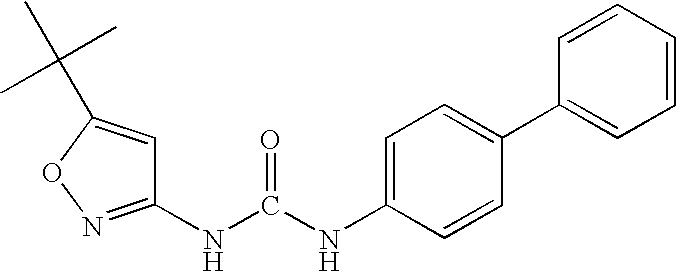
A24 
A25 
A26 
A27 
A28 
A29 
A30 
A31 
A32 
A33 
A34 
A35 
A36 
A37 
A38 
A39 
A40 
A41 
A42 
A43 
A44 
A45 
A46 
A47 
A48 
A49 
A50 
A51 
A52 
A53 
A54 
A55 
A56 
A57 
-

- To a flask 5-tert-Butyl-3-isocyanato-isoxazole (242 mg, 1 eq) and substituted benzylamine (1 eq) was added and dissolved in toluene. The reaction was allowed to stir at 50° C. for-three hours. The solvent removed and the mixture was purified by HPLC. Yield: 188 mg (47%).
- Compounds B2 through B8 were synthesized in a manner analogous to Compound B1 using similar starting materials and reagents. The structures are shown below in Table B:
TABLE B NO. CHEMICAL STRUCTURE B1 
B2 
B3 
B4 
B5 
B6 
B7 
B8 
-

- To a flask 5-tert-Butyl-3-isocyanato-isoxazole (242 mg, 1 eq) and substituted aniline (159 mg, 1 eq) was added and dissolved in toluene. The reaction was allowed to stir at 50° C. for three hours. The solvent removed and the mixture was purified by HPLC. Yield: 188 mg (47%).
- Compounds C2 through C3 were synthesized in a manner analogous to Compound C1 using similar starting materials and reagents. The structures are shown below in Table C:
TABLE C NO. CHEMICAL STRUCTURE C1 
C2 
C3 
-

- To a stirring solution of 5-tert-Butyl-2-p-tolyl-2H-pyrazol-3-ylamine (250 mg, 1 eq) in dry toluene at 0° C. trichloromethyl chloroformate (1.1 eq) was added dropwise. The reaction stirred at 0° C. and allowed to warm to room temperature overnight. The solvent was removed and the mixture was recrystallized in ethyl acetate. The solid was filtered off and washed with cold ethyl acetate. Yield: 242 mg (83%).

- To a flask 3-tert-Butyl-5-isocyanato-1-p-tolyl-1H-pyrazole (242 mg, 1 eq) and substituted aniline (159 mg, 1 eq) was added and dissolved in toluene. The reaction was allowed to stir at 50° C. for three hours. The solvent was removed and the mixture was purified by HPLC. Yield: 188 mg (47%).
- Compounds D2 through D22 were synthesized in a manner analogous to Compound D1 using similar starting materials and reagents. The structures are shown below in Table D:
TABLE D NO. CHEMICAL STRUCTURE D1 
D2 
D3 
D4 
D5 
D6 
D7 
D8 
D9 
D10 
D11 
D12 
D13 
D14 
D15 
D16 
D17 
D18 
D19 
D20 
D21 
D22 
-

- To the urea 6 is added NaH (2.5 eq) in DMF and the reaction is stirred at 40° C. for 1 hour. Then 1 eq of 1,3-dibromopropane is added and the reaction heated to 80° C. for 8 hours, then cooled, the solvent removed in vacuo and the product 7 purified by HPLC.
-


- To a stirring solution of 4-aminophenol (1 g, 1 eq) in 20 mL THF at 0° C. di-tert-butyl dicarbonate (2 g, 1 eq) in 3 mL THF was slowly added dropwise over 30 minutes. The reaction stirred at 0° C. and allowed to warm to room temperature overnight. The solvent removed and diluted with ethyl acetate. It was then extracted with water three times, and the organic layer was dried over magnesium sulfate. It was recrystallized in dichloromethane. Yield: 1.5 g (79%).
- Bocaminophenol (0.5 g, 1 eq), benzyl bromide (0.45 g, 1 eq), and cesium carbonate (1.94 g, 2.5 eq) was dissolved in 30 mL dimethylformamide. The reaction was allowed to stir at 45° C. overnight. The solvent was removed and dissolved in ethyl acetate and water. It was extracted with ethyl acetate three times. The organic layer was washed with 1N sodium hydroxide and dried with magnesium sulfate and solvent was-removed. It was purified by column chromatography. Yield: 0.44 g (58%).
- [4-(benzyloxy)-phenyl]-carbamic acid tert-butyl ester (0.44 g) was dissolved in 6 mL dichloromethane and 2 mL trifluoroacetic acid was added. The reaction stirred at room temperature for 1 hour. The excess trifluoroacetic acid was removed in vivo. Yield: 0.12 g (42%).
- 4-(benzyloxy)-phenylamine (0.12 g, 1 eq) was mixed with 5-tert-Butyl-2-p-tolyl-2H-pyrazole-3-carbonitrile N-oxide (0.9 g 1 eq) and dissolved in dry toluene. The reaction stirred at 80° C. overnight. The solvent was removed and purified by HPLC. Yield: 85 mg (31%)

- To 6 is added NaH (2.5 eq) in DMF and the reaction is stirred at 40° C. for 1 hour. Then 1 eq of 1,3-dibromopropane is added and the reaction heated to 80° C. for 8 hours, then cooled, the solvent removed in vacuo and the product 7 purified by HPLC.
- Compounds E2 through E5 were synthesized in a manner analogous to Compound E1 using similar starting materials and reagents. The structures are shown below in Table E:
TABLE E NO. CHEMICAL STRUCTURE E1 
E2 
E3 
E4 
E5 
-

- Lawesson's reagent is added to starting urea in toluene and the reaction heated to 100° C. for 8 hours, then cooled, the solvent removed in vacuo and the thiourea purified by HPLC.
-

- To a flask 5-tert-Butyl-3-isocyanato-isoxazole (242 mg, 1 eq) and substituted aniline (159 mg, 1 eq) was added and dissolved in toluene. The reaction was allowed to stir at 50° C. for three hours. The solvent removed and the mixture was purified by HPLC. Yield: 188 mg (47%)

- Lawesson's reagent is added to starting urea in toluene and the reaction heated to 100° C. for 8 hours, then cooled, the solvent removed in vacuo and the thiourea purified by HPLC.
- Compounds F2 through F9 were synthesized in a manner analogous to Compound F1 using similar starting materials and reagents. The structures are shown below in Table F:
TABLE F NO. CHEMICAL STRUCTURE F1 
F2 
F3 
F4 
F5 
F6 
F7 
F8 
F9 
-

- To a stirring solution of the amine 4 (1 eq) in toluene at room temperature is added the isocyanate 8 and heated at 80° C. overnight. The solvent is removed, and the product 9 is purified by HPLC. Compound C, compound A, compound B, compound D and other compounds in the benzoloxy series were made by the general method described above.

- To a stirring solution of 4-aminophenol (1 eq) in THF at 0° C. di-tert-butyl dicarbonate (1 eq) in THF was slowly added dropwise over 30 minutes. The reaction stirred at 0° C. and allowed to warm to room temperature overnight. The solvent removed and diluted with ethyl acetate. It was then extracted with water three times, and the organic layer was dried over magnesium sulfate. It was recrystallized in dichloromethane.
- To a stirring solution of sodium hydride (1.2 eq) in DMF, the Boc-aminophenol (1 eq) was added dropwise at 0° C. and stirred to room temperature for one hour. Then the substituted benzyl halide (1 eq) in THF was added dropwise at 0° C. The reaction was allowed to stir at 40° C. overnight. The solvent was removed and dissolved in ethyl acetate and water. It was extracted with ethyl acetate three times. The organic layer was washed with 1N sodium hydroxide and dried with magnesium sulfate and solvent was removed. It was purified by column chromatography.
- The protected substituted benzyloxyaniline was dissolved in dichloromethane and trifluoroacetic acid was added. The reaction stirred at room temperature for 1 hour. The excess trifluoroacetic acid was removed in vivo.
- The substituted benzyloxyaniline (1 eq) was mixed with 5-tert-Butyl-3-isocyanato-isoxazole (1 eq) and dissolved in dry toluene. The reaction stirred at 80° C. overnight. The solvent was removed and purified by HPLC.
-

- To a stirring solution of 5-tert-Butyl-isoxazol-3-ylamine (250 mg, 1 eq) in dry toluene at 0° C. trichloromethyl chloroformate (1.1 eq) was added dropwise. The reaction stirred at 0° C. and allowed to warm to room temperature overnight. The solvent was removed and the mixture was recrystallized in ethyl acetate. The solid was filtered off and washed with cold ethyl acetate. Yield: 242 mg (83%).
- To a flask 5-tert-Butyl-3-isocyanato-isoxazole (242 mg, 1 eq) and 4-aminophenol (159 mg, 1 eq) was added and dissolved in toluene. The reaction was allowed to stir at 50° C. for three hours. The solvent removed and the mixture was purified by HPLC. Yield: 188 mg (47%), LC/MS [MH+] 276.
- In a dry flask flushed with nitrogen gas 1-(5-tert-Butyl-isoxazol-3-yl)-3-(4-hydroxy-phenyl)-urea (100 mg, 1 eq), 3-Pyridin-4-yl-propan-1-ol (200 mg, 1 eq) and triphenylphosphine (143 mg, 1.5 eq) was added and then dissolved with THF. The flask was cooled to 0° C. and diethyl azodicarboxylate (95 mg, 1.5 eq) was added dropwise. The reaction stirred overnight at room temperature. The THF was removed and the mixture was purified by HPLC. Yield: 26 mg (18%), LC/MS [MH+] 395.
-

- To a stirring solution of 4-aminophenol (1 g, 1 eq) in 20 mL THF at 0° C. di-tert-butyl dicarbonate (2 g, 1 eq) in 3 mL THF was slowly added dropwise over 30 minutes. The reaction stirred at 0° C. and allowed to warm to room temperature overnight. The solvent removed and diluted with ethyl acetate. It was then extracted with water three times, and the organic layer was dried over magnesium sulfate. It was recrystallized in dichloromethane. Yield: 1.5 g (79%).
- Bocaminophenol (0.5 g, 1 eq), 2-fluorobenzyl bromide (0.45 g, 1 eq), and cesium carbonate (1.94 g, 2.5 eq) was dissolved in 30 mL dimethylformamide. The reaction was allowed to stir at 45° C. overnight. The solvent was removed and dissolved in ethyl acetate and water. It was extracted with ethyl acetate three times. The organic layer was washed with 1N sodium hydroxide and dried with magnesium sulfate and solvent was removed. It was purified by column chromatography. Yield: 0.44 g (58%).
- [4-(2-Fluoro-benzyloxy)-phenyl]-carbamic acid tert-butyl ester (0.44 g) was dissolved in 6 mL dichloromethane and 2 mL trifluoroacetic acid was added. The reaction stirred at room temperature for 1 hour. The excess trifluoroacetic acid was removed in vivo. Yield: 0.12 g (42%), LC/MS [MH+]218.
- 4-(2-Fluoro-benzyloxy)-phenylamine (0.12 g, 1 eq) was mixed with 5-tert-Butyl-3-isocyanato-isoxazole (0.9 g 1 eq) and dissolved in dry toluene. The reaction stirred at 80° C. overnight. The solvent was removed and purified by HPLC. Yield: 85 mg (31%), LC/MS [MH+] 384.
- Compounds G2 through G57 were synthesized in a manner analogous to Compound G1 and G12 using similar starting materials and reagents. The structures are shown below in Table G:
TABLE G NO. CHEMICAL STRUCTURE G1 
G2 
G3 
G4 
G5 
G6 
G7 
G8 
G9 
G10 
G11 
G12 
G13 
G14 
G15 
G16 
G17 
G18 
G19 
G20 
G21 
G22 
G23 
G24 
G25 
G26 
G27 
G28 
G29 
G30 
G31 
G32 
G33 
G34 
G35 
G36 
G37 
G38 
G39 
G40 
G42 
G44 
G46 
G48 
G49 
G50 
G51 
G52 
G53 
G54 
G55 
G56 
G57 
-

- Compounds H1 through H10 were synthesized in a manner analogous to compound G1. Compounds H 11 through H17 were synthesized in a manner analogous to Compound A1 using similar starting materials and reagents. The structures are shown below in Table H:
TABLE H NO. CHEMICAL STRUCTURE H1 
H2 
H3 
H4 
H5 
H6 
H7 
H8 
H9 
H10 
H11 
H12 
H13 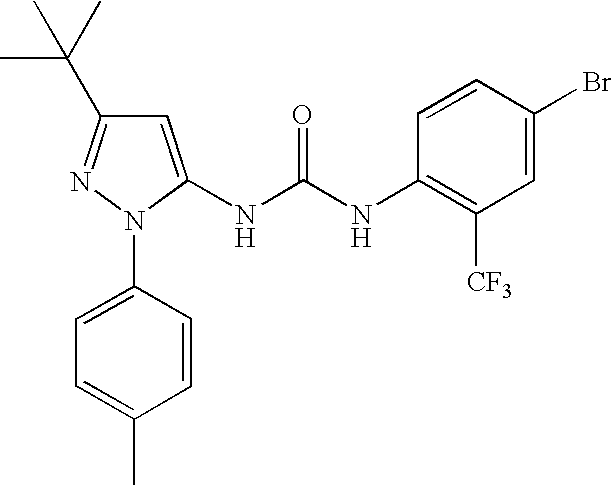
H14 
H15 
H16 
H17 
-

- Compounds 11 through 14 were synthesized in a manner analogous to Compound G1 using similar starting materials and reagents. The structures are shown below in Table I:
TABLE I NO. CHEMICAL STRUCTURE I1 
I2 
I3 
I4 
-

- A solution of an isoxazole-3-isocyanate in dimethylacetamide is added to a solution of 4-alkoxy-N-alkylbenzenamine in dimethylacetamide, and the mixture is heated at 80° C. overnight. After cooling to room temperature, 20 ml water is added and the mixture is extracted with 3×30 ml EtOAc. The combined organic phases are washed with brine, dried over magnesium sulfate, and evaporated. Purification of the product is accomplished by flash chromatography (silica gel, hexaries, 0-50% EtOAc).
-

- A solution of 5-tert-butyl-isoxazole-3-isocyanate (166 mg, 1 mmol) in 0.5 ml dimethylacetamide was added to a solution of 4-methoxy-N-methylaniline in 0.5 ml dimethylacetamide (137 mg, 1 mmol), and the mixture was heated at 80° C. overnight. After cooling to room temperature, 20 ml water was added and the mixture was extracted with 3×30 ml EtOAc. The combined organic phases were washed with brine, dried over magnesium sulfate, and evaporated. Purification of the product, N-(methyl)(4-methoxyphenyl)-N-(5-t-butyl-3-isoxazolyl) urea, was accomplished by flash chromatography (silica gel, hexanes, 0-50% EtOAc).
- Compounds J2 through J15 were synthesized in a manner analogous to Compound J1 using similar starting materials and reagents. The structures are shown below in Table J:
TABLE J NO. CHEMICAL STRUCTURE J1 
J2 
J3 
J4 
J5 
J6 
J7 
J8 
J9 
J10 
J11 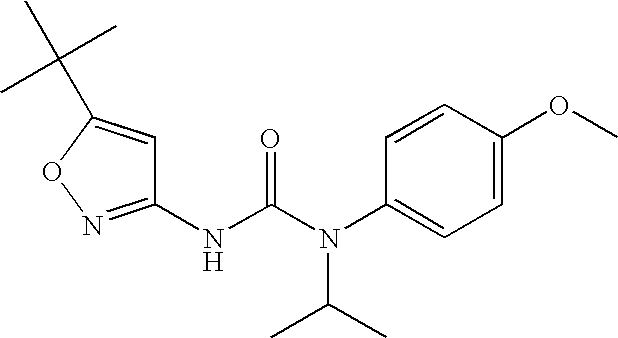
J12 
J13 
J14 
J15 
-

- The following general procedure was used to synthesize compounds having the ethylene, propylene, or butylenes linkers. To a stirring solution of 4-aminophenol (1 eq) in THF at 0° C., di-tert-butyl dicarbonate (1 eq) in THF was slowly added dropwise over 30 minutes. The reaction was stirred at 0° C. and allowed to warm to room temperature overnight. The solvent removed and diluted with ethyl acetate. It was then extracted with water three times, and the organic layer was dried over magnesium sulfate. The solid was recrystallized from dichloromethane.
- In a dry flask flushed with nitrogen gas bocaminophenol (1 eq), substituted alcohol (1 eq) and triphenylphosphine (1.5 eq) was added and then dissolved with THF. The flask was cooled to 0° C. and diethyl azodicarboxylate (1.5 eq) was added dropwise. The reaction stirred overnight at room temperature. THF was removed under vacuum and the mixture was purified by HPLC.
- The protected substituted ethyloxyaniline was dissolved in dichloromethane and trifluoroacetic acid was added. The reaction stirred at room temperature for 1 hour. The excess trifluoroacetic acid was removed in vivo.
- The substituted ethyloxyaniline (1 eq) was mixed with 5-tert-Butyl-3-isocyanato-isoxazole (1 eq) and dissolved in dry toluene. The reaction stirred at 50° C. overnight. The solvent was removed and purified by HPLC. Compound W, compound X, and others in the series were synthesized using the procedure described above.
-

- To a mixture of 4-amino-1-naphthol hydrochloride(15 g) in 100 mL dry THF at −78 C was added dropwise over 1 h n-BuLi (43 mL of a 1.6M solution in hexanes). After the addition was complete the mixture was allowed to warm to room temperature and then cooled to −78 C a and di-tert-butyl dicarbonate (Boc2O) (16.5 g in 100 mL THF was added over a period of 20 min). The mixture was slowly warmed to room temperature and stirred for 24 h and then most of the volatiles removed in vacuo. The residue was diluted with ethyl acetate and washed with water (3×100 mL) and brine (100 mL) and filtered through celite and dried over magnesium sulphate. Column chromatography (30% EtOAc/hexanes) gave 20 g of pure product.

- To a solution of (4-Hydroxy-naphthalen-1-yl)-carbamic acid tert-butyl ester (3 g) and 4-(2-Chloro-ethyl)-morpholine hydrochloride (2.22 g) in 25 mL of acetonitrile was added powdered potassium carbonate (6 g) and the solution heated overnight at 80 C. It was cooled, diluted with EtOAc and water. The organic layer was washed with water, brine and dried over anhydrous magnesium sulfate and the volatiles removed in vacuo. Purification by silica gel chromatography (10% EtOAc/hexanes) gave 2.3 g of pure product.

- To a flask 5-tert-Butyl-3-isocyanato-isoxazole (242 mg, 1 eq) and substituted aniline (159 mg, 1 eq) was added and dissolved in toluene. The reaction was allowed to stir at 50° C. for three hours. The solvent removed and the mixture was purified by HPLC. Yield: 188 mg (47%).
- Compound K2 was synthesized in a manner analogous to Compound K1 using similar starting materials and reagents. The structures are shown below in Table K:
TABLE K NO. CHEMICAL STRUCTURE K1 
K2 
- Synthesis of Compound L1: 1,3-bis(5-tert-butylisoxazol-3-yl)urea

- A mixture of amine 5-tert-butyl-isoxazol-3-ylamine (1 eq) in dry THF is stirred at room temperature under argon for an hour. Then the stirred suspension is cooled to 0° C. and to it is added dropwise a solution of phosgene or disuccinimidyl carbonate or carbonyl diimidazole (1.2 eq). The reaction is stirred at 0° C. for half an hour. Then 5-tert-butyl-isoxazol-3-ylamine in THF is added dropwise and the reaction is allowed to warm to room temperature and stirred overnight. The solvent is removed and extracted with ethyl acetate and water. The organic layer is dried over magnesium sulfate and solvent removed, and the 1,3-bis(5-tert-butylisoxazol-3-yl)urea product purified by HPLC.
-

- Dichloro-dimethoxyquinazoline was heated for 3 hours at 80° C. with one equivalent p-nitroaniline in n-butanol. After cooling to room temperature, isopropanol was added and the insoluble product was collected by filtration. Reduction was accomplished using 10% Pd/C in methanol at 50 psi in the presence of hydrochloric acid. The resulting aniline was reacted with the oxazole isocyanate in DMA at 80° C. in the presence of DIEA. The urea product was purified by HPLC.

- A mixture of aminourea hydrochloride (155 mg, 0.5 mmol), halopurine/haloquinazoline/halopyrimidine (0.5 mmol), and DIEA (90 μl, 0.5 mmol) in n-butanol (2-5 ml) was heated at 100° C. for 1-16 h. The product was purified by HPLC.

- A mixture of aminourea (274 mg, 1 mmol), paraformaldehyde (30 mg, 0.33 mmol), sodium triacetoxyborohydride (636 mg, 3 mmol) and 10 drops glacial acetic acid was stirred at room temperature over night. The solvent was evaporated completely and the residue was treated with sat. aq. NaHCO3. The solids were collected by filtration and purified via HPLC. The resulting methylaniline was used in amide formations and aryl aminations as descibed above.
-

- 1 gm. (6 mmol) of 5-tert-butyl-isoxazole-3-isocyanate and 0.83 gm (6 mmol) 4-nitro-phenylamine were dissolved in 20 ml dry toluene and stirred at 80° C. for 24 h. The resulting suspension was cooled to room temperature and filtered off to give the title compound as a yellow solid. The product was used in the next step without further purification. Yield: 1.7 g (92%), LC/MS [MH+]305.

- 1.5 gm of 1-(5-tert-butyl-isoxazol-3-yl)-3-(4-nitro-phenyl)-urea was dissolved in 50 ml THF and 0.1 g of 10% Pd/C was added. The solution was stirred under hydrogen at 50 psi, for 24 h than filtered trough Celite pad. The organic solvent was evaporated under vacuum and the resulting residue was triturated with ethyl acetate. Yield: 1.3 g (96%), LC/MS [MH+] 275.

- 1 equivalent of the carboxylic acid and 1.1 equivalent of CDI were dissolved in dry DMF and stirred at 40 C for 2 h, than 1 equivalent of aniline was added. The reaction mixture was stirred at 40 C overnight and the final product was purified by preparative HPLC.

- Alternatively, 1 equivalent of the carboxylic acid and 1.1 equivalent of thionyl chloride were heated in a sealed tube at 50° C. for 3h. The excess thionyl chloride was evaporated, 1 equivalent of aniline in DMF was added, and the solution stirred at room temperature for 8h. The final product was purified by preparative HPLC.
- Compounds N1 through N189 were synthesized in a manner analogous to one of the above procedures using similar starting materials and reagents. The structures are shown below in Table N:
TABLE N NO. CHEMICAL STRUCTURE N1 
N2 
N3 
N4 
N5 
N6 
N7 
N8 
N9 
N10 
N11 
N12 
N13 
N14 
N15 
N16 
N17 
N18 
N19 
N20 
N21 
N22 
N23 
N24 
N25 
N26 
N27 
N28 
N29 
N30 
N31 
N32 
N33 
N34 
N35 
N36 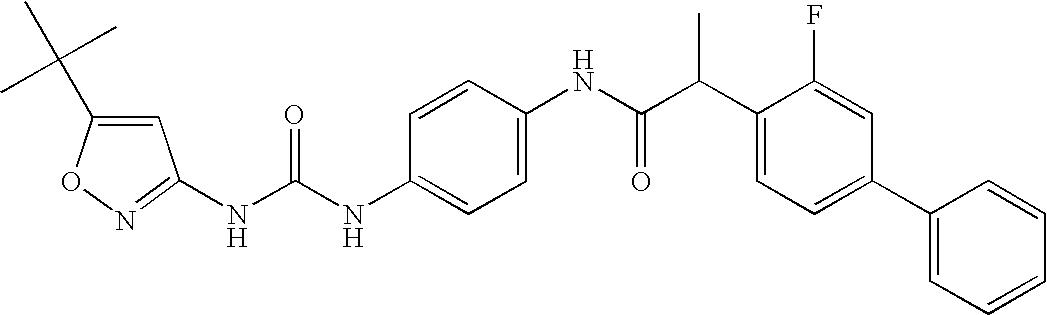
N37 
N38 
N39 
N40 
N41 
N42 
N43 
N44 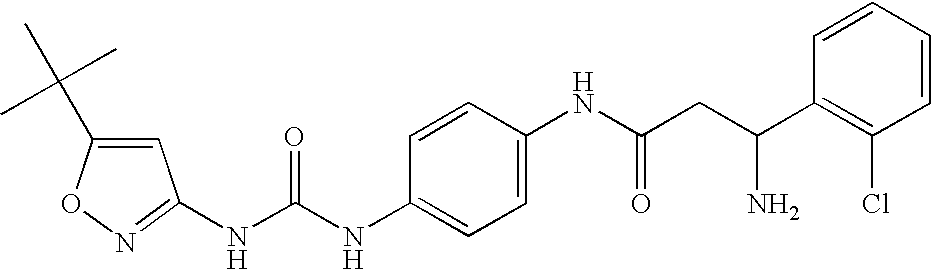
N45 
N47 
N48 
N49 
N50 
N51 
N52 
N53 
N54 
N55 
N56 
N57 
N58 
N59 
N60 
N61 
N62 
N63 
N64 
N65 
N66 
N67 
N68 
N69 
N70 
N71 
N72 
N73 
N74 
N75 
N76 
N77 
N78 
N79 
N80 
N81 
N82 
N83 
N84 
N85 
N86 
N87 
N88 
N89 
N90 
N91 
N92 
N93 
N94 
N95 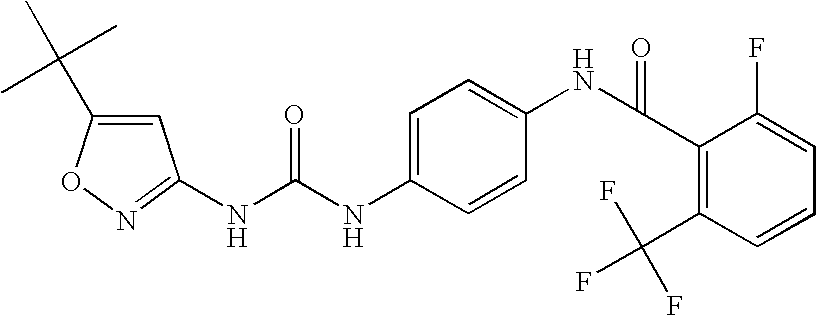
N96 
N97 
N98 
N99 
N100 
N101 
N102 
N103 
N104 
N105 
N106 
N107 
N108 
N109 
N110 
N111 
N112 
N113 
N114 
N115 
N116 
N117 
N118 
N119 
N120 
N121 
N122 
N123 
N124 
N125 
N126 
N127 
N128 
N129 
N130 
N131 
N132 
N133 
N134 
N135 
N136 
N137 
N138 
N139 
N140 
N141 
N142 
N143 
N144 
N145 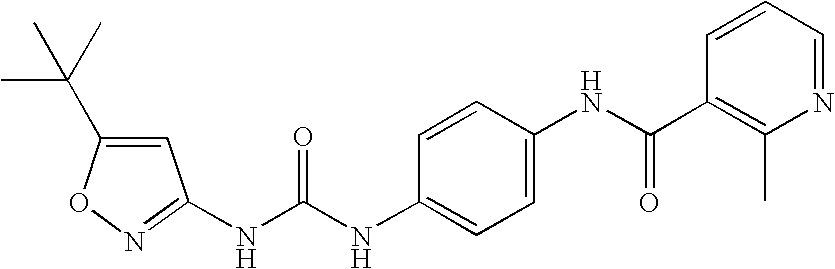
N146 
N147 
N148 
N149 
N150 
N151 
N152 
N153 
N154 
N155 
N156 
N157 
N158 
N159 
N160 
N161 
N162 
N163 
N164 
N165 
N166 
N167 
N168 
N169 
N170 
N171 
N172 
N173 
N174 
N175 
N176 
N177 
N178 
N179 
N180 
N181 
N182 
N183 
N184 
N185 
N186 
N187 
N188 
N189 
-

- Dichloro-dimethoxyquinazoline was heated 3 h at 80° C. with one equivalent p-nitroaniline in n-butanol. After cooling to room temperature, isopropanol was added and the insoluble product was collected by filtration. Reduction was accomplished using 10% Pd/C in methanol at 50 psi in the presence of hydrochloric acid. The resulting aniline was reacted with the oxazole isocyanate in DMA at 80° C. in the presence of DIEA. The urea product was purified by HPLC.
-

- Dichloro-dimethoxyquinazoline was heated 3 h at 80° C. with one equivalent p-nitroaniline in n-butanol. After cooling to room temperature, isopropanol was added and the insoluble product was collected by filtration. Reduction was accomplished using 10% Pd/C in methanol at 50 psi in the presence of hydrochloric acid. The resulting aniline was reacted with the oxazole isocyanate in DMA at 80° C. in the presence of DIEA. The urea product was purified by HPLC.
- Compounds O2 through O10 were synthesized in a manner analogous to Compound O1 using similar starting materials and reagents. The structures are shown below in Table O:
TABLE O NO. CHEMICAL STRUCTURE O1 
O2 
O3 
O4 
O5 
O6 
O7 
O8 
O9 
O10 
-

- Acetylphenylurea (obtained from either reacting p-aminoacetophenone with oxazole isocyanate in toluene or reacting p-acetylphenyl isocyanate with oxazole amine in toluene) was reacted with e.g. 4-pyridine carboxaldehyde analogous to a literature procedure (Zhang et al., Chem. Lett. 2003, 32, 966-967).
- Chalcone intermediates were further modified according to procedures described in the literature. See Powers et al., Tetrahedron, 1998, 54, 4085-4096; Katritzky et al. Org. Lett. 2000, 2, 429-431.
-

- Compound P1 was synthesized in the manner outlined above.
-


-

- To a flask 5-tert-Butyl-3-isocyanato-isoxazole (242 mg, 1 eq) 4-aminobenzoic acid (159 mg, 1 eq) was added and dissolved in toluene. The reaction was allowed to stir at 50° C. for three hours. The solvent removed and the mixture was purified by HPLC. Yield: 188 mg (47%)

- N-Hydroxy-4-methoxy-naphthalene-1-carboxamidine (1 g) and 4-[3-(5-tert-Butyl-isoxazol-3-yl)-ureido]-benzoic acid (1 eq) were reflued in diglyme (5 mL) for 24 h and then purified to give 100 mg of 1-(5-tert-Butyl-isoxazol-3-yl)-3-{4-[3-(4-methoxy-naphthalen-1-yl)-[1 ,2,4]oxadiazol-5-yl]-phenyl}-urea.
- Compounds P3 through P9 were synthesized-in a manner analogous to Compound P2 using similar starting materials and reagents. The structures are shown below in Table P:
TABLE P NO. CHEMICAL STRUCTURE P2 
P3 
P4 
P5 
P6 
P7 
P8 
P9 
-

- Commercially available isocyanides were reacted with a secondary amine in toluene or DMA (1 ml) with triethyl amine (0.2 mL) at room temperature or 50 C overnight. The solvent was removed and the compound purified by HPLC.
- Compounds Q2 through Q27 were synthesized in a manner analogous to Compound Q1 using similar starting materials and reagents. The structures are shown below in Table Q:
TABLE Q NO. CHEMICAL STRUCTURE Q1 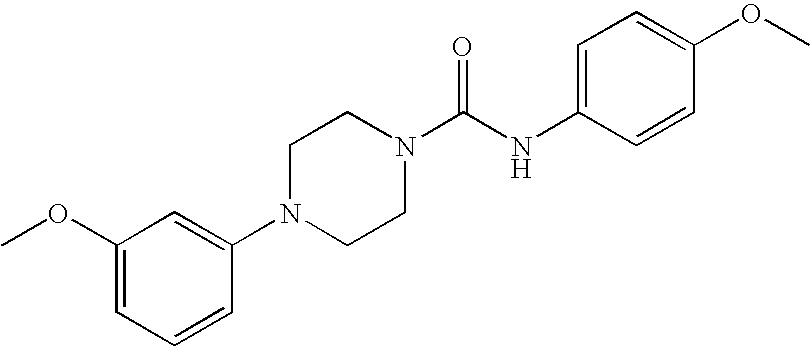
Q2 
Q3 
Q4 
Q5 
Q6 
Q7 
Q8 
Q9 
Q10 
Q11 
Q12 
Q13 
Q30 
Q31 
Q32 
Q17 
Q18 
Q19 
Q20 
Q21 
Q22 
Q23 
Q24 
Q25 
Q26 
Q27 
-

- Commercially available isocyanides were reacted with a secondary amine in toluene or DMA (1 ml) with triethyl amine (0.2 mL) at room temperature or 50 C overnight. The solvent was removed and the compound purified by HPLC.
- Compounds R2 through R9 were synthesized in a manner analogous to Compound R1 using similar starting materials and reagents. The structures are shown below in Table R:
TABLE R NO. CHEMICAL STRUCTURE R1 
R2 
R3 
R4 
R5 
R6 
R7 
R8 
R9 
-

- Synthesis of (3-tert-Butyl-isoxazol-5-yl)-thiocarbamic acid S-(4-methoxy-phenyl)ester:

- A mixture of 4-Methoxy-benzenethiol (0.20 g, 1 eq) and potassium carbonate (0.47 g, 2.5 eq) in dry THF was allowed to stir at room temperature under argon for an hour. Then the stirred suspension was cooled to 0° C. and to it was added drop wise a solution of phosgene (0.17 g 1.2 eq). The reaction stirred at 0° C. for half an hour. Then 3-tert-Butyl-isoxazol-5-ylamine (0.20 g, 1 eq) in THF was added dropwise. The reaction was allowed to warm to room temperature and stirred overnight. The solvent was removed and extracted with ethyl acetate and water. The organic layer was dried over magnesium sulfate and solvent removed. It was purified by HPLC. Yield: 157 mg (36%), LC/MS [MH+] 307.
- Compounds S2 through S3 were synthesized in a manner analogous to Compound S1 using similar starting materials and reagents. The structures are shown below in Table S:
TABLE S NO. CHEMICAL STRUCTURE S1 
S2 
S3 
-

- Synthesis of (3-tert-Butyl-isoxazol-5-yl)-thiocarbamic acid S-(4-methoxy-phenyl)ester

- A mixture of 4-Methoxy-benzenethiol (0.20 g, 1 eq) and potassium carbonate (0.47 g, 2.5 eq) in dry THF was allowed to stir at room temperature under argon for an hour. Then the stirred suspension was cooled to 0° C. and to it was added drop wise a solution of phosgene (0.17 g 1.2 eq). The reaction stirred at 0° C. for half an hour. Then 3-tert-Butyl-isoxazol-5-ylamine (0.20 g, 1 eq) in THF was added dropwise. The reaction was allowed to warm to room temperature and stirred overnight. The solvent was removed and extracted with ethyl acetate and water. The organic layer was dried over magnesium sulfate and solvent removed. It was purified by HPLC. Yield: 157 mg (36%), LC/MS [MH+] 307.
-

- 1 gm. (6 mmol) of 5-tert-butyl-isoxazole-3-isocyanate and 0.83 gm (6 mmol) 4-nitro-phenylamine were dissolved in 20 ml dry toluene and stirred at 80° C. for 24 h. The resulting suspension was cooled to room temperature and filtered off to give the title compound as a yellow solid. The product was used in the next step without further purification. Yield: 1.7 g (92%), LC/MS [MH+] 305.

- 1.5 gm of 1-(5-tert-butyl-isoxazol-3-yl)-3-(4-nitro-phenyl)-urea was dissolved in 50 ml THF and 0.1 g of 10% Pd/C was added. The solution was stirred under hydrogen at 50 psi. for 24 h than filtered trough. Celite pad. The organic solvent was evaporated under vacuum and the resulting residue was triturated with ethyl acetate. Yield: 1.3 g (96%), LC/MS [MH+] 275.

- 1 equivalent of the substituted sulfonyl chloride and 1 equivalent of the substituted aniline in DMF were added, and the solution stirred at room temperature for 8h. The final product was purified by preparative HPLC.
- Compounds V2 through V4 were synthesized in a manner analogous to Compound VI using similar starting materials and reagents. The structures are shown below in Table V:
TABLE V NO. CHEMICAL STRUCTURE V1 
V2 
V3 
V4 
- Compounds W1 and W2 were made by procedures know in the art or described herein.
TABLE W NO. CHEMICAL STRUCTURE W1 
W2 
- Compounds Z1-Z93 as shown in Table Z are commercially available:
TABLE Z NO. CHEMICAL STRUCTURE Z1 
Z2 
Z3 
Z4 
Z5 
Z6 
Z7 
Z8 
Z9 
Z10 
Z11 
Z12 
Z13 
Z14 
Z15 
Z16 
Z17 
Z18 
Z19 
Z20 
Z21 
Z22 
Z23 
Z24 
Z25 
Z26 
Z27 
Z28 
Z29 
Z30 
Z31 
Z32 
Z33 
Z34 
Z35 
Z36 
Z38 
Z39 
Z40 
Z43 
Z44 
Z45 
Z46 
Z47 
Z48 
Z49 
Z50 
Z51 
Z52 
Z53 
Z54 
Z55 
Z56 
Z57 
Z58 
Z59 
Z60 
Z61 
Z62 
Z63 
Z64 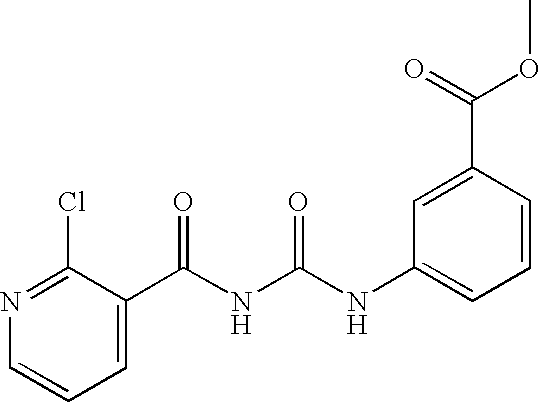
Z65 
Z66 
Z67 
Z68 
Z69 
Z70 
Z71 
Z72 
Z73 
Z74 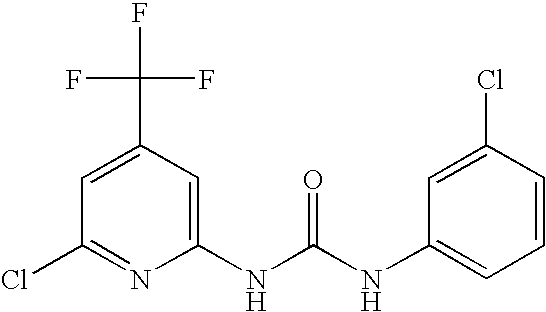
Z75 
Z76 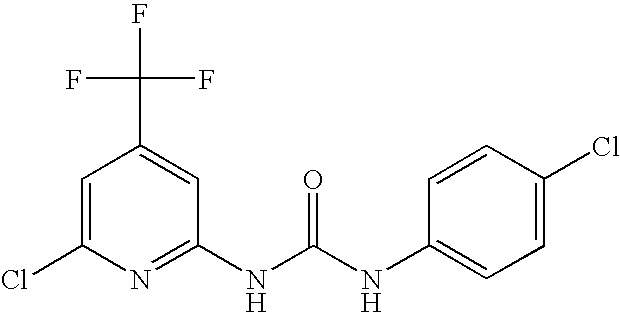
Z77 
Z78 
Z79 
Z80 
Z81 
Z82 
Z83 
Z84 
Z85 
Z86 
Z87 
Z88 
Z89 
Z90 
Z91 
Z92 
Z93 
- Methods for measuring binding affinities for interactions between small molecules and kinases including FLT3, c-KIT, p38, STK-10, MKNK2, ABL(T334I) [aka. ABL(T315I)], VEGFR2 (a.k.a. KDR), and EGFR are described in detail in U.S. application Ser. No. 10/873,835, which is incorporated by reference herein in its entirety. Components of the assays include human kinases expressed as fusions to T7 bacteriophage particles and immobilized ligands that bind to the ATP site of the kinases. For the assay, phage-displayed kinases and immobilized ATP site ligands are combined with the compound to be tested. If the test compound binds the kinase it competes with the immobilized ligand and prevents binding to the solid support. If the compound does not bind the kinase, phage-displayed proteins are free to bind to the solid support through the interaction between the kinase and the immobilized ligand. The results are read out by quantitating the amount of fusion protein bound to the solid support, which is accomplished by either traditional phage plaque assays or by quantitative PCR (qPCR) using the phage genome as a template. To determine the affinity of the interactions between a test molecule and a kinase, the amount of phage-displayed kinase bound to the solid support is quantitated as a function of test compound concentration. The concentration of test molecule that reduces the number of phage bound to the solid support by 50% is equal to the Kd for the interaction between the kinase and the test molecule. Typically, data are collected for twelve concentrations of test compound and, the resultant binding curve is fit to a non-cooperative binding isotherm to calculate Kd.
- Described in the exemplary assays below is data from binding with varying kinases. Binding values are reported as follows “+” for representative compounds exhibiting a binding dissociation constant (Kd) of 10,000 nM or higher; “++” for representative compounds exhibiting a Kd of 1,000 nM to 10,000 nM; “+++” for representative compounds exhibiting a Kd of 100 nM to 1,000 nM; and “++++” for representative compounds exhibiting a Kd of less than 100 mM. The term “ND” represents non-determined values.
Binding Constant (Kd) Measurements for Small-Molecule- p38 Interactions Binding Compound Assay: p38- Structure alpha(FKIN) 
++ 
++ 
++ 
++ 
++ 
++ 
++ 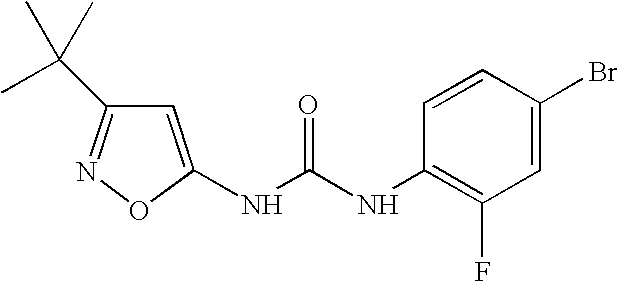
+++ 
++++ 
++ 
++ 
+++ 
+++ 
+++ 
+++ 
+++ 
++++ 
++ 
+++ 
+++ 
++ 
+++ 
+++ 
++++ 
+++ 
+++ 
ND 
+++ 
++ -
Binding Constant (Kd) Measurements for Small-Molecule- MKNK2 Interactions Binding Assay: Compound MKNK2 Structure (DKIN) 
+++ 
++ 
++ 
++ 
++++ 
++++ 
++++ 
++ 
++ 
+++ 
++++ 
++++ 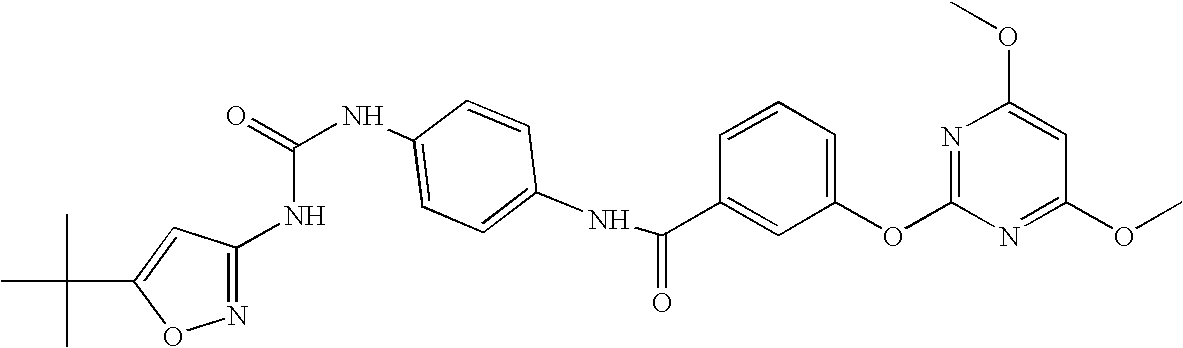
+++ 
+++ 
++ -
Binding Constant (Kd) Measurements for Small-Molecule- STK10 Interactions Binding Compound Assay Structure STK10(DKIN) 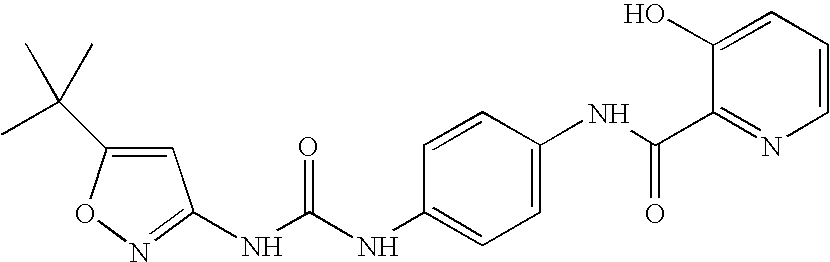
+++ 
+++ 
++++ 
++++ 
++ 
++++ 
+++ 
+++ 
++++ - All references cited herein, including patents, patent applications, and publications, are hereby incorporated by reference in their entireties, whether previously specifically incorporated or not.
- Having now fully described this invention, it will be appreciated by those skilled in the art that the same can be performed within a wide range of equivalent parameters, concentrations, and conditions without departing from the spirit and scope of the invention and without undue experimentation.
- While this invention has been described in connection with specific embodiments thereof, it will be understood that it is capable of further modifications. This application is intended to cover any variations, uses, or adaptations of the invention following, in general, the principles of the invention and including such departures from the present disclosure as come within known or customary practice within the art to which the invention pertains and as may be applied to the essential features hereinbefore set forth.
Claims (86)


Priority Applications (1)
| Application Number | Priority Date | Filing Date | Title |
|---|---|---|---|
| US10/989,824 US7750160B2 (en) | 2003-11-13 | 2004-11-15 | Isoxazolyl urea derivatives as kinase modulators |
Applications Claiming Priority (5)
| Application Number | Priority Date | Filing Date | Title |
|---|---|---|---|
| US52027303P | 2003-11-13 | 2003-11-13 | |
| US52709403P | 2003-12-03 | 2003-12-03 | |
| US53108203P | 2003-12-18 | 2003-12-18 | |
| US53124303P | 2003-12-18 | 2003-12-18 | |
| US10/989,824 US7750160B2 (en) | 2003-11-13 | 2004-11-15 | Isoxazolyl urea derivatives as kinase modulators |
Publications (2)
| Publication Number | Publication Date |
|---|---|
| US20050165024A1 true US20050165024A1 (en) | 2005-07-28 |
| US7750160B2 US7750160B2 (en) | 2010-07-06 |
Family
ID=34623983
Family Applications (11)
| Application Number | Title | Priority Date | Filing Date |
|---|---|---|---|
| US10/990,007 Abandoned US20050165074A1 (en) | 2003-11-13 | 2004-11-15 | Amide derivatives as C-KIT modulators |
| US10/989,766 Abandoned US20050171171A1 (en) | 2003-11-13 | 2004-11-15 | Amide derivatives as FLT-3 modulators |
| US10/990,194 Abandoned US20050197371A1 (en) | 2003-11-13 | 2004-11-15 | Urea derivatives as PDGFR modulators |
| US10/989,623 Expired - Fee Related US7767670B2 (en) | 2003-11-13 | 2004-11-15 | Substituted 3-carboxamido isoxazoles as kinase modulators |
| US10/990,195 Abandoned US20050192314A1 (en) | 2003-11-13 | 2004-11-15 | Urea derivatives as C-kit modulators |
| US10/989,824 Expired - Fee Related US7750160B2 (en) | 2003-11-13 | 2004-11-15 | Isoxazolyl urea derivatives as kinase modulators |
| US10/989,745 Abandoned US20050148605A1 (en) | 2003-11-13 | 2004-11-15 | Amide derivatives as ABL modulators |
| US10/989,717 Abandoned US20050267182A1 (en) | 2003-11-13 | 2004-11-15 | Urea derivatives as FLT-3 modulators |
| US10/989,814 Abandoned US20050165031A1 (en) | 2003-11-13 | 2004-11-15 | Urea derivatives as ABL modulators |
| US10/989,823 Abandoned US20050171172A1 (en) | 2003-11-13 | 2004-11-15 | Amide derivatives as PDGFR modulators |
| US12/714,331 Abandoned US20100173917A1 (en) | 2003-11-13 | 2010-02-26 | Urea derivatives as abl modulators |
Family Applications Before (5)
| Application Number | Title | Priority Date | Filing Date |
|---|---|---|---|
| US10/990,007 Abandoned US20050165074A1 (en) | 2003-11-13 | 2004-11-15 | Amide derivatives as C-KIT modulators |
| US10/989,766 Abandoned US20050171171A1 (en) | 2003-11-13 | 2004-11-15 | Amide derivatives as FLT-3 modulators |
| US10/990,194 Abandoned US20050197371A1 (en) | 2003-11-13 | 2004-11-15 | Urea derivatives as PDGFR modulators |
| US10/989,623 Expired - Fee Related US7767670B2 (en) | 2003-11-13 | 2004-11-15 | Substituted 3-carboxamido isoxazoles as kinase modulators |
| US10/990,195 Abandoned US20050192314A1 (en) | 2003-11-13 | 2004-11-15 | Urea derivatives as C-kit modulators |
Family Applications After (5)
| Application Number | Title | Priority Date | Filing Date |
|---|---|---|---|
| US10/989,745 Abandoned US20050148605A1 (en) | 2003-11-13 | 2004-11-15 | Amide derivatives as ABL modulators |
| US10/989,717 Abandoned US20050267182A1 (en) | 2003-11-13 | 2004-11-15 | Urea derivatives as FLT-3 modulators |
| US10/989,814 Abandoned US20050165031A1 (en) | 2003-11-13 | 2004-11-15 | Urea derivatives as ABL modulators |
| US10/989,823 Abandoned US20050171172A1 (en) | 2003-11-13 | 2004-11-15 | Amide derivatives as PDGFR modulators |
| US12/714,331 Abandoned US20100173917A1 (en) | 2003-11-13 | 2010-02-26 | Urea derivatives as abl modulators |
Country Status (6)
| Country | Link |
|---|---|
| US (11) | US20050165074A1 (en) |
| EP (1) | EP1684762A4 (en) |
| JP (1) | JP2007512255A (en) |
| AU (1) | AU2004291147A1 (en) |
| CA (1) | CA2545711A1 (en) |
| WO (2) | WO2005048953A2 (en) |
Cited By (24)
| Publication number | Priority date | Publication date | Assignee | Title |
|---|---|---|---|---|
| US20070232604A1 (en) * | 2006-03-17 | 2007-10-04 | Shripad Bhagwat | Imidazolothiazole compounds for the treatment of disease |
| US20080090856A1 (en) * | 2006-10-11 | 2008-04-17 | Deciphera Pharmaceuticals, Llc | Kinase inhibitors useful for the treatment of myleoproliferative diseases and other proliferative diseases |
| WO2008060866A1 (en) * | 2006-11-14 | 2008-05-22 | Smithkline Beecham Corporation | Novel compounds |
| US20080269267A1 (en) * | 2007-04-20 | 2008-10-30 | Deciphera Pharmaceuticals, Llc | Kinase inhibitors useful for the treatment of myleoprolific diseases and other proliferative diseases |
| US20090131426A1 (en) * | 2007-09-19 | 2009-05-21 | Ambit Biosciences | Solid forms comprising n-(5-tert-butyl-isoxazol-3-yl)-n'-urea, compositions thereof, and uses therewith |
| US20110189167A1 (en) * | 2007-04-20 | 2011-08-04 | Flynn Daniel L | Methods and Compositions for the Treatment of Myeloproliferative Diseases and other Proliferative Diseases |
| US8163756B2 (en) | 2004-12-23 | 2012-04-24 | Deciphera Pharmaceuticals, Llc | Enzyme modulators and treatments |
| US8188113B2 (en) | 2006-09-14 | 2012-05-29 | Deciphera Pharmaceuticals, Inc. | Dihydropyridopyrimidinyl, dihydronaphthyidinyl and related compounds useful as kinase inhibitors for the treatment of proliferative diseases |
| US8278331B2 (en) | 2008-10-29 | 2012-10-02 | Deciphera Pharmaceuticals, Llc | N-acyl ureas exhibiting anti-cancer and anti-proliferative activities |
| US8604069B2 (en) | 2011-04-28 | 2013-12-10 | Japan Tobacco Inc. | Amide compound and medicinal use thereof |
| US8722731B2 (en) | 2010-06-07 | 2014-05-13 | Novomedix, Llc | Furanyl compounds and the use thereof |
| US8940756B2 (en) | 2012-06-07 | 2015-01-27 | Deciphera Pharmaceuticals, Llc | Dihydronaphthyridines and related compounds useful as kinase inhibitors for the treatment of proliferative diseases |
| US9320739B2 (en) | 2008-03-17 | 2016-04-26 | Ambit Biosciences Corporation | RAF kinase modulator compounds and methods of use thereof |
| US9771353B2 (en) | 2013-04-02 | 2017-09-26 | Topivert Pharma Limited | Kinase inhibitors based upon N-alkyl pyrazoles |
| US9850233B2 (en) | 2013-03-14 | 2017-12-26 | Respivert Limited | Kinase inhibitors |
| US10799503B2 (en) | 2016-12-01 | 2020-10-13 | Ignyta, Inc. | Methods for the treatment of cancer |
| US10966966B2 (en) | 2019-08-12 | 2021-04-06 | Deciphera Pharmaceuticals, Llc | Methods of treating gastrointestinal stromal tumors |
| US11185535B2 (en) | 2019-12-30 | 2021-11-30 | Deciphera Pharmaceuticals, Llc | Amorphous kinase inhibitor formulations and methods of use thereof |
| US11266635B2 (en) | 2019-08-12 | 2022-03-08 | Deciphera Pharmaceuticals, Llc | Methods of treating gastrointestinal stromal tumors |
| US11395818B2 (en) | 2019-12-30 | 2022-07-26 | Deciphera Pharmaceuticals, Llc | Compositions of 1-(4-bromo-5-(1-ethyl-7-(methylamino)-2-oxo-1,2-dihydro-1,6-naphthyridin-3-yl)-2-fluorophenyl)-3-phenylurea |
| US11779572B1 (en) | 2022-09-02 | 2023-10-10 | Deciphera Pharmaceuticals, Llc | Methods of treating gastrointestinal stromal tumors |
| US11986463B2 (en) | 2018-01-31 | 2024-05-21 | Deciphera Pharmaceuticals, Llc | Combination therapy for the treatment of gastrointestinal stromal tumor |
| US12102620B2 (en) | 2018-01-31 | 2024-10-01 | Deciphera Pharmaceuticals, Llc | Combination therapy for the treatment of mastocytosis |
| US12509456B2 (en) | 2019-03-11 | 2025-12-30 | Deciphera Pharmaceuticals, Llc | Solid state forms of ripretinib |
Families Citing this family (116)
| Publication number | Priority date | Publication date | Assignee | Title |
|---|---|---|---|---|
| JP2002534468A (en) | 1999-01-13 | 2002-10-15 | バイエル コーポレイション | ω-Carboxyaryl-substituted diphenylureas as p38 kinase inhibitors |
| US8124630B2 (en) | 1999-01-13 | 2012-02-28 | Bayer Healthcare Llc | ω-carboxyaryl substituted diphenyl ureas as raf kinase inhibitors |
| ME00275B (en) | 1999-01-13 | 2011-02-10 | Bayer Corp | ?-carboxyaryl substituted diphenyl ureas as raf kinase inhibitors |
| SE0102764D0 (en) * | 2001-08-17 | 2001-08-17 | Astrazeneca Ab | Compounds |
| US20030216396A1 (en) | 2002-02-11 | 2003-11-20 | Bayer Corporation | Pyridine, quinoline, and isoquinoline N-oxides as kinase inhibitors |
| PT1478358E (en) | 2002-02-11 | 2013-09-11 | Bayer Healthcare Llc | Sorafenib tosylate for the treatment of diseases characterized by abnormal angiogenesis |
| GB0226930D0 (en) | 2002-11-19 | 2002-12-24 | Astrazeneca Ab | Chemical compounds |
| DK1636585T3 (en) | 2003-05-20 | 2008-05-26 | Bayer Pharmaceuticals Corp | Diarylurines with kinase inhibitory activity |
| PT1663978E (en) | 2003-07-23 | 2008-02-15 | Bayer Pharmaceuticals Corp | Fluoro substituted omega-carboxyaryl diphenyl urea for the treatment and prevention of diseases and conditions |
| WO2005048953A2 (en) * | 2003-11-13 | 2005-06-02 | Ambit Biosciences Corporation | Amide derivatives as kinase modulators |
| US8247576B2 (en) | 2003-12-23 | 2012-08-21 | Astex Therapeutics Limited | Pyrazole derivatives as protein kinase modulators |
| RU2392275C2 (en) * | 2004-02-18 | 2010-06-20 | Астразенека Аб | Benzamide derivatives and application as glucokinase activation agents |
| US20080312207A1 (en) * | 2004-02-18 | 2008-12-18 | Craig Johnstone | Compounds |
| EP1748987A2 (en) * | 2004-04-12 | 2007-02-07 | Torrent Pharmaceuticals Ltd | 2-propene-1-ones as hsp 70 inducers |
| MXPA06012394A (en) | 2004-04-30 | 2007-01-31 | Bayer Pharmaceuticals Corp | Substituted pyrazolyl urea derivatives useful in the treatment of cancer. |
| TW200600086A (en) * | 2004-06-05 | 2006-01-01 | Astrazeneca Ab | Chemical compound |
| US7700640B2 (en) | 2004-10-16 | 2010-04-20 | Astrazeneca Ab | Process for making phenoxy benzamide compounds |
| GB0423043D0 (en) * | 2004-10-16 | 2004-11-17 | Astrazeneca Ab | Compounds |
| JP2008524213A (en) * | 2004-12-20 | 2008-07-10 | アストラゼネカ・アクチエボラーグ | Novel pyrazole derivatives and their use as modulators of nicotinic acetylcholine receptors |
| US20080207677A1 (en) * | 2004-12-31 | 2008-08-28 | Gpc Biotech Ag | Napthyridine Compounds As Rock Inhibitors |
| US7771382B2 (en) * | 2005-01-19 | 2010-08-10 | Gi Dynamics, Inc. | Resistive anti-obesity devices |
| US8227455B2 (en) * | 2005-04-18 | 2012-07-24 | Rigel Pharmaceuticals, Inc. | Methods of treating cell proliferative disorders |
| US20110059941A1 (en) * | 2005-05-24 | 2011-03-10 | Peter William Rodney Caulkett | 2-phenyl substituted imidazol [4,5b] pyridine/pyrazine and purine derivatives as glucokinase modulators |
| TW200714597A (en) * | 2005-05-27 | 2007-04-16 | Astrazeneca Ab | Chemical compounds |
| WO2006136829A2 (en) * | 2005-06-21 | 2006-12-28 | Astex Therapeutics Limited | Pyrazole derivatives and their use as pka and pkb modulators |
| WO2006136821A1 (en) | 2005-06-22 | 2006-12-28 | Astex Therapeutics Limited | Pharmaceutical compounds |
| JP5345842B2 (en) | 2005-06-23 | 2013-11-20 | アステックス・セラピューティクス・リミテッド | Pharmaceutical combinations containing pyrazole derivatives as protein kinase modulators |
| EP2027113A1 (en) * | 2005-07-09 | 2009-02-25 | AstraZeneca AB | Heteroaryl benzamide derivatives for use as glk activators in the treatment of diabetes |
| JP4651714B2 (en) | 2005-07-09 | 2011-03-16 | アストラゼネカ アクチボラグ | Heteroarylbenzamide derivatives for use as GLK activators in the treatment of diabetes |
| EP1910350A1 (en) * | 2005-07-09 | 2008-04-16 | AstraZeneca AB | 2 -heterocyclyloxybenzoyl amino heterocyclyl compounds as modulators of glucokinase for the treatment of type 2 diabetes |
| JP5072595B2 (en) * | 2005-08-05 | 2012-11-14 | 中外製薬株式会社 | Multikinase inhibitor |
| US9202182B2 (en) * | 2005-08-11 | 2015-12-01 | International Business Machines Corporation | Method and system for analyzing business architecture |
| AU2006295260A1 (en) * | 2005-08-29 | 2007-04-05 | Gerard M. Housey | Theramutein modulators |
| JP5102771B2 (en) * | 2005-10-28 | 2012-12-19 | アイアールエム・リミテッド・ライアビリティ・カンパニー | Compounds and compositions as protein kinases |
| TW200738621A (en) | 2005-11-28 | 2007-10-16 | Astrazeneca Ab | Chemical process |
| EP1968979A2 (en) * | 2005-12-08 | 2008-09-17 | Abbott Laboratories | 9-membered heterobicyclic compounds as inhibitors of protein kinases |
| CA2632924A1 (en) * | 2005-12-22 | 2007-06-28 | Astrazeneca Ab | Chemical compounds |
| UY30183A1 (en) * | 2006-03-02 | 2007-10-31 | Astrazeneca Ab | QUINOLINE DERIVATIVES |
| BRPI0708974A2 (en) | 2006-03-22 | 2011-06-21 | Hoffmann La Roche | compound, pharmaceutical composition, methods of treating diabetes, obesity or metabolic syndrome and compound use |
| EP2038272B8 (en) * | 2006-06-30 | 2013-10-23 | Sunesis Pharmaceuticals, Inc. | Pyridinonyl pdk1 inhibitors |
| FR2903105A1 (en) | 2006-07-03 | 2008-01-04 | Sanofi Aventis Sa | 2-BENZOYL-IMIDAZOPYRIDINE DERIVATIVES, THEIR PREPARATION AND THEIR THERAPEUTIC USE |
| FR2903107B1 (en) * | 2006-07-03 | 2008-08-22 | Sanofi Aventis Sa | IMIDAZOPYRIDINE-2-CARBOXAMIDE DERIVATIVES, THEIR PREPARATION AND THEIR THERAPEUTIC USE |
| TW200825063A (en) * | 2006-10-23 | 2008-06-16 | Astrazeneca Ab | Chemical compounds |
| CL2007003061A1 (en) * | 2006-10-26 | 2008-08-01 | Astrazeneca Ab | COMPOUNDS DERIVED FROM 3,5-DIOXI-BENZAMIDA; PREPARATION PROCESS; PHARMACEUTICAL COMPOSITION THAT INCLUDES SUCH COMPOUNDS; AND ITS USE TO TREAT A MEDIUM DISEASE THROUGH GLK, SUCH AS TYPE 2 DIABETES. |
| MX2009006304A (en) | 2006-12-15 | 2009-06-23 | Abbott Lab | Novel oxadiazole compounds. |
| US7737149B2 (en) | 2006-12-21 | 2010-06-15 | Astrazeneca Ab | N-[5-[2-(3,5-dimethoxyphenyl)ethyl]-2H-pyrazol-3-yl]-4-(3,5-dimethylpiperazin-1-yl)benzamide and salts thereof |
| JP2010513445A (en) | 2006-12-21 | 2010-04-30 | アストラゼネカ アクチボラグ | Novel crystalline compounds useful as GLK activators |
| UY30892A1 (en) | 2007-02-07 | 2008-09-02 | Smithkline Beckman Corp | AKT ACTIVITY INHIBITORS |
| GB0704932D0 (en) | 2007-03-14 | 2007-04-25 | Astex Therapeutics Ltd | Pharmaceutical compounds |
| CA2684470C (en) * | 2007-04-16 | 2016-02-09 | Hutchison Medipharma Enterprises Limited | Pyrimidine derivatives |
| US8853392B2 (en) | 2007-06-03 | 2014-10-07 | Vanderbilt University | Benzamide mGluR5 positive allosteric modulators and methods of making and using same |
| US8034806B2 (en) | 2007-11-02 | 2011-10-11 | Vanderbilt University | Bicyclic mGluR5 positive allosteric modulators and methods of making and using same |
| EP2070924A1 (en) | 2007-12-10 | 2009-06-17 | Bayer Schering Pharma Aktiengesellschaft | New 2 hetarylthiazol-4-carboxylic acid derivatives, their manufacture and use as medicine |
| EP2070925A1 (en) | 2007-12-10 | 2009-06-17 | Bayer Schering Pharma Aktiengesellschaft | New 2-substituted tiazol-4-carboxylic acid derivatives, their manufacture and use as medicine |
| EP2070916A1 (en) | 2007-12-10 | 2009-06-17 | Bayer Schering Pharma Aktiengesellschaft | 2-Arylthiazol-4-carboxylic acid derivatives, their manufacture and use as medicine |
| FR2925900B1 (en) * | 2008-01-02 | 2011-03-04 | Sanofi Aventis | DERIVATIVES OF N-PHENYL-IMIDAZO-1,2-α-PYRIDINE-2-CARBOXAMIDES, THEIR PREPARATION AND THEIR THERAPEUTIC USE |
| CA2722606A1 (en) * | 2008-05-05 | 2009-11-12 | Amgen Inc. | Urea compounds as gamma secretase modulators |
| BRPI0914233A2 (en) * | 2008-06-19 | 2015-11-03 | Astrazeneca Ab | compound, use of a compound, methods for producing a gffr inhibitory effect and for producing an anticancer effect in a warm-blooded animal, pharmaceutical composition, and method for treating a disease |
| AU2009271302A1 (en) * | 2008-06-24 | 2010-01-21 | Valeant Pharmaceuticals International | Benzyloxy anilide derivatives useful as potassium channel modulators |
| EP2324028A2 (en) | 2008-08-04 | 2011-05-25 | AstraZeneca AB | Therapeutic agents 414 |
| GB0818033D0 (en) | 2008-10-02 | 2008-11-05 | Respivert Ltd | Novel compound |
| WO2010038086A2 (en) | 2008-10-02 | 2010-04-08 | Respivert Limited | Novel compounds |
| NZ593104A (en) | 2008-12-11 | 2012-11-30 | Respivert Ltd | P38 map kinase inhibitors |
| CA2750565C (en) * | 2009-01-30 | 2015-10-20 | Glaxosmithkline Llc | Crystalline n-{(1s)-2-amino-1-[(3-fluorophenyl)methyl]ethyl}-5-chloro-4-(4-chloro-1-methyl-1h-pyrazol-5-yl)-2-thiophenecarboxamide hydrochloride |
| GB0902406D0 (en) * | 2009-02-13 | 2009-04-01 | Astrazeneca Ab | Crystalline polymorphic form |
| GB0902434D0 (en) * | 2009-02-13 | 2009-04-01 | Astrazeneca Ab | Chemical process |
| US20100222381A1 (en) | 2009-02-27 | 2010-09-02 | Hariprasad Vankayalapati | Cyclopentathiophene/cyclohexathiophene DNA methyltransferase inhibitors |
| GB0905955D0 (en) | 2009-04-06 | 2009-05-20 | Respivert Ltd | Novel compounds |
| WO2010116177A1 (en) | 2009-04-09 | 2010-10-14 | Astrazeneca Ab | A pyrazolo [4,5-e] pyrimidine derivative and its use to treat diabetes and obesity |
| AR076221A1 (en) * | 2009-04-09 | 2011-05-26 | Astrazeneca Ab | DERIVED FROM PIRAZOL [4,5-E] PYRIMIDINE AND ITS USE TO TREAT DIABETES AND OBESITY |
| SI2427436T1 (en) | 2009-05-07 | 2013-04-30 | Grunenthal Gmbh | Substituted aromatic carboxamide and urea derivatives as vanilloid receptor ligands |
| EP2316820A1 (en) * | 2009-10-28 | 2011-05-04 | Dompe S.p.A. | 2-aryl-propionamide derivatives useful as bradykinin receptor antagonists and pharmaceutical compositions containing them |
| WO2011150201A2 (en) * | 2010-05-27 | 2011-12-01 | Ambit Biosciences Corporation | Azolyl amide compounds and methods of use thereof |
| WO2011150198A1 (en) | 2010-05-27 | 2011-12-01 | Ambit Biosciences Corporation | Azolyl urea compounds and methods of use thereof |
| RU2617424C2 (en) | 2010-09-03 | 2017-04-25 | ФОРМА ТиЭм, ЭлЭлСИ | Novel compounds and compositions for inhibiting nampt |
| CN102731413A (en) * | 2011-04-15 | 2012-10-17 | 上海医药工业研究院 | Urea compound and its preparation method, intermediate and use |
| SI2712358T1 (en) | 2011-05-13 | 2017-03-31 | Array Biopharma, Inc. | Pyrrolidinyl urea, pyrrolidinyl thiourea and pyrrolidinyl guanidine compounds as trka kinase inhibitors |
| UY34305A (en) | 2011-09-01 | 2013-04-30 | Novartis Ag | DERIVATIVES OF BICYCLIC HETEROCICLES FOR THE TREATMENT OF PULMONARY ARTERIAL HYPERTENSION |
| WO2013068461A1 (en) * | 2011-11-09 | 2013-05-16 | Grünenthal GmbH | Substituted pyrazolyl-based carboxamide and urea derivatives bearing a phenyl moiety substituted with an o-containing group as vanilloid receptor ligands |
| US9382239B2 (en) | 2011-11-17 | 2016-07-05 | Dana-Farber Cancer Institute, Inc. | Inhibitors of c-Jun-N-terminal kinase (JNK) |
| JP6159388B2 (en) * | 2012-03-28 | 2017-07-05 | ニューロポア セラピーズ,インコーポレイティド | Phenyl-urea and phenyl-carbamate derivatives as inhibitors of protein aggregation |
| BR112014026651A8 (en) | 2012-04-26 | 2018-01-16 | Bristol Myers Squibb Co | imidazotiadiazole and imidazopyridazine derivatives as protease activated receptor 4 (par4) inhibitors for the treatment of platelet aggregation |
| ES2625029T3 (en) | 2012-04-26 | 2017-07-18 | Bristol-Myers Squibb Company | Imidazothiadiazole derivatives as inhibitors of the protease activated receptor 4 (Par4) for the treatment of platelet aggregation |
| LT3632919T (en) | 2012-04-26 | 2023-02-27 | Bristol-Myers Squibb Company | IMIDAZOTHIADIAZOLE AND IMIDAZOPYRAZINE DERIVATIVES AS PROTEASE-ACTIVATED RECEPTOR 4 (PAR4) INHIBITORS FOR THE TREATMENT OF PLATELET AGGREGATION |
| CA2879454A1 (en) | 2012-07-19 | 2014-01-23 | Drexel University | Novel sigma receptor ligands and methods of modulating cellular protein homeostasis using same |
| CA2885828C (en) | 2012-09-28 | 2021-04-27 | University Of Washington Through Its Center For Commercialization | Ureido-thiophenyl derivatives, compositions thereof and methods for preventing, treating and/or protecting against sensory hair cell death |
| WO2014078408A1 (en) | 2012-11-13 | 2014-05-22 | Array Biopharma Inc. | Bicyclic heteroaryl urea, thiourea, guanidine and cyanoguanidine compounds as trka kinase inhibitors |
| US9981959B2 (en) | 2012-11-13 | 2018-05-29 | Array Biopharma Inc. | Thiazolyl and oxazolyl urea, thiourea, guanidine and cyanoguanidine compounds as TrkA kinase inhibitors |
| WO2014078417A1 (en) | 2012-11-13 | 2014-05-22 | Array Biopharma Inc. | Pyrazolyl urea, thiourea, guanidine and cyanoguanidine compounds as trka kinase inhibitors |
| WO2014078328A1 (en) | 2012-11-13 | 2014-05-22 | Array Biopharma Inc. | N-bicyclic aryl,n'-pyrazolyl urea, thiourea, guanidine and cyanoguanidine compounds as trka kinase inhibitors |
| SG11201503731SA (en) | 2012-11-13 | 2015-06-29 | Array Biopharma Inc | Bicyclic urea, thiourea, guanidine and cyanoguanidine compounds useful for the treatment of pain |
| WO2014078378A1 (en) | 2012-11-13 | 2014-05-22 | Array Biopharma Inc. | Pyrrolidinyl urea, thiourea, guanidine and cyanoguanidine compounds as trka kinase inhibitors |
| US9790210B2 (en) | 2012-11-13 | 2017-10-17 | Array Biopharma Inc. | N-(monocyclic aryl),N'-pyrazolyl-urea, thiourea, guanidine and cyanoguanidine compounds as TrkA kinase inhibitors |
| WO2014078331A1 (en) | 2012-11-13 | 2014-05-22 | Array Biopharma Inc. | N-(arylalkyl)-n'-pyrazolyl-urea, thiourea, guanidine and cyanoguanidine compounds as trka kinase inhibitors |
| ME02990B (en) | 2012-11-13 | 2018-10-20 | Array Biopharma Inc | N-Pyrrolidinyl, N'-pyrazolyl-urea, thiourea, guanidine and cyanoguanidine compounds as kinase race inhibitors |
| WO2014078372A1 (en) | 2012-11-13 | 2014-05-22 | Array Biopharma Inc. | Pyrrolidinyl urea, thiourea, guanidine and cyanoguanidine compounds as trka kinase inhibitors |
| US20140179712A1 (en) | 2012-12-21 | 2014-06-26 | Astrazeneca Ab | Pharmaceutical formulation of n-[5-[2-(3,5-dimethoxyphenyl)ethyl]-2h-pyrazol-3-yl]-4-[(3r,5s)-3,5-dimethylpiperazin-1-yl]benzamide |
| US9073921B2 (en) | 2013-03-01 | 2015-07-07 | Novartis Ag | Salt forms of bicyclic heterocyclic derivatives |
| WO2014176259A1 (en) | 2013-04-22 | 2014-10-30 | Icahn School Of Medicine At Mount Sinai | Mutations in pdgfrb and notch3 as causes of autosomal dominant infantile myofibromatosis |
| MX2016014945A (en) | 2014-05-15 | 2017-03-27 | Array Biopharma Inc | 1-((3s,4r)-4-(3-fluorophenyl)-1-(2-methoxyethyl)pyrrolidin-3-yl) -3-(4-methyl-3-(2-methylpyrimidin-5-yl)-1-phenyl-1h-pyrazol-5-yl )urea as a trka kinase inhibitor. |
| EP3152194B8 (en) * | 2014-06-03 | 2019-10-09 | Arizona Board of Regents on Behalf of the University of Arizona | Benzimidazole derivatives |
| AU2015291522B2 (en) * | 2014-07-17 | 2018-12-06 | Sunshine Lake Pharma Co., Ltd. | Substituted urea derivatives and pharmaceutical uses thereof |
| AR102537A1 (en) * | 2014-11-05 | 2017-03-08 | Flexus Biosciences Inc | IMMUNOMODULATING AGENTS |
| ES2760373T3 (en) | 2015-02-06 | 2020-05-13 | Univ Washington | Compounds and procedures to prevent or treat sensory hair cell death |
| DK3340796T3 (en) * | 2015-08-28 | 2021-07-26 | Chdi Foundation Inc | SPECIES FOR IMAGING HUNTINGTIN PROTEIN |
| TWI774758B (en) * | 2017-04-27 | 2022-08-21 | 瑞典商阿斯特捷利康公司 | C5-anilinoquinazoline compounds and their use in treating cancer |
| WO2018217766A1 (en) | 2017-05-22 | 2018-11-29 | Whitehead Institute For Biomedical Research | Kcc2 expression enhancing compounds and uses thereof |
| CA3066009A1 (en) * | 2017-06-01 | 2018-12-06 | Oncostellae, S.L. | Pyridoquinazoline derivatives useful as protein kinase inhibitors |
| WO2019036024A1 (en) | 2017-08-17 | 2019-02-21 | Bristol-Myers Squibb Company | 2-(1,1 '-biphenyl)-1 h-benzo[d]imidazole derivatives and related compounds as apelin and apj agonists for treating cardiovascular diseases |
| US11117870B2 (en) | 2017-11-01 | 2021-09-14 | Drexel University | Compounds, compositions, and methods for treating diseases |
| WO2019126613A1 (en) * | 2017-12-22 | 2019-06-27 | Board Of Trustees Of Michigan State University | Chemical inhibitors of mycobacterium tuberculosis dosrst signaling and persistence |
| WO2019241311A1 (en) * | 2018-06-11 | 2019-12-19 | Northeastern University | Selective ligands for modulation of girk channels |
| US20210236466A1 (en) * | 2018-07-03 | 2021-08-05 | Ifm Due, Inc. | Compounds and compositions for treating conditions associated with sting activity |
| CN113226321B (en) * | 2018-10-26 | 2024-12-17 | 阿利安制药有限责任公司 | Pyrazolyl compounds and methods of use thereof |
| CN115843272B (en) | 2020-05-08 | 2025-07-18 | 哈利亚治疗公司 | Inhibitors of NEK7 kinase |
| WO2022197755A1 (en) * | 2021-03-17 | 2022-09-22 | Shire Human Genetic Therapies, Inc. | Imidazopyridinyl inhibitors of plasma kallikrein |
Citations (9)
| Publication number | Priority date | Publication date | Assignee | Title |
|---|---|---|---|---|
| US3991071A (en) * | 1973-06-21 | 1976-11-09 | The Boots Company Limited | Fungicidal compositions containing substituted imidazoles |
| US4062861A (en) * | 1973-07-27 | 1977-12-13 | Shionogi & Co., Ltd. | 3-Isoxazolylurea derivatives |
| US5773459A (en) * | 1995-06-07 | 1998-06-30 | Sugen, Inc. | Urea- and thiourea-type compounds |
| US20030028018A1 (en) * | 2000-09-11 | 2003-02-06 | Chiron Coporation | Quinolinone derivatives |
| US6605617B2 (en) * | 2000-09-11 | 2003-08-12 | Chiron Corporation | Quinolinone derivatives |
| US20030207883A1 (en) * | 2001-07-03 | 2003-11-06 | Chiron Corporation | Indazole benzimidazole compounds |
| US6645990B2 (en) * | 2000-08-15 | 2003-11-11 | Amgen Inc. | Thiazolyl urea compounds and methods of uses |
| US20050004142A1 (en) * | 2001-09-11 | 2005-01-06 | Adams Jerry Leroy | Chemical compounds |
| US7238813B2 (en) * | 2000-11-29 | 2007-07-03 | Smithkline Beecham Corporation | Chemical compounds |
Family Cites Families (71)
| Publication number | Priority date | Publication date | Assignee | Title |
|---|---|---|---|---|
| US556245A (en) * | 1896-03-10 | Box-fastener | ||
| CH579614A5 (en) * | 1972-08-17 | 1976-09-15 | Ciba Geigy Ag | |
| JPS5031039A (en) | 1973-07-27 | 1975-03-27 | ||
| JPS53101372A (en) | 1977-02-15 | 1978-09-04 | Kanebo Ltd | Preparation of imidazole-4(5)-carboxylic acid |
| JPS5386033A (en) | 1977-10-20 | 1978-07-29 | Shionogi & Co Ltd | Herbicides |
| US5480883A (en) * | 1991-05-10 | 1996-01-02 | Rhone-Poulenc Rorer Pharmaceuticals Inc. | Bis mono- and bicyclic aryl and heteroaryl compounds which inhibit EGF and/or PDGF receptor tyrosine kinase |
| US5710158A (en) * | 1991-05-10 | 1998-01-20 | Rhone-Poulenc Rorer Pharmaceuticals Inc. | Aryl and heteroaryl quinazoline compounds which inhibit EGF and/or PDGF receptor tyrosine kinase |
| US5721237A (en) | 1991-05-10 | 1998-02-24 | Rhone-Poulenc Rorer Pharmaceuticals Inc. | Protein tyrosine kinase aryl and heteroaryl quinazoline compounds having selective inhibition of HER-2 autophosphorylation properties |
| US5714493A (en) * | 1991-05-10 | 1998-02-03 | Rhone-Poulenc Rorer Pharmaceuticals, Inc. | Aryl and heteroaryl quinazoline compounds which inhibit CSF-1R receptor tyrosine kinase |
| US6645969B1 (en) * | 1991-05-10 | 2003-11-11 | Aventis Pharmaceuticals Inc. | Aryl and heteroaryl quinazoline compounds which inhibit CSF-1R receptor tyrosine kinase |
| AU661533B2 (en) * | 1992-01-20 | 1995-07-27 | Astrazeneca Ab | Quinazoline derivatives |
| US5506245A (en) * | 1992-10-12 | 1996-04-09 | Adir Et Compagnie | Thiazolidinedione compounds |
| US5656643A (en) * | 1993-11-08 | 1997-08-12 | Rhone-Poulenc Rorer Pharmaceuticals Inc. | Bis mono-and bicyclic aryl and heteroaryl compounds which inhibit EGF and/or PDGF receptor tyrosine kinase |
| GB9510757D0 (en) | 1994-09-19 | 1995-07-19 | Wellcome Found | Therapeuticaly active compounds |
| TW321649B (en) | 1994-11-12 | 1997-12-01 | Zeneca Ltd | |
| ZA986732B (en) * | 1997-07-29 | 1999-02-02 | Warner Lambert Co | Irreversible inhibitiors of tyrosine kinases |
| DE1041982T1 (en) | 1997-12-22 | 2001-06-07 | Bayer Corp., Pittsburgh | INHIBITION OF p38 KINASE ACTIVITY BY SUBSTITUTED HETEROCYCLIC UREAS |
| PT1042305E (en) | 1997-12-22 | 2005-10-31 | Bayer Pharmaceuticals Corp | INHIBITION OF KINASE P38 USING SYMMETRICAL AND ASYMMETRIC DIFENILURE |
| NZ505844A (en) * | 1997-12-22 | 2003-10-31 | Bayer Ag | Inhibition of raf kinase using substituted heterocyclic ureas |
| SK285371B6 (en) | 1997-12-22 | 2006-12-07 | Bayer Corporation | Aryl and heteroaryl substituted heterocyclic ureas, their use and pharmaceutical composition containing thereof |
| JP2002510625A (en) * | 1998-04-08 | 2002-04-09 | イーライ・リリー・アンド・カンパニー | Methods for inhibiting MRP1 |
| US6303645B1 (en) * | 1998-05-22 | 2001-10-16 | Avanir Pharmaceuticals | Benzimidazole derivatives as modulators of IgE |
| US6246702B1 (en) | 1998-08-19 | 2001-06-12 | Path 1 Network Technologies, Inc. | Methods and apparatus for providing quality-of-service guarantees in computer networks |
| US6184226B1 (en) * | 1998-08-28 | 2001-02-06 | Scios Inc. | Quinazoline derivatives as inhibitors of P-38 α |
| US7928239B2 (en) | 1999-01-13 | 2011-04-19 | Bayer Healthcare Llc | Inhibition of RAF kinase using quinolyl, isoquinolyl or pyridyl ureas |
| UA73492C2 (en) | 1999-01-19 | 2005-08-15 | Aromatic heterocyclic compounds as antiinflammatory agents | |
| DE60009480T2 (en) * | 1999-05-05 | 2005-09-01 | Aventis Pharma Ltd., West Malling | UREAES AS MODULATORS OF CELL ADHESION |
| ES2321055T3 (en) * | 1999-05-05 | 2009-06-02 | Aventis Pharma Limited | SUBSTITUTED BIBLE COMPOUNDS. |
| KR20020032612A (en) | 1999-09-21 | 2002-05-03 | 다비드 에 질레스 | Quinazoline Derivatives And Their Use As Pharmaceuticals |
| SK3832002A3 (en) * | 1999-09-21 | 2002-11-06 | Astrazeneca Ab | Quinazoline compounds and pharmaceutical compositions containing them |
| WO2001057008A1 (en) | 2000-02-07 | 2001-08-09 | Abbott Gesellschaft Mit Beschrankter Haftung & Company Kommanditgesellschaft | 2-benzothiazolyl urea derivatives and their use as protein kinase inhibitors |
| JP3551905B2 (en) | 2000-09-01 | 2004-08-11 | オムロン株式会社 | Management station, network system, and communication method in network system |
| DE60134679D1 (en) * | 2000-10-20 | 2008-08-14 | Eisai R&D Man Co Ltd | Nitrogen-containing aromatic heterocycles |
| CN1264824C (en) * | 2001-02-21 | 2006-07-19 | 三菱制药株式会社 | Quinazoline derivatives |
| US20020135808A1 (en) * | 2001-03-22 | 2002-09-26 | Parry Travis J. | Method and apparatus for printing video data |
| PL209822B1 (en) * | 2001-04-27 | 2011-10-31 | Kirin Pharma Kk | Quinoline derivative having azolyl group and quinazoline derivative |
| AU2002345574A1 (en) | 2001-06-05 | 2002-12-16 | Cetacean Networks, Inc. | Real-time network scheduled packet routing system |
| US20040259875A1 (en) | 2001-07-31 | 2004-12-23 | Takeshi Yura | Amine derivatives |
| EA006769B1 (en) | 2001-08-06 | 2006-04-28 | Фармация Италия С.П.А. | Aminoisoxazole derivatives as kinase inhibitors |
| CN1523991A (en) | 2001-08-10 | 2004-08-25 | ��˹��ŵ�� | Use of a c-Src inhibitor alone or in combination with STI571 for the treatment of leukemia |
| EP1612563A3 (en) * | 2001-09-11 | 2009-12-09 | JTEKT Corporation | Magnetic pulser ring |
| PT2017335E (en) | 2001-10-05 | 2011-03-02 | Novartis Ag | Mutated abl kinase domains |
| MXPA04003385A (en) | 2001-10-10 | 2005-04-11 | Sugen Inc | 3-[4-(substituted heterocyclyl)-pyrrol-2-ylmethylidene]-2-indolinone derivatives as kinase inhibitors. |
| HU230798B1 (en) | 2001-10-30 | 2018-06-28 | Novartis Ag | Staurosporine derivatives as inhibitors of flt3 receptor tyrosine kinase activity |
| ATE289463T1 (en) | 2001-10-31 | 2005-03-15 | Siemens Ag | METHOD FOR COMMUNICATING REAL-TIME DATA TRAFFIC IN A COLLISION DETECTION BASED COMMUNICATION NETWORK, CORRESPONDING STORAGE MEDIUM AND COMMUNICATION NETWORK |
| ATE423104T1 (en) * | 2001-11-03 | 2009-03-15 | Astrazeneca Ab | QUINAZOLINE DERIVATIVES AS ANTI-TUMOR AGENT |
| EP1487424B1 (en) | 2002-03-15 | 2006-09-13 | Novartis AG | 4-(4-methylpiperazin-1-ylmethyl)-n-(4-methyl-3(4-pyridin-3-yl)pyrimidin-2-yl-amino)phenyl)-benzamide for treating ang ii-mediated diseases |
| US20030236287A1 (en) * | 2002-05-03 | 2003-12-25 | Piotrowski David W. | Positive allosteric modulators of the nicotinic acetylcholine receptor |
| PE20040522A1 (en) | 2002-05-29 | 2004-09-28 | Novartis Ag | DIARYLUREA DERIVATIVES DEPENDENT ON PROTEIN KINASE |
| EP1521747B1 (en) | 2002-07-15 | 2018-09-05 | Symphony Evolution, Inc. | Receptor-type kinase modulators and methods of use |
| WO2004013091A2 (en) | 2002-08-01 | 2004-02-12 | Yissum Research Development Company Of The Hebrew University Of Jerusalem | 4-anilido substituted quinazolines and use thereof as inhibitors of epidermal growth factor receptor kinases |
| WO2004030672A1 (en) | 2002-10-02 | 2004-04-15 | Merck Patent Gmbh | Use of 4 amino-quinazolines as anti cancer agents |
| AU2003298608A1 (en) | 2002-10-29 | 2004-05-25 | Activx Biosciences, Inc. | Nucleotide-binding protein-directed probes and methods of their synthesis and use |
| JO2785B1 (en) * | 2003-05-27 | 2014-03-15 | شركة جانسين فارماسوتيكا ان. في | Quinazoline derivatives |
| AU2004253967B2 (en) | 2003-07-03 | 2010-02-18 | Cytovia, Inc. | 4-arylamino-quinazolines as activators of caspases and inducers of apoptosis |
| CA2531142A1 (en) | 2003-07-03 | 2005-01-13 | Cambridge University Technical Services Ltd | Use of aurora kinase inhibitors for reducing the resistance of cancer cells |
| ES2925655T3 (en) | 2003-09-26 | 2022-10-19 | Exelixis Inc | c-Met modulators and methods of use |
| US20070123537A1 (en) * | 2003-10-06 | 2007-05-31 | Gpc Biotech Ag | Quinazoline derivatives for the treatment of herpesviral infections |
| WO2005048953A2 (en) | 2003-11-13 | 2005-06-02 | Ambit Biosciences Corporation | Amide derivatives as kinase modulators |
| US7193838B2 (en) * | 2003-12-23 | 2007-03-20 | Motorola, Inc. | Printed circuit dielectric foil and embedded capacitors |
| EP1711825A4 (en) * | 2004-01-07 | 2008-01-23 | Ambit Biosciences Corp | Conjugated small molecules |
| CA2555132A1 (en) | 2004-02-04 | 2005-08-25 | University Of Virginia Patent Foundation | Compounds that inhibit hiv particle formation |
| EP1751136B1 (en) * | 2004-05-07 | 2014-07-02 | Amgen Inc. | Nitrogenated heterocyclic derivatives as protein kinase modulators and use for the treatment of angiogenesis and cancer |
| US20070299092A1 (en) | 2004-05-20 | 2007-12-27 | Wyeth | Quinone Substituted Quinazoline and Quinoline Kinase Inhibitors |
| US7810168B2 (en) * | 2004-12-10 | 2010-10-12 | L-3 Insight Technology Incorporated | Method and apparatus for mounting a vision system |
| US7576090B2 (en) * | 2004-12-27 | 2009-08-18 | 4Sc Ag | Benzazole analogues and uses thereof |
| CA2592900A1 (en) * | 2005-01-03 | 2006-07-13 | Myriad Genetics Inc. | Nitrogen containing bicyclic compounds and therapeutical use thereof |
| WO2006074187A2 (en) | 2005-01-03 | 2006-07-13 | Myriad Genetics, Inc. | Method of treating brain cancer |
| EP1746096A1 (en) * | 2005-07-15 | 2007-01-24 | 4Sc Ag | 2-Arylbenzothiazole analogues and uses thereof in the treatment of cancer |
| JP4157564B2 (en) * | 2006-03-09 | 2008-10-01 | 東芝サムスン ストレージ・テクノロジー株式会社 | Optical disc apparatus and disc discrimination method |
| WO2007133773A2 (en) | 2006-05-15 | 2007-11-22 | Senex Biotechnology, Inc | Identification of cdki pathway inhibitors |
-
2004
- 2004-11-15 WO PCT/US2004/038433 patent/WO2005048953A2/en not_active Ceased
- 2004-11-15 US US10/990,007 patent/US20050165074A1/en not_active Abandoned
- 2004-11-15 US US10/989,766 patent/US20050171171A1/en not_active Abandoned
- 2004-11-15 US US10/990,194 patent/US20050197371A1/en not_active Abandoned
- 2004-11-15 US US10/989,623 patent/US7767670B2/en not_active Expired - Fee Related
- 2004-11-15 AU AU2004291147A patent/AU2004291147A1/en not_active Abandoned
- 2004-11-15 WO PCT/US2004/038288 patent/WO2005048948A2/en not_active Ceased
- 2004-11-15 US US10/990,195 patent/US20050192314A1/en not_active Abandoned
- 2004-11-15 EP EP04811122A patent/EP1684762A4/en not_active Withdrawn
- 2004-11-15 US US10/989,824 patent/US7750160B2/en not_active Expired - Fee Related
- 2004-11-15 US US10/989,745 patent/US20050148605A1/en not_active Abandoned
- 2004-11-15 US US10/989,717 patent/US20050267182A1/en not_active Abandoned
- 2004-11-15 US US10/989,814 patent/US20050165031A1/en not_active Abandoned
- 2004-11-15 US US10/989,823 patent/US20050171172A1/en not_active Abandoned
- 2004-11-15 CA CA002545711A patent/CA2545711A1/en not_active Abandoned
- 2004-11-15 JP JP2006539991A patent/JP2007512255A/en not_active Withdrawn
-
2010
- 2010-02-26 US US12/714,331 patent/US20100173917A1/en not_active Abandoned
Patent Citations (10)
| Publication number | Priority date | Publication date | Assignee | Title |
|---|---|---|---|---|
| US3991071A (en) * | 1973-06-21 | 1976-11-09 | The Boots Company Limited | Fungicidal compositions containing substituted imidazoles |
| US4062861A (en) * | 1973-07-27 | 1977-12-13 | Shionogi & Co., Ltd. | 3-Isoxazolylurea derivatives |
| US5773459A (en) * | 1995-06-07 | 1998-06-30 | Sugen, Inc. | Urea- and thiourea-type compounds |
| US6645990B2 (en) * | 2000-08-15 | 2003-11-11 | Amgen Inc. | Thiazolyl urea compounds and methods of uses |
| US20030028018A1 (en) * | 2000-09-11 | 2003-02-06 | Chiron Coporation | Quinolinone derivatives |
| US6605617B2 (en) * | 2000-09-11 | 2003-08-12 | Chiron Corporation | Quinolinone derivatives |
| US20030158224A1 (en) * | 2000-09-11 | 2003-08-21 | Chiron Corporation | Quinolinone derivatives |
| US7238813B2 (en) * | 2000-11-29 | 2007-07-03 | Smithkline Beecham Corporation | Chemical compounds |
| US20030207883A1 (en) * | 2001-07-03 | 2003-11-06 | Chiron Corporation | Indazole benzimidazole compounds |
| US20050004142A1 (en) * | 2001-09-11 | 2005-01-06 | Adams Jerry Leroy | Chemical compounds |
Cited By (71)
| Publication number | Priority date | Publication date | Assignee | Title |
|---|---|---|---|---|
| US8163756B2 (en) | 2004-12-23 | 2012-04-24 | Deciphera Pharmaceuticals, Llc | Enzyme modulators and treatments |
| US8129374B2 (en) | 2006-03-17 | 2012-03-06 | Ambit Bioscience Corporation | Method of using imidazolothiazole compounds for the treatment of disease |
| US8921546B2 (en) | 2006-03-17 | 2014-12-30 | Ambit Biosciences Corporation | Imidazolothiazole compounds for the treatment of disease |
| US7820657B2 (en) | 2006-03-17 | 2010-10-26 | Ambit Biosciences Corporation | Imidazolothiazole compounds for the treatment of disease |
| US20100298313A1 (en) * | 2006-03-17 | 2010-11-25 | Shripad Bhagwat | Method of using imidazolothiazole compounds for the treatment of disease |
| US8557810B2 (en) | 2006-03-17 | 2013-10-15 | Ambit Biosciences Corporation | Imidazolothiazole compounds for the treatment of disease |
| US20070232604A1 (en) * | 2006-03-17 | 2007-10-04 | Shripad Bhagwat | Imidazolothiazole compounds for the treatment of disease |
| US8188113B2 (en) | 2006-09-14 | 2012-05-29 | Deciphera Pharmaceuticals, Inc. | Dihydropyridopyrimidinyl, dihydronaphthyidinyl and related compounds useful as kinase inhibitors for the treatment of proliferative diseases |
| US7790756B2 (en) | 2006-10-11 | 2010-09-07 | Deciphera Pharmaceuticals, Llc | Kinase inhibitors useful for the treatment of myleoproliferative diseases and other proliferative diseases |
| US20080090856A1 (en) * | 2006-10-11 | 2008-04-17 | Deciphera Pharmaceuticals, Llc | Kinase inhibitors useful for the treatment of myleoproliferative diseases and other proliferative diseases |
| WO2008060866A1 (en) * | 2006-11-14 | 2008-05-22 | Smithkline Beecham Corporation | Novel compounds |
| US20080269267A1 (en) * | 2007-04-20 | 2008-10-30 | Deciphera Pharmaceuticals, Llc | Kinase inhibitors useful for the treatment of myleoprolific diseases and other proliferative diseases |
| US20110189167A1 (en) * | 2007-04-20 | 2011-08-04 | Flynn Daniel L | Methods and Compositions for the Treatment of Myeloproliferative Diseases and other Proliferative Diseases |
| US8883783B2 (en) | 2007-09-19 | 2014-11-11 | Ambit Biosciences Corporation | Solid forms comprising N-(5-tert-butyl-isoxazol-3-yl)-N′-{4-[7-(2-morpholin-4-yl-ethoxy)imidazo[2,1-b][1,3]benzothiazol-2-yl]phenyl}urea, compositions thereof, and uses therewith |
| US20090131426A1 (en) * | 2007-09-19 | 2009-05-21 | Ambit Biosciences | Solid forms comprising n-(5-tert-butyl-isoxazol-3-yl)-n'-urea, compositions thereof, and uses therewith |
| US9585892B2 (en) | 2007-09-19 | 2017-03-07 | Ambit Biosciences | Solid forms comprising N-(5-tert-butyl-isoxazol-3-yl)-N′-{4-[7-(2-morpholin-4-yl-ethoxy)imidazo[2,1-b][1,3]benzothiazol-2-yl]phenyl}urea, compositions thereof, and uses therewith |
| US9320739B2 (en) | 2008-03-17 | 2016-04-26 | Ambit Biosciences Corporation | RAF kinase modulator compounds and methods of use thereof |
| US10053430B2 (en) | 2008-03-17 | 2018-08-21 | Ambit Biosciences Corp. | RAF kinase modulator compounds and methods of use thereof |
| US9730937B2 (en) | 2008-03-17 | 2017-08-15 | Ambit Biosciences Corporation | RAF kinase modulator compounds and methods of use thereof |
| US8278331B2 (en) | 2008-10-29 | 2012-10-02 | Deciphera Pharmaceuticals, Llc | N-acyl ureas exhibiting anti-cancer and anti-proliferative activities |
| US9663483B2 (en) | 2010-06-07 | 2017-05-30 | Novomedix, Llc | Furanyl compounds and the use thereof |
| US9149527B2 (en) | 2010-06-07 | 2015-10-06 | Novomedix, Llc | Furanyl compounds and the use thereof |
| US8722731B2 (en) | 2010-06-07 | 2014-05-13 | Novomedix, Llc | Furanyl compounds and the use thereof |
| US8604069B2 (en) | 2011-04-28 | 2013-12-10 | Japan Tobacco Inc. | Amide compound and medicinal use thereof |
| US8940756B2 (en) | 2012-06-07 | 2015-01-27 | Deciphera Pharmaceuticals, Llc | Dihydronaphthyridines and related compounds useful as kinase inhibitors for the treatment of proliferative diseases |
| USRE48731E1 (en) | 2012-06-07 | 2021-09-14 | Deciphera Pharmaceuticals, Llc | Dihydronaphthyridines and related compounds useful as kinase inhibitors for the treatment of proliferative diseases |
| US9850233B2 (en) | 2013-03-14 | 2017-12-26 | Respivert Limited | Kinase inhibitors |
| US10301288B2 (en) | 2013-03-14 | 2019-05-28 | Topivert Pharma Limited | Kinase inhibitors |
| US9771353B2 (en) | 2013-04-02 | 2017-09-26 | Topivert Pharma Limited | Kinase inhibitors based upon N-alkyl pyrazoles |
| US10799503B2 (en) | 2016-12-01 | 2020-10-13 | Ignyta, Inc. | Methods for the treatment of cancer |
| US12102620B2 (en) | 2018-01-31 | 2024-10-01 | Deciphera Pharmaceuticals, Llc | Combination therapy for the treatment of mastocytosis |
| US11986463B2 (en) | 2018-01-31 | 2024-05-21 | Deciphera Pharmaceuticals, Llc | Combination therapy for the treatment of gastrointestinal stromal tumor |
| US12509456B2 (en) | 2019-03-11 | 2025-12-30 | Deciphera Pharmaceuticals, Llc | Solid state forms of ripretinib |
| US11426390B2 (en) | 2019-08-12 | 2022-08-30 | Deciphera Pharmaceuticals, Llc | Methods of treating gastrointestinal stromal tumors |
| US11969414B2 (en) | 2019-08-12 | 2024-04-30 | Deciphera Pharmaceuticals, Llc | Methods of treating gastrointestinal stromal tumors |
| US11344536B1 (en) | 2019-08-12 | 2022-05-31 | Deciphera Pharmaceuticals, Llc | Methods of treating gastrointestinal stromal tumors |
| US11433056B1 (en) | 2019-08-12 | 2022-09-06 | Deciphera Pharmaceuticals, Llc | Methods of treating gastrointestinal stromal tumors |
| US11529336B2 (en) | 2019-08-12 | 2022-12-20 | Deciphera Pharmaceuticals, Llc | Methods of treating gastrointestinal stromal tumors |
| US11534432B2 (en) | 2019-08-12 | 2022-12-27 | Deciphera Pharmaceuticals, Llc | Methods of treating gastrointestinal stromal tumors |
| US10966966B2 (en) | 2019-08-12 | 2021-04-06 | Deciphera Pharmaceuticals, Llc | Methods of treating gastrointestinal stromal tumors |
| US11576904B2 (en) | 2019-08-12 | 2023-02-14 | Deciphera Pharmaceuticals, Llc | Methods of treating gastrointestinal stromal tumors |
| US12318373B2 (en) | 2019-08-12 | 2025-06-03 | Deciphera Pharmaceuticals, Llc | Methods of treating gastrointestinal stromal tumors |
| US12295944B2 (en) | 2019-08-12 | 2025-05-13 | Deciphera Pharmaceuticals, Llc | Methods of treating gastrointestinal stromal tumors |
| US12059411B2 (en) | 2019-08-12 | 2024-08-13 | Deciphera Pharmaceuticals, Llc | Methods of treating gastrointestinal stromal tumors |
| US12059410B2 (en) | 2019-08-12 | 2024-08-13 | Deciphera Pharmaceuticals, Llc | Methods of treating gastrointestinal stromal tumors |
| US11813251B2 (en) | 2019-08-12 | 2023-11-14 | Deciphera Pharmaceuticals, Llc | Methods of treating gastrointestinal stromal tumors |
| US12023325B2 (en) | 2019-08-12 | 2024-07-02 | Deciphera Pharmaceuticals, Llc | Methods of treating gastrointestinal stromal tumors |
| US12023327B2 (en) | 2019-08-12 | 2024-07-02 | Deciphera Pharmaceuticals, Llc | Methods of treating gastrointestinal stromal tumors |
| US12023326B2 (en) | 2019-08-12 | 2024-07-02 | Deciphera Pharmaceuticals, Llc | Methods of treating gastrointestinal stromal tumors |
| US11266635B2 (en) | 2019-08-12 | 2022-03-08 | Deciphera Pharmaceuticals, Llc | Methods of treating gastrointestinal stromal tumors |
| US11793795B2 (en) | 2019-12-30 | 2023-10-24 | Deciphera Pharmaceuticals, Llc | Compositions of 1-(4-bromo-5-(1-ethyl-7-(methylamino)-2-oxo-1,2-dihydro-1,6-naphthyridin-3-yl)-2-fluorophenyl)-3-phenylurea |
| US11395818B2 (en) | 2019-12-30 | 2022-07-26 | Deciphera Pharmaceuticals, Llc | Compositions of 1-(4-bromo-5-(1-ethyl-7-(methylamino)-2-oxo-1,2-dihydro-1,6-naphthyridin-3-yl)-2-fluorophenyl)-3-phenylurea |
| US11918564B1 (en) | 2019-12-30 | 2024-03-05 | Deciphera Pharmaceuticals, Llc | Compositions of 1-(4-bromo-5-(1-ethyl-7-(methylamino)-2-oxo-1,2-dihydro-1,6-naphthyridin-3-yl)-2-fluoropheyl)-3-phenylurea |
| US11969415B1 (en) | 2019-12-30 | 2024-04-30 | Deciphera Pharmaceuticals, Llc | (methylamino)-2-oxo-1,2-dihydro-1,6-naphthyridin-3-yl)-2-fluoropheyl)-3-phenylurea |
| US11903933B2 (en) | 2019-12-30 | 2024-02-20 | Deciphera Pharmaceuticals, Llc | Compositions of 1-(4-bromo-5-(1-ethyl-7-(methylamino)-2-oxo-1,2-dihydro-1,6-naphthyridin-3-yl)-2-fluoropheyl)-3-phenylurea |
| US11896585B2 (en) | 2019-12-30 | 2024-02-13 | Deciphera Pharmaceuticals, Llc | Compositions of 1-(4-bromo-5-(1-ethyl-7-(methylamino)-2-oxo-1,2-dihydro-1,6-naphthyridin-3-yl)-2-fluorophenyl)-3-phenylurea |
| US11850240B1 (en) | 2019-12-30 | 2023-12-26 | Deciphera Pharmaceuticals, Llc | Compositions of 1-(4-bromo-5-(1-ethyl-7-(methylamino)-2-oxo-1,2-dihydro-1,6-naphthyridin-3-yl)-2-fluoropheyl)-3-phenylurea |
| US11850241B1 (en) | 2019-12-30 | 2023-12-26 | Deciphera Pharmaceuticals, Llc | Compositions of 1-(4-bromo-5-(1-ethyl-7-(methylamino)-2-oxo-1,2-dihydro-1,6-naphthyridin-3-yl)-2-fluoropheyl)-3-phenylurea |
| US11844788B1 (en) | 2019-12-30 | 2023-12-19 | Deciphera Pharmaceuticals, Llc | Compositions of 1-(4-bromo-5-(1-ethyl-7-(methylamino)-2-oxo-1,2-dihydro-1,6-naphthyridin-3-yl)-2-fluoropheyl)-3-phenylurea |
| US12023328B2 (en) | 2019-12-30 | 2024-07-02 | Deciphera Pharmaceuticals, Llc | Compositions of 1-(4-bromo-5-(1-ethyl-7-(methylamino)-2-oxo-1,2-dihydro-1,6-naphthyridin-3-yl)-2-fluoropheyl)-3-phenylurea |
| US11801237B2 (en) | 2019-12-30 | 2023-10-31 | Deciphera Pharmaceuticals, Llc | Amorphous kinase inhibitor formulations and methods of use thereof |
| US11911370B1 (en) | 2019-12-30 | 2024-02-27 | Deciphera Pharmaceuticals, Llc | Compositions of 1-(4-bromo-5-(1-ethyl-7-(methylamino)-2-oxo-1,2-dihydro-1,6-naphthyridin-3-yl)-2-fluoropheyl)-3-phenylurea |
| US12064422B2 (en) | 2019-12-30 | 2024-08-20 | Deciphera Pharmaceuticals, Llc | Compositions of 1-(4-bromo-5-(1-ethyl-7-(methylamino)-2-oxo-1,2-dihydro-1,6-naphthyridin-3-yl)-2-fluoropheyl)-3-phenylurea |
| US11185535B2 (en) | 2019-12-30 | 2021-11-30 | Deciphera Pharmaceuticals, Llc | Amorphous kinase inhibitor formulations and methods of use thereof |
| US12213968B2 (en) | 2019-12-30 | 2025-02-04 | Deciphera Pharmaceuticals, Llc | Compositions of 1-(4-bromo-5-(1-ethyl-7-(methylamino)-2-oxo-1,2-dihydro-1,6-naphthyridin-3-yl)-2-fluoropheyl)-3-phenylurea |
| US12213967B2 (en) | 2019-12-30 | 2025-02-04 | Deciphera Pharmaceuticals, Llc | Compositions of 1-(4-bromo-5-(1-ethyl-7-(methylamino)-2-oxo-1,2-dihydro-1,6-naphthyridin-3-yl)-2-fluoropheyl)-3-phenylurea |
| US12226406B2 (en) | 2019-12-30 | 2025-02-18 | Deciphera Pharmaceuticals, Llc | Compositions of 1-(4-bromo-5-(1-ethyl-7-(methylamino)-2-oxo-1,2-dihydro-1,6-naphthyridin-3-yl)-2-fluoropheyl)-3-phenylurea |
| US11576903B2 (en) | 2019-12-30 | 2023-02-14 | Deciphera Pharmaceuticals, Llc | Amorphous kinase inhibitor formulations and methods of use thereof |
| US12318374B2 (en) | 2019-12-30 | 2025-06-03 | Deciphera Pharmaceuticals, Llc | Compositions of 1-(4-bromo-5-(1-ethyl-7-(methylamino)-2-oxo-1,2-dihydro-1,6-naphthyridin-3-yl)-2-fluoropheyl)-3-phenylurea |
| US11612591B2 (en) | 2019-12-30 | 2023-03-28 | Deciphera Pharmaceuticals, Llc | Compositions of 1-(4-bromo-5-(1-ethyl-7-(methylamino)-2-oxo-1,2-dihydro-1,6-naphthyridin-3-yl)-2-fluorophenyl)-3-phenylurea |
| US11779572B1 (en) | 2022-09-02 | 2023-10-10 | Deciphera Pharmaceuticals, Llc | Methods of treating gastrointestinal stromal tumors |
Also Published As
| Publication number | Publication date |
|---|---|
| US20050192314A1 (en) | 2005-09-01 |
| US20050267182A1 (en) | 2005-12-01 |
| US20050148605A1 (en) | 2005-07-07 |
| US20050165031A1 (en) | 2005-07-28 |
| CA2545711A1 (en) | 2005-06-02 |
| US20050171172A1 (en) | 2005-08-04 |
| US7767670B2 (en) | 2010-08-03 |
| US20050165074A1 (en) | 2005-07-28 |
| EP1684762A4 (en) | 2009-06-17 |
| US20050197371A1 (en) | 2005-09-08 |
| US7750160B2 (en) | 2010-07-06 |
| WO2005048953A2 (en) | 2005-06-02 |
| JP2007512255A (en) | 2007-05-17 |
| WO2005048953A3 (en) | 2006-02-23 |
| US20100173917A1 (en) | 2010-07-08 |
| AU2004291147A1 (en) | 2005-06-02 |
| US20050171171A1 (en) | 2005-08-04 |
| WO2005048948A2 (en) | 2005-06-02 |
| WO2005048948A3 (en) | 2005-07-28 |
| US20050261315A1 (en) | 2005-11-24 |
| EP1684762A2 (en) | 2006-08-02 |
Similar Documents
| Publication | Publication Date | Title |
|---|---|---|
| US7750160B2 (en) | Isoxazolyl urea derivatives as kinase modulators | |
| US20050187389A1 (en) | Pyrrolopyrimidine derivatives and analogs and their use in the treatment and prevention of diseases | |
| US6262096B1 (en) | Aminothiazole inhibitors of cyclin dependent kinases | |
| US12139489B2 (en) | Polycyclic carbamoylpyridone derivative | |
| TWI309648B (en) | Novel chemical compounds | |
| US20070185175A1 (en) | Benzothiazole and azabenzothiazole compounds useful as kinase inhibitors | |
| US20090192307A1 (en) | Inhibitors of protein kinases | |
| WO2004081001A1 (en) | Novel 2-pyridinecarboxamide derivatives | |
| JP2007500183A (en) | 3,5-disubstituted indazole compounds, pharmaceutical compositions, and methods of mediating or inhibiting cell proliferation | |
| ZA200600821B (en) | 3,5 Disubstituted indazole compounds, pharmaceutical compositions, and methods for mediating or inhibiting cell proliferation | |
| JPH11503121A (en) | Amidine derivative | |
| US7511059B2 (en) | Thiazolidinones, their production and use as pharmaceutical agents | |
| CN102272112A (en) | Benzothiazolone Derivatives | |
| BRPI0609948A2 (en) | thiazolidinones without basic nitrogen, their production and use as pharmaceutical agents | |
| US20070010565A1 (en) | New thiazolidinones without basic nitrogen, their production and use as pharmaceutical agents | |
| HK40093123A (en) | Polycyclic carbamoylpyridone derivatives for the treatment of hiv | |
| KR20070100830A (en) | Thiazolidinone for use as an inhibitor of polo kinase (PLV) | |
| JPS59139389A (en) | Carboxamide derivatives of 5h-1,3,4-thiadiazolo(3,2,1-a) pyrimidine and manufacture |
Legal Events
| Date | Code | Title | Description |
|---|---|---|---|
| AS | Assignment |
Owner name: AMBIT BIOSCIENCES CORPORATION, CALIFORNIA Free format text: ASSIGNMENT OF ASSIGNORS INTEREST;ASSIGNORS:MILANOV, ZDRAVKO V.;PATEL, HITESH K.;GROTZFELD, ROBERT M.;AND OTHERS;REEL/FRAME:016009/0328;SIGNING DATES FROM 20041110 TO 20041112 Owner name: AMBIT BIOSCIENCES CORPORATION, CALIFORNIA Free format text: ASSIGNMENT OF ASSIGNORS INTEREST;ASSIGNORS:MILANOV, ZDRAVKO V.;PATEL, HITESH K.;GROTZFELD, ROBERT M.;AND OTHERS;SIGNING DATES FROM 20041110 TO 20041112;REEL/FRAME:016009/0328 |
|
| AS | Assignment |
Owner name: HORIZON TECHNOLOGY FUNDING COMPANY LLC, CONNECTICU Free format text: SECURITY AGREEMENT;ASSIGNOR:AMBIT BIOSCIENCES CORPORATION;REEL/FRAME:017261/0630 Effective date: 20051006 |
|
| AS | Assignment |
Owner name: AMBIT BIOSCIENCES CORPORATION, CALIFORNIA Free format text: RELEASE BY SECURED PARTY;ASSIGNOR:HORIZON TECHNOLOGY FUNDING COMPANY LLC;REEL/FRAME:020619/0693 Effective date: 20080226 |
|
| REMI | Maintenance fee reminder mailed | ||
| LAPS | Lapse for failure to pay maintenance fees | ||
| STCH | Information on status: patent discontinuation |
Free format text: PATENT EXPIRED DUE TO NONPAYMENT OF MAINTENANCE FEES UNDER 37 CFR 1.362 |
|
| STCH | Information on status: patent discontinuation |
Free format text: PATENT EXPIRED DUE TO NONPAYMENT OF MAINTENANCE FEES UNDER 37 CFR 1.362 |
|
| FP | Lapsed due to failure to pay maintenance fee |
Effective date: 20140706 |