WO2014078408A1 - Bicyclic heteroaryl urea, thiourea, guanidine and cyanoguanidine compounds as trka kinase inhibitors - Google Patents
Bicyclic heteroaryl urea, thiourea, guanidine and cyanoguanidine compounds as trka kinase inhibitors Download PDFInfo
- Publication number
- WO2014078408A1 WO2014078408A1 PCT/US2013/069886 US2013069886W WO2014078408A1 WO 2014078408 A1 WO2014078408 A1 WO 2014078408A1 US 2013069886 W US2013069886 W US 2013069886W WO 2014078408 A1 WO2014078408 A1 WO 2014078408A1
- Authority
- WO
- WIPO (PCT)
- Prior art keywords
- alkyl
- alkoxy
- phenyl
- optionally substituted
- formula
- Prior art date
- Legal status (The legal status is an assumption and is not a legal conclusion. Google has not performed a legal analysis and makes no representation as to the accuracy of the status listed.)
- Ceased
Links
- 0 *=C(NC1CCCCCCCC1)NC1=C2/C1=C\C=CC=CC=CC2 Chemical compound *=C(NC1CCCCCCCC1)NC1=C2/C1=C\C=CC=CC=CC2 0.000 description 10
- AHBKFAJVRYTTFP-UHFFFAOYSA-N Cc1c(N)[n](-c2ccccc2)nc1COC Chemical compound Cc1c(N)[n](-c2ccccc2)nc1COC AHBKFAJVRYTTFP-UHFFFAOYSA-N 0.000 description 2
- WNHQXGIDHRDCKF-UHFFFAOYSA-N CC(C)(CO)c(cc1N)n[n]1-c1ccccc1 Chemical compound CC(C)(CO)c(cc1N)n[n]1-c1ccccc1 WNHQXGIDHRDCKF-UHFFFAOYSA-N 0.000 description 1
- WBKNYYRXGYWMKT-UHFFFAOYSA-N CC(C)(COc(c(C)c1NC(Nc2c(-c3ccccc3)nc3[n]2cccc3C(F)(F)F)=O)n[n]1-c1ccccc1)O Chemical compound CC(C)(COc(c(C)c1NC(Nc2c(-c3ccccc3)nc3[n]2cccc3C(F)(F)F)=O)n[n]1-c1ccccc1)O WBKNYYRXGYWMKT-UHFFFAOYSA-N 0.000 description 1
- DFFCXYHGMIZMCO-UHFFFAOYSA-N CCOc(c(C)c1NC(Nc2c(-c3cccc(F)c3)nc3[n]2cccc3C(F)(F)F)=O)n[n]1-c1ccccc1 Chemical compound CCOc(c(C)c1NC(Nc2c(-c3cccc(F)c3)nc3[n]2cccc3C(F)(F)F)=O)n[n]1-c1ccccc1 DFFCXYHGMIZMCO-UHFFFAOYSA-N 0.000 description 1
- XUSDEWLDOUVPLZ-UHFFFAOYSA-N CCOc(c(C)c1NC(Nc2c(-c3ccccc3)nc3[n]2cccc3Cl)=O)n[n]1-c1ccccc1 Chemical compound CCOc(c(C)c1NC(Nc2c(-c3ccccc3)nc3[n]2cccc3Cl)=O)n[n]1-c1ccccc1 XUSDEWLDOUVPLZ-UHFFFAOYSA-N 0.000 description 1
- YWNVSQUWIWAEMV-UHFFFAOYSA-N C[n]1nc(COC)nc1 Chemical compound C[n]1nc(COC)nc1 YWNVSQUWIWAEMV-UHFFFAOYSA-N 0.000 description 1
- ZARRNCUIQWFTDJ-UHFFFAOYSA-N C[n]1ncc(-[n]2nc(CCC3)c3c2N)c1 Chemical compound C[n]1ncc(-[n]2nc(CCC3)c3c2N)c1 ZARRNCUIQWFTDJ-UHFFFAOYSA-N 0.000 description 1
- GNQSYWNRONXBPE-UHFFFAOYSA-N C[n]1ncc(-c(cc2N)n[n]2-c2ccccc2)c1 Chemical compound C[n]1ncc(-c(cc2N)n[n]2-c2ccccc2)c1 GNQSYWNRONXBPE-UHFFFAOYSA-N 0.000 description 1
- MZRJQEIDCWTHAV-UHFFFAOYSA-N Cc1c(N)[n](-c2ccccc2)nc1C(N)=O Chemical compound Cc1c(N)[n](-c2ccccc2)nc1C(N)=O MZRJQEIDCWTHAV-UHFFFAOYSA-N 0.000 description 1
- AGPSZNAJJRCLTH-UHFFFAOYSA-N Cc1c(N)[n](-c2ccccc2)nc1OC(N1CCOCC1)=O Chemical compound Cc1c(N)[n](-c2ccccc2)nc1OC(N1CCOCC1)=O AGPSZNAJJRCLTH-UHFFFAOYSA-N 0.000 description 1
- OCIUWNCDFPMTCU-UHFFFAOYSA-N Cc1nnc(COC)[o]1 Chemical compound Cc1nnc(COC)[o]1 OCIUWNCDFPMTCU-UHFFFAOYSA-N 0.000 description 1
- QSUVDOJVTRNLPK-UHFFFAOYSA-N Nc1c(COC2)c2n[n]1-c1ccccc1 Chemical compound Nc1c(COC2)c2n[n]1-c1ccccc1 QSUVDOJVTRNLPK-UHFFFAOYSA-N 0.000 description 1
- KUUDYKGRNGIBPQ-UHFFFAOYSA-N Nc1cc(CO)n[n]1-c1ccccc1 Chemical compound Nc1cc(CO)n[n]1-c1ccccc1 KUUDYKGRNGIBPQ-UHFFFAOYSA-N 0.000 description 1
- IYAIARXEHIRSHT-UHFFFAOYSA-N O=C(Nc1c(CS(C2)(=O)=O)c2n[n]1-c1ccccc1)Oc1ccccc1 Chemical compound O=C(Nc1c(CS(C2)(=O)=O)c2n[n]1-c1ccccc1)Oc1ccccc1 IYAIARXEHIRSHT-UHFFFAOYSA-N 0.000 description 1
Classifications
-
- C—CHEMISTRY; METALLURGY
- C07—ORGANIC CHEMISTRY
- C07D—HETEROCYCLIC COMPOUNDS
- C07D487/00—Heterocyclic compounds containing nitrogen atoms as the only ring hetero atoms in the condensed system, not provided for by groups C07D451/00 - C07D477/00
- C07D487/02—Heterocyclic compounds containing nitrogen atoms as the only ring hetero atoms in the condensed system, not provided for by groups C07D451/00 - C07D477/00 in which the condensed system contains two hetero rings
- C07D487/04—Ortho-condensed systems
-
- A—HUMAN NECESSITIES
- A61—MEDICAL OR VETERINARY SCIENCE; HYGIENE
- A61P—SPECIFIC THERAPEUTIC ACTIVITY OF CHEMICAL COMPOUNDS OR MEDICINAL PREPARATIONS
- A61P25/00—Drugs for disorders of the nervous system
-
- A—HUMAN NECESSITIES
- A61—MEDICAL OR VETERINARY SCIENCE; HYGIENE
- A61P—SPECIFIC THERAPEUTIC ACTIVITY OF CHEMICAL COMPOUNDS OR MEDICINAL PREPARATIONS
- A61P29/00—Non-central analgesic, antipyretic or antiinflammatory agents, e.g. antirheumatic agents; Non-steroidal antiinflammatory drugs [NSAID]
-
- A—HUMAN NECESSITIES
- A61—MEDICAL OR VETERINARY SCIENCE; HYGIENE
- A61P—SPECIFIC THERAPEUTIC ACTIVITY OF CHEMICAL COMPOUNDS OR MEDICINAL PREPARATIONS
- A61P31/00—Antiinfectives, i.e. antibiotics, antiseptics, chemotherapeutics
-
- A—HUMAN NECESSITIES
- A61—MEDICAL OR VETERINARY SCIENCE; HYGIENE
- A61P—SPECIFIC THERAPEUTIC ACTIVITY OF CHEMICAL COMPOUNDS OR MEDICINAL PREPARATIONS
- A61P35/00—Antineoplastic agents
-
- C—CHEMISTRY; METALLURGY
- C07—ORGANIC CHEMISTRY
- C07D—HETEROCYCLIC COMPOUNDS
- C07D231/00—Heterocyclic compounds containing 1,2-diazole or hydrogenated 1,2-diazole rings
- C07D231/54—Heterocyclic compounds containing 1,2-diazole or hydrogenated 1,2-diazole rings condensed with carbocyclic rings or ring systems
- C07D231/56—Benzopyrazoles; Hydrogenated benzopyrazoles
-
- C—CHEMISTRY; METALLURGY
- C07—ORGANIC CHEMISTRY
- C07D—HETEROCYCLIC COMPOUNDS
- C07D403/00—Heterocyclic compounds containing two or more hetero rings, having nitrogen atoms as the only ring hetero atoms, not provided for by group C07D401/00
- C07D403/02—Heterocyclic compounds containing two or more hetero rings, having nitrogen atoms as the only ring hetero atoms, not provided for by group C07D401/00 containing two hetero rings
- C07D403/12—Heterocyclic compounds containing two or more hetero rings, having nitrogen atoms as the only ring hetero atoms, not provided for by group C07D401/00 containing two hetero rings linked by a chain containing hetero atoms as chain links
-
- C—CHEMISTRY; METALLURGY
- C07—ORGANIC CHEMISTRY
- C07D—HETEROCYCLIC COMPOUNDS
- C07D471/00—Heterocyclic compounds containing nitrogen atoms as the only ring hetero atoms in the condensed system, at least one ring being a six-membered ring with one nitrogen atom, not provided for by groups C07D451/00 - C07D463/00
- C07D471/02—Heterocyclic compounds containing nitrogen atoms as the only ring hetero atoms in the condensed system, at least one ring being a six-membered ring with one nitrogen atom, not provided for by groups C07D451/00 - C07D463/00 in which the condensed system contains two hetero rings
- C07D471/04—Ortho-condensed systems
-
- C—CHEMISTRY; METALLURGY
- C07—ORGANIC CHEMISTRY
- C07D—HETEROCYCLIC COMPOUNDS
- C07D491/00—Heterocyclic compounds containing in the condensed ring system both one or more rings having oxygen atoms as the only ring hetero atoms and one or more rings having nitrogen atoms as the only ring hetero atoms, not provided for by groups C07D451/00 - C07D459/00, C07D463/00, C07D477/00 or C07D489/00
- C07D491/02—Heterocyclic compounds containing in the condensed ring system both one or more rings having oxygen atoms as the only ring hetero atoms and one or more rings having nitrogen atoms as the only ring hetero atoms, not provided for by groups C07D451/00 - C07D459/00, C07D463/00, C07D477/00 or C07D489/00 in which the condensed system contains two hetero rings
- C07D491/04—Ortho-condensed systems
- C07D491/044—Ortho-condensed systems with only one oxygen atom as ring hetero atom in the oxygen-containing ring
- C07D491/048—Ortho-condensed systems with only one oxygen atom as ring hetero atom in the oxygen-containing ring the oxygen-containing ring being five-membered
-
- C—CHEMISTRY; METALLURGY
- C07—ORGANIC CHEMISTRY
- C07D—HETEROCYCLIC COMPOUNDS
- C07D495/00—Heterocyclic compounds containing in the condensed system at least one hetero ring having sulfur atoms as the only ring hetero atoms
- C07D495/02—Heterocyclic compounds containing in the condensed system at least one hetero ring having sulfur atoms as the only ring hetero atoms in which the condensed system contains two hetero rings
- C07D495/04—Ortho-condensed systems
-
- C—CHEMISTRY; METALLURGY
- C07—ORGANIC CHEMISTRY
- C07D—HETEROCYCLIC COMPOUNDS
- C07D519/00—Heterocyclic compounds containing more than one system of two or more relevant hetero rings condensed among themselves or condensed with a common carbocyclic ring system not provided for in groups C07D453/00 or C07D455/00
Definitions
- Trk kinases are associated with many cancers including neuroblastoma (Brodeur, G. M., Nat. Rev. Cancer 2003, 3, 203-216), ovarian (Davidson. B., et al., Clin. Cancer Res. 2003, 9, 2248-2259), colorectal cancer (Bardelli, A., Science 2003, 300, 949), melanoma (Truzzi, F., et al., Dermato-Endocrinology 2008, 3 (1), pp. 32-36), head and neck cancer (Yilmaz, T., et al., Cancer Biology and Therapy 2010, 10 (6), pp.
- Another aspect of the present invention provides the compounds of the present invention for use in the treatment of disease and disorders such as chronic and acute pain, including but not limited to inflammatory pain, neuropathic pain, and pain associated with cancer, surgery, or bone fracture.
- Another aspect of the present invention provides the compounds of the present invention for use in the treatment of disease and disorders selected from cancer, inflammation or inflammatory diseases, neurodegenerative diseases, certain infectious diseases, Sjogren's syndrome, endometriosis, diabetic peripheral neuropathy, prostatitis or pelvic pain syndrome, and diseases related to an imbalance of the regulation of bone remodeling, such as osteoporosis, rheumatoid arthritis, and bone metastases.
- Another aspect of the present invention provides intermediates for preparing compounds of Formula I.
- hetCyc 1 is a 5-6-membered saturated or partially unsaturated heterocyclic ring having 1-2 ring heteroatoms independently selected from N and O;
- Halogen as used herein means F, CI, Br or I.
- Tetrafluoro(2-6C)alkyl and "pentafluoro(2-6C)alkyl” refer to a linear saturated monovalent hydrocarbon radical of two to six carbon atoms or a branched saturated monovalent hydrocarbon radical of three to six carbon atoms wherein four to five hydrogen atoms, respectively, is replaced by a fluoro group.
- Trifluoro(l-6C)alkoxy means a (l-6C)alkoxy group as defined herein, wherein one of the carbon atoms is substituted with three fluoros.
- R 1 is (l-3C)alkoxy optionally substituted with 1 -5 fluoros. In one embodiment, R 1 is methoxy, ethoxy or trifluoromethoxy.
- R 1 is H.
- Y is hetAr 1 , where hetAr 1 is pyridyl optionally substituted with one or more substituents independently selected from halogen, (1- 3C)alkyl [optionally substituted with 1-5 fluoros], and (l-3C)alkoxy [optionally substituted with 1-5 fluoros].
- Y is selected from phenyl or pyridyl, each of which is optionally substituted with one or more substituents independently selected from halogen and (l-3C)alkoxy [optionally substituted with 1-5 fluoros].
- R 1 is H.
- R 1 is halogen. In one embodiment, R 1 [00149] In one embodiment of formula A-3, R 1 is (l-3C)alkyl optionally substituted with 1 -5 fluoros. In one embodiment, R 1 is methyl, ethyl, isopropyl, or trifluoromethyl.
- R 1 is H.
- Y is pyridyl optionally substituted with one or more substituents independently selected from fluoro and methoxy.
- R 3 , R 4 and R 5 are as defined for Formula I.
- R when represented by Ar is phenyl, 2-fluorophenyl, 3- fluorophenyl, 4-fluorophenyl, 2-methylphenyl, 3-methylphenyl, 4-methylphenyl, 3- chlorophenyl, 3-chloro-4-fluorophenyl or 3-chloro-2-fluorophenyl.
- R 3 when represented by Ar 2 is phenyl, 2-fluorophenyl, 3 -fluorophenyl, 4-fluorophenyl, 2- methylphenyl, 3-methylphenyl or 4-methylphenyl.
- R 3 is phenyl.
- R 4 is hydroxycarbonyl(l-6C)alkoxy. In one embodiment, R 4 is hydroxycarbonylmethoxy.
- R 4 and R 5 together with the atoms to which they are attached form a 5-6 membered saturated, partially unsaturated or unsaturated carbocyclic ring optionally substituted with one or more substituents independently selected from (l-6C)alkyl.
- Ring C when R 4 and R 5 together with the atoms to which they are attached form a 5-6 membered saturated or unsaturated carbocyclic ring is selected from the
- R 3 is as defined for Formula I.
- R 3 is Ar 2 .
- R 3 is phenyl.
- Ring C is formula C-2
- chemotherapeutics as single agents (e.g. afatinib dimaleate, bevacizumab, carboplatin, cetuximab, cisplatin, crizotinib, erlotinib, gefitinib, gemcitabine, methotrexate, paclitaxel, pemetrexed) or combinations (e.g.
- the additional therapeutic agent(s) is selected from immune-targeted agents, including aldesleukin, ipilimumab, lambrolizumab, nivolumab, sipuleucel-T.
- a method of treating cancer in a patient comprising administering to said patient a compound of the invention or a pharmaceutically acceptable salt thereof, in combination with at least one additional therapy or therapeutic agent selected from radiotherapy (e.g. radioiodide therapy, external-beam radiation, radium 223 therapy), cytotoxic chemotherapeutics (e.g.
- arsenic trioxide bleomycin, cabazitaxel, capecitabine, carboplatin, cisplatin, cyclophosphamide, cytarabine, dacarbazine, daunorubicin, docetaxel, doxorubicin, etoposide, fluorouracil, gemcitabine, irinotecan, lomustine, methotrexate, mitomycin C, oxaliplatin, paclitaxel, pemetrexed, temozolomide, vincristine), tyrosine kinase targeted-therapeutics (e.g.
- Another embodiment of this invention provides a method of treating diabetic peripheral neuropathy in a mammal, comprising administering to said mammal in need thereof one or more compounds of Formula I or a pharmaceutically acceptable salt thereof in an amount effective to treat said diabetic peripheral neuropathy.
- a pharmaceutical combination comprising an effective amount of: (a) at least one compound of Formula I; and (b) at least one additional therapeutic agent selected from anti-inflammatory compounds, steroids (e.g., dexamethasone, cortisone and fluticasone), analgesics such as NSAIDs (e.g., aspirin, ibuprofen, indomethacin, and ketoprofen), and opioids (such as morphine), for use in the treatment of pain in a mammal, wherein (a) and (b) can be in separate dosage forms or in the same dosage form.
- steroids e.g., dexamethasone, cortisone and fluticasone
- analgesics such as NSAIDs (e.g., aspirin, ibuprofen, indomethacin, and ketoprofen)
- opioids such as morphine
- the present invention provides a compound of Formula I or a pharmaceutically acceptable salt thereof, for use in the treatment of a neurodegenerative disease in a mammal.
- Step B 2-methyl-3-(l-methyl-lH-pyrazol-4-yl)-3-oxopropanenitrile: To a four- necked 5 -liter round bottomed flask fitted with an overhead stirrer and addition funnel was charged LHMDS (1444 mL, 1444 mmol) (1.0M in THF). The solution was cooled in an acetone/dry ice bath first (internal temperature of -79 °C) under nitrogen, followed by slow addition of propiononitrile (103 mL, 1444 mmol) using a dropping funnel. The mixture was stirred at -80 °C for 90 minutes.
- Step A Preparation of 3-(l-methyl-lH-pyrazol-4-vD-3-oxopropanenitrile: A solution of ethyl 1 -methyl- lH-pyrazole-4-carboxylate (500 mg, 3.24 mmol), toluene (7.50 mL, 70.4 mmol), and acetonitrile (346 ⁇ , 6.49 mmol) was treated in one portion with KOtBu (1092 mg, 9.73 mmol) to give a hazy solution. The reaction was allowed to stir at ambient temperature for one hour, and was determined to be complete by HPLC analysis.
- Step A Preparation of 2,2,2-trifluoro-N'-hvdroxyacetimidamide: To a suspension of hydroxylamine hydrochloride (5.45 g, 78.4 mmol) in MeOH (100 mL) was added NaOMe (25 wt % solution in MeOH, 17.9 mL, 78.4 mmol) and the mixture stirred at ambient temperature for 10 minutes, then filtered and the solid was washed with MeOH. The filtrate was cooled to 0 °C and then 2,2,2-trifluoroacetonitrile (7.45 g, 78.4 mmol) gas was bubbled into the solution over 30 minutes.
- NaOMe 25 wt % solution in MeOH, 17.9 mL, 78.4 mmol
Landscapes
- Chemical & Material Sciences (AREA)
- Organic Chemistry (AREA)
- Health & Medical Sciences (AREA)
- Life Sciences & Earth Sciences (AREA)
- Public Health (AREA)
- General Chemical & Material Sciences (AREA)
- Medicinal Chemistry (AREA)
- Nuclear Medicine, Radiotherapy & Molecular Imaging (AREA)
- Chemical Kinetics & Catalysis (AREA)
- Pharmacology & Pharmacy (AREA)
- Veterinary Medicine (AREA)
- Animal Behavior & Ethology (AREA)
- General Health & Medical Sciences (AREA)
- Rheumatology (AREA)
- Pain & Pain Management (AREA)
- Communicable Diseases (AREA)
- Oncology (AREA)
- Engineering & Computer Science (AREA)
- Bioinformatics & Cheminformatics (AREA)
- Biomedical Technology (AREA)
- Neurology (AREA)
- Neurosurgery (AREA)
- Pharmaceuticals Containing Other Organic And Inorganic Compounds (AREA)
Abstract
Compounds of Formula I or stereoisomers, tautomers, or pharmaceutically acceptable salts, solvates or prodrugs thereof, wherein Ring A, Ring C and X are as defined herein, are inhibitors of TrkA kinase and are useful in the treatment of diseases which can be treated with a TrkA kinase inhibitor such as pain, cancer, inflammation/inflammatory diseases, neurodegenerative diseases, certain infectious diseases, Sjogren's syndrome, endometriosis, diabetic peripheral neuropathy, prostatitis and pelvic pain syndrome.
Description
BICYCLIC HETEROARYL UREA, THIOUREA, GUANIDINE AND
CYANOGUANIDINE COMPOUNDS AS TRKA KINASE INHIBITORS
BACKGROUND OF THE INVENTION
[0001] The present invention relates to novel compounds, to pharmaceutical compositions comprising the compounds, to processes for making the compounds and to the use of the compounds in therapy. More particularly, it relates to bicyclic heteroaryl urea, thiourea, guanidine and cyanoguanidine compounds which exhibit TrkA kinase inhibition, and which are useful in the treatment of pain, cancer, inflammation/inflammatory diseases, neurodegenerative diseases, certain infectious diseases, Sjogren's syndrome, endometriosis, diabetic peripheral neuropathy, prostatitis and pelvic pain syndrome.
[0002] The current treatment regimens for pain conditions utilize several classes of compounds. The opioids (such as morphine) have several drawbacks including emetic, constipatory and negative respiratory effects, as well as the potential for addictions. Nonsteroidal anti-inflammatory analgesics (NSAIDs, such as COX-1 or COX-2 types) also have drawbacks including insufficient efficacy in treating severe pain. In addition, COX-1 inhibitors can cause ulcers of the mucosa. Accordingly, there is a continuing need for new and more effective treatments for the relief of pain, especially chronic pain.
[0003] Trk's are the high affinity receptor tyrosine kinases activated by a group of soluble growth factors called neurotrophins (NT). The Trk receptor family has three members: TrkA, TrkB and TrkC. Among the neurotrophins are (i) nerve growth factor (NGF) which activates TrkA, (ii) brain-derived neurotrophic factor (BDNF) and NT-4/5 which activate TrkB and (iii) NT3 which activates TrkC. Trk's are widely expressed in neuronal tissue and are implicated in the maintenance, signaling and survival of neuronal cells (Patapoutian, A. et al., Current Opinion in Neurobiology, 2001, 1 1, 272-280).
[0004] Inhibitors of the Trk/neurotrophin pathway have been demonstrated to be effective in numerous pre-clinical animal models of pain. For example, antagonistic NGF and TrkA antibodies such as RN-624 have been shown to be efficacious in inflammatory and neuropathic pain animal models (Woolf, C.J. et al. (1994) Neuroscience 62, 327-331 ; Zahn, P.K. et al. (2004) J. Pain 5, 157-163; McMahon, S.B. et al., (1995) Nat. Med 1, 774-780; Ma, Q. P. and Woolf, C. J. (1997) NeuroReport 8, 807-810; Shelton, D. L. et al. (2005) Pain 116, 8-16; Delafoy, L. et al. (2003) Pain 105, 489-497; Lamb, K. et al. (2003) Neurogastroenterol. Motil. 15, 355-361 ; Jaggar, S. I. et al. (1999) Br. J. Anaesth. 83, 442- 448) and neuropathic pain animal models (Ramer, M. S. and Bisby, M. A. (1999) Eur. J. Neurosci. 11, 837-846; Ro, L. S. et al. (1999); Herzberg, U. et al., Pain 79, 265-274 (1997)
Neuroreport 8, 1613-1618; Theodosiou, M. et al. (1999) Pain 81, 245-255; Li, L. et al. (2003) Mol. Cell. Neurosci. 23, 232-250; Gwak, Y. S. et al. (2003) Neurosci. Lett. 336, 117- 120).
[0005] It has also been shown that NGF secreted by tumor cells and tumor invading macrophages directly stimulates TrkA located on peripheral pain fibers. Using various tumor models in both mice and rats, it was demonstrated that neutralizing NGF with a monoclonal antibody inhibits cancer related pain to a degree similar or superior to the highest tolerated dose of morphine. Because TrkA kinase may serve as a mediator of NGF driven biological responses, inhibitors of TrkA and/or other Trk kinases may provide an effective treatment for chronic pain states.
[0006] Recent literature has also shown that overexpression, activation, amplification and/or mutation of Trk kinases are associated with many cancers including neuroblastoma (Brodeur, G. M., Nat. Rev. Cancer 2003, 3, 203-216), ovarian (Davidson. B., et al., Clin. Cancer Res. 2003, 9, 2248-2259), colorectal cancer (Bardelli, A., Science 2003, 300, 949), melanoma (Truzzi, F., et al., Dermato-Endocrinology 2008, 3 (1), pp. 32-36), head and neck cancer (Yilmaz, T., et al., Cancer Biology and Therapy 2010, 10 (6), pp. 644-653), gastric carcinoma (Du, J. et al., World Journal of Gastroenterology 2003, 9 (7), pp. 1431-1434), lung carcinoma (Ricci A., et al., American Journal of Respiratory Cell and Molecular Biology 25 (4), pp. 439-446), breast cancer (Jin, W., et al., Carcinogenesis 2010, 31 (11), pp. 1939- 1947), Glioblastoma (Wadhwa, S., et al., Journal of Biosciences 2003, 28 (2), pp. 181-188), medulloblastoma (Gruber-Olipitz, M., et al., Journal of Proteome Research 2008, 7 (5), pp. 1932-1944), secratory breast cancer (Euthus, D.M., et al., Cancer Cell 2002, 2 (5), pp. 347- 348), salivary gland cancer (Li, Y.-G., et al., Chinese Journal of Cancer Prevention and Treatment 2009, 16 (6), pp. 428-430), papillary thyroid carcinoma (Greco, A., et al., Molecular and Cellular Endocrinology 2010, 321 (1), pp. 44-49) and adult myeloid leukemia (Eguchi, M., et al., Blood 1999, 93 (4), pp. 1355-1363). In preclinical models of cancer, nonselective small molecule inhibitors of TrkA, B and C were efficacious in both inhibiting tumor growth and stopping tumor metastasis (Nakagawara, A. (2001) Cancer Letters 169:107-114; Meyer, J. et al. (2007) Leukemia, 1-10; Pierottia, M.A. and Greco A., (2006) Cancer Letters 232:90-98; Eric Adriaenssens, E., et al. Cancer Res (2008) 68:(2) 346-351).
[0007] In addition, inhibition of the neurotrophin/Trk pathway has been shown to be effective in treatment of pre-clinical models of inflammatory diseases with NGF antibodies or non-selective small molecule inhibitors of TrkA. For example, inhibition of the neurotrophin/Trk pathway has been implicated in preclinical models of inflammatory lung
diseases including asthma (Freund-Michel, V; Frossard, N., Pharmacology & Therapeutics (2008) 117(1), 52-76), interstitial cystitis (Hu Vivian Y; et. al. The Journal of Urology (2005), 173(3), 1016-21), bladder pain syndrome (Liu, H.-T., et al., (2010) BJU International, 106 (11), pp. 1681-1685), inflammatory bowel diseases including ulcerative colitis and Crohn's disease (Di Mola, F. F, et. al., Gut (2000) 46(5), 670-678) and inflammatory skin diseases such as atopic dermatitis (Dou, Y.-C, et. al. Archives of Dermatological Research (2006) 298(1), 31-37), eczema and psoriasis (Raychaudhuri, S. P., et al., J Investigative Dermatology (2004) 122(3), 812-819).
[0008] The TrkA receptor is also thought to be critical to the disease process of the parasitic infection of Trypanosoma cruzi (Chagas disease) in human hosts (de Melo- Jorge, M. et al., Cell Host & Microbe (2007) 1(4), 251-261).
[0009] Trk inhibitors may also find use in treating disease related to an imbalance of the regulation of bone remodeling, such as osteoporosis, rheumatoid arthritis, and bone metastases. Bone metastases are a frequent complication of cancer, occurring in up to 70 percent of patients with advanced breast or prostate cancer and in approximately 15 to 30 percent of patients with carcinoma of the lung, colon, stomach, bladder, uterus, rectum, thyroid, or kidney. Osteolytic metastases can cause severe pain, pathologic fractures, life- threatening hypercalcemia, spinal cord compression, and other nerve-compression syndromes. For these reasons, bone metastasis is a serious and costly complication of cancer. Therefore, agents that can induce apoptosis of proliferating osteoblasts would be highly advantageous. Expression of TrkA receptors has been observed in the bone-forming area in mouse models of bone fracture (K. Asaumi, et al., Bone (2000) 26(6) 625-633). In addition, localization of NGF was observed in almost all bone-forming cells (K. Asaumi, et al.). Recently, it was demonstrated that a Trk inhibitor inhibits the signaling activated by neurotrophins binding to all three of the Trk receptors in human hFOB osteoblasts (J. Pinski, et al., (2002) 62, 986-989). These data support the rationale for the use of Trk inhibitors for the treatment of bone remodeling diseases, such as bone metastases in cancer patients.
[0010] Trk inhibitors may also find use in treating diseases and disorders such as
Sjogren's syndrome (Fauchais, A.L., et al., (2009) Scandinavian Journal of Rheumatology, 38(1), pp. 50-57), endometriosis (Barcena De Arellano, M.L., et al., (2011) Reproductive Sciences, 18(12), pp. 1202-1210; Barcena De Arellano, et al., (2011) Fertility and Sterility, 95(3), pp. 1123-1126; Cattaneo, A., (2010) Current Opinion in Molecular Therapeutics, 12(1), pp. 94-106), diabetic peripheral neuropathy (Kim, H.C., et al., (2009) Diabetic Medicine, 26 (12), pp. 1228-1234; Siniscalco, D., et al., (2011) Current Neuropharmacology,
9(4), pp. 523-529; Ossipov, M.H., (201 1) Current Pain and Headache Reports, 15(3), pp. 185-192), and prostatitis and pelvic pain syndrome (Watanabe, T., et al., (2011) BJU International, 108(2), pp. 248-251; and Miller, L.J., et al., (2002) Urology, 59(4), pp. 603- 608).
[0011] Several classes of small molecule inhibitors of Trk kinases said to be useful for treating pain or cancer are known (Expert Opin. Ther. Patents (2009) 19(3), 305-319).
SUMMARY OF THE INVENTION
[0012] It has now been found that pyrrolidinyl urea, thiourea, guanidine and cyanoguanidine compounds are inhibitors of TrkA, and useful for treating disorders and diseases such as pain, including chronic and acute pain. Compounds of the invention useful in the treatment of multiple types of pain including inflammatory pain, neuropathic pain, and pain associated with cancer, surgery, or bone fracture. In addition, compounds of the invention are useful for treating cancer, inflammation or inflammatory diseases, neurodegenerative diseases, certain infectious diseases, Sjogren's syndrome, endometriosis, diabetic peripheral neuropathy, prostatitis or pelvic pain syndrome, and diseases related to an imbalance of the regulation of bone remodeling, such as osteoporosis, rheumatoid arthritis, and bone metastases.
[0013] More specifically, provided herein are compounds of Formula I:

I
[0014] or stereoisomers, tautomers, or pharmaceutically acceptable salts, solvates or prodrugs thereof, wherein Ring A, Ring C and X are as defined herein.
[0015] Another aspect of the present invention provides methods of treating a disease or disorder modulated by TrkA, comprising administering to a mammal in need of such treatment an effective amount of a compound of this invention or a stereoisomer, solvate or pharmaceutically acceptable salt thereof. In one embodiment, the disease and disorders include chronic and acute pain, including but not limited to inflammatory pain, neuropathic pain, and pain associated with cancer, surgery, or bone fracture. In another embodiment, the disease and disorders include, but are not limited to, cancer, inflammation or inflammatory diseases, neurodegenerative diseases, certain infectious diseases, Sjogren's syndrome,
endometriosis, diabetic peripheral neuropathy, prostatitis or pelvic pain syndrome, and diseases related to an imbalance of the regulation of bone remodeling, such as osteoporosis, rheumatoid arthritis, and bone metastases. In one embodiment, the treatment includes treating the mammal with a compound of this invention in combination with an additional therapeutic agent.
[0016] Another aspect of the present invention provides a pharmaceutical composition comprising a compound of the present invention or a pharmaceutically acceptable salt thereof.
[0017] Another aspect of the present invention provides the compounds of the present invention for use in therapy.
[0018] Another aspect of the present invention provides the compounds of the present invention for use in the treatment of disease and disorders such as chronic and acute pain, including but not limited to inflammatory pain, neuropathic pain, and pain associated with cancer, surgery, or bone fracture. Another aspect of the present invention provides the compounds of the present invention for use in the treatment of disease and disorders selected from cancer, inflammation or inflammatory diseases, neurodegenerative diseases, certain infectious diseases, Sjogren's syndrome, endometriosis, diabetic peripheral neuropathy, prostatitis or pelvic pain syndrome, and diseases related to an imbalance of the regulation of bone remodeling, such as osteoporosis, rheumatoid arthritis, and bone metastases.
[0019] Another aspect of the present invention provides the use of a compound of this invention in the manufacture of a medicament for the treatment of disease and disorders such as chronic and acute pain including, but not limited to, inflammatory pain, neuropathic pain, and pain associated with cancer, surgery, or bone fracture.
[0020] Another aspect of the present invention provides the use of a compound of this invention in the manufacture of a medicament for the treatment of disease and disorders selected from cancer, inflammation or inflammatory diseases, neurodegenerative diseases, certain infectious diseases, Sjogren's syndrome, endometriosis, diabetic peripheral neuropathy, prostatitis or pelvic pain syndrome, and diseases related to an imbalance of the regulation of bone remodeling, such as osteoporosis, rheumatoid arthritis, and bone metastases.
[0021] Another aspect of the present invention provides intermediates for preparing compounds of Formula I.
[0022] Another aspect of the present invention includes methods of preparing, methods of separation, and methods of purification of the compounds of this invention.
DETAILED DESCRIPTION OF THE INVENTION
[0023] Provided herein are compounds, and pharmaceutical formulations thereof, that are useful in the treatment of diseases, conditions and/or disorders modulated by TrkA.
[0024] Compounds of the invention such as those shown in Table A below, were found to be at least 1000 fold more selective for TrkA versus p38a.
[0025] One embodiment provides a compound of Formula I:

I
[0026] or stereoisomers, tautomers, or pharmaceutically acceptable salts, solvates or prodrugs thereof, wherein:
[0027] X is O, S, NH or -N-CN;
0028] Ring A is formula A-l, A-2, A-3 or A-4

A-1 A-2 A-3 A-4
[0029] R1 is H, halogen, (l-3C)alkyl [optionally substituted with 1-5 fluoros], (1-
3C)alkoxy [optionally substituted with 1-5 fluoros], or (3-5C)cycloalkyl;
[0030] Y is A or hetAr1;
[0031] Ar1 is phenyl optionally substituted with one or more substituents independently selected from halogen, (l-3C)alkyl [optionally substituted with 1-5 fluoros], and (l-3C)alkoxy [optionally substituted with 1-5 fluoros];
[0032] hetAr1 is pyridyl optionally substituted with one or more substituents independently selected from halogen, (l-3C)alkyl [optionally substituted with 1-5 fluoros], and (l-3C)alkoxy [optionally substituted with 1-5 fluoros];
[0033] Ring C is formula C-l or C-2

[0034] R3 is (l-6C)alkyl, hydroxy(l-6C)alkyl, Ar2, hetCyc1, (3-7C)cycloalkyl, or hetAr2;
[0035] Ar2 is phenyl optionally substituted with one or more substituents independently selected from halogen and (l-6C)alkyl;
[0036] hetCyc1 is a 5-6-membered saturated or partially unsaturated heterocyclic ring having 1-2 ring heteroatoms independently selected from N and O;
[0037] hetAr2 is a 5-6 membered heteroaryl ring having 1-3 ring heteroatoms independently selected from N, O and S and optionally substituted with one or more substituents independently selected from (l-6C)alkyl and halogen;
[0038] R4 is OH, (l-6C)alkyl, monofluoro(l-6C)alkyl, difluoro(l-6C)alkyl, trifluoro(l-6C)alkyl, tetrafluro(2-6C)alkyl, pentafluro(2-6C)alkyl, cyano(l-6C)alkyl, hydroxy(l-6C)alkyl, dihydroxy(2-6C)alkyl, (1-3C alkoxy)(l-6C)alkyl, amino(l-6C)alkyl, aminocarbonyl( 1 -6C)alkyl, (1-3 C)alkylsulfonamido( 1 -6C)alkyl, sulfamido( 1 -6C)alkyl, hydroxycarbonyl(l-6C)alkyl, hetAr3(l-6C)alkyl, Ar3(l-6C)alkyl, (l-6C)alkoxy, monofluoro(l-6C)alkoxy, difluoro(l-6C)alkoxy, trifluoro(l-6C)alkoxy, tetrafluoro(2- 6C)alkoxy, pentafluoro(2-6C)alkoxy, cyano(l-6C)alkoxy, hydroxy(l-6C)alkoxy, dihydroxy(2-6C)alkoxy, amino(2-6C)alkoxy, hydroxyl-carbonyl(l-6C)alkoxy, hetCyc (1- 6C)alkoxy, hetAr3(l-6C)alkoxy, Ar3(l-6C)alkoxy, (1-4C alkoxy)(l-6C)alkoxy, (1-3C alkylsulfonyl)(l-6C)alkoxy, (3-6C)cycloalkyl [optionally substituted with F, OH, (1-6C alkyl), (1-6C) alkoxy, or (1-3C alkoxy)(l-6C)alkyl], hetAr4, hetAr4-0-, Ar4, hetCyc2(0)CH2-, (1-4C alkoxycarbonyl)(l-6C)alkoxy, hydroxycarbonyl(l-6C)alkoxy, aminocarbonyl(l- 6C)alkoxy, hetCyc2C(=0)(l-6C)alkoxy, hydroxy(l-3C alkoxy)(l-6C)alkoxy, hydroxytrifluoro( 1 -6C)alkoxy, (1-3 C)alkylsulfonamido( 1 -6C)alkoxy, (1-3 C)alkylamido( 1 - 6C)alkoxy, di(l-3C alkyl)amino-carboxy, hetCyc2C(=0)0-, hydroxydifluoro(l-6C)alkyl, (1- 4C alkylcarboxy)(l-6C)alkyl, (l-6C)alkoxycarbonyl, hydroxylcarbonyl, aminocarbonyl, (1- 3C alkoxy )aminocarbonyl, hetCyc , halogen, CN, trifluoromethylsulfonyl, N-(1-3C alkyl)oxadiazolonyl, or hetAr5;
[0039] hetCyc2 is a 4-6 membered heterocyclic ring having 1-2 ring heteroatoms independently selected from N and O and optionally substituted with 1-2 groups independently selected from (l-6C)alkyl, (1-4C alkylcarboxy)(l-6C)alkyl, and (l-6C)acyl;
[0040] hetCyc3 is a 4-7 membered heterocycle having 1-2 ring heteroatoms independently selected from N and O and optionally substituted with one or more substituents independently selected from F, CN, (l-6C)alkyl, trifluoro(l-6C)alkyl, hydroxy(l-6C)alkyl, (1-3C alkoxy)(l-6C)alkyl, (l-6C)acyl-, (l-6C)alkylsulfonyl, trifluoromethylsulfonyl and (1-4C alkoxy)carbonyl;
[0041] hetAr is a 5-membered heteroaryl ring having 1-3 ring atoms independently selected from N, O and S and optionally substituted with (l-6C)alkyl;
[0042] Ar3 is phenyl optionally substituted with (l-4C)alkoxy;
[0043] hetAr4 is a 5-6 membered heteroaryl ring having 1-3 ring heteroatoms independently selected from N, S and O and optionally substituted with one or more substituents independently selected from (l-6C)alkyl, halogen, CN, hydroxy(l-6C)alkyl, trifluoro(l-6C)alkyl, difluoro(l-6C)alkyl, fluoro(l-6C)alkyl, (3-6C)cycloalkyl, (3-6C cycloalkyl)CH2- (3-6C cycloalkyl)C(=0)-, (1-3C alkoxy)(l-6C)alkyl, (l-6C)alkoxy, (1- 6C)alkylsulfonyl, NH2, (1-6C alkyl)amino, di(l-6C alkyl)amino, (1-3C trifluoroalkoxy), fluoro(l-6C alkyl)amino, difluoro(l-6C alkyl)amino, trifluoro(l-6C alkyl)amino, and (3-4C cycloalkyl)amino;
5 is a group selected from the structures:

[0045] where Rz is (3-4C)cycloalkyl or (l-3C)alkyl (optionally substituted with 1-3 fluoros), wherein each of said hetAr5 groups is optionally further substituted with one or more substituents independently selected from F and (l-3C)alkyl optionally substituted with 1-3 fluoros;
[0046] Ar4 is phenyl optionally substituted with one or more substituents independently selected from (l-6C)alkyl, halogen, CN, CF3, CF30-, (l-6C)alkoxy, (1-
6Calkyl)OC(=0)-, aminocarbonyl, (l-6C)alkylthio, hydroxy(l-6C)alkyl, (1-6C alkyl)S02-, HOC(=0)- and (1-3C alkoxy)(l-3C alkyl)OC(=0)-;
[0047] R5 is (l-6C)alkyl, monofluoro(l-6C)alkyl, difluoro(l-6C)alkyl, trifluoro(l-
6C)alkyl, tetrafluoro(2-6C)alkyl, pentafluoro(2-6C)alkyl, halogen, CN, (l-4C)alkoxy, hydroxy(l-4C)alkyl, (1-3C alkoxy)(l-4C)alkyl, (1-4C alkyl)OC(=0)-, (l-6C)alkylthio, (3- 4C)cycloalkyl, amino, aminocarbonyl, trifluoro(l-3C alkyl)amido, or phenyl (optionally substituted with one or more substituents independently selected from halogen, (l-6C)alkyl and (l-6C)alkoxy); or
[0048] R4 and R5 together with the atoms to which they are attached form a 5-6 membered saturated, partially unsaturated or unsaturated carbocyclic ring optionally substituted with one or more substituents independently selected from (l-6C)alkyl, or
[0049] R4 and R5 together with the atoms to which they are attached form 5-6 membered saturated, partially unsaturated or unsaturated heterocyclic ring having a ring heteroatom selected from N, O or S, wherein said heterocyclic ring is optionally substituted with one or two substituents independently selected from (1-6C alkyl)C(=0)0-, (l-6C)acyl, (l-6C)alkyl and oxo, and said sulfur ring atom is optionally oxidized to S(=0) or S02;
[0050] R3a is hydrogen, halogen, (l-6C)alkyl, trifluoro(l-6C)alkyl, (3-6C)cycloalkyl, phenyl optionally substituted with one or more substituents independently selected from halogen and (l-6C)alkyl, or a 5-6 membered heteroaryl ring having 1-3 ring heteroatoms independently selected from N, O and S and optionally substituted with one or more substituents independently selected from (l-6C)alkyl and halogen;
[0051] R4a is hydrogen, (l-6C)alkyl, trifluoro(l-6C)alkyl, phenyl [optionally substituted with one or more substituents independently selected from (l-6C)alkyl, halogen, CN, CF3, CF30-, (l-6C)alkoxy, (l-6Calkyl)OC(=0)-, aminocarbonyl, (l-6C)alkylthio, hydroxy(l-6C)alkyl, (1-6C alkyl)S02-, HOC(=0)- and (1-3C alkoxy)(l-3C alkyl)OC(=0)-], or a 5-6 membered heteroaryl ring having 1-3 ring heteroatoms independently selected from N, S and O and optionally substituted with 1-2 substituents independently selected from (1- 6C)alkyl, hydroxy(l-6C)alkyl, trifluoro(l-6C)alkyl, (3-6C)cycloalkyl, (3-6C cycloalkyl)CH2- (3-6C cycloalkyl)C(=0)-, (1-3C alkoxy)(l-6C)alkyl, (l-6C)alkoxy, (l-6C)alkylsulfonyl, NH2, (1-6C alkyl)amino, di(l-6C alkyl)amino and (1-3C trifluoroalkoxy)(l-3C)trifluoroalkyl; and
[0052] R5a is hydrogen, halogen, (l-6C)alkyl, trifluoro(l-6C)alkyl, (3-6C)cycloalkyl, phenyl optionally substituted with one or more substituents independently selected from halogen and (l-6C)alkyl, or a 5-6 membered heteroaryl ring having 1-3 ring heteroatoms
independently selected from N, O and S and optionally substituted with one or more substituents independently selected from (l-6C)alkyl and halogen.
[0053] It is to be understood that in instances where two or more radicals are used in succession to define a substituent attached to a structure, the first named radical is considered to be terminal and the last named radical is considered to be attached to the structure in question. Thus, for example, the radical "alkoxyalkyl" is attached to the structure in question by the alkyl group.
[0054] The terms "(l-6C)alkyl", "(l-4C)alkyl" and "(l-3C)alkyl" as used herein refer to saturated linear monovalent hydrocarbon radicals of one to six carbon atoms, one to four carbon atoms, and one to three carbon atoms, respectively, or a branched saturated monovalent hydrocarbon radical of three to six carbon atoms, three to four carbon atoms, or three carbon atoms, respectively. Examples include, but are not limited to, methyl, ethyl, 1- propyl, 2-propyl, 1 -butyl, 2-methyl-l -propyl, 2-butyl, 2-methyl-2 -propyl, 2,2-dimethylpropyl, 1-pentyl, 2-pentyl, 3-pentyl, 2-methyl-2-butyl, 3-methyl-2-butyl, 3-methyl-l -butyl, 2-methyl- 1 -butyl, 1-hexyl, 2-hexyl, 3-hexyl, 2-methyl-2-pentyl, 3-methyl-2-pentyl, 4-methyl-2-pentyl, 3-methyl-3-pentyl, 2-methyl-3-pentyl, 2,3-dimethyl-2 -butyl, and 3,3-dimethyl-2-butyl.
[0055] "(l-4C)Alkoxy", "(l-3C)alkoxy", "(l-6C)alkoxy" and "(2-6C)alkoxy" refer to an -OR radical where R is (l-4C)alkyl, (l-3C)alkyl, (l-6C)alkyl, or (2-6C)alkyl, respectively, as defined above. Examples include methoxy, ethoxy, and the like.
[0056] "(l-6C)Acyl" means a RC(=0)- radical where R is a linear saturated monovalent hydrocarbon radical of one to five carbon atoms or a branched saturated monovalent hydrocarbon radical of three to five carbon atoms, e.g., methylcarbonyl, and the like.
[0057] "(1-3C Alkoxy)(l-6C)alkyl" and "(1-3C alkoxy)(l-4C)alkyl" mean a linear saturated monovalent hydrocarbon radical of one to six carbon atoms or one to four carbon atoms, or a branched saturated monovalent hydrocarbon radical of three to six carbon atoms or three to four carbon atoms, respectively, wherein one of the carbon atoms is substituted with one (l-3C)alkoxy group as defined herein.
[0058] "(1-3C Alkoxy)(l-6C)alkoxy" means a (l-6C)alkoxy group as defined herein, wherein one of the carbon atoms is substituted with a (l-3C)alkoxy group as defined herein. Examples include methoxymethoxy, methoxyethoxy, and the like.
[0059] "(1-3C Alkoxy)aminocarbonyl" means a (1-3C alkyl)-0-NH-C(=0)- group.
[0060] "(l-6C)Alkoxycarbonyl" means a (l-6C)-0-C(=0)- group.
[0061] "Amino" means a -NRR' group where R and R' are independently selected from hydrogen or (l-3C)alkyl as defined herein. Examples include H2N-, CH3NH-, (CH3)2N, and the like."Amino(l-6C)alkyl" means a linear saturated monovalent hydrocarbon radical of one to six carbon atoms or a branched saturated monovalent hydrocarbon radical of three to six carbon atoms, wherein one of the carbon atoms is substituted with one -NRR' group where R and R' are independently selected from hydrogen and (l-3C)alkyl as defined herein. Examples include aminomethyl, methylaminoethyl, 2-ethylamino-2-methylethyl, and the like.
[0062] "Amino(2-6C)alkoxy" means a (2-6C)alkoxy group as defined herein, wherein one of the carbon atoms is substituted with one -NRR' group where R and R' are independently selected from hydrogen and (l-3C)alkyl as defined herein.
[0063] "Aminocarbonyl" means a RR'NCO- radical where R and R' are independently hydrogen or (l-6C)alkyl as defined herein. Examples include H2NCO-, dimethylaminocarbonyl, and the like.
[0064] "Aminocarbonyl(l-6C)alkyl" means a linear saturated hydrocarbon radical of one to six carbon atoms or a branched saturated monovalent hydrocarbon radical of three to six carbons wherein one of the carbon atoms is substituted with one aminocarbonyl group as defined herein, e.g., 2-aminocarbonylethyl, 1-, 2-, or 3-dimethylaminocarbonylpropyl, and the like.
[0065] "Aminocarbonyl(l-6C)alkoxy" means a (l-6C)alkoxy as defined herein, wherein one of the carbon atoms is substituted with one aminocarbonyl group as defined herein.
[0066] "(l-3C)Alkylamido(l-6C)alkoxy" means a (l-6C)alkoxy as defined herein, wherein one of the carbon atoms is substituted with one alkylamido group, i.e., substituted with a (1-3C)C(=0)NH- group.
[0067] "(l-3C)Alkylsulfonamido" means a (l-3C)alkylS02NH- radical where (1-
3C)alkyl is as defined herein
[0068] "(1-3C Alkylsulfonamido)(l-6C)alkyl" means a linear saturated hydrocarbon radical of one to six carbon atoms or a branched saturated monovalent hydrocarbon radical of three to six carbons substituted with one (l-3C)alkylsulfonamido group as defined herein.
[0069] "(l-3C)Alkylsulfonamido(l-6C)alkoxy" means a (l-6C)alkoxy group as defined herein wherein one of the carbon atoms is substituted with one (1- 3C)alkylsulfonamido group as defined herein.
[0070] "(l-3C)Alkylsulfonyl" means a -S02R radical where R is (l-3C)alkyl as defined above, e.g., methylsulfonyl, and the like.
[0071] "(1-3C Alkylsulfonyl)(l-6C)alkoxy" means a (l-6C)alkoxy group as defined herein, wherein one of the carbon atoms is substituted with a (l-3C)alkylsulfonyl group.
[0072] "Hydroxycarbonyl" means HOC(=0)-.
[0073] "Cyano(l-6C)alkyl" means a linear saturated hydrocarbon radical of one to six carbon atoms or a branched saturated monovalent hydrocarbon radical of three to six carbons substituted with a cyano (CN) group.
[0074] "(3-6C)Cycloalkyl" and "(3-5C)cycloalkyl mean a cyclic saturated monovalent hydrocarbon radical of three to six carbon atoms, or three to five carbon atoms, respectively, e.g., cyclopropyl, cyclobutyl, cyclopentyl, or cyclohexyl.
[0075] "Dihydroxy(2-6C)alkyl" means a linear saturated hydrocarbon radical of two to six carbon atoms or a branched saturated monovalent hydrocarbon radical of three to six carbons substituted with two hydroxy (OH) groups, provided that two hydroxy groups are not both on the same carbon atom.
[0076] "Dihydroxy(2-6C)alkoxy" means a (2-6C)alkoxy group as defined herein, wherein two of the carbon atoms are substituted with a hydroxy group.
[0077] "Halogen" as used herein means F, CI, Br or I.
[0078] "Heterocycle" refers to a saturated or partially unsaturated ring system having one or more ring heteroatoms as recited for the specific heterocyclic group, wherein the heterocycle is optionally substituted with substituents as defined for that particular heterocyclic group.
[0079] "Heteroaryl" refers to a 5-6 membered unsaturated ringsystem having one or more ring heteroatoms as recited for the specific heteroaryl group, wherein the heteroaryl is optionally substituted with substituents as defined for that particular heteroaryl group.
[0080] "hetCyc2C(=0)(l-6C)alkoxy" means means a (l-6C)alkoxy as defined herein, wherein one of the carbon atoms is substituted with a hetCyc2C(=0) group, wherein hetCyc2 is as defined herein.
[0081] "Hydroxy(l-6C)alkyl" and "hydroxy(l-4C)alkyl" means a linear saturated hydrocarbon radical of one to six carbon atoms or one to four carbon atoms, respectively, or a branched saturated monovalent hydrocarbon radical of three to six carbon atoms or three to four carbon atoms, respectively, wherein one of the carbon atoms is substituted with a hydroxy (OH) group.
[0082] "Hydroxy(l-6C)alkoxy" means a (l-6C)alkoxy group as defined herein, wherein one of the carbon atoms is substituted with a hydroxy group.
[0083] "Hydroxy(l-3C alkoxy)(l-6C)alkoxy" means a (1-3C alkoxy)(l-6C)alkoxy as defined herein, wherein one of the carbon atoms is substituted with a hydroxy group.
[0084] "Hydroxydifluoro(l-6C)alkyl" means a difluoro(l-6C)alkyl group as defined herein, wherein one of the carbon atoms is substituted with a hydroxy group.
[0085] "Hydroxytrifluoro(l-6C)alkoxy" means a trifluoro(l-6C)alkoxy group as defined herein, wherein one of the carbon atoms is substituted with a hydroxy group.
[0086] "Monofluoro(l-6C)alkyl", "difluoro(l-6C)alkyl" and "trifluoro(l-6C)alkyl" refer to a (l-6C)alkyl group as defined herein wherein one to three hydrogen atoms, respectively, is replaced by a fluoro group.
[0087] "Tetrafluoro(2-6C)alkyl" and "pentafluoro(2-6C)alkyl" refer to a linear saturated monovalent hydrocarbon radical of two to six carbon atoms or a branched saturated monovalent hydrocarbon radical of three to six carbon atoms wherein four to five hydrogen atoms, respectively, is replaced by a fluoro group.
[0088] "Trifluoro(l-3C alky)amido" means a (1-3C alkyl)C(=0)NH- group wherein one of the carbons is substituted with three fluoros.
[0089] "Trifluoro(l-6C)alkoxy" means a (l-6C)alkoxy group as defined herein, wherein one of the carbon atoms is substituted with three fluoros.
[0090] "Sulfamido(l-6C)alkyl" means a linear saturated hydrocarbon radical of one to six carbon atoms or a branched saturated monovalent hydrocarbon radical of three to six carbons substituted with one sulfamido (H2NS02NH-) group.
[0091] It should be noted that compounds of the invention may contain groups that may exist in tautomeric forms, such as heteroatom substituted heteroaryl or heterocyclic groups and the like, which are illustrated in the following general and specific examples:


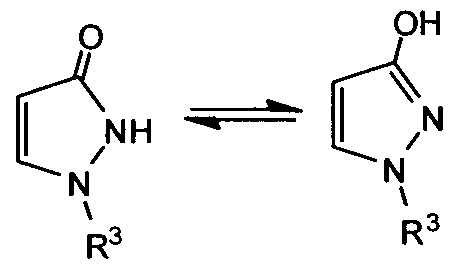
[0092] where G' = O, S, or NR, and though one form is named, described, displayed and/or claimed herein, all the tautomeric forms are intended to be inherently included in such name, description, display and/or claim.
[0093] In one embodiment of Formula I, X is O.
[0094] In one embodiment, X is S.
[0095] In one embodiment, X is -NH.
[0096] In one embodiment, X is -N-CN.
[0097] In one embodiment of Formula I, R1 is H.
[0098] In one embodiment of Formula I, R1 is halogen. In one embodiment, R1 is F,
CI or Br.
[0099] In one embodiment of Formula I, R1 is (l-3C)alkyl optionally substituted with
1-5 fluoros. In one embodiment, R1 is methyl, ethyl, isopropyl, or trifluoromethyl.
[00100] In one embodiment of Formula I, R1 is (l-3C)alkoxy optionally substituted with 1 -5 fluoros. In one embodiment, R1 is methoxy, ethoxy or trifluoromethoxy.
[00101] In one embodiment of Formula I, R1 is (3-5C)cycloalkyl. In one embodiment of Formula I, R1 is cyclopropyl.
[00102] In one embodiment of Formula I, R1 is selected from H, halogen and (1- 3C)alkyl [optionally substituted with 1-5 fluoros].
[00103] In one embodiment of Formula I, Y is Ar1, where Ar1 is phenyl optionally substituted with one or more substituents independently selected from halogen, (l-3C)alkyl [optionally substituted with 1-5 fluoros], and (l-3C)alkoxy [optionally substituted with 1-5 fluoros].
[00104] In one embodiment of Formula I, Y is phenyl optionally substituted with one or more substituents independently selected from halogen and (l-3C)alkoxy [optionally substituted with 1-5 fluoros].
[00105] In one embodiment of Formula I, Y is phenyl optionally substituted with one or more substituents independently selected from fluoro and methoxy.
[00106] In one embodiment of Formula I, Y is hetAr1, where hetAr1 is pyridyl optionally substituted with one or more substituents independently selected from halogen, (1- 3C)alkyl [optionally substituted with 1-5 fluoros], and (l-3C)alkoxy [optionally substituted with 1-5 fluoros].
[00107] In one embodiment of Formula I, Y is pyridyl optionally substituted with one or more substituents independently selected from halogen and (l-3C)alkoxy [optionally substituted with 1-5 fluoros].
[00108] In one embodiment of Formula I, Y is pyridyl optionally substituted with one or more substituents independently selected from fluoro and methoxy.
[00109] In one embodiment of Formula I, Y is selected from phenyl or pyridyl, each of which is optionally substituted with one or more substituents independently selected from halogen and (l-3C)alkoxy [optionally substituted with 1-5 fluoros].
[00110] In one embodiment of Formula I, Ring A is formula A-1 or A-2.
[00111] In one embodiment of Formula I, Ring A is formula A-1

A-1
[00112] where R1 and Y are as defined for Formula I.
[00113] In one embodiment of formula A-1, R1 is H.
[00114] In one embodiment of formula A-1, R1 is halogen. In one embodiment, R1 is F, CI or Br.
[00115] In one embodiment of formula A-1, R1 is (l-3C)alkyl optionally substituted with 1-5 fluoros. In one embodiment, R1 is methyl, ethyl, isopropyl, or trifluoromethyl.
[00116] In one embodiment of formula A-1, R1 is (l-3C)alkoxy optionally substituted with 1-5 fluoros. In one embodiment, R1 is methoxy, ethoxy or trifiuoromethoxy.
[00117] In one embodiment of formula A-1, R1 is (3-5C)cycloalkyl. In one embodiment of Formula I, R1 is cyclopropyl.
[00118] In one embodiment of formula A-l, R1 is selected from H, halogen and (1- 3C)alkyl [optionally substituted with 1-5 fluoros].
[00119] In one embodiment of formula A-l, Y is Ar1, where Ar1 is phenyl optionally substituted with one or more substituents independently selected from halogen, (l-3C)alkyl [optionally substituted with 1-5 fluoros], and (l-3C)alkoxy [optionally substituted with 1-5 fluoros].
[00120] In one embodiment of formula A-l, Y is phenyl optionally substituted with one or more substituents independently selected from halogen and (l-3C)alkoxy [optionally substituted with 1-5 fluoros].
[00121] In one embodiment of formula A-l, Y is phenyl optionally substituted with one or more substituents independently selected from fluoro and methoxy.
[00122] In one embodiment of formula A-l, Y is hetAr1, where hetAr1 is pyridyl optionally substituted with one or more substituents independently selected from halogen, (1- 3C)alkyl [optionally substituted with 1-5 fluoros], and (l-3C)alkoxy [optionally substituted with 1-5 fluoros].
[00123] In one embodiment of formula A-l, Y is pyridyl optionally substituted with one or more substituents independently selected from halogen and (l-3C)alkoxy [optionally substituted with 1-5 fluoros].
[00124] In one embodiment of formula A-l, Y is pyridyl optionally substituted with one or more substituents independently selected from fluoro and methoxy.
[00125] In one embodiment of formula A-l, Y is selected from phenyl or pyridyl, each of which is optionally substituted with one or more substituents independently selected from halogen and (l-3C)alkoxy [optionally substituted with 1-5 fluoros].
[00126] In one embodiment of formula A-l, R1 is halogen or (l-3C)alkyl optionally substituted with 1-5 fluoros; and Y is phenyl or pyridyl optionally substituted with one or more substituents independently selected from halogen and (l-3C)alkoxy [optionally substituted with 1-5 fluoros].
[00127] In one embodiment, formula A-l has the structure:

[00128] In one embodiment of Formula I, Ring A is formula A-2

A-2
[00129] where R1 and Y are as defined for Formula I.
[00130] In one embodiment of formula A-2, R1 is H.
[00131] In one embodiment of formula A-2, R1 is halogen. In one embodiment, R1 is F, CI or Br.
[00132] In one embodiment of formula A-2, R1 is (l-3C)alkyl optionally substituted with 1-5 fluoros. In one embodiment, R1 is methyl, ethyl, isopropyl, or trifluoromethyl.
[00133] In one embodiment of formula A-2, R1 is (l-3C)alkoxy optionally substituted with 1-5 fluoros. In one embodiment, R1 is methoxy, ethoxy or trifluoromethoxy.
[00134] In one embodiment of formula A-2, R1 is (3-5C)cycloalkyl. In one embodiment of Formula I, R1 is cyclopropyl.
[00135] In one embodiment of formula A-2, R1 is selected from H, halogen and (1- 3C)alkyl [optionally substituted with 1-5 fluoros].
[00136] In one embodiment of formula A-2, Y is Ar1, where Ar1 is phenyl optionally substituted with one or more substituents independently selected from halogen, (l-3C)alkyl [optionally substituted with 1-5 fluoros], and (l-3C)alkoxy [optionally substituted with 1-5 fluoros].
[00137] In one embodiment of formula A-2, Y is phenyl optionally substituted with one or more substituents independently selected from halogen and (l-3C)alkoxy [optionally substituted with 1-5 fluoros].
[00138] In one embodiment of formula A-2, Y is phenyl optionally substituted with one or more substituents independently selected from fluoro and methoxy.
[00139] In one embodiment of formula A-2, Y is hetAr1, where hetAr1 is pyridyl optionally substituted with one or more substituents independently selected from halogen, (1- 3C)alkyl [optionally substituted with 1-5 fluoros], and (l-3C)alkoxy [optionally substituted with 1-5 fluoros].
[00140] In one embodiment of formula A-2, Y is pyridyl optionally substituted with one or more substituents independently selected from halogen and (l-3C)alkoxy [optionally substituted with 1-5 fluoros].
[00141] In one embodiment of formula A-2, Y is pyridyl optionally substituted with one or more substituents independently selected from fluoro and methoxy.
[00142] In one embodiment of formula A-2, Y is selected from phenyl or pyridyl, each of which is optionally substituted with one or more substituents independently selected from halogen and (l-3C)alkoxy [optionally substituted with 1-5 fluoros].
[00143] In one embodiment of formula A-2, R1 is halogen or (l-3C)alkyl optionally substituted with 1-5 fluoros; and Y is phenyl or pyridyl optionally substituted with one or more substituents independently selected from halogen and (l-3C)alkoxy [optionally substituted with 1-5 fluoros].
[00144] In one embodiment, formula A-2 is selected from the structures:

A-3
where R1 and Y are as defined for Formula I.
In one embodiment of formula A-3, R1 is H.
In one embodiment of formula A-3, R1 is halogen. In one embodiment, R1
[00149] In one embodiment of formula A-3, R1 is (l-3C)alkyl optionally substituted with 1 -5 fluoros. In one embodiment, R1 is methyl, ethyl, isopropyl, or trifluoromethyl.
[00150] In one embodiment of formula A-3, R1 is (l-3C)alkoxy optionally substituted with 1-5 fluoros. In one embodiment, R1 is methoxy, ethoxy or trifluoromethoxy.
[00151] In one embodiment of formula A-3, R1 is (3-5C)cycloalkyl. In one embodiment of Formula I, R1 is cyclopropyl.
[00152] In one embodiment of formula A-3, R1 is selected from H, halogen and (1- 3C)alkyl [optionally substituted with 1-5 fluoros].
[00153] In one embodiment of formula A-3, Y is Ar1, where Ar1 is phenyl optionally substituted with one or more substituents independently selected from halogen, (l-3C)alkyl [optionally substituted with 1-5 fluoros], and (l-3C)alkoxy [optionally substituted with 1-5 fluoros].
[00154] In one embodiment of formula A-3, Y is phenyl optionally substituted with one or more substituents independently selected from halogen and (l-3C)alkoxy [optionally substituted with 1-5 fluoros].
[00155] In one embodiment of formula A-3, Y is phenyl optionally substituted with one or more substituents independently selected from fluoro and methoxy.
[00156] In one embodiment of formula A-3, Y is hetAr1, where hetAr1 is pyridyl optionally substituted with one or more substituents independently selected from halogen, (1- 3C)alkyl [optionally substituted with 1-5 fluoros], and (l-3C)alkoxy [optionally substituted with 1-5 fluoros].
[00157] In one embodiment of formula A-3, Y is pyridyl optionally substituted with one or more substituents independently selected from halogen and (l-3C)alkoxy [optionally substituted with 1-5 fluoros].
[00158] In one embodiment of formula A-3, Y is pyridyl optionally substituted with one or more substituents independently selected from fluoro and methoxy.
[00159] In one embodiment of Formula I, Y is selected from phenyl or pyridyl, each of which is optionally substituted with one or more substituents independently selected from halogen and (l-3C)alkoxy [optionally substituted with 1-5 fluoros].
[00160] In one embodiment of formula A-3, R1 is hydrogen, halogen or (l-3C)alkyl optionally substituted with 1-5 fluoros; and Y is phenyl or pyridyl optionally substituted with one or more substituents independently selected from halogen and (l-3C)alkoxy [optionally substituted with 1-5 fluoros]. In one embodiment, formula A-3 has the structure:

[00161] embodiment of Formula I, Ring A is formula A-4

A-4
[00162] where R and Y are as defined for Formula I.
[00163] In one embodiment of formula A-4, R1 is H.
[00164] In one embodiment of formula A-4, R1 is halogen. In one embodiment, R1 is
F, CI or Br.
[00165] In one embodiment of formula A-4, R1 is (l-3C)alkyl optionally substituted with 1-5 fluoros. In one embodiment, R1 is methyl, ethyl, isopropyl, or trifluoromethyl.
[00166] In one embodiment of formula A-4, R1 is (l-3C)alkoxy optionally substituted with 1 -5 fluoros. In one embodiment, R1 is methoxy, ethoxy or trifiuoromethoxy.
[00167] In one embodiment of formula A-4, R1 is (3-5C)cycloalkyl. In one embodiment of Formula I, R1 is cyclopropyl.
[00168] In one embodiment of Formula I, R1 is selected from H, halogen and (1- 3C)alkyl [optionally substituted with 1-5 fluoros].
[00169] In one embodiment of formula A-4, Y is Ar1, where Ar1 is phenyl optionally substituted with one or more substituents independently selected from halogen, (l-3C)alkyl [optionally substituted with 1-5 fluoros], and (l-3C)alkoxy [optionally substituted with 1-5 fluoros].
[00170] In one embodiment of formula A-4, Y is phenyl optionally substituted with one or more substituents independently selected from halogen and (l-3C)alkoxy [optionally substituted with 1-5 fluoros].
[00171] In one embodiment of formula A-4, Y is phenyl optionally substituted with one or more substituents independently selected from fluoro and methoxy.
[00172] In one embodiment of formula A-4, Y is hetAr1, where hetAr1 is pyridyl optionally substituted with one or more substituents independently selected from halogen, (1- 3C)alkyl [optionally substituted with 1-5 fluoros], and (l-3C)alkoxy [optionally substituted with 1-5 fluoros].
[00173] In one embodiment of formula A-4, Y is pyridyl optionally substituted with one or more substituents independently selected from halogen and (l-3C)alkoxy [optionally substituted with 1-5 fluoros].
[00174] In one embodiment of formula A-4, Y is pyridyl optionally substituted with one or more substituents independently selected from fluoro and methoxy.
[00175] In one embodiment of formula A-4, Y is selected from phenyl or pyridyl, each of which is optionally substituted with one or more substituents independently selected from halogen and (l-3C)alkoxy [optionally substituted with 1-5 fluoros].
[00176] In one embodiment of formula A-4, R1 is halogen or (l-3C)alkyl optionally substituted with 1-5 fluoros; and Y is phenyl or pyridyl optionally substituted with one or more substituents independently selected from halogen and (l-3C)alkoxy [optionally substituted with 1-5 fluoros].
[00177] Reference will now be made to Ring C.
[00178] In one embodiment, Ring C is formula C-l:
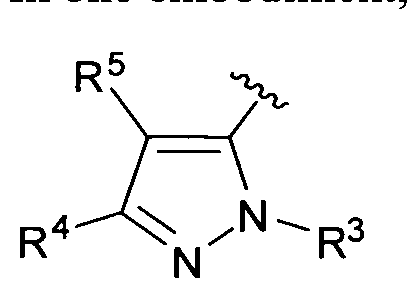
C-l
[00179] where R3, R4 and R5 are as defined for Formula I.
[00180] In one embodiment, R is (l-6C)alkyl. In one embodiment, R is methyl or ethyl.
[00181] In one embodiment, R is hydroxy(l-6C)alkyl. An example of R is 2- hydroxyethyl.
[00182] In one embodiment, R is Ar , where Ar is phenyl optionally substituted with one or more substituents independently selected from halogen and (l-6C)alkyl.
[00183] In one embodiment, R when represented by Ar is phenyl, 2-fluorophenyl, 3- fluorophenyl, 4-fluorophenyl, 2-methylphenyl, 3-methylphenyl, 4-methylphenyl, 3- chlorophenyl, 3-chloro-4-fluorophenyl or 3-chloro-2-fluorophenyl. In one embodiment, R3 when represented by Ar2 is phenyl, 2-fluorophenyl, 3 -fluorophenyl, 4-fluorophenyl, 2- methylphenyl, 3-methylphenyl or 4-methylphenyl. In one embodiment, R3 is phenyl.
[00184] In one embodiment, R3 is hetCyc1, where hetCyc1 is a 5-6-membered saturated or partially unsaturated heterocyclic ring having 1 -2 ring heteroatoms independently selected from N and O. In one embodiment, R3 is a pyrrolidinyl, tetrahydrofuranyl, imidazolidinyl,
piperidinyl, piperazinyl, tetrahydropyranyl, or morpholinyl ring. In one embodiment, R3 is tetrahydro-2H-pyran-4-yl .
[00185] In one embodiment, R3 is (3-7C)cycloalkyl. In one embodiment R3 is cyclohexyl.
[00186] In one embodiment, R3 is hetAr2, where hetAr2 is 5-6 membered heteroaryl ring having 1-3 ring heteroatoms independently selected from N, O and S and optionally substituted with one or more substituents independently selected from (l-6C)alkyl and halogen. In one embodiment, R3 is thienyl, furyl, imidazolyl, pyrazolyl, thiazolyl, isothiazolyl, oxazolyl, isoxazolyl, triazolyl, thiadiazolyl, oxadiazolyl, pyridyl, pyrimidyl, pyrazinyl, or pyridazinyl optionally substituted with one or more substituents independently selected from (l-6C)alkyl and halogen. In one embodiment, R is pyrazolyl, pyridyl or pyridazinyl optionally substituted with one or more substituents independently selected from (l-6C)alkyl and halogen. In one embodiment, R3 is pyrazolyl, pyridyl or pyridazinyl optionally substituted with (l-6C)alkyl or halogen. In one embodiment, R when represented by hetAr2 is 1 -methyl- 1 H-pyrazol-4-yl, pyrid-2-yl, pyrid-3-yl, pyrid-4-yl, pyridazinyl or 3- chloropyrid-5-yl.
[00187] In one embodiment, R3 is selected from Ar2 and hetAr2.
[00188] In one embodiment, R3 is Ar2. In one embodiment, R3is phenyl.
[00189] In one embodiment, R4 is OH.
[00190] In one embodiment, R4 is (l-6C)alkyl. In one embodiment, R4 is methyl, ethyl, isopropyl or tert-butyl.
[00191] In one embodiment, R4 is monofluoro(l-6C)alkyl, difluoro(l-6C)alkyl, trifluoro(l-6C)alkyl, tetrafluoro(2-6C)alkyl or pentafluoro(2-6C)alkyl. In one embodiment, R4 is fluoromethyl, 2-fluoroethyl, difluoromethyl and 2,2-difluoroethyl, trifluoromethyl, 2,2,2-trifluoroethyl, 3,3,3-trifluoropropyl, 2,2,3,3-tetrafluoropropyl or 2,2,3,3,3- pentafluoropropyl
[00192] In one embodiment, R4 is trifluoro(l-6C)alkyl. In one embodiment, R4 is CF3.
[00193] In one embodiment, R4 is cyano(l-6C)alkyl. In one embodiment, R4 is cyanomethyl or 2-cyanopropan-2-yl.
[00194] In one embodiment, R4 is hydroxy(l-6C)alkyl. In one embodiment, R4 is hydroxymethyl, 2-hydroxyethyl, 2-hydroxypropyl, 2-hydroxy-2-methylpropyl or 1-hydroxy- 2-methy lpropan-2-yl .
[00195] In one embodiment, R4 is dihydroxy(2-6C)alkyl. In one embodiment, R4 is 2,3-dihydroxypropyl.
[00196] In one embodiment, R4 is (1-3C alkoxy)(l-6C)alkyl. In one embodiment, R4 is methoxymethyl, 2-methoxyethyl or 3-methoxypropyl.
[00197] In one embodiment, R4 is amino(l-6C)alkyl. In one embodiment, R4 is aminomethyl, 2-aminoethyl or 3-aminopropyl.
[00198] In one embodiment, R4 is aminocarbonyl(l-6C)alkyl. In one embodiment, R4 is aminocarbonylmethyl and 2-(aminocarbonyl)ethyl.
[00199] In one embodiment, R4 is (l-3C)alkylsuIfonamido(l-6C)alkyl. In one embodiment, R4 is CH3S02NHCH2- or CH3S02NHCH2CH2-.
[00200] In one embodiment, R4 is hydroxycarbonyl(l-6C)alkyl. In one embodiment, R4 is HOC(=0)CH2- and HOC(=0)CH2CH2-.
[00201] In one embodiment, R4 is hetAr3(l-6C)alkyl, where hetAr3 is a 5-membered heteroaryl ring having 1-3 ring atoms independently selected from N, S and O and optionally substituted with (l-6C)alkyl. In one embodiment, hetAr3 is a thienyl, furyl, imidazolyl, pyrazolyl, thiazolyl, isothiazolyl, oxazolyl, isoxazolyl, triazolyl, thiadiazolyl or oxadiazolyl ring optionally substituted with (l-6C)alkyl. In one embodiment, R4 when represented by hetAr3(l-6C)alkyl is (1 -methyl- lH-l,2,4-triazol-3-yl)methyl or (5-methyl-l,3,4-oxadiazol-2- yl)methyl.
[00202] In one embodiment, R4 is Ar3(l-6C)alkyl, where phenyl optionally substituted with (l-4C)alkoxy or hydroxy(l-4C)alkyl. In one embodiment, Ar3(l-6C)alkyl is benzyl.
[00203] In one embodiment, R4 is (l-6C)alkoxy. Examples include methoxy and ethoxy.
[00204] In one embodiment, R4 is monofluoro(l-6C)alkoxy, difluoro(l-6C)alkoxy, trifluoro(l-6C)alkoxy, tetrafluoro(2-6C)alkoxy or pentafluoro(2-6C)alkoxy. In one embodiment, R4 is fluoromethoxy, 2-fluoroethoxy, 2,2-difluoromethoxy, trifluoromethoxy, 2,2,2-trifluoroethoxy or 2,2-difluoroethoxy. In one embodiment, R4 is 2-fluoroethoxy.
[00205] In one embodiment, R4 is cyano(l-6C)alkoxy. In one embodiment, R4 is cyanomethoxy or 2-cyanoethoxy.
[00206] In one embodiment, R4 is hydroxy(l-6C)alkoxy. In one embodiment, R4 is 2- hydroxy-2-methylpropoxy, 2-hydroxyethoxy, 2-hydroxypropoxy, 2-hydroxy-2- methylpropoxy or 2-hydroxybutoxy.
[00207] In one embodiment, R4 is dihydroxy(2-6C)alkoxy. In one embodiment, R4 is 2,3-dihydroxypropoxy or 3-hydroxy-2-(hydroxymethyl)propoxy.
[00208] In one embodiment, R4 is amino(2-6C)alkoxy. In one embodiment, R4 is H2NCH2CH20-.
[00209] In one embodiment, R4 is hetCyc2(l-6C)alkoxy, where hetCyc2 is a 4-6 membered heterocyclic ring having 1-2 ring heteroatoms independently selected from N and O, wherein hetCyc2 is optionally substituted with 1-2 groups independently selected from (1- 6C)alkyl, (1-4C alkoxy)carbonyl, and (l-6C)acyl. In one embodiment, hetCyc2 is oxetaynyl, tetrahydrofuranyl, tetrahydropyranyl, azetidinyl, pyrrolidinyl, piperidinyl, piperazinyl, morpholinyl, or and 1,3-dioxolanyl optionally substituted with 1-2 groups independently selected from (l-6C)alkyl, (1-4C alkoxy)carbonyl and (l-6C)acyl. In one embodiment, R4 when represented by hetCyc2(l-6C)alkoxy is oxetan-2-ylmethoxy, 2- (oxetan-2-yl)propoxy, 2-mo holinoethoxy, piperazinylethyoxy or piperidinylethoxy optionally substituted with 1-2 groups independently selected from (l-6C)alkyl, (1-4C alkoxy)carbonyl and (l-6C)acyl. In one embodiment, R4 is represented by the structures:
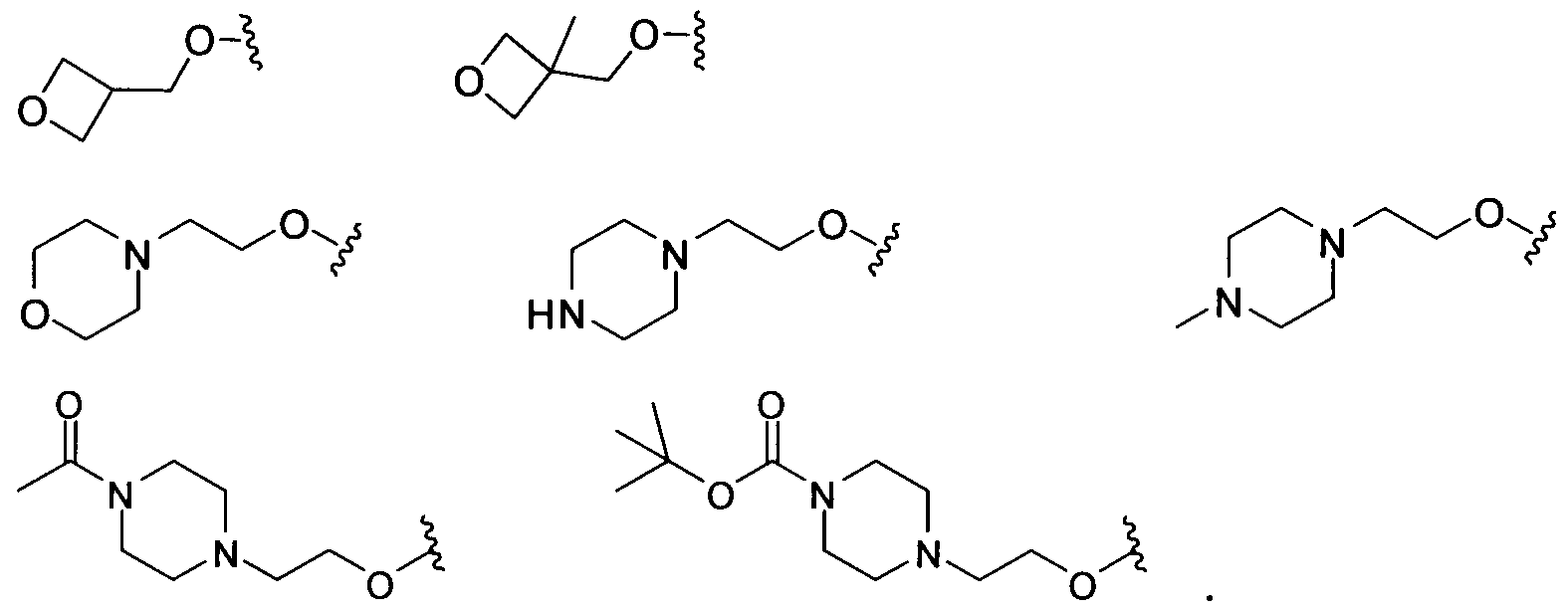
[00210] In one embodiment, R4 is hetAr3(l-6C)alkoxy, where hetAr3 is a 5-membered heteroaryl ring having 1-3 ring atoms independently selected from N, S and O and optionally substituted with (l-6C)alkyl. In one embodiment, hetAr3 is a thienyl, furyl, imidazolyl, pyrazolyl, thiazolyl, isothiazolyl, oxazolyl, isoxazolyl, triazolyl, thiadiazolyl or oxadiazolyl ring optionally substituted with (l-6C)alkyl. In one embodiment, hetAr3 is triazolyl or oxadiazolyl ring optionally substituted with a (l-6C)alkyl group such as a methyl group. In one embodiment, R4 when represented by hetAr3 (l-6C)alkoxy is (1 -methyl- lH-l,2,4-triazol- 3-yl)methoxy or (5-methyl-l,3,4-oxadiazol-2-yl)methoxy, which can be represented by the structures:

[00211] In one embodiment, R4 is Ar3(l-6C)alkoxy, where Ar3 is phenyl optionally substituted with (l-4C)alkoxy. In one embodiment, R4 is phenylmethoxy or (4- methoxyphenyl)methoxy having the structures:
[00212] In one embodiment, R4 is (1-4C alkoxy)(l-6C)alkoxy. In one embodiment, R4 is(2-methoxy)ethoxy having the structure:

[00213] In one embodiment, R4 is (l-3Calkylsulfonyl)(l-6C)alkoxy. In one embodiment, 4 is (2-methylsulfonyl)ethoxy having the structure:

[00214] In one embodiment, R4 is (3-6C)cycloalkyl optionally substituted with F, OH,
(1-6C alkyl), (l-6C)alkoxy or (1-3C alkoxy)(l-6C)alkyl. Examples include cyclopropyl, cyclobutyl, cyclopentyl, cyclohexyl, 2-hydroxycyclobutyl. In one embodiment, R4 is cyclopropyl or 2-hydroxycyclobutyl. In one embodiment, R4 is cyclopropyl.
[00215] In one embodiment, R4 is hetAr4, where hetAr4 is a 5-6 membered heteroaryl ring having 1-3 ring heteroatoms independently selected from N, S and O and optionally substituted with one or more substituents independently selected from (l-6C)alkyl, halogen, CN, hydroxy(l-6C)alkyl, trifluoro(l-6C)alkyl, difluoro(l-6C)alkyl, fluoro(l-6C)alkyl, (3- 6C)cycloalkyl, (3-6C cycloalkyl)CH2- (3-6C cycloalkyl)C(=0)-, (1-3C alkoxy)(l-6C)alkyl, (l-6C)alkoxy, (l-6C)alkylsulfonyl, NH2, (1-6C alkyl)amino, di(l-6C alkyl)amino, (1-3C trifluoroalkoxy), fluoro(l-6C alkyl)amino, difluoro(l-6C alkyl)amino, trifluoro(l-6C alkyl)amino, and (3-4C cycloalkyl)amino.
[00216] In one embodiment, R4 is hetAr4 where hetAr4 is pyridyl, pyrimidinyl pyridazinyl, pyrazolyl, imidazolyl, thienyl, 1,2,4-triazolyl, 1,2,3-triazolyl, thiazolyl, oxazolyl, 1,3,4-oxadiazolyl, or 1 ,2,4-oxadiazolyl optionally substituted with one or more substituents independently selected from (l-6C)alkyl, halogen, CN, hydroxy(l-6C)alkyl, trifluoro(l- 6C)alkyl, difluoro(l-6C)alkyl, fluoro(l-6C)alkyl, (3-6C)cycloalkyl, (3-6C cycloalkyl)CH2- (3-6C cycloalkyl)C(=0)-, (1-3C alkoxy)(l-6C)alkyl, (l-6C)alkoxy, (l-6C)alkylsulfonyl, NH2, (1-6C alkyl)amino, di(l-6C alkyl)amino, (1-3C trifluoroalkoxy), fluoro(l-6C alkyl)amino, difluoro(l-6C alkyl)amino, trifluoro(l-6C alkyl)amino, and (3-4C cycloalkyl)amino.
[00217] In one embodiment, R4 is hetAr4 where hetAr4 is pyridyl, pyrimidinyl pyridazinyl, pyrazolyl, imidazolyl, thienyl, 1,2,4-triazolyl, 1,2,3-triazolyl, thiazolyl, oxazolyl,
1,3,4-oxadiazolyl, or 1,2,4-oxadiazolyl optionally substituted with one or more substituents independently selected from (l-6C)alkyl, halogen, hydroxy(l-6C)alkyl, trifluoro(l-6C)alkyl, difluoro(l-6C)alkyl, fluoro(l-6C)alkyl, (3-6C)cycloalkyl, (3-6C cycloalkyl)CH2- (3-6C cycloalkyl)C(=0)-, (1-3C alkoxy)(l-6C)alkyl, (l-6C)alkoxy, (l-6C)alkylsulfonyl, NH2, (1- 6C alkyl)amino, di(l-6C alkyl)amino, fluoro(l-6C alkyl)amino, difluoro(l-6C alkyl)amino, trifluoro(l-6C alkyl)amino, (3-4C cycloalkyl)amino, (and 1-3C trifluoroalkoxy)(l- 3C)trifluoroalkyl .
[00218] In one embodiment, R4 is hetAr4, where hetAr4 is pyridyl, pyrimidinyl pyridazinyl, pyrazolyl, imidazolyl, thionyl, 1 ,2,4-triazolyl, 1,2,3-triazolyl, thiazolyl, oxazolyl, 1 ,3,4-oxadiazolyl, or 1,2,4-oxadiazolyl optionally substituted with 1-3 substituents independently selected from fluoro, methyl, ethyl, isopropyl, cyclopropylmethyl, cyclopropyl, trifiuoromethyl, 2,2,2-trifluoroethyl, methoxy, ethoxy, CN, H2N-, (CH3)2N-, 2- hydroxyethyl, 2-methoxyethyl, 1 -(2,2,2-trifluoroethoxy)-2,2,2-trifluoroethyl, cyclopropylcarbonyl, methylsulfonyl and cyclopropylNH-.
[00219] In one embodiment, R4 is hetAr4, where hetAr4 is pyridyl, pyrimidinyl or pyridazinyl optionally substituted with 1-3 substituents independently selected from fluoro, methyl, ethyl, isopropyl, cyclopropylmethyl, cyclopropyl, trifiuoromethyl, 2,2,2- trifluoroethyl, methoxy, ethoxy, CN, H2N-, CH3NH-, (CH3)2N-, and cyclopropylNH-.
[00220] In one embodiment, R4 when represented by hetAr4 is selected from the structures:


[00222] In one embodiment, R4 is Ar4, where Ar4 is phenyl optionally substituted with one or more substituents independently selected from (l-6C)alkyl, halogen, CN, CF3, CF30-, (l-6C)alkoxy, (l-6Calkyl)OC(=0)-, aminocarbonyl, (l-6C)alkylthio, hydroxy(l-6C)alkyl, (1-
6C alkyl)S02-, HOC(=0)- and (1-3C alkoxy)(l-3C alkyl)OC(=0)-. In one embodiment, Ar4 is phenyl optionally substituted with one or more substituents independently selected from methyl, F, CI, CN, methoxy, CH3OC(=0)-, aminocarbonyl, methylaminocarbonyl, dimethylaminocarbonyl, methylthio, CH3S02-, HOC(=0)- and CH3OCH2CH2OC(=0)-. In one embodiment, Ar4 is phenyl optionally substituted with one or two of said substituents. In one embodiment, Ar4 is selected from the structures:

[00223] In one embodiment, R4 is hetCyc2(0)CH2, where hetCyc2 is a 4-6 membered heterocyclic ring having 1 -2 ring heteroatoms independently selected from N and O, wherein hetCyc2 is optionally substituted with 1-2 groups independently selected from (l-6C)alkyl, (1-4C alkoxy)carbonyl, and (l-6C)acyl. Examples of hetCyc2 include oxetaynyl, tetrahydrofuranyl, tetrahydropyranyl, azetidinyl, pyrrolidinyl, piperidinyl, piperazinyl, morpholinyl, and 1,3-dioxolanyl rings optionally substituted with 1-2 groups independently selected from (l-6C)alkyl, (1-4C alkoxy)carbonyl and (l-6C)acyl. In one embodiment, R4 when repre tures:
 [00224] In one embodiment, R4 is (1-4C alkoxycarbonyl)(l-6C)alkoxy. In one embodiment, R4 is methoxycarbonyl(l-6C)alkoxy or ethyoxycarbonyl(l-6C)alkoxy. A particular example is ethoxycarbonylmethoxy.
[00225] In one embodiment, R4 is hydroxycarbonyl(l-6C)alkoxy. In one embodiment, R4 is hydroxycarbonylmethoxy.
[00226] In one embodiment, R4 is aminocarbonyl(l-6C)alkoxy. In one embodiment, R4 is H2NC(=0)(l-6C)alkoxy, (1-6C alkyl)NHC(=0)(l-6C)alkoxy, or di(l- 6Calkyl)NC(=0)(l-6C)alkoxy. In one embodiment, R4 is H2NC(=0)CH20-
,H2NC(=0)CH2CH20- or CH3CH2NC(=0)CH20-.
[00227] In one embodiment, R4 is hetCyc2C(=0)(l-6C)alkoxy, where hetCyc2 is a 4-6 membered heterocyclic ring having 1 -2 ring heteroatoms independently selected from N and O and optionally substituted with 1-2 groups independently selected from (l-6C)alkyl, (1-4C alkoxy)carbonyl, and (l-6C)acyl. In one embodiment, hetCyc is oxetaynyl, tetrahydroiuranyl, tetrahydropyranyl, azetidinyl, pyrrolidinyl, piperidinyl, piperazinyl, morpholinyl, or 1 ,3-dioxolanyl optionally substituted with 1-2 groups independently selected from (l-6C)alkyl, (1-4C alkoxy)carbonyl and (l-6C)acyl. In one embodiment, hetCyc2 is morpholinyl. In one embodiment, R4 when represented by hetCyc2C(=0)(l-6C)alkoxy is the structure:

[00228] In one embodiment, R4 is hydroxy(l-3C alkoxy)(l-6C)alkoxy.
embodiment, R4 is 2-hydroxy-3-methoxypropoxy, having the structure:

[00229] In one embodiment, R4 is hydroxytrifluoro(l-6C)alkoxy. In one embodiment,
R4 is 3,3,3-difluoro-2-hydroxypropoxy having the structure:

[00230] In one embodiment, R4 is (l-3C)alkylsulfonamido(l-6C)alkoxy. In one embodiment, R4 is methanesulfonamido(l-6C)alkoxy. In one embodiment, R4 is 2- methanesulfonamidoethoxy having the structure:
[00231] In one embodiment, R4 is (l-3C)alkylamido(l-6C)alkoxy. In one embodiment, R4 is 2-(methylamido)ethox having the structure:

[00232] In one embodiment, R4 is di(l-3C alkyl)aminocarboxy. In one embodiment, R4 is dimethylaminocarboxy having the structure:

[00233] In one embodiment, R4 is hetCyc2C(=0)0-, where hetCyc2 is a 4-6 membered heterocyclic ring having 1-2 ring heteroatoms independently selected from N and O and optionally substituted with 1-2 groups independently selected from (l-6C)alkyl, (1-4C alkoxy)carbonyl and (l-6C)acyl. In one embodiment, hetCyc is oxetaynyl, tetrahydrofuranyl, tetrahydropyranyl, azetidinyl, pyrrolidinyl, piperidinyl, piperazinyl, morpholinyl, or 1,3-dioxolanyl optionally substituted with 1-2 groups independently selected from (l-6C)alkyl, (1-4C alkoxy)carbonyl and (l-6C)acyl. In one embodiment, hetCyc is morpholinyl. In one embodiment, R4 when represented by hetCyc2C(=0)0- is the structure:

[00234] In one embodiment, R4 is hydroxydifluoro(l-6C)alkyl. In one embodiment, R4 is 2,2-difluro-2-hydroxyethyl.
[00235] In one embodiment, R4 is (1-4C alkylcarboxy)(l-6C)alkyl. In one embodiment, R4 is methylcarboxy(l-6C)alkyl. In one embodiment, R4 is 2- (methylcarboxy)ethyl .
[00236] In one embodiment, R4 is (l-6C)alkoxycarbonyl. In one embodiment, R4 is methoxycarbonyl or ethoxycarbonyl.
[00237] In one embodiment, R4 is hydroxy carbonyl.
[00238] In one embodiment, R4 is aminocarbonyl, that is, a RRTSfCO- radical where R and R are independently hydrogen or (l-6C)alkyl as defined herein. In one embodiment, R4 is aminocarbonyl, methylarninocarbonyl, dimethylaminocarbonyl, ethylcarbonyl or isopropylaminocarbonyl .
[00240] In one embodiment, R4 is hetCyc3, where is a 4-7 membered heterocycle having 1-2 ring heteroatoms independently selected from N and O and optionally substituted with one or more substituents independently selected from F, CN, CF3, (l-6C)alkyl, hydroxy(l-6C)alkyl, (1-3C alkoxy)(l-6C)alkyl, (l-6C)acyl-, (l-6C)alkylsulfonyl, trifluoromethylsulfonyl and (1-4C alkoxy)carbonyl. In one embodiment, hetCyc is tetrahydropyranyl, piperidinyl, pyrrolidinyl or azetidinyl optionally substituted with one or more substituents independently selected from F, CN, (l-6C)alkyl, trifluoro(l-6C)alkyl, hydroxy(l-6C)alkyl, (1-3C alkoxy)(l-6C)alkyl, (l-6C)acyl-, (l-6C)alkylsulfonyl, trifluoromethylsulfonyl and (1-4C alkoxy)carbonyl. In one embodiment, hetCyc is optionally substituted with one or two of said substituents. In one embodiment, hetCyc3 is tetrahydropyranyl, piperidinyl, pyrrolidinyl or azetidinyl optionally substituted with CN, Me, CH3C(=0)-, MeS02-, or CF3S02-. In one embodiment, R4 when represented by hetCyc3 is selected from the structures:

[00241] In one embodiment, R4 is halogen. In one embodiment, R4 is Br.
[00242] In one embodiment, R4 is CN.
[00243] In one embodiment, R4 is trifluoromethylsulfonyl.
[00244] In one embodiment, R4 is hetAr5, where hetAr5 is a group selected from the


[00245] where Rz is (3-4C)cycloalkyl or (l-3C)alkyl (optionally substituted with 1-3 fluoros), wherein each of said hetAr5 groups is optionally further substituted with one or more substituents independently selected from F and (l-3C)alkyl optionally substituted with 1-3 fluoros.
[00246] In one embodiment, R4 when represented by hetAr5 is selected from the structures:

[00247] In one embodiment, R is N-(1-3C alkyl)oxadiazolonyl. In one embodiment,
R is represented by the structures:

[00248] In one embodiment, R is selected from H, (l-6C)alkyl, trifluoro(l-6C)alkyl, hydroxy(l-6C)alkyl, cyano(l-6C)alkyl, (1-3C alkoxy)(l-6C)alkyl, (l-6C)alkoxy, monofluoro(l-6C)alkoxy, cyano(l-6C)alkoxy, hydroxy(l-6C)alkoxy, dihydroxy(2- 6C)alkoxy, hetCyc2(l-6C)alkoxy, Ar3(l-6C)alkoxy, (1-4C alkoxy)(l-6C)alkoxy, (1-3C alkylsulfonyl)(l-6C)alkoxy, (3-6C)cycloalkyl, hetAr4, hetAr4-0-, Ar4, and hetAr5.
[00249] In one embodiment, R4 is hetAr4, Ar4, or hetAr5.
[00250] In one embodiment, R4 is hetAr4 or hetAr5.
[00251] In one embodiment, R4 is pyrazolyl optionally substituted with one or more substituents independently selected from (l-6C)alkyl, or a hetAr5 group having the structure:
 [00252] where Rz is (3-4C)cycloalkyl or (l-3C)alkyl (optionally substituted with 1-3 fluoros), wherein said hetAr5 group is optionally further substituted with one or more substituents independently selected from F and (l-3C)alkyl optionally substituted with 1-3 fluoros.
[00253] In one embodiment of Formula I, R4 is selected from (l-6C)alkyl, hydroxy(l- 6C)alkyl, dihydroxy(2-6C)alkyl, (1-3C alkoxy)(l-6C)alkyl, (l-6C)alkoxy, hydroxy(l- 6C)alkoxy, dihydroxy(2-6C)alkoxy, hetAr4, and hetCyc3.
[00254] In one embodiment, R5 is (l-6C)alkyl. In one embodiment, R5 is methyl, ethyl, propyl, isopropyl or butyl.
[00255] In one embodiment, R5 is monofluoro(l-6C)alkyl, difluoro(l-6C)alkyl, trifluoro(l-6C)alkyl, tetrafluro(2-6C)alkyl or pentafluro(2-6C)alkyl. In one embodiment, R5 is fluoromethyl, 2-fluoroethyl, difluoromethyl, 2,2-difluoroethyl, l,3-difluoroprop-2-yl, trifluoromethyl, 2,2,2-trifluoroethyl, 3,3,3-trifluoropropyl, 1,1,2,2-tetrafluoropropane or 2,2,3,3,3-pentafluoropropyl.
[00256] In one embodiment, R5 is halogen. In one embodiment, R5 is F. In one embodiment, R5 is CI. In one embodiment, R5 is Br.
[00257] In one embodiment, R5 is CN.
[00258] In one embodiment, R5 is (l-4C)alkoxy. In one embodiment, R5 is methoxy or ethoxy.
[00259] In one embodiment, R5 is hydroxy(l-4C)alkyl. In one embodiment, R5 is hydroxymethyl or 3-hydroxypropyl.
[00260] In one embodiment, R5 is (1-4C alkyl)OC(=0)-. In one embodiment, R5 is CH3CH2OC(=0)-.
[00261] In one embodiment, R5 is (l-6C)alkylthio. In one embodiment, R5 is methylthio (MeS-).
[00262] In one embodiment, R5 is phenyl optionally substituted with one or more substituents independently selected from halogen, (l-6C)alkyl and (l-6C)alkoxy. In one embodiment, R5 is phenyl optionally substituted with one or more substituents independently selected from F, CI, methyl, ethyl, methoxy and ethoxy. In one embodiment, R5 is phenyl.
[00263] In one embodiment, R5 is (3-4C)cycloalkyl. In one embodiment, R5 is cyclopropyl. In one embodiment, R5 is cyclobutyl.
[00264] In one embodiment, R5 is amino. In one embodiment, R5 is NH2.
[00265] In one embodiment, R5 is aminocarbonyl. In one embodiment, R5 is
H2NC(=0)-.
[00266] In one embodiment, R5 is trifluoro(l-3C alkyl)amido. In one embodiment, R5 is CF3C(=0)NH-.
[00267] In one embodiment, R5 is halogen, CN, ( 1 -6C)alkyl, ( 1 -4C)alkoxy, hydroxy( 1 - 4C)alkyl, or phenyl [optionally substituted with one or more substituents independently selected from halogen, (l-6C)alkyl and (l-6C)alkoxy].
[00268] In one embodiment, R5 is selected from halogen, and (l-6C)alkyl.
[00269] In one embodiment, R5 is selected from methyl, CI and Br.
[00270] In one embodiment of Formula I, R4 is (l-6C)alkyl, (1-3C alkoxy)(l-
6C)alkyl, (l-6C)alkoxy, hydroxy(l-6C)alkoxy, dihydroxy(2-6C)alkoxy, hydroxy(l-
3C)alkoxy(l-6C)alkoxy, hetAr4, or hetCyc3; and R5 is (l-6C)alkyl.
[00271] In one embodiment of Formula I, R4 is hetAr4, Ar4, or hetAr5; and R5 is (1-
6C)alkyl.
[00272] In one embodiment of Formula I, R4 is hetAr4 or hetAr5; and R5 is (1- 6C)alkyl.
[00273] In one embodiment of Formula I, R4 is hetAr4 and R5 is ( 1 -6C)alkyl.
[00274] In one embodiment of Formula I, R4 is pyrazolyl optionally substituted with one or more substituents independently selected from (l-6C)alkyl; and R5 is (l-6C)alkyl.
[00275] In one embodiment of Formula I, R4 is hetAr5; and R5 is (1 -6C)alkyl.
[00276] In one embodiment of Formula I R4 is a hetAr5 group having the structure:

[00277] where Rz is (3-4C)cycloalkyl or (l-3C)alkyl (optionally substituted with 1-3 fluoros), wherein said hetAr5 group is optionally further substituted with one or more substituents independently selected from F and (l-3C)alkyl optionally substituted with 1-3 fluoros; and R5 is selected from (l-6C)alkyl.
[00278] In one embodiment, R4 and R5 together with the atoms to which they are attached form a 5-6 membered saturated, partially unsaturated or unsaturated carbocyclic ring optionally substituted with one or more substituents independently selected from (l-6C)alkyl; or R4 and R5 together with the atoms to which they are attached form a 5-6 membered saturated, partially unsaturated or unsaturated heterocyclic ring having a ring heteroatom selected from N, O or S, wherein said heterocyclic ring is optionally substituted with one or two substituents independently selected from (1-6C alkyl)C(=0)0-, (l-6C)acyl, (l-6C)alkyl and oxo, and said sulfur ring atom is optionally oxidized to S(=0) or S02.
[00279] In one embodiment, R4 and R5 together with the atoms to which they are attached form a 5-6 membered saturated, partially unsaturated or unsaturated carbocyclic ring optionally substituted with one or more substituents independently selected from (l-6C)alkyl. In one embodiment, Ring C when R4 and R5 together with the atoms to which they are attached form a 5-6 membered saturated or unsaturated carbocyclic ring is selected from the

[00280] where R3 is as defined for Formula I. In one embodiment, R3 is phenyl.
[00281] In one embodiment, R4 and R5 together with the atoms to which they are attached form a 5-6 membered saturated carbocyclic ring optionally substituted with one or more substituents independently selected from (l-6C)alkyl, or R4 and R5 together with the atoms to which they are attached form a 5-6 membered saturated heterocyclic ring having a ring heteroatom selected from N, O or S, wherein said ring nitrogen atom is optionally substituted with (1-6C alkyl)C(=0)0- or (l-6C)acyl, and said sulfur ring atom is optionally oxidized to S(=0) or S02.
[00282] In one embodiment, R4 and R5 together with the atoms to which they are attached form a 5-6 membered saturated carbocyclic ring optionally substituted with one or more substituents independently selected from (l-6C)alkyl. In one embodiment, Ring C when R4 and R5 together with the atoms to which they are attached form a 5-6 membered saturated carboc clic rin is selected from the structures:

[00283] where R3 is as defined for Formula I. In one embodiment, R3 is Ar2. In one embodiment, R3 is phenyl.
[00284] In one embodiment, R4 and R5 together with the atoms to which they are attached form a 5-6 membered saturated, partially unsaturated or unsaturated heterocyclic ring having a ring heteroatom selected from N, O or S, wherein said ring N atom is optionally substituted with (1-6C alkyl)C(=0)O, (1-6C alkyl)C(=0)-, (l-6C)alkyl or oxo, and said S ring atom is optionally oxidized to S(=0) or S02. In one embodiment, Ring C when R4 and
R5 together with the atoms to which they are attached form a 5-6 membered saturated heterocyclic ring is selected from the structures:

[00285] where R3 is as defined for Formula I. In one embodiment, R3 is Ar2. In one embodiment, R is phenyl.
[00286] In one embodiment, R4 and R5 together with the atoms to which they are attached form a 5-6 membered saturated heterocyclic ring having a ring heteroatom selected from N, O or S, wherein said ring N atom is optionally substituted with (1-6C alkyl)C(=0)0- or (1-6C alkyl)C(=0)-, and said S ring atom is optionally oxidized to S(=0) or S02. In one embodiment, Ring C when R4 and R5 together with the atoms to which they are attached form -6 membered saturated heterocyclic ring is selected from the structures:

[00287] where R3 is as defined for Formula I. In one embodiment, R3 is Ar2. In one embodiment, R is phenyl.
[00288] In one embodiment of Formula I, R4 and R5 together with the atoms to which they are attached form a 5-6 membered saturated heterocyclic ring having a ring heteroatom selected from N, O or S, wherein said S ring atom is optionally oxidized to S(=0) or S02, or R4 and R5 together with the atoms to which they are attached form a 5-6 membered saturated carbocyclic ring; and R3 is Ar2.
[00289] In one embodiment, Ring C is formula C-2
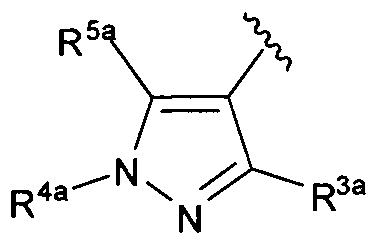
C-2
[00290] where R3a, R4a and R5a are as defined for Formula I.
[00291] In one embodiment, R3a is hydrogen.
[00292] In one embodiment, R3a is halogen.
[00293] In one embodiment, R3a is (l-6C)alkyl. In one embodiment, R3a is methyl.
[00294] In one embodiment, R3a is trifluoro(l-6C)alkyl. In one embodiment, R3a is CF3.
[00295] In one embodiment, R3a is (3-6C)cycloalkyl. In one embodiment, R33 is cyclopropyl.
[00296] In one embodiment, R3a is phenyl optionally substituted with one or more substituents independently selected from halogen and (l-6C)alkyl. In one embodiment, R3a is phenyl, fluorophenyl or methylphenyl, for example include phenyl, 2-fluorophenyl, 3- fluorophenyl, 4-fluorophenyl, 2-methylphenyl, 3-methylphenyl, 4-methylphenyl, 3- chlorophenyl, 3-chloro-4-fluorophenyl or 3-chloro-2-fluorophenyl. In one embedment, R3a is phenyl.
[00297] In one embodiment, R3a is a 5-6 membered heteroaryl ring having 1-3 ring heteroatoms independently selected from N, O and S and optionally substituted with one or more substituents independently selected from (l-6C)alkyl and halogen. In one embodiment, R3a is a thienyl, furyl, imidazolyl, pyrazolyl, thiazolyl, isothiazolyl, oxazolyl, isoxazolyl, triazolyl, thiadiazolyl, oxadiazolyl, pyridyl, pyrimidyl, pyrazinyl, or pyridazinyl ring optionally substituted with (l-6C)alkyl or halogen. In one embodiment, R3a is pyrazolyl, pyridyl or pyridazinyl optionally substituted with one or more substituents independently selected from (l-6C)alkyl and halogen. In one embodiment, R3a is pyrazolyl, pyridyl or pyridazinyl optionally substituted with (l-6C)alkyl or halogen.
[00298] In one embodiment, R4a is hydrogen.
[00299] In one embodiment, R4a is (l-6C)alkyl. In one embodiment, R4a is methyl, ethyl or isopropyl.
[00300] In one embodiment, R4a is trifluoro(l-6C)alkyl. In one embodiment, R4a is 2,2,2-trifluoroethyl.
[00301] In one embodiment, R4a is phenyl optionally substituted with one or more substituents independently selected from (l-6C)alkyl, halogen, CN, CF3, CF30-, (1- 6C)alkoxy, (l-6Calkyl)OC(=0)-, aminocarbonyl, (l-6C)alkylthio, hydroxy(l-6C)alkyl, (1-6C alkyl)S02-, HOC(=0)- and (1-3C alkoxy)(l-3C alkyl)OC(=0)-. In one embodiment, R4a is phenyl optionally substituted with one or more substituents independently selected from methyl, F, CI, CN, methoxy, CH3OC(=0)-, aminocarbonyl, methylaminocarbonyl, dimethylaminocarbonyl, methylthio, CH3S02-, HOC(=0)- and CH3OCH2CH2OC(=0)-. In certain embodiments, R4a is phenyl optionally substituted with one or two of said substituents. In one embodiment, R4a is phenyl.
[00302] In one embodiment, R4a is a 5-6 membered heteroaryl ring having 1-3 ring heteroatoms independently selected from N, S and O and optionally substituted with 1-2 substituents independently selected from (l-6C)alkyl, hydroxy(l-6C)alkyl, trifluoro(l- 6C)alkyl, (3-6C)cycloalkyl, (3-6C cycloalkyl)CH2- (3-6C cycloalkyl)C(=0)-, (1-3C alkoxy)(l-6C)alkyl, (l-6C)alkoxy, (l-6C)alkylsulfonyl, NH2, (1-6C alkyl)amino, di(l-6C alkyl)amino, and (1-3C trifluoroalkoxy)(l-3C)trifluoroalkyl. In one embodiment, R4a is pyridyl, pyrimidinyl pyridazinyl, pyrazolyl, imidazolyl, thionyl, 1,2,4-triazolyl, 1,2,3- triazolyl, thiazolyl, oxazolyl, 1,3,4-oxadiazolyl, 1 ,2,4-oxadiazolyl or imidazo[l,2-a]pyridinyl optionally substituted with 1-2 substituents independently selected from (l-6C)alkyl, hydroxy(l-6C)alkyl, trifluoro(l-6C)alkyl, (3-6C)cycloalkyl, (3-6C cycloalkyl)CH2- (3-6C cycloalkyl)C(=0)-, (1-3C alkoxy)(l-6C)alkyl, (l-6C)alkoxy, (l-6C)alkylsulfonyl, NH2, (1- 6C alkyl)amino, di(l-6C alkyl)amino, and (1-3C trifluoroalkoxy)(l-3C)trifluoroalkyl. In one embodiment, R4a is pyrazinyl.
[00303] In one embodiment, R5a is as defined for Formula I.
[00304] In one embodiment, R5a is selected from hydrogen, halogen, (l-6C)alkyl and phenyl.
[00305] In one embodiment, R5a is hydrogen.
[00306] In one embodiment, R5a is halogen.
[00307] In one embodiment, R5a is (l-6C)alkyl. In one embodiment, R5a is methyl.
[00308] In one embodiment, R5a is phenyl.
[00309] In one embodiment, Ring C is formula C-2, in which R3a is (l-6C)alkyl, trifluoro(l-6C)alkyl or phenyl; R4a is (l-6C)alkyl, trifluoro(l-6C)alkyl, phenyl or pyrazinyl; and R5a is hydrogen, (l-6C)alkyl or phenyl.
[00310] In another embodiment of the present invention there is provided a compound according to Formula I, which is designated as Formula I-a, wherein:
[00311] X is O;
[00312] -1

C-1
[00313] R3 is (l-6C)alkyl, hydroxy(l-6C)alkyl, Ar2, hetCyc1, (3-7C)cycloalkyl, or hetAr2;
[00314] R4 is OH, (l-6C)alkyl, monofluoro(l-6C)alkyl, difluoro(l-6C)alkyl, trifluoro(l-6C)alkyl, tetrafluro(2-6C)alkyl, pentafluro(2-6C)alkyl, cyano(l-6C)alkyl, hydroxy(l-6C)alkyl, dihydroxy(2-6C)alkyl, (1-3C alkoxy)(l-6C)alkyl, amino(l-6C)alkyl, aminocarbonyl( 1 -6C)alkyl, ( 1 -3 C)alkylsulfonamido( 1 -6C)alkyl, sulfamido( 1 -6C)alkyl, hydroxycarbonyl(l-6C)alkyl, hetAr3(l-6C)alkyl, Ar3(l-6C)alkyl, (l-6C)alkoxy, monofluoro(l-6C)alkoxy, difluoro(l-6C)alkoxy, trifluoro(l-6C)alkoxy, tetrafluoro(2- 6C)alkoxy, pentafluoro(2-6C)alkoxy, cyano(l-6C)alkoxy, hydroxy(l-6C)alkoxy, dihydroxy(2-6C)alkoxy, amino(2-6C)alkoxy, hydroxyl-carbonyl(l-6C)alkoxy, hetCyc (1- 6C)alkoxy, hetAr3(l-6C)alkoxy, Ar3(l-6C)alkoxy, (1-4C alkoxy)(l-6C)alkoxy, (1-3C alkylsulfonyl)(l-6C)alkoxy, (3-6C)cycloalkyl [optionally substituted with F, OH, (1-6C alkyl), (1-6C) alkoxy, or (1-3C alkoxy)(l-6C)alkyl], hetAr4, hetAr4-0-, Ar4, hetCyc2(0)CH2-, (1-4C alkoxycarbonyl)(l-6C)alkoxy, hydroxycarbonyl(l-6C)alkoxy, aminocarbonyl(l- 6C)alkoxy, hetCyc2C(=0)(l-6C)alkoxy, hydroxy(l-3C alkoxy)(l-6C)alkoxy, hydroxytrifluoro( 1 -6C)alkoxy, (1-3 C)alkylsulfonamido( 1 -6C)alkoxy, (1-3 C)alkylamido( 1 - 6C)alkoxy, di(l-3C alkyl)amino-carboxy, hetCyc2C(=0)0-, hydroxydifluoro(l-6C)alkyl, (1- 4C alkylcarboxy)(l-6C)alkyl, (l-6C)alkoxycarbonyl, hydroxylcarbonyl, aminocarbonyl, (1- 3C alkoxy)aminocarbonyl, hetCyc , halogen, CN, trifluoromethylsulfonyl, N-(1-3C alkyl)oxadiazolonyl, or hetAr5;
[00315] R5 is (l-6C)alkyl, monofluoro(l-6C)alkyl, difluoro(l-6C)alkyl, trifluoro(l- 6C)alkyl, tetrafluoro(2-6C)alkyl, pentafluoro(2-6C)alkyl, halogen, CN, (l-4C)alkoxy, hydroxy(l-4C)alkyl, (1-3C alkoxy)(l-4C)alkyl, (1-4C alkyl)OC(=0)-, or phenyl optionally substituted with one or more substituents independently selected from halogen, (l-6C)alkyl and (l-6C)alkoxy;
[00316] or R4 and R5 together with the atoms to which they are attached form a 5-6 membered saturated heterocyclic ring having a ring heteroatom selected from N, O or S, wherein said S ring atom is optionally oxidized to S(=0) or S02;
[00317] or R4 and R5 together with the atoms to which they are attached form a 5-6 membered saturated carbocyclic ring;
[00318] and Ring A, R1, Y, Ar2, hetCyc1, hetCyc2, hetCyc3, hetAr3, Ar3, hetAr4, hetAr5, Rz, and Ar4 are as defined for Formula I.
[00319] In one embodiment of Formula I-a, R3 is Ar2; R4 is selected from (l-6C)alkyl, hydroxy(l-6C)alkyl, dihydroxy(2-6C)alkyl, (1-3C alkoxy)(l-6C)alkyl, (l-6C)alkoxy, hydroxy(l-6C)alkoxy, dihydroxy(2-6C)alkoxy, hetAr4, hetCyc3, Ar4 and hetAr5; R5 is selected from (l-6C)alkyl; or R4 and R5 together with the atoms to which they are attached form a 5-6 membered saturated heterocyclic ring having a ring heteroatom selected from N, O or S, wherein said S ring atom is optionally oxidized to S(=0) or S02; or R4 and R5 together with the atoms to which they are attached form a 5-6 membered saturated carbocyclic ring; and Ring A, R1, Y, Ar2, hetAr4, hetCyc3, Ar4, and hetAr5 are as defined for Formula I. In one embodiment of Formula I-a, R is phenyl.
[00320] In one embodiment of Formula I-a, R3 is Ar2; R4 is selected from (l-6C)alkyl, hydroxy(l-6C)alkyl, dihydroxy(2-6C)alkyl, (1-3C alkoxy)(l-6C)alkyl, (l-6C)alkoxy, hydroxy(l-6C)alkoxy, dihydroxy(2-6C)alkoxy, hetAr4, and hetCyc3; R5 is selected from (1- 6C)alkyl; or R4 and R5 together with the atoms to which they are attached form a 5-6 membered saturated heterocyclic ring having a ring heteroatom selected from N, O or S, wherein said S ring atom is optionally oxidized to S(=0) or S02; or R4 and R5 together with the atoms to which they are attached form a 5-6 membered saturated carbocyclic ring; and Ring A, R1, Y, Ar2, hetAr4 and hetCyc3 are as defined for Formula I. In one embodiment of Formula I-a, R3 is phenyl.
[00321] In one embodiment of Formula I-a, R3 is Ar2; R4 is selected from (l-6C)alkyl, hydroxy(l-6C)alkyl, dihydroxy(2-6C)alkyl, (1-3C alkoxy)(l-6C)alkyl, (l-6C)alkoxy, hydroxy(l-6C)alkoxy, dihydroxy(2-6C)alkoxy, hetAr4, hetCyc3; R5 is selected from (1- 6C)alkyl; or R4 and R5 together with the atoms to which they are attached form a 5-6 membered saturated heterocyclic ring having a ring heteroatom selected from N, O or S, wherein said S ring atom is optionally oxidized to S(=0) or S02; or R4 and R5 together with the atoms to which they are attached form a 5-6 membered saturated carbocyclic ring; Ring A is formula A-l; and R1, Y, Ar2, hetAr4 and hetCyc3 are as defined for Formula I. In one embodiment of Formula I-a, R3 is phenyl.
[00322] In one embodiment of Formula I-a, R3 is Ar2; R4 is selected from (l-6C)alkyl, hydroxy(l-6C)alkyl, dihydroxy(2-6C)alkyl, (1-3C alkoxy)(l-6C)alkyl, (l-6C)alkoxy, hydroxy(l-6C)alkoxy, dihydroxy(2-6C)alkoxy, hetAr4, hetCyc3; R5 is selected from (1-
6C)alkyl; or R4 and R5 together with the atoms to which they are attached form a 5-6 membered saturated heterocyclic ring having a ring heteroatom selected from N, O or S, wherein said S ring atom is optionally oxidized to S(=0) or S02; or R4 and R5 together with the atoms to which they are attached form a 5-6 membered saturated carbocyclic ring; Ring A is formula A-2; and R1, Y, Ar2, hetAr4 and hetCyc3 are as defined for Formula I. In one embodiment of Formula I-a, R is phenyl.
[00323] In one embodiment of Formula I-a, R3 is Ar2; R4 is selected from (l-6C)alkyl, hydroxy(l-6C)alkyl, dihydroxy(2-6C)alkyl, (1-3C alkoxy)(l-6C)alkyl, (l-6C)alkoxy, hydroxy(l-6C)alkoxy, dihydroxy(2-6C)alkoxy, hetAr4, hetCyc3; R5 is selected from (1- 6C)alkyl; or R4 and R5 together with the atoms to which they are attached form a 5-6 membered saturated heterocyclic ring having a ring heteroatom selected from N, O or S, wherein said S ring atom is optionally oxidized to S(=0) or S02; or R4 and R5 together with the atoms to which they are attached form a 5-6 membered saturated carbocyclic ring; Ring A is formula A-3; and R1, Y, Ar2, hetAr4 and hetCyc3 are as defined for Formula I. In one embodiment of Formula I-a, R3 is phenyl.
[00324] It will be appreciated that certain compounds according to the invention may contain one or more centers of asymmetry and may therefore be prepared and isolated in a mixture of isomers such as a racemic mixture, or in an enantiomerically pure form.
[00325] It will further be appreciated that the compounds of Formula I or their salts may be isolated in the form of solvates, and accordingly that any such solvate is included within the scope of the present invention. For example, compounds of Formula I can exist in unsolvated as well as solvated forms with pharmaceutically acceptable solvents such as water, ethanol, and the like.
[00326] The compounds of Formula I include pharmaceutically acceptable salts thereof. In addition, the compounds of Formula I also include other salts of such compounds which are not necessarily pharmaceutically acceptable salts, and which are useful as intermediates for preparing and/or purifying compounds of Formula I and/or for separating enantiomers of compounds of Formula I. Particular examples of salts include hydrochloride salts and trifluoroacetate salts.
[00327] In one embodiment, the compounds of Formula I include the free base form of compounds of Examples 1-39, or pharmaceutically acceptable salts thereof.
[00328] In one embodiment, the compounds of Formula I include the hydrochloride salts of compounds of Examples 1-39.
[00329] In one embodiment, the compounds of Formula I include the trifluoroacetate salts of compounds of Examples 1-39.
[00330] The term "pharmaceutically acceptable" indicates that the substance or composition is compatible chemically and/or toxicologically, with the other ingredients comprising a formulation, and/or the mammal being treated therewith.
[00331] The present invention also provides a process for the preparation of a compound of Formula I or a salt thereof as defined herein, which comprises:
[00332] (a) for a compound of Formula I where X is O, coupling a corresponding compound having the formula II

II
[00333] with a corresponding compound having the formula III

III
[00334] in the presence carbonyldiimidazole or triphosgene and a base; or
[00335] (b) for a compound of Formula I where X is S, coupling a corresponding compound having the formula II

II
[00336] a corresponding compound having the formula III

III
[00337] in the presence di(lH-imidazol-2-yl)methanethione and a base; or
[00338] (c) for a compound of Formula I where X is O, coupling a corresponding compound having the formula II

II
[00339] with a corresponding compound having the formula IV

IV
[00340] where L1 is a leaving group, in the presence of a base; or
[00341] (d) for a compound of Formula I where X is O, coupling a corresponding compound having the formula V

[00342] where L is a leaving group, with a corresponding compound having the formula III

III
[00343] in the presence of a base; or
[00344] (e) for a compound of Formula I where X is O, activating a correspond compound having the formula VI

VI
[00345] with diphenylphosphoryl azide followed by coupling the activated intermediate with a corresponding compound having the formula III

III
[00346] in the presence a base; or
[00347] (f) for a compound of Formula I where X is O, coupling a corresponding compound having the formula II

[00348] with a corresponding compound having the formula VII

vn
[00349] in the presence of a base; or
[00350] (g) for a compound of Formula I where X is O, coupling a corresponding compound having the formula VIII

VIII
[00351] with a corresponding compound having the formula III

III
[00352] in the presence of a base; and
[00353] optionally removing protecting groups and optionally preparing a pharmaceutically acceptable salt thereof.
[00354] In the above methods, the term "corresponding" means that the definitions for the "corresponding compound" are as defined for Formula I unless stated otherwise.
[00355] Referring to method (a), the base may be an amine base, such as triethylamine or diisopropylethylamine. Suitable solvents include dichloromethane, dichloroethane, THF,
DMA and DMF. The reaction is conveniently performed at ambient temperature.
[00356] Referring to method (b), the base may be an amine base, such as triethylamine or diisopropylethylamine. Suitable solvents include dichloromethane, dichloroethane, THF,
DMA and DMF. The reaction is conveniently performed at ambient temperature.
[00357] Referring to method (c), the leaving group may be, for example, phenoxy or 4- nitrophenoxy. The base may be an amine base, such as triethylamine or diisopropylethylamine. Suitable solvents include DMA, DMF and DCE. The reaction is conveniently performed at ambient temperature.
[00358] Referring to method (d), the leaving group may be, for example, phenoxy or 4- nitrophenoxy. The base may be an amine base, such as triethylamine or diisopropylethylamine. Suitable solvents include DCE, DMA and DMF. The reaction is conveniently performed at ambient temperature.
[00359] Referring to method (e), the base may be an amine base, such as triethylamine or diisopropylethylamine. Suitable solvents include toluene and DMF. The reaction is conveniently performed at elevated temperatures, for example the reflux temperature of the solvent.
[00360] Referring to methods (f) and (g), the base may be an amine base, such as triethylamine or diisopropylethylamine. Suitable solvents include DCM, DCE, DMF and THF. The reaction is conveniently performed at temperatures between about 0 °C and ambient temperature.
[00361] Amine groups in compounds described in any of the above methods may be protected with any convenient amine protecting group, for example as described in Greene & Wuts, eds., "Protecting Groups in Organic Synthesis", 2nd ed. New York; John Wiley & Sons, Inc., 1991. Examples of amine protecting groups include acyl and alkoxycarbonyl groups, such as t-butoxycarbonyl (BOC) and [2-(trimethylsilyl)ethoxy]methyl (SEM). Likewise, carboxyl groups may be protected with any convenient carboxyl protecting group, for example as described in Greene & Wuts, eds., "Protecting Groups in Organic Synthesis", 2nd
ed. New York; John Wiley & Sons, Inc., 1991. Examples of carboxyl protecting groups include (l-6C)alkyl groups, such as methyl, ethyl and t-butyl. Alcohol groups may be protected with any convenient alcohol protecting group, for example as described in Greene & Wuts, eds., "Protecting Groups in Organic Synthesis", 2nd ed. New York; John Wiley & Sons, Inc., 1991. Examples of alcohol protecting groups include benzyl, trityl, silyl ethers, and the like.
[00362] The compounds of the formulas II, III, IV, V, VI and VII are also provided as further aspects of the invention. In one embodiment, the compounds of the formulas II, III, IV, V, VI and VII are useful as intermediates for the preparation of compounds of Formula I.
[00363] Compounds of Formula I are useful in the treatment of pain, cancer, inflammation/inflammatory diseases, neurodegenerative diseases, certain infectious diseases, Sjogren's syndrome, endometriosis, diabetic peripheral neuropathy, prostatitis or pelvic pain syndrome.
[00364] In one embodiment, compounds of Formula I are useful for treating pain, including chronic and acute pain. For example, compounds of Formula I are useful in the treatment of multiple types of pain including inflammatory pain, neuropathic pain, and pain associated with cancer, surgery or bone fracture.
[00365] In one embodiment, compounds of Formula I are useful for treating acute pain. Acute pain, as defined by the International Association for the Study of Pain, results from disease, inflammation, or injury to tissues. This type of pain generally comes on suddenly, for example, after trauma or surgery, and may be accompanied by anxiety or stress, and is confined to a given period of time and severity. In some instances, it can become chronic.
[00366] In one embodiment, compounds of Formula I are useful for treating chronic pain. Chronic pain, as defined by the International Association for the Study of Pain, is widely believed to represent a disease in itself. It can be made much worse by environmental and psychological factors. Chronic pain persists over a longer period than acute pain and is resistant to most medical treatments, generally over 3 months or more. It can and often does cause severe problems for patients.
[00367] Compounds of Formula I are also useful for treating cancer. Particular examples include neuroblastoma, ovarian, pancreatic, colorectal and prostate cancer.
[00368] Compounds of Formula I are also useful for treating inflammation and certain infectious diseases. For example, compounds of Formula I may be used to treat interstitial
cystitis (IC), painful bladder syndrome (PBS), urinary incontinence, asthma, atopic dermatitis, and psoriasis.
[00369] Compounds of Formula I are also useful for treating a neurodegenerative disease in a mammal, comprising administering to said mammal one or more compounds of Formula I or a pharmaceutically acceptable salt thereof in an amount effective to treat said neurodegenerative disease. In one embodiment, compounds of Formula I may also be used to treat demyelination and dysmyelination by promoting myelination, neuronal survival, and oligodendrocyte differentiation via blocking Sp35-TrkA interaction. In one embodiment, the neurodegenerative disease is multiple sclerosis. In one embodiment, the neurodegenerative disease is Parkinson's disease. In one embodiment, the neurodegenerative disease is Alzheimer's disease.
[00370] Compounds of Formula I are also useful for treating certain infectious diseases such as Trypanosoma cruzi infection in a mammal.
[00371] Compounds of Formula I are also useful for treating Sjogren's syndrome in a mammal.
[00372] Compounds of Formula I are also useful for treating endometriosis in a mammal.
[00373] Compounds of Formula I are also useful for treating diabetic peripheral neuropathy in a mammal.
[00374] Compounds of Formula I are also useful for treating prostatitis in a mammal.
[00375] Compounds of Formula I are also useful for treating pelvic pain syndrome in a mammal.
[00376] Compounds of Formula I are also useful in treating diseases related to an imbalance of the regulation of bone remodeling, such as osteoporosis, rheumatoid arthritis, and bone metastases.
[00377] As used herein, terms "treat" or "treatment" refer to therapeutic or palliative measures. Beneficial or desired clinical results include, but are not limited to, alleviation, in whole or in part, of symptoms associated with a disorder or condition, diminishment of extent of disease, stabilized (i.e., not worsening) state of disease, delay or slowing of disease progression, amelioration or palliation of the disease state, and remission (whether partial or total), whether detectable or undetectable. "Treatment" can also mean prolonging survival as compared to expected survival if not receiving treatment.
[00378] In certain embodiments, compounds of Formula I are useful for preventing diseases and disorders as defined herein. The term "preventing" as used herein means the
prevention of the onset, recurrence or spread, in whole or in part, of the disease or condition as described herein, or a symptom thereof, and includes to the administration of a compound of Formula I prior to the onset of symptoms.
[00379] Accordingly, one embodiment of this invention provides a method of treating pain in a mammal, comprising administering to said mammal in need thereof one or more compounds of Formula I or a pharmaceutically acceptable salt thereof in an amount effective to treat said pain. In one embodiment, the pain is chronic pain. In one embodiment, the pain is acute pain. In one embodiment, the pain is inflammatory pain, neuropathic pain, or pain associated with cancer, surgery, or bone fracture.
[00380] Another embodiment of this invention provides a method of preventing pain in a mammal, comprising administering to said mammal in need thereof one or more compounds of Formula I or a pharmaceutically acceptable salt thereof in an amount effective to prevent said pain. In one embodiment, the pain is chronic pain. In one embodiment, the pain is acute pain. In one embodiment, the pain is inflammatory pain, neuropathic pain, or pain associated with cancer, surgery, or bone fracture.
[00381] Another embodiment of this invention provides a method of treating cancer in a mammal, comprising administering to said mammal in need thereof one or more compounds of Formula I or a pharmaceutically acceptable salt thereof in an amount effective to treat said cancer.
[00382] In one embodiment, provided herein is a method for treating a patient diagnosed with a cancer having a dysregulation of TrkA, comprising administering to the patient a therapeutically effective amount of a compound of the invention or a pharmaceutically acceptable salt thereof.
[00383] In one embodiment, the dysregulation of TrkA comprises overexpression of wild-type TrkA (autocrine activation).
[00384] In one embodiment, the dysregulation of TrkA comprises one or more chromosome translocations or inversions resulting in TrkA gene fusions. In one embodiment, the dysregulation is a result of genetic translocations in which the expressed protein is a fusion protein containing residues from non-TrkA and TrkA proteins, and at a minimum the TrkA kinase domain. In one embodiment, the TrkA fusion protein is LMNA- TrkA, TFG-TrkA, TPM3-TrkA, CD74-TrkA, NFASC-TrkA, MPRIP-TrkA, BCAN-TrkA, or TPR-TrkA, where:
LMNA - Prelamin-A/C;
TFG TRK-fused gene protein;
TPM3 Tropomysin alpha-3;
CD74 HLA class II histocompatibility antigen gamma chain;
NFASC = Neurofascin;
MPRIP = MPRIP protein;
BCAN Brevican core protein; and
TPR Nucleoprotein TPR
[00385] In one embodiment, the dysregulation of TrkA comprises one or more deletions, insertions or mutations in the TrkA protein. In one embodiment, the dysregulation comprises a deletion of one or more residues from the TrkA protein, resulting in constitutive activity of TrkA kinase. In one embodiment the deletion includes deletion of residues 303- 377 in TrkA Isoform 2.
[00386] In one embodiment, the dysregulation of TrkA comprises a splice variation in which the expressed protein is an alternatively spliced variant of TrkA having one or more residues deleted resulting in constitutive activity of TrkA kinase. In one embodiment, an alternatively spliced form of TrkA with constitutive activity has deletions of exons 8, 9, and 11 resulting in an expressed protein missing residues 192-284 and 393-398 relative to TrkA Isoform 2.
[00387] Cancers identified as having dysregulation of TrkA (see literature references below; also see www. cancer. gov and www.nccn.org) include:
[00388] (A) Cancers wherein the dysregulation of TrkA comprises one or more chromosome translocations or inversions resulting in TrkA gene fusions, including:
Cancer Literature reference(s) Standard of Care
Non-Small Cell Vaishnavi et al. 2013: radiotherapy (e.g. radioiodide therapy, Lung Cancer Nature Medicine 19, external-beam radiation, radium 223
1469-1472 therapy), chemotherapeutics as single agents (e.g. afatinib dimaleate, bevacizumab, carboplatin, cetuximab, cisplatin, crizotinib, erlotinib, gefitinib, gemcitabine, methotrexate, paclitaxel, pemetrexed) or combinations (e.g.
carboplatin-paclitaxel, gemcitabine- paclitaxel, chemoradiation)

[00389] (B) Cancers wherein the dysregulation of TrkA comprises one or more deletions, insertions or mutations in the TrkA protein, including:

[00390] (C) Cancers driven by overexpression of wild-type TrkA (autocrine activation), including:
Cancer Literature Reference(s) Standard of care
Prostate Carcinoma Walch et al: Clinical & Radiotherapy (e.g. radium 223
Experimental Metastasis 17: 307- therapy) or chemotherapeutics
Cancer Literature Reference(s) Standard of care
314 (e.g. abiraterone, cabazitaxel,
Papatsoris et al 2007: Expert degarelix, denosumab, docetaxel, Opinion on Investigational Drugs enzalutamide, leuprolide, 16(3): 303-309 prednisone, sipuleucel-T)
Neuroblastoma Van Noesel et al 2004: Gene 325: Chemotherapeutics (e.g.
1-15 cyclophosphamide, doxorubicin, vincristine)
Pancreatic Zhang et al 2005: Oncology Chemotherapeutics as single Carcinoma Reports 14: 161-171 agents (e.g. erlotinib,
fluorouracil, gemcitabine, mitomycin C) or combinations (e.g. gemcitabine-oxaliplatin)
Melanoma Truzzi et al 2008: Journal of Chemotherapeutics (e.g.
Investigative Dermatology aldesleukin, dabrafenib,
128(8): 2031 dacarbazine, interferon alfa-2b, ipilimumab, peginterferon alfa- 2b, trametinib, vemurafenib)
Head and Neck Kolokythas et al 2010: Journal of Radiotherapy and/or
Squamous Cell Oral and Maxillofacial Surgery chemotherapeutics (e.g.
Carcinoma 68(6): 1290- 1295 bleomycin, cetuximab, cisplatin, docetaxel, fluorouracil, methotrexate)
Gastric Carcinoma Ni et al 2012: Asian Pacific Chemotherapeutics (e.g.
Journal of Cancer Prevention 13 : docetaxel, doxorubucin,
151 1 fluorouracil, mitomycin C,
trastuzumab)
[00391] In one embodiment, provided herein is a method for treating a patient diagnosed with a cancer having a dysregulation of TrkA, comprising administering to the patient a therapeutically effective amount of a compound of the invention, or a pharmaceutically acceptable salt thereof, wherein the cancer is selected from non-small cell lung cancer, papillary thyroid carcinoma, glioblastoma multiforme, acute myeloid leukemia, colorectal carcinoma, large cell neuroendocrine carcinoma, prostate cancer, neuroblastoma, pancreatic carcinoma, melanoma, head and neck squamous cell carcinoma and gastric carcinoma.
[00392] In one embodiment, the compounds of the present invention are useful for treating cancer in combination with one or more additional therapeutic agents or therapies that work by the same or a different mechanism of action.
[00393] In one embodiment, the additional therapeutic agent(s) is selected from receptor tyrosine kinase-targeted therapeutic agents, including cabozantinib, crizotinib,
erlotinib, gefitinib, imatinib, lapatinib, nilotinib, pazopanib, pertuzumab, regorafenib, sunitinib, and trastuzumab.
[00394] In one embodiment, the additional therapeutic agent(s) is selected from signal transduction pathway inhibitors, including Ras-Raf-MEK-ERK pathway inhibitors (e.g. sorafenib, trametinib, vemurafenib), PI3K-Akt-mTOR-S6K pathway inhibitors (e.g. everolimus, rapamycin, perifosine, temsirolimus) and modulators of the apoptosis pathway (e.g. obataclax).
[00395] In one embodiment, the additional therapeutic agent(s) is selected from cytotoxic chemotherapeutics, including arsenic trioxide, bleomycin, cabazitaxel, capecitabine, carboplatin, cisplatin, cyclophosphamide, cytarabine, dacarbazine, daunorubicin, docetaxel, doxorubicin, etoposide, fluorouracil, gemcitabine, irinotecan, lomustine, methotrexate, mitomycin C, oxaliplatin, paclitaxel, pemetrexed, temozolomide, and vincristine.
[00396] In one embodiment, the additional therapeutic agent(s) is selected from angiogenesis-targeted therapies, including aflibercept and bevacizumab.
[00397] In one embodiment, the additional therapeutic agent(s) is selected from immune-targeted agents, including aldesleukin, ipilimumab, lambrolizumab, nivolumab, sipuleucel-T.
[00398] In one embodiment, the additional therapeutic agent(s) is selected from agents active against the TrkA pathway, including NGF-targeted biopharmaceuticals such as NGF antibodies, and panTrk inhibitors.
[00399] In one embodiment, the additional therapeutic agent or therapy is radiotherapy, including radioiodide therapy, external-beam radiation and radium 223 therapy.
[00400] In one embodiment, the additional therapeutic agent(s) includes any one of the above listed therapies or therapeutic agents which are standards of care in cancers wherein the cancer has a dysregulation of TrkA.
[00401] In one embodiment, provided herein is a method of treating cancer in a patient, comprising administering to said patient a compound of the invention or a pharmaceutically acceptable salt thereof, in combination with at least one additional therapy or therapeutic agent selected from radiotherapy (e.g. radioiodide therapy, external-beam radiation, radium 223 therapy), cytotoxic chemotherapeutics (e.g. arsenic trioxide, bleomycin, cabazitaxel, capecitabine, carboplatin, cisplatin, cyclophosphamide, cytarabine, dacarbazine, daunorubicin, docetaxel, doxorubicin, etoposide, fluorouracil, gemcitabine, irinotecan, lomustine, methotrexate, mitomycin C, oxaliplatin, paclitaxel, pemetrexed,
temozolomide, vincristine), tyrosine kinase targeted-therapeutics (e.g. afatinib, cabozantinib, cetuximab, crizotinib, dabrafenib, erlotinib, gefitinib, imatinib, lapatinib, nilotinib, pazopanib, panitumumab, pertuzumab, regorafenib, sunitinib, trastuzumab), apoptosis modulators and signal transduction inhibitors (e.g. everolimus, perifosine, rapamycin, sorafenib, temsirolimus, trametinib, vemurafenib), immune-targeted therapies (e.g. aldesleukin, interferon alfa-2b, ipilimumab, lambrolizumab, nivolumab, prednisone, sipuleucel-T) and angiogenesis-targeted therapies (e.g. aflibercept, bevacizumab), wherein the amount of the compound of the invention or a pharmaceutically acceptable salt thereof is, in combination with the additional therapy or therapeutic agent, is effective in treating said cancer. These additional therapeutic agents may be administered with one or more compounds of the invention as part of the same or separate dosage forms, via the same or different routes of administration, and on the same or different administration schedules according to standard pharmaceutical practice known to one skilled in the art.
[00402] Also provided herein is (i) a pharmaceutical combination for treating cancer in a patient in need thereof, which comprises (a) a compound of the invention or a pharmaceutically acceptable salt thereof, (b) an additional therapeutic agent and (c) optionally at least one pharmaceutically acceptable carrier for simultaneous, separate or sequential use for the treatment of a tumor disease, wherein the amounts of the compound or salt thereof and of the additional therapeutic agent are together effective in treating said cancer; (ii) a pharmaceutical composition comprising such a combination; (iii) the use of such a combination for the preparation of a medicament for the treatment of cancer; and (iv) a commercial package or product comprising such a combination as a combined preparation for simultaneous, separate or sequential use; and to a method of treatment of cancer a patient in need thereof.
[00403] In one embodiment, the combination therapy is for treating a cancer is selected from non-small cell lung cancer, papillary thyroid carcinoma, glioblastoma multiforme, acute myeloid leukemia, colorectal carcinoma, large cell neuroendocrine carcinoma, prostate cancer, neuroblastoma, pancreatic carcinoma, melanoma, head and neck squamous cell carcinoma and gastric carcinoma.
[00404] Another embodiment of this invention provides a method of treating inflammation or an inflammatory disease or disorder in a mammal, comprising administering to said mammal in need thereof one or more compounds of Formula I or a pharmaceutically acceptable salt thereof in an amount effective to treat said inflammation. In one embodiment, the inflammatory disease is inflammatory lung diseases (such as asthma), interstitial cystitis,
bladder pain syndrome, inflammatory bowel diseases (including ulcerative colitis and Crohn's disease), and inflammatory skin diseases such as atopic dermatitis.
[00405] In one embodiment, the method of treating inflammation or an inflammatory disease or disorder comprises administering a compound of the invention in combination with one or more additional agents. Examples of additional agents include anti-TNF treatments (for example monoclonal antibody such as infliximab (Remicade), adalimumab (Humira), certolizumab pegol (Cimzia), and golimumab (Simponi), or a circulating receptor fusion protein such as etanercept (Enbrel)), antimetabolite and antifolate drug (for example Methotrexate), or targeted kinase inhibitors (for example JAK family inhibitors Ruxolitinib, Tofacitinib, CYT387, Lestaurtinib, Pacritinib and TGI 01348).
[00406] Another embodiment of this invention provides a method of treating Trypanosoma cruzi infection in a mammal, comprising administering to said mammal in need thereof one or more compounds of Formula I or a pharmaceutically acceptable salt thereof in an amount effective to treat said Trypanosoma cruzi infection.
[00407] Another embodiment of this invention provides a method of treating Sjogren's syndrome in a mammal, comprising administering to said mammal in need thereof one or more compounds of Formula I or a pharmaceutically acceptable salt thereof in an amount effective to treat said syndrome.
[00408] Another embodiment of this invention provides a method of treating endometriosis in a mammal, comprising administering to said mammal in need thereof one or more compounds of Formula I or a pharmaceutically acceptable salt thereof in an amount effective to treat said endometriosis.
[00409] Another embodiment of this invention provides a method of treating diabetic peripheral neuropathy in a mammal, comprising administering to said mammal in need thereof one or more compounds of Formula I or a pharmaceutically acceptable salt thereof in an amount effective to treat said diabetic peripheral neuropathy.
[00410] Another embodiment of this invention provides a method of treating prostatitis in a mammal, comprising administering to said mammal in need thereof one or more compounds of Formula I or a pharmaceutically acceptable salt thereof in an amount effective to treat said prostatitis.
[00411] Another embodiment of this invention provides a method of treating pelvic pain syndrome in a mammal, comprising administering to said mammal in need thereof one or more compounds of Formula I or a pharmaceutically acceptable salt thereof in an amount effective to treat said pelvic pain syndrome.
[00412] Another embodiment of this invention provides a method of treating a neurodegenerative disease in a mammal, comprising administering to said mammal in need thereof one or more compounds of Formula I or a pharmaceutically acceptable salt thereof in an amount effective to treat said neurodegenerative disease.
[00413] Another embodiment of this invention provides a method of treating diseases related to an imbalance of the regulation of bone remodeling in a mammal, comprising administering to said mammal in need thereof one or more compounds of Formula I or a pharmaceutically acceptable salt thereof in an amount effective to treat said disease. In one embodiment, the disease is osteoporosis, rheumatoid arthritis, and bone metastases.
[00414] In one embodiment, the method for treating diseases related to an imbalance of the regulation of bone remodeling in a mammal comprises administering a TrkA inhibitor of the invention in combination with one or more additional therapeutic agents or therapies. Examples of additional therapeutic agents or therapies include anti-TNF treatments (for example monoclonal antibody such as infliximab (Remicade), adalimumab (Humira), certolizumab pegol (Cimzia), and golimumab (Simponi), or with a circulating receptor fusion protein such as etanercept (Enbrel)), antimetabolite and antifolate drug (for example Methotrexate), or targeted kinase inhibitors (for example JAK family inhibitors Ruxolitinib, Tofacitinib, CYT387, Lestaurtinib, Pacritinib and TG101348).
[00415] As used herein, an "effective amount" means an amount of compound that, when administered to a mammal in need of such treatment, is sufficient to (i) treat a particular disease, condition, or disorder which can be treated with a compound of Formula I, or (ii) attenuate, ameliorate, or eliminate one or more symptoms of the particular disease, condition, or disorder described herein.
[00416] The amount of a compound of Formula I that will correspond to such an amount will vary depending upon factors such as the particular compound, disease condition and its severity, the identity (e.g., weight) of the mammal in need of treatment, but can nevertheless be routinely determined by one skilled in the art.
[00417] As used herein, the term "mammal" refers to a warm-blooded animal that has or is at risk of developing a disease described herein and includes, but is not limited to, guinea pigs, dogs, cats, rats, mice, hamsters, and primates, including humans.
[00418] The compounds of the present invention can be used in combination with one or more additional therapeutic agents that work by the same or a different mechanism of action. Examples of additional therapeutic agents include anti-inflammatory compounds, steroids (e.g., dexamethasone, cortisone and fluticasone), analgesics such as NSAIDs (e.g.,
aspirin, ibuprofen, indomethacin, and ketoprofen), and opioids (such as morphine), and chemotherapeutic agents.
[00419] Also provided herein is a pharmaceutical combination comprising an effective amount of: (a) at least one compound of Formula I; and (b) at least one additional therapeutic agent selected from anti-inflammatory compounds, steroids (e.g., dexamethasone, cortisone and fluticasone), analgesics such as NSAIDs (e.g., aspirin, ibuprofen, indomethacin, and ketoprofen), and opioids (such as morphine), for use in the treatment of pain in a mammal, wherein (a) and (b) can be in separate dosage forms or in the same dosage form.
[00420] The term "pharmaceutical combination" as used herein refers to a pharmaceutical therapy resulting from the mixing or combining of more than one active ingredient and includes both fixed and non-fixed combinations of the active ingredients. The term "fixed combination" means that at least one of the compounds of Formula I, and at least one additional therapeutic agent are both administered to a patient simultaneously in the form of a single entity or dosage. The term "non-fixed combination" means that at least one of the compounds of Formula I, and at least one additional therapeutic agent, are administered to a patient as separate entities either simultaneously or sequentially with variable intervening time limits, wherein such administration provides effective levels of the two or more compounds in the body of the patient. These also apply to cocktail therapies, e.g. the administration of three or more active ingredients.
[00421] Also provided herein is a method of treating pain in a mammal, comprising co-administering to a mammal in need thereof an effective amount of: (a) at least one compound of Formula I; and (b) at least one additional therapeutic agent selected from antiinflammatory compounds, steroids (e.g., dexamethasone, cortisone and fluticasone), analgesics such as NSAIDs (e.g., aspirin, ibuprofen, indomethacin, and ketoprofen), opioids (such as morphine), calcitonin gene-related peptide receptor antagonists, subtype-selective ion channel modulators, anticonvulsants (for example Pregabalin and gabapentin), dual serotonin-norepinephrin reuptake inhibitors (for example duloxetine, venlafaxine and milnacipran), and tricyclic antidepressants (such as amitriptyline, nortriptyline and desipramine).
[00422] The term "co-administering" is meant to encompass administration of the selected therapeutic agents to a single patient, and is intended to include treatment regimens in which the agents are administered by the same or different route of administration or at the same or different times. This term encompasses administration of two or more agents to a mammal so that both agents and/or their metabolites are present in the mammal at the same
time. It includes simultaneous administration in separate compositions, administration at different times in separate compositions, and/or administration in a composition in which both agents are present. In some embodiments, the compound(s) of the invention and the other therapeutic agent(s) are administered in a single composition. In some embodiments, compound(s) of the invention and the other agent(s) are admixed in the composition.
[00423] Also provided herein is a medicament containing a compound of Formula I for treatment of pain in a mammal in combination with an additional therapeutic agent selected from anti-inflammatory compounds, steroids (e.g., dexamethasone, cortisone and fluticasone), analgesics such as NSAIDs (e.g., aspirin, ibuprofen, indomethacin, and ketoprofen), and opioids (such as morphine).
[00424] Also provided herein is a medicament containing a therapeutic agent selected from anti-inflammatory compounds, steroids (e.g., dexamethasone, cortisone and fluticasone), analgesics such as NSAIDs (e.g., aspirin, ibuprofen, indomethacin, and ketoprofen), and opioids (such as morphine) for treatment of pain in a mammal in combination with a compound of Formula I.
[00425] Compounds of the invention may be administered by any convenient route, e.g. into the gastrointestinal tract (e.g. rectally or orally), the nose, lungs, musculature or vasculature, or transdermally or dermally. Compounds may be administered in any convenient administrative form, e.g. tablets, powders, capsules, solutions, dispersions, suspensions, syrups, sprays, suppositories, gels, emulsions, patches etc. Such compositions may contain components conventional in pharmaceutical preparations, e.g. diluents, carriers, pH modifiers, sweeteners, bulking agents, and further active agents. If parenteral administration is desired, the compositions will be sterile and in a solution or suspension form suitable for injection or infusion. Such compositions form a further aspect of the invention.
[00426] Another formulation may be prepared by mixing a compound described herein and a carrier or excipient. Suitable carriers and excipients are well known to those skilled in the art and are described in detail in, e.g., Ansel, Howard C, et al., Ansel's Pharmaceutical Dosage Forms and Drug Delivery Systems. Philadelphia: Lippincott, Williams & Wilkins, 2004; Gennaro, Alfonso R., et al. Remington: The Science and Practice of Pharmacy. Philadelphia: Lippincott, Williams & Wilkins, 2000; and Rowe, Raymond C. Handbook of Pharmaceutical Excipients. Chicago, Pharmaceutical Press, 2005. The formulations may also include one or more buffers, stabilizing agents, surfactants, wetting agents, lubricating agents, emulsifiers, suspending agents, preservatives, antioxidants, opaquing agents, glidants,
processing aids, colorants, sweeteners, perfuming agents, flavoring agents, diluents and other known additives to provide an elegant presentation of the drug (i.e., a compound described herein or pharmaceutical composition thereof) or aid in the manufacturing of the pharmaceutical product (i.e., medicament).
[00427] Accordingly, another aspect of the present invention provides a pharmaceutical composition, which comprises a compound of Formula I or a pharmaceutically acceptable salt thereof, as defined hereinabove, together with a pharmaceutically acceptable diluent or carrier.
[00428] According to another embodiment, the present invention provides a compound of Formula I or a pharmaceutically acceptable salt thereof, for use in the treatment of pain in a mammal. In one embodiment, the pain is chronic pain. In one embodiment the pain is acute pain. In one embodiment, the pain is inflammatory pain, neuropathic pain, or pain associated with cancer, surgery, or bone fracture.
[00429] According to another embodiment, the present invention provides a compound of Formula I or a pharmaceutically acceptable salt thereof, for use in the treatment of cancer in a mammal.
[00430] In another embodiment, the present invention provides a compound of Formula I or a pharmaceutically acceptable salt thereof, for use in the treatment of inflammation or an inflammatory disease or disorder in a mammal. In one embodiment, the inflammatory disease is inflammatory lung diseases (such as asthma), interstitial cystitis, bladder pain syndrome, inflammatory bowel diseases (including ulcerative colitis and Crohn's disease), and inflammatory skin diseases such as atopic dermatitis.
[00431] In another embodiment, the present invention provides a compound of Formula I or a pharmaceutically acceptable salt thereof, for use in the treatment of infectious diseases, for example Trypanosoma cruzi infection, in a mammal.
[00432] In another embodiment, the present invention provides a compound of Formula I or a pharmaceutically acceptable salt thereof, for use in the treatment of Sjogren's syndrome in a mammal.
[00433] In another embodiment, the present invention provides a compound of Formula I or a pharmaceutically acceptable salt thereof, for use in the treatment of endometriosis in a mammal.
[00434] In another embodiment, the present invention provides a compound of Formula I or a pharmaceutically acceptable salt thereof, for use in the treatment of diabetic peripheral neuropathy in a mammal,
[00435] In another embodiment, the present invention provides a compound of Formula I or a pharmaceutically acceptable salt thereof, for use in the treatment of prostatitis in a mammal,
[00436] In another embodiment, the present invention provides a compound of Formula I or a pharmaceutically acceptable salt thereof, for use in the treatment of pelvic pain syndrome in a mammal,
[00437] In another embodiment, the present invention provides a compound of Formula I or a pharmaceutically acceptable salt thereof, for use in the treatment of a neurodegenerative disease in a mammal.
[00438] According to a further aspect, the present invention provides the use of a compound of Formula I or a pharmaceutically acceptable salt thereof, in the manufacture of a medicament for the treatment of a condition selected from pain, cancer, inflammation, neurodegenerative disease or Trypanosoma cruzi infection. In one embodiment, the condition is chronic pain. In one embodiment, the condition is acute pain. In one embodiment, the pain is inflammatory pain, neuropathic pain, or pain associated with cancer, surgery, or bone fracture. In one embodiment, the condition is cancer. In one embodiment, the condition is inflammation. In one embodiment, the condition is a neurodegenerative disease. In one embodiment, the condition is Trypanosoma cruzi infection. In one embodiment, the condition is Sjogren's syndrome. In one embodiment, the condition is endometriosis. In one embodiment, the condition is diabetic peripheral neuropathy. In one embodiment, the condition is prostatitis. In one embodiment, the condition is pelvic pain syndrome.
Examples
[00439] The following examples illustrate the invention. In the examples described below, unless otherwise indicated all temperatures are set forth in degrees Celsius. Reagents were purchased from commercial suppliers such as Aldrich Chemical Company, Lancaster, TCI or Maybridge, and were used without further purification unless otherwise indicated.
[00440] The reactions set forth below were done generally under a positive pressure of nitrogen or argon or with a drying tube (unless otherwise stated) in anhydrous solvents, and the reaction flasks were typically fitted with rubber septa for the introduction of substrates and reagents via syringe. Glassware was oven dried and/or heat dried.
[00441] Column chromatography was done on a Biotage system (Manufacturer: Dyax Corporation) having a silica gel or C-18 reverse phase column, or on a silica SepPak cartridge (Waters).
Biological assay
Example A-l
TrkA Kinase Binding Assay
[00442] TrkA binding activity was determined in a TrkA LanthaScreen™ Eu Kinase Binding Assay. 5 nM His-tagged recombinant human TrkA (6HIS tagged cytoplasmic domain from Invitrogen, Catalog No. PV3144) was incubated with 4 nM Alexa-Fluor® Tracer 236 (Invitrogen Cat. No.PV5592), 2 nM biotinylated anti-His (Invitrogen Cat. No. PV6090), and 2 nM europium-labeled Streptavidin (Invitrogen Cat. No. PV5899), in buffer (25 mM MOPS, pH 7.5, 5 mM MgCl2, 0.005% Triton X-100). Three fold serial dilutions of compounds of the invention in DMSO were added to a final percentage of 2% DMSO. After 60-minute incubation at 22 °C, the reaction was measured using the EnVision mutlimode plate reader (PerkinElmer) via TR-FRET dual wavelength detection at 615 nM and 665 nM. The percent of control was calculated using a ratiometric emission factor. The IC50 values were determined by fitting a four parameter model to the percent of control data.
[00443] Table A provides averaged IC50 values for compounds of the invention when tested in the assay of Example A, where A represents an averaged IC50 value <100 nM; and B represents an averaged IC5o value from 100 to 1,000 nM.
Table A
Example # TrkA Enzyme IC50
(nM)
1 A
2 A
3 A
4 A
5 B
6 B
7 A
8 A
9 B
10 B
11 B
Example # TrkA Enzyme IC50 (nM)
12 A
13 A
14 A
15 A
16 B
17 A
18 A
19 A
20 A
21 A
22 A
23 B
24 B
25 A
26 A
27 A
28 A
29 A
30 A
31 B
32 B
33 A
34 A
35 B
36 A
37 B
38 A
39 B
Example A-2
p38 Kinase Binding Assay
[00444] p38a binding activity was determined in a p38a LanthaScreen Eu Kinase
Binding Assay. 5 nM of inactive, GST-tagged recombinant human p38a (GST-tagged cytoplasmic domain from Invitrogen, Catalog No. PV3305) was incubated with 5 nM Alexa- Fluor® Tracer 199 (Invitrogen Cat. No. PV5830), and 2 nM europium labeled anti-GST antibody (Invitrogen Cat. No. PV5594), in buffer (25 mM [Na+] HEPES pH 7.3, 10 mM MgCl2, 100 μΜ NaV04). Three fold serial dilutions of compounds of the invention in DMSO were added to a final percentage of 2% DMSO. After 60-minute incubation at 22 °C, the reaction was measured using the EnVision multimode plate reader (PerkinElmer) via TR- FRET dual wavelength detection at 615 nM and 665 nM. The percent of control was calculated using a ratiometric emission factor. The IC50 values were determined by fitting a four parameter model to the percent of control data. The compounds of Examples 1-39 were tested in this assay, and all compounds were found to be 1000 fold more potent against TrkA than p38a.
Preparation of Synthetic Intermediates
Intermediate 1

3-ethoxy-4-methyl- 1 -phenyl- 1 H-pyrazol-5 -amine
[00445] Step A: Preparation of 5-amino-4-methyl-l -phenyl- lH-pyrazol-3(2H)-one: A mixture of ethyl 2-cyanopropanoate (5.0 g, 46 mmol) and phenylhydrazine (5.9 g, 46 mmol) in dioxane (10 mL) was heated at 1 10 °C for 17 hours. The crude material was cooled to ambient temperature, concentrated, and triturated with cold EtOH and Et20. The resultant solid was filtered, washed with Et20, and dried under vacuum to give the product as a white solid (3.4 g, 39% yield). MS (apci) m/z = 190.0 (M-H).
[00446] Step B: Preparation of 3-ethoxy-4-methyl-l -phenyl- lH-pyrazol-5-amine: To a suspension of 5-amino-4-methyl-l-phenyl-lH-pyrazol-3(2H)-one (10.0 g, 52.9 mmol) in DMF (100 mL) was added K2C03 (14.6 g, 106 mmol) and bromoethane (4.34 mL, 58.1) at ambient temperature. After stirring for 17 hours, the reaction mixture was treated with EtOAc and washed with water (3x, to obtain the N-alkylation product) and brine, dried with MgS04, filtered, and concentrated to give the product (5.35 g, 47% yield). MS (apci) m/z = 218.1 (Μ+Η).
[00447] The compounds in Table 1 were prepared by the method as described for Intermediate 1, substituting bromoethane with the appropriate alkyl halide or alkyl methanesulfonate.
Table 1:

Intermediate 8

phenyl (3-ethoxy-4-methyl-l-phenyl-lH-pyrazol-5-yl)carbamate
[00448] To a suspension of 3-ethoxy-4-methyl-l -phenyl- lH-pyrazol-5 -amine [Intermediate 1] (138 mg, 0.57 mmol) in EtOAc (7 mL) at 0 °C was added NaOH (0.57 mL, 2M, 1.14 mmol) followed by phenyl chloroformate (0.12 mL, 0.97 mmol). The reaction was stirred at ambient temperature for 17 hours then treated with EtOAc, washed with water and
brine, dried over MgS04, filtered and concentrated under vacuum. The residue was purified by silica column chromatography eluting with 6:1 hexanes / EtOAc to afford the title compound (139 mg, 72% yield). MS (apci) m/z = 338.0 (M+).
[00449] The compounds in Table 2 were prepared by the method as described for Intermediate 7, substituting 3-ethoxy-4-methyl-l-phenyl-lH-pyrazol-5-amine with the appropriate amine from Table 1.
Table 2:

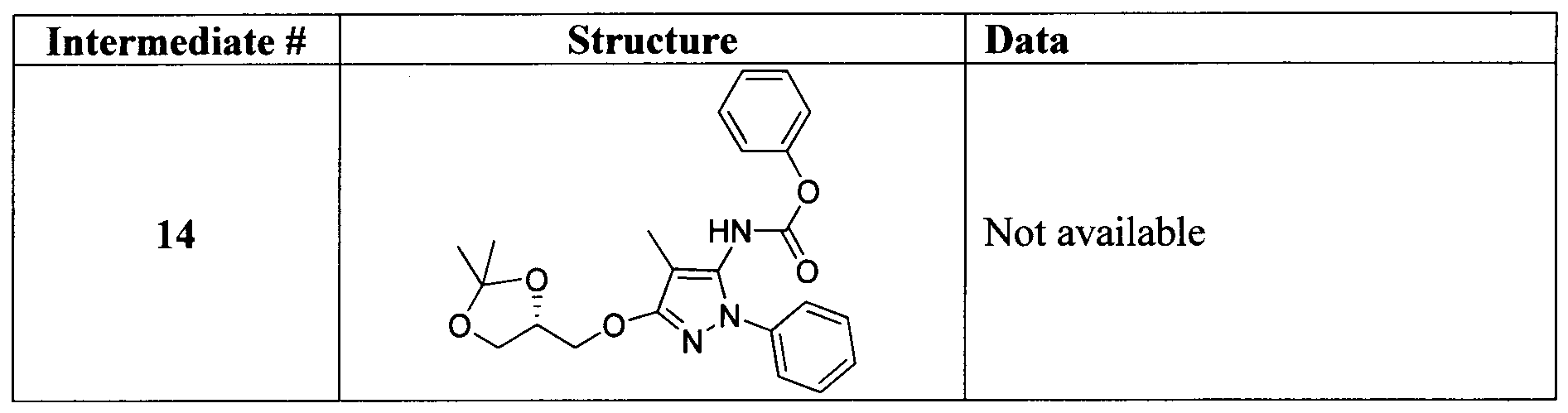
Intermediate 15

3 ,4-dimethyl- 1 -phenyl- 1 H-pyrazol-5-amine
[00450] To a solution of 2-methyl-3-oxobutanenitrile (295 mg, 3.038 mmol) in EtOH (40 mL) were added HC1 (5-6M in iPrOH, 0.6 mL) and phenylhydrazine (0.299 mL, 3.038 mmol). The reaction mixture was heated to reflux for 17 hours, then cooled to ambient temperature. The reaction mixture was diluted with saturated NaHC03 (20 mL), extracted with DCM (2 x 25 mL), and the combined organic phases were dried over MgS04, filtered and concentrated under vacuum. The residue was purified by silica column chromatography, eluting with 0-3% MeOH/DCM to yield the title compound (555 mg, 97% yield) as a tan solid. MS (apci) m/z = 188.2 (M+H).
Intermediate 16

phenyl (3 ,4-dimethyl- 1 -phenyl- 1 H-pyrazol-5-yl)carbamate
[00451] To a solution of 3,4-dimethyl-l-phenyl-lH-pyrazol-5-amine [Intermediate 7]
(1.80 g, 9.6 mmol) in EtOAc (20 mL) was added 2N NaOH (9.6 mL, 19.2 mmol) followed by phenyl chloroformate (1.7 mL, 13.5 mmol). The mixture was stirred at ambient temperature for 16 hours then treated with phenyl chloroformate (500 μί) and stirred a further 4 hours. The mixture was diluted with water (100 mL) and extracted with EtOAc (3 x 50 mL). The combined organic phases were washed with saturated NaHC03 (50 mL) and brine (50 mL) then dried over Na2S04, filtered and concentrated under vacuum. The residue was purified
by silica column chromatography eluting with 4:1 hexanes / EtOAc to afford the title compound (1.83 g, 62% yield) as a white powder.
Intermediate 17

2-phenyl-4,5,6,7-tetrahydro-2H-indazol-3-amine
[00452] Prepared according to the method of Intermediate 7, substituting 2-methyl-3- oxobutanenitrile with 2-oxocyclohexanecarbonitrile to yield the title compound (738 mg, 94% yield) as a pale orange solid. MS (apci) m/z = 214.1 (M+H).
Intermediate 18

phenyl (2-phenyl-4,5,6J-tetrahydro-2H-indazol-3-yl)carbamate
[00453] Prepared according to the method of Intermediate 8, substituting 3,4-dimethyl-l- phenyl-lH-pyrazol-5-amine with 2-phenyl-4,5,6,7-tetrahydro-2H-indazol-3-amine. MS (apci) m/z = 334.1 (M+H).
Intermediate 19

2-phenyl-4,6-dihvdro-2H-raro[3,4-c]pyrazol-3-amine
[00454] Step A: Preparation of 4-oxotetrahvdrofuran-3-carbonitrile: To a suspension of KOtBu (996.6 mg, 8.881 mmol) in THF (640.4 mg, 8.881 mmol) cooled to 0 °C was added dropwise methyl 2-hydroxyacetate (675.7 ί, 8.881 mmol) and stirred for 10 minutes. Acrylonitrile (589.1 μΙ>, 8.881 mmol) was then added and the reaction stirred at ambient temperature. After 3 hours, the reaction was diluted with H20 (50 mL), then extracted with Et20 (25 mL). The basic aqueous phase was acidified with 2M HC1 (5 mL), then extracted with Et20 (2 x 50 mL). The combined organic phases were dried with MgS04, filtered and concentrated to afford 4-oxotetrahydrofuran-3-carbonitrile (446 mg, 45.2% yield) as a light
brown oil. 1H NMR (CDC13) δ 4.63 (t, 1H), 4.24 (t, 1H), 4.14 (d, 1H), 4.02 (d, 1H), 3.57 (t, 1H).
[00455] Step B: Preparation of 2-phenyl-4,6-dihvdro-2H-furo 3,4-clpyrazol-3-amine: Prepared according to the method of Intermediate 7, substituting 2-methyl-3-oxobutanenitrile with 4-oxotetrahydrofuran-3-carbonitrile to yield the title compound (182 mg, 22.5% yield) as a reddish-brown syrup. MS (apci) m/z = 202.1 (M+H).
Intermediate 20

phenyl (2-phenyl-4,6-dihydro-2H-furo[3,4-c]pyrazol-3-yl)carbamate
[00456] Prepared according to the method of Intermediate 8, substituting 3,4-dimethyl-l- phenyl-lH-pyrazol-5-amine with 2-phenyl-4,6-dihydro-2H-furo[3,4-c]pyrazol-3-amine. MS (apci) m/z = 322.1 (M+H).
Intermediate 21

Phenyl (5,5-dioxido-2-phenyl-4,6-dihvdro-2H-thieno 3,4-c1pyrazol-3-yl)carbamate
[00457] Step A: Preparation of 2-phenyl-4,6-dihydro-2H-thienor3,4-c]pyrazol-3-amine: A suspension of 4-oxotetrahydrothiophene-3-carbonitrile (1.00 g, 7.86 mmol) and phenylhydrazine hydrochloride (1.25 g, 8.65 mmol) in absolute EtOH (40 mL) was refluxed for 2 hours. After removal of solvent under reduced pressure, the white solid residue was triturated with 1 N NaOH (40 mL). The solid was collected by filtration, washed with 0.1 N NaOH, water, and hexanes (approx. 10 mL each) then dried under vacuum to yield 2-phenyl- 4,6-dihydro-2H-thieno[3,4-c]pyrazol-3-amine (1.6 g, 95% yield) as a white solid. MS (apci pos) m/z = 218.1 (M+H).
[00458] Step B: Preparation of phenyl 2-phenyl-4,6-dihydro-2H-thieno[3,4-c1pyrazol-3- ylcarbamate. To a suspension of 2-phenyl-4,6-dihydro-2H-thieno[3,4-c]pyrazol-3-amine
(500 mg, 2.30 mmol) in EtOAc (10 mL) was added NaOH (2M aq, 2.3 mL, 4.60 mmol), followed by dropwise addition of phenyl carbonochloridate (0.400 mL, 3.22 mmol). After stirring at ambient temperature for 2 hours, another portion of phenyl carbonochloridate (0.16 mL, 1.3 mmol) was added dropwise, and the reaction was stirred at ambient temperature for 15 hours. The reaction mixture was diluted with EtOAc (20 mL) and phase-separated. The organic phase was washed with H20, brine (25 mL each), then dried with Na2S04, filtered and concentrated. The crude material was purified by reverse-phase column chromatography, eluting with 5-70% acetonitrile/water to yield phenyl 2-phenyl-4,6-dihydro- 2H-thieno[3,4-c]pyrazol-3-ylcarbamate (0.5 g, 64% yield) as a white solid. MS (apci pos) m/z = 338.1 (M+H).
[00459] Step C: Preparation of phenyl (5,5-dioxido-2-phenyl-4,6-dihydro-2H-thieno[3,4- c]pyrazol-3 -vDcarbamate. To a turbid solution of phenyl 2-phenyl-4,6-dihydro-2H- thieno[3,4-c]pyrazol-3-ylcarbamate (50 mg, 0.15 mmol) in DCM (1.5 mL) at 0 °C was added MCPBA (91 mg, 0.37 mmol, 70-75% water complex), and the mixture was stirred at ambient temperature for 10 minutes. The mixture was then diluted with DCM (3 mL) and washed with saturated aqueous NaHC03 (3 x 2 mL) and saturated aqueous Na2S203 (3 x 2 mL). The organic layer was dried with MgS04, filtered and concentrated under vacuum to yield the title compound (31 mg, 57% yield) as a light yellow foamy solid. MS (apci pos) m/z = 371.0 (M+H).
Intermediate 22

3-(methoxymethyl)-4-methyl-l-phenyl-lH-pyrazol-5-amine
[00460] Step A: Preparation of 4-methoxy-2-methyl-3-oxobutanenitrile: To a solution of methyl 2-methoxyacetate (0.48 mL, 4.80 mmol) in THF (20 mL, 4.803 mmol) at -78 °C under N2 were added propiononitrile (317.4 mg, 5.76 mmol) then lithium bis(trimethylsilyl)amide (4.8 mL, 1M/THF, 4.8 mmol). The mixture was stirred for 1 hour, then at 0 °C for 1 hour and was diluted with H20 (25 mL) and extracted with Et20 (25 mL). The basic aqueous phase was neutralized with 2M HC1 (2.0 mL), then extracted with Et20 (2 x 25 mL). The combined organic phases were washed with brine (25 mL), dried over MgS04, filtered and concentrated under vacuum to afford 4-methoxy-2-methyl-3- oxobutanenitrile (247 mg, 40% yield) as a pale yellow oil.
[00461] Step B: Preparation of 3-(methoxymethvn-4-methyl-l-phenyl-lH-pyrazol-5- amine: Prepared according to the method of Intermediate 7, substituting 2-methyl-3- oxobutanenitrile with 4-methoxy-2-methyl-3 -oxobutanenitrile to yield the title compound (96 mg, 23% yield) as an orange gum. MS (apci) m/z = 218.0 (M+H).
I rm diate 23

[00462] Prepared according to the method of Intermediate 8, substituting 3,4-dimethyl-l phenyl- 1 H-pyrazol-5-amine with 3 -(methoxymethyl)-4-methyl- 1 -phenyl- 1 H-pyrazol-5 amine. MS (apci) m/z = 337.9 (M+H).
Intermediate 24

1 ',4-dimethyl- 1 -phenyl- 1 H, 1 Ή-3 ,4'-bipyrazol-5-amine
[00463] Step A: ethyl 1 -methyl- 1 H-pyrazole-4-carboxylate: To a 3000-mL three-necked flask was added ethyl 2-formyl-3-oxopropanoate (100 g, 694 mmol), followed by anhydrous 200-proof EtOH (694 mL). The reaction was cooled in an ice bath to 5 °C, and then methylhydrazine (35.8 mL, 680 mmol) was added dropwise. A vigorous exotherm was observed during hydrazine addition and the temperature was kept below 12 °C by controlling the addition rate. After the hydrazine addition was complete, the ice bath was removed, and the reaction was allowed to stir at ambient temperature for 16 hours. The reaction was concentrated under vacuum and the residue dissolved in DCM and re-concentrated, then dried for 2 days to yield ethyl 1 -methyl- lH-pyrazole-4-carboxylate (106 g, 99% yield) as a tan orange oil. MS (apci) m/z = 155.1 (M+H).
[00464] Step B: 2-methyl-3-(l-methyl-lH-pyrazol-4-yl)-3-oxopropanenitrile: To a four- necked 5 -liter round bottomed flask fitted with an overhead stirrer and addition funnel was charged LHMDS (1444 mL, 1444 mmol) (1.0M in THF). The solution was cooled in an acetone/dry ice bath first (internal temperature of -79 °C) under nitrogen, followed by slow
addition of propiononitrile (103 mL, 1444 mmol) using a dropping funnel. The mixture was stirred at -80 °C for 90 minutes. A solution of ethyl 1 -methyl- lH-pyrazole-4-carboxylate (106 g, 688 mmol) in anhydrous THF (500 mL) was then introduced dropwise using an addition funnel (addition time: about 45 minutes; internal temperature during addition remained below -76 °C) . After the addition was complete, the reaction was allowed to slowly warm to ambient temperature and stirred overnight. An orange glass deposited on the bottom of the flask. The organics were decanted and the glass was dissolved in warm water. The mixture was washed with with ether (3 x 1000 mL). The aqueous phase was then pH-adjusted to 5 (pH paper) using concentrated HC1 and saturated bicarbarbonate solution The aqueous layer was extracted with DCM (3 x 1000 mL). The combined organic extracts were dried over MgS04 filtered and concentrated to yield 2-methyl-3-(l-methyl-lH-pyrazol-4-yl)-3- oxopropanenitrile as an amber oil (92 g, 82% yield). MS (apci) m/z = 162.1 (M-H).
[00465] Step C: 1 ',4-dimethyl- 1 -phenyl- 1 H, 1 'H-3,4'-bipyrazol-5-amine: A 3L, 3 necked round bottomed flask was charged with 2-methyl-3-(l -methyl- lH-pyrazol-4-yl)-3- oxopropanenitrile (60 g, 368 mmol) absolute anhydrous ethanol (1000 mL) and phenylhydrazine hydrochloride (58 g, 404 mmol) at ambient temperature to form a yellowish suspension. The reaction vessel was equipped with a water condenser and refluxed (using a heating mantle) overnight. The reaction was concentrated and 1M NaOH (1L) was added and the solid was broken up and collected. The solid was washed with water and hexanes. A second crop crashed out in the filtrate and was collected. The combined solids were crushed and triturated with ether (500 mL). The solid was collected by filtration, washed with hexanes and dried under vacuum to provide the title compound (93 g, 100% yield) as a yellow solid. MS (apci) m/z = 254.1 (M+H).
Intermediate 25

phenyl 1 ',4-dimethyl- 1 -phenyl- 1 H, 1 Ή-3 ,4'-bipyrazol-5-ylcarbamate
[00466] A 3 L, round bottomed flask was charged with 1 ',4-dimethyl-l -phenyl- ΙΗ,Ι Ή- 3,4'-bipyrazol-5-amine (50 g, 197.4 mmol) and EtOAc (1000 mL) to obtain a clear brownish solution. To this was added NaOH (2M aq) (500mL) in one portion to obtain a turbid mixture
(the aqueous and organic layers were clear, but a precipitate was observed in between the two layers). After 3 minutes, phenyl carbonochloridate (74.29 mL, 592.2 mmol) was added slowly at ambient temperature (the temperature of the reaction mixture increased to 33 °C during the addition). The reaction stirred at ambient temperature for 2 hours. Additional phenyl carbonochloridate (10 mL) was added. After 30 minutes the organics layers were separated, washed with brine and concentrated under vacuum. The residue was purified by silica column chromatography eluting with 75% EtOAc / hexanes to provide the title compound (60 g, 81% yield) as a cream foam. MS (apci) m/z = 374.1 (M+H).
Intermediate 26

OTBDMS
(S)-3-(2-((tert-butyldimethylsilyl)oxy)-3-methoxypropoxy)-4-methyl-l- phenyl- 1 H-pyrazol-5 -amine
[00467] Step A: ( S 1 -( 5-amino-4-methyl- 1 -phenyl- 1 Η-ρνΓ3ζο1-3-ν1οχν)-3- methoxypropan-2-ol : A mixture of 5-amino-4-methyl-l -phenyl- lH-pyrazol-3(2H)-one (P135 Step A, 1.21 g, 6.40 mmol) and powdered K2C03 (1.77 g, 12.8 mmol) in dry DMF (12 mL) was stirred at ambient temperature for 10 minutes. (S)-2-(methoxymethyl)oxirane (0.622 mL, 6.72 mmol) was added and the mixture was stirred at 80 °C for 6 hours. The mixture was cooled to ambient temperature, poured into chilled H20 (25 mL) and extracted with EtOAc (3X). The combined extracts were washed with saturated NaCl (2X), dried over MgS04 and filtered through a Si02 plug capped with a layer of MgS04 eluting with EtOAc. The filtrate was concentrated to give the title compound as a colorless, viscous oil (701 mg, 40% yield). MS (apci) m/z = 278.1 (M+H).
[00468] Step B: ( S)-3-(2-((tert-butyldimethylsilyl)oxy)-3-methoxypropoxyV4-methyl- 1 - phenyl- lH-pyrazol-5-amine: To a solution of TBDMS-C1 (725 mg, 4.81 mmol) and imidazole (390 mg, 5.72 mmol) in dry DMF (7.0 mL) was added (S)-l-(5-amino-4-methyl-l- phenyl-lH-pyrazol-3-yloxy)-3-methoxypropan-2-ol (635 mg, 2.29 mmol) in dry DMF (2 mL). The mixture stirred at ambient temperature for 2.5 hours. The mixture added to H20 (70 mL), mixed for 5 minutes and extracted with Et20 (3X). The combined extracts were washed with saturated NaCl (2X) and dried over MgS04. The dried solution was filtered through a Si02 plug capped with a layer of MgS04 (Et20 elution). The filtrate was concentrated to give the title compound as a colorless oil that was dried in vacuum (940 mg,
105%). MS (apci) m/z = 392.2 (M+H). Ή NMR (CDC13) δ 7.50 (d, 2H), 7.40 (t, 2H), 7.23 (t, 1H), 4.09-4.30 (m, 3H), 3.57 (br s, 2H), 3.38-3.44 (m, 2H), 3.32 (s, 3H), 1.83 (s, 3H), 0.88 (s, 9H), 0.11 (s, 6H).
diate 27

(R)-3-(2-((tert-butyldimethylsilyl)oxy)-3-methoxypropoxy)-4-methyl-l-phenyl-lH-pyrazol-
5 -amine
[00469] The title compound was prepared using the procedure described for (S)-3-(2- ((tert-butyldimethylsilyl)oxy)-3-methoxypropoxy)-4-methyl-l-phenyl-lH-pyrazol-5-amine (Intermediate 14) substituting (S)-2-(methoxymethyl)oxirane with (R)-2- (methoxymethyl)oxirane in Step A. The product was obtained as a colorless syrup (921 mg, 38% over 2 steps). MS (apci) m/z = 392.2 (M+H). 1H NMR (CDC13) δ 7.50 (d, 2H), 7.40 (t, 2H), 7.23 (t, 1H), 4.09-4.30 (m, 3H), 3.57 (br s, 2H), 3.38-3.44 (m, 2H), 3.32 (s, 3H), 1.83 (s, 3H), 0.88 (s, 9H), 0.11 (s, 6H).
Intermediate 28

phenyl (2-phenyl-2 A5 ,6-tetrahvdrocvclopenta|c]pyrazol-3 -vQcarbamate
[00470] To a suspension of 2 -phenyl -2,4,5, 6-tetrahydrocyclopenta[c]pyrazol-3 -amine (100 mg, 0.50 mmol) in EtOAc (2 mL) was added 2 M NaOH (0.50 mL, 1.0 mmol) followed by phenyl chloroformate (88 μί, 0.70 mmol). The mixture was stirred vigorously at ambient temperature for 16 hours them partitioned between EtOAc (10 mL) and water (10 mL). The aqueous layer was extracted with EtOAc (2 x 10 mL) and the combined organic phases were washed with brine (10 mL), dried over Na2S04, filtered and concentrated under vacuum. The residue was purified by silica column chromatography eluting with 0-1% MeOH/DCM then again with 4:1 hexanes / EtOAc to afford the title compound (63 mg, 39% yield) as a white foam. MS (apci) m/z = 320.1 (M+H).
Intermediate 29

phenyl (6-methvI-2-phenylpyridin-3 -vDcarbamate
[00471] Step A: Preparation of 6-methyl-2-phenylpyridin-3-amine: Phenyl boronic acid (424 mg, 3.48 mmol), K2C03 (1.48 g, 10.7 mmol) and Pd(PPh3)4 (309 mg, 0.27 mmol) were combined in toluene (6 mL), water (3 mL) and EtOH (1.5 mL) then treated with 2-bromo-6- methylpyridin-3 -amine (500 mg, 2.67 mmol). The mixture was warmed to 95 °C in a sealed tube for 16 hours then cooled and partitioned between EtOAc (30 mL) and saturated NH4C1 (30 mL). The aqueous layer was extracted with EtOAc (2 x 30 mL) and the combined organic phases were washed with brine (30 mL), dried over Na2S04, filtered and concentrated under vacuum. The residue was purified by silica column chromatography eluting with 4:1 hexanes / EtOAc to afford 6-methyl-2-phenylpyridin-3-amine (407 mg, 83% yield) as a pale yellow crystalline solid. MS (apci) m/z = 185.1 (M+H).
[00472] Step B: Preparation of phenyl (6-methyl-2-phenylpyridin-3-yl)carbamate: To a solution of 6-methyl-2-phenylpyridin-3-amine (407 mg, 2.21 mmol) in EtOAc (10 mL) was added 2N NaOH (2.21 mL, 4.42 mmol) followed by phenyl chloroformate (388 μΐ, 3.09 mmol). The mixture was stirred at ambient temperature for 4 hours then diluted with water (50 mL) and extracted with EtOAc (3 x 20 mL). The combined organic phases were washed with saturated NaHC03 (20 mL) and brine (20 mL) then dried over Na2S04, filtered and concentrated to afford the title compound (665 mg, 99% yield) as a white crystalline solid. MS (apci) m/z = 305.1 (M+H).
Intermediate 30

(R)- 1 -((5-amino-4-methyl- 1 -phenyl- 1 H-pyrazol-3-yPoxy)propan-2-ol
[00473] A mixture of 5-amino-4-methyl-l-phenyl-lH-pyrazol-3(2H)-one [Intermediate 27, Step A] (1.0 g, 5.3 mmol), (R)-2-methyloxirane (0.40 g, 6.9 mmol) and K2C03 (1.8 g, 13 mmol) in DMA (10 mL) was heated at 80 °C for 48 hours. After cooling the reaction mixture was treated with EtOAc, washed with water and brine, dried with MgS04, and filtered through a pad of silica gel with EtOAc elution. The filtrate was concentrated to afford the title compound (660 mg, 46% yield). MS (apci) m/z = 248.1 (M+H).
Intermediate 31

(R)-phenyl (3-(2-hvdroxypropoxy)-4-methyl-l-phenyl-lH-pyrazol-5-yl)carbamate
[00474] To a suspension of (R)-l-(5-amino-4-methyl-l-phenyl-lH-pyrazol-3- yloxy)propan-2-ol [Intermediate 37] (660 mg, 2.46 mmol) in EtOAc (7 mL) at 0 °C was added NaOH (3.07 mL, 2M, 6.14 mmol) and phenyl carbonochloridate (0.47 mL, 3.68 mmol). The reaction was stirred at ambient temperature for 3 days then treated with EtOAc, washed with water and brine, dried over MgS04, filtered and concentrated under vacuum. The residue was purified by silica column chromatography eluting with 3: 1 hexanes / EtOAc to afford the title compound (463 mg 51% yield). MS (apci) m/z = 368.1 (M+H).
Preparation Al

8-methyl-2-phenylimidazo[l,2-a]pyrazin-3-aminedihvdrochloride
[00475] Step A: Preparation of 8-methyl-2-phenyl-N-i2A4-trimethylpentan-2- yQimidazo[L2-a]pyrazin-3-amine: To a solution of 3-methylpyrazin-2-amine (4.00 g, 36.7 mmol) and benzaldehyde (4.08 mL, 40.33 mmol) in 2:1 DCM-MeOH (100 mL) was added Sc(OTf)3 (0.902 g, 1.83 mmol) and the mixture was stirred at ambient temperature for 30 minutes. 2-Isocyano-2,4,4-trimethylpentane (8.52 mL, 44.0 mmol) was added and the mixture stirred at ambient temperature for 60 hours. The mixture was concentrated and the residue was purified by silica column chromatography eluting with a step gradient of DCM,
20% then 50% EtOAc/hexanes. The title compound was obtained as a white solid (9.80 g, 80% yield). 1H NMR (CDC13) δ 8.03 (d, J = 4.6 Hz, 1H), 7.82 (d, J = 8.3 Hz, 2H), 7.74 (d, J = 4.6 Hz, 1H), 7.46 (t, 2H), 7.35 (m, 1H), 3.28 (br s, 1H), 2.91 (s, 3H), 1.55 (s, 2H), 1.02 (s, 9H), 0.94 (s, 6H) ppm.
[00476] Step B: Preparation of 8-methyl-2-phenylimidazofl,2-alpyrazin-3- aminedihydrochloride : To a solution of 8-methyl-2-phenyl-N-(2,4,4-trimethylpentan-2- yl)imidazo[l,2-a]pyrazin-3-amine (9.20 g, 27.3 mmol) in MeOH (60 mL) at 0 °C was added 4M HCI / dioxane (150 mL) and the mixture was stirred at ambient temperature for 2.5 hours. The mixture was diluted with MTBE (500 mL), stirred for 5 minutes and the precipitate was collected, washed with MTBE and dried under vacuum to afford the title compound (8.40 g, 103% yield) as an orange powder. 1H NMR (DMSOd6) δ 8.58 (d, J=5.6 Hz, 1H), 8.01 (d, J= 8.4 Hz, 2H), 7.74 (d, J- 5.6 Hz, 1H), 7.55(t, J= 7.5 Hz, 2H), 7.46 (t, J=7.4 Hz, 1H), 2.89 (s, 3H) ppm.
[00477] The compounds of Table 3 were prepared according to the method of Preparation Al using the appropriate 2-amino-l-azaheterocycle and aldehyde.
Table 3


MeO^ ^ 2 HCI dihydrochloride
[00478] Table 1 provides a list of commercially available pyrazole intermediates can be used in the synthesis of compounds described in the Examples.
Table 1


ChemBridge, 4010196 91642-97-6
VWR, AAA13296-14 16078-71-0
N/A = Not available
Intermediate PI

Ethyl 3-(5-amino-3-tert-butyl-lH-pyrazol-l -vDbenzoate
[00479] To a suspension of ethyl 3-hydrazinylbenzoate hydrochloride (500 mg, 2.31 mmol) in EtOH (20 mL) was added 4,4-dimethyl-3-oxopentanenitrile (318 mg, 2.54 mmol). The reaction mixture was heated to reflux for 18 hours, then cooled to ambient temperature and concentrated in vacuo. The crude product was purified by silica column chromatography, eluting with 0-5% MeOH/DCM to yield the product as a yellow oil (154 mg, 23% yield). MS (apci) m/z = 288.2 (M+H).
[00480] The compounds in Table 2 were prepared by the method as described for Intermediate PI, substituting 4,4-dimethyl-3-oxopentanenitrile with the appropriate cyanoketone and ethyl 3-hydrazinylbenzoate hydrochloride with the appropriate hydrazine.
Table 2

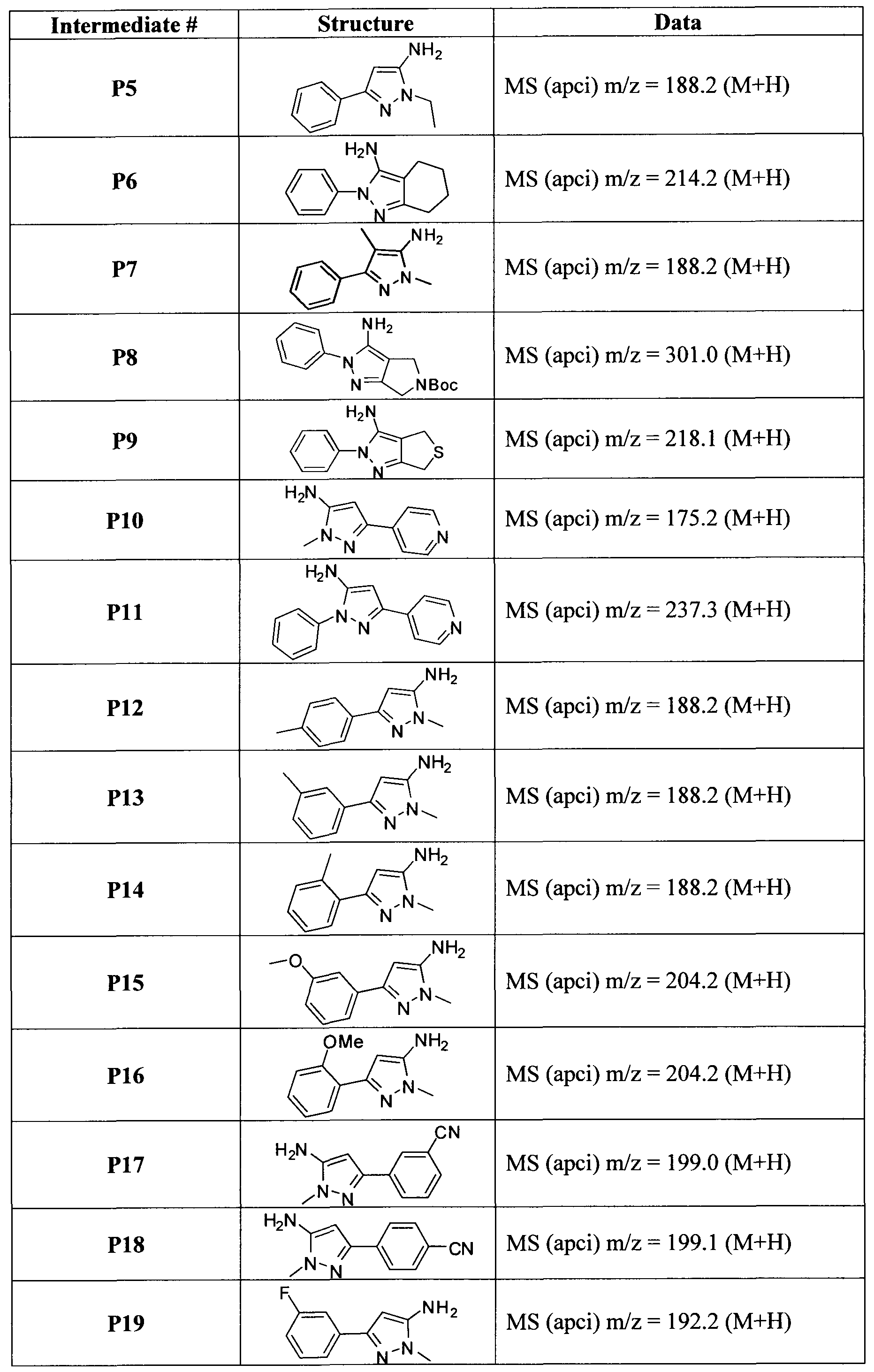

Intermediate P101

2-(l-methyl-lH-pyrazol-4-yl)-2,4,5,6-tetrahvdrocyclopenta-[c1pyrazol-3-amine
[00481] Step A: Preparation of di-tert-butyl 1 -(1 -methyl- lH-pyrazol-4-yl )hydrazine- 1,2-dicarboxylate: To a solution of 4-bromo-l -methyl- lH-pyrazole (1.93 mL, 18.6 mmol) in ether (37.3 mL) cooled to -78 °C was added nBuLi (23.3 mL, 37.3 mmol). After stirring at - 78 °C for 30 minutes, a solution of di-t-butyl azodicarboxylate (4.29 g, 18.6 mmol) in Et20 (37.3 mL, 18.6 mmol) was added dropwise. After 1 hour, the reaction mixture was warmed up to -20 °C and quenched with ice. After warming to ambient temperature, the mixture was filtered and rinsed with Et20. The resulting solid was taken up in a mixture of DCM and water, and the mixture was phase separated. The organic layer was dried with MgS04, filtered and concentrated in vacuo to afford the first batch of product as a white solid (1.64 g, 28% yield). A second batch of product was recovered from the filtrate by silica column chromatography, eluting with 40-60% hexanes/EtOAc (0.51 g, 8.8% yield). MS (apci) m/z = 313.0 (Μ+Η).
[00482] Step B: Preparation of 2-(l -methyl- lH-pyrazol-4-ylV2.4.5.6- tetrahydrocyclopenta- [c]pyrazol-3-amine : To a solution of di-tert-butyl 1 -(1 -methyl- 1H- pyrazol-4-yl)hydrazine-l,2-dicarboxylate (103 mg, 0.330 mmol) in EtOH (1.65 mL, 0.330 mmol) was added concentrated HCl (137 μί, 1.65 mmol). The mixture was stirred at ambient temperature for 5 minutes, then cooled in an ice bath followed by addition of 2-
oxocyclopentanecarbonitnle (36.0 mg, 0.330 mmol). After stirring for 5 minutes, the reaction mixture was warmed to ambient temperature overnight. The reaction mixture was concentrated and partitioned in water and DCM. After phase-separation, the aqueous layer was basified (pH 10) and then extracted with DCM (3 x 10 mL). The combined organic extracts were dried with MgS04, filtered and concentrated in vacuo. The crude material was purified by reverse-phase column chromatography, eluting with 0-100% acetonitrile/water to afford the product as a yellow solid (4.5 mg, 6.7% yield). MS (apci) m/z = 204.1 (M+H).
Intermediate P102

3 -fer/-butyl- 1 -(tetrahydro-2H-pyran-4- vD- 1 H-pyrazol-5-amine
[00483] Step A: Preparation of (tetrahydro-2H-pyran-4-yl)hydrazine hydrochloride: A suspension of dihydro-2H-pyran-4(3H)-one (2.00 g, 20.0 mmol) and rt-butyl hydrazinecarboxylate (2.64 g, 20.0 mmol) in hexanes (20.0 mL) was refluxed for 2 hours. After cooling, B¾-THF complex (20.0 mL, 20.0 mmol) was added and the reaction mixture was stirred for 1 hour. The mixture was then treated with 4 N HC1 in dioxane (20.0 mL, 79.9 mmol), followed by 3 drops of water. After stirring at ambient temperature for 1 hour, the reaction mixture was filtered and rinsed with EtOAc to afford the product as a solid (2.39 g, 78.4% yield). MS (apci) m/z = 117.0 (M+H).
[00484] Step B: Preparation of 3-fert-butyl- 1 -(tetrahydro-2H-pyran-4-yl)- 1 H-pyrazol-
5 -amine: Prepared by the method as described in for the preparation of Intermediate PI , substituting (tetrahydro-2H-pyran-4-yl)hydrazine dihydrochloride for ethyl 3- hydrazinylbenzoate hydrochloride to yield the product as a yellow oil (0.472 g, 99.9% yield). MS (apci) m/z = 224.1 (Μ+Η).
Intermediate PI 03

2-(pyridin-2-yl)-2,4,5.6-tetrahydrocvclopenta[c1pyrazol-3-amine
[00485] Step A: Preparation of 2-(2-(pyridin-2-yl)hvdrazono)cyclopentane- carbonitrile: A solution of 2-hydrazinylpyridine (0.200 g, 1.83 mmol) and 2- oxocyclopentanecarbonitrile (0.200 g, 1.83 mmol) in MeOH (9.16 mL) was treated with
concentrated HCl (0.764 mL, 9.16 mmol) and refluxed for 16 hours. The reaction mixture was concentrated in vacuo, and then partitioned in water and DCM. After phase-separation, the aqueous layer was washed with DCM, basified (saturated NaHC03, pH 10), and extracted with DCM. The combined organic layers were dried with MgS04, filtered and concentrated. The crude material was purified by silica column chromatography, eluting with 100% EtOAc to afford the product (0.289 g, 78.6% yield). MS (apci) m/z = 201.2 (M+H).
[00486] Step B: Preparation of 2-(pyridin-2-yl)-2A5,6- tetrahydrocyclopenta|c}pyrazol-3 -amine : A solution of 2-(2-(pyridin-2- yl)hydrazono)cyclopentanecarbonitrile (0.243 g, 1.21 mmol) in EtOH (6.06 mL, 1.21 mmol) was treated with 6 M HCl (0.202 mL, 1.21 mmol) and refluxed for 3 days. After removal of the solvent, the crude residue was diluted in water, basified (saturated NaHC03i pH 10) and extracted with DCM. The combined organic layers were dried with MgS04, filtered and concentrated. The crude material was purified by silica column chromatography, eluting with 50% EtOAc/hexanes to afford the product (0.198 g, 81.6% yield). MS (apci) m/z = 201.2 (M+H).
Intermediate PI 04

2-(pyridin-3-yl)-2,4,5,6-tetrahvdrocyclopentarc1pyrazol-3-amine
[00487] Prepared by the method described above for Intermediate PI 03, substituting 3- hydrazinylpyridine for 2-hydrazinyl pyridine to afford the title product. MS (apci) m/z = 201.1 (M+H).
Intermediate PI 05

6,6-dimethyl-2-phenyl-2,4,5,6-tetrahvdrocvclopenta[clpyrazol-3-amine
[00488] Step A: Preparation of 5-chloro-2,2-dimethylpentanenitrile: Isobutyronitrile (1.38 g, 20.0 mmol) and l-bromo-3-chloropropane (3.46 g, 22.0 mmol) were sequentially added to a 1 M solution of lithium bis(trimethylsilyl)amide (20.0 mL, 20.0 mmol) while stirring. After stirring at 70 °C for 16 hours, the reaction mixture was quenched with water then extracted with DCM. The combined organic layers were dried with MgS04, filtered and
concentrated in vacuo to afford 5-chloro-2,2-dimethylpentanenitrile (2.91 g, 100% yield). ]H NMR (CDC13) δ 3.57-3.61 (m, 2H), 1.94-2.02 (m, 2H), 1.67-1.72 (m, 2H), 1.37 (s, 6H).
[00489] Step B: Preparation of 2,2-dimethylhexanedinitrile: A suspension of 5-chloro- 2,2-dimethylpentanenitrile (2.91 g, 20.0 mmol) and NaCN (1.57 g, 32.0 mmol) in DMF (20.0 mL) and water (1 mL) was heated at 100 °C for 16 hours. After cooling, the reaction mixture was diluted with water and refluxed for 30 minutes, then cooled, poured into water and stirred for 3 hours. The solution was then extracted with Et20. The combined Et20 extracts were washed with H20, dried with MgS04, filtered and concentrated in vacuo to afford the product (2.20 g, 80.7% yield). 1H NMR (CDC13) δ 2.42-2.47 (m, 2H), 1.83-1.92 (m, 2H), 1.67-1.72 (m, 2H), 1.39 (s, 6H).
[00490] Step C: Preparation of 3,3-dimethyl-2-oxocyclopentanecarbonitrile: A suspension of KOtBu (0.511 g, 4.55 mmol) in toluene (18.4 mL) was treated a toluene (2.0 mL) solution of 2,2-dimethylhexanedinitrile (1.00 g, 7.34 mmol) and heated at 80 °C for 2 hours. The reaction mixture was then cooled to ambient temperature and quenched with water. The mixture was separated and the organic layer was stirred in 2 N HC1 (20 mL) for 16 hours. The mixture was separated and the organic layer dried with MgS04, filtered and concentrated in vacuo to a yellow-white solid. The crude solid was purified by silica column chromatography, eluting with 10-40% EtOAc/hexanes, to afford the product (0.250 g, 24.8% yield). 1H NMR (CDC13) δ 3.20-3.26 (m, 1H), 2.38-2.47 (m, 1H), 2.14-2.25 (m, 1H), 1.97- 2.05 (m, 1H), 1.74-1.83 (m, 1H), 1.14 (s, 6H).
[00491] Step D: Preparation of 6,6-dimethyl-2-phenyl-2A5,6-tetrahydrocyclopenta|c1 pyrazol-3 -amine: Prepared by the method as described for Intermediate PI, substituting phenylhydrazine for ethyl 3-hydrazinylbenzoate hydrochloride and 3,3-dimethyl-2- oxocyclopentanecarbonitrile for 4,4-dimethyl-3-oxopentanenitrile to afford the product (0.192 g, 46.2% yield) as a yellow solid. MS (apci) m/z = 228.2 (M+H).
Intermediate PI 06

7,7-dimethyl-2-phenyl-4,5,6,7-tetrahydro-2H-indazol-3-amine
[00492] Step A: Preparation of 2,2-dimethylheptanedinitrile: Prepared by the method as described for Intermediate PI 05, Steps A and B, substituting l-bromo-4-chlorobutane for
l-bromo-3-chloropropane to yield the product (2.21 g, 73.7% yield). 1H NMR (CDC13) δ 2.37-2.42 (m, 2H), 1.53-1.77 (m, 6H), 1.36 (s, 6H).
[00493] Step B: Preparation of 3,3-dimethyl-2-oxocyclohexanecarbonitrile: A suspension of KOtBu (0.463 g, 4.13 mmol) in toluene (16.6 mL) was treated with a solution of 2,2-dimethylheptanedinitrile (1.00 g, 6.66 mmol) in toluene (2.0 mL) and heated at 80 °C for 48 hours. After cooling to ambient temperature, the reaction mixture was quenched with water and phase-separated, and the organic layer was stirred with 2 N HC1 (20 mL) for 16 hours. After phase-separation, the organic layer was dried with MgS04, filtered and concentrated in vacuo. The crude material was purified by silica column chromatography, eluting with 10-20% EtOAc/hexanes to afford the product (0.374 g, 37.2% yield). 1H NMR (CDC13) 6 3.72-3.78 (m, 1H), 2.42-2.50 (m. 1H), 1.78-2.04 (m, 4H), 1.60-1.70 (m, 1H), 1.21 (s, 3H), 1.16 (s, 3H).
[00494] Step C: Preparation of 7.7-dimethyl-2-phenyl-4.5.6.7-tetrahvdro-2H-indazol- 3 -amine: Prepared by the method as described for Intermediate PI, substituting phenylhydrazine for ethyl 3-hydrazinylbenzoate hydrochloride and 3,3-dimethyl-2- oxocyclohexanecarbonitrile for 4,4-dimethyl-3-oxopentanenitrile to yield the product as an off-white solid (0.490 g, 54.2% yield, 66% purity). MS (apci) m/z = 242.2 (M+H).
Intermediate P107

3-isopropyl-4-methyl- 1 -phenyl- 1 H-pyrazol-5-amine
[00495] Step A: Preparation of 2,4-dimethyl-3-oxopentanenitrile: To a solution of propiononitrile (518 mg, 9.40 mmol) in THF (50 mL, 7.83 mmol) at -78 °C under N2 was slowly added lithium bis(trimethylsilyl)amide (1M in THF) (7.83 mL, 7.83 mmol). After 30 minutes, methyl isobutyrate (0.898 mL, 7.83 mmol) was added dropwise, and the reaction mixture was warmed to 0 °C. A yellow precipitate formed, the reaction mixture was stirred for 1 hour, then diluted with H20 (50 mL) to dissolve the solids. The mixture was extracted with Et20 (25 mL), and the basic aqueous phase was acidified with 2M HC1 (5 mL) and extracted with Et20 (2 x 50 mL). The combined organic phases were washed with brine (50 mL), dried with MgS04, filtered, and concentrated to afford the product (421 mg, 42.9% yield)
[00496] Step B: Preparation of 3-isopropyl-4-methyl-l -phenyl- lH-pyrazol-5-amine:
Prepared by the method as described for Intermediate PI, substituting phenyl hydrazine for ethyl 3-hydrazinylbenzoate hydrochloride and 4,4-dimethyl-3-oxopentanenitrile with 2,4- dimethyl-3-oxopentanenitrile to yield the product as a yellow syrup (0.587 g, 81.1% yield). MS (apci) m/z = 216.2 (M+H).
Intermediate P108

2-phenyl-4,6-dihvdro-2H-furo[3,4-c]pyrazol-3-amine
[00497] Step A: Preparation of 4-oxotetrahydrofuran-3-carbonitrile: To a suspension of KOtBu (996.6 mg, 8.881 mmol) in THF (640.4 mg, 8.881 mmol) cooled to 0 °C was added dropwise methyl 2-hydroxyacetate (675.7 μί, 8.881 mmol) and stirred for 10 minutes. The acrylonitrile (589.1 μί, 8.881 mmol) was then added and the reaction stirred at ambient temperature. After 3 hours, the reaction was diluted with H20 (50 mL), then extracted with Et20 (25 mL) to remove any starting ester. The basic aqueous phase was acidified with 2M HC1 (5 mL), then extracted with Et20 (2 x 50 mL). The combined organic phases were dried with MgS04, filtered, and concentrated to afford a light brown oil (446 mg, 45.2% yield). 1H NMR (CDC13) 6 4.63 (t, 1H), 4.24 (t, 1H), 4.14 (d, 1H), 4.02 (d, 1H), 3.57 (t, 1H).
[00498] Step B: Preparation of 2-phenyl-4,6-dihvdro-2H-furo[3,4-c1pyrazol-3-amine: Prepared by the method as described for Intermediate PI, substituting phenyl hydrazine for ethyl 3-hydrazinylbenzoate hydrochloride and 4,4-dimethyl-3-oxopentanenitrile with 4- oxotetrahydrofuran-3-carbonitrile to yield the product as a reddish-brown syrup (182 mg, 22.5% yield). MS (apci) m/z = 202.1 (M+H).
Intermediate P109

3-(methoxymethyl)- 1 -phenyl- 1 H-pyrazol-5-amine
[00499] Step A: Preparation of 4-methoxy-3-oxobutanenitrile: To a solution of methyl 2-methoxyacetate (0.4753 mL, 4.803 mmol) in THF (20 mL, 4.803 mmol) at -78 °C under N2 was added acetonitrile (0.3033 mL, 5.763 mmol), followed by lithium bis(trimethylsilyl)amide (1M in THF) (4.803 mL, 4.803 mmol). After stirring 1 hour, the
reaction mixture was warmed to 0 °C and stirred for 1 hour. The reaction mixture was then diluted with H20 (25 mL), washed with Et20 (25mL), then neutralized with 2 M HC1 (1.5 mL). This was extracted with Et20 (2 x 25 mL) and the combined organic phases were washed with brine (25 mL), dried with MgS04, filtered, and concentrated to afford the product (169 mg, 31.1% yield). 1H NMR (CDC13) δ 4.09 (s, 2H), 3.66 (s, 2H), 3.46 (s, 3H)
[00500] Step B: Preparation of 3-(methoxymethylH-phenyl-lH-pyrazol-5-amine: Prepared by the method as described for Intermediate PI, substituting phenyl hydrazine for ethyl 3-hydrazinylbenzoate hydrochloride and 4,4-dimethyl-3-oxopentanenitrile with 4- methoxy-3-oxobutanenitrile to yield the product as a pale yellow residue (6.0 mg, 2.0% yield). MS (apci) m/z = 204.0 (M+H).
Intermediate PI 10

3 -(methoxymethyl)-4-methyl- 1 -phenyl- 1 H-pyrazol-5-amine
[00501] Prepared according to the method as described for Intermediate PI 09, replacing acetonitrile with propionitrile to afford the product as an orange residue. MS (apci) m/z = 218.0 (M+H).
Intermediat P 111

2-(5 -amino- 1 -phenyl- 1 H-pyrazol-3-yl)-2-methylpropan- 1 -ol
[00502] Step A: Preparation of methyl 3-(tert-butyldimethylsilyloxy)-2.2-dimethyl- propanoate: Methyl 3-hydroxy-2,2-dimethylpropanoate (1.000 g, 7.567 mmol), TBDMS-C1 (1.140 g, 7.567 mmol) and imidazole (0.5666 g, 8.323 mmol) were dissolved in DMF (5 mL, 7.567 mmol) and stirred at ambient temperature overnight. The reaction mixture was diluted with H20 (25 mL) and extracted with EtOAc (2 x 25mL). The combined organic phases were washed with brine (25 mL), dried with MgS04, filtered and concentrated to afford the product (1.92 g, 103% yield). 1H NMR (CDC13) δ 3.66 (s, 3H), 3.57 (s, 2H), 1.15 (s, 6H), 0.87 (s, 9H), 0.02 (s, 6H).
[00503] Step B: Preparation of 5-(tert-butyldimethylsilyloxy)-4.4-dimethyl-3- oxopentanenitrile : Prepared according to the method described for Intermediate PI 09,
replacing methyl 2-methoxyacetate with methyl 3-(tert-butyldimethylsilyloxy)-2,2- dimethylpropanoate to afford the product as a pale yellow residue. 1H NMR (CDC13) δ 3.70 (s, 2H), 3.55 (s, 2H), 1.15 (s, 6H), 0.89 (s, 9H), 0.06 (s, 6H).
[00504] Step C: Preparation of 2-(5-amino-l -phenyl- 1 H-pyrazol-3-yl)-2- methylpropan- 1 -ol : Prepared by the method as described for Intermediate PI , substituting phenyl hydrazine for ethyl 3-hydrazinylbenzoate hydrochloride and 4,4-dimethyl-3- oxopentanenitrile with methyl 3-(tert-butyldimethylsilyloxy)-2,2-dimethylpropanoate to yield the product as yellow syrup (74 mg, 66% yield). MS (apci) m/z = 232.2 (Μ+Η).
Intermediate PI 12
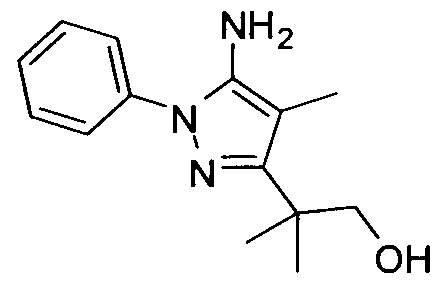
2-(5-amino-4-methyl- 1 -phenyl- 1 H-pyrazol-3-vD-2 -methylpropan- 1 -ol
[00505] Prepared according to the method described for Intermediate Pi l l , replacing acetonitrile with propionitrile to afford the product as a yellow residue. MS (apci) m/z = 246.2 (Μ+Η).
Intermediate PI 13

3 -(3 -methoxypropyl)-4-methyl- 1 -phenyl- 1 H-pyrazol-5-amine
[00506] Prepared according to the method described for Intermediate PI 09, replacing methyl 2-methoxyacetate with methyl 4-methoxybutanoate and replacing acetonitrile with propionitrile in Step A to afford the product as an orange-brown syrup. MS (apci) m/z = 246.1 (Μ+Η).
Intermediate PI 14

1 , 1 '-dimethyl- IH, 1 'H-3,4'-bipyrazol-5-amine
[00507] Step A: Preparation of 3-(l-methyl-lH-pyrazol-4-vD-3-oxopropanenitrile: A solution of ethyl 1 -methyl- lH-pyrazole-4-carboxylate (500 mg, 3.24 mmol), toluene (7.50 mL, 70.4 mmol), and acetonitrile (346 μί, 6.49 mmol) was treated in one portion with KOtBu (1092 mg, 9.73 mmol) to give a hazy solution. The reaction was allowed to stir at
ambient temperature for one hour, and was determined to be complete by HPLC analysis. The mixture was treated with water (7.5 mL) and stirred for 1 minute, then acidified with 3M HCl (3027 9.08 mmol) to pH 5.5-6. The aqueous layer was extracted with ethyl acetate (3 x 5 mL) and the combined organic extracts were concentrated in vacuo to give a yellow viscous oil, which completely solidified upon placing under high vacuum to afford the product (102 mg, 21.1% yield). Ή NMR (CDC13) δ 8.02 (s, 1H), 7.94 (s, 1H), 3.98 (s, 3H), 3.82 (s, 2H)
[00508] Step B: Preparation of l.r-dimethyl-lH.l'H-3.4'-bipyrazol-5-amine: Prepared by the method as described for Intermediate PI, substituting methyl hydrazine for ethyl 3- hydrazinylbenzoate hydrochloride and replacing 4,4-dimethyl-3-oxopentanenitrile with 3-(l- methyl-lH-pyrazol-4-yl)-3-oxopropanenitrile to yield the product as an ivory white solid (45 mg, 44.6% yield). MS (apci) m/z = 178.1 (M+H).
Intermediate P115

4-chloro- 1 ,3 -diphenyl- 1 H-pyrazol-5-amine
[00509] To a solution of l,3-diphenyl-lH-pyrazol-5-amine (Table 1; 0.100 g, 0.425 mmol) in acetonitrile (2 mL) was added N-chlorosuccinimide (0.0568 g, 0.425 mmol). The pale yellow solution was stirred at ambient temperature for 3 hours, then concentrated in vacuo and purified by silica column chromatography eluting with 20% EtOAc/Hexanes to afford the product as a light brown oil (0.10 g, 87% yield). MS (apci) m/z = 270.0 (M+H).
Intermediate PI 16

4-bromo- 1 ,3 -diphenyl- 1 H-pyrazol-5-amine
[00510] Prepared according to the procedure described for Intermediate PI 15, substituting N-chloro succinimide with N-bromo-succinimide. MS (apci) m/z = 313.9 (M+H).
Intermediate PI 17

4-chloro-3 -methyl- 1 -phenyl- 1 H-pyrazol-5-amine
[00511] Prepared according to the procedure described for Intermediate PI 15, substituting l,3-diphenyl-lH-pyrazol-5-amine with 3 -methyl- 1 -phenyl- 1 H-pyrazol-5-amine. MS (apci) m/z = 207.9 (M+H).
Intermediate PI 18

4-bromo-3 -methyl- 1 -phenyl- 1 H-pyrazol-5 -amine
[00512] Prepared according to the procedure described for Intermediate PI 17, substituting 7V-chloro succinimide with N-bromo-succinimide. MS (apci) m z = 251.9 (Μ+Η).
Intermediate PI 19

4-chloro- 1 -methyl-3 -phenyl- 1 H-pyrazol-5 -amine
[00513] Prepared according to the procedure described for Intermediate PI 15, substituting l,3-diphenyl-lH-pyrazol-5-amine with l-methyl-3-phenyl-lH-pyrazol-5-amine (Table 1). MS (apci) m/z = 208.0 (M+H).
Intermediate PI 20

4-bromo- 1 -methyl-3 -phenyl- 1 H-pyrazol-5 -amine
[00514] Prepared according to the procedure described for Intermediate PI 19, substituting N-chloro succinimide with N-bromo-succinimide. MS (apci) m/z = 251.9 (Μ+Η).
Intermediate P121

1 -methyl-3-(4-(methylthio)phenyl)- 1 H-pyrazol-5-amine
[00515] Step A: Preparation of 3-(4-(methylthio)phenvO-3-oxopropanenitrile: To a suspension of NaH (60% in mineral oil) (154 mg, 3.84 mmol) in dioxane (25.0 mL, 2.74 mmol) was added acetonitrile (0.217 mL, 4.12 mmol). The reaction mixture was stirred at ambient temperature for 30 minutes, then treated with methyl 4-(methylthio)benzoate (500 mg, 2.74 mmol) and heated to reflux for 15 hours. The suspension was cooled, then diluted with water (25 mL) and washed with Et20 (25 mL). The aqueous layer was neutralized with 2M HC1 (1.8 mL) and extracted with Et20 (2 x 25 mL). The combined organic phases were washed with brine (25 mL), dried with MgS04, filtered and concentrated in vacuo. The resultant residue was purified by silica column chromatography eluting with 0-5% MeOH/DCM to afford the product (317 mg, 60.4% yield). Ή NMR (CDC13) δ 7.82 (d, 2H), 7.30 (d, 2H), 4.02 (s, 2H), 2.54 (s, 3H).
[00516] Step B: Preparation of l-methyl-3-(4-(methylthio)phenyl)-lH-pyrazol-5- amine: Prepared by the method as described in Intermediate PI, substituting methylhydrazine for ethyl 3-hydrazinylbenzoate hydrochloride and substituting 3-(4-(methylthio)phenyl)-3- oxopropanenitrile for 4,4-dimethyl-3-oxopentanenitrile to yield the product as a yellow solid (0.307 g, 96.7% yield). MS (apci) m/z = 220.0 (M+H).
Intermediate P122

2-(5 -amino- 1 -phenyl- 1 H-pyrazol-3 -y l)-2-methylpropanenitrile
[00517] Prepared according to the procedure for Intermediate P121, substituting methyl 4-(methylthio)benzoate with ethyl 2-cyano-2-methylpropanoate in Step A and phenyl hydrazine hydrochloride for methyl hydrazine in Step B. MS (apci) m/z = 227.1 (Μ+Η).
Intermediate PI 23

3-(4-(2-methoxyethoxy)phenyl - 1 -methyl- 1 H-pyrazol-5-amine
[00518] Step A: Preparation of 3-(4-(benzyloxy)phenyl)-3-oxopropanenitrile: Prepared according to the procedure described for Intermediate P121, substituting methyl 4- (methylthio)benzoate with methyl 4-(benzyloxy)benzoate in Step A. 1H NMR (CDC13) δ 7.90 (d, 2Η), 7.42 (m, 4Η), 7.37 (m, 1 Η), 7.05 (d, 2Η), 5.16 (s, 2Η), 4.00 (s, 2Η).
[00519] Step B: Preparation of 3-(4-(benzyloxy)phenyl)-l -methyl-lH-pyrazol-5- amine: Prepared by the method as described for Intermediate PI , substituting methylhydrazine for ethyl 3-hydrazinylbenzoate hydrochloride and 3-(4-(benzyloxy)phenyl)- 3-oxopropanenitrile for 4,4-dimethyl-3-oxopentanenitrile to yield the product as a yellow solid. MS (apci) m/z = 280.1 (Μ+Η).
[00520] Step C: Preparation of 4-(5-amino-l -methyl- lH-pyrazol-3-yDphenol: To a solution of 3-(4-(benzyloxy)phenyl)-l -methyl- lH-pyrazol-5-amine (47 mg, 0.17 mmol) in EtOH (5.0 mL) was added 5% Pd/C (9.0 mg, 0.0084 mmol) and stirred under a H2 balloon for 17 hours. The reaction mixture was filtered through Celite®, rinsed with EtOH and concentrated in vacuo to afford the product (28 mg, 88% yield). MS (apci) m/z = 190.1 (M+H).
[00521] Step D: Preparation of 3-(4-(2-methoxyethoxy)phenyl)-l -methyl- lH-pyrazol- 5-amine: To a solution of 4-(5-amino-l -methyl-lH-pyrazol-3-yl)phenol (14 mg, 0.074 mmol) in DMSO (0.50 mL, 7.0 mmol) was added Cs2C03 (48 mg, 0.15 mmol) and l-bromo-2- methoxyethane (9.7 μί, 0.10 mmol). The reaction mixture was stirred for 16 hours, then diluted with water (10 mL) and extracted with DCM (3 x 10 mL). The combined organic extracts were washed with brine (10 mL), dried with MgS04, filtered and concentrated to afford the crude product (22 mg, 120% yield). The crude product was used without purification in subsequent steps. MS (apci) m/z = 248.0 (M+H).
Intermediate P124

1 '-methyl- 1 -phenyl- 1 H, 1 'H-3,4'-bipyrazol-5 -amine
[00522] Prepared according to the procedure described for Intermediate PI 14, substituting methylhydrazine with phenylhydrazine in Step B. MS (apci) m/z = 240.0 (M+H).
Intermediate P125

4-methoxy-3 -methyl- 1 -phenyl- 1 H-pyrazol-5-amine
[00523] Prepared according to the procedure for Intermediate P121, substituting methyl 4-(methylthio)benzoate with ethyl acetate and substituting acetonitrile with 2- methoxyacetonitrile in Step A and phenyl hydrazine hydrochloride for methyl hydrazine in Step B. MS (apci) m/z = 204.0 (M+H).
Intermediate P126

(5-amino-4-methyl- 1 -phenyl- 1 H-pyrazol-3 -vDmethanol
[00524] Prepared according to the procedure for Intermediate PI 12, substituting methyl 3-hydroxy-2,2-dimethylpropanoate with ethyl 2-hydroxyacetate in Step A. MS (apci) m/z = 204.1 (M+H).
Intermediate P127

2-(5-amino-4-methyl- 1 -phenyl- 1 H-pyrazol-3 -vDethanol
[00525] Prepared according to the procedure for Intermediate PI 12, substituting methyl 3-hydroxy-2,2-dimethylpropanoate with methyl 3-hydroxypropanoate in Step A. MS (apci) m/z = 218.0 (M+H).
Intermediate P128

3 -(2-methoxyethyl)-4-methyl- 1 -phenyl- 1 H-pyrazol-5-amine
[00526] Step A: Preparation of 5-methoxy-2-methyl-3-oxopentanenitrile: To a suspension of NaNH2 (50 wt% suspension in toluene) (330 mg, 4.23 mmol) in THF (25 mL, 4.23 mmol) under N2 at -78 °C was added propiononitrile (0.448 mL, 6.35 mmol), and the reaction mixture was stirred for 30 minutes. Methyl 3-methoxypropanoate (0.495 mL, 4.23 mmol) was added and the reaction mixture was stirred at -78 °C for 1 hour, then at 0 °C for 2.5 hours. The reaction mixture was diluted with H20 (25 mL) and washed with Et20 (25 mL). The basic aqueous phase was neutralized with 2M HC1 (1.6 mL), then extracted with Et20 (3 x 25 mL). The combined organic phases were washed with brine (25 mL), dried with MgS04, filtered, and concentrated to afford the crude product as a pale greenish oil (171 mg). The crude mixture was taken directly to the next step.
[00527] Step B: Preparation of 3-(2-methoxyethyl)-4-methyl-l-phenyl-lH-pyrazol-5- amine: Prepared by the method as described for Intermediate PI, substituting 5-methoxy-2- methyl-3-oxopentanenitrile for 4,4-dimethyl-3-oxopentanenitrile and substituting phenylhydrazine hydrochloride for ethyl 3-hydrazinylbenzoate hydrochloride to yield the product as a yellow solid (56 mg, 20% yield). MS (apci) m/z = 232.0 (Μ+Η).
Intermediate PI 29

Phenyl (5-oxido-2-phenyl-4,6-dihvdro-2H-thieno[3,4-c]pyrazol-3-yl)carbamate
[00528] A THF (4 mL) solution of phenyl 2-phenyl-4,6-dihydro-2H-thieno[3,4- c]pyrazol-3-ylcarbamate (Intermediate P130, Step B; 50 mg, 0.15 mmol) was cooled to -50 °C with an external dry-ice/MeCN bath and treated with a THF (2 mL) solution of 3- chlorobenzoperoxoic acid (33 mg, 0.13 mmol). After stirring for 1 hour, the mixture was
quenched with Na2S203 and water, extracted with EtOAc, washed with NaHC03 and brine, dried with MgS04, filtered, and concentrated to give the product which was directly used in next step without further purification. MS (apci) m/z = 354.1 (M+H).
Intermediate P130

Phenyl (f5,5-dioxido-2-phenyl-4,6-dihvdro-2H-thieno[3,4-c1pyrazol-3-yl)carbamate
[00529] Step A: Preparation of 2-phenyl-4,6-dihvdro-2H-thienoi3.4-c1pyrazol-3- amine: A suspension of 4-oxotetrahydrothiophene-3-carbonitrile (1.00 g, 7.86 mmol) and phenylhydrazine hydrochloride (1.25 g, 8.65 mmol) in absolute EtOH (40 mL) was refluxed for 2 hours. After removal of solvent under reduced pressure, the white solid residue was triturated with 1 N NaOH (40 mL). The solid was collected by filtration, washed with 0.1 N NaOH, water, and hexanes (approx. 10 mL each) then dried on high vacuum to yield the product as white solid (1.6 g, 95% yield). MS (apci pos) m/z = 218.1 (M+H).
[00530] Step B: Preparation of phenyl 2-phenyl-4,6-dihvdro-2H-thieno[3,4-c]pyrazol- 3-ylcarbamate. To a suspension of 2-phenyl-4,6-dihydro-2H-thieno[3,4-c]pyrazol-3-amine (500 mg, 2.30 mmol) in EtOAc (10 mL) was added NaOH (2M aq, 2.3 mL, 4.60 mmol), followed by dropwise addition of phenyl carbonochloridate (0.400 mL, 3.22 mmol). After stirring at ambient temperature for 2 hours, another portion of phenyl carbonochloridate (0.16 mL, 1.3 mmol) was added dropwise, and the reaction was stirred at ambient temperature for 15 hours. The reaction mixture was diluted with EtOAc (20 mL) and phase-separated. The organic phase was washed with H20, brine (25 mL each), then dried with Na2S04, filtered and concentrated. The crude material was purified by reverse-phase column chromatography, eluting with 5-70% acetonitrile/water to yield the product as white solid (0.5 g, 64% yield). MS (apci pos) m/z = 338.1 (M+H).
[00531] Step C: Preparation of phenyl (5.5-dioxido-2-phenyl-4,6-dihydro-2H- thieno[3,4-clpyrazol-3-yl)carbamate. To a turbid solution of phenyl 2-phenyl-4,6-dihydro- 2H-thieno[3,4-c]pyrazol-3-ylcarbamate (50 mg, 0.15 mmol) in DCM (1.5 mL) at 0 °C was added MCPBA (91 mg, 0.37 mmol, 70-75% water complex), and the mixture was stirred at ambient temperature for 10 min. The mixture was then diluted with DCM (3 mL) and
washed with saturated aqueous NaHC03 (3 x 2 mL) and saturated aqueous Na2S203 (3 < 2 mL). The organic layer was dried with MgS04, filtered and concentrated under reduced pressure to yield the title product as light yellowish foamy solid (31 mg, 57% yield, 95% pure). MS (apci pos) m/z = 371.0 (M+H).
Intermediate P132
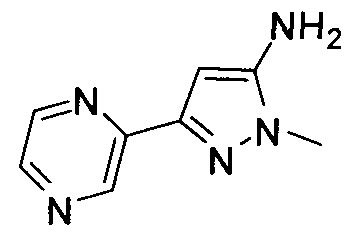
l-methyl-3-(pyrazin-2-yl)-lH-pyrazol-5-amine
[00532] Step A: Preparation of 3-oxo-3-(pyrazin-2-vDpropanenitrile: To a suspension of NaH (60% in mineral oil, 81.1 mg, 2.03 mmol) in dioxane (15 mL) was added acetonitrile (0.114 mL, 2.17 mmol), followed by methyl pyrazine-2-carboxylate (200 mg, 1.45 mmol) and the reaction heated to reflux for 2.5 hours. The reaction mixture was cooled to ambient temperature and diluted with H20 (25 mL) and extracted with Et20 (25 mL). The aqueous phase was neutralized with 2M aqueous HC1 (0.7 mL), then extracted with 10% MeOH/DCM (3 x 25 mL). The combined organic phases were washed with brine (25 mL), dried with MgS04, filtered, and concentrated to yield the crude product as an orange syrup (134 mg, 62.9% yield). Ή NMR (CDC13) δ 9.32 (d, 1H), 8.87 (d, 1H), 8.68 (dd, 1H), 4.34 (s, 2H).
[00533] Step B: Preparation of l-methyl-3-(pyrazin-2-yl)-lH-pyrazol-5-amine: To a suspension of 3-oxo-3-(pyrazin-2-yl)propanenitrile (67.0 mg, 0.455 mmol) in EtOH (5 mL) was added methylhydrazine (0.024 mL, 0.455 mmol). The reaction mixture was refluxed for 15 hours, then concentrated in vacuo. The crude product was purified by silica column chromatography, eluting with 0-5% MeOH/DCM to yield the product as a brown residue (33 mg, 41% yield). MS (apci) m/z = 176.2 (M+H).
Intermediate PI 33

l-methyl-3-(5-methylpyrazin-2-yl)-lH-pyrazol-5-amine
[00534] Prepared by the method as described for Intermediate PI 07, substituting methyl isobutyrate in Step A with methyl 5-methylpyrazine-2-carboxylate and propionitrile with acetonitrile to afford 3-(5-methylpyrazin-2-yl)-3-oxopropanenitrile. In Step B, phenylhydrazine was replaced by methylhydrazine to afford the title pyrazole. MS (apci) m/z = 190.2 (Μ+Η).
Intermediate P134

l,4-dimethyl-3-(5-methylpyrazin-2-yl)-lH-pyrazol-5-amine
[00535] Prepared by the method as described for Intermediate PI 07, substituting methyl isobutyrate in Step A with methyl 5-methylpyrazine-2-carboxylate to afford 2-methyl- 3-(5-methylpyrazin-2-yl)-3-oxopropanenitrile. In Step B, phenylhydrazine was replaced by methylhydrazine to afford the title compound. MS (apci) m/z = 204.1 (M+H).
Intermediate P135

3 -ethoxy-4-methyl- 1 -phenyl- 1 H-pyrazol-5-amine
[00536] Step A: Preparation of 5-amino-4-methyl-l-phenyl-lH-pyrazol-3(2H)-one: A mixture of ethyl 2-cyanopropanoate (5.0 g, 46 mmol) and phenylhydrazine (5.9 g, 46 mmol) in dioxane (10 mL) was heated at 110 °C for 17 hours. The crude material was cooled to ambient temperature, concentrated, and triturated with cold EtOH and Et20. The resultant solid was filtered, washed with Et20, and dried under vacuum to give the product as a white solid (3.4 g, 39% yield). MS (apci) m/z = 190.0 (M-H).
[00537] Step B: Preparation of 3-ethoxy-4-methyl-l-phenyl-lH-pyrazol-5-amine: To a suspension of 5 -amino-4-methyl-l -phenyl- lH-pyrazol-3(2H)-one (10.0 g, 52.9 mmol) in DMF (100 mL) was added K2C03 (14.6 g, 106 mmol) and bromoethane (4.34 mL, 58.1) at ambient temperature. After stirring for 17 hours, the reaction mixture was treated with EtOAc and washed with water (3x, to obtain the N-alkylation product) and brine, dried with MgS04, filtered, and concentrated to give the product (5.35 g, 47% yield). MS (apci) m/z = 218.1 (Μ+Η).
[00538] The compounds in Table 3 were prepared by the method as described for Intermediate PI 35, substituting bromoethane with the appropriate alkyl halide or alkyl methanesulfonate.
Table 3


Intermediate P136

3 -(benzyloxy)- 1 -methyl- 1 H-pyrazol-5-amine
[00539] Step A: Preparation of 5-amino-l-methyl-4-phenyl-lH-pyrazol-3(2H)-one: To a suspension of ethyl 2-cyano-2-phenylacetate (2.56 g, 13.3 mmol) in EtOH (10 mL) was added dropwise methylhydrazine (1.09 mL, 19.9 mmol). The reaction was heated at 85 °C for 15 hours. The reaction mixture was cooled to 0 °C and filtered. The resultant solid was washed with cold EtOH (20 mL) and Et20 (20 mL) to give the desired product (2.10 g, 83.7% yield). MS (apci) m/z = 190.2 (M+H)
[00540] Step B: Preparation of 3-(benzyloxy)-l-methyl-lH-pyrazol-5-amine: A suspension of 5-amino-l-methyl-lH-pyrazol-3(2H)-one (0.35 g, 3.1 mmol), Benzyl chloride (0.43 g, 3.4 mmol), and K2C03 (1.3 g, 9.3 mmol) in DMF (4 mL) was heated at 70 °C for 17 hours. After cooling, the reaction mixture was treated with EtOAc, washed with water and brine, dried with MgS04, and concentrated in vacuo. The crude product was purified by silica column chromatography eluting with 2-6% MeOH/DCM to afford the title compound (0.16 g, 25% yield). MS (apci) m/z = 204.0 (M+H).
Intermediate P137

3 -methoxy- 1 -methyl-4-phenyl- 1 H-pyrazol-5 -amine
[00541] To a suspension of 5-amino-l-methyl-4-phenyl-lH-pyrazol-3(2H)-one (Step A of the preparation of Intermediate PI 36; 208 mg, 1.10 mmol) and K2C03 (456 mg, 3.30 mmol) in DMF (5 mL) was added dropwise iodomethane (172 mg, 1.21 mmol). The reaction mixture was stirred for 15 hours. The solvent was removed under reduced pressure and the
residue was purified by silica column chromatography eluting with 33% EtOAc/Hexanes to give the title pyrazole (66.0 mg, 30.4% yield). MS (apci) m/z = 204.1 (M+H).
Intermediate P138

3-ethoxy- 1 -methyl-4-phenyl- 1 H-pyrazol-5-amine
[00542] Prepared as described in Intermediate PI 37, replacing iodomethane with iodoethane in Step B to afford the title compound. MS (apci) m/z = 218.2 (M+H).
Intermediate P139

3 -ethoxy- 1 -phenyl- 1 H-pyrazol-5 -amine
[00543] Prepared according to the procedure described for Intermediate 135, substituting ethyl-2-cyanopropanoate with ethyl-2-cyanoacetate in Step A. MS (apci) m/z = 204.0 (Μ+Η).
[00544] The compounds in the following Table were prepared by the method as described for Intermediate PI 35, substituting bromoethane with the appropriate alkyl halide, alkyl methanesulfonate or epoxide.


Intermediate 151

1 '-(2-methoxyethyl)-l -phenyl-lH.l 'H-r3,4'-bipyrazoll-5-amine
[00545] Step A: Preparation of methyl l-methyl-lH-L2.4-triazole-3-carboxylate: To a stirred suspension of NaH (60% oil dispersion, 0.346 g, 8.66 mmol) in DMF (20 mL) was added dropwise a solution of methyl lH-l,2,4-triazole-3-carboxylate (1.00 g, 7.87 mmol) in DMF (20 mL) at 0 °C under nitrogen. The reaction mixture was stirred at 0 °C for 1 hour. Mel (0.982 mL, 15.7 mmol) was added dropwise. The reaction mixture was stirred at ambient temperature overnight. The reaction was poured into cold water and extracted with EtOAc.
The combined organic layers were washed with brine, dried and concentrated. The residue was purified by column chromatography (3: 1 hexanes/EtOAc) to give the title compound (0.380 g, 34% yield) as a white solid. MS (apci) m/z = 142.1 (M+H).
[00546] Step B: Preparation of l'-Q-methoxyethviy 1 -phenyl- 1H, 1 'H-r3,4'-bipyrazoll- 5 -amine: Prepared according to the method described for Intermediate PI 09, using methyl 1- methyl-lH-l,2,4-triazole-3-carboxylate as a replacement for methyl 2-methoxyacetate, and substituting propionitrile for acetonitrile in Step A. MS (apci) m/z = 255.1 (Μ+Η).
Intermediate 152

r-(2-methoxyethyl)-4-methyl-l-phenyl-lH.rH-[3,4'-bipyrazoll-5-amine
[00547] Prepared according to the method described for Intermediate PI 09, using ethyl l-(2-methoxy ethyl)- lH-pyrazole-4-carboxylate as a replacement for methyl 2- methoxyacetate, and substituting propionitrile for acetonitrile in Step A.
Intermediate 153

5-amino-4-methyl- 1 -phenyl- 1 H-pyrazole-3 -carbonitrile
[00548] To a stirred solution of aniline (2.02 g, 21.7 mmol) in 6 N HC1 (22 mL) was added dropwise a solution of NaN02 (1.50 g, 21.7 mmol) in water (20 mL) at 0-5 °C. The reaction mixture was stirred at 0 °C for 15 minutes. Acetic acid (10 mL) was added. This solution was added dropwise to a stirred solution of ethyl 2,3-dicyanobutanoate (Prepared according to the procedure described in Bioorganic & Medicinal Chemistry, 2004, 12, 3345 - 3356, 3.60 g, 21.7 mmol) in acetic acid (12 mL) and water (18 mL) at 0 °C. After stirring for 1 hour, concentrated ammonium hydroxide (50 mL) was added dropwise followed by THF (50 mL). The reaction was stirred at ambient temperature overnight. The organic layer was separated. The aqueous layer was extracted with EtOAc. The combined organic layers were washed with brine, dried and concentrated. The residue was purified by flash chromatography on silica gel (3:1 hexanes/EtOAc) to give the title compound (2.95 g, 69% yield). MS (apci) m/z = 198.9 (M+H).
Intermediate 155

4-methyl-3-(2-methyl-2H- 1 ,2,3-triazol-4-vD- 1 -phenyl- lH-pyrazol-5-amine
[00549] Step A: Preparation of ethyl 2-methyl-2H-l,2,3-triazole-4-carboxylate: A mixture of ethyl 2H-l,2,3-triazole-4-carboxylate (2.00 g, 14.2 mmol), K2C03 (3.53 g, 25.5 mmol) and methyl iodide (3.54 mL, 56.7 mmol) in acetonitrile (40 mL) was stirred at 50 °C under nitrogen overnight. After cooling to ambient temperature, the mixture was filtered through Celite®. The filtrate was concentrated in vacuo. The residue was purified by flash chromatography on silica gel (4:1 hexane/EtOAc) to give the title compound (0.780 g, 35% yield). MS (apci) m/z = 156.0 (M+H).
[00550] Step B: Preparation of 4-methyl-3-(2-methyl-2H-l,23-triazol-4-vn-l-phenyl- 1 H-p yrazol-5 -amine : Prepared according to the method described for Intermediate PI 09 using ethyl 2-methyl-2H-l,2,3-triazole-4-carboxylate as a replacement for methyl 2- methoxyacetate, and substituting propionitrile for acetonitrile in Step A. MS (apci) m z = 254.9 (M+H).
Intermediate 156

3 -bromo-4-methyl- 1 -phenyl- 1 H-pyrazol-5 -amine :
[00551] To a stirred solution of 5-amino-4-methyl-l -phenyl- lH-pyrazol-3(2 )-one (Intermediate PI 35, Step A, 1.00 g, 5.29 mmol) in MeCN (20 mL) was added POBr3 (2.27 g, 7.93 mmol). The reaction mixture was heated at reflux for 3 hours. The reaction was concentrate in vacuo. The residue was taken up in DCM. Saturated aqueous NaHC03 solution was carefully added. The aqueous layer was extracted with DCM. The combined organic layers were washed with brine, dried and concentrated. The residue was purified by flash chromatography on silica gel (1 :2 hexane/EtOAc to give the title compound (0.23g, 17% yield). MS (apci) m/z = 251.8 (M+H).
Intermediate 157

3-amino-5-methyl-2-phenyl-4,5-dihvdropyrrolo 3,4-c]pyrazol-6(2H)-one
[00552] Step A: Preparation of ethyl 5-amino-4-((methylamino)methyl)-l -phenyl- 1H- pyrazole-3-carboxylate: To a stirred solution of ethyl 5 -amino-4-formyl-l -phenyl- 1H- pyrazole-3-carboxylate (Prepared according to the procedure described in J. Heterocyclic Chemistry, 2010, 47, p. 287-291, 142 mg, 0.548 mmol) in DCM (3 mL) was added 2.0 M MeNH2 in THF (0.822 mL, 1.64 mmol). Two drops of acetic acid was added. The reaction mixture was stirred at ambient temperature overnight. MeOH (0.4 mL) was added followed by NaBiL; (31 mg, 0.82 mmol) portionwise. The reaction was quenched by the slow addition of water. The mixture was extracted with DCM. The combined organic layers were washed with brine, dried and concentrated. The crude was used in the next step without further purification. MS (apci) m/z = 275.0 (M+H).
[00553] Step B: Preparation of 3-amino-5-methyl-2-phenyl-4,5-dihydropyrrolo[3,4- c]pyrazol-6(2H)-one: To a stirred solution of ethyl 5-amino-4-((methylamino)methyl)-l- phenyl-lH-pyrazole-3-carboxylate (crude, 65 mg, 0.24 mmol) in MeOH (0.5 mL) and THF (0.5 mL) was added 2 N NaOH (0.24 mL, 0.47 mmol). The reaction mixture was stirred at ambient temperature for 4 hours and then concentrated in vacuo. To the residue was added water. The pH was adjusted to 4-5 using 1 N HC1. Water was evaporated under reduced pressure. The crude acid (58 mg) was dissolved in DMF (3 mL). Et3N (66 0.47 mmol) was added followed by EDCI (90 mg, 0.47 mmol) and HOBt (32 mg, 0.24 mmol). The reaction mixture was stirred at ambient temperature overnight and then partitioned between EtOAc and water. The aqueous layer was extracted with EtOAc. The combined organic layers were washed with water and brine, dried and concentrated. The residue was purified by flash chromatography on silica gel (2% MeOH in DCM) to give the title compound (15 mg, 28%) as a white solid. MS (apci) m/z = 228.9 (M+H).
Intermediate 158

3-methyl-4-(methylthio)- 1 -phenyl- 1 H-pyrazol-5 -amine
[00554] Prepared according to the method described for Intermediate PI 09, replacing methyl 2-methoxyacetate with ethyl acetate and replacing acetonitrile with 2- (methylthio)acetonitrile in Step A to afford the product as a brown oil. MS (apci) m/z = 220.1 (M+H).
Intermediate 159

2-(5-amino-4-methyl-l-phenyl-lH-pyrazol-3-yl)-2,2-difluoroethanol
[00555] Prepared according to the method described for Intermediate Pi l l, replacing acetonitrile with propionitrile and replacing methyl 3-hydroxy-2,2-dimethylpropanoate with ethyl 2,2-difluoro-3-hydroxypropanoate to afford the product as a pale yellow solid. MS (apci) m/z = 254.1 (M+H).
Intermediate 160

2-(5-amino- 1 -phenyl- 1 H-pyrazol-3-yl)-2,2-difluoroethanol
[00556] Prepared according to the method described for Intermediate Pi l l, replacing methyl 3-hydroxy-2,2-dimethylpropanoate with ethyl 2,2-difluoro-3-hydroxypropanoate to afford the product as a pale yellow solid. MS (apci) m/z = 240.0 (M+H).
Intermediate 161

2-(5-amino- 1 -phenyl- 1 H-pyrazol-3 -vDethanol
[00557] Prepared according to the method described in Intermediate Pi l l, repl methyl 3-hydroxy-2,2-dimethylpropanoate with methyl 3-hydroxypropanoate in Step A. MS (apci) m/z = 204.1 (M+H).
Intermediate 162

1 -(5-amino-4-methyl- 1 -phenyl- 1 H-pyrazol-3-yl)-2-methylpropan-2-ol
[00558] Step A: Preparation of ethyl 3-hydroxy-3-methylbutanoate: To a solution of lithium bis(trimethylsilyl)amide (1M in THF) (100 mL, 100 mmol) in THF (100 mL) under N2 and cooled to -78 °C was added ethyl acetate (9.74 mL, 100 mmol). The reaction mixture was stirred for 30 minutes, and then acetone (8.81 mL, 120 mmol) was added. The reaction mixture was stirred for 10 minutes, and then quenched with HC1 (2M aqueous, 70 mL, 140 mmol) and allowed to warm to ambient temperature. The reaction mixture was extracted with EtOAc (2 x 150 mL). The organic phases were combined and washed with saturated aqueous NaHC03 (2 x 50 mL), dried (MgS04), filtered and concentrated to afford the product as a yellow oil (12.8 g, 88% yield). 1H NMR (CDC13) δ 4.18 (q, 3H), 2.49 (s, 2H), 1.29 (m, 9H).
[00559] Step B: Preparation of 5-hydroxy-5-methyl-3-oxohexanenitrile: To a solution of propionitrile (1.77 mL, 30.5 mmol) in THF (100 mL) under N2 at -78 °C was added lithium bis(trimethylsilyl)amide (1M in THF) (27.9 mL, 27.9 mmol). Stirred 1 hour, then ethyl 3-hydroxy-3-methylbutanoate (1.86 g, 12.7 mmol) was added. The reaction mixture was stirred at -78 °C for 1 hour, then stirred at 0 °C for 1.5 hours, then diluted with H20 (100 mL) and extracted with Et20 (50 mL). The phases were separated and the basic aqueous phase was neutralized with HC1 (6M aqueous, 4.5 mL), then extracted with Et20 (3 x 75 mL). The combined organic phases were washed with brine (75 mL), dried (MgS04), filtered, and
concentrated to afford the product as a pale yellow oil (1.24 g, 63% yield). 1H NMR (CDC13) δ 3.54 (m, 1H), 2.89 (s, 2H), 1.50 (d, 3H), 1.32 (s, 3H), 1.31 (s, 3H).
[00560] Step C: Preparation of l-(5-amino-4-methyl-l -phenyl- 1 H-pyrazol-3-ylV2- methylpropan-2-ol : To a suspension of phenylhydrazine (0.793 mL, 7.99 mmol) and HC1 (5- 6M in iPrOH, 1.60 mL, 7.99 mmol) in EtOH (25 mL) was added a solution of 5-hydroxy-2,5- dimethyl-3-oxohexanenitrile (1.24 g, 7.99 mmol) in EtOH (25 mL). The reaction mixture was refluxed for 17 hours, then cooled to ambient temperature, diluted with saturated aqueous NaHC03 (10 mL), extracted 10:90 MeOH/DCM (3 x 25 mL), and the combined organic phases were dried (MgS04), filtered and concentrated. Purified by silica column chromatography eluting with 0-75% acetone/hexanes to afford the title compound as an orange oil (1.13 g, 58% yield). MS (apci) m/z = 246.1 (M+H).
[00561] The following pyrazole intermediates were prepared according to the method used for the preparation of Intermediate 162, Steps B and C, using the appropriate starting material. For the preparation of Intermediates 168 and 169, the starting material (purchased from Oakwood) was a mixture of cis and trans diastereomers.
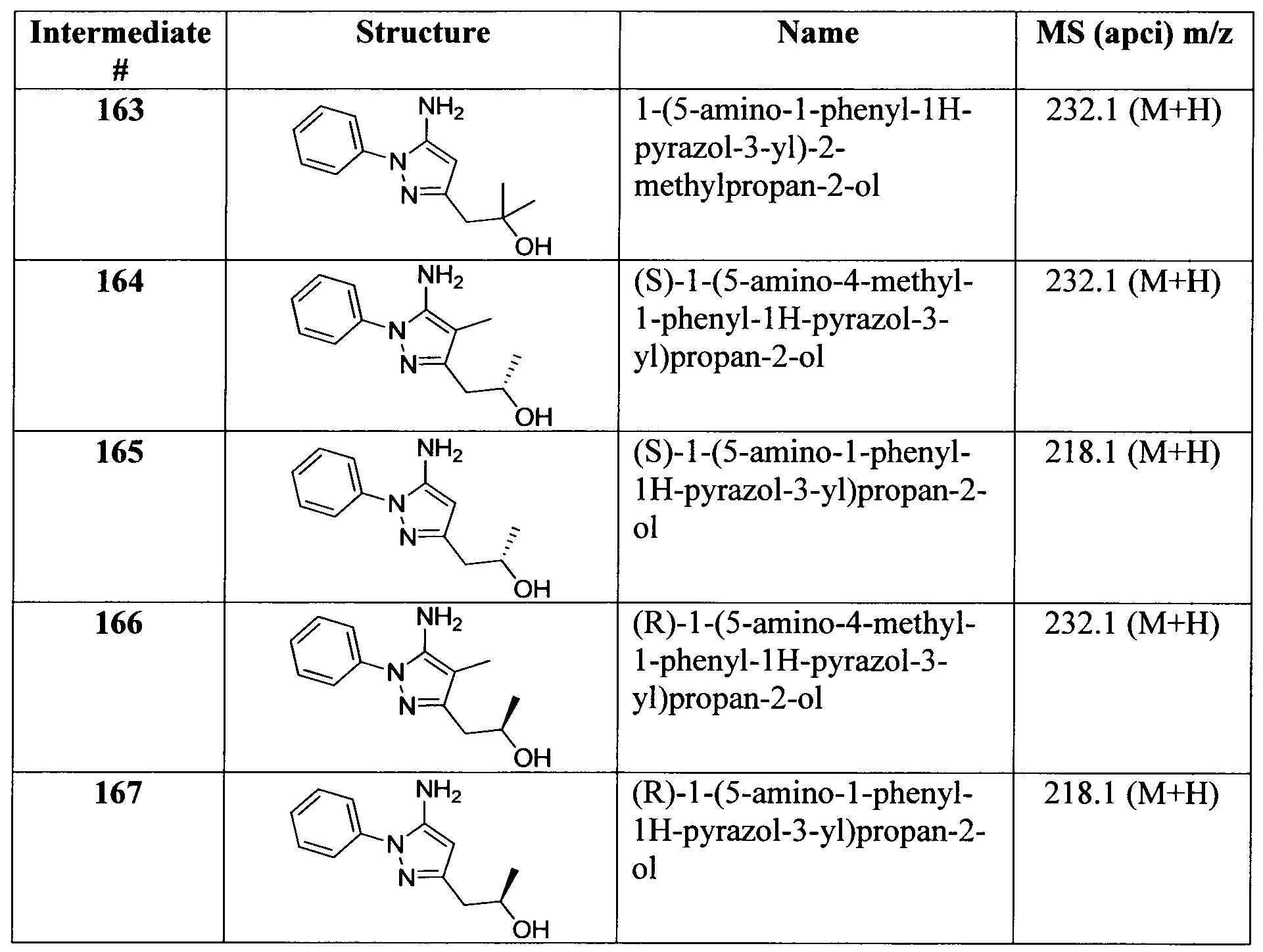

Intermediate 170

ethyl 5-amino-4-methyl- 1 -phenyl- 1 H-pyrazole-3 -carboxylate
[00562] Prepared according to the method described for Intermediate PI 09, replacing methyl 2-methoxyacetate with diethyl oxalate and replacing acetonitrile with propionitrile in Step A to afford the product as a yellow solid. MS (apci) m/z = 246.1 (M+H).
Intermediate 171

5-amino-4-methyl- 1 -phenyl- 1 H-pyrazole-3-carboxylic acid
[00563] To a solution of ethyl 5 -amino-4-methyl-l -phenyl- 1 H-pyrazole-3 -carboxylate (Intermediate 170, 1.52 mg, 6.21 mmol) in THF (12 mL) and MeOH (6 mL) was added LiOH (2M aq, 9.31 mL, 18.6 mmol). The reaction mixture was stirred at ambient temperature for 19 hours, then partially concentrated under reduced pressure, then neutralized with 6M HCl (3.2 mL), extracted with 10:90 MeOH/DCM (3 x 25 mL), and the combined organic extracts were washed with brine (50 mL), dried (MgS04), filtered and concentrated to give the title compound as a yellow solid (1.3 g, 96% yield) MS (apci) m/z = 218.1 (M+H).
Intermediate 172

5-amino-N,4-dimethyl-l-phenyl-lH-pyrazole-3-carboxamide
[00564] To a solution of 5-amino-4-methyl-l -phenyl- lH-pyrazole-3-carboxy lie acid
(Intermediate 171, 223 mg, 1.02 mmol) in acetonitrile (10 mL) were added DIEA (0.71 mL, 4.10 mmol), methanamine hydrochloride (138 mg, 2.05 mmol), DMF (2 mL), and then HATU (428 mg, 1.13 mmol). The reaction mixture was stirred at ambient temperature for 19 hours and then partially concentrated under reduced pressure. The mixture was purified by reverse-phase column chromatography, eluting with 5-60% acetonitrile/water to afford the title compound as a pale yellow solid (182 mg, 77% yield). MS (apci) m/z = 231.1 (M+H).
[00565]
Intermediate 173

5 -amino-4-methyl- 1 -phenyl- 1 H-pyrazole-3 -carboxamide
[00566] A solution of 5-amino-4-methyl-l-phenyl-lH-pyrazole-3-carbonitrile (150 mg, 0.757 mmol) in concentrated H2S04 (0.5 mL) was stirred at ambient temperature for 17 hours. The reaction mixture was cooled and neutralized by the addition of aqueous NaOH (2M, 1 1 mL), then extracted 10% MeOH/DCM (5 x 10 mL), and the combined organic extracts were washed with brine, dried (MgS04), filtered and concentrated under reduced pressure to afford the title compound as a white solid (151 mg, 95% yield). MS (apci) m/z = 239.1 (M+Na).
Intermediate 174

ethyl 5-amino-3 -ethoxy- 1 -phenyl- 1 H-pyrazole-4-carboxylate
[00567] Step A: Preparation of diethyl 2-cyanomalonate: To a suspension of NaH (60 wt% in mineral oil, 499 mg, 12.49 mmol) in THF (100 mL) under N2 at 0 °C was added
diethyl malonate (1.90 mL, 12.49 mmol). The ice bath was removed and the reaction mixture was stirred at ambient temperature for 30 minutes, then cooled to 0 °C and cyanic bromide (5M in MeCN, 2.5 mL, 12.49 mmol) was added. The reaction mixture was stirred at ambient temperature for 19 hours, then diluted with ¾0 (50 mL), extracted with Et20 (50 mL). The aqueous phase was neutralized with HCl (2M aq, 3 mL) then extracted with DCM (2 x 50 mL). The combined DCM extracts were dried (MgS04), filtered, and concentrated to afford the product as a yellow oil (837 mg, 36% yield). 1H NMR (CDC13) δ 4.46 (s, 1H), 4.35 (q, 4H), 1.35 (t, 6H).
[00568] Step B: Preparation of ethyl 5 -amino-3-ethoxy-l -phenyl- lH-pyrazole-4- carboxylate: Prepared according to the method described for Intermediate PI 35, replacing ethyl 2-cyanopropanoate with diethyl 2-cyanomalonate in Step A to afford the product as a brown syrup (400 mg, 32% yield). MS (apci) m/z = 276.1 (M+H).
Intermediate 175

4-methyl-3 -(5 -methyl- 1 ,3,4-oxadiazol-2-vD- 1 -phenyl- 1 H-pyrazol-5-amine
[00569] Step A: Preparation of N'-acetyl-5-amino-4-methyl-l -phenyl- lH-pyrazole-3- carbohydrazide: To a solution of 5 -amino-4-methyl-l -phenyl- lH-pyrazole-3-carboxylic acid (Intermediate 171, 93 mg, 0.428 mmol) in DCM (5 mL) and DIEA (0.149 mL, 0.856 mmol) was added isobutyl carbonochloridate (0.061 mL, 0.471 mmol). The reaction mixture was stirred at ambient temperature for 1 hour, then acetohydrazide (48 mg, 0.642 mmol) was added. The reaction mixture was stirred at ambient temperature for 18 hours, then diluted with H20 (10 mL), extracted DCM (2 x 10 mL), dried (MgS04), filtered and concentrated under reduced pressure to afford the product as a pale yellow solid (119 mg, 101% yield). MS (apci) m/z = 274.1 (M+H).
[00570] Step B: Preparation of 4-methyl-3 -( 5-methyl- 1.3.4-oxadiazol-2-vn- 1 -phenyl- 1 H-pyrazol-5 -amine: A mixture of N'-acetyl-5-amino-4-methyl-l-phenyl-lH-pyrazole-3- carbohydrazide (117 mg, 0.428 mmol) and POCl3 (0.5 mL) was heated in a pressure tube to 90 °C for 1 hour. The reaction mixture was transferred to a separatory funnel with EtOAc (5 mL), then diluted with saturated aqueous NaHC03 (20 mL), extracted with EtOAc (2 x 15 mL), dried (MgS04), filtered and concentrated. The residue was purified by silica column
chromatography eluting with 0-75% acetone/hexanes to afford the title compound as a yellow solid (19.6 mg, 18% yield). MS (apci) m/z = 256.1 (M+H).
Intermediate 176

4-methyl-3 -(3 -methyl- 1 ,2,4-oxadiazol-5-vD- 1 -phenyl- 1 H-pyrazol-5 -amine
[00571] To a suspension of NaH (60% in mineral oil, 36 mg, 0.897 mmol) in THF (5 mL) under N2 was added N-hydroxyacetimidamide (66 mg, 0.897 mmol). The reaction mixture was heated to reflux for 1 hour, then cooled to ambient temperature and ethyl 5- amino-4-methyl-l -phenyl- lH-pyrazole-3-carboxylate (Intermediate 170, 200 mg, 0.815 mmol) was added. The reaction mixture was heated to reflux for 18 hours, then cooled to ambient temperature and additional NaH (60% in mineral oil, 18 mg, 0.449 mmol) was added. The reaction mixture was heated to reflux for 4 hours, then diluted with H20 (10 mL), extracted DCM (2 x 15 mL), and the combined organic extracts were dried (MgS04), filtered and concentrated under reduced pressure. The residue was purified by silica column chromatography eluting with 0-50% acetone/hexanes to afford the title compound as an orange solid (84 mg, 40% yield). MS (apci) m/z = 256.1 (M+H).
Intermediate 177

3-(3-methyl- 1 ,2,4-oxadiazol-5-yl)- 1 -phenyl- 1 H-pyrazol-5-amine
[00572] Prepared according to the method described in Intermediate 176, replacing ethyl 5-amino-4-methyl-l -phenyl- lH-pyrazole-3-carboxylate with ethyl 5-amino-l-phenyl- lH-pyrazole-3-carboxylate (Nanjing Chemlin Chemical Co.) to afford the product as a tan solid (83 mg, 53% yield). MS (apci) m/z = 242.1 (M+H).
Intermediate 178

4-methyl- 1 -phenyl-3-(3-(trifluoromethyl)- 1 ,2,4-oxadiazol-5-yl)- 1 H-pyrazol-5-amine
[00573] Step A: Preparation of 2,2,2-trifluoro-N'-hvdroxyacetimidamide: To a suspension of hydroxylamine hydrochloride (5.45 g, 78.4 mmol) in MeOH (100 mL) was added NaOMe (25 wt % solution in MeOH, 17.9 mL, 78.4 mmol) and the mixture stirred at ambient temperature for 10 minutes, then filtered and the solid was washed with MeOH. The filtrate was cooled to 0 °C and then 2,2,2-trifluoroacetonitrile (7.45 g, 78.4 mmol) gas was bubbled into the solution over 30 minutes. The reaction mixture was then allowed to warm to ambient temperature for 19 hours. The solution was concentrated under reduced pressure to 50 mL and the solids were filtered. The filtrate was concentrated, re-suspended in cold MeOH, and filtered. The filtrate was concentrated, again re-suspended in cold MeOH, and filtered. The filtrate was concentrated to give the product as a waxy white solid (6.7 g, 67% yield). 1H NMR (CD3CN) δ 8.32 (s, 1H), 5.25 (br s, 2H). 19F NMR (CD3CN) δ -71.8 (s).
[00574] Step B: Preparation of 4-methyl-l-phenyl-3-(3-(trifluoromethvn-1.2.4- oxadiazol-5-yl)-lH-pyrazol-5-amine: To a suspension of NaH (60% in mineral oil, 356 mg, 0.897 mmol) in THF (5 mL, 0.815 mmol) under N2 was added 2,2,2-trifluoro-N'- hydroxyacetimidamide (1 15 mg, 0.897 mmol). The reaction mixture was heated to reflux for 1 hour, then cooled to ambient temperature and powdered 4A molecular sieves (200 mg) and ethyl 5-amino-4-methyl-l -phenyl- lH-pyrazole-3-carboxylate (Intermediate 170; 200 mg, 0.815 mmol) were added and heated to reflux. The reaction mixture was heated to reflux for 18 hours, then filtered, diluted with H20 (15 mL), extracted DCM (2 x 25 mL), and the combined organic extracts were washed with brine (25 mL), dried (MgS04), filtered and concentrated under reduced pressure. The residue was purified by silica column chromatography eluting with 0-50% acetone/hexanes to afford the title compound as a white solid (44 mg, 17% yield). MS (apci) m/z = 310.1 (M+H).
Intermediate 179

2-phenyl-2H-indazol-3-amine
[00575] Step A: Preparation of l-(2-iodophenyl)-2 -phenyldiazene: To a solution of 2- iodoaniline (1.00 g, 4.57 mmol) in acetic acid (46 mL) was added nitrosobenzene (0.880 g, 8.22 mmol) and the mixture was heated at 85 °C for 16 hours. The mixture was cooled to ambient temperature, poured into water and slowly treated with saturated NaHC03 until basic. The mixture was extracted with EtOAc (3X) and the combined extracts were washed with water, saturated NaCl and dried over MgS04. The solution was filtered, concentrated and the residue purified by reverse phase chromatography to provide the title compound as a red solid (0.880 g, 63% yield). Ή NMR (CDC13) δ 7.23-7.39 (m, 3H), 7.64 (d, 1H), 7.56-7.51 (m, 3H), 7.45 (t, 1H), 7.1 (t, 1H).
[00576] Step B: 2-(phenyldiazenv0benzonitrile: To a solution of 1 -(2-iodophenyl)-2- phenyldiazene (0.44 g, 1.4 mmol) in 1-propanol (14 mL) was added CuCN (0.900 g, 10.0 mmol) and the reaction was heated at reflux for 16 hours. The mixture was cooled to ambient temperature, filtered and the collected solid washed with CH2C12. The combined filtrate and washes were concentrated to provide the title compound as red-orange solid that was dried in vacuum (0.280 g, 95% yield). Ή NMR (CDC13) δ 8.03-8.06 (m, 2H), 7.88 (dd, 2H), 7.71 (t, 1H), 7.54-7.58 (m, 4H).
[00577] Step C: 2-phenyl-2H-indazol-3-amine: A mixture of 2- (phenyldiazenyl)benzonitrile (0.28 g, 1.35 mmol) and SnCl2 dihydrate (0.562 mL, 6.76 mmol) in EtOH (14 mL) was heated at reflux for 16 hours. The mixture was cooled to ambient temperature and concentrated. The residue was diluted with EtOAc and water and filtered. The aqueous layer was removed and the EtOAc layer was washed with water. The combined aqueous fractions were basified with saturated NaHC03 and extracted with CH2CI2 (2X). The combined organic layers were dried over MgS04, filtered and concentrated to provide the title compound as a light purple solid that was dried in vacuum (0.241 g, 85% yield). 1H NMR (CDC13) δ 7.69 (d, 2H), 7.52-7.58 (m, 3H), 7.47 (d, 2H), 7.26 (t, 1H), 6.90 (t, 1H), 4.28 (br s, 2H).
Intermediate 180

3 -ethoxy-4-methyl- 1 -(pyrazin-2-yl)- 1 H-pyrazol-5-amine
[00578] Step A: 5-amino-4-methyl- 1 -( pyrazin-2-vn- 1 H-pyrazol-3 (2H)-one: To a mixture of 2-hydrazinylpyrazine (0.551 g, 5.00 mmol) and ethyl 2-cyanopropanoate (0.669 g,
5.00 mmol) in abs. EtOH (10 mL) was added 3M NaOEt in EtOH (0.167 n L, 0.501 mmol) and the mixture was heated at reflux for 64 hours. The mixture was concentrated and the residual yellow-brown solid was treated with EtOAc (30 mL) and sonicated. The resulting tan suspension was stirred vigorously for 8 hours. The solid was collected via vacuum filtration, washed with EtOAc and dried in vacuum to afford the title compound as a light tan powder (682 mg, 71%). 1H NMR (DMSO d6) δ 10.3 (br s, 1H), 8.82 (s, 1H), 8.30 (d, 2H), 6.55 (s, 2H), 1.71 (s, 3H).
[00579] Step B: 3-ethoxy-4-methyl- 1 -(pyrazin-2-yl)- 1 H-pyrazol-5 -amine: A mixture of 5-amino-4-methyl-l-(pyrazin-2-yl)-lH-pyrazol-3(2H)-one (382 mg, 2.00 mmol) and powdered K2C03 (552 mg, 4.00 mmol) in dry DMF (3.0 mL) was stirred at ambient temperature for 10 minutes. The mixture was cooled to 0 °C and bromoethane (229 mg, 2.10 mmol) was added. The mixture was allowed to reach ambient temperature and was stirred 24 hours. The reaction mixture poured into cold H20 (12 mL), allowed to reach ambient temperature and was extracted with EtOAc (3X). The combined extracts were washed with saturated NaCl (2X), dried over MgS04 and activated carbon. The dried solution was diluted with and equal volume of hexanes and filtered through a Si02 plug capped with a MgS04 layer eluting with 50% EtOAc-hexanes. The filtrate was concentrated and the residual yellow solid was washed with hexanes (3X) and dried in vacuum to afford the title compound as a light yellow crystalline solid (195 mg, 45%). 1H NMR (CDC13) δ 9.10 (s, 1H), 8.23 (s, 1H), 8.14 (s, 1H), 5.50 (br s, 2H), 4.33 (q, 2H), 1.80 (s, 3H), 1.42 (t, 3H).
Intermediate 181

2-(pyridazin-4-yl)-2,4,5,6-tetrahvdrocyclopentarc1pyrazol-3-amine
[00580] A suspension of 4-hydrazinylpyridazine hydrobromide (0.368 g, 1.93 mmol) in absolute EtOH (5 mL) was treated with 2-oxocyclopentanecarbonitrile (0.191 g, 1.75 mmol) and the mixture was heated at reflux for 22 hours. The mixture was cooled to ambient temperature and was concentrated to an orange solid. The solid was suspended in 1M NaOH and stirred for 10 minutes. The solid was collected, washed thoroughly with H20 and Et20 and dried in vacuum to furnish title compound as a tan powder (.323 g, 92%). MS (apci) m/z = 202.1 (M+H).
Interm iate 182

(5-amino- 1 -phenyl- 1 H-pyrazol-3-yl)methanol
[00581] Step A: Ethyl 2-(tert-butyldimethylsilyloxy)acetate: A mixture of ethyl 2- hydroxyacetate (3.00 g, 28.8 mmol), TBDMS-C1 (5.21 g, 34.6 mmol) and imidazole (2.55 g, 37.5 mmol) was stirred at ambient temperature for 60 hours. The mixture was concentrated and the residue was purified by Si02 chromatography eluting with 10% EtOAc-hexanes to provide the title compound as a colorless oil (4.12 g, 65%). 1H NMR (CDC13) δ 4.12 (s, 2H), 4.09 (q, 2H), 1.17 (t, 3H), 0.18 (s, 9H), 0.00 (s, 6H).
[00582] Step B: (5-amino- 1 -phenyl- 1 H-pyrazol-3-yl)methanol: A solution of acetonitrile (0.526 mL, 10.1 mmol) in dry THF (20.4 mL, 9.16 mmol) was cooled to -78 °C and 2.5M nBuLi in hexanes (4.21 mL, 10.5 mmol) was added dropwise. The reaction mixture was stirred for 15 minutes and ethyl 2-(tert-butyldimethylsilyloxy)acetate (2.00 g, 9.16 mmol) was added. The reaction mixture was allowed to warm to ambient temperature and was stirred for 2 hours. The reaction mixture was diluted with ice water and was concentrated. The residual aqueous mixture was acidified to pH=5 and extracted with EtOAc (3X). The combined organics were washed with brine, dried over MgS04, filtered and concentrated. The residual brown oil was dissolved in MeOH (23 mL) and phenyl hydrazine (0.907 mL, 9.14 mmol) was added. The mixture was treated with concentrated HC1 (3.81 mL, 45.7 mmol) and heated at reflux for 18 hours. Upon cooling, the mixture was concentrated and the residue was partitioned into in H20 and CH2C12. The mixture was filtered and the organic layer was removed from the filtrate. The aqueous portion was washed with CH2C12 and was treated with saturated NaHC03 until basic. The aqueous mixture was extracted with CH2C12 (3X) and the combined organic fractions were dried over MgS04, filtered and concentrated. The residue was purified by silica column chromatography using 70-100% EtOAc/hexanes gradient elution followed by 0-5% MeOH/EtOAc. The product pools were combined and concentrated to give the title compound as a yellow foam (0.760 g, 44% yield). MS (apci) m/z = 190.1 (M+H).
Intermediate 183

4-methyl-3 -(( 1 -methyl- 1 H- 1„2,4-triazol-3 -vDmethoxy)- 1 -phenyl- 1 H-pyrazol-5-amine
[00583] The title compound was prepared by the method as described for Intermediate P135, substituting bromoethane with 3-(chloromethyl)-l -methyl- lH-l,2,4-triazole hydrochloride. The product was isolated as a gold syrup (110 mg, 27%). MS (apci) m/z - 285.1 (M+H).
Intermediate 184

5-amino-4-methyl-l -phenyl-1 H-pyrazol-3-yl dimethylcarbamate
[00584] A mixture of 5-amino-4-methyl-l -phenyl- lH-pyrazol-3(2H)-one (Intermediate P135 Step A, 0.378 g, 2.00 mmol) and powdered K2C03 (0.553 g, 4.00 mmol) in dry DMF (4 mL) was stirred at ambient temperature for 5 minutes. Dimethylcarbamoyl chloride (0.206 mL, 2.20 mmol) was added and the mixture was stirred for 6 hours. The mixture was poured into chilled H20 (40 mL) and was extracted with EtOAc (3X). The combined extracts were washed with saturated NaCl (2X), dried over MgS04 and filtered through a Si02 plug capped with a MgS04 layer (EtOAc elution). The filtrate was concentrated and the residue dried in vacuum to give the title compound as a light gold syrup (.507 g, 97%). MS (apci) m/z = 261.1 (M+H).
Intermediate 185

5-amino-4-methyl- 1 -phenyl- 1 H-pyrazol-3 -yl morpholine-4-carboxylate
[00585] The title compound was prepared using morpholine-4-carbonyl chloride in the procedure outlined for 5 -amino-4-methyl-l -phenyl-1 H-pyrazol-3 -yl dimethylcarbamate (Intermediate 184). The compound was isolated as a light yellow wax (0.285 g, 47%). 1H
NMR (CDC13) 5 7.54 (d, 2H), 7.43 (t, 2H), 7.31 (t, 1H), 3.66-3.78 (m, 8H), 3.57 (br s, 2H), 1.85 (s, 3H).
Intermediate 186

(S)-3-(2-((tert-butyldimethylsilyl)oxy)-3-methoxypropoxy)-4-methyl-l - phenyl-1 H-pyrazoI-5-amine
[00586] Step A: (S 1 -( 5-amino-4-methyl- 1 -phenyl- 1 H-pyrazol-3-yloxy)-3 - methoxypropan-2-ol : A mixture of 5-amino-4-methyl-l -phenyl- lH-pyrazol-3(2H)-one (PI 35 Step A, 1.21 g, 6.40 mmol) and powdered K2C03 (1.77 g, 12.8 mmol) in dry DMF (12 mL) was stirred at ambient temperature for 10 minutes. (S)-2-(methoxymethyl)oxirane (0.622 mL, 6.72 mmol) was added and the mixture was stirred at 80 °C for 6 hours. The mixture was cooled to ambient temperature, poured into chilled H20 (25 mL) and extracted with EtOAc (3X). The combined extracts were washed with saturated NaCl (2X), dried over MgS04 and filtered through a Si02 plug capped with a layer of MgS04 eluting with EtOAc. The filtrate was concentrated to give the title compound as a colorless, viscous oil (701 mg, 40%). MS (apci) m/z = 278.1 (M+H).
[00587] Step B: ( SV3 -(2-(( tert-butyldimethylsilyl)oxy>3 -methoxypropoxy)-4-methyl- 1 -phenyl- 1 H-pyrazol-5-amine: To a solution of TBDMS-C1 (725 mg, 4.81 mmol) and imidazole (390 mg, 5.72 mmol) in dry DMF (7.0 mL) was added (S)-l-(5-amino-4-methyl-l - phenyl-l H-pyrazol-3-yloxy)-3-methoxypropan-2-ol (635 mg, 2.29 mmol) in dry DMF (2 mL). The mixture stirred at ambient temperature for 2.5 hours. The mixture added to H20 (70 mL), mixed for 5 minutes and extracted with Et20 (3X). The combined extracts were washed with saturated NaCl (2X) and dried over MgS04. The dried solution was filtered through a Si02 plug capped with a layer of MgS04 (Et20 elution). The filtrate was concentrated to give the title compound as a colorless oil that was dried in vacuum (940 mg, 105%). MS (apci) m/z = 392.2 (M+H). 1H NMR (CDC13) δ 7.50 (d, 2H), 7.40 (t, 2H), 7.23 (t, 1H), 4.09-4.30 (m, 3H), 3.57 (br s, 2H), 3.38-3.44 (m, 2H), 3.32 (s, 3H), 1.83 (s, 3H), 0.88 (s, 9H), 0.1 1 (s, 6H).
Intermediate 187

(R)-3-(2-((tert-butyldimethylsilyl)oxy)-3-methoxypropoxy)-4-methyl-l-phenyl-lH-pyra^
5 -amine
[00588] The title compound was prepared using the procedure described for (S)-3-(2- ((tert-butyldimethylsilyl)oxy)-3-methoxypropoxy)-4-methyl-l-phenyl-lH-pyrazol-5-amine (Intermediate 186) substituting (S)-2-(methoxymethyl)oxirane with (R)-2- (methoxymethyl)oxirane in Step A. The product was obtained as a colorless syrup (921 mg, 38% over 2 steps). MS (apci) m/z = 392.2 (M+H). 1H NMR (CDC13) δ 7.50 (d, 2H), 7.40 (t, 2H), 7.23 (t, 1H), 4.09-4.30 (m, 3H), 3.57 (br s, 2H), 3.38-3.44 (m, 2H), 3.32 (s, 3H), 1.83 (s, 3H), 0.88 (s, 9H), 0.1 1 (s, 6H).
Intermediate 188

tert-butyl 4-((5 -amino- 1 -phenyl- 1 H-pyrazol-3 - yl)methoxy)piperidine- 1 -carboxylate
[00589] Step A: tert-butyl 4-(2-ethoxy-2-oxoethoxy)piperidine- 1 -carboxylate : A solution of tert-butyl 4-hydroxypiperidine-l -carboxylate (2.00 g, 9.94 mmol) in dry THF (25 mL) was cooled to 0 °C and KOtBu (1.12 g, 9.94 mmol) was added. The mixture was allowed to reach ambient temperature and was stirred for 10 minutes. The mixture was cooled to 0 °C and ethyl 2-bromoacetate (1.65 mL, 14.9 mmol) was added dropwise. The reaction was allowed to reach ambient temperature and was stirred for 17 hours. The mixture was partitioned into in H20 and EtOAc, mixed and the organic layer was removed. The organic layer was dried over MgS04, filtered and concentrated. The residual thick yellow oil was purified by silica chromatography using a 10-25% EtOAc/hexanes gradient elution to afford the title compound as a colorless oil (0.967 g, 34% yield). Ή NMR (CDC13) δ 4.22 (q, 2H), 4.12 (s, 2H), 3.67-3.84 (m, 2H), 3.52-3.63 (m, 1H), 3.05-3.11 (m, 2H), 1.81-1.90 (m, 2H), 1.53-1.62 (m, 2H), 1.45 (s, 9H), 1.29 (t, 3H).
[00590] Step B: tert-butyl 4-((5-amino-l-phenyl-lH-pyrazol-3-yl)methoxy piperidine- 1 -carboxylate: A solution of diisopropylamine (1.08 mL, 7.74 mmol) in dry THF (5 mL) was
cooled to 0 °C and 2.5M nBuLi in hexanes (2.96 mL, 7.41 mmol) was slowly added. The mixture was stirred at 0 °C for 10 minutes and was cooled to -78 °C. Acetonitrile (0.404 mL, 7.74 mmol) was added and the mixture was stirred for 15 minutes. A solution of tert-butyl 4- (2-ethoxy-2-oxoethoxy)piperidine-l-carboxylate (0.967 g, 3.37 mmol) in THF (2.5 mL) was added and the mixture was stirred at -78 °C for 1 hour. The mixture was allowed to reach ambient temperature, was quenched with ice water and concentrated. The residual aqueous mixture was neutralized with 2M HCl and was extracted with CH2C12 (3X). The combined organic fractions were dried over MgS04, filtered and concentrated to provide the crude cyano-ketone as a yellow oil that was used immediately in the next step.
[00591] Step C: tert-butyl 4-((5-amino- 1 -phenyl- 1 H-pyrazol-3 -yl)methoxy)piperidine- 1-carboxylate: The crude oil obtained in Step B was dissolved in EtOH (17 mL) and phenylhydrazine (0.396 mL, 3.99 mmol) was added. The mixture was heated at 60°C for 60 hours, was cooled to ambient temperature and was concentrated. The residue was partitioned into EtOAc and water, mixed and the organic layer removed. The aqueous layer was extracted with EtOAc (2X) and the combined EtOAc portions were dried over MgS04, filtered and concentrated. The residual orange oil was purified by silica chromatography using a 10-100% EtOAc/hexanes gradient elution. The pooled product fractions were concentrated and the residual yellow-orange oil was re-purified by reverse phase HPLC using a 0-100% acetonitrile/water gradient to provide the title compound as an orange foam (0.264 g, 21% yield). MS (apci) m/z = 373.2 (M+H).
Intermediate 189

l-phenyl-3-(tetrahydro-2H-pyran-4-yl)-lH-pyrazol-5-amine
[00592] Step A: 3-oxo-3-(tetrahvdro-2H-pyran-4-yl propanenitrile: A IM solution of
LHMDS in dry THF (26.3 mL, 26.3 mmol) was cooled to -78 °C and acetonitrile (1.43 mL, 27.5 mmol) was added dropwise over 2 minutes. The mixture was stirred at -78 °C for 1 hour and a solution of methyl tetrahydro-2H-pyran-4-carboxylate (3.41 mL, 25.0 mmol) in dry THF (12 mL) was added. The mixture was stirred for 1 hour, the dry ice bath was removed and the mixture allowed to reach ambient temperature. The mixture was poured into chilled H20 (250 mL) and was extracted with Et20 (3X). The aqueous portion was cooled to 0 °C and 6M HCl was added dropwise to pH=3 (starting pH=12). The mixture was extracted with
EtOAc (3X) and the combined extracts were dried over MgS04. The solution eluted through a SiC"2 plug eluting with EtOAc. The filtrate was concentrated to give the title compound as a colorless oil (2.52 g, 66%). 1H NMR (CDC13) δ 3.99-4.06 (m, 2H), 3.54 (s, 2H), 3.46 (t, 2H), 2.76-2.86 (m, 1H), 1.70-1.86 (m, 4H).
[00593] Step B: l-phenyl-3-(tetrahvdro-2H-pyran-4-yl)-lH-pyrazol-5-amine: To a solution of 3-oxo-3-(tetrahydro-2H-pyran-4-yl)propanenitrile (2.30 g, 12.8 mmol) in absolute EtOH (35 mL) was added phenylhydrazine hydrochloride (2.21 g, 15.3 mmol) and the mixture was heated at reflux until complete by TLC (5 hours). The mixture was cooled to ambient temperature and was concentrated. The residue was partitioned in H20 (75 mL) and EtOAc (40 mL). 2M NaOH was added to pH=5 with vigorous mixing, the organic layer was removed and the aqueous was extracted with EtOAc (2X). The combined EtOAc fractions were washed with H20 and saturated NaCl. The solution was diluted with an equal volume of hexanes, dried over MgS04/activated carbon and eluted through a Si02 plug eluting with 50% EtOAc-hexanes. The filtrate was concentrated to give a gold syrup. The syrup was treated with Et20 and stirred until a fine, granular suspension formed. The solid was collected, washed with Et20 and dried in vacuum to furnish the title compound as a white solid (2.01 g, 65%). 1H NMR (CDC13) δ 7.55 (d, 2H), 7.46 (t, 2H), 7.32 (t, 1H), 5.49 (s, 1H), 4.00-4.08 (m, 2H), 3.97 (br s, 2H), 3.52 (dt, 2H), 2.86 (m, 1H) 1.73-1.93 (m, 4H).
[00594] The following compounds were prepared according to the method used for the preparation of l-phenyl-3-(tetrahydro-2H-pyran-4-yl)-lH-pyrazol-5-amine (Intermediate 189) using either acetonitrile or propiononitrile in Step A in conjunction with the appropriate ester.


Intermediate 199

Phenyl 1 ',4-dimethyl- 1 -phenyl- 1 H, 1 'H-3,4'-bipyrazol-5-ylcarbamate
[00595] Step A: ethyl 1 -methyl- 1 H-pyrazole-4-carboxylate: To a 3000-mL three- necked flask was added ethyl 2-formyl-3-oxopropanoate (100 g, 694 mmol), followed by anhydrous 200-proof EtOH (694 mL) to obtain a clear yellowish solution. The reaction was cooled in an ice bath to 5 °C, and then methylhydrazine (35.8 mL, 680 mmol) was added dropwise. A vigorous exotherm was observed during hydrazine addition and the temperature was kept below 12 °C by controlling the addition rate. After the hydrazine addition was
complete, the ice bath was removed, and the reaction was allowed to stir at ambient temperature overnight. The reaction was concentrated on a rotary evaporator to a crude orange oil. The crude was taken up in DCM and re-concentrated, then on high vacuum for 2 days to yield tan orange oil. LC/MS and lH NMR showed essentially pure ethyl 1-methyl- lH-pyrazole-4-carboxylate (106 g, 99.1%).
[00596] Step B: 2-methyl-3-( 1 -methyl- 1 H-pyrazol-4-vD-3-oxopropanenitrile: To a four-necked 5 -liter round bottomed flask fitted with an overhead stirrer and addition funnel was charged LHMDS (1444 mL, 1444 mmol) (1.0M in THF). The solution was cooled in an acetone/dry ice bath first (internal temperature of -79 °C) under nitrogen, followed by slow addition of propiononitrile (103 mL, 1444 mmol) via dropping funnel. The mixture was stirred at -80 °C for 90 minutes. A solution of ethyl 1 -methyl- lH-pyrazole-4-carboxylate (106 g, 688 mmol) in anhydrous THF (500 mL) was then introduced dropwise via an addition funnel (addition time: about 45 minutes; internal temperature during addition remained below -76 °C) . After the addition was complete, the reaction was allowed to slowly warm to ambient temperature and stirred overnight. An orange glass deposited on the bottom of the flask. The organics were decanted and the glass was dissolved in warm water. The mixture was washed with with ether (3 x 1000 mL). The aqueous phase was then pH-adjusted to 5 (pH paper) using concentrated HCl and saturated bicarbarbonate solution The aqueous layer was extracted with DCM (3 x 1000 mL). The combined organic extracts were dried over MgS04 filtered and concentrated to yield the 2-methyl-3-(l -methyl- lH-pyrazol-4-yl)-3- oxopropanenitrile as an amber oil (92 g, 82%). MS (apci) m/z = 162.1 (M-H).
[00597] Step C: 1 ',4-dimethyl- 1 -phenyl- 1 H.1 'H-3.4'-bipyrazol-5-amine: A 3L, 3 necked round bottomed flask was charged with 2-methyl-3-(l -methyl- lH-pyrazol-4-yl)-3- oxopropanenitrile (60 g, 368 mmol) absolute anhydrous ethanol (1000 mL) and phenylhydrazine hydrochloride (58 g, 404 mmol) at ambient temperature to form a yellowish suspension. The reaction vessel was equipped with a water condenser and refluxed (using a heating mantle) overnight. The reaction was concentrated and 1M NaOH (1L) was added and the solid was broken up and collected. The solid was washed with water and hexanes. A second crop crashed out in the filtrate and was collected. The combined solids were crushed and triturated with ether (500 mL). The solid was collected filtration, washed with hexanes and air dried under vacuum to provide r,4-dimethyl-l-phenyl-lH,l'H-3,4'-bipyrazol-5-amine (93 g, 100%).
[00598] Step D: phenyl 1 '.4-dimethyl- 1 -phenyl- 1 H, 1 'H-3.4'-bipyrazol-5-ylcarbamate: In a 3 L, round bottomed flask was charged with l',4-dimethyl-l -phenyl- 1Η,ΓΗ-3, 4'-
bipyrazol-5-amine (50 g, 197.4 mmol) and EtOAc (1000 mL) to obtain a clear brownish solution. To this was added NaOH (2M aq) (500 mL) in one portion to obtain a turbid mixture (both the aqueous and organic layers were clear but a precipitate was observed in between the two layers). After 3 minutes, phenyl carbonochloridate (74.29 mL, 592.2 mmol) was added slowly at ambient temperature exotherm to 33 °C. The reaction stirred at ambient temperature for 2 hours. Additional phenyl carbonochloridate (10 mL) was added. After 30 minutes the organics were separated, washed with brine and concentrated in vacuo. The product was purified by silica gel chromatography (eluting with 75% ethyl acetate in hexanes) to provide phenyl ,4-dimethyl-l-phenyl-lH,rH-3,4'-bipyrazol-5-ylcarbamate (60 g, 81.4%).
Intermediate 200

phenyl 1 ',4-dimethyl- 1 -phenyl- 1 H, 1 Ή-3 ,4'-bipyrazol-5-ylcarbamate
[00599] A 3 L, round bottomed flask was charged with 1 ',4-dimethyl- 1 -phenyl- lH,l'H-3,4'-bipyrazol-5-amine (50 g, 197.4 mmol) and EtOAc (1000 mL) to obtain a clear brownish solution. To this was added NaOH (2M aq) (500mL) in one portion to obtain a turbid mixture (the aqueous and organic layers were clear, but a precipitate was observed in between the two layers). After 3 minutes, phenyl carbonochloridate (74.29 mL, 592.2 mmol) was added slowly at ambient temperature (the temperature of the reaction mixture increased to 33 °C during the addition). The reaction stirred at ambient temperature for 2 hours. Additional phenyl carbonochloridate (10 mL) was added. After 30 minutes the organics layers were separated, washed with brine and concentrated in vacuo. The residue was purified by silica gel chromatography (eluting with 75% ethyl acetate in hexanes) to provide phenyl l',4-dimethyl-l -phenyl- lH,l'H-3,4'-bipyrazol-5-ylcarbamate (60 g, 81.4%).
Intermediate 201

phenyl (4-chloro-3-ethoxy-l -phenyl- lH-pyrazol-5-yl)carbamate
[00600] Step A: Preparation of phenyl (3-ethoxy-l-phenyl-lH-pyrazol-5-yl)carbamate:
To a suspension of 3-ethoxy-l-phenyl-lH-pyrazol-5-amine (Intermediate P139, 169 mg, 0.832 mmol) in EtOAc (5 mL) at 0 °C was added 2.0 M aqueous NaOH solution (1.25 niL, 2.50 mmol), followed by dropwise addition of phenyl carbonochloridate (0.178 mL, 1.41 mmol). The reaction was stirred at ambient temperature for 15 hours. The reaction mixture was diluted with EtOAc and phase-separated. The organic layer was washed with water and brine, dried over MgS04, and concentrated. The residue was purified by flash chromatography on silica gel (6: 1 hexanes: EtOAc) to give the title compound (219 mg, 81% yield). MS (apci) m/z = 324.1 (M+H).
[00601] Step B: Preparation of phenyl (4-chloro-3-ethoxy-l-phenyl-lH-pyrazol-5- vncarbamate: To a solution of phenyl 3-ethoxy-l-phenyl-lH-pyrazol-5-ylcarbamate (92 mg, 0.28 mmol) and pyridinium 4-methylbenzenesulfonate (7.2 mg, 0.028 mmol) in DCM (2 mL) was added N-chlorosuccinimide (42 mg, 0.31 mmol) at ambient temperature. The mixture was stirred at ambient temperature for 2 days and then concentrated under reduced pressure. The residue was purified by flash chromatography on silica gel (9:l,hexanes/EtOAc) to give the title compound (76 mg, 75% yield). MS (apci) m/z = 358.1 (M+H).
Intermediate 203

Phenyl (4-bromo-3-(2-hvdroxy-2-methylpropoxy)-l-phenyl-lH-pyrazol-5-vncarbamate
[00602] Step A: Preparation of 5 -amino- 1 -phenyl- lH-pyrazol-3(2H)-one: Prepared according to the method described for Intermediate PI, replacing 4,4-dimethyl-3-
oxopentanenitrile with ethyl 2-cyanoacetate, and substituting phenylhydrazine for ethyl 3- hydrazinylbenzoate hydrochloride. MS (apci) m/z = 176.0 (M+H).
[00603] Step B: Preparation of 1 -((5 -amino- 1 -phenyl- lH-pyrazol-3-yl)oxy)-2- methylpropan-2-ol : A mixture of 5-amino-l -phenyl- lH-pyrazol-3(2H)-one (0.330 g, 1.88 mmol), 2,2-dimethyloxirane (0.143 g, 1.98 mmol) and K2C03 (0.521 g, 3.77 mmol) in DMA (5 mL) was heated at 80 °C for 3 days. After cooling, the reaction mixture was diluted with EtOAc, washed with water and brine and dried over MgS04. The mixture was filtered through a pad of Si02 eluting with EtOAc to yield the title compound. MS (apci) m/z = 248.1 (Μ+Η).
[00604] Step C: Preparation of phenyl (3-(2-hydroxy-2-methylpropoxy)- 1 -phenyl- 1H- pyrazol-5 -vDcarbamate : Prepared according to the method described for Intermediate 201. Step A using 1 -((5-amino-l -phenyl- lH-pyrazol-3-yl)oxy)-2-methylpropan-2-ol as a replacement for 3-ethoxy-l-phenyl-lH-pyrazol-5-amine. MS (apci) m/z = 368.1 (M+H).
[00605] Step D: Preparation of phenyl (4-bromo-3-(2-hvdroxy-2-methylpropoxy)-l- phenyl- 1 H-pyrazol-5-yl)carbamate : Prepared according to the method described for Intermediate 201, Step B using /V-bromosuccinimide as a replacement for N- chlorosuccinimide, and substituting phenyl (3 -(2-hydroxy-2-methylpropoxy)-l -phenyl- \H- pyrazol-5-yl)carbamate for phenyl 3-ethoxy-l-phenyl-lH-pyrazol-5-ylcarbamate. MS (apci) m/z = 446.1 (Μ+Η).
[00606] The following compounds prepared according to the method describe for the preparation of Intermediate 200, using the appropriate amino pyrazole intermediate:


Intermediate 228

tert-butyl 4-((4-chloro-5-((phenoxycarbonyl)amino)- 1 -phenyl- 1 H-pyrazol-3- yl)methoxy)piperidine- 1 -carboxylate
[00607] To a suspension of tert-butyl 4-((5-(phenoxycarbonylamino)-l -phenyl- 1 H- pyrazol-3-yl)methoxy)piperidine-l -carboxylate (Intermediate 226), 98.5 mg, 0.200 mmol) in DCM (2.0 mL) was added pyndinium 4-methylbenzenesulfonate (PPTS) (5.03 mg, 0.020 mmol) and N-chlorosuccinimide (40.1 mg, 0.300 mmol). The resulting solution was stirred at ambient temperature for 8 days. The mixture was diluted with water and CH2C12, the organic layer was separated and the aqueous was extracted with CH2C12 (2X). The combined
organic fractions were dried over MgS04, filtered and concentrated. The residue was purified by silica chromatography using 30-40% EtOAc/hexanes gradient elution to afford the title compound as an orange oil (73.5 mg, 70% yield). MS (apci) m/z = 527.2 (M+H).
Intermediate 229

Phenyl (4-chloro-3-(hvdroxymethyl)-l-phenyl-lH-pyrazol-5-vncarbamate
[00608] Prepared from phenyl 3-(hydroxymethyl)-l -phenyl- lH-pyrazol-5-ylcarbarnate (Intermediate 227) using the procedure outlined for the preparation of tert-butyl 4-((4-chloro- 5-((phenoxycarbonyl)amino)- 1 -phenyl- 1 H-pyrazol-3 -yl)methoxy)piperidine- 1 -carboxylate (Intermediate 228). In this instance, the compound was isolated a white solid (108 mg, 28%). MS (apci) m/z = 344.0 (M+H).
Intermediate 230
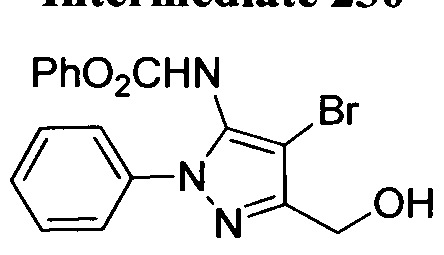
Phenyl (4-bromo-3 -(hvdroxymethyl)- 1 -phenyl- 1 H-pyrazol-5 -vDcarbamate
[00609] To a suspension of phenyl 3 -(hydroxymethyl)-l -phenyl- lH-pyrazol-5- ylcarbamate (Intermediate 227, 100 mg, 0.323 mmol) in CH2C12 (1.6 mL) was added pyridinium 4-methylbenzenesulfonate (PPTS) (8.12 mg, 0.0323 mmol) and N- bromosuccinimide (86.3 mg, 0.485 mmol). The reaction mixture was stirred for 16 hours at ambient temperature. The resulting suspension was filtered and the collected solid washed briefly with CH2C12 and dried in vacuum to afford the title compound a white solid (48.5 mg, 39%). MS (apci) m/z = 388.0 (M+H).
[00610] The following pyrazole intermediates were made according to the methods described for the preparation of Intermediate 228, 229 or 230.
MS (apci)
Intermediate Structure Name
m/z
,Ph
O phenyl (4-chloro-3- 358.1
(methoxymethyl)- 1 -phenyl- (M+H)
_ HN^O 1 H-pyrazol-5-yl)carbamate
231


Intermediate 245

5-methyl-3 -phenyl- 1 -(pyrazin-2-yl)- 1 H-pyrazol-4-amine
[00611] Step A: 2-(5-methyl-4-nitroso-3-phenyl- 1 H-pyrazol- 1 -vDpyrazine. To a solution of 2-hydrazinylpyrazine (0.485 g, 4.40 mmol) in HOAc (6 mL) was added (2-
(hydroxyimino)-l-phenylbutane-l,3-dione (0.765 g, 4.00 mmol) in small portions over 2 minutes. The mixture was stirred for 5 minutes and the resulting light orange suspension was stirred at 60 °C for 6 hours. EtOH (1 mL) was added and the mixture was heated at 60 °C for an additional 6 hours. The resulting dark green suspension was cooled to ambient temperature and the mixture was diluted with H20 (30 mL). The green suspension was stirred for 1 hour and the solid was collected via vacuum filtration. The collected solid was washed with ¾0 and dried in vacuum. The solid was suspended in EtOH (25 mL) and concentrated HC1 (500 ί) was added. The mixture was heated at reflux for 20 hours, cooled to ambient temperature and diluted with chilled H20 (75 mL). The mixture was treated with 1M NaOH to pH=7 and was extracted with Et20 (3X). The combined extracts were washed with saturated NaCl and dried over MgS04. The dried solution was filtered through packed Celite® and concentrated. The residual green-yellow solid was purified on a Si02 column using step gradient elution (25% CH2C12, 50% EtOAc/hexanes) to furnish the title compound as a turquoise solid (325 mg, 31%). MS (apci) m/z = 266.1 (M+H).
[00612] Step B: 5-methyl-3-phenyl-l-(pyrazin-2-yl)-lH-pyrazol-4-amine. To a mixture of 2-(5-methyl-4-nitroso-3-phenyl-lH-pyrazol-l-yl)pyrazine (325 mg, 1.04 mmol) and Zn dust (340 mg, 5.21 mmol) in EtOH (10 mL) was added concentrated HC1 (95.5 μί, 1.15 mmol). The mixture was stirred at ambient temperature for 17 hours, then at 65 °C for 3 hours. The mixture was cooled to ambient temperature and was filtered through packed Celite® eluting with MeOH. The eluent was concentrated, and the residue was treated with H20 and mixed. The resulting orange suspension treated with 2M HC1 to pH=l and the mixture was extracted with Et20 (3X). The aqueous portion was treated with 2M NaOH to pH=8 and extracted with EtOAc (3X). The combined EtOAc extracts were washed with saturated NaCl and dried over MgS04/activated carbon. The solution was eluted through a Si02 plug eluting with EtOAc. The eluent was concentrated to give the title compound as a light yellow wax (33 mg, 13%). MS (esi) m/z = 252.2 (M+H).
Intermediate 246

1 ,5-dimethyl-3-phenyl- 1 H-pyrazol-4-amine
[00613] Step A: 1 ,5-dimethyl-4-nitroso-3-phenyl- 1 H-pyrazole: To a solution of methylhydrazine (0.484 g, 10.5 mmol) in HOAc (10 mL) was added 2-(hydroxyimino)-l- phenylbutane-l,3-dione (2.01 g, 10.5 mmol) in small portions over 5 minutes. The reaction
mixture was heated at 60 °C for 1 hour and was cooled to ambient temperature. Et20 (50 mL) and H20 (10 mL) were added to the mixture followed by slow addition of saturated Na2C03 until pH=8 was obtained. The organic layer was removed and the aqueous layer was extracted with Et20 (2X). The combined organic fractions were dried over Na2S04, filtered and concentrated. The residue was purified by silica gel chromatography (1 :5 EtOAc/hexanes) to give the title compound as a green solid (1.32 g, 63%). MS (apci) m/z = 202.1 (M+H).
[00614] Step B: 1 ,5 -dimethyl-3 -phenyl- 1 H-p yrazol-4-amine : To a solution of 1,5- dimethyl-4-nitroso-3-phenyl-lH-pyrazole (1.32 g, 6.60 mmol) in MeOH (50 mL) was added Pd(OH)2 on carbon (200 mg, 20 wt%, 0.286 mmol) and the reaction mixture was shaken under 50 psi of H2 for 3 hours at ambient temperature. The reaction mixture was evacuated, purged with N2 filtered through a pad of Celite® with MeOH elution. The eluent was concentrated and the residue dried in vacuum to provide the title compound as a tan solid (1.23 g, 100%). MS (apci) m/z = 188.1 (M+H).
Intermediate 247

1 -isopropyl-5-methyl-3-phenyl- 1 H-pyrazol-4-amine
[00615] The title compound was prepared according to the method described for Intermediate 246, using isopropylhydrazine hydrochloride in place of methylhydrazine in Step A to provide 620 mg (57%) of the title compound over 2 steps. MS (apci) m/z = 216.1 (M+H).
Intermediate 248

5-methyl-3 -phenyl- 1 -(2,2,2-trifluoroethyl)- 1 H-pyrazol-4-amine
[00616] Step A: 5 -methyl-4-nitroso-3 -phenyl- 1 -(2.2,2-trifluoroethylV 1 H-pyrazole: The title compound was prepared using (2,2,2-trifluoroethyl)hydrazine in place of methylhydrazine in Step A of the procedure described for the preparation of l,5-dimethyl-3- phenyl-lH-pyrazol-4-amine (Intermediate 246). The compound was isolated as a green solid (999 mg, 71%). 1H NMR (CDC13) δ 7.60-7.73 (m, 5H), 4.70 (q, 2H), 2.27 (t, 3H).
[00617] Step B: 5-methyl-3-phenyl- 1 -(2.2,2-trifluoroethylV 1 H-pyrazol-4-amine: To a mixture of 5-methyl-4-nitroso-3-phenyl-l-(2,2,2-trifluoroethyl)-lH-pyrazole (50 mg, 0.186 mmol) and Zn dust (60.7 mg, 0.929 mmol) in EtOH (0.4 mL) was added concentrated HC1 (17.0 μί, 0.204 mmol) and the mixture was heated at reflux for 3 hours. The mixture was cooled to ambient temperature and was diluted with MeOH and filtered. The filtrate was concentrated and the residue was diluted in water. The aqueous mixture was treated with saturated NaHC03 until pH=10 was achieved. The mixture was extracted with DCM (3X) and the combined extracts were dried over Na2S04, filtered and concentrated afford the title compound as a yellow oil (47.1 mg, 99.4% yield). MS (apci) m/z = 256.1 (M+H).
Intermediate 249

l-ethyl-5-methyl-3-phenyl-lH-pyrazol-4-amine
[00618] Step A: l-ethyl-5-methyl-4-nitroso-3-phenyl-lH-pyrazole: The title compound was prepared according to the procedure described for the preparation of Intermediate 246, using ethylhydrazine oxalate in place of methylhydrazine in Step A. l-Ethyl-5-methyl-4- nitroso-3 -phenyl- lH-pyrazole was isolated as a green oil (288 mg, 26%). !H NMR (CDC13) δ 8.19 (d, 2H), 7.46-7.50 (m, 3H), 4.15 (q, 2H), 2.43 (s, 3H), 1.50 (t, 3H). The minor regioisomer, l-ethyl-3-methyl-4-nitroso-5-phenyl-lH-pyrazole, was also obtained as a blue- green solid (165 mg, 15%). 1H NMR (CDC13) δ 7.71 (dd, 2H), 7.59 (m, 3H), 4.17 (q, 2H), 2.28 (s, 3H), 1.51 (t, 3H).
[00619] Step B: 1 -ethyl-5-methyl-3-phenyl- 1 H-pyrazol-4-amine: Prepared according to the procedure described for the preparation of Intermediate 248, using l-ethyl-5-methyl-4- nitroso-3-phenyl-lH-pyrazole in Step B. the title compound was isolated as a light purple solid (281 mg, 104%). MS (apci) m/z = 202.1 (M+H).
Intermediate 250

1 -ethyl-3-methyl-5-phenyl- 1 H-pyrazol-4-amine
[00620] Prepared according to the procedure described for the preparation of
Intermediate 249, using l-ethyl-3-methyl-4-nitroso-5-phenyl-lH-pyrazole in Step A. The title compound was prepared according to Step B. The compound was isolated as a colorless oil (82.4 mg, 52.5%) after purification by reverse-phase chromatography. MS (apci) m/z = 202.1 (M+H).
Intermediate 251

l-methyl-5-phenyl-3-(trifluoromethyl)-lH-pyrazol-4-amine
[00621] Step A: 4,4,4-trifluoro-2-(hvdroxyimino)-l-phenylbutane-l,3-dione: A solution of 4,4,4-trifluoro-l-phenylbutane-l,3-dione (5.00 g, 23.1 mmol) in HOAc (46.3 mL) was chilled to 10 °C and sodium nitrite (1.84 g, 26.6 mmol) in water (6.0 mL) was added. The mixture was stirred at ambient temperature for 90 minutes and was diluted with H20 (150 mL). The mixture was extracted with Et20 (3X) and the combined organic fractions were carefully washed with saturated NaHC03 until pH=9. The Et20 solution was washed with H20 and saturated NaCl and was dried over MgS04. The dried solution was filtered and concentrated to afford the title compound as a yellow foam (4.21 g, 74.2% yield). MS (apci) m/z = 244.1 (M-H).
[00622] Step B: 4-nitroso-3-phenyl-5-(trifluoromethyl)-lH-pyrazole: A solution of hydrazine monohydrate (0.204 g, 4.08 mmol) in EtOH (5 mL) was cooled to 0 °C and 4,4,4- trifluoro-2-(hydroxyimino)-l-phenylbutane-l,3-dione (1.00 g, 4.08 mmol) in EtOH (15 mL) was added. The reaction mixture was stirred at ambient temperature for 3 hours, excess powdered MgS04 was added and the mixture was heated at 60 °C for 16 hours. The mixture was cooled to ambient temperature, filtered and concentrated to afford the crude title compound as a green solid (78.7 mg, 8.0%) that was taken directly to the next step. MS (apci) m/z = 240.0 (M-H).
[00623] Step C: 1 -methyl-5 -phenyl-3 -(trifluoromethyl)- 1 H-pyrazol-4-amine : To a solution of 4-nitroso-3-phenyl-5 -(trifluoromethyl)- lH-pyrazole (78.7 mg, 0.326 mmol) in DMF (1.6 mL) was added NaH (14.4 mg, 0.359 mmol) and the mixture was stirred at ambient temperature for 30 minutes. The mixture was treated with methyl iodide (40.6 μί, 0.653 mmol) and stirred for 17 hours. The reaction mixture was directly purified by reverse phase HPLC using 20-100% acetonitrile/water gradient elution to provide a light blue solid (40.2 mg). The solid was dissolved in EtOH (0.35 mL) and was subjected to the reduction procedure described in Step B of the preparation of 5-methyl-3-phenyl-l -(2,2,2- trifluoroethyl)-lH-pyrazol-4-amine (Intermediate 248). The title compound was obtained as white solid (25.1 mg, 66.1%).
Intermediate 252

1 -methyl-3-phenyl-5-(trifluoromethyl)- 1 H-pyrazol-4-amine
[00624] Step A: l-methyl-4-nitroso-3-phenyl-5-(trifluoromethyl)-lH-pyrazole. To a solution of methylhydrazine (0.214 mL, 4.08 mmol) in EtOH (20 mL) was added 4,4,4- trifluoro-2-(hydroxyimino)-l-phenylbutane-l,3-dione (Intermediate 251, Step A; 1.00 g, 4.079 mmol). The reaction mixture was stirred at ambient temperature for 1 hour and excess MgS04 was added. The mixture was stirred at 60 °C for 48 hours and was cooled to ambient temperature. The mixture was filtered and the filtrate concentrated to a green residue. The residue was purified by silica gel chromatography using a 10-30% EtOAc/hexanes gradient for elution to provide the title compound as a green solid (482 mg, 46%). 1H NMR (CDC13) δ 7.89 (d, 2H), 7.45-7.52 (m, 3H), 4.15 (s, 3H).
[00625] Step B: 1 -methyl-3-phenyl-5-(trifluoromethyl)- 1 H-pyrazol-4-amine. Prepared from l-methyl-4-nitroso-3-phenyl-5 -(trifluoromethyl)- lH-pyrazole according to the method described for the preparation of Intermediate 248, Step B. The title compound was obtained as white solid (309 mg, 68%). 1H NMR (CDC13) δ 7.65 (d, 2H), 7.45 (t, 2H), 7.35 (t, 1H), 3.93 (s, 3H), 3.52 (br s, 2H).
Synthetic Examples
Example 1
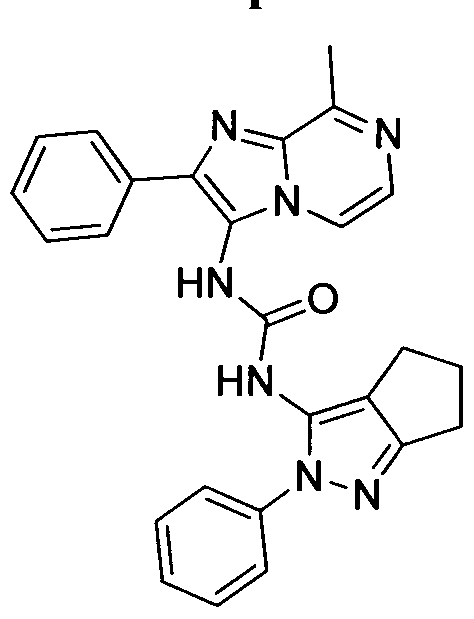
1 -(8-methyl-2-phenylimidazo [ 1 ,2-a]pyrazin-3 -yl)- 3 -(2-phenyl-2 ,4,5 ,6- tetrahydrocvclopenta[c]pyrazol-3-yl)urea
[00626] To a suspension of 8-methyl-2-phenylimidazo[l,2-a]pyrazin-3-amine dihydrochloride [Preparation Al] (50 mg, 0.17 mmol) and phenyl (2-phenyl-2,4,5,6- tetrahydrocyclopenta[c]pyrazol-3-yl)carbamate [Intermediate 28] (59 mg, 0.19 mmol) in DMA (2 mL) was added DIEA (103 ih, 0.59 mmol). The solution was stirred at ambient temperature for 16 hours then partitioned between saturated NH4C1 (20 mL) and EtOAc (20 mL). The resulting precipitate was filtered, washed with EtOAc and Et20 then dried under vacuum to afford the title compound (42 mg, 56% yield) as a white solid. MS (apci) m/z = 450.0 (M+H).
Example 2

1 -(3-ethoxy-4-methyl- 1 -phenyl- 1 H-pyrazoI-5-yl)-3-(8-methyl-2-phenylimidazo[ 1 ,2- a]pyrazin-3-yl)urea
[00627] Prepared according to the procedure of Example 1 , substituting phenyl (2-phenyl- 2,4,5,6-tetrahydrocyclopenta[c]pyrazol-3-yl)carbamate [Intermediate 28] with phenyl 3- ethoxy-4-methyl-l -phenyl- lH-pyrazol-5-ylcarbamate [Intermediate 8] to afford the title compound (21 mg, 26% yield) as a yellow solid. MS (apci) m/z = 468.1 (M+H).
Example 3

1 -(3-ethoxy-4-methyl- 1 -phenyl- 1 H-pyrazol-5-yl)-3-(2-phenyl-8- (trifluoromethyl)imidazo [ 1 ,2-a]pyridin-3 -yl)urea
[00628] Prepared according to the procedure of Example 2, substituting 8-methyl-2- phenylimidazo[l,2-a]pyrazin-3-amine dihydrochloride [Preparation Al] with 2-phenyl-8- (trifluoromethyl)imidazo[l,2-a]pyridin-3 -amine [Preparation A5] to afford the title compound (34 mg, 41% yield) as a cream solid. MS (apci) m/z = 521.2 (M+H).
Example 4

1 -(8-chloro-2-phenylimidazo[l ,2-alpyridin-3-yl)-3-(3-ethoxy-4-methyl- 1 -phenyl-l H- pyrazol-5-yl)urea
[00629] Prepared according to the procedure of Example 2, substituting 8-methyl-2- phenylimidazo[l,2-a]pyrazin-3-amine dihydrochloride [Preparation Al] with 8-chloro-2- phenylimidazo[l,2-a]pyridin-3-amine hydrochloride [Preparation A4] to afford the title compound (41 mg, 47% yield) as a cream solid. MS (apci) m/z = 487.2 (M+H).
Example 5

Example 6

l-(3-ethoxy-4-methyl-l-phenyl-lH-pyrazol-5-yl)-3-(8-fluoro-2-phenylimidazo[l,2-a]pyridin-
3-yl)urea
[00631] Prepared according to the procedure of Example 2, substituting 8-methyl-2- phenylimidazo[l,2-a]pyrazin-3-amine dihydrochloride [Preparation Al] with 8-fluoro-2- phenylimidazo[l,2-a]pyridin-3-amine dihydrochloride [Preparation A6] to afford the title compound (12 mg, 19% yield) as a white powder. MS (apci) m/z = 471.2 (M+H).
Example 7

l-(3-ethoxy-4-methyl-l -phenyl- lH-pyrazol-5-yl)-3-(8-methyl-2-phenylimidazo 1,2- a]pyridin-3 -vDurea
[00632] Prepared according to the procedure of Example 2, substituting 8-methyl-2- phenylimidazo[l,2-a]pyrazin-3-amine dihydrochloride [Preparation Al] with 8-methyl-2- phenylimidazo[l,2-a]pyridin-3-amine dihydrochloride [Preparation A3] to afford the title compound (58 mg, 74% yield) as a white powder. MS (apci) m/z = 467.2 (M+H).
Example 8

l-(3,4-dimethyl-l-phenyl-lH-pyrazol-5-yl)-3-(8-mem^
yPurea
[00633] Prepared according to the procedure of Example 1, substituting phenyl (2 -phenyl - 2,4,5,6-tetrahydrocyclopenta[c]pyrazol-3-yl)carbamate [Intermediate 28] with phenyl (3,4- dimethyl-1 -phenyl- lH-pyrazol-5-yl)carbamate [Intermediate 16] to afford the title compound (38 mg, 52% yield) as a pale yellow solid. MS (apci) m/z = 438.2 (M+H).
Example 9

l-(8-methyl-2-phenylimidazo[l,2-a]pyrazin-3-yl)-3-(6-methyl-2-phenylpyridin-3-vnurea
[00634] Prepared according to the procedure of Example 1 , substituting phenyl (2-phenyl- 2,4,5,6-tetrahydrocyclopenta[c]pyrazol-3-yl)carbamate [Intermediate 28] with phenyl (6- methyl-2-phenylpyridin-3-yl)carbamate [Intermediate 29] to afford the title compound (38 mg, 52% yield) as a pale yellow solid. MS (apci) m/z = 435.2 (M+H).
Example 10

(R)- 1 -(3 -(2,3 -dihydroxypropoxy)-4-methyl- 1 -phenyl- 1 H-pyrazol-5-yl)-3-( 8-methyl-2- phenylimidazo[l,2-a]pyridin-3-yl)urea
[00635] Step A: Preparation of (S)-l-(3-((2,2-dimethyl-13-dioxolan-4-vnmethoxy -4- methyl-1 -phenyl- lH-pyrazol-5-yl>3-(8-methyl-2-phenvHm To a suspension of 8-methyl-2-phenylimidazo[l,2-a]pyridin-3-amine dihydrochloride [Preparation A3] (31.8 mg, 0.1 1 mmol) and (S)-phenyl 3-((2,2-dimethyl-l,3-dioxolan-4- yl)methoxy)-4-methyl-l -phenyl- 1 H-pyrazol-5-yl carbamate [Intermediate 10] (50 mg, 0.12 mmol) in DMA (2 mL) was added DIEA (65 μί, 0.38 mmol). The solution was stirred at ambient temperature for 16 hours then partitioned between saturated NH4C1 (20 mL) and EtOAc (20 mL). The aqueous layer was extracted with EtOAc (2 x 10 mL) and the combined organic phases were washed with water (4 x 10 mL) and brine (10 mL) then dried over Na2S04, filtered and concentrated under vacuum. The residue was purified by silica column chromatography eluting with 2% MeOH/DCM to afford (S)-l-(3-((2,2-dimethyl-l,3- dioxolan-4-yl)methoxy)-4-methyl-l-phenyl-lH-pyrazol-5-yl)-3-(8-methyl-2- phenylimidazo[l,2-a]pyridin-3-yl)urea (55 mg, 93% yield) as a yellow/green solid. MS (apci) m/z = 553.3 (M+H).
[00636] Step B: Preparation of (R)- 1 -(3 -(2,3-dihydroxypropoxy)-4-methyl- 1 -phenyl- 1 H- pyrazol-5-yl)-3-(8-methyl-2-phenylimidazo[l,2-a1pyridin-3-yl)urea: A solution of (S)-l-(3- ((2,2-dimethyl- 1 ,3-dioxolan-4-yl)methoxy)-4-methyl- 1 -phenyl- 1 H-pyrazol-5-yl)-3-(8- methyl-2-phenylimidazo[l,2-a]pyridin-3-yl)urea (55 mg, 0.10 mmol) in THF (2 mL) was cooled to 0 °C and 1M HC1 (2 mL) was added. The solution was stirred at ambient temperature for 3 hours then concentrated to half volume. The solution was treated with 2M NaOH to pH=9-10 then extracted with EtOAc (3 x 10 mL). The combined organic extracts were washed with brine (10 mL) then dried over Na2S04, filtered and concentrated under vacuum. The residue was triturated with 1 : 1 DCM/Et20, filtered and dried under vacuum to afford the title compound (18 mg, 35% yield) as a pale orange powder. MS (apci) m/z = 513.2 (M+H).
Example 11

(S> 1 -(3-(2-hydroxypropoxy)-4-methyl- 1 -phenyl- 1 H-pyrazol-5-yl)-3 -(8-methyl-2- phenylimidazo [ 1 ,2-a] pyridin-3 -yPurea
[00637] Prepared according to the procedure of Example 10, substituting (S)-phenyl 3- ((2,2-dimethyl- 1 ,3-dioxolan-4-yl)methoxy)-4-methyl- 1 -phenyl- 1 H-pyrazol-5-yl carbamate [Intermediate 10] with (S)-phenyl (3-(2-((tert-butyldimethylsilyl)oxy)propoxy)-4-methyl-l- phenyl-lH-pyrazol-5-yl)carbamate [Intermediate 12] in Step A to afford the title compound (19.5 mg, 60% yield) as a white solid. MS (apci) m/z = 497.2 (M+H).
Example 12

l-(8-methyl-2-phenylimidazo[l,2-a]pyridin-3-yl')-3-(2-phenyl-2,4,5,6- tetrahydrocyclopenta[c]pyrazol-3-yl)urea
[00638] Prepared according to the procedure of Example 1, substituting 8-methyl-2- phenylimidazo[l,2-a]pyrazin-3-amine dihydrochlonde [Preparation Al] with 8-methyl-2- phenylimidazo[l,2-a]pyridin-3-amine dihydrochloride [Preparation A3] to afford the title compound (48 mg, 75% yield) as a white solid. MS (apci) m/z = 449.2 (M+H).
Example 13
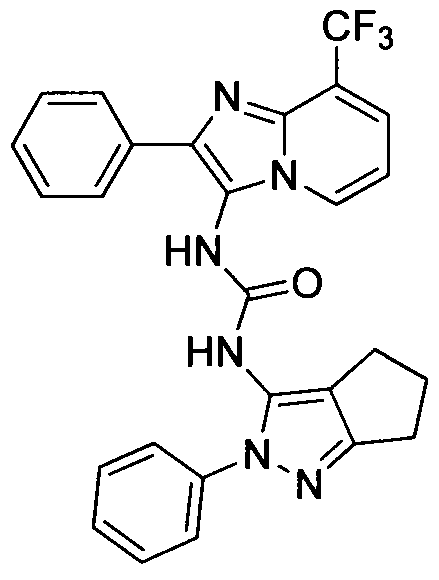
l-(2-phenyl-2A5,6-tetrahvdrocyclopenta[c]pyrazol-3-yl)-3-(2-phenyl-8- (trifluoromethyl)imidazo[l,2-a]pyridin-3-yl)urea
[00639] Prepared according to the procedure of Example 1, substituting 8-methyl-2- phenylimidazo[l,2-a]pyrazin-3 -amine dihydrochloride [Preparation Al] with 2-phenyl-8- (trifluoromethyl)imidazo[l,2-a]pyridin-3-amine hydrochloride [Preparation A5] to afford the title compound (47 mg, 66% yield) as a white solid. MS (apci) m/z = 503.2 (M+H).
Example 14

l-(8-methyl-2-phenylimidazo[l,2-a]pyri&
c]pyrazol-3-yl urea
[00640] Prepared according to the procedure of Example 10, substituting (S)-phenyl 3- ((2,2-dimethyl- 1 ,3 -dioxolan-4-yl)methoxy)-4-methyl- 1 -phenyl- 1 H-pyrazol-5-yl carbamate [Intermediate 10] with phenyl (2-phenyl-4,6-dihydro-2H-furo[3,4-c]pyrazol-3-yl)carbamate [Intermediate 20] to afford the title compound (12 mg, 18% yield) as a cream powder. MS (apci) m/z = 451.2 (M+H).
Example 15

1 -(8-bromo-2-phenylimidazo[ 1 ,2-a]pyridin-3-yl>3-(3-ethoxy-4-methyl- 1 -phenyl- 1 H- pyrazol-5-yl)urea
[00641] Prepared according to the procedure of Example 2, substituting 8-methyl-2- phenylimidazo[l,2-a]pyrazin-3-amine dihydrochloride [Preparation Al] with 8-bromo-2- phenylimidazo[l,2-a]pyridin-3-amine dihydrochloride [Preparation A7] to afford the title compound (73 mg, 51% yield) as a pale yellow solid. MS (apci) m/z = 533.1 (M+H).
Example 16

l-(3-ethoxy-4-memyl-l-phenyl-lH-pyrazol-5-yl)-3-(2-(6-methoxypyridin-3-ylV8- methylimidazo [ 1,2-a] pyridin-3 -yPurea
[00642] Prepared according to the procedure of Example 2, substituting 8-methyl-2- phenylimidazo[l,2-a]pyrazin-3-amine dihydrochloride [Preparation Al] with 2-(6- methoxypyridin-3-yl)-8-methylimidazo[l,2-a]pyridin-3-amine dihydrochloride [Preparation Al l] to afford the title compound (64 mg, 48% yield) as a cream solid. MS (apci) m/z = 498.2 (M+H).
Example 17

[00643] Prepared according to the procedure of Example 10, substituting (S)-phenyl 3- ((2,2-dimethyl- 1 ,3-dioxolan-4-yl)methoxy)-4-methyl- 1 -phenyl- 1 H-pyrazol-5-yl carbamate [Intermediate 10] with phenyl (5,5-dioxido-2-phenyl-4,6-dihydro-2H-thieno[3,4-c]pyrazol-3- yl)carbamate [Intermediate 21] to afford the title compound (24 mg, 40% yield) as a white solid. MS (apci) m/z = 499.1 (M+H).
Example 18

l-(5,5-dioxido-2-phenyl-4,6-dihydro-2H-thieno[3,4-clpyrazol-3-ylV3-(2-phenyl-8- (trifluoromethyl imidazo l,2-alpyridin-3-yl)urea
[00644] Prepared according to the procedure of Example 17, substituting 8-methyl-2- phenylimidazo[l,2-a]pyridin-3-amine dihydrochloride [Preparation A3] with 2-phenyl-8- (trifIuoromethyl)imidazo[l,2-a]pyridin-3 -amine hydrochloride [Preparation A5] to afford the title compound (9 mg, 13% yield) as a white solid. MS (apci) m/z = 553.1 (M+H).
Example 19

l-(8-methyl-2-phenylimidazo[l,2-a]pyridin-3-yl)-3-(2-phenyl-4,5,6,7-tetrahvdro-2H-indazol-
3-yl)urea
[00645] Prepared according to the procedure of Example 10, substituting (S)-phenyl 3- ((2,2-dimethyl- 1 ,3-dioxolan-4-yl)methoxy)-4-methyl- 1 -phenyl- 1 H-pyrazol-5-yl carbamate [Intermediate 10] with phenyl (2-phenyl-4,5,6,7-tetrahydro-2H-indazol-3-yl)carbamate [Intermediate 18] to afford the title compound (50 mg, 80% yield) as a white solid. MS (apci) m/z = 463.2 (M+H).
Example 20

l-(2-phenyl-4,5,6,7-tetrahydro-2H-indazol-3-yl)-3-(2-phen^
alpyridin-3 -vDurea
[00646] Prepared according to the procedure of Example 19, substituting 8-methyl-2- phenylimidazo[l,2-a]pyridin-3 -amine dihydrochloride [Preparation A3] with 2-phenyl-8- (trifluoromethyl)imidazo[l,2-a]pyridin-3 -amine hydrochloride [Preparation A5] to afford the title compound (51 mg, 73% yield) as a pale yellow solid. MS (apci) m/z = 517.2 (M+H).
Example 21

1 -(3-methoxy-4-methyl- 1 -phenyl- 1 H-pyrazol-5-yl)-3-(8-methyl-2-phenylimidazo[ 1 ,2- a]pyridin-3-yl)urea
[00647] Prepared according to the procedure of Example 10, substituting (S)-phenyl 3- ((2,2-dimethyl- 1 ,3 -dioxolan-4-yl)methoxy)-4-methyl- 1 -phenyl- 1 H-pyrazol-5-yl carbamate [Intermediate 10] with phenyl (3-methoxy-4-methyl-l-phenyl-lH-pyrazol-5-yl)carbamate [Intermediate 9] to afford the title compound (34 mg, 53% yield) as a white solid. MS (apci) m/z = 453.2 (M+H).
Example 22

1 -(3-methoxy-4-methyl- 1 -phenyl- 1 H-pyrazol-5-yl)-3-(2-phenyl-8- (trifluoromethyl)imidazo[l,2-a1pyridin-3-yl)urea
[00648] Prepared according to the procedure of Example 21, substituting 8-methyl-2- phenylimidazo[l,2-a]pyridin-3 -amine dihydrochloride [Preparation A3] with 2-phenyl-8- (trifluoromethyl)imidazo[l,2-a]pyridin-3-amine hydrochloride [Preparation A5] to afford the title compound (35 mg, 49% yield) as a pale yellow solid. MS (apci) m/z = 507.2 (M+H).
Example 23

1 -(3 -ethoxy-4-methyl-l -phenyl- 1 H-pyrazol-5-yl)-3-(2-(4-methoxyphenyl)-8- methylimidazo [ 1 ,2-al pyridin-3 -yl)urea
[00649] Prepared according to the procedure of Example 2, substituting 8-methyl-2- phenylimidazo[l,2-a]pyrazin-3 -amine dihydrochloride [Preparation Al] with 2-(4- methoxyphenyl)-8-methylimidazo[l,2-a]pyridin-3-amine dihydrochloride [Preparation A10] to afford the title compound (16 mg, 24% yield) as a cream solid. MS (apci) m/z = 497.2 (M+H).
Example 24
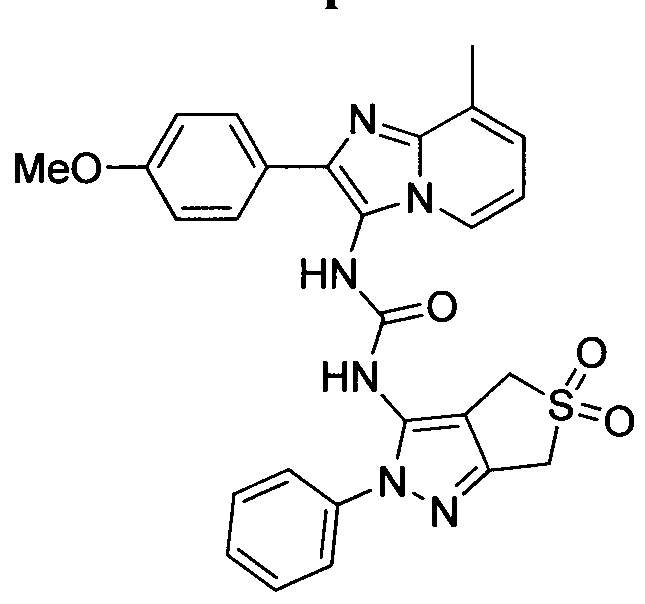
l-(5,5-dioxido-2-phenyl-4,6-dihvdro-2H-thieno 3,4-clpyrazol-3-yl)-3-(2-(4-methoxyphenvn-
8-methylimidazofl,2-a1pyridin-3-yl)urea
[00650] Prepared according to the procedure of Example 23, substituting phenyl (3- ethoxy-4-methyl-l -phenyl- lH-pyrazol-5-yl)carbamate [Intermediate 8] with phenyl (5,5- dioxido-2 -phenyl -4,6-dihydro-2H-thieno [3 ,4-c]pyrazol-3-yl)carbamate [Intermediate 21] to afford the title compound (31 mg, 47% yield) as a white powder. MS (apci) m/z = 529.2 (M+H).
Example 25

1 -(3 -(3 -hvdroxy-2-(hvdroxymethyl)propoxy)-4-methyl- 1 -phenyl- 1 H-pyrazol-5-yl)-3 -(2- phenyl-8-(trifluoromethyl)imidazo[ 1 ,2-a]pyridin-3-yl)urea
[00651] Step A: Preparation of (2,2-dimethyl-l,3-dioxan-5-yl)methanol: To a suspension of 2-(hydroxymethyl)propane-l,3-diol (5.0 g, 47.1 mmol) in THF (100 mL) was added pTsOH (269 mg, 1.41 mmol) followed by 2,2-dimethoxypropane (6.72 mL, 54.7 mmol). The solution was stirred for 3 hours at ambient temperature then treated with pTsOH (200 mg) and stirred at ambient temperature for 48 hours. Triethylamine (3 mL) was added and the mixture concentrated under vacuum. The residue was purified silica column chromatography eluting with 5% MeOH/DCM to afford (2,2-dimethyl-l,3-dioxan-5- yl)methanol (5.04 g, 73% yield) as a colorless liquid. 1H NMR (CDC13) δ 4.02 (dd, J = 12.0,
4.1 Hz, 2H), 3.74-3.80 (m, 4H), 1.90 (t, J= 5.1 Hz, 1H), 1.78-1.88 (m, 1H), 1.45 (s, 3H), 1.40 (s, 3H) ppm.
[00652] Step B: Preparation of (2,2-dimethyl-1.3-dioxan-5-yl)methyl methanesulfonate: To a solution of (2,2-dimethyl-l,3-dioxan-5-yl)methanol (1.0 g, 6.84 mmol) in DCM (30 mL) at 0 °C was added triethylamine (1.43 mL, 10.3 mmol) followed by mesyl chloride (0.58 mL, 7.52 mmol). The mixture was allowed to warm slowly to ambient temperature over 16 hours then partitioned between 0.5 M HC1 (40 mL) and DCM (20 mL). The aqueous layer was extracted with DCM (2 x 20 mL) and the combined organic phases were washed with brine (20 mL), dried over Na2S04, filtered and concentrated (2,2-dimethyl-l ,3-dioxan-5-yl)methyl methanesulfonate (1.29 g, 84% yield) as a colorless oil. ]H NMR (CDC13) δ 4.41 (d, J = 7.3 Hz, 2H), 4.08 (dd, J = 12.5, 3.6 Hz, 2H), 3.77 (dd, J = 12.5, 3.9 Hz, 2H), 3.04 (s, 3H), 2.03- 1.98 (m, 1H), 1.46 (s, 3H), 1.39 (s, 3H) ppm.
[00653] Step C: Preparation of 3-((2,2-dimethyl- 13-dioxan-5-yl)methoxy)-4-methyl- 1 - phenyl- 1 H-pyrazol-5-amine: To a solution of 5-amino-4-methyl-l -phenyl- lH-pyrazol- 3(2H)-one [Intermediate 1, Step A] (500 mg, 2.64 mmol) in DMF (5 mL) was added K2C03 (1.10 g, 7.93 mmol) followed by a solution of (2,2-dimethyl-l,3-dioxan-5-yl)methyl methanesulfonate (711 mg, 3.17 mmol). The mixture was warmed to 50 °C and stirred for 16 hours then and treated with water (30 mL). The aqueous was extracted with EtOAc (3 x 20 mL) and the combined organic phases were washed with water (5 x 10 mL) and brine (10 mL) then dried over Na2S04, filtered and concentrated under vacuum. The residue was purified by silica column chromatography eluting with 4:1 to 2: 1 hexanes / EtOAc to afford 3-((2,2-dimethyl- 1 ,3-dioxan-5-yl)methoxy)-4-methyl- 1 -phenyl- 1 H-pyrazol-5 -amine ( 198 mg, 24% yield) as a yellow gum. MS (apci) m/z = 318.1 (M+H).
[00654] Step D: Preparation of phenyl (3-(3-hvdroxy-2-(hvdroxymethyl)propoxy)-4- methyl- 1 -phenyl- 1 H-pyrazol-5-yl)carbamate: To a solution of 3-((2,2-dimethyl-l,3-dioxan- 5-yl)methoxy)-4-methyl-l -phenyl- lH-pyrazol-5-amine (198 mg, 0.62 mmol) in EtOAc (5 mL) was added 2M NaOH (780 μί, 1.56 mmol) followed by phenyl chloroformate (117 μί, 0.94 mmol). The mixture was stirred at ambient temperature for 16 hours then partitioned between water (20 mL) and EtOAc (20 mL). The aqueous layer was extracted with EtOAc (2 x 20 mL) and the combined organic phases were washed with saturated NaHC03 (20 mL) and brine (20 mL) then dried over Na2S04, filtered and concentrated under vacuum. The residue was purified by silica column chromatography eluting with 2-4% MeOH/DCM to
afford phenyl (3-(3-hydroxy-2-(hydroxymethyl)propoxy)-4-methyl-l-phenyl-lH-pyrazol-5- yl)carbamate (75 mg, 30% yield) as a cream foam. MS (apci) m/z = 398.2 (M+H).
[00655] Step E: Preparation of l-(3-(3 -hvdroxy-2-(hydroxymethyl)propoxy)-4-methyl- 1 - phenyl-lH-pyrazol-5-ylV3-(2-phenyl-8-(trifluoromethyl)imidazo[l,2-a1pyridin-3-yl)urea: To a suspension of phenyl-8-(trifluoromethyl)imidazo[l,2-a]pyridin-3 -amine hydrochloride [Preparation A5] (27 mg, 0.08 mmol) and phenyl (3-(3-hydroxy-2-(hydroxymethyl)propoxy)- 4-methyl-l -phenyl- lH-pyrazol-5-yl)carbamate (37 mg, 0.09 mmol) in DMA (1 mL) was added DIEA (44 μί, 0.25 mmol). The solution was stirred at ambient temperature for 16 hours then partitioned between saturated NH4C1 (20 mL) and EtOAc (20 mL). The aqueous layer extracted with EtOAc (2 x 10 mL) and the combined organic phases were washed with water (4 x 10 mL) and brine (10 mL) then dried over Na2S04, filtered and concentrated under vacuum. The residue was triturated with DCM, filtered and dried to afford the title compound (19 mg, 34% yield) as a light yellow powder. MS (apci) m/z = 581.2 (M+H).
Example 26

l-(3-(2-hvdroxy-2-methylpropoxy)-4-methyl-l-phenyl-lH-pyrazol-5-yl)-3-(2-phenyl-8- (trifluoromethyl)imidazo[L2-alpyridin-3-yl)urea
[00656] Prepared according to the procedure of Example 21, substituting 8-methyl-2- phenylimidazo[l,2-a]pyridin-3 -amine dihydrochloride [Preparation A3] with 2-phenyl-8- (trifluoromethyl)imidazo[l,2-a]pyridin-3-amine hydrochloride [Preparation A5] and phenyl (3 -methoxy-4-methyl-l -phenyl- lH-pyrazol-5-yl)carbamate [Intermediate 9] with phenyl (3- (2-hydroxy-2-methylpropoxy)-4-methyl- 1 -phenyl- 1 H-pyrazol-5-yl)carbamate [Intermediate 11] to afford the title compound (37 mg, 41% yield) as a pale yellow solid. MS (apci) m/z = 565.2 (M+H).
Example 27

(R)- 1 -(3 -(2-hvdroxypropoxy)-4-methyl- 1 -phenyl- 1 H-pyrazol-5-yl)- 3 -(2-phenyl-8- (trifluoromethyl)imidazo [ 1 ,2-a]pyridin-3 -yl)urea
[00657] Prepared according to the procedure of Example 21, substituting 8-methyl-2- phenylimidazo[l,2-a]pyridin-3-amine dihydrochloride [Preparation A3] with 2-phenyl-8- (trifluoromethyl)imidazo[l,2-a]pyridin-3 -amine hydrochloride [Preparation A5] and phenyl (3-methoxy-4-methyl-l -phenyl- lH-pyrazol-5-yl)carbamate [Intermediate 9] with (R)-phenyl (3-(2-hydroxypropoxy)-4-methyl-l-phenyl-lH-pyrazol-5-yl)carbamate [Intermediate 30] to afford the title compound (25 mg, 48% yield) as a pale yellow solid. MS (apci) m/z = 551.2 (M+H).
Example 28

(R)- 1 -(3-(2,3-dihvdroxypropoxy)-4-methyl- 1 -phenyl- 1 H-pyrazol-5-yl)-3-(2-phenyl-8- (trifluoromethyl)imidazo[ 1 ,2-a1pyridin-3-yl)urea
[00658] Prepared according to the procedure of Example 10, substituting 8-methyl-2- phenylimidazo[l,2-a]pyridin-3-amine dihydrochloride [Preparation A3] with 2-phenyl-8- (trifluoromethyl)imidazo[l,2-a]pyridin-3 -amine hydrochloride [Preparation A5] to afford the title compound (31 mg, 35% yield) as a cream powder. MS (apci) m/z = 567.2 (M+H).
Example 29

(S)-l-(3-(2,3-dihvdroxypropoxy)-4-methyl-l-phenyl-lH-pyrazol-5-yl)-3-(2-phenyl-8- (trifluoromethyl)imidazo[ 1 ,2-a]pyridin-3-vDurea
[00659] Prepared according to the procedure of Example 28, substituting (S)-phenyl 3- ((2,2-dimethyl- 1 ,3-dioxolan-4-yl)methoxy)-4-methyl- 1 -phenyl- 1 H-pyrazol-5-yl carbamate [Intermediate 10] with (R)-phenyl 3-((2,2-dimethyl-l,3-dioxolan-4-yl)methoxy)-4-methyl-l- phenyl-lH-pyrazol-5-yl carbamate [Intermediate 14] to afford the title compound (32 mg, 52% yield) as a pale yellow powder. MS (apci) m/z = 567.2 (M+H).
Example 30

1 -(I '.4-dimethyl- 1 -phenyl- 1H, 1 'H-[3,4'-bipyrazon-5-yl -3-(2-phenyl-8- (trifluoromethyl)imidazo[ 1.2-a]pyridin-3-vnurea
[00660] Prepared according to the procedure of Example 28, substituting (S)-phenyl 3- ((2,2-dimethyl- 1 ,3 -dioxolan-4-yl)methoxy)-4-methyl- 1 -phenyl- 1 H-pyrazol-5-yl carbamate [Intermediate 10] with phenyl (l',4-dimethyl-l-phenyl-lH,l'H-[3,4'-bipyrazol]-5- yl)carbamate [Intermediate 25] to afford the title compound (33 mg, 37% yield) as a pale yellow powder. MS (apci) m/z = 557.2 (M+H).
Example 31

1 -(3-(methoxymethyl)-4-methyl- 1 -phenyl- 1 H-pyrazol-5-yl)-3-(2-phenyl-8- (trifluoromethyl)imidazo [ 1 ,2-a] pyridin-3 -yl)urea
[00661] Prepared according to the procedure of Example 28, substituting (S)-phenyl 3- ((2,2-dimethyl- 1 ,3 -dioxolan-4-yl)methoxy)-4-methyl- 1 -phenyl- 1 H-pyrazol-5-yl carbamate [Intermediate 10] with phenyl (3-(methoxymethyl)-4-methyl-l -phenyl- lH-pyrazol-5- yl)carbamate [Intermediate 23] to afford the title compound (34 mg, 51% yield) as a pale yellow solid. MS (apci) m/z = 521.2 (M+H).
Example 32
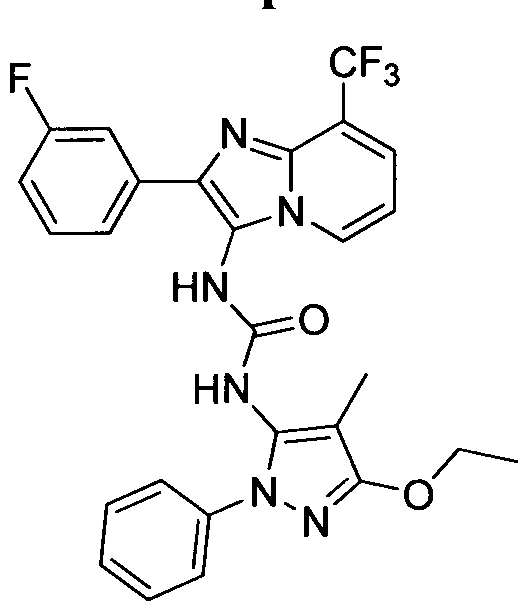
1 -(3-ethoxy-4-methyl-l -phenyl- 1 H-pyrazol-5-yl)-3-(2-(3-fluorophenyl)-8- (trifluoromethyl)imidazo[ 1.2-a]pyridin-3-yl)urea
[00662] Prepared according to the procedure of Example 2, substituting 8-methyl-2- phenylimidazo[l,2-a]pyrazin-3-amine dihydrochloride [Preparation Al] with 2-(3- fluorophenyl)-8-(trifluoromethyl)imidazo[l ,2-a]pyridin-3 -amine hydrochloride [Preparation A8] to afford the title compound (37 mg, 32% yield) as a beige solid. MS (apci) m/z = 539.2 (M+H).
Example 33

1 -(3-ethoxy-4-methyl- 1 -phenyl- 1 H-pyrazol-5-yl)-3-(2-(4-fluorophenyl)-8- (trifluoromethyl)imidazo[L2-a]pyridin-3-yl)urea
[00663] Prepared according to the procedure of Example 2, substituting 8-methyl-2- phenylimidazo[l,2-a]pyrazin-3-amine dihydrochloride [Preparation Al] with 2-(4- fluorophenyl)-8-(trifluoromethyl)imidazo[ 1 ,2-a]pyridin-3 -amine hydrochloride [Preparation A9] to afford the title compound (46 mg, 56% yield) as a cream solid. MS (apci) m/z = 539.2 (M+H).
Example 34

l-(4-chloro-l'-methyl-l-phenyl-lH.rH-r3.4'-bipyrazol1-5-vn-3-(2-phenyl-8- (trifluoromethyl)imidazo[l,2-a]pyridin-3-yl)urea
[00664] To a solution of phenyl (l'-methyl-l-phenyl-lH 'H-fS^'-bipyrazolJ-S- yl)carbamate [Intermediate 25] (50 mg, 0.14 mmol) in DCM (2 mL) was added NCS (20 mg, 0.15 mmol) followed by PPTS (3.5 mg, 0.01 mmol). The solution was stirred at ambient temperature for 48 hours then treated with 2-phenyl-8-(trifluoromethyl)imidazo[l,2- a]pyridin-3-amine hydrochloride [Preparation A5] (44 mg, 0.14 mmol) followed by DIEA (121 μί, 0.7 mmol). After stirring for a further 24 hours the mixture was partitioned between DCM (10 mL) and saturated NaHC03 (10 mL) and the aqueous layer extracted with DCM (2 x 10 mL). The combined organic phases were washed with brine (10 mL), dried over Na2S04, filtered and concentrated under vacuum. The residue was purified by silica column
chromatography eluting with 2% MeOH/DCM to afford the title compound (7 mg, 9% yield) as a beige solid. MS (apci) m/z = 577.2 (M+H).
Example 35

(R)-l-(3-(2-hvdroxy-3-methoxypropoxy)-4-methyl-l-phenyl-lH-pyrazol-5-yl)-3-(2-phenyl-
8-(trifluoromethyl)imidazo[ 1 ,2-a1pyridin-3-yl)urea
[00665] Step A: Preparation of (R)-phenyl (3-(2-((tert-butyldimethylsilynoxy -3- methoxypropoxy)-4-methyl- 1 -phenyl- 1 H-pyrazol-5-vQcarbamate: A solution of (R)-3-(2- (tert-butyldimethylsilyloxy)-3-methoxypropoxy)-4-methyl-l-phenyl-lH-pyrazol-5-amine [Intermediate 27] (0.910 g, 2.32 mmol) in EtOAc (12 mL) was cooled to 0 °C. NaOH (2.90 mL, 2M, 5.81 mmol) and phenylchloroformate (0.437 mL, 3.49 mmol) were added sequentially and the mixture was stirred for 5 minutes. The mixture was allowed to reach ambient temperature and stirred for 18 hours. The mixture was diluted with hexanes (12 mL) and washed with H20 (2X), saturated NaCl and dried over MgSCVactivated carbon. Solution eluted through a Si02 plug (60 mL c-frit, 1/2 full of Si02, MgS04 cap layer) eluting with 50% EtOAc-hexanes. Filtrate was concentrated and the residue suspended in hexanes and stirred vigorously for 30 minutes. Solid collected, washed with hexanes and dried under vacuum to afford (R)-phenyl (3-(2-((tert-butyldimethylsilyl)oxy)-3-methoxypropoxy)-4- methyl-1 -phenyl- lH-pyrazol-5-yl)carbamate (869 mg, 73% yield) as a white solid. MS (apci) m/z = 512.3 (M+H).
[00666] Step B: Preparation of (R -l-(3-(2-((tert-butyldimethylsilyl)oxy)-3- methoxypropoxy V4-methyl- 1 -phenyl- 1 H-pyrazol-5-yl)-3-(2-phenyl-8- (trifluoromethyl)imidazo l,2-a1pyridin-3-yl urea: To a suspension of 2-phenyl-8- (trifluoromethyl)imidazo[l,2-a]pyridin-3-amine hydrochloride (30 mg, 0.96 mmol) [Preparation A5] and (R)-phenyl (3-(2-((tert-butyldimethylsilyl)oxy)-3-methoxypropoxy)-4- methyl-1 -phenyl- lH-pyrazol-5-yl)carbamate (53.4 mg, 0.10 mmol) in DMA (1 mL) was added DIE A (58 μί, 0.34 mmol). The solution was stirred at ambient temperature for 16 hours then partitioned between saturated NH CI (20 mL) and EtOAc (10 mL). The aqueous
layer was extracted with EtOAc (2 x 10 mL) and the combined organic phases were washed with water (5 x 10 mL) and brine (10 mL) then dried over Na2S04, filtered and concentrated under vacuum. The residue was purified by silica column chromatography eluting with 2:1 hexanes / EtOAc to afford (R)-l-(3-(2-((tert-butyldimethylsilyl)oxy)-3-methoxypropoxy)-4- methyl-l-phenyl-lH-pyrazol-5-yl)-3-(2-phenyl-8-(trifluoromethyl)imidazo[l,2-a]pyridin-3- yl)urea (46 mg, 69% yield) as a bright yellow solid. MS (apci) m/z = 695.3 (M+H).
[00667] Step C: Preparation of (R> 1 -(3 -(2-hydroxy-3 -methoxypropoxy)-4-methyl- 1 - phenyl-lH-pyrazol-5-yl)-3-(2-phenyl-8-(trifluoromethyl)imidazon,2-alpyridin-3-yl)urea: A solution of (R)-l -(3-(2-((tert-butyldimethylsilyl)oxy)-3-methoxypropoxy)-4-methyl-l - phenyl-lH-pyrazol-5-yl)-3-(2-phenyl-8-(trifluoromethyl)imidazo[l,2-a]pyridin-3-yl)urea (46 mg, 0.066 mmol) in THF (3 mL) was treated with aqueous 1M HC1 (3 mL) and stirred at ambient temperature for 3 hours. The mixture was concentrated to half volume and basified to pH12 with IN NaOH. This was extracted with EtOAc (3 x 10 mL) and the combined organic phases were washed with brine (10 mL), dried over Na2S04, filtered and concentrated under vacuum. The residue was triturated with DCM, filtered and dried under vacuum to afford the title compound (20.5 mg, 53% yield) as a white solid. MS (apci) m/z = 581.2 (M+H).
Example 36

(S)- 1 -(3-(2-hvdroxy-3-methoxypropoxy)-4-methyl- 1 -phenyl- 1 H-pyrazol-5-yl)-3-(2-phenyl-8-
(trifluoromethyl)imidazo [ 1 ,2-a]pyridin-3 -vDurea
[00668] Prepared according to the procedure of Example 35, substituting (R)-3-(2-(tert- butyldimethylsilyloxy)-3-methoxypropoxy)-4-methyl-l-phenyl-lH-pyrazol-5-amine
[Intermediate 27] with (S)-3-(2-((tert-butyldimethylsilyl)oxy)-3-methoxypropoxy)-4-methyl- 1 -phenyl- lH-pyrazol-5-amine [Intermediate 26] in Step A to afford the title compound (17 mg, 44% yield) as a cream solid. MS (apci) m/z = 581.2 (M+H).
Example 37

l-(2-phenyl-2,4,5,6-tetrahvdrocvclopenta c1pyrazol-3-vn-3-(2-phenyl-2H-indazol-3-yl)urea
[00669] Step A: Preparation of l-(2-iodophenyl)-2-phenyldiazene: To a solution of 2- iodoaniline (1.00 g, 4.57 mmol) in acetic acid (46 mL) was added nitrosobenzene (0.880 g, 8.22 mmol) and the mixture was heated at 85 °C for 16 hours. The mixture was cooled to ambient temperature, poured into water and slowly treated with saturated NaHC03 until basic. The mixture was extracted with EtOAc (3x) and the combined extracts were washed with water, saturated NaCl and dried over MgS04. The solution was filtered, concentrated and the residue purified by reverse phase chromatography to provide the title compound as a red solid (0.880 g, 63% yield). 1H NMR (CDC13) δ 7.23-7.39 (m, 3H), 7.64 (d, 1H), 7.56-7.51 (m, 3H), 7.45 (t, 1H), 7.1 (t, 1H).
[00670] Step B: Preparation of 2-(phenyldiazenyl)benzonitrile: To a solution of l-(2- iodophenyl)-2-phenyldiazene (0.44 g, 1.4 mmol) in 1-propanol (14 mL) was added CuCN (0.900 g, 10.0 mmol) and the reaction was heated at reflux for 16 hours. The mixture was cooled to ambient temperature, filtered and the collected solid washed with DCM. The combined filtrate and washes were concentrated to provide the title compound as red-orange solid that was dried in vacuum (0.280 g, 95% yield). 1H NMR (CDC13) δ 8.03-8.06 (m, 2H), 7.88 (dd, 2H), 7.71 (t, 1H), 7.54-7.58 (m, 4H).
[00671] Step C: Preparation of 2-phenyl-2H-indazol-3-amine: A mixture of 2- (phenyldiazenyl)benzonitrile (0.28 g, 1.35 mmol) and SnCl2 dihydrate (0.562 mL, 6.76 mmol) in EtOH (14 mL) was heated at reflux for 16 hours. The mixture was cooled to ambient temperature and concentrated. The residue was diluted with EtOAc and water and filtered. The aqueous layer was removed and the EtOAc layer was washed with water. The combined aqueous fractions were basified with saturated NaHC03 and extracted with DCM (2X). The combined organic layers were dried over MgS04, filtered and concentrated to provide the title compound as a light purple solid that was dried in vacuum (0.241 g, 85% yield). Ή NMR (CDC13) δ 7.69 (d, 2H), 7.52-7.58 (m, 3H), 7.47 (d, 2H), 7.26 (t, 1H), 6.90 (t, 1H), 4.28 (br s, 2H).
[00672] Step D: Preparation of 1 -(2-phenyl-2 A5,6-tetrahvdrocvclopenta[c]pyrazol-3- yl)-3 -( 2-phenyl-2H-indazol-3-yl)urea: To a suspension of 2-phenyl-2H-indazol-3-amine (20 mg, 0.096 mmol) and phenyl (2-phenyl-2,4,5,6-tetrahydrocyclopenta[c]pyrazol-3- yl)carbamate [Intermediate 28] (33.6 mg, 0.105 mmol) in DMA (1 mL) was added DIEA (33 ί, 0.191 mmol). The reaction mixture was stirred at ambient temperature for 2 hours, then was diluted with saturated aqueous NH4C1 (20 mL) and extracted with EtOAc (3 x 10 mL). The combined organic phases were washed with water (4 x 10 mL) and brine (10 mL) then dried over Na2S04 and concentrated. The crude product was triturated in DCM, filtered and washed with DCM to afford the product as a white solid (24.4 mg, 59% yield). MS (apci) m/z = 435.2 (M+H).
Example 38

l-(2-phenyl-2,4,5,6-tetrahvdrocvclopenta[c]pyrazol-3-yl)-3-(2-phenylpyrazolo[L5-a]pyridin-
3-yl)urea
[00673] Step A: Preparation of Ethyl 2-phenylpyrazolon,5-a1pyridine-3-carboxylate: To a solution of 1-aminopyridinium iodide (2.22 g, 10.0 mmol) in DMF (20 mL) was added K2C03 (1.93 g, 14.0 mmol) and ethyl 3-phenylpropiolate (3.30 mL, 20.0 mmol). The mixture was stirred at ambient temperature for 18 hours and was poured into chilled water (100 mL). The mixture was stirred for 30 minutes and was filtered through packed Celite®, rinsing with EtOAc and H20. The organic layer was removed and was washed with H20 (4x), dried over MgS04, filtered and concentrated. The residual dark red-orange oil was purified by silica chromatography using a 10-50% EtOAc/hexanes gradient elution to furnish the title compound as a yellow solid (1.75 g, 65.7% yield). MS (apci) m/z = 267.0 (M+H).
[00674] Step B: Preparation of 2-phenylpyrazolo[l,5-a]pyridine-3-carboxylic acid hydrochloride: To solution of ethyl 2-phenylpyrazolo[l,5-a]pyridine-3-carboxylate (1.72 g, 6.46 mmol) in EtOH (10 mL) was added 2M NaOH (16.1 mL, 32.3 mmol) and the reaction mixture was heated at reflux for 7 hours. The reaction mixture was cooled to ambient temperature and was cooled in an ice bath. The mixture was acidified with concentrated HCl and the resulting suspension was collected by vacuum filtration. The product cake was
washed with water and dried in vacuum to afford the title compound as a gold solid (1.69 g, 95.2% yield). MS (apci) m/z = 195.2 ((M+H)-C02).
[00675] Step C: Preparation of 2-phenylpyrazolo[l,5-a1pyridine: A mixture of 2- phenylpyrazolo[l,5-a]pyridine-3-carboxylic acid hydrochloride (1.00 g, 3.64 mmol) in polyphosphoric acid (41.6 m:, 364 mmol) was heated at 80 °C for 17 hours. The resulting gelatinous mixture was cooled to ambient temperature and ice water was added (150 mL). The mixture was stirred until a granular suspension began to form. The suspension was transferred to water (350 mL) and the mixture stirred until a fine granular suspension resulted. The solid was collected by vacuum filtration, washed with water and dried in vacuum to afford the title compound as an orange solid (0.84 g, 118%) that was used directly in the next step. MS (apci) m/z = 195.2 (M+H).
[00676] Step D: Preparation of 3-nitroso-2-phenylpyrazolo K5-a pyridine: To a solution of 2-phenylpyrazolo[l,5-a]pyridine (0.84 g, 2.85 mmol) in acetic acid (2.85 mL, 51.4 mmol) was added NaN02 (0.295 g, 4.28 mmol) in water (1.43 mL) dropwise over 10 minutes (vigorous bubbling observed). The mixture was stirred for 20 minutes and was quenched with ice. The resulting suspension was warmed to ambient temperature and the solid collected by vacuum filtration. The collected solid was washed with water and dried in vacuum to provide the title compound as a dark green solid (0.380 g, 59.6%). MS (apci) m/z = 224.1 (M+H).
[00677] Step E: Preparation of 2-phenylpyrazolo[l,5-a]pyridin-3-amine: To a mixture of 3-nitroso-2-phenylpyrazolo[l,5-a]pyridine (0.380 g, 1.70 mmol) and Zn dust (0.557 g, 8.51 mmol) in EtOH (3.81 mL) was added concentrated HC1 (0.156 mL, 1.87 mmol). The mixture was heated at reflux for 3 hours and was cooled to ambient temperature. The mixture was diluted with MeOH, filtered and the Zn cake washed with MeOH. The combined filtrate and washes were concentrated and the residue was partitioned into water and DCM. The organic layer was removed and the aqueous portion was treated with saturated NaHC03 to achieve pH = 10. The mixture was extracted with DCM (3x) and the combined extracts were washed with saturated NaCl, dried over MgS04, filtered and concentrated. The residue was dried in vacuum to furnish the title compound as brown solid (0.304 g, 85.5% yield). MS (apci) m/z = 210.1 (M+H). lH NMR (CDC13) δ 8.31 (d, 1H), 7.9 l(d, 2H), 7.49 (t, 2H), 7.38 (t, 2H), 6.96 (dd, 1H), 6.64 (t, 1H), 3.21 (br s, 2H).
[00678] Step F: Preparation of 1 -(2-phenyl-2 A5,6-tetrahvdrocvclopentarc}pyrazol-3-yl)- 3 -(2-phenyl-2H-indazol-3 -yl)urea: To a suspension of 2-phenylpyrazolo[l,5-a]pyridin-3-
amine (20 mg, 0.0956 mmol) and phenyl (2-phenyl-2,4,5,6-tetrahydrocyclopenta[c]pyrazol- 3-yl)carbamate [Intermediate 28] (33.6 mg, 0.105 mmol) in DMA (1 mL) was added DIEA (17 μΐ,, 0.096 mmol). The reaction mixture was stirred at ambient temperature for 1 hour, then was diluted with saturated aqueous NH4C1 (20 mL) and extracted with EtOAc (3 x 10 mL). The combined organic phases were washed with water (4 x 10 mL) and brine (10 mL) then dried over MgS04, filtered and concentrated. The crude product was triturated in DCM, filtered and washed with DCM to afford the product as a green-brown solid (19.8 mg, 48% yield). MS (apci) m/z = 435.2 (M+H).
Example 39

[00679] Prepared according to the procedure of Example 38, replacing phenyl (2-phenyl- 2,4,5,6-tetrahydrocyclopenta[c]pyrazol-3-yl)carbamate [Intermediate 28] with phenyl (3- ethoxy-4-methyl-l -phenyl- lH-pyrazol-5-yl)carbamate [Intermediate 8] (35.5 mg, 0.105 mmol) in Step F. The reaction mixture was stirred at ambient temperature for 17 hours, then filtered and washed with DCM to afford the product as a white solid (21.8 mg, 50% yield). MS (apci) m/z = 453.2 (M+H).
Claims
1. A compound of Formula I

I
or stereoisomers, tautomers, or pharmaceutically acceptable salts, solvates or prodrugs thereof, wherein:
X is O, S, NH or -N-CN;
Rin A is formula A-1 A-2, A-3 or A-4

A-1 A-2 A-3 A-4
R1 is H, halogen, (l-3C)alkyl [optionally substituted with 1-5 fluoros], (1- 3C)alkoxy [optionally substituted with 1-5 fluoros], or (3-5C)cycloalkyl;
Y is Ar1 or hetAr1;
Ar1 is phenyl optionally substituted with one or more substituents independently selected from halogen, (l-3C)alkyl [optionally substituted with 1-5 fluoros], and (1- 3C)alkoxy [optionally substituted with 1-5 fluoros];
hetAr1 is pyridyl optionally substituted with one or more substituents independently selected from halogen, (l-3C)alkyl [optionally substituted with 1-5 fluoros], and (l-3C)alkoxy [optionally substituted with 1-5 fluoros];
Ring C is formula C-l or C-2

C-l C-2
R3 is (l-6C)alkyl, hydroxy(l-6C)alkyl, Ar2, hetCyc1, (3-7C)cycloalkyl, or hetAr2; Ar is phenyl optionally substituted with one or more substituents independently selected from halogen and (l-6C)alkyl;
hetCyc1 is a 5-6-membered saturated or partially unsaturated heterocyclic ring having 1-2 ring heteroatoms independently selected from N and O;
hetAr2 is a 5-6 membered heteroaryl ring having 1-3 ring heteroatoms independently selected from N, O and S and optionally substituted with one or more substituents independently selected from (l-6C)alkyl and halogen;
R4 is OH, (l-6C)alkyl, monofluoro(l-6C)alkyl, difluoro(l-6C)alkyl, trifluoro(l- 6C)alkyl, tetrafluro(2-6C)alkyl, pentafluro(2-6C)alkyl, cyano(l-6C)alkyl, hydroxy(l- 6C)alkyl, dihydroxy(2-6C)alkyl, (1-3C alkoxy)(l-6C)alkyl, amino(l-6C)alkyl, aminocarbonyl(l -6C)alkyl, (1 -3C)alkylsulfonamido(l -6C)alkyl, sulfamido(l -6C)alkyl, hydroxycarbonyl(l-6C)alkyl, hetAr3(l-6C)alkyl, Ar3(l-6C)alkyl, (l-6C)alkoxy, monofluoro(l-6C)alkoxy, difluoro(l-6C)alkoxy, trifluoro(l-6C)alkoxy, tetrafluoro(2- 6C)alkoxy, pentafluoro(2-6C)alkoxy, cyano(l-6C)alkoxy, hydroxy(l-6C)alkoxy, dihydroxy(2-6C)alkoxy, amino(2-6C)alkoxy, hydroxyl-carbonyl( 1 -6C)alkoxy, hetCyc2(l-6C)alkoxy, hetAr3(l-6C)alkoxy, Ar3(l-6C)alkoxy, (1-4C alkoxy)(l-6C)alkoxy, (1-3C alkylsulfonyl)(l-6C)alkoxy, (3-6C)cycloalkyl [optionally substituted with F, OH, (1-6C alkyl), (1-6C) alkoxy, or (1-3C alkoxy)(l-6C)alkyl], hetAr4, hetAr4-0-, Ar4, hetCyc2(0)CH2-, (1-4C alkoxycarbonyl)(l-6C)alkoxy, hydroxycarbonyl(l-6C)alkoxy, aminocarbonyl(l-6C)alkoxy, hetCyc2C(=0)(l-6C)alkoxy, hydroxy(l-3C alkoxy)(l- 6C)alkoxy, hydroxytrifluoro(l-6C)alkoxy, (l-3C)alkylsulfonamido(l-6C)alkoxy, (1- 3C)alkylamido(l-6C)alkoxy, di(l-3C alkyl)amino-carboxy, hetCyc2C(=0)0-, hydroxydifluoro(l-6C)alkyl, (1-4C alkylcarboxy)(l-6C)alkyl, (l-6C)alkoxycarbonyl, hydroxylcarbonyl, aminocarbonyl, (1-3C alkoxy)aminocarbonyl, hetCyc3, halogen, CN, trifluoromethylsulfonyl, N-(1-3C alkyl)oxadiazolonyl, or hetAr5;
hetCyc is a 4-6 membered heterocyclic ring having 1-2 ring heteroatoms independently selected from N and O and optionally substituted with 1-2 groups independently selected from (l-6C)alkyl, (1-4C alkylcarboxy)(l-6C)alkyl, and (1- 6C)acyl;
hetCyc is a 4-7 membered heterocycle having 1-2 ring heteroatoms independently selected from N and O and optionally substituted with one or more substituents independently selected from F, CN, (l-6C)alkyl, trifluoro(l-6C)alkyl, hydroxy(l-6C)alkyl, (1-3C alkoxy)(l-6C)alkyl, (l-6C)acyl-, (l-6C)alkylsulfonyl, trifluoromethylsulfonyl and (1-4C alkoxy)carbonyl;
hetAr3 is a 5-membered heteroaryl ring having 1-3 ring atoms independently selected from N, O and S and optionally substituted with (l-6C)alkyl;
AT3 is phenyl optionally substituted with (l-4C)alkoxy;
hetAr4 is a 5-6 membered heteroaryl ring having 1-3 ring heteroatoms independently selected from N, S and O and optionally substituted with one or more substituents independently selected from (l-6C)alkyl, halogen, CN, hydroxy(l-6C)alkyl, trifluoro(l-6C)alkyl, difluoro(l-6C)alkyl, fluoro(l-6C)alkyl, (3-6C)cycloalkyl, (3-6C cycloalkyl)CH2- (3-6C cycloalkyl)C(=0)-, (1-3C alkoxy)(l-6C)alkyl, (l-6C)alkoxy, (1- 6C)alkylsulfonyl, NH2, (1-6C alkyl)amino, di(l-6C alkyl)amino, (1-3C trifluoroalkoxy), fluoro(l-6C alkyl)amino, difluoro(l-6C alkyl)amino, trifluoro(l-6C alkyl)amino, and (3- 4C cycloalkyl)amino;
hetAr5 is a group selected from the structures:

where Rz is (3-4C)cycloalkyl or (l-3C)alkyl (optionally substituted with 1-3 fluoros), wherein each of said hetAr5 groups is optionally further substituted with one or more substituents independently selected from F and (l-3C)alkyl optionally substituted with 1-3 fluoros;
Ar4 is phenyl optionally substituted with one or more substituents independently selected from (l-6C)alkyl, halogen, CN, CF3, CF30-, (l-6C)alkoxy, (l-6Calkyl)OC(=0)-, aminocarbonyl, (l-6C)alkylthio, hydroxy(l-6C)alkyl, (1-6C alkyl)S02-, HOC(=0)- and (1-3C alkoxy)(l-3C alkyl)OC(=0)-;
R5 is (l-6C)alkyl, monofluoro(l-6C)alkyl, difluoro(l-6C)alkyl, trifluoro(l- 6C)alkyl, tetrafluoro(2-6C)alkyl, pentafluoro(2-6C)alkyl, halogen, CN, (l-4C)alkoxy, hydroxy(l-4C)alkyl, (1-3C alkoxy)(l-4C)alkyl, (1-4C alkyl)OC(=0)-, (l-6C)alkylthio, (3-4C)cycloalkyl, amino, aminocarbonyl, trifluoro(l-3C alkyl)amido, or phenyl (optionally substituted with one or more substituents independently selected from halogen, (l-6C)alkyl and (l-6C)alkoxy); or
R4 and R5 together with the atoms to which they are attached form a 5-6 membered saturated, partially unsaturated or unsaturated carbocyclic ring optionally substituted with one or more substituents independently selected from (l-6C)alkyl, or
R4 and R5 together with the atoms to which they are attached form 5-6 membered saturated, partially unsaturated or unsaturated heterocyclic ring having a ring heteroatom selected from N, O or S, wherein said heterocyclic ring is optionally substituted with one or two substituents independently selected from (1-6C alkyl)C(=0)0-, (l-6C)acyl, (1- 6C)alkyl and oxo, and said sulfur ring atom is optionally oxidized to S(=0) or S02;
R3a is hydrogen, halogen, (l-6C)alkyl, trifluoro(l-6C)alkyl, (3-6C)cycloalkyl, phenyl optionally substituted with one or more substituents independently selected from halogen and (l-6C)alkyl, or a 5-6 membered heteroaryl ring having 1-3 ring heteroatoms independently selected from N, O and S and optionally substituted with one or more substituents independently selected from (l-6C)alkyl and halogen;
R4a is hydrogen, (l-6C)alkyl, trifluoro(l-6C)alkyl, phenyl [optionally substituted with one or more substituents independently selected from (l-6C)alkyl, halogen, CN, CF3, CF30-, (l-6C)alkoxy, (l-6Calkyl)OC(=0)-, aminocarbonyl, (l-6C)alkylthio, hydroxy(l-6C)alkyl, (1-6C alkyl)S02-, HOC(=0)- and (1-3C alkoxy)(l-3C alkyI)OC(=0)-], or a 5-6 membered heteroaryl ring having 1-3 ring heteroatoms independently selected from N, S and O and optionally substituted with 1-2 substituents independently selected from (l-6C)alkyl, hydroxy(l-6C)alkyl, trifluoro(l-6C)alkyl, (3- 6C)cycloalkyl, (3-6C cycloalkyl)CH2- (3-6C cycloalkyl)C(=0)-, (1-3C alkoxy)(l- 6C)alkyl, (l-6C)alkoxy, (l-6C)alkylsulfonyl, NH2, (1-6C alkyl)amino, di(l-6C alkyl)amino and (1-3C trifluoroalkoxy)(l-3C)trifluoroalkyl; and
R5a is hydrogen, halogen, (l-6C)alkyl, trifluoro(l-6C)alkyl, (3-6C)cycloalkyl, phenyl optionally substituted with one or more substituents independently selected from halogen and (l-6C)alkyl, or a 5-6 membered heteroaryl ring having 1-3 ring heteroatoms independently selected from N, O and S and optionally substituted with one or more substituents independently selected from (l-6C)alkyl and halogen.
2. A compound according to claim 1, wherein X is O.
3. A compound according to claim 1, wherein X is S.
4. A compound according to any one of claims 1-3 wherein R1 is selected from H, halogen and (l-3C)alkyl [optionally substituted with 1-5 fluoros].
5. A compound according to any one of claims 1-4, wherein Y is phenyl or pyridyl, each of which is optionally substituted with one or more substituents independently selected from halogen and (l-3C)alkoxy [optionally substituted with 1-5 fluoros].
6. A compound according to any one of claims 1-5, wherein Ring A is A-l or
A-2.
7. A compound according to claim 6, wherein Ring A is A-l .
8. A compound according to claim 6, wherein Ring A is A-2.
9. A compound according to claim 1 , wherein Ring A is A-3.
10. A compound according to claim 1, wherein Ring A is A-4.
11. A compound according to any one of claims 1-10, wherein Ring C is formula C-l .
12. A compound according to claim 1 1, wherein:
R4 is OH, (l-6C)alkyl, monofluoro(l-6C)alkyl, difluoro(l-6C)alkyl, trifluoro(l- 6C)alkyl, tetrafluro(2-6C)alkyl, pentafluro(2-6C)alkyl, cyano(l-6C)alkyl, hydroxy(l- 6C)alkyl, dihydroxy(2-6C)alkyl, (1-3C alkoxy)(l-6C)alkyl, amino(l-6C)alkyl, aminocarbonyl( 1 -6C)alkyl, ( 1 -3C)alkylsulfonamido( 1 -6C)alkyl, sulfamido( 1 -6C)alkyl, hydroxycarbonyl(l-6C)alkyl, hetAr3(l-6C)alkyl, Ar3(l-6C)alkyl, (l-6C)alkoxy, monofluoro(l-6C)alkoxy, difluoro(l-6C)alkoxy, trifluoro(l-6C)alkoxy, tetrafluoro(2- 6C)alkoxy, pentafluoro(2-6C)alkoxy, cyano(l-6C)alkoxy, hydroxy(l-6C)alkoxy, dihydroxy(2-6C)alkoxy, amino(2-6C)alkoxy, hydroxyl-carbonyl( 1 -6C)alkoxy, hetCyc2(l-6C)alkoxy, hetAr3(l-6C)alkoxy, Ar3(l-6C)alkoxy, (1-4C alkoxy)(l-6C)alkoxy, (1-3C alkylsulfonyl)(l-6C)alkoxy, (3-6C)cycloalkyl [optionally substituted with F, OH, (1-6C alkyl), (1-6C) alkoxy, or (1-3C alkoxy)(l-6C)alkyl], hetAr4, Ar4, hetCyc2(0)CH2-, (1-4C alkoxycarbonyl)(l-6C)alkoxy, hydroxycarbonyl(l-6C)alkoxy, aminocarbonyl(l- 6C)alkoxy, hetCyc2C(=0)(l-6C)alkoxy, hydroxy(l-3C alkoxy)(l-6C)alkoxy, hydroxytrifluoro( 1 -6C)alkoxy, ( 1 -3 C)alky lsulfonamido( 1 -6C)alkoxy, ( 1 -
3C)alkylamido(l-6C)alkoxy, di(l-3C alkyl)amino-carboxy, hetCyc2C(=0)0-, hydroxydifluoro(l-6C)alkyl, (1-4C alkylcarboxy)(l-6C)alkyl, (l-6C)alkoxycarbonyl, hydroxyl/carbonyl, aminocarbonyl, (1-3C alkoxy)aminocarbonyl, hetCyc , halogen, CN, trifluoromethylsulfonyl, N-(1-3C alkyl)oxadiazolonyl, N-(1-3C alkyl)pyridinonyl, N-(l- 3C trifluoroalkyl)pyridinonyl, N-(l-3Calkyl)pyridazinyl, and N-(l-3Calkyl)pyrimidonyl; and
R5 is (l-6C)alkyl, monofluoro(l-6C)alkyl, difluoro(l-6C)alkyl, trifluoro(l- 6C)alkyl, tetrafluoro(2-6C)alkyl, pentafluoro(2-6C)alkyl, halogen, CN, (l-4C)alkoxy, hydroxy(l-4C)alkyl, (1-3C alkoxy)(l-4C)alkyl, (1-4C alkyl)OC(=0)-, (l-6C)alkylthio, , (3-4C)cycloalkyl, amino, aminocarbonyl, trifluoro(l-3C alky)amido, or phenyl
(optionally substituted with one or more substituents independently selected from halogen, (l-6C)alkyl and (l-6C)alkoxy).
13. The compound according to claim 12, wherein R4 is (l-6C)alkyl, hydroxy(l-6C)alkyl, dihydroxy(2-6C)alkyl, (1-3C alkoxy)(l-6C)alkyl, (l-6C)alkoxy, hydroxy(l-6C)alkoxy, dihydroxy(2-6C)alkoxy, hetAr4, hetCyc3, Ar4 or hetAr5.
14. The compound according to claim 13, wherein R4 is (l-6C)alkyl, (1-3C alkoxy)(l-6C)alkyl, (l-6C)alkoxy, hydroxy(l-6C)alkoxy, dihydroxy(2-6C)alkoxy, hydroxy(l-3C)alkoxy(l-6C)alkoxy, hetAr4, or hetCyc3.
15. The compound according to any one of claims 1-14, wherein R5 is selected from (l-6C)alkyl.
16. A compound according to any one of claims 1-11, wherein:
R4 and R5 together with the atoms to which they are attached form a 5-6 membered saturated carbocyclic ring, or
R4 and R5 together with the atoms to which they are attached form a 5-6 membered saturated heterocyclic ring having a ring heteroatom selected from N, O or S, wherein said sulfur ring atom is optionally oxidized to S(=0) or S02.
17. A compound according to any one of claims 1-16, wherein R3 is selected from Ar2, and hetAr2 .
18. A compound according to claim 17, wherein R3 is Ar2.
19. A compound according to claim 18, wherein R3 is phenyl.
20. A compound according to claim 1 , selected from a compound of Examples 1-38, or a pharmaceutically acceptable salt thereof.
21. A pharmaceutical composition, which comprises a compound of Formula I as defined in any one of claims 1 to 20 or a pharmaceutically acceptable salt thereof, and a pharmaceutically acceptable diluent or carrier.
22. A method for treating a disease or disorder selected from pain, cancer, inflammation/inflammatory diseases, neurodegenerative diseases, certain infectious diseases, Sjogren's syndrome, endometriosis, diabetic peripheral neuropathy, prostatitis and pelvic pain syndrome in a mammal, which comprises administering to said mammal a therapeutically effective amount of a compound of Formula I as defined in any one of claims 1 to 20, or a pharmaceutically acceptable salt thereof.
23. The method of claim 22, wherein the method is a method for treating pain.
24. The method of claim 22, wherein the cancer is a cancer having a dysregulation of TrkA.
25. The method of claim 24, wherein the cancer is selected from non-small cell lung cancer, papillary thyroid carcinoma, glioblastoma multiforme, acute myeloid leukemia, acute myeloid leukemia, colorectal carcinoma, large cell neuroendocrine carcinoma, prostate cancer, neuroblastoma, pancreatic carcinoma, melanoma, head and neck squamous cell carcinoma and gastric carcinoma.
26. A compound of Formula I as defined in any one of claims 1 to 20, or a pharmaceutically acceptable salt thereof, for use in the treatment of pain, cancer, inflammation/inflammatory diseases, neurodegenerative diseases, certain infectious diseases, Sjogren's syndrome, endometriosis, diabetic peripheral neuropathy, prostatitis and pelvic pain syndrome.
27. Use of a compound of Formula I as defined in any one of claims 1 to 20, or a pharmaceutically acceptable salt thereof, in the preparation of a medicament for treating pain, cancer, inflammation/inflammatory diseases, neurodegenerative diseases, certain infectious diseases, Sjogren's syndrome, endometriosis, diabetic peripheral neuropathy, prostatitis and pelvic pain syndrome.
28. A process for the preparation of a compound of claim 1 , which comprises: (a) for a compound of Formula I where X is O, coupling a corresponding compound having the formula II

II
with a corresponding compound having the formula III

III
in the presence carbonyldiimidazole or triphosgene and a base; or
(b) for a compound of Formula I where X is S, coupling a corresponding compound having the formula II

in the presence di(lH-imidazol-2-yl)methanethione and a base; or
(c) for a compound of Formula I where X is O, coupling a corresponding compound having the formula II

II
with a corresponding compound having the formula IV

IV
where L1 is a leaving group, in the presence of a base; or
(d) for a compound of Formula I where X is O, coupling a corresponding compound having the formula V

V
where L2 is a leaving group, with a corresponding compound having the formula III

III
in the presence of a base; or
(e) for a compound of Formula I where X is O, activating a corresponding compound having the formula VI

VI
with diphenylphosphoryl azide followed by coupling the activated intermediate with a corresponding compound having the formula III

III
in the presence a base; or
(f) for a compound of Formula I where X is O, coupling a corresponding compound having the formula II

II
with a corresponding compound having the formula VII

vn
in the presence of a base; and
optionally removing protecting groups and optionally preparing a pharmaceutically acceptable salt thereof.
Priority Applications (1)
| Application Number | Priority Date | Filing Date | Title |
|---|---|---|---|
| US14/442,503 US9822118B2 (en) | 2012-11-13 | 2013-11-13 | Bicyclic heteroaryl urea, thiourea, guanidine and cyanoguanidine compounds as TrkA kinase inhibitors |
Applications Claiming Priority (2)
| Application Number | Priority Date | Filing Date | Title |
|---|---|---|---|
| US201261725945P | 2012-11-13 | 2012-11-13 | |
| US61/725,945 | 2012-11-13 |
Publications (1)
| Publication Number | Publication Date |
|---|---|
| WO2014078408A1 true WO2014078408A1 (en) | 2014-05-22 |
Family
ID=49667609
Family Applications (1)
| Application Number | Title | Priority Date | Filing Date |
|---|---|---|---|
| PCT/US2013/069886 Ceased WO2014078408A1 (en) | 2012-11-13 | 2013-11-13 | Bicyclic heteroaryl urea, thiourea, guanidine and cyanoguanidine compounds as trka kinase inhibitors |
Country Status (2)
| Country | Link |
|---|---|
| US (1) | US9822118B2 (en) |
| WO (1) | WO2014078408A1 (en) |
Cited By (51)
| Publication number | Priority date | Publication date | Assignee | Title |
|---|---|---|---|---|
| WO2015112754A1 (en) * | 2014-01-24 | 2015-07-30 | Abbvie Inc. | Furo-3-carboxamide derivatives and methods of use |
| CN105254564A (en) * | 2015-10-31 | 2016-01-20 | 丁玉琴 | Synthesis method of 2-methyl-3,4-binitro-5-(methoxyphenyl) pyrazole |
| US9546156B2 (en) | 2012-11-13 | 2017-01-17 | Array Biopharma Inc. | N-bicyclic aryl,N'-pyrazolyl urea, thiourea, guanidine cyanoguanidine compounds as TrkA kinase inhibitors |
| WO2017011776A1 (en) | 2015-07-16 | 2017-01-19 | Array Biopharma, Inc. | Substituted pyrazolo[1,5-a]pyridine compounds as ret kinase inhibitors |
| US9562055B2 (en) | 2011-05-13 | 2017-02-07 | Array Biopharma Inc. | Pyrrolidinyl urea, pyrrolidinyl thiourea and pyrrolidinyl guanidine compounds as TrkA kinase inhibitors |
| WO2017075107A1 (en) | 2015-10-26 | 2017-05-04 | Nanda Nisha | Point mutations in trk inhibitor-resistant cancer and methods relating to the same |
| JP2017516778A (en) * | 2014-05-28 | 2017-06-22 | ノバルティス アーゲー | Novel pyrazolopyrimidine derivatives and their use as MALT1 inhibitors |
| US9718822B2 (en) | 2010-05-20 | 2017-08-01 | Array Biopharma, Inc. | Macrocyclic compounds as Trk kinase inhibitors |
| US9782414B2 (en) | 2014-11-16 | 2017-10-10 | Array Biopharma, Inc. | Crystalline form of (S)-N-(5-((R)-2-(2,5-difluorophenyl)-pyrrolidin-1-yl)-pyrazolo[1,5-A]pyrimidin-3-yl)-3-hydroxypyrrolidine-1-carboxamide hydrogen sulfate |
| US9782415B2 (en) | 2009-07-09 | 2017-10-10 | Array Biopharma, Inc. | Substituted pyrazolo[1,5-a]pyrimidine compounds as Trk kinase inhibitors |
| WO2017176744A1 (en) | 2016-04-04 | 2017-10-12 | Loxo Oncology, Inc. | Methods of treating pediatric cancers |
| WO2017176751A1 (en) | 2016-04-04 | 2017-10-12 | Loxo Oncology, Inc. | Liquid formulations of (s)-n-(5-((r)-2-(2,5-difluorophenyl)-pyrrolidin-1-yl)-pyrazolo[1,5-a]pyrimidin-3-yl)-3-hydroxypyrrolidine-1-carboxamide |
| US9790178B2 (en) | 2012-11-13 | 2017-10-17 | Array Biopharma Inc. | Pyrrolidinyl urea, thiourea, guanidine and cyanoguanidine compounds as TrkA kinase inhibitors |
| US9790210B2 (en) | 2012-11-13 | 2017-10-17 | Array Biopharma Inc. | N-(monocyclic aryl),N'-pyrazolyl-urea, thiourea, guanidine and cyanoguanidine compounds as TrkA kinase inhibitors |
| US9796723B2 (en) | 2008-09-22 | 2017-10-24 | Array Biopharma, Inc. | Method of treatment using substituted imidazo[1,2b]pyridazine compounds |
| US9809578B2 (en) | 2012-11-13 | 2017-11-07 | Array Biopharma Inc. | Pyrazolyl urea, thiourea, guanidine and cyanoguanidine compounds as trkA kinase inhibitors |
| US9822118B2 (en) | 2012-11-13 | 2017-11-21 | Array Biopharma Inc. | Bicyclic heteroaryl urea, thiourea, guanidine and cyanoguanidine compounds as TrkA kinase inhibitors |
| US9828360B2 (en) | 2012-11-13 | 2017-11-28 | Array Biopharma Inc. | Pyrrolidinyl urea, thiourea, guanidine and cyanoguanidine compounds as TrkA kinase inhibitors |
| US9896435B2 (en) | 2012-11-13 | 2018-02-20 | Array Biopharma Inc. | N-pyrrolidinyl,N′-pyrazolyl-urea, thiourea, guanidine and cyanoguanidine compounds as TrkA kinase inhibitors |
| WO2018071454A1 (en) | 2016-10-10 | 2018-04-19 | Andrews Steven W | Substituted pyrazolo[1,5-a]pyridine compounds as ret kinase inhibitors |
| WO2018071447A1 (en) | 2016-10-10 | 2018-04-19 | Andrews Steven W | Substituted pyrazolo[1,5-a]pyridine compounds as ret kinase inhibitors |
| US9969694B2 (en) | 2012-11-13 | 2018-05-15 | Array Biopharma Inc. | N-(arylalkyl)-N′-pyrazolyl-urea, thiourea, guanidine and cyanoguanidine compounds as TrkA kinase inhibitors |
| US9981959B2 (en) | 2012-11-13 | 2018-05-29 | Array Biopharma Inc. | Thiazolyl and oxazolyl urea, thiourea, guanidine and cyanoguanidine compounds as TrkA kinase inhibitors |
| US10005783B2 (en) | 2008-10-22 | 2018-06-26 | Array Biopharma Inc. | Method of treatment using substituted pyrazolo[1,5-a] pyrimidine compounds |
| WO2018136661A1 (en) | 2017-01-18 | 2018-07-26 | Andrews Steven W | SUBSTITUTED PYRAZOLO[1,5-a]PYRAZINE COMPOUNDS AS RET KINASE INHIBITORS |
| WO2018136663A1 (en) | 2017-01-18 | 2018-07-26 | Array Biopharma, Inc. | Ret inhibitors |
| US10045991B2 (en) | 2016-04-04 | 2018-08-14 | Loxo Oncology, Inc. | Methods of treating pediatric cancers |
| WO2018170381A1 (en) | 2017-03-16 | 2018-09-20 | Andrews Steven W | Macrocyclic compounds as ros1 kinase inhibitors |
| US10160727B2 (en) | 2014-08-06 | 2018-12-25 | Shionogi & Co., Ltd. | Heterocycle and carbocycle derivatives having TrkA inhibitory activity |
| WO2019075108A1 (en) | 2017-10-10 | 2019-04-18 | Metcalf Andrew T | Crystalline forms |
| WO2019075114A1 (en) | 2017-10-10 | 2019-04-18 | Mark Reynolds | Formulations comprising 6-(2-hydroxy-2-methylpropoxy)-4-(6-(6-((6-methoxypyridin-3-yl)methyl)-3,6-diazab icyclo[3.1.1]heptan-3-yl)pyridin-3-yl)pyrazolo[1,5-a]pyridine-3-carbonitrile |
| WO2019084285A1 (en) | 2017-10-26 | 2019-05-02 | Qian Zhao | Formulations of a macrocyclic trk kinase inhibitor |
| US10351575B2 (en) | 2012-11-13 | 2019-07-16 | Array Biopharma Inc. | Bicyclic urea, thiourea, guanidine and cyanoguanidine compounds useful for the treatment of pain |
| WO2019143994A1 (en) | 2018-01-18 | 2019-07-25 | Array Biopharma Inc. | Substituted pyrazolyl[4,3-c]pyridinecompounds as ret kinase inhibitors |
| WO2019143977A1 (en) | 2018-01-18 | 2019-07-25 | Array Biopharma Inc. | Substituted pyrrolo[2,3-d]pyrimidines compounds as ret kinase inhibitors |
| WO2019191659A1 (en) | 2018-03-29 | 2019-10-03 | Loxo Oncology, Inc. | Treatment of trk-associated cancers |
| US10533006B2 (en) | 2016-02-04 | 2020-01-14 | Shionogi & Co., Ltd. | Nitrogen-containing heterocycle and carbocycle derivatives having TrkA inhibitory activity |
| WO2020028258A1 (en) | 2018-07-31 | 2020-02-06 | Loxo Oncology, Inc. | Spray-dried dispersions and formulations of (s)-5-amino-3-(4-((5-fluoro-2-methoxybenzamido)methyl)phenyl)-1-(1,1,1-trifluoro propan-2-yl)-1h-pyrazole-4-carboxamide |
| WO2020055672A1 (en) | 2018-09-10 | 2020-03-19 | Array Biopharma Inc. | Fused heterocyclic compounds as ret kinase inhibitors |
| US10640495B2 (en) | 2015-07-07 | 2020-05-05 | Shionogi & Co., Ltd. | Heterocycle derivatives having TrkA inhibitory activity |
| WO2020131627A1 (en) | 2018-12-19 | 2020-06-25 | Array Biopharma Inc. | Substituted pyrazolo[1,5-a]pyridine compounds as inhibitors of fgfr tyrosine kinases |
| WO2020131674A1 (en) | 2018-12-19 | 2020-06-25 | Array Biopharma Inc. | 7-((3,5-dimethoxyphenyl)amino)quinoxaline derivatives as fgfr inhibitors for treating cancer |
| WO2020188015A1 (en) | 2019-03-21 | 2020-09-24 | Onxeo | A dbait molecule in combination with kinase inhibitor for the treatment of cancer |
| EP3722441A1 (en) | 2015-06-01 | 2020-10-14 | Loxo Oncology Inc. | Method of diagnosing a cancer for a treatment with a trk inhibitor |
| US10835533B2 (en) | 2014-05-15 | 2020-11-17 | Array Biopharma Inc. | 1 -((3S,4R)-4-(3-fluorophenyl)-1-(2-methoxyethyl)pyrrolidin-3-yl)-3-(4-methyl-3-(2-methylpyrimidin-5-yl)-1-phenyl-1H-pyrazol-5-yl)urea as a TrkA kinase inhibitor |
| WO2021089791A1 (en) | 2019-11-08 | 2021-05-14 | INSERM (Institut National de la Santé et de la Recherche Médicale) | Methods for the treatment of cancers that have acquired resistance to kinase inhibitors |
| WO2021148581A1 (en) | 2020-01-22 | 2021-07-29 | Onxeo | Novel dbait molecule and its use |
| US11091486B2 (en) | 2016-10-26 | 2021-08-17 | Array Biopharma, Inc | Process for the preparation of pyrazolo[1,5-a]pyrimidines and salts thereof |
| US11214571B2 (en) | 2016-05-18 | 2022-01-04 | Array Biopharma Inc. | Process for the preparation of (S)-N-(5-((R)-2-(2,5-difluorophenyl)pyrrolidin-1-yl)-pyrazolo[1,5-a]pyrimidin-3-yl)-3-hydroxypyrrolidine-1-carboxamide and salts thereof |
| US11524963B2 (en) | 2018-01-18 | 2022-12-13 | Array Biopharma Inc. | Substituted pyrazolo[3,4-d]pyrimidines as RET kinase inhibitors |
| EP4596548A1 (en) * | 2024-02-05 | 2025-08-06 | Ludwig-Maximilians-Universität | Nurr1 modulators |
Families Citing this family (1)
| Publication number | Priority date | Publication date | Assignee | Title |
|---|---|---|---|---|
| CN113234081A (en) * | 2021-05-27 | 2021-08-10 | 东南大学 | Preparation method of pyrrolopyrazole derivative and DMDPEDA as urea |
Citations (3)
| Publication number | Priority date | Publication date | Assignee | Title |
|---|---|---|---|---|
| WO2008021859A1 (en) * | 2006-08-09 | 2008-02-21 | Bristol-Myers Squibb Company | Pyrrolotriazine kinase inhibitors |
| WO2010033941A1 (en) * | 2008-09-22 | 2010-03-25 | Array Biopharma Inc. | Substituted imidazo[1,2b]pyridazine compounds as trk kinase inhibitors |
| WO2010048314A1 (en) * | 2008-10-22 | 2010-04-29 | Array Biopharma Inc. | SUBSTITUTED PYRAZOLO[1,5-a]PYRIMIDINE COMPOUNDS AS TRK KINASE INHIBITORS |
Family Cites Families (72)
| Publication number | Priority date | Publication date | Assignee | Title |
|---|---|---|---|---|
| NZ299242A (en) | 1995-09-11 | 1997-12-19 | Nihon Nohyaku Co Ltd | N-phenyl-n'-(phenyl substituted imidazol-5-yl, -oxazol-4-yl, and -thiazol-4-yl)urea derivatives |
| CA2206201A1 (en) | 1996-05-29 | 1997-11-29 | Yoshiaki Isobe | Pyrazole derivatives and their pharmaceutical use |
| US6083986A (en) | 1996-07-26 | 2000-07-04 | Icagen, Inc. | Potassium channel inhibitors |
| US5998424A (en) | 1997-06-19 | 1999-12-07 | Dupont Pharmaceuticals Company | Inhibitors of factor Xa with a neutral P1 specificity group |
| AU1367599A (en) | 1997-11-03 | 1999-05-24 | Boehringer Ingelheim Pharmaceuticals, Inc. | Aromatic heterocyclic compounds as anti-inflammatory agents |
| US7329670B1 (en) | 1997-12-22 | 2008-02-12 | Bayer Pharmaceuticals Corporation | Inhibition of RAF kinase using aryl and heteroaryl substituted heterocyclic ureas |
| WO1999032110A1 (en) | 1997-12-22 | 1999-07-01 | Bayer Corporation | INHIBITION OF p38 KINASE ACTIVITY USING ARYL AND HETEROARYL SUBSTITUTED HETEROCYCLIC UREAS |
| US6197798B1 (en) | 1998-07-21 | 2001-03-06 | Novartis Ag | Amino-benzocycloalkane derivatives |
| WO2000039116A1 (en) | 1998-12-25 | 2000-07-06 | Teikoku Hormone Mfg. Co., Ltd. | Aminopyrazole derivatives |
| UA73492C2 (en) | 1999-01-19 | 2005-08-15 | Aromatic heterocyclic compounds as antiinflammatory agents | |
| US6387900B1 (en) | 1999-08-12 | 2002-05-14 | Pharmacia & Upjohn S.P.A. | 3(5)-ureido-pyrazole derivatives process for their preparation and their use as antitumor agents |
| US6410533B1 (en) | 2000-02-10 | 2002-06-25 | Genzyme Corporation | Antibacterial compounds |
| JP2004517805A (en) | 2000-06-30 | 2004-06-17 | ブリストル−マイヤーズ・スクイブ・ファーマ・カンパニー | N-ureidoheterocycloalkyl-piperidines as modulators of chemokine receptor activity |
| JP2004534017A (en) | 2001-04-27 | 2004-11-11 | バーテックス ファーマシューティカルズ インコーポレイテッド | BACE inhibitors |
| GB0110901D0 (en) | 2001-05-02 | 2001-06-27 | Smithkline Beecham Plc | Novel Compounds |
| ES2338539T3 (en) | 2001-11-01 | 2010-05-10 | Icagen, Inc. | PIRAZOLAMIDS FOR USE IN PAIN TREATMENT. |
| CA2468159A1 (en) | 2001-11-27 | 2003-06-05 | Merck & Co., Inc. | 4-aminoquinoline compounds |
| SE0104248D0 (en) | 2001-12-14 | 2001-12-14 | Astrazeneca Ab | Method of treatment |
| AU2003251739A1 (en) | 2002-07-02 | 2004-01-23 | Schering Corporation | New neuropeptide y y5 receptor antagonists |
| US7252822B2 (en) | 2002-10-08 | 2007-08-07 | Rinat Neuroscience Corp. | Methods for treating post-surgical pain by administering an anti-nerve growth factor antagonist |
| US7144911B2 (en) | 2002-12-31 | 2006-12-05 | Deciphera Pharmaceuticals Llc | Anti-inflammatory medicaments |
| US7202257B2 (en) | 2003-12-24 | 2007-04-10 | Deciphera Pharmaceuticals, Llc | Anti-inflammatory medicaments |
| US20040171075A1 (en) | 2002-12-31 | 2004-09-02 | Flynn Daniel L | Modulation of protein functionalities |
| WO2005024755A2 (en) | 2002-12-31 | 2005-03-17 | Deciphera Pharmaceuticals, Llc. | Medicaments for the treatment of neurodegenerative disorders or diabetes |
| NZ578264A (en) | 2003-06-12 | 2011-02-25 | Abbott Lab | Fused compounds that inhibit vanilloid receptor subtype 1 (VR1) receptor |
| WO2005048953A2 (en) | 2003-11-13 | 2005-06-02 | Ambit Biosciences Corporation | Amide derivatives as kinase modulators |
| US20080220497A1 (en) | 2003-12-24 | 2008-09-11 | Flynn Daniel L | Modulation of protein functionalities |
| JP4573223B2 (en) | 2004-01-23 | 2010-11-04 | 東レ・ファインケミカル株式会社 | Process for producing optically active trans-4-amino-1-benzyl-3-pyrrolidinol |
| MXPA06012394A (en) | 2004-04-30 | 2007-01-31 | Bayer Pharmaceuticals Corp | Substituted pyrazolyl urea derivatives useful in the treatment of cancer. |
| JP2008524213A (en) | 2004-12-20 | 2008-07-10 | アストラゼネカ・アクチエボラーグ | Novel pyrazole derivatives and their use as modulators of nicotinic acetylcholine receptors |
| JP5197016B2 (en) | 2004-12-23 | 2013-05-15 | デシファラ ファーマスーティカルズ, エルエルシー | Enzyme modulators and therapy |
| AU2005325676A1 (en) | 2004-12-23 | 2006-08-03 | Deciphera Pharmaceuticals, Llc | Anti-inflammatory medicaments |
| US20100160324A1 (en) | 2004-12-30 | 2010-06-24 | Astex Therapeutics Limited | Pyrazole derivatives as that modulate the activity of cdk, gsk and aurora kinases |
| WO2010104488A1 (en) | 2009-02-19 | 2010-09-16 | University Of Connecticut | Novel hetero pyrrole analogs acting on cannapinoid receptors |
| GB0510141D0 (en) | 2005-05-18 | 2005-06-22 | Addex Pharmaceuticals Sa | Novel compounds B3 |
| WO2007059202A2 (en) | 2005-11-15 | 2007-05-24 | Bayer Healthcare Ag | Pyrazolyl urea derivatives useful in the treatment of cancer |
| US7514435B2 (en) | 2005-11-18 | 2009-04-07 | Bristol-Myers Squibb Company | Pyrrolotriazine kinase inhibitors |
| JP2009518298A (en) | 2005-12-01 | 2009-05-07 | バイエル ヘルスケア リミティド ライアビリティ カンパニー | Urea compounds useful for cancer treatment |
| WO2008016811A2 (en) | 2006-07-31 | 2008-02-07 | Neurogen Corporation | Aminopiperidines and realted compounds |
| US7897762B2 (en) | 2006-09-14 | 2011-03-01 | Deciphera Pharmaceuticals, Llc | Kinase inhibitors useful for the treatment of proliferative diseases |
| US8188113B2 (en) | 2006-09-14 | 2012-05-29 | Deciphera Pharmaceuticals, Inc. | Dihydropyridopyrimidinyl, dihydronaphthyidinyl and related compounds useful as kinase inhibitors for the treatment of proliferative diseases |
| US7790756B2 (en) | 2006-10-11 | 2010-09-07 | Deciphera Pharmaceuticals, Llc | Kinase inhibitors useful for the treatment of myleoproliferative diseases and other proliferative diseases |
| EP2146716A4 (en) | 2007-04-20 | 2010-08-11 | Deciphera Pharmaceuticals Llc | Kinase inhibitors useful for the treatment of myleoproliferative diseases and other proliferative diseases |
| WO2008150899A1 (en) | 2007-05-29 | 2008-12-11 | Emory University | Combination therapies for treatment of cancer and inflammatory diseases |
| ITMI20071731A1 (en) | 2007-09-06 | 2009-03-07 | Univ Degli Studi Genova | NEW UREIC DERIVATIVES OF 1H-PIRAZOL-4-CARBOXYLIC ACID WITH INHIBITIVE ACTIVITY TOWARDS NEUTRROPHILES CHEMOTASSASSES |
| AU2009246687B2 (en) | 2008-05-13 | 2012-08-09 | Irm Llc | Fused nitrogen containing heterocycles and compositions thereof as kinase inhibitors |
| USRE49686E1 (en) | 2008-09-19 | 2023-10-10 | Takeda Pharmaceutical Company Limited | Nitrogen-containing heterocyclic compound and use of same |
| KR20110063862A (en) | 2008-10-09 | 2011-06-14 | 에프. 호프만-라 로슈 아게 | Pyrrolidine N-benzyl Derivatives |
| EP2364300B1 (en) | 2008-11-19 | 2016-10-19 | Merial, Inc. | Dimeric 1-arylpyrazole derivatives |
| RU2586212C2 (en) | 2008-12-08 | 2016-06-10 | Мандифарма Интернэшнл Корпорейшн Лимитед | Protein tyrosine kinase receptor inhibitor compositions |
| RU2505540C2 (en) | 2008-12-23 | 2014-01-27 | Эббви Инк. | Antiviral compounds |
| JPWO2010125799A1 (en) | 2009-04-27 | 2012-10-25 | 塩野義製薬株式会社 | Urea derivatives having PI3K inhibitory activity |
| AR077468A1 (en) | 2009-07-09 | 2011-08-31 | Array Biopharma Inc | PIRAZOLO COMPOUNDS (1,5-A) PYRIMIDINE SUBSTITUTED AS TRK-QUINASA INHIBITORS |
| US20120220564A1 (en) | 2009-09-18 | 2012-08-30 | Zalicus Pharmaceuticals Ltd. | Selective calcium channel modulators |
| SMT201900203T1 (en) | 2010-05-20 | 2019-05-10 | Array Biopharma Inc | Macrocyclic compounds as trk kinase inhibitors |
| SI2712358T1 (en) | 2011-05-13 | 2017-03-31 | Array Biopharma, Inc. | Pyrrolidinyl urea, pyrrolidinyl thiourea and pyrrolidinyl guanidine compounds as trka kinase inhibitors |
| US9023865B2 (en) | 2011-10-27 | 2015-05-05 | Merck Sharp & Dohme Corp. | Compounds that are ERK inhibitors |
| WO2013096226A1 (en) | 2011-12-19 | 2013-06-27 | Abbvie Inc. | Trpv1 antagonists |
| EP2858501A4 (en) | 2012-05-22 | 2015-12-09 | Merck Sharp & Dohme | TRK-A KINASE INHIBITORS, COMPOSITIONS AND METHODS THEREOF |
| US9226922B2 (en) | 2012-09-28 | 2016-01-05 | Merck Sharp & Dohme Corp. | Compounds that are ERK inhibitors |
| EP2900241B1 (en) | 2012-09-28 | 2018-08-08 | Merck Sharp & Dohme Corp. | Novel compounds that are erk inhibitors |
| WO2014078372A1 (en) | 2012-11-13 | 2014-05-22 | Array Biopharma Inc. | Pyrrolidinyl urea, thiourea, guanidine and cyanoguanidine compounds as trka kinase inhibitors |
| US9981959B2 (en) | 2012-11-13 | 2018-05-29 | Array Biopharma Inc. | Thiazolyl and oxazolyl urea, thiourea, guanidine and cyanoguanidine compounds as TrkA kinase inhibitors |
| US9790210B2 (en) | 2012-11-13 | 2017-10-17 | Array Biopharma Inc. | N-(monocyclic aryl),N'-pyrazolyl-urea, thiourea, guanidine and cyanoguanidine compounds as TrkA kinase inhibitors |
| WO2014078408A1 (en) | 2012-11-13 | 2014-05-22 | Array Biopharma Inc. | Bicyclic heteroaryl urea, thiourea, guanidine and cyanoguanidine compounds as trka kinase inhibitors |
| WO2014078331A1 (en) | 2012-11-13 | 2014-05-22 | Array Biopharma Inc. | N-(arylalkyl)-n'-pyrazolyl-urea, thiourea, guanidine and cyanoguanidine compounds as trka kinase inhibitors |
| WO2014078328A1 (en) | 2012-11-13 | 2014-05-22 | Array Biopharma Inc. | N-bicyclic aryl,n'-pyrazolyl urea, thiourea, guanidine and cyanoguanidine compounds as trka kinase inhibitors |
| WO2014078378A1 (en) | 2012-11-13 | 2014-05-22 | Array Biopharma Inc. | Pyrrolidinyl urea, thiourea, guanidine and cyanoguanidine compounds as trka kinase inhibitors |
| SG11201503731SA (en) | 2012-11-13 | 2015-06-29 | Array Biopharma Inc | Bicyclic urea, thiourea, guanidine and cyanoguanidine compounds useful for the treatment of pain |
| WO2014078417A1 (en) | 2012-11-13 | 2014-05-22 | Array Biopharma Inc. | Pyrazolyl urea, thiourea, guanidine and cyanoguanidine compounds as trka kinase inhibitors |
| ME02990B (en) | 2012-11-13 | 2018-10-20 | Array Biopharma Inc | N-Pyrrolidinyl, N'-pyrazolyl-urea, thiourea, guanidine and cyanoguanidine compounds as kinase race inhibitors |
| WO2015039333A1 (en) | 2013-09-22 | 2015-03-26 | Merck Sharp & Dohme Corp. | TrkA KINASE INHIBITORS, COMPOSITIONS AND METHODS THEREOF |
-
2013
- 2013-11-13 WO PCT/US2013/069886 patent/WO2014078408A1/en not_active Ceased
- 2013-11-13 US US14/442,503 patent/US9822118B2/en active Active
Patent Citations (3)
| Publication number | Priority date | Publication date | Assignee | Title |
|---|---|---|---|---|
| WO2008021859A1 (en) * | 2006-08-09 | 2008-02-21 | Bristol-Myers Squibb Company | Pyrrolotriazine kinase inhibitors |
| WO2010033941A1 (en) * | 2008-09-22 | 2010-03-25 | Array Biopharma Inc. | Substituted imidazo[1,2b]pyridazine compounds as trk kinase inhibitors |
| WO2010048314A1 (en) * | 2008-10-22 | 2010-04-29 | Array Biopharma Inc. | SUBSTITUTED PYRAZOLO[1,5-a]PYRIMIDINE COMPOUNDS AS TRK KINASE INHIBITORS |
Non-Patent Citations (58)
| Title |
|---|
| "Protecting Groups in Organic Synthesis", 1991, JOHN WILEY & SONS, INC. |
| ANSEL, HOWARD C. ET AL.: "Ansel's Pharmaceutical Dosage Forms and Drug Delivery Systems", 2004, LIPPINCOTT, WILLIAMS & WILKINS |
| BARCENA DE ARELLANO ET AL., FERTILITY AND STERILITY, vol. 95, no. 3, 2011, pages 1123 - 1126 |
| BARCENA DE ARELLANO, M.L. ET AL., REPRODUCTIVE SCIENCES, vol. 18, no. 12, 2011, pages 1202 - 1210 |
| BARDELLI, A., SCIENCE, vol. 300, 2003, pages 949 |
| BIOORGANIC & MEDICINAL CHEMISTRY, vol. 12, 2004, pages 3345 - 3356 |
| BRODEUR, G. M., NAT. REV. CANCER, vol. 3, 2003, pages 203 - 216 |
| CATTANEO, A., CURRENT OPINION IN MOLECULAR THERAPEUTICS, vol. 12, no. 1, 2010, pages 94 - 106 |
| DAVIDSON. B. ET AL., CLIN. CANCER RES., vol. 9, 2003, pages 2248 - 2259 |
| DE MELO-JORGE, M. ET AL., CELL HOST & MICROBE, vol. 1, no. 4, 2007, pages 251 - 261 |
| DELAFOY, L. ET AL., PAIN, vol. 105, 2003, pages 489 - 497 |
| DI MOLA, F. F, GUT, vol. 46, no. 5, 2000, pages 670 - 678 |
| DOU, Y.-C., ARCHIVES OF DERMATOLOGICAL RESEARCH, vol. 298, no. 1, 2006, pages 31 - 37 |
| DU, J. ET AL., WORLD JOURNAL OF GASTROENTEROLOGY, vol. 9, no. 7, 2003, pages 1431 - 1434 |
| EGUCHI, M. ET AL., BLOOD, vol. 93, no. 4, 1999, pages 1355 - 1363 |
| ERIC ADRIAENSSENS, E. ET AL., CANCER RES, vol. 68, no. 2, 2008, pages 346 - 351 |
| EUTHUS, D.M. ET AL., CANCER CELL, vol. 2, no. 5, 2002, pages 347 - 348 |
| EXPERT OPIN. THER. PATENTS, vol. 19, no. 3, 2009, pages 305 - 319 |
| FAUCHAIS, A.L. ET AL., SCANDINAVIAN JOURNAL OF RHEUMATOLOGY, vol. 38, no. 1, 2009, pages 50 - 57 |
| FREUND-MICHEL, V; FROSSARD, N., PHARMACOLOGY & THERAPEUTICS, vol. 117, no. 1, 2008, pages 52 - 76 |
| GENNARO, ALFONSO R. ET AL.: "Remington: The Science and Practice of Pharmacy", 2000, LIPPINCOTT, WILLIAMS & WILKINS |
| GRECO, A. ET AL., MOLECULAR AND CELLULAR ENDOCRINOLOGY, vol. 321, no. 1, 2010, pages 44 - 49 |
| GRUBER-OLIPITZ, M. ET AL., JOURNAL OF PROTEOME RESEARCH, vol. 7, no. 5, 2008, pages 1932 - 1944 |
| GWAK, Y. S. ET AL., NEUROSCI. LETT., vol. 336, 2003, pages 117 - 120 |
| HERZBERG, U. ET AL., PAIN, vol. 79, 1997, pages 265 - 274 |
| HU VIVIAN Y, THE JOURNAL OF UROLOGY, vol. 173, no. 3, 2005, pages 1016 - 21 |
| J. HETEROCYCLIC CHEMISTRY, vol. 47, 2010, pages 287 - 291 |
| JAGGAR, S. I. ET AL., BR. J. ANAESTH., vol. 83, 1999, pages 442 - 448 |
| JIN, W. ET AL., CARCINOGENESIS, vol. 31, no. 11, 2010, pages 1939 - 1947 |
| K. ASAUMI ET AL., BONE, vol. 26, no. 6, 2000, pages 625 - 633 |
| KIM, H.C. ET AL., DIABETIC MEDICINE, vol. 26, no. 12, 2009, pages 1228 - 1234 |
| LAMB, K. ET AL., NEUROGASTROENTEROL. MOTIL., vol. 15, 2003, pages 355 - 361 |
| LI, L. ET AL., MOL. CELL. NEUROSCI., vol. 23, 2003, pages 232 - 250 |
| LI, Y.-G. ET AL., CHINESE JOURNAL OF CANCER PREVENTION AND TREATMENT, vol. 16, no. 6, 2009, pages 428 - 430 |
| LIU, H.-T. ET AL., BJU INTERNATIONAL, vol. 106, no. 11, 2010, pages 1681 - 1685 |
| MA, Q. P.; WOOLF, C. J., NEUROREPORT, vol. 8, 1997, pages 807 - 810 |
| MCMAHON, S.B. ET AL., NAT. MED., vol. 1, 1995, pages 774 - 780 |
| MEYER, J. ET AL., LEUKEMIA, 2007, pages 1 - 10 |
| MILLER, L.J. ET AL., UROLOGY, vol. 59, no. 4, 2002, pages 603 - 608 |
| NAKAGAWARA, A., CANCER LETTERS, vol. 169, 2001, pages 107 - 114 |
| NEUROREPORT, vol. 8, pages 1613 - 1618 |
| OSSIPOV, M.H., CURRENT PAIN AND HEADACHE REPORTS, vol. 15, no. 3, 2011, pages 185 - 192 |
| PATAPOUTIAN, A. ET AL., CURRENT OPINION IN NEUROBIOLOGY, vol. 11, 2001, pages 272 - 280 |
| PIEROTTIA, M.A.; GRECO A., CANCER LETTERS, vol. 232, 2006, pages 90 - 98 |
| RAMER, M. S.; BISBY, M. A., EUR. J NEUROSCI., vol. 11, 1999, pages 837 - 846 |
| RAYCHAUDHURI, S. P. ET AL., J INVESTIGATIVE DERMATOLOGY, vol. 122, no. 3, 2004, pages 812 - 819 |
| RICCI A. ET AL., AMERICAN JOURNAL OF RESPIRATORY CELL AND MOLECULAR BIOLOGY, vol. 25, no. 4, pages 439 - 446 |
| ROWE, RAYMOND C.: "Handbook of Pharmaceutical Excipients", 2005, PHARMACEUTICAL PRESS |
| SHELTON, D. L. ET AL., PAIN, vol. 116, 2005, pages 8 - 16 |
| SINISCALCO, D. ET AL., CURRENT NEUROPHARMACOLOGY, vol. 9, no. 4, 2011, pages 523 - 529 |
| THEODOSIOU, M. ET AL., PAIN, vol. 81, 1999, pages 245 - 255 |
| TRUZZI, F. ET AL., DERMATO-ENDOCRINOLOGY, vol. 3, no. 1, 2008, pages 32 - 36 |
| WADHWA, S. ET AL., JOURNAL OF BIOSCIENCES, vol. 28, no. 2, 2003, pages 181 - 188 |
| WANG T ET AL: "Trk kinase inhibitors as new treatments for cancer and pain", EXPERT OPINION ON THERAPEUTIC PATENTS, INFORMA HEALTHCARE, GB, vol. 19, no. 3, 1 March 2009 (2009-03-01), pages 305 - 319, XP002557234, ISSN: 1354-3776, DOI: 10.1517/13543770902721261 * |
| WATANABE, T. ET AL., BJU INTERNATIONAL, vol. 108, no. 2, 2011, pages 248 - 251 |
| WOOLF, C.J. ET AL., NEUROSCIENCE, vol. 62, 1994, pages 327 - 331 |
| YILMAZ, T. ET AL., CANCER BIOLOGY AND THERAPY, vol. 10, no. 6, 2010, pages 644 - 653 |
| ZAHN, P.K. ET AL., J PAIN, vol. 5, 2004, pages 157 - 163 |
Cited By (109)
| Publication number | Priority date | Publication date | Assignee | Title |
|---|---|---|---|---|
| US9795611B2 (en) | 2008-09-22 | 2017-10-24 | Array Biopharma, Inc. | Method of treatment using substituted imidazo[1,2b]pyridazine compounds |
| US9796723B2 (en) | 2008-09-22 | 2017-10-24 | Array Biopharma, Inc. | Method of treatment using substituted imidazo[1,2b]pyridazine compounds |
| US10590139B2 (en) | 2008-09-22 | 2020-03-17 | Array Biopharma Inc. | Method of treatment using substituted imidazo[1,2b]pyridazine compounds |
| US10011604B2 (en) | 2008-09-22 | 2018-07-03 | Array Biopharma, Inc. | Method of treatment using substituted imidazo[1,2b]pyridazine compounds |
| US10047097B2 (en) | 2008-10-22 | 2018-08-14 | Array Biopharma Inc. | Method of treatment using substituted pyrazolo[1,5-a] pyrimidine compounds |
| US11267818B2 (en) | 2008-10-22 | 2022-03-08 | Array Biopharma Inc. | Method of treatment using substituted pyrazolo[1,5-a] pyrimidine compounds |
| US10774085B2 (en) | 2008-10-22 | 2020-09-15 | Array Biopharma Inc. | Method of treatment using substituted pyrazolo[1,5-A] pyrimidine compounds |
| US10005783B2 (en) | 2008-10-22 | 2018-06-26 | Array Biopharma Inc. | Method of treatment using substituted pyrazolo[1,5-a] pyrimidine compounds |
| US9782415B2 (en) | 2009-07-09 | 2017-10-10 | Array Biopharma, Inc. | Substituted pyrazolo[1,5-a]pyrimidine compounds as Trk kinase inhibitors |
| US10251889B2 (en) | 2009-07-09 | 2019-04-09 | Array BioPharm Inc. | Substituted pyrazolo[1,5-a]pyrimidine compounds as Trk kinase inhibitors |
| US9796724B2 (en) | 2009-07-09 | 2017-10-24 | Array Biopharma, Inc. | Substituted pyrazolo[1,5-a]pyrimidine compounds as Trk kinase inhibitors |
| US10758542B2 (en) | 2009-07-09 | 2020-09-01 | Array Biopharma Inc. | Substituted pyrazolo[l,5-a]pyrimidine compounds as Trk kinase inhibitors |
| US9840519B2 (en) | 2010-05-20 | 2017-12-12 | Array Biopharma, Inc. | Macrocyclic compounds as TRK kinase inhibitors |
| US9750744B2 (en) | 2010-05-20 | 2017-09-05 | Array Biopharma, Inc. | Macrocyclic compounds as Trk kinase inhibitors |
| US9718822B2 (en) | 2010-05-20 | 2017-08-01 | Array Biopharma, Inc. | Macrocyclic compounds as Trk kinase inhibitors |
| US10647730B2 (en) | 2010-05-20 | 2020-05-12 | Array Biopharma Inc. | Macrocyclic compounds as TRK kinase inhibitors |
| US9902741B2 (en) | 2010-05-20 | 2018-02-27 | Array Biopharma Inc. | Macrocyclic compounds as TRK kinase inhibitors |
| US10323022B2 (en) | 2011-05-13 | 2019-06-18 | Array Biopharma Inc. | Pyrrolidinyl urea, pyrrolidinyl thiourea and pyrrolidinyl guanidine compounds as TrkA kinase inhibitors |
| US9562055B2 (en) | 2011-05-13 | 2017-02-07 | Array Biopharma Inc. | Pyrrolidinyl urea, pyrrolidinyl thiourea and pyrrolidinyl guanidine compounds as TrkA kinase inhibitors |
| US9878997B2 (en) | 2011-05-13 | 2018-01-30 | Array Biopharma Inc. | Pyrrolidinyl urea, pyrrolidinyl thiourea and pyrrolidinyl guanidine compounds as TrkA kinase inhibitors |
| US10351575B2 (en) | 2012-11-13 | 2019-07-16 | Array Biopharma Inc. | Bicyclic urea, thiourea, guanidine and cyanoguanidine compounds useful for the treatment of pain |
| US9969694B2 (en) | 2012-11-13 | 2018-05-15 | Array Biopharma Inc. | N-(arylalkyl)-N′-pyrazolyl-urea, thiourea, guanidine and cyanoguanidine compounds as TrkA kinase inhibitors |
| US9822118B2 (en) | 2012-11-13 | 2017-11-21 | Array Biopharma Inc. | Bicyclic heteroaryl urea, thiourea, guanidine and cyanoguanidine compounds as TrkA kinase inhibitors |
| US9896435B2 (en) | 2012-11-13 | 2018-02-20 | Array Biopharma Inc. | N-pyrrolidinyl,N′-pyrazolyl-urea, thiourea, guanidine and cyanoguanidine compounds as TrkA kinase inhibitors |
| US9809578B2 (en) | 2012-11-13 | 2017-11-07 | Array Biopharma Inc. | Pyrazolyl urea, thiourea, guanidine and cyanoguanidine compounds as trkA kinase inhibitors |
| US9828360B2 (en) | 2012-11-13 | 2017-11-28 | Array Biopharma Inc. | Pyrrolidinyl urea, thiourea, guanidine and cyanoguanidine compounds as TrkA kinase inhibitors |
| US10889589B2 (en) | 2012-11-13 | 2021-01-12 | Array Biopharma Inc. | Bicyclic urea, thiourea, guanidine and cyanoguanidine compounds useful for the treatment of pain |
| US9546156B2 (en) | 2012-11-13 | 2017-01-17 | Array Biopharma Inc. | N-bicyclic aryl,N'-pyrazolyl urea, thiourea, guanidine cyanoguanidine compounds as TrkA kinase inhibitors |
| US9981959B2 (en) | 2012-11-13 | 2018-05-29 | Array Biopharma Inc. | Thiazolyl and oxazolyl urea, thiourea, guanidine and cyanoguanidine compounds as TrkA kinase inhibitors |
| US9790210B2 (en) | 2012-11-13 | 2017-10-17 | Array Biopharma Inc. | N-(monocyclic aryl),N'-pyrazolyl-urea, thiourea, guanidine and cyanoguanidine compounds as TrkA kinase inhibitors |
| US9790178B2 (en) | 2012-11-13 | 2017-10-17 | Array Biopharma Inc. | Pyrrolidinyl urea, thiourea, guanidine and cyanoguanidine compounds as TrkA kinase inhibitors |
| US10851080B2 (en) | 2012-11-13 | 2020-12-01 | Array Biopharma Inc. | Methods of treatment using pyrrolidinyl urea, thiourea, guanidine and cyanoguanidine compounds |
| WO2015112754A1 (en) * | 2014-01-24 | 2015-07-30 | Abbvie Inc. | Furo-3-carboxamide derivatives and methods of use |
| US10835533B2 (en) | 2014-05-15 | 2020-11-17 | Array Biopharma Inc. | 1 -((3S,4R)-4-(3-fluorophenyl)-1-(2-methoxyethyl)pyrrolidin-3-yl)-3-(4-methyl-3-(2-methylpyrimidin-5-yl)-1-phenyl-1H-pyrazol-5-yl)urea as a TrkA kinase inhibitor |
| JP2017516778A (en) * | 2014-05-28 | 2017-06-22 | ノバルティス アーゲー | Novel pyrazolopyrimidine derivatives and their use as MALT1 inhibitors |
| US10160727B2 (en) | 2014-08-06 | 2018-12-25 | Shionogi & Co., Ltd. | Heterocycle and carbocycle derivatives having TrkA inhibitory activity |
| US10532985B2 (en) | 2014-08-06 | 2020-01-14 | Shionogi & Co., Ltd. | Heterocycle and carbocycle derivatives having TRKA inhibitory activity |
| US10172861B2 (en) | 2014-11-16 | 2019-01-08 | Array Biopharma Inc. | Crystalline form of (S)-N-(5-((R)-2-(2,5-difluorophenyl)-pyrrolidin-1-yl)-pyrazolo[1,5-A]pyrimidin-3-yl)-3-hydroxypyrrolidine-1-carboxamide hydrogen sulfate |
| US10813936B2 (en) | 2014-11-16 | 2020-10-27 | Array Biopharma, Inc. | Crystalline form of (S)-N-(5-((R)-2-(2,5-difluorophenyl)-pyrrolidin-1-YL)-pyrazolo[1,5-A]pyrimidin-3-YL)-3-hydroxypyrrolidine-1-carboxamide hydrogen sulfate |
| US10285993B2 (en) | 2014-11-16 | 2019-05-14 | Array Biopharma Inc. | Crystalline form of (S)-N-(5-((R)-2-(2,5-difluorophenyl)-pyrrolidin-1-yl)-pyrazolo[1,5-a]pyrimidin-3-yl)-3-hydroxypyrrolidine-1-carboxamide hydrogen sulfate |
| US10799505B2 (en) | 2014-11-16 | 2020-10-13 | Array Biopharma, Inc. | Crystalline form of (S)-N-(5-((R)-2-(2,5-difluorophenyl)-pyrrolidin-1-yl)-pyrazolo[1,5-A]pyrimidin-3-yl)-3-hydroxypyrrolidine-1-carboxamide hydrogen sulfate |
| US9782414B2 (en) | 2014-11-16 | 2017-10-10 | Array Biopharma, Inc. | Crystalline form of (S)-N-(5-((R)-2-(2,5-difluorophenyl)-pyrrolidin-1-yl)-pyrazolo[1,5-A]pyrimidin-3-yl)-3-hydroxypyrrolidine-1-carboxamide hydrogen sulfate |
| EP3722441A1 (en) | 2015-06-01 | 2020-10-14 | Loxo Oncology Inc. | Method of diagnosing a cancer for a treatment with a trk inhibitor |
| US10640495B2 (en) | 2015-07-07 | 2020-05-05 | Shionogi & Co., Ltd. | Heterocycle derivatives having TrkA inhibitory activity |
| WO2017011776A1 (en) | 2015-07-16 | 2017-01-19 | Array Biopharma, Inc. | Substituted pyrazolo[1,5-a]pyridine compounds as ret kinase inhibitors |
| US10138243B2 (en) | 2015-07-16 | 2018-11-27 | Array Biopharma Inc. | Substituted pyrazolo[1,5-a]pyridine compounds as RET kinase inhibitors |
| US10174028B2 (en) | 2015-07-16 | 2019-01-08 | Array Biopharma Inc. | Substituted pyrazolo[1,5-A]pyridine compounds as RET kinase inhibitors |
| US10174027B2 (en) | 2015-07-16 | 2019-01-08 | Array Biopharma Inc. | Substituted pyrazolo[1,5-a]pyridine compounds as RET kinase inhibitors |
| US10023570B2 (en) | 2015-07-16 | 2018-07-17 | Array Biopharma Inc. | Substituted pyrazolo[1,5-A]pyridine compounds as RET kinase inhibitors |
| US10907215B2 (en) | 2015-10-26 | 2021-02-02 | Loxo Oncology, Inc. | Point mutations in TRK inhibitor-resistant cancer and methods relating to the same |
| US10370727B2 (en) | 2015-10-26 | 2019-08-06 | Loxo Oncology, Inc. | Point mutations in TRK inhibitor-resistant cancer and methods relating to the same |
| US10655186B2 (en) | 2015-10-26 | 2020-05-19 | Loxo Oncology, Inc. | Point mutations in TRK inhibitor-resistant cancer and methods relating to the same |
| US10724102B2 (en) | 2015-10-26 | 2020-07-28 | Loxo Oncology, Inc. | Point mutations in TRK inhibitor-resistant cancer and methods relating to the same |
| WO2017075107A1 (en) | 2015-10-26 | 2017-05-04 | Nanda Nisha | Point mutations in trk inhibitor-resistant cancer and methods relating to the same |
| US10378068B2 (en) | 2015-10-26 | 2019-08-13 | Loxo Oncology, Inc. | Point mutations in TRK inhibitor-resistant cancer and methods relating to the same |
| CN105254564A (en) * | 2015-10-31 | 2016-01-20 | 丁玉琴 | Synthesis method of 2-methyl-3,4-binitro-5-(methoxyphenyl) pyrazole |
| US10533006B2 (en) | 2016-02-04 | 2020-01-14 | Shionogi & Co., Ltd. | Nitrogen-containing heterocycle and carbocycle derivatives having TrkA inhibitory activity |
| US11008320B2 (en) | 2016-02-04 | 2021-05-18 | Shionogi & Co., Ltd. | Nitrogen-containing heterocycle and carbocycle derivatives having TrkA inhibitory activity |
| US10781210B2 (en) | 2016-02-04 | 2020-09-22 | Shionogi & Co., Ltd. | Nitrogen-containing heterocycle and carbocycle derivatives having TrkA inhibitory activity |
| US11191766B2 (en) | 2016-04-04 | 2021-12-07 | Loxo Oncology, Inc. | Methods of treating pediatric cancers |
| US10045991B2 (en) | 2016-04-04 | 2018-08-14 | Loxo Oncology, Inc. | Methods of treating pediatric cancers |
| WO2017176751A1 (en) | 2016-04-04 | 2017-10-12 | Loxo Oncology, Inc. | Liquid formulations of (s)-n-(5-((r)-2-(2,5-difluorophenyl)-pyrrolidin-1-yl)-pyrazolo[1,5-a]pyrimidin-3-yl)-3-hydroxypyrrolidine-1-carboxamide |
| US10137127B2 (en) | 2016-04-04 | 2018-11-27 | Loxo Oncology, Inc. | Liquid formulations of (S)-N-(5-((R)-2-(2,5-difluorophenyl)-pyrrolidin-1-yl)-pyrazolo[1,5-A]pyrimidin-3-yl)-3-hydroxypyrrolidine-1-carboxamide |
| WO2017176744A1 (en) | 2016-04-04 | 2017-10-12 | Loxo Oncology, Inc. | Methods of treating pediatric cancers |
| US10588908B2 (en) | 2016-04-04 | 2020-03-17 | Loxo Oncology, Inc. | Methods of treating pediatric cancers |
| US10668072B2 (en) | 2016-04-04 | 2020-06-02 | Loxo Oncology, Inc. | Liquid formulations of (S)-N-(5-((R)-2-(2,5-difluorophenyl)-pyrrolidin-1-yl)-pyrazolo[1,5-a]pyrimidin-3-yl)-3-hydroxypyrrolidine-1-carboxamide |
| US11484535B2 (en) | 2016-04-04 | 2022-11-01 | Loxo Oncology, Inc. | Liquid formulations of (S)-N-(5-((R)-2-(2,5-difluorophenyl)-pyrrolidin-1-yl)-pyrazolo[1,5-a] pyrimidin-3-yl)-3-hydroxypyrrolidine-1-carboxamide |
| US11214571B2 (en) | 2016-05-18 | 2022-01-04 | Array Biopharma Inc. | Process for the preparation of (S)-N-(5-((R)-2-(2,5-difluorophenyl)pyrrolidin-1-yl)-pyrazolo[1,5-a]pyrimidin-3-yl)-3-hydroxypyrrolidine-1-carboxamide and salts thereof |
| US10112942B2 (en) | 2016-10-10 | 2018-10-30 | Array Biopharma Inc. | Substituted pyrazolo[1,5-A]pyridine compounds as RET kinase inhibitors |
| US10441581B2 (en) | 2016-10-10 | 2019-10-15 | Array Biopharma Inc. | Substituted pyrazolo[1,5-A]pyridine compounds as RET kinase inhibitors |
| US11998545B2 (en) | 2016-10-10 | 2024-06-04 | Array Biopharma Inc. | Substituted pyrazolo[1,5-a]pyridine compounds as RET kinase inhibitors |
| US10144734B2 (en) | 2016-10-10 | 2018-12-04 | Array Biopharma Inc. | Substituted pyrazolo[1,5-A]pyridine compounds as RET kinase inhibitors |
| US10172845B2 (en) | 2016-10-10 | 2019-01-08 | Array Biopharma Inc. | Substituted pyrazolo[1,5-A]pyridine compounds as RET kinase inhibitors |
| US10953005B1 (en) | 2016-10-10 | 2021-03-23 | Array Biopharma Inc. | Substituted pyrazolo[1,5-a]pyridine compounds as RET kinase inhibitors |
| US11648243B2 (en) | 2016-10-10 | 2023-05-16 | Array Biopharma Inc. | Substituted pyrazolo[1,5-A]pyridine compounds as RET kinase inhibitors |
| US10555944B2 (en) | 2016-10-10 | 2020-02-11 | Eli Lilly And Company | Substituted pyrazolo[1,5-A]pyridine compounds as RET kinase inhibitors |
| EP4144735A1 (en) | 2016-10-10 | 2023-03-08 | Array Biopharma, Inc. | Substituted pyrazolo[1,5-a]pyridine compounds as ret kinase inhibitors |
| WO2018071454A1 (en) | 2016-10-10 | 2018-04-19 | Andrews Steven W | Substituted pyrazolo[1,5-a]pyridine compounds as ret kinase inhibitors |
| US10172851B2 (en) | 2016-10-10 | 2019-01-08 | Array Biopharma Inc. | Substituted pyrazolo[1,5-A]pyridine compounds as RET kinase inhibitors |
| WO2018071447A1 (en) | 2016-10-10 | 2018-04-19 | Andrews Steven W | Substituted pyrazolo[1,5-a]pyridine compounds as ret kinase inhibitors |
| US10881652B2 (en) | 2016-10-10 | 2021-01-05 | Array Biopharma Inc. | Substituted pyrazolo[1,5-A]pyridine compounds as RET kinase inhibitors |
| EP3753939A1 (en) | 2016-10-10 | 2020-12-23 | Array Biopharma Inc. | Substituted pyrazolo[1,5-a]pyridine compounds as ret kinase inhibitors |
| US10137124B2 (en) | 2016-10-10 | 2018-11-27 | Array Biopharma Inc. | Substituted pyrazolo[1,5-a]pyridine compounds as RET kinase inhibitors |
| US11091486B2 (en) | 2016-10-26 | 2021-08-17 | Array Biopharma, Inc | Process for the preparation of pyrazolo[1,5-a]pyrimidines and salts thereof |
| WO2018136663A1 (en) | 2017-01-18 | 2018-07-26 | Array Biopharma, Inc. | Ret inhibitors |
| WO2018136661A1 (en) | 2017-01-18 | 2018-07-26 | Andrews Steven W | SUBSTITUTED PYRAZOLO[1,5-a]PYRAZINE COMPOUNDS AS RET KINASE INHIBITORS |
| US11851434B2 (en) | 2017-01-18 | 2023-12-26 | Array Biopharma Inc. | Substituted pyrazolo[1,5-A]pyrazine compounds as ret kinase inhibitors |
| US11168090B2 (en) | 2017-01-18 | 2021-11-09 | Array Biopharma Inc. | Substituted pyrazolo[1,5-a]pyrazines as RET kinase inhibitors |
| WO2018170381A1 (en) | 2017-03-16 | 2018-09-20 | Andrews Steven W | Macrocyclic compounds as ros1 kinase inhibitors |
| US10966985B2 (en) | 2017-03-16 | 2021-04-06 | Array Biopharma Inc. | Macrocyclic compounds as ROS1 kinase inhibitors |
| US10688100B2 (en) | 2017-03-16 | 2020-06-23 | Array Biopharma Inc. | Macrocylic compounds as ROS1 kinase inhibitors |
| WO2019075114A1 (en) | 2017-10-10 | 2019-04-18 | Mark Reynolds | Formulations comprising 6-(2-hydroxy-2-methylpropoxy)-4-(6-(6-((6-methoxypyridin-3-yl)methyl)-3,6-diazab icyclo[3.1.1]heptan-3-yl)pyridin-3-yl)pyrazolo[1,5-a]pyridine-3-carbonitrile |
| WO2019075108A1 (en) | 2017-10-10 | 2019-04-18 | Metcalf Andrew T | Crystalline forms |
| WO2019084285A1 (en) | 2017-10-26 | 2019-05-02 | Qian Zhao | Formulations of a macrocyclic trk kinase inhibitor |
| US11472802B2 (en) | 2018-01-18 | 2022-10-18 | Array Biopharma Inc. | Substituted pyrazolyl[4,3-c]pyridine compounds as RET kinase inhibitors |
| US11603374B2 (en) | 2018-01-18 | 2023-03-14 | Array Biopharma Inc. | Substituted pyrrolo[2,3-d]pyrimidines compounds as ret kinase inhibitors |
| WO2019143994A1 (en) | 2018-01-18 | 2019-07-25 | Array Biopharma Inc. | Substituted pyrazolyl[4,3-c]pyridinecompounds as ret kinase inhibitors |
| WO2019143977A1 (en) | 2018-01-18 | 2019-07-25 | Array Biopharma Inc. | Substituted pyrrolo[2,3-d]pyrimidines compounds as ret kinase inhibitors |
| US11524963B2 (en) | 2018-01-18 | 2022-12-13 | Array Biopharma Inc. | Substituted pyrazolo[3,4-d]pyrimidines as RET kinase inhibitors |
| WO2019191659A1 (en) | 2018-03-29 | 2019-10-03 | Loxo Oncology, Inc. | Treatment of trk-associated cancers |
| WO2020028258A1 (en) | 2018-07-31 | 2020-02-06 | Loxo Oncology, Inc. | Spray-dried dispersions and formulations of (s)-5-amino-3-(4-((5-fluoro-2-methoxybenzamido)methyl)phenyl)-1-(1,1,1-trifluoro propan-2-yl)-1h-pyrazole-4-carboxamide |
| WO2020055672A1 (en) | 2018-09-10 | 2020-03-19 | Array Biopharma Inc. | Fused heterocyclic compounds as ret kinase inhibitors |
| US11964988B2 (en) | 2018-09-10 | 2024-04-23 | Array Biopharma Inc. | Fused heterocyclic compounds as RET kinase inhibitors |
| WO2020131674A1 (en) | 2018-12-19 | 2020-06-25 | Array Biopharma Inc. | 7-((3,5-dimethoxyphenyl)amino)quinoxaline derivatives as fgfr inhibitors for treating cancer |
| WO2020131627A1 (en) | 2018-12-19 | 2020-06-25 | Array Biopharma Inc. | Substituted pyrazolo[1,5-a]pyridine compounds as inhibitors of fgfr tyrosine kinases |
| WO2020188015A1 (en) | 2019-03-21 | 2020-09-24 | Onxeo | A dbait molecule in combination with kinase inhibitor for the treatment of cancer |
| WO2021089791A1 (en) | 2019-11-08 | 2021-05-14 | INSERM (Institut National de la Santé et de la Recherche Médicale) | Methods for the treatment of cancers that have acquired resistance to kinase inhibitors |
| WO2021148581A1 (en) | 2020-01-22 | 2021-07-29 | Onxeo | Novel dbait molecule and its use |
| EP4596548A1 (en) * | 2024-02-05 | 2025-08-06 | Ludwig-Maximilians-Universität | Nurr1 modulators |
Also Published As
| Publication number | Publication date |
|---|---|
| US9822118B2 (en) | 2017-11-21 |
| US20160355517A1 (en) | 2016-12-08 |
Similar Documents
| Publication | Publication Date | Title |
|---|---|---|
| US9822118B2 (en) | Bicyclic heteroaryl urea, thiourea, guanidine and cyanoguanidine compounds as TrkA kinase inhibitors | |
| WO2014078328A1 (en) | N-bicyclic aryl,n'-pyrazolyl urea, thiourea, guanidine and cyanoguanidine compounds as trka kinase inhibitors | |
| AU2017221802B2 (en) | Bicyclic urea, thiourea, guanidine and cyanoguanidine compounds useful for the treatment of pain | |
| WO2014078322A1 (en) | Thiazolyl and oxazolyl urea, thiourea, guanidine and cyanoguanidine compounds as trka kinase inhibitors | |
| WO2014078325A1 (en) | N-(monocyclic aryl),n'-pyrazolyl-urea, thiourea, guanidine and cyanoguanidine compounds as trka kinase inhibitors | |
| US9969694B2 (en) | N-(arylalkyl)-N′-pyrazolyl-urea, thiourea, guanidine and cyanoguanidine compounds as TrkA kinase inhibitors | |
| CA2835835C (en) | Pyrrolidinyl urea and pyrrolidinyl thiourea compounds as trka kinase inhibitors | |
| WO2014078417A1 (en) | Pyrazolyl urea, thiourea, guanidine and cyanoguanidine compounds as trka kinase inhibitors | |
| WO2014078378A1 (en) | Pyrrolidinyl urea, thiourea, guanidine and cyanoguanidine compounds as trka kinase inhibitors | |
| HK1215431B (en) | Bicyclic urea, thiourea, guanidine and cyanoguanidine compounds useful for the treatment of pain |
Legal Events
| Date | Code | Title | Description |
|---|---|---|---|
| 121 | Ep: the epo has been informed by wipo that ep was designated in this application |
Ref document number: 13795955 Country of ref document: EP Kind code of ref document: A1 |
|
| NENP | Non-entry into the national phase |
Ref country code: DE |
|
| WWE | Wipo information: entry into national phase |
Ref document number: 14442503 Country of ref document: US |
|
| 122 | Ep: pct application non-entry in european phase |
Ref document number: 13795955 Country of ref document: EP Kind code of ref document: A1 |