US20050054622A1 - Novel anti-inflammatory androstane derivatives - Google Patents
Novel anti-inflammatory androstane derivatives Download PDFInfo
- Publication number
- US20050054622A1 US20050054622A1 US10/492,813 US49281304A US2005054622A1 US 20050054622 A1 US20050054622 A1 US 20050054622A1 US 49281304 A US49281304 A US 49281304A US 2005054622 A1 US2005054622 A1 US 2005054622A1
- Authority
- US
- United States
- Prior art keywords
- compound
- formula
- oxo
- methyl
- hydroxy
- Prior art date
- Legal status (The legal status is an assumption and is not a legal conclusion. Google has not performed a legal analysis and makes no representation as to the accuracy of the status listed.)
- Granted
Links
- 230000003110 anti-inflammatory effect Effects 0.000 title claims description 12
- 150000001440 androstane derivatives Chemical class 0.000 title description 2
- 150000001875 compounds Chemical class 0.000 claims abstract description 209
- 239000000203 mixture Substances 0.000 claims abstract description 59
- 150000003839 salts Chemical class 0.000 claims abstract description 47
- 239000012453 solvate Substances 0.000 claims abstract description 36
- 239000001257 hydrogen Substances 0.000 claims abstract description 27
- 229910052739 hydrogen Inorganic materials 0.000 claims abstract description 27
- 229910052760 oxygen Inorganic materials 0.000 claims abstract description 17
- 125000002496 methyl group Chemical group [H]C([H])([H])* 0.000 claims abstract description 13
- 229910052717 sulfur Inorganic materials 0.000 claims abstract description 13
- UFHFLCQGNIYNRP-UHFFFAOYSA-N Hydrogen Chemical compound [H][H] UFHFLCQGNIYNRP-UHFFFAOYSA-N 0.000 claims abstract description 12
- 150000002431 hydrogen Chemical group 0.000 claims abstract description 11
- 238000004519 manufacturing process Methods 0.000 claims abstract description 6
- 229910052736 halogen Inorganic materials 0.000 claims abstract description 4
- 150000002367 halogens Chemical class 0.000 claims abstract description 4
- 125000000325 methylidene group Chemical group [H]C([H])=* 0.000 claims abstract description 3
- -1 2-furanylcarbonyl Chemical group 0.000 claims description 88
- 239000002253 acid Substances 0.000 claims description 69
- 238000000034 method Methods 0.000 claims description 63
- 150000002148 esters Chemical class 0.000 claims description 37
- IJGRMHOSHXDMSA-UHFFFAOYSA-N nitrogen Substances N#N IJGRMHOSHXDMSA-UHFFFAOYSA-N 0.000 claims description 26
- 229910052757 nitrogen Inorganic materials 0.000 claims description 21
- 238000011282 treatment Methods 0.000 claims description 18
- 238000009472 formulation Methods 0.000 claims description 16
- 239000008194 pharmaceutical composition Substances 0.000 claims description 14
- 125000001997 phenyl group Chemical group [H]C1=C([H])C([H])=C(*)C([H])=C1[H] 0.000 claims description 13
- 125000004169 (C1-C6) alkyl group Chemical group 0.000 claims description 11
- 125000003118 aryl group Chemical group 0.000 claims description 11
- PXGOKWXKJXAPGV-UHFFFAOYSA-N Fluorine Chemical compound FF PXGOKWXKJXAPGV-UHFFFAOYSA-N 0.000 claims description 10
- 239000003814 drug Substances 0.000 claims description 10
- 229910052731 fluorine Inorganic materials 0.000 claims description 10
- 239000011737 fluorine Substances 0.000 claims description 10
- 238000006243 chemical reaction Methods 0.000 claims description 9
- 125000004432 carbon atom Chemical group C* 0.000 claims description 8
- 125000001072 heteroaryl group Chemical group 0.000 claims description 8
- QJGQUHMNIGDVPM-UHFFFAOYSA-N nitrogen group Chemical group [N] QJGQUHMNIGDVPM-UHFFFAOYSA-N 0.000 claims description 8
- 125000004191 (C1-C6) alkoxy group Chemical group 0.000 claims description 7
- 125000005842 heteroatom Chemical group 0.000 claims description 7
- 239000003380 propellant Substances 0.000 claims description 7
- 125000002373 5 membered heterocyclic group Chemical group 0.000 claims description 6
- 229940124225 Adrenoreceptor agonist Drugs 0.000 claims description 6
- 206010027654 Allergic conditions Diseases 0.000 claims description 6
- 125000006239 protecting group Chemical group 0.000 claims description 6
- 241001465754 Metazoa Species 0.000 claims description 5
- 239000000460 chlorine Substances 0.000 claims description 5
- 229910052801 chlorine Inorganic materials 0.000 claims description 5
- 125000005843 halogen group Chemical group 0.000 claims description 5
- 125000000171 (C1-C6) haloalkyl group Chemical group 0.000 claims description 4
- ZAMOUSCENKQFHK-UHFFFAOYSA-N Chlorine atom Chemical compound [Cl] ZAMOUSCENKQFHK-UHFFFAOYSA-N 0.000 claims description 4
- 239000013543 active substance Substances 0.000 claims description 4
- 229910052799 carbon Inorganic materials 0.000 claims description 4
- 125000004435 hydrogen atom Chemical group [H]* 0.000 claims description 4
- 239000003085 diluting agent Substances 0.000 claims description 3
- 150000002596 lactones Chemical group 0.000 claims description 3
- 125000004178 (C1-C4) alkyl group Chemical group 0.000 claims description 2
- 125000006590 (C2-C6) alkenylene group Chemical group 0.000 claims description 2
- 125000005913 (C3-C6) cycloalkyl group Chemical group 0.000 claims description 2
- 125000006272 (C3-C7) cycloalkyl group Chemical group 0.000 claims description 2
- GBTODAKMABNGIJ-VWLOTQADSA-N 3-[4-[6-[[(2r)-2-hydroxy-2-[4-hydroxy-3-(hydroxymethyl)phenyl]ethyl]amino]hexoxy]butyl]benzenesulfonamide Chemical compound NS(=O)(=O)C1=CC=CC(CCCCOCCCCCCNC[C@H](O)C=2C=C(CO)C(O)=CC=2)=C1 GBTODAKMABNGIJ-VWLOTQADSA-N 0.000 claims description 2
- 239000000969 carrier Substances 0.000 claims description 2
- KYKAJFCTULSVSH-UHFFFAOYSA-N chloro(fluoro)methane Chemical compound F[C]Cl KYKAJFCTULSVSH-UHFFFAOYSA-N 0.000 claims description 2
- 239000006184 cosolvent Substances 0.000 claims description 2
- NBVXSUQYWXRMNV-UHFFFAOYSA-N fluoromethane Chemical compound FC NBVXSUQYWXRMNV-UHFFFAOYSA-N 0.000 claims description 2
- 239000004094 surface-active agent Substances 0.000 claims description 2
- 239000008249 pharmaceutical aerosol Substances 0.000 claims 1
- 238000002560 therapeutic procedure Methods 0.000 abstract description 2
- 238000004895 liquid chromatography mass spectrometry Methods 0.000 description 69
- 239000000543 intermediate Substances 0.000 description 68
- 230000014759 maintenance of location Effects 0.000 description 62
- XEKOWRVHYACXOJ-UHFFFAOYSA-N Ethyl acetate Chemical compound CCOC(C)=O XEKOWRVHYACXOJ-UHFFFAOYSA-N 0.000 description 45
- RTZKZFJDLAIYFH-UHFFFAOYSA-N Diethyl ether Chemical compound CCOCC RTZKZFJDLAIYFH-UHFFFAOYSA-N 0.000 description 41
- XLYOFNOQVPJJNP-UHFFFAOYSA-N water Substances O XLYOFNOQVPJJNP-UHFFFAOYSA-N 0.000 description 29
- 0 O=C1CCCO1.[3*]C1CC2C3C[C@H]([5*])C4=CC(=O)cc[C@]4(C)C3([4*])[C@@H](O)C[C@]2(C)[C@@]1(C)C(=O)[1*]C Chemical compound O=C1CCCO1.[3*]C1CC2C3C[C@H]([5*])C4=CC(=O)cc[C@]4(C)C3([4*])[C@@H](O)C[C@]2(C)[C@@]1(C)C(=O)[1*]C 0.000 description 26
- ZMXDDKWLCZADIW-UHFFFAOYSA-N N,N-Dimethylformamide Chemical compound CN(C)C=O ZMXDDKWLCZADIW-UHFFFAOYSA-N 0.000 description 25
- 239000000243 solution Substances 0.000 description 25
- YMWUJEATGCHHMB-UHFFFAOYSA-N Dichloromethane Chemical compound ClCCl YMWUJEATGCHHMB-UHFFFAOYSA-N 0.000 description 24
- 239000002904 solvent Substances 0.000 description 21
- CSCPPACGZOOCGX-UHFFFAOYSA-N Acetone Chemical compound CC(C)=O CSCPPACGZOOCGX-UHFFFAOYSA-N 0.000 description 18
- WYURNTSHIVDZCO-UHFFFAOYSA-N Tetrahydrofuran Chemical compound C1CCOC1 WYURNTSHIVDZCO-UHFFFAOYSA-N 0.000 description 18
- 239000002585 base Substances 0.000 description 16
- VEXZGXHMUGYJMC-UHFFFAOYSA-N Hydrochloric acid Chemical compound Cl VEXZGXHMUGYJMC-UHFFFAOYSA-N 0.000 description 15
- OKKJLVBELUTLKV-UHFFFAOYSA-N Methanol Chemical compound OC OKKJLVBELUTLKV-UHFFFAOYSA-N 0.000 description 15
- 102000011017 Type 4 Cyclic Nucleotide Phosphodiesterases Human genes 0.000 description 15
- 108010037584 Type 4 Cyclic Nucleotide Phosphodiesterases Proteins 0.000 description 15
- 238000002360 preparation method Methods 0.000 description 15
- 230000008569 process Effects 0.000 description 15
- MSYGAHOHLUJIKV-UHFFFAOYSA-N 3,5-dimethyl-1-(3-nitrophenyl)-1h-pyrazole-4-carboxylic acid ethyl ester Chemical compound CC1=C(C(=O)OCC)C(C)=NN1C1=CC=CC([N+]([O-])=O)=C1 MSYGAHOHLUJIKV-UHFFFAOYSA-N 0.000 description 14
- CSNNHWWHGAXBCP-UHFFFAOYSA-L Magnesium sulfate Chemical compound [Mg+2].[O-][S+2]([O-])([O-])[O-] CSNNHWWHGAXBCP-UHFFFAOYSA-L 0.000 description 14
- HJORMJIFDVBMOB-UHFFFAOYSA-N rolipram Chemical compound COC1=CC=C(C2CC(=O)NC2)C=C1OC1CCCC1 HJORMJIFDVBMOB-UHFFFAOYSA-N 0.000 description 14
- 230000000694 effects Effects 0.000 description 13
- 239000007787 solid Substances 0.000 description 13
- VYPSYNLAJGMNEJ-UHFFFAOYSA-N Silicium dioxide Chemical compound O=[Si]=O VYPSYNLAJGMNEJ-UHFFFAOYSA-N 0.000 description 12
- 229940123932 Phosphodiesterase 4 inhibitor Drugs 0.000 description 11
- 239000002587 phosphodiesterase IV inhibitor Substances 0.000 description 11
- 229950005741 rolipram Drugs 0.000 description 11
- 239000000126 substance Substances 0.000 description 11
- HEDRZPFGACZZDS-MICDWDOJSA-N Trichloro(2H)methane Chemical compound [2H]C(Cl)(Cl)Cl HEDRZPFGACZZDS-MICDWDOJSA-N 0.000 description 10
- 239000000047 product Substances 0.000 description 10
- 239000000741 silica gel Substances 0.000 description 10
- 229910002027 silica gel Inorganic materials 0.000 description 10
- WEVYAHXRMPXWCK-UHFFFAOYSA-N Acetonitrile Chemical compound CC#N WEVYAHXRMPXWCK-UHFFFAOYSA-N 0.000 description 9
- YXFVVABEGXRONW-UHFFFAOYSA-N Toluene Chemical compound CC1=CC=CC=C1 YXFVVABEGXRONW-UHFFFAOYSA-N 0.000 description 9
- ZMANZCXQSJIPKH-UHFFFAOYSA-N Triethylamine Chemical compound CCN(CC)CC ZMANZCXQSJIPKH-UHFFFAOYSA-N 0.000 description 9
- VLKZOEOYAKHREP-UHFFFAOYSA-N n-Hexane Chemical compound CCCCCC VLKZOEOYAKHREP-UHFFFAOYSA-N 0.000 description 9
- 239000002245 particle Substances 0.000 description 9
- 239000000843 powder Substances 0.000 description 9
- GUBGYTABKSRVRQ-QKKXKWKRSA-N Lactose Natural products OC[C@H]1O[C@@H](O[C@H]2[C@H](O)[C@@H](O)C(O)O[C@@H]2CO)[C@H](O)[C@@H](O)[C@H]1O GUBGYTABKSRVRQ-QKKXKWKRSA-N 0.000 description 8
- 239000000443 aerosol Substances 0.000 description 8
- 238000003556 assay Methods 0.000 description 8
- 230000003197 catalytic effect Effects 0.000 description 8
- 230000002757 inflammatory effect Effects 0.000 description 8
- 239000000546 pharmaceutical excipient Substances 0.000 description 8
- LFQSCWFLJHTTHZ-UHFFFAOYSA-N Ethanol Chemical compound CCO LFQSCWFLJHTTHZ-UHFFFAOYSA-N 0.000 description 7
- UIIMBOGNXHQVGW-UHFFFAOYSA-M Sodium bicarbonate Chemical compound [Na+].OC([O-])=O UIIMBOGNXHQVGW-UHFFFAOYSA-M 0.000 description 7
- 239000000556 agonist Substances 0.000 description 7
- 238000005804 alkylation reaction Methods 0.000 description 7
- 239000008101 lactose Substances 0.000 description 7
- 229910052943 magnesium sulfate Inorganic materials 0.000 description 7
- 239000012044 organic layer Substances 0.000 description 7
- 239000000725 suspension Substances 0.000 description 7
- 230000009885 systemic effect Effects 0.000 description 7
- HJORMJIFDVBMOB-LBPRGKRZSA-N (-)-rolipram Chemical compound COC1=CC=C([C@H]2CC(=O)NC2)C=C1OC1CCCC1 HJORMJIFDVBMOB-LBPRGKRZSA-N 0.000 description 6
- SJHPCNCNNSSLPL-CSKARUKUSA-N (4e)-4-(ethoxymethylidene)-2-phenyl-1,3-oxazol-5-one Chemical compound O1C(=O)C(=C/OCC)\N=C1C1=CC=CC=C1 SJHPCNCNNSSLPL-CSKARUKUSA-N 0.000 description 6
- TWRXJAOTZQYOKJ-UHFFFAOYSA-L Magnesium chloride Chemical compound [Mg+2].[Cl-].[Cl-] TWRXJAOTZQYOKJ-UHFFFAOYSA-L 0.000 description 6
- HEMHJVSKTPXQMS-UHFFFAOYSA-M Sodium hydroxide Chemical compound [OH-].[Na+] HEMHJVSKTPXQMS-UHFFFAOYSA-M 0.000 description 6
- 239000012296 anti-solvent Substances 0.000 description 6
- 239000006071 cream Substances 0.000 description 6
- 238000001914 filtration Methods 0.000 description 6
- 125000002541 furyl group Chemical group 0.000 description 6
- 239000003208 petroleum Substances 0.000 description 6
- 238000012360 testing method Methods 0.000 description 6
- IVOMOUWHDPKRLL-KQYNXXCUSA-N Cyclic adenosine monophosphate Chemical compound C([C@H]1O2)OP(O)(=O)O[C@H]1[C@@H](O)[C@@H]2N1C(N=CN=C2N)=C2N=C1 IVOMOUWHDPKRLL-KQYNXXCUSA-N 0.000 description 5
- 230000029936 alkylation Effects 0.000 description 5
- 230000003266 anti-allergic effect Effects 0.000 description 5
- 208000006673 asthma Diseases 0.000 description 5
- 239000002775 capsule Substances 0.000 description 5
- 210000004027 cell Anatomy 0.000 description 5
- 239000003112 inhibitor Substances 0.000 description 5
- 239000007788 liquid Substances 0.000 description 5
- 239000007800 oxidant agent Substances 0.000 description 5
- 238000007254 oxidation reaction Methods 0.000 description 5
- 230000000144 pharmacologic effect Effects 0.000 description 5
- 238000000159 protein binding assay Methods 0.000 description 5
- 125000001544 thienyl group Chemical group 0.000 description 5
- LVGUZGTVOIAKKC-UHFFFAOYSA-N 1,1,1,2-tetrafluoroethane Chemical compound FCC(F)(F)F LVGUZGTVOIAKKC-UHFFFAOYSA-N 0.000 description 4
- HBAQYPYDRFILMT-UHFFFAOYSA-N 8-[3-(1-cyclopropylpyrazol-4-yl)-1H-pyrazolo[4,3-d]pyrimidin-5-yl]-3-methyl-3,8-diazabicyclo[3.2.1]octan-2-one Chemical class C1(CC1)N1N=CC(=C1)C1=NNC2=C1N=C(N=C2)N1C2C(N(CC1CC2)C)=O HBAQYPYDRFILMT-UHFFFAOYSA-N 0.000 description 4
- HEDRZPFGACZZDS-UHFFFAOYSA-N Chloroform Chemical compound ClC(Cl)Cl HEDRZPFGACZZDS-UHFFFAOYSA-N 0.000 description 4
- LCGLNKUTAGEVQW-UHFFFAOYSA-N Dimethyl ether Chemical compound COC LCGLNKUTAGEVQW-UHFFFAOYSA-N 0.000 description 4
- 241000699670 Mus sp. Species 0.000 description 4
- QVGXLLKOCUKJST-UHFFFAOYSA-N atomic oxygen Chemical group [O] QVGXLLKOCUKJST-UHFFFAOYSA-N 0.000 description 4
- 239000012267 brine Substances 0.000 description 4
- 238000004587 chromatography analysis Methods 0.000 description 4
- 239000003862 glucocorticoid Substances 0.000 description 4
- 125000002887 hydroxy group Chemical group [H]O* 0.000 description 4
- 125000000686 lactone group Chemical group 0.000 description 4
- 210000004072 lung Anatomy 0.000 description 4
- 239000001301 oxygen Chemical group 0.000 description 4
- KHIWWQKSHDUIBK-UHFFFAOYSA-N periodic acid Chemical compound OI(=O)(=O)=O KHIWWQKSHDUIBK-UHFFFAOYSA-N 0.000 description 4
- 125000000168 pyrrolyl group Chemical group 0.000 description 4
- HPALAKNZSZLMCH-UHFFFAOYSA-M sodium;chloride;hydrate Chemical compound O.[Na+].[Cl-] HPALAKNZSZLMCH-UHFFFAOYSA-M 0.000 description 4
- 125000001424 substituent group Chemical group 0.000 description 4
- 239000000375 suspending agent Substances 0.000 description 4
- YLQBMQCUIZJEEH-UHFFFAOYSA-N tetrahydrofuran Natural products C=1C=COC=1 YLQBMQCUIZJEEH-UHFFFAOYSA-N 0.000 description 4
- 125000001113 thiadiazolyl group Chemical group 0.000 description 4
- YFMFNYKEUDLDTL-UHFFFAOYSA-N 1,1,1,2,3,3,3-heptafluoropropane Chemical compound FC(F)(F)C(F)C(F)(F)F YFMFNYKEUDLDTL-UHFFFAOYSA-N 0.000 description 3
- QKNYBSVHEMOAJP-UHFFFAOYSA-N 2-amino-2-(hydroxymethyl)propane-1,3-diol;hydron;chloride Chemical compound Cl.OCC(N)(CO)CO QKNYBSVHEMOAJP-UHFFFAOYSA-N 0.000 description 3
- 125000002941 2-furyl group Chemical group O1C([*])=C([H])C([H])=C1[H] 0.000 description 3
- QTBSBXVTEAMEQO-UHFFFAOYSA-N Acetic acid Chemical compound CC(O)=O QTBSBXVTEAMEQO-UHFFFAOYSA-N 0.000 description 3
- DGAQECJNVWCQMB-PUAWFVPOSA-M Ilexoside XXIX Chemical compound C[C@@H]1CC[C@@]2(CC[C@@]3(C(=CC[C@H]4[C@]3(CC[C@@H]5[C@@]4(CC[C@@H](C5(C)C)OS(=O)(=O)[O-])C)C)[C@@H]2[C@]1(C)O)C)C(=O)O[C@H]6[C@@H]([C@H]([C@@H]([C@H](O6)CO)O)O)O.[Na+] DGAQECJNVWCQMB-PUAWFVPOSA-M 0.000 description 3
- AFVFQIVMOAPDHO-UHFFFAOYSA-N Methanesulfonic acid Chemical compound CS(O)(=O)=O AFVFQIVMOAPDHO-UHFFFAOYSA-N 0.000 description 3
- KDLHZDBZIXYQEI-UHFFFAOYSA-N Palladium Chemical compound [Pd] KDLHZDBZIXYQEI-UHFFFAOYSA-N 0.000 description 3
- 241000700159 Rattus Species 0.000 description 3
- GIIZNNXWQWCKIB-UHFFFAOYSA-N Serevent Chemical compound C1=C(O)C(CO)=CC(C(O)CNCCCCCCOCCCCC=2C=CC=CC=2)=C1 GIIZNNXWQWCKIB-UHFFFAOYSA-N 0.000 description 3
- 229910052783 alkali metal Inorganic materials 0.000 description 3
- 230000001387 anti-histamine Effects 0.000 description 3
- 239000000739 antihistaminic agent Substances 0.000 description 3
- 239000013011 aqueous formulation Substances 0.000 description 3
- 125000003710 aryl alkyl group Chemical group 0.000 description 3
- 208000010668 atopic eczema Diseases 0.000 description 3
- 230000008901 benefit Effects 0.000 description 3
- 230000015572 biosynthetic process Effects 0.000 description 3
- 229910052794 bromium Inorganic materials 0.000 description 3
- 239000003054 catalyst Substances 0.000 description 3
- 239000003153 chemical reaction reagent Substances 0.000 description 3
- 239000013078 crystal Substances 0.000 description 3
- 208000037265 diseases, disorders, signs and symptoms Diseases 0.000 description 3
- 238000001035 drying Methods 0.000 description 3
- 239000003995 emulsifying agent Substances 0.000 description 3
- 238000001704 evaporation Methods 0.000 description 3
- 239000000706 filtrate Substances 0.000 description 3
- 239000000499 gel Substances 0.000 description 3
- 125000000623 heterocyclic group Chemical group 0.000 description 3
- 230000007062 hydrolysis Effects 0.000 description 3
- 238000006460 hydrolysis reaction Methods 0.000 description 3
- 238000001727 in vivo Methods 0.000 description 3
- 125000000842 isoxazolyl group Chemical group 0.000 description 3
- 239000010410 layer Substances 0.000 description 3
- 229910001629 magnesium chloride Inorganic materials 0.000 description 3
- 238000002156 mixing Methods 0.000 description 3
- 239000003921 oil Substances 0.000 description 3
- 235000019198 oils Nutrition 0.000 description 3
- 239000004006 olive oil Substances 0.000 description 3
- 235000008390 olive oil Nutrition 0.000 description 3
- 230000003647 oxidation Effects 0.000 description 3
- 230000003285 pharmacodynamic effect Effects 0.000 description 3
- 230000036515 potency Effects 0.000 description 3
- 125000003226 pyrazolyl group Chemical group 0.000 description 3
- 238000001953 recrystallisation Methods 0.000 description 3
- 229960004017 salmeterol Drugs 0.000 description 3
- 239000011734 sodium Substances 0.000 description 3
- 229910052708 sodium Inorganic materials 0.000 description 3
- 229910000030 sodium bicarbonate Inorganic materials 0.000 description 3
- 235000017557 sodium bicarbonate Nutrition 0.000 description 3
- 239000007921 spray Substances 0.000 description 3
- 239000007858 starting material Substances 0.000 description 3
- 150000003431 steroids Chemical class 0.000 description 3
- 238000003756 stirring Methods 0.000 description 3
- 229940037128 systemic glucocorticoids Drugs 0.000 description 3
- 239000003826 tablet Substances 0.000 description 3
- 230000001225 therapeutic effect Effects 0.000 description 3
- 125000000335 thiazolyl group Chemical group 0.000 description 3
- 239000002562 thickening agent Substances 0.000 description 3
- 210000001541 thymus gland Anatomy 0.000 description 3
- XTNYQMSCYWBFJX-KRWDZBQOSA-N (4r)-1-[(4-bromophenyl)methyl]-4-(2-cyclopentyloxy-4-methoxyphenyl)pyrrolidin-2-one Chemical compound C([C@H](CC1=O)C2=CC=C(C=C2OC2CCCC2)OC)N1CC1=CC=C(Br)C=C1 XTNYQMSCYWBFJX-KRWDZBQOSA-N 0.000 description 2
- KLIXFVNGNBMHJW-NRFANRHFSA-N (5r)-3-(6-but-3-ynoxyhexyl)-5-(2,2-dimethyl-4h-1,3-benzodioxin-6-yl)-1,3-oxazolidin-2-one Chemical compound C=1C=C2OC(C)(C)OCC2=CC=1[C@@H]1CN(CCCCCCOCCC#C)C(=O)O1 KLIXFVNGNBMHJW-NRFANRHFSA-N 0.000 description 2
- JUEBDVANOFZMMX-NSHDSACASA-N (5r)-5-(2,2-dimethyl-4h-1,3-benzodioxin-6-yl)-1,3-oxazolidin-2-one Chemical compound C=1C=C2OC(C)(C)OCC2=CC=1[C@@H]1CNC(=O)O1 JUEBDVANOFZMMX-NSHDSACASA-N 0.000 description 2
- RYHBNJHYFVUHQT-UHFFFAOYSA-N 1,4-Dioxane Chemical compound C1COCCO1 RYHBNJHYFVUHQT-UHFFFAOYSA-N 0.000 description 2
- KZIWFMXWSZGCQH-UHFFFAOYSA-N 1-bromo-6-but-3-ynoxyhexane Chemical compound BrCCCCCCOCCC#C KZIWFMXWSZGCQH-UHFFFAOYSA-N 0.000 description 2
- VBICKXHEKHSIBG-UHFFFAOYSA-N 1-monostearoylglycerol Chemical compound CCCCCCCCCCCCCCCCCC(=O)OCC(O)CO VBICKXHEKHSIBG-UHFFFAOYSA-N 0.000 description 2
- OFTKFKYVSBNYEC-UHFFFAOYSA-N 2-furoyl chloride Chemical compound ClC(=O)C1=CC=CO1 OFTKFKYVSBNYEC-UHFFFAOYSA-N 0.000 description 2
- ZOOGRGPOEVQQDX-UUOKFMHZSA-N 3',5'-cyclic GMP Chemical compound C([C@H]1O2)OP(O)(=O)O[C@H]1[C@@H](O)[C@@H]2N1C(N=C(NC2=O)N)=C2N=C1 ZOOGRGPOEVQQDX-UUOKFMHZSA-N 0.000 description 2
- NLFZVZUPWNWSHD-MHZLTWQESA-N 3-[4-[6-[(5r)-5-(2,2-dimethyl-4h-1,3-benzodioxin-6-yl)-2-oxo-1,3-oxazolidin-3-yl]hexoxy]but-1-ynyl]benzenesulfonamide Chemical compound C([C@H](OC1=O)C=2C=C3COC(OC3=CC=2)(C)C)N1CCCCCCOCCC#CC1=CC=CC(S(N)(=O)=O)=C1 NLFZVZUPWNWSHD-MHZLTWQESA-N 0.000 description 2
- KXQXPKUKMQYELY-MHZLTWQESA-N 3-[4-[6-[(5r)-5-(2,2-dimethyl-4h-1,3-benzodioxin-6-yl)-2-oxo-1,3-oxazolidin-3-yl]hexoxy]butyl]benzenesulfonamide Chemical compound C([C@H](OC1=O)C=2C=C3COC(OC3=CC=2)(C)C)N1CCCCCCOCCCCC1=CC=CC(S(N)(=O)=O)=C1 KXQXPKUKMQYELY-MHZLTWQESA-N 0.000 description 2
- PVMUHSKJUJZATG-SANMLTNESA-N 3-[4-[6-[[(2r)-2-(2,2-dimethyl-4h-1,3-benzodioxin-6-yl)-2-hydroxyethyl]amino]hexoxy]butyl]benzenesulfonamide Chemical compound C([C@H](O)C=1C=C2COC(OC2=CC=1)(C)C)NCCCCCCOCCCCC1=CC=CC(S(N)(=O)=O)=C1 PVMUHSKJUJZATG-SANMLTNESA-N 0.000 description 2
- 125000004070 6 membered heterocyclic group Chemical group 0.000 description 2
- 102000002260 Alkaline Phosphatase Human genes 0.000 description 2
- 108020004774 Alkaline Phosphatase Proteins 0.000 description 2
- 206010002091 Anaesthesia Diseases 0.000 description 2
- WKBOTKDWSSQWDR-UHFFFAOYSA-N Bromine atom Chemical compound [Br] WKBOTKDWSSQWDR-UHFFFAOYSA-N 0.000 description 2
- DFTKQZIBBJXZGM-UHFFFAOYSA-N CC.O=C1C=CCO1.O=C1CCCO1 Chemical compound CC.O=C1C=CCO1.O=C1CCCO1 DFTKQZIBBJXZGM-UHFFFAOYSA-N 0.000 description 2
- NPULUSBGHZQMJP-UHFFFAOYSA-N CC.O=C1CCCO1 Chemical compound CC.O=C1CCCO1 NPULUSBGHZQMJP-UHFFFAOYSA-N 0.000 description 2
- 208000006545 Chronic Obstructive Pulmonary Disease Diseases 0.000 description 2
- IAZDPXIOMUYVGZ-WFGJKAKNSA-N Dimethyl sulfoxide Chemical compound [2H]C([2H])([2H])S(=O)C([2H])([2H])[2H] IAZDPXIOMUYVGZ-WFGJKAKNSA-N 0.000 description 2
- 102000004190 Enzymes Human genes 0.000 description 2
- 108090000790 Enzymes Proteins 0.000 description 2
- BDAGIHXWWSANSR-UHFFFAOYSA-N Formic acid Chemical compound OC=O BDAGIHXWWSANSR-UHFFFAOYSA-N 0.000 description 2
- VZCYOOQTPOCHFL-OWOJBTEDSA-N Fumaric acid Chemical compound OC(=O)\C=C\C(O)=O VZCYOOQTPOCHFL-OWOJBTEDSA-N 0.000 description 2
- 208000029523 Interstitial Lung disease Diseases 0.000 description 2
- KFZMGEQAYNKOFK-UHFFFAOYSA-N Isopropanol Chemical compound CC(C)O KFZMGEQAYNKOFK-UHFFFAOYSA-N 0.000 description 2
- 239000007832 Na2SO4 Substances 0.000 description 2
- 102000004861 Phosphoric Diester Hydrolases Human genes 0.000 description 2
- 108090001050 Phosphoric Diester Hydrolases Proteins 0.000 description 2
- ZLMJMSJWJFRBEC-UHFFFAOYSA-N Potassium Chemical compound [K] ZLMJMSJWJFRBEC-UHFFFAOYSA-N 0.000 description 2
- JUJWROOIHBZHMG-UHFFFAOYSA-N Pyridine Chemical compound C1=CC=NC=C1 JUJWROOIHBZHMG-UHFFFAOYSA-N 0.000 description 2
- 229910006074 SO2NH2 Inorganic materials 0.000 description 2
- KEAYESYHFKHZAL-UHFFFAOYSA-N Sodium Chemical compound [Na] KEAYESYHFKHZAL-UHFFFAOYSA-N 0.000 description 2
- PMZURENOXWZQFD-UHFFFAOYSA-L Sodium Sulfate Chemical compound [Na+].[Na+].[O-]S([O-])(=O)=O PMZURENOXWZQFD-UHFFFAOYSA-L 0.000 description 2
- FAPWRFPIFSIZLT-UHFFFAOYSA-M Sodium chloride Chemical compound [Na+].[Cl-] FAPWRFPIFSIZLT-UHFFFAOYSA-M 0.000 description 2
- 229920002472 Starch Polymers 0.000 description 2
- NINIDFKCEFEMDL-UHFFFAOYSA-N Sulfur Chemical group [S] NINIDFKCEFEMDL-UHFFFAOYSA-N 0.000 description 2
- 239000005864 Sulphur Chemical group 0.000 description 2
- GUGOEEXESWIERI-UHFFFAOYSA-N Terfenadine Chemical compound C1=CC(C(C)(C)C)=CC=C1C(O)CCCN1CCC(C(O)(C=2C=CC=CC=2)C=2C=CC=CC=2)CC1 GUGOEEXESWIERI-UHFFFAOYSA-N 0.000 description 2
- DTQVDTLACAAQTR-UHFFFAOYSA-N Trifluoroacetic acid Chemical compound OC(=O)C(F)(F)F DTQVDTLACAAQTR-UHFFFAOYSA-N 0.000 description 2
- XKFYLGKZHGAFOU-UQIIZPHYSA-N acetic acid;3-[4-[6-[[(2r)-2-hydroxy-2-[4-hydroxy-3-(hydroxymethyl)phenyl]ethyl]amino]hexoxy]butyl]benzenesulfonamide Chemical compound CC(O)=O.NS(=O)(=O)C1=CC=CC(CCCCOCCCCCCNC[C@H](O)C=2C=C(CO)C(O)=CC=2)=C1 XKFYLGKZHGAFOU-UQIIZPHYSA-N 0.000 description 2
- 239000004480 active ingredient Substances 0.000 description 2
- 125000002252 acyl group Chemical group 0.000 description 2
- 230000006978 adaptation Effects 0.000 description 2
- OIRDTQYFTABQOQ-KQYNXXCUSA-N adenosine Chemical compound C1=NC=2C(N)=NC=NC=2N1[C@@H]1O[C@H](CO)[C@@H](O)[C@H]1O OIRDTQYFTABQOQ-KQYNXXCUSA-N 0.000 description 2
- NDAUXUAQIAJITI-UHFFFAOYSA-N albuterol Chemical compound CC(C)(C)NCC(O)C1=CC=C(O)C(CO)=C1 NDAUXUAQIAJITI-UHFFFAOYSA-N 0.000 description 2
- 150000001340 alkali metals Chemical class 0.000 description 2
- 125000004450 alkenylene group Chemical group 0.000 description 2
- 125000000217 alkyl group Chemical group 0.000 description 2
- 238000001949 anaesthesia Methods 0.000 description 2
- 230000037005 anaesthesia Effects 0.000 description 2
- 239000002260 anti-inflammatory agent Substances 0.000 description 2
- 239000007864 aqueous solution Substances 0.000 description 2
- WPYMKLBDIGXBTP-UHFFFAOYSA-N benzoic acid Chemical compound OC(=O)C1=CC=CC=C1 WPYMKLBDIGXBTP-UHFFFAOYSA-N 0.000 description 2
- 125000001797 benzyl group Chemical group [H]C1=C([H])C([H])=C(C([H])=C1[H])C([H])([H])* 0.000 description 2
- MCQRPQCQMGVWIQ-UHFFFAOYSA-N boron;methylsulfanylmethane Chemical compound [B].CSC MCQRPQCQMGVWIQ-UHFFFAOYSA-N 0.000 description 2
- GDTBXPJZTBHREO-UHFFFAOYSA-N bromine Substances BrBr GDTBXPJZTBHREO-UHFFFAOYSA-N 0.000 description 2
- 239000000872 buffer Substances 0.000 description 2
- 239000006172 buffering agent Substances 0.000 description 2
- PFKFTWBEEFSNDU-UHFFFAOYSA-N carbonyldiimidazole Chemical compound C1=CN=CN1C(=O)N1C=CN=C1 PFKFTWBEEFSNDU-UHFFFAOYSA-N 0.000 description 2
- 239000003795 chemical substances by application Substances 0.000 description 2
- 238000007796 conventional method Methods 0.000 description 2
- 238000001816 cooling Methods 0.000 description 2
- 239000012043 crude product Substances 0.000 description 2
- HPXRVTGHNJAIIH-UHFFFAOYSA-N cyclohexanol Chemical compound OC1CCCCC1 HPXRVTGHNJAIIH-UHFFFAOYSA-N 0.000 description 2
- 230000001419 dependent effect Effects 0.000 description 2
- 238000010511 deprotection reaction Methods 0.000 description 2
- HPNMFZURTQLUMO-UHFFFAOYSA-N diethylamine Chemical compound CCNCC HPNMFZURTQLUMO-UHFFFAOYSA-N 0.000 description 2
- 208000035475 disorder Diseases 0.000 description 2
- 239000002270 dispersing agent Substances 0.000 description 2
- 230000032050 esterification Effects 0.000 description 2
- 238000005886 esterification reaction Methods 0.000 description 2
- BPZSYCZIITTYBL-UHFFFAOYSA-N formoterol Chemical compound C1=CC(OC)=CC=C1CC(C)NCC(O)C1=CC=C(O)C(NC=O)=C1 BPZSYCZIITTYBL-UHFFFAOYSA-N 0.000 description 2
- 229960002848 formoterol Drugs 0.000 description 2
- 239000003349 gelling agent Substances 0.000 description 2
- 208000027866 inflammatory disease Diseases 0.000 description 2
- 230000002401 inhibitory effect Effects 0.000 description 2
- UEXQBEVWFZKHNB-UHFFFAOYSA-N intermediate 29 Natural products C1=CC(N)=CC=C1NC1=NC=CC=N1 UEXQBEVWFZKHNB-UHFFFAOYSA-N 0.000 description 2
- 125000001786 isothiazolyl group Chemical group 0.000 description 2
- 239000003446 ligand Substances 0.000 description 2
- 239000006210 lotion Substances 0.000 description 2
- 238000005259 measurement Methods 0.000 description 2
- 125000000956 methoxy group Chemical group [H]C([H])([H])O* 0.000 description 2
- 125000002757 morpholinyl group Chemical group 0.000 description 2
- 239000004533 oil dispersion Substances 0.000 description 2
- 239000002674 ointment Substances 0.000 description 2
- ZQPPMHVWECSIRJ-KTKRTIGZSA-N oleic acid Chemical compound CCCCCCCC\C=C/CCCCCCCC(O)=O ZQPPMHVWECSIRJ-KTKRTIGZSA-N 0.000 description 2
- 125000004193 piperazinyl group Chemical group 0.000 description 2
- 125000003386 piperidinyl group Chemical group 0.000 description 2
- 239000002798 polar solvent Substances 0.000 description 2
- 229920001223 polyethylene glycol Polymers 0.000 description 2
- 229910052700 potassium Inorganic materials 0.000 description 2
- 239000011591 potassium Substances 0.000 description 2
- BWHMMNNQKKPAPP-UHFFFAOYSA-L potassium carbonate Chemical compound [K+].[K+].[O-]C([O-])=O BWHMMNNQKKPAPP-UHFFFAOYSA-L 0.000 description 2
- 230000003389 potentiating effect Effects 0.000 description 2
- 239000002244 precipitate Substances 0.000 description 2
- 239000003755 preservative agent Substances 0.000 description 2
- 239000011535 reaction buffer Substances 0.000 description 2
- 230000002829 reductive effect Effects 0.000 description 2
- 206010039083 rhinitis Diseases 0.000 description 2
- MNDBXUUTURYVHR-UHFFFAOYSA-N roflumilast Chemical compound FC(F)OC1=CC=C(C(=O)NC=2C(=CN=CC=2Cl)Cl)C=C1OCC1CC1 MNDBXUUTURYVHR-UHFFFAOYSA-N 0.000 description 2
- 229960002052 salbutamol Drugs 0.000 description 2
- 229920006395 saturated elastomer Polymers 0.000 description 2
- 239000011780 sodium chloride Substances 0.000 description 2
- 239000012312 sodium hydride Substances 0.000 description 2
- 229910000104 sodium hydride Inorganic materials 0.000 description 2
- JQWHASGSAFIOCM-UHFFFAOYSA-M sodium periodate Chemical compound [Na+].[O-]I(=O)(=O)=O JQWHASGSAFIOCM-UHFFFAOYSA-M 0.000 description 2
- 229910052938 sodium sulfate Inorganic materials 0.000 description 2
- 238000003797 solvolysis reaction Methods 0.000 description 2
- 238000004611 spectroscopical analysis Methods 0.000 description 2
- 238000012289 standard assay Methods 0.000 description 2
- 239000008107 starch Substances 0.000 description 2
- 235000019698 starch Nutrition 0.000 description 2
- 239000000758 substrate Substances 0.000 description 2
- XBKHRWZUBFHWJU-ZDUSSCGKSA-N tert-butyl n-[(2r)-2-(2,2-dimethyl-4h-1,3-benzodioxin-6-yl)-2-hydroxyethyl]carbamate Chemical compound O1C(C)(C)OCC2=CC([C@@H](O)CNC(=O)OC(C)(C)C)=CC=C21 XBKHRWZUBFHWJU-ZDUSSCGKSA-N 0.000 description 2
- HMLHNVLIQQGYRO-UHFFFAOYSA-N tert-butyl n-[2-(2,2-dimethyl-4h-1,3-benzodioxin-6-yl)-2-oxoethyl]-n-[(2-methylpropan-2-yl)oxycarbonyl]carbamate Chemical compound O1C(C)(C)OCC2=CC(C(=O)CN(C(=O)OC(C)(C)C)C(=O)OC(C)(C)C)=CC=C21 HMLHNVLIQQGYRO-UHFFFAOYSA-N 0.000 description 2
- YIIVONGCNAQATO-UHFFFAOYSA-N tert-butyl n-[2-(2,2-dimethyl-4h-1,3-benzodioxin-6-yl)-2-oxoethyl]carbamate Chemical compound O1C(C)(C)OCC2=CC(C(=O)CNC(=O)OC(C)(C)C)=CC=C21 YIIVONGCNAQATO-UHFFFAOYSA-N 0.000 description 2
- 238000011200 topical administration Methods 0.000 description 2
- 230000000699 topical effect Effects 0.000 description 2
- VZCYOOQTPOCHFL-UHFFFAOYSA-N trans-butenedioic acid Natural products OC(=O)C=CC(O)=O VZCYOOQTPOCHFL-UHFFFAOYSA-N 0.000 description 2
- RIOQSEWOXXDEQQ-UHFFFAOYSA-N triphenylphosphine Chemical compound C1=CC=CC=C1P(C=1C=CC=CC=1)C1=CC=CC=C1 RIOQSEWOXXDEQQ-UHFFFAOYSA-N 0.000 description 2
- 125000002221 trityl group Chemical group [H]C1=C([H])C([H])=C([H])C([H])=C1C([*])(C1=C(C(=C(C(=C1[H])[H])[H])[H])[H])C1=C([H])C([H])=C([H])C([H])=C1[H] 0.000 description 2
- 239000003981 vehicle Substances 0.000 description 2
- XWTYSIMOBUGWOL-UHFFFAOYSA-N (+-)-Terbutaline Chemical compound CC(C)(C)NCC(O)C1=CC(O)=CC(O)=C1 XWTYSIMOBUGWOL-UHFFFAOYSA-N 0.000 description 1
- GLAJUXBOZSWZMM-IDIDPBNYSA-N (6s,8s,9r,10s,11s,13s,14s,16r,17r)-6,9-difluoro-11,17-dihydroxy-10,13,16-trimethyl-3-oxo-6,7,8,11,12,14,15,16-octahydrocyclopenta[a]phenanthrene-17-carbothioic s-acid Chemical compound C1([C@@H](F)C2)=CC(=O)C=C[C@]1(C)[C@]1(F)[C@@H]2[C@@H]2C[C@@H](C)[C@@](C(S)=O)(O)[C@@]2(C)C[C@@H]1O GLAJUXBOZSWZMM-IDIDPBNYSA-N 0.000 description 1
- AFDXODALSZRGIH-QPJJXVBHSA-N (E)-3-(4-methoxyphenyl)prop-2-enoic acid Chemical compound COC1=CC=C(\C=C\C(O)=O)C=C1 AFDXODALSZRGIH-QPJJXVBHSA-N 0.000 description 1
- WRIDQFICGBMAFQ-UHFFFAOYSA-N (E)-8-Octadecenoic acid Natural products CCCCCCCCCC=CCCCCCCC(O)=O WRIDQFICGBMAFQ-UHFFFAOYSA-N 0.000 description 1
- VMKAFJQFKBASMU-QGZVFWFLSA-N (r)-2-methyl-cbs-oxazaborolidine Chemical compound C([C@@H]12)CCN1B(C)OC2(C=1C=CC=CC=1)C1=CC=CC=C1 VMKAFJQFKBASMU-QGZVFWFLSA-N 0.000 description 1
- 125000004512 1,2,3-thiadiazol-4-yl group Chemical group S1N=NC(=C1)* 0.000 description 1
- SGRHVVLXEBNBDV-UHFFFAOYSA-N 1,6-dibromohexane Chemical compound BrCCCCCCBr SGRHVVLXEBNBDV-UHFFFAOYSA-N 0.000 description 1
- IIZPXYDJLKNOIY-JXPKJXOSSA-N 1-palmitoyl-2-arachidonoyl-sn-glycero-3-phosphocholine Chemical compound CCCCCCCCCCCCCCCC(=O)OC[C@H](COP([O-])(=O)OCC[N+](C)(C)C)OC(=O)CCC\C=C/C\C=C/C\C=C/C\C=C/CCCCC IIZPXYDJLKNOIY-JXPKJXOSSA-N 0.000 description 1
- PDNHLCRMUIGNBV-UHFFFAOYSA-N 1-pyridin-2-ylethanamine Chemical compound CC(N)C1=CC=CC=N1 PDNHLCRMUIGNBV-UHFFFAOYSA-N 0.000 description 1
- SVUOLADPCWQTTE-UHFFFAOYSA-N 1h-1,2-benzodiazepine Chemical compound N1N=CC=CC2=CC=CC=C12 SVUOLADPCWQTTE-UHFFFAOYSA-N 0.000 description 1
- RNAMYOYQYRYFQY-UHFFFAOYSA-N 2-(4,4-difluoropiperidin-1-yl)-6-methoxy-n-(1-propan-2-ylpiperidin-4-yl)-7-(3-pyrrolidin-1-ylpropoxy)quinazolin-4-amine Chemical compound N1=C(N2CCC(F)(F)CC2)N=C2C=C(OCCCN3CCCC3)C(OC)=CC2=C1NC1CCN(C(C)C)CC1 RNAMYOYQYRYFQY-UHFFFAOYSA-N 0.000 description 1
- SJYXUPGLQCUYJS-UHFFFAOYSA-N 2-bromo-1-(2,2-dimethyl-4h-1,3-benzodioxin-6-yl)ethanone Chemical compound BrCC(=O)C1=CC=C2OC(C)(C)OCC2=C1 SJYXUPGLQCUYJS-UHFFFAOYSA-N 0.000 description 1
- 125000000389 2-pyrrolyl group Chemical group [H]N1C([*])=C([H])C([H])=C1[H] 0.000 description 1
- 125000000175 2-thienyl group Chemical group S1C([*])=C([H])C([H])=C1[H] 0.000 description 1
- LQJBNNIYVWPHFW-UHFFFAOYSA-N 20:1omega9c fatty acid Natural products CCCCCCCCCCC=CCCCCCCCC(O)=O LQJBNNIYVWPHFW-UHFFFAOYSA-N 0.000 description 1
- LFJJGHGXHXXDFT-UHFFFAOYSA-N 3-bromooxolan-2-one Chemical compound BrC1CCOC1=O LFJJGHGXHXXDFT-UHFFFAOYSA-N 0.000 description 1
- 125000003682 3-furyl group Chemical group O1C([H])=C([*])C([H])=C1[H] 0.000 description 1
- VDQBCIQHOXPLFI-UHFFFAOYSA-N 3-iodobenzenesulfonamide Chemical compound NS(=O)(=O)C1=CC=CC(I)=C1 VDQBCIQHOXPLFI-UHFFFAOYSA-N 0.000 description 1
- 125000001541 3-thienyl group Chemical group S1C([H])=C([*])C([H])=C1[H] 0.000 description 1
- RURHILYUWQEGOS-VOTSOKGWSA-N 4-Methylcinnamic acid Chemical group CC1=CC=C(\C=C\C(O)=O)C=C1 RURHILYUWQEGOS-VOTSOKGWSA-N 0.000 description 1
- CFBUZOUXXHZCFB-UHFFFAOYSA-N 4-cyano-4-(3-cyclopentyloxy-4-methoxyphenyl)-1-cyclohexanecarboxylic acid Chemical compound COC1=CC=C(C2(CCC(CC2)C(O)=O)C#N)C=C1OC1CCCC1 CFBUZOUXXHZCFB-UHFFFAOYSA-N 0.000 description 1
- 125000005274 4-hydroxybenzoic acid group Chemical group 0.000 description 1
- LSLYOANBFKQKPT-DIFFPNOSSA-N 5-[(1r)-1-hydroxy-2-[[(2r)-1-(4-hydroxyphenyl)propan-2-yl]amino]ethyl]benzene-1,3-diol Chemical compound C([C@@H](C)NC[C@H](O)C=1C=C(O)C=C(O)C=1)C1=CC=C(O)C=C1 LSLYOANBFKQKPT-DIFFPNOSSA-N 0.000 description 1
- 125000003341 7 membered heterocyclic group Chemical group 0.000 description 1
- QSBYPNXLFMSGKH-UHFFFAOYSA-N 9-Heptadecensaeure Natural products CCCCCCCC=CCCCCCCCC(O)=O QSBYPNXLFMSGKH-UHFFFAOYSA-N 0.000 description 1
- MRHCSNNEUHXNIC-UHFFFAOYSA-N 9-benzylpurin-6-amine Chemical class C1=NC=2C(N)=NC=NC=2N1CC1=CC=CC=C1 MRHCSNNEUHXNIC-UHFFFAOYSA-N 0.000 description 1
- AEOBEOJCBAYXBA-UHFFFAOYSA-N A2P5P Natural products C1=NC=2C(N)=NC=NC=2N1C1OC(COP(O)(O)=O)C(O)C1OP(O)(O)=O AEOBEOJCBAYXBA-UHFFFAOYSA-N 0.000 description 1
- QTBSBXVTEAMEQO-UHFFFAOYSA-M Acetate Chemical compound CC([O-])=O QTBSBXVTEAMEQO-UHFFFAOYSA-M 0.000 description 1
- NIXOWILDQLNWCW-UHFFFAOYSA-N Acrylic acid Chemical group OC(=O)C=C NIXOWILDQLNWCW-UHFFFAOYSA-N 0.000 description 1
- 208000035285 Allergic Seasonal Rhinitis Diseases 0.000 description 1
- USFZMSVCRYTOJT-UHFFFAOYSA-N Ammonium acetate Chemical compound N.CC(O)=O USFZMSVCRYTOJT-UHFFFAOYSA-N 0.000 description 1
- 239000005695 Ammonium acetate Substances 0.000 description 1
- 235000003911 Arachis Nutrition 0.000 description 1
- 244000105624 Arachis hypogaea Species 0.000 description 1
- 229930003347 Atropine Natural products 0.000 description 1
- 208000023275 Autoimmune disease Diseases 0.000 description 1
- 108091003079 Bovine Serum Albumin Proteins 0.000 description 1
- CPELXLSAUQHCOX-UHFFFAOYSA-M Bromide Chemical compound [Br-] CPELXLSAUQHCOX-UHFFFAOYSA-M 0.000 description 1
- VOVIALXJUBGFJZ-KWVAZRHASA-N Budesonide Chemical compound C1CC2=CC(=O)C=C[C@]2(C)[C@@H]2[C@@H]1[C@@H]1C[C@H]3OC(CCC)O[C@@]3(C(=O)CO)[C@@]1(C)C[C@@H]2O VOVIALXJUBGFJZ-KWVAZRHASA-N 0.000 description 1
- 239000002126 C01EB10 - Adenosine Substances 0.000 description 1
- 108010059108 CD18 Antigens Proteins 0.000 description 1
- JERCOISMTHGDNS-HEQIOTFCSA-H C[C@@H]1CC2C3C[C@H](F)C4=CC(=O)C=C[C@]4(C)[C@@]3(F)[C@@H](O)C[C@]2(C)[C@@]1(O)C(=O)CO.C[C@@H]1CC2C3C[C@H](F)C4=CC(=O)C=C[C@]4(C)[C@@]3(F)[C@@H](O)C[C@]2(C)[C@@]1(O)C(=O)O.C[C@@H]1CC2C3C[C@H](F)C4=CC(=O)C=C[C@]4(C)[C@@]3(F)[C@@H](O)C[C@]2(C)[C@@]1(O)C(=O)S.I[V](I)I.I[V]I.[V]I Chemical compound C[C@@H]1CC2C3C[C@H](F)C4=CC(=O)C=C[C@]4(C)[C@@]3(F)[C@@H](O)C[C@]2(C)[C@@]1(O)C(=O)CO.C[C@@H]1CC2C3C[C@H](F)C4=CC(=O)C=C[C@]4(C)[C@@]3(F)[C@@H](O)C[C@]2(C)[C@@]1(O)C(=O)O.C[C@@H]1CC2C3C[C@H](F)C4=CC(=O)C=C[C@]4(C)[C@@]3(F)[C@@H](O)C[C@]2(C)[C@@]1(O)C(=O)S.I[V](I)I.I[V]I.[V]I JERCOISMTHGDNS-HEQIOTFCSA-H 0.000 description 1
- OYPRJOBELJOOCE-UHFFFAOYSA-N Calcium Chemical compound [Ca] OYPRJOBELJOOCE-UHFFFAOYSA-N 0.000 description 1
- 208000002177 Cataract Diseases 0.000 description 1
- KRKNYBCHXYNGOX-UHFFFAOYSA-K Citrate Chemical compound [O-]C(=O)CC(O)(CC([O-])=O)C([O-])=O KRKNYBCHXYNGOX-UHFFFAOYSA-K 0.000 description 1
- 206010009900 Colitis ulcerative Diseases 0.000 description 1
- 206010010741 Conjunctivitis Diseases 0.000 description 1
- 229910021595 Copper(I) iodide Inorganic materials 0.000 description 1
- 208000011231 Crohn disease Diseases 0.000 description 1
- XDTMQSROBMDMFD-UHFFFAOYSA-N Cyclohexane Chemical compound C1CCCCC1 XDTMQSROBMDMFD-UHFFFAOYSA-N 0.000 description 1
- 201000004624 Dermatitis Diseases 0.000 description 1
- 206010012434 Dermatitis allergic Diseases 0.000 description 1
- FEWJPZIEWOKRBE-JCYAYHJZSA-N Dextrotartaric acid Chemical compound OC(=O)[C@H](O)[C@@H](O)C(O)=O FEWJPZIEWOKRBE-JCYAYHJZSA-N 0.000 description 1
- XBPCUCUWBYBCDP-UHFFFAOYSA-N Dicyclohexylamine Chemical compound C1CCCCC1NC1CCCCC1 XBPCUCUWBYBCDP-UHFFFAOYSA-N 0.000 description 1
- RWSOTUBLDIXVET-UHFFFAOYSA-N Dihydrogen sulfide Chemical compound S RWSOTUBLDIXVET-UHFFFAOYSA-N 0.000 description 1
- IAZDPXIOMUYVGZ-UHFFFAOYSA-N Dimethylsulphoxide Chemical compound CS(C)=O IAZDPXIOMUYVGZ-UHFFFAOYSA-N 0.000 description 1
- 239000004150 EU approved colour Substances 0.000 description 1
- 206010014025 Ear swelling Diseases 0.000 description 1
- 241000792859 Enema Species 0.000 description 1
- 239000001828 Gelatine Substances 0.000 description 1
- 208000010412 Glaucoma Diseases 0.000 description 1
- 108090000079 Glucocorticoid Receptors Proteins 0.000 description 1
- 229940123127 Glucocorticoid agonist Drugs 0.000 description 1
- 102100033417 Glucocorticoid receptor Human genes 0.000 description 1
- 101000622123 Homo sapiens E-selectin Proteins 0.000 description 1
- RKUNBYITZUJHSG-UHFFFAOYSA-N Hyosciamin-hydrochlorid Natural products CN1C(C2)CCC1CC2OC(=O)C(CO)C1=CC=CC=C1 RKUNBYITZUJHSG-UHFFFAOYSA-N 0.000 description 1
- 206010020751 Hypersensitivity Diseases 0.000 description 1
- JVTAAEKCZFNVCJ-UHFFFAOYSA-M Lactate Chemical compound CC(O)C([O-])=O JVTAAEKCZFNVCJ-UHFFFAOYSA-M 0.000 description 1
- FYYHWMGAXLPEAU-UHFFFAOYSA-N Magnesium Chemical compound [Mg] FYYHWMGAXLPEAU-UHFFFAOYSA-N 0.000 description 1
- 238000006845 Michael addition reaction Methods 0.000 description 1
- FXHOOIRPVKKKFG-UHFFFAOYSA-N N,N-Dimethylacetamide Chemical compound CN(C)C(C)=O FXHOOIRPVKKKFG-UHFFFAOYSA-N 0.000 description 1
- MBBZMMPHUWSWHV-BDVNFPICSA-N N-methylglucamine Chemical compound CNC[C@H](O)[C@@H](O)[C@H](O)[C@H](O)CO MBBZMMPHUWSWHV-BDVNFPICSA-N 0.000 description 1
- 102000003945 NF-kappa B Human genes 0.000 description 1
- 108010057466 NF-kappa B Proteins 0.000 description 1
- 208000000592 Nasal Polyps Diseases 0.000 description 1
- 201000009053 Neurodermatitis Diseases 0.000 description 1
- 102100029438 Nitric oxide synthase, inducible Human genes 0.000 description 1
- 101710089543 Nitric oxide synthase, inducible Proteins 0.000 description 1
- 102100023170 Nuclear receptor subfamily 1 group D member 1 Human genes 0.000 description 1
- YEJRWHAVMIAJKC-UHFFFAOYSA-N O=C1CCCO1 Chemical compound O=C1CCCO1 YEJRWHAVMIAJKC-UHFFFAOYSA-N 0.000 description 1
- 239000005642 Oleic acid Substances 0.000 description 1
- ZQPPMHVWECSIRJ-UHFFFAOYSA-N Oleic acid Natural products CCCCCCCCC=CCCCCCCCC(O)=O ZQPPMHVWECSIRJ-UHFFFAOYSA-N 0.000 description 1
- BPQQTUXANYXVAA-UHFFFAOYSA-N Orthosilicate Chemical compound [O-][Si]([O-])([O-])[O-] BPQQTUXANYXVAA-UHFFFAOYSA-N 0.000 description 1
- 239000002202 Polyethylene glycol Substances 0.000 description 1
- 229920002873 Polyethylenimine Polymers 0.000 description 1
- 208000003251 Pruritus Diseases 0.000 description 1
- 201000004681 Psoriasis Diseases 0.000 description 1
- 108700008625 Reporter Genes Proteins 0.000 description 1
- VPMWDFRZSIMDKW-YJYMSZOUSA-N Salmefamol Chemical compound C1=CC(OC)=CC=C1C[C@@H](C)NC[C@H](O)C1=CC=C(O)C(CO)=C1 VPMWDFRZSIMDKW-YJYMSZOUSA-N 0.000 description 1
- 206010040799 Skin atrophy Diseases 0.000 description 1
- 102000001400 Tryptase Human genes 0.000 description 1
- 108060005989 Tryptase Proteins 0.000 description 1
- 102000018594 Tumour necrosis factor Human genes 0.000 description 1
- 108050007852 Tumour necrosis factor Proteins 0.000 description 1
- 201000006704 Ulcerative Colitis Diseases 0.000 description 1
- 208000027418 Wounds and injury Diseases 0.000 description 1
- 125000002777 acetyl group Chemical group [H]C([H])([H])C(*)=O 0.000 description 1
- 230000002378 acidificating effect Effects 0.000 description 1
- 230000009471 action Effects 0.000 description 1
- 229960005305 adenosine Drugs 0.000 description 1
- UDMBCSSLTHHNCD-KQYNXXCUSA-N adenosine 5'-monophosphate Chemical compound C1=NC=2C(N)=NC=NC=2N1[C@@H]1O[C@H](COP(O)(O)=O)[C@@H](O)[C@H]1O UDMBCSSLTHHNCD-KQYNXXCUSA-N 0.000 description 1
- 239000000853 adhesive Substances 0.000 description 1
- 230000001070 adhesive effect Effects 0.000 description 1
- 230000001780 adrenocortical effect Effects 0.000 description 1
- 229910052784 alkaline earth metal Inorganic materials 0.000 description 1
- 239000013566 allergen Substances 0.000 description 1
- 230000000172 allergic effect Effects 0.000 description 1
- 239000004411 aluminium Substances 0.000 description 1
- 229910052782 aluminium Inorganic materials 0.000 description 1
- XAGFODPZIPBFFR-UHFFFAOYSA-N aluminium Chemical compound [Al] XAGFODPZIPBFFR-UHFFFAOYSA-N 0.000 description 1
- CEGOLXSVJUTHNZ-UHFFFAOYSA-K aluminium tristearate Chemical compound [Al+3].CCCCCCCCCCCCCCCCCC([O-])=O.CCCCCCCCCCCCCCCCCC([O-])=O.CCCCCCCCCCCCCCCCCC([O-])=O CEGOLXSVJUTHNZ-UHFFFAOYSA-K 0.000 description 1
- 150000001412 amines Chemical class 0.000 description 1
- 229940043376 ammonium acetate Drugs 0.000 description 1
- 235000019257 ammonium acetate Nutrition 0.000 description 1
- 150000003863 ammonium salts Chemical class 0.000 description 1
- 150000001441 androstanes Chemical class 0.000 description 1
- 150000008064 anhydrides Chemical class 0.000 description 1
- 239000005557 antagonist Substances 0.000 description 1
- 239000003242 anti bacterial agent Substances 0.000 description 1
- 230000001078 anti-cholinergic effect Effects 0.000 description 1
- 229940121363 anti-inflammatory agent Drugs 0.000 description 1
- 239000000043 antiallergic agent Substances 0.000 description 1
- 229940088710 antibiotic agent Drugs 0.000 description 1
- 229940125715 antihistaminic agent Drugs 0.000 description 1
- 229960005475 antiinfective agent Drugs 0.000 description 1
- 239000004599 antimicrobial Substances 0.000 description 1
- 239000003443 antiviral agent Substances 0.000 description 1
- 229940121357 antivirals Drugs 0.000 description 1
- 208000002399 aphthous stomatitis Diseases 0.000 description 1
- 239000007900 aqueous suspension Substances 0.000 description 1
- 125000004429 atom Chemical group 0.000 description 1
- 201000008937 atopic dermatitis Diseases 0.000 description 1
- RKUNBYITZUJHSG-SPUOUPEWSA-N atropine Chemical compound O([C@H]1C[C@H]2CC[C@@H](C1)N2C)C(=O)C(CO)C1=CC=CC=C1 RKUNBYITZUJHSG-SPUOUPEWSA-N 0.000 description 1
- 229960000396 atropine Drugs 0.000 description 1
- 125000005604 azodicarboxylate group Chemical group 0.000 description 1
- 150000007514 bases Chemical class 0.000 description 1
- 239000011324 bead Substances 0.000 description 1
- 235000013871 bee wax Nutrition 0.000 description 1
- 239000012166 beeswax Substances 0.000 description 1
- 230000009286 beneficial effect Effects 0.000 description 1
- 229940049706 benzodiazepine Drugs 0.000 description 1
- 150000005528 benzodioxoles Chemical class 0.000 description 1
- 125000003236 benzoyl group Chemical group [H]C1=C([H])C([H])=C(C([H])=C1[H])C(*)=O 0.000 description 1
- 229960004311 betamethasone valerate Drugs 0.000 description 1
- SNHRLVCMMWUAJD-SUYDQAKGSA-N betamethasone valerate Chemical compound C1CC2=CC(=O)C=C[C@]2(C)[C@]2(F)[C@@H]1[C@@H]1C[C@H](C)[C@@](C(=O)CO)(OC(=O)CCCC)[C@@]1(C)C[C@@H]2O SNHRLVCMMWUAJD-SUYDQAKGSA-N 0.000 description 1
- 239000011230 binding agent Substances 0.000 description 1
- YNHIGQDRGKUECZ-UHFFFAOYSA-L bis(triphenylphosphine)palladium(ii) dichloride Chemical compound [Cl-].[Cl-].[Pd+2].C1=CC=CC=C1P(C=1C=CC=CC=1)C1=CC=CC=C1.C1=CC=CC=C1P(C=1C=CC=CC=1)C1=CC=CC=C1 YNHIGQDRGKUECZ-UHFFFAOYSA-L 0.000 description 1
- 230000037182 bone density Effects 0.000 description 1
- 230000008468 bone growth Effects 0.000 description 1
- 229940098773 bovine serum albumin Drugs 0.000 description 1
- 210000004556 brain Anatomy 0.000 description 1
- 229960004436 budesonide Drugs 0.000 description 1
- 239000000337 buffer salt Substances 0.000 description 1
- OTJZCIYGRUNXTP-UHFFFAOYSA-N but-3-yn-1-ol Chemical compound OCCC#C OTJZCIYGRUNXTP-UHFFFAOYSA-N 0.000 description 1
- FJDQFPXHSGXQBY-UHFFFAOYSA-L caesium carbonate Chemical compound [Cs+].[Cs+].[O-]C([O-])=O FJDQFPXHSGXQBY-UHFFFAOYSA-L 0.000 description 1
- 229910000024 caesium carbonate Inorganic materials 0.000 description 1
- 229910052791 calcium Inorganic materials 0.000 description 1
- 239000011575 calcium Substances 0.000 description 1
- 150000001732 carboxylic acid derivatives Chemical class 0.000 description 1
- 229940096529 carboxypolymethylene Drugs 0.000 description 1
- 239000004359 castor oil Substances 0.000 description 1
- 235000019438 castor oil Nutrition 0.000 description 1
- 239000001913 cellulose Substances 0.000 description 1
- 229920002678 cellulose Polymers 0.000 description 1
- 229940082500 cetostearyl alcohol Drugs 0.000 description 1
- 238000004040 coloring Methods 0.000 description 1
- 238000004891 communication Methods 0.000 description 1
- 238000012790 confirmation Methods 0.000 description 1
- 210000000795 conjunctiva Anatomy 0.000 description 1
- 208000010247 contact dermatitis Diseases 0.000 description 1
- LSXDOTMGLUJQCM-UHFFFAOYSA-M copper(i) iodide Chemical compound I[Cu] LSXDOTMGLUJQCM-UHFFFAOYSA-M 0.000 description 1
- 239000007822 coupling agent Substances 0.000 description 1
- 229960000265 cromoglicic acid Drugs 0.000 description 1
- IMZMKUWMOSJXDT-UHFFFAOYSA-N cromoglycic acid Chemical compound O1C(C(O)=O)=CC(=O)C2=C1C=CC=C2OCC(O)COC1=CC=CC2=C1C(=O)C=C(C(O)=O)O2 IMZMKUWMOSJXDT-UHFFFAOYSA-N 0.000 description 1
- 238000002425 crystallisation Methods 0.000 description 1
- 229960001760 dimethyl sulfoxide Drugs 0.000 description 1
- 229940113088 dimethylacetamide Drugs 0.000 description 1
- 125000005982 diphenylmethyl group Chemical group [H]C1=C([H])C([H])=C(C([H])=C1[H])C([H])(*)C1=C([H])C([H])=C([H])C([H])=C1[H] 0.000 description 1
- 201000010099 disease Diseases 0.000 description 1
- 239000007884 disintegrant Substances 0.000 description 1
- 231100000673 dose–response relationship Toxicity 0.000 description 1
- 210000005069 ears Anatomy 0.000 description 1
- 230000000551 effect on thymus Effects 0.000 description 1
- 239000003602 elastase inhibitor Substances 0.000 description 1
- 238000010828 elution Methods 0.000 description 1
- 239000007920 enema Substances 0.000 description 1
- 229940079360 enema for constipation Drugs 0.000 description 1
- 238000001952 enzyme assay Methods 0.000 description 1
- 125000001301 ethoxy group Chemical group [H]C([H])([H])C([H])([H])O* 0.000 description 1
- DQYBDCGIPTYXML-UHFFFAOYSA-N ethoxyethane;hydrate Chemical compound O.CCOCC DQYBDCGIPTYXML-UHFFFAOYSA-N 0.000 description 1
- ZVOSDSASASEZEK-HNNXBMFYSA-N ethyl 2-[(4R)-4-(3-cyclopentyloxy-4-methoxyphenyl)pyrrolidin-2-ylidene]acetate Chemical compound C1NC(=CC(=O)OCC)C[C@@H]1C1=CC=C(OC)C(OC2CCCC2)=C1 ZVOSDSASASEZEK-HNNXBMFYSA-N 0.000 description 1
- ZVOSDSASASEZEK-OAHLLOKOSA-N ethyl 2-[(4S)-4-(3-cyclopentyloxy-4-methoxyphenyl)pyrrolidin-2-ylidene]acetate Chemical compound C1NC(=CC(=O)OCC)C[C@H]1C1=CC=C(OC)C(OC2CCCC2)=C1 ZVOSDSASASEZEK-OAHLLOKOSA-N 0.000 description 1
- DEFVIWRASFVYLL-UHFFFAOYSA-N ethylene glycol bis(2-aminoethyl)tetraacetic acid Chemical compound OC(=O)CN(CC(O)=O)CCOCCOCCN(CC(O)=O)CC(O)=O DEFVIWRASFVYLL-UHFFFAOYSA-N 0.000 description 1
- 230000008020 evaporation Effects 0.000 description 1
- 230000007717 exclusion Effects 0.000 description 1
- 229940012356 eye drops Drugs 0.000 description 1
- 229960001022 fenoterol Drugs 0.000 description 1
- 230000004761 fibrosis Effects 0.000 description 1
- 239000000945 filler Substances 0.000 description 1
- 239000012065 filter cake Substances 0.000 description 1
- 239000000796 flavoring agent Substances 0.000 description 1
- 239000006260 foam Substances 0.000 description 1
- 235000003599 food sweetener Nutrition 0.000 description 1
- 239000012458 free base Substances 0.000 description 1
- 238000002825 functional assay Methods 0.000 description 1
- 125000000524 functional group Chemical group 0.000 description 1
- 239000007789 gas Substances 0.000 description 1
- 229920000159 gelatin Polymers 0.000 description 1
- 235000019322 gelatine Nutrition 0.000 description 1
- 230000008570 general process Effects 0.000 description 1
- ZEMPKEQAKRGZGQ-XOQCFJPHSA-N glycerol triricinoleate Natural products CCCCCC[C@@H](O)CC=CCCCCCCCC(=O)OC[C@@H](COC(=O)CCCCCCCC=CC[C@@H](O)CCCCCC)OC(=O)CCCCCCCC=CC[C@H](O)CCCCCC ZEMPKEQAKRGZGQ-XOQCFJPHSA-N 0.000 description 1
- 229940075507 glyceryl monostearate Drugs 0.000 description 1
- QFWPJPIVLCBXFJ-UHFFFAOYSA-N glymidine Chemical compound N1=CC(OCCOC)=CN=C1NS(=O)(=O)C1=CC=CC=C1 QFWPJPIVLCBXFJ-UHFFFAOYSA-N 0.000 description 1
- 239000008187 granular material Substances 0.000 description 1
- 150000004677 hydrates Chemical class 0.000 description 1
- 150000005828 hydrofluoroalkanes Chemical class 0.000 description 1
- 238000005984 hydrogenation reaction Methods 0.000 description 1
- 238000007327 hydrogenolysis reaction Methods 0.000 description 1
- SHFJWMWCIHQNCP-UHFFFAOYSA-M hydron;tetrabutylazanium;sulfate Chemical compound OS([O-])(=O)=O.CCCC[N+](CCCC)(CCCC)CCCC SHFJWMWCIHQNCP-UHFFFAOYSA-M 0.000 description 1
- 230000004179 hypothalamic–pituitary–adrenal axis Effects 0.000 description 1
- 125000002883 imidazolyl group Chemical group 0.000 description 1
- 238000000338 in vitro Methods 0.000 description 1
- 238000000099 in vitro assay Methods 0.000 description 1
- 230000004968 inflammatory condition Effects 0.000 description 1
- 239000004615 ingredient Substances 0.000 description 1
- 230000005764 inhibitory process Effects 0.000 description 1
- 238000013383 initial experiment Methods 0.000 description 1
- OEXHQOGQTVQTAT-JRNQLAHRSA-N ipratropium Chemical compound O([C@H]1C[C@H]2CC[C@@H](C1)[N@@+]2(C)C(C)C)C(=O)C(CO)C1=CC=CC=C1 OEXHQOGQTVQTAT-JRNQLAHRSA-N 0.000 description 1
- 229960001888 ipratropium Drugs 0.000 description 1
- SUMDYPCJJOFFON-UHFFFAOYSA-N isethionic acid Chemical class OCCS(O)(=O)=O SUMDYPCJJOFFON-UHFFFAOYSA-N 0.000 description 1
- QXJSBBXBKPUZAA-UHFFFAOYSA-N isooleic acid Natural products CCCCCCCC=CCCCCCCCCC(O)=O QXJSBBXBKPUZAA-UHFFFAOYSA-N 0.000 description 1
- 125000001793 isothiazol-3-yl group Chemical group [H]C1=C([H])C(*)=NS1 0.000 description 1
- 125000004501 isothiazol-5-yl group Chemical group S1N=CC=C1* 0.000 description 1
- 125000004284 isoxazol-3-yl group Chemical group [H]C1=C([H])C(*)=NO1 0.000 description 1
- 125000004498 isoxazol-4-yl group Chemical group O1N=CC(=C1)* 0.000 description 1
- 125000004499 isoxazol-5-yl group Chemical group O1N=CC=C1* 0.000 description 1
- 239000000787 lecithin Substances 0.000 description 1
- 235000010445 lecithin Nutrition 0.000 description 1
- 229940067606 lecithin Drugs 0.000 description 1
- 239000003199 leukotriene receptor blocking agent Substances 0.000 description 1
- 230000000670 limiting effect Effects 0.000 description 1
- 239000002502 liposome Substances 0.000 description 1
- 238000001294 liquid chromatography-tandem mass spectrometry Methods 0.000 description 1
- 229940057995 liquid paraffin Drugs 0.000 description 1
- 230000005923 long-lasting effect Effects 0.000 description 1
- 229960003088 loratadine Drugs 0.000 description 1
- JCCNYMKQOSZNPW-UHFFFAOYSA-N loratadine Chemical compound C1CN(C(=O)OCC)CCC1=C1C2=NC=CC=C2CCC2=CC(Cl)=CC=C21 JCCNYMKQOSZNPW-UHFFFAOYSA-N 0.000 description 1
- 229920001684 low density polyethylene Polymers 0.000 description 1
- 239000000314 lubricant Substances 0.000 description 1
- 229910052749 magnesium Inorganic materials 0.000 description 1
- 239000011777 magnesium Substances 0.000 description 1
- VZCYOOQTPOCHFL-UPHRSURJSA-N maleic acid Chemical compound OC(=O)\C=C/C(O)=O VZCYOOQTPOCHFL-UPHRSURJSA-N 0.000 description 1
- 238000001819 mass spectrum Methods 0.000 description 1
- 239000000463 material Substances 0.000 description 1
- 230000004060 metabolic process Effects 0.000 description 1
- 239000002207 metabolite Substances 0.000 description 1
- 229940071648 metered dose inhaler Drugs 0.000 description 1
- 229940098779 methanesulfonic acid Drugs 0.000 description 1
- HNJJXZKZRAWDPF-UHFFFAOYSA-N methapyrilene Chemical compound C=1C=CC=NC=1N(CCN(C)C)CC1=CC=CS1 HNJJXZKZRAWDPF-UHFFFAOYSA-N 0.000 description 1
- 229960001869 methapyrilene Drugs 0.000 description 1
- 125000004184 methoxymethyl group Chemical group [H]C([H])([H])OC([H])([H])* 0.000 description 1
- FXXQDYPNDZFBMV-UHFFFAOYSA-N methyl 5-cyano-5-[3-(cyclopropylmethoxy)-4-(difluoromethoxy)phenyl]-2-oxocyclohexane-1-carboxylate Chemical compound C1CC(=O)C(C(=O)OC)CC1(C#N)C1=CC=C(OC(F)F)C(OCC2CC2)=C1 FXXQDYPNDZFBMV-UHFFFAOYSA-N 0.000 description 1
- 150000007522 mineralic acids Chemical class 0.000 description 1
- 230000004048 modification Effects 0.000 description 1
- 238000012986 modification Methods 0.000 description 1
- 239000001788 mono and diglycerides of fatty acids Substances 0.000 description 1
- 210000001616 monocyte Anatomy 0.000 description 1
- DPHDSIQHVGSITN-UHFFFAOYSA-N n-(3,5-dichloropyridin-4-yl)-2-[1-[(4-fluorophenyl)methyl]-5-hydroxyindol-3-yl]-2-oxoacetamide Chemical compound C1=C(C(=O)C(=O)NC=2C(=CN=CC=2Cl)Cl)C2=CC(O)=CC=C2N1CC1=CC=C(F)C=C1 DPHDSIQHVGSITN-UHFFFAOYSA-N 0.000 description 1
- 229940100662 nasal drops Drugs 0.000 description 1
- 229960002259 nedocromil sodium Drugs 0.000 description 1
- 125000004433 nitrogen atom Chemical group N* 0.000 description 1
- 229910000510 noble metal Inorganic materials 0.000 description 1
- 239000000041 non-steroidal anti-inflammatory agent Substances 0.000 description 1
- 229940021182 non-steroidal anti-inflammatory drug Drugs 0.000 description 1
- GLDOVTGHNKAZLK-UHFFFAOYSA-N octadecan-1-ol Chemical compound CCCCCCCCCCCCCCCCCCO GLDOVTGHNKAZLK-UHFFFAOYSA-N 0.000 description 1
- 150000007524 organic acids Chemical class 0.000 description 1
- 150000007530 organic bases Chemical class 0.000 description 1
- 125000001181 organosilyl group Chemical group [SiH3]* 0.000 description 1
- XSXHWVKGUXMUQE-UHFFFAOYSA-N osmium dioxide Inorganic materials O=[Os]=O XSXHWVKGUXMUQE-UHFFFAOYSA-N 0.000 description 1
- 125000002971 oxazolyl group Chemical group 0.000 description 1
- NVOYVOBDTVTBDX-PMEUIYRNSA-N oxitropium Chemical compound CC[N+]1(C)[C@H]2C[C@@H](C[C@@H]1[C@H]1O[C@@H]21)OC(=O)[C@H](CO)C1=CC=CC=C1 NVOYVOBDTVTBDX-PMEUIYRNSA-N 0.000 description 1
- 229960000797 oxitropium Drugs 0.000 description 1
- MUMZUERVLWJKNR-UHFFFAOYSA-N oxoplatinum Chemical compound [Pt]=O MUMZUERVLWJKNR-UHFFFAOYSA-N 0.000 description 1
- AFDXODALSZRGIH-UHFFFAOYSA-N p-coumaric acid methyl ether Natural products COC1=CC=C(C=CC(O)=O)C=C1 AFDXODALSZRGIH-UHFFFAOYSA-N 0.000 description 1
- 238000004806 packaging method and process Methods 0.000 description 1
- 229910052763 palladium Inorganic materials 0.000 description 1
- 239000012188 paraffin wax Substances 0.000 description 1
- 230000036961 partial effect Effects 0.000 description 1
- 239000008188 pellet Substances 0.000 description 1
- 239000008363 phosphate buffer Substances 0.000 description 1
- 229910003446 platinum oxide Inorganic materials 0.000 description 1
- 235000010482 polyoxyethylene sorbitan monooleate Nutrition 0.000 description 1
- 229920000053 polysorbate 80 Polymers 0.000 description 1
- 229910000027 potassium carbonate Inorganic materials 0.000 description 1
- 238000001556 precipitation Methods 0.000 description 1
- 229940002612 prodrug Drugs 0.000 description 1
- 239000000651 prodrug Substances 0.000 description 1
- 230000002035 prolonged effect Effects 0.000 description 1
- 238000011321 prophylaxis Methods 0.000 description 1
- 230000006920 protein precipitation Effects 0.000 description 1
- 108090000623 proteins and genes Proteins 0.000 description 1
- 102000004169 proteins and genes Human genes 0.000 description 1
- 238000000425 proton nuclear magnetic resonance spectrum Methods 0.000 description 1
- 238000010926 purge Methods 0.000 description 1
- 125000003373 pyrazinyl group Chemical group 0.000 description 1
- 125000002098 pyridazinyl group Chemical group 0.000 description 1
- UMJSCPRVCHMLSP-UHFFFAOYSA-N pyridine Natural products COC1=CC=CN=C1 UMJSCPRVCHMLSP-UHFFFAOYSA-N 0.000 description 1
- 125000004076 pyridyl group Chemical group 0.000 description 1
- 230000005855 radiation Effects 0.000 description 1
- 238000011552 rat model Methods 0.000 description 1
- 239000011541 reaction mixture Substances 0.000 description 1
- 108020003175 receptors Proteins 0.000 description 1
- 102000005962 receptors Human genes 0.000 description 1
- 230000009467 reduction Effects 0.000 description 1
- 231100001038 reduction in thymus weight Toxicity 0.000 description 1
- 238000011160 research Methods 0.000 description 1
- 208000023504 respiratory system disease Diseases 0.000 description 1
- 230000004044 response Effects 0.000 description 1
- 230000000717 retained effect Effects 0.000 description 1
- 206010039073 rheumatoid arthritis Diseases 0.000 description 1
- QBERHIJABFXGRZ-UHFFFAOYSA-M rhodium;triphenylphosphane;chloride Chemical compound [Cl-].[Rh].C1=CC=CC=C1P(C=1C=CC=CC=1)C1=CC=CC=C1.C1=CC=CC=C1P(C=1C=CC=CC=1)C1=CC=CC=C1.C1=CC=CC=C1P(C=1C=CC=CC=1)C1=CC=CC=C1 QBERHIJABFXGRZ-UHFFFAOYSA-M 0.000 description 1
- 229960002586 roflumilast Drugs 0.000 description 1
- 229950001879 salmefamol Drugs 0.000 description 1
- 239000004576 sand Substances 0.000 description 1
- 238000007873 sieving Methods 0.000 description 1
- 125000003808 silyl group Chemical group [H][Si]([H])([H])[*] 0.000 description 1
- 208000017520 skin disease Diseases 0.000 description 1
- 239000003381 stabilizer Substances 0.000 description 1
- 238000010561 standard procedure Methods 0.000 description 1
- 238000003860 storage Methods 0.000 description 1
- KDYFGRWQOYBRFD-UHFFFAOYSA-L succinate(2-) Chemical compound [O-]C(=O)CCC([O-])=O KDYFGRWQOYBRFD-UHFFFAOYSA-L 0.000 description 1
- 229940124530 sulfonamide Drugs 0.000 description 1
- 150000003467 sulfuric acid derivatives Chemical class 0.000 description 1
- 239000006228 supernatant Substances 0.000 description 1
- 239000000829 suppository Substances 0.000 description 1
- 230000001629 suppression Effects 0.000 description 1
- 239000003765 sweetening agent Substances 0.000 description 1
- 238000003786 synthesis reaction Methods 0.000 description 1
- 235000020357 syrup Nutrition 0.000 description 1
- 239000006188 syrup Substances 0.000 description 1
- 239000000454 talc Substances 0.000 description 1
- 229910052623 talc Inorganic materials 0.000 description 1
- 229940095064 tartrate Drugs 0.000 description 1
- 229960000195 terbutaline Drugs 0.000 description 1
- 125000000999 tert-butyl group Chemical group [H]C([H])([H])C(*)(C([H])([H])[H])C([H])([H])[H] 0.000 description 1
- XCAQIUOFDMREBA-UHFFFAOYSA-N tert-butyl n-[(2-methylpropan-2-yl)oxycarbonyl]carbamate Chemical compound CC(C)(C)OC(=O)NC(=O)OC(C)(C)C XCAQIUOFDMREBA-UHFFFAOYSA-N 0.000 description 1
- 125000003718 tetrahydrofuranyl group Chemical group 0.000 description 1
- 125000001412 tetrahydropyranyl group Chemical group 0.000 description 1
- CZDYPVPMEAXLPK-UHFFFAOYSA-N tetramethylsilane Chemical compound C[Si](C)(C)C CZDYPVPMEAXLPK-UHFFFAOYSA-N 0.000 description 1
- OULAJFUGPPVRBK-UHFFFAOYSA-N tetratriacontyl alcohol Natural products CCCCCCCCCCCCCCCCCCCCCCCCCCCCCCCCCCO OULAJFUGPPVRBK-UHFFFAOYSA-N 0.000 description 1
- 125000003831 tetrazolyl group Chemical group 0.000 description 1
- 229940124597 therapeutic agent Drugs 0.000 description 1
- 231100001274 therapeutic index Toxicity 0.000 description 1
- 230000008719 thickening Effects 0.000 description 1
- LERNTVKEWCAPOY-DZZGSBJMSA-N tiotropium Chemical compound O([C@H]1C[C@@H]2[N+]([C@H](C1)[C@@H]1[C@H]2O1)(C)C)C(=O)C(O)(C=1SC=CC=1)C1=CC=CS1 LERNTVKEWCAPOY-DZZGSBJMSA-N 0.000 description 1
- 229940110309 tiotropium Drugs 0.000 description 1
- 125000004665 trialkylsilyl group Chemical group 0.000 description 1
- 150000003852 triazoles Chemical class 0.000 description 1
- 239000002750 tryptase inhibitor Substances 0.000 description 1
- 238000003828 vacuum filtration Methods 0.000 description 1
- 235000015112 vegetable and seed oil Nutrition 0.000 description 1
- 239000008158 vegetable oil Substances 0.000 description 1
- 238000005406 washing Methods 0.000 description 1
- 239000013585 weight reducing agent Substances 0.000 description 1
- 239000000080 wetting agent Substances 0.000 description 1
- 239000011995 wilkinson's catalyst Substances 0.000 description 1
- UTODFRQBVUVYOB-UHFFFAOYSA-P wilkinson's catalyst Chemical compound [Cl-].C1=CC=CC=C1P(C=1C=CC=CC=1)(C=1C=CC=CC=1)[Rh+](P(C=1C=CC=CC=1)(C=1C=CC=CC=1)C=1C=CC=CC=1)P(C=1C=CC=CC=1)(C=1C=CC=CC=1)C1=CC=CC=C1 UTODFRQBVUVYOB-UHFFFAOYSA-P 0.000 description 1
- 238000004804 winding Methods 0.000 description 1
- 229950000339 xinafoate Drugs 0.000 description 1
- 229910052727 yttrium Inorganic materials 0.000 description 1
- VWQVUPCCIRVNHF-UHFFFAOYSA-N yttrium atom Chemical compound [Y] VWQVUPCCIRVNHF-UHFFFAOYSA-N 0.000 description 1
- NWONKYPBYAMBJT-UHFFFAOYSA-L zinc sulfate Chemical compound [Zn+2].[O-]S([O-])(=O)=O NWONKYPBYAMBJT-UHFFFAOYSA-L 0.000 description 1
- 229960001763 zinc sulfate Drugs 0.000 description 1
- 229910000368 zinc sulfate Inorganic materials 0.000 description 1
Classifications
-
- C—CHEMISTRY; METALLURGY
- C07—ORGANIC CHEMISTRY
- C07J—STEROIDS
- C07J31/00—Normal steroids containing one or more sulfur atoms not belonging to a hetero ring
- C07J31/006—Normal steroids containing one or more sulfur atoms not belonging to a hetero ring not covered by C07J31/003
-
- A—HUMAN NECESSITIES
- A61—MEDICAL OR VETERINARY SCIENCE; HYGIENE
- A61P—SPECIFIC THERAPEUTIC ACTIVITY OF CHEMICAL COMPOUNDS OR MEDICINAL PREPARATIONS
- A61P11/00—Drugs for disorders of the respiratory system
-
- A—HUMAN NECESSITIES
- A61—MEDICAL OR VETERINARY SCIENCE; HYGIENE
- A61P—SPECIFIC THERAPEUTIC ACTIVITY OF CHEMICAL COMPOUNDS OR MEDICINAL PREPARATIONS
- A61P11/00—Drugs for disorders of the respiratory system
- A61P11/06—Antiasthmatics
-
- A—HUMAN NECESSITIES
- A61—MEDICAL OR VETERINARY SCIENCE; HYGIENE
- A61P—SPECIFIC THERAPEUTIC ACTIVITY OF CHEMICAL COMPOUNDS OR MEDICINAL PREPARATIONS
- A61P17/00—Drugs for dermatological disorders
-
- A—HUMAN NECESSITIES
- A61—MEDICAL OR VETERINARY SCIENCE; HYGIENE
- A61P—SPECIFIC THERAPEUTIC ACTIVITY OF CHEMICAL COMPOUNDS OR MEDICINAL PREPARATIONS
- A61P17/00—Drugs for dermatological disorders
- A61P17/06—Antipsoriatics
-
- A—HUMAN NECESSITIES
- A61—MEDICAL OR VETERINARY SCIENCE; HYGIENE
- A61P—SPECIFIC THERAPEUTIC ACTIVITY OF CHEMICAL COMPOUNDS OR MEDICINAL PREPARATIONS
- A61P29/00—Non-central analgesic, antipyretic or antiinflammatory agents, e.g. antirheumatic agents; Non-steroidal antiinflammatory drugs [NSAID]
-
- A—HUMAN NECESSITIES
- A61—MEDICAL OR VETERINARY SCIENCE; HYGIENE
- A61P—SPECIFIC THERAPEUTIC ACTIVITY OF CHEMICAL COMPOUNDS OR MEDICINAL PREPARATIONS
- A61P37/00—Drugs for immunological or allergic disorders
- A61P37/08—Antiallergic agents
-
- A—HUMAN NECESSITIES
- A61—MEDICAL OR VETERINARY SCIENCE; HYGIENE
- A61P—SPECIFIC THERAPEUTIC ACTIVITY OF CHEMICAL COMPOUNDS OR MEDICINAL PREPARATIONS
- A61P5/00—Drugs for disorders of the endocrine system
- A61P5/38—Drugs for disorders of the endocrine system of the suprarenal hormones
- A61P5/44—Glucocorticosteroids; Drugs increasing or potentiating the activity of glucocorticosteroids
-
- C—CHEMISTRY; METALLURGY
- C07—ORGANIC CHEMISTRY
- C07J—STEROIDS
- C07J17/00—Normal steroids containing carbon, hydrogen, halogen or oxygen, having an oxygen-containing hetero ring not condensed with the cyclopenta(a)hydrophenanthrene skeleton
Definitions
- the present invention relates to novel anti-inflammatory and anti-allergic compounds of the androstane series and to processes for their preparation.
- the present invention also relates to pharmaceutical formulations containing the compounds and to therapeutic uses thereof, particularly for the treatment of inflammatory and allergic conditions.
- Glucocorticosteroids which have anti-inflammatory properties are known and are widely used for the treatment of inflammatory disorders or diseases such as asthma and rhinitis.
- glucocorticosteroids in general may suffer from the disadvantage of causing unwanted systemic effects following administration.
- the side effects that are feared with glucocorticoids include suppression of the Hypothalamic-Pituitary-Adrenal (HPA) axis, effects on bone growth in children and on bone density in the elderly, ocular complications (cataract formation and glaucoma) and skin atrophy.
- HPA Hypothalamic-Pituitary-Adrenal
- Certain glucocorticoid compounds also have complex paths of metabolism wherein the production of active metabolites may make the pharmacodynamics and pharmacokinetics of such compounds difficult to understand.
- WO94/13690, WO94/14834, WO92/13873, WO92/13872, WO 97/24365, WO 97/24367 and WO 97/24368 all disclose glucocorticosteroids which are alleged to possess anti-inflammatory activity coupled with reduced systemic potency.
- Certain novel androstane derivatives are disclosed in WO02/12265, WO02/12266 (Glaxo Group) and WO02/00679 (Novartis), these three documents being published after the earliest priority date of this patent application.
- the present invention provides a novel group of compounds which possess useful and long lasting anti-inflammatory activity whilst having little or no systemic activity.
- the compounds of the present invention represent a safer alternative to those known glucocorticoids which have poor side-effect profiles.
- aryl include references to phenyl which may be optionally substituted with one or more substituents.
- heteroaryl examples include references to 5 or 6 membered heterocyclic aromatic rings containing 1-3 hetero atoms selected from N, O and S (e.g. thiophenyl (eg thiophen-2-yl or thiophen-3-yl), furanyl (eg furan-2-yl or furan-3-y), pyrrolyl (eg 1H-pyrrol-2-yl), thiadiazolyl (eg 1,2,3-thiadiazol-5-yl, or 1,2,3-thiadiazol-4-yl)).
- thiophenyl eg thiophen-2-yl or thiophen-3-yl
- furanyl eg furan-2-yl or furan-3-y
- pyrrolyl eg 1H-pyrrol-2-yl
- thiadiazolyl eg 1,2,3-thiadiazol-5-yl, or 1,2,3-thiadiazol-4-yl
- thiazolyl eg 1,3-thiazolyl-5-yl or 1,3-thiazolyl-4-yl
- isoxazolyl eg isoxazol-5-yl, isoxazol-4-yl or isoxazol-3-yl
- isothiazolyl eg isothiazol-3-yl or isothiazol-5-yl
- pyrazolyl eg 1H-pyrazol-5-yl
- heterocycles may be optionally substituted with one or more (e.g. 1 or 2) substituents.
- substituents for aryl and heteroaryl include C 1-6 alkyl (e.g. methyl), halogen (e.g. chlorine or bromine) or C 1-6 alkoxy (e.g. methoxy or ethoxy).
- substituted furanyl examples include 3-Me-furan-2-yl, 5-Br-furan-2-yl, 2-Me-furan-3-yl and 2,5-diMe-furan-3-yl.
- substituted thiophenyl examples include 5-Me-thiophen-2-yl, 5-Cl-thiophen-2-yl, 3-Cl-thiophen-2-yl, 3-Br-thiophen-2-yl, 4-methoxy-thiophen-3-yl, 2,5-diCl-thiophen-3-yl and 4-methoxy-5-Cl-thiophen-3-yl.
- substituted pyrrolyl examples include 1-Me-1H-pyrrol-2-yl.
- substituted thiadiazolyl examples include 4-Me-1,2,3-thiadiazol-5-yl.
- substituted isoxazolyl examples include 3-Me-isoxazol-5-yl, 5-Me-isoxazol-3-yl and 3,5-diMe-isoxazol-4-yl.
- substituted pyrazolyl examples include 1,3-diMe-1H-pyrazol-5-yl.
- solvates include hydrates.
- salts of compounds of formula (I) include physiologically acceptable salts which may be formed with basic compounds (such as when heteroaryl is basic) eg. acetate, benzoate, citrate, succinate, lactate, tartrate, fumarate and maleate.
- references hereinafter to a compound according to the invention includes both compounds of formula (I) and salts and solvates thereof, particularly pharmaceutically acceptable salts and solvates.
- the absolute stereochemistry will be as shown in the representation of compounds of formula (I).
- the compounds of formula (I) contain an asymmetric centre at the point of attachment of the lactone moiety.
- the invention includes within its scope both diastereoisomers at this asymmetric centre and mixtures thereof.
- R 1 to represent O or S, especially S.
- R 1 can be bonded to the alpha, beta or gamma carbon atoms of the lactone group
- R 1 is bonded to the alpha atom of the lactone group.
- R 2 to represent —C( ⁇ O)-heteroaryl.
- the heteroaryl is a 5-membered heterocyclic aromatic ring containing 1 to 3 heteroatoms selected from O, N and S which may optionally be substituted.
- heteroaryl represents furanyl, pyrrolyl or thiophenyl, more preferably furanyl or thiophenyl eg 2-furanyl, 3-furanyl, 2-thiophenyl or 3-thiophenyl, especially furanyl, particularly 2-furanyl.
- heteroaryl is a 5-membered heterocyclic aromatic ring containing 2 heteroatoms selected from O, N and S.
- R 2 represents optionally substituted thiazolyl.
- R 2 represents optionally substituted isothiazolyl.
- R 2 represents optionally substituted pyrazolyl.
- R 2 represents optionally substituted isoxazolyl.
- heteroaryl is a 5-membered heterocyclic aromatic ring containing 3 heteroatoms selected from O, N and S.
- R 2 represents optionally substituted thiadiazolyl.
- R 2 represents —C( ⁇ O)-aryl (preferably aryl represents phenyl) are also of particular interest.
- R 3 represents methyl, especially methyl in the ⁇ configuration.
- Compounds in which R 3 represents methyl in the ⁇ configuration are also of particular interest.
- R 4 and R 5 which can be the same or different, each represents hydrogen, fluorine or chlorine, particularly hydrogen or fluorine, are preferred. Especially preferred are compounds in which both R 4 and R 5 are fluorine.
- a particularly preferred group of compounds of the present invention are compounds of formula (I) in which R 1 is S; R 2 is —C( ⁇ O)-2-furanyl; R 3 is methyl; R 4 and R 5 , which can be the same or different, each represents hydrogen or fluorine, especially fluorine, and represents a single or a double bond.
- Preferred compounds of formula (I) include: 6 ⁇ , 9 ⁇ -difluoro-17 ⁇ -[(2-furanylcarbonyl)oxy]-11 ⁇ -hydroxy-16 ⁇ -methyl-3-oxo-androsta-1,4-diene-17 ⁇ -carbothioic acid S-(2-oxo-tetrahydro-furan-3-yl)ester or a solvate thereof, particularly 6 ⁇ ,9 ⁇ -difluoro-17 ⁇ -[(2-furanylcarbonyl)oxy]-11 ⁇ -hydroxy-16 ⁇ -methyl-3-oxo-androsta-1,4-diene-17 ⁇ -carbothioic acid S-(2-oxo-tetrahydro-furan-3S-yl)ester or a solvate thereof.
- each of the above compounds of formula (I) includes the individual R and S diastereoisomers at the asymmetric centre at the point of attachment of the lactone moiety as well as the mixtures thereof.
- the individual R and S diastereoisomers isolated such as to be substantially free of the other diastereoisomer i.e. pure and mixtures thereof are included within the scope of the present invention.
- An individual R or S diastereoisomer isolated such as to be substantially free of the other diastereoisomer i.e. pure will preferably be isolated such that less than 10% preferably less than 1% especially less than 0.1% of the other diastereoisomer is present.
- the compounds of formula (I) have potentially beneficial anti-inflammatory or anti-allergic effects, particularly upon topical administration, demonstrated by, for example, their ability to bind to the glucocorticoid receptor and to illicit a response via that receptor. Hence, the compounds of formula (I) are useful in the treatment of inflammatory and/or allergic disorders. Further, compounds of formula (I) possess the advantage of having little or no systemic activity. Therefore, the compounds of the invention may represent a safer alternative to those known anti-inflammatory glucocorticoids which have poor side effect profiles.
- Examples of disease states in which the compounds of the invention have utility include skin diseases such as eczema, psoriasis, allergic dermatitis neurodermatitis, pruritis and hypersensitivity reactions; inflammatory conditions of the nose, throat or lungs such as asthma (including allergen-induced asthmatic reactions), rhinitis (including hayfever), nasal polyps, chronic obstructive pulmonary disease, interstitial lung disease, and fibrosis; inflammatory bowel conditions such as ulcerative colitis and Crohn's disease; and auto-immune diseases such as rheumatoid arthritis.
- skin diseases such as eczema, psoriasis, allergic dermatitis neurodermatitis, pruritis and hypersensitivity reactions
- inflammatory conditions of the nose, throat or lungs such as asthma (including allergen-induced asthmatic reactions), rhinitis (including hayfever), nasal polyps, chronic obstructive pulmonary disease, interstitial lung disease, and fibros
- Compounds of the invention may also have use in the treatment of conjunctiva and conjunctivitis.
- compounds of formula (I) are useful in human or veterinary medicine, in particular as anti-inflammatory and anti-allergic agents.
- a compound of formula (I) or physiologically acceptable salt or solvate thereof for the manufacture of a medicament for the treatment of patients with inflammatory and/or allergic conditions.
- a method for the treatment of a human or animal subject with an inflammatory and/or allergic condition comprises administering to said human or animal subject an effective amount of a compound of formula (I) or physiologically acceptable salt or solvate thereof.
- a compound of formula (I) or physiologically acceptable salt or solvate thereof for the treatment of patients with inflammatory and/or allergic conditions.
- the compounds according to the invention may be formulated for administration in any convenient way, and the invention therefore also includes within its scope pharmaceutical compositions comprising a compound of formula (I) or physiologically acceptable salt or solvate thereof together, if desirable, in admixture with one or more physiologically acceptable diluents or carriers.
- the compounds according to the invention may, for example, be formulated for oral, buccal, sublingual, parenteral, local or rectal administration, especially local administration.
- Local administration includes administration by insufflation and inhalation.
- preparation for local administration include ointments, lotions, creams, gels, foams, preparations for delivery by transdermal patches, powders, sprays, aerosols, capsules or cartridges for use in an inhaler or insufflator or drops (e.g. eye or nose drops), solutions/suspensions for nebulisation, suppositories, pessaries, retention enemas and chewable or suckable tablets or pellets (e.g. for the treatment of aphthous ulcers) or liposome or microencapsulation preparations.
- compositions for topical administration to the lung include dry powder compositions and spray compositions.
- Dry powder compositions for topical delivery to the lung may, for example, be presented in capsules and cartridges for use in an inhaler or insufflator of, for example, gelatine.
- Formulations generally contain a powder mix for inhalation of the compound of the invention and a suitable powder base such as lactose or starch.
- a suitable powder base such as lactose or starch.
- Each capsule or cartridge may generally contain between 20 ⁇ g-10 mg of the compound of formula (I).
- the compound of the invention may be presented without excipients.
- Packaging of the formulation may be suitable for unit dose or multi-dose delivery. In the case of multi-dose delivery, the formulation can be pre-metered (eg.
- the Diskus inhalation device comprises an elongate strip formed from a base sheet having a plurality of recesses spaced along its length and a lid sheet hermetically but peelably sealed thereto to define a plurality of containers, each container having therein an inhalable formulation containing a compound of formula (I) preferably combined with lactose.
- the strip is sufficiently flexible to be wound into a roll.
- the lid sheet and base sheet will preferably have leading end portions which are not sealed to one another and at least one of the said leading end portions is constructed to be attached to a winding means. Also, preferably the hermetic seal between the base and lid sheets extends over their whole width.
- the lid sheet may preferably be peeled from the base sheet in a longitudinal direction from a first end of the said base sheet.
- Spray compositions may for example be formulated as aqueous solutions or suspensions or as aerosols delivered from pressurised packs, such as a metered dose inhaler, with the use of a suitable liquefied propellant.
- Aerosol compositions suitable for inhalation can be either a suspension or a solution and generally contain the compound of formula (I) and a suitable propellant such as a fluorocarbon or hydrogen-containing chlorofluorocarbon or mixtures thereof, particularly hydrofluoroalkanes, especially 1,1,1,2-tetrafluoroethane, 1,1,1,2,3,3,3-heptafluoro-n-propane or a mixture thereof.
- the aerosol composition may optionally contain additional formulation excipients well known in the art such as surfactants e.g. oleic acid or lecithin and cosolvents e.g. ethanol.
- additional formulation excipients well known in the art such as surfactants e.g. oleic acid or lecithin and cosolvents e.g. ethanol.
- One example formulation is excipient free and consists essentially of (eg consists of) a compound of formula (I) (optionally together with another active ingredient) and a propellant selected from 1,1,1,2-tetrafluoroethane, 1,1,1,2,3,3,3-heptafluoro-n-propane and mixture thereof.
- Another example formulation comprises particulate compound of formula (I), a propellant selected from 1,1,1,2-tetrafluoroethane, 1,1,1,2,3,3,3-heptafluoro-n-propane and mixture thereof and a suspending agent which is soluble in the propellant eg an oligolactic acid or derivative thereof as described in WO94/21229.
- the preferred propellant is 1,1,1,2-tetrafluoroethane.
- Pressurised formulations will generally be retained in a canister (eg an aluminium canister) closed with a valve (eg a metering valve) and fitted into an actuator provided with a mouthpiece.
- Medicaments for administration by inhalation desirably have a controlled particle size.
- the optimum particle size for inhalation into the bronchial system is usually 1-10 ⁇ m, preferably 2-5 ⁇ m. Particles having a size above 20 ⁇ m are generally too large when inhaled to reach the small airways.
- the particles of compound of formula (I) as produced may be size reduced by conventional means eg. by micronisation. The desired fraction may be separated out by air classification or sieving.
- the particles will be crystalline, prepared for example by a process which comprises mixing in a continuous flow cell in the presence of ultrasonic radiation a flowing solution of compound of formula (I) as medicament in a liquid solvent with a flowing liquid antisolvent for said medicament (eg as described in International Patent Application PCT/GB99/04368) or else by a process which comprises admitting a stream of solution of the substance in a liquid solvent and a stream of liquid antisolvent for said substance tangentially into a cylindrical mixing chamber having an axial outlet port such that said streams are thereby intimately mixed through formation of a vortex and precipitation of crystalline particles of the substance is thereby caused (eg as described in International Patent Application PCT/GB00/04327).
- the particle size of the excipient will be much greater than the inhaled medicament within the present invention.
- the excipient is lactose it will typically be present as milled lactose, wherein not more than 85% of lactose particles will have a MMD of 60-90 ⁇ m and not less than 15% will have a MMD of less than 15 ⁇ m.
- Formulations for administration topically to the nose include pressurised aerosol formulations and aqueous formulations administered to the nose by pressurised pump.
- Aqueous formulations for administration to the lung or nose may be provided with conventional excipients such as buffering agents, tonicity modifying agents and the like. Aqueous formulations may also be administered to the nose by nebulisation.
- Ointments, creams and gels may, for example, be formulated with an aqueous or oily base with the addition of suitable thickening and/or gelling agent and/or solvents.
- bases may thus, for example, include water and/or an oil such as liquid paraffin or a vegetable oil such as arachis oil or castor oil, or a solvent such as polyethylene glycol.
- Thickening agents and gelling agents which may be used according to the nature of the base include soft paraffin, aluminium stearate, cetostearyl alcohol, polyethylene glycols, woolfat, beeswax, carboxypolymethylene and cellulose derivatives, and/or glyceryl monostearate and/or non-ionic emulsifying agents.
- Lotions may be formulated with an aqueous or oily base and will in general also contain one or more emulsifying agents, stabilising agents, dispersing agents, suspending agents or thickening agents.
- Powders for external application may be formed with the aid of any suitable powder base, for example, talc, lactose or starch.
- Drops may be formulated with an aqueous or non-aqueous base also comprising one or more dispersing agents, solubilising agents, suspending agents or preservatives.
- formulations of the invention may be buffered by the addition of suitable buffering agents.
- the proportion of the active compound of formula (I) in the local compositions according to the invention depends on the precise type of formulation to be prepared but will generally be within the range of from 0.001 to 10% by weight. Generally, however for most types of preparations advantageously the proportion used will be within the range of from 0.005 to 1% and preferably 0.01 to 0.5%. However, in powders for inhalation or insufflation the proportion used will usually be within the range of from 0.1 to 5%.
- Aerosol formulations are preferably arranged so that each metered dose or “puff” of aerosol contains 1 ⁇ g-2000 ⁇ g eg 20 ⁇ g-2000 ⁇ g, preferably about 20 ⁇ g-500 kg of a compound of formula (I).
- Administration may be once daily or several times daily, for example 2, 3, 4 or 8 times, giving for example 1, 2 or 3 doses each time.
- the compound of formula (I) is delivered once or twice daily.
- the overall daily dose with an aerosol will typically be within the range 10 ⁇ g-10 mg eg 100 ⁇ g-10 mg preferably, 200 ⁇ g-2000 ⁇ g.
- Topical preparations may be administered by one or more applications per day to the affected area; over skin areas occlusive dressings may advantageously be used. Continuous or prolonged delivery may be achieved by an adhesive reservoir system.
- the compounds according to the invention may, for example, be formulated in conventional manner for oral, parenteral or rectal administration.
- Formulations for oral administration include syrups, elixirs, powders, granules, tablets and capsules which typically contain conventional excipients such as binding agents, fillers, lubricants, disintegrants, wetting agents, suspending agents, emulsifying agents, preservatives, buffer salts, flavouring, colouring and/or sweetening agents as appropriate.
- Dosage unit forms are, however, preferred as described below.
- dosage unit forms i.e. tablets and capsules.
- Such dosage unit forms contain from 0.1 mg to 20 mg preferably from 2.5 to 10 mg of the compounds of the invention.
- the compounds according to the invention may in general may be given by internal administration in cases where systemic adreno-cortical therapy is indicated.
- preparations for internal administration may contain from 0.05 to 10% of the active ingredient dependent upon the type of preparation involved.
- the daily dose may vary from 0.1 mg to 60 mg, e.g. 5-30 mg, dependent on the condition being treated, and the duration of treatment desired.
- Slow release or enteric coated formulations may be advantageous, particularly for the treatment of inflammatory bowel disorders.
- compositions according to the invention may also be used in combination with another therapeutically active agent, for example, a P 2 adrenoreceptor agonist, an anti-histamine or an anti-allergic.
- another therapeutically active agent for example, a P 2 adrenoreceptor agonist, an anti-histamine or an anti-allergic.
- the invention thus provides, in a further aspect, a combination comprising a compound of formula (I) or a physiologically acceptable salt or solvate thereof together with another therapeutically active agent, for example, a ⁇ 2 -adrenoreceptor agonist, an anti-histamine or an anti-allergic.
- Combinations with long acting ⁇ 2 adrenoreceptor agonists are preferred, especially those capable of providing a therapeutic effect over 24 hours.
- a pharmaceutical composition suitable for once-per-day administration comprising a compound of formula (I) or a salt or solvate thereof in combination with a long acting ⁇ 2 adrenoreceptor agonist.
- ⁇ 2 -adrenoreceptor agonists examples include salmeterol (eg as racemate or a single enantiomer such as the R-enantiomer), salbutamol, formoterol, salmefamol, fenoterol or terbutaline and salts thereof, for example the xinafoate salt of salmeterol, the sulphate salt or free base of salbutamol or the fumarate salt of formoterol.
- Long acting ⁇ 2 -adrenoreceptor agonists such as salmeterol or fomoterol, are preferred.
- Preferred long acting ⁇ 2 -adrenoreceptor agonists include those described in WO 266422A.
- Especially preferred long-acting ⁇ 2 -adrenoreceptor agonists are compounds of formula (X) or a salt or solvate thereof, wherein:
- the group R 11 is preferably attached to the meta-position relative to the —O—(CH 2 ) 1 — link.
- More especially preferred compounds of formula (X) are compounds of formula (Xa) or a salt or solvate thereof, wherein
- the group R 11 is preferably attached to the meta-position relative to the —O—(CH 2 ) 4 — or —O—(CH 2 ) 3 — link respectively.
- R 11 is preferably —SO 2 NR 16 R 17 wherein R 16 and R 17 are independently selected from hydrogen and C 1-6 alkyl, more preferably R 11 is —SO 2 NH 2 .
- R 11 where ‘R 16 and R 17 together with the nitrogen atom to which they are bonded, form a 5-, 6-, or 7-membered nitrogen containing ring’
- the term “5-, 6-, or 7-membered nitrogen containing ring” means a 5-, 6-, or 7-membered saturated or unsaturated ring which includes the sulfonamide nitrogen atom and optionally 1 or 2 other heteroatoms independently selected from nitrogen, sulphur, and oxygen.
- Suitable examples of such a ring include piperidinyl, morpholinyl, and piperazinyl.
- the term “5-, 6-, or 7-membered heterocyclic ring” means a 5-, 6-, or 7-membered fully or partially saturated or unsaturated ring which includes 1, 2, 3 or 4 heteroatoms independently selected from nitrogen, sulphur, and oxygen.
- Suitable examples of such a ring include pyrrolyl, furyl, thienyl, pyridinyl, pyrazinyl, pyridazinyl, imidazolyl, tetrazolyl, tetrahydrofuranyl, oxazolyl, thiazolyl, thiadiazolyl, piperidinyl, morpholinyl, and piperazinyl.
- alkenylene includes both cis and trans structures. Suitable examples of alkenylene groups include —CH ⁇ CH—.
- the compounds of formulae (X), (Xa) and (Xb) include an asymmetric centre, namely the carbon atom of the group.
- the present invention includes both (S) and (R) enantiomers either in substantially pure form or admixed in any proportions.
- R 14 and R 15 are different groups
- the carbon atom to which they are attached is an asymmetric centre and the present invention includes both (S) and (R) enantiomers at this centre either in substantially pure form or admixed in any proportions.
- the most preferred compound of formula (X) is 3-(4- ⁇ [6-( ⁇ (2R)-2-Hydroxy-2-[4-hydroxy-3-(hydroxymethyl)phenyl]ethyl ⁇ amino)-hexyl]oxy ⁇ butyl)benzenesulfonamide or a salt or solvate thereof.
- Salts and solvates of compounds of formulae (X), (Xa) and (Xb) which are suitable for use in medicine are those wherein the counterion or associated solvent is pharmaceutically acceptable.
- salts and solvates having non-pharmaceutically acceptable counterions or associated solvents are within the scope of the present invention, for example, for use as intermediates in the preparation of other compounds of formulae (X), (Xa) and (Xb) and their pharmaceutically acceptable salts and solvates.
- Suitable salts according to the invention include those formed with both organic and inorganic acids or bases.
- Pharmaceutically acceptable acid addition salts include those formed from hydrochloric, hydrobromic, sulphuric, citric, tartaric, phosphoric, lactic, pyruvic, acetic, trifluoroacetic, triphenylacetic, sulphamic, sulphanilic, succinic, oxalic, fumaric, maleic, malic, glutamic, aspartic, oxaloacetic, methanesulphonic, ethanesulphonic, arylsulphonic (for example p-toluenesulphonic, benzenesulphonic, naphthalenesulphonic or naphthalenedisulphonic), salicylic, glutaric, gluconic, tricarballylic, cinnamic, substituted cinnamic (for example, phenyl, methyl, methoxy or halo substituted c
- Pharmaceutically acceptable base salts include ammonium salts, alkali metal salts such as those of sodium and potassium, alkaline earth metal salts such as those of calcium and magnesium and salts with organic bases such as dicyclohexyl amine and N-methyl-D-glucamine.
- the composition comprising the compound of formula (I) and the long-acting ⁇ 2 -adrenoreceptor agonists will be delivered once-per-day and the dose of each will be selected so that the composition has a therapeutic effect in the treatment of respiratory disorders effect (eg in the treatment of asthma or COPD, particularly asthma) over 24 hours or more.
- respiratory disorders effect eg in the treatment of asthma or COPD, particularly asthma
- anti-histamines examples include methapyrilene or loratadine.
- NSAIDs eg. sodium cromoglycate, nedocromil sodium, PDE4 inhibitors, leukotriene antagonists, iNOS inhibitors, tryptase and elastase inhibitors, beta-2 integrin antagonists and adenosine 2a agonists
- antiinfective agents eg. antibiotics, antivirals
- Compounds of formula (I) may also be combined with anti-cholinergic compounds, examples of which include ipratropium (eg as bromide), tiotropium, atropine or oxitropium. Any of the aforementioned substances may be employed in the form of alternative salts or solvates thereof.
- the PDE4-specific inhibitor useful in this aspect of the invention may be any compound that is known to inhibit the PDE4 enzyme or which is discovered to act as a PDE4 inhibitor, and which are only PDE4 inhibitors, not compounds which inhibit other members of the PDE family as well as PDE4.
- a PDE4 inhibitor which has an IC 50 ratio of about 0.1 or greater as regards the IC 50 for the PDE4 catalytic form which binds rolipram with a high affinity divided by the IC 50 for the form which binds rolipram with a low affinity.
- the cAMP catalytic site which binds R and S rolipram with a low affinity is denominated the “low affinity” binding site (LPDE 4) and the other form of this catalytic site which binds rolipram with a high affinity is denominated the “high affinity” binding site (HPDE 4).
- LPDE4 low affinity binding site
- HPDE 4 high affinity binding site
- the preferred PDE4 inhibitors of use in this invention will be those compounds which have a salutary therapeutic ratio, i.e., compounds which preferentially inhibit cAMP catalytic activity where the enzyme is in the form that binds rolipram with a low affinity, thereby reducing the side effects which apparently are linked to inhibiting the form which binds rolipram with a high affinity.
- the preferred compounds will have an IC 50 ratio of about 0.1 or greater as regards the IC 50 for the PDE4 catalytic form which binds rolipram with a high affinity divided by the IC 50 for the form which binds rolipram with a low affinity.
- a further refinement of this standard is that of one wherein the PDE4 inhibitor has an IC 50 ratio of about 0.1 or greater; said ratio is the ratio of the IC 50 value for competing with the binding of 1 nM of [ 3 H]R-rolipram to a form of PDE4 which binds rolipram with a high affinity over the IC 50 value for inhibiting the PDE4 catalytic activity of a form which binds rolipram with a low affinity using 1 ⁇ M[ 3 H]-cAMP as the substrate.
- Isolated human monocyte PDE4 and hrPDE human recombinant PDE4 was determined to exist primarily in the low affinity form. Hence, the activity of test compounds against the low affinity form of PDE4 can be assessed using standard assays for PDE4 catalytic activity employing 1 ⁇ M [ 3 H]cAMP as a substrate (Torphy et al., J. of Biol. Chem., Vol. 267, No. 3 pp1798-1804,1992).
- Rat brain high speed supernatants were used as a source of protein and both enantiomers of [ 3 H]-rolipram were prepared to a specific activity of 25.6 Ci/mmol.
- Standard assay conditions were modified from the published procedure to be identical to the PDE assay conditions, except for the last of the cAMP: 50 mM Tris HCl (pH 7.5), 5 mM MgCl 2 , 50 ⁇ M 5′-AMP and 1 nM of [ 3 H]-rolipram (Torphy et al., J. of Biol. Chem., Vol. 267, No. 3 pp1798-1804, 1992). The assay was run for 1 hour at 30° C.
- the reaction was terminated and bound ligand was separated from free ligand using a Brandel cell harvester. Competition for the high affinity binding site was assessed under conditions that were identical to those used for measuring low affinity PDE activity, expect that [ 3 H]-cAMP was not present.
- PDE activity was assayed using a [ 3 H]cAMP SPA or [ 3 H]cGMP SPA enzyme assay as described by the supplier (Amersham Life Sciences).
- the reactions were conducted in 96-well plates at room temperature, in 0.1 ml of reaction buffer containing (final concentrations): 50 mM Tris-HCl, pH 7.5, 8.3 mM MgCl 2 , 1.7 mM EGTA, [ 3 H]cAMP or [ 3 H] cGMP (approximately 2000 dpm/pmol), enzyme and various concentrations of the inhibitors.
- the assay was allowed to proceed for 1 hr and was terminated by adding 50 ⁇ l of SPA yttrium silicate beads in the presence of zinc sulfate. The plates were shaken and allowed to stand at room temperature for 20 min. Radiolabeled product formation was assessed by scintillation spectrometry.
- the [ 3 H]R-rolipram binding assay was performed by modification of the method of Schneider and co-workers, see Nicholson, et al., Trends Pharmacol. Sci., Vol. 12, pp. 19-27 (1991) and McHale et al., Mol. Pharmacol., Vol. 39, 109-113 (1991).
- R-Rolipram binds to the catalytic site of PDE4 see Torphy et al., Mol. Pharmacol., Vol. 39, pp. 376-384 (1991). Consequently, competition for [ 3 H]R-rolipram binding provides an independent confirmation of the PDE4 inhibitor potencies of unlabeled competitors.
- the assay was performed at 30° C.
- the invention thus provides, in a further aspect, a combination comprising a compound of formula (I) or a physiologically acceptable salt or solvate thereof together with a PDE4 inhibitor.
- compositions comprising a combination as defined above together with a pharmaceutically acceptable diluent or carrier represent a further aspect of the invention.
- the individual compounds of such combinations may be administered either sequentially or simultaneously in separate or combined pharmaceutical formulations.
- a compound of formula (I) may be prepared by treating a compound of formula (II) in which R 2 , R 3 , R 4 , R 5 and are as defined hereinbefore for compounds of formula (I) and X represents OH, SH or an activated derivative thereof such as a triazole or a mixed anhydride, with a compound of formula (III) and salts thereof, in which
- a compound of formula (i) wherein R 1 represents O may be prepared by alkylation of a compound of formula (II) wherein X represents OH conveniently in the form of an appropriate salt (such as alkali metal e.g. sodium or quarternaryammonium salt) with a compound of formula (IV) wherein Q represents a suitable leaving group, preferably chlorine, bromine or mesylate.
- the alkylation reaction is preferably carried out in the presence of a solvent, suitably a polar solvent, under inert conditions, for example, nitrogen or the like, conveniently at a temperature of between about 0° C. to 100° C.
- Suitable polar solvents may include acetone, dimethylformamide, dimethyl acetamide, dimethylsulphoxide, dichloromethane or chloroform.
- compounds of formula (I) wherein R 1 represents S can be prepared according to the above process (B) by alkylation of a compound of formula (II) wherein X represents SH with a compound of formula (IV) wherein Q represents a suitable leaving group by adaptation of the methods described by Phillipps et al, Journal of Medicinal Chemistry, 1994, 37, 3717-3729.
- a compound of formula (I) wherein R 1 represents S may be prepared by alkylation of the corresponding compound of formula (II) wherein X represents SH conveniently in the form of an appropriate salt (such as alkali metal e.g. sodium or quarternaryammonium salt) with a compound of formula (IV) wherein Z represents a suitable leaving group as described hereinabove for similar alkylation reactions.
- compounds of formula (I) wherein R 1 represents O or S may be prepared according to the above process (B) by alkylation of a compound of formula (II) wherein X represents OH or SH with a compound of formula (IV) wherein Q represents OH under Mitsunobu conditions using triphenylphosphine and a dialkyl azodicarboxylate, or by using Vilsmeier methodology as described by Barrett and Procopiou in the Journal of the Chemical Society, Chemical Communications, 1995, 1403-1404.
- a compound of formula (I) wherein R 1 represents S and is bonded to the beta carbon atom of the lactone group may also be prepared by reacting the corresponding compound of formula (II) wherein X represents SH with a compound of formula (V). For example, by Michael addition of the compound of formula (II) with the compound of formula (V) in the presence of a base such as potassium carbonate and in a suitable solvent such as dimethylformamide.
- Compounds of formula (I) having a 1,2 single bond may be prepared by partial reduction of the corresponding 1,2 double bond compound by conventional methods.
- a palladium catalyst conveniently in a suitable solvent e.g. ethyl acetate or preferably by using tris(triphenylphosphine) rhodium (I) chloride (known as Wilkinson's catalyst), conveniently in a suitable solvent such as toluene, ethyl acetate or ethanol.
- a compound of formula (I) may be prepared by subjecting a protected derivative of a compound of formula (I) to reaction to remove the protecting group or groups present, constituting a further aspect of the present invention.
- hydroxyl groups may be protected using any conventional hydroxyl protecting group, for example, as described in Protective Groups in Organic Chemistry, Ed. J. F. W. McOmie (Plenum Press, 1973) or Protective Groups in Organic Synthesis by Theodora W. Green (John Wiley and Sons, 1991).
- hydroxyl protecting groups includes groups selected from alkyl (e.g. t-butyl or methoxymethyl), aralkyl (e.g. benzyl, diphenylmethyl or triphenylmethyl), heterocyclic groups such as tetrahydropyranyl, acyl (e.g. acetyl or benzoyl) and silyl groups such as trialkylsilyl (e.g. t-butyidimethylsilyl).
- alkyl, silyl, acyl and heterocyclic groups may be removed by solvolysis, e.g. by hydrolysis under-acidic or basic conditions.
- Aralkyl groups such as triphenylmethyl may be similarly be removed by solvolysis, e.g. by hydrolysis under acidic conditions.
- Aralkyl groups such as benzyl may be cleaved by hydrogenolysis in the presence of a Noble metal catalyst such as palladium-on-charcoal.
- Compounds of formula (II) wherein X represents SH may be prepared from the corresponding 17 ⁇ -hydroxyl derivative of formula (VI): wherein R 2 , R 3 , R 4 , R 5 and are as defined above, using for example, the methodology described by G. H. Phillipps et al., (1994) Journal of Medicinal Chemistry, 37, 3717-3729.
- the step typically comprises the addition of a reagent suitable for performing the esterification to the ester such as an aryl or heteroarylcarbonyl halide eg. 2-furanoyl chloride in the presence of a mild base eg. triethylamine.
- aryl or heteroarylcarbonyl halide would be employed in at least 2 times molar quantity relative to the compound of formula (VI).
- the second mole of aryl or heteroarylcarbonyl halide tends to react with the thioacid moiety in the compound of formula (VI) and would need to be removed by reaction with an amine such as diethylamine.
- Step (a) comprises oxidation of a solution containing the compound of formula (VII).
- step (a) will be performed in the presence of a solvent comprising methanol, water, tetrahydrofuran, dioxan or diethylene glygol dimethylether.
- a solvent comprising methanol, water, tetrahydrofuran, dioxan or diethylene glygol dimethylether.
- preferred solvents are methanol, water or tetrahydrofuran, and more preferably are water or tetrahydrofuran, especially water and tetrahydrofuran as solvent.
- Dioxan and diethylene glygol dimethylether are also preferred solvents which may optionally (and preferably) be employed together with water.
- the solvent will be present in an amount of between 3 and 10 vol relative to the amount of the starting material (1 wt.), more preferably between 4 and 6 vol., especially 5 vol.
- the oxidising agent is present in an amount of 1-9 molar equivalents relative to the amount of the starting material.
- the oxidising agent may be present in an amount of between 1.1 and 10 wt. relative to the amount of the starting material (1 wt.), more preferably between 1.1 and 3 wt., especially 1.3 wt.
- the oxidation step will comprise the use of a chemical oxidising agent. More preferably, the oxidising agent will be periodic acid or iodic acid or a salt thereof. Most preferably, the oxidising agent will be periodic acid or sodium periodate, especially periodic acid.
- the oxidation step may comprise any suitable oxidation reaction, eg. one which utilises air and/or oxygen.
- the solvent used in said reaction will preferably be methanol.
- step (a) will involve incubating the reagents at room temperature or a little warmer, say around 25° C. eg for 2 hours.
- the compound of formula (VIII) may be isolated by recrystallisation from the reaction mixture by addition of an anti-solvent.
- a suitable anti-solvent for compound of formula (VIII) is water.
- Step (b) will typically comprise the addition of a reagent suitable for converting a carboxylic acid to a carbothioic acid eg. using hydrogen sulphide gas together with a suitable coupling agent eg. carbonyldiimidazole (CDI) in the presence of a suitable solvent eg. dimethylformamide.
- a suitable coupling agent eg. carbonyldiimidazole (CDI)
- CDI carbonyldiimidazole
- Solvates of compounds of formula (I) which are not physiologically acceptable may be useful as intermediates in the preparation of compounds of formula (I) or physiologically acceptable solvates thereof.
- the advantages of compounds of formula (I) and/or salts and solvates thereof may include the fact that the substances appear to demonstrate excellent anti-inflammatory properties, with predictable pharmacokinetic and pharmacodynamic behaviour, with an attractive side-effect profile (demonstrated, for example, by low thymus weight reduction in rats), long duration of action and are compatible with a convenient regime of treatment in human patients. Further advantages may include the fact that the substances have desirable physical and chemical properties which allow for ready manufacture and storage.
- LCMS was conducted on a Supelcosil LCABZ+PLUS column (3.3 cm ⁇ 4.6 mm ID) eluting with 0.1% HCO 2 H and 0.01M ammonium acetate in water (solvent A), and 0.05% HCO 2 H 5% water in acetonitrile (solvent B), using the following elution gradient 0-0.7 min 0% B, 0.7-4.2 min 100% B, 4.2-5.3 min 0% B, 5.3-5.5 min 0% B at a flow rate of 3 ml/min.
- the mass spectra were recorded on a Fisons VG Platform spectrometer using electrospray positive and negative mode (ES+ve and ES ⁇ ve).
- the resulting solid was collected by filtration, washed successively with 3.5% aqueous sodium hydrogen carbonate solution, water, 1M hydrochloric acid, and water and dried in vacuo at 60° C. to give a cream coloured solid.
- the dichloromethane filtrate was washed successively with 3.5% sodium hydrogen carbonate solution, water, 1M hydrochloric acid, water, dried (Na 2 SO 4 ) and evaporated to give a cream coloured solid which was combined with that isolated above.
- the combined solids (26.9 g) were suspended in acetone (450 ml) and stirred. Diethylamine (16.8 ml, 162 mmol) was added and the mixture stirred at room temperature for 4.5 h.
- the crude product was purified by Biotage chromatography on silica gel using 3:2 cyclohexane:ethyl acetate as eluant, to give the less polar S-isomer of the title compound as a crystalline solid (594 mg, 51%) mp. 238-9° C. which was identical to the material obtained in Example 1 and the more polar R-isomer of the title compound as a crystalline solid (473 mg, 44%): mp. 299° C.
- Example 3 was prepared from Intermediate 2 using a method analogous to that described for Example 1.
- Example 4 was prepared from Intermediate 3 using a method analogous to that described for Example 1. LCMS retention time 3.52 min, m/z 607 MH +
- Example 5 was prepared from Intermediate 4 using a method analogous to that described for Example 1.
- Example 6 was prepared from Intermediate 5 using a method analogous to that described for Example 1. LCMS retention time 3.74 min, m/z 601 MH +
- Example 7 was prepared from Intermediate 6 using a method analogous to that described for Example 1. LCMS retention time 3.45 min, m/z 573 MH +
- Example 8 was prepared from Intermediate 7 using a method analogous to that described for Example 1. LCMS retention time 3.65 min, m/z 621 MH +
- Example 9 was prepared from Intermediate 8 using a method analogous to that described for Example 1. LCMS retention time 3.39 min, m/z 592 MH +
- Example 10 was prepared from Intermediate 9 using a method analogous to that described for Example 1. LCMS retention time 3.77 min, m/z 641/643 MH +
- Example 11 was prepared from Intermediate 10 using a method analogous to that described for Example 1. ICMS retention time 3.52 min, m/z 620 MH +
- Example 12 was prepared from Intermediate 11 using a method analogous to that described for Example 1. LCMS retention time 3.89 min, m/z 671/673 MH +
- Example 13 was prepared from Intermediate 12 using a method analogous to that described for Example 1. LCMS retention time 3.54 min, m/z 623 MH +
- Example 14 was prepared from Intermediate 13 using a method analogous to that described for Example 1. LCMS retention time 3.83 min, m/z 685/687 MH +
- Example 15 was prepared from Intermediate 14 using a method analogous to that described for Example 1. LCMS retention time 4.08 min, m/z 675/677/679 MH +
- Example 16 was prepared from Intermediate 15 using a method analogous to that described for Example 1. LCMS retention time 3.77 min, m/z 669/671 MH +
- Example 17 was prepared from Intermediate 16 using a method analogous to that described for Example 1. LCMS retention time 3.82 min, m/z 619 MH +
- Example 18 was prepared from Intermediate 17 using a method analogous to that described for Example 1. LCMS retention time 3.80 min, m/z 641/643 MH +
- Example 19 was prepared from Intermediate 18 using a method analogous to that described for Example 1. LCMS retention time 3.66 min, m/z 605 MH +
- Example 20 was prepared from Intermediate 19 using a method analogous to that described for Example 1. LCMS retention time 3.60 min, m/z 605 MH +
- Example 21 was prepared from Intermediate 20 using a method analogous to that described for Example 1. LCMS retention time 3.53 min, m/z 604 MH +
- Example 22 was prepared from Intermediate 21 using a method analogous to that described for Example 1. LCMS retention time 3.26 min, m/z 608 MH +
- Example 23 was prepared from Intermediate 22 using a method analogous to that described for Example 1. LCMS retention time 3.58 min, m/z 606 MH +
- Example 24 was prepared from Intermediate 23 using a method analogous to that described for Example 1. LCMS retention time 3.40 min, m/z 619 MH +
- Example 25 was prepared from Intermediate 24 using a method analogous to that described for Example 1. LCMS retention time 3.36 min, m/z 592 MH +
- Example 26 was prepared from Intermediate 25 using a method analogous to that described for Example 1. LCMS retention time 3.54 min, m/z 637 MH +
- Example 27 was prepared from Intermediate 26 using a method analogous to that described for Example 1. LCMS retention time 3.34 min, m/z 609 MH +
- Example 28 was prepared from Intermediate 27 using a method analogous to that described for Example 1. LCMS retention time 3.30 min, m/z 608 MH +
- Example 29 was prepared from Intermediate 28 using a method analogous to that described for Example 1. LCMS retention time 3.38 min, m/z 608 MH +
- Example 30 was prepared from Intermediate 29 using a method analogous to that described for Example 1. LCMS retention time 3.46 min, m/z 608 MH +
- Example 31 was prepared from Intermediate 30 using a method analogous to that described for Example 1. LCMS retention time 3.42 min, m/z 606 MH +
- Trifluoroacetic acid (92 ml) was added to a stirred solution of di(tert-butyl) 2-(2,2-dimethyl-4H-1,3-benzodioxin-6-yl)-2-oxoethylimidodicarbonate, (352.55 g) in dichloromethane (3.6 litres) at 21° C. and the reaction was stirred for 1.5 h. Aqueous NaOH solution (1.75 litres) was added and after 10 min the phases were separated. The organic layer was washed with water, dried (MgSO 4 ) and evaporated to an oil. This was stored under high vacuum overnight and then triturated with hexane:ether (3:1) to give the crude product (226.61 g).
- Pharmacological activity was assessed in a functional in vitro assay of glucocorticoid agonist activity which is generally predictive of anti-inflammatory or anti-allergic activity in vivo.
- the functional assay was based on that described by K. P. Ray et al., Biochem J. (1997), 328, 707-715.
- A549 cells stably transfected with a reporter gene containing the NF- ⁇ B responsive elements from the ELAM gene promoter coupled to sPAP (secreted alkaline phosphatase) were treated with test compounds at appropriate doses for 1 hour at 37° C.
- the cells were then stimulated with tumour necrosis factor (TNF, 10 ng/ml) for 16 hours, at which time the amount of alkaline phosphatase produced is measured by a standard colourimetric assay.
- TNF tumour necrosis factor
- Dose response curves were constructed from which EC 50 values were estimated.
- Example 1 In this test the compounds of Examples 1 to 10, 13, 14 and 16-31 showed an EC 50 value of ⁇ 20 nM. In this test the compounds of Examples 11, 12 and 15 showed EC50 values of 28, 40 and 16 nM respectively.
- the compound of Example 1 was significantly more potent (EC 50 0.95 nM) in this assay than the previously described 17 ⁇ -propionate ester analogue (Example 2, WO 97/24365) (EC 50 2.7 nM).
- mice (-20 g) were sensitised to oxazolone by the addition of 50 ⁇ l to the shaved right flank, of 2.5% oxazolone in acetone:olive oil (4:1). Control (unsensitised) mice were dosed with acetone:olive oil. Five days later all mice were challenged by the addition of 25 ⁇ l of 0.25% oxazolone in acetone olive oil (4:1) to the dorsal surface of both ears under isoflourane anaesthesia.
- Example 1 showed similar potency (EC 50 0.3 ⁇ g) to betamethasone valerate and was significantly more potent than the corresponding 17 ⁇ -propionate ester (Example 2, WO 97/24365) (EC 50 1 ⁇ g).
- Example 1 showed no effect on thymus weight when dosed at 1000 ⁇ g/day whereas in the same study a 100 mg/day dose of budesonide resulted in a 65% reduction in thymus weight.
Landscapes
- Health & Medical Sciences (AREA)
- Chemical & Material Sciences (AREA)
- Organic Chemistry (AREA)
- General Health & Medical Sciences (AREA)
- Life Sciences & Earth Sciences (AREA)
- Public Health (AREA)
- Chemical Kinetics & Catalysis (AREA)
- General Chemical & Material Sciences (AREA)
- Medicinal Chemistry (AREA)
- Nuclear Medicine, Radiotherapy & Molecular Imaging (AREA)
- Bioinformatics & Cheminformatics (AREA)
- Pharmacology & Pharmacy (AREA)
- Engineering & Computer Science (AREA)
- Animal Behavior & Ethology (AREA)
- Veterinary Medicine (AREA)
- Pulmonology (AREA)
- Dermatology (AREA)
- Immunology (AREA)
- Diabetes (AREA)
- Endocrinology (AREA)
- Pain & Pain Management (AREA)
- Rheumatology (AREA)
- Pharmaceuticals Containing Other Organic And Inorganic Compounds (AREA)
- Steroid Compounds (AREA)
- Organic Low-Molecular-Weight Compounds And Preparation Thereof (AREA)
- Medicinal Preparation (AREA)
Abstract
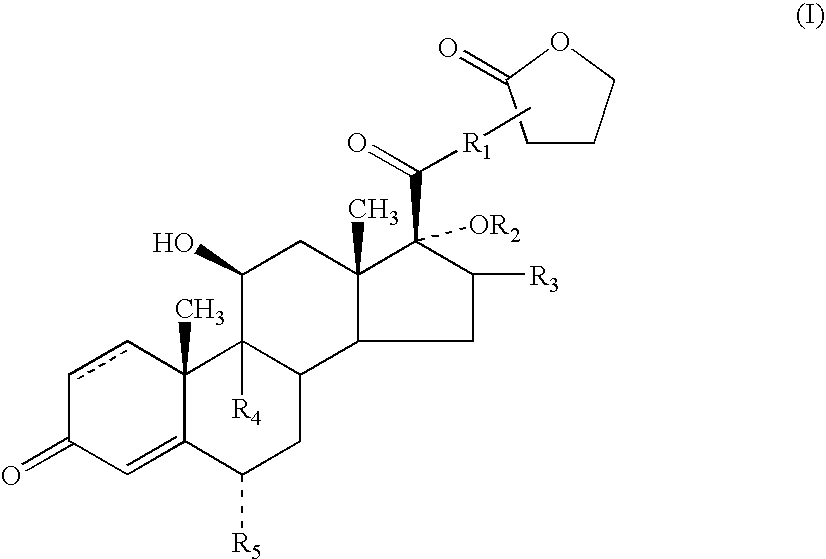
-
- R1 represents O, S or NH;
- R2 represents —C(═O)-aryl or —C(═O)-heteroaryl;
- R3 represents hydrogen, methyl (which may be in either the α or β configuration) or methylene;
- R4 and R5 are the same or different and each represents hydrogen or halogen; and

Description
- The present invention relates to novel anti-inflammatory and anti-allergic compounds of the androstane series and to processes for their preparation. The present invention also relates to pharmaceutical formulations containing the compounds and to therapeutic uses thereof, particularly for the treatment of inflammatory and allergic conditions.
- Glucocorticosteroids which have anti-inflammatory properties are known and are widely used for the treatment of inflammatory disorders or diseases such as asthma and rhinitis. However, glucocorticosteroids in general may suffer from the disadvantage of causing unwanted systemic effects following administration. The side effects that are feared with glucocorticoids include suppression of the Hypothalamic-Pituitary-Adrenal (HPA) axis, effects on bone growth in children and on bone density in the elderly, ocular complications (cataract formation and glaucoma) and skin atrophy. Certain glucocorticoid compounds also have complex paths of metabolism wherein the production of active metabolites may make the pharmacodynamics and pharmacokinetics of such compounds difficult to understand. Whilst the modern steroids are very much safer than those originally introduced it remains an object of research to produce new molecules which have excellent anti-inflammatory properties, with predictable pharmacokinetic and pharmacodynamic properties, with an attractive side effect profile, and with a convenient treatment regime. WO94/13690, WO94/14834, WO92/13873, WO92/13872, WO 97/24365, WO 97/24367 and WO 97/24368 all disclose glucocorticosteroids which are alleged to possess anti-inflammatory activity coupled with reduced systemic potency. Certain novel androstane derivatives are disclosed in WO02/12265, WO02/12266 (Glaxo Group) and WO02/00679 (Novartis), these three documents being published after the earliest priority date of this patent application.
- The present invention provides a novel group of compounds which possess useful and long lasting anti-inflammatory activity whilst having little or no systemic activity. Thus, the compounds of the present invention represent a safer alternative to those known glucocorticoids which have poor side-effect profiles.
- Thus, according to one aspect of the invention, there is provided a compound of formula (I)

wherein - R1 represents O, S or NH;
- R2 represents —C(═O)-aryl or —C(═O)-heteroaryl;
- R3 represents hydrogen, methyl (which may be in either the α or β configuration) or methylene;
- R4 and R5 are the same or different and each represents hydrogen or halogen; and

- represents a single or a double bond;
- and salts and solvates thereof.
- References to the term “aryl” include references to phenyl which may be optionally substituted with one or more substituents.
- References to the term “heteroaryl” include references to 5 or 6 membered heterocyclic aromatic rings containing 1-3 hetero atoms selected from N, O and S (e.g. thiophenyl (eg thiophen-2-yl or thiophen-3-yl), furanyl (eg furan-2-yl or furan-3-y), pyrrolyl (eg 1H-pyrrol-2-yl), thiadiazolyl (eg 1,2,3-thiadiazol-5-yl, or 1,2,3-thiadiazol-4-yl)). Further examples include thiazolyl (eg 1,3-thiazolyl-5-yl or 1,3-thiazolyl-4-yl), isoxazolyl (eg isoxazol-5-yl, isoxazol-4-yl or isoxazol-3-yl), isothiazolyl (eg isothiazol-3-yl or isothiazol-5-yl) and pyrazolyl (eg 1H-pyrazol-5-yl).
- All of the previously named heterocycles may be optionally substituted with one or more (e.g. 1 or 2) substituents.
- Examples of substituents for aryl and heteroaryl include C1-6alkyl (e.g. methyl), halogen (e.g. chlorine or bromine) or C1-6 alkoxy (e.g. methoxy or ethoxy).
- Examples of substituted furanyl include 3-Me-furan-2-yl, 5-Br-furan-2-yl, 2-Me-furan-3-yl and 2,5-diMe-furan-3-yl. Examples of substituted thiophenyl include 5-Me-thiophen-2-yl, 5-Cl-thiophen-2-yl, 3-Cl-thiophen-2-yl, 3-Br-thiophen-2-yl, 4-methoxy-thiophen-3-yl, 2,5-diCl-thiophen-3-yl and 4-methoxy-5-Cl-thiophen-3-yl. Examples of substituted pyrrolyl include 1-Me-1H-pyrrol-2-yl. Examples of substituted thiadiazolyl include 4-Me-1,2,3-thiadiazol-5-yl. Examples of substituted isoxazolyl include 3-Me-isoxazol-5-yl, 5-Me-isoxazol-3-yl and 3,5-diMe-isoxazol-4-yl. Examples of substituted pyrazolyl include 1,3-diMe-1H-pyrazol-5-yl.
- Examples of solvates include hydrates.
- Examples of salts of compounds of formula (I) include physiologically acceptable salts which may be formed with basic compounds (such as when heteroaryl is basic) eg. acetate, benzoate, citrate, succinate, lactate, tartrate, fumarate and maleate.
- References hereinafter to a compound according to the invention includes both compounds of formula (I) and salts and solvates thereof, particularly pharmaceutically acceptable salts and solvates.
- It will be appreciated that the invention includes within its scope all stereoisomers of the compounds of formula (I) and mixtures thereof.
- Preferably, the absolute stereochemistry will be as shown in the representation of compounds of formula (I).
- In particular the compounds of formula (I) contain an asymmetric centre at the point of attachment of the lactone moiety. Thus, the invention includes within its scope both diastereoisomers at this asymmetric centre and mixtures thereof.
- We prefer R1 to represent O or S, especially S.
- R1 can be bonded to the alpha, beta or gamma carbon atoms of the lactone group,

- We prefer that R1 is bonded to the alpha atom of the lactone group.
- We prefer R2 to represent —C(═O)-heteroaryl. Preferably the heteroaryl is a 5-membered heterocyclic aromatic ring containing 1 to 3 heteroatoms selected from O, N and S which may optionally be substituted. In one respect, preferably heteroaryl represents furanyl, pyrrolyl or thiophenyl, more preferably furanyl or thiophenyl eg 2-furanyl, 3-furanyl, 2-thiophenyl or 3-thiophenyl, especially furanyl, particularly 2-furanyl.
- Of particular interest are compounds in which the heteroaryl is a 5-membered heterocyclic aromatic ring containing 2 heteroatoms selected from O, N and S. Thus a further set of preferred compounds is that in which R2 represents optionally substituted thiazolyl. A further set of preferred compounds is that in which R2 represents optionally substituted isothiazolyl. A further set of preferred compounds is that in which R2 represents optionally substituted pyrazolyl. A further set of preferred compounds is that in which R2 represents optionally substituted isoxazolyl.
- Of particular interest is compounds in which the heteroaryl is a 5-membered heterocyclic aromatic ring containing 3 heteroatoms selected from O, N and S. Thus a further set of preferred compounds is that in which R2 represents optionally substituted thiadiazolyl.
- Compounds in which R2 represents —C(═O)-aryl (preferably aryl represents phenyl) are also of particular interest.
- We prefer R3 to represent methyl, especially methyl in the α configuration. Compounds in which R3 represents methyl in the β configuration are also of particular interest.
- Compounds of formula (I) in which R4 and R5, which can be the same or different, each represents hydrogen, fluorine or chlorine, particularly hydrogen or fluorine, are preferred. Especially preferred are compounds in which both R4 and R5 are fluorine.
- Preferably,

represents a double bond. Compounds in which
represents a single bond are also of particular interest. - A particularly preferred group of compounds of the present invention are compounds of formula (I) in which R1 is S; R2 is —C(═O)-2-furanyl; R3 is methyl; R4 and R5, which can be the same or different, each represents hydrogen or fluorine, especially fluorine, and

represents a single or a double bond. - It is to be understood that the present invention covers all combinations of particularly and preferred groups referred to hereinabove.
- Preferred compounds of formula (I) include: 6α, 9α-difluoro-17α-[(2-furanylcarbonyl)oxy]-11β-hydroxy-16α-methyl-3-oxo-androsta-1,4-diene-17β-carbothioic acid S-(2-oxo-tetrahydro-furan-3-yl)ester or a solvate thereof, particularly 6α,9α-difluoro-17α-[(2-furanylcarbonyl)oxy]-11β-hydroxy-16α-methyl-3-oxo-androsta-1,4-diene-17β-carbothioic acid S-(2-oxo-tetrahydro-furan-3S-yl)ester or a solvate thereof.
- It will be appreciated that each of the above compounds of formula (I) includes the individual R and S diastereoisomers at the asymmetric centre at the point of attachment of the lactone moiety as well as the mixtures thereof. Thus, the individual R and S diastereoisomers isolated such as to be substantially free of the other diastereoisomer i.e. pure and mixtures thereof are included within the scope of the present invention. An individual R or S diastereoisomer isolated such as to be substantially free of the other diastereoisomer i.e. pure will preferably be isolated such that less than 10% preferably less than 1% especially less than 0.1% of the other diastereoisomer is present.
- The compounds of formula (I) have potentially beneficial anti-inflammatory or anti-allergic effects, particularly upon topical administration, demonstrated by, for example, their ability to bind to the glucocorticoid receptor and to illicit a response via that receptor. Hence, the compounds of formula (I) are useful in the treatment of inflammatory and/or allergic disorders. Further, compounds of formula (I) possess the advantage of having little or no systemic activity. Therefore, the compounds of the invention may represent a safer alternative to those known anti-inflammatory glucocorticoids which have poor side effect profiles.
- Examples of disease states in which the compounds of the invention have utility include skin diseases such as eczema, psoriasis, allergic dermatitis neurodermatitis, pruritis and hypersensitivity reactions; inflammatory conditions of the nose, throat or lungs such as asthma (including allergen-induced asthmatic reactions), rhinitis (including hayfever), nasal polyps, chronic obstructive pulmonary disease, interstitial lung disease, and fibrosis; inflammatory bowel conditions such as ulcerative colitis and Crohn's disease; and auto-immune diseases such as rheumatoid arthritis.
- Compounds of the invention may also have use in the treatment of conjunctiva and conjunctivitis.
- It will be appreciated by those skilled in the art that reference herein to treatment extends to prophylaxis as well as the treatment of established conditions.
- As mentioned above, compounds of formula (I) are useful in human or veterinary medicine, in particular as anti-inflammatory and anti-allergic agents.
- There is thus provided as a further aspect of the invention a compound of formula (I) or a physiologically acceptable salt or solvate thereof for use in human or veterinary medicine, particularly in the treatment of patients with inflammatory and/or allergic conditions.
- According to another aspect of the invention, there is provided the use of a compound of formula (I) or physiologically acceptable salt or solvate thereof for the manufacture of a medicament for the treatment of patients with inflammatory and/or allergic conditions.
- In a further or alternative aspect, there is provided a method for the treatment of a human or animal subject with an inflammatory and/or allergic condition, which method comprises administering to said human or animal subject an effective amount of a compound of formula (I) or physiologically acceptable salt or solvate thereof. There is also provided the use of a compound of formula (I) or physiologically acceptable salt or solvate thereof for the treatment of patients with inflammatory and/or allergic conditions.
- The compounds according to the invention may be formulated for administration in any convenient way, and the invention therefore also includes within its scope pharmaceutical compositions comprising a compound of formula (I) or physiologically acceptable salt or solvate thereof together, if desirable, in admixture with one or more physiologically acceptable diluents or carriers.
- Further, there is provided a process for the preparation of such pharmaceutical compositions which comprises mixing the ingredients.
- The compounds according to the invention may, for example, be formulated for oral, buccal, sublingual, parenteral, local or rectal administration, especially local administration.
- Local administration as used herein, includes administration by insufflation and inhalation. Examples of various types of preparation for local administration include ointments, lotions, creams, gels, foams, preparations for delivery by transdermal patches, powders, sprays, aerosols, capsules or cartridges for use in an inhaler or insufflator or drops (e.g. eye or nose drops), solutions/suspensions for nebulisation, suppositories, pessaries, retention enemas and chewable or suckable tablets or pellets (e.g. for the treatment of aphthous ulcers) or liposome or microencapsulation preparations.
- Advantageously compositions for topical administration to the lung include dry powder compositions and spray compositions.
- Dry powder compositions for topical delivery to the lung may, for example, be presented in capsules and cartridges for use in an inhaler or insufflator of, for example, gelatine. Formulations generally contain a powder mix for inhalation of the compound of the invention and a suitable powder base such as lactose or starch. Each capsule or cartridge may generally contain between 20 μg-10 mg of the compound of formula (I). Alternatively, the compound of the invention may be presented without excipients. Packaging of the formulation may be suitable for unit dose or multi-dose delivery. In the case of multi-dose delivery, the formulation can be pre-metered (eg. as in Diskus, see GB 2242134 or Diskhaler, see GB 2178965, 2129691 and 2169265) or metered in use (eg. as in Turbuhaler, see EP 69715). An example of a unit-dose device is Rotahaler (see GB 2064336). The Diskus inhalation device comprises an elongate strip formed from a base sheet having a plurality of recesses spaced along its length and a lid sheet hermetically but peelably sealed thereto to define a plurality of containers, each container having therein an inhalable formulation containing a compound of formula (I) preferably combined with lactose. Preferably, the strip is sufficiently flexible to be wound into a roll. The lid sheet and base sheet will preferably have leading end portions which are not sealed to one another and at least one of the said leading end portions is constructed to be attached to a winding means. Also, preferably the hermetic seal between the base and lid sheets extends over their whole width. The lid sheet may preferably be peeled from the base sheet in a longitudinal direction from a first end of the said base sheet.
- Spray compositions may for example be formulated as aqueous solutions or suspensions or as aerosols delivered from pressurised packs, such as a metered dose inhaler, with the use of a suitable liquefied propellant. Aerosol compositions suitable for inhalation can be either a suspension or a solution and generally contain the compound of formula (I) and a suitable propellant such as a fluorocarbon or hydrogen-containing chlorofluorocarbon or mixtures thereof, particularly hydrofluoroalkanes, especially 1,1,1,2-tetrafluoroethane, 1,1,1,2,3,3,3-heptafluoro-n-propane or a mixture thereof. The aerosol composition may optionally contain additional formulation excipients well known in the art such as surfactants e.g. oleic acid or lecithin and cosolvents e.g. ethanol. One example formulation is excipient free and consists essentially of (eg consists of) a compound of formula (I) (optionally together with another active ingredient) and a propellant selected from 1,1,1,2-tetrafluoroethane, 1,1,1,2,3,3,3-heptafluoro-n-propane and mixture thereof. Another example formulation comprises particulate compound of formula (I), a propellant selected from 1,1,1,2-tetrafluoroethane, 1,1,1,2,3,3,3-heptafluoro-n-propane and mixture thereof and a suspending agent which is soluble in the propellant eg an oligolactic acid or derivative thereof as described in WO94/21229. The preferred propellant is 1,1,1,2-tetrafluoroethane. Pressurised formulations will generally be retained in a canister (eg an aluminium canister) closed with a valve (eg a metering valve) and fitted into an actuator provided with a mouthpiece.
- Medicaments for administration by inhalation desirably have a controlled particle size. The optimum particle size for inhalation into the bronchial system is usually 1-10 μm, preferably 2-5 μm. Particles having a size above 20 μm are generally too large when inhaled to reach the small airways. To achieve these particle sizes the particles of compound of formula (I) as produced may be size reduced by conventional means eg. by micronisation. The desired fraction may be separated out by air classification or sieving. Preferably, the particles will be crystalline, prepared for example by a process which comprises mixing in a continuous flow cell in the presence of ultrasonic radiation a flowing solution of compound of formula (I) as medicament in a liquid solvent with a flowing liquid antisolvent for said medicament (eg as described in International Patent Application PCT/GB99/04368) or else by a process which comprises admitting a stream of solution of the substance in a liquid solvent and a stream of liquid antisolvent for said substance tangentially into a cylindrical mixing chamber having an axial outlet port such that said streams are thereby intimately mixed through formation of a vortex and precipitation of crystalline particles of the substance is thereby caused (eg as described in International Patent Application PCT/GB00/04327). When an excipient such as lactose is employed, generally, the particle size of the excipient will be much greater than the inhaled medicament within the present invention. When the excipient is lactose it will typically be present as milled lactose, wherein not more than 85% of lactose particles will have a MMD of 60-90 μm and not less than 15% will have a MMD of less than 15 μm.
- Formulations for administration topically to the nose include pressurised aerosol formulations and aqueous formulations administered to the nose by pressurised pump.
- Aqueous formulations for administration to the lung or nose may be provided with conventional excipients such as buffering agents, tonicity modifying agents and the like. Aqueous formulations may also be administered to the nose by nebulisation.
- Other possible presentations include the following: Ointments, creams and gels, may, for example, be formulated with an aqueous or oily base with the addition of suitable thickening and/or gelling agent and/or solvents. Such bases may thus, for example, include water and/or an oil such as liquid paraffin or a vegetable oil such as arachis oil or castor oil, or a solvent such as polyethylene glycol. Thickening agents and gelling agents which may be used according to the nature of the base include soft paraffin, aluminium stearate, cetostearyl alcohol, polyethylene glycols, woolfat, beeswax, carboxypolymethylene and cellulose derivatives, and/or glyceryl monostearate and/or non-ionic emulsifying agents.
- Lotions may be formulated with an aqueous or oily base and will in general also contain one or more emulsifying agents, stabilising agents, dispersing agents, suspending agents or thickening agents.
- Powders for external application may be formed with the aid of any suitable powder base, for example, talc, lactose or starch. Drops may be formulated with an aqueous or non-aqueous base also comprising one or more dispersing agents, solubilising agents, suspending agents or preservatives.
- If appropriate, the formulations of the invention may be buffered by the addition of suitable buffering agents.
- The proportion of the active compound of formula (I) in the local compositions according to the invention depends on the precise type of formulation to be prepared but will generally be within the range of from 0.001 to 10% by weight. Generally, however for most types of preparations advantageously the proportion used will be within the range of from 0.005 to 1% and preferably 0.01 to 0.5%. However, in powders for inhalation or insufflation the proportion used will usually be within the range of from 0.1 to 5%.
- Aerosol formulations are preferably arranged so that each metered dose or “puff” of aerosol contains 1 μg-2000 μg eg 20 μg-2000 μg, preferably about 20 μg-500 kg of a compound of formula (I). Administration may be once daily or several times daily, for example 2, 3, 4 or 8 times, giving for example 1, 2 or 3 doses each time. Preferably the compound of formula (I) is delivered once or twice daily. The overall daily dose with an aerosol will typically be within the range 10 μg-10 mg eg 100 μg-10 mg preferably, 200 μg-2000 μg.
- Topical preparations may be administered by one or more applications per day to the affected area; over skin areas occlusive dressings may advantageously be used. Continuous or prolonged delivery may be achieved by an adhesive reservoir system.
- For internal administration the compounds according to the invention may, for example, be formulated in conventional manner for oral, parenteral or rectal administration. Formulations for oral administration include syrups, elixirs, powders, granules, tablets and capsules which typically contain conventional excipients such as binding agents, fillers, lubricants, disintegrants, wetting agents, suspending agents, emulsifying agents, preservatives, buffer salts, flavouring, colouring and/or sweetening agents as appropriate. Dosage unit forms are, however, preferred as described below.
- Preferred forms of preparation for internal administration are dosage unit forms i.e. tablets and capsules. Such dosage unit forms contain from 0.1 mg to 20 mg preferably from 2.5 to 10 mg of the compounds of the invention.
- The compounds according to the invention may in general may be given by internal administration in cases where systemic adreno-cortical therapy is indicated.
- In general terms preparations, for internal administration may contain from 0.05 to 10% of the active ingredient dependent upon the type of preparation involved. The daily dose may vary from 0.1 mg to 60 mg, e.g. 5-30 mg, dependent on the condition being treated, and the duration of treatment desired.
- Slow release or enteric coated formulations may be advantageous, particularly for the treatment of inflammatory bowel disorders.
- The pharmaceutical compositions according to the invention may also be used in combination with another therapeutically active agent, for example, a P2 adrenoreceptor agonist, an anti-histamine or an anti-allergic. The invention thus provides, in a further aspect, a combination comprising a compound of formula (I) or a physiologically acceptable salt or solvate thereof together with another therapeutically active agent, for example, a β2-adrenoreceptor agonist, an anti-histamine or an anti-allergic.
- Combinations with long acting β2 adrenoreceptor agonists are preferred, especially those capable of providing a therapeutic effect over 24 hours. There is, for example, provided a pharmaceutical composition suitable for once-per-day administration comprising a compound of formula (I) or a salt or solvate thereof in combination with a long acting β2 adrenoreceptor agonist.
- Examples of β2-adrenoreceptor agonists include salmeterol (eg as racemate or a single enantiomer such as the R-enantiomer), salbutamol, formoterol, salmefamol, fenoterol or terbutaline and salts thereof, for example the xinafoate salt of salmeterol, the sulphate salt or free base of salbutamol or the fumarate salt of formoterol. Long acting β2-adrenoreceptor agonists, such as salmeterol or fomoterol, are preferred.
- Preferred long acting β2-adrenoreceptor agonists include those described in WO 266422A.
- Especially preferred long-acting β2-adrenoreceptor agonists are compounds of formula (X)
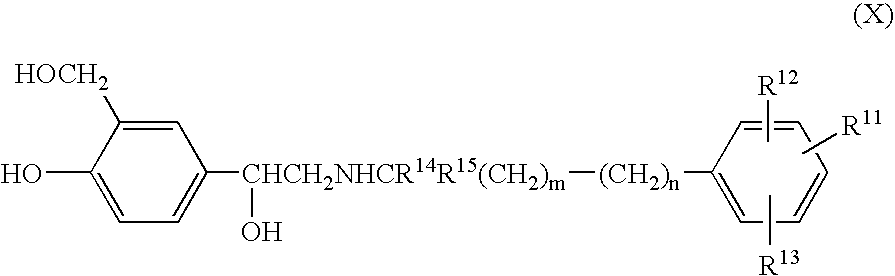
or a salt or solvate thereof, wherein: - m is an integer of from 2 to 8;
- n is an integer of from 3 to 11, preferably from 3 to 7;
- with the proviso that m+n is 5 to 19, preferably 5 to 12;
- R11 is —XSO2NR16R17
- wherein X is —(CH2)p— or C2-6alkenylene;
- R16 and R17 are independently selected from hydrogen, C1-6alkyl, C3-7cycloalkyl, C(O)NR18R19, phenyl, and phenyl (C1-4alkyl)-,
- or R16 and R17, together with the nitrogen to which they are bonded, form a 5-, 6-, or 7-membered nitrogen containing ring, and R16 and R17 are each optionally substituted by one or two groups selected from halo, C1-6alkyl, C1-6haloalkyl, C1-6alkoxy, hydroxy-substituted C1-6alkoxy, —CO2R18, —SO2NR18R19, —CONR18R19, —NR18C(O)R19, or a 5-, 6- or 7-membered heterocylic ring;
- R18 and R19 are independently selected from hydrogen, C1-6alkyl, C3-6cycloalkyl, phenyl, and phenyl (C1-4alkyl)—; and
- p is an integer of from 0 to 6, preferably from 0 to 4;
- R12 and R13 are independently selected from hydrogen, C1-6alkyl, C1-6alkoxy, halo, phenyl, and C1-6haloalkyl; and
- R14 and R15 are independently selected from hydrogen and C1-4alkyl with the proviso that the total number of carbon atoms in R14 and R15 is not more than 4.
- In the compounds of formula (I) the group R11 is preferably attached to the meta-position relative to the —O—(CH2)1— link.
- R11 preferably represents —SO2NR16R17 wherein R16 and R17 are independently selected from hydrogen and C1-6alkyl, more preferably R11 is —SO2NH2.
- R14 and R15 are preferably independently selected from hydrogen and methyl, more preferably R14 and R15 are both hydrogen.
- m is suitably 4, 5, or 6, and n is suitably 3, 4, 5 or 6. Preferably m is 5 or 6 and n is 3 or 4, such that m+n is 8, 9 or 10, preferably 9.
- More especially preferred compounds of formula (X) are compounds of formula (Xa)
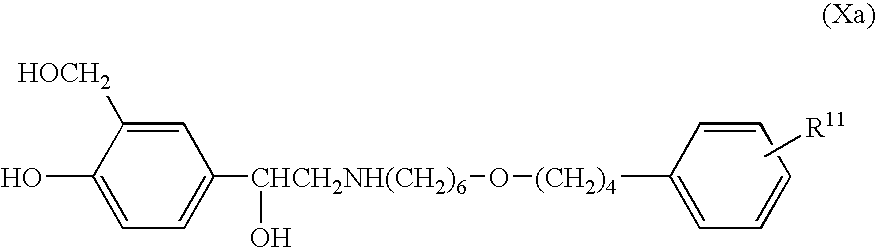
or a salt or solvate thereof, wherein - R11 is as defined above for formula (X).
- Further more especially preferred compounds of formula (X) are compounds of formula (Xb):
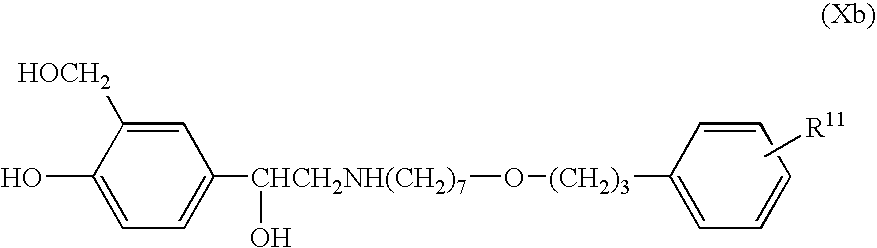
or a salt or solvate thereof, wherein - R11 is as defined above for formula (X).
- In the compounds of formulae (Xa) and (Xb), the group R11 is preferably attached to the meta-position relative to the —O—(CH2)4— or —O—(CH2)3— link respectively.
- In the compounds of formulae (Xa) and (Xb), R11 is preferably —SO2NR16R17 wherein R16 and R17 are independently selected from hydrogen and C1-6alkyl, more preferably R11 is —SO2NH2.
- In the definition of R11 where ‘R16 and R17 together with the nitrogen atom to which they are bonded, form a 5-, 6-, or 7-membered nitrogen containing ring’, the term “5-, 6-, or 7-membered nitrogen containing ring” means a 5-, 6-, or 7-membered saturated or unsaturated ring which includes the sulfonamide nitrogen atom and optionally 1 or 2 other heteroatoms independently selected from nitrogen, sulphur, and oxygen. Suitable examples of such a ring include piperidinyl, morpholinyl, and piperazinyl.
- In the definition of R11, specifically the optional substituents on R16 and R17, the term “5-, 6-, or 7-membered heterocyclic ring” means a 5-, 6-, or 7-membered fully or partially saturated or unsaturated ring which includes 1, 2, 3 or 4 heteroatoms independently selected from nitrogen, sulphur, and oxygen. Suitable examples of such a ring include pyrrolyl, furyl, thienyl, pyridinyl, pyrazinyl, pyridazinyl, imidazolyl, tetrazolyl, tetrahydrofuranyl, oxazolyl, thiazolyl, thiadiazolyl, piperidinyl, morpholinyl, and piperazinyl.
- In the definition of X, the term “alkenylene” includes both cis and trans structures. Suitable examples of alkenylene groups include —CH═CH—.
- The compounds of formulae (X), (Xa) and (Xb) include an asymmetric centre, namely the carbon atom of the

group. The present invention includes both (S) and (R) enantiomers either in substantially pure form or admixed in any proportions. - Similarly, where R14 and R15 are different groups, the carbon atom to which they are attached is an asymmetric centre and the present invention includes both (S) and (R) enantiomers at this centre either in substantially pure form or admixed in any proportions.
- Thus the compounds of formulae (X), (Xa) and (Xb) include all enantiomers and diastereoisomers as well as mixtures thereof in any proportions.
- The most preferred compound of formula (X) is 3-(4-{[6-({(2R)-2-Hydroxy-2-[4-hydroxy-3-(hydroxymethyl)phenyl]ethyl}amino)-hexyl]oxy}butyl)benzenesulfonamide or a salt or solvate thereof.
- Salts and solvates of compounds of formulae (X), (Xa) and (Xb) which are suitable for use in medicine are those wherein the counterion or associated solvent is pharmaceutically acceptable. However, salts and solvates having non-pharmaceutically acceptable counterions or associated solvents are within the scope of the present invention, for example, for use as intermediates in the preparation of other compounds of formulae (X), (Xa) and (Xb) and their pharmaceutically acceptable salts and solvates.
- Suitable salts according to the invention include those formed with both organic and inorganic acids or bases. Pharmaceutically acceptable acid addition salts include those formed from hydrochloric, hydrobromic, sulphuric, citric, tartaric, phosphoric, lactic, pyruvic, acetic, trifluoroacetic, triphenylacetic, sulphamic, sulphanilic, succinic, oxalic, fumaric, maleic, malic, glutamic, aspartic, oxaloacetic, methanesulphonic, ethanesulphonic, arylsulphonic (for example p-toluenesulphonic, benzenesulphonic, naphthalenesulphonic or naphthalenedisulphonic), salicylic, glutaric, gluconic, tricarballylic, cinnamic, substituted cinnamic (for example, phenyl, methyl, methoxy or halo substituted cinnamic, including 4-methyl and 4-methoxycinnamic acid), ascorbic, oleic, naphthoic, hydroxynaphthoic (for example 1- or 3-hydroxy-2-naphthoic), naphthaleneacrylic (for example naphthalene-2-acrylic), benzoic, 4-methoxybenzoic, 2- or 4-hydroxybenzoic, 4-chlorobenzoic, 4-phenylbenzoic, benzeneacrylic (for example 1,4-benzenediacrylic) and isethionic acids. Pharmaceutically acceptable base salts include ammonium salts, alkali metal salts such as those of sodium and potassium, alkaline earth metal salts such as those of calcium and magnesium and salts with organic bases such as dicyclohexyl amine and N-methyl-D-glucamine.
- Compounds of formula (X), (Xa) and (Xb) may be prepared by reference to Example X recited below, by analogous processes, or by other conventional processes known per se.
- Since the compounds of formula (I) are expected to be long-acting, preferably the composition comprising the compound of formula (I) and the long-acting β2-adrenoreceptor agonists will be delivered once-per-day and the dose of each will be selected so that the composition has a therapeutic effect in the treatment of respiratory disorders effect (eg in the treatment of asthma or COPD, particularly asthma) over 24 hours or more.
- Examples of anti-histamines include methapyrilene or loratadine.
- Other suitable combinations include, for example, other anti-inflammatory agents eg. NSAIDs (eg. sodium cromoglycate, nedocromil sodium, PDE4 inhibitors, leukotriene antagonists, iNOS inhibitors, tryptase and elastase inhibitors, beta-2 integrin antagonists and adenosine 2a agonists)) or antiinfective agents (eg. antibiotics, antivirals). Compounds of formula (I) may also be combined with anti-cholinergic compounds, examples of which include ipratropium (eg as bromide), tiotropium, atropine or oxitropium. Any of the aforementioned substances may be employed in the form of alternative salts or solvates thereof.
- Of particular interest is use of the compounds of formula (I) in combination with a phosphodiesterase 4 (PDE4) inhibitor. The PDE4-specific inhibitor useful in this aspect of the invention may be any compound that is known to inhibit the PDE4 enzyme or which is discovered to act as a PDE4 inhibitor, and which are only PDE4 inhibitors, not compounds which inhibit other members of the PDE family as well as PDE4. Generally it is preferred to use a PDE4 inhibitor which has an IC50 ratio of about 0.1 or greater as regards the IC50 for the PDE4 catalytic form which binds rolipram with a high affinity divided by the IC50 for the form which binds rolipram with a low affinity. For the purposes of this disclosure, the cAMP catalytic site which binds R and S rolipram with a low affinity is denominated the “low affinity” binding site (LPDE 4) and the other form of this catalytic site which binds rolipram with a high affinity is denominated the “high affinity” binding site (HPDE 4). This term “HPDE4” should not be confused with the term “hPDE4” which is used to denote human PDE4.
- Initial experiments were conducted to establish and validate a [3H]-rolipram binding assay. Details of this work are given in the Binding Assays described in detail below.
- The preferred PDE4 inhibitors of use in this invention will be those compounds which have a salutary therapeutic ratio, i.e., compounds which preferentially inhibit cAMP catalytic activity where the enzyme is in the form that binds rolipram with a low affinity, thereby reducing the side effects which apparently are linked to inhibiting the form which binds rolipram with a high affinity. Another way to state this is that the preferred compounds will have an IC50 ratio of about 0.1 or greater as regards the IC50 for the PDE4 catalytic form which binds rolipram with a high affinity divided by the IC50 for the form which binds rolipram with a low affinity. A further refinement of this standard is that of one wherein the PDE4 inhibitor has an IC50 ratio of about 0.1 or greater; said ratio is the ratio of the IC50 value for competing with the binding of 1 nM of [3H]R-rolipram to a form of PDE4 which binds rolipram with a high affinity over the IC50 value for inhibiting the PDE4 catalytic activity of a form which binds rolipram with a low affinity using 1 μM[3H]-cAMP as the substrate.
- Examples of useful PDE4 inhibitors are:
- (R)-(+)-1-(4-bromobenzyl)-4-[(3-cyclopentyloxy)-4-methoxyphenyl]-2-pyrrolidone;
- (R)-(+)-1-(4-bromobenzyl)-4-[(3-cyclopentyloxy)-4-methoxyphenyl]-2-pyrrolidone;
- 3-(cyclopentyloxy-4-methoxyphenyl)-1-(4-N′-[N2-cyano-S-methyl-isothioureido]benzyl)-2-pyrrolidone;
- cis 4-cyano-4-(3-cyclopentyloxy-4-methoxyphenyl)cyclohexan-1-carboxylic acid];
- cis-[4-cyano-4-(3-cyclopropylmethoxy-4-difluoromethoxyphenyl)cyclohexan-1-ol];
- (R)-(+)-ethyl [4-(3-cyclopentyloxy-4-methoxyphenyl)pyrrolidine-2-ylidene]acetate; and
- (S)-(−)-ethyl [4-(3-cyclopentyloxy-4-methoxyphenyl)pyrrolidine-2-ylidene]acetate.
Most preferred are those PDE4 inhibitors which have an IC50 ratio of greater than 0.5, and particularly those compounds having a ratio of greater than 1.0. Preferred compounds are cis 4-cyano-4-(3-cyclopentyloxy-4-methoxyphenyl)cyclohexan-1-carboxylic acid, 2-carbomethoxy-4-cyano-4-(3-cyclopropylmethoxy-4-difluoromethoxyphenyl)cyclohexan-1-one and cis-[4-cyano-4-(3-cyclopropylmethoxy-4-difluoromethoxyphenyl)cyclohexan-1-ol]; these are examples of compounds which bind preferentially to the low affinity binding site and which have an IC50 ratio of 0.1 or greater.
Other compounds of interest include: - Compounds set out in U.S. Pat. No. 5,552,438 issued 03 September, 1996; this patent and the compounds it discloses are incorporated herein in full by reference. The compound of particular interest, which is disclosed in U.S. Pat. No. 5,552,438, is cis-4-cyano-4-[3-(cyclopentyloxy)4-methoxyphenyl]cyclohexane-1-carboxylic acid (also known as cilomalast) and its salts, esters, pro-drugs or physical forms; AWD-12-281 from Astra (Hofgen, N. et al. 15th EFMC Int Symp Med Chem (Sep. 6-10, Edinburgh) 1998, Abst P.98); a 9-benzyladenine derivative nominated NCS-613 (INSERM); D4418 from Chiroscience and Schering-Plough; a benzodiazepine PDE4 inhibitor identified as Cl-1018 (PD-168787; Parke-Davis/Wamer-Lambert); a benzodioxole derivative Kyowa Hakko disclosed in WO 9916766; V-11294A from Napp (Landells, L. J. et al. Eur Resp J [Annu Cong Eur Resp Soc (Sep. 19-23, Geneva) 1998] 1998, 12(Suppl. 28): Abst P2393); roflumilast (CAS reference No 162401-32-3) and a pthalazinone (WO 9947505) from Byk-Gulden; or a compound identified as T-440 (Tanabe Seiyaku; Fuji, K. et al. J Pharmacol Exp Ther, 1998, 284(1): 162).
- Phosphodiesterase and Rolipram Binding Assays
- Assay method 1A
- Isolated human monocyte PDE4 and hrPDE (human recombinant PDE4) was determined to exist primarily in the low affinity form. Hence, the activity of test compounds against the low affinity form of PDE4 can be assessed using standard assays for PDE4 catalytic activity employing 1 μM [3H]cAMP as a substrate (Torphy et al., J. of Biol. Chem., Vol. 267, No. 3 pp1798-1804,1992).
- Rat brain high speed supernatants were used as a source of protein and both enantiomers of [3H]-rolipram were prepared to a specific activity of 25.6 Ci/mmol. Standard assay conditions were modified from the published procedure to be identical to the PDE assay conditions, except for the last of the cAMP: 50 mM Tris HCl (pH 7.5), 5 mM MgCl2, 50 μM 5′-AMP and 1 nM of [3H]-rolipram (Torphy et al., J. of Biol. Chem., Vol. 267, No. 3 pp1798-1804, 1992). The assay was run for 1 hour at 30° C. The reaction was terminated and bound ligand was separated from free ligand using a Brandel cell harvester. Competition for the high affinity binding site was assessed under conditions that were identical to those used for measuring low affinity PDE activity, expect that [3H]-cAMP was not present.
- Assay Method 1 B
- Measurement of Phosphodiesterase Activity
- PDE activity was assayed using a [3H]cAMP SPA or [3H]cGMP SPA enzyme assay as described by the supplier (Amersham Life Sciences). The reactions were conducted in 96-well plates at room temperature, in 0.1 ml of reaction buffer containing (final concentrations): 50 mM Tris-HCl, pH 7.5, 8.3 mM MgCl2, 1.7 mM EGTA, [3H]cAMP or [3H] cGMP (approximately 2000 dpm/pmol), enzyme and various concentrations of the inhibitors. The assay was allowed to proceed for 1 hr and was terminated by adding 50 μl of SPA yttrium silicate beads in the presence of zinc sulfate. The plates were shaken and allowed to stand at room temperature for 20 min. Radiolabeled product formation was assessed by scintillation spectrometry.
- [3H]R-Rolipram Binding Assay
- The [3H]R-rolipram binding assay was performed by modification of the method of Schneider and co-workers, see Nicholson, et al., Trends Pharmacol. Sci., Vol. 12, pp. 19-27 (1991) and McHale et al., Mol. Pharmacol., Vol. 39, 109-113 (1991). R-Rolipram binds to the catalytic site of PDE4 see Torphy et al., Mol. Pharmacol., Vol. 39, pp. 376-384 (1991). Consequently, competition for [3H]R-rolipram binding provides an independent confirmation of the PDE4 inhibitor potencies of unlabeled competitors. The assay was performed at 30° C. for 1 hr in 0.5 μl buffer containing (final concentrations): 50 mM Tris-HCl, pH 7.5, 5 mM MgCl2, 0.05% bovine serum albumin, 2 nM [3H]R-rolipram (5.7×10⁴ dpm/pmol) and various concentrations of non-radiolabeled inhibitors. The reaction was stopped by the addition of 2.5 ml of ice-cold reaction buffer (without [3H]-R-rolipram) and rapid vacuum filtration (Brandel Cell Harvester) through Whatman GF/B filters that had been soaked in 0.3% polyethylenimine. The filters were washed with an additional 7.5 ml of cold buffer, dried, and counted via liquid scintillation spectrometry.
- The invention thus provides, in a further aspect, a combination comprising a compound of formula (I) or a physiologically acceptable salt or solvate thereof together with a PDE4 inhibitor.
- The combination referred to above may conveniently be presented for use in the form of a pharmaceutical formulation and thus pharmaceutical formulations comprising a combination as defined above together with a pharmaceutically acceptable diluent or carrier represent a further aspect of the invention.
- The individual compounds of such combinations may be administered either sequentially or simultaneously in separate or combined pharmaceutical formulations.
- Appropriate doses of known therapeutic agents will be readily appreciated by those skilled in the art.
- The compounds of formula (I) and salts and solvates thereof may be prepared by the methodology described hereinafter, constituting a further aspect of this invention.
- Thus, according to a first process (A), a compound of formula (I) may be prepared by treating a compound of formula (II)
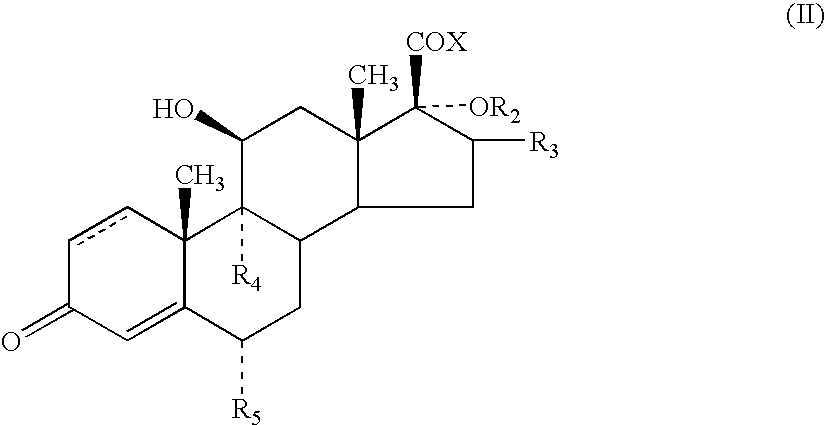
in which R2, R3, R4, R5 and
are as defined hereinbefore for compounds of formula (I) and X represents OH, SH or an activated derivative thereof such as a triazole or a mixed anhydride, with a compound of formula (III)
and salts thereof, in which - Z represents OH, NH2 or SH.
- Compounds of formula (I) wherein R1 represents O or S may also be prepared according to a second process (B) in which a compound of formula (II) in which R2, R3, R4, R5 and

are as defined hereinbefore and X represents OH or SH or their corresponding salts, is treated with a compound of formula (IV) or formula (V)
in which Q represents a suitable leaving group (such as Cl, Br, OSO2A wherein A is, for example CH3, CF3, p-CH3C6H4), under standard methods. - The above general process (B) employing compounds of formula (IV) can be used to prepare compounds of formula (I) in which R1 is linked to the alpha, beta, or gamma carbon atoms of the lactone group.
- Compounds of formula (I) wherein R1 represents O or S may be prepared according to the above process (B) by alkylation of a compound of formula (II) wherein X represents OH or SH respectively, with a compound of formula (IV) wherein Q represents a suitable leaving group using methods known in the art, or an adaptation of those methods.
- Thus, for example, a compound of formula (i) wherein R1 represents O may be prepared by alkylation of a compound of formula (II) wherein X represents OH conveniently in the form of an appropriate salt (such as alkali metal e.g. sodium or quarternaryammonium salt) with a compound of formula (IV) wherein Q represents a suitable leaving group, preferably chlorine, bromine or mesylate. The alkylation reaction is preferably carried out in the presence of a solvent, suitably a polar solvent, under inert conditions, for example, nitrogen or the like, conveniently at a temperature of between about 0° C. to 100° C. Suitable polar solvents may include acetone, dimethylformamide, dimethyl acetamide, dimethylsulphoxide, dichloromethane or chloroform.
- Similarly, compounds of formula (I) wherein R1 represents S can be prepared according to the above process (B) by alkylation of a compound of formula (II) wherein X represents SH with a compound of formula (IV) wherein Q represents a suitable leaving group by adaptation of the methods described by Phillipps et al, Journal of Medicinal Chemistry, 1994, 37, 3717-3729. Thus, a compound of formula (I) wherein R1 represents S may be prepared by alkylation of the corresponding compound of formula (II) wherein X represents SH conveniently in the form of an appropriate salt (such as alkali metal e.g. sodium or quarternaryammonium salt) with a compound of formula (IV) wherein Z represents a suitable leaving group as described hereinabove for similar alkylation reactions.
- Alternatively, compounds of formula (I) wherein R1 represents O or S may be prepared according to the above process (B) by alkylation of a compound of formula (II) wherein X represents OH or SH with a compound of formula (IV) wherein Q represents OH under Mitsunobu conditions using triphenylphosphine and a dialkyl azodicarboxylate, or by using Vilsmeier methodology as described by Barrett and Procopiou in the Journal of the Chemical Society, Chemical Communications, 1995, 1403-1404.
- A compound of formula (I) wherein R1 represents S and is bonded to the beta carbon atom of the lactone group may also be prepared by reacting the corresponding compound of formula (II) wherein X represents SH with a compound of formula (V). For example, by Michael addition of the compound of formula (II) with the compound of formula (V) in the presence of a base such as potassium carbonate and in a suitable solvent such as dimethylformamide.
- Compounds of formula (I) may also be prepared from other compounds of formula (I) thereof using conventional interconversion procedures such as epimerisation or esterification. Thus, a process for preparing a compound of formula (I) by interconversion of another compound of formula (I) (process C) constitutes a further aspect of the present invention.
- Compounds of formula (I) having a 1,2 single bond may be prepared by partial reduction of the corresponding 1,2 double bond compound by conventional methods. Thus, for example, by hydrogenation of the corresponding compound of formula (I) or of an intermediate used for the preparation of a compound of formula (I) using a palladium catalyst, conveniently in a suitable solvent e.g. ethyl acetate or preferably by using tris(triphenylphosphine) rhodium (I) chloride (known as Wilkinson's catalyst), conveniently in a suitable solvent such as toluene, ethyl acetate or ethanol.
- It will be appreciated by those skilled in the art that it may be desirable to use protected derivatives of intermediates used in the preparation of compounds of formula (I). Thus, the above processes may require deprotection as an intermediate or final step to yield the desired compound. Thus, according to another process (D), a compound of formula (I) may be prepared by subjecting a protected derivative of a compound of formula (I) to reaction to remove the protecting group or groups present, constituting a further aspect of the present invention.
- Protection and deprotection of functional groups may be effected using conventional means. Thus, hydroxyl groups may be protected using any conventional hydroxyl protecting group, for example, as described in Protective Groups in Organic Chemistry, Ed. J. F. W. McOmie (Plenum Press, 1973) or Protective Groups in Organic Synthesis by Theodora W. Green (John Wiley and Sons, 1991).
- Examples of suitable hydroxyl protecting groups includes groups selected from alkyl (e.g. t-butyl or methoxymethyl), aralkyl (e.g. benzyl, diphenylmethyl or triphenylmethyl), heterocyclic groups such as tetrahydropyranyl, acyl (e.g. acetyl or benzoyl) and silyl groups such as trialkylsilyl (e.g. t-butyidimethylsilyl). The hydroxyl protecting groups may be removed by conventional techniques. Thus, for example alkyl, silyl, acyl and heterocyclic groups may be removed by solvolysis, e.g. by hydrolysis under-acidic or basic conditions. Aralkyl groups such as triphenylmethyl may be similarly be removed by solvolysis, e.g. by hydrolysis under acidic conditions. Aralkyl groups such as benzyl may be cleaved by hydrogenolysis in the presence of a Noble metal catalyst such as palladium-on-charcoal.
- Compounds of formulae (III), (IV) and (V) are either generally known compounds or may be prepared by methods analogous to those described in the art for preparing the known compounds of formula (III), (IV) and (V) or may be prepared by the methods described herein.
- Compounds of formula (II) wherein X represents SH may be prepared from the corresponding 17α-hydroxyl derivative of formula (VI):

wherein R2, R3, R4, R5 and
are as defined above, using for example, the methodology described by G. H. Phillipps et al., (1994) Journal of Medicinal Chemistry, 37, 3717-3729. For example the step typically comprises the addition of a reagent suitable for performing the esterification to the ester such as an aryl or heteroarylcarbonyl halide eg. 2-furanoyl chloride in the presence of a mild base eg. triethylamine. Generally the aryl or heteroarylcarbonyl halide would be employed in at least 2 times molar quantity relative to the compound of formula (VI). The second mole of aryl or heteroarylcarbonyl halide tends to react with the thioacid moiety in the compound of formula (VI) and would need to be removed by reaction with an amine such as diethylamine. - Compounds of formula (VI) may be prepared in accordance with procedures described in GB 2088877B.
- Compounds of formula (VI) may also be prepared by a process comprising the following steps:
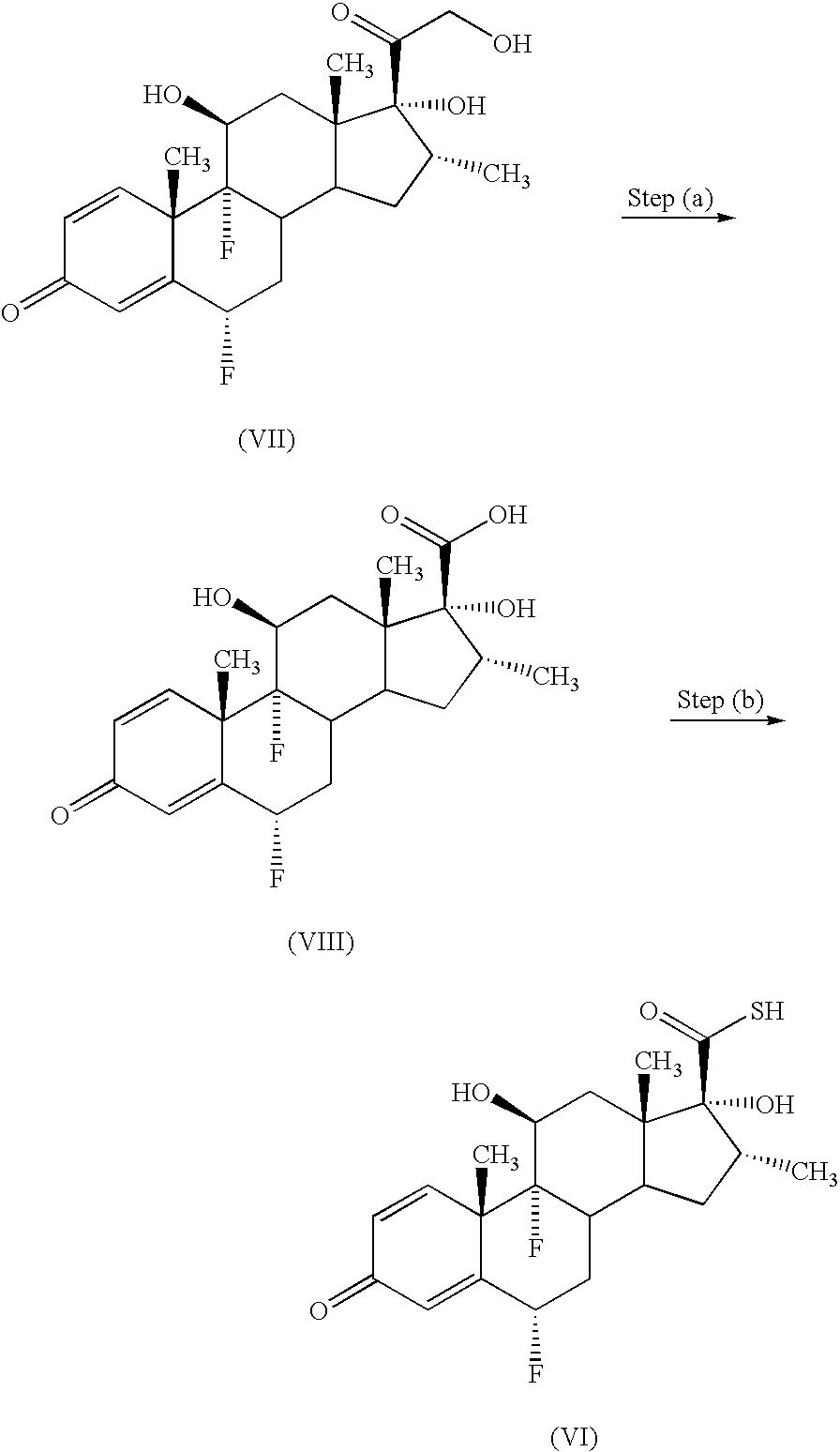
- Step (a) comprises oxidation of a solution containing the compound of formula (VII).
- Preferably, step (a) will be performed in the presence of a solvent comprising methanol, water, tetrahydrofuran, dioxan or diethylene glygol dimethylether. For example, so as to enhance yield and throughput, preferred solvents are methanol, water or tetrahydrofuran, and more preferably are water or tetrahydrofuran, especially water and tetrahydrofuran as solvent. Dioxan and diethylene glygol dimethylether are also preferred solvents which may optionally (and preferably) be employed together with water. Preferably, the solvent will be present in an amount of between 3 and 10 vol relative to the amount of the starting material (1 wt.), more preferably between 4 and 6 vol., especially 5 vol. Preferably the oxidising agent is present in an amount of 1-9 molar equivalents relative to the amount of the starting material. For example, when a 50% w/w aqueous solution of periodic acid is employed, the oxidising agent may be present in an amount of between 1.1 and 10 wt. relative to the amount of the starting material (1 wt.), more preferably between 1.1 and 3 wt., especially 1.3 wt. Preferably, the oxidation step will comprise the use of a chemical oxidising agent. More preferably, the oxidising agent will be periodic acid or iodic acid or a salt thereof. Most preferably, the oxidising agent will be periodic acid or sodium periodate, especially periodic acid. Alternatively (or in addition), it will also be appreciated that the oxidation step may comprise any suitable oxidation reaction, eg. one which utilises air and/or oxygen. When the oxidation reaction utilises air and/or oxygen, the solvent used in said reaction will preferably be methanol. Preferably, step (a) will involve incubating the reagents at room temperature or a little warmer, say around 25° C. eg for 2 hours. The compound of formula (VIII) may be isolated by recrystallisation from the reaction mixture by addition of an anti-solvent. A suitable anti-solvent for compound of formula (VIII) is water. Surprisingly we have discovered that it is highly desirable to control the conditions under which the compound of formula (VIII) is precipitated by addition of anti-solvent eg water. When the recrystallisation is performed using chilled water (eg water/ice mixture at a temperature of 0-5° C.) although better anti-solvent properties may be expected we have found that the crystalline product produced is very voluminous, resembles a soft gel and is very difficult to filter. Without being limited by theory we believe that this low density product contains a large amount of solvated solvent within the crystal lattice By contrast when conditions of around 10° C. or higher are used (eg around ambient temperature) a granular product of a sand like consistency which is very easily filtered is produced. Under these conditions, crystallisation typically commences after around 1 hour and is typically completed within a few hours (eg 2 hours). Without being limited by theory we believe that this granular product contains little or no of solvated solvent within the crystal lattice.
- Step (b) will typically comprise the addition of a reagent suitable for converting a carboxylic acid to a carbothioic acid eg. using hydrogen sulphide gas together with a suitable coupling agent eg. carbonyldiimidazole (CDI) in the presence of a suitable solvent eg. dimethylformamide.
- Solvates of compounds of formula (I) which are not physiologically acceptable may be useful as intermediates in the preparation of compounds of formula (I) or physiologically acceptable solvates thereof.
- The advantages of compounds of formula (I) and/or salts and solvates thereof may include the fact that the substances appear to demonstrate excellent anti-inflammatory properties, with predictable pharmacokinetic and pharmacodynamic behaviour, with an attractive side-effect profile (demonstrated, for example, by low thymus weight reduction in rats), long duration of action and are compatible with a convenient regime of treatment in human patients. Further advantages may include the fact that the substances have desirable physical and chemical properties which allow for ready manufacture and storage.
- The following non-limiting Examples illustrate the invention:
- General
- 1H-nmr spectra were recorded at 400 MHz and the chemical shifts are expressed in ppm relative to tetramethylsilane. The following abbreviations are used to describe the multiplicities of the signals: s (singlet), d (doublet), t (triplet), q (quartet), m (multiplet), dd (doublet of doublets), dt (doublet of triplets) and b (broad). Biotage refers to prepacked silica gel cartridges containing KP-Sil run on flash 12i chromatography module. LCMS was conducted on a Supelcosil LCABZ+PLUS column (3.3 cm×4.6 mm ID) eluting with 0.1% HCO2H and 0.01M ammonium acetate in water (solvent A), and 0.05% HCO2H 5% water in acetonitrile (solvent B), using the following elution gradient 0-0.7 min 0% B, 0.7-4.2 min 100% B, 4.2-5.3 min 0% B, 5.3-5.5 min 0% B at a flow rate of 3 ml/min. The mass spectra were recorded on a Fisons VG Platform spectrometer using electrospray positive and negative mode (ES+ve and ES−ve).
- Intermediates
- Intermediate 1: 6α,9α-Difluoro-17α-[(2-furanylcarbonyl)oxy]-11β-hydroxy-16α-methyl-3-oxo-androsta-1,4-diene-17β-carbothioic acid
- A solution of 6α, 9α-difluoro-11β, 17α-dihydroxy-16α-methyl-3-oxo-androsta-1,4-diene-17β-carbothioic acid (prepared in accordance with the procedure described in GB 2088877B) (189, 43.64 mmol) in anhydrous dichloromethane (200 ml) and triethylamine (15.94 ml, 114 mmol) was treated at <5° C. with a solution of 2-furoyl chloride (11.24 ml, 114 mmol) in anhydrous dichloromethane (100 ml) over approximately 40 min. The solution was stirred at <5° C. for 30 min. The resulting solid was collected by filtration, washed successively with 3.5% aqueous sodium hydrogen carbonate solution, water, 1M hydrochloric acid, and water and dried in vacuo at 60° C. to give a cream coloured solid. The dichloromethane filtrate was washed successively with 3.5% sodium hydrogen carbonate solution, water, 1M hydrochloric acid, water, dried (Na2SO4) and evaporated to give a cream coloured solid which was combined with that isolated above. The combined solids (26.9 g) were suspended in acetone (450 ml) and stirred. Diethylamine (16.8 ml, 162 mmol) was added and the mixture stirred at room temperature for 4.5 h. The mixture was concentrated and the precipitate collected by filtration and washed with a little acetone. The washings and filtrate were combined, concentrated and loaded onto a silica gel Biotage column which was eluted with 24:1 chloroform:methanol. Fractions which contained the more polar component were combined and evaporated to give a cream coloured solid. This was combined with the solid isolated above and dried in vacuo to give a pale beige coloured solid (19.7 g). This was dissolved in warm water, the pH adjusted to 2 with concentrated hydrochloric acid and the mixture extracted with ethyl acetate. The organic extract was dried (Na2SO4) and evaporated to give, after drying at 50° C., the title compound as a cream coloured solid (18.081 g, 82%): LCMS retention time 3.88 min, m/z 507 MH+, NMR δ (CDCl3) includes 7.61 (1H, m), 7.18-7.12 (2H, m), 6.52 (1H, dd, J 4, 2 Hz), 6.46 (1H, s), 6.41 (1H, dd, J 10, 2 Hz), 5.47 and 5.35 (1H, 2m), 4.47 (1H, bd, J 9 Hz), 3.37 (1H, m), 1.55 (3H, s), 1.21 (3H, s), 1.06 (3H, d, J 7 Hz).
- The following intermediates were prepared using a method analogous to that described for Intermediate 1:
- Intermediate 2: 6α,9α-Difluoro-17α-[(3-furanylcarbonyl)oxy]-11β-hydroxy-16α-methyl-3-oxo-androsta-1,4-diene-17β-carbothioic acid
- LCMS retention time 3.75 min, m/z 507 MH+.
- Intermediate 3: 6α,9α-Difluoro-11β-hydroxy-16α-methyl-3-oxo-17α-[(2-thiophenylcarbonyl)oxy]-androsta-1,4-diene-17β-carbothioic acid
- LCMS retention time 3.93 min, m/z 523 MH+.
- Intermediate 4: 6α,9α-Difluoro-11β-hydroxy-16α-methyl-3-oxo-17α-[(3-thiophenylcarbonyl)oxy]-androsta-1,4-diene-17β-carbothioic acid
- LCMS retention time 3.95 min, m/z 523 MH+.
- Intermediate 5: 17α-(Benzoyl)oxy-6α,9α-difluoro-11β-hydroxy-16α-methyl-3-oxo-androsta-1,4-diene-17β-carbothioic acid
- LCMS retention time 4.02 min, m/z 517 MH+.
- Intermediate 6: 9α-Fluoro-17α-[(2-furanylcarbonyl)oxy]-11β-hydroxy-16β-methyl-3-oxo-androsta-1,4-diene-17β-carbothioic acid
- Intermediate 6 was prepared from 11β,17α-dihydroxy-9α-fluoro-16β-methyl-3-oxo-androsta-1,4-diene-17β-carbothioic acid (prepared in accordance with the procedure described in Phillips et al, (1994) J. Med. Chem. 37, 3717-3729). LCMS retention time 3.61 min, m/z 489 MH+.
- Intermediate 7: 6α,9α-Difluoro-11β-hydroxy-16α-methyl-17α-[(5-methylthiophene-2-carbonyl)oxy]-3-oxo-androsta-1,4-diene-17β-carbothioic acid
- LCMS retention time 4.01 min, m/z 537 MH+
- Intermediate 8: 6α,9α-Difluoro-11β-hydroxy-17α-[(isoxazole-5-carbonyl)oxy]-16α-methyl-3-oxo-androsta-1,4-diene-17β-carbothioic acid
- LCMS retention time 3.69 min, m/z 508 MH+
- Intermediate 9: 17α-[(5-Chlorothiophene-2-carbonyl)oxy]-6α,9α-difluoro-11β-hydroxy-16α-methyl-3-oxo-androsta-1,4-diene-17β-carbothioic acid
- LCMS retention time 4.36 min, m/z 557/559 MH+
- Intermediate 10: 6α,9α-Difluoro-17α-[(3,5-dimethylisoxazole-4-carbonyl)oxy]-11β-hydroxy-16α-methyl-3-oxo-androsta-1,4-diene-17β-carbothioic acid
- LCMS retention time 3.71 min, m/z 536 MH+
- Intermediate 11: 17α-[(5-Chloro-4-methoxy-thiophene-3-carbonyl)oxy]-6α,9α-difluoro-11β-hydroxy-16α-methyl-3-oxo-androsta-1,4-diene-17β-carbothioic acid
- LCMS retention time 4.18 min, m/z 587/589 MH+
- Intermediate 12: 6α,9α-Difluoro-11β-hydroxy-16α-methyl-17α-[(4-methyl-1,2,3-thiadiazole-5-carbonyl)oxy]-3-oxo-androsta-1,4-diene-17β-carbothioic acid
- LCMS retention time 4.06 min, m/z 539 MH+
- Intermediate 13: 17α-[(3-Bromothiophene-2-carbonyl)oxy]-6α,9α-difluoro-11β-hydroxy-16α-methyl-3-oxo-androsta-1,4-diene-17β-carbothioic acid
- LCMS retention time 4.31 min, m/z 6011603 MH+
- Intermediate 14: 17α-[(2,5-Dichlorothiophene-3-carbonyl)oxy]-6α,9α-difluoro-11β-hydroxy-16α-methyl-3-oxo-androsta-1,4-diene-1 7β-carbothioic acid
- LCMS retention time 4.59 min, m/z 591/593/595 MH+
- Intermediate 15: 17α-[(5-Bromofuran-2-carbonyl)oxy]-6α,9α-difluoro-11β-hydroxy-16α-methyl-3-oxo-androsta-1,4-diene-17β-carbothioic acid
- LCMS retention time 4.14 min, m/z 585/587 MH+
- Intermediate 16: 6α,9α-Difluoro-17α-[(2,5-dimethylfuran-3-carbonyl)oxy]-11β-hydroxy-16α-methyl-3-oxo-androsta-1,4-diene-17β-carbothioic acid
- LCMS retention time 4.02 min, m/z 535 MH+
- Intermediate 17: 17α-[(3-Chlorothiophene-2-carbonyl)oxy]-6α,9α-difluoro-11β-hydroxy-16α-methyl-3-oxo-androsta-1,4-diene-17β-carbothioic acid
- LCMS retention time 4.27 min, m/z 557/559 MH+
- Intermediate 18: 6α,9α-Difluoro-11β-hydroxy-16α-methyl-17α-[(2-methylfuran-3-carbonyl)oxy]-3-oxo-androsta-1,4-diene-17β-carbothioic acid
- LCMS retention time 3.92 min, m/z 521 MH+
- Intermediate 19: 6α,9α-Difluoro-11β-hydroxy-16α-methyl-17α-[(3-methylfuran-2-carbonyl)oxy]-3-oxo-androsta-1,4-diene-17β-carbothioic acid
- LCMS retention time 3.85 min, m/z 521 MH+
- Intermediate 20: 6α,9α-Difluoro-11β-hydroxy-16α-methyl-17α-[(1-methyl-1H-pyrrole-2-carbonyl)oxy]-3-oxo-androsta-1,4-diene-17β-carbothioic acid
- LCMS retention time 3.78 min, m/z 520 MH+
- Intermediate 21: 6α,9α-Difluoro-11β-hydroxy-16α-methyl-3-oxo-17β-[(1,3-thiazole-4-carbonyl)oxy]-androsta-1,4-diene-17β-carbothioic acid
- LCMS retention time 3.48 min, m/z 524 MH+
- Intermediate 22: 6α,9α-Difluoro-11β-hydroxy-16α-methyl-17α-[(5-methylisoxazole-3-carbonyl)oxy]-3-oxo-androsta-1,4-diene-17β-carbothioic acid
- LCMS retention time 3.72 min, m/z 522 MH+
- Intermediate 23: 6α,9α-Difluoro-17α-[(1,3-dimethyl-1H-pyrazole-5-carbonyl)oxy]-11β-hydroxy-16α-methyl-3-oxo-androsta-1,4-diene-17β-carbothioic acid
- LCMS retention time 3.72 min, m/z 535 MH+
- Intermediate 24: 6α,9α-Difluoro-11β-hydroxy-17α-[(isoxazole-3-carbonyl)oxy]-16α-methyl-3-oxo-androsta-1,4-diene-17β-carbothioic acid
- LCMS retention time 3.78 min, m/z 508 MH+
- Intermediate 25: 6α,9α-Difluoro-11β-hydroxy-17α-[(4-methoxy-thiophene-3-carbonyl)oxy]-16α-methyl-3-oxo-androsta-1,4-diene-17β-carbothioic acid
- LCMS retention time 3.74 min, m/z 553 MH+
- Intermediate 26: 6α,9α-Difluoro-11β-hydroxy-16α-methyl-3-oxo-17α-[(1,2,3-thiadiazole-4-carbonyl)oxy]-androsta-1,4-diene-17β-carbothioic acid
- LCMS retention time 3.70 min, m/z 526 MH+
- Intermediate 27: 6α,9α-Difluoro-11β-hydroxy-16α-methyl-3-oxo-17α-[(1,3-thiazole-5-carbonyl)oxy]-androsta-1,4-diene-17β-carbothioic acid
- LCMS retention time 4.29 min, m/z 524 MH+
- Intermediate 28: 6α,9α-Difluoro-11β-hydroxy-17α-[(isothiazole-3-carbonyl)oxy]-16α-methyl-3-oxo-androsta-1,4-diene-17β-carbothioic acid
- LCMS retention time 4.44 min, m/z 524 MH+
- Intermediate 29: 6α,9α-Difluoro-11β-hydroxy-17α-[(isothiazole-5-carbonyl)oxy]-16α-methyl-3-oxo-androsta-1,4-diene-17β-carbothioic acid
- LCMS retention time 4.60 min, m/z 524 MH+
- Intermediate 30: 6α,9α-Difluoro-11β-hydroxy-16α-methyl-17α-[(3-methylisoxazole-5-carbonyl)oxy]-3-oxo-androsta-1,4-diene-17β-carbothioic acid
- LCMS retention time 3.84 min, m/z 522 MH+
- A suspension of Intermediate 1 (500 mg, 0.987 mmol) and methanesulfonic acid 2-oxo-tetrahydro-furan-3R-yl ester (179 mg, 1.0 mmol) in anhydrous N,N-dimethylformamide (5 ml) was treated with anhydrous pyridine (0.162 ml, 2 mmol). The solution was stirred under nitrogen at room temperature for 18 h and was then treated with 2M hydrochloric acid (0.7 ml), heated to 60° C. and treated with a further quantity (2.4 ml) of 2M hydrochloric acid. The mixture was stirred at 50-60° C. for 5 min. and water (12 ml) was then added dropwise. The mixture was allowed to cool to room temperature and the resulting solid was collected by filtration and dried in vacuo at 50° C. The solid was recrystallised from propan-2-ol/water to give, after drying at 50° C., the title compound (433 mg, 74%) as a white crystalline solid: mp. 238-9° C.; LCMS retention time 3.5 min, m/z 591 MH+, NMR δ (CDCl3) includes 7.60 (1H, m), 7.16 (1H, dd, J 10, 2 Hz), 7.12 (1H, d, J 4 Hz), 6.51 (1H dd, J 4, 2 Hz), 6.45 (1H, s), 6.40 (1H, dd, J 10, 2 Hz), 5.47 and 5.35 (1H, 2m), 4.51 (1H, dt, J 9, 4 Hz), 4.43 (1H, m), 4.36 (1H, m), 4.18 (1H, m), 3.39 (1H, m), 1.54 (3H, s), 1.22 (3H, s), 1.08 (3H, d, J 7 Hz).
- Powdered anhydrous sodium hydrogen carbonate (332 mg, 3.95 mmol) was added to a stirred solution of Intermediate 1 (1 g, 1.97 mmol) in dry dimethylformamide (10 ml). The mixture was stirred and α-bromo-γ-butyrolactone (0.365 ml, 3.95 mmol) was added and the mixture stirred at room temperature for 18 h. The mixture was added to 2M hydrochloric acid (300 ml) and the resulting precipitate collected by filtration, washed with water and dried in vacuo at 50° C. The crude product was purified by Biotage chromatography on silica gel using 3:2 cyclohexane:ethyl acetate as eluant, to give the less polar S-isomer of the title compound as a crystalline solid (594 mg, 51%) mp. 238-9° C. which was identical to the material obtained in Example 1 and the more polar R-isomer of the title compound as a crystalline solid (473 mg, 44%): mp. 299° C. (dec); LCMS retention time 3.55 min, m/z 591 MH+, NMR δ (CDCl3+3 drops DMSO-d6) includes 7.64 (1H, m), 7.27 (1H, dd, J 10, 2 Hz), 7.13 (1H, dd, J 4, <2 Hz), 6.54 (1H, dd, J 4, 2 Hz), 6.38-6.31 (2H, m), 5.50 and 5.38 (1H, 2m), 5.08 (1H, m), 4.55 (1H, dt, J 9, 4 Hz), 4.42-4.34 (2H, m), 4.10 (1H, m), 3.38 (1H, m), 1.56 (3H, s), 1.19 (3H, s), 1.04 (3H, d J 7 Hz).
- Example 3 was prepared from Intermediate 2 using a method analogous to that described for Example 1.
- LCMS retention time 3.61 min, m/z 591 MH+
- Example 4 was prepared from Intermediate 3 using a method analogous to that described for Example 1. LCMS retention time 3.52 min, m/z 607 MH+
- Example 5 was prepared from Intermediate 4 using a method analogous to that described for Example 1.
- LCMS retention time 3.69 min, m/z 607 MH+
- Example 6 was prepared from Intermediate 5 using a method analogous to that described for Example 1. LCMS retention time 3.74 min, m/z 601 MH+
- Example 7 was prepared from Intermediate 6 using a method analogous to that described for Example 1. LCMS retention time 3.45 min, m/z 573 MH+
- Example 8 was prepared from Intermediate 7 using a method analogous to that described for Example 1. LCMS retention time 3.65 min, m/z 621 MH+
- Example 9 was prepared from Intermediate 8 using a method analogous to that described for Example 1. LCMS retention time 3.39 min, m/z 592 MH+
- Example 10 was prepared from Intermediate 9 using a method analogous to that described for Example 1. LCMS retention time 3.77 min, m/z 641/643 MH+
- Example 11 was prepared from Intermediate 10 using a method analogous to that described for Example 1. ICMS retention time 3.52 min, m/z 620 MH+
- Example 12 was prepared from Intermediate 11 using a method analogous to that described for Example 1. LCMS retention time 3.89 min, m/z 671/673 MH+
- Example 13 was prepared from Intermediate 12 using a method analogous to that described for Example 1. LCMS retention time 3.54 min, m/z 623 MH+
- Example 14 was prepared from Intermediate 13 using a method analogous to that described for Example 1. LCMS retention time 3.83 min, m/z 685/687 MH+
- Example 15 was prepared from Intermediate 14 using a method analogous to that described for Example 1. LCMS retention time 4.08 min, m/z 675/677/679 MH+
- Example 16 was prepared from Intermediate 15 using a method analogous to that described for Example 1. LCMS retention time 3.77 min, m/z 669/671 MH+
- Example 17 was prepared from Intermediate 16 using a method analogous to that described for Example 1. LCMS retention time 3.82 min, m/z 619 MH+
- Example 18 was prepared from Intermediate 17 using a method analogous to that described for Example 1. LCMS retention time 3.80 min, m/z 641/643 MH+
- Example 19 was prepared from Intermediate 18 using a method analogous to that described for Example 1. LCMS retention time 3.66 min, m/z 605 MH+
- Example 20 was prepared from Intermediate 19 using a method analogous to that described for Example 1. LCMS retention time 3.60 min, m/z 605 MH+
- Example 21 was prepared from Intermediate 20 using a method analogous to that described for Example 1. LCMS retention time 3.53 min, m/z 604 MH+
- Example 22 was prepared from Intermediate 21 using a method analogous to that described for Example 1. LCMS retention time 3.26 min, m/z 608 MH+
- Example 23 was prepared from Intermediate 22 using a method analogous to that described for Example 1. LCMS retention time 3.58 min, m/z 606 MH+
- Example 24 was prepared from Intermediate 23 using a method analogous to that described for Example 1. LCMS retention time 3.40 min, m/z 619 MH+
- Example 25 was prepared from Intermediate 24 using a method analogous to that described for Example 1. LCMS retention time 3.36 min, m/z 592 MH+
- Example 26 was prepared from Intermediate 25 using a method analogous to that described for Example 1. LCMS retention time 3.54 min, m/z 637 MH+
- Example 27 was prepared from Intermediate 26 using a method analogous to that described for Example 1. LCMS retention time 3.34 min, m/z 609 MH+
- Example 28 was prepared from Intermediate 27 using a method analogous to that described for Example 1. LCMS retention time 3.30 min, m/z 608 MH+
- Example 29 was prepared from Intermediate 28 using a method analogous to that described for Example 1. LCMS retention time 3.38 min, m/z 608 MH+
- Example 30 was prepared from Intermediate 29 using a method analogous to that described for Example 1. LCMS retention time 3.46 min, m/z 608 MH+
- Example 31 was prepared from Intermediate 30 using a method analogous to that described for Example 1. LCMS retention time 3.42 min, m/z 606 MH+
- Preparation of long acting β2-adrenoreceptor agonist
- i) Di(tert-butyl) 2-(2,2-dimethyl-4H-1,3-benzodioxin-6-yl)-2-oxoethylimidodicarbonate
- Cesium carbonate (70.4 g) was added to a stirred suspension of 2-bromo-1-(2,2-dimethyl-4H-1,3-benzodioxin-6-yl)ethanone, (Glaxo, DE 3513885, 1985) (61.8 g) and di-t-butyl iminodicarboxylate (47.15 g) in acetonitrile (600 ml) under nitrogen. After vigorous stirring at 21° C. for 24 h the mixture was diluted with water (ca800 ml) and the product was extracted with diethyl ether (1 litre, then 200 m!). The combined organic layers were washed with brine, dried (MgSO4) and concentrated to ca400 ml. The white crystals were collected by filtration, washed with diethyl ether and dried to give the title compound (24.4 g) δ (CDCl3) 7.78(1H, dd, J 8, 2 Hz), 7.65 (1H, brs), 6.87(1H, d, J 8 Hz), 4.97(2H, s), 4.88(2H, s), 1.56(6H, s) and 1.48 (18H, s). Further concentration of the mother liquors gave additional product (13.8 g). A third crop (7.1 g) was obtained by chromatographing the mother liquors on silica gel, evaporating the appropriate eluate and triturating with diethyl ether.
- ii) tert-Butyl 2-(2,2-dimethyl-4H-1,3-benzodioxin-6-yl)-2-oxoethylcarbamate
- Trifluoroacetic acid (92 ml) was added to a stirred solution of di(tert-butyl) 2-(2,2-dimethyl-4H-1,3-benzodioxin-6-yl)-2-oxoethylimidodicarbonate, (352.55 g) in dichloromethane (3.6 litres) at 21° C. and the reaction was stirred for 1.5 h. Aqueous NaOH solution (1.75 litres) was added and after 10 min the phases were separated. The organic layer was washed with water, dried (MgSO4) and evaporated to an oil. This was stored under high vacuum overnight and then triturated with hexane:ether (3:1) to give the crude product (226.61 g). This was purified by recrystallisation from diethyl ether to give the title compound (122.78 g). Further product (61.5 g) was obtained from the mother liquors by evaporation and chromatography on a Biotage using 15% ethyl acetate in hexane. LCMS RT=3.37 min.
- iii) tert-Butyl (2R)-2-(2,2-dimethyl-4H-1,3-benzodioxin-6-yl)-2-hydroxyethylcarbamate
- A 2M solution of borane—dimethyl sulphide in THF (28 ml) was added slowly to a 1M solution of (R)-tetrahydro-1-methyl-3,3-diphenyl-1H,3H-pyrrolo[1,2-c][1,3,2]oxazaborole in toluene (56 ml) at 0° C. under nitrogen. A solution of tert-butyl 2-(2,2-dimethyl-4H-1,3-benzodioxin-6-yl)-2-oxoethylcarbamate, (108.2 g) in THF (1.3 litres) was added slowly keeping the temperature below 5° C. followed by 2M solution of borane —dimethyl sulphide in THF (252 ml) over 50 min. After 1 h, 2M HCl (170 ml) was added with cooling and the mixture was partitioned between ethyl acetate and water. The organic layer was washed with saturated NaHCO3 solution and brine and dried (MgSO4). The solution was concentrated and the product purified by chromatography on flash silica gel (800 g), eluting successively with hexane:ethyl acetate (4:1 then 3:1) to give the title compound (93.3 g), LCMS RT=3.31 min.
- iv) (5R)-5-(2,2-Dimethyl-4H-1,3-benzodioxin-6-yl)-1,3-oxazolidin-2-one
- tert-Butyl (2R)-2-(2,2-dimethyl-4H-1,3-benzodioxin-6-yl)-2-hydroxyethylcarbamate, (86.37 g) in DMF (600 ml) was added dropwise to a stirred suspension of sodium hydride (60% oil dispersion, 11.9 g) in DMF (160 ml) with cooling such that the internal temperature remained at 0° C. under nitrogen. The mixture was stirred at 21° C. for 2 h. The mixture was recooled to 0° C. and 2M HCl (134 ml) was added. The mixture was diluted with water and the product was extracted with ethyl acetate twice. The solution was washed with brine twice, dried (MgSO4) and evaporated to give the title compound (63.55 g) LCMS RT=2.66 min.
- v) 6-Bromohexyl but-3-ynyl ether
- 3-Butyn-1-ol (42.4 ml) was stirred vigorously with 1,6-dibromohexane (260 ml) and tetrabutylammonium bisulphate (2.4 g) in 50% aqueous sodium hydroxide solution (200 ml) under nitrogen for 3 days. Water (ca 700 ml) was added and the organic layer was separated. The aqueous layer was extracted twice with dichloromethane (2×100 ml) and the combined organic layers were washed with water, dried (MgSO4) and concentrated. The residue in petroleum ether (bp 40-60°) was loaded onto a column of silica gel (1.5 kg) and the column was eluted with petroleum ether (bp 40-60° C.), then 10% diethyl ether in petroleum ether (bp 40-60° C.) to give the title compound (103.3 g), δ (CDCl3) 3.56(2H, t, J 7 Hz), 3.47(2H, t, J 7 Hz), 3.42(2H, t, J 7 Hz), 2.45(2H, m), 1.99(1H, t, J 2 Hz), 1.87(2H, m), 1.60(2H, m) and 1.50 to 1.33 (4H, m).
- vi) (5R)-3-[6-(But-3-ynyloxy)hexyl]-5-(2,2-dimethyl-4H-1,3-benzodioxin-6-yl)-1,3-oxazolidin-2-one
- (5R)-5-(2,2-dimethyl-4H-1,3-benzodioxin-6-yl)-1,3-oxazolidin-2-one (10 g) in DMF (100 ml) was added dropwise to a stirred suspension of sodium hydride (60% oil dispersion, 2.33 g) in DMF (50 ml) with stirring under nitrogen and maintaining the internal temperature at 0° C. Stirring was continued at 0-5° C. for 1 h. The mixture was recooled to 0° C. and a solution of 6-bromohexyl but-3-ynyl ether (14.7 g) in DMF (50 ml) was added over 1 min. The mixture was then stirred at 20-30° C. for 2 h. 2M HCl (9 ml) was added and the mixture was partitioned between water and diethyl ether. The aqueous layer was extracted with more diethyl ether and the combined organic layers were washed twice with brine. After drying (MgSO4) the solution was concentrated and loaded onto a column of silica gel (600 g) set up in diethyl ether: petroleum ether (bp 40-60° C.) (1:2). The column was eluted successively with this mixture, then (1:1) and then diethyl ether to give the title compound (13.88 g) LCMS RT=3.45 min.
- vii) 3-[4-({6-[(5R)-5-(2,2-Dimethyl-4H-1,3-benzodioxin-6-yl)-2-oxo-1,3-oxazolidin-3-yl]hexyl}oxy)but-1-ynyl]benzenesulfonamide
- (5R)-3-[6-(But-3-ynyloxy)hexyl]-5-(2,2-dimethyl-4H-1,3-benzodioxin-6-yl)-1,3-oxazolidin-2-one (1.79 g) was stirred with 3-iodobenzene sulphonamide (1.4 g) in acetonitrile:triethylamine (1:1, 42 ml) under nitrogen for 10 min. Cuprous iodide (0.083 g) and dichlorobis(triphenylphosphine)palladium (0.192 g) were added and the mixture was stirred for 17 h under nitrogen at 21° C. The mixture was evaporated to dryness and the residue was chromatographed on silica gel (250 g) in 30% ethyl acetate: petroleum ether (bp 40-60°), then 50%, then 75% and finally ethyl acetate to give the title compound (2.35 g), LCMS RT=3.44 min.
- viii) 3-[4-({6-[(5R)-5-(2,2-Dimethyl-4H-1,3-benzodioxin-6-yl)-2-oxo-1,3-oxazolidin-3-yl]hexyl}oxy)butyl]benzenesulfonamide
- 3-[4-({6-[(5R)-5-(2,2-Dimethyl-4H-1,3-benzodioxin-6-yl)-2-oxo-1,3-oxazolidin-3-yl]hexyl}oxy)but-1-ynyl]benzenesulfonamide (2.35 g) was stirred with platinum oxide (0.3 g) in THF (30 ml) under hydrogen for 2 h. The catalyst was removed by filtration using a filter aid and the filter cake was leached with ethyl acetate. The combined filtrates were passed through silica gel (200 g) in ethyl acetate and the eluate was evaporated to give the title compound (2.32 g), LCMS RT=3.49 min.
- ix) 3-{4-[(6-{[(2R)-2-(2,2-Dimethyl-4H-1,3-benzodioxin-6-yl)-2-hydroxyethyl]amino}hexyl)oxy]butyl}benzenesulfonamide
- 3-[4-({6-[(5R)-5-(2,2-Dimethyl-4H-1,3-benzodioxin-6-yl)-2-oxo-1,3-oxazolidin-3-yl]hexyl}oxy)butyl]benzenesulfonamide (0.43 g) was stirred in THF (10 ml) while purging with a vigorous stream of nitrogen for 5 min. Potassium trimethylsilanoate (0.43 g) was added and the mixture was stirred at 70° C. under nitrogen for 2.5 h. The mixture was partitioned between dichloromethane and pH 6.4 phosphate buffer and the aqueous layer was extracted with more dichloromethane. The combined organic layers were washed with water, dried (MgSO4) and concentrated. The residue was purified on silica gel (60 g), eluting successively with ethyl acetate:petroleum ether (bp 40-60° C.) (1:1), ethyl acetate, 10% then 20% methanol in ethyl acetate to give the title compound (0.286 g), LCMS RT=2.56 min.
- x) 3-(4-{[6-({(2R)-2-Hydroxy-2-[4-hydroxy-3-(hydroxymethyl)phenyl]ethyl}amino)-hexyl]oxy}butyl)benzenesulfonamide acetate
- 3-{4-[(6-{[(2R)-2-(2,2-dimethyl-4H-1,3-benzodioxin-6-yl)-2-hydroxyethyl]amino}hexyl)oxy]butyl}benzenesulfonamide (0.283 g) was stirred with acetic acid (8 ml) and water (4 ml) at 700 for 35 min before evaporating to dryness. The residue was re-evaporated twice with toluene to give the title compound (0.318 g) LCMS RT=2.34 min, ES+ve 495 (MH)+.
- Pharmacological Activity
- In Vitro Pharmacological Activity
- Pharmacological activity was assessed in a functional in vitro assay of glucocorticoid agonist activity which is generally predictive of anti-inflammatory or anti-allergic activity in vivo.
- The functional assay was based on that described by K. P. Ray et al., Biochem J. (1997), 328, 707-715. A549 cells stably transfected with a reporter gene containing the NF-κB responsive elements from the ELAM gene promoter coupled to sPAP (secreted alkaline phosphatase) were treated with test compounds at appropriate doses for 1 hour at 37° C. The cells were then stimulated with tumour necrosis factor (TNF, 10 ng/ml) for 16 hours, at which time the amount of alkaline phosphatase produced is measured by a standard colourimetric assay. Dose response curves were constructed from which EC50 values were estimated.
- In this test the compounds of Examples 1 to 10, 13, 14 and 16-31 showed an EC50 value of <20 nM. In this test the compounds of Examples 11, 12 and 15 showed EC50 values of 28, 40 and 16 nM respectively. The compound of Example 1 was significantly more potent (EC500.95 nM) in this assay than the previously described 17α-propionate ester analogue (Example 2, WO 97/24365) (EC50 2.7 nM).
- In Vivo Pharmacological Activity
- Pharmacological activity in vivo was assessed using an oxazolone induced contact hypersensitivity model in Balb/c mice similar to that described by Cumberbatch et al., Immunology (2002), 105, 466-477.
- Balb/c female mice (18-20 g) were sensitised to oxazolone by the addition of 50 μl to the shaved right flank, of 2.5% oxazolone in acetone:olive oil (4:1). Control (unsensitised) mice were dosed with acetone:olive oil. Five days later all mice were challenged by the addition of 25 μl of 0.25% oxazolone in acetone olive oil (4:1) to the dorsal surface of both ears under isoflourane anaesthesia. 10 μl of solution of test compound at the appropriate concentration or vehicle (absolute ethanol) was applied to the dorsal surface of the right ear 1 hour prior to and 3 hours post oxazolone challenge under isoflourane anaesthesia. The left ear remained untreated to allow assessment of systemic exposure. Ear thickness measurements were taken using an engineer's micrometer prior to the addition of steroid and again 24 hours post oxazolone challenge. Results expressed as the percentage inhibition of ear swelling, from which EC50 values were calculated.
- In this model the compound of Example 1 showed similar potency (EC50 0.3 μg) to betamethasone valerate and was significantly more potent than the corresponding 17α-propionate ester (Example 2, WO 97/24365) (EC501 μg).
- Systemic steroid effects were assessed in a rat model of thymus involution. Male CD rats were dosed intra-tracheally daily for 3 days with saline vehicle (20 μl Tween 80 in 100 ml saline) or with a suspension of test compound (dose volume 200 μL). On day 4 the animals were culled and the thymus removed and weighed.
- In this model the compound of Example 1 showed no effect on thymus weight when dosed at 1000 μg/day whereas in the same study a 100 mg/day dose of budesonide resulted in a 65% reduction in thymus weight.
- Hydrolysis in Human Plasma
- Compounds were incubated at 37° in human plasma at a concentration of 5 μg/ml. Aliquots were taken at time 0 and every 30 seconds for the next 10 minutes and were extracted by protein precipitation and analysed by LC-MS/MS. The compound of Example 1 was rapidly hydrolysed showing a half-life of 1.2 min.
- Throughout the specification and the claims which follow, unless the context requires otherwise, the word ‘comprise’, and variations such as ‘comprises’ and ‘comprising’, will be understood to imply the inclusion of a stated integer or step or group of integers but not to the exclusion of any other integer or step or group of integers or steps.
- The patents and patent applications described in this application are herein incorporated by reference.
Claims (31)
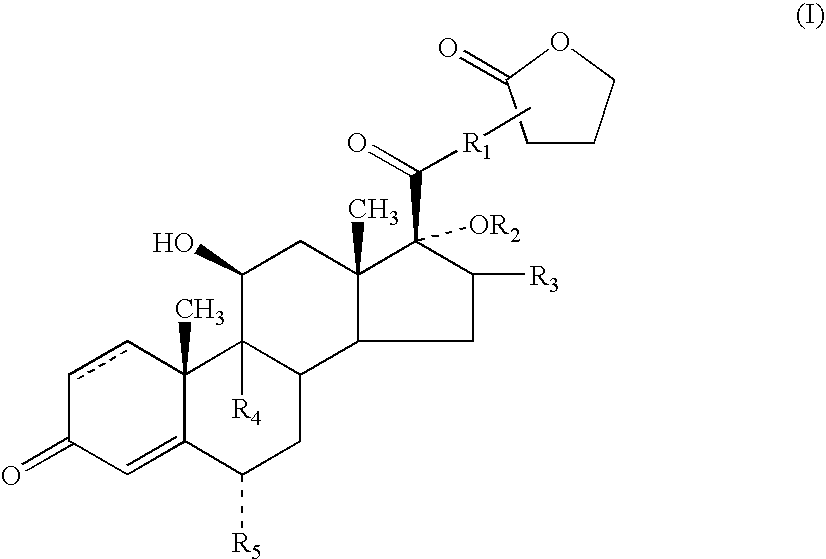


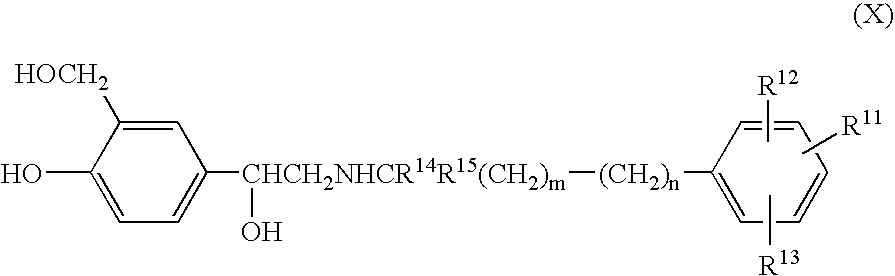
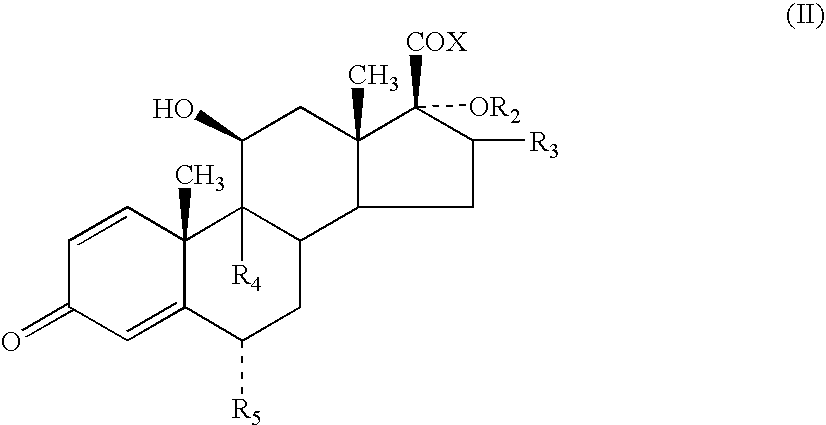


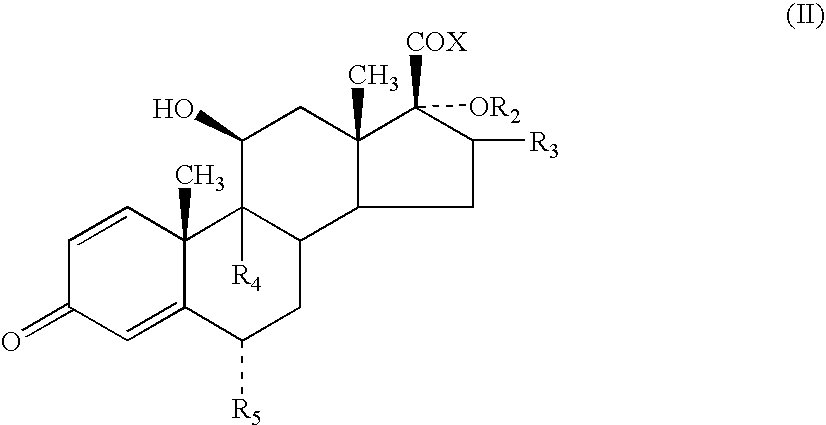

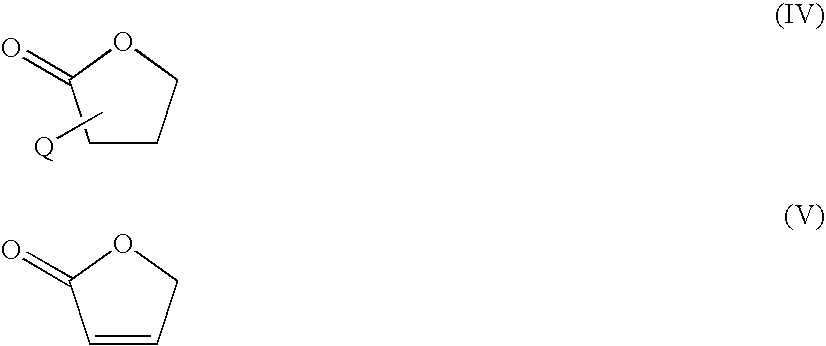
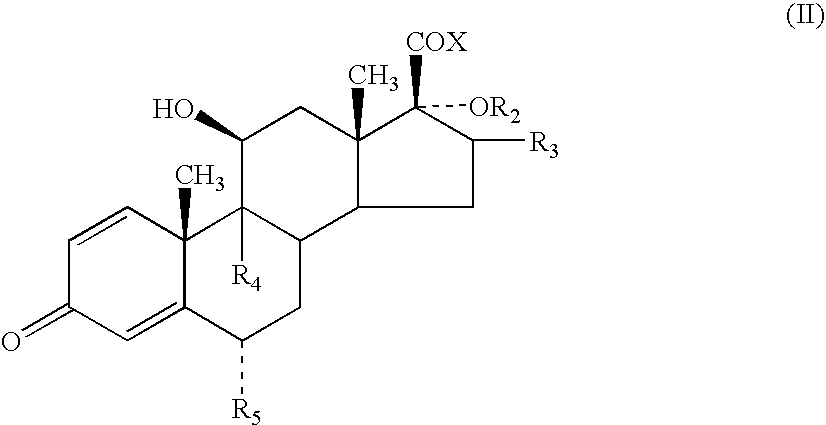

Applications Claiming Priority (3)
| Application Number | Priority Date | Filing Date | Title |
|---|---|---|---|
| GB0125259.2 | 2001-10-20 | ||
| GBGB0125259.2A GB0125259D0 (en) | 2001-10-20 | 2001-10-20 | Novel compounds |
| PCT/EP2002/011634 WO2003035668A2 (en) | 2001-10-20 | 2002-10-17 | Novel anti-inflammatory androstane derivatives -17-carboxy-lactone substituted steroids with an aryl-carboxylic ester in position 17.alpha |
Publications (2)
| Publication Number | Publication Date |
|---|---|
| US20050054622A1 true US20050054622A1 (en) | 2005-03-10 |
| US7405206B2 US7405206B2 (en) | 2008-07-29 |
Family
ID=9924247
Family Applications (1)
| Application Number | Title | Priority Date | Filing Date |
|---|---|---|---|
| US10/492,813 Expired - Lifetime US7405206B2 (en) | 2001-10-20 | 2002-10-17 | Anti-inflammatory androstane derivatives |
Country Status (9)
| Country | Link |
|---|---|
| US (1) | US7405206B2 (en) |
| EP (1) | EP1444248B1 (en) |
| JP (1) | JP4495456B2 (en) |
| AT (1) | ATE393771T1 (en) |
| AU (1) | AU2002350561A1 (en) |
| DE (1) | DE60226334T2 (en) |
| ES (1) | ES2304457T3 (en) |
| GB (1) | GB0125259D0 (en) |
| WO (1) | WO2003035668A2 (en) |
Families Citing this family (66)
| Publication number | Priority date | Publication date | Assignee | Title |
|---|---|---|---|---|
| US6858596B2 (en) | 2000-08-05 | 2005-02-22 | Smithkline Beecham Corporation | Formulation containing anti-inflammatory androstane derivative |
| US6858593B2 (en) | 2000-08-05 | 2005-02-22 | Smithkline Beecham Corporation | Anti-inflammatory androstane derivative compositions |
| GB0019172D0 (en) | 2000-08-05 | 2000-09-27 | Glaxo Group Ltd | Novel compounds |
| US6777399B2 (en) | 2000-08-05 | 2004-08-17 | Smithkline Beecham Corporation | Anti-inflammatory androstane derivative compositions |
| KR100889426B1 (en) | 2000-08-05 | 2009-03-23 | 글락소 그룹 리미티드 | 6.alpha., 9.alpha.-difluoro-17.alpha .- '(2-furanylcarboxyl) oxy-11.beta.-hydroxy-16.alpha.-methyl-3-oxo as anti-inflammatory -Androst-1,4-diene-17-carbothioic acid S-fluoromethyl ester |
| UA77656C2 (en) | 2001-04-07 | 2007-01-15 | Glaxo Group Ltd | S-fluoromethyl ester of 6-alpha, 9-alpha-difluoro-17-alpha-[(2-furanylcarbonyl)oxy]-11-beta-hydroxy-16- alpha-methyl-3-oxoandrosta-1,4-dien-17-beta-carbothioacid as anti-inflammatory agent |
| AU2002253342B2 (en) | 2001-04-30 | 2007-01-04 | Glaxo Group Limited | Novel anti-inflammatory androstane derivatives |
| GB2389530B (en) | 2002-06-14 | 2007-01-10 | Cipla Ltd | Pharmaceutical compositions |
| AR044519A1 (en) | 2003-05-02 | 2005-09-14 | Novartis Ag | DERIVATIVES OF PIRIDIN-TIAZOL AMINA AND PIRIMIDIN-TIAZOL AMINA |
| GB0316290D0 (en) * | 2003-07-11 | 2003-08-13 | Glaxo Group Ltd | Novel compounds |
| GB0401334D0 (en) | 2004-01-21 | 2004-02-25 | Novartis Ag | Organic compounds |
| GB0411056D0 (en) | 2004-05-18 | 2004-06-23 | Novartis Ag | Organic compounds |
| GT200500281A (en) | 2004-10-22 | 2006-04-24 | Novartis Ag | ORGANIC COMPOUNDS. |
| GB0424284D0 (en) | 2004-11-02 | 2004-12-01 | Novartis Ag | Organic compounds |
| GB0426164D0 (en) | 2004-11-29 | 2004-12-29 | Novartis Ag | Organic compounds |
| GB0507577D0 (en) | 2005-04-14 | 2005-05-18 | Novartis Ag | Organic compounds |
| GB0510390D0 (en) | 2005-05-20 | 2005-06-29 | Novartis Ag | Organic compounds |
| GB0516313D0 (en) | 2005-08-08 | 2005-09-14 | Argenta Discovery Ltd | Azole derivatives and their uses |
| US7994211B2 (en) | 2005-08-08 | 2011-08-09 | Argenta Discovery Limited | Bicyclo[2.2.1]hept-7-ylamine derivatives and their uses |
| MY144906A (en) | 2005-10-21 | 2011-11-30 | Novartis Ag | Human antibodies against il13 and therapeutic uses |
| GB0526244D0 (en) | 2005-12-22 | 2006-02-01 | Novartis Ag | Organic compounds |
| AR059216A1 (en) * | 2006-01-27 | 2008-03-19 | Sun Pharmaceutical Ind Ltd | 11B-HYDROXIANDROSTA-4-ENO-3-ONAS |
| GB0601951D0 (en) | 2006-01-31 | 2006-03-15 | Novartis Ag | Organic compounds |
| RU2457209C2 (en) | 2006-04-21 | 2012-07-27 | Новартис Аг | Purine derivatives applicable as adenosine receptor a2a agonists |
| MX2009003185A (en) | 2006-09-29 | 2009-04-03 | Novartis Ag | Pyrazolopyrimidines as p13k lipid kinase inhibitors. |
| HRP20110201T1 (en) | 2007-01-10 | 2011-08-31 | Irm Llc | COMPOUNDS AND COMPOSITIONS AS PROTEASE INHIBITORS OF CANALIZED ACTIVATION |
| DE602008005140D1 (en) | 2007-05-07 | 2011-04-07 | Novartis Ag | ORGANIC CONNECTIONS |
| AR069637A1 (en) | 2007-12-10 | 2010-02-10 | Novartis Ag | PIRAZINE DERIVATIVES |
| WO2009150137A2 (en) | 2008-06-10 | 2009-12-17 | Novartis Ag | Organic compounds |
| PL2379507T3 (en) | 2008-12-30 | 2014-03-31 | Pulmagen Therapeutics Inflammation Ltd | Sulfonamide compounds for the treatment of respiratory disorders |
| PT2391366E (en) | 2009-01-29 | 2013-02-05 | Novartis Ag | Substituted benzimidazoles for the treatment of astrocytomas |
| TW201111392A (en) | 2009-06-16 | 2011-04-01 | Schering Corp | Novel [3,2-c] heteroaryl steroids as glucocorticoid receptor agonists, compositions and uses thereof |
| US8389526B2 (en) | 2009-08-07 | 2013-03-05 | Novartis Ag | 3-heteroarylmethyl-imidazo[1,2-b]pyridazin-6-yl derivatives |
| BR112012003262A8 (en) | 2009-08-12 | 2016-05-17 | Novartis Ag | Heterocyclic Hydrazone Compounds and Their Uses to Treat Cancer and Inflammation |
| PE20121148A1 (en) | 2009-08-17 | 2012-09-07 | Intellikine Llc | HETEROCYCLIC COMPOUNDS AND USES OF THEM |
| BR112012008061A2 (en) | 2009-08-20 | 2016-03-01 | Novartis Ag | heterocyclic oxime compounds |
| JP2013508414A (en) | 2009-10-22 | 2013-03-07 | バーテックス ファーマシューティカルズ インコーポレイテッド | Compositions for the treatment of cystic fibrosis and other chronic diseases |
| US8247436B2 (en) | 2010-03-19 | 2012-08-21 | Novartis Ag | Pyridine and pyrazine derivative for the treatment of CF |
| WO2012034095A1 (en) | 2010-09-09 | 2012-03-15 | Irm Llc | Compounds and compositions as trk inhibitors |
| UY33597A (en) | 2010-09-09 | 2012-04-30 | Irm Llc | COMPOUNDS AND COMPOSITIONS AS INHIBITORS OF THE TRK |
| US8372845B2 (en) | 2010-09-17 | 2013-02-12 | Novartis Ag | Pyrazine derivatives as enac blockers |
| EP2673277A1 (en) | 2011-02-10 | 2013-12-18 | Novartis AG | [1, 2, 4]triazolo [4, 3 -b]pyridazine compounds as inhibitors of the c-met tyrosine kinase |
| JP5808826B2 (en) | 2011-02-23 | 2015-11-10 | インテリカイン, エルエルシー | Heterocyclic compounds and uses thereof |
| BR112013021638A2 (en) | 2011-02-25 | 2016-08-02 | Irm Llc | "trk inhibiting compounds, their use and compositions comprising them" |
| UY34305A (en) | 2011-09-01 | 2013-04-30 | Novartis Ag | DERIVATIVES OF BICYCLIC HETEROCICLES FOR THE TREATMENT OF PULMONARY ARTERIAL HYPERTENSION |
| EP2755976B1 (en) | 2011-09-15 | 2018-07-18 | Novartis AG | 6-substituted 3-(quinolin-6-ylthio)-[1,2,4]triazolo[4,3-a]pyridines as c-met tyrosine kinase inhibitors |
| WO2013038378A1 (en) | 2011-09-16 | 2013-03-21 | Novartis Ag | Pyridine amide derivatives |
| ES2882807T3 (en) | 2011-09-16 | 2021-12-02 | Novartis Ag | N-substituted heterocyclyl carboxamides |
| WO2013038381A1 (en) | 2011-09-16 | 2013-03-21 | Novartis Ag | Pyridine/pyrazine amide derivatives |
| CN103946221B (en) | 2011-09-16 | 2016-08-03 | 诺华股份有限公司 | Heterocyclic compounds for the treatment of cystic fibrosis |
| WO2013038373A1 (en) | 2011-09-16 | 2013-03-21 | Novartis Ag | Pyridine amide derivatives |
| US20130209543A1 (en) | 2011-11-23 | 2013-08-15 | Intellikine Llc | Enhanced treatment regimens using mtor inhibitors |
| US8809340B2 (en) | 2012-03-19 | 2014-08-19 | Novartis Ag | Crystalline form |
| JP2015512425A (en) | 2012-04-03 | 2015-04-27 | ノバルティス アーゲー | Combination products with tyrosine kinase inhibitors and their use |
| US9073921B2 (en) | 2013-03-01 | 2015-07-07 | Novartis Ag | Salt forms of bicyclic heterocyclic derivatives |
| WO2014151147A1 (en) | 2013-03-15 | 2014-09-25 | Intellikine, Llc | Combination of kinase inhibitors and uses thereof |
| US10155001B2 (en) | 2013-06-14 | 2018-12-18 | Inserm (Institut National De La Sante Et De La Recherche Medicale) | RAC1 inhibitors for inducing bronchodilation |
| WO2015084804A1 (en) | 2013-12-03 | 2015-06-11 | Novartis Ag | Combination of mdm2 inhibitor and braf inhibitor and their use |
| CN106458979B (en) | 2014-04-24 | 2020-03-27 | 诺华股份有限公司 | Aminopyrazine derivatives as phosphatidylinositol 3-kinase inhibitors |
| EP3134396B1 (en) | 2014-04-24 | 2019-09-18 | Novartis AG | Amino pyridine derivatives as phosphatidylinositol 3-kinase inhibitors |
| BR112016023967A2 (en) | 2014-04-24 | 2017-08-15 | Novartis Ag | pyrazine derivatives as phosphatidylinositol 3-kinase inhibitors |
| WO2016011658A1 (en) | 2014-07-25 | 2016-01-28 | Novartis Ag | Combination therapy |
| AU2015294889B2 (en) | 2014-07-31 | 2018-03-15 | Novartis Ag | Combination therapy |
| AU2020290094B2 (en) | 2019-06-10 | 2024-01-18 | Novartis Ag | Pyridine and pyrazine derivative for the treatment of CF, COPD, and bronchiectasis |
| PE20220346A1 (en) | 2019-08-28 | 2022-03-14 | Novartis Ag | 1,3-HETEROARYL SUBSTITUTED DERIVATIVES AND THEIR USE IN THE TREATMENT OF DISEASES |
| TW202140550A (en) | 2020-01-29 | 2021-11-01 | 瑞士商諾華公司 | Methods of treating an inflammatory or obstructive airway disease using anti-tslp antibody |
Citations (15)
| Publication number | Priority date | Publication date | Assignee | Title |
|---|---|---|---|---|
| US3828080A (en) * | 1972-01-20 | 1974-08-06 | Glaxo Lab Ltd | Androstane-17beta-carboxylic acids and processes for the preparation thereof |
| US3856828A (en) * | 1972-07-19 | 1974-12-24 | Glaxo Lab Ltd | Anti-inflammatory steroids of the androstane series having a halo-substituted c{11 {14 c{11 {11 alkoxy carbonyl group at the 17{62 {0 position |
| US6537983B1 (en) * | 2001-04-07 | 2003-03-25 | Smithkline Beecham Corporation | Anti-inflammatory androstane derivatives |
| US20040028615A1 (en) * | 2000-08-05 | 2004-02-12 | Keith Biggadike | 17.beta.-carbothioate 17.alpha.-arylcarbonyloxyloxy androstane derivative as anti-inflammatory agents |
| US6750210B2 (en) * | 2000-08-05 | 2004-06-15 | Smithkline Beecham Corporation | Formulation containing novel anti-inflammatory androstane derivative |
| US6759398B2 (en) * | 2000-08-05 | 2004-07-06 | Smithkline Beecham Corporation | Anti-inflammatory androstane derivative |
| US6777400B2 (en) * | 2000-08-05 | 2004-08-17 | Smithkline Beecham Corporation | Anti-inflammatory androstane derivative compositions |
| US6777399B2 (en) * | 2000-08-05 | 2004-08-17 | Smithkline Beecham Corporation | Anti-inflammatory androstane derivative compositions |
| US6787532B2 (en) * | 2000-08-05 | 2004-09-07 | Smithkline Beecham Corporation | Formulation containing anti-inflammatory androstane derivatives |
| US20050020549A1 (en) * | 2000-08-05 | 2005-01-27 | Keith Biggadike | Formulation containing anti-inflammatory androstane derivative |
| US6858593B2 (en) * | 2000-08-05 | 2005-02-22 | Smithkline Beecham Corporation | Anti-inflammatory androstane derivative compositions |
| US20050152845A1 (en) * | 2002-02-04 | 2005-07-14 | Keith Biggadike | Amorphous fluticasone 2-furoate, pharmaceutical compositions thereof and its conversion to the crystalline unsolvated form |
| US20050175545A1 (en) * | 2002-02-04 | 2005-08-11 | Keith Biggadike | Formulation for inhalation comprising a glucocorticoid and a beta 2-adrenoreceptor agonist |
| US7125985B2 (en) * | 2000-08-05 | 2006-10-24 | Glaxo Group Limited | Compounds useful in the manufacture of an anti-inflammatory androstane derivative |
| US20060247219A1 (en) * | 2003-07-11 | 2006-11-02 | Keith Biggadike | Specific glucocorticosteriod compound having anti-inflamatory activity |
Family Cites Families (4)
| Publication number | Priority date | Publication date | Assignee | Title |
|---|---|---|---|---|
| EP0057401B1 (en) * | 1981-02-02 | 1984-08-01 | Schering Corporation | Aromatic heterocyclic esters of steroids, their preparation and pharmaceutical compositions containing them |
| PT876392E (en) * | 1995-12-29 | 2000-12-29 | Glaxo Group Ltd | LACTONE DERIVATIVES OF 17BETA-CARBOXI DERIVATIVES CARBOTIE AND ANDROSTANE AMIDA |
| GB0015876D0 (en) * | 2000-06-28 | 2000-08-23 | Novartis Ag | Organic compounds |
| GB0103630D0 (en) * | 2001-02-14 | 2001-03-28 | Glaxo Group Ltd | Chemical compounds |
-
2001
- 2001-10-20 GB GBGB0125259.2A patent/GB0125259D0/en not_active Ceased
-
2002
- 2002-10-17 ES ES02785235T patent/ES2304457T3/en not_active Expired - Lifetime
- 2002-10-17 US US10/492,813 patent/US7405206B2/en not_active Expired - Lifetime
- 2002-10-17 EP EP02785235A patent/EP1444248B1/en not_active Expired - Lifetime
- 2002-10-17 JP JP2003538181A patent/JP4495456B2/en not_active Expired - Lifetime
- 2002-10-17 AU AU2002350561A patent/AU2002350561A1/en not_active Abandoned
- 2002-10-17 DE DE60226334T patent/DE60226334T2/en not_active Expired - Lifetime
- 2002-10-17 WO PCT/EP2002/011634 patent/WO2003035668A2/en not_active Ceased
- 2002-10-17 AT AT02785235T patent/ATE393771T1/en not_active IP Right Cessation
Patent Citations (25)
| Publication number | Priority date | Publication date | Assignee | Title |
|---|---|---|---|---|
| US3828080A (en) * | 1972-01-20 | 1974-08-06 | Glaxo Lab Ltd | Androstane-17beta-carboxylic acids and processes for the preparation thereof |
| US3856828A (en) * | 1972-07-19 | 1974-12-24 | Glaxo Lab Ltd | Anti-inflammatory steroids of the androstane series having a halo-substituted c{11 {14 c{11 {11 alkoxy carbonyl group at the 17{62 {0 position |
| US6858593B2 (en) * | 2000-08-05 | 2005-02-22 | Smithkline Beecham Corporation | Anti-inflammatory androstane derivative compositions |
| US20040224932A1 (en) * | 2000-08-05 | 2004-11-11 | Keith Biggadike | Novel anti-inflammatory androstane derivative compositions |
| US6750210B2 (en) * | 2000-08-05 | 2004-06-15 | Smithkline Beecham Corporation | Formulation containing novel anti-inflammatory androstane derivative |
| US6759398B2 (en) * | 2000-08-05 | 2004-07-06 | Smithkline Beecham Corporation | Anti-inflammatory androstane derivative |
| US6777400B2 (en) * | 2000-08-05 | 2004-08-17 | Smithkline Beecham Corporation | Anti-inflammatory androstane derivative compositions |
| US6777399B2 (en) * | 2000-08-05 | 2004-08-17 | Smithkline Beecham Corporation | Anti-inflammatory androstane derivative compositions |
| US6787532B2 (en) * | 2000-08-05 | 2004-09-07 | Smithkline Beecham Corporation | Formulation containing anti-inflammatory androstane derivatives |
| US20070027128A1 (en) * | 2000-08-05 | 2007-02-01 | Glaxo Group Limited | Novel Anti-inflammatory Androstane Derivative |
| US6858596B2 (en) * | 2000-08-05 | 2005-02-22 | Smithkline Beecham Corporation | Formulation containing anti-inflammatory androstane derivative |
| US20050020549A1 (en) * | 2000-08-05 | 2005-01-27 | Keith Biggadike | Formulation containing anti-inflammatory androstane derivative |
| US20040028615A1 (en) * | 2000-08-05 | 2004-02-12 | Keith Biggadike | 17.beta.-carbothioate 17.alpha.-arylcarbonyloxyloxy androstane derivative as anti-inflammatory agents |
| US7125985B2 (en) * | 2000-08-05 | 2006-10-24 | Glaxo Group Limited | Compounds useful in the manufacture of an anti-inflammatory androstane derivative |
| US20040220156A1 (en) * | 2000-08-05 | 2004-11-04 | Keith Biggadike | Novel anti-inflammatory androstane derivative compositions |
| US7101866B2 (en) * | 2000-08-05 | 2006-09-05 | Glaxo Group Limited | Anti-inflammatory androstane derivative |
| US20050164996A1 (en) * | 2000-08-05 | 2005-07-28 | Keith Biggadike | Pharmaceutical formulation comprising an aqueous suspension of an androstane derivative for the treatment of inflammatory and allergic conditions |
| US20050164997A1 (en) * | 2000-08-05 | 2005-07-28 | Keith Biggadike | Pharmaceutical formulation for administration by inhalation comprising an androstane derivative and a beta-2-adrenoreceptor for the treatment of inflammatory and allergic conditions |
| US6878698B2 (en) * | 2001-04-07 | 2005-04-12 | Glaxo Group Limited | Anti-inflammatory androstane derivatives |
| US6537983B1 (en) * | 2001-04-07 | 2003-03-25 | Smithkline Beecham Corporation | Anti-inflammatory androstane derivatives |
| US20050152845A1 (en) * | 2002-02-04 | 2005-07-14 | Keith Biggadike | Amorphous fluticasone 2-furoate, pharmaceutical compositions thereof and its conversion to the crystalline unsolvated form |
| US20050130947A1 (en) * | 2002-02-04 | 2005-06-16 | Keith Biggadike | Formulations for inhalation |
| US20050175545A1 (en) * | 2002-02-04 | 2005-08-11 | Keith Biggadike | Formulation for inhalation comprising a glucocorticoid and a beta 2-adrenoreceptor agonist |
| US20050043284A1 (en) * | 2002-02-04 | 2005-02-24 | Keith Biggadike | Crystalline complexes of fluticasone-2-furoate |
| US20060247219A1 (en) * | 2003-07-11 | 2006-11-02 | Keith Biggadike | Specific glucocorticosteriod compound having anti-inflamatory activity |
Also Published As
| Publication number | Publication date |
|---|---|
| US7405206B2 (en) | 2008-07-29 |
| AU2002350561A1 (en) | 2003-05-06 |
| DE60226334D1 (en) | 2008-06-12 |
| EP1444248A2 (en) | 2004-08-11 |
| DE60226334T2 (en) | 2009-06-04 |
| ES2304457T3 (en) | 2008-10-16 |
| WO2003035668A2 (en) | 2003-05-01 |
| EP1444248B1 (en) | 2008-04-30 |
| WO2003035668A3 (en) | 2003-07-31 |
| ATE393771T1 (en) | 2008-05-15 |
| JP2005509642A (en) | 2005-04-14 |
| GB0125259D0 (en) | 2001-12-12 |
| JP4495456B2 (en) | 2010-07-07 |
Similar Documents
| Publication | Publication Date | Title |
|---|---|---|
| US7405206B2 (en) | Anti-inflammatory androstane derivatives | |
| US7291608B2 (en) | Anti-inflammatory 17.β.-carbothioate ester derivatives of androstane with a cyclic ester group in position 17.α | |
| EP1395604B1 (en) | Novel anti inflammatory 17.alpha.-heterocyclic-esters of 17.beta.-carbothioate androstane derivatives | |
| AU2001275760B2 (en) | 6.alpha., 9.alpha.-difluoro-17.alpha.-'(2-furanylcarboxyl) oxy!-11.beta.-hydroxy-16.alpha.-methyl-3-oxo-androst-1,4,-diene-17-carbothioic acid S-fluoromethyl ester as an anti-inflammatory agent | |
| US6537983B1 (en) | Anti-inflammatory androstane derivatives | |
| AU2002253342A1 (en) | Novel anti-inflammatory androstane derivatives | |
| US7132532B2 (en) | Compounds useful in the manufacture of an anti-inflammatory androstane derivative | |
| WO2003042229A1 (en) | Non-aromatic heterocyclic esters of furan-2-one-esters of 17.beta.-carboxyl or 17.beta.-carbothio glucocorticoids | |
| HK1062020B (en) | Anti-inflammatory 17.beta.-carbothioate ester derivatives of androstane with a cyclic ester group in position 17.alpha | |
| ZA200308192B (en) | Anti-inflammatory 17.beta.-carbothioate ester derivatives of androstane with a cyclic ester group in position 17.alpha. |
Legal Events
| Date | Code | Title | Description |
|---|---|---|---|
| AS | Assignment |
Owner name: GLAXO GROUP LIMITED, UNITED KINGDOM Free format text: ASSIGNMENT OF ASSIGNORS INTEREST;ASSIGNORS:BIGGADIKE, KEITH;JONES, PAUL;PAYNE, JEREMY JOHN;REEL/FRAME:020562/0742;SIGNING DATES FROM 20040512 TO 20040517 |
|
| STCF | Information on status: patent grant |
Free format text: PATENTED CASE |
|
| FPAY | Fee payment |
Year of fee payment: 4 |
|
| FPAY | Fee payment |
Year of fee payment: 8 |
|
| MAFP | Maintenance fee payment |
Free format text: PAYMENT OF MAINTENANCE FEE, 12TH YEAR, LARGE ENTITY (ORIGINAL EVENT CODE: M1553); ENTITY STATUS OF PATENT OWNER: LARGE ENTITY Year of fee payment: 12 |