CN106458979B - Aminopyrazine derivatives as phosphatidylinositol 3-kinase inhibitors - Google Patents
Aminopyrazine derivatives as phosphatidylinositol 3-kinase inhibitors Download PDFInfo
- Publication number
- CN106458979B CN106458979B CN201480079404.2A CN201480079404A CN106458979B CN 106458979 B CN106458979 B CN 106458979B CN 201480079404 A CN201480079404 A CN 201480079404A CN 106458979 B CN106458979 B CN 106458979B
- Authority
- CN
- China
- Prior art keywords
- pyrazin
- amino
- methyl
- hydroxy
- methylbenzenesulfonamide
- Prior art date
- Legal status (The legal status is an assumption and is not a legal conclusion. Google has not performed a legal analysis and makes no representation as to the accuracy of the status listed.)
- Expired - Fee Related
Links
Classifications
-
- A—HUMAN NECESSITIES
- A61—MEDICAL OR VETERINARY SCIENCE; HYGIENE
- A61K—PREPARATIONS FOR MEDICAL, DENTAL OR TOILETRY PURPOSES
- A61K31/00—Medicinal preparations containing organic active ingredients
- A61K31/33—Heterocyclic compounds
- A61K31/395—Heterocyclic compounds having nitrogen as a ring hetero atom, e.g. guanethidine or rifamycins
- A61K31/495—Heterocyclic compounds having nitrogen as a ring hetero atom, e.g. guanethidine or rifamycins having six-membered rings with two or more nitrogen atoms as the only ring heteroatoms, e.g. piperazine or tetrazines
- A61K31/4965—Non-condensed pyrazines
- A61K31/497—Non-condensed pyrazines containing further heterocyclic rings
-
- A—HUMAN NECESSITIES
- A61—MEDICAL OR VETERINARY SCIENCE; HYGIENE
- A61K—PREPARATIONS FOR MEDICAL, DENTAL OR TOILETRY PURPOSES
- A61K31/00—Medicinal preparations containing organic active ingredients
- A61K31/33—Heterocyclic compounds
- A61K31/395—Heterocyclic compounds having nitrogen as a ring hetero atom, e.g. guanethidine or rifamycins
- A61K31/41—Heterocyclic compounds having nitrogen as a ring hetero atom, e.g. guanethidine or rifamycins having five-membered rings with two or more ring hetero atoms, at least one of which being nitrogen, e.g. tetrazole
- A61K31/4245—Oxadiazoles
-
- A—HUMAN NECESSITIES
- A61—MEDICAL OR VETERINARY SCIENCE; HYGIENE
- A61K—PREPARATIONS FOR MEDICAL, DENTAL OR TOILETRY PURPOSES
- A61K31/00—Medicinal preparations containing organic active ingredients
- A61K31/33—Heterocyclic compounds
- A61K31/395—Heterocyclic compounds having nitrogen as a ring hetero atom, e.g. guanethidine or rifamycins
- A61K31/495—Heterocyclic compounds having nitrogen as a ring hetero atom, e.g. guanethidine or rifamycins having six-membered rings with two or more nitrogen atoms as the only ring heteroatoms, e.g. piperazine or tetrazines
- A61K31/496—Non-condensed piperazines containing further heterocyclic rings, e.g. rifampin, thiothixene or sparfloxacin
-
- A—HUMAN NECESSITIES
- A61—MEDICAL OR VETERINARY SCIENCE; HYGIENE
- A61K—PREPARATIONS FOR MEDICAL, DENTAL OR TOILETRY PURPOSES
- A61K31/00—Medicinal preparations containing organic active ingredients
- A61K31/33—Heterocyclic compounds
- A61K31/395—Heterocyclic compounds having nitrogen as a ring hetero atom, e.g. guanethidine or rifamycins
- A61K31/535—Heterocyclic compounds having nitrogen as a ring hetero atom, e.g. guanethidine or rifamycins having six-membered rings with at least one nitrogen and one oxygen as the ring hetero atoms, e.g. 1,2-oxazines
- A61K31/5375—1,4-Oxazines, e.g. morpholine
- A61K31/5377—1,4-Oxazines, e.g. morpholine not condensed and containing further heterocyclic rings, e.g. timolol
-
- A—HUMAN NECESSITIES
- A61—MEDICAL OR VETERINARY SCIENCE; HYGIENE
- A61P—SPECIFIC THERAPEUTIC ACTIVITY OF CHEMICAL COMPOUNDS OR MEDICINAL PREPARATIONS
- A61P1/00—Drugs for disorders of the alimentary tract or the digestive system
- A61P1/04—Drugs for disorders of the alimentary tract or the digestive system for ulcers, gastritis or reflux esophagitis, e.g. antacids, inhibitors of acid secretion, mucosal protectants
-
- A—HUMAN NECESSITIES
- A61—MEDICAL OR VETERINARY SCIENCE; HYGIENE
- A61P—SPECIFIC THERAPEUTIC ACTIVITY OF CHEMICAL COMPOUNDS OR MEDICINAL PREPARATIONS
- A61P11/00—Drugs for disorders of the respiratory system
-
- A—HUMAN NECESSITIES
- A61—MEDICAL OR VETERINARY SCIENCE; HYGIENE
- A61P—SPECIFIC THERAPEUTIC ACTIVITY OF CHEMICAL COMPOUNDS OR MEDICINAL PREPARATIONS
- A61P11/00—Drugs for disorders of the respiratory system
- A61P11/06—Antiasthmatics
-
- A—HUMAN NECESSITIES
- A61—MEDICAL OR VETERINARY SCIENCE; HYGIENE
- A61P—SPECIFIC THERAPEUTIC ACTIVITY OF CHEMICAL COMPOUNDS OR MEDICINAL PREPARATIONS
- A61P17/00—Drugs for dermatological disorders
- A61P17/06—Antipsoriatics
-
- A—HUMAN NECESSITIES
- A61—MEDICAL OR VETERINARY SCIENCE; HYGIENE
- A61P—SPECIFIC THERAPEUTIC ACTIVITY OF CHEMICAL COMPOUNDS OR MEDICINAL PREPARATIONS
- A61P19/00—Drugs for skeletal disorders
- A61P19/02—Drugs for skeletal disorders for joint disorders, e.g. arthritis, arthrosis
-
- A—HUMAN NECESSITIES
- A61—MEDICAL OR VETERINARY SCIENCE; HYGIENE
- A61P—SPECIFIC THERAPEUTIC ACTIVITY OF CHEMICAL COMPOUNDS OR MEDICINAL PREPARATIONS
- A61P29/00—Non-central analgesic, antipyretic or antiinflammatory agents, e.g. antirheumatic agents; Non-steroidal antiinflammatory drugs [NSAID]
-
- A—HUMAN NECESSITIES
- A61—MEDICAL OR VETERINARY SCIENCE; HYGIENE
- A61P—SPECIFIC THERAPEUTIC ACTIVITY OF CHEMICAL COMPOUNDS OR MEDICINAL PREPARATIONS
- A61P3/00—Drugs for disorders of the metabolism
- A61P3/04—Anorexiants; Antiobesity agents
-
- A—HUMAN NECESSITIES
- A61—MEDICAL OR VETERINARY SCIENCE; HYGIENE
- A61P—SPECIFIC THERAPEUTIC ACTIVITY OF CHEMICAL COMPOUNDS OR MEDICINAL PREPARATIONS
- A61P3/00—Drugs for disorders of the metabolism
- A61P3/08—Drugs for disorders of the metabolism for glucose homeostasis
- A61P3/10—Drugs for disorders of the metabolism for glucose homeostasis for hyperglycaemia, e.g. antidiabetics
-
- A—HUMAN NECESSITIES
- A61—MEDICAL OR VETERINARY SCIENCE; HYGIENE
- A61P—SPECIFIC THERAPEUTIC ACTIVITY OF CHEMICAL COMPOUNDS OR MEDICINAL PREPARATIONS
- A61P35/00—Antineoplastic agents
-
- A—HUMAN NECESSITIES
- A61—MEDICAL OR VETERINARY SCIENCE; HYGIENE
- A61P—SPECIFIC THERAPEUTIC ACTIVITY OF CHEMICAL COMPOUNDS OR MEDICINAL PREPARATIONS
- A61P37/00—Drugs for immunological or allergic disorders
- A61P37/02—Immunomodulators
- A61P37/06—Immunosuppressants, e.g. drugs for graft rejection
-
- A—HUMAN NECESSITIES
- A61—MEDICAL OR VETERINARY SCIENCE; HYGIENE
- A61P—SPECIFIC THERAPEUTIC ACTIVITY OF CHEMICAL COMPOUNDS OR MEDICINAL PREPARATIONS
- A61P37/00—Drugs for immunological or allergic disorders
- A61P37/08—Antiallergic agents
-
- A—HUMAN NECESSITIES
- A61—MEDICAL OR VETERINARY SCIENCE; HYGIENE
- A61P—SPECIFIC THERAPEUTIC ACTIVITY OF CHEMICAL COMPOUNDS OR MEDICINAL PREPARATIONS
- A61P43/00—Drugs for specific purposes, not provided for in groups A61P1/00-A61P41/00
-
- A—HUMAN NECESSITIES
- A61—MEDICAL OR VETERINARY SCIENCE; HYGIENE
- A61P—SPECIFIC THERAPEUTIC ACTIVITY OF CHEMICAL COMPOUNDS OR MEDICINAL PREPARATIONS
- A61P9/00—Drugs for disorders of the cardiovascular system
- A61P9/10—Drugs for disorders of the cardiovascular system for treating ischaemic or atherosclerotic diseases, e.g. antianginal drugs, coronary vasodilators, drugs for myocardial infarction, retinopathy, cerebrovascula insufficiency, renal arteriosclerosis
-
- C—CHEMISTRY; METALLURGY
- C07—ORGANIC CHEMISTRY
- C07D—HETEROCYCLIC COMPOUNDS
- C07D401/00—Heterocyclic compounds containing two or more hetero rings, having nitrogen atoms as the only ring hetero atoms, at least one ring being a six-membered ring with only one nitrogen atom
- C07D401/02—Heterocyclic compounds containing two or more hetero rings, having nitrogen atoms as the only ring hetero atoms, at least one ring being a six-membered ring with only one nitrogen atom containing two hetero rings
- C07D401/04—Heterocyclic compounds containing two or more hetero rings, having nitrogen atoms as the only ring hetero atoms, at least one ring being a six-membered ring with only one nitrogen atom containing two hetero rings directly linked by a ring-member-to-ring-member bond
-
- C—CHEMISTRY; METALLURGY
- C07—ORGANIC CHEMISTRY
- C07D—HETEROCYCLIC COMPOUNDS
- C07D401/00—Heterocyclic compounds containing two or more hetero rings, having nitrogen atoms as the only ring hetero atoms, at least one ring being a six-membered ring with only one nitrogen atom
- C07D401/14—Heterocyclic compounds containing two or more hetero rings, having nitrogen atoms as the only ring hetero atoms, at least one ring being a six-membered ring with only one nitrogen atom containing three or more hetero rings
-
- C—CHEMISTRY; METALLURGY
- C07—ORGANIC CHEMISTRY
- C07D—HETEROCYCLIC COMPOUNDS
- C07D403/00—Heterocyclic compounds containing two or more hetero rings, having nitrogen atoms as the only ring hetero atoms, not provided for by group C07D401/00
- C07D403/02—Heterocyclic compounds containing two or more hetero rings, having nitrogen atoms as the only ring hetero atoms, not provided for by group C07D401/00 containing two hetero rings
- C07D403/04—Heterocyclic compounds containing two or more hetero rings, having nitrogen atoms as the only ring hetero atoms, not provided for by group C07D401/00 containing two hetero rings directly linked by a ring-member-to-ring-member bond
-
- C—CHEMISTRY; METALLURGY
- C07—ORGANIC CHEMISTRY
- C07D—HETEROCYCLIC COMPOUNDS
- C07D403/00—Heterocyclic compounds containing two or more hetero rings, having nitrogen atoms as the only ring hetero atoms, not provided for by group C07D401/00
- C07D403/14—Heterocyclic compounds containing two or more hetero rings, having nitrogen atoms as the only ring hetero atoms, not provided for by group C07D401/00 containing three or more hetero rings
-
- C—CHEMISTRY; METALLURGY
- C07—ORGANIC CHEMISTRY
- C07D—HETEROCYCLIC COMPOUNDS
- C07D405/00—Heterocyclic compounds containing both one or more hetero rings having oxygen atoms as the only ring hetero atoms, and one or more rings having nitrogen as the only ring hetero atom
- C07D405/02—Heterocyclic compounds containing both one or more hetero rings having oxygen atoms as the only ring hetero atoms, and one or more rings having nitrogen as the only ring hetero atom containing two hetero rings
- C07D405/04—Heterocyclic compounds containing both one or more hetero rings having oxygen atoms as the only ring hetero atoms, and one or more rings having nitrogen as the only ring hetero atom containing two hetero rings directly linked by a ring-member-to-ring-member bond
-
- C—CHEMISTRY; METALLURGY
- C07—ORGANIC CHEMISTRY
- C07D—HETEROCYCLIC COMPOUNDS
- C07D405/00—Heterocyclic compounds containing both one or more hetero rings having oxygen atoms as the only ring hetero atoms, and one or more rings having nitrogen as the only ring hetero atom
- C07D405/14—Heterocyclic compounds containing both one or more hetero rings having oxygen atoms as the only ring hetero atoms, and one or more rings having nitrogen as the only ring hetero atom containing three or more hetero rings
-
- C—CHEMISTRY; METALLURGY
- C07—ORGANIC CHEMISTRY
- C07D—HETEROCYCLIC COMPOUNDS
- C07D409/00—Heterocyclic compounds containing two or more hetero rings, at least one ring having sulfur atoms as the only ring hetero atoms
- C07D409/02—Heterocyclic compounds containing two or more hetero rings, at least one ring having sulfur atoms as the only ring hetero atoms containing two hetero rings
- C07D409/04—Heterocyclic compounds containing two or more hetero rings, at least one ring having sulfur atoms as the only ring hetero atoms containing two hetero rings directly linked by a ring-member-to-ring-member bond
-
- C—CHEMISTRY; METALLURGY
- C07—ORGANIC CHEMISTRY
- C07D—HETEROCYCLIC COMPOUNDS
- C07D409/00—Heterocyclic compounds containing two or more hetero rings, at least one ring having sulfur atoms as the only ring hetero atoms
- C07D409/14—Heterocyclic compounds containing two or more hetero rings, at least one ring having sulfur atoms as the only ring hetero atoms containing three or more hetero rings
-
- C—CHEMISTRY; METALLURGY
- C07—ORGANIC CHEMISTRY
- C07D—HETEROCYCLIC COMPOUNDS
- C07D413/00—Heterocyclic compounds containing two or more hetero rings, at least one ring having nitrogen and oxygen atoms as the only ring hetero atoms
- C07D413/02—Heterocyclic compounds containing two or more hetero rings, at least one ring having nitrogen and oxygen atoms as the only ring hetero atoms containing two hetero rings
- C07D413/04—Heterocyclic compounds containing two or more hetero rings, at least one ring having nitrogen and oxygen atoms as the only ring hetero atoms containing two hetero rings directly linked by a ring-member-to-ring-member bond
-
- C—CHEMISTRY; METALLURGY
- C07—ORGANIC CHEMISTRY
- C07D—HETEROCYCLIC COMPOUNDS
- C07D413/00—Heterocyclic compounds containing two or more hetero rings, at least one ring having nitrogen and oxygen atoms as the only ring hetero atoms
- C07D413/14—Heterocyclic compounds containing two or more hetero rings, at least one ring having nitrogen and oxygen atoms as the only ring hetero atoms containing three or more hetero rings
-
- C—CHEMISTRY; METALLURGY
- C07—ORGANIC CHEMISTRY
- C07D—HETEROCYCLIC COMPOUNDS
- C07D417/00—Heterocyclic compounds containing two or more hetero rings, at least one ring having nitrogen and sulfur atoms as the only ring hetero atoms, not provided for by group C07D415/00
- C07D417/02—Heterocyclic compounds containing two or more hetero rings, at least one ring having nitrogen and sulfur atoms as the only ring hetero atoms, not provided for by group C07D415/00 containing two hetero rings
- C07D417/04—Heterocyclic compounds containing two or more hetero rings, at least one ring having nitrogen and sulfur atoms as the only ring hetero atoms, not provided for by group C07D415/00 containing two hetero rings directly linked by a ring-member-to-ring-member bond
-
- C—CHEMISTRY; METALLURGY
- C07—ORGANIC CHEMISTRY
- C07D—HETEROCYCLIC COMPOUNDS
- C07D417/00—Heterocyclic compounds containing two or more hetero rings, at least one ring having nitrogen and sulfur atoms as the only ring hetero atoms, not provided for by group C07D415/00
- C07D417/14—Heterocyclic compounds containing two or more hetero rings, at least one ring having nitrogen and sulfur atoms as the only ring hetero atoms, not provided for by group C07D415/00 containing three or more hetero rings
Landscapes
- Chemical & Material Sciences (AREA)
- Organic Chemistry (AREA)
- Health & Medical Sciences (AREA)
- Life Sciences & Earth Sciences (AREA)
- Veterinary Medicine (AREA)
- Public Health (AREA)
- General Health & Medical Sciences (AREA)
- Medicinal Chemistry (AREA)
- Animal Behavior & Ethology (AREA)
- Pharmacology & Pharmacy (AREA)
- General Chemical & Material Sciences (AREA)
- Nuclear Medicine, Radiotherapy & Molecular Imaging (AREA)
- Chemical Kinetics & Catalysis (AREA)
- Bioinformatics & Cheminformatics (AREA)
- Engineering & Computer Science (AREA)
- Epidemiology (AREA)
- Immunology (AREA)
- Diabetes (AREA)
- Pulmonology (AREA)
- Rheumatology (AREA)
- Obesity (AREA)
- Hematology (AREA)
- Urology & Nephrology (AREA)
- Emergency Medicine (AREA)
- Endocrinology (AREA)
- Heart & Thoracic Surgery (AREA)
- Cardiology (AREA)
- Pain & Pain Management (AREA)
- Vascular Medicine (AREA)
- Child & Adolescent Psychology (AREA)
- Transplantation (AREA)
- Dermatology (AREA)
- Orthopedic Medicine & Surgery (AREA)
- Physical Education & Sports Medicine (AREA)
- Pharmaceuticals Containing Other Organic And Inorganic Compounds (AREA)
- Plural Heterocyclic Compounds (AREA)
- Nitrogen Condensed Heterocyclic Rings (AREA)
Abstract
本发明提供了式(I)化合物,该化合物能够抑制PI 3‑激酶γ同工型的活性,因此可以用于治疗由PI 3‑激酶γ同工型的激活而介导的疾病。 The present invention provides compounds of formula (I), which are capable of inhibiting the activity of the PI 3-kinase gamma isoform, and thus can be used to treat diseases mediated by the activation of the PI 3-kinase gamma isoform. 
Description
Technical Field
The present invention relates to novel aminopyrazine derivatives as selective inhibitors of PI 3-kinase gamma isoform, processes for their preparation, pharmaceutical compositions and medicaments containing them and their use in diseases and conditions mediated by activation of PI 3-kinase gamma isoform, in particular asthma.
Background
Phosphatidylinositol 3-kinase (PI 3-kinase), a family of enzymes capable of catalyzing phosphorylation of the 3' -OH of the inositol ring, has a central role in a wide range of cell regulatory processes, including cell metabolism, survival, motility, and cell activation (vanhaesbroeck, b. et al, annu. rev. biochem.2001,70,535). these lipid kinases are divided into three major classes I, II & III (Wymann, m. et al; biochem.biophysis.acta, 592) according to their structure and in vitro substrate specificity, the most widely known class I family can be further subdivided into the IA and IB class IA PI 3-kinase subclasses consisting of 85kDa control/adapter protein and three 110kDa catalytic subunits (p110 α, p110 β and p110 δ), which are activated in the tyrosine kinase system, while class IB consists of a single p110 γ isoform (PI 3-kinase γ isoform), which is activated by the G protein-II receptor class II (PI 3-kinase γ isoform), which is less by the PI 3-kinase than the three related classes ATR, I, C, tpar 3-kinase (PI 3-kinase) 3-kinase 3-C, rpr-C, rpk, phr 3, phr-C, phr 3, phd, a similar subset known as well as members of these lipid kinases, and rpc, a subset of the like, and a similar subset known to include the same class I kinase (PI 3, a family).
The key role of PI 3-kinase gamma isoforms in, for example, leukocyte activation, leukocyte chemotaxis and mast cell degranulation has been revealed, thus generating a great interest in the role of this target in the treatment of autoimmune and inflammatory diseases (Ghigo et al, Bioessays,2010,32, p 185-196; Reif et al, j.immunol.,2004,173, page 2236-. In particular, many publications suggest the potential efficacy of PI3 kinase γ isoform inhibitors for asthma treatment (e.g., Thomas et al, Immunology,2008,126, p 413; Jiang et al, j. pharm. exp. ther.,2012,342, p 305; Takeda et al, int. arch. allrgy immunol.2010,152(suppl 1), p 90-95). PI 3-kinase γ isoforms have also been reported to have potential therapeutic value in a variety of other indications, such as Cancer (Beagle and Fruman, Cancer Cell,2011,19, p 693; Schmid et al, Cancer Cell,2011,19, p 715; Xie et al, biochem. pharm.,2013,85, p 1454; subramanam et al, Cancer, Cell 2012,21, p 459), Diabetes (Kobayashi et al, proc. nat. acad. sci. 2011,108, p 5753; Azzi et al, diabets, 2012,61, p 1509), cardiovascular disease (fougert et al, clin. sci.,2009,116, p 791; fougert et al, Circulation,2008,117, p.1310, Chang et al, acta. sci., p 56, p. 3975, p. wo, p. 3975, p. 493, p. 31, p. peyashi et al, p. acide, p. wo 25, p. wo 26, p. wo). For a recent review of PI 3-kinase isoforms as Drug Targets, reference is made to Blajecka et al, Current Drug Targets,2011,12, page 1056-.
WO2009/115517(Novartis) discloses aminopyrazine and pyridine derivatives as PI 3-kinase inhibitors.
WO2009/013348(Novartis) discloses aminopyrimidine derivatives as PI 3-kinase inhibitors.
WO2003/093297(Exelixis) discloses modulators of protein kinases and methods of using such modulators.
Inhibitors of PI 3-kinase gamma isoforms are disclosed by Leahy et al, j.med.chem.,2012,55(11), pages 5467-5482.
Thus, there is a need for potent, metabolically selective inhibitors of PI 3-kinase gamma isoforms.
Disclosure of Invention
Summary of The Invention
In a first aspect, the present invention relates to a compound of formula (I):

wherein
E is selected from N and CRE;
R1、R2And REIndependently selected from H, halogen, C1-4Alkyl radical, C1-4Alkoxy radical, C1-4Haloalkyl, C1-4Haloalkoxy, C1-4Hydroxyalkyl and C3-7A cycloalkyl group;
R3is selected from
(i)C1-4An alkyl group which is unsubstituted or substituted with one or more substituents independently selected from the group consisting of: hydroxy, C1-4Hydroxyalkyl, halogen, C1-4Haloalkyl, C1-4Alkoxy radical, C1-4Alkyl, oxo, CN, - (C)0-3Alkyl) -NR3aR3b、C3-7Cycloalkyl and C3-7Heterocyclic group, wherein C3-7Cycloalkyl or C3-7The heterocyclyl is unsubstituted or substituted with 1 to 3 substituents independently selected from the group consisting of: hydroxy, C1-4Hydroxyalkyl, halogen, C1-4Alkyl radical, C1-4Alkoxy radical, C1-4Haloalkyl, oxo and- (C)0-3Alkyl) -NR3aR3b;
(ii)C1-4An alkoxy group which is unsubstituted or substituted with one or more substituents independently selected from the group consisting of: hydroxy, C1-4Hydroxyalkyl, halogen, C1-4Haloalkyl, C1-4Alkoxy radical, C1-4Alkyl, oxo, CN, - (C)0-3Alkyl) -NR3aR3b、C3-7Cycloalkyl and C3-7Heterocyclic group, wherein C3-7Cycloalkyl is unsubstituted or substituted with 1 to 3 substituents independently selected from the group consisting of: hydroxy, C1-4Hydroxyalkyl, halogen, C1-4Alkyl radical, C1-4Alkoxy radical, C1-4Halogenated alkyl, oxygenGeneration and- (C)0-3Alkyl) -NR3aR3b;
(iii)–C3-7Cycloalkyl or-O-C3-7Cycloalkyl radicals, in which C3-7Cycloalkyl is unsubstituted or substituted with 1 to 3 substituents independently selected from the group consisting of: hydroxy, C1-4Hydroxyalkyl, halogen, C1-4Alkyl radical, C1-4Alkoxy radical, C1-4Haloalkyl, oxo and- (C)0-3Alkyl) -NR3aR3b;
(iv)–(C0-3Alkyl) -C3-7Cycloalkyl or-O- (C)0-3Alkyl) -C3-7Cycloalkyl radicals, in which C3-7Cycloalkyl being with a second C3-7Cycloalkyl or C3-7Heterocyclyl is a spiro ring fused via a single carbon atom, wherein C3-7Cycloalkyl or C3-7The heterocyclyl is unsubstituted or substituted with 1 to 3 substituents independently selected from the group consisting of: hydroxy, C1-4Hydroxyalkyl, halogen, C1-4Alkyl radical, C1-4Alkoxy radical, C1-4Haloalkyl, oxo and- (C)0-3Alkyl) -NR3aR3b;
(v)–(C0-3Alkyl) -C3-7Heterocyclyl or-O- (C)0-3Alkyl) -C3-7Heterocyclyl, wherein said C is3-7The heterocyclyl is unsubstituted or substituted with 1 to 3 substituents independently selected from the group consisting of: hydroxy, C1-4Hydroxyalkyl, halogen, C1-4Alkyl radical, C1-4Alkoxy radical, C1-4Haloalkyl, oxo and- (C)0-3Alkyl) -NR3aR3b;
(vi)–(C0-3Alkyl) -C3-7Heterocyclyl or- (O-C)0-3Alkyl) -C3-7Heterocyclyl, wherein said C is3-7Heterocyclyl is with a second C3-7Heterocyclyl or C3-7Spiro ring fused by a cycloalkyl group through a single carbon atom, wherein C3-7Heterocyclyl or C3-7Cycloalkyl is unsubstituted or substituted with 1 to 3 substituents independently selected from the group consisting of: hydroxy, C1-4Hydroxyalkyl, halogen, C1-4Alkyl radical, C1-4Alkoxy radical, C1-4Haloalkyl, oxo and- (C)0-3Alkyl) -NR3aR3b;
(vii)H;
R4Selected from H and C1-4An alkyl group; or
R3And R4Together with the nitrogen atom to which they are attached form C3-7Heterocyclic group, wherein C3-7Heterocyclyl is with a second C3-7Heterocyclyl or C3-7Cycloalkyl optionally condensed via a single carbon atom to form a spiro ring, C3-7Heterocyclyl and C3-7Cycloalkyl is unsubstituted or substituted with 1 to 3 substituents independently selected from the group consisting of: hydroxy, C1-4Hydroxyalkyl, halogen, C1-4Alkyl radical, C1-4Alkoxy radical, C1-4Haloalkyl, oxo and- (C)0-3Alkyl) -NR3aR3b;
R3aAnd R3bIndependently selected from H, C1-4Alkyl and C1-4A haloalkyl group;
y is a 5-6 membered heteroaryl group which is unsubstituted or substituted with 1-3 substituents independently selected from: c1-4Alkyl radical, C1-4Haloalkyl, C1-4Alkoxy radical C1-4Alkyl radical, C1-4Hydroxyalkyl radical, C1-4Alkoxy radical, C1-4Haloalkoxy, halogen, C1-4Hydroxyalkyl, - (C)0-3Alkyl) -NR' R ", (C)0-3Alkyl) -C3-7Cycloalkyl and- (C)0-3Alkyl) -C3-7Heterocyclyl, - (C ═ O) -C3-7Heterocyclyl, - (C ═ O) -NR' R ", (C)0-3Alkyl) -phenyl and- (C0-3Alkyl) -5-6 membered heteroaryl;
r 'and R' are independently selected from H and C1-4An alkyl group.
In another aspect, the present invention relates to pharmaceutical compositions and combinations comprising a compound of the first aspect, to the use of such compounds of the first aspect for the treatment of a condition or disease mediated by the activation of PI 3-kinase gamma isoform.
Description of the embodiments
In embodiment 1 of the present invention, there is provided a compound of formula (I) or a pharmaceutically acceptable salt thereof:

wherein
E is selected from N and CRE;
R1、R2And REIndependently selected from H, halogen, C1-4Alkyl radical, C1-4Alkoxy radical, C1-4Haloalkyl, C1-4Haloalkoxy, C1-4Hydroxyalkyl and C3-7A cycloalkyl group;
R3is selected from
(i)C1-4An alkyl group which is unsubstituted or substituted with one or more substituents independently selected from the group consisting of: hydroxy, C1-4Hydroxyalkyl, halogen, C1-4Haloalkyl, C1-4Alkoxy radical, C1-4Alkyl, oxo, CN, - (C)0-3Alkyl) -NR3aR3b、C3-7Cycloalkyl and C3-7Heterocyclic group, wherein C3-7Cycloalkyl or C3-7The heterocyclyl is unsubstituted or substituted with 1 to 3 substituents independently selected from the group consisting of: hydroxy, C1-4Hydroxyalkyl, halogen, C1-4Alkyl radical, C1-4Alkoxy radical, C1-4Haloalkyl, oxo and- (C)0-3Alkyl) -NR3aR3b;
(ii)C1-4An alkoxy group which is unsubstituted or substituted with one or more substituents independently selected from the group consisting of: hydroxy, C1-4Hydroxyalkyl, halogen, C1-4Haloalkyl, C1-4Alkoxy radical, C1-4Alkyl, oxo, CN, - (C)0-3Alkyl) -NR3aR3b、C3-7Cycloalkyl and C3-7Heterocyclic group, wherein C3-7Cycloalkyl is unsubstituted or substituted with 1 to 3 substituents independently selected from the group consisting of: hydroxy, C1-4Hydroxyalkyl, halogen, C1-4Alkyl radical, C1-4Alkoxy radical, C1-4Haloalkyl, oxo and- (C)0-3Alkyl) -NR3aR3b;
(iii)–C3-7Cycloalkyl or-O-C3-7Cycloalkyl radicals, in which C3-7Cycloalkyl is unsubstituted or substituted with 1 to 3 substituents independently selected from the group consisting of: hydroxy, C1-4Hydroxyalkyl, halogen, C1-4Alkyl radical, C1-4Alkoxy radical, C1-4Haloalkyl, oxo and- (C)0-3Alkyl) -NR3aR3b;
(iv)–(C0-3Alkyl) -C3-7Cycloalkyl or-O- (C)0-3Alkyl) -C3-7Cycloalkyl radicals, in which C3-7Cycloalkyl being with a second C3-7Cycloalkyl or C3-7Heterocyclyl is a spiro ring fused via a single carbon atom, wherein C3-7Cycloalkyl or C3-7The heterocyclyl is unsubstituted or substituted with 1 to 3 substituents independently selected from the group consisting of: hydroxy, C1-4Hydroxyalkyl, halogen, C1-4Alkyl radical, C1-4Alkoxy radical, C1-4Haloalkyl, oxo and- (C)0-3Alkyl) -NR3aR3b;
(v)–(C0-3Alkyl) -C3-7Heterocyclyl or-O- (C)0-3Alkyl) -C3-7Heterocyclyl, wherein said C is3-7The heterocyclyl is unsubstituted or substituted with 1 to 3 substituents independently selected from the group consisting of: hydroxy, C1-4Hydroxyalkyl, halogen, C1-4Alkyl radical, C1-4Alkoxy radical, C1-4Haloalkyl, oxo and- (C)0-3Alkyl) -NR3aR3b;
(vi)–(C0-3Alkyl) -C3-7Heterocyclyl or- (O-C)0-3Alkyl) -C3-7Heterocyclyl, wherein said C is3-7Heterocyclyl is with a second C3-7Heterocyclyl or C3-7Spiro ring fused by a cycloalkyl group through a single carbon atom, wherein C3-7Heterocyclyl or C3-7Cycloalkyl is unsubstituted or substituted with 1 to 3 substituents independently selected from the group consisting of: hydroxy radical、C1-4Hydroxyalkyl, halogen, C1-4Alkyl radical, C1-4Alkoxy radical, C1-4Haloalkyl, oxo and- (C)0-3Alkyl) -NR3aR3b;
(vii)H;
R4Selected from H and C1-4An alkyl group; or
R3And R4Together with the nitrogen atom to which they are attached form C3-7Heterocyclic group, wherein C3-7Heterocyclyl is with a second C3-7Heterocyclyl or C3-7Cycloalkyl optionally condensed via a single carbon atom to form a spiro ring, C3-7Heterocyclyl and C3-7Cycloalkyl is unsubstituted or substituted with 1 to 3 substituents independently selected from the group consisting of: hydroxy, C1-4Hydroxyalkyl, halogen, C1-4Alkyl radical, C1-4Alkoxy radical, C1-4Haloalkyl, oxo and- (C)0-3Alkyl) -NR3aR3b;
R3aAnd R3bIndependently selected from H, C1-4Alkyl and C1-4A haloalkyl group;
y is a 5-6 membered heteroaryl group which is unsubstituted or substituted with 1-3 substituents independently selected from: c1-4Alkyl radical, C1-4Haloalkyl, C1-4Alkoxy radical C1-4Alkyl radical, C1-4Hydroxyalkyl radical, C1-4Alkoxy radical, C1-4Haloalkoxy, halogen, C1-4Hydroxyalkyl, - (C)0-3Alkyl) -NR' R ", (C)0-3Alkyl) -C3-7Cycloalkyl and- (C)0-3Alkyl) -C3-7Heterocyclyl, - (C ═ O) -C3-7Heterocyclyl, - (C ═ O) -NR’R”、–(C0-3Alkyl) -phenyl and- (C0-3Alkyl) -5-6 membered heteroaryl;
r 'and R' are independently selected from H and C1-4An alkyl group.
In embodiment 1.1 of the present invention, there is provided a compound of formula (I):

wherein
E is selected from N and CRE;
R1、R2And REIndependently selected from H, halogen, C1-4Alkyl radical, C1-4Alkoxy radical, C1-4Haloalkyl, C1-4Haloalkoxy and C3-6A cycloalkyl group;
R3is selected from
(i)C1-4An alkyl group which is unsubstituted or substituted with 1 to 3 substituents independently selected from the group consisting of: hydroxy, C1-4Hydroxyalkyl, halogen, C1-4Haloalkyl, C1-4Alkoxy radical, C1-4Alkyl, oxo, -NR3aR3bAnd C3-6Cycloalkyl radicals, in which C3-6Cycloalkyl is unsubstituted or substituted with 1 to 3 substituents independently selected from the group consisting of: hydroxy, C1-4Hydroxyalkyl, halogen, C1-4Alkoxy and C1-4A haloalkyl group;
(ii)C1-4an alkoxy group which is unsubstituted or substituted with 1 to 3 substituents independently selected from the group consisting of: hydroxy, C1-4Hydroxyalkyl, halogen, C1-4Haloalkyl, C1-4Alkyl radical, C1-4Alkoxy, oxo, -NR3aR3bAnd C3-6Cycloalkyl radicals, in which C3-6Cycloalkyl is unsubstituted or substituted with 1 to 3 substituents independently selected from the group consisting of: hydroxy, C1-4Hydroxyalkyl, halogen, C1-4Alkoxy and C1-4A haloalkyl group;
(iii)–C3-6cycloalkyl or-O-C3-6Cycloalkyl radicals, in which C3-6Cycloalkyl is unsubstituted or substituted with 1 to 3 substituents independently selected from the group consisting of: hydroxy, C1-4Hydroxyalkyl, halogen, C1-4Alkoxy radical, C1-4Haloalkyl and- (C)0-3Alkyl) -NR3aR3b;
(iv)–(C0-3Alkyl) -C3-6Cycloalkyl or- (O-C)0-3Alkyl) -C3-6Cycloalkyl spiro ring, said spiro ring being with a second C3-6Cycloalkyl or C3-6The heterocyclic group being coupled via a single carbon atom, wherein C3-6Cycloalkyl or C3-6The heterocyclyl is unsubstituted or substituted with 1 to 3 substituents independently selected from the group consisting of: hydroxy, C1-4Hydroxyalkyl, halogen, C1-4Alkoxy radical, C1-4Haloalkyl and- (C)0-3Alkyl) -NR3aR3b;
(v)–(C0-3Alkyl) -C3-6Heterocyclyl or- (O-C)0-3Alkyl) -C3-6Heterocyclic group, wherein C3-6Heterocyclyl contains at least one heteroatom selected from O and N, wherein C3-6The heterocyclyl is unsubstituted or substituted with 1 to 3 substituents independently selected from the group consisting of: c1-4Alkyl radical, C1-4Alkoxy, hydroxy, C1-4Hydroxyalkyl, halogen, C1-4Haloalkyl and- (C)0-3Alkyl) -NR3aR3b;
(vi)–(C0-3Alkyl) -C3-6Heterocyclyl or- (O-C)0-3Alkyl) -C3-6Heterocyclic group, wherein C3-6Heterocyclyl contains at least one heteroatom selected from O and N, wherein C3-6Heterocyclyl is with a second C3-6Heterocyclyl or C3-6Spiro ring fused by a cycloalkyl group through a single carbon atom, wherein C3-6Heterocyclyl or C3-6Cycloalkyl is unsubstituted or substituted with 1 to 3 substituents independently selected from the group consisting of: c1-4Alkyl radical, C1-4Alkoxy, hydroxy, C1-4Hydroxyalkyl, halogen, C1-4Haloalkyl and- (C)0-3Alkyl) -NR3aR3b;
R3aAnd R3bIndependently selected from H, C1-4Alkyl and C1-4A haloalkyl group;
R4selected from H and C1-4An alkyl group; or
R3And R4Together with the nitrogen atom to which they are attached form C3-6Heterocyclic group of3-6Heterocyclic radicalAnd a second C3-6Heterocyclyl or C3-6Cycloalkyl optionally condensed via a single carbon atom to form a spiro ring, C3-6Heterocyclyl and C3-6Cycloalkyl is unsubstituted or substituted with 1 to 3 substituents independently selected from the group consisting of: c1-4Alkyl, hydroxy, C1-4Hydroxyalkyl, halogen, C1-4Alkoxy and C1-4A haloalkyl group;
y is a 5-6 membered heteroaryl group which is unsubstituted or substituted with 1-3 substituents independently selected from: c1-4Alkyl radical, C1-4Haloalkyl, C1-4Alkoxy radical C1-4Alkyl radical, C1-4Hydroxyalkyl radical, C1-4Alkoxy radical, C1-4Haloalkoxy, halogen, - (C)0-3Alkyl) -NR3aR3b、–(C0-3Alkyl) -C3-6Cycloalkyl and- (C)0-3Alkyl) -C3-6A heterocyclic group.
Definition of
As used herein, "halo" or "halogen" may be fluoro, chloro, bromo, or iodo.
"C" as used herein1-4Alkyl "denotes a straight or branched chain alkyl group having 1 to 4 carbon atoms. If a different number of carbon atoms is specified, e.g. C6Or C3Then the definition may be modified. Thus, for example, "C1-C4Alkyl "denotes methyl, ethyl, propyl, isopropyl, butyl, isobutyl, sec-butyl and tert-butyl.
"C" as used herein1-4Alkoxy "means-O-C1-4Alkyl radical, wherein C1-4Alkyl is as defined herein. Examples of such groups include methoxy, ethoxy, propoxy, butoxy, pentoxy or hexoxy, and the like. For alkyl groups, unless a specific structure is specified, the terms propoxy, butoxy and the like include all straight and branched chain forms having the appropriate number of carbon atoms, e.g., propoxy includes n-propoxy and isopropoxy.
"C" as used herein1-4Haloalkoxy "means-O-C1-4Alkyl radical, wherein C1-4Alkyl is as defined herein, which may be substituted by one or more halo groups, e.g., -O-CF3。
"C" as used herein1-4Haloalkyl "denotes a straight or branched chain alkyl group having 1 to 4 carbon atoms wherein at least one hydrogen is substituted by halogen. If a different number of carbon atoms is specified, e.g. C6Or C3Then the definition may be modified. Thus, for example, "C1-C4-haloalkyl "denotes methyl, ethyl, propyl, isopropyl, butyl, isobutyl, sec-butyl and tert-butyl wherein at least one hydrogen is substituted by halogen, for example wherein halogen is fluorine: CF (compact flash)3CF2-、(CF3)2CH-、CH3-CF2-、CF3CF2-、CF3、CF2H-、CF3CF2CHCF3Or CF3CF2CF2CF2-。
"C" as used herein3-7Cycloalkyl "refers to a saturated monocyclic hydrocarbon ring of 3 to 7 carbon atoms. Examples of such groups include cyclopropyl, cyclobutyl, cyclopentyl and cyclohexyl. This definition may be modified if a different number of carbon atoms is specified.
The term "hydroxy" refers to-OH.
"C" as used herein1-4Hydroxyalkyl "denotes a straight or branched alkyl group having 1 to 4 carbon atoms in which at least one hydrogen is substituted by a hydroxyl group. If a different number of carbon atoms is specified, e.g. C6Or C3Then the definition may be modified. Thus, for example, "C1-C4Hydroxyalkyl "denotes methyl, ethyl, propyl, isopropyl, butyl, isobutyl, sec-butyl and tert-butyl in which at least one hydrogen is replaced by hydroxy.
“C3-7A heterocyclyl ring "refers to a 3-7 membered saturated or partially unsaturated aliphatic ring system containing 1-3 heteroatoms selected from oxygen, nitrogen and sulfur. Suitable examples of such ring systems include pyrrolidinyl, piperidinyl, piperazinyl, morpholinyl, tetrahydrofuranyl, tetrahydropyranyl, pyrrolineA phenyl, thienyl or oxazolinyl group.
"5-6 membered heteroaryl" refers to a 5-6 membered aromatic ring system containing 1-3 heteroatoms selected from oxygen, nitrogen or sulfur. In this case, examples of the 5-membered heteroaryl ring include furyl, pyrrolyl, oxazolyl, thiazolyl, imidazolyl, oxadiazolyl, thiadiazolyl, triazolyl, isothiazolyl, isoxazolyl, thienyl, or pyrazolyl. Examples of 6-membered heteroaryl rings include pyridyl, pyridazinyl, pyrimidinyl, pyrazinyl, or triazinyl.
"oxo" refers to ═ O.
The terms "a" and "an" and "the" and similar referents in the context of describing the invention (especially in the context of the following claims) are to be construed to cover both the singular and the plural, unless otherwise indicated herein or clearly contradicted by context.
"treatment" as used herein refers to symptomatic and prophylactic treatment, in particular symptomatic treatment.
As used herein, when an embodiment refers to a plurality of other embodiments, e.g., "according to any of embodiments 1-5," by using the term "according to any of the embodiments," then the embodiment refers not only to the embodiments indicated by integers such as 1 and 2, but also to the embodiments indicated by the numbers of the fractional parts, e.g., 1.1, 1.2 or 2.1, 2.2, 2.3. For example, "according to any one of embodiments 1 to 3" means according to any one of embodiments 1, 1.1, 2,3, 3.1, 3.2, 3.3, 3.4, 3.5, 3.6, 3.7. The same is true when referring to the exemplary compounds.
Various embodiments of the invention are described herein. It is to be understood that the features specified in each embodiment may be combined with other specified features to provide further embodiments.
In embodiment 2 of the present invention, there is provided a compound of formula (Ia):

wherein
R1Independently selected from H, halogen, C1-4Alkyl radical, C1-4Alkoxy radical, C1-4Haloalkyl, C1-4Haloalkoxy, C1-4Hydroxyalkyl and C3-7A cycloalkyl group;
R2selected from H, halogen, CF3And a methyl group;
R3is selected from
(i)C1-4An alkyl group which is unsubstituted or substituted with one or more substituents independently selected from the group consisting of: hydroxy, C1-4Hydroxyalkyl, halogen, C1-4Haloalkyl, C1-4Alkoxy radical, C1-4Alkyl, oxo, CN, - (C)0-3Alkyl) -NR3aR3b、C3-7Cycloalkyl and C3-7Heterocyclic group, wherein C3-7Cycloalkyl or C3-7The heterocyclyl is unsubstituted or substituted with 1 to 3 substituents independently selected from the group consisting of: hydroxy, C1-4Hydroxyalkyl, halogen, C1-4Alkyl radical, C1-4Alkoxy radical, C1-4Haloalkyl, oxo and- (C)0-3Alkyl) -NR3aR3b;
(ii)C1-4An alkoxy group which is unsubstituted or substituted with one or more substituents independently selected from the group consisting of: hydroxy, C1-4Hydroxyalkyl, halogen, C1-4Haloalkyl, C1-4Alkoxy radical, C1-4Alkyl, oxo, CN, - (C)0-3Alkyl) -NR3aR3b、C3-7Cycloalkyl and C3-7Heterocyclic group, wherein C3-7Cycloalkyl is unsubstituted or substituted with 1 to 3 substituents independently selected from the group consisting of: hydroxy, C1-4Hydroxyalkyl, halogen, C1-4Alkyl radical, C1-4Alkoxy radical, C1-4Haloalkyl, oxo and- (C)0-3Alkyl) -NR3aR3b;
(iii)–C3-7Cycloalkyl or-O-C3-7Cycloalkyl radicals, in which C3-7Cycloalkyl is unsubstituted or taken by 1 to 3 substituents independently selected fromSubstituent group substitution: hydroxy, C1-4Hydroxyalkyl, halogen, C1-4Alkyl radical, C1-4Alkoxy radical, C1-4Haloalkyl, oxo and- (C)0-3Alkyl) -NR3aR3b;
(iv)–(C0-3Alkyl) -C3-7Cycloalkyl or-O- (C)0-3Alkyl) -C3-7Cycloalkyl radicals, in which C3-7Cycloalkyl being with a second C3-7Cycloalkyl or C3-7Heterocyclyl is a spiro ring fused via a single carbon atom, wherein C3-7Cycloalkyl or C3-7The heterocyclyl is unsubstituted or substituted with 1 to 3 substituents independently selected from the group consisting of: hydroxy, C1-4Hydroxyalkyl, halogen, C1-4Alkyl radical, C1-4Alkoxy radical, C1-4Haloalkyl, oxo and- (C)0-3Alkyl) -NR3aR3b;
(v)–(C0-3Alkyl) -C3-7Heterocyclyl or-O- (C)0-3Alkyl) -C3-7Heterocyclyl, wherein said C is3-7The heterocyclyl is unsubstituted or substituted with 1 to 3 substituents independently selected from the group consisting of: hydroxy, C1-4Hydroxyalkyl, halogen, C1-4Alkyl radical, C1-4Alkoxy radical, C1-4Haloalkyl, oxo and- (C)0-3Alkyl) -NR3aR3b;
(vi)–(C0-3Alkyl) -C3-7Heterocyclyl or- (O-C)0-3Alkyl) -C3-7Heterocyclyl, wherein said C is3-7Heterocyclyl is with a second C3-7Heterocyclyl or C3-7Spiro ring fused by a cycloalkyl group through a single carbon atom, wherein C3-7Heterocyclyl or C3-7Cycloalkyl is unsubstituted or substituted with 1 to 3 substituents independently selected from the group consisting of: hydroxy, C1-4Hydroxyalkyl, halogen, C1-4Alkyl radical, C1-4Alkoxy radical, C1-4Haloalkyl, oxo and- (C)0-3Alkyl) -NR3aR3b;
(vii)H;
R4Selected from H and C1-4An alkyl group; or
R3And R4Together with the nitrogen atom to which they are attached form C3-7Heterocyclic group, wherein C3-7Heterocyclyl is with a second C3-7Heterocyclyl or C3-7Cycloalkyl optionally condensed via a single carbon atom to form a spiro ring, C3-7Heterocyclyl and C3-7Cycloalkyl is unsubstituted or substituted with 1 to 3 substituents independently selected from the group consisting of: hydroxy, C1-4Hydroxyalkyl, halogen, C1-4Alkyl radical, C1-4Alkoxy radical, C1-4Haloalkyl, oxo and- (C)0-3Alkyl) -NR3aR3b;
R3aAnd R3bIndependently selected from H, C1-4Alkyl and C1-4A haloalkyl group;
y is selected from the following groups:
-a thiazolyl group,
-a thiadiazolyl group,
-an isothiazolyl group, a pharmaceutically acceptable salt thereof,
-a pyrazolyl group,
-a pyridyl group,
-a triazole group,
-an imidazole group,
-an oxadiazole group having a structure represented by formula (I),
-an isoxazolyl group, which is a phenyl group,
-an oxazolyl group, a nitrogen atom,
-a pyrrolyl group,
-thienyl, and
-a furyl group;
each of which is unsubstituted or substituted with 1 to 3 substituents independently selected from the group consisting of: c1-4Alkyl radical, C1-4Haloalkyl, C1-4Alkoxy radical C1-4Alkyl radical, C1-4Hydroxyalkyl radical, C1-4Alkoxy radical, C1-4Haloalkoxy, halogen, C1-4Hydroxyalkyl, - (C)0-3Alkyl) -NR' R ", (C)0-3Alkyl) -C3-7Cycloalkyl and- (C)0-3Alkyl) -C3-7Heterocyclyl, - (C ═ O) -C3-7Heterocyclyl, - (C ═ O) -NR' R ", (C)0-3Alkyl) -phenyl and- (C0-3Alkyl) -5-6 membered heteroaryl;
r 'and R' are independently selected from H and C1-4An alkyl group.
In embodiment 2.1 of the present invention there is provided a compound of embodiment 1.1 or a pharmaceutically acceptable salt thereof, wherein
E is selected from N and CRE;
R1、R2And REIndependently selected from H, halogen, C1-4Alkyl radical, C1-4Alkoxy radical, C1-4Haloalkyl, C1-4Haloalkoxy and C3-6A cycloalkyl group;
R3is selected from
(i)C1-4An alkyl group substituted with 1 to 3 substituents independently selected from the group consisting of: hydroxy, C1-4Hydroxyalkyl, halogen, C1-4Haloalkyl, C1-4Alkoxy radical, C1-4Alkyl, oxo, -NR3aR3bAnd C3-6Cycloalkyl radicals, in which C3-6Cycloalkyl is unsubstituted or substituted with 1 to 3 substituents independently selected from the group consisting of: hydroxy, C1-4Hydroxyalkyl, halogen, C1-4Alkoxy and C1-4A haloalkyl group;
(ii)C1-4alkoxy substituted with 1 to 3 substituents independently selected from the group consisting of: hydroxy, C1-4Hydroxyalkyl, halogen, C1-4Haloalkyl, C1-4Alkyl radical, C1-4Alkoxy, oxo, -NR3aR3bAnd C3-6Cycloalkyl radicals, in which C3-6Cycloalkyl is unsubstituted or substituted with 1 to 3 substituents independently selected from the group consisting of: hydroxy, C1-4Hydroxyalkyl, halogen, C1-4Alkoxy and C1-4A haloalkyl group;
(iii)–C3-6cycloalkyl or-O-C3-6Cycloalkyl radicals, in which C3-6Cycloalkyl is substituted with 1 to 3 substituents independently selected from the group consisting of: hydroxy, C1-4Hydroxyalkyl, halogen, C1-4Alkoxy radical, C1-4Haloalkyl and- (C)0-3Alkyl) -NR3aR3b;
(iv)–(C0-3Alkyl) -C3-6Cycloalkyl or- (O-C)0-3Alkyl) -C3-6Cycloalkyl spiro ring, the spiro ring being substituted with a second C3-6Cycloalkyl or C3-6The heterocyclic radical being coupled via a single carbon atom, wherein the second C is3-6Cycloalkyl or C3-6The heterocyclic group is substituted with 1 to 3 substituents independently selected from the group consisting of: hydroxy, C1-4Hydroxyalkyl, halogen, C1-4Alkoxy radical, C1-4Haloalkyl and- (C)0-3Alkyl) -NR3aR3b;
(v)–(C0-3Alkyl) -C3-6Heterocyclyl or- (O-C)0-3Alkyl) -C3-6Heterocyclic group, wherein C3-6Heterocyclyl contains at least one heteroatom selected from O and N, wherein C3-6The heterocyclic group is substituted with 1 to 3 substituents independently selected from the group consisting of: c1-4Alkyl radical, C1-4Alkoxy, hydroxy, C1-4Hydroxyalkyl, halogen, C1-4Haloalkyl and- (C)0-3Alkyl) -NR3aR3b;
(vi)–(C0-3Alkyl) -C3-6Heterocyclyl or- (O-C)0-3Alkyl) -C3-6Heterocyclic group, wherein C3-6Heterocyclyl contains at least one heteroatom selected from O and N, wherein C3-6Heterocyclyl and a second C3-6Heterocyclyl or C3-6Cycloalkyl fused through a single carbon atom, wherein said second C3-6Heterocyclyl or C3-6Cycloalkyl is substituted with 1 to 3 substituents independently selected from the group consisting of: c1-4Alkyl radical, C1-4Alkoxy, hydroxy, C1-4Hydroxyalkyl, halogen, C1-4Haloalkyl and- (C)0-3Alkyl) -NR3aR3b;
R3aAnd R3bIndependently selected from H, C1-4Alkyl and C1-4A haloalkyl group;
R4selected from H and C1-4An alkyl group; or
R3And R4Together with the nitrogen atom to which they are attached form C3-6Heterocyclic radicalC of the3-6Heterocyclyl is with a second C3-6Heterocyclyl or C3-6Cycloalkyl optionally condensed via a single carbon atom to form a spiro ring, C3-6Heterocyclyl and C3-6Cycloalkyl is unsubstituted or substituted with 1 to 3 substituents independently selected from the group consisting of: c1-4Alkyl, hydroxy, C1-4Hydroxyalkyl, halogen, C1-4Alkoxy and C1-4A haloalkyl group;
y is a 5-6 membered heteroaryl group which is unsubstituted or substituted with 1-3 substituents independently selected from: c1-4Alkyl radical, C1-4Haloalkyl, C1-4Alkoxy radical C1-4Alkyl radical, C1-4Hydroxyalkyl radical, C1-4Alkoxy radical, C1-4Haloalkoxy, halogen, - (C)0-3Alkyl) -NR3aR3b、–(C0-3Alkyl) -C3-6Cycloalkyl and- (C)0-3Alkyl) -C3-6A heterocyclic group.
In embodiment 2.2 of the present invention there is provided a compound of formula (Ia) or a pharmaceutically acceptable salt thereof:
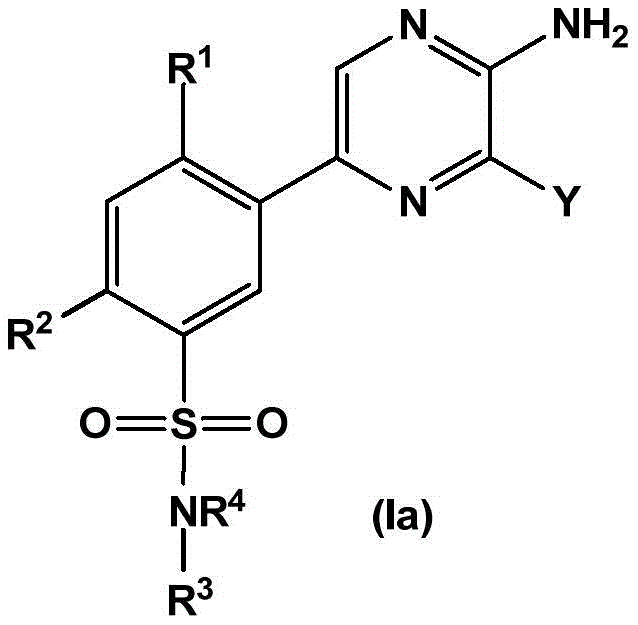
wherein
R1Independently selected from H, halogen, C1-4Alkyl radical, C1-4Alkoxy radical, C1-4Haloalkyl, C1-4Haloalkoxy, C1-4Hydroxyalkyl and C3-7A cycloalkyl group;
R2selected from H, halogen, CF3And a methyl group;
R3is selected from
(i)C1-4An alkyl group which is unsubstituted or substituted with one or more substituents independently selected from the group consisting of: hydroxy, C1-4Hydroxyalkyl, halogen, C1-4Haloalkyl, C1-4Alkoxy radical, C1-4Alkyl, oxo, CN, - (C)0-3Alkyl) -NR3aR3b、C3-7Cycloalkyl and C3-7Heterocyclic group, wherein C3-7Cycloalkyl or C3-7The heterocyclyl is unsubstituted or substituted with 1 to 3 substituents independently selected from the group consisting of: hydroxy, C1-4Hydroxyalkyl, halogen, C1-4Alkyl radical, C1-4Alkoxy radical, C1-4Haloalkyl, oxo and- (C)0-3Alkyl) -NR3aR3b;
(ii)C1-4An alkoxy group which is unsubstituted or substituted with one or more substituents independently selected from the group consisting of: hydroxy, C1-4Hydroxyalkyl, halogen, C1-4Haloalkyl, C1-4Alkoxy radical, C1-4Alkyl, oxo, CN, - (C)0-3Alkyl) -NR3aR3b、C3-7Cycloalkyl and C3-7Heterocyclic group, wherein C3-7Cycloalkyl is unsubstituted or substituted with 1 to 3 substituents independently selected from the group consisting of: hydroxy, C1-4Hydroxyalkyl, halogen, C1-4Alkyl radical, C1-4Alkoxy radical, C1-4Haloalkyl, oxo and- (C)0-3Alkyl) -NR3aR3b;
(iii)–C3-7Cycloalkyl or-O-C3-7Cycloalkyl radicals, in which C3-7Cycloalkyl is unsubstituted or substituted with 1 to 3 substituents independently selected from the group consisting of: hydroxy, C1-4Hydroxyalkyl, halogen, C1-4Alkyl radical, C1-4Alkoxy radical, C1-4Haloalkyl, oxo and- (C)0-3Alkyl) -NR3aR3b;
(iv)–(C0-3Alkyl) -C3-7Cycloalkyl or-O- (C)0-3Alkyl) -C3-7Cycloalkyl radicals, in which C3-7Cycloalkyl being with a second C3-7Cycloalkyl or C3-7Heterocyclyl is a spiro ring fused via a single carbon atom, wherein C3-7Cycloalkyl or C3-7The heterocyclyl is unsubstituted or substituted with 1 to 3 substituents independently selected from the group consisting of: hydroxy, C1-4Hydroxyalkyl, halogen, C1-4Alkyl radical, C1-4Alkoxy radical, C1-4Haloalkyl, oxo and- (C)0-3Alkyl radical)-NR3aR3b;
(v)–(C0-3Alkyl) -C3-7Heterocyclyl or-O- (C)0-3Alkyl) -C3-7Heterocyclyl, wherein said C is3-7The heterocyclyl is unsubstituted or substituted with 1 to 3 substituents independently selected from the group consisting of: hydroxy, C1-4Hydroxyalkyl, halogen, C1-4Alkyl radical, C1-4Alkoxy radical, C1-4Haloalkyl, oxo and- (C)0-3Alkyl) -NR3aR3b;
(vi)–(C0-3Alkyl) -C3-7Heterocyclyl or- (O-C)0-3Alkyl) -C3-7Heterocyclyl, wherein said C is3-7Heterocyclyl is with a second C3-7Heterocyclyl or C3-7Spiro ring fused by a cycloalkyl group through a single carbon atom, wherein C3-7Heterocyclyl or C3-7Cycloalkyl is unsubstituted or substituted with 1 to 3 substituents independently selected from the group consisting of: hydroxy, C1-4Hydroxyalkyl, halogen, C1-4Alkyl radical, C1-4Alkoxy radical, C1-4Haloalkyl, oxo and- (C)0-3Alkyl) -NR3aR3b;
(vii)H;
R4Selected from H and C1-4An alkyl group; or
R3And R4Together with the nitrogen atom to which they are attached form C3-7Heterocyclic group, wherein C3-7Heterocyclyl is with a second C3-7Heterocyclyl or C3-7Cycloalkyl optionally condensed via a single carbon atom to form a spiro ring, C3-7Heterocyclyl and C3-7Cycloalkyl is unsubstituted or substituted with 1 to 3 substituents independently selected from the group consisting of: hydroxy, C1-4Hydroxyalkyl, halogen, C1-4Alkyl radical, C1-4Alkoxy radical, C1-4Haloalkyl, oxo and- (C)0-3Alkyl) -NR3aR3b;
R3aAnd R3bIndependently selected from H, C1-4Alkyl and C1-4A haloalkyl group;
y is selected from the following groups:
-a thiazolyl group,
-a thiadiazolyl group,
-an isothiazolyl group, a pharmaceutically acceptable salt thereof,
-a pyrazolyl group,
-a pyridyl group,
-a triazole group,
-an imidazole group,
-an oxadiazole group having a structure represented by formula (I),
-an isoxazolyl group, which is a phenyl group,
-an oxazolyl group, a nitrogen atom,
-a pyrrolyl group,
-a pyrimidinyl group,
-thienyl, and
-a furyl group;
each of which is unsubstituted or substituted with 1 to 3 substituents independently selected from the group consisting of: c1-4Alkyl radical, C1-4Haloalkyl, C1-4Alkoxy radical C1-4Alkyl radical, C1-4Hydroxyalkyl radical, C1-4Alkoxy radical, C1-4Haloalkoxy, halogen, C1-4Hydroxyalkyl, - (C)0-3Alkyl) -NR' R ", (C)0-3Alkyl) -C3-7Cycloalkyl and- (C)0-3Alkyl) -C3-7Heterocyclyl, - (C ═ O) -C3-7Heterocyclyl, - (C ═ O) -NR' R ", (C)0-3Alkyl) -phenyl and- (C0-3Alkyl) -5-6 membered heteroaryl;
r 'and R' are independently selected from H and C1-4An alkyl group.
In embodiment 3 of the present invention, there is provided a compound of embodiment 1 or 2, or a pharmaceutically acceptable salt thereof, wherein
R1Selected from H and C1-4An alkyl group;
R2selected from H, halogen, C1-4Haloalkyl and methyl;
R3is selected from
(i)C1-4Alkyl substituted with one or more, especially 1-3 substituents independently selected from the group consisting of: selected from hydroxy, halogen, -NR3aR3b、C1-4Alkyl radical, C3-7CycloalkanesRadical and C3-7A heterocyclic group;
(ii)C1-4an alkoxy group which is unsubstituted or substituted with one or more substituents independently selected from the group consisting of: hydroxy, halogen, -NR3aR3b、C1-4Alkyl radical, C3-7Cycloalkyl and C3-7A heterocyclic group;
(iii)–O-(C0-3alkyl) -C3-7Heterocyclyl, wherein said C is3-7The heterocyclyl is unsubstituted or substituted with 1 to 3 substituents independently selected from the group consisting of: c1-4Alkyl radical, C1-4Alkoxy, hydroxy, C1-4Hydroxyalkyl, halogen, oxo and C1-4A haloalkyl group;
(iv)–O-(C0-3alkyl) -C3-7Cycloalkyl radicals, in which C3-7Cycloalkyl is unsubstituted or substituted with 1 to 3 substituents independently selected from the group consisting of: c1-4Alkyl radical, C1-4Alkoxy, hydroxy, C1-4Hydroxyalkyl, halogen, oxo and C1-4A haloalkyl group;
(v)–(C0-3alkyl) -C3-7Cycloalkyl radicals, in which C3-7Cycloalkyl is unsubstituted or substituted with 1 to 3 substituents independently selected from the group consisting of: c1-4Alkyl radical, C1-4Alkoxy, hydroxy, C1-4Hydroxyalkyl, halogen, oxo and C1-4A haloalkyl group;
(vi)–(C0-3alkyl) -C3-7Heterocyclyl, wherein said C is3-7The heterocyclyl is unsubstituted or substituted with 1 to 3 substituents independently selected from the group consisting of: c1-4Alkyl radical, C1-4Alkoxy, hydroxy, C1-4Hydroxyalkyl, halogen, oxo and C1-4A haloalkyl group;
(vii)–(C0-3alkyl) -C3-7Cycloalkyl or-O- (C)0-3Alkyl) -C3-7Cycloalkyl radicals, in which C3-7Cycloalkyl being with a second C3-7Cycloalkyl or C3-7Heterocyclyl is a spiro ring fused via a single carbon atom, wherein C3-7Cycloalkyl or C3-7The heterocyclic radical being unsubstituted orSubstituted with 1-3 substituents independently selected from the group consisting of: c1-4Alkyl radical, C1-4Alkoxy, hydroxy, C1-4Hydroxyalkyl, halogen, oxo and C1-4A haloalkyl group;
R4selected from H and C1-4An alkyl group; or
R3And R4Together with the nitrogen atom to which they are attached form C3-7Heterocyclic group, wherein C3-7Heterocyclyl is with a second C3-7Heterocyclyl or C3-7Cycloalkyl optionally condensed via a single carbon atom to form a spiro ring, C3-7Heterocyclyl and C3-7Cycloalkyl is unsubstituted or substituted with 1 to 3 substituents independently selected from the group consisting of: hydroxy, C1-4Hydroxyalkyl, halogen, C1-4Alkyl radical, C1-4Alkoxy radical, C1-4Haloalkyl, oxo and- (C)0-3Alkyl) -NR3aR3b;
R3aAnd R3bIndependently selected from H and C1-4An alkyl group;
y is selected from the following groups:
-a thiazolyl group,
-a thiadiazolyl group,
-an isothiazolyl group, a pharmaceutically acceptable salt thereof,
-a pyrazolyl group,
-a pyridyl group,
-a triazole group,
-an imidazole group,
-an oxadiazolyl group,
-an isoxazolyl group, which is a phenyl group,
-an oxazolyl group, a nitrogen atom,
-a pyrrolyl group,
-thienyl, and
-a furyl group;
each of which is unsubstituted or substituted with 1 to 3 substituents independently selected from the group consisting of: c1-4Alkyl radical, C1-4Haloalkyl, C1-4Hydroxyalkyl, - (C)0-3Alkyl) -C3-7Cycloalkyl, - (C ═ O) -C3-7Heterocyclyl, - (C)0-3Alkyl) -NR' R ", (C ═ R ═ CO)-NR’R”、–(C0-3Alkyl) -phenyl and- (C0-3Alkyl) -pyridinyl;
r 'and R' are independently selected from H and C1-4An alkyl group.
In embodiment 3.1 of the invention there is provided a compound or salt of embodiment 1.1 or 2.1 wherein E is CRE,REIs H.
In embodiment 4 of the present invention, there is provided a compound of any one of embodiments 1 to 3, or a pharmaceutically acceptable salt thereof, wherein
Y is selected from the following groups:
-an oxazol-2-yl group,
-an oxazol-5-yl group,
-an oxazol-4-yl group,
-a thiazol-5-yl group,
-a thiazol-4-yl group,
-1,3, 4-thiadiazol-2-yl,
-an isothiazol-5-yl group,
-a pyrazol-4-yl group,
-a pyrazol-3-yl group,
-a pyrazol-1-yl group,
-a pyridin-4-yl group,
-a pyridin-3-yl group,
-a pyridin-2-yl group,
-1,2, 4-triazol-1-yl,
-1,2, 3-triazol-4-yl,
-an imidazol-1-yl group having a structure,
-1,2, 4-oxadiazol-5-yl,
-1,3, 4-oxadiazol-2-yl,
-1,2, 4-oxadiazol-3-yl,
-an isoxazol-5-yl group,
-an isoxazol-3-yl group,
-an isoxazol-4-yl group,
-a pyrrol-3-yl group,
-a thiophen-2-yl group,
-thiophen-3-yl, and
-a furan-3-yl group,
each of which is unsubstituted or is independently substitutedAnd (b) is substituted by 1 to 3 substituents selected from the following group: c1-4Alkyl radical, C1-4Haloalkyl, C1-4Hydroxyalkyl, - (C)0-3Alkyl) -C3-7Cycloalkyl, - (C ═ O) -C3-7Heterocyclyl, - (C)0-3Alkyl) -NR' R ", (C ═ O)0-3Alkyl) -phenyl and- (C0-3Alkyl) -pyridinyl;
r 'and R' are independently selected from H and C1-4An alkyl group.
In embodiment 4.1 of the present invention there is provided a compound or salt of any one of embodiments 1-3 wherein R1Is selected from C1-4Alkyl and H.
In embodiment 5 of the present invention, there is provided a compound of any one of embodiments 1 to 4, or a pharmaceutically acceptable salt thereof, wherein
Y is selected from the following groups:
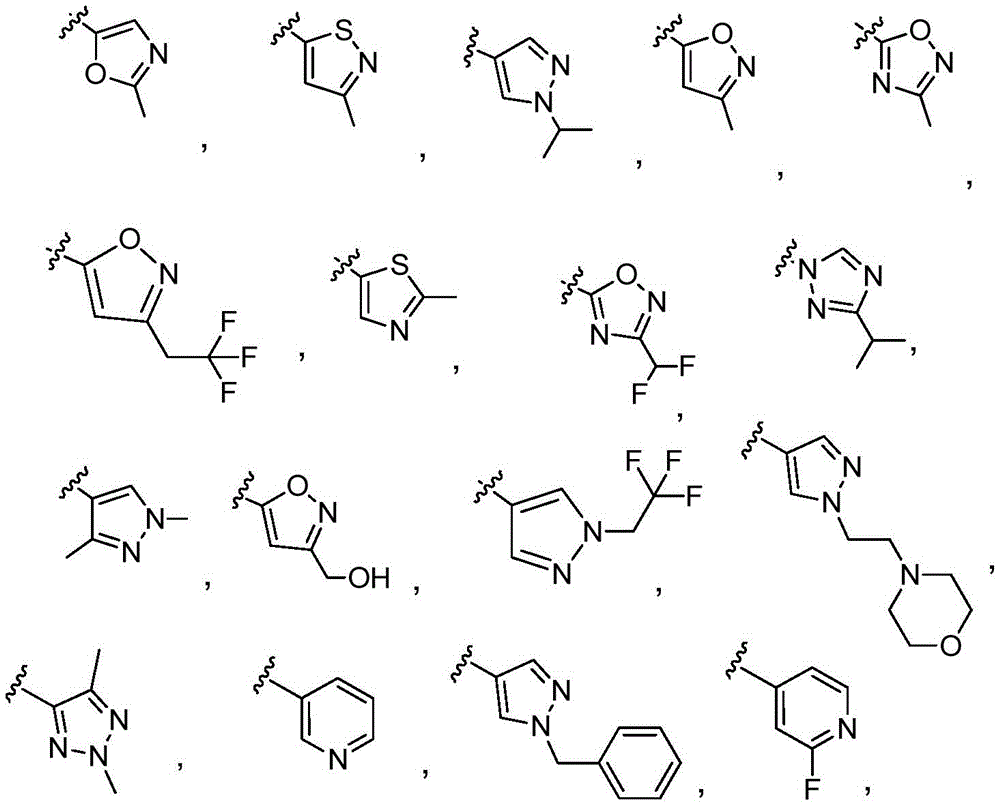
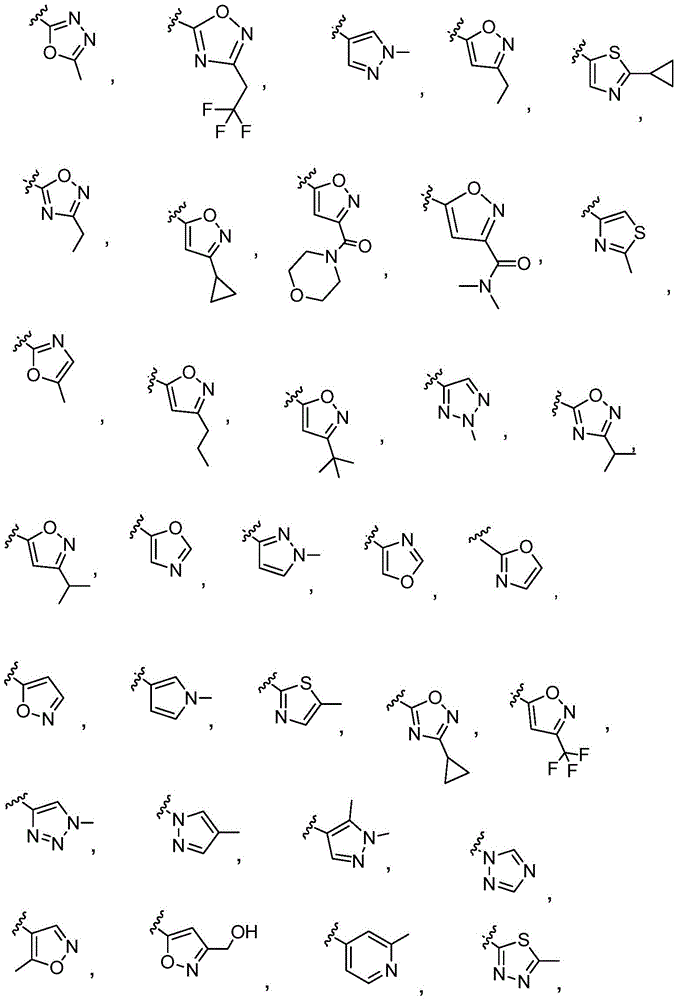

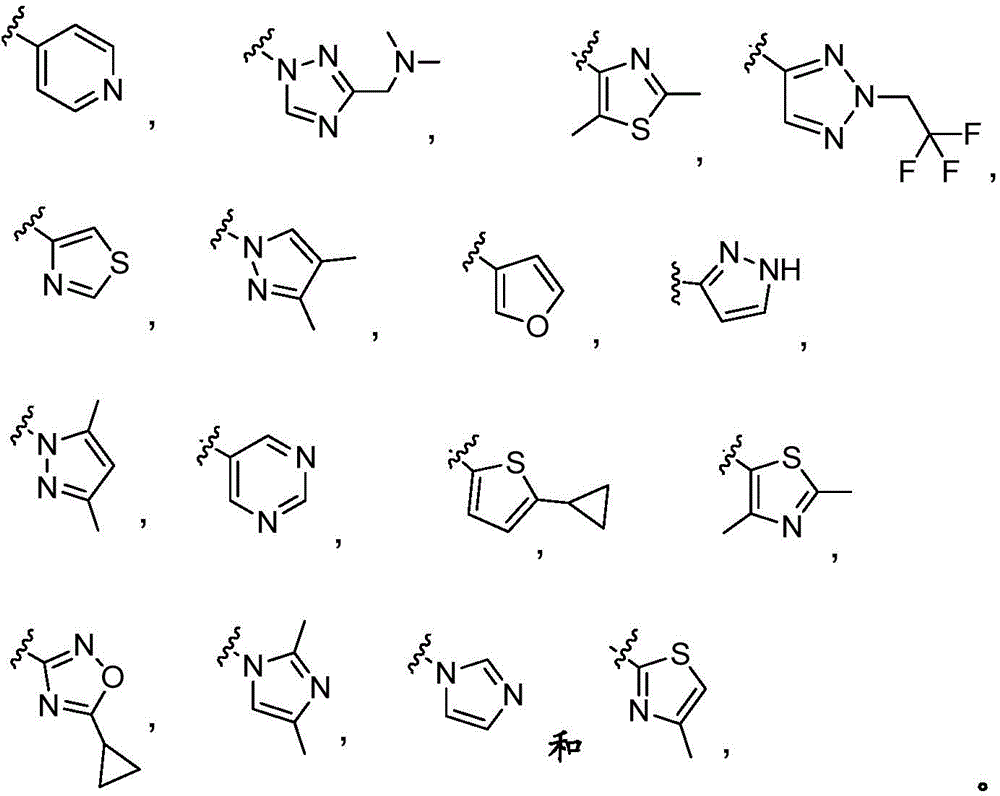
in embodiment 5.1 of the present invention there is provided a compound or salt of embodiment 4.1, wherein R is1Selected from methyl and H, especially methyl.
In embodiment 5.16 of the present invention there is provided a compound of any one of embodiments 1 to 4, or a pharmaceutically acceptable salt thereof, wherein
Y is selected from the following groups:
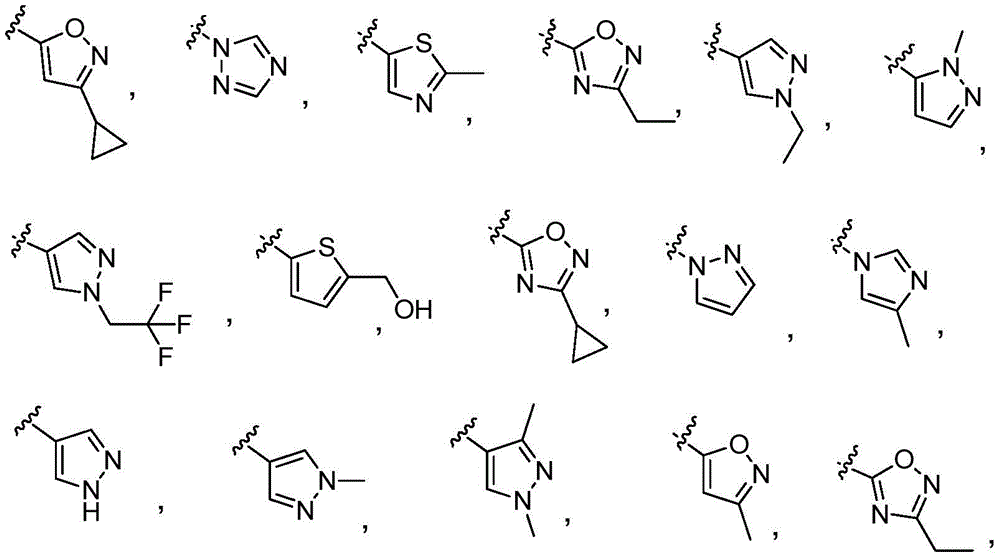

in embodiment 6.1 of the present invention there is provided a compound or salt of any one of embodiments 1-5, wherein R2Selected from H, C1-4Alkyl and halogen.
In embodiment 7 of the present invention, there is provided a compound of any one of embodiments 1 to 4, or a pharmaceutically acceptable salt thereof, wherein
Y is selected from the following groups:

in embodiment 7.1 of the present invention there is provided a compound or salt of embodiment 6.1, wherein R is2Selected from the group consisting of H, fluoro, chloro and methyl, in particular H and fluoro, more in particular H.
In embodiment 8 of the present invention, there is provided a compound according to any one of embodiments 1 to 7, or a pharmaceutically acceptable salt thereof, wherein
R3Is selected from
(i)C1-4An alkyl group substituted with 1 to 3 substituents independently selected from the group consisting of: hydroxy, halogen and C1-4An alkyl group;
(ii)C1-4an alkoxy group which is unsubstituted or substituted with 1 to 3 substituents independently selected from the group consisting of: hydroxy, halogen and C1-4An alkyl group;
(iii)–O-(C0-3alkyl) -C3-7Heterocyclic group, wherein C3-7Heterocyclyl contains at least one heteroatom selected from O and N, wherein C3-7The heterocyclyl is unsubstituted or substituted with 1 to 3 substituents independently selected from the group consisting of: c1-4Alkyl, hydroxy, C1-4Hydroxyalkyl, halogen, oxo and C1-4A haloalkyl group;
(iv)–O-(C0-3alkyl) -C3-7Cycloalkyl radicals, in which C3-7Cycloalkyl is unsubstituted or independently selected from1-3 substituents of the following: c1-4Alkyl, hydroxy, C1-4Hydroxyalkyl, halogen, oxo and C1-4A haloalkyl group;
(v)–(C0-3alkyl) -C3-7Cycloalkyl radicals, in which C3-7Cycloalkyl is unsubstituted or substituted with 1 to 3 substituents independently selected from the group consisting of: c1-4Alkyl, hydroxy, C1-4Hydroxyalkyl, halogen, oxo and C1-4A haloalkyl group;
(vi)–(C0-3alkyl) -C3-7Heterocyclic group, wherein C3-7Heterocyclyl contains at least one heteroatom selected from O and N, wherein C3-7The heterocyclyl is unsubstituted or substituted with 1 to 3 substituents independently selected from the group consisting of: c1-4Alkyl, hydroxy, C1-4Hydroxyalkyl, oxo, halogen and C1-4A haloalkyl group;
(vii)–(C0-3alkyl) -C3-7Cycloalkyl or- (O-C)0-3Alkyl) -C3-7Cycloalkyl radicals, in which C3-7Cycloalkyl being with a second C3-7Cycloalkyl or C3-7Heterocyclyl is a spiro ring fused via a single carbon atom, wherein C3-7Cycloalkyl or C3-7The heterocyclyl is unsubstituted or substituted with 1 to 3 substituents independently selected from the group consisting of: c1-4Alkyl, hydroxy, C1-4Hydroxyalkyl, halogen, oxo and C1-4A haloalkyl group;
(viii)–(C0-3alkyl) -C3-7Heterocyclyl or- (O-C)0-3Alkyl) -C3-7Heterocyclic group, wherein C3-6Heterocyclyl contains at least one heteroatom selected from O and N, wherein C3-7Heterocyclyl is with a second C3-7Heterocyclyl or C3-7Spiro ring fused by a cycloalkyl group through a single carbon atom, wherein C3-7Heterocyclyl or C3-7Cycloalkyl is unsubstituted or substituted with 1 to 3 substituents independently selected from the group consisting of: c1-4Alkyl radical, C1-4Alkoxy, hydroxy, C1-4Hydroxyalkyl, halogen, oxo and C1-4A haloalkyl group.
In bookIn embodiment 8.1 of the invention there is provided a compound or salt of any one of embodiments 1-7 wherein R3Is selected from
(i)C1-4Alkyl substituted with 1-3 substituents independently selected from the group consisting of: hydroxy, C1-4Alkyl, halogen, oxo and-NR3aR3b;
(ii)C1-4Alkoxy substituted with 1 to 3 substituents independently selected from the group consisting of: hydroxy, halogen and C1-4An alkyl group;
(iii)–(C0-3alkyl) -C3-6Cycloalkyl radicals, in which C3-6Cycloalkyl is substituted with 1 to 3 substituents independently selected from the group consisting of: hydroxy, C1-4Hydroxyalkyl and halogen;
(iv)–(C0-3alkyl) -C3-6Cycloalkyl spiro ring, the spiro ring being substituted with a second C3-6Cycloalkyl radicals condensed via a single carbon atom, wherein the second C is3-6Cycloalkyl is substituted with 1 to 3 substituents independently selected from the group consisting of: hydroxy and halogen;
(v)–(C0-3alkyl) -C3-6Heterocyclic group, wherein C3-6Heterocyclyl contains at least one heteroatom selected from O and N, wherein C3-6The heterocyclyl is unsubstituted or substituted with 1 to 3 substituents independently selected from the group consisting of: hydroxy, C1-4Alkyl and C1-4A hydroxyalkyl group;
(vi)–(C0-3alkyl) -C3-6Heterocyclic group, wherein C3-6Heterocyclyl contains at least one heteroatom selected from O and N, wherein C3-6Heterocyclyl is with a second C3-6Heterocyclyl or C3-6Spiro ring fused by a cycloalkyl group through a single carbon atom, wherein C3-6Heterocyclyl or C3-6Cycloalkyl is unsubstituted or substituted with 1 to 3 substituents independently selected from the group consisting of: c1-4Alkyl, hydroxy and C1-4A hydroxyalkyl group;
R3aand R3bIndependently selected from H and C1-4An alkyl group;
R4selected from H and C1-4An alkyl group; or
R3And R4Together with the nitrogen atom to which they are attached form C3-6Heterocyclic group of3-6The heterocyclyl is unsubstituted or substituted with 1 to 3 substituents independently selected from the group consisting of: hydroxy, C1-4Hydroxyalkyl and C1-4An alkyl group.
In embodiment 9 of the present invention, there is provided a compound of any one of embodiments 1 to 7, or a pharmaceutically acceptable salt thereof, wherein
R3Is selected from
(i)C1-4An alkyl group substituted with 1 to 3 substituents independently selected from the group consisting of: hydroxy, halogen and C1-4An alkyl group;
(ii)C1-4an alkoxy group which is unsubstituted or substituted with 1 to 3 substituents independently selected from the group consisting of: hydroxy, halogen and C1-4An alkyl group;
(iii)–O-(C0-3alkyl) -C3-7Heterocyclic group, wherein C3-7Heterocyclyl contains at least one heteroatom selected from O and N, wherein C3-7The heterocyclyl is unsubstituted or substituted with 1 to 3 substituents independently selected from the group consisting of: c1-4Alkyl, hydroxy, C1-4Hydroxyalkyl, halogen, oxo and C1-4A haloalkyl group;
(iv)–O-(C0-3alkyl) -C3-7Cycloalkyl radicals, in which C3-7Cycloalkyl is unsubstituted or substituted with 1 to 3 substituents independently selected from the group consisting of: c1-4Alkyl, hydroxy, C1-4Hydroxyalkyl, halogen, oxo and C1-4A haloalkyl group;
(v)–(C0-3alkyl) -C3-7Cycloalkyl radicals, in which C3-7Cycloalkyl is unsubstituted or substituted with 1 to 3 substituents independently selected from the group consisting of: c1-4Alkyl, hydroxy, C1-4Hydroxyalkyl, halogen, oxo and C1-4A haloalkyl group;
(vi)–(C0-3alkyl) -C3-7Heterocyclic group, wherein C3-7Heterocyclyl contains at least one heteroatom selected from O and N, wherein C3-7The heterocyclic radical being unsubstituted or substituted1-3 substituents independently selected from the group consisting of: c1-4Alkyl, hydroxy, C1-4Hydroxyalkyl, oxo, halogen and C1-4A haloalkyl group;
(vii)–(C0-3alkyl) -C3-7Cycloalkyl or- (O-C)0-3Alkyl) -C3-7Cycloalkyl spiro ring, the spiro ring being substituted with a second C3-7Cycloalkyl or C3-7The heterocyclic radical being condensed by a single carbon atom, wherein C3-7Cycloalkyl or C3-7The heterocyclyl is unsubstituted or substituted with 1 to 3 substituents independently selected from the group consisting of: c1-4Alkyl, hydroxy, C1-4Hydroxyalkyl, oxo, halogen and C1-4A haloalkyl group.
In embodiment 9.1 of the present invention there is provided a compound or salt of any one of embodiments 1-7, wherein R3Is C1-4An alkyl group which is unsubstituted or substituted with 1 to 3 substituents independently selected from the group consisting of: hydroxy, C1-4Hydroxyalkyl, halogen, C1-4Haloalkyl, C1-4Alkoxy radical, C1-4Alkyl, oxo, -NR3aR3bAnd C3-6Cycloalkyl radicals, in which C3-6Cycloalkyl is unsubstituted or substituted with 1 to 3 substituents independently selected from the group consisting of: hydroxy, C1-4Hydroxyalkyl, halogen, C1-4Alkoxy and C1-4A haloalkyl group.
In embodiment 10 of the present invention, there is provided a compound of any one of embodiments 1 to 7, or a pharmaceutically acceptable salt thereof, wherein
R3Is selected from
(i)C1-4An alkyl group substituted with 1 to 3 substituents independently selected from the group consisting of: hydroxy, halogen and C1-4An alkyl group;
(ii)C1-4an alkoxy group which is unsubstituted or substituted with 1 to 3 substituents independently selected from the group consisting of: hydroxy, halogen and C1-4An alkyl group;
(iii)–O-(C0-3alkyl) -C3-7Heterocyclic group, wherein C3-7The heterocyclic group contains at least one hetero atom selected from O and N, whereinC is3-7The heterocyclyl is unsubstituted or substituted with 1 to 3 substituents independently selected from the group consisting of: c1-4Alkyl, hydroxy, C1-4Hydroxyalkyl, halogen and C1-4A haloalkyl group;
(iv)–O-(C0-3alkyl) -C3-7Cycloalkyl radicals, in which C3-7Cycloalkyl is unsubstituted or substituted with 1 to 3 substituents independently selected from the group consisting of: c1-4Alkyl, hydroxy, C1-4Hydroxyalkyl, halogen and C1-4A haloalkyl group;
(v)–(C0-3alkyl) -C3-7Cycloalkyl radicals, in which C3-7Cycloalkyl is unsubstituted or substituted with 1 to 3 substituents independently selected from the group consisting of: c1-4Alkyl, hydroxy, C1-4Hydroxyalkyl, halogen and C1-4A haloalkyl group.
In embodiment 10.1 of the present invention there is provided a compound or salt of embodiment 9.1, wherein R is3Selected from the group consisting of propyl, butyl and pentyl, substituted with 1 to 3 substituents independently selected from the group consisting of: hydroxy, C1-4Alkyl, halogen, -NR3aR3bAnd oxo.
In embodiment 11 of the present invention, there is provided a compound according to any one of embodiments 1 to 7, or a pharmaceutically acceptable salt thereof, wherein
R3Is selected from
(i)C1-4An alkyl group substituted with 1 to 3 substituents independently selected from the group consisting of: hydroxy, halogen and C1-4An alkyl group;
(ii)C1-4an alkoxy group which is unsubstituted or substituted with 1 to 3 substituents independently selected from the group consisting of: hydroxy, halogen and C1-4An alkyl group;
(iii)–O-(C0-3alkyl) -C3-7Heterocyclic group, wherein C3-7Heterocyclyl contains at least one heteroatom selected from O and N, wherein C3-7The heterocyclyl is unsubstituted or substituted with 1 to 3 substituents independently selected from the group consisting of: c1-4Alkyl, hydroxy, C1-4Hydroxyalkyl, halogen and C1-4A haloalkyl group;
(iv)–O-(C0-3alkyl) -C3-7Cycloalkyl radicals, in which C3-7Cycloalkyl is unsubstituted or substituted with 1 to 3 substituents independently selected from the group consisting of: c1-4Alkyl, hydroxy, C1-4Hydroxyalkyl, halogen and C1-4A haloalkyl group.
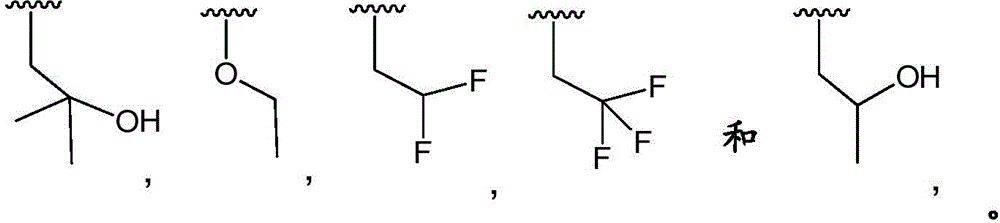
In embodiment 11.1 of the invention there is provided a compound or salt of embodiment 9.1, wherein R is3Is selected from
3-hydroxypropyl-;
3-hydroxy-2, 2-dimethylpropyl-;
3-hydroxy-3-methylbutyl-;
2-hydroxy-2-methylpropyl-;
4,4, 4-trifluoro-3-hydroxybutyl-;
2, 2-difluoroethyl-;
3, 3-dimethyl-2-oxo-butyl; and
3,3, 3-trifluoro-2-hydroxy-2-methylpropyl-.
In embodiment 12 of the present invention, there is provided a compound according to any one of embodiments 1 to 7, or a pharmaceutically acceptable salt thereof, wherein
R3Is selected from
(i)C1-4An alkyl group substituted with 1 to 3 substituents independently selected from the group consisting of: hydroxy, halogen and C1-4An alkyl group;
(ii)C1-4an alkoxy group which is unsubstituted or substituted with 1 to 3 substituents independently selected from the group consisting of: hydroxy and C1-4An alkyl group.
In embodiment 12.1 of the present invention there is provided a compound or salt of embodiment 11.1, wherein R is3Is selected from
3-hydroxypropyl-;
3-hydroxy-2, 2-dimethylpropyl-;
2-hydroxy-2-methylpropyl; and
3-hydroxy-3-methylbutyl-.
In embodiment 13 of the present invention, there is provided a compound according to any one of embodiments 1 to 7, or a pharmaceutically acceptable salt thereof, wherein
R3Is selected from


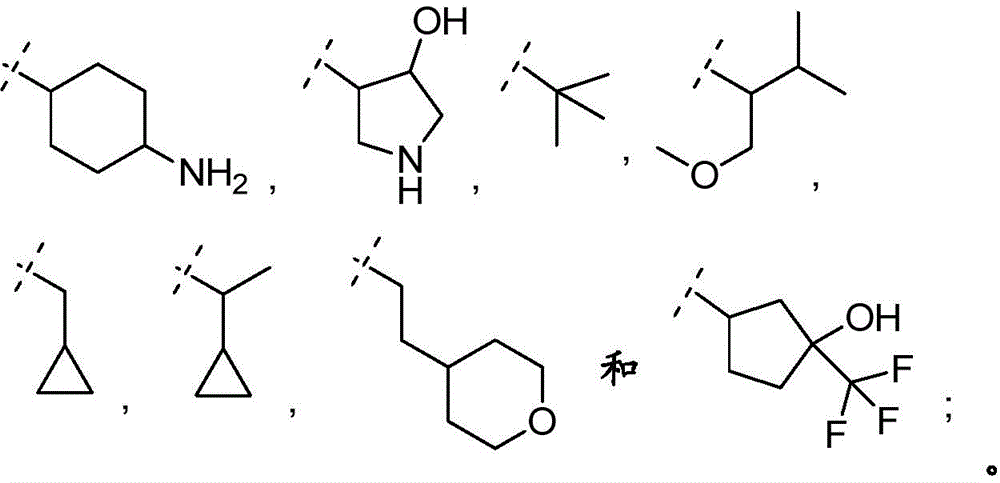
In embodiment 13.1 of the invention there is provided a compound or salt of any one of embodiments 1-7 wherein R is3Is C1-4An alkoxy group which is unsubstituted or substituted with 1 to 3 substituents independently selected from the group consisting of: hydroxy, C1-4Hydroxyalkyl, halogen, C1-4Haloalkyl, C1-4Alkyl radical, C1-4Alkoxy, oxo, -NR3aR3bAnd C3-6Cycloalkyl radicals, in which C3-6Cycloalkyl is unsubstituted or substituted with 1 to 3 substituents independently selected from the group consisting of: hydroxy, C1-4Hydroxyalkyl, halogen, C1-4Alkoxy and C1-4A haloalkyl group.
In embodiment 14 of the invention there is provided a compound according to any one of embodiments 1 to 7, or a pharmaceutically acceptable salt thereof, wherein
R3Is selected from
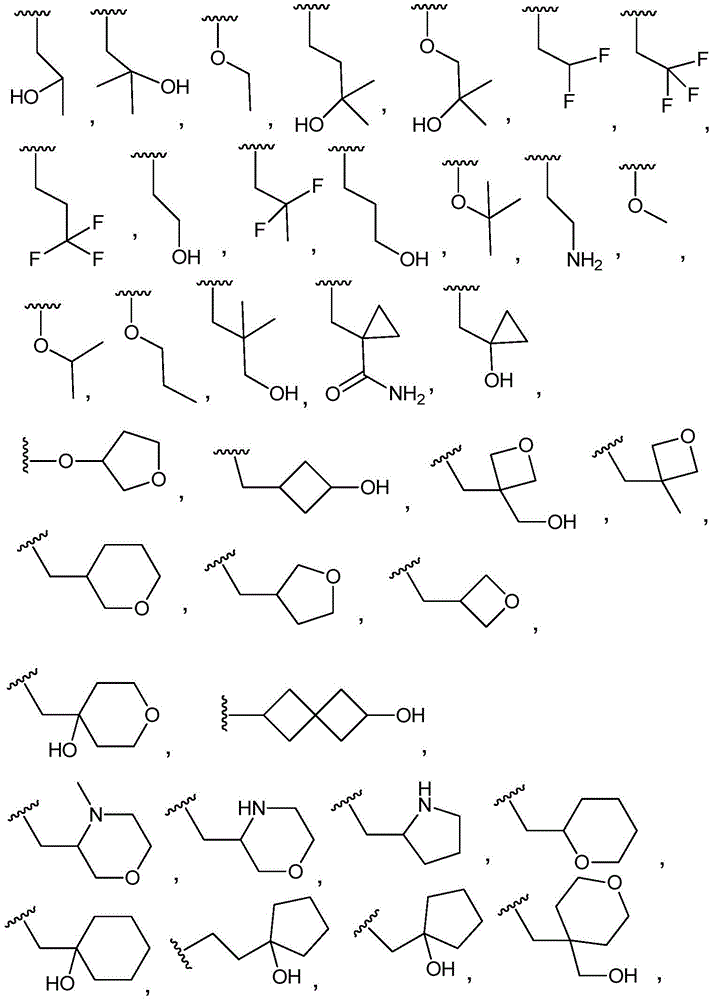

In embodiment 14.1 of the invention there is provided a compound or salt of embodiment 13.1 wherein R is3Selected from propoxy, butoxy and pentoxy, which is substituted with 1-3 substituents selected from hydroxy, C1-4Alkyl and halogen.
In embodiment 15 of the present invention there is provided a compound according to any one of embodiments 1 to 7, or a pharmaceutically acceptable salt thereof, wherein
R3Is selected from
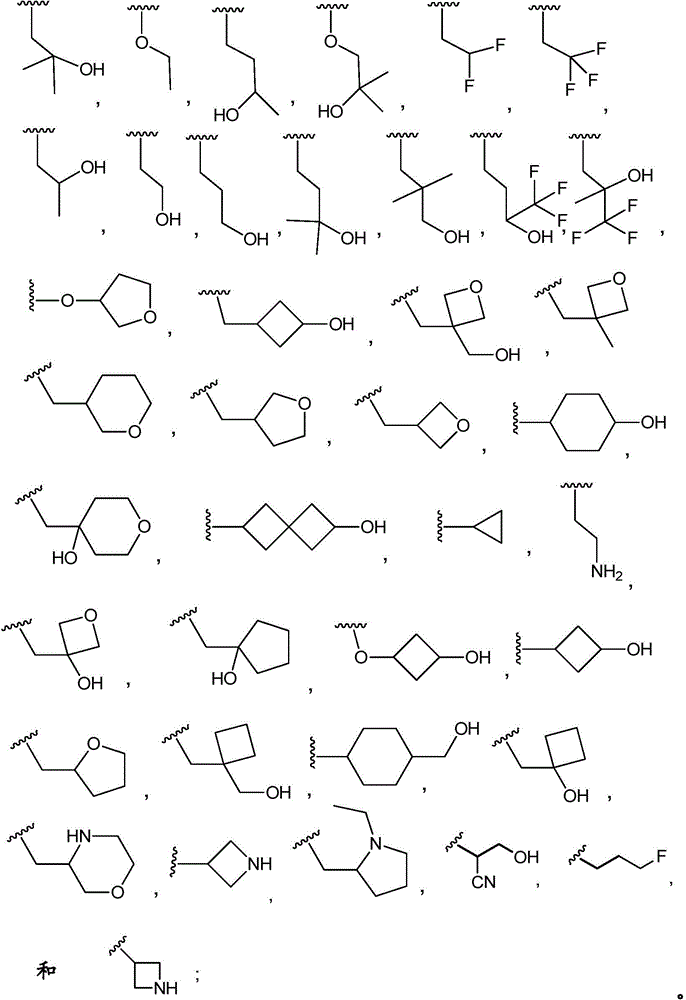
In embodiment 15.1 of the invention there is provided a compound or salt of embodiment 14.1 wherein R is3Is 2-hydroxy-2-methylpropoxy-.
In embodiment 16 of the present invention, there is provided a compound according to any one of embodiments 1 to 7, or a pharmaceutically acceptable salt thereof, wherein
R3Is selected from
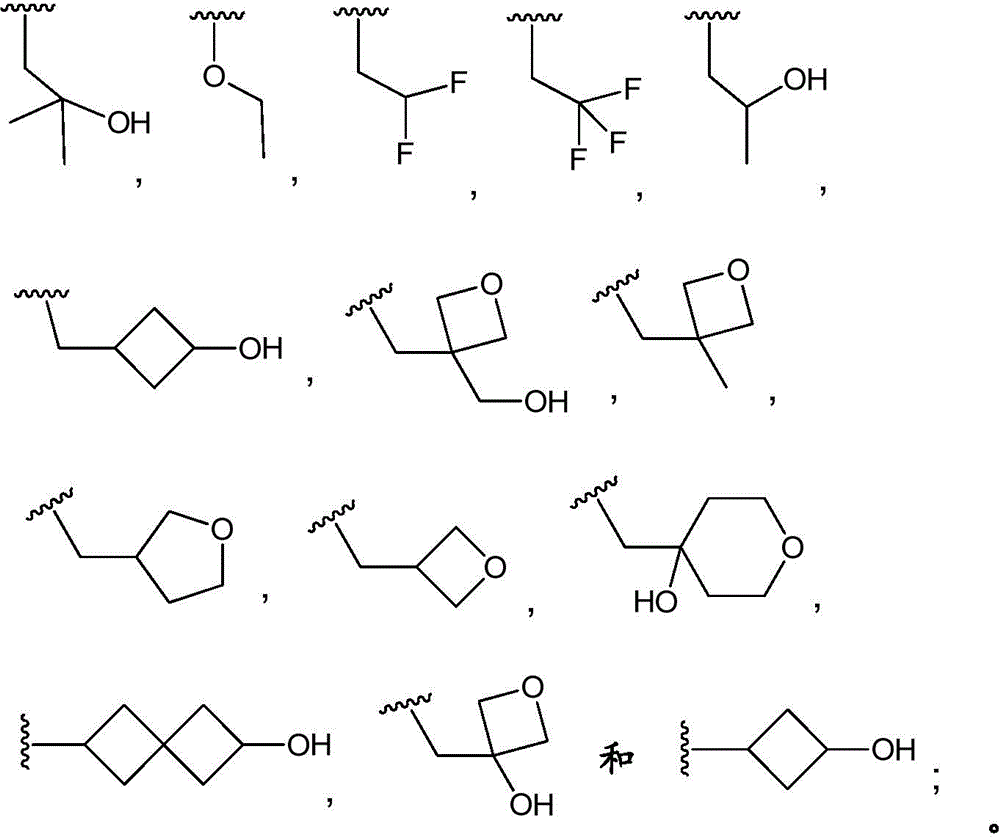
In embodiment 16.1 of the present invention there is provided a compound or salt of any one of embodiments 1-7 wherein R3is-C3-6Cycloalkyl or-O-C3-6Cycloalkyl radicals, in which C3-6Cycloalkyl is unsubstituted or substituted with 1 to 3 substituents independently selected from the group consisting of: hydroxy, C1-4Hydroxyalkyl, halogen, C1-4Alkoxy radical, C1-4Haloalkyl and- (C)0-3Alkyl) -NR3aR3b。
In embodiment 17 of the present invention there is provided a compound according to any one of embodiments 1 to 7, or a pharmaceutically acceptable salt thereof, wherein
R3Is selected from
In embodiment 17.1 of the invention there is provided a compound or salt of embodiment 16.1 wherein R is3Is selected from- (C)0-3Alkyl) -cyclohexyl, - (C)0-3Alkyl) -cyclobutyl and- (C)0-3Alkyl) -cyclopropyl wherein cyclohexyl, cyclobutyl and cyclopropyl are independently selected by 1 or 2Hydroxy, C1-4Hydroxyalkyl and halogen.
In embodiment 18 of the invention there is provided a compound according to any one of embodiments 1 to 7, or a pharmaceutically acceptable salt thereof, wherein
R3Is selected from

In embodiment 18.1 of the invention there is provided a compound or salt of embodiment 17.1 wherein R is3Is selected from
4-hydroxycyclohexyl-;
3-hydroxycyclobutyl-methyl-;
1-hydroxycyclobutyl-methyl-;
1- (hydroxymethyl) cyclopropyl; and
1-hydroxycyclopropyl-methyl-.
In embodiment 19 of the present invention there is provided a compound according to any one of embodiments 1 to 7, or a pharmaceutically acceptable salt thereof, wherein
R3Is selected from

In embodiment 19.1 of the invention there is provided a compound or salt of embodiment 17.1 wherein R is3Selected from 4-hydroxycyclohexyl-.
In embodiment 20 of the invention there is provided a compound according to any one of embodiments 1 to 7, or a pharmaceutically acceptable salt thereof, wherein
R3And R4Together with the nitrogen atom to which they are attached form a ring selected from:

in embodiment 20.1 of the present invention there is provided a compound or salt of any one of embodiments 1-7, wherein R3Is- (C)0-3Alkyl) -C3-6Cycloalkyl or- (O-C)0-3Alkyl) -C3-6Cycloalkyl spiro ring, the spiro ring being substituted with a second C3-6Cycloalkyl or C3-6The heterocyclic radical being condensed by a single carbon atom, wherein C3-6Cycloalkyl or C3-6The heterocyclyl is unsubstituted or substituted with 1 to 3 substituents independently selected from the group consisting of: hydroxy, C1-4Hydroxyalkyl, halogen, C1-4Alkoxy radical, C1-4Haloalkyl and- (C)0-3Alkyl) -NR3aR3b。
In embodiment 21 of the invention there is provided a compound or salt of embodiment 20.1 wherein R is3Selected from spiro [3.3]]Hept-2-yl, spiro [3.4 ]]Oct-6-yl, spiro [4.4 ]]Non-2-yl and spiro [3.4 ]]Undecan-3-yl which may be substituted with 1 to 3 substituents selected from hydroxy and halogen.
In embodiment 22 of the invention there is provided a compound or salt of embodiment 21 wherein R is3Is 6-hydroxy spiro [3.3]Hept-2-yl.
In embodiment 23 of the invention there is provided a compound or salt of any one of embodiments 1-7 wherein R3Comprises the following steps:
–(C0-3alkyl) -C3-6Heterocyclic group, wherein C3-6Heterocyclyl contains at least one heteroatom selected from O and N, wherein C3-6The heterocyclyl is unsubstituted or substituted with 1 to 3 substituents independently selected from the group consisting of: hydroxy, C1-4Alkyl and C1-4A hydroxyalkyl group;
or- (C)0-3Alkyl) -C3-6Heterocyclyl or- (O-C)0-3Alkyl) -C3-6Heterocyclic group, wherein C3-6Heterocyclyl contains at least one heteroatom selected from O and N, wherein C3-6Heterocyclyl is with a second C3-6Heterocyclyl or C3-6Spiro ring fused by a cycloalkyl group through a single carbon atom, wherein C3-6Heterocyclyl or C3-6Cycloalkyl is unsubstituted or substituted with 1 to 3 substituents independently selected from the group consisting of: c1-4Alkyl radical, C1-4Alkoxy, hydroxy, C1-4Hydroxyalkyl, halogen,C1-4Haloalkyl and- (C)0-3Alkyl) -NR3aR3b。
In embodiment 24 of the invention there is provided a compound or salt of embodiment 23 wherein R is3Is selected from- (C)0-3Alkyl) -tetrahydrofuranyl, - (C)0-3Alkyl) -oxetanyl, - (C)0-3Alkyl) -pyrrolidinyl and- (C0-3Alkyl) -tetrahydropyranyl, each of which is unsubstituted or substituted with 1-3 substituents independently selected from: hydroxy, C1-4Alkyl and C1-4A hydroxyalkyl group.
In embodiment 25 of the invention there is provided a compound or salt of embodiment 24 wherein R is3Selected from:
- (1-ethylpyrrolidin-2-yl) methyl,
- (tetrahydro-2H-pyran-4-yl,
- (3-hydroxyoxetan-3-yl) methyl,
- (3-methyloxetan-3-yl) methyl,
- (4-hydroxy-tetrahydropyran) methyl,
- (3-hydroxymethyl-oxetan-3-yl) methyl, and
- (tetrahydrofuran-3-yl) methyl.
In embodiment 26 of the invention there is provided a compound or salt of any one of embodiments 1-25, wherein R4Is H or methyl.
In embodiment 27 of the invention there is provided a compound or salt of any one of embodiments 1-7 wherein R3And R4Together with the nitrogen atom to which they are attached form C3-6A heterocyclyl which is unsubstituted or substituted with 1 to 3 substituents independently selected from: c1-4Alkyl, hydroxy, C1-4Hydroxyalkyl, halogen, C1-4Alkoxy and C1-4A haloalkyl group.
In embodiment 28 of the invention there is provided a compound or salt of embodiment 27 wherein R is3And R4Together with the nitrogen atom to which they are attached form a piperazinyl, piperidinyl or azetidinyl groupAn alkadienyl group which is unsubstituted or substituted with 1 to 3 substituents independently selected from: hydroxy, C1-4Hydroxyalkyl and C1-4An alkyl group.
In embodiment 29 of the invention there is provided a compound or salt of embodiment 28 wherein R is3And R4Together with the nitrogen atom to which they are attached form:
-3- (trifluoromethyl) piperazin-1-yl,
-3, 3-difluoropiperidin-1-yl, or
-1- (hydroxymethyl) azetidin-3-yl.
In embodiment 30 of the invention, there is provided a compound or salt of any one of embodiments 1-29, wherein Y is selected from:
-a thiazolyl group,
-a pyrazolyl group,
-a pyridyl group,
-a triazole group,
-an imidazole group,
-an oxadiazole group having a structure represented by formula (I),
-a pyrimidinyl group,
-an isoxazolyl group, which is a phenyl group,
-oxazolyl, and
-thienyl;
each of which is unsubstituted or substituted with 1 to 3 substituents independently selected from the group consisting of: c1-4Alkyl radical, C1-4Haloalkyl, C1-4Alkoxy radical C1-4Alkyl radical, C1-4Hydroxyalkyl radical, C1-4Alkoxy radical, C1-4Haloalkoxy, halogen, -NR3aR3b、–(C0-3Alkyl) -C3-6Cycloalkyl and- (C)0-3Alkyl) -C3-6A heterocyclic group.
In embodiment 31 of the invention, there is provided a compound or salt of embodiment 30 wherein Y is selected from:
-a thiazol-5-yl group,
-a pyrazol-4-yl group,
-a pyrazol-5-yl group,
-a pyrazol-1-yl group,
-a pyridin-4-yl group,
-a pyridin-3-yl group,
-1,2, 4-triazol-1-yl,
-1,2, 3-triazol-4-yl,
-an imidazol-1-yl group having a structure,
-1,2, 4-oxadiazol-5-yl,
-1,3, 4-oxadiazol-2-yl,
-an isoxazol-5-yl group,
-a pyrimidin-5-yl group,
-a thien-3-yl group,
each of which is unsubstituted or substituted with 1 to 3 substituents independently selected from the group consisting of: c1-4Alkyl radical, C1-4Haloalkyl, C1-4Alkoxy radical C1-4Alkyl radical, C1-4Hydroxyalkyl radical, C1-4Alkoxy radical, C1-4Haloalkoxy and- (C)0-3Alkyl) -C3-6A cycloalkyl group.
In embodiment 32 of the invention there is provided a compound or salt of embodiment 31 wherein Y is selected from:
-a thiazol-5-yl group,
-a pyrazol-4-yl group,
-a pyrazol-5-yl group,
-a pyrazol-1-yl group,
-a pyridin-4-yl group,
-a pyridin-3-yl group,
-1,2, 4-triazol-1-yl,
-1,2, 3-triazol-4-yl,
-an imidazol-1-yl group having a structure,
-1,2, 4-oxadiazol-5-yl,
-an isoxazol-5-yl group,
-a pyrimidin-5-yl group,
-a thien-3-yl group,
each of which is unsubstituted or substituted with 1 to 3 substituents independently selected from the group consisting of: methyl, ethyl, propyl, isopropyl, cyclopropyl, CF3Hydroxyethyl, methoxyethyl, and methoxy.
In embodiment 33 of the invention, there is provided a compound or salt of embodiment 30 wherein Y is selected from:
-5-morpholin-4-ylmethyl-thiophen-3-yl,
-3-cyclopropyl- [1,2,4] triazol-1-yl,
-2-cyclopropyl-thiazol-5-yl,
-2, 5-dimethyl-2H- [1,2,3] triazol-4-yl,
-2-methylthiazol-5-yl,
-1, 3-dimethyl-1H-pyrazol-4-yl,
-1,2, 4-triazol-1-yl,
-3-isopropyl-1, 2, 4-oxadiazol-5-yl,
-1-methyl-1H-pyrazol-4-yl,
-1H-pyrazol-1-yl,
-3-ethyl-1, 2, 4-oxadiazol-5-yl,
-2-methyl-2H-1, 2, 3-triazol-4-yl,
-1H-pyrazol-4-yl,
-3-methylisoxazol-5-yl,
-2-methylpyridin-4-yl) pyrazin-2-yl,
-1H-1,2, 4-triazol-1-yl,
-3-propyl-1, 2, 4-oxadiazol-5-yl,
-a pyrimidin-5-yl group,
-3-methyl-1H-1, 2, 4-triazol-1-yl,
-5-methyl-1, 3, 4-oxadiazol-2-yl,
-1-methyl-1H-pyrazol-5-yl,
-a pyridin-3-yl group,
-a pyridin-4-yl group,
-2-methyl-pyridin-4-yl,
-3-methyl-1, 2, 4-oxadiazol-5-yl,
-2-methylthiazol-4-yl,
-4-methyl-1H-imidazol-1-yl,
-1-ethyl-1H-pyrazol-4-yl,
-3, 5-dimethyl-1H-pyrazol-1-yl,
-3-cyclopropyl-1, 2, 4-oxadiazol-5-yl,
-3-methylisoxazol-5-yl,
-1-isopropyl-1H-pyrazol-4-yl,
-1H-1,2, 4-triazol-1-yl,
-1-propyl-1H-pyrazol-4-yl,
-4-methoxypyridin-3-yl,
-a pyrazol-3-yl group,
-3-methylisoxazol-5-yl, and
-1- (2-methoxyethyl) -1H-pyrazol-4-yl.
In embodiment 34 of the invention, there is provided a compound or salt of any one of embodiments 1-29, wherein Y is selected from:
-a thiazolyl group,
-a pyrazolyl group,
-a pyridyl group, and
-a triazole group,
each of which is unsubstituted or substituted with 1 to 3 substituents independently selected from the group consisting of: c1-4Alkyl radical, C1-4Haloalkyl, C1-4Alkoxy radical, C1-4Haloalkoxy, - (C)0-3Alkyl) -C3-6Cycloalkyl and- (C)0-3Alkyl) -C3-6A heterocyclic group.
In embodiment 35 of the invention there is provided a compound or salt of embodiment 34 wherein Y is selected from:
-a thiazol-5-yl group,
-a pyrazol-4-yl group,
-a pyrazol-5-yl group,
-a pyrazol-1-yl group,
-a pyridin-4-yl group,
-a pyridin-3-yl group,
-1,2, 4-triazol-1-yl,
-1,2, 3-triazol-4-yl,
each of which is unsubstituted or substituted with 1 or 2 substituents independently selected from: methyl, ethyl, propyl and isopropyl.
In a particular embodiment 36 of the invention, there is provided a compound of formula (I):

wherein
E is selected from N and CRE;
R1、R2And REIndependently selected from H, halogen, C1-4Alkyl radical, C1-4Alkoxy radical, C1-4Haloalkyl, C1-4Haloalkoxy, C1-4Hydroxyalkyl and C3-7A cycloalkyl group;
y is selected from the following groups:

R4is a compound of formula (I) in the formula (H),
R3selected from the following groups:

or R3And R4Together with the nitrogen atom to which they are attached form C3-7A heterocyclic group selected from the group consisting of:

in another specific embodiment 37 of the present invention, there is provided a compound of formula (Ib), or a pharmaceutically acceptable salt thereof

Wherein
R1Is H or C1-4Alkyl, especially C1-4Alkyl, more particularly methyl;
y is selected from the following groups:

R3selected from the following groups:
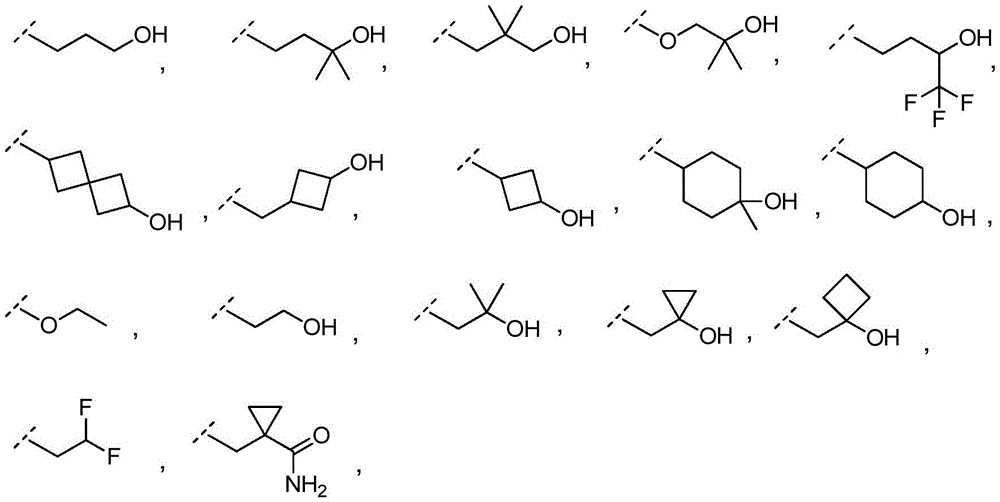

in another particular embodiment 38 of the present invention, there is provided a compound of formula (Ib):

wherein
R1Is H or C1-4Alkyl, especially C1-4Alkyl, more particularly methyl;
y is selected from the following groups:

R3selected from the following groups:

in another particular embodiment of the invention 39, there is provided a compound of formula (Ib):

wherein
R1Is H or C1-4Alkyl, especially C1-4Alkyl, more particularly methyl;
y is selected from the following groups:

R3selected from the following groups:
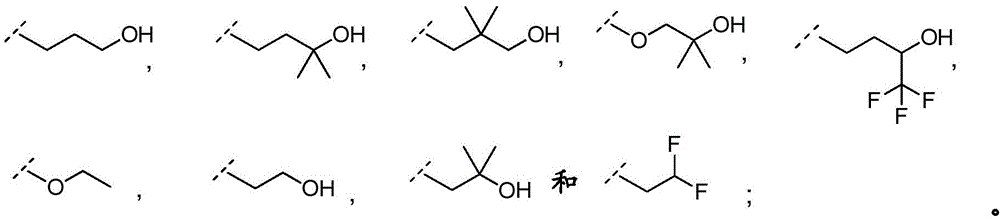
in another particular embodiment 40 of the present invention, there is provided a compound of formula (Ib):

wherein
R1Is H or C1-4Alkyl, especially C1-4Alkyl, more particularly methyl;
y is selected from the following groups:
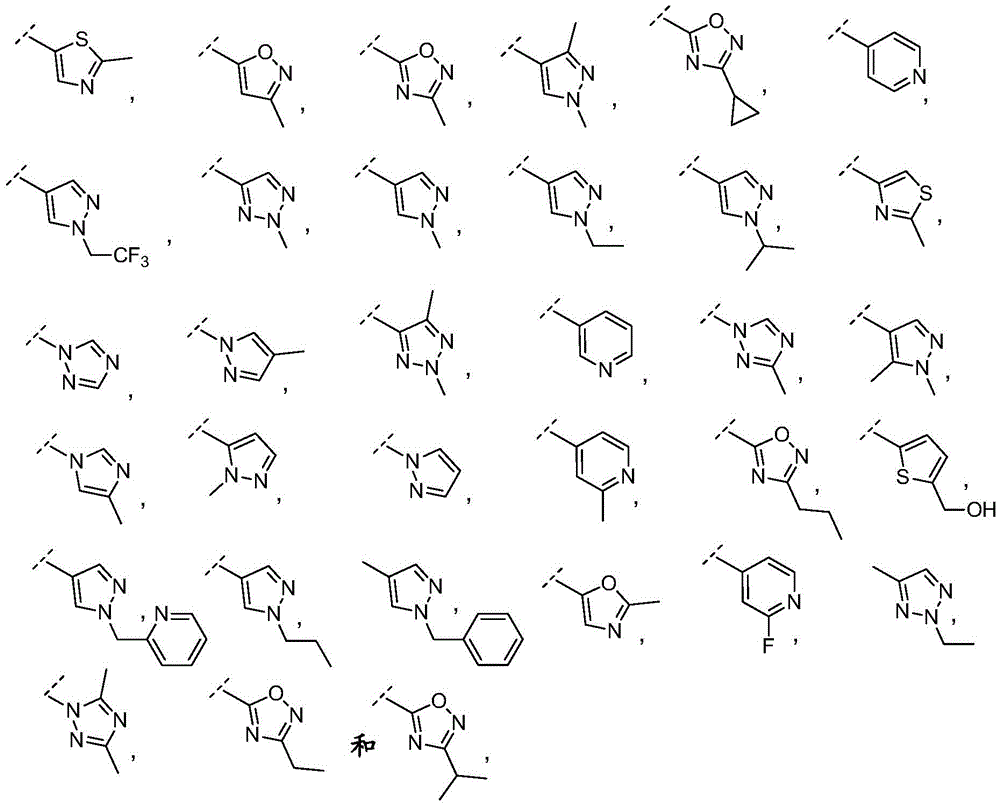
R3selected from the following groups:
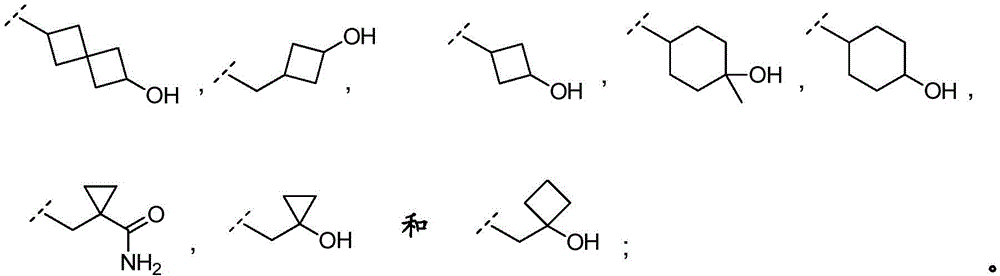
in another particular embodiment 41 of the present invention, there is provided a compound of formula (Ib):
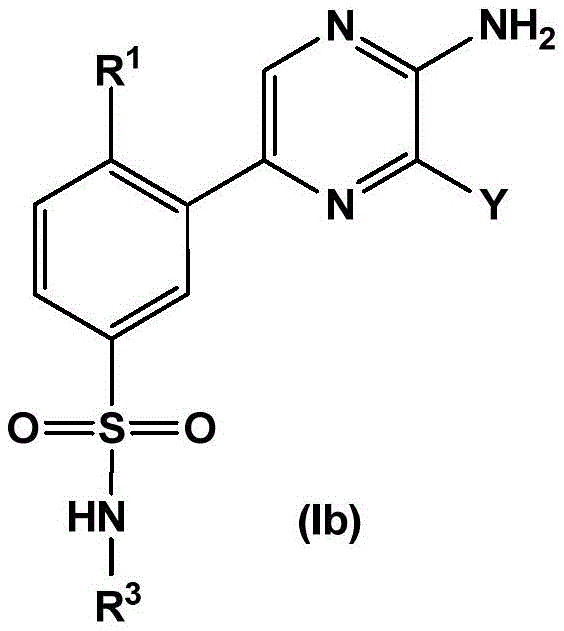
wherein
R1Is H or C1-4Alkyl, especially C1-4Alkyl, more particularly methyl;
y is selected from the following groups:

R3selected from the following groups:
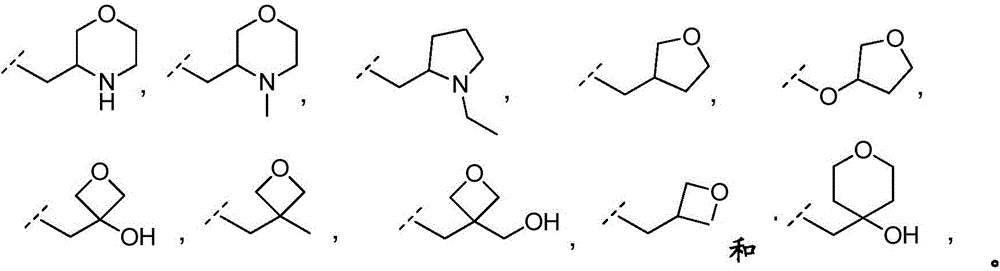
in embodiment 42 of the present invention, there is provided a compound of embodiment 1 selected from:
3- [ 5-amino-6- (5-methyl- [1,3,4] oxadiazol-2-yl) -pyrazin-2-yl ] -N- (4-hydroxy-cyclohexyl) -4-methyl-benzenesulfonamide;
3- [ 5-amino-6- (3-methyl- [1,2,4] oxadiazol-5-yl) -pyrazin-2-yl ] -N- (4-hydroxy-cyclohexyl) -4-methyl-benzenesulfonamide;
3- [ 5-amino-6- (3-methyl- [1,2,4] oxadiazol-5-yl) -pyrazin-2-yl ] -N- (3-hydroxy-3-methyl-butyl) -4-methyl-benzenesulfonamide;
3- [ 5-amino-6- (3-methyl-isoxazol-5-yl) -pyrazin-2-yl ] -N- (4-hydroxy-cyclohexyl) -4-methyl-benzenesulfonamide;
3- [ 5-amino-6- (1-methyl-1H-pyrazol-4-yl) -pyrazin-2-yl ] -4-methyl-N- (3-methyl-oxetan-3-ylmethyl) -benzenesulfonamide;
3- (5-amino-6- (1H-1,2, 4-triazol-1-yl) pyrazin-2-yl) -N- (2-hydroxy-2-methylpropyl) -4-methylbenzenesulfonamide;
3- (5-amino-6- (2-methylthiazol-5-yl) pyrazin-2-yl) -N- (2-hydroxy-2-methylpropyl) -4-methylbenzenesulfonamide;
3- [ 5-amino-6- (2-methyl-thiazol-5-yl) -pyrazin-2-yl ] -N- (3-hydroxy-2, 2-dimethyl-propyl) -4-methyl-benzenesulfonamide;
3- [ 5-amino-6- (1, 3-dimethyl-1H-pyrazol-4-yl) -pyrazin-2-yl ] -N- (6-hydroxy-spiro [3.3] hept-2-yl) -4-methyl-benzenesulfonamide;
3- (5-amino-6- (2-methylthiazol-5-yl) pyrazin-2-yl) -N- (3-hydroxypropyl) -4-methylbenzenesulfonamide;
3- (5-amino-6- (pyridin-4-yl) pyrazin-2-yl) -N- (4-hydroxycyclohexyl) -4-methylbenzenesulfonamide;
3- (5-amino-6- (1, 3-dimethyl-1H-pyrazol-4-yl) pyrazin-2-yl) -N- (3-hydroxy-3-methylbutyl) -4-methylbenzenesulfonamide;
3- [ 5-amino-6- (1, 3-dimethyl-1H-pyrazol-4-yl) -pyrazin-2-yl ] -N- (3-hydroxy-3-methyl-butyl) -4-methyl-benzenesulfonamide;
3- (5-amino-6- (2-methylthiazol-5-yl) pyrazin-2-yl) -N- (4-hydroxycyclohexyl) -4-methylbenzenesulfonamide;
3- (5-amino-6- (1H-1,2, 4-triazol-1-yl) pyrazin-2-yl) -N- (4-hydroxycyclohexyl) -4-methylbenzenesulfonamide;
3- [ 5-amino-6- (1, 3-dimethyl-1H-pyrazol-4-yl) -pyrazin-2-yl ] -4-methyl-N- [ (R) -1- (tetrahydrofuran-3-yl) methyl ] -benzenesulfonamide;
3- [ 5-amino-6- (1, 3-dimethyl-1H-pyrazol-4-yl) -pyrazin-2-yl ] -4-methyl-N- (3-methyl-oxetan-3-ylmethyl) -benzenesulfonamide;
3- [ 5-amino-6- (2-methyl-2H- [1,2,3] triazol-4-yl) -pyrazin-2-yl ] -N- (2-hydroxy-2-methyl-propyl) -4-methyl-benzenesulfonamide;
3- [ 5-amino-6- (2, 5-dimethyl-2H- [1,2,3] triazol-4-yl) -pyrazin-2-yl ] -N- (2-hydroxy-2-methyl-propyl) -4-methyl-benzenesulfonamide;
3- [ 5-amino-6- (2-methyl-thiazol-5-yl) -pyrazin-2-yl ] -N- (3-hydroxy-cyclobutylmethyl) -4-methyl-benzenesulfonamide;
3- [ 5-amino-6- (2-cyclopropyl-thiazol-5-yl) -pyrazin-2-yl ] -N- (2-hydroxy-2-methyl-propyl) -4-methyl-benzenesulfonamide;
3- (5-amino-6-pyridin-3-yl-pyrazin-2-yl) -N- (4-hydroxy-cyclohexyl) -4-methyl-benzenesulfonamide;
3- [ 5-amino-6- (3-isopropyl- [1,2,4] oxadiazol-5-yl) -pyrazin-2-yl ] -N- (4-hydroxy-cyclohexyl) -4-methyl-benzenesulfonamide;
3- [ 5-amino-6- (3-cyclopropyl- [1,2,4] oxadiazol-5-yl) -pyrazin-2-yl ] -N- (4-hydroxy-cyclohexyl) -4-methyl-benzenesulfonamide;
3- [ 5-amino-6- (3-methyl- [1,2,4] triazol-1-yl) -pyrazin-2-yl ] -N- (2-hydroxy-2-methyl-propyl) -4-methyl-benzenesulfonamide;
3- [ 5-amino-6- (3-cyclopropyl- [1,2,4] triazol-1-yl) -pyrazin-2-yl ] -N- (3-hydroxy-3-methyl-butyl) -4-methyl-benzenesulfonamide;
3- [ 5-amino-6- (1, 3-dimethyl-1H-pyrazol-4-yl) -pyrazin-2-yl ] -N- ((R) -1-ethyl-pyrrolidin-2-ylmethyl) -4-methyl-benzenesulfonamide;
3- (5-amino-6- [1,2,4] triazol-1-yl-pyrazin-2-yl) -N- (1-hydroxy-cyclopropylmethyl) -4-methyl-benzenesulfonamide;
3- (5-amino-6- [1,2,4] triazol-1-yl-pyrazin-2-yl) -4-methyl-N- (3-methyl-oxetan-3-ylmethyl) -benzenesulfonamide;
3- [ 5-amino-6- (5-morpholin-4-ylmethyl-thiophen-3-yl) -pyrazin-2-yl ] -N- (3-hydroxy-3-methyl-butyl) -4-methyl-benzenesulfonamide;
3- (5-amino-6- [1,2,4] triazol-1-yl-pyrazin-2-yl) -N- (2-hydroxy-2-methyl-propoxy) -4-methyl-benzenesulfonamide;
3- (5-amino-6- [1,2,4] triazol-1-yl-pyrazin-2-yl) -N- (4-hydroxy-tetrahydropyran-4-ylmethyl) -4-methylbenzenesulfonamide;
n- (2-amino-ethyl) -3- (5-amino-6- [1,2,4] triazol-1-yl-pyrazin-2-yl) -4-methyl-benzenesulfonamide;
3- (5-amino-6- [1,2,4] triazol-1-yl-pyrazin-2-yl) -N- (2, 2-difluoro-ethyl) -4-methyl-benzenesulfonamide;
3- (5-amino-6- [1,2,4] triazol-1-yl-pyrazin-2-yl) -N- (3-hydroxymethyl-oxetan-3-ylmethyl) -4-methyl-benzenesulfonamide; and
3- (5-amino-6- [1,2,4] triazol-1-yl-pyrazin-2-yl) -N- (3, 3-dimethyl-2-oxo-butyl) -4-methyl-benzenesulfonamide;
or a pharmaceutically acceptable salt thereof.
In embodiment 42.1 of the present invention there is provided a compound of embodiment 1 selected from:
3- [ 5-amino-6- (5-methyl- [1,3,4] oxadiazol-2-yl) -pyrazin-2-yl ] -N- (4-hydroxy-cyclohexyl) -4-methyl-benzenesulfonamide;
3- [ 5-amino-6- (3-methyl- [1,2,4] oxadiazol-5-yl) -pyrazin-2-yl ] -N- (4-hydroxy-cyclohexyl) -4-methyl-benzenesulfonamide;
3- [ 5-amino-6- (3-methyl- [1,2,4] oxadiazol-5-yl) -pyrazin-2-yl ] -N- (3-hydroxy-3-methyl-butyl) -4-methyl-benzenesulfonamide;
3- [ 5-amino-6- (3-methyl-isoxazol-5-yl) -pyrazin-2-yl ] -N- (4-hydroxy-cyclohexyl) -4-methyl-benzenesulfonamide;
3- [ 5-amino-6- (1-methyl-1H-pyrazol-4-yl) -pyrazin-2-yl ] -4-methyl-N- (3-methyl-oxetan-3-ylmethyl) -benzenesulfonamide;
3- (5-amino-6- (1H-1,2, 4-triazol-1-yl) pyrazin-2-yl) -N- (2-hydroxy-2-methylpropyl) -4-methylbenzenesulfonamide;
3- (5-amino-6- (2-methylthiazol-5-yl) pyrazin-2-yl) -N- (2-hydroxy-2-methylpropyl) -4-methylbenzenesulfonamide;
3- [ 5-amino-6- (2-methyl-thiazol-5-yl) -pyrazin-2-yl ] -N- (3-hydroxy-2, 2-dimethyl-propyl) -4-methyl-benzenesulfonamide;
3- [ 5-amino-6- (1, 3-dimethyl-1H-pyrazol-4-yl) -pyrazin-2-yl ] -N- (6-hydroxy-spiro [3.3] hept-2-yl) -4-methyl-benzenesulfonamide;
3- (5-amino-6- (2-methylthiazol-5-yl) pyrazin-2-yl) -N- (3-hydroxypropyl) -4-methylbenzenesulfonamide;
3- (5-amino-6- (pyridin-4-yl) pyrazin-2-yl) -N- (4-hydroxycyclohexyl) -4-methylbenzenesulfonamide;
3- (5-amino-6- (1, 3-dimethyl-1H-pyrazol-4-yl) pyrazin-2-yl) -N- (3-hydroxy-3-methylbutyl) -4-methylbenzenesulfonamide;
3- [ 5-amino-6- (1, 3-dimethyl-1H-pyrazol-4-yl) -pyrazin-2-yl ] -N- (3-hydroxy-3-methyl-butyl) -4-methyl-benzenesulfonamide;
3- (5-amino-6- (2-methylthiazol-5-yl) pyrazin-2-yl) -N- (4-hydroxycyclohexyl) -4-methylbenzenesulfonamide;
3- (5-amino-6- (1H-1,2, 4-triazol-1-yl) pyrazin-2-yl) -N- (4-hydroxycyclohexyl) -4-methylbenzenesulfonamide;
3- [ 5-amino-6- (1, 3-dimethyl-1H-pyrazol-4-yl) -pyrazin-2-yl ] -4-methyl-N- [ (R) -1- (tetrahydrofuran-3-yl) methyl ] -benzenesulfonamide;
3- [ 5-amino-6- (1, 3-dimethyl-1H-pyrazol-4-yl) -pyrazin-2-yl ] -4-methyl-N- (3-methyl-oxetan-3-ylmethyl) -benzenesulfonamide;
3- [ 5-amino-6- (2-methyl-2H- [1,2,3] triazol-4-yl) -pyrazin-2-yl ] -N- (2-hydroxy-2-methyl-propyl) -4-methyl-benzenesulfonamide;
3- [ 5-amino-6- (2, 5-dimethyl-2H- [1,2,3] triazol-4-yl) -pyrazin-2-yl ] -N- (2-hydroxy-2-methyl-propyl) -4-methyl-benzenesulfonamide;
3- [ 5-amino-6- (2-methyl-thiazol-5-yl) -pyrazin-2-yl ] -N- (3-hydroxy-cyclobutylmethyl) -4-methyl-benzenesulfonamide;
3- [ 5-amino-6- (2-cyclopropyl-thiazol-5-yl) -pyrazin-2-yl ] -N- (2-hydroxy-2-methyl-propyl) -4-methyl-benzenesulfonamide;
3- (5-amino-6-pyridin-3-yl-pyrazin-2-yl) -N- (4-hydroxy-cyclohexyl) -4-methyl-benzenesulfonamide;
3- [ 5-amino-6- (3-isopropyl- [1,2,4] oxadiazol-5-yl) -pyrazin-2-yl ] -N- (4-hydroxy-cyclohexyl) -4-methyl-benzenesulfonamide;
3- [ 5-amino-6- (3-cyclopropyl- [1,2,4] oxadiazol-5-yl) -pyrazin-2-yl ] -N- (4-hydroxy-cyclohexyl) -4-methyl-benzenesulfonamide;
3- [ 5-amino-6- (3-methyl- [1,2,4] triazol-1-yl) -pyrazin-2-yl ] -N- (2-hydroxy-2-methyl-propyl) -4-methyl-benzenesulfonamide;
3- [ 5-amino-6- (3-cyclopropyl- [1,2,4] triazol-1-yl) -pyrazin-2-yl ] -N- (3-hydroxy-3-methyl-butyl) -4-methyl-benzenesulfonamide;
3- [ 5-amino-6- (1, 3-dimethyl-1H-pyrazol-4-yl) -pyrazin-2-yl ] -N- ((R) -1-ethyl-pyrrolidin-2-ylmethyl) -4-methyl-benzenesulfonamide;
3- (5-amino-6- [1,2,4] triazol-1-yl-pyrazin-2-yl) -N- (1-hydroxy-cyclopropylmethyl) -4-methyl-benzenesulfonamide;
3- (5-amino-6- [1,2,4] triazol-1-yl-pyrazin-2-yl) -4-methyl-N- (3-methyl-oxetan-3-ylmethyl) -benzenesulfonamide;
3- [ 5-amino-6- (5-morpholin-4-ylmethyl-thiophen 3-yl) -pyrazin-2-yl ] -N- (3-hydroxy-3-methyl-butyl) -4-methyl-benzenesulfonamide;
3- (5-amino-6- [1,2,4] triazol-1-yl-pyrazin-2-yl) -N- (2-hydroxy-2-methyl-propoxy) -4-methyl-benzenesulfonamide;
3- (5-amino-6- [1,2,4] triazol-1-yl-pyrazin-2-yl) -N- (4-hydroxy-tetrahydropyran-4-ylmethyl) -4-methylbenzenesulfonamide;
n- (2-amino-ethyl) -3- (5-amino-6- [1,2,4] triazol-1-yl-pyrazin-2-yl) -4-methyl-benzenesulfonamide;
3- (5-amino-6- [1,2,4] triazol-1-yl-pyrazin-2-yl) -N- (2, 2-difluoro-ethyl) -4-methyl-benzenesulfonamide;
3- (5-amino-6- [1,2,4] triazol-1-yl-pyrazin-2-yl) -N- (3-hydroxymethyl-oxetan-3-ylmethyl) -4-methyl-benzenesulfonamide; and
3- (5-amino-6- [1,2,4] triazol-1-yl-pyrazin-2-yl) -N- (3, 3-dimethyl-2-oxo-butyl) -4-methyl-benzenesulfonamide;
3- (5-amino-6- (1H-1,2, 4-triazol-1-yl) pyrazin-2-yl) -4-chloro-N- (2-hydroxy-2-methylpropyl) benzenesulfonamide;
3- (5-amino-6- (1H-1,2, 4-triazol-1-yl) pyrazin-2-yl) -4-chloro-N- (3-hydroxy-3-methylbutyl) benzenesulfonamide;
3- (5-amino-6- (furan-3-yl) pyrazin-2-yl) -N- (2-hydroxy-2-methylpropyl) -4-methylbenzenesulfonamide;
3- (5-amino-6- (2, 5-dimethylthiazol-4-yl) pyrazin-2-yl) -N- (2-hydroxy-2-methylpropyl) -4-methylbenzenesulfonamide;
(R) -3- (5-amino-6- (2-methylthiazol-5-yl) pyrazin-2-yl) -N- ((1-ethylpyrrolidin-2-yl) methyl) -4-methylbenzenesulfonamide;
(R) -3- (5-amino-6- (2-methylthiazol-5-yl) pyrazin-2-yl) -4-methyl-N- ((tetrahydrofuran-3-yl) methyl) benzenesulfonamide;
3- (5-amino-6- (2-methylthiazol-5-yl) pyrazin-2-yl) -N- (3-hydroxycyclobutyl) -4-methylbenzenesulfonamide;
3- (5-amino-6- (2-methylthiazol-5-yl) pyrazin-2-yl) -N- ((3- (hydroxymethyl) oxetan-3-yl) methyl) -4-methylbenzenesulfonamide;
3- (5-amino-6- (2-methylthiazol-5-yl) pyrazin-2-yl) -N- (2-hydroxyethyl) -4-methylbenzenesulfonamide;
3- (5-amino-6- (2-methylthiazol-5-yl) pyrazin-2-yl) -4-methyl-N- (oxetan-3-ylmethyl) benzenesulfonamide;
3- (5-amino-6- (2-methylthiazol-5-yl) pyrazin-2-yl) -4-methyl-N- ((tetrahydro-2H-pyran-4-yl) methyl) benzenesulfonamide;
3- (5-amino-6- (2-methylthiazol-5-yl) pyrazin-2-yl) -4-methyl-N- (tetrahydro-2H-pyran-4-yl) benzenesulfonamide;
3- (5-amino-6- (2-methylthiazol-5-yl) pyrazin-2-yl) -4-methyl-N- ((tetrahydro-2H-pyran-2-yl) methyl) benzenesulfonamide;
3- (5-amino-6- (2-methylthiazol-5-yl) pyrazin-2-yl) -4-methyl-N- (2,2, 2-trifluoroethyl) benzenesulfonamide;
3- (5-amino-6- (2-methylthiazol-5-yl) pyrazin-2-yl) -4-methyl-N- ((tetrahydrofuran-2-yl) methyl) benzenesulfonamide;
3- (5-amino-6- (2-methylthiazol-5-yl) pyrazin-2-yl) -4-methyl-N- (tetrahydrofuran-3-yl) benzenesulfonamide;
(1- (3- (5-amino-6- (2-methylthiazol-5-yl) pyrazin-2-yl) -4-methylphenylsulfonyl) azetidin-3-yl) methanol;
3- (5-amino-6- (2-methylthiazol-5-yl) pyrazin-2-yl) -N- ((4- (hydroxymethyl) tetrahydro-2H-pyran-4-yl) methyl) -4-methylbenzenesulfonamide;
3- (5-amino-6- (2-methylthiazol-5-yl) pyrazin-2-yl) -N- ((4-hydroxytetrahydro-2H-pyran-4-yl) methyl) -4-methylbenzenesulfonamide;
3- (5-amino-6- (2-methylthiazol-5-yl) pyrazin-2-yl) -N- ((3-hydroxyoxetan-3-yl) methyl) -4-methylbenzenesulfonamide;
3- (5-amino-6- (2-methylthiazol-5-yl) pyrazin-2-yl) -4-methyl-N- ((4-methylmorpholin-3-yl) methyl) benzenesulfonamide;
3- (5-amino-6- (1, 5-dimethyl-1H-pyrazol-4-yl) pyrazin-2-yl) -N- (2-hydroxy-2-methylpropyl) -4-methylbenzenesulfonamide;
3- (5-amino-6- (2, 4-dimethylthiazol-5-yl) pyrazin-2-yl) -N- (2-hydroxy-2-methylpropyl) -4-methylbenzenesulfonamide;
3- (5-amino-6- (1-methyl-1H-pyrazol-4-yl) pyrazin-2-yl) -N- (2-hydroxy-2-methylpropyl) -4-methylbenzenesulfonamide;
3- (5-amino-6- (3, 4-dimethyl-1H-pyrazol-1-yl) pyrazin-2-yl) -N- (2-hydroxy-2-methylpropyl) -4-methylbenzenesulfonamide;
3- (5-amino-6- (3, 5-dimethyl-1H-pyrazol-1-yl) pyrazin-2-yl) -N- (2-hydroxy-2-methylpropyl) -4-methylbenzenesulfonamide;
3- (5-amino-6- (3, 5-dimethyl-1H-1, 2, 4-triazol-1-yl) pyrazin-2-yl) -N- (2-hydroxy-2-methylpropyl) -4-methylbenzenesulfonamide;
3- (5-amino-6- (2, 4-dimethyl-1H-imidazol-1-yl) pyrazin-2-yl) -N- (2-hydroxy-2-methylpropyl) -4-methylbenzenesulfonamide;
3- (5-amino-6- (1-methyl-1H-pyrazol-4-yl) pyrazin-2-yl) -4-methyl-N- (4,4, 4-trifluoro-3-hydroxybutyl) benzenesulfonamide;
3- (5-amino-6- (1, 3-dimethyl-1H-pyrazol-4-yl) pyrazin-2-yl) -4-methyl-N- (4,4, 4-trifluoro-3-hydroxybutyl) benzenesulfonamide;
3- (5-amino-6- (1, 3-dimethyl-1H-pyrazol-4-yl) pyrazin-2-yl) -4-methyl-N- (4,4, 4-trifluoro-3-hydroxybutyl) benzenesulfonamide;
5- (5-amino-6- (1H-1,2, 4-triazol-1-yl) pyrazin-2-yl) -N- (2-hydroxy-2-methylpropyl) -6-methylpyridine-3-sulfonamide;
3- (5-amino-6- (1-methyl-1H-pyrazol-4-yl) pyrazin-2-yl) -N- (4, 4-difluorocyclohexyl) -4-methylbenzenesulfonamide;
3- (5-amino-6- (2-methylthiazol-5-yl) pyrazin-2-yl) -N- (4, 4-difluorocyclohexyl) -4-methylbenzenesulfonamide;
3- (5-amino-6- (4-methyl-1H-imidazol-1-yl) pyrazin-2-yl) -N- ((1r,4r) -4-hydroxycyclohexyl) -4-methylbenzenesulfonamide;
3- (5-amino-6- (4-methyl-1H-imidazol-1-yl) pyrazin-2-yl) -N- (3-hydroxypropyl) -4-methylbenzenesulfonamide;
3- (5-amino-6- (1-methyl-1H-pyrazol-4-yl) pyrazin-2-yl) -N- ((1r,4r) -4-hydroxycyclohexyl) -4-methylbenzenesulfonamide;
3- (5-amino-6- (pyrimidin-5-yl) pyrazin-2-yl) -N- ((1r,4r) -4-hydroxycyclohexyl) -4-methylbenzenesulfonamide;
3- (5-amino-6- (2-fluoropyridin-4-yl) pyrazin-2-yl) -N- ((1r,4r) -4-hydroxycyclohexyl) -4-methylbenzenesulfonamide;
3- (5-amino-6- (1H-imidazol-1-yl) pyrazin-2-yl) -N- (3-hydroxy-3-methylbutyl) -4-methylbenzenesulfonamide;
3- (5-amino-6- (1H-pyrazol-1-yl) pyrazin-2-yl) -N- (3-hydroxy-3-methylbutyl) -4-methylbenzenesulfonamide;
3- (5-amino-6- (4-methyl-1H-imidazol-1-yl) pyrazin-2-yl) -N- (3-hydroxy-3-methylbutyl) -4-methylbenzenesulfonamide;
3- (5-amino-6- (1H-1,2, 4-triazol-1-yl) pyrazin-2-yl) -N- (3-hydroxy-3-methylbutyl) -4-methylbenzenesulfonamide;
3- (5-amino-6- (3-methyl-1H-1, 2, 4-triazol-1-yl) pyrazin-2-yl) -N- (3-hydroxy-3-methylbutyl) -4-methylbenzenesulfonamide;
3- (5-amino-6- (3-isopropyl-1H-1, 2, 4-triazol-1-yl) pyrazin-2-yl) -N- (3-hydroxy-3-methylbutyl) -4-methylbenzenesulfonamide;
3- (5-amino-6- (1H-1,2, 4-triazol-1-yl) pyrazin-2-yl) -N- (6-hydroxyspiro [3.3] hept-2-yl) -4-methylbenzenesulfonamide;
3- (5-amino-6- (1H-1,2, 4-triazol-1-yl) pyrazin-2-yl) -4-methyl-N- (tetrahydro-2H-pyran-4-yl) benzenesulfonamide;
3- (5-amino-6- (1H-1,2, 4-triazol-1-yl) pyrazin-2-yl) -N- ((1r,4r) -4-hydroxy-4-methylcyclohexyl) -4-methylbenzenesulfonamide;
3- (5-amino-6- (1H-1,2, 4-triazol-1-yl) pyrazin-2-yl) -N- ((1s,4s) -4-hydroxy-4-methylcyclohexyl) -4-methylbenzenesulfonamide;
3- (5-amino-6- (1H-1,2, 4-triazol-1-yl) pyrazin-2-yl) -N- (6-hydroxyspiro [3.3] hept-2-yl) -4-methylbenzenesulfonamide;
3- (5-amino-6- (1H-1,2, 4-triazol-1-yl) pyrazin-2-yl) -N- (6-hydroxyspiro [3.3] hept-2-yl) -4-methylbenzenesulfonamide;
3- (5-amino-6- (1H-1,2, 4-triazol-1-yl) pyrazin-2-yl) -N- ((1r,3r) -3-hydroxycyclobutyl) -4-methylbenzenesulfonamide;
3- (5-amino-6- (1H-1,2, 4-triazol-1-yl) pyrazin-2-yl) -N- ((1s,3s) -3-hydroxycyclobutyl) -4-methylbenzenesulfonamide;
3- (5-amino-6- (1H-1,2, 4-triazol-1-yl) pyrazin-2-yl) -N- (((1s,3s) -3-hydroxycyclobutyl) methyl) -4-methylbenzenesulfonamide;
3- (5-amino-6- (1H-1,2, 4-triazol-1-yl) pyrazin-2-yl) -N- (3-hydroxy-2, 2-dimethylpropyl) -4-methylbenzenesulfonamide;
3- (5-amino-6- (1, 3-dimethyl-1H-pyrazol-4-yl) pyrazin-2-yl) -N- (6-hydroxyspiro [3.3] hept-2-yl) -4-methylbenzenesulfonamide;
3- (5-amino-6- (1-methyl-1H-pyrazol-4-yl) pyrazin-2-yl) -N- ((1s,4s) -4-hydroxycyclohexyl) -4-methylbenzenesulfonamide;
3- (5-amino-6- (2-methylpyridin-4-yl) pyrazin-2-yl) -N- ((1s,4s) -4-hydroxycyclohexyl) -4-methylbenzenesulfonamide;
3- (5-amino-6- (1-methyl-1H-pyrazol-5-yl) pyrazin-2-yl) -N- (3-hydroxy-3-methylbutyl) -4-methylbenzenesulfonamide;
3- (5-amino-6- (3-cyclopropylisoxazol-5-yl) pyrazin-2-yl) -N- (3-hydroxy-3-methylbutyl) -4-methylbenzenesulfonamide;
3- (5-amino-6- (3-cyclopropylisoxazol-5-yl) pyrazin-2-yl) -N- (2-hydroxy-2-methylpropyl) -4-methylbenzenesulfonamide;
3- (5-amino-6- (4-methylthiazol-2-yl) pyrazin-2-yl) -N- (2-hydroxy-2-methylpropyl) -4-methylbenzenesulfonamide;
3- (5-amino-6- (1-methyl-1H-1, 2, 3-triazol-4-yl) pyrazin-2-yl) -N- (2-hydroxy-2-methylpropyl) -4-methylbenzenesulfonamide;
3- (5-amino-6- (2-ethyl-2H-1, 2, 3-triazol-4-yl) pyrazin-2-yl) -N- (2-hydroxy-2-methylpropyl) -4-methylbenzenesulfonamide;
3- (5-amino-6- (1-ethyl-1H-1, 2, 3-triazol-4-yl) pyrazin-2-yl) -N- (2-hydroxy-2-methylpropyl) -4-methylbenzenesulfonamide;
3- (5-amino-6- (2- (2,2, 2-trifluoroethyl) -2H-1,2, 3-triazol-4-yl) pyrazin-2-yl) -N- (2-hydroxy-2-methylpropyl) -4-methylbenzenesulfonamide;
3- (5-amino-6- (2-methyl-2H-1, 2, 3-triazol-4-yl) pyrazin-2-yl) -N- (3-hydroxy-3-methylbutyl) -4-methylbenzenesulfonamide;
3- (5-amino-6- (2-methylthiazol-5-yl) pyrazin-2-yl) -N- ((1s,4s) -4-hydroxycyclohexyl) -4-methylbenzenesulfonamide;
3- (5-amino-6- (3-methylisoxazol-5-yl) pyrazin-2-yl) -N- (2-hydroxy-2-methylpropyl) -4-methylbenzenesulfonamide;
3- (5-amino-6- (3-methylisoxazol-5-yl) pyrazin-2-yl) -N- (3-hydroxy-3-methylbutyl) -4-methylbenzenesulfonamide;
3- (5-amino-6- (5-methyl-1, 3, 4-oxadiazol-2-yl) pyrazin-2-yl) -N- (2-hydroxy-2-methylpropyl) -4-methylbenzenesulfonamide;
3- (5-amino-6- (5-cyclopropyl-1, 2, 4-oxadiazol-3-yl) pyrazin-2-yl) -N- (2-hydroxy-2-methylpropyl) -4-methylbenzenesulfonamide;
3- (5-amino-6- (3-methyl-1, 2, 4-oxadiazol-5-yl) pyrazin-2-yl) -N- (3-hydroxy-2, 2-dimethylpropyl) -4-methylbenzenesulfonamide;
3- (5-amino-6- (3-cyclopropyl-1, 2, 4-oxadiazol-5-yl) pyrazin-2-yl) -N- (3-hydroxy-2, 2-dimethylpropyl) -4-methylbenzenesulfonamide;
3- (5-amino-6- (3-cyclopropyl-1, 2, 4-oxadiazol-5-yl) pyrazin-2-yl) -N- (((1s,3s) -3-hydroxycyclobutyl) methyl) -4-methylbenzenesulfonamide;
3- (5-amino-6- (3-cyclopropyl-1, 2, 4-oxadiazol-5-yl) pyrazin-2-yl) -N- (2-hydroxy-2-methylpropyl) -4-methylbenzenesulfonamide;
3- (5-amino-6- (3-methyl-1, 2, 4-oxadiazol-5-yl) pyrazin-2-yl) -N- (((1s,3s) -3-hydroxycyclobutyl) methyl) -4-methylbenzenesulfonamide;
3- (5-amino-6- (3-isopropyl-1, 2, 4-oxadiazol-5-yl) pyrazin-2-yl) -N- (2-hydroxy-2-methylpropyl) -4-methylbenzenesulfonamide;
3- (5-amino-6- (1H-1,2, 4-triazol-1-yl) pyrazin-2-yl) -N- (1- (hydroxymethyl) cyclopropyl) -4-methylbenzenesulfonamide;
3- (5-amino-6- (3-cyclopropylisoxazol-5-yl) pyrazin-2-yl) -N- (3-hydroxy-2, 2-dimethylpropyl) -4-methylbenzenesulfonamide;
3- (5-amino-6- (3-cyclopropylisoxazol-5-yl) pyrazin-2-yl) -N- (((1s,3s) -3-hydroxycyclobutyl) methyl) -4-methylbenzenesulfonamide;
2- (3- (5-amino-6- (1H-1,2, 4-triazol-1-yl) pyrazin-2-yl) -4-methylphenylsulfonyl) -2-azaspiro [3.3] heptan-6-ol;
3- (1, 3-dimethyl-1H-pyrazol-4-yl) -5- (5- (3-methoxy-3-methylazetidin-1-ylsulfonyl) -2-methylphenyl) pyrazin-2-amine;
3- (5-amino-6- (1H-pyrazol-1-yl) pyrazin-2-yl) -N- ((1r,4r) -4-hydroxycyclohexyl) -4-methylbenzenesulfonamide;
(R) -3- (5-amino-6- (1, 3-dimethyl-1H-pyrazol-4-yl) pyrazin-2-yl) -4-methyl-N- (pyrrolidin-2-ylmethyl) benzenesulfonamide;
3- (5-amino-6- (2-cyclopropylthiazol-5-yl) pyrazin-2-yl) -N- (3-hydroxy-3-methylbutyl) -4-methylbenzenesulfonamide;
3- (5-amino-6- (thiazol-4-yl) pyrazin-2-yl) -N- (3-hydroxy-3-methylbutyl) -4-methylbenzenesulfonamide;
3- (5-amino-6- (3-cyclopropyl-1H-1, 2, 4-triazol-1-yl) pyrazin-2-yl) -N- (2-hydroxy-2-methylpropyl) -4-methylbenzenesulfonamide;
3- (5-amino-6- (2-methoxythiazol-4-yl) pyrazin-2-yl) -N- (3-hydroxy-3-methylbutyl) -4-methylbenzenesulfonamide;
3- (5-amino-6- (4-methyl-1H-pyrazol-1-yl) pyrazin-2-yl) -N- ((1r,4r) -4-hydroxycyclohexyl) -4-methylbenzenesulfonamide;
3- (5-amino-6- (1H-1,2, 4-triazol-1-yl) pyrazin-2-yl) -N-ethoxy-4-methylbenzenesulfonamide;
3- (5-amino-6- (1H-1,2, 4-triazol-1-yl) pyrazin-2-yl) -N-tert-butoxy-4-methylbenzenesulfonamide;
3- (5-amino-6- (1H-1,2, 4-triazol-1-yl) pyrazin-2-yl) -N- (2- (dimethylamino) ethoxy) -4-methylbenzenesulfonamide;
3- (5-amino-6- (1H-1,2, 4-triazol-1-yl) pyrazin-2-yl) -N-isopropoxy-4-methylbenzenesulfonamide;
3- (5-amino-6- (1H-1,2, 4-triazol-1-yl) pyrazin-2-yl) -N-isobutoxy-4-methylbenzenesulfonamide;
3- (5-amino-6- (1H-1,2, 4-triazol-1-yl) pyrazin-2-yl) -4-methyl-N- (tetrahydrofuran-3-yloxy) benzenesulfonamide;
5- (5-amino-6- (2-methylthiazol-5-yl) pyrazin-2-yl) -2-fluoro-N- (3-hydroxypropyl) -4-methylbenzenesulfonamide;
5- (5-amino-6- (1-methyl-1H-pyrazol-4-yl) pyrazin-2-yl) -2-fluoro-N- (3-hydroxypropyl) -4-methylbenzenesulfonamide;
5- (5-amino-6- (1-methyl-1H-pyrazol-4-yl) pyrazin-2-yl) -2-fluoro-N- (3-hydroxy-3-methylbutyl) -4-methylbenzenesulfonamide;
5- (5-amino-6- (1H-1,2, 4-triazol-1-yl) pyrazin-2-yl) -2-fluoro-N- (3-hydroxy-3-methylbutyl) -4-methylbenzenesulfonamide;
3- (5-amino-6- (3- ((dimethylamino) methyl) -1H-1,2, 4-triazol-1-yl) pyrazin-2-yl) -N- (2-hydroxy-2-methylpropyl) -4-methylbenzenesulfonamide;
5- (2-methyl-5- (3- (trifluoromethyl) piperazin-1-ylsulfonyl) phenyl) -3- (2-methylthiazol-5-yl) pyrazin-2-amine;
3- (5-amino-6- (1-methyl-3- (trifluoromethyl) -1H-pyrazol-5-yl) pyrazin-2-yl) -N- (3-hydroxy-3-methylbutyl) -4-methylbenzenesulfonamide;
3- (5-amino-6- (2-fluoropyridin-3-yl) pyrazin-2-yl) -N- (3-hydroxy-3-methylbutyl) -4-methylbenzenesulfonamide;
3- (5-amino-6- (4-methoxypyridin-3-yl) pyrazin-2-yl) -N- (3-hydroxy-3-methylbutyl) -4-methylbenzenesulfonamide;
3- (5-amino-6- (2-methoxypyridin-4-yl) pyrazin-2-yl) -N- (3-hydroxy-3-methylbutyl) -4-methylbenzenesulfonamide;
3- (5-amino-6- (2-methoxypyridin-3-yl) pyrazin-2-yl) -N- (3-hydroxy-3-methylbutyl) -4-methylbenzenesulfonamide;
3- (5-amino-6- (pyridin-3-yl) pyrazin-2-yl) -N- (3-hydroxy-3-methylbutyl) -4-methylbenzenesulfonamide;
3- (5-amino-6- (2-chloropyridin-3-yl) pyrazin-2-yl) -N- (3-hydroxy-3-methylbutyl) -4-methylbenzenesulfonamide;
3- (5-amino-6- (5-methylpyridin-3-yl) pyrazin-2-yl) -N- (3-hydroxy-3-methylbutyl) -4-methylbenzenesulfonamide;
3- (5-amino-6- (5-chloro-2-fluoropyridin-3-yl) pyrazin-2-yl) -N- (3-hydroxy-3-methylbutyl) -4-methylbenzenesulfonamide;
3- (5-amino-6- (6-chloro-4-methylpyridin-3-yl) pyrazin-2-yl) -N- (3-hydroxy-3-methylbutyl) -4-methylbenzenesulfonamide;
3- (5-amino-6- (2-fluoropyridin-4-yl) pyrazin-2-yl) -N- (3-hydroxy-3-methylbutyl) -4-methylbenzenesulfonamide;
3- (5-amino-6- (3-fluoropyridin-4-yl) pyrazin-2-yl) -N- (3-hydroxy-3-methylbutyl) -4-methylbenzenesulfonamide;
3- (5-amino-6- (2-isopropoxypyridin-3-yl) pyrazin-2-yl) -N- (3-hydroxy-3-methylbutyl) -4-methylbenzenesulfonamide;
3- (5-amino-6- (6-ethoxypyridin-3-yl) pyrazin-2-yl) -N- (3-hydroxy-3-methylbutyl) -4-methylbenzenesulfonamide;
3- (5-amino-6- (6-methoxy-2-methylpyridin-3-yl) pyrazin-2-yl) -N- (3-hydroxy-3-methylbutyl) -4-methylbenzenesulfonamide;
3- (5-amino-6- (furan-3-yl) pyrazin-2-yl) -N- (3-hydroxy-3-methylbutyl) -4-methylbenzenesulfonamide;
3- (5-amino-6- (1-methyl-1H-pyrazol-4-yl) pyrazin-2-yl) -N- (3-hydroxy-3-methylbutyl) -4-methylbenzenesulfonamide;
3- (5-amino-6- (6- (pyrrolidin-1-yl) pyridin-3-yl) pyrazin-2-yl) -N- (3-hydroxy-3-methylbutyl) -4-methylbenzenesulfonamide;
3- (5-amino-6- (6-fluoropyridin-3-yl) pyrazin-2-yl) -N- (3-hydroxy-3-methylbutyl) -4-methylbenzenesulfonamide;
3- (5-amino-6- (1, 5-dimethyl-1H-pyrazol-4-yl) pyrazin-2-yl) -N- (3-hydroxy-3-methylbutyl) -4-methylbenzenesulfonamide;
3- (5-amino-6- (pyrimidin-5-yl) pyrazin-2-yl) -N- (3-hydroxy-3-methylbutyl) -4-methylbenzenesulfonamide;
3- (5-amino-6- (6-morpholinopyridin-3-yl) pyrazin-2-yl) -N- (3-hydroxy-3-methylbutyl) -4-methylbenzenesulfonamide;
3- (5-amino-6- (3-methyl-1H-pyrazol-4-yl) pyrazin-2-yl) -N- (3-hydroxy-3-methylbutyl) -4-methylbenzenesulfonamide;
3- (5-amino-6- (6- (piperidin-1-yl) pyridin-3-yl) pyrazin-2-yl) -N- (3-hydroxy-3-methylbutyl) -4-methylbenzenesulfonamide;
3- (5-amino-6- (6- (tetrahydro-2H-pyran-4-yloxy) pyridin-3-yl) pyrazin-2-yl) -N- (3-hydroxy-3-methylbutyl) -4-methylbenzenesulfonamide;
3- (5-amino-6- (1-propyl-1H-pyrazol-4-yl) pyrazin-2-yl) -N- (3-hydroxy-3-methylbutyl) -4-methylbenzenesulfonamide;
3- (5-amino-6- (1-isopentyl-1H-pyrazol-4-yl) pyrazin-2-yl) -N- (3-hydroxy-3-methylbutyl) -4-methylbenzenesulfonamide;
3- (5-amino-6- (pyridin-4-yl) pyrazin-2-yl) -N- (3-hydroxy-3-methylbutyl) -4-methylbenzenesulfonamide;
3- (5-amino-6- (2-methylpyridin-4-yl) pyrazin-2-yl) -N- (3-hydroxy-3-methylbutyl) -4-methylbenzenesulfonamide;
3- (5-amino-6- (2-methylthiazol-5-yl) pyrazin-2-yl) -N- (3-hydroxy-3-methylbutyl) -4-methylbenzenesulfonamide;
3- (5-amino-6- (2-methylthiazol-4-yl) pyrazin-2-yl) -N- (3-hydroxy-3-methylbutyl) -4-methylbenzenesulfonamide;
3- (5-amino-6- (1-isopropyl-1H-pyrazol-4-yl) pyrazin-2-yl) -N- (3-hydroxy-3-methylbutyl) -4-methylbenzenesulfonamide;
3- (5-amino-6- (1-isobutyl-1H-pyrazol-4-yl) pyrazin-2-yl) -N- (3-hydroxy-3-methylbutyl) -4-methylbenzenesulfonamide;
3- (5-amino-6- (1H-pyrazol-4-yl) pyrazin-2-yl) -N- (3-hydroxy-3-methylbutyl) -4-methylbenzenesulfonamide;
3- (5-amino-6- (1-ethyl-1H-pyrazol-4-yl) pyrazin-2-yl) -N- (3-hydroxy-3-methylbutyl) -4-methylbenzenesulfonamide;
3- (5-amino-6- (5- (hydroxymethyl) thiophen-2-yl) pyrazin-2-yl) -N- (3-hydroxy-3-methylbutyl) -4-methylbenzenesulfonamide;
3- (5-amino-6- (1, 3-dimethyl-1H-pyrazol-5-yl) pyrazin-2-yl) -N- (3-hydroxy-3-methylbutyl) -4-methylbenzenesulfonamide;
3- (5-amino-6- (1- (pyridin-2-ylmethyl) -1H-pyrazol-4-yl) pyrazin-2-yl) -N- (3-hydroxy-3-methylbutyl) -4-methylbenzenesulfonamide;
3- (5-amino-6- (1- (pyridin-3-ylmethyl) -1H-pyrazol-4-yl) pyrazin-2-yl) -N- (3-hydroxy-3-methylbutyl) -4-methylbenzenesulfonamide;
3- (5-amino-6- (1- (pyridin-4-ylmethyl) -1H-pyrazol-4-yl) pyrazin-2-yl) -N- (3-hydroxy-3-methylbutyl) -4-methylbenzenesulfonamide;
3- (5-amino-6- (2-methyloxazol-5-yl) pyrazin-2-yl) -N- (3-hydroxy-3-methylbutyl) -4-methylbenzenesulfonamide;
3- (5-amino-6- (1- (2-morpholinoethyl) -1H-pyrazol-4-yl) pyrazin-2-yl) -N- (3-hydroxy-3-methylbutyl) -4-methylbenzenesulfonamide;
3- (5-amino-6- (1H-pyrazol-3-yl) pyrazin-2-yl) -N- (3-hydroxy-3-methylbutyl) -4-methylbenzenesulfonamide;
3- (5-amino-6- (4-methylthiophen-2-yl) pyrazin-2-yl) -N- (3-hydroxy-3-methylbutyl) -4-methylbenzenesulfonamide;
3- (5-amino-6- (5-methylthiophen-2-yl) pyrazin-2-yl) -N- (3-hydroxy-3-methylbutyl) -4-methylbenzenesulfonamide;
3- (5-amino-6- (thiophen-2-yl) pyrazin-2-yl) -N- (3-hydroxy-3-methylbutyl) -4-methylbenzenesulfonamide;
3- (5-amino-6- (5-cyclopropylthiophen-2-yl) pyrazin-2-yl) -N- (3-hydroxy-3-methylbutyl) -4-methylbenzenesulfonamide;
3- (5-amino-6- (2-methylthiazol-5-yl) pyrazin-2-yl) -4-methyl-N- ((3-methyloxetan-3-yl) methyl) benzenesulfonamide;
5- (5-amino-6- (1H-1,2, 4-triazol-1-yl) pyrazin-2-yl) -N- (2-hydroxy-2-methylpropyl) -2, 4-dimethylbenzenesulfonamide;
5- (5-amino-6- (1H-1,2, 4-triazol-1-yl) pyrazin-2-yl) -2-fluoro-N- (2-hydroxy-2-methylpropyl) -4-methylbenzenesulfonamide;
3- (5-amino-6- (1H-1,2, 4-triazol-1-yl) pyrazin-2-yl) -N- (2-hydroxy-2-methylpropyl) benzenesulfonamide;
5- (5-amino-6- (1H-1,2, 4-triazol-1-yl) pyrazin-2-yl) -2-chloro-N- (2-hydroxy-2-methylpropyl) -4-methylbenzenesulfonamide;
3- (5-amino-6- (1, 3-dimethyl-1H-pyrazol-4-yl) pyrazin-2-yl) -N- (2-hydroxy-2-methylpropoxy) -4-methylbenzenesulfonamide;
3- (5-amino-6- (2-methyloxazol-5-yl) pyrazin-2-yl) -N- (2-hydroxy-2-methylpropyl) -4-methylbenzenesulfonamide;
3- (5-amino-6- (1H-1,2, 4-triazol-1-yl) pyrazin-2-yl) -4-methyl-N- (2,2, 2-trifluoroethyl) benzenesulfonamide;
5- (5- (3, 3-difluoropiperidin-1-ylsulfonyl) -2-methylphenyl) -3- (1H-1,2, 4-triazol-1-yl) pyrazin-2-amine;
5- (5- (3-fluoropyrrolidin-1-ylsulfonyl) -2-methylphenyl) -3- (1H-1,2, 4-triazol-1-yl) pyrazin-2-amine;
5- (5- (3, 3-difluoropyrrolidin-1-ylsulfonyl) -2-methylphenyl) -3- (1H-1,2, 4-triazol-1-yl) pyrazin-2-amine;
5- (5- (3, 3-difluoroazetidin-1-ylsulfonyl) -2-methylphenyl) -3- (1H-1,2, 4-triazol-1-yl) pyrazin-2-amine;
5- (5- (3-fluoroazetidin-1-ylsulfonyl) -2-methylphenyl) -3- (1H-1,2, 4-triazol-1-yl) pyrazin-2-amine;
3- (5-amino-6- (1H-1,2, 4-triazol-1-yl) pyrazin-2-yl) -N- (4- (hydroxymethyl) cyclohexyl) -4-methylbenzenesulfonamide;
3- (5-amino-6- (1H-1,2, 4-triazol-1-yl) pyrazin-2-yl) -N- (3, 3-difluorocyclobutyl) -4-methylbenzenesulfonamide;
5- (2-methyl-5- (3,3,4, 4-tetrafluoropyrrolidin-1-ylsulfonyl) phenyl) -3- (1H-1,2, 4-triazol-1-yl) pyrazin-2-amine;
3- (5-amino-6- (1H-1,2, 4-triazol-1-yl) pyrazin-2-yl) -N- (5-hydroxypentyl) -4-methylbenzenesulfonamide;
3- (5-amino-6- (1H-1,2, 4-triazol-1-yl) pyrazin-2-yl) -N- (3-methoxypropyl) -4-methylbenzenesulfonamide;
3- (5-amino-6- (1H-1,2, 4-triazol-1-yl) pyrazin-2-yl) -N- ((1-hydroxycyclohexyl) methyl) -4-methylbenzenesulfonamide;
(R) -3- (5-amino-6- (1H-1,2, 4-triazol-1-yl) pyrazin-2-yl) -N- ((1-ethylpyrrolidin-2-yl) methyl) -4-methylbenzenesulfonamide;
(R) -3- (5-amino-6- (1H-1,2, 4-triazol-1-yl) pyrazin-2-yl) -N- (2-hydroxypropyl) -4-methylbenzenesulfonamide;
(R) -3- (5-amino-6- (1H-1,2, 4-triazol-1-yl) pyrazin-2-yl) -4-methyl-N- ((tetrahydrofuran-2-yl) methyl) benzenesulfonamide;
3- (5-amino-6- (1H-1,2, 4-triazol-1-yl) pyrazin-2-yl) -N- ((1-hydroxycyclobutyl) methyl) -4-methylbenzenesulfonamide;
3- (5-amino-6- (1H-1,2, 4-triazol-1-yl) pyrazin-2-yl) -4-methyl-N- ((tetrahydro-2H-pyran-2-yl) methyl) benzenesulfonamide;
3- (5-amino-6- (1H-1,2, 4-triazol-1-yl) pyrazin-2-yl) -4-methyl-N- ((1-methylpyrrolidin-3-yl) methyl) benzenesulfonamide;
3- (5-amino-6- (1H-1,2, 4-triazol-1-yl) pyrazin-2-yl) -4-methyl-N- ((tetrahydro-2H-pyran-3-yl) methyl) benzenesulfonamide;
(R) -3- (5-amino-6- (1H-1,2, 4-triazol-1-yl) pyrazin-2-yl) -4-methyl-N- (tetrahydrofuran-3-yl) benzenesulfonamide;
(S) -3- (5-amino-6- (1H-1,2, 4-triazol-1-yl) pyrazin-2-yl) -4-methyl-N- (tetrahydrofuran-3-yl) benzenesulfonamide;
(R) -3- (5-amino-6- (1H-1,2, 4-triazol-1-yl) pyrazin-2-yl) -4-methyl-N- (3,3, 3-trifluoro-2-hydroxy-2-methylpropyl) benzenesulfonamide;
(S) -3- (5-amino-6- (1H-1,2, 4-triazol-1-yl) pyrazin-2-yl) -4-methyl-N- (3,3, 3-trifluoro-2-hydroxy-2-methylpropyl) benzenesulfonamide;
3- (5-amino-6- (1H-1,2, 4-triazol-1-yl) pyrazin-2-yl) -4-methyl-N- (4,4, 4-trifluoro-3-hydroxy-3-methylbutyl) benzenesulfonamide;
3- (5-amino-6- (1H-1,2, 4-triazol-1-yl) pyrazin-2-yl) -N- ((1- (hydroxymethyl) cyclopentyl) methyl) -4-methylbenzenesulfonamide;
(S) -3- (5-amino-6- (1H-1,2, 4-triazol-1-yl) pyrazin-2-yl) -4-methyl-N- ((tetrahydrofuran-3-yl) methyl) benzenesulfonamide;
(R) -3- (5-amino-6- (1H-1,2, 4-triazol-1-yl) pyrazin-2-yl) -4-methyl-N- ((tetrahydrofuran-3-yl) methyl) benzenesulfonamide;
3- (5-amino-6- (1H-1,2, 4-triazol-1-yl) pyrazin-2-yl) -N- (2-fluoroethyl) -4-methylbenzenesulfonamide;
3- (5-amino-6- (1H-1,2, 4-triazol-1-yl) pyrazin-2-yl) -N- (3-fluoropropyl) -4-methylbenzenesulfonamide;
3- (5-amino-6- (1H-1,2, 4-triazol-1-yl) pyrazin-2-yl) -4-methyl-N- (2-oxotetrahydrofuran-3-yl) benzenesulfonamide;
3- (5-amino-6- (1H-1,2, 4-triazol-1-yl) pyrazin-2-yl) -4-methyl-N- (3,3, 3-trifluoropropyl) benzenesulfonamide;
3- (5-amino-6- (1H-1,2, 4-triazol-1-yl) pyrazin-2-yl) -4-methyl-N- (2-methyl-2-morpholinopropyl) benzenesulfonamide;
5- (5- (4, 4-difluoropiperidin-1-ylsulfonyl) -2-methylphenyl) -3- (1H-1,2, 4-triazol-1-yl) pyrazin-2-amine;
5- (5- (4-fluoropiperidin-1-ylsulfonyl) -2-methylphenyl) -3- (1H-1,2, 4-triazol-1-yl) pyrazin-2-amine;
3- (5-amino-6- (1H-1,2, 4-triazol-1-yl) pyrazin-2-yl) -N- ((1-hydroxycyclopentyl) methyl) -4-methylbenzenesulfonamide;
3- (5-amino-6- (1H-1,2, 4-triazol-1-yl) pyrazin-2-yl) -N- (2- (1-hydroxycyclopentyl) ethyl) -4-methylbenzenesulfonamide;
3- (5-amino-6- (1H-1,2, 4-triazol-1-yl) pyrazin-2-yl) -N- (2- (1-hydroxycyclohexyl) ethyl) -4-methylbenzenesulfonamide;
3- (5-amino-6- (1H-1,2, 4-triazol-1-yl) pyrazin-2-yl) -N- ((1- (hydroxymethyl) cyclopropyl) methyl) -4-methylbenzenesulfonamide;
(S) -3- (5-amino-6- (1H-1,2, 4-triazol-1-yl) pyrazin-2-yl) -N- ((5, 5-dimethyltetrahydrofuran-2-yl) methyl) -4-methylbenzenesulfonamide;
(R) -3- (5-amino-6- (1H-1,2, 4-triazol-1-yl) pyrazin-2-yl) -N- ((5, 5-dimethyltetrahydrofuran-2-yl) methyl) -4-methylbenzenesulfonamide;
(S) -3- (5-amino-6- (1H-1,2, 4-triazol-1-yl) pyrazin-2-yl) -N- (1-hydroxypropan-2-yl) -4-methylbenzenesulfonamide;
3- (5-amino-6- (1H-1,2, 4-triazol-1-yl) pyrazin-2-yl) -N- (1-hydroxypropan-2-yl) -4-methylbenzenesulfonamide;
3- (5-amino-6- (1H-1,2, 4-triazol-1-yl) pyrazin-2-yl) -N- (2, 2-difluoropropyl) -4-methylbenzenesulfonamide;
3- (5-amino-6- (1H-1,2, 4-triazol-1-yl) pyrazin-2-yl) -4-methyl-N- (3-methylbut-2-yl) benzenesulfonamide;
(1- (3- (5-amino-6- (1H-1,2, 4-triazol-1-yl) pyrazin-2-yl) -4-methylphenylsulfonyl) azetidin-3-yl) methanol;
1- (3- (5-amino-6- (1H-1,2, 4-triazol-1-yl) pyrazin-2-yl) -4-methylphenylsulfonyl) -3-methylazetidin-3-ol;
3- (5-amino-6- (1H-1,2, 4-triazol-1-yl) pyrazin-2-yl) -N- ((3-hydroxyoxetan-3-yl) methyl) -4-methylbenzenesulfonamide;
(R) -3- (5-amino-6- (1H-1,2, 4-triazol-1-yl) pyrazin-2-yl) -N- (1-cyano-2-hydroxyethyl) -4-methylbenzenesulfonamide;
3- (5-amino-6- (1H-1,2, 4-triazol-1-yl) pyrazin-2-yl) -N- ((1- (hydroxymethyl) cyclobutyl) methyl) -4-methylbenzenesulfonamide;
3- (5-amino-6- (1H-1,2, 4-triazol-1-yl) pyrazin-2-yl) -N- ((4- (hydroxymethyl) tetrahydro-2H-pyran-4-yl) methyl) -4-methylbenzenesulfonamide;
3- (5-amino-6- (1H-1,2, 4-triazol-1-yl) pyrazin-2-yl) -4-methyl-N- (2-oxotetrahydrothiophene 3-yl) benzenesulfonamide;
3- (5-amino-6- (1H-1,2, 4-triazol-1-yl) pyrazin-2-yl) -N- ((1- (hydroxymethyl) cyclohexyl) methyl) -4-methylbenzenesulfonamide;
3- (5-amino-6- (1H-1,2, 4-triazol-1-yl) pyrazin-2-yl) -N-cyclopropyl-4-methylbenzenesulfonamide;
3- (5-amino-6- (1H-1,2, 4-triazol-1-yl) pyrazin-2-yl) -N-cyclobutyl-4-methylbenzenesulfonamide;
3- (5-amino-6- (1H-1,2, 4-triazol-1-yl) pyrazin-2-yl) -N-cyclopentyl-4-methylbenzenesulfonamide;
1- ((3- (5-amino-6- (1H-1,2, 4-triazol-1-yl) pyrazin-2-yl) -4-methylphenylsulfonylamino) methyl) cyclopropanecarboxamide;
(R) -3- (5-amino-6- (1H-1,2, 4-triazol-1-yl) pyrazin-2-yl) -4-methyl-N- (pyrrolidin-3-ylmethyl) benzenesulfonamide;
(S) -3- (5-amino-6- (1H-1,2, 4-triazol-1-yl) pyrazin-2-yl) -4-methyl-N- (pyrrolidin-3-ylmethyl) benzenesulfonamide;
3- (5-amino-6- (1H-1,2, 4-triazol-1-yl) pyrazin-2-yl) -N- ((3R,4R) -4-hydroxypyrrolidin-3-yl) -4-methylbenzenesulfonamide;
3- (5-amino-6- (1, 3-dimethyl-1H-pyrazol-4-yl) pyrazin-2-yl) -N- ((3- (hydroxymethyl) oxetan-3-yl) methyl) -4-methylbenzenesulfonamide;
(S) -3- (5-amino-6- (1, 3-dimethyl-1H-pyrazol-4-yl) pyrazin-2-yl) -N- ((1-ethylpyrrolidin-2-yl) methyl) -4-methylbenzenesulfonamide;
3- (5-amino-6- (1, 3-dimethyl-1H-pyrazol-4-yl) pyrazin-2-yl) -4-methyl-N- ((4-methylmorpholin-3-yl) methyl) benzenesulfonamide;
3- (5-amino-6- (1, 3-dimethyl-1H-pyrazol-4-yl) pyrazin-2-yl) -4-methyl-N- ((4-methylmorpholin-3-yl) methyl) benzenesulfonamide;
3- (5-amino-6- (1, 3-dimethyl-1H-pyrazol-4-yl) pyrazin-2-yl) -4-methyl-N- ((4-methylmorpholin-3-yl) methyl) benzenesulfonamide;
3- (5-amino-6- (1, 3-dimethyl-1H-pyrazol-4-yl) pyrazin-2-yl) -4-methyl-N- ((2-methyltetrahydrofuran-2-yl) methyl) benzenesulfonamide;
3- (5-amino-6- (1, 3-dimethyl-1H-pyrazol-4-yl) pyrazin-2-yl) -4-methyl-N- ((4-methylmorpholin-2-yl) methyl) benzenesulfonamide;
(R) -3- (5-amino-6- (1, 3-dimethyl-1H-pyrazol-4-yl) pyrazin-2-yl) -4-methyl-N- (morpholin-3-ylmethyl) benzenesulfonamide;
(S) -3- (5-amino-6- (1, 3-dimethyl-1H-pyrazol-4-yl) pyrazin-2-yl) -4-methyl-N- (morpholin-3-ylmethyl) benzenesulfonamide;
3- (5-amino-6- (1, 3-dimethyl-1H-pyrazol-4-yl) pyrazin-2-yl) -4-methyl-N- (morpholin-2-ylmethyl) benzenesulfonamide;
(R) -3- (5-amino-6- (2-methylpyridin-4-yl) pyrazin-2-yl) -N- (2-hydroxypropyl) -4-methylbenzenesulfonamide;
3- (5-amino-6- (2-methylpyridin-4-yl) pyrazin-2-yl) -N- (4- (hydroxymethyl) cyclohexyl) -4-methylbenzenesulfonamide;
3- (5-amino-6- (2-methylpyridin-4-yl) pyrazin-2-yl) -N- (3, 3-difluorocyclobutyl) -4-methylbenzenesulfonamide;
3- (5-amino-6- (2-methylpyridin-4-yl) pyrazin-2-yl) -N- (5-hydroxypentyl) -4-methylbenzenesulfonamide;
3- (5-amino-6- (2-methylpyridin-4-yl) pyrazin-2-yl) -N- ((1-hydroxycyclohexyl) methyl) -4-methylbenzenesulfonamide;
3- (5-amino-6- (2-methylpyridin-4-yl) pyrazin-2-yl) -N- ((1-hydroxycyclobutyl) methyl) -4-methylbenzenesulfonamide;
(S) -3- (5-amino-6- (2-methylpyridin-4-yl) pyrazin-2-yl) -N- (1-hydroxybut-2-yl) -4-methylbenzenesulfonamide;
(R) -3- (5-amino-6- (2-methylpyridin-4-yl) pyrazin-2-yl) -N- (1-hydroxybut-2-yl) -4-methylbenzenesulfonamide;
3- (5-amino-6- (2-methylpyridin-4-yl) pyrazin-2-yl) -N- (1-hydroxy-2-methylpropan-2-yl) -4-methylbenzenesulfonamide;
(S) -3- (5-amino-6- (2-methylpyridin-4-yl) pyrazin-2-yl) -N- (2-hydroxypropyl) -4-methylbenzenesulfonamide;
3- (5-amino-6- (2-methylpyridin-4-yl) pyrazin-2-yl) -4-methyl-N- (tetrahydro-2H-pyran-4-yl) benzenesulfonamide;
3- (5-amino-6- (2-methylpyridin-4-yl) pyrazin-2-yl) -N- (3-methoxypropyl) -4-methylbenzenesulfonamide;
(R) -3- (5-amino-6- (2-methylpyridin-4-yl) pyrazin-2-yl) -4-methyl-N- ((tetrahydrofuran-2-yl) methyl) benzenesulfonamide;
3- (5-amino-6- (2-methylpyridin-4-yl) pyrazin-2-yl) -4-methyl-N- (4,4, 4-trifluoro-3-hydroxy-3-methylbutyl) benzenesulfonamide;
3- (5-amino-6- (2-methylpyridin-4-yl) pyrazin-2-yl) -4-methyl-N- ((tetrahydro-2H-pyran-3-yl) methyl) benzenesulfonamide;
3- (5-amino-6- (2-methylpyridin-4-yl) pyrazin-2-yl) -N- (2-methoxy-2-methylpropyl) -4-methylbenzenesulfonamide;
3- (5-amino-6- (2-methylpyridin-4-yl) pyrazin-2-yl) -4-methyl-N- ((tetrahydro-2H-pyran-2-yl) methyl) benzenesulfonamide;
3- (5-amino-6- (2-methylpyridin-4-yl) pyrazin-2-yl) -4-methyl-N- ((tetrahydrofuran-2-yl) methyl) benzenesulfonamide;
3- (5-amino-6- (2-methylpyridin-4-yl) pyrazin-2-yl) -4-methyl-N- ((tetrahydrofuran-3-yl) methyl) benzenesulfonamide;
3- (5-amino-6- (2-methylpyridin-4-yl) pyrazin-2-yl) -N- (4-hydroxy-4-methylcyclohexyl) -4-methylbenzenesulfonamide;
(R) -3- (5-amino-6- (2-methylpyridin-4-yl) pyrazin-2-yl) -4-methyl-N- (3,3, 3-trifluoro-2-hydroxy-2-methylpropyl) benzenesulfonamide;
3- (5-amino-6- (2-methylpyridin-4-yl) pyrazin-2-yl) -N- (1-isopropylpiperidin-4-yl) -4-methylbenzenesulfonamide;
3- (5-amino-6- (2-methylpyridin-4-yl) pyrazin-2-yl) -4-methyl-N- (1-methylpiperidin-4-yl) benzenesulfonamide;
3- (5-amino-6- (2-methylpyridin-4-yl) pyrazin-2-yl) -N- (3- (diethylamino) propyl) -4-methylbenzenesulfonamide;
3- (5-amino-6- (2-methylpyridin-4-yl) pyrazin-2-yl) -N- (3- (dimethylamino) -2, 2-dimethylpropyl) -4-methylbenzenesulfonamide;
(R) -3- (5-amino-6- (2-methylpyridin-4-yl) pyrazin-2-yl) -N- ((1-ethylpyrrolidin-2-yl) methyl) -4-methylbenzenesulfonamide;
3- (5-amino-6- (2-methylpyridin-4-yl) pyrazin-2-yl) -N- (2- (dimethylamino) ethyl) -4-methylbenzenesulfonamide;
3- (5-amino-6- (2-methylpyridin-4-yl) pyrazin-2-yl) -4-methyl-N- (2- (pyrrolidin-1-yl) ethyl) benzenesulfonamide;
3- (5-amino-6- (2-methylpyridin-4-yl) pyrazin-2-yl) -4-methyl-N- (2-morpholinoethyl) benzenesulfonamide;
3- (5-amino-6- (2-methylpyridin-4-yl) pyrazin-2-yl) -4-methyl-N- (2-methyl-2-morpholinopropyl) benzenesulfonamide;
3- (5-amino-6- (2-methylpyridin-4-yl) pyrazin-2-yl) -4-methyl-N- ((1-methylpyrrolidin-3-yl) methyl) benzenesulfonamide;
4- ((3- (5-amino-6- (2-methylpyridin-4-yl) pyrazin-2-yl) -4-methylphenylsulfonylamino) methyl) tetrahydro-2H-pyran-4-carboxamide;
3- (5-amino-6- (2-methylpyridin-4-yl) pyrazin-2-yl) -N- ((3-hydroxyoxetan-3-yl) methyl) -4-methylbenzenesulfonamide;
3- (5-amino-6- (2-methylpyridin-4-yl) pyrazin-2-yl) -4-methyl-N- (2- (methylamino) ethyl) benzenesulfonamide;
3- (5-amino-6- (2-methylpyridin-4-yl) pyrazin-2-yl) -N- (2-aminoethyl) -4-methylbenzenesulfonamide;
(R) -3- (5-amino-6- (2-methylpyridin-4-yl) pyrazin-2-yl) -4-methyl-N- (pyrrolidin-3-ylmethyl) benzenesulfonamide;
(S) -3- (5-amino-6- (2-methylpyridin-4-yl) pyrazin-2-yl) -4-methyl-N- (pyrrolidin-3-ylmethyl) benzenesulfonamide;
5- (5- (2, 6-diazaspiro [3.3] hept-2-ylsulfonyl) -2-methylphenyl) -3- (2-methylpyridin-4-yl) pyrazin-2-amine;
3- (5-amino-6- (2-methylpyridin-4-yl) pyrazin-2-yl) -N- ((1S,2S) -2-aminocyclopentyl) -4-methylbenzenesulfonamide;
3- (5-amino-6- (2-methylpyridin-4-yl) pyrazin-2-yl) -N- ((1R,2R) -2-aminocyclopentyl) -4-methylbenzenesulfonamide;
(R) -5- (5- (3-aminopyrrolidin-1-ylsulfonyl) -2-methylphenyl) -3- (2-methylpyridin-4-yl) pyrazin-2-amine;
5- (5- (4-aminopiperidin-1-ylsulfonyl) -2-methylphenyl) -3- (2-methylpyridin-4-yl) pyrazin-2-amine;
3- (5-amino-6- (2-methylpyridin-4-yl) pyrazin-2-yl) -N- (((1S,3R) -3- (aminomethyl) cyclohexyl) methyl) -4-methylbenzenesulfonamide;
3- (5-amino-6- (2-methylpyridin-4-yl) pyrazin-2-yl) -N- ((1r,4r) -4-aminocyclohexyl) -4-methylbenzenesulfonamide;
3- (5-amino-6- (1- (2,2, 2-trifluoroethyl) -1H-pyrazol-4-yl) pyrazin-2-yl) -N- (3-hydroxy-3-methylbutyl) -4-methylbenzenesulfonamide;
3- (5-amino-6- (1H-1,2, 4-triazol-1-yl) pyrazin-2-yl) -4-methyl-N- (oxetan-3-ylmethyl) benzenesulfonamide;
3- (5-amino-6- (1-benzyl-1H-pyrazol-4-yl) pyrazin-2-yl) -N- (3-hydroxy-3-methylbutyl) -4-methylbenzenesulfonamide;
2- (3- (5-amino-6- (1H-1,2, 4-triazol-1-yl) pyrazin-2-yl) -4-methylphenylsulfonylamino) acetamide;
3- (5-amino-6- (2-methylpyridin-4-yl) pyrazin-2-yl) -4-methyl-N- (2-oxopiperidin-4-yl) benzenesulfonamide;
3- (5-amino-6- (2-methylpyridin-4-yl) pyrazin-2-yl) -N- ((1r,4r) -4-hydroxycyclohexyl) -4-methylbenzenesulfonamide;
3- (5-amino-6- (3-ethyl-1, 2, 4-oxadiazol-5-yl) pyrazin-2-yl) -N- (3-hydroxy-3-methylbutyl) -4-methylbenzenesulfonamide;
3- (5-amino-6- (3-ethyl-1, 2, 4-oxadiazol-5-yl) pyrazin-2-yl) -N- (azetidin-3-yl) -4-methylbenzenesulfonamide;
3- (5-amino-6- (5-ethyl-1, 3, 4-oxadiazol-2-yl) pyrazin-2-yl) -N- ((1r,4r) -4-hydroxycyclohexyl) -4-methylbenzenesulfonamide;
3- (5-amino-6- (3-ethyl-1, 2, 4-oxadiazol-5-yl) pyrazin-2-yl) -N- ((1r,4r) -4-hydroxycyclohexyl) -4-methylbenzenesulfonamide;
3- (5-amino-6- (3-propyl-1, 2, 4-oxadiazol-5-yl) pyrazin-2-yl) -N- ((1r,4r) -4-hydroxycyclohexyl) -4-methylbenzenesulfonamide;
(1- (3- (5-amino-6- (3-ethyl-1, 2, 4-oxadiazol-5-yl) pyrazin-2-yl) -4-methylphenylsulfonyl) piperidin-4-yl) methanol;
cis-3- (5-amino-6- (2-methylthiazol-5-yl) pyrazin-2-yl) -N- (3-hydroxycyclobutyl) -4-methylbenzenesulfonamide;
trans-3- (5-amino-6- (2-methylthiazol-5-yl) pyrazin-2-yl) -N- (3-hydroxycyclobutyl) -4-methylbenzenesulfonamide;
(R) -3- (5-amino-6- (2-methylthiazol-5-yl) pyrazin-2-yl) -4-methyl-N- ((tetrahydrofuran-2-yl) methyl) benzenesulfonamide;
(S) -3- (5-amino-6- (2-methylthiazol-5-yl) pyrazin-2-yl) -4-methyl-N- ((tetrahydrofuran-2-yl) methyl) benzenesulfonamide;
(R) -3- (5-amino-6- (2-methylthiazol-5-yl) pyrazin-2-yl) -4-methyl-N- (tetrahydrofuran-3-yl) benzenesulfonamide;
(S) -3- (5-amino-6- (2-methylthiazol-5-yl) pyrazin-2-yl) -4-methyl-N- (tetrahydrofuran-3-yl) benzenesulfonamide;
3- (5-amino-6- (1- (2- (dimethylamino) ethyl) -1H-pyrazol-4-yl) pyrazin-2-yl) -N- (2-hydroxy-2-methylpropyl) -4-methylbenzenesulfonamide;
3- (5-amino-6- (3-cyclopropyl-1, 2, 4-oxadiazol-5-yl) pyrazin-2-yl) -N- (3-hydroxy-3-methylbutyl) -4-methylbenzenesulfonamide;
or a pharmaceutically acceptable salt thereof.
In embodiment 43 of the invention, there is provided a compound or salt of any one of embodiments 1-42 for use in medicine.
In embodiment 44 of the invention, there is provided a compound or salt of any one of embodiments 1-42 for use in the treatment of a condition or disease mediated by activation of the PI 3-kinase gamma isoform (p 110-gamma).
In embodiment 45 of the invention, there is provided a compound or salt of any one of embodiments 1-42 for use in the treatment of an inflammatory disease, an obstructive disease, or an allergic disease.
In embodiment 46 of the invention there is provided a compound or salt according to any one of embodiments 1 to 42 for use in the treatment of respiratory diseases, allergy, rheumatoid arthritis, osteoarthritis, rheumatic diseases, psoriasis, ulcerative colitis, crohn's disease, septic shock, proliferative diseases such as cancer, atherosclerosis, allograft rejection following transplantation, diabetes, stroke, obesity and restenosis.
In embodiment 47 of the invention there is provided a compound or salt according to any one of embodiments 1 to 42 for use in the treatment of a respiratory disease, in particular asthma, COPD, COAD, COLD, chronic bronchitis, dyspnea or emphysema, more particularly asthma.
In embodiment 48 of the invention, there is provided the use of a compound according to any one of embodiments 1 to 42, or a pharmaceutically acceptable salt thereof, in the manufacture of a medicament for the treatment of a condition or disease mediated by activation of the PI 3-kinase gamma isoform (p 110-gamma).
In embodiment 49 of the invention, there is provided the use of a compound of any one of embodiments 1 to 42, or a pharmaceutically acceptable salt thereof, in the manufacture of a medicament for the treatment of respiratory diseases, allergy, rheumatoid arthritis, osteoarthritis, rheumatic diseases, psoriasis, ulcerative colitis, crohn's disease, septic shock, proliferative diseases such as cancer, atherosclerosis, allograft rejection following transplantation, diabetes, stroke, obesity and restenosis.
In embodiment 50 of the invention there is provided the use of a compound according to any one of embodiments 1 to 42, or a pharmaceutically acceptable salt thereof, in the manufacture of a medicament for the treatment of a disease of the respiratory tract, particularly asthma, COPD, COAD, COLD, chronic bronchitis, dyspnea or emphysema, more particularly asthma.
In embodiment 51 of the invention there is provided the use of a compound according to any one of embodiments 1 to 42, or a salt thereof, for the treatment of a condition or disease mediated by activation of the PI 3-kinase gamma isoform (p 110-gamma).
In embodiment 52 of the invention there is provided the use of a compound according to any one of embodiments 1 to 43, or a pharmaceutically acceptable salt thereof, for the treatment of respiratory diseases, allergy, rheumatoid arthritis, osteoarthritis, rheumatic diseases, psoriasis, ulcerative colitis, crohn's disease, septic shock, proliferative diseases such as cancer, atherosclerosis, allograft rejection following transplantation, diabetes, stroke, obesity and restenosis.
In embodiment 53 of the present invention there is provided the use of a compound according to any one of embodiments 1 to 42, or a pharmaceutically acceptable salt thereof, for the treatment of a respiratory disease, particularly asthma, COPD, COAD, COLD, chronic bronchitis, dyspnea or emphysema, more particularly asthma.
In embodiment 54 of the invention, there is provided a method of treating a condition or disease mediated by activation of the PI 3-kinase gamma isoform (p 110-gamma), which comprises administering to a subject in need thereof a therapeutically effective amount of a compound according to any one of embodiments 1 to 42, or a pharmaceutically acceptable salt thereof.
In embodiment 55 of the invention, there is provided a method of treating respiratory disease, allergy, rheumatoid arthritis, osteoarthritis, rheumatic diseases, psoriasis, ulcerative colitis, crohn's disease, septic shock, proliferative diseases such as cancer, atherosclerosis, allograft rejection following transplantation, diabetes, stroke, obesity, and restenosis, comprising administering to a subject in need thereof a therapeutically effective amount of a compound of any one of embodiments 1-36, or a pharmaceutically acceptable salt thereof.
In embodiment 56 of the invention there is provided a method of treatment of a respiratory disease, particularly asthma, COPD, COAD, COLD, chronic bronchitis, dyspnea or emphysema, more particularly asthma, which comprises administering to a subject in need thereof a therapeutically effective amount of a compound according to any one of embodiments 1 to 42, or a pharmaceutically acceptable salt thereof.
In embodiment 57 of the present invention, there is provided a pharmaceutical composition comprising: a therapeutically effective amount of a compound of any one of embodiments 1-42, or a pharmaceutically acceptable salt thereof, and one or more pharmaceutically acceptable carriers.
In embodiment 58 of the invention, there is provided a pharmaceutical combination product comprising:
a therapeutically effective amount of a compound of any one of embodiments 1-42, or a pharmaceutically acceptable salt thereof, and a second active agent.
In embodiment 59 of the invention, there is provided the pharmaceutical combination of embodiment 58, wherein the second active agent is selected from the group consisting of an anti-inflammatory agent, a bronchodilator or an antihistamine.
In another embodiment, individual compounds of the invention are listed in the examples section below.
The term "compound of the invention" refers to a compound as defined in any one of embodiments 1 to 42.
Compounds defined in any of embodiments 1-42 may be synthesized according to the following general synthetic routes, specific examples of which are detailed in the examples.
Scheme 1
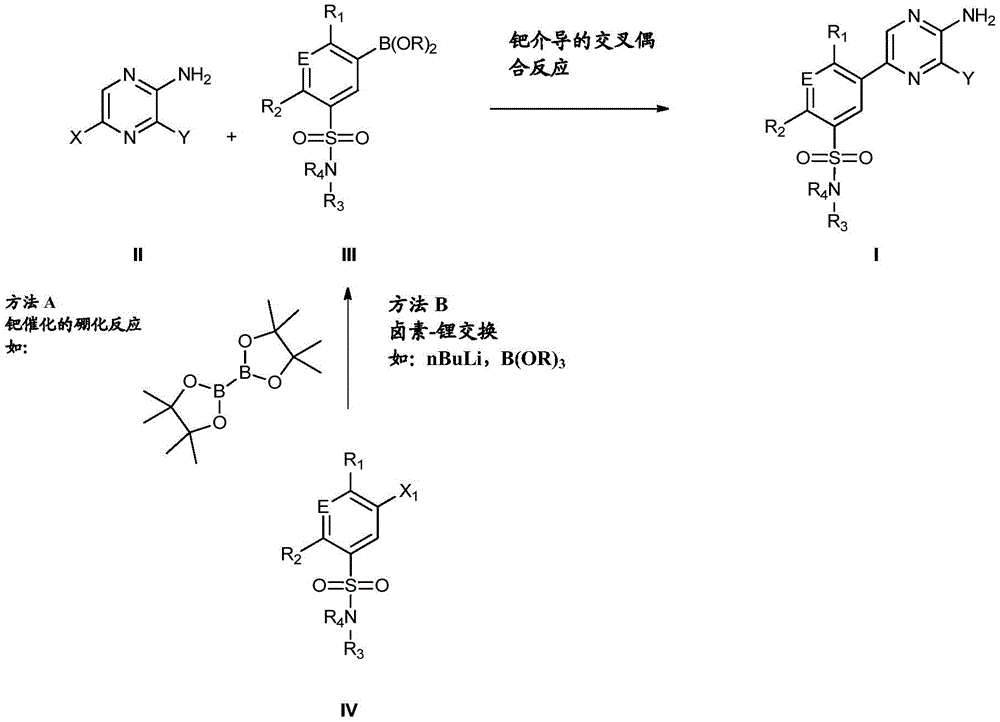
Wherein X1Is halogen, such as Br or I; y, R1、R2、R3、R4And E is as defined in embodiment 1; x is halogen, for example I, Br or Cl.
The reaction between halopyrazine II and boronic acid or boronic ester III shown in scheme 1 to form compounds of formula I can be carried out using a suitable palladium catalyst, such as Pd (PPh)3)2Cl2、Pd-118(PdCl2(dtbpf))、Pd(dppf)Cl2Or its adduct with dichloromethane, in a suitable solvent or solvent mixture, such as 1, 2-Dimethoxyethane (DME), DME/ethanol, acetonitrile, 1, 4-dioxane or toluene/ethanol. The reaction usually requires a base, such as aqueous sodium carbonate, potassium phosphate or in some cases potassium acetate, and the reaction needs to be carried out at elevated temperature, with conventional heating or microwave heating.
The compounds of formula II may be obtained from commercial suppliers or prepared according to the procedures described in schemes 2b, 3a, 6a, 6b, 6c, 6d, 6e, 8 or 10 or other procedures known in the art.
The compounds of formula III may be obtained from commercial suppliers or prepared by the boronation reaction of an aryl halide of formula IV with a boron source such as bis (pinacolato) diboron, at elevated temperatures, using conventional heating or microwave heating (method a). The reaction is usually carried out over a palladium catalyst such as Pd (dppf) Cl2.CH2Cl2Catalysis is carried out using a suitable base, such as potassium acetate, in a suitable solvent, such as DME or dioxane. In an alternative process to scheme 1, the boronation reaction of IV to form III is followed without isolation of III and subsequent coupling directly with compound II in a "one-pot" process to form compound I. In another variation of scheme 1, the "one pot" process can be carried out by boronization of IIAnd subsequent coupling reaction with IV.
The compounds of formula III can also be prepared by halogen-metal exchange reactions and subsequent reaction of the obtained organometallic with a boron source (method B). Typically, the reaction can be carried out by lithiation of the compound of formula IV with a suitable organometallic species such as n-butyllithium in a suitable solvent such as THF, with cooling (e.g. to-78 ℃). The resulting product species can then be reacted in situ with an appropriate boron source such as triisopropyl borate.
The compounds of formula IV may be obtained from commercial suppliers or may be prepared according to the procedures described in schemes 4a and 9 or other procedures known in the art.
Scheme 2

Y, R therein1、R2、R3、R4And E is as defined in embodiment 1; x is halogen, for example I, Br or Cl.
Wherein Y is connected to the pyrazine ring through a carbon-carbon bond, the compounds of formula I may be prepared by reaction between compound V and boronic acid or ester VI as shown in scheme 2. Suitable conditions for this Suzuki coupling reaction are well known in the art and include those described in scheme 1.
Scheme 2a

Y, R therein1、R2、R3、R4And E is as defined in embodiment 1; x is halogen, for example I, Br or Cl.
Wherein Y is attached to the pyrazine ring through a carbon-carbon bond, the compounds of formula I may be prepared by reaction of compound V with a stannane Sn-VI (e.g., optionally substituted 4- (tributylstannyl) thiazole) as shown in scheme 2 a. The reaction may be carried out using a suitable palladium catalyst (e.g. Pd-118) in a suitable solvent (e.g. THF) at elevated temperature, optionally in the presence of a suitable additive (e.g. copper (I) iodide). Alternative conditions for such Stille coupling reactions are well known in the art.
Scheme 2b

Wherein Y is as defined in embodiment 1; x1Is halogen, such as I, Br or Cl; x is hydrogen or halogen.
Compounds of formula II, wherein Y is attached to the pyrazine ring through a carbon-carbon bond, can be prepared by palladium mediated cross-coupling reactions between formula VII as shown in scheme 2 b. Suitable conditions include those shown in scheme 1 or other conditions known in the art. When X ═ H, it can be converted to X ═ halogen by halogenation. Various conditions for this reaction are known in the art, for example, by bromination using a halogenating agent such as NBS in an appropriate solvent (e.g., acetonitrile) at elevated temperatures. Compound VII (e.g., 3-bromo-5-chloropyrazin-2-amine) may be obtained commercially or may be prepared by known methods.
Scheme 2c

Wherein R is1、R2、R3、R4And E may be selected from embodiment 1; x1Is halogen, such as I, Br or Cl; x is hydrogen or halogen.
The compound of formula V can be prepared by the same general procedure as shown in scheme 2c by reacting a boronic acid or ester of formula III with a compound of formula VII'. When X ═ H, it can be converted to X ═ halogen according to methods known in the art. Typically, the halogenation reaction can be carried out using a halogenating agent (e.g., N-bromosuccinimide) in a suitable solvent (e.g., DCM).
The compounds of formula VI, VII' may be obtained commercially or prepared according to known methods. Scheme 3

Y, R therein1、R2、R3、R4And E is as defined in embodiment 1, wherein Y may be attached to the pyrazine ring through a nitrogen-carbon bond and X is halogen.
Compounds of formula I, wherein Y may be attached to the pyrazine ring via a nitrogen-carbon bond, may be prepared by reaction of compound V with a suitable NH group-containing heteroaromatic Y, for example (optionally substituted) 1,2, 4-triazole, imidazole or pyrazole. The reaction is typically carried out in the presence of a suitable base (e.g. an amine, an alkali metal hydride or carbonate, such as sodium hydride or cesium carbonate), in a suitable solvent (e.g. Dimethylacetamide (DMA)), optionally in the presence of a suitable catalyst system (e.g. CuI and N, N-dimethylglycine), typically at elevated temperatures of up to 180 ℃ (e.g. microwave heating). The heteroaromatics used may be obtained commercially or prepared according to known methods.
Scheme 3a

Wherein Y is as defined in embodiment 1, wherein Y may be connected to the pyridine ring by a nitrogen-carbon bond, and X1Is halogen, for example I, Br or Cl, and X is hydrogen or halogen.
The compounds of formula II can be prepared as shown in scheme 3a by reacting a compound of formula VII (e.g. 5-bromo-3-chloropyrazin-2-amine) with a suitable NH group-containing heteroaromatic (e.g. an (optionally substituted) 1,2, 4-triazole, imidazole or pyrazole). Typical conditions include a catalyst system as described in scheme 3, or the direct reaction of compound VII with an appropriate heteroaromatic, for example by heating in an appropriate solvent (e.g. DMF) in the presence of a base (e.g. cesium carbonate). When X ═ H, it can be converted to X ═ halogen by halogenation reaction conditions known in the art.
Scheme 3b

Y, R therein1、R2、R3、R4And E is as defined in embodiment 1, X is halogen.
In some cases, as shown in scheme 3b, compound I can be prepared directly from aminopyrazine halides V and heterocycles, such as oxazoles (to obtain I where Y is oxazol-5-yl or oxazol-2-yl) using a palladium catalyzed C-H activation method. Suitable conditions are known in the art, for example, heating at elevated temperature (e.g., 110 ℃) in a solvent (e.g., dimethylacetamide), using palladium acetate and an additional ligand such as bis (adamantan-1-yl) -n-butylphosphine, using a base such as potassium carbonate and an additive such as pivalic acid.
Scheme 4
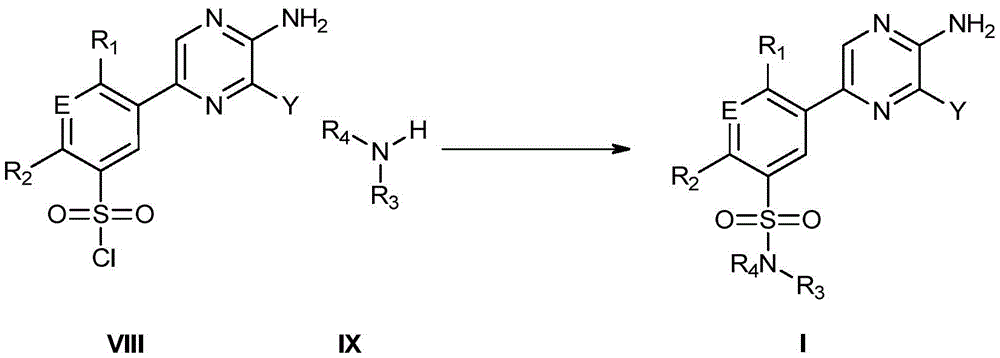
Y, R therein1、R2、R3、R4And E is as defined in embodiment 1.
The compounds of formula I can be prepared by reaction of sulfonyl chloride VIII with an amine IX in the presence of a suitable base such as pyridine, triethylamine or diisopropylethylamine in a suitable solvent such as DCM, THF, pyridine or dimethylacetamide.
Scheme 4a
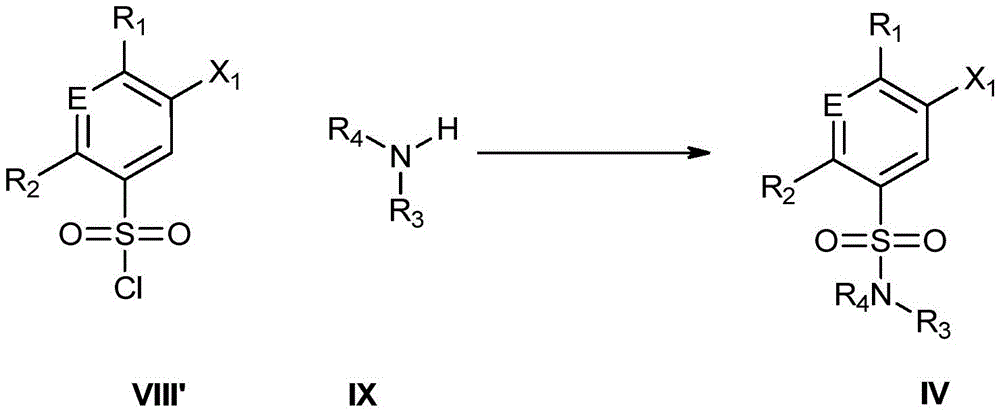
Wherein X1Is halogen, such as Br or I; y, R1、R2、R3、R4And E is as defined in embodiment 1.
As shown in scheme 4a, the same procedure can be used to remove sulfonyl chloride VIII*Preparing the compound of formula IV. The compounds of formula IX may be obtained commercially or prepared according to known methods.
Scheme 5
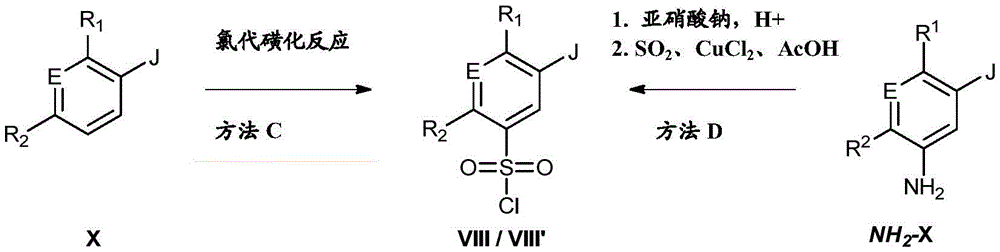
Wherein J is halogen, e.g. Br or I, or Y, R therein1、R2And E is a suitable group selected from embodiment 1.
A compound of formula VIII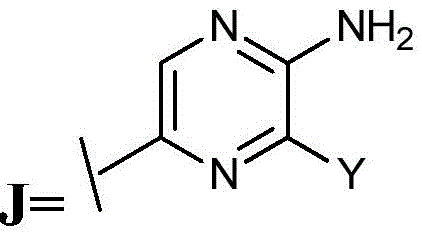 Can be prepared by chlorosulfonation of compounds of formula X according to the method of scheme 5 (method C), typically using chlorosulfonic acid in a suitable solvent (e.g., chloroform), at room temperature or with cooling (e.g., to 0 deg.C). The sulfonyl chlorides VIII/VIII' formed can be reacted directly with amines IX as shown in schemes 4 and 4a to form compounds I/IV without isolation or purification. Another alternative preparation of compound VIII is shown in scheme 5 (method D), by a diazotization/chlorosulfonation reaction sequence (see, e.g., Meerwein, H., et al, chem. Ber.,90: 841-852.). Typical conditions include the inclusion of compound NH2Reaction of X with sodium nitrite in the presence of an acid (for example a mixture of acetic acid and conc. HCl), in water, under cooling (generally 0 ℃), and then addition of the mixture obtained by charging the glacial acetic acid with sulphur dioxide gas and subsequent addition of CuCl2To a stirred solution of the green supernatant prepared from the aqueous solution of (a). The compounds of formula VIII' may be obtained commercially or prepared according to the same method. A compound of the formula X or NH2-X may be obtained commercially or prepared according to known methods.
Scheme 6
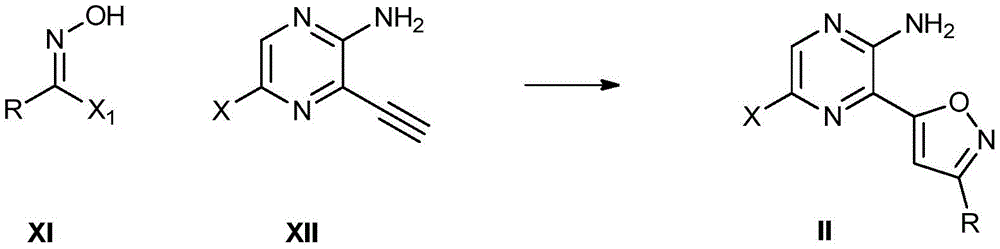
Wherein R is selected from the appropriate groups of substituents listed in the definition of Y in embodiment 1, X1Is halogen, such as bromine, chlorine or iodine, and X is halogen or hydrogen.
Compounds of formula II (wherein Y is 3-substituted-isoxazol-5-yl) can be prepared according to the route shown in scheme 6 by reacting a compound of formula XI with an alkyne of formula XII. Typical conditions for this conversion are copper (II) sulfate, sodium ascorbate and sodium bicarbonate in a suitable solvent mixture (e.g. tert-BuOH and water) under nitrogen at room temperature. The compounds of formula XI are commercially available or may be prepared according to known methods or may be prepared in situ. For example, compounds of formula X I can be prepared by halogenation of an aldoxime. Compound II can be formed by adding chloramine-T, copper powder, and copper (II) sulfate to a mixture of aldehyde, hydroxylamine hydrochloride, and a base (e.g., sodium hydroxide) in a suitable solvent mixture (e.g., aqueous T-butanol), followed by addition of alkyne XII and heating. When X ═ H, it can be converted to X ═ halogen by halogenation conditions known in the art.
The compounds of formula XII can be obtained commercially or prepared according to known methods, for example using Sonogashira coupling with TMS-acetylene followed by deprotection.
Scheme 6a

Wherein R and X are as defined in scheme 6, X1Is bromine or iodine and Alk is an alkyl group, such as methyl or ethyl.
Compounds of formula II (wherein Y is 3-substituted-isoxazol-5-yl) can also be formed by cycloisomerization of alkynoxime as shown in scheme 6 a.
After oxime formation from ketone XIII by known methods, cyclization to form compound II at step 4 is typically catalyzed by an acid (e.g., aqueous HCl in AcOH) or by catalytic reaction of gold as described by Synlett,2010, 5 th, page 0777-0781. Formula II*Compounds of formula II wherein Y is 3-substituted-isothiazol-5-yl can also be prepared using ketone XIII, for example, by treatment with hydroxylamine-O-sulfonic acid, sodium bicarbonate and sodium hydrosulfide in a suitable solvent mixture (e.g., THF/water). Ketone XIII can be prepared from dihaloaminopyrazines (e.g., 3-bromo-5-chloropyrazine-2-amine) by known methods as shown in scheme 6a, for example by Sonogashira coupling with propargyl alcohol XIV,followed by an oxidation reaction using an oxidizing agent (e.g., manganese dioxide).
An alternative preparation of compound II, wherein Y is 3-substituted-isoxazol-5-yl, is shown in scheme 6a, using the reaction of the ester Alk-XVI with the dianion of the oxime (typically formed by treating the oxime (e.g. acetoxime) with 2eq. n-butyllithium in anhydrous solvent (e.g. THF) with cooling, followed by dehydrative cyclization (using, for example, sulfuric acid) to give compound II. When X ═ H, it can be converted to X ═ halogen by halogenation conditions known in the art.
The compounds of formula XIV are commercially available or may be prepared according to known methods.
Scheme 6b
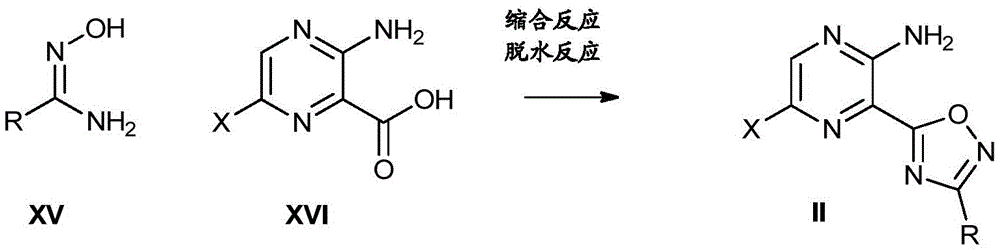
Wherein R and X are as defined in scheme 6.
Compounds of formula II (wherein Y is 3-substituted- [1,2, 4)]Oxadiazol-5-yl) can be prepared as shown in scheme 6b by condensation and dehydration of an amidoxime (amidoxime) XV with acid XVI. When X ═ H, it can be converted to X ═ halogen by halogenation conditions known in the art. Suitable reagents for condensation and dehydration are well known in the art and include the Ghosez reagent, DCC and HOBt, or HATU in a suitable solvent (e.g. DCM, THF or toluene), in the presence of a suitable base such as DIPEA.
Scheme 6c

Wherein R and X are as defined in scheme 6.
In a related reaction, shown in scheme 6c, formula II**Compounds (compounds of formula II wherein Y ═ 5-substituted-1, 3, 4-oxadiazol-2-yl) are prepared by condensation and dehydration of compounds XVI and XVII using conditions known in the art. It can beTo be performed by a one-or two-step process, for example dehydrative cyclization with an amide coupling reagent (e.g. HATU or T3P) in the presence of a suitable base (e.g. triethylamine) followed by p-toluenesulfonyl chloride in a suitable solvent (e.g. DCM) in the presence of a suitable base (e.g. triethylamine). Other dehydrating agents are known in the art, for example POCl3. Likewise, after amide formation/condensation, the N-acylhydrazide obtained may be treated with Lawesson's reagent to prepare formula II***A compound (a compound of formula II wherein Y ═ 5-substituted-1, 3, 4-thiadiazol-2-yl). When X ═ H, compound II**And II***Can be converted to X ═ halogen by halogenation conditions known in the art. Compounds of formulae XV, XVI, Alk-XVI and XVII may be obtained commercially or prepared according to known methods.
Scheme 6d

Wherein R and X are as defined in scheme 6, RaIs hydrogen or a suitable group selected from the substituents listed in the definition of Y in embodiment 1.
As shown in scheme 6d, compounds of formula II (where Y is 1,2, 3-triazol-4-yl, optionally substituted in the 5 and 1 or 2 positions) are prepared by reaction of an alkyne XII' with a trimethylsilyl azide, followed by optional alkylation if a substituent in the 1 or 2 position is desired. Typical conditions for the first step of the conversion are the use of copper (II) sulfate, sodium ascorbate and sodium bicarbonate in a suitable solvent mixture (e.g. t-BuOH and water) at elevated temperature (e.g. 90 ℃). The triazole obtained (where R ═ H) can be alkylated with an alkylating agent (e.g. methyl iodide, ethyl iodide, 2,2, 2-trifluoroethyl triflate or other alkyl halides or sulfonates) in the presence of a suitable base/additive (e.g. TBAF or a metal carbonate such as cesium carbonate) in a suitable solvent (e.g. acetonitrile or THF) to give the compound of formula II as a mixture of N1 and N2 alkylation products, which can be isolated by known methods. When X ═ H, it can be converted to X ═ halogen by halogenation conditions known in the art. Compound XII' may be obtained commercially or prepared according to methods known in the art, such as Sonogashira coupling.
Scheme 6e

Wherein X is halogen or hydrogen.
Compounds of formula II (wherein Y ═ oxazol-2-yl) can be prepared from acid XVI by formation of propargylamide using known conditions, followed by cyclization, for example with gold (III) chloride in a solvent such as DCM. When X ═ H, it can be converted to X ═ halogen by halogenation conditions known in the art.
Scheme 7

Wherein R is selected from the appropriate groups in the substituent list of embodiment 1.
The compounds of formula IX' can be prepared from alcohols XVIII (obtained commercially or prepared according to known methods), or prepared as follows: the phthalamide group is deprotected under Mitsunobu conditions known in the art by treatment with N-hydroxyphthalimide (e.g. with a solution of PS-triphenylphosphine and di-tert-butyl azodicarboxylate in a solvent such as THF), followed by known conditions, typically by treatment with hydrazine.
Scheme 8
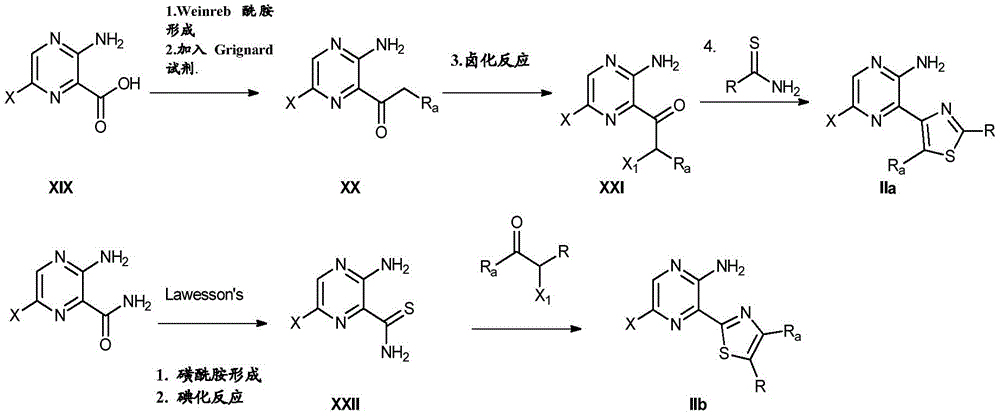
Wherein X is hydrogen or halogen, R, RaAs defined in embodiment 1, X1Is halogen.
Compounds of formula IIa (compounds of formula II wherein Y is 2 or 2, 5-substituted-thiazol-4-yl) may be prepared from α -haloketone XXI according to scheme 8 by reaction with thioamides in a suitable solvent such as ethanol at elevated temperature (e.g. 50-70 ℃), likewise compounds of formula lib (compounds of formula II wherein Y is 5 or 4, 5-substituted-thiazol-2-yl) may be prepared from thioamides XXII and α -haloketones (prepared according to known methods or obtained commercially).
Scheme 9
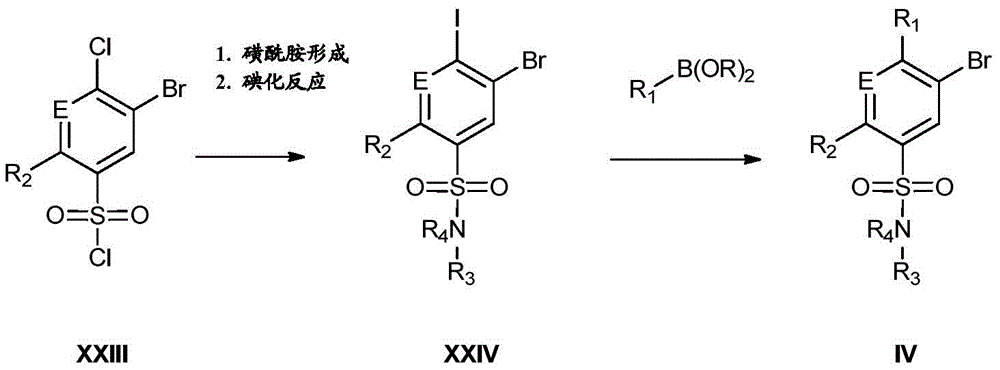
E, R therein1、R2、R3、R4As defined in embodiment 1.
Certain compounds of formula IV can be prepared by cross-linking coupling of compound XXIV with an appropriate boronic acid (e.g., methylboronic acid) in the presence of a base (e.g., aqueous sodium carbonate), an appropriate catalyst (e.g., bis (triphenylphosphine) palladium dichloride), in an appropriate solvent (e.g., 1, 4-dioxane) at elevated temperature. Compound XXIV (where E ═ N) can be prepared from compound XXIII by a two-step reaction, first sulfonamide formation (see scheme 4 for reaction conditions), followed by iodination, which can generally be carried out by treatment with an iodine source such as trimethylsilyl iodide (or trimethylsilyl chloride plus sodium iodide) in an appropriate solvent such as acetonitrile. Compound XXIII may be obtained commercially or prepared according to known methods.
Scheme 10

Wherein X is hydrogen or halogen, R is
Compounds of formula II wherein Y is 5-substituted-1, 2, 4-oxadiazol-3-yl can be prepared by reaction of an amidoxime (amidoxime) XXV with an acid chloride followed by dehydrative ring closure using known conditions. The conditions for such cyclization reactions are well known in the art and include the use of hexachloroethane in acetic acid at elevated temperatures. Compound XXV can be prepared by known methods, for example by reaction of commercially available 3-amino-6-bromopyrazine-2-carbonitrile with hydroxy hydrochloride in the presence of a base (e.g. triethylamine) in a suitable solvent (e.g. methanol).
Scheme 11

Wherein Y is selected from suitable groups of the groups defined in embodiment 1; x1Is halogen, such as I, Br or Cl; x is H or halogen.
The compound of formula II can be prepared by decarboxylation cross-linking coupling of carboxylic acid XXVI (obtained from a commercial supplier, or prepared according to known methods) with compound VII. Reagents for this coupling reaction are known in the art and include a suitable palladium catalyst (e.g., Pd (PPh)3)2Cl2) And a base (preferably a silver salt, e.g. silver carbonate) in a suitable solvent (e.g. NMP) at elevated temperature. When X ═ H, it can be converted to X ═ halogen by halogenation conditions known in the art.
The invention also includes any variation of the process of the invention wherein the intermediate product obtained at any stage thereof may be used as starting material and the remaining steps performed, or wherein the starting materials are performed in situ under the reaction conditions, or wherein the reaction components are used in the form of their salts or as optically pure materials.
The compounds of the invention and intermediates may also be converted into each other according to methods well known to those skilled in the art.
Within the scope of this document, unless the context indicates otherwise, only those compounds not according to the inventionThe particularly desired group of the constituent parts of the end product which is easy to remove can be referred to as "protecting group". Protection of functional Groups by such protecting Groups, the protecting Groups themselves and their cleavage reactions are described, for example, in the following standard reference works, such as j.f.w.mcomie, "protecting Groups in Organic Chemistry", Plenum Press, London and New York 1973; t.w.greene and p.g.m.wuts, "Protective Groups in Organic Synthesis" (3 rd edition, Wiley, New York 1999; "Peptides (The Peptides)"; volume 3 (ed: E.Gross and J.Meienhofer), Academic Press, London and New York 1981; "Methoden der organischen Chemie" (method of organic chemistry), Houben Weyl, 4 th edition, volume 15/I, Georg Thieme Verlag, Stuttgart 1974; H. -d.jakubke and h.jeschkeit " Peptide, protein "(amino acids, peptides, proteins), VerlagChemie, Weinheim, Deerfield Beach, and Basel 1982; jochen Lehmann, "Chemie der Kohlenhydate: Monosachoride und Derivate" (glycochemistry: monosaccharides and their derivatives), Georg Thieme Verlag, Stuttgart 1974. The protective groups are characterized in that they are readily removable (i.e., do not undergo undesirable side reactions), for example, by solvolysis, reduction, photolysis, or removal under physiological conditions (e.g., by enzymatic cleavage).
Salts of the compounds of the invention having at least one salt-forming group may be prepared according to methods known to those skilled in the art. For example, salts of the compounds of the present invention having acidic groups can be formed by, for example, treating the compounds with: metal compounds, for example alkali metal salts of suitable organic carboxylic acids, such as the sodium salt of 2-ethylhexanoic acid; organic alkali or alkaline earth metal compounds, for example their corresponding hydroxides, carbonates or bicarbonates, such as sodium or potassium hydroxide, sodium or potassium carbonate or bicarbonate; the corresponding calcium compound or ammonia or a suitable organic amine, preferably with a stoichiometric or slight excess of salt-forming reagent. Acid addition salts of the compounds of the invention may be obtained according to conventional methods, for example by treating the compounds with an acid or a suitable anion exchange reagent. Internal salts of the compounds of the invention containing both acidic and basic salt-forming groups (e.g., free carboxyl and free amino groups) may be formed by: for example, salts (e.g., acid addition salts) are neutralized to the isoelectric point using, for example, a weak base, or treated with an ion exchanger.
Salts can be converted into the free compounds according to methods known to those skilled in the art. The metal and ammonium salts may be converted, for example, by treatment with a suitable acid, and the acid addition salts may be converted, for example, by treatment with a suitable basic agent.
The isomer mixtures obtained according to the invention can be separated into the individual isomers according to methods known to the person skilled in the art; diastereomers may be separated, for example, by the following methods: partitioning methods between heterogeneous solvent mixtures, recrystallization methods and/or chromatographic separation methods (e.g. silica gel chromatography), or by medium pressure liquid chromatography methods, e.g. on reverse phase columns; the racemates can be isolated, for example, by the following methods: salts are formed using optically pure salt-forming reagents and the diastereoisomeric mixture thus obtained is separated, for example by fractional crystallisation or by chromatographic methods using optically active column packing.
Intermediates and final products can be worked up and/or purified according to standard methods, e.g. using chromatographic methods, partitioning methods, (re) crystallization methods, etc.
The following generally applies to all methods described in the context herein. All of the above process steps may be carried out under reaction conditions well known to those skilled in the art, including those specifically described below: in the absence or generally in the presence of solvents or diluents, including, for example, solvents or diluents which are inert to the reagents used and which dissolve them; in the presence or absence of catalysts, condensing agents or neutralizing agents, e.g. ion exchangers, e.g. cation exchangers, e.g. H+The exchanger in a form that depends on the nature of the reaction and/or the reactants to be reduced; low, normal or high temperature, e.g., in the range of about-100 ℃ to about 190 ℃, including, e.g., about-80 ℃ to about 150 ℃, e.g.-80 ℃ to-60 ℃, at room temperature, -20 ℃ to 40 ℃ or at reflux temperature; at atmospheric pressure or in a closed vessel, under suitable pressure; and/or in an inert environment, such as an argon or nitrogen environment.
At all stages of the reaction, the isomeric mixture formed may be separated into individual isomers, for example diastereomers or enantiomers, or into any desired isomeric mixture, for example racemates or mixtures of diastereomers, for example analogously to the process described below under "other process steps".
Solvents that may be selected from those suitable for any particular reaction include those specifically identified, or for example, water; esters, for example, lower alkyl-lower alkanoates, such as ethyl acetate; ethers, for example aliphatic ethers, such as diethyl ether; or cyclic ethers such as tetrahydrofuran or dioxane; liquid aromatic hydrocarbons, such as benzene or toluene; alcohols, such as methanol, ethanol or 1-or 2-propanol; nitriles, such as acetonitrile; halogenated hydrocarbons such as dichloromethane or chloroform; amides, such as dimethylformamide or dimethylacetamide; bases, such as heterocyclic nitrogen bases, for example pyridine or N-methylpyrrolidin-2-one; carboxylic anhydrides, for example lower alkanoic anhydrides, such as acetic anhydride; cyclic, linear or branched hydrocarbons, such as cyclohexane, hexane or isopentane, methylcyclohexane; or mixtures of these solvents, for example aqueous solutions. Such solvent mixtures may also be used in processing steps, such as chromatography or partitioning steps.
The compounds of the invention (including salts thereof) may also be obtained in the form of hydrates, or their crystals may, for example, contain a solvent for crystallization. Different crystalline forms may be present.
The invention also relates to those process forms in which the compounds obtained as intermediates at any process stage are used as starting materials and the remaining process steps are carried out, or in which the starting materials are formed under the reaction conditions or are used in the form of derivatives, for example in protected form or in the form of salts, or the compounds obtained by the process according to the invention can be produced under the process conditions and further processed in situ.
All starting materials, building blocks, reagents, acids, bases, dehydrating agents, solvents and catalysts for the Synthesis of the compounds of the invention are commercially available or can be prepared by Organic Synthesis Methods known to the person skilled in the art (Houben-Weyl 4 th edition, 1952, Methods of Organic Synthesis, Thieme, Vol.21).
The term "optical isomer" or "stereoisomer" refers to any of the various stereoisomeric configurations, including geometric isomers, that may exist for a given compound of the present invention. It is understood that the substituent may be attached to a chiral center of a carbon atom. The term "chiral" refers to a molecule that is non-superimposable with its mirror pair of molecules, while the term "achiral" refers to a molecule that is superimposable with its mirror pair of molecules. Thus, the present invention includes enantiomers, diastereomers, or racemates of the compounds. "enantiomers" are a pair of stereoisomers that mirror each other without superimposability. A1: 1 mixture of a pair of enantiomers is a "racemic" mixture. Where appropriate, the term is used to refer to racemic mixtures. "diastereoisomers" are stereoisomers having at least two asymmetric atoms, but which are not mirror images of each other. Absolute stereochemistry was assigned according to the Cahn-lngold-Prelog R-S system. When the compounds are pure enantiomers, the stereochemistry at each chiral carbon may be designated as R or S. Resolved compounds whose absolute configuration is unknown can be designated (+) or (-) depending on the direction (dextro-or laevorotary) in which they rotate plane-polarized light at the wavelength of the sodium D line. Certain compounds described herein contain one or more asymmetric centers or axes and thus may give rise to enantiomers, diastereomers, and other stereoisomeric forms, which may be defined as (R) -or (S) -based on absolute stereochemistry.
Depending on the choice of starting materials and processes, the compounds according to the invention may be present in the form of any one of the possible isomers or mixtures thereof, for example pure optical isomers or mixtures of isomers, for example racemates and mixtures of enantiomers, depending on the number of asymmetric carbon atoms. The present invention is intended to include all such possible isomers, including racemic mixtures, diastereomeric mixtures and optically pure forms. Optically active (R) -and (S) -isomers can be prepared using chiral synthons or chiral reagents, or resolved using conventional techniques. If the compound contains a double bond, the substituent may be in the E or Z configuration. If the compound contains a disubstituted cycloalkyl group, the cycloalkyl substituent may have either the cis or trans configuration. All tautomeric forms should also be included.
Any resulting isomeric mixture may be separated into pure or substantially pure geometric or optical isomers, diastereomers, racemates on the basis of differences in the physicochemical properties of the constituent components, for example, by chromatographic methods and/or fractional crystallization.
Any resulting racemates of final products or intermediates may be resolved into the optical enantiomers by known methods, for example, by separation of diastereomeric salts thereof (obtained with an optically active acid or base), with the release of the optically active acidic or basic compound. In particular, the compounds of the invention may be resolved into their optical enantiomers using a basic moiety, for example, by fractional crystallisation of a salt formed from an optically active acid, such as tartaric acid, dibenzoyl tartaric acid, diacetyl tartaric acid, di-O, O' -p-toluoyl tartaric acid, mandelic acid, malic acid or camphor-10-sulfonic acid. The racemic product can also be resolved by chiral chromatographic methods, such as High Performance Liquid Chromatography (HPLC) using a chiral adsorbent.
In addition, the compounds of the present invention (including salts thereof) may also be obtained in the form of hydrates thereof, or contain other solvents for crystallization thereof. The compounds of the present invention may be solvated either by nature or by design with pharmaceutically acceptable solvents, including water; thus, the present invention should encompass both solvated and unsolvated forms. The term "solvate" refers to a molecular complex of a compound of the present invention (including pharmaceutically acceptable salts thereof) with one or more solvent molecules. Such solvent molecules are those commonly used in the pharmaceutical arts, which are known to be harmless to the recipient, e.g., water, ethanol, and the like. The term "hydrate" refers to a complex in which the solvent molecule is water.
The compounds of the present invention (including salts, hydrates and solvates thereof) may form polymorphs either by themselves or by design.
The term "salt" as used herein refers to an acid addition salt or a base addition salt of a compound of the present invention. The term "salt" includes in particular "pharmaceutically acceptable salts". The term "pharmaceutically acceptable salts" refers to salts which retain the biological effectiveness and properties of the compounds of the present invention and which are not generally biologically or otherwise undesirable. In many cases, the compounds of the present invention are capable of forming acid and/or base salts due to the presence of amino and/or carboxyl groups or similar groups.
Pharmaceutically acceptable acid addition salts may be formed with inorganic and organic acids, for example, acetate, aspartate, benzoate, benzenesulfonate, bromide/hydrobromide, bicarbonate/carbonate, bisulfate/sulfate, camphorsulfonate, chloride/hydrochloride, chlorotheophylonate, citrate, edisylate, fumarate, glucoheptonate, gluconate, glucuronate, hippurate, hydroiodide, isethionate, lactate, lactobionate, lauryl sulfate, malate, maleate, malonate, mandelate, methanesulfonate, methylsulfate, naphthoate, naphthalenesulfonate, nicotinate, nitrate, stearate (ocadenoate), oleate, oxalate, palmitate, pamoate, phosphate/hydrogen phosphate/dihydrogen phosphate, phosphate, Polygalacturonate, propionate, stearate, succinate, sulfosalicylate, tartrate, tosylate, and trifluoroacetate.
Inorganic acids that can form salts include, for example, hydrochloric acid, hydrobromic acid, sulfuric acid, nitric acid, phosphoric acid, and the like.
Organic acids from which salts can be formed include, for example, acetic acid, propionic acid, glycolic acid, oxalic acid, maleic acid, malonic acid, succinic acid, fumaric acid, tartaric acid, citric acid, benzoic acid, mandelic acid, methanesulfonic acid, ethanesulfonic acid, p-toluenesulfonic acid, sulfosalicylic acid, and the like. Pharmaceutically acceptable base addition salts can be formed with inorganic and organic bases.
Inorganic bases which can form salts include, for example, ammonium salts and metals from groups I-XII of the periodic Table of the elements. In certain embodiments, the salts are derived from sodium, potassium, ammonium, calcium, magnesium, iron, silver, zinc, copper, and the like, with particularly suitable salts including ammonium, potassium, sodium, calcium, and magnesium salts.
Organic bases that can form salts include, for example, primary, secondary and tertiary amines, substituted amines (including naturally occurring substituted amines), cyclic amines, basic ion exchange resins, and the like. Some organic amines include isopropylamine, benzathine, cholate (cholinate), diethanolamine, diethylamine, lysine, meglumine, piperazine, and tromethamine.
The pharmaceutically acceptable salts of the present invention can be synthesized from basic or acidic moieties by conventional chemical methods. In general, such salts can be prepared by reacting the free acid forms of these compounds with a stoichiometric amount of the appropriate base (Na, Ca, Mg, or K hydroxide, carbonate, bicarbonate, etc.), or by reacting the free base forms of these compounds with a stoichiometric amount of the appropriate acid. Such reactions are usually carried out in water or an organic solvent or in a mixture of the two. In general, nonaqueous media such as diethyl ether, ethyl acetate, ethanol, isopropanol or acetonitrile may be employed, if applicable. Other lists of suitable salts can be found in, for example, "Remington's Pharmaceutical Sciences (Remington Pharmaceutical Sciences)", 20 th edition, Mack Publishing Company, Easton, Pa., (1985); and "Handbook of pharmaceutical Salts: Properties, Selection and Use (Handbook of pharmaceutically acceptable Salts: Properties, Selection and Use)", Stahland Wermuth (Wiley-VCH, Weinheim, Germany, 2002).
Any formulae given herein should also represent unlabeled as well as isotopically labeled forms of these compounds. Isotopically-labeled compounds have the structure depicted by the structural formulae given herein, but in which one or more atoms are replaced by an atom having a selected atomic mass or mass number. Examples of isotopes that can be incorporated into compounds of the invention include hydrogen, carbon, nitrogen, oxygen, phosphorus, fluorine and chlorine, for exampleSuch as respectively are2H、3H、11C、13C、14C、15N、18F、31P、32P、35S、36Cl、125I. The invention includes various isotopically-labeled compounds of the invention, e.g., those in which a radioisotope is present (e.g., those in which a radioisotope is present)3H and14C) or those in which a non-radioactive isotope is present (e.g.2H and13C) the compound of (1). Such isotopically labeled compounds can be used for metabolic studies (using14C) Reaction kinetics study (using, for example2H or3H) Detection or imaging techniques, such as Positron Emission Tomography (PET) or Single Photon Emission Computed Tomography (SPECT), including for drug or substrate tissue distribution experiments or for radiotherapy of patients. In particular, it is possible to use,18f-labeled compounds of the invention are particularly desirable for PET or SPECT studies. Isotopically-labelled compounds of the present invention can generally be prepared by conventional techniques known to those skilled in the art or by analogous procedures to those described in the examples and preparation procedures, using an appropriate isotopically-labelled reagent in place of the non-labelled reagent previously employed.
In addition, heavier isotopes (in particular deuterium (i.e. deuterium) are employed because of their greater metabolic stability2H or D)) may provide certain therapeutic benefits, such as increased in vivo half-life or reduced dosage requirements or improved therapeutic index. It is to be understood that deuterium may be considered herein as a substituent of the compounds of the present invention. The concentration of such heavier isotopes, in particular deuterium, can be defined by the isotopic enrichment factor. The term "isotopic enrichment factor" as used herein refers to the ratio between the isotopic abundance and the natural abundance of a given isotope. If a substituent in a compound of the invention is represented by deuterium, the isotopic enrichment factor for each designated deuterium atom in the compound is at least 3500 (52.5% deuterium incorporation per designated deuterium atom), at least 4000 (60% deuterium incorporation), at least 4500 (67.5% deuterium incorporation), at least 5000 (75% deuterium incorporation), at least 5500 (82.5% deuterium incorporation), at least 6000 (90% deuterium incorporation), at least 6333.3 (95% deuterium incorporation), at least 6466.7 (97% deuterium incorporation), at least 6600 (99% deuterium incorporation), or at least 6633.3 (99.5% deuterium incorporation).
Pharmaceutically acceptable solvates of the invention include those wherein the crystallization solvent is isotopically substituted, e.g. D2O、d6-acetone, d6-DMSO。
Compounds of the present invention comprising groups capable of acting as hydrogen bond donors and/or acceptors are capable of forming co-crystals with suitable co-crystal formers. These co-crystals may be prepared from the compounds of the present invention according to known co-crystal formation methods. Such methods include milling, heating, co-subliming, co-melting, or contacting the compounds of the invention in solution with a co-crystal former under crystallization conditions, and then isolating the co-crystals thus formed. Suitable co-crystal formers include those described in WO 2004/078163. Thus, the present invention also provides co-crystals comprising the compounds of the invention.
The compounds of the invention are potent inhibitors of PI 3-kinase gamma isoforms this is shown in test E table 4 additionally and importantly, the compounds of the invention are selective for PI 3-kinase gamma isoforms over the other class 1 PI 3-kinase isoforms α, β and δ, which is shown in tests A, B and F table 4 over the related lipid kinases Vps34 and PI 4-kinase β, which is shown in tests C and D table 4, and also over the PI 3-kinase related protein kinases such as mTOR (table 4, 387g), preferably selective for PI 2-kinase gamma isoforms so that they avoid side effects that may be present when treating patients, in particular, it is preferred that the selectivity for PI 3-kinase gamma isoform is over the PI 3-kinase α isoform, since the PI3- α isoform is widely expressed in vivo, being important for the insulin receptor signal.
The target enzyme (i.e., PI 3-kinase gamma isoform) of the compounds of the invention is an intracellular target. Thus, compounds of the present invention that are capable of retaining their activity in a cellular environment are preferred. Thus, the compounds of the invention have been tested in cellular assays (see table 5, assays H1, H2, I1, I2, J1, J2, K1, and K2). In assays K1 and K2, compounds were tested for their ability to inhibit the production of phosphorylated AKT (protein kinase B) produced during PI 3-kinase gamma isoform-dependent processes in a U937 human cell line. The activity of a particular compound in a cellular assay depends on various factors, such as the potency of the compound at the target (see table 4), the solubility, LogP, and permeability of the compound. Thus, good cellular activity of the compounds of the invention benefits from a combination of structural features that are capable of delivering a good overall balance of molecular properties. In general, preferred compounds of the invention have high potency at the target (see table 4) and show good activity in cell assays (table 5).
In order to effectively inhibit PI 3-kinase gamma isoform targets (present in leukocytes) in an in vivo system, the pharmaceutical compound preferably needs to have sufficient activity in whole blood. Thus, the ability of the compounds of the invention to inhibit neutrophil morphological changes in response to the chemokine interleukin-8 (IL-8) in whole blood has been tested, which is a PI 3-kinase gamma isoform dependent event (table 5, test L). The activity in whole blood depends on other factors such as plasma protein binding and plasma stability of the particular compound. Thus, preferred compounds of the invention have sufficient activity in human whole blood, as shown by the test in test L, in addition to having potency at the PI 3-kinase gamma isoform target (table 4) and sufficient cellular potency (table 5). More preferably, the compounds of the invention have an IC50 value <1 μ M in the human whole blood assay.
In addition to potency at the target (table 4, assay E), selectivity (table 4, assays A, B, C, D, F and G), activity in cellular assays (table 5, assays H1, H2, I1, I2, J1, J2, K1 and K2) and activity in human whole blood assays (table 5, assay L), it is also desirable to maintain sufficient drug concentration in vivo after oral administration to inhibit the target. The pharmacokinetic profile depends on a number of factors, such as LogP, permeability, water solubility, and stability against oxidative metabolism. The stability of the compounds of the invention against oxidative metabolism has been tested using an in vitro microsomal stability assay (table 5, assay M). Preferred compounds of the invention show sufficient stability in this liver microsome assay. Furthermore, preferred compounds of the invention also have sufficient water solubility.
Accordingly, the compounds of the present invention may be used for the treatment of diseases mediated by the activation of PI 3-kinase gamma isoforms, in particular inflammatory or allergic diseases.
The compounds of the invention are useful in the treatment of inflammatory or obstructive airways diseases which result, for example, in a reduction in tissue damage, airways inflammation, bronchial hypersensitivity, remodeling or disease progression. Inflammatory or obstructive airways diseases to which the present invention is applicable include asthma of various types or genesis including both intrinsic (non-allergic) asthma and extrinsic (allergic) asthma, mild asthma, moderate asthma, severe asthma, bronchial asthma, exercise-induced asthma, occupational asthma and asthma induced following bacterial infection. Treatment of asthma is also understood to include treatment of individuals, for example, less than 4 or 5 years of age, who exhibit wheezing symptoms and are diagnosed or diagnosable as "wheezy infants", an established patient category of serious medical insurance, currently generally identified as incipient or early asthma. (for convenience, this particular asthma condition is referred to as "wheezy infant syndrome").
The prophylactic efficacy of asthma treatment will be assessed by reducing the frequency or severity of episodes, for example by reducing the frequency or severity of episodes of acute asthma or bronchoconstriction, by improving lung function or by improving airway hyperresponsiveness. It can be further assessed by a reduction in the need for other symptomatic therapy, i.e. for or intended to limit or stop symptoms at onset, such as anti-inflammatory drugs (e.g. corticosteroids) or bronchodilators. The beneficial effects of asthma prevention are particularly evident in individuals with a tendency to "morning dipping". "morning dipping" is a recognized asthma syndrome, common to a substantial proportion of asthma, characterized by asthma attacks between hours, e.g., about 4-6 am, i.e., generally substantially distant from the time of any previous administration of a symptomatic asthma therapy.
Other inflammatory or obstructive airways diseases and conditions to which the present invention is applicable include Acute Lung Injury (ALI), adult/Acute Respiratory Distress Syndrome (ARDS), chronic obstructive pulmonary, airways or lung disease (COPD, COAD or COLD), including chronic bronchitis or dyspnea associated therewith, emphysema, and exacerbation of airways hypersensitivity to other drug therapy, particularly other inhaled drug therapy. The invention is also applicable to the treatment of bronchitis of any type or genesis, including, for example, acute, arachidic, catarrhal, croupus, chronic or tuberculous bronchitis. Other inflammatory or obstructive airways diseases to which the present invention is applicable include pneumoconiosis (an inflammatory disease of the lung, typically occupational, whether chronic or acute, with airways obstruction frequently resulting from repeated inhalation of dusts) of any type or genesis, including, for example, aluminosis, carbophil, asbestosis, chalicosis, ptilosis, siderosis, silicosis, tobacco pneumoconiosis and gossyposis.
In view of their anti-inflammatory activity, in particular activity associated with inhibition of eosinophil activation, the compounds of the invention may also be useful in the treatment of eosinophil-related diseases, such as eosinophilia, in particular eosinophilia associated with respiratory diseases (e.g. pathological eosinophil infiltration involving lung tissue), including eosinophilia (as it affects the respiratory tract and/or lung), and for example Eosinophilic pneumonia, parasitic (especially multicellular animal) infections (including tropical eosinophilia), bronchopulmonary aspergillosis, polyarteritis nodosa (including Churg-Strauss syndrome), eosinophilic granuloma and eosinophilic related diseases affecting the respiratory tract caused by or accompanied by the syndrome(s) are disclosed.
The compounds of the invention may also be useful in the treatment of inflammatory or allergic diseases of the skin, such as psoriasis, contact dermatitis, atopic dermatitis, alopecia areata, erythema multiforme, dermatitis herpetiformis, scleroderma, vitiligo, allergic vasculitis, urticaria, bullous pemphigoid, lupus erythematosus, pemphigus, epidermolysis bullosa acquisita, and other inflammatory or allergic diseases of the skin.
The compounds of the invention may also be useful in the treatment of other diseases or conditions, particularly diseases or conditions having an inflammatory component, for example, in the treatment of diseases and conditions of the eye, such as conjunctivitis, keratoconjunctivitis sicca, and vernal conjunctivitis; diseases affecting the nose, including allergic rhinitis; inflammatory diseases in which autoimmune reactions are involved or have an autoimmune component or cause, including autoimmune blood diseases (e.g., hemolytic anemia, aplastic anemia, pure red cell anemia, and idiopathic thrombocytopenia), systemic lupus erythematosus, polychondritis, scleroderma, wegener's granulomatosis, dermatomyositis, chronic active hepatitis, myasthenia gravis, Steven-Johnson syndrome, idiopathic sprue, autoimmune inflammatory bowel diseases (e.g., ulcerative colitis and crohn's disease), endocrine ocular diseases, graves ' disease, sarcoidosis, alveolitis, chronic hypersensitivity pneumonitis, multiple sclerosis, leishmaniasis, primary biliary cirrhosis, uveitis (anterior and posterior), keratoconjunctivitis sicca and vernal keratoconjunctivitis, interstitial pulmonary fibrosis, psoriatic arthritis, and glomerulonephritis (with and without nephrotic syndrome, including, for example, idiopathic nephrotic syndrome or minimal change nephropathy).
Other diseases or conditions that may be treated with the compounds of the present invention include: thrombosis, hypertension, cardiac ischemia, and pancreatitis (Nature review, 11 months 2006, volume 5); anemia, including hemolytic anemia, aplastic anemia, and pure red cell anemia (WO 2006/040318); septic shock, rheumatoid arthritis, osteoarthritis, proliferative diseases such as cancer, atherosclerosis, allograft rejection after transplantation, stroke, obesity, restenosis, diabetes such as type I diabetes (juvenile diabetes) and type II diabetes, diarrheal diseases, ischemia/reperfusion injury, retinopathies such as diabetic retinopathy or hyperbaric oxygen induced retinopathy and diseases characterized by elevated intraocular pressure or aqueous humor secretion, such as glaucoma.
The compositions of the invention may be used for the treatment or prevention of heart failure, such as (acute and chronic) congestive heart failure, left cardiac insufficiency, including myocardial contractile dysfunction, hypertrophic cardiomyopathy, diabetic cardiomyopathy and other types of deleterious cardiac dysfunction and remodeling.
The compounds of the invention may also be useful in the treatment of visceral diseases, inflammatory bowel disorders, cystitis, for example in the treatment of interstitial cystitis and urinary incontinence, including bladder detrusor hyperreflexia and bladder hypersensitivity.
The effectiveness of the compositions of the invention in inhibiting inflammatory diseases (e.g., inflammatory respiratory diseases) can be demonstrated in animal models (e.g., mice or rats) of respiratory inflammation or other inflammatory diseases, such as those described in Szarka et al, J.Immunol.methods (1997)202: 49-57; renzi et al, am. Rev. Respir. Dis. (1993)148: 932-939; tsuyuki et al, J.Clin.Invest (1995)96: 2924-; and Cernadias et al (1999) am.J.Respir.cell mol.biol.20: 1-8.
The compounds of the invention may also be used as combination therapies in combination with PI 3-kinase delta inhibitors, for example in the treatment of allergic asthma or immune-mediated inflammatory diseases, such as rheumatoid arthritis or multiple sclerosis. Such effects are likely to be obtained by the co-administration of a PI 3-kinase gamma isoform selective inhibitor in combination with a PI 3-kinase delta isoform selective inhibitor.
The compounds of the invention may also be useful, for example, as anti-inflammatory, bronchodilatory or antihistamine agents, particularly for the treatment of obstructive or inflammatory respiratory diseases, such as those mentioned hereinbefore, for example as potentiators of therapeutic activity of such agents, or as a means of reducing the necessary dosage or potential side effects of such agents. The component of the present invention may be mixed with the other drug in a fixed pharmaceutical composition, or it may be administered separately from the other drug, before, simultaneously with or after the other drug. The invention therefore includes a combination of an ingredient of the invention as hereinbefore described with an anti-inflammatory, bronchodilator or antihistamine, said ingredient of the invention and said medicament may be present in the same or different pharmaceutical compositions.
Advantageous combinations of PI 3-kinase inhibitors with anti-inflammatory agents are those with: antagonists of chemokine receptors, such as CCR-1, CCR-2, CCR-3, CCR-4, CCR-5, CCR-6, CCR-7, CCR-8, CCR-9 and CCR10, CXCR1, CXCR2, CXCR3, CXCR4, CXCR5, in particular CCR-5 antagonists, such as Schering-Plough antagonists SC-351125, SCH-55700 and SCH-D; takeda antagonists, such as N- [ [4- [ [ [6, 7-dihydro-2- (4-methyl-phenyl) -5H-benzo-cyclohepten-8-yl ] carbonyl ] amino ] phenyl ] -methyl ] tetrahydro-N, N-dimethyl-2H-pyran-4-ammonium chloride (TAK-770); CCR-5 antagonists described in: USP6,166,037 (especially claims 18 and 19), WO 00/66558 (especially claim 8), WO 00/66559 (especially claim 9), WO 04/018425 and WO 04/026873.
Suitable anti-inflammatory drugs include steroids, in particular glucocorticoids, such as budesonide, beclomethasone dipropionate, fluticasone propionate, ciclesonide or mometasone furoate, or steroids described below: WO 02/88167, WO02/12266, WO 02/100879, WO 02/00679 (in particular examples 3, 11, 14, 17, 19, 26, 34, 37, 39, 51, 60, 67, 72, 73, 90, 99 and 101), WO 03/35668, WO 03/48181, WO 03/62259, WO 03/64445, WO03/72592, WO 04/39827 and WO 04/66920; non-steroidal glucocorticoid receptor agonists, such as those described below: DE 10261874, WO 00/00531, WO 02/10143, WO 03/82280, WO 03/82787, WO 03/86294, WO03/104195, WO 03/101932, WO 04/05229, WO 04/18429, WO 04/19935 and WO 04/26248; LTD4 antagonists, such as montelukast and zafirlukast; PDE4 inhibitors, e.g. cilomilast ( GlaxoSmithKline), roflumilast (Byk Gulden), V-11294A (Napp), BAY19-8004(Bayer), SCH-351591(Schering-Plough), Alopeptine (Almirall Prodesfara), PD189659/PD168787(Parke-Davis), AWD-12-281(Asta medical), CDC-801(Celgene), SelCID (TM) CC-10004(Celgene), VM554/UM565(Vernalis), T-440(Tanabe), KW-4490(Kyowa Hakko Kogyo), and those disclosed in the following patent applications: WO 92/19594, WO 93/19749, WO 93/19750, WO 93/19751, WO98/18796, WO 99/16766, WO 01/13953, WO 03/104204, WO 03/104205, WO 03/39544, WO 04/000814, WO 04/000839, WO04/005258, WO 04/018450, WO 04/018451, WO 04/018457, WO04/018465, WO 04/018431, WO 04/018449, WO 04/018450, WO 04/018451, WO 04/018457, WO04/018465, WO 04/019944, WO 04/019945, WO 04/045607 and WO 04/037805, adenosine A2B receptor antagonists, such as those described in WO 02/42298, β -2 adrenoceptor agonists, such as salbutamol (albuterol), metaproterenol, terbutaline, salmeterol, fenoterol, procaterol, especially formoterol, carmoterol and pharmaceutically acceptable salts thereof, and the compounds of formula (I) of WO 0075114 (in free form or in salt form or in solvate form), which are incorporated herein by reference, preferably the compounds of the examples thereof, especially of the formula:

corresponding to indacaterol and pharmaceutically acceptable salts thereof, and the compounds of formula (I) of WO 04/16601 (in free form or in salt form or in solvate form), also included are the following compounds: EP 1440966, JP 05025045, WO 93/18007, WO99/64035, USP 2002/0055651, WO 01/42193, WO 01/83462, WO 02/66422, WO 02/70490, WO02/76933, WO 03/24439, WO 03/42160, WO 03/42164, WO 03/72539, WO 03/91204, WO 03/99764, WO 04/16578, WO 04/22547, WO 04/32921, WO 04/33412, WO 04/37768, WO 04/37773, WO 04/37807, WO 04/39762, WO 04/39766, WO 04/45618, WO 04/46083, WO 04/80964, WO 04/108765 and WO 04/108676.
Suitable bronchodilators include anticholinergic or antimuscarinic drugs, in particular ipratropium bromide, oxitropium bromide, tiotropium bromide and CHF 4226(Chiesi) and glycopyrronium bromide, as well as those described in: EP 424021, USP 3,714,357, USP 5,171,744, WO 01/04118, WO 02/00652, WO 02/51841, WO 02/53564, WO 03/00840, WO 03/33495, WO 03/53966, WO 03/87094, WO 04/018422 and WO 04/05285.
Suitable dual anti-inflammatory and bronchodilatory drugs include dual β -2 adrenoceptor agonists/muscarinic antagonists, such as those disclosed in us patent 2004/0167167, WO 04/74246 and WO 04/74812.
Suitable antihistamines include cetirizine hydrochloride, acetaminophen, clemastine fumarate, promethazine, loratadine, desloratadine, diphenhydramine and fexofenadine hydrochloride, atorvastatin, astemizole, azelastine, ebastine, epinastine, mizolastine and terfenadine and those disclosed in JP 2004107299, WO 03/099807 and WO 04/026841.
PI3 kinase inhibitors, such as those of the present invention, may be combined with an angiotensin receptor blocker, such as valsartan, an angiotensin receptor blocker, which may achieve better therapeutic results than valsartan administered alone. The combination regimen also surprisingly reduces the rate of progression of end organ damage such as heart, kidney and brain. The composition can enhance therapeutic effect of hypotensive drug (whether malignant, primary, renal vascular, diabetic, simple systolic or other secondary type hypertension) and reduce pulse pressure difference. The combination may also be effective in treating supraventricular and ventricular arrhythmias, atrial fibrillation, atrial flutter or detrimental vascular remodeling. It has further been shown that the combination is beneficial for the treatment and prevention of myocardial infarction and its sequelae and may be used in the treatment of atherosclerosis, angina pectoris (whether stable or unstable), renal insufficiency (diabetic and non-diabetic), peripheral vascular disease, cognitive dysfunction and stroke. Furthermore, the improvement of vascular endothelial function with this combination therapy provides benefits in diseases where normal endothelial function is disrupted, such as heart failure, angina pectoris and diabetes. Furthermore, the combination can be used for the treatment or prevention of primary and secondary pulmonary hypertension, renal failure diseases, such as diabetic nephropathy, glomerulonephritis, scleroderma, glomerulosclerosis, proteinuria of primary kidney diseases and renovascular hypertension, diabetic retinopathy, and also the management of other vascular diseases, such as migraine, peripheral vascular disease, raynaud's disease, luminal hyperplasia, cognitive dysfunction (such as alzheimer's disease), glaucoma and stroke.
The compounds of the invention may also be used to treat diseases or disorders mediated by lymphocyte interactions, for example in transplantation, such as acute or chronic rejection of allo-or xenografts of cells, tissues or organs or delayed graft function recovery, graft versus host disease; autoimmune diseases such as rheumatoid arthritis, systemic lupus erythematosus, hashimoto's thyroiditis, multiple sclerosis, myasthenia gravis, type I or type II diabetes and related diseases, vasculitis, pernicious anemia, Sjogren's syndrome, uveitis, Graves ' ophthalmopathy, alopecia areata, etc.; optionally inflammatory diseases with abnormal reaction, such as inflammatory bowel disease, Crohn's disease or ulcerative colitis, intrinsic asthma, inflammatory lung injury, inflammatory liver injury, inflammatory glomerular injury, atherosclerosis, osteoarthritis and other eczematous dermatitis, seborrheic dermatitis; clinical manifestations of immune-mediated diseases of the skin, inflammatory eye, myocarditis or hepatitis, intestinal ischemia, traumatic shock; cancer, such as breast cancer, T-cell lymphoma or T-cell leukemia; infectious diseases, such as toxic shock (e.g., superantigen-induced), septic shock, adult respiratory distress syndrome; or viral infections such as AIDS, viral hepatitis, chronic bacterial infections or senile dementia. Examples of cell, tissue or solid organ transplants include, for example, pancreatic islets, stem cells, bone marrow, corneal tissue, neuronal tissue, heart, lung, cardiopulmonary combination, kidney, liver, intestine, pancreas, trachea or esophagus.
The compounds of the invention may be administered in combination with other drugs, e.g. as adjuvants, such as immunosuppressive or immunomodulatory or other anti-inflammatory drugs, e.g. for acute or chronic rejection of homo-or xenografts or inflammatory or autoimmune diseases. For example, the compounds of formula I may be used in combination with: calcineurin inhibitors, such as cyclosporin a or FK 506; mTOR inhibitors, such as rapamycin, 40-O-2-hydroxyethyl) -rapamycin, CCI779, ABT578, AP23573, biolimus-7, or biolimus-9; ascomycins with immunosuppressive properties, such as ABT-281 or ASM 981; a glucocorticoid; cyclophosphamide; azathioprine (azathioprene); methotrexate; leflunomide; mizoribine; mycophenolic acid or salt; mycophenolate mofetil; 15-deoxyarginineine (deoxyperguline) or an immunosuppressive homolog, analog or derivative thereof; PKC inhibitors, such as those described in WO 02/38561 or WO 03/82859, e.g., the compounds of examples 56 or 70; JAK3 kinase inhibitors, for example N-benzyl-3, 4-dihydroxy-benzylidene-cyanoacetamide-cyano- (3, 4-dihydroxy) - ] N-benzylcinnamamide (Tyrphostin AG 490), prodigiosin (prodigiosin)25-C (PNU156804), [4- (4 '-hydroxyphenyl) -amino-6, 7-dimethoxyquinazoline ] (WHI-P131), [4- (3' -bromo-4 '-hydroxyphenyl) -amino-6, 7-dimethoxyquinazoline ] (WHI-P154), [4- (3',5 '-dibromo-4' -hydroxyphenyl) -amino-6, 7-dimethoxyquinazoline ] WHI-P97, KRX-211, KRX-P, 3- { (3R,4R) -4-methyl-3- [ methyl- (7H-pyrrolo [2,3-d ] pyrimidin-4-yl) -amino ] -piperidin-1-yl } -3-oxo-propionitrile, in free form or in pharmaceutically acceptable salt form, such as mono-citrate (also known as CP-690,550), or a compound disclosed in WO 04/052359 or WO 05/066156; an S1P receptor agonist or modulator, for example, optionally phosphorylated FTY720 or an analogue thereof, for example optionally phosphorylated 2-amino-2- [4- (3-benzyloxyphenylthio) -2-chlorophenyl ] ethyl-1, 3-propanediol or 1- {4- [1- (4-cyclohexyl-3-trifluoromethyl-benzyloxyimino) -ethyl ] -2-ethyl-benzyl } -azetidine-3-carboxylic acid or a pharmaceutically acceptable salt thereof; immunosuppressive monoclonal antibodies, such as monoclonal antibodies to the following leukocyte receptors: for example MHC, CD2, CD3, CD4, CD7, CD8, CD25, CD28, CD40, CD45, CD52, CD58, CD80, CD86 or ligands thereof; other immunomodulatory compounds, such as recombinant binding molecules having at least a portion of the extracellular domain of CTLA4 or mutants thereof, such as at least the extracellular portion of CTLA4 or mutants thereof, bound to a non-CTLA 4 protein sequence, such as CTLA4Ig (e.g., ATCC 68629 designated) or mutants thereof, such as LEA 29Y; adhesion molecule inhibitors, such as LFA-1 antagonists, ICAM-1 or-3 antagonists, VCAM-4 antagonists or VLA-4 antagonists.
The compounds of the invention may be administered by a suitable route, for example by the oral route, for example in the form of tablets or capsules; parenteral routes, such as intravenous administration; by the inhalation route, for example in the treatment of inflammatory or obstructive airways diseases; by nasal drip, for example, in the treatment of allergic rhinitis; topical application to the skin, for example to treat allergic dermatitis; or by rectal means, for example in the treatment of inflammatory bowel disease.
Thus, in another aspect, there is provided a compound of the invention for use in therapy. In another embodiment, the treatment is selected from a disease or condition mediated by activation of PI 3-kinase gamma isoform. In another embodiment, the treatment is selected from a disease that can be treated by inhibiting PI 3-kinase gamma isoform. In another embodiment, the treatment is selected from a disease that can be treated by selectively inhibiting PI 3-kinase gamma isoform over PI 3-kinase delta isoform.
The term "therapeutically effective amount" of a compound of the invention refers to an amount of a compound of the invention that is capable of eliciting a biological or medical response in a subject, e.g., reducing or inhibiting the activity of an enzyme or protein, or ameliorating symptoms, alleviating discomfort, retarding or delaying the progression of a disease, or preventing a disease, etc. In one non-limiting embodiment, the term "therapeutically effective amount" refers to an amount of a compound of the invention that, when administered to a subject, is capable of acting in: (1) at least partially alleviating, inhibiting, preventing and/or alleviating a discomfort or condition or disease (i) mediated by a PI 3-kinase, particularly the gamma isoform thereof, or (ii) associated with PI 3-kinase gamma isoform activity, or (iii) characterized by PI 3-kinase gamma isoform activity (normal or abnormal); or (2) reduces or inhibits the activity of PI 3-kinase gamma isoform. In another non-limiting embodiment, the term "therapeutically effective amount" refers to an amount of a compound of the invention that is effective to at least partially reduce or inhibit PI 3-kinase gamma isoform activity when administered to a cell or tissue or to a non-cellular biological material or medium.
The term "individual" as used herein refers to an animal. The animal is typically a mammal. A subject also refers to, for example, primates (e.g., humans, male or female), cows, sheep, goats, horses, dogs, cats, rabbits, rats, mice, fish, birds, and the like. In certain embodiments, the subject is a primate. In other embodiments, the subject is a human.
The term "inhibit" as used herein refers to a reduction or inhibition of a given discomfort, symptom or condition or disease, or a baseline activity capable of significantly reducing a biological activity or process.
In one embodiment, the term "treatment" of any disease or condition as used herein refers to ameliorating the disease or condition (i.e., arresting or stopping or alleviating the development of the disease or at least one clinical symptom thereof). In another embodiment, "treating" or "treatment" refers to reducing or improving at least one physical parameter, including those parameters that are not perceptible to the patient. In another embodiment, "treating" or "treatment" refers to modulating the disease or disorder, either physically (e.g., stabilization of a detectable symptom), physiologically (e.g., stabilization of a physical parameter), or both. In another embodiment, "treating" or "treatment" refers to preventing or delaying the onset or development or progression of a disease or disorder.
As used herein, a patient is "in need of" treatment means that the patient is able to obtain a biological, medical, or quality of life benefit by such treatment.
All methods described herein can be performed in any suitable order unless otherwise indicated herein or otherwise clearly contradicted by context. The use of any and all examples, or exemplary language (e.g., "such as") provided herein, is intended merely to better illuminate the invention and does not pose a limitation on the scope of the invention otherwise claimed.
The compounds of the invention are useful as pharmaceuticals and therefore may generally be formulated in the form of pharmaceutical compositions.
Thus, in another aspect, the invention provides a pharmaceutical composition comprising a compound of the invention and a pharmaceutically acceptable carrier.
The term "pharmaceutically acceptable carrier" as used herein includes any and all solvents, dispersion media, coatings, surfactants, antioxidants, preservatives (e.g., antibacterial, antifungal agents), isotonic agents, absorption delaying agents, salts, preservatives, drug stabilizers, binders, excipients, disintegrants, lubricants, sweeteners, flavoring agents, dyes, and the like, and combinations thereof, which are well known to those skilled in the art (see, e.g., Remington's Pharmaceutical Sciences, 18 th edition, Mack Printing Company,1990, 1289, 1329 th page). Except insofar as any conventional carrier is incompatible with the active ingredient, it may be employed in the therapeutic or pharmaceutical compositions.
Such pharmaceutical compositions may be formulated for specific routes of administration, e.g., oral, parenteral, rectal, and the like. In addition, the pharmaceutical compositions of the present invention may be formulated in solid form (including but not limited to capsules, tablets, pills, granules, powders or suppositories) or in liquid form (including but not limited to solutions, suspensions or emulsions). The pharmaceutical compositions may be prepared by conventional pharmaceutical techniques (e.g., sterilization) and/or may contain conventional inert diluents, lubricating agents, or buffering agents, as well as adjuvants, such as preservatives, stabilizers, wetting agents, emulsifiers, and buffers, and the like.
Typically, the pharmaceutical composition is a tablet or gelatin capsule containing the active ingredient in combination with:
a) diluents, such as lactose, glucose, sucrose, mannitol, sorbitol, cellulose and/or glycine;
b) lubricants, for example silica, talc, stearic acid and its magnesium or calcium salts and/or polyethylene glycol; for tablets, it may also contain:
c) binders, such as magnesium aluminum silicate, starch paste, gelatin, gum tragacanth, methyl cellulose, sodium carboxymethylcellulose, and/or polyvinylpyrrolidone; if necessary, the method also comprises the following steps:
d) disintegrating agents, such as starch, agar, alginic acid or its sodium salt or effervescent mixtures; and/or
e) Absorbents, colorants, flavors, and sweeteners.
Tablets may be film coated or enteric coated according to methods known in the art.
Suitable compositions for oral administration include an effective amount of a compound of the invention in the form of: tablets, troches, aqueous or oily suspensions, dispersible powders or granules, emulsions, hard or soft capsules or syrups or elixirs. Compositions for oral use may be prepared according to any method known to the art for the manufacture of pharmaceutical compositions and such compositions may contain one or more ingredients selected from the group consisting of sweetening agents, flavoring agents, coloring agents and preserving agents in order to provide aesthetically pleasing and palatable pharmaceutical preparations. Tablets may contain the active ingredient in admixture with non-toxic pharmaceutically acceptable excipients which are suitable for the manufacture of tablets. These excipients are: for example, inert diluents such as calcium carbonate, sodium carbonate, lactose, calcium phosphate or sodium phosphate; granules and disintegrating agents, such as corn starch or alginic acid; binding agents, such as starch, gelatin or acacia; lubricants, for example magnesium stearate, stearic acid or talc. The tablets are uncoated or they may be coated according to known techniques to delay disintegration and absorption in the gastrointestinal tract and thereby provide a sustained action over a longer period. For example, a time delay material such as glyceryl monostearate or glyceryl distearate may be employed. Formulations for oral use may be presented as hard gelatin capsules wherein the active ingredient is mixed with an inert solid diluent, for example calcium carbonate, calcium phosphate or kaolin; or may be in the form of a soft gelatin capsule wherein the active ingredient is mixed with water or an oil medium, for example peanut oil, liquid paraffin or olive oil.
Certain injectable compositions are aqueous isotonic solutions or suspensions, and suppositories are preferably prepared from fatty emulsions or suspensions. The compositions may be sterile and/or contain adjuvants, such as preserving, stabilizing, wetting or emulsifying agents, solution promoters, salts for regulating the osmotic pressure and/or buffers. In addition, they may also contain other substances of therapeutic value. The compositions may be prepared according to conventional mixing, granulating or coating methods, respectively, and contain about 0.1-75% or about 1-50% of the active ingredient.
Suitable compositions for transdermal application comprise an effective amount of a compound of the invention together with a suitable carrier. Suitable carriers for transdermal delivery include absorbable, pharmacologically acceptable solvents to aid passage through the skin of the host. For example, a transdermal device is in the form of a bandage comprising a backing, a reservoir containing the compound and optionally a carrier, optionally a rate controlling barrier capable of delivering the compound at a controlled and predetermined rate over a prolonged period of time through the skin of the host, and means for affixing the device to the skin.
Suitable compositions for topical application (e.g. skin and eye application) include aqueous solutions, suspensions, ointments, creams, gels, or spray formulations delivered by, for example, an aerosol, and the like. Such topical delivery systems are particularly suitable for dermal applications, e.g., for the treatment of skin cancer, e.g., prophylactic applications in sunscreens, lotions, sprays, and the like. They are therefore particularly suitable for topical use, including cosmetics, formulations well known in the art. Such formulations may contain solubilizers, stabilizers, tonicity enhancing agents, buffers and preservatives.
Topical application as used herein shall also include inhalation or intranasal administration. They may conveniently be delivered in the following form: dry powder in a dry powder inhaler (applied as a mixture alone, e.g. as a dry mixture with lactose, or as mixed ingredient particles, e.g. mixed particles with phospholipids); or aerosol sprays from pressurized containers, pumps, nebulizers or nebulizers, with or without the use of suitable propellants.
When the active ingredient in inhalable form is an aerosol composition, the inhalation device may be a spray bottle equipped with a valve adapted to the metered dose of the composition (e.g. 10-100. mu.l, e.g. 25-50. mu.l), a device known as a metered dose inhaler. Suitable such aerosol bottles and processes for loading aerosol compositions therein under pressure are well known to those skilled in the art of inhalation therapy. For example, aerosol compositions may be administered vicA cA coated can (coated can), as described in EP-A-0642992. When the active ingredient in inhalable form is a sprayable aqueous, organic or aqueous/organic dispersion, the inhalation device may be a known nebulizer, e.g. an air jet nebulizer or an ultrasonic nebulizer, which may contain, for example, 1 to 50ml (typically 1 to 10ml) of the dispersion; or portable nebulizers, sometimes also referred to as soft mist inhalers or soft nebulizing inhalers, such as electronic control devices, e.g. AERx (US) or aerodone (aerogen); or machinesDevices such as the respimat (boehringer ingelheim) atomiser may use a much smaller atomisation volume than conventional atomisers, for example 10-100 μ l. When the active ingredient in inhalable form is in micronized particulate form, the inhalation device may be, for example, a dry powder inhalation device suitable for delivering a dry powder from a capsule or blister containing a dosage unit of (a) and/or (B); or may be a multi-dose dry powder inhalation (MDPI) device adapted to deliver, for example, 3-25 mg of dry powder, which each drives a dosage unit comprising (a) and/or (B). The dry powder composition preferably contains a diluent or carrier (e.g. lactose) and helps to protect the product from deterioration of product properties due to moisture (e.g. magnesium stearate). Suitable such dry powder inhalation devices include those disclosed in: US3991761 (including AEROLIZER)TMDevices), WO 05/113042, WO 97/20589 (including CERTIHALER)TMDevices), WO 97/30743 (including TWISTHALER)TMDevices) and WO 05/37353 (including Gyrohaler)TMA device).
Accordingly, the invention also includes (a) an inhalable form of an ingredient of the invention, or a pharmaceutically acceptable salt or solvate thereof; (B) an inhalable medicament comprising a compound of the invention in inhalable form and a pharmaceutically acceptable carrier in inhalable form; (C) a pharmaceutical product comprising such a compound in inhalable form in combination with an inhalation device therefor; and (D) inhalation devices comprising such compounds in inhalable form.
The dosage of the compounds of the invention used in the practice of this invention will, of course, vary depending upon, for example, the particular condition being treated, the desired therapeutic effect, and the mode of administration. In general, a suitable daily dosage for administration by inhalation is from 0.0001 to 30mg/kg, usually from 0.01 to 10mg per patient, and a suitable daily dosage for oral administration is from 0.01 to 100 mg/kg.
The invention also provides anhydrous pharmaceutical compositions and dosage forms comprising a compound of the invention as an active ingredient, since water may promote the degradation of certain compounds.
Anhydrous pharmaceutical compositions and dosage forms of the invention can be prepared using anhydrous or low moisture materials under low moisture or low humidity conditions. Anhydrous pharmaceutical compositions can be prepared and stored in a manner that preserves their anhydrous nature. Thus, anhydrous compositions may be packaged using materials known to prevent exposure to water, which may be contained in a suitable defined kit. Examples of suitable packaging include, but are not limited to, sealed aluminum foil, plastic, unit dose containers (e.g., ampoules), blister packs, and strip packs.
The invention also provides pharmaceutical compositions and dosage forms comprising one or more ingredients capable of reducing the rate of degradation of a compound of the invention as an active ingredient. Such ingredients, referred to herein as "stabilizers," include, but are not limited to, antioxidants (e.g., ascorbic acid), pH buffers, or salt buffers, and the like.
The compounds of the present invention may be administered simultaneously with or before or after the administration of one or more other therapeutic agents. The compound of the present invention and the other drug may be administered separately by the same or different routes of administration, or together in the same pharmaceutical composition.
In another aspect, the invention provides a combination product comprising a compound of the invention and at least one other therapeutic agent, e.g. for simultaneous, separate or sequential use in therapy. In one embodiment, the treatment is of a disease or condition mediated by activation of PI 3-kinase, particularly the gamma isoform. Products provided as a combination product include compositions comprising a compound of the invention and an additional therapeutic agent in the same pharmaceutical composition, or the compound of the invention and the additional therapeutic agent are in separate forms, e.g., in kit form.
In one embodiment, the present invention provides a pharmaceutical combination comprising a compound of the present invention and another therapeutic agent. Optionally, the pharmaceutical composition may contain a pharmaceutically acceptable excipient as described above.
In one embodiment, the present invention provides a kit comprising two or more different pharmaceutical compositions, at least one of which contains a compound of the present invention. In one embodiment, the kit comprises means for separately containing the compositions, such as a container, a separate bottle, or a separate aluminum foil pouch. One example of such a kit is a blister pack, typically used for packaging tablets, capsules and the like.
The kit may be used for administration of different dosage forms, for example oral and parenteral dosage forms, for administration of different compositions at different dosage intervals, or for administration of different compositions at intervals which are independent of each other (a kit). For compliance purposes, kits of the invention will typically contain instructions for administration.
The pharmaceutical composition or combination product of the invention may be in unit dose form, for an individual of about 50-70 kg, in a unit dose of about 1-1000 mg of the active ingredient, or about 1-500 mg or about 1-250 mg or about 1-150 mg or about 0.5-100 mg or about 1-50 mg of the active ingredient. The therapeutically effective amount of the compound of the present invention, the pharmaceutical composition or the combination thereof depends on the species, weight, age and condition of the individual, the disorder or disease to be treated or the severity thereof. A physician, clinician or veterinarian of ordinary skill can readily determine the effective amount of each active ingredient necessary to prevent, treat or inhibit the progression of the condition or disease.
The above dosage characteristics can be demonstrated by in vitro and in vivo assays using suitable mammals, such as mice, rats, dogs, monkeys or isolated organs, tissues and preparations thereof. The compounds of the invention may be applied in vitro in the form of solutions, for example aqueous solutions; in vivo, it may be applied enterally, parenterally, intravenously, for example, in the form of a suspension or an aqueous solution. The in vitro dose range is about 10-3Molarity to 10-9Between molarity. The in vivo therapeutically effective amount will depend on the route of administration and will range from about 0.1 to 500mg/kg or from about 1 to 100 mg/kg.
PI 3-kinase antagonists (e.g. the compounds of the invention) may also be used as combination therapeutics for use in combination with a second active ingredient, e.g. organic nitrates and NO-donors, such as sodium nitroprusside, nitroglycerin, isosorbide mononitrate, isosorbide dinitrate, molsidomine or SIN-1, and inhalable NO, compounds capable of inhibiting the degradation of cyclic guanosine monophosphate (cGMP) and/or cyclic adenosine monophosphate (cAMP), such as inhibitors of Phosphodiesterase (PDE)1, 2,3, 4 and/or 5, especially PDE 5 inhibitors, such as sildenafil, sildenafil and tadalafil, NO-independent, HMG-dependent cyclases, such as described in particular in WO 00/06568, WO 00/06569, WO 02/42301 and WO03/095451, NO-and heme-independent activators of guanylate cyclases, such as inhibitors of the NO-and/dependent agonists of inhibitors of the activity of the enzyme receptors, such as inhibitors of the kinase inhibitors of the enzyme activity of the enzyme synthesis of serine oxidase, such as inhibitors of the enzyme kinase, preferably inhibitors of the cholesterol synthase, as inhibitors of the enzyme synthesis and/or inhibitors of the kinase receptor kinase activity of the enzyme metabolism of the enzyme pathway, preferably of the enzyme pathway, preferably of the enzyme pathway, such as inhibitors of the enzyme pathway and/or of the enzyme pathway, preferably of the enzyme pathway, the enzyme pathway of the enzyme pathway, preferably the enzyme pathway of the enzyme pathway, the enzyme pathway of the enzyme pathway, the pathway of the pathway of pathway and/or of the pathway of pathway, the pathway of pathway, the pathway of pathway, the pathway of pathway, the pathway and/or of pathway, the pathway and/or of pathway, the pathway of.
In a specific embodiment, a pharmaceutical combination is provided comprising a compound of the invention and a second agent, wherein the second agent is a PDE 5 inhibitor or a neutral endopeptidase inhibitor.
The compound of the invention may be mixed with the second agent in a fixed pharmaceutical composition, or it may be administered separately from the other agent, or before, simultaneously with or after the other agent.
In particular, another aspect of the invention includes a combination of a PI 3-kinase inhibitor (e.g., a compound of the invention) and: osmotic agents (hypertonic saline, dextran, mannitol, xylitol), EnaC blockers, anti-inflammatory agents, bronchodilators, antihistamines, antitussives, antibiotics, and/or DNase drugs, wherein TPH1 antagonist and other drugs may be in the same or different pharmaceutical compositions.
Suitable antibiotics include macrolide antibiotics, such as Tobramycin (TOBI)TM)。
Suitable DNase drugs include the streptokinase α (Pulmozyme)TM) Highly purified recombinant human deoxyribonuclease i (rhdnase) solution capable of selectively cleaving dna. streptodornase α may be used to treat cystic fibrosis.
Thus, another aspect of the present invention includes a combination of a PI 3-kinase inhibitor (e.g. a compound of the invention) and a second drug which is an IP receptor agonist, in particular a compound disclosed in WO 2012/007539.
Thus, another aspect of the invention includes a combination of a PI 3-kinase inhibitor (e.g., a compound of the invention) and a second drug which is a multi-kinase inhibitor, e.g., imatinib mesylate (Gleevec). Imatinib functions as a specific inhibitor of a variety of tyrosine kinases. It can occupy the TK active site, resulting in a reduction in activity. The TK enzymes in the body include the insulin receptor. Imatinib is specific for the TK domain of Abelson proto-oncogene, c-kit and PDGF-R (platelet derived growth factor receptor).
In a particular embodiment, there is provided a pharmaceutical combination comprising a compound of the invention and a second active ingredient selected from the group consisting of phosphodiesterase V inhibitors, neutral endopeptidase 1 inhibitors, ALK-5 inhibitors, rho-kinase inhibitors, TPH1 inhibitors, multikinase inhibitors, endothelin antagonists, diuretics, aldosterone receptor blockers, and endothelin receptor blockers.
In another embodiment, a pharmaceutical combination comprising a compound of the invention and a second active ingredient selected from the group consisting of phosphodiesterase V inhibitors, neutral endopeptidase 1 inhibitors, ALK-5 inhibitors, rho-kinase inhibitors, TPH1 inhibitors, multi-kinase inhibitors is provided.
Has been found wherein R3And R4The compounds of any one of embodiments 1-42, which are all H, are metabolites of the compounds of the present invention.
Experiment of
The invention is illustrated by the following illustrative compounds.
From the foregoing, it will be appreciated that, although specific embodiments of the invention have been described herein for purposes of illustration, various modifications may be made without deviating from the spirit and scope of the invention. Accordingly, the invention is not limited except as by the appended claims.
General conditions:
mass spectrometry was performed on an LCMS system using electrospray ionization. They are Agilent 1100HPLC/Micromass Platform Mass spectrometer combinations or Waters acquisition UPLC and SQD mass spectrometers. [ M + H ]]+Refers to mono-isotopic molecular weights. NMR spectra were taken on a Bruker AVANCE400MHz or 500MHz NMR spectrometer using ICON-NMR. The spectra were measured at 298K, using the solvent peak as reference.
Those skilled in the art will understand that when R is present1Compounds of any one of embodiments 1-36, which are methyl, were run in deuterated DMSO1In H NMR, the signal of the methyl proton is usually masked since the DMSO solvent peak is located near delta 2.5 ppm.
The following examples are intended to illustrate the invention and should not be construed as limiting thereof. The temperatures given are in degrees celsius. All evaporations were carried out under reduced pressure, if not stated otherwise, preferably between about 15mm Hg and 30mm Hg (═ 20-133 mbar). The structure of the final products, intermediates and starting materials is confirmed by standard analytical methods, such as microanalysis and spectroscopic characterization, e.g. MS, IR, NMR. Abbreviations used are conventional in the art. Terms have their accepted meanings if not defined.
Abbreviations:
AcOH acetic acid
ACN acetonitrile
aq. method of water
br broad peak
BuOH Butanol
conc. concentrated
d double peak
dd double doublet
DCM dichloromethane
DCC N, N' -dicyclohexylcarbodiimide
DCE 1, 2-dichloroethane
DEAD azodicarboxylic acid diethyl ester
DIPEA diisopropylethylamine
DMA dimethyl acetamide
DME 1, 2-dimethoxyethane
DMF N, N-dimethylformamide
DMSO dimethyl sulfoxide
Et2O Ether
EtOAc ethyl acetate
EtOH ethanol
h hours
HATU O- (7-azabenzotriazol-1-yl) -N, N, N, N-tetramethyluronium hexafluorophosphate
Hex Hexane
HOBt.H2O1-hydroxybenzotriazole hydrate
HPLC high performance liquid chromatography
IPA isopropyl alcohol
KOAc Potassium acetate
KOtBu potassium tert-butoxide
LCMS liquid chromatography and mass spectrometry
MeOH methanol
MeCN acetonitrile
MS Mass Spectrometry
m multiplet
min for
ml of
m/z mass to charge ratio
NBS N-bromosuccinimide
NMR nuclear magnetic resonance
NOESY Nuclear Auoformos Effect Spectroscopy
Pd-118 dichloro [1,1' -bis (di-tert-butylphosphino) ] ferrocenepalladium (II)
PdCl2(dppf).CH2Cl2Adduct [1, 1-bis (diphenylphosphino) ferrocene]Palladium (II) dichloride dichloromethane adduct
Pd(PPh3)2Cl2Bis (triphenylphosphine) palladium (II) dichloride
ppm parts per million
PS polymer supported
PS-TBD 1,5, 7-triazabicyclo [4.4.0] deca-5-ene polystyrene
Rt Retention time
RT Room temperature
s single peak
sat, saturated
SCX-2 Strong cation exchange (e.g. for SCX-2 column, Biotage)
SFC supercritical liquid chromatography
Si-TMT Si-TMT is a silica gel bonded equivalent of 2,4, 6-trimercapto triazine, available commercially, e.g., Biotage
t triplet peak
TBME methyl-tert-butyl ether
TEA Triethylamine
TFA trifluoroacetic acid
THF tetrahydrofuran
TLC thin layer chromatography
With reference to the following examples, compounds of the preferred embodiments may be synthesized using the methods described herein or other methods known in the art.
The various starting materials, intermediates and compounds of the preferred embodiments can be isolated and purified, if appropriate, using conventional techniques, such as precipitation, filtration, crystallization, evaporation, distillation and chromatographic techniques. Unless otherwise specified, all starting materials were obtained from commercial suppliers and used without further purification. Salts may be prepared from the compounds by known salt-forming methods.
It is understood that the organic compounds of the preferred embodiments may exhibit tautomerism. While the chemical structures in this specification represent only one of the possible tautomeric forms, it should be understood that the preferred embodiments should encompass any tautomeric form of the depicted structure.
When microwave heating is used, it can be performed in a dedicated reaction vial using a Biotage Initiator six microwave apparatus at the indicated temperature and time.
If not otherwise stated, analytical LCMS conditions were as follows:
method A
Column: cynergi 2.5uMMax-RP100A (20X 4.0) mm.
Mobile phase: a is water, 0.1% formic acid, B is acetonitrile
Gradient elution: 0.0-0.5 min 20% B, 2.5-4.5 mins 95% B, 5.0min 20% B
Method 2minLC _ v003
Column: waters BEH C1850X 2.1mm,1.7m
Column temperature: 50 deg.C
Eluent: a is H2O, B acetonitrile, both containing 0.1% TFA
Flow rate: 0.8ml/min
Gradient elution: 0.20min 5% B; 5% -95% of B for 1.30min, 0.25min and 95% of B
Method 2minLowpH
Column: waters Acquity CSH 1.7 μm, 2.1X 50mm
Temperature: 50 deg.C
Mobile phase: a is water and 0.1% formic acid, B is acetonitrile and 0.1% formic acid
Flow rate: 1.0mL/min
Gradient elution: 0.0min 5% B, 0.2-1.3 min 5-98% B, 1.3-1.55 min 98% B, 1.55-1.6 min 98-5% B
Method 2minLowpHv01
Column: waters Acquity CSH 1.7 μm, 2.1X 50mm
Temperature: 50 deg.C
Mobile phase: a is water and 0.1% formic acid, B is acetonitrile and 0.1% formic acid
Flow rate: 1.0mL/min
Gradient elution: 0.0min 5% B, 0.2-1.55 min 5-98% B, 1.55-1.75 min 98% B, 1.75-1.8 min 98-5% B
Method 2minLowpHv02
Column: acquity CSH C1850 × 2.1mm
Temperature: 50 deg.C
Eluent: a is water, B is acetonitrile, both of which contain + 0.1% TFA
Flow rate: 1.0mL/min
Gradient elution: 0.0min 5% B, 0.2-1.55 min 5-98% B, 1.55-1.75 min 98% B, 1.75-1.8 min 98-5% B
Method 2 minlowwphv 03:


method 10minLowpH

Method 10 minlowwphv 01:

method 10minHighpH

Method 2minLowpH _ TFA


Method LowpH _ v002

Method 8 minlowpv 01:

method 2 minhighpv 03:

unless otherwise indicated, preparative HPLC was performed with appropriate gradients using appropriate columns and 0.1% TFA in acetonitrile and 0.1% TFA in water as mobile phases.
Example 1:
trans-3- [ 5-amino-6- (5-methyl- [1,3,4] oxadiazol-2-yl) -pyrazin-2-yl ] -N- (4-hydroxy-cyclohexyl) -4-methyl-benzenesulfonamide

A stirred solution of trans-N- (4-hydroxy-cyclohexyl) -4-methyl-benzenesulfonamide 3-boronic acid (intermediate B5a) (0.15g,0.47mmol), 5-bromo-3- (5-methyl- [1,3,4] oxadiazol-2-yl) -pyrazin-2-ylamine (intermediate C1) (0.122g,0.47mmol) and potassium acetate (0.14g,1.43mmol) in dioxane (10ml) was degassed by bubbling argon through the mixture for 10 minutes. After addition of bis (diphenylphosphinoferrocene) dichloropalladium (39mg,0.047mmol) and further degassing with argon, the mixture was heated to 110 ℃ for 5 h. Cooled water (50ml) was added and the mixture was extracted with ethyl acetate (2X 50 ml). The organic extracts were dried over sodium sulfate and concentrated under reduced pressure. Purification by preparative TLC using silica gel (GF 254) as the stationary phase and 70% EtOAc in petroleum ether as the mobile phase gave the title compound as a yellow solid;
LC-MS [ + H ] + ═ 445.2 method A
1H NMR (400MHz, DMSO-d6) Δ 8.45(1H, s),7.83(1H, s),7.75(1H, d),7.70(2H, m),7.55(1H, d),4.50(1H, m),3.30(1H, m),2.90(1H, m),2.60(3H, s),2.42(3H, s),1.70(2H, m),1.58(2H, m),1.00-1.23(4H, m). One proton peak is not visible, probably by DMSO andand/or water peak masking.
Example 2
Trans-3- [ 5-amino-6- (3-methyl- [1,2,4] oxadiazol-5-yl) -pyrazin-2-yl ] -N- (4-hydroxy-cyclohexyl) -4-methyl-benzenesulfonamide

The title compound was prepared using 5-bromo-3- (3-methyl- [1,2,4] oxadiazol-5-yl) -pyrazin-2-ylamine (intermediate C2a) and trans-N- (4-hydroxy-cyclohexyl) -4-methyl-benzenesulfonamide 3-boronic acid (intermediate B5a) under similar conditions as in example 1.
LCMS Rt 1.79mins MS M/z 445M + H + method A
1H NMR(400MHz,CDCl3) δ 8.49(1H, s),8.00(1H, s),7.83(1H, d),7.49(1H, d),6.5-7.5(2H, br s),4.36(1H, m),3.59(1H, br multimodal), 3.22(1H, br multimodal), 2.55(6H,2x s),1.95(4H, mult.)1.2-1.4(4H, multimodal). One proton peak is not visible and may be broad or masked by a water peak.
Example 3
3- [ 5-amino-6- (3-methyl- [1,2,4] oxadiazol-5-yl) -pyrazin-2-yl ] -N- (3-hydroxy-3-methyl-butyl) -4-methyl-benzenesulfonamide
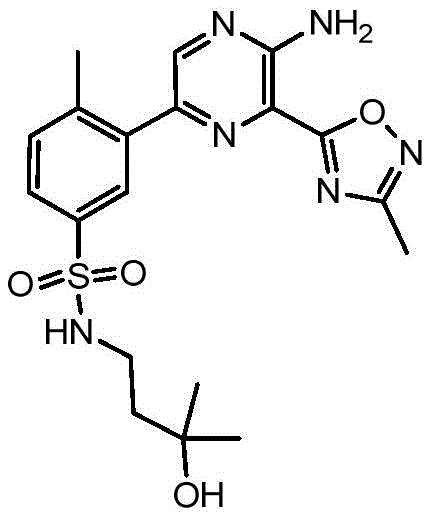
The title compound was prepared using 5-bromo-3- (3-methyl- [1,2,4] oxadiazol-5-yl) -pyrazin-2-ylamine (intermediate C2a) and N- (3-hydroxy-3-methyl-butyl) -4-methyl-benzenesulfonamide-3-boronic acid (intermediate B3a) under similar conditions as in example 1.
1H NMR(400MHz,DMSO-d6)δ8.59(1H,s),7.88(1H,s),7.80(2H,br s),7.75(1H,d),7.59(1H,d),7.45(1H,m),4.25(1H,s),2.85(2H,mult.),2.52(3H,s),2.49(3H,s),1.54(2H,mult.),1.03(6H,s)。
Example 4
Trans-3- [ 5-amino-6- (3-methyl-isoxazol-5-yl) -pyrazin-2-yl ] -N- (4-hydroxy-cyclohexyl) -4-methyl-benzenesulfonamide

The title compound was prepared from trans-N- (4-hydroxy-cyclohexyl) -4-methyl-benzenesulfonamide 3-boronic acid (intermediate B5a) and 5-bromo-3- (3-methyl-isoxazol-5-yl) -pyrazin-2-ylamine (intermediate C3) using similar conditions as in example 5.
LCMS MS M/z 444.2[ M + H ] +, method A
1H NMR(400MHz,DMSO-d6)δ8.39(1H,s),7.90(1H,s),7.73(1H,d),7.60(1H,d),7.52(1H,d),6.95(1H,s),6.92(2H,br s),4.45(1H,s),3.31(1H,m),2.90(1H,m),2.48(3H,s),2.35(3H,s),1.55-1.75(4H,m),1.00-1.25(4H,m)。
Example 5
3- [ 5-amino-6- (1-methyl-1H-pyrazol-4-yl) -pyrazin-2-yl ] -4-methyl-N- (3-methyl-oxetan-3-ylmethyl) -benzenesulfonamide
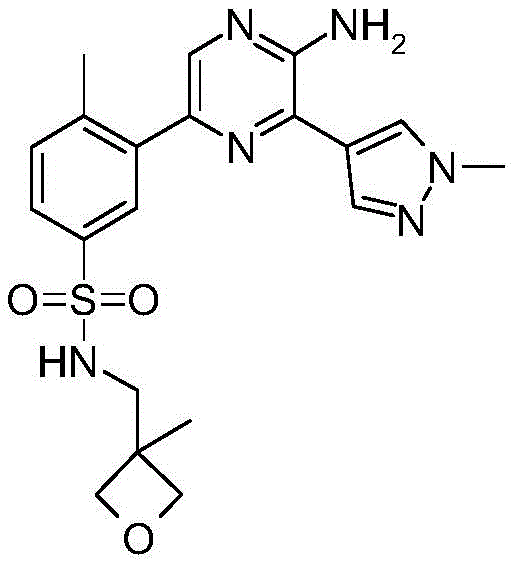
To a solution of 4-methyl-N- ((3-methyloxetan-3-yl) methyl) -3- (4,4,5, 5-tetramethyl-1, 3, 2-dioxaborolan-2-yl) benzenesulfonamide (intermediate B4) (116mg,0.303mmol) and 5-bromo-3- (1-methyl-1H-pyrazol-4-yl) pyrazin-2-amine (intermediate C4) (70mg,0.275mmol) in DME (2ml) was added PdCl2(dppf)-CH2Cl2Adduct (11.25mg,0.014mmol), vial was degassed several times with nitrogen and then 2M aqueous sodium carbonate (0.413ml,0.826mmol) was added. The mixture was stirred in a microwave at 100 ℃ for 20 min. The mixture was diluted with DCM and then washed with brine. The organic phase was separated and a phase separator was used. The solvent was removed under reduced pressure. The crude product is purified by flash column chromatography, eluting on a 4g silica gel short column with a gradient of 0% to 100% i-hex: EtOAc to obtain the target compound;
LCMS is RT 0.86 mins; MS M/z 429.3[ M + H ] +; method 2minLowpHv01
1H NMR(400MHz,CDCl3)δ8.08(1H,s),8.04(1H,s),7.98(2H,s),7.80(1H,d),7.45(1H,d),4.98(2H,br s),4.83(1H,t),4.39(4H,dd),4.02(3H,s),3.18(2H,dd),2.53(3H,s),1.33(3H,s)。
Example 6:
3- (5-amino-6- (1H-1,2, 4-triazol-1-yl) pyrazin-2-yl) -N- (2-hydroxy-2-methylpropyl) -4-methylbenzenesulfonamide

Under a nitrogen atmosphere, 3-bromo-N- (2-hydroxy-2-methylpropyl) -4-methylbenzenesulfonamide (intermediate A2) (164mg,0.509mmol), KOAc (74.9mg,0.763mmol), PdCl2(dppf).CH2Cl2A mixture of the adduct (20.77mg,0.025mmol) and bis (pinacolato) diboron (129mg,0.509mmol) in DME (2543. mu.L) was heated at 90 ℃ for 3 hours. 5-chloro-3- (1H-1,2, 4-triazol-1-yl) pyrazin-2-amine (intermediate C5) (100mg,0.509mmol), 2M aqueous sodium carbonate (763. mu.l, 1.526mmol) and PdCl were added2(dppf).CH2Cl2Adduct (20.77mg,0.025mmol) and the reaction mixture was heated to 120 ℃ for 40mins using microwave irradiation. The resulting mixture was added to water (50ml) and extracted with EtOAc (2X 50 ml). The organic phase was washed with brine, dried over magnesium sulfate and treated with Si-TMT to remove Pd. The mixture was occasionally stirred with vortex for 1 hour. The solid was removed by filtration and the organic mixture obtained was concentrated under reduced pressure. Purifying by silica gel chromatography with 0-10% [2M NH ]3In MeOH (E) solution]Was eluted with a gradient of DCM to obtain the solid target compound. The subjects were incubated in hot EtOAc (. about.1 mL)/Et2Recrystallizing in O, and standing overnight at room temperature to obtain a target compound;
LCMS, Rt is 0.81 mins; MS M/z 404.3[ M + H ] +; method 2minLowpH
1H NMR(400MHz,DMSO-d6)δ9.33(1H,s),8.41(1H,s),8.39(1H,s),7.92(1H,d),7.71(1H,dd),7.53(1H,d),7.48(1H,t),7.37(2H,br s),4.51(1H,s),2.61(2H,d),2.50(3H,s),1.05(6H,s)。
Example 7
3- (5-amino-6- (2-methylthiazol-5-yl) pyrazin-2-yl) -N- (2-hydroxy-2-methylpropyl) -4-methylbenzenesulfonamide
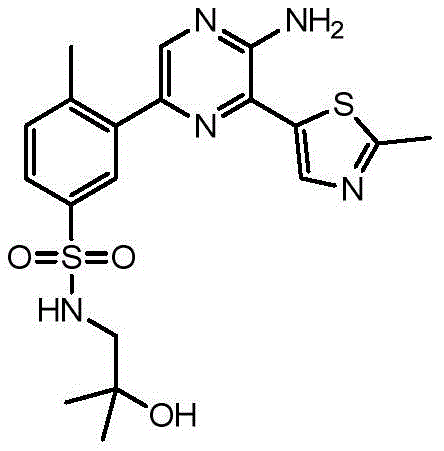
The title compound was prepared using 3-bromo-N- (2-hydroxy-2-methylpropyl) -4-methylbenzenesulfonamide (intermediate a2) and 5-chloro-3- (2-methylthiazol-5-yl) pyrazin-2-amine (intermediate C6) under similar conditions as in example 6.
LCMS, Rt is 0.87 mins; MS M/z 434.2[ M + H ] +; method 10minLowpH
1H NMR(400MHz,DMSO-d6)δ8.28(1H,s),8.22(1H,s),7.87(1H,s),7.70(1H,d),7.52(1H,d),7.45(1H,t),6.74(2H,s),4.40(1H,s),2.69(3H,s),2.65(2H,d),2.50(3H,s),1.07(6H,s)。
Example 8
3- [ 5-amino-6- (2-methyl-thiazol-5-yl) -pyrazin-2-yl ] -N- (3-hydroxy-2, 2-dimethyl-propyl) -4-methyl-benzenesulfonamide
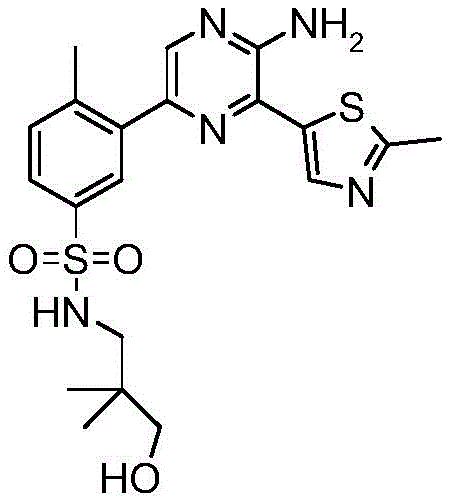
The title compound was prepared using 3-bromo-N- (3-hydroxy-2, 2-dimethylpropyl) -4-methylbenzenesulfonamide (intermediate a9) and 5-chloro-3- (2-methylthiazol-5-yl) pyrazin-2-amine (intermediate C6) under similar conditions as in example 6.
LCMS R t 0.92.92 mins; MS M/z 448.2[ M + H ] +; method 2minLowpH.
1H NMR(400MHz,DMSO-d6)δ8.28(1H,s),8.23(1H,s),7.86(1H,d),7.70(1H,dd),7.53(1H,d),7.38(1H,t),6.74(2H,s),4.44(1H,t),3.10(2H,d),2.49(3H,s),2.69(3H,s),2.59(2H,d),0.79(6H,s)。
Example 9a and example 9b (R) -and (S) -3- [ 5-amino-6- (1, 3-dimethyl-1H-pyrazol-4-yl) -pyrazin-2-yl ] -N- (6-hydroxy-spiro [3.3] hept-2-yl) -4-methyl-benzenesulfonamide

Racemic 3- [ 5-amino-6- (1, 3-dimethyl-1H-pyrazol-4-yl) -pyrazin-2-yl ] -N- (6-hydroxy-spiro [3.3] hept-2-yl) -4-methyl-benzenesulfonamide was prepared from 3-bromo-N- (6-hydroxy-spiro [3.3] hept-2-yl) -4-methyl-benzenesulfonamide (intermediate A8) and 5-bromo-3- (1, 3-dimethyl-1H-pyrazol-4-yl) -pyrazin-2-ylamine (intermediate C7) under similar conditions as example 6.
The racemic mixture was separated by chiral separation to give the single isomer:
column: 2 × Chiralpak AD-H,250 × 10mm,5um @35degC,
mobile phase: 35% isopropanol + 0.1% v/v DEA/65% CO2,
Flow rate: the concentration of the mixture is 10ml/min,
and (3) detection: the UV @220nm wavelength is adopted,
the instrument comprises the following steps: berger Minigram SFC1)
Example 9a:
first eluting compound: SFC retention time ═ 7.14(R) -3- [ 5-amino-6- (1, 3-dimethyl-1H-pyrazol-4-yl) -pyrazin-2-yl ] -N- (6-hydroxy-spiro [3.3] hept-2-yl) -4-methyl-benzenesulfonamide or (S) -3- [ 5-amino-6- (1, 3-dimethyl-1H-pyrazol-4-yl) -pyrazin-2-yl ] -N- (6-hydroxy-spiro [3.3] hept-2-yl) -4-methyl-benzenesulfonamide
LCMS, Rt 0.87 mins; MS M/z 469.6[ M + H ] +; the method comprises the following steps: 2minLowpHv01
1H NMR(400MHz,DMSO-d6)δ8.09(1H,s),8.06(1H,s),7.82(2H,m),7.64(1H,dd),7.49(1H,d),6.28(2H,s),4.82(1H,d),3.84(1H,m),3.83(3H,s),3.50(1H,m),2.47(3H,s),2.30(3H,s),2.20(1H,m),2.02(2H,m),1.89(1H,m),1.71(4H,m)。
Example 9b:
second eluted compound: SFC retention time ═ 7.93mins (r) -3- [ 5-amino-6- (1, 3-dimethyl-1H-pyrazol-4-yl) -pyrazin-2-yl ] -N- (6-hydroxy-spiro [3.3] hept-2-yl) -4-methyl-benzenesulfonamide or (S) -3- [ 5-amino-6- (1, 3-dimethyl-1H-pyrazol-4-yl) -pyrazin-2-yl ] -N- (6-hydroxy-spiro [3.3] hept-2-yl) -4-methyl-benzenesulfonamide
LCMS, Rt 0.87 mins; MS M/z 469.2[ M + H ] +; the method comprises the following steps: 2minLowpHv01
1H NMR(400MHz,DMSO-d6)δ8.09(1H,s),8.06(1H,s),7.84-7.79(2H,m),7.63(1H,dd),7.49(1H,d),6.28(2H,s),4.82(1H,d),3.84(1H,m),3.83(3H,s),3.50(1H,m),2.47(3H,s),2.30(3H,s),2.20(1H,m),2.02(2H,m),1.89(1H,m),1.70(4H,m)。
Example 10
3- (5-amino-6- (2-methylthiazol-5-yl) pyrazin-2-yl) -N- (3-hydroxypropyl) -4-methylbenzenesulfonamide

To a solution of N- (3-hydroxypropyl) -4-methyl-3- (4,4,5, 5-tetramethyl-1, 3, 2-dioxaborolan-2-yl) benzenesulfonamide (intermediate B1) (62.7mg,0.176mmol) in MeCN (882. mu.L) was added 5-chloro-3- (2-methylthiazol-5-yl) pyrazin-2-amine (intermediate C6) (40mg,0.176mmol), bis (triphenylphosphine) palladium (II) chloride (6.19mg, 8.82. mu. mol) and 2M Na2CO3(265. mu.l, 0.529 mmol). The reaction mixture was heated at 150 ℃ for 30 minutes using microwave irradiation. The resulting mixture was added to water (50ml) and extracted with EtOAc (2X 40 ml). The combined organic extracts were washed with brine, dried over magnesium sulfate and concentrated under reduced pressure. Purifying by silica gel chromatography with 0-10% [2M NH ]3In MeOH (E) solution]Eluting with DCM solution to obtain a green solid, sonicating in TBME (2ml) and filtering to obtain the target compound;
LCMS; rt 0.82 mins; MS M/z 420.2[ M + H ] +; method 2minLowpH
1H NMR(400MHz,DMSO-d6)δ8.28(1H,s),8.22(1H,s),7.83(1H,s),7.69(1H,d),7.53(1H,d),7.49(1H,t),6.73(2H,s),4.41(1H,t),3.37(2H,q),2.81(2H,q),2.68(3H,s),2.48(3H,s),1.54(2H,m)。
Example 11:
trans-3- (5-amino-6- (pyridin-4-yl) pyrazin-2-yl) -N- (4-hydroxycyclohexyl) -4-methylbenzenesulfonamide

To a solution of trans-3- (5-amino-6-chloropyrazin-2-yl) -N- (4-hydroxycyclohexyl) -4-methylbenzenesulfonamide (intermediate D1) (40mg,0.101mmol) was added 4- (4,4,5, 5-tetramethyl-1, 3, 2-dioxanCyclopentaborane-2-yl) pyridine (24.80mg,0.121mmol), bis (triphenylphosphine) palladium (II) dichloride (3.54mg, 5.04. mu. mol) and 2MNa2CO3aq. (151 μ L,0.302 mmol). The reaction was heated at 150 ℃ for 30 minutes using microwave irradiation. Adding the obtained mixture to sat2CO3(40ml), extracted with EtOAc (2X 40 ml). The organic extracts were washed with brine, dried over magnesium sulfate and reduced pressure. Purification by silica gel chromatography eluting with 0-100% EtOAc in isohexane afforded the title compound as a yellow solid;
LCMS, Rt is 0.74 mins; MS M/z 440.0[ M + H ] +; method 2minLC _ v003.
1H NMR(400MHz,DMSO-d6)δ8.71(2H,d),8.29(1H,s),7.89(1H,d),7.77(2H,d),7.71(1H,dd),7.59(1H,d),7.51(1H,d),6.67(2H,s),4.48(1H,d),3.34-3.25(1H,m),2.97-2.86(1H,m),2.49(3H,s),1.73-1.58(4H,m),1.23-1.02(4H,m)。
Example 12:
3- (5-amino-6- (1, 3-dimethyl-1H-pyrazol-4-yl) pyrazin-2-yl) -N- (3-hydroxy-3-methylbutyl) -4-methylbenzenesulfonamide
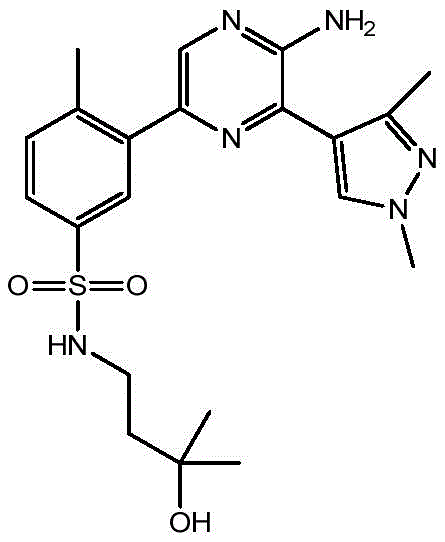
The title compound was prepared from 3- (5-amino-6-chloropyrazin-2-yl) -N- (3-hydroxy-3-methylbutyl) -4-methylbenzenesulfonamide (intermediate D3) and 3-dimethyl-4- (4,4,5, 5-tetramethyl-1, 3, 2-dioxaborolan-2-yl) -1H-pyrazole under similar conditions to example 11 (using DME/EtOH as solvent instead of MeCN).
LC-MS Rt.0.81min; m/z 445.2[ M + H ] +; method 2minLowpH
1H NMR (400MHz, DMSO-d6) d 8.08(1H, s); 8.06(1H, s); 7.84(1H, d); 7.66(1H, dd); 7.51(1H, d); 7.39(1H, t); 6.27(2H, s); 4.26(1H, s); 3.82(3H, s); 2.82(2H, m); 2.47(3H, s, partial overlap with solvent peak); 2.29(3H, s); 1.49(2H, m); 1.00(6H, s).
Example 13
3- [ 5-amino-6- (1, 3-dimethyl-1H-pyrazol-4-yl) -pyrazin-2-yl ] -N- (3-hydroxy-3-methyl-butyl) -4-methyl-benzenesulfonamide

The title compound was prepared from 3- (5-amino-6-chloro-pyrazin-2-yl) -N- (2-hydroxy-2-methyl-propyl) -4-methyl-benzenesulfonamide (intermediate D2) and 3-dimethyl-4- (4,4,5, 5-tetramethyl-1, 3, 2-dioxaborolan-2-yl) -1H-pyrazole under similar conditions to example 11 (using DME instead of MeCN as solvent).
LCMS Rt 3.24 min; m/z 431.5[ M + H ] +; method 10minLowpHv01
1H NMR (400MHz, DMSO-d6) delta 8.09(1H, s); 8.06(1H, s); 7.87(1H, d); 7.68(1H, dd); 7.50(1H, d); 7.44(1H, t); 6.33(2H, br); 3.82(3H, s); 3.17(1H, s); 2.62(2H, d); 2.47(3H, s, partial overlap with solvent peak); 2.30(3H, s); 1.05(6H, s).
Example 14:
trans-3- (5-amino-6- (2-methylthiazol-5-yl) pyrazin-2-yl) -N- (4-hydroxycyclohexyl) -4-methylbenzenesulfonamide

The title compound was prepared from trans-3- (5-amino-6-chloropyrazin-2-yl) -N- (4-hydroxycyclohexyl) -4-methylbenzenesulfonamide (intermediate D1) and 2-methyl-5- (4,4,5, 5-tetramethyl- [1,3,2] dioxaborolan-2-yl) -thiazole under similar conditions as in example 11.
LCMS, Rt 0.87 mins; MS M/z 460.2[ M + H ] +; method 2minLC _ v003
1H NMR(400MHz,DMSO-d6)δ8.28(1H,s),8.21(1H,s),7.87(1H,d),7.71(1H,dd),7.59(1H,d),7.51(1H,d),6.73(2H,s),4.48(1H,d),3.35-3.25(1H,m),2.98-2.87(1H,m),2.68(3H,s),2.48(3H,s),1.77-1.58(4H,m),1.24-1.03(4H,m)。
Example 15:
trans-3- (5-amino-6- (1H-1,2, 4-triazol-1-yl) pyrazin-2-yl) -N- (4-hydroxycyclohexyl) -4-methylbenzenesulfonamide

Trans-3- (5-amino-6-chloropyrazin-2-yl) -N- (4-hydroxycyclohexyl) -4-methylbenzenesulfonamide (intermediate D1) (50mg,0.126mmol), 1H- [1,2,4]Triazole (52.2mg,0.756mmol), N-dimethylglycine (1.299mg,0.013mmol), Cs2CO3A mixture of (123mg,0.378mmol) and CuI (2.399mg,0.013mmol) in DMA (1260. mu.l) was heated at 180 ℃ for 2 hours by microwave irradiation. The mixture obtained was added with saturated Na2CO3(50ml), extracted with EtOAc (2X 50 ml). The organic extracts were washed with brine, dried over magnesium sulfate and concentrated under reduced pressure. Purifying by silica gel chromatography with 0-10% [2M NH ]3In MeOH (E) solution]Was eluted with DCM to obtain an oil. Et was added to the oil2O (2ml), the mixture was sonicated until a fine precipitate was produced. Removal of excess Et2O, drying the solid to obtain a target compound;
LCMS is Rt 0.86 mins; MS M/z 430.3[ M + H ] +; method 2minLC _ v003
1H NMR (400MHz, DMSO-d6) Δ 9.33(1H, s),8.43(1H, s),8.40(1H, s),7.94(1H, d),7.74(1H, dd),7.63(1H, d),7.53(1H, d),7.38(2H, s),4.47(1H, d),3.30(1H, m),2.92(1H, m),2.51(3H, s overlaps with DMSO peaks), 1.68(4H, m),1.12(4H, m).
Example 16
3- [ 5-amino-6- (1, 3-dimethyl-1H-pyrazol-4-yl) -pyrazin-2-yl ] -4-methyl-N- [ (R) -1- (tetrahydro-furan-3-yl) methyl ] -benzenesulfonamide

To a solution of (R) -4-methyl-N- ((tetrahydrofuran-3-yl) methyl) -3- (4,4,5, 5-tetramethyl-1, 3, 2-dioxaborolan-2-yl) benzenesulfonamide (intermediate B7) (60mg,0.157mmol) in EtOH/toluene (1.5 ml; 1:2) was added 5-bromo-3- (1, 3-dimethyl-1H-pyrazol-4-yl) -pyrazin-2-ylamine (intermediate C7) (35.2mg,0.157mmol), followed by Pd (PPh)3)2Cl2(5.52mg, 7.87. mu. mol) and 2M Na2CO3(0.236ml,0.472 mmol). The reaction was heated in a microwave at 100 ℃ for 30 minutes. An additional 0.05 equivalent of catalyst was added and the reaction was heated in a microwave for an additional 1 hour at 100 ℃. More catalyst (5.52mg, 7.87. mu. mol) was added and the reaction was heated in a microwave for an additional 2 hours at 100 ℃. The reaction was diluted with ethyl acetate, washed with water and the organic layer was dried (MgSO4) Filtered and concentrated. The product was purified by flash chromatography on silica gel (12g) eluting with a TBME/MeOH gradient (0-10%) to afford the title compound;
LCMS Rt 0.86,100%, MS M/z 443.5[ M + H ] +; method 2minLowpHv01
1H NMR (400MHz, DMSO-d6) delta (ppm)8.09(1H, s),8.07(1H, s),7.85(1H, s),7.68(2H, m),7.52(1H, d),6.28(2H, s),3.82(3H, s),3.60(3H, m),3.32(1H, m, partially masked by the water signal), 2.72(2H, t),2.48(3H, s),2.29(3H, s),2.27(1H, m),1.88(1H, m),1.48(1H, m).
Example 17
3- [ 5-amino-6- (1, 3-dimethyl-1H-pyrazol-4-yl) -pyrazin-2-yl ] -4-methyl-N- (3-methyl-oxetan-3-ylmethyl) -benzenesulfonamide
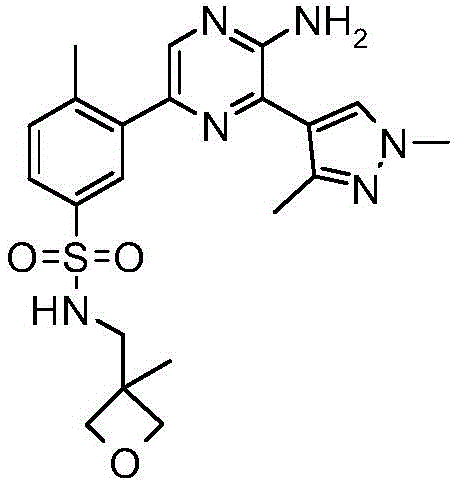
To 4-methyl-N- (3-methyl-oxetan-3-ylmethyl) -3- (4,4,5,5) tetramethyl- [1,3,2]Dioxolane-2-yl) -benzenesulfonamide (intermediate B4) (511mg,1.341mmol) and 5-chloro-3- (1, 3-dimethyl-1H-pyrazol-4-yl) -pyrazin-2-ylamine (intermediate C7) (200mg,0.894mmol) in DME (8ml) were added PdCl2(dppf)CH2Cl2Adduct (36.5mg,0.045mmol), the reaction flask was degassed by purging with nitrogen several times and then 2N aqueous sodium carbonate (1.34ml,2.68mmol) was added. The mixture was stirred in a microwave at 120 ℃ for 30 min. The mixture was diluted with DCM and then washed with brine. The organic layer was stirred with Pd scavenger resin (polymer supported trimercaptotriazine). The organic phase was separated using a phase separator. The solvent was removed under reduced pressure to obtain the crude product. Purifying by flash column chromatography using 0% -15% TBME/MeOH over a12 g silica gel short columnGradient elution to obtain target compound;
LCMS Rt 0.86,100%, MS M/z 443.5[ M + H ] +; method 2minLowpHv01
1H NMR(400MHz,DMSO-d6)δ8.09(1H,s),7.96(1H,s),7.78(1H,d),7.75(1H,s),7.45(1H,d),4.89(2H,br s),4.75(1H,t),4.37(4H,dd),3.93(3H,s),3.16(2H,d),2.52(3H,s),2.14(3H,s),1.30(3H,s)。
Example 18
3- [ 5-amino-6- (2-methyl-2H- [1,2,3] triazol-4-yl) -pyrazin-2-yl ] -N- (2-hydroxy-2-methyl-propyl) -4-methyl-benzenesulfonamide
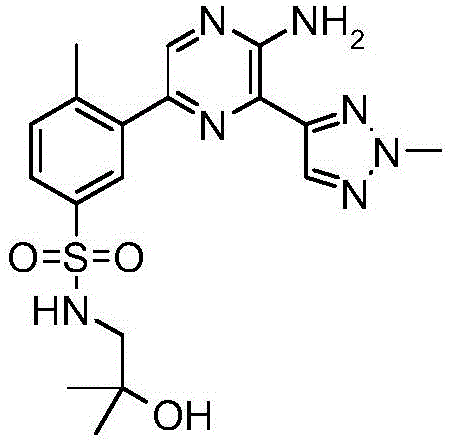
To a 0.5-2 ml microwave vial was added N- (2-hydroxy-2-methylpropyl) -4-methyl-3- (4,4,5, 5-tetramethyl-1, 3, 2-dioxaborolan-2-yl) benzenesulfonamide (intermediate B2) (87mg,0.235mmol), 5-bromo-3- (2-methyl-2H-1, 2, 3-triazol-4-yl) pyrazin-2-amine (intermediate C8) (60mg,0.235mmol) and PdCl2(dppf)-CH2Cl2Adduct (9.60mg,0.012mmol) and a 2M aqueous solution of sodium carbonate (0.372ml,0.745mmol) in DME (1.5 ml). The reaction was heated in a biotage initiator microwave oven at 120 ℃ for 2 hours. The combined reaction was extracted into ethyl acetate, washed with water, brine, and the organic layer was separated, dried over magnesium sulfate, filtered, and the solvent was removed under reduced pressure. The crude product was loaded onto silica gel and purified by flash column chromatography eluting with TBME: methanol (0-10%) over a12 g silica gel short column. The desired components were combined and the solvent was removed under reduced pressure to give a brown oil. Dissolving the residue in hot ethanol and recrystallizing to obtain the target compound as a light brown solid;
LCMS Rt 0.98mins M/z 418.1[ M + H ] +; method 2minLowpH
1H NMR (400MHz, DMSO-d6) delta (ppm)8.32(1H, s),8.29(1H, s),7.90(1H, d),7.70(1H, dd),7.52(1H, d),7.47(1H, t),7.30(2H, broad s),4.40(1H, s),4.30(3H, s),2.62(2H, d),2.50(3H, s),1.06(6H, s).
Example 19
3- [ 5-amino-6- (2, 5-dimethyl-2H- [1,2,3] triazol-4-yl) -pyrazin-2-yl ] -N- (2-hydroxy-2-methyl-propyl) -4-methyl-benzenesulfonamide

A solution of N- (2-hydroxy-2-methylpropyl) -4-methyl-3- (4,4,5, 5-tetramethyl-1, 3, 2-dioxaborolan-2-yl) benzenesulfonamide (intermediate B2) (240mg,0.650mmol), 5-bromo-3- (2, 5-dimethyl-2H-1, 2, 3-triazol-4-yl) pyrazin-2-amine (intermediate C9) (175mg,0.325mmol) and bis (triphenylphosphine) palladium (II) dichloride (11.41mg,0.016mmol) and 2M aqueous sodium carbonate (0.406ml,0.813mmol) in DME (4ml) was heated in a microwave at 120 ℃ for 90 mins. Another portion of N- (2-hydroxy-2-methylpropyl) -4-methyl-3- (4,4,5, 5-tetramethyl-1, 3, 2-dioxaborolan-2-yl) benzenesulfonamide (intermediate B2) (120mg,0.325mmol,0.5eq) was added and the reaction heated in a microwave at 120 ℃ for an additional 2 hours. The combined reaction was extracted into ethyl acetate, washed with water, brine, and the organic layer was separated, dried over magnesium sulfate, filtered, and the solvent was removed under reduced pressure. The crude product was loaded onto silica gel and purified by flash column chromatography eluting with isohexane, ethyl acetate (0-100%) over a12 g silica gel plug. The desired components were combined and the solvent was removed under reduced pressure to give a yellow oil. The residue was dissolved in DMSO and purified by mass directed preparative chromatography. The desired fractions were combined and the product was extracted into DCM using sat3Wash to remove all traces of TFA, separate the organic layer, dry over magnesium sulfate, filter and remove the solvent under reduced pressure. Recrystallizing the product in a minimum amount of hot ethanol to obtain the target compound;
LCMS Rt 1.01mins MS M/z 432.2[ M + H ] +; method 2 minlowwphv 01.
1H NMR (400MHz, DMSO-d6) Δ 8.25(1H, s),7.93(1H, d),7.70(1H, dd),7.52(1H, d),7.46(1H, broad), 7.34(2H, broad), 4.41(1H, broad), 4.21(3H, s),2.62(2H, broad), 2.56(3H, s),2.49(3H, s),1.05(6H, s).
Example 20a cis-3- [ 5-amino-6- (2-methyl-thiazol-5-yl) -pyrazin-2-yl ] -N- (3-hydroxy-cyclobutylmethyl) -4-methyl-benzenesulfonamide, and
example 20b: trans-3- [ 5-amino-6- (2-methyl-thiazol-5-yl) -pyrazin-2-yl ] -N- (3-hydroxy-cyclobutylmethyl) -4-methyl-benzenesulfonamide

Racemic 3- [ 5-amino-6- (2-methyl-thiazol-5-yl) -pyrazin-2-yl ] -N- (3-hydroxy-cyclobutylmethyl) -4-methyl-benzenesulfonamide was prepared from 5-chloro-3- (2-methylthiazol-5-yl) pyrazin-2-amine (intermediate C6) and 3-bromo-N- (3-hydroxy-cyclobutylmethyl) -4-methyl-benzenesulfonamide (intermediate a10) under similar conditions as example 6.
Stereoisomers are separated using chiral SFC.
First elution peak: example 20a cis-3- [ 5-amino-6- (2-methyl-thiazol-5-yl) -pyrazin-2-yl ] -N- (3-hydroxy-cyclobutylmethyl) -4-methyl-benzenesulfonamide
LCMS, Rt 0.85 mins; MS M/z 446.3[ M + H ] +; the method comprises the following steps: 2minLowpH
1H NMR(500MHz,DMSO-d6)δ8.28(1H,s),8.22(1H,s),7.83(1H,d),7.68(1H,dd),7.54(2H,m),6.73(2H,br s),4.89(1H,d),3.84(1H,m),2.74(2H,t),2.68(3H,s),2.48(3H,s),2.17(2H,m),1.75(1H,m),1.41(2H,m)。
Second elution peak: EXAMPLE 20b trans-3- [ 5-amino-6- (2-methyl-thiazol-5-yl) -pyrazin-2-yl ] -N- (3-hydroxy-cyclobutylmethyl) -4-methyl-benzenesulfonamide
LCMS, Rt 0.85 mins; MS M/z 446.3[ M + H ] +; the method comprises the following steps: 2minLowpH
1H NMR(500MHz,DMSO-d6)δ8.28(1H,s),8.22(1H,s),7.83(1H,d),7.68(1H,dd),7.60(1H,t),7.52(1H,d),6.73(2H,br s),4.90(1H,d),4.09(1H,m),2.78(2H,t),2.68(3H,s),2.48(3H,s),2.12(1H,m),1.92(2H,m),1.82(2H,m)。
The assignment of compounds in cis or trans (assignment) was performed using 2D NMR experiments including NOESY.
Example 21
3- [ 5-amino-6- (2-cyclopropyl-thiazol-5-yl) -pyrazin-2-yl ] -N- (2-hydroxy-2-methyl-propyl) -4-methyl-benzenesulfonamide

The title compound was prepared using N- (2-hydroxy-2-methyl-propyl) -4-methyl-3- (4,4,5, 5-tetramethyl [1,3,2] dioxaborolan-2-yl) benzenesulfonamide (intermediate B2) and 5-chloro-3- (2-cyclopropyl-thiazol-5-yl) -pyrazin-2-ylamine (intermediate C10) under similar conditions as in example 25.
LCMS is Rt 1.03 mins; MS M/z 460.2[ M + H ] +; method 2 minlowwphv 01.
1H NMR(400MHz,DMSO-d6)δ(ppm)8.07(1H,s),8.06(1H,s),7.84(1H,d),7.68(1H,t),7.65(1H,dd),7.50(1H,d),6.27(2H,br s),3.81(3H,s),3.59(3H,m),3.34(1H,m),2.71(1H,t),2.46(3H,s),2.28(3H,s),2.25(1H,m),1.85(1H,m),1.47(1H,m)。
Example 22
Trans-3- (5-amino-6-pyridin-3-yl-pyrazin-2-yl) -N- (4-hydroxy-cyclohexyl) -4-methylbenzenesulfonamide

The title compound was prepared from trans-3- (5-amino-6-chloropyrazin-2-yl) -N- (4-hydroxycyclohexyl) -4-methylbenzenesulfonamide (intermediate D1) and 3- (4,4,5, 5-tetramethyl- [1,3,2] dioxaborolan-2-yl) -pyridine using similar conditions as in example 11.
LCMS, Rt 0.74 mins; MS M/z 440.2[ M + H ] +; method 2minLC _ v003
1H NMR(400MHz,DMSO-d6)δ8.94(1H,d);8.65(1H,dd);8.25(1H,s);8.15(1H,dt);7.90(1H,d);7.70(1H,dd);7.60(1H,d);7.55-7.49(2H,m);6.60(2H,s);4.46(1H,d);3.28(1H,br m);2.90(1H,br m);2.49(3H,s);1.74-1.58(4H,m);1.23-1.00(4H,m)
Example 23
3- [ 5-amino-6- (3-isopropyl- [1,2,4] oxadiazol-5-yl) -pyrazin-2-yl ] -N- (4-hydroxy-cyclohexyl) -4-methyl-benzenesulfonamide

The title compound was prepared according to an analogous method to example 2 using trans-N- (4-hydroxy-cyclohexyl) -4-methyl-benzenesulfonamide 3-boronic acid (intermediate B5a) and 5-bromo-3- (3-isopropyl- [1,2,4] oxadiazol-5-yl) -pyrazin-2-ylamine (intermediate C2B).
LCMS is Rt 1.94 mins; MS M/z 473[ M + H ] +, method A
1H NMR (400MHz, DMSO-d6) Δ 8.61(1H, s),7.94(1H, s),7.83(2H, br s),7.77(1H, d),7.65(1H, d),7.57(1H, d),4.48(1H, s),3.32(1H, mult.)3.20(1H, m),2.95(1H, br s),2.45(3H, s),1.68(4H, mult.),1.37(6H, d),1.15(4H, multimodal).
Example 24
Trans-3- [ 5-amino-6- (3-cyclopropyl- [1,2,4] oxadiazol-5-yl) -pyrazin-2-yl ] -N- (4-hydroxy-cyclohexyl) -4-methyl-benzenesulfonamide 1

The title compound was prepared according to an analogous method to example 2 using trans-N- (4-hydroxy-cyclohexyl) -4-methyl-benzenesulfonamide 3-boronic acid (intermediate B5a) and 5-bromo-3- (3-cyclopropyl- [1,2,4] oxadiazol-5-yl) -pyrazin-2-ylamine (intermediate C2C).
LCMS is Rt 1.94 mins; MS M/z 471.1[ M + H ] +, method A
1H NMR(400MHz,DMSO-d6)δ8.60(1H,s),7.90(1H,s),7.75(1H,d),7.65(2H,brs),7.55(1H,d),4.48(1H,s),3.32(1H,m),2.95(1H,m),2.49(3H,s),2.25(1H,m),1.93(1H,s),1.68(4H,m),1.1(8H,m)。
Example 25
3- [ 5-amino-6- (3-methyl- [1,2,4] triazol-1-yl) -pyrazin-2-yl ] -N- (2-hydroxy-2-methyl-propyl) -4-methyl-benzenesulfonamide

To N- (2-hydroxy-2-methyl)To a solution of aminopropyl) -4-methyl-3- (4,4,5, 5-tetramethyl-1, 3, 2-dioxaborolan-2-yl) benzenesulfonamide (intermediate B2) (319mg,0.862mmol) in DME (3920. mu.L) was added 5-bromo-3- (3-methyl-1H-1, 2, 4-triazol-1-yl) pyrazin-2-amine (intermediate C12,200mg,0.784mmol), bis (triphenylphosphine) palladium (II) dichloride (27.5mg,0.039mmol) and Na2CO3(aq.2.0M) (1176. mu.L, 2.352 mmol). The reaction was heated in a microwave oven at 120 ℃ for 30 minutes. The reaction was added to water (50ml) and the product extracted with EtOAc (2X 60 ml). The organic phase was washed with brine, dried over magnesium sulfate and Pd was removed with Si-TMT. The mixture was occasionally stirred with vortex for 1 hour. The solid was removed by filtration, washed with EtOAc, and concentrated in vacuo. The crude product was purified by flash column chromatography using a 0-10% gradient (2M NH)3MeOH solution) was eluted onto a DCM-loaded 12g Si-column to give a solid which was recrystallized from hot EtOAc (-3 ml). Upon cooling, the product crystallized as a yellow solid;
LCMS is Rt 0.90 mins; MS M/z 418.6[ M + H ] +; method 2 minlowwphv 01.
1H NMR(400MHz,DMSO-d6)9.19(1H,s);8.37(1H,s);7.93(1H,s);7.72(1H,d);7.53(1H,d);7.49(1H,m);7.42(2H,s);4.41(1H,s);2.63(2H,d);2.50(3H,s),2.45(3H,s);1.07(6H,s)
Example 26
3- [ 5-amino-6- (3-cyclopropyl- [1,2,4] triazol-1-yl) -pyrazin-2-yl ] -N- (3-hydroxy-3-methyl-butyl) -4-methyl-benzenesulfonamide

3- (5-amino-6-chloropyrazin-2-yl) -N- (3-hydroxy-3-methylbutyl) -4-methylbenzenesulfonamide (intermediate D3) (250mg,0.650mmol), 3-cyclopropyl-1H-1, 2, 4-triazole (213mg,1.949mmol), N-dimethylglycine (6.70mg,0.065mmol), Cs2CO3A mixture of (635mg,1.949mmol) and CuI (12.37mg,0.065mmol) in DMA (3248. mu.L) was heated in a microwave at 150 ℃ for 2 hours. The reaction was added to saturated Na2CO3In (50ml), the product was extracted with EtOAc (2X 40 ml). The organic phase is washed with brine, overDried over magnesium sulfate and concentrated under reduced pressure. The crude product was purified by automatic flash chromatography on 12g silica gel column using (0-10% 2M methanol to NH)3Dichloromethane solution) was eluted. The product was recrystallized from EtOAc to give the title compound as an off-white solid;
LCMS is Rt 0.95 mins; MS M/z 458.5[ M + H ] +; method 2minLC _ v003
1H NMR (400MHz, DMSO-d6)9.13(1H, s); 8.35(1H, s); 7.87(1H, d); 7.71(1H, dd); 7.55(1H, d); 7.44(1H, br); 7.41(2H, s); 4.28(1H, s); 2.83(2H, br m); 2.50(3H, s, partially masked by DMSO), 2.18(1H, m):1.51(2H, m); 1.03(2H, m) overlaps with 1.02(6H, s); 0.95(2H, m).
Example 27
3- [ 5-amino-6- (1, 3-dimethyl-1H-pyrazol-4-yl) -pyrazin-2-yl ] -N- ((R) -1-ethyl-pyrrolidin-2-ylmethyl) -4-methyl-benzenesulfonamide hydrochloride

Using conditions analogous to example 16, the title compound was prepared from N- ((R) -1-ethyl-pyrrolidin-2-ylmethyl) -4-methyl-3- (4,4,5, 5-tetramethyl- [1,3,2] dioxaborolan-2-yl) -benzenesulfonamide (intermediate B6) and 5-chloro-3- (1, 3-dimethyl-1H-pyrazol-4-yl) -pyrazin-2-ylamine (intermediate C7). The HCl salt is formed by preparing HCl from methanol.
LCMS is RT 0.64 mins; MS M/z 470.4[ M + H ] +; method 2minLowpHv01
1H NMR (400MHz, DMSO-d6) (HCl salt) δ 10.1(1H br s),8.15(2H, multimodal), 7.89(1H, s),7.72(1H, d),7.55(1H, d),6.55(1H, br s),3.82(3H, s),3.50(2H, multimodal), 3.47(1H, multimodal), 3.20(1H, multimodal), 3.15(3H, s),3.12(1H, multimodal), 3.05(2H, multimodal), 2.49(2H, s),2.29(3H, s),2.12(1H, multimodal), 1.95(1H, multimodal), 1.85(1H, multimodal), 1.78(1H, multimodal), 1.23(3H, t).
Example 28:
3- (5-amino-6- [1,2,4] triazol-1-yl-pyrazin-2-yl) -N- (1-hydroxy-cyclopropylmethyl) -4-methyl-benzenesulfonamide

In a microwave vial, 5-bromo-3- (1H-1,2, 4-triazol-1-yl) pyrazin-2-amine (intermediate C11,100mg,0.415mmol), bis (pinacolato) diboron (116mg,0.456mmol), PdCl2(dppf).CH2Cl2A mixture of the adduct (33.9mg,0.041mmol) and potassium acetate (61mg,0.622mmol) in DME (1.5ml) was heated at 120 ℃ for 60 min. Then 2M Na was added to the reaction2CO3Solution (0.519ml,1.037mmol), PdCl2(dppf).CH2Cl2Adduct (17mg,0.02mmol) and 3-bromo-N- (1-hydroxy-cyclopropylmethyl) -4-methyl-benzenesulfonamide (intermediate A11,133mg,0.415 mmol). The reaction was heated at 90 ℃ for 60 minutes and then at 100 ℃ for another 60 minutes using microwave irradiation. The reaction was diluted with ethyl acetate and the organic phase was washed with water and then brine. The organic layer was dried over magnesium sulfate, and the solvent was removed under reduced pressure. The residue was purified by automated flash column chromatography eluting with a gradient of MeOH (0-10%) in TBME for 15min using a12 g silica plug. The product was dried in a vacuum oven at 40 ℃ overnight to give a yellow solid (51mg) which was further purified by preparative LCMS to give the title compound;
LCMS is Rt 0.90 mins; MS M/z 402.2[ M + H ] +; method LowpH _ v002
1H NMR (400MHz, DMSO-d6) delta (ppm)9.34(1H, s),8.42(1H, s),8.40(1H, s),7.93(1H, d), 7.73-7.71(1H, dd),7.67-7.64(1H, m),7.54-7.52(1H, d),7.38(2H, broad s),5.32(1H, s),2.87-2.86(2H, d),2.50(3H, s),0.50(2H, m),0.46(2H, m).
Example 29:
3- (5-amino-6- [1,2,4] triazol-1-yl-pyrazin-2-yl) -4-methyl-N- (3-methyl-oxetan-3-ylmethyl) -benzenesulfonamide
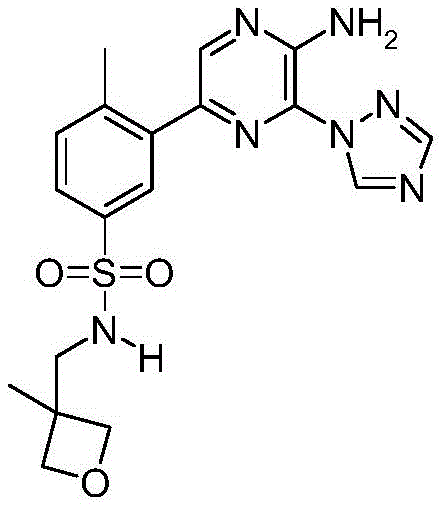
To a solution of 3- (5-amino-6- (1H-1,2, 4-triazol-1-yl) pyrazin-2-yl) -4-methylbenzene-1-sulfonyl chloride (intermediate e1,100mg,0.285mmol) in THF (5ml) was added DIPEA (100 μ l,0.57mmol) and (3-methyl-oxetan-3-yl) -methylamine (29mg,0.285mmol), and the reaction mixture was stirred for 2H. The reaction was diluted with DCM, then washed with citric acid and then brine. The organic layer was separated, dried over magnesium sulfate, filtered, and the solvent was removed under reduced pressure to obtain the target compound as a solid, which was not required to be further purified;
LCMS: Rt 0.84 mins; MS M/z 416.2[ M + H ] +, method LowpH _ v002
1H NMR (400MHz, DMSO-d6) Δ 9.33(1H, s),8.42(2H, multimodal), 7.93(1H, d),7.83(1H, multimodal), 7.74(1H, dd),7.56(1H, d),7.38(2H, br),4.31(2H, d),4.16(2H, d),2.92(2H, d),2.50(3H, s),1.20(3H, s).
Example 30:
3- [ 5-amino-6- (5-morpholin-4-ylmethyl-thiophen-3-yl) -pyrazin-2-yl ] -N- (3-hydroxy-3-methyl-butyl) -4-methyl-benzenesulfonamide

Prepared from 3- (5-amino-6-chloropyrazin-2-yl) -N- (3-hydroxy-3-methylbutyl) -4-methylbenzenesulfonamide (intermediate D3) and 4- ((4- (4,4,5, 5-tetramethyl-1, 3, 2-dioxaborolan-2-yl) thiophen-2-yl) methyl) morpholine using analogous conditions to example 11.
LCMS is Rt 0.63 mins; MS M/z 532.3[ M + H ] +, method 2minLowpH
1H NMR(400MHz,DMSO-d6)δ8.15(1H,s),7.98(1H,m),7.83(1H,m),7.69(1H,dd),7.53(1H,d),7.47(1H,s),7.43(1H,t),6.47(2H,br s),4.27(1H,s),3.72(2H,s),3.59(4H,m),2.83(2H,m),2.48(3H,s),2.44(4H,m),1.51(2H,m),1.02(6H,s)。
Example 31:
3- (5-amino-6- [1,2,4] triazol-1-yl-pyrazin-2-yl) -N- (2-hydroxy-2-methyl-propoxy) -4-methyl-benzenesulfonamide
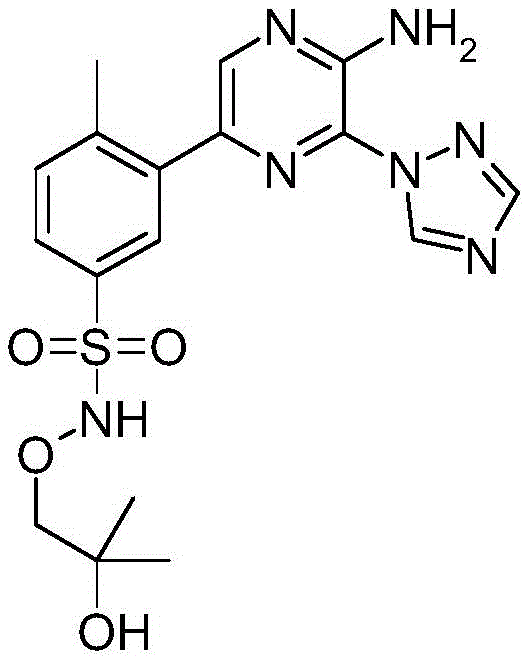
A mixture of 3- (5-amino-6- (1H-1,2, 4-triazol-1-yl) pyrazin-2-yl) -4-methylbenzene-1-sulfonyl chloride (intermediate E1,200mg,0.570mmol) and 1- (aminooxy) -2-methylpropan-2-ol (200mg,1.90mmol) in DCM (5ml) was stirred at room temperature for 3 days. Pyridine (1mL) was added and the reaction mixture was stirred for 2 hours. The mixture was then evaporated under reduced pressure and partitioned between ethyl acetate and 5% citric acid. The aqueous phase was extracted with another portion of ethyl acetate and then with DCM, and the combined organic phases were dried over a phase separator and evaporated under reduced pressure. The product was crystallized from ethyl acetate and dried in vacuo to yield 100mg of an off-white solid. Recrystallizing by ethanol to obtain the target compound as an off-white solid;
LC-MS, Rt 0.92 min; MS M/z 420.3[ M + H ] +, method 2minLowpHv01
1H NMR(400MHz,DMSO-d6)δ10.44(1H,s),9.32(1H,s),8.42(1H,s),8.39(1H,s),7.95(1H,br s),7.78(1H,br d),7.61(1H,d),7.40(2H,s),4.47(1H,s),3.73(2H,s),2.54(3H,s),1.04(6H,s)。
Example 32
3- (5-amino-6- [1,2,4] triazol-1-yl-pyrazin-2-yl) -N- (4-hydroxy-tetrahydropyran-4-ylmethyl) -4-methylbenzenesulfonamide
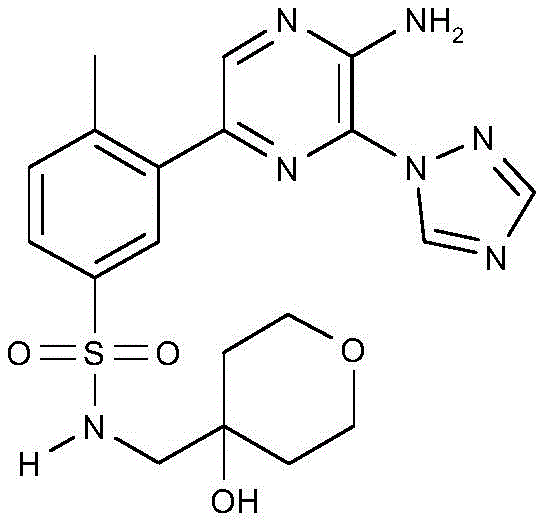
4-aminomethyl-tetrahydro-pyran-4-ol (20mg,0.15mmol) was dissolved in DMA (1ml), a solution of 3- (5-amino-6- (1H-1,2, 4-triazol-1-yl) pyrazin-2-yl) -4-methylbenzene-1-sulfonyl chloride (intermediate E1,35mg,0.1mmol) in DMA (2ml) was added followed by DIPEA (0.035ml,0.2 mmol). The reaction was shaken at room temperature for 2hrs, then the solvent was removed under reduced pressure to give the crude product as a brown solid. Then recrystallizing the crude product by adopting methanol to obtain a target compound which is off-white solid;
LCMS Rt 0.87mins MS M/z 428[ M-OH ] +, method 2minLowpHv02
1H NMR(400MHz,DMSO-d6)δ9.35(1H,s),8.40(2H,d),7.93(1H,s),7.72(1H,m),7.54(2H,d),7.40(2H,br),3.56(2H,d),2.66(2H,d),2.52(3H,s),1.54(2H,m),1.32(2H,m)
Example 33
N- (2-amino-ethyl) -3- (5-amino-6- [1,2,4] triazol-1-yl-pyrazin-2-yl) -4-methyl-benzenesulfonamide trifluoroacetate salt

Tert-butyl (2-aminoethyl) carbamate (21mg,0.128mmol) was dissolved in DMA (1ml), a solution of 3- (5-amino-6- (1H-1,2, 4-triazol-1-yl) pyrazin-2-yl) -4-methylbenzene-1-sulfonyl chloride (intermediate E1,30mg,0.086mmol) in DMA (1.5ml) was added, followed by DIPEA (0.030ml,0.171 mmol). The reaction was shaken at room temperature for 2hrs, then the solvent was removed under reduced pressure to give the crude product as a brown solid. The crude product was then suspended in DCM (2ml), TFA (0.15ml,1.97mmol) was added and the mixture was shaken at RT for 3 hrs. The solvent was then removed under reduced pressure. The crude product was then purified by preparative HPLC using acetonitrile with 0.1% TFA as the modulator and water as eluent to afford the title compound as an off-white solid;
LCMS Rt 0.60mins MS M/z 375.2[ M + H ] +, method 2minLowpHv01
1H NMR(400MHz,DMSO-d6)δ9.35(1H,s),8.40(2H,d),7.90(2H,m),7.80(2H,br),7.74(1H,d),7.60(1H,d),7.40(2H,br),2.95(2H,m),2.87(2H,m),2.52(3H,s)
Example 34
3- (5-amino-6- [1,2,4] triazol-1-yl-pyrazin-2-yl) -N- (2, 2-difluoro-ethyl) -4-methyl-benzenesulfonamide
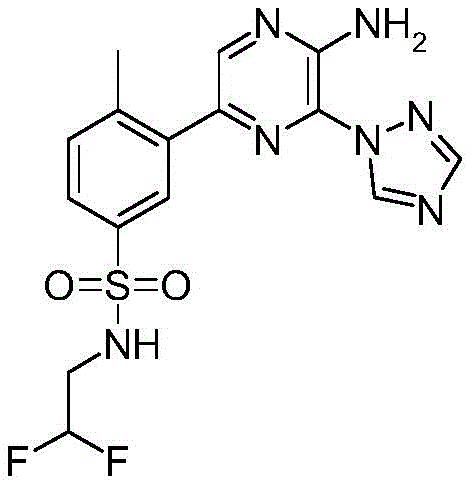
The title compound was prepared from 3- (5-amino-6- (1H-1,2, 4-triazol-1-yl) pyrazin-2-yl) -4-methylbenzene-1-sulfonyl chloride (intermediate E1) and 2, 2-difluoroethylamine using similar conditions to example 32. In this case, purification was performed by preparative HPLC eluting with a gradient of acetonitrile/0.1% TFA in water.
LCMS Rt 1.0mins MS M/z 396.0[ M + H ] +, method 2minLowpHv01
1H NMR(400MHz,DMSO-d6)δ9.30(1H,s),8.41(2H,d),8.22(1H,m),7.92(1H,s),7.75(1H,m),7.55(1H,d),7.40(2H,br),6.00(1H,t),3.23(2H,t),2.51(3H,s)。
Example 35
3- (5-amino-6- [1,2,4] triazol-1-yl-pyrazin-2-yl) -N- (3-hydroxymethyl-oxetan-3-ylmethyl) -4-methyl-benzenesulfonamide

The title compound was prepared from 3- (5-amino-6- (1H-1,2, 4-triazol-1-yl) pyrazin-2-yl) -4-methylbenzene-1-sulfonyl chloride (intermediate E1) and (3-aminomethyl-oxetan-3-yl) -methanol using conditions analogous to example 32. In this case, purification was performed by preparative HPLC eluting with a gradient of acetonitrile/0.1% TFA in water.
LCMS Rt 0.83mins MS M/z 432.2[ M + H ] +, method 2minLowpHv02
1H NMR (400MHz, DMSO-d 6). delta.9.35 (1H, s),8.40(2H, d),7.94(1H, s),7.80(1H, m),7.75(1H, m),7.57(1H, d),7.40(2H, br),4.30(2H, d),4.25(2H, d),3.52(2H, m),2.29(2H, d),2.51(3H, s). It is not clear that an exchange is possible (One exchangeable not clean object).
Example 36
3- (5-amino-6- [1,2,4] triazol-1-yl-pyrazin-2-yl) -N- (3, 3-dimethyl-2-oxo-butyl) -4-methyl-benzenesulfonamide
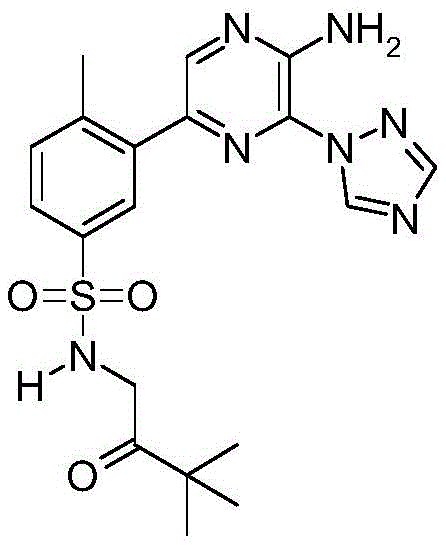
The title compound was prepared from 3- (5-amino-6- (1H-1,2, 4-triazol-1-yl) pyrazin-2-yl) -4-methylbenzene-1-sulfonyl chloride (intermediate E1) and 1-amino-3, 3-dimethyl-butan-2-one using conditions analogous to example 32. In this case, purification was performed by preparative HPLC eluting with a gradient of acetonitrile/0.1% TFA in water.
LCMS Rt 1.06mins MS M/z 430.2[ M + H ] +, method 2minLowpHv02
1H NMR(400MHz,DMSO-d6)δ9.35(1H,s),8.40(2H,dd),7.92(1H,s),7.80(1H,m),7.73(1H,d),7.52(1H,d),7.40(2H,br),4.00(2H,d),2.52(3H,s),1.00(9H,s)。
Example 37:
3- (5-amino-6- (1H-1,2, 4-triazol-1-yl) pyrazin-2-yl) -4-chloro-N- (2-hydroxy-2-methylpropyl) benzenesulfonamide
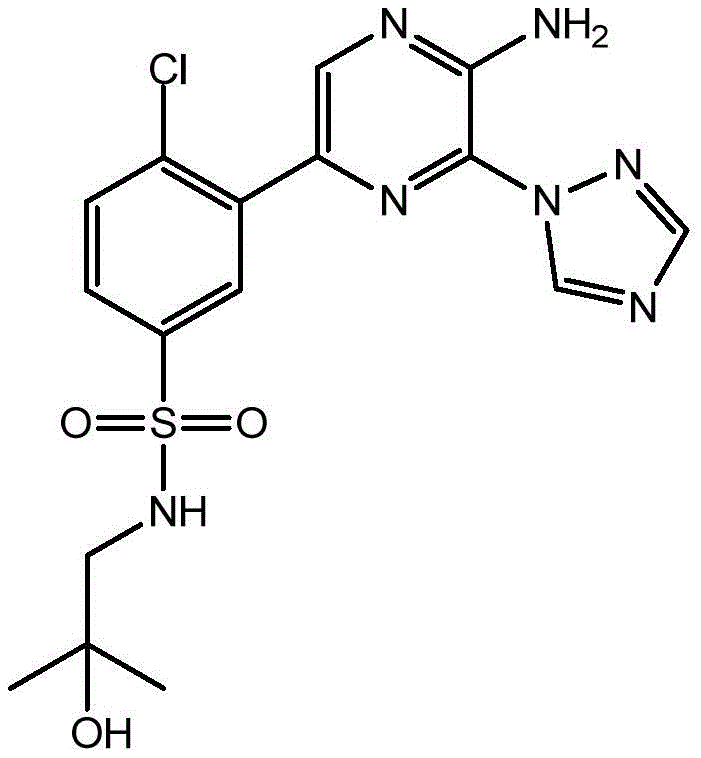
Step 1 3-bromo-4-chlorobenzene-1-sulfonyl chloride
By charging 740ml of glacial acetic acid with 74g of sulfur dioxide, followed by 30g of CuCl235-40 ml of an aqueous solution to prepare a chlorosulfonylation reagent. The mixture was left to stand and the green supernatant was used for the reaction.
The method comprises the following steps:
to a stirred suspension of 3-bromo-4-chloroaniline (1g,4.84mmol) in acetic acid (8ml) and concentrated hydrochloric acid (8ml) was added dropwise a cooled (0 ℃ C.) solution of sodium nitrite (368mg,5.33mmol) in water (5ml) at 0 ℃. The mixture was stirred at 0 ℃ for 1 hour and then, while still cold, added dropwise to a flask containing cooled (0 ℃) and stirred chlorosulfonylating agent (40 ml). The mixture turned black/brown and then was allowed to warm to room temperature and stirred at room temperature overnight, whereupon it turned into a yellow/green solution. Crushed ice was added and when it melted, the precipitate formed was collected by filtration and pump dried. It was dissolved in EtOAc (50mL) and dried (MgSO)4) Filtered and evaporated to give the title compound as a colorless oil. The product was used directly in the next step without further purification;
1H NMR(400MHz,CDCl3)δH 8.32(1H,d),7.95(1H,dd),7.73(1H,d)。
step 2 3-bromo-4-chloro-N- (2-hydroxy-2-methylpropyl) benzenesulfonamide
To a stirred solution of 3-bromo-4-chlorobenzene-1-sulfonyl chloride (step 1) (500mg,1.72mmol) and triethylamine (0.385ml,2.76mmol) in dry THF (10ml) at room temperature was added a solution of 4-amino-2-methylbutan-2-ol (231mg,2.6mmol) in dry THF (5 ml). The mixture was stirred at room temperature for 1 hour. The mixture was quenched by addition of 50% aqueous ammonium chloride (20ml) and treated with EtOAc extraction (3X 20 ml). The EtOAc extracts were combined, washed with saturated brine (20mL) and dried (MgSO)4) Filtered and evaporated to give the title compound as a colorless solid. The product was used directly in the next step without further purification;
1H NMR(400MHz,DMSO-d6)δ8.14(1H,d),7.86(1H,d),7.80(1H,dd),7.72(1H,brs),4.45(1H,br s),2.65(2H,s),1.05(6H,s)。
step 3- (5-amino-6- (1H-1,2, 4-triazol-1-yl) pyrazin-2-yl) -4-chloro-N- (2-hydroxy-2-methylpropyl) benzenesulfonamide
5-bromo-3- (1H-1,2, 4-triazol-1-yl) pyrazin-2-amine (intermediate C11) (200mg,0.83mmol), bis (pinacolato) diboron (263mg,1.04mmol), potassium acetate (122mg,1.25mmol) and PdCl2(dppf). CH2Cl2The mixture of adduct (34mg,0.041mmol) was dissolved in DME (5ml), heated at 90 deg.C for 5 hours, then 3-bromo-4-chloro-N- (2-hydroxy-2-methylpropyl) benzenesulfonamide (step 2) (284mg,0.83mmol), 2M aqueous sodium carbonate (1.25ml,2.5mmol) and another portion of PdCl were added2(dppf).CH2Cl2Adduct (34mg,0.041mmol) and the mixture was stirred at 90 ℃ for 16 h. The mixture was cooled to room temperature, diluted with water (20ml) and extracted with EtOAc (3X 20 ml). The EtOAc extracts were combined, washed with brine (20mL) and dried (MgSO)4) Filtering, directly adsorbing on silica gel, and loading on a column without water. The mixture was purified by silica gel chromatography (24g column) eluting with 0-100% EtOAc in isohexane for 20min, then 100% EtOAc for an additional 3 min. The product fractions were combined and evaporated. Trituration with EtOAc, filtration to afford the title compound as a pale yellow powder;
1H NMR(400MHz,DMSO-d6)δH 9.33(1H,s),8.57(1H,s),8.43(1H,s),8.11(1H,m),7.82(2H,m),7.71(1H,br s),7.49(2H,br s),4.45(1H,br s),2.67(2H,s),1.06(6H,s)。
LCMS is Rt 0.86 mins; MS M/z 424/426[ M + H ] +, method 2minLowpH
Example 38:
3- (5-amino-6- (1H-1,2, 4-triazol-1-yl) pyrazin-2-yl) -4-chloro-N- (3-hydroxy-3-methylbutyl) benzenesulfonamide
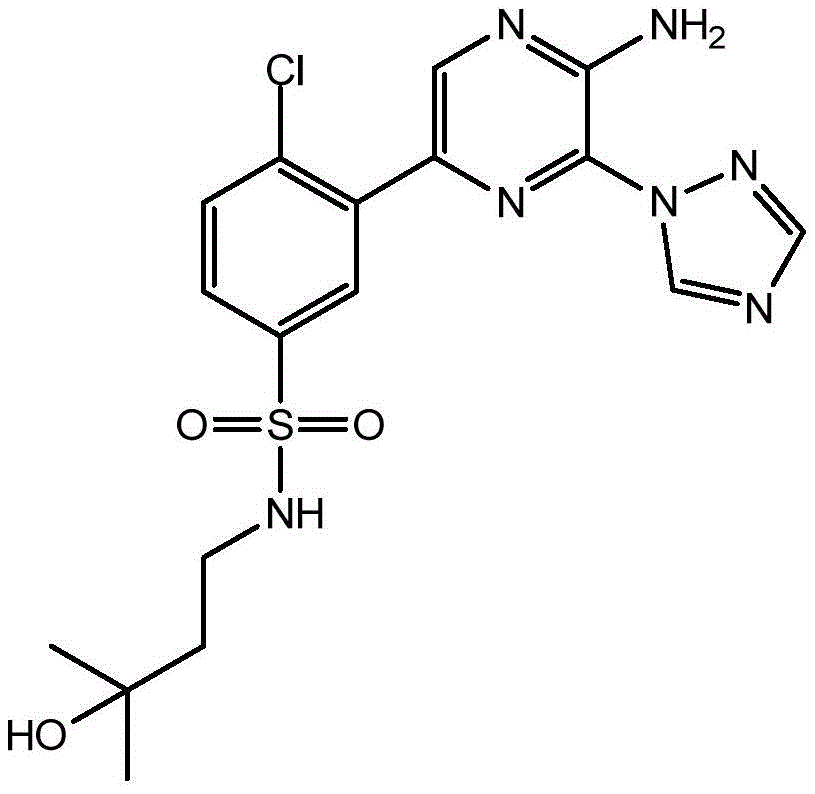
The objective compound was prepared using similar conditions as used for the synthesis of example 37.
1H NMR(400MHz,DMSO-d6)δ9.31(1H,s),8.58(1H,s),8.43(1H,s),8.08(1H,d),7.85(1H,d),7.81(1H,dd),7.67(1H,br s),7.49(2H,br s),4.28(1H,br s),2.87(2H,m),1.52(2H,m),1.02(6H,s)。
LCMS, Rt 0.87 mins; MS M/z 438/440[ M + H ] +, method 2minLowpH
Example 39:
3- (5-amino-6- (furan-3-yl) pyrazin-2-yl) -N- (2-hydroxy-2-methylpropyl) -4-methylbenzenesulfonamide
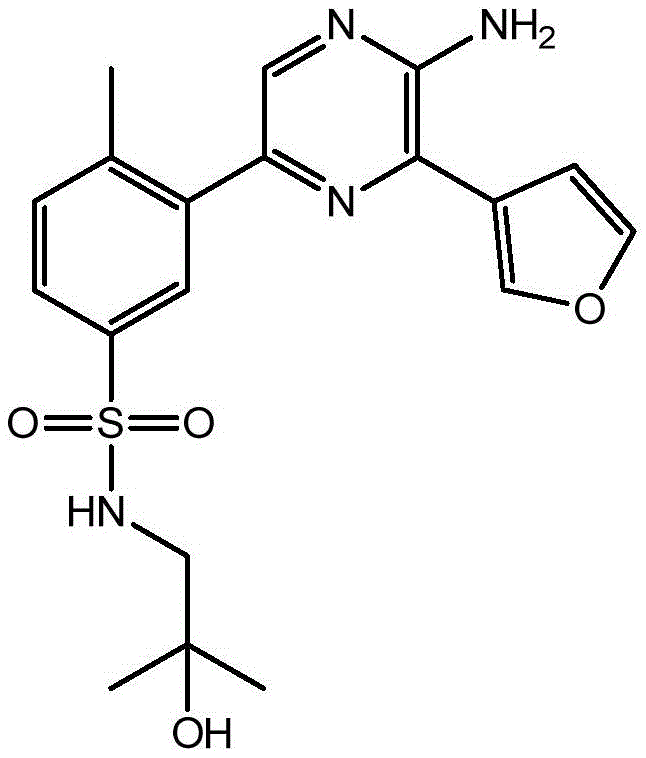
To a stirred mixture of 3- (5-amino-6-chloro-pyrazin-2-yl) -N- (2-hydroxy-2-methyl-propyl) -4-methyl-benzenesulfonamide (intermediate D2) (200mg,0.54mmol), furan-3-ylboronic acid (78mg,0.7mmol) and PdCl2(dppf).CH2Cl2To a mixture of adduct (22mg,0.027mmol) in DME (3ml) was added sodium carbonate (0.81ml of a 2M aqueous solution, 1.62 mmol). The mixture was heated at 90 ℃ for 2h, then cooled to room temperature, diluted with 10% potassium hydrogen phosphate (5ml) and extracted with EtOAc (3X 15 ml). The EtOAc extracts were combined, washed with saturated brine (10mL) and dried (MgSO)4) Filtered, adsorbed directly onto silica gel and then chromatographed. The crude product was purified by silica gel chromatography (24g) eluting with 0-100% EtOAc in isohexane for 10 min. The product peak eluted at 100% EtOAc. Combining the product components, and removing the solvent under reduced pressure to obtain the target compound as a pale yellow solid;
1h NMR (400MHz, DMSO-d6) Δ 8.40(1H, m),8.17(1H, s),7.89(1H, d),7.82(1H, m),7.69(1H, dd),7.52(1H, d),7.47(1H, t),7.04(1H, m),6.42(2H, br s),4.39(1H, s),2.63(2H, d),2.49(3H, s, partially masked by DMSO-d6 peaks), 1.06(6H, s).
LC-MS, Rt 0.98 mins; MS m/z 403.6MH +; method 2minLowpHv01
Example 40:
3- (5-amino-6- (2, 5-dimethylthiazol-4-yl) pyrazin-2-yl) -N- (2-hydroxy-2-methylpropyl) -4-methylbenzenesulfonamide

Step 1 3-amino-6-bromo-N-methoxy-N-methylpyrazine-2-carboxamide
To a stirred suspension of 3-amino-6-bromopyrazine-2-carboxylic acid (45g,206mmol) and O, N-dimethylhydroxylamine hydrochloride (20.13g,206mmol) in DMF (295ml) was added triethylamine (115ml,826mmol) at room temperature under a nitrogen atmosphere. The mixture obtained is cooled to 0 ℃ and added dropwise to the yellow suspension over a period of 5 minutes (50% EtOAc solution) (151g,237mmol) (keep the temperature below 10 deg.C-exothermic). The mixture was warmed to room temperature and stirred for 2-3 hours. During the reaction, the contents turned from solid to gel. The flask was diluted with another 200ml portion of DMF, which was warmed to 40 ℃ and left overnight. Another portion of triethylamine (50ml,0.4equiv), O, N-dimethylhydroxylamine hydrochloride (10g,0.5equiv) and
 (80g,0.5equiv), the reaction mixture was warmed to 40 ℃ and stirred for 2-3 hours. The mixture was cooled to room temperature and then stirred for 3 days. The mixture was treated by addition of 2M HCl (100ml) and diluted with ethyl acetate (1L) and water (500 ml). The two-phase mixture was separated. The aqueous layer was basified with 2M NaOH (. about.150 ml), the organic extract was added and the biphasic mixture was shaken. The organic portion was extracted, washed with brine, dried over magnesium sulfate, filtered, and dried in vacuo to afford a yellow oil. The crude yellow oil was applied directly to a 750g column (in DCM-20 ml) eluting with ISO-Hex/EtOAc (0-70% gradient). The fractions containing the pure product were combined and evaporated to give a yellow oil. Diethyl ether (50ml) was added and evaporated in vacuo to give a pale yellow solid;
LC-MS, Rt 0.88 mins; MS m/z 263.1MH +; method 2minLC _ v003
Step 2 1- (3-amino-6-bromopyrazin-2-yl) propan-1-one
To a stirred solution of 3-amino-6-bromo-N-methoxy-N-methylpyrazine-2-carboxamide (step 1) (4g,15.32mmol) in anhydrous THF (50ml) under ice-bath cooling under nitrogen was added dropwise a 1M solution of ethylmagnesium bromide in THF (46.0ml,46.0 mmol). The mixture was slowly warmed to room temperature. The reaction was cooled on an ice bath and quenched by dropwise addition of water. The reaction was diluted with ethyl acetate, washed with water and the aqueous phase extracted with ethyl acetate. The organic fractions were combined and dried (MgSO)4) Filtered and concentrated. The brown residue was triturated in ether, filtered under vacuum and dried.
LC-MS, Rt 1.06 mins; MS M/z 230.0/232.0[ M + H ] + method 2minLowpHv01
Step 3 1- (3-amino-6-bromopyrazin-2-yl) -2-bromopropan-1-one
To a solution of 1- (3-amino-6-bromopyrazin-2-yl) propan-1-one (step 2) (3.04g,13.2mmol) in glacial acetic acid (75ml) at room temperature was added polymer-supported pyridine tribromide (14.2g supported 2mmol/g,28.4mmol) followed by 33% HBr in acetic acid (4.35ml,26.4 mmol). The mixture was heated at 70 ℃ for 1 hour. LCMS showed the ratio of product to starting material was about 4: 1. Heating is continued at 70 ℃ for a further 30 min. Once cooled, volatiles (including AcOH) were removed under reduced pressure. The remaining dark brown slurry was dissolved in EtOAc (ca.150ml) and washed with saturated sodium bicarbonate (150 ml). The EtOAc extract was separated, washed with brine (100mL) and dried (MgSO)4) Filtered and evaporated to give a brown oil. The oil was taken up in Et2Trituration in O (50ml) and addition of isohexane (200ml) gave a brown solid which was collected by filtration and dried.
1H NMR (400MHz, DMSO-d6) Δ 8.53(1H, s),8.05(2H, br s),5.86(1H, q),1.77(3H, d); about 90% purity.
Step 4 5-bromo-3- (2, 5-dimethylthiazol-4-yl) pyrazin-2-amine
Stirring 1- (3-amino-6-bromopyrazin-2-yl) -2-bromopropan-1-one (step 3) (782mg,2.53mmol) anda mixture of thioacetamide (399mg,5.32mmol) in EtOH (25ml) was heated at 50 ℃ for 30 minutes. The mixture was cooled to RT and stirred overnight. Volatiles were removed under reduced pressure. The residue was partitioned between EtOAc (30ml) and water (30ml) and extracted with EtOAc (3 × 30 ml). The EtOAc extracts were combined, washed with saturated brine (50mL) and dried (MgSO)4) Filtered and evaporated to give a brown oil. The crude product was adsorbed onto silica gel and purified by flash chromatography on silica gel using a 40g column using 0-100% EtOAc in isohexane as the eluent. The title compound was first eluted with about 35% EtOAc. The fractions containing the product were evaporated to obtain a pale yellow solid;
LC-MS, Rt 1.24 mins; MS M/z 285.4/287.4[ M + H ] +; method 2minLowpH _ v01
1H NMR(400MHz,CDCl3)δ7.97(1H,s),6.57(2H,br s),2.76(3H,s),2.68(3H,s)。
Step 53- (5-amino-6- (2, 5-dimethylthiazol-4-yl) pyrazin-2-yl) -N- (2-hydroxy-2-methylpropyl) -4-methylbenzenesulfonamide
To N- (2-hydroxy-2-methylpropyl) -4-methyl-3- (4,4,5, 5-tetramethyl-1, 3, 2-dioxaborolan-2-yl) benzenesulfonamide (intermediate B2) (95mg,0.26mmol), 5-bromo-3- (2, 5-dimethylthiazol-4-yl) pyrazin-2-amine (step 4) (67mg,0.24mmol) and PdCl in a 5ml tube equipped with a stir bar2(dppf).CH2Cl2To a mixture of the adduct (19mg,0.023mmol) in DME (2ml) was added sodium carbonate (352. mu.L of 2M aqueous solution, 0.705 mmol). The mixture was heated at 90 ℃ for 2 hours. The mixture was cooled to room temperature, diluted with EtOAc (10mL) and water (10mL) and extracted with EtOAc (3X 10 mL). The EtOAc extracts were combined, washed with saturated brine (20mL) and dried (MgSO)4) Filtered and evaporated to give a brown oil. The crude product was dissolved in a minimal amount of DCM and loaded onto a 4g silica gel column and purified by chromatography using 0-100% EtOAc in isohexane as eluent. The fractions containing the desired product were combined and evaporated to give a pale yellow oil which was taken up in DCM: Et2Grinding with O (1: 10). Filtering and collecting the obtained yellow powder, and drying to obtain a target compound;
LC-MS, Rt 1.07 mins; MS M/z 448.3[ M + H ] +; method 2minLowpHv01
1H NMR(400MHz,CDCl3) δ 8.09(1H, s),7.99(1H, d),7.77(1H, dd),7.44(1H, d),6.73(2H, br s),5.01(1H, t),2.94(2H, d),2.78(3H, s),2.73(3H, s),2.53(3H, s),1.27(6H, s). The OH protons are lost due to exchange.
Example 41:
(R) -3- (5-amino-6- (2-methylthiazol-5-yl) pyrazin-2-yl) -N- ((1-ethylpyrrolidin-2-yl) methyl) -4-methylbenzenesulfonamide

Pd-118(13.58mg,0.022mmol) was added to a mixture of 5-chloro-3- (2-methylthiazol-5-yl) pyrazin-2-amine (intermediate C6) (100mg,0.441mmol), N- ((R) -1-ethyl-pyrrolidin-2-ylmethyl) -4-methyl-3- (4,4,5, 5-tetramethyl- [1,3,2] dioxaborolan-2-yl) -benzenesulfonamide (intermediate B6) (198mg,0.485mmol), potassium phosphate (187mg,0.882mmol), 1, 4-dioxane (1765. mu.l) and water (441. mu.l). The reaction mixture was heated in a microwave reactor at 120 ℃ for 90 minutes. The reaction mixture was added to water (50ml) and extracted with EtOAc (50 ml). The organic phase was washed with brine (50ml) and dried over magnesium sulphate. The solid was filtered, washed with EtOAc, and the solvent was concentrated under reduced pressure. The residue was purified by flash column chromatography on 4g silica gel with a gradient elution of 0-10% MeOH in DCM and loaded with DCM. The obtained oil was triturated with ether to obtain a solid, which was filtered, washed with ether and dried in a vacuum oven at 50 ℃ overnight to obtain the title compound as a beige solid;
LCMS, Rt 0.74 mins; MS M/z 473.6[ M + H ] +; method 2 minlowwphv 03.
1H NMR(400MHz,DMSO-d6)δ8.27(1H,s),8.21(1H,s),7.85(1H,s),7.70(1H,d),7.52(1H,d),7.48(1H,br s),6.73(2H,br s),2.94(1H,m),2.84(1H,m),2.67(3H,s),2.61-2.57(2H,m),2.48(3H,s),2.39(1H,m),2.14(1H,m),2.05(1H,m),1.76(1H,m),1.59-1.54(3H,m),0.92(3H,t)。
Example 42:
(R) -3- (5-amino-6- (2-methylthiazol-5-yl) pyrazin-2-yl) -4-methyl-N- ((tetrahydrofuran-3-yl) methyl) benzenesulfonamide

Under conditions analogous to example 41, the title compound was prepared using 5-chloro-3- (2-methylthiazol-5-yl) pyrazin-2-amine (intermediate C6) and (R) -4-methyl-N- ((tetrahydrofuran-3-yl) methyl) -3- (4,4,5, 5-tetramethyl-1, 3, 2-dioxaborolan-2-yl) benzenesulfonamide (intermediate B7);
LCMS is Rt 1.07 mins; MS M/z 446.5[ M + H ] +; method 2 minlowwphv 03.
Example 43:
3- (5-amino-6- (2-methylthiazol-5-yl) pyrazin-2-yl) -N- (3-hydroxycyclobutyl) -4-methylbenzenesulfonamide
The title compound was prepared using 5-chloro-3- (2-methylthiazol-5-yl) pyrazin-2-amine (intermediate C6) and N- (3-hydroxycyclobutyl) -4-methyl-3- (4,4,5, 5-tetramethyl-1, 3, 2-dioxaborolan-2-yl) benzenesulfonamide (prepared according to a method analogous to intermediate B1 starting with 3-aminocyclobutanol) under conditions analogous to example 41;
LCMS is Rt 1.02 mins; MS M/z 432.3[ M + H ] +; method 2 minlowwphv 03.
Example 43a cis-3- (5-amino-6- (2-methylthiazol-5-yl) pyrazin-2-yl) -N- (3-hydroxycyclobutyl) -4-methylbenzenesulfonamide, and example 43b trans-3- (5-amino-6- (2-methylthiazol-5-yl) pyrazin-2-yl) -N- (3-hydroxycyclobutyl) -4-methylbenzenesulfonamide
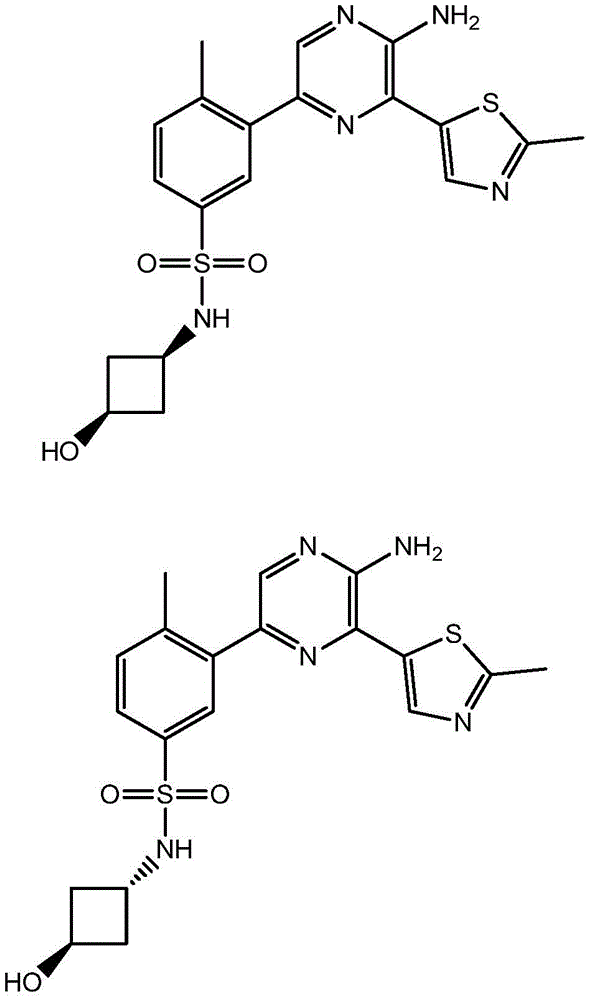
The diastereomeric mixture of 3- (5-amino-6- (2-methylthiazol-5-yl) pyrazin-2-yl) -N- (3-hydroxycyclobutyl) -4-methylbenzenesulfonamide (example 43) is separated by chiral SFC under the following conditions:
details of the method:
column: phenomenex LUX A2250X 100mm 5um @35degC
Mobile phase: 45% IPA + 0.1% DEA/55% CO2
Flow rate: 10ml/min
The two separated fractions were concentrated under reduced pressure. The residue was dissolved in MeOH, allowed to stand at room temperature, and then dried in a vacuum oven at 50 ℃ over the weekend to obtain the target compound.
Example 43a cis-3- (5-amino-6- (2-methylthiazol-5-yl) pyrazin-2-yl) -N- (3-hydroxycyclobutyl) -4-methylbenzenesulfonamide
Peak 1 SFC retention time 8.36mins
LCMS Rt 0.97min, MS M/z 432.2[ M + H ] +; method 2 minlowwphv 03.
Example 43b trans-3- (5-amino-6- (2-methylthiazol-5-yl) pyrazin-2-yl) -N- (3-hydroxycyclobutyl) -4-methylbenzenesulfonamide
Peak 2 SFC Retention time 10.73mins
LCMS Rt 0.97min, MS M/z 432.3[ M + H ] +; method 2minLowpHv03
1H NMR-AV81762- (400MHz, MeOD) -consistent with the deduced structure.
Cis/trans partitioning was confirmed by NMR analysis.
Example 44:
3- (5-amino-6- (2-methylthiazol-5-yl) pyrazin-2-yl) -N- ((3- (hydroxymethyl) oxetan-3-yl) methyl) -4-methylbenzenesulfonamide

The title compound was prepared using 5-chloro-3- (2-methylthiazol-5-yl) pyrazin-2-amine (intermediate C6) and N- ((3- (hydroxymethyl) oxetan-3-yl) methyl) -4-methyl-3- (4,4,5, 5-tetramethyl-1, 3, 2-dioxaborolan-2-yl) benzenesulfonamide (prepared according to a method analogous to intermediate B1 starting with (3- (aminomethyl) oxetan-3-yl) methanol) under conditions analogous to example 41;
LCMS is Rt 1.00 mins; MS M/z 462.3[ M + H ] +; method 2 minlowwphv 03.
Example 45:
3- (5-amino-6- (2-methylthiazol-5-yl) pyrazin-2-yl) -N- (2-hydroxyethyl) -4-methylbenzenesulfonamide

To a stirred solution of ethanolamine (11.89. mu.l, 0.197mmol), DIPEA (57.3. mu.l, 0.328mmol) in DMA (656. mu.l) was added 3- (5-amino-6- (2-methylthiazol-5-yl) pyrazin-2-yl) -4-methylbenzene-1-sulfonyl chloride (intermediate E) (50mg,0.131 mmol). The reaction mixture was stirred at room temperature overnight, then water (50ml) was added and extracted with EtOAc (50 ml). The organic phase was washed with brine (50ml) and dried over magnesium sulphate. The solid was filtered, washed with EtOAc, and the solvent was concentrated under reduced pressure. The crude product was purified by flash column chromatography over 4g of silica gel column, gradient eluted with 0-10% MeOH in DCM, loaded with DCM and MeOH. The obtained oil was triturated with ether, the solid obtained was filtered, washed with ether and dried in a vacuum oven at 50 ℃ overnight to obtain the title compound as a beige solid;
LCMS is Rt 0.99 mins; MS M/z 406.3[ M + H ] +; method 2 minlowwphv 03.
1H NMR(400MHz,DMSO-d6)δ8.27(1H,s),8.22(1H,s),7.85(1H,d),7.70(1H,dd),7.57(1H,t),7.53(1H,d),6.73(2H,br s),4.67(1H,t),3.38(2H,q),2.81(2H,q),2.68(3H,s),2.48(3H,s)。
The following examples were prepared from 3- (5-amino-6- (2-methylthiazol-5-yl) pyrazin-2-yl) -4-methylbenzene-1-sulfonyl chloride (intermediate E) and the appropriate commercially available amine according to a similar procedure to example 45:
example 45.1:
3- (5-amino-6- (2-methylthiazol-5-yl) pyrazin-2-yl) -4-methyl-N- (oxetan-3-ylmethyl) benzenesulfonamide

LCMS is Rt 1.06 mins; MS M/z 432.3[ M + H ] +; method 2 minlowwphv 03.
Example 45.2:
3- (5-amino-6- (2-methylthiazol-5-yl) pyrazin-2-yl) -4-methyl-N- ((tetrahydro-2H-pyran-4-yl) methyl) benzenesulfonamide

LCMS is Rt 1.15 mins; MS M/z 460.3[ M + H ] +; method 2 minlowwphv 03.
Example 45.3:
3- (5-amino-6- (2-methylthiazol-5-yl) pyrazin-2-yl) -4-methyl-N- (tetrahydro-2H-pyran-4-yl) benzenesulfonamide

LCMS is Rt 1.06 mins; MS M/z 446.2[ M + H ] +; method 2 minlowwphv 03.
Example 45.4:
3- (5-amino-6- (2-methylthiazol-5-yl) pyrazin-2-yl) -4-methyl-N- ((tetrahydro-2H-pyran-2-yl) methyl) benzenesulfonamide
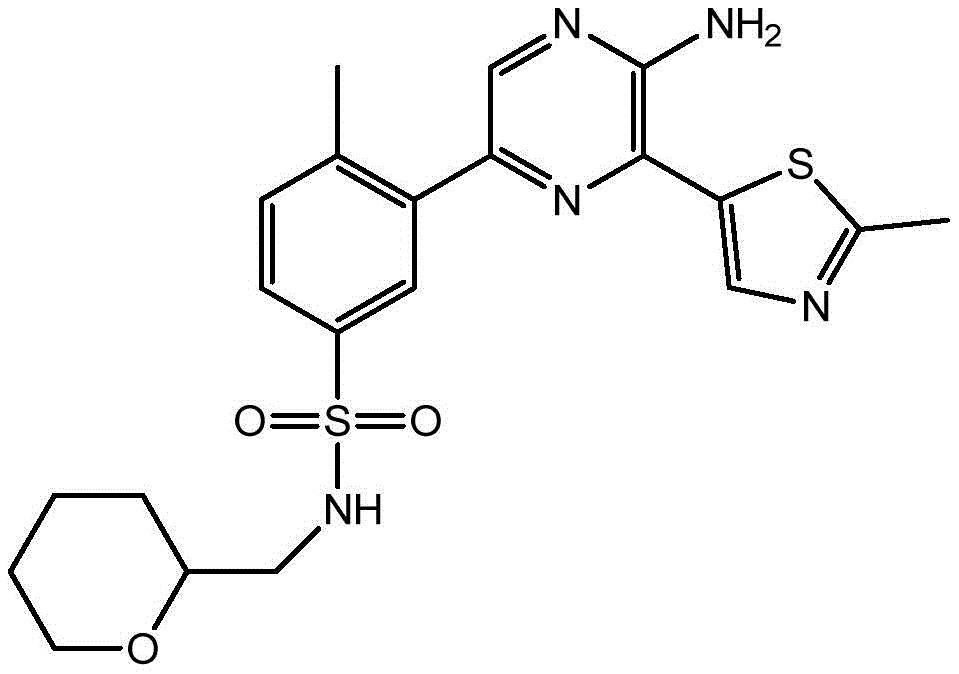
LCMS is Rt 1.20 mins; MS M/z 460.3[ M + H ] +; method 2 minlowwphv 03.
Example 45.5:
3- (5-amino-6- (2-methylthiazol-5-yl) pyrazin-2-yl) -4-methyl-N- (2,2, 2-trifluoroethyl) benzenesulfonamide
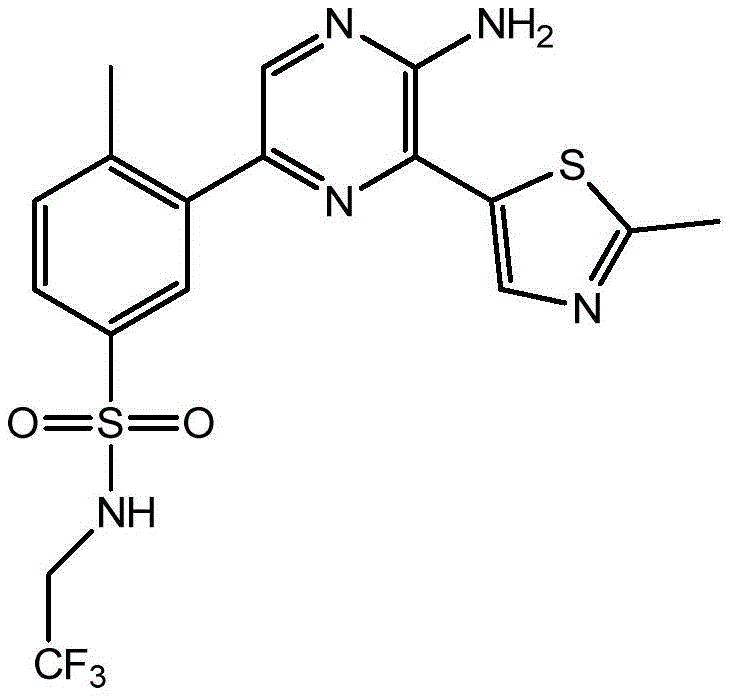
LCMS is Rt 1.22 mins; MS M/z 444.8[ M + H ] +; method 2 minlowwphv 03.
Example 45.6:
3- (5-amino-6- (2-methylthiazol-5-yl) pyrazin-2-yl) -4-methyl-N- ((tetrahydrofuran-2-yl) methyl) benzenesulfonamide
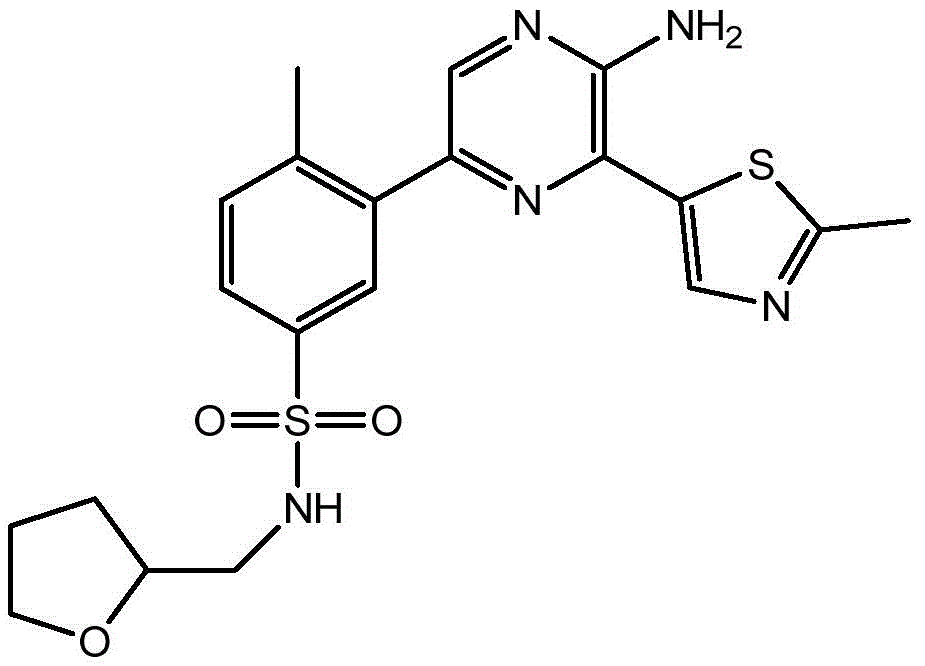
LCMS is Rt 1.14 mins; MS M/z 446.2[ M + H ] +; method 2 minlowwphv 03.
Examples 45.6a and 45.6b:
(R) -3- (5-amino-6- (2-methylthiazol-5-yl) pyrazin-2-yl) -4-methyl-N- ((tetrahydrofuran-2-yl) methyl) benzenesulfonamide and (S) -3- (5-amino-6- (2-methylthiazol-5-yl) pyrazin-2-yl) -4-methyl-N- ((tetrahydrofuran-2-yl) methyl) benzenesulfonamide

In this case, the racemic mixture is separated by chiral separation methods to obtain the single isomers:
column: chiralpak AS-H, 250X 10mm,5um @35degC,
mobile phase: 50% isopropanol + 0.1% v/v DEA/50% CO2,
Flow rate: the concentration of the mixture is 10ml/min,
and (3) detection: the UV @220nm wavelength is adopted,
the instrument comprises the following steps: berger Minigram SFC1
Example 45.6a:
SFC retention time of 7.00mins for the first eluted compound. (R) -3- (5-amino-6- (2-methylthiazol-5-yl) pyrazin-2-yl) -4-methyl-N- ((tetrahydrofuran-2-yl) methyl) benzenesulfonamide or (S) -3- (5-amino-6- (2-methylthiazol-5-yl) pyrazin-2-yl) -4-methyl-N- ((tetrahydrofuran-2-yl) methyl) benzenesulfonamide
LCMS is Rt 1.13 mins; MS M/z 446.1[ M + H ] +; method 2 minlowwphv 03.
Example 45.6b:
SFC retention time of 8.73mins for the second eluted compound. (R) -3- (5-amino-6- (2-methylthiazol-5-yl) pyrazin-2-yl) -4-methyl-N- ((tetrahydrofuran-2-yl) methyl) benzenesulfonamide or (S) -3- (5-amino-6- (2-methylthiazol-5-yl) pyrazin-2-yl) -4-methyl-N- ((tetrahydrofuran-2-yl) methyl) benzenesulfonamide
LCMS is Rt 1.15 mins; MS M/z 446.3[ M + H ] +; method 2 minlowwphv 03.
Example 45.7:
3- (5-amino-6- (2-methylthiazol-5-yl) pyrazin-2-yl) -4-methyl-N- (tetrahydrofuran-3-yl) benzenesulfonamide
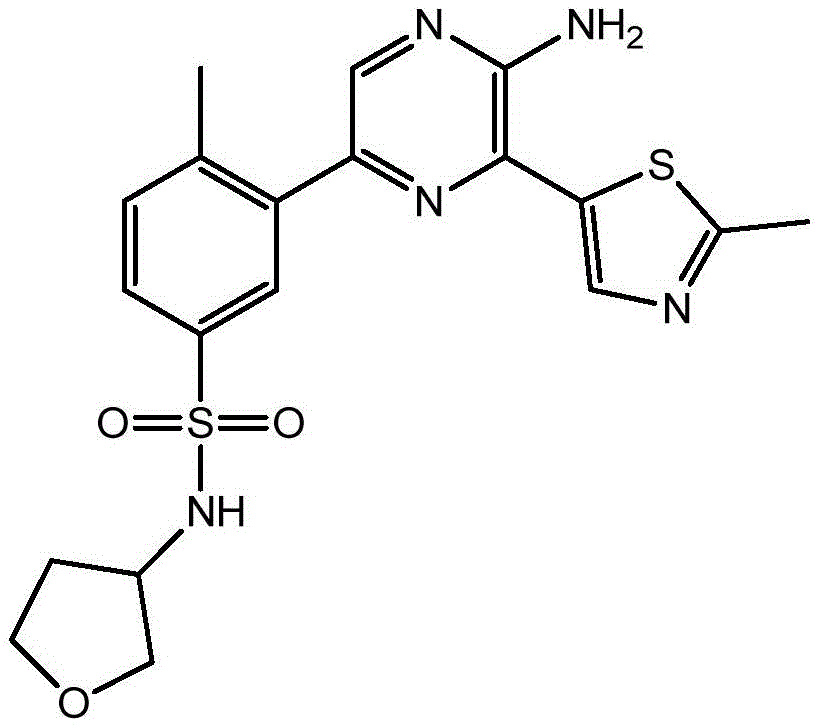
LCMS is Rt 1.09 mins; MS M/z 432.2[ M + H ] +; method 2 minlowwphv 03.
Examples 45.7a and 45.7b:
(R) -3- (5-amino-6- (2-methylthiazol-5-yl) pyrazin-2-yl) -4-methyl-N- (tetrahydrofuran-3-yl) benzenesulfonamide and (S) -3- (5-amino-6- (2-methylthiazol-5-yl) pyrazin-2-yl) -4-methyl-N- (tetrahydrofuran-3-yl) benzenesulfonamide

In this case, the racemic mixture is separated by chiral separation methods to obtain the single isomers:
column: chiralpak IC, 250X 10mm,5um @35degC,
mobile phase: 50% methanol + 0.1% v/v DEA/50% CO2,
Flow rate: the concentration of the mixture is 10ml/min,
and (3) detection: the UV @220nm wavelength is adopted,
the instrument comprises the following steps: berger Minigram SFC1
Example 45.7a:
SFC retention time of 11.74mins for the first eluted compound. (R) -3- (5-amino-6- (2-methylthiazol-5-yl) pyrazin-2-yl) -4-methyl-N- (tetrahydrofuran-3-yl) benzenesulfonamide or (S) -3- (5-amino-6- (2-methylthiazol-5-yl) pyrazin-2-yl) -4-methyl-N- (tetrahydrofuran-3-yl) benzenesulfonamide
LCMS is Rt 1.06 mins; MS M/z 432.3[ M + H ] +; method 2 minlowwphv 03.
Example 45.7b:
SFC retention time of 13.42mins for the second eluted compound. (R) -3- (5-amino-6- (2-methylthiazol-5-yl) pyrazin-2-yl) -4-methyl-N- (tetrahydrofuran-3-yl) benzenesulfonamide or (S) -3- (5-amino-6- (2-methylthiazol-5-yl) pyrazin-2-yl) -4-methyl-N- (tetrahydrofuran-3-yl) benzenesulfonamide
LCMS is Rt 1.06 mins; MS M/z 432.2[ M + H ] +; method 2 minlowwphv 03.
Example 45.8:
(1- ((3- (5-amino-6- (2-methylthiazol-5-yl) pyrazin-2-yl) -4-methylphenyl) sulfonyl) azetidin-3-yl) methanol

LCMS is Rt 1.00 mins; MS M/z 432.1[ M + H ] +; method 2 minlowwphv 03.
Example 45.9:
3- (5-amino-6- (2-methylthiazol-5-yl) pyrazin-2-yl) -N- ((4- (hydroxymethyl) tetrahydro-2H-pyran-4-yl) methyl) -4-methylbenzenesulfonamide

LCMS is Rt 1.05 mins; MS M/z 490.3[ M + H ] +; method 2 minlowwphv 03.
Example 45.10:
3- (5-amino-6- (2-methylthiazol-5-yl) pyrazin-2-yl) -N- ((4-hydroxytetrahydro-2H-pyran-4-yl) methyl) -4-methylbenzenesulfonamide

LCMS is Rt 1.03 mins; MS M/z 476.3[ M + H ] +; method 2 minlowwphv 03.
Example 45.11:
3- (5-amino-6- (2-methylthiazol-5-yl) pyrazin-2-yl) -N- ((3-hydroxyoxetan-3-yl) methyl) -4-methylbenzenesulfonamide

LCMS is Rt 1.00 mins; MS M/z 448.2[ M + H ] +; method 2 minlowwphv 03.
Example 45.12:
3- (5-amino-6- (2-methylthiazol-5-yl) pyrazin-2-yl) -4-methyl-N- ((4-methylmorpholin-3-yl) methyl) benzenesulfonamide

LCMS is Rt 0.71 mins; MS M/z 475.2[ M + H ] +; method 2 minlowwphv 03.
Example 46:
3- (5-amino-6- (1, 5-dimethyl-1H-pyrazol-4-yl) pyrazin-2-yl) -N- (2-hydroxy-2-methylpropyl) -4-methylbenzenesulfonamide
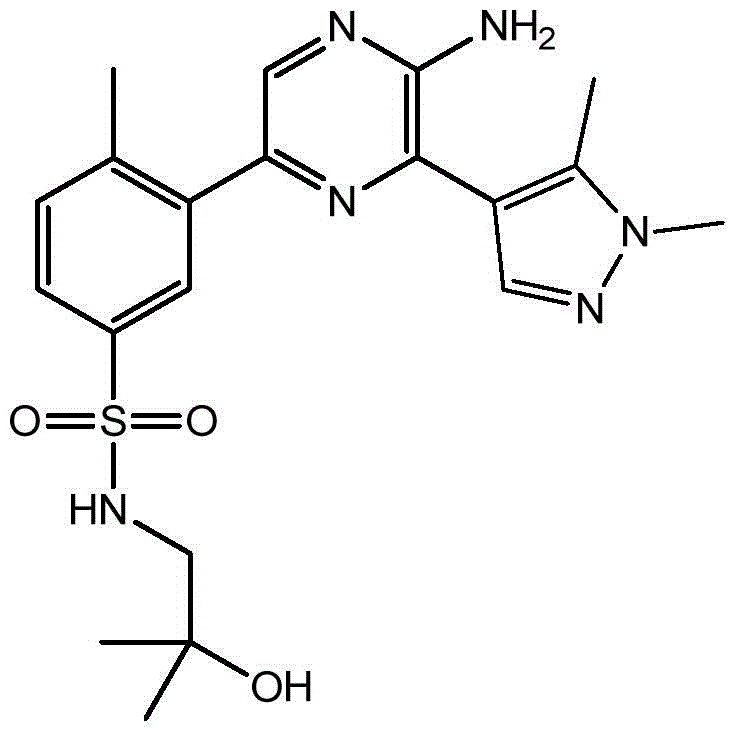
A mixture of 3- (5-amino-6-chloro-pyrazin-2-yl) -N- (2-hydroxy-2-methyl-propyl) -4-methyl-benzenesulfonamide (intermediate D2) (60mg,0.162mmol), 1, 5-dimethyl-4- (4,4,5, 5-tetramethyl-1, 3, 2-dioxaborolan-2-yl) -1H-pyrazole (40mg,0.180mmol), bis (triphenylphosphine) palladium dichloride (5mg,7.12 μmol) in DME (0.75ml) and 2M aqueous sodium carbonate (0.25ml,0.500mmol) was heated in a microwave at 130 ℃ for 1 hour. The resulting mixture was diluted with 10% methanol in DCM and passed through 1g Filtered and washed with another 10% methanol in DCM. The crude product was purified by flash column chromatography (12g silica gel, gradient elution with 0-20% methanol in TBME). Evaporating the product components under reduced pressure, and drying in a vacuum oven to obtain the target compound as a brown-orange solid;
1H NMR(400MHz,DMSO-d6)δ8.08(1H,s);7.86(1H,s);7.72(1H,s);7.67(1H,dd);7.49(1H,d);7.44(1H,br m);6.23(2H,s);4.38(1H,s);3.80(3H,s);2.61(2H,d);2.46(3H,s);2.36(3H,s);1.05(6H,s)
LCMS Rt 0.89 min; MS M/z 431.2[ M + H ] +; the method comprises the following steps: 2minLowpHv01
Example 46.1:
3- (5-amino-6- (2, 4-dimethylthiazol-5-yl) pyrazin-2-yl) -N- (2-hydroxy-2-methylpropyl) -4-methylbenzenesulfonamide

The title compound was synthesized in a similar manner to that used for the preparation of example 46, using 2, 4-dimethyl-5- (4,4,5, 5-tetramethyl-1, 3, 2-dioxaborolan-2-yl) thiazole as the starting material;
LCMS, Rt 0.91 min; MS M/z 448.0[ M + H ] +; 446.2[ M-H ] -; the method comprises the following steps: 2minLowpHv01
Example 46.2:
3- (5-amino-6- (1-methyl-1H-pyrazol-4-yl) pyrazin-2-yl) -N- (2-hydroxy-2-methylpropyl) -4-methylbenzenesulfonamide
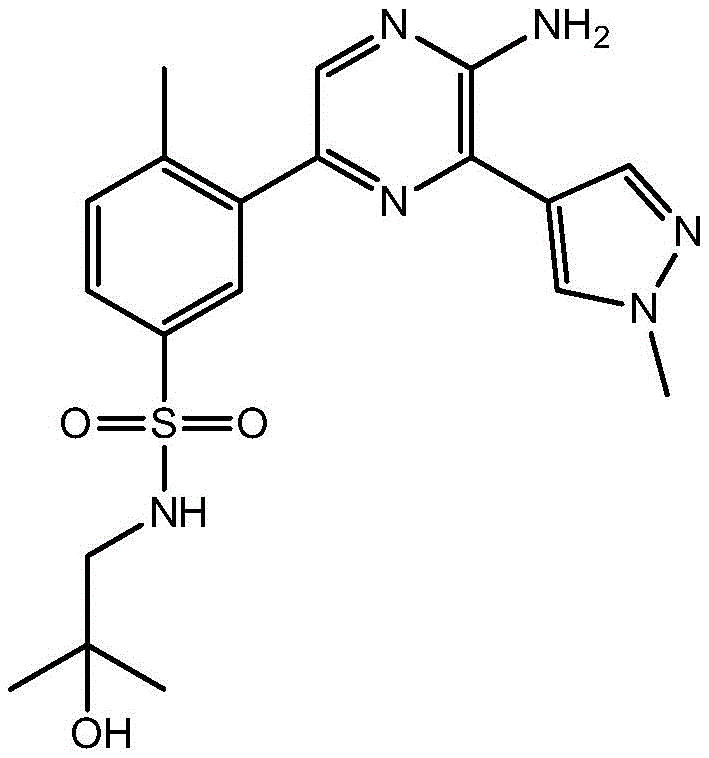
The title compound was synthesized according to a similar procedure as that used for the preparation of example 46, using 1-methyl-4- (4,4,5, 5-tetramethyl-1, 3, 2-dioxaborolan-2-yl) -1H-pyrazole as the starting material.
LCMS: Rt 0.87 min; MS M/z 417.3[ M + H ] +; the method comprises the following steps: 2minLowpHv01
1H NMR (400MHz, MeOD-d4) delta 8.26(1H, s); 8.07(1H, s); 8.00(1H, s); 7.93(1H, d, J-2 Hz); 7.80(1H, dd, J-8 and 2 Hz); 7.53(1H, d, J-8 Hz); 4.01(3H, s); 2.81(2H, s); 2.51(3H, s); 1.19(6H, s)
Example 47:
3- (5-amino-6- (3, 4-dimethyl-1H-pyrazol-1-yl) pyrazin-2-yl) -N- (2-hydroxy-2-methylpropyl) -4-methylbenzenesulfonamide

According to a similar procedure to that used for the preparation of example 15, the title compound was prepared from 3, 4-dimethyl-1H-pyrazole and 3- (5-amino-6-chloro-pyrazin-2-yl) -N- (2-hydroxy-2-methyl-propyl) -4-methyl-benzenesulfonamide (intermediate D2).
LCMS: Rt 1.16 min; MS M/z 431.2[ M + H ] +; the method comprises the following steps: 2minLowpHv01
Example 48:
3- (5-amino-6- (3, 5-dimethyl-1H-pyrazol-1-yl) pyrazin-2-yl) -N- (2-hydroxy-2-methylpropyl) -4-methylbenzenesulfonamide

According to a similar procedure to that used for the preparation of example 15, the title compound was prepared from 3, 5-dimethyl-1H-pyrazole and 3- (5-amino-6-chloro-pyrazin-2-yl) -N- (2-hydroxy-2-methyl-propyl) -4-methyl-benzenesulfonamide (intermediate D2).
1H NMR (400MHz, MeOD-d4) delta 8.19(1H, s); 7.94(1H, d, J-2 Hz); 7.78(1H, dd, J-8 and 2 Hz); 7.52(1H, d, J-8 Hz); 6.15(1H, s); 2.81(2H, s); 2.51(3H, s); 2.46(3H, s); 2.31(3H, s); 1.18(6H, s)
LCMS: Rt 1.06 min; MS M/z 431.3[ M + H ] +; the method comprises the following steps: 2minLowpHv01
Example 49:
3- (5-amino-6- (3, 5-dimethyl-1H-1, 2, 4-triazol-1-yl) pyrazin-2-yl) -N- (2-hydroxy-2-methylpropyl) -4-methylbenzenesulfonamide
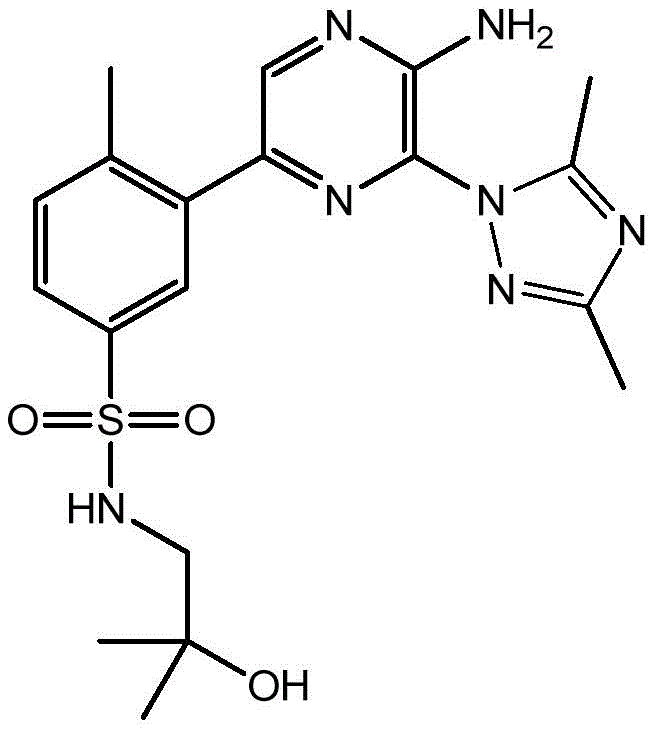
According to a similar procedure to that used for the preparation of example 15, the title compound was prepared from 3, 5-dimethyl-1H-1, 2, 4-triazole and 3- (5-amino-6-chloro-pyrazin-2-yl) -N- (2-hydroxy-2-methyl-propyl) -4-methyl-benzenesulfonamide (intermediate D2).
LCMS: Rt 0.88 min; m/z 430.2[ M-H ] -; the method comprises the following steps: 2 minlowwphv 01.
1H NMR (400MHz, DMSO-d6) delta 8.38(1H, s); 7.86(1H, d, J-2 Hz); 7.71(1H, dd, J-8 and 2 Hz); 7.53(1H, d, J-8 Hz); 7.47(1H, t, J-6.5 Hz); 6.98(2H, br); 2.62(2H, d, J6.5 Hz); 2.47(3H, s); 2.33(3H, s); 1.05(6H, s). OH is not visible (under the water peak/exchanged. The non-identical methyl groups on the triazole indicate that the indicated product is not linked through the N between the methyl groups.
Example 50:
3- (5-amino-6- (2, 4-dimethyl-1H-imidazol-1-yl) pyrazin-2-yl) -N- (2-hydroxy-2-methylpropyl) -4-methylbenzenesulfonamide

According to a similar procedure to that used for the preparation of example 15, the title compound was prepared from 2, 4-dimethyl-1H-imidazole and 3- (5-amino-6-chloro-pyrazin-2-yl) -N- (2-hydroxy-2-methyl-propyl) -4-methyl-benzenesulfonamide (intermediate D2).
LCMS: Rt 0.64 min; MS M/z 431.3[ M + H ] +; the method comprises the following steps: 2minLowpHv01
Example 51:
3- (5-amino-6- (1-methyl-1H-pyrazol-4-yl) pyrazin-2-yl) -4-methyl-N- (4,4, 4-trifluoro-3-hydroxybutyl) benzenesulfonamide

A mixture of 1-methyl-4- (4,4,5, 5-tetramethyl-1, 3, 2-dioxaborolan-2-yl) -1H-pyrazole (45mg,0.216mmol), bis (triphenylphosphine) palladium dichloride (14mg,0.020mmol), 3- (5-amino-6-chloropyrazin-2-yl) -4-methyl-N- (4,4, 4-trifluoro-3-hydroxybutyl) benzenesulfonamide (intermediate D4) (85mg,0.200mmol), 2M sodium carbonate (0.300ml,0.600mmol), 1, 2-dimethoxyethane (1ml) was heated to 120 ℃ for 1 hour in a microwave and then partitioned between DCM and water and separated using a phase separator column. The organic phase was evaporated under reduced pressure to give a brown gum which was redissolved in ethyl acetate, combined with silica gel and purified by flash column chromatography (2g silica gel, 0-10% methanol TBME dissolved). The appropriate components were combined and evaporated to give an orange gum. Crystallizing in ethyl acetate/diethyl ether to obtain reddish solid;
1h NMR (400MHz, MeOD-d4) delta 8.21(1H, s); 8.05(1H, s); 8.03(1H, s); 7.90(1H, d); 7.78(1H, dd); 7.53(1H, d); 4.02(1H, br m) with an overlap of 4.00(3H, s); 3.07(2H, m); 2.51(3H, s); 1.83(1H, m); 1.68(1H, m).
LC-MS Rt 0.83 min; MS M/z 471.4[ M + H ] +; the method comprises the following steps: 2minLowpH
Example 52a:
(R) -3- (5-amino-6- (1, 3-dimethyl-1H-pyrazol-4-yl) pyrazin-2-yl) -4-methyl-N- (4,4, 4-trifluoro-3-hydroxybutyl) benzenesulfonamide or (S) -3- (5-amino-6- (1, 3-dimethyl-1H-pyrazol-4-yl) pyrazin-2-yl) -4-methyl-N- (4,4, 4-trifluoro-3-hydroxybutyl) benzenesulfonamide

A mixture of 3- (5-amino-6-chloropyrazin-2-yl) -4-methyl-N- (4,4, 4-trifluoro-3-hydroxybutyl) benzenesulfonamide (single enantiomer of unknown configuration, intermediate D4a) (45mg,0.106mmol), 1, 3-dimethyl-4- (4,4,5, 5-tetramethyl-1, 3, 2-dioxaborolan-2-yl) -1H-pyrazole (25mg,0.113mmol), and bis (triphenylphosphine) palladium dichloride (4mg, 5.70. mu. mol) in 1, 2-dimethoxyethane (0.5ml) and 2M sodium carbonate (150. mu.L, 0.300mmol) was heated in a microwave to 130 ℃ for 1 hour. The resulting mixture was diluted with 10% methanol in DCM and passed through 1g Filtration, washing with another 10% methanol in DCM, followed by purification by flash column chromatography (12g silica gel, 0-20% methanol in TBME) afforded 35mg of an orange glassy solid;
1h NMR (400MHz, DMSO-d6) delta 8.08(1H, s); 8.06(1H, s); 7.85(1H, d, J-2 Hz); 7.67(1H, dd,. about.2 and 8Hz) overlaps with 7.72-7.59 (about.1H, v broad); 7.52(1H, d, J-8 Hz); 6.28(2H, s); 6.17(1H, v broad); 3.99(1H, broad m); 3.82(3H, s); 2.90(2H, m); 2.47(3H, s); 2.29(3H, s); 1.69(1H, broad m); 1.57(1H, broad m).
LCMS: Rt 0.98 min; MS M/z 485.5[ M + H ] +; the method comprises the following steps: 2minLowpHv01
Chiral SFC: rt 5.51 min; DAD assay 100% purity;
the method comprises the following steps: chiralpak AD-3, 150X 2.1mm 3um @40C,0.7ml/min, UV @220nm and 254nm
A ═ CO2, B ═ methanol + 0.1% v/v DEA; gradient elution: 0-1.5 min 5% B; 1.5-6.0 min 5-50% B; 6.0-9.0 min 50% B
Example 52b:
(R) -3- (5-amino-6- (1, 3-dimethyl-1H-pyrazol-4-yl) pyrazin-2-yl) -4-methyl-N- (4,4, 4-trifluoro-3-hydroxybutyl) benzenesulfonamide or (S) -3- (5-amino-6- (1, 3-dimethyl-1H-pyrazol-4-yl) pyrazin-2-yl) -4-methyl-N- (4,4, 4-trifluoro-3-hydroxybutyl) benzenesulfonamide
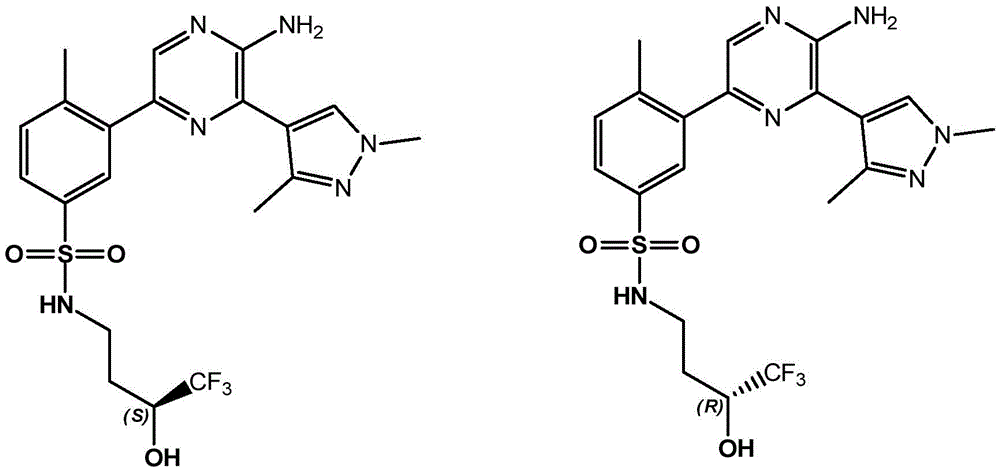
The title compound was prepared according to an analogous method to example 52a from intermediate D4 b;
1H NMR(400MHz,DMSO-d6)δ8.08(1H,s);8.06(1H,s);7.85(1H,d,J~2Hz);7.69-7.60(2H,m);7.52(1H,d,J~8Hz);6.28(2H,s);6.16(1H,d,J~6.5Hz);3.98(1H,m);3.81(3H,s);2.89(2H,m);2.47(3H,s);2.29(3H,s);1.73-1.51(2H,m)。
LCMS: Rt 0.93 min; m/z 485.2[ M + H ] +; the method comprises the following steps: 2minLowpHv01
Rt 5.15min is chiral SFC; 97.4% purity was determined by DAD (thus 95% ee);
the method comprises the following steps: chiralpak AD-3, 150X 2.1mm 3um @40C,0.7ml/min, UV @220nm and 254nm
A ═ CO2, B ═ methanol + 0.1% v/v DEA; gradient elution: 0-1.5 min 5% B; 1.5-6.0 min 5-50% B; 6.0-9.0 min 50% B.
Example 53:
5- (5-amino-6- (1H-1,2, 4-triazol-1-yl) pyrazin-2-yl) -N- (2-hydroxy-2-methylpropyl) -6-methylpyridine-3-sulfonamide

Step 1 5-bromo-6-chloro-N- (2-hydroxy-2-methylpropyl) pyridine-3-sulfonamide
To a solution of 1-amino-2-methylpropan-2-ol (0.306g,3.44mmol) and DIPEA (0.62mL,3.55mmol) in THF (6mL) cooled in an ice bath was added dropwise a solution of 5-bromo-6-chloropyridine-3-sulfonyl chloride (1g,3.44mmol) in THF (6 mL). The resulting mixture was stirred at room temperature overnight, then water (30mL) was added, and the mixture was adjusted to pH 4-5 with 1MHCl/1M sodium bicarbonate if necessary, and extracted with ethyl acetate (3X 25 mL). The combined organic extracts were washed with brine (25mL), dried over magnesium sulfate, filtered and evaporated under reduced pressure to give a pale yellow solid which was dried in a vacuum oven to give the target compound;
LCMS: Rt 1.03 min; MS M/z 345.0 and 343.0(Br isotope) [ M + H ] +; the method comprises the following steps: 2minLowpHv03
Step 2 5-bromo-N- (2-hydroxy-2-methylpropyl) -6-iodopyridine-3-sulfonamide
To a solution of 5-bromo-6-chloro-N- (2-hydroxy-2-methylpropyl) pyridine-3-sulfonamide (from step 1) (500mg,1.455mmol) in acetonitrile (40ml) was added trimethylsilyl chloride (375. mu.L, 2.93 mmol). After 15 minutes, sodium iodide (1g,6.67mmol) was added in two portions. The resulting orange cloudy mixture was stirred at room temperature for 2 days and then poured into ice water (-50 g). Sodium hydroxide (1M solution, 5mL) was added, the pH was adjusted to pH7 with 1M HCl (to pH 3) then 1M sodium bicarbonate, and the mixture was extracted with dichloromethane. The organic phase was washed with water and brine, dried over a hydrophobic membrane and evaporated under reduced pressure. Grinding with ethyl acetate/hexane to obtain an off-white solid;
LCMS: Rt 1.08 min; MS M/z 435.1 and 437.2[ M + H ] +; the method comprises the following steps: 2minLowpHv03
Step 3 5-bromo-N- (2-hydroxy-2-methylpropyl) -6-methylpyridine-3-sulfonamide
To a mixture of methylboronic acid (9mg,0.150mmol), 5-bromo-N- (2-hydroxy-2-methylpropyl) -6-iodopyridine-3-sulfonamide (from step 2) (60mg,0.138mmol), bis (triphenylphosphine) palladium dichloride (5mg, 7.12. mu. mol) in 1, 4-dioxane (1.3ml) was added sodium carbonate 2M (44mg,0.415mmol), and the resulting mixture was heated under nitrogen at 50 ℃ for 90 minutes and 80 ℃ for 1 hourAnd then heated at 100 ℃ for 1 hour. Another part of methylboronic acid (9mg) was added and the mixture was stirred at 100 ℃ overnight. Another part of methylboronic acid (9mg) was added, and the resulting mixture was stirred at 100 ℃ for an additional 5.5 hours, after 3 hours another part of methylboronic acid (20mg) was added. After cooling to room temperature, the reaction mixture is diluted with methanol and passed The Si-TMT column (1g) was filtered and washed with additional methanol and DCM. The combined organic fractions were evaporated under reduced pressure, combined with silica gel and purified by flash column chromatography (4g of silica gel, 0-100% ethyl acetate in isohexane) to give the title compound as a yellow gum;
LCMS: Rt 0.94 min; MSm/z 323.4[ M + H ] +; the method comprises the following steps: 2minLowpHv03
Step 4 5- (5-amino-6- (1H-1,2, 4-triazol-1-yl) pyrazin-2-yl) -N- (2-hydroxy-2-methylpropyl) -6-methylpyridine-3-sulfonamide
5-bromo-N- (2-hydroxy-2-methylpropyl) -6-methylpyridine-3-sulfonamide (obtained from step 3) (30mg,0.093mmol), 5-amino-6- (1H-1,2, 4-triazol-1-yl) pyrazin-2-ylboronic acid (see step 1 of preparation example 121) (20mg,0.097mmol), [1,1' -bis (di-tert-butylphosphino) ferrocene]Palladium (II) dichloride (3mg, 4.60. mu. mol) and potassium phosphate (40mg,0.188mmol) in a mixture of 1, 4-dioxane (1ml) and water (0.25ml) were heated to reflux for 30 minutes, then cooled to room temperature, diluted with methanol: DCM (. about.1: 2), passed through 500mg And filtering by using a Si-TMT column. The mixture was evaporated under reduced pressure and purified by flash column chromatography (4g silica gel, 0-10% 7M methanolic ammonia in DCM). Eluting the product when the concentration is 7 percent, collecting and decompressing and evaporating to obtain a milky white solid;
LCMS: Rt 0.83 min; MS M/z 405.3[ M + H ] +; the method comprises the following steps: 2minLowpHv03
1H NMR(400MHz,DMSO-d6)δ9.39(1H,s),8.83(1H,s),8.49(1H,s),8.44(1H,s),8.29(1H,s),7.73(1H,br.s.),7.50(2H,br.s.),4.45(1H,br.s.),2.74(3H,s),2.69(2H,s),1.07(6H,s)
Example 54:
3- (5-amino-6- (1-methyl-1H-pyrazol-4-yl) pyrazin-2-yl) -N- (4, 4-difluorocyclohexyl) -4-methylbenzenesulfonamide
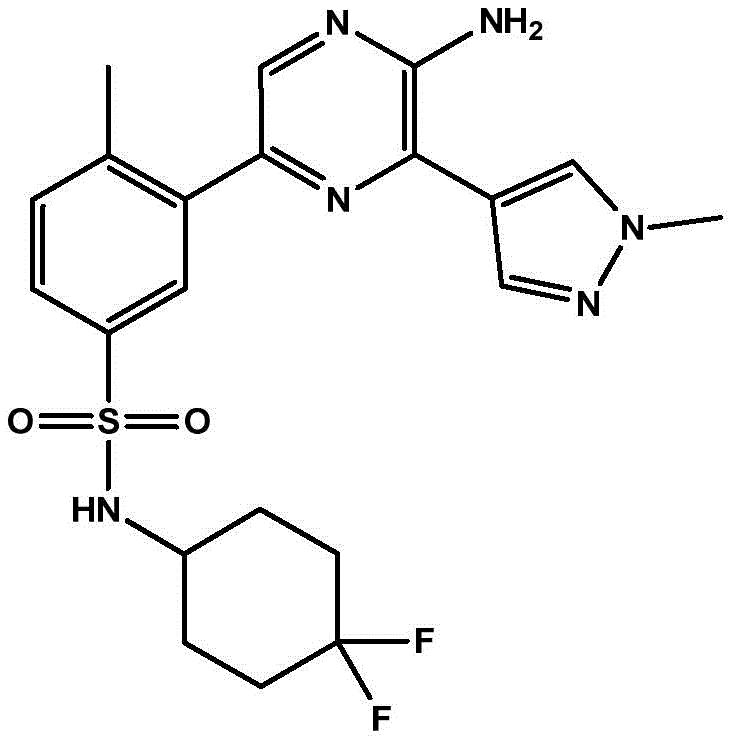
The title compound was prepared in accordance with an analogous method to that used for the preparation of example 11, using 1-methyl-4- (4,4,5, 5-tetramethyl-1, 3, 2-dioxaborolan-2-yl) -1H-pyrazole and 3- (5-amino-6-chloropyrazin-2-yl) -N- (4, 4-difluorocyclohexyl) -4-methylbenzenesulfonamide (prepared analogously to intermediate D1);
LC-MS, Rt 4.18 mins; MS M/z 463.3[ M + H ] +; method 10minLowpH
Example 55:
3- (5-amino-6- (2-methylthiazol-5-yl) pyrazin-2-yl) -N- (4, 4-difluorocyclohexyl) -4-methylbenzenesulfonamide

The title compound was prepared in accordance with an analogous method to that used to prepare example 11, using 2-methyl-5- (4,4,5, 5-tetramethyl-1, 3, 2-dioxaborolan-2-yl) thiazole and 3- (5-amino-6-chloropyrazin-2-yl) -N- (4, 4-difluorocyclohexyl) -4-methylbenzenesulfonamide (prepared in accordance with an analogous method to that used for intermediate D1);
LC-MS, Rt 4.65 mins; MS M/z 480.2[ M + H ] +; method 10minLowpH
Example 56:
trans-3- (5-amino-6- (4-methyl-1H-imidazol-1-yl) pyrazin-2-yl) -N- (-4-hydroxycyclohexyl) -4-methylbenzenesulfonamide

The title compound was prepared analogously to example 15 using 4-methyl-1H-imidazole.
LCMS is Rt 0.75 mins; MS M/z 443.3[ M + H ] +; the method comprises the following steps: 2minLC _ v003
1H NMR(400MHz,DMSO-d6)δ8.29(1H,s),8.03(1H,s),8.87(1H,d),7.71(1H,dd),7.60(1H,d),7.51(1H,d),7.34(1H,s),6.71(2H,s),4.46(1H,d),3.29(1H,m),2.90(1H,m),2.47(3H,s),2.20(3H,s),1.70(2H,m),1.61(2H,m),1.23-1.00(4H,m)。
Example 57:
3- (5-amino-6- (4-methyl-1H-imidazol-1-yl) pyrazin-2-yl) -N- (3-hydroxypropyl) -4-methylbenzenesulfonamide

Prepared according to an analogous method to example 15 using 4-methyl-1H-imidazole and 3- (5-amino-6-chloropyrazin-2-yl) -N- (3-hydroxypropyl) -4-methylbenzenesulfonamide (prepared according to an analogous method to intermediate D1 using intermediate B1).
LCMS is Rt 0.54 mins; MS M/z 403.2[ M + H ] +; the method comprises the following steps: 2minLC _ v003
1H NMR(400MHz,DMSO-d6)δ8.29(1H,s),8.02(1H,s),7.82(1H,s),7.68(1H,dd),7.53(1H,s),7.31(1H,s),7.34(1H,s),6.70(2H,s),4.40(1H,s),3.35(2H,m),2.78(2H,t),2.46(3H,s),2.19(3H,s),1.52(2H,m)。
Example 58:
trans-3- (5-amino-6- (1-methyl-1H-pyrazol-4-yl) pyrazin-2-yl) -N- (-4-hydroxycyclohexyl) -4-methylbenzenesulfonamide

Prepared according to similar conditions to example 22 using 1-methylpyrazole-4-boronic acid pinacol ester.
LCMS is Rt 0.81 mins; MS M/z 443.0[ M + H ] +; the method comprises the following steps: 2minLC _ v003
1H NMR(400MHz,DMSO-d6)δ8.32(1H,s),8.08(1H,s),8.00(1H,s),7.87(1H,d),7.69(1H,dd),7.60(1H,d),7.50(1H,d),6.32(2H,s),4.47(1H,d),3.92(3H,s),3.29(1H,m),2.91(1H,m),2.48(3H,s),1.71(2H,m),1.63(2H,m),1.24-1.01(4H,m)。
Example 59:
trans-3- (5-amino-6- (pyrimidin-5-yl) pyrazin-2-yl) -N- (-4-hydroxycyclohexyl) -4-methylbenzenesulfonamide

Prepared according to similar conditions as example 22 using pyrimidin-5-yl boronic acid.
LCMS is Rt 0.80 mins; MS M/z 441.3[ M + H ] +; the method comprises the following steps: 2minLC _ v003
Example 60:
trans-3- (5-amino-6- (2-fluoropyridin-4-yl) pyrazin-2-yl) -N- (-4-hydroxycyclohexyl) -4-methylbenzenesulfonamide

Prepared according to similar conditions to example 22 using 2-fluoropyridine-4-boronic acid pinacol ester.
LCMS is Rt 0.90 mins; MS M/z 458.3[ M + H ] +; the method comprises the following steps: 2minLC _ v003
Example 61:
3- (5-amino-6- (1H-imidazol-1-yl) pyrazin-2-yl) -N- (3-hydroxy-3-methylbutyl) -4-methylbenzenesulfonamide

Prepared according to similar conditions to example 26 using 1H-imidazole.
LCMS is Rt 0.62 mins; MS M/z 417.4[ M + H ] +; the method comprises the following steps: 2minLC _ v003
Example 62:
3- (5-amino-6- (1H-pyrazol-1-yl) pyrazin-2-yl) -N- (3-hydroxy-3-methylbutyl) -4-methylbenzenesulfonamide

Prepared according to similar conditions to example 26 using 1H-pyrazole.
LCMS, Rt 0.97 mins; MS M/z 417.2[ M + H ] +; the method comprises the following steps: 2minLowpH
Example 63:
3- (5-amino-6- (4-methyl-1H-imidazol-1-yl) pyrazin-2-yl) -N- (3-hydroxy-3-methylbutyl) -4-methylbenzenesulfonamide

Prepared according to similar conditions to example 26 using 4-methyl-1H-imidazole.
LCMS is Rt 0.61 mins; MS M/z 431.3[ M + H ] +; the method comprises the following steps: 2minLC _ v003
Example 64:
3- (5-amino-6- (1H-1,2, 4-triazol-1-yl) pyrazin-2-yl) -N- (3-hydroxy-3-methylbutyl) -4-methylbenzenesulfonamide
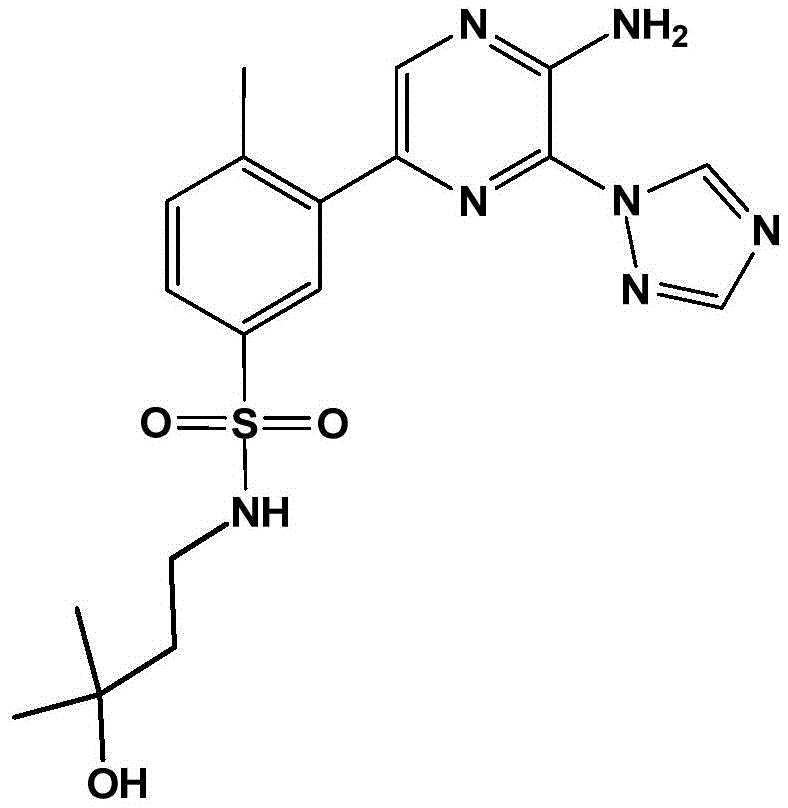
Prepared according to similar conditions to example 26 using 1H-1,2, 4-triazole.
LCMS is Rt 0.83 mins; MS M/z 418.3[ M + H ] +; the method comprises the following steps: 2minLC _ v003
1H NMR (400MHz, DMSO-d6) Δ 9.33(1H, s),8.42(1H, s),8.40(1H, s),7.89(1H, d),7.72(1H, dd),7.56(1H, d),7.45(1H, t),7.38(2H, d),4.27(1H, s),2.83(2H, m),2.51(3H, s under DMSO), 1.51(2H, m),1.02(6H, s).
Example 65:
3- (5-amino-6- (3-methyl-1H-1, 2, 4-triazol-1-yl) pyrazin-2-yl) -N- (3-hydroxy-3-methylbutyl) -4-methylbenzenesulfonamide

Prepared according to similar conditions to example 26 using 3-methyl-1H-1, 2, 4-triazole.
LCMS, Rt 0.87 mins; MS M/z 432.3[ M + H ] +; the method comprises the following steps: 2minLC _ v003.
Example 66:
3- (5-amino-6- (3-isopropyl-1H-1, 2, 4-triazol-1-yl) pyrazin-2-yl) -N- (3-hydroxy-3-methylbutyl) -4-methylbenzenesulfonamide

Prepared according to similar conditions to example 26 using 3-isopropyl-1H-1, 2, 4-triazole.
LCMS is Rt 0.99 mins; MS M/z 460.3[ M + H ] +; the method comprises the following steps: 2minLC _ v003
Example 67:
3- (5-amino-6- (1H-1,2, 4-triazol-1-yl) pyrazin-2-yl) -N- (6-hydroxyspiro [3.3] hept-2-yl) -4-methylbenzenesulfonamide

Prepared according to similar conditions as example 29 using 6-aminospiro [3.3] hept-2-ol. HCl, which can be prepared by obtaining commercial tert-butyl (6-hydroxyspiro [3.3] hept-2-yl) carbamate with 1.25M HCl in MeOH.
LCMS is Rt 0.90 mins; MS M/z 442.3[ M + H ] +; the method comprises the following steps: 2minLowpHv01
1H NMR (400MHz, DMSO-d6) Δ 9.33(1H, s),8.43(1H, s),8.40(1H, s),7.88(2H, m),7.69(1H, dd),7.53(1H, d),7.38(2H, d),4.82(1H, d),3.85(1H, m),3.53(1H, m),2.51(3H, s, under DMSO), 2.21(1H, m),2.03(2H, m),1.91(1H, m),1.76(2H, m),1.68(2H, m).
Example 68:
3- (5-amino-6- (1H-1,2, 4-triazol-1-yl) pyrazin-2-yl) -4-methyl-N- (tetrahydro-2H-pyran-4-yl) benzenesulfonamide
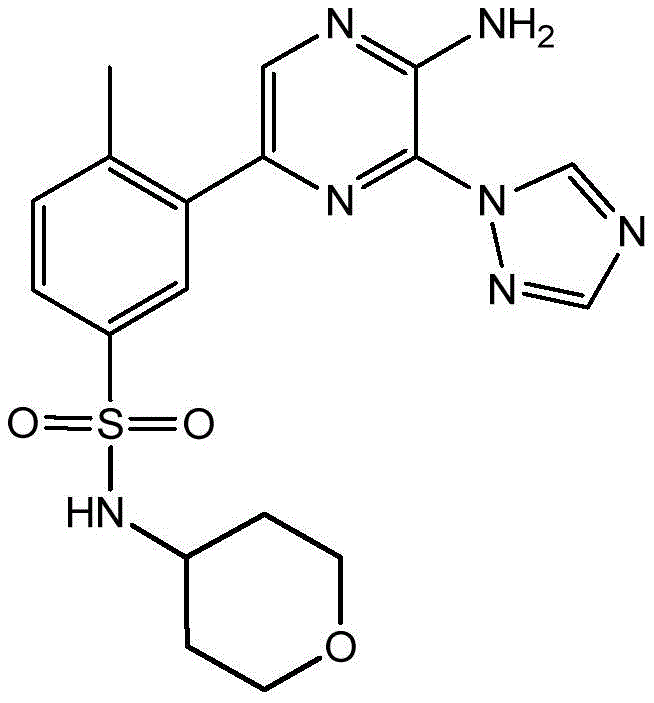
Prepared according to similar conditions as example 29 using tetrahydro-2H-pyran-4-amine.
LCMS is Rt 0.92 mins; MS M/z 416.3[ M + H ] +; the method comprises the following steps: 2minLowpHv01
Example 69a 3- (5-amino-6- (1H-1,2, 4-triazol-1-yl) pyrazin-2-yl) -N- (trans-4-hydroxy-4-methylcyclohexyl) -4-methylbenzenesulfonamide and example 69b 3- (5-amino-6- (1H-1,2, 4-triazol-1-yl) pyrazin-2-yl) -N- (cis-4-hydroxy-4-methylcyclohexyl) -4-methylbenzenesulfonamide

Prepared according to similar conditions as example 29 using 4-amino-1-methylcyclohexanol. The resulting mixture of stereoisomers is separated by chiral SFC.
Method DETAILS:
column: chiralpak IC 250 × 10mm,5 um;
mobile phase: 50% MeOH + 0.1% v/v DEA/50% CO2;
Flow rate: 10 ml/min; and (3) detection: UV @220 nm; system Berger Minigram SFC2
Example 69a first peak eluted at RT 6.2mins and was 3- (5-amino-6- (1H-1,2, 4-triazol-1-yl) pyrazin-2-yl) -N- ((1r,4r) -4-hydroxy-4-methylcyclohexyl) -4-methylbenzenesulfonamide
LCMS, Rt 0.87 mins; MS M/z 444.5[ M + H ] +; the method comprises the following steps: 2minLowpHv01
1H NMR (400MHz, DMSO-d6) Δ 9.33(1H, s),8.42(1H, s),8.40(1H, s),7.95(1H, d),7.73(1H, dd),7.59(1H, d),7.53(1H, d),7.38(2H, s),4.11(1H, s),3.06(1H, m),2.51(3H, s, under DMSO), 1.60(2H, m),1.50(2H, m),1.32-1.20(4H, m),1.06(3H, s).
Example 69a second eluting Peak, at RT 10.67mins, is 3- (5-amino-6- (1H-1,2, 4-triazol-1-yl) pyrazin-2-yl) -N- ((1s,4s) -4-hydroxy-4-methylcyclohexyl) -4-methylbenzenesulfonamide
LCMS is Rt 0.94 mins; MS M/z 426.5(minus OH) [ M + H ] +; the method comprises the following steps: 2minLowpHv01
1H NMR (400MHz, DMSO-d6) Δ 9.33(1H, s),8.41(1H, s),8.39(1H, s),7.94(1H, s),7.73(1H, d),7.60(1H, d),7.53(1H, d),7.38(2H, s),3.98(1H, s),2.93(1H, m),2.51(3H, s, under DMSO), 1.53(2H, m),1.40(2H, m),1.25-1.12(4H, m),1.01(3H, s).
Cis/trans stereochemistry was confirmed by NOESY NMR spectroscopy.
Example 70a (R) -or (S) -3- (5-amino-6- (1H-1,2, 4-triazol-1-yl) pyrazin-2-yl) -N- (6-hydroxyspiro [3.3] hept-2-yl) -4-methylbenzenesulfonamide and example 70b (R) -or (S) -3- (5-amino-6- (1H-1,2, 4-triazol-1-yl) pyrazin-2-yl) -N- (6-hydroxyspiro [3.3] hept-2-yl) -4-methylbenzenesulfonamide
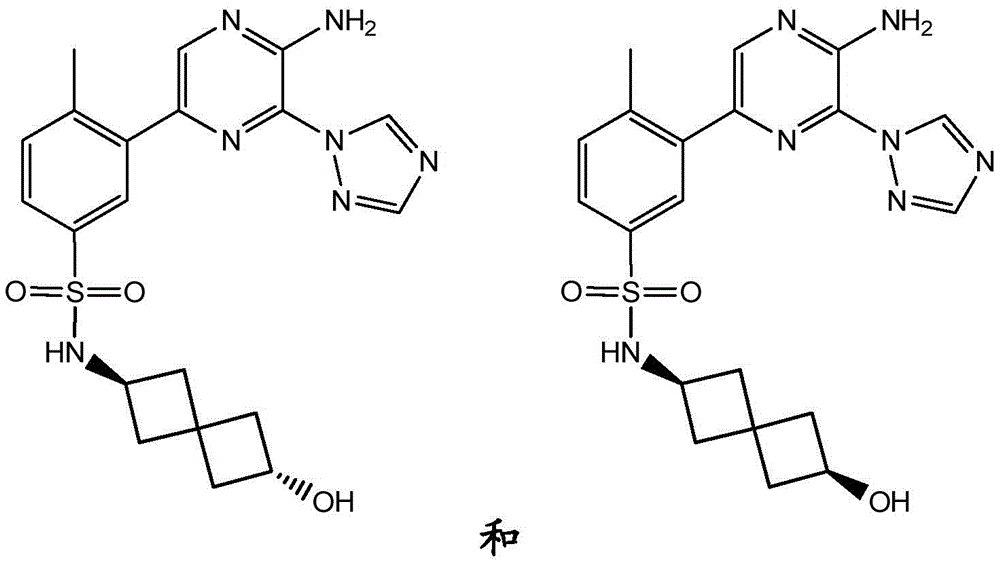
3- (5-amino-6- (1H-1,2, 4-triazol-1-yl) pyrazin-2-yl) -N- (6-hydroxyspiro [3.3] hept-2-yl) -4-methylbenzenesulfonamide (example 67) was separated into its isomers by chiral SFC.
The details of the method are as follows: column: chiralpak AD-H250X 10mm,5um @35 degC; mobile phase: 40 percent; isopropanol + 0.1% v/v DEA/60% CO 2; flow rate: 10 ml/min; and (3) detection: UV @220 nm; the instrument comprises the following steps: berger Minigram SFC1
Example 70a:
the first peak eluted at 11.87 mins: (S) -3- (5-amino-6- (1H-1,2, 4-triazol-1-yl) pyrazin-2-yl) -N- (6-hydroxyspiro [3.3] hept-2-yl) -4-methylbenzenesulfonamide or (R) -3- (5-amino-6- (1H-1,2, 4-triazol-1-yl) pyrazin-2-yl) -N- (6-hydroxyspiro [3.3] hept-2-yl) -4-methylbenzenesulfonamide
LCMS, Rt 0.88 mins; MS M/z 442.5[ M + H ] +; the method comprises the following steps: 2minLowpHv01
1H NMR (400MHz, DMSO-d6) Δ 9.33(1H, s),8.43(1H, s),8.40(1H, s),7.90-7.85(2H, m),7.69(1H, dd),7.53(1H, d),7.39(2H, s),4.82(1H, d),3.84(1H, m),3.53(1H, m)2.51(3H, s, under DMSO), 2.21(1H, m),2.03(2H, m),1.92(1H, m),1.76(2H, m),1.69(2H, s).
Example 70b:
the second peak eluted at 14.41 mins: (S) -3- (5-amino-6- (1H-1,2, 4-triazol-1-yl) pyrazin-2-yl) -N- (6-hydroxyspiro [3.3] hept-2-yl) -4-methylbenzenesulfonamide or (R) -3- (5-amino-6- (1H-1,2, 4-triazol-1-yl) pyrazin-2-yl) -N- (6-hydroxyspiro [3.3] hept-2-yl) -4-methylbenzenesulfonamide
LCMS is Rt 0.90 mins; MS M/z 442.3[ M + H ] +; the method comprises the following steps: 2minLowpHv01
1H NMR (400MHz, DMSO-d6) Δ 9.33(1H, s),8.43(1H, s),8.40(1H, s),7.91-7.86(2H, m),7.69(1H, dd),7.53(1H, d),7.38(2H, s),4.82(1H, d),3.85(1H, m),3.53(1H, m)2.51(3H, s, under DMSO), 2.21(1H, m),2.03(2H, m),1.92(1H, m),1.76(2H, m),1.69(2H, s)
Example 71a 3- (5-amino-6- (1H-1,2, 4-triazol-1-yl) pyrazin-2-yl) -N- ((1r,3r) -3-hydroxycyclobutyl) -4-methylbenzenesulfonamide and example 71b 3- (5-amino-6- (1H-1,2, 4-triazol-1-yl) pyrazin-2-yl) -N- ((1s,3s) -3-hydroxycyclobutyl) -4-methylbenzenesulfonamide

Prepared according to similar conditions as example 29 using 3-aminocyclobutanol.
The mixture of stereoisomers is separated by chiral SFC.
The details of the method are as follows: column: chiralpak AD-H, 250X 10mm,5um @35 degC; mobile phase: 50% methanol + 0.1% v/v DEA/50% CO 2; flow rate: 10 ml/min; and (3) detection: UV @220 nm; the instrument comprises the following steps: berger Minigram SFC1
Example 71a first peak eluted at RT 4.41 mins; 3- (5-amino-6- (1H-1,2, 4-triazol-1-yl) pyrazin-2-yl) -N- ((1r,3r) -3-hydroxycyclobutyl) -4-methylbenzenesulfonamide or 3- (5-amino-6- (1H-1,2, 4-triazol-1-yl) pyrazin-2-yl) -N- ((1s,3s) -3-hydroxycyclobutyl) -4-methylbenzenesulfonamide
LCMS is Rt 0.83 mins; MS M/z 402.4[ M + H ] +; the method comprises the following steps: 2minLowpHv01
1H NMR (400MHz, DMSO-d6) Δ 9.34(1H, s),8.43(1H, s),8.40(1H, s),7.90(1H, brs),7.88(1H, s),7.69(1H, d),7.54(1H, d),7.39(2H, s),4.92(1H, d),4.14(1H, m),3.75(1H, m),2.51(3H, s, under DMSO), 1.98(2H, m),1.89(2H, m).
Example 71b second peak at RT 5.88 mins; 3- (5-amino-6- (1H-1,2, 4-triazol-1-yl) pyrazin-2-yl) -N- ((1r,3r) -3-hydroxycyclobutyl) -4-methylbenzenesulfonamide or 3- (5-amino-6- (1H-1,2, 4-triazol-1-yl) pyrazin-2-yl) -N- ((1s,3s) -3-hydroxycyclobutyl) -4-methylbenzenesulfonamide
LCMS is Rt 0.82 mins; MS M/z 402.5[ M + H ] +; the method comprises the following steps: 2minLowpHv01
1H NMR (400MHz, DMSO-d6) Δ 9.34(1H, s),8.43(1H, s),8.40(1H, s),7.89(1H, s),7.86(1H, br s),7.70(1H, dd),7.54(1H, d),7.39(2H, s),4.99(1H, d),3.66(1H, m),3.13(1H, m),2.51(3H, s, under DMSO), 2.24(2H, m),1.60(2H, m).
Cis/trans stereochemistry was confirmed by NOESY NMR spectroscopy.
Example 72:
3- (5-amino-6- (1H-1,2, 4-triazol-1-yl) pyrazin-2-yl) -N- (((1s,3s) -3-hydroxycyclobutyl) methyl) -4-methylbenzenesulfonamide

Prepared according to similar conditions as example 6 using cis-3-bromo-N- (3-hydroxy-cyclobutylmethyl) -4-methyl-benzenesulfonamide (intermediate a10) and 5-chloro-3- (1H-1,2, 4-triazol-1-yl) pyrazin-2-amine (intermediate C5).
LCMS is Rt 0.80 mins; MS M/z 416.3[ M + H ] +; the method comprises the following steps: 2minLowpH
1H NMR (400MHz, DMSO-d6) Δ 9.34(1H, s),8.42(1H, s),8.40(1H, s),7.89(1H, s),7.71(1H, d),7.60-7.52(2H, m),7.39(2H, s),4.89(1H, s),3.84(1H, m),2.74(2H, t),2.51 (under 3H, s, DMSO), 2.17(2H, m),1.75(1H, m),1.41(2H, m).
Example 73:
3- (5-amino-6- (1H-1,2, 4-triazol-1-yl) pyrazin-2-yl) -N- (3-hydroxy-2, 2-dimethylpropyl) -4-methylbenzenesulfonamide

Prepared according to similar conditions to example 6 using 3-bromo-N- (3-hydroxy-2, 2-dimethylpropyl) -4-methylbenzenesulfonamide (intermediate a9) and 5-chloro-3- (1H-1,2, 4-triazol-1-yl) pyrazin-2-amine (intermediate C5).
LCMS is Rt 0.86 mins; MS M/z 418.2[ M + H ] +; the method comprises the following steps: 2minLowpH
1H NMR (400MHz, DMSO-d6) Δ 9.33(1H, s),8.42(1H, s),8.39(1H, s),7.91(1H, s),7.72(1H, s),7.55(1H, d),7.43-7.35(3H, m),4.45(1H, t),3.10(2H, d),2.57(2H, d),2.51(3H, s, in DMSO), 0.77(6H, s).
Example 74:
3- (5-amino-6- (1, 3-dimethyl-1H-pyrazol-4-yl) pyrazin-2-yl) -N- (6-hydroxyspiro [3.3] hept-2-yl) -4-methylbenzenesulfonamide

Prepared according to similar conditions as example 6 using 3-bromo-N- (6-hydroxy-spiro [3.3] hept-2-yl) -4-methyl-benzenesulfonamide (intermediate A8) and 5-bromo-3- (1, 3-dimethyl-1H-pyrazol-4-yl) -pyrazin-2-ylamine (intermediate C7).
LCMS Rt 0.87 mins; MS M/z 469.2[ M + H ] +; the method comprises the following steps: 2minLowpHv01
1H NMR(400MHz,DMSO-d6)δ8.08(1H,s),8.05(1H,s),7.82(1H,s),7.80(1H,s),7.63(1H,d),7.48(1H,d),6.28(2H,s),4.82(1H,d),3.84(1H,m),3.82(3H,s),3.50(1H,m),2.46(3H,s),2.29(3H,s),2.18(1H,m),2.00(2H,m),1.88(1H,m),1.69(4H,m)。
Example 75:
3- (5-amino-6- (1-methyl-1H-pyrazol-4-yl) pyrazin-2-yl) -N- ((1s,4s) -4-hydroxycyclohexyl) -4-methylbenzenesulfonamide
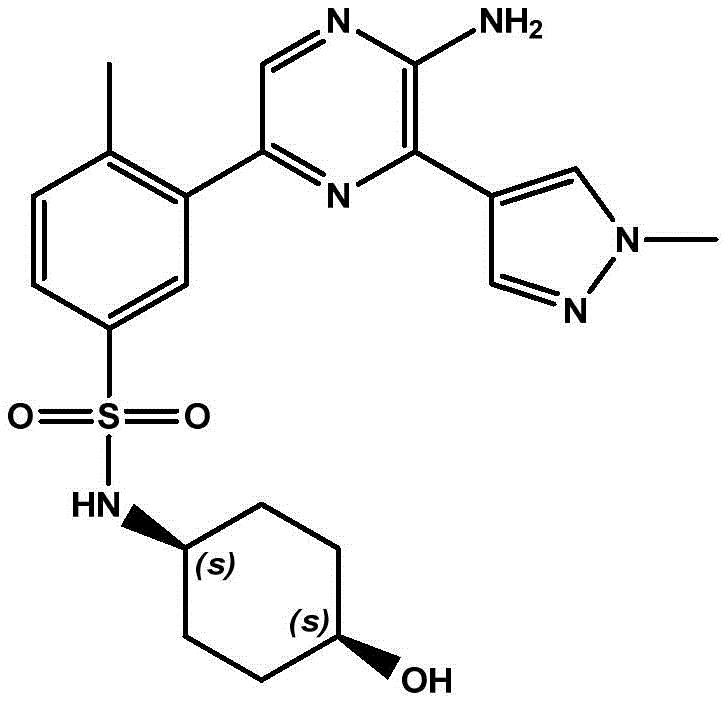
Prepared according to similar conditions used for the preparation of example 18, using N- ((cis) -4-hydroxycyclohexyl) -4-methyl-3- (4,4,5, 5-tetramethyl-1, 3, 2-dioxaborolan-2-yl) benzenesulfonamide (intermediate B8) and 5-chloro-3- (1-methyl-1H-pyrazol-4-yl) pyrazin-2-amine (prepared according to a similar procedure to intermediate C6, using 1-methyl-4- (4,4,5, 5-tetramethyl-1, 3, 2-dioxaborolan-2-yl) -1H-pyrazole as starting material).
LCMS Rt 0.80mins MS M/z 443.3[ M + H ] +; method 2minLowpH.
1H NMR (400MHz, DMSO-d6) δ 8.32(1H, s),8.07(1H, s),7.99(1H, s),7.88(1H, d, J ═ 1.7Hz),7.70-7.68(1H, dd, J ═ 1.8,8.0Hz),7.59-7.57(1H, d, J ═ 6.7Hz),7.50-7.48(1H, d, J ═ 8.0Hz),8.32(2H, broad s),3.91(3H, s),3.56(1H, broad m),2.97(1H, broad m),2.48(3H, s),1.58-1.49(4H, m),1.38-1.32(4H, m).
Example 76:
3- (5-amino-6- (2-methylpyridin-4-yl) pyrazin-2-yl) -N- ((1s,4s) -4-hydroxycyclohexyl) -4-methylbenzenesulfonamide
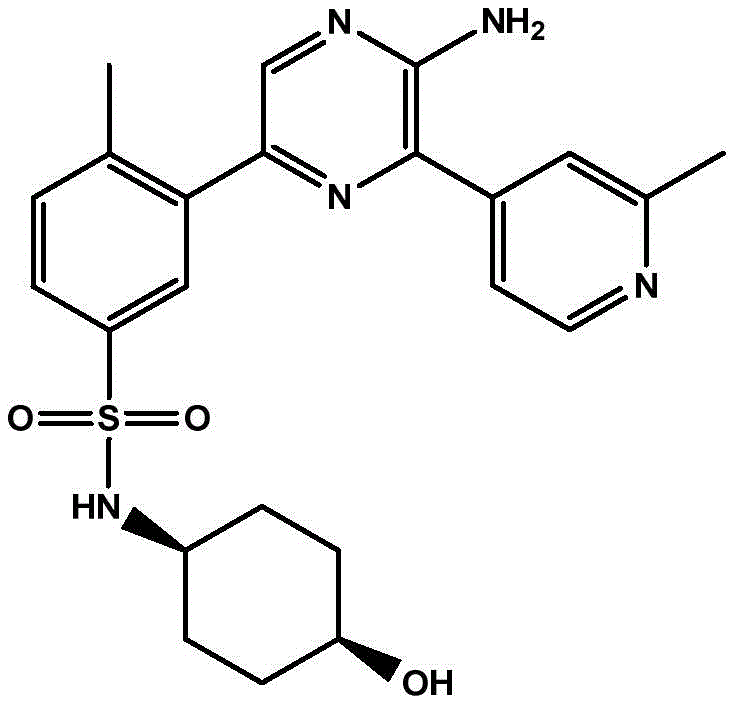
Prepared according to similar conditions used to prepare example 18, using N- ((cis) -4-hydroxycyclohexyl) -4-methyl-3- (4,4,5, 5-tetramethyl-1, 3, 2-dioxaborolan-2-yl) benzenesulfonamide (intermediate B8) and 5-chloro-3- (2-methylpyridin-4-yl) pyrazin-2-amine (prepared according to a similar procedure to intermediate C6, using 2-methyl-4- (4,4,5, 5-tetramethyl-1, 3, 2-dioxaborolan-2-yl) as starting material);
LCMS Rt 0.63mins MS M/z 454.3[ M + H ] +; method 2minLowpH.
1H NMR (400MHz, DMSO-d6) δ 8.57-8.56(1H, d, J ═ 5.2Hz),8.26(1H, s),7.89(1H, d, J ═ 1.8Hz),7.72-7.69(1H, dd, J ═ 1.8,8.0Hz),7.63(1H, s),7.59-7.55(2H, m),7.51-7.49(1H, d, J ═ 8.0Hz),6.64(2H, s),4.32(1H, broad-peak s),3.55(1H, m),2.96(1H, m),2.55(3H, s),2.47(3H, s),1.55-1.50(4H, m),1.37-1.31(4H, m).
Example 77:
3- (5-amino-6- (1-methyl-1H-pyrazol-5-yl) pyrazin-2-yl) -N- (3-hydroxy-3-methylbutyl) -4-methylbenzenesulfonamide

Prepared according to similar conditions used for the preparation of example 18, using N- (3-hydroxy-3-methylbutyl) -4-methyl-3- (4,4,5, 5-tetramethyl-1, 3, 2-dioxaborolan-2-yl) benzenesulfonamide (intermediate B3) and 5-chloro-3- (1-methyl-1H-pyrazol-5-yl) pyrazin-2-amine) (prepared according to a similar method to intermediate C6, using 1-methyl-5- (4,4,5, 5-tetramethyl-1, 3, 2-dioxaborolan-2-yl) -1H-pyrazole as the starting material).
LCMS Rt 0.83mins MS M/z 431.2[ M + H ] +; method 2minLowpH.
1H NMR(400MHz,DMSO-d6)δ8.27(1H,s),7.84(1H,d,J=2.0Hz),7.70-7.67(1H,dd,J=2.0,8.0Hz),7.57(1H,d,J=2.0Hz),7.54-7.52(1H,d,J=8.10Hz),7.44-7.41(1H,m),6.70(1H,d),6.50(2H,s),4.26(1H,s),3.91(3H,s),2.85-2.79(2H,m),2.48(3H,s),1.51-1.47(2H,m),1.00(6H,s)。
Example 78:
3- (5-amino-6- (3-cyclopropylisoxazol-5-yl) pyrazin-2-yl) -N- (3-hydroxy-3-methylbutyl) -4-methylbenzenesulfonamide

Prepared according to similar conditions used to prepare example 18, using N- (3-hydroxy-3-methylbutyl) -4-methyl-3- (4,4,5, 5-tetramethyl-1, 3, 2-dioxaborolan-2-yl) benzenesulfonamide (intermediate B3) and 5-chloro-3- (3-cyclopropylisoxazol-5-yl) pyrazin-2-amine (intermediate C13).
LCMS Rt 0.98mins MS M/z 458.4[ M + H ] +; method 2minLowpH.
1H NMR (400MHz, DMSO-d6) Δ 8.37(1H, s),7.83(1H, d),7.71(1H, dd),7.55(1H, d),7.44(1H, t),6.91(2H, br s),6.81(1H, s),4.25(1H, very broad s),2.83(2H, multimodal), 2.47(3H, s),2.09(1H, multimodal), 1.51(2H, multimodal), 1.06(2H, multimodal), 1.02(6H, s),0.89(2H, multimodal).
Example 79:
3- (5-amino-6- (3-cyclopropylisoxazol-5-yl) pyrazin-2-yl) -N- (2-hydroxy-2-methylpropyl) -4-methylbenzenesulfonamide
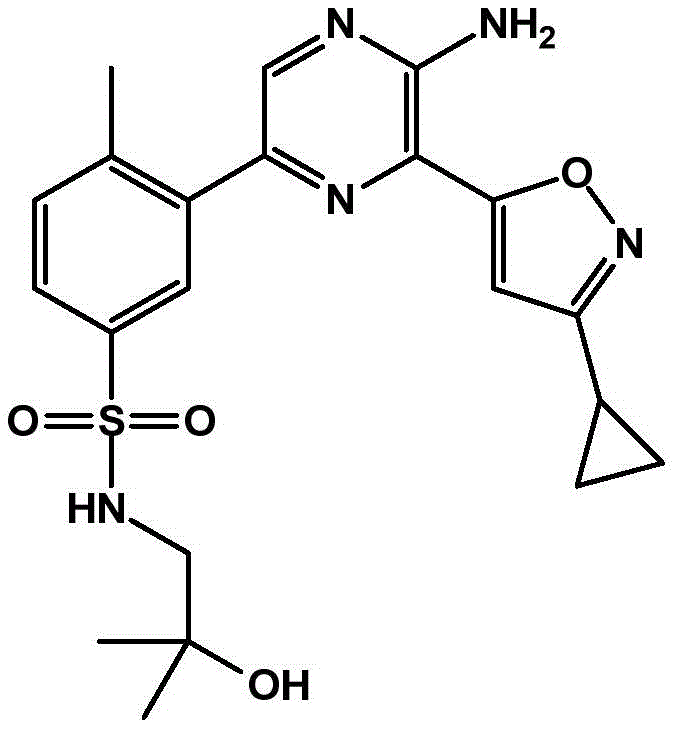
According to similar conditions used for the preparation of example 18, N- (2-hydroxy-2-methylpropyl) -4-methyl-3- (4,4,5, 5-tetramethyl-1, 3, 2-dioxaborolan-2-yl) benzenesulfonamide (intermediate B2) and 5-chloro-3- (3-cyclopropylisoxazol-5-yl) pyrazin-2-amine (intermediate C) were employed.
LCMS Rt 1.06mins MS M/z 444.4[ M + H ] +; method 2 minlowwphv 01.
1H NMR (400MHz, DMSO-d6) Δ 8.37(1H, s),7.86(1H, d),7.72(1H, dd),7.53(1H, d),7.47(1H, t),6.91(2H, br s),6.81(1H, s),4.39(1H, s),2.62(2H, d),2.46(3H, s),2.09(1H, multimodal), 1.06(6H, s),1.05(2H, multimodal), 0.90(2H, multimodal).
Example 80:
3- (5-amino-6- (4-methylthiazol-2-yl) pyrazin-2-yl) -N- (2-hydroxy-2-methylpropyl) -4-methylbenzenesulfonamide
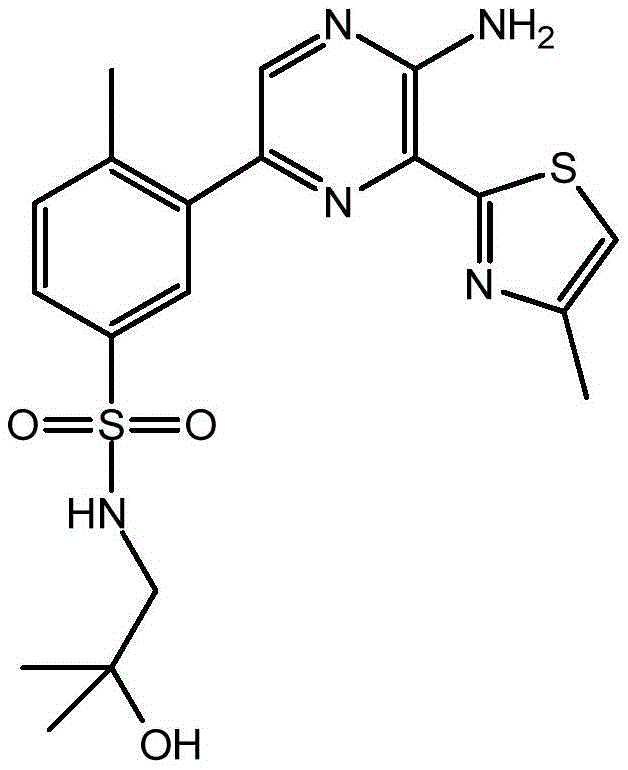
Step 1 3-amino-6-bromopyrazine-2-thioamide
A100 ml flask was charged with a solution of 3-amino-6-bromopyrazine-2-carboxamide (1.5g,6.91mmol) and Lawson's reagent (4.19g,10.37mmol) in THF (30 ml). The reaction mixture was heated to 70 ℃ for 2 hours. The mixture was concentrated under reduced pressure and purified by flash column chromatography on 24g silica gel eluting with Hex/EtOAc (0-40%). Mixing the required components, and concentrating under reduced pressure to obtain yellow solid;
LCMS Rt 0.88mins MS M/z 233.2[ M + H ] +; method 2 minlowwphv 01.
Step 2 5-bromo-3- (4-methylthiazol-2-yl) pyrazin-2-amine
A10 ml flask was charged with a solution of 3-amino-6-bromopyrazine-2-thioamide (step 1) (300mg,1.287mmol) and 1-chloropropan-2-one (0.154ml,1.931mmol) in EtOH (7ml) and stirred at 70 ℃ overnight. The reaction was extracted with EtOAc (10mL) and washed with sat2CO3(10ml), washed with brine (10ml), dried over magnesium sulphate and concentrated under reduced pressure. The mixture was purified by flash column chromatography through a12 g silica plug eluting with Hex/EtOAc (0-60%). Concentrating the obtained fraction under reduced pressure to obtain yellow solid;
LCMS Rt 1.23mins MS M/z 273.2[ M + H ] +; method 2 minlowwphv 01.
1H NMR(400MHz,DMSO-d6),δ8.27(1H,s),7.99(2H,br s),7.50(1H,m),2.48(3H,s)
Step 3,3- (5-amino-6- (4-methylthiazol-2-yl) pyrazin-2-yl) -N- (2-hydroxy-2-methylpropyl) -4-methylbenzenesulfonamide
According to similar conditions used for the preparation of example 18, N- (2-hydroxy-2-methylpropyl) -4-methyl-3- (4,4,5, 5-tetramethyl-1, 3, 2-dioxaborolan-2-yl) benzenesulfonamide (intermediate B2) and 5-bromo-3- (4-methylthiazol-2-yl) pyrazin-2-amine (step 2) are used
LCMS Rt 1.17mins MS M/z 434.1[ M + H ] +; method 2 minlowwphv 01.
1H NMR(400MHz,CDCl3) δ 8.24(1H, s),7.98(1H, d),7.81(1H, dd),7.49(1H, d),7.05(1H, s),4.90(1H, t),2.97(2H, d),2.59(3H, s),2.57(3H, s),1.29(6H, s). Three exchangeable protons were not observed.
Example 81:
3- (5-amino-6- (1-methyl-1H-1, 2, 3-triazol-4-yl) pyrazin-2-yl) -N- (2-hydroxy-2-methylpropyl) -4-methylbenzenesulfonamide
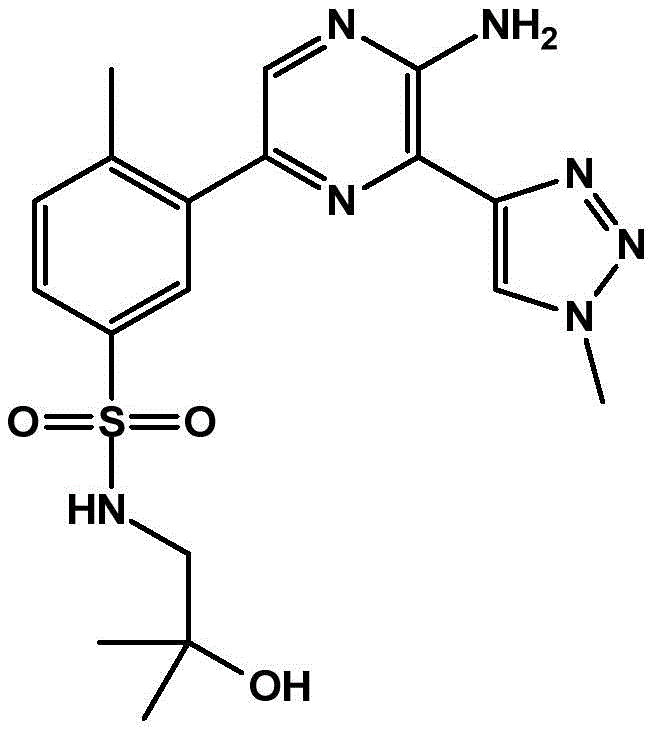
Step 1, 5-bromo-3- (1-methyl-1H-1, 2, 3-triazol-4-yl) pyrazin-2-amine,
to a suspension of 5-bromo-3- (1H-1,2, 3-triazol-4-yl) pyrazin-2-amine (see synthesis of intermediate C8, step 3) (1g,4.15mmol) and potassium carbonate (1.720g,12.45mmol) in THF (20ml) was added iodomethane (778 μ l,12.45mmol), and the reaction was stirred at rt for 1H. The resulting mixture was extracted into ethyl acetate, washed with brine, the organic layer was separated, dried over magnesium sulfate, filtered and the solvent was removed under reduced pressure. The crude product was dissolved in DMSO (10ml) and purified by mass-mediated preparative HPLC to give the target compound;
LCMS Rt 0.87mins MS M/z 255.3[ M + H ] +; method 2 minlowwphv 01.
1H NMR(400MHz,DMSO-d6),δ8.73(1H,s),8.12(1H,s),7.54(2H,br s),4.15(3H,s)。
Step 2 3- (5-amino-6- (1-methyl-1H-1, 2, 3-triazol-4-yl) pyrazin-2-yl) -N- (2-hydroxy-2-methylpropyl) -4-methylbenzenesulfonamide
To a 0.5-2 ml microwave vial was added a solution of N- (2-hydroxy-2-methylpropyl) -4-methyl-3- (4,4,5, 5-tetramethyl-1, 3, 2-dioxaborolan-2-yl) benzenesulfonamide (intermediate B2) (57.9mg,0.157mmol), 5-bromo-3- (1-methyl-1H-1, 2, 3-triazol-4-yl) pyrazin-2-amine (from step 1) (40mg,0.157mmol) and bis (triphenylphosphine) palladium dichloride (5.50mg,7.84 μmol) and sodium carbonate (0.196ml,0.392mmol) in DME (1.5 ml). The reaction was heated in a Biotage initiator microwave at 120 ℃ for 2 hours. The reaction was extracted into ethyl acetate, washed with water, brine, the organic layer was separated, dried over magnesium sulfate, filtered and the solvent was removed under reduced pressure. The crude product was loaded onto silica gel and purified by flash column chromatography eluting with TBME in methanol (0-10%) over a12 g silica gel short column. The desired fractions were combined and the solvent was removed under reduced pressure to give a pale yellow solid;
LCMS Rt 0.92mins MS M/z 418.6[ M + H ] +; method 2 minlowwphv 01.
1H NMR (400MHz, DMSO-d6) Δ 8.70(1H, s),8.22(1H, s),7.87(1H, d),7.69(1H, dd),7.52(3H, multimodal), 7.45(1H, broad, 4.40(1H, s),4.16(3H, s),2.62(2H, s),2.49(3H, s),1.06(6H, s).
Example 82:
3- (5-amino-6- (2-ethyl-2H-1, 2, 3-triazol-4-yl) pyrazin-2-yl) -N- (2-hydroxy-2-methylpropyl) -4-methylbenzenesulfonamide

Prepared according to a similar procedure to that used for the preparation of example 81, starting from 5-bromo-3- (2-ethyl-2H-1, 2, 3-triazol-4-yl) pyrazin-2-amine (intermediate C8B) and N- (2-hydroxy-2-methylpropyl) -4-methyl-3- (4,4,5, 5-tetramethyl-1, 3, 2-dioxaborolan-2-yl) benzenesulfonamide (intermediate B2).
LCMS Rt 1.05mins MS M/z 432.6[ M + H ] +; method 2 minlowwphv 01.
1H NMR(400MHz,DMSO-d6)δ8.34(1H,s),8.29(1H,s),7.90(1H,d),7.71(1H,dd),7.53(1H,d)7.47(1H, broad), 7.31(2H, broad), 4.59(2H, q),4.40(1H, s),2.63(2H, broad), 2.51(3H, s),1.54(3H, t),1.07(6H, s).
Example 83:
3- (5-amino-6- (1-ethyl-1H-1, 2, 3-triazol-4-yl) pyrazin-2-yl) -N- (2-hydroxy-2-methylpropyl) -4-methylbenzenesulfonamide
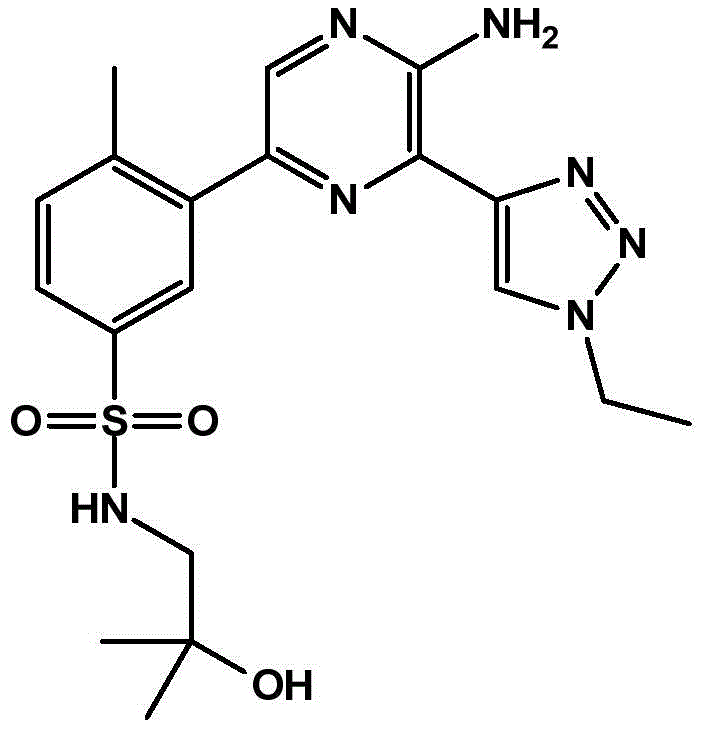
Prepared according to a similar procedure to that used for the preparation of example 81, starting from 5-bromo-3- (1-ethyl-1H-1, 2, 3-triazol-4-yl) pyrazin-2-amine (intermediate C8a) and N- (2-hydroxy-2-methylpropyl) -4-methyl-3- (4,4,5, 5-tetramethyl-1, 3, 2-dioxaborolan-2-yl) benzenesulfonamide (intermediate B2).
LCMS Rt 0.98mins MS M/z 432.6[ M + H ] +; method 2 minlowwphv 01.
1H NMR (400MHz, DMSO-d6) Δ 8.76(1H, s),8.21(1H, s),7.86(1H, d),7.70(1H, dd),7.54(3H, multimodal), 7.45(1H, broad), 4.50(2H, q),4.40(1H, s),2.62(2H, broad), 2.48(3H, s),1.50(3H, t),1.06(6H, s).
Example 84:
3- (5-amino-6- (2- (2,2, 2-trifluoroethyl) -2H-1,2, 3-triazol-4-yl) pyrazin-2-yl) -N- (2-hydroxy-2-methylpropyl) -4-methylbenzenesulfonamide

Prepared according to similar conditions used to prepare example 18, using N- (2-hydroxy-2-methylpropyl) -4-methyl-3- (4,4,5, 5-tetramethyl-1, 3, 2-dioxaborolan-2-yl) benzenesulfonamide (intermediate B2) and 5-bromo-3- (2- (2,2, 2-trifluoroethyl) -2H-1,2, 3-triazol-4-yl) pyrazin-2-amine (intermediate C8C);
LCMS Rt 1.11mins MS M/z 486.6[ M + H ] +; method 2 minlowwphv 01.
1H NMR (400MHz, DMSO-d6) Δ 8.53(1H, s),8.35(1H, s),7.90(1H, d),7.71(1H, dd),7.53(1H, d),7.47(1H, broad), 7.33(2H, broad), 5.73(2H, q),4.40(1H, s),2.63(2H, broad), 2.50(3H, s),1.06(6H,s)。
19F NMR(400MHz,DMSO-d6)δ-69.51(CF3)。
Example 85:
3- (5-amino-6- (2-methyl-2H-1, 2, 3-triazol-4-yl) pyrazin-2-yl) -N- (3-hydroxy-3-methylbutyl) -4-methylbenzenesulfonamide
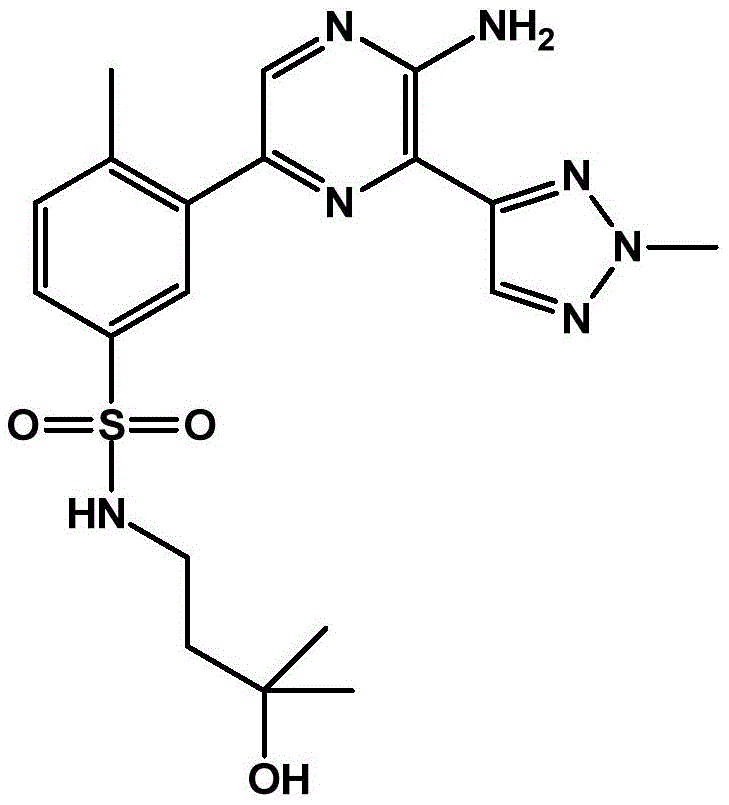
Prepared according to similar conditions used to prepare example 18, starting from N- (3-hydroxy-3-methylbutyl) -4-methyl-3- (4,4,5, 5-tetramethyl-1, 3, 2-dioxaborolan-2-yl) benzenesulfonamide (intermediate B3) and 5-bromo-3- (2-methyl-2H-1, 2, 3-triazol-4-yl) pyrazin-2-amine (intermediate C8);
LCMS Rt 0.98mins MS M/z 432.3[ M + H ] +; method 2 minlowwphv 01.
1H NMR (400MHz, DMSO-d6) Δ 8.32(1H, s),8.28(1H, s),7.86(1H, d),7.70(1H, dd),7.54(1H, d),7.43(1H, multimodal), 7.30(2H, broad), 4.30(3H, s),4.27(1H, s),2.83(2H, multimodal), 2.50(3H, s),1.51(2H, multimodal), 1.02(6H, s).
Example 87:
3- (5-amino-6- (2-methylthiazol-5-yl) pyrazin-2-yl) -N- ((1s,4s) -4-hydroxycyclohexyl) -4-methylbenzenesulfonamide
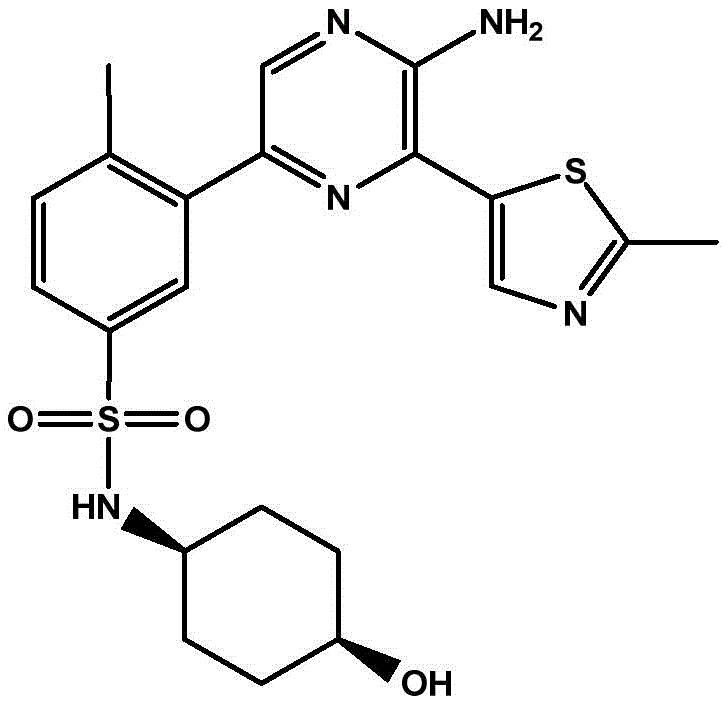
Prepared according to similar conditions used to prepare example 18, starting from N-cis-4-hydroxycyclohexyl) -4-methyl-3- (4,4,5, 5-tetramethyl-1, 3, 2-dioxaborolan-2-yl) benzenesulfonamide (intermediate B8) and 5-chloro-3- (2-methylthiazol-5-yl) pyrazin-2-amine (intermediate C6);
LCMS Rt 0.88mins MS M/z 460.2[ M + H ] +; method 2 minlowwphv 01.
Example 88:
3- (5-amino-6- (3-methylisoxazol-5-yl) pyrazin-2-yl) -N- (2-hydroxy-2-methylpropyl) -4-methylbenzenesulfonamide

Prepared according to similar conditions used to prepare example 18, starting from N- (2-hydroxy-2-methylpropyl) -4-methyl-3- (4,4,5, 5-tetramethyl-1, 3, 2-dioxaborolan-2-yl) benzenesulfonamide (intermediate B2) and 5-bromo-3- (3-methyl-isoxazol-5-yl) -pyrazin-2-ylamine (intermediate C3);
LCMS Rt 0.98mins MS M/z 418.4[ M + H ] +; method 2 minlowwphv 01.
1H NMR(400MHz,DMSO-d6)δ8.39(1H,s),7.89(1H,d),7.72(1H,dd),7.53(1H,d),7.47(1H,t),6.96(1H,s),6.93(2H,br s),4.39(1H,s),2.63(2H,d),2.48(3H,s),2.33(3H,s),1.06(6H,s)。
Example 89:
3- (5-amino-6- (3-methylisoxazol-5-yl) pyrazin-2-yl) -N- (3-hydroxy-3-methylbutyl) -4-methylbenzenesulfonamide

Prepared according to similar conditions used to prepare example 18, starting from N- (3-hydroxy-3-methylbutyl) -4-methyl-3- (4,4,5, 5-tetramethyl-1, 3, 2-dioxaborolan-2-yl) benzenesulfonamide (intermediate B3) and 5-bromo-3- (3-methyl-isoxazol-5-yl) -pyrazin-2-ylamine (intermediate C3);
LCMS Rt 1.00mins MS M/z 432.4[ M + H ] +; method 2 minlowwphv 01.
1H NMR (400MHz, DMSO-d6) Δ 8.39(1H, s),7.85(1H, d),7.71(1H, dd),7.55(1H, d),7.44(1H, t),6.96(1H, s),6.93(2H, br s),4.27(1H, s),2.84(2H, multimodal), 2.49(3H, s),2.33(3H, s),1.51(2H, multimodal), 1.02(6H, s).
Example 90:
3- (5-amino-6- (5-methyl-1, 3, 4-oxadiazol-2-yl) pyrazin-2-yl) -N- (2-hydroxy-2-methylpropyl) -4-methylbenzenesulfonamide
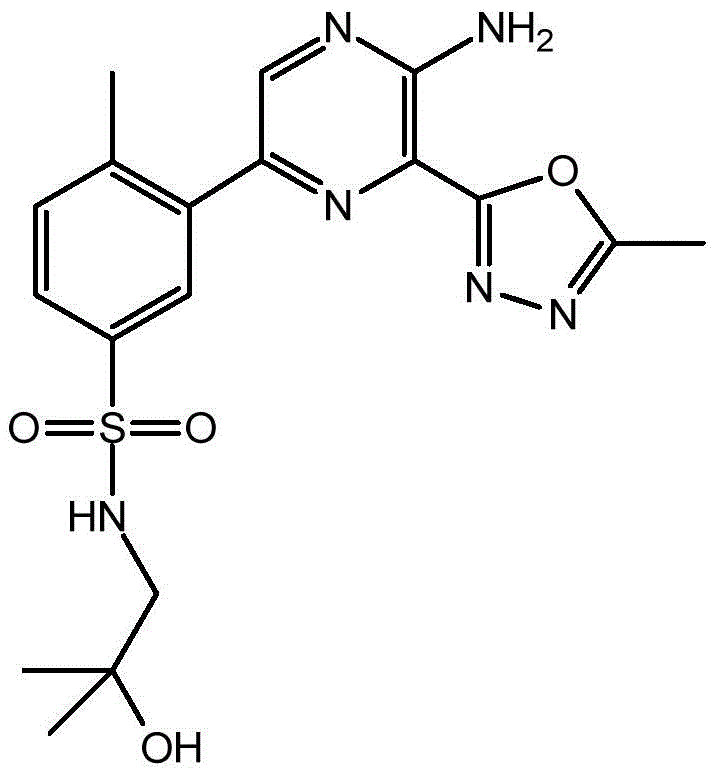
Prepared according to similar conditions used to prepare example 18, starting from N- (2-hydroxy-2-methylpropyl) -4-methyl-3- (4,4,5, 5-tetramethyl-1, 3, 2-dioxaborolan-2-yl) benzenesulfonamide (intermediate B2) and 5-bromo-3- (5-methyl- [1,3,4] oxadiazol-2-yl) -pyrazin-2-ylamine (intermediate C1);
LCMS Rt 0.89mins MS M/z 419.5[ M + H ] +; method 2 minlowwphv 01.
1H NMR (400MHz, DMSO-d6), Δ 8.50(1H, s),7.86(1H, m),7.75(1H, dd),7.71(2H, brs),7.55(1H, d),7.48(1H, t),4.39(1H, s),2.63(3H, s),2.62(2H, m),2.46(3H, s),1.06(6H, s). No three exchangeable protons were observed.
Example 91:
3- (5-amino-6- (5-cyclopropyl-1, 2, 4-oxadiazol-3-yl) pyrazin-2-yl) -N- (2-hydroxy-2-methylpropyl) -4-methylbenzenesulfonamide

Step 1-3-amino-6-bromo-N' -hydroxypyrazine-2-carboxamidine
To a 20ml flask was added a solution of 3-amino-6-bromopyrazine-2-carbonitrile (600mg,3.01mmol) in MeOH (12ml) which was cooled to 0 ℃. To the reaction mixture were added hydroxylamine hydrochloride (210mg,3.01mmol) and triethylamine (0.420ml,3.01mmol), and the mixture was warmed to room temperature to form a precipitate. The precipitate was filtered and washed with MeOH. The filtrate was concentrated under reduced pressure and the resulting solid was triturated in MeOH to afford a second crop of product. The solid was triturated again in MeOH and sonicated for 15mins until a suspension formed. Filtering the solid, and drying the solid in a vacuum box at 40 ℃ for 3 hours to obtain a target compound;
1H NMR(400MHz,DMSO-d6),δ10.38(1H,s),8.15(1H,s),7.64(2H,br s),5.88(2H,s)。
step 2 5-bromo-3- (5-cyclopropyl-1, 2, 4-oxadiazol-3-yl) pyrazin-2-amine
To a10 ml flask was added a solution of 3-amino-6-bromo-N' -hydroxypyrazine-2-carboxamidine (obtained from step 1) (290mg,1.250mmol) and triethylamine (0.192ml,1.375mmol) in DCM (7ml) and cooled to <5 ℃. To the stirred mixture was added dropwise cyclopropanecarbonyl chloride (0.113ml,1.250 mmol). The reaction mixture was warmed to room temperature and stirred for 1 hour. Cyclopropanecarbonyl chloride (0.028ml,0.312mmol) was added to the mixture at room temperature overnight. The resulting mixture was concentrated under reduced pressure to remove the solvent, and the obtained residue was triturated in MeOH. The solid was collected by filtration, dried in a vacuum oven at 40 ℃ for 3 hours, then mixed with a solution of hexachloroethane (483mg,2.039mmol) in AcOH (6ml) and heated to 100 ℃ for 1 hour in a biotage initiator microwave. Hexachloroethane (241mg,1.020mmol) was added to the reaction mixture and the reaction was heated again in a microwave at 100 ℃ for 1 hour. The reaction was neutralized by addition of NaOH (1M) and extracted with EtOAc. The organic extracts were combined, washed with brine, dried over magnesium sulfate and concentrated under reduced pressure. Drying the obtained light orange solid in a vacuum oven at 40 ℃ for 3 hours to obtain a target compound;
LCMS Rt 0.93mins MS M/z 282.0[ M + H ] +; method 2minLowpH.
1H NMR(400MHz,DMSO-d6),δ8.37(1H,s),7.34(2H,br s),2.46(1H,m),1.35(2H,m),1.25(2H,m)
Step 3- (5-amino-6- (5-cyclopropyl-1, 2, 4-oxadiazol-3-yl) pyrazin-2-yl) -N- (2-hydroxy-2-methylpropyl) -4-methylbenzenesulfonamide
To a 0.5-2 ml microwave vial was added N- (2-hydroxy-2-methylpropyl) -4-methyl-3- (4,4,5, 5-tetramethyl-1, 3, 2-dioxaborolan-2-yl) benzenesulfonamide (intermediate B2) (131mg,0.354mmol), 5-bromo-3- (5-cyclopropyl-1, 2, 4-oxadiazol-3-yl) pyrazin-2-amine (obtained from step 2) (100mg,0.354mmol), PdCl2(dppf)-CH2Cl2Adduct (14.47mg,0.018mmol) and Na2CO3(0.532ml,1.063mmol) in DME (1.4 ml). The reaction mixture was heated in a Biotage initiator microwave for 45mins at 120 ℃. The reaction was mixed with water (10ml) and extracted with EtOAc (10 ml). The combined organic extracts were then washed with brine (10ml), then dried over magnesium sulphate and concentrated under reduced pressure. The reaction was purified by flash column chromatography eluting with hexane/EtOAc (0-100%) on a12 g silica plug for 15 mins. Combining the desired fractions, concentrating under reduced pressure, and then concentrating under reduced pressureDrying in a vacuum box at 40 ℃ for 3 hours to obtain a target compound;
LCMS Rt 1.04mins MS M/z 445.4[ M + H ] +; method 2 minlowwphv 01.
1H NMR(400MHz,DMSO-d6),δ8.46(1H,s),7.86(1H,d),7.73(1H,dd),7.54(1H,d),7.48(1H,t),7.30(2H,s),4.39(1H,s),2.63(2H,d),2.47(1H,m),2.45(3H,s),1.32(2H,m),1.25(2H,m),1.06(6H,s)。
Example 92:
3- (5-amino-6- (3-methyl-1, 2, 4-oxadiazol-5-yl) pyrazin-2-yl) -N- (3-hydroxy-2, 2-dimethylpropyl) -4-methylbenzenesulfonamide

The title compound was prepared using 3-bromo-N- (3-hydroxy-2, 2-dimethylpropyl) -4-methylbenzenesulfonamide (intermediate a9) and 5-bromo-3- (3-methyl- [1,2,4] oxadiazol-5-yl) -pyrazin-2-ylamine (intermediate C2a) under similar conditions as in example 28.
LCMS Rt 0.95mins MS M/z 433.2[ M + H ] +; method 2minLowpH.
1H NMR (400MHz, DMSO-d6), Δ 8.61(1H, s),7.90(1H, d),7.81(2H, br s),7.74(1H, dd),7.56(1H, d),7.42(1H, t),4.44(1H, t),3.10(2H, d),2.58(2H, d),2.49(3H, s),0.77(6H, s). No ao was observed for one methyl group; possibly masked by the solvent peak.
Example 93:
3- (5-amino-6- (3-cyclopropyl-1, 2, 4-oxadiazol-5-yl) pyrazin-2-yl) -N- (3-hydroxy-2, 2-dimethylpropyl) -4-methylbenzenesulfonamide
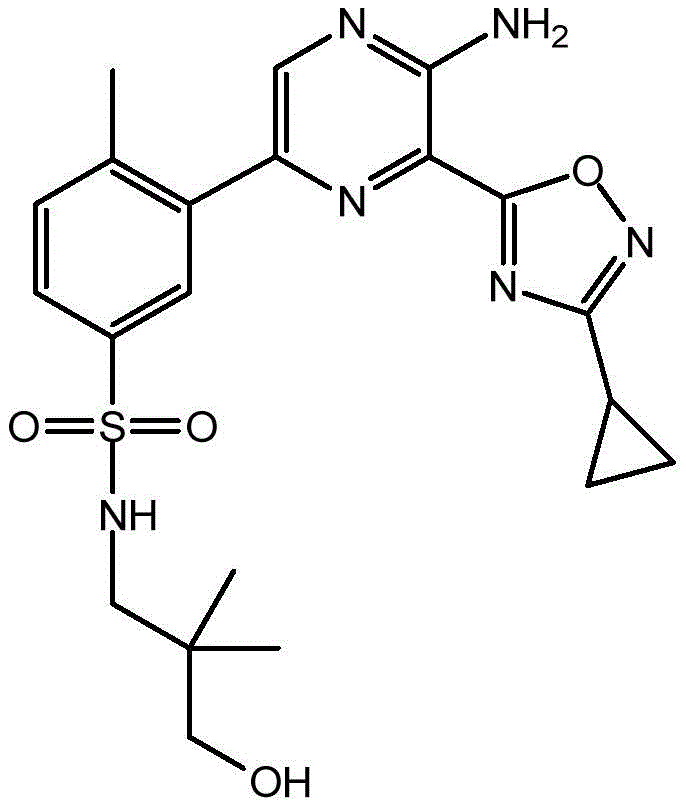
The title compound was prepared using 3-bromo-N- (3-hydroxy-2, 2-dimethylpropyl) -4-methylbenzenesulfonamide (intermediate a9) and 5-bromo-3- (3-cyclopropyl- [1,2,4] oxadiazol-5-yl) -pyrazin-2-ylamine (intermediate C2C) under similar conditions as in example 28.
LCMS: Rt 0.96 min; MS M/z 457.2[ M + H ] +; method 2minLowpH
1H NMR(400MHz,DMSO-d6),δ8.60(1H,s),7.89(1H,d),7.75(1H,dd),7.72(2H,brs),7.56(1H,d),7.41(1H,t),4.44(1H,t),3.10(2H,d),2.58(2H,d),2.48(3H,s),2.27(1H,m),1.14(4H,m),0.77(6H,s)。
Example 94:
3- (5-amino-6- (3-cyclopropyl-1, 2, 4-oxadiazol-5-yl) pyrazin-2-yl) -N- (((1s,3s) -3-hydroxycyclobutyl) methyl) -4-methylbenzenesulfonamide

Under similar conditions to example 28, the title compound was prepared using cis-3-bromo-N- (3-hydroxy-cyclobutylmethyl) -4-methyl-benzenesulfonamide (intermediate a10) and 5-bromo-3- (3-cyclopropyl- [1,2,4] oxadiazol-5-yl) -pyrazin-2-ylamine (intermediate C2C).
LCMS: Rt 0.96 min; MS M/z 457.2[ M + H ] +; method 2minLowpH
1H NMR(400MHz,DMSO-d6),8.60(1H,s),7.87(1H,d),7.73(1H,dd),7.71(2H,brs),
7.57(1H,d),4.89(1H,d),3.84(1H,m),2.74(2H,m),2.48(3H,s),2.26(1H,m),2.17(2H,m),1.74(2H,m),1.41(2H,m),1.13(4H,m)。
Example 95:
3- (5-amino-6- (3-cyclopropyl-1, 2, 4-oxadiazol-5-yl) pyrazin-2-yl) -N- (2-hydroxy-2-methylpropyl) -4-methylbenzenesulfonamide
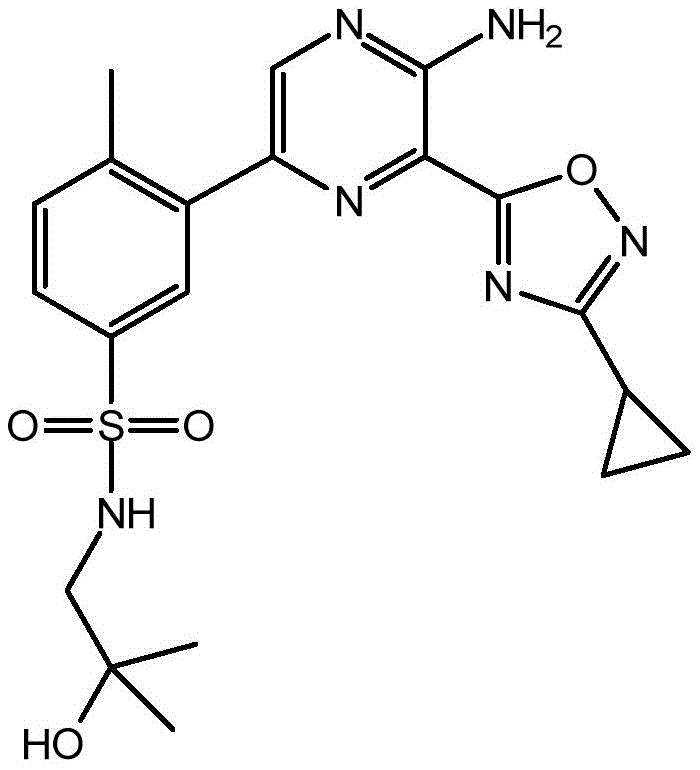
Under similar conditions to example 28, the title compound was prepared using N- (2-hydroxy-2-methyl-propyl) -4-methyl-3- (4,4,5, 5-tetramethyl [1,3,2] dioxaborolan-2-yl) benzenesulfonamide (intermediate a2) and 5-bromo-3- (3-cyclopropyl- [1,2,4] oxadiazol-5-yl) -pyrazin-2-ylamine (intermediate C2C);
LCMS Rt 0.98mins MS M/z 445.4[ M + H ] +; method 2minLowpH.
1H NMR(400MHz,DMSO-d6),δ8.60(1H,s),7.90(1H,s),7.75(1H,d),7.73(2H,br,s),7.55(1H,d),7.49(1H,t),4.39(1H,s),2.63(2H,d),2.48(3H,s),2.26(1H,m),1.14(4H,m),1.06(6H,s)。
Example 96:
3- (5-amino-6- (3-methyl-1, 2, 4-oxadiazol-5-yl) pyrazin-2-yl) -N- (((1s,3s) -3-hydroxycyclobutyl) methyl) -4-methylbenzenesulfonamide
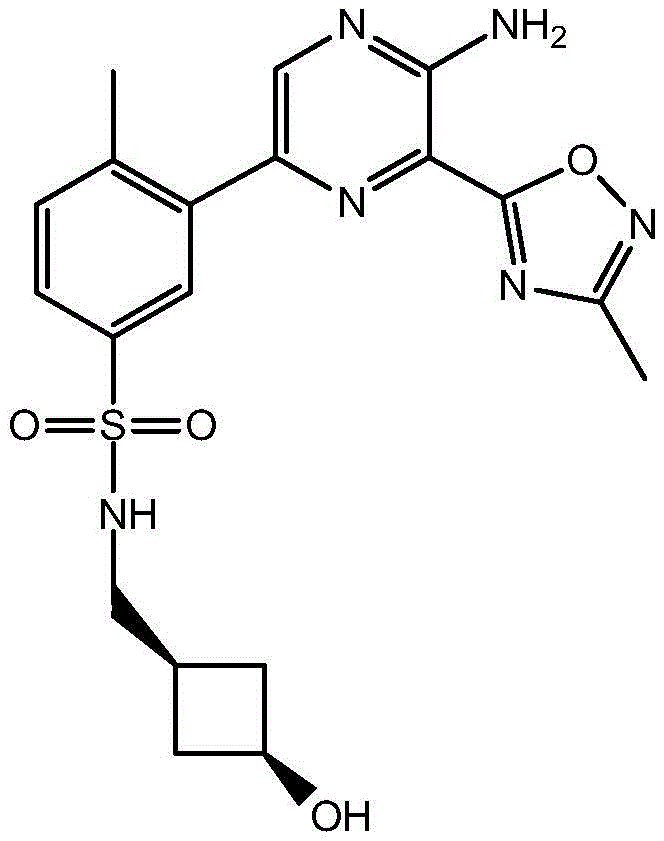
Under similar conditions to example 28, the title compound was prepared using cis-3-bromo-N- (3-hydroxy-cyclobutylmethyl) -4-methyl-benzenesulfonamide (intermediate a10) and 5-bromo-3- (3-methyl- [1,2,4] oxadiazol-5-yl) -pyrazin-2-ylamine (intermediate C2 a);
LCMS Rt 0.97mins MS M/z 431.4[ M + H ] +; method 2 minlowwphv 01.
1H NMR (400MHz, DMSO-d6) Δ 8.62(1H, s),7.88(1H, s),7.81(2H, br s),7.73(1H, dd),7.58(2H, m),4.89(1H, d),3.84(1H, m),2.75(2H, t),2.49(3H, s),2.16(2H, m),1.75(1H, m),1.41(2H, m). One methyl group was not observed in NMR; possibly masked by the solvent peak.
Example 97:
3- (5-amino-6- (3-isopropyl-1, 2, 4-oxadiazol-5-yl) pyrazin-2-yl) -N- (2-hydroxy-2-methylpropyl) -4-methylbenzenesulfonamide

Under similar conditions to example 18, the title compound was prepared using N- (2-hydroxy-2-methyl-propyl) -4-methyl-3- (4,4,5, 5-tetramethyl [1,3,2] dioxaborolan-2-yl) benzenesulfonamide (intermediate B2) and 5-bromo-3- (3-isopropyl- [1,2,4] oxadiazol-5-yl) -pyrazin-2-ylamine (intermediate C2B);
LCMS Rt 1.14mins MS M/z 445.3[ M + H ] +; method 2 minlowwphv 01.
1H NMR(400MHz,DMSO-d6)δ8.62(1H,s),7.91(1H,d),7.82(2H,br s),7.75(1H,dd),7.56(1H,d),7.49(1H,t),4.40(1H,s),3.22(1H,m),2.64(2H,d),2.49(3H,s),1.37(6H,d),1.06(6H,s)。
Example 98:
3- (5-amino-6- (1H-1,2, 4-triazol-1-yl) pyrazin-2-yl) -N- (1- (hydroxymethyl) cyclopropyl) -4-methylbenzenesulfonamide

The title compound was prepared using N- (1- (hydroxymethyl) cyclopropyl) -4-methyl-3- (4,4,5, 5-tetramethyl-1, 3, 2-dioxaborolan-2-yl) benzenesulfonamide (prepared in a two-step process according to similar conditions used to prepare intermediate B1) and 5-bromo-3- (1H-1,2, 4-triazol-1-yl) pyrazin-2-amine (intermediate C11) under similar conditions as in example 18.
LCMS Rt 0.88mins MS M/z 424.1[ M + Na ] +; method LowpH _ v002
1H NMR (400MHz, DMSO-d6) Δ 9.34(1H, s),8.43(1H, s),8.39(1H, s),8.18(1H, s),7.91(1H, d),7.72-7.69(1H, dd),7.54-7.52(1H, d),7.41(2H, broad s),4.67-4.64(1H, m),3.30-3.28(2H, d),2.52(3H, s),0.60-0.57(2H, m),0.53-0.50(2H, m).
Example 99:
3- (5-amino-6- (3-cyclopropylisoxazol-5-yl) pyrazin-2-yl) -N- (3-hydroxy-2, 2-dimethylpropyl) -4-methylbenzenesulfonamide

The title compound was prepared using 3-bromo-N- (3-hydroxy-2, 2-dimethylpropyl) -4-methylbenzenesulfonamide (intermediate a9) and 5-chloro-3- (3-cyclopropylisoxazol-5-yl) pyrazin-2-amine (intermediate C13) under similar conditions as in example 28;
LCMS Rt 1.11mins MS M/z 458.5[ M + H ] +; method 2minLowpH.
1H NMR (400MHz, DMSO-d6) Δ 8.37(1H, s),7.85(1H, d),7.71(1H, dd),7.53(1H, d),7.38(1H, t),6.91(2H, br s),6.81(1H, s),4.44(1H, multimodal), 3.09(2H, d),2.56(2H, d),2.46(3H, s),2.08(1H, multimodal), 1.06(2H, multimodal), 0.89(2H, multimodal), 0.77(6H, s).
Example 100:
3- (5-amino-6- (3-cyclopropylisoxazol-5-yl) pyrazin-2-yl) -N- (((1s,3s) -3-hydroxycyclobutyl) methyl) -4-methylbenzenesulfonamide

Under similar conditions to example 28, the title compound was prepared using cis-3-bromo-N- (3-hydroxy-cyclobutylmethyl) -4-methyl-benzenesulfonamide (intermediate a10) and 5-chloro-3- (3-cyclopropylisoxazol-5-yl) pyrazin-2-amine (intermediate C13).
LCMS Rt 0.94mins MS M/z 456.4[ M + H ] +; method 2minLowpH.
1H NMR (400MHz, DMSO-d6) Δ 8.37(1H, s),7.83(1H, d),7.70(1H, dd),7.57(1H, t),7.53(1H, d),6.91(2H, br s),6.81(1H, s),4.88(1H, d),3.84(1H, multimodal), 2.74(2H, t),2.46(3H, s),2.16(2H, multimodal), 2.09(1H, multimodal), 1.74(1H, multimodal), 1.40(2H, multimodal), 1.06(2H, multimodal), 0.89(2H, multimodal).
Example 101:
2- (3- (5-amino-6- (1H-1,2, 4-triazol-1-yl) pyrazin-2-yl) -4-methylphenylsulfonyl) -2-azaspiro [3.3] hept-6-ol

Step 1 2-azaspiro [3.3] hept-6-one
To a 25ml round bottom flask was added 6-oxo-2-azaspiro [3.3] heptane-2-carboxylic acid tert-butyl ester (600mg,2.84mmol) and 4M HCl in dioxane (10ml) to give a colorless solution.
The reaction was stirred at room temperature for 1 hour. A thick white suspension formed.
Filtering the crude reaction under reduced pressure to obtain a solid which can be used without further purification;
step 2- (3- (5-amino-6- (1H-1,2, 4-triazol-1-yl) pyrazin-2-yl) -4-methylphenylsulfonyl) -2-azaspiro [3.3] hept-6-one
To a 50ml round bottom flask was added a solution of 3- (5-amino-6- (1H-1,2, 4-triazol-1-yl) pyrazin-2-yl) -4-methylbenzene-1-sulfonyl chloride (intermediate E1) (200mg,0.570mmol) and TEA (0.167ml,1.197mmol) in DCM (15ml) to give a yellow suspension. To the stirred solution was added 2-azaspiro [3.3] heptan-6-one (from step 1) (84mg,0.570 mmol). The reaction mixture was stirred at room temperature for 30mins, at which time it became homogeneous. The reaction was diluted with DCM, washed with citric acid, brine, the organic layer was separated, dried over magnesium sulfate, filtered and the solvent removed under reduced pressure. The product was purified by mass-mediated preparative chromatography. The product fractions were combined, extracted with DCM, washed with saturated sodium bicarbonate solution, the organic layer was separated, dried over magnesium sulfate, filtered and the solvent removed under reduced pressure. The oil obtained was diluted with a minimum amount of ethyl acetate and evaporated at room temperature overnight to give the title compound as a white solid;
LCMS Rt 0.94mins MS M/z 426.3[ M + H ] +; method 2minLowpH.
1H NMR(400MHz,DMSO-d6)δ9.32(1H,s),8.45(1H,s),8.42(1H,s),7.85(1H,d),7.76(1H,dd),7.65(1H,d),7.40(2H,br s),3.94(4H,s),3.12(4H,s)。2.55(3H,s)。
Step 32- (3- (5-amino-6- (1H-1,2, 4-triazol-1-yl) pyrazin-2-yl) -4-methylphenylsulfonyl) -2-azaspiro [3.3] hept-6-ol
To a10 ml round bottom flask was added a solution of 2- (3- (5-amino-6- (1H-1,2, 4-triazol-1-yl) pyrazin-2-yl) -4-methylphenylsulfonyl) -2-azaspiro [3.3] hept-6-one (40mg,0.094mmol) and sodium borohydride (5.34mg,0.141mmol) in THF (2ml) to obtain a white suspension. After 5mins the mixture was extracted into ethyl acetate, washed with brine, the organic layer was separated, dried over magnesium sulphate, filtered and the solvent removed under reduced pressure. The yellow residue obtained was dissolved in DMSO and purified by mass-mediated preparative chromatography.
The target component was extracted into ethyl acetate, washed with sodium bicarbonate solution, the organic layer was separated, dried over magnesium sulfate, filtered and the solvent was removed under reduced pressure. The residue was dried in an oven at 40 ℃ overnight to give a white solid;
LCMS Rt 0.89mins MS M/z 428.4[ M + H ] +; method 2minLowpH.
1H NMR (400MHz, DMSO-d6) Δ 9.31(1H, s),8.44(1H, s),8.42(1H, s),7.83(1H, d),7.73(1H, dd),7.64(1H, d),7.40(2H, br s),4.97(1H, d),3.84(1H, multimodal), 3.71(2H, s),3.66(2H, s),2.55(3H, s),2.14(2H, multimodal), 1.76(2H, multimodal).
Example 102:
3- (1, 3-dimethyl-1H-pyrazol-4-yl) -5- (5- (3-methoxy-3-methylazetidin-1-ylsulfonyl) -2-methylphenyl) pyrazin-2-amine

To a solution of 3- (5-amino-6- (1, 3-dimethyl-1H-pyrazol-4-yl) pyrazin-2-yl) -4-methylbenzene-1-sulfonyl chloride (intermediate E3) (165mg,0.437mmol) and TEA (0.183ml,1.310mmol) in DCM (5ml) was added 3-methoxy-3-methylazetidine hydrochloride (60mg,0.437mmol), and the mixture was stirred at room temperature for 30 minutes. The resulting mixture was extracted with DCM, washed with water, brine, the organic layer was separated, dried over magnesium sulfate, filtered and the solvent was removed under reduced pressure. The crude product was loaded onto silica gel and purified by flash column chromatography eluting with TBME in methanol (0-10%) over a12 g silica gel short column. Combining the product components, and removing the solvent under reduced pressure to obtain a yellow oily substance;
LCMS Rt 0.95mins MS M/z 443.5[ M + H ] +; method 2 minlowwphv 01.
1H NMR(400MHz,DMSO-d6)δ8.12(1H,s),8.10(1H,s),7.84(1H,d),7.70(1H,dd),7.61(1H,d),6.31(2H,br s),3.82(3H,s),3.60(2H,d),3.55(2H,d),2.94(3H,s),2.53(3H,s),2.30(3H,s)。
Example 103:
3- (5-amino-6- (1H-pyrazol-1-yl) pyrazin-2-yl) -N- ((1r,4r) -4-hydroxycyclohexyl) -4-methylbenzenesulfonamide
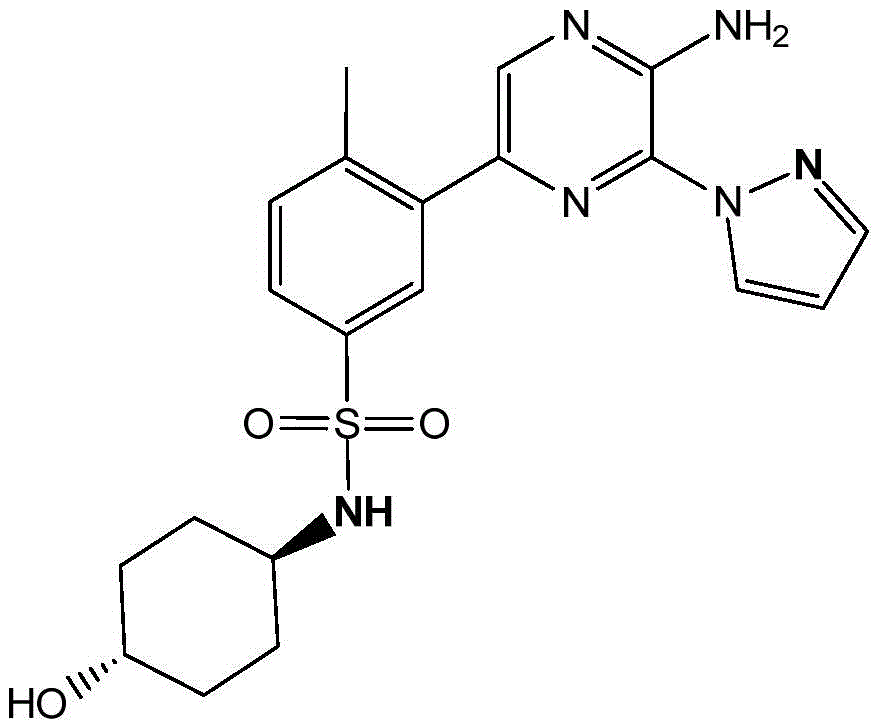
The title compound is prepared analogously to example 15, starting from pyrazole.
LCMS is Rt 0.92 mins; MS M/z 429.4[ M + H ] +; the method comprises the following steps: 2minLC _ v003
Example 106:
(R) -3- (5-amino-6- (1, 3-dimethyl-1H-pyrazol-4-yl) pyrazin-2-yl) -4-methyl-N- (pyrrolidin-2-ylmethyl) benzenesulfonamide hydrochloride
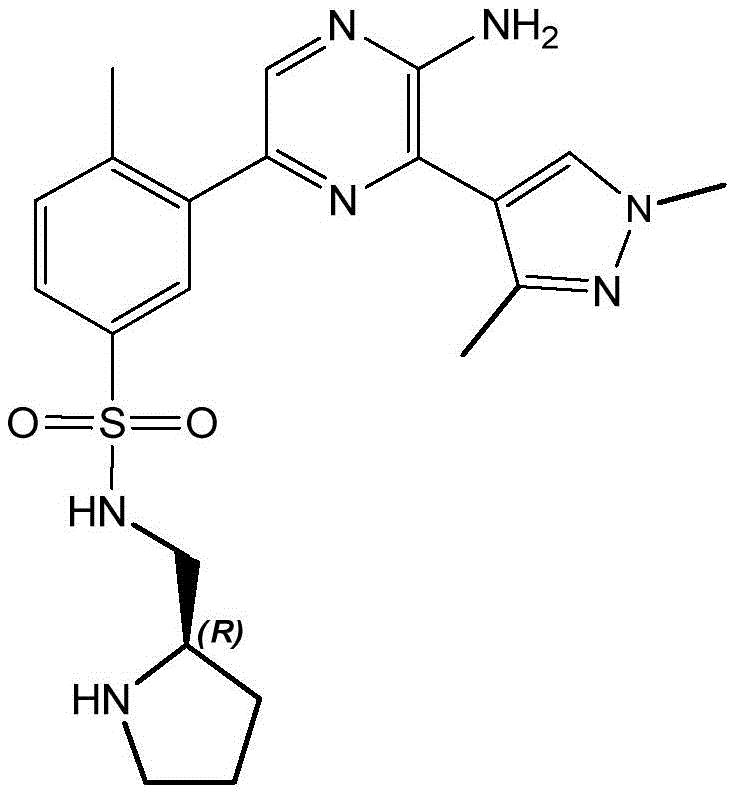
The title compound was prepared analogously to example 128 using 3- (5-amino-6- (1, 3-dimethyl-1H-pyrazol-4-yl) pyrazin-2-yl) -4-methylbenzene-1-sulfonyl chloride (intermediate E3) and (R) -2- (aminomethyl) pyrrolidine-1-carboxylic acid tert-butyl ester as starting materials. The product obtained was stirred in DCM: TFA 3:1v/v at room temperature for 4 hours to obtain the title compound. After purification, the hydrochloride salt was prepared by treatment with 4N HCl in dioxane.
LCMS, Rt 0.65 mins; MS M/z 442.3[ M + H ] +; the method comprises the following steps: 2minLowpHv03
Example 107:
3- (5-amino-6- (2-cyclopropylthiazol-5-yl) pyrazin-2-yl) -N- (3-hydroxy-3-methylbutyl) -4-methylbenzenesulfonamide
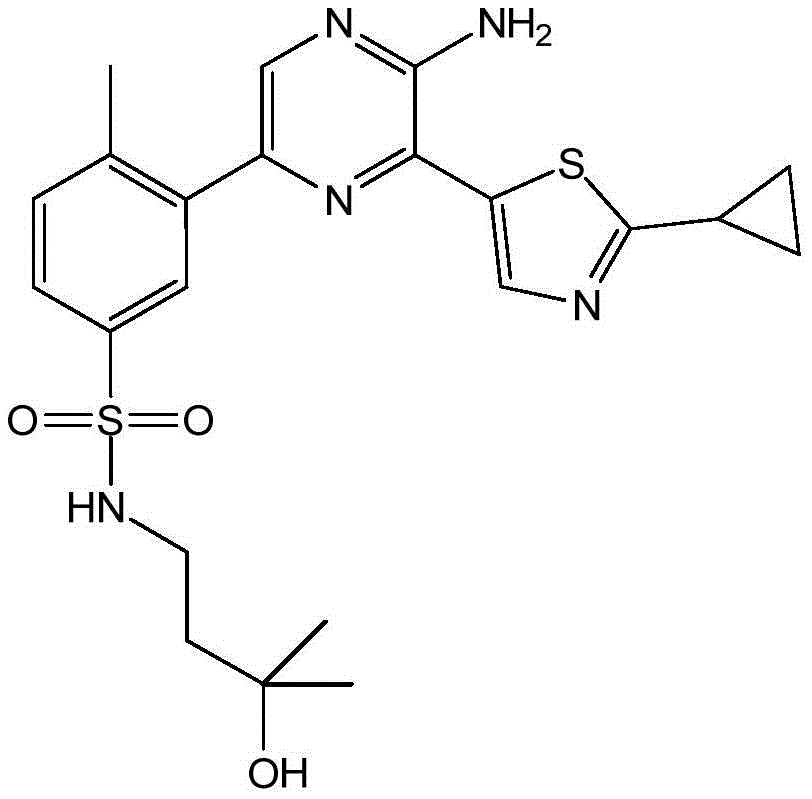
5-bromo-2-cyclopropylthiazole (80mg,0.390mmol), KOAc (57.4mg,0.585mmol), PdCl were reacted under a nitrogen atmosphere2(dppf).CH2Cl2A mixture of the adduct (15.91mg,0.019mmol) and bis (pinacolato) diboron (109mg,0.429mmol) in DME (1949. mu.L) was heated at 90 ℃ for 14 h. To the reaction mixture was added 3- (5-amino-6-chloropyrazin-2-yl) -N- (3-hydroxy-3-methylbutyl) -4-methylbenzenesulfonamide (intermediate D3) (150mg,0.390mmol), followed by Na2CO3(585. mu.L, 1.169mmol) and PdCl2(dppf).CH2Cl2Adduct (15.91mg,0.019 mmol). The resulting mixture was heated in a microwave at 120 ℃ for 45 minutes. Add the mixture to sat2CO3In (50ml), the product was extracted with EtOAc (2X 50 ml). The organic extract was washed with brineWashed, dried over magnesium sulfate and concentrated under reduced pressure. The crude product was purified by flash column chromatography using modified 0-10% of (2M NH)3MeOH solution) on a12 g silica gel column, followed by mass-mediated preparative chromatography to afford the target compound;
LCMS, Rt 0.97 mins; MS M/z 472.3[ M-H ] -; the method comprises the following steps: 2minLowpH
Example 108:
3- (5-amino-6- (thiazol-4-yl) pyrazin-2-yl) -N- (3-hydroxy-3-methylbutyl) -4-methylbenzenesulfonamide

To a solution of 3- (5-amino-6-chloropyrazin-2-yl) -N- (3-hydroxy-3-methylbutyl) -4-methylbenzenesulfonamide (intermediate D3) (100mg,0.260mmol) in THF (1299 μ l) was added 4- (tributylstannyl) thiazole (146mg,0.390mmol), CuI (2.474mg,0.013mmol), and Pd-118(8.47mg,0.013 mmol). The reaction mixture was heated in a microwave at 100 ℃ for 1 hour. Another portion of 4- (tributylstannyl) thiazole (146mg,0.390mmol), Pd-118(8.47mg,0.013mmol) and CuI (2.474mg,0.013mmol) were added and the reaction mixture was microwaved at 150 ℃ for 3 hours. The resulting mixture was added to water (50ml) and the product extracted with EtOAc (2X 40 ml). The organic extracts were washed with brine, dried over magnesium sulfate and washed with brine The Si-TMT resin removed Pd. The solid was removed by filtration, washed with EtOAc, and the filtrate was concentrated under reduced pressure. The crude product was purified by flash column chromatography using 0-10% of (2M NH)3MeOH solution) was eluted onto a12 g silica gel column, followed by purification by mass-directed reverse-phase preparative chromatography to afford the title compound as a white solid;
LCMS is Rt 1.04 mins; MS M/z 432.2[ M-H ] -; the method comprises the following steps: 2minLowpHv01
Example 109:
3- (5-amino-6- (3-cyclopropyl-1H-1, 2, 4-triazol-1-yl) pyrazin-2-yl) -N- (2-hydroxy-2-methylpropyl) -4-methylbenzenesulfonamide

To a solution of N- (2-hydroxy-2-methylpropyl) -4-methyl-3- (4,4,5, 5-tetramethyl-1, 3, 2-dioxaborolan-2-yl) benzenesulfonamide (intermediate B2) (318mg,0.861mmol) in DME (3913. mu.L) was added 5-bromo-3- (3-cyclopropyl-1H-1, 2, 4-triazol-1-yl) pyrazin-2-amine (prepared analogously to intermediate C11, starting with 3-cyclopropyl-1H-1, 2, 4-triazole) (220mg,0.783mmol), bis (triphenylphosphine) palladium (II) dichloride (27.5mg,0.039mmol) and Na2CO3(aq.2.0M) (1174. mu.L, 2.348 mmol). The reaction mixture was heated at 120 ℃ for 30mins with microwave heating.
The mixture was added to water (50ml) and the product extracted with EtOAc (2X 60 ml). The organic extracts were washed with brine, dried over magnesium sulfate and Pd removed using Si-TMT resin. The solid was removed by filtration, washed with EtOAc and concentrated under reduced pressure. The crude product was purified by flash column chromatography using 0-10% of (2M NH)3MeOH solution) was eluted onto a12 g silica gel column. The solid obtained was recrystallized from hot EtOAc (. about.3 mL). Hot TBME (. about.3 ml) was added slowly. Upon cooling, the yellow solid crystallized. It was collected by filtration and dried to obtain the target compound as a pale yellow solid;
LCMS is Rt 1.00 mins; MS M/z 444.6[ M + H ] +; the method comprises the following steps: 2minLowpHv01
Example 110:
3- (5-amino-6- (2-methoxythiazol-4-yl) pyrazin-2-yl) -N- (3-hydroxy-3-methylbutyl) -4-methylbenzenesulfonamide

Prepared in a similar manner to example 108, starting from 2-methoxy-4- (tributylstannyl) thiazole;
LCMS is Rt 1.13 mins; MS M/z 464.5[ M + H ] +; method 2minLowpHv01
Example 111:
3- (5-amino-6- (4-methyl-1H-pyrazol-1-yl) pyrazin-2-yl) -N- ((1r,4r) -4-hydroxycyclohexyl) -4-methylbenzenesulfonamide

The objective compound was prepared according to a similar manner to example 15, using 4-methyl-1H-pyrazole as a starting material.
LCMS is Rt 1.06 mins; MS M/z 443.3[ M + H ] +; the method comprises the following steps: 2minLC _ v003
Example 112:
3- (5-amino-6- (1H-1,2, 4-triazol-1-yl) pyrazin-2-yl) -N-ethoxy-4-methylbenzenesulfonamide
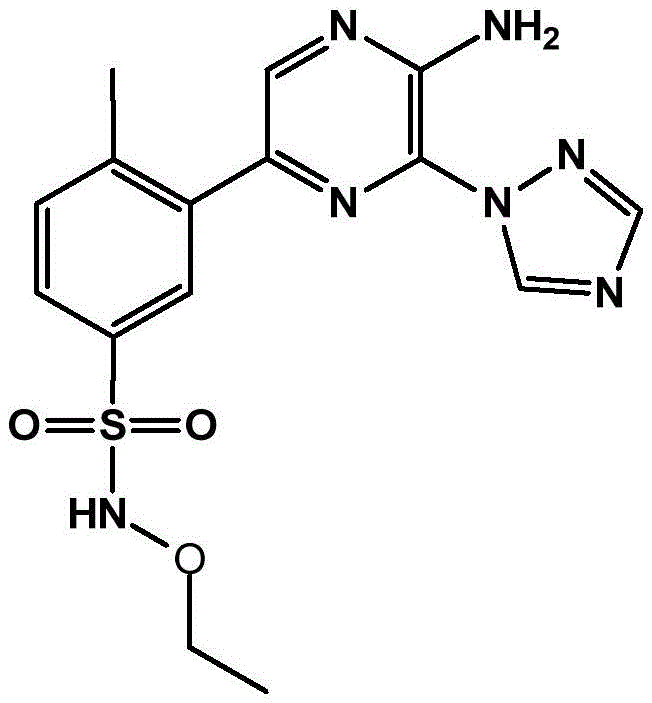
A mixture of 3- (5-amino-6- (1H-1,2, 4-triazol-1-yl) pyrazin-2-yl) -4-methylbenzene-1-sulfonyl chloride (intermediate E1) (100mg,0.285mmol) and O-ethylhydroxylamine hydrochloride (83mg,0.855mmol) in DCM (5 ml). Pyridine (1ml,12.36mmol) was added to the reaction mixture, which was stirred at room temperature for 1 hr. The reaction mixture was washed with 1M HCl, brine and dried over magnesium sulfate. The solvent was removed under reduced pressure. The crude product was dissolved in MeOH and water was added until the product precipitated out. Filtering, washing with water and hexane to obtain the target compound;
LCMS Rt 3.96 min; MS M/z 376.4[ M + H ] +; method 10minLowpHv01
1H NMR(400MHz,DMSO-d6)δ10.36(1H,s),9.33(1H,s),8.43(1H,s),8.40(1H,s),7.93(1H,m),7.76(1H,m),7.59(1H,m),7.40(2H,s),3.92(2H,q),2.53(3H,s),1.10(3H,t)。
The following examples were prepared in a similar manner to example 112, using 3- (5-amino-6- (1H-1,2, 4-triazol-1-yl) pyrazin-2-yl) -4-methylbenzene-1-sulfonyl chloride (intermediate E1) and the appropriate amine (all commercially available unless otherwise specified) as starting materials.
Example 112.1:
3- (5-amino-6- (1H-1,2, 4-triazol-1-yl) pyrazin-2-yl) -N- (tert-butoxy) -4-methylbenzenesulfonamide

LCMS Rt 4.48 min; MS M/z 404.5[ M + H ] +; method 10minLowpHv01
1H NMR(400MHz,DMSO-d6)δ9.81(1H,s),9.32(1H,s),8.42(1H,s),8.39(1H,s),7.92(1H,m),7.75(1H,m),7.57(1H,m),7.39(2H,s),2.53(3H,s),1.16(9H,s)。
Example 112.2:
3- (5-amino-6- (1H-1,2, 4-triazol-1-yl) pyrazin-2-yl) -N- (2- (dimethylamino) ethoxy) -4-methylbenzenesulfonamide

LCMS Rt 2.24 min; MS M/z 419.7[ M + H ] +; method 10minLowpHv01
1H NMR(400MHz,MeOD-d4)δppm 9.35(1H,s),8.33(2H,s),8.02(1H,d),7.86(1H,dd),7.57(1H,d),4.14(2H,t),2.68(2H,t),2.58(3H,s),2.30(6H,s)。
Example 112.3:
3- (5-amino-6- (1H-1,2, 4-triazol-1-yl) pyrazin-2-yl) -N-isopropoxy-4-methylbenzenesulfonamide

LCMS Rt 4.23 min; MS M/z 390.5[ M + H ] +; method 10minLowpHv01
1H NMR(400MHz,DMSO-d6)δ10.16(1H,s),9.32(1H,s),8.42(1H,s),8.39(1H,s),7.92(1H,d),7.77(1H,dd),7.59(1H,d),7.40(2H,s),4.11(1H,m),2.53(3H,s),1.11(6H,d)。
Example 112.4:
3- (5-amino-6- (1H-1,2, 4-triazol-1-yl) pyrazin-2-yl) -N-isobutoxy-4-methylbenzenesulfonamide

LCMS Rt 4.62 min; MS M/z 404.5[ M + H ] +; method 10minLowpHv01
1H NMR(400MHz,DMSO-d6)δ10.37(1H,s),9.32(1H,s),8.42(1H,s),8.39(1H,s),7.93(1H,d),7.77(1H,dd),7.60(1H,d),7.40(2H,s),3.67(2H,d),2.53(3H,m),1.79-1.89(1H,m),0.83(6H,d)。
Example 112.5:
3- (5-amino-6- (1H-1,2, 4-triazol-1-yl) pyrazin-2-yl) -4-methyl-N- ((tetrahydrofuran-3-yl) oxy) benzenesulfonamide

Preparation from O- (tetrahydrofuran-3-yl) hydroxylamine (intermediate F)
LCMS Rt 3.60 min; MS M/z 418.3[ M + H ] +; method 10minLowpHv01
1H NMR(400MHz,DMSO-d6)δ10.44(1H,s),9.32(1H,s),8.42(1H,s),8.39(1H,s),7.91(1H,d),7.77(1H,dd),7.60(1H,d),7.40(2H,s),4.68(1H,m),3.79(1H,d),3.63(3H,m),2.53(3H,s),1.97(2H,m)。
Example 113:
5- (5-amino-6- (2-methylthiazol-5-yl) pyrazin-2-yl) -2-fluoro-N- (3-hydroxypropyl) -4-methylbenzenesulfonamide
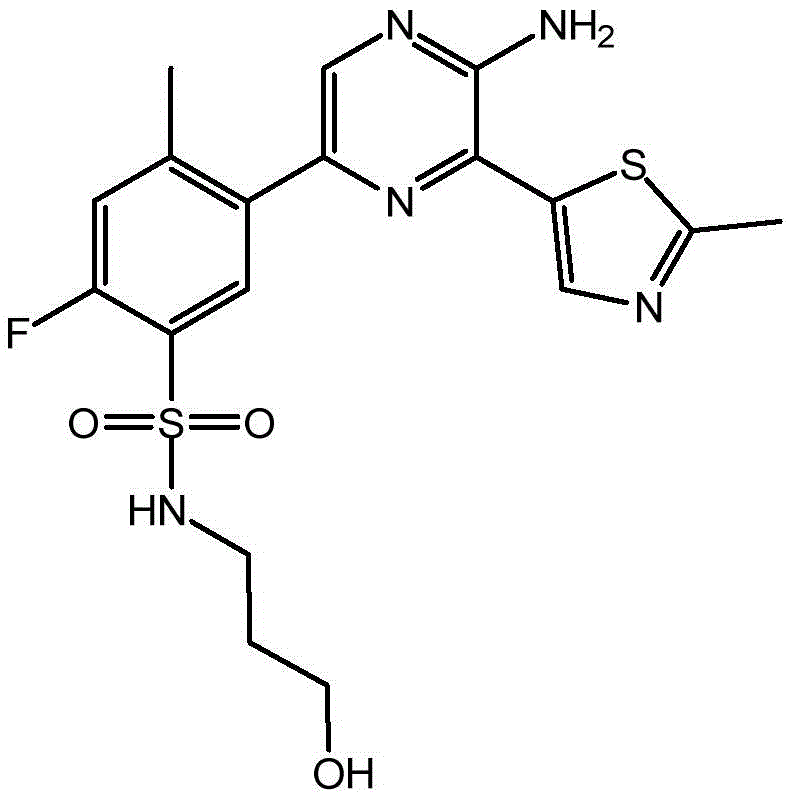
Prepared according to a similar method to example 11 from 5- (5-amino-6-chloropyrazin-2-yl) -2-fluoro-N- (3-hydroxypropyl) -4-methylbenzenesulfonamide (intermediate D5) and 2-methyl-5- (4,4,5, 5-tetramethyl-1, 3, 2-dioxaborolan-2-yl) thiazole. The solid obtained was in EtOAc/Et2Crystallization in O (Compound dissolved in minimum Hot EtOAc, Using Et2O dilution). Cooling the obtained solution, filtering and collecting solid, washing with a small amount of diethyl ether, and drying to obtain a yellow solid target compound;
LCMS is Rt 0.83 mins; MS M/z 438.1[ M + H ] +; the method comprises the following steps: 2minLowpH
1H NMR(400MHz,DMSO-d6)δ8.27(1H,s),8.20(1H,s),7.81(1H,br s),7.78(1H,d),7.44(1H,d),6.72(2H,s),4.42(1H,br m),3.38(2H,m),2.93(2H,m),2.68(3H,s),2.47(3H,s),1.56(2H,m)。
Example 114:
5- (5-amino-6- (1-methyl-1H-pyrazol-4-yl) pyrazin-2-yl) -2-fluoro-N- (3-hydroxypropyl) -4-methylbenzenesulfonamide

Prepared according to a similar method to example 11 from 5- (5-amino-6-chloropyrazin-2-yl) -2-fluoro-N- (3-hydroxypropyl) -4-methylbenzenesulfonamide (intermediate D5) and 1-methyl-4- (4,4,5, 5-tetramethyl-1, 3, 2-dioxaborolan-2-yl) -1H-pyrazole. The solid obtained was in EtOAc/Et2Crystallization in O (Compound dissolved in minimum Hot EtOAc, Using Et2O dilution). Cooling the obtained solution, filtering and collecting a solid, washing the solid with a small amount of diethyl ether, and drying to obtain a target compound which is a white solid;
LCMS is Rt 0.75 mins; MS M/z 421.2[ M + H ] +; the method comprises the following steps: 2minLowpH
1H NMR(400MHz,DMSO-d6)δ8.31(1H,s),8.06(1H,s),7.98(1H,s),7.80(1H,brs),7.77(1H,d),7.42(1H,d),6.31(2H,s),4.42(1H,br s),3.91(3H,s),3.38(2H,t),2.92(2H,t),2.46(3H,s),1.56(2H,m)。
Example 115:
5- (5-amino-6- (1-methyl-1H-pyrazol-4-yl) pyrazin-2-yl) -2-fluoro-N- (3-hydroxy-3-methylbutyl) -4-methylbenzenesulfonamide

Prepared according to an analogous method to example 11 from 1-methyl-4- (4,4,5, 5-tetramethyl-1, 3, 2-dioxaborolan-2-yl) -1H-pyrazole and 5- (5-amino-6-chloropyrazin-2-yl) -2-fluoro-N- (3-hydroxy-3-methylbutyl) -4-methylbenzenesulfonamide (prepared according to an analogous method to intermediate D5 using a two-step process).
The solid obtained was in EtOAc/Et2Crystallization in O (Compound dissolved in minimum Hot EtOAc, Using Et2O dilution). Cooling the obtained solution, filtering and collecting a solid, washing the solid with a small amount of diethyl ether, and drying to obtain a target compound which is a white solid;
LCMS; rt 0.82 mins; MS M/z 449.2[ M + H ] +; the method comprises the following steps: 2minLowpH
Example 116:
5- (5-amino-6- (1H-1,2, 4-triazol-1-yl) pyrazin-2-yl) -2-fluoro-N- (3-hydroxy-3-methylbutyl) -4-methylbenzenesulfonamide

The title compound was prepared using 5- (5-amino-6-chloropyrazin-2-yl) -2-fluoro-N- (3-hydroxy-3-methylbutyl) -4-methylbenzenesulfonamide (prepared in a two-step process according to an analogous procedure to intermediate a12) and 5-chloro-3- (1H-1,2, 4-triazol-1-yl) pyrazin-2-amine (intermediate C5) under analogous conditions to example 6. The solid obtained was in EtOAc/Et2Crystallization in O (Compound dissolved in minimum Hot EtOAc, Using Et2O dilution). Cooling the obtained solution, filtering and collecting a solid, washing the solid with a small amount of diethyl ether, and drying to obtain a target compound which is a white solid;
LCMS: Rt 0.84 mins; MS M/z 436.3[ M + H ] +; the method comprises the following steps: 2minLC _ v003
Example 117:
3- (5-amino-6- (3- ((dimethylamino) methyl) -1H-1,2, 4-triazol-1-yl) pyrazin-2-yl) -N- (2-hydroxy-2-methylpropyl) -4-methylbenzenesulfonamide hydrochloride

Step 1N, N-dimethyl-1- (1H-1,2, 4-triazol-3-yl) methylamine
To 3- (chloromethyl) -1H-1,2, 4-triazole (400mg,2.60mmol) was added dimethylamine (2.0M in THF) (51.900ml,10.38mmol), and the reaction mixture was stirred at room temperature for 24H. Concentrating the mixtureReduced to dryness and the crude product loaded at 2X 10g On a short column of SCX-2, rinsing with MeOH (50ml) and the product 2.0M NH3Eluted with MeOH (50 ml). Concentrating the methanol solution of ammonia to obtain a target compound;
1H NMR(400MHz,DMSO-d6)δ3.51(2H,s),2.16(6H,s)。
step 2 5-bromo-3- (3- ((dimethylamino) methyl) -1H-1,2, 4-triazol-1-yl) pyrazin-2-amine
5-bromo-3-chloropyrazin-2-amine (376mg,1.801mmol), N-dimethyl-1- (1H-1,2, 4-triazol-3-yl) methylamine (from step 1) (250mg,1.982mmol), Cs2CO3A mixture of (1174mg,3.60mmol) of DMF (9007. mu.l) was heated to 60 ℃ for 16 h. The mixture was concentrated to dryness, added to water (50ml) and the product extracted with EtOAc (4X 40 ml). The organic extracts were washed with brine, dried over magnesium sulfate and concentrated under reduced pressure to give the target compound as an orange solid which was used directly in the next step without further purification;
LCMS: Rt 0.84 mins; MS M/z 298.4[ M + H ] +; the method comprises the following steps: 2minLowpHv01
Step 3- (5-amino-6- (3- ((dimethylamino) methyl) -1H-1,2, 4-triazol-1-yl) pyrazin-2-yl) -N- (2-hydroxy-2-methylpropyl) -4-methylbenzenesulfonamide hydrochloride
To a solution of N- (2-hydroxy-2-methylpropyl) -4-methyl-3- (4,4,5, 5-tetramethyl-1, 3, 2-dioxaborolan-2-yl) benzenesulfonamide (intermediate B2) (235mg,0.636mmol) in DME (2652. mu.l) was added 5-bromo-3- (3- ((dimethylamino) methyl) -1H-1,2, 4-triazol-1-yl) pyrazin-2-amine (obtained from step 2) (158mg,0.530mmol), bis (triphenylphosphine) palladium (II) dichloride (18.61mg,0.027mmol) and Na2CO3(aq.2.0M) (795. mu.l, 1.591 mmol). The reaction mixture was heated in a microwave at 120 ℃ for 60 minutes. The mixture was added to water (50ml) and the product extracted with EtOAc (2X 50 ml). The organic extracts were washed with brine, dried over magnesium sulfate and Pd was removed with Si-TMT resin. The solid was removed by filtration, washed with EtOAc and concentrated under reduced pressure. Purifying the crude product by flash column chromatography using 0-10% of a solvent(2M NH3MeOH solution) was eluted onto a12 g Si-column. The resulting oil was dissolved in a small amount of MeOH (1ml) and 4.0M HCl in dioxane (1ml) was added. The mixture was concentrated to dryness and the solid obtained was recrystallized from hot EtOH (. about.4 ml). On cooling, a white solid crystallized. It was collected by filtration and dried to obtain the target compound as a pale yellow solid;
LCMS is Rt 0.66 mins; MS M/z 461.4[ M + H ] +; the method comprises the following steps: 2minLowpHv01
1H NMR (400MHz, DMSO-d6) Δ 10.76(1H, br s),9.42(1H, s),8.45(1H, s),7.93(1H, s),7.73(1H, d),7.58-7.49(2H, m),7.46(2H, s),4.58(2H, s),4.44(1H, br s),2.89(6H, s),2.62(1H, d),2.51(3H, s under DMSO), 1.07(6H, s).
Example 118:
5- (2-methyl-5- (3- (trifluoromethyl) piperazin-1-ylsulfonyl) phenyl) -3- (2-methylthiazol-5-yl) pyrazin-2-amine
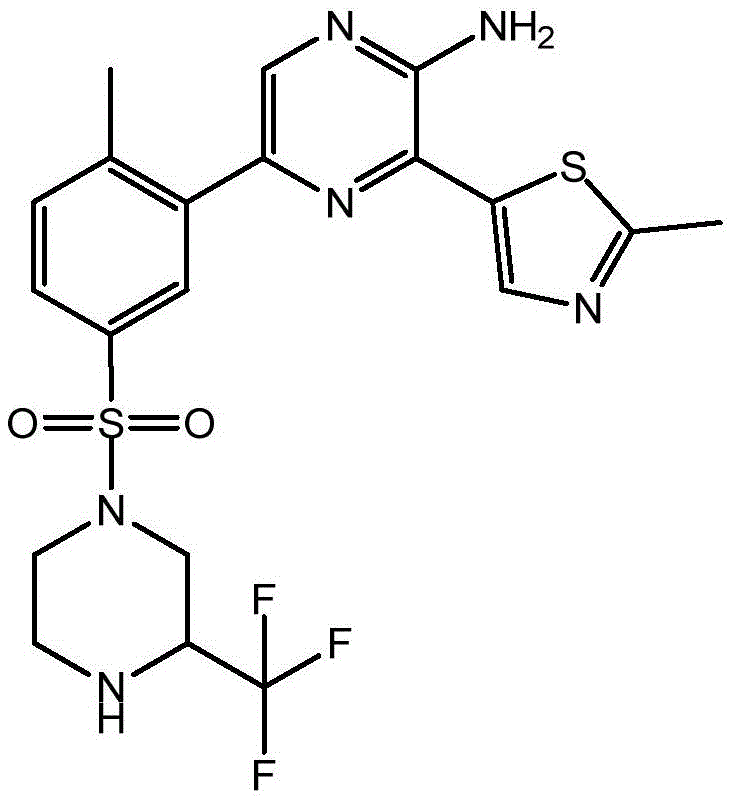
Prepared according to an analogous method to example 11 from 2-methyl-5- (4,4,5, 5-tetramethyl-1, 3, 2-dioxaborolan-2-yl) thiazole and 3-chloro-5- (2-methyl-5- ((3- (trifluoromethyl) piperazine-1-l) sulfonyl) phenyl) pyrazin-2-amine (prepared according to an analogous method to intermediate D5 from 3-bromo-4-methylbenzene-1-sulfonyl chloride, 5-bromo-3-chloropyrazin-2-amine and 2- (trifluoromethyl) piperazine in a two-step process);
LCMS is Rt 0.99 mins; MS M/z 499.2[ M + H ] +; method 2minLowpH.
Example 119:
3- (5-amino-6- (1-methyl-3- (trifluoromethyl) -1H-pyrazol-5-yl) pyrazin-2-yl) -N- (3-hydroxy-3-methylbutyl) -4-methylbenzenesulfonamide

To 1-methyl-3-trifluoromethylpyrazole-5-boronic acid (18mg,0.094mmol) was added Pd (PPh)3)2Cl2(2.74mg,3.9μmol) Sodium carbonate (2M in water, 0.117mL,0.234mmol) and 3- (5-amino-6-chloropyrazin-2-yl) -N- (3-hydroxy-3-methylbutyl) -4-methylbenzenesulfonamide (intermediate D3) (30mg,0.078mmol) in acetonitrile (0.7 mL). The mixture obtained was heated in a microwave at 150 ℃ for 30mins and then passed through a 500mg oven The Si-TMT short column was filtered and washed with acetonitrile (1 mL). After evaporation under reduced pressure, the residue was dissolved in DMSO and purified by HPLC (acetonitrile/water gradient elution, 0.1% TFA modulator). Combining the product components and evaporating to obtain a target compound;
LC-MS, Rt 1.00 mins; MS M/z 499.5[ M + H ] +; method 2minLowpH.
The following examples were prepared according to a similar procedure to that described for the preparation of example 119, using 3- (5-amino-6-chloropyrazin-2-yl) -N- (3-hydroxy-3-methylbutyl) -4-methylbenzenesulfonamide (intermediate D3) and the appropriate boronic acid or ester obtained from a commercial supplier as starting materials. The reaction is carried out in a suitable solvent, such as acetonitrile or DME. The final compound is purified by appropriate techniques known in the art, for example, preparative HPLC as described in example 119. The compound was isolated as the trifluoroacetate salt (derived from TFA modulator in preparative HPLC) or as the free base except 119.32 and 119.41, since its hydrochloride salt was formed after purification using standard conditions (e.g. HCl/dioxane). For 119.42-119.46, (PdCl) is used2(dppf)-CH2Cl2Adduct) catalyst instead of Pd (PPh)3)2Cl2。



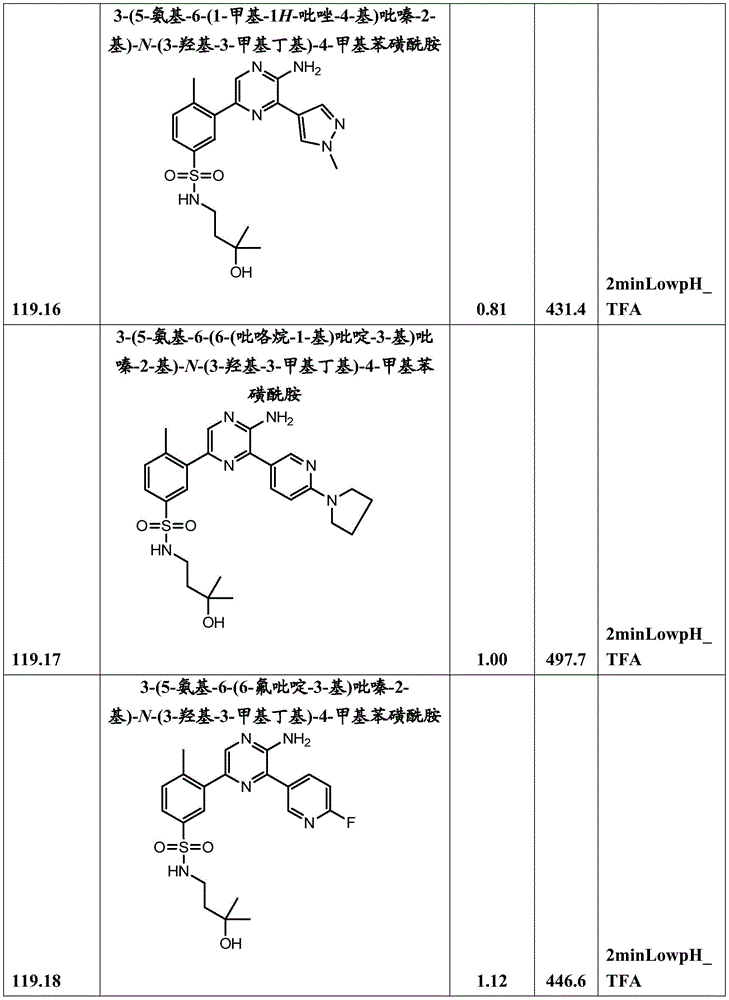


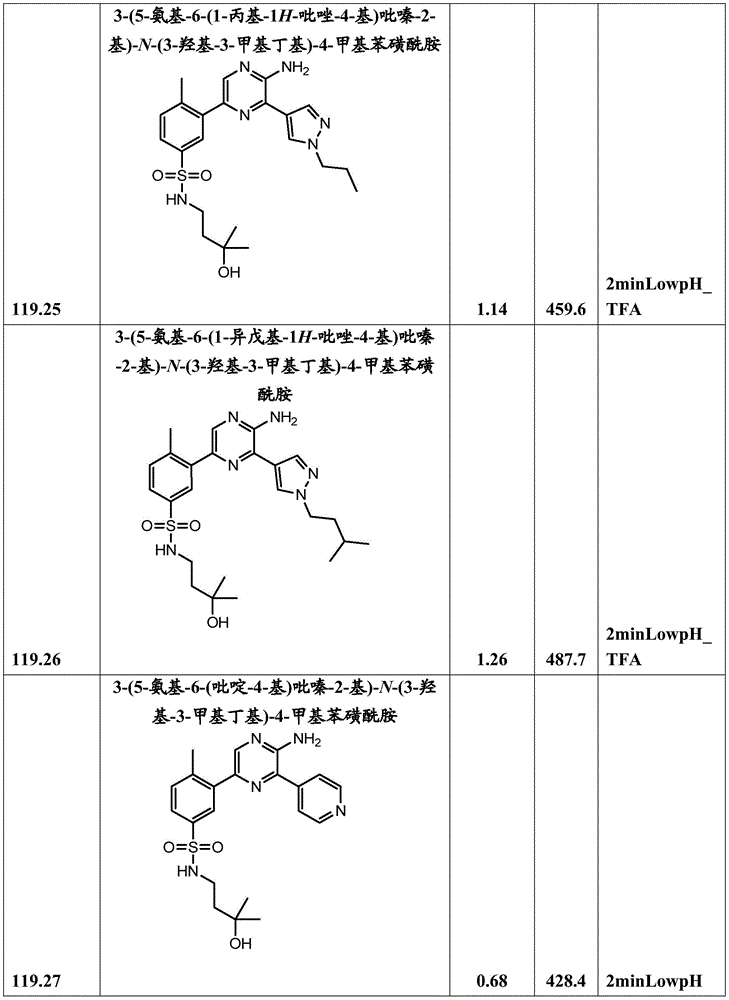
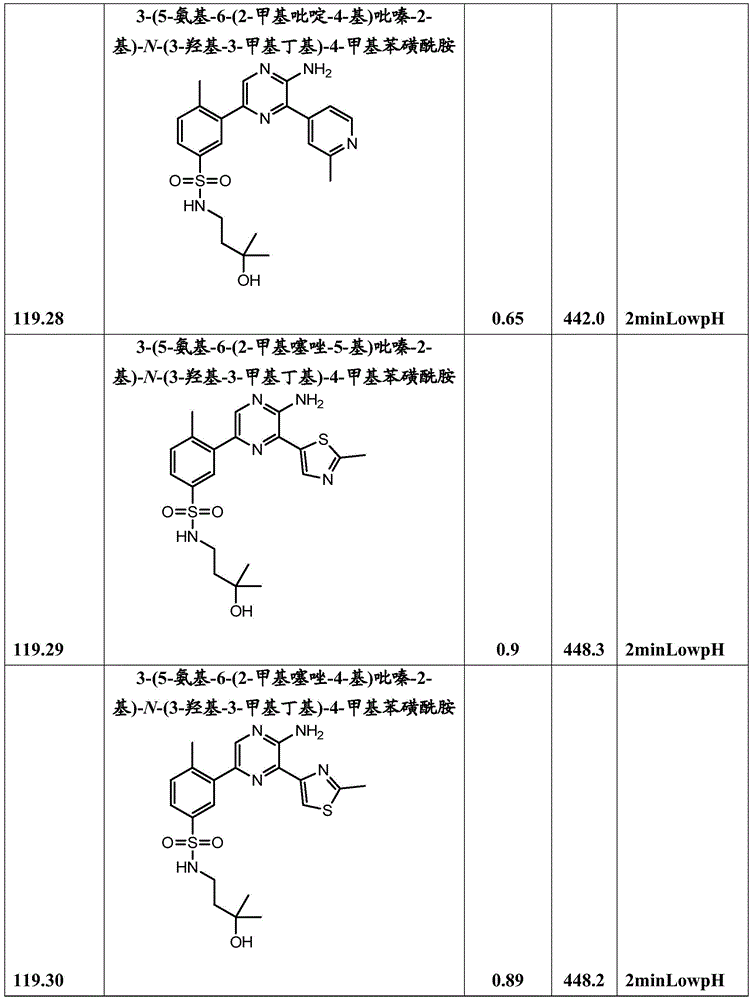

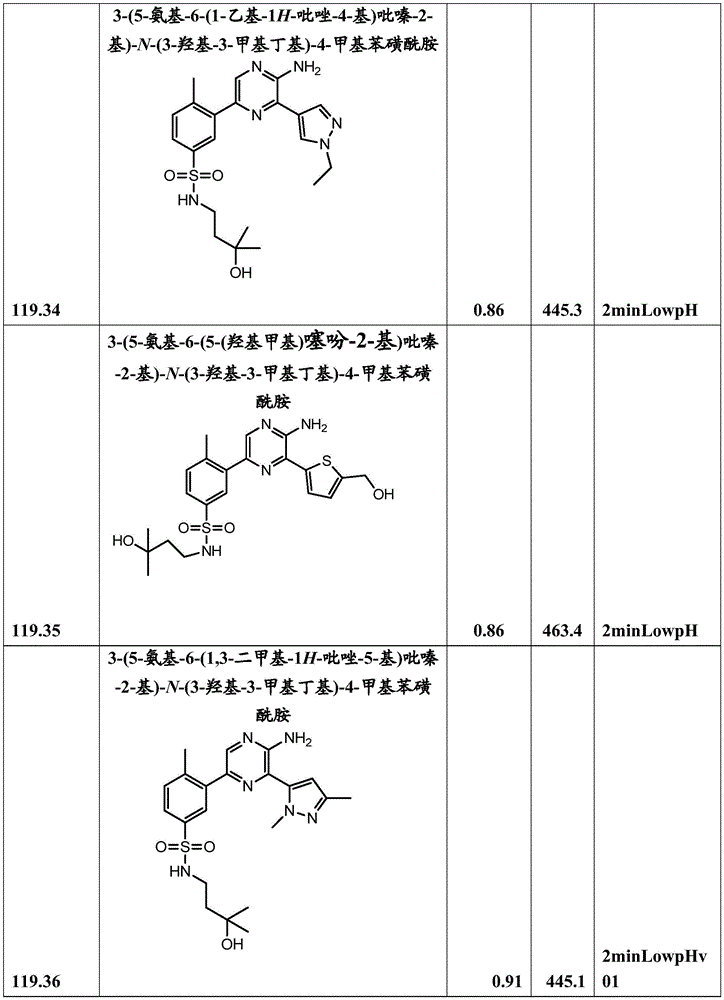
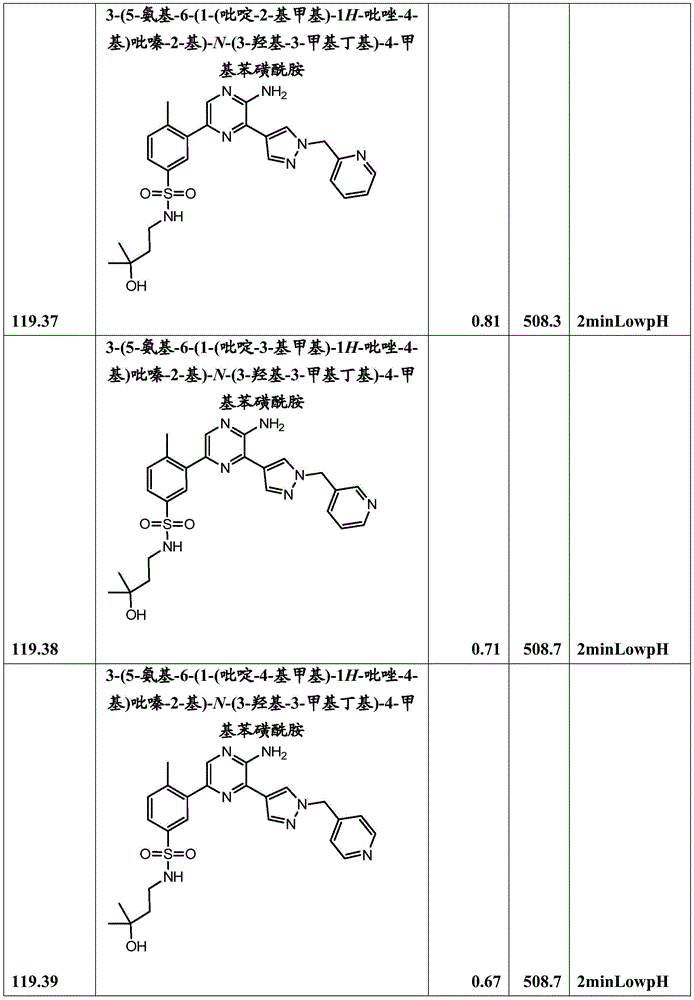

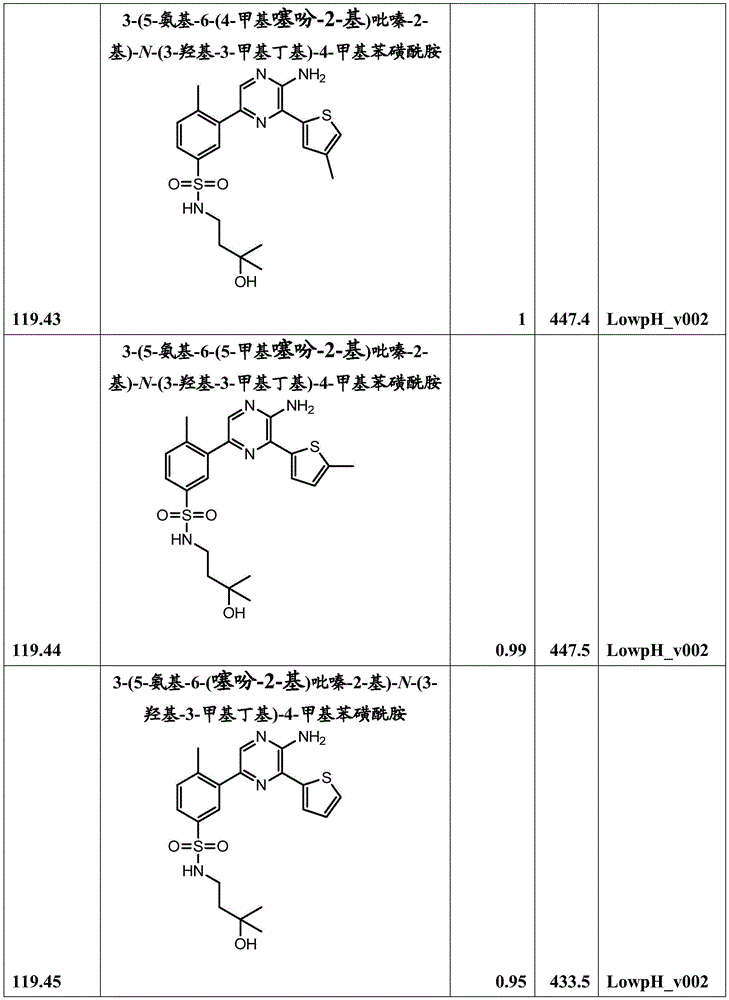

Example 120:
3- (5-amino-6- (2-methylthiazol-5-yl) pyrazin-2-yl) -4-methyl-N- ((3-methyloxetan-3-yl) methyl) benzenesulfonamide
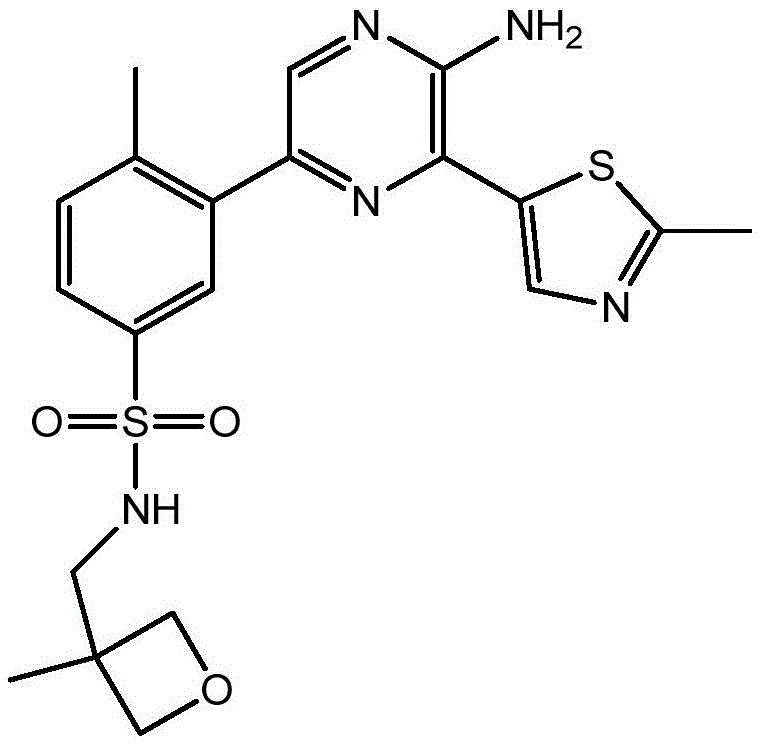
The title compound was prepared using 5-chloro-3- (2-methylthiazol-5-yl) pyrazin-2-amine (intermediate C6) and 4-methyl-N- (3-methyl-oxetan-3-ylmethyl) -3- (4,4,5,5) tetramethyl- [1,3,2] dioxaborolan-2-yl) -benzenesulfonamide (intermediate B4) under similar conditions as in example 41;
LCMS Rt 1.09min, MS M/z 446.2[ M + H ] +; method 2 minlowwphv 03.
Example 121:
5- (5-amino-6- (1H-1,2, 4-triazol-1-yl) pyrazin-2-yl) -N- (2-hydroxy-2-methylpropyl) -2, 4-dimethylbenzenesulfonamide

Step 1 5-amino-6- (1H-1,2, 4-triazol-1-yl) pyrazin-2-ylboronic acid
Bis (pinacolato) diboron (750mg,2.95mmol), 5-bromo-3- (1H-1,2, 4-triazol-1-yl) pyrazin-2-amine (intermediate C11), potassium acetate (435mg,4.43mmol) and PdCl2(dppf).CH2Cl2A mixture of the adduct (120mg,0.147mmol) and 1, 2-dimethoxyethane (14ml) was heated in a microwave at 120 ℃ for 30 minutes. Passing the obtained mixture through Filtration was carried out, washing with DCM and 5% methanol in DCM and evaporation of the filtrate under reduced pressure. Dissolving the crude residueTreated with pinacol (320mg,2.71mmol) in DCM (10mL) and stirred at room temperature. Hexane (20mL) was added to the mixture, the solid obtained was collected by filtration, washed with water and dried in a vacuum oven to obtain the title compound as a grey solid;
LCMS: Rt 0.52 min; MS M/z 207.5[ M + H ] +; the method comprises the following steps: 2minLowpHv01
Step 2-5-bromo-N- (2-hydroxy-2-methylpropyl) -2, 4-dimethylbenzenesulfonamide
To a stirred solution of 1-amino-2-methylpropan-2-ol (104mg,1.164mmol) in DCM (5ml) was added triethylamine (0.295ml,2.116mmol) followed by 5-bromo-2, 4-dimethylbenzene-1-sulfonyl chloride (300mg,1.058mmol) and the reaction mixture stirred at room temperature for 30 min. The resulting mixture was diluted with DCM and poured into a separatory funnel. The solution was washed with 1M HCl and separated. The organic portion was washed with saturated brine, dried over magnesium sulfate, and filtered. Removing the solvent under reduced pressure to obtain a white solid;
LCMS: Rt 1.12 min; MS M/z 337.4[ M + H ] +; the method comprises the following steps: 2minLowpHv01
Step 3 5- (5-amino-6- (1H-1,2, 4-triazol-1-yl) pyrazin-2-yl) -N- (2-hydroxy-2-methylpropyl) -2, 4-dimethylbenzenesulfonamide
5-bromo-N- (2-hydroxy-2-methylpropyl) -2, 4-dimethylbenzenesulfonamide (from step 2) (176mg,0.523mmol), 5-amino-6- (1H-1,2, 4-triazol-1-yl) pyrazin-2-ylboronic acid (from step 1) (108mg,0.523mmol), potassium phosphate (222mg,1.047mmol), and [1,1' -bis (di-tert-butylphosphino) ferrocene ] palladium (II) dichloride (17.06mg,0.026mmol) were weighed and placed in a microwave vial. 1, 4-dioxane (2ml) and water (0.500ml) were added and the solution was heated in a microwave at 100 ℃ for 10 minutes. The reaction mixture was diluted with water and ethyl acetate. The organic layer was extracted into a separation funnel by dilution with ethyl acetate (ethyl) dried over magnesium sulfate, and the solvent was removed under reduced pressure. The crude product was purified by flash column chromatography eluting with a gradient of 0% to 10% MeOH in DCM over a short column of 12g silica gel. The crude product was loaded onto the column with DCM. The product fractions were combined and the solvent was removed to yield a yellow solid.
LCMS Rt 3.68 min; MS M/z 418.4[ M + H ] +; the method comprises the following steps: 10minLowpHv01
1H NMR(400MHz,DMSO-d6)δ9.32(1H,s),8.42(1H,s),8.38(1H,s),7.89(1H,s),7.53(1H,s),7.37(1H,s),7.34(1H,s),5.76(1H,s),4.39(1H,s),2.72(2H,s),2.59(3H,s),2.47(3H,s),1.05(6H,s)
Example 122:
5- (5-amino-6- (1H-1,2, 4-triazol-1-yl) pyrazin-2-yl) -2-fluoro-N- (2-hydroxy-2-methylpropyl) -4-methylbenzenesulfonamide
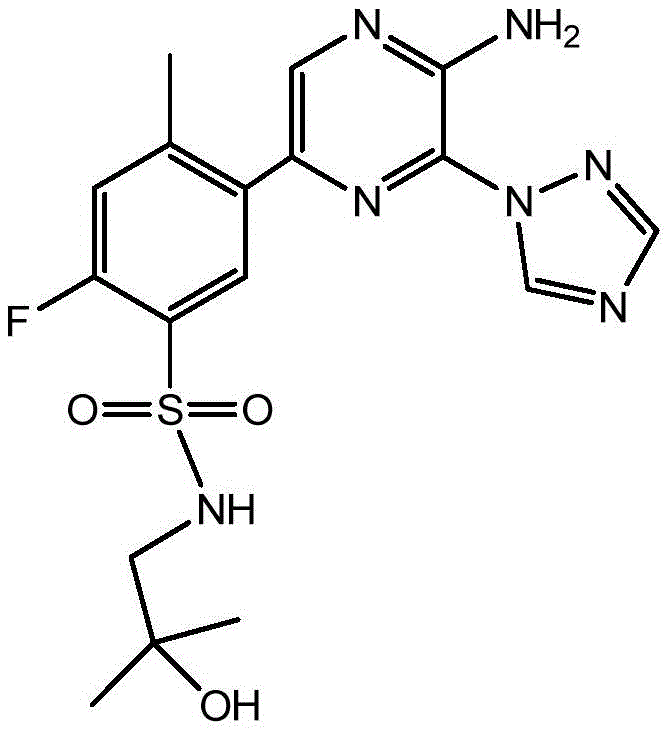
Step 1-5-bromo-2-fluoro-N- (2-hydroxy-2-methylpropyl) -4-methylbenzenesulfonamide
To a stirred solution of 1-amino-2-methylpropan-2-ol (102mg,1.148mmol) in DCM (10ml) was added triethylamine (0.291ml,2.087mmol), followed by 5-bromo-2-fluoro-4-methylbenzene-1-sulfonyl chloride (300mg,1.043mmol), and stirring was continued for 2 hrs. The reaction mixture was diluted with DCM, washed with 1M HCl and then saturated brine. The organic portion was dried over magnesium sulfate and filtered. Removing the solvent under reduced pressure to obtain a target compound;
LCMS: Rt 1.03 min; MS M/z 341.2[ M + H ] +; the method comprises the following steps: 2minLowpHv01
Step 25- (5-amino-6- (1H-1,2, 4-triazol-1-yl) pyrazin-2-yl) -2-fluoro-N- (2-hydroxy-2-methylpropyl) -4-methylbenzenesulfonamide
5-bromo-2-fluoro-N- (2-hydroxy-2-methylpropyl) -4-methylbenzenesulfonamide (step 1) (100mg,0.294mmol), 5-amino-6- (1H-1,2, 4-triazol-1-yl) pyrazin-2-ylboronic acid (see example 121 step 1) (60.5mg,0.294mmol), potassium phosphate (125mg,0.588mmol) and [1,1' -bis (di-tert-butylphosphino) ferrocene ] palladium (II) dichloride (9.58mg,0.015mmol) were added to a microwave vial. 1, 4-dioxane (2ml) and water (0.500ml) were added and the reaction mixture was heated in a microwave for 10 minutes at 100 ℃. The reaction mixture was diluted with ethyl acetate and washed with water and saturated brine. The organic portion was dried over magnesium sulfate, filtered and evaporated under reduced pressure in vacuo. The crude product was purified by flash column chromatography eluting with a gradient of 0% to 100% isohexane/EtOAc over a12 g silica plug. Combining the product components, and removing the solvent to obtain the target compound as a yellow solid;
LCMS Rt 3.44 min; MS M/z 422.2[ M + H ] +; the method comprises the following steps: 10minLowpHv01
1H NMR(400MHz,DMSO-d6)δ9.32(1H,s)8.42(1H,s)8.38(1H,s)7.84(1H,d)7.72(1H,s)7.46(1H,d)7.37(2H,s)4.42(1H,s)2.80(2H,s)2.54(3H,s),1.07(6H,s)
Example 123:
3- (5-amino-6- (1H-1,2, 4-triazol-1-yl) pyrazin-2-yl) -N- (2-hydroxy-2-methylpropyl) benzenesulfonamide

Step 1 3-bromo-N- (2-hydroxy-2-methylpropyl) benzenesulfonamide
A mixture of 3-bromobenzene-1-sulfonyl chloride (300mg,1.174mmol), 1-amino-2-methylpropan-2-ol (115mg,1.292mmol), triethylamine (0.327ml,2.348mmol) and DCM (10ml) was stirred at room temperature for 1 hour. The resulting mixture was diluted with DCM, washed with 1M HCl, saturated sodium bicarbonate solution and dried over magnesium sulfate. The solution was then filtered and dried in vacuo to remove the solvent. The title compound was obtained as a yellow crystalline solid;
LCMS: Rt 0.92 min; MS M/z 308.1[ M + H ] +; the method comprises the following steps: 2minLowpHv01
Step 2 3- (5-amino-6- (1H-1,2, 4-triazol-1-yl) pyrazin-2-yl) -N- (2-hydroxy-2-methylpropyl) benzenesulfonamide
3-bromo-N- (2-hydroxy-2-methylpropyl) benzenesulfonamide (obtained from step 1) (100mg,0.324mmol), 5-amino-6- (1H-1,2, 4-triazol-1-yl) pyrazin-2-ylboronic acid (see example 121 step 1) (66.8mg,0.324mmol), potassium phosphate (138mg,0.649mmol) and [1,1' -bis (di-tert-butylphosphino) ferrocene ] palladium (II) dichloride (10.57mg,0.016mmol) were added to a microwave vial. 1, 4-dioxane (2ml) and water (0.500ml) were added and the mixture was heated by microwave irradiation for 10 minutes. The reaction mixture was washed with ethyl acetate and water. The solution was washed with saturated brine and then separated. The solution was dried over magnesium sulfate, filtered and evaporated in vacuo on a rotary evaporator to give a brown oil. The crude product was purified by flash column chromatography, eluting with a gradient of 0% to 100% isohexane/EtOAc solution over a short column of 4g silica gel, and loading the crude product onto the column anhydrous. Combining related components, removing the solvent to obtain a light green solid;
LCMS Rt 3.28 min; MS M/z 390.5[ M + H ] +; the method comprises the following steps: 10minLowpHv01
1H NMR(400MHz,DMSO-d6)δ9.56(1H,s)8.85(1H,s)8.48(1H,s)8.44(1H,s)8.34(1H,d)7.79(1H,d)7.68(1H,t)7.63(1H,s)7.46(2H,s)4.43(1H,s)2.65(2H,s)1.07(6H,s)
Example 124:
5- (5-amino-6- (1H-1,2, 4-triazol-1-yl) pyrazin-2-yl) -2-chloro-N- (2-hydroxy-2-methylpropyl) -4-methylbenzenesulfonamide

Step 1-5-bromo-2-chloro-N- (2-hydroxy-2-methylpropyl) -4-methylbenzenesulfonamide
To a round bottom flask was added 1-bromo-4-chloro-2-methylbenzene (300mg,1.460 mmol). Chlorosulfonic acid (2.347ml,35.0mmol) in CHCl was heated at 0 deg.C3(10ml) solution. The reaction mixture was warmed to RT and stirred for 2 hours. The reaction mixture was added to ice-cold water and DCM and stirred. The organic layer was separated, treated with 1-amino-2-methylpropan-2-ol (143mg,1.606mmol) and triethylamine (0.407ml,2.92mmol), and stirred at room temperature for 1 hr. The reaction mixture was washed with 1M HCl and saturated bicarbonate solution. The organic layer was separated, dried over magnesium sulfate, and filtered. The solvent was removed under reduced pressure to give a brown oil. The crude product was purified by flash column chromatography using a gradient of 0% to 40% isohexane/EtOAc solution over a short column of 4g silica gel, and the crude product was loaded onto the column anhydrous. Combining the related components, removing the solvent to obtain a white solid;
CMS Rt 1.18 min; MS M/z 356.1[ M + H ] +; the method comprises the following steps: 2minLowpHv01
Step 25- (5-amino-6- (1H-1,2, 4-triazol-1-yl) pyrazin-2-yl) -2-chloro-N- (2-hydroxy-2-methylpropyl) -4-methylbenzenesulfonamide
To a microwave vial was added a solution of 5-bromo-2-chloro-N- (2-hydroxy-2-methylpropyl) -4-methylbenzenesulfonamide (step 1) (60mg,0.168mmol), 5-amino-6- (1H-1,2, 4-triazol-1-yl) pyrazin-2-ylboronic acid (see example 121 step 1) (34.6mg,0.168mmol), bis (triphenylphosphine) palladium dichloride (5.90mg,8.41 μmol), sodium carbonate (53.5mg,0.505mmol) in DME (1 ml). The reaction mixture was heated in a microwave at 70 ℃ for 20 minutes and then at 100 ℃ for 5 minutes. The reaction mixture was washed with water, EtOAc. The organic layer was separated, dried over magnesium sulfate, and then filtered. The solvent was removed under reduced pressure to give a brown solid. The crude product was purified by flash column chromatography using 0% to 10% DCM MeOH/NH3The solution was eluted in a gradient over a short column of 4g silica gel and the crude product was loaded onto the column anhydrous. Combining the relevant components, removing the solvent to obtain a yellow solid;
LCMS Rt 3.61 min; MS M/z 438.3[ M + H ] +; the method comprises the following steps: 10minLowpHv01
1H NMR(400MHz,DMSO-d6)δ9.33(1H,s)8.422(1H,s)8.419(1H,s)8.02(1H,s)7.67(1H,s)7.62(1H,s)7.42(2H,s)4.43(1H,s)2.50(3H,s)2.80(2H,d)1.07(6H,s)。
Example 125:
3- (5-amino-6- (1, 3-dimethyl-1H-pyrazol-4-yl) pyrazin-2-yl) -N- (2-hydroxy-2-methylpropoxy) -4-methylbenzenesulfonamide

To a solution of 3- (5-amino-6- (1, 3-dimethyl-1H-pyrazol-4-yl) pyrazin-2-yl) -4-methylbenzene-1-sulfonyl chloride (intermediate E3) (338mg,0.895mmol) in THF (6ml) was added 1- (aminooxy) -2-methylpropan-2-ol (103mg,0.984mmol) and pyridine (0.080ml,0.984 mmol). The reaction mixture was stirred at room temperature over the weekend. The solvent was removed under reduced pressure to give a brown solid. The product was dissolved in 1ml DMSO and purified by preparative HPLC. Washing the product component with saturated bicarbonate solution, drying over magnesium sulfate, filtering, removing solvent under reduced pressure to obtain oil, and grinding with diethyl ether to obtain light yellow solid;
LCMS Rt 3.45 min; MS M/z 447.2[ M + H ] +; the method comprises the following steps: 10minLowpHv01
1H NMR(400MHz,MeOD-d4)δ8.03(1H,s)7.97(1H,s)7.96(1H,d)7.83(1H,d)7.54(1H,d)3.91(3H,s)3.85(2H,s)2.51(3H,s)2.36(3H,s)1.15(6H,s)
Example 126:
3- (5-amino-6- (2-methyloxazol-5-yl) pyrazin-2-yl) -N- (2-hydroxy-2-methylpropyl) -4-methylbenzenesulfonamide
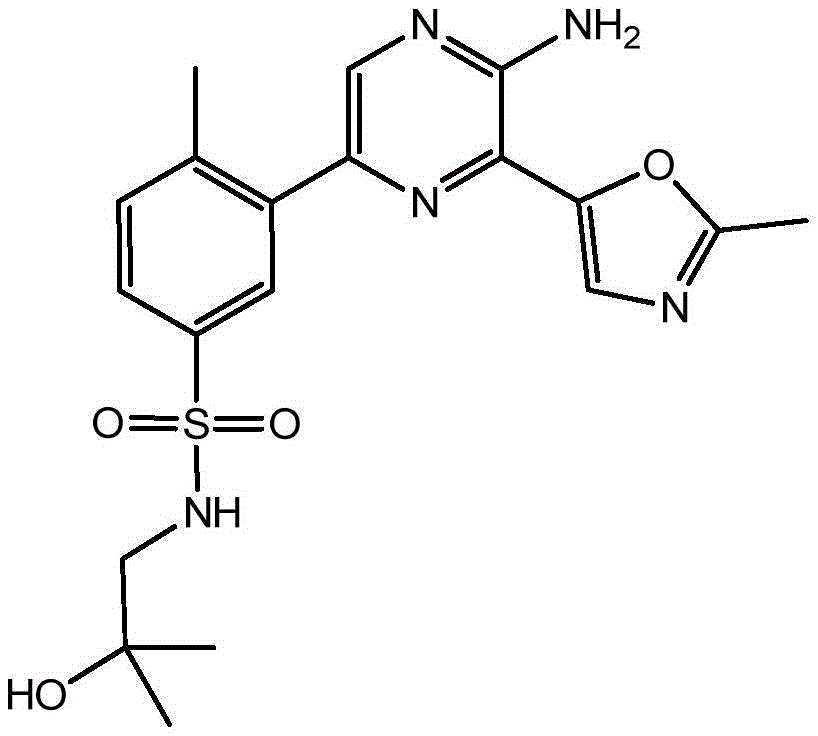
To 3- (5-amino-6-chloro-pyrazin-2-yl) -N- (2-hydroxy-2-methyl-propyl) -4-methyl-benzenesulfonamide (intermediate D2) (140mg,0.378mmol), 2-methyl-5- (4,4,5, 5-tetramethyl-1, 3, 2-dioxaborolan-2-yl) oxazole (79mg,0.378mmol), potassium phosphate (160mg,0.755mmol) and [1,1' -bis (di-tert-butylphosphino) ferrocene]To a mixture of palladium (II) dichloride (24.60mg,0.038mmol) in 1, 4-dioxane (2ml) was added water (0.500 ml). The reaction mixture was heated in a microwave at 120 ℃ for 20 mins. The reaction mixture was poured into water and the product was extracted with EtOAc. The organic layer was separated, washed with water and hydrochloric acid, and then dried over magnesium sulfate. Will be provided with Adding Si-TMT into the filtrate, stirring for 1hr, and filtering. The solvent was removed under reduced pressure. The crude product was purified by flash column chromatography eluting with a gradient of 0% to 10% TBME: MeOH over a12 g silica gel short column and loaded onto the column anhydrous. Combining the product components and removing the solvent under reduced pressure to obtain a target compound;
LCMS Rt 2.91 min; MS M/z 418.5[ M + H ] +; the method comprises the following steps: 8minLowpHv01
1H NMR(400MHz,DMSO-d6)δ8.24(1H,s),7.87-7.83(1H,m),7.74-7.65(2H,m),7.56-7.43(2H,m),6.73(2H,s),4.40(1H,s),2.62(2H,br.s.),2.54(3H,s),2.46(3H,s),1.06(6H,s)
Example 127:
3- (5-amino-6- (1H-1,2, 4-triazol-1-yl) pyrazin-2-yl) -4-methyl-N- (2,2, 2-trifluoroethyl) benzenesulfonamide

To 2,2, 2-trifluoroethylamine (15mg,0.15mmol) was added DMA (1ml) followed by DIPEA (0.035ml,0.200 mmol). The reaction mixture was shaken at room temperature for 30mins and then treated with 3- (5-amino-6- (1H-1,2, 4-triazol-1-yl) pyrazin-2-yl) -4-methylbenzene-1-sulfonyl chloride (intermediate E1) (0.1mmol) and DMA (1 ml). The resulting mixture was shaken at room temperature for 3hrs, then concentrated under reduced pressure. The crude product was purified by HPLC (acetonitrile/water gradient elution, 0.1% TFA modifier), and the product fractions were combined and evaporated to afford the target compound;
LCMS: Rt 0.82 min; MS M/z 414.1[ M + H ] +; the method comprises the following steps: 2minLowpHv01
The following examples were prepared according to similar conditions described in the preparation of example 127, using 3- (5-amino-6- (1H-1,2, 4-triazol-1-yl) pyrazin-2-yl) -4-methylbenzene-1-sulfonyl chloride (intermediate E1) and the appropriate amine obtained commercially as starting materials. (the amines used in examples 127.22-127.23 can be prepared according to the process described in patent application WO2011/113894, page 99). The final compound is purified by suitable techniques known in the art. When the formation of trifluoroacetate is stated, it can be formed due to the presence of TFA modulator in the reverse phase purification as well as the basic center in the molecule. LCMS method 2 minlowwphv 01 was used unless otherwise noted.


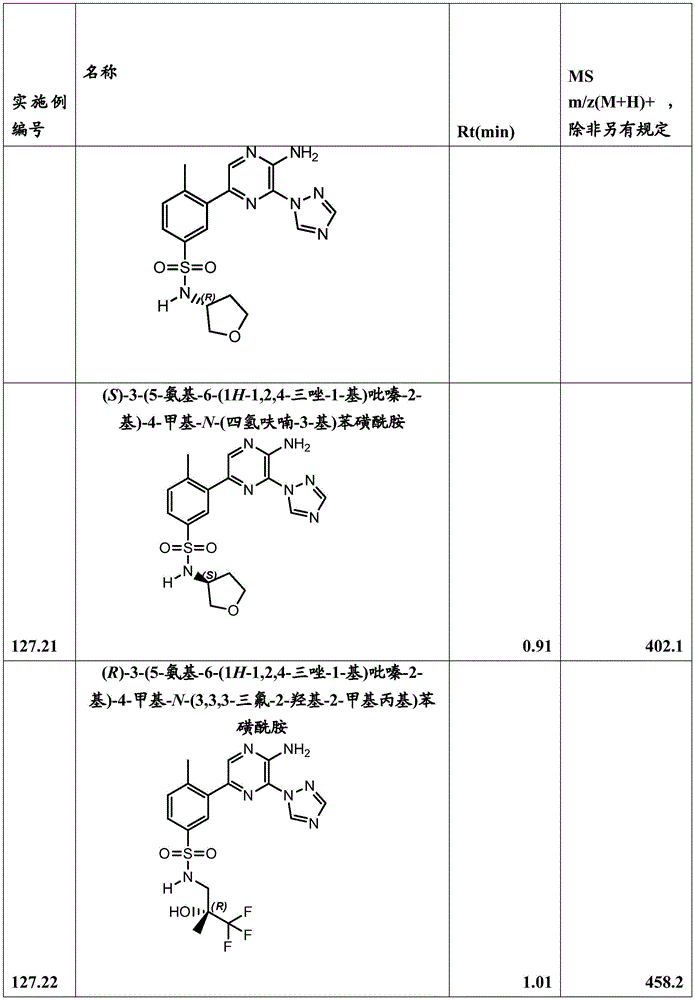

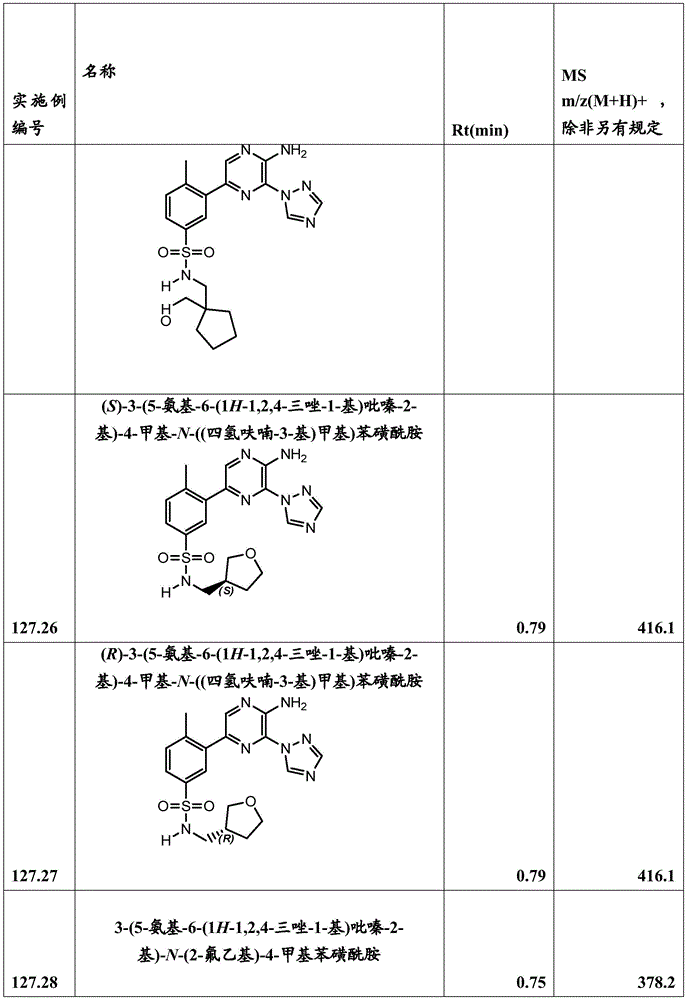


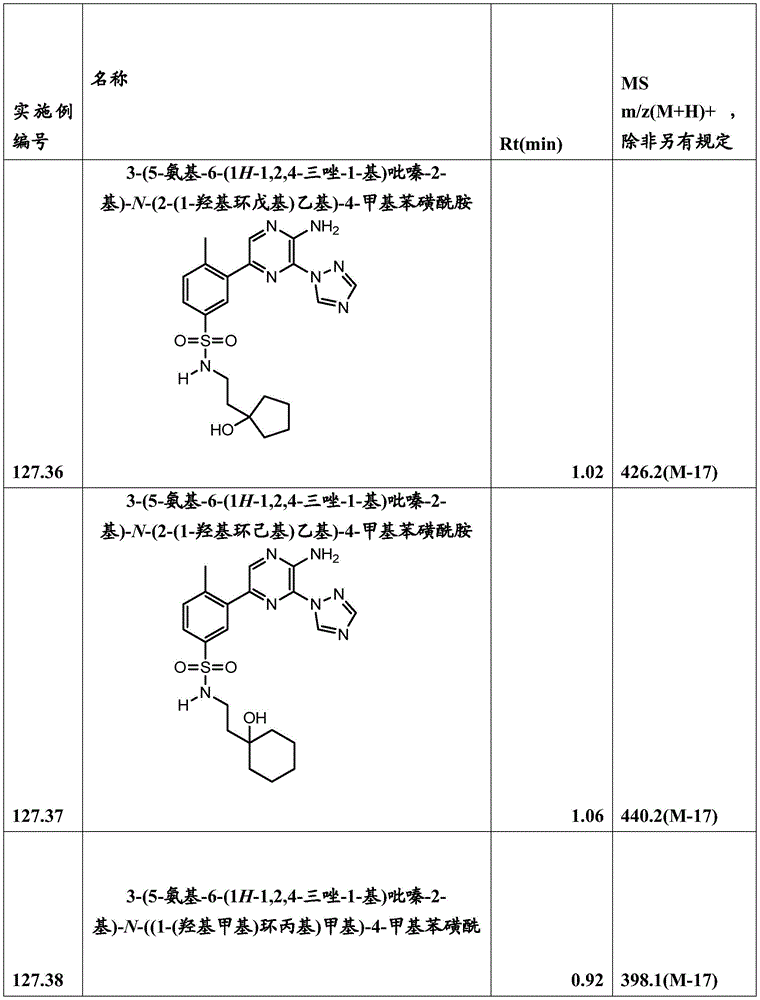


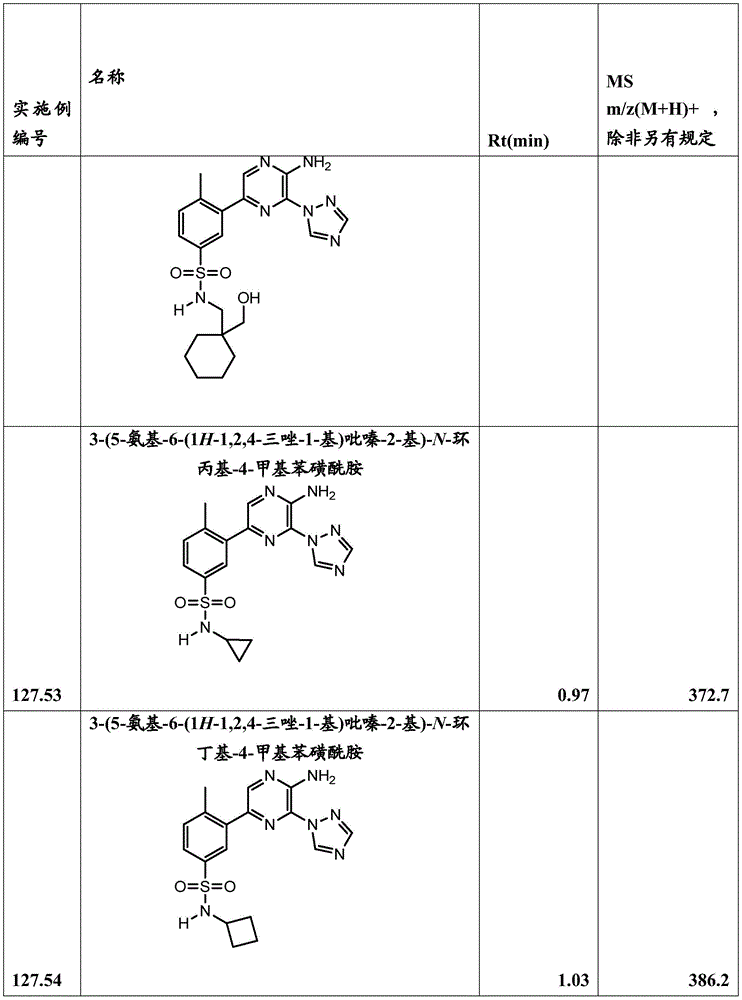
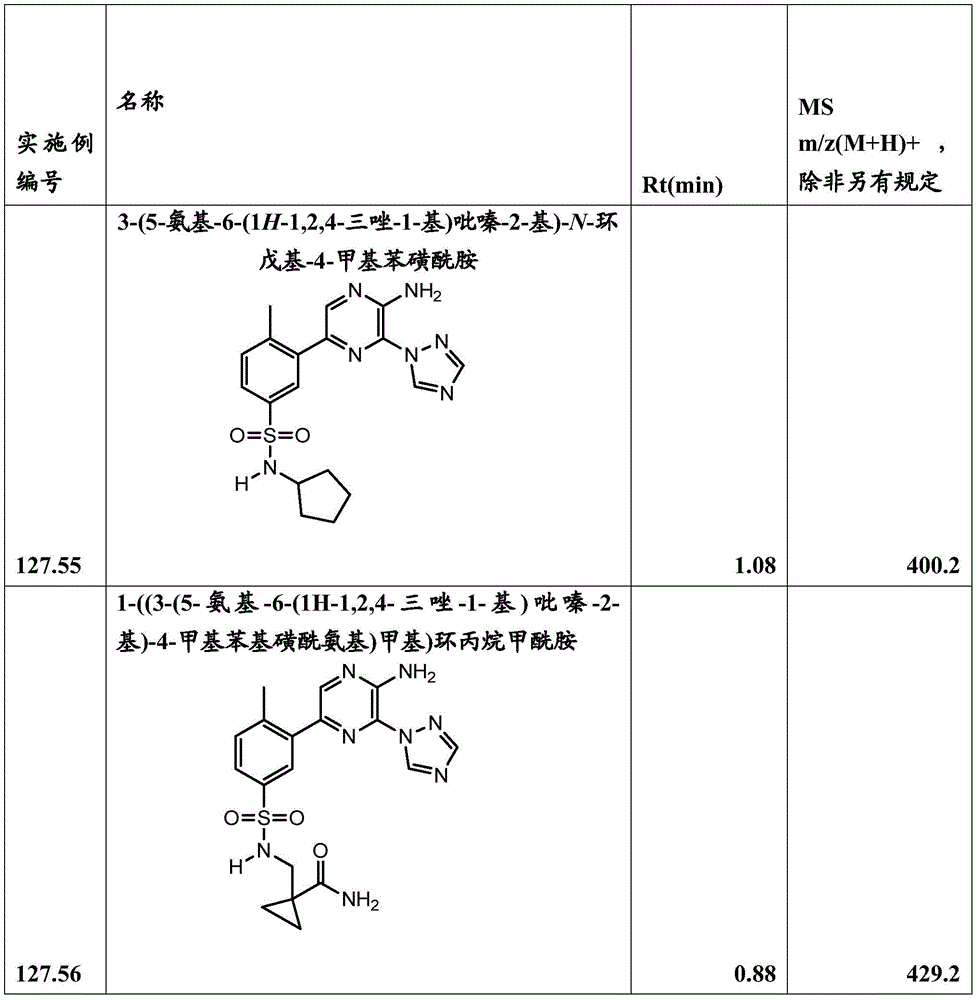
The following examples were prepared according to similar conditions described in the preparation of example 127, using 3- (5-amino-6- (1H-1,2, 4-triazol-1-yl) pyrazin-2-yl) -4-methylbenzene-1-sulfonyl chloride (intermediate E1) and the appropriate mono-boc protected amine as starting materials. The boc protecting group can be removed from the final compound by shaking a solution of each compound with TFA (0.15mL) in DCM (2mL) for 3h, followed by purification.
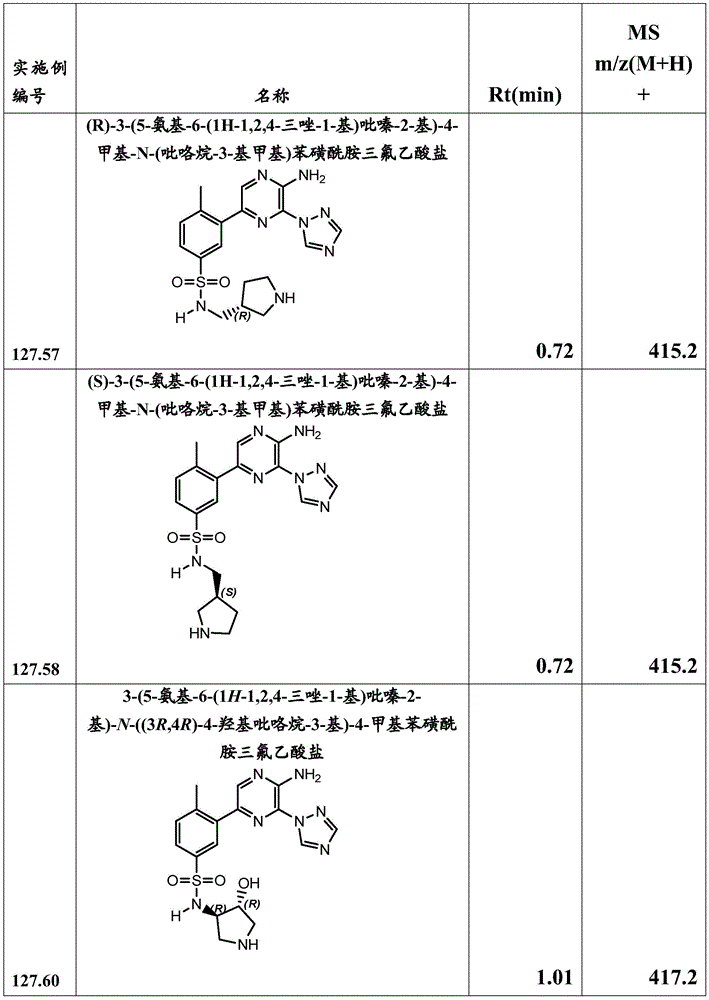
Example 128:
3- (5-amino-6- (1, 3-dimethyl-1H-pyrazol-4-yl) pyrazin-2-yl) -N- ((3- (hydroxymethyl) oxetan-3-yl) methyl) -4-methylbenzenesulfonamide
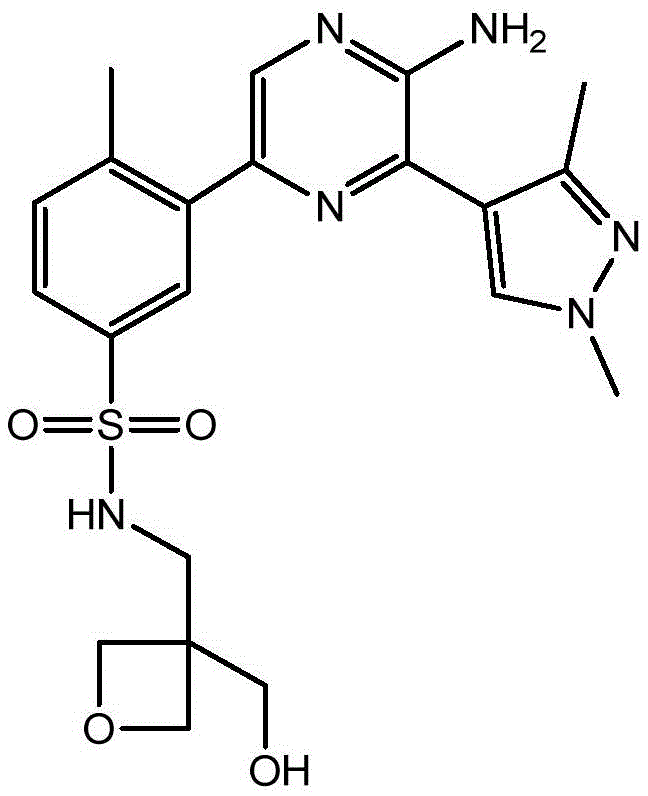
3- (5-amino-6- (1, 3-dimethyl-1H-pyrazol-4-yl) pyrazin-2-yl) -4-methylbenzene-1-sulfonyl chloride (intermediate E3) (200mg,0.53mmol) at 0 deg.CTo a stirred solution of (3- (aminomethyl) oxetan-3-yl) methanol (68mg,0.58mmol) and DIPEA (0.28ml,1.5mmol) in DMA (2ml) was added dropwise. When LCMS showed formation of 1:1 product and sulfonic acid mixture, the reaction was warmed to room temperature and stirred for 1 h. The reaction mixture was diluted with EtOAc and with aq3And (6) washing. The organic extract was separated, dried over magnesium sulfate, and the solvent was removed to obtain a colorless oil. Purifying the product by silica gel chromatography, eluting with EtOH, EtOH 1:1 to obtain a product which is a white amorphous solid;
LCMS: Rt 0.84 mins; MS M/z 459.5[ M + H ] +; method 2minLowpH
1H NMR(400MHz,DMSO-d6)δ8.09(2H,s),7.88(1H,s),7.75(1H,br s),7.70(1H,d),7.52(1H,d),6.29(2H,s),4.85(1H br s),4.28(4H,m),3.82(3H,s),3.52(2H,s),2.95(2H,s),2.45(3H,s),2.29(3H,s)。
The following compounds were prepared according to a similar procedure to that used for the synthesis of example 128, using 3- (5-amino-6- (1, 3-dimethyl-1H-pyrazol-4-yl) pyrazin-2-yl) -4-methylbenzene-1-sulfonyl chloride (intermediate E3) and the appropriate amine as starting materials.
Example 128.1:
(S) -3- (5-amino-6- (1, 3-dimethyl-1H-pyrazol-4-yl) pyrazin-2-yl) -N- ((1-ethylpyrrolidin-2-yl) methyl) -4-methylbenzenesulfonamide

LCMS is Rt 0.6 mins; MS M/z 470.4[ M + H ] +; method 2minLowpH.
1H NMR(400MHz,DMSO-d6)δ8.09(1H,s),8.05(1H,s),7.86(1H,s),7.67(1H,d),7.50(1H,d),7.46(1H,br t),6.29(2H,s),3.82(3H,s),2.95(1H,m),2.80(1H,m),2.60(2H,m),2.48(3H,s),2.38(1H,m),2.27(3H,s),2.13(1H,m),2.05(1H,m),1.74(1H,m),1.52(3H,m),0.92(3H,t)。
Example 128.2:
3- (5-amino-6- (1, 3-dimethyl-1H-pyrazol-4-yl) pyrazin-2-yl) -4-methyl-N- ((4-methylmorpholin-3-yl) methyl) benzenesulfonamide

LCMS is RT 0.67 mins; MS M/z 472.4[ M + H ] +; method 2minLowpH
1H NMR(400MHz,DMSO-d6)δ8.09(1H,s),8.07(1H,s),7.86(1H,s),7.58(1H,d),7.51(2H,m),6.28(2H,s),3.82(3H,s),3.62(2H,m),3.41(1H,m),3.19(1H,m),2.95(1H,m),2.69(1H,m),2.58(1H,m),2.45(3H,s),2.29(3H,s),2.11(3H,s),2.08(2H,m)。
Example 128.3a (R or S) -3- (5-amino-6- (1, 3-dimethyl-1H-pyrazol-4-yl) pyrazin-2-yl) -4-methyl-N- ((4-methylmorpholin-3-yl) methyl) benzenesulfonamide and example 128.3b (R or S) -3- (5-amino-6- (1, 3-dimethyl-1H-pyrazol-4-yl) pyrazin-2-yl) -4-methyl-N- ((4-methylmorpholin-3-yl) methyl) benzenesulfonamide

Racemic 3- (5-amino-6- (1, 3-dimethyl-1H-pyrazol-4-yl) pyrazin-2-yl) -4-methyl-N- ((4-methylmorpholin-3-yl) methyl) benzenesulfonamide was purified by chiral SFC.
The details of the method are as follows: (Chiralpak AS-H, 250X 10mm,5um @35degC) with 50% isopropanol + 0.1% v/v diethylamine/50% CO2Elution was carried out at a flow rate of 10 ml/min.
(detection: UV @220nm, System: Berger Minigram SFC 1). Two peaks were collected, peak 1RT3.13mins, peak 2RT 4.86 mins.
Example 128.3a:
peak 1 (first eluting peak) SFC retention time 3.13 mins: (R) -3- (5-amino-6- (1, 3-dimethyl-1H-pyrazol-4-yl) pyrazin-2-yl) -4-methyl-N- ((4-methylmorpholin-3-yl) methyl) benzenesulfonamide or (S) -3- (5-amino-6- (1, 3-dimethyl-1H-pyrazol-4-yl) pyrazin-2-yl) -4-methyl-N- ((4-methylmorpholin-3-yl) methyl) benzenesulfonamide
LCMS is RT 0.94 mins; MS M/z 472.4[ M + H ] +; method 2minHighpH
1H NMR(400MHz,DMSO-d6)δ8.09(1H,s),8.07(1H,s),7.86(1H,s),7.58(1H,d),7.51(2H,m),6.28(2H,s),3.82(3H,s),3.62(2H,m),3.41(1H,m),3.19(1H,m),2.95(1H,m),2.69(1H,m),2.58(1H,m),2.45(3H,s),2.29(3H,s),2.11(3H,s),2.08(2H,m)。
Example 128.3b:
peak 2 (second eluting peak): SFC retention time 4.86 mins: (R) -3- (5-amino-6- (1, 3-dimethyl-1H-pyrazol-4-yl) pyrazin-2-yl) -4-methyl-N- ((4-methylmorpholin-3-yl) methyl) benzenesulfonamide or (S) -3- (5-amino-6- (1, 3-dimethyl-1H-pyrazol-4-yl) pyrazin-2-yl) -4-methyl-N- ((4-methylmorpholin-3-yl) methyl) benzenesulfonamide
LCMS is RT 0.94 mins; MS M/z 472.4[ M + H ] + method 2minHighpH.
1H NMR(400MHz,DMSO-d6)δ8.09(1H,s),8.07(1H,s),7.86(1H,s),7.58(1H,d),7.51(2H,m),6.28(2H,s),3.82(3H,s),3.62(2H,m),3.41(1H,m),3.19(1H,m),2.95(1H,m),2.69(1H,m),2.58(1H,m),2.45(3H,s),2.29(3H,s),2.11(3H,s),2.08(2H,m)。
Example 128.4:
3- (5-amino-6- (1, 3-dimethyl-1H-pyrazol-4-yl) pyrazin-2-yl) -4-methyl-N- ((2-methyltetrahydrofuran-2-yl) methyl) benzenesulfonamide

LCMS RT 0.97 min; MS M/z 457.2[ M + H ] +; method 2minLowpH
Example 128.5:
3- (5-amino-6- (1, 3-dimethyl-1H-pyrazol-4-yl) pyrazin-2-yl) -4-methyl-N- ((4-methylmorpholin-2-yl) methyl) benzenesulfonamide

LCMS RT 0.96mins MS M/z 472.3[ M + H ] +; method 2minHighpH.
The following compounds were prepared according to a similar procedure to that used for the synthesis of example 128, using 3- (5-amino-6- (1, 3-dimethyl-1H-pyrazol-4-yl) pyrazin-2-yl) -4-methylbenzene-1-sulfonyl chloride (intermediate E3) and the appropriate amine protected with a boc group as starting materials. After sulfonamide formation, the boc group is removed by treatment with DCM: TFA at room temperature, followed by purification.
Example 128.6:
(R) -3- (5-amino-6- (1, 3-dimethyl-1H-pyrazol-4-yl) pyrazin-2-yl) -4-methyl-N- (morpholin-3-ylmethyl) benzenesulfonamide

LCMS is Rt 0.60 mins; MS M/z 458.4[ M + H ] +; method 2minLowpH.
1H NMR(400MHz,DMSO-d6)δ8.12(2H,m),7.89(1H,s),7.73(1H,d),7.60(1H,brs),7.50(1H,d),6.29(2H,s),3.82(3H,s),3.66(1H,m),3.58(1H,m),3.26(2H,m),2.99(1H,m),2.62(5H,m),2.45(3H,s),2.28(3H,s)。
Example 128.7:
(S) -3- (5-amino-6- (1, 3-dimethyl-1H-pyrazol-4-yl) pyrazin-2-yl) -4-methyl-N- (morpholin-3-ylmethyl) benzenesulfonamide

LCMS is RT 0.60 mins; MS M/z 458.3[ M + H ] +; method 2minLowpH.
1H NMR(400MHz,DMSO-d6)δ8.09(2H,m),7.85(1H,s),7.65(1H,d),7.59(1H,brs),7.50(1H,d),6.29(2H,s),3.82(3H,s),3.65(1H,d),3.58(1H,d),3.28(2H,m),2.95(1H,m),2.60(5H,m),2.45(3H,s),2.28(3H,s)。
Example 128.8:
3- (5-amino-6- (1, 3-dimethyl-1H-pyrazol-4-yl) pyrazin-2-yl) -4-methyl-N- (morpholin-2-ylmethyl) benzenesulfonamide

LCMS: Rt 0.84 mins; MS M/z 458.2[ M + H ] +; method 2minHighpHv03.
Example 129:
(R) -3- (5-amino-6- (2-methylpyridin-4-yl) pyrazin-2-yl) -N- (2-hydroxypropyl) -4-methylbenzenesulfonamide trifluoroacetate salt

To a mixture of 2,4, 6-trichlorophenyl 3- (5-amino-6- (2-methylpyridin-4-yl) pyrazin-2-yl) -4-methylbenzenesulfonate (intermediate E4) (50mg,0.093mmol), (2R) -1-aminopropan-2-ol (15mg,0.2mmol), tetrabutylammonium chloride (41mg,1.6eq) in acetonitrile (2ml) was added triethylamine (100 μ L,7 eq). The reaction mixture was heated to 140 ℃ for 30mins with microwave irradiation. The solvent was evaporated under reduced pressure. The crude product was treated with DMSO (1ml) and purified by HPLC (acetonitrile/water gradient elution with TFA as the modifier). The product fractions were combined and evaporated to give (R) -3- (5-amino-6- (2-methylpyridin-4-yl) pyrazin-2-yl) -N- (2-hydroxypropyl) -4-methylbenzenesulfonamide trifluoroacetic acid (1:1)
LCMS is Rt 0.61 mins; MS M/z 412.2[ M-H ] -; the method comprises the following steps: 2minLowpH
The following compounds were prepared according to a similar procedure to that described for the preparation of example 129, using 2,4, 6-trichlorophenyl 3- (5-amino-6- (2-methylpyridin-4-yl) pyrazin-2-yl) -4-methylbenzenesulfonate (intermediate E4) and the appropriate amine as starting materials. The amine employed was obtained commercially and, in addition to the amine used for the synthesis of example 129.20, it could be prepared according to the method described in patent application WO2011/113894, page 99. All compounds were obtained as trifluoroacetate salts except 129.17-127.19, which were obtained as free bases. Unless otherwise specified, LCMS method was used: 2minLowpH.
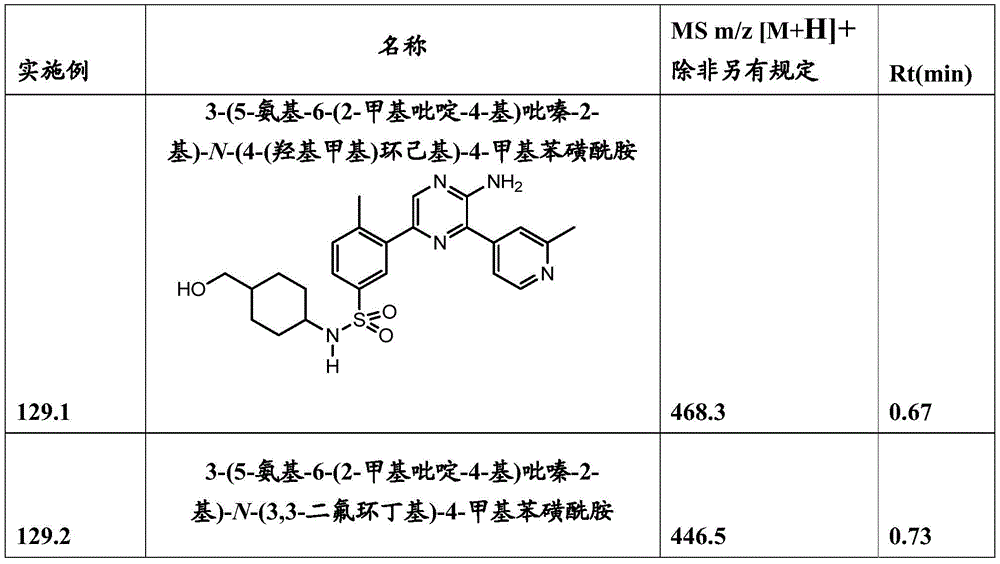


Examples the following compounds were prepared according to a similar procedure to that described for the preparation of example 129, using 2,4, 6-trichlorophenyl 3- (5-amino-6- (2-methylpyridin-4-yl) pyrazin-2-yl) -4-methylbenzenesulfonate (intermediate E4) and the appropriate amine available commercially as starting materials. After HPLC purification and evaporation, solid phase extraction is required: ( PE-AX) to remove sulfonic acid impurities. Thus, products 129.21-129.31 were obtained as acetate salts.
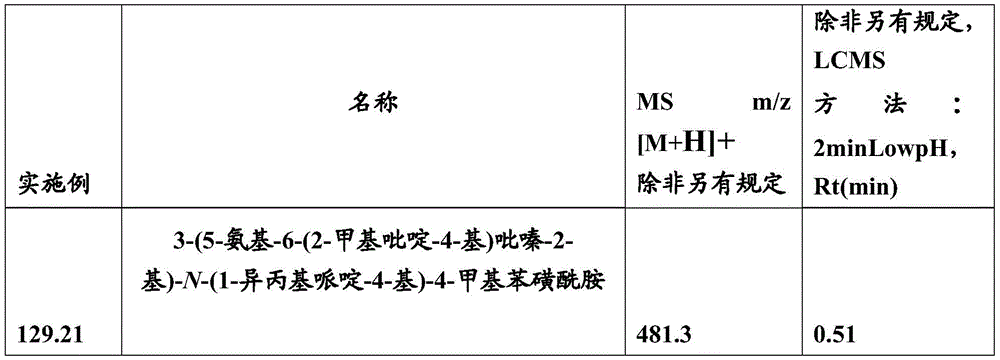
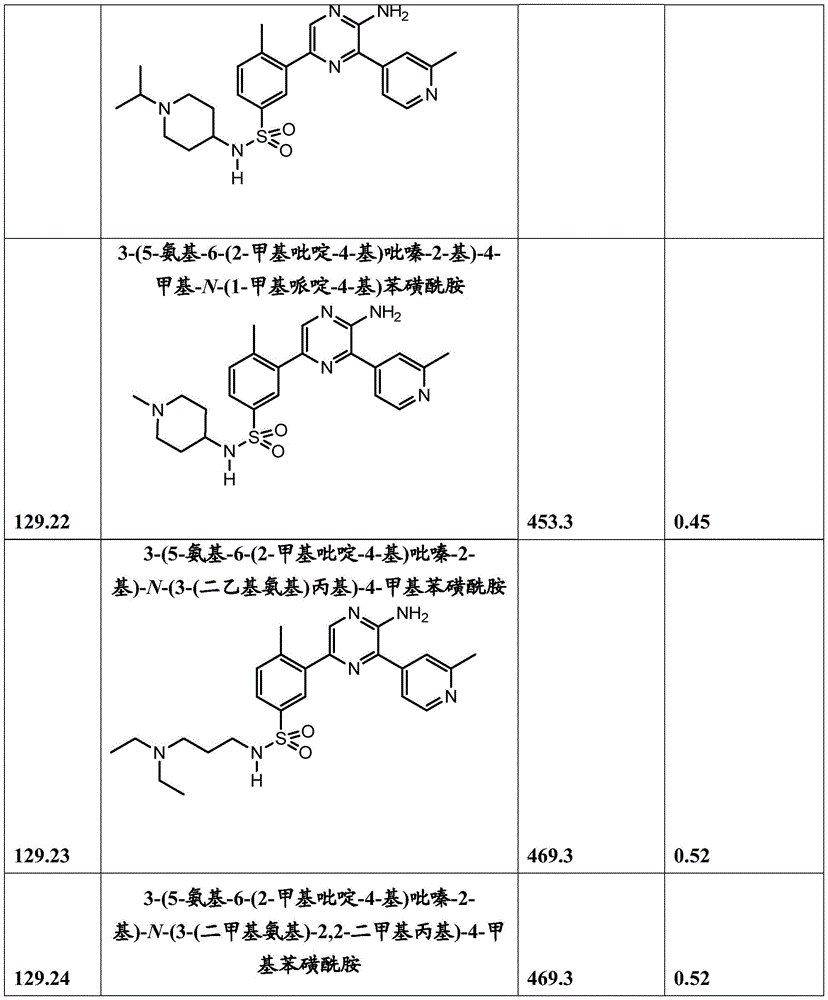


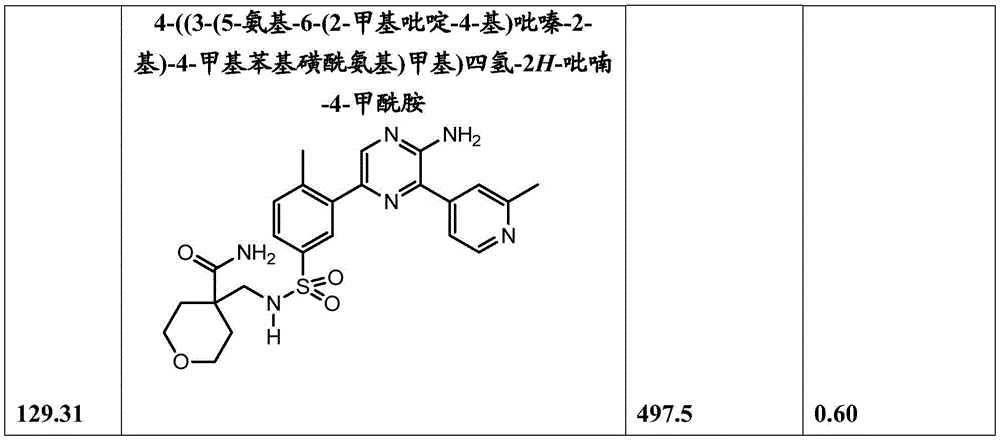
Examples the following compounds were prepared according to a similar procedure to that described for the preparation of example 129, using 2,4, 6-trichlorophenyl 3- (5-amino-6- (2-methylpyridin-4-yl) pyrazin-2-yl) -4-methylbenzenesulfonate (intermediate E4) and the appropriate boc-protected amine as starting materials. Before purification by HPLC, a 20% TFA solution in DCM (2mL) was added to the crude product and the mixture was shaken at room temperature for 30mins to remove the boc group. The mixture was evaporated and re-dissolved in DMSO (1mL) and then purified by HPLC as previously described to give the trifluoroacetate salt.


Example 130:
3- (5-amino-6- (1- (2,2, 2-trifluoroethyl) -1H-pyrazol-4-yl) pyrazin-2-yl) -N- (3-hydroxy-3-methylbutyl) -4-methylbenzenesulfonamide

Step 1:4- (4,4,5, 5-tetramethyl-1, 3, 2-dioxaborolan-2-yl) -1- (2,2, 2-trifluoroethyl) -1H-pyrazole
Cesium carbonate (3.36g,10.31mmol) was added to a stirred solution of 4- (4,4,5, 5-tetramethyl-1, 3, 2-dioxaborolan-2-yl) -1H-pyrazole (1.0g,5.15mmol) in anhydrous DMF (12 ml). After stirring at room temperature for 10min, 2,2, 2-trifluoroethyl trifluoromethanesulfonate (1.11ml,7.73mmol) was added. The reaction was stirred at room temperature for 2 days, then the solvent was removed and the residue was partitioned between ether and water. Separating the organic extract, drying over magnesium sulfate, removing the solvent to obtain an oil;
LCMS is Rt 1.00 mins; MS MS M/z 277.4[ M + H ] +; method 2minLCv003
Step 2 3- (5-amino-6- (1- (2,2, 2-trifluoroethyl) -1H-pyrazol-4-yl) pyrazin-2-yl) -N- (3-hydroxy-3-methylbutyl) -4-methylbenzenesulfonamide
A mixture of 4- (4,4,5, 5-tetramethyl-1, 3, 2-dioxaborolan-2-yl) -1- (2,2, 2-trifluoroethyl) -1H-pyrazole (step 1) (115mg,0.417mmol), 3- (5-amino-6-chloropyrazin-2-yl) -N- (3-hydroxy-3-methylbutyl) -4-methylbenzenesulfonamide (intermediate D3) (150mg,0.390mmol), bis (triphenylphosphine) palladium dichloride (14mg,0.020mmol) in 2M aqueous sodium carbonate (0.6ml,1.200mmol), ethanol (1.2ml) and DME (1.8ml) was heated to 120 ℃ for 30 minutes in a microwave, then partitioned between DCM/water, separated using a phase separator, the organic portion was evaporated under reduced pressure. The crude product was purified by flash column chromatography (12g silica gel, 0-5% methanol in TBME). The product fractions were combined and evaporated, triturated with an ethyl acetate/ether mixture, the solid collected by filtration, washed with cooled anhydrous ether and dried overnight in a vacuum oven to give a pale yellow solid;
1h NMR (400MHz, DMSO-d6) delta 8.49(1H, s); 8.16(1H, s); 8.13(1H, s); 7.83(1H, d,. about.2 Hz); 7.68(1H, dd, 8 and 2 Hz); 7.53(1H, d, -8 Hz); 7.42(1H, t); 6.37(2H, s); 5.21(2H, q); 4.27(1H, s); 2.83(2H, m); 2.48(3H, s, partial overlap with solvent peak); 1.51(2H, m); 1.01(6H, s).
LC-MS, Rt 0.92 min; MS M/z 499.2[ M + H ] +; the method comprises the following steps: 2minLowpH
Example 131:
3- (5-amino-6- (1H-1,2, 4-triazol-1-yl) pyrazin-2-yl) -4-methyl-N- (oxetan-3-ylmethyl) benzenesulfonamide

To a stirred solution of 3- (5-amino-6- (1H-1,2, 4-triazol-1-yl) pyrazin-2-yl) -4-methylbenzene-1-sulfonyl chloride (intermediate E1) (80mg,0.228mmol) and triethylamine (0.035ml,0.251mmol) in DCM (5ml) was added oxetan-3-ylmethylamine (22mg,0.251 mmol). The reaction mixture was stirred at room temperature for 30mins, then extracted into DCM, washed with water, brine, the organic layer was separated, dried over magnesium sulphate, filtered and the solvent removed under reduced pressure. Dissolving the yellow residue in ethyl acetate, and recrystallizing at room temperature overnight to obtain off-white crystals;
LCMS, Rt 0.87 mins; MS M/z 402.3[ M + H ] +; method LowpH _ v002
1H NMR (400MHz, DMSO-d6) delta (ppm)9.34(1H, s),8.43(1H, s),8.42(1H, s),7.91(1H, d),7.79(1H, t),7.73(1H, dd),7.56(1H, d),7.39(2H, br s),4.54(2H, multimodal), 4.20(2H, multimodal), 3.05(2H, multimodal), 2.99(1H, multimodal). The methyl group of the tolyl group was not observed, and could be masked by the peak of DMSO.
Example 132:
3- (5-amino-6- (1-benzyl-1H-pyrazol-4-yl) pyrazin-2-yl) -N- (3-hydroxy-3-methylbutyl) -4-methylbenzenesulfonamide hydrochloride
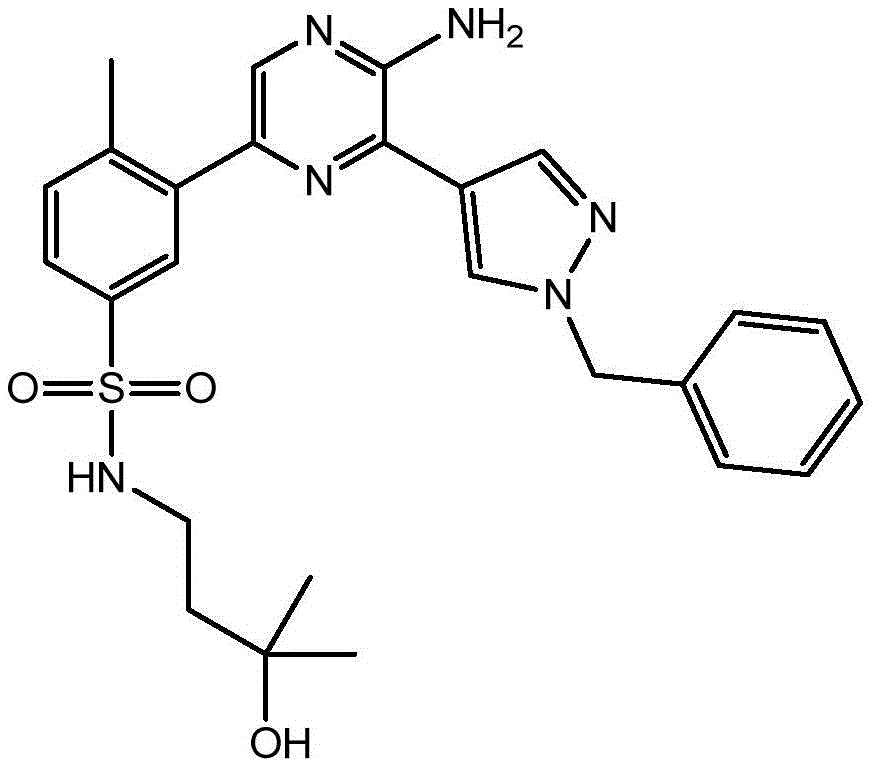
The title compound was prepared from 3- (5-amino-6-chloropyrazin-2-yl) -N- (3-hydroxy-3-methylbutyl) -4-methylbenzenesulfonamide (intermediate D3) and 1-benzyl-4- (4,4,5, 5-tetramethyl-1, 3, 2-dioxaborolan-2-yl) -1H-pyrazole using analogous conditions to example 11. The compound was treated with 1M hydrochloric acid in ether to form the hydrochloride salt.
LC-MS, Rt 0.98 min; MS M/z 507.3[ M + H ] +; the method comprises the following steps: 2minLowpH
Example 133:
2- (3- (5-amino-6- (1H-1,2, 4-triazol-1-yl) pyrazin-2-yl) -4-methylphenylsulfonylamino) acetamide

To a solution of 3- (5-amino-6- (1H-1,2, 4-triazol-1-yl) pyrazin-2-yl) -4-methylbenzene-1-sulfonyl chloride (intermediate E1) (50mg,0.143mmol) in DCM (1.5ml) was added 2-aminoacetamide hydrochloride (15.76mg,0.143mmol) and TEA (0.040ml,0.285mmol), and the resulting mixture was stirred at room temperature. After 3 days, the mixture was washed with sat4Cl and DCM. The white solid precipitated in the aqueous phase, which was collected by filtration and triturated with ether to give a white solid.
LC-MS, Rt 2.84 mins; MS M/z 389.3[ M + H ] +; method 10minLowpHv01
Example 134:
3- (5-amino-6- (2-methylpyridin-4-yl) pyrazin-2-yl) -4-methyl-N- (2-oxopiperidin-4-yl) benzenesulfonamide

Step 1 3-bromo-4-methyl-N- (2-oxopiperidin-4-yl) benzenesulfonamide
To a stirred solution of 3-bromo-4-methylbenzene-1-sulfonyl chloride (685mg,2.54mmol) and DIPEA (0.532ml,3.05mmol) in DCM (12.700ml) under nitrogen was added 4-aminopiperidin-2-one (290mg,2.54 mmol). The reaction mixture was stirred at room temperature overnight and then diluted with DCM (100 ml). sat.Na for organic phase2CO3(80ml), 1MHCl (80ml), brine, dried over magnesium sulfate and concentrated to dryness. The crude product was purified by flash column chromatography (24g silica gel, 0-100% ethyl acetate in hexanes) to afford an off-white solid;
LCMS is Rt 0.82 mins; MS M/z 349.1[ M + H ] +; the method comprises the following steps: 2minLowpH.
Step 2 3- (5-amino-6- (2-methylpyridin-4-yl) pyrazin-2-yl) -4-methyl-N- (2-oxopiperidin-4-yl) benzenesulfonamide
3-bromo-4-methyl-N- (2-oxopiperidin-4-yl) benzenesulfonamide (step 1) (100mg,0.288mmol), potassium acetate (42.4mg,0.432mmol), PdCl in a nitrogen atmosphere2(dppf).CH2Cl2Adduct (11.76mg,0.014mmol) and bis (pinacolato) diboron (80mg,0.317mmol) in DME (1440)μ L) the mixture was heated at 90 ℃ for 3 hours. To the mixture was added 5-chloro-3- (2-methylpyridin-4-yl) pyrazin-2-amine (prepared according to a similar method to intermediate C6, starting with 2-methyl-4- (4,4,5, 5-tetramethyl-1, 3, 2-dioxaborolan-2-yl) pyridine and 3-bromo-5-chloropyrazin-2-amine) (63.5mg,0.288mmol), followed by Na2CO3(2.0M)(432μL,0.864mmol)、PdCl2(dppf).CH2Cl2Adduct (11.76mg,0.014mmol) and the reaction was heated at 90 ℃ overnight. Adding the obtained mixture to sat2CO3In (50ml), the product was extracted with EtOAc (2X 40 ml). The organic extracts were washed with brine, dried over magnesium sulfate and concentrated under reduced pressure. The crude product was first purified by flash column chromatography (12g silica gel, 0-10% 2M methanolic ammonia in DCM) and then by preparative HPLC to give the title compound as a yellow solid;
LCMS is Rt 0.57 mins; MS M/z 453.3[ M + H ] +; the method comprises the following steps: 2minLowpH
Example 135:
3- (5-amino-6- (2-methylpyridin-4-yl) pyrazin-2-yl) -N- ((1r,4r) -4-hydroxycyclohexyl) -4-methylbenzenesulfonamide
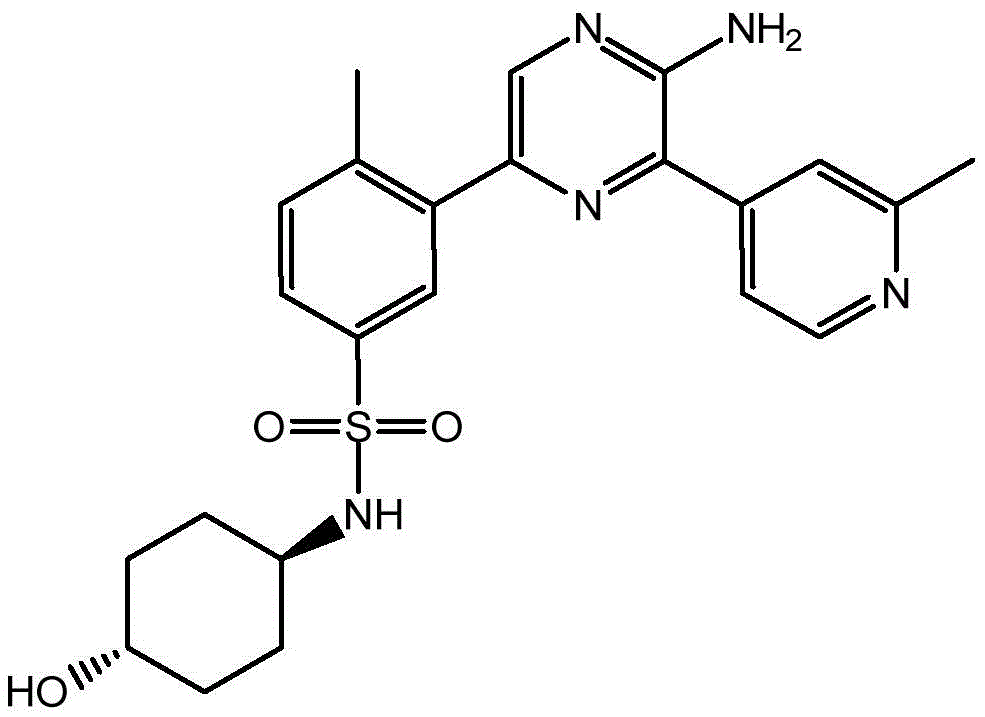
The title compound was prepared in analogy to example 25 from N- (trans-4-hydroxycyclohexyl) -4-methyl-3- (4,4,5, 5-tetramethyl-1, 3, 2-dioxaborolan-2-yl) benzenesulfonamide (intermediate B5) and 5-chloro-3- (2-methylpyridin-4-yl) pyrazin-2-amine (prepared in analogy to intermediate C6, starting from 2-methyl-4- (4,4,5, 5-tetramethyl-1, 3, 2-dioxaborolan-2-yl) pyridine and 3-bromo-5-chloropyrazin-2-amine).
LCMS:Rt 0.66mins;MS m/z 454.4[M+H]+;Method2minLowpHv01
Example 136:
3- (5-amino-6- (3-ethyl-1, 2, 4-oxadiazol-5-yl) pyrazin-2-yl) -N- (3-hydroxy-3-methylbutyl) -4-methylbenzenesulfonamide

Prepared under similar conditions as example 1 using 5-bromo-3- (3-ethyl-1, 2, 4-oxadiazol-5-yl) pyrazin-2-amine (intermediate C2d) and N- (3-hydroxy-3-methyl-butyl) -4-methyl-benzenesulfonamide-3-boronic acid (intermediate B3 a);
LC-MS, MS M/z 447.3[ M + H ] +; method A
1H NMR (400MHz, DMSO-d6) delta 8.60(1H, s),7.91(1H, s),7.83(1H, br s),7.75(1H, d),7.57(1H, d),2.85(4H, m),2.50(2H, m),2.35(3H, m),1.00(6H, s), OH, Me and NH2 were not visible, possibly masked by DMSO and water peaks.
Example 137:
3- (5-amino-6- (3-ethyl-1, 2, 4-oxadiazol-5-yl) pyrazin-2-yl) -N- (azetidin-3-yl) -4-methylbenzenesulfonamide
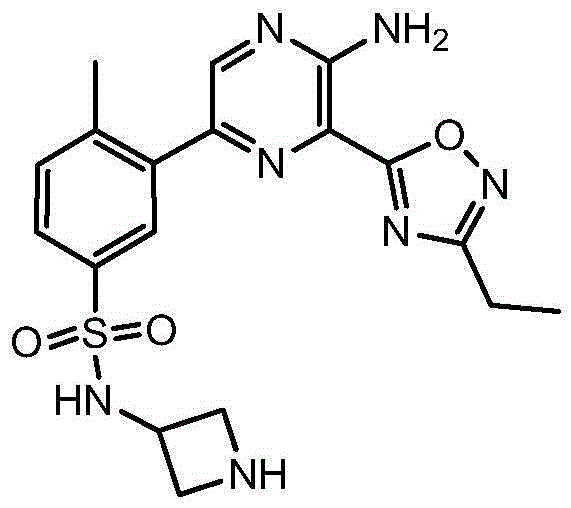
Under similar conditions as in example 1, the title compound was prepared using 5-bromo-3- (3-ethyl-1, 2, 4-oxadiazol-5-yl) pyrazin-2-amine (intermediate C2d) and 3- (4-methyl-3- (4,4,5, 5-tetramethyl-1, 3, 2-dioxaborolan-2-yl) phenylsulfonylamino) azetidine-1-carboxylic acid tert-butyl ester (prepared analogously to intermediate B1), followed by removal of the boc protecting group using TFA/DCM;
LCMS method:
column: cynergi 2.5um Max-RP100A (20X 4.0) mm, mobile phase: A0.01M ammonium acetate (Aq) B ACNT% B0/20, 1.0/20,2.5/85,4.0/95,4.5/20,5.0/20
Flow rate: 1.0mL/min, diluent: ACN
LC-MS:MS m/z 416.2[M+H]+
1H NMR (400MHz, DMSO-d6) Δ 8.62(1H, s),7.90(1H, s),7.85(1H, br s),7.75(1H, d),7.57(1H, d),4.00(1H, m),3.25(4H, m),2.88(2H, m),1.75(3H, s),1.35(2H, t). The two protons are not visible and may be masked by the DMSO and/or water peaks.
Example 138:
trans-3- (5-amino-6- (5-ethyl-1, 3, 4-oxadiazol-2-yl) pyrazin-2-yl) -N- ((1r,4r) -4-hydroxycyclohexyl) -4-methylbenzenesulfonamide
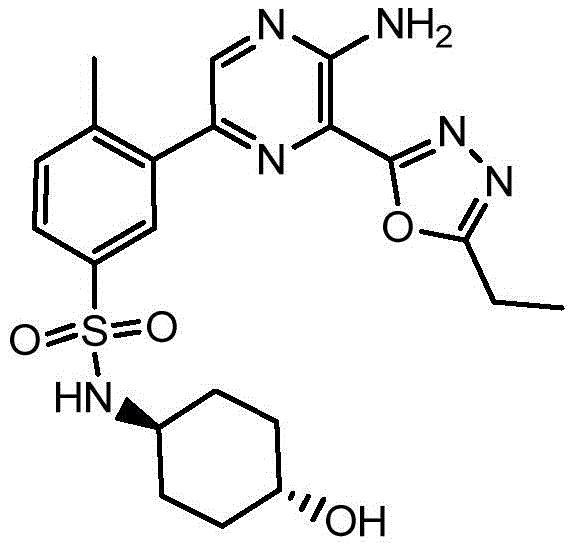
Under similar conditions as example 1, the title compound was prepared using 5-bromo-3- (5-ethyl-1, 3, 4-oxadiazol-2-yl) pyrazin-2-amine (intermediate C1B) and trans-N- (4-hydroxy-cyclohexyl) -4-methyl-benzenesulfonamide 3-boronic acid (intermediate B5 a);
LC-MS:MS m/z 459.3[M+H]+;
1h NMR (400MHz, DMSO-d6) Δ 8.50(1H, s),7.88(1H, s),7.75(2H, m),7.35(1H, m),4.45(1H, br s),3.30(1H, br s),3.00(2H, m),2.90(1H, br s),2.50(1H, s),2.48(3H, s),1.70(4H, m),1.32(3H, m),1.10(4H, m). The two protons are not visible and can be masked by the DMSO and/or water peaks.
Example 139:
trans-3- [ 5-amino-6- (3-ethyl- [1,2,4] oxadiazol-5-yl) -pyrazin-2-yl ] -N- (4-hydroxy-cyclohexyl) -4-methyl-benzenesulfonamide

Under similar conditions as example 1, the title compound was prepared using 5-bromo-3- (3-ethyl-1, 2, 4-oxadiazol-5-yl) pyrazin-2-amine (intermediate C2d) and trans-N- (4-hydroxy-cyclohexyl) -4-methyl-benzenesulfonamide 3-boronic acid (intermediate B5 a);
LCMS:Rt 1.91mins MS m/z 459.3[M+H]+:
1h NMR (400MHz, DMSO-d6) Δ 8.60(1H, s),7.92(1H, s),7.82(1H, br s),7.75(1H, d),7.65(1H, d),7.57(1H, d),4.45(1H, s),3.30(1H, m),2.90(1H, m),2.85(2H, q),1.78-1.60(4H, m),1.43(3H, t),1.22-1.00(4H, m). One proton peak is not visible and may be masked by DMSO and/or water peaks.
Example 140:
trans-3- [ 5-amino-6- (3-propyl- [1,2,4] oxadiazol-5-yl) -pyrazin-2-yl ] -N- (4-hydroxy-cyclohexyl) -4-methyl-benzenesulfonamide
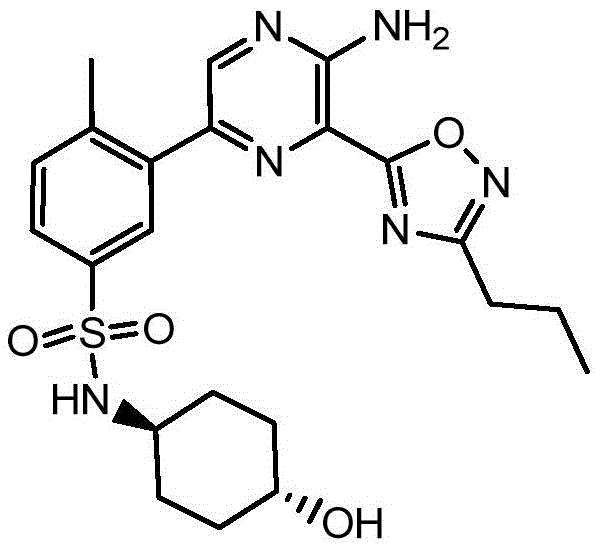
Under similar conditions as example 1, the title compound was prepared using 5-bromo-3- (3-propyl-1, 2, 4-oxadiazol-5-yl) pyrazin-2-amine (intermediate C2e) and trans-N- (4-hydroxy-cyclohexyl) -4-methyl-benzenesulfonamide 3-boronic acid (intermediate B5 a);
LCMS:Rt 2.03mins MS m/z 473.3[M+H]+
1H NMR(400MHz,DMSO-d6)δ8.60(1H,s),7.92(1H,s),7.80(2H,br s),7.75(1H,d),7.65(1H,d),7.57(1H,d),4.45(1H,s),3.30(1H,m),2.90(1H,m),2.80(2H,m),2.47(3H,s),1.80(2H,m),1.60-1.78(4H,m),1.00-1.22(4H,m),0.95(3H,t)。
example 141:
(1- ((3- (5-amino-6- (3-ethyl-1, 2, 4-oxadiazol-5-yl) pyrazin-2-yl) -4-methylphenyl) sulfonyl) piperidin-4-yl) methanol

The title compound was prepared under similar conditions as example 1 using 5-bromo-3- (3-ethyl-1, 2, 4-oxadiazol-5-yl) pyrazin-2-amine (intermediate C2d) and (5- ((4- (hydroxymethyl) piperidin-1-yl) sulfonyl) -2-methylphenyl) boronic acid (prepared using a two-step process according to similar conditions for intermediate B5 a);
LC-MS, MS M/z 459.1[ M + H ] +; method A
1H NMR (400MHz, DMSO-d6) Δ 8.63(1H, s),7.81(1H, br s),7.80(1H, s),7.70(1H, m),7.60(1H, m),4.44(1H, br s),3.33(2H, d),3.22(2H, d),2.87(2H, m),2.45(3H, s),2.14(2H, m),1.70(2H, m),1.33(3H, m),1.20(3H, m). One proton peak is not visible and may be masked by DMSO and/or water peaks.
Example 142:
3- (5-amino-6- (1- (2- (dimethylamino) ethyl) -1H-pyrazol-4-yl) pyrazin-2-yl) -N- (2-hydroxy-2-methylpropyl) -4-methylbenzenesulfonamide
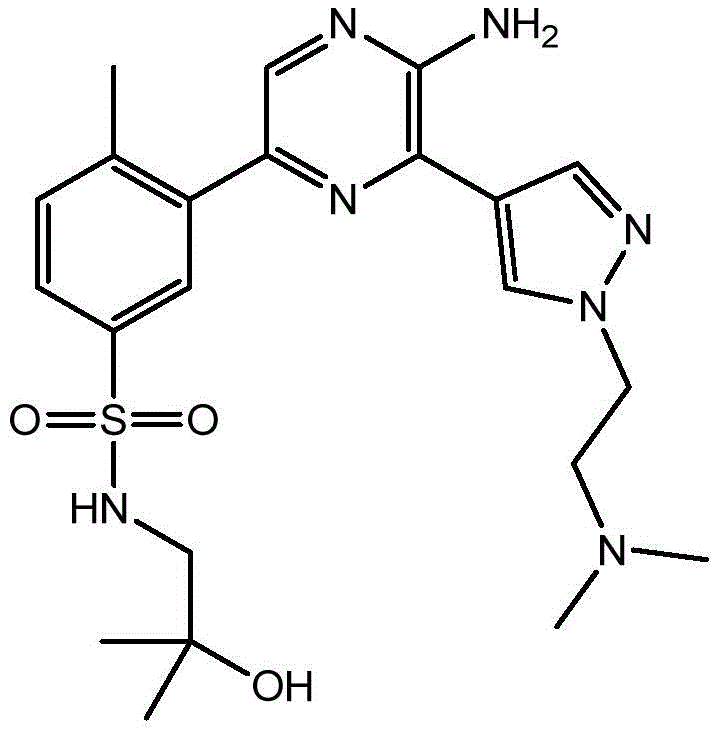
Step 1 3- (5-amino-6- (1- (2-hydroxyethyl) -1H-pyrazol-4-yl) pyrazin-2-yl) -N- (2-hydroxy-2-methylpropyl) -4-methylbenzenesulfonamide
The title compound was prepared in analogy to example 13, using 2- (4- (4,4,5, 5-tetramethyl-1, 3, 2-dioxaborolan-2-yl) -1H-pyrazol-1-yl) ethanol (Syntech solution-commercially available) and 3- (5-amino-6-chloro-pyrazin-2-yl) -N- (2-hydroxy-2-methyl-propyl) -4-methyl-benzenesulfonamide (intermediate D2) as starting materials;
LCMS, Rt is 0.84 mins; MS M/z 447.3[ M + H ] +; method 2minLowpHv03
Step 2-2- (4- (3-amino-6- (5- (N- (2-hydroxy-2-methylpropyl) sulfamoyl) -2-methylphenyl) pyrazin-2-yl) -1H-pyrazol-1-yl) ethyl 4-methylbenzenesulfonate
Reference: preparation according to Patent US 2002/0161004 (page 44)
To a solution of 3- (5-amino-6- (1- (2-hydroxyethyl) -1H-pyrazol-4-yl) pyrazin-2-yl) -N- (2-hydroxy-2-methylpropyl) -4-methylbenzenesulfonamide (step 1) (190mg,0.426mmol) in DCM (1064 μ l) was added triethylamine (74.1 μ l,0.532mmol) at 0 ℃ under a nitrogen atmosphere. To the mixture was added p-toluenesulfonyl chloride (81mg,0.426mmol) in DCM (1064. mu.l) dropwise over 5min, and the reaction mixture was stirred at 0 ℃ for 3.5 h, then warmed to room temperature overnight. Another portion of p-toluenesulfonyl chloride (81mg,0.426mmol) and triethylamine (74.1. mu.l, 0.532mmol) was added and stirring was continued overnight. P-toluenesulfonyl chloride (81mg,0.426mmol) and triethylamine (74.1. mu.l, 0.532mmol) were added and stirring was continued overnight. The reaction mixture was added to water (50ml) and the organic portion was separated using 1M HCl (50ml), saturated NaHCO3The solution (50ml) was washed with saturated brine (20 ml). The organic portion was dried over magnesium sulfate, filtered, and concentrated under reduced pressure to give a pale yellow oil. Purifying by silica gel chromatography, eluting with 0-10% MeOH in DCM to obtain the desired compound;
LCMS, Rt is 1.15 mins; MS M/z 601.6[ M + H ] +; method 2minLowpHv03
Step 3- (5-amino-6- (1- (2- (dimethylamino) ethyl) -1H-pyrazol-4-yl) pyrazin-2-yl) -N- (2-hydroxy-2-methylpropyl) -4-methylbenzenesulfonamide
To a stirred solution of 2- (4- (3-amino-6- (5- (N- (2-hydroxy-2-methylpropyl) sulfamoyl) -2-methylphenyl) pyrazin-2-yl) -1H-pyrazol-1-yl) ethyl 4-methylbenzenesulfonate (step 2) (25mg,0.042mmol) in THF (416 μ l) under a nitrogen atmosphere was added DIPEA (14.54 μ l,0.083mmol) and dimethylamine (2.0M in THF) (250 μ l,0.499 mmol). The reaction mixture was stirred at room temperature for 16 hours. Another portion of dimethylamine (2.0M in THF) (250. mu.l, 0.499mmol) was added and stirring was continued overnight. The resulting mixture was concentrated under reduced pressure. The crude product was purified by silica gel chromatography using 0-10% of (2.0M NH)3MeOH solution) was eluted in a gradient of DCM. The residue obtained is taken up in 1g Further purification on SCX-2 short column, MeOH rinse, 2.0M NH3Eluting with MeOH solution to obtain the target compound;
LCMS, Rt is 0.65 mins; MS M/z 474.6[ M-H ] +; method 2minLowpHv03
Example 143:
3- (5-amino-6- (3-cyclopropyl-1, 2, 4-oxadiazol-5-yl) pyrazin-2-yl) -N- (3-hydroxy-3-methylbutyl) -4-methylbenzenesulfonamide
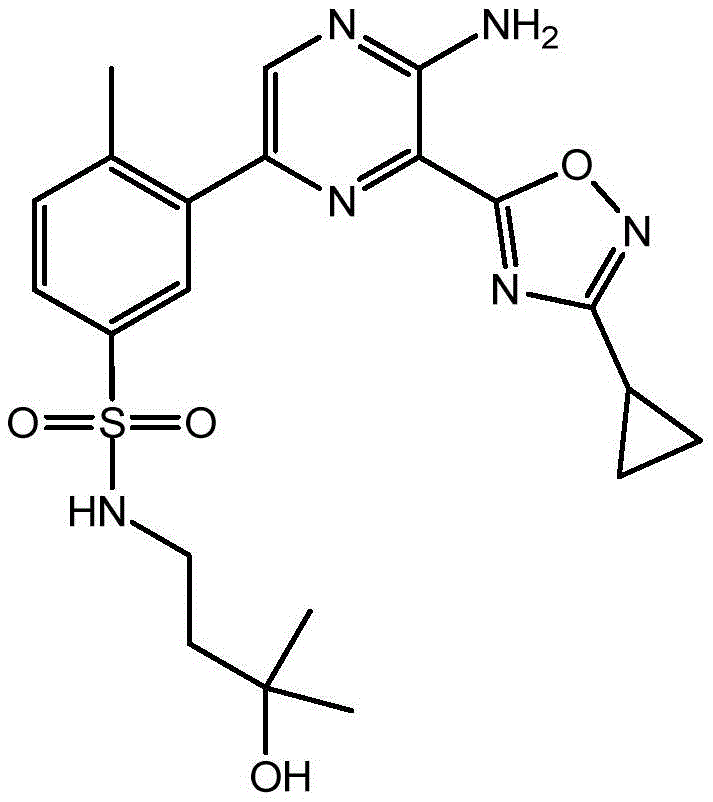
The title compound was prepared from N- (3-hydroxy-3-methylbutyl) -4-methyl-3- (4,4,5, 5-tetramethyl-1, 3, 2-dioxaborolan-2-yl) benzenesulfonamide (intermediate B3) and 5-bromo-3- (3-cyclopropyl- [1,2,4] oxadiazol-5-yl) -pyrazin-2-ylamine (intermediate C2C) according to similar conditions used for the preparation of example 18;
LCMS is Rt 1.01 mins; MS M/z 359.2[ M + H ] +; method 2minLC _ v003
Preparation of an intermediate:
bromide (A)
Intermediate A1
3-bromo-N- (3-hydroxypropyl) -4-methylbenzenesulfonamide

To a stirred solution of 3-bromo-4-methylbenzene-1-sulfonyl chloride (2g,7.42mmol) in THF (37ml) under nitrogen was added 3-amino-1-propanol (0.568ml,7.42mmol) and the resulting mixture was stirred at room temperature for 24 hours. The solvent was removed under reduced pressure and the crude product was added to 0.1M HCl (100 ml). The mixture was extracted with EtOAc (150mL) and the organic extracts were washed with sat2CO3(60ml), washed with brine, dried over magnesium sulfate, and concentrated under reduced pressure to obtain the target compound;
LCMS, Rt 0.89 mins; MS M/z 310.1[ M + H ] +; method 2minLC _ v003
Intermediate A2
3-bromo-N- (2-hydroxy-2-methylpropyl) -4-methylbenzenesulfonamide
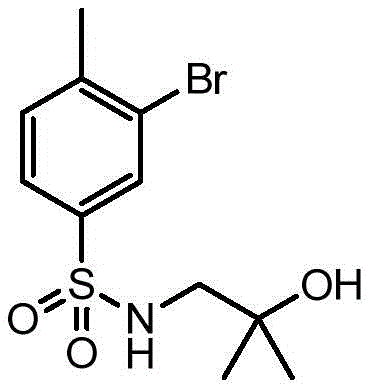
To a stirred solution of 3-bromo-4-methylbenzene-1-sulfonyl chloride (3.02g,11.22mmol) in pyridine (56.1ml) was added 1-amino-2-methylpropan-2-ol (1.0g,11.22mmol) under nitrogen, and the mixture was stirred at room temperature for 72 hours. The solvent was removed under reduced pressure and the crude product obtained was added to 0.1M HCl (100 ml). The mixture was extracted with EtOAc (150mL) and the organic extracts were washed with sat2CO3(100ml), washed with brine, dried over magnesium sulfate, and concentrated under reduced pressure to obtain the target compound;
LCMS is Rt 1.01 mins; MS M/z 324.1[ M + H ] +; method 2minLC _ v003
Intermediate A3
3-bromo-N- (3-hydroxy-3-methyl-butyl) -4-methyl-benzenesulfonamide

Prepared analogously to intermediate a2 from 3-bromo-4-methylbenzene-1-sulfonyl chloride and 4-amino-2-methylbutan-2-ol.
LCMS is Rt 1.04 mins; MS M/z did not ionize [ M + H ] +; method 2minLC _ v003
Intermediate A4
3-bromo-4-methyl-N- (3-methyl-oxetan-3-ylmethyl) -benzenesulfonamide
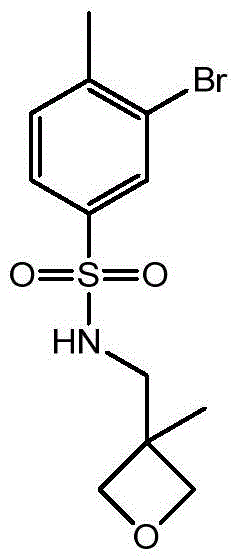
To a solution of (3-methyloxetan-3-yl) methylamine (2.026g,20.03mmol) in DMA (50ml) was added DIPEA (4.37ml,25.04 mmol). The mixture was stirred at room temperature for 30min, then 3-bromo-4-methylbenzene-1-sulfonyl chloride (4.5g,16.70mmol) was added. The mixture was stirred at room temperature for 1 hr. The solvent was removed under reduced pressure and the residue was dissolved in EtOAc and taken up with saturated aq3Washed with 0.1M HCl and then brine. The organic extract was dried over magnesium sulfate, and the solvent was removed to obtain the product (5.19g) as a pale yellow powder.
LCMS is Rt 1.10 mins; MS M/z 336.1[ M + H ] +; method 2minLowpHv01
The intermediates listed in the table below were prepared analogously to intermediates A1-A4, starting from 3-bromo-4-methylbenzene-1-sulfonyl chloride and the appropriate amine. The amines are obtained commercially or prepared according to known methods.
TABLE 1


Intermediate A12
5-bromo-2-fluoro-N- (3-hydroxypropyl) -4-methylbenzenesulfonamide
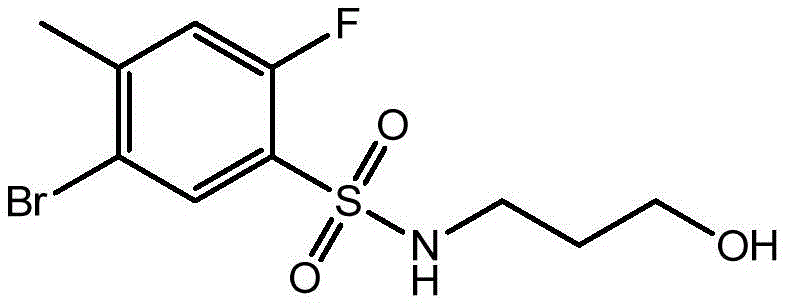
The title compound was prepared from 5-bromo-2-fluoro-4-methylbenzene-1-sulfonyl chloride and 3-aminopropan-1-ol following a similar procedure to intermediate a 1.
LCMS, Rt 0.88 mins; MS M/z 328.1[ M + H ] +; the method comprises the following steps: 2minLC _ v003
Borate ester (B)
Intermediate B1
N- (3-hydroxypropyl) -4-methyl-3- (4,4,5, 5-tetramethyl-1, 3, 2-dioxaborolan-2-yl) benzenesulfonamide

3-bromo-N- (3-hydroxypropyl) -4-methylbenzenesulfonamide (intermediate A1) (2.25g,7.30mmol), KOAc (1.075g,10.95mmol), PdCl were added under a nitrogen atmosphere2(dppf).CH2Cl2A mixture of the adduct (0.298g,0.365mmol) and bis (pinacolato) diboron (2.039g,8.03mmol) in DME (36.5ml) was stirred at 90 ℃ for 5 h. The resulting mixture was added to water (100ml) and extracted with EtOAc (2X 100 ml). The combined organic extracts were washed with brine, dried over magnesium sulfate and concentrated under reduced pressure. Purifying by silica gel chromatography, eluting with 0-100% EtOAc in isohexane, to obtain the target compound;
LCMS is Rt 1.03 mins; MS M/z 356.5[ M + H ] +; method 2minLC _ v003
The intermediate compounds listed in the table below were prepared from the appropriate bromide starting compound (see intermediates a1-a11) according to a similar procedure to intermediate B1:
TABLE 2
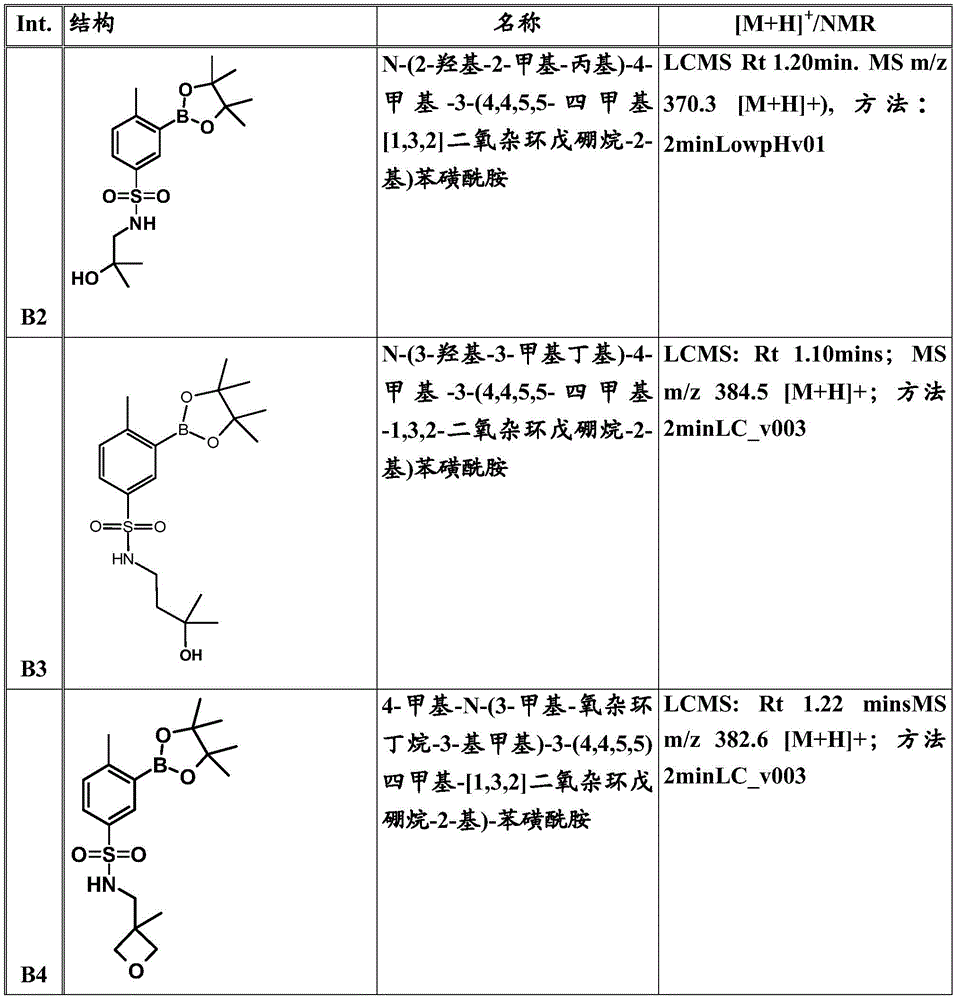

Boric acid (B)
Intermediate B3a
N- (3-hydroxy-3-methyl-butyl) -4-methyl-benzenesulfonamide-3-boronic acid
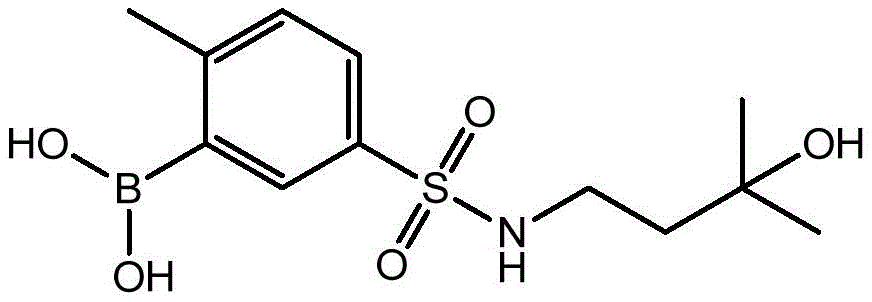
To a stirred solution of 3-bromo-N- (3-hydroxy-3-methyl-butyl) -4-methyl-benzenesulfonamide (intermediate A3) (1.0g,2.97mmol) in THF (20ml) at-78 deg.C was added N-BuLi (5.9ml,14.85mmol,2.5M) dropwise. The reaction was held at this temperature for 30min, then triisopropyl borate (8.9g,47.6mmol) was added dropwise. The reaction mixture was slowly warmed to room temperature and then stirred for a further 15 h. The reaction was quenched with 3N HCl (50ml) and extracted with ethyl acetate (3X 100 ml). The organic extract was separated, dried over sodium sulfate, and concentrated under reduced pressure to obtain the crude compound. The product was dissolved in ethyl acetate (100ml) and extracted with sodium carbonate solution (3X 150ml) (pH 9). The aqueous extract was adjusted to 2 by addition of concentrated hydrochloric acid and the product was extracted with ethyl acetate (3X 200 ml). The organic extract was dried over sodium sulfate and concentrated in vacuo to give the title compound (0.29 g).
Intermediate B5a
trans-N- (4-hydroxy-cyclohexyl) -4-methyl-benzenesulfonamide 3-boronic acid

To a stirred solution of trans-3-bromo-N- (4-hydroxy-cyclohexyl) -4-methylbenzenesulfonamide (intermediate A5) (2.0g,5.77mmol) in THF (60ml) at-78 deg.C was added N-BuLi (11.5ml,28.8mmol, 2.5M). The reaction was held at this temperature for 30min, then triisopropyl borate (17.35g,92.32mmol) was added dropwise. The reaction mixture was slowly warmed to room temperature and then stirred for a further 15 h. The reaction was quenched with 3N HCl (200ml) and extracted with ethyl acetate (3X 250 ml). The organic extract was separated, dried over sodium sulfate and concentrated in vacuo to give the crude product. The product was dissolved in ethyl acetate (500ml) and extracted with sodium carbonate solution (3X 150ml) (pH 9). The aqueous extract was adjusted to 2 by addition of concentrated hydrochloric acid and the product was extracted with ethyl acetate (3X 250 ml). The organic extracts were dried over sodium sulfate and concentrated in vacuo to afford the title compound.
Intermediate C1
5-bromo-3- (5-methyl- [1,3,4] oxadiazol-2-yl) -pyrazin-2-ylamine

Step 1 3-amino-6-bromo-pyrazine-2-carboxylic acid N' -acetyl-hydrazide
HATU (3.4g,9.05mmol) and triethylamine (1.2g,12.06mmol) were added to a suspension of 2-amino-5-bromopyrazine-3-carboxylic acid (1.40g,6.03mmol) and acethydrazide (0.44g,6.03mmol) in DCM (100ml) and the resulting solution was stirred at room temperature for 24 hr. The reaction was monitored by TLC. The reaction mixture was poured into water (200ml), the solid was collected by filtration and dried under vacuum to obtain 3-amino-6-bromo-pyrazine-2-carboxylic acid N' -acetyl-hydrazide;
LCMS Rt 0.57mins MS M/z 274.0[ M + H ] +; method 2minLowpHv01
Step 2 5-bromo-3- (5-methyl- [1,3,4] oxadiazol-2-yl) -pyrazin-2-ylamine
3-amino-6-bromo-pyrazine-2-carboxylic acid N' -acetyl-hydrazide (step 1) (0.86g,3.15mmol) was dissolved in DCM (40ml), triethylamine (0.95g,9.45mmol) was added dropwise at room temperature under nitrogen, followed by p-toluenesulfonyl chloride (1.79g,9.45 mmol). The reaction was stirred at room temperature for 24 hr. DCM (20ml) was added and the solid was removed by filtration and washed with DCM (30 ml). The organic filtrate was washed with water (2X 30ml) and concentrated in vacuo to afford the desired compound. The product was purified by flash chromatography on silica eluting with EtOAc-hexanes (9:1) to afford the product as a yellow solid;
LCMS Rt 0.86mins MS M/z 256.0[ M + H ] +; method 2minLowpHv01
Intermediate C1b
5-bromo-3- (5-ethyl-1, 3, 4-oxadiazol-2-yl) pyrazin-2-amine

The title compound was prepared analogously to intermediate C1.
Intermediate C2a
5-bromo-3- (3-methyl- [1,2,4] oxadiazol-5-yl) -pyrazin-2-ylamine

Step 1 3- (3-methyl- [1,2,4] oxadiazol-5-yl) -pyrazin-2-ylamine
DCC (1.39g,6.75mmol) and HOBt. H2O (1.03g,13.51mmol) was added to a stirred solution of N' -hydroxyacetamidine (acetamidine) (0.5g,10.12mmol) and 3-aminopyrazine-2-carboxylic acid (0.94g,6.75mmol) in DMF (15 ml). The reaction mixture was stirred at room temperature for 3h, followed by stirring at 100 ℃ for 2 h. After cooling, the reaction mixture was poured into water (100ml) and diethyl ether (100 ml). The solid was removed by filtration and the filtrate was extracted with more ether (2X 100 ml). The combined organic extracts were dried over sodium sulfate and concentrated under reduced pressure to give the crude product. Purification by silica gel chromatography eluting with 10% EtOAc in hexanes afforded the title compound as a white solid (0.35g, 29%).
Step 2 5-bromo-3- (3-methyl- [1,2,4] oxadiazol-5-yl) -pyrazin-2-ylamine
A stirred solution of 3- (3-methyl- [1,2,4] oxadiazol-5-yl) -pyrazin-2-ylamine (step 1) (258mg,1.45mmol) and NBS (259mg,1.45mmol) in acetonitrile (10ml) was heated at reflux for 5 h. The solvent was removed and the product was purified by silica gel chromatography eluting with 7% EtOAc in hexanes to give the product as a brown solid (240mg, 64%).
Intermediate C2b
5-bromo-3- (3-isopropyl- [1,2,4] oxadiazol-5-yl) -pyrazin-2-ylamine
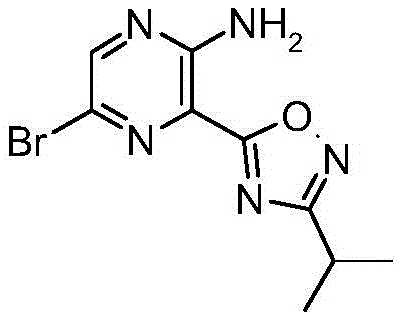
The target compound was prepared according to a similar method to intermediate C2, starting with N' -hydroxyisobutyramidine (butyrylamide).
Intermediate C2C
5-bromo-3- (3-cyclopropyl- [1,2,4] oxadiazol-5-yl) -pyrazin-2-ylamine

The title compound was prepared analogously to intermediate C2a, starting from N' -hydroxycyclopropanecarboxamidine.
Intermediate C2d
5-bromo-3- (3-ethyl-1, 2, 4-oxadiazol-5-yl) pyrazin-2-amine

The title compound was prepared analogously to intermediate C2a, starting from N' -hydroxypropamidine.
Intermediate C2e
5-bromo-3- (3-propyl-1, 2, 4-oxadiazol-5-yl) pyrazin-2-amine

The title compound was prepared analogously to intermediate C2a, starting from N' -hydroxybutamidine.
Intermediate C3
5-bromo-3- (3-methyl-isoxazol-5-yl) -pyrazin-2-ylamine

Step 1 3- (3-methyl-isoxazol-5-yl) -pyrazin-2-ylamine
N-butyllithium (7ml,9.8mmol,1.4M in hexane) was added to a solution of acetoxime (0.36g,4.9mmol) in dry THF (15ml) at 0 deg.C under nitrogen. The mixture was warmed to room temperature and stirred for 30 min. A solution of methyl 3-amino-pyrazine-2-carboxylate (0.50g,3.26mmol) in THF (5ml) was added and the reaction stirred at room temperature until the starting material was consumed. Sulfuric acid (2ml) was added at 0 ℃ followed by stirring at room temperature for 1 h. The reaction mixture was taken as aq.Na2CO3Basified and the product extracted with DCM (5 × 15 ml). The combined organic extracts were dried over sodium sulfate and the solvent was removed. The residue was purified by silica gel chromatography eluting with EtOAc: hexane (2:8) to afford the title compound。
Step 2 5-bromo-3- (3-methyl-isoxazol-5-yl) -pyrazin-2-ylamine.
NBS (50mg,0.28mmol) was added to a stirred solution of 3- (3-methyl-isoxazol-5-yl) -pyrazin-2-ylamine (50mg,0.28mmol) in chloroform and the reaction was stirred at rt for 4 h. The reaction was diluted with water and CHCl was used3And (4) extracting. The organic extracts were dried over sodium sulfate and purified by silica gel chromatography eluting with hexane: EtOAc (3:1) to afford the title compound.
LCMS Rt 0.98mins MS M/z 255.0[ M + H ] +; method 2minLowpHv01
Intermediate C4
5-bromo-3- (1-methyl-1H-pyrazol-4-yl) -pyrazin-2-ylamine
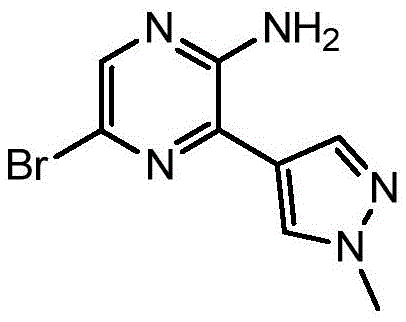
Step 1 3- (1-methyl-1H-pyrazol-4-yl) -pyrazin-2-ylamine
Sodium carbonate (17ml of a 2M solution, 33mmol) was added to 3-chloropyrazin-2-amine (1.23g,9.47mmol), 1-methyl-4- (4,4,5, 5-tetramethyl-1, 3, 2-dioxaborolan-2-yl) -1H-pyrazole (1.97g,9.47mmol) and PdCl2(dppf).CH2Cl2(0.387g,0.473mmol) in a DME (60ml) mixture. The mixture was degassed several times with nitrogen and then heated at 85 ℃ for 3 h. The solvent was removed and the residue was diluted with water and extracted several times with EtOAc. The organic extract was separated, dried over magnesium sulfate and the solvent removed to give a dark oil. Purification by silica gel chromatography eluting with EtOAc: MeOH (3:1) followed by trituration with EtOAc and ether afforded the title compound (1.25g) as a grey powder;
LCMS is Rt 0.45 mins; MS M/z 176.4[ M + H ] +; method 2minLC _ v003
1H NMR(400MHz,CDCl3)8.01(2H,m),7.93(2H,s),4.75(2H,br s),4.00(3H,s)
Step 2 5-bromo-3- (1-methyl-1H-pyrazol-4-yl) -pyrazin-2-ylamine
Stirring 3- (1-methyl-1H-pyrazol-4-yl) pyrazin-2-amine (step 1) (1.3g,7.42mmol) and NBS (1.45g,8.16mmol) in acetonitrileThe solution (15ml) was heated under reflux under nitrogen for 5 hrs. The solvent was removed under reduced pressure and the residue was taken up in aq3Diluted and extracted several times with EtOAc. The organic extracts were dried over magnesium sulfate and concentrated under reduced pressure to give a dark oil. Purification by silica gel chromatography eluting with EtOAc afforded the target compound as a solid (0.523g, 26%);
LCMS Rt 0.75mins MS M/z 254.3[ M + H ] +; method 2minLC _ v003
1H NMR(400MHz,CDCl3)δ(ppm)8.01(2H,s),7.96(1H,s),4.75(2H,br s),4.00(3H,s)。
Intermediate C5
5-chloro-3- (1H-1,2, 4-triazol-1-yl) pyrazin-2-amine
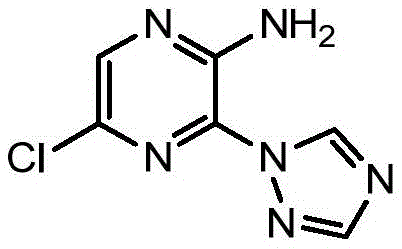
3-bromo-5-chloropyrazin-2-amine (5g,23.99mmol), 1H-1,2, 4-triazole (1.740g,25.2mmol), N-dimethylglycine (0.247g,2.399mmol), and Cs2CO3A mixture of (23.45g,72.0mmol) and CuI (0.457g,2.399mmol) in dimethylaniline (120ml) was heated at 150 ℃ for 4 hours. The resulting mixture was added to water (700ml) and the product extracted with EtOAc (2X 500 ml). The combined organic extracts were washed with brine, dried over magnesium sulfate and concentrated under reduced pressure. Purifying by silica gel chromatography with 0-10% of [2M NH ]3In MeOH (E) solution]Is eluted in a gradient way to obtain the target compound as yellow solid;
LCMS, Rt 0.74 mins; MS M/z 197.1[ M + H ] +; method 2minLowpH.
Intermediate C6
5-chloro-3- (2-methylthiazol-5-yl) pyrazin-2-amine
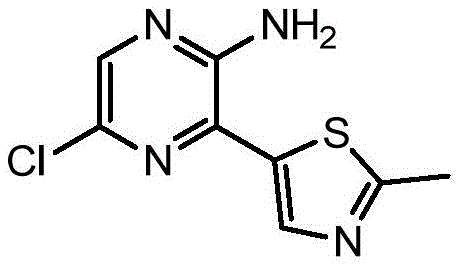
In a nitrogen atmosphere, 2-methyl-5- (4,4,5, 5-tetramethyl-1, 3, 2-dioxaborolan-2-yl) thiazole (1g,4.44mmol), 3-bromo-5-chloropyrazin-2-amine (0.926g,4.44mmol), PdCl2(dppf).CH2Cl2Adduct (0.181g,0.222mmol) and 2M Na2CO3A DME (22.21ml) mixture (6.66ml) was heated at 120 ℃ for 45 minutes using microwave irradiation. The mixture was added to water (100ml) and extracted with EtOAc (2X 90 ml). The organic extracts were washed with brine, dried over magnesium sulfate and concentrated under reduced pressure. Purifying by silica gel chromatography with 0-10% of [2.0M NH3In MeOH (E) solution]Performing gradient elution on the TBME solution to obtain a target compound which is brown solid;
LCMS, Rt 0.87 mins; MS M/z 227.1[ M + H ] +; method 2minLC _ v003.
Intermediate C7
5-chloro-3- (1, 3-dimethyl-1H-pyrazol-4-yl) -pyrazin-2-ylamine

To a solution of 3-bromo-5-chloropyrazin-2-amine (3.75g,18.01mmol) in DME (90ml) was added 1, 3-dimethyl-4- (4,4,5, 5-tetramethyl-1, 3, 2-dioxaborolan-2-yl) -1H-pyrazole (4g,18.01mmol), bis (triphenylphosphine) palladium (II) dichloride (0.632g,0.901mmol) and Na2CO3(aq.2.0M) (27.0ml,54.0 mmol). The reaction was heated to 90 ℃ overnight. The reaction was added to water (250ml) and the product extracted with EtOAc (2X 230 ml). The organic phase was washed with brine and dried over magnesium sulfate. The solid was removed by filtration, washed with EtOAc, and the filtrate was concentrated in vacuo. The crude product was purified by flash column chromatography using 0-10% of (2M NH)3MeOH solution) was eluted onto a 80g Si-column with a gradient of DCM to afford the product (2.5g)
LCMS is Rt 0.81 mins; MS M/z 224.0[ M + H ] +; method 2minLowpHv01
Intermediate C8
5-bromo-3- (1H- [1,2,3] triazol-4-yl) -pyrazin-2-ylamine

Step 1-5-bromo-3-trimethylsilylethynyl-pyrazin-2-ylamine
A150 mL round bottom flask was charged with a solution of 3, 5-dibromopyrazine-2-amine (3g,11.86mmol) and triethylamine (16.53mL,119mmol) in THF (60mL) to give a yellow suspension. To the stirred solution was added bis (triphenylphosphine) palladium (II) dichloride (833mg,1.186mmol) and copper (I) iodide (452mg,2.373 mmol). Whilst maintaining the temperature below 10 ℃, ethynyltrimethylsilane (1.844ml,13.05mmol) was added slowly and the reaction stirred for 30mins below 10 ℃ then warmed to room temperature and stirred for a further 30 minutes.
The reaction was concentrated under reduced pressure. After dilution with ethyl acetate, the organic portion was washed with brine, the organic layer was separated, dried over magnesium sulfate, filtered and the solvent was removed under reduced pressure. The residue was loaded onto silica gel and purified by flash column chromatography eluting with isohexane, ethyl acetate (0-30%) on a 80g silica gel column. The desired fractions were combined and the solvent was removed under reduced pressure to give the product as a light brown solid (2.5 g).
LCMS Rt 1.26mins MS M/z 272.3[ M + H ] +; method 2minLowpH
1H NMR(400MHz,DMSO-d6)δ8.12(1H,s),6.80(2H,br s),0.26(9H,s)。
Step 2 5-bromo-3-ethynyl-pyrazin-2-ylamine
To a 150mL round bottom flask was added 5-bromo-3- ((trimethylsilyl) ethynyl) pyrazin-2-amine (2.5g,9.25mmol) and K2CO3(1.279g,9.25mmol) in MeOH (40ml) to give a brown solution. The reaction was stirred at room temperature for 30 minutes. The reaction was extracted into DCM, washed with water, brine, the organic layer was separated, dried over magnesium sulfate, filtered and the solvent removed under reduced pressure to give the product as a brown solid (1.54 g).
LCMS; rt 0.78mins MS M/z 200.2.[ M + H ] +; method 2minLowpH
1H NMR (400MHz, DMSO-d6) delta 8.12(1H, s),6.86(2H, broad s),4.81(1H, s).
Step 3 5-bromo-3- (1H- [1,2,3] triazol-4-yl) -pyrazin-2-ylamine
To a 100ml round bottom flask was added a solution of 5-bromo-3-ethynylpyrazine-2-amine (800mg,4.04mmol), sodium ascorbate (0.404ml,0.404mmol) and copper (II) sulfate pentahydrate (10.09mg,0.040mmol) in t-butanol (10.00ml) and water (20ml) to obtain a brown suspension. Trimethylsilyl azide (1.61ml,12.12mmol) was added thereto, and the reaction was heated at 90 ℃ for 4 hours. The reaction was extracted into ethyl acetate, washed with brine, the organic layer was separated, dried over magnesium sulfate, filtered and the solvent was removed under reduced pressure. The residue was loaded onto silica gel and purified by flash column chromatography using isohexane, ethyl acetate (0-70% eluted on a 40g silica gel short column. the desired fractions were combined and the solvent was removed under reduced pressure to give the product as a dark yellow solid (560mg, 57%).
LCMS Rt 0.82mins MS M/z 243.2.[ M + H ] +; method 2minLowpH
1H NMR(400MHz,DMSO-d6)δ(ppm)15.66(1H br s),8.52(1H,br s),8.14(1H,s),7.46(2H,br s)。
Step 4 5-bromo-3- (1H- [1,2,3] triazol-4-yl) -pyrazin-2-ylamine
To a 25ml round bottom flask was added a solution of 5-bromo-3- (1H-1,2, 3-triazol-4-yl) pyrazin-2-amine (250mg,1.037mmol), potassium carbonate (430mg,3.11mmol) and iodomethane (0.195ml,3.11mmol) in THF (10ml) to give a yellow suspension. The reaction was stirred at room temperature for 1 hour, at which time a 1:1 mixture of the two regioisomers was formed. The reaction was extracted into ethyl acetate, washed with brine, the organic layer was separated, dried over magnesium sulfate, filtered and the solvent was removed under reduced pressure. The crude mixture was dissolved in DMSO and purified by mass-directed preparative purification to give the target compound.
LCMS Rt 0.95mins MS M/z 255.2.[ M + H ] +; method 2minLowpH
1H NMR(400MHz,DMSO-d6),δ8.27(1H,s),8.18(1H,s),7.30(2H,br s),4.29(3H,s)。
Intermediate C8a 5-bromo-3- (1-ethyl-1H-1, 2, 3-triazol-4-yl) pyrazin-2-amine and intermediate C8b 5-bromo-3- (2-ethyl-2H-1, 2, 3-triazol-4-yl) pyrazin-2-amine
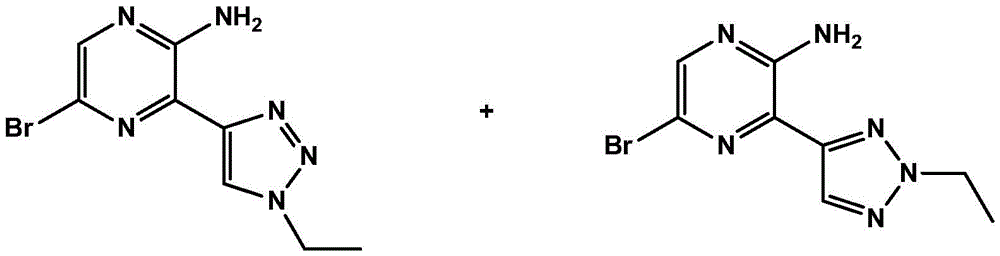
To a 25ml round bottom flask was added a solution of 5-bromo-3- (1H-1,2, 3-triazol-4-yl) pyrazin-2-amine (intermediate C8 step 3) (300mg,1.245mmol), potassium carbonate (516mg,3.73mmol) and iodoethane (0.302ml,3.73mmol) in THF (10ml) to give a yellow suspension. The reaction mixture was heated at 70 ℃ for 4 hours. A mixture of the two regioisomers was formed in a ratio of 4: 6. The reaction was extracted into ethyl acetate, washed with water, brine, the organic layer was separated, dried over magnesium sulfate, filtered and the solvent was removed under reduced pressure. The product was dissolved in DMSO and purified by mass-mediated preparative chromatography. The desired fractions were combined, extracted into DCM, washed with saturated sodium bicarbonate solution to remove all traces of TFA, the organic layer was separated, dried over magnesium sulfate, filtered and the solvent removed under reduced pressure to give the single regioisomer:
first elution peak:
intermediate C8a 5-bromo-3- (1-ethyl-1H-1, 2, 3-triazol-4-yl) pyrazin-2-amine
LCMS Rt 0.99mins MS M/z 269.4[ M + H ] +; method 2 minlowwphv 01.
1H NMR (400MHz, DMSO-d6) Δ 8.79(1H, s),8.12(1H, s),7.54(2H, broad), 4.49(2H, multimodal), 1.50(3H, t).
Second elution peak:
intermediate C8b 5-bromo-3- (2-ethyl-2H-1, 2, 3-triazol-4-yl) pyrazin-2-amine
LCMS Rt 1.07mins MS M/z 269.3[ M + H ] +; method 2 minlowwphv 01.
1H NMR (400MHz, DMSO-d6) delta 8.29(1H, s),8.18(1H, s),7.30(2H, broad), 4.57(2H, multimodal), 1.52(3H, t).
Intermediate C8C:
5-bromo-3- (2- (2,2, 2-trifluoroethyl) -2H-1,2, 3-triazol-4-yl) pyrazin-2-amine

To a 25ml round bottom flask was added a solution of 5-bromo-3- (1H-1,2, 3-triazol-4-yl) pyrazin-2-amine (intermediate C8 step 3) (300mg,1.245mmol), cesium carbonate (1217mg,3.73mmol) and 2,2, 2-trifluoroethyl triflate (0.359ml,2.489mmol) in acetonitrile (10ml) to obtain a yellow suspension. The reaction mixture was stirred at room temperature for 1 hour. The mixture was extracted into ethyl acetate, washed with water, brine, the organic layer was separated, dried over magnesium sulfate, filtered and the solvent was removed under reduced pressure. The product was dissolved in DMSO and purified by mass-mediated preparative chromatography. The desired fractions were combined, extracted into DCM, washed with saturated sodium bicarbonate solution to remove all traces of TFA, the organic layer was separated, dried over magnesium sulfate, filtered, and the solvent removed under reduced pressure to give an off-white solid;
LCMS Rt 1.17mins MS M/z 323.4[ M + H ] +; method 2 minlowwphv 01.
1H NMR (400MHz, DMSO-d6) delta 8.49(1H, s),8.24(1H, s),7.33(2H, broad peak), 5.72(2H, q).
Intermediate C9
5-bromo-3- (2, 5-dimethyl-2H- [1,2,3] triazol-4-yl) -pyrazin-2-ylamine

Step 1-5-bromo-3- (prop-1-ynyl) pyrazin-2-amine
To a 100ml round bottom flask was added a solution of 3, 5-dibromopyrazin-2-amine (2g,7.91mmol) and bis (triphenylphosphine) palladium (II) dichloride (0.278g,0.395mmol) in toluene (30ml) to give a yellow suspension. To the stirred solution was added tributyl (prop-1-ynyl) stannane (2.41ml,7.91mmol) and the reaction was heated at 60 ℃ for 1 hour. The crude reaction was loaded onto silica gel and the solvent was removed under reduced pressure. The product was purified by flash column chromatography eluting with isohexane, ethyl acetate (0-50%) on a 40g silica gel column. The desired fractions were combined and the solvent was removed under reduced pressure to give the product as a light brown solid (1.3 g).
LCMS Rt 0.87mins MS M/z 212.0[ M + H ] +; method 2minLowpHv01
1H NMR(400MHz,DMSO-d6)δ8.02(1H,s),6.80(2H,br),2.13(3H,s)。
Step 2 5-bromo-3- (5-methyl-1H- [1,2,3] triazol-4-yl) -pyrazin-2-ylamine
To a 25ml round bottom flask was added a solution of 5-bromo-3- (prop-1-ynyl) pyrazin-2-amine (1.1g,5.19mmol) and TMS azide (2.066ml,15.56mmol) in DMF (25ml) to give a brown solution. The reaction was heated at 120 ℃ for 2 hours followed by a further 4 hours at 150 ℃. The reaction was extracted into ethyl acetate, washed with brine, the organic layer was separated, dried over magnesium sulfate, filtered and the solvent was removed under reduced pressure. The reddish brown residue is loaded onto silica gel and purified by flash column chromatography using isohexane, ethyl acetate (0-50%) over a 40g silica gel short column. The desired components were combined and the solvent was removed under reduced pressure to give a dark yellow oil. DCM isohexane (1:3) was added and the resulting yellow suspension was filtered to give a yellow solid (205 mg).
LCMS is Rt 0.95 mins; MS M/z 255.3[ M + H ] +; method 2 minlowwphv 01.
1H NMR(400MHz,DMSO-d6)δ15.40(1H,br s),8.09(1H,s),7.51(2H,br s),2.58(3H,s)。
Step 3 5-bromo-3- (2, 5-dimethyl-2H- [1,2,3] triazol-4-yl) -pyrazin-2-ylamine
To a 50ml round bottom flask was added a solution of 5-bromo-3- (5-methyl-1H-1, 2, 3-triazol-4-yl) pyrazin-2-amine (205mg,0.804mmol), potassium carbonate (333mg,2.411mmol) and iodomethane (0.151ml,2.411mmol) in THF (8ml) to give a yellow suspension. The reaction was stirred at room temperature for 1 hour, then at 40 ℃ for 2 hours to obtain a 1:1 mixture of the two regioisomers. The reaction was extracted into ethyl acetate, washed with brine, the organic layer was separated, dried over magnesium sulfate, filtered and the solvent was removed under reduced pressure. The crude product was purified by flash column chromatography eluting with isohexane, ethyl acetate (0-50%) over a12 g silica plug. The desired fractions were combined and the solvent was removed under reduced pressure to give the product as a yellow solid (175mg) containing the other regioisomer.
LCMS Rt 0.96mins MS M/z 269.0[ M + H ] +,1.07mins MS M/z 269.1[ M + H ] +; method 2 minlowwphv 01.
Intermediate C10
5-chloro-3- (2-cyclopropyl-thiazol-5-yl) -pyrazin-2-ylamine

In a similar manner to intermediate C7, the title compound was prepared from 2-cyclopropyl-5- (4,4,5, 5-tetramethyl- [1,3,2] dioxaborolan-2-yl) -thiazole and 3-bromo-5-chloro-pyrazin-2-ylamine.
LCMS is Rt 1.06 mins; MS M/z 253.1[ M + H ] +; the method comprises the following steps: 2minLowpHv01
Intermediate C11
5-bromo-3- (1H-1,2, 4-triazol-1-yl) pyrazin-2-amine
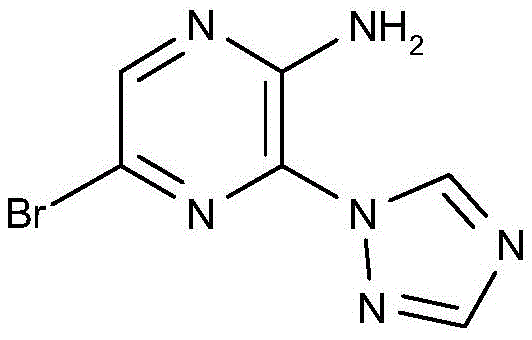
A mixture of 5-bromo-3-chloropyrazin-2-amine (1.3g,6.24mmol), 1H-1,2, 4-triazole (0.5g,7.24mmol) and cesium carbonate (3.5g,10.74mmol) in DMF (25ml) was heated to 60 ℃ overnight. After cooling to room temperature, the mixture was partitioned between ethyl acetate (150ml) and water (75 ml). The organic portion was separated and the aqueous phase was extracted with ethyl acetate (2X 75 ml). The combined organic extracts were washed with brine (50ml), dried over anhydrous sodium sulfate, filtered and evaporated under reduced pressure. Purifying the crude product by silica gel chromatography, eluting with 10-25% ethyl acetate isohexane solution to obtain target compound;
LCMS Rt 2.86 min; m/z 241.1 and 243.3[ M + H ] + bromoisotopes; method 2minLowpH
1H NMR(400MHz,DMSO-d6)δ9.25(1H,s),8.40(1H,s),8.30(1H,s),7.34(2H,s)。
Intermediate C12
5-bromo-3- (3-methyl- [1,2,4] triazol-1-yl) -pyrazin-2-ylamine

Prepared analogously to intermediate C11 using 5-bromo-3-chloropyrazin-2-amine and 3-methyl-1H- [1,2,4] triazole.
LCMS, Rt 0.87 mins; MS M/z 355.0[ M + H ] +; method 2minLowpHv01
Intermediate C13
5-chloro-3- (3-cyclopropylisoxazol-5-yl) pyrazin-2-amine
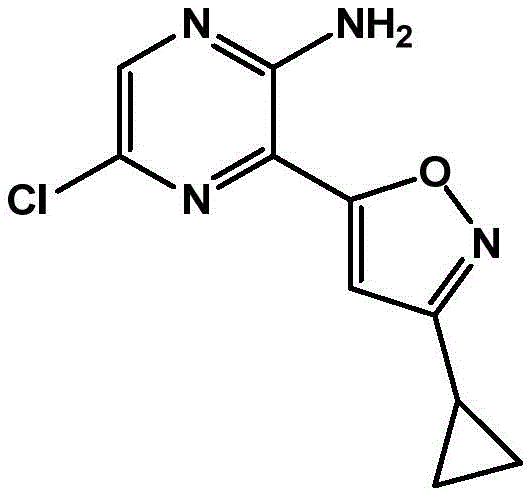
Step 1: 5-chloro-3- ((trimethylsilyl) ethynyl) pyrazin-2-amine
To a 500ml round bottom flask was added a solution of 3-bromo-5-chloropyrazin-2-amine (5g,23.99mmol), ethynyltrimethylsilane (10.17ml,72.0mmol), and triethylamine (33.4ml,240mmol) in THF (100ml) to afford a brown solution. The reaction was degassed with nitrogen. To the stirred solution was added bis (triphenylphosphine) palladium (II) dichloride (1.684g,2.399mmol) and copper (I) iodide (914mg,4.80 mmol). The reaction was stirred at room temperature for 30 minutes. The reaction was extracted into ethyl acetate, washed with brine, the organic layer was separated, dried over magnesium sulfate, filtered and the solvent was removed under reduced pressure. The crude product was loaded onto silica gel and purified by flash column chromatography eluting with isohexane, ethyl acetate (0-30%) over a short column of 80g silica gel. Combining the required components, removing the solvent under reduced pressure to obtain a brown solid;
LCMS Rt 1.29mins MS M/z 226.2[ M + H ] +; method 2 minlowwphv 02.
1H NMR (400MHz, DMSO-d6) delta 8.08(1H, s),6.82(2H, broad s),0.27(9H, s).
Step 2, 5-chloro-3-ethynylpyrazine-2-amine
To a 250ml round bottom flask was added 5-chloro-3- ((trimethylsilyl) ethynyl) pyrazin-2-amine (step 1) (3.64g,16.12mmol) and K2CO3(2.228g,16.12mmol) in MeOH (75ml) to give a brown solution. The reaction was stirred at room temperature for 30 minutes. The reaction was extracted into DCM, washed with water, brine, the organic layer was separated, dried over magnesium sulfate, filtered and the solvent removed under reduced pressure to give a brown solid;
LCMS Rt 0.80mins MS M/z 154.1[ M + H ] +; method 2 minlowwphv 02.
1H NMR (400MHz, DMSO-d6) delta 8.13(1H, s),6.92(2H, broad s),4.85(1H, s).
Step 3, 5-chloro-3- (3-cyclopropylisoxazol-5-yl) pyrazin-2-amine
To a 50mL round bottom flask was added cyclopropanecarboxaldehyde (0.245mL,3.26mmol), hydroxylamine hydrochloride (238mg,3.42mmol) and t of NaOH (137mg,3.42mmol)-BuOH (8ml) and water (8ml) to obtain a colorless solution. The reaction was stirred at room temperature for 30 minutes. chloramine-T (840mg,3.42mmol), copper powder (9mg,0.140mmol) and copper (II) sulfate pentahydrate (24mg,0.098mmol) were added to the reaction and the mixture was stirred for 15 minutes. To the brown-green solution was added 5-chloro-3-ethynylpyrazin-2-amine (from step 2) (500mg,3.26mmol) and the reaction was stirred at 50 ℃ for 2 hours. The mixture was extracted into ethyl acetate, washed with ammonium hydroxide, brine, the organic layer was separated, dried over magnesium sulfate, filtered and the solvent was removed under reduced pressure. The crude product was purified by flash column chromatography eluting with isohexane, ethyl acetate (0-40%) over a 24g silica plug. The desired fractions were combined and the solvent was removed under reduced pressure to give a light brown solid. The solid was triturated in isohexane ethyl acetate (4:1) and the resulting suspension filtered to give a yellow solid which was dissolved in DCM (20mL) and PS-TBD (2896mg,3.19mmol) was added to give a yellow suspension. The reaction was stirred at room temperature for 2 hours. Passing the suspension through The short column was filtered to remove the polymer-supported reagent. Collecting the filtrate, and removing the solvent under reduced pressure to obtain a yellow solid;
LCMS, Rt 1.12mins MS M/z 237.1[ M + H ] +; method 2 minlowwphv 02.
1H NMR (400MHz, DMSO-d6) delta 8.24(1H, s),6.94(2H, broad s),6.82(1H, s),2.12-2.05(1H, m),1.08-1.04(2H, m),0.92-0.88(2H, m).
Intermediate D1
Trans-3- (5-amino-6-chloropyrazin-2-yl) -N- (4-hydroxycyclohexyl) -4-methylbenzenesulfonamide

trans-N- (4-hydroxycyclohexyl) -4-methyl-3- (4,4,5, 5-tetramethyl-1, 3, 2-dioxaborolan-2-yl) benzenesulfonamide (intermediate A5) (9.48mg,2.40mmol), 5-bromo-3-chloropyrazin-2-amine (500mg,2.399mmol), PdCl2(dppf).CH2Cl2Adduct (I)Substance (98mg,0.120mmol) and Na2CO3A mixture of (6.00ml,11.99mmol) DME (11.400ml) was heated at 120 ℃ for 45 minutes using microwave irradiation. The mixture was added to water (100ml) and extracted with EtOAc (2X 100 ml). The organic extracts were washed with brine, dried over magnesium sulfate and concentrated under reduced pressure. Purification by silica gel chromatography eluting with 0-100% EtOAc in isohexane followed by sonication of the resulting solid to afford the title compound as an off-white solid;
LCMS, Rt 0.88 mins; MS M/z 438.2[ M + H ] +; method 2minLC _ v003
Intermediate D2
3- (5-amino-6-chloropyrazin-2-yl) -N- (2-hydroxy-2-methylpropyl) -4-methylbenzenesulfonamide

The title compound was prepared analogously to intermediate D1 by substituting N- (2-hydroxy-2-methyl-propyl) -4-methyl-3- (4,4,5, 5-tetramethyl [1,3,2] dioxaborolan-2-yl) benzenesulfonamide (intermediate a2) for trans-N- (4-hydroxycyclohexyl) -4-methyl-3- (4,4,5, 5-tetramethyl-1, 3, 2-dioxaborolan-2-yl) benzenesulfonamide (intermediate a 5);
LC-MS:RT 0.93mins;MS m/z 371.2[M+H]+(ii) a Method 2minLowpHv01
Intermediate D3
3- (5-amino-6-chloropyrazin-2-yl) -N- (3-hydroxy-3-methylbutyl) -4-methylbenzenesulfonamide

The title compound was prepared analogously to intermediate D1 by substituting N- (3-hydroxy-3-methylbutyl) -4-methyl-3- (4,4,5, 5-tetramethyl-1, 3, 2-dioxaborolan-2-yl) benzenesulfonamide (intermediate A3) for trans-N- (4-hydroxycyclohexyl) -4-methyl-3- (4,4,5, 5-tetramethyl-1, 3, 2-dioxaborolan-2-yl) benzenesulfonamide (intermediate a 5);
LCMS:Rt 0.88mins;MS m/z 385.2[M+H]+;2minLC_v003
intermediate D4:
3- (5-amino-6-chloropyrazin-2-yl) -4-methyl-N- (4,4, 4-trifluoro-3-hydroxybutyl) benzenesulfonamide

To a solution of 4-amino-1, 1, 1-trifluorobutan-2-ol hydrochloride (275mg,1.531mmol) and 3-bromo-4-methylbenzene-1-sulfonyl chloride (425mg,1.577mmol) in THF (7ml) was added DIPEA (0.55ml,3.15 mmol). The resulting mixture was stirred at room temperature overnight, then diluted with DCM, washed with 10% citric acid and then dried by phase separator. The organic phase was evaporated under reduced pressure and purified by flash column chromatography (24g of silica gel, 0-50% ethyl acetate in isohexane). The obtained product [ 3-bromo-4-methyl-N- (4,4, 4-trifluoro-3-hydroxybutyl) benzenesulfonamide, 530mg, estimated 80% pure ], was dissolved in 1, 2-dimethoxyethane (6 ml). Bis (pinacolato) diboron (340mg,1.339mmol), bis (triphenylphosphine) palladium dichloride (40mg,0.057mmol) and potassium acetate (175mg,1.783mmol) were added and the reaction heated to reflux. After 2 hours, another portion of bis (pinacolato) diboron (100mg) was added and the mixture was refluxed again for 3 hours. 5-bromo-3-chloropyrazin-2-amine (260mg,1.247mmol) and aq.2M sodium carbonate (1.7ml,3.40mmol) were added and the resulting mixture was heated to 90 ℃ for 3 hours in a microwave. The resulting mixture was partitioned between DCM and water and separated using a phase separation short column. The organic portion was evaporated under reduced pressure, combined with silica gel and purified by flash column chromatography on 40g of silica gel eluting with 10-70% ethyl acetate in isohexane. Combining the product components, and evaporating under reduced pressure to obtain the target compound which is yellow oily matter;
LCMS: Rt 0.94 min; MS M/z 425.1[ M + H ] +; method Name 2minLowpH
Chiral separation of 3- (5-amino-6-chloropyrazin-2-yl) -4-methyl-N- (4,4, 4-trifluoro-3-hydroxybutyl) benzenesulfonamide was performed using supercritical fluid chromatography to obtain single enantiomers (intermediates D4a and D4 b).
The details of the method are as follows:
column: phenomenex LUX C4250X 10mm,5um @35degC
Mobile phase: 20% isopropanol + 0.1% v/v DEA/80% CO2
The system comprises the following steps: berger Minigram SFC2
Intermediate D4a and intermediate D4b (R) and (S) -3- (5-amino-6-chloropyrazin-2-yl) -4-methyl-N- (4,4, 4-trifluoro-3-hydroxybutyl) benzenesulfonamide

Chiral separation two peaks were obtained, which were analyzed by analytical chiral SFC using the following method:
column: phenomenex LUX C4250X 10mm,5um @35degC
Mobile phase: 20% isopropanol + 0.1% v/v DEA/80% CO2
Flow rate: 10 ml/min; run Time 15.00min
And (3) detection: UV @220nm
The system comprises the following steps: berger Minigram SFC2
Intermediate D4a first elution peak: SFC retention time ═ 10.5min, (S) -3- (5-amino-6-chloropyrazin-2-yl) -4-methyl-N- (4,4, 4-trifluoro-3-hydroxybutyl) benzenesulfonamide or (R) -3- (5-amino-6-chloropyrazin-2-yl) -4-methyl-N- (4,4, 4-trifluoro-3-hydroxybutyl) benzenesulfonamide
Intermediate D4b the second eluting peak: SFC retention time ═ 13.1min, (S) -3- (5-amino-6-chloropyrazin-2-yl) -4-methyl-N- (4,4, 4-trifluoro-3-hydroxybutyl) benzenesulfonamide or (R) -3- (5-amino-6-chloropyrazin-2-yl) -4-methyl-N- (4,4, 4-trifluoro-3-hydroxybutyl) benzenesulfonamide
Intermediate D5
5- (5-amino-6-chloropyrazin-2-yl) -2-fluoro-N- (3-hydroxypropyl) -4-methylbenzenesulfonamide

5-bromo-2-fluoro-N- (3-hydroxypropyl) -4-methylbenzenesulfonamide (intermediate A12) (590mg,1.809mmol), KOAc (266mg,2.71mmol), PdCl were added under a nitrogen atmosphere2(dppf).CH2Cl2A mixture of the adduct (73.9mg,0.090mmol) and bis (pinacolato) diboron (505mg,1.990mmol) in DME (9043 μ L) was heated at 90 deg.C for 14 h. To the reaction mixture was added 5-bromo-3-chloropyrazin-2-amine (377mg,1.809mmol), followed by Na2CO3(2713. mu.L, 5.43mmol) and PdCl2(dppf).CH2Cl2Adduct (73.9mg,0.090mmol) and the reaction mixture was heated in a microwave at 120 ℃ for 45 minutes. Adding sat.Na to the mixture2CO3(100ml) and the product extracted with EtOAc (2X 90 ml). The organic extracts were washed with brine, dried over magnesium sulfate and concentrated under reduced pressure. The crude product was purified by flash column chromatography using 0-10% of (2M NH)3MeOH solution) was gradient eluted on a 40g Si-column to give the title compound as a pale yellow solid;
LCMS is Rt 0.81 mins; MS M/z 375.1[ M + H ] +; the method comprises the following steps: 2minLowpH
1H NMR(400MHz,DMSO-d6)δ8.19(1H,s),7.81(1H,br s),7.73(1H,d),7.42(1H,d),7.02(2H,s),4.41(1H,br s),3.37(2H,t),2.91(2H,t),2.42(3H,s),1.54(2H,m)。
Intermediate E1
3- (5-amino-6- (1H-1,2, 4-triazol-1-yl) pyrazin-2-yl) -4-methylbenzene-1-sulfonyl chloride
Step 1-5-o-tolyl-3- (1H-1,2, 4-triazol-1-yl) pyrazin-2-amine

To a 20ml microwave vial was added o-tolylboronic acid (0.169g,1.245mmol), 5-bromo-3- (1H-1,2, 4-triazol-1-yl) pyrazin-2-amine (intermediate C11,0.3g,1.245mmol), PdCl2(dppf)-CH2Cl2Adduct (50.8mg,0.062mmol) and 2M sodium carbonate (1.556ml,3.11mmol) in DME (3.5ml) to give an orange suspension. The reaction was heated in a biotage initiator microwave at 120 ℃ for 60 minutes. The reaction was extracted into ethyl acetate, washed with water, brine, the organic layer was separated, dried over magnesium sulfate, filtered and the solvent was removed under reduced pressure. Purifying by flash column chromatography using isohexane ethyl acetate0-100%) was eluted on a12 g silica gel column. The desired fractions were combined and the solvent was removed under reduced pressure to give the title compound as a brown solid (230 mg).
LCMS Rt 0.96 mins; MS M/z 253.2[ M + H ] +; method 2minLowpH
1H NMR (400MHz, DMSO-d6)9.33(1H, s),8.41(1H, s),8.35(1H, s),7.52(1H, multimodal), 7.32(3H, multimodal), 7.27(2H, br),2.42(3H, s).
Step 2 3- (5-amino-6- (1H-1,2, 4-triazol-1-yl) pyrazin-2-yl) -4-methylbenzene-1-sulfonyl chloride
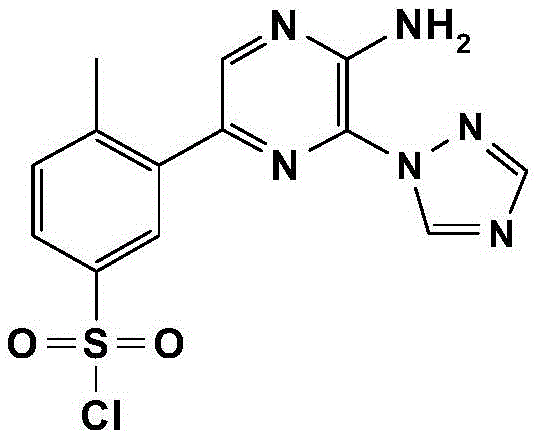
To cool to<A50 mL round bottom flask at 5 deg.C was charged with 5-o-tolyl-3- (1H-1,2, 4-triazol-1-yl) pyrazin-2-amine (step 1,780mg,3.09mmol) and CHCl in chlorosulfonic acid (4.97mL,74.2mmol)3(15ml) solution to obtain brown solution. When the acid addition was complete the solution turned into two phases which were allowed to warm to room temperature and stirred overnight. The reaction was carefully added dropwise to a stirred solution of ice water and DCM (3: 1). A suspension is formed. The contents were transferred to a separatory funnel, DCM was added and the suspension was shaken until it was completely dissolved in the organic layer. The organic portion was filtered, dried over magnesium sulfate, filtered, and the solvent was removed under reduced pressure to give the title compound (900mg) as a pale yellow solid.
1H NMR(400MHz,CHCl3)9.21(1H,s),8.30(1H,s),8.22(1H,s),8.13(1H,d),8.01(1H,dd),7.59(1H,d),6.75(2H,br),2.61(3H,s)
Intermediate E:
3- (5-amino-6- (2-methylthiazol-5-yl) pyrazin-2-yl) -4-methylbenzene-1-sulfonyl chloride
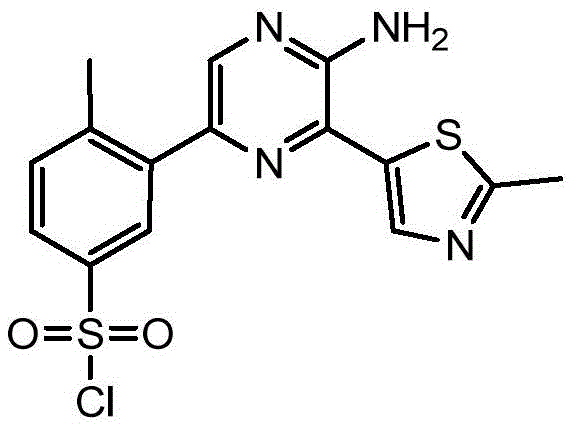
Step 1 3- (2-methylthiazol-5-yl) -5- (o-tolyl) pyrazin-2-amine
Pd-118(0.136g,0.221mmol) was added to a mixture of 5-chloro-3- (2-methylthiazol-5-yl) pyrazin-2-amine (intermediate C6) (1g,4.41mmol), o-tolylboronic acid (0.660g,4.85mmol), potassium phosphate (1.873g,8.82mmol), 1, 4-dioxane (17.65ml) and water (4.41 ml). The reaction mixture was heated at 100 ℃ for 2.5 hours. The reaction mixture was added to water (100ml) and extracted with EtOAc (2X 100 ml). The organic phase was washed with brine (100ml) and dried over magnesium sulfate. The solid was filtered, washed with EtOAc, and the solution was concentrated under reduced pressure to give a dark gray residue. The residue was triturated with ether to give a solid which was filtered, washed with ether and dried in a vacuum oven at 50 ℃ for 5 hours to give the title compound as a dark grey solid.
LCMS Rt 1.24min, MS M/z 283.2[ M + H ] +; method 2 minlowwphv 03.
1H NMR(400MHz,DMSO-d6)δ8.26(1H,s),8.15(1H,s),7.44(1H,m),7.32-7.26(3H,m),6.57(2H,br s),2.67(3H,s),2.40(3H,s)。
Step 2 3- (5-amino-6- (2-methylthiazol-5-yl) pyrazin-2-yl) -4-methylbenzene-1-sulfonyl chloride
Chlorosulfonic acid (4.50ml,67.1mmol) was added dropwise to stirred 3- (2-methylthiazol-5-yl) -5- (o-tolyl) pyrazin-2-amine (step 1) (790mg,2.80mmol) in CHCl at 0 deg.C3(14ml) in solution. After the addition was complete, the reaction mixture was warmed to room temperature and stirred at room temperature overnight. The reaction mixture was added dropwise to stirred ice-water and the mixture obtained was taken up in CHCl3(125ml) extraction. The organic phase was separated, washed with brine (100ml) and dried over magnesium sulphate. Filtering the solid with CHCl3The solvent was washed and concentrated under reduced pressure to give a brown oil. Et residue2Trituration with O to give a solid, which is filtered and Et2O wash and dry in a vacuum oven at 50 ℃ overnight to afford the title compound as a brown solid, which can be used directly in the next step.
Intermediate E3:
3- (5-amino-6- (1, 3-dimethyl-1H-pyrazol-4-yl) pyrazin-2-yl) -4-methylbenzene-1-sulfonyl chloride

Step 1 3- (1, 3-dimethyl-1H-pyrazol-4-yl) -5- (o-tolyl) pyrazin-2-amine
5-chloro-3- (1, 3-dimethyl-1H-pyrazol-4-yl) pyrazin-2-amine (intermediate C7) (11.3g,50.5mmol) and o-tolylboronic acid (8.24g,60.6mmol) were dissolved in dioxane (170ml) with stirring and degassed with nitrogen. Potassium phosphate (21.45g,101mmol) in water (45ml) was added followed by Pd-118[ PdCl2(dtbpf)](1.646g,2.53 mmol). The dark red slurry turned gradually black with stirring. It was heated to 100 ℃ overnight under nitrogen atmosphere, with the internal temperature kept at 85 ℃.
The reaction mixture was partitioned between ethyl acetate/water (1:1,500 ml). By layering, the main organic layer passing And (5) filtering. The aqueous layer was re-extracted with ethyl acetate (100 ml). The organic extracts were combined, washed with saturated sodium bicarbonate (400ml), water (300ml), brine (300ml) and then dried over magnesium sulfate, activated carbon. The drying agent was filtered and the filtrate was concentrated under reduced pressure to give a brown solid. This was slurried in diethyl ether (130ml) and sonicated for 30 minutes. The remaining light brown solid was removed by filtration and dried in vacuo to give the title compound;
LCMS is Rt 0.95 mins; MS M/z 280.3&281.4[ M + H ] +; method 2minLowpH.
1H NMR(400MHz,DMSO-d6)δ8.1(1H,s),7.95(1H,s),7.4(1H,m),7.25(3H,m),6.1(2H,br s),3.8(3H,s),2.35(3H,s),2.25(3H,s)。
Step 2 3- (5-amino-6- (1, 3-dimethyl-1H-pyrazol-4-yl) pyrazin-2-yl) -4-methylbenzene-1-sulfonyl chloride
Chlorosulfonic acid (5.75ml,86mmol) was added dropwise to a stirred solution of 3- (1, 3-dimethyl-1H-pyrazol-4-yl) -5- (o-tolyl) pyrazin-2-amine (step 1) (1.0g,3.58mmol) in chloroform (20ml) at 0 ℃. When the addition was complete, the reaction was warmed to room temperature and stirred for 20 h. The reaction mixture was added dropwise to rapidly stirred ice water and the product precipitated out as a pale yellow solid. When most of the ice had melted, the mixture was filtered through a sintered funnel to collect the product, which was washed with EtOAc and dried in a vacuum oven at room temperature to obtain the target compound;
LCMS is Rt 1.08 mins; MS M/z 378.3[ M + H ] +; method 2minLowpH
1H NMR(400MHz,CDCl3)δ8.18(1H,s),7.98(1H,s),7.69(1H,s),7.55(1H,d),7.26(1H,d),3.35(3H,s),3.27(3H,s),2.27(3H,s)。
Intermediate E4:
2,4, 6-trichlorophenyl 3- (5-amino-6- (2-methylpyridin-4-yl) pyrazin-2-yl) -4-methylbenzenesulfonate

Step 1 3-chloro-5-o-tolylpyrazin-2-amine
5-bromo-3-chloropyrazin-2-amine (2g,9.59mmol), o-tolylboronic acid (1.35g,9.93mmol), PdCl in a nitrogen atmosphere2(dppf).CH2Cl2Adduct (0.25g,0.306mmol) and Na2CO3A mixture of (5g,47.2mmol) DME (30ml) and water (6.00ml) was heated at reflux for 3 hours. The resulting mixture was diluted with water (100mL) and extracted with ethyl acetate. The combined organic extracts were dried over anhydrous magnesium sulfate, filtered and evaporated under reduced pressure. The brown residue obtained is combined with silica gel and purified by flash column chromatography (80g of silica gel, 0-25% ethyl acetate in isohexane) to obtain a pale yellow solid;
LCMS: Rt 1.00 min; MS M/z 220.1[ M + H ] +; the method comprises the following steps: 2minLowpH
Step 2 3- (2-methylpyridin-4-yl) -5-o-tolylpyrazin-2-amine
Pd (PPh)3)2Cl2A mixture of (0.125g,0.178mmol), 3-chloro-5-o-tolylpyrazin-2-amine (step 1) (0.78g,3.55mmol), 2-methyl-4- (4,4,5, 5-tetramethyl-1, 3, 2-dioxaborolan-2-yl) pyridine (0.8g,3.65mmol), sodium carbonate (1.1g,10.38mmol) in DME (7.5ml), EtOH (5.00ml) and water (2.5ml) was heated in a microwave to 120 ℃ for 2 hours. The resulting mixture was diluted with ethyl acetate and water, sonicated to ensure all material was transferred from the microwave vial, and evaporated under reduced pressure to remove the organic portion. Remainder ofThe aqueous phase was extracted with ethyl acetate (2X 50mL), washed with saturated sodium bicarbonate (50mL) and brine (25mL), dried over anhydrous magnesium sulfate, and filtered. The dark brown solution obtained is evaporated, combined with silica gel and then purified by flash column chromatography (80g of silica gel, 70-100% ethyl acetate in isohexane, then 5-10% 2M methanolic ammonia in TBME). Evaporating the product components to obtain the target compound as a yellow solid;
LC-MS Rt 0.69 min; m/z 277.6[ M + H ] +; the method comprises the following steps: 2minLowpH
Step 3,2, 4, 6-trichlorophenyl 3- (5-amino-6- (2-methylpyridin-4-yl) pyrazin-2-yl) -4-methylbenzenesulfonate
Chlorosulfonic acid (3.5ml,52.3mmol) was added dropwise to a solution of 3- (2-methylpyridin-4-yl) -5-o-tolylpyrazin-2-amine (step 2) (600mg,2.171mmol) in chloroform (10ml) at 0 deg.C (in an ice bath) under a nitrogen atmosphere over 10 minutes. The resulting red solution was stirred, allowed to warm slowly to room temperature, and stirring was continued overnight at room temperature. The resulting mixture was added dropwise to an ice-cooled and stirred mixture of DCM (90mL) and saturated sodium bicarbonate (150 mL). The mixture was directly passed through phase separation into a stirred mixture of 2,4, 6-trichlorophenol (450mg,2.280mmol) and triethylamine (0.75mL,5.38mmol) in DCM (5 mL). The aqueous phase and precipitate were re-extracted with DCM (50mL) and passed directly into the same stirred mixture through the phase separator. After stirring for 4 hours, the reaction mixture was evaporated under reduced pressure and then triturated with ethyl acetate and dried in a vacuum oven overnight to give a yellow solid (465mg, batch 1). The remaining aqueous phase and solid were re-extracted with DCM (100mL), washed with 2M sodium carbonate and passed through a phase separator directly into a stirred mixture of 2,4, 6-trichlorophenol (200mg) and triethylamine (0.3 mL). After stirring overnight, it was evaporated under reduced pressure and washed with ethyl acetate to give a pale yellow solid (480mg, batch 2). It was expected to be 80% pure and contained triethylamine/triethylamine hydrochloride, but it was used without further purification.
LCMS: Rt 1.00 min; m/z 533.0,535.1[ M-H ] -; the method comprises the following steps: 2minLowpH
Intermediate F
O- (tetrahydrofuran-3-yl) hydroxylamines

Step 1:2- ((tetrahydrofuran-3-yl) oxy) isoindoline-1, 3-dione
To a stirred solution of N-hydroxyphthalimide (5g,30.7mmol) in THF (200ml) at 0 deg.C was added PS-triphenylphosphine (1.88 mmol/g loading) (19.56g,36.8mmol), followed by tetrahydrofuran-3-ol (2.477ml,30.7mmol) and di-tert-butyl azodicarboxylate (7.06g,30.7 mmol). The mixture was stirred at 0 ℃ for 10mins, then at room temperature for 21 h, the mixture was filtered and the solvent was evaporated under reduced pressure. The resulting yellow solid was triturated with ether and the solid collected by filtration and washed with more ether to give a pale yellow solid. Evaporating the mother liquor under reduced pressure, and grinding with diethyl ether again to obtain light yellow solid;
LCMS: Rt 0.82 min; MS M/z 234.4[ M + H ] +; the method comprises the following steps: 2 minlowwphv 01.
Step 2O- (tetrahydrofuran-3-yl) hydroxylamine
To a stirred solution of 2- ((tetrahydrofuran-3-yl) oxy) isoindoline-1, 3-dione (step 1) (3.07g,13.16mmol) in MeOH (60ml) was added hydrazine hydrate (1.097ml,14.48 mmol). The resulting mixture was stirred at room temperature for 16 hours overnight to give a yellow solution with white solid suspended. The white solid was removed by filtration and the filtrate was evaporated under reduced pressure. It was triturated with DCM and the solid removed again by filtration. The filtrate was evaporated under reduced pressure to give a yellow oil which was used directly in the subsequent step without further purification.
Pharmaceutical use and assay
The compounds of the invention and their pharmaceutically acceptable salts can be used as medicaments. In particular, the compounds are suitable selective inhibitors of the PI 3-kinase gamma isoform and can be tested in the following assays. Abbreviations:
ADP: adenosine diphosphate
ATP: adenosine triphosphate salt
BSA: bovine serum albumin
DMEM: improved Igor culture medium of Darbeck type
DMSO, DMSO: dimethyl sulfoxide
DTT: dithiothreitol
CHAPS: 3- [ (3-Chloroaminopropyl) dimethylamino ] -1-propanesulfonic acid ester
EDTA: ethylenediaminetetraacetic acid
EGTA: ethylene glycol tetraacetic acid
FACS: fluorescence activated cell sorting
FBS: fetal bovine serum
HBSS: hank balanced salt solution
HEPES (high efficiency particulate air): 4- (2-hydroxyethyl) piperazine-1-ethanesulfonic acid
HTRF: homogeneous phase time resolved fluorescence
MIP1 α macrophage inflammatory protein form 1 α (also known as CCL3)
PBS: phosphate buffer salt solution
RPMI: roswell Park mental Institute Medium
TR-FRET: time-resolved fluorescence energy resonance transfer
Kinase Glo fluorescent kinase assay (Kglo) for PI 3-kinase α (A), PI 3-kinase β (B), Vps34(C), PI 4-kinase β (D)
The fluorescent ATP detection reagent KinaseGlo was obtained from Promega (Cat. No. V6714, Lot. 236161) by Catalyls, Wallisellen, Switzerland L- α -phosphatidylinositol (PI, liver, bovine) from Avanti Polar Lipid (Cat. No. 840042C, Lot # LPI-274), phosphatidylinositol-4, 5-diphosphate (PIP (4,5)2) was also obtained from Avanti Polar Lipid (Cat. No. 840046X) L- α -Phosphatidylserine (PS) from Avanti Polar Lipid (Cat. No. 840032C), and n-octylglucoside was obtained from Avanti Polar Lipid (Cat. No. 10634425001). fluorescence was a well-defined readout to determine ATP concentration, and thus can be used to indicate the activity of various kinases, regardless of which substrate, the KinaseGlo fluorescence kinase assay (PromeseGlo, dison/WI, Mass.) is a well-defined indicator for determining the amount of ATP activity in homogeneous assay after reaction by the USA kinase assay.
50nL of compound dilutions were dispensed into black 384-well low-volume unbound styrene (NBS) plates (Costar Cat N)BS #3676) L- α -Phosphatidylinositol (PI) provided as a10 mg/ml solution in methanol was transferred to a glass tube, dried under a stream of nitrogen then resuspended by vortexing in 3% octyl glucoside (1-0-n-octyl- β -D-glucopyranoside), stored at 4 ℃ 5. mu.L of a PI/octyl glucoside mixture containing PI 3-kinase α and PI 3-kinase β subtype or Vps34 or PI 4-kinase β. the kinase reaction was initiated at room temperature by adding 5. mu.L of an ATP-mixture containing 10mM TRIS-HCl pH7.5, 3mM MgCl in a final volume of 10. mu.L250mM NaCl, 0.05% CHAPS, 1mM DTT and 1. mu.M ATP. The reaction was stopped with 10. mu.l KinaseGlo and plates were read 10mins later with a Synergy2 reader using an integration time of 0.1 seconds per well. mu.M of NVP-BGT226(1- (3- (trifluoromethyl) -4- (piperazin-1-yl) phenyl) -8- (6-methoxypyridin-3-yl) -3-methyl-1H-imidazo [4, 5-c)]Quinolin-2 (3H) -one) was added to the assay plate to allow 100% inhibition of the kinase reaction, and 0% inhibition was obtained by solvent vehicle (90% aqueous DMSO). Using (1- (3- (trifluoromethyl) -4- (piperazin-1-yl) phenyl) -8- (6-methoxypyridin-3-yl) -3-methyl-1H-imidazo [4, 5-c)]Quinolin-2 (3H) -one) as reference compound, which is included in all assay plates in the form of 16 dilution spots, in duplicate.
The IC of percent inhibition for each compound (n-2) at 8 concentrations (10, 3.0, 1.0, 0.3, 0.1, 0.030, 0.010 and 0.003 μ M) was derived by fitting a sigmoidal dose-response curve to a plot of assay readings versus the inhibitor concentration50The value is obtained. All fits were performed using the XLfit4(ID Business Solutions, Guildford, UK) program.
TR-FRET Adapta assay for PI 3-kinase gamma (E), PI 3-kinase delta (F)
TR-FRET AdaptaTMThe Universal kinase assay kit was purchased from Invitrogen Corporation (Carlsbad/CA, USA) (Cat. No. PV 5099). The kit comprises the following reagents: adapta Eu-anti-ADP antibody (europium-labeled anti-ADP antibody in HEPES-buffered saline, Cat. No. PV5097), Alexa 647-markLabelled ADP tracer (Alexa in HEPES-buffered saline)
 647-labeled ADP tracer, Cat No. PV5098), TR-FRET dilution buffer pH7.5 (Cat No. PV 3574).
The PIK3CD substrate Phosphatidylinositol (PI) was obtained from Invitrogen (vesicles consisting of 2mM Phosphatidylinositol (PI) in 50mM HEPES pH 7.5; Cat. No. PV 5371). The PIK3CG substrate phosphatidylinositol-4, 5-bisphosphate (PIP (4,5)2 was obtained from Invitrogen (PIP 2: PS large unilamellar vesicles consisting of 1mM PIP2:19mM PS at 50mM HEPES pH7.5, 3mM MgCl21mM EGTA; catalog number PV 5100).
Time-resolved fluorescence energy resonance transfer (TR-FRET) is a technique for energy transfer between two adjacent dyes, the excited electron of one dye (donor) being transferred to the electron of the adjacent dye (acceptor) by resonance and then released as a photon. This energy transfer can be measured by an increase in fluorescence emission of the acceptor and a decrease in fluorescence emission of the donor. The TR-FRET assay for protein kinases employs long-lived lanthanide terbium or europium chelates as donor species that overcome interference from autofluorescence of the compounds or light scattering of the precipitated compounds by the delay introduced after excitation by a lamp excitation source. The results are usually expressed as a ratio of the intensities of the acceptor and donor fluorophores. The ratiometric nature of this value can correct for differences in assay volume between wells, and also for quenching effects (quenching effects) caused by colored compounds. AdaptaTMThe test can be divided into two phases: a kinase reaction phase and an ADP detection phase. In the kinase reaction phase, all kinase reaction components are added to the wells and the reaction is incubated for a period of time, each kinase being incubated for a different time. After the reaction, a detection solution of Eu-labeled anti-ADP antibody, Alexa 647-labeled ADP tracer and EDTA (to stop the kinase reaction) are added to the test wells. The ADP formed by the kinase reaction may replace Alexa of the antibody
 647-labeled ADP tracer, resulting in a decrease in TR-FRET signal. In the presence of the inhibitor, the amount of ADP formed by the kinase reaction is reduced and the intact antibody-tracer interaction obtained is able to maintain a higher TR-FRET signal. In AdaptaTMIn the assay, the donor (europium-anti-ADP antibody) was excited at 340nm to transfer its energy to the acceptor (Alexa)
 647-labeled tracer of ADP). Derived from Alexa
 647 can be monitored using a filter centered at 665nm, since it is located between the emission peaks of the donor, measured at 615/620 nm.
50nL of compound dilutions were dispensed onto white 384-well low-volume polystyrene plates. Then 5. mu.L of PI 3-kinase gamma or PI 3-kinase delta and lipid substrate (PI or PIP2: PS) and subsequently 5. mu.L of ATP added (final assay volume 10. mu.L) were incubated at room temperature. AdaptaTMStandard reaction buffer for TR-FRET assay contains 10mM Tris-HCl pH7.5, 3mM MgCl250mM NaCl, 1mM DTT, 0.05% CHAPS ((3- [ (3-cholamidopropyl) dimethylamino)]-1-propane sulfonate). The reaction was performed using 5. mu.L of a mixture containing Eu-labeled anti-ADP antibody and Alexa 647-mixture of EDTA of labeled ADP tracer in TR-FRET dilution buffer. Plates were read in a Synergy2 reader after 15-60 mins with an integration time of 0.4 seconds and a delay of 0.05 seconds. A100% inhibition of the kinase reaction was performed by standard reaction buffer replacement of PI 3-kinase as a control. A solvent vehicle (90% DMSO in water) of this compound was used as a control for 0% inhibition. The standard compound 1- (3- (trifluoromethyl) -4- (piperazin-1-yl) phenyl) -8- (6-methoxypyridin-3-yl) -3-methyl-1H-imidazo [4,5-c]Quinolin-2 (3H) -one (NVP-BGT226) as reference compound, packaged as 16 dilution dotsContained in duplicate in all assay plates.
Data were analyzed using Excel fitting software or Graphpad Prism. IC was derived by fitting a sigmoidal dose-response curve to a plot of assay readings versus the inhibitor concentration50The value is obtained. All fits were performed using the XLfit4(IDBusiness Solutions, Guildford, UK) program. The IC of percent inhibition for each compound at 8 concentrations (typically 10, 3.0, 1.0, 0.3, 0.1, 0.030, 0.010 and 0.003 μ M) was derived by fitting a sigmoidal dose-response curve to a plot of assay readings versus the inhibitor concentration50And (4) measuring the value. All fits were performed using the XLfit4(IDBusiness Solutions, Guildford, UK) program.
Lanthascreen of mTOR (G)TMKinase binding assays
Binding assays based on Alexa 647-binding and displacement of a labeled, ATP-competitive kinase inhibitor with the target kinase. Based on ATP-competitive kinase inhibitors, the "kinase tracers" of Invitrogen have been developed to address a variety of target kinases, making them suitable for the detection of any compound capable of binding to the ATP site or to an allosteric site that alters the structure of the ATP site.
In LanthascreenTMIn the kinase binding assay, the donor (Eu)3+anti-GST (glutathione S-transferase) antibody) at 340nm excitation, transferring its energy to the receptor (Alexa) 647-labeled ATP-competitive kinase inhibitor ═ Tracer-314). Derived from Tracer-314 (Alexa)
 647 inhibitor) can be monitored using a filter centered at 665nm because it is located between the emission peaks of the donor, which can be measured at 615/620 nm. Tracer-314 and Eu3+Binding of both anti-GST antibodies to the kinase, resulting from Eu3+-donor fluorescenceThe optical bolus being directed to Tracer-314
 647-high FRET of acceptor fluorophores. Binding of the inhibitor to the kinase competes for binding to the tracer, resulting in loss of FRET.
50nL of compound dilutions were dispensed onto white 384-well low-volume polystyrene plates. Then 5. mu.L of GST-mTOR and europium-anti-GST antibody are added, followed by 5. mu.L of tracer-314 (final assay volume 10. mu.L), which is incubated at room temperature. For LanthascreenTMThe standard reaction buffer for the kinase binding assay contained 50mM HEPES pH7.5, 5mM MgCl2, 1mM EGTA, 0.01% Pluronic F-127. After 60mins, the plates were read in a Synergy2 reader with an integration time of 0.2 microseconds and a delay of 0.1 microseconds.
For the calculation of the emission ratio, the acceptor (Alexa) 647-labeled Tracer-314) at 665nm divided by the donor (Eu)3+anti-GST antibody) at 620 nm.
Controls for 0% inhibition are given by the solvent vehicle of the compound (90% aqueous DMSO). Control of relative 100% inhibition was performed by adding 10 μ M of a mixture containing GST-mTOR and europium-anti-GST antibodies. Another control with absolute 0% inhibition was made of Eu3+anti-GST antibody (without GST-mTOR) is given. A standard compound for the lipid kinase (standard compounds for the lipid kinase panel profiling) can be used as a reference, which is contained in all assay plates as 8 dilution points.
Cellular assays for PI 3-kinases α (H1), β (I1) and delta (J1) Surefire model
AlphaScreen (amplified luminescence proximity homogeneity assay, ALPHA, Perkin Elmer) is a non-radioactive bead proximity assay technology that studies biomolecular interactions in a homogeneous microplate format. The trade name SureFire denotes the AlphaScreen test which is suitable for the quantitative determination of the phosphorylation of endogenous cellular proteins in cell lysates by using a matched pair of antibodies consisting of anti-phospho-kinase and anti-kinase antibodies. This assay enables the characterization of kinase signals in cells and the determination of the effect of kinase inhibitors.
At 37 deg.C/5% CO290% humidity in moist CO2Rat-1 cell line stably overexpressing activated PI 3-kinase class I isoforms rat-1 pBABEpuro Myr-HA-hp110 delta clone 5 (rat-1_ PI3K delta) and rat-1 pBABEpuro Myr-HA-hp110 α clone 6 (rat-1_ PI3K α) and rat-1 pBABEpuro Myr-HA-hp110 β (rat-1_ PI3 β) were inoculated in complete growth medium (DMEM high glucose, 10% (v/v) fetal bovine serum, 1% (v/v) MEM NEAA, 10mM HEPES, 2mM L-glutamine, puromycin (rat-1_ PI3K delta and rat-1_ PI3K α at 10. mu.g/mL, rat-1_ PI3 β at 4ug/mL), 1% (v/v) Pen/Strep) until 90% confluence, which was split twice a week in an incubator.
The following materials were used for the detection of p-AKT (S473) in rat-1 cell lysates: dulbecco's Modified Eagle's Medium (DMEM), high glucose (Gibco Invitrogen, Basel, Switzerland, Cat. No. 41965), qualified heat-inactivated fetal bovine serum (HI FBS; Gibco Invitrogen, Basel, Switzerland, Lot. No. 16140), MEM non-essential amino acids (NEAA; Gibco Invitrogen, Basel, Switzerland, Cat. No. 11140), HEPES (Gibco Invitrogen, Basel, Switzerland, Cat. No. 15630), penicillin/streptomycin (Pen/Strep, 100X; Gibco Invitrogen, Basel, Switzerland, Cat. No. 0-2O,MilliQ-H2O unless otherwise indicated (MILLIPORE QGARDOOR1, Millipore, Zug, Switzerland), bovine serum albumin (BSA; Sigma Aldrich, Buchs, Switzerland, Cat. No. A8412), SureFire p-Akt1/2(Ser473) test kit (PerkinElmer, Schwerzenbach, Switzerland, Cat. No. TGRAS 50K).
The p-Akt (S473) SureFire assay enables the determination of phosphorylation of endogenous cellular Akt1/2 at Ser473 in cell lysates myr-HA-tagged versions of human PI3K δ, PI3K α or PI3K β p110 catalytic subunit isoforms stably expressed in rat-1 cells were developed as a two-plate protocol in a 384-well format.
To test compounds, cells were seeded at a density of 4000(Rat-1_ PI3K delta), 7500(Rat-1_ PI3K α) or 6200(Rat-1_ PI3K β) cells in 20. mu.l of complete growth medium onto cell culture medium-treated 384-well plates at 37 ℃/5% CO2Growth at 90% humidity for 24 h. Shortly before compound transfer, complete medium was removed and 10. mu.l of compound pre-dilution was transferred to cells by adding 30. mu.l of assay buffer (DMEM high glucose, 1 XMEM NEAA, 10mM HEPES, 2mM L-glutamine, 0.1% (w/v) BSA). After 1h of treatment with the compound, the cells were lysed by adding 20. mu.l of lysis buffer supplemented with 0.24% (w/v) BSA. The determination of p-AKT (Ser473) was performed using the SureFire p-Akt1/2(Ser473) assay kit according to the manufacturer's instructions using 5ul of cell lysate, with a total assay volume of 12. mu.l.
The IC% inhibition of each compound (n-2) at 8 concentrations (typically 10, 3.0, 1.0, 0.3, 0.1, 0.030, 0.010 and 0.003 μ M) was derived by fitting a sigmoidal dose-response curve to a plot of assay readings versus the inhibitor concentration50The value is obtained. All fits were performed using the XLfit4(ID Business Solutions, Guildford, UK) program.
Cellular assay for PI 3-kinases α (H2), β (I2) and delta (J2) HTRF (homogeneous time-resolved fluorescence) mode
The following materials were used for the detection of p-AKT (S473) in rat-1 cell lysates:
dulbecco's Modified Eagle's Medium (DMEM), high glucose, GlutaMAXTM, pyruvate (Gibco Invitrogen, Basel, Switzerland, Cat. No. 31966), dialyzed Fetal Bovine Serum (FBS) US source (Gibco Invitrogen, Basel, Switzerland, Cat. No. 36400, batch No. 776683), MEM non-basic amino acids (NEAA; Gibco Invitrogen, Basel, Switzerland, Cat. No. 40), HEPES (Gibco Invitrogen, Basel, Switzerland, Cat. No. 15630), penicillin/streptomycin (Pen/Strep,100 x; Gibco Invitrogen, Basel, Switzerland, Cat. No. 15140, 122), puromycin (Sigma Aldrich, Buchs, Switrland, Cat. No. P9620), DMSO (Milrczerlon, Switzerland Cat. No. 2, Switzerland Cat. No. 3), catalog No. 2, Switzerland Cat No. 3, Cat. No. 3, Switzerland No. 3, except for Ser 3632, Ser 2, Ser. 3, Switzerland Ser.
Rat-1 cell lines were used which were able to stably overexpress the activated PI3K class I isoforms Rat-1 pBABEpuro Myr-HA-hp110 delta clone 6(Rat-1_ PI3K delta) and Rat-1 pBABEpuro Myr-HA-hp110 α clone 6(Rat-1_ PI3K α) and Rat-1 pBABEpuro Myr-HA-hp110 β clone 1-E8(Rat-1_ PI3K β). all cell lines were 37 ℃/5% CO290% humidity, in moist CO2Incubators were incubated in complete growth medium (DMEM high glucose GlutaMAXTM pyruvate, 10% (v/v) fetal bovine serum, 0.1mM MEM NEAA, 25mM HEPES, puromycin 10. mu.g/mL, 100U/mL penicillin, 100. mu.g/mL streptomycin) to 90% confluence and lysed twice a week.
Semi-automated preparation of cell lysates for Low (inhibited) controls, 0.9mM NVP-BGT226-AF-1 in 90% (v/v) DMSO was added to the compound master plate for compound testing, cells were seeded at a density of 4000(Rat-1_ PI3K delta), 8000(Rat-1_ PI3K α) or 6500(Rat-1_ PI3K β) cells in 30. mu.l complete growth medium into cell culture-treated 384-well plates at 37 ℃/5% CO2Growth at 90% humidity for 24 h. Mu.l of the compound pre-dilution was transferred to the cells. After 1h of treatment with the compound, the medium was removed and the cells were lysed by adding 20 μ l lysis buffer (supplemented with blocking buffer). The assay for p-AKT (Ser473) was performed using 16. mu.l of cell lysate in a total detection volume of 20. mu.l using the HTRFpAKT (Ser473) kit according to the manufacturer's instructions.
Cellular U937AKT assay for PI 3-kinase gamma (K1)
The U937 monocyte cell line was maintained in basal medium in RPMI 1640 supplemented with 10% heat-inactivated FBS, 100U/ml penicillin, 100ug/ml streptomycin, and 2mM L-glutamine (Invitrogen). Every 3 or 4 days, the cells were cultured by placing them in fresh medium at 0.125X 10⁶Individual cells/ml were seeded to maintain U937 suspension cultures. Cells were incubated at 37 ℃ with 5% CO2And (4) incubation. Cells were extracted at 0.25% 3 or 4 days before the test106The density of individual cells/ml was seeded in T162 culture flasks at a total volume of 40 ml.
Before starting the cell treatment described below, msd (meso Scale discovery) assay plates were blocked by adding 150 ul/well blocking buffer, which was incubated and supplied at room temperature with shaking for a minimum of 1 hour. All steps of the assay must be performed rapidly, with accurate timing of incubation periods and observation temperature control as dictated.
The test is carried out 3 or 4 days before the test at 0.25X 10⁶The/ml inoculated cells were aspirated, transferred to a 50ml centrifuge tube, counted and centrifuged at 300g for 8 minutes at room temperature.
The supernatant was aspirated, the cell pellet resuspended, and washed once in HBSS (Hank Balanced salt solution) by centrifugation at 300g for 8 min at room temperature. The cell pellet was resuspended in HBSS to a concentration of 4X 10⁶To each well of a flat-bottomed 96-well tissue culture plate, 100. mu.L of the cell suspension was added. Test panels were incubated at 37 ℃ with 5% CO2Incubation for 1.5 hours reduced background AKT phosphorylation, followed by a compound stimulation step.
Stock concentrations of 5mM compound were prepared in 100% DMSO; dilutions of 1:125 were made in HBSS using this concentration to obtain 0.8% DMSO solutions with a maximum compound concentration of 40. mu.M.
Compound titrations (titrations) were prepared in fresh flat-bottom 96-well plates by 10-fold serial dilutions of 40uM in HBSS 0.8% DMSO; the pipette tip was replaced after each dilution. The compound concentration at this stage is 4 times the final concentration required in the assay plate. Cells were stimulated with compound or HBSS in 0.8% DMSO by transferring 50 ul/well directly from compound dilution plates. The assay plate containing the compound-treated cells was then incubated at 37 ℃ for 30 minutes. The standard plate arrangement was used for all experiments.
In addition to the positive control well ("Max MIP1 α"), compound-treated cells were plated with 50. mu.L/well of 40ng/ml MIP1 α (R)&D Systems catalog number 270-LD, lyophilized stock reconstituted with PBS 0.1% BSA to 50 μ g/ml.) negative control wells ("minimum HBSS") were treated with 50 μ l/well of HBSS in the absence of MIP1 αStimulating, diluting the final concentration of the compound 4 times to obtain the highest concentration of 10 μ M, adding MIP1 α to obtain the final concentration of 10ng/ml, mixing the cell with MIP1 α at 37 deg.C and 5% CO2Incubated for 3 minutes. After a stimulation period of 3 minutes, the test plates were kept cold. The test plates were centrifuged at 300g for 2 min at 4 ℃, the supernatant removed by gentle pouring, and the plates were blotted dry with paper towels. The cells were then washed by slowly adding 150. mu.L/well of ice-cold HBSS and centrifuged at 300g for 5min at 4 ℃. The supernatant was aspirated and the plate was blotted dry as above. The plates were placed on ice and the cells were immediately treated with 35. mu.L/well ice cold lysis buffer prepared according to the kit instructions (100. mu.l of 50 Xprotease inhibitor solution and 50. mu.l of each of 100 Xphosphatase inhibitor solutions I and II were added to 5ml of Tris lysis buffer per experimental plate). The plates were incubated on ice for 20 minutes and then centrifuged at 841g for 5 minutes at 4 ℃.
Blocking buffer was withdrawn from the MSD plate and the plate was washed four times with 300. mu.l/well Tris wash buffer. Then 25 μ L of cell lysate was transferred from the assay plate to the washed MSD plate, sealed and incubated at room temperature for 1 hour with shaking. The plates were washed four times with 300. mu.l/well Tris wash buffer, then 25. mu.L/well of the sulfur-labeled anti-total AKT/pAKT detection antibody (60. mu.l of a 50 × antibody stock diluted in 1ml of blocking buffer and 2ml of wash buffer) was added and incubated with shaking at room temperature for 1 hour. The plate was washed four times with 300. mu.l/well Tris wash buffer and 150. mu.l/well plate read buffer was added, taking care to avoid foaming. Plates were immediately read using MSD SECTOR Imager 6000. The results were entered into Excel and the percentage phosphorylated AKT was calculated using the following equation: % phosphoprotein ═ 2*Phosphorus signal)/(phosphorus signal + Total Signal))*100. Inhibition of compound-mediated AKT phosphorylation can be analyzed using the Prizm V Graphpad software.
Cellular U937AKT assay for PI 3-kinase gamma (K2)
The materials used were: Bio-Rad TC10TM automatic cytometer, Bio-RAD counting slide (#145-0011), Trypan blue solution 0.4% (# T8154Sigma), 1:2 dilution in PBS, Bioconcept Multidrop combi, Versette automatic liquid processor (Thermo scientific), HTRF Phospho-AKT (Ser473) 10' 000 test kit (cisbio #64AKSPEH), ProxiPlate-384Plus, white, TC treated (Perkin Elmer #6008239)
384-well tissue culture treated plates (BD Falcon #353289), RPMI + GlutaMAX (Life Technologies #61870-010), dialyzed FBS (Life Technologies #26400), penicillin/streptomycin (Life Technologies #15140), HBSS 1X (Life Technologies #14025-050), Wortmannin (Sigma-Aldrich # W1628), 10mM stock in 90% DMSO, recombinant human CCL3/MIP1 α (R & D Systems #270-LD) (stock 10. mu.g/ml), RUBystar Microplate Reader (BMG Labtech #8)
U937 cells were lysed every 3-4 days: 5X 10 in 40ml6Individual cell/flask (175 cm)2) 3-4 days prior to the assay, cells were seeded: 107 cells in 40ml were seeded into 4-5 flasks.
Semi-automated preparation of cell lysates: cells were suspended in HBSS and seeded (200' 000 cells/well/60. mu.l to 384-well plates in humidified 37 ℃ 5% CO2The culture was carried out in an incubator for 1.5 hours. Compounds were diluted with HBSS and 40. mu.l of them were added to starved cells (except for 24I-P wells). Add 10. mu.M Wortmanin to the negative control (24I-P wells). The cells were then incubated at 37 ℃ and 5% CO2Incubate for 30min in ambient, stimulation was generated during 3 min in the incubator by adding 20 μ l MIP1 α (final 10ng/ml, diluted in HBSS). 24A-H wells were stimulated with HBSS only.
The cell plates were then placed on ice (cold water filled) to stop the stimulation. The cells were then centrifuged at 1200rpm for 3 minutes at 4 ℃.
Remove 80. mu.l of supernatant. The cells were again centrifuged at 1200rpm for 3 minutes at 4 ℃. The supernatant was then removed by inverting the plate and 30. mu.l of lysis buffer was added. The plates were incubated at room temperature for 30 minutes with shaking. Then 16. mu.l were transferred to a ProxiPlate Plus 384-well plate. Mu.l of master mix (master mix) (1: 20 dilution of each conjugate with detection reagent) was added to each well and the plates were left in the dark at room temperature for 4 hours. Fluorescence was measured using a RUBystar Reader at 665nm and 620 nm.
Whole blood neutrophil morphometric assay (L)
IL-8 (Interleukin-8) -induced morphological changes in neutrophils in human whole blood were measured using flow cytometry.
Reagents, materials and devices
Sterile distilled Water, Baxter # UKF117
10 XCellFIX solution, BECTON DICKINSON Biosciences #340181
IL-8,R&D Systems#208-IL
DMSO,Hybri-Max,Sigma-Aldrich#D2650
Dulbecco phosphate buffered saline 1 × [ +]CaCL2,MgCL2,gibco,life technolgies#14040
Albumin solution, Bovine Serum (30%), Sigma Aldrich # A9576-50ml
Ammonium chloride NH4CL,Sigma Aldrich#A0171
KHCO potassium bicarbonate3,Sigma Aldrich#P9144
K2EDTA Vacutainers,Becton Dickinson #367525
96-well Polypropylene deep-well plate, VWR # PORV219009
96-well plate, V-bottom lidded, Costar #3894
96 well polypropylene plate, round bottom, Greiner #650261 (for HIGH THROUGHPUT SAMPLER FACS)
120 μ l of pre-sterilized Biohit Filter Tips, Biohit #790101F
350 μ l of Pre-sterilized Biohit Tips, Biohit #790350
1200. mu.l of pre-sterilized Biohit Tips, Biohit #791202
Biohit e1200Electronic 8-channel Pipette (8-channel Electronic Pipette)
Biohit e120Electronic 8-channel Pipette (8-channel Electronic Pipette)
Eppendorf Research Plus 100-
Eppendorf Research Plus 20-200. mu.l pipette
Becton Dickinson Biosciences FACS Canto II Flow Cytometer with HIGHTHROUGHPUT SAMPLER
Up to 2. mu.M stock IL-8 was prepared in 0.1% bovine serum albumin/PBS and stored at-80 ℃. On the day, IL-8 in PBS (phosphate buffered saline) diluted 10 minutes and then use. IL-8 was used at a final concentration of 2nM and in the range of 0.003-200 nM for the donor dose response curve.
Test fixative solutions were freshly prepared daily and 10 Xconcentration CellFIX was addedTMThe solution was diluted 1:10 in sterile distilled water and then 1:4 in PBS. The test fixative solution was stored on ice prior to use.
By mixing 20.75g NH4Cl and 2.5g KHCO3Dissolved in 250ml of sterile H2In O, 10 Xlysis buffer was prepared in advance. The 10 × lysis buffer was filtered under sterile conditions and stored at 4 ℃ for up to 2 weeks. On the day, 1 × dissolved solution was prepared with sterile distilled water and stored on ice before use.
Test compounds were prepared as 10mM stock solutions in 100% DMSO and stored at 4 ℃. When used for the assay, 10mM stock compound was thawed and stored at room temperature in the dark. Compound dilutions were prepared fresh the day. The first thing in the morning was to prepare a first series of dilutions in 100% DMSO. Only when blood was collected and arrived at the laboratory, the next series of dilutions in PBS was performed (1:10PBS, 10% DMSO). This limits the time the diluted mixture is exposed to the plastic article, ensuring that the exposure time is constant between tests. Compounds were added to deep 96-well plates at 10 × final required concentration (final [ DMSO ] ═ 1% in blood).
Table 3 shows serial dilutions of compounds in a human whole blood neutrophil morphometric assay
TABLE 3

On the day of performing the assay, assay fixative buffer and 1 × lysis solution were prepared and stored on ice. Compound dilutions were prepared in 100% DMSO as previously described. Human whole blood was collected in K2EDTA Vacutainers. Once the blood was sent to the laboratory, dilutions of the compounds in PBS were performed as described previously and in table 1.
Mu.l of 10 Xcompound final concentration was added to the appropriate wells of the deep 96-well plate, except for the control where 10. mu.l of 10% DMSO was added instead of compound, as shown in the serial dilutions in Table 1. The outer wells of the deep well test plates were filled with 1200. mu.l of sterile distilled water to prevent edge effects (rows A1-H1, A1-A12, A12-H12).
The IL-8 dose response of each donor tested is determined and the donor response to IL-8 is monitored. At this step of the assay, IL-8 dose response samples were prepared and 10. mu.l of PBS was added to the designated wells. In addition, the test window without DMSO was also evaluated daily. For such samples at this step in the assay preparation, 10 μ l of PBS was added instead of 10% DMSO.
Mu.l of whole blood was added to compound/10% DMSO/PBS, gently mixed once at the time of addition. The 96-well plate was covered with a lid, and the sample was incubated in a water bath at 37 ℃ for 15 minutes.
After compound preincubation, 10 × final IL-8 was added to the appropriate wells (10 μ l of 20nM IL-8 working stock, final IL-8 concentration in blood ═ 2nM) and 10 μ l of PBS was added to the unstimulated controls. IL-8 was also added to the designated wells in a final dose-response range of 10 Xfinal (final concentration range 200nM to 0.0005nM on assay plate, 1:5 serial dilutions in PBS). IL-8 and PBS were added to the appropriate wells across all assay plates in the same order as the blood to which the compounds were added. After all test plates were added, the samples were flash mixed once to ensure uniform distribution of IL-8. The samples were incubated at 37 ℃ in a water bath for 5 minutes. After incubation, the sample plates were transferred to ice while 250 μ l of frozen assay fixative buffer was quickly added to all wells.
The samples were incubated on ice for 7 minutes (no mixing). After fixation, 1.2ml of 1 × lysis solution was added to each well quickly. After addition, the samples were mixed once and incubated on ice for 30 minutes to complete uniform red cell lysis. After lysis, 200 μ l of the sample was transferred to a 96-well microplate on ice. Samples were obtained on Becton Dickinson FACSCAnto II using HTS in a high throughput format. Granulocytes were identified based on different Side Scatter (SSC) and Forward Scatter (FSC) characteristics. Phycoerythrin channels are used to distinguish neutrophils from eosinophils because of the higher autofluorescence of the latter.
The mean FSC value for the neutrophil population can be used to determine changes in cell morphology (larger FSC values indicate higher degrees of morphological change). Data are expressed as% of the corresponding morphological change on the basis of the IL-8 dose response curve and the control window, and may also be expressed as% inhibition of the corresponding morphological change in compound-treated samples.
Morphological Change on substrate%
The% change in morphology on the substrate was obtained by subtracting the unstimulated control FSC reading from the agonist FSC reading, dividing the result by the unstimulated FSC value, and multiplying by 100.
Inhibition%
Inhibition%*100 (FIG. 2. sample value)
The unstimulated control (basal) FSC was subtracted from the IL-8FSC response.
(120,984–86,163=34821=X)
Y-IL-8 FSC response in compound-treated samples minus unstimulated control (basal) FSC.
(89,841–86,163=3678=Y)
(34821–3678)/34821*Morphological change inhibition ratio of 100 to 89%
Plotting% inhibition values on the Y-axis corresponding to the concentration of the compound on the X-axis to obtain IC50The value is obtained.
Microsome elimination test (M)
The assay was performed at 37 ℃ on 96-well glass plates using a Tecan EVO platform. Test compounds at a concentration of 10mM in pure DMSO were diluted to 10. mu.M in water at a ratio of 1: 1000. This solution (30. mu.L) was added to 120. mu.L of rat liver microsomal protein (1.25mg/mL) suspended in phosphate buffer (pH 7.4). The reaction was initiated by adding 150. mu.L of cofactor solution containing 2mM NADPH. At the indicated reaction time points (0, 5, 20 and30min), an equal volume of solution (50. mu.L) was removed, the reaction was stopped by adding acetonitrile (100. mu.L) containing internal analytical standards (1. mu.M alprenolol and 1.6. mu.M chlorzoxazone), and stored at-20 ℃ for at least 1h to allow complete precipitation of the protein. The sample was then centrifuged at 5000g at 4 ℃ for 35min and 20. mu.L of the supernatant was analyzed by LC-MS/MS for quantitative determination of the remaining test substance. In vitro elimination rate constant (k) was evaluated using the percentage of test compound remaining (relative to 0 minute culture time)miC) It can be used to calculate in vitro metabolic clearance.
The biochemical test data for examples 1-143 are shown in Table 4 below:
table 4: biochemical test data


The compound 3- (5-amino-6- (2-isopropoxypyridin-3-yl) pyrazin-2-yl) -N- (3-hydroxy-3-methylbutyl) -4-methylbenzenesulfonamide (reference example 119.12) did not show any activity in test E.
The cellular assay data and whole blood morphological change functional data for examples 1-143 are shown in the following table:
table 5: cellular data in isoform-specific assays (assay H, I, J, K1, K2), whole blood neutrophil morphometric data (WBSC, assay L) and intrinsic clearance in rat liver microsomes (RLM, assay M).
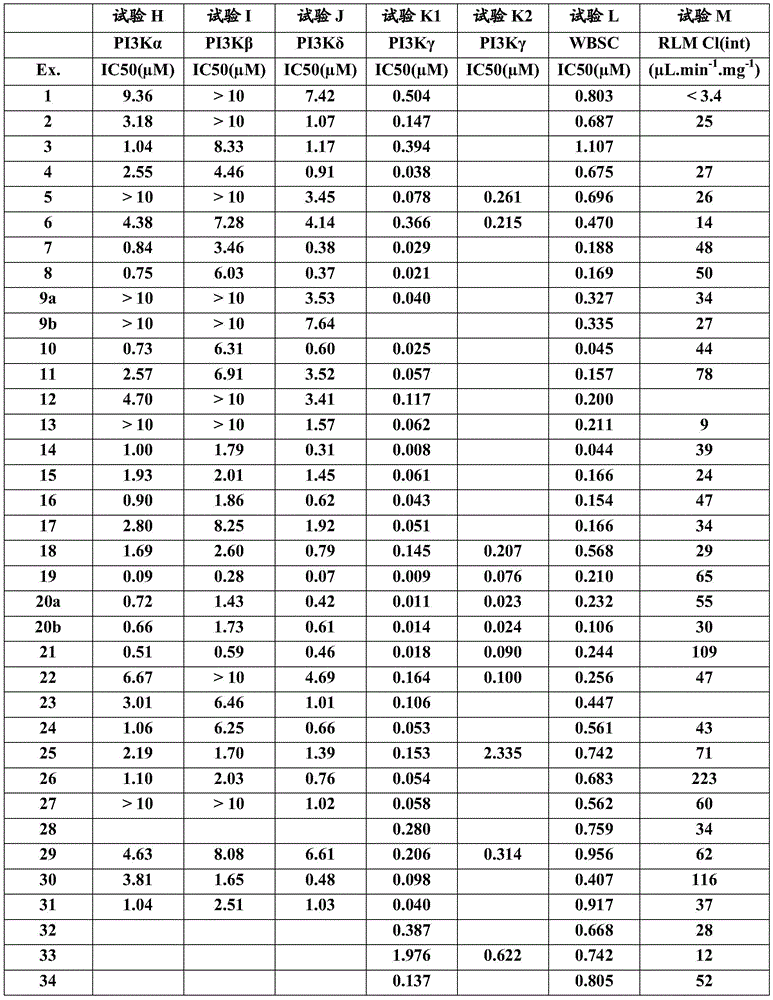


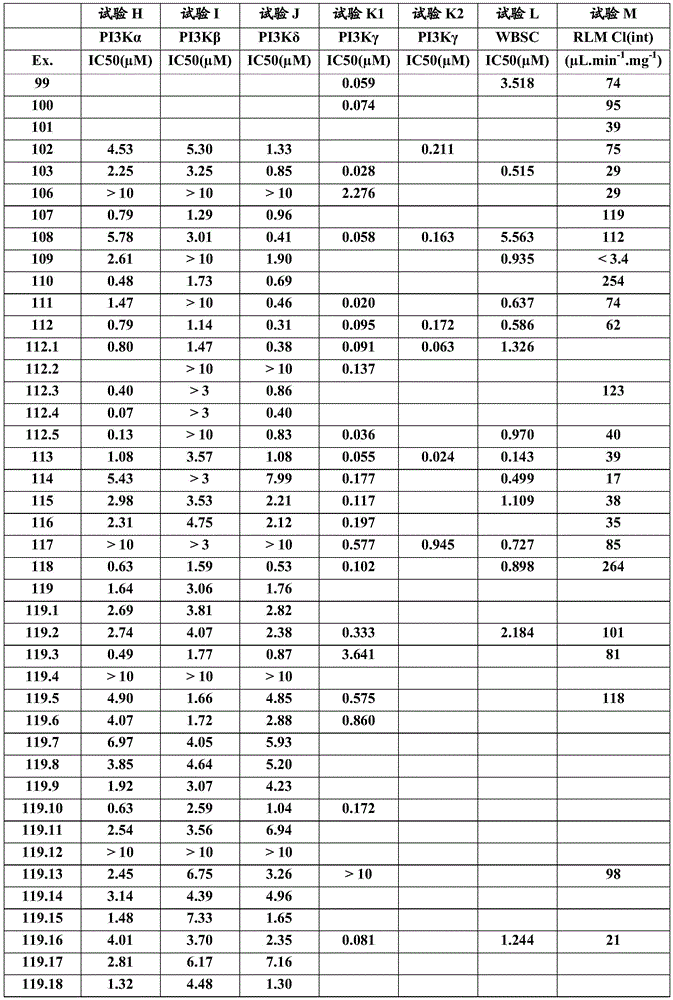
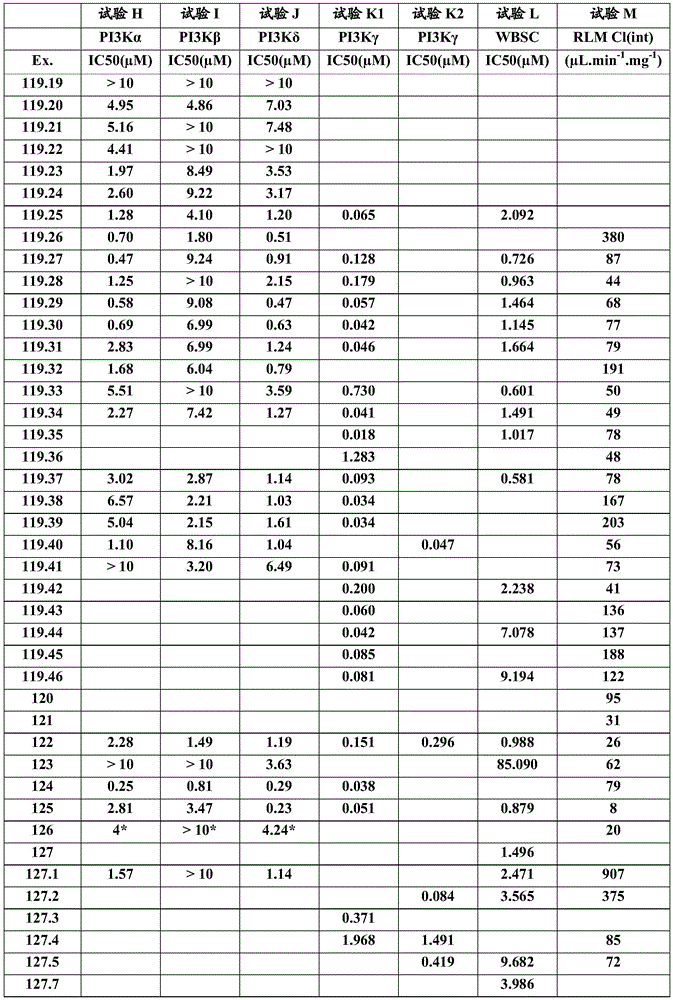


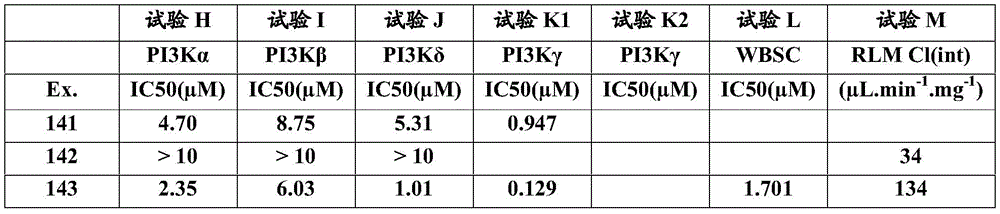
For trials H, I and J, non-asterisk data represent data obtained in the H1, I1, J1 modes (Surefire modes) of these trials, and asterisk data represent data obtained in the H2, I2, J2 modes (HTRF modes) of these trials. These two closely related assay formats were used for the activity of cells forming the PI3K γ isoform (IC50 s). The table includes all data from these two modes (trials K1 and K2).
Tables 6 and 7 below show the data obtained in the above tests for the compounds disclosed in the prior art.
TABLE 6


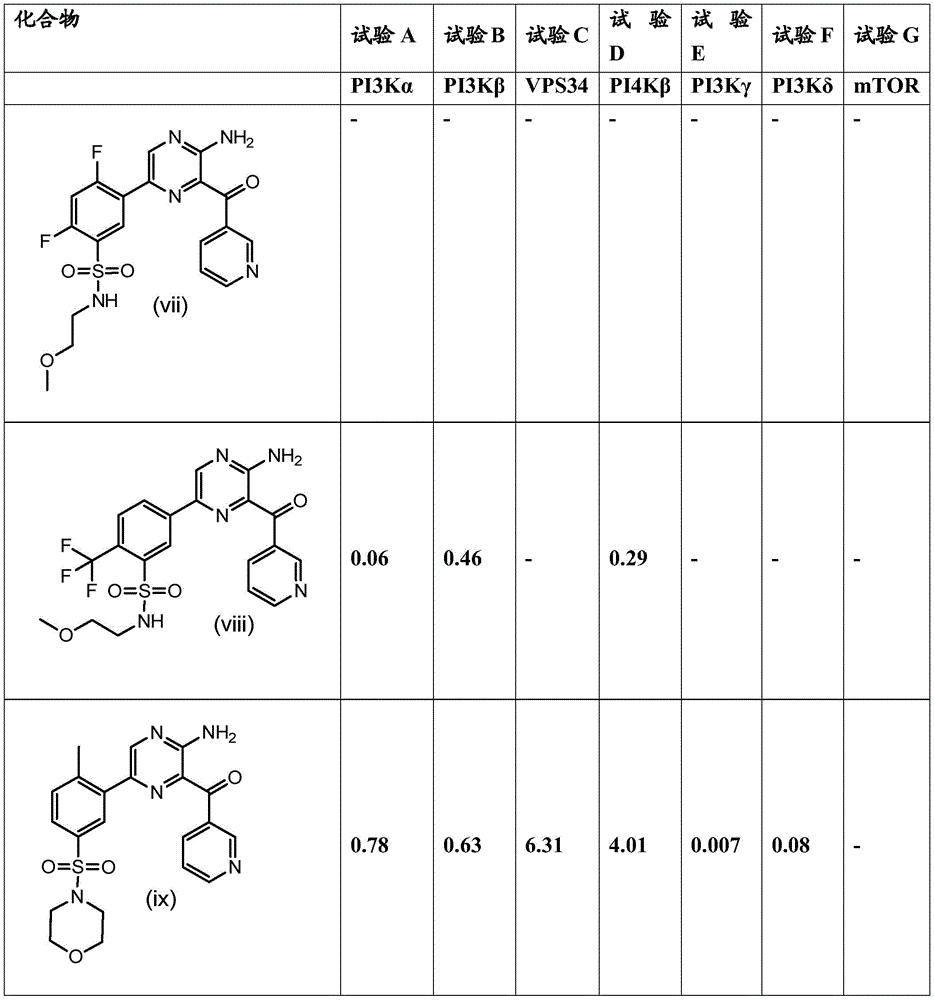

Compounds (i) - (ix) are disclosed in WO09/115517, compounds (x) and (xi) are disclosed in Leahy et al, j.med.chem.,2012,55(11), page 5467-5482, and compound (xii) is disclosed in WO 09/013348.
TABLE 7
| Compound (I) | Test H | Test I | Test J | Test K1 | Test K2 | Test L | Test M |
| PI3Kα | PI3Kβ | PI3Kδ | PI3Kγ | PI3Kγ | WBSC | RLM Cl(int) | |
| (i) | 0.97 | 3.77 | 1.10 | 0.526 | 0.838 | 2.39 | 47 |
| (ii) | >10* | >10* | 0.58* | - | 9.48 | 11.32 | 233 |
| (iii) | - | - | - | - | - | - | 219 |
| (iv) | 0.93 | 3.96 | 1.36 | 0.128 | 0.264 | 2.06 | 465 |
| (v) | 0.18 | 0.23 | 0.15 | - | - | 0.71 | 173 |
| (vi) | 0.17 | 0.26 | 0.17 | 0.182 | - | - | 630 |
| (vii) | - | - | - | - | - | - | 283 |
| (viii) | - | - | - | - | - | - | - |
| (ix) | 0.85 | 2.29 | 1.26 | 0.020 | - | 2.34 | 267 |
| (x) | >10 | >10 | 2.87 | 0.352 | - | >100 | - |
| (xi) | 5.41 | 5.58 | 5.87 | 0.539 | - | >44 | 271 |
| (xii) | >10* | 4.37* | 5.55* | - | - | 15.12 | 9 |
Numbers (i) - (xii) refer to the compounds in table 6. For trials H, I and J, non-asterisk data represent data obtained in the H1, I1, J1 patterns of these trials, and asterisk data represent data obtained in the H2, I2, J2 patterns of these trials.
Claims (10)

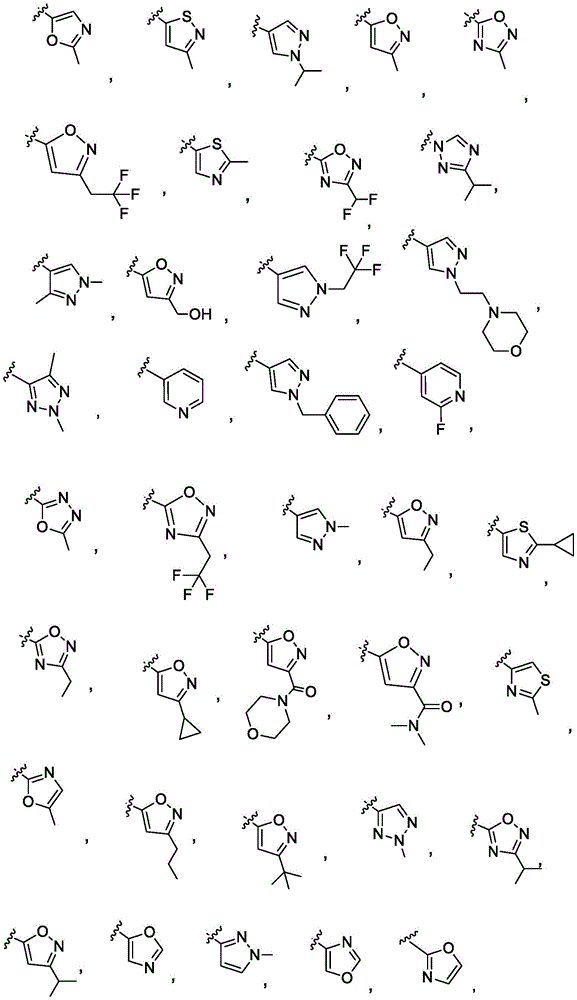
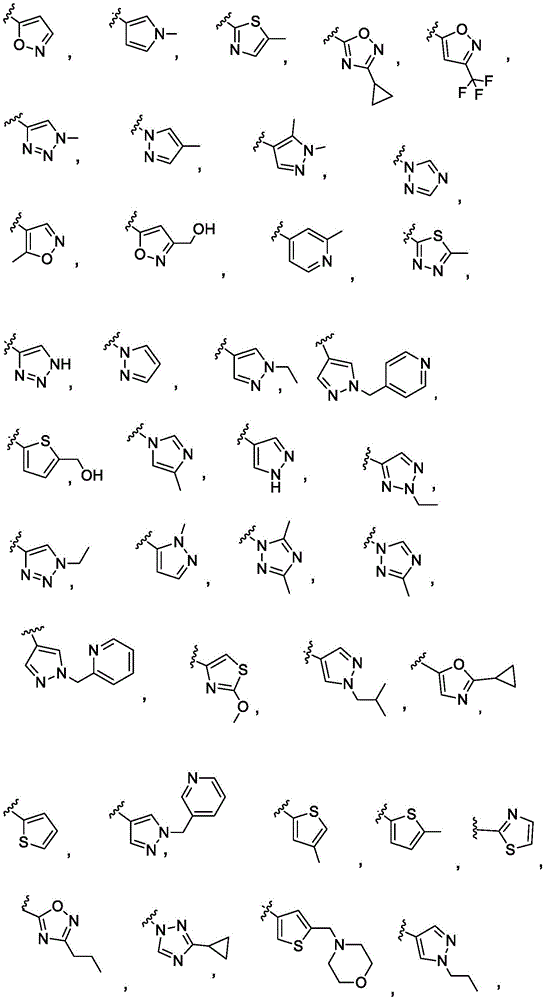


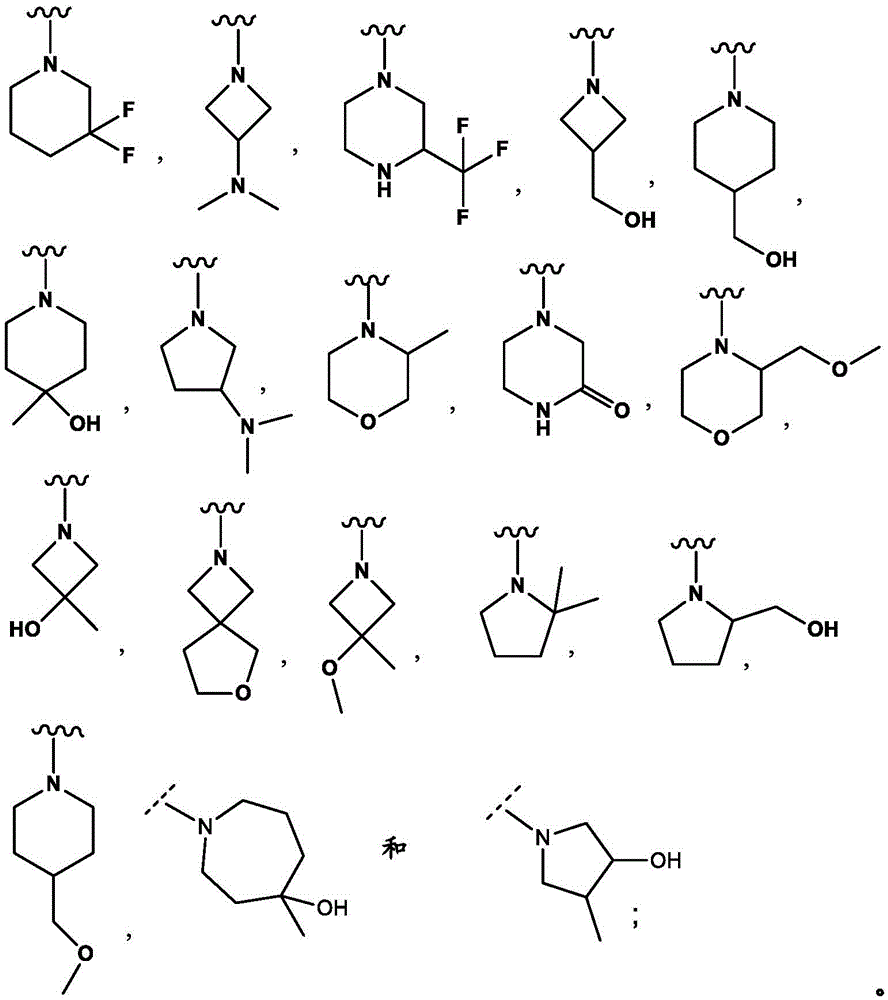

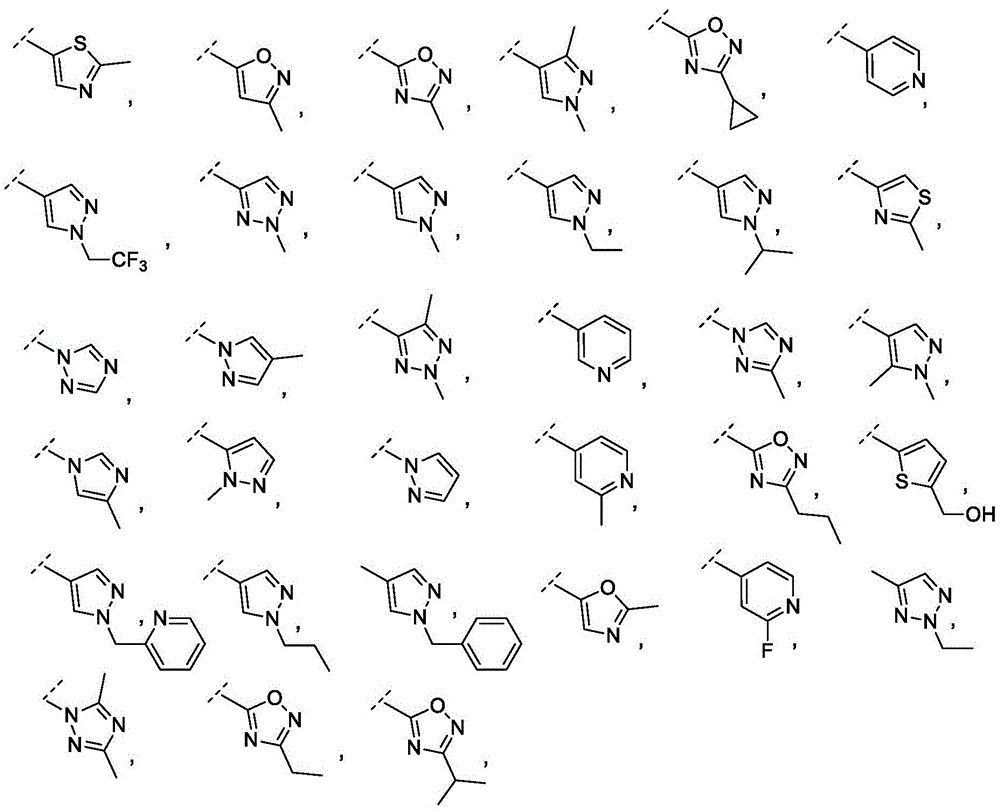


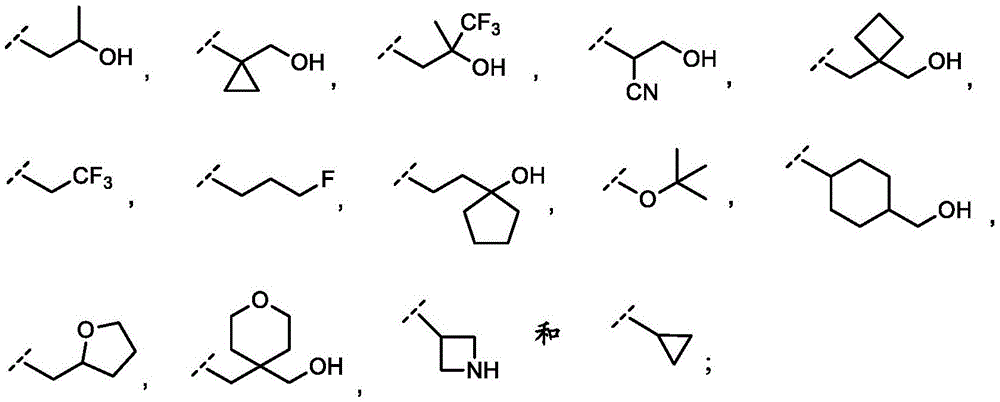

Applications Claiming Priority (1)
| Application Number | Priority Date | Filing Date | Title |
|---|---|---|---|
| PCT/IB2014/060988 WO2015162459A1 (en) | 2014-04-24 | 2014-04-24 | Amino pyrazine derivatives as phosphatidylinositol 3-kinase inhibitors |
Publications (2)
| Publication Number | Publication Date |
|---|---|
| CN106458979A CN106458979A (en) | 2017-02-22 |
| CN106458979B true CN106458979B (en) | 2020-03-27 |
Family
ID=50819760
Family Applications (1)
| Application Number | Title | Priority Date | Filing Date |
|---|---|---|---|
| CN201480079404.2A Expired - Fee Related CN106458979B (en) | 2014-04-24 | 2014-04-24 | Aminopyrazine derivatives as phosphatidylinositol 3-kinase inhibitors |
Country Status (11)
| Country | Link |
|---|---|
| US (2) | US10004732B2 (en) |
| EP (1) | EP3134397A1 (en) |
| JP (1) | JP6433509B2 (en) |
| KR (1) | KR20160141855A (en) |
| CN (1) | CN106458979B (en) |
| AU (2) | AU2014391608A1 (en) |
| BR (1) | BR112016024533A8 (en) |
| CA (1) | CA2945212A1 (en) |
| EA (1) | EA032075B1 (en) |
| MX (1) | MX2016013812A (en) |
| WO (1) | WO2015162459A1 (en) |
Families Citing this family (18)
| Publication number | Priority date | Publication date | Assignee | Title |
|---|---|---|---|---|
| WO2014149819A1 (en) | 2013-03-14 | 2014-09-25 | Kalyra Pharmaceuticals, Inc. | Bicyclic analgesic compounds |
| CN108947867A (en) | 2013-12-12 | 2018-12-07 | 卡利拉制药公司 | Bicyclic alkyl compound and synthesis |
| EP3114107B1 (en) | 2014-03-07 | 2020-07-22 | Recurium IP Holdings, LLC | Propellane derivates and synthesis |
| BR112016023967A2 (en) | 2014-04-24 | 2017-08-15 | Novartis Ag | pyrazine derivatives as phosphatidylinositol 3-kinase inhibitors |
| EP3134396B1 (en) | 2014-04-24 | 2019-09-18 | Novartis AG | Amino pyridine derivatives as phosphatidylinositol 3-kinase inhibitors |
| EP3193855B1 (en) | 2014-09-17 | 2021-05-19 | Recurium IP Holdings, LLC | Bicyclic compounds |
| WO2017143036A1 (en) * | 2016-02-16 | 2017-08-24 | President And Fellows Of Harvard College | Modulators of ms4a activity |
| AU2017229445B2 (en) | 2016-03-10 | 2019-07-11 | Astrazeneca Ab | Novel inhibitors of phosphatidylinositol 3-kinase gamma |
| WO2017160926A1 (en) * | 2016-03-16 | 2017-09-21 | Kalyra Pharmaceuticals, Inc. | Analgesic compounds |
| EP3628043A4 (en) | 2017-05-15 | 2021-04-28 | Recurium IP Holdings, LLC | Analgesic compounds |
| US11306079B2 (en) | 2017-12-21 | 2022-04-19 | Incyte Corporation | 3-(5-amino-pyrazin-2-yl)-benzenesulfonamide derivatives and related compounds as PI3K-gamma kinase inhibitors |
| SMT202200134T1 (en) * | 2018-03-08 | 2022-05-12 | Incyte Corp | Aminopyrazine diol compounds as pi3k-y inhibitors |
| US11046658B2 (en) | 2018-07-02 | 2021-06-29 | Incyte Corporation | Aminopyrazine derivatives as PI3K-γ inhibitors |
| US20230227446A9 (en) * | 2019-04-10 | 2023-07-20 | Nanjing Zhengxiang Pharmaceuticals Co., Ltd. | Phosphatidylinositol 3-kinase inhibitors |
| CA3142712A1 (en) | 2019-06-04 | 2020-12-10 | Arcus Biosciences, Inc. | 2,3,5-trisubstituted pyrazolo[1,5-a]pyrimidine compounds |
| CN112409337A (en) * | 2020-12-21 | 2021-02-26 | 李寒 | Substituted pyrazine derivative and application thereof |
| CN112341437A (en) * | 2020-12-21 | 2021-02-09 | 李寒 | Substituted pyrazine derivative and application thereof |
| CN114994215A (en) * | 2022-08-03 | 2022-09-02 | 北京华大吉比爱生物技术有限公司 | Application of chlorzoxazone, method for detecting concentration of enzyme inhibitor antibiotic drug, kit and application |
Citations (2)
| Publication number | Priority date | Publication date | Assignee | Title |
|---|---|---|---|---|
| CN101765591A (en) * | 2007-07-26 | 2010-06-30 | 诺瓦提斯公司 | Pyrimidine derivatives for use in the treatment of inflammatory or allergic conditions |
| CN102300862A (en) * | 2008-12-19 | 2011-12-28 | 沃泰克斯药物股份有限公司 | Compounds useful as ATR kinase inhibitors |
Family Cites Families (139)
| Publication number | Priority date | Publication date | Assignee | Title |
|---|---|---|---|---|
| GB1219606A (en) | 1968-07-15 | 1971-01-20 | Rech S Et D Applic Scient Soge | Quinuclidinol derivatives and preparation thereof |
| IT1016489B (en) | 1974-03-18 | 1977-05-30 | Isf Spa | INHALER |
| GB8923590D0 (en) | 1989-10-19 | 1989-12-06 | Pfizer Ltd | Antimuscarinic bronchodilators |
| PT100441A (en) | 1991-05-02 | 1993-09-30 | Smithkline Beecham Corp | PIRROLIDINONES, ITS PREPARATION PROCESS, PHARMACEUTICAL COMPOSITIONS THAT CONTAIN THEM AND USE |
| JPH0525045A (en) | 1991-07-18 | 1993-02-02 | Tanabe Seiyaku Co Ltd | Transdermal formulation |
| WO1993018007A1 (en) | 1992-03-13 | 1993-09-16 | Tokyo Tanabe Company Limited | Novel carbostyril derivative |
| JP3251587B2 (en) | 1992-04-02 | 2002-01-28 | スミスクライン・ビーチャム・コーポレイション | Compounds useful for treating inflammatory diseases and inhibiting tumor necrosis factor production |
| HU225869B1 (en) | 1992-04-02 | 2007-11-28 | Smithkline Beecham Corp | Compounds with antiallergic and antiinflammatory activity and pharmaceutical compns. contg. them |
| WO1993019750A1 (en) | 1992-04-02 | 1993-10-14 | Smithkline Beecham Corporation | Compounds useful for treating allergic or inflammatory diseases |
| US6596260B1 (en) | 1993-08-27 | 2003-07-22 | Novartis Corporation | Aerosol container and a method for storage and administration of a predetermined amount of a pharmaceutically active aerosol |
| US6182655B1 (en) | 1995-12-07 | 2001-02-06 | Jago Research Ag | Inhaler for multiple dosed administration of a pharmacological dry powder |
| RU2195965C2 (en) | 1996-02-21 | 2003-01-10 | Шеринг Корпорейшн | Device for inhaling powder |
| GB9622386D0 (en) | 1996-10-28 | 1997-01-08 | Sandoz Ltd | Organic compounds |
| US6166037A (en) | 1997-08-28 | 2000-12-26 | Merck & Co., Inc. | Pyrrolidine and piperidine modulators of chemokine receptor activity |
| AU9281298A (en) | 1997-10-01 | 1999-04-23 | Kyowa Hakko Kogyo Co. Ltd. | Benzodioxole derivatives |
| US6541669B1 (en) | 1998-06-08 | 2003-04-01 | Theravance, Inc. | β2-adrenergic receptor agonists |
| CA2335094C (en) | 1998-06-30 | 2008-12-23 | The Dow Chemical Company | Polymer polyols and a process for the production thereof |
| DE19834047A1 (en) | 1998-07-29 | 2000-02-03 | Bayer Ag | Substituted pyrazole derivatives |
| DE19834044A1 (en) | 1998-07-29 | 2000-02-03 | Bayer Ag | New substituted pyrazole derivatives |
| GB9913083D0 (en) | 1999-06-04 | 1999-08-04 | Novartis Ag | Organic compounds |
| WO2000066558A1 (en) | 1999-05-04 | 2000-11-09 | Schering Corporation | Piperazine derivatives useful as ccr5 antagonists |
| SK286968B6 (en) | 1999-05-04 | 2009-08-06 | Schering Corporation | Piperidine-piperidinyl derivatives useful as CCR5 antagonists, pharmaceutical composition comprising them and the use of them |
| US6683115B2 (en) | 1999-06-02 | 2004-01-27 | Theravance, Inc. | β2-adrenergic receptor agonists |
| ES2165768B1 (en) | 1999-07-14 | 2003-04-01 | Almirall Prodesfarma Sa | NEW DERIVATIVES OF QUINUCLIDINE AND PHARMACEUTICAL COMPOSITIONS THAT CONTAIN THEM. |
| AU777012B2 (en) | 1999-08-21 | 2004-09-30 | Takeda Gmbh | Synergistic combination of PDE inhibitors and beta 2 adrenoceptor agonist |
| DE19943634A1 (en) | 1999-09-13 | 2001-04-12 | Bayer Ag | Novel dicarboxylic acid derivatives with pharmaceutical properties |
| DE19943636A1 (en) | 1999-09-13 | 2001-03-15 | Bayer Ag | Novel dicarboxylic acid derivatives with pharmaceutical properties |
| DE19943639A1 (en) | 1999-09-13 | 2001-03-15 | Bayer Ag | Dicarboxylic acid derivatives with novel pharmaceutical properties |
| DE19943635A1 (en) | 1999-09-13 | 2001-03-15 | Bayer Ag | Novel aminodicarboxylic acid derivatives with pharmaceutical properties |
| OA11558A (en) | 1999-12-08 | 2004-06-03 | Advanced Medicine Inc | Beta 2-adrenergic receptor agonists. |
| WO2003000840A2 (en) | 2001-06-21 | 2003-01-03 | Diversa Corporation | Nitrilases |
| WO2001083462A1 (en) | 2000-04-27 | 2001-11-08 | Boehringer Ingelheim Pharma Kg | Novel, slow-acting betamimetics, a method for their production and their use as medicaments |
| DK1300407T4 (en) | 2000-06-27 | 2011-09-05 | S A L V A T Lab Sa | Carbamates derived from arylalkylamines |
| GB0015876D0 (en) | 2000-06-28 | 2000-08-23 | Novartis Ag | Organic compounds |
| DE10038639A1 (en) | 2000-07-28 | 2002-02-21 | Schering Ag | New and known N-aryl 2-hydroxy-omega-arylalkanamide derivatives, useful e.g. for treating inflammatory diseases such as rheumatism |
| KR100889426B1 (en) | 2000-08-05 | 2009-03-23 | 글락소 그룹 리미티드 | 6.alpha., 9.alpha.-difluoro-17.alpha .- '(2-furanylcarboxyl) oxy-11.beta.-hydroxy-16.alpha.-methyl-3-oxo as anti-inflammatory -Androst-1,4-diene-17-carbothioic acid S-fluoromethyl ester |
| RU2329263C2 (en) | 2000-11-07 | 2008-07-20 | Новартис Аг | Derivative of imide indolylmaleic acid as an inhibitor of proteinkinase c |
| GB0028383D0 (en) | 2000-11-21 | 2001-01-03 | Novartis Ag | Organic compounds |
| AR031176A1 (en) | 2000-11-22 | 2003-09-10 | Bayer Ag | NEW DERIVATIVES OF PIRAZOLPIRIDINA SUBSTITUTED WITH PIRIDINE |
| ATE305468T1 (en) | 2000-12-22 | 2005-10-15 | Almirall Prodesfarma Ag | QUINUCLIDINE CARBAMAT DERIVATIVES AND THEIR USE AS M3 ANTAGONISTS |
| SI1353919T1 (en) | 2000-12-28 | 2006-12-31 | Almirall Prodesfarma Ag | Novel quinuclidine derivatives and medicinal compositions containing the same |
| GB0103630D0 (en) | 2001-02-14 | 2001-03-28 | Glaxo Group Ltd | Chemical compounds |
| DE10110749A1 (en) | 2001-03-07 | 2002-09-12 | Bayer Ag | Substituted aminodicarboxylic acid derivatives |
| DE10110750A1 (en) | 2001-03-07 | 2002-09-12 | Bayer Ag | Novel aminodicarboxylic acid derivatives with pharmaceutical properties |
| JP2004526720A (en) | 2001-03-08 | 2004-09-02 | グラクソ グループ リミテッド | β-adrenergic receptor agonist |
| ATE381537T1 (en) | 2001-03-22 | 2008-01-15 | Glaxo Group Ltd | FORMANILIDE DERIVATIVES AS BETA2 ADRENORECEPTOR AGONISTS |
| AU2002253342B2 (en) | 2001-04-30 | 2007-01-04 | Glaxo Group Limited | Novel anti-inflammatory androstane derivatives |
| JP2005500290A (en) | 2001-06-12 | 2005-01-06 | グラクソ グループ リミテッド | Anti-inflammatory, 17α-heterocyclic ester which is a 17β-carbothioate androstane derivative |
| AU2002326026B2 (en) | 2001-09-14 | 2005-04-28 | Glaxo Group Limited | Phenethanolamine derivatives for treatment of respiratory diseases |
| CA2462980A1 (en) | 2001-10-17 | 2003-04-24 | Ucb, S.A. | Quinuclidine derivatives, processes for preparing them and their uses as m2 and/or m3 muscarinic receptor inhibitors |
| GB0125259D0 (en) | 2001-10-20 | 2001-12-12 | Glaxo Group Ltd | Novel compounds |
| AR037517A1 (en) | 2001-11-05 | 2004-11-17 | Novartis Ag | DERIVATIVES OF NAFTIRIDINES, A PROCESS FOR THE PREPARATION, PHARMACEUTICAL COMPOSITION AND THE USE OF THEM FOR THE PREPARATION OF A MEDICINAL PRODUCT FOR THE TREATMENT OF AN INFLAMMATORY DISEASE |
| WO2003042160A1 (en) | 2001-11-13 | 2003-05-22 | Theravance, Inc. | Aryl aniline beta-2 adrenergic receptor agonists |
| TWI249515B (en) | 2001-11-13 | 2006-02-21 | Theravance Inc | Aryl aniline beta2 adrenergic receptor agonists |
| AU2002356759A1 (en) | 2001-12-01 | 2003-06-17 | Glaxo Group Limited | 17.alpha. -cyclic esters of 16-methylpregnan-3,20-dione as anti-inflammatory agents |
| PL211250B1 (en) | 2001-12-20 | 2012-04-30 | Chiesi Farma Spa | 1-alkyl-1-azoniabicyclo (2.2.2) octane carbamate derivatives and their use as muscarinic receptor antagonists |
| WO2003072592A1 (en) | 2002-01-15 | 2003-09-04 | Glaxo Group Limited | 17.alpha-cycloalkyl/cycloylkenyl esters of alkyl-or haloalkyl-androst-4-en-3-on-11.beta.,17.alpha.-diol 17.beta.-carboxylates as anti-inflammatory agents |
| WO2003062259A2 (en) | 2002-01-21 | 2003-07-31 | Glaxo Group Limited | Non-aromatic 17.alpha.-esters of androstane-17.beta.-carboxylate esters as anti-inflammatory agents |
| GB0202216D0 (en) | 2002-01-31 | 2002-03-20 | Glaxo Group Ltd | Novel compounds |
| GB0204719D0 (en) | 2002-02-28 | 2002-04-17 | Glaxo Group Ltd | Medicinal compounds |
| CA2478799C (en) | 2002-03-12 | 2009-12-29 | Merck & Co., Inc. | Di-aryl substituted tetrazole modulators of metabotropic glutamate receptor-5 |
| KR101022977B1 (en) | 2002-03-26 | 2011-03-18 | 베링거 인겔하임 파마슈티칼즈, 인코포레이티드 | Glucocorticoid mimetics, preparation methods thereof, pharmaceutical compositions and uses thereof |
| US7268152B2 (en) | 2002-03-26 | 2007-09-11 | Boehringer Ingelheim Pharmaceuticals, Inc. | Glucocorticoid mimetics, methods of making them, pharmaceutical compositions, and uses thereof |
| AR039209A1 (en) | 2002-04-03 | 2005-02-09 | Novartis Ag | INDOLILMALEIMIDA DERIVATIVES |
| US7282591B2 (en) | 2002-04-11 | 2007-10-16 | Merck & Co., Inc. | 1h-benzo{f}indazol-5-yl derivatives as selective glucocorticoid receptor modulators |
| ES2206021B1 (en) | 2002-04-16 | 2005-08-01 | Almirall Prodesfarma, S.A. | NEW DERIVATIVES OF PIRROLIDINIO. |
| ATE381535T1 (en) | 2002-04-25 | 2008-01-15 | Glaxo Group Ltd | PHENETHANOLAMINE DERIVATIVES |
| AU2003234464B2 (en) | 2002-05-03 | 2009-06-04 | Exelixis, Inc. | Protein kinase modulators and methods of use |
| DE10220570A1 (en) | 2002-05-08 | 2003-11-20 | Bayer Ag | Carbamate-substituted pyrazolopyridines |
| EP1507754A1 (en) | 2002-05-28 | 2005-02-23 | Theravance, Inc. | Alkoxy aryl beta-2 adrenergic receptor agonists |
| ES2201907B1 (en) | 2002-05-29 | 2005-06-01 | Almirall Prodesfarma, S.A. | NEW DERIVATIVES OF INDOLILPIPERIDINE AS POWERFUL ANTIHISTAMINIC AND ANTIALERGIC AGENTS. |
| US7186864B2 (en) | 2002-05-29 | 2007-03-06 | Boehringer Ingelheim Pharmaceuticals, Inc. | Glucocorticoid mimetics, methods of making them, pharmaceutical compositions, and uses thereof |
| DE10224888A1 (en) | 2002-06-05 | 2003-12-24 | Merck Patent Gmbh | pyridazine |
| US7074806B2 (en) | 2002-06-06 | 2006-07-11 | Boehringer Ingelheim Pharmaceuticals, Inc. | Glucocorticoid mimetics, methods of making them, pharmaceutical compositions, and uses thereof |
| DE10225574A1 (en) | 2002-06-10 | 2003-12-18 | Merck Patent Gmbh | New 1-acyl-3-phenyl-5,6-dihydro-4H-pyridazine derivatives, are phosphodiesterase IV inhibitors useful e.g. for treating asthma, allergy, inflammation, autoimmune diseases or myocardial diseases |
| DE10227269A1 (en) | 2002-06-19 | 2004-01-08 | Merck Patent Gmbh | thiazole |
| US7153968B2 (en) | 2002-06-25 | 2006-12-26 | Merck Frosst Canada, Ltd. | 8-(biaryl)quinoline PDE4 inhibitors |
| ES2204295B1 (en) | 2002-07-02 | 2005-08-01 | Almirall Prodesfarma, S.A. | NEW DERIVATIVES OF QUINUCLIDINE-AMIDE. |
| CA2490097A1 (en) | 2002-07-02 | 2004-01-15 | Merck Frosst Canada & Co. | Di-aryl-substituted-ethane pyridone pde4 inhibitors |
| BR0312575A (en) | 2002-07-08 | 2005-05-03 | Pfizer Prod Inc | Glucocorticoid Receptor Modulators |
| GB0217225D0 (en) | 2002-07-25 | 2002-09-04 | Glaxo Group Ltd | Medicinal compounds |
| PE20050130A1 (en) | 2002-08-09 | 2005-03-29 | Novartis Ag | ORGANIC COMPOUNDS |
| EP1556369A1 (en) | 2002-08-10 | 2005-07-27 | ALTANA Pharma AG | Pyridazinone-derivatives as pde4 inhibitors |
| ATE360627T1 (en) | 2002-08-10 | 2007-05-15 | Altana Pharma Ag | PYRROLIDINDONE-SUBSTITUTED PIPERIDINE PHTHALAZONES AS PDE4 INHIBITORS |
| PL373597A1 (en) | 2002-08-10 | 2005-09-05 | Altana Pharma Ag | Piperidine-n-oxide-derivatives |
| AU2003255376A1 (en) | 2002-08-10 | 2004-03-11 | Altana Pharma Ag | Piperidine-derivatives as pde4 inhibitors |
| EP1537086A2 (en) | 2002-08-17 | 2005-06-08 | ALTANA Pharma AG | Novel phenanthridines |
| WO2004018465A2 (en) | 2002-08-17 | 2004-03-04 | Altana Pharma Ag | Benzonaphthyridines with pde 3/4 inhibiting activity |
| SE0202483D0 (en) | 2002-08-21 | 2002-08-21 | Astrazeneca Ab | Chemical compounds |
| DE60322713D1 (en) | 2002-08-21 | 2008-09-18 | Boehringer Ingelheim Pharma | SUBSTITUTED DIHYDROCHINOLINS AS GLUCOCORTICOID MMIMETICS, METHOD FOR THE PRODUCTION THEREOF, PHARMACEUTICAL PREPARATIONS AND THEIR USE |
| EP1534675B1 (en) | 2002-08-23 | 2009-02-25 | Ranbaxy Laboratories, Ltd. | Fluoro and sulphonylamino containing 3,6-disubstituted azabicyclo¬3.1.0 hexane derivatives as muscarinic receptor antagonists |
| DE60333371D1 (en) | 2002-08-29 | 2010-08-26 | Boehringer Ingelheim Pharma | 3- (SULFONAMIDOETHYL) -INDOL DERIVATIVES FOR USE AS GLUCOCORTICOID MIMETICS IN THE TREATMENT OF INFLAMMATORY, ALLERGIC AND PROLIFERATIVE DISEASES |
| EP1539164B1 (en) | 2002-08-29 | 2006-12-20 | ALTANA Pharma AG | 2-hydroxy-6-phenylphenanthridines as pde-4 inhibitors |
| EP1536798B1 (en) | 2002-08-29 | 2007-02-07 | ALTANA Pharma AG | 3-hydroxy-6-phenylphenanthridines as pde-4 inhibitors |
| GB0220730D0 (en) | 2002-09-06 | 2002-10-16 | Glaxo Group Ltd | Medicinal compounds |
| BR0314304A (en) | 2002-09-18 | 2005-07-26 | Ono Pharmaceutical Co | Triazapiro Drugs and Derivatives [5.5] undecane comprising the same as the active ingredient |
| JP2006096662A (en) | 2002-09-18 | 2006-04-13 | Sumitomo Pharmaceut Co Ltd | Novel 6-substituted uracil derivatives and therapeutic agents for allergic diseases |
| JP2004107299A (en) | 2002-09-20 | 2004-04-08 | Japan Energy Corp | Novel 1-substituted uracil derivatives and therapeutic agents for allergic diseases |
| JP4520309B2 (en) | 2002-09-20 | 2010-08-04 | メルク・シャープ・エンド・ドーム・コーポレイション | Octahydro-2-H-naphtho [1,2-f] indole-4-carboxamide derivatives as selective glucocorticoid receptor modulators |
| DE10246374A1 (en) | 2002-10-04 | 2004-04-15 | Boehringer Ingelheim Pharma Gmbh & Co. Kg | New 4-(2-alkylamino-1-hydroxyethyl)-3-alkoxy-benzene-1,2-diol derivatives, are beta-mimetics having a long duration of action, useful e.g. for treating asthma, chronic obstructive pulmonary disease or arrhythmia |
| ES2302938T3 (en) | 2002-10-11 | 2008-08-01 | Pfizer Inc. | DERIVATIVES OF INDOL AS BETA-2 AGONISTS. |
| EP1440966A1 (en) | 2003-01-10 | 2004-07-28 | Pfizer Limited | Indole derivatives useful for the treatment of diseases |
| JP2006506373A (en) | 2002-10-22 | 2006-02-23 | グラクソ グループ リミテッド | Pharmaceutical arylethanolamine compounds |
| PL376769A1 (en) | 2002-10-23 | 2006-01-09 | Glenmark Pharmaceuticals Ltd. | Novel tricyclic compounds useful for the treatment of inflammatory and allergic disorders: process for their preparation and pharmaceutical compositions containing them |
| AU2003286143A1 (en) | 2002-10-28 | 2004-05-13 | Glaxo Group Limited | Phenethanolamine derivative for the treatment of respiratory diseases |
| GB0225030D0 (en) | 2002-10-28 | 2002-12-04 | Glaxo Group Ltd | Medicinal compounds |
| GB0225287D0 (en) | 2002-10-30 | 2002-12-11 | Glaxo Group Ltd | Novel compounds |
| GB0225535D0 (en) | 2002-11-01 | 2002-12-11 | Glaxo Group Ltd | Medicinal compounds |
| GB0225540D0 (en) | 2002-11-01 | 2002-12-11 | Glaxo Group Ltd | Medicinal compounds |
| DE10253282A1 (en) | 2002-11-15 | 2004-05-27 | Boehringer Ingelheim Pharma Gmbh & Co. Kg | Treatment of chronic obstructive pulmonary disease, using new or known N-substituted 2-amino-1-(benz-(1,4)-oxazin-3-on-8-yl)-ethanol derivative beta-mimetic agents, suitable for once-daily administration |
| DE10253426B4 (en) | 2002-11-15 | 2005-09-22 | Elbion Ag | Novel hydroxyindoles, their use as inhibitors of phosphodiesterase 4 and methods for their preparation |
| DE10253220A1 (en) | 2002-11-15 | 2004-05-27 | Boehringer Ingelheim Pharma Gmbh & Co. Kg | New 2-(N-phenylalkyl-amino)-1-phenyl-ethanol derivatives, are beta-adrenergic agents especially useful for treating inflammatory and obstructive respiratory diseases such as asthma or COPD |
| MXPA05006133A (en) | 2002-12-09 | 2006-03-09 | Univ Texas | Methods for selectively inhibiting janus tyrosine kinase 3 (jak3). |
| DE10261874A1 (en) | 2002-12-20 | 2004-07-08 | Schering Ag | Nonsteroidal anti-inflammatories |
| JP4606408B2 (en) | 2003-01-21 | 2011-01-05 | メルク・シャープ・エンド・ドーム・コーポレイション | 17-carbamoyloxycortisol derivatives as selective glucocorticoid receptor modulators |
| PE20040950A1 (en) | 2003-02-14 | 2005-01-01 | Theravance Inc | BIPHENYL DERIVATIVES AS AGONISTS OF ß2-ADRENERGIC RECEPTORS AND AS ANTAGONISTS OF MUSCARINAL RECEPTORS |
| JP2007524596A (en) | 2003-02-28 | 2007-08-30 | トランスフォーム・ファーマシューティカルズ・インコーポレイテッド | Co-crystal pharmaceutical composition |
| EP1460064A1 (en) | 2003-03-14 | 2004-09-22 | Pfizer Limited | Indole-2-carboxamide derivatives useful as beta-2 agonists |
| GB0312832D0 (en) | 2003-06-04 | 2003-07-09 | Pfizer Ltd | 2-amino-pyridine derivatives useful for the treatment of diseases |
| EP1636269A2 (en) | 2003-06-10 | 2006-03-22 | Ace Biosciences A/S | Extracellular aspergillus polypeptides |
| GB2407042B (en) | 2003-10-17 | 2007-10-24 | Vectura Ltd | Inhaler |
| ZA200602666B (en) | 2004-01-12 | 2007-09-26 | Cytopia Res Pty Ltd | Selective kinase inhibitors |
| GB0410712D0 (en) | 2004-05-13 | 2004-06-16 | Novartis Ag | Organic compounds |
| BRPI0517416A (en) | 2004-10-12 | 2008-10-07 | Serono Lab | gamma pi3 kinase inhibitors for treatment of anemia |
| WO2006124874A2 (en) | 2005-05-12 | 2006-11-23 | Kalypsys, Inc. | Inhibitors of b-raf kinase |
| ES2336625T3 (en) | 2006-03-22 | 2010-04-14 | Vertex Pharmaceuticals Incorporated | INHIBITORS OF C-MET KINASE PROTEIN FOR THE TREATMENT OF PROLIFERATIVE DISORDERS. |
| RU2451673C2 (en) | 2006-03-29 | 2012-05-27 | Ф. Хоффманн-Ля Рош Аг | PYRIDINE AND PYRIMIDINE DERIVATIVES AS mGluR2 ANTAGONISTS |
| EP2044056B1 (en) | 2006-07-14 | 2012-08-22 | Novartis AG | Pyrimidine derivatives as alk-5 inhibitors |
| EP1900727A1 (en) | 2006-08-30 | 2008-03-19 | Cellzome Ag | Aminopyridine derivatives as kinase inhibitors |
| GB0713259D0 (en) | 2007-07-09 | 2007-08-15 | Astrazeneca Ab | Pyrazine derivatives 954 |
| KR20100089090A (en) | 2007-10-25 | 2010-08-11 | 아스트라제네카 아베 | Pyridine and pyrazine derivatives useful in the treatment of cell proliferative disorders |
| US8343966B2 (en) | 2008-01-11 | 2013-01-01 | Novartis Ag | Organic compounds |
| US8268834B2 (en) | 2008-03-19 | 2012-09-18 | Novartis Ag | Pyrazine derivatives that inhibit phosphatidylinositol 3-kinase enzyme |
| BR112012017713A2 (en) | 2010-01-18 | 2020-06-23 | Mmv Medicines For Malaria Venture | AMINOPYRIDINE, PHARMACEUTICAL FORMULATION, PROCESS FOR THE PREPARATION OF AN AMINOPYRIDINE DERIVATIVE, INTERMEDIATE, AND USE OF AMINOPYRIDINE OR PHARMACEUTICAL FORMULATION |
| US8247436B2 (en) | 2010-03-19 | 2012-08-21 | Novartis Ag | Pyridine and pyrazine derivative for the treatment of CF |
| PH12013500084A1 (en) | 2010-07-14 | 2015-09-11 | Novartis Ag | Ip receptor agonist heterocyclic compounds |
| DE102010033690A1 (en) | 2010-08-06 | 2012-02-09 | Saltigo Gmbh | Process for the preparation of aminoarylalkyl compounds |
| BR112016023967A2 (en) | 2014-04-24 | 2017-08-15 | Novartis Ag | pyrazine derivatives as phosphatidylinositol 3-kinase inhibitors |
| EP3134396B1 (en) | 2014-04-24 | 2019-09-18 | Novartis AG | Amino pyridine derivatives as phosphatidylinositol 3-kinase inhibitors |
-
2014
- 2014-04-24 CN CN201480079404.2A patent/CN106458979B/en not_active Expired - Fee Related
- 2014-04-24 CA CA2945212A patent/CA2945212A1/en not_active Abandoned
- 2014-04-24 WO PCT/IB2014/060988 patent/WO2015162459A1/en not_active Ceased
- 2014-04-24 EP EP14726415.4A patent/EP3134397A1/en not_active Withdrawn
- 2014-04-24 BR BR112016024533A patent/BR112016024533A8/en not_active IP Right Cessation
- 2014-04-24 US US15/303,868 patent/US10004732B2/en active Active
- 2014-04-24 AU AU2014391608A patent/AU2014391608A1/en not_active Abandoned
- 2014-04-24 EA EA201692143A patent/EA032075B1/en not_active IP Right Cessation
- 2014-04-24 KR KR1020167032404A patent/KR20160141855A/en not_active Ceased
- 2014-04-24 MX MX2016013812A patent/MX2016013812A/en unknown
- 2014-04-24 JP JP2016564065A patent/JP6433509B2/en not_active Expired - Fee Related
-
2018
- 2018-01-23 AU AU2018200536A patent/AU2018200536B2/en not_active Ceased
- 2018-04-26 US US15/963,535 patent/US20180243297A1/en not_active Abandoned
Patent Citations (2)
| Publication number | Priority date | Publication date | Assignee | Title |
|---|---|---|---|---|
| CN101765591A (en) * | 2007-07-26 | 2010-06-30 | 诺瓦提斯公司 | Pyrimidine derivatives for use in the treatment of inflammatory or allergic conditions |
| CN102300862A (en) * | 2008-12-19 | 2011-12-28 | 沃泰克斯药物股份有限公司 | Compounds useful as ATR kinase inhibitors |
Also Published As
| Publication number | Publication date |
|---|---|
| AU2018200536B2 (en) | 2019-05-09 |
| AU2018200536A1 (en) | 2018-02-15 |
| EA201692143A1 (en) | 2017-03-31 |
| MX2016013812A (en) | 2017-03-09 |
| JP6433509B2 (en) | 2018-12-05 |
| CN106458979A (en) | 2017-02-22 |
| AU2014391608A1 (en) | 2016-10-27 |
| WO2015162459A1 (en) | 2015-10-29 |
| BR112016024533A8 (en) | 2021-03-30 |
| JP2017513889A (en) | 2017-06-01 |
| EP3134397A1 (en) | 2017-03-01 |
| BR112016024533A2 (en) | 2017-08-15 |
| US10004732B2 (en) | 2018-06-26 |
| US20170042889A1 (en) | 2017-02-16 |
| EA032075B1 (en) | 2019-04-30 |
| KR20160141855A (en) | 2016-12-09 |
| CA2945212A1 (en) | 2015-10-29 |
| US20180243297A1 (en) | 2018-08-30 |
| AU2018200536A9 (en) | 2019-05-30 |
Similar Documents
| Publication | Publication Date | Title |
|---|---|---|
| CN106458979B (en) | Aminopyrazine derivatives as phosphatidylinositol 3-kinase inhibitors | |
| AU2019210602A1 (en) | Amino pyridine derivatives as phosphatidylinositol 3-kinase inhibitors | |
| EP3134395B1 (en) | Pyrazine derivatives as phosphatidylinositol 3-kinase inhibitors | |
| AU2022208639A1 (en) | Pyrazolo[3,4-d]pyrimidin-6-yl-sulfonamide derivatives for the inhibition of sgk-1 | |
| WO2024015055A1 (en) | Pyrazolo[3,4-d]pyrimidin-6-yl-sulfonamide derivatives for the inhibition of sgk-1 and treatment of cancer | |
| WO2022129915A1 (en) | Pyrazole derivatives as c-abl inhibitors | |
| CN117062817A (en) | Pyrazolo[3,4-D]pyrimidin-6-yl-sulfonamide derivatives for inhibiting SGK-1 |
Legal Events
| Date | Code | Title | Description |
|---|---|---|---|
| C06 | Publication | ||
| PB01 | Publication | ||
| SE01 | Entry into force of request for substantive examination | ||
| SE01 | Entry into force of request for substantive examination | ||
| GR01 | Patent grant | ||
| GR01 | Patent grant | ||
| CF01 | Termination of patent right due to non-payment of annual fee | ||
| CF01 | Termination of patent right due to non-payment of annual fee |
Granted publication date: 20200327 Termination date: 20210424 |